Colorado Statesman
Saturday, November 2, 1912
Denver, Colorado
Page text (machine-generated)
GO EARLY NEXT TUESDAY AND VOTE YOUR PARTY TICKET
THE COLORADO STATESMAN
THE JOURNAL OF THE WEST.
LABOR SHALL BE FREE
RACE COUNTRY PARTY
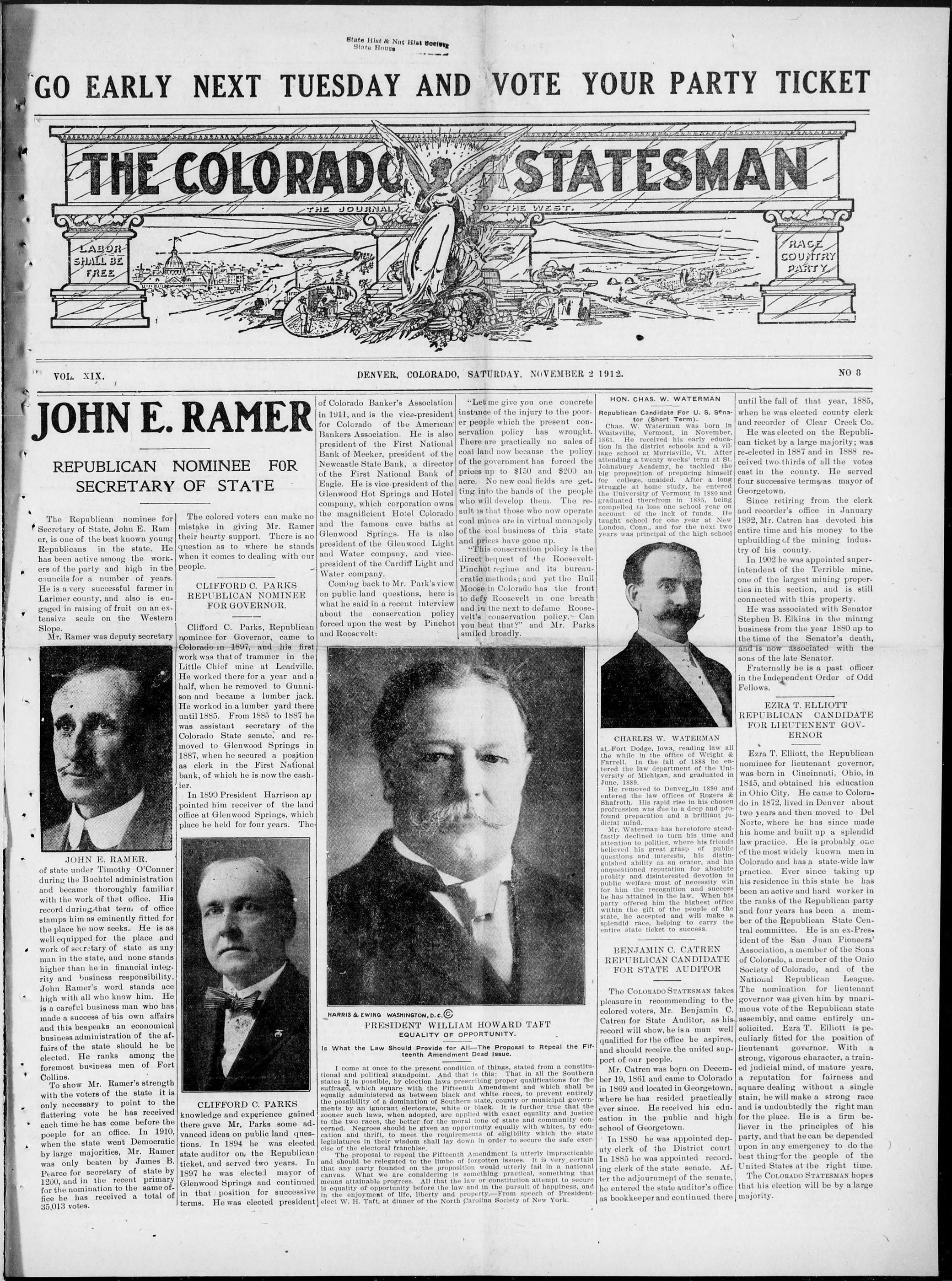
JOHN E. RAMER
REPUBLICAN NOMINEE F0R SECRETARY OF STATE
VOL. XIX.
JOHN E.
REPUBLICAN SECRETARY
The Republican nominee for Secretary of State, John E. Ramer, is one of the best known young Republicans in the state. He has been active among the workers of the party and high in the councils for a number of years. He is a very successful farmer in Larimer county, and also is engaged in raising of fruit on an extensive scale on the Western Slope.
Mr. Ramer was deputy secretary
JOHN E. RAMER.
of state under Timothy O'Conner during the Buchtel administration and became thoroughly familiar with the work of that office. His record during that term of office stamps him as eminently fitted for the place he now seeks. He is as well equipped for the place and work of secretary of state as any man in the state, and none stands higher than he in financial integrity and business responsibility. John Ramer's word stands ace high with all who know him. He is a careful business man who has made a success of his own affairs and this bespeaks an economical business administration of the affairs of the state should he be elected. He ranks among the foremost business men of Fort Collins.
To show Mr. Ramer's strength with the voters of the state it is only necessary to point to the flattering vote he has received each time he has come before the popele for an office. In 1910, when the state went Democratic by large majorities, Mr. Ramer was only beaten by James B. Pearce for secretary of state by 1200, and in the recent primary for the nomination to the same office he has received a total of 35,013 votes.
The colored voters can make no mistake in giving Mr. Ramer their hearty support. There is no question as to where he stands when it comes to dealing with our people.
CLIFFORD C. PARKS
REPUBLICAN NOMINEE
FOR GOVERNOR.
Clifford C. Parks, Republican nominee for Governor, came to Colorado in 1897, and his first work was that of trammer in the Little Chief mine at Leadville. He worked there for a year and a half, when he removed to Gunnison and became a lumber jack. He worked in a lumber yard there until 1885. From 1885 to 1887 he was assistant secretary of the Colorado State senate, and removed to Glenwood Springs in 1887, when he secured a position as clerk in the First National bank, of which he is now the cashier. In 1890 President Harrison ap pointed him receiver of the land office at Glenwood Springs, which place he held for four years. The
T. H.
knowledge and experience gained there gave Mr. Parks some advanced ideas on public land questions. In 1894 he was elected state auditor on the Republican ticket, and served two years. In 1897 he was elected mayor of Glenwood Springs and continued in that position for successive terms. He was elected president
DENVER, COLORADO. SATURDAY. NOVEMBER 2 1912.
T. W. G.
Is What the Law Should Provide for All—The Proposal to Repeal the Fifteenth Amendment Dead Issue.
I come at once to the present condition of things, stated from a constitutional and political standpoint. And that is this; That in all the Southern states it is possible, by election laws prescribing proper qualifications for the suffrage, which square with the Fifteenth Amendment and which shall be equally administered as between black and white races, to prevent entirely the possibility of a domination of Southern state, county or municipal governments by an ignorant electorate, white or black. It is further true that the sooner such laws, when adopted, are applied with exact equality and justice to the two races, the better for the moral tone of state and community concerned. Negroes should be given an opportunity equally with whites, by education and thrift, to meet the requirements of eligibility which the state legislatures in their wisdom shall lay down in order to secure the safe exercise of the electoral franchise.
The proposal to repeal the Fifteenth Amendment is utterly impracticable and should be relegated to the limbo of forgotten issues. It is very certain that any party founded on the proposition would utterly fail in a national canvas. What we are considering is something practical, something that means attainable progress. All that the law or constitution attempt to secure is equality of opportunity before the law and in the pursuit of happiness, and in the enjoyment of life, liberty and property.—From speech of President-elect W. H. Taft, at dinner of the North Carolina Society of New York.
State Hist & Nat Hist Society
State House
ESDAY AN
ADO
THE JOURNAL
DENVER, COLORADO
of Colorado Banker's Association in 1911, and is the vice-president for Colorado of the American Bankers Association. He is also president of the First National Bank of Meeker, president of the Newcastle State Bank, a director of the First National Bank of Eagle. He is vice-president of the Glenwood Hot Springs and Hotel company, which corporation owns the magnificent Hotel Colorado and the famous cave baths at Glenwood Springs. He is also president of the Glenwood Light and Water company, and vice-president of the Cardiff Light and Water company. Coming back to Mr. Park's view on public land questions, here is what he said in a recent interview about the conservation policy forced upon the west by Pinchot and Roosevelt:
---
"Let me give you one concrete instance of the injury to the poorer people which the present conservation policy has wrought. There are practically no sales of coal land now because the policy of the government has forced the prices up to $150 and $200 an acre. No new coal fields are getting into the hands of the people who will develop them. The result is that those who now operate coal mines are in virtual monopoly of the coal business of this state and prices have gone up.
"This conservation policy is the direct bequest of the Roosevelt-Pinchot regime and its bureaucratic methods; and yet the Bull Moose in Colorado has the front to defy Roosevelt in one breath and in the next to defame Roosevelt's conservation policy. Can you beat that?" and Mr. Parks smiled broadly.
HON. CHAS. W. WATERMAN
Republican Candidate For U. S. Senator (Short Term). Chas. W. Waterman was born in Waitsville, Vermont, in November, 1861. He received his early education in the district schools and a village school at Morrisville, Vt. After attending a twenty weeks' term at St. Johnsbury Academy, he tackled the big proposition of preparing himself for college, unaided. After a long struggle at home study, he entered the University of Vermont in 1880 and graduated therefrom in 1885, being compelled to lose one school year on account of the lack of funds. He taught school for one year at New London, Conn., and for the next two years was principal of the high school
CHARLES W. WATERMAN
at Fort Dodge, Iowa, reading law all
the while in the office of Wright &
Farrell. In the fall of 1888 he en-
tered the law department of the Uni-
versity of Michigan, and graduated in
June, 1889.
He removed to Denver in 1890 and entered the law offices of Rogers & Shafroth. His rapid rise in his chosen profession was due to a deep and profound preparation and a brilliant judicial mind.
Mr. Waterman has heretofore steadfastly declined to turn his time and attention to politics, where his friends believed his great grasp of public questions and interests, his distinguished ability as an orator, and his unquestioned reputation for absolute probity and disinterested devotion to public welfare must of necessity win for him the recognition and success he has attained in the law. When his party offered him the highest office within the gift of the people of the state, he accepted and will make a splendid race, helping to carry the entire state ticket to success.
BENJAMIN C. CATREN
REPUBLICAN CANDIDATE
FOR STATE AUDITOR
The COLORADO STATESMAN takes pleasure in recommending to the colored voters, Mr. Benjamin C. Catren for State Auditor, as his record will show, he is a man well qualified for the office he aspires, and should receive the united support of our people.
Mr. Catren was born on December 19, 1861 and came to Colorado in 1869 and located in Georgetown, where he has resided practically ever since. He received his education in the public and high school of Georgetown.
In 1880 he was appointed deputy clerk of the District court In 1885 he was appointed recording clerk of the state senate. After the adjournment of the senate, he entered the state auditor's office as bookkeeper and continued there
NO 8
until the fall of that year, 1885, when he was elected county clerk and recorder of Clear Creek Co. He was elected on the Republican ticket by a large majority; was re-elected in 1887 and in 1888 received two-thirds of all the votes cast in the county. He served four successive terms as mayor of Georgetown. Since retiring from the clerk and recorder's office in January 1892, Mr. Catren has devoted his entire time and his money to the upbuilding of the mining industry of his county. In 1902 he was appointed superintendent of the Terrible mine, one of the largest mining properties in this section, and is still connected with this property. He was associated with Senator Stephen B. Elkins in the mining business from the year 1880 up to the time of the Senator's death, and is now associated with the sons of the late Senator.
Fraternally he is a past officer in the Independent Order of Odd Fellows.
EZRA T. ELLIOTT
REPUBLICAN CANDIDATE
FOR LIEUTENENT GOV-
ERNOR
Ezra T. Elliott, the Republican nominee for lieutenant governor, was born in Cincinnati, Ohio, in 1845, and obtained his education in Ohio City. He came to Colorado in 1872, lived in Denver about two years and then moved to Del Norte, where he has since made his home and built up a splendid law practice. He is probably one of the most widely known men in Colorado and has a state-wide law practice. Ever since taking up his residence in this state he has been an active and hard worker in the ranks of the Republican party and four years has been a member of the Republican State Central committee. He is an ex-President of the San Juan Pioneers' Association, a member of the Sons of Colorado, a member of the Ohio Society of Colorado, and of the National Republican League. The nomination for lieutenant governor was given him by unanimous vote of the Republican state assembly, and came entirely unsolicited. Ezra T. Elliott is peculiarly fitted for the position of lieutenant governor. With a strong, vigorous character, a trained judicial mind, of mature years, a reputation for fairness and square dealing without a single stain, he will make a strong race and is undoubtedly the right man for the place. He is a firm believer in the principles of his party, and that he can be depended upon in any emergency to do the best thing for the people of the United States at the right time. The COLORADO STATESMAN hopes that his election will be by a large majority.
LATEST NEWS EPITOMIZED
FROM TELEGRAPHIC REPORTS THAT COVER THE WEEK'S EVENTS.
OF MOST INTEREST
OF MOST INTEREST
KEEPING THE READER POSTED ON MOST IMPORTANT CURRENT TOPICS.
Western Newspaper Union News Service.
WESTERN.
Samuel C. Wyatt, 74 years old, and Mrs. Susan Pettijohn, 72 years old, were married in the Probate Court at Topeka, Kan.
To save the life of her eight-year-old son, Mrs. J. A. Cross of Newton, Kan., is giving skin from her legs that it may be grafted upon the child's body.
At Omaha two boys held up in a spectacular manner six motor cars and robbed the twenty-two occupants of their valuables, getting several hundred dollars.
Art Smith, 19, an aviator, and Miss Amie Cour, 18, of Fort Wayne, Ind., eloped in an aeroplane and were married by Justice of the Peace Weaver in Hillsdale, Mich., seventy-five miles distant.
The nude body of a woman, apparently 40 or 45 years old, was found hanging in the cellar of an old mansion on Locust street in St. Louis. The woman had been gagged before she was hanged.
Merchandise and jewelry valued at more than $25,000, has been stolen from the mail pouches and express packages on Burlington trains between Chicago and Denver during the past six months, the police say.
The Republican state central committee of Montana named W. R. Allen of Anaconda, to fill the vacancy on the congressional ticket due to the death of W. F. Meyer. Mr. Allen is lieutenant governor of Montana.
Robert L. Harris was held up and robbed both of money and clothing just after he had left a Chicago theater. Harris was taken to a police station in his undergarments and sent home in a patrol wagon, wrapped in a blanket.
When told at Coeur d'Alene, Idaho, that the Indiana Superior Court has sustained his action in quartering state troops at the Porter, Ind., race track, Governor Thomas R. Marshall of Indiana, expressed deep satisfaction.
Two thousand people, all that could be jammed into the church, witnessed the dedication of the Cathedral of the Immaculate Conception in Denver by His Eminence, John Cardinal Farley, and the assembled dignitaries of the Catholic church. Thousands were turned away.
Apparently one of the most interested listeners in the audience addressed by Eugene W. Chafin, prohibition candidate for President, at Joplin, Mo. was Chafin's nephew, C. R. Fordham, a Joplin saloonkeeper. Before and after his speech the dry candidate was entertained at the Fordham home.
SPORT.
Oklahoma university's team was defeated by the University of Missouri, 14 to 0, at Norman, Okla.
The football team of the Agricultural College of Utah defeated the University of Montana by a score of 17 to 0, at Logan, Utah.
Iron Man Joe McGinnity, former manager and part owner of the Newark club, is negotiating for the purchase of the Terre Haute club of the Central league.
Colorado College continued its march of football progress by defeating the big, rangy Nebraska Wesleyan eleven, 24 to 13, on Washburn field, at Colorado Springs.
An offer to rent the St. Louis National League baseball team next season for $100,000 was made by Richard Kinsella, scout for the team and former owner of the Springfield team of the Three Eye League.
Packey McFarland of Chicago was given the popular decision over Jimmy Duffy of Lockport, at the end of a ten-round bout before the Queensbury A. C. at Buffalo, N. Y. The fight was witnessed by about 1,000 spectators.
According to Guy T. Rockwell, trotting expert, the season of 1912 will be remembered as one in which nineteen world's records were lowered. It also was productive of the largest money-winning trotter, Baden, and the largest winning pacer, Joe Patchen II., that ever graced the light harness turf.
Chicago made another stride toward the "Big Nine" championship by beating Purdue university, 7 to 0, on Marshall field at Chicago. The score was the smallest registered by the Maroons against Purdue in eleven years.
Judge H. B. Tuthill of the Superior Court at Michigan City, Ind., rendered an opinion denying to the racing foundation corporation of America an injunction, and thereby sustaining the action of the state authorities in quartering troops at the Porter, Ind., race track
FOREIGN.
A special Rome dispatch says advices were received there that Scutari had capitulated. Berlin dispatches state that Germany is arising for the greatest clash in the history of the world. Emperor William's fourth son, Prince August William, has for his bobby the designing of women's dresses, domestic furniture and fittings. Premier Berntzen at Copenhagen introduced a franchise reform bill whereby women will be allowed to vote and will be eligible for seats in the Folkething. General Felix Diaz, leader of the revolution recently inaugurated in Vera Cruz, and three of his confederates have been sentenced to death by court martial, before which they were tried.
In another clash between Radicals and Conservatives at Havana, two persons were killed and a number wounded. The riot took place in the suburbs and details were slow in reaching the city.
The capture of Uskup by the Servian and Bulgarian forces is confirmed. The town fell without resistance. The foreign consuls at Uskup have requested the Servian army to protect the inhabitants.
A Bantu tribesman has been discovered at Johannesburg who has forty-six wives. He is only thirty-five years old. He is believed to be the champion polygamist of the British empire. His nearest competitor for the record has only twenty-eight wives.
One thousand soldiers were reported to have been killed when the troop train in which they were riding was derailed and plunged into a deep gorge near Maltrata. It is thought at Mexico City that the number reported killed is greatly exaggerated. Guerillas under the command of General Aguilar, the report adds, were responsible for the disaster.
WASHINGTON.
President Taft left Cambridge Springs, Penn., for Washington, his vacation over, his last engagement kept, to begin the winter's work.
The latest candidate mention to succeed Dr. Harvew W. Wiley as chief of the bureau of chemistry is Dr. Carl L. Alsberg, chemical biologist in the bureau of plant industry.
Contributions totaling $591,030.20 and expenditures of $558,311.25 in the Republican presidential fund were disclosed in the financial statement of the Republican national committee filed with the clerk of the House of Representatives.
The customs court has granted the government's application for an indefinite postponement of the wood pulp and paper case involving the right of European countries to send into this country pulp and paper free of duty.
Former Senator Albert J. Beveridge of Indiana, before the Clapp committee, corroborated other testimony that in his 1904 campaign for the senate he received $30,000 from George W. Perkins, $25,000 from Edward L. McLean and $2,500 from Gifford Pinchot. Cholera again is sweeping India, according to a report to the United States public health service. In August, in the province of Madras alone, there were 21,306 cases and 10,200 deaths, and in other parts of the empire an equally ominous mortality prevailed.
GENERAL.
October 27th was Theodore Roosevelt's fifty-fourth birthday, and he celebrated it quietly with his family. Father Bernard Vaughan, the famous English Jesuit exhorter, is missing, according to Chicago dispatches. J. P. Morgan, at Hartford, Conn., announced a gift of $200,000 to Trinity college for a new library and administration building. Morgan had previously given $170,000 for new buildings. William J. Bryan will soon begin the erection of a home at a cost of $100,000 on his 200-acre farm at Mission, Texas. The plans for this residence have been finished for some time.
The funeral at Grand Rapids, Mich., of 10-year-old Robert Spotwood, was the scene of a wild disturbance in which two men were floored by a chair in the hands of an irate woman, and the corpse knocked from the casket. It all arose over a matter of religion. Mrs. Elizabeth Spotwood, grandmother of the lad, who is a Catholic, was the aggressor.
The second annual convention of the International Dairy and Milk Inspectors' Association, in a banquet and closing session at Milwaukee, elected the following officers for the ensuing year: C. J. Steffens of Milwaukee, president; A. N. Henderson of Seattle, W. H. Price of Detroit, D. J. Jordan of Boston, vice presidents, and Ivan C. Weld of Washington, D. C., secretary-treasurer. At the banquet the guests drank milk.
The Rev. Thurston U. Vaughn, charged with mistreating three little girls, was found guilty and sentenced to die in the electric chair December 20, at Brenville, S. C.
The department of justice has become deeply interested in the investigation made at Chicago into the "Jack" Johnson-Lucile Cameron case, involving possible violations of the Mann act. Local federal authorities have received a message from Attorney General Wickersham ordering them to make an exhaustive investigation.
COLORADO STATE NEWS
Western Newspaper Union News Service.
DATES FOR COMING EVENTS.
January 20-25—Eighth Annual Western
Stock Show—Denver.
Farmers Fight for Use of Boxcar.
Pueblo.—The inability of the railroad to supply enough light cars to move the bumper crop in the Arkansas valley was responsible for a desperate fight at Vineland, seven miles east of Pueblo, when C. P. Wayt and K. P. Hadden, both wealthy ranchmen, battled for the possession of a boxcar.
Mother and Babes Near Death in Blaze
Boulder.—Mrs. Leonard R. Bennett and her two children, one a baby only three weeks old, had a narrow escape from suffocation when the house in which they were sleeping was set afire by some unknown enemy. Mrs. Bennett and both children were nearly overcome before they were awakened.
Pulmotor Makes Good.
Greeley.—The pulmotor recently purchased by popular subscription here proved its worth the first day it was unpacked and made ready for service. The machine was used in the case of W. McKinney, who was seized with paralysis of the lungs. The pulmotor was secured and worked so effectively that McKinney was kept alive during the night and may recover.
Unique Objection to New Trial.
Pueblo.—A question of whether nonpayment of attorney fees by a defendant shall bar him from obtaining a new trial was brought before the district court when attorneys argued before Judge Rizer against the granting of a new trial to Pasquale and Juan Gilberto, brothers, convicted of manslaughter. Judge Rizer overruled them and permitted the motion for a new trial to be filed.
Cars Needed to Move Crops.
Denver.—The long-expected car shortage has arrived. The Great Western Sugar company reported that it needs in the Northern Colorado district 200 cars, which it is absolutely unable to get. Over 100 cars for the transportation of alfalfa meal are needed in Northern Colorado at once. There are scarcely a dozen in sight. There is a shortage of refrigerator cars for the transportation of apples from the western slope to the eastern market. More than 1,000 are required at once for this purpose.
Two Sisters Die in Three Days.
Denver.—Twice within three days has death entered the home of Edward H. Dietrich, 533 West Mississippi avenue. Three days ago Lorena Dietrich, 17, died of pneumonia. Before her body had been buried Mildred, 10, died of scarlet fever. Ernest, a yonuger brother, is now desperately ill of scarlet fever, which he has contracted from his sisters. The mother, unable to attend the funeral of her two children, because of the quarantine under which the home has been placed, is in a state of nervous collapse that physicians fear may prove fatal.
NEW CATHEDRAL DEDICATED.
Cardinal Farley Crowned Twelve Years of Untiring Labor With Blessing.
Denver.—With all the ritualistic pomp and religious splendor of the Roman Catholic church, the Cathedral of the Immaculate Conception was dedicated with the apostolic blessing of Cardinal Farley and Pope Pius X.
Deepest devotion marked the services celebrating the completion of Denver's most beautiful church, and the spectacle of 10,000 souls kneeling outdoors to receive the benediction of the Blessed Sacrament was one never surpassed in the ecclesiastical history of the west.
The gigantic afternoon parade, in which nearly 8,000 Catholics of Denver participated, in fitting jubilation of a success crowning the struggle commenced more than fifty years ago, to establish the Catholic church in Colorado, was by far the greatest religious demonstration ever witnessed in the Rocky mountain region. Intense interest was shown in the dedicatory event. Not only was every seat in the beautiful cathedral taken, but several thousands gathered outside to vow the papal procession as the exterior walls of the structure were blessed by Cardinal Farley. The edifice was crowded at both morning and evening services, thousands clamoring to get a glimpse of the magnificent interior. Apart from the 8,000 in the parade, the benediction of Cardinal Farley in the afternoon brought 4,000 more to its doors.
At the close of each service the chimes of the cathedral rang out in religious selections appropriate to the occasion, completing an essential feature of the magnificent exercises.
Girls Ruined by Dress
Grand Junction,—The W. C. T. U. of Grand Junction has taken up the subject of short dresses for women. They intend to adopt resolutions requesting that all young women over 17 years of age lengthen their dresses to their shoe tops. "Hundreds of young women fall every years in Grand Junction," said Mrs. James Hendrickson, a prominent W. C. T. U. worker, "because of the immoral dresses worn by their school mates Mothers should lock after their daughters when young and dress them modestly and sensibly."
Small Happenings Occurring Over the State Worth While. Western Newspaper Union News Service.
Edward Rass of Arvada, 41, shot and killed himself at Golden.
The new Elks' lodge hall at Greeley was dedicated with impressive ceremonies.
Mrs. Perry Spencer died at Durango as a result of burns received when her dress caught fire.
Charles M. Krueger, 50 years old, who had battled against death for six years, died of Bright's disease in Denver.
Impressive ceremonies marked the laying of the cornerstone for the Henry J. Warren Memorial Library building in Denver.
A Colorado & Southern freight train struck and killed Charles C. Chamberlain, a pioneer of Las Animas county, at Trinidad.
Early arrests are promised in connection with the murder of Jesse H. Stingley, the detective whose body was found at Utah Junction.
The United States forest service will spend $21,000 this year toward the construction of good roads in the national forests of the state.
There are on exhibition in Craig two turnips weighing nineteen and twenty-three pounds apiece. They were raised by Lee Webb, a dry farmer, living twenty miles west of Craig.
John Cardinal Farley and Monsignori Lewis and Lavelle were entertained at a dinner given in their honor by Mr. and Mrs. John F. Campion at their residence in Denver.
Miss Virginia Lewis, until a few days ago the leading lady in the southern division of "The Rosary" Company, died following an operation at the Mercy hospital in Denver.
The body of Emile Ross, who was killed by his son, Howard, in Denver, is ready for burial. Two undertakers have orders to conduct the funeral and both are awaiting word from Mrs. Ross.
Magistrate Thrush, who, with E. R. Morris and C. J. Gavin of Denver, was ordered ousted from office by a ruling of the Supreme Court, declares he will file a petition for a rehearing in the case.
Warnings that the Antero dam, two miles above Hartzel, is in danger of breaking, caused formers for miles down the valley to abandon their homes and take their families to higher ground.
The annual smoker of the University of Colorado law school was held at Boulder. Several state officials, members of the Supreme Court and court of appeals, and the entire Boulder Bar Association attended.
In the year 1912 nearly $17,000,000 was collected by all the taxing bodies in the state of Colorado. Herbert Fairall, secretary of the new state tax commission, has compiled the figures. The exact total of money collected is $16,931,566.16.
The funeral of Frank M. Davis, builder of the first iron works in Denver and a member of the Denver Driving Club, who died in California, was held from the residence of his daughter, Mrs. Talbott K. Wonderley, in Denver.
Pueblo county is $547,111 richer than a year ago, according to the report of County Assessor Samuel McCoun delivered to the county commissioners. The assessed valuation of Pueblo county is $27,962,720. A year ago it was $27,415,609. Thirty rattlesnakes were killed by Frank Coykendall and John Funk of Platteville during a hunting trip. The two men killed two coyotes, scores of rabbits and ducks on the trip and found the rattlers more numerous than at any time before. The official figures given out by the elections commission show that 87,007 people in Denver registered for the election of November 5. The registration is greater by several thousand than any ever before recorded in Denver.
The fact that the general education board of the Rockefeller foundation has donated $100,000 to the Denver university, conditional upon the raising of $300,000 additional in the state of Colorado, has aroused the Methodists of this state to a condition of great activity, and a very earnest attempt will be made to secure contributions to the extent of the amount required to make the Rockefeller donation available.
Suffering from nervous shock, Miss Gertrude Hunt, aged 17, employed as a nurse girl by Mrs. James De Lisi. of Denver, is confined to her home at 1864 Osage street, as a result of a series of encounters with an unidentified man. Delirious the greater part of the time, Miss Hunt, during lucid intervals, maed statements which have convinced the authorities that a man, whose identity is not known to her, but of whom she can give a fairly good description, attacked her in the street and made several efforts to break into the home of her employer, where she had sought refuge.
The Denver stockyards have been crowded with cattle recently, and officers report that more business has been transacted by them this year than for any like period since the stockyards were built, twenty-one years ago.
Delphin M. Delmas, the attorney who made fame in his defense of Harry K. Thaw for the murder of Stanford White in New York a few years ago, appeared in the District Court of Denver and filed a suit involving $500,000, for the International Tunnel Company against Edward J. Wilcox and Ernest L. Miller.
The
Curtis
Park
Floral
Company
FLORAL DESIGNS PUT UP WHILE
YOU WAIT
CHOICE PLANTS AND CUT FLOWERS CONSTANTLY
ON HAND
GREENHOUSES: Thirty-Fourth and Curtis Streets
TELEPHONE, MAIN 1511 DENVER, COLO
2735 Welton St. Main 6363
The Central Bottling & Distributing Co.
Agents for the famous
CAPITOL BEER---IT'S CAPITAL
Try a case, 2 toz. pints for $1.10, delivered promptly; empties called for.
Family Liquors, Wines, and Cordials Genuine Goods at Popular Prices A glass of good wine will improve your Sunday dinner, and aid digestion.
The Champa Pharmacy
BUY YOUR BOTTLED GOODS OF THE
WORK CALLED FOR AND DELIVERED
THE CA
RE
SEWED HALF
HE
1511 CHAMPA STR
Boost Colorado P
ZA
DE
COLUMB
VI
Guaranteed Absolutely Pure.
Delivered Daily to All Parts of the City.
The Ph.
RUDOLPH BROTHERS
Imported and Domestic Table Delicacies. Fresh Fruits and Vegetables. Our Own Bakery. Finest Goods in the City. 2758-2760 Downing Avenue Phone York 320
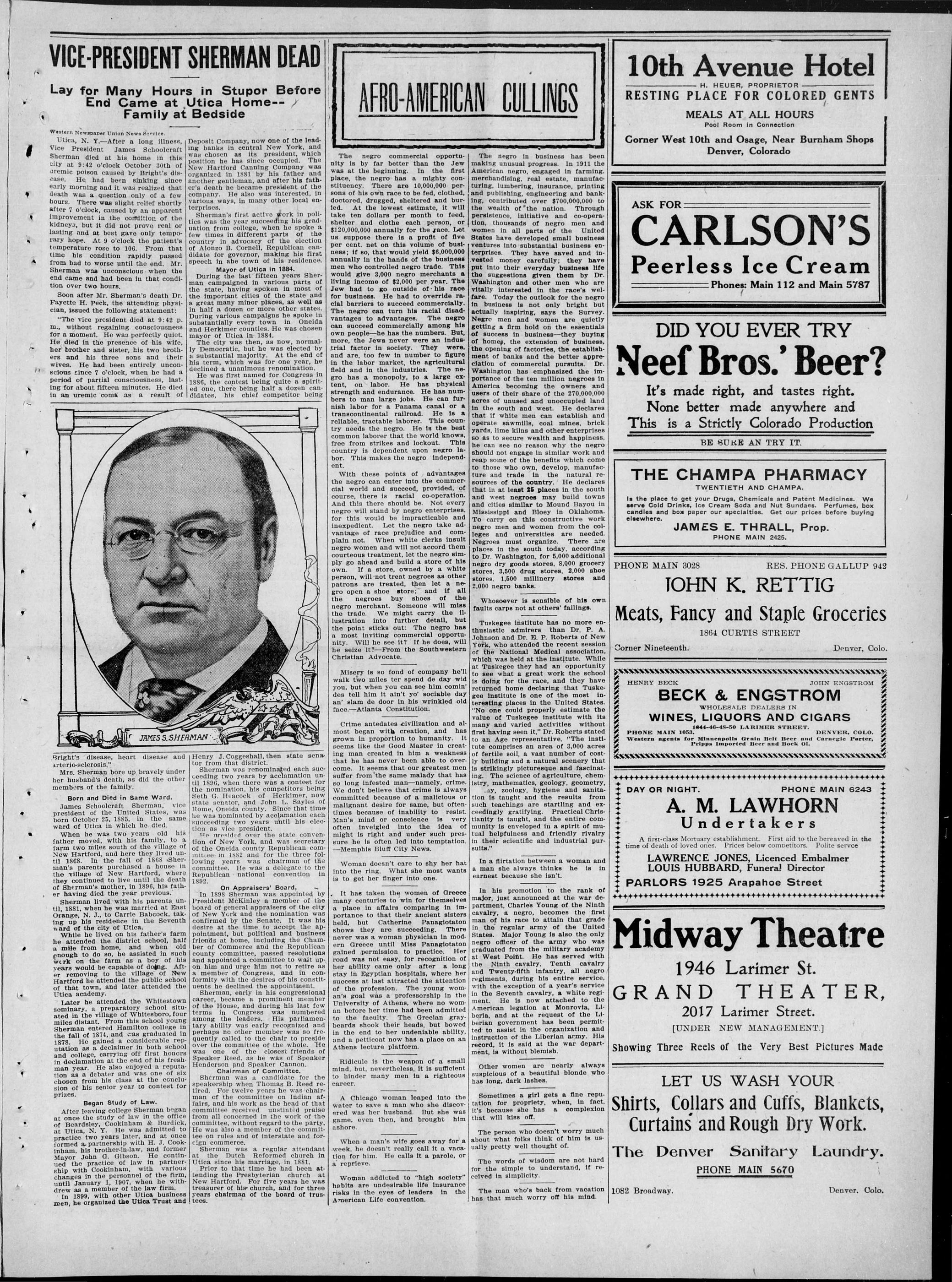
VICE-PRESIDENT SHERMAN DEAD
Lay for Many Hours in Stupor Before End Came at Utica Home-- Family at Bedside
JAMES S. SHERMAN
Western Newspaper Union News Service.
Utica, N. Y.—After a long illness,
Vice President James Schoolcraft
Sherman died at his home in this
city at 9:42 o'clock October 30th of
aremic poison caused by Bright's disease.
He had been sinking since
early morning and it was realized that
death was a question only of a few
hours. There was slight relief shortly
after 7 o'clock, caused by an apparent
improvement in the condition of the
kidneys, but it did not prove real or
lasting and at best gave only temporary
hope. At 9 o'clock the patient's
temperature rose to 106. From that
time his condition rapidly passed
from bad to worse until the end. Mr.
Sherman was unconscious when the
end came and had been in that condition
over two hours.
Soon after Mr. Sherman's death Dr. Fayette H. Peck, the attending physician, issued the following statement:
"The vice president died at 9:42 p.m., without regaining consciousness for a moment. He was perfectly quiet. He died in the presence of his wife, her brother and sister, his two brothers and his three sons and their wives. He had been entirely unconscious since 7 o'clock, when he had a period of partial consciousness, lasting for about fifteen minutes. He died in an uremic coma as a result of
JAMES S. SHE
Bright's disease, heart disease and arterio-sclerosis." Mrs. Sherman bore up bravely under her husband's death, as did the other members of the family.
Born and Died in Same Ward.
James Schoolcraft, Sherman, vice president of the United States, was born October 25, 1885, in the same ward of Utica in which he died.
When he was two years old his father moved, with his family, to a farm two miles south of the village of New Hartford, and here they lived until 1868. In the fall of 1868 Sherman's parents purchased a house in the village of New Hartford, where they continued to live until the death of Sherman's mother, in 1896, his father having died the year previous.
Sherman lived with his parents until, 1881, when he was married at East Orange, N. J., to Carrie Babcock, taking up his residence in the Seventh ward of the city of Utica.
While he lived on his father's farm he attended the district school, half a mile from home, and when old enough to do so, he assisted in such work on the farm as a boy of his years would be capable of doing. After removing to the village of New Hartford he attended the public school of that town, and later attended the Utica academy.
Later he attended the Whitestown seminary, a preparatory school situated in the village of Whitesboro, four miles distant. From this school young Sherman entered Hamilton college in the fall of 1874, and was graduated in 1878. He gained a considerable reputation as a declaimer in both school and college, carrying off first honors in declamation at the end of his freshman year. He also enjoyed a reputation as a debater and was one of six chosen from his class at the conclusion of his senior year to contest for prizes.
Began Study of Law.
After leaving college Sherman began at once the study of law in the office of Beardsley, Cookinham & Burdick, at Utica, N. Y. He was admitted to practice two years later, and at once formed a partnership with H. J. Cookinham, his brother-in-law, and former Mayor John G. Gibson. He continued the practice of law in partnership with Cookinham, with various changes in the personnel of the firm, until January 1, 1907, when he withdrew as a member of the law firm.
In 1899, with other Utica business men, he organized the Utica Trust and
Deposit Company, now one of the leading banks in central New York, and was chosen as its president, which position he has since occupied. The New Hartford Canning Company was organized in 1881 by his father and another gentleman, and after his father's death he became president of the company. He also was interested, in various ways, in many other local enterprises. Sherman's first active work in politics was the year succeeding his graduation from college, when he spoke a few times in different parts of the country in advocacy of the election of Alonzo B. Cornell, Republican candidate for governor, making his first speech in the town of his residence.
Mayor of Utica in 1884.
During the last fifteen years Sherman campaigned in various parts of the state, having spoken in most of the important cities of the state and a great many minor places, as well as in half a dozen or more other states. During various campaigns he spoke in substantially every town in Oneida and Herkimer counties. He was chosen mayor of Utica in 1884.
The city was then, as now, normally Democratic, but he was elected by a substantial majority. At the end of his term, which was for one year, he declined a unanimous renomination.
He was first named for Congress in 1886, the contest being quite a spirited one, there being half a dozen candidates, his chief competitor being
RMAN
Henry J. Coggeshall, then state senator from that district. Sherman was renominated each succeeding two years by acclamation until 1896, when there was a contest for the nomination, his competitors being Seth G. Heacock of Herkimer, now state senator, and John L. Sayles of Rome, Oneida county. Since that time he was nominated by acclamation each succeeding two years until his election as vice president.
He presided over the state convention of New York, and was secretary of the Oneida county Republican committee in 1882 and for the three following years was chairman of the committee. He was a delegate to the Republican national convention in 1892.
On Appraisers' Board.
On Appraisers' Board.
In 1898 Wherman was appointed by President McKinley a member of the board of general appraisers of the city of New York and the nomination was confirmed by the Senate. It was his desire at the time to accept the appointment, but political and business friends at home, including the Chamber of Commerce and the Republican county committee, passed resolutions and appointed a committee to wait upon him and urge him not to retire as a member of Congress, and in conformity with the desires of his constituents he declined the appointment.
Sherman, early in his congressional career, became a prominent member of the House, and during his last few terms in Congress was numbered among the leaders. His parliamentary ability was early recognized and perhaps no other member was so frequently called to the chair to preside over the committee of the whole. He was one of the closest friends of Speaker Reed, as he was of Speaker Henderson and Speaker Cannon.
chairman of the
Sherman was a candidate for the
speakership with Thomas B. Reed
retired. For twelve years he was chairman
of the committee on Indian affairs,
and his work as the head of that
committee received unstinted praise
from all concerned in the work of the
committee, without regard to the party.
He was also a member of the committee
on rules and of interstate and foreign
commerce.
Sherman was a regular attendant
at the Dutch Reformed church in
Utica since his marriage, in 1881.
Prior to that time he had been attending
the Presbyterian church at
New Hartford. For five years he was
treasurer of his church, and for three
years chairman of the board of trustees.
```markdown
```
AFRO-AMERICAN CULLINGS
The negro commercial opportunity is by far better than the Jew was at the beginning. In the first place, the negro has a mighty constituency. There are 10,000,000 persons of his own race to be fed, clothed, doctored, drugged, sheltered and buried. At the lowest estimate, it will take ten dollars per month to feed, shelter and clothe each person, or $120,000,000 annually for the race. Let us suppose there is a profit of five per cent. net on this volume of business; if so, that would yield $6,000,000 annually in the hands of the business men who controlled negro trade. This would give 3,000 negro merchants a living income of $2,000 per year. The Jew had to go outside of his race for business. He had to override racial barriers to succeed commercially. The negro can turn his racial disadvantages to advantages. The negro can succeed commercially among his own people—he has the numbers. But, more, the Jews never were an industrial factor in society. They were, and are, too few in number to figure in the labor market, the agricultural field and in the industries. The negro has a monopoly, to a large extent, on labor. He has physical strength and endurance. He has numbers to man large jobs. He can furnish labor for a Panama canal or a transcontinental railroad. He is a reliable, tractable laborer. This country needs the negro. He is the best common laborer that the world knows, free from strikes and lockout. This country is dependent upon negro labor. This makes the negro independent.
With these points of advantages the negro can enter into the commercial world and succeed, provided, of course, there is racial co-operation. And this there should be. Not every negro will stand by negro enterprises, for this would be impracticable and inexpedient. Let the negro take advantage of race prejudice and complain not. When white clerks insult negro women and will not accord them courteous treatment, let the negro simply go ahead and build a store of his own. If a store, owned by a white person, will not treat negroes as other patrons are treated, then let a negro open a shoe store; and if all the negroes buy shoes of the negro merchant. Someone will miss the trade. We might carry the illustration into further detail, but the point sticks out: The negro has a most inviting commercial opportunity. Will he see it? If he does, will he seize it? -From the Southwestern Christian Advocate.
Misery is so fond of company he'll walk two miles ter spend de day wid you, but when you can see him comin' des tell him it ain't yo' sociable day an' slam de door in his wrinkled old face—Atlanta Constitution.
Crime antedates civilization and almost began with creation, and has grown in proportion to humanity. It seems like the Good Master in creating man created in him a weakness that he has never been able to overcome. It seems that our greatest men suffer from the same malady that has so long infested man—namely, crime. We don't believe that crime is always committed because of a malicious or malignant desire for same, but oftentimes because of inability to resist. Man's mind or conscience is very often invigled into the idea of might is right and under such pressure he is often led into temptation.—Memphis Bluff City News.
Woman doesn't care to shy her hat into the ring. What she most wants is to get her finger into one.
It has taken the women of Greece many centuries to win for themselves a place in affairs comparing in importance to that their ancient sisters held, but Catherine Panagiotaton shows they are succeeding. There never was a woman physician in modern Greece until Miss Panagiotaton gained permission to practice. Her road was not easy, for recognition of her ability came only after a long stay in Egyptian hospitals, where her success at last attracted the attention of the profession. The young woman's goal was a professorship in the University of Athens, where no woman before her time had been admitted to the faculty. The Grecian gray-beards shook their heads, but bowed in the end to her undeniable ability, and a petticoat now has a place on an Athens lecture platform.
Ridicule is the weapon of a small mind, but, nevertheless, it is sufficient to hinder many men in a righteous career.
A Chicago woman leaped into the water to save a man who she discovered was her husband. But she was game, even then, and brought him ashore.
When a man's wife goes away for a week, he doesn't really call it a vacation for him. He calls it a parole, or a reprieve.
Woman addicted to "high society" habits are undesirable life insurance risks in the eyes of leaders in the American Life convention.
The negro in business has been making unusual progress. In 1911 the American negro, engaged in farming, merchandising, real estate, manufacturing, lumbering, insurance, printing and publishing, engineering and banking, contributed over $700,000,000 to the wealth of the nation. Through persistence, initiative and co-operation, thousands of negro men and women in all parts of the United States have developed small business ventures into substantial business enterprises. They have saved and invested money carefully; they have put into their everyday business life the suggestions given them by Dr. Washington and other men who are vitally interested in the race's welfare. Today the outlook for the negro in business is not only bright but actually inspiring, says the Survey. Negro men and women are quietly getting a firm hold on the essentials of success in business—the buying of homes, the extension of business, the opening of factories, the establishment of banks and the better appreciation of commercial pursuits. Dr. Washington has emphasized the importance of the ten million negroes in America becoming the owners and users of their share of the 270,000,000 acres of unused and unoccupied land in the south and west. He declares that if white men can establish and operate sawmills, coal mines, brick yards, lime kilns and other enterprises so as to secure wealth and happiness, he can see no reason why the negro should not engage in similar work and reap some of the benefits which come to those who own, develop, manufacture and trade in the natural resources of the country. He declares that in at least 25 places in the south and west negroes may build towns and cities similar to Mound Bayou in Mississippi and Bloey in Oklahoma. To carry on this constructive work negro men and women from the colleges and universities are needed. Negroes must organize. There are places in the south today, according to Dr. Washington, for 5,000 additional negro dry goods stores, 8,000 grocery stores, 3,500 drug stores, 2,000 shoe stores, 1,500 millinery stores and 2,000 negro banks.
Whoseover is sensible of his own faults carps not at others' failings.
Tuskegee institute has no more enthusiastic admirers than Dr. P. A. Johnson and Dr. E. P. Roberts of New York, who attended the recent session of the National Medical association, which was held at the institute. While at Tuskegee they had an opportunity to see what a great work the school is doing for the race, and they have returned home declaring that Tuskegee institute is one of the most interesting places in the United States. "No one could properly estimate the value of Tuskegee institute with its many and varied activities without first having seen it," Dr. Roberts stated to an Age representative. "The institute comprises an area of 3,000 acres of fertile soil, a vast number of costly building and a natural scenery that is strikingly picturesque and fascinating. The science of agriculture, chemistry, mathematics, geology, geometry,
ay, zoology, hygiene and sanitation is taught and the results from such teachings are startling and exceedingly gratifying. Practical Christianity is taught, and the entire community is enveloped in a spirit of mutual helpfulness and friendly rivalry in their scientific and industrial pursuits."
In a flirtation between a woman and a man she always thinks he is in earnest because she isn't.
In his promotion to the rank of major, just announced at the war department, Charles Young of the Ninth cavalry, a negro, becomes the first man of his race to attain that grade in the regular army of the United States. Major Young is also the only negro officer of the army who was graduated from the military academy at West Point. He has served with the Ninth cavalry. Tenth cavalry and Twenty-fifth infantry, all negro regiments, during his entire service, with the exception of a year's service in the Seventh cavalry, a white regiment. He is now attached to the American legation at Monrovia, Liberia, and at the request of the Liberian government has been permitted to assist in the organization and instruction of the Liberian army. His record, it is said at the war department, is without blemish.
Other women are nearly always suspicious of a beautiful blonde who has long, dark lashes.
Sometimes a girl gets a fine reputation for propriety, when, in fact, it's because she has a complexion that will kiss off.
The person who doesn't worry much about what folks think of him is usually pretty well thought of.
The words of wisdom are not hard for the simple to understand, if received in simplicity.
The man who's back from vacation has that much worry off his mind.
H. HEUER, PROPRIETOR RESTING PLACE FOR COLORED GENTS MEALS AT ALL HOURS Pool Room in Connection
At 10th and Osage, Near Bur-
Denver, Colorado
ARLSON
Hardless Ice Cream
Phones: Main 112 and
DO YOU EVER T
f Bros.' B
made right, and tastes
better made anywhere
a Strictly Colorado F
BE SUKE AN TRY IT.
CHAMPA PHAR
TWENTIETH AND CHAMPA.
get your Drugs, Chemicals and Patent
kgs, Ice Cream Soda and Nut Sundaes
paper our specialties. Get our price
JAMES E. THRALL, Pro
PHONE MAIN 2425.
3028 RES. PHON
JOHN K. RETT
Fancy and Staple C
Corner West 10th and Osage, Near Burnham Shops Denver, Colorado
ASK FOR CARLSON'S Peerless Ice Cream Phones: Main 112 and Main 5787
It's made right, and tastes right. None better made anywhere and This is a Strictly Colorado Production
Is the place to get your Drugs, Chemicals and Patent Medicines. We serve Cold Drinks, Ice Cream Soda and Nut Sundaes. Perfumes, box candles and box paper our specialties. Get our prices before buying elsewhere.
1864 CURTIS STREET
h.
CK & ENGSTRO
WHOLESALE DEALERS IN
HENRY BECK JOHN ENGSTROM
BECK & ENGSTROM
WHOLESALE DEALERS IN
WINES, LIQUORS AND CIGARS
1844-46-48-50 LARIMER STREET.
PHONE MAIN 1053.
DENVER, COLO.
Western agents for Minneapolis Grain Belt Beer and Carnegie Porter,
Prilps Imported Beer and Bock Oil.
DAY OR NIGHT. PHONE MAIN 6243
A first-class Mortuary establishment. First aid to the bereaved in the time of death of loved ones. Prices below competitors. Polite service LAWRENCE JONES, Licenced Embalmer LOUIS HUBBARD, Funeral Director PARLORS 1925 Arapahoe Street
Midway Theatre
Showing Three Reels of the Very Best Pictures Made
LET US WASH YOUR Shirts, Collars and Cuffs, Blankets, Curtains and Rough Dry Work. The Denver Sanitary Laundry. PHONE MAIN 5670
THE COLORADO STATESMAN
CALIFORNIA
BALL DE
FALL
AUGUST
BOUNTY
PARTY
JOS. D. D. RIVERS....Proprietor
1824 Curtis Street, Room 25.
JOS. D. D. RIVERS.....Proprietor
1824 Curtis Street, Room 25.
SUBSCRIPTION RATES:
One Year ..... $2.00
Six Months ..... 1.00
Three Months ..... .60
PAYABLE IN ADVANCE.
PAYABLE IN ADVANCE
matter at the postoffice
times or less, 10 cents per line.
cents per square. A square.
A personating nature the columns of this paper.
receive attention must be no upon one side of the paper, better than Wednesdays, and returned, unless stamps are.
that papers sent to subany number when due, in and a duplicate of the missi
PUBLICAN
United States Senator, Long CLYDE C. DAWSON.
SENATOR, Short CHARLES W. WATERMAN.
For Congressmen-at-Large KINGLEY.
JESSE Congressman, First Dist. RICE W. MEANS.
Congressman, Second Dis CHARLES Q. BALLREICH.
For Justice of Supreme Court JOHN CAMPBELL.
For Governor,
CLIFFORD C. PARKS.
For Lieutenant Governor,
EZRA T. ELLIOT.
Entered as second-class matter at the postoffice in the city of Denver, Colorado.
Reading notices, ten lines or less, 10 cents per line. Each additional line over ten lines, 5 cents per line.
Display advertising, 50 cents per square. A square contains ten agate lines.
All communications of a personating nature that are not complimentary will be withheld from the columns of this paper.
Communications to receive attention must be newsy, upon important subjects, plainly written only upon one side of the paper; must reach us Tuesdays, if possible, anyway, not later than Wednesdays, and bear the signature of the author. No manuscript returned, unless stamps are sent for postage.
It occasionally happens that papers sent to subscribers are lost or stolen. In case you do not receive any number when due, inform us by postal card and we will cheerfully forward a duplicate of the missing number.
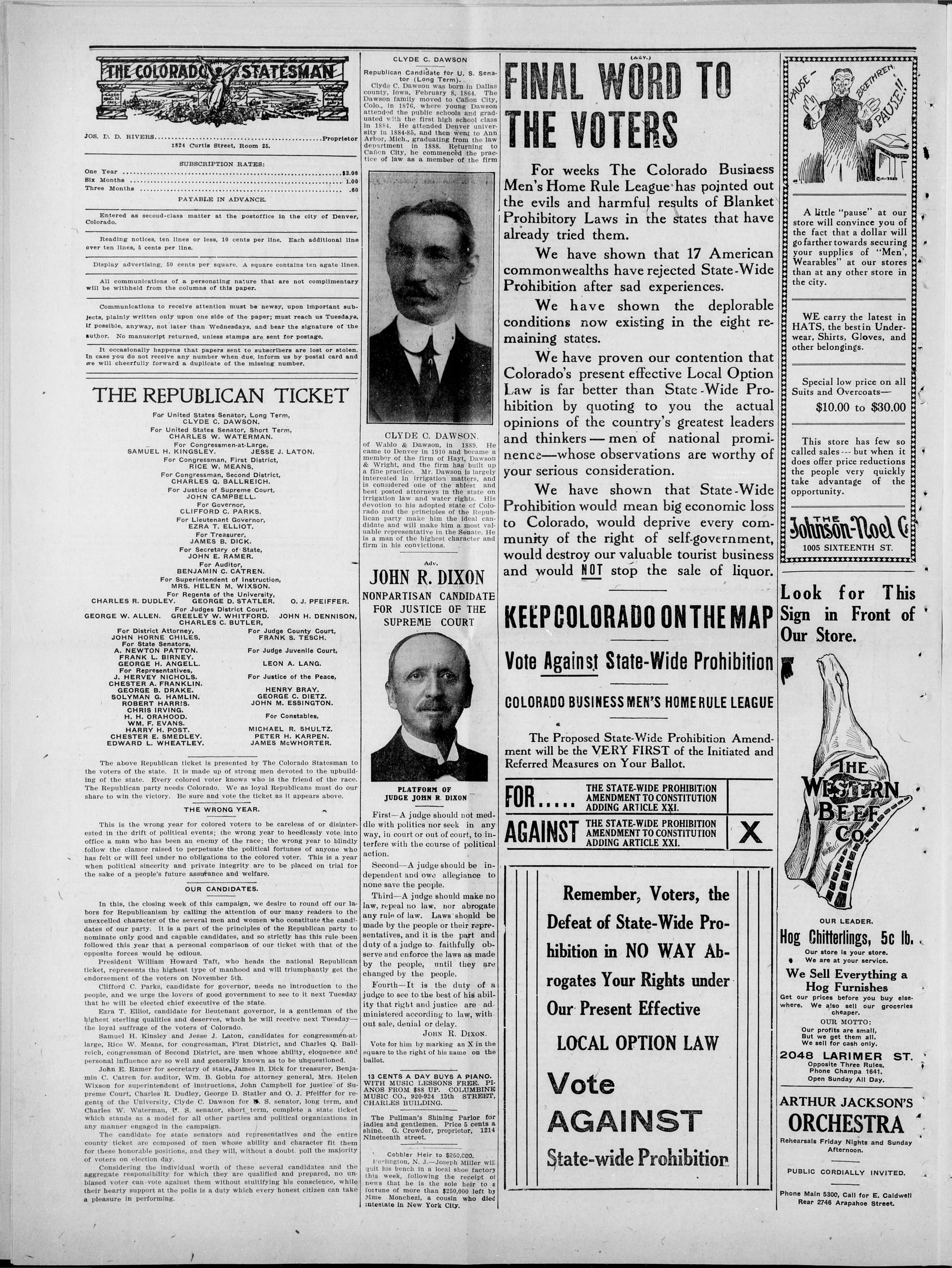
THE REPUBLICAN TICKET
For Treasurer,
JAMES B. DICK.
For Secretary of State,
JOHN E. RAMER.
For Auditor,
BENJAMIN C. CATREN.
Superintendent of Instruct
RS. HELEN M. WIXSON.
Regents of the University
GEORGE D. STATLE
For Judges District Court
REELEY W. WHITFORD
CHARLES C. BUTLER,
Reney,
HILES.
FIRS.
TON.
KEY.
GELL.
Lives,
OLS.
BKLIN.
KE.
MLIN.
GB
RIIS.
JOHN
G.
DD.
S.
ST.
MICK
MDLEY.
PEE
ATLEY.
JAM
ticket is presented by T
t is made up of strong m
colored voter knows who
is Colorado. We as loyal
Be sure and vote the tick
For Auditor,
BENJAMIN C. CATREN.
For Superintendent of Instruction,
MRS. HELEN M. WIXSON.
For Regents of the University,
CHARLES R. DUDLEY. GEORGE D. STATLER. O. J. PFEIFFER.
For Judges District Court,
GEORGE W. ALLEN. GREELEY W. WHITFORD. JOHN H. DENNISON
CHARLES C. BUTLER.
For District Attorney,
JOHN HORNE CHILES.
For State Senators,
A. NEWTON PATTON.
FRANK L. BIRNEY.
GEORGE H. ANGELL.
For Representatives,
J. HERVEY NICHOLS.
CHESTER A. FRANKLIN.
GEORGE B. DRAKE.
SOLYMAN G. HAMLIN.
ROBERT HARRIS.
CHRIS IRVING.
H. H. ORAHOOD.
WM. F. EVANS.
HARRY H. POST.
CHESTER E. SMEDLEY.
EDWARD L. WHEATLEY.
For Judge County Court,
FRANK S. TESCH.
For Judge Juvenile Court,
LEON A. LANG.
For Justice of the Peace,
HENRY BRAY.
GEORGE C. DIETZ.
JOHN M. ESSINGTON.
For Constables,
MICHAEL R. SHULTZ.
PETER H. KARPEN.
JAMES McWHORTER.
The above Republican ticket is presented by The Colorado Statesman to the voters of the state. It is made up of strong men devoted to the upbuilding of the state. Every colored voter knows who is the friend of the race. The Republican party needs Colorado. We as loyal Republicans must do our share to win the victory. Be sure and vote the ticket as it appears above.
THE WRONG YEAR.
air for colored voters to local events; the wrong yean an enemy of the race; to perpetuate the politics no obligations to the col and private integrity are assurance and welfare
This is the wrong year for colored voters to be careless of or disinterested in the drift of political events; the wrong year to heedlessly vote into office a man who has been an enemy of the race; the wrong year to blindly follow the clamor raised to perpetuate the political fortunes of anyone who has felt or will feel under no obligations to the colored voter. This is a year when political sincerity and private integrity are to be placed on trial for the sake of a people's future assurance and welfare.
OUR CANDIDATES.
week of this campaign, we were calling the attention of several men and women a part of the principles of capable candidates, and so personal comparison of goodious. Howard Taft, who heads best type of manhood and on November 5th. candidate for governor, neevers of good government
In this, the closing week of this campaign, we desire to round off our labors for Republicanism by calling the attention of our many readers to the unexcelled character of the several men and women who constitute the candidates of our party. It is a part of the principles of the Republican party to nominate only good and capable candidates, and so strictly has this rule been followed this year that a personal comparison of our ticket with that of the opposite forces would be odious.
President William Howard Taft, who heads the national Republican ticket, represents the highest type of manhood and will triumphantly get the endorsement of the voters on November 5th.
Clifford C. Parks, candidate for governor, needs no introduction to the people, and we urge the lovers of good government to see to it next Tuesday that he will be elected chief executive of the state.
Ezra T. Elliot, candidate for lieutenant governor, is a gentleman of the highest sterling qualities and deserves, which he will receive next Tuesday—the loyal suffrage of the voters of Colorado.
Samuel H. Kinsley and Jesse J. Laton, candidates for congressmen-at-large, Rice W. Means, for congressman, First District, and Charles Q. Ballreich, congressman of Second District, are men whose ability, eloquence and personal influence are so well and generally known as to be unquestioned.
John E. Ramer for secretary of state, James B. Dick for treasurer, Benjamin C. Catren for auditor, Wm. B. Gobin for attorney general, Mrs. Helen Wixson for superintendent of instructions, John Campbell for justice of Supreme Court, Charles R. Dudley, George D. Statler and O. J. Pfeiffer for regents of the University, Clyde C. Dawson for S. S. senator, long term, and Charles W. Waterman, U. S. senator, short term, complete a state ticket which stands as a model for all other parties and political organizations in any manner engaged in the campaign.
The candidate for state senators and representatives and the entire county ticket are composed of men whose ability and character fit them for these honorable positions, and they will, without a doubt, poll the majority of voters on election day.
Considering the individual worth of these several candidates and the aggregate responsibility for which they are qualified and prepared, no unbiased voter can-vote against them without stultifying his conscience, while their hearty support at the polls is a duty which every honest citizen can take a pleasure in performing.
For Judge County Court,
FRANK S. TESCH.
For Judge Juvenile Court,
LEON A. LANG.
For Justice of the Peace,
HENRY BRAY.
GEORGE C. DIETZ.
JOHN M. ESSINGTON.
For Constables,
MICHAEL R. SHULTZ.
PETER H. KARPEN.
JAMES McWHORTER.
CLYDE C. DAWSON
FINAL WORD TO THE VOTERS
Republican Candidate for U. S. Senator (Long Term). Clyde C. Dawson was born in Dallas county, Iowa, February 8, 1864. The Dawson family moved to Cañon City, Colo., in 1876, where young Dawson attended the public schools and graduated with the first high school class in 1884. He attended Denver university in 1884-85, and then went to Ann Arbor, Mich., graduating from the law department in 1888. Returning to Cañon City, he commenced the practice of law as a member of the firm
For weeks The Colorado Business Men's Home Rule League has pointed out the evils and harmful results of Blanket Prohibitory Laws in the states that have already tried them.
A. H.
We have shown that 17 American commonwealths have rejected State-Wide Prohibition after sad experiences. We have shown the deplorable conditions now existing in the eight remaining states.
We have proven our contention that Colorado's present effective Local Option Law is far better than State-Wide Prohibition by quoting to you the actual opinions of the country's greatest leaders and thinkers—men of national prominence—whose observations are worthy of your serious consideration.
of Waldo & Dawson, in 1889. He came to Denver in 1910 and became a member of the firm of Hayt, Dawson & Wright, and the firm has built up a fine practice. Mr. Dawson is largely interested in irrigation matters, and is considered one of the ablest and best posted attorneys in the state on irrigation law and water rights. His devotion to his adopted state of Colorado and the principles of the Republican party make him the ideal candidate and will make him a most valuable representative in the Senate. He is a man of the highest character and firm in his convictions.
We have shown that State-Wide Prohibition would mean big economic loss to Colorado, would deprive every community of the right of self-government, would destroy our valuable tourist business and would NOT stop the sale of liquor.
NONPARTISAN CANDIDATE FOR JUSTICE OF THE SUPREME COURT
KEEPCOLORADOONTHEMAP
A. H.
Vote Against State-Wide Prohibition
COLORADO BUSINESS MEN'S HOMERULE LEAGUE
The Proposed State-Wide Prohibition Amendment will be the VERY FIRST of the Initiated and Referred Measures on Your Ballot.
FOR.... THE STATE-WIDE PROHIBITION AMENDMENT TO CONSTITUTION ADDING ARTICLE XXI.
AGAINST THE STATE-WIDE PROHIBITION AMENDMENT TO CONSTITUTION ADDING ARTICLE XXI.
PLATFORM OF JUDGE JOHN R. DIXON
First—A judge should not middle with politics nor seek in any way, in court or out of court, to interfere with the course of political action.
Second—A judge should be independent and owe allegiance to none save the people.
Remember, Voters, the Defeat of State-Wide Prohibition in NO WAY Abrogates Your Rights under Our Present Effective LOCAL OPTION LAW Vote AGAINST State-wide Prohibition
Third—A judge should make no law, repeal no law, nor abrogate any rule of law. Laws should be made by the people or their representatives, and it is the part and duty of a judge to faithfully observe and enforce the laws as made by the people, until they are changed by the people.
Fourth—It is the duty of a judge to see to the best of his ability that right and justice are administered according to law, without sale, denial or delay.
JOHN R. DIXON.
Vote for him by marking an X in the square to the right of his name on the ballot.
13 CENTS A DAY BUYS A PIANO.
WITH MUSIC LESSONS FREE. PIANOS FROM $88 UP. COLUMBINE
MUSIC CO., 920-924 15th STREET,
CHARLES BUILDING.
The Pullman's Shining Parlor for
iadies and gentlemen. Price 5 cents a
shine. G. Crowder, proprietor, 1214
Nineteenth street.
Earlington, N. J.—Joseph Miller will quit his bench in a local shoe factory this week, following the receipt of news that he is the sole heir to a fortune of more than $250,000 left by Mine Monchezi, a cousin who died intestate in New York City.
PAUSE -
BRETHREN
PAUSE!!
© 1911 BRED
A little "pause" at our store will convince you of the fact that a dollar will go farther towards securing your supplies of "Men', Wearables" at our stores than at any other store in the city.
WE carry the latest in HATS, the bestin Underwear, Shirts, Gloves, and other belongings.
Special low price on all Suits and Overcoats— $10.00 to $30.00
This store has few so called sales --- but when it does offer price reductions the people very quickly take advantage of the opportunity.
THE
Johnson-Noel Co
1005 SIXTEENTH ST.
Look for This Sign in Front of Our Store.
THE
WESTERN
BEEF
CO.
Hog Chitterlings, 5c lb.
Our store is your store.
We are at your service.
We Sell Everything a
Hog Furnishes
Get our prices before you buy else-
where. We also sell our groceries
cheaper.
OUR MOTTO:
Our profits are small,
But we get them all.
We sell for cash only.
2048 LARIMER ST.
Opposite Three Rules.
Phone Champa 1641.
Open Sunday All Day.
ARTHUR JACKSON'S
ORCHESTRA
Rehearsals Friday Nights and Sunday
Afternoon.
PUBLIC CORDIALLY INVITED.
Phone Main 5300, Call for E. Caldwell
Rear 2746 Arapahoe Street.
Don't forget to cast your vote early next Tuesday morning.
Miss Grace Walker left this week to visit friends in Topeka, Kan.
J. W. Russell is on the sick list this week.
Roy S. Wilson of Estes Park will be home November 4th.
for the open saloon is a connundrum in human society.
The attendance at the Young People's meeting last Sunday approximated the one hundred mark. Good for our hustling president. Don't forget the business meeting next Tuesday evening.
The officers and members of Shorter will tender the presiding elder and pastor a welcome reception Tuesday evening of next week.
Our first quarterly conference under our new presiding elder will be held next Monday evening.
Vote for Thomas D. Cobey for district judge on the Progressive ticket.
A Big Bull Moose meeting at Eureka hall Monday night, November 4.
Mr. and Mrs. Clarence Holmes will celebrate their twenty-fifth wedding anniversary, Sunday evening.
Mrs. Crosswright of Atchison, Kan., after spending two months with her sister, Mrs. A. J. Rease of 2358 Curtis street, returned home Thursday.
Mrs. J. J. Bates of 2910 Glenarm street is very ill this week. Her daughter, who has been sick with typhoid fever, is improving.
Mrs. Glenn of 2252 Clarkson entertained most highly at dinner Tuesday evening in honor of Mrs. Crosswright of Atchison, Kan.
Mr. Walter Spates was made a Mason Monday evening. He is from Missouri and they had th "show him." Well, I guess they did!
Harry Jones and brother will open a lunch room at 927 Twenty-first street on or about November 7. Give us a call. We will serve you right. Cheap prices is our motto.
Mr. and Mrs. George Clark gave a 6 o'clock dinner Sunday at their home, 1540 Logan, in honor of their aunt, Miss M. M. Gray. The guests were Dr. Huff, Master L. Clark and Curtis M. Harris.
The second musical social of the Household of Ruth, No. 4130, will be given Wednesday evening, November 27, instead of November 20, as printed on tickets, at 2630 Welton street. Admission, 10 cents.
The Byron Troubadours spent Sunday in our city, also gave a five-course dinner at West Bros.' café at 1 p. m. Their guests were Rev. Thos. Hazell, E. Webster and Curtis M. Harris. The Troubadours left for Pueblo Monday morning.
Sidney Eldridge of St. Louis, Mo., who came to Denver a few months ago for his health, died last Wednesday at the home of J. H. Sample. The remains were shipped to his home accompanied by his mother. Lawhorn Undertaking Co. in charge.
The funeral of Mrs. Emma Scott, of 2101 Arapahoe street, a pioneer of Denver, took place Thursday afternoon in the presence of many sorrowing friends and relatives. She leaves to mourn her loss two children, Mrs. John Owens and John Scott, and two granddaughters. The Colorado Statesman extends sympathy to the bereaved ones.
SHOPTER CHAPEL
The following order of services will be observed at Shorter Sunday:
10:00 A. M.-Sunday school. Lesson: "The Sign and the Leaven."
Mark, 8:11-26. Mrs. W. O. Glenn, superintendent.
11:00 A. M.-Sermon by Presiding Elder A. M. Ward.
3:00 P. M.-Communion service. Rev. H. F. Bray, D.D., pastor of Campbell chapel, will deliver the sermon. Rev. J. N. Wallace and the presiding elder will administer the Holy Communion and the congregation of Scott's and Campbell will join in the service.
6:30 P. M.-Allen Christian Endeavor League. Topic: "The Christian Virtues—Zeal." Titus, 2:1-14. (Consecration meeting.) Mrs. N. L. Douglas will conduct this meeting. Royal C. Brown, president.
7:30 P. M.-Preaching by the presiding elder.
The services last Sabbath were largely attended, both at the morning and evening hour, and among those who were welcomed into Shorter's communion were Mrs. E. Smith of Alton, Ill.; Mrs. Ethel Mallard of Topeka, Kan., and Mr. Wm. Hawkins.
Mrs. Martha A. Moss was the recipient of the rite of holy baptism. At the evening sermon, instead of the usual sermon, Rev. H. M. Gill occupied the hour in a most profitable discussion of state-wide prohibition. Any Christian who, after hearing the arguments presented by Mr. Gill, can vote
for the open saloon is a connubrium in human society. The attendance at the Young People's meeting last Sunday approximated the one hundred mark. Good for our hustling president. Don't forget the business meeting next Tuesday evening. The officers and members of Shorter will tender the presiding elder and pastor a welcome reception Tuesday evening of next week. Our first quarterly conference under our new presiding elder will be held next Monday evening.
CAMPBELL NOTES.
Campbell chapel, A. M. E. church, corner Twenty-third and Lawrence streets, Rev. H. Franklin Bray, D.D., pastor.
Rev. Mr. Wallace of Zion Baptist church took part in the morning service last Sunday. The pastor and congregation enjoyed his presence and help.
The pastor preached to full houses both morning and evening Sunday, and received into the church Mr. J. H. Washington and Miss Olive Bryant. The choir rendered some favorite selections at night.
The Sunday school grows in numbers and interest each succeeding Sabbath. R. H. Willis, the superintendent, has great reason to be proud of the progress being made.
The following is the order for the mock conference to be held at Campbell December 16-23: Zion conference, D. E. Over, bishop; Shorter conference, R. L. Pope, bishop; Bethlehem conference, A. E. Reynolds, bishop; Scott conference, J. N. Wallace, bishop; People's conference, J. Thos. Hazel, bishop; Campbell conference, Hattie King, bishop; Rocky mountain conference, A. M. Ward, bishop; Sunshine conference, Fannie - Johnson, bishop; Nightingale conference, Ida DePriest, bishop; Rough Riders' conference, Maye Jeter, bishop. Next week we will give a list of the presiding elders and pastors, followed by a list of the general officers and college faculty. Everybody in Denver is invited to join one of these conferences. The pastor is grateful to his fellow ministers for their co-operation in this struggle. We have over $5,000.00 debt and are trying to raise $1,000.00 to apply on it in this effort.
The pastor took violently sick Tuesday night and has been confined to his bed the most of the week.
Brother Curt Peoples is on the sick list.
Sunday morning subject, "The Signs of a Brighter Future for the American Negro." In the evening, "A Tale That Is Told." Campbell will worship at Shorter in their communion service at 3 o'clock in the afternoon.
SCOTT M. E. CHURCH NOTES.
Twenty-sixth and Clarkson.
Mr. and Mrs. S. L. Willis of Cheyenne were the guests of Mr. and Mrs. F. D. McPherson during the week of the carnival.
Mrs. Florstein Dooley had charge of the Epworth League program last Sunday evening. Dr. Turner of Shreveport, La., sang a beautiful solo, to the special delight of all. The program was an unusual one and the credit is due to the energetic leader, Mrs. Dooley.
The pastor preached on the second coming of Christ to a very large audience Sunday evening. Next Sunday morning a special sermon delivered to the parents and children on "The Little Children," and at night "The Forerunner." You are invited to hear these messages.
Mr. Virgil Tompkins and Miss Callie Mae McPherson were joined together in the holy bonds of wedlock last Monday evening, at the home of the bride's parents, Mr. and Mrs. McPherson, 1889 Marion street. The bride wore a beautiful white silk gown, trimmed with gold beads, while the groom wore the conventional black suit. A few intimate friends were present and enjoyed the sumptuous repast prepared by the parents. We wish them a pleasant journey through life. The pastor, Rev. J. N. Wallace, tied the knot.
We wish to thank Bachelhem Baptist church choir for the splendid services rendered on the program for the Blues last Tuesday evening. The drama was well played by Mr. Binkley, Miss Luella Perry, Mrs. E. P. Johnson and Mrs. Tompkins.
The Coal Committee, headed by Mrs. Ella Carter, will serve after the class on November 6.
Mrs. Emma J. Galimore will give a drama by a club of young people on the 19th for the benefit of the Pinks.
Supt. G. G. Ross is pushing with might and main the combination entertainment to be given for the benefit of the Sunday school on November 21. The officers of the Sunday school need some modern Sunday school supplies, and they are taking this method to raise the money. Prizes will be given to the children who are selling the tickets.
Dr. M. A. Head, former pastor of the Highlands M. E. church, spoke before an appreciative audience this week at Scotts. Dr. Head is a thrilling speaker of note.
The choir attended in full last Sunday evening and sang very acceptably. Mrs. E. P. Johnson, president, and Miss Lela Rice are very anxious to bring this organization up to the standard of perfection. They have begun on their Thanksgiving music, which will be rendered on Thanksgiving Sunday.
Mrs. H. W. Pierson, who underwent a serious operation, is doing fine at the Mercy hospital.
Do not forget Sunday is the last rally day to pay on the first installment of the mortgage.
Prof. Lightner is very anxious to increase the Bible class attendance.
Brickler's New Barber Shop is located at 2208 Larimer street. Shaver
10c. Hair Cut, 25c; Children, 15c.
[Name]
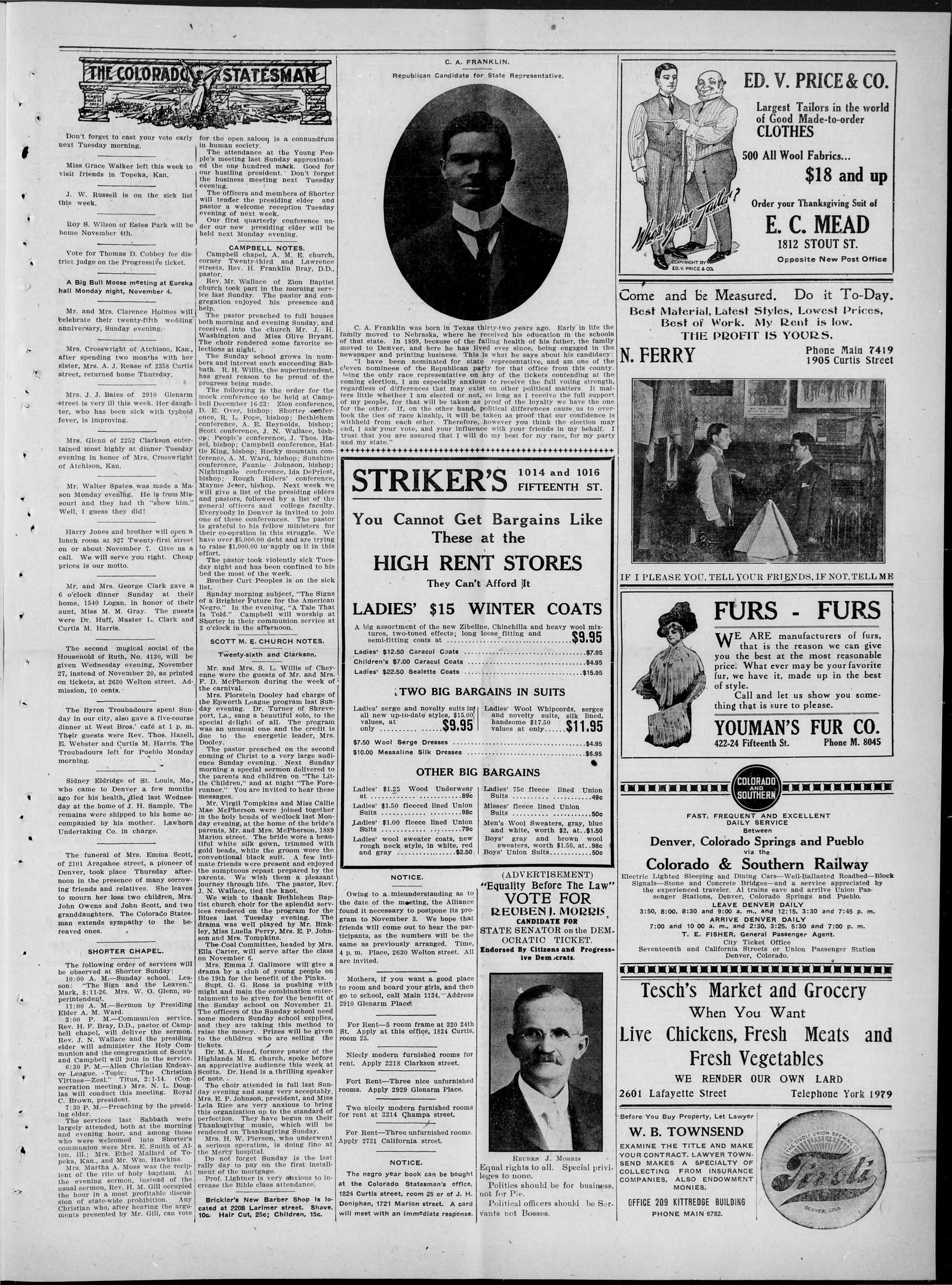
C. A. Franklin was born in Texas thirty-two years ago. Early in life the family moved to Nebraska, where he received his education in the schools of that state. In 1899, because of the failing health of his father, the family moved to Denver, and here he has lived ever since, being engaged in the newspaper and printing business. This is what he says about his candidacy: "I have been nominated for state representative, and am one of the eleven nominees of the Republican party for that office from this county, being the only race representative on any of the tickets contending at the coming election, I am especially anxious to receive the full voting strength, regardless of differences that may exist on other political matters. It matters little whether I am elected or not, so long as I receive the full support of my people, for that will be taken as proof of the loyalty we have the one for the other. If, on the other hand, political differences cause us to overlook the ties of race kinship, it will be taken as proof that our confidence is withheld from each other. Therefore, however you think the election may end, I ask your vote, and your influence with your friends in my behalf. I trust that you are assured that I will do my best for my race, for my party and my state."
You Cannot Get Bargains Like These at the HIGH RENT STORES They Can't Afford It
A big assortment of the new Zibeline, Chinchilla and heavy wool mixtures, two-toned effects; long loose fitting and semi-fitting coats at $9.95
Ladies' $12.50 Caracul Coats $7.95
Children's $7.00 Caracul Coats $4.95
Ladies' $22.50 Sealette Coats $15.95
TWO BIG BARGAINS IN SUITS
Ladies' serge and novelty suits in
all new up-to-date styles, $15.00
values, at
only . . . $9.95
OTHER BIG BARGAINS
Ladies' $1.25 Wood Underwear
at ..... 89c
Ladies' $1.50 fleeced lined Union
Suits ..... 98c
Ladies' $1.00 fleece lined Union
Suits ..... 79c
Ladies' wool sweater coats, new
rough neck style, in white, red
and gray ..... $2.50
Owing to a misunderstanding as to the date of the meeting, the Alliance found it necessary to postpone its program to November 3. We hope that friends will come out to hear the participants, as the numbers will be the same as previously arranged. Time, 4 p. m. Place, 2630 Welton street. All are invited.
Mothers, if you want a good place to room and board your girls, and then go to school, call Main 1134. Address 2910 Glenarm Place.
For Rent—5 room frame at 320 24th St. Apply at this office, 1824 Curtis, room 25.
Nicely modern furnished rooms for rent. Apply 2218 Clarkson street.
Fort Rent—Three nice unfurnished rooms. Apply 2929 Glenarm Place.
Two nicely modern furnished rooms for rent at 3214 Champa street.
For Rent—Three unfurnished rooms. Apply 2731 California street.
The negro year book can be bought at the Colorado Statesman's office, 1824 Curtis street, room 25 or of J. H. Doniphan, 1721 Marion street. A card will meet with an immediate response.
NOTICE
NOTICE.
1014 and 1016
FIFTEENTH ST.
at Bargains Like
at the
IT STORES
at Afford | It
WINTER COATS
ine, Chinchilla and heavy wool mix-
loose fitting and $9.95
.....$7.95
.....$4.95
.....$15.95
Ladies' Wool Whipcords, serges and novelty suits, silk lined, handsome $17.50 values at only.....$11.95
.....$4.95
.....$6.95
Ladies' 75c fleece lined Union Suits .....49c
Misses' fleece lined Union Suits .....50c
Men's Wool Sweaters, gray, blue and white, worth $2, at..$1.50
Boys' gray and brown wool sweaters, worth $1.50, at..98c
Boys' Union Suits .....50c
(ADVERTISEMENT)
"Equality Before The Law"
VOTE FOR
REUBEN J. MORRIS
CANDIDATE FOR
STATE SENATOR on the DEMOCRATIC TICKET.
Endorsed By Citizens and Progressive Democrats.
W. H.
Equal rights to all. Special privileges to none.
Politics should be for business, not for Pie.
Political officers should be Servants not Bosses.
What Yours Tailor?
COPYRIGHT BY
ED. V. PRICE & CO.
Come and be Measur Best Material, Latest Best of Work. THE PROFIT
and be Measured. Do it To-Day. Material, Latest Styles, Lowest Prices, Best of Work. My Rent is low. THE PROFIT IS YOURS.
Come and be Measured. Do it To-Day. Best Material, Latest Styles, Lowest Prices, Best of Work. My Rent is low. THE PROFIT IS YOURS.
IF I PLEASE YOU, TELL YOU
SE YOU, TELL YOUR FRIENDS, IF NOT, TELL ME
NEW YORK TAMBOURNE
RELEASE FOR DEMONSTRATION
FOR USE IN THE WORKING CLASS
IN THE WORKING CLASS
IF I PLEASE YOU, TELL YOUR FRIENDS, IF NOT, TELL ME
FURS - FURS
WE ARE manufacturers of furs,
that is the reason we can give
you the best at the most reasonable
price. What ever may be your favorite
fur, we have it, made up in the best
of style.
Call and let us show you some-
thing that is sure to please.
YOUMAN'S FUR CO.
422-24 Fifteenth St. Phone M. 8045
COLORADO
AND
SOUTHERN
---
FAST, FREQUENT AND EXCELLENT
DAILY SERVICE
Denver, Colorado
via
Colorado & So
Electric Lighted Sleeping and Dining
Signals—Stone and Concrete Brick
the experienced traveler. Al tr
senger Stations, Denver, C
LEAVE DE
3:50, 8:00, 8:30 and 9:00 a. m.
ARRIVE DE
7:00 and 10:00 a. m., and 2
T. E. FISHER, Gen
City Tic
Seventeenth and California Str
Denver,
Tesch's Market
When You
Live Chickens, F
Fresh Ve
Between Denver, Colorado Springs and Pueblo via the Colorado & Southern Railway
Bed Sleeping and Dining Cars—Well-Ballasted Roadbed—Block Stone and Concrete Bridges—and a service appreciated by experienced traveler. AI trains eave and arrive Union Passer Stations, Denver, Colorado Springs and Pueblo.
LEAVE DENVER DAILY
0, 8:30 and 9:00 a. m., and 12:15, 3:30 and 7:45 p. m.
ARRIVE DENVER DAILY
and 10:00 a. m., and 2:30, 3:25, 5:30 and 7:00 p. m.
T. E. FISHER, General Passenger Agent.
City Ticket Office
North and California Streets or Union Passenger Station
Denver, Colorado.
ch's Market and Grocery
When You Want
Chickens, Fresh Meats and
Fresh Vegetables
Electric Lighted Sleeping and Dining Cars—Well-Ballasted Roadbed—Block Signals—Stone and Concrete Bridges—and a service appreciated by the experienced traveler. Al trains eave and arrive Union Passenger Stations, Denver, Colorado Springs and Pueblo.
---
WE RENDER OUR OWN LARD
2601 Lafayette Street Telephone
W. B. TOWNSEND
EXAMINE THE TITLE AND MAKE YOUR CONTRACT. LAWYER TOWN-SEND MAKES A SPECIALTY OF COLLECTING FROM INSURANCE COMPANIES, ALSO ENDOWMENT MONIES.
OFFICE 209 KITTREDGE BUILDING
PHONE MAIN 6782.
---
N. FERRY
A
ED. V. PRICE & CO.
Largest Tailors in the world of Good Made-to-order CLOTHES
Phone Main 7419
1905 Curtis Street
Telephone York 1979
THE TIVOLI UNION BREWING CO.
MADE IN USA
Tivoli
DENVER, COLOR.
Valuable Discoveries Not Always Result of Thought.
History Records Many Cases Where Mere Chance Has Directed Groper After Improvements to Pursue the Proper Course.
It is repetitive history that many a person who has spent hours upon hours upon combining and recombining the factors of his problem, has had the solution thrust upon his attention by some casualty of daily life. Such occurrences are the spice of research and lead on many a weary investigator in hard and exacting labor. Here is the field where the trained observer has all the advantage. For how many fortunes may never have been realized only because no one had eyes to behold the revelation.
In our own time every beet-sugar factory was confronted with these two problems: How most cheaply to move the beets from the storage sheds to the silcers; and how to cleanse the beets from the dirt, small stones, and rubbish carried from the earth silos. A German factory happened to have a considerable quantity of beets piled alongside an open drain. A very heavy rainstorm came on, and when it was over it was found that the beets had not only been carried to the very door of the factory, but were cleaned as well. From that time on every factory has flushed its beets along a pipe from storage to plant and saved money by combining the two operations of transportation and washing.
Thomas Kingsford discovered the process of making starch from Indian corn by chance. Starch could be made from potatoes and from wheat, but it had always been found impossible to separate cornstarch from the accompanying gluten. The wheat starch methods did not answer. Kingsford was a mechanic working long hours, and all his experiments were made in his own kitchen with his wife's pans, tubs, and buckets as his laboratory utensils.
The unsatisfactory result of one of his experiments—a mush of cornmeal and water—he disgustedly threw into a garbage tub. A little later his wife threw into the same tub some lye wastes (potash solutions). Upon emptying the tub the next day, Kingsford was surprised to find a small amount of fairly pure starch at the bottom. His wife fortunately remembered throwing in the lye, and thus the basic principle was discovered. Kingsford soon worked out a practical process for making cornstarch commercially, and made a great fortune.
In 1742, Thomas Bolsover, a mechanic, of Sheffield, discovered the art of silver-plating. He was repairing the handle of a knife in which both copper and silver were used. Accidentally the two metals were fused together. Based upon this observation he developed the new process. Upon a thick ingot of copper he bound by iron wire a thinner ingot of silver. The whole was then heated in a reverberatory furnace until the edges of the silver ingot were observed to begin to melt. The two ingots were then removed from the furnace, slowly cooled and pickled, cleaned and rolled to the desired thickness. The result was a plate of copper more or less thinly covered with silver on one side. This was the first Sheffield plate. For fifty years following, the copper was plated on one side only, and the cut edges showed the copper. Later, the process was so perfected that no copper was left exposed. All the silver plate of the world was made by this process, until electroplating was discovered and made commercial.
Words Multiply Fast.
Figures have just been made public by Prof. A. S. Cook of Yale university as to the number of different words in the authorized or King James version of the Bible. Excluding inflected forms of nouns, pronouns and verbs, Professor Cook makes the total 6,568. Including these the total is 9,884. The working vocabulary of the average man falls far short of this number of words. On the other hand, not a few contemporary authors must far exceed it, considering their realms of colloquial speech and technical terminology that the biblical narrative does not touch. Besides, there is the immense extension of both knowledge and of words in the physical sciences, about which the educated man of today must know something. Hence, as a matter of fact, during the past century dictionaries have waxed bulky, and words have multiplied at an astounding rate. Thus between the first and latest editions of Webster's dictionary the word total mounted from 70,000 to 400,000.
More Shakespearianism
A correspondent of the New York Evening Post has discovered that Shakespeare wrote the Psalms. We have long been of that opinion, but we lacked the proofs that are now forthcoming. Shakespeare's name appears in many spellings, either three, four, or five vowels being admissable. Every one knows that in such cases the golden mean should be taken. In this case it is obviously four. Moreover, the number of consonants is six. The mystic number, then, is forty-six. Turn now to the King James Bible, and to the Forty-Sixth Psalm. Count from the beginning and you will find the forty-sixth word to be shake; count from the end and you will find the forty-sixth word to be spear—Q. E. D.
Brilliant Boys Who Made Mark in English Parliament.
Youngsters Who Had Not Attained Majority Made Laws for Britain—Fox's Comment on Speech of William Pitt.
It is contended that the British house of commons is the most widely representative legislative body in the world, since it includes not only all social grades, from the miner and the artisan to the scions of ducal houses, but numbers among its members men of all ages, from the youth in his twenties to the veteran of 80 years.
So long ago as the year 1613 there were forty legislators in the commons who had not attained their twentieth year, and, incredible as it may seem, certain of them were only 16 years of age.
Edmund Waller, the poet and courtier of Stuart days, was a schoolboy of 16 when he qualified as a member of parliament. He was, as Clarendon says, "nursed in parliament," and probably was the only man that ever lived who could look back two-thirds of a century to his debut as a legislator.
Charles James Fox was only 19, and still had a vivid and painful memory of his floggings at Eton, when he was "returned" to parliament for the "pocket borough" of Midhurst. He was not many weeks older when he made one of the finest "malden speeches" ever heard at Westminster. "I hear it spoken of by everybody as a most extraordinary thing," his delighted father wrote to a friend, "and I am not a little pleased with it."
Chesterfield was a legislator at 20, at which age he entered commons as a member for St. Germans. His first speech is said to have electrified the house. His triumph was vitiated, however, by the fact that, inasmuch as he was not of age, he was liable to a heavy fine for speaking in the house.
Still more precocious was William Pitt. Although he had passed his twenty-first birthday when Appleby sent him to Parliament, he, within a few weeks after taking his seat, established himself as the keenest debater and finest speaker in the commons. After his maiden speech a member of the opposition is reported to have said to Fox: "Pitt will be one of the first men in parliament." "He is so already," replied Fox.
Pitt, as everybody knows, scarcely had completed his twenty-third year when he was made chancellor of the exchequer. At 24 he was prime minister.
State Medical Aid.
A writer in the Long Island Medical Journal makes a plea for the nationalization of medical practice on a socialistic basis. Just as the schools and the mail service have been taken from the hands of competitive business, he holds that the public health should be organized as a public service; that now the criminal, the insane, etc., receive the attention of the state so why should not the sick man be likewise cared for at the expense of the state and not left to the mercy of the business methods that prevail in medical practice? "Human life and happiness," says this thinker, "should be the objects of solicitude on the part of the state in whose employ the medical profession should be enlisted as the great conserver of the most precious of the nation's natural resources."
Fortune Still Unattained
Lowell once met an acquaintance (of dubious standing), whose cheerful face and happy demeanor led him to ask the cause of such exuberant felicity. "Why," said the genial smiler, "I've discovered a way to make my fortune. We all know that the reason for the fine flavor of the wild duck is the wild celery on which it feeds. Now I propose to feed it to the domestic duck, and supply the market." Some weeks later, on meeting his acquaintance again, Lowell found him quite depressed, and inconsolable. "Why are you looking so unhappy? I thought, the last time I saw you, that you were on the point of making your fortune with ducks. Wouldn't it work?" "No," was the reply, "the d—n things won't eat it."
Chair for the Editor
Although the source of this little anecdote about Mark Twain is not definitely known, there is no good reason, according tq Harper's Magazine, to doubt its genuineness:
One morning soon after Mr. Clemens had purchased an interest in the Buffalo Express, he arrived at the office to begin his duties as editor. There happened to be no one present who knew him. A young man rose very brusquely, and asked if there was any one he would like to see. It is reported that Mark Twain replied, with gentle deliberation:
"Well, yes. I should like to see some young man offer the editor a chair."
Killing Off California Lions.
Seventeen mountain lions were killed in eleven counties of the state in August, according to claims presented to the state comptroller by the state board of fish and game commissioners. San Benito and Sierra counties lead the list, with four scalps each. For each scalp the fish and game commission gives a $20 bounty. —Sacramento correspondence Los Angeles Times.
TSAI YUAN-BEN'S
TREMENDOUS UNDERTAKING
It is a hard task which confronts the commissioner of education in the first cabinet of the Chinese republic. The new commissioner is Tsai Yuan-Ben, and there is no question but that much of the future welfare of China lies in his hands. It will not be so difficult for his fellow officers of the cabinet to follow the other nations in mat-
ters of financial policy, etc. Comparatively few persons in a nation know or care a great deal about how the finances or the foreign relations of its government are administered. To these matters they seem indifferent. But in a reorganization of the educational system of China that nation's millions of people will all, or at least all but a very few, be deeply concerned. Then, too, such sweeping changes are contemplated that opposition is sure to be developed in strong measure. To overcome this sufficiently to carry his point and lead the Chinese forward and upward in the progress of nations is the tremendous task now before the new commissioner of education. The position is not one to create envy, for it is quite sure to bring forth more curses than blessings. People are very slow to understand the significance of new movements, as a rule, and usually it remains for history to set forth the courage and noble zeal of those who lead in all such work for the uplifting of humanity in the mass.
PRINCESS ALEXANDRA IS DUCHESS IN OWN RIGHT
Princess Alexandra Victoria, Duches of Fife, is the only woman in
ra Victoria, Duchy-only woman in be made a duchess in her own right. Her father, the Duke of Fife, married Louise Victoria, daughter of the late King Edward and Queen Alexandra. At the death of the duke, without male heirs, the duchy was bestowed on his eldest daughter.
Mary C.
Queen Alexandra's brother is King George of Greece and it is said that she is trying to arrange a marriage between the young duchess and her brother's grandson, Prince George of Greece, who was born in 1890. His mother, the Crown Princess of Greece, is a sister of the present German emperor and hates everything English. Needless to say the is strongly opposed to the match. The young duchess was born in 1891.
Bottled Ham
Admiral Peary, we are told by a writer in the Woman's World, used only tea as a stimulating drink on his polar expeditions. The fact offers him frequent opportunity of telling what is said to be his favorite story.
I am talking with a man who questions me in regard to my arctic work, says the admiral, and I remark, "Tea is much better than Peebles ham."
"Peebles ham?" he says. "What is Peebles ham?"
"Did you never hear of Peebles ham?" I reply, and then I go on: "There were two old Scotch women, Mrs. McWhirter and Mrs. McBean, who met on the road one day, and Mrs. McWhirter said, 'Losh, wummen, ye' far frae hame the day!'
"Aye," said Mrs. McBean, "I was juist yont at Peebles. Saunders McNabb, o' Peebles, keeps rale guld ham. Or John, ye ken, likes a bit guld ham, an' is aye yammerlin' about the ham bein' ower fat onder saut."
"Oor Tam,' said Mrs. McWhirter,
'is the same wy. There's nae pleasin'
him wi' his ham. Faith, I'll hae ta
gie McNabb a trial.'
"So Mrs. McWhirter journeys into
Peebles, and she says to Saunders
McNabb, the grocer, 'Gle us a pund o'
yer best ham.'
"What kind wad ye like?' asked
Saunders.
"Oh, juist the kind that Mrs. Mc
Bean gets,' said Mrs. McWhirter.
"McNabb smiled faintly.
'A' richt,' said he. 'Whaur's yer
bottle?' -'Youth's Companion.
Lion and Mouse
In the Berlin zoo a mouse was put in the cage of a lion to test whether, as the old stories assert, there was a natural affection between them The experiment was rather astonishing. The lion saw the mouse before he was fairly through the bars and was after him instantly. Away went the little fellow, squeaking in fright. When he had gone a few yards the lion headed him off, and this was repeated until the mouse stood still. The lion then stood over him, studying him with interest, and presently he brought his paw down on the mouse, but so gently that it was not injured in the least. Then the lion played with the mouse, now letting him run a few inches and stopping him again. Suddenly the mouse changed his tactics and instead of running when the lion lifted his paw, sprang straight at the big animal's head
The lion, terrified, gave a great leap backward and roared in extreme fright, while the little mouse made his escape. Of the two the lion was the more frightened.
DUCHESS OF MANCHESTER HAS PRICELESS JEWELS
The beautiful Duchess of Manchester, a daughter of Eugene Zimmerman, the Cincinnati millionaire, does not lack for jewels to adorn her personal charms. Besides the famous heirlooms of the noble house of Montagu, which are the appanage of the reigning duchess, and her own private collection of gems, she has the privilege of decorating herself with the priceless
WILLIAM M.
necklaces, bracelets, tigars and rings of her predecessor, on the strict condition that at all times she must insure them against fire and burglary. These jewels are held in trust in accordance with the will of the late duchess who died in November, 1909. She also bequeathed to the duke a life interest in $884,240 of her estate. Like the present duchess, who was married in 1900, she was an American, Miss Consuelo Yznaga of Ravenswood, La. The Manchester titles were granted by the first of the Stuarts and by the first of the Hanoverians for services rendered in connection with the establishment of these alien monarchies in England—viscount and baron in 1620, duke in 1719. The noble turncoats evidently believed in judicious trimming and doubtless feathered their nest well in the process.
SIGNORINA LABRIOLA'S
SUCCESS AS LAWYER
The new feminists have another victory to record. After a determined flight Signorina Teresa Labriola, professor of philosophy, and a leader of the feminist movement in Italy, has succeeded in asserting the right of women lawyers to plead before the courts. Her debut has just taken place before the military tribunal, where she defend-
A.
ed a private accused of having slapped his sergeant in the face. The court was crowded chiefly with officers and lawyers, who eyed the slim and attractive-looking young Portia with curiosity. Signorina Labriola wore an elegant black silk costume, trimmed with old lace, and a large picture hat. She was entirely self-possessed. Indeed, the president Colonel Delfina, and his fellow judges, appeared far more perturbed than she. The charge was a very serious one, and the procurator-general asked for an exemplary sentence—four years' imprisonment—but after an impassioned address by Signorina Labriola, who was often interrupted by applause, the accused got off with only four months.
William Penn a Socialist.
The ideas of William ePnn are not often accounted heretical, and yet part of his political creed as announced in the following citation must appear iconoclastic indeed to many persons today, while others are surprised to find him so well abreast of the times. He said:
"Every government should provide for every subject the means of living both honestly and at ease. We should bring out of every man and every creature as much utility as we may. Now utility will never be produced, unless we render life easy and comfortable. If all men and women would labor six hours in the twenty-four, some mentally, some corporeally, setting apart one day in the seven, all work would be completed that is requisite for our innocent and rational desires. . . . I tell thee the thing is possible, and is done."—Christian Science Monitor.
His Profession.
"You have been walking about this great city for six weeks, and haven't found work?" said the kind woman, feelingly.
"Yes'm," replied the seedy man at the kitchen door.
"You are willing to work, I dare-say?"
"Willin', mum? I'd work my laigs off if I could get a chance."
"And you would do any kind of honorable work. I presume?"
"Yes'm, anything that's in my line I b'leeve in every man stickin' to his perfession."
"May I ask what your profession is?"
"I'm in the domino line, mum."
"Domino line?"
"Yes'm; I put the spots on the double blanks."
He Knew "Bifentick."
During the cotton picking season in Texas a colored brother who had gone into the country to work returned very much disgusted.
"Didn't yo' git no offahs ter pick no cotton?" asked a friend.
"Sech ez de was. White man done offered me one-third o' wat Ah could pick. Ah done tuk a look at de field an' saw dat w'en it wah all picked it wouldn't amount ter one-third. So Ah done lit out fer home!"
"Yo-all was in luck not ter git fooled none."
"Yassuh. Ah done went ter school an' studied rifentick when Ah was young."
Furnished
Rooms
And the Old
Reliable
Newport Thirst
Parlors
SHORT ORDERS AT ALL
oe Street.
THE
ONARCH LIQU
COMPANY
1841-45 Arapahoe Street.
MONARCH LIQUOR COMPANY
THE MONARCH
LIQUOR CO
TELEPHONE
CHAMPA 1231
IMPORTED & DON
THE ZOBI
SAMPI
1004 Nineteenth
R TED & DOMESTIC WINES & LIC
E ZOBEL BROTHE
AMPLE ROO
Nineteenth Street, Corner of
IMPORTED & DOMESTIC WINES & LIQUORS
THE ZOBEL BROTHERS'
1004 Nineteenth Street, Corner of Curtis
FINE WINES, LIQUORS AND CIGARS COORS' CELEBRATED BEER ON TAP
Right Kind of Reading Matter
the home news; the doings of the people; the gossip of our own community; the first kind of reading matter you will more important, more interesting than given by the paper or magazine outside world. It is the first read you should buy. Each issue of this book you just what you will consider.
The Right Kind of Reading M
purpose of an advertisement
The Right
Reading M
The home new
town; the gossi
the first kind o
more importan
that given by
outside world.
you should buy
to you just wh
The Purpose of a
Advertisement
The Right Kind of Reading Matter
The home news; the doings of the people in this town; the gossip of our own community, that's the first kind of reading matter you want. It is more important, more interesting to you than that given by the paper or magazine from the outside world. It is the first reading matter you should buy. Each issue of this paper gives to you just what you will consider
The Right Kind of Reading Matter
is to serve your needs. It will help sell your goods—talk to the people you want to reach. An advertisement in this paper is a reference guide to those whose wants are worth supplying.
A Dollar
Kept with the home men benefit. Business men s this dollar at home and n
Dollar spent at home reacts with unceasing gnaw. Sent out of town it's with the home merchants it is a messenger. Business men should awake to the importance at home and make a bid for it by judicious
Kept with the home merchants it is a messenger of continuous benefit. Business men should awake to the importance of keeping this dollar at home and make a bid for it by judicious advertising
In Connection There Are Also Nicely
And the Old Reliable
DENVER
Richard Frazier and Tom Lewis, Props.
THE CH LIQUOR MPANY
MESTIC WINES & LIQUORS
EL BROTHERS'
LE ROOM
Street, Corner of Curtis
Kind of
Matter
s; the doings of the people in this
up of our own community, that's
of reading matter you want. It is
at, more interesting to you than
the paper or magazine from the
It is the first reading matter
. Each issue of this paper gives
what you will consider
The Right Kind of
Reading Matter
has not affected our job printing prices. We're still doing commercial work of all kinds at prices satisfactory to you.
spent at home reacts in its benefits with unceasing general profit. Sent out of town it's life is ended.urchants it is a messenger of continuous should awake to the importance of keeping make a bid for it by judicious advertising.
DENVER, COLO.
1516
COURT PLACE
COLORADO
THE HIGH COST OF LIVING
IN SAME SPOT TWICE
Forest Rangers Say Lightning Does Repeat Stroke.
A Tree Once Struck Is Thereby Rendered More Liable to a Second Bolt—Person Is Safer Standing Under a Tree.
Washington.—Lighting does strike twice in the same place, despite the old saying. Rangers in the national forests report that single trees are often struck many times. Indeed, they say that a tree that has been deadened by a former stroke is more liable to a second attack; the dry, dead branches appear to be better conductors.
In a report Fred G. Plummer, geographer in the forest service, explodes also the theory that in a thunderstorm a person is safer in the open than under a tree.
"It has often been stated," he says, "that the majority of persons killed by lightning sought refuge under trees, but this is not a fact. More than one-half of such deaths occur in the open and less than one-quarter under trees." The tree under which the person stands catches and absorbs the force of the stroke. The greatest danger is from secondary shocks or from flying splinters from the shattered tree. A person standing out in the open, being the most prominent object, attracts and receives the direct stroke of any electric current that may come near him.
Mr. Plummer says that lightning strikes more frequently in New Mexico and Arizona than in any other section of the country, though there are more thunderstorms in Florida and Illinois.
He reviews some of the curious early and present beliefs and theories about the immunity of some trees from lightning stroke. Late experiments and observations seem to bear out such a theory. While it has not been practically established, it is considered certain that some trees are more liable to stroke than others. Fiber, structure, shape and degree of moisture probably account for the immunity or liability. On this subject he says:
"From early times there has been a belief that certain trees more than others are likely to be struck by lightning. The elder Pliny said: 'Lightning never strikes the laurel.' This tree was also called bay, and wreaths of its leaves were worn by ancient rulers, both as a symbol of victory and as a protection from the lightning of the gods. Seneca and Plutarch held similar beliefs, which may be traced down even to modern times; but the theory as now held includes a number of trees, differing in various countries. This belief was so firmly established that such trees as the beech and locust, supposed to be effective in warding off lightning, were planted near dwellings.
"To this day there are many who still insist that the beech is never struck, while in parts of the United States the aspen is considered immune from lightning. On the other hand, it was believed that such trees as the oak, particularly cork oak, had a very bad reputation for attracting lightning, and this belief prevails even now. There is a proverb: 'Avoid the oak, flee from the spruce, but seek the beech.' And also:
"Beware the oak, it draws the stroke: Avoid the ash, it courts the flash; Creep under the thorn, 'twill save from harm."
Mr. Plummer reports that incomplete forest records show that 76,301 trees have been struck in the national forests of the west during the past four years. The records have not been kept for the whole of that period in all the territory affected and under the supervision of the bureau. Lightning causes many of the destructive forest fires.
GUARDS FOR McLEAN TOMB.
On duty in Rock Creek cemetery at the tomb of Mrs. John R. McLean, who died at Bar Harbor September 9, is an armed guard to insure protection against maudrauders. A rumor that Mr. McLean insisted on having the night guard stationed and locked inside the tomb is denied. however. He is simply hired to keep guard at the tomb entrance. Employes at Rock Creek cemetery recount the fact that Mr. McLean kept guards at the tomb of his father and mother for several years after their death, although there has never been any attempt to despoil or rob any of the tombs in the cemetery for many years.
One Possible Explanation.
An Australian correspondent sends Electrical Engineering the following: "Not long ago, somewhere in New Zealand, a firm ordered a number of house service alternating-current meters. It happened that the inside of one of these contained a loose piece of cast iron, which caused a fairly loud humming noise when the current was passed through the meter. The firm who had received it returned it to the wholesale house from whence it came, accompanied by a letter, which was dictated and evidently signed in a hurry, as it read thus: 'We return you herewith one of the six meters recently supplied, as this meter makes a dreadful noise and hums considerably. We think this must be due to the lamentations of the iron core.'"
ARTIFICIAL HAY DRYING.
That it is commercially profitable to dry hay by artificial means, thus eliminating the large waste due to damage by rain in the fields after cutting, is the belief of officials of the department of agriculture. For two or three years past experts of the office of farm management have been conducting experiments in southeastern Missouri with alfalfa hay, putting it through a kiln-drying process. For a time doubt existed as to whether hay could be dried in this manner on a commercially profitable basis. While the work of experimentation has not been concluded, officials are satisfied that kiln-dried hay would save the farmers of the country an enormous amount of money annually.
The department has not formally announced the exact location of the government's plant. It is in the alfalfa belt of southeast Missouri and was under water for a considerable period of time during the recent flood. Since that time, however, it has been put into commission once more. It is expected that a formal bulletin dealing with the experiments will be published by the department in the near future.
Hay artificially dried is subjected to great heat for a short time and comes through the process retaining a rich green color. The juice is forced out and the larger part of it preserved.
ORDNANCE FOR PANAMA.
The ordnance department of the army is busily at work in the manufacture of ordnance for the Panama Canal fortifications. This ordnance includes a number of 14-inch guns and guns of smaller calibers, mortars and their carriages. There also is under way a disappearing carriage for the 16-inch gun built by the ordnance department some years ago, which has never been used, it having been kept at the Sandy Hook proving ground since its successful test. The law under which this gun was built specifies that it shall be mounted in the United States. However, a carriage is being built for it, with the expectation that congress will authorize it to be mounted in the Canal Zone.
Owing to the delay of congress in providing funds for the canal fortifications, these works will not be ready by the time the canal is opened. It is expected that some of the guns and their carriages will be sent to the Canal Zone and mounted in about six months, but it will be impossible to have all the ordnance ready by the time the canal is ready for traffic. The 16-inch gun carriage will not be finished for about two years.
PROFIT IN PAPER MONEY.
There are millions of dollars of currency outstanding, lost, destroyed or being preserved as souvenirs which the federal government never will be called upon to redeem, according to a compilation of figures by the register of the treasury. This indicates that the government makes a big profit on its issue of paper money. At the present time $15,232,093 is outstanding of the issue of fractional currency notes during the Civil war, familiarly known as "shinplasters." The total issue of these notes was nearly $369,000,000. It is known that many people are saving samples of them as relics, and it is probable that very few of the outstanding $15,000,000 ever will be presented for redemption.
Of the nearly $1,000,000,000 worth of gold certificates issued during the Civil war about $50,000 is still outstanding. There is also outstanding $1,095,000 of the $189,000,000 issue of gold certificates of the series of 1888.
EXPENSE ACCOUNT TRIMMED.
Uncle Sam announced the other day that he would not reimburse government employees for mosquito nets, whisky, shoes, clothing and medicines incident to traveling. Controller of the Treasury Tracewell rendered a decision to that effect in passing upon the expense account of Claude A. Thompson, special assistant attorney general, who made a trip into Canada for the department of justice last summer. Tobacco is allowed. Mr. Thompson's expense account carried the following items:
One pair shoes, $9; field glasses and fly nets, $5; whisky for use on trip, $3; toacco for men, $1.
Darwin as Girls Read Him.
Miss Elizabeth Marbury, the dramatic agent of New York, said at the Colony club the other day:
"It is an error to think that the intellectual girl is dowdy. Look at the girl graduates about you. Those with the highest marks wear usually the nicest frocks.
"I said one day to a Bryn Mawr girl:
"How beautifully your pannier gown fits, dear. I thought you grave and reverend seniors were above such trifles?"
"Oh, no,' said she. 'We all believe here in the survival of the best fitted.'"—New York Tribune.
Chance to Show His Skill.
Chance to
Sad-Looking Man—I see you have a
sign out, "Maker of Women's Habits."
Do you mean it?
Ladies' Tailor-Certainly I do.
Sad-Looking Man—Well, since my wife's been going to the club she's lost all the good ones she had, and I wish you'd make her a complete new set regardless of expense. And please include the habit of staying at home once in a while and mending my clothes.
FAVOR ELECTRIC CHAIR
FAVOR ELECTRIC CHAIR
FIGHT ON HANGING IS PLANNED AT CAPITAL.
Substitution of Modern Means of Execution for Gallows Is Urged in the District—Present Capital Punishment Is Condemned as Barbarous.
Substitution of electrocution for hanging as the means of inflicting capital punishment in the District is to be so strongly urged upon congress next session that legislation to establish the modern and less sensational method will be enacted is expected by people in the District who believe that
capital punishment in the District is to be so strongly urged upon congress next session that legislation to establish the modern and less sensational method will be enacted is expected by people in the District who believe that hanging is a barbarism that should be done away with.
Recent commutations of sentences of death by the president have served to bring strongly before the public the brutishness of a penalty which the statutes of the District and of many of the states require for certain crimes.
The sentiment against hanging is very strong in the District. Despite the fact that a question of capital punishment in the District is replete with peculiar problems with which some of the states have not to contend, there are many people at the capital who would abolish the death penalty altogether.
To those people, of course, the elimination of hanging, whether to be replaced by a less harsh punishment like imprisonment for life, or to give way to electrocution, seems a consummation worth the best efforts of the community. An overwhelming majority of those opposed to capital punishment would supplant hanging with electrocution, only a few taking the position of no compromise in abolition of the death penalty.
Besides those people, there are thousands who believe that the death penalty should be retained as the inevitable reward of certain crimes, yet realize that the revolting scene of a hanging, no matter how conducted, is distinctively detrimental to the people, painful to their sense of decency and propriety, creative of disorderly imaginings and often incalculably hurtful through the unhealthful notoriety it confers upon both the crime and the criminal whose fault is explained in this manner.
Henry E. Davis, former district attorney and one of the leading criminal lawyers of the District, said the other day that he thought electrocution ought by all means to be substituted for hanging.
"Electrocution would be less sensational and more humane," Mr. Davis stated.
A. Leftwich Sinclair, a prominent attorney and chairman of the law and legislation committee of the chamber of commerce, stated he is opposed to hanging, which he characterized as barbarous.
"I am in favor of substituting electrocution for hanging." Mr. Sinclair said. "It is less revolting, it is more humane and it would be a greater deterrent to crime."
Many other attorneys of the District have expressed similar opinions.
HOUSE ENTIRELY TOO SMALL
Found There Is Not Desk Room for the Forty-Two New Members.
Superintendent Elliott Woods of the United States Capitol building, after an examination of the floor of the house of representatives, has found it practically impossible to make desk room for the forty-two new members to be added to the house by the approaching general elections.
It is probable some new members will occupy extra chairs or stools. Provision has been made for the rearrangement of the house chamber, but Mr. Woods will be unable to make the permanent changes before the December session. The new congress will come into office on March 4, with the prospect of an extra session next summer. If no extra session is held the house chamber will be rebuilt before the fall session.
Peruvian President Is English.
Senor Guillermo Billinghurst, ex mayor of Lima, just elected president of Peru, was born of English parents, who settled in Peru over six tity years ago. He is native of Arica, and received his education in Valparaiso and Buenos Ayres. In 1868, when his family was practically ruined by the earthquake, he went to Iquique and devoted himself with much success to scientific research work. His political debate dates back to 1874, when he was elected secretary of Iquique province. In that year he published his book on "Municipal Legislation in Peru," which has become the standard book on the subject in that country.
Too Late
The host was nervous and inexperienced, and he rose hurriedly at the conclusion of the song.
"Ladies and—er, gentlemen," he began, "before Mr. M. started to—er—sing, he asked me to apologize for his—er—voice, but I omitted to do so—er—so—l—er—apologize now." —London Opinion.
THAT STATUE FOR GEN. LEE
No Other Southern General Has Received Statuary Recognition at the Nation's Capital.
Southern congressmen are kept at their wits' end explaining to their constituents the preponderance of monuments to Union soldiers in Washington. Except for the statue of Robert E. Lee, placed in Statuary hall by the state of Virginia, no southern general has received statuary recognition in Washington.
The other day Congressman W. S. Howard of Atlanta, Ga., was taking a resident of that city to the Capitol in the street car. As the car rounded the curve at the Peace monument near the foot of the Capitol Representative Howard pointed out to his friend the great statue to Gen. U. S. Grant being erected in the Botanic Gardens. His friend looked at the monument, which covers a large ground space, and observed:
"They ought to put up a statue to General Lee near by."
"Well, Lee has a statue here and it covers more ground space than any other statue to a human being in the whole world," replied Representative Howard.
"I would like to see it. Where is it?" exclaimed his friend, excitedly.
"Oh, it's over here at 5th and F streets," replied Mr. Howard, dryly.
"They call it the pension office."
WHITE HOUSE TREE PASSES
Silver Maple, 75 Years Old, Is Removed to Save Others on Lawn.
Old age and decay have spelled the passage of one of the stateliest and most dignified trees on the White House grounds.
To the left of the Pennsylvania avenue entrance to the White House and not far from the executive offices has stood for the last 75 years a fine old silver maple tree. As far as could be learned it had no distinguished pedigree, like some of the trees on the grounds that have been planted by presidents, but has stood through many presidential administrations as a distinct ornament to the grounds.
Lately it became so feeble that the superintendent of the grounds feared it would fall over, and ordered it cut down. Right next to it is a young oak tree which was planted by President McKinley and nearby are some Japanese trees. All of these were in daily danger from the old maple, so it had to go. A younger tree may be planted in its place and President Taft may be invited, if he cares to do so, to preside at the planting.
SNEEZE BREAKS A RIB
Washington Man After Ordinary Sneeze Has to Call Physician to Stop the Pain.
Joseph E. Flynn, assistant station master at Union station, is suffering from a broken rib caused by a sneeze. While on duty a few nights ago Mr. Flynn felt an inclination to sneeze, and, as he had done many times before, gave way to it, promptly sneezing. There followed at once a pain in his side. The pain grew worse, so much so that an injection of morphine was necessary to ease it. Physicians examined Flynn and found a broken rib.
Flynn is thirty-nine years old, stands about 6 feet 2, and tips the scales at 200. From his couch in a hospital he said he had sneezed all of his life, but never had any bad results from it until the rib broke.
"Well," said he to his doctor, "I am glad I haven't hay fever."
Money for Wedding Presents.
Money for Wedding Presents.
The wedding present of money has received the stamp of approval and hereafter it will be perfectly proper for any one desiring to get rid of the burden of buying a wedding present to send a check, according to the Philadelphia Inquirer. A few years ago no one would have thought of giving a sum of money to a bride, but its convenience and practicability was at once manifest and it was permitted when coming from a near relative. But it was not until a couple of years ago that it received the necessary hallmark of royal approval to make it generally acceptable to society.
The approval came from no less a person than Queen Alexandra, who sent a friend a check for $100. Her majesty probably did it because she was in deep mourning and could not do any personal shopping, and so, to avoid sending a gift that might be duplicated, she forwarded a check. Since then brides and bridegrooms have had reason to rejoice, and at every big wedding nowadays the item "check" figures frequently in lists of wedding presents.
None Too Honest.
Chauncey Depew was discussing in Washington the methods of a certain corporation.
"Such methods," said Senator Depew, "may not be considered dishonest by some people, but they remind me of the reply of a debutante ot 1900.
"Does your flance know your age?" a girl friend rather cruelly asked this debutante, as they sat on the beach mending their bathing suits.
"‘Well,—partly.’ was the reply."
Indispensable
Mrs. Glgthorn—Do you mean to say you smoke the nasty little things in your own house?
Mrs. Leeder—Only when we are doing amateur theatricals. You can't present a society drama, you know, without them.
CHAIRMAN HILLES CALLSCOMMITTEE
SHERMAN'S SUCCESSOR ON THE REPUBLICAN TICKET WILL BE CHOSEN IN CHICAGO.
WEEK AFTER ELECTION
WEEK AFTER ELECTION
BODY WAS GIVEN RIGHT TO ACT
AT CONVENTION HELD
IN CHICAGO.
Western Newspaper Union News Service.
New York.—Chairman Hilles of the
Republican National Committee on
October 31st announced that he had
called a meeting of the national
committee for November 12th in Chicago
to select a successor to the late James
S. Sherman as the Republican candidate
for vice president. Mr. Hilles
made the following statement:
"The national convention which met in Chicago in Pune delegated to the national committee power to fill vacancies on the national ticket. The death of Mr. Sherman, candidate for vice president at the coming election, makes it incumbent upon the national committee to nominate a candidate in his place.
"The nomination cannot possibly be made prior to the election next Tuesday. Such a nomination can properly be made only after due and reasonable notice to all the members of the committee. Such notice cannot be given in less than six days. It is therefore manifestly impossible to hold such a meeting prior to the election.
"Meantime no difficulty or inconelection next Tuesday because the votes to be cast then are for electors, and not for candidates for either President or vice president, and the death of Mr. Sherman therefore does not affect the validity of the election of senators.
"I have called a meeting of the national committee to meet upon the 12th day of November in the city of Chicago, at the Auditorium, at 12 o'clock noon, to select a successor to the late James S. Sherman as candidate of the Republican party for vice president of the United States."
Hadley May Be Taft's Running Mate. Denver.—Governor Herbert S. Hadley of Missouri, without doubt will be the running mate of President William H. Taft on the Republican ticket as a result of the death of Vice President Sherman, candidate for re-election, in the opinion of Jesse F. McDonald, chairman of the Colorado State Republican central committee. The death of Sherman is the first instance of a vice president dying on the eve of election, and results in peculiar complications. Secretary Knox becomes vice president and may become President if there be no election and the Congress names a President. The name of Governor Hadley of Missouri has been mentioned for the place, but John Wanamaker is considered as a likely choice.
Washington, D. C.—News of Vice President Sherman's death, though it had been expected, was received with profound sorrow in official Washington.
Ex-President Speaks in New York.
New York.—Showing no physical evidence of the shock of his attempted assassination in Milwaukee, Oct. 14, Theodore Roosevelt faced for an hour and twenty minutes a Progressive party rally which gave many thousands of his fellow New Yorkers a chance to accord him welcome.
MacVeagh Abolishes Public Cup.
Washington. — Secretary of the Treasury MacVeagh with one swoop abolished the time-honored public drinking cup from railroad cars, vessels and other conveyances operated in interstate traffic and from depots and waiting rooms of common carriers.
Becker Sentenced to Electric Chair.
New York.—Charles Becker the former police lieutenant convicted of procuring the murder of the gambler, Herman Rosenthal, was sentenced to die in the electric chair at Sing Sing during the week of December 9. The sentence was pronounced by Justice Goff.
Sneed to Get Out on $20,000 Bond.
Austin, Tex.—J. Beal Sneed, slayer of Al. Boyce, Jr., at Amarillo, Tex. was granted ball by the Court of Criminal Appeals under $20,000 bond
Oil Dividend Declared.
New York.—The Standard Oil Company of Ohio declared a divident of $5 a share, the first since the segregation of the various companies.
Bride of Titanic Victim Mother of Girl.
New York—Acknowlement was made of the birth of a girl baby to Mrs. Daniel W. Marvin of Riverside drive. She and her husband were returning on board the Titanic from their honeymoon trip when the liner went to the bottom and Mr. Marvin met his death.
Arrested as Slayer of Denver Woman.
Milwaukee, Wis.—Gustave Kostupulos, a Greek, alleged slayer of Mrs. Augusta Ribinson in Denver on May 6, was arrested here.
A Big Gift to the Public THE DENVER REPUBLICAN
DELIVERED TO SUBSCRIBERS AT
SIETY CENTS A MONTH.
A reduction of more than 20 per cent on former rates. At this price THE REPUBLI-CAN is the cheapest and best paper published in Denver. Neither money nor labor will be spared to make THE REPUBLI-CAN, as it has always been in the past, the best and most reliable paper in the West. THE REPUBLI-CAN'S news service has no equal. The Associated Press, supplemented by the splendid New York Herald news service, gives our readers every morning all the news gathered from every part of the world.
THE ILLUSTRATED SUNDAY MAGAZINE section of THE REPUBLICAN contains stories by the leading authors and humorists of the day and many pages of photographs of great interest.
SEND IN YOUR SUBSCRIPTION TODAY
Please fill out and forward this blank.
THE REPUBLICAN PUBISHING Co.
DENVER, COLO.
Send to my address until I order it discontinued, THE DENVER REPUBLICAN, Daily and Sunday.
Name......
Address......
JXTY CENTS A MONTH
The
WARD AUCTION
COMPANY
Sales Daily at 2 p.m. Office Furniture a Specialty.
PRIVATE SALES AT ALL TIMES
HAVE MOVED TO—
1723-39 GLENARM ST.
PHONE MAIN 1675.
Miss M. Cowden Hair Dressing Parlor
Shampoo, cutting and curling. Scalp treatment, hair tonics, hair straightening, manicuring. Stage wigs for rent; theatrical use and masquerades. Goods delivered out of the city. All shades of hair matched by sending sample of hair; also combings made up.
Cheapest Switches 50 Cents
1219 21st St. Denver, Colo.
THE BEST ICE CREAM AND CANDIES AT
O.P. BAUR & CO.
CATERERS AND
CONFECTIONERS
Phone: 168.
1512 Curtis Street, Denver, Colo.
Hours: 2 to 5 and 7 to 9
p. m. and by Appointment.
Dr. J. H. P. Westbrook
COR. 218T AND ARAPAHOE STS
Phone Champa 570.
DO IT NOW Subscribe for THIS PAPER
THE CAPITOL BREWING COMPANY
The purity of Capitol Beer is demonstrated by its superior flavor and strength-giving qualities. It's capital. HAVE A CASE SENT HOME.
The
Mado Wall Paper &
Company
WALL PAPER, PAINTS,
AND GLASS
Interior and Exterior Decorators. W
House Painting. Coach Colors, Paint
Varnishes. Agents for John
Sursy & Sons. TELEPHONE MAIN 8
Wolfax, foot of Welton St. Den
C. Pres.
C. A. B
arm spot in your heart for the Maceo Ice Cream.1.1
Parlors, stop in and get cool.
Colorado Wash
Color
WALL PAPER
AND
Interior and Ex
Do House Painti
and Varnishes.
Masury & Sons.
728 W. Colfax, foot o
J. A. GARFIELD, Pres.
If you have a warm spot in your he
Purlors, st
Interior and Exterior Decorators. We Do House Painting. Coach Colors, Paints and Varnishes. Agents for John W. Masury & Sons. TELEPHONE MAIN 871.
J. A. GARFIELD, Pres. C. A. BRYANT, Mgr. If you have a warm spot in your heart for the Maceo Ice Cream and Confectionery Parlors, stop in and get cool.
THE MACEO
Fountain Drinks, C
ICE CREAM
Our Specialty, Hot
2712½ WELTON STREET.
Supply Your
Celebrated
BOY
THE EMPIRI
Phon
In Drinks, Confectionery and
ICE CREAM, DAIRY LUNCHES
Specialty, Hot Drinks, Chili and Spa
STREET. DENVER
Only Your Home with
celebrated Tivoli Beer
BOTTLED BY
EMPIRE BOTTLING
Phone Gallup 245
Fountain Drinks, Confectionery and Cigars ICE CREAM, DAIRY LUNCHES
Supply Your Home with the Celebrated Tivoli Beer BOTTLED BY THE EMPIRE BOTTLING CO. Phone Gallup 245
FIRST TREATMENT $1.50
OTHER TREATMENTS EACH $1.00
RATES BY THE MONTH
ADD 3
MADAM
Man
Madam Holly's W
PHONE YORK 2229
When Y
The Heads, Feet, T
or Chiterlings or a
except the
East's
ADD 3 CENTS FOR POSTAGE
ADAM M. A. HOLL
Manufacturer Of
Adam Holly's Wonderful Hair Grower
MK 2229 2618 DOWNIN
When You W
dls, Feet, Tails Snouts, N
erlings or any other part of
except the squeal go to
East's Mark
er Street. Pho
CARSONS!
ANNOUNCEMENT!
MADAM M. A. HOLLY
Manufacturer Of Madam Holly's Wonderful Hair Grower PHONE YORK 2229 2618 DOWNING STREETS
When You Want
The Heads, Feet, Tails Snouts, Neckbones or Chiterlings or any other part of the hog except the squeal go to
East's Market
CARS
FALL ANNOUN
Cut Glass
Reg. $10.00 Cut Glass
Vase, 16 in. high; floral cutting; a beautiful vase. Special. $5.
Reg. $1 cut glass Nappy, 5-in., new and attractive design. Special, each ...750
Fall
Reg. Bread, Plate design work. We a of vapoural mould pr. vase, sale.
ELECTRIC PORTABLE LAMPS
one of the finest displays to be seen anywh
lamps at prices to suit all pocketbooks, from
See Our 15th Street Window Display.
OUR MOTTO:
Courteous Treatment and Prompt Service.
ELECTRIC
We have one of the fines
are showing lamps at prices
each.
See Our 151
Courteous Treat
We have one of the finest displays to be seen anywhere, and we are showing lamps at prices to suit all pocketbooks, from $3.50 to $50 each.
THE CARSON CROCKERY CO.
Denver's Largest Exclusive Chinn Store.
732-36 FIFTEENTH STREET.
---
J. R. DRESSOR
2300 6 Larimer Street.
er & Paint
NTS, OILS
S
ators. We
colors, Paints
r John W.
E MAIN 871.
t. Denver, Colo
C. A. BRYANT, Mgr.
Fee Cream and Confectionery
ol.
EO
ery and Cigars
UNCHES
and Spaghetti.
DENVER, COLORADO.
with the
i Beer
TLING CO.
OIL 60 CENTS DISCOUNT TO CUSTOMER TREATED 10 CENTS
AGE
HOLLY
r Grower
DOWNING STREET.
Want
ts, Neckbones
part of the hog
to
rKet
Reg. $18.50 100-piece
Dinner Sets; new floral
and border designs.
Your choice of
6 different decorations
Special set ... $2.75
Reg. $5 42-piece Cottage
Sets, white and
gold and floral
designs.
Special, per
set ... $2.75
LAMPS
seen anywhere, and we
books, from $3.50 to $50
Display.
Service.
---
WALLACE CLOW
Fancy China
Reg. 75c hand-painted
Bread and Butter
Plates; choice of 10
designs; all studio
and retail We are offering a line
of vases of exceptional
merit at less than
% price. Regular
in high.
Sale ..... $8.00.
A. B. CLOW
Phone Main 1461
"Buy Your China and Glassware Right"
(Advertisement) He will be the People's Judge
M. B.
THOMAS D. COBBEY
For District Judge On
Progressive Ticket
His strength is increasing every hour
Hundreds of his old bank clients are
flocking to his office and meeting him
on the street, all swearing strong al-
legiance and that they are working for
him every minute.
They Know That He Is
HONEST ABLE FEARLESS
Join the throng. Push the "People's Judge" upon the district bench. If you elect him you will have a judge that has not given out a single political promise, either to a corporation or to an individual. He will have no debts to pay and will assume office under a condition that will enable him to render decision without fear or favor. He believes in the recall (judges included).
WORK FOR HIM
VOTE FOR HIM
TELL ALL YOUR FRIENDS
ABOUT HIM.
CANDIDATE FOR STATE TREASURER ON THE PROGRESSIVE TICKET
W. H.
Mr. J. S. Temple, candidate on the Progressive ticket for State Treasurer, was born in Galena, Ill., and has lived in Denver for thirty years. For nearly twenty-seven years of that time he was connected with the Western Newspaper Union, for over twenty years as local manager. He has been president of the State Editorial Association and member of the Executive Committee of National Association. He has been president of the Denver Chamber of Commerce and of the Associated Charities. He was for many years on the State Board of Child and Animal Protection, and has been on the Board of Management of the Denver Convention League, the Festival of Mountain and Plain Association, the League for Honest Elections, and the Y. M. C. A., both State and local, and many other civic, religious and charitable organizations. He was a member of the Arbitration Committee that settled the most serious strike which ever threatened the prosperity of Denver and received a formal vote of thanks from the Typographical Union for his services on that occasion. He has never before been a candidate for public office.
---
HENRY V. JOHNSON
Democratic Nominee for District
Judge.
Mr. Johnson was United States attorney from 1893 to 1897; was elected mayor in 1899 for two years. He got the Lacombe plant built, and under the contract the city would have owned the plant in ten years, but Mayor Speer succeeded in having the contract cancelled in 1906. Under that contract the electric light in homes was cut from 18 cents per kilowat to 9 cents, and lights on the streets were cut from $105 per year to $75.
The cable car system was changed to electric, which cost $105,000 cash. Children between 6 and 12 years, half fare, and universal transfers were secured. Judge Johnson has a host of friends among our people, as he has always been a staunch friend of them. There are many who, in appreciation of his worth as a man, "not as a Democrat," are rallying to his support. If you vote any other ticket and wish to vote for him, make an X opposite his name and draw a line through the name of one candidate for district judge on the ticket you vote. Some of the things for which he stands: A public officer is a trustee and servant of all the people. It is the duty of the court to justly administer the law—not to make law. The rights of the people are clearly defined and must be upheld.
(Advertisement.)
Mr. James B. Pearce is perhaps one of the best known men in Colorado and that he is generally liked and that his services to his state is appreciated, is best attested from the fact that he has been twice elected to the office of secretary of state. When the primary law became operative, he announced again as a candidate to succeed himself. This afforded a fair test in an unrestricted contest, participated in by some of the most prominent Democrats in this state. As a result, at the Democratic Assembly held in Pueblo, Mr. Pearce received a substantial majority over all aspirants for the office of secretary of state. Again at the primary elections, September 10th, Mr. Pearce received 13,000 plurality over his nearest competitor.
The people of this state realize what is wanted in the office of the secretary of state is a straightforward business administration of the people's
J. B. H.
business. A straight business administration is what James B. Pearce has given and it is upon the record made that he appeals, to the voters of this state for an opportunity to complete the reforms already inaugurated in the office. To the people, the office of secretary of state is the most important office in the state within their gift. It is through this office nine-tenths of the people transact their business with the state. Is it not a pretty good record for any public official who, having filled an important office for four years, when his avowed enemies can find no irregular official conduct upon which to assail him, but must resort to basest slander to besmirch and besmear him. American manhood and womanhood is too lofty, too courageous to believe such dastardly and infamous slanders as those now being injected into this campaign, when once they are known to be utterly groundless.
This article is especially addressed to the industrious, sober and right-thinking colored voters, and it is to these that Mr. Pearce appeals as American citizens and expects their support, just as from other citizens who have benefited directly and indirectly because of his faithful service as secretary of state.
JAMES B. PEARCE
Girl to Work With Lepers.
Centralilla, Wash.—Miss Frances F. Gardner, a wealthy girl, has announced her intention to devote the rest of her life to missionary work. She expresses willingness to take up the work with the lepers of Culion island, Philippines, or the island of Molokai, in the Hawaiian group, when her course is completed at the divinity school in Portland, where she will be prepared for her work. Miss Gardner's announcement astonished her friends, especially as it was understood that she was engaged to be married.
PHONE MAIN 6123—Day or Night
RESIDENCE PHONE YORK 1669.
PARLORS, 1830 ARAPAHOE ST.
THE DOUGLASS
UNDERTAKING
COMPANY
J. R. CONTEE
Pres. and Mgr.
R. E. Handy
Licensed
Embalmer
Frank Rogers
Assistant
Funeral
Director.
CURTIS M.
HARRIS
Asst. Manager
and Funeral
Director.
Lady Assistant
POLITE SERVICE TO ALL.
Ambulance and Carriages Furnished for All Occasions
GAS MANTLES—IMPORTED AND AUTOMATIC REGULATORS FOR
DOMESTIC, AUTOMOBILE SERVICE GAS RANGES
PHONE MAIN 7339
SHOE RE
1023 EIGHT
We Have the Best Equipped Outfit
SEWING MACHINE
SHOE REPAIRING
Sewed Soles .....60c 75c, $1.00
Nailed Soles .....50c 65c, 75c
Heels .....25c, 35c, 50c
Rubber Heels .....50c
Turn Rips .....15c to 25c
Patches .....15c to 25c
We Use the Best Oak Lether. REPAIRING W
WALTER CA
Lether. DB
RING WHILE YOU
CAMBER
e. Fir
ARL BARB
THE PEARL I
929 Twenty
First Class Tonsorial Artists in Attend
Call Again.
THE LORE
HALL BROTHERS, Proprietor
Furnished Rooms with or with
ions for House or Lawn Parti
EVERYTHING STR
2401 Emerson
Five-Points Pool a
CIGARS,
and SOFT
2710 WELA
THE BARBER'S CAFE
1929 Twenty-first Street. Attends in Attendance. Best L ORENA
First Class Tonsorial Artists in Attendance. Best Line of Cigars and Tobacco. Call Again. Harry Jones, Prop.
Five-Points Pool and Billiard Parlor CIGARS, TOBACCO and SOFT DRINKS
---
2053-55-57 Welton Street
We Solicit Your Patronage.
Phone Main 2759
Denver, Colorado
HAIRING
H ST.
West to Produce the Goods
g from heel to heel, entire
bottom
heel ..... $1.50
HOES MADE TO ORDER.
Made ..... $10
CAN FIT ANY KIND OF
DEFORMED FOOT.
DOU WAIT
ERS
1023
Eighteenth St
First Class Work Guaranteed.
BER SHOP
eet.
First Line of Cigars and Tobacco.
Harry Jones, Prop.
A
ard. Accommoda-
mals and Weddings
FIRST-CLASS
E E 616
Sunday Dinner, 50c
from 12 to 2 p. m.
Billiard Parlor
ACCO
RINKS
EET.
E. R. PAGE. Prop