Colorado Statesman
Saturday, November 23, 1912
Denver, Colorado
Page text (machine-generated)
PATRONIZE MERCHANTS WHO ADVERTISE IN THIS PAPER
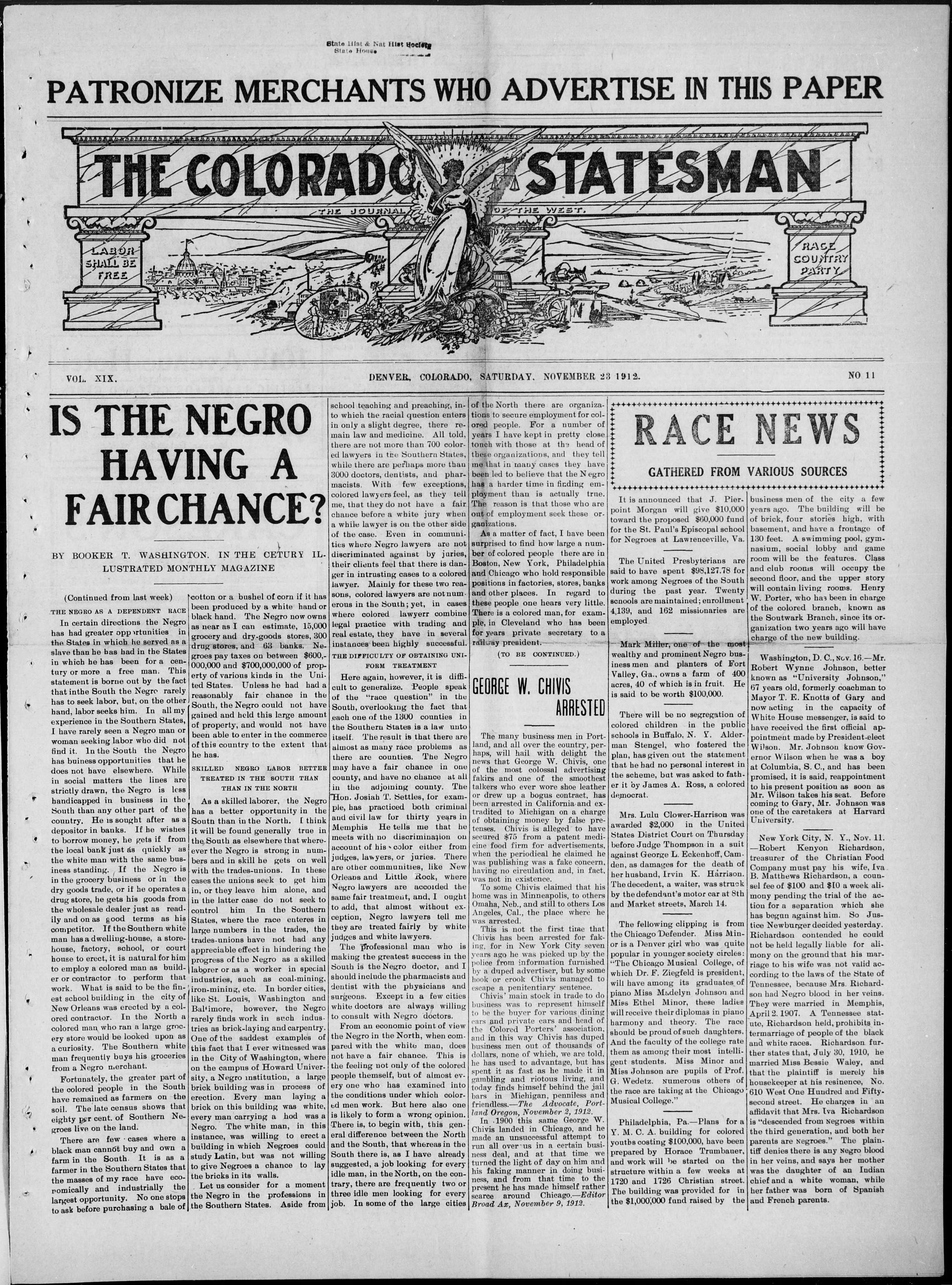
THE COLORADO STATESMAN
THE JOURNAL OF THE WEST.
LABOR SHALL BE FREE
RACE COUNTRY PARTY
IS THE NEGRO HAVING A FAIR CHANCE?
BY BOOKER T. WASHINGTON. IN THE CETURY IL LUSTRATED MONTHLY MAGAZINE
VOL. XIX.
IS THE
HAV
FAIR C
BY BOOKER T. WASHING
LUSTRATED MON
(Continued from last week)
THE NEGRO AS A DEPENDENT RACE
In certain directions the Negro has had greater opportunities in the States in which he served as a slave than he has had in the States in which he has been for a century or more a free man. This statement is borne out by the fact that in the South the Negro rarely has to seek labor, but, on the other hand, labor seeks him. In all my experience in the Southern States, I have rarely seen a Negro man or woman seeking labor who did not find it. In the South the Negro has business opportunities that he does not have elsewhere. While in social matters the lines are strictly drawn, the Negro is less handicapped in business in the South than any other part of the country. He is sought after as a depositor in banks. If he wishes to borrow money, he gets if from the local bank just as quickly as the white man with the same business standing. If the Negro is in the grocery business or in the dry goods trade, or if he operates a drug store, he gets his goods from the wholesale dealer just as readily and on as good terms as his competitor. If the Southern white man has a dwelling-house, a storehouse, factory, school, or court house to erect, it is natural for him to employ a colored man as builder or contractor to perform that work. What is said to be the finest school building in the city of New Orleans was erected by a colored contractor. In the North a colored man who ran a large grocery store would be looked upon as a curiosity. The Southern white man frequently buys his groceries from a Negro merchant.
Fortunately, the greater part of the colored people in the South have remained as farmers on the soil. The late census shows that eighty per cent. of Southern Negroes live on the land.
There are few cases where a black man cannot buy and own a farm in the South. It is as a farmer in the Southern States that the masses of my race have economically and industrially the largest opportunity. No one stops to ask before purchasing a bale of
cotton or a bushel of corn if it has been produced by a white hand or black hand. The Negro now owns as near as I can estimate, 15,000 grocery and dry-goods stores, 300 drug stores, and 63 banks. Negroes pay taxes on between $600,-000,000 and $700,000,000 of property of various kinds in the United States. Unless he had had a reasonably fair chance in the South, the Negro could not have gained and held this large amount of property, and would not have been able to enter in the commerce of this country to the extent that he has.
SKILLED NEGRO LABOR BETTER
TREATED IN THE SOUTH THAN
THAN IN THE NORTH
As a skilled laborer, the Negro has a better opportunity in the South than in the North. I think it will be found generally true in the South as elsewhere that wherever the Negro is strong in numbers and in skill he gets on well with the trades-unions. In these cases the unions seek to get him in, or they leave him alone, and in the latter case do not seek to control him. In the Southern States, where the race enters in large numbers in the trades, the trades-unions have not had any appreciable effect in hindering the progress of the Negro as a skilled laborer or as a worker in special industries, such as coal-mining, iron-mining, etc. In border cities, like St. Louis, Washington and Baltimore, however, the Negro rarely finds work in such industries as brick-laying and carpentry. One of the saddest examples of this fact that I ever witnessed was in the City of Washington, where on the campus of Howard University, a Negro institution, a large brick building was in process of erection. Every man laying a brick on this building was white, every man carrying a hod was a Negro. The white man, in this instance, was willing to erect a building in which Negroes could study Latin, but was not willing to give Negroes a chance to lay the bricks in its walls.
Let us consider for a moment the Negro in the professions in the Southern States. Aside from
DENVER. COLORADO. SATURDAY. NOVEMBER 23 1912.
State Hist & Nat Hist Society
State House
HANTS WH
ADC
THE JOURNAL
DENVER, COLORADO
school teaching and preaching, into which the racial question enters in only a slight degree, there remain law and medicine. All told, there are not more than 700 colored lawyers in the Southern States, while there are perhaps more than 3000 doctors, dentists, and pharmacists. With few exceptions, colored lawyers feel, as they tell me, that they do not have a fair chance before a white jury when a while lawyer is on the other side of the case. Even in communities where Negro lawyers are not discriminated against by juries, their clients feel that there is danger in intrusting cases to a colored lawyer. Mainly for these two reasons, colored lawyers are not numerous in the South; yet, in cases where colored lawerr combine legal practice with trading and real estate, they have in several instances been highly successful. THE DIFFICULTY OF OBTAINING UNI-
Here again, however, it is difficult to generalize. People speak of the "race question" in the South, overlooking the fact that each one of the 1300 counties in the Southern States is a law unto itself. The result is that there are almost as many race problems as there are counties. The Negro may have a fair chance in one county, and have no chance at all in the adjoining county. The Hon. Josiah T. Settles, for example, has practiced both criminal and civil law for thirty years in Memphis. He tells me that he meets with no discrimination on account of his color either from judges, lawyers, or juries. There are other communities, like New Orleans and Little Rock, where Negro lawyers are accorded the same fair treatment, and, I ought to add, that almost without exception, Negro lawyers tell me they are treated fairly by white judges and white lawyers.
The professional man who is making the greatest success in the South is the Negro doctor, and I should include the pharmacists and dentist with the physicians and surgeons. Except in a few cities white doctors are always willing to consult with Negro doctors.
From an economic point of view the Negro in the North, when compared with the white man, does not have a fair chance. This is the feeling not only of the colored people themself, but of almost every one who has examined into the conditions under which colored men work. But here also one is likely to form a wrong opinion. There is, to begin with, this general difference between the North and the South, that whereas in the South there is, as I have already suggested, a job looking for every idle man, in the North, on the contrary, there are frequently two or three idle men looking for every job. In some of the large cities
---
of the North there are organizations to secure employment for colored people. For a number of years I have kept in pretty close touch with those at the head of these organizations, and they tell me that in many cases they have been led to believe that the Negro has a harder time in finding employment than is actually true. The reason is that those who are out of employment seek these organizations.
As a matter of fact, I have been surprised to find how large a number of colored people there are in Boston, New York, Philadelphia and Chicago who hold responsible positions in factories, stores, banks and other places. In regard to these people one hears very little. There is a colored man, for example, in Cleveland who has been for years private secretary to a railway president.
(TO BE CONTINUED.)
GEORGE W. CHIVIS ARRESTED
The many business men in Portland, and all over the country, perhaps, will hail with delight the news that George W. Chivis, one of the most colossal advertising fakirs and one of the smoothest talkers who ever wore shoe leather or drew up a bogus contract, has been arrested in California and extradited to Michigan on a charge of obtaining money by false pretenses. Chivis is alleged to have secured $75 from a patent medicine food firm for advertisements, when the periodical he claimed he was publishing was a fake concern, having no circulation and, in fact, was not in existence.
To some Chivis claimed that his home was in Minneapolis, to others Omaha, Neb., and still to others Los Angeles, Cal., the place where he was arrested.
This is not the first tine that Chivis has been arrested for faking, for in New York City seven years ago he was picked up by the police from information furnished by a duped advertiser, but by some hook or crook Chivis managed to escape a penitentiary sentence.
Chivis' main stock in trade to do business was to represent himself to be the buyer for various dining cars and private cars and head of the Colored Porters' association, and in this way Chivis has duped business men out of thousands of dollars, none of which, we are told, he has used to advantage, but has spent it as fast as he made it in gambling and riotous living, and today finds himself behind the jail bars in Michigan, penniless and friendless. The Advocate, Portland Oregon, November 2, 1912. In 1900 this same George W. Chivis landed in Chicago, and he made an unsuccessful attempt to run all over us in a certain business deal, and at that time we turned the light of day on him and his faking manner in doing business, and from that time to the present he has made himself rather scarce around Chicago. Editor Broad Ax, November 9, 1912.
RACE NEWS
It is announced that J. Pierpoint Morgan will give $10,000 toward the proposed $60,000 fund for the St. Paul's Episcopal school for Negroes at Lawrenceville, Va.
The United Presbyterians are said to have spent $98,127.78 for work among Negroes of the South during the past year. Twenty schools are maintained; enrollment 4,139, and 162 missionaries are employed
Mark Miller, one of the most wealthy and prominent Negro business men and planters of Fort Valley, Ga., owns a farm of 400 acres, 40 of which is in fruit. He is said to be worth $100,000.
There will be no segregation of colored children in the public schools in Buffalo, N. Y. Alderman Stengel, who fostered the plan, has given out the statement that he had no personal interest in the scheme, but was asked to father it by James A. Ross, a colored democrat.
Mrs. Lulu Clower-Harrison was awarded $2,000 in the United States District Court on Thursday before Judge Thompson in a suit against George L. Eckenhoff, Camden, as damages for the death of her husband, Irvin K. Harrison. The decedent, a waiter, was struck by the defendant's motor car at 8th and Market streets, March 14.
The fellowing clipping is from the Chicago Defender. Miss Minor is a Denver girl who was quite popular in younger society circles: "The Chicago Musical College, of which Dr. F. Ziegfeld is president, will have among its graduates of piano Miss Mademlyn Johnson and Miss Ethel Minor, these ladies will receive their diplomas in piano harmony and theory. The race should be proud of such daughters. And the faculty of the college rate them as among their most intelligent students. Miss Minor and Miss Johnson are pupils of Prof. G. Wedetz. Numerous others of the race are taking at the Chicago Musical College."
Philadelphia, Pa.—Plans for a Y. M. C. A. building for colored youths costing $100,000, have been prepared by Horace Trumbauer, and work will be started on the structure within a few weeks at 1720 and 1726 Christian street. The building was provided for in the $1,000,000 fund raised by the
NO 11
business men of the city a few years ago. The building will be of brick, four stories high, with basement, and have a frontage of 130 feet. A swimming pool, gymnasium, social lobby and game room will be the features. Class and club rooms will occupy the second floor, and the upper story will contain living rooms. Henry W. Porter, who has been in charge of the colored branch, known as the Soutwark Branch, since its organization two years ago will have charge of the new building.
Washington, D. C., Nov. 16.—Mr. Robert Wynne Johnson, better known as "University Johnson," 67 years old, formerly coachman to Mayor T. E. Knotts of Gary and now acting in the capacity of White House messenger, is said to have received the first official appointment made by President-elect Wilson. Mr. Johnson know Governor Wilson when he was a boy at Columbia, S. C., and has been promised, it is said, reappointment to his present position as soon as Mr. Wilson takes his seat. Before coming to Gary, Mr. Johnson was one of the caretakers at Harvard University.
New York City, N. Y., Nov. 11.—Robert Kenyon Richardson, treasurer of the Christian Food Company must pay his wife, Iva B. Matthews Richardson, a counsel fee of $100 and $10 a week alimony pending the trial of the action for a separation which she has begun against him. So Justice Newburger decided yesterday. Richardson contended he could not be held legally liable for alimony on the ground that his marriage to his wife was not valid according to the laws of the State of Tennessee, because Mrs. Richardson had Negro blood in her veins. They were married in Memphis, April 2. 1907. A Tennessee statute, Richardson held, prohibits marriage of people of the black and white races. Richardson further states that, July 30, 1910, he married Miss Bessie Waley, and that the plaintiff is merely his housekeeper at his resinence, No. 610 West One Hundred and Fifty-second street. He charges in an affidavit that Mrs. Iva Richardson is "descended from negroes within the third generation, and both her parents are negroes." The plaintiff denies there is any negro blood in her veins, and says her mother was the daughter of an Indian chief and a white woman, while her father was born of Spanish and French parents.
FROM TELEGRAPHIG REPORTS
THAT COVER THE WEEK'S
EVENTS.
KEEPING THE READER POSTED
CN MOST IMPORTANT
CURRENT TOPICS.
Western Newspaper Union News Service.
WESTERN.
‘The woman who was struck down
with a hammer in the Saratoga hotel,
in Chicago, died without regaining
consciousness.
At Salt Lake City the University
of Utah football team decisively de-
feated the fast Colorado college team
by the score of 43 to 0.
‘Two masked men who held up pas-
senger train No. 12 of the Chicago,
Milwaukee & St. Paul railroad, be-
tween Mystic and Ottumwa, lowa, got
sbout $350,
‘Three people were killed and three
seriously injured when the westbound
Chicago & Alton “red hummer’ train
struck a carriage at a grade crossing
in Dwight, Ml.
‘The United States reclamation ser-
vice will open bids for the contract
cn the construction of twenty miles
of irrigation canal in western Ne-
braska, November 26.
Nevada has elected an anti-divorce
Legislature, and when the session
opens in January an amendment to
the present lax divorce measure wiil
be presented, fixing the period of res-
jdence at one year.
After a chase in automobiles lasting
five days and covering 700 miles, fif-
teen men suspected of having sold
Nquor to Indians were taken to Mis-
soula, Mont., by deputy United States
Marshal Miller and posse.
‘Three additional arrests were made
in Portland, Ore., in connection with a
scandal among men and boys which
has shaken Portland since Saturday,
when eleven men were arrested and
‘one other attempted suicide.
Dr. Phillip William Dupree’s eight-
rucnths-old son, who died in Little
Rock, Ark., as a result of a nurse giv-
ing the child carbolic acid by mistake
for wine, is said to have been heir to
4% $4,000,000 estate in France.
Kansas cast the largest vote ever
recorded in the state at the election
two weeks ago. The total Republi-
ean and Democratic vote will exceed
328,000 and the Socialist vote will
reach 30,000 according to the returns.
A report that Laura Hurley, pro-
prietress of a house in West Chey-
enne, Wyo., had been indicted by the
grand jury in the United States Court
for “white slavery,” was erroncous,
the mistake resulting from a confu-
sion of names.
‘Three persons Jost their lives In the
fire which partially destroyed the st.
George, a theatrical hotel in Los An-
geles. Fourteen were injured, of
whom one baby, who was dropped in
® flame-swept hallway by its frantic
mother, probably will die.
Attorney General Cossan of Iowa
has been asked to determine what
happens when voters elect a dead man
to office. Victor Schrik was elected
county supervisor after he had been in
his grave five days. A. A. Pacen, his
opponent who received half ar many.
yetem ix claiming the election,
Mrs, Lena Sneed, whose elopement
with Al Boyce led to the killing of
Capen A. G. Boyce, and later of Al
Boyce, will not testify in behalf of
her husband, She made known her
decision to the defense’s attorneys at
Fort Worth, who sent to Calvert to
solicit her assistance. Sneed has ad-
mitted to his counsel that he is not
tnxious for his wife to take the stand,
It is reported that the stork but re-
cently visited Mrs. Sneed.
SPORT.
At Laramie, Wyo, on a field mad
slow by the storm of last week, the
University of Wyoming defeated the
Nebraska State Normal at Chadron 25
to 0.
At Lincoln, Neb., after battling {01
three periods in their nineteenth an.
nual football contest, Nebraska scored
two touchdowns in the fourth quarter
after Kansas had kicked a field goal,
and won by the score of 14 to 3. =
At New York Willie Hoppe, holder
of the 18.2 balkiine billiard title, had
little trouble in defeating Demarest,
500 to 341, and the veteran Slosson
out-played Sutton, 500 to 243, in the
games of the championship tourna
ment,
At Cambridge, Mass., Harvard, ys
ing only a part of its reputed offense
tactics, defeated Dartmouth, 3 to 0.
When Jack Johnson, negro prize
fighter, appeared before Judge Hop:
kins in Chicago, the abduction case
against him was dismissed for want
of prosecution,
At Berkeley, Cal, the All-Star Au
stralian Ruby team defeated the All
California fifteen on California field,
12 to 8 in the most thrilling Rugby
game seen in California since the Eng.
Jish sport was adopted.
FOREIGN,
Sir Thomas Lipton will be the guest
of th chamber of commerce in Den:
ver, at its luncheon in the Albany
hotel Friday, November 29,
While the Balkan allies have con-
sented to an armistice asked by Tur-
key to consider terms of peace, the
specter of general European war has
egain risen,
The city of Amoy, China, is placard:
ed with posters announcing the be-
ginning of a boycott against Japanese
goods. This is in protest against Jap:
anese aggression in Manchuria,
‘The prospects of an international
university athletic meeting during the
coming summer in America have be-
come brighter. The athletes of Ox-
ford and Cambridge universities are
largely in favor of such a contest.
The explosion of a Turkish powder
magazine at Saloniki several days ago
did immense execution. The magazine
was close to the cavalry barracks,
where many Turkish prisoners were
confined. Three hundred Turks‘ were
‘killed and 430 wounded.
Peter G. Hanson, a farmer at Grier-
son, eighty miles northwest of Winni-
peg, is sought by the Manitoba police,
who accuse him of tying a young wom.
an td a cow’s horns. Maggie Warau-
ski, the daughter of a neighbor, is se-
riously injured, perhaps fatally, as a
result,
For four minutes, long undu-
leting waves of an earthquake
rocked Mexico City and the state of
‘Mexico. The little town of Timilpan
practically was destroyed, and a num-
Ler of persons there are reported to
have been killed, while in the capital
‘two lives were lost.
Great interest was taken in the
marriage of Charles Wilkens Short,
Jr. whose family comes from Cincin-
rati, Ohio, and the Countess Camille
Hoyos, at Holy Trinity church in Lon-
con, as it was one of the very few
instances in which an American man
has married a titled foreigner.
‘The matrimonial troubles of Signora
Moschini, the American wife of the
wealthy deputy, Signor Vittoria Mo
schini, who before her marriage was
Miss Lulu Davis of Austin, Texas, was
arrested on a charge of infidelity while
taking tea at the home of an Italian
naval officer well known in society
circles.
WASHINGTON.
The form that tariff revision is tu
take before the special session of Con:
gress next spring has become a mat
ter of strong individual opinion among
Democratic senators and congressmen
now here.
Secretary of the Interior Fisher
flatly told water power corporations
holding federal licenses that they
would be forced to grant reasonable
rates to consumers, regardless of an
cient contract rights to the contrary.
That college fraternities have a
right to exist in the state universities,
because they are natural social organ:
izations, was urged by Prof. R. M.
Hughes, acting president of Miam|
university, at the second day's session
of the National Association of State
Universities.
Attorney General Wickersham has
directed that warrants be net served
upon John D. Archbold, H, C. Folger,
Jr, and W. C. Teagle of the Standard
Ofl Company, as a result of their in-
dictment at Dallas, Texas, last Au-
gust, in connection with the case
against the Magnolia Petrolcum Com-
pany.
GENERAL.
Accused of having strangled Miss
Mattie Hackett with a cord in Read-
field, Maine, August 17, 1905, Mrs.
Elsie Hobbs Raymond was placed on
trial at Augusta,
A Chicago dispatch says: Wah-Hah-
Gun-Ta, chief firemaker, the 131-
year-old Blackfoot Indian from Gla-
cier reservation, is on his way east
to attend the United States land show.
With the arrest in six cities of men
alleged by the government to consti-
tute a monumental get-rich-quick
chain of swindlers, United States. se-
cret service men declare they have
brought to the surface an organization
that has muleted smalls corporations,
inventors and promoters of $1,500,000
in the last three years,
Joseph Bush, who killed James Mc-
Namara in a fight in Brooklyn, Sep-
tember 29, was sentenced in Supreme
Court to pay the widow $3 a week for
one year in leu of spending a year in
jail. Bush thankfully agreed to carry
out the decree, but Mrs. McNamara
declared she would not take a cent
from her husband's slayer.
"Dan O'Reilly of New York, noted
‘criminal lawyer, center of interest in
the two Thaw trials, first-nighter
Beau Brummel of Broadway, has a
‘new job. For the next five months, un-
less the court shall set aside the
judgment pronounced against him, he
will dig graves for the allen and pau-
per poor in the city cemetery on
Harts island.
President Taft was in attendance at
‘the regular meeting of the Yale cor
poration at New Haven, Conn. Two
sessions were held, the main subject
for discussion being the university
budget.
Joseph Pulitzer, late proprietor of
the New York World, who camo to
America practically penniless and at
the close of the Civil War, in which he
served as a Union soldier, was still
in reduced circumstances, left a gross
estate, taxable in New York state, of
$18,200,000
STATE NEWS
OF INTEREST TO ALL
COLORADO
PEOPLE
Veatern Newspaper Union News Service,
DATES FOR COMING EVENTS.
January 20-26—Kighth Annual West-
ern Stock Show—Denver.
A fall of two stories to the ground
Gid not injure little Dorothy Allen Da-
vas, daughter of Walter C. Davis of
Colorado Springs.
News of the death of Mrs. Melinda
C. Veasey, widow of John M. Veasey
and sister Of the late David K, Wall.
at South Bend, Ind., has been received
by C. B. Beach of Denver.
‘The Missouri, Kansas & Texas rail-
road, composed of 3,500 miles of
track and belonging to the so-called
Hawley system, is seeking an en-
trance inte Denver.
W. C. Martin of Boulder, employed
at the Longmont sugar factory, re
ceived injuries which resulted in his
death at the hospital here, as he was
being placed on the operating table.
The Denver & Rio Grande railroad
has let a contract to the Utah Con-
struction Company, of Ogden, Utah, to
make the grade for its double track
detour line around Soldier Summit,
Utah, for $1,500,000.
John Boesch of Platteville is rejoic-
ing over receipt of a posteard from
Buffalo, N. Y., signed by his brother
George, whom he thought was
drowned in Lake Michigan twenty-five
years ago.
By a yote of 14 to 2 the city board
of aldermen of Denver refused to fix
the boundaries of the city’s yoting
1recinets in order to allow an election
upon the question of commission form
of government.
Sheriff-elect Henry Von Phul of
Cripple Creek announced his appoint
ment of Hugh Taylor, a widely known
newspaper man and chairman of the
Democratic County central committee,
as his undersheriff,
Suit in which $50,000 damages are
asked against James E, Brockway aud
H, H. Eddy of Denver was filed in the
District Court in Denver by the Amer-
icans, a fraternal organization with
headquarters in Springfield, M.
Governor Shafroth will call an extra
session of the new Legislature for De-
cember 30, to elect C. S. Thomas, the
popular choice at the recent election,
to the United States Senate to fill out
the unexpired term of the late Charles
J. “Hughes, Jr.
‘The town of Sugar City and Edward
W. Richards, its mayor filed a contest
against the locating of the permanent
county seat at Ordway, claiming there
was fraud and intimidation used at the |
last general election, and at the coun-
ty seat election.
Because her husband did not want
to take her to a theater, Mrs. Mary
Leslie, aged twenty-eight, wife of Hen-
ry LesHe of Denver, sought to end
her life. In a fit of temper she swal-
lowed part of the contents of a bottle
of earbolie acid,
‘Three men have been slain, one who
was wealthy has been impoverished in
defending himself from conviction for
murder, the county of La Plata has |
spent thousands in prosecution of
feudists, and the Cox-Truby range feud
still rages at Durango.
Breakers of the law will sit up and
take notice—for there is a woman in
‘Denver who wears a genuine star. And
the victims who transgress on the law
will get just as long a sentence if ar-
rested by “Denver's policewoman,” as
if they had been taken in custody by
a “cop.”
‘The Platte Cafion Improvement As-
sociation gave a banquet in Denver
and formulated plans for a campaign
to build a road through the cafion.
Governor-elect. Ammons was present
and delivered an address in which be
promised his support for the highway
during his term in office.
Mrs, Anna Erven, aged twenty-one,
the wife of Earl Erven, son of a weal-
thy lquor dealer, and Joseph Jacobs,
an eloping couple from Hamilton, O.,
were arrested by Detectives Hollerain
and Carr in Denyer. The pair were
held for investigation in the city jail,
but a charge of white slavery probably
Rio Blanco county, one of the larg-
est in the state, holds the record for
absence of crime and lack of litigation.
There has been no session of District
Court in the county this year, owing
to lack.of cases and a special term
called for December 3 has just been
abandoned because of the lightness of
the docket.
‘The lecture room of the First Bap-
tist church of Denver was the scene of
the annual banquet of the Brotherhood
of that society. It was probably the
largest gathering of church men in
Denver this year, over 200 being seat-
ed at the five long tables, twenty
young men actively engaged in Sunday
school work occupying a table of their
own in the center.
Newman Erb proposed te the city of
LESS TYPHOID FEVER
Pe 2 A. a Me pt
ios = At hy :
: EN yg :
Curtis Gs hs Sve ae
“He am Wa 3
Park £ 4A
Floral Se ae ,
Aaa Na
Company he RY
———————— LPN y i)
FLORAL DESIGNS £27 gyre a AN
GHOIGE PLANTS AND GUT FLOWERS Sossy°sz'2 ARQ
GREENHOUSES: Thirty-Fourth and Curtis Streets :
TELEPHONE, MAIN 1511 DENVER, COLO
REDUCED FIFTY PER CENT 8Y
STATE CAMPAIGN.
State Board of Heaith Says “Swat the
Fly” Crusade Caused Decrease
in Colorado.
Western Newspaper Union News Service.
Denver.—Scientific medical discov
ery and the almost universal “swa
the fly" campaign waged throughow
Colorado during the past summer ha.
resulted in a reduction of nearly fifty
per cent in the number of typhoic
cases reported for the first nine
months this year under the number re
ported for a like period in 1911, ac
cording to a report of the State Board
of Health.
The report shows that the percent
age of deaths from the disease is even
less this year than last and the de
struction of the germ-carrying housé
fly is considered by the board to be
the most important factor. The list
of fatalities for nine months this year
is_one-third of that for the first nine
months in 1911. The lessened mortal
ity rate, according to Dr. Paul S.
Hunter, is also due to the recent dis.
covery of a typhoid serum which has
proved to be unusually successful.
“I believe,” said Dr. Hunter, “that
in a few years, perhaps not more than
ten, that deaths from typhoid in Colo.
rado will be reduced to nil.
“People have come to realize the im:
portance of precaution against ty-
phoid. They have learned how neces:
sary it is to destroy flies and make
conditions about their homes sanitary.
It is interesting to note how almost
universally now, housewives will take
a few minutes every day and go about
vigorously swatting flies in their
homes, This is bound to bring about
results that we have strived for in the
past decade.
“Dairies are kept cleaner, conditions
about barns are more sanitary and
close inspection of cows and provi-
sions for sterilization of bottles, etc.
has done the rest. it is practically
impossible now for flies to communi
cate disease to milk within a barn be
cause of the screen doors required.”
10th Avenue Hotel
————-— H. HEUER, PROPRIETOR ———_—_______
RESTING PLACE FOR COLORED GENTS
MEALS AT ALL HOURS
Pool Room in Connection
Gorner West 10th and Osage, Near Burnham Shops
Denver, Colorado
CARLSON’S
Feerese Hee Cream
Beet Growers Get Million Dollars
Greeley—For the first time in its
history Weld county has had a $1,000,
000 pay-day in its beet industry, as
checks for that much and half a mil:
tion more were mailed to growers from
nine factories in northern Colorado.
‘The exact amount paid to growers
for the three Weld county factories
was $976,246.72, divided as follows:
Greeley, $357,460.18; Eaton, $330,085.
20; Windsor, $288,301.34.
it is estimated that there are 50,000
acres of beets in the county, but only
30,000 supply the three factories in
the towns named above. The rest are
divided among the plants at Long.
mont, Loveland, Fort Collins, Sterling,
Brush and Fort Morgan, and the total
which the growers of Weld will re-
ceive is estimated at $1,610,589, a con-
servative figure which in all proba-
Lility will go much higher, as yields
in the districts which supply these
factories were unusually heavy. Some
yields were twenty-eight tons to the
acre with large percentages of sugar.
‘his is the second pay day of the sea-
son and there will be another in a
month, when several thousands of dol-
lars will be distributed in time for
Christmas shopping.
Among those who received ¢hecks
of unusual size were L. HE. Snidow, a
tenant on a David Snyder farm, $7,
350; J. W. Birkle of Platteville, $3,
(44; Robert Eckhardt of Peckham, $3,-
816; W. Jacobson of Fort Lupton, $3,-
053; Moses Davis of Ione, $2,679, and
the Ione Investment Co., $4,200.
_ DID YOU EVER TRY
9
Neef Bros.’ Beer?
It’s made right, and tastes right.
None better made anywhere and
This is a Strictly Colorado Production
BE SURE AN TRY IT.
PHONE. MAIN 3028 m a RES. PHONE GALLUP 942
JOHN K. RETTIG
Meats, Fancy and Staple Groceries
1864 CURTIS STREET
Sorner Nineteenth. Denver, Colo,
Aged Pair Wed; “Unsight, Unseen.”
Grand Junction—A ten months’
courtship “unsight aid unseen” is the
romance which culminated in the wea
ding here of G. H. Eighmy, age sev
enty-two, of Fruita, and Mrs. Mary
Bryant, sixty-one of DuBois, Neb.
‘They are now living happily on the
large orchard owned by the groom
near Wruite.
LANNARANANANASS ANNAN AS EAAAERAAA NNN HNNIN NA NNNNNNG;
% uesry arce JOHN ENastRom Y
5 5
A
Z BECK & ENGSTROM 3
g WHOLESALE DEALERS IN 3
g WINES, LIQUORS AND CIGARS g
4 1644-46-48-50 LARIMER STREET. -
% rHoNE MALN 1053. DENVER, CoLo. J
g Wentern agents for Minnenpollx Grain Belt Beer and Carnegie Porter, Z
Z Easy a see nee On ;
EXXSKNASENKANANANAAAARNANASANNSAKA SERA NAS KANRRRRRR RRS
Dynamite House % Re ‘ight District.
Cripple Crev-.—Carrying out a
threat in two letters sent to her
through the mails within the last two
weeks, unidentified persons dynamtt
ed a house on Myers avenue in the
heart of the red-light cistrict, occu:
pied by Pearl La Vin, who came here
from Denver. She was not at home
when the explosion occurred.
FHF FFFFF+ FFF FFF FFF ++F+F+FF+F+F++ ++ +++ +++ +++ ++ esr s +s tooo eos
+ 3
t DAY OR NIGHT. PHONE MAIN 6243 4
: A. M. LAWHORN
3 Boe 4
z Undertakers 3
t 3
x A first-class Mortuary establishment. First aid to the bereaved in the B
} time of death of loved ones. Prices below competitors. Polite serve 3
t : 3
s LAWRENCE JONES, Licenced Embalmer 3
at LOUIS HUBBARD, Funeral Director 3
z 3
~ PARLORS 1925 Arapahoe Street 3
SEFEtt tt HHH ttteeetttetteeeeeeeteeteeeeteeeeeeeeeees
Man 82 Freezes to Death.
Sterling.—After drawing $10 from a
ivcal bank, Samuel White, eighty-twe
years old, started to return to the
home of his son, Herbert White, five
blocks away, became lost and froze to
death.
Motor Accident Serious.
Pueblo.—Crashing into a horse at:
tached to a delivery wagon, Fred Mei-
ster and George Van Gundy, riding a
motorcycle, were badly injured.
LET US WASH YOUR
Shirts, Collars and Cuffs, Blankets,
Curtains and Rough Dry Work.
The Denver Sanitary Laundry.
PHONE MAIN 5670
1082 Broadway. Denver, Colo.
Dentist’s Wife May Be Insane.
Boulder—Mrs Ida D. Scott, wife ot
Dr. Ira Scott, disappeared. No word
was received from her until a letter,
apparently the product of a rambling
mind, was received by Dr. Scott from
Memphis, Tenn,
Jury Investigating Rebate Cnarges.
Pueblo—Some of the most promi
nent railway men in Colorado, includ:
ing officers of three roads testified be-
fore the federal grand jury in the re
hate cases being investigated,
TO PROTECT AMERICANS IN TURKEY
Coppin MF
Underwood & Underwood
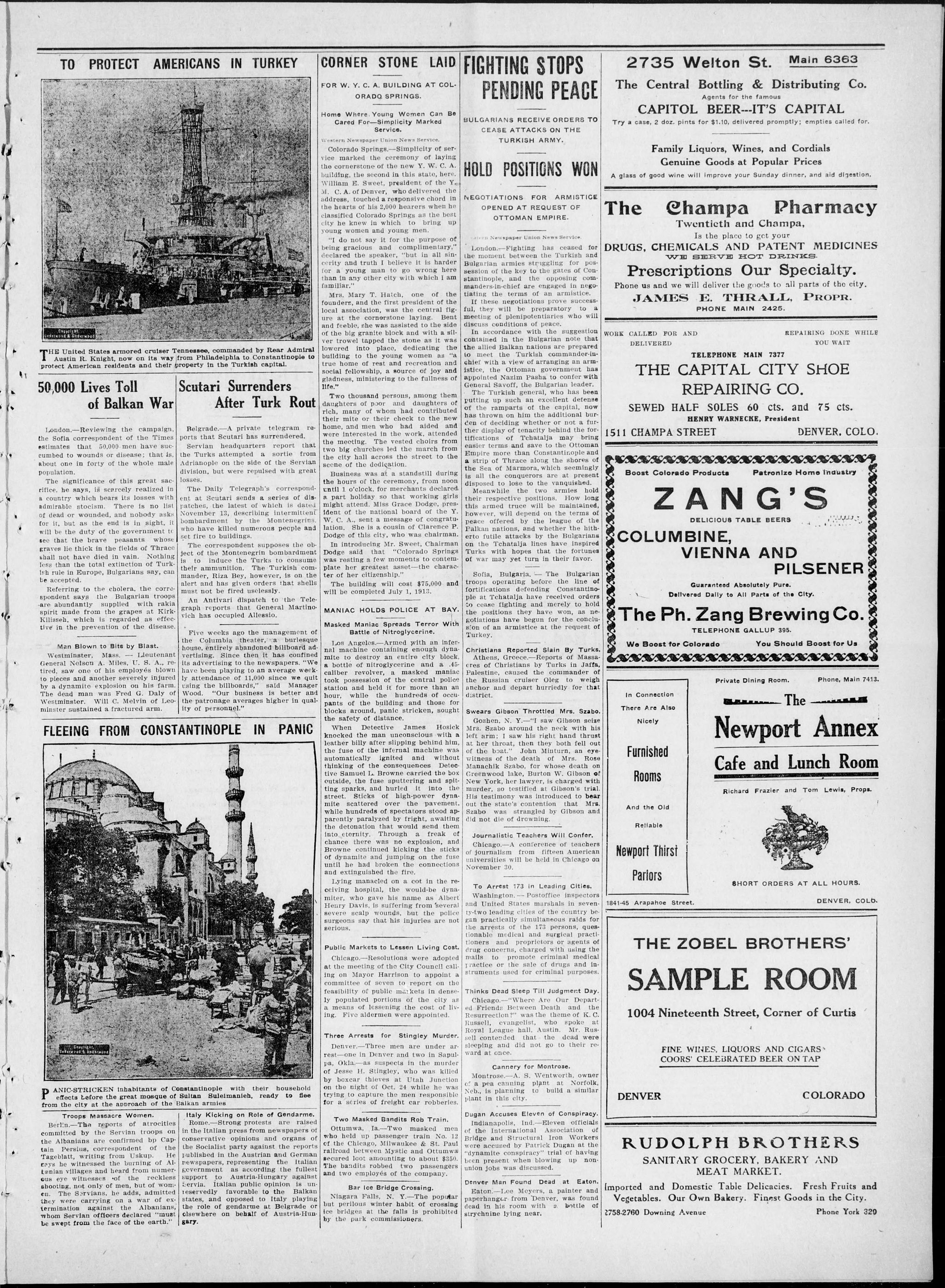
THE United States armored cruiser Tennessee, commanded by Rear Admiral Austin R. Knight, now on its way from Philadelphia to Constantinople to protect American residents and their property in the Turkish capital.
THE United States armored cruiser Tennessee, commanded by Rear Admiral Austin R. Knight, now on its way from Philadelphia to Constantinople to protect American residents and their property in the Turkish capital.
FLEEING FROM CONSTANTINOPLE IN PANIC
Copyright
Underwood & Underwood
PANIC-STRICKEN inhabitants of Constantinople with their household effects before the great mosque of Sultan Suleimanieh, ready to flee from the city at the approach of the Balkan armies
PANIC-STRICKEN inhabitants of Constantinople with their household effects before the great mosque of Sultan Suleimanieh, ready to flee from the city at the approach of the Balkan armies
50,000 Lives Toll of Balkan War
London.—Reviewing the campaign, the Sofia correspondent of the Times estimates that 50,000 men have succumbed to wounds or disease; that is, about one in forty of the whole male population.
The significance of this great sacrifice, he says, is scarcely realized in a country which bears its losses with admirable stocism. There is no list of dead or wounded, and nobody asks for it, but as the end is in sight, it will be the duty of the government to see that the brave peasants whose graves lie thick in the fields of Thrace shall not have died in vain. Nothing less than the total extinction of Turkish rule in Europe, Bulgarians say, can be accepted.
Referring to the cholera, the correspondent says the Bulgarian troops are abundantly supplied with rakia spirit made from the grapes at Kirk Killisseh, which is regarded as effective in the prevention of the disease
Man Blown to Bits by Blast.
Westminster, Mass. — Lieutenant General Nelson A. Miles, U. S. A., retired, saw one of his employees blown to pieces and another severely injured by a dynamite explosion on his farm. The dead man was Fred G. Daly of Westminster. Will C. Melvin of Leo-minster sustained a fractured arm.
FLEEING FROM CONST
Copyright
Underwood & Backwood
PANIC-STRICKEN inhabitants of C
effects before the great mosque of
from the city at the approach of the
Berlin.—The reports of atrocities committed by the Servian troops on the Albanians are confirmed bp Captain Persius, correspondent of the Tageblatt, writing from Uskup. He says he witnessed the burning of Albanian villages and heard from numerous eye witnesses of the reckless shooting, not only of men, but of women. The Servians, he adds, admitted they were carrying on a war of extermination against the Albanians, whom Servian officers declared "must be swept from the face of the earth."
Scutari Surrenders After Turk Rout
Scutari Surrenders After Turk Rout
Belgrade.—A private telegram reports that Scutari has surrendered.
Servian headquarters report that the Turks attempted a sortie from Adrianople on the side of the Servian division, but were repulsed with great losses.
The Daily Telegraph's correspondent at Scutari sends a series of dispatches, the latest of which is dated November 13, describing intermittent bombardment by the Montenegrins, who have killed numerous people and set fire to buildings.
The correspondent supposes the object of the Montenegrin bombardment is to induce the Turks to consume their ammunition. The Turkish commander, Riza Bey, however, is on the alert and has given orders that shells must not be fired uselessly.
An Antivari dispatch to the Telegraph reports that General Martinovich has occupied Allessio.
Five weeks ago the management of the Columbia theater, a burlesque house, entirely abandoned billboard advertising. Since then it has confined its advertising to the newspapers. "We have been playing to an average weekly attendance of 11,000 since we quit using the billboards," said Manager Wood. "Our business is better and the patronage averages higher in quality of personnel."
CONSTINOPLE IN PANIC
constantinople with their household
Sultan Suleimanieh, ready to flee
Balkan armies
Italy Kicking on Role of Gendarme. Rome.—Strong protests are raised in the Italian press from newspapers of conservative opinions and organs of the Socialist party against the reports published in the Austrian and German newspapers, representing the Italian government as according the fullest support to Austria-Hungary against Servia. Italian public opinion is unreservedly favorable to the Balkan states, and opposed to Italy playing the role of gendarme at Belgrade or elsewhere on behalf of Austria-Hungary.
CORNER STONE LAID
FOR W. Y. C. A. BUILDING AT COLORADQ SPRINGS.
Home Where, Young Women Can Be Cared For—Simplicity Marked Service.
Western Newspaper Union News Service.
Colorado Springs.—Simplicity of service marked the ceremony of laying the cornerstone of the new Y. W. C. A. building, the second in this state, here. William E. Sweet, president of the Y. M. C. A. of Denver, who delivered the address, touched a responsive chord in the hearts of his 2,000 hearers when he classified Colorado Springs as the best city he knew in which to bring up young women and young men.
"I do not say it for the purpose of being gracious and complimentary," declared the speaker, "but in all sincerity and truth I believe it is harder for a young man to go wrong here than in any other city with which I am familiar."
Mrs. Mary T. Hatch, one of the founders, and the first president of the local association, was the central figure at the cornerstone laying. Bent and feeble, she was assisted to the side of the big granite block and with a silver trowel tapped the stone as it was lowered into place, dedicating the building to the young women as "a true home of rest and recreation and social fellowship, a source of joy and gladness, ministering to the fullness of life."
Two thousand persons, among them daughters of poor and daughters of rich, many of whom had contributed their mite or their check to the new home, and men who had aided and were interested in the work, attended the meeting. The vested choirs from two big churches led the march from the city hall across the street to the scene of the dedication.
Business was at a standstill during the hours of the ceremony, from noon until 1 o'clock, for merchants declared a part holiday so that working girls might attend. Miss Grace Dodge, president of the national board of the Y. W. C. A., sent a message of congratulation. She is a cousin of Clarence P. Dodge of this city, who was chairman.
In introducing Mr. Sweet, Chairman Dodge said that "Colorado Springs was resting a few moments to contemplate her greatest asset—the character of her citizenship." The building will cost $75,000 and will be completed July 1, 1913.
Masked Maniac Spreads Terror With Battle of Nitroglycerine.
Los Angeles.—Armed with an internal machine containing enough dynamite to destroy an entire city block, a bottle of nitroglycerine and a .45-caliber revolver, a masked maniac took possession of the central police station and held it for more than an hour, while the hundreds of occupants of the building and those for blocks around, panic stricken, sought the safety of distance.
When Detective James Hosick knocked the man unconscious with a leather billy after slipping behind him, the fuse of the infernal machine was automatically ignited and without thinking of the consequences Detective Samuel L. Browne carried the box outside, the fuse sputtering and spitting sparks, and hurled it into the street. Sticks of high-power dynamite scattered over the pavement, while hundreds of spectators stood apparently paralyzed by fright, awaiting the detonation that would send them into eternity. Through a freak of chance there was no explosion, and Browne continued kicking the sticks of dynamite and jumping on the fuse until he had broken the connections and extinguished the fire.
Lying manacled on a cot in the receiving hospital, the would-be dynamiter, who gave his name as Albert Henry Davis, is suffering from several severe scalp wounds, but the police surgeons say that his injuries are not serious.
Public Markets to Lessen Living Cost.
Chicago.—Resolutions were adopted at the meeting of the City Council calling on Mayor Harrison to appoint a committee of seven to report on the feasibility of public markets in densely populated portions of the city as a means of lessening the cost of living. Five aldermen were appointed.
Three Arrests for Stingley Murder.
Denver.—Three men are under arrest—one in Denver and two in Sapulpa, Okla.—as suspects in the murder of Jesse H. Stingley, who was killed by boxcar thieves at Utah Junction on the night of Oct. 24 while he was trying to capture the men responsible for a series of freight car robberies.
Ottumwa, Ia.—Two musked men who held up passenger train No. 12 of the Chicago, Waukee & St. Paul railroad between Mystic and Ottumwa secured loot amounting to about $350. The bandits robbed two passengers and two employés of the company.
Bar Ice Bridge Crossing.
Niagara Falls, N. Y.-The popular but perilous winter habit of crossing ice bridges at the falls is prohibited by the park commissioners.
FIGHTING STOPS PENDING PEACE
BULGARIANS RECEIVE ORDERS TO
CEASE ATTACKS ON THE
TURKISH ARMY.
HOLD POSITIONS WON
NEGOTIATIONS FOR ARMISTICE OPENED AT REQUEST OF OTTOMAN EMPIRE.
Eastern Newspaper Union News Service.
London.—Fighting has ceased for the moment between the Turkish and Bulgarian armies struggling for possession of the key to the gates of Constantinople, and the opposing commanders-in-chief are engaged in negotiating the terms of an armistice.
If these negotiations prove successful, they will be preparatory to a meeting of plenipotentiaries who will discuss conditions of peace.
In accordance with the suggestion contained in the Bulgarian note that the allied Balkan nations are prepared to meet the Turkish commander-in-chief with a view of arranging an armistice, the Ottoman government has appointed Nazim Pasha to confer with General Savoff, the Bulgarian leader. The Turkish general, who has been putting up such an excellent defense of the ramparts of the capital, now has thrown on him the additional burden of deciding whether or not a further display of tenacity behind the fortifications of Tchatalja may bring easier terms and save to the Ottoman Empire more than Constantinople and a strip of Thrace along the shores of the Sea of Marmora, which seemingly is all the conquerors are at present disposed to lose to the vanquished.
Meanwhile the two armies hold their respective positions. How long this armed truce will be maintained, however, will depend on the terms of peace offered by the league of the Palkan nations, and whether the hitherto futile attacks by the Bulgarians on the Tchatalja lines have inspired Turks with hopes that the fortunes of war may yet turn in their favor.
Sofia, Bulgaria. — The Bulgarian troops operating before the line of fortifications defending Constantinople at Tchatalja have received orders to cease fighting and merely to hold the positions they have won, as negotiations have begun for the conclusion of an armistice at the request of Turkey.
Christians Reported Slain By Turks.
Athens, Greece.—Reports of Massacres of Christians by Turks in Jaffa, Palestine, caused the commander of the Russian cruiser Oleg to weigh anchor and depart hurriedly for that district.
Swears Gibson Throttled Mrs. Szabo.
Goeshan, N. Y.—"I saw Gibson seize Mrs. Szabo around the neck with his left arm; I saw his right hand thrust at her throat, then they both fell out of the boat." John Minturn, an eyewitness of the death of Mrs. Rose Manachik Szabo, for whose death on Greenwood lake, Burton W. Gibson of New York, her lawyer, is charged with murder, so testified at Gibson's trial.
His testimony was introduced to bear out the state's contention that Mrs. Szabo was strangled by Gibson and did not die of drowning.
Journalistic Teachers Will Confer.
Chicago.—A conference of teachers of journalism from fifteen American universities will be held in Chicago on November 30.
To Arrest 173 in Leading Cities.
Washington.—Postoffice inspectors and United States marshals in seventy-two leading cities of the country began practically simultaneous raids for the arrests of the 173 persons, questionable medical and surgical practitioners and proprietors or agents of drug concerns, charged with using the mails to promote criminal medical practice or the sale of drugs and instruments used for criminal purposes.
Thinks Dead Sleep Till Judgment Day.
Thinks Dead Sleep Til Judgment Day.
Chicago.—"Where Are Our Departed Friends Between Death and the Resurrection?" was the theme of K. C. Russell, evangelist, who spoke at Royal League hall, Austin. Mr. Russell contended that the dead were sleeping and did not go to their reward at once.
Montrose.—A. S. Wentworth, owner of a pea canning plant at Norfolk, Neb., is planning to build a similar plant in this city.
Dugan Accuses Eleven of Conspiracy.
Indianapolis, Ind.—Eleven officials of the International Association of Bridge and Structural Iron Workers were accused by Patrick Dugan at the "dynamite conspiracy" trial of having been present when blowing up nonunion jobs was discussed.
Denver Man Found Dead at Eaton.
Eaton.—Lee Meyers, a painter and paperhanger from Denver, was found dead in his room with v. bottle of strychnine lying near.
The Central Bottling & Distributing Co.
Agents for the famous
CAPITOL BEER---IT'S CAPITAL
Try a case, 2 doz. pints for $1.10, delivered promptly; empties called for.
Family Liquors, Wines, and Cordials Genuine Goods at Popular Prices A glass of good wine will improve your Sunday dinner, and aid digestion.
The Champa Pharmacy
Twentieth and Champa,
Is the place to get your
DRUGS, CHEMICALS AND PATENT MEDICINES
WE SERVE HOT DRINKS.
Prescriptions Our Specialty.
Phone us and we will deliver the goods to all parts of the city.
JAMES E. THRALL, PROPR.
PHONE MAIN 2425.
WORK CALLED FOR AND DELIVERED
THE CA
RE
SEWED HALF
HE
1511 CHAMPA STRE
Boost Colorado P
Z A
DE
COLUMB
VI
Gu
Delivered
The Ph. Z
TH
We Boost for Colo
Boost Colorado Products Patronize Home Industry
ZANG'S
DELICIOUS TABLE BEERS
COLUMBINE,
VIENNA AND
PILSENER
Guaranteed Absolutely Pure.
Delivered Daily to All Parts of the City.
The Ph. Zang Brewing Co.
TELEPHONE GALLUP 395.
We Boost for Colorado You Should Boost for Us
Furnished
Rooms
And the Old
Reliable
Newport Thirst
Parlors
SHORT ORDERS AT ALL
oe Street.
E ZOBEL BROTHER
AMPLE ROO
Nineteenth Street, Corner of
THE ZO
SAM
1004 Ninetee
1004 Nineteenth Street, Corner of Curtis
FINE WINES, LIQUORS AND CIGARS COORS' CELEBRATED BEER ON TAP
RUDOLF
SANITARY
Imported and Dome
Vegetables. Our O
2758-2760 Downing Avenue
RUDOLPH BROTHERS
SANITARY GROCERY, BAKERY AND MEAT MARKET. Imported and Domestic Table Delicacies. Fresh Fruits and Vegetables. Our Own Bakery. Finest Goods in the City. 2758-2760 Downing Avenue Phone York 320
In Connection There Are Also Nicely
DENVER
REPAIRING DONE WHILE
YOU WAIT
MONE MAIN 7377
RITAL CITY SHOE
FAIRING CO.
LES 60 cts. and 75 cts.
WARNECKE, President
DENVER, COLO.
Patronize Home Industry
ING'S
DURUS TABLE BEERS
E,
INA AND
PILSENER
Good Absolutely Pure.
Y to All Parts of the City.
ing Brewing Co.
PHONE GALLUP 395.
You Should Boost for Us
Private Dining Room. Phone, Main 7413.
The
Newport Annex
Cafe and Lunch Room
Richard Frazier and Tom Lewis, Props.
EL BROTHERS'
LE ROOM
Street, Corner of Curtis
H BROTHERS
COCERY, BAKERY AND
BET MARKET.
Table Delicacies. Fresh Fruits and
bakery. Finest Goods in the City.
Phone York 320
DENVER, COLB.
COLORADO
THE COLORADO STATESMAN
JOS. D. D. RIVERS.....Proprietor
1824 Curtis Street, Room 25.
One Year ..... $2.00
Six Months ..... 1.00
Three Months ..... .60
PAYABLE IN ADVANCE
Entered as second-class matter at the postoffice in the city of Denver, Colorado.
Reading notices, ten lines or less, 10 cents per line. Each additional line over ten lines, 5 cents per line.
Display advertising, 25 cents per square. A square contains ten agate lines.
No discounts allowed on less than three months' contract. Cash must accompany all orders from parties unknown to us. Further particulars on application.
Remittances should be made by Express Money Order, Postoffice Money Order, Registered Letter or Bank Draft. Postage stamps will be received the same as cash for the fractional part of a dollar. Only 1-cent and 2-cent stamps taken.
All communications of a personating nature that are not complimentary will be withheld from the columns of this paper.
Communications to receive attention must be newsy, upon important subjects, plainly written only upon one side of the paper; must reach us Tuesdays, if possible, anyway, not later than Wednesdays, and bear the signature of the author. No manuscript returned, unless stamps are sent for postage.
It occasionally happens that papers sent to subscribers are lost or stolen. In case you do not receive any number when due, inform us by postal card and we will cheerfully forward a duplicate of the missing number.
EFFECTIVE AGITATION
This is an era of discussion. world's history. Every question of light of discussion. Uppermost and of the press today is the perennial fully come for the intelligent Negro effectively rebut the current slant respondents and professional pars accomplish this the Colorado State and training of a club of intelligent women whose business it shall be to press and magazines concerning the ligent and effective way. Unless tized against the Negro to such an come. These articles can be sent to be found for them in the magazineunity for training of our young Negro has not yet learned to effect avenues that make his contention be
of discussion. The greatest error every question of importance is be Uppermost among the discuss- is the perennial Negro problem intelligent Negro to manfully be current slander on the race professional paragraph writers. Colorado Statesman would sug- club of intelligent and promis- it shall be to pay attention to is concerning the race and reply way. Unless this is done sent- gro to such an extent that it is can be sent to many differen- in the magazines, besides the of our young people in defer- earned to effectively contend is contention heard and felt.
This is an era of discussion. The greatest era of discussion in the world's history. Every question of importance is brought into the limelight of discussion. Uppermost among the discussions going the rounds of the press today is the perennial Negro problem. The time has now fully come for the intelligent Negro to manfully meet the issue and to effectively rebut the current slander on the race being made by correspondents and professional paragraph writers. In order to wisely accomplish this the Colorado Statesman would suggest the organization and training of a club of intelligent and promising young men and women whose business it shall be to pay attention to articles in the public press and magazines concerning the race and reply to them in an intelligent and effective way. Unless this is done sentiment will be crystalized against the Negro to such an extent that it will be hard to overcome. These articles can be sent to many different papers and a place be found for them in the magazines, besides they will afford opportunity for training of our young people in defense of the race. The Negro has not yet learned to effectively contend for his rights in the avenues that make his contention heard and felt.
LETTING IN THE LIGHT
The colored newspaper, like the turn on the light of the intelligence, be awakened. Its foremost task is times and things of especial interest has its place and is filling its mis of disappointment when this paper, the credit of the editor it may be sent, for the paper comes out reg. Seldom it is the fault of the postming in its delivery. The question papers addressed to subscribers wom servants' mail is addressed to resid is plain. It is either deliberately mail sent to Negroes of no important receive the light and information servants. Some employers still he that God created different sorts of that the latter should be satisfied wi to withhold from them anything that condition or turn on the light or toer's position, but the light is bour papers cannot at this late day be s
newspaper, like the white press of the intelligence so that the dark foremost task is to discuss the most special interest to the race. To filling its mission is evidence when this paper does not reach it or it may be said that it is no longer out regularly, no matter of the postman, who also is not. The question then arises, what subscribers working in private addressed to residence of their employer deliberately withheld because of no importance, or that they had information that the newspaper employers still hold to the old different sorts of people, mastered be satisfied with their position from anything that brings them am the light or to discover the injury the light is bound to spread, and is late day be suppressed.
The colored newspaper, like the white press of the land, is set to turn on the light of the intelligence so that the darkened intellect might be awakened. Its foremost task is to discuss the current events of the times and things of especial interest to the race. That the colored press has its place and is filling its mission is evidenced by the expressions of disappointment when this paper does not reach its subscribers. To the credit of the editor it may be said that it is no fault of the management, for the paper comes out regularly, no matter what may happen. Seldom it is the fault of the postman, who also is regular and painstaking in its delivery. The question then arises, what becomes of the papers addressed to subscribers working in private families where the servants' mail is addressed to residence of their employers. The answer is plain. It is either deliberately withheld because employers regard mail sent to Negroes of no importance, or that they do not wish them to receive the light and information that the newspapers bring to their servants. Some employers still hold to the old ante-bellum doctrine that God created different sorts of people, masters and servants, and that the latter should be satisfied with their positions, and they attempt to withhold from them anything that brings them a desire to better their condition or turn on the light or to discover the injustice of the employer's position, but the light is bound to spread, and the colored newspapers cannot at this late day be suppressed.
Grateful for Life Saved.
Thirty-five years ago a Swiss sailor saved the life of an English lad, a pupil at a boarding school at Vevey, who was drowning in Lake Geneva. The young Englishman was then without means, but he has since become a wealthy man. For a long time he tried to find his rescuer, and at last discovered him in the captain of a lake steamer at Villeneuve. He has sent him a bank note for a thousand francs ($200) as a reward.
Macedonia Rich in Minerals.
Since remote times the soil of Macedonia has had the reputation of containing many precious minerals. Not only was his stated by historians, but it is evident by the remains of great works undertaken by the ancients in the mining centers, and especially on the Peninsula of Chalcidice. These works reached the highest point of development under Philip of Macedonia and Alexander the Great.
"The art of cookery is as old as history; its development measures the development of civilization. More people are engaged in cooking all or a part of their time than in any other occupation. On the selection and preparation of food depends, more than on any other single factor, the health and consequent happiness and prosperity of mankind."—American School of Home Economics.
```markdown
```
Art of Cookery
The greatest era of discussion in the world importance is brought into the limelight along the discussions going the rounds in Negro problem. The time has now come to manfully meet the issue and to order on the race being made by correspondent writers. In order to wisely man would suggest the organization and promising young men and pay attention to articles in the public race and reply to them in an intellective extent that it will be hard to oversee so many different papers and a place, besides they will afford oppose people in defense of the race. The actively contend for his rights in the heart and felt.
the white press of the land, is set to also that the darkened intellect might to discuss the current events of the suit to the race. That the colored pression is evidenced by the expressions it does not reach its subscribers. To aid that it is no fault of the manage-arily, no matter what may happen, in, who also is regular and painstaken arises, what becomes of the packing in private families where theence of their employers. The answer withheld because employers regard vice, or that they do not wish them to that the newspapers bring to their old to the old ante-bellum doctrine ' people, masters and servants, and with their positions, and they attempt it brings them a desire to better their discover the injustice of the employ-ied to spread, and the colored news-suppressed.
Macedonia Rich in Minerals. Since remote times the soil of Macedonia has had the reputation of containing many precious minerals. Not only was this stated by historians, but it is evident by the remains of great works undertaken by the ancients in the mining centers, and especially on the Peninsula of Chalcidice. These works reached the highest point of development under Philip of Macedonia and Alexander the Great.
It must not be thought that capital is everything in starting an orchard or a farm. In fact, it is unwise for anyone, even though he has had experience in the old country, to invest his money and undertake to conduct fruit growing or agricultural operations before having first gained a sufficient knowledge of his new surroundings.—Canadian Gazette.
Success in Canada.
Reading Test Would Keep Out Many Honest Toilers By MICHAEL BROWN, New York
AM OPPOSED to any reading keep out of this country millions men and women who deserve been deprived of it through no Illiteracy, as every one knows would appear poor Americanism, in try, which has maintained the highly secured peoples of all lands should be Labor omnia vincit. Men of be men of brain in the building of our able-bodied immigrant coming to a labor, whether it be in factory or man hand, American ideals may suffer seses all the intellectual qualification more essential—true nobility of ch the illiterate class.
Have the supporters of and to considered that the marvelous grow unequaled in the history of the world laws?
Some of our best citizens have been required to pass any kind or been excluded from the country. Our educational opportunities afforded in to educate them than all the educa plish. Under our system of public s of immigrants become perfectly as plored, however, is the fact that Americans, refuse to follow the oll lighter vocations. This is another who are satisfied to do the work which
The claim that because people country they are therefore inferior be most dangerous if accepted. If death blow to liberty, of which we had past, but it is a concession to a dec antiquated and bigoted ideas.
President Eliot of Harvard pro the only questions which should be a grant are, Is he healthy, strong and ing a good living? This, to my mission of true Americanism. And, ill lieve that a reading test should be foreigner proposes to become a citizen.
ED to any reading test for immigrant
this country millions of honest toilet
men who deserve an opportunity in
of it through no fault of their own
every one knows, is the result of
Americanism, indeed, to close the
contained the high doctrine that the
all lands should find an asylum here
incit. Men of brawn are far more
the building of our railroads, subway
ant coming to our country enrich
in factory or mine, or as trench dig
deals may suffer rudely at the hand
actual qualifications, but is devoid
of the nobility of character, such as we
porters of and the agitators for the
marvelous growth of this country
history of the world, are due to the
best citizens have sprung from par-
ass any kind of educational test,
of the country. Our democratic idea-
nities afforded immigrants and their
all the educational tests in the
system of public school education the
some perfectly assimilated. What
is the fact that the second genera-
tion to follow the occupations of their
This is another argument in favor
do the work which the native born
at because people lack the opportu-
erefore inferior to ourselves would
if accepted. It not only deals a
ay, of which we have boasted in the
cession to a decadent spirit and to
toted ideas.
of Harvard properly declared that
which should be asked of an immi-
mality, strong and desirous of earn-
This, to my mind, is an expres-
anism. And, like Dr. Eliot, I beg
test should be applied when the
to become a citizen and not before.
AM OPPOSED to any reading test for immigrants because it would keep out of this country millions of honest toilers, good and useful men and women who deserve an opportunity in life and who have been deprived of it through no fault of their own.
Illiteracy, as every one knows, is the result of oppression, and it would appear poor Americanism, indeed, to close the doors of our country, which has maintained the high doctrine that the oppressed and persecuted peoples of all lands should find an asylum here.
Labor omnia vincit. Men of brawn are far more important than the men of brain in the building of our railroads, subways, harbors. Every able-bodied immigrant coming to our country enriches it by his honest labor, whether it be in factory or mine, or as trench digger. On the other hand, American ideals may suffer rudely at the hands of one who possesses all the intellectual qualifications, but is devoid of that which is far more essential—true nobility of character, such as we often find among the illiterate class.
Have the supporters of and the agitators for the educational test considered that the marvelous growth of this country and its prosperity, unequaled in the history of the world, are due to the liberal immigration laws?
Some of our best citizens have sprung from parents who, had they been required to pass any kind of educational test, would surely have been excluded from the country. Our democratic ideas, together with the educational opportunities afforded immigrants and their children, do more to educate them than all the educational tests in the world could accomplish. Under our system of public school education the second generations of immigrants become perfectly assimilated. What is rather to be deplored, however, is the fact that the second generation, like the born Americans, refuse to follow the occupations of their fathers, but seek lighter vocations. This is another argument in favor of the immigrants who are satisfied to do the work which the native born are loth to perform.
The claim that because people lack the opportu country they are therefore inferior to ourselves would be most dangerous if accepted. It not only deals a death blow to liberty, of which we have boasted in the past, but it is a concession to a decadent spirit and to antiquated and bigoted ideas.
President Eliot of Harvard properly declared that the only questions which should be asked of an immigrant are, Is he healthy, strong and desirous of earning a good living? This, to my mind, is an expression of true Americanism. And, like Dr. Eliot, I believe that a reading test should be applied when the foreigner proposes to become a citizen and not before.
Man
Had
Never
Seen
the Ocean
By E. C. Hawtrey, St. Louis, Mo.
time and who knew the distinguishe we left his presence that there was had never looked upon the salt sea w "That old duffer," quoth my friend I can tell you why he has never se lantic's roar—he is too miserably s coast. That's the sole reason and If there were any way to decide the up that he'd take the first train to the expenses of the trip."
the distinguished attorney better t
that there was another and a strong
on the salt sea waves.
," quoth my friend, "simply lied as
he has never seen the tossing wave
too miserably stingy to pay the re
role reason and not because he is a
way to decide the bet I'd wager you
the first train to the seashore if so
trip."
time and who knew the distinguished attorney better than I remarked as we left his presence that there was another and a stronger reason why he had never looked upon the salt sea waves.
"That old duffer," quoth my friend, "simply lied as to his real motives. I can tell you why he has never seen the tossing waves or heard the Atlantic's roar—he is too miserably stingy to pay the railroad fare to the coast. That's the sole reason and not because he is so averse to travel. If there were any way to decide the bet I'd wager you fifty plunks even up that he'd take the first train to the seashore if somebody would pay the expenses of the trip."
Fresh Air Leads to Good Health By G H. Goodwin, M. D. Washington, D. C.
of it. It would be a wise move for one window in each room; no matter little known that fresh air will heat There is no danger of taking o be lowered from the top. Fresh air ing and the reading room is the en Threfore iet us all practice this of fresh air to enter all of our room
a wise move for all persons to always room; no matter how cold the weather fresh air will heat quicker than will anger of taking cold from the fresh top. Fresh air, plenty of it, in the room is the enemy of disease. All practice this simple precaution all of our rooms.
of it. It would be a wise move for all persons to always lower the top of one window in each room; no matter how cold the weather, for it is a fact little known that fresh air will heat quicker than will stale air.
There is no danger of taking cold from the fresh air if the window be lowered from the top. Fresh air, plenty of it, in the eating, the sleeping and the reading room is the enemy of disease.
Therefore let us all practice this simple precaution and permit plenty of fresh air to enter all of our rooms.
Aviation
Not to be
Done
Away
With
By J. K. Taylor, Baltimore, Md.
So, despite the awful harvest of as much perfection in aerial navigation of the high seas.
rawful harvest of the air, the human in aerial navigation as has been atta.
So, despite the awful harvest of the air, the human race may expect as much perfection in aerial navigation as has been attained in the navigation of the high seas.
reading test for immigrants because it would lay millions of honest toilers, good and useful, reserve an opportunity in life and who have enough no fault of their own. It knows, is the result of oppression, and itism, indeed, to close the doors of our councethe high doctrine that the oppressed and pernould find an asylum here.
Men of brawn are far more important than the men of our railroads, subways, harbors. Every king to our country enriches it by his honest or mine, or as trench digger. On the other suffer rudely at the hands of one who pos-sifications, but is devoid of that which is far of character, such as we often find among and the agitators for the educational test is growth of this country and its prosperity, the world, are due to the liberal immigration us have sprung from parents who, had they mind of educational test, would surely have cry. Our democratic ideas, together with the hired immigrants and their children, do more educational tests in the world could accom-public school education the second generations, just assimilated. What is rather to be de-that the second generation, like the born the occupations of their fathers, but seek another argument in favor of the immigrants work which the native born are loth to perform, people lack the opportunities in their own
Not long ago I was talking with a noted and successful lawyer of a city in the interior of the nation, and was astonished to hear him say that he had never had a glimpse of the ocean. He explained it on the ground that he was a creature of habit; he never left home except on pressing business and then but for short distances. To travel means the breaking up of his regular habits and hence he had viewed none of nature's grandest sights.
The explanation sounded plausible to me, but a friend who was with me at the
anguished attorney better than I remarked as he was another and a stronger reason why he hit sea waves. My friend, "simply lied as to his real motives. Ever seen the tossing waves or heard the Atkably stingy to pay the railroad fare to the and not because he is so averse to travel. Side the bet I'd wager you fifty plunks even again to the seashore if somebody would pay
Dr. Neff, director of the department of health and charities, Philadelphia, has issued a bulletin on the importance of fresh air. Pure air is as essential to the health of human beings as food or water. Once this sensible slogan could be gotten through the mind of the public the sooner would all have general good health. Disease germs, states the bulletin, abound in the dust-laden air of poorly ventilated rooms, cars, factories and public meeting places. The antidote against these disease germs is pure air and plenty
we for all persons to always lower the top of matter how cold the weather, for it is a fact all heat quicker than will stale air. Making cold from the fresh air if the window sh air, plenty of it, in the eating, the sleep the enemy of disease. Once this simple precaution and permit plenty or rooms.
Aviation will soon be a lost art unless the aviators invent some means of keeping ahead of the fatalitites. There will always be more aviators than fatalitites.
Aviation, despite the fatalitites, will increase and improve.
There is in the human breast an almost divine something that perpetually defies fate, and this divine something is conspicuous. in aviation and in everything that makes for progress.
It is a gift of the Almighty—a gift without which the world would remain as staggy. west of the air, the human race may expect avigation as has been attained in the naviga-
```markdown
```
han I remarked as
anger reason why he
to his real motives,
or heard the At-
tilroad fare to the
averse to travel.
fifty plunks even
nebody would pay
a lower the top of her, for it is a fact tale air. air if the window eating, the sleep- and permit plenty
a race may expect
nced in the naviga-
ALBERT KOPPER Proprietor
KOPPER'S HOTEL
First-Class Furnish Week
1215-12I9 TWENTIETH ST.
Between Larimer and Lawrence
Every
Stetson
bears
the
Stetson
Name
Our Thanksgiving Offerings This year in Men's Wearing Apparel is certainly worth your while to consider.
If you are in need of a Suit or an Overcoat, you will find that both the goods and the price in our store are STRICTLY RIGHT.
A good Thanksgiving Hat, Shirt, Tie or Pair of Gloves can be found here to suit you without much outlay of money.
When you go shopping call on us first. We can please you as well as save you money.
Johnson-Noel Co
1005 SIXTEENTH ST.
Plans Drawn Estimates Furnished
Ernest Howard
CARPENTER
Job and Repair Work a Specialty
Coal, Wood and Express
Residence: 353 W. Warren Ave.
Shop
Phone Champa 752
1021 21st 84
MICHAELSON'S
THE BIG STORE
Corner 15th and Larimer Sts.
TURKEY FREE
With any Man's Suit or Overcoat for $15 or more, until Thanksgiving Day.
J. H. BIGGINS
Furniture Repairing and Upholstering. All work Cash.
PHONE YORK 5566
2231 Washington St. Denver
THE TIVOLI UNION BREWING CO.
Tivoli
DENVER, COLO.
---
hed Rooms By Day, or Month
Look for This Sign in Front of Our Store.
THE
WESTERN
BEEF
CO.
We sold turkeys cheaper than anybody else last year, will do likewise this year, regardless of profits. We also handle all kind of game and poultry.
Cranberries.....10c quart
Oysters.....45c quart
Celery.....5 and 10 cts. a bunch
If you will buy here you will long remember this Thanksgiving year as the cheapest and most plentiful year you have ever witnessed.
OUR LEADER.
Hog Chitterlings, 5c lb.
Our store is your store.
We are at your service.
We Sell Everything a
Hog Furnishes
Get our prices before you buy else-
where. We also sell our groceries
cheaper.
OUR MOTTO:
Our profits are small,
But we get them all.
We sell for cash only.
2048 LARIMER ST.
Opposite Three Rules.
Phone Champa 1641.
Open Sunday All Day.
Before You Buy Property, Let Lawyer
W. B. TOWNSEND
EXAMINE THE TITLE AND MAKE
YOUR CONTRACT. LAWYER TOWN-
SEND MAKES A SPECIALTY OF
COLLECTING FROM INSURANCE
COMPANIES, ALSO ENDOWMENT
MONIES.
OFFICE 209 KITTREDGE BUILDING
PHONE MAIN 6782.
ARTHUR JACKSON'S
ORCHESTRA
Rehearsals Friday Nights and Sunday
Afternoon.
PUBLIC CORDIALLY INVITED.
Phone Main 5300, Call for E. Caldwell
Rear 2746 Arapahoe Street.
WELTON TRUNK MFG. CO.
Geo. Brandenburg, Prop.
TRUNKS, SUIT CASES, BAGS
AND TRAVELERS'
NECESSITIES
Phone Champa 2048 2253 Welton
---
Phone. 1149 Main
DENVER, COLO.
I. F. Boalware of Omaha was in the city Monday on business.
Mrs. Nora Eldridge has returned to Colorado Springs after spending the past week in the city.
William Horton has returned from Vancouver, B. C., where he has been for several months.
logical reason given for the change in the confusion of this paper, The Colorado Statesman, and that of the Statesman. In referring to art that appear in The Colorado Statesman and giving credit for the standard which it maintains in New journalism, people generally refer to "The Statesman," for short.
Mrs. Gus Travers is now at home after undergoing an operation at Mercy hospital. Her many friends hope for her speedy recovery.
James E. Porter, Jr., of the Rio Grande dining car service is confined to his room with inflammatory rheumatism in its most violent form.
Daniel Carr, brother of the late Mrs. R. W. Mosby, died Wednesday night of dropsy from which he has been a sufferer for years.
The Five Points pool and billiard parlor, conducted by the affable E. R. Page at 2710 Welton street, is one of the most popular resorts in the city. It is conducted on business principles.
One of the recent accessions to Denver society is Ralph Garvin, a former resident of Salina, Kansas, who is a valued employé of the Standish hotel, where he is quite popular.
For bargains in good shoes, Tober's sample shoe store at 2116 Larimer street, is underselling its competitors at a big margin, which means the saving of money to those who purchase footwear at this place.
One of the most enjoyable places to spend your leisure moments is the Annex theater, 2118-20 Larimer street. As a vindication of this fact this popular amusement resort is always crowded at every performance.
The funeral of Julius Page was held from the Douglass Undertaking Co., parlors last Sunday afternoon. He was a member of K. of P. lodge of St. Louis. Pythian Lodge, No. 11, K. of P. of Denver had charge of the funeral, Rev. Pope officiating.
As usual, the Michaelson's Co., corner of 15th and Larimer streets are giving away free a live turkey with every purchase of a man's suit or overcoat at $15 or more, or in the women's department, with a suit or coat at $15 or more. This offer is good until Thanksgiving Day.
Joseph Davis, a porter at the Denver Athletic Club, attempted to kill his wife at 2246 Glenarm Place Wednesday night, by slashing her throat with a razor. She is at the county hospital in a serious state, and he is in jail, pending the result of the assault.
The old-fashioned harvest home given by the Self Improvement Club at Old Colony hall Tuesday night was very well attended and was quite amusing. There were many grotesque and laughable costumes. The rubes and country lasses enjoyed themselves hugely. A neat sum was realized and there was all kinds of fun.
John W. Levell, assisted by his amiable wife of 2546 South Broadway entertained a few of their freinds at a Dutch lunch, Tuesday evening, and it goes without saying that everybody had one glorious time with different games, sparkling conversation and plenty of good things to eat.
Mr. and Mrs. James Brown will leave the city tomorrow for Waco, Texas, to spend several months with relatives and their many friends. During their stay in the city they have made many true and warm friends, who regret their departure but wish them bon voyage.
William Brown died very suddenly Tuesday morning of heart disease, from which he has been a sufferer for quite a while. "Brownie," as he was called by his many friends, was first married several years ago to a niece of the Waddy brothers; and Mrs. Weston of Manitou, his second wife, to whom he has been married for six years, was a Miss Cross, of Saline county, Mo. The funeral took place Thursday from his late residence, 2220 Walnut street, Rev. F. H. Bray of Campbell's A. M. E. Church made some very telling and forcible and appropriate remarks over the bier of the deceased. Interment was at Riverside cemetery. Hoffman Undertaking Company in charge.
Our contemporary, The Statesman, beginning with this week's issue will be known as The Denver Star. The
logical reason given for the change is the confusion of this paper, The Colorado Statesman, and that of The Statesman. In referring to articles that appear in The Colorado Statesman and giving credit for the high standard which it maintains in Negro journalism, people generally refer to it as "The Statesman," for short. So hereafter any reference made in this respect will always mean The Colorado Statesman, as The Statesman is no more, in name.
The Rocky Mountain Athletic Association under the management of Victor Walker, and which has been made popular throughout the West as a pleasure resort, is always thronged with a crowd of congenial good fellows, who spend their leisure moments at one of the most up-to-the-minute pleasure resorts west of the Windy City. Mr. Walker is ever on the alert to see that everything for the pleasure and comfort of the members is not found wanting and he is always being congratulated for his new ideas, which he puts in vogue for the amusement of members.
Word has been received in the city from Chicago that Aleck Wilson, a former old-time resident of Denver, shot and killed his wife Wednesday and then killed himself. Mrs. Jennie Jacobs Wilson is survived by two daughters Misses Lola and Bessie Jacobs, the latter a teacher in the public schools of Kansas City, Mo., and by several relatives in Marshall, Mo., where she was born. Wilson is survived by a son, Prof. Garfield Wilson, a prominent dancing instructor of Chicago. Domestic troubles of long standing was the primal cause of this sad tragedy.
Miss Lola Jacobs left the city Thursday for Chicago to take charge of her mother's remains, which will be buried at Marshall, Mo., her old home in the family plot.
Anyone who knows of the reputation of Frank Burnley, the astute manager of the Calumet Club, will not wonder at the high standard which this popular pleasure resort is maintained. The reading or library room, where all the latest papers and magazines are at the disposal of the members, is indeed a feature worthy of no little consideration. The topical themes, which are wisely discussed therein only add food to the aesthetic mind, while the amusements in the pool and billiard parlor and whist room only vies with the musical department in relieving one's fatigue when his idle moments of recreation is spent at the Calumet.
John Walker Scott, a resident of Denver since 1871, died in this city last Sunday after a rather long illness of a complication of diseases. Mr. Scott was born in New Bedford, Mass., in Oct. 1856 and was 56 years of age at the time of his death, his funeral services were held at the mortuary of the Lawhorn Undertaking Co., on Wednesday afternoon, the funeral services being conducted by Rev. John Perkins, assistant pastor of Antioch Baptist church. Only a few weeks ago Mr. Scott lost his mother. He is survived by two sisters, Mrs. Chas. Murphy and Mrs. John Owens and several nieces. Interment was at Riverside.
WEDDING ANNIVERSARY.
"Blessed be the tie that binds," graced the occasion.
Mr. and Mrs. George F. Morrison celebrated their twenty-fifth anniversary at their beautiful home, 834 Fox street, November 15th, 1912. The house was artistically decorated with white and green together with ferns, and crysanthemums, which made a very beautiful picture. Standing room could hardly be provided for the host of earnest friends that thronged the place from far and near. It seemed as though an unseen hand guided the affair. Tokens of real value are still coming at this writing. Surely the goodness and mercy shall follow them the remainder of their lives. Part of the evening was enjoyed listening to vocal and instrumental solos by Mesdames Jones Johnson and Miss Thrashley, Dunbar's selection by Mr. L. S. McWilliams, vocal solo and recitation by Miss Fitzhugh, the blind girl of St. Louis, Mo. Mr. and Mrs. Morrison wish to extend their heartfelt thanks to their many friends that have shown their appreciation in various ways and wish them a long and happy life.
The bride wore steel gray satin, very plain and wore a reef of smilax, which fell to the bottom of her dress and caught with carnation, while the groom wore a dark suit and white vest.
Brickler's New Barber Shop is located at 2208 Larimer street. Shave, 10c. Hair Cut, 25c; Children, 15c.
ANNOUNCEMENT.
The Alliance will meet at its hall, 2630 Welton street, Sunday, Nov. 24th, at 4 p. m. Among the interesting things will be the report of the committee on the Jubilee anniversary of the emancipation of the Negro. Our committee is working in co-operation with other agencies to make this a glorious occasion in Denver. Come and hear what the plans are. Miss Rogers will read her deferred paper. Current literature and other numbers will be rendered.
SHORTER CHAPEL
The fourth of the series of sermons on the Ten Commandments will be delivered next Sunday at the evening service. "A Holy Day vs. A Holiday" will be the subject.
A free Thanksgiving dinner will be served at Shorter next Thursday. The poor and aged of the city will be the guests of honor on this occasion. Special arrangements have been made to convey to and from the church those who are unable to attend otherwise.
On the evening of Thanksgiving, Mrs. Mae Byrd will give a brilliant Thanksgiving concert, in which a selection by Rev. Wiseman, "The Holy City" by Master Cuthbert Byrd, a trombone solo by Miss Moore of Chicago, a popular duet by the little Sisters, and "You Can't Play With Me," will be the leading numbers. Admission 10c. A large variety of delicious refreshments will be served under the direction of the sewing circle, Mrs. A. L. Mason, president.
The attendance at the League service last Sabbath evening was easily the largest of the season, and the discussion of the topic was free, full and enthusiastic. Four applications for membership were reported and Miss Susie Clingman, a former Leaguer, was welcomed into this fellowship, Mr. Royal C. Brown is making a most excellent president. The secret concert and lay sermon last Sunday evening proved to be a drawing card. The program was well arranged and delivered so effectively that every number elicited praise and commendation from the large number of interested listeners. The solo by Mr. J. B. Mentor, the one by Mr. George Morrison and the quartet by Mesdames Holly, Fife, McGuire and Miss Colston came in for special mention.
The lay sermon by Dr. Jones was a splendid production teeming with stubborn facts and helpful suggestions relative to the condition of the race west of the Mississippi river. The address was a fitting number to begin the series, the subject being, "Some Conditions of Our Western Sojourn," was divided into two general heads, namely, Some Peculiarities, and Some Advantages. The points discussed under the sub-head of Some Peculiarities were the transient population, the divergent origin of the people of the several communities, the lack of labor opportunities for our men, and the lack of loyalty to ourselves.
Under the sub-head of Some Advantages, the points discussed were the fine climate, the certain opportunities of culture and the opportunity of helping to shape the future of the West.
Dr. Jones closed the address with a strong appeal for the establishing of a tuberculosis sanatorium for the men of color.
SCOTT M. E. CHURCH NOTES.
The following members are on the sick list this week: Ralph Rice, Mrs. Jennie Pierson, F. D. McPherson, Mrs. Cain, Mrs. Julia Murdock, and Harrison Coleman. We wish them a speedy recovery.
The Stewards' rally will continue Sunday. Those who did not have the opportunity to contribute last Sunday will have an opportunity to do so tomorrow. The stewards are highly elated over the way the faithful responded last Sabbath.
Mesdames Berry and Dow entertained the Pinks last Thursday evening at the Parsonage. The refreshments were delicious. A neat sum was realized for their club.
The Blues will serve hot oyster stew and other delicacies on the 10th of December. The following ladies are the leaders: Mesdames Johnson, Perry, Tompkins.
Mesdames Coleman and Castry will serve for the Pinks at 2549 Clarkson, December 3rd for the benefit of the Pinks.
The Epworth League will render a force comedy Tuesday evening of the Bazaar week. The Ladies Aid will serve dinner and refreshments. The contestants in the Tom Thumb wedding are leaving no stone unturned to roll up the largest amount of money for the silk quilt, which will be the first prize. The choir has prepared a spicy musical and literary program for the first Sunday evening in December. Do not fall to be present and enjoy this program. The pastor, J. N. Wallace, spoke to a full house last Tuesday evening at the Highlands Methodist Episcopal church. Dr. C. O. Thibedeau is the energetic pastor. The message was well received judging from the hearty congratulation which followed after the service. There were several Civil War veterans in the audience.
The revivalistic spirit is very evident during the Sunday evening services. The interest in these services is growing, which we hope is a precursor of a grand revival.
Miss Scott lead the League last Sunday evening. Miss Luella Perry will lead next Sunday. Topic for study, "Enriching Others Through Self Giving; the Unseen Architect." (John 15:1-18; I Samuel 20:1-16.)
Next week the Ladies' Aid Society will begin its three days Bazaar and dinner. A full turkey dinner will be served on Thanksgiving Day. Scott's has an enviable reputation for good service and good eatings on this day for a small pittance. The old people and worthy poor will be served free. Please send in their names to the Aid or pastor.
The Pullman's Shining Parlor for ladies and gentlemen. Price 5 cents a shine. G. Crowder, proprietor, 1214 Nineteenth street.
CAMPBELL CHAPEL A. M. E.
CHURCH.
Corner 23rd and Lawrence Streets,
Rev. H. Franklin Bray, D.D.,
Pastor.
The pastor will preach Sunday
morning on "The Nightingale Song,"
and in the evening on, "That Fatal
Night." The enlarged choir will
furnish some special music at each
service.
Cabs will be sent throughout the
city to gather the aged and infirm for
a special service in their honor on
New Year's Sabbath morning. After
the service the stewardesses will serve
them a wholesome dinner, following
which a camp fire will be held in which
all will take part. The pastor will be
thankful to any who will send in the
names and addresses of each.
A full house of appreciative people heard Madame Spires of Indiana in her recital Tuesday evening and the universal verdict was that such a voice had never been heard in Denver before.
Don't forget the good Thanksgiving dinner, which will be served at the church by Bishops King and Johnson. Musical and butterfly drill at night under the management of Mrs. L. O. Tucker.
The pastor and several members worshipped with Rev. Reynolds and his congregation at Bethlehem Baptist church last Sunday afternoon.
Mrs. Woodard Frazier, Mrs. Haden, Brother Turner and Brother Cook are reported on the sick list.
The pastor was called to Colorado Springs Wednesday to attend the funeral of Rev. Father Dardis a pioneer of the A. M. E. church, who died at the Old Preacher's Home.
Rev. J. P. Howard will assist in a revival meeting beginning Watchnight.
JOIN
The company of good men who are trying to lay the foundations for things of benefit to our race. One of the best movements in this direction is the organization of colored Elks.
THE
Local lodge of this city, desiring to increase its membership, has reduced its initiation fee from $10.00 to $4.75 for a period of forty-five days, ending January 1, 1912. The
ELKS
Invite all male persons of moral character between the age of 21 and 50 to take advantage of this opportunity. Mountain lodge No. 39, I. B. P. O. E., E. of W.
JOHN W. LEVEL, E. L. Ruler.
LOYD HALL, Secretary.
Denver, Nov. 19.—Vice President Brown of the Denver & Rio Grande railroad, yesterday awarded to the Utah Construction Company of Ogden, Utah, contract in the sum of $1,500,000 for the grading of the new doubletrack detour line over Soldier Summit, where the railroad crosses the Wasatch range in Utah. This change involves the building of fifteen miles of new line and reduces the grade from four to two per cent. Construction will commence at once, and contract calls for completion August 1st, 1913. The work will be very heavy and will include one tunnel 255 feet long. There will be no bridges, but numerous concrete arches. The new line will be laid with 90-lb. steel rails, rolled at the plant of the Colorado Fuel & Iron Company, Pueblo, Colo. The track will be ballasted with Jordan Narrows gravel.
FATHER SEEKING SON
Anyone knowing the address of Robert Smith, son of Richard B. Smith, will please call or send address to the Colorado Statesman's office, 1824 Curtis street, Room 25.
For Rent—5 room frame at 320 24th St. Apply at this office, 1824 Curtis, room 25.
Nicely modern furnished rooms for rent. Apply 2218 Clarkson street.
Fort Rent—Three nice unfurnished rooms. Apply 2929 Glenarm Place.
Two nicely modern furnished rooms for rent at 3214 Champa street.
For Rent—Three unfurnished rooms. Apply 2731 California street.
Nicely modern furnished rooms for rent at 2222 Curtis street. Phone Olive 1608.
For Rent—A neatly furnished room at 2549 Clarkson. Call Main 7487 or Mrs. Lucy Coleman at above address.
Mothers, if you want a good place to room and board your girls, and then go to school, call Main 1134. Address 2910 Glenarm Place.
Bogs as Nitrate-fields
If peat is mixed with lime and sown with nitrifying ferments, its filaments become incased with masses of nitrates. Wherever there are peat-bogs it is possible to obtain nitrates equivalent in quality to those of the great nitrate deposits in Chile. The bogs, hitherto regarded as good for fuel only, are thus found to be undeveloped sources of wealth.—Harper's Weekly.
She Knew Him.
"Good-by forever!" said the young man, coldly, as he prepared to depart. "I leave you now, never to return." "Good-by," said the fair maid in the parlor scene. "But before you go let me remind you that you can telephone me in the morning ever so much cheaper than you can send a messenger, and you can buy me a box of chocolates with the difference."
CARSONS Thanksgiving Announcement
DINNERWARE.
What is more appropriate for a gift at this time than a nice set of Dishes?
We have them here from $9.50 to $300.00 a Set.
Reg. $15 96-piece Set in Green and Gold Imported English Porcelain.
Special, $0.50 Set.
Reg. $16.50 100-piece Austrian China Dinner Set; neat floral design.
Special, $12.50 Set.
CUT GLASS
Reg. $3.50 Sugar and Cream Set, new and up-to-date cutting. Special, $2.50 Pr.
Reg. $6 Cut Glass Water Set, 7 pieces, neat and up-to-date cutting. Special,
We are also showing bargains in O
Turkey Platters, Percolators, Tea-Ball
SEE OUR FIFTEENTH
THE CARSON
Denver's Largest Exclusive China Store
Thank
showing bargains in Carving Sets, Nut Cracks and Percolators, Tea-Bail, Teapots, etc., etc.
WE OUR FIFTEENTH STREET WINDOWS.
THE CARSON CROCKERY CO.
Exclusive China Store. 732-36 Fifte
nanksgivin
We are also showing bargains in Carving Sets, Nut Cracks and Nut Sets, Turkey Platters, Percolators, Tea-Ball, Teapots, etc., etc.
SEE OUR FIFTEENTH STREET WINDOWS.
Thanksgiving
JOE GILBERT'S
POPULAR MARKET
JOE GILBERT'S
POPULAR MARKET
IN 1204. 2940 WELTON
Season Mark D
Mid-Season
Mid-Season Mark Down SALE
9.05
4.00
Come and be Measu Best Material, Latest Best of Work. THE PROFI
and be Measured. Do it The
Material, Latest Styles, Lowest B
rest of Work. My Rent is low.
THE PROFIT IS YOURS.
RY
Phone M
1905 Cur
E YOU, TELL YOUR FRIENDS, IF NOT,
Come and be Measured. Do it To-Day. Best Material, Latest Styles, Lowest Prices, Best of Work. My Rent is low. THE PROFIT IS YOURS.
IF I PLEASE YOU, TELL YOU
NOTICE.
THE MASTER OF FASHION
THE MASTER OF FASHION
IF I PLEASE YOU, TELL YOUR FRIENDS, IF NOT, TELL ME
The negro year book can be bought at the Colorado Statesman's office, 1824 Curtis street, room 25 or of J. H. Doniphan, 1721 Marion street. A card will meet with an immediate response.
---
PHONE. MAIN 1204
N. FERRY
NOTICE
Thanksgiving Announcement
RWARE.
At this time than a nice set of Dishes?
$00 a Set.
Reg. $16.50 100-piece Austrian China
Dinner Set; neat floral design.
Special, $12.50 Set.
CLASS
and up-to-date cutting. Special, $2.50 Pr.
heat and up-to-date cutting. Special,
$4.50
FANCY CHINA.
Our new lines of Japanese Hand
Painted China have been unpacked
and are now on display, and we
consider we have the finest show-
ing of this class of China in the
City.
sgiving
BERT'S
MARKET
2940 WELTON STREET
Mark Down
SALE
On Trimmed and Untrimmed Hats,
Furs, Fancy Feathers, Ornaments,
etc.
Beautiful Trimmed Hats on First
and Second Floors Selling at Half
Price.
Street Hats, Fancy Felts, all colors,
regular $3.50 values for 89c.
75c and $1 Fancy Feathers, selling
at 29c.
$1.50 and $2 Fancy Feathers, selling
at 69c.
$2.50 Fancy Feathers, selling at 95c.
LYMAN'S
16th St. ,Opposite Daniels & Fisher.
Open Saturday Evenings
ired. Do it To-Day.
Styles, Lowest Prices,
My Rent is low.
IT IS YOURS.
Phone Main 7419
1905 Curtis Street
R FRIENDS, IF NOT, TELL ME
13 CENTS A DAY BUYS A PIANO. WITH MUSIC LESSONS FREE. PIANOS FROM $88 UP. COLUMBINE MUSIC CO., 920-924 15th STREET, CHARLES BUILDING.
CUT GLASS
Fruit
By ADELE MENDEL.
H
HOW much easier it is for the hostess of today to prepare for a Thanksgiving dinner than it was for the hostess of a hundred years ago! Then it meant not hours, but weeks of planning, for the hostess had none of the conveniences or labor saving devices that we are so familiar with as necessities today. No indeed, her dinner had to be cooked on an open fire, not on a modern range or gas stove. Electricity would have seemed nothing less than a miracle. The simple utensils used in the home of the present day would have caused the greatest amount of astonishment. A lemon squeezer would have been regarded as a curious object, but then so would have been a food chopper, an egg beater, or a can opener.
The coffee was always roasted and ground at home. There was no prepared mustard, cocoa, vanilla, gelatine or prepared yeast. String beans, lima beans, asparagus or peas were not served in November. Tomatoes were called love apples and were not recognized as a vegetable. Everything was home made, for groceries were not delivered at the house in sealed packages. There were few hothouse flowers such as we are accustomed to see adorn our tables. The flowers were all of the old-fashioned variety. Orchids were unknown, the chrysanthemums were very small; roses were not like the roses of today, but carnations were used in abundance. Invitations had to be issued a long time ahead to insure a reply, if the guest resided at any distance.
Verily, we have much to be grateful for, when we consider how many wonderful inventions there have been to lighten the housekeeper's labors. Now, when Thanksgiving is celebrated in every state in the Union, there is no one who hasn't something to be thankful for.
Thanksgiving ever is a day of pleasant reminiscences; a day when the family and friends are gathered around the well laden table in a spirit of rejoicing. Hospitality is the characteristic note of the day and it really ought to be a pleasure and a gladse task to plan a Thanksgiving dinner.
The housewife of 1912 will be wise if she follows the example of her great grandmother and plans her dinner and table decorations in advance so that she will have little to do on Thanksgiving day.
The decorations for a Thanksgiving table would be very effective if it had for its main decorations the turkey. For, what is a Thanksgiving dinner without a turkey? The table cloth around the edge of the table is trimmed with large sized turkeys cut out of crepe paper in realistic coloring. Paper turkeys hold the place cards. The same bird ornaments the napkins. Small baskets trimmed with chrysanthemums hold the salted almonds. For the center decoration of the table use a large dark red basket filled with ears of corn. The imitation corn and leaves can be made of yellow paper with green paper for leaves. Wheat, oats, fruit, or flowers or anything in keeping with the harvest idea may be used.
A college girl who has taken up the business of making table souvenirs and decorations has gone to America's early history for the appropriate little things used at Thanksgiving. Taking the year 1630 as the proper perlod for her charming trifles—the year in which the first Thanksgiving was celebrated in Boston—the clever girl has turned out little puppets dressed as the Pilgrim fathers, Indians and many a fair New England maid known in song and story. She has made crude cardboard houses, covered with log-cabin paper, and for the animals used by the first settlers she goes to the toy store, where suitable and cheap trifles are found.
For the finer Thanksgiving tables she arranges, her New England scenes of those long ago times are as instructive as they are beautiful. The center of the table is always used for the picture she wishes to represent, and there, with her quaint dolls, her Puritan maids and men, her primitive homes, wigwams, wild turkeys, deer, ducks, cannon and what-not, she will turn out pictures as amusing to grown-ups as to children.
Some of this brilliant woman's notions could be copied at home with very little expenditure. The history books give any number of pretty
scenes to copy from and by choosing the least elaborate the work would be lessened and the effect be just as good.
For instance, there was always a blockhouse in ye olden days, with can non before it, and turkeys were roasted in the open air, and there were piles of corn when the harvest was in and so on. In a farm home it would be easy to have dried ears of corn about, shucks and all showing and in a city ears of popcorn could be used.
Take the blockhouse scene and prepare the picture for the possible invasion of hostile Indians. Cover a square cardboard box with brown paper for the log house; trace over it with black crayon a rude imitation of logs, cut slit windows, put on a rough chimney and leave the door half open with a little doll, dressed as a Puritan child, peeping out. About the blockhouse group some toy pine trees one or two Puritan men, two maids and maybe a friendly Indian with feathered headdress. The maids and child are dressed in grave gray gowns with white kerchiefs and caps, and the white men wear buff colored knee breeches, red waistcoats and green or gray tail coats. The good Indian wears war paint and, maybe, drags a cloak of fur behind him. Dolls for the purpose can be had at 10 cents antece—four inches high—and they could be dressed in tissue paper. They are held to the table with long block headed pins, or rather to a board upon which the scene is set and afterward covered over in suitable manner. One of the metal turkeys, sold now in all the candy and toyshops for Thanksgiving, could appear in the scene and also a deer and a fat goose. The birds and animals can be had from five cents up.
All the things mentioned in these dramatic times could be symbolized with pretty trifles bought at the ten cent store or elsewhere, for favors. The following things are seen and are all suitable: Papier mache pumpkin pies, candy boxes made like ears of corn, kegs, cannon, Indian baskets and tomahawks. The kegs were always a part of the New England Thanksgiving, and they held root beer—made by the Indian women—and molasses, which was used for the pies famous to this day.
Another amusing idea for a Thanksgiving table scene could be a demonstration of the great progress of the years. This scene might hold a paper aeroplane, an automobile, little French bandboxes and dolls dressed to depict the various races that have invaded the country. There could be a negro, a Chinaman, a Russian Cossack, an Indian laborer, a German, a Frenchman and so on. There should be little American flags for souvenirs or trimmings, flag candy boxes and plenty of red, white and blue ribbon tying souvenirs, place cards and menus.
The place cards or menus used must correspond to the two periods. Little printed cards with very pretty symbols, old and new, can be had very cheaply. For the invitation there are also some Puritan-father postcards that could be used, while the modern invitation could be written on a postal giving any famous American object or scene. Acroplane cards would be suitable.
For a child's Thanksgiving party there are bushels of pretty trifles that cost next to nothing. The metal turkeys, deer, pasteboard cannon, flags, snapdragons and airships are all reproduced in tiniest shape. The wee things which are sometimes put in a Jack Horner pie cost from one cent up to five.
All the candy holders made for the season show some red, white and blue, while the paper napkins and table covers have just the right things in their rough picture borders.
Thanksgiving Place Cards.
A pretty place card shows a big brown hand-painted turkey, wearing a necklace of bright red cranberries. Other cards show fat little children driving turkeys made of real feathers glued to the card. Hand-painted bunches of celery, ears of corn, fruit and vegetables, each cut from cardboard in the right shape, are made to match vegetable centerpieces. Then there are tiny paper doll cards, hand-painted and wearing gowns of yellow tulle. Real doll children, carrying yellow chrysanthemums, are made to fasten to wineglasses by means of a hidden wire arrangement.
```markdown
```
A REAL THANKSGIVING
A REAL THANKSGIVING
By DONALD ALLEN.
F I was a girl I wouldn't go walking too far," said old Uncle Robert as a girl of 20 passed him on her way down to the gate of the farmhouse.
F
"And why not?" she asked as she almost came to a pause.
"Well, according to my ideas, it's going to rain and snow and blow and hall, and when the storm does break she's going to be a buster. 'You live in the city and don't know anything about the storms we have out here. I've seen it when we didn't have a train along for four straight days."
"I wanted to go to the postoffice to mail a letter."
"It's three miles there and back, and if I was you I'd put it off. Mebbe somebody'll be passing that you can send it by. Tomorror's Thanksgiving, you know, and we are going to have the awfulest, biggest, nicest dinner anybody ever set down to. It's in your honor, you know. There'll be a turkey, a duck and a chicken; there'll be cranberry sass, pumpkin ples, currant jell, sweet clder and apple dumplin's; there'll be——"
"I think I'll just walk a little ways, anyhow," said the girl as she opened the gate and passed down the highway towards the village and the railroad depot.
"And if you come home as wet as a hen don't say I didn't warn ye. It's going to come, and it's going to be a buster."
Half an hour later, a middle-aged woman with a motherly face and voice came out on the steps and asked:
"Pa, do you reckon it's goin' to storm?"
"Sure as ducks."
"Where's Minnie?"
"Oh, she's gone for a santer. I give her warning. What's she wantin' to mail a letter for? I hain't mailed to
THE STREET CAFE
letter nor got one in 20 years, and I guess I'm about as well off as most folks. I was going to ask her but forgot it."
"Don't you ask her a word about it," cautioned the wife as she came down to him. "I guess Minnie's got something on her mind, and it hain't none of your business. I reckon she'll tell me when she gets ready. Leastwise, I hain't goin' to do any pumping."
"Something on her mind, eh? That's funny. Didn't know that girls ever had anything on their minds except new clothes. Is that why she come visiting us all of a sudden?"
"None o' your business! I guess my own sister's daughter can come and see me any time she takes a notion, and that without writing ahead. What's on her mind, as nigh as I can make out, is about a young man. If I don't tell you you'll worry the shirt off your back. Pa, you got to be as poky as an old maid. You can't see a pillar-case flopping on the clothes line but what you want to know all about it. Yes; it's about a young man. They are engaged, and they've had a falling out, and she's sorter run away from him to find out if he really cares for her."
"And she's got scared about it and has written him a letter to tell where she is?" queried the husband.
"Go on! It's probably a letter to her ma, though I didn't see it nor ask. I hope she didn't start for town. It's going to storm for sure, and there hain't but one house on the road where she could find shelter. Look down the road and see if you can see her."
"Can't see hide nor hair of any girl," reported Uncle Robert after going out to the highway and taking a long look.
An hour later, with both uncle and aunt fidgeting about their girl visitor, the black clouds that had been banking up for hours began to advance before a breeze that soon strengthened into a gale. In five minutes the gray afternoon had become twilight. In fifteen there was cold rain and lively hail, and Uncle Robert was blown into the kitchen to exclaim:
"I told her it was going to be a buster, and that she mustn't blame me. I started down the road to meet her, but Lordy what a storm! I
couldn't get ten rods if I was to die for it!"
Miss Minnie had reached town and malled her letter and started back again when the storm broke. Before it came, she thought she could make out a human figure on the road ahead of her, but wasn't sure. The very first gust picked her up and turned her around and deposited her under a roadside tree. She remained there until the gale began to whip the branches off, and then let go her hold and ran for it. There were limbs falling all about her, and the hall-stones peppered her until she ran almost blindly. She hadn't gone a quarter of a mile when, as she crouched and covered her face, she was struck by a flying limb and knew no more.
It was the dim sight of the girl and the scream she uttered when hit, that sent the man who was clinging to the roadside fence back into the highway. He bent over the unconscious form and picked it up and staggered back to the fence and followed it until he saw a light and found the gate of a farmhouse. His lusty calls for help soon brought out a man, and the senseless burden was carried into the house and received by a woman.
"I don't know who she is, but I found her in the road," explained her rescuer. "There is blood on her hair, and I think she was struck down."
"We'll do all we can," replied the man and the woman together, "but you mustn't look for much. We are mighty poor folks. We hain't got no camphor nor whisky, and as for getting a doctor out from town—it can't be done tonight."
The girl was carried into the only bedroom and laid on the only bed, and when her wet clothing had been removed and she was between the sheets, the woman got a cloth and a basin of water and washed away the blood and whispered to the stranger:
"I don't think she's bad hurt. She's just fainted away with the scare of it. When she opens her eyes I'll tell her to go to sleep, and she'll be all right in the morning."
"Do you think it's some young lady from the village?" asked the stranger of the farmer as they talked in whispers in the outer room.
"No, I don't reckon so. I reckon it's that new girl that arrived at Turner's a few days ago. I saw her going towards the village two hours ago."
"Arrived at Turner's! Say, man, are you sure? Is it a strange girl to the neighborhood?"
"Ive heard say it was Uncle Bob's niece, and that she come from the city. What alls you, stranger? Does this storm upset you?"
It wasn't the storm. Percy Kincald had quarreled with the girl he loved and had asked to be his wife. It was about nothing, almost, as most lovers' quarrels are, but pride on either side held off a reconciliation until the lover finally learned that Miss Minnie had gone on a journey and left no word for him. She was going to spend Thanksgiving week in the country. Within two days she had relented; within three he was making every effort to locate her, that he might patch up a peace. He had succeeded. He was going to throw himself on her mercy and ask Uncle Robert for a place at his Thanksgiving table.
The storm grew fiercer as the night advanced. The girl woke and then slept a dreamless sleep, and the lover had long hours in which to ponder and think. When another day came even the cattle could not face the storm nor man move from his door. It was Thanksgiving day. At Uncle Robert's there was a feast to be spread; at Bradley's there was hardly better than poorhouse fare. But the victim of the accident was no longer in bed, and the rescuer no longer cared about the weather, and the farmer folks looked at each other and smiled and whispered: "Even if we had a turkey and cranberry sauce I don't believe they'd eat a single mouthful. They've just sorter found each other, and are tickled to death."
And when at last they could make their way to Turner's, and Uncle Bob stuttered and Aunt Harriet cried for joy, Miss Minnie asked in a way that was almost heartless:
"Why do you take on so? I never had such a lovely Thanksgiving in all my life!"
(Copyright, 1912, by the McClure Newspaper Syndicate.)
ALL SHOULD GIVE THANKS
Every Life and Every Heart in the Land Has Some Occasion for Gratitude.
In their proclamations designating tomorrow as Thanksgiving day, the president and the governors of states have set forth in dignified and due order reasons why the people of this country should give thanks.
But every life and every heart in all the land has some occasion for special utterance of gratitude. Formal, official proclamations from the highest executive authorities may furnish suggestions for equally formal prayers in churches tomorrow, prayers in acknowledgment of divine favors received by us as a people and as individuals.
Cruden condenses the teachings of New Testament writers into his definition of thanksgiving: "An acknowledging and confessing, with gladness, the benefits and mercles which God bestows either upon ourselves or others."
As "every heart knoweth its own sorrow," so every life knows its own occasion for gratitude. And no heart has so great sorrow and no life so sad mourning but reason for thanksgiving is manifested in just those "benefits and mercles."
FURS - FURS
WE ARE manufacturers of furs, that is the reason we can give you the best at the most reasonable price. What ever may be your favorite fur, we have it, made up in the best of style.
Call and let us show you something that is sure to please.
YOUMAN'S FUR CO.
422-24 Fifteenth St. Phone M. 8045
In You Want
eet, Tails Snouts, Neckbone
or any other part of the hog
the squeal go to
it's Market
When You Want
The Heads, Feet, Tails Snouts, Neckbones or Chiterlings or any other part of the hog except the squeal go to
East's Market
ADD 3 CENTS FOR POSTAGE
M. M. A. HOLLY
Manufacturer Of
Daly's Wonderful Hair Grower
2618 DOWNING STREET
Your Home with the
Gated Tivoli Beer
BOTTLED BY
PIRE BOTTLING CO.
Phone Gallup 245
C. A. BRYANT, M.
your heart for the Maceo Ice Cream and Confectionery
fairors, stop in and get cool.
THE MACEO
Drinks, Confectionery and Cigars
CREAM, DAIRY LUNCHES
Hot Drinks, Chili and Spaghetti.
DENVER, COLORADO
Market and Grocery
When You Want
Fens, Fresh Meats and
Fresh Vegetables
ENDER OUR OWN LARD
Street Telephone York 19
Pool and Billiard Parlor
GARS, TOBACCO
SOFT DRINKS
Supply Your Home with the Celebrated Tivoli Beer BOTTLED BY THE EMPIRE BOTTLING CO. Phone Gallup 245
J. A. GARFIELD, Pres. C. A. BRYANT, Mgr.
If you have a warm spot in your heart for the Maceo Ice Cream and Confectionery
Parlors, stop in and get cool.
THE MACEO
Fountain Drinks, Confectionery and Cigars
ICE CREAM, DAIRY LUNCHES
Our Specialty, Hot Drinks, Chili and Spaghetti.
2712½ WELTON STREET. DENVER, COLORADO.
Tesch's Market and Grocery When You Want Live Chickens, Fresh Meats and Fresh Vegetables WE RENDER OUR OWN LARD 2601 Lafayette Street Telephone York 1979
Five-Points Pool and Billiard Parlor CIGARS, TOBACCO and SOFT DRINKS
2710 WELTON STREET.
Where Are Your Interests
Are they in this community?
Are they among the people with whom you associate?
Are they with the neighbors and friends with whom you do business?
If so you want to know what is happening this community. You want to know goings and comings of the people with whom you associate, the little news items of your neighbors and friends—now don't you?
That is what this paper gives you
THE VALUE of well-printed neat-appearing stationery as a means of getting and holding desirable business has been amply demonstrated. Consult us before going elsewhere
Where Are Your Interests
Are they in this community?
Are they among the people with whom you associate?
Are they with the neighbors and friends with whom you do business?
If so you want to know what is happening in this community. You want to know the goings and comings of the people with whom you associate, the little news items of your neighbors and friends—now don't you?
That is what this paper gives you in every issue. It is printed for that purpose. It represents your interests and the interests of this town. Is your name on our subscription books? If not, you owe it to yourself to see that it is put there. To do so
Will Be To Your Interest
```markdown
```
When
The Heads, Feet, T
or Chiterlings or a
except the
East's
2300-6 Larimer Street.
FIRST TREATMENT $1.50
OTHER TREATMENTS EACH $1.00
RATES BY THE MONTH
MADAM HOLLY
Manhattan
Madam Holly's W
PHONE YORK 2229
Supply Your
Celebrated
BOTH
THE EMPIRI
Phon
J. A. GARFIELD, Pres.
If you have a warm spot in your hea
Parlors, st
THE
Fountain Drinks, C
ICE CREAM
Our Specialty, Hot
2712½ WELTON STREET.
Tesch's Mart
When You
Live Chickens,
Fresh
WE RENDE
2601 Lafayette Street
Five-Points Pool
CIGARS
and SO
2710
THE VALUE of well-printed neat-appearing stationery as a means of getting and holding desirable business has been amply demonstrated. Consult
Want uts, Neckbones part of the hog to rKet
Phone Main 1461.
OIL 60 CENTS
DISCOUNT TO CUSTOMER
TREATED 10 CENTS
CAGE
HOLLY
er Grower
DOWNING STREET.
with the
i Beer
TLING CO.
C. A. BRYANT, Mgr.
Ice Cream and Confectionery
ol.
EO
ery and Cigars
UNCHES
and Spaghetti.
DENVER, COLORADO.
Grocery
at
Meats and
ables
N LARD
Telephone York 1979
Alliard Parlor
CCO
NKS
E. R. PAGE, Prop.
We Are
Interests
they in this community?
they among the people
from you associate?
they with the neighbors
ends with whom you do
s?
int to know what is happening in
city. You want to know the
moments of the people with whom
is, the little news items of your
friends—now don't you?
what this paper gives you
AFRO-AMERICAN CULLINGS
Dr. P. A. Johnson, ex-president of the National Medical association, and who served three terms as chairman of the executive committee, is of the opinion that the south is destined to be a great field for efficient colored doctors and surgeons. This conclusion was formed while he was attending the recent session of the National Medical association at Tuskegee institute, Alabama, when he participated in the interesting clinics and came in contact with the physicians and surgeon of the south, whose efficiency was in the nature of a revelation to him. Dr. Johnson became so deeply interested in one of the cases during the session of the National Medical association that he is treating the patient by mail, although the case is an aggravated one. The patient is a sixteen-year-old gold who lives about 30 miles from Tuskegee. For ten months she has been under the care of a doctor who was treating her for pulmonary tuberculosis. An examination by Dr. Johnson showed that she had Bright's disease. Emaculated and weighing only a few pounds, the sick girl has not been able to sleep in bed for five months for fear of smothering to death. Since she was given medical aid at Tuskegee institute her condition is much improved.
The need of additional capable doctors in the south is further emphasized by Dr. Johnson in relating a case in which a male patient, fifty years old, was being treated for indigestion when an examination by doctors attending the session of the National Medical association showed that he was suffering with the enlargement of the heart.
Dr. Johnson was shocked to find that in many parts of the south no record is kept of the death of a negro, a condition he did not think existed anywhere in the United States.
It is commonly reported that the number of mulattoes is decreasing, and observation in the south tends to confirm that view, but the census returns show an increase for the country generally. Among mulattoes are included all persons except full blood negroes, who show any trace of negro blood. In 1910 the census enumerated 9,827,763 negroes of whom 2,050,686 or 20.9 per cent, were reported as mulattoes. In 1830 there were counted 7,488,676 negroes of whom 1,132,060 or 15.2 per cent, were reported as mulattoes. In 1870 there were counted 4,880,000 negroes of whom 584,049 or 12 per cent, were reported as mulattoes. This showing of a steady increase would be alarming but for the accompanying suggestion that it does not necessarily mean a growing intermixture of whites and negroes, and that it may be accounted for by a growing intermixture of mulattoes and full-blood negroes, and the marriages between mulattoes is increasing, it may still be true that fewer children are born of pure white and black parents than formerly. From the southern point of view it is encouraging to find that the comparison of states shows relatively fewer mulattoes where the negro population is densest. In New England, the east north central, and in the Pacific states about one-third of the negroes are reported as mulattoes, while a general average of about twenty per cent, is the estimate. It is strange that the average writer on this subject never reckons with the fact that marriages between mulattoes increases the number of mulattoes.—Macon Telegraph.
The negro soldier has demonstrated his ability to serve with less loss of time from active duty by reason of sickness than the white enlistment. According to the annual report of Surgeon General George H. Torney, made public today, the non-effective rate of the colored soldier was 25.88, while that of the white soldier was 33.60; the Porto Rican, 29.78, and the Filipino 18.86.
The report likewise shows that the white troops required the highest average number of days treatment for each case of disability. The Porto Rican had the highest rate for admissions to hospitals and for deaths and the colored troops the highest rate for discharge.
Things which never could make a man happy develop a power to make him strong. Strength, and not happiness, or, rather, only that happiness which comes by strength, is the end of human living.—Phillips Brooks.
With all sublunary entries, this is the question of questions. What talent is born to you? How do you employ that?—Carlyle.
You find yourself refreshed by the presence of cheerful peopde—why not make earnest effort to confer that pleasure on others? Half the battle is gained if you never allow yourself to say anything gloomy.—L. M. Child.
Anxiety and ennul are the Scylla and Chayrbis on which the bark of human happiness is most commonly wrecked.—W. Lecky.
He who speaks honestly cares not, needs not care, if his words be preserved to the remotest time—Carlyle.
"Have you a man to take care of our farm?"
"We wish a young woman to teach domestic science in our city school?"
"We need skilled mechanics to teach carpentry, wheelwrighting, and blacksmithing?"
"Negro nurses, men and women, are in great demand here in our town."
There are some of the many calls that assail the principal of Tuskegee institute at all seasons of the year. It is reasonably so. The change of the trend of education among both white and black; the increase of wealth and courage to venture into business among negroes; the higher and higher esteem into which the skilled negro workmen are rising—all make this call louder and more general.
At Tuskegee Institute some 30 odd of these industries are taught. There are millinery, dressmaking, ladies' tailoring, upholstering and mattressmaking, domestic science, laudering and gymnastics for girls; there are shoemaking, tailoring, wheelwrighting, carpentry, cabinet making, tinsmithing, printing, harness making, mechanical and architectural drawing, mechanical, electrical and steam engineering for boys; and there are dalrying, swine raising, truck farming, poultry raising, stock raising, floriculture, landscape gardening, veterinary science, fruit growing and many other branches of industry, both mechanical and agricultural trades for both boys and girls. This again is the modern trend of things. Therefore let no one halt at the idea of young women entering the agricultural trades.
Moreover, experience and experiments at Tuskegee institute are demonstrating that the young woman is just as apt and able a pupil with the machinery in the creamery, with the science of feeds in the poultry yard, with packing and handling fruit in the orchard as she is with grammatical syntax in the class room, and just as quick and aggressive as her young man classmate, to whom time and prejudice have hitherto restricted these trades.
The colored man that proposed a negro flag has certainly lost his bearings. And he is said to be a bishop, too. Well, whoever he is, he has a right to his private opinions, about whatsoever, but when he breaks into print with the object of influencing and teaching he should be cautious. Of course no harm follows, but it makes the race appear silly and foolish. How is it possible to get a flag under the conditions? Flags stand for something. We think the bishop would be ashamed if he was driven to the possible source of his flag getting. The Africans, apparently, have not worried themselves about what banner they essayed their wars under, or cultivated their fields in peace. Perhaps he would not be ashamed of the source of his extraction, but ashamed of the actual banner if they had any. The art of manufacturing cloth did not spring up in our portion of Africa. It would be too bad to hark back to the Garden of Eden in the hopes of finding a vestige of cloth sufficient for a flag design.—Indianapolis Freeman.
A man who lives right and is right has more power in his silence than another has by his words. Character is like bells which ring out sweet music, and which, when touched, accidentally even resound with sweet music.—Phillips Brooks.
At the recent meeting of the Negro Business League the most striking story of financial success was that of Watt Terry, a young negro, who in 1900 went from Virginia to Brockton, Mass., with a capital of 15 cents. He worked as coachman, janitor, porter and shoemaker, and finally became a real estate broker. In the last named occupation his success has been so great that at the present time he reports that his income ranges from $6,000 to $7,000 a month.
One great value of initiative is the conquering of fear. Through all history we find that those that have accomplished things lived above fear. Fear of adverse criticism, fear of hardship, fear of failure, all were lost in a supreme effort to share with their fellow men the gifts entrusted to them.—Blanche Blessing.
Talents are best nurtured in solitude: character is best formed in the stormy billow of the world.—Goethe.
Have it a fixed principle that getting into any scornful way is fatal to the best that is in you.—Bushnell.
The world always judges a man (and rightly too) by his little faults which he shows a hundred times a day, rather than by his great virtues which he discloses perhaps but once in a lifetime and to a single person.—Lowell.
Take warning by the misfortuner of others, that others may not take example from you.—Saadi.
Carry your cross with patient sub mission, and in the end it will carry you.—Thomas a Kempls.
MAKE CHEAP LOANS
German Co-Operative Credit System for Workers and Farmers.
United States Ambassador Reports on System of Banks Which Serves the Artisan, the Workman, and the Small Business Man.
Washington.—The German artisan, as well as the German farmer, has provided himself with financial machinery to assist him in the conduct of his business. As with the farmer, cooperation is the basis of his banking scheme—cheap credit and quick credit is obtained for him by offering a collective guaranty. What he could not secure alone he finds readily obtainable when he combines his limited resources with those of his fellow-workmen.
The system of banks which serves the artisan, the workman, and the small business man of the towns of Germany is known as the Schulze-Delitzsch system. As the membership of these banks includes a high percentage of agriculturists and their operations have an important bearing upon the question of financing the farmers. Ambassador Leishman has included this system in the investigation which he is making in connection with President Taft's effort to establish co-operative credit in this country for the benefit of the American farmer.
As the social structure of the town is more complex than that of the farming community, so the structure of the Schulze-Deltitzsch or urban co-operative banks is more complex than that of the rural banks of the Raiffeisen type. Their membership includes men from many walks of life and of varying degrees of financial standing. It has been found necessary, therefore, to supply these banks with a larger foundation capital than is the case with the farmers' banks of the Raiffeisen type.
The collective guaranty offered by the farmers is, indirectly, a land guaranty. The guaranty of town residents is not so well defined. Therefore, the members of the urban banks are required to subscribe a comparatively large amount for capital stock, and the banks operate upon this cash basis more in the manner of other banks than is the case with the Raiffeisen banks, which operate almost entirely upon the guaranties given by the members and with only a practically nominal capital.
Also the urban banks do more of a general banking business. Their larger cash capital makes this possible for them. They do not depend for their funds upon central co-operative banks, but receive loans from outside banks. They maintain and seek to pay dividends upon their capital stock. This dividend runs generally from 5 to 7 per cent., but a few of the Schulze-Dellitzsch banks of Germany pay as high as 10 per cent., and a dividend of 25 per cent. is not unknown.
The primary object of the urban banks is to furnish their members with cheap, quick money. They lend in two forms—loans on current account and loans for fixed periods. Loans on current account comprise something over 40 per cent. of the banks' business. Loans for fixed periods are made on pledge or by discounting bills of exchange. Also loans on mortgage form about 10 per cent. of their total loans. A small number of loans are granted without guaranty of any sort.
Capital shares in the Schutzte-Delitzsch banks average a little over $90. The liability of a shareholder is generally limited. The rate of interest paid for their money by these banks averages about $3\frac{1}{4}$ per cent of the total working capital, while the gross profits average about $5\frac{1}{4}$ per cent of the working capital. Deducting from this margin the cost of operating the banks and other expenses there is still left a net profit for distribution averaging about $8\frac{1}{2}$ per cent of the share capital. A portion of this net profit is carried over as reserve and the remainder distributed as dividends.
Surplus funds not needed by the banks in making loans to members are deposited with outside banks or are invested in first-class securities. The urban banks in three provinces in Germany have organized central banks, but for the most part the banks are able to obtain money satisfactorily from outside banks, and the three provincial central banks are not of much importance. The urban banks do, however, maintain current accounts with the Dresden Bank, a private bank, in order to facilitate the movement of their funds and to equalize their debts and credits.
"MOVIES" RUINING SALOONS.
Moving picture shows have practically ruined the saloon business of the national capital, according to investigations of the excise board. Although the new license year began November, only 175 applications have been made for renewal of retail licenses. Last year 513 retail liquor licenses were taken out and unless business picks up during the next few days the board anticipates only one third of the regular saloon business will be in force during the coming year
NEW RULING IN NAVY.
All young officers in the navy will hereafter serve at least one year on gunboat duty, according to a new plan of detailing announced at the navy department. The navy department regards gunboat duty as highly important, because the gunboat officers are thrown on their own resources to larger extent than on the battleships and more quickly learn self-reliance and confidence in their own abilities.
In the future the period of duty for all gunboat officers, except the commander, will be one year. At the end of this period they will be ordered to the battleships and armored cruisers. With this new system a greater number of officers will have the advantage of gunboat training than is now the case. The officers will have, while on gunboat duty, larger individual responsibilities and range duties. It is expected the new plan of one year details will make gunboat duty more popular, as such assignments will not hereafter mean long separation from the fleet
A number of ensigns of the class of 1911 are now being detailed to the gunboats. This gives them a distinct advantage over their classmates not so detailed, as these ensigns immediately become watch and division officers with quarters in the wardroom. For this reason, only those who have proved special efficiency at sea in the last year are being chosen. At the end of the year they will return to the battleships.
It is expected that the same policy, somewhat modified, will also be applied to the destroyers. In this service, however, young officers will be allowed to remain two years if they choose.
GRADUATES SHUN MINISTRY.
A remarkable decrease in the number of Protestant ministers graduated from the universities of the country is shown in a current report of the United States bureau of education.
"It is plain," says the report, "that educated men no longer seek the cloth as they did when the nation was younger. It may mean much or little that the percentage of ministers among the graduates of typical colleges has declined from a proportion of 60 to 70 per cent. to less than 10 per cent.
An examination of the figures collected at the close of the nineteenth century from 37 representative colleges discloses the fact that the ministry takes between five and six per cent of the university graduates, which marks the lowest point for that profession during the two and one-half centuries of American college history.
Between the years 1896 and 1900 only 885 divinity students were graduated from 37 representative colleges and universities, or 5.9 per cent. of the total number graduated, which was over 14.478.
WON'T PAY WARDEN $2.
The Atlanta prison cow, whose indiscretions caused a two hours' debate in congress several months ago, and changed the wording of a $450,000 appropriation bill, stirred Comptroller of the Treasury Tracewell the other day to write a long legal opinion as to her conduct. The cow wandered out of her pasture and ate up all the neighboring farmers' turnips. She was impounded and Warden Moyer paid two dollars out of his own pocket to get her free. He could not collect from the government because the auditors here disallowed the claim.
Congress failed to remedy the situation, so that Moyer could get his money back, and the comptroller the other day added another chapter by handing down a decision that the expenditure was an illegal one that the government could not repay. The warden will make another appeal to congress for his two dollars.
TEA ROOM IN U. S. TREASURY
Secretary of the Treasury MacVeagh has officially recognized tea as one of the rights of women by authorizing the opening of a "tea room" in the treasury department, where 100 individual pots of tea keep up a merry song during the lunch hour. The new tea room is the only one under Uncle Sam's protection. Some time ago indiscriminate tea making throughout the building caused Secretary MacVeagh to issue an "antlite" rule. The women raised a protest and the special tea room was the result.
To Oslerize Roosters.
Harry M. Lamon, in charge of the poultry division of the bureau of animal industry of the department of agriculture, recommends the Olserization of all roosters after the spring hatch. He thinks that if his advice is followed, the cost of eggs and consequently the high cost of living, will be considerably reduced.
Mr. Lamon has found, after many experiments, that infertile eggs are best for food, and will keep longer than fertile ones. By confining, killing or selling all male birds after the breeding season, Mr. Lamon says the farmers of this country will prevent an annual loss of $15,000,000 in eggs.
The statement made by Mr. Lamon is cheering news to the poultry keepers of Washington, whose roosters are under ban of the health office.
There's a Reason.
"Why do you wish to divorce her, because she doesn't cook like your mother used to?"
"No, because she does."
FOR THE AFTERNOON
New Sandwich Idea That Carries With It a Distinct Sense of the Appetizing.
America has the best oysters and salads of any country in the world. Mrs. Lily Haxworth Wallace, the English cooking expert, told the women at a pure food show cooking lesson at New York.
"The best way to cook an oyster," said Mrs. Wallace, "is not to cook it at all. There is an English saying, 'The more you do to an oyster the more it will do to you.' That means that the more you cook it the less nourishment you get."
But she gave them recipes to cook the best oyster in the world, the American oyster, if they were not content to eat it raw. The American salad is the best in the world, Mrs. Wallace says, because America has the greatest variety of fruits, vegetables, and other products of the garden and field. She gave the women a recipe for a new sandwich that a number of them said they were going to try immediately for afternoon tea. Two ounces of almonds are salted and ground for the egg and almond sandwich and passed through the meat chopper. Two finely minced hard boiled eggs, blended with two tablespoonfuls of butter, are added, and the whole is seasoned and spread between thin slices of bread.
DOES AWAY WITH DRUDGERY
Dish-Drying Racks, Home Made, will Lighten Labor Always Considered Disagreeable.
In the removal, washing, and replacing of dishes there is room for much improvement. This duty is usually disliked, but under proper management it should not be distasteful. First, there is the use of the service truck. This is a small table of two or three shelves, mounted on rather large wheels, used to transport dishes between the table and the serving pantry. There are several dish-washing machines, but for the average household they are not required. However, every household can use, and should adopt, drying racks. These may be easily made. If made of metal and glass, with shelves of round wooden rods, lamps placed near the bottom will give sufficient heat to dry dishes quite rapidly. The drying rack should be placed near the washer, so that as the dishes are washed they may be placed within. The washing and drying process may be accurately timed, and a fair standard determined.
To give an alabaster effect to plaster casts dip them in a strong solution of alum water.
To remove hot water marks from japanned trays use sweet oil. Rub it in well till all the marks disappear, then polish the tray with flour and a soft cloth.
When packing plaited skirts for a journey, baste the plaits down, lay them straight, and they will not need pressing when you arrive.
A good place to pack necessary bottles of liquids is to place them in an old shoe. They are less likely to be broken, and if they are the shoe will absorb nearly all of the contents and clothing will not be seriously injured.
A delicious and cheap dessert is made by pouring the juice of grapefruit over sliced bananas. They should be well chilled, and served in tall glasses with powdered sugar. One large grapefruit will serve eight people. Of course no cream nor lemon juice is needed with this.
Cracker Omelet.
Beat the yolks of six eggs until light, season to taste with pepper and salt, add one cup of milk and one cup of powdered crackers and fold in the stiffly beaten whites. Melt one tablespoon of butter in a large omelet pan, pour in the mixture, cook on the top of the stove until brown on the bottom, then finish the cooking in the oven or under the flame in the broiler of the gas stove. When firm to the touch, turn out on a hot dish and serve immediately.
Delicious Pan Stew.
Use for cold beefsteak: Take pieces of cold beefsteak and cut them up small. Put in bottom of pan, dredge with flour, pepper and salt and one onion. Slice cold potatoes on the meat, then add a few tomatoes cut up or half a can of tomatoes. Cover with water and cook half hour, and you will have a delicious pan stew.
Orange Float.
Two cups white sugar, juice of one lemon, one quart of boiling water, four tablespoons of cornstarch, wet with cold water, one tablespoon butter. Cook until thick. When cold pour over four or five oranges and the sugar, set on ice and serve cold.
Consomme Jelly.
Clear soup stock by mixing when cold with whites of two eggs beaten and two eggshells. Let come slowly to a boil, then skim. Add one tea-spoonful of gelatine to ten cups of bouillon. Pack in ice and serve.
Apple Dessert.
Peel and core the apples, halva them, take one-half slices of bread spread thickly with butter, sprinkled with sugar. Lay one-half apple on bread, core down, sprinkle more sugar and little cinnamon. Bake.
A Big Gift to the Public THE DENVER REPUBLICAN
DELIVERED TO SUBSCRIBERS AT SIXTY CENTS A MONTH.
A reduction of more than 20 per cent on former rates.
At this price THE REPUBLI-CAN is the cheapest and best paper published in Denver.
Neither money nor labor will be spared to make THE REPUBLI-CAN, as it has always been in the past, the best and most reliable paper in the West.
THE REPUBLICAN'S news service has no equal. The Associated Press, supplemented by the splendid New York Herald news service, gives our readers every morning all the news gathered from every part of the world.
THE ILLUSTRATED SUNDAY MAGAZINE section of THE REPUBLICAN contains stories by the leading authors and humorists of the day and many pages of photographs of great interest.
SEND IN YOUR SUBSCRIP-
TION TODAY
Please fill out and forward this
blank.
THE REPUBLICAN PUBISHING CO.
DENVER, COLO.
Send to my address until I order
it discontinued, THE DENVER RE-
PUBLICAN, Daily and Sunday.
Name.
Address.
SENTY CENTS A MONTH
The
WARD AUCTION
COMPANY
Sales Daily at 2 p.m. Office Furniture a Specialty.
PRIVATE SALIS AT ALL TIMES
HAVE MOVED TO—
1723-39 GLENARM ST.
PHONE MAIN 1675.
Miss M. Cowden Hair Dressing Parlor
Shampoo, cutting and curling. Scalp treatment, hair tonios, hair straightening, manicuring. Stage wigs for rent; theatrical use and masquerades. Goods delivered out of the city. All shades of hair matched by sending sample of hair; also combings made up.
Cheapest Switches 50 Cents
1219 21st St. Denver, Colo
THE BEST ICE CREAM AND
CANDIES AT
O.P. BAUR & CO.
CATERERS AND
CONFECTIONERS
Phone: 168
1512 Curtis Street, Denver, Colo.
Hours: 2 to 5 and 7 to 9
p. m. and by Appointment.
Dr. J. H. P. Westbrook
COR. 21ST AND ARAPAHOE 8TS
Phone Champa 570.
DO IT NOW Subscribe for THIS PAPER
The CAPITOL BREWING COMPANY
DRINK CAPITOL BEER,
DENVER'S PRIDE
The purity of Capitol Beer is demonstrated by its superior flavor and strength-giving qualities. It's capital.
HAVE A CASE SENT HOME.
The Capitol Brewing Co.
Phone Champa 356.
Delivered Anywhere.
What's Your Talent?
COPYRIGHT BY
ED. V. PRICE & CO.
C. B. PRIOR, President
PRIOR FURNITURE
114 CURTIS STREET
O SECOND HAND FURNITURE
AND EXCHANGED. WINDOW S
SEWING MACHINES SOLD AND
PAIRED A SPECIALTY
mpa 392 C
THE PRIOR H
1814 CUR
NEW AND SECOND HA
SOLD AND EXCHANGE
AND SEWING MACH
PAIRED
NEW AND SECOND HAND FURNITURE BOUGHT,
SOLD AND EXCHANGED. WINDOW SHADES
AND SEWING MACHINES SOLD AND RE-
PAIRED A SPECIALTY
Phone. Champa 392 Cash or Credi
BRING YOUR FEET TO Tober's Sample Shoe 2115 LARIMER STREET AND SAVE MONEY
's Sample Shoe
2115 LARIMER STREET
SAVE MONEY
Tober's Sample Shoe Store 2115 LARIMER STREET
AND SAVE MONEY
$5.00 Sample Shoes----$2.95
$4.00 Sample Shoes----$2.50
$3.00 Sample Shoes----$1.95
Sample Shoes from Well Known Makers at
H. I. TOBER, Prop.
THE ANNEX THEAT
s from Well Known Makers a
·H. I. TOBER, Prop.
THE ANNEX THEATRE
THE ANNEX THEATRE
ALWAYS CROWDED
SPECIAL FOR SATURDAY
Selig's Greatest Masterpiece,
THE COMING OF COLUMBUS
A 3-REEL FEATURE PICTURE
$50,000 Production; 350 People in the Cast.
CO
SO
COLORADO
AND
SOUTHERN
FAST, FREQUENT AND EXCELLENT
DAILY SERVICE
Denver, Colorado
Colorado & S
Electric Lighted Sleeping and Dine
Signals—Stone and Concrete B
the experienced traveler. Al
senger Stations, Denver,
LEAVE D
3:50, 8:00, 8:30 and 9:00 a.
ARRIVE I
7:00 and 10:00 a. m., and
T. E. FISHER, G
City T
Between
Over, Colorado Springs and P
via the
Rarado & Southern Rail
Al Sleeping and Dining Cars—Well-Ballasted
ne and Concrete Bridges—and a service a
enced traveler. Al trains eave and arrive
Stations, Denver, Colorado Springs and
LEAVE DENVER DAILY
8:30 and 9:00 a. m., and 12:15, 3:30 and
ARRIVE DENVER DAILY
and 10 00 a. m., and 2:30, 3:25, 5:30 and 7:
T. E. FISHER, General Passenger Agent.
City Ticket Office
h and California Streets or Union Passen
Electric Lighted Sleeping and Dining Cars—Well-Ballasted Roadbed—Blood Signals—Stone and Concrete Bridges—and a service appreciated by the experienced traveler. Al trains eave and arrive Union Passenger Stations, Denver, Colorado Springs and Pueblo.
Seventeenth and California Streets or Union Passenger Station Denver, Colorado.
ED. V. PRICE & CO.
Largest Tailors in the world of Good Made-to-order CLOTHES
500 All Wool Fabrics...
$18 and up
Order your Thanksgiving Suit of
E. C. MEAD
1812 STOUT ST.
Opposite New Post Office
D. S. ELEY, Secy. and Treas.
FURNITURE CO
ARTIS STREET
AND FURNITURE BOUGHT,
INGED. WINDOW SHADES
CHINES SOLD AND RE-
A SPECIALTY
Simple Shoe Store
PIMER STREET
MONEY
KNOWN Makers at Half Price
OBER, Prop.
EX THEATRE
2118-20 LARIMER ST.
SPECIAL FOR SUNDAY,
THE WALDO-HOYT COMEDY
COMPANY
5-PEOPLE-5
Those Two Funny Colored Boys in a Big Comedy Act. COLORADO AND SOUTHERN
Between
Lo Springs and Pueblo
via the
Southern Railway
Naming Cars—Well-Ballasted Roadbed—Block
Bridges—and a service appreciated by
1 trains eave and arrilve Union Pas-
, Colorado Springs and Pueblo.
DENVER DAILY
1 m., and 12:15, 3:30 and 7:45 p. m.
DENVER DAILY
d 2:30, 3:25, 5:30 and 7:00 p. m.
General Passenger Agent.
Ticket Office
Streets or Union Passenger Station
Cash or Credit
THE FASHION OF THE TWENTIETH CENTURY
There doubtless has been an unusual amount of fur sold this season, for the fashion oracles have decreed that this shall be a fur season.
In many respects models for this winter vary but slightly from those of the preceding season, but this is to be expected, for much of the beauty of a fur garment depends upon the quality and color of the fur and the fine workmanship displayed in its fashioning, rather than upon originality of line or trimming.
The most beautiful furs are at their best when severely handled. No applied trimming or bizarre cutting can improve Russian sable or silver fox, and, as a rule, the better grades of long-haired furs are more effective when merely self-trimmed. Scarfs of one variety of fur are much in evidence, too, this season, even in the short-haired furs, such as seal,ermine and chinchilla.
Many of the scarfs are three-quarters or even a yard wide, and proportionately long, being lengthy enough to drape around the body and fall almost to the floor. Ermine is usually left unadorned, save for a fringe of ermine tails. And, incidentally, it may be noted that the fashion for scattering tiny splashes of black and faint yellow over the surface of an ermine coat, scarf or muff no longer prevails. Pref
HAVE A NOVELTY IN GLOVES
Something Decidedly New That Is a Welcome Addition to the Fashions.
To discover a novelty in gloves is a feat worth chronicling. The newest gloves bear the name so familiar this season—Robespierre. These kid gloves are given the novel touch in the turnover cuffs which display a lining contrasting in color to the glove. A tan glove, for instance, will have a red or a king's blue lining, while a white plaque will be made very pretty with a Nile green shade or a soft lavender tint.
For very dressy wear, these turnover cuffs may be lined with lace, just as were the gloves of the dandies of Louis XVII.'s time. To complete the velvet suit when calling or "teasing" these new gloves are most attractive.
To stick in them, by the way, there are dainty little glove handkerchiefs, either embroidered or with colored borders to match the turnover cuffs. Only a few inches square, to be sure, yet these handkerchiefs are wonderfully useful to touch the lips after a cup of tea. So soft and fine are they that one almost forgets them when they are tucked in the palm of the hand.
Merit of Neatness.
There are many girls who, without being at all good looking, always appear neat and smart.
They may only have a small dress allowance, but with it are able to appear more attractive than girls who, with twice their amount of money, often look overdressed or dowdy.
What is the secret of this?
Surely it is due to the neat girl's taste; she always puts on her clothes with care and makes a point of her appearance being neat and tidy. She keeps her wardrobe orderly and has a place for everything; her ribbons, gloves, handkerchiefs, etc., are never bundled into a drawer just to get them out of the way, but are carefully put in their proper places.
erence is now given to tailless or white ermine, with the black tails applied as fringe or in ornamental clusters.
Entire coats of ermine are frequently seen. Sometimes the pure white fur is trimmed with the black and white tails; again black and white ermine is trimmed with black fur, such as the finest bretschwanz, silky caracul, black fox, etc. These fur coats are ample, luxurious and full length, the right front crossing far over the left, but so cu that the coat is drawn in toward the bottom to give the approved narrow silhouette. Of fine seal, bretschwanz, moleskin and sable coats, there is apparently no end, and these furs are made up into coats ranging from the conservatively practical coat for street wear to the sumptuous evening wrap.
Sealskin is perhaps the smartest fur for street or evening wear, and one of the sketches in the large drawing shows an extremely chic model for afternoon or evening wear, made of sealskin. The coat has a high turn-down collar at the back, and at the front there are long revers, the right revers crossing over to the left and fastening at the left side. The back of the garment is also cut in point shape, the point crossing over to the right side. The coat is lined with white velvet.
A
This very dainty waist of white crepe de chine trimmed with bands and points of beautiful lace. It crosses slightly in front over a tucked chemisette of white mousseline de sole, the collar of which is trimmed with lace. Bands of lace finish the kimono sleeves and the undersleeves are of the mousseline de sole. The girdle is of ribbon or velvet ribbon prettily knotted at the side with a bunch of little roses.
Small Women Models Again.
According to a report by les Grandes Modes de Paris the small figure is fashionable. During former seasons one could find a large number of tall and stately mannequins in the dressmakers' ateliers, while nowadays only women of small stature are chosen to show the fall and winter styles.—Women's Wear.
PHONE MAIN 6123—Day or Night
RESIDENCE PHONE YORK 1669.
PARLORS, 1830 ARAPAHOE ST.
THE DOUGLASS
UNDERTAKING
COMPANY
J. R. CONTEE
Pres. and Mgr.
R. E. Handy
Licensed
Embalmer
Frank Rogers
Assistant
Funeral
Director.
CURTIS M. HARRIS
Asst. Manager
and Funeral
Director.
Lady Assistant
POLITE SERVICE TO ALL.
Ambulance and Carriages Furnished for All Occasions
POLITE SERVICE
Ambulance and Carriages
SHOE RE
1023 EIGHT
We Have the Best Equipped Outfit
THE SEWING MACHINE
SHOE REPAIRING 1023 EIGHTEENTH ST.
Sewed Soles .....60c 75c, $1.00
Nailed Soles .....50c 65c, 75c
Heels .....25c, 35c, 50c
Rubber Heels .....50c
Turn Rips .....15c to 25c
Patches .....15c to 25c
We Use the Best Oak Lether. REPAIRING W
WALTER CA
AIRING WHILE YOU
R CAMBER
age. Fire
EARL BARBER
929 Twenty-first Street.
Artists in Attendance. Best L
The
arch L
ompai
THE PEARL I
929 Twenty
First Class Tonsorial Artists in Attend
Call Again.
T
Monarch
Com
THE BARBER'S CAFE
First Class Tonsorial Artists in Attendance. Best Line of Cigars and Tobacco. Call Again. Harry Jones, Prop.
The Monarch Liquor Company
THE MONARCH
LIQUOR CO.
IMPORTED AND DOMESTIC
1516 COURT PLACE
DOMESTIC WINE
E TELEPHONE
IMPORTED AND DOMESTIC WINES AND LIQUORS
1516 COURT PLACE TELEPHONE CHAMPA 1231
J. R. CONTEE
Pres. and Mgr
R. E. Handy
Licensed
Embalmer
Frank Rogers
Assistant
Funeral
Director.
We Solicit Your Patronage.
SHOES MADE TO ORDER.
Tailor Made ..... $10
WE CAN FIT ANY KIND OF
DEFORMED FOOT.
BARBER SHOP
first Street.
ance. Best Line of Cigars and Tobacco.
Harry Jones, Prop.
the
n Liquor
pany
IC WINES AND LIQUORS
TELEPHONE CHAMPA 1231
First Class Work Guaranteed.