Colorado Statesman
Saturday, November 30, 1912
Denver, Colorado
Page text (machine-generated)
PATRONIZE MERCHANTS WHO ADVERTISE IN THIS PAPER
THE COLORADO STATESMAN
THE JOURNAL OF THE WEST.
LABOR SHALL BE FREE
RAGE
COUNTRY
PARTY
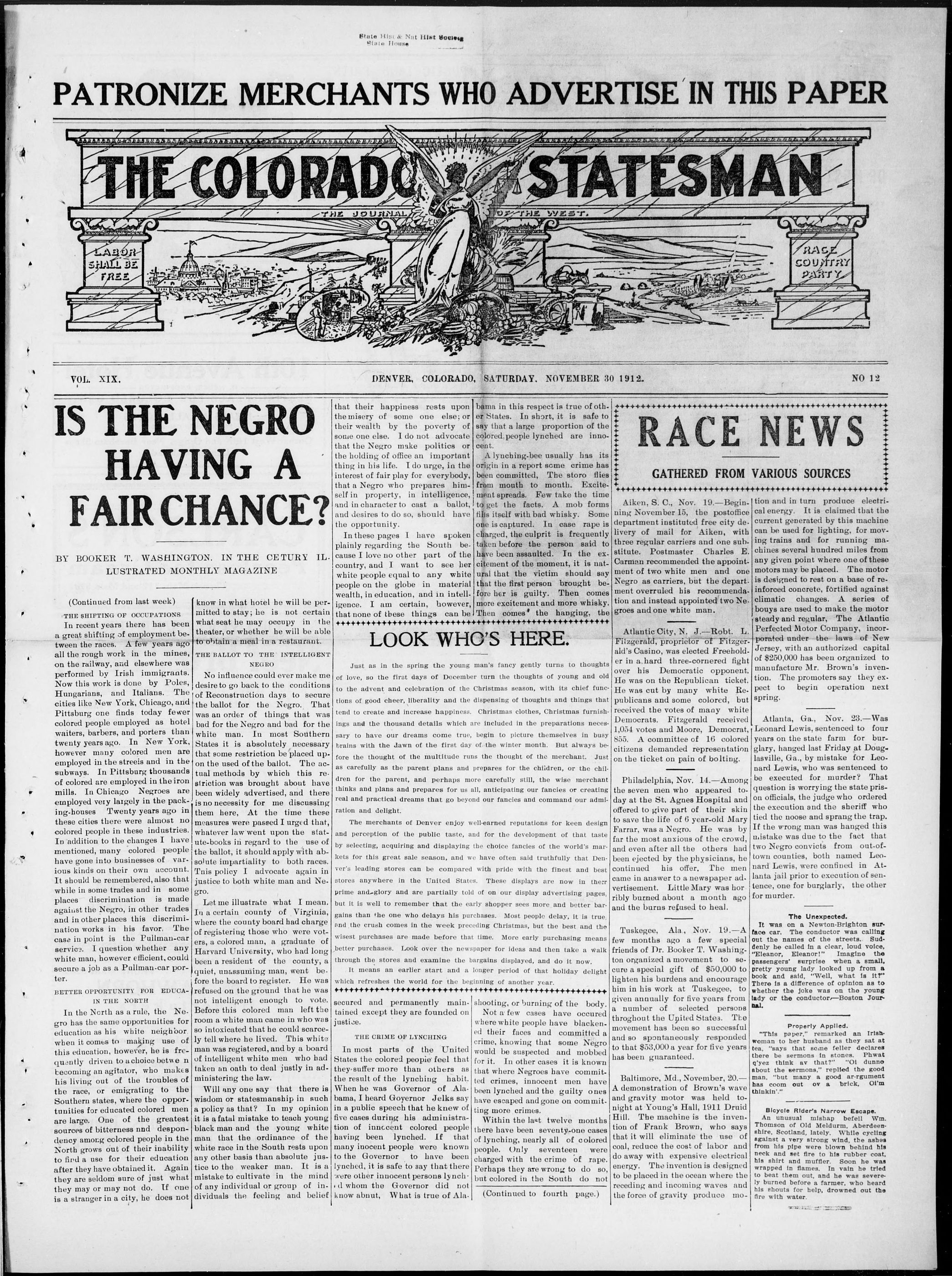
IS THE NEGRO HAVING A FAIR CHANCE?
BY BOOKER T. WASHINGTON. IN THE CETURY IL LUSTRATED MONTHLY MAGAZINE
VOL. XIX.
IS THE
HAV
FAIR C
BY BOOKER T. WASHING
LUSTRATED MON
(Continued from last week)
In recent years there has been a great shifting of employment between the races. A few years ago all the rough work in the mines, on the railway, and elsewhere was performed by Irish immigrants. Now this work is done by Poles, Hungarians, and Italians. The cities like New York, Chicago, and Pittsburg one finds today fewer colored people employed as hotel waiters, barbers, and porters than twenty years ago. In New York, however many colored men are employed in the streets and in the subways. In Pittsburg thousands of colored are employed in the iron mills. In Chicago Negroes are employed very largely in the packing-houses. Twenty years ago in these cities there were almost no colored people in these industries. In addition to the changes I have mentioned, many colored people have gone into businesses of various kinds on their own account. It should be remembered, also that while in some trades and in some places discrimination is made against the Negro, in other trades and in other places this discrimination works in his favor. The case in point is the Pullman-car service. I question whether any white man, however efficient, could secure a job as a Pullman-car porter.
BETTER OPPORTUNITY FOR EDUCA-
IN THE NORTH
In the North as a rule, the Negro has the same opportunities for education as his white neighbor, when it comes to making use of this education, however, he is frequently driven to a choice between becoming an agitator, who makes his living out of the troubles of the race, or emigrating to the Southern states, where the opportunities for educated colored men are large. One of the greatest sources of bitterness and despondency among colored people in the North grows out of their inability to find a use for their education after they have obtained it. Again they are seldom sure of just what they may or may not do. If one is a stranger in a city, he does not
know in what hotel he will be permitted to stay; he is not certain what seat he may occupy in the theater, or whether he will be able to obtain a meal in a restaurant.
THE BALLOT TO THE INTELLIGENT
NEGRO
No influence could ever make me desire to go back to the conditions of Reconstruction days to secure the ballot for the Negro. That was an order of things that was bad for the Negro and bad for the white man. In most Southern States it is absolutely necessary that some restriction be placed upon the used of the ballot. The actual methods by which this restriction was brought about have been widely advertised, and there is no necessity for me discussing them here. At the time these measures were passed I urged that, whatever law went upon the statute-books in regard to the use of the ballot, it should apply with absolute impartiality to both races. This policy I advocate again in justice to both white man and Negro.
Let me illustrate what I mean. In a certain county of Virginia, where the county board had charge of registering those who were voters, a colored man, a graduate of Harvard University, who had long been a resident of the county, a quiet, unassuming man, went before the board to register. He was refused on the ground that he was not intelligent enough to vote. Before this colored man left the room a white man came in who was so intoxicated that he could scarcely tell where he lived. This white man was registered, and by a board of intelligent white men who had taken an oath to deal justly in administering the law.
Will any one say that there is wisdom or statesmanship in such a policy as that? In my opinion it is a fatal mistake to teach young black man and the young white man that the ordinance of the white race in the South rests upon any other basis than absolute justice to the weaker man. It is a mistake to cultivate in the mind of any individual or group of individuals the feeling and belief
DENVER, COLORADO, SATURDAY, NOVEMBER 30 1912.
LOOK WHO'S HERE.
Just as in the spring the young man's fancy gently turns to thoughts of love, so the first days of December turn the thoughts of young and old to the advent and celebration of the Christmas season, with its chief functions of good cheer, liberality and the dispensing of thoughts and things that tend to create and increase happiness. Christmas clothes, Christmas furnishings and the thousand details which are included in the preparations necessary to have our dreams come true, begin to picture themselves in busy brains with the dawn of the first day of the winter month. But always before the thought of the multitude runs the thought of the merchant. Just as carefully as the parent plans and prepares for the children, or the children for the parent, and perhaps more carefully still, the wise merchant thinks and plans and prepares for us all, anticipating our fancies or creating real and practical dreams that go beyond our fancies and command our admiration and delight.
The merchants of Denver enjoy well-earned reputations for keen design and perception of the public taste, and for the development of that taste by selecting, acquiring and displaying the choice fancies of the world's markets for this great sale season, and we have often said truthfully that Denver's leading stores can be compared with pride with the finest and best stores anywhere in the United States. These displays are now in their prime and glory and are partially told of on our display advertising pages, but it is well to remember that the early shopper sees more and better bargains than the one who delays his purchases. Most people delay, it is true, and the crush comes in the week preceding Christmas, but the best and the wisest purchases are made before that time. More early purchasing means better purchases. Look over the newspaper for ideas and then take a walk through the stores and examine the bargains displayed, and do it now.
It means an earlier start and a longer period of that holiday delight which refreshes the world for the beginning of another year.
State Hist. & Nut Hist Society
State House
HANTS WH
ADC
THE JOURNAL
DENVER, COLORADO
that their happiness rests upon the misery of some one else; or their wealth by the poverty of some one else. I do not advocate that the Negro make politics or the holding of office an important thing in his life. I do urge, in the interest of fair play for everybody, that a Negro who prepares himself in property, in intelligence, and in character to cast a ballot, and desires to do so, should have the opportunity.
In these pages I have spoken plainly regarding the South because I love no other part of the country, and I want to see her white people equal to any white people on the globe in material wealth, in education, and in intelligence. I am certain, however, that none of these things can be
Just as in the spring the young of love, so the first days of December to the advent and celebration of the tions of good cheer, liberality and the tend to create and increase happiness, sings and the thousand details which a sary to have our dreams come true, brains with the dawn of the first day fore the thought of the multitude run as carefully as the parent plans and dren for the parent, and perhaps me thinks and plans and prepares for us a real and practical dreams that go beyond ration and delight.
The merchants of Denver enjoy w and perception of the public taste, a by selecting, acquiring and displaying kets for this great sale season, and w ver's leading stores can be compared stores anywhere in the United State prime and glory and are partially told but it is well to remember that the e gains than the one who delays his pur and the crush comes in the week pre wisest purchases are made before that better purchases. Look over the news through the stores and examine the b
It means an earlier start and a which refreshes the world for the be
secured and permanently maintained except they are founded on justice.
THE CRIME OF LYNCHING
In most parts of the United States the colored people feel that they suffer more than others as the result of the lynching habit. When he was Governor of Alabama, I heard Goyernor Jelks say in a public speech that he knew of five cases during his administration of innocent colored people having been lynched. If that many inocent people were known to the Governor to have been lynched, it is safe to say that there were other innocent persons lynched whom the Governor did not know abnut. What is true of Ala-
bama in this respect is true of other States. In short, it is safe to say that a large proportion of the colored people lynched are innocent.
A lynching-bee usually has its origin in a report some crime has been committed. The storo flies from mouth to mouth. Excitement spreads. Few take the time to get the facts. A mob forms filis itself with bad whisky. Some one is captured. In case rape is charged, the culprit is frequently taken before the person said to have been assaulted. In the excitement of the moment, it is natural that the victim should say that the first person brought before her is guilty. Then comes more excitement and more whisky. Then comes the hanging, the
man's fancy gently turns to thoughts
ever turn the thoughts of young and old
Christmas season, with its chief func-
dispensing of thoughts and things that
Christmas clothes, Christmas furnish-
are included in the preparations neces-
tive begin to picture themselves in busy
of the winter month. But always be-
s the thought of the merchant. Just
prepares for the children, or the chil-
ore carefully still, the wise merchant
all, anticipating our fancies or creating
and our fancies and command our admi-
well-earned reputations for keen design
and for the development of that taste
the choice fancies of the world's mar-
have often said truthfully that Den-
with pride with the finest and best
ess. These displays are now in ther-
d of on our display advertising pages,
early shopper sees more and better bar-
chases. Most people delay, it is true,
needling Christmas, but the best and the
at time. More early purchasing means
paper for ideas and then take a walk
argains displayed, and do it now.
Longer period of that holiday delight
beginning of another year.
shooting, or burning of the body.
Not a few cases have occured where white people have blackened their faces and committed a crime, knowing that some Negro would be suspected and mobbed for it. In other cases it is known that where Negroes have committed crimes, innocent men have been lynched and the guilty ones have escaped and gone on committing more crimes.
Within the last twelve months there have been seventy-one cases of lynching, nearly all of colored people. Only seventeen were charged with the crime of rape. Perhaps they are wrong to do so, but colored in the South do not
(Continued to fourth page.)
RACE NEWS
Aiken, S. C., Nov. 19.—Beginning November 15, the postoffice department instituted free city delivery of mail for Aiken, with three regular carriers and one substitute. Postmaster Charles E. Carman recommended the appointment of two white men and one Negro as carriers, but the department overruled his recommendation and instead appointed two Negroes and one white man.
Atlantic City, N. J.—Robt. L. Fitzgerald, proprietor of Fitzgerald's Casino, was elected Freeholder in a hard three-cornered fight over his Democratic opponent. He was on the Republican ticket. He was cut by many white Republicans and some colored, but received the votes of many white Democrats. Fitzgerald received 1,054 votes and Moore, Democrat, 855. A committee of 16 colored citizens demanded representation on the ticket on pain of bolting.
Philadelphia, Nov. 14.—Among the seven men who appeared today at the St. Agnes Hospital and offered to give part of their skin to save the life of 6 year-old Mary Farrar, was a Negro. He was by far the most anxious of the crowd, and even after all the others had been ejected by the physicians, he continued his offer. The men came in answer to a newspaper advertisement. Little Mary was horribly burned about a month ago and the burns refused to heal.
Tuskegee, Ala., Nov. 19.—A few months ago a few special friends of Dr. Booker T. Washington organized a movement to secure a special gift of $50,000 to lighten his burdens and encourage him in his work at Tuskegee, to given annually for five years from a number of selected persons throughout the United States. The movement has been so successful and so spontaneously responded to that $53,000 a year for five years has been guaranteed.
Baltimore, Md., November, 20.—A demonstration of Brown's wave and gravity motor was held tonight at Young's Hall, 1911 Druid Hill. The machine is the invention of Frank Brown, who says that it will eliminate the use of coal, reduce the cost of labor and do away with expensive electrical energy. The invention is designed to be placed in the ocean where the receding and incoming waves and the force of gravity produce mo-
NO 12
tion and in turn produce electrical energy. It is claimed that the current generated by this machine can be used for lighting, for moving trains and for running machines several hundred miles from any given point where one of these motors may be placed. The motor is designed to rest on a base of reinforced concrete, fortified against climatic changes. A series of bouys are used to make the motor steady and regular. The Atlantic Perfected Motor Company, incorporated under the laws of New Jersey, with an authorized capital of $250,000 has been organized to manufacture Mr. Brown's invention. The promoters say they expect to begin operation next spring.
Atlanta, Ga., Nov. 23.—Was Leonard Lewis, sentenced to four years on the state farm for burglary, hanged last Friday at Douglasville, Ga., by mistake for Leonard Lewis, who was sentenced to be executed for murder? That question is worrying the state prison officials, the judge who ordered the execution and the sheriff who tied the noose and sprang the trap. If the wrong man was hanged this mistake was due to the fact that two Negro convicts from out-of-town counties, both named Leonard Lewis, were confined in Atlanta jail prior to execution of sentence, one for burglarly, the other for murder.
The Unexpected.
It was on a Newton-Brighton surface car. The conductor was calling out the names of the streets. Suddenly he called in a clear, loud voice, "Eleanor, Eleanor!" Imagine the passengers' surprise when a small, pretty young lady looked up from a book and said, "Well, what is it?" There is a difference of opinion as to whether the joke was on the young lady or the conductor—Boston Journal.
Properly Applied.
"This paper," remarked an Irish woman to her husband as they sat at tea, "says that some feller declares there be sermons in stones. Phwat q'yez think av that?" "Ol dunno about the sermons," replied the good man, "but many a good ar-gument has coom out ov a brick, Ol'm thinkin'."
Bicycle Rider's Narrow Escape.
An unusual mishap befell Wm Thomson of Old Meldurm, Aberdeen-shire, Scotland, lately. While cycling against a very strong wind, the ashes from his pipe were blown behind his neck and set fire to his rubber coat, his shirt and muffler. Soon he was wrapped in flames. In vain he tried to beat them out, and he was severely burned before a farmer, who heard his shouts for help, drowned out the fire with water.
LATEST NEWS EPITOMIZED
FROM TELEGRAPHIC REPORTS THAT COVER THE WEEK'S EVENTS.
OF MOST INTEREST
KEEPING THE READER POSTED ON MOST IMPORTANT CURRENT TOPICS.
Western Newspaper Union News Service.
Bitten by a large rainbow trout, exSenator E. H. Rands of Vancouver, Wash., is suffering from an infection on his hands.
The state constitutional amendment for a modified single tax in Missouri was defeated at the recent election by a majority of 421,000.
Ethel Smith, for whom Billy Rugh, Gary's newsboy, sacrificed his life, left the hospital at Gary, Ind., and returned to her home.
The sixteenth annual convention of the California Miners' Association will be held at San Francisco during the 9th, 10th and 11th of December.
The funeral of John T. Brush, president of the New York National League Club, was held at the home of his daughter, Mrs. Harry Newton Hempsted, in Indianapolis.
Chicago claims to possess in Ethel Pearl Morgan, age nineteen, the most nearly physically perfect woman in the country and challenge the Michigan and Massachusetts champions.
Hundreds of square miles in northwestern Nabraska and southern South Dakota lies in barren waste following one of the most disastrous prairie fires that ever swept the western plains.
Lucile Cameron, whose association with Jack Johnson led to the pugilist's arrest for alleged violation of the Mann white slave act, was released from custody in Chicago in bonds of $1,000.
The recall of all elective officers, save the judiciary, the initiative and referendum and other constitutional change submitted at the recent election in Idaho apparently have carried by a large majority.
Four Chinese girls, dressed in men's clothes, who had been smuggled across the Pacific in the hold of the Nippon Maru, were borne shrieking and hysterical through the San Francisco streets to the office of the surveyor of the port.
An explosion which wrecked the dry starch house of the Corn Products Company's plant at Waukegan, Ill., killed between eight and twelve workmen and injured twenty-seven others, several of whom will die, and caused about $100,000 property damage.
Lucile Cameron, whose infatuation for Jack Johnson started a long series of misfortunes for the black fighter in Chicago, says she has been cured, and believes it would be a good thing for any girl who believes she is in love to be immured in prison for thirty days to think the matter over and see if she is not mistaken. Her mother believes they will be unmolested in the south, as she says Johnson would not dare follow them below the Ohio river.
WASHINGTON.
With the beginning of the next session of Congress, the Senate finds itself only temporarily provided with a presiding officer.
Senator Works of California will introduce a resolution in Congress for an amendment to the constitution providing for the election of the President and vice president by direct vote of the people.
Rumors that Secretary Meyer of the navy department was about to resign, which were in active circulation in Washington, brought an emphatic denial from the secretary himself at the conclusion of a cabinet meeting.
No currency reform legislation will be attempted at the coming session of Congress, it was decided at an informal conference of the Democratic members of the sub-committee of the House banking and currency committee, headed by Representative Glass of Virginia.
Funeral services for Senator Isidor Rayner of Maryland, who died in Washington of neuritis after a protracted illness, were held at the Rayner home. The service was conducted by the Rev. U. G. B. Pierce, chaplain of the Senate and President Taft's pastor, assisted by Rev. Charles Wood of the Church of the Covenant in Washington. The interment was in Rock Creek cemetery. Senator Rayner was sixty-two and had been in the Senate eight years.
Less than $1,000,000 is the antici- pated total of the expenditures of the Republican national committee, which will be reported to Congress. For the first time in the history of the United States, Northern Democrats will outnumber Southern Democrats in the next House of Representatives. Miss Sophie B. Kent of Providence, R. L., and Miss Laira B. Cooper of Baltimore have been admitted to practice before the supreme court of the United States. Congress convened December 2.
FOREIGN.
The Servians have occupied Ochrida, in Albania, without resistance.
The birth rate of France was lower by more than 100,000 in 1911 than in 1901.
The Chinese government troops under Prince Pohti, a loyal Mongolian, captured the city of Uliassutai, Mongolia, after a two days' battle, according to a Peking dispatch.
The danger of a greater war than that between the Balkan states and Turkey absorbs public interest far more than the first bout of diplomacy between the belligerents.
The Turks, declaring Adrianople can hold out another month and that the Chatalja defenses are impregnable, are drifting toward the triple alliance, which increases danger of a general war.
President-elect Wilson suffered from a slight attack of indigestion, which compelled him to decline an invitation to take a sail on the private yacht of Sir George Bullock, the governor at Hamilton, Bermuda. Mrs. Wilson and her daughters accepted.
The extreme anxiety manifested by all European powers to deny reports of warlike preparations and to represent the political situation as peaceful and satisfactory is in itself an indication on how slender a thread the issues of peace and war in Europe now hang.
SPORT.
McGinnis, fullback on this year's University of Iowa football team, was elected captain of the 1913 team.
"Knockout" Brown of New York, and Phil Brock of Cleveland, fought twelve rounds to a draw at Indianapolis.
"Heinie" Zimmerman, third baseman of the Chicago team, leads the National league batsmen for the season 1912.
Horace Fogel, President of the Philadelphia National League Baseball Club, tendered his resignation to the National League magnates, in session at New York.
John T. Brush, president of the New York Nationals, died in his private car Oceanic at Louisiana, Mo. He was on has way west for his health. He had suffered for years from locomotor ataxia.
A movement was launched at Los Angeles to form a syndicate to finance the building of a yacht to represent Los Angeles in the cup defender race against Sir Thomas Lipton's Shamrock in San Francisco in 1915.
The Crimson triumphed over the Blue on Yale field at New Haven when Harvard's eleven, taking advantage of Yale's back-field errors, made two touchdowns and two field goals, and rolled up a score of 20 to 0 over their ancient football rivals. The victory carries the football championship of the East to Cambridge.
GENERAL.
Burton W. Gibson, the lawyer on trial at Goshen, N. Y., for the murder of Countess Rosa Szabo, is on the verge of collapse.
A flurry in the New York money market set the rate for call loans up to twelve per cent., the highest figure since the early part of 1910.
Margaret Schroeder, a pretty 19-year-old girl, was shot and killed in New York by her sweetheart, Michael Grasso, 31 years old, who attempted suicide.
Charger, former President McKinley's riding horse, met a violent death on the farm of Albert Lewis, at Strasburg, Ohio. He became entangled in a wire fence and strangled.
Governor Mann of Richmand, Va., granted Floyd and Claude Allen a respite until December 13. They were sentenced to death November 22 for the Hillsville court house murders.
The universe is well, according to a sweeping diagnosis of affairs which Andrew Carnegie made in a genial philosophical mood on his seventy-seventh birthday at New York. A 17-year-old boy has been sentenced to attend Sunday school until he reaches the voting age, by the terms of a decision of County Judge Fawcett in the County Court, Brooklyn, N. Y.
"Not guilty" is the verdict of the jury in the case of Joseph J. Ettor, Arturo Glovannitti and Joseph Caruso for the murder of Anna Lopizzo, who was killed in the Lawrence, Mass., textile strike riot last winter.
Gyp the Blood, Whitey Lewis, Lefty Louis and Dago Frank, the gunmen convicted of the murder of Herman Rosenthal, were sentenced by Justice Goff to die in the electric chair at Sing Sing, New York, during the week of January 6.
William P. Jackson, member of the Republican national committee, will be appointed Senator Rayner's successor, it is believed, although Governor Goldsborough of Maryland said he would not consider the matter until after the funeral.
What is declared by officers and delegates one of the most successful conventions ever held by the National American Woman's Suffrage Association, came to an end at Philadelphia after the adoption of resolutions on several important subjects.
While dreaming the building was afire Mrs. Ida Radith walked through a window on the ninth floor of the Orleans apartment house in New York, fell seven stories to the steel wire grating over the office skylight, and escaped without any serious injury.
COLORADO STATE NEWS
Western Newspaper Union News Service.
DATES FOR COMING EVENTS.
January 20-25—Eighth Annual Western Stock Show—Denver.
The Johnstown waterworks have been completed.
A. C. Rowland, aged 30, shot and killed himself in the Abbott hotel in Denver.
John Clark, a coal miner, aged 55, was found dead in his bedroom at Frederick.
Newton French, aged 80, died at his home in Pinewood, twelve miles west of Loveland.
The railroad pass in Colorado will be abolished on January 1, 1913, declare Denver railroad officials.
The Colorado Library Association held its annual convention in the lecture room of the Denver public library.
The forty-two Jewish organizations of Denver are to federate into one central body for charitable purposes. The funerals of A. D. Wilson and Thomas Hamilton Simonton, two of Colorado's earliest settlers, were held in Denver. Numerous campaign expense statements by various candidates for the election November 5, are being filed with the secretary of state. Miss Alma Culver has resigned as teacher in the State Preparatory School at Boulder to become the bride of Fred Anderson of Denver. By a recent ruling of the state Supreme Court in a bootlegging case appealed from Lamar, the Municipal Court of Grand Junction can no longer try bootleggers.
John Goldsby, a Mesa county pioneer, was married to Mrs. Alva Marshall of Glenwood Springs. Goldsby came here in 1882 and amassed a fortune in the cattle business.
Breaking into the Wild Horse mill on Bull hill, at Cripple Creek, burglarars robbed the filter boxes of zinc precipitates used for taking up gold from cyanide, valued at $600.
That Knights Templar, Masons their families and friends numbering 100,000 will be in Denver next August is believed by Chairman George W Vallery of the triennial conclave committee.
Mrs. Emma D. Adams, 74 years old, prominent in lodge circles and a resident of Boulder county for more than twenty-five years, was stricken with apoplexy at Boulder and died immediately.
Although pinned beneath his auto in the bottom of an irrigation ditch, where he lay unconscious for an hour, Jasper Loomis, a young man of Fort Collins, escaped with only a few cuts and bruises.
Miss Harriet Scott, a 17-year-old lass of Kendrick, Lincoln county, and Bert Millhouse, aged 26 years, of Ordway, were married at the office of Justice of the Peace John S. Conard, 11 Olney Springs.
George Zeigler, the crippled elevator pilot who stabbed and killed Ray Sahrbreck, was held for the crime, a Denver coroner's jury holding that Zeigler had stabbed Sahrbeck "with feculous intent."
In dollars and cents it cost the Democratic state central committee $21,141.88 at the recent election. George Bradley, state chairman, filed his campaign expense affidavit with the secretary of state.
Two hundred members of the Progressive party in a state meeting resolved unanimously that the party's integrity should be maintained and that the work of the organization in Colorado should be enlarged.
A foreclosure sale of $101,000 worth of first mortgage bonds of the La Plata Land and Irrigation Company in Denver brought to light a deal for coal lands in the vicinity of Durango valued at $3,000,000 to $5,000,000.
Mrs. Dona Barros, 78, who was attacked by Jose Romero with an axed at Boulder from her wounds. She expired in her son's arms without having regained consciousness. Romeres in jail at Walsenburg, charged with murder.
The Denver auditorium will become a municipal dance hall December 15 On and after that date weekly dances will be held at a nominal admission price—just enough to pay for fuel light, music and janitor service. The "turkey trot" and all ragtime dances will be barred.
Commissioner F. W. Maxwell of the Colorado Manufacturers' Association traffic bureau of the Denver Chamber of Commerce, and Attorney W. L. Dayton are preparing arguments to present in Washington, D. C., December 11, before the Interstate Commerce Commission upon the association's recent application for a general reduction in freight rates between Denver and all points east of the Missouri river.
A warning to girls not to allow their boy sweethearts to spend too much money in their entertainment and to accept no jewelry except from their fiances, was given by the Rev. C. F. Seitter of the First Methodist church at Grand Junction.
After a search extending through out the west, which covered more than 15,000 miles, Earl C. Willett formerly a business man of Pueblo but now a resident of British Columbia, claims to have found his 7-year old son, kidnapped from his two years ago in Pueblo.
COUNTIES GET SHARE OF MONEY RECEIVED FROM GOVERNMENT
Proceeds of $53,759.07 Check From National Treasury Distributed By Governor.
Western Newspaper Union News Service.
Denver.—Governor Shafroth has received from the secretary of the United States treasury a check for $53,759.07, the state's share of the proceeds from sales and rental of government land in Colorado. The total will be apportioned to the different counties according to the pro rata number of acres of government land therein. The different forest reserves will be credited, as follows:
Arapahoe . . . $ 964.10
Battlement . . . 2,830.24
Cochetopa . . . 2,995.10
Colorado . . . 832.55
Durango . . . 1,758.97
Granvillea . . . 3,093.94
Hayden . . . 727.37
Holy Cross . . . 2,381.38
La Salle . . . 169.10
Leadville . . . 6,937.69
Moritzuma . . . 2,499.74
Pike . . . 3,864.29
Rio Grande . . . 6,097.33
Routt . . . 3,007.93
San Isabel . . . 1,136.28
San Juan . . . 5,097.30
Sopris . . . 2,524.92
Uncompahgre . . . 3,652.69
White River . . . 2,634.50
Total . . . $53,759.07
Asks Judgment For Two Millions.
Colorado Springs.—Attorneys for J. G. Hollingsworth of Kansas City have filed a motion in the District Court asking that judgment for $2,000,000 be entered in his favor against Edward P. Tufts of New York, in accordance with the recent findings of Referee Collins that Hollingsworth is entitled to one-half of Tuft's stock in Mexican mining companies by virtue of a grub stake contract.
Probably Never Run Home.
Denver,—"The cost of food has nothing to do with the high cost of living," says Miss Ednah A. Rich, president of the California State Normal School of Manual Arts and Home Economics, who came to Denver to tell the Colorado Teachers' Association about her work. "The sole cause of the high cost of living is waste. The average housewife is to blame. She doesn't know how to manage her home."
Tn-Dollar-a-Week Man Sells Ranch.
Grand Junction—John Carr, a cattleman of Be De Beque, who left a $10 per week job in New York to take up a homestead on Roan creek, above Be De Beque, eighteen years ago, sold his 460-acre ranch for $60,000 to cattlemen. He has averaged $3,000 per year profit from working his ranch.
Robbed and Beaten By Partner; Dying
Creede.—M. E. Allen, aged 17, of
Jackson, Mich., was robbed of $25 and
seriously beaten by his partner, Philip
Pasquale, 17, of Silver Creek, N. Y.,
according to Pasquale's confession
made to the police. Physicians express
doubt as to Allen's recovery.
Pasquale is in jail.
Mesa Court House Funds Raised.
Grand Junction.—Work on a new
$75,000 county court house will be
started next year. The county commissioners have provided a one-mill
levy for the building every year since
1909, and by next year there will be
nearly enough money on hand to complete the building.
Carnegie Position for Dr. Slocum
Carnegie Position for Dr. Slocum.
Colorado Springs—Dr. William F. Slocum, president of Colorado College, has received a signal honor from the trustees of the Carnegie Foundation for the Advancement of Learning Fund, he being selected vice chairman of the board in place of David Starr Jordan, of Leland Stanford University.
Expect Big Prize For Beet Puller.
Fort Collins.-Samuel Jackson has invented a beet puller and topper with which he hopes to win the $10,000 prize offered a year ago by the Great Western Sugar Company. The machine pulls, tops and loads beets into wagons.
County Agriculturist Named.
Beaver Park.—W. H. Lauck, a landowner here, has been appointed agriculturist for El Paso county, adjoining Fremont county, where Beaver Park is located. There will be a series of farmers' institutes under his supervision soon.
Plans $50,000 Residence.
Colorado Springs.—D. Bryant Turner of Denver, millionaire polo player, society leader and business man, is having plans drawn for a $50,000 resilience to be erected on a ten-acre tract in fashionable Broadmoor.
Mayor Raids Poker Game; Arrests Six Palisade.—Mayor Herman Kluge took the law into his own hands, raided a "private" game of draw poker, and placed six then under arrest.
Throat Slashed: Recovers.
Denver.—Harry Martin, whose throat, 'it is alleged, was cut by his sweetheart in a quarrel in a restaurant, will recover, according to physicians. Grace Martin, charged with naving wielded the razor, is being held.
Drake On Blind Board.
Denver.—Governor Shafroth has appointed Thomas Drake of Denver a member of the board of trustees of the state workshop for the blind.
The
Curtis
Park
Floral
Company
FLORAL DESIGNS PUT UP WHILE
YOU WAIT
CHOICE PLANTS AND CUT FLOWERS CONSTANTLY
ON HAND
GREENHOUSES: Thirty-Fourth and Curtis Streets
TELEPHONE, MAIN 1511
DENVER, COLG
10th Avenue Hotel
Corner West 10th and Osage, Near Burnham Shops Denver, Colorado
ASK FOR CARLSON'S Peerless Ice Cream Phones: Main 112 and Main 5787
DID YOU EVER TRY Neef Bros.' Beer?
It's made right, and tastes right. None better made anywhere and This is a Strictly Colorado Production
Meats, Fancy and Staple Groceries
WINES, LIQUORS AND CIGARS
1644-46-48-50 LARIMER STREET.
PHONE MAIN 1053
DENVER, COLO.
Western agents for Minneapolis Grain Belt Beer and Carnegie Porter,
Pripps Imported Beer and Bock Ol.
A first-class Mortuary establishment. First aid to the bereaved in the time of death of loved ones. Prices below competitors. Polite service LAWRENCE JONES, Licenced Embalmer LOUIS HUBBARD, Funeral Director PARLORS 1925 Arapahoe Street
LET US WASH YOUR
Shirts, Collars and Cuffs, Blankets, Curtains and Rough Dry Work. The Denver Sanitary Laundry. PHONE MAIN 5670
PHONE MAIN 3028
JOH
Meats, Fane
Corner Nineteenth.
BE SURE AN TRY IT.
RES. PHONE GALLUP 942
IN K. RETT
cy and Staple
RETTIG Staple Groceries STREET
1864 CURTIS STREET
Denver, Colo.
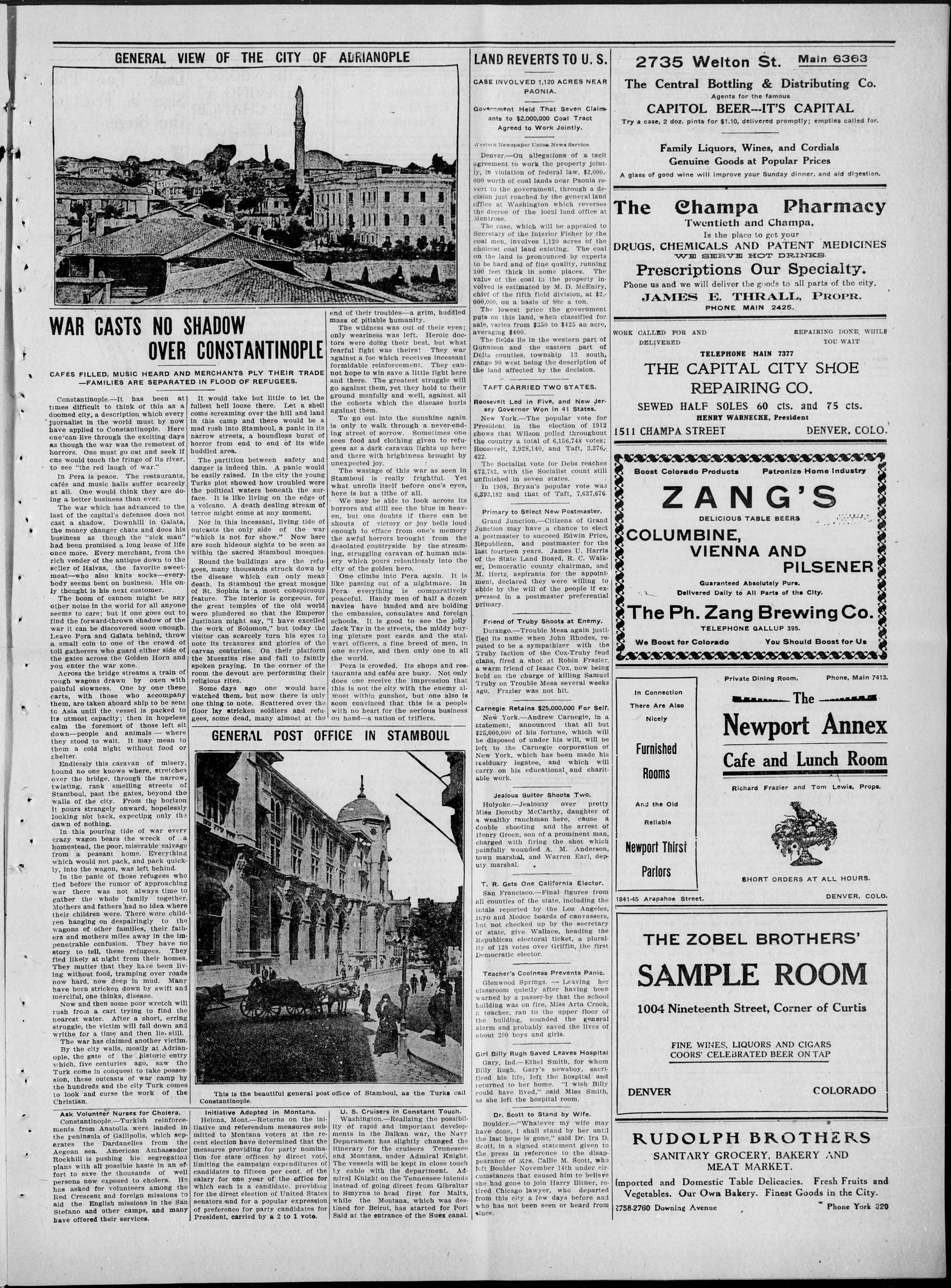
GENERAL VIEW OF THE CITY OF ADRIANOPLE
ALBANIA
WAR CASTS NO SHADOW OVER CONSTANTINOPLE
CAFÉS FILLED, MUSIC HEARD AND MERCHANTS PLY THEIR TRADE —FAMILIES ARE SEPARATED IN FLOOD OF REFUGEES.
Constantinople. It has been at times difficult to think of this as a doomed city, a description which every journalist in the world must by now have applied to Constantinople. Here one can live through the exciting days as though the war was the remotest of horrors. One must go out and seek if one would touch the fringe of its river, to see "the red laugh of war."
In Pera is peace. The restaurants, cafés and music halls suffer scarcely at all. One would think they are doing a better business than ever.
It would take but little to let the fullest hell loose there. Let a shell come screaming over the hill and land in this camp and there would be a mad rush into Stamboul, a panic in its narrow streets, a boundless burst of horror from end to end of its wide huddled area.
The partition between safety and danger is indeed thin. A panic would be easily raised. In the city the young Turks plot showed how troubled were the political waters beneath the surface. It is like living on the edge of
The war which has advanced to the last of the capital's defenses does not cast a shadow. Downhill in Galata, the money changer chats and does his business as though the "sick man" had been promised a long lease of life once more. Every merchant, from the rich vender of the antique down to the seller of Halvas, the favorite sweetmeat—who also knits socks—everybody seems bent on business. His only thought is his next customer.
The boom of cannon might be any other noise in the world for all anyone seems to care; but if one goes out to find the forward-thrown shadow of the war it can be discovered soon enough. Leave Pera and Galata behind, throw a small coin to one of the crowd of toll gatherers who guard either side of the gates across the Golden Horn and you enter the war zone.
Across the bridge streams a train of rough wagons drawn by oxen with painful slowness. One by one these carts, with those who accompany them, are taken aboard ship to be sent to Asia until the vessel is packed to its utmost capacity; then in hopeless calm the foremost of those left sit down—people and animals—where they stood to wait. It may mean to them a cold night without food or shelter.
Endlessly this caravan of misery, bound no one knows where, stretches over the bridge, through the narrow, twisting, rank smelling streets of Stamboul, past the gates, beyond the walls of the city. From the horizon it pours strangely onward, hopelessly looking not back, expecting only the dawn of nothing.
In this pouring tide of war every crazy wagon bears the wreck of a homestead, the poor, miserable salvage from a peasant home. Everything which would not pack, and pack quickly, into the wagon, was left behind. In the panic of those refugees who fled before the rumor of approaching war there was not always time to gather the whole family together. Mothers and fathers had no idea where their children were. There were children hanging on despairingly to the wagons of other families, their fathers and mothers miles away in the impenetrable confusion. They have no story to tell, these refugees. They fled likely at night from their homes. They mutter that they have been living without food, tramping over roads now hard, now deep in mud. Many have been stricken down by swift and merciful, one thinks, disease.
Now and then some poor wretch will rush from a cart trying to find the nearest water. After a short, erring struggle, the victim will fall down and writhe for a time and then lie still. The war has claimed another victim. By the city walls, mostly at Adrianople, the gate of the historic entry which, five centuries ago, saw the Turk come in conquest to take possession, these outcasts of war camp by the hundreds and the city Turk comes to look and curse the work of the Christian.
Ask Volunteer Nurses for Cholera.
Constantinople.—Turkish reinforcements from Anatolia were landed in the peninsula of Gallipolis, which separates the Dardanelles from the Aegean sea. American Ambassador Rockhill is pushing his segregation plans with all possible haste in an effort to save the thousands of well persons now exposed to cholera. He has asked for volunteers among the Red Crescent and foreign missions to aid the English missions in the San Stefano and other camps, and many have offered their services.
GENERAL POST OFFICE IN STAMBOUL
THE MUSEUM OF THE HISTORY OF CAMPAIGNING IN THE WORLD
This is the beautiful general post office of Stamboul, as the Turks call Constantinople.
It would take but little to let the fullest hell loose there. Let a shell come screaming over the hill and land in this camp and there would be a mad rush into Stamboul, a panic in its narrow streets, a boundless burst of horror from end to end of its wide huddled area.
The partition between safety and danger is indeed thin. A panic would be easily raised. In the city the young Turks plot showed how troubled were the political waters beneath the surface. It is like living on the edge of a volcano. A death dealing stream of terror might come at any moment.
Nor in this incessant, living tide of outcasts the only side of the war "which is not for show." Now here are such hideous sights to be seen as within the sacred Stamboul mosques.
Round the buildings are the refugees, many thousands struck down by the disease which can only mean death. In Stamboul the great mosque of St. Sophia is a most conspicuous feature. The interior is gorgeous, for the great temples of the old world were plundered so that the Emperor Justinian might say, "I have excelled the work of Solomon," but today the visitor can scarcely turn his eyes to note its treasures and glories of the carvan centuries. On their platform the Muezzins rise and fall to faintly spoken praying. In the corner of the room the devout are performing their religious rites.
Some days ago one would have watched them, but now there is only one thing to note. Scattered over the floor lay stricken soldiers and refugees, some dead, many almost at the
GENERAL POST OF
This is the beautiful general post
Constantinople.
Initiative Adopted in Montana.
Helena, Mont.—Returns on the initiative and referendum measures submitted to Montana voters at the recent election have determined that the measures providing for party nomination for state offices by direct vote, limiting the campaign expenditures of candidates to fifteen per cent. of the salary for one year of the office for which each is a candidate, providing for the direct election of United States senators and for a popular expression of preference for party candidates for President, carried by a 2 to 1 vote.
end of their troubles—a grim, huddled mass of pitilable humanity.
The wildness was out of their eyes; only weariness was left. Heroic doctors were doing their best, but what fearful fight was theirs! They war against a foe which receives incessant formidable reinforcement. They cannot hope to win save a little fight here and there. The greatest struggle will go against them, yet they hold to their ground manfully and well, against all the cohorts which the disease hurls against them.
To go out into the sunshine again is only to walk through a never-ending street of sorrow. Sometimes one sees food and clothing given to refugees as a dark caravan lights up here and there with brightness brought by unexpected joy.
The wastage of this war as seen in Stamboul is really frightful. Yet what unrolls itself before one's eyes, here is but a tithe of all.
We may be able to look across its horrors and still see the blue in heaven, but one doubts if there can be shouts of victory or joy bells loud enough to efface from one's memory the awful horrors brought from the desolated countryside by the streaming, struggling caravan of human misery which which relentlessly into the city of the golden hero.
One climbs into Pera again. It is like passing out of a nightmare. In Pera everything is comparatively peaceful. Handy men of half a dozen navies have landed and are holding the embassies, consulates and foreign schools. It is good to see the jolly Jack Tar in the streets, the mildy buying picture post cards and the stalwart officers, a fine breed of men, in one service, and then only one in all the world.
Pera is crowded. Its shops and restaurants and cafes are busy. Not only does one receive the impression that this is not the city with the enemy almost within gunshot, but one also is soon convinced that this is a people with no heart for the serious business on hand—a nation of triflers.
OFFICE IN STAMBOUL
Post office of Stamboul, as the Turks call
U. S. Cruisers in Constant Touch. Washington.—Realizing the possibility of rapid and important developments in the Balkan war, the Navy Deparment has slightly changed the itinerary for the cruisers Tennessee and Montana, under Admiral Knight. The vessels will be kept in close touch by cable with the department. Admiral Knight on the Tennessee intends instead of going direct from Gibraltar to Smyrna to head first for Malta, while the Montana, which was destined for Beirut, has started for Port Said at the entrance of the Suez canal.
LAND REVERTS TO U. S.
CASE INVOLVED 1,120 ACRES NEAR PAONIA.
Government Held That Seven Claimants to $2,000,000 Coal Tract Agreed to Work Jointly.
Denver.—On allegations of a tacit agreement to work the property jointly, in violation of federal law, $2,000,000 worth of coal lands near Paonia revert to the government, through a decision just reached by the general land office at Washington which reverses the decree of the local land office at Montrose.
The case, which will be appealed to Secretary of the Interior Fisher by the coal men, involves 1,120 acres of the choicest coal land existing. The coal on the land is pronounced by experts to be hard and of fine quality, running 100 feet thick in some places. The value of the coal in the property involved is estimated by M. D. McEniry, chief of the fifth field division, at $2,000,000, on a basis of 80c a ton.
The lowest price the government puts on this land, when classified for sale, varies from $250 to $425 an acre, averaging $400.
The fields lie in the western part of Gunnison and the eastern part of Delta counties, township 13 south, range 90 west being the description of the land affected by the decision.
TAFT CARRIED TWO STATES.
Roosevelt Led in Five, and New Jer-
sey Gov. George W. in 41 States.
sey Governor Won in 41 States.
New York—The popular vote for President in the election of 1912 shows that Wilson polled throughout the country a total of 6,156,748 votes; Roosevelt, 3,928,140, and Taft, 3,376,422.
The Socialist vote for Debs reaches 673,783, with the Socialist count still unfinished in seven states.
In 1908, Bryan's popular vote was 6,393,182 and that of Taft, 7,637,676.
Primary to Select New Postmaster.
Grand Junction.—Citizens of Grand Junction may have a chance to elect a postmaster to succeed Edwin Price, Republican, and postmaster for the last fourteen years. James U. Harris of the State Land Board, R. C. Walker, Democratic county chairman, and M. Hertz, aspirants for the appointment, declared they were willing to abide by the will of the people if expressed in a postmaster preferential primary.
Friend of Truby Shoots at Enemy.
Durango.—Trouble Mesa again justified its name when John Rhodes, reputed to be a sympathizer with the Truby faction of the Cox-Truby feud clans, fired a shot at Robin Frazier, a warm friend of Isaac Cox, now being held on the charge of killing Samuel Truby on Trouble Mesa several weeks ago. Frazier was not hit.
Carnegie Retains $25,000,000 For Self.
New York.—Andrew Carnegie, in a statement, announced that all but $25,000,000 of his fortune, which will be disposed of under his will, will be left to the Carnegie corporation of New York, which has been made his residuary legatee, and which will carry on his educational, and charitable work.
Jealous Sultor Shoots Two.
Holyoke.—Jealousy over pretty Miss Dorothy McCarthy, daughter of a wealthy ranchman here, cause a double shooting and the arrest of Henry Green, son of a prominent man, charged with firing the shot which painfully wounded A. M. Anderson, town marshal, and Warren Earl, deputy marshal.
T. R. Gets One California Elector.
San Francisco.—Final figures from all counties of the state, including the totals reported by the Los Angeles, inyo and Modoc boards of canvassers, but not checked up by the secretary of state, give. Wallace, heading the Republican electoral ticket, a plurality of 128 votes over Griffin, the first Democratic elector.
Teacher's Coolness Prevents Panic.
Glenwood Springs. — Leaving her classroom quietly after having been warned by a passer-by that the school building was on fire, Miss Arta Crook, a teacher, ran to the upper floor of the building, sounded the general alarm and probably saved the lives of about 200 boys and girls.
Girl Billy Rugh Saved Leaves Hospital Gary, Ind.—Ethel Smith, for whom Billy Rugh, Gary's newsboy, sacrificed his life, left the hospital and returned to her home. "I wish Billy could have lived," said Miss Smith, as she left the hospital room.
Dr. Scott to Stand by Wife.
Boulder.—"Whatever my wife may have done, I shall stand by her until the last hope is gone," said Dr. Ira D. Scott, in a signed statement given to the press in reference to the disappearance of Mrs. Callie M. Scott, who left Boulder November 14th under circumstances that caused him to believe she had gone to join Harry Bitner, retired Chicago lawyer, who departed from this city a few days before and who has not been seen or heard from since.
2735 Welton St. Main 6363 The Central Bottling & Distributing Co. Agents for the famous
Family Liquors, Wines, and Cordials Genuine Goods at Popular Prices A glass of good wine will improve your Sunday dinner, and aid digestion.
The Champa Pharmacy
Twentieth and Champa,
Is the place to get your
DRUGS, CHEMICALS AND PATENT MEDICINES
WE SERVE HOT DRINKS.
Prescriptions Our Specialty.
Phone us and we will deliver the goods to all parts of the city.
JAMES E. THRALL, PROPR.
PHONE MAIN 2425.
WORK CALLED FOR AND DELIVERED
THE CA
RE
SEWED HALF
HE
1511 CHAMPA STR
Boost Colorado P
ZA
DE
COLUMBIA
VI
1511 CHAMPA STREET DENVER, COLO.
Guaranteed Absolutely Pure. Delivered Daily to All Parts of the City.
The Ph. 2
We Boost for Colo
Ph. Zang Brewing
TELEPHONE GALLUP 395.
st for Colorado You Should Boo
Private Dining Room.
The
Newport A
Cafe and Lunch
Richard Frazier and Tom
Furnished
Rooms
And the Old
Reliable
Newport Thirst
Parlors
SHORT ORDERS AT AL
hoe Street.
THE ZOBEL BROTHE
AMPLE ROO
Nineteenth Street, Corner of
THE ZO
SAM
1004 Ninetee
1004 Nineteenth Street, Corner of Curtis
FINE WINES, LIQUORS AND CIGARS COORS' CELEBRATED BEER ON TAP
RUDOLF
SANITARY
Imported and Dome
Vegetables. Our O
2758-2760 Downing Aver
RUDOLPH BROTHERS
SANITARY GROCERY, BAKERY AND MEAT MARKET. Imported and Domestic Table Delicacies. Fresh Fruits and Vegetables. Our Own Bakery. Finest Goods in the City. 2758-2760 Downing Avenue Phone York 320
In Connection There Are Also Nicely
DENVER
REPAIRING DONE, WHILE
YOU WAIT
N 7377
CITY SHOE
G CO.
cts. and 75 cts.
, President
DENVER, COLO.
Patronize Home Industry
G'S
BEERS
AND
PILSENER
Brewing Co.
LUP 395.
You Should Boost for Us
ing Room. Phone, Main 7413.
The
port Annex
and Lunch Room
razier and Tom Lewis, Props.
THE FLOWER BOW
ROTHERS'
ROOM
Corner of Curtis
ROTHERS
BAKERY AND
TICKET.
Delicacies. Fresh Fruits and
Finest Goods in the City.
Phone York 320
DENVER, COLO.
COLORADO
THE COLORADO STATESMAN
JOS. D. D. RIVERS.....Proprietor
1524 Curtis Street, Room 25.
JOS. L. D. RIVERS.....Proprietor
1524 Curtis Street, Room 25.
SUBSCRIPTION RATES:
One Year ..... $2.00
Six Months ..... 1.00
Three Months ..... .60
PAYABLE IN ADVANCE.
PAYABLE IN ADVANCE
pass matter at the postoffice
lines or less, 10 cents per square.
cents per square. A square
less than three months' cost
less unknown to us. Further
made by Express Money
for Bank Draft. Postage s
national part of a dollar. Only
of a personating nature th
columns of this paper.
receive attention must be n
upon one side of the paper
less than Wednesdays, and
turned, unless stamps are
that papers sent to suit
any number when due, in
and a duplicate of the missi
should remember that w
at surveillance of members
that we place on true w
writes, be guilty of any misc
the presence of feminine
should. We should esche
quiet, gentleman-like way
for our own people begets
Entered as second-class matter at the postoffice in the city of Denver, Colorado.
Reading notices, ten lines or less, 10 cents per line. Each additional line over ten lines, 5 cents per line.
Display advertising, 25 cents per square. A square contains ten agate lines.
No discounts allowed on less than three months' contract. Cash must accompany all orders from parties unknown to us. Further particulars on application.
Remittances should be made by Express Money Order, Postoffice Money Order, Registered Letter or Bank Draft. Postage stamps will be received the same as cash for the fractional part of a dollar. Only 1-cent and 2-cent stamps taken.
All communications of a personating nature that are not complimentary will be withheld from the columns of this paper.
Communications to receive attention must be newsy, upon important subjects, plainly written only upon one side of the paper; must reach us Tuesdays, if possible, anyway, not later than Wednesdays, and bear the signature of the author. No manuscript returned, unless stamps are sent for postage.
It occasionally happens that papers sent to subscribers are lost or stolen. In case you do not receive any number when due, inform us by postal card and we will cheerfully forward a duplicate of the missing number.
The men of our race should remember that when they are in the public places, under the constant surveillance of members of other races, who seek to ascertain the premium that we place on true womanhood among us. We should not, in public places, be guilty of any misconduct, or violation of the rules of polite society in the presence of feminine members of our race, any more so than a white man should. We should eschew all vulgar expressions and deport ourselves in a quiet, gentleman-like way. Self-respect insures general respect, and respect for our own people begets the respect of others.
THE ELECTION OVER
The election is over, and while a history to many, the will of the people they want, and it remains to be seen. The normal condition of business wition, nor will it be as the results of it of the people.
That terse problem, of such univ. ment, which swept so many matheme. ordinary students the nightmare, a clearly outclassed by the present du. the high cost of living.
In spite of the many official inv. individual dissertations contributed o. logicians and statisticians, the query. and the many-sided arguments goes.
We had something to say on the tion we took, putting the matter up. great majority of the leaders of the tide of argument has not been stemmed determined to prove that the extrav. of their suffering, and one ungallant declared that the very heart and man of our women to bedock themselves queens, while other women (poor this best cuts of meat and the highest possible to satisfactorily supply the.
This is all foolish and unfair arg. to get back at those who make it. sells every particle of flesh and tissue bone, hide and hair that is convertible than he got a few years ago; and r. gristle and whit-leather, chuck roast which thousands of tables can afford.
Furthermore, the extravagance o. increased the cost of ginghams and those who wear them.
Somebody is playing 'possum in just how and where and why the p. relentlessly squeezed for what they e. out a discernable cause is an indict. the American people, and the sooner up into a plain political issue, the so-
and while the results made of the people have declared to be seen as to what if the business was not affect the results of it, at least that
The election is over, and while the results may not have been satisfactory to many, the will of the people have declared themselves as to what they want, and it remains to be seen as to what it will be, better or worse. The normal condition of business was not affected by the unsettled election, nor will it be as the results of it, at least that is the general sentiment of the people.
THE 'POSSUM HUNT.
of such universal interest, many mathematicians of the nightmare, a few years back, present dumbfounding official investigations been contributed on the subject, the query remains with arguments goes doggedly on. So say on the subject some matter up to the trusts of the Republican party been stemmed. Some work the extravagance of the one ungallant minister of heart and marrow of this themselves in gorgeous raven (poor things!) are chosen the highest priced provision to supply the demand at for and unfair argument, for the to make it. For them we wish and tissue of his stock is convertible into other ago; and round steaks, huck chuck roasts, briskets and can afford only at extravagance of women in ghams and calicoes, nor possum in the hunt for a why the people are beow what they eat. For such is an indictment against the sooner the whole dississue, the sooner the thief
That terse problem, of such universal interest and widespread disagreement, which swept so many mathematicians off their feet and gave so many ordinary students the nightmare, a few years back, "How old is Ann?" is clearly outclassed by the present dumbfounding inquiry into the causes of the high cost of living.
In spite of the many official investigations begun, and the thousands of individual dissertations contributed on the subject by statesmen, financiers, logicians and statisticians, the query remains without satisfactory solution and the many-sided arguments goes doggedly on.
We had something to say on the subject some time ago, and the position we took, putting the matter up to the trusts, has been endorsed by a great majority of the leaders of the Republican party in the nation, but the tide of argument has not been stemmed. Some would-be demonstrators seem determined to prove that the extravagance of the people is the real cause of their suffering, and one ungallant minister of the gospel at least, has declared that the very heart and marrow of this extravagance is the desire of our women to bedeck themselves in gorgeous raiment and reign as social queens, while other women (poor things!) are charged with all wanting the best cuts of meat and the highest priced provisions, making it actually impossible to satisfactorily supply the demand at former prices.
This is all foolish and unfair argument, for the women have no chance to get back at those who make it. For them we can say that the butcher sells every particle of flesh and tissue of his stock that is eatable; and every bone, hide and hair that is convertible into other products, at prices higher than he got a few years ago; and round steaks, hamburger steaks made of gristle and whit-leather, chuck roasts, briskets and shanks are delicacies which thousands of tables can afford only at infrequent intervals!
Furthermore, the extravagance of women in dress and display has not increased the cost of ginghams and calicoes, nor decreased the beauty of those who wear them.
Somebody is playing 'possum in the hunt for a cause. Somebody knows just how and where and why the people are being so systematically and relentlessly squeezed for what they eat. For such a condition to exist without a discernable cause is an indictment against the reasoning powers of the American people, and the sooner the whole dissembling muddle is worked up into a plain political issue, the sooner the thief will be caught.
A revolver has been built into the handle of a new sabre to enable a man to use either weapon without changing the position of his hand.
Skyscraping Nerve.
'Way up in the air, at skyscraping construction work, on a single steel beam spanning space among the
In so cold a climate as Iceland the glove must be put off or on as rapidly and easily as possible; so it is made without fingers, and in order that no time may be wasted in distinguishing between right and left all gloves have two thumbs. You simply thrust your hand into the first glove that comes and your thumb immediately finds its way. There are, of course, drawbacks in the matter of appearance for the dangling idle thurub looks untidy.—London Chronicle.
---
Icelanders' Gloves
$2.00
1.00
.60
IN ADVANCE.
in the postoffice in the city of Denver.
10 cents per line. Each additional line.
square. A square contains ten agate lines.
the months' contract. Cash must accompany us. Further particulars on application.
Express Money Order, Postoffice Money.
Postage stamps will be received the next dollar. Only 1-cent and 2-cent stamps.
ing nature that are not complimentary to this paper.
in must be newsy, upon important subsequence of the paper; must reach us Tuesdays, Wednesdays, and bear the signature of the stamps are sent for postage.
is sent to subscribers are lost or stolen, when due, inform us by postal card and of the missing number.
member that when they are in the public office of members of other races, who seek life on true womanhood among us. We of any misconduct, or violation of the of feminine members of our race, any should eschew all vulgar expressions man-like way. Self-respect insures genoople begets the respect of others.
e results may not have been satisfac-have declared themselves as to what as to what it will be, better or worse. s not affected by the unsettled elec- at least that is the general sentiment
persal interest and widespread disagreements of their feet and gave so many new years back, "How old is Ann?" is unfounded inquiry into the causes of investigations begun, and the thousands of the subject by statesmen, financiers, remains without satisfactory solution doggedly on.
The subject some time ago, and the position of the trusts, has been endorsed by a republican party in the nation, but the end. Some would-be demonstrators seem ignorance of the people is the real cause; the minister of the gospel at least, has row of this extravagance is the desire (gorgeous raiment and reign as social gags!) are charged with all wanting the agreed provisions, making it actually immeand at former prices.
Argument, for the women have no chance for them we can say that the butcher of his stock that is eatable; and every one into other products, at prices higher and steaks, hamburger steaks made of bricks, briskets and shanks are delicacies only at infrequent intervals!
Women in dress and display has not calicoes, nor decreased the beauty of the hunt for a cause. Somebody knows people are being so systematically and it. For such a condition to exist withment against the reasoning powers of the whole dissembling muddle is worked other the thief will be caught.
'Way up in the air, at skyscraping construction work, on a single steel beam spanning, space among the clouds like an aeroplane, a workman lost his balance or made a misstop—so high up he was that watchers could not make out which—and tottered, wavering there to make your stomach fall into your boots while your heart thumped the top of your skull. Then he got a grip on himself, recovered his poise, apparently looked down for a moment on the army of wee human mites so far below on earth—and went about his work again. Good skyscraping nerve. Wonder did he tell the wife and kiddies when he got home to supper? No, not with that nerve.
---
Skyscraping Nerve.
By KATHERINE PRESCOTT, Social Secretary, Boston, Mass.
IN OTHER DAYS one of the worst accusations that could be made against a woman was that of flirting. If the charge could be proved, it was sufficient for cold treatment by other women—though the men seldom followed that lead—and if it was not proved, it was slander. Happily, I think, we have relaxed a little on that point. Perhaps we have seen that there is something much worse than flirtation, of which flirtation is a natural enemy, and that is stupidity.
At that age when flirtation most commonly plays its part, there is likely to be a good deal of sentiment of a fatally serious kind. I am convinced that a lack of humor, if not absolute stupidity, is the foundation of much of this ponderous affection, which may or may not terminate happily. The first, if we accept the definition of common parlance—one who practices the gaining of affections for self-gratification—either directly or indirectly wards off some of this danger.
Knowing the existence of the flirt, the young man or young woman will offer a resistance to the usual theft of reason, with a degree of success which could not have come from within their overawed selves. How many men and women there are who fancy themselves in love today who would be better off if they were frankly flirting, we can only conjecture; and how many men and women in the matrimonial condition who wish they had been only flirting we fear even to conjecture.
Of course there is much said of the "heartless flirt," of consequent wasted lives and broken hearts. But seldom we hear of the wasted lives and broken hearts which follow the marriage contracted after the most conventional courtship by two well-meaning and eminently earnest individuals who simply made a mistake when they thought, in this world of 1,500,000,000 souls, it had been arranged by heaven that they should meet and go to housekeeping together. A period of flirtations might have taught them something of life. A flirt might have helped both of them.
I think this is the office of the flirt—the real flirt—to prepare the way for advantageous selection; to destroy foolish theories and to prevent premature disillusionment. That the flirt cannot fulfill even this part completely is not the fault of the
neck to the air. This much exposure is healthy, and will both harden the neck and make the person less sensitive to colds. It is decidedly more sensible than the high stocks that some women wear, with points so high that they cannot turn their necks without punching their ears.
Next, the tight skirt. The tight skirt was the forerunner of the hobble skirt. It was tighter than the preceding loose gowns and not so exaggerated as the hobble.
This tight skirt was not only attractive, hanging, as it did, in one smooth piece, but was far healthier than the loose skirts, as it was usually worn the least bit shorter, and did not dabble in the mud.
I would like to see the fashion pendulum swing again to the low neck, as I have outlined it, and to the tight skirt.
hands alone exposed to the influence of the lower temperature. This causes the heat and moisture of the body to escape through these members, the face and hands, drying their surface and causing wrinkles, which multiply as we grow older and are less able to resist the cold, less able to turn food into heat.
In those climates where the temperature remains near that of the natural temperature of the body it would seem that the extreme dryness of the atmosphere absorbs the moisture of the body through the exposed parts of their flesh.
The temperature and moisture in us and the temperature and moisture of the air about us is always seeking a balance.
draw a bonus of golden days. One day would carry a German across the Alps to the warm sunshine of Italy or the Riviera, a very moderate amount of time will take a New Englander to Bermuda, Florida or the West Indies.
Many a worker who is planning a little excursion would be glad to postpone it till winter for the sake of four extra days.
The plan may be commended to emplooyers who find it difficult to provide for everybody during the recognized vacation season.
Tight Skirt Favors Good Health By C. H. Haviland, M. D. Baltimore, Md.
neck to the air. This much neck and make the person sensible than the high stock that they cannot turn their r Next, the tight skirt. hobble skirt. It was tighter exaggerated as the hobble. This tight skirt was no smooth piece, but was far he worn the least bit shorter, an I would like to see the i as I have outlined it, and to
Reason Given For Wrinkles on Face
By C. St. Martin Bloomington, Minn.
hands alone exposed to the causes the heat and moisture the face and hands, drying tiply as we grow older and a food into heat. In those climates when natural temperature of the of the atmosphere absorbs the parts of their flesh. The temperature and nature of the air about us is al
Germans
Take
Vacation
During
Winter
By M. N. Thomas, Baltimore, Md.
draw a bonus of golden days
Alps to the warm sunshine o
of time will take a New B
Indies.
Many a worker who is
postpone it till winter for th
The plan may be comm
provide for everybody during
In the prevailing fashion of knocking at low-cut gowns, peek-a-boos and the hobble skirt, it might be well to sound a caution that the reaction be not too great, when it comes, which it most certainly will. I want to speak a word for the low-necks and the tight, not hobble, skirt.
The low-neck dresses are healthy. Now by low-neck I do not mean a dress with the neck cut six or seven inches deep. I mean the sensible cut, say two or three inches, either diamond shaped or round, which would be just enough to expose the
exposure is healthy, and will both harden the ss sensitive to colds. It is decidedly more that some women wear, with points so high icks without punching their ears. The tight skirt was the forerunner of the than the preceding loose gowns and not so only attractive, hanging, as it did, in one thier than the loose skirts, as it was usually did not dabble in the mud. shion pendulum swing again to the low neck, he tight skirt.
A short time ago an inquirer asked why the face and hands wrinkled while other parts of the person remained smooth in skin surface. Having seen no answer from our physician, I will offer my opinion:
Our physical comfort requires that there be a continuous loss of heat from our body. Normal health also requires that there be an outlet of the heat generated by normal animation, as we consume air, water, food. Those parts of the body that are covered with clothes are insulated from the temperature about us, leaving the face and
influence of the lower temperature. This of the body to escape through these members, their surface and causing wrinkles, which mul- less able to resist the cold, less able to turn the temperature remains near that of the body it would seem that the extreme dryness the moisture of the body through the exposed moisture in us and the temperature and mois- says seeking a balance.
Two extra days for every week of vacation is being offered by the German Amperial bank to employees who are willing to postpone their holidays till winter. The reason is that to give everybody a vacation in summer too greatly depletes the office force and puts a long strain on the men who have to carry the work of absentees. Those who suffer from the heat may need a fortnight or a month of respite in the summer, but those who can get through the heated term in good physical condition could well afford to wait till winter and
One day would carry a German across the Italy or the Riviera, a very moderate amount glander to Bermuda, Florida or the West planning a little excursion would be glad to sake of four extra days. ended to employoyers who find it difficult to the recognized vacation season.
IS THE NEGRO HAVING A FAIR CHANCE?
(Continued from First Page.)
feel that innocence offers them security against lynching. They do feel, however, that the lynching habit tends to give greater security to the criminal, white or black. When ten millions of people feel that they are not sure of being fairly trien in a court of justice, when charged with crime, is it not natural that they should feel that they have not a fair chance?
I am aware of the fact that in what I have said in regard to the hardships of the Negro in this country I throw myself open to the criticism of doing what I have all my life condemned and everywhere sought to avoid; namely, laying over emphasis on matters in which the Negro race in America has been badly treated, and thereby overlooking those matters in which the Negro has been better treated in America than anywhere in the world.
Despite all any one has said or can say in regard to the injustice and unfair treatment of the people of my race at the hands of the white man in this country, I venture to say that there is no example in history of the people of one race who have had the assistance, the direction, and the sympathy of another race in all its efforts to rise to such an extent as the Negro in the United States.
Notwithstanding all the defects in our system of dealing with him, the Negro in this country owns more property, lives in better houses, is in a larger measure encouraged in business, wears better cloths, eats better food, and has more school-houses and churches, more teachers and ministers, than any similar group of Negroes anywhere else in the world.
What has been accomplished in the past years, however, is merely an indication of what can be done in the future.
As white and black learn day by day to adjust, in a spirit of justice and fair play, those interests which are individual and racial, and to see and feel the importance of those fundamental interests which are common, so will both races grow and prosper. In the long run no individual and no race can succeed which sets itself at war against the common good.
ARTHUR JACKSON'S ORCHESTRA
Rehearsals Friday Nights and Sunday
Afternoon.
PUBLIC CORDIALLY INVITED.
Phone Main 5300, Call for E. Caldwell
Rear 2746 Arapahoe Street.
THE INVOL UNION BREWING CO.
FREDDY MAYER
Fanta
DEKVER, CALD.
HOPKIN'S STUDIO
1229 16th Street Suite 601 Nassau Blk. Phone Main 1885
1215-1219 TWENTIETH ST. DENVER, COLO. Between Larimer and Lawrence.
Look for This Sign in Front of Our Store.
THE
WESTERN
BEEF
Co.
Hog Chitterlings, 5c lb.
Our store is your store.
We are at your service.
We Sell Everything a Hog Furnishes
Get our prices before you buy elsewhere. We also sell our groceries cheaper.
OUR MOTTO:
Our profits are small,
But we get them all.
We sell for cash only.
2048 LARIMER ST.
Opposite Three Rules.
Phone Champa 1641.
Open Sunday All Day.
W. B. TOWNSEND
EXAMINE THE TITLE AND MAKE
YOUR CONTRACT. LAWYER TOWN-
SEND MAKES A SPECIALTY OF
COLLECTING FROM INSURANCE
COMPANIES, ALSO ENDOWMENT
MONIES.
OFFICE 209 KITTREDGE BUILDING
PHONE MAIN 6782.
WELTON TRUNK MFG. CO'
Geo. Brandenburg, Prop.
TRUNKS, SUIT CASES, BAGS
AND TRAVELERS'
NECESSITIES
Phone Champa 2048 2253 Welton
Plans Drawn Estimates Furnished
Ernest Howard
CARPENTER
Job and Repair Work a Specialty.
Coal, Wood and Express
Residence: 353 W. Warren Ave.
Shop
Phone Champa 752 1021 21st 94
J. H. BIGGINS
Furniture Repairing and Upholstering. All work Cash.
PHONE YORK 5566
2231 Washington St. Denver
Suite 601 Nassau Blk.
Main 1885
$3.00 PER DOZEN UP
'S HOTEL
ed Rooms By Day,
or Month
DENVER, COLO.
Phone. 1149 Main.
Mrs. Ida DePriest has been suffering with la grippe.
J. D. Cruse of Kansas City, Mo., was a Denver visitor this week.
Mrs. J. T. Bell, who has been ill for two weeks is improving slowly.
Mrs. Martha Hall of Boulder was the guest of her children this week.
day suggests, the churches of Denver with pastors, choirs and congregations, united together in union services and recounted their blessing progress and helpfulness to the race and nation. The union services were held at Bethlehem Baptist church after which the several congregations adjourned to their several houses' worship, where a splendid dinner was served, the old people and the poor receiving their dinners free. O
Mrs. M. Smith of Boulder visited friends in the city Thanksgiving.
Miss Carrie King has gone to Pueblo on a visit of a month's duration.
Mrs. Clara Franklin, mother of Editor Franklin, left last Saturday to visit several months in Texas.
Mrs. M. Hayes had a severe fall last week, from which she is slowly recovering.
```markdown
```
Willard Childress has returned from Colorado Springs, where he has been visiting friends.
Aaron L. Bowler of Omaha, a railroad man of wide experience, is running into Denver.
Eugene Parks has returned from Kansas City, where he has been for several months.
A. L. Ford, who has been in Fort Collins several years, arrived in the city Thursday for an indefinite stay.
Dr. A. G. Cumber, a graduate of Howard university, arrived in the city from Omaha to take a position at the Elite drug store.
Charlie H. Smithea of 1770 Race street, who has been suffering with a slight attack of appendicitis for two weeks, was able to go to work the first of the week.
The Masons' next big event, special attractions for the holidays at Eureka hall, Friday, Dec. 27th, 1912. Admission 50 cents.
Mrs. Helen Johnson left the city last week for Topeka on a visit to relatives and friends. She will remain away until after the holidays.
Mr. and Mrs. H. R. Hicks and their charming daughter, Miss Jennie, have returned from Missouri points, where they visited relatives and friends for several months.
Mr. and Mrs. George Simmons of Colorado Springs are in the city visiting friends. Mr. Simmons is business manager of that hustling young lantam, the Eagle, one of the Colorado Statesman's most valued exchanges.
The football game played Thanksgiving day at Union park by the Denver Y. M. C. A. team and the Colorado Springs team, ended in a decided victory for Denver. The score was 14-0 in favor of Denver.
Chas. Van Winkle and Mrs. E. Kelly were quietly married Wednesday evening, Nov. 20th, at the parsonage of Shorter Chapel, Rev. Pope officiating. They are now located in their cosy home at 1847 So. Logan, where they will be pleased to greet their many friends.
Mrs. A. A. Ealy entertained Wednesday afternoon in honor of Mrs. Mamie Dozier and daughter, Mrs. Roy Clark, who are leaving next week for California. The following ladies were present: Mesdames Finley, Townsend, Eaton, Morris, Hayes, Fallings, Hayden, and Miss Harris, the guests of honor, and the hostess.
Louis Parks, one of our most energetic young men, left tonight for Great Bend, Kan., where he and Miss Percy Stafford will be married at the home of Miss Stafford's sister, Wednesday, December 4th. Mr. Parks and Miss Stafford have a host of friends in Denver. A reception will be given in their honor at the home of the groom's sister, Mrs. Parsons, next Friday evening.
THANKSGIVING.
Thanksgiving day is pre-eminently an American institution. It is suggestive of gratitude, unity and praise. in accordance with the spirit that the
day suggests, the churches of Denver with pastors, choirs and congregations, united together in union services and recounted their blessings progress and helpfulness to the race and nation. The union services were held at Bethlehem Baptist church, after which the several congregations adjourned to their several houses of worship, where a splendid dinner was served, the old people and the poor receiving their dinners free. Our churches are to be congratulated upon their recognition of the value and spirit of a union Thanksgiving service.
CALLED OFF.
The invitations to the marriage of their daughter, Elsie, to Robert Mitchell were called in by Mr. and Mrs. Von Dickersohn. There was no wedding Wednesday evening, as had been previously announced.
SHORTER CHAPEL.
The order of service at Shorter chapel Sunday will be as follows:
10 a. m.—Sunday school. Subject,
"The Lunatic Boy," Mark 9:14-27.
11 a. m.—Sermon, "Three Essential Steps in Spiritual Growth," by the pastor.
3 p. m.—Union service. Rev. J. N. Wallace will deliver the sermon and the choir of Scott's M. E. church will have charge of the music. Revs. A. E. Reynolds and H. F. Bray and the congregations of our sister churches will assist in this service.
6:30 p. m.—Allen Christian Endeavor League. Topic, "Missionary Achievements and What I Can Do," Phil. 2:1-16.
7:30 p. m.—Sermon on the fifth commandment, by the pastor.
The membership and friends of Shorter will make a special Thanksgiving offering Sunday for the benefit of the trustees department. Let Shorter rise to her better self and let every one of her members and friends measure up to the standard. The Holy Communion will be celebrated at the morning and evening services. The melodious saxophone solo by Mrs. Moore last Sabbath morning was a most pleasing and inspiring innovation in the usual order of service. Our splendid choir is ever on the alert to tring before our congregation that which will both please and satisfy. The pastor desires to thank the several auxiliaries for their activities in the interest of the free Thanksgiving dinner: The Ushers', Deaconess, Stewardess, (Nos. 1, 2) Boards, Allen C. E. League, Sunday School and Mite Missionary Society contributed from one to four turkeys each.
CAMPBELL CHAPEL A. M. E.
CHURCH.
Corner 23rd and Lawrence Streets,
Rev. H. Franklin Bray, D. D.,
Pastor.
The sacrament of the Lord's supper
will be administered at the morning
service. This will be followed by the
general class. In the evening the choir
will render a musical and literary pro-
gram of exceptional merit. A silver
offering will be received at the door
for the evening service.
Rev. J. B. Bell of Arizona will
preach at the morning and evening
service Sunday, Dec. 5th.
Madame C. A. Spires the famous
contralto soloist of Indiana, will sing
at both services tomorrow. Don't fail
to hear her.
The Thanksgiving dinner, with the
musical and drill at night, were at-
tended with the fullest success.
If you have tears of rejoicing to shed, prepare to do it at the Mock conferences, beginning Dec. 16 and closing the 23rd. The program each evening will be a side-splitter. Bishop De Priest, Jeter, Johnson and King are under special training for their conferences.
The Popular Lady contest, under the management of the Rough Riders' conference at Eureka hall, Dec. 10, gives promise of unexpected revelations.
The pastor and members will assist Dr. Pope and his members in their rally Sunday afternoon at Shorter.
In response to an appeal by the pastor to enable the trustees to meet an obligation of $50 on Monday, the faithful members and friends laid over $60 on the table last Sunday.
The children, under the management of Mesdames Earley, Stewart, Jones and Caldwell are making preparations for the greatest Xmas program ever rendered at Campbell. Buy a ticket when the children come around.
SCOTT'S NOTES
Mr. F. D. McPherson, church treasurer, is very sick at his home with a severe attack of inflammatory rheumatism. He has been moved to his home to 1889 Marion street where he will be under the watchful care of Mr. John F. Thomas.
Mrs. Lucy Coleman is confined to her bed with an attack of tonsillitis. We wish for her a speedy recovery.
The pastor will preach Sunday on "The Lash of the Law." Sunday evening a special musical and literary program will be rendered. Come early in order to obtain a comfortable seat. These musicals always draw a large and appreciative audience.
Dr. S. S. Turner will assist with the Sunday choir. The Doctor is a sweet soprano singer.
The Sunday school netted $15 on its combination entertainment last Thursday evening. A large audience was present and enjoyed immensely the
program. Rev. T. H. Wiseman of Boulder was the center of attraction. The numbers he rendered on the program drew out a hearty applause. Mrs. Bulah Brady sang a solo in the place of Cornelius Rice, who could not be present. Mrs. E. P. Johnson will lead the League next Sunday evening. The subject of the evening will be "Sending Forth Messengers Developing Leaders, by Giving Men Respondibilities and a Constituency." Mark 6:7-13: Exodus 18:13-22. Miss Luella Perry led the league very acceptably last Sunday evening. The Tom Thum Wedding promises to be out of the ordinary in the entertainment line on the 17th of December. There are four contestants in the field trying to win the first prize, which is a beautiful silk quilt. Mrs. Ella Carter is the manager of this entertainment.
Every loyal member of Scotts is urged to be present next Sunday afternoon and help Shorter in its Thanksgiving rally. The pastor has been invited to preach the rally sermon. Do not let Scott's banner trail in the dust on this occasion. We expect all officers to be present.
Mr. G. B. Pash, the energetic recording steward, gave two prizes last Wednesday to the two successful classes who led in the collections and attendance for the month just past. The classes entertained were numbers two and four. The leaders, John F. Thomas and F. D. McPherson. This method which has been in vogue for the past four months is binging results.
The Woman's Home Missionary Society will give an entertainment on the nineteenth of December for the benefit of the home missionary work. Mrs. Claudie Pash is the president of this society.
JOIN
The company of good men who are trying to lay the foundations for things of benefit to our race. One of the best movements in this direction is the organization of colored Elks.
THE
Local lodge of this city, desiring to increase its membership, has reduced its initiation fee from $10.00 to $4.75 for a period of forty-five days, ending January 1, 1912. The
ELKS
Invite all male persons of moral character between the age of 21 and 50 to take advantage of this opportunity. Mountain lodge No. 39, I. B. P. O. E., E. of W.
JOHN W. LEVEL, E. L. Ruler.
LOYD HALL, Secretary.
Nicely modern furnished rooms for rent at 2222 Curtis street. Phone Olive 1608.
Brickler's New Barber Shop is located at 2208 Larimer street. Shave, 10c. Hair Cut, 25c; Children, 15c.
HE'S A COMPETENT ADVISER
Farmer's Son Ran Away to the City and Now Edits an Agricultural Paper.
"It is greatly to be regretted," was remarked in the hearing of a farmer, "that farmers' boys do not stick to the farm. It seems as if scarcely any of them do.
"Oh, I dunno," said the farmer. "I've raised eight boys and they're all farmers 'cept one."
"Is that so? Only one of them caught by the glitter of the city, eh?"
"Yes, that's all. Poor Rob would go spite of all I could—run away to the city when he was 12, and we ain't never seen him since, though it's been over 20 years. But I dunno but it's all right; he hadn't no likin' for farm work, nor wouldn't take no interest in it. Hejes' naturally seemed to hate the farm, and didn't know enough about farm work to drive ducks to water."
"Yes, I think it was better that he should leave the farm, as he evidently had no taste for it. Is he in the mercantile business?"
"Oh, no, nothing of the kind," replied the farmer; "for the last ten years Bob has been editor of an agricultural paper. He writes the 'Hints to Farmers,' 'How to Do Farm Work,' 'Stick to the Farm, Boys,' and such things."
Look Below the Surface.
When bent on matrimony, look more than skin deep for beauty, dive further than the pocket for worth, and search for temper beyond good humor of the moment, remembering it is not always the most agreeable partner at a ball who forms the most amiable partner for life. Virtue, like some flowers, blooms often fairest in the shade.
Protest Against Social Ill
You cannot expect a teacher to have the skill of an artisan, the experience of a horticulturist, the spirit of a naturalist, and the culture of a county councillor, and then pay him the salary of an office clerk., Exchange.
Still a Chance for Him
"That man will leave footprints in the sands of time," said the admirer. "No," replied the sarcastic observer. "He'll keep jumping on everything in sight till he obliterates his own tracks."
Patron of Poetry:
B. H. Warner, a prominent business man of the national capital, is very fond of poets and their work. Whenever he comes across a poem which strikes him as particularly good he has several hundred copies made of it, and distributes them to his friends.—Popular Magazine.
Every
Stetson
bears
the
Stetson
Name
Our Christmas Offerings
This year in Men's Wearing Apparel is certainly worth your while to consider.
If you are in need of a Suit or an Overcoat, you will find that both the goods and the price in our store are STRICTLY RIGHT.
A good Christmas Hat, Shirt, Tie or Pair of Gloves can be found here to suit you without much outlay of money.
When you go shopping call on us first. We can please you as well as save you money.
MICE IN THE RAILWAY CARS
Traveling Man Always Carries a Trap,
and Catches One About Every
Other Night.
"On my last trip across the continent, I met a man who showed me a hitherto unsuspected danger of sleeping cars," said the traveling man. "The first night out from Denver he occupied the berth across the aisle from mine. Shortly after everybody had turned in for the night I heard him fussing around and I looked out. He had baited an old fashioned mouse trap with cheese and was leaning out to set it on the floor under his berth. Along in the night I thought I heard the trap click. The next morning I got up ahead of my neighbor to watch his maneuvers with the mouse trap. I felt kind of creepy when I saw him pick up the trap with a dead mouse dangling from the wire noose. Later I expressed astonishment at my neighbor's bagging that kind of game on a transcontinental train.
"Oh, that's nothing," said he. I catch a mouse about every other night in seasons when I am on the road most of the time. I don't know where they make their nests, but there are few of the ordinary coaches that do not carry their share of mice."
"In Chenglo I bought a five-cent mouse trap and set it on the way home, but I did not catch a mouse."
Kerosene Life Preserver.
Pine Bush, N. Y.—James H. Lawrence, who has just celebrated his ninety-first birthday, holds the record of having been employed by the Ontario & Western railroad for thirty years as a cleaner of engines. During that period Lawrence and his assistants cleaned 70,641 engines, using a large quantity of kerosene in the work, which the aged man claims pro-
Taking the Easier.
Mrs. Messer—Now, Tommy, go and kiss your auntie, or mamma will whip you hard. Tommy (after a long look at the auntie)—Whip me, ma!
High Cost of Living in Madrid.
Living is costly in Madrid. Even a modest "apartment" costs $750 a year. Servants, however, cost much less than in the United States.
MICHAELSON'S
MICHAELSON'S THE BIG STORE Corner 15th and Larimer Sts. HOLIDAY BUYING is done most Profitably here
Head to Foot Wearing Apparel for MAN, WOMAN and CHILD
GO TO W. S. Thompson's Saloon FOR Fine Wines Liquors and Cigars 1701 ARAPAHOE STREET CORNER OF 17th ST.
CARSONS
Christmas Announcement
DINNERWARE.
What is more appropriate for a gift at this time than a nice set of Dishes?
We have them here from $9.50 to $300.00 a Set.
Reg. $15 96-piece Set in Green and Gold Imported English Porcelain. Special, $9.50 Set.
Reg. $16.50 100-piece Austrian China. Dinner Set; neat floral design. Special, $12.50 Set.
CUT GLASS
Reg. $3.50 Sugar and Cream Set, new and up-to-date cutting. Special, $2.50 Pr.
Reg. $6 Cut Glass Water Set, 7 pieces, neat and up-to-date cutting. Special
We are also showing bargains in O
Turkey Platters, Percolators, Tea-Ball
SEE OUR FIFTEENTH
THE CARSON
Denver's Largest Exclusive China Stee
Choice
showing bargains in Carving Sets, Nut Cracks and
Percolators, Tea-Ball, Teapots, etc., etc.
EEE OUR FIFTEENTH STREET WINDOWS.
THE CARSON CROCKERY CO.
Exclusive China Stere. 732-36 Fifte
oice Turke
We are also showing bargains in Carving Sets, Nut Cracks and Nut Sets,
Turkey Platters, Percolators, Tea-Ball, Teapots, etc., etc.
SEE OUR FIFTEENTH STREET WINDOWS.
THE CARSON-CROCKERY CO.
Choice TurKeys
TURKEY
JOE GIL POPULAR PHONE. MAIN 1204. Mid-Season
JOE GILBERT'S
POPULAR MARKET
IN 1204. 2940 WELTON
Season Mark D
JOE GILBERT'S POPULAR MARKET PHONE. MAIN 1204. 2940 WELTON STREET
Mid-Season Mark Down
9.05
4.00
Come and be Measured Best Material, Latest Best of Work. THE PROFIT
Id be Measured. Do it The
Material, Latest Styles, Lowest P
est of Work. My Rent is low.
THE PROFIT IS YOURS.
RY
Phone Ma
1905 Cur
YOU, TELL YOUR FRIENDS, IF NOT,
Come and be Measured. Do it To-Day. Best Material, Latest Styles, Lowest Prices, Best of Work. My Rent is low. THE PROFIT IS YOURS.
IF I PLEASE YOU, TELL YOU
NOTICE.
THE WORKING CLASS OF THE PUBLIC
ASSOCIATION OF THE PUBLIC
ASSOCIATION OF THE PUBLIC
IF I PLEASE YOU, TELL YOUR FRIENDS, IF NOT TELL ME
The negro year book can be bought at the Colorado Statesman's office, 1824 Curtis street, room 25 or of J. H. Doniphan, 1721 Marion street. A card will meet with an immediate response.
---
N. FERRY
Christmas Announcement
RWARE.
Lift at this time than a nice set of Dishes?
9.00 a Set.
Reg. $16.50 100-piece Austrian China
Dinner Set; neat floral design.
Special, $12.50 Set.
GLASS
and up-to-date cutting. Special, $2.50 Pr.
neat and up-to-date cutting. Special,
$4.50
FANCY CHINA.
Our new lines of Japanese Hand
Painted China have been unpacked
and are now on display, and we
consider we have the finest show-
ing of this class of China in the
City.
Carving Sets, Nut Cracks and Nut Sets,
Teapots, etc., etc.
STREET WINDOWS.
CROCKERY CO.
re. 732-36 Fifteenth Street.
TurKeys
BERT'S
MARKET
2940 WELTON STREET
Mark Down
SALE
On Trimmed and Untrimmed Hats,
Furs, Fancy Feathers, Ornaments,
etc.
Beautiful Trimmed Hats on First
and Second Floors Selling at Half
Price.
Street Hats, Fancy Felts, all colors,
regular $3.50 values for 89c.
$1.50 and $2 Fancy Feathers, selling
at 69c.
$2.50 Fancy Feathers, selling at 95c.
LYMAN'S
16th St. ,Opposite Daniels & Fisher.
Open Saturday Evenings
red. Do it To-Day.
Styles, Lowest Prices,
My Rent is low.
T IS YOURS.
Phone Main 7419
1905 Curtis Street
R FRIENDS, IF NOT, TELL ME
13 CENTS A DAY BUYS A PIANO. WITH MUSIC LESSONS FREE. PIANOS FROM $88 UP. COLUMBINE MUSIC CO., 920-924 15th STREET. CHARLES BUILDING.
COAL EXPORTS BIG
Important Factor in Trade of the United States.
Product Has Taken Leading Place in Nation's Commercial Advancement Within Last Twenty Years Canada Best Customer.
Washington.—Coal is rapidly be coming an important factor in the export trade of the United States. The value of the coal sent to foreign countries last year was $52,500,000, against $21,000,000 in 1902 and $8,333,000 in 1892, having thus increased over 500 per cent in the last twenty years and 150 per cent in the last decade.
Even these larger figures of more than $50,000,000 worth of coal sent to foreign countries in the fiscal year 1912 do not include the value of that passing out' of the country in the form of "bunker," or fuel coal, laden on vessels engaged in the foreign trade, which aggregated nearly $23,000,000 in value, making a total of more than $75,000,000 as the value of the coal passing out of the United States in the fiscal year 1912. The quantity sent to foreign countries in 1912 was, according to figures compiled by the statistical division of the bureau of foreign and domestic commerce, 17,500,000 tons, against 7,000,000 in 1902 and 2,500,000 in 1892. Thus the quantity exported in 1912 is seven times as much as in 1892 and the value more than six times as much in 1912 as in 1892.
Coke exports also show a decided growth, the value in 1892 having been but $112,000 and in 1912 practically $3,000,000. A comparison of the quantity and value of coal placed for fuel purposes on board vessels engaged in foreign trade in 1912 can only be made with comparatively recent years, the figures of bunker coal laden vessels in 1912 being 7,093,212 tons, valued at $22,802,876, against 6,003,794 tons, valued at $19...71,778 in the fiscal year of 1909, the earliest date for which complete figures of bunker coal movements are available.
The fact that the coal sent to foreign countries has increased 150 per cent, both in quantity and value, during the last ten years, that the total value of exports to foreign countries plus the value of that leaving the country as bunker coal now aggregates more than $75,000,000 suggests that the total value of the coal passing out of the United States in a single year will soon reach the hundred million dollar line.
The movement of coal out of the United States is confined to comparatively few countries. Of the 2,979,102 tons of anthracite coal exported in the fiscal year 1912 all except 56,571 tons went to Canada, and of the 14,709,847 tons of bituminous coal exported in that year 10,671,982 tons went to Canada, 1,121,580 tons to Cuba, 692,534 tons to other West Indies and Bermuda, 511,802 tons to Panama, 344,712 tons to Mexico and less than 1,500,000 tons to all other countries.
While the total exports of coal to other parts of the world is at the present time small, the growth in the movements to certain European and South American countries has been rapid. The quantity of bituminous coal exported to Italy has grown from 43,641 tons in 1907 to 276,467 tons in 1912; to France, from 4,037 tons in 1907 to 43,222 tons in 1912; to Argentina, from 9,827 tons in 1907 to 156,792 tons in 1912; to Brazil, from 1,610 tons in 1907 to 307,125 tons in 1912, and to French territory in Africa, from 500 tons in 1907 to 102,498 tons in 1912. The total exports of bituminous coal to all Europe grew from 87,512 tons in 1907 to 404,905 tons in 1912, and to South America, from 65,906 tons in 1907 to 580,161 tons in 1912.
WHITE HOUSE SENSATION
The sensation of a recent White House garden party was the puffing of cigarettes by an Austrian woman, the first to ever smoke at a White House function; that is, the first to ever smoke at a White House function within the memory of living witnesses. Dolly Madison, the beautiful Dolly, whose fame has delighted two continents, probably smoked a pipe there; at any rate, she rubbed snuff, which is ten times worse.
LIKES UNCLE SAM'S LAUNDRY
Heinrich Wollheim, a representative of the Imperial Bank of Germany, who came to Washington to inspect the operations of the bill-washing machine in use at the bureau of engraving and printing, has expressed his entire satisfaction with the device. He will return to Germany within a few days, and will submit a report to the Relchbank of Berlin, recommending the purchase of one or more of the machines for use in Germany.
Icelandic Ponies.
Icelandic ponies, which are being impressed into the service of the Swiss army, aroused the admiration of the great traveler, Mme. Ida Pfeffer. "In spite of scanty food," she wrote, "they have marvelous powers of endurance. They can travel from 35 to 40 miles per diem for several consecutive days. They know by instinct the dangerous spots in the stony wastes and in the moors and swamps. On approaching these places they bend their heads toward the earth and lookly sharply round on all sides. If they cannot discover a firm resting place for their feet they stop at once and cannot be urged forward without many blows."
SCHOOLS IN PHILIPPINES
Under the administration of President Taft, industrial education in the Philippines has made rapid progress. For the last four years industrial instruction has been prescribed in the primary course for both boys and girls, and the work is systematically carried on in an advanced stage in the intermediate schools. Twenty-six well-equipped trade schools have been established in Manila and the provinces; there is a college of agriculture at Los Banos, and a college of engineering has been added to the University of the Philippines.
The civil government finds its duties much less onerous now that the military invasion of the islands has been superseded by the educational, in certain lines, particularly lacemaking and embroidery, the products of the Philippine schools not only compare favorably with the work of the famous French and Swiss experts, but promise to compete with them successfully in the world's markets. The whole system of education in the islands is based on the principle that the children should receive training that will prepare them directly for the life they are to live. In the lowest grades they make articles that they can use and sell, both in their own localities and elsewhere.
The most important industry taught the boys is hat weaving. The schools do not attempt to replace hand machinery with modern apparatus, for it is recognized that there is a real demand for the products of careful handworkmanship. A set of dining room furniture in red narre, made at the Philippine School of Arts and Trades in Manila, recently sold for $200 at a carnival.
The first thing the Filipino girl does in the sewing class in school is to make herself a complete outfit of clothing. This work she usually begins in the second grade, but sometimes in the first. Armed with an embroidery frame, in most cases made by the boys in the same school, she advances in proficiency through the various grades; hemming and embroidering cotton squares, fine linen, handkerchiefs, waistlets and so on. The more expert girls turn out masterpieces in French net and embroidery. In lace they make all varieties of "Pillow lace," including "torchon" (Spanish lace), maltese, Ceylon, Irish crochet, and so forth. Battenberg is also made for local use. Nearly 400,000 pupils are engaged in some kind of industrial work in the islands.
UNCLE SAM SHOWS WAY.
Great Britain has asked a leaf from the book of United States as the pioneer in systematically destroying derelicts or floating wrecks along the coast, which are a menace to navigation and a peril to lives at sea. The information sought for the benefit of the London board of trade, which controls Great Britain's maritime regulations, has just been furnished to the British embassy by the state department. The British government was informed that the revenue cutter service performed this important task for the United States. One revenue cutter, the Seneca, was especially built as a derelict destroyer.
At numerous international maritime conferences the construction of derelict destroyers has been recommended, but the United States is the only country which has adopted the suggestion. During the fiscal year 1912 the revenue cutter service destroyed or removed 45 derelicts. Of wrecked vessels towed to port there was saved an aggregate money valuation of $166,175, including ships and cargoes. The state department estimate that the revenue cutter service located 75 per cent. of the derelicts reported by the United States hydrographic office, maritime exchanges and ships at sea, all working in co-operation to clear the paths of transportation.
ALL KINDS OF DOGS
The following advertisement appeared in a local paper the other morning:
Lost or strayed. from the Russian Embassy, 1701 K street, a gray Yorkshire terrier, 8 years old, an awsome dog of Bobby. If found and returned, no questions will be asked, and a handsome reward paid. The dog was lost about Oct. 1.
A stream of persons accompanied by dogs started toward the Russian embassy. Every sort of dog, from a ten-ounce spitz, to a two hundred pound mastiff, was presented for inspection. Long before Ambassador Bahmeteff and Mme. Bahmeteff were up, dogs galore had been passed upon by attaches. Yet at sundown, Bobby had not been found.
Removing Ink Stain From a Book.
You can quite effectively remove the ink stain from an injured volume by applying a dilute solution of oxalic acid, tartaric acid, or citric acid. Any of these acids take out ordinary writing ink, but do not interfere with the print. You would achieve results slowly by just moistening the spot with a sponge and sprinkling over it a coating of damp cream of tartar, let dry and repeat. If acid solution is used it should be quite dilute and applied with a damp sponge.
Doctor Knew
"Doctor, my husband is losing his mind, I fear. He continually mumbles and mutters to himself."
"Is it possible?"
"Yes; he mutters to himself, and when you speak to him he stares at you blankly."
"I know what the trouble is," said the doctor, smiling. "He's memorizing some lodge work. I belong to the same lodge."
TOLD BY PASSPORTS NOT A POETIC SOUL
Cards Signified Much to Those Initiated.
French Minister of Foreign Affairs Under Loula XVI Devised Ingenious System, Described by a Writer in the Century.
The mysterious cards employed by the Count de Vergennes, who was minister for foreign affairs under Louis XVI, in his relations with the diplomatic agents of France exhibit great ingenuity in their arrangement and show what the political condition of Europe must have been at that time to require such precautions, writes John H. Haswell, who, in Century, describes many forms of "secret writing." The count was a great friend of America, and it was largely through his influence that the treaties of amity and commerce and of alliance of 1778 were concluded. These cards were used in letters of recommendation or passports which were given to strangers about to enter or depart from France; they were intended to furnish information without the knowledge of the bearers. This was the system: The cards given to a man contained only a few words, such as "Alphonse D'Angeha Recommende a Monsieur le Comte de Vergennes, par le Marquis de Puysegur, Ambassadeur de France a la Cour de Lisbonne."
The card told more tales than the words written on it. Its color indicated the nation of the stranger. Yellow showed him to be English; red. Spanish; white, Portuguese; green, Dutch; red and white, Italian; red and green, Swiss; green and white, Russian, etc. The person's age was expressed by the shape of the card. If it was circular, he was under 25; oval, between 25 and 30; octagonal, between 30 and 45; hexagonal, between 45 and 50; square, between 50 and 60; an oblong showed that he was over 60. Two lines placed below the name of the bearer indicated his build. If he was tall and lean, the lines were waving and parallel; tall and stout, they converged; and so on.
The expression of his face was shown by a flower on the border. A rose designated an open and amiable countenance, while a tulip marked a pensive and aristocratic appearance. A fillet round the border, according to its length, told whether the man was bachelor, married or widower. Dots gave information as to his position and fortune. A full stop after his name showed that he was a catholic; a semicolon, that he was a Lutheran; a comma, that he was a Calvinist; a dash that he was a Jew; no stop indicated him as an atheist. So also his morals and character were pointed out by a pattern in the angles of the card. So, at one glance the minister could tell all about his man, whether he was a gamester or a duellist; what was his purpose in visiting France; whether in search of a wife or to claim a legacy; what was his profession—that of a physician, lawyer or man of letters; whether he was to be put under surveillance or allowed to go his way unmolested.
Reduced Mortality From Cancer. "Cancer has at last, by a steady and uniform increase year after year, reached a mortality of eight thousand," a recent bulletin of the New York state department of health reports. "Cancer as a disease has increased more rapidly than tuberculosis. The comparison with tuberculosis shows that in the preceding 20 years there have been 270,000 deaths from that cause and 100,000 from cancer." The bulletin adds: "Comparing cancer with the almost stationary mortality of consumption, it would appear that within another 20 years there will be more deaths from cancer than from consumption."
Machine to Write Music
A German musician has invented a machine which, he states, automatically registers the notes emitted by the piano. The new machine, Harper's Weekly states, has the same object as one invented by an Italian and used by Mascagni in writing his operas, but it is a larger instrument and is operated by electricity. Into the machine is inserted a roll of paper and the composer seats himself before the piano and executes the composition that he desires to give to the public. The machine faithfully registers every note produced, so that the musician does not have to depend upon his memory.
Novels and Plays.
An English writer describing the difficulties that lie in the way of a successful novelist becoming effective as a playwright notes that a novelist is free while the playwright is limited by the stage, and adds: "In a play it all has to take place in somebody's chambers and all the women of the play have to be got there somehow. The method mostly adopted is to take away their characters because then you can put them where you like."
Fostering Canal Traffic
In order to take care of the traffic on the New York state barge canal, which will be completed in 1915, an expenditure of $18,800,000 has been authorized for canal terminals in New York city and other cities along the canal. In New York city there will be 14 canal terminals, costing altogether $9,740,000. The remainder of the money will be spent in building terminals at 21 different cities and towns
Maiden Might Be Classed as of the Earth, Earthy.
Simple Narrative Which Further Proves That Love Must Endure Many Hardships in Its Search for a Kindred Feeling.
He was a very poetic and impressionable youth, and, though she was a very prosaic maid, there was something very attractive about her and he often asked her to accompany him on moonlight walks along the country lanes. He was sometimes nettled at her interruptions, but, lost in reverie as he often was, he allowed her to prattle on until he recovered the thread of his discourse.
They were crossing a small bridge over a creek, when he said:
"Don't you admire a little bridge—"
"Yes," she interrupted; "bridge is a great game. I often play with Mrs. Van Duser as my partner—"
As she gossiped on he became lost in meditation. Coming to a broad river they paused at the margin and he exclaimed:
"How wonderfully entrancing this is! Just to see the gleam on the waters! Don't you like the moonlight dancing—"
"Yes," she chimed in, "dancing in the moonlight is so fine! I attend all the hops at the hotel, and there, on the broad, open platform—"
He betrayed no disappointment at her lack of interest in their surroundings as they stood by the edge of the stream, and he wandered on with her into the open country. They lingered by a low stone wall as he said, impressed by the scene:
"How wonderful is Nature in all her aspects! How inspiring the lofty trees and the grassy levels! Is it not a boon to get away from the city's heat? I pine so for the country zephyrys! Do you not feel a yearning in you for a cool—"
"Yes," she said, "I'd ever so much like to have an ice—"
And sadly he took his way back with her to the hotel, and ere long he disappeared into the narrow confines of his room, to get what comfort he could from his poetic musings.—Na than M. Levy in Judge.
Thundering Legion
The Thundering Legion was the twelfth legion of the Roman army under Marcus Aurelius, acting against the Quadi in the year A. D. 174. The legion was shut up in a defile and reduced to great straits for want of water, when a body of Christians, enrolled in the legion, prayed for relief. Not only was rain sent, but the thunder and lightning so terrified the enemy that a complete victory was obtained, and the legion was ever after called "The Thundering Legion." According to Brewer, the Theban Legion, i.e., the legion raised in the Thebais of Egypt, and composed of Christian soldiers led by St. Maurice, was likewise called "The Thundering Legion." Brewer, however, states that the term existed before either of these two were so called, but he gives no further explanation of the origin of the name.
"Cleanliness is Next to Godliness."
The author of the phrase, "cleanliness is next to Godliness," quoted by John Wesley in his sermon on "Dress," and again in his journal (February 12, 1772), is not known. Long before Wesley, Bacon had put the same idea into the words, "Cleanliness of body was ever deemed to proceed from a due reverence to God;" and Aristotle, still further back into "Cleanliness is half a virtue." But even long before Aristotle this well-known English phrase had been taught by the Rabbins of the Talmud, both as a religious principle and a sanitary law in the form: "The doctrines of religion are resolved into carefulness; carefulness into vigorousness; vigorousness into guiltlessness; guiltlessness into cleanliness; cleanliness into godliness."
Typical Cross-Examination.
Counsel—Do you know Julius Caesar?
Witness—No, sir.
Counsel—Have you ever met him?
Witness—No, sir.
Counsel—You remember that you are under oath?
Witness—Yes, sir.
Counsel—Then, if you have never met Julius Caesar, how can you say on your oath that you do not know him?
Justice—I think we have had enough of this style of examination.
Counsel—Your honor will please note my exception to your coming to the assistance of the witness.
Justice—If you say that again I shall have you expelled from the courtroom.—Town Topics.
Suppression of Oldest Newspaper.
The president of the Chinese republic, Yuan Shai Kai, recently suppressed the newspaper King-Bao, which undoubtedly was the oldest paper in the world. For 1,500 years it has reported the more important news not only of China, but also of foreign countries. At the time when the art of printing and journalism was as yet unknown in Europe, the Chinese Gong-Chung invented a means for making types from lead and silver, and in the year 400 A. D. the paper King-Bao was printed, and has since been issued regularly until recently. The first edition was printed on ten sheets of yellow silk, neatly tied together, and was thus sent to all the high officials of the Chinese empire.
en You Want
s, Feet, Tails Snouts, Neckbone
ings or any other part of the ho
cept the squeal go to
ast's Market
When You Want
When You Want
The Heads, Feet, Tails Snouts, Neckbones or Chiterlings or any other part of the hog except the squeal go to
ADD 3 CENTS FOR POSTAGE
DAM M. A. HOLLY
Manufacturer Of
In Holly's Wonderful Hair Grower
2229 2618 DOWNING STREET
Your Home with the
Celebrated Tivoli Beer
BOTTLED BY
EMPIRE BOTTLING CO.
Phone Gallup 245
C. A. BRYANT, M.
spot in your heart for the Maceo Ice Cream and Confection
Parlors, stop in and get cool.
Supply Your Home with the Celebrated Tivoli Beer BOTTLED BY THE EMPIRE BOTTLING CO. Phone Gallup 245
J. A. GARFIELD, Pres. C. A. BRYANT, Mgr. If you have a warm spot in your heart for the Macoce Ice Cream and Confectionery Parlors, stop in and get cool.
THE MACEO
Drinks, Confectionery and Cigars
E CREAM, DAIRY LUNCHES
Specialty, Hot Drinks, Chili and Spaghetti.
STREET. DENVER, COLORADO
Market and Grocery
When You Want
Chickens, Fresh Meats and
Fresh Vegetables
RENDER OUR OWN LARD
e Street Telephone York 19
Pool and Billiard Parl
CIGARS, TOBACCO
and SOFT DRINKS
2710 WELTON STREET.
Fountain Drinks, Confectionery and Cigars ICE CREAM, DAIRY LUNCHES Our Specialty, Hot Drinks, Chili and Spaghetti. 2712½ WELTON STREET. DENVER, COLORADO.
Tesch's Market and Grocery
When You Want Live Chickens, Fresh Meats and Fresh Vegetables WE RENDER OUR OWN LARD 2601 Lafayette Street Telephone York 1979
Five-Points Pool and Billiard Parlor CIGARS, TOBACCO and SOFT DRINKS
VALUE
well-printed
appearing
mery as a
getting and
durable busi-
seen amply
ed. Consult
Where Are
Your Interests
Are they in this community?
Are they among the people
with whom you associate?
Are they with the neighbors
and friends with whom you do
business?
If so you want to know what is happenin
this community. You want to know
goings and comings of the people with w
you associate, the little news items of y
neighbors and friends—now don't you?
That is what this paper gives you
THE VALUE of well-printed neat-appearing stationery as a means of getting and holding desirable business has been amply demonstrated. Consult us before going elsewhere
Where Are Your Interests
Are they in this community?
Are they among the people with whom you associate?
Are they with the neighbors and friends with whom you do business?
If so you want to know what is happening in this community. You want to know the goings and comings of the people with whom you associate, the little news items of your neighbors and friends—now don't you?
That is what this paper gives you in every issue. It is printed for that purpose. It represents your interests and the interests of this town. Is your name on our subscription books? If not, you owe it to yourself to see that it is put there. To do so
Will Be To Your Interest
```markdown
```
When
The Heads, F
or Chiterlings
except
Eas
2300.6 Larimer Street.
FIRST TREATMENT $1.50
OTHER TREATMENTS EACH
RATES BY THE MONTH
MADAM
Madam Hol
PHONE YORK 2229
Supply Y
Celebr
THE EMP
J. A. GARFIELD, Pres.
If you have a warm spot in
P
THE
Fountain Drink
ICE C
Our Specialty,
2712½ WELTON STREET
Tesch's
WH
Live Chick
Fro
WE R
2601 Lafayette St
Five-Points
CIC
and
THE VALUE of well-pr
neat-appre
stationery
means of getting
holding desirable
ness has been a
demonstrated. Co
FURS - FURS
WE ARE manufacturers of furs, that is the reason we can give you the best at the most reasonable price. What ever may be your favorite fur, we have it, made up in the best of style.
Call and let us show you something that is sure to please.
YOUMAN'S FUR CO.
422-24 Fifteenth St. Phone M. 8045
Want
its, Neckbones
part of the hog
to
rKet
Phone Main 1461.
OIL 60 CENTS
DISCOUNT TO CUSTOMER
TREATED 10 CENTS
MAGE
HOLLY
Grower
DOWNING STREET.
with the
Beer
TLLING CO.
C. A. BRYANT, Mgr.
ice Crenm. and Confectionery
OL.
EO
Berry and Cigars
UNCHES
and Spaghetti.
DENVER, COLORADO.
Grocery
at
Meats and
oles
N LARD
telephone York 1979
Alliard Parlor
CCO
NKS
E. R. PAGE, Prop.
We Are
Interests
they in this community?
they among the people
from you associate?
they with the neighbors
ends with whom you do
s?
at to know what is happening in
city. You want to know the
moments of the people with whom
you the little news items of your
friends—now don't you?
what this paper gives you
AFRO-AMERICAN CULLINGS
Ladies living away from Chicago should think twice before allowing their husbands to take them there to live. In Chicago, husbands like riches, frequently take wings and fly away—or they get away somehow. I met a number of women who had been deserted by their husbands in a very short time after they had reached that city. Wife desertion in Chicago surpasses that in any other city. Of course when these run away husbands are caught they are imprisoned, and are paroled only on promise that they will support their families. Often the courts collect the money from the employer of a paroled husband and pay it over to the deserted families. Last year the courts there collected and paid out $75,000. But by reason of lack of prominence the brother, bent on deserting his family, finds it easy to make his get away. And he is rarely ever found, and never returns, although he may be having a high old time just around the corner in another block. And then the whites have an effective method of discovering the wanderer (if white) and of persuading him to return home. They advertise for him in the daily papers, especially in the Sunday editions. His children write touching letters begging him, if alive, to return. These letters, often accompanied by the children's pictures, are printed in the papers. In many instances the man finds that there is only one of two things to do, either return home or get off the earth. Concealment in the white light of such publicity is out of the question. But such a weapon as this would prove non-effective in the case of nine-tenths of the absconding colored brothers. Hence their families spend the weary years in silent suffering looking as shipwrecked sailors for a sail which they know will never return.
One woman ran a little lunch counter near the place where the league met. She was trying to make money enough to get back home down in Dixie. She said that when they moved there from the far south, the husband soon became fast, the town was fast, and the two had left her stranded and far away from home. The husband had never been seen since he left, pretending to be going to his job. Hundreds of them never "come back." Another woman was running a shoe shining stand, and while she polished my shoes she told me her illad of woes—husband had been gone for years, leaving her to bring up and support the children who in a few years had also disappeared. Therefore, gentle reader, before you move to Chicago, with your husband, see to it that you have his "adoption tried," and that you have his heart attached to you "with hooks of steel." "For in this naughty city old-fashioned love is regarded as a species of criminal madness—" "Old Hickory."
A flag for the negro race has been designed by Bishop J. Lennox of the Zion African Evangelical church. Flags represent nations, not races. It is all nonsense to try to have the negro race adopt a specially designed flag. The only flag the American negro can lay just claim to is the Stars and Stripes. Negroes have volunteered in many of our country's wars to shed their blood that the honor of Old Glory might be upheld. The song, "Every race has a flag but the coon," simply displays ignorance, and the bishop displays his ignorance also.
There is no football being played this year at Meharry Medical college and Pearl High school in Nashville, Tenn., by decision of the faculties of these two schools, because the young men have openly and flagrantly bet and gambled on the results of the games. This is to be regretted. Athletics, in all its legitimate forms, is a necessity, especially in American school life. Of itself the sport is not bad. It does see to us that plans could have been devised and a compelling moral crusade carried on to eliminate these bad practices, thereby retaining the game. If the sport was abolished without an effort first having been made to suppress the evils attendant upon it, the impression may go abroad that the course decided on is an acknowledgment of weakness on the part of the powers who refrained from attempting to regulate instead of abolishing.
If he is poor, he is a boor; if he is well to do, he has the "czar microbe;" but if he is wealthy, he has that admirable characteristic of getting what he wants, when he wants it.
Many prominent whites are frankly expressing the view that their race is responsible to a large degree for the American negro's condition, and are endeavoring to awaken more active interest in the work of American negro redemption and conservation. Our people have felt that way about the matter all along.
Getting married costs much less than being married.
Man proposes and hopes the woman opposes.
The new attitude which southern college men are assuming toward the matter of race relationship is most encouraging. In the tolerant, broad-minded friendliness of the rising generation of college men lies the hope of the negro race. Eighteen months ago the Young Men's Christian association in colleges of the south launched a movement for a definite study of this problem of the negro by white college men. Our most sanguine hopes did not lead us to believe that we would be able to get more than 2,000 southern college men studying this question within the first year. In fact, so timid we were that at our student conference, where we gathered leaders from all of the colleges of the southwest, we planned to invite personally a group of more mature and broad-minded students to enter this study. We felt that if they became genuinely interested each man could go back to his college and start a similar study group. We had no hope that we would secure more than 15 or 20 men in this conference for this study. The negro course was announced as one of the seven courses in the study of home and foreign missions, and what was our amazement when we found that more than one-third of the students in the conference enrolled in the class for negro study. These men going back into various colleges so encouraged the study of this problem that during the term of 1910-1911 we were able to enroll some 4,000 college men in small groups in the study of this question. During the present college year of 1911-1912 we have already enrolled some 6,000 men. Thus it will be seen that in the last 18 months 10,000 southern white college men have been giving some genuine study to the big problems that connect themselves with race relationship in the south. W. D. Weatherford in the Southern Workman.
Fred M. Johnson, negro globe trotter, who fought at San Juan Hill, has invented a belt feed rifle that, it is asserted, will fire 300 shots without stopping at the rate of 20 shots a second. Johnson says he has received word from the war department that his rifle is considered one of the wonders of the age, and that it soon will receive a trial.
The Johnson gun is used much like an ordinary rifle, being about the same weight and length, but instead of the regular stock, the rifle is equipped with a brace which fastens to both shoulders, bringing the barrel to a level with the eye. A small crank fitted to the side of the barrel operates the belt so the cartridges are carried to the chamber, dicharged and the shells ejected simply by turning the crank. Johnson is now a resident of Cleveland, O.
John H. Cebolt, 832 Camp street, Indianapolis, Ind., through his attorney here, William L. Houston, has been granted a patent by the patent office on his invention of a non-puncturable tire for automobiles. His patent tire can be punctured with a six or eight penny nail without necessitating stopping for repairs. It is so constructed that no matter how badly the outside rim is punctured the inside tire remains intact. The invention will be a boon to automobile owners, and ought to prove a fortune for the inventor.
Every man in a crowded trolley car wonders why the other men do not give up their seats to the women who are standing.
Lincoln, Grant, Hayes, Garfield, Harrison, Cleveland, McKinley, Roosevelt and Taft are the last nine men elected to the presidency of these United States. Of this number, three were assassinated—Lincoln, Garfield and McKinley. An attempt has been made on Roosevelt's life. Thus nearly half the number were targets for bullets fired by irresponsible enemies of government. If it is necessary to safeguard the lives of crowned heads in Europe, it is more necessary to protect our governmental leaders far better than they have been protected, for America is almost an unrestricted mecca for those who have failed in their insane and fanatical attempts to have all forms of government abolished.
Everyone has some part of his work that he can cheerfully part with, and the boy who starts to work without specially defined duties, is apt to soon find himself the busiest person about.
The human family acquired the habit of running one another down long before the motor car did it.
He who lives to regret has not lived in vain.
A twenty-year-old Kansas colored girl stood six civil service examinations and held first place in five out of the six and stood second in the sixth one. Here is a fine example of negro pluck, intelligence and education.
The man who gets in late in the morning and leaves on time with his desk cleared isn't a genius so often as a papa's pet.
PREPARING SALAD AND FRUIT
Methods That Are Not New, But Have Successfully Withstood Test of Tire.
Escalloped Squash.—Cut the squash into small pieces and boll until tender, but not soft enough to mash. Butter a baking dish and cover the bottom with a layer of squash, over which sprinkle a little salt, a little sugar and a few bits of butter. Keep doing this until the dish is full. On top, in addition to the seasoning, add a little grated nutmeg. Pour in about two-thirds of a cup of milk and bake in a moderate oven. Serve hot.
Egg Plant Salad.—Cut the egg plant in quarter-inch slices, pare, sprinkle with salt and pepper and saute them quickly in hot butter. Drain on cheese cloth; when cold, cut them in dice, sprinkle on them some minced watercress and cover with a cream salad dressing made by stirring three teaspoons of grated horseradish, three tablespoons of lemon juice, one-half teaspoon of salt and a dash of paprika into one cup of thick whipped cream. Baked Quinces.—Core and pare eight ripe, juicy quinces. Put them into a buttered baking dish and fill the cavities with sugar. Sprinkle the remains of three-quarters of a cup of sugar over them and add one and a half cups of water. Cover and bake until soft in a moderate oven, basting often. Quinces require a long time for cooking. Serve hot with butter and sugar.
Red and White Pickle.—Select one large or two small heads of cauliflower, break into bits. To this add one half pint of small onions, two red peppers. Dissolve one-quarter pint of salt in sufficient vinegar to cover vegetables. Let stand over night, drain in morning. Heat one quart of vinegar and two tablespoons of mustard until it boils, put in vegetables, boil 15 minutes, bottle and seal.
SEEK WELL-BALANCED DIET
Of the Utmost Importance to the Health and Welfare of All the Family.
It is the duty of the housewife to furnish a well balanced diet to the members of her family. By taking something from each group of food materials she will be able to supply all of the five food substances—protein, fat, carbohydrates, minerals and water—which are necessary. The correct proportions of each, however, must be determined by the individual requirements and peculiarities. Appetite, age, sex, occupation, climate and season must all be considered when making a well-regulated diet for the normal person.
"It should always be remembered that 'the ideal diet is that combination of foods which, while imposing the least burden on the body, supplies it with exactly sufficient material to meet its wants,' and that any disregard of such a standard must inevitably prevent the best development of our powers."
The vegetable foods—peas, beans, lentils and nuts, particularly peanuts—that may in a measure supplant meat should often be found on the table. The peanut paste or butter made from finely-ground nuts is pleasing to the taste and very nutritious. Peanut-butter sandwiches make a wholesome lunch for school children.
Cupboard for Cooked Food.
I have been using for several years a home-made food closet which has proved to be a great convenience, writes a contributor. In warm weather, as I have no ice, I cook often, and place the food, until wanted, in the closet, which is well ventilated and safe from files and ants. It stands in a cool room with open windows. It is four feet high, five feet long and two feet wide with three shelves. It has four short legs which raise it from the floor about six inches. The legs stand in small pans of water containing a little kerosene. Two doors with panels of fine wire netting occupy the entire front. The food closet is neatly painted and varnished and is both ornamental and useful, not only in summer, but in cool weather find it a safe and handy place to keep cooked food.
Beef Balls.
Cut beef from top of round in strips, and scrape. Season this with salt and form into small balls, using as little pressure as possible. Cook the balls for one minute in a very hot frying pan, shaking the pan constantly to keep them rolling. The little balls will be lightly browned all over, looking like chocolate. To serve them temptingly, pile a few on a pretty plate, in a tiny pyramid, with a sprig or two of parsley, and narrow strips of crisp toast.
Handy Stick.
A smooth, strong stick, about forty inches long, with a notch in one end, is a useful thing to have in the house. With it pictures may be lifted by the wire from their hooks and replaced without climbing up and down a step ladder.
Apple Float
Press one quart of nice stewed apples, from which all surplus liquor has been drained, through a sieve. Add juice of one lemon and sugar to taste. Beat into it the whipped whites of three eggs. Serve at once with cream.
Raw Beef Sandwiches.
Cut stale bread very thin, butter slightly, remove crusts, spread half the bread with scraped beef well salted. Serve in sandwich form, cutting the sandwiches small.
MRS. FREDERICK HATTON ON HOW TO TRAIN GIRLS
"I don't agree with him. He seems to me an unjust judge."
Mrs. Frederic Hatton referred to the Connecticut justice who said that every married couple should be compelled to remain together for one year, whether they wished or not. He is of the opinion that if a bride comes home crying to mamma she should be bundled
Hatton referred to the Connecticut justice who said that every married couple should be compelled to remain together for one year, whether they wished or not. He is of the opinion that if a bride comes home crying to mamma she should be bundled back home without more ado, and that a husband's presence at his own fireside should be compulsory for the first twelve months.
"The first year is the trial year of marriage." was the justice's conclusion, "and if a couple weather that there is a good chance for the permanence of marriage. It is the period of adjustment to each other's faults and habits, and impatient natures rebel against the adjustment. That is the reason there are so many divorces growing out of the difficulties in the first year. I am tired of these first-year cases, and shall always order them to stand each other for a full twelve months."
Mrs. Hatton, twice wedded and the mother of three children, a woman of social position in Chicago and well known in New York, has the wisdom drawn from the well of experience.
"The first year of married life should be, and generally is, the happiest," she said. "It has the charm of early romance. It is an afterglow of the courtship. Many couples who are blissfully happy then get on badly afterward, for when the first flush of romance has faded it takes well-grounded character to make marriage a success. The Connecticut judge didn't go back far enough. It takes three generations to make a good wife. A girl's mother and grandmother and great grandmother should have been trained for happy and efficient wifehood.
"First and last in all the arts of housewifery, no man will be content unless his home is well kept. But even if a girl's mother is incompetent, the girl need not despair. The poorest can learn household arts in one of the public training schools.
"A girl should have a good education, so that she can start on a companionable basis with her husband in their married life. And after that she should continue her education by keeping herself informed about current events.
"The reason I spoke of the three generations required to produce a good wife is not one of snobbery. But the good wife is considerate, and three generations of consideration make the exercise of that grace easy. It is a dreadful thing to be familiar with a member of one's own family."
Mrs. Hatton's印象 dark eyes laughed. "My mother and I have always been formally polite to each other. She insisted upon it, and I've grown to like it.
"The three generations are more or less necessary for another quality in happy wifehood. That is the preservation of affections. Some of our girls are overeducated. They are educated until all trace of natural feeling is trained out of them. Too high education or too much of it has snapped the home ties for them. A girl goes to the ordinary girl's school, then to a finishing school, then to college, and she isn't through until she is twenty-five or twenty-six years old. That is too late. She should leave at twenty to give her time to learn the other things she needs to know
"Summing up the training of a girl for happy wifehood I should say she ought to know and be many things. A woman, especially a wife, is like an actress of many parts. She should be versatile, and versatility can be trained as well as born. One form of versatility is tact, and a loving, tactful wife of a worthy husband has no reason to fear what his honor of Connecticut calls the trial year of marriage."
VISCOUNTESS ESHER AND ARTS OF THE KITCHEN
Viscountess Esher's scheme for instructing women in the arts of cook-
ery and housekeeping commenced in London a few weeks ago. Lady Esher and friends are entering seriously into the work, and they attend the Mayfair branch of the County of London Voluntary Aid association fully equipped for real hard work in the arts of the
P
kitchen. In addition to cookery there are classes on home nursing and first aid and kindred subjects. It is from April 2014 saumon orphaned and Esher has inaugurated her ambulance classes. She thinks that the women of England should be ready to do their part in case of emergency, just as the men should be ready to fight. She wishes, too, to save some of the many infant lives that are lost yearly through the incapacity of the mothers. There are both afternoon and evening classes in cooking and housekeeping, but, from the relative attendances, it would appear that these subjects appeal more to the woman of leisure than to the business girl.
MRS. HARRIMAN GUARDIAN OF IMMENSE FORTUNE
From a home-loving and comparatively unknown woman, Mrs. Mary Averill Harriman, the widow of the great American financier and famous railroad king, Edward H. Harriman, has joined the front ranks of the great army of women who wield a powerful influence in the business and philanthropic world today. No woman ever received
Averil Harriman, the widow of the great American financier and famous railroad king, Edward H. Harriman, has joined the front ranks of the great army of women who wield a powerful influence in the business and philanthropic world today. No woman ever received a higher tribute to her business acumen than was paid to Mrs. Harriman by her late husband, when he trusted his entire fortune into the care and keeping of his wife. The confidence he placed in her was attested by the drawing up of his now famous will, which reads:
I, Edward H. Harriman of Arden, in the state of New York, do make, publish and declare this as and for my last will and testament, that is to say: I give, devise and bequeath all my property, real and personal, of any and every nature, to my wife, Mary W. Harriman, to be hers absolutely and forever, and I do hereby nominate and appoint the said Mary W. Harriman executrix of this will. In witness whereof I have hereunto set my hand and seal this eighth day of June in the year of nineteen hundred and three.
This will, containing less than a hundred words, bestowed property upon Mrs. Harriman valued at $149,000,000 or at the rate of over a million dollars a word. To the public this remarkable document appeared very curious. But E. H. Harriman knew well the executive ability of the woman in whose hands he trusted his millions. Indeed, it was a well-known fact, that there was but one person in the world who possessed Mr. Harriman's entire confidence, and that one was his wife.
Mrs. Harriman has manifested a remarkable capacity for business. Her suite of offices on Fifth avenue, New York, occupies comparatively the entire second floor. Here she may be found daily, actively engaged in administering the affairs of the vast Harriman estate—the directing of every detail connected with the management of that great fortune is entirely under her supervision. She has already shown the world what a woman can accomplish. Today she is accredited as being the greatest woman banker in the country. The recent changing a state bank in which the late Mr. Harriman had been a large stockholder, to a national institution, was brought about through the influence of Mrs. Harriman.
It is generally considered by railroad men that their business, is a "man's game." a profession of which a woman has little influence; but in the railroad world today Mrs. Harriman is a striking example of the exception of this rule—for she is recognized as a most influential and powerful factor in the affairs of the Southern Pacific and Union Pacific roads.
HON. ALBINA BRODRICK
SEEKS AMERICAN IDEAS
The Hon. Albina Brodrick, a sister of the Viscount Middleton and widely known in Ireland for her charitable work among the poor of Ballincoona, her home, arrived in America, a few days ago, and will devote the next few months to a study of American hospitals.
A.
Miss Broderick is the founder of a small hospital at Ballincoona and, in the capacity of head nurse, devotes her entire time to the institution. Her services are given without pay, and she said on her arrival, that she never, while at the hospital, spent more than a dollar a week for herself. The greater part of even that small sum she declared went for books, mostly volumes on nursing and hospital work.
Miss Brodrick was a second cabin passenger on board the steamer. She engaged a first class stateroom a month before she left England, but subsequently arranged for second class accommodation and devoted the difference in cost to her hospital in Ireland.
While in America much of her time will be spent at Columbia University, New York, where she will enroll as a special student for the course on nursing. She said that nursing as a profession was far in advance in this country, and she felt that her studies here would be of inestimable benefit when applied at her hospital in Ballincoona.
How the Finest Caviar is Cured.
The finest caviar is the bieluga, prepared from the roe of the white strongeon; little less fine is the sevriuga, prepared at Astrakhan, Russia. According to United States Consul John H. Grout, stationed at Odessa, the roe is rubbed through a sieve with care not to break the grain. It falls into brine, where it remains for three or four hours, after which it is packed in sacks and allowed to drain. This is the only preparation given to the best caviar. The cheaper varieties are more strongly salted. Caviar is digested with ease and is one of the finest forms of nourishment, especially for the sick.
A Big Gift to the Public THE DENVER REPUBLICAN
A Big Gift to the Public THE DENVER REPUBLICAN
DELIVERED TO SUBSCRIBERS AT SIXTY CENTS A MONTH.
A reduction of more than 20 per cent on former rates.
At this price THE REPUBLI-CAN is the cheapest and best paper published in Denver.
Neither money nor labor will be spared to make THE REPUBLI-CAN, as it has always been in the past, the best and most reliable paper in the West.
THE REPUBLICAN'S news service has no equal. The Associated Press, supplemented by the splendid New York Herald news service, gives our readers every morning all the news gathered from every part of the world.
THE ILLUSTRATED SUNDAY MAGAZINE section of THE REPUBLICAN contains stories by the leading authors and humorists of the day and many pages of photographs of great interest.
SEND IN YOUR SUBSCRIPTION TODAY
Please fill out and forward this blank.
THE REPUBLICAN PUBLISHING CO.
DENVER, COLO.
Send to my address until I order
it discontinued, THE DENVER REPUBLICAN, Daily and Sunday.
Name.....
Address....
The
WARD AUCTION
COMPANY
Sales Daily at 2 p.m. Office Furniture a Specialty.
PRIVATE SALES AT ALL TIMES
HAVE MOVED TO—
1723-39 GLENARM ST.
PHONE MAIN 1675.
```markdown
```
Miss M. Cowden Hair Dressing Parlor
Shampoo, cutting and curling. Scalp treatment, hair tonics, hair straightening, manicuring. Stage wigs for rent; theatrical use and masquerades. Goods delivered out of the city. All shades of hair matched by sending sample of hair; also combings made up.
Cheapest Switches 50 Cents
1219 21st St. Denver, Colo.
THE BEST ICE CREAM AND
CANDIES AT
O. P. BAUR & CO.
CATERERS AND
CONFECTIONERS
Phone: 168
1512 Curtis Street, Denver, Colo.
Hours: 2 to 5 and 7 to 9
p. m. and by Appointment.
Dr. J. H. P. Westbrook
COR. 21ST AND ARAPAHOE STS
Phone Champa 570.
DO IT NOW Subscribe for THIS PAPER
CAPITOL BREWING COMPANY
DRINK CAPITOL BEER,
DENVER'S PRIDE
The purity of Capitol Beer is demonstrated by its superior flavor and strength-giving qualities. It's capital.
HAVE A CASE SENT HOME.
The Capitol Brewing Co.
Phone Champa 356. Delivered Anywhere.
What Your Talker?
COPYRIGHT BY
ED. V. PRICE & CO.
C. B. PRIOR, President
PRIOR FURNITURE
114 CURTIS STREET
O SECOND HAND FURNITURE
AND EXCHANGED. WINDOW S
SEWING MACHINES SOLD AND
PAIRED A SPECIALTY
impa 392 C
THE PRIOR I
1814 CUR
NEW AND SECOND HA
SOLD AND EXCHANGE
AND SEWING MACH
PAIRED
NEW AND SECOND HAND FURNITURE BOUGHT,
SOLD AND EXCHANGED. WINDOW SHADES
AND SEWING MACHINES SOLD AND RE-
PAIRED A SPECIALTY
Phone. Champa 392 Cash or Credit
BRING YOUR FEET TO
Tober's Sample Shoe Store
2115 LARIMER STREET
AND SAVE MONEY
's Sample Shoe
2115 LARIMER STREET
SAVE MONEY
AND SAVE MONEY
$5.00 Sample Shoes----$2.95
$4.00 Sample Shoes----$2.50
$3.00 Sample Shoes----$1.95
Sample Shoes from Well Known Makers at
H. I. TOBER, Prop.
THE ANNEX THEAT
s from Well Known Makers at H. I. TOBER, Prop. ANNEX THEA
THE ANNEX THEATRE
ALWAYS CROWDED
SPECIAL FOR SATURDAY
Selig's Greatest Masterpiece,
THE COMING OF
COLUMBUS
A 3-REEL FEATURE PICTURE
$50,000 Production; 350 People
in the Cast.
CO
SO
FAST, FREQUENT
DAILY
COLORADO
AND
SOUTHERN
FAST, FREQUENT AND EXCELLENT
DAILY SERVICE
Between
Electric Lighted Sleeping and Dining Cars—Well-Ballasted Roadbed—Block Signals—Stone and Concrete Bridges—and a service appreciated by the experienced traveler. AI trains eave and arrive Union Passenger Stations, Denver, Colorado Springs and Pueblo.
ED. V. PRICE & CO.
Largest Tailors in the world of Good Made-to-order CLOTHES
500 All Wool Fabrics...
$18 and up
E. C. MEAD
1812 STOUT ST.
Opposite New Post Office
D. S. ELEY, Secy. and Treas.
FURNITURE CO.
ARTIS STREET
AND FURNITURE BOUGHT,
INGED. WINDOW SHADES
MACHINES SOLD AND RE-
A SPECIALTY
AMPLE Shoe Store TIMER STREET MONEY
Known Makers at Half Price
OBER, Prop.
EX THEATRE
2118-20 LARIMER ST.
SPECIAL FOR SUNDAY,
THE WALDO-HOYT COMEDY
COMPANY
Webb & Ticklebreaches
Those Two Funny Colored Boys
In a Big Comedy Act.
COLORADO
AND
SOUTHERN
ENT AND EXCELLENT
LIVY SERVICE
Between
Cash or Credit
NOT AFRAID OF THIS MOUSE
V
Nobody thinks of jumping on a chair at the sight of this little mouse —in fact, one can sit in perfect calmness while he gambols on one's instep. For the mouse is really embroidered on the silken stocking. The embroidery is done on the thread.silk stocking with mouse-colored silk and the effect is very natural and rather startling at first glimpse.
Photo, by Underwood & Underwood, N. Y.
Nobody thinks of jumping on a c
—in fact, one can sit in perfect calm.
For the mouse is really embroidered a
is done on the thread silk stocking w
is very natural and rather startling a
IN VELVETEEN AND CORDUROY
Combination That Deserves the Popularity Which It Has Been Unhesitatingly Accorded.
Not every one can afford frocks of silk velvet, so velveteen was manufactured as a substitute. It is lovely, and gives practically the same effect as silk velvet when made up. Velveteen and corduroy are used to fashion many smart frocks for street wear.
Plain colors are more frequently used for the velveteen models. They are effectively trimmed with fur, metallic laces, Persian or tapestry embroidery.
Velveteen does not adapt itself so successfully to draping as do the softer velvets, so the skirts are usually plain or with pleated insets.
The bodices are jumper effects, with gulumps of lace or chiffon.
Corduroys in the soft-finished qualities are extensively used.
Frocks and coat suits are developed of this material and seem to find a ready sale.
The two-tone corduroys in brown and tan, blue and black and white are especially favored.
In plain colors, dark blue, brown, black and burgundy are the shades more frequently used.
-
This is a smart little blouse to be worn with a costume skirt. It is in soft chiffon taffetas, with embroidery on the shoulders, center front straps and cuffs. Two deep folds are made from the shoulders to waist each side. Materials required: $1 \frac{1}{2}$ yards 42
Vogue of Moire.
Moire is being used extensively for suits this fall, as well as for trimmings. There are several classes of moire, including the moire antique, the moire velours and the regence. The latter denotes the ribbed weaves as applied to the moires. The changeable and chameleon effects are shown in the moires quite as often as the plain. The taffeta moire has a beautiful but not too sharply defined watery effect which makes it very desirable. This fabric has almost ousted the changeable taffeta.
Pretty Thing Evolved by Clever Girl In a Most Economical and Simple Manner.
A novel and most economical way to make a pretty tea-tray was discovered by a girl who is very clever with her wits and her fingers. She first purchased for forty cents a large oval picture frame from a second-hand store, securing a very good bit of natural old woodwork. Then with a bottle of stain, some sand-paper and a little varnish she polished up the wood to look like new, then screwed on two brass handles, one at each end, afterwards cutting a piece of pretty cretonne the same size as the glass, and pasting it smoothly where the picture would ordinarily go. Covering it with the boards that belong to the frame, tacked securely into place, the entire back then being covered with a piece of felt, when she found herself possessed of a most fetching tea-tray which in the shops would cost from $1 to $8.
Care of the Skin.
Before going to bed at night, sponge the face, neck and arms in a solution of cold salt water. You will find yourself awakening in the morning with that desirable slight pink glow, which you so often see in the face of a child at this time. Another skin stimulator is a small place of ice, placed in a soft piece of linen and rubbed gently over the entire face and neck, care being taken to reach every part of the surface about the eyes and eyelids. This should not be done to excess; and afterward the face should be gently but thoroughly dried, and a little cold cream applied. All cream that the flesh has not absorbed should be removed, especially from the face that has a tendency toward being hirsute.
Evening Dresses
The Grecian draperies and oriental colorings strongly dominate the very exclusive evening dresses, says the Dry Goods Economist. Embossed velvet patterns on chiffon cloth, on charmeuse, on satin or brought out on cloth of gold and silver are utilized. Metallic brocades, gold and silver tissues, moire and plain cloth of gold and silver, as well as rich embroidered fabrics, are represented in many of the most favored models. Rich laces are also in favor, particularly the finer varieties, such as Chantilly and Bohemian. Venise is used mostly as a finishing touch on velvet models.
Extreme Effects.
Some of the extreme panier effects introduced this season suggest an ordinary sack combined with Turkish trousers. The pannier is slightly gathered into the waistband and falls between the knee and the ankle, over a plain narrow skirt; so that the fullness lays over it. This style is usually carried out in the flowered silks or chiffon that suggests the modes of Louis XIV.
Fur in Neckwear.
Among the distinctly new ideas in neckwear are the novelties in which tiny bands of fur are utilized on the collar portion and, in some instances, on the jabot, is the statement made in a recent issue of the Dry Goods Economist
PHONE MAIN 6123—Day or Night
RESIDENCE PHONE YORK 1669.
PARLORS, 1830 ARAPAHOE ST.
THE DOUGLASS
UNDERTAKING
COMPANY
J. R. CONTEE
Pres. and Mgr.
R. E. Handy
Licensed
Embalmer
Frank Rogers
Assistant
Funeral
Director.
CURTIS M. HARRIS
Asst. Manager
and Funeral
Director.
Lady Assistant
POLITE SERVICE TO ALL.
Ambulance and Carriages Furnished for All Occasions
6
SHOE REPAIRING
Sewed Soles . . . 60c 75c, $1.00
Nailed Soles . . . 50c 65c, 75c
Heels . . . 25c, 35c, 50c
Rubber Heels . . . 50c
Turn Rips . . . 15c to 25c
Patches . . . 15c to 25c
We Use the Best Oak Lether.
REPAIRING WI
WALTER CAR
AIRING WHILE YOU
R CAMBER
age. First
EARL BARBER
929 Twenty-first Street.
Artists in Attendance. Best L
The
arch L
compa
THE PEARL H
929 Twenty
First Class Tonsorial Artists in Attend
Call Again.
The
Monarch
Com
THE BARBER'S CAFE
First Class Tonsorial Artists in Attendance. Best Line of Cigars and Tobacco. Call Again. Harry Jones, Prop.
The Monarch Liquor Company
THE MUNARCH
LIQUOR CO.
IMPORTED AND DOMESTIC WINE
1516 COURT PLACE TELEPHONE
DOMESTIC WINE
TELEPHONE
IMPORTED AND DOMESTIC WINES AND LIQUORS
1516 COURT PLACE TELEPHONE CHAMPA 1231
We Solicit Your Patronage.
in the West to Produce the Goods
Resoling from heel to heel, entire
new bottom
and heel ..... $1.50
SHOES MADE TO ORDER.
Tailor Made ..... $10
WE CAN FIT ANY KIND OF
DEFORMED FOOT.
BARBER SHOP
first Street.
ance. Best Line of Cigars and Tobacco.
Harry Jones, Prop.
the
n Liquor
pany
MIC WINES AND LIQUORS
TELEPHONE CHAMPA 1231
First Class Work Guaranteed.