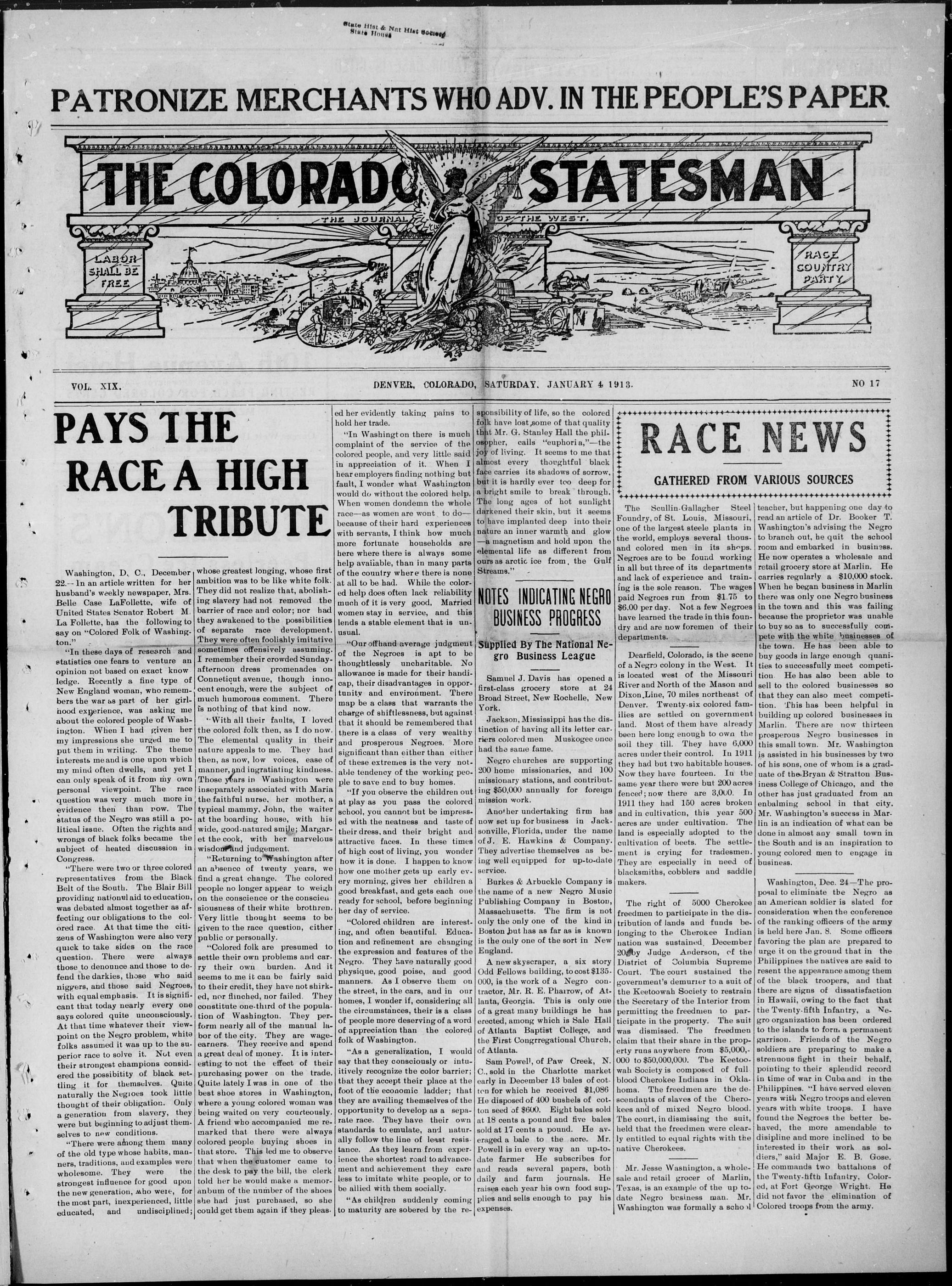
Colorado Statesman
Saturday, January 4, 1913
Denver, Colorado
Page text (machine-generated)
PATRONIZE MERCHANTS WHO ADV. IN THE PEOPLE'S PAPER
THE COLORADO STATESMAN
THE JOURNAL OF THE WEST.
LABOR SHALL BE FREE
RAGE COUNTRY PARTY
PAYS THE RACE A HIGH TRIBUTE
PAYS THE RACE A
Washington, D. C., December 22. In an article written for her husband's weekly newspaper, Mrs. Belle Case LaFollette, wife of United States Senator Robert M. LaFollette, has the following to say on "Colored Folk of Washington."
"In these days of research and statistics one fears to venture an opinion not based on exact knowledge. Recently a fine type of New England woman, who remembers the war as part of her girlhood experience, was asking me about the colored people of Washington. When I had given her my impressions she urged me to put them in writing. The theme interests me and is one upon which my mind often dwells, and yet I can only speak of it from my own personal viewpoint. The race question was very much more in evidence then than now. The status of the Negro was still a political issue. Often the rights and wrongs of black folks became the subject of heated discussion in Congress.
"There were two or three colored representatives from the Black Belt of the South. The Blair Bill providing national aid to education, was debated almost together as affecting our obligations to the colored race. At that time the citizens of Washington were also very quick to take sides on the race question. There were always those to denounce and those to defend the darkies, those who said niggers, and those said Negroes, with equal emphasis. It is significant that today nearly every one says colored quite unconsciously. At that time whatever their viewpoint on the Negro problem, white folks assumed it was up to the superior race to solve it. Not even their strongest champions considered the possibility of black settling it for themselves. Quite naturally the Negroes took little thought of their obligation. Only a generation from slavery, they were but beginning to adjust themselves to new conditions.
"There were among them many of the old type whose habits, manners, traditions, and examples were wholesome. They were the strongest influence for good upon the new generation, who were, for the most part, inexperienced, little educated, and undisciplined;
whose greatest longing, whose first ambition was to be like white folk. They did not realize that, abolishing slavery had not removed the barrier of race and color; nor had they awakened to the possibilities of separate race development. They were often foolishly imitative sometimes offensively assuming. I remember their crowded Sunday-afternoon dress promenades on Connetiqu avenue, though innocent enough, were the subject of much humorous comment. There is nothing of that kind now.
"With all their faults, I loved the colored folk then, as I do now. The elemental quality in their nature appeals to me. They had then, as now, low voices, ease of manner, and ingratiating kindness. Those years in Washington were inseparately associated with Maria the faithful nurse, her mother, a typical mammy, John, the waiter at the boarding house, with his wide, good-natured smile; Margaret the cook, with her marvelous wisdom and judgement.
"Returning to Washington after an absence of twenty years, we find a great change. The colored people no longer appear to weigh on the conscience or the conscieniousness of their white brothren. Very little thought seems to be given to the race question, either public or personally.
"Colored folk are presumed to settle their own problems and carry their own burden. And it seems to me it can be fairly said to their credit, they have not shirked, nor flinched, nor failed. They constitute one-third of the population of Washington. They perform nearly all of the manual labor of the city. They are wageearners. They receive and spend a great deal of money. It is interesting to not the effect of their purchasing power on the trade. Quite lately I was in one of the best shoe stores in Washington, where a young colored woman was being waited on very courteously. A friend who accompanied me remarked that there were always colored people buying shoes in that store. This led me to observe that when the customer came to the desk to pay the bill, the clerk told her he would make a memoranbum of the number of the shoes she had just purchased, so she could get them again if they pleas.
DENVER, COLORADO, SATURDAY. JANUARY 4 1913.
State Hist & Nat Hist Society
State House
HANTS WH
ADC
THE JOURNAL
DENVER, COLORADO
ed her evidently taking pains to hold her trade.
"In Washington there is much complaint of the service of the colored people, and very little said in appreciation of it. When I hear employers finding nothing but fault, I wonder what Washington would do without the colored help. When women dondemn the whole race—as women are wont to do—because of their hard experiences with servants, I think how much more fortunate households are here where there is always some help available, than in many parts of the country where there is none at all to be had. While the colored help does often lack reliability much of it is very good. Married women stay in service, and this lends a stable element that is unusual.
"Our offhand average judgment of the Negroes is apt to be thoughtlessly uncharitable. No allowance is made for their handicap, their disadvantages in opportunity and environment. There map be a class that warrants the charge of shiftlessness, but against that it should be remembered that there is a class of very wealthy and prosperous Negroes. More significant than either than either of these extremes is the very notable tendency of the working people to save and to buy homes.
"If you observe the children out at play as you pass the colored school, you cannot but be impressed with the neatness and taste of their dress, and their bright and attractive faces. In these times of high cost of living, you wonder how it is done. I happen to know how one mother gets up early every morning, gives her children a good breakfast, and gets each one ready for school, before beginning her day of service.
"Colored children are interesting, and often beautiful. Education and refinement are changing the expression and features of the Negro. They have naturally good physique, good poise, and good manners. As I observe them on the street, in the cars, and in our homes, I wonder if, considering all the circumstances, their is a class of people more deserving of a word of appreciation than the colored folk of Washington.
"As a generalization, I would say that they consciously or intuitively recognize the color barrier; that they accept their place at the foot of the economic ladder; that they are availing themselves of the opportunity to develop as a separate race. They have their own standards to emulate, and naturally follow the line of least resistance. As they learn from experience the shortest road to advancement and achievement they care less to imitate white people, or to be allied with them socially.
"As children suddenly coming to maturity are sobered by the re-
sponsibility of life, so the colored folk have lost some of that quality that Mr. G. Stanley Hall the philosopher, calls "euphoria a,"—the joy of living. It seems to me that almost every thoughtful black face carries its shadows of sorrow, but it is hardly ever too deep for a bright smile to break through. The long ages of hot sunlight darkened their skin, but it seems to have implanted deep into their nature an inner warmth and glow—a magnetism and hold upon the elemental life as different from ours as arctic ice from, the Gulf Streams."
NOTES INDICATING NEGRO BUSINESS PROGRESS
Supplied By The National Negro Business League
Samuel J. Davis has opened a first-class grocery store at 24 Broad Street, New Rochelle, New York.
Jackson, Mississippi has the distinction of having all its letter carriers colored men Muskogee once had the same fame.
Negro churches are supporting 200 home missionaries, and 100 missionary stations, and contributing $50,000 annually for foreign mission work.
Another undertaking firm has now set up for business in Jacksonville, Florida, under the name of J. E. Hawkins & Company. They advertise themselves as being well equipped for up-to-date service.
Burkes & Arbuckle Company is the name of a new Negro Music Publishing Company in Boston, Massachusetts. The firm is not only the only one of the kind in Boston but has as far as is known is the only one of the sort in New England.
A new skyscraper, a six story Odd Fellows building, to cost $135,000, is the work of a Negro contractor, Mr. R. E. Pharrow, of Atlanta, Georgia. This is only one of a great many buildings he has erected, among which is Sale Hall of Atlanta Baptist College, and the First Congregational Church, of Atlanta.
Sam Powell, of Paw Creek, N. C., sold in the Charlotte market early in December 13 bales of cotton for which he received $1,086. He disposed of 400 bushels of cotton seed of $600. Eight bales sold at 18 cents a pound and five bales sold at 17 cents a pound. He averaged a bale to the acre. Mr. Powell is in every way an up-to-date farmer He subscribes for and reads several papers, both daily and farm journals. He raises each year his own food supplies and sells enough to pay his expenses.
RACE NEWS GATHERED FROM VARIOUS SOURCES
The Scullin-Gallagher Steel Foundry, of St. Louis, Missouri, one of the largest steele plants in the world, employs several thousand and colored men in its shops. Negroes are to be found working in all but three of its departments and lack of experience and training is the sole reason. The wages paid Negroes run from $1.75 to $6.00 per day. Not a few Negroes have learned the trade in this foundry and are now foremen of their departments.
Dearfield, Colorado, is the scene of a Negro colony in the West. It is located west of the Missouri River and North of the Mason and Dixon.Line, 70 miles northeast of Denver. Twenty-six colored families are settled on government land. Most of them have already been here long enough to own the soil they till. They have 6,000 acres under their control. In 1911 they had but two habitable houses. Now they have fourteen. In the same year there were but 200 acres fenced; now there are 3,000. In 1911 they had 150 acres broken and in cultivation, this year 500 acres are under cultivation. The land is especially adopted to the cultivation of beets. The settlement is crying for tradesmen. They are especially in need of blacksmiths, cobblers and saddle makers.
The right of 5000 Cherokee freedmen to participate in the distribution of lands and funds belonging to the Cherokee Indian nation was sustained. December 20, by Judge Anderson, of the District of Columbia Supreme Court. The court sustained the government's demurrier to a suit of the Keetoowah Society to restrain the Secretary of the Interior from permitting the freedmen to participate in the property. The suit was dismissed. The freedmen claim that their share in the property runs anywhere from $5,000,-000 to $50,000,000. The Keetoowah Society is composed of full-blood Cherokee Indians in Oklahoma. The freedmen are the descendants of slaves of the Cherokees and of mixed Negro blood. The court, in dismissing the suit, held that the freedmen were clearly entitled to equal rights with the native Cherokees.
Mr. Jesse Washington, a wholesale and retail grocer of Marlin, Texas, is an example of the up to date Negro business man. Mr. Washington was formally a school
NO 17
teacher, but happening one day to read an article of Dr. Booker T. Washington's advising the Negro to branch out, he quit the school room and embarked in business. He now operates a wholesale and retail grocery store at Marlin. He carries regularly a $10,000 stock. When he began business in Marlin there was only one Negro business in the town and this was failing because the proprietor was unable to buy so as to successfully compete with the white businesses of the town. He has been able to buy goods in large enough quantities to successfully meet competition. He has also been able to sell to the colored businesses so that they can also meet competition. This has been helpful in building up colored businesses in Marlin. There are now thirteen prosperous Negro businesses in this small town. Mr. Washington is assisted in his businesses by two of his sons, one of whom is a graduate of the Bryan & Stratton Business College of Chicago, and the other has just graduated from an enbalming school in that city. Mr. Washington's success in Marlin is an indication of what can be done in almost any small town in the South and is an inspiration to young colored men to engage in business.
Washington, Dec. 24—The proposal to eliminate the Negro as an American soldier is slated for consideration when the conference of the ranking officers of the army is held here Jan. 8. Some officers favoring the plan are prepared to urge it on the ground that in the Philippines the natives are said to resent the appearance among them of the black troopers, and that there are signs of dissatisfaction in Hawaii, owing to the fact that the Twenty-fifth Infantry, a Negro organization has been ordered to the islands to form a permanent garrison. Friends of the Negro soldiers are preparing to make a strenuous fight in their behalf, pointing to their splendid record in time of war in Cuba and in the Philippines. "I have served eleven years with Negro troops and eleven years with white troops. I have found the Negroes the better behaved, the more amendable to disipline and more inclined to be interested in their work as soldiers," said Major E. B. Gose. He commands two battalions of the Twenty-fifth Infantry, Colored, at Fort George Wright. He did not favor the elimination of Colored troops from the army.
CONDENSATION OF FRESH NEWS
THE LATEST IMPORTANT DIS
PATCHES PUT INTO SHORT,
CRISP PARAGRAPHS.
STORY OF THE WEEK
SHOWING THE PROGRESS EVENTS IN OUR OWN AND FOREIGN LANDS.
The Lima Bean Growers' Association, of Oxnard, Cal., sometimes called the "bean trust," has gone out of existence.
Frank Rockefeller of Belvidere, Cleveland and New York, declares that his brother John D., is the most lonesome man in all the world.
Two of the ten buildings of the Akron plant of the International Harvester Company were destroyed by fire at Akron, Ohio, the loss being $300,000.
A delegation representing the Cheyenne bar went to Laramie and attended the funeral of the late Judge C. E. Carpenter of the Second judicial district of Wyoming.
The first Colorado lambs of the season arrived at the St. Louis National Stockyards. They came from H. J. and J. C. Gibbraith of the San Luis valley, in Colorado, and brought $8.75 per 100.
At least 4,000 rifle and unaccountable quantities of ammunition in shipments of from 5,000 to 50,000 rounds each, have been received at El Paso, Tex., within the last three months, according to official figures.
The second trial of Clarence S. Darrow, the Chicago attorney who was chief counsel in the trial of James B. McNamara, who was indicted by the county grand jury a year ago on two charges of jury bribing, will be begun in Los Angeles January 20th.
Eugene Rust, general manager of the Kansas City stock yards since 1903, died at his home in Kansas City after an illness of several months. Mr. Rust had been connected with the stock yards for thirty-two years. He was born at Belfast, Me., 61 years ago.
Frank B. Kellog of St. Paul, speaking before the meeting of the Nebraska State Bar Association in Omaha, vigorously defended the integrity of the American judiciary and condemned what he said was a disposition of these days to criticize the courts.
It required a court session of but twenty-two minutes to deprive the thirty-eight convicted 'dynamite conspirators" of their liberty in Federal Judge Anderson's court in Indianapolis. Just one hour after the reading of the verdicts the door of the county jail had closed behind the last prisoner.
John H. Varner and Phoebe Allen, both of Olney, Ill., were married at Vincennes, Ind. Varner is a farmer, sixty-four years old, and weighs 300 pounds, while his bride is fifty-two and also weights 300 pounds. Each had been married three times before and each lost the first and third mate by divorce and the second by death. The national conclave of Hai Resh, a Jewish fraternity, opened at Lincoln, Neh., with the election of Irving Meinrathe of Kansas City, president; Jerome Reichart of Denver, vice president; Raymond Frank of Denver, secretary, and Herbert Arenstein of Omaha, treasurer. Sigma Matha Phi, the national sorority, has been in session in Omaha, but the delegates are now in Lincoln to take part in the festivities in connection with the fraternal convention.
WASHINGTON.
Her friends in Washington society heard with pleasure the news that Mrs. Woodrow Wilson, wife of the President-elect, had selected as her personal secretary at the White House Miss Izabel Hagner. Although the holiday mail was heavier in every section of the country than ever before the work of handling it was performed with less congestion and confusion than in previous years according to reports received by Postmaster General Hitchcock.
The postmaster general has made another appeal to Congress in a letter to the chairman of the House postal committee for legislation changing the method of paying the railways for mail transportation, urging that they be paid for space instead of weight. Owing to the inauguration of the parcel post system in the county January 1, Hitchcock deems it necessary that some action should be taken on his recommendation as soon as possible.
Senator Kern does not expect to continue as a counsel for the convicted men in the dynamite cases because of the pressure of his duties in the Senate. It was said that Mr. Kern, when he associated himself with counsel for the defense, did not expect the trial would continue long enough to keep him away from Congress.
Inauguration ceremonies in the past have been too spectacular and pretentious, in the opinion of President-elect Woodrow Wilson, who wants his inauguration to be as simple as pos-
FOREIGN
The Irish home rule bill reached the report stage in the House of Commons in London.
The ambassadors of most of the European powers have advised the Ottoman government to make an effort to come to terms of the Balkan allies.
Fifteen of the crew of the Danish steamer Volmer were drowned when she was wrecked in the great gale which raged in the English channel.
Alfred Von Kiderlen-Waechter, secretary of state of the German empire, died suddenly at his sister's home at Stuttgart, Germany, after a brief illness.
Reorganization soon will begin of the federal army in northern Mexico. Its first effect will be the assigning of commanders to new stations, and later, it is said, in altering the relations between the regular and irregular troops.
The brief session of the peace conference Saturday brought the Balkan delegates to their feet in protest against the counter proposals put forward by Rechad Pasha in behalf of the Ottoman government. Turkey's maximum demands are considered very sweeping.
The newspapers at Athens state that the program followed by the Turkish fleet in its sortie from the Dardanelles was drawn up by an American, Admiral Bucknam, who was recently called to Constantinople from London, Admiral Bucknam is said to be a retired officer of the American navy who assisted in reorganizing the Turkish fleet under the reign of Abdul Hamid.
SPORT.
Alfred J. Richon, who nine years ago was a star member of the University of Notre Dame track team, was accidentally asphyxated by an oil lamp at his farm house near Ritchie, Ill., according to the verdict of a coroner's jury.
Arrangements have been made by Manager Jack Hendricks for the Denver Grizzlies and Chicago White Sox to meet at Denver, the last week in March for a series of games at Broadway park, the first one to be played March 28.
California is preparing for the Panama-Pacific exposition on a big scale. Not only will the fair be conducted along pretentious lines, but all forms of athletic sports and competitions are being planned. The latest is a revival of turf and harness racing for the year 1915.
Adolph Gotch, brother of Frank Gotch, champion heavyweight wrestler, died in a rooming house in Dauphine street, New York. He had fallen from a bath tub and an autopsy showed that his neck was broken. Gotch was twenty-seven years old and was a stationary engineer. Halver Shain, automobile racer, was fatally injured, three others seriously hurt and a number slightly cut and bruised when Shain's racer shot out of the cup-shaped track known as the "dare devil race for life" on the concession pier at Venice, Cal., and plunged into the crowd. Shaird died a half hour after doctors sought to save his life by an operation.
GENERAL.
Two white men were injured, one fatally, and several negroes hurt in a clash at Atlanta, Ga., between members of the two races. President and Mrs. Taft, Colonel and Mrs. Goethals and a number of friends arrived off Key West on the battleships Arkansas and Delaware. On his return trip from the Panama canal zone, President Taft paid his first visit to the oldest town in the United States, stopping at St. Augustine, Fla., as the guest of the Board of Trade.
Warning the business men of the country that hereafter they will not be allowed to make money without giving something in return and asserting that the office of President is one in which a man must put on his war paint, President-elect Wilson spoke to an audience of about 3,000 people from the steps of the Mary Baldwin seminary at Staunton, Va., within fifty feet of the little church in which his father, the Rev. Joseph R. Wilson, preached more than half a century ago.
Although the federal prison at Leavenworth, Kan., is crowded close to its capacity, Deputy Warden W. H. Mackey said room would be made for the thirty-three men sentenced in Indianapolis for connection with the dynamite conspiracy, and that their services as iron workers would be welcome toward completing the task of rerooting the prison, now under way. "I have had no intimation from the government that the men were coming, but have been prepared for that eventuality." Mr. Mackey said. "We have 1,208 prisoners now, and we thought the place was full when we had 1,150. Our limitations are elastic. I shall try to give the men from Indianapolis plenty of work in their own regular lines."
Four members of the family of Edward H. Miller were killed by being struck by the Illinois Central Panama limited four miles south of Champaign, Ill.
Mrs. Whitelaw Reid and her son, Ogden Mills Reid, arrived in New York from England on the steamer Campania. Their arrival was timed to precede by several days that of the British cruiser Natal, which is steaming for the same port with the body of the late American ambassador to Great Britain, who died in London, Dec. 15.
OF INTEREST TO ALL COLORADO PEOPLE
Western Newspaper Union News Service.
DATES FOR COMING EVENTS.
January 20-25-Eighth Annual Western Stock Show—Denver.
The parcels post law is now in effect.
Plans have been drawn for a $10,000 electric light, ice and cold storage plant at Limon.
Alderman John M. O'Brien of Denver says he is a taxpayer and has been for 20 years.
John Wynkoop, 87, an old settler of Logan county, died at Sterling. He came to Sterling in 1887.
Frank Cole, the last of the "gamblers of the '78 gang," died at Leadville at the county hospital.
Following an illness lasting more than five years, J. M. Smith, superintendent of the Pullman shops in Denver died, at his home.
Edward McLarnon drank two ounces of carbolic acid in a saloon at Salida and is not expected to live. McLarnon is 21 years old and is a cook.
The Postoffice Department at Washington issued an order establishing substation No. 26 at 1400 South Broadway, in Denver, effective February 1.
By action of the Board of Aldermen and Mayor Arnold of Denver the Business Men's telephone bill becomes an ordinance effective in thirty days.
The Supreme Court has considered its recent refusal to advance the case of W. H. Tate against commission government in Pueblo and a hearing will be held sometime in January.
The funeral of Levi Booth, pioneer of Colorado, and the last survivor of the first graduating class of the University of Wisconsin, was attended by many of the university's alumni now in Denver.
Two romances which began in Austria, several years ago, and a third which began in Ridgeway, Colo., several weeks ago, ended in a triple wedding—the first to be celebrated in Denver in several years.
George Creel, police commissioner, and Mrs. Creel, who, until her marriage with the Denver official, November 28, was Miss Blanche Bates, noted actress, have returned to Denver from their honeymoon trip.
C. M. Kittredge of the Denver Midland Trail Association, received word from Indianapolis that more than $1,000,000 has been subscribed to the fund for building the proposed ocean-to-ocean automobile highway.
R. R. Van Horn, one of the best known young ranchers of the Little Beaver section, and Mrs. Mary Fletcher "put one over" on their Meeker friends by announcing that they had been married ever since November 3.
The 1913 National Western Stock Show, which is to be held in Denver January 20 to 25, will be notable for the number of prominent society women who will participate in the entertainment features of the horse display.
Edward Hensley, aged 19, was shot and instantly killed at Grand Junction by Deputy Sheriff Steve Nichols while resisting arrest, after he had succeeded in collecting $500 from J. E. Quar, manager of the Loma canning factory, with the aid of his father, Joseph D. Hensley, and a shotgun.
One of the surprises sprung by Cupid in Greeley during the holiday season was the wedding of Miss Vivienne Abbot, daughter of Professor and Mrs. F. L. Abbot of the State Teachers' College, who became the bride of Willis B. Gilmore, a former student of the college, who lives in Leadville.
Deserting her husband and five children, Mrs. Grace Smith, wife of a contractor, ran away from her home in Rocky Ford with a tramp and the couple was arrested in Pueblo. The man gave his name as Benjamin Good and he was fined $300 for his part in the affair in municipal court. The husband of Mrs. Smith forgave his wife and placed her on a train for Rocky Ford.
The Chamber of Commerce of Denver, held a grand civic reception at its office in its own building, on Champa street, between Seventeenth and Eighteenth streets, on New Year's morning, from 11 to 12. Governor Safroth and staff, Governor-elect Ammons, Mayor Arnold, Colonel Van Dusen of Fort Logan, Brigadier General John Chase of the Colorado National guard, and other prominent officials and citizens were in the receiving line, as were President E. J. Yetter, Vice President Charles H. Howe, Vice President Thomas B. Stearns and other officers and directors of the chamber.
Attorney General-elect Fred Farrar of Fort Collins has partially completed his staff of legal assistants who will take office with him January 14, Francis E. Bouck of Leadville will be deputy attorney general; Frank C. West of Boulder will be assistant; Norton C. Montgomery of Denver will be second assistant, and Clement F. Crowley of Denver will be third assistant. Miss Margaret Fallon, who has served for five years as chief clerk in the attorney general's office, will be retained by the new incumbent in that position.
TABOR CASE IS CITED
AS PRECEDENT IN LIEUTENANT GOVERNORSHIP MATTER.
Death of Col. Benjamin F. Montgomery
Raises Question as to Who Will
Hold Office Next Two Years.
Western Newspaper Union News Service.
Denver.—Will the death of Colonel
Benjamin F. Montgomery, lieutenant
governor-elect of Colorado, cause
Stephen R. Fitzgarrald, the incumbent,
to hold over for another term, or will
the president pro tempore of the Senate
become lieutenant governor at the
stroke of noon, January 14, when Fitzgarrald's term expires?
State officers, heads of departments and legislators who visited the state house were deeply interested in the point, and a majority believe the Supreme Court will be asked to decide the question.
Only once has the question been raised in Colorado regarding the succession in office in the case of an officer-elect dying before qualifying. That was in 1880, when Lieutenant Governor-elect George B. Robinson was shot and killed at one of his mines in Summit county, two weeks after his election.
H. A. W. Tabor, multimillionaire mining man, was lieutenant governor under Governor F. W. Pitkin at that time, and he held over for another two-year term, although E. R. Wolcott, later United States senator was elected speaker pro tempore of the State Senate and put in his claim to the acting lieutenant governorship.
Fined After Wedding Tragedy.
Greelcy.—The custom of shooting at German-Russian wedding celebrations received a hard jolt in the Justice Court here as the result of Mrs. Fred Bruner having had to undergo a Caesarian operation several days ago when she was shot in the back while attending a wedding. John Lindt was sentenced to six months in the county jail and Jacob Lichenwald to four months. Three others in the party were fined $25 and costs each. Sheriff McAfee announced that no more shooting would be permitted. It is expected that several other arrests will be made and fines imposed as a result of the Windsor affair. Mrs. Bruner, the victim, is recovering slowly from the gunshot wound and physicians state that she soon will be out of danger.
Lieutenant Governor-Elect Dead.
Denver.—Benjamin Franklin Montgomery, lieutenant governor-elect of Colorado, and one of the leading Democrats of the state, died at St. Luke's hospital. He was 78 years old. Death was due to a complication arising from laryngitis, following close upon a serious operation performed two weeks ago. His advanced age, combined with a general weakened condition, brought about a relapse from which he never rallied.
Says Had Threatened to Kill.
Pueblo.—A statement that Andrew Hogg, charged with the shooting of Mrs. Frank L. Seitz, attempted her life on a previous occasion, has been made by Mrs. Seitz. She avers that on Christmas eve he visited her home and following an argument, drew a pistol and pressed its against her forehead.
Dr. S. K. Thompson Dies.
Greeley.—Dr. S. K. Thompson, the first dentist in Greeley and a member of the pioneer colony, died at his home after an illness of one week. He was eighty-two years old and came here in 1870. He leaves a widow and a brother in Vermont, who is eighty-four years old.
Injured Man Saved By Train Whistle
Greeley.—With his jaw and nose broken from a fall on a cattle guard on the Colorado & Southern road, John Knutson, manager of the county hospital, lay unconscious for an hour and was only aroused by the whistle from an approaching train in time to drag himself from the track.
Elections Costly to El Paso Voters.
Colorado Springs.—The September primary election and the regular November election cost El Paso county $18,500, or about seventy-six cents per vote, according to figures compiled by County Clerk E. C. Shelden. Of 22,022 registered, 15,319 voted at the general election.
W. L. Link Found Dead.
Breckenridge.—W. L. Link, for many years a resident of Alma and Fairplay, in this county, and at one time county treasurer, was found dead in bed. He had been troubled for some time with a weak heart.
Wife of First Governor Leaves $40,000.
Wife of First Governor Leaves $40,000.
Denver.—The will of Mrs. Julia P. Gilpin, widow of the first territorial governor of Colorado, was filed for probate in the county court. Mrs.
Gilpin left an estate of about $40,000,
of which at least $25,000 is reality.
Two Widows Struck by Train.
Fort Collins.-While they were driving over the dangerout crossing at the Hottell mill on their way to church, the buggy in which Mrs. Addle Ruff, aged sixty-two, and Mrs. Catherine Stellie, aged sixty-four, both widows, were seated, was struck by a passenger train and demolished, the horse killed, and both women, who were thrown almost under the wheels, badly bruised. Mrs. Ruff, whose head was cut and bruised and arm broken, was taken to a hospital. Both will recover
The
Curtis
Park
Floral
Company
FLORAL DESIGNS PUT UP WHILE
YOU WAIT
CHOICE PLANTS AND CUT FLOWERS CONSTANTLY
ON HAND
GREENHOUSES: Thirty-Fourth and Curtis Streets
TELEPHONE, MAIN 1511 DENVER, COLO
10th Avenue Hotel H. HEUER, PROPRIETOR RESTING PLACE FOR COLORED GENTS MEALS AT ALL HOURS Pool Room in Connection Corner West 10th and Osage, Near Burnham Shops Denver, Colorado
CARLSON'S Peerless Ice Cream Phones: Main 112 and Main 5787
DID YOU EVER TRY Neef Bros.' Beer?
It's made right, and tastes right. None better made anywhere and This is a Strictly Colorado Production
PHONE MAIN 3028
JOH
Meats, Fane
JOHN K. RETTIGER
R. Fancy and Staple Gro
1864 CURTIS STREET
seventh.
BECK JOHN K.
BECK & ENGSTROM
WHOLESALE DEALERS IN
WINES, LIQUORS AND CIGARS
MAIN 1053.
Engents for Minneapolis Grinn Belt Beer and Carne
Pripps Imported Beer and Boek Ol.
R NIGHT. PHONE MAN
A. M. LAWHORN
Undertakers
-class Mortuary establishment. First aid to the berea
path of loved ones. Prices below competitors. Polite.
AWRENCE JONES, Licenced Embalme
DUIS HUBBARD, Funeral Director
ORS 1925 Arapahoe Street
HENRY BECK
BECK
WINES,
164
PHONE MAIN 1053.
Western agents for M
Pri
DAY OR NIGHT.
A. M.
U
A first-class Mortu
time of death of loved
LAWRENCE
LOUIS HU
PARLORS 19
WINES, LIQUORS AND CIGARS
1644-46-48-50 LARIMER STREET.
PHONE MAIN 1053
DENVER, COLO.
Western agents for Minneapolis Grain Belt Beer and Carnegie Porter,
Pripps Imported Beer and Bock Ol.
A first-class Mortuary establishment. First aid to the bereaved in the time of death of loved ones. Prices below competitors. Polite service LAWRENCE JONES, Licenced Embalmer LOUIS HUBBARD, Funeral Director
LET US WASH YOUR
Shirts, Coll
Curtains a
The Denver
Collars and Cuffs, Blains and Rough Dry W
The Denver Sanitary Laundry. PHONE MAIN 5670
```markdown
```
Corner Nineteenth.
1082 Broadway
BE SURE AN TRY IT.
RES. PHONE GALLUP 942
RETTIG
Staple Groceries
STREET
JOHN ENGSTROM
GSTROM
MILLERS IN
BROAD AND CIGARS
ER STREET. DENVER, COLO.
Belt Beer and Carnegie Porter,
and Bock Oil.
PHONE MAIN 6243
WHORN
kers
First aid to the bereaved in the
competitors. Polite service
Excenced Embalmer
General Director
Shoe Street
Cuffs, Blankets, Dry Work.
Denver, Colo.
AFRO-AMERICAN CULLINGS
```markdown
```
To the Presidents and Officers of Local Negro Business Leagues:
Now that the political campaign is over and we are free to give our attention to matters that more directly concern our welfare as individuals and as communities, I want to urge upon each Local Negro Business League throughout the United States to cut out a definite piece of work that the league may accomplish during the coming winter.
First—In order to accomplish some definite thing, each league should have a regular time for meeting.
Second—A regular program should be mapped out in advance of each meeting.
Third—Each league should have a special attractive place to meet in.
Fourth—Each league should consider carefully what the organization can do to promote the welfare of the community in business and commercial directions.
There never has been such commercial prosperity existing throughout the country as is true today, and our people should share in this prosperity. It is largely through the help and leadership of each Local Negro Business League that they will be able to do so.
If your league has not had a meeting for some time see that one is called at once and new life is put into the organization.
Persons desiring to organize new Local Negro Business Leagues may secure information by writing to Mr. Emmett J. Scott, corresponding secretary, Tuskegee Institute, Alabama. (Signed)
BOOKER T. WASHINGTON,
President National Negro Business League.
Miss Nannie H. Burroughs, corresponding secretary of the Women's Auxiliary convention and president of the National Training School for Girls, made a strong plea for the women of her race and appealed to the white women of the south to assist in the efforts to make the negro what he should be.
She said in part:
"We have too many organizations. The negro is the most organized race in the world, and his organizations are the least effective. We have our hands on the mass of people, and this mass is plastic—but, it seems exceedingly difficult for the leaders to settle upon a definite plan either for our morai, social, political or industrial betterment.
"To be permanently effective or religious and secular organizations must be manned by live men and women who have been somewhere and have seen something. They must be full of faith and of the spirit of the living God.
"The negro is restless because he is not a normally placed creature; he is put into an unnatural position and kept there by force, and whenever this is done with a race or an individual, it makes trouble. Persons thus placed are uncomfortable, and as a natural result, we protest, and this protest creates a disturbance and resistance that will never be stopped until the right remedy is applied. Apply to the negro his constitutional rights and not special laws; give him an opportunity to try his strength. to labor and to enjoy the fruits of his labor, and there will be no negro problem.
When a man agrees with you at all times look for the ax he has to grind.
At a meeting of the general education board held several days ago $440,000 was appropriated for education among white people, north and south, in this country, and $5,000 was appropriated for education among negroes. We are wondering if our race is doing its duty in making applications to the general education board for help. Unless there is a screw loose somewhere it seems to us that we should get more money from this board for the education of ten millions of people than $5,000, considering the large amounts appropriated for white schools.
We understand that the general education board does not appropriate money unless the institution will agree to raise a certain amount. We earnestly advise the colleges and universities existing for colored people to do their part in making application to the board and try to meet the requirements of the board, so that our race will receive a larger share of the money.—New York Age.
After a jealous man gets married to a jealous woman there is something doing every little minute.
Chicago Blade recently observed that negro soldiers had demonstrated their ability to serve with less loss of time from active duty by reasons of sickness than the white soldiers. According to the annual report of Surgeon General George H. Torney, the non-effective rate of the negro was 2,588, while that of the white was 3,360; the Porto Ricans 2,978, and the Fillipino 1,986.
A loyal wife is one who has implicit confidence in her husband, even when he's running for office.
The notion has grown up in the public land states and territories that everybody who is on the ground has a right to all the public domain he can get hold of under the thinnest possible color of compliance with law; that every lumber company has a right to run its steam sawmills day and night on public timber, and every owner of live stock has an inalienable right to free pasturage on the public domain. Cases involving the rights of the nation when tried in the local courts have often been decided by the prevailing local sentiment. But the Supreme court of the United States is not subject to the influence created by "sooners" and "boomers" and the exploiters of natural resources in the newer parts of the country. The nation has a right to protect its property and conserve its natural resources and administer its lands and mines and forests and water powers with a view to general rather than individual interest, and to take some note of the rights of posterity. The exploiter of the west has had a long day, but it is over at last.
It is an old and much disputed question by what means carrier pigeons find their way home over distances sometimes of hundreds of miles. Some extraordinary suggestions have been offered to explain this strange faculty, such as that the birds are guided by magnetic currents, that they possess a special sense of direction enabling them to reverse a course once pursued, and that they have a particular arrangement of the internal organs of the ear which affords a means of guidance. The problem has been attacked again recently by P. Hachet-Souplet, director of the Institute of Animal Psychology in Paris, who concludes that the whole secret is contained in the ability of the pigeons to lay their course by recognized points in the landscape beneath them. He believes that the longest authenticated flights are explicable in this way.
Dr. W. T. Grenfell describes Labrador as a land still hardly known beyond its borders. The cold current that flows along its shores from the north dominates its climate, and, notwithstanding that it is considerably further south, it receives less continuous sunshine than Alaska, because its summer is shorter. The coldness of the soil and the dryness of the winds stunt many of its plants to such a degree that a larch growing at the southern end of Labrador which showed 32 annual growth rings, was only nine inches tall, and its trunk was but three-eighths of an inch in diameter. Mineral deposits seem to be abundant, but prospectors have been able to stay but for short periods.
Where lands have been "cropped to death," as some plain people aptly term it, live stock farming is the surest, cheapest and quickest method of restoring its fertility. In live stock farming the crops raised on the farm are grown primarily for the purpose of feeding one or more classes of live stock, and but little is sold except animal products. On the other hand, concentrated feeding stuffs are purchased for feeding the farm animals, which adds to the amount of fertility returned to the land in the manure. Since the animal products sold do not, as a general rule, contain large quantities of fertilizing ingredients, it is easy to rapidly increase the fertility of land by this system of farming.
Messrs. A. Dejoie and T. J. Howard, two very successful business men of New Orleans, Louisiana, have openen a fine shoe store.
The education of negro children is of greatest importance to negro parents. All the possessions given a child may vanish, but a good education remains forever. The educated man can maintain himself against all difficulties. He is to all intents and purposes the architect of his own fortune. We owe it to ourselves and our posterity to contribute substantially to the civilization which we enjoy. This we cannot do unless we educate in the most thorough manner. Wherever we, tail to educate the race suffers in the most singular and distressing manner.
It isn't very consoling to a homely girl to be told that a beautiful disposition is more admirable than a beautiful face.
The man who looks toward the well watered plains of Sodom with a longing eye, will soon be wearing out shoe leather in trying to get to them.
The New Orleans Business Journal a negro weekly, has been changed to a negro daily. It is henceforth to be known as The Daily Spokesman.
John Baker, one time employed on the Union Pacific railroad, recently purchased a farm at Grand Oakland, Nebraska. He has retired to this farm. He is also operating several restaurants.
How easy it is to conclude that we can do the most for the Lord where the pay is best.
THIRTY-EIGHT UNION LEADERS GUILTY IN BOMB CASE; TWO FREED
THIRTY-THREE OF CONVICTED DYNAMITERS GET SENTENCES RANGING FROM ONE TO SEVEN YEARS, TAKEN TO LEAVENWORTH, KAN., PENITIARY.
SENTENCES IMPPOSED.
Indianapolis, Ind.—Terms of imprisonment were imposed as follows:
New York
Frank M. Ryan, president of the Iron Workers' Union.
Six Years.
John T. Butler, Buffalo, vice president.
Herbert S. Hockin, former secretary and formerly of Detroit.
Gerald A. Vettmoe, San Francisco, secretary of the California Building Trades Council.
Eugene A. Clancy, San Francisco.
Philip A. Cooley, New Orleans.
Michael J. Hinton, Boston.
J. E. Munsey, Salt Lake City.
Frank C. Webb, New York.
Four Years.
Peter J. Smith, Cleveland.
John H. Butler, St. Louis.
Three Years.
Paul J. Morrin, St. Louis.
Henry W. Legleitner, Denver.
Charles J. Hannon, Cleveland.
Michael J. Cunnane, Philadelphia.
Edward Smythe, Peoria, Ill.
Murray L. Pennell, Springfield, Ill.
Wilford B. Brown, Kansas City.
George J. Hannon, Cleveland.
Michael J. Hannon, Scranton, Pa.
Ernest G. W. Basey, Indianapolis.
William J. McCain, Kansas City.
William F. Reddin, Milwaukee.
One Year and One Day.
William S. Shupe, Chicago.
James E. Ray, Peoria, Ill.
James E. C. Woollett, Cincinnati.
Edward E. Phillips, Syracuse, N. Y.
Charles Wachmeister, Detroit.
Fred J. Mooney, Duluth.
On motion of the government Edward Clark, Cincinnati, confessed dynamiter, who testified for the government, was given a suspended sentence. FACTS AND FIGURES ABOUT TRIAL Facts and figures about the trial and conviction of thirty-eight union leaders, said to be the greatest criminal court on the history of the United States. Time occupied by trial, nearly thirteen weeks.
Hotel registers in evidence, seventy-five.
At times twenty stenographers were employed in the government had 100 persons employed in the case.
Six years of strike history was covered in the trial.
Dynamiters Convicted.
Indianapolis, Ind.-Thirty-eight labor union officials including H. W. Leightner of Denver were found guilty of complicity in connection with the dynamiting cases, including the wrecking of the Los Angeles Times building. Seiffert and Buckley, the only two men out of the forty labor union officials to be adjudged not guilty, immediately were discharged from custody.
Prisoners Sentenced.
Indianapolis, Ind.—Sentences varying from seven years' imprisonment in the federal prison at Leavenworth, Kan., to one year and one day and to suspended sentences, were imposed upon the thirty-eight labor union officials convicted in the dynamite conspiracy cases.
Frank M. Ryan, president of the Iron Workers' International Union, was given a sentence of seven years.
Olaf A. Tvotmoe of San Francisco, convicted on charges of aiding in plotting the destruction of the Los Angeles Times building, and Eugene A. Clancy, also of San Francisco, were given six years each. Herbert S. Hock-in received six years.
All the prisoners who received prison terms are to be taken to Leavenworth, Kan.
Some of the men made pleas for mercy, others wept in the arms of their wives. But the court pronounced the sentences one by one, regardless of the pleas.
Six men were given their liberty through suspended sentences. These include Edward Clark of Cincinnati, the dynamiter who confessed to blowing up a bridge with the help of Hockin. He had appeared as a witness for the government. Ortie E. McManigal, another confessed dynamiter, was not sentenced at this time. In some cases sentences of one year and one day were imposed, so that these men might be confined in a federal prison. Prisoners with terms of less than one year are kept in county jails. Federal Judge Albert B. Anderson had many of the prisoners whom he said he considered less guilty than the rest brought before him to make statements. For an hour and a half the judge thus in a conversational way talked with prisoners, asking them whether they believed in dynamiting as method of promoting a strike.
All of the men professed innocence. Before Judge Anderson passed sentence he said he desired to read a statement. He then reviewed the history of the dynamite conspiracy, as well as the evidence, and said: "This scheme or campaign of dynamite was entered into and carried on throughout the country from the Atlantic to the Pacific. "The evidence disclosed an appalling list of crimes in addition to those
Fate of McManigal Is Secret.
Los Angeles, Cal.—"What will be done with McManigal?" was the question put to District Attorney John D. Fredericks, who prosecuted the McNamaras, "Ah," replied Fredericks, "ah, that will be a story for another day. McManigal will be here soon, but I cannot discuss him now. I will say, though, that without his testimony and assistance there would have been no case either here last year or at Indianapolis." McManigal confessed to having blown up the Llewellyn Iron Works on Christmas Day, 1910
Copies of the Bridgeworkers' Magazine for six years were used in evidence, with telegrams, way bills, express records and postal records. Photographs, nitroglycerine cans, fuse, photographs of dynamite and other exhibits were used by the score.
CHRONOLOGY OF DYNAMITE TRIAL.
October 1, 1911-Government authorities, exactly one year after the Los Angeles Times explosion, for first time, consider possibility of federal prosecutors for illegal transportation of explosives.
February 6, 1912-Federal grand jury returns indictments against fifty-four law enforcement officials.
February 6, 1912-Most of the defendants scattered over the country arrested within a few hours by a telegraphic signal.
October 1- Trial begins exactly two years after the defendants present; three discharged by government; Ortie E. McManigal pleads guilty, leaving forty-six for trial.
October 3- Jury secured, composed mainly of farmers; government opens its case.
October 5- Herbert S. Hockin accused by district attorney with having been a spy within the ranks of the dynamiters, and has given information to the prosecution.
October 7—Edward Clark, Cincinnati, pleads guilty to having blown up a bridge at Dayton, Ohio, and accuses of having furnished the dynmiter forty-five defendants remain forrial.
November 7—McManigal begins relating his confession on the witness stand; he confesses Ironman's role as having out jobs for him to blow up; names Hockin as starting him in the business.
November 23—Hockin's bond increased, in response to which he is committed to jail, after more testimony that he was employed by detectives while an official of the union; court denounces Hockin as not to be trusted by any one, day or night, by the district attorney as an "archist" for criticisms published in union magazine; Olaf A. Tweitmoe, San Francisco, a defendant, also denounced "archist" criticism of the trial.
December 2—Government concludes its case, after presenting 549 witnesses, whose testimony covers 2,000 pages, of the dynmiter's involvement, leaving forty-one for trial; defense begins. Hockin resigns as secretary-treasurer of the Ironworkers' Union.
Chief Prosecutor, United States District Attorney Charles W. Miller, for the case United States Senator John W. Kern and William N. Harding. A judge who conducted trial, Albert B. Arnal, Labor union of which most of the defendants were members, International Association of Bridge and Structural Workers.
Charges: Illegally transporting dynamite and nitroglycerine on passenger trains, or conspiracy to do the same.
charged in the indictments. These crimes were all committed in the name of organized labor. I will not believe that organized labor approves of such practices.
"Any organization that approves and adopts the methods of these defendants is an outlaw and will meet the fate which outlaws have met since civilized society began.
"The evidence shows some of these defendants to be guilty of murder, but they are not charged here with that crime; this court cannot punish them for it, nor should it be influenced by such consideration in fixing the measure of punishment for the crimes charged.
"The certainty of punishment, and its severity, is the important consideration in the administration of criminal justice. Such punishment should be meted out as shall warn others that even if they desire to accomplish lawful ends they must not violate the law in the attempt to realize them. Keeping these considerations in view, the court must repress that indignation which every law-abiding citizen naturally feels at the crimes which the evidence in this case discloses, in addition to those for which the defendants have been found guilty, and as near as may be possible confine the punishment within its proper scope."
Referring to the iron workers' strike, which began in 1905, and which the government charged was the motive which prompted John J. McNamara to use dynamite as a weapon, Judge Anderson said the strike was attended by picketing, then by slugging and riots. He added:
"But in 1906 a campaign by dynamite was inaugurated, and, beginning with explosions in the East and extending from the Atlantic to the Pacific, continued until the arrest of the McNamaras and McMantigal in April, 1911.
"The evidence in this case shows that almost 100 explosions, damaging and destroying structures in process of erection by, and machinery of, open-shop concerns, took place, culminating on the first day of October, 1910, in the destruction of the Los Angeles Times building and the murder of twenty-one people. Every one of these explosions was upon the work of open-shop concerns, and no explosion is shown to have taken place upon any closed-shop job. Since the arrest of the McNamaras and McMantigal these explosions have ceased.
"This system of destruction was not carried on for revenge or obedience to any other human passion, but for the deliberate purpose, by a veritable reign of terror, to enforce compliance with the demands of the iron workers upon the open and closed-shop question."
The entire proceedings in court, as a climax to the three months' dynamite conspiracy trial, required only two hours from the time court opened.
Two Men Were Colorado Residents. Denver.—Henry W. Legleitner and Frank M. Ryan, two of the men convicted at Indianapolis, of sending explosives by interstate commerce in connection with the dynamiting charges against officers of the iron workers' organization, were former Colorado residents. 'Ryan is president of the organization and is now past fifty years of age. He was a Colorado resident twenty years ago, being mine operator in the Cripple Creek and Georgetown
The Central Bottling & Distributing Co.
Agents for the famous
CAPITOL BEER---IT'S CAPITAL
Family Liquors, Wines, and Cordials Genuine Goods at Popular Prices A glass of good wine will improve your Sunday dinner, and aid digestion.
The Champa Pharmacy
Twentieth and Champa,
Is the place to get your
DRUGS, CHEMICALS AND PATENT MEDICINES
WE SERVE HOT DRINKS.
Prescriptions Our Specialty.
Phone us and we will deliver the goods to all parts of the city.
JAMES E. THRALL, PROPR.
PHONE MAIN 2425.
WORK CALLED FOR AND DELIVERED
THE CA
RE
SEWED HALF
HE
1511 CHAMPA STRE
Boost Colorado P
ZA
DE
COLUMBIA
VI
Guaranteed Absolutely Pure. Delivered Daily to All Parties of the City.
The Ph. 2
We Boost for Colo
Ph. Zang Brewing
TELEPHONE GALLUP 395.
post for Colorado You Should Boo
Private Dining Room.
The
Newport A
Cafe and Lunc
Furnished
Rooms
And the Old
Reliable
Newport Thirst
Parlors
SHORT ORDERS AT AL
hoe Street.
E ZOBEL BROTHE
AMPLE ROO
Nineteenth Street, Corner of
1841-45 Arapahoe Street.
THE ZO
SAME
1004 Nineteen
1004 Nineteenth Street, Corner of Curtis
FINE WINES, LIQUORS AND CIGARS COORS' CELEBRATED BEER ON TAP
RUDOL
SANITARY
Imported and Domesticated
Vegetables. Our Ow
2758-2760 Downing Avenue
Imported and Domestic Table Delicacies. Fresh Fruits and Vegetables. Our Own Bakery. Finest Goods in the City. 2758-2760 Downing Avenue Phone York 320
In Connection There Are Also Nicely
DENVER
ing Brewing Co.
PHONE GALLUP 395.
You Should Boost for Us
Private Dining Room. Phone, Main 7413
The
Newport Annex
Cafe and Lunch Room
Richard Frazier and Tom Lewis, Props.
EL BROTHERS'
LE ROOM
Street, Corner of Curtis
H BROTHERS
OCCERY, BAKERY AND
T MARKET.
DENVER, COLO.
COLORADO
THE COLORADO STATESMAN
JOS. D. D. RIVERS.....Proprietor
1824 Curtis Street, Room 25.
SUBSCRIPTION RATES
One Year ..... $2.06
Six Months ..... 1.00
Three Months ..... .60
PAYABLE IN ADVANCE.
PAYABLE IN ADVANCE.
Second-class matter at the postoffice in use
s, ten lines or less, 10 cents per line. 10
cents per line.
ing, 25 cents per square. A square conti-
ned on less than three months' contract.
in parties unknown to us. Further partici-
sible should be made by Express Money Order,
Letter or Bank Draft. Postage stamps wi
the fractional part of a dollar. Only 1-cents
collections of a personating nature that are
from the columns of this paper.
Us to receive attention must be newsy, u
n only upon one side of the paper; must
not later than Wednesdays, and bear the
script returned, unless stamps are sent for
happens that papers sent to subscribers
receive any number when due, inform us
forward a duplicate of the missing num
Entered as second-class matter at the postoffice in the city of Denver, Colorado.
Reading notices, ten lines or less, 10 cents per line. Each additional line over ten lines, 5 cents per line.
Display advertising, 25 cents per square. A square contains ten agate lines.
No discounts allowed on less than three months' contract. Cash must accompany all orders from parties unknown to us. Further particulars on application.
Remittances should be made by Express Money Order, Postoffice Money Order, Registered Letter or Bank Draft. Postage stamps will be received the same as cash for the fractional part of a dollar. Only 1-cent and 2-cent stamps taken.
All communications of a personating nature that are not complimentary will be withheld from the columns of this paper.
Communications to receive attention must be newsy, upon important subjects, plainly written only upon one side of the paper; must reach us Tuesdays, if possible, anyway, not later than Wednesdays, and bear the signature of the author. No manuscript returned, unless stamps are sent for postage.
It occasionally happens that papers sent to subscribers are lost or stolen. In case you do not receive any number when due, inform us by postal card and we will cheerfully forward a duplicate of the missing number.
RACE ANTAGONISM
The antagonism of races exerts a strange influence upon the history of the world. Notwithstanding the fact that, excepting certain sanguinary conflicts with barbarous or half-barbarous peoples, the nations of the world are generally at peace, there is never any attempt to deny the existence of a slumbering sentiment of race antagonism beneath the outer surface of peace and amity.
The Caucasian people, in their several distinctive parts, are not entirely assured of such a mutual and binding affection as will guarantee their continued peace and harmony, and their international politics afford a prolific source for the cultivation of differences which must be settled by either the fine hand of diplomacy or the rougher hand of war.
Leading the world in civil and intellectual progressiveness and yet harboring the savage instinct of selfish advantage, even the science of diplomats and the prayers of peace delegates fail to dispose of the argument that well-drilled armies and mighty navies are necessary, as a police precaution, to establish and maintain the peace of the world. But if the Caucasian distrusts himself, there should be no surprise that deep down in his heart he nurses an enmity against other branches of the human family seemingly of more lasting and bitter force than that exhibited by any other racial stock, civilized or savage. With all the international intercourse which a distinctly commercial age has brought about, and all the interchange of courtly state honors and private deference, the Caucasian never drops his personal idea of racial superiority over yellow, brown or black, as well as his unchangeable belief that things have always been and must always be so. Exclusion acts are not based upon any idea of the brotherhood of man. Neither are they intended solely to prevent industrial friction or labor depreciation. They embody also an unexpressed spirit of racial antagonism, which fears and guards against even a remote possibility of assimilation. The African population in the United States could never have been transplanted here in any other way than as slaves. Its emancipation and adoption into the citizenship has not removed, and apparently has not lessened, the spirit of racial antagonism with which the white population is imbued. The black man, the brown man and the yellow, despite individual education or intellectual attainment, is yet unalterably an inferior in the eyes of the average Caucasian, and this coneit has centuries of past history and the unlimited, untried power of the present to back it. But after all, there is something unnatural, unhuman and irretrievably savage in race antagonism and race hatred in their deepest meaning. They are contrary to every principle upon which Christianity has built up the Caucasian's magnificent civilization; contrary to every instinct which makes for the moral and spiritual improvement of humanity. Yet they endure and find their most fertile soil in the breasts of those who lead the world. Will it always be thus?
THE DAY OF GREAT THINGS.
of one of the great American universities entering an era of great industrialization of years, revolutionize busiest locations and work still greater changes. The breaking up of great industrial areas equitable readjustment in harmonious people is to be accompanied, or foster and purer ideas regarding the use of wealth or class. These are not the specter, but they express in a general. That industrial development was creation of the trusts and the estates
The president of one of the great American universities recently declared that we are entering an era of great industrial and social change, which will, in due course of years, revolutionize business methods and commercial conditions and work still greater changes in the alignment of social classes. The breaking up of great industrial and trade combinations and their equitable readjustment in harmony with the future welfare of the people is to be accompanied, or followed, by the supremacy of higher and purer ideas regarding the universal rights of men, regardless of wealth or class. These are not the exact words used by the learned lecturer, but they express in a general way the ideas advanced by him. That industrial development which has been responsible for the creation of the trusts and the establishment of their unrivaled power over the affairs of the people, has reached and passed its natural zenith and must give way to a wider distribution of these benefits which the few have grown to regard as their sole right. And the dethronement of the unrighteous masters is to inure to the moral benefit of society in general, according to the far-seeing professor. Another observer of great movements has been pointing out to the people of Europe that the tendency of the world is toward the republican form of government, under which the responsibility as well as the liberty of the individuals is increased; and also, that while the progress of the world has been founded upon war throughout all history, the demand for righteous and universal peace, for the sake of future progress, is now a new world movement. The things which have engaged men most in the past one hundred, or, perhaps, one thousand years, are the things which will change men most in the coming centuries. For whatever the causes leading up to it may be, the conscience of the world seems to be growing. There is less toleration for tyranny and more regard for the weak and helpless than there used to be. Nations are rooting out century-old institutions whose once-boasted practices have become haunting memories.
Responding to the influence that makes nations more righteous, the tardy and perverse individual yields and makes the way clear for a new order of things.
So it will be with many of the conditions that we have intimately known. The day of great things and of great changes is with us and an era of greater righteousness is dawning.
By ARATHENA B. DRAKE, M. D.
OLIVER WENDELL HOLLY funny as he could. I dare marriage and divorce. I am as sible for the increase of div that women most frequently ask for give my reasons as I know them to o of life.
Man is responsible for nine can because of his roving power and his will chew that bitter weed, poverty. nical treatment just short of violent they try to live under such condition respectable in society, and the feeling of one human being living in abject s of personal responsibility and individ reply almost invariably will be, "It is and my children."
Here is another prolific reason for often leads up to divorce. It is the living together.
There is an unwillingness among women, to go into the depths of the realities. This reluctance is natural natures almost humiliating. Hence ing.
This may seem praiseworthy, this Yet I sometimes question the justice ticipate in their efforts to make better ing aloof, the work seems so futile.
Another homely side of life and divorce courts: When a woman has infidelity it is here her feminine juddiction, and no hand can hold an eve follies.
My conception of the most perf human heart filled and thrilled with often lead us wrong, while we know understand and appreciate the high truth that is born within within, and day lives.
When weary and worn with the self, how sweet is that feeling that the strong, loving arms of a loving throne of God be except in the heart the kingdom of love and of forgiveness sacrifice, exist but in the home where
ENDELL HOLMES once said he had no one could. I dare not write as plain as divorce. I am asked, Are men or are the increase of divorce? The court frequently ask for divorce, and as I know them to exist in the common sense for nine cases out of every king power and his freedom in the seas, weed, poverty. They will endure a short of violent assault or murder under such conditions, since slavery, and the feeling of the times go living in abject subjection to another ability and individuality is taking place will be, "It is for the love of men or prolific reason for unhappiness in divorce. It is the incompatibility of willingness among men and women at the depths of the heart and bringance is natural. It is not only to illiating. Hence so many live on in praiseworthy, this effort to silence question the justice of it, and when arts to make better conditions I also seems so futile. My side of life and one which so often a woman has unmistakable proclare feminine judgment admits of and can hold an even balance between of the most perfect incarnation of love and thrilled with love. We all long, while we know our own weak, appreciate the high and holy nature, within within, and should give the care and worn with the struggles in life and that feeling that you can come in arms of a loving man or woman. Except in the heart of man or woman and of forgiveness, of rendering gown the home where the heart is?
OLIVER WENDELL HOLMES once said he dare not write as funny as he could. I dare not write as plainly as I can on marriage and divorce. I am asked, Are men or women more responsible for the increase of divorce? The court records go to prove that women most frequently ask for divorce, and as I admit this, I must give my reasons as I know them to exist in the common, every-day walks of life.
Man is responsible for nine cases out of every ten. Why? It is because of his roving power and his freedom in the sex relations. Women will chew that bitter weed, poverty. They will endure cruel and tyrannical treatment just short of violent assault or murder. Ask them why they try to live under such conditions, since slavery has ceased to be respectable in society, and the feeling of the times goes against the idea of one human being living in abject subjection to another, while the theory of personal responsibility and individuality is taking its place. Woman's reply almost invariably will be, "It is for the love of my husband, my home and my children."
Here is another prolific reason for unhappiness in married life, which often leads up to divorce. It is the incompatibility of men and women living together.
There is an unwillingness among men and women, especially among women, to go into the depths of the heart and bring up from thence its realities. This reluctance is natural. It is not only painful, but to some natures almost humiliating. Hence so many live on in silence and suffering.
This may seem praiseworthy, this effort to silence the cry of the heart. Yet I sometimes question the justice of it, and when I am asked to participate in their efforts to make better conditions I almost feel like standing aloof, the work seems so futile.
Another homely side of life and one which so often is up before the divorce courts: When a woman has unmistakable proof of her husband's infidelity it is here her feminine judgment admits of no possible contradiction, and no hand can hold an even balance between his faults and his follies.
My conception of the most perfect incarnation on earth is the great human heart filled and thrilled with love. We all have tendencies that often lead us wrong, while we know our own weakness. We ought to understand and appreciate the high and holy nature, the eternal love and truth that is born within within, and should give the coloring to our everyday lives.
When weary and worn with the struggles in life and the mastery over self, how sweet is that feeling that you can come into the home life, to the strong, loving arms of a loving man or woman. Where else can the throne of God be except in the heart of man or woman? Where else can the kingdom of love and of forgiveness, of rendering good for evil, of self-sacrifice, exist but in the home where the heart is?
Such as live on this plane of life will not resort to that venerable judiciary, the law, for divorce.
Origin of Word "Hangar" and Its Meaning
By C. ARYM, Milwaukee, Wis.
because that would call for the false they changed the "e" in "hanger" to The English, who pronounce it than the pseudo-French who try to "an-gar," without clear accent on eith The French word does not accent They are sing-songed alike. Both words, "anger" and "hang many in the same old sense. "Anger "wang."
call for the false pronunciation of
"i" in "hanger" to "a."
who pronounce it "hang-er," are
rench who try to but cannot get
clear accent on either syllable.
ird does not accentuate especially th
ed alike.
anger" and "hanger," are still now
old sense. "Anger" is of the same
because that would call for the false pronunciation of an-shay (!) hence they changed the "e" in "hanger" to "a."
The English, who pronounce it "hang-er," are much nearer right than the pseudo-French who try to but cannot get the nasal twang of "an-gar," without clear accent on either syllable.
The French word does not accentuate especially the "an" or the "gar." They are sing-songed alike.
Both words, "anger" and "hanger," are still now used in south Germany in the same old sense. "Anger" is of the same root as the Chinese "wang."
Teach
Boys
Kindness
to All
Animals
By John Newell Lucas,
Indianapolis, Ind.
Every boy ought to all animals. The frothing at the most affectionate and loyal animal
Every boy ought to have a dog and be taught to be kind to all animals. The frothing at the mouth of a dog is no sign of madness.
taught to be kind to all animals. The no sign of madness. The dog is the most affectionate a
The dog is the most affectionate and loyal animal in all creation.
Some Women Are Never Old Maids
By WILLIAM M. KELLEY
Omaha, Neb.
would like. The same applies to old
This is a free country, and I be
his own, and every one being tolerant
mute applies to old bachelors. country, and I believe in every one one being tolerant of others' opinion
This is a free country, and I believe in every one having opinions of his own, and every one being tolerant of others' opinions
Men Found More to Blame Than Women
HOLMES once said he dare not write as I dare not write as plainly as I can on marry. I am asked, Are men or women more responsible of divorce? The court records go to prove ask for divorce, and as I admit this, I must them to exist in the common, every-day walks.
In nine cases out of every ten. Why? It is and his freedom in the sex relations. Women poverty. They will endure cruel and tyrannical violent assault or murder. Ask them why conditions, since slavery has ceased to be the feeling of the times goes against the idea subject subjection to another, while the theory individuality is taking its place. Woman's, "It is for the love of my husband, my home
reason for unhappiness in married life, which it is incompatibility of men and women
is among men and women, especially among of the heart and bring up from thence its natural. It is not only painful, but to some Hence so many live on in silence and suffer-
thy, this effort to silence the cry of the heart; justice of it, and when I am asked to parake better conditions I almost feel like stand-futile.
life and one which so often is up before the man has unmistakable proof of her husband's nine judgment admits of no possible contrad an even balance between his faults and his
most perfect incarnation on earth is the great need with love. We all have tendencies that we know our own weakness. We ought to be high and holy nature, the eternal love and sin, and should give the coloring to our every-
with the struggles in life and the mastery over that you can come into the home life, to loving man or woman. Where else can the heart of man or woman? Where else can forgiveness, of rendering good for evil, of self-where the heart is?
lane of
Gratthwa B.Walky, Jr. D.
The word "hangar" occurs in French works of Dumas' time (1820). It is of Alsatian-German origin, a French spelling of the two German words, "anger" and "hanger." The first word, of extremely old root, means a high shed or a covered passage from house to barn, where farm utensils were and are stored; "hanger" is the old word, easily grasped by English, for the room where they used to "hang" up their weapons, swords; even in English the "hanger" of a sword exists. The French could not spell "hanger" in German form, the false pronunciation of an-shay (!) hence "ger" to "a."
ounce it "hang-er," are much nearer right try to but cannot get the nasal twang of on either syllable.
It accentuate especially the "an" or the "gar."
"hanger," are still now used in south Ger- "Anger" is of the same root as the Chinese
If water were placed where dogs could slake their thirst at will there would be fewer complaints about "mad dogs." They will drink every half hour on a hot day if given the opportunity.
The cry of "mad dog" is a false alarm, being only craziness caused by heat, and not infrequently by the annoyance of worthless and lawless hoodlums.
Also, every street fountain should be provided with a receptacle containing water for small animals.
Every boy ought to have a dog and be ais. The frothing at the mouth of a dog is ionate and loyal animal in all creation.
At what age is a woman an old maid? The age has nothing to do with it to my mind. Some women are never old maids if they never marry, and some women are always old maids no matter how much they are married. You can see it stamped on their faces, and it's a stamp that won't come off.
You can see it in their walk, hear it in their speech, and in every utterance or movement they make, their ideas and opinions alone are correct, and no one else must be allowed to think and do as he or she is to old bachelors.
And I believe in every one having opinions of tolerant of others' opinion-
FIVE SPLENDID SALADS
FIVE SPLENDID SALADS
MAY PROPERLY BE SERVED AT
DINNER OR LUNCHEON.
Combination of Prunes and Pecan Nuts is a Favorite—With Apples and Dates—Nut Stuffing for Tomatoes.
Delicious salads to serve with roast meats or at a luncheon of bread and butter:
Prune and Pecan Nut Salad—Soak a quarter of a pound of prunes over night in cold water, then cook on the back part of the stove until tender, no longer; the water should be evaporated by that time. When cold, cut from the stones in lengthwise pieces. Cut pecan meats in slices and mix with olive oil and lemon juice, salt and red pepper. Turn over lettuce and serve.
Apple and Date Salad—Peel and core three choice apples and cut them in match-like pieces; there should be about a pint. Squeeze the juice of half a lemon over the apple. Pour boiling water over half a pound of dates, skim out and dry in the oven. When cold, cut each date in four pieces, rejecting the stones; sprinkle with a fourth of a teaspoonful of salt and four tablespoonfuls of olive oil. Mix the apple and date and set aside in a cool place for an hour. When ready to serve add more oil and lemon juice if the mixture seems dry. Serve in a bowl lined with blanched heart leaves of lettuce.
Pineapple Salad—Shred one pineapple, add half the amount of white grapes skinned and seeded, an equal quantity of celery cut in small pieces and half a cup of brazil nuts peeled and sliced in small pieces. Moisten with mayonnaise and serve on lettuce leaves garnished with cherries.
Oranges peeled and sliced placed on a bed of crisp watercress and served with French dressing is a most delectable salad to serve with a duck dinner.
Tomato and Nut Salad—Scoop out the centers of a half dozen tomatoes; to the drained pulp add equal amount of chopped walnuts and a fourth of a cup of chopped green peppers. Serve with mayonnaise dressing. Fill the shells and garnish with mayonnaise.
Swiss Steak.
Have the meat cut an inch or more in thickness. Place it on the rolling board and cover it with a cup or two of flour in which you have placed your seasoning ingredients. With the edge of a plate pound the flour into the meat. You will find that you can force two ordinary cupulps into a couple pounds of meat without difficulty. Treat both sides of the cut alike. Leave it then for an hour. When the meat refuses to take more flour, place it in a heavy covered skillet and just cover with water. Let it cook for two hours over a slow, simmering fire, and when you serve it you will have something that will almost literally melt in your mouth. The flour, meat juices and water form a thick gravy that is not the last delicious part of the dish.
Beef Pie.
Cut remnants of cold roast beef in one-inch cubes. Cover with boiling water, add one-half onion and cook slowly one hour. Remove onion, thicken gravy with flour, diluted with cold water, and season with salt and pepper. Add potatoes cut in quarter-inch slices, which have been parboiled eight minutes in boiled salted water. Put in a buttered pudding dish, cool, cover with baking powder biscuit mixture or pie crust. Bake in a hot oven. If covered with pie crust make several incisions in crust that gases may escape. You can buy a piece of stew meat and cook for pie, but this is a good way to use left-over beef.
To Foot Stockings.
To refoot stockings, I crochet the foot and leg together with a short stitch, using a silky cotton, writes a contributor to Modern Priscilla. It should be crocheted loose enough so that when the foot and upper are pulled the edges will meet. In this way it avoids a seam and will not hurt the ankle. Previously I always had trouble with the sewing ripping when putting the stocking on; it would not give, and the thread would crack. Since I have tried this way I do not have any trouble. The crochet stretches with the stocking.
Princess Pudding.
At the bottom of a good-sized mold place a layer of water ice an inch thick and cover to the same thickness with vanilla ice cream. Next add one pint of any frozen fruit, as brandied peaches, apricots, etc. Fill up the mold with ice cream and put on the lid. Blind a cloth around the opening, pack, and leave for two or three hours. When ready to serve, hold a warm towel around the mold and turn out on a dish. Dust with macaroon dust and serve.
Cheese Balls
Roll cream cheese into little balls, putting into each an almond and a tiny red pepper. Drop each ball into olive oil, to be kept until required. Sometimes the outside of each ball is rubbed with an onion to give an extra flavor.
Hot Water Sponge Cake
Seven eggs, two cups of flour, two cups powdered sugar, one-half cup of boiling water, one grated lemon peel. Heat white of eggs stiff separately and add last. Bake in medium oven
1
Discontinuing the CLOTHING BUSINESS All Suits and Overcoats
To Be Closed Out Regardless of Cost
$15.00 to $25.00 $9.95
Values - - -
$25.00 to $35.00 $17.95
Values - -
THE
Johnson-Noel Co
1005 SIXTEENTH ST.
Look for This Sign in Front of Our Store.
THE
WESTERN
BEEF
CO.
Hog Chitterlings, 5c lb.
Our store is your store.
We are at your service.
We Sell Everything a
Hog Furnishes
Get our prices before you buy else-
where. We also sell our groceries
cheaper.
OUR MOTTO:
Our profits are small,
But we get them all.
We sell for cash only.
2048 LARIMER ST.
Opposite Three Rules.
Phone Champa 1641.
Open Sunday All Day.
Job and Repair Work a Specialty.
Coal, Wood and Express
Residence: 353 W. Warren Ave.
Shop
Phone Champa 752 1021 21st 84
Mr. and Mrs. Robert Roy entertained at a New Year's dinner.
Mrs. Wm. Brasher and little son are visiting Mr. Brasher's parents in Topeka, Kans.
Mr. and Mrs. Raymond Clark entertained several of their friends New Year's day to an elaborate dinner.
Anthony's hospital, was the only that detracted from the full enjoyment of this occasion. We are glad to nounce that he has sufficiently covered to return to his home, West Colfax.
A committee from the A. C. League, consisting of Misses M. Nelson and Mae Anna Hall, Me R. C. Brown, Guy Nelson and T. Von Dickorsohn presented the ch
Mr. Charles Robinson of Colorado City, Colo., and granddaughter, Miss Teresetta Knot, are in the city.
Mrs. Mack Wright and Mrs. Joe Gavett of Durango were guests of Mr. and Mrs. Chester Franklin last week.
New Year's night the University Club boys gave a formal dance at Old Colony hall.
Mr. and Mrs. John Carrie, Jr., gave an elaborate dinner to several of their friends New Year's day.
Mrs. Clara Herndon of 2711 Stout street left for Los Angeles, Calif., last Wednesday for an indefinite stay.
The Masons' annual entertainmena at Eureka hall last Friday night was as usual largely attended and was a social as well as a financial success.
Mrs. Thenis Bush entertained twenty-six guests at dinner and cards last Tuesday evening. Mrs. James Cartwright won the first ladies' prize and Mr. Felix Woods the first gentleman's prize. Mrs. Annie Skillern the booby. The party lasted until the early dawn and everybody had a good time.
CAMPBELL NOTES
Campbell Chapel A. M. E. church, corner 23rd and Lawrence streets; Rev. H. Franklin Bray, D. D., pastor. Dr. J. P. Howard, the great Western evangelist, is drawing large crowds, and a glorious revival is in progress, which gives promise of greatly strengthening the membership of the church.
There will be three services tomorrow, 11 a. m., 3 p. m. and 7:30 p. m. The Christians of Denver are invited to assist us in this fight against sin.
A special sermon will be delivered to the aged at 11 a. m., and a splendid dinner served them following the service. This is the New Years contribution of the young to the life and service of the fathers and mothers. All the aged of the city are invited to enjoy this hospitality.
Sister Hayden of Ft. Logan remains quite sick, as do several members of the church. A special prayer is being offered for their speedy recovery. In spite of the fact that Campbell has been in a great financial struggle, and the further fact that she is now engaged in a revival, she contributed $15 to the Emancipation celebration. Dr. Jones delivered one of the best addresses it was ever Denver's privilege to hear. The effort will tell for good in the years to come. Mrs. Mary F. Bray, mother of the pastor, is greatly improved in health and will remain with her son for some weeks. Father Bray returned home this week after spending the holidays very pleasantly in the city.
SHORTER CHAPEL NOTES.
The order of service at Shorter Chapel Sunday will be as follows:
11 a. m.—Sunday School; The Creation, Gen. I: 1:2:3
11.—Sermon by Rev. Dr. J. E. Ford. At this service Miss Ada Banks of Chicago will render a soprano solo, "Oropronobin," and Mrs. Mae Mullins-Moore and Mr. Frank Withers will render a duette, (trombone-saxaphone) "Regligiouso."
6:30 p. m.—Allen Christian Endeavor League. Topic, "The Ideal Christian I, His Consecration." Mark, 12:28-34. (Consecration meeting.)
7:30—Special sermon on the Eight Commandment by the pastor.
Presiding Elder Ward was wondrously used of the Lord in the service last Sunday morning, under the preaching of the gospel, the congregation was moved to tears and shouts of amens came from all parts of the auditorium.
At the evening service the Ushers' Club occupied seats of honor and the pastor preached a sermon in its interest. A splendid representation of the friends were out and the lady ushers handled the congregation with perfect ease. The detension of the president of the club, Mr. J. P. Perkins, at St.
Anthony's hospital, was the only thing that detracted from the full enjoyment of this occasion. We are glad to announce that he has sufficiently recovered to return to his home, 732 West Colfax.
A committee from the A. C. E. League, consisting of Misses Madie Nelson and Mae Anna Hall, Messrs. R. C. Brown, Guy Nelson and Theo, Von Dickersohn, presented the church a Christmas gift in the shape of a beautiful hymn book. Shorter is proud of her young people.
Shorter welcomed into her communion last Sabbath Mr. I. T. Hardiman of Oklahoma, Mrs. Pearl Erskine, Mrs. Martha McCarroll of Los Angeles, Cal., Mrs. M. C. Brown and Miss Roxie A. Oacre.
The beautiful two-story home of Mrs. Lillie Lewis, at 2425 Humbolt street, was christened last Sabbath afternoon. Revs. Ward and Pope officiating. Mrs. Unity Hall, Mrs. Pope and Miss Ward also witnessed the ceremony. This beautiful home is equipped with modern appliances and splendid in its appointments and is a durable monument to the industry and thrift of Mrs. Lillie Lewis. .
The high-class recital by the Mari-posa Glee Club at Shorter Jan. 9th deserves the patronage of all Denver. The club consists of four genuses: Frank Withers of Los Angeles; Miss Ada Banks of Chicago; Mrs. Mac-Mullins-Moore, and Geo. Morrison of Denver.
CANON CITY.
Canon City, Colo., Jan. 3, 1913.—Mrs. Bell Glover and daughter, Miss Rosa, of Omaha, Neb., are spending the holidays with Mrs. Glover's brother, Mr. David J. Marsh, who is employed at the Elks' Club. Miss Glover has been slightly ill since coming to Colorado. Mr. Marsh is making their visit a delightful one.
Ladies' White and Black Beaver Hats to be sold at cost, $3.50 to $4.50; Denver Hat Factory, 1527 Tremont Opp. Court House.
Nicely modern furnished rooms for rent at 1919 Welton street.
For Rent—A nice modern, furnished room at 1869 Marion street. Telephone York 2521.
For Rent—A nice five-room frame cottage. Apply 1869 Marion street. Phone York 2521.
Brickler's New Barber Shop is located at 2208 Larimer street. Shave, 10c. Hair Cut, 25c; Children, 15c.
13 CENTS A DAY BUYS A PIANO. WITH MUSIC LESSONS FREE. PIANOS FROM $88 UP. COLUMBINE MUSIC CO., 920-924 15th STREET, CHARLES BUILDING.
NOTICE OF STOCKHOLDERS MEETING.
Denver, Colo., Dec. 12, 1912.
The annual meeting of the Stock-
holders of The Antiers Gold Mining
and Milling Company will be held
January 14, 1913 at 2:00 c'clock p. m.
at the Company's office 413 McPhee
Bldg., Denver, Colo.
H. E. Wright
Asst. Secy.
ARTHUR JACKSON'S
ORCHESTRA
Rehearsals Friday Nights and Sunday
Afternoon.
PUBLIC CORDIALLY INVITED.
2422 Walnut Street
Denver
NAST THE GREAT BABY Photographer
ONLY CATERS TO FIRST-CLASS TRADE. OUR PICTURES SPEAK FOR THEM-SELVES.
COR. 16th & CURTIS ST. POST BLDG.
THE TIVOLI UNION BREWING CO.
Tivoli
DENVER, COLO.
---
BEST WAY TO COOK TURKEY
Served With Truffles, the Bird Will Be Found to Be More Delicious Than Heretofore Supposed.
There are many ways of roasting a turkey, but the following recipe is one of the best. There is no dish more highly esteemed than a truffled turkey. Take one and one-half pounds of truffles for a moderate sized bird and two pounds for a large one. When fresh truffles are not to be had use bottled ones. Cut about a pound of the truffles into balls one and one-half inches in diameter; pound the rest with the trimmings to a smooth paste, adding an equal weight of fat bacon; the bacon should be rasped and pounded separately, then mixed with the pounded truffles and the force meat seasoned with salt and pepper only. When the force meat is quite smooth mix the whole truffles with it and put the preparation into the body of a freshly killed hen turkey. Let it hang for five days after it is stuffed, to allow the perfume of the truffles to penetrate the flesh; lay a slice of fat bacon upon the breast and a piece of buttered paper over that, and baste liberally. Turkey truffled is so rich that it is often served with no accompaniment in the way of sauces. Bread sauce is liked by some, but, properly speaking, no rival flavor should approach the truffle.
HOUSEHOLD QUESTIONS
Alcohol will be found efficacious for removing grass stains from clothing.
Try adding a pinch of soda to the apple sauce just before removing from the fire.
Do not allow butter or milk to remain uncovered in the refrigerator. They absorb odors very quickly.
Hang woolens out on the line dripping wet, without wringing them at all. If dried in this way, they will not shrink.
There is nothing better for keeping a velvet hat in condition than wiping it over, after being brushed, with a piece of black stocking.
To remove medicine stains from spoons rub with a rag dipped in sulphuric acid, wash with soapsuds and polish with soft chamois skin.
When cornstarch is used in custards of any kind increase the usual amount of sugar and do not overlook the salt if you would not have the dessert flat.
If a teaspoonful of cornstarch is added to six teaspoonfuls of salt and thoroughly mixed there will be little annoyance from moisture in damp weather.
Paint stains when fresh can be removed with turpentine; old stains must be first softened with butter and then rubbed with benzine. Turpentine very often leaves a mark, though it takes out the stain.
Stuffed Cabbage.
Lay a small, firm cabbage in cold water for half an hour and boll it in salted water for 30 minutes. Remove it, drain the water from it, and set the cabbage aside to become very cold. When this stage is reached cut the center from the cabbage with a sharp knife in such a way as to leave a good sized hollow surrounded by thick walls of the cabbage leaves. Chop the part you have removed fine with an equal quantity of cold boiled ham or salt pork, which has been fried crisp in its fat, and then drained. Add a tablespoonful of bread crumbs. Put the mixtures, back into the cabbage box, lay in a baking pan, pour around it stock in which corn beef has been boiled, cover the dish and bake for an hour. Uncover, strew dry crumbs over the top, dot with bits of butter, and brown.
Rice Pancakes.
Sift together one pint of flour, one teaspoonful sugar, a saltspoonful of salt and a teaspoonful and a half of baking powder sifted with the flour. Beat one egg thoroughly and stir it into a cup and a quarter of milk. Turn this on two cupfuls of cold boiled rice and beat with a fork until the rice is free from lumps. Add to the prepared flour and beat to a smooth batter. Have the griddle well heated and greased and cook the batter in large, thin cakes, browning nicely on both sides. Serve with maple syrup, honey or thick fruit syrup.
Macaroni and Ham.
Break a half a pound of macaroni into lengths; boil it tender in hot salted water. Make a white sauce of a tablespoon each of butter and flour, and a cupful of milk, put into this the macaroni and a cupful of cold boiled ham chopped fine and seasoned with a pinch of dry mustard and a little red pepper. Add a beaten egg and turn the mixture into a buttered pudding dish. Strew with bread crumbs and grated cheese over the top and bake, covered, for half an hour, then uncover and brown.
Yorkshire Pudding.
Yolks of three eggs, whites of two; beat well together; add one pint of milk and one tablespoonful of flour. Beat well. Let stand 15 minutes and pour in flat baking pan or deep pie plate. Bake in very hot oven about 20 minutes. Cut in large dice and serve around platter with roast beef.
Preventing Umbrella Ribs Rusting.
If you want your umbrella to last double the usual time, make it a rule to pour a few drops of oil into the top notch about once a month. This prevents the ends of the ribs from rusting, and so prolongs the life of the umbrella.
is now open for business with a line of Men's Boys' and Children's outfits. Most of our goods are home products, such as Underhill's overalls and shirts, with the union label; Arrow brand collars and Monarch shirts, and other union-made goods with the most popular prices. Come and prove it to yourself. No more stumbling getting on and off the street car, as the Five Points Capitol store is lit up until 12 o'clock at night, and it will show you the way.
Is the Star of 5 Points. Don't Fail to Come and See It. 2657 WELTON ST.
THE SILMO WINE CO.
2636 Welton St., Baxter Bld. Phone Champa 1888
The New Store. The Store that
Saves You Money.
Our weekly Special Sales are the best bargains ever offered in the city.
NEXT WEEK'S SPECIALS
FREE!! LOOK!! FREE!!
A Beautiful Hand Mirror FREE with every purchase of
50 cents or more.
HOW'S YOUR KIDNEYS?
Gold Medal Gin Superior Quality Regular $1.25 Gin on Sale 60c
Imperial Dry Gin Full Qt. on Sale.....75c
Geneva Process Gin Highly Medicinal.....90c
(Green Bottles on Sale)
Eastern Corn-Fed Beef and Pork
Come and be Measured. Do it To-Day. Best Material, Latest Styles, Lowest Prices, Best of Work. My Rent is low. THE PROFIT IS YOURS.
NEW ARRIVAL. A MANSION
HALL, WITH A FINE
DECORATION, IN THE
HALL OF THE MUSEUM.
THE MUSEUM IS A
HISTORICAL MUSEUM
SURROUNDING THE
HALL. IT HAS A
WIDE AVENUE AND
A FINE DECORATION.
THE MUSEUM IS A
HISTORICAL MUSEUM
SURROUNDING THE
HALL. IT HAS A
WIDE AVENUE AND
A FINE DECORATION.
IF I PLEASE YOU, TELL YOUR FRIENDS, IF NOT, TELL US
IF I PLEASE YOU, TELL YOUR FRIENDS, IF NOT, TELL US
VINE
Our weekly Special S
gains ever offer
NEXT WEEK
FREE!! LOOK
A Beautiful Hand Mirror FRI
50 cents or more.
HOW'S YOU
Gold Medal Gin Superior Qua
Imperial Dry Gin Full Qt. or
Geneva Process Gin Highly M
(Green Bott
MUSEUM OF ART
If you want good
Eastern Corn-Fe
GOLDBERG
Goods Delivered to all
parts of the city
Come and be Measu Best Material, Latest Best of Work. THE PROFI
N. FERRY
IF I PLEASE YOU, TELL YOU
Before You Buy Property, Let Lawyer
W. B. TOWNSEND
EXAMINE THE TITLE AND MAKE YOUR CONTRACT. LAWYER TOWN-SEND MAKES A SPECIALTY OF COLLECTING FROM INSURANCE COMPANIES, ALSO ENDOWMENT MONIES.
OFFICE 209 KITTREDGE BUILDING
PHONE MAIN 6782.
For Rent. Eight room house with concrete chicken house and barn. A 75 foot well with plenty of water. A good place for one who would like to raise chickens or who runs an ash or express wagon. Apply Mrs. C. Anderson. 1064 Ivanhoe, Montclair, or L. Anderson, Scholtz main Drug Store.
---
Rudolf Beiter
MANAGER
East Denver Turner Hall
The hall can be RENTED by Societies and Clubs for Entertainments,
Balls, Etc. Fine Bar in connection
2132.48 ARAPAHOE ST
Telephone Main2449 Denver, Colo
n-Fed Beef and Pork
—GO TO—
ERG & BLOOM
—GO TO—
2346 Larimer St Denver, Colo.
Measured. Do it To-Day. Lowest Styles, Lowest Prices, York. My Rent is low. PROFIT IS YOURS.
Phone Main 7419
1905 Curtis Street
L YOUR FRIENDS, IF NOT, TELL US
PHONE CHAMPA 395
DR. C. D. DeFRANTZ
PHYSICIAN AND SURGEON
Office Hours:
2 to 4 P.M. OTHER TIMES BY
APPOINTMENT
2716 Welton St. Denver.
J. H. BIGGINS
Furniture Repairing and Upholstering. All work Cash.
PHONE YORK 5566
2231 Washington St. Denver
Do You Know That
The Colorado Statesman Is Prepared to Do All Kinds of Job Printing?
Commercial. Fraternal. Church, Book and Stationery Jobs a Specialty
Ball and Concert Programs, Bill and Letter Heads, Calling Cards, Wedding Cards, Envelopes and Everything in the PrintingLine Turned Out in Neatest and Best Style Promptly on Short Notice.
We have supplied our office with job press and type of up-to-date style and our work will be on a par with the
Very Best
Give Us a Trial and We Will Give You Satisfaction
PRICES AS REASONABLE
AS THOSE OF ANY JOB
OFFICE IN DENVER
THE Colorado Statesman
1824 Curtis Street
Room 25
---
FACTS ABOUT COLORADO'S RESOURCES A YEAR OF PROSPERITY SKINNER IS SPEAKER
FIGURES SHOW BIG GAINS IN EVERY PRODUCT IN PAST YEAR, AND 1913 EXPECTED TO SET NEW RECORD FOR PROSPERITY.
Western Newspaper Union News Service.
Farmers and Stock Raisers Have Prospered.
Denver.—The year 1912 has been a glorious one for the farmers of Colorado. They have raised bumper crops—crops which surpass any of previous years. They have made a record in agricultural production which ranks high in the records of other states. And they are confronted with prospects for the future that bring great hope.
Comparison of Colorado's Crops in 1911 and 1912.
The index figure of the United States department of agriculture for all crops combined in Colorado for 1912 is 128, as compared with 100 for the year 1911 and 98 for the average of yields in this state.
CROPS.
Alfalfa and hay (tons) ..... *1,141,000
Corn (bushels) ..... *5,222,000
Winter wheat (bushels) ..... *3,204,000
Spring wheat (bushels) ..... *5,070,000
Oats (bushels) ..... *10,150,000
Bale (bushels) ..... *2,149,000
Rye (bushels) ..... *252,000
Sugar beets (tons) ..... *964,000
Flaxseed (bushels) ..... *21,000
Potatoes (bushels) ..... *3,150,000
Yellow (pounds) ..... 4,800,000
Wool (pounds) ..... 11,500,000
Poultry (pounds) ..... 23,000
Eggs (dozen) ..... 14,000,000
M dairy products
Veggetables
Cattle
Swine
Horses and mules
Sheep
Apples (cars) ..... 4,765
Peaches (cars) ..... 1,600
Cherries (cars) ..... 1,370
Pears (cars) ..... 366
Cantaloupes (cars) ..... 2,000
Small fruits (cars)
Totals ..... $99,978,000
Amount Value
*1,141,000 *$13,150,000
*5,222,000 *4,073,000
*3,204,000 *2,691,000
*5,070,000 *4,259,000
*10,150,000 *4,872,000
*2,149,000 *4,194,000
*252,000 *176,000
*964,000 *5,362,000
*21,000 *38,000
*3,150,000 *3,118,000
4,800,000 (tons) 5,000,000
11,500,000 2,113,000
23,000,000 3,400,000
14,000,000 3,332,000
15,000,000 3,500,000
15,870,000 3,500,000
15,870,000 3,500,000
3,010,000 3,010,000
6,411,000 6,411,000
2,130,000 2,130,000
2,691,000 2,691,000
800,000 800,000
150,000 150,000
180,000 180,000
582,000 582,000
630,000 630,000
1,905,000 *$16,573,000
8,528,000 *4,368,000
4,728,000 *3,687,840
6,240,000 *4,867,260
12,412,000 *4,468,000
20,664,000 *10,167,000
500,000 *270,000
1,691,000 *9,876,000
*176,000 *211,200
*8,375,000 *3,311,000
5,000,000 *1,691,000
10,000,000 *1,700,000
25,000,000 *3,300,000
15,000,000 *3,750,000
15,000,000 *16,000,000
5,000,000 *5,000,000
18,320,000 *18,320,000
7,323,000 *7,323,000
7,210,000 *7,210,000
3,410,000 *3,410,000
2,885,000 *2,885,000
1,600,000 *1,600,000
55,000 *55,000
215,000 *215,000
690,000 *690,000
850,000 *850,000
$118,820,240
* The figures starred are from the United States Crop Reporter. The sugar beet production for 1912 is official from the sugar companies. Dairy products from the sugar beet industry are reported from a Denver wool company; other amounts mostly from the Colorado Agricultural College. Values are calculated from the prices of the Crop Reporter.
Colorado Leads in Sugar Beet Production.
sugar beet crop this year nearly doubled that it been paid nearly $10,000,000 for their product. Sugar has been manufactured in the state to supply persons for a year. The crop has added to the stock than it gave in 1911. This represents the total paid out by the factories for beets, field and facto e growers received nearly double the amount they w in field and factories were paid in an even higher
Colorado's sugar beet crop this year nearly doubled that of 1911 and growers have been paid nearly $10,000,000 for their product. Enough sugar has been manufactured in the state to supply the demand for 5,000,000 persons for a year. The crop has added to the state's cash $7,139,399 more than it gave in 1911. This represents the total increase in the amounts paid out by the factories for beets, field and factory labor and supplies.
While the growers received nearly double the amount they were paid last year, laborers in field and factories were paid in an even higher ratio.
Colorado's Sugar Beet Industry in 1912.
1912. 1911. Increase.
Tons of beets paid for: 1,690,595 964,000 726,595
Money paid to farmers: $ 9,877,298 $ 5,362,080 $ 4,515,299
Money paid to field laborers: 985,000 6,000 685,000
Money paid field laborers: 2,393,000 1,620,000 773,300
Money paid for supplies: 2,060,000 1,205,000 885,000
Money invested in factories, exclusive of land: 22,600,000 19,250,000 3,350,000
Number of workers: 17 15 17
Sugar produced, pounds: 454,770,055 236,454,054 218,316,055
Factory value of sugar: $20,782,991 $10,569,492 $10,273,497
Estab- Ems. Capital Salaries and Wages, Value of Products.
Bread and other bakery, 250, 4,156,000, $722,000, $2,297,000, $3,969,000, $11,000, $1,670,000, $72,000, $2,297,000, $3,969,000,
Brick and tile.....69, 990, 2,421,000, 716,000, 511,000, 1,670,000,
Butter, cheese and condensed milk.....29, 278, 1,221,000, 198,000, 1,924,000, 2,340,000,
Canning and preserving.....29, 615, 1,486,000, 557,000, 672,000, 1,528,000,
Cars, general shop construction and repairs.....29, 4,200, 4,708,000, 2,756,000, 2,604,000, 6,559,000,
Construction.....25, 451, 580,000, 228,000, 531,000, 1,023,000,
Flour mill and gristmill products.....77, 382, 4,825,000, 6,672,000, 7,868,000,
Foundry and machine shop products.....111, 2,175, 7,956,000, 1,819,000, 2,804,000, 5,907,000,
Furniture and refrigerment.....14, 217, 494,000, 191,000, 257,000, 542,000,
Ice Manufactured.....30, 304, 2,421,000, 257,000, 126,000, 57,000,
Leather goods.....20, 234, 555,000, 240,000, 539,000, 1,054,000,
Jumber and timb. prod. 263, 2,355, 3,472,000, 1,630,000, 4,185,000,
Marble and stone work.....44, 294, 967,000, 240,000, 220,000, 626,000,
Pottery, term_cotta and Printing and publishing.....6, 228, 1,079,000, 169,000, 108,000, 436,000,
Printing and publishing.....439, 3,341, 4,941,000, 2,927,000, 1,806,000, 6,962,000,
Slaughtering and meat packing.....13, 829, 3,653,000, 599,000, 8,295,000, 9,657,000,
Tobacco manufactured.....99, 459, 2,727,000, 365,000, 358,000, 1,021,000,
Liquors, malt.....11, 509,
Totals...$20,835,703 $4,855,255 $3,510,542 $1,369,496 $7,848,581 $40,036,500
(1) Tungsten concentrates, valued at $610,000, included in Boulder total.
(2) Uranium ores, valued at $7,500, shipped to colleges and testing plants.
(3) Ferro-vanadium shipments from San Miguel stations, valued at $1,032,500
for the year.
(4) Includes placer gold gathered by dredges.
Estimated Output From Livestock.
Estimated Outputs
1912 1911 1910
Cattle ..... $18,320,000 $15,870,000 $15,609,000
Swine ..... 3,732,000 3,010,000 4,861,000
Horses and mules ..... 7,210,000 6,411,000 6,871,000
Sheep ..... 3,410,000 2,130,000 3,394,000
Dairy products ..... 7,440,000 6,680,000 5,364,000
Wool ..... 1,632,000 2,113,000 2,010,000
Materials ..... $41,844,000 $36,214,000 $32,109,000
1912. 1911.
$18,320,000 $15,870,000
7,723,000 3,010,000
7,210,000 6,411,000
3,410,000 2,130,000
7,440,000 6,680,000
1,632,000 2,113,000
tals. $41,844,000 $36,214,000
Receipts of Livestock at Denver Union Stockyards.
Cattle. Hogs. Sheep.
421,860 223,088 771,182
296,561 221,649 633,029
398,868 186,611 633,030
429,372 241,510 634,327
420,462 280,288 675,235
306,907 241,393 282,432
Irrigation Statistics for 1909 and 1912.
1912.
arms irrigated... 304,144
ated... 3,350,000
lin ditches (miles)... 30,000
lin ditches (miles)... 22,000
servoirs... 2,000
servoirs (acre feet)... 3,000,000
showing wells... 400
irrigation system... $75,000,000
per acre... 16.00
total cost operation and maintenance... .60
for 1909 as given above are taken from the census rep-
uted from percentages and reliable estimates.
Cattle. Hogs. Sheep. Horses and Mules.
1912 421,860 223,888 771,158 16,649
1914 226,561 221,649 633,029 16,267
1910 398,868 186,611 595,930 15,554
1909 426,372 241,510 634,327 15,348
1908 420,462 280,288 675,235 11,165
1907 306,907 241,383 282,432 11,059
Irrigation Statistics for 1909 and 1912.
1912 1909
Number of farms irrigated 29,814 17,613
Average irrigated 3,350,000 2,792,032
Total length of ditches (miles) 30,000 22,721
Length of main ditches (miles) 22,000 17,518
Number of reservoirs 2,000 1,084
Capacity of reservoirs (acre feet) 3,000,000 2,646,591
Number of flowing swells 400 313
Total cost of irrigation system $75,000,000.00 $55,477,350.00
Average cost per acre 16.00 13.90
Average annual cost operation and maintenance .60 .75
The figures for 1909 as given above are taken from the census reports; those of 1912 are computed from percentages and reliable estimates.
Colorado Leads the Far West in Corn.
is not a corn state, principally for the reason that not supply those hot summer nights that are neces-
ment of America's greatest cereal, says the Denver
count of agriculture statistics for 1992 shew a total corn
of 8,528,000 bushels, as well as combined with 5,222,000 bus-
bar, with a farm value this year of $6,396,000. Color
alf the corn in the entire group of Far Western sta-
tions and New Mexico, as well as all others farther
north. Average yield in Colorado for the ten-year
bushels, or about three-fourths that of the general area.
With careful seed selection and better cultiva-
tion to believe that the corn yield of $6,396,000 could
Colorado is not a corn state, principally for the reason that the climate here does not supply those hot summer nights that are necessary for the best development of America's greatest cereal, says the Denver Times. Yet the department of agriculture statistics for 1912 show a total corn production in this state of 8,528,000 bushels, as compared with 5,222,000 bushels for the preceding year, with a farm value this year of $6,396,000. Colorado produced more than half the corn for the entire group of Far Western states, including Montana, Wyoming and New Mexico, as well as all others farther west to the Pacific coast. The average yield in Colorado for the ten-year period is twenty-one bushels, or about three-fourths that of the general average of the United States. With careful seed selection and better cultivation there is good reason to believe that the corn yield of this state could be greatly increased.
WILL DEVELOP COLORADO INDUSTRIES WITH MILLIONS IN 1913.
Big Crops, Activity in Mining and Advance in Live Stock Values Boost Commerce
Western Newspaper Union News Service.
Denver.—Denver and Colorado are assured of a year of wonderful prosperity in 1913. The year just ended marks a period of unusual growth and increased wealth, says the Denver Republican in its annual review edition.
Irrigation projects under way or just completed will reclaim thousands of acres of arid land; farmers are preparing for another record year of big crops, and the mining industry seems certain to enjoy a season of expansion and development.
Vast sums of money are to be expended during the coming year by the cities, counties, state, the railroads and other corporations, insuring a good market for all classes of labor.
Railroads Will Spend.
Moffat Road $7,500,000
Denver & Rio Grande $8,500,000
Santa Fé $4,750,000
Burlington $3,400,000
Union Pacific $6,000,000
Denver, Laramie & N.W. $600,000
Other Expenditures.
Highways in State $1,000,000
Civic improvements, Denver. $6,000,000
New Union Depot, Denver. $1,000,000
To complete Denver postoffice $700,000
Telephone Co. in State $4,594,089
Telephone Co., in Denver $2,553,432
Denver tramway improv'm'ts $500,000
Tramway disbursement $2,000,000
Agricultural Output.
Agricultural output
(including live
stock) 1912 ..... $101,111,900
--agricultural output
(including live
stock) 1911 ..... 76,465,200
Increase ..... $ 24,645,800
Sugar Beets in 1912.
Factory value of sugar ..... $20,782,991
Paid to farmers ..... 9,877,299
Paid to laborers ..... 2,323,300
Beets produced, tons ..... 1,690,595
Colorado Fruit Crop.
Value fruit crops 1912 ..... $4,405,827
Increase er 1911 ..... 150,000
Value apple crop ..... 1,982,813
Value peach crop ..... 1,292,109
Banks in Denver.
Deposits in all banks Dec. 1,
1912 ..... $78,735,646
Deposits in all banks Dec. 1,
1911 ..... 73,754,888
Increase ..... $ 4,980,758
Deposits in National banks ..... $68,477,842
Deposits in State banks ..... 20,257,894
State Coal Production.
Coal output 1912 ..... $10,127,595
Coal output 1911 ..... 10,075,861
Increase ..... $ 51,735
Coke output 1912 ..... 975,480
Coke output 1911 ..... 946,284
Increase ..... $ 29,195
Live Stock in Colorado.
Head of Livestock 3,832,600
Value of live stock $83,026,000
Live stock output, 1912 $41,844,000
Packing products 8,764,450
Colorado Mineral Output 1912.
Gold $20,456,742
Silver 5,197,742
Lead 2,105,175
Cupper 1,271,916
Zinc 8,374,682
Total $38,607,047
Facts About Colorado in 1912.
Agricultural output (incl-
luding live stock) $101,111,000
Number acres under irriga-
tion 3,200,000
Number of farms irrigated 29,814
Value live stock $83,026,000
Total number live stock 3,832,600
Beet crop in 1912 value 20,981
Rapid crop in 1912 value $4,405,827
Coal production in 1912, tons 10,127,595
Men employed in coal mines 13,811
Total metal output, 1912 $38,607,047
Colorado Fuel and Iron Co.'s 24,268,452
All Colorado Crops Surpass Average.
The production of Colorado crops for
1912, as compared with the ten-year
average, according to Department of
Agriculture statistics, was as follows:
Product— 1912 Aver.
Apples ... 70 66
Grapes ... 85 76
Peas ... 94 64
Kaffir corn ... 100
Peas, field (grain) ... 95 88
Peas (forage) ... 86
Sugar beets ... 98 90
Colorado Grains in Heavyweight Class.
The weights of Colorado grains in
1912, according to Department of Agr
iculture statistics, were as follows:
Product— 1912 Aver.
Wheat ... 60 59
Oats ... 37 37
Barley ... 50 50
Leased Lands Bring Large Sum.
Denver.—Colorado has 3,332,709.37 acres of land on hand January 1, 1913. It expects to have several millions more acres ceded to it by the federal government. For the year 1912 the State Land Board sold 79,681.72 acres. The board is in favor of leasing the state lands because of the big revenue that it means to the state, says the Denver Post. Some idea of the rentals secured from lands in 1911-1912 may be gathered from this table:
Grazing rental ..... $242,718.18
Coal ..... 85,509.46
Agricultural ..... 81,366.80
Mineral ..... 2,994.84
The number of acres of these lands leased is as follows:
Grazing .....2,069,977.32
Mineral .....146,000.00
Agricultural .....67,719.13
Coal .....21,876.11
There is a total of 2,167,332.93 acres leased and indications are that during the biennial period of 1913-1914 this number will be considerably increased.
Colorado Crop Prices 1912.
The farm values of important products in Colorado, according to Department of Agriculture statistics.
Nov. 21, 1912, were as follows:
Wheat, per bushe! $78.0
Corn, per bu. $75.0
Oats, per bu. $36.0
Potatoes, per bu. $50.0
Rye, per bu. $54.0
MONTROSE MAN NAMED BY CAU CUS ELECTED BY HOUSE.
Senate Did Not Name President on Opening Day—Adams Had 12 and Tobin 10 Votes in Caucus.
Western Newspaper Union News Service.
Denver.—The Nineteenth General Assembly of the State of Colorado convened at noon New Year's Day, with all the members present.
In the House the arranged program was carried out without a hitch. Onas C. Skinner of Montrose was elected speaker.
In the Senate everything proceeded smoothly until the order of election of a president pro tem. was reached, when a recess was taken to permit the Democratic senators to go into caucus.
Employés of the Senate.
The Senate employes are as follows: Secretary of the Senate, Mark A. Skinner; assistant secretary, C. W. Gist; reading clerk, M. J. Walsh; bill clerk, Walter Alexander; docket clerk, F. Holms; sergeant-at-arms, C. E. Goodfriend; assistant sergeants-at-arms, James Lewis and Olaf Bergman; chaplain, Rev. R. E. Dickinson; chief enrolling clerk, Miss Tanner; assistant enrolling clerk, Miss Jennie Silverberg; chief printing clerk, A. Z. Watson; assistant printing clerk, W. C. Flintham; messengers, Michael Mullins and Harold Tague; doorkeeper, Frank White; assistant doorkeeper, Frank Gomez; janitor for chamber, James Killoram; janitor for committee rooms, Frank Sutton; janitor for cloakroom and gallery, Mrs. Della Phillips; telephone messenger, Dexter McConnell; night watchman, James Collins; matron for women's gallery. Mrs. M. F. Egan; pages, LeRoy Holnbeck, Hecker, Charles Rohr and William Clark; judiciary committee clerk, Lew Wallace; revision clerk, Miss Irene Bohmyer; finance committee clerk, L. J. Smith; corporation, insurance, etc., Ed. Moore; agriculture and irrigation clerk, education and additional insurance, Turner Seamon; assignable clerks, Miss M. Lillian Taylor, Miss Margaret Resor, Miss Dorothy Tyler, Miss E. Laube and Miss Rose Heimburger; ileutentant governor's clerk, Miss Anna Farrel; Senate reporter, Miss Marie Legg; assistant doorkeeper, John Stanton; clerk of revision committee, Nellie Clark; janitor of committee rooms, Walter Fisher; page, Thos. Conway.
House Employés
The full list of house appointees follows: Chief clerk, R. P. Rubin of Chaffee; assistant chief clerk, Fred Duvel of Pucblo; reading clerk, Lee D. Eaton of Montezuma; docket clerk, Ethel Brandt, Denver; sergeant-at-arms, Joseph Hurd of Boulder; assistant sergeants-at-arms, C. F. Chase of Douglas, Leo Crowley of Otero and William Carlin of Denver; Chaplain, M. A. Head of Denver; house reporter, Anna Wakelin of Denver; doorkeepers, Andrew Friedman and William T. Lyons; assignable clerks, Ollie Henderson, Dorothy Porter, C. Dillon, Mrs. A. Wilkins and Mrs. A. Harris; bill clerk, Harriet H. Little; printing clerk, C. O. Withrow; assistants, L. E. Sibbald and John P. Allen. Committee clerks—Flora Rogers, revision; Mildred Block, judiciary; Marian Hill, corporations; Mildred Vickerman, revision and constitution; S. G. Fosdick, agriculture; Margaret Cahill, appropriations. Chief revision clerk, M. D. Bowen, Denver; assistant, Thomas Hughes; mail clerk, D. T. Kavaugh, El Paso; messengers, Robert Adams, Russell Hicks, Marshall Vought, F. Libbonnati; janitors, A. Pachecho and R. M. Beach; speaker's clerk, Mabel Skinner; Matron, Gortrude Higgins; pages, Ballard Turbull, Peter Schaefer, John T. Kapham, Raymond Andrews, Louis Cantu; night watchman, Richard Rossa.
The Senate was cited to order by Lieutenant Governor Fitzgarrald. After the prayer, the roll-call showed the 17 holdover senators all present. The communication from the secretary of state naming the new senators was read. Senator Bollesfield moved the appointment of a committee on credentials, Bollesfield, Joyce and Parrish were appointed and approved the report of the secretary of state. A committee consisting of Senators Hilts, Hayden and Garman was then appointed to notify the chief justice and request him to administer the oath of office. The eighteen newly-elected senators were then sworn in by Chief Justice Campbell.
Senator W. H. Adams of Conejos was the caucus choice of the Democrats of the Senate for the office of president pro tem. The caucus lasted over an hour and the vote stood: Adams, 12; Tobin, 10. There were 24 members present—Adams and Tobin not voting.
Representatives Clarence Finch of Sedgwick county, Emery Young of Teller and Mrs. Frances Lee of Denver were appointed to notify the governor that the House was ready to receive any message from him.
Representatives Sweet, Dailey and Riddle were appointed a committee to notify the Senate that the House was organized and ready for business.
Speaker Skinner asked all members to submit a list of eight or nine committees, upon which they would like to serve, and he would appoint them in the order of their preference as far as possible. He requested the Republican members to submit lists also.
The committee to notify the Senate reported that the Senate was taking a recess.
When You W
tics, Feet, Tails Snouts,
ings or any other part
cept the squeal go to
ast's Mar
street.
$1.50
S EACH $1.00
DISCO
TH
TRE
ADD 3 CENTS FOR POSTAGE
DAM M. A. HOL
Manufacturer Of
in Holly's Wonderful Hair Grow
2229
2618 DOW
Your Home w
cebrated Tivoli B
BOTTLED BY
EMPIRE BOTTLIE
Phone Gallup 245
res.
C
spot in your heart for the Macco Ice Cream
Parlors, stop in and get cool.
When You Want
When You Want
The Heads, Feet, Tails Snouts, Neckbones or Chiterlings or any other part of the hog except the squeal go to
East's Market
FIRST TREATMENT $1.50 OIL 60 CENTS
OTHER TREATMENTS EACH $1.00 DISCOUNT TO CUSTOMER
RATES BY THE MONTH TREATED 10 CENTS
Supply Your Home with the Celebrated Tivoli Beer BOTTLED BY THE EMPIRE BOTTLING CO. Phone Gallup 245
J. A. GARFIELD, Pres. C. A. BRYANT, Mgr. If you have a warm spot in your heart for the Macoe Ice Cream and Confectionery Parlors, stop in and get cool.
THE MACEO
Drinks, Confectionery and
ICE CREAM, DAIRY LUNCH
Specialty, Hot Drinks, Chili and
GREET.
Fountain Drinks, Confectionery and Cigars ICE CREAM, DAIRY LUNCHES Our Specialty, Hot Drinks, Chili and Spaghetti. 2712½ WELTON STREET. DENVER, COLORADO. Tesch's Market and Grocery When You Want Live Chickens, Fresh Meats and Fresh Vegetables WE RENDER OUR OWN LARD 2601 Lafayette Street Telephone York 1979
Five-Points Pool and Billiard Parlor CIGARS, TOBACCO and SOFT DRINKS
THE VALUE of well-printed neat-appearing stationery as a means of getting and holding desirable business has been amply demonstrated. Consult us before going elsewhere
Where Are Your Interests
Are they in this community?
Are they among the people with whom you associate?
Are they with the neighbors and friends with whom you do business?
If so you want to know what is happening in this community. You want to know the goings and comings of the people with whom you associate, the little news items of your neighbors and friends—now don't you?
That is what this paper gives you in every issue. It is printed for that purpose. It represents your interests and the interests of this town. Is your name on our subscription books? If not, you owe it to yourself to see that it is put there. To do so
Will Be To Your Interest
When
The Heads, F
or Chiterlings
except
Eas
2300-6 Larimer Street.
FIRST TREATMENT $1.50
OTHER TREATMENTS EACH
RATES BY THE MONTH
FURS - FURS
WE ARE manufacturers of furs, that is the reason we can give you the best at the most reasonable price. What ever may be your favorite fur, we have it, made up in the best of style. Call and let us show you something that is sure to please.
YOUMAN'S FUR CO.
422-24 Fifteenth St. Phone M. 8045
In You Want
eet, Tails Snouts, Neckbone
or any other part of the hog
the squeal go to
t's Market
oil 60 CENTS
$1.00
DISCOUNT TO CUSTOMER
TREATED 10 CENTS
ADD 3 CENTS FOR POSTAGE
M. M. A. HOLLY
Manufacturer Of
y's Wonderful Hair Grower
2618 DOWNING STREET
Your Home with the
rated Tivoli Beer
BOTTLED BY
PIRE BOTTLING CO.
Phone Gallup 245
C. A. BRYANT, Mg.
your heart for the Maceo Ice Cream and Confectionery
colors, stop in and get cool.
Banks, Confectionery and Cigars
CREAM, DAIRY LUNCHES
Hot Drinks, Chili and Spaghetti.
DENVER, COLORADO
Market and Grocery
When You Want
Fens, Fresh Meats and
Fresh Vegetables
GENDER OUR OWN LARD
Street Telephone York 197
Pool and Billiard Parlor
CARS, TOBACCO
SOFT DRINKS
2710 WELTON STREET.
Where Are Your Interests
q Are they in this community?
q Are they among the people with whom you associate?
q Are they with the neighbors and friends with whom you do business?
If so you want to know what is happening this community. You want to know the goings and comings of the people with whom you associate, the little news items of you neighbors and friends—now don't you?
That is what this paper gives you
Want uts, Neckbones part of the hog to rKet
Phone Main 1461.
OIL 60 CENTS
DISCOUNT TO CUSTOMER
TREATED 10 CENTS
HOLLY
Grower
DOWNING STREET.
with the
Beer
TOLING CO.
C. A. BRYANT, Mgr.
Mee Crenm and Confectionery
OL.
EO
Berry and Cigars
UNCHES
and Spaghetti.
DENVER, COLORADO.
Grocery
Meats and
oles
LARD
Telephone York 1979
Alliard Parlor
CO
INKS
E. R. PAGE, Prop.
We Are
Interests
they in this community?
they among the people
from you associate?
they with the neighbors
ands with whom you do?
it to know what is happening in
city. You want to know the
timings of the people with whom
the little news items of your
friends—now don't you?
what this paper gives you
IN LINCOLN'S HONOR
Memorial Building Costing $2,000,000 to Be Erected.
Congress Expected to Approve Plans for Construction of Gigantic Hall— Scheme to Build National
Washington.—As a result of a meeting of the Lincoln memorial commission held at the White House the other day a memorial hall costing $2,000,000 is to be erected here in honor of Abraham Lincoln.
A number of suggestions as to the form of the memorial were considered. They included a roadway from Washington to Gettysburg, a roadway from Mount Vernon, the home of Washington, to Gettysburg, and a roadway from Richmond to Gettysburg. The commission decided, however, in favor of the plan presented by Henry Bacon, a New York architect, and urged by Senator Cullom.
The commission is composed of President Taft, Senators Cullom, Wetmore, and Martin, Speaker Clark, former Speaker Cannon, and Congressman McCall. In the act creating the commission these men upon retirement from public life will continue to supervise the erection of what is expected to be the handsomest memorial in the United States.
A technical description of the design is as follows:
"The memorial to the memory of Abraham Lincoln is to be erected in Potomac park and on the axis of the capitol and the Washington monument. This axis was planned more than a century ago.
"The Lincoln memorial is to be placed in the center of a terrace eleven feet high and 1,000 feet in diameter and will rest upon a rectangular stone wall fourteen feet high, 256 feet long, and 186 feet wide. On this rectangular wall will rise the memorial hall, which is eighty-four feet wide and 156 feet long. This memorial hall will be surrounded by a colonnade composed of thirty-six columns forty-four feet high and seven feet five inches in diameter at their base, thus increasing the dimensions of the memorial to 188 feet long and 118 feet wide. The total height of the structure above the present grade will be 122 feet. Entrance to the memorial will be by a colonnaded entrance forty-five feet wide and forty-four feet high.
"The four features of the memorial will be the central hall, sixty feet wide, seventy feet long and sixty feet high, in which will stand the Lincoln statue; two halls separated from the central hall by columns of the lonic order, thirty-seven feet wide, fifty-seven feet long and sixty feet high, in which will be placed memorials of Lincoln's Gettysburg speech and his second inaugural address, and surrounding the walls inclosing these memorials will be a colonnade forming a symbol of the union, each column representing a state-thirty-six in all—which existed at the time of Lincoln's death.
"Above this colonnade and supported at intervals by eagles will be forty-eight memorial festoons, one for each state existing at the present time."
The proposition for the construction of a roadway was rejected because such a memorial would lose much of the simplicity necessary to recall the nobility of the railspitcher. Moreover, few traveling over it would associate it_with the life and deeds of Lincoln, and the lesson which a monument to his memory should teach, and for which it will be primarily erected, would be destroyed.
It is expected the memorial will be constructed within three years.
SHE WAS A DEBUTANTE.
That Washington has a well advertised social life and an up-to-date colored population is illustrated by the following:
Young Mrs. H—required a nurse for her children and advertised to fill the position. From among the applicants she selected a neat and attractive young colored girl, soon arranging most of the preliminary details of hiring.
"You may have two nights a week out," Mrs. H. said, kindly.
"That wouldn't do foh me," the colored girl answered quickly. Ah must hab ebery night out dis wintah."
"Out every night!" replied Mrs. H. in astonishment. "And why this winter?
"Well, yo' see,"—the colored girl hesitated a moment—'yo' see. Ah'm a deberatante dis yeah, an' Ah mus' be out at night."—Judge.
SMOKES AS TOE IS CUT OFF.
Senator Benjamin F. Shively of Indiana had one of the toes of his right foot cut off recently in a local hospital. The toe had become irritated and blood poisoning was feared. Senator Shively refused to take ether or chloroform. During the operation he smoked a cigar.
War.
Grocer (who has lately joined the militia, practicing in shop)—Right, left, right, left; four paces to the rear, march! (Falls down trapdoor into the cellar.)
Grocer's Wife (anxiously)—Oh, Jim! Are you hurt?
Grocer (savagely, but with dignity)
—Go 'way, woman. What do you know about war?—Everybody's.
REMARKABLE PUBLICATION.
The publication and mailing of the daily Congressional Record is an impressive spectacle, even to publishers used to rapid printing on a big scale. Here is a publication which sometimes for weeks at a time will average daily 130 pages of solid printed matter, a staggering number of words, much larger than is printed in any daily newspaper or weekly or monthly magazine. The Congressional Record is often printed in feverish haste in the small hours of the morning, yet it is remarkably free from errors, either of English, composition or of make-up, or in the government's "style." The stutterings of the linotype never get into the Record. The proper words are capitalized, or left uncapitalized, and spellings are uniform. Although written, printed and delivered in 12 hours, it compares very favorably in accuracy with the best specimens of bookwork. The printing officials declare it is the most remarkable publication in the world in this respect.
The Record has an editor, a staff of reporters and contributing editors. The editor is John R. Berg, the superintendent of work in the G. O. P.; and he is probably the most unloved man in the halls of congress. His sympathizers will be the members of the fraternity of newspaper managing editors and "makeup men" everywhere. Many is the senator and representative who has burned the midnight oil revising a speech he was particularly anxious to have appear in the next day's Record, only to get his copy of the publication the next morning, and find instead the sentences: "Mr. X. of Oregon addressed the house. His remarks will be printed later." On such occasions Mr. X. has expressed his opinion of Managing Editor Berg in language he wouldn't care to have a constituent hear.
But midnight is the absolute "dead line" for "copy" to go into the next day's Record, and while the forms are sometimes held open a few minutes after this hour, this does not often happen, and when his copy is late the delinquent contributor finds the to-be-printed later legend instead of his speech.
U. S. EXPORTS INCREASING.
An astonishing and wholly unprecedented increase in the export trade from the United States to South America occurred in October, though the acceleration has been going on with steadily increasing ratio for the past ten months. The state department, which is compiling the figures, is disposed to attribute the increase to the great activity of the American consuls, who, under the department's instructions, are constantly seeking trade opportunities for American manufacturers.
During October the trade exports to to Argentina reached the total of $4,320,050; to Brazil, $3,144,336, and to Uruguay, $483,948. In the case of Brazil the increase in trade amounted to 56 per cent. compared with October last year.
For the ten-month period ended October 31 the Argentine exports totaled $41,997,043, the Brazilian $33,968,755, and Uruguay $6,129,023. That amounted to an increase of 110 per cent. in the case of Uruguay, compared with four years ago. The export trade with Japan during the same ten-month period rose to a total of $45,025,125, which is an increase of 15 per cent. in one year.
The state department officials point with satisfaction to the fact that, especially in the case of Argentina and Uruguay, this American export trade is composed, not of raw material, but generally of manufactured products which compete with European goods.
BLIND MEN TO PRINT BOOKS.
The national library for the blind, equipped with a printing press, a reading room and four other rooms designed for the comfort of the unfortunates, has settled down in new quarters-within a few blocks of the White House. The printing press will be operated by blind printers and pressmen, and the output will be books and pamphlets designed for those whose sight is gone.
One of the objects of the organization is the education of the sightless in the art of setting Braille type and in printing and binding their own books, which are read by the "touch" system. The books will be placed in circulation and sent throughout the United States to other societies for the blind.
The national organization's new home is the gift of Mrs. R. McManes Colfell of Philadelphia. The circulating library has been begun with a collection of books presented by the Perkins institute of Boston and by the School for the Blind at Halifax, N. S. In addition, Baroness Von Schenck, in Mexico, has promised to send the institution one book each month.
Modified Request
"Could I see your husband, ma'am?" asked the tramp at the door. "What do you want to see him for?" demanded Mrs. Henpeck. "I am the head of this house." "Oh, excuse me. I didn't know." replied the tramp, courteously. "In that case, could you spare me a pair of your trousers, ma'am?"—Harper's Weekly.
Oh. You Can.
Captain (spinning a yarn)—I was for eight days a prisoner among the cannibals.
Lady—And how was it they didn't eat you?
Captain (calmly)—Well, the truth was, the chief's wife had mislaid her cookbook—Bay City Times.
During the past few weeks, in a splodid white building on the Bos-
phorus, scores of liquid-eyed Turkish college girls have been industriously and patriotically working away for the "Red Crescent." which is the Mohammedan edition of the "Red Cross." It is presided over by Princess Naime, a Mohammedan, a daughter of the
MARY HARRIS
sultan and wife of General Mohammed Mukhtar Pasha, who was at the front. The potential houris of the harem—as romantic westerners still persist in considering every veiled lady in the near East—have been making bandages and picking lint and rehearsing "first aid" for the benefit of wounded friend and foe alike, in thoroughly orthodox European fashion.
Whatever may be the outcome of the treaties with the victorious Bulgars, the fact remains that today Turkey is the newest country for civilization to reckon with, a commercial possibility next in importance to South America, which in turn has followed on the heels of Japan and South Africa.
The new Turks are very presentable citizens, judged even by western standards, and among other things they are keen for higher education.
This is why, now that the war is over, those splendid white buildings on the Bosphorus—built with American money, officered by Americans, with a fine corps of American teachers—is perhaps the most interesting spot in the entire empire today.
It is now called Constantinople college. Until this year it was known as the American College for Girls, but this was a misnomer, suggesting a mission school which it was not; or an institute designed to teach the little Musselman damsels the speech and customs of the United States.
It is a full-fledged college for women, with a string of learned professors and various courses leading to degrees; and the lovely Turkish maidens who are strikingly different from the popular idea of them are flocking there in numbers, along with scores of studious demoiselles from Montenegro, Servia, Bulgaria, Albania, Greeee and half a dozen other places, to win the scholastic rating which gives them letters after their names and an equal place among their educated sisters in other countries.
Hundreds of thousands of dollars have been raised in this country, largely through the efforts of Dr. Mary Mills Patrick, an Iowa, who matriculated at the University of Berne, Switzerland. She is president of the college and well known in America, where she has made more than one recent visit for the purpose of explaining conditions and interesting philanthropists and educators in the great work for the higher education of Eastern women. She spoke at the commencement at Bryn Mawn college last spring and in many other places.
GEORGIA SENATOR TO
What's a hackberry tree?
What's a hackberry tree?
Well if you never have been down
r have been down
in Georgia, you
probably don't
know.
M. B.
Washington is soon to find out all about this particular kind of tree.
Satisfied that the national capital belies its name without a Hackberry tree, Senator Bacon, president pro tem of the senate, announced the other day that he would remedy the oversight. The Georgian, it was announced, not only sent to his native state for the young tree, but will officiate with the spade in planting it in the capitol grounds. Vice-presidents and speakers of the house have planned numerous trees and shrubs in the classic territory.
Servian Military Genius
One of the war correspondents in the Balkans writes of General Putnik, commander-in-chief of the Servian forces, as a military genius: "I was struck by the extraordinary likeness which he bore to General Grant, both in feature and build. Perhaps, however, if the reader of these lines will recall what Andrew Carnegie is like, then he will have an excellent idea of the appearance of the Servian generalissimo who has organized the marvelously successful campaign against the Turk. Placid and gentle-eyed, one of the kindest of men, I should think, he is adored by his staff and by all ranks."
Complicated Economics
"She sald our family was too small."
"Too small?"
"Yes. We didn't market for enough people to feed her family, even if we went without eating ourselves."
A Palpable Hit.
"I hear they fought a duel with sabers."
"Yes; I was one of the seconds"
"Anybody touched?"
"I was touched for the fares out
"What am I going to do when I get to Albany? Well, I'm going to make a good home for Will."
A
That was Mrs. Sulzer's response to a question asked by a reporter. "We will live the simple life, and if friends come in when we have pork and beans for dinner they must enjoy the pork and beans or go somewhere else. "Will and I have no social aspirations. We have a happy home life and we love to have friends come and join with us in the good times we have in our home. Will and I agree upon this from start to finish. We welcome every one, but if the visitor does not like us he can go somewhere else. Our home is our home and it will always be our home.
"There will be no $5,000 dinners given in our home at Albany. We will live just as does the average American family where the husband provides a good income. We will try to save. Will has ideals, but he has in his mind the thought of a fine farm some time. He says so in his speeches, and I'm going to try to help him.
"Our home at Albany will be a real home. There will be no frills about it. It will be just a home on the level of Will's salary. We have no disagreement upon this subject.
"I suppose it will be hard work. Will is always doing things that keep me studying how to get along. It wasn't many months ago that he telephoned me at six o'clock that he had invited five persons to dinner. I will not name the persons, but they were men and women most prominent in social and diplomatic life in Washington.
"Will has put his foot in it. I would love to have you to dinner tonight but I just cannot."
"Why not?" asked my guest.
"I have nothing but a dinner of corned beef and cabbage, a regular old New England dinner that Will likes," I replied.
"Well, that is just what I would like," replied my friend, and the party came and we had a most delightful dinner. And that's just the way I am going to live in Albany. Men and women who want us for ourselves will ever be welcome. Those looking for display will not find it."
The Sulzer home is on the fourth floor at 175 Second avenue, and there is no elevator in the building. It is a case of walk-walk. Mrs. Sulzer was Miss Clara Rodelheim, and their marriage four years ago was one of the really great political surprises, as Sulzer had been rated as an incorrigible bachelor.
FAMOUS EARL RUSSELL
BECOMES A SOCIALIST
The Socialists have gained their first recruit in the house of lords. Earl Russell, who was formerly a Radical and an agnostic, has joined the Fabian society, whereby he becomes a supporter of the Labor party, with which the Fabian society is affiliated.
A. S. S.
Earl Russell is a grandson of the famous democratic Lord John Russell. He will be remembered in America in connection with his marriage to Mollie Somerville, or Cooke, some years ago. The earl secured a divorce in Reno and married the American woman.
Meanwhile the first Countess Russell sued in England for divorce on the ground of bigamy and got a decree. The earl was arrested and convicted of the bigamy charge and served three months in Holloway jail. That was in 1901. In August, 1911, he received a full pardon for the felony recorded against him.
Lord Russell in a statement said: "My reasons for taking this step are simply that I am in general agreement with the socialist idea placing the control of industry and the means of production in the hands of society for the benefit of the masses. In this connection I attach special importance to the nationalization of land."
Feared the Consequences.
He caught a glimpse of the visitor as he came up the steps and told his wife to answer the bell and say he wasn't home.
"But, my dear," she argued, "it's that friend of yours who was here the other day and asked your advice."
"I know it is," returned her husband, "I'm afraid he took it."—Life.
The Prompting Mother.
Magistrate—Now, if you please, the bride's mother has nothing whatever to say here.
Mother (who has come to prompt the bride)—Excuse me! If I had nothing to say, we shouldn't be here at all!
COLORADO'S BIG CROPS
U. S. REPORT SHOWS GREATEST OUTPUT IN STATE'S HISTORY.
Wheat Production Increased 2,000,000
Bushels; Value $1,000,000 More--
Beet Yield Large.
Western Newspaper Union News Service.
Washington. — The greatest farm crop year in the history of Colorado, and stupendous advances in agricultural production in that state as compared with other states, is graphically portrayed in statistics just issued by the Department of Agriculture as a supplement to the crop report for December.
In every commodity of the field produced in Colorado the yield of 1912 has far outstripped the records of previous seasons. Colorado's wheat production jumped to 10,000,968 bushels—nearly 2,000,000 over the yield of 1911 and nearly 4,000,000 bushels over 1909. Colorado's wheat area is now 453,000 acres, as against 438,000 acres in 1911. Its value is over $8,000,000, as against less than $7,000,000 in 1911. The yield per acre, 1912, was 24.2 bushels; in 1911, 18.92 bushels.
Colorado has in hay 870,000 acres
with a production of 1,905,000 tons.
In 1911 there were 785,000 acres, with
yield of 1,570,000 tons. Colorado farmers
realized $16,500,000 on their crops
in 1912—the previous year $1,000,000
less. This is based on average price
paid to farmers on December 1, which
was $8.70. In 1910 the price ranged
around $10.80 per ton. Yield of hay
per acre in 1912 was 2.19 tons, in 1911
two tons.
Although the oat crop area remained stationary as compared to the previous year, there was raised on 290,000 acres 12,000,412 bushels, against 10,150,000 bushels in 1911. On December 1 basis the farmers received less than in 1911 for their crop, realizing $4,700,000, as compared with $4,872,000 in 1911. Yield per acre, 1912, 42.8 bushels; 1911, 35 bushels. This yield outstrips any previous year by nearly three bushels per acre. Colorado handled 957,142 tons of sugar beets this year, at an average value of $5.55 per ton.
There were 124,800 tons of sugar manufactured; 86,437 acres were harvested, this state standing third in production, California and Michigan being ahead.
Acreage of corn in Colorado in 1912 jumped to 420,000, an increase of 47,000 over 1911. Crop brought farmers $4,368,000, against $4,073,000 in 1911. The corn crop in 1909 was $3,432,000. The production was 8,000,736 bushels, an increase of 3,500,000 bushels over last year. Yield per acre, 20.8 bushels; last year, 14 bushels.
A reduction of Colorado potato acreage by 5,000 acres had no effect on yield. There were 8,375,000 bushels, as compared with 3,150,000 last year. Value of crop, $3,000,311. Last year $3,118,000. In 1909 the state raised 11,000,700 bushels at valuation of $6,000,715. Yield per acre this year was 95 bushels, as against 35 bushels last year, and 137 in 1909.
Yield of barley in 1912 increased by nearly 1,000,000 bushels. Seventy-six thousand acres under cultivation. The crop brought $1,482,000 based on the price December 1.
In rye and flaxseed Colorado practically doubled production over 1911; 25,000 acres of rye and 12,000 acres of flaxseed were cultivated.
Grand Junction Factory Closes.
Grand Junction.—The Western Sugar and Land Company has closed the sugar factory here for the season. More than 80,000 tons of beets were sliced and 17,500,000 pounds of sugar were extracted from the beets. Seven hundred and fifty thousand dollars has been paid out since September 10 for beets and labor.
Whittier Relics Burned.
Amesbury, Mass.-Relics of the poet, John Greenleaf Whittier, including autograph letters from notables all over the world and manuscripts, were burned or seriously damaged by smoke and water in a fire which partly consumed the building occupied by the Whittier House Association.
Lawver's Neck Broken by Fall.
Milwaukee, Wis.—Edward P. Vilas, sixty years old, a well-known lawyer and brother of former Postmaster General William F. Vilas, died from injuries suffered from falling down stairs at his home. His neck was broken.
Indians Win First Prize
Washington.—Officials of the Indian bureau are much pleased because at the state fair at Muskogee, Okla., a number of full-blooded Indians won prizes over their white competitors for exhibits of corn, cotton, beans and other products.
Would Sterilize Unfit.
Salt Lake City.—Wholesale sterilization of persons unfit to have offspring is advanced in the biennial report of the State Board of Insanity and the superintendent of the State Mental hospital, which was filed with the governor.
Schrank Model Patient.
Oshkosh, Wis.—John Schrank, who attempted to assassinate Theodore Roosevelt, is reported to be a model patient at the Northern Hospital for the Insane.
A Big Gift to the Public THE DENVER REPUBLICAN
DELIVERED TO SUBSCRIBERS AT SIXTY CENTS A MONTH.
A reduction of more than 20 per cent on former rates.
At this price THE REPUBLI-CAN is the cheapest and best paper published in Denver.
Neither money nor labor will be spared to make THE REPUBLI-CAN, as it has always been in the past, the best and most reliable paper in the West.
THE REPUBLICAN'S news service has no equal. The Associated Press, supplemented by the splendid New York Herald news service, gives our readers every morning all the news gathered from every part of the world.
THE ILLUSTRATED SUNDAY MAGAZINE section of THE REPUBLICAN contains stories by the leading authors and humorists of the day and many pages of photographs of great interest.
SEND IN YOUR SUBSCRIP
TION TODAY
Please fill out and forward this
blank.
THE REPUBLICAN PUBISHING CO.
DENVER, COLO.,
Send to my address until I order
it discontinued, THE DENVER RE
PUBLICAN, Daily and Sunday.
Name.
Address
NINETY CENTS A MONTH
The
WARD AUCTION
COMPANY
Sales Daily at 2 p.m. Office Furniture a Specialty.
PRIVATE SALIS AT ALL TIMES
HAVE MOVED TO—
1723-39 GLENARM ST.
PHONE MAIN 1675.
Miss M. Cowden Hair Dressing Parlor
Shampoo, cutting and curling. Scalp treatment, hair tonics, hair straightening, manicuring. Stage wigs for rent; theatrical use and masquerades. Goods delivered out of the city. All shades of hair matched by sending sample of hair; also combings made up.
Cheapest Switches 50 Cents
1219 21st St. Denver, Colo
THE BEST ICE CREAM AND
CANDIES AT
O.P. BAUR & CO.
CATERERS AND
CONFECTIONERS
Phone: 168
1512 Curtis Street, Denver, Colo.
Hours: 2 to 5 and 7 to 9
p. m. and by Appointment.
Dr. J. H. P. Westbrook
COR. 21ST AND ARAPAHOE STS
Phone Champa 570
DO IT NOW Subscribe for THIS PAPER
The CAPITOL BREWING COMPANY
DRINK CAPITOL BEER,
DENVER'S PRIDE
The purity of Capitol Beer is demonstrated by its superior flavor and strength-giving qualities. It's capital.
HAVE A CASE SENT HOME.
The Capitol Brewing Co.
Phone Champa 356. Delivered Anywhere.
D. S. ELEY, Secy. and Treas.
C. B. PRIOR, President D. S. ELEY, Secy. and Treas.
THE PRIOR FURNITURE CO
1814 CURTIS STREET
NEW AND SECOND HAND FURNITURE BOUGHT,
SOLD AND EXCHANGED. WINDOW SHADES
AND SEWING MACHINES SOLD AND RE-
PAIRED A SPECIALTY
Phone. Champa 392 Cash or Credit
Cash or Credit
BRING YOUR FEET TO Tober's Sample Shoe Store 2115 LARIMER STREET AND SAVE MONEY
Tober's Sample Shoe Store 2115 LARIMER STREET
AND SAVE MONEY
$5.00 Sample Shoes----$2.95
$4.00 Sample Shoes----$2.50
$3.00 Sample Shoes----$1.95
Sample Shoes from Well Known Makers at Half Price
D. TOBER, Prop.
Sample Shoes from Well Known Makers at Half Price D. TOBER, Prop.
Follow the Crowd to THE ANNEX THEATRE
THE ANNEX THEATRE
ALWAYS CROWDED
2118-20 LARIMER ST.
THE BEST SHOWS AND
GOOD MUSIC
COME ONE COME ALL AND HAVE A GOOD LAUGH
AMATURE NIGHT EVERY TUESDAY
BUCK AND WING CONTEST EVERY FRIDAY
MAX KAUFMAN, THE TAILOR
'2110 LARIMER ST.
Uncalled for Suits Half
Price and Less.
COME ONE COME ALL AND HAVE A GOOD LAUGH AMATURE NIGHT EVERY TUESDAY BUCK AND WING CONTEST EVERY FRIDAY
MAX KAUFMAN. THE TAILOR
A
$40.00 Suits.....$17.95
$30.00 Suits.....$14.95
$25.00 Suits.....$ 9.95
Also suits made to order in our
store. A Call will convince you.
MAX KAUFMAN,
THE TAILOR.
2110 Larimer St. Denver, Colo.
A Bradshaw
Also suits made to order in our store. A Call will convince you. MAX KAUFMAN, THE TAILOR. 2110 Larimer St. Denver, Colo.
Denver, Co20.
A Bradshaw
A Compete Line Of Holiday Goods
THE BANK
CALL and see our STOCK of Ladies' and Gents' Furnishings, Millinery and Christmas Novelties.
We can afford to sell our goods at a great Discount, because we have no rent to pay.
Around the corner from the Old Stand 1443-47 STOUT ST.
I
The photograph shows the latest street costume with a skirt of blue satin, slashed at the side so as to show plaited underskirt and give freedom in walking. The buttons and loops running down the side of the skirt are of a darker shade of blue. The coat is of dark blue taffeta with two smart little tails. The jabot and wrist frills are of mulle and the hat of white beaver. The effect is altogether odd.
(Photo, by Underwood & Underwood, N. Y.)
The photograph shows the late satin, slashed at the side so as to shim in walking. The buttons and loc skirt are of a darker shade of blue. The two smart little tails. The jabot and hat of white beaver. The effect is
FLOWERS FOR THE CORSAGE
Just Now the Somber Tones Are Most Favored by Those Who Lead the Season's Fashions.
If you'd be quite in the mode this winter you'll have an assortment of the new big velvet flowers that, unlike the real live ones, can be steamed fresh when they seem to wilt.
The vogue for somber tones makes a carefully chosen corsage bouquet a touch of particular importance. To be in good taste, the blossom must always be in season.
Just now it's correct to wear a couple of tawny velvet chrysanthemums, or a bouquet of mountain ash berries. Soon violets will form the corsage bouquet, scented so naturally that one who isn't very sharp will take them for the really-truly kind.
The idea of matching the flowers used to catch the stole with those introduced on the hat is also used, but in this case the corsage bouquet frankly declares itself artificial. A water illy in black velvet, with white satin lining and a gleam of gold in the heart of the blossom, is one of the favorite devices in this connection, while for evening wear the same flower is well to the fore, being used to catch up the soft glistening folds of the satin or velvet robe, while it usually masquerades in metal tissue trimmed with diamonds, as though a shower of dewdrops had been shaken lightly over the flowers.
A clump of two or three full blown water lilies, with a shower of close-shut pendant buds dropping from them, makes a lovely decoration for an evening toilet which relies more or less for its effects upon its lines.
CIRCLE OF QUEEN ST.
This dear little suit is of white pique simply made. The jacket has a wide double box plait in front, with wide turnover collar and cuffs of the material and cravat of colored silk.
Lines of Costumes, That Are Regular in Paris, May Not Suit Women of America.
There are all kinds of rumors as to the new silhouette which one or two of the leading houses on the other side of the ocean are said to be starting. The tight line round the hips and knees of coats is yielding to straight fullness. Some coats gather at the waistline and so descend to the knees, where they often form a point at the back. The straight line of the Russian blouse is ousting the shaped revers. All this we owe to the Russian dancers, but it remains to be proved whether they will suit American women.
These coats are carried out in satin crepe satin and crepe de chine, not in heavy stuffs. The blouses have deep pink sashes from waist to bust. Into this crossing folds of tulle disappear back and front. The sleeves are long. There is no collar band, which is replaced by a Medici collar, the neck left bare, and very often a band of fur surrounds the collar (very narrow), the same on the wrist, with three little tails falling over the hand.
New Bracelet.
If you have an old-fashioned black onyx arm band with pearls wear it. It is again fashionable.
A large band looks smaller below a black bracelet, and one woman with rather red hands wears an inch-wide band of velvet around each wrist, for which she has jeweled clasps, changed to match her gowns.
Sometimes these velvet bracelets are set with large diamond or pearl buttons or pinned with a cameo or a seed pearl brooch.
A fashionable series of bracelets that can be had in French Jewelry is made of thin hoops studded with colored stones. An emerald hoop, a diamond, a ruby and a pearl one are worn together.
Children's Dresses.
The vogue for belted effects continues to be strong as it was this fall, and Norfolk and Russian dresses are shown in a variety of styles, says the Dry Goods Economist. Middy dresses and Peter Thompsons are also prominent in the new lines. Vest effects, reverses and yokes are being used to a great extent. The vogue for simple tailor-made effects continues to be as strong as ever, and elaborate trimming are seldom used, particularly in the colored frocks.
Tattling on Doylies.
A most effective luncheon set may be made by using plain linen for centers of doylies and finished the edge of each with a row of double tatting made of not too fine thread. Tatting of very fine thread is an exquisite finish for a dainty handkerchief.
PHONE MAIN 61 23—Day or Night
RESIDENCE PHONE YORK 1669.
PARLORS, 1830 ARAPAHOE ST.
THE DOUGLASS
UNDERTAKING
COMPANY
J. R. CONTEE
Pres. and Mgr.
Licensed
Embalmer
Frank Rogers
Assistant
Funeral
Director.
CURTIS M.
HARRIS
Asst. Manager
and Funeral
Director.
Lady Assistant
POLITE SERVICE TO ALL.
Ambulance and Carriages Furnished for All Occasions
THE SEWING MACHINE
SHOE REPAIRING
THE BARBER'S CAFE
THE PEARL BARBER SHOP
First Class Tonsil Artists in Attendance. Best Line of Cigars and Tobacco. Call Again. Harry Jones, Prop.
Choice Groceries And Meats
JOE GILBERT'S POPULAR MARKET
W. S. Thompson's Saloon FOR Fine Wines Liquors and Cigars 1701 ARAPAHOE STREET CORNER OF 17th ST.
J. R. CONTEE Pres. and Mgr.
Licensed
Embalmer
Frank Rogers
Assistant
Funeral
Director.
POLITE SERVI
Ambulance and Carriages
SHOE RE
1023 EIGHT
We Have the Best Equipped Outfit
Sewed Soles .....60c 75c, $1.00
Nailed Soles .....50c 65c, 75c
Heels .....25c, 35c, 50c
Rubber Heels .....50c
Turn Rips .....15c to 25c
Patches .....15c to 25c
We Use the Best Oak Lether. REPAIRING W
WALTER CAI
We Solicit Your Patronage.
---
First Class Work Guaranteed.
BER SHOP
reet.
First Line of Cigars and Tobacco,
Harry Jones, Prop.
oceries
leats
RT'S
MARKET
2940 WELTON STREET
's Saloon