Colorado Statesman
Saturday, January 11, 1913
Denver, Colorado
Page text (machine-generated)
PATRONIZE MERCHANTS WHO ADV. IN THE PEOPLE'S PAPER
THE COLORADO STATESMAN
THE JOURNAL OF THE WEST.
LABOR SHALL BE FREE
RAGE COUNTRY PARTY
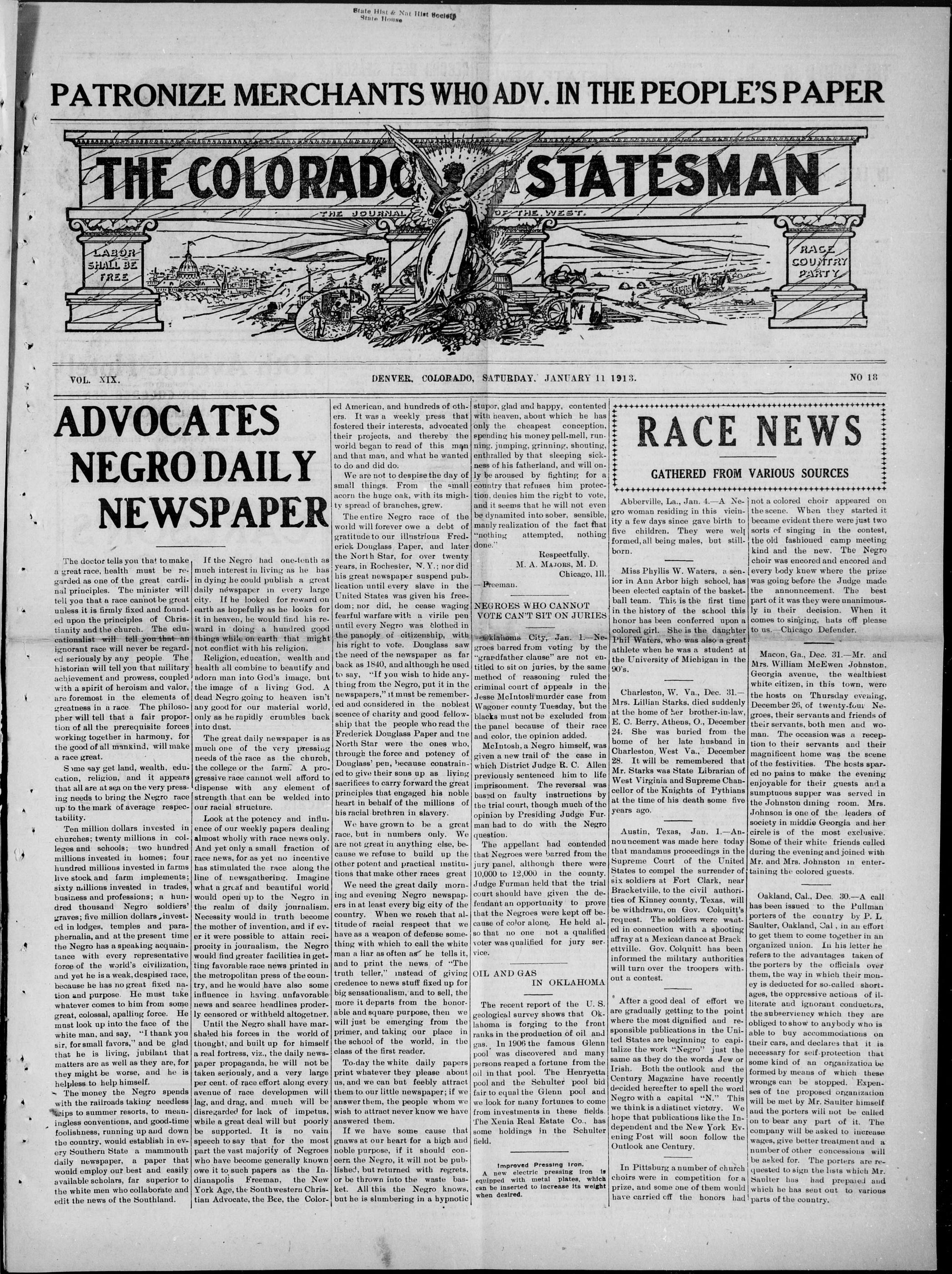
ADVOCATES NEGRO DAILY NEWSPAPER
VOL. XIX.
ADVOCA
NEGRO
NEW
The doctor tells you that to make a great race, health must be regarded as one of the great cardinal principles. The minister will tell you that a race cannot be great unless it is firmly fixed and founded upon the principles of Christianity and the church. The educationalist will tell you that an ignorant race will never be regarded seriously by any people. The historian will tell you that military achievement and prowess, coupled with a spirit of heroism and valor, are foremost in the elements of greatness in a race. The philosopher will tell that a fair proportion of all the prerequisite forces working together in harmony, for the good of all mankind, will make a race great.
Some say get land, wealth, education, religion, and it appears that all are at sea on the very pressing needs to bring the Negro race up to the mark of average respectability.
Ten million dollars invested in churches; twenty millions in colleges and schools; two hundred millions invested in homes; four hundred millions invested in farms live stock and farm implements; sixty millions invested in trades, business and professions; a hundred thousand Negro soldiers' graves; five million dollars invested in lodges, temples and paraphernalia, and at the present time the Negro has a speaking acquaintance with every representative force of the world's civilization, and yet he is a weak, despised race, because he has no great fixed nation and purpose. He must take whatever comes to him from some great, colossal, apalling force. He must look up into the face of the white man, and say, "I thank you sir, for small favors," and be glad that he is living, jubilant that matters are as well as they are, for they might be worse, and he is helpless to help himself.
The money the Negro spends with the railroads taking needless trips to summer resorts, to meaningless conventions, and good-time foolishness, running up and down the country, would establish in every Southern State a mammouth daily newspaper, a paper that would employ our best and easily available scholars, far superior to the white men who collaborate and edit the news of the Southland.
If the Negro had one-tenth as much interest in living as he has in dying he could publish a great daily newspaper in every large city. If he looked for reward on earth as hopefully as he looks for it in heaven, he would find his reward in doing a hundred good things while on earth that might not conflict with his religion.
Religion, education, wealth and health all combine to beautify and adorn man into God's image, but the image of a living God. A dead Negro going to heaven isn't any good for our material world, only as he rapidly crumbles back into dust.
The great daily newspaper is as much one of the very pressing needs of the race as the church, the college or the farm. A progressive race cannot well afford to dispense with any element of strength that can be welded into our racial structure.
Look at the potency and influence of our weekly papers dealing almost wholly with race news only. And yet only a small fraction of race news, for as yet no incentive has stimulated the race along the line of newsgathering. Imagine what a great and beautiful world would open up to the Negro in the realm of daily journalism. Necessity would in truth become the mother of invention, and if ever it were possible to attain reciprocity in journalism, the Negro would find greater facilities in getting favorable race news printed in the metropolitan press of the country, and he would have also some influence in having unfavorable news and scarce headlines proddely censored or withheld altogether.
Until the Negro shall have marshaled his forces in the world of thought, and built up for himself a real fortress, viz., the daily newspaper propaganda, he will not be taken seriously, and a very large per cent. of race effort along every avenue of race developmen will lag, and drag, and much will be disregarded for lack of impetus, while a great deal will but poorly be supported. It is no vain speech to say that for the most part the vast majority of Negroes who have become generally known owe it to such papers as the Indianapolis Freeman, the New York Age, the Southwestern Christian Advocate, the Bee, the Color-
DENVER, COLOBADO, SATURDAY. JANUARY 11 1913.
State Hist & Nat Hist Society
State House.
HANTS WH
ADO
THE JOURNAL
DENVER. COLORADO
ed American, and hundreds of others. It was a weekly press that fostered their interests, advocated their projects, and thereby the world began to read of this man and that man, and what he wanted to do and did do.
We are not to despise the day of small things. From the small acorn the huge oak, with its mighty spread of branches, grew.
The entire Negro race of the world will forever owe a debt of gratitude to our illustrious Frederick Douglass Paper, and later the North Star, for over twenty years, in Rochester, N. Y.; nor did his great newspaper suspend publication until every slave in the United States was given his freedom; nor did, he cease waging fearful warfare with a virile pen until every Negro was clothed in the panoply of citizenship, with his right to vote. Douglass saw the need of the newspaper as far back as 1840, and although he used to say, "If you wish to hide anything from the Negro, put it in the newspapers," it must be remembered and considered in the noblest scence of charity and good fellowship that the people who read the Frederick Douglass Paper and the North Star were the ones who, through the force and potency of Douglass' pen, because constrained to give their sons up as living sacrifices to carry forward the great principles that engaged his noble heart in behalf of the millions of his racial brethren in slavery.
We have grown to be a great race, but in numbers only. We are not great in anything else, because we refuse to build up the other potent and practical institutions that make other races great. We need the great daily morning and evening Negro newspapers in at least every big city of the country. When we reach that altitude of racial respect that we have as a weapon of defense something with which to call the white man a liar as often as he tells it, and to print the news of "The truth teller," instead of giving credence to news stuff fixed up for big sensationalism, and to sell, the more it departs from the honorable and square purpose, then we will just be emerging from the primer, and taking our place in the school of the world, in the class of the first reader.
To-day the white daily papers print whatever they please about us, and we can but feebly attract them to our little newspaper; if we answer them, the people whom we wish to attract never know we have answered them.
If we have some cause that gnaws at our heart for a high and noble purpose, if it should concern the Negro, it will not be published, but returned with regrets, or be thrown into the waste basket. All this the Negro knows, but he is slumbering in a hypnotic
stupor, glad and happy, contented with heaven, about which he has only the cheapest conception, spending his money pell-mell, running, jumping, grinning, shouting, enthralled by that sleeping sickness of his fatherland, and will only be aroused by fighting for a country that refuses him protection, denies him the right to vote, and it seems that he will not even be dynamited into sober, sensible, manly realization of the fact that "nothing attempted, nothing done."
NEGROES WHO CANNOT VOTE CAN'T SIT ON JURIES
Oklahoma City, Jan. 1.—Negroes barred from voting by the "grandfather clause" are not entitled to sit on juries, by the same method of reasoning ruled the criminal court of appeals in the Jesse McIntosh murder case from Wagoner county Tuesday, but the blacks must not be excluded from the panel because of their race and color, the opinion added.
McIntosh, a Negro himself, was given a new trail of the case in which District Judge R. C. Allen previously sentenced him to life imprisonment. The reversal was based on faulty instructions by the trial court, though much of the opinion by Presiding Judge Furman had to do with the Negro question.
The appellant had contended that Negroes were barred from the jury panel, although there were 10,000 to 12,000 in the county. Judge Furman held that the trial court should have given the defendant an opportunity to prove that the Negroes were kept off because of color alone. He held also that no one not a qualified voter was qualified for jury service.
OIL AND GAS
The recent report of the U. S. geological survey shows that Oklahoma is forging to the front ranks in the production of oil and gas. In 1906 the famous Glenn pool was discovered and many persons reaped a fortune from the oil in that pool. The Henryetta pool and the Schulter pool bid fair to equal the Glenn pool and we look for many fortunes to come from investments in these fields. The Xenia Real Estate Co., has some holdings in the Schulter field.
Improved Pressing Iron.
A new electric pressing iron is equipped with metal plates, which can be inserted to increase its weight when desired.
RACE NEWS
GATHERED FROM VARIOUS SOURCES
Abberville, La., Jan. 4.—A Negro woman residing in this vicinity a few days since gave birth to five children. They were well formed, all being males, but still-born.
Miss Phyllis W. Waters, a senior in Ann Arbor high school, has been elected captain of the basketball team. This is the first time in the history of the school this honor has been conferred upon a colored girl. She is the daughter Phil Waters, who was also a great athlete when he was a student at the University of Michigan in the 90's.
Charleston, W. Va., Dec. 31. Mrs. Lillian Starks, died suddenly at the home of her brother-in-law, E. C. Berry, Atheus, O., December 24. She was buried from the home of her late husband in Charleston, West Va., December 28. It will be remembered that Mr. Starks was State Librarian of West Virginia and Supreme Chancellor of the Knights of Pythians at the time of his death some five years ago.
Austin, Texas, Jan. 1.—Announcement was made here today that mandamus proceedings in the Supreme Court of the United States to compel the surrender of six soldiers at Fort Clark, near Bracketville, to the civil authorities of Kinney county, Texas, will be withdrawn, on Gov. Colquitt's request. The soldiers were wanted in connection with a shooting affray at a Mexican dance at Brackettville. Gov. Colquitt has been informed the military authorities will turn over the troopers without a contest.
After a good deal of effort we are gradually getting to the point where the most dignified and responsible publications in the United States are beginning to capitalize the work "Negro" just the same as they do the words Jew or Irish. Both the outlook and the Century Magazine have recently decided hereafter to spell the word Negro with a capital "N." This we think is a distinct victory. We hope that publications like the Independent and the New York Evening Post will soon follow the Outlook ane Century.
In Pittsburg a number of church choirs were in competition for a prize, and some one of them would have carried off the honors had
NO 18
not a colored choir appeared on the scene. When they started it became evident there were just two sorts of singing in the contest, the old fashioned camp meeting kind and the new. The Negro choir was encored and encored and every body knew where the prize was going before the Judge made the announcement. The best part of it was they were unanimously in their decision. When it comes to singing, hats off please to us.—Chicago Defender.
Macon, Ga., Dec. 31.—Mr. and Mrs. William McEwen Johnston, Georgia avenue, the wealthiest white citizen, in this town, were the hosts on Thursday evening, December 26, of twenty-four Negroes, their servants and friends of their servants, both men and woman. The occasion was a reception to their servants and their magnificent home was the scene of the festivities. The hosts spared no pains to make the evening enjoyable for their guests and a sumptuous supper was served in the Johnston dining room. Mrs. Johnson is one of the leaders of society in middle Georgia and her circle is of the most exclusive. Some of their white friends called during the evening and joined with Mr. and Mrs. Johnston in entertaining the colored guests.
Oakland, Cal., Dec. 30.—A call has been issued to the Pullman porters of the country by P. L. Saulter, Oakland, Cal., in an effort to get them to come together in an organized union. In his letter he refers to the advantages taken of the porters by the officials over them, the way in which their money is deducted for so-called shortages, the oppressive actions of illiterate and ignorant conductors, the subserviency which they are obliged to show to anybody who is able to buy accommodations on their cars, and declares that it is necessary for self-protection that some kind of an organization be formed by means of which these wrongs can be stopped. Expenses of the proposed organization will be met by Mr. Saulter himself and the porters will not be called on to bear any part of it. The company will be asked to increase wages, give better treatment and a number of other concessions will be asked for. The porters are requested to sign the lists which Mr. Saulter has had prepared and which he has sent out to various parts of the country.
AFRO-AMERICAN CULLINGS
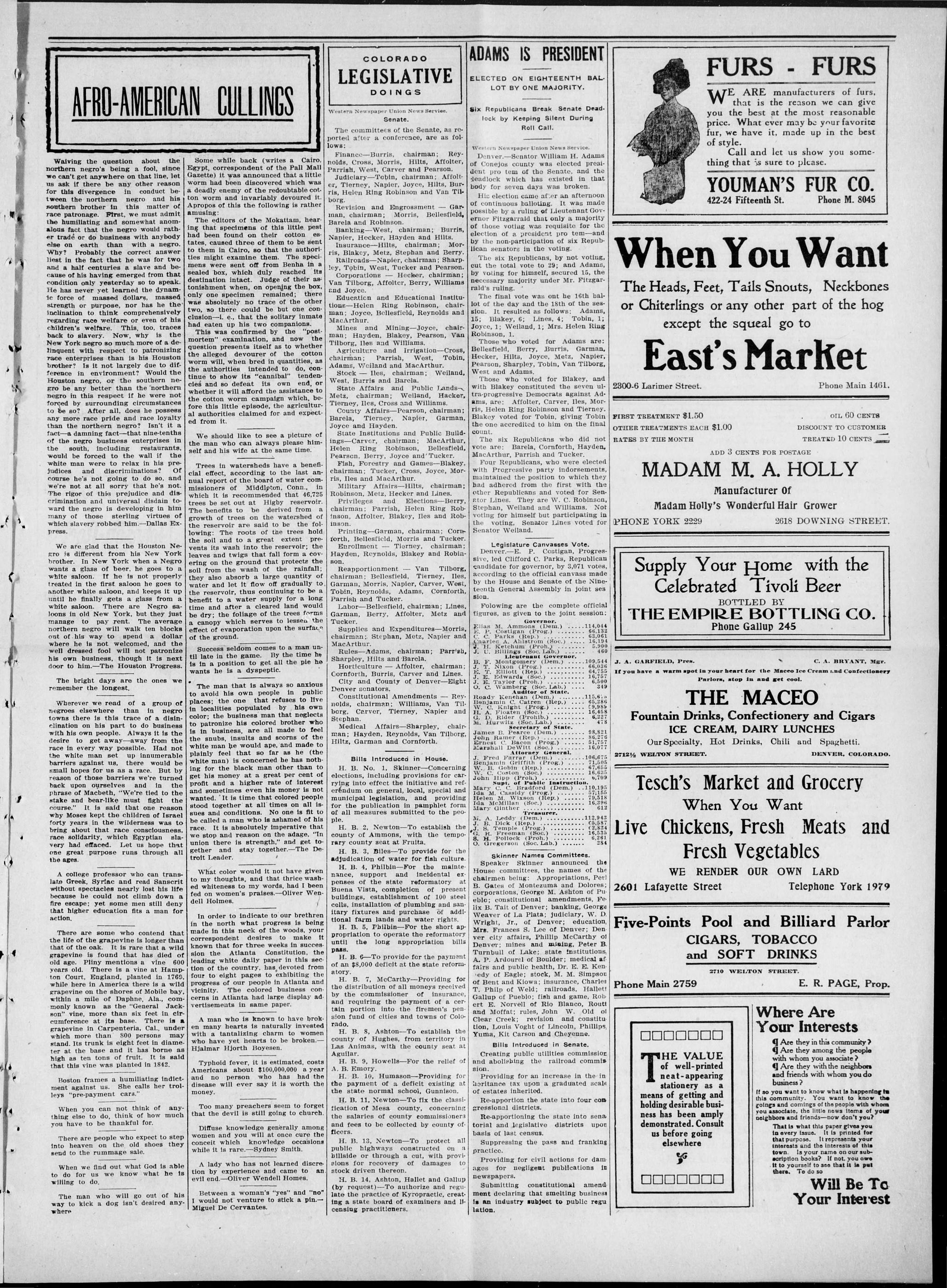
Waiving the question about the northern negro's being a fool, since we can't get anywhere on that line, let us ask if there be any other reason for this divergence in conduct between the northern negro and his southern brother in this matter of race patronage. First, we must admit the humiliating and somewhat anomalous fact that the negro would rather trade or do business with anybody else on earth than with a negro. Why? Probably the correct answer lies in the fact that he was for two and a half centuries a slave and because of his having emerged from that condition only yesterday so to speak. He has never yet learned the dynamic force of massed dollars, massed strength or purpose, nor has he the inclination to think comprehensively the race welfare or even of his children's welfare. This, too, traces back to slavery. Now, why is the New York negro so much more of a deficient with respect to patronizing race enterprises than is his Houston brother? Is it not largely due to difference in environment? Would the Houston negro, or the southern negro be any better than the northern negro in this respect if he were not forced by surrounding circumstances to be so? After all, does he possess any more race pride and race loyalty than the northern negro? Isn't it a fact—a damning fact—that nine-tenths of the negro business enterprises in the south, including restaurants, would be forced to the wall if the white man were to relax in his prejudices and discriminations? Of course he's not going to do so, and we're not at all sorry that he's not. The rigor of this prejudice and discrimination and universal disdain toward the negro is developing in him many of those sterling virtues of which slavery robbed him—Dallas Express.
We are glad that the Houston Negro is different from his New York brother. In New York when a Negro wants a glass of beer, he goes to a white saloon. If he is not properly treated in the first saloon he goes to another white saloon, and keeps it up until he finally gets a glass from a white saloon. There are Negro saloons in old New York, but they just manage to pay rent. The average northern negro will walk ten blocks out of his way to spend a dollar where he is not welcomed, and the well dressed fool will not patronize his own business, though it is next door to him.—The Houston Progress.
The bright days are the ones we remember the longest.
Wherever we read of a group of negroes elsewhere than in negro towns there is this trace of a disinclination on his part to do business with his own people. Always it is the desire to get away—away from the race in every way possible. Had not the white man set up innumerable barriers against us, there would be small hopes for us as a race. But by reason of those barriers we're turned back upon ourselves and in the phrase of Macbeth, "We're tied to the stake and bear-like must fight the course." It is said that one reason why Moses kept the children of Israel forty years in the wilderness was to bring about that race consciousness, race solidarity, which Egyptian slavery had effaced. Let us hope that one great purpose runs through all the ages.
A college professor who can translate Greek, Syriac and read Sanscrit without spectacles nearly lost his life because he could not climb down a fire escape; yet some men still deny that higher education fits a man for action.
There are some who contend that the life of the grapevine is longer than that of the oak. It is rare that a wild grapevine is found that has died of old age. Pliny mentions a vine 600 years old. There is a vine at Hampton Court, England, planted in 1769, while here in America there is a wild grapevine on the shores of Mobile bay, within a mile of Daphne, Ala., commonly known as the "General Jackson" vine, more than six feet in circumference at its base. There is a grapevine in Carpenteria, Cal., under which more than 800 persons may stand. Its trunk is eight feet in diameter at the base and it has borne as high as ten tons of fruit. It is said that this vine was planted in 1842.
Boston frames a humiliating indictment against us. She calls her trolleys "pre-payment cars."
When you can not think of anything else to do, think of how much you have to be thankful for.
There are people who expect to step into heaven on the old shoes they send to the rummage sale.
When we find out what God is able to do for us we know what he is willing to do.
The man who will go out of his way to kick a dog isn't desired anywhere.
Some while back (writes a Cairo, Egypt, correspondent of the Pall Mall Gazette) it was announced that a little worm had been discovered which was a deadly enemy of the redoubtable cotton worm and invariably devoured it. Apropos of this the following is rather amusing:
The editors of the Mokattam, hearing that specimens of this little pest had been found on their cotton estates, caused three of them to be sent to them in Cairo, so that the authorities might examine them. The specimens were sent off from Benha in a sealed box, which duly reached its destination intact. Judge of their asonishment when, on opening the box, only one specimen remained; there was absolutely no trace of the other two, so there could be but one conclusion—i.e. that the solitary inmate had eaten up his two companions.
This was confirmed by the "post-mortem" examination, and now the question presents itself as to whether the alleged devourer of the cotton worm will, when bred in quantities, as the authorities intended to do, continue to show its "cannibal" tendencies and so defeat its own end, or whether it will afford the assistance to the cotton worm campaign which, before this little episode, the agricultural authorities claimed for and expected from it.
We should like to see a picture of the man who can always please himself and his wife at the same time.
Trees in watersheds have a beneficial effect, according to the last annual report of the board of water commissioners of Middleton, Conn., in which it is recommended that 46,725 trees be set out at Higby reservoir. The benefits to be derived from a growth of trees on the watershed of the reservoir are said to be the following: The roots of the trees hold the soil and to a great extent prevents its wash into the reservoir; the leaves and twigs that fall form a covering on the ground that protects the soil from the wash of the rainfall; they also absorb a large quantity of water and let it flow off gradually to the reservoir, thus continuing to be a benefit to a water supply for a long time and after a cleared land would be dry; the foliage of the trees forms a canopy which serves to lessen the effect of evaporation upon the surface of the ground.
Success seldom comes to a man until late in the game. By the time he is in a position to get all the pie he wants he is a dyspeptic.
The man that is always so anxious to avoid his own people in public places; the one that refuses to live in localities populated by his own color; the business man that neglects to patronize his colored brother who is in business, are all made to feel the snubs, insults and scorns of the white man he would ape, and made to plainly feel that so far as he (the white man) is concerned he has nothing for the black man other than to get his money at a great per cent of profit and a higher rate of interest and sometimes even his money is not wanted. "It is time that colored people stood together at all times on all issues and conditions. No one is fit to be called a man who is ashamed of his race. It is absolutely imperative that we stop and reason on the adage. "In union there is strength," and get together and stay together.—The Detroit Leader.
What color would it not have given to my thoughts, and that thrice washed whiteness to my words, had I been fed on women's praises.—Oliver Wendell Holmes.
In order to indicate to our brethren in the north what progress is being made in this neck of the woods, your correspondent desires to make it known that for three weeks in succession the Atlanta Constitution, the leading white daily paper in this section of the country, has devoted from four to eight pages to exhibiting the progress of our people in Atlanta and vicinity. The colored business concerns in Atlanta had large display advertisements in same paper.
A man who is known to have broken many hearts is naturally invested with a tantalizing charm to women who have yet hearts to be broken.—Hjalmar Hjorth Boyesen.
Typhoid fever, it is estimated, costs Americans about $100,000,000 a year and no person who has had the disease will ever say it is worth the money.
Too many preachers seem to forget that the devil is still going to church.
Diffuse knowledge generally among women and you will at once cure the conceit which knowledge occasions while it is rare.—Sydney Smith.
A lady who has not learned discretion by experience and came to an evil end.—Oliver Wendell Homes.
Between a woman's "yes" and "no"
I would not venture to stick a pin.
Miguel De Cervantes.
DOINGS
Western Newspaper Union News Service.
Senate.
The committees of the Senate, as reported after a conference, are as follows:
Finance—Burris, chairman; Reynolds, Cross, Morris, Hilts, Affolter, Parrish, West, Carver and Pearson.
Judiciary—Tobin, chairman; Affolter, Tierney, Napier, Joyce, Hilts, Burris, Helen Ring Robinson and Van Tilborg.
Revision and Engrossment — Garman, chairman; Morris, Bellesfield, Barela and Robinson.
Banking—West, chairman; Burris, Napier, Hecker, Hayden and Hilts.
Corporations — Hecker, chairman; Van Tilborg, Affolter, Berry, Williams and Joyce.
Education and Educational Institutions—Helen Ring Robinson, chairman; Joyce, Bellesfield, Reynolds and MacArthur.
Mines and Mining—Joyce, chairman; Hayden, Blakey, Pearson, Van Tilborg, Iles and Williams.
Agriculture and Irrigation—Cross, chairman; Parrish, West, Tobin, Adams, Weiland and MacArthur.
Stock — Iles, chairman; Weiland, West, Burris and Barcla.
State Affairs and Public Lands—Metz, chairman; Weiland, Hacker, Tierney, Iles, Cross and Williams.
County Affairs—Pearson, chairman; Barela, Tierney, Napier, Garman, Joyce and Hayden.
State Institutions and Public Buildings—Carver, chairman; MacArthur, Helen Ring Robinson, Bellesfield, Pearson, Berry, Joyce and Tucker. Fish, Forestry and Games—Blakey, chairman; Tucker, Cross, Joyce, Morris, Iles and MacArthur. Military Affairs—Hilts, chairman; Robinson, Metz, Hecker and Lines. Privileges and Elections—Berry, chairman; Parrish, Helen Ring Robinson, Affolter, Blakey, Iles and Robinson. Printing—Garman, chairman; Cornforth, Bellesfield, Morris and Tucker. Enrollment — Tierney, chairman; Hayden, Reynolds, Blakey and Robinson. Reapportionment — Van Tilborg, chairman; Bellesfield, Tierney, Iles, Garman, Morris, Napier, Carver, West, Tobin, Reynolds, Adams, Cornforth, Parrish and Tucker.
Labor—Bellesfield, chairman; Lines, Garman, Berry, Affolter, Metz and Tucker.
Supplies and Expenditures—Morris, chairman; Stephan, Metz, Napier and MacArthur.
Rules—Adams, chairman; Parr'sh, Sharpley, Hilts and Barcla.
Horticulture — Affolter, chairman; Cornforth, Burris, Carver and Lines.
City and County of Denver—Eight Denver sonators.
Constitutional Amendments — Reynolds, chairman; Williams, Van Tilborg, Carver, Tierney, Napier and Stephan.
Medical Affairs—Sharpley, chairman; Hayden, Reynolds, Van Tilborg, Hiltz, Garman and Cornforth.
Bills Introduced in House.
H. B. No. 1, Skinner—Concerning elections, including provisions for carrying into effect the initiative and referendum on general, local, special and municipal legislation, and providing for the publication in pamphlet form of all measures submitted to the people.
H. B. 2, Newton—To establish the county of Ammons, with the temporary county seat at Fruita.
H. B. 3, Biles—To provide for the adjudication of water for fish culture.
adjudication of water for fish culture.
H. B. 4, Philbin—For the maintenance, support and incidental expenses of the state reformatory at Buena Vista, completion of present buildings, establishment of 100 steel cells, installation of plumbing and sanitary fixtures and purchase of additional farm lands and water rights.
H. B. 5, Philbin—For the short appropriation to operate the reformatory until the long appropriation bills pass.
H. B. 6—To provide for the payment of an $8,000 deficit at the state reformatory.
H. B. 7, McCarthy—Providing for the distribution of all moneys received by the commissioner of insurance, and requiring the payment of a certain portion into the firemen's pension fund of cities and towns of Colorado.
H. B. 8, Ashton—To establish the county of Hughes, from territory in Las Animas, with the county seat at Aguilar.
H. B. 9, Howells—For the relief of A. B. Emory.
H. B. 10, Humason—Providing for the payment of a deficit existing at the state normal school, Gunnison.
H. B. 11, Newton—To fix the classification of Mesa county, concerning the salaries of county commissioners and fees to be collected by county officers.
H. B. 13, Newton—To protect all public highways constructed on a billside or through a cut, with provisions for recovery of damages to stock driven thereon.
H. B. 14, Ashton, Hallet and Gallup (by request)—To authorize and regulate the practice of Kyropractic, creating a state board of examiners and licensing practitioners.
ADAMS IS PRESIDENT
ELECTED ON EIGHTEENTH BALLOT BY ONE MAJORITY.
Six Republicans Break Senate Deadlock by Keeping Silent During Roll Call.
Western Newspaper Union News Service.
Denver.—Senator William H. Adams of Conejos county was elected president pro tem of the Senate, and the deadlock which has existed in that body for seven days was broken.
His election came after an afternoon of continuous balloting. It was made possible by a ruling of Lieutenant Governor Fitzgarrard that only a majority of those voting was requisite for the election of a president pro tem—and by the non-participation of six Republican senators in the voting.
The six Republicans, by not voting, cut the total vote to 29; and Adams, by voting for himself, secured 15, the necessary majority under Mr. Fitzgarrald's ruling.
The final vote was ont he 16th ballot of the day and the 18th of the session. It resulted as follows: Adams, 15; Blakey, 6; Lines, 4; Tobin, 1; Joyce, 1; Weiland, 1; Mrs. Helen Ring Robinson, 1.
Those who voted for Adams are: Bellesfield, Berry, Burris, Garman, Hecker, Hilts, Joyce, Metz, Napier, Pearson, Sharpey, Tobin, Van Tilborg, West and Adams.
Those who voted for Blakey, and with Blakey constituted the seven ultra-progressive Democrats against Adams, are: Affolter, Carver, Iles, Morris, Helen Ring Robinson and Tierney. Blakey voted for Tobin, giving Tobin the one accredited to him on the final count.
The six Republicans who did not vote are: Barela, Cornforth, Hayden, MacArthur, Parrish and Tucker.
Four Republicans, who were elected with Progressive party indorsements, maintained the position to which they had adhored from the first with the other Republicans and voted for Senator Lines. They are W. C. Robinson, Stephan, Weiland and Williams. Not voting for himself but participating in the voting, Senator Lines voted for Senator Weiland.
Legislature Canvasses Vote.
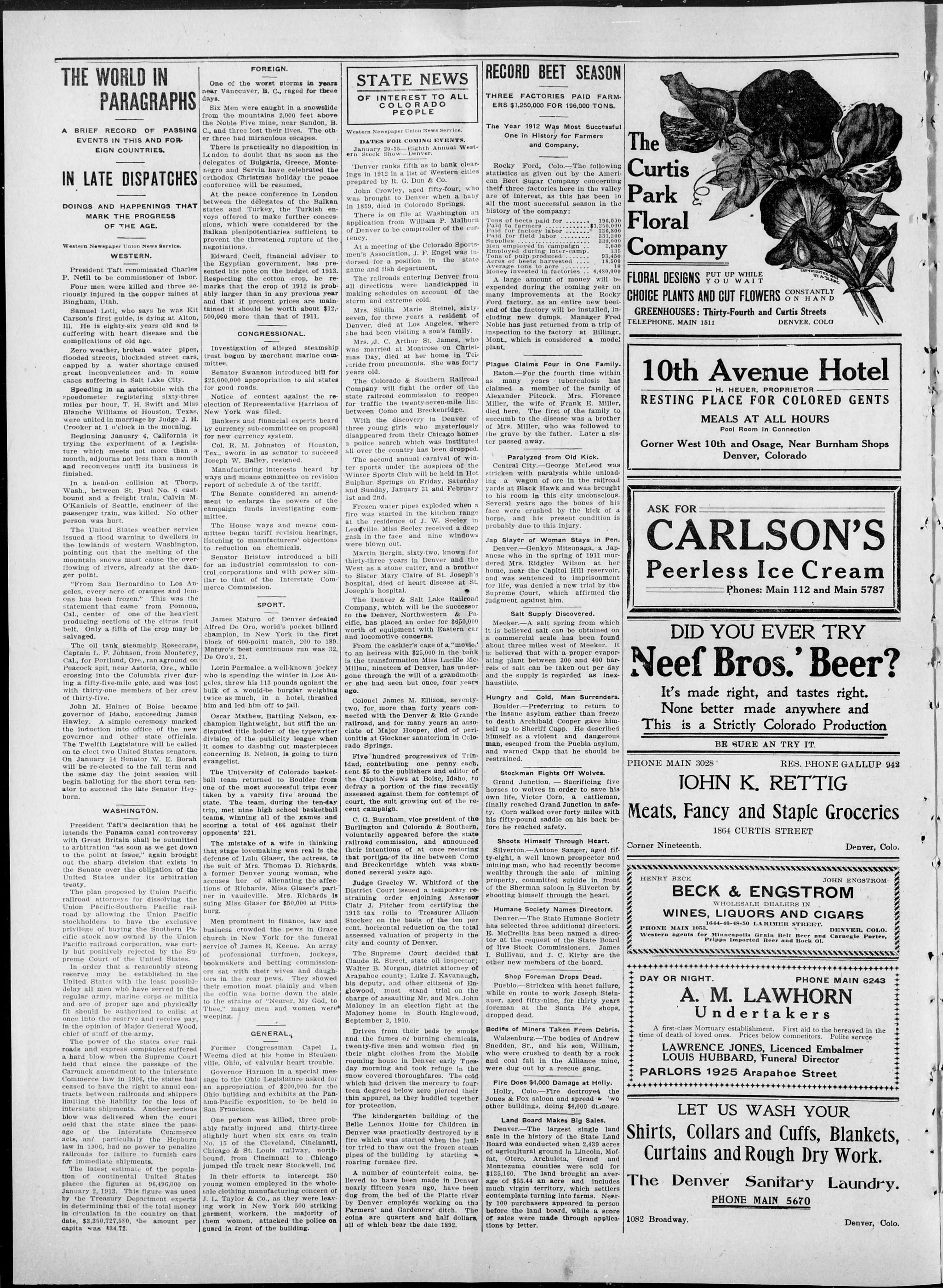
Denver,—E. P. Costigan, Progressive, led Clifford C. Parks, Republican candidate for governor, by 3,071 votes, according to the official canvass made by the House and Senate of the Nineteenth General Assembly in joint session.
Folowing are the complete official figures, as given to the joint session:
Governor.
Elias M. Ammons (Dem.) 114,044
E. P. Postigan (Prog.) 64,132
E. C. Postigan (Rep.) 63,061
Charles A. Alhistrom (Dem.) 16,194
J. H. Ketchum (Proh.) 5,900
J. U. Billings (Soc. Lab.) 460
Lleutenant Governor.
B. F. Moore (Dem.) 109,544
J. T. Nixon (Prog.) 66,936
E. T. Elliott (Rep.) 64,755
J. E. Edwards (Soc.) 16,757
J. E. Taylor (Proh.) 6,500
O. C. Wanberg (Soc. Lab.) 349
Auditor of State.
Roady Kenehan (Dem.) 115,614
Benjamin C. Catren (Rep.) 65,286
H. A. Flungen (Prog.) 69,128
H. A. Flungen (Soc.) 16,458
G. D. Rider (Proh.) 6,227
M. Hurwilt (Soc. Lab.) 473
Secretary of State.
James B. Reagan (Dem.) 98,821
John Ramer (Rep.) 86,276
Ernest C. Bacon (Prog.) 51,757
Marshall DeWitt (Soc.) 16,077
Attorney General.
J. Fred Ferguson (Dem.) 106,675
Benjamin Griffith (Prog.) 71,505
W. B. Gobin (Rep.) 67,655
W. C. Costen (Soc.) 16,635
John Hipp (Proh.) 6,709
Supreme Social Instruction.
Mary C. C. Bradford (Dem.) 110,195
Ida M. Cassidy (Prog.) 57,155
Helen M. Wixson (Rep.) 79,518
Ida M. McMillan (Soc.) 16,396
Mary Glnther 612
Treasurer.
M. A. Leddy (Dem.) 112,943
J. B. Dick (Rep.) 65,587
J. S. Temple (Prog.) 72,944
G. S. Johnson (Soc.) 16,535
S. H. Pollock (Proh.) 6,261
O. Gregerson (Soc. Lab.) 284
Skinner Names Committees.
Speaker Skinner announced the House committees, the names of the chairmen being: Appropriations, Perl B. Gates of Montezuma and Dolores; corporations, George M. Ashton of Publo; constitutional amendments, Felix B. Tait of Denver; banking, George Weaver of La Plata; judiciary, W. D. Wright, Jr., of Denver; education, Mrs. Frances S. Lee of Denver; Denver city affairs, Phillip McCarthy of Denver; mines and missing, Peter B. Turnbull of Lake; state institutions, A. P. Ardoulre of Boulder; medical affairs and public health, Dr. E. E. Kennedy of Eagle; stock, M. M. Simpson of Bent and Kiowa; insurance, Charles T. Philp of Weld; railroads, Hallett Gallup of Pebble; fish and game, Robert E. Norvell of Rio Blanco, Routt and Moffat; rules, John W. Old of Clear Creek; revision and constitution, Louis Voght of Lincoln, Phillips, Yuma, Kit Carson and Cheyenne.
Creating public utilities commission and abolishing the railroad commission.
Providing for an increase in the inheritance tax upon a graduated scale of estates inherited.
Re-apportion the state into four congressional districts.
Re-apportioning the state into senatorial and legislative districts upon basis of last census.
Suppressing the pass and franking practice.
Providing for civil actions for damages for negligent publications in newspapers.
Submitting constitutional amendment declaring that smelting business is an industry subject to public regulation.
FURS - FURS
WE ARE manufacturers of furs,
that is the reason we can give
you the best at the most reasonable
price. What ever may be your favorite
fur, we have it, made up in the best
of style.
Call and let us show you something that is sure to please.
YOUMAN'S FUR CO.
422-24 Fifteenth St. Phone M. 8045
n You Want
eet, Tails Snouts, Neckbones
or any other part of the hog
the squeal go to
t's Market
When You Want
The Heads, Feet, Tails Snouts, Neckbones or Chiterlings or any other part of the hog except the squeal go to
ADD 3 CENTS FOR POSTAGE
M. M. A. HOLLY
Manufacturer Of
Lily's Wonderful Hair Grower
2618 DOWNING STREET.
Your Home with the
Gated Tivoli Beer
BOTTLED BY
PIRE BOTTLING CO.
Phone Gallup 245
C. A. BRYANT, Mgr.
In your heart for the Maceo Ice Cream and Confectionery
Barlors, stop in and get cool.
THE MACEO
Drinks, Confectionery and Cigars
REAM, DAIRY LUNCHES
Hot Drinks, Chili and Spaghetti.
DENVER, COLORADO.
Market and Grocery
When You Want
Fens, Fresh Meats and
Fresh Vegetables
ENDER OUR OWN LARD
Street Telephone York 1979
Pool and Billiard Parlor
GARS, TOBACCO
H SOFT DRINKS
Supply Your Home with the Celebrated Tivoli Beer BOTTLED BY THE EMPIRE BOTTLING CO. Phone Gallup 245
J. A. GARFIELD, Pres. C. A. BRYANT, Mgr.
If you have a warm spot in your heart for the Maceo Ice Cream and Confectionery
Parlors, stop in and get cool.
THE MACEO
Fountain Drinks, Confectionery and Cigars
ICE CREAM, DAIRY LUNCHES
Our Specialty, Hot Drinks, Chili and Spaghetti.
2712½ WELTON STREET. DENVER, COLORADO.
WE RENDER OUR OWN LARD
2601 Lafayette Street Telephone York 1979
Five-Points Pool and Billiard Parlor CIGARS, TOBACCO and SOFT DRINKS 2710 WELTON STREET.
---
```markdown
```
When
The Heads, Feet, T or Chiterlings or a except the
East's
2300-6 Larimer Street.
FIRST TREATMENT $1.50
OTHER TREATMENTS EACH $1.00
RATES BY THE MONTH
ADD 3
MADAM HOLLY
Manhattan
Madam Holly's W
PHONE YORK 2229
Supply Your
Celebrated
BOTH
THE EMPIRI
Phon
J. A. GARFIELD, Pres.
If you have a warm spot in your he
Parlors, st
THE
Fountain Drinks, C
ICE CREAM
Our Specialty, Hot
2712½ WELTON STREET.
Tesch's Mart
When You
Live Chickens,
Fresh
WE RENDER
2601 Lafayette Street
Five-Points Pool
CIGARS
and SO
2710 V
Phone Main 2759
THE VALUE of well-printed neat-appearing stationery as a means of getting and holding desirable business has been amply demonstrated. Consult us before going elsewhere
```markdown
```
Phone Main 1461.
OIL 60 CENTS
DISCOUNT TO CUSTOMER
TREATED 10 CENTS
E. R. PAGE, Prop.
Where Are Your Interests
Are they in this community?
Are they among the people with whom you associate?
Are they with the neighbors and friends with whom you do business?
If so you want to know what is happening in this community. You want to know the goings and comings of the people with whom you associate, the little news items of your neighbors and friends—now don't you?
That is what this paper gives you in every issue. It is printed for that purpose. It represents your interests and the interests of this town. Is your name on our subscription books? If not, you owe it to yourself to see that it is put there. To do so
Will Be To Your Interest
THE COLORADO STATESMAN
KADOU MULLEES PARK
DAVE NEW
JOS. D. D. RIVERS.....Proprietor
1824 Curtis Street, Room 25.
Entered as second-class matter at the postoffice in the city of Denver, Colorado.
Reading notices, ten lines or less, 10 cents per line. Each additional line over ten lines, 5 cents per line.
Display advertising, 25 cents per square. A square contains ten agate lines.
No discounts allowed on less than three months' contract. Cash must accompany all orders from parties unknown to us. Further particulars on application.
Remittances should be made by Express Money Order, Postoffice Money Order, Registered Letter or Bank Draft. Postage stamps will be received the same as cash for the fractional part of a dollar. Only 1-cent and 2-cent stamps taken.
All communications of a personating nature that are not complimentary will be withheld from the columns of this paper.
Communications to receive attention must be newsy, upon important subjects, plainly written only upon one side of the paper; must reach us Tuesdays, if possible, anyway, not later than Wednesdays, and bear the signature of the author. No manuscript returned, unless stamps are sent for postage.
It occasionally happens that papers sent to subscribers are lost or stolen. In case you do not receive any number when due, inform us by postal card and we will cheerfully forward a duplicate of the missing number.
ZERO WEATHER.
severity of the present week has be the country escapes what another is engaged in succeeding seasons, but need to wintry experiences seemsences of the earth's atmosphere are extreme fluctuations of tempera the atmosphere is among the uns may furnish some explanation in pretty cold breath for a red-hot so
The universal severity of the present week has been remarkable. Usually one part of the country escapes what another part suffers, and the compliment is exchanged in succeeding seasons, but this time no part of the country, accustomed to wintry experiences seems to have been slighted by Boreas. Disturbances of the earth's atmosphere are supposed to be the causes of storms and extreme fluctuations of temperature, but what causes the disturbances of the atmosphere is among the unsolved theories of scientists. The comets may furnish some explanation in the present instance, but, if so, it has a pretty cold breath for a red-hot solar visitor.
THE WANDERING MINSTREL.
That faulty characteristic, altogether too common among Negroes, by which a person expects to "get by" without much regard for recognized standards of efficiency, is sure to come in for its full share of lambasting one of these days when the Negro's failures are being traced to their legitimate sources.
A familiar sight in most large cities of the North is the seedy colored man, usually young, hurrying through the streets at morning or evening, with an air of great importance, and carrying in his hand or under arm a mandolin or guitar wrapped in a cloth cover or a canvas or pasteboard case, with no other feature particularly noticeable to mark him as a musical genius. His course may lead to some white saloon, where he is going to play and sing for a few nickels and a free lunch; or to some carelessly conducted barber shop where a band of idle Negro ear-musicians congregate; or to some third-class dancing place where the twang of strings is needed merely to mark time for shuffling feet.
To a certain extent these wandering minstrels assume to represent the musical ability of the colored people, and, when the opportunity offers, do not hesitate to rush in as such representatives, where angels might fear to tread.
The Negro race is said to be a musical race by nature, but a good many freaks take advantage of this assumption. They overlook the requirement for a thorough musical education to develop whatever genius nature may have supplied. The tendency to skip over the work necessary to fit one to fill the part he assumes, in a capable and masterly manner gives us a horde of musicians who would be capable of making a very poor living as such. If the Negro is going to develop his-musical genius, or any other genius he may have, he must learn that hard study and steady application of his effort to the science of his chosen calling are absolutely necessary to his permanent success.
We do not think, as some people profess to think, that music is one of the great stepping stones to race development, but we do think that if we are going to have musicians at all, they should study music as other people study it, and not "pick it up."
A makeshift individual never will make a thorough musician or anything else that is thorough. Money spent on him trying to overcome this impossibility will be wasted. A better idea of the world's standards of efficiency should be inculcated into our young people's minds, with the need to work and study and dig and fit one's self while young for the responsibilities that are sure to come as we get out into the world and its affairs, for without the ability to compare and compete with others, the Negro must make way for his betters, and fall back into the ranks of the wandering minstrels.
The Right Kind of Reading Matter
The home news; the doings of the people in this town; the gossip of our own community, that's the first kind of reading matter you want. It is more important, more interesting to you than that given by the paper or magazine from the outside world. It is the first reading matter you should buy. Each issue of this paper gives to you just what you will consider
The Right Kind of Reading Matter
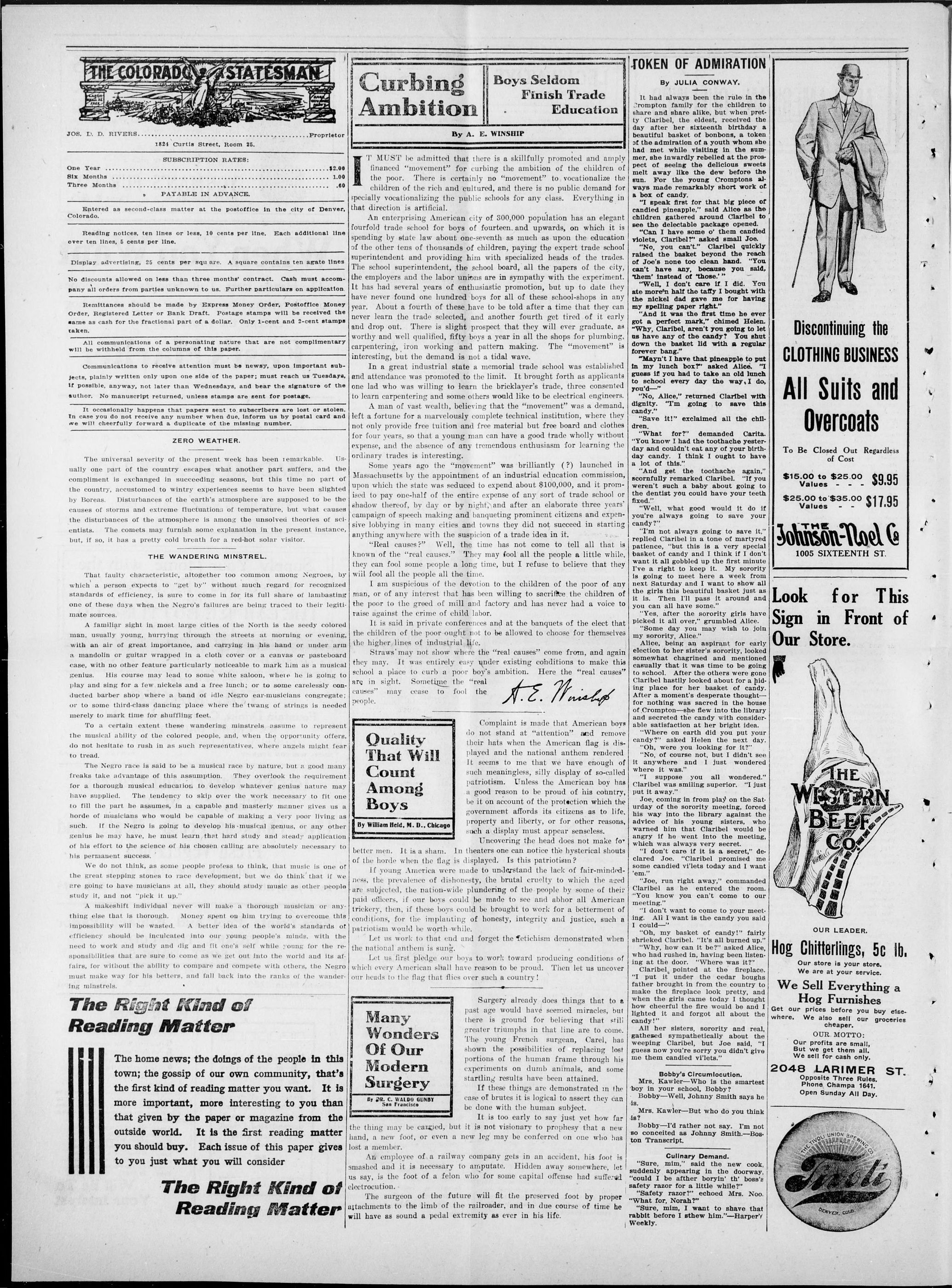
IT MUST be admitted that there is a skillfully promoted and amply financed "movement" for curbing the ambition of the children of the poor. There is certainly no "movement" to vocationalize the children of the rich and cultured, and there is no public demand for specially vocationalizing the public schools for any class. Everything in that direction is artificial.
An enterprising American city of 300,000 population has an elegant fourfold trade school for boys of fourteen and upwards, on which it is spending by state law about one-seventh as much as upon the education of the other tens of thousands of children, paying the expert trade school superintendent and providing him with specialized heads of the trades. The school superintendent, the school board, all the papers of the city, the employers and the labor unions are in sympathy with the experiment. It has had several years of enthusiastic promotion, but up to date they have never found one hundred boys for all of these school-shops in any year. About a fourth of these have to be told after a time that they can never learn the trade selected, and another fourth get tired of it early and drop out. There is slight prospect that they will ever graduate, as worthy and well qualified, fifty boys a year in all the shops for plumbing, carpentering, iron working and pattern making. The "movement" is interesting, but the demand is not a tidal wave.
In a great industrial state a memorial trade school was established and attendance was promoted to the limit. It brought forth as applicants one lad who was willing to learn the bricklayer's trade, three consented to learn carpentering and some others would like to be electrical engineers.
A man of vast wealth, believing that the "movement" was a demand, left a fortune for a marvelously complete technical institution, where they not only provide free tuition and free material but free board and clothes for four years, so that a young man can have a good trade wholly without expense, and the absence of any tremendous enthusiasm for learning the ordinary trades is interesting.
Some years ago the "movement" was brilliantly (?) launched in Massachusetts by the appointment of an industrial education commission, upon which the state was seduced to expend about $100,000, and it promised to pay one-half of the entire expense of any sort of trade school or shadow thereof, by day or by night, and after an elaborate three years' campaign of speech making and banqueting prominent citizens and expensive lobbying in many cities and towns they did not succeed in starting anything anywhere with the suspicion of a trade idea in it.
"Real causes?" Well, the time has not come to tell all that is known of the "real causes." They may fool all the people a little while, they can fool some people a long time, but I refuse to believe that they will fool all the people all the time.
I am suspicious of the devotion to the children of the poor of any man, or of any interest that has been willing to sacrifice the children of the poor to the greed of mill and factory and has never had a voice to raise against the crime of child labor.
It is said in private conferences and at the banquets of the elect that the children of the poor ought not to be allowed to choose for themselves the higher lines of industrial life.
Straws' may not show where the "real causes" come from, and again they may. It was entirely easy under existing conditions to make this school a place to curb a poor boy's ambition. Here the "real causes"
better men. It is a sham. In theaters one can notice the hysterical shouts of the horde when the flag is displayed. Is this patriotism?
If young America were made to understand the lack of fair-mindedness, the prevalence of dishonesty, the brutal cruelty to which the aged are subjected, the nation-wide plundering of the people by some of their paid officers, if our boys could be made to see and abhor all American trickery, then, if these boys could be brought to work for a betterment of conditions, for the implanting of honesty, integrity and justice, such a patriotism would be worth-while.
Let us work to that end and forget the fetichism demonstrated when the national anthem is sung.
Let us first pledge our boys to work toward producing conditions of which every American shall have reason to be proud. Then let us uncover our heads to the flag that flies over such a country!
the thing may be carried, but it is not visionary to prophesy that a new hand, a new foot, or even a new leg may be conferred on one who has lost a member.
An employee of a railway company gets in an accident, his foot is smashed and it is necessary to amputate. Hidden away somewhere, let us say, is the foot of a felon who for some capital offense had suffered electrocution.
The surgeon of the future will fit the preserved foot by proper attachments to the limb of the railroader, and in due course of time he will have as sound a pedal extremity as ever in his life.
Quality That Will Count Among Boys By William Heid, M. D., Chicago
better men. It is a sham. of the horde when the flag is If young America were ness, the prevalence of dish are subjected, the nation-wi paid officers, if our boys co trickery, then, if these boys conditions, for the implant patriotism would be worth w Let us work to that end the national anthem is sung. Let us first pledge our which every American shall our heads to the flag that flic
Many
Wonders
Of Our
Modern
Surgery
By DR. C. WALDO GUNBY
By R. C. WALDO GUNBY
San Francisco
the thing may be carried, be
hand, a new foot, or even a
post a member.
An employee of a railw
Boys Seldom Finish Trade Education
By A. E. WINSHIP
that there is a skill for curbing the an-
certainly no "move," and cultured, and the
the public schools for
American city of 300,000
boys of fourteen and
amount one-seventh as m
mands of children, pay-
ing him with special
the school board,
for unions are in sym-
of enthusiastic prom-
nended boys for all of
these have to be told
detected, and another fo-
light prospect that tha-
fifty boys a year in in-
dig and pattern make
is not a tidal wave
state a memorial tran-
tited to the limit. It
to learn the bricklay-
some others would like
believing that the "
usually complete techn-
ion and free material
young man can have a
of any tremendous ex-
ing.
"movement" was br
ointment of an indust-
reduced to expend abo
the entire expense of a
by night, and after
and banqueting pro-
cies and towns they o
the suspicion of a trad-
ial, the time has not
"They may fool a
a long time, but I
at the time.
One devotion to the ch
that has been willing
smill and factory and
child labor.
Conferences and at the
night not to be allow-
rial life.
where the "real ca-
cy easy under existing
poor boy's ambition
that there is a skillfully promoted and amply for curbing the ambition of the children of certainly no "movement" to vocationalize the cultured, and there is no public demand for public schools for any class. Everything in an city of 300,000 population has an elegant series of fourteen and upwards, on which it is none-seventh as much as upon the education of children, paying the expert trade school for him with specialized heads of the trades. The school board, all the papers of the city, unions are in sympathy with the experiment. enthusiastic promotion, but up to date they had boys for all of these school-shops in any case to be told after a time that they can, and another fourth get tired of it early at prospect that they will ever graduate, as boys a year in all the shops for plumbing, and pattern making. The "movement" is not a tidal wave.
State a memorial trade school was established to the limit. It brought forth as applicants earn the bricklayer's trade, three consented others would like to be electrical engineers. Believing that the "movement" was a demand, fully complete technical institution, where they and free material but free board and clothes man can have a good trade wholly without any tremendous enthusiasm for learning the "movement" was brilliantly (?) launched in element of an industrial education commission,uced to expend about $100,000, and it promontire expense of any sort of trade school or any night, and after an elaborate three years' and banqueting prominent citizens and expen- and towns they did not succeed in starting suspicion of a trade idea in it.
The time has not come to tell all that is. They may fool all the people a little while, long time, but I refuse to believe that they are time. Devotion to the children of the poor of any has been willing to sacrifice the children of old and factory and has never had a voice to hold labor. Interferences and at the banquets of the elect that not to be allowed to choose for themselves life.
Where the "real causes" come from, and again easy under existing conditions to make this for boy's ambition. Here the "real causes"
Complaint is made that American boys do not stand at "attention" and remove their hats when the American flag is displayed and the national anthem rendered. It seems to me that we have enough of such meaningless, silly display of so-called patriotism. Unless the American boy has a good reason to be proud of his country, be it on account of the protection which the government affords its citizens as to life, property and liberty, or for other reasons, such a display must appear senseless. Uncovering the head does not make for
In theaters one can
is displayed. Is ther
are made to understand
honesty, the brutal
wide plundering of ther
could be made to so
s could be brought to
tating of honesty, intu-
while.
and forget the feeg.
or boys to work toward
I have reason to be p
lies over such a count
a theaters one can notice the hysterical shouts displayed. Is this patriotism?
made to understand the lack of fair-mindedness, the brutal cruelty to which the aged plundering of the people by some of their old be made to see and abhor all American should be brought to work for a betterment of honesty, integrity and justice, such aile.
and forget the fetichism demonstrated when boys to work toward producing conditions of have reason to be proud. Then let us uncover over such a country!
Surgery already does things that to a past age would have seemed miracles, but there is ground for believing that still greater triumphs in that line are to come. The young French surgeon, Carel, has shown the possibilities of replacing lost portions of the human frame through his experiments on dumb animals, and some startling results have been attained.
If these things are demonstrated in the case of brutes it is logical to assert they can be done with the human subject.
It is too early to say just yet how far
but it is not visional
a new leg may be
away company gets it
y to amputate. Hi-
don who for some ca
future will fit the
the railroader, and
extremity as ever i
it is not visionary to prophesy that a new new leg may be conferred on one who has by company gets in an accident, his foot is to amputate. Hidden away somewhere, let who for some capital offense had suffered sure will fit the preserved foot by proper railroader, and in due course of time he tremility as ever in his life.
TOKEN OF ADMIRATION
By JULIA CONWAY.
It had always been the rule in the Crompton family for the children to share and share alike, but when pretty Claribel, the eldest, received the day after her sixteenth birthday a beautiful basket of bonbons, a token of the admiration of a youth whom she had met while visiting in the summer, she inwardly rebelled at the prospect of seeing the delicious sweets melt away like the dew before the sun. For the young Cromptons always made remarkably short work of a box of candy.
"I speak for that big piece of candied pineapple," said Alice as the children gathered around Claribel to see the delectable package opened.
"Can I have some o' them candied violets. Claribel?" asked small Joe.
"No, you can't." Claribel quickly raised the basket beyond the reach of Joe's none too clean hand. "You can't have any, because you said, them' instead of those." "Well, I don't care if I did. You ate more'n half the taffy I bought with the nickel dad gave me for having my spelling paper right."
"And it was the first time he ever got a perfect mark," chimed Helen. "Why, Claribel, aren't you going to let us have any of the candy? You shut down the basket lid with a regular forever bang."
"Mayn't I have that pineapple to put in my lunch box?" asked Alice. "I guess if you had to take an old lunch to school every day the way, I do, you'd—"
"No, Alice," returned Claribel with dignity. "I'm going to save this candy."
"Save it!" exclaimed all the children.
"What for?" demanded Carita.
"You know I had the toothache yesterday and couldn't eat any of your birthday candy. I think I ought to have a lot of this."
"And get the toothache again," scornfully remarked Claribel. "If you weren't such a baby about going to the dentist you could have your teeth fixed."
"Well, what good would it do if you're always going to save your candy?"
"I'm not always going to save it," replied Claribel in a tone of martyred patience, "but this is a very special basket of candy and I think if I don't want it all gobbled up the first minute I've a right to keep it. My sorority is going to meet here a week from next Saturday and I want to show all the girls this beautiful basket just as it is. Then I'll pass it around and you can all have some."
"Yes, after the sorority girls have picked it all over," grumbled Alice.
"Some day you may wish to join my sorority, Alice."
Alice, being an aspirant for early election to her sister's sorority, looked somewhat chagrined and mentioned casually that it was time to be going to school. After the others were gone Claribel hastily looked about for a hiding place for her basket of candy. After a moment's desperate thought—for nothing was sacred in the house of Crompton—she flew into the library and secreted the candy with considerable satisfaction at her bright idea.
"Where on earth did you put your candy?" asked Helen the next day.
"Oh, were you looking for it?"
"No, of course not, but I didn't see it anywhere and I just wondered where it was."
"I suppose you all wondered." Claribel was smiling superior. "I just put it away."
Joe, coming in from play on the Saturday of the sorority meeting, forced his way into the library against the advice of his young sisters, who warned him that Claribel would be angry if he went into the meeting, which was always very secret.
"I don't care if it is a secret," declared Joe. "Claribel promised me some candied vilets today and I want 'em."
"Joe, run right away," commanded Claribel as he entered the room. "You know you can't come to our meeting."
"I don't want to come to your meeting. All I want is the candy you said I could—"
"Oh, my basket of candy!" fairly shrieked Claribel. "It's all burned up."
"Why, how can it be?" asked Alice, who had rushed in, having been listening at the door. "Where was it?"
Claribel pointed at the fireplace. "I put it under the cedar boughs father brought in from the country to make the fireplace look pretty, and when the girls came today I thought how cheerful the fire would be and I lighted it and forgot all about the candy!" All her sisters, sorority and real, gathered sympathetically about the weeping Claribel, but Joe said, "I guess now you're sorry you didn't give me them candied vilets."
Mrs. Kawler—Who is the smartest boy in your school, Boby?
Bobby—Well, Johnny Smith says he is.
Mrs. Kawler—But who do you think is?
Bobby—I'd rather not say. I'm not so conceited as Johnny Smith.—Boston Transcript.
Culinary Demand.
"Sure, mim," said the new cook, suddenly appearing in the doorway, "could I be afther boryin' th' boss's safety razor for a little while?" "Safety razor?" echoed Mrs. Noo.
"Safety razor?" echoed Mrs. Noo.
"What for, Norah?"
"Sure, mim, I want to shave that rabbit before I stew him."—Harper'/
Weekly.
1
Discontinuing the CLOTHING BUSINESS All Suits and Overcoats
To Be Closed Out Regardless of Cost
$15.00 to $25.00 $9.95
Values - - -
$25.00 to $35.00 $17.95
Values - -
THE
Johnson-Noel Co
1005 SIXTEENTH ST.
Look for This Sign in Front of Our Store.
THE
WESTERN
BEEF
CO.
OUR LEADER.
Hog Chitterlings, 5c lb.
Our store is your store.
We are at your service.
We Sell Everything a
Hog Furnishes
Get our prices before you buy else-
where. We also sell our groceries
cheaper.
OUR MOTTO:
Our profits are small,
But we get them all.
We sell for cash only.
2048 LARIMER ST.
Opposite Three Rules.
Phone Champa 1641.
Open Sunday All Day.
THE TIVOLI UNION BREWING CO.
Fivoli
DENVER, COLD
Miss Maud Carey arrived home from New York last Friday.
Mr. R. J. von Dickersohn has been appointed as watchman at the capitol.
Willis Buffet has returned to work at the West-Court hotel, after a long and serious illness.
as in the past to furnish its many readers a paper that gives all the news all the time on timely topics.
Mr. and Mrs. E. C. Atkinson enttained a few of their intimate friend during the holidays with an elaborate dinner. The viands were toothson and enjoyable. The Atkinson's a
Leon Pryor, the erstwhile musician and sporting writer, is yet quite a sick man.
Mrs. O. C. Goens still continues quite ill. Her many friends are anxious for her recovery.
Miss Fannie B. Slaughter is quite sick at the residence of her aunt, Mrs. M. A. Holly, 2618 Downing avenue.
James Randolph of Galveston, Tex., passed through the city this week en route to San Diego, Cal.
Frank Horne and wife, of Omaha, Neb., are recent arrivals in the city. They are stopping with Mrs. Letchers, 2031 Marion street.
Engine Company No. 3 will make a fast run at Eureka hall, February 12, 1913.
Mrs. Thetterwahlia, Even D. Miller will leave Monday for Minneapolis, Minn.
That sudden cold snap that visited the denizens of this city Sunday, was a whole surprise party.
Rev. J. P. Howard, the great evangelist, in company with Rev. H. Franklin Bray, were pleasant callers at our office Wednesday morning.
The Model hotel, Ed. Douglass, proprietor, at 2258 Larimer street, is one of the neatest and cosiest rooming houses in the city, and deserves patronage.
Benj. Easter, an old employee of the C. & S. Ry., fell a few days ago and injured his knee so badly that he has been forced to quit work for a while.
Mr. and Mrs. George S. Contee arrived home today from Washington, D. C., where they visited relatives and friends, two weeks.
Mrs. Martha Powell, a former resident of Denver, died at her home in Sedalia, Mo., December 30. She was the mother of the late Mrs. James Martin.
The sewing circle of Shorters church is making preparation for a bazaar, during which they will supply everybody with aprons and laundry bags. Watch for the announcement.
Edward Banks, after several weeks' illness, is able to get around the house, to the delight of his friends. He will be able to resume his duties at the statehouse soon.
Mrs. Fred E. Williams of 2222 Curtis street, received the sad news of the death of her sister, Mrs. Annie B. Thompson, of Cairo, Ill., which occurred January 1st. Mrs. Williams was unable to attend the funeral on account of the illness of her husband. Mrs. Williams thanks all her friends who assisted her in her bereavement.
Tober's Sample Shoe Store at 2115 Larimer street, continues to do an increasing shoe business. The fact that they sell high grade shoes at money-saving prices, makes their store a mecca for bargain hunters in footwear.
Are you going to the ball given by Engine Co. No. 3, February 12 1913, at Eureka hall?
Prof. Garfield Wilson, a Denver raised young man, but who has been a resident of Chicago for a number of years, was married recently to Miss India Demming, one of the leading society ladies of the Windy city. Wilson conducts a very successful dancing academy.
The Mariposa Glee Club, which appeared at Shorters church Thursday evening, certainly covered itself with glory. It was by far the best high-class musical affair ever given in this city. Every number was a gem and cach performer an artist. Every rendition was heartily applauded.
The Colorado Statesman is indeed thankful to its many subscribers for the prompt manner in which they have paid their yearly subscription, showing that they have confidence in the "Old Reliable Weekly." The Colorado Statesman will continue in the future
as in the past to furnish its many readers a paper that gives all the news all the time on timely topics.
Mr. and Mrs. E. C. Atkinson entertained a few of their intimate friends during the holidays with an elaborate dinner. The viands were toothsome and enjoyable. The Atkinsons are quite popular in the younger social set.
Mr. and Mrs. J. R. Contee gave a most recherche dinner and card party New Year's, to which they invited a few friends, covers being laid for six. Good cheer predominated and a pleasurable time was had. The J R. Contees are noted for their wholesome hospitality.
For men's, boys' and children's outfits, there is no better place to save money on such goods than the Five Points Capitol store, at 2657 Welton street. The courtesy shown to their customers, together with their choice selection of goods at low prices, makes it a pleasure for one to trade at this store.
Are you going to the ball given by Engine Co. No. 3, February 12 1913. at Eureka hall?
Mrs. Ella M. Jones, of 229 West Eleventh avenue, received the sad news last week of the sudden death of her friend, Mrs. Lydia G. Morgan, who died at Santa Barbara, Cal., New Year's day. Mr. Morgan and little daughter, Clara, arrived in the city Wednesday from Middletown, O., and are stopping with Mrs. Jones. Mrs. Morgan has many friends in this city who will be sorry to learn of her death.
The "Is He" Club met at the residence of Miss Mattie Cowden, 1219 Twenty-first street, January 1st. A fine lunch was spread and all present had a delightful time. A number of resolutions were read and a few were adopted. The club will meet at the residence of Mrs. Howard Steele, 2222 Curtis street, Tuesday night, January 14th. Mrs. Ella Williams, president; Mattie Cowden, treasurer, and H. Hayden, corresponding secretary.
Spencer Wynne, one of our industrious citizens, and Miss Maude Pearl Wilson, one of our charming and ambitious young ladies, were married at her sister's residence, No. 2617 Marion street, Wednesday night, in the presence of a few friends. Rev. R. L. Pope tied the matrimonial knot. Light refreshments were served. The Colorado Statesman extends congratulations.
The Colorado Statesman received two elegant calendars for 1913, both race enterprises. One from our well known music teacher, Mrs. Nettie Penix Herndon, of 2542 Gaylord street, representing a sweet-faced girl holding a music book. The other calendar is from the Central Regalia Company of Cincinnati, Ohio, of which J. L. Jones is the founder and president. This is the largest house of its kind in the United States, owned by colored men.
The musical recital given by the pupils of Miss d'Autremont, at the residence of Mrs. Colston, 2327 Downing street, Friday evening, January 3rd, was well attended and the vigorous applause of each number on the program only proved how well it was appreciated. We are pleased to note the fact that the pupils of this class are making rapid progress, so much so that it has been the boast of the general public that no other city can show a more active spirit in the musical arena among its younger set than Denver. There is a great demand for more public recitals of this class, which proves a strong evidence how their efforts are appreciated.
NOTICE
Harry Jones and J. R. Hanger, cn or about January 13th, will consolidate their barber shops, and will be found at 2242 Larimer street, where they will be pleased to meet all of their customers. First class work guaranteed.
Engine Company No. 3 will make a fast run at Eureka hall, February 12, 1913.
For Rent. Eight room house with concrete chicken house and barn. A 75 foot well with plenty of water. A good place for one who would like to raise chickens or who runs an ash or express wagon. Apply Mrs. C. Anderson, 1064 Ivanhoe, Montclair, or L. Anderson, Scholtz main Drug Store.
13 CENTS A DAY BUYS A PIANO.
WITH MUSIC LESSONS FREE. PIANOS FROM $88 UP. COLUMBINE MUSIC CO., 920-924 15th STREET, CHARLES BUILDING.
CAMPBELL CHAPEL NOTES.
Campbell Chapel, A. M. E. church, corner Twenty-third and Lawrence streets, Rev. H. Franklin Bray, D. D., pastor.
In spite of the fact that it has been 25 below zero, three splendid congregations assembled at this church on Sunday, and every night this week good meetings have been held. The church seems greatly revived and next week is expected to bring greater results. Preaching each evening by Rev. J. P. Howard, the great western evangelist and singer. The public is invited to attend. Come and bring your friends with you.
Mrs. Hattie Hayden, who has been so sick for such a long time, has been moved from Fort Logan to No. 2103 Welton street, city, where she is gradually improving.
Brother W. H. Willis has been sick for two weeks, but is somewhat improved today. Our other sick are better.
Madam C. A. Spires of Indiana, and Mrs. Jennie Jones of Boston, Mass., are among those added to the membership this week.
The pastor and wife were the recipients of several nice tokens of kind remembrance this week, among which was a $5 Stetson hat.
Miss Amanda Rogers, who recently left us for her home in Indianapolis, Ind., writes that it is her purpose to return in the spring and make Denver her permanent residence. Miss Rogers is superintendent of the Lincoln hospital in Indianapolis, a great church worker, and a most pleasant lady. Campbell will rejoice to receive her back into her fold.
Rev. J. W. Braxton of Colorado Springs preached a good gospel sermon last Sunday morning to the edification of the large congregation which heard him.
Three services tomorrow. Evangelist Howard will have charge all day. At 3 p.m. m there will be a gospel camp fire, to which the pastors and members of all the churches ar invited. Let every Christian join us in prayer for a great religious awakening in Denver.
Nicely modern furnished rooms for rent at 1919 Welton street.
For Rent—A nice modern, furnished room at 1869 Marion street. Telephone York 2521.
For Rent—A nice five-room frame cottage. Apply 1869 Marion street. Phone York 2521.
Brickler's New Barber Shop is located at 2208 Larimer street. Shave, 10c. Hair Cut, 25c; Children, 15c.
Yokohama's Fire Department.
Yokohama's fire-fighting apparatus is owned by the association of insurance companies, which also pays the firemen. The coolies who assist when a blaze calls out any part of the department receive on an average four cents per hour. The regular staff of firemen and watchmen are paid an average of $7.47 a month.
Salmon Rec for Caviar
Owing to the diminishing supply of sturgeon caviar, Siberian fishermen have been experimenting with salmon roe, a commodity that was formerly thrown away as valueless or even injurious to health.
His Reply.
She (for the 'steen-hundredth, more or less, time)—"Oh, darling, do you really and truly love me?" He (a trifle grimly)—"Now, look-a-here, Gladys! Do you want me to put up a cash bond?"—Judge.
Likely to Keep Him Busy.
Mrs. Bacon—I never saw a puzzle my brother couldn't do. He's really a wonder. Mr. Bacon—I wish you'd take this timetable down to him and jee if he can make anything out of it—Yonkers Statesman.
Great Waste of Oil
According to the American Machinist, it has been estimated that there are lost annually more than a million and a half barrels of oil by the burning of oil wells.
Said More Than He Meant
The Candidate (having quoted the words of an eminent statesman in support of an argument)—"And, mind you, these are not my words. This is not merely my opinion. These are the words of a man who knows what he's talking about."
No Time to Quit.
A local judge has refused to divorce a couple who lived together for 40 years and then parted. We agree with the court that marriage has no business having a second childhood.—Los Angeles Times.
Pawn Tombs of Relatives
In times of financial difficulties the Loochooans, residents of the southwestern islands of Japan, sometimes pawn the graves of their relatives. They are always redeemed, however, failure to do so meaning family disgrace. The turtle-back shaped tombs, usually located on a hillside facing the water, are elaborate affairs of stone and cement, and their cost and upkeep often bankrupt the family.
Roman Script Favored.
Shall the world's script be Roman, such letters as we use, or Arabic or Chinese? The Roman script has by far the best chance and the best claim, according to the New York Independent. Efforts are making to introduce it in China and Japan, and now the effort is making to interest India in reducing its fifty alphabets to a single one.
is now open for business with a line of Men's Boys' and Children's outfits. Most of our goods are home products, such as Underhill's overalls and shirts, with the union label; Arrow brand collars and Monarch shirts, and other union-made goods with the most popular prices. Come and prove it to yourself. No more stumbling getting on and off the street car, as the Five Points Capitol store is lit up until 12 o'clock at night, and it will show you the way.
The 5 Points Capitol Store
Is the Star of 5 Points. Don't Fail to Come and See It. 2657 WELTON ST.
East Denver Turner Hall The hall can be RENTED by Societies and Clubs for Entertainments, BaIls, Etc. Fine Bar in connection 2132-48 ARAPAHOE ST Telephone Main 2449 Denver. Colo
n-Fed Beef and Pork
GO TO
ERG & BLOOM
Eastern Corn-Fed B
GO TO
GOLDBERG &
Eastern Corn-Fed Beef and Pork
GO TO
GOLDBERG & BLOOM
Come and be Measured. Best Material, Latest Style Best of Work. My THE PROFIT IS
Measured. Do it To-Day. Best Styles, Lowest Prices, York. My Rent is low. PROFIT IS YOURS
Come and be Measured. Do it To-Day. Best Material, Latest Styles, Lowest Prices, Best of Work. My Rent is low. THE PROFIT IS YOURS
IF I PLEASE YOU, TELL YOUR' FR
ALL YOUR FRIENDS, IF NOT, TELL US
TZ
GEON
NAST
THE GREAT BABY
Photographer
THE MUSEUM OF THE PHOTOGRAPHY
WAS BUILT IN 1900 BY THE PHOTOGRAPHER
AND THE PHOTOGRAPHER'S FRIENDS
AND THE PHOTOGRAPHER'S FRIENDS
AND THE PHOTOGRAPHER'S FRIENDS
IF I PLEASE YOU, TELL YOUR FRIENDS, IF NOT, TELL US
IF I PLEASE YOU, TELL YOUR FRIENDS, IF NOT, TELL US
THE Denver
Plans Drawn Estimates Furnished
Ernest Howard
CARPENTER
H. E. Wright
Asst. Secy. Phone
---
```markdown
```
If you want good
Goods Delivered to all parts of the city
N. FERRY
PHONE CHAMPA 395
DR. C. D. DeFRANTZ
PHYSICIAN AND SURGEON
Office Hours:
2 to 4 P.M. OTHER TIMES BY
APPOINTMENT
2716 Welton St. Denver.
J. H. BIGGINS
Furniture Repairing and Upholstering. All work Cash.
PHONE YORK 5566
2231 Washington St. Denver
Before You Buy Property, Let Lawyer
W. B. TOWNSEND
EXAMINE THE TITLE AND MAKE
YOUR CONTRACT. LAWYER TOWN-
SEND MAKES A SPECIALTY OF
COLLECTING FROM INSURANCE
COMPANIES, ALSO ENDOWMENT
MONIES.
OFFICE 209 KITTREDGE BUILDING
PHONE MAIN 6782.
Denver, Colo., Dec. 12, 1912. The annual meeting of the Stockholders of The Antiers Gold Mining and Milling Company will be held January 14, 1913 at 2:00 o'clock p. m. at the Company's office 413 McPhee Bldg., Denver, Colo.
Rudolf Beiter
2346 Larimer St Denver, Colo.
Phone Main 7419
1905 Curtis Street
ONLY CATERS TO FIRSTCLASS TRADE. OUR PICTURES SPEAK FOR THEMSELVES.
COR. 16th @ CURTIS ST. POST BLDG.
THE
MODEL HOTEL
ED. DOUGLASS PROP
2258 Larimer St. Denver, Colo.
Job and Repair Work a Specialty
Coal, Wood and Express
Residence: 353 W. Warren Ave.
Shop
Phone Champa 752 1021 21st St
Do You Know That
The Colorado Statesman Is Prepared to Do All Kinds of Job Printing?
Commercial, Fraternal, Church, Book and Stationery Jobs a Specialty
Ball and Concert Programs, Bill and Letter Heads, Calling Cards, Wedding Cards, Envelopes and Everything in the PrintingLine Turned Out in Neatest and Best Style Promptly on Short Notice.
We have supplied our office with job press and type of up-to-date style and our work will be on a par with the
Very Best
Give Us a Trial and We Will Give You Satisfaction
PRICES AS REASONABLE
AS THOSE OF ANY JOB
OFFICE IN DENVER.
THE
Colorado
Statesman
1824 Curtis Street
CAPITAL SAVED BY
OTTOMAN BRAVERY
Bulgar Plan of Advance Upset by
the Stubborn Defense of
Adrianople
PLAIN TRUTH ABOUT THE WAR
Uncensored Story by Frederick Palm-
er Tells How Allies Met Their
Match When the Turks Finally
Were Aroused.
By FREDERICK PALMER,
Staff Corespondent of the Chicago
Record-Herald in the Balkan War.
Sen Catoae Mest aah ciate aes Ocean ee nett eae
over the indistinct mass of Adriano-
ple from the distant hills, then as
substantial columns from the nearby
hills, and again so close from the
shellproof of an advanced infantry
position that 1 could make out the
Ulings on the dome of the great
mosque itself.
The simple grace of the minarets
dominated town, and landscape, and
siege. Weary drivers of the weary
oxen of the transport and still wear-
jer artillerymen, bringing up addi-
tional guns through seas of’ mud, saw
them for the first time as a token of
defiance, of work unfinished, of bat-
tles yet to be fought, and of lives yet
to be lost. B
Infantrymen in the advanced
trenches saw them as the goal
against a foe which had fallen back
without any adequate rear guard sec-
tion, but which had begun to fight
desperately under their shadows.
That Turkish garrison, as it with-
drew into the shelter of its forts,
seemed to find something of the spirit
@ old Sultan Selim the, Magniticent,
for whom the mosque ‘was named.
but with this difference: Sultan
Selim was not given to falling back
on forts and minarets. He stormed
forts; he went ahead to plant new
minarets in the soil of Christendom.
Rouses Old Turks’ Spirit
From the first in this war the Turk
took the defensive: from the first he
acepted it as his part and portion of
the campaign
In Bulgaria, where many Turks still
live under Christian rule, we had
seen the Terrible Turk, the great
fighting man of the past, whose soul
was supposed to be above lowly toil,
as a hewer of wood and a carrier of
water. He did odd jobs in the ab-
sence of the Bulgarian at the front.
‘The lion of the past had been trained
to dog harness.
All the early victories of the Bul-
arian army completed an impression
of a onetime lordly race demoralized
und enervated, who retained only the
fatalism of “Kismet,” in its lexocon,
‘The warrior's cry, “For Allah!” was
lost forever, But at Adrianople “For
Allah! For the Minarets! For the
Padisha!” rose again to the dignity
which abandoned bravery always com-
mands.
The sheer, impetuous. fearlessness
of the Bulgarian, well drilled and
coolly manipulated, was the first
zreat revelation of the campaign, and
the second was how, in the hour of
hopelessness, his desperation arous-
ed the old qualities of the Turk.
Eyery situation, every development.
in the war reverted to Adrianople, It
was the nut to crack in the first plan
of strategy of the campaign. It hov-
ered over the first army before
‘Tehatalja as a nightmare. It stood
in the way of the prompt supplies of
bread and bullets for the first army;
{t delayed the signing of the armis-
tice for ten days; 1¢ has been the
main subject of contention before
the London peace conference; it was
responsible for the treatment of the
military attaches, who saw nothing of
the war, and of the correspondents—
who saw little,
War Hinges on Adrianople.
Even our phlegmatic little English-
speaking censor assistant at Musta-
pha would lose his temper at the
very suggestion of any peace terms
with Adrianople still in Turkish pos-
session.
“We shall have a revolution it we
don't get Adrianople,” I have heard
many officers say.
“We ehall not go home without
Adrianople,” the wounded soldiers
returning from the front kept repeat-
ing.
Such were the instructions which
Dr. Daneff, the Elihu Root of the Bal-
kans, took with him to London. Ad-
rianople was graven on the minds of
his countrymen. By diplomacy he
must get a fortress which was not
yet taken by force of arms,
Glance at a map and you will see
that the whole success of the allies
depended on bottling up the Turk on
the peninsula, so that all the other
‘Turkish forces from Seutari to Adrl-
anople, from Kumanova to Hassona,
should be cut off from communtca-
tion. The Greeks, Serbs, and Mon-
tenegrins were the backs. The Bul-
garlans undertook to buck the line.
Bulgaria did not have to consider
# reserve army. uropean public
cpinion and the jealousies of the pow-
ers acted as efficient substitutes, for
the Bulgarian military statesmanship
understood that if Bulgaria were peat-
en the powers would never permit
- Turkey to take an inch of Bulgarian
soll. It was a case of “Heads I win,
tails I don't lose.”
The Turks knew this, too. It was
“an old situation to them. Successtu
‘War meant no aggrandizement onl3
that no more territory would be taker
from them, This {s enough, after
some generations, to breed the defen
sive instinct in any soldier.
The Turk must have his back
against the wall in order to fight well
His attitude is that of the mad bul
against the toreador; and a very mad
bull, we know, sometimes gets a hort
into the toreador’s anatomy and toss
es him over the palings. This hap
pened in a way at Adrianople.
“Victory is to the heaviest bat
talions,” Bonaparte said this, but aft
er Caesar said it after some general
of Egypt, Babylon or Nineveh.
The allies knew that their success
depended on speed in a fall campaign
—speed and the shock of masses pour-
ing over the frontier. Theirs was a
hundred-yard-dash chance.
The Serbs at Kumanova, their crit:
ical battle, had odds of at least four to
one.
The Greeks never had less favor-
able odds, usually much higher.
As for the Montenegrins, who had
a small show, what they did in one
Way or another did not matter. They
had work to keep them fully occu-
pied, as it developed in the siege of
Scutari.
The only one of the allies who dis-
dained modern organization, their fail-
ure to make any headway again em-
phasizes the wide difference between
4 body of men with rifles and an ac-
tual army
Bulgars Bear War's Brunt.
So the Bulgarians took the great
and telling work of the war on their
shoulders. You have only to know
the Bulgarians to understand that this
was inevitable.
There is stubborn and aggressive
character enough in Bulgaria to spare
for all southwestern Europe.
Bulgaria made a hundred-yard dash
with ox cart transportation, and made
it around an obstacle—Adrianople.
The main railroad line and the great
Constantinople highway ran by Adri-
anople. It was on the direct line of
communication from the center of the
Bulgarian base to the center of its
objective.
In the center of Thrace, it was the
only real fortress on the way to Con-
stantinople. Kirk-Killisseh, or Losen-
grade, as the Bulgarians call it, de-
spite their willingness to allow an im-
pression of its formidalility to be
spread abroad, was not in any sense
wel fortified.
Now, the first thing was to surround
Adrianople; that is, to strike at it
from all sides, as the key to the p@&
sition. A branch of the main Sofia-
Constantinople railroad line runs to
Yamboli. With this as its base, Deme-
trieff's, or the First, army swung
TO cossats
i aoe ae
around Kirk-Kilisseh, which was tak-
ea in the first splendid ardor of the
campaign. With its fall anyone can
see from a staff map that any battle
line of defense with Adrianople as a
part of it was impossible for a force
of the numbers of the Turkish main
army.
‘Two or three hundred thousand
men who were homogeneous might
have held on, but not half that num-
ber when badly organized. —_There-
fore, Nazim Pasha had to fall back
to a new line and leave Adrianople
to care for itself.
Reveals Bulgar Courage.
‘The next step was the decisive bat
tle on the line from Lule Burgas to
Bunnarhissar.
‘There, again, superiority of num-
‘bers, as well as organization, count-
ed; that superiority, which makes a
heavy turning movement possible
while the enemy’s front is engaged.
In short, the Bulgarians had the
Turks going. They gave the Turks
no rest, and they had a sufficient nu-
merical preponderance, in addition to
the dependable courage of their in-
fantry to guarantee success.
So there was nothing wonderful
about the strategy of the campaign,
nothing new, nothing startling. The
old principle of the swift turning
movement had been applied to the sit:
uation in hand.
By the flank the Japanese kept put-
ting the Russians back from the Yalu
to Mukden. By the flank Grant pvt
Lee back to Richmond.
‘There was just one, and only one,
startling feature in this war—Bulgari-
an courage. That enabled Demetrieff
to gain at Kirk-Killisseh and Lule
‘Burgas in a hurry what with most
arm{as would have required much
more time,
Demetrieff had willing flesh for a
necessary sacrifice. He threw his in-
fantry against frontal positions in a
cloud, into shrapnel and automatic
gun fire, without waiting to silence
the enemy's batteries.
roe nee eee eee ee Sas + LOD.
would have seemed the storming of
Adrianople. When peace negotiations
should begin, it was a vital. point in
their favor in the negotiations to have
Adrianople in their possession,
The Bulgarian treatment of the cor-
respondents is one of the many in-
dications that the Bulgarian staft did
at one time expect to take Adrianople
by storm,
It was argued by serious corre-
spondents who did not feel that they
ought to waste their time or the
money of their papers in idleness,
that the Bulgarian government ought
not to haye received any correspond-
ents at all, But this was not logic to
the government. ‘The press repre-
sented public opinion. It could serve
& purpose, and all the college profess-
ors in the land who spoke any for-
eign language found their work in the
common cause, no less than grandfa-
ther found his in driving an ox cart
and the women in making bread.
The plan was well thought out, and
the regulations, which would fill a
column, left nothing that occurred to
officers or college professors out of
consideration. No mention was to be
made of the wounded, nor even of the
weather, if it were bad, for bad weath-
er might tell the enemy that the roads
wore bad.
While many an imaginary account,
because it had the similitude of nar-
rative which characterizes all con-
vincing fiction, was hailed as real
war correspondence, the Bulgarian
staff, when it came to actual reports
of actions (exclusive of massacres),
was serupulously exact and exasperat-
ingly late and brief.
All praise by the press kept the ball
of the prestige of victory rolling. It
helped to convince the powers and
the Turk that the Bulgarian army
was irresistible. The stage climax
of the whole campaign would be the
fall of Adrianople. Therefore were
the correspondents moved to Musta
pha Pasha just as Lule Burgas was
being won; and Constantinople, being
then supposedly defended only by a
demoralized army, which could not
make a stand, every report from Mus-
tapha Pasha which showed that
Adrianople was on the point of capit-
‘ulation added to the stage effect ot
‘Bulgarian triumph,
Turks Defy the Bulgars.
As the first Bulgarian army drew
hear the Tchafalja lines, the mise en
scene was complete; but Nazim
Pasha, making use of the elapsed time |
to fortify the Tehatalja Ines, rather
than submit to the humiliating terms
offered, bade the Bulgarian hosts
“come on.”
Success had turned the heads even
of the Bulgarian staf. ‘They had be-
gun to think that the old fighting qual
ity was out of the Turk, and so willing
was the Bulgarian infantry to under-
go slaughter that it was only a case
of recording another charge of flesh
against shrapnel and automatie gun
fire, and the day was won,
Alas, an old principle of war, deal-
Ing with an impossibility of the same
order as squaring the circle in math-
ematics, was now to bring generalship
back from the clouds to solid earth.
You can take strong positions in
front only with time by sapping and
mining and all the weary operations
of a siege, as the indomitable Grant
learned by the failure of his firsh rush
at Vicksburg and the indomitable
Nogi learned by the failure of the first
rush attack at Port Arthur,
In a week, any army that has
spades and a few of the resources of
material which should be part of the
storehouse at its base should make
such a position as that of the series
of rising hills back of Tehatalja fully
tenable against any but siege attack,
unless there was room for a flank at-
tack.
Turks Turn the Tables.
And the breadth of the position
open to infantry approach in any at-
tempt at storming was only 16 miles,
while from either sea side of the nar-
row strip of peninsula the Turkish
navy could bring into play more pow-
erful guns than any Demetrieff had at
his disposal
At the same time there is to be
kept in view the generally accepted
tenet that you must not send in-
fantry against any well entrenched po-
sition «antil its batteries are silenced
[or {t {8 known that they can be kept
under control during the infantry at-
tack by a well concentrated fire of
your own batteries,
Demetrieft used his guns for a day
‘n trying to develop the strength and
location of the enemy’s batteries. But
the Turks would not be drawn. At last
the tables were turned.
Meanwhile Adrianople also was tell-
ing. You may discuss as much as you
please whether the original plan of
the Bulgarian staf was to mask this
fortress or to take it by storm, the
gen ete ae Spee a
2735 Welton St. Main 6363
The Central Bottling & Distributing Co.
‘ ‘ Agents for the famous
CAPITOL BEER---IT’S CAPITAL
Try a case, 2 doz. pints for $1.10, delivered promptly; empties called for.
Family Liquors, Wines, and Cordials
Genuine Goods at Popular Prices
A glass of good wine will improve your Sunday dinner, and aid digestion. «
EASES SICURG ACTIAUODIC. __.W ENG ORSy
glory was to be the fortune of Deme-
trieff, who commanded the first army
—until the first army had to take po
sitions in front without any opportu:
nity for flanking, which was the na.
ture of Ivanoff’s task from the start
Ivanoff Wakes Up.
It was Papastepe and Kartaltepe
which wakened Ivanoff from his dream
of a final brilliant stroke in keeping
with the earlier ones of the war, just
as Tebatalia brought Demetrieft down
from tho clouds of overconfidence.
Papastepe is one of many hills in the
narrowing rib of the 203 Meter Hill
of the siege. With guns in position
there, Adrianople would be under
bombardment. ‘The Bulgarians took
it by sending in the usual cloud of in-
fantry and losing about a thousand
men. But the Turks took it back
again. Four times, Iam told, it
changed hands in the course of those
night actions which we observed only
by the brilliant flashes in the sky
above the hills.
Far up the valley in the mist was
Kartaltepe, that other important hill
which commanded the river bottom of
the Arda, We took Kartaltepe in No-
vember and a month afterward, in one
of their splendid sorties, the Turks,
so far as I could learn, had taken it
back; but it was as untenable for
them as Papastepe was for the Bul-
garians. Possibly because it was again
ours and very evidently ours perma-
nently, the Bulgarian censors had
found it worth while to confound
skepticism and persistent unfriendly
‘rumors by allowing the correspon-
‘dents to enter the promised land of
their dreams, where for weeks, be-
tween the batteries on the hills and
the infantry in the muddy river bot-
tom of the Arda, hell kad raged in the
winter rains.
We did not know then, as we were
to know a few days later, that beyond
Kartaltepe in the direction of Dele-
gatch was another force isolated from
the Adrianople garrison and the main
Turkish army, that of Taver Pasha
with 10,000 men, caught in the literal
flood of that 100-yard dash of the
ready, informed, prepared aggressor
against the unready enemy taken un-
aware and hastening re-enforcements
to the scattered garrisons and trying
to adjust itself for the blow to fall
with the crash of a pile driver releas.
ed from its clutch,
Discloses War Secret.
But Taver Pasha’s 10,000 were still
a force in being, with guns and full
equipment—a force in a box; a force |
in desperation.
Do you see the Adrianople garrison
(which was in touch by wireless with
the Turkish main army) striking out
to connect up with Taver Pasha? Do
you see Taver Pasha trying out lines
of least resistance in a savage effort
to reach Adrianople or the main Tur.
kish army? :
Something to stir the blood, this, in
the way of a war drama, while not a
single foreign correspondent or at-
tache knew even of the existence of
Taver Pasha’s command until its sur-
render, :
‘The news of this was conveyed with
the official assurance that now no oth-
ér Turkish foree except that of Adri |
anople remained in Thrace, when we
had been under the impression for
over a month that it was the only
one! ‘The censors did not smile as
they posted the bulletin, but some of
the correspondents smiled—at them
selves.
No, after the first rainbow hope of a
successful general attack was over,
Ivanoff was fully occupied in holding
Adriandple safely in slege. ‘That bat-
tery of old Krupps, which fired over
the advanced Servian Infantry _posi-
tion, while a battery of Creusots in
turn fired over it, added their items of
evidence to the same end.
These Krupps were taken by the
Russians at Plevna in the war of 1877-
78 and given to the Ittle army of the
new nation of Bulgaria. Bulgarian re-
eruits had dragged them through the
muddy roads and over the pastures
and beautifully emplaced them, and
were working them against the enemy
with boyish pride. But the world was
thinking only of the modern Creusots
and their brilliant showing.
‘The Bulgarians almost proved that
you can make bricks without straw.
‘They won the war by the bravery of
their self-confidence as well as by
their courage,
Adrianople, which was about to
starve if it did not fall, had, Iam con-
vinced, two months’ supplies when the
armistice was signed. With the 19
and 20-year-old conscripts already on
the way tothe front, with a casualty
list that ts easily one-fifth of the whole
army, there was no sign of weakening.
The square chin of the stoical Bul-
gwarlan was as firmly set as ever. I
Wonder what sania ha wien eae
The Champa Pharmacy
Twentieth and Champa,
Is the place to get your
DRUGS, CHEMICALS AND PATENT MEDICINES
WH SERVE HOT DRINKS.
Prescriptions Our Specialty.
Phone us and we will deliver the goods to all parts of the city.
JAMES E. THRALL, PROPR.
PHONE MAIN 2425.
WORK CALLED FOR AND REPAIRING DONE WHI{LE
DELIVERED you WAIT
TELEPHONE MAIN 7377
THE CAPITAL CITY SHOE
REPAIRING CO.
SEWED HALF SOLES 60 cts. and 75 cts.
HENRY WARNECKE, President
1511 CHAMPA STREET DENVER, COLO.
yi Si StS SSS Si Si Si Si i) SS Si Si Si Si i Ss SF
Boost Colorado Products Patronize Home Industry
ZANG’S
DELICIOUS TABLE BEERS, 1 iJ#S,
COLUMBINE,
VIENNA AND
PILSENER
So oid Binaettonratanlaecteierers
The Ph. Zang Brewing Co.
We Boost for peas ae Boost for Us
Private Dining Room. Phone, Main 7413.
fetcenieetion
There Are Also mane The 2am
Nicely
Newport Annex
Furnished LOIN, i 1 aE
Cafe and Lunch Room
Rooms ———
Richard Frazier and Tom Lewis, Props.
And the old
Reliable gate
Newport Thirst | een
Parlors | : SHORT ORDERS AT ALL HOURS.
1841-45 Arapahoe Street. hd DENVER, COLb.
THE ZOBEL BROTHERS’
1004 Nineteenth Street, Corner of Curtis
FINE WINES, LIQUORS AND CIGARS
COORS' CELEBRATED BEER ON TAP
DENVER COLORADO
Botanical Expert Busy,
F. N. Myer, one of the most success-
ful explorers of the department of ag-
riculture at Washington, has again
started for China, expecting to be
away for three years, where he will
conduct ivestigations in a remote
field never before visited by an agri-
cultural scientist, During his former
travels *= was especially interested in
G@ought resisting trees and fruits. He
found some trees that stand an abso-
lute arctic temperature with no rain
to speak of and sent back specimens
that will ae iat in some of the cold
and arid seW@tions of the northwest
where no trees have been grown be-
fore.
RUDOLPH BROTHERS
SANITARY GROCERY, BAKERY AND
MEAT MARKET.
(mported and Domestic Table Delicacies. Fresh Fruits and
Vegetables. Our Own Bakery. Finest Goods in the City.
2758-2760 Downing Avenue Phone York 320
Sure,
Gabe—What is a charity ball.
Steve—That’s when the neighbors
come in to cry with the woman whose
husband has jvet toft hor
OPERATED AT LOSS
Postal Savings Institution Is Not Paying Expenses.
Uncle Sam's Banking System Not Self-
Supporting and Federal Appropriation May Be Necessary—Claimed American System Simplified.
Washington.—The postal savings
system of the government is not paying
expenses. After something more
than a year of operation, this government venture gives indication of needing a Federal appropriation to make it come out even. Its hope of independence lies in the future. Theodore L. Weed, director of the postal savings
system, thinks the system will be self-
supporting when the deposits aggregate $100,000,000. The deposits now aggregate close to $28,000,000.
One of the important questions about the inauguration of any new government service, especially one which is more or less paternalistic in nature, is whether it is likely to become a burden upon the federal treasury.
The attempt of the responsible officials, like Mr. Weed, has undoubtedly been to establish a postal savings system which may be conducted with reasonable economy. It is claimed, for instance, that the American system has been greatly simplified by the elimination of pass books.
However economically the system may be conducted, it is not difficult to perceive the certainty of a deficit, at least for the immediate future. The entire income of the postoffice department from the postal savings system is derived from the $2\frac{1}{2}$ per cent. inter-
M. B.
Theodore L. Weed.
est paid by the banks upon deposits of funds. Of all the funds deposited with the postoffice department, 95 per cent is turned over to the banks; 5 per cent is kept as a working balance. The government pays individual depositors 2 per cent. interest. The net income of the department is thus a little less than one-half of 1 per cent. of the total deposits. Upon the present aggregate deposits of $28,000,000, therefore, the government's net income is less than $140,000.
This net income is doubtless more than consumed by the clerical force employed in this city. The average salaries of government clerks is in excess of $1,000 a year, and it is safe to say that the salaries paid to Washington employees in the postal savings system are upwards of $160,000 in the aggregate, which, in itself, creates an aparent deficit of a little more than $20,000 a year. Probably other charges ought in fairness to be made against the postal savings system. Great expense is involved in producing the necessary stamps and certificates.
That the postal savings system has met a public need there can be no question. The deposits continue to grow at the rate of 6 to 8 per cent. a month, at which rate it will not be many years before the aggregate on deposit will exceed $100,000,000—the figure at which the system is supposed to become self-supporting. The history of such government enterprises, however, is that the expense increases unexpectedly, and it is open to question whether, upon the present income, the postal savings system can ever become self-supporting.
Temperature
Among the records of the hydrographic office in Washington are some five and one-half millions of memoranda of the temperature of sea water in all parts of the world and at all seasons. They have been noted and sent in by mariners for the last 60 years. Twice as many such notes are stored in Hamburg, besides millions elsewhere. The tabulation of them, supplemented by observations of a more scientific sort upon temperatures at various depths, have been of decided value to navigation as well as of theoretic interest. The comparative warmth, as well as the onward flow of the Gulf stream, was noted by some of the earliest voyagers to this side of the Atlantic; and the restless curiosity of Benjamin Franklin led him to make as careful observations upon it on his trips to
and from Europe as his means permitted. His common sense saw how helpful this current might be to ships, and he urged captains to use the thermometer to ascertain when they reached it and to enable them to keep within its influence when going east or to steer clear of it in coming west.
Lieutenant Maury, who was the founder of hydrographic science, used such temperature memoranda as were available in his examination of ocean currents. By following his directions shipmasters of half a century ago shortened the voyage between North America and England by ten days, that from New York to California by about 45 days, and that from England to Australia and back by two months. Helland Hansen, the Norwegian geographer, declares that the profit from the use of Maury's charts by British owners on the East India route alone amounted to $10,000,000 yearly. Latterly the usefulness of the thermometer in indicating the neighborhood of ice has been emphasized, among mariners.—Harper's Weekly.
Woman's Power at Washington Shown in Many Ways
Only those who have given the subject close consideration and have been familiar with it personally can have even a remote idea of the power of the women connected with a presidential administration, meaning the wives of the president, vice-president and the cabinet officers. This power of the women first began to be marked in President Andrew Jackson's time and it has continued almost unabated up to the present hour. It is an unseen power. It is not proclaimed from the house tops. It contributed, according to the best au thorties, to the downfall of Benjamin Harrison's administration.
It takes some time for the wives of the cabinet officers to reach a fair footing with the wives of the president and vice-president and among themselves. They come from different sections of the country and must accustom themselves to a vastly different environment, the official life of Washington. In a thousand little ways and in as many big ways they can make or mar, help or hurt, hasten or retard the policy of a president's administration. They raised old hob in Jackson's time by attempting to boycott the wife of a cabinet officer, Mrs. Eaton; but Old Hickory, though not a ladies' man himself, stood vallantly and gallantly beside Mr. and Mrs. Eaton and declared that the wives of his other cabinet officers shouldn't rule his administration—"No, not by the Eternal!" Jackson's favorite phrase in negativing a proposition.
Coal Supply to Last Thousands of Years.
The known coal fields of the United States embrace a total area, according to the United States geological survey, about 32,000 square miles, to which may be added something more than 160,000 square miles of which little is known, but which may contain workable coal, and about 32,000 square miles where the coal lies under heavy cover, and is not considered available under present conditions.
The supply of coal before mining began is estimated to have been 3,076,204,000,000 short tons, of which 1,922,979,000,000 tons were believed to be easily accessible and 1,153,225,000,000 short tons to be either so deep or the beds so thin that they are accessible only with difficulty. Classified according to the character of the coal, the original supply consisted of 21,000,000,000 short tons of anthracite, 1,661,457,000,000 tons of bituminous coal, 650,157,000,000 tons of bituminous coal and 743,580,000,000 tons of lignite, the supply of bituminous coal being somewhat more than that of all other grades combined.
The total production of coal to the close of 1911 has amounted to 2,270,798,737 short tons of anthracite and 6,468,773,690 tons of bituminous coal, or an aggregate of 68,739,572,427 tons This total production to the close of 1911 represents, including the waste of coal mining, an exhaustion of the beds equal to 14,181,980,000 short tons, or something less than 0.5 per cent. of the original supply. In other words, the quantity of coal still remaining to be mined amounts to 3,062,022,020,000 short tons, or a little more than 99.5 per cent. of the original supply. The annual rate of exhaustion at the present time as represented by the production in 1910 and 1911 is 0.25 per cent. of the supply. The quantity of coal still in the ground at the close of 1910 was 6,000 times the production of that year, or, estimating a half ton of coal lost for every ton recovered, the supply is equivalent to 4,000 times the present annual rate of exhaustion.
Government Printing Office Issues Big "Check List."
What is declared by literary experts to be one of the most remarkable documents ever published by the government has just been issued by the government printing office. The publication, known as the "Check List," records every publication of the government from its foundation down to and including 1909. The work is a voluminous document and contains more than 1,800 pages.
Approximately fifteen years were required in its preparation. The work was done by Miss Mary A. Hartwell an assistant to August Donah, superintendent of documents.
The "Check List" will be placed in every important library in the United States.
MOST INTIMATE ROOM
MOST INTIMATE ROOM
SOME INTERESTING FEATURES OF PRESIDENTIAL DEN.
Apartment Which Has Been Added to Private Suite on the Second Floor of White House May Be Called Most Characteristic.
During the past decade a new factor has appeared and gradually grown to importance in the domestic life of the presidential household through the provision at the White House at Washington of what is, to all intents and purposes, a new room. This apartment, which has been added to the private suite on the second floor of the historic mansion, is the
domestic life of the presidential household through the provision at the White House at Washington of what is, to all intents and purposes, a new room. This apartment, which has been added to the private suite on the second floor of the historic mansion, is the president's study or "den," a room which may perhaps be called the most characteristic in the executive mansion—the nook most intimately identified with the activities of the chief magistrate in his various capacities.
At the White House, not only the state parlors, but most of the chambers as well, barely reflect the taste of the professional decorator and are furnished with articles chiefly interesting because of their historical associations. But in the president's "den," as is befitting, the contents of the room and their arrangement are expressive of the personality and individuality of the distinguished occupant. The room serves the dual purpose of a retreat and a workroom—a haven where the president may seek the solitude that is a rare boon to one in his position and a study where, when occasion demands, there is opportunity for concentration and uninterrupted work. And, as vehicles of research or relaxation, there are thousands of books in the low shelves that line the walls, although this study is not to be confused with the White House library, the adjoining room.
The presidential "den" is located directly over the green parlor and is of the same dimensions. From the time of President Johnson until the year 1902, this room was used as the cabinet room and in the then council chamber of the president's official family was signed the treaty of peace with Spain—an event that is commemorated by Chartran's splendid painting which now hangs in the most prominent place in the room. When the White House was remodeled during the administration of President Roosevelt, it was at first proposed that this room, like the others that had been used for executive office purposes, should be converted into a bedroom or guest chamber, but in the end it was decided to utilize it as a study or "den," in which function it has been used by Presidents Roosevelt and Taft with ever increasing appreciation of its advantages.
Beneath a window, that commands an inspiring view of the White House grounds, the Washington monument and the Potomac beyond, stands the desk where the president performs much of his most important work. This desk was presented to the nation by the late Queen Victoria and was made from the timbers of her majesty's ship Resolute, which, after having been abandoned in the Arctic in the search of Sir John Franklin, in the year 1852, was discovered and extricated by the captain of an American whaler and was later sent to England as a gift to the queen by the president and people of the United States. The desk set, a gift from Alaska, is a decided novelty, a walrus tooth serving as the base for figures in solid gold.
Although nothing could be farther from intention than that the president's own room should savor of a museum, there are several articles in the "den" that, in addition to the desk, have historic significance. The old cabinet table has been retained and now serves to accommodate the overflow of books and current magazines. Over the white marble mantel, which was installed when this room was remodeled, hangs a full length painting of George Washington by a Spanish artist, which was sent as a gift to the nation from Ecuador, and in a glass case directly above the president's desk is the exquisite jeweled silk rug which was presented to the White House a few years since by the Persian government. The wall space at one end of the room is given over to the president's own silk copy of the special presidential flag, which is unfurled upon certain ceremonial occasions, if the president be present.
Has Sense of Humor.
President-elect Woodrow Wilson has a sense of humor; at least, it is said that he is devoted to limericks, and that is supposed to indicate a high sense of humor. He cannot be called a howling beauty, and this must be so, for he recognized it himself, and here is a limerick which he wrote himself:
"As a beauty I am not a star; .
There are others more handsome by far.
"But my face, I don't mind it.
For I am behind it—
The people in front get the jar."
Gets Big Legacy.
It has been announced that the American university of this city is to receive from the late Rev Dr. David H. Carroll, of Baltimore, Md., a legacy of $400,000.
HISTORIC CHAIRS IN MUSEUM
Exhibit of Early American Furniture
Lent by Dr. Allan Hamilton
of New York.
Among the historical collections of
furniture there are in the National
Museum four old chairs which have
been lent by Dr. Allan McLane Hamilton,
of New York, grandson of Alex-
ander Hamilton. They are early
American chairs, and are of especial
interest on account of their peculiar
antique style and their history. They
were owned during the war of
The Revolution by Maj. Gen. Phil Schuyler,
of the Continental army, who bequeathed them to his daughter,
Elizabeth, the wife of Alexander
Hamilton
Two of the chairs are of dark wood, like cherry, built simply on the slender and graceful lines of the Revolutionary period, and upholstered in a red figured tapestry which is thought to be of a more recent date than the chairs themselves. Both are alike, being lightweight armchairs with rather wide seats.
The other two, which were the property of Hamilton himself, are a little larger, but identical in appearance, and are of carved walnut, and of fairly solid construction, with up holstered backs and seats, and odd pin-cushion-like pads on the horizontal part of each arm, all being covered with a gray-figured cloth.
As to the exact age of these relics, it is hardly possible to judge, but they must be in the neighborhood of 150 or 175 years old, although they are still in very good condition, and would do credit to any colonial drawing room. They are now on display in a separate case in the hall of history of the old building of the National Museum.
GOT A FREE RIDE—NOT HOME
Society Woman Arrested for Refusing to Pay Cab Hire Lands at Police Station.
A young woman, said to be a social favorite, had the novel experience a few nights ago of riding in a patrol wagon and being cared for by a physician at a police station following her arrest for refusing to pay for taxicab hire. She was detained in charge of a police matron for several hours, and was released when her husband called and deposited ten dollars collateral for her appearance in the police court.
She told the police her name was Mrs. Caroline Smith and named a Pennsylvania avenue hotel as her residence. The police learned, however, that Smith was not her name and that she does not live at the hotel in question.
The chauffeur said she had refused to pay for the hire of the machine, which amounted to about ten dollars. The charge of refusing to pay cab hire was placed opposite her name.
During the conversation with the police, it is stated, "Mrs. Smith" said she had dined at a cafe with a friend of the family, and said she later became ill. She did not have ten dollars with her and it was therefore necessary for her to remain in custody until her husband called and deposited that sum.
FRESH AIR CRUSADE NOW ON
Experimental Open-Air Class Has Been Established at One of Capital's Public Schools.
The fresh air crusade that has found its way into the public schools of the country is now to bring Washington to a place beside those other large cities possessing open-air schools. Quite recently, as an experiment that is expected to bear practical results, an open-air class was established in the Stevens school.
Through the school fund of the Associated Charities, obtained by the collection of a Thanksgiving offering of the school children, blankets and other necessities have been provided. To Dr. Arthur L. Murray of the District health department falls the work of investigation. Examinations of the children and tests of their heart, lungs, etc., have already been made, and though Dr. Murray has found it a little too soon to make comparisons and determine in actual figures the gain made in weight and in general physical improvement, the faces of the children are beginning to fill out, and further steps are being taken to perfect this method.
HOW TO AVOID BEING A BORE
Carefully Shun the Four D's—Disease, Descendants, Domestics and Dress —Mrs. Wickersham.
Washington belles and beaux are practicing Mrs. George W. Wickersham's rules for avoiding conversational reefs upon which the social bore is wrecked. Mrs. Wickersham is the wife of the attorney general of the United States and she is one of the most diverting women in official society.
"You'll never be a bore," says Mrs. Wickersham, "if you carefully avoid the four D's—disease, descendants, domestics and dress. The first does away with 'organ recitals.' The second eliminates the baby, no matter how cute he is, and one's forbears, no matter how distinguished they were. The third removes Bridget and all her works. The fourth puts the dessmaker and the tailor man out of the running."
Mrs. Wickersham's little "conversational code" was propounded at a recent White House dinner, and everybody nowadays is dropping d's.
$250,000 ASKED FOR COMMISSION
PRESIDENT WANTS CONGRESS TO FURTHER INVESTIGATION FOR ECONOMY.
POINTS TO GOOD WORK
SAYS IF RECOMMENDATIONS ARE FOLLOWED, GREAT SAVING WILL RESULT.
Western Newspaper Union News Service.
Washington.—Congress was asked to appropriate $250,000 for continuing the investigation of the commission on economy and efficiency into the executive departments of the government in a special message by President Taft.
The President points out that "there is no greater service that can be rendered to the country than that of continuance of the work of the commission until some form of organization is provided for continuously doing this kind of work under the executive."
The President expresses the opinion that the technique and procedure of every branch and office of the government should be submitted to the same painstaking examination as that given those on which reports have been made. To do this, however, President Taft says that ample funds must be provided and he asks that Congress make the $250,000 appropriation by March 4th for the incoming President.
"In my opinion," says the President, "this is not a matter in which the Congress should assume that public money will be unwisely spent. At a total cost of about $230,000 during the twenty-one months covered by the work of the commission, facts have been developed and recommendations have been made that if followed up will result in saving of millions of dollars each year."
The report of the commission contains a description of 110 subjects, the result of twenty-one months of work The changes recommended by the commission carry definite estimates of a yearly saving of several millions of dollars.
WITHDRAWS FROM ADRIATIC.
Sir Edward Grey Has Asked That Adrianople Remain Turkish.
London.—The Servian government has decided to withdraw from the Adriatic Sea. This action is regarded in all quarters as a notable step in the direction of peace.
Constantinople.—Sir Edward Grey, the British foreign minister, has submitted to the powers a proposal preserving Adrianople to Turkey, according to a statement made here. The retention of the city will be subject to the dismantling of the fortifications and sundry economic restrictions. It is understood that the proposal stands a good chance of acceptance.
Hundreds Flee From Ohio Flood.
Pittsburg, Pa.—Portions of western Pennsylvania, Ohio and West Virginia are facing a serious flood situation owing to a steady and rapid rise of the various rivers and small streams. A wide area of lowlands is under water. Hundreds of persons have been driven from their homes, many buildings are partly flooded, a number of transportation companies are crippled and several thousand men employed in industries in the flood zone have been thrown out of work.
Colorado's Death List.
Denver.—Three is the death toll of Colorado's cold snap. The victims are: Mrs. Mary Digney, aged 75, found frozen to death in bed at her home in Georgetown. George Rule, a farmer south of Pueblo, found frozen to death under railroad trestle from which he had fallen, breaking both legs. Daniel Dorsey, aged 50, miner, died at Denver county hospital of exposure.
Boy, 19. Marries Stepmother, 22.
Boy, 19, Marries Stepmother, 22.
Roswell, N. M.—The formality of the written consent of a special guardian had to be resorted to before county officials would license Hedrick Armstrong, 19 years old, to wed Mrs. Martha Margaret Armstrong, his step mother, 22 years old. The husband-father has been dead about six months.
Pioneer Woman Frozen to Death.
Georgetown.—Mrs. Mary Digney, 75, a resident of Georgetown for nearly forty years, was found dead in her home in the east part of town.
Appoint "Reform" Marshal.
Chevenne, Wyo—W. J. McClements, who was appointed city marshal by Mayor Dan W. Gill, his appointment being the first official act in a "reform" administration, will not assume office until February 4, when the term of the present marshal expires.
Miner Is Killed in Slide.
Delta.-Entombed in a slide of coal at the Bowie mine several miles north of here, Daniel Maloy, thirty-four, was instantly killed.
A Big Gift to the Public THE DENVER REPUBLICAN
DELIVERED TO SUBSCRIBERS AT SIXTY CENTS A MONTH.
A reduction of more than 20 per cent on former rates.
At this price THE REPUBLI-CAN is the cheapest and best paper published in Denver.
Neither money nor labor will be spared to make THE REPUBLI-CAN, as it has always been in the past, the best and most reliable paper in the West.
THE REPUBLICAN'S news service has no equal. The Associated Press, supplemented by the splendid New York Herald news service, gives our readers every morning all the news gathered from every part of the world.
THE ILLUSTRATED SUNDAY MAGAZINE section of THE REPUBLICAN contains stories by the leading authors and humorists of the day and many pages of photographs of great interest.
SEND IN YOUR SUBSCRIPTION TODAY
Please fill out and forward this blank.
Send to my address until I order it discontinued, THE DENVER REPUBLICAN, Daily and Sunday.
Address
NTY ENTS A MONTH
The
WARD AUCTION
COMPANY
Sales Daily at 2 p.m. Office Fur-
niture a Specialty.
PRIVATE SALES AT ALL TIMES
HAVE MOVED TO—
1723-39 GLENARM ST.
PHONE MAIN 1675.
Miss M. Cowden Hair Dressing Parlor
Shampoo, cutting and curling. Scalp treatment, hair tonios, hair straightening, manicuring. Stage wigs for rent; theatrical use and masquerades. Goods delivered out of the city. All shades of hair matched by sending sample of hair; also comblings made up.
Cheapest Switches 50 Cents
1219 21st St. Denver, Colo
THE BEST ICE CREAM AND
CANDIES AT
O.P. BAUR & CO.
CATERERS AND
CONFECTIONERS
Phone: 168
1512 Curtis Street, Denver, Colo.
Hours: 2 to 5 and 7 to 9
p. m. and by Appointment.
Dr. J. H. P. Westbrook
COR. 21ST AND ARAPAHOE STS
Phone Champa 570.
DO IT NOW Subscribe for THIS PAPER
The CAPITOL BREWING COMPANY
DRINK CAPITOL BEER,
DENVER'S PRIDE
The purity of Capitol Beer is demonstrated by its superior flavor and strength-giving qualities. It's capital.
HAVE A CASE SENT HOME.
The Capitol Brewing Co.
Phone Champa 356. Delivered Anywhere.
C. B. PRIOR, President
C. B. PRIOR, President D. S. ELEY, Secy. and Treas.
THE PRIOR FURNITURE CO
1814 CURTIS STREET
NEW AND SECOND HAND FURNITURE BOUGHT,
SOLD AND EXCHANGED. WINDOW SHADES
AND SEWING MACHINES SOLD AND RE-
PAIRED A SPECIALTY
NEW AND SECOND HAND FURNITURE BOUGHT SOLD AND EXCHANGED. WINDOW SHADES AND SEWING MACHINES SOLD AND REPAIRED A SPECIALTY Phone. Champa 392 Cash or Credi
Cash or Credit
BRING YOUR FEET TO Tober's Sample Shoe Store 2115 LARIMER STREET AND SAVE MONEY
Tober's Sample Shoe Store 2115 LARIMER STREET
AND SAVE MONEY
$5.00 Sample Shoes----$2.95
$4.00 Sample Shoes----$2.50
$3.00 Sample Shoes----$1.95
Sample Shoes from Well Known Makers at Half Price
D. TOBER, Prop.
Sample Shoes from Well Known Makers at Half Price D. TOBER, Prop.
Follow the Crowd to THE ANNEX THEATRE
THE ANNEX THEATRE
ALWAYS CROWDED
2118-20 LARIMER ST.
THE BEST SHOWS AND
GOOD MUSIC
COME ONE COME ALL AND HAVE A GOOD LAUGH
AMATURE NIGHT EVERY TUESDAY
BUCK AND WING CONTEST EVERY FRIDAY
MAX KAUFMAN, THE TAILOR
2110 LARIMER ST.
Uncalled for Suits Half
Price and Less.
COME ONE COME ALL AND HAVE A GOOD LAUGH AMATURE NIGHT EVERY TUESDAY BUCK AND WING CONTEST EVERY FRIDAY
MAX KAUFMAN. THE TAILOR
1
2110 LARIMER ST.
Uncalled for Suits Half Price and Less.
$40.00 Suits.....$17.95
$30.00 Suits.....$14.95
$25.00 Suits.....$ 9.95
Also suits made to order in our store. A Call will convince you.
MAX KAUFMAN,
THE TAILOR.
2110 Larimer St. Denver, Colo. A Bradshaw
2110 Larimer St.
Denver, Co2.
A Bradshaw
A Compete Line Of Holiday Goods
A Compete Line Of Holiday Goods
THE BROADWAY
AT LOWEST PRICES
CALL and see our STOCK
of Ladies' and Gents' Furnish-
ings, Millinery and Christmas
Novelties.
We can afford to sell our
goods at a great Discount, be-
cause we have no rent to pay.
1443-47 STOUT ST.
Around the corner from the Old Stand 1443-47 STOUT ST.
THE FASHION OF THE TIME
Florida winter resorts will have the first of the new taffeta water repellent beach suits. After a dip in the surf the suit will remain crisp and fresh. A cap of the same material tied with a taffeta ribbon completes this stunning bathing costume.
INDOOR PLANTS NEED CARE SHOWING CONTRAST IN FURS
Florida winter resorts will have the pellet beach suits. After a dip in the fresh. A cap of the same material ti stunning bathing costume.
INDOOR PLANTS NEED CARE
Many Will Do Well in Gas-Lighted Rooms if They Are Judiciously Selected and Tended.
One of the great secrets in the successful cultivation of plants in rooms is judgment in selecting the right kinds, as an experiment will soon show, will do well in gas-lighted or drafty rooms, others will not; so it is most essential that care should be exercised in choosing kinds adapted to both purposes.
Those who have the good fortune to have their rooms lighted by electricity need not worry, because all kinds of plants will succeed under the latter conditions. The best of all plants to grow in gas-lighted rooms are the parlor palms. There are two distinct kinds of these, one which produces very tall leaves and another of the dwarf growth. If carefully watered and their leaves sponged at least once a week, they will thrive for years. Another excellent plant to grow under similar conditions is the fig-leaf palm, or so-called "castor-oil plant." This has giant ivy-like green leaves, which radiate from a central stem and form a handsome plant. As it increases in age it is, however, apt to lose its lower leaves, and hence some of its beauty.
The "india-rubber" plant, a brother of the fig tree, is another plant which is admirably adapted for gas-lighted rooms.
The plant usually grows with a single main stem, and if well cared for will in a few years attain a height of five feet or six feet. When it becomes too tall the upper part can be clipped.
Combining Two Lace Gowns.
A remarkable costume consists of two superposed, one in white lace, the other a black, the latter the uppermost, but so filmsy and delicate of mesh that the pattern even of the white lace beneath can easily be seen. The only relief to this gown is an immense rose with silk petals in a deep orange shade, with a large spray of block foliage.
Brown seems gradually coming into fashion again, and a dress of liberty satin in a bright tone of this useful color seen recently was almost entirely veiled with a black lace draped coat. On that portion of the bodice seen in front there was an embroidery in full pale blue and greens, forming wheels, and here and there was a slight touch of black and white.
Decollete Shoe.
An interesting freak of fashion is the decollete shoe. Many Parisian elegantes are wearing what would seem a perfectly ridiculous shoe for this time of the year, a court shape with a mere two or three inches of vamp, which, of course, reveals any amount of stocking, matching either the frock, the furs or some other accessory of the scheme
Hook Hint
Try putting hooks on the lower side of a dress-opening, and the eyes on the upper side. When the dress is ironed no "hookmarks" will show, as often happens when hooks and eyes are put on in the old-fashioned way. This works splendidly, writes a contributor to Needlecraft.
Ermine and Skunk Combined in One of the Most Fetching of the Winter's Styles.
The graceful stole cleverly combines and contrasts snowy tailless ermine and dark skunk worked in strands in the way which gives such special soft-
Y
ness and beauty to this most durable of furs.
The muff is, on the other hand, entirely carried out in the ermine, but also gains variety of effect by the introduction of the little tails and heads into the bordering band, while the great bow of velvet ribbon, with its central paste ornament, is a further addition, which is strikingly smart, as well as novel.
Pendants of All Kinds
Pendants are the ornaments of the moment and come in every imaginable grade of stone, from the most garish artificial bits set in poor gilt to the semi-precious stones, combined with diamonds. About the most excellent are the semi-precious stones set either in gold or silver. Their cost varies with the worth of the stone, and its setting is secondary. Abilone shell "blister" are very pretty and in good taste, for their price has been kept up.
PHONE MAIN 6123—Day or Night
RESIDENCE PHONE YORK 1669.
PARLORS, 1830 ARAPAHOE ST.
THE DOUGLASS
UNDERTAKING
COMPANY
J. R. CONTEE
Pres. and Mgr.
Licensed
Embalmer
Frank Rogers
Assistant
Funeral
Director.
CURTIS M.
HARRIS
Asst. Manager
and Funeral
Director.
Lady Assistant
POLITE SERVICE TO ALL.
Ambulance and Carriages Furnished for All Occasions
THE SILMO WINE CO.
PHONE CHAMPA 1888
best Prices on High Grade
and Liquors.
Brew Beer $1.10 P
Prompt Free Delivery
DE REPAIR
1023 EIGHTEENTH ST.
Best Equipped Outfit in the West to Pro
60c 75c, $1.00
50c 65c, 75c
25c, 35c, 50c
50c
15c to 25c
15c to 25c
Best Oak Lether.
Resoling from heel
new bottom
and heel
SHOES MADE
Tailor Made
WE CAN FIT A
DEFORME
REPAIRING WHILE YOU WAIT
TER CAMBERS
oice Me
Lowest Prices on High Grade Wines and Liquors. Special Brew Beer $1.10 Per case Prompt Free Delivery
THE SEWING MACHINE
SHOE REPAIRING
WALTER CAMBERS 1023 Eighteenth St
Choice Meats
JOE GILBERT'S POPULAR MARK
POPULAR MARKET
AIN 1204. 2940 WED
GO TO
S. Thompson's Sal
FOR
Wines Liquors and
RAPAHOE STREET CORNER 01
POPULAR MARKET
PHONE. MAIN 1204.
W. S. Thompson
Fine Wines Liqu
1701 ARAPAHOE STREET
W. S. Thompson's Saloon FOR Fine Wines Liquors and Cigars 1701 ARAPAHOE STREET CORNER OF 17th ST.
Advice to Husbands.
If you don't know anything about it, satisfactory results can sometimes be obtained by keeping still and looking as wise as possible.—Atchison Globe.
---
2636 Welton St
High Grade Wines
liquors.
er $1.10 Per case
ee Delivery
PAIRING
EIGHTH ST.
In the West to Produce the Goods
Resoling from heel to heel, entire
new bottom
and heel $1.50
SHOES MADE TO ORDER.
Tailor Made $10
WE CAN FIT ANY KIND OF
DEFORMED FOOT.
WHILE YOU WAIT
MBERS 1023
Eighteenth St
Meats
MARKET
2940 WELTON STREET
TO
Jason's Saloon
FOR
Liquors and Cigars
T CORNER OF 17th ST.
Should Have Learned Earlier.
A Swiss girl who three weeks ago
married a Turkish nobleman is ask-
ing for a divorce on the grounds that
western and eastern life are very dif-
ferent. She does not bring any ac-
cusations against her husband.
---
Baxter Bldg.