Colorado Statesman
Saturday, January 18, 1913
Denver, Colorado
Page text (machine-generated)
PATRONIZE MERCHANTS WHO ADV. IN THE PEOPLE'S PAPER
THE COLORADO STATESMAN
THE JOURNAL OF THE WEST.
LABOR SHALL BE FREE
RACE COUNTRY PARTY
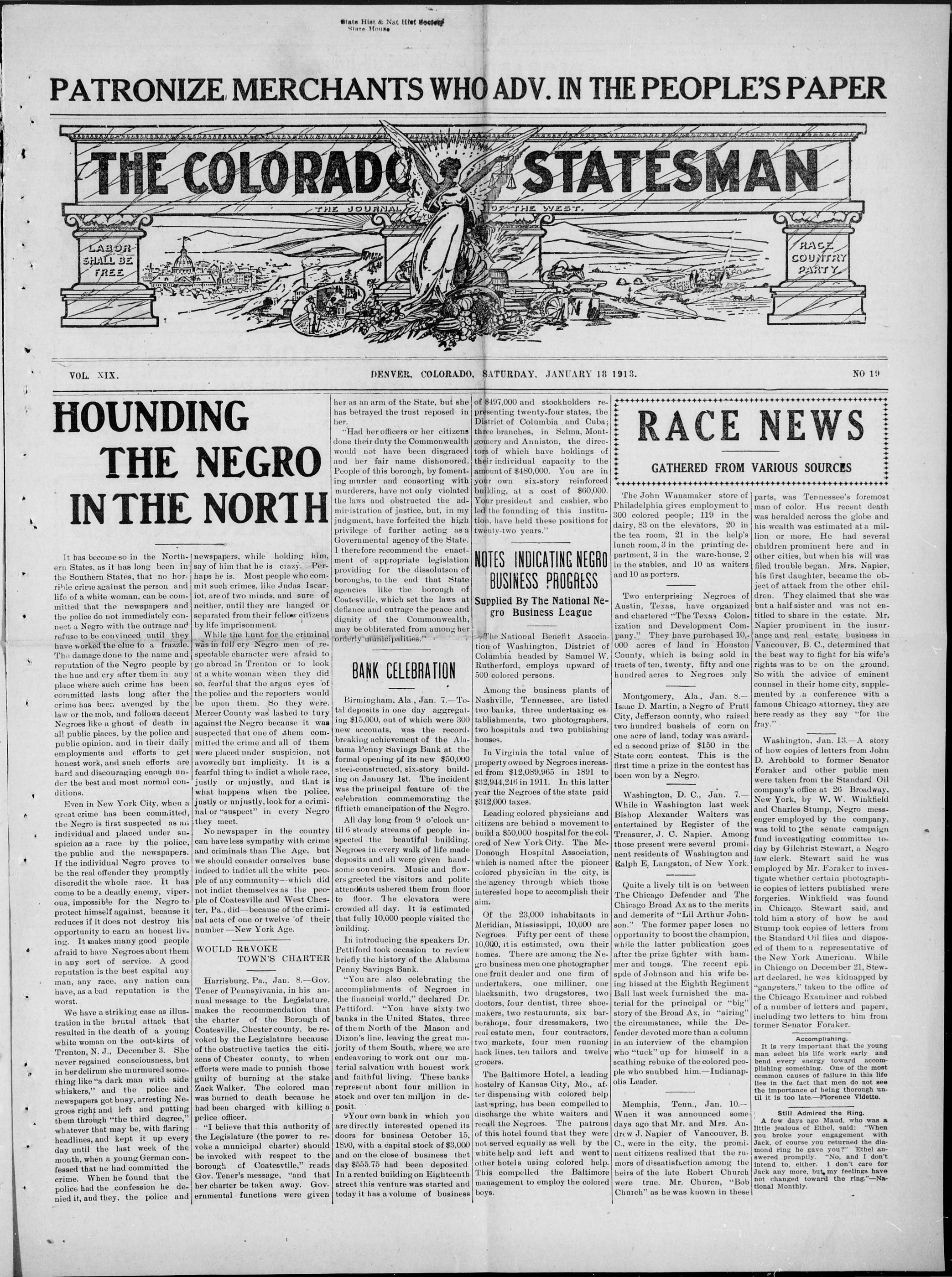
HOUNDING THE NEGRO IN THE NORTH
VOL. XIX.
HOUND
THE
IN THE
It has become so in the Northern States, as it has long been in the Southern States, that no horrible crime against the person and life of a white woman, can be committed that the newspapers and the police do not immediately connect a Negro with the outrage and refuse to be convinced until they have worked the clue to a frazzle. The damage done to the name and reputation of the Negro people by the hue and cry after them in any place where such crime has been committed lasts long after the crime has been avenged by the law or the mob, and follows decent Negroes like a ghost of death in all public places, by the police and public opinion, and in their daily employments and efforts to get honest work, and such efforts are hard and discouraging enough under the best and most normal conditions.
Even in New York City, when a great crime has been committed, the Negro is first suspected as an individual and placed under suspicion as a race by the police, the public and the newspapers. If the individual Negro proves to be the real offender they promptly discredit the whole race. It has come to be a deadly enemy, viperous, impossible for the Negro to protect himself against, because it reduces if it does not destroy his opportunity to earn an honest living. It makes many good people afraid to have Negroes about them in any sort of service. A good reputation is the best capital any man, any race, any nation can have, as a bad reputation is the worst.
We have a striking case as illustration in the brutal attack that resulted in the death of a young white woman on the outskirts of Trenton, N. J., December 3. She never regained consciousness, but in her delirum she murmured something like "a dark man with side whiskers," and the police and newspapers got busy, arresting Negroes right and left and putting them through "the third degree," whatever that may be, with flaring headlines, and kept it up every day until the last week of the month, when a young German confessed that he had committed the crime. When he found that the police had the confession he denied it, and they, the police and
newspapers, while holding him, say of him that he is crazy. Perhaps he is. Most people who commit such crimes, like Judas Iscariot, are of two minds, and sure of neither, until they are hanged or separated from their fellow citizens by life imprisonment.
While the hunt for the criminal was in full cry Negro men of respectable character were afraid to go abroad in Trenton or to look at a white woman when they did so, fearful that the argus eyes of the police and the reporters would be upon them. So they were. Mercer County was lashed to fury against the Negro because it was suspected that one of them committed the crime and all of them were placed under suspicion, not avowedly but implicit. It is a fearful thing to indict a whole race, justly or unjustly, and that is what happens when the police, justly or unjustly, look for a criminal or "suspect" in every Negro they meet.
No newspaper in the country can have less sympathy with crime and criminals than The Age, but we should consider ourselves base indeed to indict all the white people of any community—which did not indict themselves as the people of Coatesville and West Chester, Pa., did—because of the criminal acts of one or twelve of their number—New York Age.
WOULD REVOKE
Harrisburg, Pa., Jan. 8.—Gov. Tener of Pennsylvania, in his annual message to the Legislature, makes the recommendation that the charter of the Borough of Coatesville, Chester county, be revoked by the Legislature because of the obstructive tactics the citizens of Chester county, to when efforts were made to punish those guilty of burning at the stake Zack Walker. The colored man was burned to death because he had been charged with killing a police officer.
"I believe that this authority of the Legislature (the power to revoke a municipal charter) should be invoked with respect to the borough of Coatesville," reads Gov. Tener's message, "and that her charter be taken away. Governmental functions were given
DENVER. COLORADO. SATURDAY. JANUARY 18 1913.
State Hiat & Nat Hiat Society
State House
HANTS WH
ADO
Z JOURNAL
DENVER, COLORADO
her as an arm of the State, but she has betrayed the trust reposed in her. "Had her officers or her citizens done their duty the Commonwealth would not have been disgraced and her fair name dishonored. People of this borough, by fomenting murder and consorting with murderers, have not only violated the laws and obstructed the administration of justice, but, in my judgment, have forfeited the high privilege of further acting as a Governmental agency of the State. I therefore recommend the enactment of appropriate legislation providing for the dissolutson of boroughs, to the end that State agencies like the borough of Coatesville, which set the laws at defiance and outrage the peace and dignity of the Commonwealth, may be obliterated from among her orderly municipalities."
BANK CELEBRATION
Birmingham, Ala., Jan. 7. — Total deposits in one day aggregating $15,000, out of which were 300 new accounts, was the record-breaking achievement of the Alabama Penny Savings Bank at the formal opening of its new $50,000 steel-constructed, six-story building on January 1st. The incident was the principal feature of the celebration commemorating the fiftieth emancipation of the Negro. All day long from 9 o'clock until 6 steady streams of people inspected the beautiful building, Negroes in every walk of life made deposits and all were given handsome souvenirs. Music and flowers greeted the visitors and polite attendants ushered them from floor to floor. The elevatora were crowded all day. It is estimated that fully 10,000 people visited the building.
In introducing the speakers Dr. Pettiford took occasion to review briefly the history of the Alabama Penny Savings Bank.
"You are also celebrating the accomplishments of Negroes in the financial world," declared Dr. Pettiford. "You have sixty two banks in the United States, three of them North of the Mason and Dixon's line, leaving the great majority of them South, where we are endeavoring to work out our material salvation with honest work and faithful living. These banks represent about four million in stock and over ten million in deposit.
>Your own bank in which you are directly interested opened its doors for business October 15, 1890, with a capital stock of $3,000 and on the close of business that day $555.75 had been deposited. In a rented building on Eighteenth street this venture was started and today it has a volume of business
---
of $497,000 and stockholders representing twenty-four states, the District of Columbia and Cuba; three branches, in Selma, Montgomery and Anniston, the directors of which have holdings of their individual capacity to the amount of $480,000. You are in your own six-story reinforced building, at a cost of $60,000. Your president and cashier, who led the founding of this institution, have held these positions for twenty-two years."
NOTES INDICATING NEGRO BUSINESS PROGRESS
Supplied By The National Negro Business League
The National Benefit Association of Washington, District of Columbia headed by Samuel W. Rutherford, employs upward of 500 colored persons.
Among the business plants of Nashville, Tennessee, are listed two banks, three undertaking establishments, two photographers, two hospitals and two publishing houses.
In Virginia the total value of property owned by Negroes increased from $12,089,965 in 1891 to $32,944,246 in 1911. In this latter year the Negroes of the state paid $312,000 taxes.
Leading colored physicians and citizens are behind a movement to build a $50,000 hospital for the colored of New York City. The McDonough Hospital Association, which is named after the pioneer colored physician in the city, is the agency through which those interested hope to accomplish their aim.
Of the 23,000 inhabitants in Meridian, Mississippi, 10,000 are Negroes. Fifty per cent of these 10,000, it is estimated, own their homes. There are among the Negro business men one photographer one fruit dealer and one firm of undertakers, one milliner, one blacksmith, two drugstores, two doctors, four dentist, three shoemakers, two restaurants, six barbershops, four dressmakers, two real estate men, four contractors, two markets, four men running hack lines, ten tailors and twelve grocers.
The Baltimore Hotel, a leading hostelry of Kansas City, Mo., after dispensing with colored help last spring, has been compelled to discharge the white waiters and recall the Negroes. The patrons of this hotel found that they were not served equally as well by the white help and left and went to other hotels using colored help. This compelled the Baltimore management to employ the colored boys.
RACE NEWS
The John Wanamaker store of Philadelphia gives employment to 300 colored people; 119 in the dairy, 83 on the elevators, 20 in the tea room, 21 in the help's lunch room, 3 in the printing department, 3 in the ware-house, 2 in the stables, and 10 as waiters and 10 as porters.
Two enterprising Negroes of Austin, Texas, have organized and chartered "The Texas Colonization and Development Company." They have purchased 10,000 acres of land in Houston County, which is being sold in tracts of ten, twenty, fifty and one hundred acres to Negroes only parts, was Tennessee's foremost man of color. His recent death was heralded across the globe and his wealth was estimated at a million or more. He had several children prominent here and in other cities, but when his will was filed trouble began. Mrs. Napier, his first daughter, became the object of attack from the other children. They claimed that she was but a half sister and was not entitled to share in the estate. Mr. Napier prominent in the insurance and real estate business in Vancouver, B.C., determined that the best way to fight for his wife's rights was to be on the ground. So with the advice of eminent
Montgomery, Ala., Jan. 8. Isaac D. Martin, a Negro of Pratt City, Jefferson county, who raised two hundred bushels of corn on one acre of land, today was awarded a second prize of $150 in the State corn contest. This is the first time a prize in the contest has been won by a Negro.
Washington, D. C., Jan. 7. While in Washington last week Bishop Alexander Walters was entertained by Register of the Treasurer, J. C. Napier. Among those present were several prominent residents of Washington and Ralph E. Langston, of New York.
Quite a lively tilt is on between The Chicago Defender and The Chicago Broad Ax as to the merits and demerits of "Lil Arthur Johnson." The former paper loses no opportunity to boost the champion, while the latter publication goes after the prize fighter with hammer and tongs. The recent episode of Johnson and his wife being hissed at the Eighth Regiment Ball last week furnished the material for the principal or "big" story of the Broad Ax, in "airing" the circumstance, while the Defender devoted more than a column in an interview of the champion who "tuck" up for himself in a scathing rebuke of the colored people who snubbed him.—Indianapolis Leader.
Memphis, Tenn., Jan. 10. Wuen it was announced some days ago that Mr. and Mrs. Andrew J. Napier of Vancouver, B.C., were in the city, the prominent citizens realized that the rumors of dissatisfaction among the heirs of the late Robert Church were true. Mr. Church, "Bob Church" as he was known in these
NO 19
parts, was Tennessee's foremost man of color. His recent death was heralded across the globe and his wealth was estimated at a million or more. He had several children prominent here and in other cities, but when his will was filed trouble began. Mrs. Napier, his first daughter, became the object of attack from the other children. They claimed that she was but a half sister and was not entitled to share in the estate. Mr. Napier prominent in the insurance and real estate business in Vancouver, B. C., determined that the best way to fight for his wife's rights was to be on the ground. So with the advice of eminent counsel in their home city, supplemented by a conference with a famous Chicago attorney, they are here ready as they say "for the fray."
Washington, Jan. 13.—A story of how copies of letters from John D. Archbold to former Senator Foraker and other public men were taken from the Standard Oil company's office at 26 Broadway, New York, by W. W. Winkfield and Charles Stump, Negro messenger employed by the company, was told to the senate campaign fund investigating committee today by Gilchrist Stewart, a Negro law clerk. Stewart said he was employed by Mr. Foraker to investigate whether certain photographic copies of letters published were forgeries. Winkfield was found in Chicago. Stewart said, and told him a story of how he and Stump took copies of letters from the Standard Oil files and disposed of them to a representative of the New York American. While in Chicago on December 21, Stewart declared, he was kidnapped by "gangsters," taken to the office of the Chicago Examiner and robbed of a number of letters and papers, including two letters to him from former Senator Foraker.
Accomplishing.
It is very important that the young man select his life work early and bend every energy toward accomplishing something. One of the most common causes of failure in this life lies in the fact that men do not see the importance of being thorough until it is too late.—Florence Vidette.
Still Admired the Ring.
Still Admired the Ring.
A few days ago Maud, who was a little jealous of Ethel, said: "When you broke your engagement with Jack, of course you returned the diamond ring he gave you?" Ethel answered promptly. "No, and I don't intend to, either. I don't care for Jack any more, but my feelings have not changed toward the ring"—National Monthly.
THE WORLD IN PARAGRAPHS
A BRIEF RECORD OF PASSING EVENTS IN THIS AND FOREIGN COUNTRIES.
IN LATE DISPATCHES
DOINGS AND HAPPENINGS THAT
MARK THE PROGRESS
OF THE AGE.
Western Newspaper Union News Service.
WESTERN.
William Alden Smith was re-elected
United States senator by the Michigan
Legislature.
After living nearly a week with a
broken neck, Mrs. Ella Maynes, aged
forty-seven, died at Kansas City, Kan.
On the first ballot Senator W. E.
Borah was re-elected United States
senator of Idaho by the Legislature.
Bird Pickrell, a cock, fatally shot
his bride of two months and then
made an unsuccessful attempt at suic
de at Seward, Neb.
Thomas J. Walsh of Helena, the preferential candidate, received every vote cast in the two houses for United States Senate for Montana.
Five miners were killed in the Hartford Zinc Mining Company's mine at Joplin, Mo., when they were buried under tons of rock and dirt which fell from the roof of a drift in which they were working.
John Beal Sneed, banker and B. B. Epting, an employé of Sneed, entered a plea of not guilty to charges of murder and of being accessory to murder, respectively, in connection with the killing of A. G. Boyce, Jr., in Texas.
President-elect Wilson proclaimed that "The spirit of the country in the national election demonstrated a unanimity of progressive thought" and announced that he expected to have associated with him in office "only progressives."
All preliminary motions having been disposed of, the task of securing a avenire of forty-seven prospective jurors in the third trial of Dr. B. Clarke Hyde, charged with the murder of Colonel Thomas H. Swope, will begin at Kansas City.
Howard Taylor, Republican, was elected speaker of the Washington House of Representatives when the thirteenth biennial session opened at Olympia. Senator Plynny L. Allen, Republican, was elected president pro tempore of the Senate.
M. L. Pratt, Republican, who refused to enter the Wyoming Republican legislative caucus, was elected temporary speaker of the House, receiving the solid support of the Democratic members. W. J. Woods was chosen temporary secretary.
Governor B. F. Carroll in his final biennial message to the Thirty-fifth General Assembly of Iowa, laid special stress on the enactment of adequate laws for prison reform, compensation of working men injured in accidents, good roads and the enlargement of the state capitol grounds.
The first message of Governor Samuel V. L. Stewart to the Montana Legislature, was read. It was confined to a recitation of the platform pledges of the Democratic majority, and a plea for their enactment into laws. The governor also recommended the passage of a law submitting to the voters a woman suffrage amendment.
WASHINGTON
A conference on Philippine independence will be held between President-elect Wilson and Manuel Quezon, Philippine delegates in Congress, early in February.
Electors in forty eight states met and formally elected Woodrow Wilson to the presidency and Thomas R. Marshall to the vice presidency of the United States.
Under a decision of the Department of the Interior more than 6,000,000 acres of Indian lands in several Western states have been thrown open to homesteaders and Indians for free grazing purposes.
John D. Rockefeller, Jr., will give $10,000,000 to a fund for reclaiming fallen women and to fight the white slave traffic. The plan includes the removal of girls from redlight districts and placing them in homes to be built for that purpose all over the country.
William W. Winkfield, negro of Chicago, formerly employed by the Standard Oil Company as a messenger, told the Senate campaign fund investigating committee how he and another employee named Stump took from the desk of John D. Archbold, of the Standard Oil Company, two letters and disposed of them for $1,000 each.
The announcement that Miss Katherine Elkins, Miss Julia Goldsborough, Miss Mary Morgan of Washington, and Miss Lucille Cherbonier of Maryland are to lead the troop of dazzling Dianas in the great suffrage parade on the eve of inauguration day, has quickened society's interest in the plans of the paraders and the cause itself.
Work of removing the last remnants of the wreck of the old battleship Maine, and the accumulations that gathered about it in the bottom of Havana harbor, has been completed.
FOREIGN.
Paul Deschanel was re-elected president of the French chamber of deputies.
Vice Admiral Palla Firmin Christian Gourden of the French navy, died in Paris.
The packing plant of P. Burns & Company at Calgary, Alberta, was destroyed by fire. The loss, including meat in cold storage, probably will be in excess of $2,000,000.
It is announced that the representatives of the six power group of bankers, meeting in London have approved the agreement with respect to the proposed loan of $125,000,000 to China.
The steamer Snowden Range, about which there has been great anxiety, passed Browhead, Ireland, in tow of the steamer Welshman, which picked her up in the Atlantic 500 miles out.
Two passengers were killed and forty injured in a collision on the Midland railway when an express train crashed into an accommodation train at Bromford bridge, near Birmingham, Eng.
Unless unforeseen events should change the current of affairs, war in the Near East will be resumed.
A decree of divorce was granted at London against the American actress, Fanny Ward of St. Louis, on the position of her husband, John Lewis, the South African millionaire.
CONGRESSIONAL.
Senator Nelson's bill to require the United States courts to take all evidence in anti-trust cases in public, passed the Senate.
Senator Root introduced a bill to amend the Panama canal act to eliminate the provision exempting American coastwise ships from the payment of tolls.
The first "pork barrel" appropriation bill of the present session of Congress was reported to the House when the House rivers and harbors committee brought in its annual appropriation bill, providing $40,800,000 for the improvement of rivers and harbors throughout the country.
Judge Robert W. Archbold of the Commerce Court was found guilty by the Senate, sitting as a court of impeachment, of having misused his office and power as a judge for his personal aim. The penalty is removal from his office, and he was forever barred from holding official positions of honor or trust.
To protect the Senate against the necessity of giving time to protracted impeachment trials in the future, Senator Pomerene of Ohio introduced a joint resolution in the Senate providing for an amendment of the constitution so as to authorize Congress to provide other means of impeachment in minor cases than those now afforded.
SPORT.
Charlie White of Chicago had a shade over Tommy Bresnahan of South Omaha, in a ten-round match at Omaha.
Jack Redmond of Milwaukee knocked out Joe Welling of Chicago in the fourth round of their ten-round battle at Milwaukee.
Jimmy Clabby, middleweight, left Milwaukee for Denver, where he will meet Howard Baker, a Western middleweight, in a ten-round contest on January 24.
Young Mike Donovan, the son of the former middleweight champion of America, boxed to a well won victory over Tommy Maloney, the free-hitting middleweight from the lower west side in New York in ten furiously contested rounds.
GENERAL.
Percy L. Fison, a business man of Denver and his bride have arrived in New York, ending a long walk from the Western state and winning a wager of $500.
Dr. J. R. Stuart, head of a Houston, Tex., infirmary, and Miss Ruby Larsen, a nurse, were killed when the automobile in which they were riding collided with a wagon on a bridge near Houston.
Lord Basil Blackwood arrived in New York on board the steamer Cedric. Dispatches from England say that he comes to marry Mrs. Ava Willing Astor, former wife of Colonel John Jacob Astor, who perished in the Titanic disaster.
"I hope Progressive Democrats will be elected in every state," said President-elect Wilson in referring to the contests incident to the election of United States senators in Maine, New Hampshire, Illinois, South Dakota and Tennessee.
President-elect Woodrow Wilson, as governor of New Jersey, sent his six and annual message to the Legislature, which convened at Trenton. It was his last formal appeal to the Legislature for the completion of the program of progressive legislation for which he declared himself when he took office.
Fifty lawyers who hope to obtain for their clients more than $10,000,000 damages for loss of life and property on the steamship Titanic, were arrayed against attorneys for the White Star line in the United States District Court in New York.
L. S. Ross, former secret service operative for the United States government, and V. L. Schneider, former secret operative of the Denver & Ric Grande railroad in Colorado, were arrested by the El Paso police following a holdup of eleven gamblers in Hotel McCoy.
COLORADO STATE NEWS
Western Newspaper Union News Service.
Five Western states, besides Colorado, have sent entries to the baby show in Denver.
Geo. Creel of Denver addressed the Y. M. C. A. at Boulder on "A Fight for a Clean City."
Carl Wulsten, a pioneer of Custer county, died at his home at Rosita, in the West Mountain valley.
Meeker will cut, during the first early summer months, entirely for home consumption, 500,000 feet of native lumber.
Peter Wilson, an old Civil War veteran and pioneer contractor of Colorado, died while working on mining property near Globe, Ariz. He was seventy years old.
James Burns, who shot and killed W. A. Maxfield, Dec. 14, during a hold-up at Pando, pleaded guilty at Red Cliff and was sentenced to the state penitentiary for life at hard labor.
Books of nine leading Colorado corporations show that their stocks are beld by more than 15,000 individuals. The proportion of Colorado investors in local securities is higher than ever before.
W. T. Wallace and and Robert Wilson, well known business men and orchard owners of Grand Junction, have announced that they will build a plant for the manufacture of denatured alcohol.
Brooding over domestic troubles Dr. John V. Downs, a physician and surgeon of Greenville, N. M., 100 miles south of Trinidad, committed suicide by drinking the contents of a small bottle of laudanum.
Reports of officers of the six national banks in Denver, each showing a twelve-month period of prosperity just closed, were made to the stockholders of the different institutions at their annual meetings.
Colorado's schools never were more progressive and up to date and never in better condition that an present, according to the biennial report of State Superintendent of Instruction Helen M. Wixson.
Joseph Osner of Denver has been awarded the contract for the completion of the $3,000,000 Anterio irrigation system which will water 60,000 acres immediately east of the city. The contract price is $750,000.
The Mountain States Telephone Company has acquired the Mutual telephone lines operating out of Steam boat Springs, comprising over 300 phones in Routt and Moffat counties, thus eliminating the Mutual competition.
Moving pictures of Governor Ammons and ex-Governor Shafroth and ex-Governor Thomas, who are also Colorado's new senators, together with a number of the other incoming state officials were taken by a moving picture company.
After having expended his small fortune in acquiring a homestead at Roggen and weighed down with advancing years, J. T. Swahn, seventy had to appeal to the county for assistance in his last affliction, that being the death of his wife.
Fred Farrar of Fort Collins, the new attorney general of Colorado, announced the following appointments; Francis E. Bouck of Leadville, deputy attorney general; Frank C. West of Boulder, first assistant; Norton Montgomery of Denver, second assistant; Clement F. Crowley of Denver, third assistant.
Paul H. Jones, Joseph Cobb and Ed. Brown, thought to be New York gunmen who attempted to escape from the reformatory on Christmas and who have been in solitary confinement since, confessed to Warden A. T. Stewart that they were wanted at Fort D. A. Russell, Wyo., where they had enlisted under the names of Searles, alias Paul J. Jones; Miller, alias Joseph Cobb, and Salyer, alias Ed. Brown.
That the "horizontal cut" of ten per cent, on all tax assessments in the City and County of Denver, recently announced by Assessor Pitcher, will go into effect was decided by Judge Greeley W. Whitford of the third division of the District Court, when the suit brought by the city against Assessor Pitcher was dismissed, the judge holding that the case should have been brought before the state board of equalization.
The issuance of $550,000 of receiver's certificates to pay off the indebtedness of the Denver, Laramie & Northwestern railroad and extend it from Greeley to Severance was app proved by Judge Riddle in the District Court. Judge Riddle also approved the report of the Continental Trust Company and Marshall B. Smith, receivers, accepted the resignation of Receiver Smith and appointed H. U. Walace, vice president of the Northern Colorado Power Company, in his place.
The remarriage of a divorced person, even though it take place within a year from the time the divorce was granted, is legal, if the ceremony is performed in some other state than Colorado, the law of which permits immediate remarriage after divorce.
One Ute Indian and a Mexican, sheepherder probably are fatally wounded as the result of a rifle duel between the herder and a band of Indians, who desired to pitch camp on the ranch on which Joseph Vichel, the wounded herder, is employed, near Cortez.
COSTS MORE TO LIVE
RETAIL VALUES IN 1912 ABOVE
PREVIOUS YEAR.
Only Four Articles Cheaper, According to Figures Compiled by Department of Commerce and Labor.
Western Newspaper Union News Service.
Denver.—Retail prices of food in Denver in 1912 were considerable higher than in 1911, according to figures compiled by the Department of Commerce and Labor at Washington.
The price of sirloin steak on Aug. 15, 1912, was 14.4 per cent. higher than on Aug. 15, 1911. Rib roast was 30 per cent. higher; pork chops, 21 per cent. Smoked bacon was 6.5 per cent. lower. Smoked ham was 3 per cent. higher; pure lard, 11.6 per cent. higher; hens, 16 per cent. higher; strictly fresh eggs, 13.1 per cent. higher, and creamery butter, 6.4 per cent. higher.
With the exception of smoked bacon the only decreases were found in potatoes, sugar and milk. The decrease in the price of potatoes was 46.9 per cent. In granulated sugar it was 10.8 per cent. and in fresh milk it was 2.2 per cent.
A slight decrease in the weight of food contents in bread in Denver was shown.
"On account of a slight change in mixture the loaf retains its moisture better and we can get the weight by scaling one-half ounce less," was the report from Denver bakers.
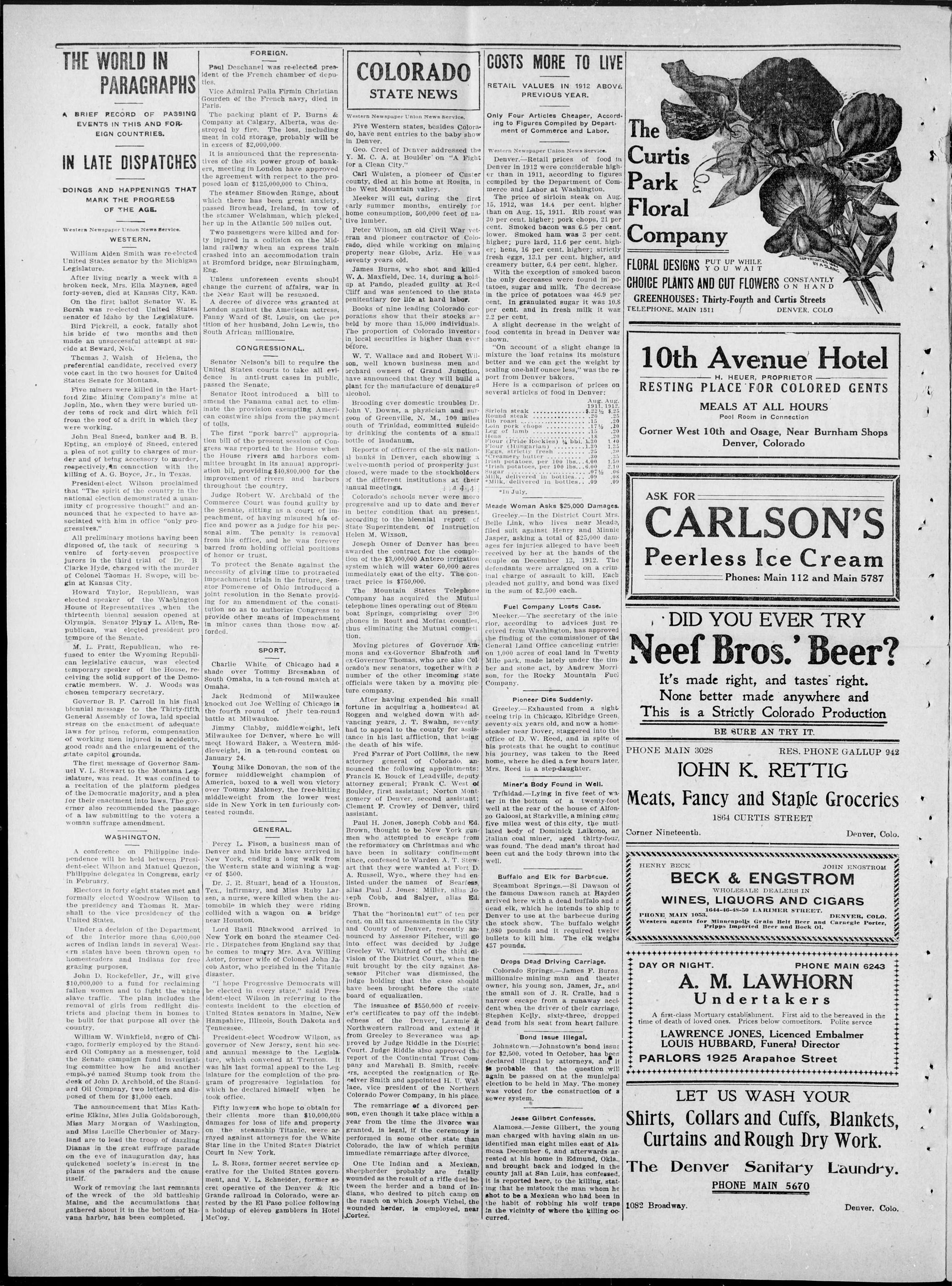
Here is a comparison of prices on several articles of food in Denver:
Aug. Aug.
1911, 1912.
Sirloin steak . $22½ . 25
Round steak . 20 . 25
Rib roast . . 15 . 20
Loin pork chops . 17½ . 20
Leg of lamb . 15 . 20
Hue . 15 . 20
Flour (Pride Rockies) ¼ bbl. 1.30 . 1.40
Flour (Hungarian) . 1.30 . 1.30
Eggs, stricty fresh . 25 . 30
Semperity, late . . 30
Irish potatoes, per 100 lbs. 4.50 . 1.50
*Irish potatoes, per 100 lbs. 6.00 . 2.10
Sugar . . 0.75 . 0.66
Milk, delivered in bottles . . 0.99 . 0.88
*Milk, delivered in bottles . . 0.99 . 0.98
Meade Woman Asks $25,000 Damages.
Greeley.—In the District Court Mrs. Belle Link, who lives near Meade, filed suit against Henry and Minnie Jasper, asking a total of $25,000 damages for injuries alleged to have been received by her at the hands of the couple on December 13, 1912. The defendants were arraigned on a criminal charge of assault to kill. Each pleaded not guilty, and bond was fixed in the sum of $2,500 each.
Fuel Company Loses Case.
Meeker.—The secretary of the interior, according to advices just received from Washington, has approved the finding of the commissioner of the General Land Office canceling entries on 1,000 acres of coal land in Twenty Mile park, made lately under the timber and stone act, by Andrew Morrison, for the Rocky Mountain Fuel Company.
Pioneer Dies Suddenly.
Greeley.—Exhausted from a sight seeing trip in Chicago, Elbridge Green, seventy-six years old, and now a home steader near Dover, staggered into the office of D. W. Reed, and in spite of his protests that he ought to continue his journey, was taken to the Reed home, where he died a few hours later. Mrs. Reed is a step-daughter.
Miner's Body Found in Well.
Trihidad.—Lying in five feet of water in the bottom of a twenty-foot well at the rear of the house of Alfonzo Galoosi, at Starkville, a mining camp five miles west of this city, the mutilated body of Dominick Laikono, an Italian coal miner, aged thirty-four, was found. The dead man's throat had been cut and the body thrown into the well.
Buffalo and Elk for Barbecue.
Steamboat Springs.—Si Dawson of the famous Dawson ranch at Hayden arrived here with a dead buffalo and a dead elk, which he intends to ship to Denver to use at the barbecue during the stock show. The buffalo weighs 1,080 pounds and it required twelve bullets to kill him. The elk weighs 457 pounds.
Drops Dead Driving Carriage.
Colorado Springs.—James F. Burns, millionaire mining man and theater owner, his young son, James, Jr., and the small son of J. R. Cralle, had a narrow escape from a runaway accident when the driver of a runaway carriage, Stephen Kelly, sixty-three, dropped dead from his seat from heart failure.
Bond Issue Illegal.
Johnstown.—Johnstown's bond issue for $2,500, voted in October, has been declared illegal by attorneys, and it is probable that the question will again be passed on at the municipal election to be held in May. The money was voted for the construction of a sewer system.
Jesse Gilbert Confesses.
Alamosa.—Jesse Gilbert, the young man charged with having slain an unidentified man eight miles east of Alamosa December 6, and afterwards arrested at his home in Edmund, Okla., and brought back and lodged in the county jail at San Luis, has confessed, it is reported here, to the killing, stating that he mistook the man whom he shot to be a Mexican who had been in the habit of robbing his wolf traps in the vicinity of where the killing occurred.
The
Curtis
Park
Floral
Company
FLORAL DESIGNS PUT UP WHILE
YOU WAIT
CHOICE PLANTS AND CUT FLOWERS CONSTANTLY
ON HAND
GREENHOUSES: Thirty-Fourth and Curtis Streets
TELEPHONE, MAIN 1511 DENVER, COLO
Corner West 10th and Osage, Near Burnham Shops Denver, Colorado
CARLSON'S Peerless Ice Cream Phones: Main 112 and Main 5787
Neef Bros.' Beer?
It's made right, and tastes right. None better made anywhere and This is a Strictly Colorado Production
PHONE MAIN 30285
JOHN
Meats, Fane
Meats, Fancy and Staple Groceries
SEventh. DEC.
BECK JOHN ENG
BECK & ENGSTROME
WHOLESALE DEALERS IN
JONES, LIQUORS AND CIGARS
1044-46-48-50 LARIMER STREET.
MAIN 1053.
GRANTS for Minneapolis Grain Belt Beer and Carnegie
Pripps Imported Beer and Bock Ol.
NIGHT. PHONE MAID
HENRY BECK
BECK
WINES,
PHONE MAIN 1053.
Western agents for M
Pr
HENRY BECK
JOHN ENGSTROM
BECK & ENGSTROM
WHOLESALE DEALERS IN
WINES, LIQUORS AND CIGARS
1644-46-48-50 LARIMER STREET.
PHONE, MAIN 1053.
DENVER, COLO.
Western agents for Minneapolis Grain Belt Beer and Carnegie Porter,
Pripps Imported Beer and Bock Ol.
A. M. LAWHORN
A first-class Mortu
time of death of loved
LAWRENG
LOUIS HU
PARLORS 15
LET
Shirts, Coll
Curtains
The Denver
A first-class Mortuary establishment. First aid to the bereaved in the time of death of loved ones. Prices below competitors. Polite service LAWRENCE JONES, Licenced Embalmer LOUIS HUBBARD, Funeral Director PARLORS 1925 Arapahoe Street
LET US WASH YOUR
The Denver Sanitary Laundry. PHONE MAIN 5670
```markdown
```
Corner Nineteenth.
1082 Broadway.
1864 CURTIS STREET
Denver, Colo.
ENGSTROM
M
ARS
NVER, COLO.
Gnegie Porter,
MAIN 6243
N
reaved in the
state service
lmer
R
Mankets,
Work.
laundry.
Denver, Colo.
COLORADO LEGISLATIVE DOINGS
Western Newspaper Union News Service.
NAME THOMAS AND SHAFROTH.
Legislature Elects People's Choice as Colorado's U. S. Senators.
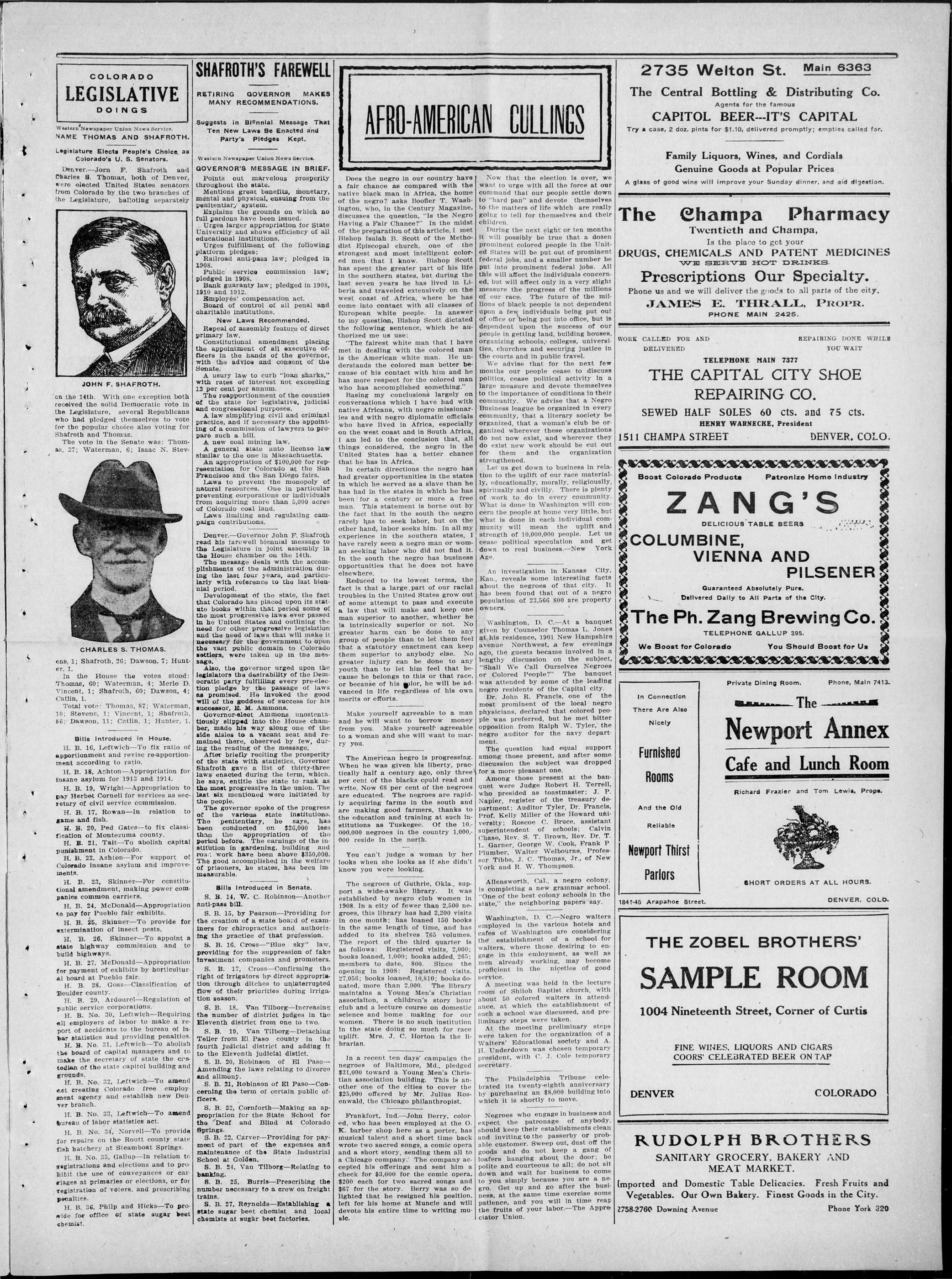
Denver.—Jorn F. Shafroth and Charles S. Thomas, both of Denver, were elected United States senators from Colorado by the two branches of the Legislature, balloting separately
M.
```markdown
```
JOHN F. SHAFROTH.
on the 14th. With one exception both
received the solid Democratic vote in
the Legislature, several Republicans
who had pledged themselves to vote
for the popular choice also voting for
Shafroth and Thomas.
The vote in the Senate was: Thomas,
27; Waterman, 6; Isaac N. Stev-
PETER H.
CHARLES S. THOMAS.
ens, 1; Shafroth, 26; Dawson, 7; Hunter, 1.
In the House the votes stood:
Thomas, 60; Waterman, 4; Merle D. Vincent, 1; Shafroth, 60; Dawson, 4; Catlin, 1.
Total vote: Thomas, 87; Waterman, 10; Stevens, 1; Vincent, 1; Shafroth, 86; Catlin, 11; Catlin, 1; Hunter, 1.
Bills Introduced in House.
H. B. 16, Leftwich—To fix ratio of apportionment and revise re-apportionment according to ratio.
H. B. 18, Achton—Appropriation for insane asylum for 1913 and 1914.
H. B. 19, Wright—Appropriation to pay Herbet Cornell for services as secretary of civil service commission.
H. B. 17, Rowan—in relation to game and fish.
H. B. 20, Ped Gates—to fix classification of Montezuma county.
H. B. 21, Tait—To abolish capital punishment in Colorado.
H. B. 22, Ashton—For support of Colorado insane asylum and improvements.
H. B. 23, Skinner—For constitutional amendment, making power companies common carriers.
H. B. 24, McDonald—Appropriation to pay for Pueblo fair exhibits.
H. B. 25, Skinner—To provide for extermination of insect pests.
H. B. 26, Skinner—To appoint a state highway commission and to build highways.
H. B. 27, McDonald—Appropriation for payment of exhibits by horticultural board at Pueblo fair.
H. B. 28, Goss—Classification of Boulder county.
H. B. 29, Ardourcl—Regulation of public service corporations.
H. B. No. 30, Leftwich—Requiring all employers of labor to make a report of accidents to the bureau of labor statistics and providing penalties.
H. B. No. 31, Leftwich—To abolish the board of capital managers and to make the secretary of state the custodian of the state capitol building and grounds.
H. B. No. 32, Leftwich—To amend act creating Colorado free employment agency and establish new Denver branch.
H. B. No. 33, Leftwich—To amend bureau of labor statistics act.
H. B. No. 34, Norvell—To provide for repairs on the Routt county state fish hatchery at Steamboat Springs.
H. B. No. 35, Gallup—In relation to registrations and elections and to prohibit the use of conveyances or carriages at primaries or elections, or for registration of voters, and prescribing penalties.
H. B. 36, Philp and Hicks—To provide for office of state sugar beet chemist.
SHAFROTH'S FAREWELL
RETIRING GOVERNOR MAKES MANY RECOMMENDATIONS.
Suggests in Biennial Message That Ten New Laws Be Enacted and Party's Pledges Kept.
Western Newspaper Union News Service.
GOVERNOR'S MESSAGE IN BRIEF.
Points out marvelous prosperity throughout the state. Mentions great benefits, monetary, mental and physical, ensuing from the penitentiary system.
Explains the grounds on which no full pardons have been issued. Urges larger appropriation for State University and shows efficiency of all educational institutions. Urges fulfillment of the following platform pledges:
Railroad anti-pass law; pledged in 1908.
Public service commission law; pledged in 1908.
Bank guaranty law; pledged in 1908, 1910 and 1912.
Employes' compensation act.
Board of control of all penal and charitable institutions.
New Laws Recommended.
Repeal of assembly feature of direct primary law.
Constitutional amendment placing the appointment of all executive officers in the hands of the governor, with the advice and consent of the Senate. A usury law to curb "loan sharks," with rates of interest not exceeding 12 per cent per annum. The reapportionment of the counties of the state for legislative, judicial and congressional purposes. A law simplifying civil and criminal practice, and if necessary the appointing of a commission of lawyers to prepare such a bill.
A new coal mining law.
A general state auto license law similar to the one in Massachusetts.
An appropriation of $100,000 for representation for Colorado at the San Francisco and the San Diego fairs.
Laws to prevent the monopoly of natural resources. One in particular preventing corporations or individuals from acquiring more than 5,000 acres of Colorado coal land.
Laws limiting and regulating campaign contributions.
Denver:—Governor John F. Shafroth read his farewell biennial message to the Legislature in joint assembly in the House chamber on the 14th.
The message deals with the accomplishments of the administration during the last four years, and particularly with reference to the last biennial period.
Development of the state, the fact that Colorado has placed upon its statute books within that period some of the most progressive laws ever passed in he United States and outlining the need for other progressive legislation and the need of laws that will make it necessary for the government to open the vast public domain to Colorado settlers, were taken up in the message.
Also, the governor urged upon the legislators the desirability of the Democratic party fulfilling every pre-election pledge by the passage of laws as promised. He invoked the good will of the goddess of success for his successor, E. M. Ammons.
Governor-elect Ammons unostentiously slipped into the House chamber, made his way along one of the side ashes to a vacant seat and remained there, observed by few, during the reading of the message.
After briefly reciting the prosperity of the state with statistics, Governor Shafroth gave a list of thirty-three laws enacted during the term, which, he says, entitle the state to rank as the most progressive in the union. The last six mentioned were initiated by the people.
The governor spoke of the progress of the various state institutions. The penitentiary, he says, has been conducted on $26,000 less than the appropriation of the period before. The earnings of the institution in gardening, building and road work have been above $350,000. The good accomplished in the welfare of prisoners, he states, has been immeasurable.
Bills Introduced in Senate.
S. B. 14, W. C. Robinson—Another anti-pass bill.
S. B. 15, by Pearson—Providing for the creation of a state board of examiners for chiropractics and authorizing the practice of that profession. S. B. 16. Cross—"Blue sky" law, providing for the suppression of fake investment companies and promoters. S. B. 17, Cross—Confirming the right of irrigators by direct appropriation through ditches to uninterrupted flow of their priorities during irrigation season. S. B. 18, Van Tilborg—Increasing the number of district judges in the Eleventh district from one to two.
S. B. 20, Robinson of El Paso—Amending the laws relating to divorce and alimony.
S. B. 21, Robinson of El Paso—Concerning the term of certain public officers.
S. B. 22, Cornforth—Making an appropriation for the State School for the Deaf and Blind at Colorado Springs.
S. B. 22, Carver—Providing for payment of part of the expenses and maintenance of the State Industrial School at Golden.
S. B. 24, Van Tlborg—Relating to banking.
S. B. 25, Burris—Prescribing the number necessary to a crew on freight trains.
S. B. 27, Reynolds—Establishing a state sugar beet chemist and local chemists at sugar beet factories.
AFRO-AMERICAN CULLINGS
Does the negro in our country have a fair chance as compared with the native black man in Africa, the home of the negro? asks Boofer T. Washington, who, in the Century Magazine, discusses the question, "Is the Negro Having a Fair Chance?" In the midst of the preparation of this article, I met Bishop Isaiah B. Scott of the Methodist Episcopal church, one of the strongest and most intelligent colored men that I know. Bishop Scott has spent the greater part of his life in the southern states, but during the last seven years he has lived in Liberia and traveled extensively on the west coast of Africa, where he has come into contact with all classes of European white people. In answer to my question, Bishop Scott dictated the following sentence, which he authorized me us use:
"The fairest white man that I have met in dealing with the colored man is the American white man. He understands the colored man better because of his contact with him and he has more respect for the colored man who has accomplished something."
Basing my conclusions largely on conversations which I have had with native Africans, with negro missionaries and with negro diplomatic officials who have lived in Africa, especially on the west coast and in South Africa, I am led to the conclusion that, all things considered, the negro in the United States has a better chance that he has in Africa.
In certain directions the negro has had greater opportunities in the states in which he served as a slave than he has had in the states in which he has been for a century or more a free man. This statement is borne out by the fact that in the south the negro rarely has to seek labor, but on the other hand, labor seeks him. In all my experience in the southern states, I have rarely seen a negro man or woman seeking labor who did not find it. In the south the negro has business opportunities that he does not have elsewhere.
Reduced to its lowest terms, the fact is that a large, part of our racial troubles in the United States grow out of some attempt to pass and execute a law that will make and keep one man superior to another, whether he is intrinsically superior or not. No greater harm can be done to any group of people than to let them feel that a statutory enactment can keep them superior to anybody else. No greater injury can be done to any youth than to let him feel that because he belongs to this or that race, or because of his color, he will be advanced in life regardless of his own merits or efforts.
Make yourself agreeable to a man and he will want to borrow money from you. Make yourself agreeable to a woman and she will want to marry you.
The American negro is progressing. When he was given his liberty, practically half a century ago, only three per cent of the blacks could read and write. Now 68 per cent of the negroes are educated. The negroes are rapidly acquiring farms in the south and are making good farmers, thanks to the education and training at such institutions as Tuskegee. Of the 10,000,000 negroes in the country 1,000,000 reside in the north.
You can't judge a woman by her looks when she looks as if she didn't know you were looking.
The negroes of Guthrie, Okla, support a wide-awake library. It was established by negro club women in 1908. In a city of fewer than 2,500 negroes, this library has had 2,200 visits in one month; has loaned 150 books in the same length of time, and has added to its shelves 765 volumes. The report of the third quarter is as follows: Registered visits, 2,000; books loaned, 1,000; books added, 265; members to date, 800. Since the opening in 1908: Registered visits, 27,056; books loaned, 10,810; books donated, more than 2,000. The library maintains a Young Men's Christian association, a children's story hour club and a lecture course on domestic science and home making for our women. There is no such institution in the state doing so much for race uplift. Mrs. J. C. Horton is the librarian.
In a recent ten days' campaign the negroes of Baltimore, Md., pledged $31,000 toward a Young Men's Christian association building. This is another one of the cities to cover the $25,000 offered by Mr. Julius Rosenwald, the Chicago philanthropist.
Frankfort, Ind.—John Berry, colored, who has been employed at the O. K. barber shop here as a porter, has musical talent and a short time back wrote two sacred songs, a comic opera and a short story, sending them all to a Chicago company. The company accepted his offerings and sent him a check for $3,000 for the comic opera, $200 each for two sacred songs and $67 for the story. Berry was so delighted that he resigned his position, left for his home at Muncie and will devote his entire time to writing music.
Now that the election is over, we want to urge with all the force at our command that our people settle down to "hard pan" and devote themselves to the matters of life which are really going to tell for themselves and their children.
During the next eight or ten months it will possibly be true that a dozen prominent colored people in the United States will be put out of prominent federal jobs, and a smaller number be put into prominent federal jobs. All this will affect the individuals concerned, but will affect only in a very slight measure the progress of the millions of our race. The future of the millions of black people is not dependent upon a few individuals being put out of office or being put into office, but is dependent upon the success of our people in getting land, building houses, organizing schools, colleges, universities, churches and securing justice in the courts and in public travel.
We advise that for the next few months our people cease to discuss politics, cease political activity in a large measure and devote themselves to the importance of conditions in their community. We advise that a Negro Business league be organized in every community, that a literary society be organized, that a woman's club be organized wherever these organizations do not now exist, and wherever they do exist new work should be cut out for them and the organization strengthened.
Let us get down to business in relation to the uplift of our race materially, educationally, morally, religiously, spiritually and civilly. There is plenty of work to do in every community. What is done in Washington will concern the people at home very little, but what is done in each individual community will mean the uplift and strength of 10,000,000 people. Let us cease political speculation and get down to real business.—New York Age.
An investigation in Kansas City, Kan., reveals some interesting facts about the negroes of that city. It has been found that out of a negro population of 23,566 800 are property owners.
Washington, D. C.—At a banquet given by Counselor Thomas L. Jones at his residence, 1901 New Hampshire avenue Northwest, a few evenings ago, the guests became involved in a lengthy discussion on the subject, "Shall We Call Ourself Negroes or Colored People?" The banquet was attended by some of the leading negro residents of the Capital city. Dr. John R. Francis, one of the most prominent of the local negro physicians, declared that colored people was preferred, but he met bitter opposition from Ralph W. Tyler, the negro auditor for the navy department. The question had equal support among those present, and after some discussion the subject was dropped for a more pleasant one.
Among those present at the banquet were Judge Robert H. Terrell, who presided as toastmaster; J. P. Napier, register of the treasury department; Auditor Tyler, Dr. Francis, Prof. Kelly Miller of the Howard university; Roscoe C. Bruce, assistant superintendent of schools; Calvin Chase, Rev. S. T. Brown, Rev. Dr. T. L. Garner, George W. Cook, Frank P Plumber, Walter Welbourne, Professor Tibbs, J. C. Thomas, Jr., of New York and R. W. Thompson.
Allensworth, Cal., a negro colony, is completing a new grammar school. "One of the best colony schools in the state," the neighboring papers say.
Washington, D. C.—Negro waiters employed in the various hotels and cafes of Washington are considering the establishment of a school for waiters, where those desiring to engage in this employment, as well as men already working, may become proficient in the niceties of good service.
A meeting was held in the lecture room of Shilloh Baptist church, with about 50 colored waiters in attendance, at which the establishment of such a school was discussed, and preliminary steps were taken.
At the meeting preliminary steps were taken for the organization of a Waiters' Educational society and A. H. Underdown was chosen temporary president, with C. J. Cole temporary secretary.
The Philadelphia Tribune celebrated its twenty-eighth anniversary by purchasing an $8,000 building into which it is shortly to move.
Negroes who engage in business and expect the patronage of anybody, should keep their establishments clean and inviting to the passerby or probable customer. Sweep out, dust off the goods and do not keep a gang of loafers hanging about the door; be polite and courteous to all; do not sit down and wait for business to come to you simply because you are a negro. Get up and go after the business, at the same time exercise some patience, and you will in time reap the fruits of your labor.—The Appreciator Union.
The Central Bottling & Distributing Co.
Agents for the famous
CAPITOL BEER---IT'S CAPITAL
Try a case, 2 doz. pints for $1.10, delivered promptly; empties called for.
Family Liquors, Wines, and Cordials Genuine Goods at Popular Prices A glass of good wine will improve your Sunday dinner, and aid digestion.
The Champa Pharmacy
Twentieth and Champa,
Is the place to get your
DRUGS, CHEMICALS AND PATENT MEDICINES
WE SERVE HOT DRINKS.
Prescriptions Our Specialty.
Phone us and we will deliver the goods to all parts of the city.
JAMES E. THRALL, PROPR.
PHONE MAIN 2425.
WORK CALLED FOR AND
DELIVERED
TELEP
THE CAPIT
REPA
SEWED HALF SO
HENRY
SEWED HALF SOLES 60 cts. and 75 cts.
HENRY WARNECKE, President
1511 CHAMPA STREET DENVER, CO
Boost Colorado Products Patronize Home Industry
ZANG'S
DELICIOUS TABLE BEERS
COLUMBINE,
VIENNA AND
PILSENE
Colorado Products Patronize Home
ZANG'S
DELICIOUS TABLE BEERS
JUMBINE,
VIENNA AND
PILSE
Guaranteed Absolutely Pure.
Delivered Daily to All Parts of the City.
The Ph. Za TELEP We Boost for Colorado
Ph. Zang Brewing
TELEPHONE GALLUP 395.
best for Colorado You Should Boo
Newport A Cafe and Lunch
Furnished
Rooms
And the Old
Reliable
Newport Thirst
Parlors
SHORT ORDERS AT AL
oe Street.
E ZOBEL BROTHE
AMPLE ROO
Nineteenth Street, Corner of
THE ZOBI
SAMPI
1004 Nineteenth
1004 Nineteenth Street, Corner of Curtis
FINE WINES, LIQUORS AND CIGARS
COORS' CELEBRATED BEER ON TAP
DOLPH BROTHERS
NUTRARY GROCERY BAKERY
RUDOLPH
SANITARY GR
MEA
(imported and Domestic
Vegetables. Our Own H
2758-2760 Downing Avenue
SANITARY GROCERY, BAKERY AND MEAT MARKET. Imported and Domestic Table Delicacies. Fresh Fruits and Vegetables. Our Own Bakery. Finest Goods in the City. 2758-2760 Downing Avenue Phone York 320
In Connection There Are Also Nicely
DENVER
REPAIRING DONE WHILE
YOU WAIT
PHONE MAIN 7377
TAL CITY SHOE
AIRING CO.
OLES 60 cts. and 75 cts.
WARNECKE, President
Patronize Home Industry
NG'S
OUS TABLE BEERS
E,
NNA AND
PILSENER
ang Brewing Co.
PHONE GALLUP 395.
No You Should Boost for Us
Private Dining Room. Phone, Main 7413.
The Newport Annex Cafe and Lunch Room Richard Frazier and Tom Lewis, Props.
Fruit Basket
EL BROTHERS'
LE ROOM
Street, Corner of Curtis
H BROTHERS
GOCERY, BAKERY AND
AT MARKET.
Table Delicacies. Fresh Fruits and
Bakery. Finest Goods in the City.
Phone York 320
DENVER, COLO.
DENVER, COLB.
COLORADO
THE COLORADO STATESMAN
A GATOR
WALK OF
FAIL
JOS. L. D. RIVERS.....Proprietor
1824 Curtis Street, Room 25.
SUBSCRIPTION RATES:
One Year ..... $2.00
Six Months ..... 1.00
Three Months ..... .60
PAYABLE IN ADVANCE.
One Year
Six Months
Three Months
PAYABLE IN
Entered as second-class matter at Colorado.
Reading notices, ten lines or less, but over ten lines, 5 cents per line.
Display advertising, 25 cents per square.
No discounts allowed on less than three pany all orders from parties unknown to us.
Remittances should be made by E Order, Registered Letter or Bank Order, same as cash for the fractional part of an taken.
All communications of a personation will be withheld from the columns of the newspaper.
Communications to receive attention objects, plainly written only upon one side if possible, anyway, not later than Wednesday. No manuscript returned, unless otherwise stated.
It occasionally happens that papers in case you do not receive any number we will cheerfully forward a duplicate.
We were in hope of announcing a colored person to some honorable position up to this writing none have been named.
We have heard of a story told conspiracy. The latter in passing the former rude, the mud and on his knees. The Chinese shook off some of the mud, bowed vering voice, "You Christian, me heathen, one of the highest traits of civilization worthy the name of a Christian nor any other."
ARE WE?
We cannot be classed among the conditions that we are passing the that many things which seem monstrous weight falls upon us, are, after all, therefore blessings in disguise. There with the race problem in the United States, the rightful source of so much complacency people are inclined to give them. We the channels of material success as a of that progress is not altogether what beginning of the present year the colmore land and more personal property can boast a higher educational standpoint of intellectual and moral development dustrial forces by which the strength We are growing along all lines which consideration and respect, and every of satisfaction over the realization of But when we attempt to fix the company as citizens among the country's does not hold good. Up to a certain recognized. That point is fixed more any equitable or moral obligation. We generally to enjoy the fruits of it and tend to share, to a certain extent, in the and to apply our education to our own ourselves we may instigate and carry or labors as may suggest themselves.
But in the realm of civil and politiculated governmental and business than we were twenty-five years ago. Negro domination is made a pretext privilege. In the North a general and bias makes our participation in political indications point to a still greater or other elements are able to safeguard business relations with other elements and hedged in by unwavering rules of progress we are at a standstill, and over the wall of racial separation. In tranquility, though, as we stated in the At any rate, we will go ahead along the We will increase our wealth, our know more upon ourselves and develop more.
We are a patient, tolerant people without inherent capabilities which make the full enjoyment of a freeman's right.
matter at the postoffice
times or less, 10 cents per
line.
seconds per square. A square
less than three months' co-
ments unknown to us. Further,
be made by Express Money
or Bank Draft. Postage s-
pecial part of a dollar. Only.
If a personating nature the
columns of this paper.
receive attention must be n
upon one side of the paper
better than Wednesdays, and
returned, unless stamps are
s that papers sent to suit
many number when due, in-
d a duplicate of the miss-
sion.
I am announcing this week
a honorable position in some
have been named.
History told concerning a C
former rudely shoved his
ties. The Chinaman picke-
nd, bowed very politely, to
me heathen, allee same
of civilization, and he w
Christian nor an American.
Entered as second-class matter at the postoffice in the city of Denver, Colorado.
Reading notices, ten lines or less, 10 cents per line. Each additional line over ten lines, 5 cents per line.
Display advertising, 25 cents per square. A square contains ten agate lines.
No discounts allowed on less than three months' contract. Cash must accompany all orders from parties unknown to us. Further particulars on application.
Remittances should be made by Express Money Order, Postoffice Money Order, Registered Letter or Bank Draft. Postage stamps will be received the same as cash for the fractional part of a dollar. Only 1-cent and 2-cent stamps taken.
All communications of a personating nature that are not complimentary will be withheld from the columns of this paper.
Communications to receive attention must be newsy, upon important subjects, plainly written only upon one side of the paper; must reach us Tuesdays, if possible, anyway, not later than Wednesdays, and bear the signature of the author. No manuscript returned, unless stamps are sent for postage.
It occasionally happens that papers sent to subscribers are lost or stolen, in case you do not receive any number when due, inform us by postal card and we will cheerfully forward a duplicate of the missing number.
We were in hope of announcing this week the appointment of some colored person to some honorable position in some of our state offices, but up to this writing none have been named.
We have heard of a story told concerning a Chinaman and a white man. The latter in passing the former rudely shoved him from the sidewalk into the mud and on his knees. The Chinaman picked himself up very calmly, shook off some of the mud, bowed very politely, and said in a mild, reproving voice, "You Christian, me heathen, allee samee, good bye." Courtesy is one of the highest traits of civilization, and he who is lacking in it is not worthy the name of a Christian nor an American.—Reformer.
ARE WE GROWING?
all among the pessimists we are passing through, but, despite monstrously unjust, are, after all, necessary,筋筋吾筋. There are some in the United States, which complacent assurance have them. We are making success as the years go together what we are preparing for the colored people, personal property than they national standing, a material development and a great strength and worthful lines which tend to it, and every sensible New realization of this eviction to fix the comparative power the country's associated extent to a certain point our rules fixed more by a universal obligation. We are permit limits of it and of our labor a extent, in the educationation to our own further state and carry out such and themselves to our senses, civil and political liberty and business intercourse the years ago. In the South a pretext to deprive a general and carefully restitution in political affairs of still greater diminution to safeguard by a change other elements, like the rising rules of prejudice. In standstill, and neither separation. It does not be stated in the beginning head along the lines on wealth, our knowledge and develop more within our tolerant people and time cities which must some of Greeman's rights.
We cannot be classed among the pessimists who never see any good in the conditions that we are passing through, but we are inclined to believe that many things which seem monstrously unjust and hard, as their crushing weight falls upon us, are, after all, necessary to our development, and therefore blessings in disguise. There are some facts, however, connected with the race problem in the United States, which, we believe, are not the rightful source of so much complacent assurance as a hopeful but tolerant people are inclined to give them. We are making indisputable progress in the channels of material success as the years go by, but the actual result of that progress is not altogether what we are prone to consider it. At the beginning of the present year the colored people of the United States own more land and more personal property than they ever owned before. They can boast a higher educational standing, a material advance along the lines of intellectual and moral development and a greater adaptation to those industrial forces by which the strength and worth of a people are measured. We are growing along all lines which tend to make a people worthy of consideration and respect, and every sensible Negro can feel a high sense of satisfaction over the realization of this evidence of our advancement. But when we attempt to fix the comparative position which we should occupy as citizens among the country's associated elements, the expected ratio does not hold good. Up to a certain point our rights seem to be definitely recognized. That point is fixed more by a universal legal necessity than by any equitable or moral obligation. We are permitted to own property and generally to enjoy the fruits of it and of our labors upon it. We are permitted to share, to a certain extent, in the educational facilities of the country and to apply our education to our own further class development. Among ourselves we may instigate and carry out such moral or material movements or labors as may suggest themselves to our sense of self-improvement.
But in the realm of civil and political liberty—that great source of associated governmental and business intercourse—we are worse off today than we were twenty-five years ago. In the South the pretended fear of Negro domination is made a pretext to deprive us of almost all political privilege. In the North a general and carefully nursed but no less efficient bias makes our participation in political affairs almost as fruitless, and all indications point to a still greater diminution of political benefits which other elements are able to safeguard by a change of political allegiance. Our business relations with other elements, like those political, are hampered and hedged in by unwavering rules of prejudice. In these two great branches of progress we are at a standstill, and neither individual or race can see over the wall of racial separation. It does not augur well for our future tranquility, though, as we stated in the beginning, it may be for the best. At any rate, we will go ahead along the lines on which we are not hampered. We will increase our wealth, our knowledge and our worth; we will rely more upon ourselves and develop more within ourselves.
We are a patient, tolerant people and time is proving that we are not without inherent capabilities which must some day, somewhere, lead us to the full enjoyment of a freeman's rights.
A Bit Hot, but Loyal.
A girl went to India, and at the first New Year's away from home she wrote to her devout mother: "It is now very hot and I perspire a great deal, but you will be pleased to hear that I am still a member of the Church of England."
Improved Paper Fastener.
To save the use of metal fasteners to hold several papers together a hand punch has been invented that makes a tongue-shaped cut in several sheets at once and folds the tongues to gether.
Reading the dictionary for pleasure is not an unknown occupation, and there is the testimony of one well known man that, while traveling, he had found one etymological dictionary a "perpetual succession of pleasant surprises." Such a book is good for one who finds it hard to concentrate his mind and the distractions of a journey.
---
Hint for Travelers.
To save the use of metal fasteners to hold several papers together a hand punch has been invented that makes a tongue-shaped cut in several sheets at once and folds the tongues together.
"Very tart was Douglas Jerrold's retort to a would-be wit who, having fired off all his stale jokes with no effect, exclaimed: "Why, you never laugh when I say a good thing!" "Don't I?" said Jerrold. "Only try me with one."
Improved Paper Fastener.
Just Waiting.
By WELLS ANDREWS, M. D., Chicago
WHY is it that a child it because that the parents? eye than form tax vision more severely than numerous and increasing average the streets and shops and in too soon for the gravity of the attention, the attention which remedies or reforms can be no City life, with its swift variation of range, its smoked and more complex strained, breeze-cleansed expansion. In a pair of normal eye two in number. First, accord second, adjustment, that is, trolling the direction of the point. For instance, in look the print in order to see or adjusted in order to secure so the main eye trouble fr The near-sighted child is not being known to be so. of schoolmates and chiding him or correctly from the blackhole failures of the former are at In childhood the eyes sightedness or other defects have long been accustomed to dist; it would be of much inquiring into the status of the The entrance upon school inherited or acquired near be taught as far as possible door life and sports requiring course will insure results his study nor reading except by vehicles and the sense of strife change of work. Growing children should at the time they might lose good to them in the added s
If is it that so many children wear glasses because their eyes are not as good as the parents? Or is it because more is to be than formerly, or that modern habits severely than in the days of our grandfather, using average of spectacled children no shops and in our schools and homes is a gravity of the interest at stake—attention which has to be arrested and items can be made widely effective. With its swift glimpses at short ranges, freeze, its smoke and dust, subjects the eye complex strain than do the long ranges caused expanses of the country. Of normal eyes the leading factors in the First, accommodation, by which is evident, that is, a joint muscular act of the motion of the eye in order to fix the sign, in looking at this page each eye order to see distinctly, and both eyes need to secure single vision. The trouble from which children suffer is that the child is generally at a disadvantage if it to be so. The child, therefore, suffer and chiding by his teachers for not read in the blackboard. The others can see former are attributed to obstinacy or unintent the eyes should be watched and the other defects be promptly and skillfully be customised to taking children for inspection of much greater good were we in the status of their eyes. Upon school life in the case of children injured near sight should be postponed as possible by the ear rather than by arms requiring distant vision should be done results highly satisfactory. There is long except by a good light, no reading sense of strain or fatigue should be required children should, as a rule, do no evening, might lose of book knowledge will be the added store of health.
WHY is it that so many children wear glasses nowadays? Is it because their eyes are not as good as were the eyes of the parents? Or is it because more is known about the eye than formerly, or that modern habits and occupations tax vision more severely than in the days of our grandfathers? The enormous and increasing average of spectacled children now to be seen in the streets and shops and in our schools and homes is at last—and none too soon for the gravity of the interest at stake—attracting the parents' attention, the attention which has to be arrested and educated before remedies or reforms can be made widely effective.
City life, with its swift glimpses at short ranges, frequent and abrupt variation of range, its smoke and dust, subjects the eye to more continuous and more complex strain than do the long ranges of view and the serene, breeze-cleansed expanses of the country.
In a pair of normal eyes the leading factors in the visual act are two in number. First, accommodation, by which is meant focusing; second, adjustment, that is, a joint muscular act of the two eyes, controlling the direction of the gaze in order to fix the sight upon a given point. For instance, in looking at this page each eye must focus upon the print in order to see distinctly, and both eyes must be properly adjusted in order to secure single vision.
The main eye trouble from which children suffer is near-sightedness. The near-sighted child is generally at a disadvantage from the start of not being known to be so. The child, therefore, suffers from the jeers of schoolmates and chiding by his teachers for not reading sums readily or correctly from the blackboard. The others can see clearly and the failures of the former are attributed to obstinacy or untruthfulness.
In childhood the eyes should be watched and the tendency to near-sightedness or other defects be promptly and skillfully attended to. We have long been accustomed to taking children for inspection to the dentist; it would be of much greater good were we in the habit of often inquiring into the status of their eyes.
The entrance upon school life in the case of children showing either inherited or acquired near sight should be postponed and they should be taught as far as possible by the ear rather than by the eye and outdoor life and sports requiring distant vision should be encouraged. This course will insure results highly satisfactory. There should be neither study nor reading except by a good light, no reading in cars or other vehicles and the sense of strain or fatigue should be relieved by rest or change of work.
Growing children should, as a rule, do no evening studying. What at the time they might lose of book knowledge will be more than made good to them in the added store of health.
Keeping One's Self in Good Repair
By S, M. STANLEY, Baltimore
You habitually do a t health, and that you would r If you find your pulse doesn't worry you half as r your watch. The watch must go a pulse—well, maybe that wi The chances are that yo is beating or not. You care Once a week, at least, y nometer to know that it is a with anything. Why? Bee as you do about your watch cost you nothing. And thu
rally do a thousand things that you know you would not permit your dog to do, and your pulse is a losing a beat or two as you half as much as does the loss of a heart. You must go at once for repair and regain that will work itself around all risks are that you don't very often know what to do. You care so little about it. At least, you carefully compare your watch that it is right, but you don't ever care Why? Because you don't care as much about your watch. The watch cost you may not. And thus you value them.
You habitually do a thousand things that you know injure your health, and that you would not permit your dog to do, and you don't care. If you find your pulse is a losing a beat or two a minute the fact doesn't worry you half as much as does the loss of a second or two by your watch.
The watch must go at once for repair and regulation, but your pulse—well, maybe that will work itself around all right.
The chances are that you don't very often know whether your pulse is beating or not. You care so little about it.
Once a week, at least, you carefully compare your watch with a chronometer to know that it is right, but you don't ever compare your pulse with anything. Why? Because you don't care as much about your heart as you do about your watch. The watch cost you maybe $50; the heart cost you nothing. And thus you value them.
Modern Use of Some Latin Words
By MYRLE TYRREL
Des Moines, Iowa
I never heard of "Tzitze
A great deal of uncertai
the ancient Romans pronoun
It is possible that if Ci
in college classrooms he wou
man classics.
word of "Tzitzero" as a legitimate pronoun
of uncertainty prevails among authori-
cans pronounced their words.
me that if Cicero himself were to come to
rooms he would hardly understand our r
I never heard of "Tzitzero" as a legitimate pronunciation.
A great deal of uncertainty prevails among authorities as to the way the ancient Romans pronounced their words.
It is possible that if Cicero himself were to come to earth and appear in college classrooms he would hardly understand our reading of the Roman classics.
Reason
For
Using
Feminine
Pronoun
By CARL C. KOPP
Thus we say "The grizz this sentence masculine char power. and therefore we use
y "The grizzly bear is the most savage seeline characteristics predominate, so before we use the masculine pronoun.
Thus we say "The grizzly bear is the most savage of his race." In this sentence masculine characteristics predominate, showing strength and power, and therefore we use the masculine pronoun.
Do many children wear glasses nowadays? Is their eyes are not as good as were the eyes of a child? Or is it because more is known about the early, or that modern habits and occupations in the days of our grandfathers? The enormity of spectacled children now to be seen in our schools and homes is at last—and none of the interest at stake—attracting the parents' which has to be arrested and educated before made widely effective.
Dimples at short ranges, frequent and abrupt and dust, subjects the eye to more continuity than do the long ranges of view and the eyes of the country.
As the leading factors in the visual act are accommodation, by which is meant focusing; a joint muscular act of the two eyes, conjugate in order to fix the sight upon a given seeing at this page each eye must focus upon distinctly, and both eyes must be properly single vision.
From which children suffer is near-sightedness. Generally, at a disadvantage from the start of the child, therefore, suffers from the jeers by his teachers for not reading sums readily board. The others can see clearly and the attributed to obstinacy or untruthfulness. Should be watched and the tendency to near-epromptly and skillfully attended to. We so taking children for inspection to the dencreater good were we in the habit of often their eyes.
All life in the case of children showing either sight should be postponed and they should pay the ear rather than by the eye and out-distant vision should be encouraged. This highly satisfactory. There should be neither a good light, no reading in cars or other pain or fatigue should be relieved by rest or as a rule, do no evening studying. What of book knowledge will be more than made more of health.
When you find that your watch is losing a minute a day, you hasten to have it regulated. If your horse goes lame or your dog gets sick, you seek a remedy at once.
If your friend has a fault you see it and want it corrected.
But, somehow or other, you treat yourself so very differently.
The one thing precious above all others to you that you are especially charged to keep in repair—yourself—you treat with greater indifference than you do your dog.
ousand things that you know injure your dog permit your dog to do, and you don't care. It is a losing a beat or two a minute the fact such as does the loss of a second or two by once for repair and regulation, but your work itself around all right. You don't very often know whether your pulse so little about it. You carefully compare your watch with a chroight, but you don't ever compare your pulse use you don't care as much about your heart. The watch cost you maybe $50; the heart you value them.
The old Roman pronunciation of Cicero was undoubtedly "Kikoro," phonetically spelt. In the same way Caesar was pronounced like "Kaisar," the title of the German emperor. Nowadays, however, we use soft c in the pronunciation of the above Latin words unless we are reading Latin. In the former case we Anglicize them.
Both ways are considered correct, as the English and Roman pronunciations are used indiscriminately in reading Latin texts; the latter, however, predominates in such readings.
to" as a legitimate pronunciation.
enty prevails among authorities as to the way
need their words.
zero himself were to come to earth and appear
and hardly understand our reading of the Ro-
Replying to an inquiry as to why we
say "she" so much when referring to a beat
train or vehicle, I beg the right to explain
that this comes under a rule to the effect
that objects distinguished for their grace,
beauty or gentleness are regarded as feminine.
Thus a boat or train, would come under
the head of grace and gentleness, and is
therefore regarded as feminine.
Objects distinguished for their size, power or sublimity are regarded as masculine. My bear is the most savage of his race." In meteoristics predominate, showing strength and the masculine pronoun.
New Idea for Fish Course—Caper Sauce Improves Flavor of Roast Lamb or Boiled Mutton.
Have you ever served for a fish course rounds cut from a slice across the entire loaf, fried in butter and served hot, covered with first a layer of browned mushrooms, then a layer of creamed lobster dotted with shredded green pepper? On the plate with this crouton is shredded cucumber with French dressing, or an individual mold of cucumber aspic.
Do you know how good caper sauce is with roast lamb or boiled mutton? Melt two tablespoonfuls of butter, rub in the same amount of flour, add a pint and a half of boiling lamb stock or the broth in which the mutton is boiled. Cook for ten minutes and add the yolks of two eggs mixed with a tablespoonful of cream. Strain and add a half cup of capers. Serve hot.
Crab meat au gratin is a pleasant change from the inevitable deviled crab. Mix the crab flakes with a cream sauce, highly season with cayenne, a little nutmeg, chopped parsley and a teaspoonful of mustard rubbed into the butter and flour thickening. Fill individual baking dishes, sprinkle with grated parmesan and dots of butter and cook in the oven until a delicate brown.
HOUSEHOLD QUESTIONS
Lemon juice and glycerin, equal parts, sipped slowly, is a relief for an irritated throat.
When cheese is too soft to grate, press through a coarse wire strainer, using the back of a spoon.
To make a candle fit a candlestick dip the end of the candle in hot water to soften the wax and then push it into the candlestick.
A common brass cup hook, such as is used in china cabinets and on cup racks, can easily be screwed into the end of a broomhandle, making an inexpensive and handy broom hanger.
For a shabby umbrella take half a cupful of strong tea and two teaspoonfuls of sugar. Open the umbrella and sponge well with the mixture. Tea revives the color and sugar stiffens
When roasting heavy poultry that takes a long time to cook, in a paper bag, place it in a well buttered bag and then put this into another bag and fold as usual. This is done by M. Soyer, the introducer in England of paper bag cookery.
To make a polish for patent leather make a mixture of one part linseed oil and two of cream. Mix it thoroughly and apply with a flannel, after removing every particle of dust from the shoes, and then rub the leather with a soft cloth.
Hints for the Scamstress.
A neat way to bone a collar is to sew a piece of tape on the wrong side of the collar from shoulder seam to edge. Make two slits in each strip near the middle, so that by bending you can slip the bit of whalebone in to stiffen the collar. When the waist is soiled the whalebone may be taken out, soaked if necessary to straighten it, and put back in the cleaned waist. Another excellent idea is to sew buttons that cannot well be washed onto a tape and put a row of button holes on each side of the waist hems, those on one side being cut across, the others up and down, so that the opening won't gape when the taped buttons are put in.
Pea Soup
Pick over and wash carefully one pint of whole peas. Put in an agate kettle with two quarts of cold water and half a teaspoonful of soda and water and stir to prevent scorching. When they shell empty that water, rinse and put back on fire with three quarts boiling water, one small onion, one teaspoonful of salt, quarter teaspoonful of pepper and about three-quarters of a pound of salt pork, taken from the bones with only a little fat. Put about half a cupful of rice in when the peas boll and just before serving add croutons. Add more water if necessary when it boils down. This will serve eight people.
Potato and Liver Salad
Add as much diced liver to potato salad. Baked or boiled liver or fried liver freed from fat may be used, and it should stand wet with French dressing an hour before mixing. Diced eggs fried hard, skinned cooked sausages, shredded smoked fish, dried beef, flakes of fish and other vegetables co...bine with potatoes in salad.
For Shoelace Tips.
The tips of shoelaces sometimes come off quite good laces. In this case they may be replaced with impromptu tags of sealing wax. Cut the tag, smear it over with sealing wax, then press it to a point while the wax is still warm.
Washing Muddy Skirts.
To make a muddy skirt wash easily and look white, take some sour milk, dilute with water and soak the skirt in it over night; then wash in the usual way. It will be found that the skirt washes more easily and looks whiter.
Cleaning the Bean Pot.
To clean the bean pot, fill with cold water, put in some kind of washing powder and cover tight; put on stove and let come to boil. This will make it very easy to wash.
1
Discontinuing the CLOTHING BUSINESS All Suits and Overcoats
To Be Closed Out Regardless of Cost
$15.00 to $25.00
Values - - - $9.95
$25.00 to $35.00
Values - - $17.95
THE
Johnson-Noel Co
1005 SIXTEENTH ST.
Look for This Sign in Front of Our Store.
THE
WESTERN
BEEF
CO.
OUR LEADER.
Hog Chitterlings, 5c lb.
Our store is your store.
We are at your service.
We Sell Everything a
Hog Furnishes
Get our prices before you buy else-
where. We also sell our grocertes
cheaper.
OUR MOTTO:
Our profits are small,
But we get them all.
We sell for cash only.
2048 LARIMER ST.
Opposite Three Rules.
Phone Champa 1641.
Open Sunday All Day.
THE TIVOLI UNION BREWING CO
Faoli
DENVER, CO.
ar emer armemrana ary Sais hha. oa poy aan camer poem ea
FARE-COLORADG 27h STATESMAN
atl : bed 5 oa! ar
ogee fm gga np ly
Sees BERS pase ie
feel ak ——Emcemns7) — ex
el eee Ah ea Dee AG Seer oer
Fete Aaa oN AL AOE oes ae
1 A, EO NC NT re ar
(Se=5 IED eR aE ——
W. A. Smith is suffering with a se-) popular young men desire as well :
vere cold and la grippe. easeve your patronage.
Mr. and Mrs. H. C. Crawford of al The choir of Zion Baptist churc
Mint block are reported as being bet-|rendered an excellent musical _ pr
ter gramme Sunday evening, which w:
heartily enjoyed by the large audience
Engine Company No. 3 will make a! The Mariposa Glee Club appeared ar
tachi ruin’ ae EUrara Rl re eriiary 12, [88 usual covered itself with hono
aaie? ee won in the field of music,
SA Greta an eA. Ga. endl eAreayougsing tothe balll givenit
Se a ae oe seikecinioeds Engine Co, No. 3, February 12 191
ee is in. ‘e hope ir rs T)ce Eureka hail?
recovery.
emt ow i The Colorado Springs Eagle has
rill Cowde 2449 Stout
asa Wltcay oan) OF A400 Stone eatgeih tue Seon oP Wr
Aiceer, jel sulllgeontnedy te, a) rinmai, Mrs. Julia Embry the form
ments. editor and publisher having sold h
Mrs, Eva Thompkins, one of Den- Slee Maegan oe dene forcib
ver’s society ladies is numbered among. - N
the sick. Fac cca ate ea cs ab hee a eee ee
Mrs, Mattie Clark, after spending
the holidays in Pueblo has returned to
the city.
W. H. Bess of Colorado Springs was
in the city last week setting up a
temple of the U. B. F's.
Miss Lizzie Cowan left the city Sat-
urday for Philadelphia, to be gone un-
til the middle of next month.
A. L. Ford contemplates trying his
fortune in a small town and grow up
with it.
J. C. Leatherman, who has been ill
for the past week, is able to resume
his duties at the Union depot. :
* Mrs. Alice Allen, after spending the
holidays in the city with friends, has
returned to her home in Colorado
Springs.
From the present outlook winter has
come to stay. Snow and freezing
weather has been the weather menu
» for two weeks. .
Robert Pullet’s funeral was held
‘Thursday morning from the Douglass
Undertaking Co. parlors.
Mrs. Lettie Jones has returned from
her old home in Wamego, Kansas, to
remain.
Word reaches us of a heavy fall of
snow in Vancouver, B. C. Denverites
wish they were in good old Denver.
Mr. Gaskins of 1904 Marion street
declares that there is no worry for the
fever to tarry if Dr. Westbook is
called in time.
Miss Lydia Starkey arrived home
last Monday from La Junta, where
she spent two weeks visiting her
mother.
Harry Jones and J. R, Hanger have
consolidated their barber business and
are now located at 2242 Larimer street.
In unify there is strength.
Geo. Sutton died at the County hos-
pital Sunday 12. Funeral was held
‘Thursday afternoon from the Douglass
Undertaking Co. parlors.
Mrs. Neale Anderson has returned
from Chicago, where she has been re-
siding for several years, her health is
somewhat impaired.
Geo. Wrightout died at the County
hospital Sunday, 41. Funeral was held
Friday afternoon from the Douglass
Undertaking Co. parlors.
Mrs. Fred B. Williams of 2222 Cur-
tis street is still confined to her house
with neuralgia, caused by the extrac-
tion of a tooth,
J. N. Walker is preparing a drama,
which will be rendered in ,the interest
of the Colorado African Colonization
Society. It is a splendid production
and reflects much credit on its author.
Jesse Nelson, a well known chef,
has been taking a well merited rest
after working in one place for seven
years steadily. Mr, Nelson is one of
the young men who is credit to the
race.
Master Edward H. Mitchel died
at his home, 2224 Market street. Fune-
ral was held Sunday afternoon, 2 p. m.
from the Douglass Undertaking Co.
parlors.
Mr. and Mrs. Lovey Penistone'’s
twins died at their home, 1937 Arapa-
hoe street. Funeral was held Monday
afternoon from the Douglass Under-
taking Co. parlors.
Gaines & Marks have taken charge
of the pool room at 1808 Arapahoe
street. This is by far the finest and
largest pool room in the city. These
popular young men desire as well as
deserve your patronage,
The choir of Zion Baptist church
rendered an excellent musical _pro-
sramme Sunday evening, which was
heartily enjoyed by the large audience.
The Mariposa Glee Club appeared and
be usual covered itself with honors
rightly won in the field of music,
| Are you going to the ball given by
Engine Co, No. 3, February 12 1913,
at Eureka hall?
The Colorado Springs Eagle has a
new editor in the person of Rev. W. H.
Tillman. Mrs. Julia Embry the former
editor and publisher having sold her
interest. Rev. Tillman is a forcible
writer and speaker,
Eureka hall was the scene of a large
crowd last Tuesday night, the occasion
being an éntertainment given by the
Church of the Redeemer. It is need-
less to say that everybody had a good
time as this is always the result of
anything attempted by the Redeemer
people:
Frank Johnston of Pittsburg, Pa., ar-
rived in the city last Wednesday and
will remain permanently, Mr, John-
ston is a caterer of wide repute and
experience and comes highly recom-
mended from his home city, He is
stopping at 2942 California street.
Mrs. L. W. Smith of 1051 South
Downing made the Colorado Statesman
a pleasant call this week, which we
enjoyed hugely. Mrs, Smith is one of
the Statesman’s admirers and staunch
supporters,
Pearl Mason has returned from
Galesburg, Ill, where he went to at-
tend the funeral of his father, Jerry
Mason, who was an old resident of
Galesburg, where he was highly re-
spected. The Colorado Statesman ex.
tends sympathy to the bereaved fam-
ily.
A. B. Burdine, of 4627 Josephine
street, who has been confined ‘to bis
home for more than a month with
rheumatism, is improving somewhat,
but slowly. His many friends extend
sympathy to him and his worthy fam-
Niet
Mrs. Mary Berry of 2841 South Lo-
gan gave a four-course dinner last Sun-
day to a few friends. ‘The menn was
quite appetizing and was heartily en-
§oyable. Those who sat at the bounti-
fully laden table were Mrs. C, Jones,
son Edgar and daughter Caroline, Mrs.
M. Berry, Louis Morgan and ye
seribe.
A representative of the Colorado
Statesman was out in Park Hill this
week and chanced on the residence
of Mr. and Mrs, J. N. Barly, 2368 Jas:
mine street. They have a beautiful,
modern residence, “with plenty of
ground, We would like to see more ot
our people get out and own their own
homes and improve them.
ee ee
A crew of eight colored hotel men
left the city this week for Salt Lake
City, Utah, where they will be em-
ployed at a hostelry just recently
opened. Among the crew were George
(Society) Dean and Carmile Nichols.
Work is said to be plentiful in the
Mormon capital.
The present plight of Lewis Price,
a pioneer real estate and prominent
citizen of Denver, is, indeed, sad in
the extreme. While in a demented
state during the cold spell he wandered
towards Brighton, where he was
found wandering aimlessly around
He was brought to the city and taken
to the county hospital. Several of his
fingers were frozen and had to be am-
putated, as gangrene had set in. At
one time Mr. Price was rated as the
wealthiest colored men in the state
| His present condition is indeed deplor
able.
One by one the roses fall and pre-
judice against colored janitors seems
to be on the increase, partly caused by
the great influx of poor whites, who
are clamoring for employment. The
Ideal building, which, has always em-
ployed colored janitors, jet ther go
the first of this month7and put in
white help. Our people who follow
such work must look to their laurels
and nurse their jobs. ‘There are but
few large office buildings in the city
that employ colored janitors.
Are you going to the ball given by
Engine Co. No. 3, February 12 1913.
at Eureka hall?
Prof. George E. Fountain, a nephew
of Edward D. Fountain is in the city
in the interests of the Peoples Nation-
al Orphanage Industrial School, locat-
ed at Glasgow, Va. This school is non-
sectarian and has fer its purpose the
civic, moral, educational and religious
uplitt of the colored race, ‘The schoo!
building consists of 375 rooms, Prot.
Fountain, who is president of the
school, his been all through the West
soliciting funds for the school and
has met with some success, It is to
be hoped, that our people will assist in
this worthy cause.
Among the new bills introduced in
‘the House ‘Thursday was one by Sen:
ator Cornforth for a constitutional
amendment which would allow the
Segregation of Negro and white chil:
dren in the public schools, if found de-
sirable by the school authorities. ‘The
measure is not intended to enforce
Segregation. It merely makes segre-
gation optional with various local au
thorities who may be confronted with
the problem of whether separation
would be best.
Mrs. Patsy Smith, Negro, sat up in
bed two weeks ago and yawned. Then
she tried to tell her small grandchild
to hustle off to school. But the words
never came, Her mouth would not
close. The grandchild waited four or
five days to learn if its grandmother's
mouth would close, and then told her
teacher about it and the old Negro
woman was taken to the County hos-
pital. At the hospital the physicians
are puzzled. Their science cannot close
the woman's mouth, They are going
to make an X-ray examination to de
termine what keeps the mouth open.
Mrs. Smith lives in a cabin in the al-
ley between Pearl and Pennsylvania
strets, off Seventeenth avenue.
Engine Company No. 3 will make a
fast run at Eureka hall, February 12,
1913.
Wanted, an experienced advertising
mar, one who can talk polities and is
up on the newspaper business. Liber-
al commission paid to the right man or
will take him in as a partner. For
further information address The Advo-
cate Publishing Co., B. D.- Cannady,
‘Mgr., 703 Rothschild Building, Port-
land, Ore.
IN MEMORIAM.
Died Dec. 25th, 1910, James De-Neal
Gone, but not forgotten.
RELATIVES OF FAMILY
CAMPBELL CHAPEL NOTES.
Campbell Chapel A. M. E. Church
Corner 23rd and Lawrence Sts.,
Rev. H. Franklin Bray,
DD: Pastor:
Last Sabbath will not scon be for-
gotten in the history of this church for
the reason that the Holy Spirit was so
very greatly poured out upon the peo-
ple and strong young men yielded
themselves to God. ‘Three were re-
ceived into the church making eight
to date.
The services have been well attend:
ed this week and the interest grows
with each meeting. Rey. Howard will
ccntinue with us in revival effort un-
til the 27th. The presence and_co-
operation of the many members from
the churches of the city is very great-
iy appreciated. Revs. Reynolds and
| Over dropped in to give a word of en-
conragement.
Special service at 8 p. m. next San
day for the children. All parents or
guardians are requested that in so far
as it is posible, they bring their child-
ren and where it is not possible, send
them, Co-operaticn of the pastors of
the city is solicited for this service.
Mrs. Harriet Smith and daughter,
Goldie entertained at a splendid turkey
dunner at their residence last Sunday
evening the pastor and family.
The re-organization of and election
of all departments and officers will
take place the first of February .
Mrs. Fannie Johnson, Mrs, Maggie
Adams and Mrs, Mary Jenkins have
remembered the parsonage in a very
substantial way this week. God bless
them and may their tribe increase.
Let the Christians of Denver, irre-
spective of denomination, pray for the
ingathering of many precious souls in
this revival
SHORTER CHAPTL NOTES.
‘The order of service at Shorter Cha
pel Sunday will be as follows: 10 a
m., Sunday School; lesson, “Man's
First Sin,” Gen. 3.
11:00, Sermon on the Eighth Com:
mandment, by the pastor.
6:30 p. m., Allen Christian Endeavor
League; topic, “How Can We Better
Our Prayer Meetings°” Matt, 19: 18-20.
7:20, lay sermon by Col. G. G. Ross
and sacred concert by the choir.
Program.
1, “Prelude; 2, Hymn 483; prayer
by Brother S.'B. F. Lowe; 3, Scripture
lesson, Ps. 103, by Dr.aR. A. Randolph;
4, Anthom, “The Better Land,” Cowen:
Vance, by Mrs. Fife and choir; 5, am
nouncements; 6, trombone solo, sclect:
ed, by Mr. Frank Withers: 7, lay ser
mon, “Art Thou the Man?” by Col G.
G. Ross; 8, anthem, “1 Will Extol
Thee,” Ashford, by Mrs, Holley and
Choir; 9, offertory solo (violin) select
ed, by Mr. Morgan T. Jackson.
13 CENTS A DAY BUYS A PIANO.
WITH MUSIC LESSONS FREE. PI-
ANOS FROM $88 UP. COLUMBINE
MUSIC CO., 920-924 15th STREBT,
CHARLES BUILDING.
" For Rent—A nice modern, furnished
room at 1869 Marion street. ‘Telephone
York 2621,
For Rent—A nice five-room frame
cottage. Apply 1869 Marion street.
Phone York 2521.
Brickler’s New Barber Shop Is lo-
cated at 2208 Larimer street. Shave,
1c. Hair Cut, 25c; Children, 15¢.
For Rent—A modern five-room brick
house, in gocd condition. Apply at
this office, 1824 Curtis street, Room 25.
The 5 POINTS CAPITOL
is now open for business with a line of Men’s Boys’ and Chil
dren’s outfits, Most of our goods are home products, such as
Underhill’s overalls and shirts, with the union label; Arrow
brand collars and Monarch shirts, and other union-made goods
with the most popular prices. Come and prove it to yourself.
No more stumbling getting on and off the street car, as the Five
Points Capitol store is lit up until 12 o'clock at night, and it
will show you the way.
‘ ‘
The 5 Points Capitol Store
Is the Star of 5 Points. Don’t Fail to Come and See It.
2657 WELTON ST.
;
a Rudolf Beiter
BCS | MANAGER |
eeeiegerate| East Denver Turner Hall
ete aeieves| The hall can be RENTED by Socie-
HOP ete nun ties and Clubs for Entertainments, |
MeO MMbee, Balls, Etc. Fine Bar in connection|
pent See Reis Pas, 2132-48 ARAPAHOE ST
‘Telephone Main 2449 Denver, Colo|
If you want good |
‘ |
SSS
Eastern Corn-Fed Beef and Pork’
GO TO- |
GOLDBERG & BLOOM |
Goods Delivered to all 2346 Larimer St |
parts of the city Denver, Colo, |
|
Come and be Measured. Do it To-Day,|
Best Material, Latest Styles, Lowest Prices,
Best of Work. My Rent is low.
THE PROFIT IS YOURS
N. FERRY Phone Main ae
. 1905 Curtis Street
OER ie een. | Re TRE AEE Re oP
ae ae Tne
ho RAR ist ay. prt
ee cae ss si eede # a a ‘ A
ae Hl ic a 5 aie uae Fetes "
Ef a ke BRAGS eS
ea y : ae
‘ey / iene.
Gat se
IF I PLEASE YOU, TELL YOUR FRIENDS, IF NOT. TELL US
‘PHONE CHAMPA 395000
DR. C. D. DeFRANTZ
PHYSICIAN axp SURGEON
Office Hours:
2to4P,M, OTHER TIMES ny
APPOINTMENT
2716 Welton St. Deaver.
Furniture Repairing and Up-
holstering. All work Cash.
PHONE YORK 5566
2231 Washington St. Denver
Betas You Buy Property, Let Lawyer
EXAMINE THE TITLE AND MAKE
YOUR CONTRACT. LAWYER TOWN-
SEND MAKES A SPECIALTY OF
COLLECTING FROM INSURANCE
COMPANIES, ALSO ENDOWMENT
MONIES.
OFFICE 209 KITTREDGE BUILDING
PHONE MAIN 6782.
For Rent—Nicely furnished rooms
for rent at 1919 Welton street. Phone
Champa 2528.
For Rent, Bight room house with
concrete chicken house and barn, A
75 foot well with plenty of water. A
good place for one who would like to
raise chickens or who runs an ash or
express wagon. Apply Mrs, C. Ander-
son, 1064 Ivanhoe, Montclair, or L,
Anderson, Scholtz main Drug Store.
|
, THE GREAT BABY
| Photographer
ONLY CATERS TO FIRST.
CLASS TRADE. OUR PIC.
TURES SPEAK FOR THEM.
| SELVES.
ee
COR. 16th @ CURTIS ST. POST BLDG.
SEE EEE
| THE
eer HOTEL
£D. DOUGLASS Prop.
2258 Larimer St. Denver, Colo.
Plans Drawn _Estimates Furnished
Ernest Howard
CARPENTER
Job and Repair Work a Specialty.
Coal, Wood and Express
Residence: 353 W. Warren Ave.
Shop
Phone Champa 752 1021 gist St
olaleSMman
Is Prepared to Do
All Kinds of
Printing?
Commercial,
Fraternal,
Church, Book
and Station-
ery Jobs a
Specialty
Ball and Concert Pro-
grams, Bill and Letter
Heads, Calling Cards,
Wedding Cards, Envel-
opes and Everything in
the PrintingLine Turned
Out in Neatest and Best
Style Promptly on Short
Notice.
a have supplied
our office with job
press and type of
up-to-date style
and our work will
be on a par with
the
Very Best
Give Us a Trial
and We Will Give
You Satisfaction
PRICES A® REASONABLE
AS THOSE OF ANY JOB
OFFICE IN DENVER,
THE
Colorado
Statesman
1824 Curtis Strest
MESSAGE OF GOV. AMMONS
INAUGURAL ADDRESS DELIVERED TO NINETEENTH GENERAL ASSEMBLY—POSITIVE IDEAS.
TREATS MANY TOPICS
TREATS MANY TOPICS
Roads and Parks, Transportation Conditions, State Forestry System,' Public Defense, State Institutions, Board of Immigration Among the Many Matters Discussed.
Western Newspaper Union News Service.
Denver.—Governor E. M. Ammons delivered his inaugural address to the Nineteenth General Assembly of Colorado on Tuesday, the 14th. In part, the governor said:
To the Members of the Nineteenth General Assembly of the State of Colorado:
Greeting: You are here as the representatives of the people of the state not to make partisan politics, but to enact laws for the benefit of all the citizens of our commonwealth. You must bear in mind that this is a state of great variety of industrial and business conditions; that there will be seeming conflict of interests to adjust. The field of legislation must be entered with wisdom and tolerance. I believe every member is inspired by the best motives, and I expect to see solendid results.
Roads and Parks.
Perhaps the most urgent necessity upon us at the present time for the advancement of farming, mining and all kinds of industrial pursuits is the construction of a systematic network of highways throughout the state. We have many sections or good road, but in very few places are they properly connected. In order to carry out a harmonious plan we must first build the main arteries reaching all sections of the state and make connections with every locality easy. To bring about such a result the work must be under the supervision of some efficient centralized body. Such a system would not only enable us to reach, settle up and develop every portion of our state, but it would also furnish the best possible means to market our farm and other products and to secure the tourist travel now looking for an opportunity to visit the Rocky Mountains. Even with our present disconnected system of highways, automobile tourists are visiting most portions of the state and advertising to the world our wonderful variety of scenic beauty. We are especially favored with natural attractions and all we need to secure the lion's share of this travel is the construction of good roads. In 1915 the transcontinental highways will be lined with automobiles, headed toward the Panama expositions on the Pacific coast, and unless we complete the main arteries of our system by that time we can hope for but little of this trade. If we have our highways in good condition, we may reasonably hope for most of it, because in no other place within the same amount of territory can so many scenic attractions will be found.
Transportation and Marketing Conditions
Inquiry has shown that we are annually importing into this state for our own use livestock and agricultural products to the amount of $40 per capita or about $23,000,000 a year. This is counting only those products we should produce ourselves. Nevertheless, this year we had an immense quantity of fruit and other farm crops for which there was no available market or no transportation facilities through which they could be sold at a profit. Thousands of tons of the best fruit ever produced in the state went to waste. Much of this was perishable and if moved at all had to be shipped within a very limited time. Had there been ample manufacturing facilities much of this crop could have been put in condition to hold over for use in years of scant production.
State Forestry System.
State Forestry System.
The Eighteenth General Assembly authorized the appointment of a state forester under the Board of Agriculture and enacted legislation to put into effect most salutary laws in behalf of forestry in this state. The appropriation did not become available until a year later and then only a part of it. Enough was secured, however, to effect the organization of the service. The Agricultural College has established a course of study in forestry. Its purpose is to teach the growing of trees, to make experiments looking to the discovery of more valuable woods than are now grown in this state, and it has secured the permission of Congress to purchase 1,600 acres of experimental plots in the several altitudes at which timber will grow in this state.
The General Assembly should make the appropriation of $2,000 necessary to secure this valuable land. I had hoped, inasmuch as we were educating the youth of the state to handle the forestry problem of both state and federal lands, that the government would give to us from its more than 14,000,000 acres of forest reserves in Colorado the small amount of 1,600 acres. We failed, however, to secure the consent of the forest service and Congress required us to pay for it.
Irrigation
The development of our irrigation system is the most important factor in our agricultural growth. Experience has taught us that by storing and holding within the state a large portion of the natural water supply that comes to us in the way of snow and rainfall, we will, during the course of time, add almost indefinitely to the amount of land we may irrigate.
Public Defense
To extend our irrigated territory as we should, the state must defend its title to the streams which rise within it. By congressional enactment we were given these waters nearly a half century ago and our title to them was confirmed by our constitution at the time of our admission to statehood in
1876. Notwithstanding this fact, several suits have been brought by neighboring states to deprive us of the use of these waters, and more suits are threatened. Unhappily, several bureaus of the federal government, which gave us these streams, are intervening against us. Every stream rising within the state is involved in this controversy. The most pressing is the suit brought directly in the Supreme Court of the United States by the state of Wyoming. Inasmuch as the same principles are very largely included in all of these cases, it is important that we win the first. Attorneys who have examined into the matter believe there is no doubt of our success in the trial if we properly prepare for it.
State Institutions.
The demand upon a new state for educational, penal and charitable institutions is always great. This is especially true of our educational institutions in Colorado. Our natural resources are of great variety, and their development involves problems as numerous as those to be met by the entire country. We have half the minerals known to the world, and all the mining problems of this continent. To develop our immense area of mineral land, it is necessary to give the widest range of education to the young men going into this business. Our agricultural resources are equally varied, and all of them are different from those existing in the East. Whether the settler comes to the dry farming districts, under irrigating canals, into the mountains or the fruit-growing valleys, he must learn a new way to farm.
Board of Immigration.
Not 10 per cent of the area of this state is developed to any considerable extent, and not 5 per cent as it should be. Our mineral lands, except in small areas, have scarcely been prospected. Less than 4 per cent of our water power is developed. We have sufficient known coal, to say nothing of undiscovered fields, to supply the entire world, at the present rate of consumption, for more than three hun-
M.
Governor E. M. Ammona. dred years. We are bringing into this state annually two million dollars of clay products when we have vast quantities of a better quality of the same clays at home. A similar condition exists as to many of our other resources. Our opportunities for cheap power are practically unlimited. We are in the center of the Rocky Mountain region, and can offer industrial possibilities unequaled by any other state in the Union. To occupy our lands and utilize these advantages we must have more people and more capital. To secure these we must collect accurate statistics and facts concerning our production and opportunities and distribute them among the people of the East who are looking for homes in the West.
Reapportionment
I cannot urge too strongly the necessity of a fair apportionment of legislative and congressional districts. Since the last general enactments on this subject the population of the state has so shifted as to make the present division ridiculously unjust. Attempts, too often made, to gerrymander for partisan advantage are likely to have exactly the opposite result from that intended.
Elections.
The people of Colorado are to be congratulated on the fact that our recent election was freer from corrupt practices than any held in many years. This does not mean that the conditions were as good as they should be, but that we have made material progress. Through the adoption by the people of the pure Australian ballot, I expect to see still greater improvement. We cannot afford to tolerate any corrupt influences in our elections. Nothing will do us so much good abroad, where we must look for new capital with which to develop our resources, as a reputation for honest elections and stable, efficient and economical government.
As was to be expected, experience has pointed out some defects in the direct primary law. One of the main objects to be attained was the elimination of conventions controlled by political trades. The assemblies held during the past year have proven conclusively that they too will be controlled by the same influences, and to an exaggerated degree, because of the lack of responsibility of assembly action. I therefore recommend that the assembly feature of the direct primary law be repealed, if it cannot be amended to effectively carry out its original purpose.
There has grown up the custom of giving executive officers two terms of office. The apparent reason for this is that people believe one term of two years is not sufficiently long to carry out any definite policy. There is no doubt that many evils in administration arise through candidacy for reelection. I am thoroughly convinced that only one term should be allowed to elective executive officers, and that if an additional period of service be deemed advisable, the term of service be extended to four years and reelection made impossible. By adopting this arrangement and fixing the time of the state election between the presidential elections, the ballot would be shortened, state politics to a considerable extent divorced from national politics, and voters' attention be concentrated on the direct issues involved.
Mining.
There should be legislation to encourage mining. Prospectors should be given every inducement to re-enter the field, cheap water made available, and every possible means employed to secure a practicable scheme for the reduction of low-grade ores. There should be effective legislation enacted for the preservation of the lives and health of the workers in the coal mines, and the best conservation of the coal. The expense of administration could very properly be provided for by a small tax on the coal output.
Banking Code.
A comprehensive banking code, containing the best known guaranty for the protection of depositors, is imperatively demanded.
Protection For Our Securities
Protection For Our Securities.
Colorado has suffered much in the past because of securities sold abroad and afterwards found to be without sufficient value. This state has made its growth largely through borrowed capital, and we must look to the same source for many years to come for means with which to develop our resources. If we are to secure this assistance, we must see to it that paper offered for sale has substantial backing; that enterprises projected are meritorious, and that securities of all kinds offered to the public represent such value as will command the confidence of the investing world.
Public Utilities.
Two plans are suggested for the control of public utilities. The railroad commission proposes amendments to the law under which it is operating, to make the act more effective. It is urged that some important advance has been made on account of recent court decisions, and that the surest way to save this advantage is to retain the resent law and make it stronger by amendment. The commission, however, suggests no plan for including other public utilities. On the other hand, bills have been prepared, which, I understand, include the very provisions of the railway law already adjudicated and which also comprehend the entire field of public utilities. It seems to me useless to have two commissions.
The time is ripe to abolish the pass and franking evil. The pass system has been defended by some on the ground that it enabled new localities to secure settlers. Certain it is that those neighborhoods that have enjoyed free transportation have not settled faster than those to which it was refused. The need is for a more equitable adjustment under which the traveling public would be placed on an equality, the difference in cost to be used in lowering rates for all or devoted to greater efficiency. To avoid complications, the federal law might be followed.
Game and Fish Department
Perhaps one of the most difficult problems is to determine a more efficient method of administration of the game and fish department. If our streams can be kept well stocked with trout they will prove a great asset in securing summer visitors. To accomplish this result numerous hatcheries must be maintained and a better system enforced to prevent the young trout from destruction. Those placed in charge of hatcheries should be skilled in fish culture, and deputy wardens should be active, industrious men acquainted with the country and with a thorough understanding of game conditions.
Capitol Building.
For some time the State Capitol building has been overcrowded. I believe the new Museum building should be arranged so that it will accommodate the Supreme Court, the Court of Appeals and the Library. By this arrangement, and by the proper adjustment of the offices of some of the boards and bureaus, this crowded condition of the Capitol could be relieved and ample room provided for the conduct of the state's business for many years to come. In this connection it might be well to consider the advisability, in view of the near completion of the new Museum building, of abolishing the Capitol Board and placing its duties in the hands of a board of elective state officials.
Conservation.
I believe in conservation in the meaning of the prevention of waste and monopoly. I am unalterably opposed to it in its definition of preserving things in their natural state undeveloped for future generations. I have no fear of famine from exhaustion of resources. Whenever any resource used by the people has disappeared, human necessity and ingenuity have always found something better to take its place. I am also opposed to putting our lands and resources on a tenancy basis to pay taxes into the federal treasury. We will never be able to settle our lands and improve them properly unless the people can own them. We can never expect to discover and develop our mines if the hope of ownership is not held out to the prospector and miner. If we are to discover uses for our great variety of new resources, we must offer ample inducement for experimentation and investment. It is safe to predict that little improvement will ever be made on a tenancy basis. The development of every one of our natural resources, land included, has been attended by unusual problems, difficulties and expense. Not one of them was naturally ready for use and all the value that has been added to them has been measured by study, experiment, labor and expense upon which in the average but fair return has been realized.
Before the white man came with his courage and industry, to search and dig the precious metals from the mountains, to construct ditches and turn the desert into fertile fields, to replace the wolf and the bear with useful domestic animals, to build cities and towns and country homes, to blast highways through the mountain canons, to harness our streams and convert their power into useful channels, to erect churches and school houses, to establish great educational and charitable institutions, and to rear a splendid social fabric here, there was not a dollar of value in a single natural resource within the boundaries of this state.
The gold had remained undiscovered in the hills, and useless for untold centuries, the inhabitants had no use for coal, the forests were burned to make way for berry patches and hunting grounds. The streams ran use-
lessly and undisturbed to the sea, and all were worthless. It required the venturesome pioneer, with his intrepid zeal, to lay the foundation of a great state. His laws and customs were built on experience and justice. Upon the foundation so well laid by him, our hardship and genius and industry have measured every dollar's worth of value in our natural resources by a dollar's worth of human toil. We have a right to these resources with which to build our state.
A sensible solution of the public domain question is to turn the public lands and resources over to the states in which they lie. The citizens of these states have a better understanding of their needs than outside people possibly could have. They have a greater interest than anyone else in a proper administration of these lands. The excuse for folstering the reservation policy upon the West is the deigned purpose of preventing monopoly. The real reason is to place our lands and resources upon a revenue basis to the federal treasury. If public ownership of lands and resources is the only means of preventing monopoly, what is to become of that portion of our great country lying east of the Mississippi river, and containing vastly more than half and therefore the dominating portion of our entire population, and if those people cannot control the property they own there, how are they to control it here?
The General Assembly should memorialize President Wilson and Congress, setting forth in detail suggestions of changes in administration of the public domain to comply with the best requirements for settlement, development and local taxation.
Employés' Compensation Commissions
The Employés' Compensation Commission appointed by the Eighteenth General Assembly, I am told, has not completed its investigations, and should be continued either to report at the next session of the General Assembly or to initiate a law covering the subject.
Fairs and Expositions.
Fairs and Expositions.
If we are to make a creditable showing at the Panama Exposition in 1915 the present General Assembly must provide for it. I am advised that all the western states are making unusual efforts to advertise their products and opportunities at this great fair. The people of Colorado will not want to be left behind. Our financial condition will prevent our doing as much as we would like to do, and the situation is complicated from the fact that the exposition will in reality be divided into two parts—one portion located at San Francisco and the other at San Diego. In addition to this, Colorado intends to provide an attractive pageant to induce visitors to the big shows on the coast to stop in this state, view our mountain scenery, enjoy our unequaled climate, and investigate our splendid opportunities. Whatever funds the state can spare for this great exposition should be placed in the hands of a most competent board, that they may be used to the best possible advantage. To promote this work the several counties of the state might be authorized to assist the general exhibits by financial aid.
Grand Jury.
When the present law relating to criminal prosecutions was passed it was not intended that district attorneys should be given so much power. I am of the opinion that it should be mandatory upon the District Courts to call a grand jury at least once each year in every county, and that district attorneys should not be permitted to dismiss prosecutions without the consent of the courts.
Fee Offices.
I have always been opposed to public offices being supported by fees. I realize there are many offices, under present conditions at least, that can have no support otherwise, but I see no reason why such officials should not be required to collect fees without favor, turn them promptly into the public treasury and draw such salaries as may be allowed by law in the same manner in which salaries are usually paid.
Sixty-day Session.
I have never known a session of the General Assembly at which the world could not have been completed within sixty days, and I see no reason why the present assembly cannot finish its business within that time. So long as the Legislature is in session changes in law constantly occur and business conditions are more or less disturbed. I therefore hope this assembly will hasten its work to the utmost. I can conceive of nothing that would bring more credit to the members than the accomplishment of needed legislation and an adjournment within sixty days. In this connection within sixty days.
Economy.
With $126,000 of interest on the state bonds in settlement of old debts, with $115,000 to pay for advertising the initiated and referred bills at the last election, with a demand for $100,000 for the big expositions of 1915, with added expense to keep pace with the growth of our educational and other institutions, and with the necessity of keeping taxes within reasonable bounds, there is every obligation to hold appropriations and expenditures of all departments of the state at the lowest possible point consistent with efficiency. The estimated state revenues for the present period are no greater than those of the last. Before we can hope to have permanent benefit there must be either a reversal of court decisions relating to revenue, or constitutional amendment.
Conclusion.
The present General Assembly can exert tremendous influence for the good of Colorado. If it shall provide a policy for economical and business-like administration; if it shall take action to protect our mining, irrigation and other securities; if it shall insure ample control of our natural resources in the interests of the people; if it shall enact laws that will place us in the fore-front in true governmental progress; if it shall guarantee safety to capital and protect the rights of labor it will bring confidence at home, command respect abroad and place the state upon the road to certain prosperity.
I hope to work in harmony with every member in the important business just begun and confidently expect decisive results for the betterment of our splendid state.
WE ARE manufacturers of furs, that is the reason we can give you the best at the most reasonable price. What ever may be your favorite fur, we have it, made up in the best of style.
Call and let us show you something that is sure to please.
YOUMAN'S FUR CO.
422-24 Fifteenth St. Phone M. 8045
In You Want
eet, Tails Snouts, Neckbone
or any other part of the hog
the squeal go to
t's Market
When You Want
The Heads, Feet, Tails Snouts, Neckbones or Chiterlings or any other part of the hog except the squeal go to
ADD 3 CENTS FOR POSTAGE
M. M. A. HOLLY
Manufacturer Of
Y's Wonderful Hair Grower
2618 DOWNING STREET
Your Home with the
rated Tivoli Beer
BOTTLED BY
FIRE BOTTLING CO.
Phone Gallup 245
C. A. BRYANT, Mgr.
your heart for the Maceo Ice Cream and Confection
colors, stop in and get cool.
THE MACEO
Banks, Confectionery and Cigars
CREAM, DAIRY LUNCHES
Hot Drinks, Chili and Spaghetti.
DENVER, COLORADO
Market and Grocery
When You Want
Fens, Fresh Meats and
Fresh Vegetables
ENDER OUR OWN LARD
Street Telephone York 197
Pool and Billiard Parlo
CARS, TOBACCO
SOFT DRINKS
2710 WELTON STREET.
Manufacturer Of Madam Holly's Wonderful Hair Grower PHONE YORK 2229 2618 DOWNING STREET.
Supply Your Home with the Celebrated Tivoli Beer BOTTLED BY THE EMPIRE BOTTLING CO. Phone Gallup 245
J. A. GARFIELD, Pres. C. A. BRYANT, Mgr.
If you have a warm spot in your heart for the Maceo Ice Cream and Confectionery
Parlors, stop in and get cool.
THE MACEO
Fountain Drinks, Confectionery and Cigars
ICE CREAM, DAIRY LUNCHES
Our Specialty. Hot Drinks, Chili and Spaghetti.
2712½ WELTON STREET. DENVER, COLORADO.
Tesch's Market and Grocery When You Want Live Chickens, Fresh Meats and Fresh Vegetables WE RENDER OUR OWN LARD 2601 Lafayette Street Telephone York 1979
Five-Points Pool and Billiard Parlor CIGARS, TOBACCO and SOFT DRINKS
Where Are Your Interests
Are they in this community?
Are they among the people with whom you associate?
Are they with the neighbors and friends with whom you do business?
If so you want to know what is happening this community. You want to know goings and comings of the people with whom you associate, the little news items of your neighbors and friends—now don't you?
That is what this paper gives you
THE VALUE of well-printed neat-appearing stationery as a means of getting and holding desirable business has been amply demonstrated. Consult us before going elsewhere
Where Are Your Interests
Are they in this community?
Are they among the people with whom you associate?
Are they with the neighbors and friends with whom you do business?
If so you want to know what is happening in this community. You want to know the goings and comings of the people with whom you associate, the little news items of your neighbors and friends—now don't you?
That is what this paper gives you in every issue. It is printed for that purpose. It represents your interests and the interests of this town. Is your name on our subscription books? If not, you owe it to yourself to see that it is put there. To do so
Will Be To Your Interest
```markdown
```
When
The Heads, Feet, or Chiterlings or except the
East's
2300-6 Larimer Street.
FIRST TREATMENT $1.50
OTHER TREATMENTS EACH $1.00
RATES BY THE MONTH
ADD 3
MADAM
Man
FURS - FURS
Want uts, Neckbones part of the hog to rKet
Phone Main 1461.
OIL 60 CENTS
DISCOUNT TO CUSTOMER
TREATED 10 CENTS
CAGE
HOLLY
Eir Grower
DOWNING STREET.
with the
i Beer
TLING CO.
C. A. BRYANT, Mgr.
Ice Cremm and Confectionery
ol.
EO
ery and Cigars
UNCHES
and Spaghetti.
DENVER, COLORADO.
Grocery
at
Meats and
oles
N LARD
Telephone York 1979
Alliard Parlor
CCO
NKS
E. R. PAGE, Prop.
We Are
Interests
they in this community?
they among the people
from you associate?
they with the neighbors
fends with whom you do
s?
at to know what is happening in
city. You want to know the
moments of the people with whom
the little news items of your
friends—now don't you?
what this paper gives you
Cutter Service Answers Many Distress Signals.
Importance of That Arm of Government's Organization Is Shown in Recent Reports Received at Treasury Department.
Washington.—Six reports from the commanding officers of vessels of the revenue cutter service regarding aid rendered vessels in distress were received at the division of the service, Treasury Department, in the past few weeks. Capt. A. L. Gamble, commanding the new cutter Miami, which has been kept busy since her arrival on the Key West station giving aid to a big coasting schooner and a steamship, in trouble in the vicinity of Key West.
The schooner Lydia McLellan Baxter, one of the big coal carriers from the Chesapeake to Florida points, was caught in the channels leading to Key West in such a position that she could not go ahead or turn around to go back and was forced to anchor to keep from going ashore. Word of the vessel's predicament was sent by the consignee of the vessel at Key West to Capt. Gamble. The Miami went to the aid of the schooner and assisted her to her dock at Key West.
The liner Colorado, bound from New York to Galveston, via Key West, got ashore in that harbor and was floated by the Miami, uninjured and able to resume her voyage under her own steam.
From far-away Honolulu comes a report from Capt. C. S. Cochran, commanding the cutter Thetis, which in the past summer did duty as a floating court in Alaskan waters, regarding the floating of the American schooner Sophie Christianson of San Francisco, which had gone ashore while trying to work out of the harbor at Honolulu under sail. The vessel was in shoal water and the cutter could not get to her, but the men of
J. D. D.
Frank MacVeagh, Secretary of the Treasury.
the Thetis, in the ship's launch and with the assistance of other launches, soon had the schooner in deep water. The cutter Acushnet was called to the aid of the steamship Penobscot ashore on the eighteen-foot lump. Pollock Ripp shoals, on the Massachusetts coast. When she reached the vessel she found the United States army dredge Navasink alongside the stranded vessel. With the powerful dredge dong the pulling and the Acushnet holding her bow in the position to make her work most effective, the floating of the steamship was accomplished, and it was able to continue its voyage without further aid.
It is not always commercial ships that want the aid of the cutters to get them out of trouble, for once in a while they are called upon to aid government-owned vessels. A report from Capt. De Otte, commanding the cutter Onondaga on the Norfolk station, tells of being called upon to aid the lighthouse service steamer Holly, which had gone ashore on the Portsmouth flats, Elizabeth river, in a heavy fog. The lighthouse service steamer Orchid was also on hand to pull on the ship, but after she broke four hawkers in the effort she gave up the task and the cutter worked the Holly into deep water. The master of the cutter, according to Capt. De Otte's report, expressed his appreciation of the service rendered.
Work for Money but Stay in School
They do not allow working to Interfere with going to school in Hammond, Ind. Special arrangements are made whereby boys and girls may work half a day in certain commercial establishments and attend school the balance of the day. Hammond is a manufacturing community, where the temptation to boys and girls is strong to leave school and earn a living. Superintendent McDaniel's plan makes is possible for boys and girls to earn money, remain in school, and also make themselves more efficient industrially.
The plan at Hammond is based on a full realization of modern social and industrial conditions. Superintendent McDaniel proceeds on the theory that, while there are certain general principles underlying all education, each community has its own special problems that are too often disregarded in the making of the schools. Besides the co-operative school and shop arrangement, Hammond maintains a night school with an attendance of 700, where boys and girls may not
only make up elementary deficiencies, but also receive practical training in specific phases of commerce and industry. Vocational guidance forms another feature of the Hammond plan. The schools furnish information about the various industries in the community, the salaries paid in different lines of work, the opportunities for advancement, hours of labor, permanency of employment, and all the details that are of value in determining a choice of employment. As early as the sixth grade the teacher tests the child's interest and ability in various forms of elementary industrial work, so that he may come to have some idea of future vocation. The school authorities also maintain an employment bureau, where present and former pupils are registered and their qualifications carefully investigated.
Foreigners Are Interested In American Education
Canadian educators are impressed with the facilities for educational information in the United States. Dr David Soloan, principal of the Nova Scotia Normal school, considers the federal bureau of education at Washington one of the best and readiest sources of information about the schools of Canada.
Dr. Soloan is not the first educator who has paid tribute to the wisdom of congress in providing a central bureau for the diffusion of educational information, but as an expert on education his opinion deserves to be quoted. After speaking of the history of education in the United States as "illustrious" and describing the part the government, through its bureau of education, has played, he says: "It has saved uncalculated millions to educational effort merely through its punctual record of each and every educational enterprise, every attempted reform, every individual initiative. It has prevented duplication of experiment, reported educational progress in foreign countries, sifted statistics, and from conflicting reports gathered the facts the leaders of education in America needed to be certified of."
Education is international. No matter how local and national certain of its problems may be, the fundamentals of education are identical in all civilized countries; and it is surely worth knowing that in this international exchange of ideas the United States bears no small part.
Rich Rhode Islander Elected to Congress
There comes to the new house of representatives Peter Goelet Gerry, one of the richest young men in the country. He is the son of the late Peter Gerry of New York, but himself lives in the Second Rhode Island district. He was married two or three years ago to Miss Mathilde Townsend, of this city, one of the very wealthy young debutantes of a very few years ago. The Townsend home is one of the most spacious and magnificent in Washington, and the young couple will make their home with Mrs. Gerry's mother, so some splendid entertaining is promised for the new Democratic administrator. Mr. Gerry has filed his statement of campaign expenses, and they were within $15 of being $5,000. He also gave $800 to the Republican state committee of Rhode Island. It is said that Mrs. Gerry herself from her own private fortune gave a goodly sum.
Opinion of High Court Hits Everyday Citizen
No matter how much loss a person suffers because a letter carrier delays delivery of mail, a policeman fails to walk his beat, a fireman neglects an alarm or a water company omits to install fire plugs, the sufferer cannot recover damages.
Such is the statement of Justice Lamar of the Supreme court in an official opinion filed the other day among the records of the court.
This utterance was made in arriving at the conclusion that an individual inhabitant of a city cannot sue a water company for failure to install plugs and mains it had contracted with a city to install. The case arose in Spartansburg, S. C. The opinion is contrary to the law in Kentucky, North Carolina and Florida, but upholds decisions in numerous other states.
Increase in Canal Zone Stamp Sale
The canal zone government has turned into the United States treasury a sum of $87,550.21 revenue received from the sale of stamps and post cards during the fiscal year ending June 1, 1912. This is an increase of $4,800 over last year.
During the past year 145,633 registered letters were handled by the postoffice there. Forty-seven per cent. of the registered mail was sent under official stamp; 43,823 registered letters were sent to foreign countries.
There were 227,680 money orders issued during the year, representing a value of $4,915,077.29.
On February 1 last 16 postal savings banks were established on the canal zone, carrying total deposits of $356,947. There were 2,402 depositors.
Sure Proof.
Bill—Why are you so certain that Jones is a truthful man?
Will—He had a black eye one day and when I asked him how he got it he told me that a man hit him.
Sex of English "Longshoreman" Is Disclosed by Accident.
"Rather a Quiet Lad," Say Fellow-Workers of "James Palmer," Toiling With Them as Lighter-man—Husband Tells Story.
Newcastle-on-Tyne, Eng.—"Rather a quiet lad." This was the description given the other day by the employers of "James Palmer," the victim of an accident that resulted in the astounding discovery that "he" is a woman.
She underwent an operation at Newcastle infirmary and afterwards was visited by her husband, a sailor, from whom she had been separated.
For six months the woman, whose name is Margaret Neilsen, has worked on the Tyneside as a man that she might support herself and two children.
During summer it is known she slept on a wherry or in the cabins of other boats—working during the days as a lighterman.
It was while she was helping to load a wherry with steel plates that one of the plates fell on her, causing severe injuries. Then she had to reveal her secret and told the doctor that her husband was a German sailor, whom she had left.
Both the employers and fellowworkers of "James" express the greatest surprise at the startling disclosure of her sex. They said "James" kept much to "himself."
Where the woman lived is still unknown, as she declines to give any further account of herself and the police have been unable to find the children she mentioned.
After identifying his wife, Neilsen gave some astonishing details of her life. He said he had not seen her since February last.
"This," he remarked, "is not the first time she has figured as a boy. For some time, years ago, she was 'liftboy' at one of the big houses in the West End of London."
Neilson stated that he met his wife while he was a steward on a Tyneside boat running between London and Newcastle, and they married nine years ago. He became a chef and she linen maid at a temperance hotel, but owing to financial difficulties they decided to return to Newcastle.
Then they quarreled and his wife summoned him for persistent cruelty. The charge was dismissed, but on a later occasion she obtained an order, and since then, he said, his wife had had him arrested for maintenance arrears.
He added that he was a German subject, and his wife became German on her marriage. He had sued in the German high court for restitution of conjugal rights and obtained an order for his wife to pay costs, which she had not done, nor had she obeyed the order.
In February last he met her casually, and, as she refused to return, he instituted divorce proceedings. These were to have come up on the day before the accident. The children were being looked after by his wife's people.
ROBBERS PASS BY DOGS
They Stop Chase and Meant Well, but Canines Attack Wrong Persons in Excitement.
Chicago.—Two dogs frustrated the capture the other night of three robbers, who added the latest crime to the long list of recent months, and probably prevented the obtaining of information which might have led to the apprehension of the band, which is thought to be organized for depredations in Chicago.
The dogs, instead of capturing the thieves, as brave canines in the "movies" are shown to do, allowed the robbers to pass them unmolested and turned their attack on the pursuers.
The robbery occurred in a jewelry store in West Twenty-sixth street, when a display window was broken and gold rings valued at $500 taken.
Two passengers on a Twenty-sixth street car leaped to the pavement and gave chase to the robbers, only to be stopped within a few feet by the onslaught of the dogs. The canines are owned by Peter Dreyje.
The pursuers were forced to turn back and were chased for more than a block before Dreyje called his dogs off.
CART ONLY HOTEL FROM TOWN
County Attorney Asks Santa Fe Residents to Shelter Jurors—Frosty Sleeping Outside.
Santa Fe, Kan.—Because of a murder trial that opened here the other day in the district court and the fact that the only hotel in Santa Fe was carted away on trucks to Sublette, a new town, last month, many villagers prepared to sleep in the postoffice and livery stable.
The following notice was posted in the public square:
"People who have spare beds are requested to report to the county attorney in order that the jurors, attorneys and others interested in the Hurtley trial, may be taken care of. We have no hotel now, and it is a little frosty sleeping on the buffalo grass."
The trial was that of B. F. Hartley, a wealthy cattleman, charged with killing E. O. Balla, another cattle dealer.
IN THE WILDERNESS
Woman Nine Miles From Neighbors for Years.
Pioneer, as of Old, Goes to Town and Proves Title to Her Land After Six Years in the Forests
Enterprise, Ore.—Pioneer days were brought to mind in Enterprise the other day when Mrs. Belle Ben made final proof on her Snake river homestead.
Her land is on Cash creek, a tributary of the canyon of the great river. She has lived on it for six years, in which time she has been away only three times—twice to Enterprise and once to Lewiston.
Mrs. Ben came to Enterprise on horseback. With her came Jean P. Baldwin, who also made proof on his homestead on Garden creek, and John Gebert and T. S. Blanc, witnesses.
Proof was made before United States Commissioner Carl Roe.
"My nearest woman neighbor," said Mrs. Ben, "is Mrs. Roy Favor. Mr. and Mrs. Favor live nine miles away on Birch creek.
Mrs. Ben lives alone on her canyon farm. She is and for years has been woman-of-all work, attending to every detail of homesteading.
"I build my own fences and split my own wood," she said. "I plant my garden and gather the crop in the fall. I haven't much stock—only a few 'cayuses.' I raise hay for them and cut it myself."
She was asked if she had a mowing machine.
"No," she answered. "I cut the hay with a scythe. I used to keep a cow, but she was lots of trouble, and now I haven't any. I haven't any hogs, either. I had some not long ago, and wanted to butcher them. So I called on a man living in the district. He came, but he hadn't the nerve to kill them, and I had to shoot them. Oh! I had raised them just like pets, too. After that I haven't had any hogs. I don't like to kill them.
"A little while ago the bobcats got to bothering ray chickens, and I shot two of them. There's lots of grouse down in that country, too." Mrs. Ben, whose home is hidden away in the canyon far from railroad lines, gets her mail through the Asotin postoffice. It is taken up Snake river on the launch Prospector, and is put off at Cash Creek bar. River navigation is uncertain and the homesteader occasionally goes down to the river and waits all day in vain for the little boat. In the bottom land along Cash creek, Mrs. Ben has 70 acres of "Durable land. No irrigation is needed, as the ground is kept moist from underground springs on the hill. There is vagon road to these springs, about seven miles from the homestead. Mrs. Ben was asked if she was going back to the isolated claim. She said
"Sure I am, I wish I was there now. That's my home. There's no snow there, and I can raise just anything on my place. I'm going back just as soon as I can."
FIGHT WAY TO SLAVE GIRLS
Immigrant Inspectors Find Four In Old Gambling House at San Francisco, Cal.
San Francisco, Cal.—After threading a labyrinth of dark passageways, battering down two heavy doors, and finding themselves blocked by an impassable steel barrier, Capt. Frank Ainsworth and a squad of United States immigration inspectors found four Chinese slave girls immured in an improvised prison, formerly used for a gambling house. The raiders were brought to a standstill by a steel door, but found a passageway entering through two secret panels, which led them to the room where the girls were concealed.
Loy Yee, a Chinese of local prominence, was arrested on a charge of having harbored the women. Loy Yee is a leader of the Lui Don ting, which recently had trouble with the Hop Sings, and the police believe the girls were being concealed not only from the inspectors, but from the watchmen of the rival tong. To prevent a threatened tong outbreak the Chinese district is being policed with unusual vigilance.
It was learned that since the recent raids the price of slave girls has risen, and that the price as high as $4,000 apiece is being offered for women.
"SEA LEOPARD" HALTS SHIP
Caught on Bow, Big Fish Checki Speed of Liner—Said to Have Been Forty Feet Long.
London.—A strange occurrence happened to the Elder Dempster liner Tarquah recently. At a nine and three-quarters hours' run from Secondee, on the Gold Coast, a big fish, which the sailors described as a "sea leopard," got caught on the bows of the ship right in the middle, the head being on one side and the tail on the other. The bows of the vessel cut through the flesh to the bone, holding the creature there so firmly that it could not get free. The speed of the Tarquah was checked, and it had to go astern before the fish was released. The fish then came to the surface and sank. The passengers on the boat say that it was forty feet in length and twenty feet in width.
MAKE PLEA FOR DUTY ON SUGAR
"THROWING BEET INDUSTRY AS BONE TO HUNGRY DOGS!" GARY TELLS HOUSE.
NEED TARIFF ON WINE
CALIFORNIA GROWERS DECLARE BUSINESS IN DEPLORABLE CONDITION ON COAST.
Western Newspaper Union News Service.
Washington.—"Throwing beet sugar like a bone to hungry dogs!" is what Francis K. Cery, vice president of the National Sugar Company of Colorado, called the Democratic policy of sugar tariff reduction before the ways and means committee of the House.
Several Colorado mon argued against the proposed reduction on the ground that it would ruin one of the great industries of the state.
Among those before the committee were: W. J. Powell from the Chamber of Commerce at Sterling, D. C. Donovan of Longmont, Charles Boettcher of Denver, Aaron Gove of Denver, Earl of Loveland, McCue of Fort Collins, Couch of Fort Morgan and Tew of Greeley.
Mineral water importers and others descended in force upon the committee, against tariff reduction.
The California wine trade was pictured as in a deplorable condition when the committee took up Schedule H, wines, spirits and other beverages. Former Commissioner of Internal Revenue John W. Yerkes contended that whiskey was a necessity, but that imported wines were a luxury and therefore should bear the burden of tariff taxation.
ASKS NEW TAX SYSTEM.
New Mexico's Governor Wants Property Assessed on Cash Value.
Santa Fe, N. M.—A new system of taxation for the state whereby all property will be assessed at its "cash value" and a law to enforce such assessments alike against the large corporations and the small property owners, is the most important recommendation in Governor McDonald's message to the Legislature.
"Thus will it be possible," says the governor, "to increase the assessed valuation of the property in the state from $73,000,000, the present figure, to $500,000,000, and thereby reduce the state tax levy from 13 mills to 2 mills." Immediate ratification of the income tax amendment to the United States constitution is also urged, together with an inheritance tax law. The subjects of gambling and prizefighting, the governor treats collectively, declaring that if the legislators will pass laws prohibiting prizefighting and gambling they will give the new state the best advertising it can possibly have.
MONEY TRUST NATIONAL PERIL
So Declares George W. Perkins Before Money Trust Committee.
Washington. — In a hypothetical question put to George W. Perkins, Samuel Untermeyer, counsel for the money trust committee, outlined from the records of the committee a "concentration of money and credit," and asked whether Mr. Perkins considered it "a menace and peril to the prosperity of the country." The question generally was accepted as Mr. Untermeyer's conception of the money trust, of which the committee is in search.
Mr. Perkins admitted that concentration, if carried far enough, would become a national peril.
ALLIES STAND TOGETHER.
Turkish Vizier Makes Peace Plea; Balkans Have Not Weakened.
London.—The Balkan nations wish the world to know that they have not weakened in their determination to resume hostilities unless Turkey accepts their terms quickly, but in deference to the powers they may withhold the execution of their resolve a few days longer.
A sequel to this stand, which gives some hope for ultimate peace, is the report from Constantinople that Grand Vizier Kiamil Pasha says that the conclusion of peace is an absolute necessity for the Turkish Empire. Unless peace is concluded, he declares, the future of the nation will be gravely endangered.
Nixon Would Be Lieutenant Governor. Denver.—John C. Nixon, Progressive, has taken the oath of office as lieutenant governor of the state of Colorado, to succeed S. R. Fitzgarrald.
Warren Summoned Back to Wyoming. Cheyenne.—Senator Warren was summoned by telegraph from Washington by his friends and supporters in both houses of the Legislature, where his re-election is contested by an alignment of Democratic and Progressive forces.
Pueblo Banker Dies at Age of 62.
Pueblo, Colo.—Robert Lytle, cashier of the First National bank of Pueblo, died at his home in this city. He was sixty-two years old.
---
A Big Gift to the Public THE DENVER REPUBLICAN
DELIVERED TO SUBSCRIBERS AT SIXTY CENTS A MONTH.
A reduction of more than 20 per cent on former rates.
At this price THE REPUBLI-CAN is the cheapest and best paper published in Denver.
Neither money nor labor will be spared to make THE REPUBLI-CAN, as it has always been in the past, the best and most reliable paper in the West.
THE REPUBLICAN'S news service has no equal. The Associated Press, supplemented by the splendid New York Herald news service, gives our readers every morning all the news gathered from every part of the world.
THE ILLUSTRATED SUNDAY MAGAZINE section of THE REPUBLICAN contains stories by the leading authors and humorists of the day and many pages of photographs of great interest.
SEND IN YOUR SUBSCRIPTION TODAY
Please fill out and forward this blank.
THE REPUBLICAN PUBLISHING CO.
DENVER, COLO.
Send to my address until I order
it discontinued, THE DENVER RE-
PUBLICAN, Daily and Sunday.
Name.....
Address.....
INTV CENTS A MONTH
The
WARD AUCTION
COMPANY
Sales Daily at 2 p.m. Office Furniture a Specialty.
PRIVATE SALES AT ALL TIMES
HAVE MOVED TO—
1723-39 GLENARM ST.
PHONE MAIN 1675.
Miss M. Cowden Hair Dressing Parlor
Shampoo, cutting and curling. Scalp treatment, hair tonios, hair straightening, manicuring. Stage wigs for rent; theatrical use and masquerades. Goods delivered out of the city. All shades of hair matched by sending sample of hair; also comblings made up.
Cheapest Switches 50 Cents
1219 21st St. Denver, Colo
THE BEST ICE CREAM AND
CANDIES AT
O.P. BAUR & CO.
CATERERS AND
CONFECTIONERS
Phone: 168
1512 Curtis Street, Denver, Colo.
Hours: 2 to 5 and 7 to 9
p. m. and by Appointment.
Dr. J. H. P. Westbrook
COR. 21ST AND ARAPAHOE STS
Phone Champa 570.
DO IT NOW Subscribe
for THIS
PAPER
---
The CAPITOL BREWING COMPANY
DRINK CAPITOL BEER,
DENVER'S PRIDE
The purity of Capitol Beer is demonstrated by its superior flavor and strength-giving qualities. It's capital.
HAVE A CASE SENT HOME.
The Capitol Brewing Co.
Phone Champa 356.
Delivered Anywhere.
C. B. PRIOR, President
PRIOR FURNITURE
114 CURTIS STREET
AND SECOND HAND FURNITURE
AND EXCHANGED. WINDOW S
SEWING MACHINES SOLD AND
PAIRED A SPECIALTY
ampa 392 C
THE PRIOR FUN
1814 CURTIE
NEW AND SECOND HAND
SOLD AND EXCHANGED
AND SEWING MACHINE
PAIRED A S
NEW AND SECOND HAND FURNITURE BOUGHT. SOLD AND EXCHANGED. WINDOW SHADES AND SEWING MACHINES SOLD AND REPAIRED A SPECIALTY Phone. Champa 392 Cash or Cred
Tober's Sample Shoe
's Sample Shoe
Tober's Sample Shoe Store
2115 LARIMER STREET
AND SAVE MONEY
$5.00 Sample Shoes----$2.95
$4.00 Sample Shoes----$2.50
$3.00 Sample Shoes----$1.95
Sample Shoes from Well Known Makers at
D. TOBER, Prop.
s from Well Known Makers a
D. TOBER, Prop.
Sample Shoes from Well Known Makers at Half Price D. TOBER, Prop.
Follow the Crowd to THE ANNEX
ANNEX THEA
THE ANNEX THEATRE
ALWAYS CROWDED
THE BEST S
GOOD I
COME ONE COME ALL AND
AMATURE NIGHT E
BUCK AND WING CONT
W. F.
(12 Years Chief Plumbing Inspector
Plumbing, Heating
Examination and Tests for S
defective b
Estimates
842 BROADWAY PHONE SOU
THE BEST SHOWS
GOOD MUSIC
COME ALL AND HAVE A GO
MATURE NIGHT EVERY TUESDAY
K AND WING CONTEST EVERY FRI
W. F. Davi
Ref Plumbing Inspector for City and Coun-
bing, Heating and Vent
tion and Tests for Sewer Gases O
defective buildiugs
Estimates Given
WAY PHONE SOUTH 855 D
THE BEST SHOWS AND GOOD MUSIC
COME ONE COME ALL AND HAVE A GOOD LAUGH AMATURE NIGHT EVERY TUESDAY BUCK AND WING CONTEST EVERY FRIDAY
W.F.Davis
(12 Years Chief Plumbing Inspector for City and County of Denver) Plumbing, Heating and Ventilation Examination and Tests for Sewer Gases On All Old defective buildings Estimates Given 842 BROADWAY PHONE SOUTH 855 DENVER, COL.
A MO
falls she
dressed
listener
you wa
small
you an
those w
ested i
make
Compensation.
The man without ambition
May be very hard to find,
But he finds great comfort in his meals.
And spends some restful nights.
A Foxy Scheme.
"My wife is trying to get all the other suffragettes to come out in 80 cent hats."
"What's her idea?"
"Then she'll appear in a fifty dollar confection."
---
D. S. ELEY, Secy. and Treas.
FURNITURE CO
ARTIS STREET
AND FURNITURE BOUGHT,
ENGED. WINDOW SHADES
MACHINES SOLD AND RE-
A SPECIALTY
nple Shoe Store
Known Makers at Half Price
TOBER, Prop.
to
EX THEATRE
2118-20 LARIMER ST.
T SHOWS AND
MUSIC
L AND HAVE A GOOD LAUGH
RIGHT EVERY TUESDAY
CONTEST EVERY FRIDAY
T. Davis
Inspector for City and County of Denver)
Setting and Ventilation
uses for Sewer Gases On All Old
live buildings
States Given
E SOUTH 855 DENVER, COL.
A MOST TOUCHING APPEAL
falls short of its desired effect if addressed to a small crowd of interested listeners. Mr. Business Man, are you wasting your ammunition on the small crowd that would trade with you anyway, or do you want to reach those who are not particularly interested in your business? If you do, make your appeal for trade to the largest and most intelligent audience in your community, the readers of this paper. They have countless wants. Your ads will be read by them, and they will become your customers. Try it and see.
meals
A very small dog created a great stir in the streets of Paris a few days ago. A bijou pet dog was seen in the Champs Elysees with a lady. It was wearing indiarubber boots laced high up the leg, ear protectors, goggles to shield his eyes from cold or mud, and a raglan overcoat lined with thick flannel and provided with a pocket from which projected a tiny handkerchief with a monogram.
Cash or Credit
Three Fascinating Frocks Designed for the Really Smart Dresser
-
1. The new tunic in blue Liberty satin with panels of brocade, skirt edged with black fox. 2. A harmony in black velvet and white tulle, edged here and there with white fox. 3. A graceful frock in biscuit cloth with collar, sleeve revers and sash in ermine. A small red tie supplies the inevitable bright touch.
Double Convenience for the Woman Who Is Required to Do Considerable Traveling.
One of the most convenient little accessories to the toilet for the woman who travels about a great deal is a small jewel case and pincushion combined.
It is made of a piece of fancy ribbon or plain satin twelve inches long and six inches wide. The material is sewed together lengthwise, then divided into three parts, four inches in each, either by stitching it on the machine or with very close cross-stitch or featherstitching.
Do this stitching four inches from one side first, then fill the center with wool to form the cushion in which to stick the pins, then stitch it across four inches from the other end.
There you have a solid center with hollow end, and these ends are turned in to form a hem one inch wide. In these a small casing is run, with narrow ribbon placed through that so as to pull it up like a little bag on each end.
This makes a flat cushion in the center, having baglike ends in which the jewelry is kept, brooches, bracelets, rings, chains and the watch, when it is not in use. The cushion can be decorated with some pretty design done in cross-stitch or an embroidered initial or a small spray of flowers.
Such a case can be made of any material you may choose. Brocaded satin is always pretty; plain satin covered with lace or coarse linen that can be laundered will be found a satisfactory substitute for other more expensive fabrics.
One side of the cushion may be used for jewels and the other for sewing materials—cotton, scissors, needles, etc.—or for a soft ball of darning cotton, that is always handy to have when traveling.
This combination cushion and case will make a splendid gift for the young girl who is attending boarding school or for one away from home.
FEATHER-TRIMMED CHAPEAU.
This hat is composed of violet velvet, the brim being deeper over the back of the neck, and is trimmed with a plume of ostrich feathers drooping over the left side.
Silk Lace Scarfs
Silk Spanish lace scarfs, dyed to match the gown, are in favor or evening use. Some of the handsomest scarfs at present are made of a fine crepe de chine with insets of embroidered voile in the border design. One very lovely one shown by a Chestnut street importer is of a beautiful rose color, handsomely embroidered, with exquisite roses also embroidered on the large voile insets. In all the decoration the finest graduations of rose color melting into white were used.
Much Choice Is Possible, and a Woman May Use Any Particular Perfume Which She May Prefer.
The commonest form of the bath as a beautifier is the bran bath. This particular bath has the advantage of being inexpensive and efficient at the same time. The bran should be sewn into a neat little square sack of cheesecloth covering, and dropped into the bath when the water is run in. The water must not be too hot, or the bran will be cooked and thus rendered useless, but if warm water is poured on it a creamy mass is formed, which will render the skin delightfully soft. For those who wish to be a little more elaborate there are sold at chemists and stores little sacks of bran mixed with various perfumed herbs, according to taste, such as violets, orris root and sunflower seed.
The milk bath is not unusual, and is is claimed that it has no rival in beautifying the skin. One well known beauty in Paris is understood to use milk for her bath always, and the skin of her throat and shoulders is as creamy a white as the liquid she is supposed to bathe them with. Of course, one would not actually get right into a milk bath as one does with water. The milk is applied on wads of antiseptic cotton. Then, to prevent any stickiness, it is rubbed gently with eau de cologne. French women are also very partial to the use of alcohol in the bath. It is perfumed in some way with such scents as lavender or violet, and those who indulge in these baths or the bran ones use soap only once or twice a week.
Sea bathing is probably the most bracing and the best form for the robust, but in a climate such as ours it cannot be recommended except in the hot months, unless the bather is very strong. Those who are unfortunate enough to possess very irritable skins will do well to eschew sea baths altogether.
For ordinary bathing purposes most people use ammonia or borax, which not only softens the water, but is invaluable for cleaning the skin. It is necessary, however, to exercise caution in the use of these two articles, for an overdose in the bath, instead of making the skin soft and supple, will harden it and make it much too dry.
Dark Furs Becoming.
It seems odd that so few should realize that dark furs are much more becoming than light, that is, to the average woman. Sable, mink, black fox, make her complexion look at its very best, whereas ermine, white fox, miniver and squirrel have exactly the contrary effect. The newest way of wearing the stole is to put the middle of it on in front, pass the ends over the shoulders, crossing them at the back and bringing them forward under the arms. Even fur capes with their rounded or pointed back are worn in this fashion, certainly very warm and comfortable, though slightly unorthodox.
Tray Tables.
The Tripoli tray table is a thing of parts—three in number. There is a large top tray, a small tray (which fits on supports a third way up the legs of the stand) and the folding stand. When not in use this four-legged stand may be folded and stowed away in a small space. The trays are made of bamboo, and are strong yet light in weight, and can be easily washed. This table would be very ornamental for a tea or refreshment table in a bachelor mald's den.
PHONE MAIN 61.23—Day or Night
RESIDENCE PHONE YORK 1669.
PARLORS, 1830 ARAPAHOE ST.
THE DOUGLASS
UNDERTAKING
COMPANY
J. R. CONTEE
Pres. and Mgr.
Licensed
Embalmer
Frank Rogers
Assistant
Funeral
Director.
CURTIS M.
HARRIS
Asst. Manager
and Funeral
Director.
Lady Assistant
POLITE SERVICE TO ALL.
Ambulance and Carriages Furnished for All Occasions
THE SILMO WINE CO.
PHONE CHAMPA 1888
Best Prices on High Grade
and Liquors.
Brew Beer $1.10 P
Prompt Free Delivery
DE REPAIR
1023 EIGHTEENTH ST.
Best Equipped Outfit in the West to Pro
60c 75c, $1.00
50c 65c, 75c
25c, 35c, 50c
50c
SHOES MADE
Tailor Made
15c to 25c
WE CAN FIT A
DEFORME
the Best Oak Lether.
REPAIRING WHILE YOU WAIT
TER CAMBERS
oice Me
Lowest Prices on High Grade Wines and Liquors. Special Brew Beer $1.10 Per case Prompt Free Delivery
THE SEWING MACHINE
Choice Meats
JOE GILBERT'S POPULAR MARK
POPULAR MARKET
AIN 1204. 2940 WEEK
GO TO
S. Thompson's Sal
FOR
Wines Liquors and
RAPAHOE STREET CORNER 01
POPULAR MARKET
PHONE. MAIN 1204. 2940 WELTON
GO TO
W. S. Thompson's Saloon
FOR
Fine Wines Liquors and Cig
1701 ARAPAHOE STREET CORNER OF 17TH
W. S. Thompson's Saloon FOR Fine Wines Liquors and Cigars 1701 ARAPAHOE STREET CORNER OF 17th ST.
Greek Fire to Be Used Again. To stop following hostile vessels or even for purposes of attack when the conditions are right a German naval officer has invented a Greek fire that will burn while floating on water.
---
2636 Welton St
High Grade Wines
Liquors.
per $1.10 Per case
Free Delivery
PAIRING
EIGHTH ST.
in the West to Produce the Goods
Resoling from heel to heel, entire
new bottom
and heel ..... $1.50
SHOES MADE TO ORDER.
Tailor Made ..... $10
WE CAN FIT ANY KIND OF
DEFORMED FOOT.
MILE YOU WAIT
MBERS
1023
Eighteenth St
Meats
MARKET
2940 WELTON STREET
TO
Jenson's Saloon
FOR
Liquors and Cigars
T CORNER 0F 17th ST.
Succeeded the Hour Glass. The first accurate clock was set up in England at Hampton Court, in 1540. Up to that time members of the royal suite used hour-glasses in their private rooms.
Baxter Bldg.