Colorado Statesman
Saturday, January 25, 1913
Denver, Colorado
Page text (machine-generated)
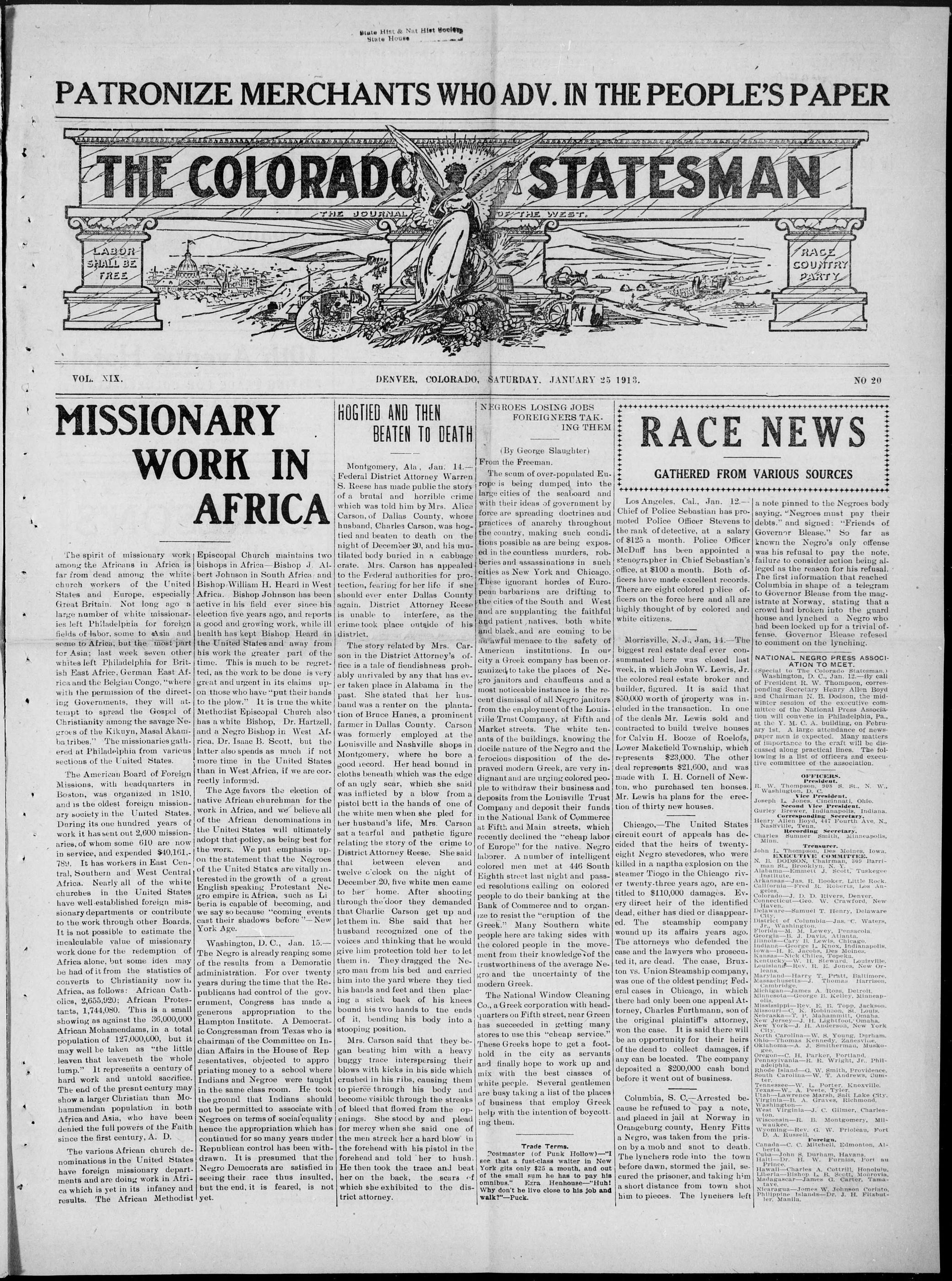
PATRONIZE MERCHANTS WHO ADV. IN THE PEOPLE'S PAPER
THE COLORADO STATESMAN
THE JOURNAL OF THE WEST.
LABOR SHALL BE FREE
RAGE COUNTRY PARTY
VOL. XIX
DENVER COLORADO SATURDAY JANUARY 25 1913
NO. 20
MISSIONARY WORK IN AFRICA
The spirit of missionary work among the Africans in Africa is far from dead among the white church workers of the United States and Europe, especially Great Britain. Not long ago a large number of white missionaries left Philadelphia for foreign fields of labor, some to Asia and some to Africa, but the most part for Asia; last week seven other whites left Philadelphia for British East Africa, German East Africa and the Belgian Congo, "where with the permission of the directing Governments, they will attempt to spread the Gospel of Christianity among the savage Negroes of the Kikuyn, Masal Akamba tribes." The missionaries gathered at Philadelphia from various sections of the United States.
The American Board of Foreign Missions, with headquarters in Boston, was organized in 1810, and is the oldest foreign missionary society in the United States. During its one hundred years of work it has sent out 2,600 missionaries, of whom some 610 are now in service, and expended $40,161,789. It has workers in East Central, Southern and West Central Africa. Nearly all of the white churches in the United States have well-established foreign missionary departments or contribute to the work through other Boards. It is not possible to estimate the incalculable value of missionary work done for the redemption of Africa alone, but some idea may be had of it from the statistics of converts to Christianity now in Africa, as follows: African Catholics, 2,655,920; African Protestants, 1,744,080. This is a small showing as against the 36,000,000 African Mohamendams, in a total population of 127,000,000, but it may well be taken as "the little leaven that leaveneth the whole lump." It represents a century of hard work and untold sacrifice. The end of the preset century may show a larger Christian than Mohammendan population in both Africa and Asia, who have been denied the full powers of the Faith since the first century, A. D.
The various African church denominations in the United States have foreign missionary departments and are doing work in Africa which is yet in its infancy and results. The African Methodist
Episcopal Church maintains two bishops in Africa—Bishop J. Albert Johnson in South Africa, and Bishop William H. Heard in West Africa. Bishop Johnson has been active in his field ever since his election five years ago, and reports a good and growing work, while ill health has kept Bishop Heard in the United States and away from his work the greater part of the time. This is much to be regretted, as the work to be done is very great and urgent in its claims upon those who have "put their hands to the plow." It is true the white Methodist Episcopal Church also has a white Bishop, Dr. Hartzell, and a Negro Bishop in West Africa, Dr. Isaac B. Scott, but the latter also spends as much if not more time in the United States than in West Africa, if we are correctly informed.
The Age favors the election of native African churchman for the work in Africa, and we believe all of the African denominations in the United States will ultimately adopt that policy, as being best for the work. We put emphasis upon the statement that the Negroes of the United States are vitally interested in the growth of a great English speaking Protestant Negro empire in Africa, such as Liberia is capable of becoming, and we say so because "coming events cast their shadows before"—New York Age.
Washington, D. C., Jan. 15. The Negro is already reaping some of the results from a Demoratic administration. For over twenty years during the time that the Republicans had control of the government, Congress has made a generous appropriation to the Hampton Institute. A Democratic Congressman from Texas who is chairman of the Committee on Indian Affairs in the House of Representatives, objected to appropriating money to a school where Indians and Negroes were taught in the same class room. He took the ground that Indians should not be permitted to associate with Negroes on terms of social equality hence the appropriation which has continued for so many years under Republican control has been withdrawn. It is presumed that the Negro Democrats are satisfied in seeing their race thus insulted, but the end, it is feared, is not yet.
DENVER, COLORADO, SATURDAY. JANUARY 25 1913.
Blute Hist & Nat Hist Books
State House
HANTS WH
ADO
THE JOURNAL
DENVER, COLORADO
HOGTIED AND THEN BEATEN TO DEATH
Montgomery, Ala., Jan. 14. Federal District Attorney Warren S. Reese has made public the story of a brutal and horrible crime which was told him by Mrs. Alica Carson, of Dallas County, whose husband, Charles Carson, was hogtied and beaten to death on the night of December 20, and his mutilated body buried in a cabbage crate. Mrs. Carson has appealed to the Federal authorities for protection, fearing for her life if she should ever enter Dallas County again. District Attorney Reese is unable to interfere, as the crime took place outside of his district.
The story related by Mrs. Carson in the District Attorney's office is a tale of fiendishness probably unrivaled by any that has ever taken place in Alabama in the past. She stated that her husband was a renter on the plantation of Bruce Hanes, a prominent farmer in Dallas County. Carson was formerly employed at the Louisville and Nashville shops in Montgomery, where he bore a good record. Her head bound in cloths beneath which was the edge of an ugly scar, which she said was inflicted by a blow from a pistol butt in the hands of one of the white men when she pled for her husband's life, Mrs. Carson sat a tearful and pathetic figure relating the story of the crime to District Attorney Reese. She said that between eleven and twelve o'clock on the night of December 20, five white men came to her home. After shooting through the door they demanded that Charlie Carson get up and let them in. She said that her husband recognized one of the voices and thinking that he would give him protection told her to let them in. They dragged the Negro man from his bed and carried him into the yard where they tied his hands and feet and then placing a stick back of his knees bound his two hands to the ends of it, bending his body into a stooping position.
Mrs. Carson said that they began beating him with a heavy buggy trace interspersing their blows with kicks in his side which crushed in his ribs, causing them to pierce through his body and become visible through the streaks of bleed that flowed from the openings. She stood by and plead for mercy when she said one of the men struck her a hard blow in the forehead with his pistol in the forehead and told her to hush. He then took the trace and beat her on the back, the scars of which she exhibited to the district attorney.
NEGROES LOSING JOBS
FOREIGNERS TAK.
ING THEM
The scum of over-populated Europe is being dumped into the large cities of the seaboard and with their ideas of government by force are spreading doctrines and practices of anarchy throughout the country, making such conditions possible as are being exposed in the countless murders, robberies and assassinations in such cities as New York and Chicago. These ignorant hordes of European barbarians are drifting to the cities of the South and West and are supplanting the faithful and patient natives, both white and black, and are coming to be an awful menace to the safety of American institutions. In our city a Greek company has been organized to take the places of Negro janitors and chauffeens and a most noticeable instance is the recent dismissal of all Negro janitors from the employment of the Louisville Trust Company, at Fifth and Market streets. The white tenants of the buildings, knowing the docile nature of the Negro and the ferocious disposition of the depraved modern Greek, are very dignant and are urging colored people to withdraw their business and deposits from the Louisville Trust Company and deposit their funds in the National Bank of Commerce at Fifth and Main streets, which recently declined the "cheap labor of Europe" for the native Negro laborer. A number of intelligent colored men met at 446 South Eighth street last night and passed resolutions calling on colored people to do their banking at the Bank of Commerce and to organize to resist the "eruption of the Greek." Many Southern white people here are taking sides with the colored people in the movement from their knowledge of the trustworthiness of the average Negro and the uncertainty of the modern Greek.
The National Window Cleaning Co., a Greek corporation with headquarters on Fifth street, near Green has succeeded in getting many stores to use this "cheap service." These Greeks hope to get a foothold in the city as servants and finally hope to work up and mix with the best classes of white people. Several gentlemen are busy taking a list of the places of business that employ Greek help with the intention of boycott ing them.
Trade Terms.
Postmaster (of Punk Hollow)—I see that a fust-class waiter in New York gits only $25 a month, and out of the small sum he has to pay his omnibus." Exza Henhouse—"Huh! Why don't he live close to his job and walk?"—Puck.
RACE NEWS GATHERED FROM VARIOUS SOURCES
Los Angeles, Cal., Jan. 12. Chief of Police Sebastian has promoted Police Officer Stevens to the rank of detective, at a salary of $125 a month. Police Officer McDuff has been appointed a stenographer in Chief Sebastian's office, at $100 a month. Both officers have made excellent records. There are eight colored police officers on the force here and all are highly thought of by colored and white citizens.
Morrisville, N. J., Jan. 14.—The biggest real estate deal ever consummated here was closed last week, in which John W. Lewis, Jr. the colored real estate broker and builder, figured. It is said that $50,000 worth of property was included in the transaction. In one of the deals Mr. Lewis sold and contracted to build twelve houses for Calvin H. Booze of Roelofs, Lower Makefield Township, which represents $23,000. The other deal represents $21,600, and was made with I. H. Cornell of Newton, who purchased ten houses. Mr. Lewis ha plans for the erection of thirty new houses.
Chicago,—The United States circuit court of appeals has decided that the heirs of twenty-eight Negro stevedores, who were killed in a naptha explosion on the steamer Tiogo in the Chicago river twenty-three years ago, are entitled to $110,000 damages. Every direct heir of the identified dead, either has died or disappeared. The steamship company wound up its affairs years ago. The attorneys who defended the case and the lawyers who prosecuted it, are dead. The case, Bruxton vs. Union Steamship company, was one of the oldest pending Federal cases in Chicago, in which there had only been one appeal Attorney, Charles Furthmann, son of the original plaintiff's attorney, won the case. It is said there will be an opportunity for their heirs of the dead to collect damages, if any can be located. The company deposited a $200,000 cash bond before it went out of business.
Columbia, S. C.—Arrested because he refused to pay a note, and placed in jail at Norway in Orangeburg county, Henry Fitts a Négro, was taken from the prison by a mob and snot to death. The lynchers rode into the town before dawn, stormed the jail, secured the prisoner, and taking him a short distance from town shot him to pieces. The lynchers left
NO 20
a note pinned to the Negroes body saying, "Negroes must pay their debts." and signed: "Friends of Governor Blease." So far as known the Negro's only offense was his refusal to pay the note, failure to consider action being alleged as the reason for his refusal. The first information that reached Columbia in shape of a telegram to Governor Blease from the magistrate at Norway, stating that a crowd had broken into the guard house and lynched a Negro who had been locked up for a trivial offense. Governor Blease refessed to comment on the lynching.
NATIONAL NEGRO PRESS ASSOCIATION TO MEET.
(Special to The Colorado Statesman.)
Washington, D. C., Jan. 12.—By call of President R. W. Thompson, correspondent Secretary Henry Allen Boyd and Chairman N. B. Dodson, the midwinter session of the executive committee of the National Press Association will convene in Philadelphia, Pa., at the Y. M. C. A. building, on February 1st. A large attendance of newspaper men is expected. Many matters of importance to the craft will be discussed along practical lines. The following is a list of officers and executive committee of the association.
OFFICERS.
**Recording Secretary.**
Charles Summer Smith, Minneapolis,
Minn.
**Trenurer.**
John L. Thompson, Des Moines, Iowa.
N. B. NAVID, DES MOINES TEE.
N. B. DODSON, Chairman, 309 Barriman
St., Brooklyn, N. Y.
Alabama--Emmet J. Scott, Tuskegee
Institute.
Arkansas—Jas, R. Booker, Little Rock,
California—Fred R. Roberts, Los Angeles,
Colorado—J. D. D. Rivers, Denver,
Connecticut—Geo. W. Crawford, New
York
Delaware—Samuel T. Henry, Delaware City.
District of Columbia—Jas. C. Waters,
JF., Washington.
Indiana—George L. Knox, Indianapolis,
iowa—H. E. Jacobs, Des Moines,
Kansas—W. E. Stiles, Topeka
Kentucky—W. Charles, St. Louis, Louisville
Louisiana—Rev. R. E. Jones, New Orleans
Michigan—Harry T. Prytt, Baltimore,
Massachusetts—J. Thomas Harrison,
Cambridge.
Michigan—James A. Ross, Detroit,
Minnesota—George E. Kelley, Minneapal-
sissippi—Rev. E. B. Topp, Jackson,
Missouri—C. K. Robinson, St. Louis,
Nebraska—T. P. Mahammett, Omaha.
New Jersey—J. H. Lightfoot, Omaha.
New York-J. H. Anderson, New York City
North Carolina—W. S. Young, Durham, Ohio—Thomas Kennedy, Zanesvine, Oklahoma—A. J. Smitherman, Muskogee, Oregon—C. H. Parker, Portland, Pennsylvania—R. R. Wright, Jr., Philadelphia.
Rhode Island—G. W. Smith, Providence,
South Carolina—W. T. Andrews, Sum-
mary
Tennessee—W. L. Porter, Knoxville.
Texas—W. A. Petee, Tyler.
Utah—Lawrence Marsh, Salt Lake City.
Virginia—A. Graves, Richmond.
Washington—
West Virginia—J. C. Gilmer, Charleston.
Washington.
Wisconsin—R. B. Montgomery, Mil-
waukee.
Wyoming—Rev. G. W. Prioleau, Fort
D. A. Russell.
**Foreign.**
Canada—C. C. Mitchell, Edmonton, Al-
berta.
Cuba—John S. Durham, Havana.
Hall—D. H. W. Furries, Fort au
Prince.
Hawali—Charles A. Cottrill, Honolulu,
Liberia—Bishop L. B. Scott, Monrovia,
Madagascar—James G. Carter, Tamatave.
Namibia—James W. Johnson Corinto,
Philippine Islands—Dr. J. H. Fitzbutler,
Manila.
THE WORLD IN PARAGRAPHS
A BRIEF RECORD OF PASSING EVENTS IN THIS AND FOR-EIGN COUNTRIES.
IN LATE DISPATCHES
DOINGS AND HAPPENINGS THAT
MARK THE PROGRESS
OF THE AGE.
Western Newspaper Union News Service.
WESTERN.
For the first time in its history, Salt
Lake City has at its head a Socialist
mayor.
While George M. Cox, a Santa Fé
telegraph operator, lay murdered at
his key at Summit, on Cajon Pass,
Calif., every train on that division,
both freight and passenger, ran wild.
Henry Mouseon, a negro, who shot
and killed the twelve-year-old daughter
of D. Merrell, a farmer near Pecan
Gap, Tex., was hanged from a telephone pole in a public square at Cooper by a mob.
Detective Peter Hart was shot and killed in Chicago while watching a South Michigan avenue garage said to be the headquarters for the gang of automobile bandits led by James B. Perry.
The display of the red flag of anarchy or any other banner emblematic of organized opposition to the law of California will be a crime if the bill fathered by the Grand Army of the Republic becomes law.
Trains are stalled, wires are down and cattle are dyong in the worst storm the Wood River district of Idaho has experienced in thirty years. For two weeks a blizzard has raged, entirely isolating several points from communication, light and water.
The $60,000 bonds tendered in behalf of Eugene Clancy of San Francisco were not approved by the Chicago court because of objections made by District Attorney Miller, who prosecuted the union leaders in the Indianapolis "dynamite conspiracy" trial.
Mrs. Edyth Ellerbeck Read, member of the lower house of the Utah Legislature, died at Salt Lake from nervous prostration. She was elected on the Republican ticket at the last election, and her condition became critical following an exciting campaign.
Scenes of wild disorder occurred on the floor of the lower branch of the Wyoming Legislature when Speaker Martin L. Pratt and Speaker Pro Tempore W. J. Wood engaged in two separate fist-fights, during which Speaker Pratt threw Wood from the speaker's platform.
A solution to the problem of disposing advantageously of the frost-bitten fruit in the citrus belt was partially reached at Los Angeles when it was decided to experiment with oranges and lemons in the manufacture of dehydrated alcohol. Thousands of tons of fruit may be used for this purpose.
Joseph Tuffree, who would have been 103 years of age in less than one month, died at his home in Marshalltown, la., after a brief illness with the grippe. Tuffree is said to have been the oldest member of the Order of Elks in the world, having joined the organization on his one hundredth birthday.
The method to be used hereafter in executing criminals in the State of Utah has become a topic widely discussed since the Legislature convened two weeks ago. The latest idea expressed is that the condemned criminals be allowed to take their own lives after they have exhausted every means to have the death sentence set aside. George W. Norris, Republican, was elected United States senator to succeed Senator Norris Brown by the Nebraska Legislature. The vote was taken in the two houses separately and was unanimous in both houses. Norris was the choice of the voters in the state primary. The Democrats have a majority of the Legislature on joint ballot.
WASHINGTON.
Denver is to have a force of expert prospectors sent out by the Bureau of Mines to prospect in the Rocky Mountains for radium.
An emergency appropriation of $3,000 for pay for the secret service protection of President-elect Wilson until his inauguration, was requested of Congress by Secretary MacVeagh.
Contracts for 32,000,000 pounds of paper to be used by the government printing office during the year beginning April 1st next were awarded by the joint congressional committee on printing. The aggregate amount to be paid is $1,125,000. There were thirty-eight successful bidders.
Bitter opposition to the bill providing for the erection of a $2,012,000 monument to the memory of Abraham Lincoln is threatened when the measure is taken up in the House. The bill already has passed the Senate. It provides for a statue and Greek temple on the Mall near Washington monument and its opponents are trying to substitute for it a plan to construct a memorial highway from Washington to Gettysburg.
FOREIGN.
The business section of Fort Saskatchewan, Alberta, thirty miles from Edmonton, was wiped out by fire.
Colonl Sir Henry Manning has been appointed governor of Jamaica to replace Sir Henry Oliver, who has held that office since 1907.
All the officers and men of the Servian army who have been on leave of absence have received orders to return immediately to their regiments.
Another Rothschild wedding has been arranged. James de Rothschild, who belongs to the Paris branch of the famous family, is engaged to Dorothy, the eighteen-year-old daughter of Eugene Pinto, the London financier.
Mrs. William Mansfield, the American woman who recently disappeared from Salo, on Lake Garda, Italy, was found in Vehicle, according to a dispatch from Rome. It had been reported that she had been captured by brigands.
One of the chief difficulties heretofore existing between Roumania and Bulgaria was removed by the consent of the Bulgarian government to the cession to Roumania of a portion of coast territory which will enable Roumania to establish a naval port at Mangalia on the Black sea.
Aristide Briand, the new French premier, completed the formation of his cabin and submitted the list to President Fallieres. The official list follows: Premier and minister of the interior, Aristide Briand; minister of justice, Jean Barthou; minister of foreign affairs, Charles C. A. Jennart; minister of war, Eugene Etienne; minister of marine, Pierre Baudin; minister of finance, Louis L. Klotz; minister of public instruction, Jules Steeg; minister of public works, Jean Dupuy; minister of agriculture, Jean Morel; minister of commerce, Fernand David; minister of the colonies, Gabriel Guiat'Hau; minister of labor, Rene Bosnard.
CONGRESSIONAL.
Vice President-elect Marshall has gone with Mrs. Marshall to visit their daughter, who lives on a farm near Phoenix, Ariz.
A bill introduced by Representative Taylor of Colorado to permit homesteaders acquiring sixty acres of public land to take an additional sixty acres without living on the property for five years, as the law now requires, was passed by the House.
"The United States should either submit the Panama free toll question to impartial arbitration or retire from the position we have taken," was the declaration of Senator Root in the Senate in a speech favoring the repeal of the free toll provision of the new Panama canal act.
Charles S. Thomas took the oath of office as United States Senator shortly after the Senate met on the 20th, being escorted to the presiding officer's desk by Senator Simon Guggenheim. Thomas reached Washington Monday morning and was at the Capitol with his credentials when the Senate met at noon.
SPORT.
The Boston Red Sox have signed Duke Farrell to coach the young pitchers this year—a job similar to that of Wilbert Robinson of the Giants.
Pitcher Larry Cheney of the Chicago Nationals has demanded more pay and has been given permission by President Murphy to try to get it from some other club.
The Helena, Mont., Commercial Club has accepted the franchise of the Helena club in the Union Baseball Association, it was announced. If the club is unable to dispose of the franchise it will finance the team for the coming season.
In the concluding series of test tennis matches at Sydney, Australia defeated the British players, holders of the Davis cup, winning every event, Heath and Jones defeating Parke and Lowe and Beamish and Dixon. Brookes and Dunlop also defeated both British pairs, Australia winning the series by two rubbers.
GENERAL
Fire which destroyed a large part of the business section of Larned, Kan., was finally controlled after the loss had reached $200,000.
Fire which threatened to wipe out New London, Ohio, broke out in the business section. Aided by a high wind, the flames consumed almost an entire block and caused an estimated loss of $100,000.
Judge Le Baron Bradford Colt of the United States Circuit Court of Appeals, a Republican, was elected to the United States Senate by the Legislature of Rhode Island. He will succeed George Peabody Wetmore.
Mrs. W. H. Toomey, formerly Gertrude San Souci, a noted organist who played at the Buffalo, St. Louis and Chicago expositions, died at her home in Weechawken, N. Y. She was the author of many well-known songs.
The New York Assembly has adopted the concurrent resolution proposing an amendment to the constitution permitting women to vote.
Thousands of women may have to wait for their spring shirtwaists, manufacturers say, unless nearly 40,000 shirtwaist makers who struck in New York quickly are brought to terms.
Efficiency in public service and the merit system rather than partisan politics will be the basis upon which President-elect Wilson will make his appointments to office, be indicated to Trenton callers.
Western Newspaper Union News Service.
The ranch house, barn and hay stacks of Lloyd Clark, twelve miles south of Holyoke, were destroyed by fire.
W. H. Burk, aged thirty-three, was accidentally shot and killed near Paonia while hunting rabbits with John Kline.
Jose Garcia, the Mexican who was shot in a revolver duel with A. Fisher at Lafayette, died of his wounds at Boulder.
Charles H. Pelton, one of the last of the famous band of Custer scouts during the Civil War, died suddenly at Grand Junction.
The eight-hour day for women went into effect on the 20th and is being generally observed by all the big stores and factories.
Ralph S. Lewis, pioneer resident of Las Animas county died at his home in Trinidad after a short illness. He was formerly a wealthy sheepman.
Telegrams announce the death in Cincinnati of Charles Beverly Hicks, father of R. E. Hicks of Denver. Several other relatives reside in Colorado.
The funeral of Mrs. A. F. Willmarth, who died in Fairplay, was held from the residence of her father, George P. Dudley, in Denver, with interment at Fairmount.
Frank P. Metcalf, sixty-two years old, was struck by a street car while crossing Fifteenth street near Lawrence in Denver and had one rib broken.
J. S. Brown, the pioneer head of the Brown & Brother Mercantile Company, who died suddenly in Denver, left an estate valued at approximately $1,600,000.
The state insane asylum at Pueblo and the state home for mental defectives at Arvada are to be rigidly investigated by the women of various civic organizations.
Mrs. Claude E. Griffey sustained a broken arm when she fell from her mount after making the second hurdle in the ladies' hunting event at the Denver horse show.
After undergoing an operation than was not considered of a serious nature, Mrs. Irene Robeson, wife of J. H. Robeson, a well-known Denver mining man, died at St. Luke's hospital.
Miss Margaret Holt, a vaudeville actress, playing at a Pueblo theater, was burned badly in a room at a hotel when the alcohol stove, which she was using to heat a curling iron, exploded.
William A. Easton of Trinidad, who twice risked his life in an effort to save Edwin A. Sutton and Robert Meek following the mine disaster at Cokedale in February 1911, has received a Carnegie medal and $1,000 in cash from the Carnegie Hero fund.
"Jumped in the river," was the last entry in the diary of John Murphy, who left the book in the snow before he leaped to his death from the state bridge at Grand Junction. The workmen engaged in the steel work of the bridge saw the suicide.
Women of the state, through the civil federation have asked the Legislature to conduct an investigation of state institutions and the state civil service commission to "defer the certification of certain appointments until certain facts can be laid before your commission."
To the University of Colorado medical school has fallen high honors under the report of the American Medical Association, which places the Colorado institution in Class A, ranking next in classification to John Hopkins university, Harvard and Yale, listed in Class A plus.
At the same hour two women of middle age, one living in Greeley and the other at La Salle, fell from chairs and broke their hips. Mrs. E. E. Harbottle of Greeley was the victim of one mishap, and Mrs. Alverna Dean of La Salle the other. Both women were reaching for jellies on pantry shelves.
The Denver Woman's Press Club announce Bonel, the world's famous tenor, for a concert at the Auditorium Thursday evening, February 20th, the proceeds to be used to establish club rooms for this large and growing organization of newspaper and magazine writers and women of literary prominence throughout the state.
Mrs. Nettie Parsons, who disappeared from Denver December 12, was discovered in Springfield, Ill., just as her husband, William Parsons, was on the point of leaving for Mexico, where, he declared, he wanted to be killed by the rebels because he had lost his wife. Mrs. Parsons has been working in a restaurant in Springfield ever since she arrived there about December 12.
The funeral of Edward Krammer, inspecting mining engineer for the Guggenheim interests, was held from St. Loo's church in Denver. Interment was in Mount Olivet cemetery. Krammer dropped dead at the Guggenheim mines in Bingham Cañon, Utah.
Tons of snow, rock dirt and ice swept down the mountain side near Cement creek at Crested Butte, killed two men and imprisoned two others for more than two hours. The dead: John D. Anderson, thirty-five, and John E. Greenman, thirty-five, employed in the tie camp two days.
THE TUBERCULAR TEST
PART OF COURSE TAUGHT FARMERS AT FORT COLLINS.
Veterinarians Disagree With Government on Horse Disease—Dr. Lory Tells of Year's Work.
Fort Collins, Colo.-The farmers attending the short course of the Agricultural college were instructed in the methods of making tuberculin tests, the use of the thermometer, how to take the pulse and respiration and how to treat the animals when they are stricken with various forms of disease.
Illustrating their talks with living specimens in the veterinary hospital, Dr. H. E. Kingman and A. W. Whitehouse gave the farmers object lessons in these different branches of veterinary science.
Professor Alvin Keyser, head of the agronomy department, delivered a lecture on pasture and forage crops which was well illustrated with tables prepared on big charts.
President Charles A. Lory made his annual report covering the work of the Agricultural college for the past year. He showed the extent of experimental work being done. The extension department reached 85,890 farmers in the year by means of farmers' institutes, special trains, movable schools, short courses, the farmers' congress, normal institutes, fairs, correspondence and special work. More than 10,000 letters from farmers who wanted information were answered during the year.
Dr. George H. Glover of the veterinary department made a report of the work of the college veterinarians with the Kansas horse disease last fall. Dr. Glover declared that while the government authorities insist that the disease was a forage poison that he and Dr. B. F. Kaupp are of the opinion that it is a germ disease, transmitted in some unknown manner. He declared the disease would return next year and that Colorad$ \phi $'s stock raisers must prepare to meet the situation.
Other subjects discussed were methods of improving the grain crops by breeding so as to increase the productivity of Colorado soil.
The congress elected P. E. Bliss of Greeley, president; Lew D. Sweet of Bondale, first vice president; David McMurdo of Castle Rock, second vice president; C. H. Hinman of Fort Collins, secretary-tresurer, and for an executive committee the following were chosen: Agnes L. Riddle of Denver. C. M. Stitt of Fort Morgan, W. S. Montgomery of Mecker, W. P. Price of Montrose, Rospha C. Pulfold of Durango and R. A. Chisholm of Del Norte.
Governor Ammons Signs 8 New Laws.
Governor Ammons Signs New Laws
Denver. The several hundred state
employees designated to come under
the new civil service law may now
give a sigh of relief. Governor Ammons has attached his signature to
the measure, thereby proclaiming it a law to take effect immediately. At the
same time he proclaimed as laws the
other eight initiated bills passed at
the November election. The new laws
are:
Home rule for cities and towns.
The mothers' compensation act has been designated as "the finest and most humane law" proposed at the last election. Instead of placing children in state institutions, the state will pay the mother to keep her children in her home.
Under the civil service act, all state employes, except elective officers and their deputies and members of boards and commissions, are under civil service. Incumbents must take examinations if they wish to remain in office, on dates to be given out later by the civil service commission.
Examinations for printing commissioner, a position now filled by G. E. Hosmer, was held in the rooms of the civil service commission, Boston building, on the 22nd.
Fleming is Capitol Manager
Denver.—Jesse E. Fleming, chairman of the Moffat tunnel committee and one of the oldest and most widely known bankers and manufacturers of the state, was appointed by Governor Ammons as a member of the board of capitol managers to succeed C. S. Thomas, United States senator, who handed in his resignation previous to leaving for Washington.
Longmont.—Twenty-five Greeks left Longmont for Athens, Greece, announcing that they are going home to fight for their country, believing war is far from ended.
Crushed by Log, Ranchman Dies.
Jamestown.—E. J. Bramer, a Boulder county ranchman, died at his cabin here, the result of injuries received on the Ed. Kohler ranch when a log slipped from its lock and struck Bramer on the chest.
Sues for Fire Damage
Longmont.—E. S. Carl, owner of the Longmont foundry, has filed a claim for damages against the city of Longmont, to recover the loss he suffered recently by fire.
The
Curtis
Park
Floral
Company
FLORAL DESIGNS PUT UP WHILE
YOU WAIT
CHOICE PLANTS AND CUT FLOWERS CONSTANTLY
ON HAND
GREENHOUSES: Thirty-Fourth and Curtis Streets
TELEPHONE, MAIN 1511
DENVER, COLO
Corner West 10th and Osage, Near Burnham Shops Denver, Colorado
ASK FOR CARLSON'S Peerless Ice Cream Phones: Main 112 and Main 5787
DID YOU EVER TRY Neef Bros.' Beer?
It's made right, and tastes right. None better made anywhere and This is a Strictly Colorado Production
HENRY BECK JOHN ENGSTROM
BECK & ENGSTROM
WHOLESALE DEALERS IN
WINES, LIQUORS AND CIGARS
1644-46-48-50 LARIMER STREET.
PHONE MAIN 1053. DENVER, COLO.
Western agents for Minneapolis Grnin Belt Beer and Carncgle Porter,
Pripps Imported Beer and Boek 01.
A first-class Mortuary establishment. First aid to the bereaved in the time of death of loved ones. Prices below competitors. Polite service LAWRENCE JONES, Licenced Embalmer LOUIS HUBBARD, Funeral Director PARLORS 1925 Arapahoe Street
The Denver Sanitary Laundry. PHONE MAIN 5670
PHONE MAIN 3028
JOH
Meats, Fane
Corner Nineteenth.
HENRY BECK
BECK
WINES,
PHONE MAIN 1053.
Western agents for M.
Pri
DAY OR NIGHT.
A. H.
U
A first-class Mortu
time of death of loved
LAWRENC
LOUIS HU
PARLORS 1
LET
Shirts, Coll
Curtains
The Denw
1082 Broadway.
Denver, Colo.
ENGSTROM
M
ARS
NVER, COLO.
cagle Porter,
MAIN 6243
reaved in the
te service
melmer
R
mankets,
Work.
aundry.
Denver, Colo.
Western Newspaper Union News Service.
MILEAGE BILLS INTRODUCED.
Proposed Measures Fix Passenger Fares by Dividing State Into Divisions.
Denver.—Two bills to establish a mileage charge for passenger rates on railroads, a bill for a constitutional amendment allowing school districts at their discretion to establish separate schools for colored children, a bill licensing and placing under bond all commission merchants handling farm, dairy, orchard or garden produce, wares or merchandise, and several bills to protect the health of children were introduced in the House of Representatives.
The bill for the segregation of colored children in schools was introduced by Representative Warren M. Persons of Colorado Springs. There are many people from Texas, Oklahoma and other southern states who spend a good part of, or even the entire year, at Colorado Springs. Many prominent men there favor such a law. Some of the colored people themselves are urging it, as they claim that their children are discriminated against under present conditions.
Representative Young is author of a bill which establishes an eastern and western division of the state for purposes of regulating passenger rates on trains. An arbitrary line from north to south running through Fort Collins, Boulder, Denver, Colorado Springs, Pueblo and Trinidad is established. In all territory east of this line the fare is to be 2 cents a mile; in all territory west of it, or the mountainous region, the fare is to be 3 cents a mile.
Representative Sweet's bill establishes the same geographical line and places the mileage in the eastern zone at 2 cents per mile. In the mountainous regions the mileage is based upon the earning capacity of the railroads per mile. In no place shall the mileage charge be more than 4 cents, where the earnings are less than $1,000 per mile. The minimum charge for mountain roads will be 3 cents per mile. For roads which are mixed and which do not segregate their earnings, the charge will be $3½ cents a mile where the earnings are under $1,200 per mile, and 3 cents per mile where the earnings are over $1,200 per mile.
To Facilitate Counting of Votes.
Denver.—Two sets of judges and two sets of clerks are to be installed at voting places during election hereafter, if a bill being prepared by Representative Williams of Denver is passed. Williams contends that the present system of counting the ballots is not what it should be, and that by his system the counting will be greatly facilitated and the returns' will come in within a reasonable time after the count is started. "I have seen aged men and women who have acted as judges and clerks, sit up for twenty-four to thirty-six hours at a stretch, and sometimes longer, half dead for sleep, in order to carry out their duties as required by law. By having two sets of these officers of election they can take turns and the cost will not be increased, inasmuch as the count can be completed in half the time in which one set can do the work."
Passed by the House.
Adopts resolution granting election committee authority to conduct Las Animas House contest. Adopts resolution to meet with Senate to hear evidence in contest of John C. Nixon, Progressive, for lieutenant governorship. Speaker O. C. Skinner signed short appropriation bill.
Protect Widows from Husband's Debts
Denver. — Women and children would be protected from the creditors of dead husbands and father by enactment into law of a bill introduced in the House by Representatives Dalley and Kavanaaugh. The measure is regarded as being of the highest importance and should it pass many a widow's children would bless its introducers. It is set forth among the provisions that if any decedent leave a widow residing in this state, in all cases she shall be allowed to have and retain as her sole and separate property, one bed and bedding, wearing apparel of herself and family, one cow and calf, one saddle and bridle, one horse, household furniture for herself and family, and also the same amount and species of property as is or may be by law exempt from execution, not to exceed in any event the sum of $2,000. If there be no widow, but minor child or children, such child or children shall be entitled to the same rights of allowance as the widow and paid to the guardian.
Bills Introduced in House.
H. B. No. 34, Norvell—To provide for repairs on the Routt county state fish hatchery at Steamboat Springs.
H. B. No. 35, Gallup—In relation to registrations and elections and to prohibit the use of conveyances or carriages at primaries or elections, or for registration of voters, and prescribing penalties.
H. B. 36, Philip and Hicks—To provide for office of state sugar beet chemist.
TOCUT APPROPRIATIONS METALS IN COLORADO
HOUSE MEMBERS TO FIGHT IN
CREASE OF STATE EMPLOYEES.
Old Introduces Bill to Tax Cattle Driven from One County to Another.
Western Newspaper Union News Service.
Denver.—Intimating that a determined fight will be made on each and every attempt to increase appropriations for state departments or to increase the number of employees of any department, members of the House of Representatives began a determined attack upon an amendment to the act establishing the bureau of labor statistics. The amendment, which was introduced by Representative C. J. Leftwich of Pueblo, calls for the appointment of an assistant deputy labor commissioner to assist in arbitrating and meditating labor troubles. The increased appropriation sought is $1,800 a year. Representatives Hasty, Ardourel, Gates and Old opposed the measure, and the author of the amendment finally, just before adjournment, asked further consideration of the matter to go over.
A bill making it necessary for every employer of labor to report to the bureau of labor statistics each accident resulting in injury or death of an employé, under penalty of not more than $2,000 fine, was passed on second reading.
Representative Leftwich's bill for an additional $1,000 in the state free employment agency appropriation was passed on second reading after a prolonged argument and after it had been amended and reamended several times.
A bill introduced by Representative Old provides for the taxation of all cattle driven from one county into pasturage in another county and which heretofore have escaped taxation by this method.
Chairman Wright of the judiciary committee introduced two bills determined upon at a conference of the House and Senate judiciary committees with the executive committee of the State Bar Association. One provides that the Supreme Court may alter and promulgate rules of procedure for all courts of record in order to facilitate court trials. The other provides that no reversal of judgment shall be made on mere technicalities unless the rights of a party to a suit have been materially affected.
Passed in the Senate.
The short appropriation bill was passed by the Senate on third reading. Resolution ratifying amendment to the United States constitution providing for election of senators by popular vote passed on second reading. Bill for an amendment to the state constitution declaring smelters to be a public utility passed on second reading. Motion to place both parties to the Barela-Wycoff election contest under bond to pay the expense of the proceeding defeated. Action on the Nixon contest for the lieutenant' governorship indefinitely postponed.
Bills Introduced in Senate.
S. B. 34, Garman—Dividing Colorado into four congressional districts.
S. B. 35, Tobln—Increasing number of judges in the seventh judicial district to two.
S. B. '36, Reynolds—Providing for a license of $25 a year for all drug stores selling liquor. This is a state tax and includes every drug store.
S. B. 37, Stephan—Raising the road tax from $2 to $5 and giving the distribution of the revenue to incorporated cities and towns, instead of to county commissioners.
S. B. 38, Garman—Providing for an appropriation that will permit the opening of a state employment agency in Denver.
S. B. 39, Carver—Appropriation for part of the expenses of the state home for mental defectives.
S. B. 40, Mrs. Robinson—Appropriation for part of expenses for state home for dependent children. S. B. 41, Tierney—Eight-hour bill for employés in state institutions.
S. B. 42, Tierney—Eight-hour bill for employed in state penitentiary.
S. B. 43, Tierney—A single tax measure.
S. B. 44, Attolter—Increasing judges in Eighth judicial district from two to three.
S. B. 47, Bellesfield—An eight-hour bill for mines, smelters and mills, etc. it repeals the Stephan eight-hour bill of 1907 and also the bill initiated in November, which latter, it is claimed, repealed the Hurd bill, and the Bellesfield bill re-enacts the Hurd bill. This bill raises the question if a bill initiated can be repealed by the Legislature, and also if a bill pertaining to the immediate preservation of public health and danger to life and limb comes within the scope of the referendum.
S. B. 45, Carver—An individual income tax measure.
S. B. 46, Cornforth—Fixing compensation of third-class county clerks.
S. B. 48, Tobin—Providing for the license of automobiles and automobile drivers and for general distribution of the funds.
S. B. 48, Tobin—Amending the irrigation law so that a town can organize a district. The bill is intended to straighten out a water tangle in Olathe, where the town wants water that is in an irrigation district.
S. B. 49, Tobin—Providing for a state license for automobiles.
CHAS. W. HENDERSON COMPILES
FIGURES ON 1912 PRODUCTION.
Large Increase in Zinc, Lead and Silver Output, But Decreases in Copper and Gold.
Western Newspaper Union News Service.
Washington.—The output of Colorado mines for eleven months of 1912 and an estimate for December, according to preliminary figures by Charles W. Henderson, of the United States Geological Survey, shows a decrease of $300,000 for gold, an increase of 750,000 ounces for silver, a decrease of 1,000,000 pounds for copper, an increase of 5,000,000 pounds for lead, and an increase of 5,000,000 pounds for an increase of 27,000,000 pounds for zinc. With increased market prices for silver, copper, and zinc, the value of the output in 1912 was over $4,000,000 greater than in 1911—$3,000,000 in zinc and $1,000,000 in silver, the increased value for lead and copper about balancing the decrease for gold. The output for 1912 is therefore estimated at approximately $18,700,000 in gold, 8,080,000 fine ounces of silver, 7,025,000 pounds of copper, 74,680,000 pounds of lead, and 121,600,000 pounds of zinc, valued in all at nearly $36,500,000.
The tonnage treated by the Globe, Leadville, Pueblo, Durango, and Salida smelters showed an increase for the year. Ore was also shipped to the Murray, Garfield and Midvale plants in Utah. An increased tonnage of compex zinc ore and concentrates from Colorado and other Western states was treated at the United States Zinc Co.'s plant at Pueblo.
The output of Cripple Creek showed an increase of $500,000 in gold. Early in 1912 the drainage by the Roosevelt tunnel had lowered the water in many of the large properties (except the Golden Cycle and Vindicator mines), so than an additional 100 feet in depth could be worked, and an increased tonnage was mined during the year.
Despite the closing of the Standard custom chlorination plant at the end of the year 1911, leaving in the custom-milling field at Colorado Springs only the Golden Cycle and Portland mills, the total yield from the gold mills showed an increase for the year. The Portland plant during 1911-12 had been gradually transformed to a cyanide mill; thus cyanidation in 1912 had completely superseded the use of chlorination in the treatment of Cripple Creek ores. The Colorado cyanide plant at Colorado Springs and the Union plant at Florence continued operations on old tailings. The Stratton's Independence cyanide-concentration mill and the Portland cyanide-cincentration plant, both at Victor, continued to treat from 10,000 to 11,000 tons a month each of dump and low-grade mine ore. The Ajax cyanide plant, using the Clancy process, was operated part of the year. Several of the smaller cyanide plants in the Cripple Creek district were operated with an increased output from this source. An increased tonnage of the higher-grade ores was shipped direct to smelters.
The tonnage shipped from Lake county (chiefly Leadville) showed an increase, with gains in output of all the metals except copper. The output of zinc was approximately 99,000,000 pounds, representing an increase of 27,000,000 pounds in quantity and $2,600,000 in value. The output of zinc carbonate was 137,000 tons of approximately 30 per cent zinc, against 83,905 tons of 31 per cent zinc in 1911. The zinc sulphide shipped decreased somewhat from the 79,376 tons of 23.3 per cent. ore shipped in 1911. However, the Empire Zinc Co.'s magnetic-separation plant (with an increased capacity), at Cañon City, and the
SCHOOL LAND SALES DOUBLE
Receipts for 1911-1912 Period Were $1,635,332; Board Issues Report.
Denver.—Sales of state lands, proceeds of which go into the state school fund for the biennial period ending with November 30, were double the sales made during the 1907-1907 period. They showed an increase of $250,000 over the 1909-1910 period. The receipts for the three periods were $837,110.33, $1,428,787.82, $1,635,332.86.
The following table shows the work of the State Land Board for the past year:
CHARACTER. 1911-12.
Total cash receipts. $1,635,322.66
Increased receipts of de-
creased sales. 796,544.84
Land acreage sold. 79,639.33
Total amount of sales. 826,368.17
Average price per acre. 10.38
Land acreage received. 2,167,332.93
Amount received from
leases annually. 217,252.98
Amount of permanent re-
cords the company re-
certificates of purchase. 757,795.26
Amount of income receipts,
being interest, rentals
and taxes. 809,769.22
Acreage appraised by ap-
raisers. 1,296,805.93
Applications filed. 2,180.00
Corporation evidence letters
written). 22,921.00
Denver Gets Stockmen's Meeting.
Phoenix, Ariz.-H. A. Jastro of Bakersfield, Cal., was re-elected president of the American National Live Stock Association at the sixteenth annual convention. Denver won over El Paso in the contest for the next convention. Resolutions were adopted indorsing the Lever bill, for federal supervision of the open range; protesting against the reduction of the tariff on cattle, meat products, wool, sheep and hides, and declaring for a physical valuation of railroads as the basis for transportation rates.
United States Zinc Co.'s magnetic-separation plant at Pueblo, operating chlefly on Leadville ores, both treated increased quantities of stock ore. The Western Chemical Co.'s wet-concentration and magnetic-separation plant at Denver treated an increased tonnage of zinc-lead sulphide ore. The buildings of the Rho magnetic-separation plant at Leadville (closed in July, 1911), were purchased late in 1912 by the Sutton, Steele & Steele Co., for the treatment of sulphide and siliceous ores of Leadville.
The San Juan region of Dolores, La Plata, Ouray, San Juan and San Miguel counties, showed a decrease of $1,000,000 in output of gold, but an increase of 500,000 ounces of silver, 3,500,000 pounds of lead, and 700,000 pounds of copper. The yield of zinc was 300,000 pounds less than in 1911. The decrease in the yield of gold was caused chiefly by the decline in operations of the Camp Bird mine, which was to be closed July, 1912, but which, owing to the discovery of some new ore bodies, is still being operated.
The decrease in gold production from Ourray county was $300,000 in mill bullion, and $120,000 in contents of ore and concentrates shipped, a total of $920,000. San Miguel county's gold output from both bullion and smelting material showed a decrease of $120,000 for the year. San Juan county showed an increase in output of all metals, including one of $175,000 in gold. Ourray county showed an increase for silver but decreases for lead and copper. La Plata county's gold yield fell off $160,000. San Miguel county showed considerable increases for silver and lead but small decreases for copper and zinc. Dolores county showed notable increases in all the metals, owing to the reopening of mines at Rico.
The yield of gold bullion from Boulder county decreased appreciably, as did the shipments of ore, there being a decrease for all the metals except lead. Clear Creek county's output showed a small decrease for all the metals. In Gilpin county not only was there an increase of gold bullion produced, but the contents of all the metals in ore and concentrates showed appreciable gains.
The Pitkin county (Aspen) yield showed an appreciable increase in silver output, but a decrease in lead. Several cars of zinc carbonate (the first ore of this class from this camp) and several cars of zinc sulphide concentrates were shipped. The shipment of ore and concentrates from Creede showed a decrease for all the metals except silver, which increased about 200,000 ounces. A larger tonnage of ore was shipped from Hinsdale county. The dredge output of gold in Summit county increased $150,000; the zinc yield from Breckenridge equaled that of 1911, but smaller shipments of zinc concentrates from Kokomo resulted in a decreased yield of zinc for the county. Eagle county's output of zinc showed very little change. Park county's placer output of gold showed a small decrease, but there was a considerable increase in the gold contents of crude ore shipped, while the contents of lead and silver decreased appreciably. The dredge in Costilla county was not operated.
NEARLY 100,000 DIVORCES
More Than 70,000 Children Deprived of Parents by Divorce Past Year.
New York.—More than 70,000 children, mostly under the age of nine years, wer deprived of one or both parents by divorce in this country during the past year, according to figures with which the Rev. Francis M. Moody stirred members of the New York State Marriage and Divorce Commission at its meeting.
"The Pacific coast," he said, "has been the greatest divorce center of the entire world. In the year 1912 alone there were granted in the United States over 100,000 divorces. In forty years 3,700,000 adults were separated by divorces, and more than 5,000,000 persons affected by these cases.
ABOUT HIGH MEAT PRICES
Government Report Says Livestock Alone Shows Advance in 1912.
Washington.—The farmer was sharing the profits of the increased cost of living as far as the prices paid for meats on Dec. 15 last, compared with those of a year ago, according to figures announced by the Department of Agriculture. At the same time he was receiving less for his staple crops than he did a year previous.
Average prices received by producers on Dec. 15 last showed hogs selling at $6.89 a hundred pounds, an increase of $1.17 over the same time in 1911; beef cattle, at $5.33, was 96 cents higher; veal calves, at $6.88, was 90 cents higher; sheep, at $4.21, was 50 cents higher, and lambs, at $5.70, was 77 cents higher. Hogs, veal calves and sheep were lower than in 1910.
The Central Bottling & Distributing Co. Agents for the famous CAPITOL BEER---IT'S CAPITAL Try a case, 2 doz. pints for $1.10, delivered promptly; empties called for.
Family Liquors, Wines, and Cordials Genuine Goods at Popular Prices A glass of good wine will improve your Sunday dinner, and aid digestion.
The Champa Pharmacy
Twentieth and Champa,
Is the place to get your
DRUGS, CHEMICALS AND PATENT MEDICINES
WE SERVE HOT DRINKS.
Prescriptions Our Specialty.
Phone us and we will deliver the goods to all parts of the city.
JAMES E. THRALL, PROPR.
PHONE MAIN 2425.
WORK CALLED FOR AND DELIVERED
THE CA
RE
SEWED HALF
HE
1511 CHAMPA STRE
Boost Colorado P
Z A
DE
COLUMBIA
VI
Gu
Delivered
The Ph. Z
TI
We Boost for Colo
Boost Colorado Products Patronize Home Industry
ZANG'S
DELICIOUS TABLE BEERS
COLUMBINE,
VIENNA AND
PILSENER
Guaranteed Absolutely Pure.
Dellivered Daily to All Parts of the City.
The Ph. Zang Brewing Co.
TELEPHONE GALLUP 395.
We Boost for Colorado You Should Boost for Us
Furnished
Rooms
And the Old
Reliable
Newport Thirst
Parlors
SHORT ORDERS AT ALLE
oe Street.
E ZOBEL BROTHER
AMPLE ROO
Nineteenth Street, Corner of
THE ZO
SAM
1004 Ninetee
1004 Nineteenth Street, Corner of Curtis
FINE WINES, LIQUORS AND CIGARS COORS' CELEBRATED BEER ON TAP
RUDOL
SANITARY
(imported and Domes
Vegetables. Our O
2758-2760 Downing Avenue
RUDOLPH BROTHERS
SANITARY GROCERY, BAKERY AND MEAT MARKET. Imported and Domestic Table Delicacies. Fresh Fruits and Vegetables. Our Own Bakery. Finest Goods in the City. 2758-2760 Downing Avenue Phone York 320
In Connection
There Are Also
Nicely
DENVER
REPAIRING DONE WHILE
YOU WAIT
MONE MAIN 7377
DISTAL CITY SHOE
HAIRING CO.
TLES 60 cts. and 75 cts.
WARNECKE, President
DENVER, COLO.
Patronize Home Industry
ING'S
GROSS TABLE BEERS
E,
INA AND
PILSENER
Need Absolutely Pure.
Try to All Parts of the City.
ing Brewing Co.
PHONE GALLUP 395.
You Should Boost for Us
Private Dining Room. Phone, Main 7413
The
Newport Annex
Cafe and Lunch Room
Richard Frazier and Tom Lewis, Props.
EL BROTHERS'
LE ROOM
Street, Corner of Curtis
H BROTHERS
OCCERY, BAKERY AND
T MARKET.
Table Delicacies. Fresh Fruits and
Bakery. Finest Goods in the City.
Phone York 320
DENVER, COLO.
COLORADO
THE COLORADO STATESMAN
KASON WILL BE PARK
AMERICAN COUNCIL PARTY
SUBSCRIPTION RATES:
PAYABLE IN ADVANCE.
less matter at the postoffice
times or less, 10 cents per line.
cents per square. A square.
less than three months' comp
is unknown to us. Further.
made by Express Money
or Bank Draft. Postage st
ional part of a dollar. Only.
of a personating nature th
columns of this paper.
receive attention must be ne
upon one side of the paper.
better than Wednesdays, and
returned, unless stamps are s
us that papers sent to subs
any number when due, inf
and a duplicate of the missi
One Year ..... $2.00
Six Months ..... 1.00
Three Months ..... .60
PAYABLE IN ADVANCE.
Entered as second-class matter at the postoffice in the city of Denver, Colorado.
Reading notices, ten lines or less, 10 cents per line. Each additional line over ten lines, 5 cents per line.
Display advertising, 25 cents per square. A square contains ten agate lines.
No discounts allowed on less than three months' contract. Cash must accompany all orders from parties unknown to us. Further particulars on application.
Remittances should be made by Express Money Order, Postoffice Money Order, Registered Letter or Bank Draft. Postage stamps will be received the same as cash for the fractional part of a dollar. Only 1-cent and 2-cent stamps taken.
All communications of a personating nature that are not complimentary will be withheld from the columns of this paper.
Communications to receive attention must be newsy, upon important subjects, plainly written only upon one side of the paper; must reach us Tuesdays, if possible, anyway, not later than Wednesdays, and bear the signature of the author. No manuscript returned, unless stamps are sent for postage.
It occasionally happens that papers sent to subscribers are lost or stolen. In case you do not receive any number when due, inform us by postal card and we will cheerfully forward a duplicate of the missing number.
NO SEGREGATION
with a public school system in entire country. Our school is well managed, so judicious and literally said that a good emblest home. It is certainly age. This superb system makes mind. It has been a growing and assimilating all the East and North and its snaps and ready initiative color, sex or condition. And the great benefits it offers fight which the most enlightened of schools. Such names are well recalled. The tool is the result. Our you the best use of these educations the high schools. The rule a mechanical turn of mind trades. The East Doctor student to that higher one or a liberal education. If the course may at once on any one of the great universities should also strive to equip students itself that where teachers also might logically, for some of our young girls advantages and are amused a high school course it will. Thus fully prepared the for teachers and make a broadminded member.
Denver is blessed with a public school system that finds no superior and but few equals in this entire country. Our schools are of so high a class, so splendidly equipped, so well managed, so judiciously distributed over the city that it might almost be literally said that a good education is brought to the very door of the humblest home. It is certainly within the easy reach of every child of school age. This superb system is not the work of a day nor the creation of a single mind. It has been a growth, steadily but intelligently tentative, absorbing and assimilating all the good features of the older and best schools of the East and North and adding the more practical ideas of the West with its snap and ready initiative. It recognizes no distinction on lines of race, color, sex or condition. All are free to avail themselves on equal terms of the great benefits it offers. Our people remember with gratitude the great fight which the most enlightened citizens, white and colored, made in 1876 to prevent unjust racial discrimination and to establish a single system of schools. Such names as Governor Routt, Steinhauses, Harding and others are well recalled. They led the good fight that won, and our mixed school is the result. Our youth should show their appreciation by making the best use of these educational advantages. They should not stop short of the high schools. The manual training school invites those who may have a mechanical turn of mind and would like to equip themselves for the industrial trades. The East Denver High School is well adapted to introduce the student to that higher order of intellectual training known as the humanities or a liberal education. Here the student choosing the classical or scientific course may at once on graduation matriculate in the freshman class of any one of the great universities of the country, without further examination.
Our young ladies should also strive to equip themselves for some useful calling. It naturally suggests itself that where a liberal system of mixed schools prevails the teachers also might logically in time become mixed. Here is an opportunity for some of our young girls who may have fully utilized their educational advantages and are ambitious to become schoolma'ams. In addition to a high school course it would be well to finish at the State Normal School. Thus fully prepared the young lady should attend the annual examination for teachers and make application for a position. There are several liberal and broadminded members on the present board of education.
THE VENTURE SPIRIT.
in the general object to which it is itself, the spirit of venture development among their student needs, freighted alo the thing that tells in the degree of daring which oition and standing of that at large, and is the measure spirit of venture is in itsors and demonstrators wei even employs and com
WHERE progress is the general object to which an element of people must imperatively address itself, the spirit of venture is the most important characteristic demanding development among them. Intellectual and moral advancement are independent needs, freighted always with saving benefits, but persistent daring is the thing that tells in the never-ending struggle for better conditions. The degree of daring which characterizes a people establishes the general position and standing of that people in its contact and relations with the world at large, and is the measure of its power in all of its smaller relations. The spirit of venture is in itself an educating force, for it carries its possessors and demonstrators well up in comparisons with intellectual elements and even employs and commands those elements in the furtherance of its enterprises. A man need not necessarily be educated to devote himself to the carrying out of venturesome achievements, whether in business or the larger spheres, although an educated man, possessed of the venture spirit, is better equipped and capable of greater successes than the uneducated man. History furnishes us with many examples of self-made men, whose education was picked up as they went along, but who were really the pioneers of progress. They prepare the way for the people and for the educated and better equipped ventures who follow in their footsteps.
To teach a people to venture out of usual and known paths is to make that people independent, self-reliant and strong. The Caucasian has led the world for ages because of his unmatched daring. The Japanese, in fifty years, have sprung from a state of peculiar Orientalism, akin to barbarism, into the position of one of the leading nations of the world, from which they have begun to challenge Caucasian civilization for comparison of merit, because of an awakened venture spirit which suddenly overleaped the boundaries of its island home and flowed through the inlets of Eastern Asia. China is now catching the spirit and awakening from a sleep of two thousand years. The nations that sleep, ventureless, are the nations that are being overwhelmed and absorbed. The Negro, particularly the Negro of America, has yet to thoroughly learn the lesson of venture and dare. He must throw himself more generally into the slowly opening channels of business enterprises at home and follow their first widening leads around the world. Great opportunity awaits him as it awaits no other people in all the earth. But he must venture and dare as other races have done, and as conquerors must ever expect to do.
Negro children should be taught from babyhood to venture at high and great objects, towards which parental judgment or their own imaginations direct them. Repeated failures should not be allowed to discourage them, for failure is one of the natural elements of eventual and thorough success. When the Negro begins to dare to exploit the opportunities of the world as other men dare, no question of race will hamper or hold him in check, for he will then be on the way to the heights of undaunted manhood.
CERTAIN amount of outdoor sport is absolutely essential to wholesome college life. The question arises as to where the line should be drawn. Now, college athletics will never thrive without intercollegiate contests. To get for the greatest number the greatest beneficial results from athletics you must create the maximum interest, and to do this you must have the maximum incentive. Very few men will go out and run around a quarter-mile track purely for exercise.
There must be the incentive of a contest, either present or prospective. If the prospective contest be a trial of speed against some individual college mate the incentive may be sufficient to sustain a couple of weeks' training, but if the incentive be the hope of representing his class in an interclass contest a man will train longer and more faithfully. If, however, the incentive be the certainty that if he demonstrates that he is the best man in the event among all his classmates and college mates as well, he will have the honor of wearing his college colors in an intercollegiate contest, and then the opportunity of testing his speed against the best athletes of neighboring colleges. Then a man will train season after season, and there is an incentive that will attract the maximum number of men into the sport.
Now if it be true, as I contend that it is, that athletics in college are essential to wholesome life, and if it be true, and I contend that it is, that any general sustained interest in athletics is impossible in a college without the stimulus of prospective intercollegiate contests, then it ought to follow that any restrictions as to the number of such contests should be made only for sound reasons and upon the practical certainty that some advantage is assured which will compensate for the loss of athletic interest and activity which is certain to follow any extensive restriction.
If it be true, which I should not be willing to concede, that there is any serious necessity of reducing the number of intercollegiate contests, it is my idea that the only contests which can be eliminated without seriously impairing the internal athletic activities of the colleges are, first, intercollegiate contests in indoor games, such as basket ball, and, second, intercollegiate class contests.
I should regret exceedingly seeing any substantial restriction of the number of games in any of the so-called major sports. Take football as an illustration. If the game is to be played at all it should be played well. The highest standard of play cannot be reached without contests with other colleges distributed through the season. To restrict the number of these contests means the lowering of the standard of and consequently loss of interest in the game. This tends to lessen the number of men who will try for the team, and the whole tendency would be toward a decrease of healthy athletic getti
at once to develop Christian graces. The old admonition, "Do with your might what your hands find to do," might probably better read, "Do well what your hands find to do," and it should be noted that doing well does not necessarily mean doing big things. It means doing right in all things, great and small, doing right at every step of the journey, doing right with reference to every experience. Cultivate patience, forbearance, perseverance, courage, love and all other characteristics of the righteous man, no matter what your vocation may be.
Culture and refinement, the ability to meet one's fellow man with the proper address, the quality of being kind and courteous, the habit of cleanliness in mind and body, may be acquired anywhere and under any circumstances, and he who has acquired these to the greatest degree, though he may be in the most humble walk of life, has in the largest measure the most essential qualifications for the highest positions in life.
Furthermore, he who is improving his moral character and is acquiring that immovableness which is tempered with genuine courtesy and sweetness, cannot complain of a lack of advantage. There is no such thing as a want of opportunity to live a successful life, since all the essentials thereto are within the reach of each individual and can be had without money and without price.
proportioned. Bacon says: "For in proportion as a man is watchfully and prayerfully on his guard against the unseen current of passion and prejudices, which is ever tending to drive him out of the right course, in the same degree he will have reason for cherishing an humble hope that he, the Spirit of Truth, is, and will be with him to enlighten his understanding."
"There is no greater monster in being than a very bad man of great parts," says another writer. Such a one would seem like a man with one side wide awake, alive, and the other side insensate.
Persons who make if the chief aim of their lives to collect and gather mere knowledge of wealth may attain to their highest ambitions and they may live in luxury, but they lost much.
No one should ever allow his intellect to interfere with his being a power for good in some way or other.
Doing Right Makes Success In Life By ALFRED FARLOW, Boston
at once to develop Christian might what your hands find what your hands find to do, not necessarily mean doing things, great and small, do right with reference to every perseverance, courage, love man, no matter what your Culture and refinement the proper address, the qual cleanliness in mind and body circumstances, and he who though he may be in the measure the most essential of Furthermore, he who is ing that immovableness wh sweetness, cannot complain thing as a want of opportunities thereto are within the without money and without
Being Power For Good In Some Way
By SARA McLEAN, Cincinnati, O.
proportioned. Bacon says:
and prayerfully on his gw
and prejudices, which is eve
in the same degree he will
that he, the Spirit of Truth
understanding."
Where Line Should Be Drawn in Sports
of outdoor sport is absolutely essential to life. The question arises as to where the line now, college athletics will never thrive with contests. To get for the greatest number from athletics you must create the maxi- ties you must have the maximum incentive. And run around a quarter-mile track purely active of a contest, either present or prospect- be a trial of speed against some individual may be sufficient to sustain a couple of weeks' be the hope of representing his class in will train longer and more faithfully. If, certainty that if he demonstrates that he is among all his classmates and college mates of wearing his college colors in an inter- nere opportunity of testing his speed against colleges. Then a man will train season incentive that will attract the maximum t. contend that it is, that athletics in college, and if it be true, and I contend that it had interest in athletics is impossible in a of prospective intercollegiate contests, then restrictions as to the number of such contests and reasons and upon the practical certainty need which will compensate for the loss of which is certain to follow any extensive should not be willing to concede, that there facing the number of intercollegiate contests, contests which can be eliminated without seri- athletic activities of the colleges are, first, poor games, such as basket ball, and, second, highly seeing any substantial restriction of the one so-called major sports. Take football as is to be played at all it should be played of play cannot be reached without contests through the season. To restrict the num- the lowering of the standard of and conse- game. This tends to lessen the number sum, and the whole tendency would be toward
Briefly stated, a successful life is one which is well advanced toward real manhood—the likeness of God—"the full stature of manhood in Christ." At some period in the life of each individual there comes an awakening to the necessity of rightness, and hence an awakening to the importance of that ideal manhood which accords with the divine requirement.
We believe that each one must work out the problem of life from the particular position in which the necessity of so doing first appears to him; that he must begin
graces. The old admonition, "Do with your to do," might probably better read, "Do well and it should be noted that doing well does big things. It means doing right in all right at every step of the journey, doing experience. Cultivate patience, forbearance, and all other characteristics of the righteous location may be.
In the ability to meet one's fellow man with joy of being kind and courteous, the habit of, may be acquired anywhere and under any has acquired these to the greatest degree. Most humble walk of life, has in the largest qualifications for the highest positions in life. Improving his moral character and is acquirch is tempered with genuine courtesy and of a lack of advantage. There is no such way to live a successful life, since all the essen- reach of each individual and can be had price.
Knowledge unaccompanied by other high qualities does not properly shape one's life. Virtue and integrity are not elusive. People who may have left them far behind in their pursuit of other interests can pick them up again, as the weaver does the broken thread in his loom, and they can go on weaving their life web, making it one of beautiful usefulness and worth.
It does not make any difference to what extent one is educated if there is no expansion of soul; the life cannot be well
For in proportion as a man is watchfully ard against the unseen current of passion attending to drive him out of the right course, have reason for cherishing an humble hope, is, and will be with him to enlighten his master in being than a very bad man of great Such a one would seem like a man with one the other side insensate. chief aim of their lives to collect and gather y attain to their highest ambitions and they lost much. w his intellect to interfere with his being a or other.
1
Discontinuing the CLOTHING BUSINESS All Suits and Overcoats
To Be Closed Out Regardless
of Cost
$15.00 to $25.00
Values - - - $9.95
Johnson-Noel Co
1005 SIXTEENTH ST.
Look for This Sign in Front of Our Store.
THE
WESTERN
BEEF
CO.
OUR LEADER.
Hog Chitterlings, 5c lb.
Our store is your store.
We are at your service.
We Sell Everything a
Hog Furnishes
Get our prices before you buy else-
where. We also sell our groceries
cheaper.
OUR MOTTO:
Our profits are small,
But we get them all.
We sell for cash only.
2048 LARIMER ST.
Opposite Three Rules.
Phone Champa 1641.
Open Sunday All Day.
THE TIVOLI UNION BREWING CO.
EST. OCT. 1912
Tivoli
DENVER, COLOR.
CUT OUT EXTRA WORK
ELIMINATION OF UNNECESSARY MOTIONS IS ONE WAY.
Saving of Energy, Not to Speak of Added Comfort, Is Strong Factor in Favor of Modern Household Methods.
It has been figured out in schools of domestic science that the average method of shelling peas takes about five motions to each pod, whereas no more than three motions are necessary.
Place the dish of peas in front of you, placing the empty dish for the shelled peas in front of that, reach forward, getting a pod, pull it toward you, split it with the fingers at the same time. By the time it is over the empty dish the motion of the finger will strip the peas into that receptacle, toss the pod to one side and repeat.
The old-fashioned method has generally been to put the dish of unshelled peas in front of you, leave the receptacle at the right and the one for the pods at the left. This necessitates bending the body, turning the head and making all sorts of unnecessary motions between the three dishes, resulting in loss of good energy and many good minutes of time wasted.
Dustpans are made today with long handles. It would be just as absurd to sweep the floor with a whisk broom as it would be to use a short handled dustpan. In using the old-fashioned dust pans the sweeper has to stoop many times to get up all the dirt, making it twice as hard.
The broom is very cumbersome to handle while stooping, the back is strained, the face is close to the unhealthy dust and everything is wrong. Use a long handled dustpan, stand erect. The dirt can be swept into it just as neatly and with twice as much comfort and saving of energy. The same holds good in washing dishes. Many women put the drainer on the left of the dishpan, necessitating the wasted motion of reaching across the pan to place the washed dishes to drain. The natural motion is simply to pass the washed dishes to the right.
Sally Lunns.
Mix one-quarter teaspoonful of soft sugar with one-half ounce of compressed yeast till liquid. Warm one and one-half gills of milk and stir it into the yeast. Well beat an egg and stir it into the milk. Then strain the whole mixture into twelve ounces of sieved flour to which one-half teaspoonful of salt has been added. Turn on to a floured board and knead lightly, sprinkling with a little flour to keep it from sticking. Butter two deep, round tins and put half the dough in each, cover the tops with greased paper and leave near the fire to rise for about an hour, when the cakes should fill the tins. Then bake in a quick oven for about thirty minutes.
Fish Bisque.
A fish bisque is made from one cupful of cold fish minced very fine, one cup of hot milk and a cupful of any white stock. The carcass of a chicken cooked slowly will yield an excellent stock for this purpose. The seasoning consists of a teaspoonful of Worcestershire sauce, salt, a dash of cayenne and a tablespoonful of chopped parsley. Put fish, seasoning and stock together in a pan. Mix one tablespoonful of flour and the same quantity of butter together and stir into the fish mixture. Cook and then stir in the boiling milk, adding a tablespoonful of cracker crumbs.
Potato Apples.
Take two cupfuls of boiled potatoes mashed, and heat them. Mix the mashed potatoes with two tablespoonfuls of hot milk and shape into eight portions, forming a ball. Dent the top of each and insert a clove, pushing it down well to represent the bloom end of the apple. Then insert another clove to form a stem at the other end. Brush each apple over with a little melted butter and sprinkle one side with cinnamon to give a rosy tint. Bake in a medium oven for ten minutes and serve hot.
Sandwiches for Afternoon Tea
The colder weather demands something a little substantial at the four o'clock tea. A filling very much favored by English women is made from thin slices of bread lightly buttered and spread with a mixture of orange marmalade, pecan nuts, and cream cheese.
Some like this filling placed between small tea biscuits, but the mixture should be kept from the edges of the biscuit.
Apple Hot Cakes.
Butter gem pans and half fill them with rich biscuit dough. Pare, core and slice tart, juicy apples and fill gem pans, placing apples on top of the dough. Cover each one with a heaping tablespoonful of soft maple sugar and place bits of butter on top. Bake in a quick oven and serve with cream.
Baked Peas.
Wash a pint of split peas and put them in a beanpot with a tablespoonful of molasses, a small strip of salt pork and salt to taste. Cover with hot water, and bake like beans, filling the pot with water as it cooks up. About three hours of baking is necessary.
There is a letter at this office for Mr. A. L. Ford.
J. H. Mitchell was on the sick list the first of the week.
Victor Walker still continues quite ill at his home with pneumonia.
Edward Hamilton, Orestas Murphy and son left this week for Los Angeles, Cal.
themselves until midnight. The clerk at the residence of Miss Matte Cowden, 1219 21st street, Tuesday evening. Mrs. Howard Steele, president Mrs. Fred E. Williams, first vice president; Miss Mattie Cowden, treasure Mrs. Howard Steele, secretary; M H. Hayden, corresponding secretary.
"Greater than ever" is the way to Western National Stock Show is being styled. From the opening day la
Mrs. J. R. Contee left Tuesday for Los Angeles, Calif., in the interest of her health.
Mrs. Nannie Russell left the city Sunday for Casper, Wyo., to remain several weeks.
Mrs. I. Austin of 2447 Lafayette street, who has been suffering with her throat, is improving,
Mrs. Pansey Nelson left Tuesday night for Kansas City, where she expects to remain.
William Euper, an old resident of Denver but now living in Chicago, was in the city a few days this week.
Daniel Martin left last week for Los Angeles, Calif. He will be engaged in building brick ovens while there.
Miss Nelsine Howard arrived home last Saturday from a delightful visit in Topeka, Leavenworth and Kansas City.
Miss Gertrude Striplin of 23rd and Welton street is confined to her room with a severe attack of rheumatism.
Wm. Wilson of 1340 South Acoma street, who has been quite sick with pneumonia is much improved to the delight of his many friends.
Mrs. Julia Cannon, daughter of Mrs. Hooper, who has been visiting relatives in the city, left for her home in Oakland, California, last Sunday.
G. W. Brooks, who is employed in the U. S. Quartermaster Department, has been transferred to New York City and will leave the city tomorrow night.
Rev. Owens of Detroit, Mich., is the new pastor in charge of the Seventh Day Adventist Church. Services at the People's Presbyterian Church Sabbath morning at 11 a. m. and 7:30 p. m.
There will be a chitterling supper given at the residence of Mrs. Howard O. Steele, 2222 Curtis street, by the members of Progress Court No. 6, Saturday night, January 25th. All welcome.
The entertainment given by Mr. and Mrs. Don Reeves at their residence on Clarkson street last Tuesday night for the benefit of the People's Presbyterian church was well attended and a financial success was the result.
The opening of the Hotel Hildreth, 2152 Arapahoe street will take place Saturday, Feb. 1st. It is newly furnished and decorated. Clean, steam heated rooms with bath from $1.50 up. Strictly first-class in all respects, under management of Mrs. Lillian Horn. Anyone wishing rooms reserved telephone Main 7007.
The death of Lewis Price, which occurred at the County hospital last Sunday, removes from Denver one of its most familiar characters. Deceased was one of the pioneers of the city and was at one time the wealthiest Negro in the state, but real estate speculations brought him to the equal of a pauper, in which condition he died. Funeral services will be held from Shorter's A. M. E. church tomorrow afternoon.
Mr. and Mrs. J. H. Newman of 1882 Marion street entertained the following friends at cards last Tuesday evening: Mr. and Mrs. Charles Jackson, Mr. and Mrs. H. J. Foster, Mr. and Mrs. Charles White, Mr. B. C. Curtis, Mr. and Mrs. Jos. D. D. Rivers, Mr. and Mrs. Charlie Smithea. A dainty lunch was served and everybody had a good time. Mr. Newman will leave the city today for his home in Grand Junction, where he is the owner of some valuable real estate.
The Izzy Club held a postponed meeting Saturday night at the residence of Mrs. Howard Steele, 2222 Curtis street. After business transactions were over a dainty lunch was served, which consisted of everything to satisfy the inner man. All present enjoyed
themselves until midnight. The club met at the residence of Miss Mattie Cowden, 1219 21st street, Tuesday evening. Mrs. Howard Steele, president; Mrs. Fred E. Williams, first vice president; Miss Mattie Cowden, treasurer; Mrs. Howard Steele, secretary; Mr. H. Hayden, corresponding secretary.
"Greater than ever" is the way the Western National Stock Show is being styled. From the opening day last Monday and throughout the week this annual event has been drawing thousands of people to its daily program. Tom Bass, the noted colored horseman is here with his string of combination horses and has captured blue ribbons for his great achievements. Miss Loula Long of Kansas City, whom the writer has known from childhood, was also here with her string of thoroughbreds, and as usual won the admirations of everybody for her difficult and accurate maneuverings in riding and driving stunts, which added blue ribbons to her credit. It was a gala week throughout and closed with a triumph of success.
SELF IMPROVEMENT CLUB EN
TERTAINS.
One of Denver's most prominent clubs, the Self Improvement, gave a formal affair at Dania hall Thursday evening, which was one of the finest affairs given during the season and deserves special mention. The costumes of the ladies were very attractive and becoming. The gentlemen were in full dress. Taxies and autos were lined up in front of the hall in such profusion that one was led to believe that hard times were not abroad in the land. Long life to the Self Improvement Club; may its shadow never grow less.
TO ALL WHOM IT MAY CONCERN
Desiring the following named goods I will always have on hands a full supply of the Johnson Mfg. Co.'s Scientific Hair and Scalp preparations, and toilet goods. All who desire to give these preparations a trial, please consider this advertisement an invitation to call upon me, and I will be pleased to explain the merits of the same and at the same time treat scalp for dandruff, eczema itch and scurf, also straighten hair. Mrs. Wm. G. Campbell, 2835 Stout street, agent. Phone Olive 1304.
SHORTER'S CHAPEL NOTES.
The following order of service will be observed at Shorter Chapel, Sunday, January 26th:
10 a. m., Sunday school; lesson "Cain and Abel"—Gen. 4:1-15.
11 a. m., preaching by Dr. R. A. Randolph.
11 a. m., preaching by Dr. R. A. Randolph.
2:30 p. m., the funeral service of Bro. Lewis Price will be held.
6:30 p. m., Allen Christian Endeavor or League; topic, "Mission Work at Home and Abroad; I., Evangelism"—Acts 13:14-44.
7:30 p. m., sermon on the Tentu Commandment by the Pastor. This is the last of the series and those who have kept up with the other nine will doubtless come out to hear the tenth. This sermon will be divided under the following sub-heads: "Covetousness"; "Respectable Vice"; "Excludes From Heaven"; "The Greedy Man's Epitaph."
The lay sermon and sacred concert last Sabbath evening drew out quite an appreciative audience. The musical rendition was rich and the congregation appreciated and enjoyed it to the full. The lay sermon by Lawyer G. G. Ross was indeed interesting.
Sisters Alice Washington of 229 West Eleventh avenue and Addie Perkins of 1577 St. Paul street are recent additions to Shorter's membership.
In the recent examination in the Teachers' Bible Normal Class five persons made over 90 per cent., twelve over 80 per cent., and fifteen over 70 per cent., which is the pass mark.
At its annual election the Ushers' Club elected the following officers for the ensuing year: President, J. P. Perkins; vice president, J. Nelson; secretary, J. F. Waldon; assistant secretary, H. G. Mason, and treasurer, Charles A. Burton. The newly-elected ed officers were installed Thursday evening when the members regaled themselves feasting on the fat of the land.
Our second quarterly meeting embraces the first Sabbath of February. An act of a recent session of the official board made it the duty of the class leaders to collect the quarterly envelopes for the presiding elder as well as those for the pastor.
The date of our winter revival has been postponed to the 10th of February. The chorus to lead in the music on this occasion will rehearse next Tuesday evening at 8 o'clock.
Salmon Roe for Caviar.
Owing to the diminishing supply of sturgeon caviar, Siberian fishermen have been experimenting with salmon roe, a commodity that was formerly thrown away as valueless or even injurious to health.
CAMPBELL CHAPEL NOTES.
Campbell Chapel A. M. E., Church, Corner 23rd and Lawrence Sts., Rev. H. Franklin Bray, D. D., Pastor.
The revival meetings have been successful beyond the most sanguine expectations of the members, thirty-two persons having been received up to Tuesday evening. It is believed that when these notes are read by the public that more than fifty persons will have accepted Christ and enlisted under His banner. The meetings will close Monday evening with a farewell reception to Rev. J. P. Howard, who has rendered such acceptable and effective service. The pastor and church very greatly appreciate the presence and co-operation of Revs. Pope, Reynolds and Over. God give them greater success in their revival meetings.
Sunday is to be a great day, many of the members will bring their dinners and spend the entire day around the camp fire. There will be three preaching services and two prayer and praise services. Preaching at 11 a.m., 3 and 7:30 p.m. Praise services at 2 and 6:30 p.m. Come and welcome.
Our many sick are somewhat improved this week. Brother Willis was able to preside over the Sabbath school last Sunday, after three weeks of suffering.
The pastor attended the funeral of Brother J. W. McVey at Boulder last week. Brother McVey was the father of Sister Mamie Jeter of our church. He left a widow and six dependent children.
A church conference will be held Thursday evening at which every member of the church is requested to be present. Many matters of great importance to the church will be discussed, new organizations formed and old ones revived. Annual election of trustees Monday evening, February 10.
Mrs. Polk and Mrs. Settle entertained at dinner in honor of the pastor and family and Rev. Howard.
Engine Company No. 3 will make a fast run at Eureka hall, February 12, 1913.
Are you going to the ball given by Engine Co. No. 3, February 12 1913, at Eureka hall?
Are you going to the ball given by Engine Co. No. 3, February 12 1913, at Eureka hall?
Engine Company No. 3 will make a fast run at Eureka hall, February 12, 1913.
13 CENTS A DAY BUYS A PIANO. WITH MUSIC LESSONS FREE. PIANOS FROM $88 UP. COLUMBINE MUSIC CO., 920-924 15th STREET, CHARLES BUILDING.
For Rent—A nice modern, furnished room at 1869 Marion street. Telephone York 2521.
For Rent—A nice five-room frame cottage. Apply 1869 Marion street. Phone York 2521.
Brickler's New Barber Shop is located at 2208 Larimer street. Shave, 10c. Hair Cut, 25c; Children, 15c.
For Rent—A modern five-room brick house, in good condition. Apply at this office, 1824 Curtis street, Room 25
Making Balance Even.
A chimney sweep's boy went into a baker's shop for a twopenny loaf, and conceiving it to be small remarked to the baker that he did not believe it was weight. "Never mind that," said the man of dough. "You will have the less to carry." "True," replied the lad, and, throwing three half-pence on the counter left the shop. The baker called after him that he had not left enough money. "Never mind that," said young sooty, "you will have the less to count."
Shot by a Rabbit.
Cyril Newman, a schoolboy hunter, is dying in a Hackettstown (N. J.) hospital from shotgun wounds received while rabbit shooting. He had placed his gun on the ground while he opened a trap containing a rabbit. He intended to shoot the captive as it ran away, but the rabbit gave a jump and landed on the trigger of the gun, discharging both barrels.
Southern France sends out each year one million parcel post packages of cut flowers to the value of $7,720,000.
Pastor Refuses Salary
A Beverley, N. J., clergyman has pledged himself to never accept his salary. He prefers to make his living from his farm and preach gratuitously.
Yokohama's Fire Department.
Yokohama's Fire Department. Yokohama's fire-fighting apparatus is owned by the association of insurance companies, which also pays the firemen. The coolies who assist when a blaze calls out any part of the department receive on an average four cents per hour. The regular staff of firemen and watchmen are paid an average of $7.47 a month.
Still Admired the Ring.
A few days ago Maud, who was a little jealous of Ethel, said: "When you broke your engagement with Jack, of course you returned the diamond ring he gave you?" Ethel answered promptly. "No, and I don't intend to, either. I don't care for Jack any more, but my feelings have not changed toward the ring."—National Monthly.
is now open for business with a line of Men's Boys' and Children's outfits. Most of our goods are home products, such as Underhill's overalls and shirts, with the union label; Arrow brand collars and Monarch shirts, and other union-made goods with the most popular prices. Come and prove it to yourself; No more stumbling getting on and off the street car, as the Five Points Capitol store is lit up until 12 o'clock at night, and it will show you the way.
The 5 Points Capitol Store
Is the Star of 5 Points. Don't Fail to Come and See It. 2657 WELTON ST.
East Denver Turner Hall
The hall can be RENTED by Societies and Clubs for Entertainments,
Balls, Etc. Fine Bar in connection
2132.48 ARAPAHOE ST
Telephone Main2449. Denver, Colo
Eastern Corn-Fed B
Eastern Corn-Fed Beef and Pork
GO TO
GOLDBERG &
ERG & BLOOM
Come and be Measured. Best Material, Latest Style Best of Work. My THE PROFIT IS
Measured. Do it To-Day. Intest Styles, Lowest Prices,ork. My Rent is low. PROFIT IS YOURS
Come and be Measured. Do it To-Day. Best Material, Latest Styles, Lowest Prices, Best of Work. My Rent is low. THE PROFIT IS YOURS
IF I PLEASE YOU, TELL YOUR FRI
LL YOUR FRIENDS, IF NOT, TELL US
TZ
GEON
NAST
THE GREAT BABY
Photographer
AS A SPORT CAMPION
BLAIR FOR INSPECTOR
BLAIR FOR INSPECTOR
IF I PLEASE YOU, TELL YOUR FRIENDS, IF NOT, TELL US
DR. C. D. DeFRANTZ PHYSICIAN AND SURGEON Office Hours: 2 to 4 P.M. OTHER TIMES BY APPOINTMENT
THE
Plans Drawn Estimates Furnished
Ernest Howard
CARPENTER
---
---
孔氏府
If you want good
Goods Delivered to all parts of the city
N. FERRY
PHONE CHAMPA 395
2716 Welton St. Denver.
J. H. BIGGINS
Furniture Repairing and Upholstering. All work Cash.
PHONE YORK 5566
2231 Washington St. Denver
Before You Buy Property, Let Lawyer
W. B. TOWNSEND
EXAMINE THE TITLE AND MAKE YOUR CONTRACT. LAWYER TOWN. SEND MAKES A SPECIALTY OF COLLECTING FROM INSURANCE COMPANIES, ALSO ENDOWMENT MONIES.
OFFICE 209 KITTREDGE BUILDING
PHONE MAIN 6782.
For Rent—Nicely furnished rooms for rent at 1919 Welton street. Phone Champa 2528.
For Rent. Eight room house with concrete chicken house and barn. A 75 foot well with plenty of water. A good place for one who would like to raise chickens or who runs an ash or express wagon. Apply Mrs. C. Anderson, 1064 Ivanhoe, Montclair, or L. Anderson, Scholtz main Drug Store.
Rudolf Beiter
2346 Larimer St
Denver, Colo.
Phone Main 7419
1905 Curtis Street
ONLY CATERS TO FIRST-
CLASS TRADE. OUR PIC-
TURES SPEAK FOR THEM-
SELVES.
COR. 16th @ CURTIS ST. POST BLDG
THE
MODEL HOTEL
ED. DOUGLASS PROP.
2258 Larimer St. Denver, Colo
Job and Repair Work a Specialty.
Coal, Wood and Express
Residence: 353 W. Warren Ave.
Shop
Phone Champa 752
1021 21st SA
Do You Know That The Colorado Statesman
Is Prepared to Do All Kinds of
Job Printing?
Commercial, Fraternal, Church, Book and Stationery Jobs a Specialty
Ball and Concert Programs, Bill and Letter Heads, Calling Cards, Wedding Cards, Envelopes and Everything in the PrintingLine Turned Out in Neatest and Best Style Promptly on Short Notice.
We have supplied our office with job press and type of up, to-date style and our work will be on a par with the
Very Best
Give Us a Trial and We Will Give You Satisfaction
PRICES AS REASONABLE
AS THOSE OF ANY JOB
OFFICE IN DENVER
THE Colorado Statesman
1824 Curtis Street
Room 25
---
AFRO-AMERICAN CULLINGS
Describing as an inspiring scene the deft work of a group of negro street laborers in New York City, the Amsterdam News says:
No one thought, apparently, of the creed or color of the experts, but admired only their skill. One would have thought that only white men, perhaps imported Germans, Belgians or other highly trained European mechanics, would be employed to do such work. But if one could have penetrated the crowds gathered on the curbing and got a closer view of the mechanics he would have been astonished to see that they were colored men, and, what is more, they being tended by Italian helpers. No colored man watching the scene could come away without glowing in righteous race pride. No white man observed the scene and took the sober second thought without experiencing just a little increased respect for the ability of the black man. Here is an evidence of what skill and training will do for any colored youth. The world is beginning to ask not whether you are a white man or a black man, whether you are a Protestant, Catholic or Hebrew, but whether or not you are doing the work, and whether you can do that work better than anyone else. There is no color line in skill. There will be no color line in the generations to come against the man, white or black, who has mastered some one trade or profession. To be prepared for an emergency is to have that emergency arise. Colored boys and girls, fit yourselves for the work of tomorrow. There is a great work for each and every one to do. The black Belgian block layer is only the forerunner of the black artisan of the future of every man or woman who knows his or her work.
Dearfield, Colorado, is the scene of a Negro colony in the west. It is located west of the Missouri river and north of the Mason and Dixon line, 70 miles northeast of Denver. Twenty-six colored families are settled on government land. Most of them have already been here long enough to own the soil they till. They have 6,000 acres under their control. In 1911 they had but two habitable house. Now they have fourteen. In the same year there were but 200 acres fenced; now there are 3,000. In 1911 they had 150 acres broken and in cultivation, this year 500 acres are under cultivation. The land is especially adapted to the cultivation of beets. The settlement is crying for tradesmen. They are especially in need of blacksmiths, cobblers and saddle makers.
There is not a negro bank in all South Carolina. Is this one reason why Cole L. Blease has such an easy time in his state kicking the negro dog around? E. J. Sawyer, a colored citizen of Bennettts, a man of some means, is considering the wisdom of moving to Columbia and organizing and operating a bank by and for his people. Mr. Sawyer is methodical, level-headed, and a man of unimpeachable integrity. He is the right man to head the movement.
Tuskegee, Ala.—Friends of the late S. Coleridge-Taylor, of London, have written Booker T. Washington, urging him to assist in securing a fund for the support of Mr. Taylor's widow and children. It seems that help is urgently needed, as Mr. Taylor's family are left without means to live on. Mr. Washington has received a cable to this effect.
We have very little respect for the negro who wishes to turn white; and for that reason abandon his race for fifth-rate associates among other people. The women of our race have much of virtue, temperance, sobriety, beauty and other highly commendable qualities to satisfy the most critical and technical man in the race. They have all of these good qualities with odds against them, which is only suggestive of what they would be if encouraged and protected by their men, and left undisturbed by lascivious white men. If the negro race had not been a necessity, God would have not permitted it to exist. Having permitted it, he will not permit either low-grade white men or bad negroes to destroy it. Every negro that crosses the boundary line and attempts to break into other races pays the penalty for such indiscretion and very many.—Dallas Express.
The true test of greatness is not to allow your hat to get too small for you.
We have all experienced times when hard words came mighty easy.
Some men will sit down for hours and discourse on the evils of laziness.
The girl who is to be had for the asking generally spends all her life waiting to be asked.
The suburban cook should be well trained. She frequently comes on one and goes on the next.
When a woman stays home from church because it is raining either her religion or her complexton isn't water-soot.
J. W. Caldwell writes to the New York World that he is educated, a good bookkeeper and skilled stenographer, but can get no work in New York because he is a negro. He adds that there are hundreds of others like him, who are walking the streets of the metropolis and can get no employment in the work they desire. This being true, the north has no right to lecture to the south about race prejudice and the color line. The incident proves that most of the talk of that kind from that section is insincere. It is a pathetic fact that this letter in the World points out, considered in one light, but it means that the negroes will have to learn to depend on themselves. There are over 10,000,000 negroes in America—over 100,000 in New York city. Why are there not negroes in business who employ bookkeepers and stenographers? If the race has sufficient enterprise and business acumen it can build its own institutions and own civilization.
There is no use arguing against race prejudice or race antagonism. It can't be abolished by law or any other way. It is as immutable as the leopard's spots or the Ethiopian's skin. It is a stubborn fact that the negro must learn and accommodate himself to. He is going to be a hewer of wood and a drawer of water if he depends entirely on the white man for employment, but nothing debars him from building a business and industrial world of his own. Other people in the past history of the world more oppressed and equally excluded have found it possible to be thrifty in trade.
If your daily occupation does not furnish you mental stimuli and brain culture, take up some side line of effort that will be in a measure a means of further education. When you come to realize that the side interest furnishes the brain and soul expansion lacking in your regular line of work, your contentment with your daily employment will become more complete.
There are various avenues of side effort into which one can enter with ever increasing absorption of interest—among them some branch of church work, the promotion of secret organizations, civic or community improvement through organizations for the purpose, work among the unfortunate; culture may be sought in literature through clubs or by private instruction; a course suitable to one's talents or tastes from some correspondence school; the cultivation of musical talents, etc., etc. The work of so many of the negro people is irksome and non-productive of culture and refinement, the advice here given should find ready reception by many of them. As long as there is life in an individual's body, and health along therewith, efforts should be made unceasingly for enlarging the mental horizon and broadening the activities of the soul. If it be necessary that we "pray without ceasing," then without ceasing we should strive for a greater power to think keenly and feel more intensity.
The Scullin-Gallagher Steel Foundry of St. Louis, Missouri, one of the largest steel plants in the world, employs several thousand colored men in its shops. Negroes are to be found working in all but three of its departments and lack of experience and training is the sole reason. The wages paid Negroes run from $1.75 to $6.00 per day. Not a few Negroes have learned the trade in this foundry and are now foremen of their departments.
Sam Powell of Paw Creek, N. C., sold in the Charlotte market early in December 13 bales of cotton for which he received $1,086. He disposed of 400 bushels of cotton seed for $600. Eight bales sold at 18 cents a pound and five bales at 17 cents a pound. He averaged a bale to the acre. Mr. Powell is in every way an up-to-date farmer. He subscribes for and reads several papers, both daily and farm journals. He raises each year his own food supplies and sells enough to pay his expenses.
The trouble with most young persons who are complaining and whining because they have not a soft job is: They are not competent to fill the soft chair. It is very easy to say what you can do and tell some one else what they ought to do, but for you to prove it is another and harder thing. Good positions are always looking for a good and competent man.—The Forum.
Wealth doesn't always bring happiness. So after all it may be philanthropy to separate a fool and his money.
A man may acquire ease and plenty, but not in the order named.
Some girls are such prudes that they wouldn't care to go to heaven without a chaperon.
About the only things some people seem to get out of life are the necks and drumsticks.
It's all right to fight the devil with fire, but don't lose sight of the fact that your ammunition will last longer than yours.
IN DEFENSE OF MISS ANNIE SMOOT
CAPITAL SOCIAL SET'S GREATEST BEAUTY
MANY JEWELS AT MRS. DRAPER'S BALL
DR. CARL ALSBERG SUCCEEDS DR. WILEY
Some sort of a society jenkins announced that Miss Aiee Smoot, who
will make her debut in Washington this winter, "has forced Washington society to face a problem," and then goes on to remark that the highly conventional dowagers of the official set will scarcely be able to reconcile themselves to associating with their daughter, a
will make her bed but in Washington this winter, "has forced Washington society to face a problem." and then goes on to remark that the highly conventional dowagers of the official set will scarcely be able to reconcile themselves to associating with their daughter, a young woman who is avowedly a Mormon, and who has forbears elders of the church in Utah long before there was a pretense of giving up bigamy. As a matter of fact, Miss Smoot, who is a very pretty and very bright girl, has been living in Washington for a number of years, attended school, and has grown into young womanhood right in the circle of the young ladies who will make their bow to the public this winter. She never has been snubbed, and I do not supose anybody has stopped to think whether she was a Mormon, Pagan, Catholic, or Cambellite. Polygamous Mormonism is long since a dead letter, and pretty Miss Smoot has not a thing on earth to do with it, and just why, as she is blooming into young womanhood, she should be the
recent election is larger number of Washington people as the election of young Peter Gerry of Rhode Island, to a seat in the lower house. Apart from the charming personality of this young couple their names recall many important chapters of history. Mr. Gerry represents the sixth genera-
Washington people as the election of young Peter Gerry of Rhode Island, to a seat in the lower house. Apart from the charming personality of this young couple their names recall many important chapters of history. Mr. Gerry represents the sixth generation of his name to figure in the national annals and his friends predict that as a lawmaker he will add new laurels to the name. He comes in direct line with the signer, Eldridge Gerry of Marblehead, Mass., a member of the Continental Congress from 1776 to 1780, a commissioner sent by the infant republic to France in 1789, governor of Massachusetts and vice-president of the United States from 1813 to 1814. Mr. Gerry is one of the long line of vice-presidents who died in office. Eldridge Thomas Gerry, the distinguished lawyer and philanthropist, is his grandfather. In Mrs. Gerry, formerly Miss Mathilde Townsend, centers much interesting political history con
Mrs. William F. Draper of Washing ton, who is not noted for the lavishness
raper of Washing- of the lavishness of her Christmas costume balls, entertained at an eighteenth century ball the other night which surpassed all which she has previously given. It has been renamed the "Pearl" ball on account of the display of priceless jewels worn with the Louis XV cos-
costume balls, entertained at an eighteenth century ball the other night which surpassed all which she has previously given. It has been renamed the "Pearl" ball on account of the display of priceless jewels worn with the Louis XV costumes of the hostess and her guests.
Mrs. Draper wore $500,000 worth of pearls, which included a five-pointed tiara of pear-shaped pearls, some of them as large as a small pear, earrings and collar of pearls, a fourstrand necklace, besides a long strand of pearls, which hung from her shoulders nearly to the bottom of her gown, a corsage ornament of pearls and a stomacher which covered her waist and hips as a coat without sleeves. Mrs. Draper was gowned in the costume of a court lady of the Louis XV period, and wore beneath the pearls a costume of white satin with broad stripes of black velvet.
Although many of the jewels worn were priceless, it is estimated that more than $1,500,000 in pearls were
Following instructions from President Taft. Secretary of Agriculture
Wilson the other day appointed Dr. Carl Alsberg chief of the bureau of chemistry, the position vacated last spring by Dr. H. W. Wiley.
A.
The vacancy in the bureau of chemistry made by the resignation of Dr. Wiley has been filled since March 15 last by Dr. R. E. Doolittle, formerly in charge of the New York food laboratory of the department. It has been thought in many quarters that the appointment of Dr. Doolittle as permanent chief of the bureau would be made. It was also reported and cur-
subject of social ostracism is not understandable. Senator and Mrs. Smoot move in the very best society in Washington. He has but one wife, and never had but one, and he says so. It is true that back of Miss Smoot she has had some grandfathers who were polygamous Mormons. Her father's father, Abraham Smoot, had several wives. One of them was a Norwegian girl, and she gave birth to the present apostle, Miss Annie's father. The debutante has two sisters and three brothers. When Senator Smoot was made an apostle of the Mormon church, and elected to the United States senate in 1904, an attempt was made by certain women's organizations to have him expelled from the senate on the ground that he was a member of a corporation that believed in polygamy. It was even charged that the senator himself had three wives, but the charge was not proven.
Senator Smoot's wife was formerly Miss Alpha Eldridge. She was "Alpha and Omega, the first and the last," so the husband told his accusers. Some time previously the Mormons elected Brigham H. Roberts to congress. He had several wives. The house of representatives rejected him, on the ground that he practiced polygamy, and none of his daughters were received in Washington society. But with Miss Annie Smoot the proposition is entirely different. Her father is not a polygamous Mormon. She is well qualified for social duties.
nected with the dawn of the railroad importance of the lake country of Pennsylvania, Ohio and Illinois, through her grandfather's connection with the Pennsylvania system and later as a member of congress. Beauty as a divine attribute and the most desirable possession which a daughter of Eve can hope, is however more associated with any consideration of Mrs. Gerry than her intimate relation to history past and present. She is by universal consent one of the rarely beautiful women of her era and at the time of her presentation to society, she created a furore here and abroad. She is of that blonde spirituelle type, slender graceful with pure gold hair and the deepest of azure eyes. Her expression is rather pensive, something which adds to the charm of her calm Madonna-like demeanor. An only child of parents who idolized her and eventual coheir with her cousin, Mrs. Ronalds of New York, of the vast estate left by William L. Scott of Erie, she was most carefully educated at home under specially selected teachers. Her childhood and girlhood were passed here, and Washingtonians feels an especial pride in all that relates to her future.
Mr. and Mrs. Gerry were married in the spring of 1906, and among the 200 official guests included the president and his wife, as well as 260 out-of-town guests
worn by Mrs. Draper and her guests.
Miss Margaret Draper was gowned in the fashion of a young woman of the court of Louix XV, and wore a strand of pearls around her neck which is more valuable than any other necklace of its kind in the world.
These pearls were given to Miss Draper by the Dowager Queen Margherita of Italy, who is her godmother. Miss Draper was born in Rome while her father was American ambassador to Italy, and Queen Margherita gave her one of the priceless pearls which are her pride. She has added to them each year, always taking care to pick out those with interesting history or of intrinsic value.
Among other women who opened their jewelry caskets to wear their pearls were Mrs. Franklin MacVeagh, wife of the secretary of the treasury, whose pearls, like her emeralds, have been carefully selected by a lapidist who travels all over the world for the purpose.
Mrs. Joseph Leiter wore the gift of Mrs. Levi Z. Leiter, a companion strand to those of the Duchess of Suffolk, the late Lady Curzon and Mrs. Colin Campbell of England, daughters of Mrs. Leiter. Mrs. Peter Goetle Gerry, who made a personal canvass of Europe in search of the pearls for her strand; Mme. Hauge, Mrs. Richardson Clover and Miss Eudore Clover, all added to the beauty of the "pearl" ball.
rently accepted as true that there would be no appointmetn of a permanent chief during the present administration.
It is understood that Dr. Doolittle, on finishing his term as acting chief, will return to the charge of the New York laboratory.
Dr. Alsberg is the son of a chemist and grew up in an atmosphere of chemistry. His early education was obtained in private schools in New York city, and in 1892 he entered Columbia university, receiving the A. B. degree in 1896. He then entered the College of Physicians and Surgeons of Columbia university, receiving his M. D. degree in 1900 and the degree of A. M. from the university during the same year. He then went to Germany, and during the period from 1900 to 1903 he took graduate work in the University of Strassburg along the lines of pharmacology, physiological chemistry and internal medicine.
WE ARE manufacturers of furs,
that is the reason we can give
you the best at the most reasonable
price. What ever may be your favorite
fur, we have it, made up in the best
of style.
Call and let us show you something that is sure to please.
YOUMAN'S FUR CO.
422-24 Fifteenth St. Phone M. 8045
In You Want
sweet, Tails Snouts, Neckbones
or any other part of the hog
the squeal go to
it's Market
When You Want
The Heads, Feet, Tails Snouts, Neckbones or Chiterlings or any other part of the hog except the squeal go to
East's Market
TIM M. A. HOLLY
Manufacturer Of
Lily's Wonderful Hair Grower
2618 DOWNING STREET.
Your Home with the
Gated Tivoli Beer
BOTTLED BY
FIRE BOTTLING CO.
Phone Gallup 245
C. A. BRYANT, Mgr.
Your heart for the Maceo Ice Cream and Confectionery
Barrons, stop in and get cool.
THE MACEO
Drinks, Confectionery and Cigars
CREAM, DAIRY LUNCHES
Hot Drinks, Chili and Spaghetti.
DENVER, COLORADO.
Market and Grocery
When You Want
Fens, Fresh Meats and
Fresh Vegetables
ENDER OUR OWN LARD
Street Telephone York 1979
Pool and Billiard Parlor
CIGARS, TOBACCO
SOFT DRINKS
Manufacturer Of Madam Holly's Wonderful Hair Grower PHONE YORK 2229 2618 DOWNING STREET.
Supply Your Home with the Celebrated Tivoli Beer BOTTLED BY THE EMPIRE BOTTLING CO. Phone Gallup 245
J. A. GARFIELD, Pres. C. A. BRYANT, Mgr.
If you have a warm spot in your heart for the Macao Ice Cream and Confectionery
Partors, stop in and get cool.
THE MACEO
Fountain Drinks, Confectionery and Cigars
ICE CREAM, DAIRY LUNCHES
Our Specialty, Hot Drinks, Chili and Spaghetti.
2712½ WELTON STREET. DENVER, COLORADO.
When You Want
Live Chickens, Fresh Meats and
Fresh Vegetables
WE RENDER OUR OWN LARD
2601 Lafayette Street Telephone York 1979
Five-Points Pool and Billiard Parlor CIGARS, TOBACCO and SOFT DRINKS
2710 WELTON STREET.
Will Be To Your Interest
T
When
The Heads, Feet, T or Chiterlings or a except the
East's
2300-6 Larimer Street.
FIRST TREATMENT $1.50
OTHER TREATMENTS EACH $1.00
RATES BY THE MONTH
ADD 3
MADAM HOLLY
Manchester
Madam Holly's W
PHONE YORK 2229
Supply Your
Celebrated
BOTH
THE EMPIRI
Phone
J. A. GARFIELD, Pres.
If you have a warm spot in your heart,
Parlors, st
THE
Fountain Drinks, C
ICE CREAM
Our Specialty, Hot
2712½ WELTON STREET.
Tesch's Mart
When You
Live Chickens,
Fresh
WE RENDEE
2601 Lafayette Street
Five-Points Pool
CIGARS
and SO
2710 W
THE VALUE of well-printed neat-appearing stationery as a means of getting and holding desirable business has been amply demonstrated. Consult us before going elsewhere
```markdown
```
Phone Main 1461.
OIL 60 CENTS
DISCOUNT TO CUSTOMER
TREATED 10 CENTS
ADD 3 CENTS FOR POSTAGE
E. R. PAGE, Prop.
Where Are Your Interests
Are they in this community?
Are they among the people with whom you associate?
Are they with the neighbors and friends with whom you do business?
If so you want to know what is happening in this community. You want to know the goings and comings of the people with whom you associate, the little news items of your neighbors and friends—now don't you?
That is what this paper gives you in every issue. It is printed for that purpose. It represents your interests and the interests of this town. Is your name on our subscription books? If not, you owe it to yourself to see that it is put there. To do so
DIVINING ROD IS NIL
U. S. Geological Survey Pronounces It Deceptive.
Unconscious Work of Will Say Experts; Also That Rod May Be Worked by Operators Who Know Ground Signs.
Washington.—Local experts who use the divining rod for the purpose of locating fissure veins, water courses, etc., will doubtless take issue with the report of the United States Geological Survey on the subject. The geologists claim that there is nothing in the contention that underground water can be located with the divining rod, except where it is obvious to any one conversant with the subject that they could as readily locate the presence of water without the use of the divining rod as with it.
The question is one that has been studied and commented on for many years. The divining rod men contend that they can do what they claim and that the rod moves downward over a water course despite any effort on their part to restrain it. On the other hand the geological experts maintain that such is not the case, but that the rod is consciously or unconsciously manipulated by the holder of the rod. The report of the government experts is as follows:
The United States Geological Survey states in water supply paper 255, entitled "Underground Waters for Farm Use," just reissued, that no appliance, either mechanical or electric, has yet been devised that will detect water in places where plain common sense and close observation will not show its presence just as well. Numerous mechanical devices have been proposed for detecting the presence of underground water, ranging in complexity from the simple forked branch of witch hazel or other tree to more or less elaborate mechanical or electric contrivances. Many of the operators of these devices, especially those who use the home-cut forked branch, are entirely honest in the belief that the working of the rod is influenced by agencies—usually regarded as electric currents following underground streams of water—that are entirely independent of their own bodies and many people have implicit faith in their own and others' ability to locate underground water in this way.
In experiments with a rod made from a forked branch it seemed to turn downward at certain points independent of the operator's will, but more complete tests showed that this down turning resulted from slight and, until watched for, unconscious muscular action, the effects of which were communicated through the arms and wrists to the rod. No movement of the rod from causes outside of the body could be detected, and it soon became obvious that the view held by other men of science is correct—that the operation of the "divining rod" is generally due to unconscious movements of the body or of the muscles of the ahd. The experiments made show that these movements occur most frequently at places where the epator's experience has led him to believe that water may be found.
In Vindication of the Weather Bureau.
Concentrating at the weather bureau offices, the spot in Washington where the "signs of the skies" of continents are read, one finds the old horoscope instinct very much alive.
The weather department is becoming more important, not so much because of infallible weather predictions, as for its records of general averages on which probabilities may be based. Willis P. Moore of the weather bureau has "weathered" many a storm of disapproval, when predictions went awry, but he remains a weather scientist in every sense of the word. The Supreme court of New York has lately rendered a decision, which determined the responsibility of the individual under certain adverse weather conditions, which is looked upon as a triumph for weather bureau records. An Italian banker was sued for five hundred dollars damages, owing to icy approaches to his premises. The records of the weather bureau showed that rain and sheet had fallen for two days before the accident and that the temperature was low enough to cause the mixture to congeal; consequently, on the day of the accident it was proven by the records of the weather bureau that icy sidewalks would have been unavoidable. The weather affects nearly every phase of human effort, and the evidence of interested witnesses falls before the immutable records of the weather bureau. The gigantic activities of a great nation are often dependent in the last analysis on phenomena, measured by simple mathematical calculations and matters of routine record of the weather, so that the time-honored tradition placing conversation about the weather only subordinate to courteous salutation is fully vindicated by modern science.
468,000 Apply for $1-a-Day Pensions.
In answer to the complaints of delay that have been pouring in from applicants for pensions under the so-called "dollar-a-day" act of May 11 last, James L. Davenport, Commissioner of Pensions, the other day explained that the pension office has been swamped with nearly 500,000 ap-
plications in the last seven months and that it has taken an extra force of clerks, working double shift, to complete the adjudication of about 200,000 of these applications.
"From May 11 to the end of June," said the commissioner, "468,000 applications were received. Each case had to be fully investigated and the justification of the claim confirmed. It has been a tremendous task, and the fact that we have adjudicated more than 200,000 claims in the last seven months is a high tribute to the efficiency of our office force.
"A number of complaints have been received from veterans who have learned that some of their friends who filed applications on the same day they did have already received notification of the adjudication of their claims.
"These complainants cannot understand why an application filed on the same day should be adjudicated several weeks before theirs. This is explained by the fact that in one day we have received as many as 37,000 applications. Naturally several weeks must pass before the last of those 37,000 claims have been attended to."
Carnival Called Off for Wilson Inaugural.
Washington will have no inauguration week carnival. This was decided at a conference between Chairman W. C. Eustis of the inaugural committee and Chairman Isaac Gans of the Chamber of Commerce carnival committee.
Mr. Eustis said that plans for an elaborate carnival made by the Chamber of Commerce would be impracticable, because of the lateness of the season, and also because it might man the glory of the inauguration ceremony itself.
W. H. Santelmann, leader of the Marine band, said he will play anything the dancers want at the inaugural ball. So far as he is concerned, the statesmen and other guests at the party can dance the turkey trot, the bunny hug, the Texas Tommy, the angleworm wiggle, the grubworm shuffle, the horse trot, the alligator amble, the merry widow waltz, the Parisian glide, the camel slide, the wallaby hop, the hartbeest's cavort or the blind staggers. On his list of raggy songs to be played at the ball are "Steamboat Bill," "Waiting for the Robert E. Lee," "On the Mississippi" and "Everybody's Doin' It," and he is trying to think of others.
Dread Toll of Pellagra in United States.
Pellagra is spreading in the United States and in the six years it has been known to medical authorities, has claimed not less than 30,000 victims with a fatality rate in excess of 40 per cent., according to a report of the public health service. "It has reached," the report contends, "the dignity of a public health question of national importance."
The report gives these figures by states for the period 1907-1911: Virginia, total cases, 628, deaths 349, death rate per hundred cases, 55 per cent; North Carolina, cases 2,412 deaths 1,667, rate 44 per cent; South Carolina, cases 1,880, deaths 582; rate 31 per cent; Georgia, cases 4,558, deaths 1,582, rate 34 per cent; Kentucky, cases 513, deaths 220, rate 43 per cent; Alabama, cases 2,314, deaths 859, rate 37 per cent; Mississippi, cases 2,895, deaths 1,250, rate 43 per cent; Louisiana, cases 670, deaths 296, rate 44 per cent.
The figures show pellagra either prevalent or sporadic in the greater part of the United States, but particularly serious in the south.
Three Million Stamps Are Used Each Day.
Startling figures are shown indicating the amount and value of United States stamps used during the year. More than nine million stamps have been sold, and the stamp collectors are still busy. As an evidence of prosperity it is interesting to note that there is a five dollar postage stamp, more than 11,500 of which were sold last year, and besides these more than eighty thousand of the one-dollar denomination.
It has been estimated that more than three million stamps per day were used by the people of the United States last year. As one French humorist remarked in England. "That shows that the American people are certainly used to licking." He thought he had sprung a real joke, but was surprised to hear the American's apt reply. "Yes, we lick the stamps to keep in trim for licking the other fellows." The American eagle screamed, the flag unfurled and the American complimented himself upon having patriotically vindicated the dignity of Uncle Sam by a pertinent allusion to an humble postage stamp."—National Magazine.
Historic.
A newly rich woman, who was anxious to make a favorable impression in her neighborhood, decided to show her collection of antiques to the bishop when he called. The time came, and one by one she displayed the whole collection, giving him the history of each piece. "There," she said, pointing impressively to an old yellow teapot, "that teapot was used in the Boston Tea Party."—Everybody's.
But Wait Till Pay Day.
"Didn't that man bow to you?"
"He may have done so."
"But you did not bow to him?"
"I can't be bowing to everybody That was my husband."
MAD PRINCE'S LIFE
Delights in Smashing All the Crockery Each Day.
Francis-Charles of Bourbon, Insane for 40 Years, Is Deaf and Dumb and Presents Horrible Sights. Not
Extraordinary revelations are made of the mode of life of Francis-Charles of Bourbon at Rome. Prince of Capua, who is sexenty-five and has lived a madman's life for 40 years in the Villa Marilia Capannori. For several years now he has not spoken, apparently having been stricken deaf and dumb in an apoplectic seizure.
Every morning at 8 a servant knocks at the door of the prince's bed chamber and hurriedly places the breakfast tray—a sumptuous repast—through a sliding window inside the room.
The prince jumps out of bed, throws a toga around his shoulders and hides till the domestic has disappeared. He connot bear any one to see him. He has neither shaved, had his hair cut, washed nor cut his nails within the memory of his oldest retainers.
Formerly, if he saw any one approaching him he would, make the most terrible noise, but nowadays, unable to give vent to his feelings thus, he claws at the air in front of him and lashes out with his fists, although the intruders may be 100 yards or more away.
But the most remarkable performance takes effect after breakfast. Day after day, year in and year out, no matter what the weather is, the unfortunate old man rushes without clothing out of the room, down the corridor, across the terrace of the villa to a chair.
It is always the same one. Once it was removed, and the prince fell down in one of his oft-recurring fits. Seated on this chair, he dresses himself slowly, being generally presentable by midday. The rest of the day is spent within a circle of four or five square yards. The prince never moves farther away than that from the chair. Round and round it he walks, sharing his meals with the birds.
He takes great delight in smashing all the crockery each day. At 8 p. m. it is time to go to bed. A servant appears, and that is enough. Fighting the imaginary foe, the old man rushes off to his room and locks the door.
BIRD HAS BEARDED FACE
Is Said to Be Strong as an Ox and Cries Like an Infant—Devours Chickens
It had the face of a monkey, the beak of a guinea keat, the strength of an ox, the bill of an eagle, and the cry of an infant, did a strange-looking bird that Charles H. Werner of Westport, Md., reports having captured after it had given him an hour's battle for his life late the other day.
The half animal, half bird, or whatever it is, measured ten inches in height and four feet from tip to tip of its wings. Around its neck is a band. Mr. Werner says that after attacking him it devoured a live chicken which happened to stray too close to a cage in which it is a prisoner.
Mr. Werner says he has traveled all over the world and never before saw anything like the creature he captured. He believes that it came here in a ship from a foreign port and escaped from its captors. Two small, coal-black eles are firmly set in its head, surrounded by a bearded face. Its claws are reported as being "something fierce."
THIEVES RIFLE ROYAL TOMB
Precious Stones Buried With the Body of the Duchess of Genoa
A robbery of the tomb of the duchess of Genoa, mother of Queen Margherita, queen-mother of Italy, in the Church of Superga, near Turin, was discovered the other day. Robbers broke the triple shell of lead containing the body, seized all the jewels and precious stones which had been buried with it, and even tore the ears to obtain the earrings.
The Church of Superga 'contains many tombs of the royal house of Savoy and the duchess of Genoa was the last to be buried there.
The robbery was discovered by the guardian noticing that the gates leading to the royal crypt had been forced. The telephone wires communicating with Turin had been first cut, then one of the windows had been broken and ladders used to reach the interior of the church.
For Subway Guards.
Any trainman who can properly repeat the following should not experience any lingual difficulty to lucidly announce any station on the Interborough system: "Theophilis Thistle, in sifting a sieve full of unsifted thistles, thrust three thousand thistles through the thick of his thumb. See if thou, in sifting a sieve full of unsifted thistles, thrust not three thousand thistles through the thick of thy thumb. Success to the successful thistle-sifter."—Interborough Bulletin.
An Encouraging Sign.
"I think mother favors you," said she, timidly.
"That so?" asked he. "Has she said so?"
"No, but I'm almost sure of it. The other night when you stayed so late she never said a word about it."
TURNING TO STONE
Farmer's Trouble Started With Stiff Neck 16 Years Ago.
With Exception of His Eyes, His Tongue and Arms From Elbow Down, He Is One Huge Piece of Bone.
Frank Worden of Colfax, Ia., will give $1,000 to any surgeon in the United States who will break his back with anything short of a sledge hammer. Worden was in Omaha a short time ago and was seen by a number of physicians, but when he left the city he carried his thousand dollars with him.
Worden is an ossified man—the only real one in the country. He is also a farmer and lives near Colfax, Ia. With the exception of his eyes, his tongue and his arms from the elbow down, he is one huge piece of bone, without a joint or a hinge of any kind. His body is as hard as stone, and as rigid as a piece of steel. Except as noted, he cannot move a single muscle of his entire body. All day and all night he lies straight and stiff, motionless. He can not laugh; he can not even smile.
Eighteen years ago Worden was a farmer living near Colfax. One morning he awoke with a stiff neck. There was no pain, but he could not move his head as freely as had been his custom. He paid no attention to it at first. But the affliction grew worse, and he finally consulted the family physician.
"Just a little stiffness," said the doctor. "That'll soon wear off."
But the stiffness did not pass away. And Worden went back to the doctor. And this time the doctor found something that puzzled him. While making his examination, he discovered that Worden had lost practically all feeling in the neck. And then he called in another doctor.
The second physician was also puzzled. "Looks like this fellow is turning into a big bone," said the new doctor. And then they discovered that, in fact, Worden was actually turning to bone. His flesh tissues were hardening.
Other physicians and surgeons were called in, but they were never able to stop the ravages of the peculiar malady.
When Worden felt his jaws becoming set, he placed small wedges of wood between his teeth, and in that position the lower portion of his face became rigid. In time the wedges were removed and the teeth were lt about half an inch apart. Through this aperture he is fed liquid foods. He cannot now masticate, but he can swallow liquids of any kind that are put into his mouth. Gradually the hardening went downward, affecting his body, his limbs and then his feet. Eight years after the morning when he discovered his stiff neck Worden's feet and ankles were as rigid as those of a stone image. Years before that time his legs had succumbed to the strange disease, and it was as impossible to use his hip joints, as it would be for a wooden Indian to walk.
By this time, also, the arms were perfectly rigid, except at the elbow. The wrists, fingers and forearm are all pliable, although Worden says he can feel that his hands are getting a little bit heavier than they were formerly. This indicates, he says, that these members have at last become affected. Surgeons say there is no regular circulation of the blood through Worden's body, but that this flow has degenerated into simply a seepage. In time it will cease altogether. Worden lies on his back. If the time, and he does not get weary. His body is not sore from its contact with the bed. There are no "bed sores," as is often the case with chronic bed-ridden invalids.
Doctor's Prescription.
In the Woman's Home Companion appears a story in which is related an account of a prescription given to an exceedingly stingy farmer by a doctor. The farmer took the prescription to the druggist. The druggist told the farmer that he could not fill the prescription, and said to the farmer: "If you will read it yourself you will see why." Whereupon the farmer adjusted his glasses and read, to his onishment: "One hired girl, to be taken as soon as you can get her, and kept constantly on hand thereafter. A few new dresses that the wives of your hired men wouldn't be ashamed to wear, and a new hat and wrap to replace those you bought her last—thirteen years ago. All to be tinctured with at least as much daily consideration as you bestow upon your cattle."
Rothschilds Help a Composer.
Rothschilds is a museum.
A curious story is told as to how the Rothschilds supported Carafa, the composer. The latter was far from rich. His principal income was derived from a snuff box. And this was the way of it. The snuff box was given to the author of "La Prison d'Edimbourg" about 30 years ago by Baron James de Rothschild as a token of esteem. Carafa sold it 24 hours later for 75 napoleons to the same jeweler from whom it had been bought. This became known to Rothschild, who gave it again to the musician in the following year. The next day it returned to the jeweler's. This traffic continued till the death of the banker, and longer still, for his sons kept up the tradition, to the great satisfaction of Carafa.—From the Argonaut.
TURKEY ACCEPTS PEACE PROPOSAL
GRAND COUNCIL HEEDS ADVICE OF EUROPEAN POWERS TO CEASE WARFARE.
GIVES UP ADRIANOPLE
FATE OF AEGEAN ISLANDS LEFT
IN HANDS OF EUROPEAN
GOVERNMENTS.
Constantinople.—The Grand Council of the Ottoman Empire voted in favor of accepting the proposal put forward by the European powers to bring about the conclusion of peace. Adrianople, her ancient capital, and regarded by the Moslems as a holy city, will be surrendered to the allies, and the question of the future of the Egean Islands will be submitted to the powers for final adjudication.
The note handed to the Porte on January 17th by the European ambassadors at Constantinople called the Ottoman government's attention "to the grave responsibility it would assume if by resistance to their counsels it should prevent the re-establishment of peace. It would only have itself to blame if the prolongation of the war had as a consequence to put in question the fate of the capital and perhaps to extend hostilities to the Asiatic provinces of the empire."
The document continued that "in that case the Turkish government could not count upon the success of the efforts of the powers to preserve it from the dangers against which they had already warned it and which they once more warned it to avoid."
The powers then called the attention of the Ottoman government to the fact that after the conclusion of peace it would have need of the moral and material support of the powers to repair the evils of war, to conciliate its position at Constantinople and divest its Aslatic territories.
The note pointed out that the Turkish government could count on the efficiency of the benevolent support of the powers only so long as it deferred to their counsel, inspired by the general interests of Europe and Turkey. The powers then advised Turkey to consent to the cession of Adrianople and to leave to them the fate of the Egean Islands.
F. J. SHEPA. WEDS MISS GOULD.
Married at Lyndhurst, the Bride's Country Estate.
Tarrytown, N. Y.—Miss Helen Miller Gould was married at Lyndhurst, her country estate, to Joy Johnson Shepard, an Ameri alroad man who has risen from the ranks. The bride went to an altar hidden by roses, azapagus focus and palms, on the arm of her brother, George J. Gould, who gave her away in marriage. An orchestra screened by masses of flowers in the music room played the "Lohengrin Wedding March," while the Rev. Daniel D. Russell, pastor of the Irvington Presbyterian church, performed the ceremony. Helen and Dorothy Gould, nieces of Miss Gould, stood with her. Garbed in pale pink satin, they acted as flower girls and were her only attendants.
The couple stood during the ceremony beneath a bower of American Beauty roses with festoons of gray-white asparagus reaching almost to the ground. The bride carried a modest bouquet of illies of the valley, her favorite flower.
Arrest Four Men for Gold Theft:
Leadville, Colo.—Arrests of four fugitive miners in New York have revealed one of the most stupendous "high-grading" conspiracies in Colorado's history. The fugitives carried $50,000 in nuggets, gold dust and bars. Fully $100,000 more is believed to be hidden in the men's trunks.
Wyoming House Passes First Bill.
Cheyenne, Wyo.—The House passed its first bill, the emergency appropriations measure, carrying $80,000. The bill was put through under suspension of the rules and by unanimous consent.
Labor Man Released.
Leavenworth, Kan. — William C. Bernhardt of Cincinnati, who entered the federal prison here with other labor leaders convicted in connection with the "dynamite conspiracy," was released on bond of $10,000.
Grain Elevator Destroyed by Fire.
Wild Horse, Colo.—The grain elevator owned by C. C. Higgins at Wild Horse was burned to the ground with a loss of $5,000.
Gets Nine Months for Slaying.
Trinidad, Colo.—Neil Dolce, former saloonman and deputy sheriff, charged with the killing of Fedilfo Griego at his place of business on July 4, 1911, entered a plea of guilty to involuntary manslaughter. The sentence imposed was nine months in the county jail.
German Farine Minister Dies.
Berlin.—Admiral von Holmann, imperial minister of marine from 1890 until 1897, died here at the age of seventy-three.
A Big Gift to the Public THE DENVER REPUBLICAN
DELIVERED TO SUBSCRIBERS AT
SIXTY CENTS A MONTH.
A reduction of more than 20 per
cent on former rates.
At this price THE REPUBLI-
CAN is the cheapest and best
paper published in Denver.
Neither money nor labor will be
spared to make THE REPUBLI-
CAN, as it has always been in the
past, the best and most reliable
paper in the West.
THE REPUBLICAN'S news service has no equal. The Associated Press, supplemented by the splendid New York Herald news service, gives our readers every morning all the news gathered from every part of the world.
THE ILLUSTRATED SUNDAY MAGAZINE section of THE REPUBLICAN contains stories by the leading authors and humorists of the day and many pages of photographs of great interest.
SEND IN YOUR SUBSCRIPTION TODAY
Please fill out and forward this blank.
THE REPUBLICAN PUBISHING CO.
DENVER, COLO.,
Send to my address until I order it discontinued, THE DENVER REPUBLICAN, Daily and Sunday.
Name.....
The
WARD AUCTION
COMPANY
Sales Daily at 2 p.m. Office Furniture a Specialty.
PRIVATE SALES AT ALL TIMES
HAVE MOVED TO—
1723-39 GLENARM ST.
PHONE MAIN 1675.
Miss M. Cowden Hair Dressing Parlor
Shampoo, cutting and curling. Scalp treatment, hair tonics, hair straightening, manicuring. Stage wigs for rent; theatrical use and masquerades. Goods delivered out of the city. All shades of hair matched by sending sample of hair; also combings made up.
Cheapest Switches 50 Cents
1219 21st St. Denver, Colo.
THE BEST ICE CREAM AND
CANDIES AT
O.P. BAUR & CO.
CATERERS AND
CONFECTIONERS
Phone: 168
1512 Curtis Street, Denver, Colo.
Hours: 2 to 5 and 7 to 9
p. m. and by Appointment.
Dr. J. H. P. Westbrook COR. 21ST AND ARAPAHOE STS
Phone Champa 570
DO IT NOW Subscribe for THIS PAPER
THE MYSTIC CLEANERS AND DYERS
The CAPITOL BREWING COMPANY
DRINK CAPITOL BEER,
DENVER'S PRIDE
The purity of Capitol Beer is demonstrated by its superior flavor and strength-giving qualities. It's capital.
HAVE A CASE SENT HOME.
The Capitol Brewing Co.
Phone Champa 356. Delivered Anywhere.
C. B. PRIOR, President
PRIOR FURNITURE
14 CURTIS STREET
O SECOND HAND FURNITURE
AND EXCHANGED. WINDOW SE
SEWING MACHINES SOLD AND
PAIRED A SPECIALTY
mapa 392 C2
THE PRIOR FU
1814 CURT
NEW AND SECOND HAND
SOLD AND EXCHANGE
AND SEWING MACH
PAIRED A
NEW AND SECOND HAND FURNITURE BOUGHT SOLD AND EXCHANGED. WINDOW SHADES AND SEWING MACHINES SOLD AND RE- PAIRED A SPECIALTY Phone. Champa 392 Cash or Crec
Tober's Sample Shoe
's Sample Shoe
Tober's Sample Shoe Store
2115 LARIMER STREET
AND SAVE MONEY
$5.00 Sample Shoes----$2.95
$4.00 Sample Shoes----$2.50
$3.00 Sample Shoes----$1.95
Sample Shoes from Well Known Makers at
D. TOBER, Prop.
es from Well Known Makers a
D. TOBER, Prop.
Sample Shoes from Well Known Makers at Half Price D. TOBER, Prop.
Follow the Crowd to THE ANNEX
ANNEX THEA
THE ANNEX THEATRE
ALWAYS CROWDED THE BEST GOOD
THE BEST SHOWS AND GOOD MUSIC COME ONE COME ALL AND HAVE A GOOD LAUGH AMATURE NIGHT EVERY TUESDAY BUCK AND WING CONTEST EVERY FRIDAY
W.F.Davis
W.F.Davis
(12 Years Chief Plumbing Inspector for City and County of Denver) Plumbing, Heating and Ventilation Examination and Tests for Sewer Gases On All Old defective buildings
842 BROADWAY PHONE SOUTH 855 DENVER, COL.
W. S. Thompson's Saloon FOR Fine Wines Liquors and Cigars 1701 ARAPAHOE STREET CORNER OF 17th ST.
2045 Larimer St.
BREWING
COMPANY
TOL BEER,
RIDE
constrated by its superior flavor
tal.
INT HOME.
Brewing Co.
Delivered Anywhere.
D. S. ELEY, Secy. and Treas
FURNITURE CO
S STREET
FURNITURE BOUGHT,
WINDOW SHADES
ES SOLD AND RE-
SPECIALTY
e Shoe Store
own Makers at Half Price
R, Prop.
THEATRE
2118-20 LARIMER ST.
HOWS AND MUSIC D HAVE A GOOD LAUGH VERY TUESDAY
Cash or Credit
M
KIMONO SLEEVE STILL USED | NEWEST AFTERNOON TEA FAD
Just how long a time will elapse before fur-bearing animals are wiped off the face of the earth is a pertinent question. For furs are becoming more and more luxurious, more and more extravagantly used, with the recurrence of winter. There seems no limit to the demand.
Great results are accomplished with moleskin, squirrel and above all muskrat. The prolific rabbit supplies many a pelt which is changed by the furrier into something new and strange past all recognition.
Luxurious coats and furs from French establishments are pictured here. Above everything else women appear to love the luxury of rich furs. They are alluringly beautiful and so
Style Which Has Much to Recommend It Has Not by Any Means Lost Its Popularity.
The very newest evening gowns show the kimono sleeve more often than not. On heavier gowns there is usually an armhole, even though low in cut, but for lace and chiffon and all the sheer materials the kimono cut is still considered most graceful. In the silk gowns the sleeve is set in sometimes with a tiny frill or with cord or a bit of insertion. The armhole may be large or small, round or oval, or square cornered. With these fancy arrangements of the armhole the shoulders is always long. Sometimes the sleeve comes from an inside guipme and is not attached at all to the waist itself. There are many charming variations on this idea. Dinner gowns are made, in some instances, with a square opening at the neck in front and high at the back. This sounds old-fashioned, but it is quite new, nevertheless. The cut of the neck is often square this year, and many models will be seen with the square back as well; but one must be assured of good shoulders first—for it is a trying shape. The trains are mostly pointed and trail after one in a negligent sort of fashion, as if not fully determine which direction to follow.
Amber in Vogue.
Amber jewelry is in vogue this winter, owing to the fact that touches of amber shaded materials have appeared on many of the smart gowns. Amber buckles, necklaces, bracelets and earrings are being sold at novelty shops and new uses are being devised for old amber ornaments. Odd beads can be converted into long earrings and the proverbial amber cross can be worn on a narrow black ribbon or at the end of a gold chain.
Amber combs, once popular, are among the novelties shown at one exclusive shop. The long strings of beads, if of the small variety, are suggested for lorgnettes. But no matter what the amber trinkets happen to be, they just can be put to good use and give just the smart note of color that fashion decrees must appear somewhere about the costume.
Checks and Plaids
A very noticeable feature with all model coats direct from Paris is the smallness of the revers and in many instances their entire absence. Pleated skirts are generally in evidence, even when made of thick materials, and with robes for day or evening wear composed of soft volle and suchlike fabrics we find the old accordion pleating very popular.
Large checks and plaids, somewhat startling in character, are now making their appearance, but these, when lended with plain colors, make decidedly distinguished looking costumes. They can, however, only be successfully worn by tall women possessing slender figures, otherwise the wearer will attract attention without commanding admiration.
comfortable! They are constantly advancing in price. Really good furs, therefore, if well cared for, will prove a good investment.
There is nothing which is quite so cleverly imitated (unless it is precious stones) as furs. Besides the furlers the manufacturers of plushes have made imitations of fur in plush that will make one look closely twice to be sure they are not the real thing. They are much worn by fashionable people and are made up as elaborately as real furs. When bought ready made they must be conceded to be expensive. They may be made at home with a modest expenditure of money and time.
JULIA BOTTOMLEY.
Ingenious Girl Devised Something That really Seems to Fill a Want That Has Long Been Felt.
The young mistress of a kitchenette apartment is in the habit of giving a small weekly afternoon tea. Recently at one of them her friends exclaimed in surprise at the sight of the tea table. In place of the copper kettle and Japanase teapot there stood, solemn, but not ungainly, two decorative bottles wreathed in flowers.
"Yes," said the hostess, in answer to her guests' inquiring looks. "There is tea with tea leaves of course in one and hot boiling water in the other. It seemed to me that I always had to put in more alcohol in the lamp at the very moment when I was listening to the most interesting bit of gossip.
"Then you remember how that careless Carrie, gesticulating as she always does when she tells a story, sent a blue flickering flames from the alcohol lamp almost close to a lace frill. These bottles receive the tea and water at the required temperature and keep them warm, I have learned to pour the contents out quite skilfully."
"NARCISSUS."
Dainty tea gown, in good quality crepe de chine, trimmed net and fine lace. Bodice lined silk.
Simple Gown.
A simple and girlish gown is made of soft white chiffon trimmed with garlands of green satin leaves, applied to the bodice and skirt in border fashion. These garlands outline the round neck of the bodice, the high waist line in the form of a girdle and the edge of a draped tunic where it is caught up with a green satin bow. The sleeves are also caught up with a satin bow.
Black Waists.
Black waists are sometimes worn with colored suits trimmed with black.
PHONE MAIN 6123—Day or Night
RESIDENCE PHONE YORK 1669.
PARLORS, 1830 ARAPAHOE ST.
THE DOUGLASS
UNDERTAKING
COMPANY
J. R. CONTEE
Pres. and Mgr.
Licensed
Embalmer
Frank Rogers
Assistant
Funeral
Director.
CURTIS M.
HARRIS
Asst. Manager
and Funeral
Director.
Lady Assistant
POLITE SERVICE TO ALL.
Ambulance and Carriages Furnished for All Occasions
Licensed
Embalmer
Frank Rogers
Assistant
Funeral
Director.
POLITE SERVIC
Ambulance and Carriages F
THE S
WINE
THE SILMO WINE CO.
PHONE CHAMPA 1888
Lowest Prices on High Gr
and Liquors.
Special Brew Beer $1.10
Prices on High Grad and Liquors. Brew Beer $1.10
Lowest Prices on High Grade Wines and Liquors. Special Brew Beer $1.10 Per case Prompt Free Delivery
E REPAIR
1023 EIGHTEENTH ST.
Equipped Outfit in the West to L
.60c 75c, $1.00
.50c 65c, 75c
.25c, 35c, 50c
.50c
.15c to 25c
.15c to 25c
St Oak Lether.
Resoling from H
new bottom
and heel .....
SHOES MADE
Tailor Made .....
WE CAN FIT
DEFORM
REPAIRING WHILE YOU WAIT
ER CAMBERS
Choice Me
JOE GILBERT'S
PULAR MARK
1204. 2940 W
A man sewing a garment on a large machine.
WALTER CAMBERS 1023 Eighteenth St
Choice Meats
POPULAR MARKET
A MO
falls she
dressed
listened
you w
small
you an
those
ested i
make
---
---
J. R. CONTEE Pres. and Mgr.
2636 Welton St
PHONE. MAIN 1204
on High Grade Wines Liquors. Beer $1.10 Per case
REPAIRING
EIGHTEENTH ST.
Outfit in the West to Produce the Goods
$1.00 Resoling from heel to heel, entire
new bottom $1.50
and heel.
$50c SHOES MADE TO ORDER.
$50c Tailor Made $10
$25c WE CAN FIT ANY KIND OF
DEFORMED FOOT.
WHILE YOU WAIT
AMBERS 1023
Eighteenth St
e Meats
ILBERT'S
R MARKET
2940 WELTON STREET
A MOST TOUCHING APPEAL falls short of its desired effect if addressed to a small crowd of interested listeners. Mr. Business Man, are you wasting your ammunition on the small crowd that would trade with you anyway, or do you want to reach those who are not particularly interested in your business? If you do, make your appeal for trade to the largest and most intelligent audience in your community, the readers of this paper. They have countless wants. Your ads will be read by them, and they will become your customers. Try it and see.
---
Baxter Bldg.