Colorado Statesman
Saturday, February 1, 1913
Denver, Colorado
Page text (machine-generated)
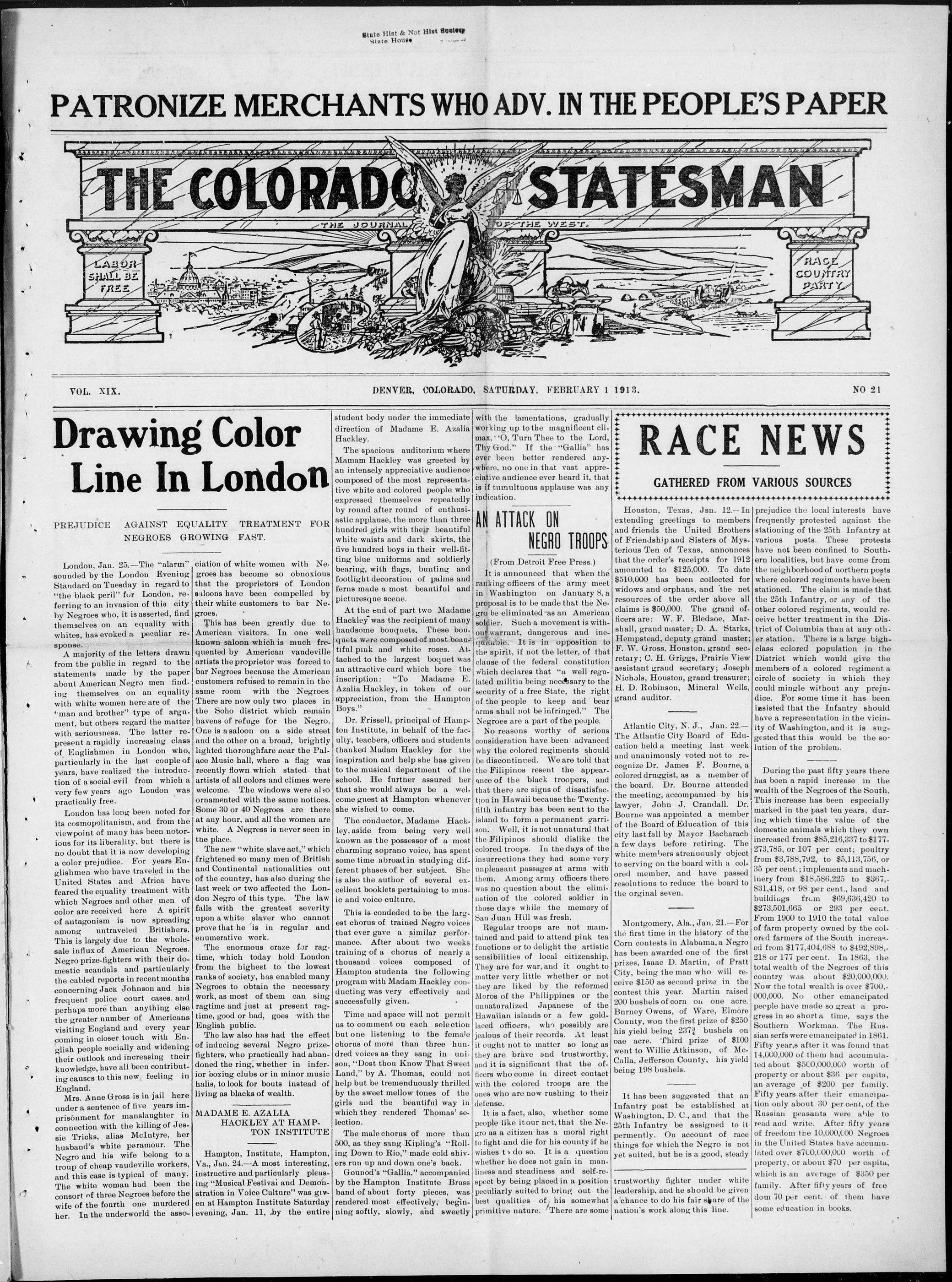
PATRONIZE MERCHANTS WHO ADV. IN THE PEOPLE'S PAPER
THE COLORADO STATESMAN
THE JOURNAL OF THE WEST.
LABOR SHALL BE FREE
RAGE COUNTRY PARTY
Drawing Color Line In London
EQUALITY GROWING
ciation of white women with Negroes has become so obnoxious that the proprietors of London saloons have been compelled by their white customers to bar Negroes.
This has been greatly due to American visitors. In one well known saloon which is much frequented by American vaudeville artists the proprietor was forced to bar Negroes because the American customers refused to remain in the same room with the Negroes. There are now only two places in the Soho district which remain havens of refuge for the Negro. One is a saloon on a side street and the other on a broad, brightly lighted thoroughfare near the Palace Music hall, where a flag was recently flown which stated that artists of all colors and climes were welcome. The windows were also ornamented with the same notices. Some 30 or 40 Negroes are there at any hour, and all the women are white. A Negress is never seen in the place.
The new "white slave act," which frightened so many men of British and Continental nationalities out of the country, has also during the last week or two affected the London Negro of this type. The law falls with the greatest severity upon a white slaver who cannot prove that he is in regular and enumerative work.
VOL. XIX.
PREJUDICE
AGAINST
NEGROES
London, Jan. 25.—The "alarm" sounded by the London Evening Standard on Tuesday in regard to "the black peril" for London, referring to an invasion of this city by Negroes who, it is asserted, find themselves on an equality with whites, has evoked a peculiar response.
A majority of the letters drawn from the public in regard to the statements made by the paper about American Negro men finding themselves on an equality with white women here are of the "man and brother" type of argument, but others regard the matter with seriousness. The latter represent a rapidly increasing class of Englishmen in London who, particularly in the last couple of years, have realized the introduction of a social evil from which a very few years ago London was practically free.
London has long been noted for its cosmopolitanism, and from the viewpoint of many has been notorious for its liberality, but there is no doubt that it is now developing a color prejudice. For years Englishmen who have traveled in the United States and Africa have feared the equality treatment with which Negroes and other men of color are received here. A spirit of antagonism is now spreading among untraveled Britishers. This is largely due to the wholesale influx of American Negroes. Negro prize-fighters with their domestic scandals and particularly the cabled reports in recent months concerning Jack Johnson and his frequent police court cases, and perhaps more than anything else the greater number of Americans visiting England and every year coming in closer touch with English people socially and widening their outlook and increasing their knowledge, have all been contributing causes to this new feeling in England.
Mrs. Anne Gross is in jail here under a sentence of five years imprisonment for manslaughter in connection with the killing of Jessie Tricks, alias McIntyre, her husband's white paramour. The Negro and his wife belong to a troup of cheap vaudeville workers, and this case is typical of many. The white woman had been the consort of three Negroes before the wife of the fourth one murdered her. In the underworld the assso-
TREATMENT FOR FAST.
The enormous craze for ragtime, which today hold London from the highest to the lowest ranks of society, has enabled many Negroes to obtain the necessary work, as most of them can sing ragtime and just at present ragtime, good or bad, goes with the English public.
The law also has had the effect of inducing several Negro prizefighters, who practically had abandoned the ring, whether in inferior boxing clubs or in minor music halis, to look for bouts instead of living as blacks of wealth.
MADAME E. AZALIA
HACKLEY AT HAMP-
TON INSTITUTE
Hampton, Institute, Hampton, Va., Jan. 24.—A most interesting, instructive and particularly pleasing "Musical Festival and Demonstration in Voice Culture" was given at Hampton Institute Saturday evening, Jan. 11, by the entire
State Hist & Nat Hist Society
State House
HANTS WH
ADO
THE JOURNAL
DENVER, COLORADO
student body under the immediate direction of Madame E. Azalia Hackley.
The spacious auditorium where Mamam Hackley was greeted by an intensely appreciative audience composed of the most representative white and colored people who expressed themselves repeatedly by round after round of enthusiastic applause, the more than three hundred girls with their beautiful white waists and dark skirts, the five hundred boys in their well-fitting blue uniforms and soldierly bearing, with flags, bunting and footlight decoration of palms and ferns made a most beautiful and picturesque scene.
At the end of part two Madame Hackley was the recipient of many handsome bouquets. These bouquets were composed of most beautiful pink and white roses. Attached to the largest bouquet was an attractive card which bore the inscription: "To Madame E. Azalia Hackley, in token of our appreciation, from the Hampton Boys." Dr. Frissell, principal of Hampton Institute, in behalf of the faculty, teachers, officers and students thanked Madam Hackley for the inspiration and help she has given to the musical department of the school. He further assured her that she would always be a welcome guest at Hampton whenever she wished to come.
The conductor, Madame Hackley, aside from being very well known as the possessor of a most charming soprano voice, has spent some time abroad in studying different phases of her subject. She is also the author of several excellent booklets pertaining to music and voice culture.
This is condeded to be the largest chorus of trained Negro voices that ever gave a similar performance. After about two weeks training of a chorus of nearly a thousand voices composed of Hampton students the following program with Madam Hackley conducting was very effectively and successfully given.
Time and space will not permit us to comment on each selection but one listening to the female chorus of more than three hundred voices as they sang in unison, "Dost thou Know That Sweet Land," by A. Thomas, could not help but be tremenduously thrilled by the sweet mellow tones of the girls and the beautiful way in which they rendered Thomas' selection.
The male chorus of more than 500, as they sang Kipling's "Rolling Down to Rio," made cold shivers run up and down one's back.
Gounod's "Gallia," accompanied by the Hampton Institute Brass band of about forty pieces, was rendered most effectively, beginning softly, slowly, and sweetly
with the lamentations, gradually working up to the magnificent climax, 'O, Turn Thee to the Lord, Thy God.' If the "Gallia" has ever been better rendered anywhere, no one in that vast appreciative audience ever heard it, that is if tumultuous applause was any indication.
AN ATTACK ON
NEGRO TROOPS
(From Detroit Free Press.)
It is announced that when the ranking officers of the army meet in Washington on January 8, a proposal is to be made that the Negro be eliminated as an American soldier. Such a movement is without warrant, dangerous and inequable. It is in opposition to the spirit, if not the letter, of that clause of the federal constitution which declares that "a well regulated militia being necessary to the security of a free State, the right of the people to keep and bear arms shall not be infringed." The Negroes are a part of the people.
No reasons worthy of serious consideration have been advanced why the colored regiments should be discontinued. We are told that the Filipinos resent the appearance of the black troopers, and that there are signs of dissatisfaction in Hawaii because the Twenty-fifth infantry has been sent to the island to form a permanent garrison. Well, it is not unnatural that the Filipinos should dislike the colored troops. In the days of the insurrections they had some very unpleasant passages at arms with them. Among army officers there was no question about the elimination of the colored soldier in those days while the memory of San Juan Hill was fresh.
Regular troops are not maintained and paid to attend pink tea functions or to delight the artistic sensibilities of local citizenship. They are for war, and it ought to matter very little whether or not they are liked by the reformed Moros of the Philippines or the unnaturalized Japanese of the Hawaiian islands or a few gold-laced officers, who possibly are jealous of their records. At least it ought not to matter so long as they are brave and trustworthy, and it is significant that the officers who come in direct contact with the colored troops are the ones who are now rushing to their defense.
It is a fact, also, whether some people like it our not, that the Negro as a citizen has a moral right to fight and die for his county if he wishes to do so. It is a question whether he does not gain in manliness and steadiness and self-respect by being placed in a position peculiarly suited to bring out the best qualities of his somewhat primitive nature. There are some
RACE NEWS
GATHERED FROM VARIOUS SOURCES
Houston, Texas, Jsn. 12.—In extending greetings to members and friends the United Brothers of Friendship and Sisters of Mysterious Ten of Texas, announces that the order's receipts for 1912 amounted to $125,000. To date $510,000 has been collected for widows and orphans, and the net resources of the order above all claims is $50,000. The grand officers are: W. F. Bledsoe, Marshall, grand master; D. A. Starks, Hempstead, deputy grand master; F. W. Gross, Houston, grand secretary; C. H. Griggs, Prairie View assistant grand secretary; Joseph Nichols, Houston, grand treasurer; H. D. Robinson, Mineral Wells, grand auditor.
Atlantic City, N. J., Jan. 22. The Atlantic City Board of Education held a meeting last week and unanimously voted not to recognize Dr. James F. Bourne, a colored druggist, as a member of the board. Dr. Bourne attended the meeting, accompanied by his lawyer, John J. Crandall. Dr. Bourne was appointed a member of the Board of Education of this city last fall by Mayor Bacharach a few days before retiring. The white members strenuously object to serving on the board with a colored member, and have passed resolutions to reduce the board to the original seven.
Montgomery, Ala., Jan. 21.—For the first time in the history of the Corn contests in Alabama, a Negro has been awarded one of the first prizes, Isaac D. Martin, of Pratt City, being the man who will receive $150 as second prize in the contest this year. Martin raised 200 bushels of corn on one acre, Burney Owens, of Ware, Elmore County, won the first prize of $250 his yield being $237 $4 bushels on oae acre. Third prize of $100 went to Willie Atkinson, of McCalla, Jefferson County, his yield being 198 bushels.
It has been suggested that an Infantry post be established at Washington, D. C., and that the 25th Infantry be assigned to it permenly. On account of race things for which the Negro is not yet suited, but he is a good, steady
trustworthy fighter under white leadership, and he should be given a chance to do his fair share of the nation's work along this line.
NO 21
prejudice the local interests have frequently protested against the stationing of the 25th Infantry at various posts. These protests have not been confined to Southern localities, but have come from the neighborhood of northern posts where colored regiments have been stationed. The claim is made that the 25th Infantry, or any of the other colored regiments, would receive better treatment in the District of Columbia than at any other station. There is a large high-class colored population in the District which would give the members of a colored regiment a circle of society in which they could mingle without any prejudice. For some time it has been insisted that the Infantry should have a representation in the vicinity of Washington, and it is suggested that this would be the solution of the problem.
During the past fifty years there has been a rapid increase in the wealth of the Negroes of the South. This increase has been especially marked in the past ten years, during which time the value of the domestic animals which they own increased from $85,216,337 to $177,273,785, or 107 per cent; poultry from $3,788,792, to $5,113,756, or 35 per cent.; implements and machinery from $18,586,225 to $367,831,418, or 98 per cent., land and buildings from $69,636,420 to $273,501,665 or 293 per cent. From 1900 to 1910 the total value of farm property owned by the colored farmers of the South increased from $177,404,688 to $492,898,218 or 177 per cent. In 1863, the total wealth of the Negroes of this country was about $20,000,000. Now the total wealth is over $700,000,000. No other emancipated people have made so great a progress in so short a time, says the Southern Workman. The Russian serfs were emancipated in 1861. Fifty years, after it was found that 14,000,000 of them had accumulated about $500,000,000 worth of property or about $36 per capita, an average of $200 per family. Fifty years after their emancipation only about 30 per cent, of the Russian peasants were able to read and write. After fifty years of freedom the 10,000,000 Negroes in the United States have accumulated over $700,000,000 worth of property, or about $70 per capita, which is an average of $350 per family. After fifty years of freedom 70 per cent. of them have some education in books.
THE WORLD IN PARAGRAPHS
A BRIEF RECORD OF PASSING EVENTS IN THIS AND FOR-EIGN COUNTRIES.
IN LATE DISPATCHES
DOINGS AND HAPPENINGS THAT
MARK THE PROGRESS
OF THE AGE.
Western Newspaper Union News Service.
WESTERN.
Milwaukee ministers favor a state
law for the regulation of boxing.
By a vote of 33 to 30, the Minnesota
Senate rejected a bill proposing a con-
stitutional amendment giving women
the right to vote.
Thomas Sterling, the Republican pri-
mary choice, was elected United
States senator on the first ballot in
the South Dakota Legislature.
The Rev. Dr. Bradford Leavitt, one
of the best known clergymen of San
Francisco, has resigned his pastorate
of the First Unitarian church of that
city to become an undertaker.
Three Oklahomaans have sent from Berlin messages that the widely heralded serum cure for tuberculosis which Dr. Frederick Franz Friedmann claims to have discovered, is not what Americans have been led to believe.
As the result of a rat bite suffered last November while he was sleeping at a farmhouse, E. D. Blinn, 69 years old, one of the leading lawyers of central Illinois, died at Lincoln. Blood poisoning developed from the bite beneath the left ear.
The International Harvester Company is to be dissolved into two corporations of $70,000,000 each of capital. Announcement of the plan was made following the incorporation in New Jersey of the International Harvester Corporation, and it will take effect at once.
The Senate resolution proposing a constitutional amendment for the enfranchisement of women was adopted by the New York Assembly. If it passes the Legislature of 1915, the question will be submitted to the voters of the state for approval at the general election that year.
The first scrap over the question of changing the divorce laws of Nevada occurred in the Assembly when Schoer of Elko county gave notice of a bill amending the present statute. Immediately after Barles of Nye county introduced a bill to amend, and a motion was made to postpone all action indefinitely, but was voted down, 31 to 21.
Articles incorporating the International Harvester Corporation with an authorized capital of $70,000,000 were filled with the secretary of the state of New Jersey, the incorporators being men actively connected with the International Harvester Company, a concern already chartered, under the laws of New Jersey, with an authorized capital of $146,000,000.
Vernon O. Lyttle, mail carrier at Batavia, Ohio, is the first man to accept and deliver under parcel post conditions a live baby. The baby, a boy, weighing $10\%$ pounds, just within the 11-pound weight limit, is the child of Mr. and Mrs. Jesse Beagle of Near Glen Fate. The "package" was well wrapped and ready for "mailing" when the carrier got it. Its measurements reached 71 inches, also just within the law, which makes 72 inches the limit. Mr. Lyttle delivered the "parcel" safely to the address on the card attached, that of its grandmother, Mrs. Louis Beagle, who lives about a mile from its home. The postage was 15 cents and the "parcel" was insured for $50.
WASHINGTON
Democratic tariff revision will follow the schedule-by-schedule scheme. The Rev. Dr. Daniel W. Fisher, father of Secretary Fisher of the Interior Department, died of heart failure. He was 75 years old. Investigation of conditions in the garment working industry in New York was proposed in a resolution by Representative Berger, the Socialist member from Wisconsin. Miss Genevieve Champ Clark, the interesting 18-year-old daughter of Speaker Champ Clark, has the distinction of being the youngest author whose writings are indexed in the Pan-American Union library. Assistant Secretary Allen of the treasury, has signed the papers awarding the contract for constructing the new sub-treasury at San Francisco to Grant Fee of San Francisco, for $384,000.
The final reception of the Taft administration in honor of Congress was held at the White House. Standing in the blue room with Mrs. Taft at his side, the President extended a warm greeting to senators and representatives, their wives and invited guests. Ladies of the cabinet assisted in receiving. Dancing in the east room followed the reception.
Many carnations were worn on McKinley day. The carnation was President McKinley's favorite flower and since his death it has been worn each year as a tribute to his memory.
FOREIGN.
Russia has awakened to the utility of the automobile in war.
Archduke Ranier, second cousin of Emperor Francis Joseph, died in his eighty-seventh year.
Hostilities in northern Mexico will be renewed at once, according to rebel agents at El Paso, Tex.
A Barcelona dispatch to the Petit Parisien reports an attempt to assassinate Archduke Louis Salvator of Tuscany.
A Constantinople correspondent learns the porte's reply to the powers will express regret that it is impossible to make further concessions.
Constantinople dispatches report a bloody conflict in Tchatalja between the adhrents of the late Nazim Pasha and supporters of the Young Turks.
Senor Moret Y. Prendergast, several times premier of Spain, died at Madrid. The news of his death has called forth a universal expression of regret. Twenty-six of the crew of the German bark Panganie perished when that vessel was sunk by the French steamer Phryne in the English channel. Three suffragettes, Mrs. Hopkins, Mrs. Cousins and Mrs. Connery, who were arrested on the charge of breaking fifteen panes of glass in the windows of Dublin Castle, were sentenced by the police magistrate to a month's hard labor cach.
A large force of Moros near Jolo, armed with bolos, rushed troops E and G of the Eighth cavalry and the Twenty-seventh company of native constabulary. Private Underwood was wounded dangerously; Privates Kellock, Tracey and Young severely. Other native scouts and constabulary were killed or wounded.
CONGRESSIONAL
The House passed the river and harbor appropriation bill, carrying $40,800,000, without an important amendment.
Judiciary committee approved Norris bill authorizing government to seize imported merchandise controlled by a trust.
Delegate Queen in speech denied reports that Aguinaldo and other Filipino leaders were inciting revolution in Philippines.
Legislative, executive and judicial appropriation bill sent to conference, with instructions to insist upon Senate amendment extending life of commerce court to June 30.
Speaker Champ Clark thinks it unfair that physicians, drummers and others whose business calls them away from their residences at uncertain dates should be disfranchised because they are not at home to register and to vote on dates fixed by law. The speaker is out in support of a change in the law by the several states allowing the right to vote, under affidavit, by mail.
SPORT.
News was received in New York of the death at Central Valley, N. Y., of Aaron Taylor, dean of the breeders of thoroughbred trotting horses of Orange county. He was 82 years old.
The Denver Grizzlies will do their spring training stunt this year at Fort Worth, Texas. This announcement was made by President James C. McGill of the Denver Baseball Association.
Outweighed and no match for his opponent in point of reach or hitting ability Frankie White of Chicago was knocked out in the tenth round of a viciously contested bout at Pueblo by Eddie Johnson of Pueblo.
Tom McLain, an aeronaut of Los Angeles, escaped death miraculously when his balloon hit the pinacle of Mount Wilson, 5,000 feet up, and sent him sprawling on the rocks just below the crest of the mountain.
Jim Flynn, the Pueblo, Colo., fighting fireman, may transfer his activities from the prize ring to the ball field. He received a letter from President O'Neill of the Western League, suggesting that Flynn join the staff of umpires for the coming season. Flynn thinks the proposition a good one and may accept
GENERAL.
The following United States senators have been elected:
James B. Hammond, the multi-millionaire head of the typewriter concern, is dead at St. Augustine, Fla.
The Michigan Legislature has ratified an amendment to the federal constitution for the election of United States senators by popular vote.
The United States Steel Corporation today declared its regular quarterly dividends of $1\frac{1}{4}$ per cent. on the common stock and $1\frac{1}{4}$ per cent. on the preferred stock.
Carl Riedelbach of Salt Lake City, the man who terrorized the central police station November 19 last with an infernal machine, was sentenced at Los Angeles to twenty years in the penitentiary.
An ocean-going ship will pass between the Atlantic and the Pacific through the Panama canal before the end of the year 1913. This was the promise that Col. George W. Goethals, chief engineer of the Panama canal, made at a dinner given by the Lehigh University Club of New York.
Minus attendants and in the presence of only members of the two families, the marriage of Miss Rachael Hill, daughter of James J. Hill, railroad magnate, to Dr. Emil Boeckmann, former football star of the University of Minnesota, was celebrated at the Hill home in St Paul, Minn.
WEEK'S EVENTS IN COLORADO
Western Newspaper Union News Services.
DATES FOR COMING EVENTS.
Feb. 6-9 Colorado State Y. M. C. A. at
Pueblo.
Tuesday Colorado Detroit
Feb. 18-20—Colorado Retail Hardware and Implement Association at Publico
March 3-8—Twelfth Annual Automobile Show at Denver.
Denver's twelfth annual automobile show will be held in the Auditorium during the week of March 3 to 8.
The cost to the city and county of Denver for the first day's registration for the special election February 14 was $10 a vote.
Dr. Harvey W. Wiley was the guest of Denver doctors at a luncheon given in his honor by the Denver County Medical Society.
Four convicted highwaymen were given the maximum sentences for their offenses by Judge C. C. Butler in the West Side Court at Denver.
The constitutionality of the flat tax on insurance companies by which the state gets two per cent. of the premiums collected was upheld by the Supreme Court. Charges and counter-charges of corporation influence and politics are being banded about as a result of the election held by the Denver Trades and Labor Assembly. From a commanding position in the railroad world to abject poverty in six years is the record of Frank A. Dunlap, 38, who died in the county hospital at Walsenburg. The number of candidates to succeed Edward Keating, congressman-elect, as president of the State Land Board March 1, when he will depart for Washington, has reached 151.
Fellows who make their signs talk and let their lights shine, met in Denver 200 strong. They are delegates to the fourth annual convention of the National Association of Outdoor Advertisers.
Andrew Cushner of Fort Collins and Thomas Dunn of Denver were undoubtedly killed when a snowslide wrecked their cabin at a point twenty miles north of Grand lake, where they were prospecting.
The state bank commissioner has taken charge of the affairs of the Morrison State Bank, located at Morrison. A shrinkage of deposits and bad loans are said to be responsible for the condition of the bank.
Edward A. Vorhang, one of the early scouts and trappers, well known to the old-timers of New Mexico and Colorado, died at the home of his daughter, Mrs. John A. Atkinson, in Denver. Death was caused by pneumonia.
A rich oil strike, believed to be one of the largest in the state and to lie in the center of a vast oil field, was made by J. W. McLees while developing an old abandoned shaft one and one-half miles southeast of Morrison.
Dr. Oscar Hayes, appointed to the Health Department by Mayor Arnold last June, has been selected by City Health Commissioner Perkins to succeed Dr. R. Albi as superintendent of the Steele Hospital for Contagious Diseases.
No cocktail imbibing in cafes by the "ladies," no cigarettes nor cigars under any circumstances during working hours, are some of the rules laid down by State Auditor Roady Kenehan for the guidance of his office assistants.
The Wade Hampton ranch, one of the finest in the Grand Valley, located in Garfield county, has been sold by J. D. Whitmore to Mayfield Bros. of Longmont, for $25,000. The new owners will go into the blooded stock business.
Denver police have been asked to search for Annie Gano, a 17-year-old Loveland girl, who disappeared from her home and is supposed to have gone to Denver in company of a woman who was ordered out of Loveland by the city marshal.
Within a week and eight hours after he had help up two Denver saloons, Paul Schewe, 27, a former soldier, had been arrested, tried in the West Side Court, sentenced to the penitentiary from eleven to thirteen years, and had been started on his way to prison.
Without telling his brothers or closest friends, Thomas A. Cosgriff, millionaire banker, financier and stockman, president of the Hamilton National Bank of Denver, was quietly married in Cheyenne to Miss Rose A. Martin, daughter of a prominent Cheyenne family.
A suit to secure a reduction in passenger transportation fares in Colorado has been filed by Omar Garwood with the State Railroad Commission. Garwood seeks to have a rate of 2 cents a mile on prairie lands of the state and 3 cents a mile in mountainous territory established by the commission in lieu of present rates of 3 to 7 cents a mile, charged by railroad and transportation companies.
With the policy of economy of the present state administration looming before them, state capitol employés and heads of departments are beginning to "sit up and take notice" in an effort to make their superiors believe their services are indispensable.
A farm of 8,000 acres, an electric light and power plant, an electric railroad, amusement parks and a big beet sugar factory, owned and operated by one company, are contemplated in a project in and around Littleton and between there and the mouth of Platte canon.
DR. WILEY AT GREELEY
DR. WILEY AT GREELEY
DECLARES "AMERICA STARVING HALF OF ITS CHILDREN."
There Are 17,000 "Underfed in Shadow of Nation's Capitol—Become Criminals or Idiots."
Western Newspaper Union News Service.
Greeley, Colo.—"Half of the children of the United States are starving, and under the very shadow of the nation's capitol there are 17,000 who are underfed. The child who does not have nutritious food is not alert mentally, and eventually becomes either a criminal, idiot or imbecile. The very foundations of the government are threatened."
This was the statement made by Dr. Harvey W. Wiley, formerly in the government service, before an audience of 1,000 who applauded him repeatedly. His address covered a wide range of topics, but the central idea was the necessity of pure food at a reasonable price for all the people. He said: "People do not know what to eat. Farmers take more care of their cows than they do of their children. Wheat, in its natural state is the best balanced food for the muscles and the mind" Dr. Wiley advanced an unusual plan to lower the cost of living when he told the audience how to make enough breakfast food from a pint of wheat to last a family of four four days at a cost of a cent and a quarter a day. He said all that was necessary was to grind the wheat in a coffee mill and prepare it as ordinary mush is made.
Subscribing to Pay Fines of Raiders.
Cañon City.—Prohibitionists in Cañon City have undertaken to raise $3,600 fines and costs, that must be paid by the raiders of the Cañon City Labor Club, according to a recent decision of the court of appeals. At a union meeting addressed by Mayor Frank P. Smith and others, $2,500 was pledged. The raid took place Sunday, July 2, 1906, and after the liquor was poured in the gutter, windows, mirrors and furniture were broken. The city marshal and several aldermen were among those taking part in the raid.
Same Terms For Beets.
Fort Collins.—Much satisfaction is expressed among beet growers over the announcement of General Manager W. A. Dixon of the Great Western Sugar Company, that the same terms of contract will be offered this year as were last. There had been considerable fear that the threatened reduction in the sugar tariff would affect the price.
Custer County Pioneer Passes Away.
Cañon City.—The funeral of Mrs. Elizabeth Koch of Westcliffe, one of the pioneers of Custer county, was held here. She was the widow of Frederick Koch, and with her husband came to Colorado from Chicago with a Germany colony of more than 100 families, in the spring of 1870, and settled in the Wet Mountain valley.
$25,000,000 Merger of Colorado Mines.
Cripple Creek.—The formation of a $25,000,000 merger of Cripple Creek mining property with the El Paso mine as the nucleus, was announced here by Joseph Walder and George Miller, representing eastern capitalists in an investigation of the El Paso property. They refused to state just what properties are to be consolidated.
Mine Inspector Curley Critically Ill. Leadville. — State Mine Inspector John R. Curley is lying at the Sisters' hospital here critically ill from ptomaine poisoning, followed by an attack of pneumonia. He is nearly seventy years old, and his recovery is doubtful.
Says Immorality Outcome of Trot.
Colorado Springs.—Immorality is the outcome of dancing the turkey trot, whether the place be an exclusive ball or a public dance hall, according to Dr. Samuel Garvin, pastor of the First Presbyterian church of this city.
Ault.—John Ehler of Denver has purchased from Edward Calahan a quarter section of land for $32,000. An eighteen-acre peach orchard near Paonia was part of the purchase.
Swallows Badge. May Die.
Grand Junction.—The life of Ruth Sisson, 5, daughter of Mr. and Mrs. G. R. Sisson of this city, is in grave danger as the result of swallowing a celluloid campaign badge.
Ole Nelson, Pioneer, Dies at Brush.
Brush.—Ole Nelson, 55, died at Brush. He was one of the pioneer merchants of eastern Colorado.
Quarantine Raised on Scarlet Fever.
Walsenburg.—The quarantine which has been in force in the schools and the public meeting places of this city for the past eight weeks was lifted by order of the Board of Health.
Italy Demands Alleged Slayer.
Pueblo. After a hearing that lasted two days in the extradition case of Frank Beradil, wanted by the Italian government for the murder of a nobleman's son, in 1905, was continued until February 24.
The
Curtis
Park
Floral
Company
FLORAL DESIGNS PUT UP WHILE
YOU WAIT
CHOICE PLANTS AND CUT FLOWERS CONSTANTLY
ON HAND
GREENHOUSES: Thirty-Fourth and Curtis Streets
TELEPHONE, MAIN 1511
DENVER, COLO
Corner West 10th and Osage, Near Burnham Shops Denver, Colorado
CARLSON'S Peerless Ice Cream Phones: Main 112 and Main 5787
DID YOU EVER TRY Neef Bros.' Beer?
It's made right, and tastes right. None better made anywhere and This is a Strictly Colorado Production
WINES, LIQUORS AND CIGARS
1644-46-48-50 LARIMER STREET.
PHONE MAIN 1053. DENVER, COLO.
Western agents for Minneapolis Grain Belt Beer and Carnegie Porter,
Pripps Imported Beer and Bock OI.
A first-class Mortuary establishment. First aid to the bereaved in the time of death of loved ones. Prices below competitors. Polite service LAWRENCE JONES, Licenced Embalmer LOUIS HUBBARD, Funeral Director PARLORS 1925 Aranahoe Street
Shirts, Collars and Cuffs, Blankets, Curtains and Rough Dry Work. The Denver Sanitary Laundry. PHONE MAIN 5670
PHONE MAIN 3028
JOH
Meats, Fane
Corner Nineteenth.
HENRY BECK
BECK
WINES,
PHONE MAIN 1053.
Western agents for M
Pri
DAY OR NIGHT.
A. M.
U
A first-class Mortu
time of death of loved
LAWRENCE
LOUIS HU
PARLORS 19
LET
Shirts, Coll
Curtains
The Denver
1082 Broadway.
BE SURE AN TRY IT.
RES. PHONE GALLUP 942
IN K. RETT
cy and Staple
RETTIG Staple Groceries
1864 CURTIS STREET
Denver, Colo.
COLORADO LEGISLATIVE DOINGS
Western Newspaper Union News Service.
SENATORS CRITICIZE COURT.
Judiciary Committee to Frame New Question for Justices to Answer.
Denver.—Members of the State Senate did not mince words in expressing their opinions of the Supreme Court's refusal to answer the Senate's questions of who should be considered lieutenant governor. After considerable debate the body voted to refer the questions back to the judiciary committee for recommendations. The committee will probably recommend the re-submission of the questions to the court in slightly different form.
Several senators declared their disagreement with the majority of the court, which held that the situation is not a sufficiently "solemn occasion" to warrant the court's consideration without the regular procedure of a court suit.
Jury Service by Women Optional.
Denver.—The woman jury bill now before the Legislature was changed in its effect when an amendment was made in the Senate whereby women may be excused from jury service on the grounds of sex. Jury service for women is thus made optional. The Senate spent some time in consideration of the bill of its second reading.
Bills Introduced in House.
H. B. 50, Biles—To submit to the qualified electors of Colorado amendments to sections 46 and 47 of act 5 of the constitution, concerning the General Assembly.
H. B. 51, Kavanaugh—Appropriation for Colorado school for deaf and blind.
H. H. 52, Philip—Herd law.
H. B. 53, Gates (Perl)—Short appropriation.
H. B. No. 63, Old—To increase the number of judges for the First district by the addition of one more judge.
H. B. No. 64, Packer—In relation to game and fish.
H. B. 65, Newton—To repeal eighty-four of the laws of the Eighteenth General Assembly.
H. B. 66, Newton—Compensation of clerks of county courts.
H. B. 67, Norvell—To amend game and fish laws.
H.B. 68, Philip—To provide for county truancy officers.
H.B. 69, Philip—To create a public school assistants' fund.
H.B. 70, Gilbert—Appropriations for short term for state coal mine inspector.
H.B. 71, Gilbert—Appropriation for completion of buildings at state penitentiary.
H.B. 72, Smedley—Acknowledged and unacknowledged instruments.
H.B. 73, Ardourel—Increase judges in Eighth judiciary district, making the number three.
H.B. 74, Williams and Andrew—Regulating practice of chiropatic in Colorado.
H.B. 75, Young—Concerning nominations of candidates for office; elections.
H.B. 76, Skinner—To secure water for domestic use.
H. B. 77, Skinner—Concerning income tax.
H. B. 78, Skinner—Increase number of district judges in Seventh judiciary district.
H. B. 79, West—To promote the agricultural, horticultural, industrial and livestock industries of Colorado; $50,000 biennial appropriation.
H. B. 80, Riddle—Establishing a state poultry board.
H. B. 81, Leftwich—To divide Colorado into four congressional districts.
H. B. 82, Finch—To alter the senatorial and representative districts.
H. B. No. 83, Philbin and Gilbert—To provide for state reservoir on Cottonwood creek, Chaffee county.
H. B. 84, Wright—Support for State Home for Dependents.
H. B. 85, Simpson—To establish Fourteenth judicial district.
H. B. 86, McDonald—Relating to rates of interest.
H. B. 87, Newton—To repeal chapter 84, session laws 1884, creating a board of horticulture.
H. B. 88, Skinner—Public utilities.
H. B. 89, Gates, Perl—Short appropriation bill.
H. B. 90, Skinner—In relation to power plants.
H. B. 91, Elmore—Concerning employment.
H. B. 92, Ardourel—Relating to annual reports of state educational institutions.
H. B. 100, Ashton—Concerning county courts in counties of the second class.
H. B. 101, Andrew—To amend sections 4660 and 4661 of the revised statutes.
H. B. 102, Howells—To regulate the practice of optometry.
H. B. 103, Kavanaugh—To repeal anti-boycott law.
H. B. 104, Perl B. Gates—For the refunding of irrigatfon district bonds.
H. B. 105, Perl B. Gates—Relating to irrigation districts.
H. B. 106, Riddle—Regulating dealers in all kinds of petroleum oils.
H. B. 107, Riddle—To amend an act providing for the inspection of all kinds of petroleum oil.
H. B. 108, Smith—Making an appropriation for an extension of the hall of physics at the School of Mines.
H. B. 109, Smith—Appropriation for the experimental ore dressing and metallurgical plant of the School of Mines.
H. B. 110, George W. Gates—To provide for the payment of part of the expense of maintenance of the Colorado Soldiers and Sailors' home.
H. B. 113, Andrew—to regulate the sale of cocaine.
URGES CASH VALUATIONS.
Governor Ammons Sends Special Message to Legislature.
Western Newspaper Union News Service.
Denver.-Governor Ammons sent a special message to the Legislature recommending a change from one-third to full cash valuation for assessment purposes, fixing the mill levy so that the income would be not more than ten per cent. above the taxes collected in 1912, and urging a change in the date of the meeting of Colorado assessors from August to earlier in the year before the tax rolls are certified. The message dealt entirely with the finances of the state.
To Lengthen State Officers' Terms.
Denver.—Representative Sweet has introduced a bill to submit to the voters of the state a constitutional amendment to give all executive state officers a four instead of a two-year term and rendering them ineligible to succeed themselves or to be elected to any other state office until four years have elapsed from the expiration of their first term. This measure, in the form of a bill, failed to pass the Senate. Sweet believes it will go through the House in the shape of a bill for a constitutional amendment.
State Income Tax Bill Passed.
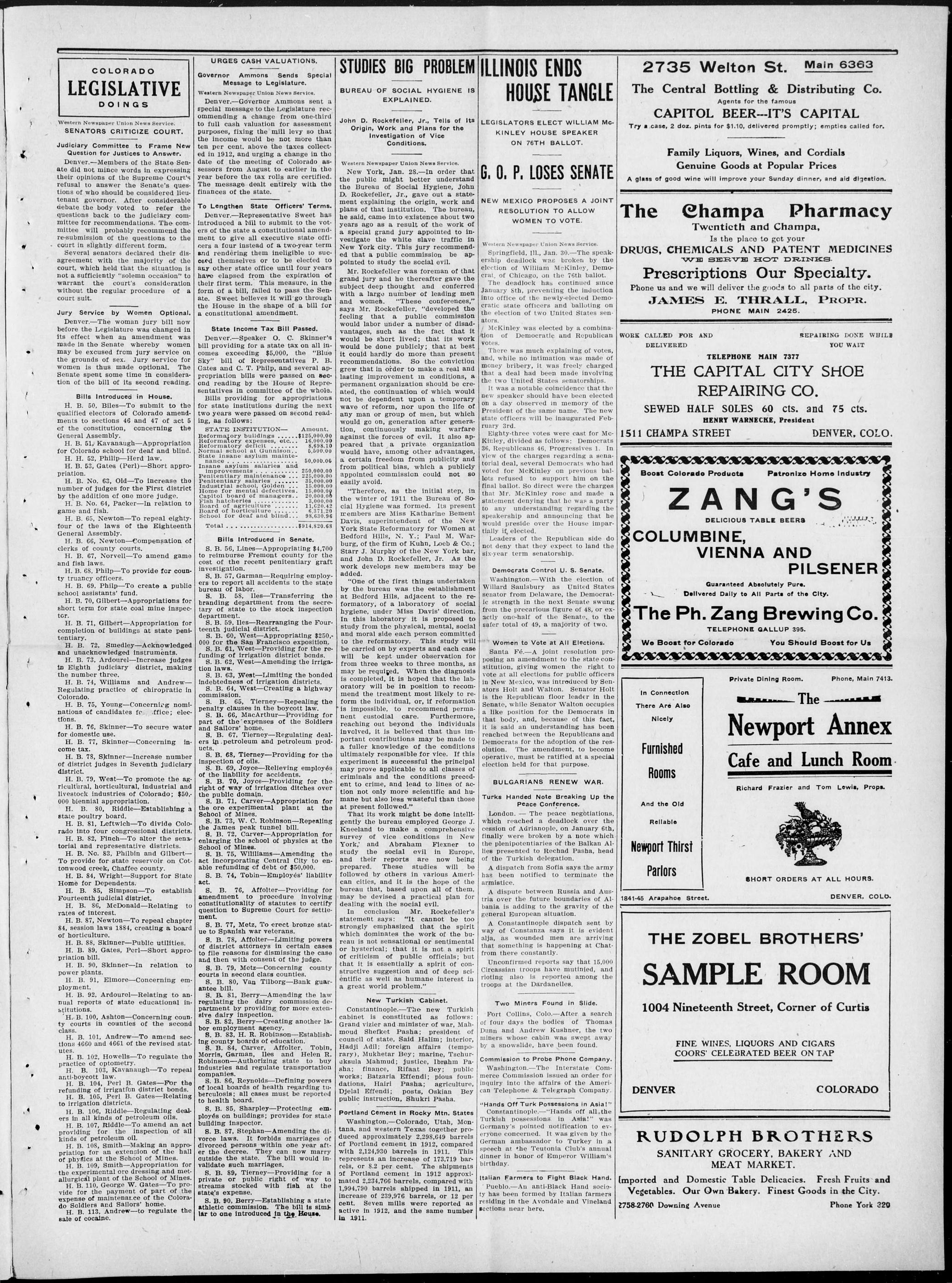
Denver.—Speaker O. C. Skinner's bill providing for a state tax on all incomes exceeding $5,000, the "Blue Sky" bill of Representatives P. B. Gates and C. T. Philp, and several appropriation bills were passed on second reading by the House of Representatives in committee of the whole. Bills providing for appropriations for state institutions during the next two years were passed on second reading, as follows:
STATE INSTITUTION—Amount.
Reformatory buildings ..... $125,000.00
Reformatory expenses, etc. ..... 16,000.00
Reformatory deficit ..... 8,698.10
National security (U.S.) ..... 5,500.00
State income asylum maintenance ..... 50,000.00
Insane asylum salaries and improvements.....250,000.00
Penitentiary maintenance.....225,000.00
Penitentiary salaries.....35,000.00
Industrial school, Golden.....15,000.00
Home for mental defectives.....15,000.00
Capitol board of managers.....20,000.00
Fish hatcheries.....3,000.00
Board of agriculture.....11,620.42
Board of horticulture.....6,371.20
School for deaf and blind.....98,630.96
Total.....$914,820.68
Bills Introduced in Senate.
S. B. 56, Lines—Appropriating $4,700 to reimburse Fremont county for the cost of the recent penitentiary graft investigation.
S. B. 57, Garman—Requiring employers to report all accidents to the state bureau of labor.
S. B. 58, Iles—Transferring the branding department from the secretary of state to the stock inspection department.
S. B. 59, Iles—Rearranging the Fourteenth judicial district.
S. B. 60, West—Appropriating $250,000 for the San Francisco exposition.
S. B. 61, West—Providing for the refunding of irrigation district bonds.
S. B. 62, West—Amending the irrigation laws.
S. B. 63, West—Limiting the bonded indebtedness of irrigation districts.
S. B. 64, West—Creating a highway commission.
S. B. 65, Tierney—Repealing the penalty clauses in the boycott law.
S. B. 66, MacArthur—Providing for part of the 'expenses of the Soldiers and Sailors' home.
S. B. 67, Tierney—Regulating dealers in petroleum and petroleum products.
S. B. 68, Tierney—Providing for the inspection of oils.
S. B. 70, Joyce—Providing for the right of way of irrigation ditches over the public domain.
S. B. 71, Carver—Appropriation for the ore experimental plant at the School of Mines.
S. B. 73, W. C. Robinson—Repealing the James peak tunnel bill.
S. B. 72, Carver—Appropriation for enlarging the school of physics at the School of Mines.
S. B. 75, Williams—Amending the act incorporating Central City to enable refunding of debt of $50,000.
S. B. 74, Tobin—Employés' liability act.
S. B. 76, Affolter—Providing for amendment to procedure involving constitutionality of statutes to certify question to Supreme Court for settlement.
S. B. 77, Metz, To erect bronze statue to Spanish war veterans.
S. B. 78, Affolter—Limiting powers of district attorneys in certain cases to file reasons for dismissing the case and then with consent of the judge.
S. B. 79, Metz—Concerning county courts in second class counties.
S. B. 80, Van Tilborg—Bank guarantee bill.
S. B. 81, Berry—Amending the law regulating the dairy commission department by providing for more extensive dairy inspection.
S. B. 82, Berry—Creating another labor employment agency.
S. B. 83, H. R. Robinson—Establishing county boards of education.
S. B. 84, Carver, Affolter, Tobin, Morris, Garman, Iles and Helen R. Robinson—Authorizing state to buy industries and regulate transportation companies.
S. B. 86, Reynolds—Defining powers of local boards of health regarding tuberculosis; all cases must be reported to health board.
S. B. 85, Sharpley—Protecting employees on buildings; provides for state building inspector.
S. B. 87, Stephan—Amending the divorce laws. It forbids marriages of divorced persons within one year after the decree. They can now marry outside the state. The bill would invalidate such marriages.
S. B. 89, Tierney—Providing for a private or public right of way to streams stocked with fish at the state's expense.
S. B. 90, Berry—Establishing a state athletic commission. The bill is similar to one introduced in the House.
STUDIES BIG PROBLEM
BUREAU OF SOCIAL HYGIENE IS EXPLAINED.
John D. Rockefeller, Jr., Tells of Its Origin, Work and Plans for the Investigation of Vice Conditions.
Western Newspaper Union News Service.
New York, Jan. 28.—In order that the public might better understand the Bureau of Social Hygiene, John D. Rockefeller, Jr., gave out a statement explaining the origin, work and plans of that institution. The bureau, he said, came into existence about two years ago as a result of the work of a special grand jury appointed to investigate the white slave traffic in New York city. This jury recommended that a public commission be appointed to study the social evil.
Mr. Rockefeller was foreman of that grand jury and he thereafter gave the subject deep thought and conferred with a large number of leading men and women. "These conferences," says Mr. Rockefeller, "developed the feeling that a public commission would labor under a number of disadvantages, such as the fact that it would be short lived; that its work would be done publicly; that at best it could hardly do more than present recommendations. So the conviction grew that in order to make a real and lasting improvement in conditions, a permanent organization should be created, the continuation of which would not be dependent upon a temporary wave of reform, nor upon the life of any man or group of men, but which would go on, generation after generation, continuously making warfare against the forces of evil. It also appeared that a private organization would have, among other advantages, a certain freedom from publicity and from political bias, which a publicly appointed commission could not so easily avoid.
"Therefore, as the initial step, in the winter of 1911 the Bureau of Social Hygiene was formed. Its present members are Miss Katharine Bement Davis, superintendent of the New York State Reformatory for Women at Bedford Hills, N. Y.; Paul M. Warburg, of the firm of Kuhn, Loeb & Co.; Starr J. Murphy of the New York bar, and John D. Rockefeller, Jr. As the work develops new members may be added.
"One of the first things undertaken by the bureau was the establishment at Bedford Hills, adjacent to the reformatory, of a laboratory of social hygiene, under Miss Davis' direction. In this laboratory it is proposed to study from the physical, mental, social and moral side each person committed to the reformatory. This study will be carried on by experts and each case will be kept under observation for from three weeks to three months, as may be required. When the diagnosis is completed, it is hoped that the laboratory will be in position to recommend the treatment most likely to reform the individual, or, if reformation is impossible, to recommend permanent custodial care. Furthermore, reaching out beyond the individuals involved, it is believed that thus important contributions may be made to a fuller knowledge of the conditions ultimately responsible for vice. If this experiment is successful the principal may prove applicable to all classes of criminals and the conditions precedent to crime, and lead to lines of action not only more scientific and humane but also less wasteful than those at present followed."
That its work might be done intelligently the bureau employed George J. Kneeland to make a comprehensive survey of vice conditions in New York,' and Abraham Flexner to study the social evil in Europe, and their reports are now being prepared. These studies will be followed by others in various American cities, and it is the hope of the bureau that, based upon all of them, may be devised a practical plan for dealing with the social evil.
In conclusion Mr. Rockefeller's statement says: "It cannot be too strongly emphasized that the spirit which dominates the work of the bureau is not sensational or sentimental or hysterical; that it is not a spirit of criticism of public officials; but that it is essentially a spirit of constructive suggestion and of deep scientific as well as humane interest in a great world problem."
New Turkish Cabinet.
Constantinople.—The new Turkish cabinet is constituted as follows: Grand vizier and minister of war, Mahmoud Shefket Pasha; president of council of state, Said Halim; interior, Hadji Adil; foreign affairs (temporary), Mukhetar Bey; marine, Tschurukula Mahmud; justice, Ibrahm Pasha; finance, Rifaat Bey; public works; Batzaria Effendi; plious foundations, Hairi Pasha; agriculture, Djelal Effendi; posts, Oskian Bey public instruction, Shukri Pasha.
Portland Cement in Rocky Mtn. States
Fort Washington—Colorado, Utah, Montana, and western Texas together produced approximately 2,298,649 barrels of Portland cement in 1912, compared with 2,124,930 barrels in 1911. This represents an increase of 173,719 barrels, or 8.2 per cent. The shipments of Portland cement in 1912 approximated 2,234,766 barrels, compared with 1,994,790 barrels shipped in 1911, an increase of 239,976 barrels, or 12 per cent. Seven mills were reported as active in 1912, and the same number in 1911.
LEGISLATORS ELECT WILLIAM McKINLEY HOUSE SPEAKER ON 76TH BALLOT.
G. O. P. LOSES SENATE
NEW MEXICO PROPOSES A JOINT
RESOLUTION TO ALLOW
WOMEN TO VOTE.
Western Newspaper Union News Service.
Springfield, 111., Jan. 30.—The speake-
ship deadlock was broken by the
election of William McKinley, Democ-
rat, of Chicago, on the 76th ballot.
The deadlock has continued since
January 8th, preventing the induction
into office of the newly-elected Democ-
ratic state officers and balloting on
the election of two United States sen-
ators.
McKinley was elected by a combination
of Democratic and Republican
votes.
There was much explaining of votes,
and, while no intimation was made of
money bribery, it was freely charged
that a deal had been made involving
the two United States senatorships.
It was a notable coincidence that the new speaker should have been elected on a day observed in memory of the President of the same name. The new state officers will be inaugurated February 3rd.
Eighty-three votes were cast for McKinley, divided as follows: Democrats 36, Republicans 46, Progressives 1. In view of the charges regarding a senatorial deal, several Democrats who had voted for McKinley on previous ballots refused to support him on the final ballot. So direct were the charges that Mr. McKinley rose and made a statement denying that he was a party to any understanding regarding the speakership and announcing that he would preside over the House impartially if elected.
Leaders of the Republican side do not deny that they expect to land the six-year term senatorship.
Democrats Control U. S. Senate.
Washington—With the election of Willard Saulsbury as United States senator from Delaware, the Democratic strength in the next Senate swung from the precarious figure of 48, or exactly one-half of the Senate, to the safer total of 49, a majority of two.
Women to Vote at All Elections.
Santa Fé—A joint resolution proposing an amendment to the state constitution, giving women the right to vote at all elections for public officers in New Mexico, was introduced by Senators Holt and Walton. Senator Holt is the Republican floor leader in the Senate, while Senator Walton occupies a like position for the Democrats in that body, and, because of this fact, it is said an understanding has been reached between the Republicans and Democrats for the adoption of the resolution. The amendment, to become operative, must be ratified at a special election held for that purpose.
BULGARIANS RENEW WAR.
Turks Handed Note Breaking Up the Peace Conference.
London. — The peace negotiations, which reached a deadlock over the session of Adrianople, on January 6th, finally were broken by a note which the plenipotentiaries of the Balkan Allies presented to Rechad Pasha, head of the Turkish delegation.
A dispatch from Sofia says the army has been notified to terminate the armistice.
A dispute between Russia and Austria over the future boundaries of Albania is adding to the gravity of the general European situation.
A Constantinople dispatch sent by way of Constanza says it is evident alja, as wounded men are arriving that something is happening at Chatfrom there constantly.
Unconfirmed reports say that 15,000 Circassian troops have mutinied, and rioting also is reported among the troops at the Dardanelles.
Two Miners Found in Slide.
Fort Collins, Colo.—After a search of four days the bodies of Thomas Dunn and Andrew Kushner, the two miners whose cabin was swept away by a snowslide, have been found.
Commission to Probe Phone Company.
Washington.—The Interstate Commerce Commission issued an order for inquiry into the affairs of the American Telephone & Telegraph Company.
"Hands Off Turk Possessions in Asia!"
Constantinople.—"Hands off all, the Turkish possessions in Asia!" was Germany's pointed notification to everyone concerned. It was given by the German ambassador to Turkey in a speech at the Teutonia Club's annual dinner in honor of Emperor William's birthday.
Italian Farmers to Fight Black Hand. Pueblo.—An anti-Black Hand society has been formed by Italian farmers residing in the Avondale and Vineland sections near here.
2735 Welton St. Main 6363
The Central Bottling & Distributing Co.
Agents for the famous
CAPITOL BEER---IT'S CAPITAL
Try a case, 2 doz. pints for $1.10, delivered promptly; empties called for.
Family Liquors, Wines, and Cordials Genuine Goods at Popular Prices A glass of good wine will improve your Sunday dinner, and aid digestion.
The Champa Pharmacy
Twentieth and Champa,
Is the place to get your
DRUGS, CHEMICALS AND PATENT MEDICINES
WE SERVE HOT DRINKS.
Prescriptions Our Specialty.
Phone us and we will deliver the goods to all parts of the city.
JAMES E. THRALL, PROPR.
PHONE MAIN 2425.
WORK CALLED FOR AND DELIVERED
THE CAY
RE
SEWED HALF
HE
1511 CHAMPA STRE
Boost Colorado P
ZA
DE
COLUMB
VI
Guaranteed Absolutely Pure. Delivered Daily to All Parts of the City.
The Ph. 2
We Boost for Colo
Ph. Zang Brewing
TELEPHONE GALLUP 395.
best for Colorado You Should Boo
Newport Cafe and Lunc
Furnished
Rooms
And the Old
Reliable
Newport Thirst
Parlors
SHORT ORDERS AT ALL
Oe Street.
THE ZOBEL BROTHE
AMPLE ROO
Nineteenth Street, Corner of
1841-45 Arapahoe Street.
THE ZO
SAMI
1004 Ninetee
1004 Nineteenth Street, Corner of Curtis
FINE WINES, LIQUORS AND CIGARS COORS' CELEBRATED BEER ON TAP
RUDOL
SANITARY
Imported and Domes
Vegetables. Our Ow
2758-2760 Downing Avenue
RUDOLPH BROTHERS
SANITARY GROCERY, BAKERY AND MEAT MARKET. Imported and Domestic Table Delicacies. Fresh Fruits and Vegetables. Our Own Bakery. Finest Goods in the City. 2758-2760 Downing Avenue Phone York 320
In Connection
There Are Also
Nicely
And the Old
DENVER
REPAIRING DONE WHILE
YOU WAIT
PHONE MAIN 7377
RITAL CITY SHOE
HAIRING CO.
LES 60 cts. and 75 cts.
WARNECKE, President
DENVER, COLO.
Patronize Home Industry
NG'S
PUBLIC TABLE BEERS
E,
INA AND
PILSENER
ang Brewing Co.
PHONE GALLUP 395.
Do You Should Boost for Us
Private Dining Room. Phone, Main 7413.
The
Newport Annex
Cafe and Lunch Room
Richard Frazier and Tom Lewis, Props.
EL BROTHERS'
LE ROOM
Street, Corner of Curtis
H BROTHERS
LOCERY, BAKERY AND
BET MARKET.
Table Delicacies. Fresh Fruits and
Bakery. Finest Goods in the City.
Phone York 320
Phone, Main 7413.
DENVER, COL0.
COLORADO
THE COLORADO STATESMAN
JOS. D. D. RIVERS.....Proprietor
1824 Curtis Street, Room 25.
SUBSCRIPTION RATES:
One Year ..... $2.00
Six Months ..... 1.00
Taree Months ..... .60
PAYABLE IN ADVANCE.
Entered as second-class matter at Colorado.
Reading notices, ten lines or less, over ten lines, 5 cents per line.
Display advertising, 25 cents per square.
No discounts allowed on less than three pany all orders from parties unknown to you.
Remittances should be made by E Order, Registered Letter or Bank Draft, same as cash for the fractional part of a taken.
All communications of a person will be withheld from the columns of the
Communications to receive attention objects, plainly written only upon one side if possible, anyway, not later than Wed author. No manuscript returned, unless
It occasionally happens that papers In case you do not receive any number we will cheerfully forward a duplicated
ABUSE OF
The abuse of charitableness is an people, and one that is not criticised even thing with many to consider the consideration at the hands of their will if they do not thus secure a certain and their lots cast in hard and thorny pla bellum Negro of considering himself the by force of example, taken too strong of the younger element, so that many merely on account of their race identify character of improvidence and servile the man or woman who is always look nations and gifts. To provide for the lishes boards of charity and poorhouse accept charity contributions and favors, regarded as an improvident load and to be thrown into business relations w despise the Negro, while others soften indolence and worthlessness. Colored men of integrity and under standing, dence to the extent that all their deal upon a basis of right and merit. A color or other favors because he is colored, nate, is not doing a legitimate business masking beggary. The only way to gain business world or the field of labor, is to receive for the benefits and rew other business man is under any oblig are indigent; nobody is under obligation are poor. You must learn to compete ground of individual merit. To accept only instill a spirit of independence and but a high respect in the minds of those is able, energetic and full of business race, but all others with whom he co thrift independence and business energy pectancy are probably the causes of men. They expect charitable consider equal others in their line, and when as they are soon bound to do, their en limit. As a private virtue, its repeat public necessity it is at the best a community relations the colored people w as soon as they possibly can.
less matter at the postoffice.
times or less, 10 cents per 10
line.
centes per square. A square.
less than three months' con-
tents unknown to us. Further pr
e made by Express Money.
or Bank Draft. Postage sta-
nional part of a dollar. Only.
of a personating nature than
columns of this paper.
receive attention must be new.
upon one side of the paper;
better than Wednesdays, and
returned, unless stamps are se
us that papers sent to subs-
sany number when due, info-
d a duplicate of the missing
Entered as second-class matter at the postoffice in the city of Denver, Colorado.
Reading notices, ten lines or less, 10 cents per line. Each additional line over ten lines, 5 cents per line.
Display advertising, 25 cents per square. A square contains ten agate lines.
No discounts allowed on less than three months' contract. Cash must accompany all orders from parties unknown to us. Further particulars on application.
Remittances should be made by Express Money Order, Postoffice Money Order, Registered Letter or Bank Draft. Postage stamps will be received the same as cash for the fractional part of a dollar. Only 1-cent and 2-cent stamps taken.
All communications of a personating nature that are not complimentary will be withheld from the columns of this paper.
Communications to receive attention must be newsy, upon important subjects, plainly written only upon one side of the paper; must reach us Tuesdays, if possible, anyway, not later than Wednesdays, and bear the signature of the author. No manuscript returned, unless stamps are sent for postage.
It occasionally happens that papers sent to subscribers are lost or stolen. In case you do not receive any number when due, inform us by postal card and we will cheerfully forward a duplicate of the missing number.
ABUSE OF CHARITY.
blueness is a far too preva- nt criticised enough for their to consider themselves stand- ard of their white acquaint- ance a certain amount of their and thorny places. The ex- posing himself the natural objec- tion too strong hold upon the so- that many of them look- er race identity. It should be free and servility attaches to them always looking for, wanti- provide for the common beggar and poorhouses, but those wi- and favors, while not confe- ment load and responsibility, us relations with them. The mothers soften their contem- piousness. Colored men, especially, over standing, need to cultiv- all their dealings with white- meriter. A colored business- one is colored, or poor, or si- ultimate business as white is only way to gain a respecta- bld of labor, is to go in upon its fits and rewards that you should any obligations to show under obligation to employ o- men to compete with others. t. To accept such a compre- independence and worthiness minds of those that observ- all of business, inspires not whom he comes in business business energy and the pre- ceases of many business table consideration for the- is, and when people grow t- do, their enterprises coll- are, its repetition entails t- the best a cold service. In- irred people will do well to can.
The abuse of charitableness is a far too prevalent sin among colored people, and one that is not criticised enough for their own good. It is a common thing with many to consider themselves standing objects of provident consideration at the hands of their white acquaintances or employers, and if they do not thus secure a certain amount of their livelihood, they consider their lots cast in hard and thorny places. The excusable trait in the antebellum Negro of considering himself the natural object of private charity, has, by force of example, taken too strong hold upon the principles and energies of the younger element, so that many of them look for favors and charities merely on account of their race identity. It should not be forgotten that the character of improvidence and servility attaches to a donor's estimation of the man or woman who is always looking for, wanting or ready to accept donations and gifts. To provide for the common beggar the community establishes boards of charity and poorhouses, but those who regularly seek and except charity contributions and favors, while not confessed beggers, come to be regarded as an improvident load and responsibility upon those who happen to be thrown into business relations with them. This causes many people to despise the Negro, while others soften their contempt into an idea of general indolence and worthlessness. Colored men, especially those who pretend to be men of integrity and under standing, need to cultivate pride and self-dependence to the extent that all their dealings with white people shall be strictly upon a basis of right and merit. A colored business man who asks patronage or other favors because he is colored, or poor, or sick, or otherwise unfortunate, is not doing a legitimate business as white men do it, but is simply masking beggary. The only way to gain a respectable standing, either in the business world or the field of labor, is to go in upon your merits and give value received for the benefits and rewards that you earn. No merchant or other business man is under any obligations to show you favors because you are indigent; nobody is under obligation to employ or favor you because you are poor. You must learn to compete with others in your sphere upon the ground of individual merit. To accept such a competition manfully will not only instill a spirit of independence and worthiness in those that accept it, but a high respect in the minds of those that observe it. A colored man who is able, energetic and full of business, inspires not only others of his own race, but all others with whom he comes in business contact. The lack of thrift independence and business energy and the prevalence of charitable expectancy are probably the causes of many business failures among colored men. They expect charitable consideration for their inability or neglect to equal others in their line, and when people grow tired of such concessions, as they are soon bound to do, their enterprises collapse. Charity carries its limit. As a private virtue, its repetition entails the loss of respect; as a public necessity it is at the best a cold service. In both business and community relations the colored people will do well to get beyond its necessity as soon as they possibly can.
The other evening at a simple social function, opened with a game of cards, the host caused quite a stir among the ladies present by announcing after the guests had seated themselves at the tables: "If everybody's made up, we'll start." Self consciously they looked at one another and involuntarily their hands went to their faces.
Marvelous is the power of kindness. They will do most in life who are most considerate. They may be charged with sentimentalism by those who do not understand the power of human feeling, but they will be credited with philosophy by men who understand the genius of sympathy.—Joseph Parker.
Examine Strange Personality.
A Frenchman, named Marguy, said to possess the hide of an elephant, instead of the ordinary human skin, and therefore believed to be an abnormally constituted person, not accountable for his actions, is to be medically examined at the request of the French attorney general to determine his responsibility for a theft for which he has been imprisoned some months.
```markdown
```
Not What She Meant
Power of Kindness.
far too prevalent sin among colored
ought for their own good. It is a commis-
selves standing objects of provident
white acquaintances or employers, and
amount of their livelihood, they consider
aces. The excusable trait in the ante-
nate natural object of private charity, has,
hold upon the principles and energies
of them look for favors and charities.
It should not be forgotten that the
key attaches to a donor's estimation of
ing for, wanting or ready to accept do-
common beggar the community estab-
but those who regularly seek and ex-
while not confessed beggers, come to be
responsibility upon those who happen
with them. This causes many people to
their contempt into an idea of general
men, especially those who pretend to be
need to cultivate pride and self-depen-
gues with white people. shall be strictly
bored business man who asks patronage
or poor, or sick, or otherwise unfortun-
ess as white men do it, but is simply
in a respectable standing, either in the
to go in upon your merits and give val-
ards that you earn. No merchant or
rations to show you favors because you
to employ or favor you because you
with others in your sphere upon the
such a competition manfully will not
and worthiness in those that accept it,
be that observe it. A colored man who
inspires not only others of his own
names in business contact. The lack of
y and the prevalence of charitable ex-
many business failures among colored
ation for their inability or neglect to
people grow tired of such concessions,
interprises collapse. Charity carries its
tion entails the loss of respect; as a
and service. In both business and com-
do well to get beyond its necessity
An intimate friendship is at once a safeguard in recreation and social enjoyment, for a man thinks twice before he plunges into surroundings which he knows his best friend would condemn. It is a stimulus, because in work or business, or even play, a man does not willingly lag behind while the friend is foraging ahead. In common endeavors for good causes religious or social or political, friendship is a powerful inducement to self forgetting activity.
If I am walking in the very eye of heaven and feeling it on me where I go, there is no question for me of human dignity.—Meredith.
"Now if I can get some acquaintance to indorse my note—" "Better try some stranger."—Houston Post.
Is This Optimism or Insanity?
An optimist is one who expects the coal trust to voluntarily reduce prices.
Find Market in United States.
Of the exports of Jamaica, 61 per cent. go to the United States.
Safety in Friendship.
As to Dignity
Easier.
THERE are two classes of criminals—one is criminal and the other is not.
There are honest, good, decent folk, at least as good as you and I, who stumble into crime, not walk into it.
They hate it as much as we do; they condemn themselves much more severely than court or priest can condemn them.
Crime may be divided into two parts—the inner desire and the outward act. Usually we call crime only the latter, while the former we term merely a disposition to crime.
Still, whoever has the criminal wish is perhaps as guilty before the tribunal of his own conscience as the other. And frequently the commission of an open deed of wrong is no more than a matter of circumstances.
You and I, for instance, both have anger in our hearts. I, having more prudence and less courage than you, keep away from the offender. You fearlessly meet him, he attacks you, you defend yourself, and the very first blow you give him happens to kill him.
Very often it is some chance, some peculiar combination of circumstances, that pushes a man from the realm of decent, law-abiding people over the line into the alleged criminal class.
This is particularly true of the more serious offenses. The wardens of the penitentiaries will tell you that the quietest, best behaved inmates are the murderers. The reason is that very few murderers are hardened criminals. Their offense is usually one of sudden passion.
That there are criminal natures there can be no doubt. There are moral perverts, some of them practically incurable. For the good of society they should be confined somewhere away from other people.
All the rascals are not in jail, nor all the straight, square men out of jail.
The administration of justice will always be faulty so long as it is merely a department of law which can look only at the deed done and can do no other than punish the offender or let him go.
Criminology is a science and should be studied by scientific methods. A depraved taste, weak will or distorted moral sense needs a physician as much as does a bad liver or a deranged mind. Crime is a thing to be healed, not punished. Remove crime conditions and cure the criminal. This should be the aim.
forced the conclusion that the average man is just as considerate as the average woman, if not more so.
I could name specific instances where women have "hogged it" on the street cars with their bundles and baskets and children and eccentricities of dress that would put to shame the veriest street-car hog of the masculine gender.
And this reminds me that if the good women who are trying to reform the world through the press, at the clubs and by means of the ballot would devote more of their time to the nursery, where real manners and real morals are developed, there would be less need of complaint against the frailties of mere man, for as the twig is bent so shall it grow.
weeping. Perhaps it was glad, and though we cannot remember the melody we sang in the dream, echoes of it keep falling all through the hours of waking.
It is as though the soul had found, somewhere in the bounds of darkness, a secret pool of emotion, had fallen therein and come to the gates of morning dripping wet with some unknown feeding.
We might make more allowance for what souls do when awake if we knew whither they had fared and what they had suffered in the caverns of sleep. Sometimes one is silent because one is full of these unspeakable memories, and words seem profane. Then he knows what the philosopher Publius Syrus meant: "Keep still or say something better than silence."
Iren between the ages of fourteen and sixteen years who are at work in Philadelphia are employed in factories; 20 per cent. in stores and 13 per cent. in domestic service; only 3 per cent. of those employed are in skilled trades. Forty-two who are at work get less than $20 and 710 get $6 or more a week
Real Manners and Morals Started Well By L. E. Primrose, St. Louis, Mo.
forced the conclusion that the average woman, if not I could name specific the street cars with their tricities of dress that would the masculine gender.
And this reminds me reform the world through ballot would devote more owners and real morals are dev against the frailties of me grow.
Dreams
Remain
Fixed
In One's
Heart
By REV. FRANK CRANE, Chicago
weeping. Perhaps it was melody we sang in the dree hours of waking. It is as though the soulness, a secret pool of emotion of morning dripping wet wi. We might make more we knew whither they had caverns of sleep. Sometimes unspeakable memories, and the philosopher Publius Syster than silence."
Better Training Needed For Youth By M. Browning, Philadelphia
fren between the ages of fo Philadelphia are employed in ent. in domestic service; on rades. Forty-two who are more a week
Wrong Doing Is Thing to Heal, Not Punish
By REV. FRANK CRANE
two classes of criminals—one
he honest, good, decent folk
tumble into crime, not walk
such as we do; they condemn
criest can condemn them.
added into two parts—the i
call crime only the lattt
on to crime.
the criminal wish is perh
cscience as the other. A
of wrong is no more th
istance, both have anger in
courage than you, keep
in, he attacks you, you de
him happens to kill him
some chance, some peculiar
man from the realm of de
alleged criminal class.
true of the more serious
will tell you that the quiete
reason is that very few
e is usually one of sudden
criminal natures there can b
them practically incurable
ned somewhere away from
not in jail, nor all the s
of justice will always be
law which can look only
finish the offender or let h
cience and should be studi
will or distorted moral se
er or a deranged mind.
Remove crime conditions.
cases of criminals—one is criminal and the rest, good, decent folk, at least as good as you into crime, not walk into it. We do; they condemn themselves much more than condemn them. To two parts—the inner desire and the outcrime only the latter, while the former we crime. Criminal wish is perhaps as guilty before the face as the other. And frequently the com-wrong is no more than a matter of circum-
both have anger in our hearts. I, having age than you, keep away from the offender. Attacks you, you defend yourself, and the happens to kill him.ance, some peculiar combination of circum-om the realm of decent, law-abiding people in criminal class. Of the more serious offenses. The wardens you that the quietest, best behaved inmates on is that very few murderers are hardened usually one of sudden passion. Natures there can be no doubt. There are practically incurable. For the good of soci-omewhere away from other people. In jail, nor all the straight, square men out
justice will always be faulty so long as it is which can look only at the deed done and the offender or let him go. And should be studied by scientific methods. Or distorted moral sense needs a physician as a deranged mind. Crime is a thing to be we crime conditions and cure the criminal.
From time to time I have read comments on the incivility of street-car patrons, in which the men have been criticised as being ungallant and seifish to a degree. Coming from a section of the country where the civilities of life receive more attention than in the practical north. I was surprised at the manners, or lack of manners, of the average street-car patron. To me it seemed little less than a crime for a man to occupy a seat while a woman was standing. Experience and observation have taught me to modify this view and
that the average man is not more so. Specific instances where women their bundles and baskets would put to shame the same that if the good woman the press, at the club are of their time to the n. he developed, there would be mere man, for as the
the average man is just as considerate as more so. instances where women have "hogged it" on handles and baskets and children and eccentric put to shame the veriest street-car hog of what if the good women who are trying to be press, at the clubs and by means of the their time to the nursery, where real man- loped, there would be less need of complaint man, for as the twig is bent so shall it
There are dreams one forgets with the head but remembers with the heart. The details of them leave us. It all is confused, blurred in the memory, as if clouds had grouped to form some clear picture and had instantly been blown all a-tangle by the wind.
But the dream stays on in the heart. Perhaps it was sad, all night we waded through heart breaking; and in the morning, though the pictures and words are gone, the aroma of them remains, and at no time of the day are we very far from
was glad, and though we dream, echoes of it keep soul had found, somewhere motion, had fallen therein yet with some unknown fear more allowance for what had fared and what the times one is silent because and words seem profane. Syrus meant: "Keep sti
had, and though we cannot remember the
n, echoes of it keep falling all through the
had found, somewhere in the bounds of dark-
n, had fallen therein and come to the gates
h some unknown feeding.
allowance for what souls do when awake if
fared and what they had suffered in the
one is silent because one is full of these
words seem profane. Then he knows what
is meant: "Keep still or say something bet-
Interest in vocational education is not confined to any particular part of the country. It is being stimulated, for example in Philadelphia, where the Public Education association has been making a study of the occupations of youths who have left school to go to work and whose future might be infinitely brightened if they were permitted to continue their schooling part of the time.
At a recent meeting of the board of directors of that body figures were given out showing that 43 per cent. of the enil
of fourteen and sixteen ye
ved in factories; 20 per ce
; only 3 per cent. of those
are at work get less than
teen and sixteen years who are at work in factories; 20 per cent. in stores and 13 per cent. of those employed are in skilled work get less than $20 and 710 get $6 or
Look for This Sign in Front of Our Store.
THE
WESTERN
BEEF
Co.
OUR LEADER.
Hog Chitterlings, 5c lb.
Our store is your store.
We are at your service.
We Sell Everything a
Hog Furnishes
Get our prices before you buy else-
where. We also sell our groceries
cheaper.
OUR MOTTO:
Our profits are small,
But we get them all.
We sell for cash only.
2048 LARIMER ST.
Opposite Three Rules.
Phone Champa 1641.
Open Sunday All Day.
1
Discontinuing the CLOTHING BUSINESS All Suits and Overcoats
To Be Closed Out Regardless of Cost
$15.00 to $25.00 $9.95
Values - - -
$25.00 to $35.00 $17.95
Values - -
THE
Johnson-Noel Co
1005 SIXTEENTH ST.
THE TIVOLI UNION BREWING CO.
DENVER, COLOR.
VERY IMPORTANT ROOM
KITCHEN DESERVES ATTENTION
BEFORE ANYTHING ELSE.
If Necessary to Stint, Let it Be Anywhere But There—Too Frequently Most Unsanitary Corner of the House.
A writer on hygiene has said that "the modern kitchen is a refinery, a laboratory and disinfection station and a factory."
If so, it is important to run it on hygienic lines; in many homes it is the unsanitary corner of the house.
With the kitchenette habit less and less attention is paid to sunlight; instead of being the cheeriest room in the house, the kitchen is often the darkest and worst ventilated.
While it is not always possible to get the ideal kitchen, the woman who rents a house should see that it is not shaded by balconies, that the range is not in some dark alcove where light and air never reach, and that the sink has proper drainage and is free from backboards where grease can lodge. In building a house stint on wood-work and furnishings rather than on the kitchen. It should be built with at least two windows, preferably so there may be a cross draught, and a third small window above the range to give light and let odors escape.
Rounded corners, paneled walls and tiled floors make ideal furnishings for a kitchen, as dust and germs have fewer lurking places. If that is beyond one's means, have a hard plaster wall and flush with wide, tight-fitting baseboard, and give all a coat of light-colored paint once a year. Have the paint enameled, so it may be washed frequently. A hardwood floor is nearly as costly as a tiled one, so the average householder must fall back on linoleum. It pays to get the best quality.
Do not stint on your sink. Delay building if you must put in a wood and zinc abomination, which breeds all sorts of germs. Solid porcelain is the first choice, next best is porcelain-lined with tile backing, but even cast-iron is better than wood.
The sanitary sink is open all around to light and air, has a continuous tiled backing, with no crevices for dirt, and the waste pipes must run separate from the soil pipes clear to the house drain. At the right side have a draining board, and another at the left, even if it must be hinged for lack of space. Above the backboard of the sink have a shelf or rod full of hooks and a bit higher build in a closet a little wider than the sink and six inches deep. Here can be stored disinfectants, polishing materials, cloths, vegetable brushes, all the things so important to a germ-free kitchen, yet often neglected because they are not "handy."
Utilize the wall space near the range with shelves and hooks, where can be stored some of the pots, pans, ladles and seasoning always needed in cooking. If there is a corner for a hanging clock there will be less guessing in cooking. Also have a nail where "lifters" may be fastened by an elastic hanger—it is a big saving on tea towels.
Every woman should insist upon supervising the kitchen closet or dresser. In a small room space is saved by putting this in a corner. It may have a flat table surface, with shelves above reaching to the ceiling and below zinclined bins to hold sugar and flour at each side. Between the bins, which should be quite narrow and open like a drawer, have a closet for pots and pans.
Filled Cookies.
One cup sugar, one-half cup butter and milk, one egg, three and a half cups flour, two teaspoons cream of tartar, one teaspoon each of soda and vanilla and more flour if needed. Put cookies in a pan, put one teaspoon of filling on each, not letting it come to the edge. Then put another cooky on top. Bake in quick oven, taking care not to scorch, as it takes longer to bake than single cookies. Filling—One-half cup each of sugar and water, one teaspoon flour and one cup chopped raisins, figs or dates, or a portion of each. Cook until thick; stir to prevent burning. This filling is nice for layer cakes also. These cookies are very nice—most favorite among children.
Cleaning Velvet
Stretch the velvet tautly, pile side upward, over a basin of boiling water. As the steam rises through the velvet get a second person to brush up the pile briskly with a stiff whisk. If the material is really dirty and not merely crushed and flattened, sponge it lightly with benzine, taking care that there is no artificial light or fire in the room in which the operation is performed, and also that there is no draught leading to an apartment containing heat or light of any kind.
German Potato Pancakes
Take four or five large, raw potatoes and grate them. If very watery, dip some off. Use one or two eggs, one tablespoon flour, one teaspoon salt. Mix together and fry like other cakes, but use plenty of lard. Very fine for lunch.
Corn Ragout
Cut scraps of ham or bacon in small squares; fry brown, add six ripe tomatoes, peeled and sliced, and the grains cut from six ears of corn. Cover with boiling water, season with red pepper and salt, and cook slowly one-half hour. Serve hot with toasted bread.
Keep off the date March 24. Entertainment at Eureka hall. Given by Centennial Lodge, No. 4, A. F. & A. M.
Mrs. Wm. Brasher and little son, William, returned home last Friday from a visit in Topeka, Kansas.
George Washington drama and drill at Campbell Chapel, Monday, Feb. 24th. Don't miss it.
Plummer was at the piano and only acted as accompanist but sang songs to the delight of all present, famous song, the "Difference." It was 3 o'clock before all the boys to Brooks good-bye. He left for New York Sunday.
HE FEARED NO EVIL.
The daily papers had already re
Mr. John Short was a pleasant caller at our office last Thursday afternoon.
The firemen of Engine Co., No. 3, are making all preparations for the grand ball at Eureka hall, Feb. 12, 1913.
Charles Thomas, who has been sick for several months, is able to be out again.
If you want to spend an hour of enjoyment, visit the fire house at Five Points and see the fire boys go through their stunts.
George Washington drama and drill at Campbell Chapel, Monday, Feb. 24th. Don't miss it.
Mrs. Carrie Davis, wife of Charlie Davis, died January 26, and was buried January 29th from Lawhorn's Chapel. Interment at Riverside. Rev. Reynolds officiating.
Andrew G. Cumber, who not long since connected himself with the Elite Drug Co., is to be married Feb. 3 to Miss Lola May Thompson of Omaha, Neb. Miss Thompson comes from one of the leading families of Omaha. For a number of years she has been holding a responsible position with the Brander's department stores. Mr. Cumber is a graduate of Howard university in pharmacy, class of 1905.
Mr. and Mrs. Frank Burnley left last Tuesday for Hartsville, Tennessee, for an indefinite visit with Mr. Burnley's mother. They have a host of friends here who wish their stay a most pleasant one. It has been 16 years since Mr. Burnley has visited his old home and he will no doubt have the time of his life, as he is a congenial good fellow and is held in the highest esteem by all who know him.
QUEEN CITY MUSICAL ASSOCIATION.
Members of the above organization are reminded that rehearsals for spring and summer events will take place on Monday evening, Feb. 3rd, 8 o'clock, at 2852 Glenarm Place. Punctuality in attendance is urged. Applications for membership must be sent to Mrs. Lucille Terry, at above address.
BON VI VANT ANNUAL
The social event of the season and one of the most enjoyable affairs was the 13th annual of the Bon Vi Vant Club, one of the most popular clubs in the West, was held at Dania hall, last Thursday evening. The hall was elaborately decorated with the club colors, and beautiful cut flowers and ferns were used as a center piece for the table. An elegant dinner was served, each guest being seated by handsome place cards. After the dinner dancing was indulged in until a late hour.
TO ALL WHOM IT MAY CONCERN
Desiring the following named goods, I will always have on hands a full supply of the Johnson Mfg. Co.5s Scientific Hair and Scalp preparations, and toilet goods. All who desire to give these preparations a trial, please consider this advertisement an invitation to call upon me, and I will be pleased to explain the merits of the same and at the same time treat scalp for dandruff, eczema itch and scurf, also straighten hair. Mrs. Wm. G. Campbell, 2835 Stout street, agent. Phone Olive 1304.
STAG PARTY.
A stag in honor of Geo. W. Brooks was given last Saturday night and those who attended claim it was the best ever held in Denver. About twenty-five men were present and aside from cards there were such humorists as H. J. Foster, Thos. Edwards and Frosty Jones to amuse the bunch with story and song. Eddie
Plummer was at the piano and not only acted as accompist but sang songs to the delight of all present, his famous song, the "Difference." It was 3 o'clock before all the boys told Brooks good-bye. He left for New York Sunday.
HE FEARED NO EVIL
The daily papers had already recited the ups and downs of Mr. Lewis Price. They printed a detailed account of how he rose from slavery and became a giant in the real estate circle, and how he had demonstrated the fact that shrewdness is not confined to any particular race. But the real Price was not understood by the papers. He had an abiding faith in his creator, and a love for his fellow man. When he was blessed with this worlds goods he gave freely to the needy; he was faultlessly charitable when his sun of prosperity began to set and darkness came over him. It was then that his mind found so much peace in that fact that he knew his work had been well done. He was buried Sunday from Shorter's A. M. E. church, where he had been a faithful member for years. The church was crowded with friends and acquaintances, who came to pay their last tribute to one who had died as he had lived, trusting in his God, and as the papers stated, he had preached his own funeral, sung his favorite songs and died.
The Colorado Statesman regrets his sudden demise, but the Lord doeth all things well.
SHORTER CHAPEL NOTES.
The order of service at Shorter Chapel Sunday will be as follows:
10:00 a. m., Sunday school. Lesson: The Flood. Gen. 6:9-22; 7:11-24. Mrs. O. W. Glenn, superintendent.
11:00, sermon by Presiding Elder A. M. Ward.
3:00 p. m., quarterly communion service. Rev. H. Franklin Bray,D.D., will deliver the sermon and the Junior choir will have charge of the music. The pastors, officers and members of the several congregations of the city are cordially invited to join us in this service.
6:30, Allen Christian Endeavor League. Topic: Christian Endeavor Principles, and How to Uphold Them. John, 14:6-15. Royal C. Brown, president.
7:30, sermon by the Presiding Elder Ward.
Dr. R. A. Randolph praced a most inspiring sermon at Shorter last Sabbath morning, and the congregation heard him gladly. Brother Lewis Price a pioneer of Denver, and who at one time held titles to a half-million of property, was buried from Shorter Sunday afternoon, Douglas Undertakers in charge. Shorter did herself great credit in the part she took in the burial. Brother Mansfield Perkins of Kansas City, Kan., accepted membership in Shorter on Sabbath evening.
Dr. S. G. Means of Georgie, one of the most effective Christian workers the race has produced, will assist the pastor in our winter revival. It is earnestly hoped that every Christian in the city will co-operate with us in making his coming a community-wide blessing to Denver. The meeting begins on the 10th of February.
CAMPBELL CHAPEL A. M. E.
CHURCH.
Corner 23rd and Lawrence Sts., Rev. H. Franklin Bray, D.D., Pastor.
The revival meetings closed with forty-one received and the church greatly strengthened spiritually. Rev. J. P. Howard is one of the greatest evangelists in this country today and should be given the fullest liberty throughout the bounds of this conference if we would build up our work. God bless him wherever he gets in service for God and the church.
At a church conference Thursday, the membership was thoroughly overhaul ed and many new auxillaries formed and everybody given some special work. The future seems bright indeed for Campbell.
George Washington's birthday will be celebrated at the church Monday evening Feb. 24th with a Colonial drill and drama, under the management of Misses Thelia Tucker and Alberta Kirtley assisted by Mrs. L. O. Tucker. This promises to be a great treat for all.
Sunday is to be a great day. The sacrement of the Lord's Supper will be celebrated at both the morning and evening services. The pastor will preach all day.
Accompanied by the officers and members the pastor will worship at Shorter in their quarterly meeting service at 3 p. m. Sunday.
Presiding Elder Ward will meet the church in a conference Monday evening, at which time all departments will report for the quarter just ended. Nearly $1,000 has been collected in less than three months, and this in spite of the fact that labor conditions
are worse in Denver than for many years. The majority of the men of the church are unavoidably idle. God bless the noble band of faithful women who have made our splendid report possible.
Among the new organizations in the church are two ushers boards, one a young men's and the other a young women's sewing circle, pastor's aid and Sons and Daughters of the Conference.
Some special musical numbers by the choir will be rendered in addition to the regular evening service.
Mrs. Etta Blackwell is added to our long list of sick members.
Founder's Day will be observed Feb. 16th with appropriate exercises.
The public is invited to all our services; here you will find a hearty welcome, always.
For Rent—Nicely furnished rooms for rent at 1919 Welton street. Phone Champa 2528.
13 CENTS A DAY BUYS A PIANO. WITH MUSIC LESSONS FREE. PIANOS FROM $88 UP. COLUMBINE MUSIC CO., 920-924 15th STREET, CHARLES BUILDING.
For Rent—A nice modern, furnished room at 1869 Marion street. Telephone York 2521.
For Rent—A nice five-room frame cottage. Apply 1869 Marion street. Phone York 2521.
Brickler's New Barber Shop is located at 2208 Larimer street. Shave, 10c. Hair Cut, 25c; Children, 15c.
For Rent—A modern five-room brick house, in good condition. Apply at this office, 1824 Curtis street, Room 25
Garland of Gardens.
You must have lovely cities, said Ruskin, crystallized, not coagulated, into form; limited in size, and not casting out the scum and scurf of them into an encircling eruption of shame, but girded each with its sacred pomerium, and with garlands of gardens, full of blossoming trees and softly-guided streams.
Calling Down the Nurse
Little Frank's nurse, when finding him in mischief was in the habit of exclaiming: "What in the name of common sense are you doing?" One morning, while she was bathing him, he asked: "What in the name of copper cents do you mean by getting soap in my eyes?"
Small Wonder
A lady suffering from a severe cold directed her maid to procure two pennyworth of ammoniated tincture of quinine. Great was her amusement on the return of the maid, who expressed her inability to obtain "the two animated pictures of Queen Anne."—London Telegraph.
Non-Rusting TInware.
If new tinware be rubbed over with fresh lard and thoroughly heated in the oven before it is used, it will never rust afterwards, no matter how much it is put into water. For stained tinware borax produces the best results. If a tea-pot or coffee-pot is discolored on the inside, boll it in a strong solution of borax for a short time, and all its brightness will return.
Sizing HIm Up.
When you call the average young man honest he is likely to feel a mild sort of gratification. When you call him competent his chest begins to bulge. When you call him a heartbreaker he slaps you on the shoulder and gives you to understand that he considers you a person of remarkable perception and unerring judgment.
Finest Crop of All.
"No country, after all, produces any better crop than its inhabitants. And as I travel onward I like to think of these brave, temperate, industrious, God-friendly American people. I have no fear of the country while so many of them are still to be found upon the farms and in the towns of this land."—American Magazine.
Reduce Cost of Reading
There are two clubs in New York that are designed to reduce the cost of fresh reading matter. One is composed of women who contribute 25 cents a month and have the use of all the best magazines, which are later sent to a hospital. The other buys new books for the same price to each member and the books are disposed of by a lottery system, although each member gets one. There are hundreds of ways to save money.
Naturally Frightened.
Decayed and fungoid wood is also "fox fire." On one occasion some of this was used for a camp fire, and ma. v of the broken fragments were scattered over the ground where the men were sleeping. The fire died out during the night and one of the party awoke, and in his fright woke the rest, who were equally terrified, believing that they were lying among live coals.
Much Like Sarcasm
The conceited visitor had talked a long time, and small Janie was duly impressed with the breadth and variety of his knowledge. At last the talker made the sententious statement that one half the world does not know how the other half lives. "Why don't you teach them?" was the innocent question that made the visitor blush and his other listeners struggle with scarcely suppressed chuckles.
Hotel Hildreth
Newly Furnished, Nicely Decorated. Steam Heat, Bath, Electric Lights. ROOMS $1.50 AND UP. MRS, LILLIAN HORN, PROP.
Phone Main 7007.
The 5 POI
is now open for business with a
dren's outfits. Most of our go
Underhill's overalls and shirts
brand collars and Monarch shi
with the most popular prices.
No more stumbling getting on a
Points Capitol store is lit up w
will show you the way.
The 5 Points
Is the Star of 5 Points. Do
2657 WE
007. 215
5 POINTS CAPITOL STORE
For business with a line of Men's Bags. Most of our goods are home pre-
ralls and shirts, with the union
and Monarch shirts, and other un-
popular prices. Come and prove
ling getting on and off the street
store is lit up until 12 o'clock a
the way.
Points Capitol
of 5 Points. Don't Fail to Com-
2657 WELTON ST.
POINTS CAPITOL STORE
with a line of Men's Boys' and Chil-
our goods are home products, such as
and shirts, with the union label; Arrow
arch shirts, and other union-made goods
prices. Come and prove it to yourself.
going on and off the street car, as the Five
lit up until 12 o'clock at night, and it
Points Capitol Store
nts. Don't Fail to Come and See It.
57 WELTON ST.
is now open for business with a line of Men's Boys' and Children's outfits. Most of our goods are home products, such as Underhill's overalls and shirts, with the union label; Arrow brand collars and Monarch shirts, and other union-made goods with the most popular prices. Come and prove it to yourself. No more stumbling getting on and off the street car, as the Five Points Capitol store is lit up until 12 o'clock at night, and it will show you the way.
The 5 Points Capitol Store
Is the Star of 5 Points. Don't Fail to Come and See It. 2657 WELTON ST.
East Denver Turner Hall The hall can be RENTED by Societies and Clubs for Entertainments, Balls, Etc. Finie Bar in connection 2132-48 ARAPAHOE ST Telephone Main2449 Denver, Colo
Measured. Do it To-Day.Latest Styles, Lowest Prices,ork. My Rent is low. PROFIT IS YOURS
If you want good
Come and be Measu
Best Material, Latest
Best of Work.
THE PROFI
be Measured. Do
trial, Latest Styles, Low
of Work. My Rent is
THE PROFIT IS YOUR
Y
Phot
190
OU, TELL YOUR FRIENDS, I
Come and be Measured. Do it To-Day. Best Material, Latest Styles, Lowest Prices, Best of Work. My Rent is low. THE PROFIT IS YOURS
IF I PLEASE YOU, TELL YOU
LL YOUR FRIENDS, IF NOT, TELL US
T THE
NEW WORK, JAMES WILSON,
WELCOME THAT, LOVE COME,
FOR THE FUTURE OF THE WORLD.
IF I PLEASE YOU, TELL YOUR FRIENDS, IF NOT, TELL US
NAST THE GREAT BABY Photographer
ONLY CATERS TO FIRSTCLASS TRADE. OUR PICTURES SPEAK FOR THEM. SELVES.
T BLDG. Plans Drawn Estimates Furnished Lawyer Ernest Howard
COR. 16th @ CURTIS ST. POST BLDG
W. B. TOWNSEND
EXAMINE THE TITLE AND MAKE
YOUR CONTRACT. LAWYER TOWN-
SEND MAKES A SPECIALTY OF
COLLECTING FROM INSURANCE
COMPANIES, ALSO ENDOWMENT
MONIES.
OFFICE 209 KITTREDGE BUILDING
PHONE MAIN 6782.
don't anything about it, factory results can sometimes be obtained by keeping still and looking as wise as possible. Atchison globe
---
---
---
A
N. FERRY
Rudolf Beiter
MODEL HOTEL
ED. DOUGLASS PROP.
2258 Larimer St. Denver, Colo
CARPENTER
Job and Repair Work a Specialty.
Coal, Wood and Express
Residence: 353 W. Warren Ave.
Shop
Phone Champa 752 1021 21st S4
J. H. BIGGINS
Furniture Repairing and Upholstering. All work Cash. PHONE YORK 5566
2231 Washington St. Denver
Phone Main 7419
1905 Curtis Street
THE
Do You Know That
The Colorado Statesman Is Prepared to Do All Kinds of Job Printing?
Commercial. Fraternal. Church,Book and Stationery Jobs a Specialty
Ball and Concert Programs, Bill and Letter Heads, Calling Cards, Wedding Cards, Envelopes and Everything in the PrintingLine Turned Out in Neatest and Best Style Promptly on Short Notice.
We have supplied our office with job press and type of up-to-date style and our work will be on a par with the
Very Best
Give Us a Trial and We Will Give You Satisfaction
PRICES AS REASONABLE
AS THOSE OF ANY JOB
OFFICE IN DENVER.
THE
Colorado
Statesman
1824 Curtis Street
AFRO-AMERICAN CULLINGS
Tuskegee, Ala.—"Agricultural Credit" and "Finances of the Negro Public School" were the two principal topics of discussion at the twenty-second annual negro farmers' conference held at the Tuskegee Institute, Tuskegee, Ala.
Tuskegee, Ala.—Booker T. Washington, principal and founder of Tuskegee institute, the famous school for negroes, delivered a characteristic address in the chapel of the school to nearly 1,600 students, 200 teachers and several hundred colored citizens.
The first day's conference was given over to the negro farmers. As stated in the program, the subject for discussion was "How to Secure Cheaper Money for Running the Farm." This put the problem of agricultural credit in terms that the negro farmer understood, and was interested in. Representative negro farmers from Georgia, Alabama, Mississippi, Louisiana and Arkansas described the present condition of the negro farmer in the states from which they come and the present methods of obtaining loans, rates of interest and so forth. Individual farmers told how they have succeeded in reducing the principal and rates of interest upon their yearly loans.
R. L. Smith of Waco, Tex., who is the head of a negro farmers' co-operative association in that state, which has established a bank, discussed the subject of co-operative credit and the success of the Texas farmers in cutting down the item of interest in the farmers' annual budget. Charles Banks, cashier of the Bank of Mound Bayou, Mississippi, which supplies a large share of the funds necessary to conduct the agricultural operations of the farming community in which the little negro town of Mound Bayou is the center, discussed the question from the point of view of the man who makes the loans.
One of the features of the day's proceedings was the exhibits showing some of the results of the demonstration farming work being done in the several counties adjoining Tuskegee Institute where the demonstration method of teaching farmers has been in operation. The report of the demonstration agents was followed by a distribution of prizes to the corn clubs organized and conducted in these counties.
The second day's session of the conference was the meeting of teachers, principals, school trustees and others actively interested in school work. The subject for discussion was: "How to Secure More Money for the Public Schools." Teachers and principals of schools in Mississippi, Tennessee, Alabama and Georgia described the present condition of the schools in their home communities, and the various means employed by the county school teachers to secure the interest of white planters, county school superintendents, and others, in meeting the needs of the negro schools. They will also report upon the extent to which the negro farmers are taxing themselves in order to improve the school building and lengthen the school term in different local communities.
Repreensntatives of the Anna T. Jeanes fund, for the improvement of negro rural schools, and also the new state supervisor of negro public schools in Alabama spoke at this conference session.
Philadelphia, Pa.—Dr. Booker T. Washington addressed the students at the University of Pennsylvania in Logan Hall. His theme was "The Progress Made by the Colored Race During the Forty-nine Years of Their Freedom." At the conclusion of his talk he was asked about the intermarriage of races. "We do not teach it," he replied quickly.
Le Siecle of Paris, France, publishes from the Colonial Bulletin the following article under the headline "An Example." The negro throughout the world will learn with pleasure and satisfaction of the great recognition given a representative of the negro race by the great government of France. The French republic is not afraid to honor such of its black citizens as deserve honor and who, by worth and achievement, deserve it. The march through Fashoda several years ago of a portion of the French army was under the command of General Dodds, also a representative of the negro people. The French seem to believe in the "square deal," and are not afraid of giving honor to those to whom honor is due.
A new skyscraper, a six story Odd Fellows building, to cost $135,000, is the work of a Negro contractor, Mr. R. E. Pharrow of Atlanta, Georgia. This is only one of a great many buildings he has erected, among which is Sale Hall of Atlanta Baptist College, and the First Congregational church of Atlanta.
Dr. G. W. Gates, late president of Flsk university, died at Winter Park, Fla., a suicide from wounds in the throat inflicted by his own hand. Continued ill health is supposed to have been the cause.
The punishment for bad manners and habits is more certain than the punishment for crime.
The man who does not seek first the kingdom of God and his righteousness, will find little else that will do him much good.
Tuskegee, Ala.—Booker T. Washington, principal and founder of Tuskegee institute, the famous school for negroes, delivered a characteristic address in the chapel of the school to nearly 1,600 students, 200 teachers and several hundred colored citizens from the town of Tuskegee and the Greenwood settlement. Much interest was attached to the address, because it was the last talk to the student body and teachers for the old year and because it was expected that the address would touch upon future work of teachers and students. The address was delivered without notes, stenographically reported, and it was characteristic of the practical and helpful discourses Dr. Washington delivers Sunday evenings to the school. Washington's address emphasized two principles as applied to the negro: the value of organization and the necessity of obedience and discipline. Summing up his arguments and stressing the need for respect of authority, he said: "One of the fine results, satisfactory results, following the mastery of that lesson is that in any organization, a school or what not, where people have learned that great fundamental lesson of respect for authority, obedience to commands, there you will find order, there you will find peace, there you will find absence of friction, there you will find success. Now, let me repeat that one of the differences between ignorance and intelligence, between crudeness and culture, consists in the fact that an individual has learned obedience, respect for authority and the other has not learned it, and don't make the mistake that so many people make, often educated people make, that to obey is a sign of weakness, is a sign of degradation; to obey is a sign of strength, to obey is a sign of all that which indicates nobility of character. I want you every day to get into your blood and bones and practice it in every avenue of work here, the lesson that if you want to be useful, even great after you leave here, learn the lesson of obedience; practice it here and through all times."
Throughout the country there seems to be an awakening to the fact that the Negro is to be a hewer of wood and a drawer of water just so long as he is satisfied to be that. Positions above the menial class must come if they come at all, through cooperation among Negroes along commercial lines. The duty of patronizing race enterprises is being talked everywhere. And just here it is well to caution the Negro in business against the fallacy of trying to do business solely on his color. In order to get a share of even the Negro's business, he must adopt and use those methods—often inexpensive—which spell success for other business people. He must be reliable, keep a decent place, as against a dive, or hang-out for the worthless; he must let his place of business be noted for cleanliness and up-to-dateness. In short, he must not only prepare to win success, but to deserve it. He must stand ready and willing and fully able to "deliver the goods."—Dallas Express.
There was a run on the Mechanics Saving bank, colored, in Richmond, Va., caused by a carpenter who tried to cash a check after the closing hour, and because he was refused, spread the report that the bank was broke. The run was handled by the officials in a masterful manner.
Always be the first to see the bright spot in a black sky, and your face will soon begin to look as good to those you meet as a barrel of apples does to a boy.
White principals and teachers have been in control of the public schools of Charleston, S. C., since these schools were first established. The introduction of a jim crow street car ordinance has aroused many of the colored leaders to realize now the injustice of white teachers continuing in their schools to the exclusion of prepared negroes, whereas formerly they felt flattered by having them. It is argued that these leaders are acting in a spirit of retaliation. No matter if they are—being aroused to action on this subject is the essential thing just now.
An investigating committee of the C. M. E. church has found Bishop Stewart guilty of embezzlement of church funds, and voted his suspension. Of the money handled by the bishop over $43,000 could be accounted for and $10,000 could not be traced.
White men made Jack Johnson, and now the belief is growing that his recent troubles have been brought on by attempts of white men to break him. True to the growing racial consciousness, negroes have gone to his rescue, Attorney Gilchrist Stewart, sent to Chicago by the Constitutional league to investigate the case, says: "Owing to appeals to race prejudice, we shall have to make a great effort to save him from the penitentiary." All doors fly open to the man who has plenty of sunshine in his face.
TOTAL NUMBER OF VOLUMES IN LIBRARY OF CONGRESS.
Figures Shown in Annual Report—Collection Classed as One of Greatest in World—Manuscripts of Interest and Gifts of Papers.
The report of the librarian of congress for the past fiscal year (ended June 30) has just been submitted to congress. Although, as usual, it disclaims, as, in effect, do the reports of the British museum and other great research libraries, any attempt to set forth completely the state
LAURENCE H. HARRIS
of activities of the library, the facts which it gives are sufficiently impressive. In the first place as to the mere bulk of the collections: With accessions, during the past year, in printed books and pamphlets alone of over 120,000 volumes, the total collection of these has now passed the 2,000,000 mark. Including the manuscripts, maps, music and prints the collection as a whole has passed the 3,000,000 mark. The average increase in books and pamphlets during the past 12 years has been 88,000 volumes, and the total for that period over 1,000,000 volumes, a growth exceeding that of the entire preceding century.
Of the 120,000 volumes added during the past year some 61,000 were the result of copyright, gift, transfer or exchange, thus coming to the library substantially without cost, save of service. The obligation to this material alone would evidently justify a considerable establishment.
In mere dimensions the library has thus come to be one of the great collections of the world. The report indicates, moreover, that it is not to ignore any department of literature, even those remote from ordinary affairs, if of interest to the scholar and investigator, for it notes, as a most welcome accession of the year, an important collection of Judaica, given by Jacob H. Schiff, comprising some 10,000 volumes and covering a period of nearly three and a half millennium from the beginning of Jewish national life to the present day; and it expresses the hope that this will develop into a department embracing all Semitica. Other gifts of similar import include the collection on chemistry, alchemy and related topics formed by the late Dr. Henry Carrington Bolton, a Napoleonic collection gathered by Maj. Karow and a collection of the prints issued by the Imperial Press at Vienna—presented by the Austro-Hungarian government, and constituting the fifth such collection due to the courtesy of foreign ceived having been from France, Germany, Italy and Japan, in that sequence.
The collection of prints will hereafter be augmented by the income of the Hubbard bequest, the principal of which ($20,000) has now been transferred to the government.
The gifts of manuscripts were, as usual, many and of signal interest. Among them were the Matthew Fontaine Maury papers, containing much material illustrative of the development of scientific knowledge of the development of the United States, of the diplomatic and naval history of the Civil war, of the attempts to establish a colony of Americans in Mexico after the war, with autograph letters of great interest from the Grand Duke Constantine of Russia, Humboldt, Maximilian, Carlotta and Pope Plus IX. For this valuable collection the library is indebted to Mrs. Mary Maury Worth, the daughter of the late Matthew Fontaine Maury, and others of his descendants.
Other important gifts of manuscripts include some Van Buren papers from Dr. Stuyvesant Fish Morris and Mrs. Smith Van Buren, a notable collection of Mexican inquisition papers from David Fergusson, Edwin M. Stanton papers from Lewis H. Stanton, the Louise Chandler Moulton collection of autograph letters from celebrated English writing poets and novelists, including three from Robert Browning, one from George Elliot, one from Tennyson, several from Whittier, Walt Whitman and Horace Greeley, a number from George Meredith, Oliver Wendell Holmes, Stedman and others.
Another gift of autographic interest was that of the manuscript of Thomas Hardy's "A Group of Noble Dames," received through Sydney C. Cockerell of Cambridge, England, at the hands of Luther S. Livingston of New York.
A gift by J. Pierpont Morgan of a set of autographic documents of the signers of the Declaration of Independence was received since the close of the fiscal year. The most important purchases of manuscripts were of the papers of Yturbide, Emperor of Mexico, 1822-23, and of the papers of James Henry Hammond of South Carolina, a representative in congress in 1835 and 1836, governor of the state from 1842 to 1844, and senator from 1857 to 1860.
Dry Month in England.
But two-hundredths of an inch of rain was measured at Greenwich observatory in England in April, making it the driest month recorded in a century.
Distribution of Government Documents Now Centralized in Office of Superintendent of Documents.
Uncle Samuel may not go in for the sworn circulation stars in the newspaper directories, but he is something of a publisher himself, nevertheless. Just how extensive a publisher he is, however, not even he realized until under the new law all mailing and distribution of public documents was taken from the hundred or so departments, bureaus, commissions, services and offices and concentrated in the office of the superintendent of documents, which is a bureau of the government printing office.
August Donath, the superintendent, on whom all this new work has fallen, is willing and anxious to testify, after three weeks' experience in distributing all the government printing office publications, that Uncle Sam is the greatest publisher on earth.
There seems to be some basis for Mr. Donath's contention. The new centralized mailing office is now sending out something like 1,000,000 copies of publications per week. It is true that certain, indeed numerous, private publishing houses in this country equal and exceed this number of copies per week. But it is in the diversity of the million documents going out each week to subscribers that Uncle Sam stands at the head of the art preservative. If he had only one or two or three publications making up this circulation, how quickly Mr. Donath's present problems would smooth themselves out! But this million is made up of somewhat over a thousand publications, which issue from the presses daily, weekly, monthly, annually or at uncertain intervals.
Over a thousand separate mailing lists must be kept in the fileroom for the purpose. There are acres of bins and shelves containing the back number files, on which there is a steady demand. The entire government in all its branches is blocked out in this huge stockroom, as if on a relief map—divisions of the room for departments, sections for bureaus, stacks for divisions and the pins or pigeonholes, filled with their hundred or two hundred copies of single publications. And a force of employees which on some days numbers as many as 150, but is always between 90 and 100, assisted by a battery of mechanical addressing machines, envelope licking machines and automatic mail sacking devices' and the like, doing nothing but sending out these publications to a more or less eager public. This is part of the activity created by the new law.
Uncle Sam, from his fifteen-million-dollar printing office, which is the best equipped printing office in the world, issues with other things three daily newspapers, five weeklies and half a dozen months, as well as a monthly illustrated magazine, which is a model of beautiful typographical work and which can be bought on many newsstands not only in this country, but throughout the world, especially in Central and South America, for 20 cents a copy. This latter is the Bulletin of the Pan-American Union. The combined circulation of these publications is about 455,000.
PERFORMING ON THE AVENUE
Among Famous Men, Chief Justice White Is the Champion "Hiker"—Other Notables.
Washington has a "Pedestrians' club," the members of which are among the most famous men in the land. It is that of the justices of the Supreme court of the United States. The chief "hiker" is Chief Justice White. The privates in the walking squad are Associate Justices Holmes, Hughes, Lamar and occasionally Justice McKenna.
These eminent jurists may be seen almost any day the court sits, "performing" on Pennsylvania avenue, around five o'clock in the afternoon. They walk from the capitol to the treasury, a good mile, and there disband. Some enter their waiting carriages, some the plebeian street car.
Their "hike" is no promenade. They take a brisk gait, considering their years, and engage in earnest and often agitated conversation. Usually they are so engrossed in their discussion that they unwittingly pass by acquaintances and friends without seeing them. Tradition has it that Chief Justice John Marshall was the founder of the club. In the traditions of the club, Mr. Justice Story is also credited with having been an ardent "hiker." So were Justices Ellsworth, Miller, Field, Tenny, Chase and Harlan. Chief Justice White was a pupil of the latter in the art of "hiking."
Morgan Speaks Politely.
J. Pierpont Morgan, the New York financier, agrees that gifts are not always appreciated. While in Washington attending the Pujo money trust investigation as a witness he was accosted by Miss Ida Hinman.
"I do not think that those to whom you give your money, or those to whom other rich men make donations, appreciate your giving," said Miss Hinman.
"I thank you," exclaimed Mr. Morgan, as though he appreciated the sympathy. "I think you may be right and I appreciate what you say."
Always Aggravating.
When a man loses because he failed to act in accordance with his convictions he feels doubly aggrieved if he cannot blame it on his wife.
When You Want
The Heads, Feet, Tails Snouts, Neckbones or Chiterlings or any other part of the hog except the squeal go to
Manufacturer Of Madam Holly's Wonderful Hair Grower PHONE YORK 2229 2618 DOWNING STREET.
Supply Your Home with the Celebrated Tivoli Beer BOTTLED BY THE EMPIRE BOTTLING CO. Phone Gallup 245
J. A. GARFIELD, Pres. C. A. BRYANT, Mgr. If you have a warm spot in your heart for the Maceo Ice Cream and Confectionery Parlors, stop in and get cool.
Fountain Drinks, Confectionery and Cigars ICE CREAM, DAIRY LUNCHES Our Specialty, Hot Drinks, Chili and Spaghetti. 2712% WELTON STREET. DENVER, COLORADO.
WE RENDER OUR OWN LARD
2601 Lafayette Street Telephone York 1979
Five-Points Pool and Billiard Parlor CIGARS, TOBACCO and SOFT DRINKS
THE VALUE of well-printed neat-appearing stationery as a means of getting and holding desirable business has been amply demonstrated. Consult us before going elsewhere
Where Are Your Interests
q Are they in this community?
q Are they among the people with whom you associate?
q Are they with the neighbors and friends with whom you do business?
If so you want to know what is happening in this community. You want to know the goings and comings of the people with whom you associate, the little news items of your neighbors and friends—now don't you?
That is what this paper gives you in every issue. It is printed for that purpose. It represents your interests and the interests of this town. Is your name on our subscription books? If not, you owe it to yourself to see that it is put there. To do so
Will Be To Your Interest
When
The Heads, F
or Chiterlings
except
Eas
2300-6 Larimer Street.
FIRST TREATMENT $1.50
OTHER TREATMENTS EACH
RATES BY THE MONTH
MADAM
Madam Hoe
PHONE YORK 2229
Supply Y
Celebr
THE EMPI
J. A. GARFIELD, Pres.
If you have a warm spot i
THE
Fountain Drink
ICE C
Our Specialty,
2712½ WELTON STREET
Tesch's
WE
Live Chick
Fr
WE R
2601 Lafayette SU
Five-Points
CIO
an
Phone Main 2759
THE VALUE of well-p
neat-app
stationery
means of getting
holding desirab
ness has been
demonstrated.
WE ARE manufacturers of furs,
that is the reason we can give
you the best at the most reasonable
price. What ever may be your favorite
fur, we have it, made up in the best
of style.
Call and let us show you something that is sure to please.
YOUMAN'S FUR CO.
422-24 Fifteenth St. Phone M. 8045
In You Want
eet, Tails Snouts, Neckbone
or any other part of the hoo
the squeal go to
t's Market
Want urs, Neckbones part of the hog to rKet
Phone Main 1461.
OIL 60 CENTS
DISCOUNT TO CUSTOMER
TREATED 10 CENTS
ADD 3 CENTS FOR POSTAGE
M. M. A. HOLLY
Manufacturer Of
Lily's Wonderful Hair Grower
2618 DOWNING STREET
Your Home with the
rated Tivoli Beer
BOTTLED BY
PIRE BOTTLING CO.
Phone Gallup 245
C. A. BRYANT, M.
your heart for the Maceo Ice Cream and Confectionery
lors, stop in and get cool.
THE MACEO
Drinks, Confectionery and Cigars
CREAM, DAIRY LUNCHES
Hot Drinks, Chili and Spaghetti.
DENVER, COLORADO
Market and Grocery
When You Want
Fens, Fresh Meats and
Fresh Vegetables
ENDER OUR OWN LARD
Street Telephone York 19
Pool and Billiard Parlor
GARS, TOBACCO
SOFT DRINKS
2710 WELTON STREET.
MAGE
HOLLY
Grower
DOWNING STREET.
with the
Beer
TLLING CO.
C. A. BRYANT, Mgr.
Mee Cream and Confectionery
ol.
EO
Berry and Cigars
UNCHES
and Spaghetti.
DENVER, COLORADO.
Grocery
at
Meats and
ables
IN LARD
Telephone York 1979
Alliard Parlor
CCO
UNKS
E. R. PAGE, Prop.
Where Are Your Interests
q Are they in this community?
q Are they among the people with whom you associate?
q Are they with the neighbors and friends with whom you do business?
If so you want to know what is happening in this community. You want to know the goings and comings of the people with whom you associate, the little news items of your neighbors and friends—now don't you?
We Are
Interests
they in this community?
they among the people
from you associate?
they with the neighbors
fends with whom you do
is?
int to know what is happening in
city. You want to know the
moments of the people with whom
s, the little news items of you
d friends—now don't you?
MUCH WORK AHEAD
Government Chemists Have a Busy Year in View.
While All Food Products Are Down for More Probing, the Cannery Business Will Get a Lot of Attention From the Bureau.
Washington.—Dr. Carl L. Alsberg, recently appointed chief of the bureau of chemistry, to succeed Dr. Wiley, found himself furnished with a year's program of work of imposing proportions, and it is understood that he is tackling it with energy and purposes to carry it out to the fullest possible extent. The program was devised by Dr. R. E. Doolittle, who was acting chief of the bureau for a long period following Dr. Wiley's resignation, and while Dr. Alsberg may make a few changes in it, for the most part it outlines work that he will go through with. Not only will the bureau be exceedingly busy in pursuing routine inspections of food and drugs, but many new investigations are on the schedule, as well as elaborations of other investigations.
"What is beer?" is a question on the list calling for answer. The bureau proposes to make a study of the preparation of malt liquors from various raw materials, especially along the line of determining the absolute composition of products made from barley.
Milk, canned foods and oysters are down for more probing. The cannery business will get a lot of attention from the bureau, with particular reference to the packing of canned goods with excessive quantities of water, brine, sauces and other useless fillers. Interstate shipments of milk will be closely watched, particularly the milk furnished to cities situated near state borders and coming from neighboring states. Canned milk will be watched also. When the oyster season opens the bureau proposes to take extensive specimens from all sources of supply.
In connection with the study of foods, important experiments will be carried out to get definite information as to changes caused in shipment by temperature, altitude and humidity.
C HARRIS & EWING
Dr. C. L. Alsberg.
Coloring materials used in teas are scheduled for examination, as well as vegetable coloring matter and coal tar dyes used in foods. Vanilla extract, an article well known to the American housewife, will be called on to disclose its secrets. The bureau will endeavor to determine the relation of cornmeal to the dread disease of pellagra.
Sleuthing the American egg, from the hen to the consumer, is one of the interesting detective jobs laid out. This will develop from an attempt to get facts regarding the transportation of perishable products. Using the bureau's Omaha laboratory as a center and working in connection with three commercial establishments, the bureau will begin a study of the handling of frozen and dried eggs during what is known as the egg-breaking season. When the egg-breaking season ends it is planned to follow the products, frozen or dried, to the bakers, co-operating with the latter in studying the routine to which the products are subjected and their rate of deterioration after thawing or dissolving.
Sugar, sirup and maple sap investigations are on the bureau's list, particularly a study of the effect on maple sap of the metal containers in which it is commonly supplied to the public.
One of the most interesting studies of the bureau will concern the methods of making bread in the principal cities of the country and an investigation of the value of different wheats for milling and baking purposes. The bureau also purposes to find out something about macaroni and the us of coloring matter in connection with its manufacture.
While foods for human beings come first in importance, the welfare of domestic animals is not entirely forgotten. The bureau will make an extensive study of cattle and poultry foods, with an investigation of range forage crops.
We may also know more about the
shoes we wear after the bureau completes one feature of its new program, even to the extent of explanation of just how the American small boy can wear out his footgear faster than an automobile can wear out tires. Practical experiments will be made with various kinds of sole leather, treated in different ways, for the purpose of determining the characteristics of a suitable and durable type and of devising laboratory methods for disclosing such qualities. The bureau will also go into the tanning industry to some extent, making experiments in tanning leather so as to produce a high grade, durable material. One of the objects of this leather investigation is the conservation of raw materials used in leather production, which are now inadequate to the demand.
Hixon, postmaster at East Washington, finds himself firmly riveted to his job, although he is anxious to get rid of it. The East Washington that holds him is not in the District of Columbia, but a small village ten miles from Hillsboro, N. H.
Hixon had been country storekeeper and postmaster there for seven years. He concluded he would remove to Massachusetts, and so sold out his business and sent in his resignation. He also sent his family ahead to Massachusetts. The post office department informed him he could not go until his successor was appointed and qualified, unless the office were discontinued, and so he waited.
The department discontinued the post office, but the inhabitants of East Washington put up such a protest through Representative Currier that the department had to back down and revoke its order to discontinuance. Hixon then gave up in despair. He recalled his family from Massachusetts, reopened his store and is now doing business as postmaster with grim determination.
The post office is a fourth-class office and the postmaster's compensation amounts to about $200 a year. Although the department set several dates for the examination of candidates for the office, no one ever appeared to take them or seemed to want the job.
Chief of Police Sylvester is going to inaugurate a unique campaign of
publicity to protect persons from being victims of robbers during
In Campaign Against Crooks.
the inaugural period. His idea is to aquaint the general public with the appearance of the thieves who have recently been arrested in different sections of the country, especially the pickpockets, and make their faces so familiar that they will be unable to remain on the streets many hours before they are identified.
The plan the chief has adopted includes the establishment of miniature rogues' galleries in hotel lobbies, railroad and steamboat stations and other public places, so that persons who interest themselves enough to study the faces of the crooks will be in a position to cause their arrest.
It is the intention of Maj. Sylvester to procure about 500 such pictures, have copies of them made, posted on cards and hung about the public places. he will place them in some of the larger business houses, he says, and in all places where they will attract attention, and he thinks much good will be accomplished. Chiefs of police of most of the larger cities already have been asked to assist in the work, and many pictures already have been received. As soon as the copies are made and the cards arranged, Maj. Sylvester says, they will be placed in public places.
Heavier and taller children were the net results of the open-air schools of
the District of Columbia, according to Health Officer William C. Wood-
ward, who returned his annual report the other day. Dr. Woodward dwelt at length on the advantages of pureair instruction over that given in the classroom, and then, without any apparent attempt to criticize, declared that the United States government in its maintenance of its personally owned "fish and oyster wharf" here was maintaining "the most insanitary establishment in the District of Columbia for the preparation of food for sale."
The death rate, despite this, was falling so rapidly, according to Dr. Woodward, that the district soon would become one of the most healthful places in the country.
Surgeon General Rupert Blue, of the Public Health Service, through the state department, received this telegram from Thomas H. Bevans, American Vice Consul at Tampico, Mexico:— "I have the honor to report that during the last ten days millions of fish have been killed in the waters adjunct to Tampico. There have been several theories advanced as to the cause, but the most probable one is that they were killed by a submarine volcanic disturbance. The fish range in size from the six foot tarpon to the eighteen inch mullet. "These fish are now in a state of decomposition, causing much uneasiness and fear of an epidemic of yellow fever."
FROM INDIAN TEPEE TO WASHINGTON FLAT
INVENTOR OF DOUBLE-FLOWERING PETUNIA
CROWN PRINCESS REFUSES TO KEEP HOUSE
WILL BE HOSTESS TO THE NEW PRESIDENT
No one would imagine that the rather handsome, splendidly proportioned brunette, who presides over a section of the claims division of the Indian office at Washington, and who is known to her fellow clerks as Mrs. Marie L. Baldwin, is really a three-quarter blood "red skin" with an Indian name. N-Dan-Sis, meaning the daughter
of a chief
Thoroughly cultured and speaking English far more correctly than some of her acquaintances to whom it is the mother tongue, Mrs. Baldwin is none the less an Indian and Uncle Sam prides himself on his sense of fairness in placing her where she has a part in settling the claims of dealers who furnish supplies to her own people. Her face is of an enviable olive tint, her hair, soft, brown and slightly waving, is luxuriant as is that of all women who have gone hatless through youth. Incidentally, she displays a truly "pale-face" vanity in this same adornment. One of her first remarks, after the caller had boldly enthused over her crowning glory, was "But I don't get any credit for it! Just because every second woman wears rats or puffs, or braids, or all three, everyone concludes that I do also."
She has the large, dark, inscrutable eyes which cause so many students to insist that the red man came originally from the east. No suggestion of her eyelids are momentarily lowered
It was an American woman, Mrs. Myrtle Shepherd Francis, of the
can woman, Mrs. Francis, of the quaint old mission town of San Buena Ventura, Ventura-by-the-Sea, who recently succeeded simultaneously with the noted German hybridist in what seedgrowers of many nations have for years been striving to produce a self-feeding, double-flowering petunia.
MARY E.
The result of this young California floriculturist's splendid work with this popular flower is said to bid fair to revolutionize the double petunia business. In the six years that Mrs. Francis has been working and experimenting with petunias and in the creating of new flowers she has won wide recognition, and today, she is recognized, not only in America, but in England, in scientific and trade circles, and her recent achievements have made the name of Mrs. Myrtle Shepherd Francis known among hybridists of two continents. She is a member of the American Breeders' association, and her double-seeding petunia was announced in a recent issue of the American Breeders' Magazine, Washington, D. C.
Mrs. Francis is the daughter of the late Mrs. Theodosla Burr Shepherd, known as the Mother of Flowers, or the feminine wizard of the plant world, who was recognized as one of the world's greatest hybridists. Mrs.
Crown Princess Cecilia of Germany has signified her intention never to keep house again. She has become a disciple of the latest custom among the members of the higher circles of the fatherland and elsewhere — that of living in the fashionable hotels or boarding houses.
PETER
And O, what a rage it has put the kaiser in! He is not so angry at Cecile herself as he is at the Princess of Pless, who put the idea into his daughter-in-law's head.
The emperor fears the toterting of traditions may follow this innovation among the high and mighty. The war lord, though progressive in many things, clings tenaciously to kingly prerogatives. A Hohenzollern's castle is his home and a noble's palace his domicile. He wants these things kept up.
The crown princess says she likes the modern hotel.
Mrs. William Corcoran Eustis, daughter of a former vice-president of the United States and wife of the chairman of the inaugural committee, will be hostess to the president and his wife and daughters at the inaugural ball on March 4.
A
While it is not probable, as has been generally stated, that Mrs. Eustis will lead the grand march with President Wilson, she will be the first to greet the
to be quickly raised again—in itself a plainsman's habit—and then a faint tinge of crimson in their veining is revealed.
But she is an Indian all the same, as she proudly insists, even though she talks without a trace of accent.
"Indians never have any accent," she explained, "unless they have learned French or Spanish before English and permit a reminiscent hint of them to creep in. Our own language is made up of dead monotones, with each syllable pronounced and it enables us to speak alien tongues with whatever accent they require."
Mrs. Baldwin chats as readily in French as in her childhood tongue; indeed, far more so, since, she confessed with reluctance, her knowledge of her native language is departing. For more than, half a dozen years she has been here in Washington.
"Now, when I go near my own people," she confessed sorrowfully, "I hear whole sentences of which I know not the meaning. And that is a disgrace with them. Sometimes ago I was sent on a special trip for the office among the Indians and I realized then that I was growing frightfully far away from them—not only in speech but in dress, ideas and appearance. But in one thing an Indian never changes"—and unconsciously Mrs. Baldwin drew her figure up until she appeared to gain several inches—"I mean in the feeling of the heart. It explain why so many of us, after becoming educated, return to live the same as before."
Listening, one caught the chant in her voice and saw visions of sweeping plains, a circle of indignant braves and, in their midst, a humiliated figure in store shoes and a college rig.
Francis says: "It is my greatest ambition to round out the life work of my mother, which she felt was but begun and all things point to a realization of that ambition."
Among her marvelous new creations in petunias, which are her specialty, are petunias of such extraordinary size and beauty in form, texture and color as to surpass all others; many of the hybridized species are in their rosette-like doubleness very similar to a carnation, while one of the favorites is the new single "orchid flowering," which bears a close resemblance to an orchid. The huge flowers are supported on long, graceful stems, and the dainty overlapping petals are exquisitely ruffled and fluted, and of a rich satiny texture, with the widest imaginable color range seemingly embracing all the delicate hues and tints of the rainbow.
This energetic young woman has many interests, but first and above all else is her home, and she considers her petunia work an aside; yet in the six years that she has been manager of the business, aside from her marvelous new creations in petunias, she is conducting a most successful general florist business. Mrs. Francis is a member of various clubs and associations; since the advent of equal suffrage, delegates from the various womens' clubs in Ventura have been admitted to the local chamber of commerce. Mrs. Francis was the delegate from the Shakespeare club, of which she is the president for the ensuing year. In the chamber she is on the landmarks committee, which is a subject of great interest to her.
The kaiser says he will have none of it.
The crown prince likes the crown princess and likes her idea of liking the hotel. But——
Since the kaiser is so set against the idea the crown prince doesn't know just exactly what to do.
The Princess of Pless is living at a hotel and says she will continue to do so.
The kaiser rages, but the princess only smiles.
And there you are. How it will end nobody knows.
The Princess of Pless is really to blame for it all. This feud, primarily between one of the most powerful of Europe's rulers and one of the most beautiful women in the world, began when the princess suddenly became tired of her palatial home and took a large apartment in the most up-to-date hotel in Berlin.
In doing this the princess gave birth to an idea that became immediately popular. Many of her friends followed her example. Thus the merry row extended. Her associates, one by one, closed up their homes and moved to fashionable boarding houses.
presidential party when it enters the ball room and will follow close behind them on the arm of her husband to the promenade.
The president and Mrs. Wilson will circle the room twice and will then be invited to a seat in the gallery, where they can see the dancing. Later they will be escorted by the inaugural committee, Mr. and Mrs. Eustis leading, to the supper room, where Mrs. Eustis will play the part of hostess to the distinguished guests.
Mr. and Mrs. Eustis will have prominent seats on the stand near President-elect and Mrs. Wilson during the inauguration ceremonies, and among their duties will be to greet and make at ease the notables in Washington at that time.
Writer Herein Sets Forth What Is Called the Decalogue of the Housewife.
Thou shalt not discard thy good dress because it is faded, but bleach to a pure white.
Thou shalt not pay out much money for corn plasters, because a salve of soda and lard will cure the very worst corn on thy toe.
Thou shalt not use damp fruit, or thy cake will be heavy, after washing the currants and raisins thou shalt be sure they are thoroughly dry.
Thou shalt not throw away sour cream, but use it in place of butter, when thou are baking.
Thou shalt not dry white gloves or hose in the sun, lest they turn yellow.
Thou shalt not discard thy rubber bag because of a hole, but fill with hot sand or salt, and 'twill give all the heat thou needest.
Thou shalt not let the juice ooze out from thy pie, because thou can prevent it by binding the edge with a strip of white cloth wrung out of cold water.
Thou shalt not pay large sums for dry cleaning, but thou shalt use "elbow grease" with cake of magnesia.
Thou shalt not allow cheese to mold, when a cloth wot in vinegar and put over it will prevent.
Thou shalt not use thy new baking dishes until after thou has put them in a pan of cold water, set it where it will boil, and then set away until water has cooled.—National Magazine.
HOUSEHOLD QUESTIONS
Try cracking pecans nuts by placing them on end in the nut cracker. One vigorous crushing of the cracker will split the nut open through the center.
When heating flatirons, especially the kind with removable handles, turn an old pan or kettle over them as they are grouped together and they will heat much quicker and more evenly.
A tin pail will be found very useful to shut fish in before putting it in the icebox. Fish has a strong odor, which permeates other food, and should never be put in the icebox unless closely covered.
In ironing embroidered table napkins, iron them first on the right side, then on the wrong side and back on the right side, being careful not to press the embroidery design into the linen. Iron the embroidered corner over a soft cloth.
This is a very useful hint to clean lavatory basins, marble washstands, etc. Put some powdered bathbrick into an old saucer and add a little paraffin oil to moisten. With a soft rag rub the article to be cleaned with this mixture, then wash with warm water. You will find that all stains and dirt will disappear.
Parsley may be kept green and fresh all winter. Put it in a strong boiling hot brine of salt and water. Leave in a half hour and then hang it in a dry room with the blossoms down. Kept in this way it is as nice for flavoring soups, dressings, etc., as when it is freshly grown and gathered.
Pot Roasted Chicken.
Draw and clean one good sized chicken, rub on salt and pepper and dredge with flour, then truss it and lay on either side of the breast under the twine a strip of bacon. Put two tablespoons of butter and two of lard in a kettle and brown the chicken on all sides. Add one cup of boiling water, cover tightly and simmer two and a half or three hours, being careful not to let the water boll away, adding a little water from time to time. Remove the chicken when tender and superfluous fat from the gravy. Add as much water as required for the gravy and thicken with a little flour mixed with water. The gravy is greatly improved by adding a little sour cream. An old chicken can be made very palatable cooked in this way.
Shredded Orange Peel.
Four orange peels, cut them into strips like straws with an old pair of scissors; cover them with cold water and bring to a boll, then drain and cover with boiling water, and boil until tender; make a sirup the same as for the lemon rinds, put the shredded orange peel in this sirup and cook until transparent; dry on a sieve, and while drying dust occasionally with fine granulated sugar and pack away when dry in a box lined with wax paper. The sirup can be used for a sauce.—Farmers' Guide.
Rose Salad.
Boll five beets of uniform size, while hot pot cold water over them; drain and remove the skins; hollow out the centers with a sharp knife; cut the hollowed beets into petals, cutting down two-thirds of the way. In the centers drop a tablespoonful of mayonnaise dressing and around this arrange kernels of nuts. Serve on chilled lettuce leaves.
Panocha.
Three cups brown sugar, eight tablespoons of milk or cream, butter size of large walnut, boll until when tried in water it will form a waxy ball. Then remove from stove, add one tablespoon vanilla and beat five minutes, then add one-half cup or more of walnuts, cut in small pieces. Let cool and cut in small squares. Figs may be used instead of walnuts.
A Big Gift to the Public THE DENVER REPUBLICAN
DELIVERED TO SUBSCRIBERS AT SIXTY CENTS A MONTH.
A reduction of more than 20 per cent on former rates.
At this price THE REPUBLI-CAN is the cheapest and best paper published in Denver.
Neither money nor labor will be spared to make THE REPUBLI-CAN, as it has always been in the past, the best and most reliable paper in the West.
THE REPUBLICAN'S news service has no equal. The Associated Press, supplemented by the splendid New York Herald news service, gives our readers every morning all the news gathered from every part of the world.
THE ILLUSTRATED SUNDAY MAGAZINE section of THE REPUBLICAN contains stories by the leading authors and humorists of the day and many pages of photographs of great interest.
SEND IN YOUR SUBSCRIPTION TODAY
Please fill out and forward this blank.
THE REPUBLICAN PUBLISHING CO.
DENVER, COLO.
Send to my address until I order
it discontinued, THE DENVER REPUBLICAN, Daily and Sunday.
Name.....
Address.....
UNTY CENTS A MONTH
The
WARD AUCTION
COMPANY
Sales Daily at 2 p.m. Office Furniture a Specialty.
PRIVATE SALES AT ALL TIMES
HAVE MOVED TO
1723-39 GLENARM ST.
PHONE MAIN 1675.
Miss M. Cowden
Hair Dressing Parlor
Shampoo, cutting and curling.
Scalp treatment, hair tonios,
hair straightening, manicuring.
Stage wigs for rent; theatrical
use and masquerades.
Goods delivered out of the city. All shades of hair matched by sending sample of hair; also combings made up.
Cheapest Switches 50 Cents
1219 21st St. Denver, Colo.
THE BEST ICE CREAM AND
CANDIES AT
O.P. BAUR & CO.
CATERERS AND
CONFECTIONERS
Phone: 168
1512 Curtis Street, Denver, Colo.
Hours: 2 to 5 and 7 to 9
p. m. and by Appointment.
Dr. J. H. P. Westbrook
COR. 21ST AND ARAPAHOE STS
Phone Champa 570.
DO IT NOW Subscribe for THIS PAPER
THE MYSTIC CLEANERS AND DYERS
The CAPITOL
DRINK CAPITOL
DENVER
The purity of Capitol! Beer is d
and strength-giving qualities. It's
HAVE A CASE
The Capitol
Phone Champa 356.
CAPITOL BREW COMP
INK CAPITOL BEER
DENVER'S PRIDE
city of Capitol Beer is demonstrated by its su-
giving qualities. It's capital.
HAVE A CASE SENT HOME.
The Capitol Brewing Co.
ba 356.
Delivered
The CAPITOL BREWING COMPANY
DRINK CAPITOL BEER,
DENVER'S PRIDE
The purity of Capitol Beer is demonstrated by its superior flavor and strength-giving qualities. It's capital.
HAVE A CASE SENT HOME.
The Capitol Brewing Co.
Phone Champa 356. Delivered Anywhere.
C. B. PRIOR, President
PRIOR FURNITURE
114 CURTIS STREET
O SECOND HAND FURNITURE
AND EXCHANGED. WINDOW S
SEWING MACHINES SOLD AND
PAIRED A SPECIALTY
Empa 392 C
THE PRIOR FU
1814 CURT
NEW AND SECOND HAND
SOLD AND EXCHANGE
AND SEWING MACH
PAIRED A
NEW AND SECOND HAND FURNITURE BOUGHT,
SOLD AND EXCHANGED. WINDOW SHADES
AND SEWING MACHINES SOLD AND RE-
PAIRED A SPECIALTY
Phone. Champa 392 Cash or Credi
BRING YOUR FEET TO Tober's Sample Shoe
's Sample Shoe
Tober's Sample Shoe Store
2115 LARIMER STREET
AND SAVE MONEY
$5.00 Sample Shoes----$2.95
$4.00 Sample Shoes----$2.50
$3.00 Sample Shoes----$1.95
Sample Shoes from Well Known Makers at
D. TOBER, Prop.
es from Well Known Makers a
D. TOBER, Prop.
Sample Shoes from Well Known Makers at Half Price D. TOBER, Prop.
Follow the Crowd to THE ANNEX
ANNEX THEA
THE ANNEX THEATRE
THE ANNEX THEATRE
ALWAYS CROWDED
THE BEST
GOOD
COME ONE COME ALL A
AMATURE NIGHT
THE BEST SHOWS
GOOD MUSIC
COME ALL AND HAVE A GO
MATURE NIGHT EVERY TUESDAY
COME ONE COME ALL AND HAVE A GOOD LAUGH AMATURE NIGHT EVERY TUESDAY BUCK AND WING CONTEST EVERY FRIDAY
W.F.Davis
(12 Years Chief Plumbing Inspector for City and County of Denver)
Plumbing, Heating and Ventilation
Examination and Tests for Sewer Gases On All Old defective buildings
Estimates Given
842 BROADWAY PHONE SOUTH 855 DENVER, COL.
GO TO W. S. Thompson's Saloon FOR Fine Wines Liquors and Cigars 1701 ARAPAHOE STREET CORNER OF 17th ST.
2045 Larimer St.
BREWING
COMPANY
TOL BEER,
PRIDE
constrated by its superior flavor
ital.
ENT HOME.
Brewing Co.
Delivered Anywhere.
D. S. ELEY, Secy. and Treas
FURNITURE CO
S STREET
FURNITURE BOUGHT,
WINDOW SHADES
ES SOLD AND RE-
PECIALTY
e Shoe Store
n Makers at Half Price
R, Prop.
THEATRE
2118-20 LARIMER ST.
HOWS AND MUSIC D HAVE A GOOD LAUGH VERY TUESDAY
Cash or Credit
Hat of Unique Design That Is Featured at Palm Beach
M
Small Worth form made of material that is both damp and water proof. The garniture consists of wide ribbon and aigrettes.
(Photo, by Underwood & Underwood, N. Y.)
Well Not to Pile Them Up In Too Much Profusion, but Some Are Indispensable.
The fad for having divans piled up with cushions of promiscuous hues is fortunately out of vogue, but an occasional cushion in the more formal drawing room, when it is really beautiful and artistic, is still a possession to be prized and is indeed a thing of beauty, and makes a most acceptable gift. Such a cushion, instead of being conspicuous and startling, should rather tone in with the general color scheme of the room, and none are more splendid than those made from harmonious pieces of tapestry which can now be gotten in such exquisite colors and designs.
To buy them made up ready for use, is rather an impossibility for those of moderate means, but they are within the reach of almost every woman who is handy with her needle, and possesses the necessary patience. Odd ends of tapestry, or small remnants can be picked up very cheaply, and to make their beauty more pronounced as though the tapestry is woven by hand, outline the flowers or conventional designs or the pattern of which it is composed with a tarnished boulton braid in gold, which is round rather than flat, and couch this on with gold thread.
To make the pillow the new oblong shape, add a strip of velvet to each end of the tapestry, and this velvet should match or tone in with the predominating shade in the tapestry. Where the velvet and tapestry meet may be finished with tarnished gold lace, and the same sort of a cord in gold is used around the cushion when it is complete. The back of the cushion is made of the plain velvet.
"BRYDA"
Dalinity Lunch Blouse In a Combination of Ivory and Yellow Chiffon and Lace Slip; Fine Lace Collar.
Evening Shoes.
Among the accessories of dress on which time and money are being lavishly expended this winter are evening shoes and buckles. For the former beautiful and costly brocades and damasks are employed and in colors to match the gowns, white and gold being much favored. Jeweled buckles of great price as well as those of paste are utilized for their adornment mounted on a semi-circle of plaited or plain satin, but two loops of black velvet ribbon are seen coming from the latter beneath the buckle. Satin flowers supply a touch of color.
Fashionable Poles
It is curious how the dress of today reflects the fashionable poise of the moment. The fashionable poise for the feminine figure is that which used to be called the Roman bend—we have had it before, though it was long since discarded for the Grecian bend, which was the antithesis of the First. For the Roman bend we have the oblique line of trimming in the skirts, and the opening in front over the foot, corresponding with the dragging downward at the back of the draperies.
Fastidious Woman Knows Better Than to Overdo This Essential of the Toilet Table.
There is a value in perfumes as a safeguard against contagion, but most women of refinement never overdo this use, but confine it to a delicate fragrance that never offends, as do gross common scents. The dainty woman selects a special perfume and uses this only in all her toilet articles, and it is a fad to select the fragrance of some flower that corresponds with the favorite color. She also has her satchets, perfume, toilet water, powder and soap to correspond.
If any change is made it includes everything on the dressing table, for good taste decrees that only one favored scent is permissible for each individual. While a little really fine essence is delightful, a thimbleful of coarse alcoholic mixtures is disgusting to any sensitive nostril. Satchets of all sorts are very much used, from large padded linings for shelf, drawer or wardrobe, to smaller and more personal satchets that are tucked into the bodice or hidden in the leaf of the satin corsage flower so generally worn.
HATS CATCH POPULAR FANCY
The "Drake" and the "Queen Elizabeth" Have Won Much Favor Here and in England.
The woman who admires the picturesque in hats will admire the "Drake" and Queen Elizabeth hats.
The former, with flat, full tam-o'-shanter crown, plumes sweeping to the shoulder, is a predominant note in winter millinery. Velvet quills to match the crown and brim edged with narrow feather fringe are also a popular form of trimming. Corbeau blue and vandyke brown are favored colors for the "Drake" hat.
The unlucky aigrette, despite the efforts to make it unfashionable, is enjoying no respite. Prices have soared to a fabulous figure, and it is used to trim many of the smartest "Drake" models.
# The Queen Elizabeth hat has the sides of the brim curving upward. An exquisite example of this variety was of chestnut-brown velvet, with a white plume sweeping over the side. This was caught with a jeweled ornament.
Waist Pattern Help.
A waist pattern should be fitted right side out—as it is to be worn. Almost everyone has some variation in the two sides of the figure. One shoulder will be a trifle higher than the other and the hip on the opposite side a trifle lower than its mate, resulting in a slightly longer waisted underarm seam on that side than on the other. Now, if you fit the waist wrong side out, when you have stitched the seams and put it on right side out the fitting will be exactly reversed. The high shoulder will be in the side of the waist that was fitted to the low shoulder.
New Fashion.
A charming fashion recently revived at the Paris opera consists in pinning a couple of flowers upon the bodice of the simply draped gowns in white or black charmeuse. But these floral trimmings do not adapt themselves to the magnificent models in embroidered velvets, brocaded satins and gauzes recently launched upon the stage, nor do they figure on beaded creations. In the latter case the veiled effects in spangled tulle and lace, the draperies and the linings of damask and charmeuse give the required ornamentation to these beautiful toillets.
Waist for a Velvet Sult.
Another blouse designed to wear with a brown velvet skirt has in the front and back bib-like pieces of the velvet, which also forms the epaulettes. The body of the waist is of a soft, subdued blue chiffon, tucked in clusters. The front piece of the velvet is cut low to display a yoke embroidered in shades of browns and blues, and the inevitable touch of fur is given by bands of skunk, which mark the shoulder lines and finish the tucked chiffon sleeves, which barely reach over the elbow.
PHONE MAIN 6123—Day or Night
RESIDENCE PHONE YORK 1669.
PARLORS, 1830 ARAPAHOE ST.
CURTIS M.
HARRIS
Asst. Manager
and Funeral
Director.
Lady Assistant
SERVICE TO ALL.
Images Furnished for All Occasions
eal Lunch
DAVIS, Proprietor
OPEN DAY
AND
NIGHT
and 15c
ALS
DENVER, COLO.
QUICK
SERVICE
R & SCHUCK
J. R. CONTEE
Pres. and Mgr.
Licensed
Embalmer
Frank Rogers
Assistant
Funeral
Director.
POLITE SERVICE TO ALL.
Ambulance and Carriages Furnished for A
The Montreal Lunch
Room
E. M. DAVIS, Proprietor
Ambulance and Carriages Furnished for All Occasions
BROWER & SCHUC REAL ESTATE FARM LANDS
SHOE REPAIR
1023 EIGHTEENTH ST.
We Have the Best Equipped Outfit in the West to Pr
Sewed Soles .....60c 75c, $1.00
Nailed Soles .....50c 65c, 75c
Heels .....25c, 35c, 50c
Rubber Heels .....50c
Turn Rips .....15c to 25c
Patches .....15c to 25c
We Use the Best Oak Lether.
Resolling from heel
new bottom
and heel .....
SHOES MADE
Tailor Made .....
WE CAN FIT A
DEFORME
EPAIRING
EIGHTEENTH ST.
outfit in the West to Produce the Goods
$1.00 Resolling from heel to heel, entire
new bottom $1.50
and heel
50c SHOES MADE TO ORDER.
50c
25c Tailor Made $10
25c WE CAN FIT ANY KIND OF
DEFORMED FOOT.
THE SEWING MACHINE
SHOE REPAIRING
We Have the Best Equipment Out in the West to Trouble the Goods
Sewed Soles . . . 60c 75c, $1.00
Nailed Soles . . . 50c 65c, 75c
Heels . . . 25c, 35c, 50c
Rubber Heels . . . 50c
Turn Rips . . . 15c to 25c
Patches . . . 15c to 25c
We Use the Best Oak Lether.
Resolving from heel to heel, entire
new bottom
and heel . . . $1.50
SHOES MADE TO ORDER.
Tailor Made . . . $10
WE CAN FIT ANY KIND OF
DEFORMED FOOT.
REPAIRING WHILE YOU WAIT
WALTER CAMBERS
Choice Me
JOE GILBERT'S
POPULAR MARK
AMBERS 1023 Eighteenth St e Meats ILBERT'S R MARKET
Choice Meats
A MOST TOUCHING APPEAL
falls short of its desired effect If addressed to a small crowd of interested listeners. Mr. Business Man, are you wasting your ammunition on the small crowd that would trade with you anyway, or do you want to reach those who are not particularly interested in your business? If you do, make your appeal for trade to the largest and most intelligent audience in your community, the readers of this paper. They have countless wants. Your ads will be read by them, and they will become your customers. Try it and see.
---
---
PETER H. BURGESS
5c, 10c and 15c MEALS
Phone Champa 2310
1916 Arapahoe St.
REAL ESTATE
311 Cooper Building
DENVER, COLORADO
PHONE. MAIN 1204.
A M
falls s
dressed
listened
you w
small
you a
those
ested
make
A. B. B.
OPEN DAY
AND
NIGHT
Telephone Champa 1962
Residence Phone Main 7345
2940 WELTON STREET