Colorado Statesman
Saturday, February 15, 1913
Denver, Colorado
Page text (machine-generated)
PATRONIZE MERCHANTS WHO ADV. IN THE PEOPLE'S PAPER
THE COLORADO STATESMAN
THE JOURNAL OF THE WEST.
LABOR SHALL BE FREE
RAGE
COUNTRY
PARTY
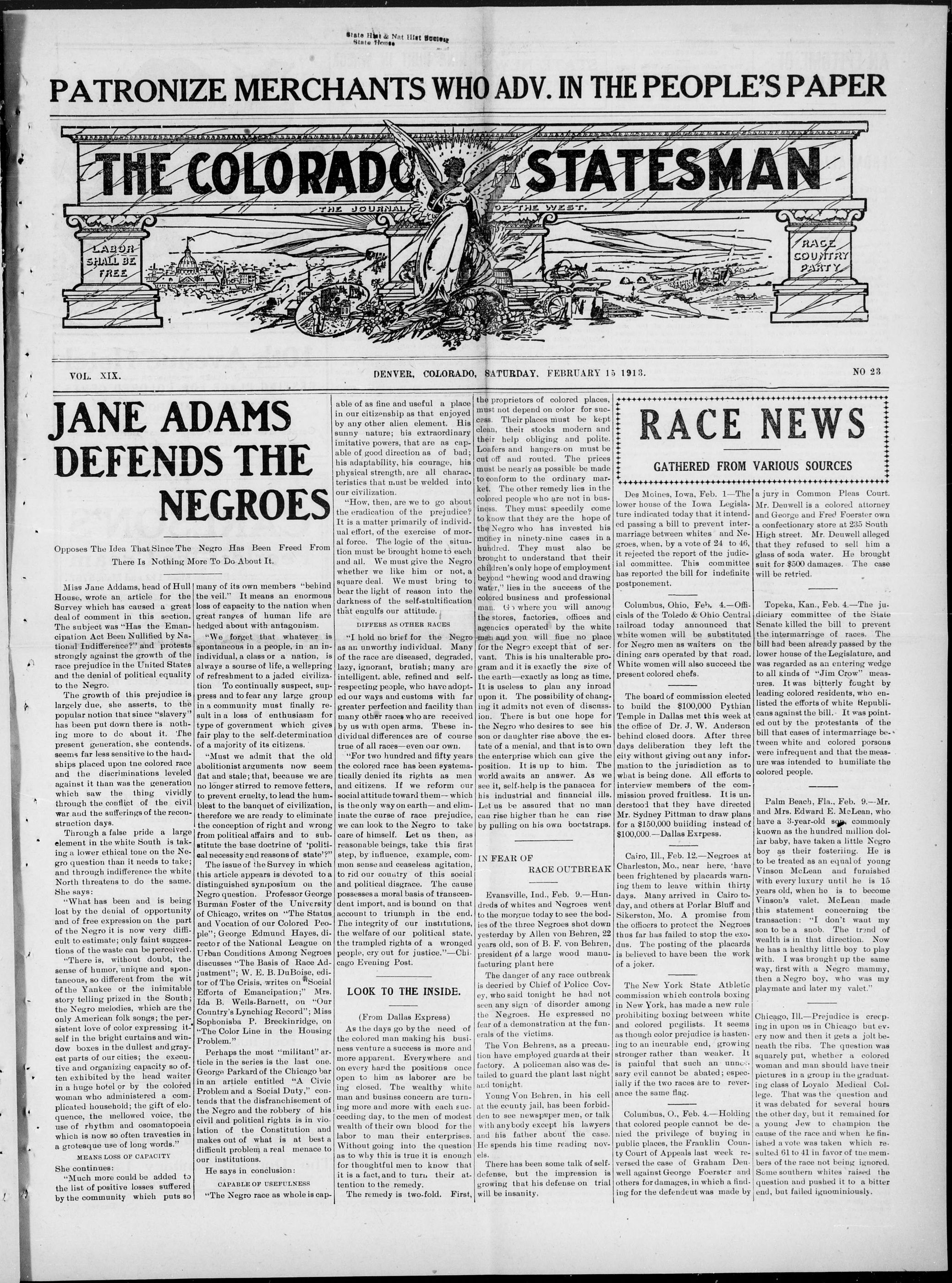
JANE ADAMS DEFENDS THE NEGROES
Opposes The Idea That Since The Negro Has Been Freed From There Is Nothing More To Do About It.
VOL. XIX.
JANE AND DEFEND N
Opposes The Idea That Since The
There Is Nothing M
Miss Jane Addams, head of Hull House, wrote an article for the Survey which has caused a great deal of comment in this section. The subject was "Has the Emancipation Act Been Nullified by National Indifference?" and protests strongly against the growth of the race prejudice in the United States and the denial of political equality to the Negro.
The growth of this prejudice is largely due, she asserts, to the popular notion that since "slavery" has been put down there is nothing more to do about it. The present generation, she contends, seems far less sensitive to the hardships placed upon the colored race and the discriminations leveled against it than was the generation which saw the thing vividly through the conflict of the civil war and the sufferings of the reconstruction days.
Through a false pride a large element in the white South is taking a lower ethical tone on the Negro question than it needs to take; and through indifference the white North threatens to do the same. She says:
"What has been and is being lost by the denial of opportunity and of free expression on the part of the Negro it is now very difficult to estimate; only faint suggestions of the waste can be perceived.
"There is, without doubt, the sense of humor, unique and spontaneous, so different from the wit of the Yankee or the inimitable story telling prized in the South; the Negro melodies, which are the only American folk songs; the persistent love of color expressing itself in the bright curtains and window boxes in the dullest and grayest parts of our cities; the executive and organizing capacity so often exhibited by the head waiter in a huge hotel or by the colored woman who administered a complicated household; the gift of eloquence, the mellowed voice, the use of rhythm and osomatopoeia which is now so often travesties in a grotesque use of long words."
MEANS LOSS OF CAPACITY
She continues:
"Much more could be added to the list of positive losses suffered by the community which puts so
---
many of its own members "behind the veil." It means an enormous loss of capacity to the nation when great ranges of human life are hedged about with antagonism. "We forget that whatever is spontaneous in a people, in an inindividual, a class or a nation, is always a source of life, a wellspring of refreshment to a jaded civilization To continually suspect, suppress and to fear any large group in a community must finally result in a loss of enthusiasm for type of government which gives fair play to the self-determination of a majority of its citizens.
"Must we admit that the old abolitionist arguments now seem flat and stale; that, because we are no longer stirred to remove fetters, to prevent cruelty, to lead the humblest to the banquet of civilization, therefore we are ready to eliminate the conception of right and wrong from political affairs and to substitute the base doctrine of 'political necessity and reasons of state'?"
The issue of the Survey in which this article appears is devoted to a distinguished symposium on the Negro question. Professor George Burman Foster of the University of Chicago, writes on "The Status and Vocation of our Colored People"; George Edmund Hayes, director of the National League on Urban Conditions Among Negroes discusses "The Basis of Race Adjustment"; W. E. B. DuBoise, editor of The Crisis, writes on Social Efforts of Emancipation"; Mrs. Ida B. Wells-Barnett, on "Our Country's Lynching Record"; Miss Sophonisba P. Breckinridge, on "The Color Line in the Housing Problem."
Perhaps the most "militant" article in the series is the last one. George Parkard of the Chicago bar in an article entitled "A Civic Problem and a Social Duty," contends that the disfranchisement of the Negro and the robbery of his civil and political rights is in violation of the Constitution and makes out of what is at best a difficult problem a real menace to our institutions.
He says in conclusion:
CAPABLE OF USEFULNESS "The Negro race as whole is cap-
DENVER, COLORADO, SATURDAY, FEBRUARY 15 1913.
State Hist & Nat Hist Biosoc
State House
HANTS WH
ADO
THE JOURNAL
DENVER, COLORADO
able of as fine and useful a place in our citizenship as that enjoyed by any other alien element. His sunny nature; his extraordinary imitative powers, that are as capable of good direction as of bad; his adaptability, his courage, his physical strength, are all characteristics that must be welded into our civilization.
"How, then, are we to go about the eradication of the prejudice? It is a matter primarily of individual effort, of the exercise of moral force. The logic of the situation must be brought home to each and all. We must give the Negro whether we like him or not, a square deal. We must bring to bear the light of reason into the darkness of the self-stultification that engulfs our attitude.
DIFFERS AS OTHER RACES
"I hold no brief for the Negro as an unworthy individual. Many of the race are diseased, degraded, lazy, ignorant, brutish; many are intelligent, able, refined and self-respecting people, who have adopted our ways and customs with far greater perfection and facility than many other races who are received by us with open arms. These individual differences are of course true of all races—even our own.
"For two hundred and fifty years the colored race has been systematically denied its rights as men and citizens. If we reform our social attitude toward them—which is the only way on earth—and eliminate the curse of race prejudice, we can look to the Negro to take care of himself. Let us then, as reasonable beings, take this first step, by influence, example, common sense and ceaseless agitation, to rid our country of this social and political disgrace. The cause possesses a moral basis of transcendent import, and is bound on that account to triumph in the end. The integrity of our institutions, the welfare of our political state, the trampled rights of a wronged people, cry out for justice."—Chicago Evening Post.
LOOK TO THE INSIDE.
(From Dallas Express)
As the days go by the need of the colored man making his business venture a success is more and more apparent. Everywhere and on every hand the positions once open to him as laborer are being closed. The wealthy white man and business concern are turning more and more with each succeeding day, to the men of modest wealth of their own blood for the labor to man their enterprises. Without going into the question as to why this is true it is enough for thoughtful men to know that it is a fact, and to turn their attention to the remedy.
The remedy is two-fold. First,
the proprietors of colored places, must not depend on color for success. Their places must be kept clean, their stocks modern and their help obliging and polite. Loafers and hangers-on must be cut off and routed. The prices must be nearly as possible be made to conform to the ordinary market. The other remedy lies in the colored people who are not in business. They must speedily come to know that they are the hope of the Negro who has invested his money in ninety-nine cases in a hundred. They must also be brought to understand that their children's only hope of employment beyond "hewing wood and drawing water," lies in the success of the colored business and professional man. Go where you will among the stores, factories, offices and agencies operated by the white man and you will fine no place for the Negro except that of servant. This is his unalterable program and it is exactly the size of the earth—exactly as long as time. It is useless to plan any inroad upon it. The possibility of changing it admits not even of discussion. There is but one hope for the Negro who desires to see his son or daughter rise above the estate of a menial, and that is to own the enterprise which can give the position. It is up to him. The world awaits an answer. As we see it, self-help is the panacea for his industrial and financial ills. Let us be assured that no man can rise higher than he can rise by pulling on his own bootstraps.
IN FEAR OF
RACE OUTBREAK
Evansville, Ind., Feb. 9.—Hundreds of whites and Negroes went to the morgue today to see the bodies of the three Negroes shot down yesterday by Allen von Behren, 22 years old, son of B. F. von Behren, president of a large wood manufacturing plant here
The danger of any race outbreak is decried by Chief of Police Covey, who said tonight he had not seen any sign of disorder among the Negroes. He expressed no fear of a demonstration at the funerals of the victims.
The Von Behrens, as a precaution have employed guards at their factory. A policeman also was detailed to guard the plant last night and tonight.
Young Von Behren, in his cell at the county jail, has been forbidden to see newspuper men, or talk with anybody except his lawyers and his father about the case. He spends his time reading novels.
There has been some talk of self defense, but the impression is growing that his defense on trial will be insanity.
RACE NEWS
Des Moines, Iowa, Feb. 1—The lower house of the Iowa Legislature indicated today that it intended passing a bill to prevent intermarriage between whites and Negroes, when, by a vote of 24 to 46, it rejected the report of the judicial committee. This committee has reported the bill for indefinite postponement.
Columbus, Ohio, Feb. 4.—Officials of the Toledo & Ohio Central railroad today announced that white women will be substituted for Negro men as waiters on the dining cars operated by that road. White women will also succeed the present colored chefs.
The board of commission elected to build the $100,000 Pythian Temple in Dallas met this week at the office of Dr. J. W. Anderson behind closed doors. After three days deliberation they left the city without giving out any information to the jurisdiction as to what is being done. All efforts to interview members of the commission proved fruitless. It is understood that they have directed Mr. Sydney Pittman to draw plans for a $150,000 building instead of $100,000.—Dallas Express.
Cairo, Ill., Feb. 12.—Negroes at Charleston, Mo., near here, have been frightened by placards warning them to leave within thirty days. Many arrived in Cairo today, and others at Porlar Bluff and Sikerston, Mo. A promise from the officers to protect the Negroes thus far has failed to stop the exodus. The posting of the placards is believed to have been the work of a joker.
The New York State Athletic commission which controls boxing in New York, has made a new rule prohibiting boxing between white and colored pugilists. It seems as though color prejudice is hastening to an incurable end, growing stronger rather than weaker. It is painful that such an unnecessary evil cannot be abated; especially if the two races are to reverence the same flag.
Columbus, O., Feb. 4.—Holding that colored people cannot be denied the privilege of buying in public places, the Franklin County Court of Appeals last week reversed the case of Graham Denwell against George Foerster and others for damages, in which a finding for the defendeut was made by
NO 23
a jury in Common Pleas Court. Mr. Deuwell is a colored attorney and George and Fred Foerster own a confectionary store at 235 South High street. Mr. Deuwell alleged that they refused to sell him a glass of soda water. He brought suit for $500 damages. The case will be retried.
Topeka, Kan., Feb. 4.—The judiciary committee of the State Senate killed the bill to prevent the intermarriage of races. The bill had been already passed by the lower house of the Legislature, and was regarded as an entering wedge to all kinds of "Jim Crow" measures. It was bitterly fought by leading colored residents, who enlisted the efforts of white Republicans against the bill. It was pointed out by the protestants of the bill that cases of intermarriage between white and colored parsons were infrequent and that the measure was intended to humiliate the colored people.
Palm Beach, Fla., Feb. 9.—Mr. and Mrs. Edward E. McLean, who have a 3-year-old son, commonly known as the hundred million dollar baby, have taken a little Negro boy as their fosterling. He is to be treated as an equal of young Vinson McLean and furnished with every luxury until he is 15 years old, when he is to become Vinson's valet. McLean made this statement concerning the transaction: "I don't want my son to be a snob. The trend of wealth is in that direction. Now he has a healthy little boy to play with. I was brought up the same way, first with a Negro mammy, then a Negro boy, who was my playmate and later my valet."
Chicago, Ill.—Prejudice is creeping in upon us in Chicago but every now and then it gets a jolt beneath the ribs. The question was squarely put, whether a colored woman and man should have their pictures in a group in the graduating class of Loyalo Medical College. That was the question and it was debated for several hours the other day, but it remained for a young Jew to champion the cause of the race and when he finished a vote was taken which resulted 61 to 41 in favor of the members of the race not being ignored. Some southern whites raised the question and pushed it to a bitter end, but failed ignominiously.
AN EPITOME OF LATE LIVE NEWS
CONDENSED RECORD OF THE
PROGRESS OF EVENTS AT
HOME AND ABROAD.
FROM ALL SOURCES
SAYINGS, DOING S, ACHIEVE
MENTS, SUFFERINGS, HOPES
AND FEARS OF MANKIND.
WESTERN.
The armored cruiser South Dakota is under order to start from San Diego for the Mexican coast.
Speed, if you like, if you have new twins at home, is the rule Judge Fry put into force in the "speeders" court at Chicago.
Captain Roald Amundsen, explorer, made public further details of his projected North pole trip at Madison, Wis., according to word received at Chicago.
Robert Heller entered a drug store at San Francisco, asked for a bottle of "painkiller," shot the clerk in the back as he reached for a bottle, and then killed himself.
Devil Rucker, a negro 30 years old, was lynched at Houston, Texas, in the presence of a crowd estimated at 1,000 persons, after he had confessed to the murder of a white woman.
Roy E. Rankin, the Los Angeles detective shot and badly wounded by a Mexican soldier at Tijuana, Lower California has been released by Mexican officials and will be brought to San Diego.
Henry M. Flagler, the Standard Oli magnate, is critically ill at St. Augustine, Fla. Flagler is 83 years old and his condition seems to be the result of a general breakdown rather than of any special disease.
Four members of the house of delegates and one member of the senate of West Virginia were arrested at a hotel at Charleston by Sheriff Bonner Hill, on charges of having accepted money for their votes in the contest for United States senator.
Trousters tighter than ever; coats shortened and close fitting—these are the 1913 spring styles promised to those men who plan to dress in the mode, according to delegates to the annual convention of the National Association of Merchant Tailors of America, who met at Cleveland, Ohio.
Excitement characterized the receipt of news at Laredo, Texas, of the death in Mexico City of General Bernardo Reyes and the escape of Felix Diaz. Both men had many partisans here. Troops are guarding Nuevo Laredo, Mex., in order to prevent a possible uprising in that city.
Saloonkeepers will be permitted to keep their places open only from 7 o'clock in the morning until 7 o'clock in the evening, if a bill passed by the lower House of the Iowa Legislature meets with the same reception in the Senate and is signed by Governor Clarke. The House voted for the bill, 69 to 30.
As the climax of a long-standing family dissension between father and stepsons, E. O. Hammond, aged 51, and Clifford Jenkins, aged 25, were killed, and James Jenkins, aged 21, was severely wounded in a fight which occurred in the farm home of Hammond, near Watertown, S. D. James Jenkins was struck four bullets.
WASHINGTON.
The secretary of the navy and Mrs. George Von Meyer formally announced the engagement of their daughter, Miss Alys Appleton Meyer, to Lieutenant Christopher Raymond Perry Rodgers, U. S. N.
Four warships, two of them battleships, were ordered to Mexican waters to protect American interests and afford a refuge for foreigners by the President, following long conferences of state, war and navy officials.
Attorney General Wickersham announced that he had reached an agreement with the representatives of the Union Pacific and Southern Pacific railroads for the dissolution of the great Harriman merger, as decreed by the Supreme Court.
As a result of a conference at the White House three additional battle ships were sent to the east coast of Mexico and orders will be issued once for the immediate placing in commission of two army transports for the transport of troops to Mexico City for the protection of the lives of Americans and foreigners should the situation there grow any worse.
Secretary of the Interior Fisher has issued a statement in defense of officials of the reclamation service against whom charges of incompetence and maladministration have been made by the house subcommittee on interior department expenditures.
Senator Clayton and Watson of West Virginia were exonerated of charges of corruption in their election when the senate by unanimous vote adopted a resolution discharging the elections committee from further consideration of the allegations.
CONGRESSIONAL.
The Senate passed the Webb liquor bill, already passed by the House as a substitute for the Kenyon-Sheppard bill.
The House passed the bill forbidding intermarriage of whites with negroes, Chinese, Japanese or Malays, in District of Columbia.
Two battleships, to cost approximately $15,000,000 each, are provided for in the naval bill as reported by the naval affairs committee to the house.
Government ownership or control of telegraph lines is again recommended by Posmaster General Hitchcock in his complete annual report transmitted to congress.
The Clayton resolution for a constitutional amendment for a six year single presidential term, effective in 1921 to exempt Taft, Wilson or Roosevelt from its operation, was put over to the next congress by the house judiciary committee.
In an argument against the Connecticut dam bill, Senator Charles S. Thomas conveyed to the senate the message of the West as to the threatened policy of government control of water powers and other natural resources in which the states are admitted to hold property.
Official proclamation of the election of Woodrow Wilson and Thomas R. Marshall as president and vicepresident of the United States was made in the house of representatives before the joint convention of the house and senate, called to count, verify and announce the electoral vote of the states.
SPORT.
Battling Nelson knocked out Harry Dillon of New York in the tenth round of their bout at Tammaqua, Pa.
A divorce from James T. ("Tod") Sloan, the former jockey, has been obtained by his wife, who is Julia Sanderson in the theatrical world.
Larry Cheney's demand from Charles Webb Murphy for $5,000 salary for the year 1913 is the big topic among the fans in Oklahoma at the present time, and the fans are with Cheney.
Mike Yokel of Salt Lake City, won at Duluth the middleweight championship wrestling title from Walter Miller of St. Paul. Yokel took the first fall in one hour and ten minutes, and the second in eighteen minutes.
According to the official figures furnished by Secretary Abe Langtry, the thirteenth annual tournament of the American Bowling Congress, to open in Toledo, O., February 22, has 503 five-men teams entered; also 1,165 two-men teams and 2,367 individuals, and the total entrance money amounts to $36,060. Of this sum $24,000 will go as prize money.
GENERAL
Three murderers were put to death in the electric chair in Sing Sing prison, at Ossining, N. Y.
Andrew Carnegie has presented $1,250,000 in four per cent bonds to the Carnegie Foundation to be devoted to the endowment of a "division of educational inquiry and study."
President Taft was criticized at Boston by President (Emeritus) Charles W. Eliot of Harvard university for having paced fourth class postmasters of the country under civil service rules.
Three men were killed in a fight between striking miners and a posse under Captain Fred Lester on the mountain near Mucklow, W. Va. The dead men were members of Lester's force.
Mrs. Grover Cleveland and Thomas Jex Preston were married by President John Grier Hibben of Princeton University in Prospect, the executive residence of the university, at Princeton, N. J.
Cardinal Gibbons, in the presence of clergymen of Brooklyn, Washington and Baltimore conferred the black veil of a Carmelite nun upon Miss Frances Griffiss Potts, daughter of Rear Admiral Potts, retired, of Washington.
Mr. and Mrs. Edward E. McLean, who have a 3-year-old son, commonly known as the hundred million dollar baby, have taken a little negro boy as their fosterling. He is John Winbush, Jr., five years old. He is to be treated as an equal of young Vinson McLean and furnished with every luxury until he is 15 years old, when he is to become Vinson's valet.
FOREIGN
Six persons were killed and 65 seriously injured in the political rioting at Tokio.
One thousand more rurales have gone over to the rebel forces at Mexico City, according to a dispatch received at Laredo, Tex.
Violent political riots broke out in the city of Osaka. The offices of the newspapers which support Prince Kataura, the premier, were attacked by great mobs. Several deaths are reported.
Prince Taro Katsura, premier and minister of foreign affairs of Japan, was stoned by a mob in the streets. Six persons were killed and sixty-five hurt in the riot.
The capture of Bardanjoli hill at Scutari by the Montenegrins cost the victors 200 men in killed and wounded. The Turks left 4,000 men dead and wounded on the field of battle.
The pope's sister, Rosa Sarto, died in Rome of paralysis. She had been ill for some days and the physicians in attendance had expected a fatal outcome. She was 77 years old.
OF INTEREST TO ALL
COLORADO
PEOPLE
Western Newspaper Union News Service.
DATES FOR COMING EVENTS.
Feb. 18-20—Colorado Retail Hardware
and Implement Association at Pu-
lish
March 3-8—Twelfth Annual Automobile Show at Denver.
June—German Turnfest at Denver.
Two highwaymen held up A. M. Begarty, clerk in Denver and got $1,500. They missed $10, which he stated was in his coat pocket.
The total value of the estate left by Mrs. Sarah Platt Decker was $37,605, from which the state will get an inheritance tax of $116.
Marketing farm products to more economical advantage was the great subject at the state meeting of the Farmers' Union in Denver.
Announcement has been made that the lower rates of fire insurance, which will save the people of Greeley between $10,000 and $20,000, are in effect.
On his second trial at Kliowa, George King was again convicted of the murder of Peter Jackson, but this time the punishment fixed was life imprisonment.
Mathew Mast rescued his wife and six children from their burning home on a ranch west of Grand Junction, after they had been almost overcome by smoke.
W. H. Sidley, a Chicago merchant, father of Mrs. Henry S. Foster of Denver, died at Coronado Beach, Cal., after a long illness. Cerebral hemorrhage was the cause.
With a revolver purchased with money he secured by mortgaging his piano, Isaac Eyer, aged 68, a plover of Pueblo, ended his own life by sending a bullet through his brain.
Patrick Code, tried at Brighton for killing Detective Jesse Stingley, was found guilty of murder in the first degree in the verdict returned by the jury and life imprisonment fixed as the penalty.
The state house of representatives voted to drop the contest of Juan A. Torres and John W. Guynn against the seating of Representatives Boyle and Mayer of Las Animas county on charges of election fraud and bribery.
Announcement has been made that work on the United States theater building, a $100,000 moving picture house for Denver, will begin about May 1, when the lease on a restaurant near Sixteenth and Curtis streets, expires.
Investigation of the state penitentiary and Warden Thomas J. Tynan's conduct of the affairs of that institution will be made by Governor Elias M. Ammons and the State Prison Board as the result of formal complaint against Tynan having been filed with him by James Stone, an ex-convict.
Harold B. Paige, alias John S. Smith, alias John Rockwell, was arrested at Julesburg on information from Meriden, Conn., charging him with the killing of Harold Ford. Paige denies his connection with the crime, but admits he is a deserter from the United States infantry stationed at Fort D. A. Russell in Wyoming.
The body of William M. Yeger was found in his cabin near Montrose with a bullet hole in his right shoulder. He had evidently been dead several days. He had been robbed of $100. His team was standing in the stable nearby, and had not been fed or watered since the man was killed. There is no clew to the person who shot him.
Edward Morris of Rapid City, S. D., a visitor at the home of E. Heald, a rancher near Brighton, suffered a fracture of the left arm, and he and four friends had a narrow escape from death when Heald's automobile, in which he and his friends were driving to Denver, overturned on the Brighton road, ten miles northeast of Denver.
By resolution of the board of directors, R. F. Watkins, assistant treasurer of the Denver & Rio Grande railroad, has been authorized to serve as acting treasurer of the company, pending the appointment of a successor to Joseph W. Gilluly, treasurer of the Denver & Rio Grande for twenty-seven years, whose death occurred recently.
The Denver depot commission, which a year ago opposed the granting of a revocable permit to the Burlington railroad for the use of Market street and Walnut streets, at a meeting with Mayor Arnolds outlined the conditions upon which it will withdraw all further objection to the application of the railroad company.
Representatives of the Colorado State Federation of Women's Clubs have started a campaign at the state house to arouse interest in a number of bills endorsed by the federation. Among them are: Bills to abolish capital punishment; for a minimum wage scale for women and children; for social centers, and providing changes in Juvenile Court laws.
Colorado Springs lodge No. 34, Knights of Pythias has purchased the Majestic block on East Bijou street at a cost of $45,000. The building will be remodeled into a temple for the organization. It is planned to spend about $10,000 on improvements.
Senator-Elect John F. Shafroth delivered an address before the faculty and student body of the University of Michigan, in which he denounced Pinchotism as unfair and injurious to Western states. Shafroth is a graduate of Ann Arbor, having been a member of the class of 76 of that school.
NINE HURT IN WRECK
FREIGHT AND MOTOR-CAR CRASH AT VALMONT.
Two Seriously and Seven Persons Slightly Injured; Among Them Three Women.
Boulder—Two persons were seriously injured and seven others slightly hurt when a Union Pacific motor-car collided head-on with a Union Pacific freight train at Valmont, a siding on the Boulder-Brighton line four miles east of Boulder. The most seriously injured are:
Thomas McCune of Liggett, Colo., a passenger on the motor-car; cut about the head and face and possible fracture of the skull.
Charles Gudgel of Boulder, conductor of the motor-car; broken shoulder.
Seven other passengers of the motor-car, three of them women, received minor injuries. All were severely shaken as a result of the impact of the collision.
The ranch of Mrs. A. D. McGee was converted into a temporary hospital until McCune recovered consciousness and was taken to Boulder in an automobile.
The others were taken to Boulder on the freight train.
Contract for 54,000 Railroad Ties. Steamboat Springs. — Contracts were let here to F. H. Cox to furnish ties for eighteen miles of the branch road to be run from here to the antracite fields by the Moffat company. The ties are to be of red spruce and the delivery of 54,000 of them will begin within ten days. The engineers have been cross sectioning the line between here and the anthracite fields as well as the line between Steamboat Springs and Craig. Over 500 men are now at work for the Denver & Salt Lake road, the newly incorporated company for taking over the Moffat road. More deals are now pending on coal lands in large tracts just west of Steamboat Springs than all deals combined in the past. The Erb syndicate will control over forty thousand acres of the higher grade coal.
Strike Oil in the San Juan.
Durango.—The entire San Juan is greatly excited by an oil strike just made by the Little Standard Oil Company, twelve miles northwest of Farmington, N. M. Merchants and farmers are leaving their business and flocking to the scene of the strike in the Meadows oil fields. The whole country for miles around is being staked. The strike was made at a depth of 1,700 feet and the oil rose to within 400 feet of the surface. Sixty barrels have been taken from the well. The oil is a superior grade of illuminating oil, with a paraffin base and no asphalt. Local business men are confident that the strike will be followed by the immediate building of a broad-gauge road to connect Durango and the San Juan basin with the Southern Pacific and Santa Fé and furnish the long-planned outlet to the south and southwest.
Colorado Fugitive Freed.
Denver.—The governor of Arizona refused to grant the extradition of Charles Taylor, state boiler inspector of Colorado under Governor Buchtel, charged with the embezzlement of $16,000 in state funds. The governor released Taylor, for whom a bonding company searched for four years before it effected his arrest at Globe, four weeks ago.
Jury Awards O'Brien Big Sum.
Colorado Springs.—William O'Brien, an attorney of this city, was awarded a judgment for $152,461.06 by a jury in the District Court and thus becomes a winner again in his long fight for a share of the huge profits made by Richard J. Bolles in the sale of Florida fruit lands. O'Brien sued Bolles for $301,000 for services rendered and money advanced.
McCallin's Death Still a Mystery.
Cripple Creek, Colo.—The coroner's jury which investigated the killing of Charles McCallin, the Denver young mine student, whose body was found in the manway of the Strong shaft, returned a verdict that death was due to falling into the manway but what caused him to fall was unknown.
At Last, Stratton Home Work Begins. Colorado Springs.—After more than ten years' delay, actual work has been started on the Myron Stratton Home for the Poor. Edward Honin, a subcontractor, is excavating the site at Broadmoor.
Sandburr Causes Poisoning. Greeley.—Mrs. J. Halbrook is suffering from blood poisoning as the result of pricking her ankle with a sandburr.
Incubator Baby Dies
Boulder.—The little incubator baby to save which the medical skill at the university hospital has been exerted for the last two weeks, is dead. The child was the son of Mr. and Mrs. J. J. Waltz, Kennebec, S. D. He weighed less than three pounds when born.
Record Sheep Shipment Made.
Greeley.—One of the largest sheep shipments of the season from northern Colorado left Greeley when sixty cars were started for market.
The
Curtis
Park
Floral
Company
FLORAL DESIGNS PUT UP WHILE
YOU WAIT
CHOICE PLANTS AND CUT FLOWERS CONSTANTLY
ON HAND
GREENHOUSES: Thirty-Fourth and Curtis Streets
TELEPHONE, MAIN 1511
DENVER, COLO
Corner West 10th and Osage, Near Burnham Shops Denver, Colorado
ASK FOR CARLSON'S Peerless Ice Cream Phones: Main 112 and Main 5787
DID YOU EVER TRY Neef Bros.' Beer?
It's made right, and tastes right. None better made anywhere and This is a Strictly Colorado Production
HENRY BECK
JOHN ENGSTROM
BECK & ENGSTROM
WHOLESALE DEALERS IN
WINES, LIQUORS AND CIGARS
1644-40-48-50 LARIMER STREET.
PHONE MAIN 1053.
DENVER, COLO.
Western agents for Minneapolis Grnin Belt Beer and Carnegie Porter,
Pripps Imported Beer and Bock 01.
A first-class Mortuary establishment. First aid to the bereaved in the time of death of loved ones. Prices below competitors. Polite service LAWRENCE JONES, Licenced Embalmer LOUIS HUBBARD, Funeral Director
The Denver Sanitary Laundry. PHONE MAIN 5670
Corner Nineteenth
HENRY BECK
BEC
WINES
PHONE MAIN 100
Western agents f
DAY OR NIGHT
A.
U
A first-class M
time of death of lo
LAWRE
LOUIS I
PARLORS
LET
Shirts, Co
Curtains
The Den
1082 Broadway.
BE SURE AN TRY IT.
RES. PHONE GALLUP 942
RETTIG
Staple Groceries
STREET
Denver, Colo.
COLORADO LEGISLATIVE DOINGS
Western Newspaper Union News Service.
AMMONS TO HAVE FULL POWER.
Bills to Give Governor Power to Cut Salaries to Fit Work to Pass.
Denver.—Bills that give the governor practically unlimited powers over all state departments, bureaus, boards and commissions will be placed with platform measures and passed, according to the decision of Senate leaders.
These bills will enable the governor to suspend any bureau, board or commission; reduce the wages of all employees or make any consolidation he deems necessary.
The measures will permit a reduction of wages even among those employees coming under civil service.
Passes Bank and Highway Bills.
Denver.—Three bils, making provisions for a bank guaranty fund, a one-man state highway commission and the restricted use of vehicles at elections, have been passed on third reading by the State House of Representatives. They now go to the Senate for its approval.
Bills Introduced in the House.
H. B. 161, Norvell—To conserve human life by establishing summer home for infants.
H. B. 162, Norvell—To license sale of food and drugs.
H. B. 163, Lee—Chancery powers of courts in cases of delinquency of children.
H. B. 164, Lewis and Ferguson—Railroad block system.
H. B. 165, Skinner—Public revenue.
H. B. 166, Rowan—Concerning powers of incorporated towns and cities.
H. B. 167, Rowan—Public road
H. B. 168 Wright—Titles and guarantee.
H. B. 169, Wright—Duties of health officers in handling tuberculosis.
H. B. 170, Smith—State Industrial School land.
H. B. 171, Smith—Support of industrial school.
H. B. 172, Smith—Support of Home for Mental Defectives.
H. B. 173, Norvell—To divide the state into fourteen judicial districts.
H. B. 174, Ardourel and Sweet—Providing for the day in question.
H. B. 175, Rowan—Appropriating money to pay vouchers issued by the state board of medical examiners.
H. B. 176, Riddle—To submit an amendment to section 23 of article 2 of the constitution.
H. B. 177, Gallup—Requiring corporations doing business in Colorado to have two regular pay days in each month.
H. B. 178, Perl B. Gates—Providing for a commission to revise, consolidate and suggest amendments to the laws of the state of Colorado which pertain to women and children.
H. B. 179, Mitchell—To permit operation to the prevention of procreation.
H. B. 183, Doyle—Providing certain electors to vote when absent from their residence.
H. B. 181, Finch—To divide the state into four congressional districts.
H. B. 182, Turnbull and Carrig—To establish the width of lode mining claims.
H. B. 183, Kavanaugh—Making an approximation for the state board of immigration.
H. B. 184, Kavanaugh and Dalley—Relating to allowance of claims of widows, orphans and creditors.
H. B. 185. Hawkins—Concerning irrigation engineers and other irrigation officials.
H. B. 186, Kavanaugh—Relating to costs.
H. B. 187, Old—Concerning revenue.
H. B. 188, Wright—Concerning practice in courts of record.
H. B. 189, Wright—Relating to procedure in courts.
H. B. 190. Goss. Ardourel, Skinner, P.
B. Bates, Richards, Riddle—Regulating rates of interest.
H. B. 191. Philip-Regulating insurance company
H. B. 192. Philip-Insurance.
H. B. 193. Skinner and Dalley-Regulating capacity of water power Blank
M. B. 194, Skinner and Dalley—Regulating acreage of coal lands that can be held by corporations.
H. B. 195, Persons—Day of rest.
H. B. 196, Old—In relation to surety bonds.
H. B. 197, Williams—Requiring railroads to equip engines with certain headlights.
H. B. 200, Tait—Rate of interest.
H. B. 201, Rowan—Practice of medicine.
H. B. 202, Finch—Expenses of district judges and district court stenographers.
H. B. 203. Persons—To extend jurisdiction of railroad commission to include cases.
H. B. 204. Tait—In relation to individual suretship.
H. B. 205. Newton—Issuance of irrigation bonds.
H. B. 206, Newton—Safety of railroad employés.
H. B. 210, McCarty—Insurance department.
H. B. 215, Wright—To establish country of Steele.
H. B. 216, Cunningham—Support of state agricultural college.
H. B. 217, Biles—Public charitable buildings.
H. B. 218, Talt—Amendment.
H. B. 219, Talt—To create public administrators and to define their duties.
H. B. 220, Riddle and Goss—Concerning the office of state dairy commis-
H. B. 221, Fincher—Concerning railroads.
H. B. 222, Ardourel—Appropriation for the University of Colorado.
H. B. 223. Ardourel—To amena sec-
torer the university of Colorado to be
expended on new buildings, completion
of grounds, approved June 5, 1913.
running backwards of locomotives,
south and Woods—Corrupt practices act
H. B. 230, Blles—Vital statistics.
H. B. 231, Wright—Publication of session laws.
0
PREVENT REFERRING MEASURES.
State Legislature Finds Way to Thwart Initiated Bills.
Western Newspaper Union News Service.
Denver.—By the insertion of an "emergency" clause in any bill which it so pleases to treat, the Legislature may find a way to prevent the referring of measures passed by it to the people and in that regard thwart the initiative and referendum.
First action of this kind was taken in the House of Representatives when the good roads commissioner bill was passed in that body on third and final reading including the following clause, which is section 13:
"It is hereby declared that this act is necessary for the immediate preservation of public safety."
Speaker O. C. Skinner contends that the clause will prevent a referendum on the bill that might be sought by enemies of the measure. The clause is not the ordinary "emergency" clause attached to emergency bills hitherto but is one that has been used in Oregon bills with special intention to prevent referendums. The Oregon Supreme Court has held that a bill containing the clause cannot be referred.
New Members of State Home Board.
Denver. — Governor Ammons appointed Mrs. Margaret Patterson-Campbell a member of the board of directors of the State Home for Dependent Children, to fill the vacancy caused by the resignation of Mrs. C. J. Hughes, Jr. John T. Barnett, former attorney general, was appointed a member of the board to succeed E. J. Wilcox, resigned.
To Purchase Well Drilling Outfit.
Denver.—A bill introduced in the lower branch of the Legislature by Representative Agnes Riddle and Chester E. Smedley, calling for a $3,000 appropriation for the purchase by the state of a well-drilling outfit to be used on the semi-arid lands in eastern Colorado, is attracting much attention from the farming element.
Bills Introduced in the Senate.
S. B. 128, Garman—Forbidding the employment of girls as messengers in cities of 10,000 or over; forbidding girls in street avocations, and forbidding any individual twelve years of age to sell newspapers.
S. B. 129, Morris—Requiring all railroads in Colorado to install the block system.
S. B. 120, Hecker—Relating to probate of wills so an administrator will be paid for his work.
S. B. 131, Carver—Regulating location of sanitariums; property owners within a mile in unincorporated territory must give their consent for the location. S. B. 132, Joyce—Providing for relief of Peter Jennings. S. B. 133, Joyce and Representative Dailey — Permitting electors absent from their vote to register any place presentation in their registration certificate, from their home precinct.
S. B. 135, Cornforth—Appropriation for state board of immigration.
S. B. 136, Tobin—Providing that individuals and corporations may not control more than 5,000 acres of state coal land.
S. B. 137, Tobin—Amending the law creating the state dental board, so that the governor has some say in its creation.
S. B. 138, Morris—Providing for surgical operations in certain cases of malignant tumors in the breast.
S. B. 139, Van Tilbor—Guaranteeing the bonds of the judiciary.
S. B. 140, Tobin—Regulating the ca
capacity of water plants. S. B. 141, Stephan—Creating two water districts. S. B. 142, Stephan—Amending the law governing two water districts. S. B. 143, Hayden—Placing county judges and county clerks on a salary basis.
S. B. 144, Hayden—Providing for the state paying the necessary traveling expenses of judges, clerks and district attorneys.
S. B. 145, Stephan—Regulating heavy wagons on certain state roads. The bill is aimed at the preservation of the most important state automobile highways.
S. B. 146, Affolter—Providing for the emergency services.
S. B. 147, Helen R. Robinson—Providing for a minimum wage schedule for women.
S. B. 148, Parrish—Providing for the traveling expenses of county judges.
S. B. 149, W. C. Robinson—Concern-
S. B. 151—Carver—Appropriation for part of expenses of state industrial school.
S. B. 152, Tlerney—An act prohibiting publicity of acts in which children are involved; juvenile court bill.
B. 153, Tierney—Fixing $3,000 as sage of the office and abolishing all fees of the office.
S. B. 154. Tierney—Defining powers of state engineer.
boundaries of water district No. 23.
S. B. 159. Weiland—Fixing expenses of county judges.
S. B. 160. Burris—Appropriation for state insane asylum, and for improvements.
S. B. 161. Cross—Providing that country school districts may send pupil to school.
S. B. 162. Cross—Providing for a commission, composed of the governor, attorney general and secretary of state to pass on charters for corporatism.
S. B. 163. Reynolds—Appropriation for normal school at Greeley.
S. B. 164. Reynolds—Creating a state summer home for infants.
S. B. 165. Garman—Licensing sale of food and drugs.
S. B. 165. Garman—Regulating embalming and creating state board of embalming examiners.
S. B. 167. Cross—Providing for fish hatchery in Larval county.
S. B. 168. Cross—Providing for fish hatchery in Supreme
Court right to fix legal procedure.
S. B. 170, Tobin—Concerning procedure in courts of records, abolishes appeals.
S. B. 169, Tobin—Establishing a bureau of bee inspection.
S. B. 171, Tobin—Regulating legal procedure in Supreme Court.
S. B. 172, Tobin—Creating public administrators.
S. B. 173, Cross—Appropriation for state agricultural college, including purchase of land for experiments and agricultural teachers in rural schools.
S. B. 174, Garman—Providing for licensure.
S. B. 175, Van Tilborn—Providing for screens at openings of irrigating ditches for the protection of fish.
S. B. 176, W. C. Robinson—For the protection of fish and game.
S. B. 177, Stephan—Making Mills' Ancestral坟墓.
S. B. 178, Helen R. Robinson—For the transfer of funds in the school fund.
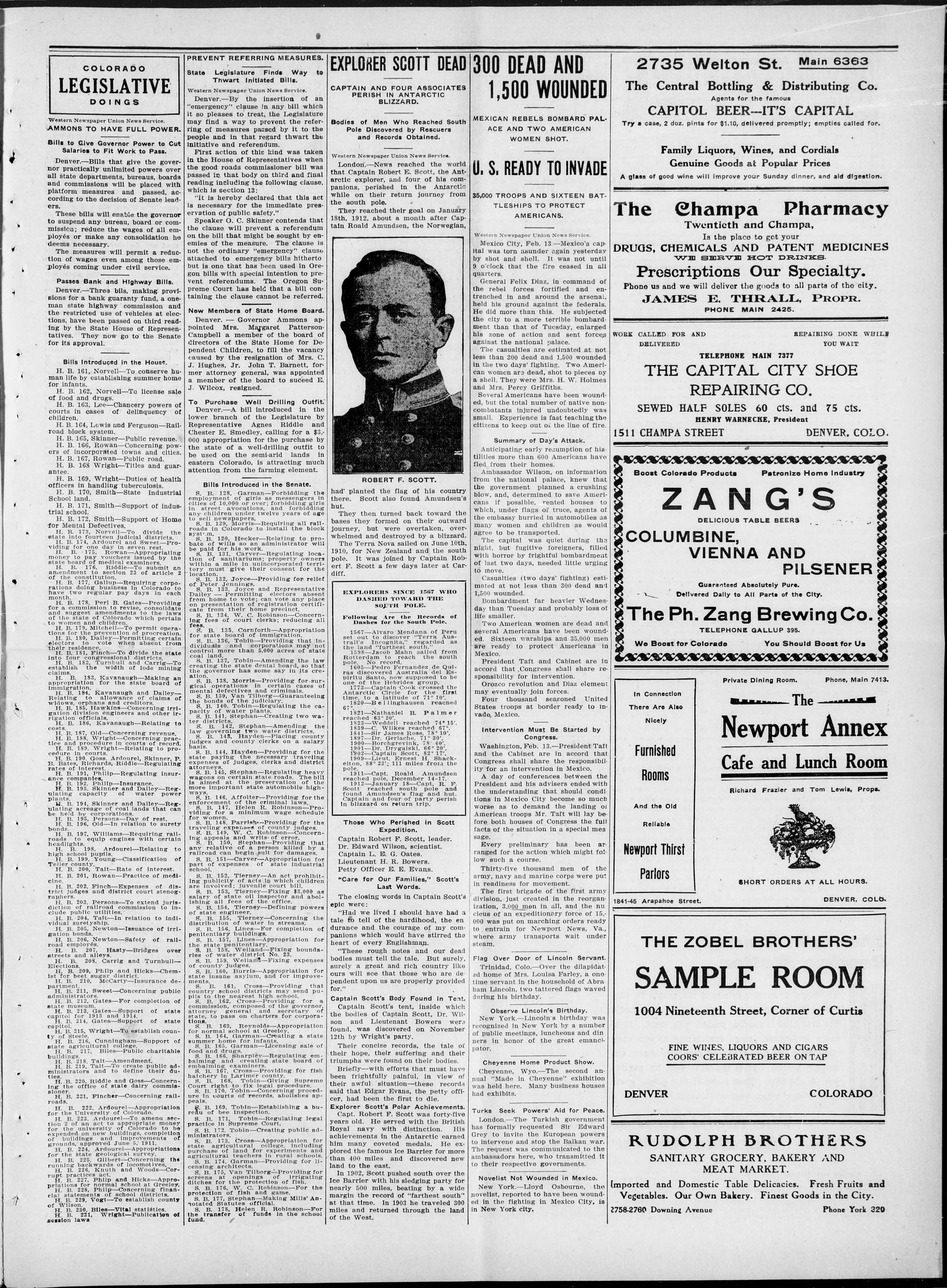
CAPTAIN AND FOUR ASSOCIATES PERISH IN ANTARCTIC BLIZZARD.
Bodies of Men Who Reached South Pole Discovered by Rescuers and Records Obtained.
London.—News reached the world that Captain Robert E. Scott, the Antarctic explorer, and four of his companions, perished in the Antarctic on their return journey from the south pole. They reached their goal on January 18th, 1912, about a month after Captain Roald Amundsen, the Norwegian,
J.
ROBERT F. SCOTT.
had' planted the flag of his country there. Scott also found Amundsen's hut.
They then turned back toward the bases they formed on their outward journey, but were overtaken, overwhelmed and destroyed by a blizzard.
The Terra Nova sailed on June 10th, 1910, for New Zealand and the south pole. It was joined by Captain Robert F. Scott a few days later at Cardiff.
EXPLORERS SINCE 1567 WHO DASHED TOWARD THE SOUTH POLE.
Following Are the Records of Dashes for the South Pole.
1567—Alvaro Mendana of Peru set out to discover "Terra Austral's Incognita," regarded as the land "furtest south." 1588—Jacob Mahn sailed from Rotherham to reach the south pole. No record.
1605—Pedro Fernandez de Quiras discovered Australia del Esoflo to be one of the Hebrides group.
1773—Captain Cook crossed the Antarctic Circle for the first time, to a latitude of 71°10'. 1829—Bellingshausen reached 67°.
1821—Nathaniel B. Palmer reached 63°20'. 1829—Bell reached 74°15'. 1839—C. Wilkes reached 67'. 1841—Sir James Ross, 78°10'. 1843—Dr. Gerlache, 71°30'. 1847—Borchgrewe, 71°30'. 1901—Dr. Dalskij 66°20'. 1903—Captain Scott, 82°17'. 1909—Lieut. Ernest H. Shackleton, 88°23'; 111 miles from the pole.
1911—Capt. Roald Amundsen reached pole, December 14-17.
1912—January 18—Capt. R. F.
Scott reached south pole and
found Amundsen's flag and hut.
He set up a camp in perish
in blizzard on return trip.
Those Who Perished in Scott Expedition.
Captain Robert F. Scott, leader.
Dr. Edward Wilson, scientist.
Captain L. E. G. Oates.
Lieutenant H. R. Bowers.
Petty Officer E. E. Evans.
"Care for Our Families," Scott's Last Words.
The closing words in Captain Scott's epic were:
"Had we lived I should have had a tale to tell of the hardihood, the endurance and the courage of my companions which would have stirred the heart of every Englishman.
"These rough notes and our dead bodies must tell the tale. But surely, surely a great and rich country like ours will see that those who are dependent upon us are properly provided for."
Captain Scott's Body Found in Tent.
Captain Scott's tent, inside which the bodies of Captain Scott, Dr. Wilson and Lieutenant Bowers were found, was discovered on November 12th by Wright's party.
Their concise records, the tale of their hope, their suffering and their triumphs were found on their bodies.
Briefly—with efforts that must have been frightfully painful, in view of their awful situation—these records said that Edgar Evans, the petty officer, had been the first to die.
Explorer Scott's Polar Achievements.
Capt. Robert F. Scott was forty-five years old. He served with the British Royal navy with distinction. His achievements in the Antarctic earned him many coveted medals. He explored the famous Ice Barrier for more than 400 miles and discovered new land to the east.
In 1902, Scott pushed south over the Ice Barrier with his sledging party for nearly 500 miles, beating by a wide margin the record of "farthest south" at that time. In 1903 he traveled 300 miles and returned through the land of the West.
300 DEAD AND 1,500 WOUNDED
MEXICAN REBELS BOMBARD PAL
ACE AND TWO AMERICAN
WOMEN SHOT.
U. S. READY TO INVADE
35,000 TROOPS AND SIXTEEN BATTLESHIPS TO PROTECT AMERICANS.
Western Newspaper Union News Service.
Mexico City, Feb. 13 — Mexico's capital was torn asunder again yesterday by shot and shell. It was not until 9 o'clock that the fire ceased in all quarters.
General Felix Diaz, in command of the rebel forces fortified and entrenched in and around the arsenal, held his ground against the federals. He did more than this. He subjected the city to a more terrible bombardment than that of Tuesday, enlarged his zone of action and sent forces against the national palace.
The casualties are estimated at not less than 300 dead and 1,500 wounded in the two days' fighting. Two American women are dead, shot to pieces by a shell. They were Mrs. H. W. Holmes and Mrs. Percy Griffiths. Several Americans have been wounded, but the total number of native noncombatants injured undoubtedly was small. Experience is fast teaching the citizens to keep out of the line of fire.
Summary of Day's Attack.
Anticipating early recumption of histilies more than 600 Americans have fled from their homes.
Ambassador Wilson, on information from the national palace, knew that the government planned a crushing blow, and, determined to save Americans if possible, rented houses to which, under flags of truce, agents of the embassy hurried in automobiles as many women and children as would agree to be transported.
The capital was quiet during the night, but fugitive foreigners, filled with horror by frightful bombardment of last two days, needed little urging to move.
Casualties (two days' fighting) estimated at not less than 300 dead and 1,500 wounded.
Bombardment far heavier Wednesday than Tuesday and probably loss of life smaller.
Two American women are dead and several Americans have been wounded. Sixteen warships and 35,000 men are ready to protect Americans in Mexico. President Taft and Cabinet are in accord that Congress shall share responsibility for intervention. Orozco revolution and Diaz element may eventually join forces. Four thousand seasoned United States troops at border ready to invade Mexico.
Intervention Must Be Started by Congress.
Washington, Feb. 13.—President Taft and the Cabinet are in accord that Congress shall share the responsibility for an intervention in Mexico. A day of conferences between the President and his advisers ended with the understanding that should conditions in Mexico City become so much worse as to demand the landing or American troops Mr. Taft will lay before both houses of Congress the full facts of the situation in a special message. Every preliminary has been arranged for the action which might follow such a course. Thirty-five thousand men of the army, navy and marine corps were put in readiness for movement.
The first brigade of the first army division, just created in the reorganization, 3,000 men in all, and the nucleus of an expeditionary force of 15,000 was put on marching orders ready to entrain for Newport News, Va., where army transports wait under steam.
Flag Over Door of Lincoln Servant.
Trinidad, Colo.—Over the dilapidated home of Mrs. Louisa Farley, a one-time servant in the household of Abraham Lincoln, two tattered flags waved during his birthday.
Observe Lincoln's Birthday.
New York.—Lincoln's birthday was recognized in New York by a number of public meetings, luncheons and dinners in honor of the great emancipator.
Chevenne Home Product Show.
Cheyenne, Wyo.—The second annual "Made in Cheyenne" exhibition was held here. Many business houses had exhibits.
London.—The Turkish government has formally requested Sir Edward Grey to invite the European powers to intervene and stop the Balkan war. The request was communicated to the ambassadors here, who transmitted it to their respective governments.
Novelist Not Wounded in Mexico.
New York.—Lloyd Osbourne, the novelist, reported to have been wounded in the fighting in Mexico City, is in New York city.
2735 Welton St. Main 6363
The Central Bottling & Distributing Co.
Agents for the famous
CAPITOL BEER---IT'S CAPITAL
Try a case, 2 doz. pints for $1.10, delivered promptly; empties called for.
Family Liquors, Wines, and Cordials
The Champa Pharmacy
Prescriptions Our Specialty. Phone us and we will deliver the goods to all parts of the city. JAMES E. THRALL, PROPR. PHONE MAIN 2425.
WORK CALLED FOR AND DELIVERED
THE CA
RE
SEWED HALF
HE
1511 CHAMPA STR
Boost Colorado P
ZA
DE
COLUMB
VI
THE CAPITAL CITY SH
REPAIRING CO.
ED HALF SOLES 60 cts. and 7
HENRY WARNECKE, President
IMPA STREET DENV
Colorado Products Patronize Home
ZANG'S
ZANG'S
DELICIOUS TABLE BEERS
LUMBINE,
VIENNA AND
PILSE
Guaranteed Absolutely Pure.
Delivered Dally to All Parts of the City.
The Ph. 2
We Boost for Colo
Ph. Zang Brewing
TELEPHONE GALLUP 395.
ost for Colorado You Should Boo
Newport A Cafe and Lunc
Newport Thirst
THE ZOBEL BROTHE
AMPLE ROO
Nineteenth Street, Corner of
THE ZO
SAMI
1004 Ninetee
SAMPLE ROOM
1004 Nineteenth Street, Corner of Curtis
FINE WINES, LIQUORS AND CIGARS
COORS' CELEBRATED BEER ON TAP
DOLPH BROTHERS
NITARY GROCERY, BAKERY A
RUDOL
SANITARY
Imported and Domes
Vegetables. Our Ow
2758-2760 Downing Avenue
RUDOLPH BROTHERS
SANITARY GROCERY, BAKERY AND MEAT MARKET. Imported and Domestic Table Delicacies. Fresh Fruits and Vegetables. Our Own Bakery. Finest Goods in the City. 2758-2760 Downing Avenue Phone York 320
In Connection There Are Also Nicely
Furnished Rooms
And the Old Reliable
Parlors
DENVER
REPAIRING DONE WHILE
YOU WAIT
TELEPHONE MAIN 7377
CAPITAL CITY SHOE
REPAIRING CO.
LF SOLES 60 cts. and 75 cts.
HENRY WARNECKE, President
STREET DENVER, COLO.
Products Patronize Home Industry
ANG'S
DELICIOUS TABLE BEERS
E, INNA AND PILSENER
ang Brewing Co.
PHONE GALLUP 395.
You Should Boost for Us
Private Dining Room. Phone, Main 7413.
The Newport Annex Cafe and Lunch Room Richard Frazier and Tom Lewis, Props.
SHORT ORDERS AT ALL HOURS.
EL BROTHERS'
LE ROOM
Street, Corner of Curtis
H BROTHERS
COCERY, BAKERY AND
BET MARKET.
Table Delicacies. Fresh Fruits and
bakery. Finest Goods in the City.
Phone York 320
Phone, Main 7413.
DENVER, COLB.
COLORADO
THE COLORADO STATESMAN
SUBSCRIPTION RATES:
One Year ..... $2.00
Six Months ..... 1.00
Taree Months ..... 60
PAYABLE IN ADVANCE.
Entered as second-class matter and Colorado.
All communications of a personate will be withheld from the columns of Display advertising, 25 cents per square.
Reading notices, ten lines or less, over ten lines, 5 cents per line.
No discounts allowed on less than three pany all orders from parties unknown to Remittances should be made by Order, Registered Letter or Bank Draw same as cash for the fractional part of taken.
Communications to receive attentive objects, plainly written only upon one side if possible, anyway, not later than We author. No manuscript returned, unless
It occasionally happens that paper. In case you do not receive any number we will cheerfully forward a duplicate.
less matter at the postoffice
of a personating nature the
columns of this paper.
centes per square. A square
lines or less, 10 cents per
line.
less than three months' con-
tents unknown to us. Further,
be made by Express Money
for Bank Draft. Postage st
national part of a dollar. Only
receive attention must be ne-
upon one side of the paper,
less than Wednesdays, and
turned, unless stamps are
that papers sent to sub-
any number when due, infi
d a duplicate of the missi
Entered as second-class matter at the postoffice in the city of Denver, Colorado.
All communications of a personating nature that are not complimentary will be withheld from the columns of this paper.
Display advertising, 25 cents per square. A square contains ten agate lines.
Reading notices, ten lines or less, 10 cents per line. Each additional line over ten lines, 5 cents per line.
No discounts allowed on less than three months' contract. Cash must accompany all orders from parties unknown to us. Further particulars on application.
Remittances should be made by Express Money Order, Postoffice Money Order, Registered Letter or Bank Draft. Postage stamps will be received the same as cash for the fractional part of a dollar. Only 1-cent and 2-cent stamps taken.
Communications to receive attention must be newsy, upon important subjects, plainly written only upon one side of the paper; must reach us Tuesdays, if possible, anyway, not later than Wednesdays, and bear the signature of the author. No manuscript returned, unless stamps are sent for postage.
It occasionally happens that papers sent to subscribers are lost or stolen. In case you do not receive any number when due, inform us by postal card and we will cheerfully forward a duplicate of the missing number.
FREDERICK DOUGLAS.
The 96th anniversary of the great brated by various clubs and societys present week.
The nearest approach to the birthday as to the exact date, Douglas, himself ful inquiry and reckoning on his day of his approach into the world.
It is most fitting that the birth of dice and hate" should be commerate great and noble lives Douglas, with The interest which attached to his pet his deep emotions, stirring thoughts, behalf of freedom has won for him the and leaders. His place and power public speaker Douglas had no peer, tice and wrong his words burnt into.
The race is rich in orators, but if "Soul among his brethren" he towerthrown as a white man into the nation or Calhoun were in the ascendency, light amid the galaxy of great state man of Negro extraction that American son, the race's greatest champion and
The Negro who attempts to do prepared in his finances, and faith with which he must contend, coming Negro is a long ways from base, and contrary many of them are swell he short, ignorant as to the conditions would be led by their more intelligent burying societies, such as will mass some given direction, we would soon put shame to the malignities heaped comes to business as a race, we have that are necessary for success. It is the girls of the race are to get empl colored business men, and if we would attempting to run business, we in a children. Every dollar spent with lishing house, drug store, grocery and some day the very man from w colored man's daughter or son. We good a time as any.
The Right Kind Reading Mat
The home news; the town; the gossip of the first kind of re more important, that given by the outside world. If you should buy. I to you just what
The Re
of the great Frederick D. Davis and societies throughout the country to the birthday of the great Douglas, himself, did not knit on his part, Douglas and the world. In the birth of this "Voice in the commerated. While the great Douglas, without comparison, loved to his personality, the long thoughts, burning words, for him the highest place, and power increases as had no peer. A born oppressor burnt into the conscience of theators, but it is no disparon" he towered above them into the nation's council, ascendency, he still would of great statesmen. He believed that America has yet proved champion and America's f
The 96th anniversary of the great Frederick Douglas was fittingly celebrated by various clubs and societies throughout the country during the present week.
The nearest approach to the birthday of the great leader is February 14th, as to the exact date, Douglas, himself, did not know, but by the most careful inquiry and reckoning on his part, Douglas accepted Feb. 14th as the day of his appointment into the world.
It is most fitting that the birth of this "Voice in the wilderness of prejudice and hate" should be commerated. While the race has produced many great and noble lives Douglas, without comparison, is the greatest of any. The interest which attached to his personality, the giant intellectual strength, his deep emotions, stirring thoughts, burning words and splendid service in behalf of freedom has won for him the highest place in the galaxy of thinkers and leaders. His place and power increases as time moves on. As a public speaker Douglas had no peer. A born opposer of usurpation, injustice and wrong his words burnt into the conscience of his hearers.
The race is rich in orators, but it is no disparagement to say that like "Soul among his brethren" he towered above them all. Had Douglas been thrown as a white man into the nation's council, even when Webster, Clay or Calhoun were in the ascendency, he still would have been the brightest light amid the galaxy of great statesmen. He was the most remarkable man of Negro extraction that America has yet produced. Maryland's greatest son, the race's greatest champion and America's first representative Negro
emptys to do business in a
and faith in his ability
attend, coming as they do
from base, and a very few of
are swell head. puffed up
the conditions which surround
more intelligent brethren in
this will mass their earning.
He would soon grow strong
nities heaped upon us by
race, we have yet to learn
success. It does seem tha-
te to get employment at a
and if we would support those
less, we in a measure, are
spent with colored mer-
cies, grocery or what not, w
man from whom we buy
or son. We must begin
Nt Kind of
Matter
the news; the doings o
the gossip of our own
kind of reading matter
important, more inten-
ten by the paper or
world. It is the fi
ld buy. Each issue
must what you will o
The Right
Reading
The Negro who attempts to do business in any form, must be doubly prepared in his finances, and faith in his ability to grapple with the odds with which he must contend, coming as they do from both races. The Negro is a long ways from base, and a very few of them know it, but on the contrary many of them are swell head, puffed up, self opinionated, and in short, ignorant as to the conditions which surround them. If our people would be led by their more intelligent brethren into organizations other than burying societies, such as will mass their earning and make them felt in some given direction, we would soon grow stronger as a race, as well as put shame to the malignities heaped upon us by our enemies. When it comes to business as a race, we have yet to learn the very first principles that are necessary for success. It does seem that we ought to see that if the girls of the race are to get employment at all, they must get it from colored business men, and if we would support those men, among us, who are attempting to run business, we in a measure, are making a place for our children. Every dollar spent with colored merchants, whether in a publishing house, drug store, grocery or what not, we are helping ourselves, and some day the very man from whom we buy will be able to hire some colored man's daughter or son. We must begin some time and now is as good a time as any.
The Right Kind of Reading Matter
The Right Kind of Reading Matter
The home news; the doings of the people in this town; the gossip of our own community, that's the first kind of reading matter you want. It is more important, more interesting to you than that given by the paper or magazine from the outside world. It is the first reading matter you should buy. Each issue of this paper gives to you just what you will consider
The Right Kind of Reading Matter
It is sometimes hard to find out just how the man who is successful has managed to succeed, but it is always easy to see why failure comes to those who fail.—Chicago Record Herald.
---
in the postoffice in the city of Denver,
ing nature that are not complimentary
this paper.
There. A square contains ten agate lines.
10 cents per line. Each additional line
the months' contract. Cash must accom-
us. Further particulars on application.
Express Money Order, Postoffice Money
. Postage stamps will be received the
1 dollar. Only 1-cent and 2-cent stamps
in must be newsy, upon important sub-
of the paper; must reach us Tuesdays,
Tuesdays, and bear the signature of the
stamps are sent for postage.
is sent to subscribers are lost or stolen,
when due, inform us by postal card and
of the missing number.
Frederick Douglas was fittingly celebrated throughout the country during the day of the great leader is February 14th, did not know, but by the most care it, Douglas accepted Feb. 14th as the occasion of his "Voice in the wilderness of prejudice." While the race has produced many but comparison, is the greatest of any personality, the giant intellectual strength, burning words and splendid service in the highest place in the galaxy of thinkers increases as time moves on. As a result, a born opposer of usurpation, injustice, conscience of his hearers.
It is no disparagement to say that like all above them all. Had Douglas been men's council, even when Webster, Clay he still would have been the brightest men. He was the most remarkable has yet produced. Maryland's greatest America's first representative Negro.
BUSINESS.
Business in any form, must be doubly his ability to grapple with the odds as they do from both races. The very few of them know it, but on the bad, puffed up, self opinionated, and in which surround them. If our people brethren into organizations other than their earning and make them felt in grow stronger as a race, as well as upon us by our enemies. When it is yet to learn the very first principles does seem that we ought to see that if employment at all, they must get it from support those men, among us, who are measure, are making a place for our colored merchants, whether in a pub what not, we are helping ourselves, from we buy will be able to hire some must begin some time and now is as
END of
Matter
The doings of the people in this our own community, that's reading matter you want. It is more interesting to you than paper or magazine from the first reading matter each issue of this paper gives you will consider
RIGHT KIND OF READING Matter
Telephones in Theaters.
On the back of each seat of a new London theater there will be coin in the slot telephones to enable persons with defective hearing to listen to what is being said on the stage.
BUSINESS
can get five per cent. interest on your money the losses for ten days and thirty days of idleness will be $1.38 and $4.16, respectively.
Interest at the rate of six per cent. on $1,000 will amount in ten days to $1.66, and in one month to $5. Six months of idleness, under these conditions, will cost you just $30.
For a great number of investors of moderate income a year's loss of interest on $1,000 represents about two weeks of their own earning power—two weeks' salary or profit from their business. There are mighty few of them who would not see the importance of adding to their year's earnings an extra two weeks' return if the matter could be put to them in that way.
By contrast there are mighty few among the moderate earners of the country who ever undertake to find what may be the current market price for investible money. That $1,000 is your servant. You can put it to work anywhere you please for any sort of master. But—you must learn to choose the master who handles your money with as much care as you choose your own employer.
If you are a competent worker in any established industry you know that there is a standard of wages. And if an employer offers you twice a standard rate of wages you must conclude that he is either such a fool as not to know his business or a rogue who does not intend to pay you what he has promised.
Your money has absolutely no greater purchasing power than any other money used in the thousands of industrial operations of the world; and if a man asks you to let him use your money and promises to pay you more than the easily ascertainable rate you must conclude that he is either ignorant or a knave. In either case your money is not safe with him.
send teachers to the farmers from the agricultural schools. In 1910 we had 50,000,000 acres in wheat and produced 695,000,000 bushels.
The call today is for intelligent young men to go on the farm and do their share in building up the country's wealth.
Our prosperity depends upon the upbuilding of the farm and the advancement of agriculture. The cost of living will be lowered by intensive farming, intensive dairying, intensive trucking and specializing in up-to-date methods.
Do not go to some wondrously way off place for cheap lands. Better hire or buy an acre or two for $500 near the market than fifty acres at $10 an acre far from the market.
The new discovery in agriculture is three cows to an acre, rather than three acres to the cow, $1,000 worth of garden truck to the acre and not ten acres to the $100.
Some Philadelphia school boys cultivated a vacant plot 10x10, sold $5.60 in vegetables—$2,000 an acre.
Japan lives off little land—two or three acres to a family. Denmark and France are prosperous countries, because of prosperous little farms.
Young men, get a piece of land! Study farming!
learned of my mistake, for mistake it surely was. I am one who is found useful as a receptacle for all the snappish and sarcastic remarks by members of the family who have been busy entertaining and acting agreeable to people outside of the family.
And it has at last dawned on me that there are thousands of us who are used to keep the mental balance for those of the younger generation who overdraw on the stock of agreeableness while engaged in laudable outside undertakings.
The disagreeable sides of their natures must have an outlet and who is better fitted to receive and bear all the abuse that has been generating below the surface than the old man?
That a prophet is not without honor, save in his own immediate neck of woods, is also demonstrated by the fact that, many a man, who does not seem to shine in his own home, is known among his friends as a brilliant conversationalist.
A Texas woman has trimmed a hat with $663 in bills and $280 in gold. Now she doesn't dare wear her $943 hat, but she has the distinction of owning the first hat that was ever worth one-sixteenth of the material used in it.
You can judge somewhat of a man's character by noticing where he puts his hen house—near his own dwelling and away from his neighbor's, or away from his own and near his neighbor's, observes the Youth's Companion.
The feeling against America which exists in some parts of the civilized globe is explained by the report of the department of labor, which shows that we supply the world with phonographs.
Los Angeles has opened a school where girls are to be taught dressing is a fine art. We presume the institution will be coeducational with a "hook-me-up" course for prospective husbands.
The man who wants to whip the school teacher for abusing his children is generally so mean to them at home that they crawl under the bed when they see him coming home.
It has been proved that Europe can be toured with $89. But probably a real American tramp could do it on les
Learn to Choose Master Handling Money By JOHN M. OSKISON, Chicago
can get five per cent. interest on your money thirty days of idleness will be $1.38 and $1.60. Interest at the rate of six per cent. on $1.60 to $1.66, and in one month to $5. Six more conditions, will cost you just $30.
For a great number of investors of more interest on $1,000 represents about two power—two weeks' salary or profit from the few of them who would not see the import earnings an extra two weeks' return if they in that way.
By contrast there are mighty few amou country who ever undertake to find what man for investible money. That $1,000 is your work anywhere you please for any sort of it to choose the master who handles your more choose your own employer.
If you are a competent worker in any that there is a standard of wages. And if a standard rate of wages you must conclude as not to know his business or a rogue who what he has promised.
Your money has absolutely no greater other money used in the thousands of indund if a man asks you to let him use you you more than the easily ascertainable rate either ignorant or a knave. In either case him.
Farm Land Boom and Its Many Offerings By Rev. Madison C. Peters, New York
send teachers to the farmers from the agrie had 50,000,000 acres in wheat and produce
If we had succeeded in splitting the twenty-eight bushels to the acre and Great to the acre, we should have had a crop of owe
The call today is for intelligent young do their share in building up the country's
Our prosperity depends upon the uplift advancement of agriculture. The cost of live farming, intensive dairying, intensive up-to-date methods.
Do not go to some wondrously way off hire or buy an acre or two for $500 near at $10 an acre far from the market.
The new discovery in agriculture is three acres to the cow, $1,000 worth of gare the acre and not ten acres to the $100.
Some Philadelphia school boys cultivat plot 10x10, sold $5.60 in vegetables—$2,000
Japan lives off little land—two or tha a family. Denmark and France are prosperies, because of prosperous little farms.
Young men, get a piece of land! S ing!
Every Man Has His Own Place in World
By P. C. PETERSON, Baltimore, Md.
learned of my mistake, for mistake it su-
found useful as a receptacle for all the snap
members of the family who have busy
able to people outside of the family.
And it has at last dawned on me that
are used to keep the mental balance for the
who overdraw on the stock of agreeablene
outside undertakings.
The disagreeable sides of their natures
is better fitted to receive and bear all the a
below the surface than the old man?
We old men really fill a great want.
That a prophet is not without honor, said of woods, is also demonstrated by the fact, not seem to shine in his own home, is known asiant conversationalist.
A Texas woman has trimmed a hat with gold. Now she doesn't dare wear her $943 tion of owning the first hat that was ever material used in it.
You can judge somewhat of a man's c
If you have $1,000 lying idle for ten days when you might be getting three per cent. interest on it your money loss will be 83 cents. In one month your loss will amount to $2.50. If you
of the losses for ten days and 16, respectively.
2,000 will amount in ten days, paths of idleness, under these
operate income a year's loss of weeks of their own earning business. There are mighty face of adding to their year's matter could be put to them
at the moderate earners of the job be the current market price servant. You can put it toaster. But—you must learn with as much care as you established industry you know an employer offers you twice that he is either such a fool does not intend to pay you
purchasing power than any trial operations of the world; money and promises to pay you must conclude that he is your money is not safe with
A hopeful sign for the movement back to the soil is that scientific agriculture is beginning to be taught in the public schools. The proposition is now pending in congress to
cultural schools. In 1910 we 695,000,000 bushels. difference between Germany's Britain's thirty-three bushels a billion and a half bushels men to go on the farm and wealth.ilding of the farm and the ing will be lowered by inten-trucking and specializing in place for cheap lands. Better the market than fifty acres cows to an acre, rather than
Ever since Osler gave the world his dictum as to what should be done with old men I have (being one of them) agreed with him, as I could discover no use for us. At last I have
likely was. I am one who is Irish and sarcastic remarks by entertaining and acting agree there are thousands of us who use of the younger generation as while engaged in laudable must have an outlet and who use that has been generating
Look for This Sign in Front of Our Store.
Look for This Sign in Front of Our Store.
THE
WESTERN
BEEF
Co.
Our store is your store. We are at your service.
OUR MOTTO:
Our profits are small,
But we get them all.
We sell for cash only.
2048 LARIMER ST.
Opposite Three Rules.
Phone Champa 1641.
Open Sunday All Day.
1
Discontinuing the CLOTHING BUSINESS All Suits and Overcoats
To Be Closed Out Regardless of Cost
$15.00 to $25.00 $9.95
Values - - -
$25.00 to $35.00 $17.95
Values - - -
THE
Johnson-Noel Co
1005 SIXTEENTH ST.
THE TIVOLI UNION BREWING CO.
DENVER, COLO.
MAKING WORK EASIER
MATTER OF SAVING ENERGY IS
OF MUCH IMPORTANCE.
In factories the matter of saving energy is made a study; in fact, it has become almost a science, but in the household where there is just as great need of saving every ounce of energy little if any effort is made in this direction. writes Alice R. Quimby in the Chicago American. As a result the average housekeeper goes to her bed at night thoroughly tired and the chances are that she has exerted just about twice as much energy as was actually necessary in the performance of her duties throughout the day. The whole secret lies in studying every task necessary in the running of a household, and learning, if possible, where the same work could be lessened.
Take the beating of eggs, for instance. Almost every woman breaks them in a bowl, stands up in the pantry, tips up the bowl with the left hand and beats them with a fork or else whips them with a wire beater. Sometimes a rotary egg beater is used. In this case it takes both hands and every woman knows that the bowl dances and prances all over the table or the sideboard, or when ever she is working. It takes a great deal of energy to hold this bowl, or to hold the rotary beater in the bowl and keep the bowl from prancing about.
A little wooden arrangement in which a bowl or porcelain dish could be set, holding it firmly on or at the side of an old kitchen table, would surely do away with one-half of this labor, for the woman could then sit down and use both hands in beating the eggs, thereby saving the energy needed in keeping the bowl in place and resting herself by sitting at the same time.
The modern bread-mixer is a cumbersome thing to manage unless it is made firm to a bench or table. Get a tinsmith to solder clamps on the bottom of the mixer, that it may be clamped down securely. This will save fully half the labor in mixing bread.
The bright housekeeper can get a lot of enjoyment out of mapping out her work along the line of least resistance, and after this is done she will find that at the end of the day she has not wasted half the energy she formerly did, and that she is not nearly as tired.
Potato Fritters
Bake about a dozen large, mealy potatoes; break them open when done and scrape out the contents and put quickly through the press or sieve. Put the pulps into a saucepan with two ounces of butter, two ounces of sugar, the grated rind of a lemon, and the beaten yolks of four to six eggs. Stir well over the fire with a wooden spoon until they are thoroughly heated; then spread an inch thick in a flat buttered pan, cover with buttered paper, and let cool; then turn out on a floured table and with a buttered knife cut in rounds with pastry cutter, dip in light, thin flour batter, and drop in deep, hot fat and fry same as doughnuts or other fritters. Roll in powdered sugar and serve.
Drawn Butter or White
Brown Butter or White Sauce.
Cream one tablespoonful each of flour and butter until thoroughly mixed. Add to one cup of milk cream or white stock and cook until the flour and butter are well mixed. Season with salt, also pepper if liked.
If brown sauce is desired, put a tablespoonful of butter in a pan and put over the stove to heat. Sprinkle into it a tablespoonful of water, and brown, stirring constantly. Then add gravy, stock or water until it thickens.
Creamed Hash.
Cut beef, veal or mutton in slices, then chop fine, and brown in a little fat pork or bacon drippings. Drain from the fat, and into same pan put two tablespoons of flour to two of the fat and rub smooth. Then add a cup of rich milk or cream, if you can spare it, salt and pepper to taste, and stir until it boils up. Then add the meat and cook long enough to heat thoroughly, and pour out over toasted slices of bread.
Spliced Beef Relish
Take two pounds of raw beef and chop very fine; add half teaspoon salt, quarter teaspoon pepper, half teaspoon sage, and two tablespoons melted butter. Roll two crackers very fine and add to the mixture and blend together with two beaten eggs. Shape into a roll and bake, basting often with melted butter and water. Slice cold. Serve with horseradish mayonnaise.
Coffee Charlotte.
Soak one-fourth box of gelatin in one cup of milk until it is soft, then turn over it one-half cup of strong boiling coffee and stir until it is dissolved. Add three-fourths cup sugar, and when cool stir in one cup of whipped cream.
Potato Salad.
Four large cold potatoes, one small onion, one hard bolled egg, all chopped fine. Season with salt and paprika, place on lettuce leaves, pouring over the salad a thin mayonnaise dressing.
Charles Holley is still quite ill.
Wm. Slaughter of 1882 Marion St., is on the sick list this week.
Mrs. H. R. Hicks is still very ill at her residence.
James Bird, the popular letter carrier, is taking his annual vacation.
ly in error in mentioning the departure of Mrs. M. E. Mackey. She lea Monday for Los Angeles, accompanied by her sister, Mrs. Edward Stewart Chicago, who arrived in the city last Friday. They will remain in California several months.
George Washington drama and drama
O. T. Jackson was called to his ranch, on account of illnes of his wife.
Lawyer Townsend and family have moved from 2822 High street to 2818, next door.
The eleven-year-old daughter of Taylor Lowe has a bad attack of scarlet fever.
Jesse Thrower, after several weeks' siege of rheumatism, was able to go to work last Sunday.
C. E. Jackson, 630 E. 16th Ave., has been suffering for the past two weeks with asthma.
Dr. C. D. DeFrantz and family have returned from Pueblo, where they spent a few days with friends.
Keep off the date March 24. Entertainment at Eureka hall. Given by Centennial Lodge, No. 4, A. F. & A. M.
Silas Helm left last week for Cleborne, Texas, where he will spend a month visiting his brother.
Miss Flossie Craig Stewart of Ogden, Utah, is the guest of her aunt. Mrs. W. B. Townsend.
Mrs. Ernest Holloway, who underwent an operation at a local hospital a few weeks ago, is improving slowly.
Robert Linzy, who for years has been porter at the Oxford hotel, left for San Francisco to remain permanently.
Elder J. W. Owens, pastor of the Seventh-Day Adventist church was a pleasant caller at our office Wednesday.
Colorado Enterprise No. 1621 will give a grand musical entertainment! Feb. 24 at 2630 Welton St. Admission 10 cents. The public is invited.
J. J. Manuels, who has been confined to his home for a week, is back again on his job as messenger to the Secretary of State.
Roy Bradley, the nine-year-old nephew of Frank Pratt, died Tuesday, of heart disease. The funeral took place Thursday afternoon from the house.
The revival services at Shorters A. M. E. church bids fair to do much good by spreading the truth among the unbelievers.
J. E. Travick, one of the most popular men in th employ of the Rio Grande dining car service, reports business as being unusually good this winter.
A. E. McPherson has just returned from his ranch, where he has been making some improvements, having sunk three wells, thus being assured of plenty of water for irrigation purposes.
George Washington drama and drill at Campbell Chapel, Monday, Feb. 24th. Don't miss it.
Mrs. S. E. Jones of 2853 So. Sherman entertained the following friends at a four-course dinner last Sunday: Mrs. Lottie Dean, her two sons, Harry and William, Mrs. M. M. Berry and ye scribe. The viands were very appetizing and enjoyable.
Word has been received in the city of the sudden demise of W. D. Spotts in Chicago, where he has resided for a number of years. Mr. and Mrs. Spotts have visited Denver and during their short stay in the city made many friends.
Mrs. L. A. Stewart and little son arrived in the city last Friday from Cheyenne on a few weeks' visit with Mesdames Townsend and Finley and other relatives. She is enroute to Kansas City to join her husband, which place will be their future home.
The Colorado Statesman was slight-
---
ly in error in mentioning the departure of Mrs. M. E. Mackey. She left Monday for Los Angeles, accompanied by her sister, Mrs. Edward Stewart of Chicago, who arrived in the city last Friday. They will remain in California several months.
George Washington drama and drill at Campbell Chapel, Monday, Feb 24th. Don't miss it. RIVERS
FIREMEN'S ANNUAL BALL.
What will be an annual event was the ball given by Engine Co., No. 3, at Eureka hall, for the benefit of the Firemen's Pension fund, last Wednesday night, Feb. 12th. How eagerly the people had been waiting for this date was clearly demonstrated by the tremendous crowd that was present, in fact, the capacity of the hall was far too inadequate to accommodate all who wished to enter.
At 7:30 the company made an exhibition run from the fire house to the hall, where each member got busy in welcoming their guests. The grand march, which took place at 9 o'clock, was led by Capt. Silas H. Johnson and was a demonstration of some artistic manuvering. The costumes worn by the ladies were of rich varieties, and the scene was one of spectacular splendor. The hall was elaborately and tastily decorated with flags, bunting, flowers and potted plants, and figured in no small degree of admiration and flattering comment. The refreshments, which comprised that of the best the market affords, were served in abundance.
The firemen were in their full dress uniform and as everybody puts it, "they certainly looked good." The company comprises the following members: Capt. Silas H. Johnson, Lieut. Thos. S. Martin, Driver John E. Oglesby, Pipemen Alfred Froman, Wm. A. Sloan and George Anderson. There is no faster or braver firemen in the Denver fire department than Engine Co. No. 3, in fact, whenever, this company responds to a fire, one can hear frequent remarks from white people, complimenting the colored boys as being the fastest and best fire fighters in the city, and there is never an argument coming on such remarks.
The best of music was furnished for the occasion and it was not until the small hours of the morning before the strains of "Home, Sweet Home" closed the most enjoyable event ever pulled off at Eureka hall. The Colorado Statesman extends congratulations to Engine Co. No. 3 for the tremendous success of their entertainment.
CAMPBELL CHAPEL
Campbell Chapel A. M. E. church,
Cor. 23rd and Lawrence Sts. Rev. H.
Franklin Bray, D. D. Pastor.
Sabbath morning was marked by the
conversion of Mr. D. D. Howard a
splendid young man, who was so
completely saved that he spent the greater
part of the day in spreading the news
and praising God. He, with Mrs. Alice
Walker, were added to the membership.
Few Sabbaths have witnessed
such a great outspring of the spirit
of God.
The Mrs. Bishop Parks usher board, under the management of Mrs. P. Marie Johnson, president, Miss Ethel Fitchue, vice president, Miss Claudia Tankersley, secretary and Mrs. Nellie Hill, treasurer, in conjunction with the Bishop Parks usher board, Mr. R. H. Willis, president, Mr. Edgar H. Mitchell, vice president, Mr. Robert Henderson, secretary and Mr. Wilba Caldwell, treasurer, gave a grand reception to the officers and church after the installation services last Thursday evening. It was a most enjoyable affair and netted a neat sum for the treasurers of the two boards.
The Mite Missionary society, under the presidency of Mrs. Bray, laid a little money up in store for the missionaries last Friday evening by way of a well-planned entertainment.
Sunday will be observed as Founders' Day and Miss Ethel Caldwell will deliver an address upon the life and services of Bishop Richard Allen. The choir will sing, "The Church is Moving On," among several appropriate selections. The pastor will preach on the faith of Richard Allen as compared with that of Abraham. This special service will take place in the evening. The Allen League will elect officers at 6:30 Sunday evening. Mother Rives and Mrs. Edith Settle are added to our long list of sick members. Preparations have begun in Sabbath school and church for a splendid Easter service.
SHORTER CHAPEL NOTES.
A mamouth mass meeting for men only will be held at Shorter Chapel Sunday, February 16, at 3 o'clock p.m., when Dr. S. G. Means will speak on the subject of "The Man in the Home." Every man in Denver who has an unsaved friend is urged to come to this service and bring his earring brother.
The revival at Shorter is well on the way. In the prayer service before a sermon was delivered, a splendid young man was happily converted and since then the interest in the meeting has steadily increased. Dr. Means of Columbus, Ga., arrived in the city on Wednesday last and preached the opening sermon on the evening of that date. He is a straight-forward, forceful gospel preacher and his sermons are drawing immense crowds to every service.
At 11:00 Sunday morning he will preach on the subject; "Give God a Chance."
At 3:00 he will address men only in a mass meeting. It is expected that fully 500 men will attend this service. At 7:30 the subject of the sermon will be "Home Missionary." This series of meetings will continue for fifteen days and the pastor and officers extend to all the public an invitation to share with them the joy, inspiration and help which this meeting offers.
SEVENTH-DAY ADVENTIST
CHURCH.
"I was glad when they said unto me, let us go into the house of the Lord—Psa. 122:1.
Dear friend: A personal and cordial invitation is extended to you to attend the services conducted by the Seventh-Day Adventist, in the chapel of the People's Presbyterian church, corner E. 23rd avenue and Washington street. Sabbath school (Saturday) 10:30 a. m.
Preaching, 11:15 a. m.
Young People's Miss'y Volunteer society (Saturday), 1:30 p. m.
Prayer meeting (Tuesday), 8 p. m.
Bible lecture (Sunday), 7:30 p. m.
Bible lecture (Sunday), 7:30 p. m.
A special program will be rendered once each month, to be composed of sacred music, recitations, etc., bearing on some special phase of the Gospel.
Bibles and other religious literature may be obtained from any of our agents, or direct from the conference office, 1112 Kalamath St.
Elder, J. W. Owens, Pastor, 2941 Glenarm Place, Phone 6646.
LOST RELATIVES
Mrs. E. Pratt of 1405 East Twenty-fourth avenue, Denver, Colo., formerly of Nashville, Tenn., desires to find the following named relatives: Mrs. Rillar Davis and Monroe Smith, last heard of them about twenty years ago. They were residents of Nashville. Any information as to their present whereabouts will be appreciated. Address the Colorado Statesman, or Mrs. E. Pratt, No. 1405 East Twenty-fourth avenue, Denver, Colo.
Lover's Unique Devotion.
An unusual manner in which a lover's devotion was shown occurred at Zurich, Switzerland, recently. A cobbler, whose sweetheart died, apprenticed himself to a stone-cutter in order to execute a fitting tribute to her memory, and after fourteen months he was able to carve a beautiful rose on a marble slab and write beneath: "Such was She." After it had been erected over her grave he returned to his first trade, and now repairs shoes as before.
What the Evebrows Tell Us.
There is more character in the eyebrows than one would suppose. If they are very much arched, they denote a weak, changeable nature. Eyebrows that meet signify bad temper and a jealous disposition; but, if if there is a good wide space between them, their owner is probably very unselfish and good tempered. If they are darker than the hair, their owner will be passionate but inconsistent in love; if lighter, they reveal a weak disposition.
Town Crier Has Fertile Mind. The town crier of Folkestone, England, has found a novel way of solving a difficulty arising in a quarrel with the lord who owns the town. The lord forbade the shouting of the crier on the beach, and the crier, who loves his profession, bought a boat and a megaphone, and now shouts his announcements from the crest of the waves to the assembled people on the beach.
Good for Honing Razors.
People who hone their own razors will be interested in the statement in one of the magazines that what is known as "cuttlefish paper" makes an ideal material for the rapid honing of razors, surgical instruments, etc. This paper is made for use by der tists for polishing gold fillings. a is coated with an abrasive substance of remarkably fine grain.
Humility First:
We shall never be the "light of the world" except on condition of being the "salt of the earth." You have to do the humble, inconspicuous, silent work of checking corruption by a pure example before you can aspire to do the other work of raying out light into the darkness, and so drawing men to Christ himself.—Alexander McLaren.
Cheerful Men Succeed
The men whom I have seen succeed best in life have been cheerful and hopeful men, who went about their business with a smile on their faces, and took the changes of this mortal life like men, facing rough and smooth alike as it came.—Charles Kingsley.
THE 5 POINTS CAPITOL STORE Is the Star of 5 Points. Don't Fail to Come and See It. 2657 WELTON ST.
Hotel Hildreth
Newly Furnished, Nicely Decorated. Steam Heat, Bath, Electric Lights. ROOMS $1.50 AND UP.
East Denver Turner Hall The hall can be RENTED by Societies and Clubs for Entertainments, Balls, Etc. Fine Bar in connection 2132-48 ARAPAHOE ST Telephone Main2449 Denver, Colo
R & SCHUCK
ATE FARM LANDS
d rooms t. Phone
PIANO. EEE. PI UMBINE
THE
MODEL HOTEL
Plans Drawn Estimates Furnished
Ernest Howard
CARPENTER
1417 East 24th Ave. Denver.
NAST
THE GREAT BABY
Photographer
---
THE HOTEL
If you want good
BROWER
REAL ESTATE
311 Cooper Building
DENVER, COLORADO
For Rent—Nicely furnished rooms for rent at 1919 Welton street. Phone Champa 2528.
13 CENTS A DAY BUYS A PIANO. WITH MUSIC LESSONS FREE. PIANOS FROM $88 UP. COLUMBINE MUSIC CO., 920-924 15th STREET, CHARLES BUILDING.
For Rent—A nice modern, furnished room at 1869 Marion street. Telephone York 2521.
For Rent—A nice five-room frame cottage. Apply 1869 Marion street. Phone York 2521.
Brickler's New Barber Shop is located at 2208 Larimer street. Shave, 10c. Hair Cut, 25c; Children, 15c.
For Rent—A modern five-room brick house, in good condition. Apply at this office, 1824 Curtis street, Room 25
Modern furnished rooms for rent.
Mrs. A. Arnold, 2318 Arapahoe.
TO ALL WHOM IT MAY CONCERN
Desiring the following named goods, I will always have on hands a full supply of the Johnson Mfg. Co.5s Scientific Hair and Scalp preparations, and toilet goods. All who desire to give these preparations a trial, please consider this advertisement an invitation to call upon me, and I will be pleased to explain the merits of the same and at the same time treat scalp for dandruff, eczema itch and scurf, also straighten hair. Mrs. Wm. G. Campbell, 2835 Stout street, agent. Phone Olive 1304.
THE DE LUXE.
Furnished apartments. 2 and 3 rooms, with hot and cold water in each kitchen. Also front room, single, electric lights and gas. Modern throughout. Rates very reasonable. 2352-2358 Ogden St., Cor. 24th Ave. Phone York 6707, Mrs. R. M. Blakey.
W. B. TOWNSEND
EXAMINE THE TITLE AND MAKE YOUR CONTRACT. LAWYER TOWN-SEND MAKES A SPECIALTY OF COLLECTING FROM INSURANCE COMPANIES, ALSO ENDOWMENT MONIES.
OFFICE 209 KITTREDGE BUILDING
PHONE MAIN 6782.
Rudolf Beiter
Telephone Champa 1962
Residence Phone Main 7345
ED. DOUGLASS PROP.
2258 Larimer St. Denver, Colo
Job and Repair Work a Specialty.
Coal, Wood and Express
Residence: 353 W. Warren Ave.
Shop
Phone Champa 752 1021 21st 54
J. H. BIGGINS
Furniture Repairing and Upholstering. All work Cash.
PHONE YORK 7602
ONLY CATERS TO FIRST-
CLASS TRADE. OUR PIC-
TURES SPEAK FOR THEM.
SELVES.
COR. 16th @ CURTIS ST. POST BLDG
Mrs. S. Clingman
HAND-PAINTED
CHINA
BATTENBURG LESSONS.
2620 Welton Street.
Do You Know That
The Colorado Statesman Is Prepared to Do All Kinds of Job Printing?
Commercial. Fraternal. Church, Book and Stationery Jobs a Specialty
Ball and Concert Programs, Bill and Letter Heads, Calling Cards, Wedding Cards, Envelopes and Everything in the PrintingLine Turned Out in Neatest and Best Style Promptly on Short Notice.
We have supplied our office with job press and type of up-to-date style and our work will be on a par with the
Very Best
Give Us a Trial and We Will Give You Satisfaction
PRICES AS REASONABLE
AS THOSE OF ANY JOB
OFFICE IN DENVER.
THE
Colorado
Statesman
1824 Curtis Street
AFRO-AMERICAN CULLINGS
The question is often asked as to the extent the former students and graduates of Tuskegee Institute engage in actual farming operations. It should be stated that the teachers of the institution itself keep constantly in mind the fact that the south is largely an agricultural country, and that at least eighty per cent. of the colored people depend upon farming for their living, and, furthermore, the negro race as a whole is far better off when in cultivating the soil in any other occupation. For these reasons no pains are spared to improve each year the training given in farming and related occupations so as to keep the student close to the soil and lead them to love farm life to the extent that a large proportion of them will take up work immediately in the country. As an immediate result of this teaching the school has been able to produce the best crop on its farm during the past year in the history of the institution. This within itself has done much to deepen the interest of the sixteen hundred students in farming. As a further illustration of the result of this training, in Macon county aine, in Alabama, in which the Tuskegee Institute is located, there are three graduates of the school, to say nothing of hundreds of others engaged in farming, who have more than a hundred farms or that number of colored farmers under their supervision. This one case, out of many that might be referred to throughout Alabama and the south. And, too, it is safe to state that at least half of the men from Tuskegee Institute, who are classed as school teachers, engage, to some extent, in farming while engaged in teaching their pupils. Thirty of the graduates and former students of the institute are teaching agriculture in various schools. Some of these schools are located at Snow Hill, Ala.; Prentiss, Miss.; Tallahassee, Fla.; Lawrenceville, Va.; Denmark, S. C., and at the University of Porto Rico, Porto Rico. Eight of the graduates are working for the United States department of agriculture as agricultural demonstration agents in the states of Alabama, Louisiana, Mississippi, Oklahoma. South Carolina and Virginia. The government experts induce colored farmers to set aside small portions of their land and plant and cultivate it under their direction. These small plots serve as object lessons for the communities. Thus, where farmers raised from five to fifteen bushels of corn per acre, they are now, because of this teaching, raising from thirty to sixty bushels per acre. Where from 150 to 200 pounds of lint cotton were produced per acre, now from 250 to 600 bushels per acre. On what is called very poor land Tuskegee students raised on the institute farm last year 500 bushels of sweet potatoes per acre. These demonstration agents do not confine themselves to teaching improved farming methods, but they also assist the colored farmers in getting better live stock, in having better gardens, and in improving their homes. In a community where one of these agents is at work a visit was made recently to forty gardens of farmers by a competent committee. The committee found in these gardens peas, cabbage, onions, tomatoes, mustard, pepper, lettuce and carrots. Besides, the gardens were in good condition. This resulted from the teaching of one graduate of Tuskegee institute.
Prof. George W. Carver of the Tuskegee institute agricultural department, foremost of his race in scientific agriculture in the south, if not in the United States, was born a slave in Missouri, on the Carver plantation. Of his parentage he knows little. During his youth he worked at odd jobs to earn a living. At last he found an opportunity to take charge of the greenhouses of the horticultural department of the Iowa Agricultural college at Ames. He remained there until he was graduated, when he was made assistant botanist. He took advantage of his opportunities there to continue his studies, and finally took a diploma as a post-graduate student, the first diploma of that sort that had been given at Ames.
Hon. W. H. Lewis, assistant attorney general of the United States, sailed from New York for Paris, France, a few days ago, where Mrs. Lewis and children have been living for the past year or so, in order that their children could attend the different schools of the old country without any friction.
Leading colored physicians and citizens are behind a movement to build a $50,000 hospital for the colored people of New York city. The McDonough Hospital association, which is named after the pioneer colored physician in the city, is the agency through which those interested hope to accomplish their aim.
Among, the business plants of Nashville, Tenn., are listed two banks, three undertaking establishments, two photographers, two hospitals and two publishing houses.
Notwithstanding the fact that we can boast of our past progress, there is yet something to be considered which has been refrained from somewhat. We are failing to yoke ourselves together for the success of our journals, insurance organizations and other business enterprises. We have now seen that these things are not frauds. Every chartered insurance company pays its claims, and all newspapers that have existed for any length of time give us what we pay for, and joyfully champion all the causes vitally important to our people. Such businesses are among the most important concerns in operation by other races; and since we are inclined to keep pace with them in all things, we should do likewise in these things.
Many of our men utilize their talents to help supply the race with much needed literature and meet with some success, while many sacrifice in order to render like service, and fail in a business way. There is no other race to support negro journals and insurance organizations, consequently our people should be generous in the support of all our worthy enterprises. If we supported our own journals as well as we support those published by whites surely ours would rank high among the leading journals of the country.
We need to be reminded of this fact, that if we continue supporting our other enterprises, and give our newspapers and insurance companies due support, we will soon have constructed a sure commercial foundation upon which to perpetuate colossal future enterprises—Southern Life Magazine.
Malaysian riddles, Dutch rebuses and Liberian head measurements comprise a small but interesting part of the material brought to the University of Chicago by Prof. Frederick Starr of the anthropology department on his return from a trip abroad. With Harry Johnson, a Chicago negro, and Campbel Marvin, a graduate student of the University of Chicago, Professor Starr made a walking trip of 150 miles into the interior of Africa, after visiting the Liberian city of Monrovia. Among the places visited during the trip were Teneriffe, Casa Blanca, Nazaban, Zaffl, Mogador and the Mpesse territory. "The primary purpose of my trip was to investigate the social, economic and political conditions of Liberia," said Professor Starr. "I found the country one of the most interesting from these points of view, and shall have something definite to say about them all in my future lectures. Liberia is a fine field for American enterprise. We took 14,000 feet of moving picture films, and as an example of our industry, I measured the heads of 200 native soldiers of the Liberian frontier force. While abroad I received the sad news of the death of Manuel Gonzales, my Mexican boy, who has accompanied me on many of my trips in different parts of the world. We were in Morocco at a decidedly lively time. The old empire was just in its death throes, and there was plenty of opportunity for observation."
In haste to be rich, virtue and charity are often put aside; and thus swift posterity often leads to violence, cheating and extortion. The man was not a dreamer who said: "The love of money is the root of all evil." Money is to be desired above many things, but we should not do questionable things to obtain it.
Giles W. White, a Democratic negro of Montgomery county, Maryland, who is actively pushing his cause, hoping to secure the appointment of minister to Liberia, is a school teacher. He studied law at the Howard University Law school, Washington, but did not seek admission to the bar. He has been active worker in the party ranks for 16 years.
Regiments serving in the United States and having the lowest percentage of desertion last year were the Tenth cavalry and the Twenty-fifth infantry, both colored organizations, which showed desertions of 1.52 and 1.60 per cent. The Tenth cavalry has been one of the two regiments showing the lowest desertion for the past three years.
The editors of white papers are prompt in commenting on the bad things the negroes do. We think it is fair and just to discuss with an equal degree of pride the good things done by them, especially when they vote in such a manner as to promote law and order. Such was their conduct in the last campaign.
A colored population of about 25,000 in Seattle, Wash., owns and supports five churches, and has two physicians, two lawyers, one newspaper, four apartment houses and six fraternal organizations.
Fire destroyed almost completely the chapel of Walden university in Nashville. There was no attendant loss of life.
It's the easiest thing in the world for the average person to make a bad break.
WANT A BIG FUND
Friends of Aviation Ask Congress to Appropriate $3,000,000.
Experts Call Attention to the Powerful Aerial Fleets Possessed by All the European Powers—Nation Now Far in the Rear.
Washington.—Hopelessly outclassed by France, Germany, England, Russia and many small nations of Europe in the number of aeroplanes in use for military purposes, friends of the flying game in the United States are busy planning a tentative bill calling for a $3,000,000 appropriation for the advancement of aviation by the army and navy.
A bill is now being prepared calling upon congress to authorize this amount, in order to put the United States to the front in this new arm of defense and offense. It is understood the bill will be introduced into the house of representatives, possibly by Representative William G. Sharp of Ohio, who is known to the flying men in this country as "the champion of the cause" in the house. It will be pointed out that this great appropriation really would give this country the prestige enjoyed by the larger nations of Europe in this new field. Including the aeroplanes and hydroplanes of both the army and the navy, the United States today can muster but twenty-two machines. France has almost 1,000, while England and Germany have several hundred each.
The war department will be asked to detail a sufficient number of men to operate the large number of machines which would be bought under the appropriation. The men who are interested in the new bill represent the aeronautical societies, manufacturers of American-made aeroplanes, army officers and
M. B.
Gen. James Allen. scientific men interested in the advancement of the science made possible by the efforts of Prof. Samuel Langley, Wilbur Wright, Glenn Curtis and other pioneers of flying. Brigadier General James Allen, chief officer of the signal corps, deplores the fact that the year 1912 has shown no advancement in aviation in the United States army except that of the individual efforts of the aviators themselves, and other officials directly interested in the advancement of this new arm of the nation's offense and defense.
"It is time some real enthusiasm is shown by congress," declares the veteran officer, who retires from the service on February 13. "We are practically standing still in this great and scientific problem, while France, England, Germany, Russia, Japan and most all of the larger foreign nations are making wonderful strides." According to General Allen, the United States army has but fourteen biplanes ready for instant use, and only fourteen officers capable of flying, while practically every foreign nation completely and overwhelmingly outclasses this country in the size of its aerial fleet.
Individual efforts of the aviators were directed mainly during the last twelve months to the perfection of wireless telegraphy from flying aeroplanes. Splendid success was met with, messages being flashed as far as fifteen miles from biplanes moving as fast as sixty miles an hour. The aviators also were successful in directing the fire of the artillery at Fort Riley, Kan., at a hidden target from machines while at altitudes of 2,000 feet or more, by using the wireless.
The army paid a great toll, however, in the death of two lieutenants and one enlisted man, killed at College Park, Md., during the summer. They were Lieutenant Leighton W. Hazlehurst, Jr., Lieutenant Louis C. Rockwell and Corporal Frank Scott.
Something He Had Seen.
A teacher was taking a class of small children in English grammar and was explaining the difference between a common and abstract noun.
"An example of a common noun is dog," she said; "for you can see it, while you cannot see anything that is an abstract noun.
"For instance, have any of you seen abundance?"
There was silence for about a minute. Then a little boy got up and said:
"Please, ma'am, I have never seen a bun dance, but I have seen a cake walk."—Weekly Telegraph
Photographs of Canal Barred.
thalus, chairman of the canal commission, has restored the order excluding photographers from the vicinity of the works going up at Toro Point, Marguerita island and the islands in Panama bay. In executing the order the chief of police is directed to see that no persons not regularly resident thereat be permitted to come ashore with cameras at the places named. Photographs may be made in the vicinity of the works only upon written order from Colonel Goethals in each particular case.
"Floating islands" are the latest phenomena to appear as the Panama canal approaches completion. The term is used to describe masses of vegetation and earth loosened from the bottom of Gatun lake by the rising water and blown about the surface by changing winds. These islands virtually are sections of the floor of the swamp that have been overrun by the water backed up in the Chagres valley by the Gatun dam. With the clay and leaves are sticks and other buoyant matter, the whole covered with luxuriant lush grass.
The islands are at times so thick that a launch cannot make its way through them, although they are not an obstacle or inconvenience to steamships. The launch Balboa is at present busy towing them to the spillway, where they float over the dam. No trouble is expected after the sluice gates are installed, as the aperture between the piers on th dam crest will be 45 feet.
When Secretary Charles D. Hilles opened the White House mail the other day he gasped with astonishment As Another.
confession from a Washington woman that she had "broken into" the White House receptions for years under false colors. Mr. Hilles would not disclose the identity of the writer, whose ingenuiousness, he acknowledged, commanded his admiration. The letter read:
"I have been attending the White House receptions for years, but I am tired of using another person's ticket. Will you please send me one for the next reception in my own name?"
The coveted cards admitting guests to the White House on the occasion of the four big affairs of the winter are much sought after, and especially so this season, since President-elect Wilson has intimated the receptions would be abandoned during his administration. Every description of subterfuge is resorted to in an effort to obtain invitations which, since the top-heavy lists were cut down, have been scarcer than ever before.
This particular appeal, however, was the most unusual that has yet passed under Secretary Hilles' notice. No information was forthcoming as to whether it would be successful.
Fish Fry and Distribution.
hesitation the status of the nation's fish family. One of the events of 1912 as recorded in the office of the fish commissioner, was the salmon catch on the Pacific coast, the largest in ten years. That shows how the fish habit is growing in the far west. The fish catch in the east is also increasing year by year. The output for 15 years past, amounting to $3,687,921,057, and the cost of producing young salmon in these 15 years has been reduced from $468 to $122 per million. When you talk about the output of young fish by the fish commission, runs well into the quadrillions, quintillions and the figures and ciphers are in great demand when computing Uncle Sam's fish-hatching operations. Perhaps the plethora of ciphers, required for fish-hatching estimates is responsible for the proneness to exaggerate when a simple fish story is told.
Statistics for livestock products for New York are presented in a bulletin just issued by the census bureau of the department of commerce and labor and prepared under the supervision of John Lee Coulter, expert special agent for agriculture. The returns for livestock products obtained in the census of 1910 relate to the activities of the calendar year 1909. The number of farms in New York reporting dairy cows on April 15, 1910, was 184,024, but only 168,408 reported dairy products in 1909. The number of farms which made any report of milk produced in 1909 was 132,204, and the number of dairy cows on such farms on April 15, 1910, was 1,151,000.
Bay State Marksmen Excel
The artillery marksmen of the Massachusetts National Guard won the 12-inch rifle target practice over all state militia organizations during 1912, according to reports just compiled by the militia division of the war department. Connecticut militiamen took first place with the 10-inch rifle, while the Florida and New York National Guard organizations, respectively, led in the 8 and 6-inch rifle practice.
Sure of Himself.
"Smoking again? I thought you'd cut it out."
"Well, you see, when I've convinced myself that I can cut it out whenever I want I start smoking again."—Harvard Lampoon.
FURS - FURS
FURS - FURS
WE ARE manufacturers of furs,
that is the reason we can give
you the best at the most reasonable
price. What ever may be your favorite
fur, we have it, made up in the best
of style.
Call and let us show you something that is sure to please.
YOUMAN'S FUR CO.
422-24 Fifteenth St. Phone M. 8045
en You Want
s, Feet, Tails Snouts, Neckbones
ings or any other part of the hog
cept the squeal go to
st's Market
When
The Heads, Feet, T or Chiterlings or a except the
East's
When You Want
The Heads, Feet, Tails Snouts, Neckbones or Chiterlings or any other part of the hog except the squeal go to
East's Market
FIRST TREATMENT $1.50
OTHER TREATMENTS EACH $1.00
RATES BY THE MONTH
ADD 3
MADAM HOLLY
Man
Madam Holly's W
PHONE YORK 2229
Supply Your
Celebrated
BOT
THE EMPIRI
Phon
J. A. GARFIELD, Pres.
If you have a warm spot in your he
Parlors, st
ADD 3 CENTS FOR POSTAGE
DAM M. A. HOLLY
Manufacturer Of
In Holly's Wonderful Hair Grower
2229 2618 DOWNING STREET.
Your Home with the
Celebrated Tivoli Beer
BOTTLED BY
EMPIRE BOTTLING CO.
Phone Gallup 245
res.
C. A. BRYANT, Mgr.
spot in your heart for the Maceo Ice Cream and Confectionery
Parlors, stop in and get cool.
MADAM M. A. HOLLY
Manufacturer Of Madam Holly's Wonderful Hair Grower PHONE YORK 2229 2618 DOWNING STREET
Supply Your Home with the Celebrated Tivoli Beer BOTTLED BY THE EMPIRE BOTTLING CO. Phone Gallup 245
J. A. GARFIELD, Pres. C. A. BRYANT, Mgr. If you have a warm spot in your heart for the Maceo Ice Cream and Confectionery Parlors, stop in and get cool.
THE MACEO
Fountain Drinks, C
ICE CREAM
Our Specialty, Hot I
2712½ WELTON STREET.
Tesch's Mart
When Y
Live Chickens,
Fresh
WE RENDED
2601 Lafayette Street
Five-Points Pool
CIGARS
and SO
2710 V
Drinks, Confectionery and Cigars
E CREAM, DAIRY LUNCHES
Salty, Hot Drinks, Chili and Spaghetti.
STREET. DENVER, COLORADO.
Market and Grocery
When You Want
Chickens, Fresh Meats and
Fresh Vegetables
RE RENDER OUR OWN LARD
e Street Telephone York 1979
Pool and Billiard Parlor
CIGARS, TOBACCO
and SOFT DRINKS
Fountain Drinks, Confectionery and Cigars ICE CREAM, DAIRY LUNCHES Our Specialty, Hot Drinks, Chili and Spaghetti. 2712½ WELTON STREET. DENVER, COLORADO.
WE RENDER OUR OWN LARD
2601 Lafayette Street Telephone York 1979
Five-Points Pool and Billiard Parlor CIGARS, TOBACCO and SOFT DRINKS 2710 WELTON STREET.
THE VALUE of well-printed neat-appearing stationery as a means of getting and holding desirable business has been amply demonstrated. Consult
Will Be To Your Interest
```markdown
```
2300-6 Larimer Street.
Phone Main 2759
Phone Main 1461.
OIL 60 CENTS
DISCOUNT TO CUSTOMER
TREATED 10 CENTS
E. R. PAGE, Prop.
Where Are Your Interests
Are they in this community?
Are they among the people with whom you associate?
Are they with the neighbors and friends with whom you do business?
If so you want to know what is happening in this community. You want to know the goings and comings of the people with whom you associate, the little news items of your neighbors and friends—now don't you?
That is what this paper gives you in every issue. It is printed for that purpose. It represents your interests and the interests of this town. Is your name on our subscription books? If not, you owe it to yourself to see that it is put there. To do so
GEN. DIAZ CAPTURES MEXICAN CAPITAL
REVOLUTIONISTS IN POSSESSION OF ARSENAL.
Aged General Reyes Among Killed in Pitched Battle Before the Palace.
Western Newspaper Union News Service
CHRONOLOGY MEXICAN REVOLUTION.
1910.
May 30—Madero enters race for Presidency.
June 27—Diaz re-elected.
Nov. 20—Madero seizes Vera Cruz.
Nov. 25—Revolt ends. Madero estates seized.
Nov. 27—Five hundred rebels shot.
Dec. 1—Dlaz inaugurated.
Dec. 1—Government peace com-
mission.
Dec. 17—Dlaz army beaten at La
Junta.
1911.
Feb. 6—Mexican troops flee Juarez.
March 9—American troops go to
Texas.
March 22—Dlaz Cabinet quits.
New Cabinet named.
April 5—Madero declares Dlaz
must resign.
American troops leave
April 13—Armistice made.
May 25—City of Mexico in hands of mob.
May 26—Diaz resigns.
Aug. 3—Gomez ousted from Cabinet.
August 31—Madero elected President.
Dec. 7—Reyes starts new revolt.
1912.
Feb. 2—Rebels name Gomez as leader.
Oct. 12—Felix Diaz joins rebels.
Oct. 24—Felix Diaz captured; ordered shot.
1913.
Jan. 13—Rebels fire on American troops at Fabens, Tex.
Jan. 26—Truce announced.
Feb. 10—Fellow lawmakers seize the Mexico City Alcaldes, Kill Gen. Bernardo Reyes.
Events in Latest Mexican Revolt.
Students enter Mexico City early in the morning; liberate Generals Felix Diaz and Bernardo Reyes.
President Madero, warned by his brother, hastens to national palace, where he is besieged during day.
NIT
GENERAL BERNARDO REYES.
General Reyes killed in first volley before the palace.
General Diaz sends demand to Madero that he resign, which the latter refuses to do Rebels in possession of the city patrol all the streets.
Two American women reported killed.
Total dead said to be near 250.
Total dead said to be near 250.
President Madero leaves palace at
night, retiring secretly to some point
in the country.
General Blanquet, with nearly 1,000
federal troops, is reported on his way
from Toluaca to join General Diaz.
Cabinet Resigns; Madero Escapes.
Mexico City, Feb. 10.—Early this morning it was reported that President Madero and his family had fled from the capital toward the eastern coast. It was also reported that all the members of his Cabinet had resigned. Madero's decision to flee, it is said, followed the knowledge that General Blanquet was unwilling to fight General Felix Diaz. Blanquet's force is in the city. The bridges between the capital and Toluca have been burned.
Mexico City, via Galveston, Tex., Feb. 10.—Discovered in a plot to revolt and make Felix Diaz military dictator, by far the greater part of the regular Mexican army garrison here mutinied, released General Diaz and General Bernardo Reyes from prison, attacked the national palace and captured the arsenal in the suburbs.
General Reyes was killed in the fighting at the palace, in which 200 fell, among them many women. Two Americans are reported among the slain.
Diaz Heads Troops.
General Diaz, who is the nephew of the deposed president, Porfirio Diaz, now is at the head of a majority of the capital troops, including most of the artillery, and is in possession of the arsenal in the city and the powder works near by. Madero is relying on the loyalty of General Blanquet, who has been summoned from Toluca, forty miles distant, but Blanquet has only 1,000 men under his command and the rebels are confident of defeating him should he refuse to join the revolt.
ARMY TAPS THE KEYS
HUNDREDS OF THOUSANDS WOMEN STENOGRAPHERS.
Official Figures Show That 80 Per Cent of All Commercial Typewriting Done In This Country Is Done by Women.
The official figures at Washington show that there were approximately
a quarter of a million women employed in the United, States in 1900 as stenographers and typewriters. Those figures include not only stenographers and typewriters, but clerks and copyists, bookkeepers and accountants.
a quarter of a million women employed in the United, States in 1900 as stenographers and typewriters. Those figures include not only stenographers and typewriters, but clerks and copyists, bookkeepers and accountants. In this year of grace 1913 an official of one of the big typewriting concerns hazards the opinion that there are of stenographers and typewriters alone, in the city of New York, at least 100,000 women.
To any one familiar with "office New York," the estimate seems conservative. The women typist has entered into the office work of the city, as in Lucy Yarcom's day she invaded the mill and factory work of Lowel. She has dispossessed men almost completely.
It is estimated that 80 per cent., perhaps 85 per cent., of all commercial typewriting done in this country is done by women, and economists, in taking account of the movement of women into industry, date from the invention of the typewriter, much as they date from the introduction of the power loom.
Although a machine for "the impressing or transcribing letters singly or progressively" was patented in England in 1714, the subsequent history of typewriter invention is one of long gaps, and it was not until 1874 that the working typewriter was put on the market, and its story as an influential economic factor is packed into the last thirty years. Women had been in offices in clerical capacity before the evolution of the typewriter. They fairly poured in afterward. But though the number has kept increasing, it is questionable if the women themselves have even yet fully recognized how wide is the door into the business world which the little bell on the typewriter may be said to have rung open for them.
"Women still lack vision in business," declares one whose work as the head of the employing department of a typewriter company brings him into direct relation with an endless line of women, filing and defiling through the department, seeking the elusive job. "They don't see in typewriting a stepping stone to something bigger. They see in it just the chance to earn a living until they can marry."
It is a frequently heard accusation. Some people read in it the salvation of the nation, and jubilate because the marrying instinct is so strong in women that it can be relied on to survive all phases of industrial readjustment. Others wring their hands over the waste of material and opportunity involved in the girl's attitude of indifference. It is a knotty problem, and the watcher at the threshold hardly knows whether to jubilate or wring hands.
"Why, just look at some of them," say the men who are trying to bring the raw material up to its highest degree of efficiency for "the good of business." Then they cite case after case to show what women have done. It is so imposing a showing that one wonders if, after all, a sanguine view is not unescapable. There is the woman who, entering the employ of a typewriter company as a demonstrator, has risen to be its acting treasurer; there is the woman who, entering an architect's office as a stenographer, has become office manager; there is the woman who, entering the office of one of the down town financiers to take letters from a subordinate official, has become the confidential secretary of the financier himself, at a salary of $10,000 a year—the case repeats itself hundreds of times in this one city.
And in the rank and file there is improvement and promise of greater improvement. For one thing, the requirements in the matter of general education are going higher. Stenography and typewriting are taught in the high schools of today, so that the technical education may be inter-associated with the general education.
Extra Pay Not Allowed.
Officers and men in the United States revenue cutter service who render service to vessels in distress at sea will not be allowed to accept pay for the same. This ruling was announced by the secretary of the treasury in the case of the officers and men of the cutters Onondaga and Yamacraw, which went to the assistance of the British steamship Wyvisbrook, which was stranded near False Cape, Va., while on a voyage last June from Pensacola, Fla., to Greenock, Scotland.
Did the Work of Ostrich.
A curious story comes from Stockenstrom, southern Australia. A hen ostrich, belonging to a local farmer, left her nest. The farmer, having no incubator, stayed in bed with the eggs for a few days until they were hatched.
PRESIDENT AN EARLY RISER
Often Disposes of Several Days' Accumulation of Important Business Before Breakfast.
President Taft is an early riser. It is not at all unusual for him to put in an appearance in the white house offices at 6 o'clock in the morning.
He is always ready for work, and when he can find a stenographer to take dictation the president frequently disposes of a day's work before the office force begins to straggle in about 9 o'clock.
When there is a message to congress pending, as recently, much judicial thought is given to the matter and all necessary data are on hand before a word is written. The psychological moment for starting the message may come with the break of dawn. The president is soon dressed and in his office, looking for a stenographer.
One morning early last winter, when the press of official papers was extraordinarily heavy, President Taft startled the lone policeman in the outer reception room by strolling in and inquiring if there was a stenographer about. A negative reply caused the president to go to the door and look across the lonely white house lawn and scan the walks and driveways in the vain hope that some one who could take dictation might be seen. Retracing his steps, he walked from room to room, until in the file room he found a young chap, busily at work sorting out papers.
"Do you write shorthand?"
"Yes, Mr. President."
They repaired to the president's office and the young man's arm ached when the president finally said: "That's all." He had caught up on important matters which had piled up for days.
TURKEY TROT IS O. K.'D
Washington's "Ninety and Nine" Decide Not to Bar Any Dance at Functions.
Washington's Monday night dancing class, called by the members "The Ninety and Nine," which put the Bachelors and several other dancing organizations out of business, laid plans for the winter, which as remarkable a record for fun as did the Benedicts for elegance. Many of the young married folk belong to both the Benedicts and the Monday Night Dancing class. They made their membership ninety-nine just because they wanted something odd.
The committee decided that while the chicken flip, turkey trot, bunny hug and other dances were not really essential, one would have a much better time and be less subject to wallflower fate if the members and guests were skilled in them, and instructors were brought from New York to teach the latest dances.
No dance was barred, and the good taste of all members prevented any advantage being taken of the privilege.
The first dance at the playhouse was given Christmas eve night, and a big Christmas tree stood on the stage. fully illuminated, when the curtain went up at 1. a. m. The Christmas tree committee had a great time selecting mail bags for the postmaster general, all sorts of automatic toys bearing the hobbies of various members, and gifts, amusing, useless and unbeautiful.
Among the Washington members enrolled are Mr. and Mrs. George Howard, Mr. and Mrs. Joseph Letter, Representative and Mrs. Nicholas Longworth, William Hitt, Miss Williams and the fifty who were members of the organization last winter.
IS JACK OF ALL TRADES
Senator Ashurst of Arizona in a Class by Himself as Shown by Official Biography.
As a jack of all trades, Senator Henry F. Ashurst of Arizona is put in a clas by himself by his biography, which is published in the Congressional directory for the new session. After recounting that he became a resident of Arizona when three months old, and studied business, law and political economy, the biography continues:
"He has pursued the following occupations: Lumberjack, cowboy, clerk and cashier in store, newspaper reporter, hodcarrier and lawyer.
Senator Fall of New Mexico, whose biography is another new feature as a person of diversified employment. It is stated that he "has worked on a farm, cattle ranch and as a miner."
The other biographies appear practically as they were in the last directory, published during the last session of congress. Although he has announced he will act as a "progressive" during the coming session. Senator Poindexter is listed as a "Republican."
Wrong Kind of Bugs.
Robert M. Pindell, chief clerk of the department of commerce and labor, will not allow expense accounts bearing "powder to kill cockroaches" unless the powder is of a certain brand.
The naturalization division of the department made a requisition for some powder, naming a powder not on the supply list. But Mr. Pindell would not supply it. Whereupon he was told that roaches walked around in the kind of powder he allowed and fattened at the expense of the government.
"Then we will have to get some different roaches," said Mr. Pindell.
YANKEE ADMIRAL HEADS THE TURKISH NAVY
ORIGINATOR OF PLAN TO PENSION MOTHERS
IS FIRST SEA LORD OF THE BRITISH NAVY
MISS INEZ MILHOLLAND TO HEAD BIG PARADE
---
Bucknam Pasha—or Admiral Ransford D. Bucknam, as the intrepid American admiral of the imperial Ottoman navy is better known to a host of friends in this country—is brought once more into the international lime-light by dispatches just received from the seat of the Balkan conflict. These reports are of the man who en-
American admiral of the imperial Ottoman navy is better known to a host of friends in this country—is brought once more into the international lime-light by dispatches just received from the seat of the Balkan conflict. These reports are of the man who engineered the sortie of the Turkish fleet from the Dardanelles, a maneuver which showed a potent grip of naval tactics.
The career of Ransford D. Bucknam from the time he first shipped before the mast as a cabin boy on the Great Lakes until he was commissioned several years ago with the full rank of an admiral in the Turkish navy, reads like a chapter from fiction. He is the first Christian ever placed in actual command of a Mohammedan fleet. Even Hobart Pasha, the British admiral of the Crimean war, failed to gain this distinction. Bucknam Pasha gained his present rank by his work in reorganizing the Turkish navy under Abdul Hamid. He was a rear admiral when Abdul Hamid was deposed, but the new regime confirmed his rank and later elevated him to his present position. Bucknam was born in Nova Scotia, but his parents moved to Maine when he was very young. His experiences on the Great Lakes began when he was fourteen years old, and two years
One of the newest movements in philanthropic effort is that of the
: is that of the plan of the state giving to widowed mothers pensions for the safeguarding and care taking of their young children. For years past, when a mother was left with a brood of little ones while the breadwinner was killed either in the line of his employment or
plan of the state giving to widowed mothers pensions for the safeguarding and care taking of their young children. For years past, when a mother was left with a brood of little ones while the breadwinner was killed either in the line of his employment or otherwise, the only refuge for the mother and her children was the poorhouse, or if that was disdained by the spirited mother, she was forced to resort to all kinds of work, some distasteful, to make enough to keep her little ones under a roof—called home.
At a recent session of the Pennsylvania Federation of Woman's Clubs at Williamsport, it was deemed advisable by the delegates to give some serious discussion to the plan of pen-
Prince Louis of Battenberg, the new first sea lord of the British navy, has
always been persona grata at the English court. Although not "royal" in the technical meaning of the word, he is closely allied by blood and marriage with nearly every reigning house in Europe that counts.
M. B.
His father, Prince Alexander of Hesse, chose his wife outside the charmed circle of royalty. He married a Countess Julie von Hauke, who was created first countess and then princess of Battenberg. Prince Louis is the second child and eldest son of the marriage. The second son, Alexander, was the unfortunate prince of Bulgaria who finally renounced his princely rank and (as Count von Hartenau) married an actress. The next son, Prince Henry,
Miss Inez Milholland, the New York society tussferig, dressed in yellow
and carrying a trumpet with a purple banner, will lead the procession of woman suffragists in Washington on March 3. Miss Milholland's duties as heraldist will consist of sending abroad ringing messages about the crusade.
A.
A new feature was added to the
parade the other day when the Baltimore suffragists promised to send six chariots driven by women from Baltimore to Washington. These chariots will represent teachers, clergy.
"I shall never forget," said the popular statesman, "the crowd of 10,000 people who cheered me for one solid hour."
"Have you ever thought of your terrible responsibility?" asked the mathematician. "An hour each for 10,000 people represents 10,000 hours, or nearly a year and two months, devoted to the exhaustive and unproductive occupation of cheering."
later he sailed from New York as quartermaster on a schooner bound for the Pacific. While the schooner was in Manilla the captain and mates died from the cholera. Bucknam was the only man aboard who had studied navigation. He appeared before a special board to be examined for a master's certificate.
Bucknam was in command of a steamship that sailed from Tampico for New York in the early '90's. The vessel, which was laden with silver and hemp, struck a sunken wreck when twenty-four hours out of Tampico and the propeller was completely demolished. The mate and three men managed to reach the shore in an open boat and cabled for help. In the meantime the vesSEL had drifted at the will of the winds and waves and a rescuing tug had to spend three weeks locating it.
Although the ship was badly damaged, Bucknam balked at the cost of having her drydocked at Key West and he undertook the hazardous task of bringing her to New York in her disabled condition. First, he shifted all the cargo to the forward compartments to settle her by the head. When this failed to bring the stern high enough in the air so that the propeller could be reached he hitched a small schooner laden with stone ballast to the stem. This maneuver raised the stern so high that Bucknam was able to attach a makeshift propeller. It was the first occasion in nautical history where a master had put a propeller on a ship without drydocking her. He brought the steamship to New York. The spectacular feat gained the young skipper great commendation.
stoning mothers who were compelled to care for their fatherless children. It is understood that prominent club women and welfare workers are planning to have the next state legislature of Pennsylvania enact a law similar to that now in force in Missouri, where the widows and children are well taken care of.
The Missouri plan was launched by Mrs. Henrietta C. Cosgrove of Joplin, Mo. She originated the idea, has worked zealously in its behalf for five years, and is so much encouraged by its reception that she predicts that within another five years every state in the Union will have placed a law providing pensions for widows with children, on their statute books.
Mrs. Cosgrove is a widow, but is independently wealthy, as she is the owner of rich producing lead and zinc mining properties in the noted Joplin district, which she operates. Mrs. Cosgrove hopes that the pension statutes will eventually not only benefit mothers who have been widowed by death, but likewise those bereft of the breadwinner by divorce, desertion or permanent disability.
married the youngest daughter of Queen Victoria, the Princess Beatrice, and became the father of the queen of Spain.
The youngest brother, Francis Joseph, married a daughter of the king of Montenegro. His wife is therefore sister-in-law of the kings of Italy and Servia and of two Russian grand dukes. Prince Louis of Battenberg himself married Queen Victoria's granddaughter, the Princess Victoria. One of his sisters is the present czarina, another is the widow of the Grand Duke Sergius, who was blown up a few years ago, and a third is the Princess Henry of Prussia, the kaiser's sister-in-law.
The real cause of the advancement of the princes of Battenberg has been their near connection with the Russian court. The late Empress Marie, grandmother of the present Czar Nicholas, was their father's sister. She was very fond of her handsome four nephews, and made it her business to see that they succeeded in life.
Several hundred women from Baltimore, and a number of garment workers from New York will march in the raiment of poverty behind a float on which there will be figures symbolical of greed, tyranny and indifference. Ranged around the ragged women workers will be several children from the slum sections of Baltimore and Washington.
Miss Rosalie Jones, the "general" of the pilgrims' suffrage expedition from New York to Washington, has just made a two weeks' trip over the route selected for the march. "General" Jones arranged for hotel accommodations along the way and for a number of suffrage meetings to be held in the villages and towns through which the pilgrims will pass.
A young author obtained permission from the celebrated satirist, Piron, to read to him a tragedy which was on the eve of being brought out. At every verse that was pillaged Piron took off his hat and bowed, and so frequently had he occasion to do this that the author, surprised, asked what he ment. "Oh," replied Piron, "it is only a habit I have got of saluting my old acquaintances."—Life.
A Big Gift to the Public THE DENVER REPUBLICAN
DELIVERED TO SUBSCRIBERS AT SIXTY CENTS A MONTH.
A reduction of more than 20 per cent on former rates.
At this price THE REPUBLICAN is the cheapest and best paper published in Denver.
Neither money nor labor will be spared to make THE REPUBLICAN, as it has always been in the past, the best and most reliable paper in the West.
THE REPUBLICAN'S news service has no equal. The Associated Press, supplemented by the splendid New York Herald news service, gives our readers every morning all the news gathered from every part of the world.
THE ILLUSTRATED SUNDAY MAGAZINE section of THE REPUBLICAN contains stories by the leading authors and humorists of the day and many pages of photographs of great interest.
SEND IN YOUR SUBSCRIP-
TION TODAY
Please fill out and forward this
blank.
THE REPUBLICAN PUBISHING Co.
DENVER, COLO.,
Send to my address until I order
it discontinued, THE DENVER RE-
PUBLICAN, Daily and Sunday.
Name.....
Address.....
SIXTY CENTS A MONTH
WARD AUCTION COMPANY
Sales Daily at 2 p.m. Office Furniture a Specialty.
PRIVATE SALES AT ALL TIMES
HAVE MOVED TO—
1723-39 GLENARM ST.
PHONE MAIN 1675.
Miss M. Cowden Hair Dressing Parlor
Miss M. Cowden Hair Dressing Parlor
Shampoo, cutting and curling. Scalp treatment, hair tonics, hair straightening, manicuring. Stage wigs for rent; theatrical use and masquerades. Goods delivered out of the city. All shades of hair matched by sending sample of hair; also combings made up.
Cheapest Switches 50 Cents
1219 21st St. Denver, Colo
THE BEST ICE CREAM AND
CANDIES AT
O.P. BAUR & CO.
CATERERS AND
CONFECTIONERS
Phone: 168.
1512 Curtis Street, Denver, Colo.
Hours: 2 to 5 and 7 to 9
p. m. and by Appointment.
Dr. J. H. P. Westbrook COR. 21ST AND ARAPAHOE STS
Phone Champa 570
DO IT NOW Subscribe for THIS PAPER
THE MYSTIC CLEANERS AND DYERS
PHONE MAIN 8354
The CAPITOL
DRINK CAP
DENVER
The purity of Capitol Beer is
and strength-giving qualities. It's
HAVE A CASE
The Capitol
Phone Champa 356.
CAPITOL BREW COMP.
INK CAPITOL BEER
DENVER'S PRIDE
City of Capitol Beer is demonstrated by its su-
giving qualities. It's capital.
HAVE A CASE SENT HOME.
The Capitol Brewing Co.
No. 356.
Delivered
The CAPITOL BREWING COMPANY
DRINK CAPITOL BEER,
DENVER'S PRIDE
The purity of Capitol Beer is demonstrated by its superior flavor and strength-giving qualities. It's capital.
HAVE A CASE SENT HOME.
The Capitol Brewing Co.
Phone Champa 356. Delivered Anywhere.
C. B. PRIOR, President
PRIOR FURNITURE
114 CURTIS STREET
TO SECOND HAND FURNITURE
AND EXCHANGED. WINDOW SEWING MACHINES SOLD AND PAIRED A SPECIALTY
ampa 392 Ca
BRING YOUR FEET TO
E's Sample Shoe
2115 LARIMER STREET
SAVE MONEY
THE PRIOR F
1814 CURT
NEW AND SECOND HAND
SOLD AND EXCHANGE
AND SEWING MACH
PAIRED A
NEW AND SECOND HAND FURNITURE BOUGHT SOLD AND EXCHANGED. WINDOW SHADES AND SEWING MACHINES SOLD AND REPAIRED A SPECIALTY Phone. Champa 392 Cash or Crec
BRING YOU
Tober's Sample
2115 LARIM
AND SAVE
AND SAVE MONEY
$5.00 Sample Shoes----$2.95
$4.00 Sample Shoes----$2.50
$3.00 Sample Shoes----$1.95
Sample Shoes from Well Known Makers at
D. TOBER, Prop.
s from Well Known Makers at D. TOBER, Prop.
Sample Shoes from Well Known Makers at Half Price D. TOBER, Prop.
Follow the Crowd to THE ANNEX
ANNEX THEA
THE ANNEX THEATRE
ALWAYS CROWDED
THE BEST
GOOD
COME ONE COME ALL
AMATURE NIGHT
THE BEST SHOWS A GOOD MUSIC COME ALL AND HAVE A GO MATURE NIGHT EVERY TUESDAY AND WIN CONTEST EVERY FR
COME ONE COME ALL AND HAVE A GOOD LAUGH AMATURE NIGHT EVERY TUESDAY BUCK AND WING CONTEST EVERY FRIDAY
W.F.Davis
(12 Years Chief Plumbing Inspector for City and County of Denver) Plumbing, Heating and Ventilation Examination and Tests for Sewer Gases On All Old defective buildings
842 BROADWAY PHONE SOUTH 855 DENVER, COL
W. S. Thompson's Saloon FOR Fine Wines Liquors and Cigars 1701 ARAPAHOE STREET CORNER OF 17th ST.
2045 Larimer St.
BREWING
COMPANY
TOL BEER,
RIDE
constrated by its superior flavor
tal.
ENT HOME.
Brewing Co.
Delivered Anywhere.
D. S. ELEY, Secy. and Treas
FURNITURE CO
S STREET
FURNITURE BOUGHT,
WINDOW SHADES
ES SOLD AND RE-
SPECIALTY
FEET TO
e Shoe Store
STREET
MONEY
Makers at Half Price
R, Prop.
Cash or Credit
Underwood
Underwood
An evening gown of pink silk with tunic of silver embroidered lace over black net, caught up in a large bow at the back.
An evening gown of pink silk with tunic of silver embroidered lace over black net, caught up in a large bow at the back.
WHY FLOWERS AT WEDDINGS
Pretty Custom That Has Been Handed Down Through Centuries Has a Real Significance.
Flowers, of course, always have been used at all festal occasions, and so, consequently, at the weddings of practically every nation. They are the symbol of gayety, and hence their profusion at that most joyous of times—a wedding.
But some of the flowers have more than a general significance. For example, there was long a custom for each guest to dip a sprig of rosemary into his cup of wine before drinking the couple's health. The bride (if she were not a widow) and the bridegroom once adorned themselves with garlands of wheat. This was a symbol of plentifulness and increase and at the present time the bridal wreath of orange blossoms possesses the same meaning.
In "ye olden times" there were garlands, garlands everywhere at a wedding ceremony. Even the rejected suitor sometimes wore a garland of gray willow. Besides the flowers, both the bride and bridegroom wore a true love knot, an ornament introduced into England by the Danes in the ninth century and called the "trulofa," the troth. The bride of that time was supposed always to wear three ornaments—a ring for a pledge, a brooch for innocence, and a garland as a crown of victory for temptations resisted.
COSY FUR BONNET
Of this description is very useful for days when cold north winds blow; it is trimmed with a single silk rose.
Mission of 1913.
If the present year has any particular mission of dress it must be that of adding to the volume of the existing skirt. The year of 1912 had already begun this work, and it will be interesting to see how far its successor will cary it out. In Paris dresses are not worn nearly so exigiously clinging as they were in the earlier part of last year. London is slowly following the example of the city of chiffon. For the rest, who can say? Prophesying is a thankless trade, more particularly concerning matters of dress.
Like Darning.
If you wish to embroider silk stockings, try the following plan instead of using an embroidery hoop. Place your —darning ball inside the stocking and hold it as though you were going to darn, save that you should be very careful not to stretch the stocking; simply hold it smooth over the darner where you are to do the embroidery
Simple Contrivance Will Save Time and Frequently Much Wear and Tear on the Nerves.
Have you ever hunted in vain for the special size of hook and eye you needed? If not you are an abnormally neat woman, or one given to buttons or pins.
During that mad hunt through a badly mixed box of sewing utensils you doubtless vowed to have a separate hook-and-eye box forthwith. Then you promptly forgot.
The next time immediately hunt a number of card envelopes, and on the flap of each one sew a hook and eye to show the size and color within. Put these envelopes neatly in a small box and your miserable fishing days are over. There should be separate holders for cards of hooks and eyes, detached ones that have not been used and for those that have been ripped from a dress, as is the habit of some economical women. Small boxes with the hook sewed or pasted' to the lid may take the place of an envelope, but take up more room and are less easily handled.
For Evening Wear.
Evening dress is quite lovely this year, and the tunic as much to the fore as ever, though rather shorter than that of last winter. The bead embroidery is all the rage, and it is almost crowded upon the ninon that composes these tunics. They are of the most vivid colors, and the variety of designs is surprising. There appears to be no end to the inventiveness of the clever brains employed in this interesting if arduous work. The great difficulty must be to differentiate the patterns from each other.
One of the loveliest has two long-stemmed lilies rising from the hem in front, and a border of similar but smaller lilies finishes the tunic. The color is cerise, with crystal beads, and a curiously effective touch is the very narrow, flat piping, in the very palest greenish blue, which finishes the tunic around the shoulders and borders the sleeves. Lovely effects are made by laying these beautiful colors over each other.
Lace Indications.
The Dry Goods Economist states that fashion indications in Paris afford ample opportunity for a wide use of laces in garment development for spring. Novel flouncing, tunic, drapery and yoking features are incorporated in many of the smartest gowns now being launched, and all of these features are being effectively carried out in laces. While the range of varieties used is exceedingly large, attention continues to focus on the lighter effects.
Laces Popular.
Lace and figured chiffons and volles are daintily wrought into charming evening frocks for girls who need thin dancing and dinner gowns. The bertha effect in lace or beaded nets is very popular, and, moreover, immensely becomes either a stout or slight person. It hides any unsightly lines and adds charm to good figures.—Harper's Bazar.
Hand-Run Tucks.
Lingerie dresses for spring have the fullness of the skirts taken up in hand-run tucks.
PHONE MAIN 6123—Day or Night
RESIDENCE PHONE YORK 1669.
PARLORS, 1830 ARAPAHOE ST.
THE DOUGLASS
UNDERTAKING
COMPANY
J. R. CONTEE
Pres. and Mgr.
Licensed
Embalmer
Frank Rogers
Assistant
Funeral
Director.
CURTIS M.
HARRIS
Asst. Manager
and Funeral
Director.
Lady Assistant
POLITE SERVICE TO ALL.
Ambulance and Carriages Furnished for All Occasions
Licensed
Embalmer
Frank Rogers
Assistant
Funeral
Director.
POLI
Ambulance and Car
The Mont
Room MRS.
5c, 10
ME
5c, 10c and 15c MEALS
ampa 2310
Sahoe St.
DENVER, COLO.
E REPAIR
1023 EIGHTEENTH ST.
Best Equipped Outfit in the West to Prod
60c 75c, $1.00
50c 65c, 75c
25c, 35c, 50c
50c
15c to 25c
15c to 25c
Best Oak Lether.
Resoling from heel
new bottom
and heel
SHOES MADE T
Tailor Made
WE CAN FIT AN
DEFORMED
REPAIRING WHILE YOU WAIT
TER CAMBERS
And be Measured. Do it
Material, Latest Styles, Lowest
best of Work. My Rent is le
THE PROFIT IS YOURS
Her Tailor--Clothes M
Order at Half Price
Phone Champa 2310
1916 Arapahoe St.
SHOE R
1023
We Have the Best Equipment
Sewed Soles . . . 60c 7
Nailed Soles . . . 50c
Heels . . . . 25c,
Rubber Heels . . . .
Turn Rips . . . 15
Patches . . . . 15
We Use the Best Oak Lea
REPAIR
WALTER C
Come and be M
Best Material, La
Best of We
THE P
Customer T
Order
THE SEWING MACHINE
SHOE REPAIRING
Come and be Measured. Do it To-Day. Best Material, Latest Styles, Lowest Prices, Best of Work. My Rent is low. THE PROFIT IS YOURS
$25.00 SUIT FOR.....$12.50
$28.00 SUIT FOR.....$13.25
$30.00 SUIT FOR.....$15.00
$35.00 SUIT FOR.....$17.50
$38.00 SUIT FOR.....$18.50
RY Phone
1905 0
THE MAYOR OF THE CITY OF NEW YORK
M. W. WOOD, TAMPAHAN
RAFT FOR INDUCTION
FOR THE FEDERAL MUSEUM OF ARTS, CITY OF TAMPA, FLORIDA
IF I PLEASE YOU, TELL YOUR FRIENDS, IF NOT, TELL US
J. R. CONTEE Pres. and Mgr.
N. FERRY
Phone Main 7419
1905 Curtis Street