Colorado Statesman
Saturday, March 8, 1913
Denver, Colorado
Page text (machine-generated)
PATRONIZE MERCHANTS WHO ADV. IN THE PEOPLE'S PAPER
THE COLORADO STATESMAN
THE JOURNAL OF THE WEST.
LABOR SHALL BE FREE
RACE COUNTRY PARTY
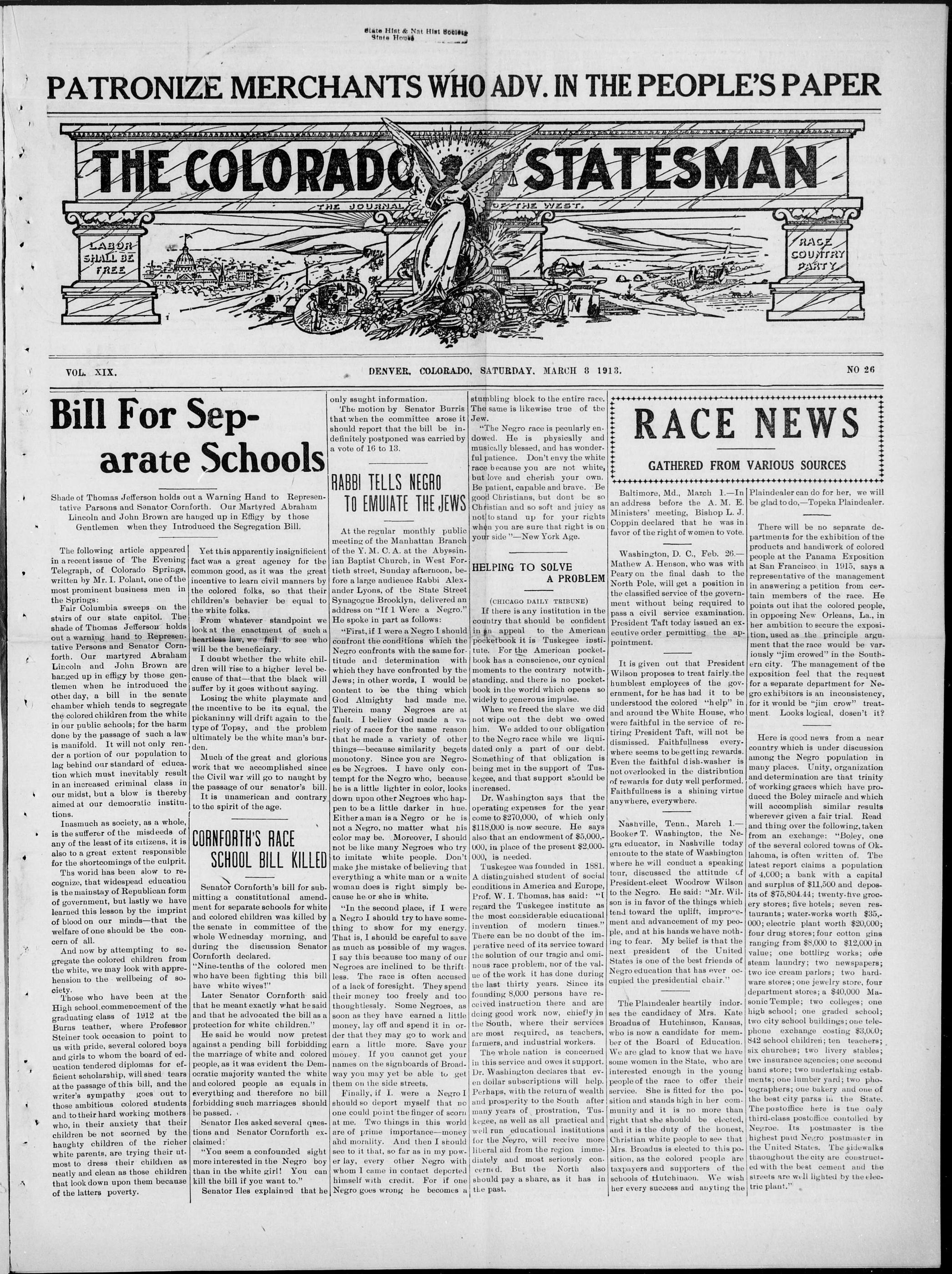
Bill For Separate Schools
Shade of Thomas Jefferson holds out a Warning Hand to Representative Parsons and Senator Cornforth. Our Martyred Abraham Lincoln and John Brown are hanged up in Effigy by those Gentlemen when they Introduced the Segregation Bill.
VOL. XIX.
Bill For
arate
Shade of Thomas Jefferson holds o
tative Parsons and Senator Corr
Lincoln and John Brown are b
Gentlemen when they Intr
The following article appeared
in a recent issue of The Evening
Telegraph, of Colorado Springs,
written by Mr. I. Polant, one of the
most prominent business men in
the Springs:
Fair Columbia sweeps on the stairs of our state capitol. The shade of Thomas Jefferson holds out a warning hand to Representative Persons and Senator Cornforth. Our martyred Abraham Lincoln and John Brown are hanged up in effigy by those gentlemen when he introduced the other day, a bill in the senate chamber which tends to segregate the colored children from the white in our public schools; for the harm done by the passage of such a law is manifold. It will not only render a portion of our population to lag behind our standard of education which must inevitably result in an increased criminal class in our midst, but a blow is thereby aimed at our democratic institutions.
Inasmuch as society, as a whole, is the sufferer of the misdeeds of any of the least of its citizens, it is also to a great extent responsible for the shortcomings of the culprit.
This world has been slow to recognize, that widespread education is the mainstay of Republican form of government, but lastly we have learned this lesson by the imprint of blood on our minds—that the welfare of one should be the concern of all. And now by attempting to segregate the colored children from the white, we may look with apprehension to the wellbeing of society.
Those who have been at the High school, commencement of the graduating class of 1912 at the Burns teatner, where Professor Steiner took occasion to point to us with pride, several colored boys and girls to whom the board of education tendered diplomas for efficient scholarship, will shed tears at the passage of this bill, and the writer's sympathy goes out to those ambitious colored students and to their hard working mothers who, in their anxiety that their children be not scorned by the haughty children of the richer white parents, are trying their utmost to dress their children as neatly and clean as those children that look down upon them because of the latters poverty.
---
Yet this apparently insignificant fact was a great agency for the common good, as it was the great incentive to learn civil manners by the colored folks, so that their children's behavior be equal to the white folks.
From whatever standpoint we look at the enactment of such a heartless law, we fail to see who will be the beneficiary.
I doubt whether the white children will rise to a higher level because of that—that the black will suffer by it goes without saying.
Losing the white playmate and the incentive to be its equal, the pickaninny will drift again to the type of Topsy, and the problem ultimately be the white man's burden.
Much of the great and glorious work that we accomplished since the Civil war will go to naught by the passage of our senator's bill.
It is unamerican and contrary to the spirit of the age.
CORNFORTH'S RACE SCHOOL BILL KILLED
Senator Cornforth's bill for submitting a constitutional amendment for separate schools for white and colored children was killed by the senate in committee of the whole Wednesday morning, and during the discussion Senator Cornforth declared. "Nine-tenths of the colored men who have been fighting this bill have white wives!"
Later Senator Cornforth said that he meant exactly what he said and that he advocated the bill as a protection for white children."
He said he would now pretest against a pending bill forbidding the marriage of white and colored people, as it was evident the Democratic majority wanted the white and colored people as equals in everything and therefore no bill forbidding such marriages should be passed.
Senator Iles asked several questions and Senator Cornforth exclaimed:
"You seem a confounded sight more interested in the Negro boy than in the white girl! You can kill the bill if you want to." Senator Iles explained that he
DENVER. COLORADO, SATURDAY, MARCH 8 1913.
State Hist & Nat Hist Societies
State Houses
HANTS WH
ADC
THE JOURNAL
DENVER, COLORADO
only ssuight information.
The motion by Senator Burris
that when the committee arose it
should report that the bill be
indefinitely postponed was carried by
a vote of 16 to 13.
RABBI TELLS NEGRO TO EMUIATE THE JEWS
At the regular monthly public meeting of the Manhattan Branch of the Y. M. C. A. at the Abyssinian Baptist Church, in West Fortieth street, Sunday afternoon, before a large audience Rabbi Alexander Lyons, of the State Street Synagogue Brooklyn, delivered an address on "If I Were a Negro." He spoke in part as follows:
"First, if I were a Negro I should confront the conditions which the Negro confronts with the same fortitude and determination with which they have confronted by the Jews; in other words, I would be content to be the thing which God Almighty had made me. Therein many Negroes are at fault. I believ God made a variety of races for the same reason that he made a variety of other things—because similarity begets monotony. Since you are Negroes be Negroes. I have only contempt for the Negro who, because he is a little lighter in color, looks down upon other Negroes who happen to be a little darker in hue. Either a man is a Negro or he is not a Negro, no matter what his color may be. Moreover, I should not be like many Negroes who try to imitate white people. Don't make the mistake of believing that everything a white man or a white woman does is right simply because he or she is white.
"In the second place, if I were a Negro I should try to have something to show for my energy. That is, I should be careful to save as much as possible of my wages. I say this because too many of our Negroes are inclined to be thriftless. The race is often accused of a lack of foresight. They spend their money too freely and too thoughtlessly. Some Negroes, as soon as they have earned a little money, lay off and spend it in order that they may go to work and earn a little more. Save your money. If you cannot get your names on the signboards of Broadway you may yet be able to get them on the side streets.
Finally, if I. were a Negro I should so deport myself that no one could point the finger of scorn at me. Two things in this world are of prime importance—money and morality. And then I should see to it that, so far as in my power lay, every other Negro with whom I came in contact deported himself with credit. For if one Negro goes wrong he becomes a
stumbling block to the entire race. The same is likewise true of the Jew. "The Negro race is peculiarly endowed. He is physically and musically blessed, and has wonderful patience. Don't envy the white race because you are not white, but love and cherish your own. Be patient, capable and brave. Be good Christians, but dont be so Christian and so soft and juicy as not to stand up for your rights when you are sure that right is on your side"—New York Age.
HELPING TO SOLVE
A PROBLEM
(CHICAGO DAILY TRIBUNE)
If there is any institution in the country that should be confident in an appeal to the American pocketbook it is Tuskegee institute. For the American pocketbook has a conscience, our cynical moments to the contrary notwithstanding, and there is no pocketbook in the world which opens so widely to generous impulse.
When we freed the slave we did not wipe out the debt we owed him. We added to our obligation to the Negro race while we liquidated only a part of our debt. Something of that obligation is being met in the support of Tuskegee, and that support should be increased.
Dr. Washington says that the operating expenses for the year come to $270,000, of which only $118,000 is now secure. He says also that an endowment of $5,000,-000, in place of the present $2,000-000, is needed.
Tuskegee was founded in 1881. A distinguished student of social conditions in America and Europe, Prof. W. I. Thomas, has said: "I regard the Tuskegee institute as the most considerable educational invention of modern times." There can be no doubt of the imperative need of its service toward the solution of our tragic and omnious race problem, nor of the value of the work it has done during the last thirty years. Since its founding 8,000 persons have received instruction there and are doing good work now, chiefly in the South, where their services are most required, as teachers, farmers, and industrial workers.
The whole nation is concerned in this service and owes it support. Dr. Washington declares that even dollar subscriptions will help. Perhaps, with the return of wealth and prosperity to the South after many years of prostration, Tuskegee, as well as all practical and well run educational institutions for the Negro, will receive more liberal aid from the region immediately and most seriously concerned. But the North also should pay a share, as it has in the past.
RACE NEWS
Baltimore, Md., March I.—In an address before the A. M. E. Ministers' meeting, Bishop L. J. Coppin declared that he was in favor of the right of women to vote.
Washington, D. C., Feb. 26.—Mathew A. Henson, who was with Peary on the final dash to the North Pole, will get a position in the classified service of the government without being required to pass a civil service examination. President Taft today issued an executive order permitting the appointment.
Plaindealer can do for her, we will be glad to do,—Topeka Plaindealer.
There will be no separate departments for the exhibition of the products and handiwork of colored people at the Panama Exposition at San Francisco in 1915, says a representative of the management in answering a petition from certain members of the race. He points out that the colored people, in opposing New Orleans, La., in her ambition to secure the exposition, used as the principle argument that the race would be var
It is given out that President Wilson proposes to treat fairly the humblest employees of the government, for he has had it to be understood the colored "help" in and around the White House, who were faithful in the service of retiring President Taft, will not be dismissed. Faithfullness everywhere seems to be getting rewards. Even the faithful dish-washer is not overlooked in the distribution of rewards for duty well performed. Faithfullness is a shining virtue anywhere, everywhere.
Nashville, Tenn., March 1.—Booker T. Washington, the Negra educator, in Nashville today enroute to the state of Washington where he will conduct a speaking tour, discussed the attitude of President-elect Woodrow Wilson to the Negro. He said: "Mr. Wilson is in favor of the things which tend toward the uplift, improvement and advancement of my people, and at his hands we have nothing to fear. My belief is that the next president of the United States is one of the best friends of Negro education that has ever occupied the presidential chair."
The Plaindealer heartily indorses the candidacy of Mrs. Kate Broadus of Hutchinson, Kansas, who is now a candidate for member of the Board of Education. We are glad to know that we have some women in the State, who are interested enough in the young people of the race to offer their service. She is fitted for the position and stands high in her community and it is no more than right that she should be elected, and it is the duty of the honest, Christian white people to see that Mrs. Broadus is elected to this position, as the colored people are taxpayers and supporters of the schools of Hutchinaon. We wish her every success and anything the
NO 26
Plaindealer can do for her, we will be glad to do,—Topeka Plaindealer.
There will be no separate departments for the exhibition of the products and handiwork of colored people at the Panama Exposition at San Francisco in 1915, says a representative of the management in answering a petition from certain members of the race. He points out that the colored people, in opposing New Orleans, La., in her ambition to secure the exposition, used as the principle argument that the race would be variously "jim crowed" in the Southern city. The management of the exposition feel that the request for a separate department for Negro exhibitors is an inconsistency, for it would be "jim crow" treatment. Looks logical, doesn't it?
Here is good news from a near country which is under discussion among the Negro population in many places. Unity, organization and determination are that trinity of working graces which have produced the Boley miracle and which will accomplish similar results wherever given a fair trial. Read and thing over the following, taken from an exchange: "Boley, one of the several colored towns of Oklahoma, is often written of. The latest report claims a population of 4,000; a bank with a capital and surplus of $11,500 and deposits of $75,804.44; twenty-five grocery stores; five hotels; seven restaurants; water-works worth $35,000; electric plant worth $20,000; four drug stores; four cotton gins ranging from $8,000 to $12,000 in value; one bottling works; one steam laundry; two newspapers; two ice cream parlors; two hardware stores; one jewelry store, four department stores; a $40,000 Masonic Temple; two colleges; one high school; one graded school; two city school buildings; one telephone exchange costing $3,000; 842 school children; ten teachers; six churches; two livery stables; two insurance agencies; one second hand store; two undertaking establishments; one lumber yard; two photographers; one bakery and one of the best city parks in the State. The postoffice here is the only third-class postoffice controlled by Negroe. Its postmaster is the highest paid Negro postmaster in the United States. The sidewalks thaoughout the city are construced with the best cement and the streets are well lighted by the electric plant."
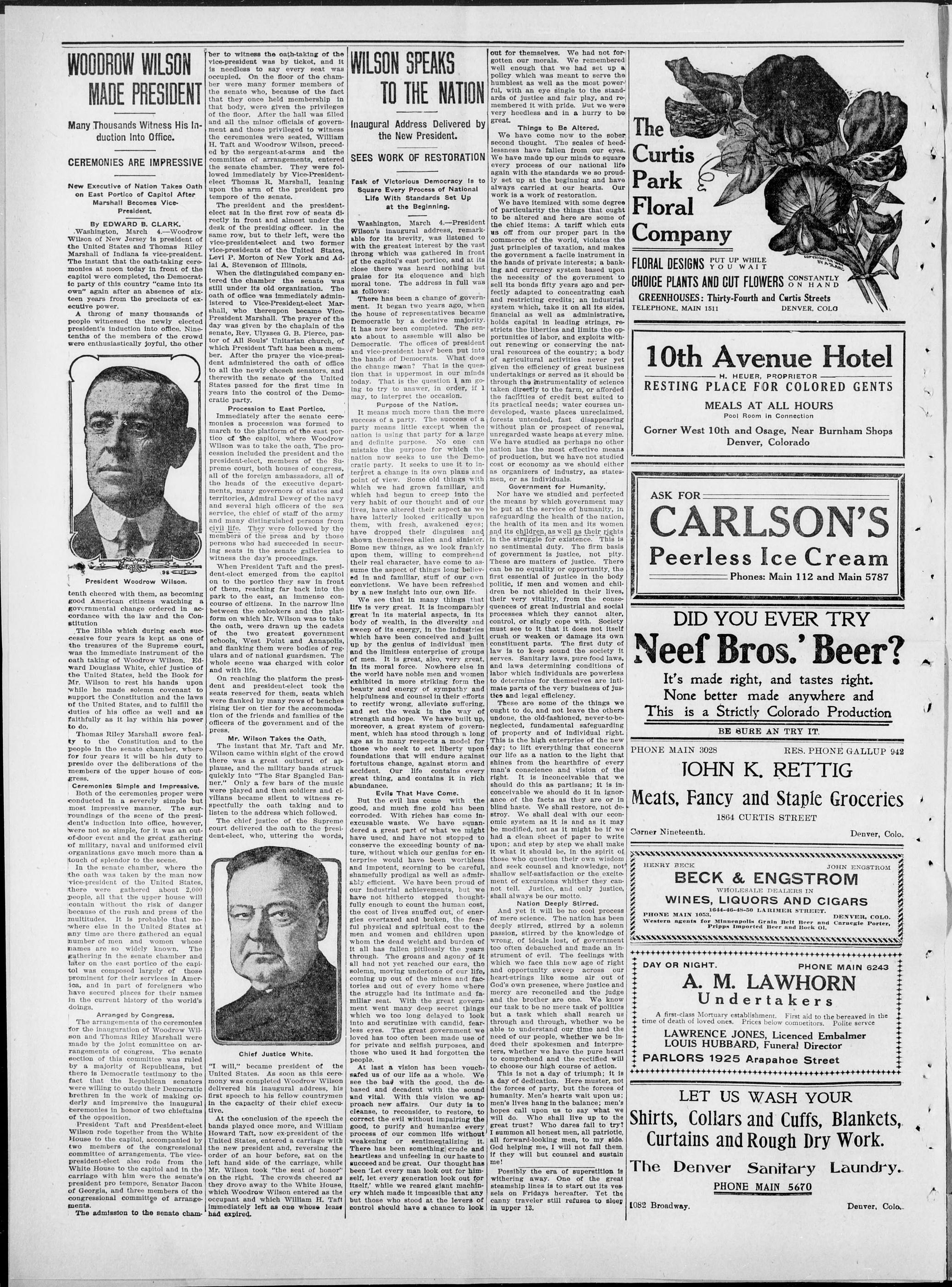
WOODROW WILSON MADE PRESIDENT
Many Thousands Witness His Induction Into Office.
CEREMONIES ARE IMPRESSIVE
New Executive of Nation Takes Oath on East Portico of Capitol After Marshall Becomes Vice-President.
By EDWARD B. CLARK.
Washington, March 4.—Woodrow Wilson of New Jersey is president of the United States and Thomas Riley Marshall of Indiana is vice-president. The instant that the oath-taking ceremonies at noon today in front of the capitol were completed, the Democratic party of this country "came into its own" again after an absence of sixteen years from the precincts of executive power.
A throng of many thousands of people witnessed the newly elected president's induction into office. Nineteenth of the members of the crowd were enthusiastically joyful, the other
98
tenth cheered with them, as becoming good American citizens watching a governmental change ordered in accordance with the law and the Constitution.
The Bible which during each successive four years is kept as one of the treasures of the Supreme court, was the immediate instrument of the oath taking of Woodrow Wilson. Edward Douglass White, chief justice of the United States, held the Book for Mr. Wilson to rest his hands upon while he made solemn covenant to support the Constitution and the laws of the United States, and to fulfill the duties of his office as well and as faithfully as it lay within his power to do.
Thomas Riley Marshall swore fealty to the Constitution and to the people in the senate chamber, where for four years it will be his duty to preside over the deliberations of the members of the upper house of congress.
Ceremonies Simple and Impressive.
Both of the ceremonies proper were conducted in a severely simple but most impressive manner. The surroundings of the scene of the president's induction into office, however, were not so simple, for it was an out-of-door event and the great gathering of military, naval and uniformed civil organizations gave much more than a touch of splendor to the scene.
In the senate chamber, where the oath was taken by the man now vice-president of the United States, there were gathered about 2,000 people, all that the upper house will contain without the risk of danger because of the rush and press of the multitudes. It is probable that nowhere else in the United States at any time are there gathered an equal number of men and women whose names are so widely known. The gathering in the senate chamber and later on the east portico of the capitol was composed largely of those prominent for their services in America, and in part of foreigners who have secured places for their names in the current history of the world's doings.
Arranged by Congress.
The arrangements of the ceremonies for the inauguration of Woodrow Wilson and Thomas Riley Marshall were made by the joint committee on arrangements of congress. The senate section of this committee was ruled by a majority of Republicans, but there is Democratic testimony to the fact that the Republican senators were willing to outdo their Democratic brethren in the work of making orderly and impressive the inaugural ceremonies in honor of two chieftains of the opposition.
President Taft and President-elect Wilson rode together from the White House to the capitol, accompanied by two members of the congressional committee of arrangements. The vice-president-elect also rode from the White House to the capitol and in the carriage with him were the senate's president pro tempore, Senator Bacon of Georgia, and three members of the congressional committee of arrangements.
The admission to the senate cham-
ber to witness the oath-taking of the vice-president was by ticket, and it is needless to say every seat was occupied. On the floor of the chamber were many former members of the senate who, because of the fact that they once held membership in that body, were given the privileges of the floor. After the hall was filled and all the minor officials of government and those privileged to witness the ceremonies were seated, William H. Taft and Woodrow Wilson, preceded by the sergeant-at-arms and the committee of arrangements, entered the senate chamber. They were followed immediately by Vice-President-elect Thomas R. Marshall, leaning upon the arm of the president pro tempore of the senate.
The president and the president-elect sat in the first row of seats directly in front and almost under the desk of the presiding officer. In the same row, but to their left, were the vice-president-elect and two former vice-presidents of the United States, Levi P. Morton of New York and Adlai A. Stevenson of Illinois.
When the distinguished company entered the chamber the senate was still under its old organization. The oath of office was immediately administered to Vice-President-elect Marshall, who thereupon became Vice-President Marshall. The prayer of the day was given by the chaplain of the senate, Rev. Ulysues G. B. Pierce, pastor of All Souls' Unitarian church, of which President Taft has been a member. After the prayer the vice-president administered the oath of office to all the newly chosen senators, and therewith the senate of the United States passed for the first time in years into the control of the Democratic party.
Procession to East Portico. Immediately after the senate ceremonies a procession was formed to march to the platform of the east portico of the capitol, where Woodrow Wilson was to take the oath. The procession included the president and the president-elect, members of the Supreme court, both houses of congress, all of the foreign ambassadors, all of the heads of the executive departments, many governors of states and territories, Admiral Dewey of the navy and several high officers of the sea service, the chief of staff of the army and many distinguished persons from civil life. They were followed by the members of the press and by those persons who had succeeded in securing seats in the senate galleries to witness the day's proceedings.
When President Taft and the president-elect emerged from the capitol on to the portico they saw in front of them, reaching far back into the park to the east, an immense course of citizens. In the narrow line between the onlookers and the platform on which Mr. Wilson was to take the oath, were drawn up the cadets of the two greatest government schools, West Point and Annapolis, and flanking them were bodies of regulars and of national guardsmen. The whole scene was charged with color and with life.
On reaching the platform the president and president-elect took the seats reserved for them, seats which were flanked by many rows of benches rising tier on tier for the accommodation of the friends and families of the officers of the government and of the press.
Mr. Wilson Takes the Oath.
The instant that Mr. Taft and Mr. Wilson came within sight of the crowd there was a great outburst of applause, and the military bands struck quickly into "The Star Spangled Banner." Only a few bars of the music were played and then soldiers and civilians became silent to witness respectfully the oath taking and to listen to the address which followed.
The chief justice of the Supreme court delivered the oath to the president-elect, who, uttering the words,
PRESIDENT
Chief Justice White.
"I will," became president of the United States. As soon as this ceremony was completed Woodrow Wilson delivered his inaugural address, his first speech to his fellow countrymen in the capacity of their chief executive.
At the conclusion of the speech the hands played once more, and William Howard Taft, now ex-president of the United States, entered a carriage with the new president and, reversing the order of an hour before, sat on the left hand side of the carriage, while Mr. Wilson took "the seat of honor" on the right. The crowds cheered as they drove away to the White House, which Woodrow Wilson entered as the occupant and which William H. Taft immediately left as one whose lease had expired.
WILSON SPEAKS TO THE NATION
Inaugural Address Delivered by the New President.
SEES WORK OF RESTORATION
Task of Victorious Democracy Is to Square Every Process of National Life With Standards Set Up
Washington, March 4.—President Wilson's inaugural address, remarkable for its brevity, was listened to with the greatest interest by the vast throng which was gathered in front of the capitol's east portico, and at its close there was heard nothing but praise for its eloquence and high moral tone. The address in full was as follows:
There has been a change of government. It began two years ago, when the house of representatives became Democratic by a decisive majority. It has now been completed. The senate about to assemble will also be Democratic. The offices of president and vice-president have been put into the hands of Democrats. What does the change mean? That is the question that is uppermost in our minds today. That is the question I am going to try to answer, in order, if I may, to interpret the occasion.
Purpose of the Nation
It means much more than the mere success of a party. The success of a party means little except when the nation is using that party for a large and definite purpose. No one can mistake the purpose for which the nation now seeks to use the Democratic party. It seeks to use it to interpret a change in its own plans and point of view. Some old things with which we had grown familiar, and which had begun to creep into the very habit of our thought and of our lives, have altered their aspect as we have latterly looked critically upon them, with fresh, awakened eyes; have dropped their disguises and shown themselves alien and sinister. Some new things, as we look frankly upon them, willing to comprehend their real character, have come to assume the aspect of things long believed in and familiar, stuff of our own convictions. We have been refreshed by a new insight into our own life.
We see that in many things that life is very great. It is incomparably great in its material aspects, in its body of wealth, in the diversity and sweep of its energy, in the industries which have been conceived and built up by the genius of individual men and the limitless enterprise of groups of men. It is great, also, very great, in its moral force. Nowhere else in the world have noble men and women exhibited in more striking form the beauty and energy of sympathy and helpfulness and counsel in their efforts to rectify wrong, alleviate suffering, and set the weak in the way of strength and hope. We have built up, moreover, a great system of government, which has stood through a long age as in many respects a model for those who seek to set liberty upon foundations that will endure against fortuitous change, against storm and accident. Our life contains every great thing, and contains it in rich abundance.
Evils That Have Come.
But the evil has come with the good, and much fine gold has been corroded. With riches has come inexcusable waste. We have squandered a great part of what we might have used, and have not stopped to conserve the exceeding bounty of nature, without which our genius for enterprise would have been worthless and impotent, scorning to be careful, shametfully prodigal as well as admirably efficient. We have been proud of our industrial achievements, but we have not hitherto stopped thoughtfully enough to count the human cost, the cost of lives snuffed out, of energies overtaxed and broken, the fearful physical and spiritual cost to the men and women and children upon whom the dead weight and burden of it all has fallen pitilessly the years through. The groans and agony of it all had not yet reached our ears, the solemn, moving undertone of our life, coming up out of the mines and factories and out of every home where the struggle had its intimate and familiar seat. With the great government went many deep secret things which we too long delayed to look into and scrutinize with candid, fearless eyes. The great government we loved has too often been made use of for private and selfish purposes, and those who used it had forgotten the people.
At last a vision has been vouch-safed us of our life as a whole. We see the bad with the good, the debased and decadent with the sound and vital. With this vision we approach new affairs. Our duty is to cleanse, to reconsider, to restore, to correct the evil without impairing the good, to purify and humanize every process of our common life without weakening or sentimentalizing it. There has been something crude and heartless and unfeeling in our haste to succeed and be great. Our thought has been 'Let every man look out for himself, let every generation look out for itself,' while we reared giant machinery which made it impossible that any but those who stood at the levers of control should have a chance to look
out for themselves. We had not forgotten our morals. We remembered well enough that we had set up a policy which was meant to serve the humblest as well as the most powerful, with an eye single to the standards of justice and fair play, and remembered it with pride. But we were very heedless and in a hurry to be great.
Things to Be Altered.
We have come now to the sober second thought. The scales of heedlessness have fallen from our eyes. We have made up our minds to square every process of our national life again with the standards we so proudly set up at the beginning and have always carried at our hearts. Our work is a work of restoration.
We have itemized with some degree of particularity the things that ought to be altered and here are some of the chief items: A tariff which cuts us off from our proper part in the commerce of the world, violates the just principles of taxation, and makes the government a facile instrument in the hands of private interests; a banking and currency system based upon the necessity of the government to sell its bonds fifty years ago and perfectly adapted to concentrating cash and restricting credits; an industrial system which, take it on all its sides, financial as well as administrative, holds capital in leading strings, restricts the liberties and limits the opportunities of labor, and exploits without renewing or conserving the natural resources of the country; a body of agricultural activities never yet given the efficiency of great business undertakings or served as it should be through the instrumentality of science taken directly to the farm, or afforded the facilities of credit best suited to its practical needs; water courses undeveloped, waste places unreclaimed, forests untended, fast disappearing without plan or prospect of renewal, unregarded waste heaps at every mine. We have studied as perhaps no other nation has the most effective means of production, but we have not studied cost or economy as we should either as organizers of industry, as statesmen, or as individuals.
Government for Humanity. Nor we studied and perfected the means by which government may be put at the service of humanity, in safeguarding the health of the nation, the health of its men and its women and its children, as well as their rights in the struggle for existence. This is no sentimental duty. The firm basis of government is justice, not pity. These are matters of justice. There can be no equality or opportunity, the first essential of justice in the body politic, if men and women and children be not shielded in their lives, their very vitality, from the consequences of great industrial and social processes which they cannot alter, control, or singly cope with. Society must see to it that it does not itself crush or weaken or damage its own constituent parts. The first duty of law is to keep sound the society it serves. Sanitary laws, pure food laws, and laws determining conditions of labor which individuals are powerless to determine for themselves are intimate parts of the very business of justice and legal efficiency.
These are some of the things we ought to do, and not leave the others undone, the old-fashioned, never-to-be-neglected, fundamental safeguarding of property and of individual right. This is the high enterprise of the new day; to lift what that concerns our life as a nation to the light that shines from the hearthfire of every man's conscience and vision of the right. It is inconceivable that we should do this as partisans; it is inconceivable we should do it in ignorance of the facts as they are or in blind haste. We shall restore, not destroy. We shall deal with our economic system as it is and as it may be modified, not as it might be if we had a clean sheet of paper to write upon; and step by step we shall make it what it should be, in the spirit of those who question their own wisdom and seek counsel and knowledge, not shallow self-satisfaction or the excitement of excursions whither they cannot tell. Justice, and only justice, shall always be our motto.
Nation Deeply Stirred.
And yet it will be no cool process of mere science. The nation has been deeply stirred, stirred by a solemn passion, stirred by the knowledge of wrong, of ideals lost, of government too often debauched and made an instrument of evil. The feelings with which we face this new age of right and opportunity sweep across our heart-strings like some air out of God's own presence, where justice and mercy are reconciled and the judge and the brother are one. We know our task to be no mere task of politics but a task which shall search us through and through, whether we be able to understand our time and the need of our people, whether we be indeed their spokesmen and interpreters, whether we have the pure heart to comprehend and the rectified will to choose our high course of action.
This is not a day of triumph; it is a day of dedication. Here muster, not the forces of party, but the forces of humanity. Men's hearts wait upon us; men's lives hang in the balance; men's hopes call upon us to say what we will do. Who shall live up to the great trust? Who dares fail to try? I summon all honest men, all patriotic, all forward-looking men, to my side. God helping me, I will not fall them; if they will but counsel and sustain me!
Possibly the era of superstition is withering away. One of the great steamship lines is to start out its vessels on Fridays hereafter. Yet the canny traveler still refuses to sleep in upper 13.
The
Curtis
Park
Floral
Company
FLORAL DESIGNS PUT UP WHILE
YOU WAIT
CHOICE PLANTS AND CUT FLOWERS CONSTANTLY
ON HAND
GREENHOUSES: Thirty-Fourth and Curtis Streets
TELEPHONE, MAIN 1511
DENVER, COLO
10th Avenue Hotel H. HEUER, PROPRIETOR RESTING PLACE FOR COLORED GENTS MEALS AT ALL HOURS Pool Room in Connection Corner West 10th and Osage, Near Burnham Shops Denver, Colorado
ASK FOR CARLSON'S Peerless Ice Cream Phones: Main 112 and Main 5787
DID YOU EVER TRY Neef Bros.' Beer?
It's made right, and tastes right. None better made anywhere and This is a Strictly Colorado Production
HENRY BECK
JOHN ENGSTROM
BECK & ENGSTROM
WHOLESALE DEALERS IN
WINES, LIQUORS AND CIGARS
1644-46-48-50 LARIMER STREET.
PHONE MAIN 1053.
Western agents for Minneapolis Grain Belt Beer and
Pripps Imported Beer and Bock Ol.
DENVER, COLO.
Carnegle Porter,
A first-class Mortuary establishment. First aid to the bereaved in the time of death of loved ones. Prices below competitors. Polite service
LAWRENCE JONES, Licenced Embalmer
LOUIS HUBBARD, Funeral Director
PARLORS 1925 Arapahoe Street
The Denver Sanitary Laundry. PHONE MAIN 5670 1082 Broadway. Denver, Colo.
Denver, Colo.
ENGSTROM
M
ARS
NVER, COLO.
Neagle Porter,
AIN 6243
revealed in the
te service
lmer
R
mankets,
Work.
laundry.
Denver, Colo.
© CLINEBIN ST
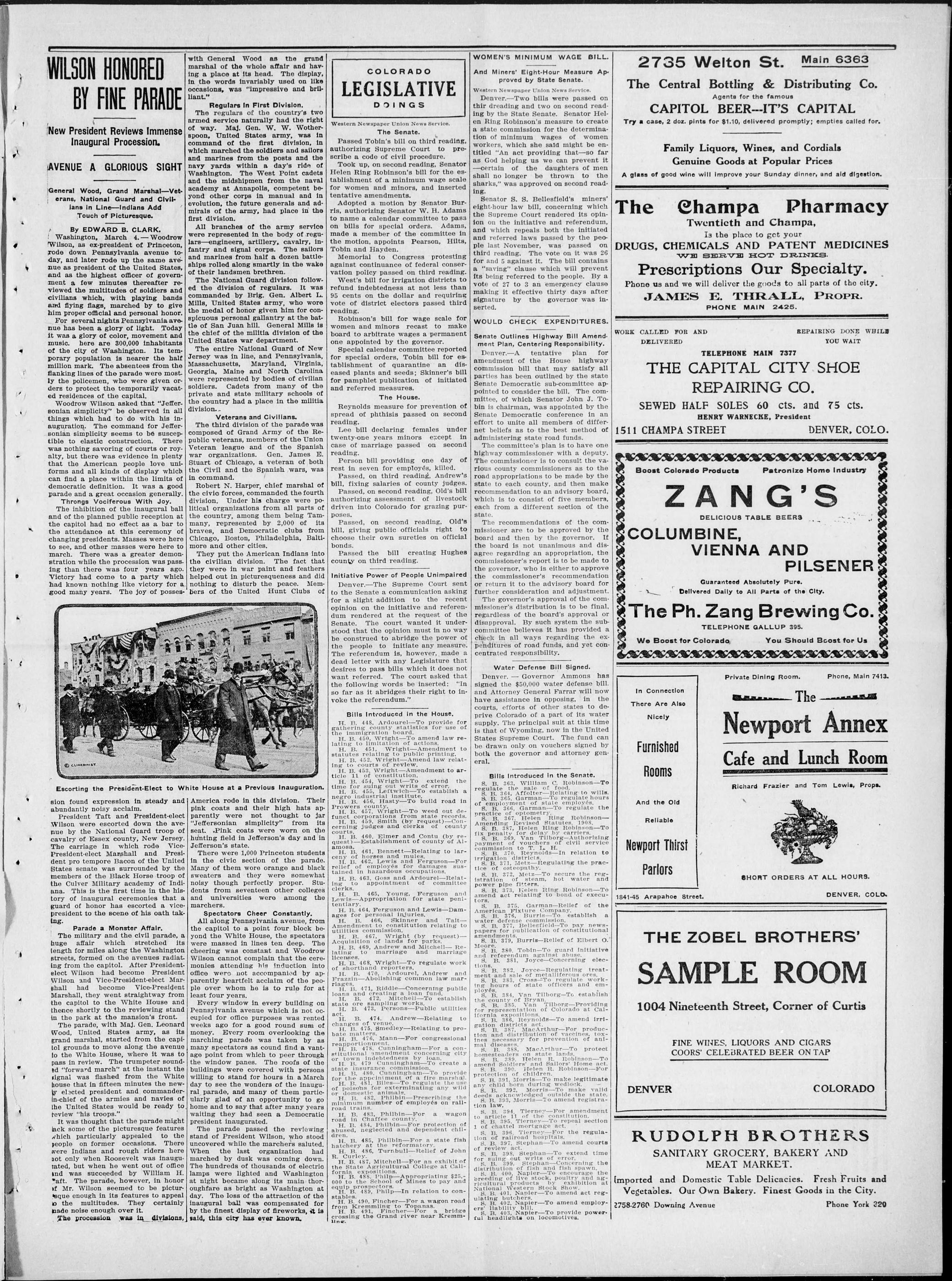
Escorting the President-Elect to White House at a Previous Inauguration.
WILSON HONORED BY FINE PARADE
New President Reviews Immense Inaugural Procession.
AVENUE A GLORIOUS SIGHT
General Wood, Grand Marshal—Veterans, National Guard and Civilians in Line—Indians Add Touch of Picturesque.
By EDWARD B. CLARK.
Washington, March 4.—Woodrow Wilson, as ex-president of Princeton, rode down Pennsylvania avenue today, and later rode up the same avenue as president of the United States, and as the highest officer of government a few minutes thereafter reviewed the multitudes of soldiers and civilians which, with playing bands and flying flags, marched by to give him proper official and personal honor. For several nights Pennsylvania avenue has been a glory of light. Today it was a glory of color, movement and music. here are 300,000 inhabitants of the city of Washington. Its temporary population is nearer the half million mark. The absentees from the flanking lines of the parade were mostly the policemen, who were given orders to protect the temporarily vacated residences of the capital.
Woodrow Wilson asked that "Jeffersonian simplicity" be observed in all things which had to do with his inauguration. The command for Jeffersonian simplicity seems to be susceptible to elastic construction. There was nothing savoring of courts or royalty, but there was evidence in plenty that the American people love uniforms and all kinds of display which can find a place within the limits of democratic definition. It was a good parade and a great occasion generally.
Throngs Vociferous With Joy.
The inhibition of the inaugural ball and of the planned public reception at the capitol had no effect as a bar to the attendance at this ceremony of changing presidents. Masses were here to see, and other masses were here to march. There was a greater demonstration while the procession was passing than there was four years ago. Victory had come to a party which had known nothing like victory for a good many years. The joy of posses-
© CLIMBING ST
Escorting the President-Elect to W
sion found expression in steady and abundantly noisy acclaim.
President Taft and President-elect Wilson were escorted down the avenue by the National Guard troop of cavalry of Essex county, New Jersey. The carriage in which rode Vice-President-elect Marshall and President pro tempore Bacon of the United States senate was surrounded by the members of the Black Horse troop of the Culver Military academy of Indiana. This is the first time in the history of inaugural ceremonies that a guard of honor has escorted a vice-president to the scene of his oath taking.
Parade a Monster Affair.
The military and the civil parade, a huge affair which stretched its length for miles along the Washington streets, formed on the avenues radiating from the capitol. After President-elect Wilson had become President Wilson and Vice-President-elect Marshall had become Vice-President Marshall, they went straightway from the capitol to the White House and thence shortly to the reviewing stand in the park at the mansion's front.
The parade, with Maj. Gen. Leonard Wood, United States army, as its grand marshal, started from the capitol grounds to move along the avenue to the White House, where it was to pass in review. The trumpeter sounded "forward march" at the instant the signal was flashed from the White house that in fifteen minutes the newly elected president and commander-in-chief of the armies and navies of the United States would be ready to review "his troops."
It was thought that the parade might lack some of the picturesque features which particularly appealed to the people on former occasions. There were Indians and rough riders here not only when Roosevelt was inaugurated, but when he went out of office and was succeeded by William H.raft. The parade, however, in honor of Mr. Wilson seemed to be picturesque enough in its features to appeal to the multitudes. They certainly made noise over it.
The procession was in divisions,
with General Wood as the grand marshal of the whole affair and having a place at its head. The display, in the words invariably used on like occasions, was "impressive and brilliant."
Regulars In First Division.
Regulars in First Division.
The regulars of the country's two armed service naturally had the right of way. Maj. Gen. W. W. Wotherspoon, United States army, was in command of the first division, in which marched the soldiers and sailors and marines from the posts and the navy yards within a day's ride of Washington. The West Point cadets and the midshipmen from the naval academy at Annapolis, competent beyond other corps in manual and in evolution, the future generals and admirals of the army, had place in the first division.
All branches of the army service were represented in the body of regulars—engineers, artillery, cavalry, infantry and signal corps. The sailors and marines from half a dozen battleships rolled along smartly in the wake of their landmen brethren.
The National Guard division followed the division of regulars. It was commanded by Brig. Gen. Albert L. Mills, United States army, who wore the medal of honor given him for conspicuous personal gallantry at the battle of San Juan hill. General Mills is the chief of the militia division of the United States war department.
The entire National Guard of New Jersey was in line, and Pennsylvania, Massachusetts, Maryland, Virginia, Georgia, Maine and North Carolina were represented by bodies of civilian soldiers. Cadets from many of the private and state military schools of the country had a place in the militia division.
Veterans and Civilians.
The third division of the parade was composed of Grand Army of the Republic veterans, members of the Union Veteran league and of the Spanish war organizations. Gen. James E. Stuart of Chicago, a veteran of both the Civil and the Spanish wars, was in command.
Robert N. Harper, chief marshal of the civic forces, commanded the fourth division. Under his charge were political organizations from all parts of the country, among them being Tammany, represented by 2,000 of its braves, and Democratic clubs from Chicago, Boston, Philadelphia, Baltimore and other cities.
They put the American Indians into the civilian division. The fact that they were in war paint and feathers helped out in picturesqueness and did nothing to disturb the peace. Members of the United Hunt Clubs of
White House at a Previous Inauguration.
America rode in this division. Their pink coats and their high hats apparently were not thought to jar "Jeffersonian simplicity" from its seat. Pink coats were worn on the hunting field in Jefferson's day and in Jefferson's state. There were 1,000 Princeton students in the civic section of the parade. Many of them wore orange and black sweaters and they were somewhat noisy though perfectly proper. Students from seventeen other colleges and universities were among the marchers.
Spectators Cheer Constantly.
All along Pennsylvania avenue, from the capitol to a point four block beyond the White House, the spectators were massed in lines ten deep. The cheering was constant and Woodrow Wilson cannot complain that the ceremonies attending his induction into office were not accompanied by apparently heartfelt acclaim of the people over whom he is to rule for at least four years.
Every window in every building on Pennsylvania avenue which is not occupied for office purposes was rented weeks ago for a good round sum of money. Every room overlooking the marching parade was taken by as many spectators as cound find a vantage point from which to peer through the window panes. The roofs of the buildings were covered with persons willing to stand for hours in a March day to see the wonders of the inaugural parade, and many of them particularly glad of an opportunity to go home and to say that after many years waiting they had seen a Democratic president inaugurated.
The parade passed the reviewing stand of President Wilson, who stood uncovered while the marchers saluted. When the last organization had marched by dusk was coming down. The hundreds of thousands of electric lamps were lighted and Washington at night became along its main thoroughfare as bright as Washington at day. The loss of the attraction of the inaugural ball was compensated for by the finest display of fireworks, it is said, this city has ever known.
COLORADO LEGISLATIVE DOINGS
Passed Tobin's bill on third reading, authorizing Supreme Court to prescribe a code of civil procedure. Took up, on second reading, Senator Helen Ring Robinson's bill for the establishment of a minimum wage scale for women and minors, and inserted tentative amendments. Adopted a motion by Senator Burris, authorizing Senator W. H. Adams to name a calendar committee to pass on bills for special orders. Adams, made a member of the committee in the motion, appoints Pearson, Hilts, Tobin and Hayden. Memorial to Congress protesting against continuance of federal conservation policy passed on third reading. West's bill for irrigation districts to refund indebtedness at not less than 95 cents on the dollar and requiring vote of district electors passed third reading.
Robinson's bill for wage scale for women and minors recast to make board to arbitrate wages a permanent one appointed by the governor. Special calendar committee reported for special orders. Tobin bill for establishment of quarantine an diseased plants and seeds; Skinner's bill for pamphlet publication of initiated and referred measures.
The House.
Reynolds measure for prevention of spread of phthisis passed on second reading. Lee bill declaring females under twenty-one years minors except in case of marriage passed on second reading. Person bill providing one day of rest in seven for employes, killed. Passed, on third reading, Andrew's bill, fixing salaries of county judges.
Passed, on second reading, Old's bill authorizing assessment of livestock driven into Colorado for grazing purposes.
Passed, on second reading, Old's bill, giving public officials right to choose their own sureties on official bonds.
Passed the bill creating Hughes county on third reading.
Initiative Power of People Unimpaired
Denver.—The Supreme Court sent to the Senate a communication asking for a slight addition to the recent opinion on the initiative and referendum rendered at the request of the Senate. The court wanted it understood that the opinion must in no way be construed to abridge the power of the people to initiate any measure. The referendum is, however, made a dead letter with any Legislature that desires to pass bills which it does not want referred. The court asked that the following words be inserted: "In so far as it abridges their right to invoke the referendum."
Bills Introduced in the House
H. B. 448, Ardourel—To provide for gathering county statistics for use of the immigration board.
H. B. 450, Wright—To amend law relating to limitation of actions.
H. B. 451, Wright—Amendment to statutes relating to public printing.
H. B. 452, Wright—Amendment law relating to limitation of actions.
H. B. 453, Wright—Amendment to article 11 of constitution.
H. B. 454, Wright—To extend the time for suing out writs of error.
H. B. 456, Hasty—To build road in Prowers county.
H. B. 457, Wright—To weed out defunct corporations from state records.
H. B. 459, Smith (by request)—Concerning judges and clerks of county courts.
H. B. 460, Elmer and Contu (by request)—Establishment of county of Alamosa.
H. B. 461, Bennett—Relating to larceny of horses and mules.
H. B. 462, Lewis and Ferguson—For relief of employees for damages sustained in hazardous occupations.
H. B. 463, Goss and Ardourel—Relating to appointment of committee clerks.
H. B. 464, Ferguson and Lewis—Damages for personal injuries.
H. B. 466, Skinner and Talt—Awarded constitution relating to utilities commission.
H. B. 467, Wright (by request)—Acquisition of lands for parks.
H. B. 469, Andrew and Mitchell—Reliance to marriage and marriage licenses.
H. B. 468, Wright-To regulate work of shorthand reporters.
H. B. 470, Ardourel, Andrew and
Patern-Abolishing common law mar-
riages
H. B. 471, Riddle—Concerning public loans and creating a loan fund,
which will be used to finance the building.
H. B. 474. Andrew—Relating to changes of venue.
H. B. 479 Cunningham—To create a state insurance commission.
H. B. 480 Cunningham—To provide for the insurance of a fire marshal.
H. B. 481 Biles—To regulate the use of poisons for exterminating any wild or domestic animals.
H. B. 482 Philbin—Prescribing the minimum number of employees on railroad trains.
H. B. 483 Philbin—For a wagon road in Chaffee county.
H. B. 484 Philbin—For protection of abused, neglected and dependent children.
H. B. 485 Philbin—For a state fish hatchery at the reformatory.
H. B. 486 Turnbull—Relief of John R. Curley.
H. B. 487 Mitchell—For an exhibit of the State Agricultural College at California expositions.
H. B. 488, Philp—Appropriating $25,000 to the School of Mines to pay and equip prospectors.
H. B. 489, Philp—In relation to constables.
H. B. 490, Fincher—For a wagon road from Kremmling to Topanas.
H. B. 491, Fincher—For a bridge crossing the Grand river near Kremmling.
WOMEN'S MINIMUM WAGE BILL.
And Miners' Eight-Hour Measure Approved by State Senate.
Western Newspaper Union News Service.
Denver.—Two bills were passed on their dreading and two on second reading by the State Senate. Senator Helen Ring Robinson's measure to create a state commission for the determination of minimum wages of women workers, which she said might be entitled "An act providing that—so far as God helping us we can prevent it—certain of the daughters of men shall no longer be thrown to the sharks," was approved on second reading.
Senator S. S. Bellesfield's miners' eight-hour law bill, concerning which the Supreme Court rendered its opinion on the initiative and referendum, and which repeals both the initiated and referred laws passed by the people last November, was passed on third reading. The vote on it was 26 for and 5 against it. The bill contains a "saving" clause which will prevent its being referred to the people. By a vote of 27 to 3 an emergency clause making it effective thirty days after signature by the governor was inserted.
WOULD CHECK EXPENDITURES.
Senate Outlines Highway Bill Amendment Plan. Centering Responsibility.
Denver.—A tentative plan for amendment of the House highway commission bill that may satisfy all parties has been outlined by the state Senate Democratic sub-committee appointed to consider the bill. The committee, of which Senator John J. Tobin is chairman, was appointed by the Senate Democratic conference in an effort to unite all members of differnet beliefs as to the best method of administering state road funds.
The committee's plan is to have one highway commissioner with a deputy. The commissioner is to consult the various county commissioners as to the road appropriations to be made by the state to each county, and then make recommendation to an advisory board, which is to consist of five members, each from a different section of the state.
The recommendations of the commissioner are to be approved by the board and then by the governor. If the board is not unanimous and disagree regarding an appropriation, the commissioner's report is to be made to the governor, who is either to approve the commissioner's recommendation or return it to the advisory board for further consideration and adjustment. The governor's approval of the commissioner's distribution is to be final, regardless of the board's approval or disapproval. By such system the subcommittee believes it has provided a check in all ways regarding the expenditures of road funds, and yet concentrated responsibility.
Water Defense Bill Signed.
Denver. — Governor Ammons has signed the $50,000 water defense bill. and Attorney General Farrar will now have assistance in opposing, in the courts, efforts of other states to deprive Colorado of a part of its water supply. The principal suit at this time is that of Wyoming, now in the United States Supreme Court. The fund can be drawn only on vouchers signed by both the governor and attorney general.
S. B. 364, Affolter—Relating to wills.
S. B. 365, Garman—To regulate hours of employment in state employés.
S. B. 366, Garman—To regulate the practice of optometry.
S. B. 367, Helen Ring Robinson—Amending Revised Statutes 1908
S. B. 377, Helen Ring Robinson—To fix penalty for delay by carriers.
S. B. 369, Van Tilbord—Authorizing payment of vouchers of civil service commission of the H. H.
S. B. 370, Reynolds—In relation to irrigation districts.
S. B. 371, Metz—Regulate the practice of osteopathy.
S. B. 372, Burris—To secure the registration of steam, hot water and power pipe fitters.
S. B. 373, Helen Ring Robinson—To amend act relating to bond of executors.
S. B. 375, Garman—Relief of the American Fliture Company.
S. B. 376, Burris—To establish a water defense commission.
S. B. 378, Joyce—Concerning elections.
S. B. 381, Joyce—Concerning elections.
S. B. 382, Regulating treatment and sale of metalliferous ores.
S. B. 383, Cross—To regulate hours of state officers and employees.
S. B. 384, Van Tilbord—To establish the county of Bryan.
S. B. 385, Van Tilbord—Providing compensation of Colorado at California expositions.
S. B. 386, Reynolds—To amend irrigation districts act.
S. B. 387, Reynolds—For production and distribution of vaccines, toxins necessary for prevention of animal diseases.
S. B. 388, MacArthur—To protect homesteaders on state lands.
S. B. 389, Helen R. Robinson—To amend Soldiers' and Sailors' Home act.
S. B. 390, Helen R. Robinson—For provision of medical services.
S. B. 391, Morris—To make legitimate any child born during wedlock.
S. B. 392, Morris—To make valid deeds acknowledged outside the state.
S. B. 393, Morris—To amend registration law.
S. B. 394, Tierney—For amendment to article 11 of the constitution.
S. B. 395, Tierney—To repeal section 1 of chattel mortgage act.
S. B. 396, Tierney—For the regulation of railroad hospitals.
S. B. 397, Stephan—To amend courts of review act.
S. B. 398, Stephan—To extend time following on writs of error.
S. B. 399, Stephan—Concerning the distribution of fish and fish spawn.
S. B. 400, Napier—To encourage the breeding of live stock, poultry and agricultural products by exhibition at National Western Stock Show.
S. B. 401, Napier—To amend act regulating butchers.
S. B. 402, Napier—To amend employers' liability bill.
S. B. 403, Napier—To provide powerful headlights on locomotives.
2735 Welton St. Main 6363
The Central Bottling & Distributing Co.
Agents for the famous
CAPITOL BEER---IT'S CAPITAL
Try a case, 2 doz. pints for $1.10, delivered promptly; empties called for.
Family Liquors, Wines, and Cordials Genuine Goods at Popular Prices A glass of good wine will improve your Sunday dinner, and aid digestion.
The Champa Pharmacy
Prescriptions Our Specialty. Phone us and we will deliver the goods to all parts of the city. JAMES E. THRALL, PROPR. PHONE MAIN 2425.
WORK CALLED FOR AND
DELIVERED
TELEP
THE CAPIT
REPA
SEWED HALF SO
HENRY
TELEPHONE MAIN 7377 THE CAPITAL CITY SH REPAIRING CO. SEWED HALF SOLES 60 cts. and HENRY WARNECKE, President 1511 CHAMPA STREET DENY
Boost Colorado Produ
Z A
DELICIO
COLUMBIN
VIEN
Colorado Products Patronize Home
ZANG'S
DELICIOUS TABLE BEERS
JUMBINE,
VIENNA AND
PILSE
Guaranteed Absolutely Pure.
Delivered Daily to All Parts of the City.
The Ph. Za
TELEP
We Boost for Colorado
Ph. Zang Brewing
TELEPHONE GALLUP 395.
st for Colorado You Should Boo
Private Dining Room.
The
Newport A
Cafe and Lunc
Furnished
Rooms
And the Old
Reliable
Newport Thirst
Parlors
SHORT ORDERS AT AL
oe Street.
E ZOBEL BROTHE
AMPLE ROO
Nineteenth Street, Corner of
THE ZOBI
SAMPI
1004 Nineteenth
1004 Nineteenth Street, Corner of Curtis
FINE WINES, LIQUORS AND CIGARS
COORS' CELEBRATED BEER ON TAP
DOLPH BROTH
NITARY GROCERY, BAKERY AND
MEAT MARKET
RUDOLPH
SANITARY GR
MEA
Imported and Domestic
Vegetables. Our Own B
2758-2760 Downing Avenue
RUDOLPH BROTHERS
SANITARY GROCERY, BAKERY AND MEAT MARKET. Imported and Domestic Table Delicacies. Fresh Fruits and Vegetables. Our Own Bakery. Finest Goods in the City. 2758-2760 Downing Avenue Phone York 320
In Connection There Are Also Nicely
And the Old
DENVER
REPAIRING DONE WHILE
YOU WAIT
TAL CITY SHOE
HAIRING CO.
TABLES 60 cts. and 75 cts.
WARNECKE, President
DENVER, COLO.
cts Patronize Home Industry
NG'S
OUS TABLE BEERS
E,
NNA AND
PILSENER
Brewing Co.
PHONE GALLUP 395.
You Should Boost for Us
Private Dining Room. Phone, Main 7413.
The
Newport Annex
Cafe and Lunch Room
Richard Frazier and Tom Lewis, Props.
EL BROTHERS'
LE ROOM
Street, Corner of Curtis
H BROTHERS
OCCERY, BAKERY AND
BET MARKET.
Table Delicacies. Fresh Fruits and
Bakery. Finest Goods in the City.
Phone York 320
DENVER, COLB.
COLORADO
THE COLORADO STATESMAN
JOS. D. D. RIVERS.....Proprietor
1824 Curtis Street, Room 25.
JOS. D. D. RIVERS.....Proprietor
1824 Curtis Street, Room 25.
SUBSCRIPTION RATES:
One Year ..... $2.00
Six Months ..... 1.00
Three Months ..... .60
PAYABLE IN ADVANCE.
Entered as second-class matter at the postoffice in the city of Denver, Colorado.
All communications of a personating nature that are not complimentary will be withheld from the columns of this paper.
Display advertising, 25 cents per square. A square contains ten agate lines.
Reading notices, ten lines or less, 10 cents per line. Each additional line over ten lines, 5 cents per line.
No discounts allowed on less than three months' contract. Cash must accompany all orders from parties unknown to us. Further particulars on application.
Remittances should be made by Express Money Order, Postoffice Money Order, Registered Letter or Bank Draft. Postage stamps will be received the same as cash for the fractional part of a dollar. Only 1-cent and 2-cent stamps taken.
Communications to receive attention must be newsy, upon important subjects, plainly written only upon one side of the paper; must reach us Tuesdays, if possible, anyway, not later than Wednesdays, and bear the signature of the author. No manuscript returned, unless stamps are sent for postage.
It occasionally happens that papers sent to subscribers are lost or stolen. In case you do not receive any number when due, inform us by postal card and we will cheerfully forward a duplicate of the missing number.
TRUTHFULNESS.
The one thing that has done more than anything else to retard our success and hinder progress in this community is a lack of downright truthfulness. Carelessness in handling the truth has destroyed confidence and interest in each other's purpose and welfare, and left each one of us to mistrust the other. Many of the enemies we have made is the result of our having deceived them. A man prefers that we be honest with him even if we are against him and have a preference for another. There is no use in lying. It is a malicious habit and the facts are certain in due time to come to the surface and make against us in the end.
We need every man's respect and friendship and we only have and retain it on the basis of truthfulness. When people understand that we will not lie to or for them they are willing to converse freely, but when they are skeptical about our reliability they will withhold much that is important. Truthfulness is dual in its nature. A man that won't lie himself, first, will not lie on others; and, second, will not believe or use lies told to him. Thus if a man will resolve to take the right understanding of facts and clear the atmosphere of intrigue and dishonesty. Denver needs a revival of old-time truthfulness.
It will do more in re-establishing confidence and rehabilitate the race with hope and courage and purpose than anything that could possibly come to us now.
BUSINESS IS BUSINESS.
Commerce is not one of the muses. A bargain, a contract, an abstract of title, percentage or interest is not so beautiful a thing as a poem, an oratorio, a drama, a novel, a picture or a flight of eloquence. Yet a bargain, business or commercial standing holds no mean place in the framework of the present day world and is of very great interest and value to a race of people who are beginning to climb. Business is the material bond of human society. By business the individual acquires what he could not produce, and is relieved of what he cannot use. By business the best fruits of a skill possessed by one alone is distributed throughout the community. The one thus making and distributing an article, whether it be sugar, clothing, a book, in thus serving the community is advancing himself. By this method individual is linked to individual and nation to nation in a thousand beneficial ways. By this system of exchange the dissimilar products of climates and races and countries lying wide apart meet in a single home. The temperate zone gathering comfort in furs, oils and fish from the polar regions and summer luxuries from the equator. It is this one fact that makes trade and gives it international importance. Much as we should regret the departure from this world of ours of the poem, the picture, the drama or the oration, the absence of these things would not leave mankind so utterly at a loss or helpless as the departure of the less beautiful bargain and business. Without business we would never behold a store, shop, public conveyance, a factory, foundry, a ship, a railway or a prosperous town. Business is the foundation of society. It is the one thing that binds communities together and holds them solid, active, eager and strong. Interfere with business and you touch the vital interest of each man.
If the Negro could once intelligently see the basic principles and foundations on which society rests, he, like others, would appreciate its importance and join in its work. He has both the faculty and desire for the business, only it has not been thoroughly stimulated. When it is sufficiently awakened we shall see practical results growing out if his quickened interest in the greatest thing in the life of the world, and that is its business. The scholars, the artists and poets did not build a city like Chicago or New York. It was the business men, the mechanics and the merchants. The great business houses and storage warehouses contain the grains of the farms, the fruits of the orchards, the products of the dairy and the articles of industry ready to be shipped to foreign lands. It is this business life that is the blood of the nation and the sinews of its strength and the sources of its wealth. The Negro must get in on the ground floor of business if he is to be a part of the nation and this is the object of the Colorado Statesman, to acquaint the Negro with the object and methods of business so that he may make his mark in the channels of trade as he has already made his mark in the channels of literature, art and scholarship.
The Right Kind of Reading Matter
The home news; the doings of the people in this town; the gossip of our own community, that's the first kind of reading matter you want. It is more important, more interesting to you than that given by the paper or magazine from the outside world. It is the first reading matter you should buy. Each issue of this paper gives to you just what you will consider
The Right Kind of Reading Matter
of strange fancies, like little white and leggy insects, are scampering among my wits.
For it has occurred to me that, after all, the minority are in the majority. I know it sounds crazy. I know that. Heaven be thanked! I am spared the last illusion of the insane, that I am sane.
But while I have always lived, moved and had my being under conviction that the majority not only rules but also actually exists, come to thnk of it, I have never seen a majority, while everywhere about us is the large, active and exceedingly vocal and assertive minority.
The majority of the people in the United States believe in our present form of government, yet I never met a man in my life that did not think he could improve it.
The majority are sound and well, but did you ever run across a well woman?
The majority are sane, yet have you ever found one man indubitably so?
The fact of the matter is that the average man is a myth; he is a mathematical hypothesis; he exists only for the purpose of statistics and arguments; he is the stuff out of which generalities are formed. He is like an atom, or a kilowatt, or a nebular hypothesis. Everybody is abnormal. Normality is merely the imaginary point where the abnormalities balance.
I never talked any length of time with a human being who did not by and by say something like, "Well, I am peculiar, I know," "I am strange," "I am not like most folks," or words to that effect.
Strange that the entire population of the globe is in the minority!
The rarest person in the world to find is the one who does, says or thinks as most people do.
erate men, and yet they carry their point and uphold the law in a thousand cases, when the bluecoats in the United States would deem it necessary to use their clubs.
Instead of halting a very drunken man to the station, one of our bobbies will call a cab, if the inebriated one is at all gentlemanly looking, and send him to his home or hotel.
No drunken man is ever harshly dealt with in London, provided only that he will keep on moving. If he stops and obstructs the street the police will coax him to move on, and they do this without the brutality that I've seen used in American cities.
I have seen in my country a stalwart policeman allow a disorderly chap to rain blows on his body without showing the least anger, or resorting to violent tactics. This may be going to the other extreme, but I prefer it to clubbing.
The reluctance of the London police to use severe measures is especially noted in the case of women. In London a woman has to do something desperate before she will be taken in charge.
faster immediately a dance is started and the heart has a little more work to do. There is, therefore, greater need for fresh air, to the end that the blood passing through the lungs may be properly oxygenated.
Sixteen numbers, such as appear on the cards at "hops," carry the dancers over a greater distance in actual miles than soldiers parade on Memorial day. Four dances are equal to a drill night in the armory.
In Dundee, Scotland, where the Caledonians are enthusiastic devotees of the dance, a statistician counted the steps in a dozen different kinds of dances. As a result it is shown that an average waltz takes a dancer over about three-quarters of a mile; a square dance makes him cover a half mile. A girl with a well-filled program travels thus in one evening: Twelve waltzes, nine miles; four other dances at half a mile each, two miles; the interval strolls and trips to the dressing room, half a mile; total eleven and a half miles.
There is no reason why every housewife in this good land should not bake her own bread, and this would make the public absolutely independent. It would also bring the bakers to time and the loaf that weighed less than the standard would soon be known no more forever.
The education of the American girl is woefully defective, if it does not include knowledge of bread making.
One rightly made home loaf is worth any two that ever came out of a bakery. I am talking from intimate knowledge of the subject, and the commercial bread could not find a place on my table, even if it were a donation.
the draft damper in the smoke pipe. This in turn permits the brick smoke flue to chill and the gas, which the smoldering coal must throw off, instead of continuing upward and out into the air, is pressed downward by the heavy, cold outside air and comes through the crevices (usually loose door fittings) into the rooms. The fumes may not be perceptible to the sense of smell.
The users of coal should use asbestos paste to fill all crevices and have the doors of their furnaces and stoves made to fit closely, so as to prevent coal gas from passing into the rooms.
Feverish Search For the Average Man By Rev. Frank Crane, Chicago
London Police Use Most Gentle Methods By Hugh Gardiner, London, England
Many Miles Covered by Merry Dancers By G. H. KETTNER, St. Louis
Education of American Girl Is Defective
By PROF. W. C. DEFOREST
University of California
Much Sickness From Coal Gas Fumes By Erastus W. Woods, Milwaukee, Wis.
A very strong and racking doubt has got into my mind. One of the very mudsills of my subconsciousness, a very "sleeper" of my cosmic house, has been loosened and all sorts
In London the police only arrest a man when all other methods of management fail. The London force is composed of the most well-balanced, prudent and consid-
A dance is better than a card party and a barn dance is better than a similar function in the house, considered from the viewpoint of health. The blood begins to circulate a little
The women of America have the settlement of the breed question in their own hands, and if they took the right course the bakers would be only too glad to furnish full weight ioaves.
The increase of sickness which usually accompanies moderating weather may be partly accounted for in this way: The rise in temperature outside causes closing of
Look for This Sign in Front of OurStore.
THE
WESTERN
BEEF
CO.
OUR LEADER.
Hog Chitterlings, 5c lb.
Our store is your store.
We are at your service.
We Sell Everything a
Hog Furnishes
Get our prices before you buy else-
where. We also sell our groceries
cheaper.
OUR MOTTO:
Our profits are small,
But we get them all.
We sell for cash only.
2048 LARIMER ST.
Opposite Three Rules.
Phone Champa 1641.
Open Sunday All Day.
THE TIVOL UNION BREWING CO
Fiordi
DENVER, COLOR.
Of Former School Districtes Numbered 2, 7, 17 and 21, in the County of Arapahoe and State of Colorado.
Notice is hereby given that on Tuesday, the first day of April, 1913, A. D., at the hour of eleven o'clock in the forementon of said day, the undersigned One in the City and County of Denver, and State of Colorado, will pay and cancel the following described bonds two, seven, seventeen and two in the County of Arapahoe and State of Colorado, at the office of, and in presence of the President, Treasurer of the State and County of Denver, the State of Colorado, said bonds being described as follows, to-wit: Numbers fifty-two (52), fifty-three (53), fifty-four (54), fifty-five (55), fifty-six (56), fifty-seven (57), fifty-eight (58), fifty-nine (59), sixty (60), sixty-one (61), of the issue of bonds of Number Two (2), said bonds bearing the date of the first day of August, 1900, and each being for the principal sum of one thousand dollars ($1,000-
And notice is further given that after the first day of April, 1913, A. D. the interest on each and all of the said described bonds will cease and determine.
WILLIAM E. SWEET,
Treasurer.
Of School District Number One in the City and County of Denver, and State of Colorado.
First publication March 1, 1913.
Last publication March 29, 1913.
Brickler's New Barber Shop is located at 2208 Larimer street, Shave, 10c. Hair Cut, 25c; Children, 15c.
THE DE LUXE.
Furnished apartments. 2 and 3 rooms, with hot and cold water in each kitchen. Also front room, single, electric lights and gas. Modern throughout. Rates very reasonable. 2352-2358 Ogden St., Cor. 24th Ave. Phone York 6707. Mrs. R. M. Blakey.
Do You Know That
The Colorado Statesman
Is Prepared to Do All Kinds of
Job
Printing?
Commercial. Fraternal. Church, Book and Stationery Jobs a Specialty
Ball and Concert Programs, Bill and Letter Heads, Calling Cards, Wedding Cards, Envelopes and Everything in the Printing Line Turned Out in Neatest and Best Style Promptly on Short Notice.
We have supplied our office with job press and type of up-to-date style and our work will be on a par with the
Very Best
Give Us a Trial and We Will Give You Satisfaction
PRICES AS REASONABLE AS THOSE OF ANY JOB OFFICE IN DENVER.
THE Colorado Statesman 1824 Curtis Street
James Hall of Boulder was in the city this week.
H. H. Atwood, 51 Galapago street is on the sick list.
J. C. Wright of 1115 Broadway is suffering with a severe cold.
Lewis Morgan has been a sufferer with la gripe for several weeks.
Frank Johnston of the Denver Athletic Club was a little indisposed this week.
Miss Lizzie Lowe has been quite ill for more than a week with heart trouble.
Frederick Brown, one of our worthy citizens, was a caller at our efficic this week.
C. A. Edwards and wife, Mrs. Dyne Miss Moore Messrs. B. Curtis, Leard Anderson and C. Harris.
Mrs. Alice D. Webb is appointing this week to a clerkship in the county treasurer's office, a deserved position to a very worthy woman. Rev. T. Henderson, the president of the Progressive Club worked hard to secure this plum, and deserves credit for efforts in that direction.
Lewis Parks has renounced life, given up his lucrative job. Sells' soda emporium and gone ranching near Wattenburg, Colo., the Mofat road. His very worthy wife will join him as soon as he may some necessary improvements. Colorado Statesman wishes them success, and only wishes that more our young married people would low in their footsteps.
A. R. Harris of Colorado Springs was in the city on a business trip this week.
Mrs. Evelyn King, after a pleasant visit with friends, has returned to her Pueblo home.
R. B. Anderson of 23rd and Ogden is numbered among the sick and has been for more than a week.
Mrs. A. Mallory of 2556 Clarkson street, is suffering with a slight attack of pneumonia.
Mrs. Helen Johnson of 3471 Wynkoop street committed suicide Sunday by drinking carbolic acid.
Joseph Goodman has returned to the city after visiting a few weeks with friends in Pueblo.
Miss Mattie Cowden and brother, Richard, were on the sick list last week, but are now on the mend.
It is rumored that a deal is on foot for the purchase of the Star by the Independent and their consolidation.
Felix Woods has been a sufferer from tonsilitis for some weeks, but at present writing is much improved.
The Izzy Club met at the residence of Miss Mattie Cowden, 1219 21st street, Tuesday evening. All present enjoyed themselves hugely.
Lawyer Townsend secured a divorce for Mrs. Virgil Cole this week in the county court, on the grounds of desertion.
W. E. Alexander and D. B. Gibson of Chicago, in company with R. D. Hobson, were pleasant callers at The Colorado Statesman office.
George Wallingford is recovering but slowly from his recent spell of pneumonia. He is unable to attend to his routine labor.
James Cartwright of 714 29th street, who has been quite sick, is much improved to the delight of his many friends.
Walter Cox, formerly of this city, but now of Salt Lake, passed through the city Tuesday en route home from Chicago. He paid The Statesman a pleasant call.
D. B. Faw, who has been spending the winter at Colorado Springs in the employ of the El Paso Club, was in the city this week en route for Estes Park to resume his old position at the Stanley hotel.
Mrs. L. C. Connell, one of our most competent nurses is again at home. Mrs. Connell has a large circle of friends. She is a thorough going business woman.
Miss Cassie Chancellor who visited in Denver a few summers ago, graduated from the Creighton College of Pharmacy with high honors recently. She is the first colored girl to graduate as a pharmacist from this noted college.
As a hair culturist Mme. M. A. Holly of 2618 Downing street is winning for herself on enviable reputation as she does for your hair just what she says she can do. Once a customer always a customer.
Mrs Susie Clingman has a very neat china studio at 2620 Welton street. Hand-paited china a specialty. She also gives lessons in battenburg. Mrs. Clingman deserves patronage because she has mastered the art in which she is engaged.
Say, are you an Odd Fellow? Would you let your lodge get beat 'April 1st? Have you any brotherly pride? Well, you can take your pick: Smiling Jim Mason, Arapaioe lodge; Jolly John Levels, Rocky Mountain, or the ever-pleasant Chas. Winters of Denver. Name the winner and then work for his success.
Mrs. D. Martin and Mrs. J. DeShatic entertained a few friends at an enjoyable dinner last Sunday. Those who enjoyed their hospitality were Mesdames J. Short, T .Bush, A. Batiste,
C. A. Edwards and wife, Mrs. Dyer, Miss Moore Messrs. B. Curtis, Leonard Anderson and C. Harris.
Mrs. Alice D. Webb was appointed this week to a clerkship in the county treasurer's office, a deserved position to a very worthy woman. Rev. T. E. Henderson, the president of the Progressive Club worked hard to secure this plum, and deserves credit for his efforts in that direction.
Lewis Parks has renounced city life, given up his lucrative job at Sells" soda emporium and gone to ranching near Wattenburg, Colo., on the Mofat road. His very worthy wife will join him as soon as he makes some necessary improvements. The Colorado Statesman wishes them success, and only wishes that more of our young married people would follow in their footsteps.
Does jealousy thrive in your breast? Are you a victim to its consuming cancerous gnawing? Do you hate to even smell the onions and steak that fries in your neighbor's kitchen? Are you suspicious of even your chosen friend? My friend you are living a most miserable life. This world is great and large and just put up your little knocker; stand with uncovered head and look up to the Father of all mercies, and He will show you that there is glory enough for us all. The very life of our race is being slowly but surely consumed by the green-eyed monster jealousy; it leads to envy then finally to revenge.—The Lever.
MR. AND MRS. JOHN WIMS CELE BRATE THEIR WEDDING ANNIVERSARY IN AN ELABORATE MANNER.
Mr. and Mrs. John Wims celebrated their forty years wedding anniversary Wednesday evening, March 5th, in fact it was a double celebration, it also being the natal day of Mr. Wims, he being 60 years old. Through the courtesy of Rev. and Mrs. Pope the spacious parsonage of Shorter's A. M. E. church was placed at their disposal for the reception of their many invited friends. The remarriage of this worthy and well beloved couple was conducted by Rev. Pope and they were attended by Mr. and Mrs. U. G. Brown. The reception was well attended and at no time within my memory of social doings in this city has there been brought together a more representative assembly of the race and no group of guests have been more cordially welcomed. While all of the appointments, the elegance of the ladies toilettes and the courtliness of the gentlemen, the genial wholesouled hospitality that permeated the atmosphere, that conventional formality seemed to disappear as if by magic and everybody enjoyed themselves in the heatiest fashion. The parsonage was tastefully decorated. Mingling with the throng were many white guests, old friends of the Wims; who seemed to take in the spirit of the unique anniversary. The presents were numerous, valuable and highly appreciated. A delightful menu, a triumph of the caterer's art was served by the ushers' club of Shorters, assisted by Mesdames Angie Brokins and Robert L. Sloan.
There can be no excuse for not patronizing the Households as Mrs. Ewing represents No. 376 as their choice, and Mrs. Thenis Bush represents No. 4130. What household will be last. Sisters, defend justice and your colors and get busy. Every vote makes your lodge's chances that much better.
THE FULL CREW BILL
The full crew bill, which has been introduced in various state Legislatures at the instigation of the Brotherhood of Railroad Trainmen, has cause the colored train porters and other colored trainmen to sit up and take notice, as the bill is for no other purpose than to get their jobs. It has been fought and defeated in several of the states, and it is up to the colored trainmen in Colorado and other states where such bills are pending to get busy. Mr. John R. Winston, a prominent train porter of Chicago, whose address is 4015 Cottage Grove avenue, is putting up a game fight for the defeat of the bill in Illinois and is extending his energies to other states. We commend Mr. Winston in his efforts and hope that every colored trainman in the country will send their aid in the efforts inaugurated by him.
SEVENTH-DAY ADVENTIST
CHURCH.
"I was glad when they said unto me, let us go into the house of the Lord.—Psa. 122:1.
Dear friend: A personal and cordial invitation is extended to you to attend the services conducted by the Seventh-Day Adventist, in the chapel of the People's Presbyterian church, corner E. 23rd avenue and Washington street.
Sabbath school (Saturday) 10:30 a. m.
Preaching, 11:15 a. m.
Preaching, 11:15 a.m.
Young People's Miss' Volunteer society (Saturday), 1:30 p.m.
Prayer meeting (Tuesday), 8 p.m.
Bible lecture (Sunday), 7:30 p.m.
A special program will be rendered once each month, to be composed of sacred music, recitations, etc., bearing on some special phase of the Gospel.
Bibles and other religious literature may be obtained from any of our agents, or direct from the conference office, 1112 Kalamath St.
Elder, J. W. Owens, Pastor, 2941 Glenarm Place, Phone Main 6646.
CAMPBELL CHAPEL NOTES.
Campbel Chapel A. M. E. Church, Cor.
23rd and Lawrence Sts., Rev. H.
Franklin Bray, D.D. Pastor.
The services were well attended all day Sunday and one more added to the membership in the person of Brother I. H. Harper.
"Love Triumphant," the tale of the first Eastertide, will be rendered by the choir Easter Sunday night. You cannot afford to miss it. A special Easter sermon will be delivered by the pastor in the morning and the Sabbath school will render a splendid program in the afternoon.
Sunday, March 16th, is our third quarterly meeting. Presiding Elder Ward will have charge all day and the public is invited to attend the communion service at 3 p. m.
There will be baptising at each service Easter Sunday.
Remember the Ushers' banquet Thursday evening, March 13th. There will be twelve tables each representing a month and you will be served at the table representing the month in which you were born.
The Sewing Circle will have their quilt contest the latter part of March. The president has promised the officers $100 from the effort. Let everybody assist in making it so.
Mrs. L. O. Tucker, president of the Pastor's Aid, has a great treat in store for the public. Watch for it.
Rev. T. H. Wiseman and members made it very pleasant for the pastor, who held quarterly meeting at Boulder last Sunday.
The pastor will preach all day Sunday, the choir will furnish good music and you will receive a hearty welcome.
SHORTER CHAPEL NOTES.
The order of service at Shorter
chapel tomorrow will be as follows:
10:00 a. m. Sunday school. Lesson:
The Destruction of Sodom, Gen. 19:1:3, 12-20. Mrs. O. W. Glenn, superintendent.
11:00 Sermon: The Magnitude of God's Love for Man, by the pastor.
6:30 p. m. Allen Christian Endeavor League. Topic: Obeying Conscience, I John 3:18-24. (A leaderless meeting.)
7:30 p. m. Founder's Day celebration, under the auspices of the Women's Mite Missionary Society. The following program will be rendered. 1. Processional. Doxology. 2. Hymn, "Lead Kindly Light." 3. Invocation. 4. Anthem, "Send Out Thy Light," by choir. 5. Scripture lesson. 6. Quartette, "Abide With Me," by Miss Colston Mesdames Fife, McGuire and Holley. 7. Introductory remarks by the president. 8. Violin solo, Mr. George Morrison. 9. Address by Rev. S. T. Thos-Hazel. 10. Solo, Mrs. Lillian Jones. 11. Offertory and benediction. 12. Recessional.
The pastor filled the pulpit all day last Sabbath and a splendid audience greeted him at both services. Four persons united with the church: Sisters Margaret Morrow of Cheyenne, Wyo., Olive Harris of Langston, Oka., Georgia Smith of Little Rock, Ark., and Eliza Bailey, 1823 Humboldt street.
The missionary program rendered last Sunday morning by the Sunday school was highly entertaining and helpful. Hazel and Rubie Ames rendered a piano duet, Howard Whitesell, Willard Marks, Phennie Marshall and Herbert Williams recited and Marle Starks and Mrs. J. N. Bats rendered an instrumental and vocal solo respectively. Mesdames J. F. Waldon and W. E. Wade had charge and they can always be counted upon to bring things to pass.
The Primary department of the Sunday school, under Mrs. Fannie Brown, is preparing a splendid exercise for Easter Sabbath.
Wm. H. Brown and Miss Ella Howard were united in holy wedlock by the pastor Wednesday afternoon at the parsonage. A few of their close friends witnessed the ceremony. May long life, peace, happiness and prosperity be theirs.
Nicely furnished alcove front room for rent with all modern conveniences. Telephone Olive 1608, Mrs. Howard Steele, 2222 Curtis street.
For Rent—Nicely furnished rooms for rent at 1919 Welton street. Phone Champa 2528.
Modern furnished rooms for rent. Mrs. A. Arnold, 2318 Arapahoe.
Nicely modern furnished rooms for rent at 2531 Stout street. Gentlemen preferred.
Strictly First-class. Permanent and Transient.
Hotel Hildreth
MRS, LILLIAN HORN, PROP
Phone Main 7007. 21
BROWER & SCH
REAL ESTATE FARM
2007. 219
WER & SCH
ESTATE FARM
311 Cooper Building
DENVER, COLORADO
THE
B.L. JAMES
M & M CO.
PAINTS. OILS. VARNISHES. GLASS.
PAINTING, GRAINING, GLAZING, PAPER HANGING,
DECORATING AND HARD WOOD FINISHING.
1517-23 ARAPAHOE ST. DENVER
E L. JAMES
M & M CO.
S. OILS. VARNISHES. GLASS.
RAINING. GLAZING. PAPER MANGING.
G AND HARD WOOD FINISHING.
RAPAHOE ST. DENVER
ARTISTS' MATERIALS
THE
B.L. JAMES
M. & M. CO.
PAINTS, OILS, VARNISHES, GLASS.
PAINTING, GRAINING, GLAZING, PAPER MANGING,
DECORATING AND HARD WOOD FINISHING.
WALL
PAPER
1517-23 ARAPAHOE ST. DENVER
ARTISTS
MATERIALS
Follow the Crowd to
THE ANNEX T
ANNEX THE
THE ANNEX THEATRE
ALWAYS CROWDED 211
THE BEST SH
GOOD M
COME ONE COME ALL AND HA
AMATURE NIGHT EVER
BUCK AND WING CONTEST
W. F. D
(12 Years Chief Plumbing Inspector for
Plumbing, Heating and
Examination and Tests for Sewer
defective build
Estimates G
THE BEST SHOW
GOOD MUSIC
WELCOME ALL AND HAVE A
FEATURE NIGHT EVERY TUE
AND WING CONTEST EVERY
V. F. Dav
Plumbing Inspector for City and
ing, Heating and Vet
on and Tests for Sewer Gas
defective buildings
Estimates Given
THE BEST SHOWS AND GOOD MUSIC
COME ONE COME ALL AND HAVE A GOOD LAUGH. AMATURE NIGHT EVERY TUESDAY BUCK AND WING CONTEST EVERY FRIDAY
W.F.Davis
(12 Years Chief Plumbing Inspector for City and County of Denver) Plumbing, Heating and Ventilation Examination and Tests for Sewer Gases On All Old defective buildings
842 BROADWAY PHONE SOUTH 855
J. R. DRESSOR WILLIAM CLOWE
THE
COLORADO WALL PAPER
COMPANY
WALL PAPER, PAINT
AND GLASS
Interior and Exterior Decoration. Painting, Coach Colors, Paints and Agents for John W. Masury & S PHONE MAIN 871.
THE
100 WALL PAPER
COMPANY
PAPER, PAINTS
AND GLASS
and Exterior Decoration. We
Coach Colors, Paints and
for John W. Masury & Son
MAIN 871.
WALL PAPER, PAINTS, OILS
AND GLASS
Interior and Exterior Decoration. We do House
Painting, Coach Colors, Paints and Varnishes.
Agents for John W. Masury & Sons. TELE-
PHONE MAIN 871.
728 W. Colfax, foot of Welton St. Denver,
GO TO
W. S. Thompson's Saloon
FOR
Fine Wines Liquors and Cigars
1701 ARAPAHOE STREET CORNER 0F 17th ST
GO TO
S. Thompson's Sa
FOR
Vines Liquors and
PAHOE STREET CORNER
W. S. Thompson's Saloon FOR Fine Wines Liquors and Cigars 1701 ARAPAHOE STREET CORNER OF 17th ST.
J. R. DRESSOR
2152 Arapahoe St.
SCHUCK
FARM LANDS
ES
CO.
MASS
ING.
NG.
WALL
PAPER
ARTISTS'
MATERIALS
THEATRE
2118-20 LARIMER ST.
SHOWS AND
MUSIC
O HAVE A GOOD LAUGH.
EVERY TUESDAY
EVERY EVERY FRIDAY
Davis
for City and County of Denver)
and Ventilation
Sewer Gases On All Old
buildings
Given
PAPER & PAINT
ANY
PAINTS, OILS
CLASS
oration. We do House
Paints and Varnishes.
ury & Sons. TELE-
on's Saloon
ors and Cigars
CORNER OF 17th ST.
Telephone Champa 1962
Residence Phone Main 7345
DENVER, COL A. B. CLOW
Denver, Colo.
FOR THOSE WHO PREFER SUCCULENT VEGETABLE COOKED.
Cream Soup an Appetizing and Nourishing Dish—Boiled With Flour and Butter—Excellent Prepared in Italian Style.
Cream of Celery Soup—Melt one-fourth of a cupful of butter and add one-fourth cupful of flour. When thoroughly blended add two cupfuls of cold milk and cook until thick. Cook a large head of celery, cut fine, in boiling water until tender, and rub through a sieve. Measure the pulp and add enough of the water in which it was cooked to make two cupfuls. Add to the thickened milk, season with salt and pepper, and, if too thick, dilute with boiling milk to the proper consistency.
Boiled Celery—Tie cleaned and trimmed stalks of celery in bunches with string. Cover with boiling salted water, add a chopped onion, a little mace, and two or three pepper corns. Cook slowly until done, remove the strings and arrange on a serving dish. Strain the liquid and reserve enough to make a sauce. Thicken with flour cooked in butter, take from the fire and add the yolk of an egg beaten with the juice of a lemon. Pour over the celery and serve. Less lemon juice may be used, if desired.
Fried Celery—Cut cleaned celery stalks into four-inch lengths and boll until tender in salted water to cover. Drain, cool and dry. Beat together three eggs and two cupfuls of milk, and add enough bread crumbs to make a thick, smooth batter. Dip each piece of celery twice into the batter, and fry brown in deep fat. Serve with the following tomato sauce. Brown a tablespoonful of flour in butter, add a cupful of stewed tomatoes, salt, pepper, grated onion, a teaspoonful of beef extract, and one-half cup of water. Cook until smooth and thick, strain over the fried celery and serve.
Escalloped Celery—Chop celery very fine or cut into half inch lengths and cook until tender in boiling salted water to cover. Drain and reheat in cream sauce. Put into a buttered baking dish in layers, sprinkling each layer with grated cheese, or crumbs, or both crumbs and grated cheese. Have crumbs and cheese on top, dot with butter and brown in the oven.
Celery a l'Italienne—Trim the tops and roots from four heads of celery, and cut the stalks into short lengths. Parboil, drain and reheat with a cupful of white stock, a tablespoonful each of butter and chopped ham, seasoned with salt and pepper. When tender strain the sauce and arrange the celery on pieces of toast. Add a tablespoonful of grated cheese to the sauce and the beaten yolk of an egg. Pour the sauce over the celery and bake until brown.
Stuffed Little Roast Pig.
Dress, clean, stuff, and truss a sucking pig. Put on rack in dripping pan, sprinkle with salt, brush over entire surface with melted butter, and make four parallel gashes on each side of backbone. Put in hot oven, cover with buttered paper, and cook two and one-half hours, basting every twelve minutes. Remove paper, brush over with heavy cream, and cook ten minutes. Remove to hot platter, using cranberries for eyes and a section of bright red apple in mouth. Garnish with hominy croquettes, apple balls, sections of bright red apple, and watercress; then arrange a collar of green leaves.
Scalloped Potatoes
Peel, wash and slice small potatoes, place a layer in a baking dish, season with salt and pepper, then a dash of flour and small bits of butter. Continue the layers until the dish is full. Nearly fill the dish with milk and bake in the oven until potatoes are tender and browned on top. Grated cheese, bits of ham or slices of hard cooked eggs may be put between the layers of potatoes.—Woman's World.
Hominy Croquettes.
Steam one-fourth cup hominy in one-half cup boiling water until hominy has absorbed water; then add one-half teaspoon salt, and three-fourths cup milk, and continue the cooking. When done, add one egg slightly beaten, two tablespoons butter, and a few grains pepper. Cool, shape in the form of nests, dip in crumbs, eggs and rumbs, fry in deep fat, and drain in brown paper.
Hashed Lamb With English Walnuts
Chop cold lamb, and to one pint add one cupful of cold boiled potatoes, diced, and half a cupful of chopped English walnut meats. Heat in one pint of cream sauce, made with four tablespoonfuls each of butter and flour, and two cupfuls of brown stock or milk. Season with salt and pepper and add two tablespoonfuls of chopped parsley.—Good Housekeeping.
To Make Labels.
Take a roll of white passepartout picture binding, which is very useful in labeling fruits, jellies, jars or dry groceries for the store closet, etc. The gummed back does away with the necessity of extra paste and the binding is also strong and serviceable.
To Drive Away Flies
Put some oil of lavender in a saucer and pour hot water over it. Place it in the bedroom and it will keep your room clear of flies and such-like pests the warm weather brings us.
AN EPITOME OF LATE LIVE NEWS
CONDENSED RECORD OF THE
PROGRESS OF EVENTS AT
HOME AND ABROAD.
FROM ALL SOURCES
SAYINGS, DOINGS, ACHIEVEMENTS, SUFFERINGS, HOPES AND FEARS OF MANKIND.
Western Newspaper Union News Service.
WESTERN.
By a vote of 22 to 6 the Texas Senate passed over Governor Colquitt's veto the M., K. & T. railroad consolidation bill.
The Evanston, Ill., police have dropped the case of Mrs. Mabel Mills of San Antonio, Tex., and her "lost or stolen" $41,000.
Burglars blew the safe of the Orpheum Theatre at Des Moines, Ia., and escaped with approximately $2,000. Nitroglycerin was used.
Both houses of the Iowa Legislature controlled by Republicans, adopted resolutions and sent congratulatory messages to President Wilson.
A "bungalow" for her blooded prize winning cats has just been completed in Evanston by Mrs. Albert E. Butler of Chicago. Fifteen cats are provided with apartments in the building.
Democratic members of the Nebraska Legislature held an "inaugural dinner," at which there were felicitations on the inaugural of a Democratic President and Vice President.
Two men were killed and two others seriously injured when the powder in the storehouse of the Utah Copper Company exploded during a fire resulting from a broken electric feed wire at Bingham.
Emilio and Raoul Madero, brothers of the late President of Mexico, who were reported to have been killed by federal troops in Coahuila, Mex., reached Marathon, Tex., according to a telegram received by their brother, Gabriel Madero.
Several Mexican federal soldiers are believed to have been killed in a battle with Ninth cavalry troops at Agua Prieta, across the international border, a mile and a half southeast of Douglas, Ariz. None of the United States soldiers was hurt.
Fifteen hundred white men and three hundred negroes live off the earnings of "white slaves" and women of the underworld in Chicago, according to testimony given by a former cadet to the state commission investigating vice conditions in Illinois.
Shouts of "lar," threats of battle and a final admonition by the court that further exchanges between opposing counsel would result in punishment for contempt punctuated the second trial of Clarence S. Darrow, on a charge of jury bribery at Los Angeles.
Under bonds of the value of $9,000,000, David C. Eccles of Ogden, Utah, was appointed administrator of the estate of his father, the late David Eccles. Direct heirs admitted in the petition for administration, include Mrs. Bertha M. Eccles and Mrs. Ellen Eccles and twenty-one children.
WASHINGTON.
Former President Taft, accompanied by Mrs. Taft, Miss Taft and Mr. and Mrs. Charles D. Hilles, left for Augusta, Georgia, to spend a month.
Although the known casualties for inauguration day and night reached a total of about four hundred, few were serious, and most of them were of a minor nature.
The government's $1,000,000 claim against Chicago packers and others for taxes due on colored oleomargarine sold as uncolored was compromised by Secretary MacVeagh for $102,000.
There is serious doubt whether the Standard Oil trust has been actually dissolved, according to the report to Attorney General Wickersham by Charles B. Morrison and Oliver E. Pagan, the government attorneys investigating whether the decree of dissolution has been violated.
The diplomatic service will receive President Wilson's first attention. The President has not yet decided upon an ambassador to Great Britain, but for other European posts, it was stated on reliable authority that Thomas Nelson Page, William F. McCombs, Henry N. Morganthau of New York, Frederick C. Penfield of New York, practically were certain to be chosen.
President Taft remitted the fifteen months' sentence to Charles L. Hyde convicted at Sioux Falls, S. D., of us ing the mails to defraud in connection with the sale of town lots of Pierre, S. D.
President Taft and his family retired from the White House in a round of brilliant hospitalities such as seldom attend even the advent of a new President. The rich gifts bestowed upon them by those who have enjoyed their hospitality for four years were no greater tributes than their friends paid in other ways.
CONGRESSIONAL.
The Senate passed House bill to make increases in pensions under age laws automatic.
The Senate confirmed appointment of Colonels Carroll S. Day, A. Devot, James Parker and Hunter Liggett as brigadier generals.
The curtain fell March 4th on the political stardom of more than 100 members of the House. They walked resignedly across the political stage and toward the exits which led to private life.
Control of Congress in both branches passed March 4th into the hands of Democracy. The Democratic members of the Senate and House will assemble in separate caucuses to plan the organization of the two houses and to map out the policy of the extra session that is to assemble on President Wilson's call on April 1st.
Just before the House adjourned, Speaker Clark called former Speaker Cannon to the chair and an affecting scene of farewell took place. Speaker Clark told the House that he violated no confidence in saying: "I could have been sworn in as Vice President of the United States, if I had wanted to, but I preferred to stay with you." Speaker Clark and Mr. Cannon received an ovation on the adjournment of the House.
SPORT.
Immediately after the inaugural parade the veteran players of the Washington Americans left for the training camp at Charlottesville, Va.
April 23 has been named as the prospective date for a meeting between Frank A. Gotch and Constant Le Marin for the world's heavyweight wrestling championship.
George Sutton, the veteran billiard player, won a match at 18.2 at Chicago from Jose Ortiz, champion of Spain. Sutton scored 400 to Ortiz 193, finishing with an uncompleted run of 201.
Charged with having violated the Mann white slave law in taking Blanche Steinberger from Pueblo, Colorado, to his home in Ludginton, Mich., Danny Claire, a Western League ball player, is under arrest at Grand Rapids.
The entries for the Dwight F. Davis lawn tennis trophy closed at London with a total of seven entries, the largest number in the history of the contest. The United States, Canada, France, Germany, Australia, South Africa and Belgium will fight out the preliminaries for the privilege of playing the British holders.
FOREIGN.
Nearly all federal regular troops are moving out of Juarez. The movement is unexplained.
Five hundred Maderistas marched out of Cananea, leaving the town in possession of the federals.
A further appropriation of $5,000,000 is to be urged for the strengthening of the German army air fleet.
Major Cardenas, who was in charge of the escort of Francisco Madero and Jose Pino Suarez on the day they were killed, has been promoted from the rural guard to the same rank in the regular army.
While paying a tribute of admiration to the earnest and lofty tone of President Woodrow Wilson's address, the London morning papers express doubt that he will succeed in translating it into practical politics.
The Very Rev. Mgr. Vincenzo Misuraca, secretary to the apostolic delegation in the Philippines, has been appointed secretary to the apostolic delegation in the United States, and was received in private audience by the Pope.
The town of Jolo has undergone incessant attack by the Moros for the last two weeks. Details of the operations are meagre, as a rigid censorship is in force. Even letters sent by officers and men defending the town are subjected to scrutiny.
Mrs. Cornwallis-West, formerly Lady Randolph Spencer Churchill and daughter of the late Leonard Jerome of New York, appeared in the divorce court and obtained a decree for the restitution of conjugal rights within fourteen days against her husband, George Cornwallis-West.
GENERAL.
The American Beet Sugar Company has declared the regular quarterly dividend of $1½ per cent. on the preferred stock, payable April 1 to stockholders of record March 12.
The mothers' pension bill providing for a minimum pension of $10 a month to mothers having one child dependent on them for support, and $7 a month for each additional child, was passed by the Utah Senate. The bill already had been passed by the House and now goes to the governor.
Eighteen-year-old Charles Leibmann, a sufferer from tuberculosis, killed himself by inhaling gas in New York. It was said he was despondent because he had been unable to see Dr. Friedmann.
At almost the same time that Vice President Thomas R. Marshall was inaugurated, funeral services were conducted for one of his nearest relatives at La Grange, Mo., ten miles north of Quincy, Ill., the boyhood home of Mr. Marshall. It was the funeral of Miss Callie Marshall, aged seventy-seven, a cousin, who died at Duncan, Okla.
WEEK'S EVENTS IN COLORADO
Western Newspaper Union News Service.
DATES FOR COMING EVENTS.
June—German Turnfest at Denver.
Convention at Sunday School.
Convention at Greelysville.
Aug. 25—Conference of Governors at Colorado Springs.
Oct. 21—Colorado State Baptist Association at Pueblo.
Montrose is to vote on the commission form of government at the municipal election April 1.
Steve Troth and Louis Crescrone, coal miners, were suffocated by gas in the Cedar Hill Coal and Coke Company's mine at Collerburg.
George Clark, twenty-eight, of Longmont, was accidentally shot by his own revolver at the Slope mine at Frederick and died a short time later.
C. N. Yoker, assistant superintendent in the Vindicator mine, twenty-five years of age, and single, was killed at Cripple Creek, and his body horribly mangled, in an unknown manner.
The slayer of Signe Carlzen, the music teacher, who was beaten to death August 9, last year, in an unfrequented road in Monclair, is said to be known and may be taken by the police.
Miss Mary I. Hice, supervisor of music in the public schools of Colorado City, was found dead in the bath tub at the residence of I. A. Foote, where she lived. Death was due to apoplexy.
Just a plain "Thanks" was the reward received by Linder Larson, newsboy at the Union depot, when he found a pocketbook on the floor of the waiting room, containing $350 in cash, and returned it to its owner.
The Very Rev. Dean H. Martyn Hart; rector of St. John's cathedral, Denver, celebrated his seventy-fifth birthday and also celebrated the fiftieth anniversary of his ordination in the Episcopalian ministry.
Eighteen years elapsed between the time Lillian May Anderson left the Denver school and her sweetheart, John Hughes, to tour half the world in vaudeville, and her elopement and marriage with Hughes in Littleton.
A new canning factory, backed by Denver and Eastern capital, and which will be the largest concern of its kind in the West when in full operation, is the latest acquisition to the manufacturing industry of Denver.
William L. Clayton, state insurance commissioner, Robert L. Cochrane, state dairy commissioner, and heads of the departments who come under the civil service, have formed an offensive and defensive association to have the civil service law declared unconstitutional.
The Mountain States Telephone and Telegraph Company, in the letter sent by Edward B. Field, Jr., to Mayor Henry J. Arnold of Denver, laid formal claim to an irrevocable and perpetual franchise in Denver, denied the validity of the Brown telephone ordinance and refused to abide by its provisions.
J. A. Applebaum, who was shot and killed at Atlanta, Ga., formerly lived in Denver and Pueblo. He was a racehorse owner and at one time owned a drug store at Pueblo. While living in Colorado, between 1906 and 1909, he was married to Miss Madge Dean, whose family, it is reported was prominent in Denver. Applebaum was divorced from her in Kansas City recently.
A new version of the holdup of W. M. Green and Miss Genevieve Reselgh at Twenty-ninth and Stout streets in Denver was given out by Chief of Police O'Neill. It is that Green, who, the police say, is married, had made love and proposed marriage to Miss Reseigh, and that he "framed up" the robbery with a friend in order to find a way out of marriage with the young woman.
Characterizing the findings as a travesty upon justice, unfair, without foundation and dishonorable, Attorney E. K. Robbett made an assault in the District Court upon the report of Referee O. E. Collins of Denver, in which Dr. J. G. Hollingsworth of Kansas City, was given a money judgment for $351,000 and mining stock said to be worth more than $1,000,000 against E. R. Tufts, a New York millionaire.
When the inaugural parade passed through the streets of the national capital, a Denver boy, George Ezra Newton, son of Whitney Newton, 1165 Grant street, took a place in the van. A member of the Black Horse troop of the Culver Military Academy at Culver, Ind., Newton marched with other members of the troop after Vice President Marshall on his ride down Pennsylvania avenue, after he took the oath of office in the Senate chamber of the capitol.
Charles Shriver of Boulder, who was sentenced to ninety days in the county jail for assaulting William Neihsel last April, has been released on bonds.
Mrs. Dee Bowman McIntyre, arrested at a Y. W. C. A. reception in Denver of a charge of obtaining goods from Colorado Springs merchants without paying for them, confessed in the county jail of the theft of a ruby ring valued as an heirloom from Mrs. F. H. Duke, member of a prominent Mississippi family that spent several months in Colorado Springs.
COLORADO SUGAR BEETS
FATHER OF INDUSTRY SIXTEEN YEARS IN CABINET.
Former Secretary of Agriculture Obtained First Seed from Germany and Sent It to Denver.
Western Newspaper Union News Service.
Denver.—James Wilson of Iowa, who, when he retired as secretary of agriculture March 4, completed a record for continuous service in the Cabinets of Presidents of the United States, will probably remain in Washington for some time and later go to his farm near Tama, Iowa, according to his son, Jasper Wilson, an official of the Denver Reservoir Irrigation Company.
As secretary of agriculture in President McKinley's first Cabinet Mr.
JAMES WILSON
Wilson was largely responsible for the establishment of the sugar beet industry in Colorado, now one of the leading wealth producers of the state. Secretary Wilson obtained the first sugar beet seed from Germany and had it sent to the Denver Chamber of Commerce for experimental planting in Colorado. During his last visit to Denver—a year ago—the then secretary of agriculture declared that Colorado should maintain its lead as the foremost beet sugar state and that, with proper development, the sugar beet industry in this country should eventually supply the entire demand for sugar in the United States.
"Perhaps the most interesting thing my father could do now would be to write into book form his reminiscences as a Cabinet member for sixteen years," said Jasper Wilson. "I believe it would be impossible to induce him to do this, however, because of the confidential nature in which so many of the interesting events of his experience came to his knowledge and observation."
James Wilson entered President McKinley's Cabinet sixteen years ago.
Colorado Springs—Emma M. H. Mothander, Swedish-American healer, who last November announced that with "the aid of a shotgun and divine Providence" she would prevent the county commissioners from opening a right-of-way for the new Lincoln highway through her property, east of this city, has been awarded $31 for the right-of-way and $91 damages, by a jury in the District Court. Mrs. Mothander claimed that the spirit of her grandfather enabled her to divine that valuable oil deposits underlie her land.
Rolf Pleads Guilty to Girl's Charges.
Cripple Creek.—M. A. Rolf, sixty-seven years of age, a violinist and also a miner, who was arrested by Sheriff Von Phil on a statutory offense charge, pleaded guilty in Justice D'Cordova's court. Rolf had been luring young girls from eight to twelve years of age to his cabin.
Diamonds Sold by Sheriff.
Grand Junction.—The diamonds belonging to the estate of Mrs. Arthur L. Pearse were sold by Sheriff S. Kurtz for $2,600 on a judgment in favor of the Grand Valley bank.
Bennett Horticulturalist.
Denver—Prof. E. R. Bennet, horticulturalist at the Agricultural college and experiment station, has been appointed horticulturalist for the Rock Island lines.
Greeley Woman Pioneer Dies.
Greeley.—Mrs. Matilda Lawrence, for forty-five years a resident of the Greeley district, died after a short illness. She was seventy-one years old.
Murderer Loses on Second Appeal.
Denver.—In the Supreme Court judgment was affirmed in the case of Henry Young, convicted of murder in the second degree in Montrose county.
Finds $1,000 Sunburst.
Colorado Springs.—F. T. Metzler, a business man, found a diamond sunburst valued at $1,000 and turned it over to the police. It is the property of Mrs. J. R. Nutt of Cleveland, O., and was restored to her.
Homesteader Accidentally Killed Deer Trail.—John Franklin, a homesteader, fifteen miles southwest of here, was accidentally killed by H. H. Bandy, another homesteader, while the two were out hunting coyotes.
FURS - FURS
WE ARE manufacturers of furs,
that is the reason we can give
you the best at the most reasonable
price. What ever may be your favorite
fur, we have it, made up in the best
of style.
Call and let us show you som-
thing that is sure to please.
YOUMAN'S FUR CO.
422-24 Fifteenth St. Phone M. 8045
en You Want s, Feet, Tails Snouts, Neckbones ings or any other part of the hog kept the squeal go to ast's Market
When The Heads, Feet, or Chiterlings or except the East's
When You Want
The Heads, Feet, Tails Snouts, Neckbones or Chiterlings or any other part of the hog except the squeal go to East's Market
FIRST TREATMENT $1.50
OTHER TREATMENTS EACH $1.00
RATES BY THE MONTH
ADD 3
MADAM HOLLY
Manhattan
Madam Holly's W
PHONE YORK 2229
Supply Your
Celebrated
BOTH
THE EMPIRI
Phon
J. A. GARFIELD, Pres.
If you have a warm spot in your her
Parlors, st
ADD 3 CENTS FOR POSTAGE
DAM M. A. HOLLY
Manufacturer Of
in Holly's Wonderful Hair Grower
2229 2618 DOWNING STREET.
Your Home with the
Celebrated Tivoli Beer
BOTTLED BY
EMPIRE BOTTLING CO.
Phone Gallup 245
res.
C. A. BRYANT, Mgr.
spot in your heart for the Maceo Ice Crenm and Confectionery
Parlors, stop in and get cool.
Manufacturer Of Madam Holly's Wonderful Hair Grower PHONE YORK 2229 2618 DOWNING STREET.
Supply Your Home with the Celebrated Tivoli Beer BOTTLED BY THE EMPIRE BOTTLING CO. Phone Gallup 245
J. A. GARFIELD, Pres. C. A. BRYANT, Mgr.
If you have a warm spot in your heart for the Macoo Ice Cream and Confectionery
Parlors, stop in and get cool.
THE MACEO
Fountain Drinks, C
ICE CREAM
Our Specialty, Hot I
2712½ WELTON STREET.
Tesch's Market
When Y
Live Chickens,
Fresh
WE RENDER
2601 Lafayette Street
Five-Points Pool
CIGARS
and SO
2710 W
Drinks, Confectionery and Cigars
E CREAM, DAIRY LUNCHES
Salty, Hot Drinks, Chili and Spaghetti.
STREET. DENVER, COLORADO.
Market and Grocery
When You Want
Chickens, Fresh Meats and
Fresh Vegetables
RE RENDER OUR OWN LARD
e Street Telephone York 1979
Pool and Billiard Parlor
CIGARS, TOBACCO
and SOFT DRINKS
Fountain Drinks, Confectionery and Cigars ICE CREAM, DAIRY LUNCHES Our Specialty, Hot Drinks, Chili and Spaghetti. 2712½ WELTON STREET. DENVER, COLORADO.
WE RENDER OUR OWN LARD
2601 Lafayette Street Telephone York 1979
Five-Points Pool and Billiard Parlor CIGARS, TOBACCO and SOFT DRINKS 2710 WELTON STREET.
THE VALUE of well-printed neat-appearing stationery as a means of getting and holding desirable business has been amply demonstrated. Consult
If so you want to know what is happening in this community. You want to know the goings and comings of the people with whom you associate, the little news items of your neighbors and friends—now don't you?
That is what this paper gives you in every issue. It is printed for that purpose. It represents your interests and the interests of this town. Is your name on our subscription books? If not, you owe it to yourself to see that it is put there. To do so
Will Be To Your Interest
2300-6 Larimer Street.
Phone Main 2759
Phone Main 1461.
OIL 60 CENTS
DISCOUNT TO CUSTOMER
TREATED 10 CENTS
E. R. PAGE, Prop.
Where Are Your Interests
Are they in this community?
Are they among the people with whom you associate?
Are they with the neighbors and friends with whom you do business?
Coat and Hat Suitable for Wear on "Semi-Smart" Occasions
on "Semi-Smart" Occasions
SUITED to the matinee and to more or less formal occasions where something in the way of dress is expected, the coat and hat pictures here will prove useful during a great part of the year.
The coat of black charmeuse, lined with emerald green, is draped a little at the front and has a large shawl collar and draped sleeves, finished with tiny covered buttons. For cold weather a muff and scarf of broad tail make just the right accessory to be worn with it for warmth.
The hat of maline, bordered with velvet, is an unusual achievement of the milliner's art. Many layers of maline in various colors make an opalescent covering for the frame. Embedded in the maline are small roses and forget-me-nots, and fine moss, creeping about the brim. There is a twist of velvet at the base of the crown and long ties of velvet, which, of course, are never tied. Across the underbrim at the back is a half wreath of most beautiful full-blowed crush roses and clusters of deep blue forget-me-nots. It is a hat which may actually be relied upon to look well with a gown of any color. It will tax the skill of the milliner who attempts it, but will repay her patient endeavor. Such millinery is necessarily expensive because of the amount and quality of the materials used and the difficult work involved. At the same time it is usually durable and a superb accomplishment, quite as useful as the black satin wrap.
JULIA BOTTOMLEY.
LIPS MAKE OR MAR BEAUTY
Sensitive, Mobile Mouth Will Make an Otherwise Plain Face Attractive, Declares Woman Writer.
"To begin with, beautiful lips are mobile and flexible. No matter how perfect their contour, lips that are fixed and tight are never attractive. Then, too, holding the lips in a fixed position quickly ages the face and induces lines in it even less attractive than the line of the mouth. Persons who make constant use of their lips—in laughter, conversation, or singing—preserve the charm of youth and mobility in them that is not apt to be apparent in those given to silence. This, alone, indicates the necessity for exercise, and all beauty culturists advise exercise of the lips to preserve a youthful face and keep the mouth flexible and attractive."
Marie Montaigne makes this point in an article in Harper's Bazar. She goes on to say:
"Odd as it may seem, it becomes quite impossible to cherish irritating thoughts when the corners of the lips are turned up. Insensibly little sprites of happy memories come dancing into the mind and the lines about the mouth smooth out or take on sweet curves. Laughter is essential to a pretty mouth. Not the constant laughter that stretches the lips and lines the cheeks, but that merriment which keeps the lips flexible and drives away furrows of care."
New Brassieres.
Brassieres with adjustable shoulder straps for wear with evening gowns are among the new things shown. Lace insertion alternating with ribbon makes an extremely dainty garment of this kind. This is held in place over the shoulders by ribbons. Another model is entirely of lace, strengthened by decorative straps around the lower edge, fastening the front and making straps over the shoulders. Allover embroidery may also be used for this type of support, and a light but original boning, that the bust be left free as well as supported, is a very practical detail.
Lace Flounces Extremely Wide
The new laces show three or more distinct patterns of a variety of meshes. Silk floss embroidery is seen on some and edges and entre-deux of black Chantilly and Bohemian lace are much in evidence. Extremely wide flouces, varying from sixteen to twenty-four inches, are shown and these flouces will undoubtedly be much used.
To Hold Buttons.
When sewing buttons on, if a narrow piece of tape is threaded through the button and a small hole pierced through the article and the tape drawn through and the ends of the tape stitched down flat on the wrong side, the button will be found to last as long as the article.
Underwood & Underwood
A new style auto coat of green
ratine with white collar.
Light Laces Lead.
According to the Dry Goods Economist, in laces the light effects are in the lead. Shadows, maline, Chantilly, blonde, point gaze, Iierre, Bruges, Alencon and various related types are prominent. Combinations of the most attractive characteristics of various laces are a feature of many of the high-class novelties.
Boudoir Cap.
A boudoir cap that is especially attractive because of the strong contrast between the materials of which it is made, is of the thinnest sort of pink malines, frilled about the edge with a two-inch ruffle. A band of ermine covers the joining of the ruffle to the cap and a jaunty tuft of the fur is fastened at one sida.
AFRO-AMERICAN CULLINGS
One of the most remarkable settlement schools in the south is the one located five miles in the country from Athens, Ga., and established and now taught by Judia C. Jackson Harris, a colored woman, who has accumulated a large farm, several model buildings, and is doing some of the best work known to the state educational department in training the people of her race along practical industrial lines. Recently she was married to Samuel Harris, the founder and promoter of the "Black Mammy Memorial," an institution which has attracted attention over the entire country, north and south. Farming, gardening, canning, cooking, washing, sewing, fancy work, bakery, carpenter work, blacksmithing and a high school literary course are the feature of the curriculum which the colored woman has been carrying in her institution for several years. She called it the "Model Training School." It is situated in a thickly settled negro section of the county—the rural regions typical. Since she began her work there have been twenty-one houses owned by negroes in the vicinity painted; there have been organs and pianos introduced; there have been profit-bearing gardens cultivated; there have been large increases in the taxable property returned. The criminal element has almost entirely moved out and the settlement is a model one indeed. The oldest student at the school this month is a negro man nearly seventy years of age who declares that it is his ambition now to learn to read a chapter in the Bible by himself. He is making good progress and in the meantime he is being taught manual science.
We should like very much to call the attention of the ministers of the race to dancing. Advanced reform and the white Christian churches of the country have already come to the conclusion that dancing cannot if it should be stopped. They have, therefore, wisely taken dancing and have turned it to their own purposes to the uplift and to the benefit of their communities. One or two churches have sensibly inaugurated dancing parties in their parish houses. Municipal reform committees have prudently established dance halls in the slum sections of the big cities, and now are supervising the diversion not only to the pleasure, but to the moral and physical benefit of the community. Many colored pastors are pursuing the fogy practice of condemning all dancing and exclude such of their members and prospective members as refuse to abide by their unwarranted dictation in matters of proper personal privilege and rights. Their pews are empty, and the colored youth, old and young, male and female, is dancing, to the detriment of the church finances, to the detriment of the good work they could otherwise do. The white Methodists, at their recent convention, decided that they would not put a ban on its dancing members. The colored churches, if they will fulfill their mission today, will go out to the dancers, and not forbid them to enter the kingdom of heaven. The enlightened, liberty-loving Catholic now eats meat on Friday if he wants to, and the church is quitting its dictation. The enlightened, prosperous Hebrew is eating pork when he cares, and the synagogue is letting down its antedated, boomeranging bar. Let the colored church be progressive. Let it condemn vulgarity and immorality everywhere, but let it turn dancing to its own account.—Exchange.
It is not always easy to be optimistic regarding the race question in this country. There are times when the unanimous verdict of visitors from abroad—that this is our gravest problem—sinks into the heart. The adjustment of two races, living together with mutual respect in the same country, coveting, and contributing to, the same civilization—surely this is an immense achievement for 90,000,000 of people. It is a task so enormous that it must exact for the next fifty years the best thought and the best feeling which the country possesses.
Mr. Thomas Galloway of Ware, Alabama, is an example of what a thrifty industrious Negro farmer can do in the south. He owns six hundred and eighty-five acres of land west of Ware, and forty acres east of Ware. He is at the head of three turpentine farms with the home office at Ware, Alabama. He has seven renters and one share-cropper on his place and advances money to five of them. He states that he accumulated this amount in five years. Mr. Galloway, his wife and children all work together.
A portable control for electric cranes that can be suspended from a man's shoulders has been invented for facilitating the loading or unloading of vessels.
Skip all the details of your love affair, my friend, and proceed to the conclusion! Were you married or did you live happily ever after?
The minister who feels sad when he reflects on the sorrows of humanity is apt to feel sadder still when he reflects on the amusement
Mr. Jesse Washington, a wholesale and retail grocer of Marlin, Texas, is an example of the up-to-date Negro business man. Mr. Washington was formerly a school teacher, but happening one day to read an article of Dr. Booker T. Washington's advising the Negro to branch out, he quit the school room and embarked in business. He now operates a wholesale and retail grocery store at Marlin. He carries regularly a $10,000 stock. When he began business in Marlin, there was only one Negro business in the town and this was falling because the proprietor was unable to buy so as to successfully compete with the white businesses of the town. He has been able to buy goods in large enough quantities to successfully meet competition. He has also been able to sell to the colored businesses so that they can also meet competition. This has been helpful in building up colored businesses in Marlin. There are now thirteen prosperous Negro businesses in this small town. Mr. Washington is assisted in his business by two of his sons, one of whom is a graduate of the Bryant & Stratton Business College of Chicago, and the other has just graduated from an embalming school in that city. Mr. Washington's success in Marlin is an indication of what can be done in almost any small town in the south and is an inspiration to young colored men to engage in business.
The semi-annual executive meeting of the National Negro Press association, with representatives from 40 states, was held at Washington, Chairman N. B. Dodson of New York presided and his report gave the association a membership of 300, representing 350 newspapers and magazines published by negroes. Arrangements were made for the fourth annual meeting in Washington next August of the National association, and Professor R. R. Wright, Jr., editor of the Christian Recorder, was appointed chairman of a committee to complete the program and compile a reliable directory of negro publications. The formation of a national bureau for the dissemination of news of interest to negroes was also arraigned for. Those who made addresses were Representative Harry W. Bass, Rev. E. W. Johnson, Everett J. Waring, T. Thomas Fortune, Fred R. Moore, H. A. Anderson of New York; W. L. Porter of Tennessee; S. J. Jones and ex-Congressman George H. White. The officers elected are R. M. Thompson, Washington, D. C. president; Joseph I. Jones, Cincinnati; and S. J. Jones, Philadelphia, vice presidents; Henry A. Boyd and W. L. Pates, both of Tennessee, secretaries, and John L. Thompson, Iowa, treasurer.
With the filing of his will at Minnola, L. L., for probate it became known that James Hammond, an Oyster Bay negro, left an estate estimated at $30,000. Hammond could not read or write. His will is signed with his mark. He was upward of 70 years old, and for fifty years had been employed on the Weeks estate. The will was made the day before his death. It leaves $2,000 to his friend James Scudder, the same amount to Sarah Mayhew Scudder, $5,000 to Bertha Edith Hammond, his daughters, and $1 each to a number of nephews. How many of them there are he did not know, as he had not heard from them in years, and they may all be dead. The three who receive direct bequests are the residuary legatees.
Talk is more effective when backed by deeds; but, it loses power if its purposes are unrighteous. There is too much graft for our well-being; and, unless we change tactics in our relation to our fellows, that influence which is necessary to direct the footsteps of our brethren, will steadily decrease. It would be well for negro leaders to ponder over this, and adjust the situation, lest through the greed of the shepherds the sheep may be devoured.—Atlanta Phalanx.
The first fifty years of emancipation have their rightful encouragement. They show that the Negro has undoubted capacity and a proper pride in taking his place in our civilization. His achievements and his aspirations, his hopes and his fears, have a significance for us which we should not and cannot evade.—Chicago Inter Ocean.
The Colored Albanian of Montgomery is optimistic on race conditions. It says to our people: "Keep on buying land and building good homes and supporting good schools. Our day is coming right here in America."
Sound proof telephone booths are being built in Germany of five layers of thin wood, with the grain crossed each time and the layers glued together.
There is an age of extremes. There are some crank optimists, for instance, who would have the world's face fixed in an eternal grin.
After a girl makes up her mind that she won't marry a certain man if he asks her she will never forgive him if he doesn't ask her
NEW CABINET IS CONFIRMED
SENATE IN EXECUTIVE SESSION APPROVES WILSON'S APPOINTMENTS.
MARBLEONCOMMISSION
PRESIDENT'S OFFICIAL FAMILY MEETS FOR EXCHANGE OF GREETINGS.
Western Newspaper Union News Service.
President Wilson's first act was to serve notice on office seekers that they will not be welcome at the White House unless they have been invitee. President gets his Cabinet together at first meeting. Bryan intimates that he will quit White House. Senator Kern chosen to succeed Martin as Democratic leader of upper house. Clark renominated Speaker of the House. Chairman William B. McCombs of the Democratic National Committee offered ambassadorship to France.
Washington, March 6.—The new Senate convened at 12:21 o'clock yesterday to receive President Wilson's nominations, but there was a delay in getting from the White House so that body recessed until 2 o'clock.
With new faces in every row, the Senate prepared for its first real work under Democratic control. Vice President Marshall, new to the intricacies of Senate procedure, picked his way carefully through the maze of preliminary organization, with the aid of experienced parliamentary clerks. A call of the roll showed eighty-three present out of the existing membership of ninety-three.
Senators Kern, Smith, Martin, Lodge and Root were appointed to notify the President the Senate was ready to receive any communication from him.
The Senate reconvened at 2 o'clock and the Cabinet nominations, which had previously been published, were received.
Other nominations were Edgar E. Clark, reappointment as United States commerce commissioner, and John H. Marble, secretary of the commission, to be commissioner, in succession to Franklin K. Lane, secretary of the interior.
On motion of Senator Bacon the Senate went into executive session, and after a brief session confirmed the following nominations, and also that of Mr. Clark:
WILLIAM JENNINGS BRYAN, of Nebraska, Secretary of State.
WILLIAM G. McADOO, of New York, Secretary of the Treasury.
JAMES HARRISON, of New Jersey, Secretary of War.
JAMES McREYNOLDS, of Tennessee, Attorney General.
REPRESENTATIVE ALBERT BURLEON, of Texas, Postmaster General.
JOSEPHUS DANIELS, of North Carolina, Secretary of the Navy.
REFRESENTATIVE WILLIAM B. WILSON, of Pennsylvania, Secretary of Labor.
From present appearances the family council of the new President promises to be friendly and harmonious. Many of them long have been fellow-strivers in the fight for the supremacy of the Democratic party.
"The Cabinet meeting was a happy, harmonious, agreeable affair, and it showed that every man had red corpuscles in his veins," said Franklin K. Lane, the new secretary of the interior.
Mayor Newton D. Baker of Cleveland, who declined a Cabinet place, was among those who called to pay his respects.
Sues Oil Companies for $36,175,000.
Greenville, Tex.—Suits to oust the Standard Oil Companies of New York and New Jersey and the Magnolia Petroleum Company and Corsicana Petroleum Company of Texas from the state and to recover penalties aggregating $36,175,000 from the four companies named and twenty-five individual defendants, was filed in the Eighth District Court here.
Allies Agree to Peace Mediation.
London.—It was announced that all the Balkan allies have individually accepted the mediation of the European powers for the conclusion of peace with Turkey.
Kern Chosen to Lead Majority.
Washington.—Democrats of the new Senate met in caucus and unanimously chose Senator John W. Kern of Indiana as chairman.
Cerf Stabbed by Wealthy Sheepman.
Denver.—Hoyt Cerf, a young teamster, lies at the county hospital with three deep knife wounds, any one of which may prove fatal. Henry Koster, aged seventy-eight, a wealthy Wyoming sheepman, is in jail charged with the attack.
Senators Kill Colorado Boxing Bill. Denver.—The Senate, by a vote of 18 to 13, administered the knockout punch to the boxing bill by striking out the enacting clause.
A Big Gift to the Public THE DENVER REPUBLICAN
DELIVERED TO SUBSCRIBERS AT SIXTY CENTS A MONTH.
A reduction of more than 20 per cent on former rates.
At this price THE REPUBLI-CAN is the cheapest and best paper published in Denver.
Neither money nor labor will be spared to make THE REPUBLI-CAN, as it has always been in the past, the best and most reliable paper in the West.
THE REPUBLICAN'S news service has no equal. The Associated Press, supplemented by the splendid New York Herald news service, gives our readers every morning all the news gathered from every part of the world.
THE ILLUSTRATED SUNDAY MAGAZINE section of THE REPUBLICAN contains stories by the leading authors and humorists of the day and many pages of photographs of great interest.
SEND IN YOUR SUBSCRIPTION TODAY
Please fill out and forward this blank.
THE REPUBLICAN PUBLISHING CO.
DENVER, COLO.,
Send to my address until I order
it discontinued, THE DENVER RE-
PUBLICAN, Daily and Sunday.
Name.....
Address.....
UNTY CENTS. A MONTH
The
WARD AUCTION
COMPANY
Sales Daily at 2 p.m. Office Furniture a Specialty.
PRIVATE SALES AT ALL TIMES
HAVE MOVED TO—
1723-39 GLENARM ST.
PHONE MAIN 1675.
```markdown
```
Miss M. Cowden Hair Dressing Parlor
Shampoo, cutting and curling. Scalp treatment, hair tonios, hair straightening, manicuring. Stage wigs for rent; theatrical use and masquerades. Goods delivered out of the city. All shades of hair matched by sending sample of hair; also combings made up.
Cheapest Switches 50 Cents
1219 21st St. Denver, Colo
THE BEST ICE CREAM AND
CANDIES AT
O.P. BAUR & CO.
CATERERS AND
CONFECTIONERS
Phone: 168
1512 Curtis Street, Denver, Colo.
Hours:
2 to 5 and 7 to 9
p. m. and by Appointment.
Dr. J. H. P. Westbrook
COR. 21ST AND ARAPAHOE STS
Phone Champa 570.
DO IT NOW Subscribe
for THIS
PAPER
---
HELLO! I AM HERE AGAIN
LADY VIRGINIA
57455
Suits from the American Wear the highest class makes, $10 by the Globe Tailoring Company anteced to be pressed free of suit, one of the newest style of Boys' and Children's Suits have a full line of Boy's Knee up. We have a full line of Men from $1.50 up. We have a full up to $2.00. We carry a full a full line of Underhill Union derwear for Men, Boys and Girl Brand Neckwear from 25c up you get six pairs of hose, guay Hose; six pairs for $1.50; two a full line of Men's Pajamas Gloves from 50c up. We have Made and Home Products, we will deliver them to you We will give you the best set starters and we will do for you help your neighbor and your
The 5 P
2657 WELTON
DRINK CAPITOL
DENVER'S
The purity of Capitol! Beer is de and strength-giving qualities. It's c HAVE A CASE
The Capitol
Phone Champa 356.
At These Values That the 5 Points
In the American Woolen Mill Closet class makes, $10 and $15. For high grade Tailoring Company. Suits bought are pressed free of charge for one year of the newest style hangers. We also and Children's Suits in Cashmeres, We have a line of Boy's Knee Pants in Cashmere have a full line of Men's Pants in Cashmere up. We have a full line of Men's 50c. We carry a full line of Cluett & Underhill Union Made Overalls. For Men, Boys and Children from 50c up. Skewear from 25c up. We carry a full pair of hose, guarenteed for six men's pairs for $1.50; twelve pairs for $1.50 of Men's Pajamas and Clothes and 50c up. We have a full line of Home Products. Order your collars deliver them to you before you go to weave you the best service and the best we will do for you more than other neighbor and your neighbor will help.
5 Points
WELTON STREET,
CAPITOL BREW COMPANY
INK CAPITOL BEER
DENVER'S PRIDE
City of Capitol Beer is demonstrated by its supersaving qualities. It's capital.
HAVE A CASE SENT HOME.
The Capitol Brewing Co.
No. 356. Delivered
Look at These Values That the 5 Points Capitol Store Has for You:
The 5 Points Capitol Store 2657 WELTON STREET, DENVER, COLORADO
The CAPITOL BREWING COMPANY
DRINK CAPITOL BEER,
DENVER'S PRIDE
The purity of Capitol Beer is demonstrated by its superior flavor and strength-giving qualities. It's capital.
HAVE A CASE SENT HOME.
The Capitol Brewing Co.
Phone Champa 356. Delivered Anywhere.
C. B. PRIOR, President
THE PRIOR FU
1814 CURT
NEW AND SECOND HAND
SOLD AND EXCHANGE
AND SEWING MACH
PAIRED A
PRIOR FURNITURE
114 CURTIS STREET
O SECOND HAND FURNITURE
AND EXCHANGED. WINDOW S
SEWING MACHINES SOLD AND
PAIRED A SPECIALTY
Empa 392 C
NEW AND SECOND HAND FURNITURE BOUGHT SOLD AND EXCHANGED. WINDOW SHADES AND SEWING MACHINES SOLD AND REPAIRED A SPECIALTY Phone. Champa 392 Cash or Cred
BRING YOUR FEET TO Tober's Sample Shoe 2115 LARIMER STREET AND SAVE MONEY
's Sample Shoe
2115 LARIMER STREET
SAVE MONEY
Tober's Sample Shoe Store 2115 LARIMER STREET
AND SAVE MONEY
$5.00 Sample Shoes----$2.95
$4.00 Sample Shoes----$2.50
$3.00 Sample Shoes----$1.95
Sample Shoes from Well Known Makers at
D. TOBER, Prop.
es from Well Known Makers a
D. TOBER, Prop.
Sample Shoes from Well Known Makers at Half Price D. TOBER, Prop.
SPRING GOODS FOR MEN, BOYS AND CHILDREN
D. S. ELEY, Secy. and Treas
FURNITURE CO
S STREET
FURNITURE BOUGHT,
WINDOW SHADES
ES SOLD AND RE-
RECIALTY
The Shoe Store
STREET
MONEY
Makers at Half Price R, Prop.
Cash or Credit
Just a moment please, I want to tell you a few things that will interest you.
EN!
has Received Their Full Line of
GOODS
AND CHILDREN
Store Has for You:
Cashmeres and Serges, of
its we have made to order
to order by us will be guar-
ve free of charge with every
line of the latest style make
Serges from $3.00 up. We
s and Blue Serges from 50c
eds and Black & Blue Serges
Children's Hats from $1.00
arts and Collars. We carry
full line of Balbriggan Un-
ve a full line of Slidewell
soleproof Hosiery; for $1.50
carry a full line of Radium
pairs for $1.00. We carry
Men's Dress and Working
t of our goods are Union
phone in the morning and
phone Number Is Main 7581.
nt your trade. We are new
e your money in 5 Points,
Metol Store
ER, COLORADO
Mrs. S. Clingman
HAND-PAINTED
CHINA
BATTENBURG LESSONS.
2620 Welton Street.
NAST
THE GREAT BABY
Photographer
ONLY CATERS TO FIRST-
CLASS TRADE. OUR PIC
TURES SPEAK FOR THEM-
SELVES.
COR. 16th @ CURTIS ST. POST BLDG.
J. H. BIGGINS
Furniture Repairing and Upholstering. All work Cash.
PHONE YORK 7602
1417 East 24th Ave. Denver.
Before You Buy Property, Let Lawyer
W. B. TOWNSEND
EXAMINE THE TITLE AND MAKE
YOUR CONTRACT. LAWYER TOWNSEND MAKES A SPECIALTY OF COLLECTING FROM INSURANCE COMPANIES, ALSO ENDOWMENT MONIES.
OFFICE 209 KITTREDGE BUILDING
PHONE MAIN 6782.
13 CENTS A DAY BUYS A PIANO.
WITH MUSIC LESSONS FREE. PIANOS FROM $88 UP. COLUMBINE MUSIC CO., 920-924 15th STREET, CHARLES BUILDING.
Much Like Sarcasm
The conceited visitor had talked a long time, and small Jarie was duly impressed with the breadth and variety of his knowledge. At last the talker made the sententive statement that one-half the world does not know how the other half lives. "Why don't you teach them?" was the innocent question that made the visitor blush and his other listeners struggle with carcely suppressed chuckles.
Sauce That Greatly Enhances the Flavor of Vanilla Ice Cream.
A good chocolate sauce to be served with vanilla ice cream consists of 1½ cups of water, one-half cup of sugar, six tablespoonfuls of unsweetened grated chocolate, one tablespoonful of arrowroot, one-half cup of salt water, a few grains of salt and one-half teaspoonful of vanilla. Boll the water and sugar for five minutes. Mix the chocolate with arrowroot, to which water has been added. Combine mixtures and salt and boil three minutes. Favor with vanilla and serve hot.
For a sauce to be cooled before serving melt one square of unsweetened chocolate, add one tablespoonful of butter, one cup of sugar and one-third cup of water. Let boil for fifteen minutes, cool slightly and add one-half teaspoonful of vanilla.
The first recipe will be ample for eight persons, but the last one should be made several times this quantity to serve this number of persons.
Minced meat usually makes the most acceptable sandwiches. The adept in cooking does her work without many utensils.
Scald new brooms in hot suds. This will toughen the fiber.
Fried bananas laid on a bed of rice make a good luncheon dish.
To keep away moths, scatter cloves in bureau drawers and boxes.
Clean nickel and silver pieces with ammonia applied by a flannel cloth.
Milk puddings are the best desserts for children, but they should be varied.
Cheese is very wholesome prepared with macaroni, potatoes or bread-crumbs.
Regular bathing with hot water before bedtime is excellent treatment for the eyes.
Always fasten the ends of the threads when you finish a seam done by chainstitch machine.
Soda Scones.
Mix together in a bowl one-half pound flour, one-quarter teaspoon carbonate soda, one-half teaspoon cream of tartar and one-half teaspoon salt, then stir in sufficient buttermilk to make a stiff paste (it will require nearly a half a pint of milk). Turn the paste out on a floured board, knead it lightly till it no longer sticks to your hands, then roll it out thin and cut it into small rounds with a cutter or tumbler. Bake the cake on a tin in a hot oven about five minutes. When they have risen and the surface is smooth, turn and cook five minutes longer. They should be very pale in color. They can be cooked on a griddle or on a frying pan if preferred. If liked richer, add one ounce butter or well clarified dripping and rub it into the flour before adding the buttermilk.
German Dishes.
Here is a cheap and good German dish: Get two flanks of lamb for about 15 cents, put on to boil, and add two quarts of string beans and about four good sized carrots. An onion may be added. Cook so as not to have too much juice, and when done put a piece of butter in spider and brown a heaping tablespoon of flour. Add this to your stew and you will see what a nice cheap dinner you have. Season to taste. A pinch of thyme added is nice if one likes it. Here are two more German ideas: When cooking butter beans or cabbage pour off water when soft and add sugar and vinegar to taste, also use the browned flour. Try these with roast pork and see how nice they are.
Lemon Cake.
One cup of sugar, piece of butter size of an egg, two eggs well beaten in a cup, then fill cup with milk, two cups of flour and two teaspoons of baking powder. Bake in four layers.
Filling for cake: Grated rind and juice of one lemon, one egg, one cup of sugar. Steam over boiling water until thick. Stir while steaming, then spread the layers.
Frost with a frosting made of confectioner's sugar and boiling water mixed to the right consistency to spread.
Timely Suggestions.
Bananas should be hung up. Apples may be selected for their weight. The lighter varieties shrink in cooking and have not so rich a flavor as the heavier kinds. The best and simplest method of keeping eggs, for those who have only a small number to pack, is to cover the bottom of the box with a layer of fine salt, two inches deep. When buying new potatoes see that their skins rub off easily. If there is any difficulty in removing the skins they have not been freshly dug.
Olive Salad.
Olive salad is delectable. Put nice, crisp lettuce leaves on salad dishes, cut olives in halves, also a little hard-boiled egg and sweet pepper—first a layer of egg, the olives in the center, and a border of sweet red peppers. Then add mayonnaise or salad dressing as preferred.
Hint on Cake Frosting.
To prevent frosting from running on cake sprinkle lightly with flour each layer and the top, then spread on frosting and it will not run.
PHONE MAIN 6123—Day or Night
RESIDENCE PHONE YORK 1669.
PARLORS, 1830 ARAPAHOE ST.
THE DOUGLASS
UNDERTAKING
COMPANY
J. R. CONTEE
Pres. and Mgr.
Licensed
Embalmer
Frank Rogers
Assistant
Funeral
Director.
CURTIS M.
HARRIS
Asst. Manager
and Funeral
Director.
Lady Assistant
POLITE SERVICE TO ALL.
Ambulance and Carriages Furnished for All Occasions
Licensed Embalmer
Frank Rogers
Assistant
Funeral
Director.
POLITE
Ambulance and Carriage
THE
CLEANER
Skirts cleaned and pressed.
Jackets cleaned and pressed.
Waists cleaned and pressed.
Long Coats, cleaned and pr.
Dresses cleaned and press.
Suits cleaned and pressed.
Plumes and Feathers o
cleaned, $1.00 up. We call a
THE MYSTIC CLEANERS AND DYERS
Plumes and Feathers cleaned and curled, 25 cents up; Furs cleaned, $1.00 up. We call and deliver any place.
PHONE MAIN 8354 2045 Larimer St.
SHOE R
1023 E
We Have the Best Equipped C
Sewed Soles .....60c 75c
Nailed Soles .....50c 65c
Heels .....25c, 35c
Rubber Heels
Turn Rips .....15c t
Patches .....15c t
We Use the Best Oak Lethe
REPAIRING
WALTER C
Come and be Merry
Best Material, Late
Best of Wor
THE PRO
Customer Tail
Order a
DE REPAIR
1023 EIGHTEENTH ST.
Best Equipped Outfit in the West to Prod
.60c 75c, $1.00
.50c 65c, 75c
.25c, 35c, 50c
.50c
.15c to 25c
.15c to 25c
Best Oak Lether.
Resolling from heel
new bottom
and heel
SHOES MADE T
Tailor Made
WE CAN FIT AN
DEFORMED
REPAIRING WHILE YOU WAIT
TER CAMBERS
and be Measured. Do it it
Material, Latest Styles, Lowest
cost of Work. My Rent is'le
THE PROFIT IS YOURS
ner Tailor--Clothes M
Order at Half Price
THE SEWING MACHINE
SHOE REPAIRING
We Have the Best Equipped Outfit in the West to Produce the Goods
Sewed Soles .....60c 75c, $1.00 | Resoling from heel to heel, entire
Nailed Soles .....50c 65c, 75c new bottom $1.50
Heels .....25c, 35c, 50c and heel .....$1.50
Rubber Heels .....50c SHOES MADE TO ORDER.
Turn Rips .....15c to 25c Tailor Made .....$10
Patches .....15c to 25c WE CAN FIT ANY KIND OF
We Use the Best Oak Lether. DEFORMED FOOT.
Come and be Measured. Do it To-Day.
Best Material, Latest Styles, Lowest Prices,
Best of Work. My Rent is'low.
THE PROFIT IS YOURS
Customer Tailor--Clothes Made to
Order at Half Price
$25.00 SUIT FOR.....$12.50
$28.00 SUIT FOR.....$13.25
$30.00 SUIT FOR.....$15.00
$35.00 SUIT FOR.....$17.50
$38.00 SUIT FOR.....$18.50
RY.
Phone
1905 C
THE NEW YORK TIMES
NEW YORK, NEW YORK
PLEASE FOR INSTITUTION
BENEFIT FROM THE NEW YORK
MUSEUM
IF I PLEASE YOU, TELL YOUR FRIENDS, IF NOT, TELL US
J. R. CONTEE Pres. and Mgr.
N. FERRY
2045 Larimer St.
HIRING
ST.
Get to Produce the Goods
from heel to heel, entire
from $1.50
MADE TO ORDER.
Made $10
AN FIT ANY KIND OF
REFORMED FOOT.
WAIT
RS 1023
Eighteenth St
Do it To-Day.
Lowest Prices,
not is'low.
OURS
ches Made to
Price
Phone Main 7411
1905 Curtis Street