Colorado Statesman
Saturday, April 5, 1913
Denver, Colorado
Page text (machine-generated)
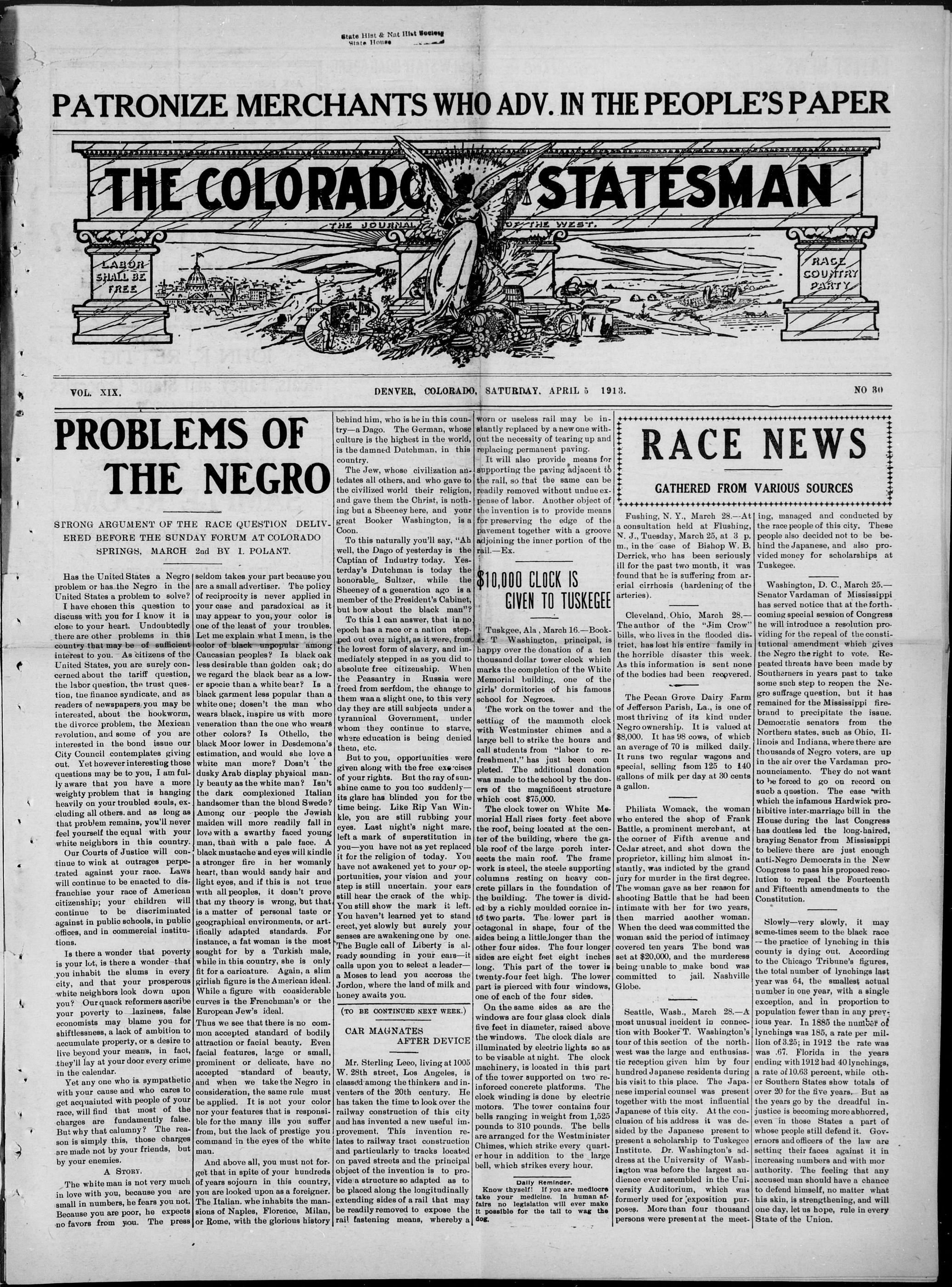
PATRONIZE MERCHANTS WHO ADV. IN THE PEOPLE'S PAPER
THE COLORADO STATESMAN
THE JOURNAL OF THE WEST.
LABOR SHALL BE FREE
RAGE COUNTRY PARTY
PROBLEMS OF THE NEGRO
STRONG ARGUMENT OF THE RACE QUESTION DELIVERED BEFORE THE SUNDAY FORUM AT COLORADO SPRINGS, MARCH 2nd BY I. POLANT.
VOL. XIX.
PROBLE
THE
STRONG ARGUMENT OF THE
ERED BEFORE THE SUND
SPRINGS, MARCH
Has the United States a Negro problem or has the Negro in the United States a problem to solve? I have chosen this question to discuss with you for I know it is close to your heart. Undoubtedly there are other problems in this country that may be of sufficient interest to you. As citizens of the United States, you are surely concerned about the tariff question, the labor question, the trust question, the finance syndicate, and as readers of newspapers, you may be interested, about the hookworm, the divorce problem, the Mexican revolution, and some of you are interested in the bond issue our City Council contemplates giving out. Yet however interesting those questions may be to you, I am fully aware that you have a more weighty problem that is hanging heavily on your troubled souls, excluding all others. and as long as that problem remains, you'll never feel yourself the equal with your white neighbors in this country.
Our Courts of Justice will continue to wink at outrages perpetrated against your race. Laws will continue to be enacted to disfranchise your race of American citizenship; your children will continue to be discriminated against in public schools, in public offices, and in commercial institutions.
Is there a wonder that poverty is your lot, is there a wonder that you inhabit the slums in every city, and that your prosperous white neighbors look down upon you? Our quack reformers ascribe your poverty to laziness, false economists may blame you for shiftlessness, a lack of ambition to accumulate property, or a desire to live beyond your means, in fact, they'll lay at your door every crime in the calendar.
Yet any one who is sympathetic with your cause and who cares to get acquainted with people of your race, will find that most of the charges are fundamentally false. But why that calumny? The reason is simply this, those charges are made not by your friends, but by your enemies.
A STORY.
The white man is not very much in love with you, because you are small in numbers, he fears you not. Because you are poor, he expects no favors from you. The press
seldom takes your part because you are a small advertiser. The policy of reciprocity is never applied in your case and paradoxical as it may appear to you, your color is one of the least of your troubles. Let me explain what I mean, is the color of black unpopular among Caucasian peoples? Is black oak less desirable than golden oak; do we regard the black bear as a lower specie than a white bear? Is a black garment less popular than a white one; dosen't the man who wears black, inspire us with more veneration than the one who wears other colors? Is Othello, the black Moor lower in Desdemona's estimation, and would she love a white man more? Dosn't the dusky Arab display physical manly beauty as the white man? Isn't the dark complexioned Italian handsomer than the blond Swede? Among our people the Jewish maiden will more readily fall in love with a swarthy faced young man, than with a pale face. A black mustache and eyes will kindle a stronger fire in her womanly heart, than would sandy hair and light eyes, and if this is not true with all peoples, it doesn't prove that my theory is wrong, but that is a matter of personal taste or geographical environments, or artifically adapted standards. For instance, a fat woman is the most sought for by a Turkish male, while in this country, she is only fit for a caricature. Again, a slim girlish figure is the American ideal. While a figure with considerable curves is the Frenchman's or the European Jew's ideal.
Thus we see that there is no common accepted standard of bodily attraction or facial beauty. Even facial features, large or small, prominent or delicate, have no accepted standard of beauty, and when we take the Negro in consideration, the same rule must be applied. It is not your color nor your features that is responsible for the many ills you suffer from, but the lack of prestige you command in the eyes of the white man.
And above all, you must not forget that in spite of your hundreds of years sojourn in this country, you are looked upon as a foreigner. The Italian, whe inhabits the mansions of Naples, Florence, Milan, or Rome, with the glorious history
State Hist & Nat Hist Biosci
State House
HANTS WH
ADC
THE JOURNAL
DENVER, COLORADO
behind him, who is he in this country—a Dago. The German, whose culture is the highest in the world, is the damned Dutchman, in this country.
The Jew, whose civilization antedates all others, and who gave to the civilized world their religion, and gave them the Christ, is nothing but a Sheeney here, and your great Booker Washington, is a Coon.
To this naturally you'll say, "Ah well, the Dago of yesterday is the Captian of Industry today. Yesterday's Dutchman is today the honorable Sultzer, while the Sheeney of a generation ago is a member of the President's Cabinet, but how about the black man"?
To this I can answer, that in no epoch has a race or a nation stepped out over night, as it were, from the lowest form of slavery, and immediately stepped in as you did to absolute free citizenship. When the Peasantry in Russia were freed from serfdom, the change to them waa a slight one, to this very day they are still subjects under a tyrannical Government, under whom they continue to starve, where education is being denied them, etc.
But to you, opportunities were given along with the free exercises of your rights. But the ray of sunshine came to you too suddenly—its glare has blinded you for the time being. Like Rip Van Winkle, you are still rubbing your eyes. Last night's night mare, left a mark of superstitution in you—you have not as yet replaced it for the religion of today. You have not awakened yet to your opportunities, your vision and your step is still uncertain, your ears still hear the crack of the whip. You still show the mark it left. You haven't learned yet to stand erect, yet slowly but surely your senses are awakening one by one. The Bugle call of Liberty is already sounding in your ears—it calls upon you to select a leader—a Moses to lead you accross the Jordon, where the land of milk and honey awaits you.
(TO BE CONTINUED NEXT WEEK.)
CAR MAGNATES
Mr. Sterling Leeo, living at 1005 W.28th street, Los Angeles, is classed among the thinkers and inventors of the 20th century. He has taken the time to look over the railway construction of this city and has invented a new useful improvement. This invention relates to railway tract construction and particularly to tracks located on paved streets and the principal object of the invention is to provide a structure so adapted as to be placed along the longitudinally extending sides of a rail that may be readily removed to expose the rail fastening means, whereby a
worn or useless rail may be instantly replaced by a new one without the necessity of tearing up and replacing permanent paving. It will also provide means for supporting the paving adjacent to the rail, so that the same can be readily removed without undue expense of labor. Another object of the invention is to provide means for preserving the edge of the pavement together with a groove adjoining the inner portion of the rail.—Ex.
$10,000 CLOCK IS GIVEN TO TUSKEGEE
$10,000 CLOCK IS GIVEN TO TUSKEGEE
Tuskgee, Ala, March 16.—Book-T Washington, principal, is happy over the donation of a ten thousand dollar tower clock which marks the completion of the White Memorial building, one of the girls' dormitories of his famous school for Negroes. The work on the tower and the setting of the mammoth clock with Westminster chimes and a large bell to strike the hours and call students from "labor to refreshment," has just been completed. The additional donation was made to the school by the donors of the magnificent structure which cost $75,000.
The clock tower on White Memorial Hall rises forty feet above the roof, being located at the center of the building, where the gable roof of the large porch intersects the main roof. The frame work is steel, the steele supporting columns resting on heavy concrete pillars in the foundation of the building. The tower is divided by a richly moulded cornice into two parts. The lower part is octagonal in shape, four of the sides being a little longer than the other four sides. The four longer sides are eight feet eight inches long. This part of the tower is twenty-four feet high. The lower part is pierced with four windows, one of each of the four sides.
On the same sides as are the windows are four glass clock dials five feet in diameter, raised above the windows. The clock dials are illuminated by electric lights so as to be visable at night. The clock machinery, is located in this part of the tower supported on two reinforced concrete platforms. The clock winding is done by electric motors. The tower contains four bells ranging in weight from 1,525 pounds to 310 pounds. The bells are arranged for the Westminister Chimes, which strike every quarter hour in addition to the large bell, which strikes every hour.
Daily Reminder
Know thyself! If you are mediocre take your medicine. In human affairs no legislation will ever make it possible for the tall to wag the dog.
RACE NEWS
Fushing, N. Y., March 28.—At a consultation held at Flushing, N. J., Tuesday, March 25, at 3 p. m., in the case of Bishop W. B. Derrick, who has been seriously ill for the past two month, it was found that he is suffering from arterial cirrhosis (hardening of the arteries).
Cleveland, Ohio, March 28.—The author of the "Jim Crow" bills, who lives in the flooded district, has lost his entire family in the horrible disaster this week. As this information is sent none of the bodies had been recovered.
ing, managed and conducted by the race people of this city. These people also decided not to be behind the Japanese, and also provided money for scholarships at Tuskegee.
Washington, D. C., March 25.—Senator Vardaman of Mississippi has served notice that at the forthcoming special session of Congress he will introduce a resolution providing for the repeal of the constitutional amendment which gives the Negro the right to vote. Repeated threats have been made by Southerners in years past to take
The Pecan Grove Dairy Farm of Jefferson Parish, La., is one of most thriving of its kind under Negro ownership. It is valued at $8,000. It has 98 cows, of which an average of 70 is milked daily. It runs two regular wagons and special, selling fsm 125 to 140 gallons of milk per day at 30 cents a gallon.
Philista Womack, the woman who entered the shop of Frank Battle, a prominent merchant, at the corner of Fifth avenue and Cedar street, and shot down the proprietor, killing him almost instantly, was indicted by the grand jury for murder in the first degree. The woman gave as her reason for shooting Battle that he had been intimate with her for two years, then married another woman. When the deed was committed the woman said the period of intimacy covered ten years. The bond was set at $20,000, and the murderess being unable to make bond was committed to jail. Nashville Globe.
Seattle, Wash., March 28.—A most unusual incident in connection with Booker T. Washington's tour of this section of the northwest was the large and enthusiastic reception given him by four hundred Japanese residents during his visit to this place. The Japanese imperial counsel was present together with the most influential Japanese of this city. At the conclusion of his address it was desided by the Japanese present to present a scholarship to Tuskegee Institute. Dr. Washington's address at the University of Washington was before the largest audience ever assembled in the University Auditorium, which was formerly used for exposition purposes. More than four thousand persons were present at the meet-
NO 30
ing, managed and conducted by the race people of this city. These people also decided not to be behind the Japanese, and also provided money for scholarships at Tuskegee.
Washington, D. C., March 25. Senator Vardaman of Mississippi has served notice that at the forthcoming special session of Congress he will introduce a resolution providing for the repeal of the constitutional amendment which gives the Negro the right to vote. Repeated threats have been made by Southerners in years past to take some such step to reopen the Negro suffrage question, but it has remained for the Mississippi firebrand to precipitate the issue. Democratic senators from the Northern states, such as Ohio, Illinois and Indiana, where there are thousands of Negro voters, are up in the air over the Vardaman pronouncement. They do not want to be forced to go on record on such a question. The ease with which the infamous Hardwick prohibitive inter-marriage bill in the House during the last Congress has doutless led the long-haired, braying Senator from Mississippi to believe there are just enough anti-Negro Democrats in the New Congress to pass his proposed resolution to repeal the Fourteenth and Fifteenth amendments to the Constitution.
Slowly—very slowly, it may some-times seem to the black race—the practice of lynching in this county is dying out. According to the Chicago Tribune's figures, the total number of lynchings last year was 64, the smallest actual number in one year, with a single exception, and in proportion to population fewer than in any previous year. In 1885 the number of lynchings was 185, a rate per million of 3.25; in 1912 the rate was .67. Florida in the years ending with 1912 had 40 lynchings, a rate of 10.63 percent, while other Southern States show totals of over 20 for the five years. But as the years go by the dreadful injustice is becoming more abhorred, even in those States a part of whose people still defend it. Governors and officers of the law are setting their faces against it in increasing numbers and with more authority. The feeling that any accused man should have a chance to defend himself, no matter what his skin, is strengthening, and will one day, let us hope, rule in every State of the Union.
LATEST NEWS EPITOMIZED
FROM TELEGRAPHIC REPORTS THAT COVER THE WEEK'S EVENTS.
OF MOST INTEREST
KEEPING THE READER POSTED
ON MOST IMPORTANT
CURRENT TOPICS.
Western Newspaper Union News Service.
WESTERN.
Chicago relief fund for the flood
sufferers aggregated $375,000.
A unique business has sprung up in
upper Michigan. It is the sale of saw-
dust.
Great damage is being done by
floods along the Cannon Ball river in
southwestern North Dakota.
Subscriptions at San Francisco to
the relief of sufferers in the Ohio and
Indiana floods has reached $80,000.
The seismograph at St. Louis recorded an earthquake of unusual violence at a point estimated to be 4,200 miles away.
A carload of potatoes given by Seattle, Wash., farmers was shipped to Ohio by express, attached to a fast passenger train.
Convinced that he had accomplished all he could in the flood district, Secretary of War Garrison left Cincinnati for Washington.
Mrs. George Griffin of Leola, S. D., shot and killed her husband with a shotgun. It is said the tragedy was due to a family quarrel of long standing.
The Anheuser Busch Brewing Association, through Adolphus Busch, contributed $25,000 for the relief of the flood sufferers of 'Ohio and Indiana.
Mrs. Mabel Clarkson, wife of the Rev. Nestor K. Clarkson of Chicago, who eloped with Owen D. Conn, San Francisco burglar, has gone to Wisconsin for a rest.
Frederick G. Withoft, for fifteen years postmaster of Dayton, Ohio, is dead as a result of news of the floods in Ohio. He had been visiting at the home of his son in Oakland, Cal.
A freight train of fifty cars, it was reported at Billings, Mont., was wrecked by a washout on the Milwaukee road between Lombard and Judith gap.
Democrats swept the city in Chicago's municipal election returning twenty-two aldermen and the Superior Court judge, city clerk and city treasurer.
Mrs. Julia McFarlane Gerhart, divorced wife of Charles B. Gerhart, brother of Frank W. Gerhart, Progressive candidate for mayor of St. Louis, committed suicide at the home of Mrs. Adeline Cox in St. Louis. Mrs. Cox announced that after her divorce Mrs. Gerhart married a negro.
WASHINGTON.
Messages continue to come to President Wilson from foreign rulers expressing sympathy for sufferers in the Western floods.
The Treasury Department began the month of April with $80,050,448 as a working balance of the federal government.
Secretary Bryan is waiting for an official report from the embassy in London on the case of Miss Zelle Emerson, the American suffragist jailed on a charge of window smashing and now on a "hunger strike," before taking any action on the appeal to the State Department to demand her release.
The Postoffice Department is threatened with a temporary shortage of stamped envelopes on account of the Dayton flood. All the stamped envelopes are turned out at the Dayton factory of the Mercantile Corporation of New York and this building was one of the structures submerged in the recent flood. Secretary Garrison's reports to President Wilson continue to convey optimistic news of the flood situation in Ohio. Messages said that all places hitherto inaccessible had been reached or soon would be and that there was an abundance of food and relief supplies. He lauded the work of Governor Cox.
Woodrow Wilson has received his first pay check as President of the United States. Secretary McAdoo presented him with a treasury warrant for $5,625, representing his salary from March 4th to 31st. On payday, hereafter, however, the President will receive $6,250, a full month's proportion of the $75,000 annual stipend.
Currency reform will come informally to the attention of Congress soon after it assembles.
W. F. Sardis of Buenos Ayres is trying to urge the President to see that meat comes into this country from Argentina free of duty.
Former Governor John Burke of North Dakota took oath of office as treasurer of the United States, succeeding Carmi A. Thompson, who turned over $1,426,422,051.48% to the custody of the new Democratic official.
SPORT.
Phil Kearney proved too clever for Peter Jensen, the battling Dane, and was awarded the decision at the end of a ten-round bout at the Owls' smoker in Denver.
The New York American team sailed from Hamilton, Bermuda, for New York. The six weeks of hard training they have undergone has brought about a marked improvement in their condition.
Lieutenant Perlekski of the Russian army committed suicide at Warsaw by deliberately shutting off the motor of an aeroplane in which he was flying and dropped from a height of 600 feet to the ground, according to a London dispatch.
Frank Gotch retained his supremacy as wrestling champion of the world at Kansas City, defeating George Lurish of Russia, in two straight falls at Convention hall. Gotch got the first fall in 18 minutes 10 seconds and the second in 5 minutes 35 seconds.
After permitting the Grizzlies to obtain a three-run lead in the first inning, Omaha pulled an April fool joke on the Western league champions by hammering Jewell all over the lot in the second inning, not ceasing until they had eight runs to their credit at Oklahoma City. The final count was 11 to 6.
FOREIGN.
Funeral services for J. P. Morgan were held in Rome.
Archbishop Nouel resigned as provincial president of the Dominican republic.
A dispatch from Cuernavaca says it is reported that Pascual Orozco, Sr., has been executed by Zapata's soldiers.
The 150 passengers were safely landed at Tangier, Morocco, from the British steamer Agadir, which went ashore near Mazagan, Morocco.
A Cettinje dispatch to the London Times dated April 1 says: "It is reported that great Tarabosch has fallen into the hands of the Montenegrins."
The London Daily Mail has offered a prize of £10,000 ($50,000) to the first person who pilots a "waterplane" across the Atlantic in seventy-two consecutive hours.
At Kuestrin, Germany, a local banker, Gustav Puppe, suspended payment with liabilities estimated at from $6,250,000 to $7,500,000. Puppe and his son have disappeared.
Rome mourns with the Empire city of America over the loss of the world-famous- multimillionaire humanitarian, John Pierpont Morgan, whose body lies in state in the Grand hotel.
Albert H. Lawrence, manager of an American owned sugar plantation near El Potrero, Vera Cruz, has been shot and killed, the authorities say, by Charles Ballet, a Frenchman employed on the plantation.
The first act of war by the powers of Europe to enforce peace in the Balkans is to take the form of a blockade of the Montenegrin harbor of Antivari by warships of Great Britain and Austria-Hungary.
One of the largest of the great scientific and industrial congresses is to be held in London in the early part of June. This is the sixth International Congress of Mining, Metallurgy, Applied Mechanics and Practical Geology.
GENERAL.
Five thousand painters, paperhangers and decorators went on strike at Chicago, amid a howl of protest from spring house cleaners.
Mayor Gaynor's April 1 uskase—nothing to drink after 1 a. m.—struck the New York tenderloin on schedule time, causing the worst drought in a decade.
Estimates of the forunte left by J. P. Morgan, as made in the New York financial district, range from $75,000,000 to $300,000,000, this sum including his art collections.
To the triple demands of the silk mill workers in strike at Patterson, N. J., more money, shorter hours and less labor—there has been added a fourth, the release from jail of William D. Haywood, the Industrial Workers of the World leader, sentenced to serve six months for disorderly conduct. There will be no resumption of work, the leaders declare, until Haywood is freed.
Business was suspended for five minutes on the New York Stock Exchange while the members adopted a resolution on J. Pierpont Morgan's death. The death of the mighty financier came so swiftly that there has been little time for speculation as to his successor. The general belief is that his son, J. Pierpont, Jr., who, it is said, has been trained for the past twenty years to step into his father's place, will become head of J. P. Morgan & Co., of Wall Street and the world.
The $500,000 mark has been passed in the fund being raised in New York for the relief of the Middle West storm and flood victims.
Former President Taft paid a tribute to the memory of J. P. Morgan at the home of his brother, Henry W. Taft, shortly after his arrival in New York from Augusta, Ga.
Secretary of State William J. Bryan, at the annual banquet of the Chamber of Commerce of Trenton, N. J., delivered an address on the subject of the "Signs of the Times."
Western Newspaper Union News Service.
Dates for Coming Events.
May.-Knights of Columbus Meeting
at Pueblo.
Maryland Council, I. O. H. A. M. at
May—State Council, J. O. U. A. M., at Colorado Springs.
June—German Press Association Meeting at Colorado Springs.
June—German Turnfest at Denver.
June—Northern Colo. Sunday School Convention at Greeley.
Aug.—Thirty-second Triennial Conclave of Knights Templar, Denver.
Aug. 25. Conference of Governors at Colorado Springs.
Aug. 26. Knights of Pythias Grand Lodge Meeting at Trinidad.
Oct. 21. Colorado State Baptist Association at Pueblo.
The late Max Kuner of Denver left an estate worth $27,000.
The Colorado relief fund for the flood sufferers now amounts to over $50,000.
Kersey farmers will try growing spuds again this year and have sent men to Wisconsin for seed.
Denver is in line for the national motorcyclists' convention in July. Chicago is its only competitor.
Mayor Arnold's veto of the Denver Broadway extension bill was sustained by the Board of Aldermen.
The board of charities and corrections let contracts for the $10,000 tuberculosis sanatorium at the Denver county farm. The State Board of Immigration, a bureau founded to advertise the resources of Colorado, has formally closed its doors. Fred Snow, aged nineteen, probably will die as the result of an accident while riding on the handle bars of a motorcycle at Cañon City. Abram J. Randall, the oldest person in Clear Creek county and a resident of Georgetown since 1868, celebrated his nineteenth birthday anniversary. Denver bankers are a unit in the opinion that Mr. Morgan's death will have no injurious effect on the financial situation in the country or on banking generally.
Governor Ammons signed the Iles bill that transfers the records of stock brands from the office of the secretary of state to the department of livestock inspection.
Austin Morrell, sixteen-year-old son of Augustin Morrell of Denver, was accidentally shot and killed while hunting with two boy companions three miles east of Aurora.
Pearl Randall, 17 years old, barely escaped death yesterday afternoon, when a motorcycle on which she was riding crashed into a moving freight train at Colorado Springs.
A suicide, two probably fatal stabbing affrays, an abduction case and a near death as the result of a motorcycle accident, is the record of forty-eight hours in Cañon City.
The domestic troubles of Thomas D. Richards, matinee idol of the "Chocolate Soldier," and Mrs. Martha Miner Richards, the Denver café singer, will be aired in the Denver County Court.
At a receiver's sale at Boulder the plant of the Central Colorado Power Company in Boulder canon was bought in for $2,500,000 by Attorney William Hodges of Denver, representing the bondholders.
Alonzo Thompson, the aged Denver spiritualist and millionaire, who was near death a few weeks ago and submitted to a serious operation in order that his life might be spared, is on the road to recovery.
The interstate commerce commission has decided to uphold the rates proposed by the railroads last September ordering substantial advances from eastern points to the Pacific coast and lowering rates from such points to Denver.
A check for $650 signed by J. Foster Symes and made payable to Geo. W. Barnes, was cashed by the Salt Lake Security & Trust Company in Salt Lake early last week. It was one more forgery credited to the master "Jim the Penman" who has procured over $7,000 in the past two months.
That the city of Denver, through narrowing and restricting the channel of Cherry creek was not responsible for damage incurred from the flood on July 14, 1912, was the decision of Judge Perry, in sustaining the demurrer to the complaint brought by the Merchants' Biscuit Company, against the city for flood damages to its property at 824 West Walnut street.
Thirty men, and women guests of the Standish hotel in Denver fled from their rooms to the street in night clothes and various stages of dress in a panic caused by a fire in the rear of the Bristol restaurant, 1542 California. Smoke from the blaze filled the hotel and the guests feared that structure, too, was on fire. Firemen extinguished the flames in a few minutes.
The State Department at Washington has been asked to investigate the death of A. D. Avery of San Francisco, brother to Mrs. Henry J. Arnold of Denver and a cousin to Mayor Avery of Colorado Springs, and former Senator E. M. De la Vergne of El Paso county.
Forty Denver officers of the Colorado National Guard visited Governor Ammons and requested him to reappoint Adjutant General John Chase. There are at least a dozen candidates for the adjutant general's place.
NEWSTATE ROAD BOARD
GOVERNOR NAMES ADVISERS FOR HIGHWAY COMMISSIONER.
Not One of the Two Hundred Applicants for the Positions Selected by Executive.
Western Newspaper Union News Service.
Denver.—Politicians were given a severe nervous shock by Governor Ammons when he appointed five business men who had never made applications for the positions as members of the advisory board which is to pass upon the distribution of state road funds made by Highway Commissioner Ehrhart. The five named, each representing a different section of the state in accordance with the highway law, are:
There were over 200 applicants for the positions but none of the appointees were among the number. Road enthusiasts in various sections of the state were extremely anxious as to the appointments, being apprehensive that their sections might not secure their just quota of the funds if the board's membership should not be favorable to them. The board as appointed is a non-partan one. Each member is prominent in business in his own district and the executive believes that the board's personnel will assure business-like consideration of road problems.
The boards of county commissioners have already been notified that they must certify to the highway commissioner the amounts of money they expect to spend on road work in their counties in conjunction with the state fund. They must make the certification within thirty days after the appointment of the highway commissioner.
Hose Supporter Protects Girl.
Greeley. -Had it not been for the metal in her hose supporter, Miss Edna Betts, a young school teacher of Longmont, would have been shot through both legs when the automobile party of which she was a member was fired upon as the car was between Farmers' Spur and Placewell. Guy Bates was shot through both legs between the knee and the hips and both are at the Windsor hospital. The metal of the girl's hose supporter deflected the bullet and the skin was not even broken, but she is suffering from shock. Sheriff A. J. McAfee captured John Hine, who is reported to have admitted having a part in the shooting, but his companion escaped. The sheriff arrested Hine, who was on horseback, just outside the limits of Windsor. He is now in the county jail.
Summary of Results in City Elections.
Denver.-City elections were held in sixty-four Colorado cities Tuesday:
Voted Wet-Littleton, Las Animas,
Meeker, Alamosa and Brighton.
Voted Dry-Lyons, Lamar, Loveland,
Fort Lupton, Colorado City,
Gunnison and Colorado Springs.
Mayor James B. Dick of Walsenburg re-elected fourteenth successive time.
Convict Talks of $1,000,000 Hold-up. Denver.—Nearly $1,000,000 in banknotes is cached somewhere in the vicinity of Military Junction, or within a radius of a few miles, according to a letter received by Governor E. M. Ammons from Frank Jones, now serving a sentence in the Kingston penitentiary at Kington, Ontario, Canada. The Denver police say such a sum of money was never stolen in Denver.
K. P. Grand Lodge Meets at Trinidad. Trinidad.—The grand lodge of Colorado, Knights of Pythias, will meet in Trinidad on August 26 and the work of appointing the different committees who are to have charge of the work of preparing for their entertainment has just been announced.
Stratton Estate Well Managed. Denver.—The estate of Winfield Scott Stratton has been well managed from a business point of view is the opinion of Attorney General Frederick Farrar, who has made a report to the General Assembly of his investigation of the Stratton estate in accordance with a resolution passed by the assembly. Mr. Farrar persuaded the trustees to double the capacity of the buildings planned for immediate construction and they decided to do so.
ASK FOR CARLSON'S Peerless Ice Cream Phones: Main 112 and Main 5787
It's made right, and tastes right. None better made anywhere and This is a Strictly Colorado Production BE SURE AN TRY IT.
IN 3028 RES. PHONE
JOHN K. RETTIG
Fancy and Staple Gr
1864 CURTIS STREET
eenth.
E ZOBEL BROTHE
AMPLE ROO
Nineteenth Street, Corner of
PHONE MAIN 3028
JOHN I
Meats, Fancy a
1864 CU
Corner Nineteenth.
THE ZOBE
SAMPL
1004 Nineteenth
1004 Nineteenth Street, Corner of Curtis
FINE WINES, LIQUORS AND CIGARS
COORS' CELEBRATED BEER ON TAP
DENVER CO
FIRST TREATMENT $1.50
OTHER TREATMENTS EACH $1.00
RATES BY THE MONTH
DISCOUNT
TREATED
ADD 3
MADAM HOLLY
Man
Madam Holly's W
PHONE YORK 2229
Supply Your
Celebrated
BOTH
THE EMPIRE
Phone
J. A. GARFIELD, Pres.
If you have a warm spot in your hea
Purlors, st
ADD 3 CENTS FOR POSTAGE
ADAM M. A. HOLL
Manufacturer Of
Adam Holly's Wonderful Hair Grower
MK 2229
2618 DOWNI
oly Your Home with
celebrated Tivoli Beer
BOTTLED BY
EMPIRE BOTTLING
Phone Gallup 245
D, Pres.
C. A. I
arm spot in your heart for the Maceo Ice Cream a
Purlors, stop in and get cool.
Manufacturer Of Madam Holly's Wonderful Hair Grower PHONE YORK 2229 2618 DOWNING STREET.
Supply Your Home with the Celebrated Tivoli Beer BOTTLED BY THE EMPIRE BOTTLING CO. Phone Gallup 245
J. A. GARFIELD, Pres. C. A. BRYANT, Mgr. If you have a warm spot in your heart for the Maceo Ice Cream and Confectionery Purlors, stop in and get cool.
THE MACEO
Fountain Drinks, C
ICE CREAM
Our Specialty, Hot I
2712½ WELTON STREET.
Tesch's Mar
in Drinks, Confectionery and ICE CREAM, DAIRY LUNCHES. Specialty, Hot Drinks, Chili and Spa N STREET. DENVE h's Market and Groc
Fountain Drinks, Confectionery and Cigars ICE CREAM, DAIRY LUNCHES Our Specialty, Hot Drinks, Chili and Spaghetti. 2712½ WELTON STREET. DENVER, COLORADO.
Tesch's Market and Grocery
Five-Points Pool and Billiard Parlor CIGARS, TOBACCO and SOFT DRINKS
DENVER
THERS'
OOM
ner of Curtis
OIL 60 CENTS
DISCOUNT TO CUSTOMER
TREATED 10 CENTS
AGE
HOLLY
Denver, Colo.
COLORADO
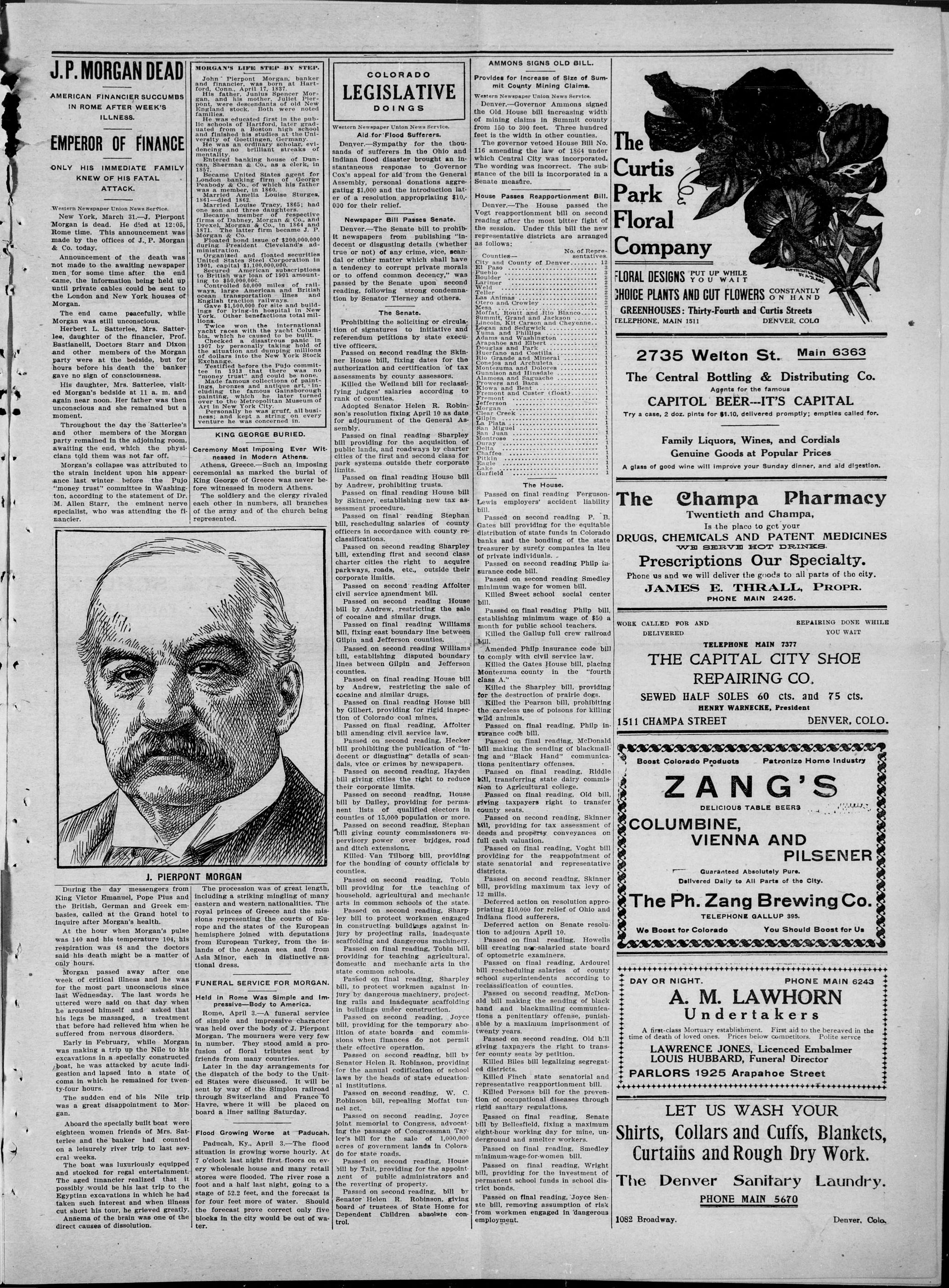
J.P. MORGAN DEAD
AMERICAN FINANCIER SUCCUMBS IN ROME AFTER WEEK'S ILLNESS.
EMPEROR OF FINANCE
ONLY HIS IMMEDIATE FAMILY KNEW OF HIS FATAL
Western Newspaper Union News Service.
New York, March 31.—J. Pierpont Morgan is dead. He died at 12:05. Rome time. This announcement was made by the offices of J., P. Morgan & Co. today.
Announcement of the death was not made to the awaiting newspaper men for some time after the end came, the information being held up until private cables could be sent to the London and New York houses of Morgan.
The end came peacefully, while Morgan was still unconscious.
Herbert L. Satterlee, Mrs. Satterlee, daughter of the financier, Prof. Bastianelli, Doctors Starr and Dixon and other members of the Morgan party were at the bedside, but for hours before his death the banker gave no sign of consciousness.
His daughter, Mrs. Satterlee, visited Morgan's bedside at 11 a. m. and again near noon. Her father was then unconscious and she remained but a moment.
Throughout the day the Satterlee's and other members of the Morgan party remained in the adjoining room, awaiting the end, which the physicians told them was not far off.
Morgan's collapse was attributed to the strain incident upon his appearance last winter before the Pujo "money trust" committee in Washington, according to the statement of Dr. M. Allen Starr, the eminent nerve specialist, who was attending the financier.
A. H.
J. PIERPONT MORGAN
During the day messengers from King Victor Emanuel, Pope Plus and the British, German and Greek embasies, called at the Grand hotel to inquire after Morgan's health.
At the hour when Morgan's pulse was 140 and his temperature 104, his respiration was 48 and the doctors said his death might be a matter of only hours.
Morgan passed away after one week of critical illness and he was for the most part unconscious since last Wednesday. The last words he uttered were said on that day when he aroused himself and asked that his legs be massaged, a treatment that before had relieved him when he suffered from nervous disorders.
Early in February, while Morgan was making a trip up the Nile to his excavations in a specially constructed boat, he was attacked by acute indigestion and lapsed into a state of coma in which he remained for twenty-four hours.
The sudden end of his Nile trip was a great disappointment to Morgan.
Aboard the specially built boat were eighteen women friends of Mrs. Satterlee and the banker had counted on a leisurely river trip to last several weeks.
The boat was luxuriously equipped and stocked for regal entertainment. The aged tinancier realized that it possibly would be his last trip to the Egyptian excavations in which he had taken such interest and when illness cut short his tour, he grieved greatly. Anaema of the brain was one of the
Anaema of the brain was one of the direct causes of dissolution.
MORGAN'S LIFE STEP BY STEP.
John Pierpont Morgan, banker at Hartford, Conn. April 17, 1837.
His father, Junius Spencer Morgan, and his mother, Juliet Pierpont were descendants of old New England stock. Both were noted families.
He was educated first in the public schools of Hartford for ten years, then for high school and finished his studies at the University of Goettingen, Germany.
He was an ordinary scholar, evidencing no brilliant streaks of mentality.
Entered banking house of Duncan Sherman & Co., as a clerk, in 1887.
Became United States agent for London banking firm of George Peabody & Co., of which his father was a member, in 1860.
Married Charlotte Louise Sturges, 1861; died 1862.
Married Louise Tracy, 1865; had one son and three daughters.
Became member of respective firms of Dabney, Morgan & Co., and Drexel Morgan & Co., in 1864 and 1865. The firm became J. P. Morgan & Co.
Floated bond issue of $200,000,000 during President Cleveland's administration.
Organized and floated securities United States Steel Corporation in 1901, capital $1,100,000,000.
Secured American subscriptions to British war loan of 1901 amount-
Controlled 50,000 miles of railways, large American and British ocean transportation lines and a railway network. Gave $1,500,000 for site and buildings for lying-in hospital in New York. Other benefactions total millions. twice won the international yacht races with the yacht Columbia, which he caused to be built. Checked a disastrous panic in 1910 when personnel lost of the situation and dumping millions of dollars into the New York Stock Exchange. Beheaded before the Pujo committee in 1913 that there was no "money trust" and could be none. Made famous collections of paintings, bronzes and antique paintings. Gave Goodborough painting, which he later turned over to the Metropolitan Museum of Art in New York City. Made a string on every venture he was concerned in.
KING GEORGE BURIED.
Ceremony Most Imposing Ever Witnessed in Modern Athens. Athens, Greece.-Such an imposing ceremonial as marked the burial of King George of Greece was never before witnessed in modern Athens. The soldiery and the clergy rivaled each other in numbers, all branches of the army and of the church being represented.
The procession was of great length, including a striking mingling of many eastern and western nationalities. The royal princes of Greece and the missions representing the courts of Europe and the states of the European hemisphere joined with deputations from European Turkey, from the islands of the Aegean sea and from Asia Minor, each in distinctive national dress.
FUNERAL SERVICE FOR MORGAN.
Held in Rome Was Simple and Impressive—Body to America.
Rome, April 3.—A funeral service of simple and impressive character was held over the body of J. Pierpont Morgan. The mourners were very few in number. They stood amid a profusion of floral tributes sent by friends from many countries.
Later in the day arrangements for the dispatch of the body to the United States were discussed. It will be sent by way of the Simplon railroad through Switzerland and France to Havre, where it will be placed on board a liner sailing Saturday.
Flood Growing Worse at Paducah.
Paducah, Ky., April 3.—The flood situation is growing worse hourly. At 7 o'clock last night first floors on every wholesale house and many retail stores were flooded. The river rose a foot and a half last night, going to a stage of 52.2 feet, and the forecast is for four feet more of water. Should the forecast prove correct only five blocks in the city would be out of water.
COLORADO LEGISLATIVE DOINGS
Western Newspaper Union News Service.
Aid for 'Flood Sufferers.
Denver: Sympathy for the thousands of sufferers in the Ohio and Indiana flood disaster brought an instantaneous response to Governor Cox's appeal for aid from the General Assembly, personal donations aggregating $1,000 and the introduction later of a resolution appropriating $10,000 for their relief.
Denver.—The Senate bill to prohibit newspapers from publishing "indecent or disgusting details (whether true or not) of any crime, vice, scandal or other matter which shall have a tendency to corrupt private morals or to offend common decency," was passed by the Senate upon second reading, following strong condemnation by Senator Tierney and others.
The Senate.
Prohibiting the soliciting or circulation of signatures to initiative and referendum petitions by state executive officers.
Passed on second reading the Skinner House bill, fixing dates for the authorization and certification of tax assessments by county assessors.
Killed the Weiland bill for reclassifying judges' salaries according to rank of counties.
Adopted Senator Helen R. Robinson's resolution fixing April 10 as date for adjournment of the General Assembly.
Passed on final reading Sharpley bill providing for the acquisition of public lands, and roadways by charter cities of the first and second class for park systems outside their corporate limits.
Passed on final reading House bill by Andrew, prohibiting trusts.
Passed on final reading House bill by Skinner, establishing new tax assessment procedure.
Passed on final reading Stephan bill, rescheduling salaries of county officers in accordance with county reclassifications.
Passed on second reading Sharpley bill, extending first and second class charter cities the right to acquire parkways, roads, etc., outside their corporate limits.
Passed on second reading Affolter civil service amendment bill.
Passed on second reading House bill by Andrew, restricting the sale of cocaine and similar drugs.
Passed on final reading Williams bill, fixing east boundary line between Gilpin and Jefferson counties.
Passed on second reading Williams bill, establishing disputed boundary lines between Gilpin and Jefferson counties.
Passed on final reading House bill by Andrew, restricting the sale of cocaine and similar drugs.
Passed on final reading House bill by Gilbert, providing for rigid inspection of Colorado coal mines.
Passed on final reading, Affolter bill amending civil service law.
Passed on second reading, Hecker bill prohibiting the publication of "indecent or disgusting" details of scandals, vice or crimes by newspapers.
Passed on second reading, Hayden bill giving cities the right to reduce their corporate limits.
Passed on second reading, Stephan bill giving county commissioners supervisory power over bridges, road and ditch extensions.
Killed Van Tilborg bill, providing for the bonding of county officials by counties.
Passed on second reading, Tobin bill providing for the teaching of household, agricultural and mechanic arts in common schools of the state.
Passed on second reading, Sharpley bill to protect workmen engaged in constructing buildings against injury by projecting rails, inadequate scaffolding and dangerous machinery.
Passed on final reading, Tobin bill, providing for teaching agricultural, domestic and mechanic arts in the state common schools.
Passed on final reading, Sharpley bill, to protect workmen against injury by dangerous machinery, projecting rails and inadequate scaffolding in buildings under construction.
Passed on second reading, Joyce bill, providing for the temporary abolition of state boards and commissions when finances do not permit their effective operation.
Passed on second reading, bill by Senator Helen R. Robinson, providing for the annual codification of school laws by the heads of state educational institutions.
Passed on second reading, W. C. Robinson bill, repealing Moffat tunnel act.
Passed on second reading, Joyce joint memorial to Congress, advocating the passage of Congressman Taylor's bill for the sale of 1,000,000 acres of government lands in Colorado for state roads.
Passed on second reading, House bill by Tait, providing for the appointment of public administrators and the reverting of property.
Passed on second reading, bill by Senator Helen R. Robinson, giving board of trustees of State Home for Dependent Children absolute control.
Provides for Increase of Size of Summit County Mining Claims.
Western Newspaper Union News Service.
Denver.—Governor Ammons signed the Old House bill increasing width of mining claims in Summit county from 150 to 300 feet. Three hundred feet is the width in other counties.
The governor vetoed House Bill No. 116 amending the law of 1864 under which Central City was incorporated.
The wording was incorrect. The substance of the bill is incorporated in a Senate measure.
House Passes Reapportionment Bill.
Denver.—The House passed the Vogt reapportionment bill on second reading after the most bitter fight of the session. Under this bill the new representative districts are arranged as follows:
Counties— No. of reports sentatives
City and County of Denver 12
El Paso 13
Pueblo 13
Boulder 13
Larimer 13
Wood 13
Teller 13
Las Animas 13
Otero and Crowley 13
Mesa 13
Moffat, Routt and Rio Blanco 13
Summit, Grand and Jackson 13
Lincoln, Kit Carson and Cheyenne 13
Logan and Sedgwick 13
Philips and Phillips 13
Adams and Washington 13
Arapahoe and Elbert 13
Douglas and Park 13
Huerfaño and Costilla 13
Kit Ortega and Mineral 13
Conejos and Archuleta 13
Montezuma and Dolores 13
Gunnison and Hinsdale 13
Alamosa and Saguache 13
Frowers and Baca 13
Klowa and Bent 13
Fremont and Custer (float) 13
Fremont 13
Jefferson 13
Morgan 13
Clear Creek 13
Gilpin 13
La Plata 13
San Miguel 13
San Juan 13
Montrose 13
Ouray 13
Delta 13
Cotfee 13
Pitklin 13
Eagle 13
Lake 13
Garfield 13
The House.
Passed on final reading Ferguson-Lewis employers' accident liability bill.
Passed on second reading P. B. Gates bill providing for the equitable distribution of state funds in Colorado banks and the bonding of the state treasurer by surety companies in lieu of private individuals.
Passed on second reading Philp insurance code bill.
Passed on second reading Smedley minimum wage for women bill.
Killed Sweet school social center bill.
Passed on final reading Philp bill, establishing minimum wage of $50 a month for public school teachers.
Killed the Gallup full crew railroad bill.
Amended Philp insurance code bill to comply with civil service law.
Killed the Gates House bill, placing Montezuma county in the "fourth class A."
Killed the Sharpley bill, providing for the destruction of prairie dogs.
Killed the Pearson bill, prohibiting the careless use of poisons for killing wild animals.
Passed on final reading, Philp insurance code bill.
Passed on final reading, McDonald bill making the sending of blackmailing and "Black Hand" communications penitentiary offenses.
Passed on final reading, Riddle bill, transferring state dairy commission to Agricultural college.
Passed on final reading, Old bill, giving taxpayers right to transfer county seats.
Passed on second reading, Skinner Mill, providing for tax assessment of deeds and property conveyances on full cash valuation.
Passed on final reading, Voght bill providing for the reappointment of state senatorial and representative districts.
Passed on second reading, Skinner bill, providing maximum tax levy of 12 mills.
Deferred action on resolution appropriating $10,000 for relief of Ohio and Indiana flood sufferers.
Deferred action on Senate resolution to adjourn April 10.
Passed on final reading, Howells bill creating non-salaried state board of optometric examiners.
Passed on final reading, Ardourel bill rescheduling salaries of county school superintendents according to reclassification of counties.
Passed on second reading, McDonald bill making the sending of black hand and blackmailing communications a penitentiary offense, punishable by a maximum imprisonment of twenty years.
Passed on second reading, Old bill giving taxpayers the right to transfer county seats by petition.
Killed Biles bill legalizing segregated districts.
Killed Finch state senatorial and representative reapportionment bill.
Killed Persons bill for the prevention of occupational diseases through rigid sanitary regulations.
Passed on final reading, Senate bill by Bellesfield, fixing a maximum eight-hour working day for mine, underground and smelter workers.
Passed on final reading, Smedley minimum-wage-for-women bill.
Passed on final reading, Wright bill, providing for the investment of permanent school funds in school district bonds. Passed on final reading, Joyce Senate bill, removing assumption of risk from workmen engaged in dangerous employment.
FLORAL DESIGNS PUT UP WHILE YOU WAIT
CHOICE PLANTS AND CUT FLOWERS CONSTANTLY ON HAND
GREENHOUSES: Thirty-Fourth and Curtis Streets
TELEPHONE, MAIN 1511 DENVER, COLO
2735 Welton St. Main 6363
The Central Bottling & Distributing Co.
Agents for the famous
CAPITOL BEER---IT'S CAPITAL
Try a case, 2 doz. pints for $1.10, delivered promptly; emptles called for.
Family Liquors, Wines, and Cordials Genuine Goods at Popular Prices A glass of good wine will improve your Sunday dinner, and aid digestion.
The Champa Pharmacy
Twentieth and Champa,
Is the place to get your
DRUGS, CHEMICALS AND PATENT MEDICINES
WE SERVE HOT DRINKS.
Prescriptions Our Specialty.
Phone us and we will deliver the goods to all parts of the city.
JAMES E. THRALL, PROPR.
PHONE MAIN 2425.
SEWED HALF SOLES 60 cts. and 75 cts. HENRY WARNECKE, President
Boost Colorado Products Patronize Home Industry
ZANG'S
DELICIOUS TABLE BEERS
COLUMBINE,
VIENNA AND
PILSENER
Guaranteed Absolutely Pure.
Dallvered Daily to All Parts of the City.
The Ph. Zang Brewing Co.
TELEPHONE GALLUP 395.
We Boost for Colorado You Should Boost for Us
A first-class Mortuary establishment. First aid to the bereaved in the time of death of loved ones. Prices below competitors. Polite service LAWRENCE JONES, Licenced Embalmer LOUIS HUBBARD, Funeral Director
The Denver Sanitary Laundry. PHONE MAIN 5670
WORK CALLED FOR AND
DELIVERED
TELEPH
THE CAPIT
REPA
SEWED HALF SQ
HENRY
1511 CHAMPA STREET
Boost Colorado Producer
Z A
DELICIO
COLUMBIN
VIENNA
Guarantee
Dellivered Dall
The Ph. Za
TELEPHON
We Boost for Colorado
DAY OR NIGHT.
A. M.
Und
A first-class Mortuary est
time of death of loved ones.
LAWRENCE JO
LOUIS HUBBA
PARLORS 1925
LET US
Shirts, Collars,
Curtains and
The Denver
PHON
1082 Broadway.
REPAIRING DONE WHILE
YOU WAIT
TY SHOE
CO.
and 75 cts.
ident
DENVER, COLO.
ze Home Industry
'S
D
ILSENER
the City.
Bwing Co.
should Boost for Us
HONE MAIN 6243
MORN
ers
d to the bereaved in the
citizens. Polite service
d Embalmer
Director
Street
YOUR
ffs, Blankets,
Dry Work.
y Laundry.
Denver, Colo.
THE COLORADO STATESMAN
JOS. D. D. RIVERS.....Proprietor
1824 Curtis Street, Room 25.
JOS. D. D. RIVERS.....Proprietor
1824 Curtis Street, Room 25.
SUBSCRIPTION RATES:
One Year .....$2.00
Six Months .....1.00
Three Months ......60
PAYABLE IN ADVANCE.
Entered as second-class matter at the postoffice in the city of Denver,
Colorado.
All communications of a personating nature that are not complimentary
will be withheld from the columns of this paper.
Display advertising, 25 cents per square. A square contains ten agate lines.
Reading notices, ten lines or less, 10 cents per line. Each additional line
over ten lines, 5 cents per line.
No discounts allowed on less than three months' contract. Cash must accompany
all orders from parties unknown to us. Further particulars on application
Remittances should be made by Express Money Order, Postoffice Money Order, Registered Letter or Bank Draft. Postage stamps will be received the same as cash for the fractional part of a dollar. Only 1-cent and 2-cent stamps taken.
Communications to receive attention must be newsy, upon important subjects, plainly written only upon one side of the paper; must reach us Tuesdays, if possible, anyway, not later than Wednesdays, and bear the signature of the author. No manuscript returned, unless stamps are sent for postage.
It occasionally happens that papers sent to subscribers are lost or stolen. In case you do not receive any number when due, inform us by postal card and we will cheerfully forward a duplicate of the missing number.
J. PIERPONT MORGAN IS DEAD.
Again the icy hand of death has invaded the ranks of the powers that be, and this time laid itself on one of the greatest, if not the greatest American Financier of the age.
Mr. Morgan died at Rome at 12:05 p. m., March 30 from a nervous breakdown following it is said the giving of evidence before the Pujo money investigating committee. His wealth is conservatively estimated between three and four hundred millions, and his controlling interests run into billions of dollars; but alas! alas! with all this wealth which helped him to be a dictator of nations, a powerful agent in the shaping of a country's destinies; a magnet which drew all business concerns to it, yet as in the scriptural language "he brought nothing into this world, and he carried nothing out, he had to bow to the inevitable. No longer can it be entertained that man with all these attributes of power and wealth must be likened to the perennial stream which as it courses down its winding pathway gives out its tuneful lay—"for men may come and men may go, but I go on forever,"—as this is the way of all flesh, when the given monster pronounces his doom on rich and poor, great and small, the just and unjust.
Mr. Morgan was a staunch Episcopalian, and it is believed that among the many bequests this denomination will be a large beneficiary. Wall street does not think there will be any serious effect, as the deceased arranged all his business interests some time ago.
SPRING
"Spring, Spring, welcome Spring;
How the birds do dally sing.
Man and beast and creeping thing
now praise Creation's King."
The Earth has two motions—a daily rotation round itself, or on its own axis, and an annual revolution round the sun. On these two motions depend the changes of climate and season, which from the conditions of life on the globe, both animal and vegetable. The effects of both these motions are modified by the important circumstance that the earth's axis is not perpendicular to the sun's rays. This daily rotation of the earth comes day and night; but it is the slope of earth's axis that causes the variety in the length of the day in different parts of the earth at the same time, and on the same part of the earth at different seasons. The annual revolution of the earth in connection with its slanting axis causes the change of the seasons of the year. The differences of the seasons are not dependent as sometimes is supposed, upon the earth's nearness to or remoteness from the sun, for in point of fact the earth is nearest to the sun during winter, and farthest from the sun during summer in the northern hemisphere.
Now as we are in the season called spring, which begun March 21st, a striking realization of a newness of life seems to lay hold of us. Both animal and vegetable, life begin to exhibit signs of an awakening; and much inspiration is given to hearts that were made sad from uncontrollable circumstances, new hope to the business man, who being discouraged at the hardiness of trade was apt to give up; perseverance and persistence to the students of political and domestic economy, and in the end a clear and judicious mind to reason logically how to combat with the vicissitudes of life. Nature in the kindliness of her disposition clothing the leafless trees with her mantle of green; the birds singing their clear-toned songs of welcome which arouse at morn; the beasts of burden cheerfully jaunting along with a pleasure in carrying out their duties; man basking in the sunshine of this glorious season, inhaling the purified atmospheric influences which revitalize and invigorates his system, thereby fitting him for his arduous mental and physical vocations, all these bear evidences that with this season of the year fresh hope and encouragement will be possessed by all. A superabundance of spring cheer, spring hope and spring success to all is the sincere wish of The Colorado Statesman.
A MOST TOUCHING APPEAL falls short of its desired effect if addressed to a small crowd of interested listeners. Mr. Business Man, are you wasting your ammunition on the small crowd that would trade with you anyway, or do you want to reach those who are not, particularly interested in your business? If you do, make your appeal for trade to the largest and most intelligent audience in your community, the readers of this paper. They have countless wants. Your ads will be read by them, and they will become your customers. Try it and see.
A MOST TOUCHING APPEAL
falls short of its desired effect if addressed to a small crowd of interested listeners. Mr. Business Man, are you wasting your ammunition on the small crowd that would trade with you anyway, or do you want to reach those who are not particularly interested in your business? If you do, make your appeal for trade to the largest and most intelligent audience in your community, the readers of this paper. They have countless wants. Your ads will be read by them, and they will become your customers. Try it and see.
What Kind of Women Do Women Admire?
By MAY ALDEN WARD
It is very difficult to answer in the abstract the question, "What kind of women do women like?" We may, however, have certain illustrations of the qualities that endear them to each other if we recall some of the women of our own day who have received in fullest measure the love and loyalty of their own sex. If we can analyze in some degree their power of winning and holding hearts, it may help to answer the question we have before us.
The name that comes first to the mind in this connection is that of one who for many years has reigned as a queen in the hearts of American women—Mrs. Julia Ward Howe. Why is it that when she enters a room other women rise instantly in recognition of her presence? It matters not whether it is a little group in a parlor or an audience of 3,000. No signal is given, no word spoken; it is simply an instinctive, spontaneous tribute. It is not because of her genius, however great that may be, that she receives this homage. It is not because she stirred the heart of the nation with her "Battle Hymn." It is not for what she has done that Mrs. Howe is so beloved, but for what she is. It is for her personality. It is for the courage which enables her to espouse many an unpopular cause; the enthusiasm and faith which have led her to further every movement for the advancement of woman; the broad sympathies which have caused her to give herself so lavishly in many directions; the sincerity, the nobility which are seen in every line of her countenance and felt in every word she utters. These are the secrets of her power.
Another name that is cherished in the hearts of American women is that of Alice Freeman Palmer. The love for her has been quickened and strengthened by the wonderful account of her life and personality which her husband has given us. Why was it that when she died thousands of women mourned as at the loss of a personal friend? What was it that made her a factor in the lives of so many others? Why was her influence so great even with those who knew her but slightly?
We find in her the same qualities as in Mrs. Howe. Courage she had of the highest kind. The courage which enabled the woman of twenty-six to accept the presidency of Wellesley college and to carry out new theories of education made her strong for all the responsibilities that came to her. She had enthusiasm, without which little of value is accomplished. Hers was the hopeful, contagious enthusiasm which incites others to action. She had to a rare degree faith—faith in the power that governs the world, faith in the world itself. She had faith in womanhood, that is to say, faith in human nature. She not only believed in woman in general, but also in individual women. There seemed to be no room in her nature for suspicion or distrust.
Mrs. Howe and Mrs. Palmer have had one other trait in common which should be mentioned. We find in both a simplicity, a frank humanness—we may almost call it an every-day-ness—that has helped to make them lovable. They have not been burdened with their own greatness. We have not stood aside and viewed them on pedestals; we have not worshiped them as saints; we have loved them as human beings. We could feel that they were made of the same clay that we are, that they lived in the same world that we live in, and that, therefore, other women may follow in their path, though they may not reach the same heights.
No two women of our day have been more loved and honored by womankind than the two described. May we not conclude then that theirs are the ideals that appeal to women; that the qualities we find in their characters are those that women recognize and admire? Among these qualities are courage, enthusiasm, faith, sympathy, sincerity, simplicity and nobility.
Walking, the oldest means of traveling, has now become the newest sport. It is not only a sport, but an art, and in order to do distance walking you must acquire that art.
Walking, the oldest means of traveling, has now become the newest sport. It is not only a sport, but an art, and in order to do distance walking you must acquire that art.
People will say, "Walking an art? Why, anyone can walk. There is nothing hard about it." But when they get out and try it they soon find out their mistake.
Distance time walking is the hardest and most strenuous of labor. It requires a well-kept body, with good lasting qualities. In the first place, one must keep in excellent condition. He must take sufficient exercise to keep the muscles from becoming stiff. This requires road work at least once a week.
Each person has a stride and he should stick to this stride and not change it from time to time. A good pedestrian's stride never varies.
To make good time one must make about four miles an hour and be able to walk ten hours a day, or forty miles. This is considered to be a good day's walk for amateur pedestrians.
Walking is like all other things—you must stick to it in order to make any progress.
Fifty years ago our fathers thought nothing of walking thirty or forty miles to the next town to spend a day with a friend. But times have changed. Prevailing conditions have taken away all thought of walking and we find ourselves riding from place to place. The modern man gets but little exercise.
If you wish to live a clean life, free from temptations and bad habits, get out and walk all you can. You will soon find that it will improve your health and give you ambition.
Any large city is a curious mixture of all the good and bad in this world—all the wealth, beauty and grandeur, the poverty, filth and crime; the palatial homes of the rich, the insanitary
People Suffer From Crowding Into Cities
By A. G. PHELPS, Chicago
Any large city is a curious mixture of all the good and bad in this world—all the wealth, beauty and grandeur, the poverty, filth and crime; the palatial homes of the rich, the insanitary hovels of the poor; the pampered, overfed, luxury laden wealthy; the poor, half clad, half starved, hopeless beggar; the high minded philanthropist, and the sordid, heartless miser; the splendid, useful, helpful, honest, manly man; the thief and thug. The larger the city the greater the extremes and the more dangerous the tendency.
Yet people take pride in living in a big city; pride in the great number of its population and, in order to swell the number, the census takes must count people who are not worthy to be classed as human beings. How much better for the population to be more evenly spread over the country, giving each enough fresh air to breathe, enough sunshine to know the day from the night!
Women and girls will work in sweatshops and stores at wages barely sufficient to keep soul and body together, when in a smaller place they could get good wages in comfortable homes and be treated like human beings.
People, like all other animals, suffer from crowding too great a number into a small place.
THE
B.L. JAMES
M. & M. CO.
PAINTS. OILS. VARNISHES. GLASS
PAINTING. GRAINING. GLAZING. PAPER MANGING.
DECORATING AND HARD WOOD FINISHING.
WALL
PAPER
1517-23 ARAPAHOE ST DENVER
ARTISTS
MATERIALS
---
At the Opening of The Twenty-Second Avenue Theatre
A few words may be of interest to the public. Recognizing the rights of the public, all necessary precautions have been taken to make the Theater safe and sanitary, the construction being almost entirely of brick, cement and steel.
Our exit space is more than double that required by law. With a seventeen-foot ceiling and two ventilators we have, in addition, the Smith Sanitary Heating System, by which the air is changed three times every hour and uniform heat secured.
The building is 46x64 feet, with a seating capacity of 425. The equipment is equipped with two machines, the most modern and up-to-date known. The projection is 55 feet and the pictures are thrown on a "Silver Leaf" curtain.
THE FILMS ARE THE "MUTUAL"
The same as used at the largest Curtis Street house, and will be changed daily. The pictures are all censored, and special effort will be made to secure films that are elevating and in structive, as well as entertaining. No doubt an expense has been spared by the management to give the people a Neighbourhood view detail. We hope that the young people will derive much pleasure from the "Shows," with due regard to the rights of others.
BOISTEROUS CONDUCT WILL NOT BE TOLERATED FROM ANYONE.
SEATING—To avoid the discrimination shown in all of the larger show houses, and actuated by a desire to be just and fair to all concerned, a distribution of seats has been made, we reby equal rights are assured all patrons by means of reserved sections. These reservations being equally good, we trust the arrangement will meet with the approval of all. Thanking you for your assistance, we ask a continuance of the same.
Open Daily at 7 P. M.
Mattines a Saturday and Sunday at 3:30 P. M.
BROWER & SCHUCK
REAL ESTATE
311 Cooper Building
DENVER, COLORADO
Telephone Champa 1962
Residence Phone Main 7345
Phone Main 7413
"Nothing Finer in Denver"
A Woman Serving Food
MRS. L. CARR, Proprietor
MEALS AT ALL HOURS
Regular Dinner Short Orders
PRIVATE BOOTHS
1841 Arapahoe Street D
Denver, Colorado
Paeonia suffruticosa
SWEET PEA VEGETABLE FLOWER SEED
Buy fresh seed in BULK from,
The Western Seed Co.
"An Accomodating House"
COR.15th & BLAKE DENVER, COLO.
HENRY MILLER & CO.
1939 BROADWAY
FIRE ENGINE
GRAVEL ROOFING AND CEMENT WORK
Cement Ash Pits, $5 Up
Repairing Promptly Done
Tin Roofs Painted
All Work Guaranteed Give Us a Trial
Phone Main 1062
W.F.Davis
(12 Years Chief Plumbing Inspector for City and County of Denver)
Plumbing, Heating and Ventilation
Examination and Tests for Sewer Gases On All Old defective buildings
Estimates Given
842 BROADWAY PHONE SOUTH 855 DENVER, COLO
Mrs. Laura Gunnell is on the sick list.
Mrs. Annie Batiste has been on the sick list a few days.
Mrs. Roy Handy left Monday night for Pueblo on business.
Mrs. Mae Brooks is visiting Mrs. A. H. Denton at Barr lake this week.
handled in a masterly manner. The splendid little edifice was taxed to utmost capacity, and the program which was so well arranged was successfully carried out. Messrs C. Franklin, H. Robinson, Hewets Watson, Mrs. Lillian Jones, M. Washington and Dr. Huff, special contributors to the program, in conjunction with the sisters of the Cow made quite an impression on the au
Lawyer W. B. Townsend has moved his office to Room 313 Kittredge building. Phone Champa 618.
Harry Jones, who has been quite ill for the past week with pneumonia, is reported to be improving slowly.
Miss Rosa C. Rice has returned to the city from Alamosa, where she spent several months.
Captain Thomas Campbell, late editor of the "Independent" has received an appointment in the assessor's office.
Mr. and Mrs. Louis Parks will leave the city next week for Wattenburg, Colo., their new country home.
Dr. Huff's resident phone has been changed to Main 8492. Office phone at 313 Kittredge building, Champa 618.
Miss Tillie Randolph returned last week from California points.
Mrs. Cora Smith left last Friday for Pacific Grove, Cal.
Mrs. George S. Contee returned home Saturday of last week from a very pleasant visit with relatives and friends in Washington, D. C.
Miss Mabel Lewis, who has been visiting several weeks in the mountains, returned home last week to be with her brother, who is ill.
The funeral of Mr. A. Snell was held last Saturday afternoon from the Douglass Undertaking parlors, Rev. Pope officiating.
Mrs. L. Hayden received the sad news last week of the serious illness of her daughter, Mrs. Dora Rolley, who is living in Vancouver, B. C.
Miss Luara Sharborne, who has been sick several weeks with a severe attack of heart trouble, has moved to the residence of Mrs. Elleanor Johnson.
The funeral of C. F. Sears was conducted last Sunday afternoon from his sister's residence, Rev. H. Franklin Bray of Campbell A. M. E. church officiating. Duoglass Undertaking Co. in charge.
Mrs. E. Cole, who has been residing in Pueblo several months returned to the city last week, and is living at 4464 Delaware street, where she will be pleased to see her many friends.
Mrs. R. Miller, grandmother of Mrs. Charles Lightner, died last Tuesday at Weeping Water, Neb., and was buried the latter part of the week. She is survived by one daughter and three grandchildren in her home town and one granddaughter in Oklahoma.
On the first page of this paper will be found an address headed "Problems of the Negro" delivered at Payne's Chapel, Colorado Springs, March 2nd, by I. Polant . Don't fail to read it.
By order of the fire and police board all of the Colored clubs and pool halls were closed last Thursday night. The cause is said to be from complaints of the better clas of Colored citizens.
Mr. J. E. Moorland, international secretary of the Colored Department of the Y. M. C. A., will address the Young Men's Christian Brotherhood at Shorter church, Sunday, April 6th, at 3:30 p. m. Mr. Moorland is one of the best orators of the race. Don't fail to hear him.
The annual Thanksgiving service of the Knights of Pythias was held on Sunday last at Bethlehem Baptist church, 32nd avenue and Lafayette street. The order was represented by upwards of one hundred and twenty members including the sisters of the Court of Calanthe. Rev. Reynolds preached the sermon, taking for his theme the Biblical characters David and Jonathan as the prototype of Damon and Pythias, the same being a fine, delectable discourse that was
handled in a masterly manner. The splendid little edifice was taxed to its utmost capacity, and the program which was so well arranged was successfully carried out. Messrs C. A. Franklin, H. Robinson, Hewetson-Watson, Mrs. Lillian Jones, Mrs. Washington and Dr. Huff, special contributors to the program, in conjunction with the sisters of the Court, made quite an impression on the audience, who listened with rapt attention to the different items of the proceedings. Nearly twenty-five dollars were taken up, which was given to the church as a thank offering.
The Odd Fellows' entertainment, which promised to be the event of the season, came off successfully Tuesday evening last at Eureka hall. Rocky Mountain Lodge No. 2320, assisted by Arapahoe, Denver and the Household of Ruth, also the Junevile, clearly exhibited that she stands without a peer in the giving of entertainments. This took the form of a popularity contest, prizes being offered for the most popular of the following contestants: Messrs. Winters, Mason, John Levell, Mrs. Thenis Bush and Mrs. Matilda Ewing. The keenest interest was evinced in the contest as up to a late hour there was hardly any difference between three of the runners, but when the announcement was made, Mr. John Levell won the bicycle, Mrs. Bush the hat and Mrs. Ewing the water-color picture.
The Peerless trio, Holley, Wolfskill, Jackson, a moving picture show exhibited by Mr. Robt. Phynix and dancing were the other features of the program. Under the very able management of the lodge's committee a splendid success was insured. Well done, Rocky Mountain! Try again
CARD OF THANKS.
For the kind sympathy shown and thoughtful remembrances exhibited in the form of the beautiful floral offerings and other mementos so mindful of esteem and tenderness, we heartily thank and deeply appreciate what our many friends have done during the recent hour of the bereavement of our relative, Drucilla Lacy, and especially thank Rev. Reynolds who participated in the funeral ceremies.
(Signed)
MRS. F. E. LACY.
MRS. D. W. SMITH.
SHORTER CHAPEL'S NOTES.
The order of services at Shorter's Chapel tomorrow will be as follows: 10:00 a. m. Sunday school. Lesson: Jacob and Esau. Gen. 25:27-34; 27:145.
11:00 Sermon: "The Rock Christ," by the pastor. Holy communion will be given at this service.
6:45 p. m., Allen Christian Endeavor League. Topic: "The Ideal Christian IV. His Humility," Matt. 20:20-28. (Consecration meeting.)
Beginning with tomorrow our evening service will open at 7:45 instead of at 7:30 as heretofore.
Sisters Annie C. Poage of St. Louis, Mo., and J. H. Steele and Minnie Fred Steele of 2323 Walnut street were welcomed into Shorter's communion last Sabbath. Little Minnie Fred Steele doubtless enjoys the distinction of being the youngest Christian to transfer her membership to a Denver church, she being about seven years of age.
Our church remembered the Omaha sufferers last Sunday and $52.25 was sent from our congregation for their relief. Brother Wm. Sprague and Mr. A. S. Hamilton came in for special mention. Through the generosity of Mrs. Anderson, 2054 Arapahoe street, a box of clothing was forwarded also.
Our congregation is preparing to observe Woman's Day on the third Sunday of April. The pastor will deliver a special sermon to the women and the ladies will have control of the services. The trustees, the stewards, the ushers, the secretary, the choir, presiding officer and treasurer will all be women.
The second installment for the spring campaign will be due on Friday evening, April 11th. Every captain is expected to be on hand with a complete report.
The big bazaar by the Sewing Circle on April 29th to May 1st is going to be worth while. Something good is in store for the fun-loving public. The paper on Harriet Beecher Stowe, read by Mrs. R. L. Pope before the Sunday Alliance last Sabbath was so well received that a re-reading at a future meeting was called for. Sister Eleanor Braxton, after a period of illness covering several weeks, was warmly greeted at the morning service by her many friends. Bothers Harry Jones, 2036 Arapahoe street; Morris Campbell, 837 Elati street; Sister O'Neal, 1425 East 16th avenue, who are on the sick list, are reported to be convalescing.
Opposition.
A Blair county barrister recently handed a brief up to the court in which he thus described his two brethren on the other side: "They are like two ghouls in a country graveyard seeking a carcass to devour."—Philadelphia Record.
CAMPBELL NOTES.
Campbell Chapel A. M. E. Church, Cor.
23rd and Lawrence Sts., Rev. H.
Franklin Bray, D.D., Pastor.
Sabbath services as follows: 11:00
a. m., Sacrament of the Lord's Supper
and general class. 6:30 p. m., Allen
League. Subject, "The Ideal
Christian." (Consecration meeting.)
D. D. Howard, leader. 7:45 p. m.
preaching by the pastor. Subject,
"Three Old Wells." You will receive
a hearty welcome at each of these
services.
Campbell sent $11.89 to Rev. W. T.
Osborne for the aid of the unfortunates in his parish.
The men are planning for a big entertainment for the benefit of the trustees. They had a good meeting loking to that end on Thursday evening.
The Pastor's Aid gave a side-splitting entertainment at the church Wednesday evening. The program was a sure cure for the blues.
The Sewing circle is now hard at work on their quilt, from which they hope to realize a neat sum.
The parsonage was stormed again last week by Brother Fleming and Sister Lewis, who brought many nice things to wear and eat.
Sisters Nannie Washington, Caroline Holland, J. T. Alexander and Hattie G. Berry have returned after an extended visit with relatives and friends in Kansas and Missouri. The members are glad to see them in their pews again.
Most of our sick are greatly improved. However, Sister Hayden had a severe fall, from which she is suffering considerably.
The Easter editorials in The Colorado Statesman provoked the most favorable comment of the church and community.
Nicely furnished alcove front room for rent with all modern conveniences. Telephone Olive 1608, Mrs. Howard Steele, 2222 Curtis street.
For Rent—Nicely furnished rooms for rent at 1919 Welton street. Phone Champa 2528.
Modern furnished rooms for rent. Mrs. A. Arnold, 2318 Arapahoe.
Brickler's New Barber Shop is located at 2208 Larimer street. Shave, 10c. Hair Cut, 25c; Children, 15c.
THE DE LUXE.
Furnished apartments. 2 and 3 rooms, with hot and cold water in each kitchen. Also front room, singles, electric lights and gas. Modern throughout. Rates very reasonable. 2352-2358 Ogden St., Cor. 24th Ave. Phone York 6707. Mrs. R. M. Blakey
THE
WESTERN
BEEF
CO.
Hog Chitterlings, 5c lb.
Our store is your store.
We are at your service.
We Sell Everything a
Hog Furnishes
Get our prices before you buy else-
where. We also sell our groceries
cheaper.
OUR MOTTO:
Our profits are small,
But we get them all.
We sell for cash only.
2048 LARIMER ST.
Opposite Three Rules.
Phone Champa 1641.
Open Sunday All Day.
Marking Arrival of Age.
When I get to be old I ain't goin' to find it out by countin' up to see, nor by my whiskers, nor by my gums, nor none of them signs. They'll all fool you. No, sir! But one of these times I'll get thrown down, and I won't bounce back. Then I'll know it all over. When a man gets that way, he's old. Old, see? It don't make any difference how much longer he lives after that, he don't ever get any older." "Billy Fortune."
COURSE OF BIBLE LECTURES.
A very interesting course of Bible lectures, containing important facts that every one should know, are now in progress in the chapel of the People's Presbyterian church, corner East Twenty-third avenue and Washington street every Sunday evening at 7:30.
Each lecture is illustrated with charts and diagrams, so that the truth is made clear and plain to all. A verse by verse study of the books of Daniel and the Revelation has proven a great help to many.
Do you realize that we are living in the noon-tide of great prophetic light? Do you realize that the days in which we live are similar to the days of Noah, and of Sodom and Gomorrah? Have you ever heard a lecture on the Eastern question? Would you like to know what bearing the Balkan War and the desolation of the Turkish empire has upon this present generation? Would you like to know something of the origin of Spiritualism and its work? Are you interested in Christ's second return? If not, why not? Do you know that you will be held accountnable for the knowledge that you could have gained, but did not embrace the opportunity? God weighs our circumstances, our opportunities and our chances to know His will, and we are judged accordingly. "Come now, let us reason together."
A question box is provided, so that those desiring to ask questions on the subject may do so by writing the question on a slip of paper and drop the same into this box. At the close of each lecture these questions are gathered and answered in the light of Scripture.
2941 Glenarm Place. J. W. OWENS, Pastor.
STARTING MORE DRASTIC MEASURES TO DISPOSE OFREMANING STOCKS QUICKLY
In the windows—thrown out on the counters in the store. Take as many as you want, and don't expect too much attention. Take three Hats, Four Hats, five Hats, six Hats, for the price of one. Get in the Hat business if you want—this is your chance. There will be a man in the window to hand out to you and another in the store to help. There are going to be hundreds of customers gathered around this Hat Sale—and it will be, in a measure, "Help yourself and hand over the money."
Your back yard will help pay your rent if you plant
THE BARTELDES SEED CO.
1521-1525 Fifteenth St. Denver, Colorado
The Largest Poultry Supply House in the West
QUITTING BUSINESS
STARTING MORE DRAFT
DISPOSE OF REMANIED
$1.00 FOR STIFF
AND SOFT HA
In the windows—thrown out on the cou-
you want, and don't expect too much a
five Hats, six Hats, for the price of one.
this is your chance. There will be a m
and another in the store to help. There
gathered around this Hat Sale—and it
and hand over the money."
SEE
Your back yard will help p
BARTEL
"WESTERN SEEDS FOR
THE BARTEL
1521-1525 Fifteenth St.
The Largest Poultry Su
ORIENTAL CAFE
1848
Arapahoe St.
Phone Main
4896
Mrs. S. Clingman
HAND-PAINTED
CHINA
BATTENBURG LESSONS.
2620 Welton Street.
Before You Buy Property, Let Lawyer
EXAMINE THE TITLE AND MAKE YOUR CONTRACT. LAWYER TOWN-SEND MAKES A SPECIALTY OF COLLECTING FROM INSURANCE COMPANIES, ALSO ENDOWMENT MONIES.
OFFICE 313 KITTREDGE BUILDING
1005 SIXTEENTH STREET Near Curtis
ERASTIC MEASURES TO
MING STOCKS QUICKLY
HATS THAT SOLD AT $3.00,
$4.00,$5.00 & $6.00
counters in the store. Take as many as
in attention. Take three Hats, Four Hats,
one. Get in the Hat business if you want -
a man in the window to hand out to you
there are going to be hundreds of customers
it will be, in a measure, "Help yourself
LEDS
p pay your rent if you plant
TELDES'
FOR WESTERN PLANTERS"
TELDES SEED CO.
Denver, Colorado
Supply House in the West
NAST
THE GREAT BABY
Photographer
ONLY CATERS TO FIRST CLASS TRADE. OUR PIC TURES SPEAK FOR THEM SELVES.
J. H. BIGGINS
Furniture Repairing and Upholstering. All work Cash.
PHONE YORK 7602
1417 East 24th Ave. Denver.
PHONE MAIN 6782.
13 CENTS A DAY BUYS A PIANO.
WITH MUSIC LESSONS FREE. PIANOS FROM $88 UP. COLUMBINE MUSIC CO., 920-924 15th STREET, CHARLES BUILDING.
THE TINOLI UNION BREWING CO.
1890-1947
Tivoli
DENVER, COLO
```markdown
```
Do You Know That
The Colorado Statesman Is Prepared to Do All Kinds of Job Printing?
Commercial. Fraternal. Church,Book and Stationery Jobs a Specialty
Ball and Concert Programs, Bill and Letter Heads, Calling Cards, Wedding Cards, Envelopes and Everything in the PrintingLine Turned Out in Neatest and Best Style Promptly on Short Notice.
We have supplied our office with job press and type of up-to-date style and our work will be on a par with the
Very Best
Give Us a Trial and We Will Give You Satisfaction
PRICES AS REASONABLE AS THOSE OF ANY JOB OFFICE IN DENVER
THE Colorado Statesman
1824 Curtis Street
Room 25
---
Underwear & Underwear
A summer dress of hand embroidered batiste trimmed with crochet buttons.
HOW TO HAVE ROSY CHEEKS NEW AND POPULAR FABRICS
Many Things Better Than Ice, Though That Will Temporarily Give the Glow Desired.
The use of ice as a cosmetic is advocated by many. Its results in many cases are not lasting.
There may be some virtue in ice when a woman wants to make her cheeks rosy for a short while. She can prepare soft pads, lay them on ice until they are very cold, then on the cheeks; they draw the blood to the surface and give a rosy tint. Cold water is better, however, when it comes to the question of making flabby muscles tighten to a normal condition, and the toilet vinegar is better still; such muscles need something that will tone them permanently, not just for the moment. To apply ice to the skin that has been exposed to the wind is all wrong; cold cream, left on half an hour first; then warm water and a good soap; then very cold water to finish with and cold cream rubbed in, with a spray of toilet vinegar last, is the method that answers best for flaccid muscles.—Philadelphia Telegraph.
FOR THE EVENING
FOR THE EVENING
An evening gown of black liberty satin velled with black maline embroidered with jet. The tunique is finished by two ruffles of accordeon pleated chiffon.
Sleeves for Day Wear.
For day wear the sleeve of the moment is long and rather tight and may be loose at both elbow and shoulder.
That They Lend Themselves to the Graceful Draperies Demanded Is Their Recommendation.
The touch of the Oriental that is noticed in the spring styles requires that a fabric be used which lends itself readily to graceful drapery. One particularly adaptable material is etamine, which is more popular this spring than it has been for several seasons. The robes of handdrawn etamine are truly beautiful. The drawn-work appears in bands of graduated widths, forming a very handsome border for the robe. A narrow band of drawn-work is done along the opposite edge of the material to be used for the smaller trimmings. These etamines come in all the vivid shades that are to be so much used.
Among the silks, fluer de sole, a new form of taffeta with an extremely soft finish, falls in the most graceful lines. It comes in very new and unusual tones, in both plain and figured surfaces. The floral designs that appear on many of these new silks seem somewhat stiff at first sight, but one soon realizes how very well suited they are to the period costumes so affected by our best gowned women. Some of the new patterns now in vogue are exact copies of some of those used in France at the time of the empire—Pittsburgh Dispatch.
Double Train.
A new train seen lately consisted of two trains each quite separate, and ending in points. A very lovely evening dress of deep orange charmeuse had this new double tail. One was of the orange charmeuse, and was just a continuation of the dress itself. The second train was of lemon-colored mousseline-de-sole, and started from a drapery at the waist, which came down one side and round the back of the frock, falling into a train the exact size and shape of the satin one. When well down this has a very pretty as well as a very novel effect.
Aids the Complexion.
The complexion seems to be the only thing which benefits from damp weather. One of the reasons for the fresh and colorful skins of English girls is said to be the fogs and mists that sweep over Britain from the sea. Moisture holds the dust prisoner—and dust is the worst enemy to good complexions. Besides that, moisture, while it does not prevent wrinkles, does not produce them; and excessively dry climates are always productive of excessively wrinkled skins.
Oriental Negligee.
For wear beneath the Oriental negligee there is a special Oriental combination garment of brassiere and petticoat. This is what the garment really is, though at first glance it appears to be a winding affair of fine fabric and lacy trimming which twists around the figure from shoulder to knee.
Greek Draperles.
The Greek draperies introduced through the winter are so charming that nobody will relinquish them, at any rate for evening wear.
ETHNOLOGICAL SECTION OF THE NATIONAL MUSEUM.
Figures Are Lifelike, Modeled to Perfection From a Plastic Substance, Clothed in Proper Articles of Dress and Adornment.
The groups and single figures in the ethnological section of the Nas
tional museum catch the fancy and hold the attention of more visitors than any other exhibits in that great curiosity shop. These figures are lifelike and life size. Modeled to perfection from a plastic substance, colored, clothed with such articles of dress and adornment as the nec-
C
ple represented wear, they are surrounded by a setting peculiar and appropriate to the subjects. The figures do not as a rule stand at attention of in mummy postures, but are pictured as engaged in those occupations natural and usual with the people. The single figures are in big glass showcases, and the groups are inclosed in glass quarters as big as the show windows of shops. These exhibits remind one of the long popular "tableaux vivants," only these groups are not "vivant," but are decidedly more verisimilar and realistic than that form of show probably ever was. The exhibits are of a high educational value, and to overhear the comments of average Americans as they stand before the groups one realizes that the common run of people need information about strange folk.
In one of the halls are numerous groups of American Indians, commonly from five to seven in each group, and usually represented as engaged in their domestic work. Many of the women are pounding corn into meal or grinding it into meal by rubbing the kernels between flint stones. There will be one large, flat piece of flint inclined at about the same angle at which a washboard rests. The worker will have a round piece of flint, fashioned something like a rolling pin, and by rubbnb the grains of corn, a handful at a time, between these stones, just as a woman washes clothes, she grinds the grain into a very coarse meal.
Among the exhibits are groups of Cocopa Indians from the Colorado river country in Mexico, Hopi Indians engaged in beautiful basketry, showing the leaves of the yucca in all stages of manufacture; a family group of seven Sloux with one woman pounding up strips of dried buffalo meat for a stew, one woman scraping the hair off a buffalo hide and two maidens making beaded moccasins. There is an Apache group with the figures dressed in barbaric elegance usual to the prosperous members of that tribe. A group of Navajo silversmiths—four of them—are fashioning silver rings and bracelets by means of a curious bellows and crucible, a blow pipe, hammer and stamps. A group of Pueblo Indians is represented as making bread and cooking a meal, and the scene is not usually tantalizing to a white man's appetite. There is a group of Zunis represented as going through the ritual of "Creation," the Kaka, or sacred drama of these people. The Maya Indians of Guate mala are represented, and so, too, are the Tehuelche Indians of Patagonia, the Loucheax Indians of the Yukon-Mekenzie country, and the Chilkats of the north Pacific region, and there is also a large group of Klowa Indians which attracts a good deal of notice.
There is a picturesque Samoan household. A woman is pounding bark in the making of cloth and a girl is straining kava. Another woman is decorating bark cloth, while a man with a spear is looking on. The women have garlands of flowers around their necks and their raiment, though scanty, is sufficient.
There is a family of negritos, small and very black people, who live in the out-of-the-way places in several of the Philippine islands. The explanatory card on this exhibit says that these people are small, but strong and hardy, of remarkable endurance, cheerful, intelligent, peaceable and moral, and that "they love music and dancing." There are three men, two women and a child in the group. Two of them are represented as making fire by friction with two strips of bamboo. Nearby is a Filipino group mainly engaged in making cotton cloth. There are three women, a girl and a man. Further on is a group of Igorots engaged mainly in the making of crude pottery.
Astonishing Vitality
A case of youthful vitality that has astonished the medical profession is that of George Krouse, a boy of thirteen, who died in the Lebanon hospital. A red-hot steel umbrella rod was driven through the boy's head from ear to ear while playing with some children in a vacant lot in the Bronx 13 days before. That life was sustained so long as it was is considered exceptional by surgeons interested in the case, says the New York Tribune. In addition to the terrible injury to the child's brain, owing to the pressure of broken bones upon it, it had been completely pierced and burned by the heated steel.
NOTED NATIVE-BORN DEAD
He Had Served In the Creek War, Florida Campaign, Mexican and Civil Wars.
There died in Washington the other day a man noted all over the continent, Capt. Wesley Markwood, who was presumably at the time of his death the oldest native-born inhabitant of Washington. He at least always claimed to be. He took part in the Mexican war, and was supposed to have been killed there, and for fifty years a grave in Texas bore a monument erected by his family. He enlisted under another name, and it was that man who was killed. Later he enlisted under his own name, served throughout the war of the rebellion and was in the Indian wars. Under the name of Captain Markwood, and under the name of Col. Samuel H. Walker, he gained wide renown as a soldier and scout. The history of his life was kept a secret by him until he died, only members of his immediate family even suspecting the real story of his past. It was while using the name of Walker that he was supposed to have been killed.
At the age of twelve Markwood enlisted for the Creek war. He afterward served in the Florida campaign. In the spring of 1843 he joined a company of Texas Rangers, under Capt. Jack C. Hays.
In the war with Mexico he played a distinguished part and his name was often mentioned for bravery. He was supposed to have been killed at the battle of Huamatania, and a county in Texas was named in his memory.
Just how he happened to escape and his name included among the dead was never revealed by Captain Markwood. Not long afterwards he resumed his former name, and again enlisted in the army, serving again with distinction.
At the close of the Mexican war he enlisted in the navy, and after the termination of his enlistment obtained an appointment as non-commissioned officer in the Second U. S. Dragoons. When the Civil war broke out he was transferred to the Fourth cavalry. In 1864 he became a commissioned officer, and served two years more, later becoming an agent for the Freedman's bureau.
F. S. KEY MANSION IS RAZED
Washington Home of Author of "Star Spangled Banner" Last of Old Relics.
The Francis Scott Key mansion is the last of the old relics of Washington to fall before the scythe of time. Today its ruins litter the ground and tomorrow a new building destined to commercial pursuits will rise upon its site. Francis Scott Key, the author of "The Star Spangled Banner," the national anthem of the United States, built his house upon the banks of the Potomac shortly after the treaty of Paris had been signed. It stood in Georgetown, on what is now the main street of that city, and in the early days of the city the Key mansion was a stately house, set in a large garden which ran down to the main channel of the Potomac.
The Key mansion, it is claimed, has never had the attention which it has merited. On Key's death it passed to a relative of his and remained in his possession for some years. Later it passed out of the family. Then came a period of commercial development in Georgetown. The old Chesapeake & Ohio canal was built from Georgetown, up the river to Harper's Ferry and beyond. This canal usurped the garden of the Key mansion, penetrating directly through it and cutting off the house from the riverside. Then warehouses and mills of various sorts were erected along the banks of the canal. In that period of development the old time beauty of the Key property was destroyed, and it never has been restored.
Whereas in the old days there was a fair stretch of garden before the house, as well as on the river side, soon M street was produced directly before the door, and when the house was pulled down the doorstep of the remarkable entry way rested directly on the sidewalk of that street.
Restoring a Masterpiece.
The ingenuity with which clever workmen restore damaged masterpieces of paintings is shown by the means taken to rescue a famous Madonna by Botticelli. The New York Tribune describes the process: The Madonna was painted on a wooden panel at least 400 years ago. Recently the wood began to crack, and it was feared that the painting would be ruined; but the restorer was found who said that he could save it. His first step was to paste thin strips of tissue paper on the face of the picture, pressing the paper into the uneven surface of the paint. He added layer after layer, until a thick body of paper concealed the picture.
Then the restorer turned the picture over and began to sandpaper the board away. After many months of careful work he had all the wood removed, and nothing but the paint adhered to the paper. Next, he glued a piece of linen canvas very carefully to the paint, and slowly and patiently removed the paper bit by bit. The work took nearly a year; but when it was finished the painting was in a condition to last another four centuries.
Lauds Baby Raising.
Less instruction in Latin and the classics and more in baby raising in women's colleges, United States Commissioner of Education Claxton told an audience, would increase the world's moral tone.
AFRO-AMERICAN CULLINGS
Take up the Black Man's burden—
"Send forth the best ye breed;"
To judge with righteous judgment
The black man's work and needs.
To set down naught in mallice,
In hate or prejudice;
To tell the truth about him,
To paint him as he is.
Take up the Black Man's burden—
Ye of the bold and strong.
And might makes right only
It does no weak race wrong.
Make all his chances equal;
Give him the fairest test.
Then "hands off" be your motto,
And he will do the rest.
Take up the Black Man's burden—
Don't curse him in advance.
He cannot lift a white man's load
Without a white man's chance.
Shut out from mill and workshop,
For cutting room and store;
By caste and labor unless
Is closed Industry's door.
Take up the Black Man's burden—
Don't crush him with his load;
Don't heap it up in courses
By scoffs and jeers that goad.
The haughty Anglo-Saxon
Was savage and untaught;
A thousand years of freedom
A wondrous change has wrought.
Take up the Black Man's burden—
Black men of every clime;
What though the cross be heavy,
Your sun but darkly shine?
Stoop with a freeman's ardor,
Lift high a freeman's head,
Stand with a freeman's firmness,
March with a freeman's tread.
Take up the Black Man's burden—
"Send forth the best ye breed;"
To tell the world you're rising
To preach, to pray, to plead.
Let me prove you right.
Be the making of good men;
Then the raising of the lowly
To noble thought and aim.
Take up the Black Man's burden—
Black freemen! stand alone
If need be! Gird your armor
For conflicts yet to come,
When welgled to be not found wanting,
But find or make your way
To honour, fame and fortune,
To God and destiny.
Kansas City, Mo.
J. Dallas Bowser.
Scout, spy, war nurse, "underground-
railroad" manager, a memorable figure
of the Civil-war period has passed
away in the death of Harriet Tubman
Davis at Auburn, N. Y.
Harriet Tubman was born a slave in Maryland. Of Ashantee blood, descendant of tribal chiefs, she possessed an unconquerable spirit and immense physical strength, surpassing that of most men. To avoid being "sold south" in her youth, she followed the north star to freedom, but soon was back teaching other negroes the road she had trod. Rewards amounting to $40,000 were offered in Virginia and Maryland for her arrest.
Harriet Tubman was invaluable as an "underground-railroad" agent in the north. While in this work she led the mob that rescued Charles Nalle, a fugitive slave, in Troy. Though beaten upon the head by policemen's billies, she thrashed two of them and aided the rescue with her mighty muscles. In her station of the underground at Auburn, with the financial support of William H. Seward she sent away many a refugee to Canada. Appointed as a nurse to Colonel Shaw's famous negro regiment in 1863, she soon appeared in a new capacity as a scout for the Union troops. In 1896 she founded the Harriet Tubman Davis Home for Indigent Aged Negroes, where she herself died at the supposed age of ninety-eight.
Why despair of the future of a race that can exhibit such courage, devotion and capacity for leadership in one of it lowliest members?
Though fashions may come and go, though weaves vary and dress goods of many and various kinds be adopted by that whimsical personage, Dame Fashion, broadcloth is always in favor. It is one of the aristocrats of the dress goods realm, and its place is always assured.
This year the tendency in broadcloth is towards those with a very high luster—the more brilliant and satiny the sheen, the better madame will like her cloth.
Smart autumn suits are of broadcloth, elaborately trimmed—frequently with handsome silk braids, often with rich and deep-toned velvets.
But not alone for suits and tailored costumes is broadcloth in demand.
For handsome wraps, street coats, evening garments and afternoon toilettes, broadcloths will be fashionable.
The National Benefit association of Washington, District of Columbia, headed by Samuel W. Rutherford, employs upward of 500 colored persons.
In Beaufort, S. C., the postmaster, clerks, carriers and other postoffice employes are all colored.
A preacher who is not little and narrow, a preacher who is upright and does not lie, a preacher who does not backbite and practice deceit, a preacher who is not envious and full of dirty tricks, is an honor to both his church and the race and will always be respected by men.—The Tri-State News.
Precedents continue to be established. One worth noting was that set by the absconding bank cashier, who took his wife, instead of another woman, when he ran away.
The real labor and problem for the negro in the south is not getting opportunities to work, but in making the most of the opportunities that he has for working. A striking example of this recently took place in the Newport News shipbuilding yard. There are employed in this shipyard about 4,750 persons, almost half of whom are negroes. There are twenty-nine different trades and occupations, in all of which except two, bell hangers and electricians, negroes are working in greater or lesser numbers. The distribution of white and colored workmen in the various trades at this ship yard are as follows: As anglesmiths, white 33, colored 84; as blacksmiths, white 46, colored 60; as bell hangers, white 63, colored 0; as boiler makers, white 143, colored 103; as sheet iron workers, white 69, colored 4; as brass machines, white 191, colored 4; as coppersmiths, white 36, colored 6; as drillers, white 20, colored 115; as electricians, white 76, colored 0; as fitters, white 373, colored 118; as hull repairers, white 91, colored 12; as hull repairers, white 150, colored 14; as lumber yard laborers, white 11, colored 11; as common laborers, white 12, colored 135; as engineers, White 196, colored 91; as outfitters, white 50, colored 11; as painters, white 94, colored 233; as pattern makers, white 42, colored 4; as plumbers, white 138, colored 45; as power house workers, white 12, colored 22; as riggers, white 103, colored 260; as riveters, white 150, colored 563; as ship carpenters, white 168, colored 160; as ship shed workers, white 61, colored 156; as steam engineers, white 174, colored 51; as teamsters, white 1, colored 25; as yard men, white 7, colored 9; as foundrymen, white 66, colored 80; as civil engineers, white 36, colored 24. Total employed, white 2,522, colored 2,138. The weekly pay roll for the colored employees is $25,000.
```markdown
```
The New York Evening Post, in charging that the barrier of race has kept colored musicians, with but few exceptions, in the music halls, and in its effort to induce the public to give the negro music of today serious consideration refers to the observations of Kurt Schindler on the compositions of Will Marion Cook, which follow in part:
This revelation came at once at the concert given under the auspices of the New York Musical Settlement for Colored People. There were a great many representative white musicians and the entire New York musical press present, and there was a stir when the orchestra started to play the fascinating rhythms of Cook's "Swing Along," followed by a storm of applause; there was no one in that audience that did not feel that for once he had heard the "real thing," the true southern negro idiom, worked out with clever musicianship and genial verve into a truly artistic manifestation.
This pleasurable surprise was equaled if not surpassed when the second part of the program brought another composition of Will Marion Cook, "The Rain Song." To this delightfully quaint and naive dialect poem the composer has found a melody well-nigh perfect in its idiomatic charm and in its close adaptation to the vocal inflections of the colored dialect. The musical form given it (calling for six solo singers to rise from the middle of the orchestra and say their little verse in turn with the full chorus responding) was as happy in its effect as it was natural and appropriate. This is music very close to nature indeed in its sources.
Newport News, Va.—Members of the race are accustomed to think of labor problems among negroes as arising where there is a lack of opportunity for work, or where there is a threatened reduction of wages, or where, because of prejudice or other reasons, they are prevented from getting or holding positions. One also hears a great deal about the negroes being denied opportunities to work at skilled trades. As a matter of fact, the opportunities for negroes to work at skilled trades in both the north and the south are increasing. In all parts of the south negroes are being sought for to work at skilled trades. Labor unions are becoming more friendly to negroes, and are doing more than they have ever done to organize negro workingmen. Out of the over 100 labor organizations, only about nine or ten, principally connected with the railroads, now bar negroes.
The feat of the New York actor, who has just married his eleventh wife, doesn't constitute a record. The only way an actor can establish a matrimonial record is to marry one wife.
This is an age in which efficiency is demanded in every avenue of endeavor. The man who can accomplish with one step or one motion of the hand what requires three steps or motions in another is the sort of man the world is looking for.
A new negro undertaking firm has been chartered at Los Angeles, Cal. Its name is Smith-Williams & Company.
A married man often starts to tell a story, after which his wife finishes it.
ALL TELL STORIES OF HEROIC DEEDS
Survivors of the Flood Disaster Proud of Record Made by Brothers
NEEDS OF OTHERS PUT FIRST
No One Has Cause to Be Ashamed of Spirit Displayed in Agonizing Time—Some Fearful Experiences Brought to Light.
Chicago.—"Women and children first."
This world-old cry, made more memorable when the Titanic disaster thrilled the world, echoed over the flood-stricken districts of Ohio and Indiana. Refugees who reached Chicago told innumerable stories of men risking their lives to save the women and children.
The unwritten law of the sea was observed on the inland rivers. The entire tenor of stories told by refugees was one of bravery, self-sacrifice and devotion to the weak and unprotected.
"Women and children first."
Only One of Many.
"What is your name?" asked the registerer who received refugees at Dayton, O., of a slender person in women's clothing. "Norma Thurma," was the reply.
Norma came in with Ralph Myers, his wife and little baby. Myers had climbed a telegraph pole first. He let down a rope to his wife, who tied it to a meal sack which contained their baby, three months old. Myers pulled the rope with its precious burden up and then let it down to aid his wife. Holding on to two thin wires, he traveled across the cable a full block to safety.
Whole Families on Roofs
All of the first terrible night, while the city of Peru, Ind., was in inky darkness because of the cutting off of the gas and electric light supply, men, women and children, and in some instances entire families, lay flat where they had crawled to the roofs of their homes, waiting for daylight to bring relief. Hundreds of others were jammed in the courthouse and lodge buildings, which were in the only four blocks of the city not under water.
The first thought of rescue parties was to send into the town boats to carry to safety those who were threatened with drowning. Telephone communication had been opened with points in the residence and business districts and from those marooned in buildings it was learned that many persons, including some women who held their children in their arms, had been on roofs exposed to an almost freezing temperature all night. One man telephoned he had seen several fall from exhaustion and slip into the water. It was the purpose of the rescuers first to reach those in greatest danger. Hundreds of others huddled together at the courthouse, although in want of food and water, were to be taken later.
Heroes In All Classes.
If a great loss of life was averted at Peru, this is due to some heroes of the Owen Wister type, river men and water rats from surrounding lakes, who by unbelievable prowess with a pair of frail oars rescued the doomed, and in splendid harmony with their virile efforts shines the spirit of women who valiantly helped, supremely oblivious to distressing surroundings. Among the latter are Mrs. R. H. Bouslog, Mrs. R. C. Edwards, and Mrs. Albert Shirk, all three wives of local millionaires, and also leaders in the self-sacrifices required to provide sandwiches, coffee and smiles to a panic stricken multitude in emergency quarters.
Among the boatmen two brothers, Charley and Ted Knight, are praised on the corners left in Peru. Ted, with W. A. Huff, a dentist, braved the turbulent waters of the Wabash river, cutting off Peru on the south side and rendering uncertain the fate of the inhabitants of South Peru. According to the report the two rescuers reached the opposite shore alive, after having been overturned several times.
The Man on the Roof.
There were two heroes on the Dayton floods. Their names are M. B. Stohl and C. D. Williamson, and they are employees of the American Telegraph and Telephone company. Stohl is a wire chief at Dayton. He reached the Dayton office of his company late the night before the floods came. The rush of the waters put all the telephone batteries and power out of commission. Forgetting thoughts of escape, Stohl rummaged around until he found a lineman's test set. With this he rigged up a sending and receiving apparatus, and cut in upon the wire on the roof of the four-story building. This wire connected him with Phoneton, a testing station eight miles away. Thus he established communication with Williamson, whose batteries were still working.
Then Stohl sent messages from the flooded city, otherwise cut off from communication with the outside world. All night he stuck to his post. All next day he remained. The following noon found him still on the roof of a building whose foundations were being sapped by the waters. There he stayed in the rain and cold, with the prospect of death staring him
in the face every moment. He sobbed a strong man's sob as he told his tale of death and desolation; of floating wreckage bearing men, women and children doomed to death; of dead bodies borne upon the crest of the waters; of piteous sights, in themselves enough to unnerve the bravest of men. But he stuck to his post.
Surgeon Tells Graphic Story.
Dr. Ray B. Harris, a police surgeon of Dayton, Ohio, and one of the chief workers among the injured immediately after the cyclone, told a graphic story of the sufferings of the hundreds who were hurt.
"When we began to collect the bodies we realized for the first time the fearful state of affairs," said the physician. "It was as grewsome a task as I ever worked at. Some of the bodies were twisted into frightful shapes and some had pieces of wreckage—wood and iron—driven through their bodies. Dozens were smothered to death, some were burned, still others were crushed and beaten to death by the flying timbers.
"Every physician in the city, and even the medical students, were at work Sunday night and all day Monday. I impressed two dentists myself, although I didn't want any teeth drawn. They worked like Trojans, too.
"Some of the taxicab drivers thought it was a golden opportunity to reap a harvest, and demanded huge sums for carrying the injured to the hospitals. The doctors wouldn't stand for anything like that, and I personally thrashed two drivers who presumed to haggle."
Another husky young doctor had an argument with a chauffeur, who demanded $5 apiece for conveying two injured women to a hospital. When he would not yield the physician seized a piece of board and knocked the man senseless with it. Then he took the chauffeur to the hospital with the women and ministered to him.
It is such incidents as this that evidence the fearful night of terror and panic and the day of sorrow that followed.
Hang to Roof Thirty Hours
After hanging to the roof of their home for thirty hours, with a strong wind blowing and a heavy snow falling, August Schmidt, wife and two children were rescued. None of them could move a muscle, being chilled through. They were removed to Van Cleve School, where hundreds of other rescued were taken.
"I'd have fallen into the water if it hadn't been for daddy," exclaimed the little girl, who was first of the four to recover sufficiently to talk.
"When the water came into the house we had to climb on the roof. Daddy held me and mamma held brother. Oh, it was cold. I thought I was going to die, but daddy kept hold of me."
A little boy, who, during the night clung in full sight of the rescuers, was rescued. He probably will die. The little fellow was discovered after the flood had risen so high he could not weather the waters.
Herocl Reacues Common.
From all parts of Dayton come stories of heroic rescues. The stolid volunteers pay no attention to them. All of them for three days have constantly offered their lives to save others. Several of these men have given their lives on rescue work. Their names are unknown. Watchers on the banks saw them trying to reach persons in floating houses, saw their boats upset and the men go down.
Late in the day a large frame house floated down the river. Four women were in the windows. As they neared the Main street bridge they waved at the crowd on the banks and the building struck the pieces. There was a swirl in the murky waters and a little farther down stream the debris appeared, but none of the women.
Victims Are Cheerful.
One of the remarkable features was the cheerful spirit with which flood victims viewed their plight. This was Dayton's first great flood in many years. Much of the submerged area had been considered safe from high water, but as the majority of residents of these sections looked out on all sides upon a great sweep of muddy, swiftly moving water, they seemed undisturbed. In some of the poorer sections the attitude of the marooned was not so cheerful. As a motor boat passed before the second floor of one partly submerged house a man leaned out and threatened to shoot unless they took off his wife and a baby that had just been born. The woman, almost dying, was let down from the window by a rope and taken to a place of refuge.
Further on, members of a motor boat party were startled by shots in the second floor of a house about which five feet of water swirled. The boat was stopped and a man peered from the window of the house.
"Why are you shooting?" he was asked.
"Oh, just amusing myself shooting at rats that come up stairs. When are you going to take me out of here?" he replied.
The bodies of a woman and a baby were seen floating down Jefferson street, one of Dayton's main thoroughfares. It was thought they came from the district north of the river.
Go Insane. Slay Families.
There were stories of insanity caused by the flood at Dayton. A father had killed his four children and his wife and then leaped into the flood. Children had been born in boats that were carrying their mothers to
places of safety, and on the roofs of buildings, only to die from exposure. The suffering of the survivors huddled together in the marooned buildings was awful. Food and water could not be taken to them. Foreigners killed their countrymen and even members of their families in their desperate efforts to obtain food, according to John Volbrecht of Yukawa street, in North Dayton, who was taken from the one remaining abutments of the Herman street bridge. Volbrecht said he was at his home with his family when the flood struck North Dayton. The house was picked up by the current and carried against the Herman street bridge. Volbrecht said he clung to the bridge and didn't know what became of his family.
One woman with a ten-day-old baby climbed over the roofs of three houses to reach the rescuers.
Many Rescued by a Cable.
Many thrilling stories were told by the Dayton refugees who had been trapped in their attics and on their roofs in the very heart of the flood. A. J. Bard of Belmont avenue, who penned in the City National Bank building on Third street, near Main, Tuesday, was rescued.
"One hundred and fifty of us were caught in the building," said Mr. Bard. "We remained there until the fire started, then we began to plan an escape."
"We cut the elevator cable and obtained a ball of twine and some small wire from one of the offices. We attracted a boatman, who risked his life to come to us. We gave the boatman one end of the twine and he rowed to the old courthouse. He then pulled the wire over and after that the heavy cable.
"One end of the cable was made fast in the bank building and the other in the old courthouse. Then, with only the light of the burning structure, the 150 persons in the bank building made their way, hand over hand, along the cable over the swirling torrent to the courthouse. I believe every one, men and women, made the trip in safety. During our imprisonment I had two crackers and a slice of chipped beef to eat."
Only Doctor a Drug Flend.
Terrible scenes were reported from West Indianapolis. Conditions in the flooded district were made worse by the fact that the only physician who was there to attend sufferers was a victim of the morphine habit. In the Methodist church a woman rescued from the bottoms gave premature birth to twins. The physician, what with the horror of his duty and his inability to obtain more of the drug, went insane, and after making three unsuccessful attempts to jump from a window, was placed in a straight-jacket.
Forty Dead at Bridge
Richard Lee, an engineer on the Pennsylvania, who brought in the last train over that line from Logansport, reported a terrible condition at the Pennsylvania bridge over the Wabash on the outskirts of Logansport.
"This bridge is braced across an island and is as near indestructible as a bridge can be made," said Mr. Lee.
"It is eighteen miles down stream from Peru and has caught all the debris from that town.
"I think we saw the remains of more than 100 houses stacked up against this bridge, with the current tugging and pulling at them. We could make out thirty or forty dead bodies in the crushed lumber, and it seemed as if some section of Peru must have been overwhelmed suddenly and swept down stream to destruction."
Robber Prices of Boatmen.
Boatmen in Peru, Ind., recaped fortunes by carrying flood sufferers from the danger zone at exorbitant prices, according to M. S. Scott, a travelling salesman of New York, who arrived from Peru with two other traveling men.
"The condition at Peru," said Mr. Scott, "cannot be told. I was at a hotel across the street from the court house and last night six babies were born to women who lay on the bare floor of the building. When we learned of this we had them rowed across the street and gave them our rooms. The boatmen charged $5 each to row three women across the street. We paid $15 to be hauled three miles, and were lucky to get off that cheaply."
Passengers Give Refund Money.
The flood relief fund collected in Chicago was increased $152 by the two hours' delay of the Twentieth Century Limited from New York. For every hour the train is late the passengers are given $1 by the company. It arrived in Chicago two hours behind time.
J. L. Daube of Philadelphia conceived the idea of giving the $2 which would be refunded by the railroad company to the fund. He made known his intentions to Joseph Horowitz of New York and Fred K. Townsend of Rochester, who also were passengers. They became enthusiastic and formed a committee to collect the refund slips of all the passengers on the train.
Out of eighty passengers seventy-six readily gave up their slips. Among the four was an Englishman just arrived. The flood situation was explained to him and Daube pictured the sufferings of the victims.
"I don't believe it," declared the Englishman. "It is some bally American scheme to defraud strangers. Show me your credentials. I never heard of any flood. I know all about your schemes in this country to defraud travelers."
BUILDING A DYKE AT FORT WAYNE
THE FLOOD
The photograph shows men and boys of Fort Wayne building a dyke along St. Joseph boulevard in the effort to divert the rising flood.
The photograph shows men and boys of Fort Wayne building a dyke along St. Joseph boulevard in the effort to divert the rising flood.
BLOWN FAR FROM ITS SITE
PHOTO BY
ARTHUR G. DUMM
This cottage in Omaha was lifted from its site by the great cyclone and deposited a way in a completely wrecked condition.
PEOPLE DESERT CITY
RIVER REACHES HIGHEST STAGE AND GRAVE DANGER FELT AT CAIRO, ILL.
Western Newspaper Union News Service.
Shawneetown, Ill., April 3.—All that is left of Shawneetown is the few substantial brick and stone buildings behind the main levee, and they are considered unsafe.
Less than 100 persons remained in the town which formerly had 2,000 inhabitants. Those remaining are perched in the second and third stories of Main street buildings.
A strong wind rising at ten o'clock yesterday morning, completed the destruction begun by the opening of the south levee Tuesday.
The forty-tive mile-an-hour gale lashed the broad Ohio into a rolling, tossing sea until breakers dashed over the already submerged levees. Between the churning waters and the southwest gales, frame buildings fell to pieces and the more substantial structures were shaken.
A break in the northern levee also added to the danger. A rift in the embankment rapidly enlarged and soon a swift current was rushing through the residence section, carrying all before it.
The levee hotels, heretofore considered safe from flood attack, were deserted by the several hundred men who had remained in them in preference to fleeing with their families to the highest buildings, in the town.
Ohio Reaches Highest Stage.
Cabro, Ill., April 3.—The highest stage of the Ohio river ever recorded here was reached when the river gauge showed 54.4 feet. This exceeds the former high water mark by three-tenths of a foot.
BLOWN FAR F
This cottage in Omaha was lifted
deserted far away in a completely
100,000 THRONG OMAHA'S RUINS.
Omaha, March 31.—Omaha was the mecca yesterday for about 100,000 sightseers who came in from the surrounding country to view the district devastated by Easter Sunday night's tornado. All railroads entering the city ran special trains with excursion rates for the benefits of the vistors. Brown-clad millitamen were on guard at intersections of the tornado zone keeping the crowds in check and constantly on the move. Rehabilitation and relief work was kept up all day, the various relief committees and the victims of the storm taking no notice of the Sabbath.
Women of the city held a "tag day" and in this manner swelled the relief fund. The tags brought from 10 cents to $5 and gave the visitors an opportunity to help the sufferers of the storm.
One of the novel sights to the outsiders was the services in the Trinity Methodist church at Twenty-first and Binney. This church had a whole side literally sliced off by the twister, but the enterprising parishioners patched it up with tarpaulins and castoff boards and the usual services were conducted.
All appeals for help have been promptly met by the relief committee. Work goes on slowly in the storm swept area and it will be some time before it assumes a normal appearance.
---
Revised List of Dead.
March 31.—Following is the latest tabulated list of the dead:
Ohio.
Dayton, 150, (conservative estimate); Hamilton, 91 bodies recovered; Columbus, 64 bodies recovered; Zanesville, 10 known dead; Delaware, 14 bodies recovered; Chillicothe, 15; Miamisburg, 15; Piqua, 12; Tiffin, 15; Mount Vernon, 10; Fremont, 14; Franklin, 4; Troy, 9; Coshocton, 5; Middleton, 9; Valley Junction, 6; Harrison, 12; Cleaves, 2; Van Wert, 3; Venice, 3; Mansfield, 1; Globe Center, 1; Wooster, 3; Londonville, 1; New Bethlehem, 1.
Indiana.
Brookville, 30; Peru, 20; Terre Haute, 3; Fort Wayne, 3; Noblesville, 2; Lafayette, 2.
Pennsylvania.
Sharon, 10; New Castle, 4.
West Virginia.
Wheeling 8.
Columbus, Ohio. April 2.—Half a million flood sufferers in Ohio are begging for relief. The property loss to date has amounted to $350,000,000.
This the estimate made by Governor Cox after the state authorities had prepared an inventory of the disaster and destruction wrought.
The flood waters are rushing down the Ohio river and Cairo is near one of the most disastrous inundations of its history. Citizens are taking warning from Dayton and other towns and are flying to the highlands. The figures which were based on reports gathered from all parts of the inundated area, were handed to the governor by public utilities commission. They show the following itemized damages to property, almost a total loss, as next to nothing of it is covered by insurance.
FROM ITS SITE
PHOTO BY
MARTHUR G. DURN
from its site by the great cyclone and
racked condition.
Railroads — Bridges, $25,000,000;
tracks, $5,000,000; equipment, $5,
100,000,000; terminal systems, $10,
000,000,000; railway telegraph, $2,000,
000; buildings, $5,000,000; miscellaneous, $5,000,000; county bridges,
$40,000,000; county roads, $5,000,000;
city streets and sewers and sidewalks, $15,000,000; buildings, $50,000,000; merchandise in business houses, $60,000,000
Tractions—Track, cars, wire and power houses, $20,000,000
Public Utilities—Gas, electric lights, waterworks, wircs, pipes, generating stations, gas works, $25,000,000
Levees, dikes and dams, $10,000,000
Personal Property—Furniture, jewelry, money, clothing, etc., $15,000,000; miscellaneous, intangible, $5,000,000
In addition to this list, the state highway commissioner, James R. Marker, has prepared an estimate by sections of the loss exclusive of bridges, railways, highways and canals:
Damage Miami valley, $50,000,000.
Damage Muskingum valley, $50,000,000.
Damage Scioto valley, $50,000,000.
Damage other vailies of rivers flowing south, $10,000,000.
The great problem now is that of food supplies. They have been moving in as fast as railroad tracks could be prepared; still some cities have thousands of famished. Communities that lavish their generosity upon the flood swept cities are now in turn beginning to run short of provisions. With the Ohio river, already above the record flood mark of 1884 in places, the situation is becoming graver.
---
A Big Gift to the Public THE DENVER REPUBLICAN
DELIVERED TO SUBSCRIBERS AT SIXTY CENTS A MONTH.
A reduction of more than 20 per cent on former rates.
At this price THE REPUBLI-CAN is the cheapest and best paper published in Denver.
Neither money nor labor will be spared to make THE REPUBLI-CAN, as it has always been in the past, the best and most reliable paper in the West.
THE REPUBLICAN'S news service has no equal. The Associated Press, supplemented by the splendid New York Herald news service, gives our readers every morning all the news gathered from every part of the world.
THE ILLUSTRATED SUNDAY MAGAZINE section of THE REPUBLICAN contains stories by the leading authors and humorists of the day and many pages of photographs of great interest.
SEND IN YOUR SUBSCRIPTION TODAY
Please fill out and forward this blank.
THE REPUBLICAN PUBISHING CO.
DENVER, COLO.
Send to my address until I order it discontinued, THE DENVER REPUBLICAN, Daily and Sunday.
Name.....
SIXTY CENTS A MONTH.
The
WARD AUCTION
COMPANY
Sales Daily at 2 p.m. Office Fur-
niture a Specialty.
PRIVATE SALES AT ALL TIMES
HAVE MOVED TO-
1723-39 GLENARM ST.
PHONE MAIN 1675.
Miss M. Cowden Hair Dressing Parlor
Shampoo, cutting and curling. Scalp treatment, hair tonics, hair straightening, manicuring. Stage wigs for rent; theatrical use and masquerades. Goods delivered out of the city. All shades of hair matched by sending sample of hair; also combings made up.
Cheapest Switches 50 Cents
1219 21st St. Denver, Colo
THE BEST ICE CREAM AND
CANDIES AT
O.P. BAUR & CO.
CATERERS AND
CONFECTIONERS
Phone: 163.
1512 Curtis Street, Denver, Colo.
A Word to the Borrower
IF you are a borrower of this paper, don't you think it is an injustice to the man who is paying for it? He may be looking for it at this very moment. Make it a regular visitor to your home. The subscription price is an investment that will repay you well.
---
HELLO FRED!
Where did you get that nice shirt
Fred—I got it at the
5 POINTS CAPIT
What else have they?
Fred—They have pants, children's
shirts, collars, neckwear, holeproof
other articles for men and boys. T
fresh and good and their prices
their goods are union made
and home products.
Where is that store?
Fred—It is at
that nice shirt?
the
CAPITOL
ey?
pants, children's
ear, holeproof hos
and boys. Their
their prices are
Fred-They have pants, children's suits, knee pants, shirts, collars, neckwear, holeproof hosiery, hats and all other articles for men and boys. Their goods are always fresh and good and their prices are popular, most of their goods are union made and home products.
2657 WELTON STREET
You can't miss seeing it as it is the white front store at 5 Points. Well believe me, I sure will go there for my clothes.
WILLIAM CLOW
THE
CLORADO WALL PAPER
COMPANY
WALL PAPER, PA
AND GLA
Interior and Exterior Decorati
Painting, Coach Colors, Paint
Agents for John W. Masury
PHONE MAIN 871.
728 W. Colfax, foot of Welton S
The CAPITOL BREW
DRINK CAPITOL
DENVER'S PRINT
The purity of Capitol! Beer is demonst
and strength-giving qualities. It's capital.
HAVE A CASE SENT
The Capitol Brew
Phone Champa 356.
THE
ALL PAPER
COMPANY
PER, PAINT
AND GLASS
Interior Decoration.
Colors, Paints a
W. Masury & Co
1871.
of Welton St.
CAPITOL
DENVER'S PRIDE
Beer is demonstrated
es. It's capital.
A CASE SENT HO
capitol Brewing
CLORADO WALL PAPER & PAINT COMPANY WALL PAPER, PAINTS, OILS AND GLASS
Interior and Exterior Decoration. We do House Painting, Coach Colors, Paints and Varnishes. Agents for John W. Masury & Sons. TELEPHONE MAIN 871. 728 W. Colfax, foot of Welton St. Denver. Colo
The CAPITOL BREWING COMPANY
DRINK CAPITOL BEER,
DENVER'S PRIDE
The purity of Capitol Beer is demonstrated by its superior flavor and strength-giving qualities. It's capital.
HAVE A CASE SENT HOME.
The Capitol Brewing Co.
Phone Champa 356. Delivered Anywhere.
THE PRIOR FUR
1814 CURTIS
NEW AND SECOND HAND FU
SOLD AND EXCHANGED. W
AND SEWING MACHINES
PAIRED A SPE
ER FURNE
URTIS S
O HAND FURNE
CHANGED, WINE
MACHINES SOD
ED A SPECIAL
THE PRIOR FURNITURE CO 1814 CURTIS STREET
NEW AND SECOND HAND FURNITURE BOUGHT, SOLD AND EXCHANGED. WINDOW SHADES AND SEWING MACHINES SOLD AND RE-PAIRED A SPECIALTY
When You The Heads, Feet, Tails S or Chiterlings or any other except the squeal East's M
When You Want
The Heads, Feet, Tails Snouts, Neckbones or Chiterlings or any other part of the hog except the squeal go to
East's Market
R. B. BOLDEN AND
Managers
The Metropoli
Phone Champa 1
Pool, Billiards, W
AN UP-TO-DATE PLACE
Buffet, Cigars, Tobac
R. B. BOLDEN AND H. MARKS
Managers
J. R. DRESSOR
C. B. PRIOR, President
Phone. Champa 392
2300-6 Larimer Street.
CAPRICORN
40341
THE PAPER & PAINTS COMPANY
PAINTS, OILS
GLASS
Decoration. We do House
Paints and Varnishes.
Masury & Sons. TELE.
Halton St. Denver. Colo.
BREWING COMPANY
PITOL BEER,
'S PRIDE
demonstrated by its superior flavor
capital.
E SENT HOME.
Brewing Co.
Delivered Anywhere.
D. S. ELEY, Secy. and Treas.
FURNITURE CO
TIS STREET
AND FURNITURE BOUGHT,
SED. WINDOW SHADES
MINES SOLD AND RE-
SPECIALTY
ou Want
ils Snouts, Neckbones
other part of the hog
ueal go to
Market
AND H. MARKS
agers
Poolitan Club
ampa 1745
Is, Whist, Etc.
ACE FOR AMUSEMENT
A. B. CLOW
Cash or Credit
Phone Main 1461
GREAT MAN REMEMBERED HIS
PROMISE TO BOY.
Had "Fought for Jackson," and the President Redeemed Partial Promise That He Had Made Some Years Before.
The subject of Mr. Stephen Bonsal's stirring biography, "Edward Fitzgerald Beale," was the son of Paymaster George Beale, who served with distinction under Macdonough at Lake Champlain, and of Emily, the daughter of Commodore Truxtun of the famous Constellation. Young Beale, as a member of two naval families, therefore, had what was regarded in the old navy as a prescriptive right to enter the service.
With the advent of President Jackson, all such rights were brushed aside, and the claims of young Beale might have been overlooked except for a fortunate and characteristic incident.
The boys of Washington, where the Beales spent their winters, were ardent politicians, like their fathers, and they were divided by allegiance to antagonistic statesmen. The disputes between the Adams partisans and the Jacksonians grew so bitter than the boys decided to settle all their political differences once for all by the ancient test of battle.
Ned Beale was the Jacksonian champion, and the Adamsites were represented by a boy named Evans, who afterward became a distinguished citizen of Indiana. The fistic battle was appointed to take place under a long arch, which at that time marked the southern entrance to the White House grounds.
While the battle raged and the enthusiastic spectators applauded, a tall figure suddenly appeared, scattered the boys, and seizing Beale by the collar, asked him why he was fighting. He replied that he was fighting for General Jackson, and that his opponent had expressed a poor opinion of the president's politics and personality.
"I am General Jackson," said the man. "I never forget the men or boys who are willing to fight for me, but I do not wish them to do it all the time. Now put on your coats."
A few years later, when Beale reached his fourteenth year, his desire to enter the navy became overwhelming. One afternoon he called at the White House with his mother to see General Jackson and ask for a midshipman's warrant.
Mrs. Beale told her story, and spoke of the fact that her boy was the son and grandson of men who had served their country and been wounded in battle. Jackson listened with courtesy, but seemed uncertain how he should act. Suddenly the boy interrupted his mother.
"Mother, he said, 'let me speak to General Jackson."
He then reminded the president of the fight and the promise he had made, at least by implication, to serve him whenever the opportunity presented.
Without a word, General Jackson tore off the back of a letter lying near him, and wrote to the secretary of the navy, "Give this boy an immediate warrant," and handed it to Mrs. Beale. —Youth's Companion.
Treasure Hard to Get At.
News that a fresh attempt is to be made to recover sunken treasures from the ship General Grant recalls the story of that ill fated vessel. She sailed for London from Melbourne in 1866 and was wrecked off the Auckland islands. For two years her disappearance remained a mystery. Then chance led to the rescue of a few survivors, who told how the vessel had been dashed against a cliff 400 feet high and in sinking had been swept into a cave at its base. There for close on half a century the wreck has lain in fourteen fathoms of water, with treasure to the value of $1,250,000 in the bullion room to tempt the treasure hunter. The estimate may be an exaggeration, but the report has already attracted five well equipped expeditions. The swirl of the tide and the deadly backwash within the cave have so far defiled the efforts of the most skillful and daring divers to reach the treasure. It remains to be seen whether the sixth attempt will share the failure of its predecessors.
Imaginary Insomnia.
Brand Whitlock, who is writing stories and books when he is not mayoring and reforming, hates, with all the vindictiveness that is in his heart, clocks that strike the hour and throw out on the silvery air of night their bell-like chimes.
One evening he went to Columbus and put up at a hotel near a church tower, which was some tower when it came to chiming. Brand got into bed, and, after tossing restlessly about for a long time, heard the big clock strike "one." After what seemed an interminable hour, during which his brain was teeming with ideas for uplifting the human race and taking money away from publishers, the bell rang twice.
"Two o'clock!" groaned Whitlock. "T'll never get to sleep."
"Insomnia!" wailed Brand. "Tm going mad!"
He sprang out of bed, turned on the light and looked at his watch. It was a quarter to one in the morning, and his agile brain had changed the quarter chimes into hour bells.—Popular Magazine.
RIGHT TO PLACE IN HISTORY
Young German Discovered Error in Constitution That Had Hitherto Evaded All.
An error, so patent as to be termed glaring, has existed in the very first sentence of the Constitution of the United States since its adoption, undetected, as far as can be ascertained, by lawyers or rhetoricians. Strange to say, the error was only exposed by a foreigner applying for citizenship, whose ability to understand this foundation stone of our government was being called into judicial question.
A young German, who, five years ago, had taken out his "first papers"—that is, declared his intention to become an American citizen—was recently taking out his "final papers" in a court of the District. One of the essential steps in this procedure is the examination of the applicant by the judge as to his knowledge of the Constitution. The form of the question is, by immemorial custom, as follows:
"Have you read the Constitution of the United States, and, if so, do you understand it?"
In this instance the young German, to the astonishment of the examining judge, replied:
"Yes, your honor, and I think the men who wrote it did not know how to write correct English. The very first sentence is defective."
"What do you mean?" queried the judge, bewildered by this foreign attack upon the bulwark of our liberties.
"Why," replied the German, "the first sentence says: 'We, the people of the United States, in order to form a more perfect Union.' Now, according to the best, or indeed, any authority, the word 'perfect' means something that is by its very nature superlative; it cannot be improved upon. How, then, could the people of the United States form a more perfect Union? If it was perfect before, they could add nothing to increase its perfection. It might be made more effective or more binding, but certainly not more perfect!" The young German got his papers without more ado.
Standardization.
Standardization is not by any means the new and revolutionary thing that efficiency engineers and scientific management fakers would have you believe. Standardization is, in fact, as old as the hills.
Take wheels—buggy wheels, for example. They are all the same standard size, and they are painted in just a few standard colors. When a buggy wheel breaks, you don't have to get one made to order. You replace it at any shop—it's standard size.
All circus rings, the world over, are precisely the same diameter to an inch, no matter what may be the size of the tent itself. Thus the circus rider knows the angle at which he must lean—the angle of safety in Oshkosh is the angle of safety in Copenhagen.
Ladders are standardized. The hod carrier, with his heavy load, need never watch his step—for every step, or rung, on a builder's ladder is seven inches.
Altered His Idea.
"Woman is indeed a bright and beautiful creature. Where she is there is a paradise; where she is not there is a desert. Her smile inspires love, and raises human nature nearer to the immortal source of its being. She is the ladder by which we climb from earth to heaven. She is the practical teacher of mankind, and the world would be a void without her. Man is a wreck."
He left off just here, and went home and found that dinner wouldn't be ready for another hour yet; and the neighbors say his wife and he went at it so much that his left eye is in a sling, and he's been compelled to wear a wig till his hair grows.
A poem in six cantos, commencing "Woman is a wretch," is now in the press, and will shortly be published. Rumor whispers that the author is Tomkips.
Boumanlan Tobacco
Roumania, the dark horse of the Balkans, may be said to have been wafted into good government on a cloud of tobacco smoke. For it was the tobacco monopoly established by the degenerate ruler Couza that brought about his compulsory abdication. Every Roumanian smokes, and Couza came up against a national habit—with the usual result. It was in 1866 that the present ruler, Prince Charles of Hohenzollern-Slgmaringen, was invited, in the teeth of the concert of Europe and the sultan, to become Couza's successor, and nothing finer ever happened to Roumania—except its queen, "Carmen Sylva." But the good fortune of Roumania is also due to Bismarck, who counseled the young prince to accept the offered throne, remarking: "If you fall you will at any rate have a pleasant reminiscence for the rest of your life."
From the Depths.
A widely known New York producer received a letter from a young woman in a small town in Pennsylvania last week in which she told of a play she had written.
"It is a play of the underworld," she wrote. "I notice by the papers that underworld dramas are in high favor now. Wouldn't you like to see it?" The producer replied that he'd be glad to look the play over. When he received it he opened the package and settled back in his easy chair to have a look at the underworld drama. He found it a story of a murder in a coal mine.
PHONE MAIN 6123—Day or Night
RESIDENCE PHONE YORK 1669.
PARLORS, 1830 ARAPAHOE ST.
THE DOUGLASS
UNDERTAKING
COMPANY
J. R. CONTEE
Pres. and Mgr.
Licensed
Embalmer
Frank Rogers
Assistant
Funeral
Director.
CURTIS M.
HARRIS
Asst. Manager
and Funeral
Director.
Lady Assistant
POLITE SERVICE TO ALL.
Ambulance and Carriages Furnished for All Occasions
THE MYSTIC CLEANERS AND DYERS
A man sewing a garment on a large machine.
SHOE REPAIRING
Sewed Soles ..... 60c 75c, $1.00
Nailed Soles ..... 50c 65c, 75c
Heels . ..... 25c, 35c, 50c
Rubber Heels ..... 50c
Turn Rips ..... 15c to 25c
Patches ..... 15c to 25c
We Use the Best Oak Lether.
REPAIRING WH
WALTER CARE
Come and be Measured
Best Material, Latest
Best of Work.
THE PROFIT
Customer Tailor-
Order at
REPAIRING WHILE YOU WAIT
ATER CAMBERS
And be Measured. Do it with
Material, Latest Styles, Lowest
Cost of Work. My Rent is 10
THE PROFIT IS YOURS
her Tailor--Clothes M
Order at Half Price
Come and be Measured. Do it To-Day.
Best Material, Latest Styles, Lowest Prices,
Best of Work. My Rent is low.
THE PROFIT IS YOURS
Customer Tailor--Clothes Made to
Order at Half Price
$25.00 SUIT FOR.....$12.50
$28.00 SUIT FOR.....$13.25
$30.00 SUIT FOR.....$15.00
$35.00 SUIT FOR.....$17.50
$38.00 SUIT FOR.....$18.50
NEW YORK
CITY
TAPE
MACHINE
NEW WORK TANNERY
READY FOR DRESS TO
THE BROADWAY FOR THE
MUSEUM
IF I PLEASE YOU, TELL YOUR FRIENDS, IF NOT, TELL US
J. R. CONTEE
Pres. and Mgr.
N. FERRY
2045 Larimer St.
PAIRING
SEVENTH ST.
in the West to Produce the Goods
Resolling from heel to heel, entire
new bottom
and heel $1.50
SHOES MADE TO ORDER.
Tailor Made $10
WE CAN FIT ANY KIND OF
DEFORMED FOOT.
ILE YOU WAIT
MBERS 1023
Eighteenth St
ed. Do it To-Day.
Styles, Lowest Prices,
My Rent is low.
IT IS YOURS
-Clothes Made to
Half Price
Phone Main 7411
1905 Curtis Street
---