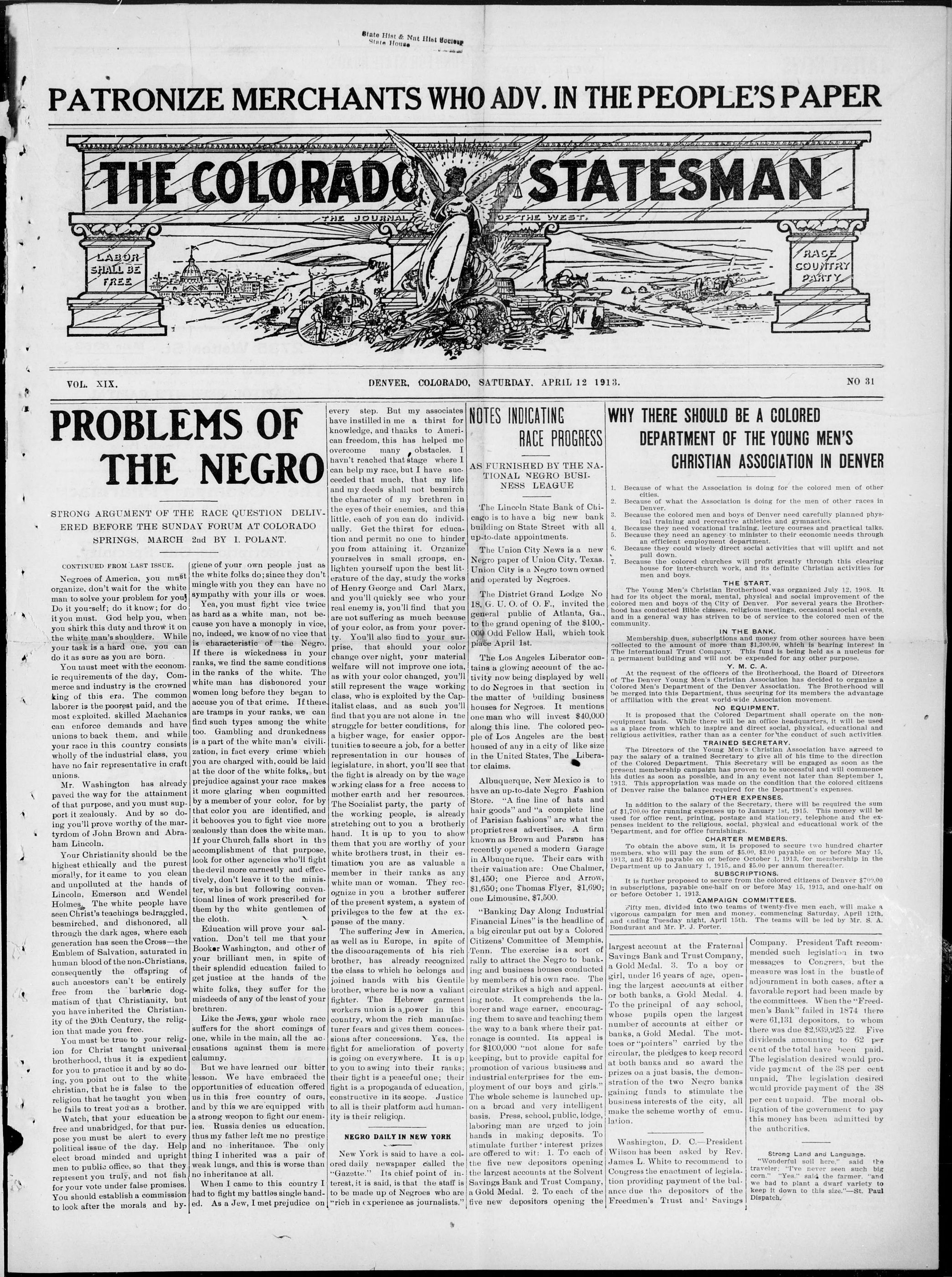
Colorado Statesman
Saturday, April 12, 1913
Denver, Colorado
Page text (machine-generated)
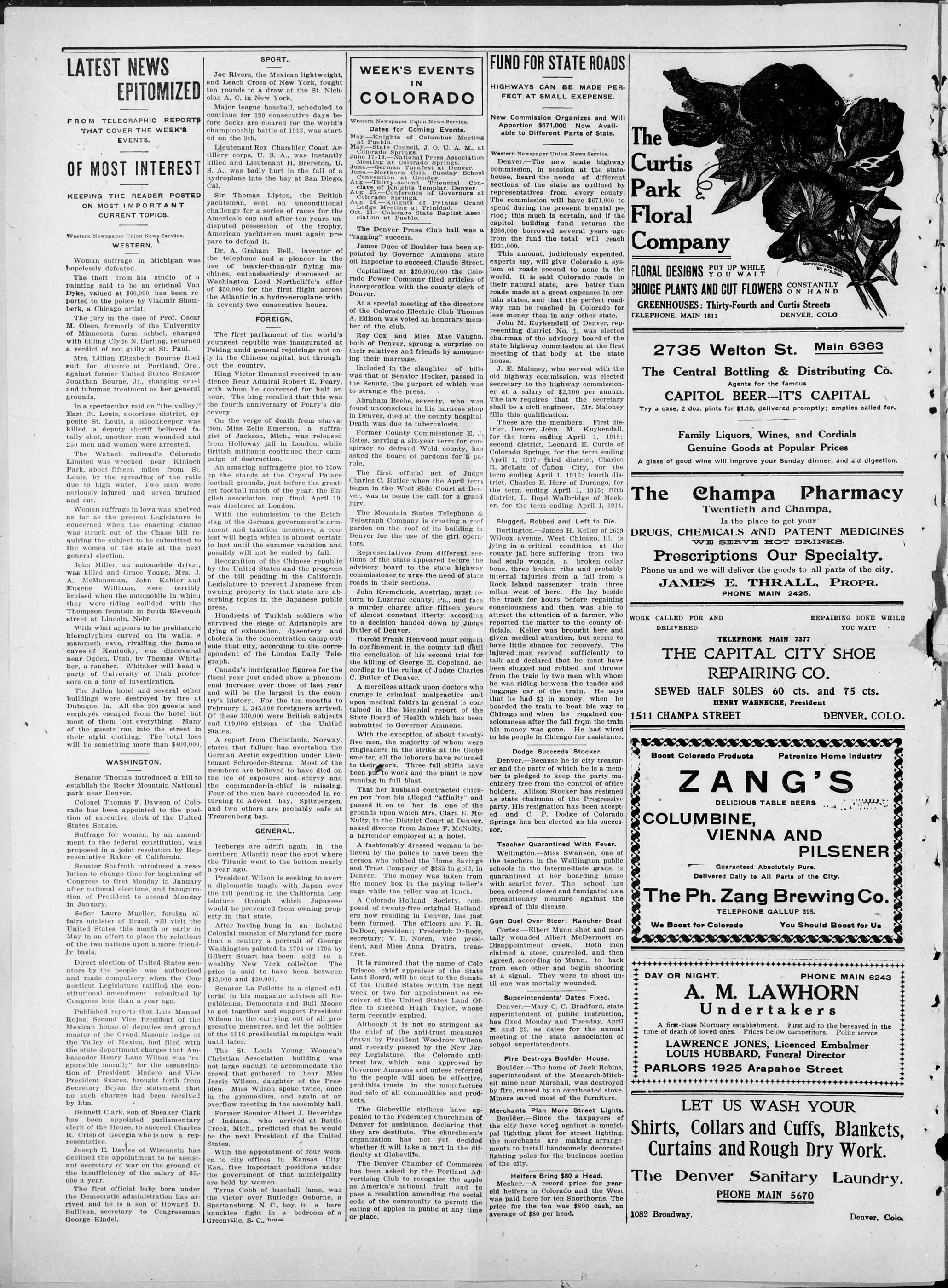
LATEST NEWS EPITOMIZED
FROM TELEGRAPHIC REPORTS THAT COVER THE WEEK'S EVENTS.
OF MOST INTEREST
OF MOST INTEREST
KEEPING THE READER POSTED ON MOST IMPORTANT CURRENT TOPICS.
Western Newspaper Union News Service.
WESTERN.
Woman suffrage in Michigan was hopelessly defeated.
The theft from his studio of a painting said to be an original Van Dyke, valued at $60,000, has been reported to the police by Vladmir Shamberk, a Chicago artist.
The jury in the case of Prof. Oscar M. Olson, formerly of the University of Minnesota farm school, charged with killing Clyde N. Darling, returned a verdict of not guilty at St. Paul.
Mrs. Lillian Elizabeth Bourne filed suit for divorce at Portland, Ore, against former United States Senator Jonathan Bourne, Jr., charging cruel and inhuman treatment as her general grounds.
In a spectacular raid on "the valley," East St. Louis, notorious district, opposite St. Louis, a saloonkeeper was killed, a deputy sheriff believed fatally shot, another man wounded and 250 men and women were arrested.
The Wabash railroad's Colorado Limited was wrecked near Klnloch Park, about fifteen miles from St. Louis, by the spreading of the rails due to high water. Two men were seriously injured and seven bruised and cut.
Woman suffrage in Iowa was shelved as far as the present Legislature is concerned when the enacting clause was struck out of the Chase bill requiring the subject to be submitted to the women of the state at the next general election.
John Miller, an automobile driver, was killed and Grace Young, Mrs. J. A. McManaman, John Kahler and Eugene Williams, were terribly bruised when the automobile in which they were riding collided with the Thompson fountain in South Eleventh street at Lincoln, Nebr.
With what appears to be prehistoric hieroglyphics carved on its walls, a mammoth cave, rivalling the famo is caves of Kentucky, was discovered near Ogden, Utah, by Thomas Whitaker, a rancher. Whitaker will head a party of University of Utah professors on a tour of investigation.
The Jullen hotel and several other buildings were destroyed by fire at Dubuque, Ia. All the 200 guests and employés escaped from the hotel but most of them lost everything. Many of the guests ran into the street in their night clothing. The total loss will be something more than $400,000.
WASHINGTON.
Senator Thomas introduced a bill to establish the Rocky Mountain National park near Denver.
Colonel Thomas F. Dawson of Colorado has been appointed to the position of executive clerk of the United States Senate.
Suffrage for women, by an amendment to the federal constitution, was proposed in a joint resolution by Representative Raker of California.
Senator Shafroth introduced a resolution to change time for beginning of Congress to first Monday in January after national elections, and inauguration of President to second Monday in January.
Senor Laure Mueller, foreign affairs minister of Brazil, will visit the United States this month or early in May in an effort to place the relations of the two nations upon a more friendly basis.
Direct election of United States senators by the people was authorized and made compulsory when the Connecticut Legislature ratified the constitutional amendment submitted by Congress less than a year ago.
Published reports that Luis Manuel Rojas, Second Vice President of the Mexican house of deputies and grand master of the Grand Masonic lodge of the Valley of Mexico, had filed with the state department charges that Ambassador Henry Lane Wilson was "responsible morally" for the assassination of President Madero and Vice President Suarez, brought forth from Secretary Bryan the statement that no such charges had been received by him.
Bennett Clark, son of Speaker Clark has been appointed parliamentary clerk of the House, to succeed Charles R. Crisp of Georgia who is now a representative.
Joseph E. Davies of Wisconsin has declined the appointment to be assistant secretary of war on the ground of the insufficiency of the salary of $5,000 a year.
The first official baby born under the Democratic administration has arrived and he is a son of Howard D. Sullivan, secretary to Congressman George Kindel.
SPORT.
Joe Rivers, the Mexican lightweight, and Leach Cross of New York, fought ten rounds to a draw at the St. Nicholas A. C. in New York.
Major league baseball, scheduled to continue for 180 consecutive days before decks are cleared for the world's championship battle of 1913, was started on the 9th.
Lieutenant Rex Chambler, Coast Artillery corps, U. S. A., was instantly killed and Lieutenant H. Brereton, U. S. A., was badly hurt in the fall of a hydroplane into the bay at San Diego, Cal.
Sir Thomas Lipton, the British yachtsman, sent an unconditional challenge for a series of races for the America's cup and after ten years undisputed possession of the trophy, American yachtsmen must again prepare to defend it.
Dr. A. Graham Bell, inventor of the telephone and a pioneer in the use of heavier-than-air flying machines, enthusiastically discussed at Washington Lord Northheliffe's offer of $50,000 for the first flight across the Atlantic in a hydro-aeroplane within seventy-two consecutive hours.
FOREIGN.
The first parliament of the world's youngest republic was inaugurated at Peking amid general rejoicings not only in the Chinese capital, but throughout the country.
King Victor Emanuel received in audience Rear Admiral Robert E. Peary, with whom he conversed for half an hour. The king recalled that this was the fourth anniversary of Peary's discovery.
On the verge of death from starvation, Miss Zelie Emerson, a suffragist of Jackson, Mich., was released from Holloway jail in London, while British militants continued their campaign of destruction.
An amazing suffragette plot to blow up the stands at the Crystal Palace football grounds, just before the greatest football match of the year, the English association cup final, April 19, was disclosed at London.
With the submission to the Reichstag of the German government's armament and taxation measures, a contest will begin which is almost certain to last until the summer vacation and possibly will not be ended by fall.
Recognition of the Chinese republic by the United States and the progress of the bill pending in the California Legislature to prevent Japanese from owning property in that state are absorbing topics in the Japanese public press.
Hundreds of Turkish soldiers who survived the siege of Adrianople are dying of exhaustion, dysentery and cholera in the concentration camp outside that city, according to the correspondent of the London Daily Telegraph.
Canada's immigration figures for the fiscal year just ended show a phenomenal increase over those of last year and will be the largest in the country's history. For the ten months to February 1, 345,000 foreigners arrived. Of these 130,000 were British subjects and 119,000 citizens of the United States.
A report from Christiania, Norway, states that failure has overtaken the German Arctic expedition under Lieutenant Schroeder-Stranz. Most of the members are believed to have died on the ice of exposure and scurvy and the commander-in-chief is missing. Four of the men have succeeded in returning to Advent bay, Spitzbergen, and two others are probably safe at Treurenberg bay.
GENERAL.
Icebergs are adrift again in the northern Atlantic near the spot where the Titanic went to the bottom nearly a year ago.
President Wilson is seeking to avert a diplomatic tangle with Japan over the bill pending in the California Legislature through which Japanese would be prevented from owning property in that state.
After having hung in an isolated Colonial mansion of Maryland for more than a century a portrait of George Washington painted in 1794 or 1795 by Gilbert Stuart has been sold to a wealthy New York collector. The price is said to have been between $15,000 and $20,000.
Senator La Follette in a signed editorial in his magazine advises all Republicans, Democrats and Bull Moose to get together and support President Wilson in the carrying out of all progressive measures, and let the politics of the 1916 presidential campaign wait until later.
The St. Louis Young Women's Christian Association building was not large enough to accommodate the crowd that gathered to hear Miss Jessie Wilson, daughter of the President. Miss Wilson spoke twice, once in the gymnasium, and again at an overflow meeting in the assembly hall.
Former Senator Albert J. Beveridge of Indiana, who arrived at Battle Creek, Mich., predicted that he would be the next President of the United States.
With the appointment of four women to city offices in Kansas City, Kas., five important positions under the government of that municipality are held by women.
Tyrus Cobb of baseball fame, was the victor over Rutledge Osborne, a Spartansburg, N. C., boy, in a bare knuckles fight in a bedroom of a Greenville, S. C., hotel.
WEEK'S EVENTS IN COLORADO
Western Newspaper Union News Service.
Dates for Coming Events.
May—Knights of Columbus Meeting
at Pueblo.
Mid-South Council, J. O. U. A. M., at
Colorado Springs.
June 17-19—National Press Association
Springs.
June—German Town Council.
Denver.
June—Northern Colo. Sunday School
June—Northern Colo. Sunday School
Convention at Greeley.
General Conference
Austin, Conference of Knights Templar Governors at Colorado
The Denver Press Club ball was a "ragging" success.
James Duce of Boulder has been appointed by Governor Ammons state oil inspector to succeed Claude Street.
Capitalized at $20,000,000 the Colorado Power Company filed articles of incorporation with the county clerk of Denver.
At a special meeting of the directors of the Colorado Electric Club Thomas A. Edison was voted an honorary member of the club.
Roy Cox and Miss Mae Vaughn, both of Denver, sprung a surprise on their relatives and friends by announcing their marriage.
Included in the slaughter of bills was that of Senator Hecker, passed in the Senate, the purport of which was to strangle the press.
Abraham Beebe, seventy, who was found unconscious in his harness shop in Denver, died at the county hospital. Death was due to tuberculosis.
Former County Commissioner E. J. Estes, serving a six-year term for conspiracy to defraud Weld county, has asked the board of pardons for a parole.
The first official act of Judge Charles C. Butler when the April term began in the West Side Court at Denver, was to issue the call for a grand jury.
The Mountain States Telephone & Telegraph Company is creating a roof garden on the roof of its building in Denver for the use of the girl operators.
Representatives from different sections of the state appeared before the advisory board to the state highway commissioner to urge the need of state roads in their sections.
John Kremchick, Austrian, must return to Luzerne county, Pa., and face a murder charge after fifteen years of almost constant liberty, according to a decision handed down by Judge Butler of Denver.
Harold Frank Henwood must remain in confinement in the county jail until the conclusion of his second trial for the killing of George E. Copeland, according to the ruling of Judge Charles C. Butler of Denver.
A merciless attack upon doctors who engage in criminal malpractice and upon medical fakirs in general is contained in the biennial report of the State Board of Health which has been submitted to Governor Ammons.
With the exception of about twenty-five men, the majority of whom were ringleaders in the strike at the Globe smelter, all the laborers have returned to their work. Three full shifts have been put to work and the plant is now running in full blast.
That her husband contracted chicken pox from his alleged "affinity" and passed it on to her is one of the grounds upon which Mrs. Clara E. McNulty, in the District Court at Denver, asked divorce from James F. McNulty, a bartender employed at a hotel.
A fashionably dressed woman is believed by the police to have been the person who robbed the Home Savings and Trust Company of $385 in gold, in Denver. The money was taken from the money box in the paying teller's cage while the teller was at lunch.
A Colorado Holland Society, composed of twenty-five original Hollanders now residing in Denver, has just been formed. The officers are F. R. DeBeer, president; Frederick DeBoer, secretary; V. D. Noren, vice president, and Miss Anna Dystra, treasurer.
It is rumored that the name of Cole Briscoe, chief appraiser of the State Land Board, will be sent to the Senate of the United States within the next week or two for appointment as receiver of the United States Land Office to succeed Hugh Taylor, whose term recently expired.
Although it is not so stringent as the chief of the anti-trust measures drawn by President Woodrow Wilson and recently passed by the New Jersey Legislature, the Colorado anti-trust law, which was approved by Governor Ammons and unless referred to the people will soon be effective, prohibits trusts in the manufacture and sale of all commodities and products.
The Globeville strikers have appealed to the Federated Churchmen of Denver for assistance, declaring that they are destitute. The churchmen's organization has not yet decided whether it will take a part in the difficulty at Globeville.
The Denver Chamber of Commerce has been asked by the Portland Advertising Club to recognize the apple as America's national fruit and to pass a resolution amending the social code of the community to permit the eating of apples in public at any time or place.
FUND FOR STATE ROADS
HIGHWAYS CAN BE MADE PERFECT AT SMALL EXEPENSE.
New Commission Organizes and Will Apportion $671,000 Now Available to Different Parts of State.
Western Newspaper Union News Service.
Denver.-The new state highway commission, in session at the state-house, heard the needs of different sections of the state as outlined by representatives from every county. The commission will have $671,000 to spend during the present biennial period; this much is certain, and if the capitol building fund returns the $260,000 borrowed several years ago from the fund the total will reach $931,000.
This amount, judiciously expended, experts say, will give Colorado a system of roads second to none in the world. It is said Colorado roads, in their natural state, are better than roads made at a great expenses in certain states, and that the perfect roadway can be reached in Colorado for less money than in any other state. John M. Kuykendall of Denver, representing district No. 1, was elected chairman of the advisory board of the state highway commission at the first meeting of that body at the state house. J. E. Maloney, who served with the old highway commission, was elected secretary to the highway commissioner at a salary of $2,100 per annum. The law requires that the secretary shall be a civil engineer. Mr. Maloney fills this qualification.
Slugged, Robbed and Left to Die.
Slugged, Robbed and Left to Die. Burlington—James H. Keller of 2629 Wilcox avenue, West Chicago, Ill., is lying in a critical condition at the county jail here suffering from two bad scalp wounds, a broken collar bone, three broken ribs and probably internal injuries from a fall from a Rock Island passenger train three miles west of here. He lay beside the track for hours before regaining consciousness and then was able to attract the attention of a farmer, who reported the matter to the county officials. Keller was brought here and given medical attention, but seems to have little chance for recovery. The injured man revived sufficiently to talk and declared that he must have been slugged and robbed and thrown from the train by two men with whom he was riding between the tender and baggage car of the train. He says that he had $3 in money when he boarded the train to beat his way to Chicago and when he regained consciousness after the fall from the train his money was gone. He has wired to his people in Chicago for assistance.
Dodge Succeeds Stocker.
Denver. Because he is city treasurer and the party of which he is a member is pledged to keep the party machinery free from the control of office holders. Allison Stocker has resigned as state chairman of the Progressive party. His resignation has been accepted and C. P. Dodge of Colorado Springs has been elected as his successor.
Teacher Quarantined With Fever.
Wellington. Miss Swanson, one of the teachers in the Wellington public schools in the intermediate grade, is quarantined at her boarding house with scarlet fever. The school has been ordered closed and fumigated as a precautionary measure against the spread of this disease.
Cortez.—Elbert Munn shot and mortally wounded Albert McDermott on Disappointment creek. Both men claimed a steer, quarreled, and then agreed, according to Munn, to back from each other and begin shooting at a signal. They were to shoot until one was mortally wounded.
Superintendents' Dates Fixed.
Denver.—Mary C. C. Bradford, state superintendent of public instruction, has fixed Monday and Tuesday, April and 22, as dates for the annual meeting of the state association of school superintendents.
Fire Destroys Boulder House.
Boulder.—The home of Jack Robins, superintendent of the Monarch-Mitchell mine near Marshall, was destroyed by fire, caused by an overheated stove. Miners saved most of the furniture.
Merchants Plan More Street Lights. Boulder.—Since the taxpayers of the city have voted against a municipal lighting plant for street lighting, the merchants are making arrangements to install handsomely decorated lighting poles for the business section of the city.
Heifers Bring $80 a Head. Meeker.—A record price for year-old heifers in Colorado and the West was paid here for ten Shorthorns. The price for the ten was $800 cash, an average of $80 per head.
The
Curtis
Park
Floral
Company
FLORAL DESIGNS PUT UP WHILE
YOU WAIT
CHOICE PLANTS AND CUT FLOWERS CONSTANTLY
ON HAND
GREENHOUSES: Thirty-Fourth and Curtis Streets
TELEPHONE, MAIN 1511
DENVER, COLO
2735 Welton St. Main 6363
The Central Bottling & Distributing Co.
Agents for the famous
CAPITOL BEER---IT'S CAPITAL
Try a case, 2 doz. pints for $1.10, delivered promptly; empties called for.
Family Liquors, Wines, and Cordials Genuine Goods at Popular Prices A glass of good wine will improve your Sunday dinner, and aid digestion.
The Champa Pharmacy
Twentieth and Champa,
Is the place to get your
DRUGS, CHEMICALS AND PATENT MEDICINES
WE SERVE HOT DRINKS.
Prescriptions Our Specialty.
Phone us and we will deliver the goods to all parts of the city.
JAMES E. THRALL, PROPR.
PHONE MAIN 2425.
WORK CALLED FOR AND DELIVERED
THE CA
RE
SEWED HALF
HE
1511 CHAMPA STRE
Boost Colorado P
ZA
DE
COLUMBIA
VI
Guaranteed Absolutely Pure. Delivered Daily to All Parts of the City.
The Ph.
A first-class Mortuary establishment. First aid to the bereaved in the time of death of loved ones. Prices below competitors. Polite service LAWRENCE JONES, Licenced Embalmer LOUIS HUBBARD, Funeral Director PARLORS 1925 Arapahoe Street
Shirts, Collars and Cuffs, Blankets, Curtains and Rough Dry Work. The Denver Sanitary Laundry. PHONE MAIN 5670
REPAIRING DONE WHILE YOU WAIT
TY SHOE
CO.
and 75 cts.
ident
DENVER, COLO.
ze Home Industry
'S
D
ILSENER
wing Co.
WILSON WASTES FEW WORDS IN TELLING CONGRESS WHAT IT SHOULD DO.
TARIFF REVISION HIS TOPIC
President Says the Schedules Must Be Radically Changed to Square With Present Conditions, but Work Requires Careful Consideration.
Washington, April 8.—President Wilson's first message to the Sixth-third congress, assembled in extraordinary session, was read in the senate and house today. It was surprisingly short, being in full as follows:
To the Senate and House of Repre
I have called the congress together in extraordinary session because a duty was laid upon the party now in power at the recent elections which it ought to perform promptly, in order that the burden carried by the people under existing law may be lightened as soon as possible and in order, also, that the business interests of the country may not be kept too long in suspense as to what the fiscal changes are to be to which they will be required to adjust themselves. It is clear to the whole country that the tariff duties must be altered. They must be changed to meet the radical alteration in the conditions of our economic life which the country has witnessed within the last generation.
While the whole face and method of our industrial and commercial life were being changed beyond recognition the tariff schedules have remained what they were before the change began, or have moved in the direction they were given when no large circumstance of our industrial development was what it is today. Our task is to square them with the actual facts. The sooner that is done the sooner we shall escape from suffering from the facts and the sooner our men of business will be free to thrive by the law of nature (the nature of free business) instead of by the law of legislation and artificial arrangement.
Business Not Normal.
We have seen tariff legislation wander very far afield in our day—very far indeed from the field in which our prosperity might have had a normal growth and stimulation. No one who looks the facts squarely in the face or knows anything that lies beneath the surface of action can fail to perceive the principles upon which recent tariff legislation has been based. We long ago passed beyond the modest notion of "protecting" the industries of the country and moved boldly forward to the idea that they were entitled to the direct patronage of the government. For a long time—a time so long that the men now active in public policy hardly remember the conditions that preceded it—we have sought in our tariff schedules to give each group of manufacturers or producers what they themselves thought that they needed in order to maintain a practically exclusive market as against the rest of the world. Consciously or unconsciously, we have built up a set of privileges and exemptions from competition behind which it was easy by any, even the crudest, forms of combination to organize monopoly; until at last nothing is normal, nothing is obliged to stand the tests of efficiency and economy, in our world of big business, but everything thrives by concerted arrangement. Only new principles of action will save us from a final hard crystallization of monopoly and a complete loss of the influences that quicken enterprise and keep independent energy alive.
It is plain what those principles must be. We must abolish everything that bears even the semblance of privilege or of any kind of artificial advantage, and put our business men and producers under the stimulation of a constant necessity to be efficient, economical, and enterprising, masters of competitive supremacy, better workers and merchants than any in the world. Aside from the duties laid upon articles which we do not, and probably cannot, produce, therefore, and the duties laid upon luxuries and merely for the sake of the revenues they yield, the object of the tariff duties henceforth laid must be effective competition, the whetting of American wits by contest with the wits of the rest of the world.
Development. Not Revolution.
It would be unwise to move toward this end headlong, with reckless haste, or with strokes that cut at the very roots of what has grown up amongst us by long process and at our own invitation. It does not alter a thing to upset it and break it and deprive it of a chance to change. It destroys it. We must make changes in our fiscal laws, in our fiscal system, whose object is development, a more free and wholesome development, not revolution or upset or confusion. We
Woman in New Sphere.
Oporto is the only city in Portugal that can boast of having a feminine health inspector, a woman having been appointed by the government to a subinspectionship in the department of public health. Another striking appointment by the government comes with the selection of a well-known woman scholar to a professorship in ordinary at the Universities of Coimbra and Lisbon. The lady professor in question has been appointed to fill the chair in Germanic philosophy.
must build up trade, especially foreign trade. We need the outlet and the enlarged field of energy more than we ever did before. We must build up industry as well and must adopt freedom in the place of artificial stimulation only so far as it will build, not pull down. In dealing with the tariff the method by which this may be done will be a matter of judgment, exercised item by item.
To some not accustomed to the excitements and responsibilities of greater freedom our methods may in some respects and at some points seem heroic, but remedies may be heroic and yet be remedies. It is our business to make sure that they are genuine remedies. Our object is clear. If our motive is above just challenge and only an occasional error of judgment is chargeable against us, we shall be fortunate.
We are called upon to render the country a great service in more matters than one. Our responsibility should be met and our methods should be thorough, as thorough as moderate and well considered, based upon the facts as they are, and not worked out as if we were beginners. We are to deal with the facts of our own day, with the facts of no other, and to make laws which square with those facts. It is best, indeed it is necessary, to begin with the tariff. I will urge nothing upon you now at the opening of your session which can obscure that first object or divert our energies from that clearly defined duty. At a later time I may take the liberty of calling your attention to reforms which should press close upon the heels of the tariff changes, if not accompany them, of which the chief is the reform of our banking and currency laws; but just now I refrain. For the present, I put these matters on one side and think only of this one thing—of the changes in our fiscal system which may best serve to open once more the free channels of prosperity to a great people whom we would serve to the utmost and throughout both rank and file.
WOODROW WILSON.
The White House, April 8, 1913.
FAMILY NAMES OF ROYALTY
Royal Personages Descended Mostly From Counts, Existing Long Before Surnames Came Into Use.
The royal families of Europe have not generally a surname because mostly (unlike the English houses of Stuart and Tudor, which were the respective surnames of the first king of each house before he ascended the throne) they are descended in the male line from some territorial counts existing long previous to the period in which the somewhat modern custom of surnames prevailed. King George V derives in the male line from the ancients counts of Wettin (flourishing in the tenth century), afterwards electors of Saxony, dukes of Saxe Coburg, Gotha, etc. His ancestors in the male line were of the house of Este, one of whom. Azo of Este, married early in the tenth century the daughter and heiress of Guelph, duke of Bavaria, from which match sprang in the male line the dukes of Brunswick-Lunenburg, afterwards electors of Hanover, and kings of Great Britain. The members of the royal family are described by their princely titles in proceedings in the house of lords, and no allusion is made to any surname—for instance, they sign the test roll merely by their personal or Christian name, and we know nothing of any surname which appertained by right or by usage, to her late majesty, Queen Victoria, or to his majesty King George V.
Bermuda Fish.
At the market during a recent week many handsome fish were to be seen, several of them taken by American tourists, and afterward presented to the fisherman who "took them out." Large amber-jacks and bonitoes, splendid game fish and chubs, as plucky and "fighty" a fish as ever took bait, were well represented.
Among the others seen on the market books and elsewhere were bluefish, yellowtails, red snappers, gray snappers, butterfish, gags, hamlets, "hines," salmon and black rockfish, porgles and red rockfish. "Nigger fish," the long ago despised finny midget, has been metamorphosed to the now much sought after "cholest of the choice" of sea delicacies, the "butter fish."—Bermuda Colonists.
"Soft" Job for Constable.
Pension are not the only things commanded and forgotten. An inquisitive member of the British house of commons was struck one day by the presence of a policeman in one of the lobles. He wondered why this particular lobby should always have a guardian strolling up and down, and made inquiries. The records of the house were searched and it was found that 50 years previously, when the lobby was being decorated, a policeman had been stationed there to keep members from soiling their clothes. The order never having been countermanded, the constable had kept his beat for half a century.
Keeping Mind In Condition.
No mind is first class that is not continually reading books and conversing with men that require an effort to be understood. The novelsoaked intellect, gormandizing upon easy reading, grows flabby.
Of the "Bacchae" of Euripides
A thing never to be done again, scarcely to be understood, recognized as the last witness to a beauty of which the secret was lost and the ancient mold broken. -Gilbert Murray.
COLORADO LEGISLATIVE DOINGS
Western Newspaper Union News Service.
UTILITIES BILL SUMMARIZED.
Measure Designed by Its Authors to Make Colorado Securities Safer.
Denver.—Bill becomes a law ninety days after the Governor's signature unless opponents secure sufficient signatures to refer it to the people.
Public utilities commission of three members created. S. S. Kendall and A. P. Anderson, present members of the railroad commission, to be members, and a third is to be appointed by the Governor. Railroad commission is abolished.
Commission is given power to fx rates and correct abuses of all public utility companies in the state including railroads, street railways, gas, electric, power, water, telephone, express and telegraph companies.
Investigations are to be made, hearings held and orders issued either upon complaints filed with the commission or upon the commissioner's own volition.
Municipally owned utilities are placed under the commission's authority.
Appeals from the commission's decisions are to be made only the the Supreme Court and then only upon the law and upon the reasonableness or unreasonableness of the commission's decisions.
Anti-pass section the same as that of the interstate commerce law.
Rebates and discriminations by utilities are prohibited.
Excepting railroads, consent of commission is required for the making of any extension or improvements by a company.
Consent of commission required for all utilities before companies sell or mortgage property, consolidate with other corporations or issue stocks and bonds or other evidence of indebtedness. Present railroad laws and acts and orders of the present railroad commission are held legal and binding as those of the utility commission. Declaration by the courts that a provision is unconstitutional shall only apply to the one provision and not invalidate the remainder of the measure.
THE HOUSE
Adopted joint conference committees reports on House amendments to Roe v. Wade and on Senate salary amendment to Gilbert coal mine inspection bill. Passed on final reading, Wright bill extending powers of state tax commission.
Passed on final reading, Old bill, authorizing faculty and students of State School of Mines to make free assays of ores. Ores received final reading, G. W. Gates bill, providing quarantine against importation of dogs.
Adopted amended Robinson resolution, fixing April 15 as date of adjournment. Passed on final reading, Skinner-Packer bill, limiting tax levies of districts. Passed on final reading, two bills by government providing for the annexation of adjoining unattached lands by Ouray county.
Passed on final reading, Newton bill, authorizing issuance of bonds of irritatingrants for purpose of retiring warrants. Passed on second reading, Skinner bill, raising salaries of county assessors according to valuation of county property.
Passed on second reading, Gallup bill, authorizing tax rebates only on application of certain provisions. Passed on second reading, Gallup bill, empowering state tax commission to make original assessments. Passed on second reading, Riddle bill, providing for extermination of prairie dogs. Killed Tait anti-white slavery bill. Killed McDonald bill, providing for tax relief and conveyances on true consideration.
Killed Packer bill, placing Park and
Tower counties in new judicial dis-
hirk.
Passed on second reading, Williams Senate bill, authorizing $50,000 bond issue by Central City for redemption of outstanding warrants.
Passed on second reading, Hawkins bill, providing relief for persons erroneously imprisoned.
Passed on second reading. Riddle book, apprehending rating of street cars to a temperature of 50 degrees Fahrenheit during winter months.
Passed on second reading, George Gates bill, compelling railroads to erect fences where they pass cultivated land for payment of damage done to stock.
Passed on final reading:
Skinner bill fixing salaries of county assessors according to assessed valuation purposes on county assessors.
Skinner bill prohibiting tax Febates by county assessors except by approval of state tax commission.
Wright bill giving tax commission original assessing power over utilities complying with bill providing for tax levy by county commissioners to pay judgments rendered against municipalities. The bill provides for persons criminally imprisoned
G. W. Gates bill compelling erection of fences along railroads where cultivated fields are passed, and providing for damage to stock.
Riddle bill requiring heating of stoves during winter at 50° Fahrenheit during winter months.
Killed on second reading:
Dalley bill authorizing county compulsory compensation money from mothers' compensation fund.
Killed: Smedley bill prescribing procedure for counting ballots in election contests.
Passed on final reading:
Riddle constitutional amendment for appointment of alternate member on turkey.
Bellfield Senate bill, prohibiting men from foodstuffs under unanimity conditions
Biles bill, providing registration of births and deaths by bureau of vital records. Andrew bill, providing transfer of information in courts to expedite delivery of bonds.
PROPOSE $4,000,000 BOND ISSUE.
Assembly Visiting Committee Commends Conduct of State Institutions.
Western Newspaper Union News Service.
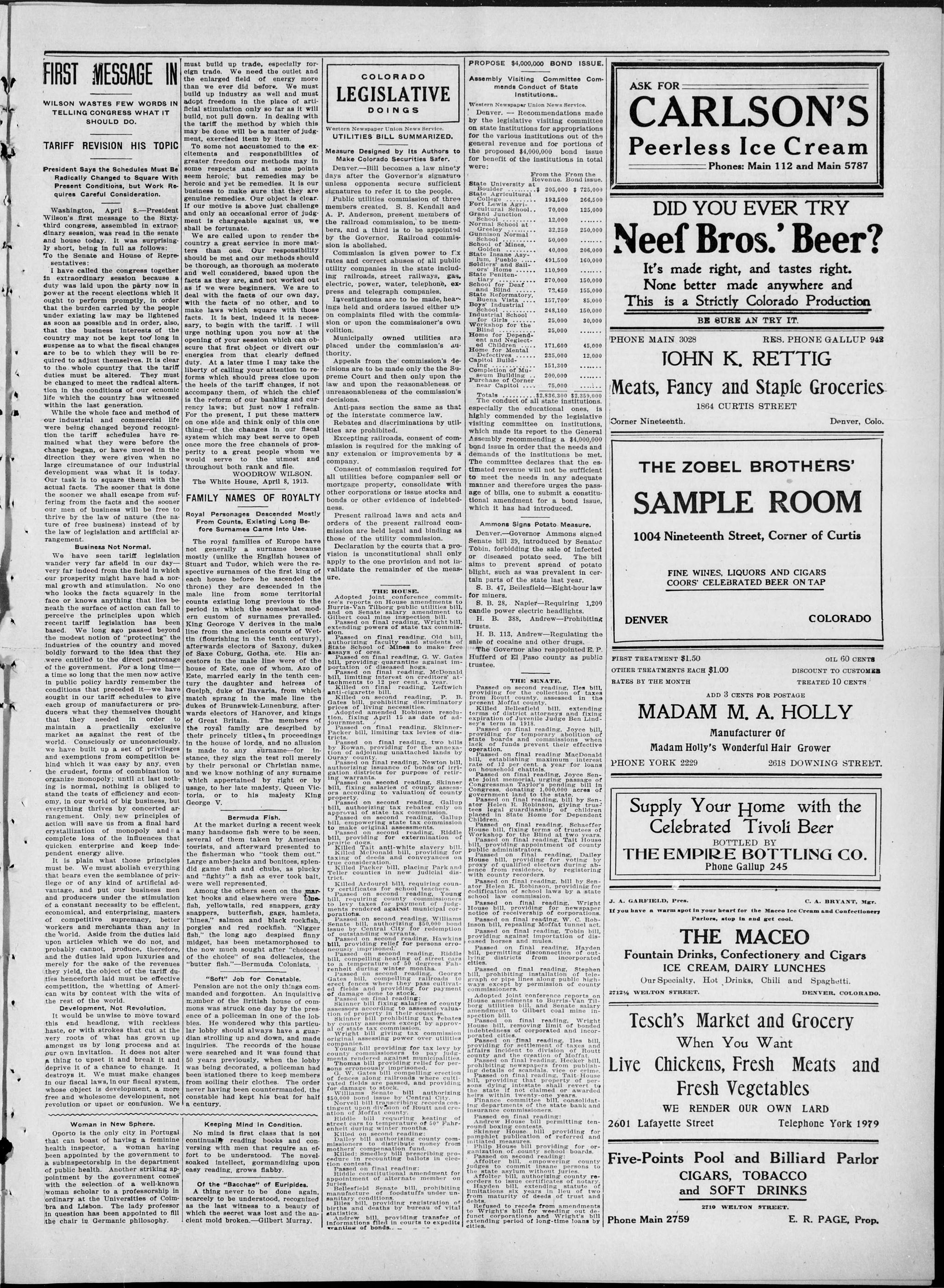
Denver. -- Recommendations made by the legislative visiting committee on state institutions for appropriations for the various institutions out of the general revenue and for portions of the proposed $4,000,000 bond issue for benefit of the institutions in total were:
From the From the Revenue. Bond issue.
State University at Boulder ... $ 205,000 $ 725,000
State Agricultural College ... 193,500 266,500
Forces Arts Agricultural School ... 70,000 125,000
Grand Junction School ... 12,000 ... ...
Normal School at Galloway ... 32,250 250,000
Gunnison Normal School ... 50,000 ... ...
School of Mines, Galloway ... 40,000 206,000
State Insane Asylum, Pueblo ... 491,500 160,000
Soldiers' and Sailors' Home ... 110,900 ... ...
State Penitentiary ... 270,000 150,000
School for Deaf and Blind ... 72,450 155,000
State Refectory, Buena Vista ... 157,700 85,000
Boys' Industrial School ... 248,100 150,000
Industrial School for Girls ... 25,000 30,000
Workshop for the Blind ... 25,000 ... ...
Home for Dependent and Neglected Children ... 171,600 45,000
Home for Mental Defectives ... 235,000 12,000
Capitol Building ... 151,300 ... ...
Completion of Museum Building ... 200,000 ...
Purchase of Corner near Capitol ... 75,000 ...
Totals ..... $2,836,300 $2,359,000
The conduct of all state institutions,
especially the educational ones, is
highly commended by the legislative
visiting committee on institutions,
which made its report to the General
Assembly recommending a $4,000,000
bond issue in order that the needs and
demands of the institutions be met.
The committee declares that the estimated revenue will not be sufficient
to meet the needs in any adequate
manner and therefore urges the passage
of bills, one to submit a constitutional amendment for a bond issue,
which it has had introduced.
Ammons Signs Potato. Measure.
Denver.—Governor Ammons signed Senate bill 39, introduced by Senator Tobin, forbidding the sale of infected or diseased potato seed. The bill aims to prevent spread of potato blight, such as was prevalent in certain parts of the state last year.
S. B. 47, Beiliesfield—Eight-hour law for miners.
S. B. 28, Napier—Requiring 1,200 candle power electric headlights.
H. B. 388, Andrew—Prohibiting trusts.
H. B. 113, Andrew—Regulating the sale of cocaine and other drugs.
The Governor also reappointed E. P. Hufferd of El Paso county as public trustee.
THE SENATE.
Passed on second reading, Hes bill, providing for the collection of taxes assessed in the present Moffat county. Killed Belleslaw bill, extending terms of district attorneys and fixing Judge Ben Lindsey's term in 1918. Passed on final reading, Joyce bill, providing for temporary abolition of state boards and commissions when the funds prevent their effective operation.
Passed on final reading MacDonald bill, establishing maximum interest rate of 12 per cent, a year for loans on household chattails. Passed on final reading, Joyce Senate joint memorial urging passage of Congressman Taylor's pending bill in Congress, donating 1,000,000 acres of government land to the state. Passed on final reading, bill by Senator Helen R. Robinson, giving trustee guardianship of children placed in State Home for Dependent Children.
Skinner House bill providing for pamphlet publication of referred and related materials.
Philip House bill providing for organization of county school boards.
Passed on second reading:
Affected powering county judge to commit law persons to the state asylum without juries.
Affolter bill, authorizing county recorders to issue certificates of notary.
Hayden bill, extending statute of limitations six years in lieu of two from maturity of deeds of trust and debts.
Refused to recede from amendments Wright's bill for weeding out deeds corporations and Wright's bill extending period of long-time loans by cities.
It's made right, and tastes right.
None better made anywhere and
This is a Strictly Colorado Production
BE SURE AN TRY IT.
PHONE MAIN 3028 RES. PHONE GALLUP
JOHN K. RETTIG
Meats, Fancy and Staple Grocerie
1864 CURTIS STREET
JOHN K. RETTIG
Fancy and Staple Gr
1864 CURTIS STREET
seventh.
E ZOBEL BROTHÉ
AMPLE ROO
Nineteenth Street, Corner of
Meats, Fancy and Staple Groceries 1864 CURTIS STREET
THE ZOBE
SAMPL
1004 Nineteenth
1004 Nineteenth Street, Corner of Curtis
FINE WINES, LIQUORS AND CIGARS
COORS' CELEBRATED BEER ON TAP
DENVER CO
FIRST TREATMENT $1.50
OTHER TREATMENTS EACH $1.00
RATES BY THE MONTH
DISCOUNT
TREATED
ADD 3
MADAM HOLLY
Man
Madam Holly's W
PHONE YORK 2229
Supply Your
Celebrated
BOTH
THE EMPIRE
Phone
J. A. GARFIELD, Pres.
If you have a warm spot in your head
Parlors, etc.
ADD 3 CENTS FOR POSTAGE
ADAM M. A. HOLL
Manufacturer Of
Adam Holly's Wonderful Hair Grower
ARK 2229 2618 DOWNLE
oly Your Home with
celebrated Tivoli Beer
BOTTLED BY
EMPIRE BOTTLING
Phone Gallup 245
D, Pres.
C. A. B
arm spot in your heart for the Maceo Ice Cream and
Parlors, stop in and get cool.
MADAM M. A. HOLLY
Manufacturer Of Madam Holly's Wonderful Hair Grower PHONE YORK 2229 2618 DOWNING STREET.
Supply Your Home with the Celebrated Tivoli Beer BOTTLED BY THE EMPIRE BOTTLING CO. Phone Gallup 245
J. A. GARFIELD, Pres. C. A. BRYANT, Mgr. If you have a warm spot in your heart for the Maceo Ice Cream and Confectionery Parlors, stop in and get cool.
THE MACEO
Fountain Drinks, C
ICE CREAM,
Our Specialty, Hot D
2712½ WELTON STREET.
Tesch's Marl
in Drinks, Confectionery and ICE CREAM, DAIRY LUNCHES, Specialty, Hot Drinks, Chili and Spag STREET. DENVEh's Market and Groc
Fountain Drinks, Confectionery and Cigars ICE CREAM, DAIRY LUNCHES Our Specialty, Hot Drinks, Chili and Spaghetti. 271212 WELTON STREET. DENVER, COLORADO.
Tesch's Market and Grocery
Five-Points Pool and Billiard Parlor CIGARS, TOBACCO and SOFT DRINKS
Corner Nineteenth.
DENVER
RES. PHONE GALLUP 942
RETTIG
Staple Groceries
STREET
ROOM
, Corner of Curtis
OIL 60 CENTS
DISCOUNT TO CUSTOMEB
TREATED 10 CENTS
A. HOLLY
Owner Of
Paul Hair Grower
2618 DOWNING STREET.
ome with the
ivoli Beer
BY
DOTTLING CO.
p 245
C. A. BRYANT, Mgr.
Maceo Ice Cream and Confectionery
get cool.
tionery and Cigars
Y LUNCHES
Chili and Spaghetti.
DENVER, COLORADO.
Denver, Colo.
COLORADO
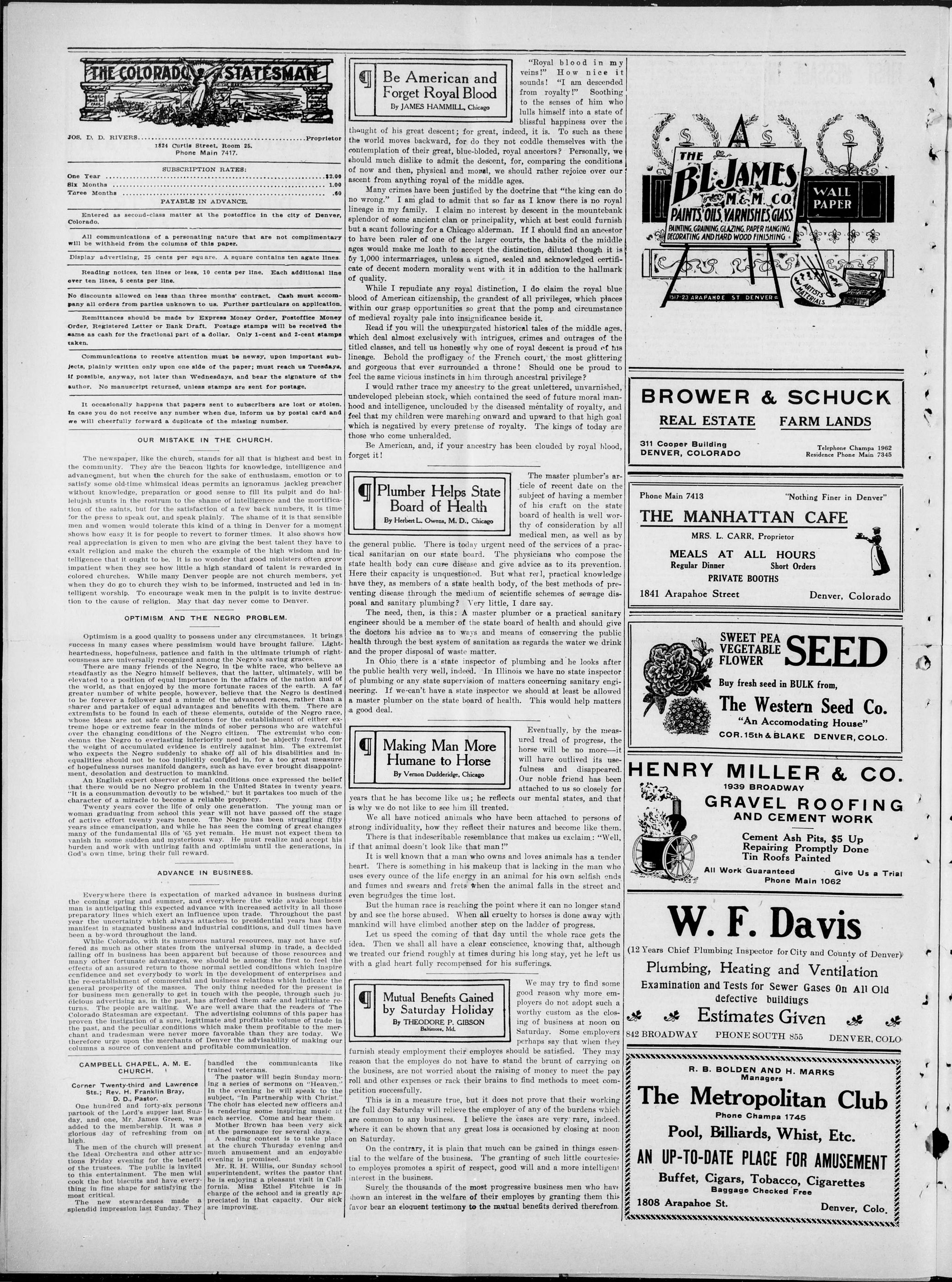
THE COLORADO STATESMAN
JOS. D. D. RIVERS.....Proprietor
1824 Curtis Street, Room 25.
Phone Main 7417.
JOS. D. D. RIVERS.....Proprietor
1824 Curtis Street, Room 25.
Phone Main 7417.
SUBSCRIPTION RATES:
One Year ..... $2.00
Six Months ..... 1.00
Taree Months ..... 60
PAYABLE IN ADVANCE.
Entered as second-class matter at the postoffice in the city of Denver,
Colorado.
All communications of a personating nature that are not complimentary
will be withheld from the columns of this paper.
Display advertising, 25 cents per square. A square contains ten agate lines.
Reading notices, ten lines or less, 10 cents per line. Each additional line
over ten lines, 5 cents per line.
No discounts allowed on less than three months' contract. Cash must accom-
pany all orders from parties unknown to us. Further particulars on application.
Remittances should be made by Express Money Order, Postoffice Money Order, Registered Letter or Bank Draft. Postage stamps will be received the same as cash for the fractional part of a dollar. Only 1-cent and 2-cent stamps taken.
Communications to receive attention must be newsy, upon important subjects, plainly written only upon one side of the paper; must reach us Tuesdays, if possible, anyway, not later than Wednesdays, and bear the signature of the author. No manuscript returned, unless stamps are sent for postage.
It occasionally happens that papers sent to subscribers are lost or stolen. In case you do not receive any number when due, inform us by postal card and we will cheerfully forward a duplicate of the missing number.
OUR MISTAKE IN THE CHURCH.
The newspaper, like the church, stands for all that is highest and best in the community. They are the beacon lights for knowledge, intelligence and advancement, but when the church for the sake of enthusiasm, emotion or to satisfy some old-time whimsical ideas permits an ignoramus jackleg preacher without knowledge, preparation or good sense to fill its pulpit and do hallujah stunts in the rostrum to the shame of intelligence and the mortification of the saints, but for the satisfaction of a few back numbers, it is time for the press to speak out, and speak plainly. The shame of it is that sensible men and women would tolerate this kind of a thing in Denver for a moment shows how easy it is for people to revert to former times. It also shows how real appreciation is given to men who are giving the best talent they have to exalt religion and make the church the example of the high wisdom and intelligence that it ought to be. It is no wonder that good ministers often grow impatient when they see how little a high standard of talent is rewarded in colored churches. While many Denver people are not church members, yet when they do go to church they wish to be informed, instructed and led in intelligent worship. To encourage weak men in the pulpit is to invite destruction to the cause of religion. May that day never come to Denver.
OPTIMISM AND THE NEGRO PROBLEM.
Optimism is a good quality to possess under any circumstances. It brings success in many cases where pessimism would have brought failure. Light-heartedness, hopefulness, patience and faith in the ultimate triumph of righteousness are universally recognized among the Negro's saving graces.
There are many friends of the Negro, in the white race, who believe as steadfastly as the Negro himself believes, that the latter, ultimately, will be elevated to a position of equal importance in the affairs of the nation and of the world, as that enjoyed by the more fortunate races of the earth. A far greater number of white people, however, believe that the Negro is destined to be forever a follower and a mimic of the advanced races, rather than a sharer and partaker of equal advantages and benefits with them. There are extremists to be found in each of these elements, outside of the Negro race, whose ideas are not safe considerations for the establishment of either extreme hope or extreme fear in the minds of sober persons who are watchful over the changing conditions of the Negro citizen. The extremist who condemns the Negro to everlasting inferiority need not be abjectly feared, for the weight of accumulated evidence is entirely against him. The extremist who expects the Negro suddenly to shake off all of his disabilities and inequalities should not be too implicitly confided in, for a too great measure of hopefulness nurses manifold dangers, such as have ever brought disappointment, desolation and destruction to mankind.
An English expert observer of racial conditions once expressed the belief that there would be no Negro problem in the United States in twenty years. "It is a consummation devoutly to be wished," but it partakes too much of the character of a miracle to become a reliable prophecy.
Twenty years cover the life of only one generation. The young man or woman graduating from school this year will not have passed off the stage of active effort twenty years hence. The Negro has been struggling fifty years since emancipation, and while he has seen the coming of great changes many of the fundamental ills of '65 yet remain. He must not expect them to vanish in some sudden and mysterious way. He must realize and accept his burden and work with untiring faith and optimism until the generations, in God's own time, bring their full reward.
ADVANCE IN BUSINESS
Everywhere there is expectation of marked advance in business during the coming spring and summer, and everywhere the wide awake business man is anticipating this expected advance with increased activity in all those preparatory lines which exert an influence upon trade. Throughout the past year the uncertainty which always attaches to presidential years has been manifest in stagnated business and industrial conditions, and dull times have been a by-word throughout the land.
While Colorado, with its numerous natural resources, may not have suffered as much as other states from the universal slump in trade, a decided falling off in business has been apparent but because of those resources and many other fortunate advantages, we should be among the first to feel the effects of an assured return to those normal settled conditions which inspire confidence and set everybody to work in the development of enterprises and the re-establishment of commercial and business relations which indicate the general prosperity of the masses. The only thing needed for the present is for business men generally to get in touch with the people, through such judicious advertising as, in the past, has afforded them safe and legitimate returns. The people are waiting. We are well aware that the readers of The Colorado Statesman are expectant. The advertising columns of this paper has proven the instigation of a sure, legitimate and profitable volume of trade in the past, and the peculiar conditions which make them profitable to the merchant and tradesman were never more favorable than they are today. We therefore urge upon the merchants of Denver the advisability of making our columns a source of convenient and profitable communication.
CAMPBELL CHAPEL, A. M. E.
handled the communicants like trained veterans
CAMPBELL CHAPEL, A. M. E.
CHURCH.
The pastor will begin Sunday morning a series of sermons on "Heaven." In the evening he will speak to the subject, "In Partnership with Christ." The choir has elected new officers and is rendering some inspiring music to each service. Come and hear them.
Corner Twenty-third and Lawrence
Sts.; Rev. H. Franklin Bray,
D. D. Pastor.
One hundred and forty-six persons partook of the Lord's supper last Sunday, and one, Mr. James Green, was added to the membership. It was a glorious day of refreshing on high
Mother Brown has been very sick at the parsonage for several days. A reading contest is to take place at the church Thursday evening and much amusement and an enjoyable evening is promised.
The men of the church will present the Ideal Orchestra and other attractions Friday evening for the benefit of the trustees. The public is invited to this entertainment. The men will cook the hot biscuits and have everything in fine shape for satisfying the most critical.
Mr. R. H. Willis, our Sunday school superintendent, writes the pastor that he is enjoying a pleasant visit in California. Miss Ethel Fitchue is in charge of the school and is greatly appreciated in that capacity. Our sick are improving.
The new stewardesses made a splendid impression last Sunday. They
"Royal blood in my veins!" How nice it sounds! "I am descended from royalty!" Soothing to the senses of him who lulls himself into a state of blissful happiness over the thought of his great descent; for great, indeed, it is. To such as these the world moves backward, for do they not coddle themselves with the contemplation of their great, blue-bloded, royal ancestors? Personally, we should much dislike to admit the descent, for, comparing the conditions of now and then, physical and moral, we should rather rejoice over our ascent from anything royal of the middle ages.
Many crimes have been justified by the doctrine that "the king can do no wrong." I am glad to admit that so far as I know there is no royal lineage in my family. I claim no interest by descent in the mountebank splendor of some ancient clan or principality, which at best could furnish but a scant following for a Chicago alderman. If I should find an ancestor to have been ruler of one of the larger courts, the habits of the middle ages would make me loath to accept the distinction, diluted though it is by 1,000 intermarriages, unless a signed, sealed and acknowledged certificate of decent modern morality went with it in addition to the hallmark of quality.
While I repudiate any royal distinction, I do claim the royal blue blood of American citizenship, the grandest of all privileges, which places within our grasp opportunities so great that the pomp and circumstance of medieval royalty pale into insignificance beside it.
Read if you will the unexpurgated historical tales of the middle ages, which deal almost exclusively with intrigues, crimes and outrages of the titled classes, and tell us honestly why one of royal descent is proud of his lineage. Behold the profligacy of the French court, the most glittering and gorgeous that ever surrounded a throne! Should one be proud to feel the same vicious instincts in him through ancestral privilege?
I would rather trace my ancestry to the great unlettered, unvarnished, undeveloped plebeian stock, which contained the seed of future moral manhood and intelligence, unclouded by the diseased mentality of royalty, and feel that my children were marching onward and upward to that high goal which is negatived by every pretense of royalty. The kings of today are those who come unheralded.
Be American, and, if your ancestry has been clouded by royal blood, forget it!
Plumber Helps State Board of Health By Herbert L. Owens, M. D., Chicago The master plumber's article of recent date on the subject of having a member of his craft on the state board of health is well worthy of consideration by all medical men, as well as by the general public. There is today urgent need of the services of a practical sanitarian on our state board. The physicians who compose the state health body can cure disease and give advice as to its prevention. Here their capacity is unquestioned. But what real, practical knowledge have they, as members of a state health body, of the best methods of preventing disease through the medium of scientific schemes of sewage disposal and sanitary plumbing? Very little, I dare say.
The need, then, is this: A master plumber or a practical sanitary engineer should be a member of the state board of health and should give the doctors his advice as to ways and means of conserving the public health through the best system of sanitation as regards the water we drink and the proper disposal of waste matter.
In Ohio there is a state inspector of plumbing and he looks after the public health very well, indeed. In Illinois we have no state inspector of plumbing or any state supervision of matters concerning sanitary engineering. If we can't have a state inspector we should at least be allowed a master plumber on the state board of health. This would help matters a good deal.
Making Man More Humane to Horse
By Vernon Dudderidge, Chicago
Eventually, by the measured tread of progress, the horse will be no more—it will have outlived its usefulness and disappeared. Our noble friend has been attached to us so closely for years that he has become like us; he reflects our mental states, and that is why we do not like to see him ill treated.
We all have noticed animals who have been attached to persons of strong individuality, how they reflect their natures and become like them.
There is that indescribable resemblance that makes us exclaim: "Well, if that animal doesn't look like that man!"
It is well known that a man who owns and loves animals has a tender heart. There is something in his makeup that is lacking in the man who uses every ounce of the life energy in an animal for his own selfish ends and fumes and swears and frets when the animal falls in the street and even bergrudges the time lost.
But the human race is reaching the point where it can no longer stand by and see the horse abused. When all cruelty to horses is done away with mankind will have climbed another step on the ladder of progress.
Let us speed the coming of that day until the whole race gets the idea. Then we shall all have a clear conscience, knowing that, although we treated our friend roughly at times during his long stay, yet he left us with a glad heart fully recompensed for his sufferings.
Mutual Benefits Gained by Saturday Holiday
By THEODORE P. GIBSON
Baltimore, Md.
We may try to find some good reason why more employers do not adopt such a worthy custom as the closing of business at noon on Saturday. Some employers perhaps say that when they
furnish steady employment their employees should be satisfied. They may reason that the employees do not have to stand the brunt of carrying on the business, are not worried about the raising of money to meet the pay roll and other expenses or rack their brains to find methods to meet competition successfully.
This is in a measure true, but it does not prove that their working the full day Saturday will relieve the employer of any of the burdens which are common to any business. I believe the cases are very rare, indeed, where it can be shown that any great loss is occasioned by closing at noon on Saturday.
On the contrary, it is plain that much can be gained in things essential to the welfare of the business. The granting of such little courtesies to employees promotes a spirit of respect, good will and a more intelligent interest in the business.
Surely the thousands of the most progressive business men who have shown an interest in the welfare of their employees by granting them this favor bear an eloquent testimony to the mutual benefits derived therefrom.
Be American and Forget Royal Blood
By JAMES HAMMILL, Chicago
Plumber Helps State Board of Health By Herbert L. Owens, M. D., Chicago
Making Man More Humane to Horse By Vernon Dudderidge, Chicago
Mutual Benefits Gained by Saturday Holiday
By THEODORE P. GIBSON
Baltimore, Md.
THE BL JAMES
M. & M. CO
PAINTS, OILS, VARNISHES, GLASS
PAINTING, GRAINING, GLAZING, PAPER HANGING,
DECORATING AND HARD WOOD FINISHING.
WALL
PAPER
1517-23 ARAPAHOE ST. DENVER
ARTISTS
MATERIALS
BROWER & SCHUCK
REAL ESTATE FARM LANDS
311 Cooper Building
DENVER, COLORADO
Telephone Champa 1962
Residence Phone Main 7345
Telephone Champa 1962
Residence Phone Main 7345
Phone Main 7413 "Nothing Finer in Denver"
THE MANHATTAN CAFE
MRS. L. CARR, Proprietor
MEALS AT ALL HOURS
Regular Dinner Short Orders
PRIVATE BOOTHS
1841 Arapahoe Street Denver, Colorado
Phone Main 7413
A Woman Carrying a Basket
Paeonia suffruticosa
SWEET PEA VEGETABLE FLOWER SEED
Buy fresh seed in BULK from,
The Western Seed Co.
"An Accomodating House"
COR.15th & BLAKE DENVER, COLO.
HENRY MILLER & CO.
1939 BROADWAY
GRAVEL ROOFING
AND CEMENT WORK
Cement Ash Pits, $5 Up
Repairing Promptly Done
Tin Roofs Painted
All Work Guaranteed Give Us a Trial
Phone Main 1062
FIRE HOUSE
W.F.Davis
(12 Years Chief Plumbing Inspector for City and County of Denver)
Plumbing, Heating and Ventilation
Examination and Tests for Sewer Gases On All Old defective buildings
Estimates Given
842 BROADWAY PHONE SOUTH 855 DENVER, COLO
R. B. BOLDEN AND H. MARKS
Managers
The Metropolitan Club
Phone Champa 1745
Pool, Billiards, Whist, Etc.
AN UP-TO-DATE PLACE FOR AMUSEMENT
Buffet, Cigars, Tobacco, Cigarettes
THE COLORADO STATESMAN
```markdown
```
J. E. Moorland, international secretary of the colored department of Y. M. C. A., is the honored guest of Mr. and Mrs. H. J. M. Brown, 1115 Inca.
Mr. Joseph Carter died at his home, 810 East 26th avenue Wednesday afternono, Funeral notice later. Douglass Undertaking Co. in charge.
Mr. and Mrs. John E. Taylor and son arrived in the city last Saturday from Kansas City and are living at 2037 Stout street.
Mr. and Mrs. T. R. Herron have returned from Fort Collins, where they have been for a few years and are now pleasantly domiciled at 2815 Glenarm Place.
Mrs. Eva La Chappelle and her father, Hollis Frazier, have returned from Topeka, where they attended the funeral of their brother and son who died recently in Baltimore, Md.
Engine Company No. 3 at Twenty-sixth and Glenarm has installed a phonograph for the amusement of the many visitors that frequent this popular fire company.
Samuel E. Cook spent a short time in the city Sunday en route from Salt Lake to Chicago. He enjoys the best of health. Mrs. Cook is well and thinks that there's no place like Denver.
Mrs. Flora Moore, who died at her home 1402 East 24th avenue, Saturday, her funeral will be held Sunday afternoon at the Douglas Undertaking Co. parlors, 2 p. m. Her remains will be shipped to Bonner Springs, Kansas.
Mr. J. E. Moorland, international secretary of the Colored Department of the Y. M. C. A., will address the Young Men's Christian Brotherhood at Shorter church, Sunday April 13th, at 3:30 p. m. Mr. Moorland is one of the best orators of the race. Don't fail to hear him.
The first class manner in which the poolroom is conducted by E. R. Page at Twenty-seventh and Welton streets has made it a Mecca for the best class of young men to spend their leisure moments. No profane or boisterous language is permitted and for this reason Mr. Page is commended by everybody for his manner of conducting the place.
The registration places will be opened April 24, 1913, for both the school election and the election on the commission form of government. They will be open again May 1. On the last date persons wishing to vote in the school election will not be permitted to register. Only on April 24 will the registration books be open for those who desire to vote at the school election. Persons desiring to vote at the commission election may register on either of the dates.
J. J. Houston, one of the most popular men in the city, arrived home Tuesday from Nashville and Hot Springs, where he has been for several weeks on business and pleasure. Mr. Houston brought back his little daughter Josephine, who will visit the little Misses McClain. Mr. Houston is interested in the Ideal Drug store besides being a large real estate owner and is a citizen of which any community ought to be proud. While in Hot Springs he met his sister, Mrs. J. W. Rose, of New York, who is there on a pleasure trip. Mr. and Mrs. Rose conduct two dairy lunches in New York of which they are making quite a success.
THE HARRIS CASE.
Judge L. J. Henry of Pueblo and Lawyer Townsend were in the Supreme Court Tuesday, when they argued the Bob Harris case; asking for a reversal of the verdict which sentenced Harris to hang. The court took the case under advisement and will soon decide.
Y. M. C. B.
Those who were present at Shorter chapel last Sunday afternoon at the Y. M. C. B.'s meeting and listened to the earnest appeal made for the uplift of our men and boys for the saving of their souls, and the acquiring
of such potentialities as to make them true and real men, could not but feel a certain responsibility attached to them in helping to foster this organization, the purport of which is to stretch out a hand to save and succor the thousands of our young men who have unfortunately been bereft of care and guidance in the path that leads to eternal happiness.
Dr. Moorland, international secretary of the Young Men's Christian Association, was the speaker of the hour, and his logical reasoning, cogent argument and brilliant diction seemed to have made a lasting impression on his audience, giving them inspiration to carry on this work to a more successful issue. The campaign will take a public phase on Sunday, the 13th inst., and The Colorado Statesman urgently requests its subscribers as well as the public in general to rise to this occasion and become a formidable auxiliary and agency for "The cause that lacks assistance, For the wrong that needs resistance, For the future in the distance, And the good that we can do."
CREOLE HAIR GOODS.
Mrs. W. G. Campbell of 2835 Stout street, the popular hair-culturist, has just received a full line of Natural Creole hair from Boston. All who desire to purchase braids, transformation pieces or who desire scalp treatment, are requested to call before going elsewhere. Phone Olive 1304.
IN MEMORIAM
In loving memory of our dear husband and father, Mr. Moses Thrasinley, who left us April 14, 1912.
We do not forget him, we loved him too dearly.
For his memory to fade from our lives like a dream.
The lips need not speak when the heart mourns sincerely.
And our thoughts often rest where they are seldom seen.
One year has now passed since he left us in sorrow.
And sad was the shock we received on that day.
But some day we'll meet and enjoy him forever.
In the home of our Saviour.
MRS. M. THRASHLEY
AND FAMILY.
A LETTER FROM AN OLD SUBSCRIBER.
Logtown, Miss., April 2, 1913.
Jos. D. D. Rivers:
Dear Sir—Please allow me a small space in your paper to say to my many friends of the race that it is good to read of the many praiseworthy things that they are doing. The Colorado Statesman comes to hand promptly every week replete with news and many good things. I always enjoy reading it. Enclosed is money order for $2 for a year's renewal subscription.
Yours truly,
WM. CROSBY.
SHORTER CHAPEL'S NOTES.
The order of service at Shorter Chapel tomorrow will be as follows:
10:00 a. m., Sunday school; lesson,
"Jacob at Bethel"—Gen. 28:10-22.
11:00 a. m., Sermon by Rev. J. E.
Moreland, international secretary of Colored Department of Y. M. C. A., with headquarters at Washington, D. C.
3:00 p. m., Big Y. M. C. A. mass meeting, when Secretary Moreland will deliver a special address before the Negro men of Denver. 1,000 men should turn out on this occasion.
6:45, Allen C. E. League, Topic,"I Can Do All Things"—Phil. 4:4:33 (Honorary members' meeting). Mr. J. P. Perkins, leader.
7:45, Sermon, "Man, the Dreamer," by the Pastor.
Our spring campaign for $3,000 is on in all earnestness and the smell of battle is everywhere in the air. We are not asking for the large sums at one time but the small sums at regular intervals. Each member of a club is expected to report to his captain every fortnight.
In his splendid address before the Y. M. C. A. last Sabbath afternoon, Secretary Moreland thoroughly convinced our men that if they would furnish the "will" he would supply the "way" to operate successfully in Denver this great organization. Now that the "psychological moment" has arrived, Negro man in our city should fall into line and go up at once and possess the land we so much desire.
Perhaps the busiest auxiliary of Shorter during the past week was the Sewing Circle. All hands were kept at it making elaborate preparations for the Big Bazaar April 29-May 1st.
Woman's Day will be observed at Shorter Sunday, April 20th. An instructive and inspiring program has been arranged for the entire day and the women will be in full control. A cordial invitation is extended to the women of our sister churches.
Our Allen Christian Endeavor
League held a successful business meeting Monday evening last at the home of Mr. and Mrs. Robert Sloan, 985 South Emerson street. Twenty-six officers were present and the following delegation was elected to the district convention to be held in Boulder, May 20th. Messrs. Royal C. Brown and Theodore von Dickersohn Mrs. M. E. Wade and Miss Eduu Douglas.
IN MEMORIAM.
In loving memory of our beloved husband and father, Irving Williams, who died April 11th, 1908. MRS. IRVING WILLIAMS and FAMILY.
DO THE PROPHECIES OF THE BIBLE PROVE IT INSPIRED?
Speaking through the Prophet JOEL, and others, God has given us various signs that would come to pass before the second coming of Christ. The manner in which these signs would appear, and where, are all pictured in the Word. Christ, in speaking to his Disciples concerning future time, as recorded in Matt., 24th chapter, made mention of some of the things that would come in the last days. War, famine, earthquakes, distress among nations, fearful sights on sea and land and the hoarding up of great wealth are some of the things mentioned.
Not that these things have not always existed, but as we draw near the close of this earth's history their visits would become more frequent, and their effects more comprehensive.
Quoting the words of another, we have the following: "It is evident from the word of truth, that the evils in the world are a sign. They betoken the end of all things, but they betoken it in the same way that birth pangs betoken the birth of a child—not immediately, not at once, for that is not the way that the child is born into the world; but by paroxysms, as it were, with intervals of quiet, coming closer and closer together as we approach the final act, becoming also more and more intense as the end is near.
Such is the picture given by inspiration of the wars, famines and earthquakes that are to take place before the end. They will come in paroxysms, they will come in outbursts with intervals of quiet between, growing more and more intense as we come nearer the end. As this time is reached there breaks one final, awful cataclysm that is the wreck of the world and the birth of the eternal kingdom."
Famine, cyclone, and floods are not new in the earth. Therefore these things do not constitute a sign, in themselves; but their rapid reproduction is a sign of the end. In the book of Psalms, chapter 148, verse 8, we read the following: "Fire, and hail; snow and vapours; stormy wind fulfilling His word." These are some of the means and ways that God takes to call man's attention to things above. The strenuousness of the times, the great clamor for pleasure and excitement, the demon-like thirst for ostentation and parade, has almost obliterated the claim of God and the religion of Jesus Christ from the human mind. There was a time when God spake with man face to face, but now He speaks through fire, flood and fearful sights on sea and land. How sad! What has brought about this change? Curiosity led man into sin, and sin caused him to lose his exalted privilege. J. W. OWENS.
NOTICE OF STOCKHOLDERS' MEETING.
Denver, Colo., April 12, 1913.
To the Stockholders of the Western Loan and Investment Association:
You are hereby notified that the annual meeting of the stockholders of the Western Loan and Investment Association will be held on Tuesday, May 20, 1913, at the hour of 8 o'clock, p. m., of said day, at room 25, Western Newspaper Union building, 1824 Curtis street, Denver, Colorado, for the election of officers and directors of said association, and for the transaction of any and all other business which may properly come before said association.
L. C. CONNELL,
J. R. CONTEE, President.
Secretary.
SEVENTH-DAY ADVENTIST
CHURCH.
"I was glad when they said unto me, let us go into the house of the Lord.—Psa. 122:1.
Dear friend: A personal and cordial invitation is extended to you to attend the services conducted by the Seventh-Day Adventist, in the chapel of the People's Presbyterian church, corner E. 23rd avenue and Washington street. Sabbath school (Saturday) 10:30 a.m.
Preaching, 11:15 a.m.
Young People's Miss'y Volunteer society (Saturday), 1:30 p.m.
Prayer meeting (Tuesday), 8 p. m.
Bible lecture (Sunday), 5:40 p. m.
Prayer meeting (Tuesday), 8 p. m.
Bible lecture (Sunday), 7:30 p. m.
A special program will be rendered once each month, to be composed of sacred music, recitations, etc., bearing on some special phase of the Gospel.
Bibles and other religious literature may be obtained from any of our agents, or direct from the conference office, 1112 Kalamath St.
Elder, J. W. Owens, Pastor, 2941 Glenarm Place, Phone Main 6646.
Lawyer W. B. Townsend has moved his office to Room 313 Kittredge building, Phone Champa 618.
Dr. Huff's resident phone has been changed to Main 8492. Office phone at 313 Kittredge building, Champa 618.
Nicely furnished alcove front room for rent with all modern conveniences, Telephone Olive 1608. Mrs. Howard Steele, 2222 Curtis street.
WE GUARANTEE TO SATISFY YOU or REFUND YOUR MONEY
Look for This Sign in Front of OurStore.
THE
WESTERN
BEEF
Co.
Hog Chitterlings, 5c lb.
Our store is your store.
We are at your service.
We Sell Everything a
Hog Furnishes
Get our prices before you buy else-
where. We also sell our groceries
cheaper.
OUR MOTTO:
Our profits are small,
But we get them all.
We sell for cash only.
2048 LARIMER ST.
Opposite Three Rules.
Phone Champa 1641.
Open Sunday All Day.
乐浑轩
1848
Arapahoe St.
Phone Main
4896
THE DE LUXE.
Furnished apartments. 2 and 3 rooms, with hot and cold water in each kitchen. Also front room, single, electric lights and gas. Modern throughout. Rates very reasonable.
For Rent—Nicely furnished rooms for rent at 1919 Welton street. Phone Champa 2528.
Modern furnished rooms for rent. Mrs. A. Arnold, 2318 Arapahoe.
Brickler's New Barber Shop is located at 2208 Larimer street. Shave, 10c. Hair Cut, 25c; Children, 15c.
STARTING MORE DRASTIC MEASURES TO DISPOSE OF REMANING STOCKS QUICKLY
In the windows—thrown out on the counters in the store. Take as many as you want, and don't expect too much attention. Take three Hats, Four Hats, five Hats, six Hats, for the price of one. Get in the Hat business if you want—this is your chance. There will be a man in the window to hand out to you and another in the store to help. There are going to be hundreds of customers gathered around this Hat Sale—and it will be, in a measure, "Help yourself and hand over the money."
THE BARTELDES SEED CO.
1521-1525 Fifteenth St. Denver, Colorado
The Largest Poultry Supply House in the West
Daily change of program---Saturday and Sunday matinee at 2:30---Evenings at 7:00 o'clock, with the best pictures, best music and courteous treatment--The new show house is enjoying a good patronage from the best people. ADMISSION FIVE CENTS
Best Ventilated, Safest Neighborhood Picture House in the City
QUITTING BUSINESS
STARTING MORE DRIVE
DISPOSE OF REMAIN
$1.00 FOR STIFF
AND SOFT HA
In the windows—thrown out on the c
you want, and don't expect too much
five Hats, six Hats, for the price of one
this is your chance. There will be a
and another in the store to help. Then
gathered around this Hat Sale—and t
and hand over the money."
SEE
Your back yard will help
BARTI
"WESTERN SEEDS FOR
THE BARTEL
1521-1525 Fifteenth St.
The Largest Poultry S
The Twenty-Se
Avenue Theatre
Daily change of pr
Sunday matinee at 2
o'clock, with the best
and courteous treatr
house is enjoying a go
best people. ADMIS
Best Ventilated, Safes
House in t
NAST THE GREAT BABY Photographer
ONLY CATERS TO FIRSTCLASS TRADE. OUR PICTURES SPEAK FOR THEMSELVES.
COR. 16th @ CURTIS ST. POST BLDG.
J. H. BIGGINS
Furniture Repairing and Upholstering. All work Cash.
PHONE YORK 7602
1417 East 24th Ave. Denver.
Telephone Main 811
13 CENTS A DAY BUYS A PIANO. WITH MUSIC LESSONS FREE. PIANOS FROM $88 UP. COLUMBINE MUSIC CO., 920-924 15th STREET, CHARLES BUILDING.
In Connection There Are Also
NICELY FURNISHED ROOMS and the Old Reliable Newport Thirst Parlors
VER, Colorado
THE JOHNSON-NOEL COMPANY
1005 SIXTEENTH STREET Near Curtis
BRASTIC MEASURES TO
MING STOCKS QUICKLY
HATS THAT SOLD AT $3.00,
$4.00,$5.00 & $6.00
counters in the store. Take as many as
a attention. Take three Hats, Four Hats,
one. Get in the Hat business if you want --
a man in the window to hand out to you
there are going to be hundreds of customers
it will be, in a measure, "Help yourself
EEDS
to pay your rent if you plant
WELDES'
FOR WESTERN PLANTERS"
WELDES SEED CO.
Denver, Colorado
Supply House in the West
Corner Twenty-Second and Washington
program---Saturday and 2:30---Evenings at 7:00 best pictures, best music treatment---The new show good patronage from the ISSION FIVE CENTS
st Neighborhood Picture the City
Mrs. S. Clingman
HAND-PAINTED
CHINA
BATTENBURG LESSONS.
2620 Welton Street.
EXAMINE THE TITLE AND MAKE YOUR CONTRACT. LAWYER TOWNSEND MAKES A SPECIALTY OF COLLECTING FROM INSURANCE COMPANIES, ALSO ENDOWMENT MONIES.
OFFICE 313 KITTREDGE BUILDING
THE TIVOLI UNION BREWING CO.
FROOTI
DENVER, COLO.
NEWS and GOSSIP OF WASHINGTON
She Wanted to Know The Way of Electricity
She Wanted to Know The Way of Electricity
WASHINGTON—An ancient colored woman was jammed in the inauguration crowd at the Peace Monument. A custard-colored young woman and a seal-brown young man were supposed to have her in tow, but they were so taken up with each other and with the excitement going on that the woman was as alone, in spirit, as if she were on a country field, where she obviously came from.
There was a daze of rapt wonder in her eyes as she looked down at the firmament of electric stars and jeweled planets that canopied the avenue from end to end. And like some old brown sybil, she raised her voice in ejaculation that, somewhere, took on the melody of a chant:
"Lawdneben, whar did dey git all dese lights fum! How did dey git 'em up yander high in de air whar nobody on uth kin clim!" Looks like Gawd done let down de stahs! How did dey git dem little flames shet up in dem glass bottles? How do dey make 'em burn 'thou no taller, an' no wicks, an' no oil, an' no firewood—nor nuthin'—answer me dat! How did dey git dem
It Has Arrived but Sooner Than Was Expected
EVERYBODY knew it was coming, but possibly no one believed it would arrive so soon. The new arrival is a new national society. It is known as the National Society of Colonial Cavaliers. This is to be the most exclusive society in America, and you have got to have lineage, lots of it, to belong to it. The headquarters of this society are to be in this city, and its governor general is to be Mr. C. W. De Lyon Nicholls. It seems as though this is the outgrowth of the Jamestown exposition, where a lot of "high-brows" got together and discussed their lineage. It does not depend upon American birth. In fact, American birth won't help it out at all.
This Society of Colonial Cavaliers is composed of men and women who can trace their lineage directly to a cavalier who either served under or supported Charles I. of England in his struggle with Cromwell. So far the organization has been confined to the palatinate of New York. That of Maryland will be the first effort to extend the society. In the near future it will be carried, according to Mr. Nicholls, into Virginia, and later into the Carolinas.
Lineage alone, however, is the qualification test. The society is democratic rather than snobbish, and descended from elson, or one who hires of the British nobility. It will be seen in snobbishness in the Carolinas, and Georgia, and this historic fact that eaters and sang-dialer outfit. This lantic coast was a ground of the no old world, and a penal colony, who sons of noble house rid of them.
Representative Tom Butler Taken at His Word
REPRESENTATIVE TOM BUTLER
of Pennsylvania has never had his
picture taken. It is a hobby of his.
When he first same to congress the
sergeant-at-arms asked for his photo
to put in the official gallery. Mr. Butler told him in a jocular way to get any old picture and put it in for him as he had never had any made.
"A long time afterward," said Mr. Butler, "a book agent called on me. He sang his usual song about my being so prominent that the publishers had printed a sketch of me and had
When He Didn't Feel the Limps and Twinges of Age
AN exhibit of battle flags at the museum caught the attention of a woman who was passing through. They were poor, scarred things; some of them shot-riddled and splotched with, maybe, mildew and, maybe, blood, and all of them dirty and tattered to slits.
The woman studied each flag with the unemotional deference she had just paid to Washington's old clothes. When she had finished the last one and was turning away another visitor came up and stood before the case.
He was so old that his march with the veterans down the inaugural line must have put an extra limp to his stiff leg and added an extra twinge to the shoulder that was pain-drawn from rheumatism and time.
But he didn't seem to be feeling either limps or twinges, as he stood before the exhibit, hat off and his
runner-roun lights on dem poles to burn diff'nt like dat, some blue, an' some red, an' some green?—an', oh, my Lawd, dere's a quivery flag wiv live blood stripes! Look-a yander at dem blazin' strings all over dem houses an' ain't nairy one catchin' fiah. It's like Dan' in de flahy funnace 'thout gittin' burnt. It looks like jedgment day done come an' ev'rybody saved—hally-loo-yuh!"
The custard-yellow young woman took sudden notice:
"Lor' gran'ma, shut up."
Do, gran ma, shut up.
"If you don't keep quiet, Mrs. Thompson," added the seal young man, jocosely, "Miss Luce an' me'll run off an' leave you. Then how you goin' to find your way back to Prince Gawges?
"I gwine keep mah mouf shet all I kin, chillen, an' I wouldn't be feared, nuther. De one dat sont a stah ahead for dem shep'd men ain't gwine leave a ole 'ooman like me to stumble in de dark, not on a night all lit up like dis one, nohow. Oh, Lawd, look at dat sun a flickerin' in fronter dat sto'. If I only could steddy out 'bout dem flames in dem bottles. Dat sholy gits me."
Hardly worth writing about, is it?
Just the unrestrained babble of an old creature of the Maryland pines; just darkest ignorance wanting to know the why of electricity. Just one simple soul asking God to bless her kind. Just one in the thousands who were on the avenue inauguration night.
WELL JOIN THIS
wealth, Mr. Nicholls declared, has no influence in the selection of members. While no person can join this society who cannot produce documentary proof of his descent from a cavalier of King Charles' times, the palatine who will preside over the palatine of Maryland must be able to show that he is descended from either a son, a grandson, or one who himself was a member of the British nobility of that period.
It will be seen that this newest cult in snobbishness is reaching out into the Carolinas, and ultimately into Georgia, and this brings to mind the historic fact that among the clay-eaters and sang-diggers there is a cavalier outfit. This section of the Atlantic coast was once the dumping-ground of the nobilliard scum of the old world, and soil of aristocratic penal colony, where the black sheep sons of noble houses were sent to get rid of them.
printed my picture. I was immediately interested. I wanted to know about the picture. So he showed it to me.
"There I was with a regular horse-tail whiskers down to my waist. Now I am no beauty, but I have never worn any anisite adornment, and certainly no Pfeffer whiskers. It made me mad, and I accused him of being a faker.
"He insisted that all the pictures were secured from the official gallery, and offered to show me the original. I went with him, and there, sure enough, on the walls, was a picture purporting to be me from which the copy had been made.
"The sergeant-at-arm had taken me at my word, and, being a feecient fellow, had picked out this monstrosity to represent me. It had been hanging there all the time, and I had never noticed it and my friends had never told me about it. You can see the picture yourself if you go in the cloak room."
figure straightened into the military rigidity of a soldier at attention. Even his age-drooped mouth had gone back to the masterfulness of youth, and in his eyes was the grimness that dares follow wherever a flag leads the way. And the woman who had stood aside, respectfully, and studied the man with the same unemotional deference with which she had studied the flags, said to her own curious self: "This, doubtless, is what you call patriotism!"
MRS. ALBERT SIDNEY BURLESON WELL KNOWN
SENATE'S NEW SECRETARY ACTIVE IN POLITICS
WOULD BUILD CATHEDRAL FOR ALL RELIGIONS
FRANKLIN K. LANE IS NOW FULL-FLEDGED CHIEF
Mrs. Burleson presents many charming phases of a strong person.
r a strong personality, and, though she is totally without ambition to become a leader of social affairs, she will unconsciously make her impress on the new administration at Washington. On both sides of her family she belongs to the old south and has all the conservatism of
A.
that class. Being a highly educated woman, she is also one of advanced ideas and was among the very first of the daughters of the Lone Star state to become a convert to equal suffrage. She can present an academic argument on this subject which would make the most stubborn and well informed opponent look up his books to answer. She is thoroughly domestic, attends to her home and her family herself, answers her own letters and is one of the most punctilious about her social obligations. It was predicted that the Wilson regime would present a less pretentious social appearance than the last, and that those with whom the first lady would be surrounded during the coming four years would be representative of the more serious aspects of life. In Mrs. Burleson this prediction is literally fulfilled.
"I should like," she said, shortly before March 4, "to see the old-fashioned virtues revived, and I think that all this agitation will have that desirable result. Women are clamoring about the high price of living, with the result that they are looking into matters themselves and finding out where to locate the remedy. It means going to market for thousands who never dreamed of such a thing a few years ago, and it means awakening to the fact that economy demands strict personal attention. This sense of responsibility is alone worth untold wealth in the material sense, and for the happiness of homes and the increased prosperity of the small householder is inestimable. In my list of old-fashioned virtues I include that of supervising the needs of the home
James N. Baker, who the other day was elected secretary of the senate, was born August 18, 1861, at Lowdensville, S. C., where he has retained his legal residence.
PETER H.
He was educated at Wofford college, South Carolina, and studied law in New York. In 1885 Mr. Baker was appointed official stenographer for the Fifth judicial circuit court, but he declined the appointment. He became assistant librarian of the senate in 1893, and has served in that office until the present. Mr. Baker has been active in poli-
Carmen Sylva, the famous queen of Roumania, has an interesting article in the London Fortnightly Review on the subject "If I Were a Millionaire." Sitting at the dinner table in her mountain castle of Sinaia, her majesty took part in a conversation upon the rich men of America, and asked what she would do if she were a millionaire, said she
Fortnightly Review on the subject "If I Were a Millionaire." Sitting at the dinner table in her mountain castle of Sinaia, her majesty took part in a conversation upon the rich men of America, and asked what she would do if she were a millionaire, said she would build a cathedral with chapels for every religion in it and an arts school beside it.
"You can build ever so many houses," she says, "and misery will enter there; care will follow the inhabitants, anger and strife and illness
Franklin K. Lane, secretary of the interior, has had many honors con-
ferred upon him. To begin with, he was born in Canada, but early in life he moved to California and, after running newspapers and practicing law alternately, he was nominated for governor of the state. When he was defeated by a suspiciously close margin President
To begin with, he was born in Canada, but early in life he moved to California and, after running newspapers and practicing law alternately, he was nominated for governor of the state. When he was defeated by a suspiciously close margin President Roosevelt put him on the interstate commerce commission. By common repute he is the man who put the "punch" in the commission and made the railroads sit up and take notice. Then President Wilson put him in charge of the interior department.
The other day a delegation of Blackfoot Indians came along and made him a chief of their tribe. The honor was unusual, unheralded and
every morning, not through a maid or even a housekeeper, but by the wife herself. This is possible unless one is very much occupied with very grave things, and it means to simplify life and add to the comfort of every member of the family. I believe in the gentle act of needlework, and even in the exceedingly obsolete occupation of darning the family hoslery.
"I find no study more entertaining than that of the varied life of the woman of today compared with that of her grandmother. I feel very grateful indeed that the horizon has expanded so and that having attended faithfully to the home there is so much to inspire and encourage. There are the clubs, for instance, especially the patriotic ones, where we breathe an atmosphere of history in its best sense and where we can do a little missionary work for those not so well enclosed. The social side of patriotic and literary clubs is one of the genuine pleasures of my home city, as it is here. But these are mere diversions and I should deplore very much should any sort of club prevent a woman from attending to the real work of life which pertains to her home and her family. This opinion is voiced by all those who are urging a larger share of municipal responsibility for women. If I thought such privileges would make women restless or unit for domestic relations, I should cease to sympathize. I believe it will have just an opposite effect and that after ten years of voting the result will be as encouraging as the experiment of higher education for women has proven."
Mrs. Burleson was educated partly by governesses in her home in Austin after going to New York for special courses and finished her training by two years abroad. When her eldest daughter was studying in the Texas university, and having for various reasons to spend part of the winter in Austin, she took a course of English and literature and she anticipate at some future time finishing this course and standing for a degree. Mr. and Mrs. Burleson are stanch advocates of the higher intellectual training and it was by their counsel that their eldest daughter continued her studies instead of making her debut this season.
tics, and has attended all the Democratic national conventions in the last twenty years. He has acted as a confidential assistant to various Democratic senators and to chairmen of the Democratic minority in the past. Through his long experience he has become known as an expert in all matters relating to legislative history, procedure and research.
Upward of two hours were consumed examining charges that Baker had speculated in cotton. Baker appeared before the caucus, admitted the charges, said he tried to increase his income by that method, and lost, but had paid every dollar he lost through the Sully failure. One senator observed that if all men who ever speculated were brought before the caucus for examination it might be necessary to put every senator on the stand.
In the end Baker was exonerated.
and death cannot be kept away. There is only one peaceful house on earth—that is God's house."
Carmen Sylva makes an interesting reference to Westminster abbey. "I spent one evening of my life alone in Westminster abbey," she says, "beside the organ and even before it, playing a few choirs only, in the gathering dust, when the statues began to look as if they were alive and moving, and I have felt better since."
The cathedral her majesty would build would be of white marble, like that of Milan, inside and out; not so ornamented, much quieter than Milan, but with columns that would give the feeling of a beech wood. . . . If I were a quen in a fairy tale I should do all that. But the queens in life have never a penny to bless themselves with, as so many poor people have to be helped that there is never anything left for the poor queen; she has to be content with looking at other people's beautiful creations."
unexpected. The Indian braves presented him with a calumet pipe—the pipe of peace—and after mumbling several strange sentences over him he was declared to be a full-fledged chief. A delegation of Crows made the Indian honor sort of a family affair by presenting Mr. Lane's daughter with a string of beads and other evidences of their friendship.
Wide Acquaintance.
The Washington Post tells this story of a dowager whose wealth and education were of exceedingly recent acquisition. According to her accounts, the trip round the world that she had completed had been socially most successful.
Some of her friends were questioning her about the places of interests that she had visited.
"Did you see the Dardanelles?" asked one.
"And the Himalayas?" inquired another.
"Why, certainly," replied the dowager. "I dined with them both in Paris."—Youth's Companion.
POPE'S ILLNESS IS DANGEROUS
THOUSANDS STAND IN RAIN
AWAITING NEWS FROM
HIS BEDSIDE.
STIMULANT NECESSARY
PONTIFF FEARS RESULT OF PUB-
LICITY ALREADY GIVEN
HIS SICKNESS.
Western Newspaper Union News Service.
London, April 10.—A Rome dispatch
to the Chronicle says that one of the
Pope's physicians has expressed the
opinion that His Holiness will rally
for a time, but that his general con-
dition renders it unlikely that he will
last out the present month and that
the end may come suddenly from
heart failure.
Rome, April 10.—All official reports regarding the condition of Pope Pius X. agree that his condition is not grave and that there is no immediate danger. Anxiety continues, however, on account of the weakness of the pontiff and the action of his heart which is in need of constant stimulation.
The attending physicians found that the condition of the Pope had improved during Tuesday night and this improvement was maintained throughout Wednesday, although his temperature showed a slight increase.
Again last evening his temperature rose slightly but the difference from that of the afternoon was hardly perceptible.
The patient is given eggs beaten up in milk, but his inability to absorb nourishment contributes to the depression from which he suffers.
The relapse is following the same course as the original attack of influenza, a sough being present with irritation of the bronchial tubes, and difficulty in respiration which has led to the report in some cases that the Pope is afflicted with asthma. This, however, is erroneous. The condition of albuminuria, which usually accompanies influenza, also is present, indicating an inflammation of the kidneys of greater or lesser degree, but it is hoped that this is of a transitory character.
The aspect of the immense square in front of St. Peter's recalled the scenes during the illness of Pope Leo XIII., but instead of a burning July sun as in 1903, there was a downpour of rain. This did not prevent thousands of pilgrims from gathering and gazing with grave anxiety at the three windows of the room on the third floor of the apostolic palace where the Pope lies, or from directing sympathetic glances at the little house int he square below where the sisters of the Pope occupy a modest apartment.
THREE WOUNDED IN CHARGE.
Woman and Boy Fall as Troops Fight Buffalo Strikers.
Buffalo, N. Y.—"Fire!" came the command from an officer of the guards called out in the carmen's strike. A dozen rifles replied. A boy and a woman fell. The crowd which had assumed large proportions broke and began to chase the street car that had just passed under the bridge. The soldiers followed with fixed bayonets and drove the throng to the curbs. More than one felt the butt of a rifle in the melee and one man received a bayonet thrust in the hand.
MORGAN'S BODY TO LIE IN STATE.
In Red Room of .Madison Avenue Home Where Financier Met
New York, April 10.—The body of J. P. Morgan will lie in state from the time of its arrival on the liner France on Friday until Monday morning in the red room of his Madison avenue home, where the financier met his directors and transacted the greater part of his business in recent years. The room is 35 by 40 feet, and is built of white stone with red Turkish carpets and hangings. The casket will be placed on a funeral bier under the portraits of the dead banker's father, Junius Spencer Morgan, and that of his son, John Plerpont Morgan, who succeeds him. Mr. Morgan's favorite flowers, deep red roses and American beauties, will be used exclusively to adorn the room.
Alonzo Thompson Dies After Illness.
Denver.—Alonzo Thompson, aged
millionaire and spiritualist, died at his
home after a long illness. The body
will be buried at Belleville, Ill.
California Free to Pass Jap Law.
Washington.—President Wilson let
it be known that the federal govern-
ment would not interfere with pending
legislation in California, by which
aliens who have not declared their inten-
tion of becoming naturalized as
American citizens are prohibited from
owning land or property.
Pupils Give $660 to Flood Relief.
Denver.—The school children of
Colorado have contributed $660.90 to
the Red Cross relief fund for the flood
sufferers in Ohio and Indiana.
A Big Gift to the Public THE DENVER REPUBLICAN
DELIVERED TO SUBSCRIBERS AT SIXTY CENTS A MONTH.
A reduction of more than 20 per cent on former rates.
At this price THE REPUBLI-CAN is the cheapest and best paper published in Denver.
Neither money nor labor will be spared to make THE REPUBLI-CAN, as it has always been in the past, the best and most reliable paper in the West.
THE REPUBLICAN'S news service has no equal. The Associated Press, supplemented by the splendid New York Herald news service, gives our readers every morning all the news gathered from every part of the world.
THE ILLUSTRATED SUNDAY MAGAZINE section of THE REPUBLICAN contains stories by the leading authors and humorists of the day and many pages of photographs of great interest.
SEND IN YOUR SUBSCRIPTION TODAY
Please fill out and forward this blank.
THE REPUBLICAN PUBISHING CO.
DENVER, COLO.,
Send to my address until I order
it discontinued, THE DENVER RE-
PUBLICAN, Daily and Sunday.
Name.....
Address.....
SIXTY CENTS A MONTH.
The
WARD AUCTION
COMPANY
Sales Daily at 2 p.m. Office Furniture a Specialty.
PRIVATE SALES AT ALL TIMES
HAVE MOVED TO—
1723-39 GLENARM ST.
PHONE MAIN 1675.
Miss M. Cowden Hair Dressing Parlor
Shampoo, cutting and curling. Scalp treatment, hair tonics, hair straightening, manicuring. Stage wigs for rent; theatrical use and masquerades. Goods delivered out of the city. All shades of hair matched by sending sample of hair; also combings made up.
Cheapest Switches 50 Cents
1219 21st St. Denver, Colo
THE BEST ICE CREAM AND
CANDIES AT
O.P. BAUR & CO.
CATERERS AND
CONFECTIONERS
Phone: 168.
1512 Curtis Street, Denver, Colo.
A Word to the Borrower
IF you are a borrower of this paper, don't you think it is an injustice to the man who is paying for it? He may be looking for it at this very moment. Make it a regular visitor to your home. The subscription price is an investment that will repay you well.
---
A Concise Statement of the Changes Made by New Bill.
COMMODITIES ON FREE LIST
Rates Raised on Some Luxuries—Raw Wool Placed on Free List and Sugar Given Heavy Reduction—Farm Products Reduced.
Washington.—Important changes in rates on variety of commodities in the new tariff bill now before congress follow:
Barley malt, from 45 cents to 25 cents a bushel.
Buckwheat, from 15 cents to 8 cents a bushel.
Oats, from 15 cents to 10 cents a bushel.
Rice, cleaned, from 2 cents to 1 cent a pound.
Wheat, from 25 cents to 10 cents a bushel.
Butter, from 6 cents to 3 cents a pound.
Cheese, from 6 cents a pound to 20 per cent ad valorem.
Beans, from 45 cents to 25 cents a pound.
Eggs, from 5 cents to 2 cents per dozen.
Nursery cuttings and seedlings, from 25 per cent to 15 per cent.
Fresh vegetables, from 25 per cent to 15 per cent.
Apples, peaches, etc., from 25 cents to 10 cents a bushel.
Raisins, from $2\frac{1}{2}$ cents to 2 cents a pound.
Lemons—Present rate $1\frac{1}{2}$ cents pound, proposed rate 17 cents for package under $1\frac{1}{4}$ cubic feet, 35 cents for package up to $2\frac{1}{2}$ cubic feet, 70 cents for package up to 5 cubic feet, $\frac{1}{2}$ cent a pound for lemons in bulk or in larger packages.
Oranges, limes, grapefruit, etc.—Present rate 1 cent pound, proposed rate same as for lemons.
Pineapples, from 8 cents to 6 cents a cubic foot capacity of barrels or packages, from $8 to $5 a thousand in bulk.
Chocolate and cocoa—Present rate when valued from 15 cents to 24 cents, $2\frac{1}{2}$ cents a pound and 10 per cent ad valorem additional; proposed rate 8 per cent ad valorem.
Value of Raw Wool a Factor.
Woolen manufactured goods and clothing—Present tariff rates are based in many cases on value of raw wool. Comparison is here made with the equivalent ad valorem duties as previously estimated by the ways and means committee on wool prices in 1910:
Combed wool and tops, from 105 per cent to 15 per cent.
Cloths, knit fabrics, felts and manufactured goods, from 97 per cent to 35 per cent.
Suspenders, ribbons, bindings, etc., from 83 per cent to 35 per cent.
Cotton manufactures:
Curtains, table covers, etc., from 50 to 35 per cent.
Garters, suspenders, etc., from 45 per cent to 25 per cent.
Table cloths. from 40 to 25 per cent.
Lace curtains, etc., from 50 to 45 per cent.
Miscellaneous cotton goods, from 45 to 30 per cent.
Earthenware and Glassware.
Cement from 8 cents a hundred pounds to 5 per cent ad valorem.
Lime from 5 cents a hundred pounds to 5 per cent ad valorem.
China clay, a ton, from $2.50 to $1.25.
Automobiles and motorcycles, 45 per cent to 40 per cent.
Ferromanganese, from $2.50 a ton to 15 per cent.
Round iron from $6 to $12 a ton to 8 per cent.
Iron and steel forgings from 30 per cent to 15 per cent.
Ball and roller bearings from 45 to 35 per cent.
Sheet steel or iron, now $6 to $18, cut to 20 per cent.
Tin plate, now $24 a ton, cut to 20 per cent.
Shotguns and rifles, now $2.25 to $10 each, changed to 35 per cent. Table and kitchen ware, from 40 to 25 per cent. Steam engines, printing presses, machine tools, from 30 to 15 per cent. Embroidering and lace making machines, now free, made dutiable at 25 per cent. The schedule carries a blanket clause that articles or wares not specially mentioned shall pay 50 per cent.
if wholly or partly of platinum, gold or silver, and 25 per cent. if wholly or in chief value composed of iron, steel, lead, copper, nickel, pewter, zinc, aluminum or other metal. Tableware, pennknives and watch movements are required to bear the names of the manufacturer and country of origin.
Lead bearing ore, from $1\frac{1}{2}$ cents a pound to half a cent.
As to Aluminum and Lead.
Aluminum, from 7 cents a pound to 25 per cent.
Antimony, from 1 cent a pound to 10 per cent.
Lead bullion, from 2 1-3 cents a pound to 25 per cent.
Nickel pigs, from 6 cents a pound to 10 per cent.
Chemicals, oils and paints:
Alkalis and compounds, from 25 per cent. ad valorem to 15 per cent.
Alum, etc., from ¼ cent a pound to 15 per cent. ad valorem.
Bleaching powder, from 1-5 cent to 1-10 cent a pound.
Fruit oils and essences, from $1 a pound to 20 per cent, ad valorem.
Flaxseed and linseed oil, from 15 cents a gallon to 12 cents.
Cod, seal and white oil, from 7 cents a gallon to 5 cents.
Crude opium, from $1.50 a pound to $3.
Prepared opium, from $2 a pound to $4.
Ocher and ocher earths: Present rates range from ½ cent to ½ cent a pound; proposed rate 5 per cent. ad valorem.
Zinc oxide, from 1 cent a pound to 10 per cent.
Paints, colors, etc., from 30 per cent. to 15 per cent.
White lead, from 3 cents a pound to 25 per cent.
Sponges, from 20 per cent. to 10 per cent.
Reduction in Silk Goods.
Chiffons, clothing, ready-made, articles of wearing apparel of every description, including knit goods, from 60 per cent. to 50 per cent. ad valorem.
Woven fabrics, from 50 per cent. to 45 per cent. ad valorem.
Beltings, cords, tassles, ribbons of artificial and imitation silk or horse hair, from 45 cents a pound and 60 per cent. ad valorem additional, to 60 per cent. ad valorem.
Lumber and wood:
Veneers, from 20 to 15 per cent.
Osier or willow for basketmakers' use, from 25 per cent. to 10 per cent.
Willow furniture, from 45 to 25 per cent.
Details of the Sugar Schedule.
The sugar schedule eliminates the Dutch standard of color and reduces the basic rate on sugar testing by the polariscope not above 75 degrees from .95 cent a pound to .71 cent a pound.
For each additional degree shown by the polariscope test the additional rate is reduced from thirty-five one-thousandth of 1 cent a pound to twenty-six one-thousandths of 1 cent a pound.
The other items in the cane sugar section are changed as follows: Molasses testing not above 40 degrees, from 20 to 15 per cent. ad valorem; testing above 40 and not above 56 degrees, from 3 cents to $2\frac{1}{4}$ cents a gallon; testing above 56 degrees, from 6 cents to $4\frac{1}{2}$ cents a gallon. At the end of the section the following clause is added: "Provided that three years after the day when this act shall take effect the articles hereinbefore enumerated in this paragraph shall thereafter be admitted free of duty."
Maple sugar and refined sirups, from 4 to 3 cents a pound.
Glucose or grape sugar, from $1\frac{1}{2}$ to $1\frac{1}{8}$ cents a pound.
Unmanufactured sugar cane, from 20 to 15 per cent.
(A provision placing the articles in this section on the free list after three years is also included.)
Sugar candy_valued at 15 cents a pound or less from 4 cents a pound and 15 per cent. ad valorem to 2 cents a pound; valued at more than 15 cents a pound, from 50 to 25 per cent. (Cuban sugars by treaty arrangements come in at a 20 per cent, reduction from the regular duties.) Scrap tobacco, taken from a general classification, at a rate of 55 cents a pound, and given an individual classification of 35 cents a pound.
Flax, hemp and jute:
Flag, hackled, from 3 to 1½ cents a pound.
Tow and flax, from $20 to $10 a ton
Hemp and tow of hemp, from 1 cent to $ \frac{1}{2} $ cent a pound.
Hemp, hackled, from 2 to 1 cent a pound.
Mattings, Linoleum, Etc.
Floor mattings, from 3½ cents to ½ cent a square yard.
Linoleum and oilcloth, now classified from 8 cents a square and 25 per cent, to 10 cents a square yard and 20 per cent, reclassified at the following rates—plain or stamped linoleum, 30 per cent; inlaid linoleum, 35 per cent.; oilcloth, 15 per cent.
File fabrics, from 60 to 40 per cent.
Bags or sacks of single jute yarns, from ⅓ cents a pound and 15 per cent, to 25 per cent.
Paper and Books:
Printing paper (other than paper commercially known as hand made or machine hand made paper). Japan paper and imitation Japan paper by whatever name known), unsized, sized or glued, suitable for the printing of books and newspapers, but not for covers or bindings, not specially provided for in this section, valued above $2\frac{1}{2}$ cents a pound, 12 per cent, ad valorem: "Provided, however, that if any country, dependency, province or other subdivision of government shall impose any export duty, export license fee, or other charge of any kind whatsoever (whether in form of ad-
ditional charge, or license fee, or otherwise) upon printing paper, wood pulp or wood for use in the manufacture of wood pulp, there shall be imposed upon printing paper, when imported either directly or indirectly from such country, dependency, province, or other subdivision of government, an additional duty equal to the amount of such country, dependency, province or other subdivision of government, upon printing paper, wood pulp or wood for use in the manufacture of wood pulp."
Writing paper, from 3 cents a pound and 15 per cent. ad valorem to 25 per cent.
Envelopes, from 20 to 15 per cent.
Books, from 25 per cent. to 15 per cent.
Photograph albums, from 35 per cent. to 25 per cent.
Manufactures of paper, from 35 to 25 per cent.
Straw hats, unblocked and untrimmed, 35 per cent. to 25 per cent.
Brushes and feather dusters, from 40 to 35 per cent.
Fireworks, from 12 to 10 cents a pound.
Gunpowder valued at less than 20 cents a pound, from 2 cents to $ \frac{1}{2} $ cent a pound; valued over 20 cents a pound, from 4 cents to 1 cent a pound.
Furs, Hats, Gloves.
Furs, dressed on skin, from 20 to 30 per cent.; partly manufactured furs, from 50 to 40 per cent.; furs for hatters' use, from 20 to 15 per cent.
Hats, bonnets and hoods of felt, taxed under the classification of the present law from $1.50 a dozen and 20 per cent. ad valorem to $7 a dozen and 20 per cent, placed in the new bill at 40 per cent. ad valorem.
Women's glace gloves, from $1.25 to $1 a dozen when not over 14 inches in length; an additional tax of 25 cents a dozen for each inch in length over 14 inches.
Women's kid gloves, from $3 to $2 a dozen, not over 14 inches in length; an additional 25 cent tax a dozen for each inch over 14 inches in length.
Cumulative duty on lined gloves, cotton lined, from $1 to 25 cents a dozen; silk or wool lined, from $1 to 50 cents a dozen; fur lined, from $1 to $2.
Musical instruments, from 45 to 35 per cent. Phonographs, from 45 to 25 per cent. Photographic plates, from 25 to 15 per cent.
Moving picture films, from 25 to 20 per cent. Umbrellas and sun-shades, from 50 to 30 per cent. The schedule carries a general provision increasing the duty on manufactured articles not specifically provided for in the section from 15 to 20 per cent. Unmanufactured articles remain at 10 per cent.
NEW INCOME TAX STARTS AT $4,000
Elaborate Provision for Graduated Payment System in New Tariff Bill.
Washington, D. C.—Included in the Democratic tariff revision bill is an income tax section, which would require every resident of the United States who earns more than $4,000 a year to pay a tax of 1 per cent. on his earnings in excess of the exemption. This would not compel the man who earns only $4,000 to pay a tax, but it would demand that one who earned $4,100, for example, pay into the government treasury an annual tax of 1 per cent. on $100, or $1. The bill also would provide higher rates of taxation for persons with larger incomes, adding a surtax of 1 per cent. additional on earnings in excess of $20,000; 2 per cent. additional on earnings in excess of $50,000, and 3 per cent. additional on earnings in excess of $100,000.
How Surtax Would Be Imposed.
Under the surtax provisions the man who earns $20,000 would pay to the government each year at the rate of 1 per cent. on $16,000 ($4,000 exempt), or $160. If he earns $30,000 he would pay 1 per cent. on $16,000 and 2 per cent. on $10,000, making his annual tax $360. The person with a $50,000 income would pay 1 per cent. on $16,000 and 2 per cent. on $30,000—a total tax of $760. The man with an income of $100,000 would be required to pay 1 per cent. on $16,000, 2 per cent. on $30,000, and 3 per cent. on $50,000, which would be $1,500, bringing his total income tax to $2,260. Anyone with a net income of a million would pay this $2,260 on his first $100,000 and in addition he would pay 4 per cent. on $900,000, which would bring his total tax to $38,260.
This bill also would re-enact the present corporation tax law, imposing a 1 per cent. tax on the earnings of corporations, stock companies, insurance companies and the like, but it would exempt partnerships. This is a flat tax, there being no graduated scale as the earnings increase. The few changes from the present corporation tax act, concern chiefly the time of making returns and the time for collection.
The bill includes under its provisions the property and earnings in this country of persons who live abroad.
May Bring In $100,000,000.
It is estimated by members of the ways and means committee that approximately $100,000,000 in revenue may be derived from this new tax, including the corporation tax, that amount making up for the deficit in
revenues to be derived from imports by virtue of the greatly reduced tariff and the transfer to the free list of articles that are classed as necessaries of living. Incomes of taxable persons shall include gains, profits and income derived from salaries, wages or compensation for personal service of whatever kind and in whatever form paid, or from professions, vocations, business, trade, commerce or sales or dealings in property, also from interest, rent, dividends, securities, including income from property, income from but not the value of property acquired by bequest, devise or descent, and also proceeds of life insurance policies paid upon death of persons insured.
Provision Made for Deductions.
The bill allows as deductions in computing net income all necessary expenses actually incurred in carrying on any business, not including personal living or family expenses, interest accrued and payable within the year by a taxable person on indebtedness; all national, state, county, school and municipal taxes, not including local benefit taxes; losses incurred in trade or from fires, storms or shipwreck not compensated by insurance or otherwise; debts actually ascertained as worthless and charged off; also reasonable allowance for wear and tear on property; but no deduction will be allowed for expense of restoration or improvements made to increase property value.
It excepts also, in computing net income, amounts received as dividends upon the stock of any corporation, joint stock company, association or insurance company which is taxable upon its net income under the corporation tax provision of the bill. The bill excludes the compensation of the president of the United States during his term, that of judges of the Supreme and inferior courts of the United States, and compensation of all officers and employees of a state or any political subdivision thereof.
System of Collection Framed.
It establishes a system of collection of the tax at its source, requiring all persons, firms, copartnerships, companies, corporations, joint stock companies, associations or insurance companies, and all trustees, executors, administrators, receivers, etc., and officers and employees of the United States having the control or disposal of salaries, wages, interest and other profits and income of another person to withhold and pay to the collector of internal revenue the amount of income tax due from such person. All such persons or firms are made personally liable for such tax.
Persons or corporations liable to make return on incomes who fail to do so at a specified time, are made liable to a fine not exceeding $500 and the penalty for false or fraudulent returns is fixed at $1,000 or imprisonment not exceeding one year, or both.
"In formulating this additional impost," said Chairman Underwood in his report, "the attempt has been made to provile not only a source of revenue, but also a means of redressing in some measure the unequal tax burdens which result from the practice of basing the federal income entirely upon customs and internal revenue duties. This is a system of taxation which inevitably throws the burden of supporting the government upon the shoulders of the consumers. It correspondingly exempts the men of larger income, whose consumption of the ordinary necessaries of life is subject to tariff taxation in a far less aggregate degree than is that of smaller income earners, who expend the greater proportion of their resources for the ordinary necessaries of life."
Underwood Defends Plan.
Speaking of the principle of taxation laid down and the graduated system proposed, Mr. Underwood declared:
"The progressive principle already has been sustained by the Supreme court of the United States in the inheritance tax cases and there can be no doubt that the same principle applies to the income tax included in this bill and will be fully upheld should it ever be called into question. Owing to defects in personal property taxation, the larger incomes in the United States have for many years been able to escape with less than their share of the general burden of taxation, and this inequity will be, it is believed, in part overcome by the plan proposed."
The bill provides that all taxable persons shall be notified of the amount for which they are liable under the law on or before the 1st day of June of each year and assessments must be paid on or before June 30. For delay in making payments and ten days after notice, there shall be added the sum of 5 per cent. of the amount of tax unpaid and interest at the rate of 1 per cent. a month from the time the tax fell due.
The corporation tax provision, it is directed, shall be computed upon income for the year ending December 31, 1913, and for each calendar year thereafter. It is provided, however, that corporations may designate the last day of any month as the day of the closing of the fiscal year and may have the tax computed on the basis of net income ending on its designated day. All labor, agricultural, horticultural, fraternal, religious and mutual benefit societies are made exempt from the tax.
Has the Earmarks.
Guide—In front of you is the national capitol.
Miss Gush—Ch. isn't it angelic?
Mr. Grouch—Angelic? Why, young woman, how can you speak of it as being angelic?
Miss Gush—Well, it has wings, hasn't it?
AFRO-AMERICAN CULLINGS
Editor J. H. Murphy of the Afro-American, Baltimore, has been traveling through the south. Mr. Murphy not only uses his pen well, but he uses both his eyes and his ears. In his correspondence to his paper he sounds a bugle call that our race here in the north should hear and heed. Hear what he says:
Jacksonville, Fla.—A great deal of sympathy is being wasted among the colored folks in many of the northern and eastern estates upon the negro of the south. A good deal of this sympathy might well be saved. In a great many things the negro of the south is far and away ahead of the negro of the north. We venture the assertion that there are more negro clerks, bookkeepers, secretaries, typewriters in Birmingham alone than there are in New York City, or possibly Chicago, or any one other large northern city. Another proposition in the south is the large number of negro mechanics. They are here in large and increasing numbers, thanks to the Tuskegee school spirit and the sentiment of the south itself. One will hardly see a building of any proportions, or with no proportions at all, but one sees the inevitable negro mechanic. And moreover he works beside his white brother without the least friction, so one may see a negro bricklayer, or a negro carpenter, plumber or gas fitter working side by side with a white fellow mechanic. One may see in almost any large city in the south even skyscrapers erected entirely by negro mechanics, and a negro architect drawing the plans and directing the work. While I am writing this letter I am sitting at a window which looks out over a huge five-story building going up upon which I have not seen a white workman except the foreman, which happened because there was no negro builder or contractor under the terms necessary to put up the building. And by the way it is a negro building, three stories of which will be devoted to commercial purposes, that is, offices and stores, and I have been informed that nearly all the available space has been already taken up. I have also been informed that when the building is completed that a number of the substantial citizens of this place are going to open up a bank in first class shape with at least twenty-five thousand dollars capital.
Just as there has been an organized movement to have anti-intermarriage measures passed in the various legislatures throughout the country, so is there a well-engineered plan on foot to have the colored railroad porter ousted in the west and middle west, although several states have refused to consider the plan seriously. The scheme is to prevent the employment of colored men as train porters. Porters in the Pullman service are not affected. As usual, the train porters are unorganized and are fighting the hostile measures the best they can. In each of the states in the west and middle west bills have been introduced in the legislatures known as the Full Crew Bill, which provides for a brakeman and flagman on all passenger trains carrying more than three coaches. The purpose of the Full Crew Bill is to do away with the colored train porter, as he carries a switch key the same as the brakeman and performs similar duties.
A woman says the way to reach a man's heart may be through his stomach, but it may take cunning or brute strength to reach his pocketbook.
On a visit to Atlanta university, in company with other white men, Clark Howell, editor of the Atlanta Constitution, emphasized the mutual dependence of the white race upon the black race. He declared that if the city homes, white and black, were kept as clean as the buildings of the school the mortality of the city would be reduced by more than half.
Mr. Howell said that education was a good thing for all creatures and all people of whatever race. That among all people will be found two distinct castes, the good and the bad. The party visiting the school consisted of Judge W. R. Hammond, Clark Howell, J. K. Orr and Dr. C. B. Wilmer. Each one of the party made short addresses to the students, Judge Hammond emphasizing the importance of individual responsibility and the too frequent tendency of people to shift the burden upon someone else.
The Daily Reporter is the name of a negro daily newspaper being published in Jacksonville, Fla., by a company of colored men. It is making a favorable impression.
There has been organized in Valdosta, Ga., a business and professional men's league. Nothing is more needed in a city where there is such a large number of both. As far as we could learn, the officers are: Mr. W. S. Larkin, president; Dr. C. C. Strickland, vice-president, Mr. M. G. Miller, secretary.
Should an original idea strike some men it would give them a headache.
A lazy man's feet leave their imprint on the path of least resistance.
What is woman's work? It used to be so defined by custom as to be as unmistakable as the clothing she wears distinguishing her from mere man, and it was considered as unwomanly to do man's work as to wear man's clothing. Even now the woman who wears short hair is looked upon as being as queer as the man who wears long hair. The tendency among some women to wear clothing fashioned after that of men, like riding horseback astride, is frowned upon by those who see nothing but degeneration of the race in the unsexing of the woman in her clothing, manners and occupation.
Women have of late years so encroached upon the occupations of men in the office, the store and the factory as to lessen the wage earning capacity of men and the ability of men to support families, so that marriages are fewer and divorces are more numerous than in old times. The wages paid to women who do the work of men is less than that paid to men, and women do not spend their earnings in family making and educating as men do. Indeed, how a woman will spend a dollar bill is as much of mystery as what a Bull Moose would do in the White House. And women who begin life as independent wage earners, and who constantly associate with men in their employments, develop a freedom from mutual helpfulness and a certain hardness of manners that unfits them for the successful work of the home as wives and mothers. The sons of Sparta always knew their mothers but never their fathers. It is that way now with dogs, human and canine. A masculine woman is as dangerous in the home as a feminine man.
We do the race an injury by looking down, upon, and underestimating the importance in the body politic of the man who serves, and it is more than probable that he sometimes underestimates his own worth by failing to magnify his calling, and neglecting to do his work so efficiently as to leave no room for improvement on the part of any one. The monopoly which we used to hold in these lines got away from us not because of favoritism to the man with a white skin, but because this latter was able to put it over us in the matter of cleanliness, efficiency, faithfulness and reliability. Circumstances are breaking strong in our favor, and it will be our fault if we do not get a stronger hold on what ever comes our way. And we delate ourselves woefully when we imagine that the other fellow doesn't want our job. That day has passed. The negro doesn't hold a job today that the other fellow would not take with eagerness. We must learn not only to get there, but "to stay there" by right of merit—Ethiopian Phalanx.
That there are 121 colored people in business and twenty-five in the professions in Columbus, Ohio, is but another sign that the negro of the north is coming into his own. There are among the business men six coal dealers, three contractors, four confectioners, three feed merchants, four hotel keepers, eight restaurant keepers, and five shoemakers.
A polite discussion is going on between a colored citizen of Nashville, Tenn., and The Globe, a negro newspaper of that city, concerning the fitness of Fisk university having a negro as president.
August Stanfield, graduate of Howard university, passed the highest examination in a class of more than forty-five applicants for license to practice medicine and surgery in New Jersey, before the state board of examiners of Trenton. Dr. Stanfield will locate and practice at Morristown, New Jersey.
Students in our colored colleges deserve to be commended for the manner in which they conduct themselves in contrast with the actions of students in many white institutions of learning. Here is a case in point: According to the University Register, Harvard students spend $603,780 for clothes, $98,255 for cigars and cigarettes and $73,250 for wines, as compared to $71,250 for books.
Prof. Cyrus Wiley, A. B., who for eleven years has been principal of the colored public schools at Valdosta, Ga., has made his debut into the ministry. He preached his first sermon at St. Paul A. M. E. church in that city. He will retain his position as principal of the schools.
J. A. Ross of Detroit, Mich., a life long Democrat and a prominent negro, is being boosted for the position of Recorder of Deeds under Woodrow Wilson's administration. This change of administration is placing before us many new colored political faces anyway.
Another way for a rich man to attract favorable attention is to let the wives of other men alone.
Not only is poverty a crime, but so is six dollars the week.
HELLO FRED!
Where did you get that nice shirt Fred-I got it at the 5 POINTS CAPIT
that nice shirt ?
the
CAPITOL
ey ?
pants, children's
ear, holeproof host
and boys. Their
their prices are
Fred-They have pants, children's shirts, collars, neckwear, holeproof other articles for men and boys. fresh and good and their prices their goods are union made and home products. Where is that store? Fred-It is at
Fred-They have pants, children's suits, knee pants, shirts, collars, neckwear, holeproof hosiery, hats and all other articles for men and boys. Their goods are always fresh and good and their prices are popular, most of their goods are union made and home products.
2657 WELTON STREET
You can't miss seeing it as it is the white front store at 5 Points.
Well believe me, I sure will go there for my clothes.
WILLIAM CLOW
THE
COLRADO WALL PAPER
COMPANY
WALL PAPER, PAPER
AND GLASS
Interior and Exterior Decoration
Painting, Coach Colors, Paint
Agents for John W. Masury
PHONE MAIN 871.
728 W. Colfax, foot of Welton S
The Capitol Brew
DRINK CAPITO
DENVER'S PRIDE
The purity of Capitol Beer is demonstra-
and strength-giving qualities. It's capital.
HAVE A CASE SENT
The Capitol Brew
Phone Champa 356.
THE
ALL PAPER
COMPANY
PER, PAINT
AND GLASS
Interior Decoration.
Colors, Paints and
W. Masury & S.
1871.
of Welton St.
CAPITOL
DENVER'S PRIDE
Beer is demonstrated
es. It's capital.
A CASE SENT HOME
capitol Brewing
COLRADO WALL PAPER & PAINT COMPANY WALL PAPER, PAINTS, OILS AND GLASS
Interior and Exterior Decoration. We do House Painting, Coach Colors, Paints and Varnishes. Agents for John W. Masury & Sons. TELEPHONE MAIN 871. 728 W. Colfax, foot of Welton St. Denver. Colo
The CAPITOL BREWING COMPANY
The purity of Capitol Beer is demonstrated by its superior flavor and strength-giving qualities. It's capital. HAVE A CASE SENT HOME
THE PRIOR FUR
1814 CURTIS
NEW AND SECOND HAND FU
SOLD AND EXCHANGED. W
AND SEWING MACHINES
PAIRED A SPECI
FOR FURNISHING
URTIS ST
TO HAND FURNISH
CHANGED. WIND
MACHINES SOLD
ED A SPECIALT
You
it, Tails Snow
or any other p
ne squeal go
It's Ma
MOBILES
NEW AND SECOND HAND FURNITURE BOUGHT SOLD AND EXCHANGED. WINDOW SHADES AND SEWING MACHINES SOLD AND REPAIRED A SPECIALTY
When You The Heads, Feet, Tails S or Chiterlings or any other except the squeal East's M
When You Want
The Heads, Feet, Tails Snouts, Neckbones or Chiterlings or any other part of the hog except the squeal go to East's Market
AUTOMOBILES Up-to-Date Machines Careful Autoists
---
```markdown
```
What else have they?
J. R. DRESSOR
C. B. PRIOR, President
Phone. Champa 392
2300.6 Larimer Street
GIVE ME A TRIAL
Phone Main 5038
CLOTHING
41203
THE
PAPER & PAINT
COMPANY
, PAINTS, OILS
GLASS
Decoration. We do House
Paints and Varnishes.
Masury & Sons. TELE-
Halton St. Denver. Colo
BREWING
COMPANY
PITOL BEER,
'S PRIDE
demonstrated by its superior flavor
capital.
E SENT HOME.
Brewing Co.
Delivered Anywhere.
D. S. ELEY, Secy. and Treas.
FURNITURE CO
TIS STREET
AND FURNITURE BOUGHT,
SED. WINDOW SHADES
HINES SOLD AND RE-
SPECIALTY
ou Want
ils Snouts, Neckbones
other part of the hog
queal go to
Market
LES FOR HIRE
G. WALTON
STAND, 1221 NINETEENTH ST.
A. B. CLOW
Cash or Credit
Phone Main 1461
BY THE HOUR OR DAY AT REASONABLE RATES
Spring Gown of White Maline Triumph of Parisian Modiste
Underwood & Underwood
A spring gown of white maline trimmed with black maline, with silver roses and fringe of pearls.
BIDDING DEFIANCE TO RAIN FACE POWDER OPENLY USED
Waterproof Materials Light and Neat, and Keep Off the Too Insistent Moisture.
There are all sorts of waterproof goods. Some perform the functions allotted to them well, while others are only rain-proof in a light shower. It requires more than waterproof material to resist the gusts of rain which are blown against one in an open car. The very force of the rain seems to drive it through the thickest of stuffs. The best protection in such a storm is the good, old-fashioned souwester which the fishermen wear when the sea is in an angry mood. The modern interpretation of the ollskin of the fisherman is a fabric as light and as subtle as silk. It comes in fascinating browns and blues and purples, and is so light in weight that it can easily be slipped over the top coat. It is a very comforting thought to know that one of these coats, in its accompanying envelope, is stowed away in the motor for the unexpected storm. To accompany this coat, there is a cap which is almost a replica of the genuine souwester. This may be fastened so that the neck is well protected.
V
Dress of olive green broadcloth with silk waist in the same shade and yoke of white silk. The skirt shows the straight tailored lines with panel effect
Strikingly New Acquisitions Are Provided for the Really Up-to-Date Toilet Table.
This is a period of paint, powder and perfume; society belle and "chorus lady" allike are frank about its use. Today we complete our toilette with a spray from an atomizer filled with Bacchanale; tomorrow we will adopt Cyclamen. The bouquet odors such as ambre antique, Mimosa or Djer Kiss are preferred at present, but the popularity of a special perfume like the flowers from which it takes its fragrance, is short lived. Carolina White extract has eclipsed the extracts named for the other notable woman, namely, Mary Garden and Sarah Bernhardt.
The violet odor is always popular. It is said Queen Mary of England never uses anything else in extract, toilet water, soap, sachet or bath salt. The rose, both the Jacqueminot and the white, is always well liked.
Gold-colored or Oriental powder as it is called is strikingly new. The violet, purple and bright vermilion tints have been seen before, but gold never. Color in rouge has deepened. The brunette rouge which is so much affected is almost a purple red. Powder pomponettes, consisting of tiny puffs of cotton spread with powder in the rose blanche or rochelle shades, and are sealed in individual tissue envelopes. A hundred of these little jackets are arranged in a French wallpaper box.
The moist lip-stick is new. It is a vegetable compound and remains on the lips until removed, unlike the lip-stick of red cream which is soon absorbed.
Kitchen Aprons
Aprons for wear in the kitchen should be all enveloping. They can be made of gingham, percale or white lawn, but however made they should completely cover the skirt, and should have a large bib. A ruffle about the bottom of the apron protects the hem of the dress, as it catches and wards off anything which is spilled or dropped.
Kitchen aprons need not be unattractive because they are big and serviceable. They can be made of white self-figured percale or madras, edged with blue or pink or any other color. A folded bias lawn band can be folded over the edges of the apron like a binding, or scalloping braid, which is sold in many colors and styles, can be stitched under a neatly turned hem.
Hot-Water Remedy.
Over-tired women who retire at night or lie down for a few minutes during the afternoon vainly seeking sleep, which refuses to come, should try the hot-water remedy. Simply bathe the face and temples, the wrists and behind the ears with water as hot as can be borne. This will often induce sleep.
A glassful of hot water with a lump of sugar and a few drops of lemon juice added is a favorite "soothing" drink of Frenchwomen, and helps to woo sleep. It often takes the place of tea in the Frenchwoman's dietary.
PHONE MAIN 61 23—Day or Night
RESIDENCE PHONE YORK 1669.
PARLORS, 1830 ARAPAHOE ST.
THE DOUGLASS
UNDERTAKING
COMPANY
J. R. CONTEE
Pres. and Mgr.
Licensed
Embalmer
Frank Rogers
Assistant
Funeral
Director.
CURTIS M.
HARRIS
Asst. Manager
and Funeral
Director.
Lady Assistant
POLITE SERVICE TO ALL.
Ambulance and Carriages Furnished for All Occasions
THE MYSTIC CLEANERS AND DYERS
DE REPAIR
1023 EIGHTEENTH ST.
Best Equipped Outfit in the West to Proo
60c 75c, $1.00
Resolling from heel
new bottom
and heel
THE SEWING MACHINE
SHOE REPAIRING
REPAIRING WHILE YOU WAIT
ATER CAMBERS
and be Measured. Do it
Material, Latest Styles, Lowest
Cost of Work. My Rent is 1
THE PROFIT IS YOURS
her Tailor--Clothes M
Order at Half Price
Come and be Measured. Do it To-Day. Best Material, Latest Styles, Lowest Prices, Best of Work. My Rent is low. THE PROFIT IS YOURS
$25.00 SUIT FOR.....$12.50
$28.00 SUIT FOR.....$13.25
$30.00 SUIT FOR.....$15.00
$35.00 SUIT FOR.....$17.50
$38.00 SUIT FOR.....$18.50
RY Phone
1905 0
THE
NEW WORK FAIRMAN
BILLET FOR ORIGIN
FOR WORKING ON THE FAIR
IF I PLEASE YOU, TELL YOUR FRIENDS, IF NOT, TELL US
N. FERRY
2045 Larimer St.
PAIRING
SEVENTH ST.
in the West to Produce the Goods
Resolling from heel to heel, entire
new bottom
and heel $1.50
SHOES MADE TO ORDER.
Tailor Made .....$10
WE CAN FIT ANY KIND OF
DEFORMED FOOT.
ed. Do it To-Day. Styles, Lowest Prices, My Rent is low. IT IS YOURS -Clothes Made to Half Price
FAVORITES
FOR CHRIST'S FEAST
1945
1023
Eighteenth St
Phone Main 7411
1905 Curtis Street