Colorado Statesman
Saturday, May 24, 1913
Denver, Colorado
Page text (machine-generated)
OUR OFFICE PHONE MAIN 7417
THE COLORADO STATESMAN
THE JOURNAL OF THE WEST.
LABOR SHALL BE FREE
RAGE COUNTRY PARTY
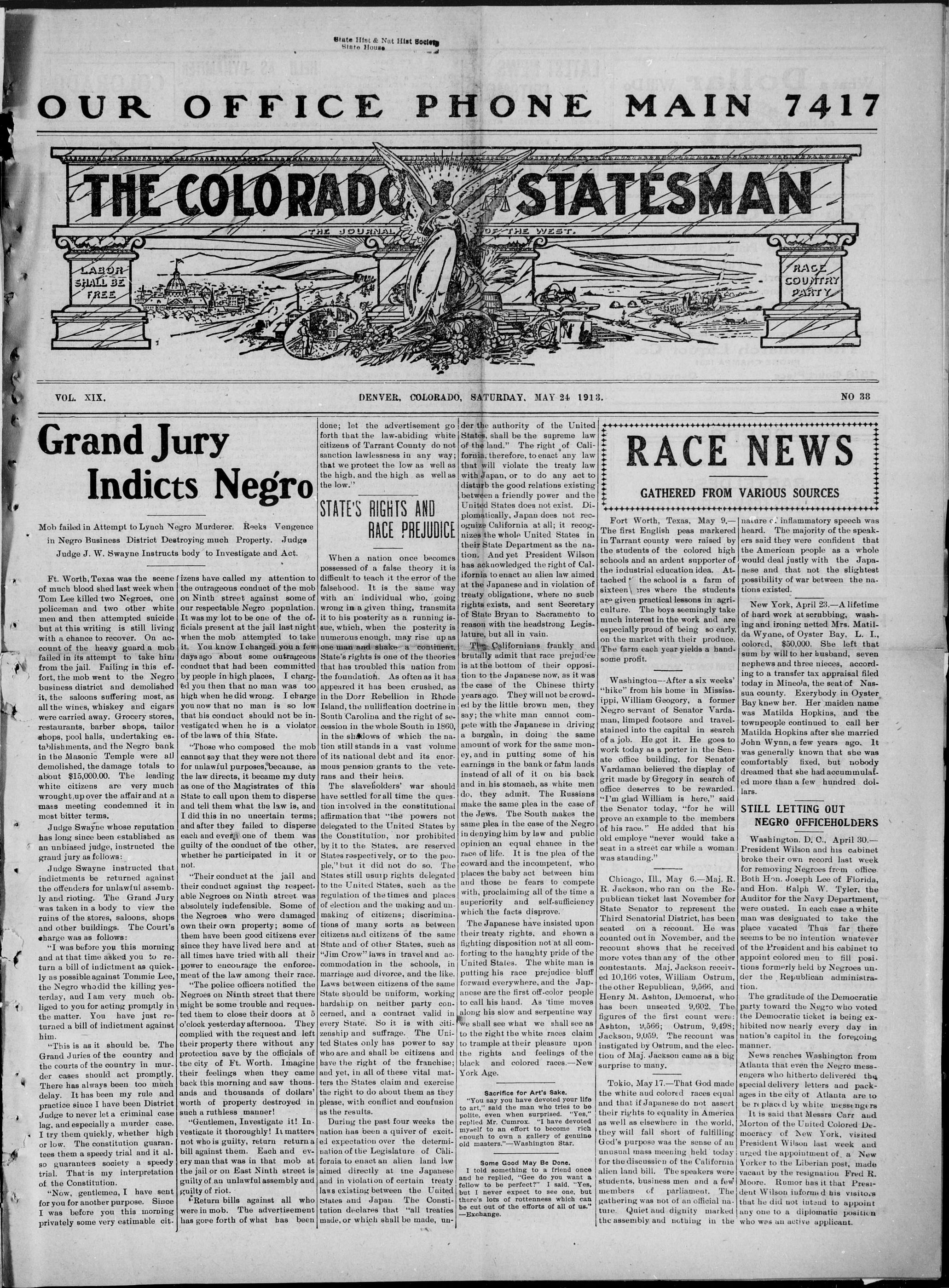
Grand Jury Indicts Negro
Mob failed in Attempt to Lynch Negro Murderer. Reeks Vengence in Negro Business District Destroying much Property. Judge Judge J. W. Swayne Instructs body to Investigate and Act.
VOL. XIX.
Grand J
Indict
Mob failed in Attempt to Lynch N
in Negro Business District Des
Judge J. W. Swayne Instruct
Ft. Worth, Texas was the scene of much blood shed last week when Tom Lee killed two Negroes, one policeman and two other white men and then attempted suicide but at this writing is still living with a chance to recover. On account of the heavy guard a mob failed in its attempt to take him from the jail. Failing in this effort, the mob went to the Negro business district and demolished it, the saloons suffering most, as all the wines, whiskey and cigars were carried away. Grocery stores, restaurants, barber shops, tailor shops, pool halls, undertaking establishments, and the Negro bank in the Masonic Temple were all demolished, the damage totals to about $15,000.00. The leading white citizens are very much wrought, up over the affair and at a mass meeting condemned it in most bitter terms.
Judge Swayne whose reputation has long since been established as an unbiased judge, instructed the grand jury as follows:
Judge Swayne instructed that indictments be returned against the offenders for unlawful assembly and rioting. The Grand Jury was taken in a body to view the ruins of the stores, saloons, shops and other buildings. The Court's charge was as follows:
"I was before you this morning and at that time asked you to return a bill of indictment as quickly as possible against Tommie Lee, the Negro who did the killing yesterday, and I am very much obliged to you for acting promptly in the matter. You have just returned a bill of indictment against him.
"This is as it should be. The Grand Juries of the country and the courts of the country in murder cases should act promptly. There has always been too much delay. It has been my rule and practice since I have been District Judge to never let a criminal case lag, and especially a murder case. I try them quickly, whether high or low. The constitution guarantees them a speedy trial and it also guarantees society a speedy trial. That is my interpretation of the Constitution.
"Now, gentlemen, I have sent for you for another purpose. Since I was before you this morning privately some very estimable cit-
izens have called my attention to the outrageous conduct of the mob on Ninth street against some of our respectable Negro population. It was my lot to be one of the officials present at the jail last night when the mob attempted to take it. You know I charged you a few days ago about some outrageous conduct that had been committed by people in high places, I charged you then that no man was too high when he did wrong. I charge you now that no man is so low that his conduct should not be investigated when he is a violator of the laws of this State.
"Those who composed the mob cannot say that they were not there for unlawful purposes, because, as the law directs, it became my duty as one of the Magistrates of this State to call upon them to disperse and tell them what the law is, and I did this in no uncertain terms; and after they failed to disperse each and every one of them was guilty of the conduct of the other, whether he participated in it or not.
"Their conduct at the jail and their conduct against the respectable Negroes on Ninth street was absolutely indefensible. Some of the Negroes who were damaged own their own property; some of them have been good citizens ever since they have lived here and at all times have tried with all their power to encourage the enforcement of the law among their race.
"The police officers notified the Negroes on Ninth street that there might be some trouble and requested them to close their doors at 5 o'clock yesterday afternoon. They complied with the request and left their property there without any protection save by the officials of the city of Ft. Worth. Imagine their feelings when they came back this morning and saw thousands and thousands of dollars' worth of property destroyed in such a ruthless manner!
"Gentlemen, Investigate it! Investigate it thoroughly! It matters not who is guilty, return return a bill against them. Each and every man that was in that mob at the jail or on East Ninth street is guilty of an unlawful assembly and guilty of riot.
"Return bills against all who were in mob. The advertisement has gone forth of what has been
DENVER, COLORADO, SATURDAY, MAY 24 1913.
State Hist & Nat Hist Booley
State House
CE PI
ADO
THE JOURNAL
DENVER, COLORADO
done; let the advertisement go forth that the law-abiding white citizens of Tarrant County do not sanction lawlessness in any way; that we protect the low as well as the high, and the high as well as the low."
STATE'S RIGHTS AND RACE PREJUDICE
When a nation once becomes possessed of a false theory it is difficult to teach it the error of the falsehood. It is the same way with an individual who, going wrong in a given thing, transmits it to his posterity as a running issue, which, when the posterity is numerous enough, may rise up as one man and shake a continent. State's rights is one of the theories that has troubled this nation from the foundation. As often as it has appeared it has been crushed, as in the Dorr Rebellion in Rhode Island, the nullification doctrine in South Carolina and the right of secession in the whole South in 1860, in the shadows of which the nation still stands in a vast volume of its national debt and its enormous pension grants to the veterans and their heirs.
The slaveholders' war should have settled for all time the question involved in the constitutional affirmation that "the powers not delegated to the United States by the Constitution, nor prohibited by it to the States, are reserved States respectively, or to the people," but it did not do so. The States still usup rights delegated to the United States, such as the regulation of the times and places of election and the making and unmaking of citizens; discriminations of many sorts as between citizens and citizens of the same State and of other States, such as "Jim Crow" laws in travel and accommodation in the schools, in marriage and divorce, and the like. Laws between citizens of the same State should be uniform, working hardship on neither party concerned, and a contract valid in every State. So it is with citizenship and suffrage. The United States only has power to say who are and shall be citizens and have the right of the franchise; and yet, in all of these vital matters the States claim and exercise the right to do about them as they please, with conflict and confusion as the results.
During the past four weeks the nation has been a quiver of excited expectation over the determination of the Legislature of California to enact an alien land law aimed directly at the Japanese and in violation of certain treaty laws existing between the United States and Japan. The Constitution declares that "all treaties made, or which shall be made, un-
der the authority of the United States, shall be the supreme law of the land." The right of California, therefore, to enact any law that will violate the treaty law with Japan, or to do any act to disturb the good relations existing between a friendly power and the United States does not exist. Diplomatically, Japan does not recognize California at all; it recognizes the whole United States in their State Department as the nation. And yet President Wilson has acknowledged the right of California to enact an alien law aimed at the Japanese and in violation of treaty obligations, where no such rights exists, and sent Secretary of State Bryan to Sacramento to reason with the headstrong Legislature, but all in vain.
The Californians frankly and brutally admit that race prejudice is at the bottom of their opposition to the Japanese now, as it was the case of the Chinese thirty years ago. They will not be crowded by the little brown men, they say; the white man cannot compete with the Japanese in driving a bargain, in doing the same amount of work for the same money, and in putting some of his earnings in the bank or farm lands instead of all of it on his back and in his stomach, as white men do, they admit. The Russians make the same plea in the case of the Jews. The South makes the same plea in the case of the Negro in denying him by law and public opinion an equal chance in the race of life. It is the plea of the coward and the incompetent, who places the baby act between him and those he fears to compete with, proclaiming all of the time a superiority and self-sufficiency which the facts disprove.
The Japanese have insisted upon their treaty rights, and shown a fighting disposition not at all comforting to the haughty pride of the United States. The white man is putting his race prejudice bluff forward everywhere, and the Japanese are the first off-color people to call his hand. As time moves along his slow and serpentine way we shall see what we shall see as to the right the white races claim to trample at their pleasure upon the rights and feelings of the black and colored races.—New York Age.
Sacrifice for Art's Sake.
Sacrifice for Art's sake.
"You say you have devoted your life to art," said the man who tries to be polite, even when surprised. "Yes," replied Mr. Cumrox. "I have devoted myself to an effort to become rich enough to own a gallery of genuine old masters."—Washington Star.
Some Good May Be Done.
I told something to a friend once and he replied, "Gee do you want a fellow to be perfect?" I said, "Yes, but I never expect to see one, but there's lots of rottenness which can be cut out of the efforts of all of us."—Exchange.
RACE NEWS
Fort Worth, Texas, May 9. The first English peas markered in Tarrant county were raised by the students of the colored high schools and an ardent supporter of the industrial education idea. Attached the school is a farm of sixteen acres where the students are given practical lessons in agriculture. The boys seemingly take much interest in the work and are especially proud of being so early. On the market with their produce. The farm each year yields a handsome profit. nature of inflammatory speech was heard. The majority of the speakers said they were confident that the American people as a whole would deal justly with the Japanese and that not the slightest possibility of war between the nations existed.
New York, April 23. A lifetime of hard work at scrubbing, washing and ironing netted Mrs. Matilda Wyne, of Oyster Bay, L. I., colored, $50,000. She left that sum by will to her husband, seven
Washington--After a six weeks" "hike" from his home in Mississippi, William Geogory, a former Negro servant of Senator Vardaman, limped footsore and travelstained into the capital in search of a job. He got it. He goes to work today as a porter in the Senate office building, for Senator Vardaman believed the display of grit made by Gregory in search of office deserves to be rewarded. "I'm glad William is here," said the Senator today, "for he will prove an example to the members of his race." He added that his old employee "never would take a seat in a street car while a woman was standing."
Chicago, Ill., May 6.—Maj. R. R. Jackson, who ran on the Republican ticket last November for State Senator to represent the Third Senatorial District, has been seated on a recount. He was counted out in November, and the recount shows that he received more votes than any of the other contestants. Maj. Jackson received 10,166 votes, William Ostrum, the other Republican, 9,566, and Henry M. Ashton, Democrat, who has been unseated 9,602. The figures of the first count were: Ashton, 9,566; Ostrum, 9,498; Jackson, 9,059. The recount was instigated by Ostrum, and the election of Maj. Jackson came as a big surprise to many.
Tokio, May 17.—That God made the white and colored races equal and that if Japanese do not assert their rights to equality in America as well as elsewhere in the world, they will fall short of fulfilling God's purpose was the sense of an unusual mass meening held today for the discussion of the California alien land bill. The speakers were students, business men and a few members of parliament. The gathering was not of an official nature. Quiet and dignity marked the assembly and nothing in the
NO 38
nature of inflammatory speech was heard. The majority of the speakers said they were confident that the American people as a whole would deal justly with the Japanese and that not the slightest possibility of war between the nations existed.
New York, April 23.—A lifetime of hard work at scrubbing, washing and ironing netted Mrs. Matilda Wyne, of Oyster Bay, L. I., colored, $50,000. She left that sum by will to her husband, seven nephews and three nieces, according to a transfer tax appraisal filed today in Mineola, the seat of Nassua county. Exerybody in Oyster Bay knew her. Her maiden name was Matilda Hopkins, and the townpeople continued to call her Matilda Hopkins after she married John Wynn, a few years ago. It was generally known that she was comfortably fixed, but nobody dreamed that she had accummulafed more than a few hundred dollars.
STILL LETTING OUT
NEGRO OFFICEHOLDERS
Washington. D. C., April 30. President Wilson and his cabinet broke their own record last week for removing Negroes from office. Both Hon. Joseph Lee of Florida, and Hon. Ralph W. Tyler, the Auditor for the Navy Department, were ousted. In each case a white man was designated to take the place vacated. Thus far there seems to be no intention whatever of the President and his cabinet to appoint colored men to fill positions formerly held by Negroes under the Republican administration.
The graditude of the Democratic party toward the Negro who voted the Democratic ticket is being exhibited now nearly every day in nation's capitol in the foregoing manner.
News reaches Washington from Atlanta that even the Negro messengers who hitherto delivered the special delivery letters and packages in the city of Atlanta are to be replaced by white messengers It is said that Messrs Carr and Morton of the United Colored Democracy of New York, visited President Wilson last week and urged the appointment of a New Yorker to the Liberian post, made vacant by the resignation Fred R. Moore. Rumor has it that President Wilson informed his visitors that he did not intend to appoint any one to a diplomatic position who was an active applicant.
What a Dollar Will Do
THE MONARCH
MINE & LIQUOR CO.
You Can Get
One Case of Good, Ste
ized Beer, 24 Pints t
Or One Gallon of Pure
California Port, Sherry
Muscatel Wine.
Or One Full Quart o
Bond Rye or Bourb
The Monarch L
PHONE CHAMPA
1516 Court Place
SEEDS
Your back yard will help pay you
BARTELD
"WESTERN SEEDS FOR WES
THE BARTELDES S
1521-1525 Fifteenth St.
The Largest Poultry Supply H
HENRY MILLI
case of Good, Steamed, Steril-
teer, 24 Pints to the Case.
The Gallon of Pure 8 Year Old
Nia Port, Sherry, Angelica or
Cel Wine.
The Full Quart of Bottled in
Rye or Bourbon Whiskey.
Monarch Liquor Co.
PHONE CHAMPA 1231
Place Denver, C
SEEDS
hard will help pay your rent if you plan
BARTELDES'
SEEDS FOR WESTERN PLANTE
E BARTELDES SEED CO.
North St. Denver, Col
West Poultry Supply House in the West
Y MILLER & C
1939 BROADWAY
GRAVEL ROOFING
AND CEMENT WORK
One Case of Good, Steamed, Sterilized Beer, 24 Pints to the Case.
Or One Gallon of Pure 8 Year Old California Port, Sherry, Angelica or Muscatel Wine.
Or One Full Quart of Bottled in Bond Rye or Bourbon Whiskey.
The Monarch Liquor Co.
PHONE CHAMPA 1231
1516 Court Place Denver, Colo.
"WESTERN SEEDS FOR WESTERN PLANTERS"
The Largest Poultry Supply House in the West
GRAVEL ROOFING AND CEMENT WORK
Cement Ash Pits, $5 Up
Repairing Promptly Done
Tin Roofs Painted
All Work Guaranteed Give Us
Phone Main 1062
V. F. Davis
Plumbing Inspector for City and County of
g, Heating and Ventilation
and Tests for Sewer Gases On Alu
defective buildings
Estimates Given
PHONE SOUTH 855 DENVER
WER & SCHUO
All Work Guaranteed Give Us a Trial Phone Main 1062
W.F.D
(12 Years Chief Plumbing Inspector for
Plumbing, Heating and
Examination and Tests for Sew
defective build
Estimates C
842 BROADWAY PHONE SOUTH
BROWER &
W.F.Davis
(12 Years Chief Plumbing Inspector for City and County of Denver)
Plumbing, Heating and Ventilation
Examination and Tests for Sewer Gases On All Old defective buildings
Estimates Given
842 BROADWAY PHONE SOUTH 855 DENVER, COLO
REAL ESTATE
311 Cooper Building
DENVER, COLORADO
JOHN ENG k & Engstrom
Beck & En
Beck @ Engstrom
WHOLESALE DEALERS IN
Wines, Liquors
Cigars
Western Agents for Minneapolis Grain Belt Beer and C
Imported Beer and Bock Ol.
1644-46-48-50 Larimer S
Phone Main 1053
es, Liquors and
Cigars
Minneapolis Grain Belt Beer and Carnegie Port
Imported Beer and Bock Ol.
4-46-48-50 Larimer Street
53 Denver, C
Western Agents for Minneapolis Grain Belt Beer and Carnegie Porter, Pripps Imported Beer and Bock Ol.
1644-46-48-50 Larimer Street
Phone Main 1053 Denver, Colorado
COOKING
HENRY BECK
Give Us a Trial
tain 1062
avis
(ry and County of Denver)
Ventilation
Gases On All Old
ys
ven
DENVER, COLO
CHUCK
RM LANDS
Telephone Champa 1962
Residence Phone Main 7345
JOHN ENGSTROM
strom
LATEST NEWS EPITOMIZED
FROM TELEGRAPHIC REPORT8
THAT COVER THE WEEK'8
EVENTS.
OF MOST INTEREST
KEEPING THE READER POSTED
ON MOST IMPORTANT
CURRENT TOPICS.
Western Newspaper Union News Service.
WESTERN.
A slight earth tremor was felt at
Helena, Mont.
The Grand Lodge of International
Switchmen convened at Houston, Tex.,
in biennial session. St. Louis, Denver
and Buffalo are candidates for host
to the next convention.
Otto and Fred Watson, aged 19 and
21 years, respectively, arrested several
days ago charged with the murder
of their father, William Watson, a
ranchman, near Douglas, Ariz., confessed
to the district attorney that
they had committed the deed.
Judge Cross in the United States District Court at Trenton, N. J., imposed a fine of $2,000 upon Mrs. Agnes Mangels of Los Angeles, who is said to have landed on May 12, 1912, at Hoboken without having declared a proper value of goods brought by her from abroad.
James Arthur Baker, arrested at Kansas City charged with theft committed at Summerland Calif., in assigned confession to the police said that much of his life he had posed as a woman and that he had been involved in intricate counterfeiting and forgery schemes.
Charles Montgomery, president of the California state board of pardons, has offered to spend three months in jail to permit Abe Ruef to go to the cathbed of his father. He asks that Ruef be either pardoned or paroled, and agrees to take the prisoner's place in stripes, food, labor and lodgings.
Powder puffs and buttonhole bouquets have become the weapons of Chicago women lobbyists in Springfield. State senators and representatives find dozens of their favorite flowers on their breakfast tables every morning, which have been sent by the various women who are pushing bills before the Legislature.
The Misses Minnie G. and Pearl E. Folmes, manicures in a big hotel at San Francisco, are on their way to Sweden to claim a share of an estate valued at $160,000,000. They have told their friends they are confident they will be millionaires but just the same they arranged with the hotel management to hold their jobs open.
CONGRESSIONAL.
Representative Rouse introduced a resolution for one-cent postage after July 1, 1914.
The Senate passed deficiency bill appropriating $600,000 for postoffice Department.
Mrs. Helen D. Longstreet, former postmistress at Gainesville, Ga., heard before State Postoffice committee.
Territories committee was told by Delegate Wickersham that opposition to government railroads in Alaska came from an Alaska syndicate.
Bill for constitutional amendment providing direct election and six-year term for President and Vice President introduced by Representative Britten.
Representative Hay introduced bill to provide distinguished service medal for meritorious service of army and navy man with $2 extra pay monthly.
WASHINGTON.
Ice used in chilling water on passenger cars and inland steamers must be pure, according to a ruling handed down by the Federal Health service. Within a few weeks William Lorimer will announce his candidacy for United States senator from Illinois. He has made up his mind to run at the Republican primaries next April. After more than a week of debate the Senate referred to the education and labor committee Senator Kern's resolution for a federal investigation of conditions in the West Virginia coal fields.
Exports from the United States in April were greater by $20,000,000 than in April, 1912, while imports were $18,000,000 less. For the ten months ending with April the exports this year were $217,000,000 larger than in the corresponding period last year and imports were greater by $179,000,000.
The President sent to the Senate the following nominations: Register or the land office at Lewistown, Mont., Harry J. Kelly. Receiver of public money at Lewistown, Abraham Foeland.
Interest in the negotiations between the United States and Japan over the California land legislation has shifted from Washington to Tokio. The American government having delivered its reply to the Japanese protest, is awaiting the next step of Japan.
FOREIGN.
There was a rumor that Orizaba, an important town on the Mexican railroad in the state of Vera Cruz, had been captured by the rebels.
The news that the California alien land ownership bill had been signed by Governor Johnson was received at Tokio with regret, although it had been discounted in official and non-official circles.
Mayor Ernest Nathan of Rome has replied to the requests of various bodies of citizens that he withdraw his resignation. Nathan says officeholding is neither conducive to health or happiness and he is determined to choose honorable retirement.
A cablegram received at London from Constantinople states that former Sultan Abdul Hamid is seriously ill, and it is believed he cannot survive the attack of the combination of diseases which affect him.
Emperor William, as an act of grace in connection with the visit of King George of England to Berlin for the marriage of Princess Victoria Luise, granted a pardon to three English spies undergoing long sentences in German jails.
Arrangements whereby Prince Ernst August of Cumberland and Princess Victoria Luise, after their marriage at Berlin on May 24, will ascend the long vacant throne of the duchy of Brunswick have been completed, according to the Tageblatt.
The London Morning Post expresses the opinion editorially that it is absurd to suppose that the California dispute will lead to a rupture between the United States and Japan, since both governments are convinced of their ability to find a basis for a friendly settlement.
Eight thousand people were rendered homeless, one child was burned to death, many people were injured and heavy financial loss was caused by a great fire in the center of Budapest, Germany. The flames started in the upper floor of a large building, and, fanned by a strong wind, quickly involved several blocks of houses in the destruction.
STANDING OF WESTERN LEAGUE.
Won. Lost. Pet.
Lincoln .17 9 .654
Denver .18 10 .642
St. Joseph .16 10 .583
Des Moines .12 14 .463
Sloux City .11 13 .458
Omaha .12 15 .444
Topeka .11 15 .423
Wichita .8 19 .296
Too much Wagner beat Brooklyn 1 to 4 in their first clash of the season with Pittsburg at Brooklyn.
The New York Yacht Club cabled to the Royal Ulster Yacht Club definitely accepting Sir Thomas Lipton's challenge for the America's cup.
The broken left ankle of Chris Lindsay, caused by a slide home at Wichita, Kan., will keep the Sjoux City first baseman out for the entire season, his physician said.
Federal Judge Carpenter at Chicago, postponed hearing of a motion for a new trial for Jack Johnson, the negro pugilist, recently convicted of violation of the Mann white slave act. Central high school of Pueblo won the southern Colorado Interscholastic championship by defeating the Colorado Springs high school team on Washburn field by the score of 7 to 6. Joe Mandot of New Orleans was knocked out in the twelfth round of his scheduled twenty-round fight at Los Angeles with "Bud" Anderson of Vancouver, Wash. Mandot was not knocked down in the final but he was "out on his feet."
Fifty pounds advantage in weight six inches in height and a reach like the arm of a derrick could not win for Jesse Willard from "Gunboat" Smith, who earned a referee's decision in the last round of a twenty round bout at San Francisco.
GENERAL.
John N. Anhut was convicted of attempted bribery by the New York jury that has been trying him for an attempt to free Harry K. Thaw from Matteawan.
The war aeroplane which crossed into Mexico rear Naco was the same flying machine confiscated by United States federal officials two weeks ago. The machine has disappeared from a ranch between Tucson and Nogales, Ariz., and with it disappeared Reuben Hopkins, a United States deputy marshal of Tucson, who was left to guard the air craft.
White slavery and prostitution in the city of New York are firmly established upon a commercial basis, and those engaged in the purchase and sale of women are thoroughly organized, according to the report of George J. Kneeland of the Bureau of Social Hygiene, of which John D. Rockefeller, Jr., is chairman, made public in New York and soon to be published in book form.
Stephen Dudley Field, sometimes called the "father of the trolley car," and an inventor of international prominence, died at his home in Stockbridge, Mass., aged sixty-eight years.
The remains of Barbara Frietchie, the heroine of Whittier's poem, and those of her husband, John C Frietchie, which were recently dismintered from the old Reformed cemetery at Frederick, Md., and placed in the mansoleum at Mount Olivet, will be buried with appropriate ceremonies, on Memorial Day, May 30.
HELD AS DYNAMITER
BACON JAILED FOR BOMB THAT KILLED HIS WIFE.
Cripple Creek, Colo., Ex-Legislator Is Also Blamed for Death of His Stepdaughter.
Western Newspaper Union News Service.
Western Newspaper Union News Service
Cripple Creek.—James L. Bacon, mining man and former Colorado legislator, returning from Denver, where he attended the funerals of his wife, Ida, and his stepdaughter, Josephine Davidson, killed in an explosion which wrecked the Bacon home here April 28th, was arrested by Sheriff Von Phil on a charge of having placed the dynamite in the kitchen stove which resulted in the deaths of two and the injury to himself.
Bacon had nothing to say when taken into custody, and accompanied the sheriff to prison, where he is being held without ball. He refused to talk with the sheriff until given an opportunity to consult with an attorney. The warrant for Bacon's arrest was sworn out secretly by the sheriff ten days ago, but it was not served says that official, until damaging evidence was gleaned through investigations and shadowing of Bacon. When Bacon went to Denver for the funerals of his wife and stepdaughter he was accompanied by two deputy sheriffs.
The sheriff says that he bases the charge against Bacon on conflicting stories told by Bacon after his recovery, and on the statement of County Physician J. H. Hereford, who is reported to have said that Bacon was reigning unconsciousness at the hospital. One story Bacon told the sheriff was that he was in the house at the time of the explosion and the other was that he was just outside the door.
Bacon is accused by the authorities of having caused the explosion which killed his wife and stepdaughter and injured him so that he spent several weeks in a hospital. The explosion was at first thought to have been accidental, resulting from an attempt to thaw dynamite in a kitchen stove oven. Later, Bacon recovered and gave his version of the affair, in which he declared his belief that enemies had blown up the house. To substantiate this, he told of having received threatening letters. The coroner's inquest failed to clear the mystery, a verdict of death as the result of an explosion, with cause unknown, being rendered.
Boulder Woman Heiress.
Boulder.—Mrs. T. C. Searcy, a hairdresser, received word that her uncle, Lansley Sloan, who died in Watkins, N. Y., left her property valued at $10,000. Mrs. Frank Field, Sr., of 2227 Walnut street, has also received word of being left $10,000 of a $90,000 estate by her father, W. G. Clark, a St. Louis lumberman, who died in Austin, Tex. Mrs. J. R. Hudson of 2208 Seventeenth avenue, Denver, is also a daughter of Clark and will receive a like sum.
Whips Horse: Kicked to Death.
Fort Lupton.—William Goldsmith, sixteen, was instantly killed when a horse he was driving kicked him in the head, breaking his neck and fracturing his jaw. The wagon had become mired in the sand and Goldsmith was whipping up the horse, having alighted from the vehicle when the animal launched out with both feet.
Takes $300 for Wedding Expenses.
Denver.—William Schultz, twenty-four, formerly a divinity student at Concordia Lutheran College in St. Louis, was arrested here to face the charge of having stolen $300 from the college publication, "Alma Mater." Schultz declares he took the money in order to have funds with which to marry Thelma Gillion. The wedding, he says, took place two days after the admitted embezzlement.
Larimer Orchards Abloom.
Loveland.—The fruit orchards of Larimer county are a mass of bloom and Assistant State Entomologist George P. Weldon states that thinking of fruit on the trees will be necessary. County Horticulture Inspector J. J. Noble of this city says that prospects are the best in the history of the fruit industry in this section of the state.
Woman Teller Drops Dead
Denver:—Just as she was commencing to assist in the counting of the ballots at the polling place of District G, Precinct 9, Mrs. Sadie Clark, aged fifty-one, was seized with an attack of apoplexy and dropped to the floor dead. Excitement and over-exertion was given as the cause.
Bacon Imitating Suffragettes.
Cripple Creek.—Imitating the militant suffragettes of England, James Bacon, charged with killing his wife and six-year-old stepdaughter by an explosion, has gone on a "hunger strike."
Boys Exceed Girls in Mesa County.
Grand Junction.—The total school census for Mesa county shows 113 more males than females out of a total school population of 6,315. This is 55 more than last year.
COLORADO STATE NEWS
Western Newspaper Union News Service.
DATES FOR COMING EVENTS.
June 4-6. - State Sunday School Con-
ference. Rocky Ford.
June 22-29.—German Turnfest at Denver
July.—State Postmasters' Association at Manitou.
Mantou.
July 18. Pacific Jurisdiction, W. O.
W. at Colorado Springs.
Aug. 12-15.—Thirty-second Triennial
Conclave of Knights Templar, Den-
National Society, at Denver.
Associate of the Order of Red
Men, at Denver.
Sept. 15-20--Colorado State Fair at
Sept. 20--National Association of First-
Class Postmasters, at Denver.
Class Baptist Association of Euclid.
1915.—Last Grand Council of North American Indians, Denver.
Twelve hundred school children took part in the annual May festival at the fair grounds at Grand Junction.
Products manufactured in the Pike's Peak region were on display at Colorado Springs during home industry week.
Mrs. John Woodrow, aged eighty-one, favorite aunt of President Wilson, died in Denver of an attack of bronchitis. Burial at Xenia, O., her birthplace.
Frances Leach, aged twenty-eight, and Mary Coyne, aged eighteen, two Denver women, passed through Idaho Springs on their walk from Denver to San Francisco.
The Willow Creek Land and Livestock Company, with C. R. Ayer as president, was incorporated for $250,000. It is to carry on the cattle business in Moffat county.
Patrolman J. W. Blue was acquitted in the West Side Court in Denver of the murder of Manuel Patrone, a Mexican, whom he shot at Twenty-second and Market streets two months ago.
Governor Ammons named E. H. Weitzel, a mining engineer of Trinidad, as the fourth member of the board of coal mine examiners to have charge of the enforcement of the new coal mine inspection law.
The death of Miss Lillian Lane and Mrs. Paul Cooley, two of the most talented and popular young women in Denver's social circles within two hours of each other, was a distinct shock to their large circle of friends.
Under the auspices of the Territorial Daughters of Colorado, a dinner was given in Denver to the various pioneer associations and plans for the building of a home for pioneer men and women of Colorado were discussed.
Nicholas Laras was found guilty of murder in the second degree for the killing of Patrick Nolan, by a jury in District Court at Trinidad. Nolan was a section foreman and was assaulted by Laras, one of his workmen, on February 10, 1913.
At a meeting of the advisory board of the highway commission reports from counties were checked up and it was found that forty-two had accepted apportionments made them out of the state road fund. Construction work is in progress in many counties.
One hundred and fifty men of the Fort Logan garrison, all of the 400 men at the post who are available for duty, left for Honolulu, by way of San Francisco, to strengthen the cavalry, infantry and army engineers organizations doing duty on the island of Oahu.
Governor Amons issued a requisition on the governor of Nebraska for Thomas Sexton and James Shalloo, under arrest in Omaha and wanted in Logan county, Colo., to answer to a charge of stealing clothing and $15 from Joseph Dominico and Lemuel Sarvaro, Mexicans.
After a short illness Henry Cole, a pioneer of Denver and founder of the Veniel Trust Association, which he endowed to the extent of nearly $1,000,000, died at his home, 1029 Ninth street. He had been twice operated en at Mercy hospital during the past three weeks, but the operations proved ineffectual.
State Dairy Commissioner R. L. Cochran has decided to start mandamus proceedings against State Auditor Roady Kenehan to require him to pay the sainaries and expenses of the dairy department from April 1st to July 14th. Kenehan says that he will have to see a court order before he pays out the money asked.
In an effort to make its club house more easily accessible the Fort Collins Country Club, through its board directors, is bending every effort to induce the Denver & Interurban to extend its present Lindenmeier Lake line to the club grounds.
Mrs. C. C. Slaughter, wife of the president of the Mercantile National bank and considered the most beautiful woman in Pueblo society, saved her nine-month-old baby from death when her touring car was crushed to kindling wood against a telegraph pole in Lake avenue.
THE COLORADO STATESMAN
JOS. D. D. RIVERS.....Proprietor
1824 Curtis Street, Room 25.
Phone Main 7417.
JOS. D. D. RIVERS.....Proprietor
1824 Curtis Street, Room 25.
Phone Main 7417.
SUBSCRIPTION RATES:
One Year ..... $2.00
Six Months ..... 1.00
Taree Months ..... .60
PAYABLE IN ADVANCE.
PAYABLE IN ADVANCE
less matter at the postoffice
of a personating nature the columns of this paper.
centers per square. A square
lines or less, 10 cents per line.
less than three months' costs unknown to us. Further.
made by Express Money or Bank Draft. Postage is personal part of a dollar. Only.
receive attention must be no upon one side of the paper.
better than Wednesdays, and returned, unless stamps are.
us that papers sent to sub-
many number when due, in-
and a duplicate of the missi-
Entered as second-class matter at the postoffice in the city of Denver, Colorado.
All communications of a personating nature that are not complimentary will be withheld from the columns of this paper.
Display advertising, 25 cents per square. A square contains ten agate lines.
Reading notices, ten lines or less, 10 cents per line. Each additional line over ten lines, 5 cents per line.
No discounts allowed on less than three months' contract. Cash must accompany all orders from parties unknown to us. Further particulars on application.
Remittances should be made by Express Money Order, Postoffice Money Order, Registered Letter or Bank Draft. Postage stamps will be received the same as cash for the fractional part of a dollar. Only 1-cent and 2-cent stamps taken.
Communications to receive attention must be newsy, upon important subjects, plainly written only upon one side of the paper; must reach us Tuesdays, if possible, anyway, not later than Wednesdays, and bear the signature of the author. No manuscript returned, unless stamps are sent for postage.
It occasionally happens that papers sent to subscribers are lost or stolen. In case you do not receive any number when due, inform us by postal card and we will cheerfully forward a duplicate of the missing number.
THE ELECTION.
tesman desires to congrat results achieved at mission form of government magnificent triumph. Thou such as to inspire confi- ment with which we are results should quicken the government has been government of the people candidate of Denver's ele- integrity and ability o ranged, it seems only a responsibility devolved up- ing success. tesman not only wishes they deserve, but will glag their administration
The Colorado Statesman desires to congratulate the citizens of Denver upon the excellent results achieved at their first election under the non-partisan commission form of government. The spirit and results have blended in magnificent triumph. The personel of successful candidates is certainly such as to inspire confidence and faith anew in the new form of government with which we are experimenting.
The non-partisan results should quicken the realization of commissioners-elect that party government has been abolished as completely in fact as theory. "Government of the people, for the people and by the people"—was the mandate of Denver's electorate on last Tuesday.
Since the honesty, integrity and ability of none of the successful candidates can be challenged, it seems only a question of proper realization of the great responsibility devolved upon them to make their administration a flattering success.
The Colorado Statesman not only wishes the commissioners-elect all the success which they deserve, but will gladly lend its best efforts and influence to making their administration what the people desire that it shall be.
time is drawing near, reminding citizens of the town or city, and probably begun to paint, paint house and yard. It is a required, needs no outside it is self-satisfying and enhanced by its neat andicker and for better p most desirable who takerupulous cleanliness is his landlord and an exh of himself and families is traceable to sanitary their start and growth in places are those which be there is a widely mistaken while water is accessible to this excuse is a makes windows and woodwork a curtains, ranges and how regard for your own neighbors. They cost you your house, and possibly unless he himself is a chance of one's house at of us live by what we others may want to do and methods. The man art and a shifty appeared and dusty dirt purifies looks. And it is the man, the porter, the boy yard man, the milk man, other individual whose wood or the property of our muntlet and must bear action that a dirty woman. Either one is a his or her own failures determine to exercise care conditions and conviction alike among respect no matter how poor you
The annual renovating time is drawing nigh. The local improvement societies have begun reminding citizens of their duties regarding the general appearance of town or city, and people who need no such admonitions, have already begun to paint, paper, whitewash and to clean out rubbish from house and yard. It is a good habit to get into, and one which, once acquired, needs no outside spur to make it permanently effective, for it is self-satisfying and generally profitable. The value of a thing is enhanced by its neat appearance. A property rents better or sells quicker and for better price, if it is in its best shape. That tenant is most desirable who takes good care of his house and yard and whose scrupulous cleanliness is always noticeable. He becomes a favorite with his landlord and an example to his neighbors. But above all, the health of himself and family is better guarded. A great deal of sickness is traceable to sanitary neglect and dirt. Epidemics generally have their start and growth in untidy home conditions. The most ravaging diseases are those which breed in the homes of the poor and slothful. There is a widely mistaken notion that poverty is an excuse for dirt. While water is accessible to every householder and soap easily attainable, this excuse is a makeshift. The grease and stains on your doors, windows and woodwork and the settled dust and dirt on your shelves, curtains, ranges and house furnishings, are an indictment against your regard for your own health and welfare and against that of your neighbors. They cost you the respect of every person who steps into your house, and possibly of every person who passes and takes notice, unless he himself is a sloth. But tidiness and neatness in the appearance of one's house attracts where dirt and neglect repel. The most of us live by what we get to do for other people, and no matter what others may want to do, they take note of our personan appearance and methods. The man-of-all-work, with a tidy home, a bright, clean cart and a shifty appearance, gets more work and better pay than the ragged and dusty dirt purveyor who does not seem to care anything about his looks. And it is the same with the chore man, the ash man, the house man, the porter, the butler, the coachman, the waiter, the janitor, the yard man, the milk man, the cook, the barber, the painter and every other individual whose work brings him in touch with the person, the food or the property of others. The woman who works runs the same gauntlet and must bear even a severer test, for there is common conviction that a dirty woman is filthier and more abhorrent than a dirty man. Either one is always repellant and the first and direct cause of his or her own failures. But it is easy to cure these evils if one will determine to exercise care and judgment and to have regard for those conditions and convictions which must dominate domesticity and business alike among respectable people. Clean up both house and person, no matter how poor you are!
Regions Unexplored.
The mighty mass of the Himalayas, the loftiest of all mountains, "the roof of the world," has not been penetrated to its center. No man has yet approached nearer than a hundred miles from the foot of Mount Everest, which lifts its snowy head five miles and a half above sea level. There are lofty valleys among the Himalayas of whose existence and whose inhabitants only traditions are known.
---
the postoffice in the city of Denver.
In long nature that are not complimentary to this paper.
A square contains ten agate lines.
10 cents per line. Each additional line.
The months' contract. Cash must accompany us. Further particulars on application.
Express Money Order, Postoffice Money.
Postage stamps will be received the a dollar. Only 1-cent and 2-cent stamps.
On must be newsy, upon important subscriptions of the paper; must reach us Tuesdays, Wednesdays, and bear the signature of the stamps are sent for postage.
Is sent to subscribers are lost or stolen when due, inform us by postal card and of the missing number.
SECTION.
Ares to congratulate the citizens of Achieved at their first election under of government. The spirit and reveriaph. The personel of successful inspire confidence and faith anew in which we are experimenting.
And quicken the realization of commissit has been abolished as completely of the people, for the people and by Denver's electorate on last Tuesday, and ability of none of the successful emms only a question of proper real-devolved upon them to make their only wishes the commissioners-elect but will gladly lend its best efforts administration what the people desire.
CE UP!
In drawing nigh. The local improveg citizens of their duties regarding city, and people who need no such to paint, paper, whitewash and to guard. It is a good habit to get into, and no outside spur to make it per-atisfying and generally profitable. By its neat appearance. A property for better price, if it is in its best able who takes good care of his house cleanliness is always noticeable. He had and an example to his neighbors. If and family is better guarded. A to sanitary neglect and dirt. Epidemic growth in untidy home conditions. Use which breed in the homes of the only mistaken notion that poverty is accessible to every householder and is a makeshift. The grease and woodwork and the settled dust and edges and house furnishings, are an your own health and welfare and they cost you the respect of every and possibly of every person who himself is a sloth. But tidiness and its house attracts where dirt and by what we get to do for other peo-y want to do, they take note of our. The man-of-all-work with a tidy softy appearance, gets more work and dirty dirt purveyor who does not seem and it is the same with the chore man,orter, the butler, the coachman, the milk man, the cook, the barber, equal whose work brings him in touch property of others. The woman who must bear even a severer test, for a dirty woman is filthier and more over one is always repellant and the own failures. But it is easy to cure exercise care and judgment and to add convictions which must dominate long respectable people. Clean up now poor you are!
His Way.
SPRUCE UP!
"Major Hornboggle, over there," said the landlord of the Prunty town tavern, with an indicatory jerk of this thumb toward a passer-by, "is the most dignified man in town. When his hat blows off, he never takes the trouble to chase it, but lets the spectators do it for him. He won't loaf anywhere but in the National bank, and actually struts while he is sitting down."—Judge.
His Way.
lowing report was published in a Havre (France) newspaper, which published a list of 107 persons (84 men and 23 women) employed in this city and its vicinity to whom silver medals of honor have been awarded by decree of the minister of commerce and industry of France, for faithful service of thirty years in the same industrial establishment or business house. In this list are included superintendents, managers, dock foremen, accountants, clerks, weavers, spinners, tailors, dressmakers, tramway conductors, masons, cabinetmakers, boilermakers, stokers, laborers, etc.
The medal of honor for employes and workmen was established in France by the decree of July 16, 1886, which authorized the minister of commerce and industry to give them to persons whose services had covered thirty years. This service must be in the same establishment, although it might have changed hands several times. Intervening military service will not interfere. An important condition is that the beneficiary be a citizen of France, although his employers may be foreigners.
Applications must be made on stamped paper by the employer in behalf of his employees to the prefect of the department, who forwards them, with such notations as he deems necessary, to the minister of commerce and industry, and a formal inquiry is then made respecting the character and standing of the persons on whose behalf the applications have been made. The medals are then presented, with suitable ceremony, to the employees by the mayor or his representative at his office (Mairie), in the presence of the employers and the friends of those to be honored. This institution is very properly held in high regard by those for whom it is intended. It is, in fact, a form of decoration bestowed by the French government analogous to the Legion of Honor, since those who have received the medal are permitted to wear on the lapel of their coat, or, in the case of women, pinned on their corsage, a narrow tricolor ribbon of red, white and blue. There is an organization at Havre, the Association des Medailles du Travail, composed exclusively of those who have received the medal or honor.
This institution has, of course, nothing to do with the old-age pension system in operation in France; but it is undoubtedly a factor in bringing about industrial solidarity, esprit de corps, loyalty to employers, and cordial relations between employers and their employees.
it is not seemly for the men to work more than they can help. The women, therefore, do most of the manual labor, while their husbands, fathers and brothers laugh and sing, lie about at their kraals and tell one another what fine fellows they are.
A little Zulu girl is welcomed into the world by her father because she will become a valuable asset in years to come. If she is taken care of some Zulu lover will pay a cow, or perhaps two cows, for the privilege of marrying the lady, and so that she may retain all her charms the little maid is not allowed to do any hard work until she marries, excepting such things as carrying food or fuel on her head to her parents' kraal.
Whatever she may be carrying, a Zulu girl instinctively puts it on her head. If she goes to a store to buy a pot of jam she walks gravely over the rugged country with it balanced there, and I have seen women in remote districts carrying great bundles of wood, which I tried and failed to lift quite off the ground. They get it on to the head unaided by lifting up one end first and gradually working the body under the burden until it is balanced. It is certainly no exaggeration to say the women could carry a bundle equal to their own weight for twenty miles in a day and think nothing much of the feat.
The younger Zulu women have a noble carriage, which is the result of carrying burdens on their heads. They walk with a singularly stately tread, their head and shoulders being thrown well back. But as they get older the drudgery of working in the fields begins to tell on them, and there is very little difference in the appearance of a woman of forty and a woman forty years her senior.
a nerve-racking rush, try what keeping a schedule will do for you.
Buy a notebook and head opposite pages with the day and date. Before going to bed plan and write down the work of the next day. In the evening sum up what has been accomplished.
It does not take long to keep this simple schedule, but it is surprising how quickly you learn system from it. Busy women go so far as to plan certain duties for certain hours.
Do not plan to do too much in one day, for then the opposite page is a disappointment which spurs you to unwise efforts or needless discouragement. What is left undone one day may be carried over to the next day's planning page as a jog against procrastination.
Reading over such a notebook is an object lesson to the shiftless housewife who works by fits and starts, gets nothing accomplished, has no time for leisure, and ends by being a nuisance to herself and a burden to her family.
ability to show for it, so few women endure maternity without injury.
The young woman, if not actually, is potentially, a mother.
Because of the fact that motherhood means risk of life, risk of health, and certainty of agony and self-denial, we ask you to make the occasional sacrifice, not of life, not of health, but of comfort.
The sharp jolt which is a moment's unpleasantness to you may mean a life of invalidism to that young girl, the life of her unborn child as well as her own to the expectant mother, and cruel torture to the woman who is of the neuter sex, as the French term it.
But alas! "neuter" though she may now be, she is forever to suffer for the long hours of bringing a man child into the world.
How Pension System Works in France By J. P. Hastings, New York
lowing report was published in a Havre (R) published a list of 107 persons (84 men and city and its vicinity to whom silver medals by decree of the minister of commerce and ful service of thirty years in the same inness house. In this list are included superintendent men, accountants, clerks, weavers, spinners, conductors, masons, cabinetmakers, boilermares.
The medal of honor for employees and France by the decree of July 16, 1886, which commerce and industry to give them to persevered thirty years. This service must be in the it might have changed hands several times, will not interfere. An important condition citizen of France, although his employers must.
Applications must be made on stamp behalf of his employees to the prefect of the them, with such notations as he deme nece merce and industry, and a formal inquiry is acter and standing of the persons on whose been made. The medals are then presented the employees by the mayor or his representative the presence of the employers and the friend.
This institution is very properly held whom it is intended. It is, in fact, a form. French government analogous to the Legion have received the medal are permitted to wear, in the case of women, pinned on their coat of red, white and blue. There is an organizer des Medailles du Travail, composed exclusive the medal or honor.
This institution has, of course, nothing sion system in operation in France; but it bringing about industrial solidarity, esprit of and cordial relations between employers and
Happy Little Girls in Zuzuland
By H. D. HOLT, London, England
it is not seemly for the men to work more women, therefore, do most of the manual fathers and brothers laugh and sing, lie and one another what fine fellows they are.
A little Zulu girl is welcomed into the she will become a valuable asset in years to some Zulu lover will pay a cow, or perhaps marrying the lady, and so that she may remain is not allowed to do any hard work until things as carrying food or fuel on her head.
Whatever she may be carrying, a Zulu girl head. If she goes to a store to buy a pot of the rugged country with it balanced there remote districts carrying great bundles of wood to lift quite off the ground. They get it lifting up one end first and gradually working until it is balanced. It is certainly no exe could carry a bundle equal to their own day and think nothing much of the feat.
The younger Zulu women have a noble of carrying burdens on their heads. They tread, their head and shoulders being thre get older the drudgery of working in the wood and there is very little difference in the app and a woman forty years her senior.
Woman's Secret of All Easy Work By C. W. NORTON, New York
a nerve-racking rush, try what keeping a sc
Buy a notebook and head opposite page
fore going to bed plan and write down the v
evening sum up what has been accomplished.
It does not take long to keep this simple
how quickly you learn system from it. Bus
certain duties for certain hours.
Do not plan to do too much in one day
is a disappointment which spurs you to unw
agement. What is left undone one day ma
day's planning page as a jog against procra
Reading over such a notebook is an object
wife who works by fits and starts, gets nothi
for leisure, and ends by being a nuisance to
family.
Why Woman Should Have Preference By Eugenie Comment, St. Louis, Mo.
ability to show for it, so few women endure. The young woman, if not actually, is p. Because of the fact that motherhood mea and certainty of agony and self-denial, we a sacrifice, not of life, not of health, but of c. The sharp jolt which is a moment's unp a life of invalidism to that young girl, the li as her own to the expectant mother, and cru is of the neuter sex, as the French term it. But alas! "neuter" though she may not for the long hours of bringing a man child
I have just returned from a trip to France. I locked into the labor question in a number of countries in Europe, but was greatly impressed with the pension system of France. The fol-
(grance) newspaper, which pub-
23 women) employed in this
of honor have been awarded
industry of France, for faith-
industrial establishment or busi-
pendents, managers, dock fore-
tailors, dressmakers, tramway
makers, stokers, laborers, etc.
workmen was established in
each authorized the minister of
sessions whose services had cov-
same establishment, although
Intervening military service
is that the beneficiary be a
by foreigners.
and paper by the employer in
the department, who forwards
sary, to the minister of com-
hen made respecting the char-
belfheth the applications have
with suitable ceremony, to
tive at his office (Mairie), in
of those to be honored.
in high regard by those for
of decoration bestowed by the
of Honor, since those who
wear on the lapel of their coat,
message, a narrow tricolor ribbon
ion at Havre, the Association
of those who have received
to do with the old-age pen-
is undoubtedly a factor in
the corps, loyalty to employers,
their employees.
In few countries are the native girls happier up to the age of about ten than in Zululand; in still fewer countries do they have a harder existence after that. According to their tradition.
e than they can help. The labor, while their husbands, out at their kraals and tell the world by her father because some. If she is taken care of two cows, for the privilege of pain all her charms the little she marries, excepting such of her parents' kraal.irl instinctively puts it on her jam she walks gravely over and I have seen women in good, which I tried and failed on to the head unaided by the body under the burden aggregation to say the women eight for twenty miles in a carriage, which is the result talk with a singularly stately own well back. But as they fields begins to tell on them, appearance of a woman of forty
When asked how she accomplished so much work so easily the mother of a large family replied, "I work by schedule."
That is the secret of all easy work. If you live in
dule will do for you. with the day and date. Be-ork of the next day. In the schedule, but it is surprising women go so far as to plan, for then the opposite page use efforts or needless discur- be carried over to the next destination. lesson to the shiftless house- ag accomplished, has no time herself and a burden to her
Men ought to give women the preference where seating is the question because every woman may be or is a mother. As few soldiers serve their time in the army without some physical dis
maternity without injury.
ententially, a mother.
mrs risk of life, risk of health,
k you to make the occasional
comfort.
pleasantness to you may mean
e of her unborn child as well
el torture to the woman who
w be, she is forever to suffer
into the world.
WORTH THINKING OVER
SUGGESTIONS MAY INTEREST RAILROAD MEN, AND OTHERS.
Success or Failure in Life Always Rests Largely With One's Self- World Is Always Calling for the Efficient Man.
A big railroad company with headquarters in Chicago in a recent circular to its employees suggested to them thought along these lines:
T
A man paid $1,000 a year represents to his employers a capitalization of $25,000. For his time and abilities he is paid four per cent. interest on that sum. It is about the cost of a modern locomotive.
But a man is different from a locomotive. He can't pull as much, but he can push a lot more. He can last longer and run farther than the best locomotive ever built. Most important of all, he can constantly increase the capitalization he represents and require more interest to be paid on it, while the locomotive can never be worth a cent more than it was when it left the shop. The circular referred to continues;
"It rests with you. Make your $25, 000 valuation climb to $50,000, to $100,000, to $500,000. Select your food with care. Treat decently the body on which your mind depends for its strength and sanity. Above all, feed your mind. Read, study and observe. Like the engine, you can't do your work unless you stay on the rails and keep where the boss can find you. Remember that no call boy ever found an engine in a saloon or other place of the sort."
There is food for thought in these words, not only for railroad employees but for all other young mea—and young women, too—who are trying to get on in the world, make a success of their lives, and get the things, the place and the power they desire.
We hear a great deal now and then—from failures, idlers or busy bodies—about young men not having now the "chance" they once had. At bottom the statement is a falsehood. The world was never so hungry for really efficient men—for men who can and will grow up to greater tasks—for men resolute to increase the capitalization they represent—as it is today.
Every discovery of science, every triumph of invention, demands more and more capable men to operate the machinery of civilization thus newly provided. It rests with the man—with each man—to show that he has the capacity. And real power always gets paid.—Chicago Inter Ocean.
SAND WILL DO IT.
I observed a locomotive in the railroad yards one day,
And to get a grip upon the rail they sprinkle it with sand.
It's about the way with travel along life's slippery track,
You'll provide yourself in starting with a good supply of sand.
If your track is steep and hilly and you have a heavy grade.
If there goes a gap before you the rails quite slippery, made.
If you ever reach the summit of the upper tableland,
You'll find you'll have to do with a liberal use of sand.
If you strike some frigid weather and discover, to your cost,
That you're liable to slip up on a heavy coat of frost,
Then some prompt, decided action will be called into demand.
And you'll slip 'way to the bottom if you haven't any sand.
You can get to any station that is on life's schedule sees if there's fire beneath the boiler of ambition's strong machine.
What the Railroads Do.
It seems very simple to see the passenger trains run in and out of the station; to order the freight car and send the grain to market; to telegraph to the nearest large town for supplies, and in 24 to 48 hours have them delivered. But it is not so easy and simple as it seems, and there is danger today that the next great uplift in business in the United States will find the railroads, as a whole, sorely taxed to furnish the transportation needed for the commerce of the country. Why? Because a misdirected public opinion is demanding rates too low, taxes too high, wages too high, service too elaborate, and there was not cents enough to the dollar to meet all these obligations and still permit the business to be attractive enough so the man with the dollar will invest it. Our American railroads have done good work, and can do better, and it is to the farmers' selfish interest to see that they are so treated that they will be ready at all times to handle business. To be ready requires constant expenditure.—Leslie's.
Canadian Experts Declare Defective Flanges to Be Frequent Cause of Railroad Accidents.
The railroad commission has issued a circular to motive power foremen on the Canadian railroads urging the importance of a renewal of locomotive wheels before the flanges are badly worn. Inspectors in the service of the commission report that many locomotives on passenger trains have sharp flanges, in some cases the flanges being worn down below the master car builders' standard allowance gauge. Some of these locomotives are running on fast passenger trains, thus inviting much unnecessary risk to the safety of hundreds of passengers.
The wearing down of flanges on locomotives is only one minor contributor to the long chapter of railway accidents. Derailments arise either from defective equipment, bad track, or faulty switching. As a rule, when a locomotive jumps the track, the accident is ascribed to some peculiar defect in the track, rather than to insufficient flanging on the locomotive. It is undeniable that many supposed rail defects are in reality the outcome of defective driving wheel tires. The Railway Age Gazette tells of 100 rails on an Illinois railroad being broker on one trip by a flattened driving wheel. The recently issued annual report of the interstate commerce commission shows that out of 8,215 derailments on American rail roads during the year, 3,847 were due to defective equipment, an increase of 1,023. Bad ties, loose spikes, poor ballasting, insufficiently flange wheels, rail breakages due to flattened wheels, all played a prominent part in causing these derailments. Fortunately derailments of locomotives cause by defects in their own mechanism or driving surfaces are comparatively rare. The warning of the railway commission is not uncalled for, however for a worn locomotive flange might suddenly precipitate a great disaster.
ADDS TO STRENGTH OF RAILS
Invention of Frenchman Sald to Over come Defect Which Has Long Been Recognized.
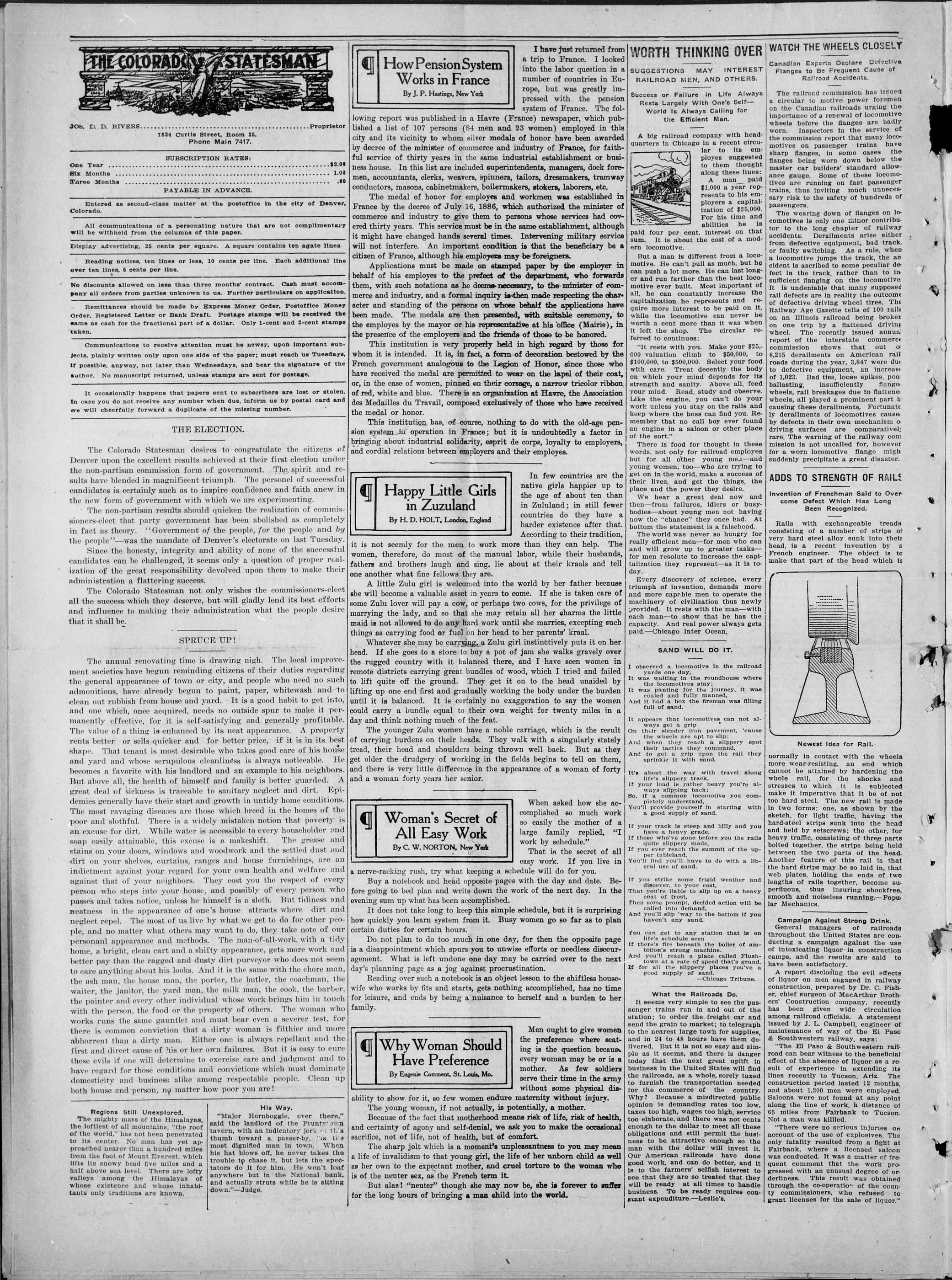
Ralls with exchangeable treads consisting of a number of strips of very hard steel alloy sunk into their head, is a recent invention by a French engineer. The object is to make that part of the head which is
Newest Idea for Ball-
normally in contact with the wheels more wear-resisting, an end which cannot be attained by hardening the whole rail, for the shocks and stresses to which it is subjected make it imperative that it be of not too hard steel. The new rail is made in two forms; one, as shown by the sketch, for light traffic, having the hard-steel strips sunk into the head and held by setscrews; the other, for heavy traffic, consisting of three parts bolted together, the strips being held between the two parts of the head. Another feature of this rail is that the hard strips may be so laid in, that web plates, holding the ends of two lengths of rails together, become superfluous, thus insuring shockfree, smooth and noiseless running.—Popular Mechanics.
Campaign Against Strong Drink. General managers of railroads throughout the United States are conducting a campaign against the use of intoxicating liquor-in construction camps, and the results are said to have been satisfactory. A report disclosing the evil effects of liquor on men engaged in railway construction, prepared by Dr. C. Fisher, chief surgeon of MacArthur Brothers' Construction company, recently has been given wide circulation among railroad officials. A statement issued by J. L. Campbell, engineer of maintenance of way of the El Paso & Southwestern railway, says:
"The El Paso & Southwestern railroad can bear witness to the beneficial effect of the absence of liquor as a result of experience in extending its lines recently to Tucson, Ariz. The construction period lasted 12 months, and about 1,200 men were employed. Saloons were not found at any point along the line of work, a distance of 65 miles from Fairbank to Tucson. Not a man was killed.
"There were no serious injuries on account of the use of explosives. The only fatality resulted from a fight at Fairbank, where a licensed saloon was conducted. It was a matter of frequent comment that the work progressed with an unusual degree of orderliness. This result was obtained through the co-operation of the county commissioners, who refused to grant licenses for the sale of liquor."
Mr. and Mrs. A. G. Cumber have moved to 1923 Clarkson street.
Mrs. E. Howard left last week for Seattle and Washington, to be gone about six months.
J. W. Jones of Peru, Ind., arrived in the city last week and is the guest of his brother, Charles Jones.
CAMPBELL CHAPEL, A. M. E. CHURCH.
Corner Twenty-third and Lawre streets; Rev. H. Franklin Bray, D. pastor.
Services tomorrow as follows: $ bath school, 9:45; Miss Edith Fitch superintendent. Preaching at 11 m. by the pastor. Class meeting 12 Allen Christian Endeavor League 6:45 p. m. Preaching at 7:45 p. m.
The annual sermon of the U. B. F. and S. M. T. will be held tomorrow afternoon at 2 o'clock at Shorter Chapel. All members are requested to be present.
Jesse L. Scott met with the misfortune of being run down by an automobile last Friday and was seriously injured. He is at the home of his mother on Thirteenth and Fox streets and improving rapidly.
There will be a fish supper at Mrs. Mollie Barnes, 2938 Glenarm place, May 28, given by Clubs 5 and 31, captains, Mrs. Mollie Barnes and Mrs. M. J. Ewing. Supper 25 cents.
Sunshine Club will meet with Mrs Esther Morris, 2953 Stout street Thursday, May 29. MRS. BARNES.
President.
MRS. R. BUTLER.
Secretary.
Shorter sent a big delegation to Boulder this week to the Colorado District Conference and Sunday school convention being in session there. Among those who attended were: Rev. and Mrs. R. L. Pope, J. C Porter, S. B. F. Lowe, R. G. Brown, Guy Nelson, Theodore Von Dickersohn, Mrs. M. E. Wade, Rebie Sloan, Beatrice Childs, Verona Mason, Etta Parker, Vera Ward, Mabel Fallings, Borenza Jones and little Myra Glenn.
Officers and stockholders of the Golden Chest Mining and Milling Company are much pleased with the showing made this week by the car of ore sent down to the Denver smelter. In the past the company has made small shipments of selected ore, but this time, all the ore in the vein was sent with the design of finding out just what conditions prevail now. Assays and tests are accurate so far as they go, but the selling price of the ore at the smelter tells a story that needs no further proof. They found from a shipment of sixteen tons a new return of $163.00 over and above expenses of freight and smelter treatment. This makes a profit per ton of about $10. In the light of the fact that many mines at the stage of development of the Golden Chest are not producing ore valuable enough to pay shipment and treatment charges, the showing is most satisfactory. It is planned to continue the production of ore under present conditions until sufficient capital is gotten to add power drills and all machinery necessary to large workings.
DEATHS.
The funeral of Jack Wins, who died last Saturday at the county hospital, was held Monday morning at 10 o'clock from the Douglass Undertaking Company parlors, Rev. H. F. Bray officiating. Interment at Riverside cemetery.
Mrs. Mamie Tucker died at the Park Avenue hospital last Saturday afternoon. Her funeral was held Monday afternoon at 2 o'clock from the Douglass Undertaking Company parlors. Rev. Reynolds officiated. Interment at Fairmount cemetery.
Mrs. Annie Davis, mother of Mrs. Lenia Walton, died at Wiggins, Colo., Wednesday afternoon. Her remains will be brought to Denver for burial. Douglass Undertaking Company in charge.
LAWYER TOWNSEND WINS AN IMPORTANT SUIT.
Dr. Hodges, four years ago, was called by Mrs. Fountain to attend her in her illness. Mr. Fountain told the doctor, he (Fountain) would have her treated by a doctor of his choice and that he was furnishing all necessary medical aid for his wife. The doctor persisted in attending Mrs. Fountain over the protest and notice of the husband not to do so.
Fountain refused to pay a bill of $229 and was sued in the Justice Court. He lost the case and appealed to the County Court, where, on Friday his attorney showed that the doctor had no right to impose his services on Mrs. Fountain after notice not to do so, and the jury in ten minutes gave a verdict for Ed Fountain and against the doctor.
CAMPBELL CHAPEL, A. M. E.
CHURCH.
Corner Twenty-third and Lawrence streets; Rev. H. Franklin Bray, D.D., pastor.
Services tomorrow as follows: Sabbath school, 9:45; Miss Edith Fitchue, superintendent. Preaching at 11 a. m. by the pastor. Class meeting 12:45. Allen Christian Endeavor League at 6:45 p. m. Preaching at 7:45 p. m.
Rev. J. P. Watson, one of the fathers in Israel, preached Sunday morning, to the edification of all who heard him.
On our sick, list during the past week were: Sister Fannie Johnson, Sister Nannie Washington, Mother Reed, Brother C. E. Eubanks, Sister Holmes, Sister Fleming and Sister Jennie Pierson.
The pastor and delegates are in Boulder this week in attendance upon the District meetings.
Miss Alberta Kirtley, captain of Club No. 9, gave an entertainment at the church Wednesday evening.
The members and friends are putting forth every effort to make the June rally on our mortgage debt a success. Let everybody assist a little.
It is universally agreed that the entertainment given at the church last Thursday evening by Rev. T. H. Wiseman, Mrs. Lillian Jones, Miss Jennie Hicks, Mr. Frank McVey and Mr. George Morrison, assisted by a quartet from Campbell, was the very best ever heard here. The largest crowd that ever filled Campbell for a musical greeted them.
Our third quarterly meeting is Sunday, June 15. Get ready for a great time.
A. M. E. Disciplines and Hymnals are on sale at Campbell Chapel parsonage. Call or phone Main 7965.
At the home of Mrs. Emma Morris and Mrs. Clara Morrison a birthday surprise was tendered the pastor on last Friday evening. A splendid time was enjoyed by all and some nice presents were received by the pastor, Ethel, Henry and Helen Morrison are responsible.
SHORTER CHAPEL NOTES.
The following order of service will be observed at Shorter Chapel tomorrow:
10 a. m.—Sunday school. Lesson: Joseph and Benjamin, Gen. 43:1-34.
11 a. m.—Sermon: "The Bitter Waters," by the pastor.
3 p. m.—The anniversary exercises of the U. B. T. and S. M. T., when the several lodges of the city will turn out in grand display.
6:45 p. m.—Allen Christian Endeavor League. Topic: "Mission Work at Home and Abroad vs. Industrial Missions." Acts 18: 1-6.
7:45 p. m.—Sacred concert and lay sermon under the direction of the choir. Dr. J. H. P. Westbrooks will make the address on the subject, "Our Citizenship."
Program.
Opening hymn ..... Prayer ..... Anthem—"Let God Arise!"... Heyser
Choir.
Scripture lesson ..... Anthem—"On Wings of Prayer"...
Miss Buchanan, Mrs. Fife and Female
Chorus.
Notices ..... Barritone Solo — "The Vesper
Prayer"
Mr. Wm. Martin.
Address by Dr. Westbrook.
Anthem—"Te Deum Laudamus"...
Ashford
Mesdames Holley, McGuire; Messrs.
Gaskins, Minter and Choir.
Offertory ..... Anthem—"Out of the Depths"...
Ashford
Choir.
Tomorrow will be observed as Educational day, when our congregation will be asked to contribute the sum of $65 toward rebuilding Ward hall at Western University. The A. M. E schools represent what the Negro is doing for his own education, and the best help after all is self-help. Our friends as well as our immediate membership are asked to assist us in this undertaking.
THE AMBASSADOR.
The story of Edwin H. Hackley's musical romance, "The Embassador," booked for the Broad Street Theatre, Philadelphia, June 12th, is founded upon some actual and some not impossible diplomatic conditions past and present, involving the United States with the government of Morocco. The scene is laid in and about Fez, the Moorish capital, where Raisuli, a lawless native chief, has been conducting a wholesale business of kidnapping foreigners and holding them for ransom.
By arrangement between the two governments, General Bug, special ambassador, accompanied by a regiment of Yankee marines, is sent to Fez to force the relase of American hostages, and bring about the punishment of Raisuli.
Captain Bascom, in charge of the regiment, expects to be warmly welcomed to Fez by Marjorie, the niece of Colonel Todd, resident United States consul, but diplomacy and love do not mix well. Between the strenuous military campaign ensuing and the efforts of the consul to keep the lovers apart, amusing situations arise which are finally brought to a climax by the capture of Raisul. All ends well, and the Sultan and his court bestow honors upon the Americans. An amusing side character in "The Ambassador," quite new to burlesque, is that of Professor Ketchum, an American naturalist, who is gathering specimens of natural history in Africa for the Smithsonian Institute, a la Roosevelt. He is always in the running.
NOTICES TO BE PAID FOR.
Owing to the increased cost of publication, it becomes necessary to make a nominal charge of 50 cents, payable in advance, for all cards of thanks, notices of condolence and resolutions. The price of room rent ads and other liners that run on a monthly rate of 50 cents must be paid in advance, as small a rate and pay a collector's commission. No items of this nature accepted without a cash payment.
SEVENTH-DAY ADVENTIST CHURCH.
"I was glad when they said unto me, let us go into the house of the Lord.—Psa. 122:1.
Dear friend: A personal and cordial invitation is extended to you to attend the services conducted by the Seventh-Day Adventist, in the chapel of the People's Presbyterian church, corner E. 23rd avenue and Washington street.
Sabbath school (Saturday) 10:30 a.m.
Preaching, 11:15 a. m.
Young People's Miss'y Volunteer society (Saturday), 1:30 p. m.
Prayer meeting (Tuesday), 8 p. m.
Bible lecture (Sunday), 7:30 p. m.
A special program will be rendered once each month, to be composed of sacred music, recitations, etc., bearing on some special phase of the Gospel. Bibles and other religious literature may be obtained from any of our agents, or direct from the conference office, 1112 Kalamath St. Elder, J. W. Owens, Pastor, 2941 Glenarm Place, Phone Main 6646.
$1.00 reward to the first party giving us the correct address of Mrs. Andrew C. Ballard who recently moved from 2349 Tremont place. Columbine Music Co., 924 Fifteenth street.
When you want Lawyer Townsend, call Champa 618. Office, 313 Kittredge building.
Mrs. I. H. Harper has opened an ice cream parlor at 2445 Larimer street. She will also serve dinner every Sunday at the above address. She solicits the patronage of the public.
Modern furnished rooms for rent. Mrs. A. Arnold, 2318 Arapahoe.
13 CENTS A DAY BUYS A PIANO. WITH MUSIC LESSONS FREE. PIANOS FROM $88 UP. COLUMBINE MUSIC CO., 920-924 15th STREET, CHARLES BUILDING.
The Central Bottling and Distributing Co. have moved to 2727 Welton street, to a more desirable location.
Nicely furnished alcove front room for rent with all modern conveniences. Telephone Olive 1608, Mrs. Howard Steele, 2222 Curtis street.
Brickler's New Barber Shop is located at 2208 Larimer street. Shave. 10c. Hair Cut, 25c; Children, 15c.
Saving Time.
It will always be a problem how much time in a year is saved by the man who is the first to get off the train as it runs into the terminal.—Philadelphia Ledger.
NOTICE OF PROCEEDING FOR DETERMINATION OF HEHSHIP
AND FINAL SETTLEMENT
In the Matter of the Estate of Mary
Fernandez
February, December 1914, of June A.D. 1913, being one of the regular days of the May term of the County Court of the City and County of Denver in State of Colorado, I. Nicolino Fern, administrator of said state, was the year before said Court, present my final settlement as such administrator, pray the approval of the same, and the said-agreed to be disregarded such administrator. At which time, in the same way, and place any person in interest may appear, and present objections to the same if any there be any
Notice also may be given that Nicolino Fern has filed his duly verified petition alleging that he is an heir at a time of said-agreed and the only heir at a time of said-agreed known to said petitioner, follows.
Nicolino Fern, 1905 Curtis; husband. Accorainly on said date herein before mentioned, at any date to which such curator has been confirmed, the said Court will proceed to ascertain and determine who are heirs of said deceased and as such entitled the right of the lords, tenements, heredittaments, other property, personal, constituting all or a part of the estate of said deceased, and enter a decree accordingly, at which hearing was performed, to be heirs at law of said-deceased may appear and present their proofs.
Dated at Denver, Colorado, May 15,
1913.
NICOLINO FERN.
Administrator of the Estate of Mary
Fern, Deceased.
W. H. Hunt, Attorney,
Date of first publication May 24,
1913.
Date of last publication June 28,
1913.
NOTICE OF PROCEEDINGS FOR DE-
TERMINATION OF HEIRSHIP
AND FINAL SETTLEMENT.
No. 15001.
In the Matter of the Estate of John
H. Wilson Deceased.
Notice is hereby given that on Monday, the second day of June, being one of the regular days of the May term of the County Court of the City and County of Colorado, I, Carry Wilson, administratrix of said estate, present my final report and settlement, pray the approval of same and apply to be discharged as such administratrix, in which time and place any person in interest may appear and present objections to the same if any there be. Accordingly on said date Carry Wilson has filed her duly verified petition alleging that she is an heir at law of said deceased and that there are no others known to said petitioner. Accordingly on said date hereinbefore mentioned or any date to which such hearing may then be continued, and at such time the person to ascertain and determine who are the heirs-at-law of said deceased and as such entitled to inherit any lands, tenements, hereditaments, or other property reckoned in connection with all or a part of the estate of said deceased and enter a decree accordingly, at which time and place all tenements, hereditaments, or other property reckoned in connection with all or a part of the estate of said deceased may appear and present their objections and proofs.
Dated at Denver, Colorado, May the
Attorney for Estate
First publication May 3, 1913.
Second publication May 4, 1913.
Third publication May 17, 1913.
Fourth publication May 24, 1913.
HANDFUL OF NEW DAINTIES
Ideas That May Be Carried Out Whenever a Particular "Spread" is to Be Served.
A new sandwich to serve with aft ernooon tea is two slices of hot, crisp toast, dipped on one side in melted butter and filled with iceed raw oysters, sprinkled with lemon.
A variation of this filling is to stew the oysters until they curl slightly, remove the eye, chop rather coarsely with a silver knife, and mix with mayonnaise.
Another good toast mixture has the toast prepared in the same way and filled with finely scrambled egg, sprinkled with finely chopped, crisp bacon. Both of these sandwiches must be eaten immediately or they are not good.
Instead of serving lemon with tea, have on the tray a jar of grapefruit marmalade—in a silver holder or crystal jar if you have an eye and pocketbook for effect. Put a teaspoonful of the marmalade into the tea instead of the usual slice of lemon. Queer, but good.
Orange marmalade is used in the same way; so is preserved ginger and branded fruit. The latter must be chopped into quite small pieces if the fruit is whole.
The Russians use preserves of all kinds in their tea, but the marmalades and conserves that have a slightly acid or pungent tang are less cloying.
A sweet toast is made by cutting small squares or oblongs of toast. This is dipped into a mixture made from a pint of hot milk, into which has been stirred the grated rind of a lemon and four tablespoonfuls of sugar. Flavor with a dash of brandy. Dip the soaked toast in beaten egg and fry quickly in hot butter, or bake on a well-greased griddle. Sprinkle with powdered sugar and serve immediately.
In the KITCHEN
Homemade cakes will be nicer if the flour is put in last.
Whole peppers are better for seasoning soups and sauces than ground pepper.
A teaspoonful of vinegar put into home made candy keeps it from being sickly sweet.
Faded plush may be brightened by brushing it lightly with a clean sponge dipped in chloroform.
Chopped preserved ginger added to the sauce served with cottage pudding is a delicious accompaniment.
Corks may be kept in bottles when travelling by sticking them in with adhesive plaster such as surgeons use.
Gold-edged glassware should not be washed in strong soapsuds. The soap will in time make inroads upon the glit.
When cooking tomatoes to strain and use for tomato jelly, the flavor will be improved by a bay leaf and a piece of mace added.
A small quantity of carbolic acid added to paste, mucilage and ink will prevent mold. An ounce of the acid to a gallon of whitewash will keep cellars and dairies from the disagreeable odor which often taints milk and meat kept in such places.
Spider Johnny Cake.
One and two-thirds cups cornmeal, one-half cup flour, one-fourth cup sugar, one teaspoon salt. Sift together and add two eggs which have been beaten together with one cup of sour milk and one of sweet, in which one teaspoon of soda has been dissolved. Stir thoroughly. Put one tablespoon of butter into a hot spider. When melted, pour in the batter and place the spider on the lower shelf of the oven. Pour over the batter another cupful of sweet milk without stirring. Bake from twenty minutes to half an hour.
Cocoanut Buns.
One pint flour, one-half cup shortening, one-half cupful sugar, one teaspoonful baking powder, one egg, one-half cupful finely chopped coconut, one-quarter teaspoonful salt; milk to make a stiff batter. Rub the shortening finely into the flour, add the baking powder, salt, sugar, coconut, the egg well beaten and the milk. Place in small pieces on a greased baking tin, brush over with milk, sprinkle with chopped coconut and bake in a hot oven fifteen minutes.
Macaroon and Peach Cream.
Soak two tablespoons of granulated gelatine in one-half cup, of water. Make a custard of one pint of milk yolks of two eggs, three tablespoons sugar, a speck of salt. Add gelatin and strain. Set in ice water and stain until it thickens. Add whites of two eggs beaten stiff, nine macaroons broken into pieces, one teaspoon vanilla. Line a mold with peaches, turn in mixture, chill and serve with plain or whipped cream.
Tomato Soup.
One quart can of tomatoes, one pint of hot water. Let come to a boil. Melt one tablespoon of butter, blend with two heaping tablespoons of flour, stir into boiling mixture and add seasoning. Boil for fifteen minutes and strain.
Finishing Armholes
An excellent way to finish armholes in a fine lingerie blouse is to sew the sleeves in by machine; then buttonhole around the edges with either a coarse thread or soft .loss.
PHONE MAIN 6123—Day or Night
RESIDENCE PHONE YORK 1669.
PARLORS, 1830 ARAPAHOE ST.
THE DOUGLASS UNDERTAKING COMPANY
POLITE SERVICE TO ALL.
Ambulance and Carriages
The Capitol
DRINK CAP
DENVER
The purity of Capitol Beer is
and strength-giving qualities. It's
HAVE A CASE
The Capitol
Phone Champa 356.
SHOE RE
1023 EIGHT
We Have the Best Equipped Outfit
and Carriages Furnished for A
CAPITOL BREW
COMP
INK CAPITOL BEER
DENVER'S PRIDE
of Capitol Beer is demonstrated by its
driving qualities. It's capital.
HAVE A CASE SENT HOME.
The Capitol Brewing Co.
356.
Deliv
E REPAIR
1023 EIGHTEENTH ST.
It Equipped Outfit in the West to Pr
The CAPITOL BREWING COMPANY
The purity of Capitol Beer is demonstrated by its superior flavor and strength-giving qualities. It's capital.
HAVE A CASE SENT HOME.
The Capitol Brewing Co.
Phone Champa 356. Delivered Anywhere.
A man sewing a garment on a large machine.
SHOE REPAIRING
Sewed Soles . . . 60c 75c, $1.00
Nailed Soles . . . 50c 65c, 75c
Heels . . . 25c, 35c, 50c
Rubber Heels . . . 50c
Turn Rips . . . 15c to 25c
Patches . . . 15c to 25c
We Use the Best Oak Lether.
REPAIRING WE
WALTER CAR
ER CAMBERS
CREOLE HAIR GOODS.
Mrs. W. G. Campbell of 2835 Stout street, the popular hair-culturist, has just received a full line of Natural Creole hair from Boston. All who desire to purchase braids, transformation pieces or who desire scalp treatment, are requested to call before going elsewhere. Phone Olive 1304.
Before You Buy Property, Let Lawyer
W. B. TOWNSEND
EXAMINE THE TITLE AND MAKE YOUR CONTRACT. LAWYER TOWN-SEND MAKES A SPECIALTY OF COLLECTING FROM INSURANCE COMPANIES, ALSO ENDOWMENT MONIES.
OFFICE 313 KITTREDGE BUILDING
THE TIVOLI UNION BREWING CO.
Tivoli
DENVER, COLOR
```markdown
```
```markdown
```
J. R. CONTEE
Pres. and Mgr.
Licensed
Embalmer
Frank Rogers
Assistant
Funeral
Director.
BREWING COMPANY
ITOL BEER,
IS PRIDE
demonstrated by its superior flavor
capital.
SENT HOME.
Brewing Co.
Delivered Anywhere.
PAIRING
SEVENTH ST.
in the West to Produce the Goods
Resoling from heel to heel, entire
new bottom
and heel ..... $1.50
SHOES MADE TO ORDER.
Tailor Made ..... $10
WE CAN FIT ANY KIND OF
DEFORMED FOOT.
THE DE LUXE.
Furnished apartments. 2 and 3 rooms, with hot and cold water in each kitchen. Also front room, singla, electric lights and gas. Modern throughout. Rates very reasonable. 2352 Ogden St., Cor. 24th Ave. Phone York 6707. Mrs. R. M. Blakey. THE
MODEL HOTEL
Rooms Permanent and Transient
ED. DOUGLASS PROP
2258 Larimer St. Denver, Col.
J. H. BIGGINS
Furniture Repairing and Upholstering. All work Cash.
PHONE YORK 7602
1417 East 24th Ave Denver.
CURTIS M.
HARRIS
Asst. Manager
and Funeral
Director.
1023
Eighteenth St
THE
AMERICA'S
TRIBUTE
TO HER
SOLDIER
DEAD
STATUE OF GEN WM T. SHERMAN
EMORIAL DAY this year will witness the perfecting of the nation's plans for honoring her military dead. It will see the final fruiting of a national, official sympathy with the bereaved who have lost sons, brothers and sweethearts in their
EMORIAL DAY this year will witness the perfecting of the nation's plans for honoring her military dead. It will see the final fruiting of a national, official sympathy with the bereaved who have lost sons, brothers and sweethearts in their country's service. It will witness the final results of the nation's attempts to do all things possible for those bereaved and for the memory of the dead. It is a big task, and the manner of its accomplishment is the story of a tribute paid to one of the noblest sentiments that has ever been lodged in the breasts of a people.
In that attempt, since 1900, for instance, the United States government has supplied free of charge 150,000 headstones to mark the graves of soldiers and sailors who have done her service. To the cemeteries of the great cities, to those of the quiet hamlet, to those on the borderlands of civilization, these headstones have gone. This Memorial day they offer themselves to a scattered multitude as fitting places for the bestowal of floral wreaths. The unmarked graves, through the efforts of the government, are growing fewer.
In the national cemeteries alone there are the remains of 154,000 unknown heroes who have met death in the defense of their country, and who must, because of the loss of their identity, be denied individual recognition. Yet the nation has exhausted every resource in attempting to find the names of these heroic dead. The very futility of these deaths, from the standpoint of the credit received by the men as individuals, calls forth a sentimental appreciation of their service that overshadows that accorded the men with the handsomest monuments. The unknown are being reinterred in sacred ground, their graves are being kept green and great monuments are being erected to them, collectively.
Every effort is being made to prevent the recurrence in the future of the tragedy of the "unknown" grave. At the war department army regulations have been drafted and put into execution that are so rigid that in the future it will be impossible for the soldier who fights for his country to fail of identification wherever he may fall.
Above all this, the government has developed a system of careful and generous disposition of the remains of the dead soldier or sailor that offers the greatest possible recompense to the aggrieved and the best possible chance for the perpetuation of the memory of the gloriously dead, for the remains of any man who dies in the service, wherever his end may come, are transported to any other spot on the globe that be designated by his family and there given burial with military honors. All this is at the expense of the government, for the glory of the dead and the consolation of his family.
Finally, the government is marking the graves and placing monuments over the remains of the Confederate soldiers who died in the northern prisons and hospitals during the Civil war.
Wherever any man dies for whom it can be shown that he ever served in the United States army or navy, the Federal government stands ready to furnish for his grave a headstone of marble neatly inscribed with his name and indicating his military service. The government has a large contract with a firm in Massachusetts to furnish these headstones. Under the contract 20,000 such headstones were delivered last year. An average of 15,000 a year have been so delivered for the last score of years. Since this policy of marking the graves of the military dead was inaugurated in 1873 there have probably been 500,000 stones that have gone forth and which are today standing over the graves of men who once fought for their country. The nation is willing and anxious to continue their distribution of monuments free of charge, with freight paid to any point. It is hoped that eventually every grave of every soldier will be marked with a stone that will survive forever.
The graves of all soldiers and sailors who are buried in national cemeteries are so marked when the identity of the individual is known. There are some 80 such cemeteries with a total of 300,000 men buried in them. But of this great aggregate of assembled dead of the military there are 154,000 buried beneath the slab of the "unknown." There are acres and acres of these white headstones that mark the graves of soldiers whose identity was never established. At Fredericksburg, Va., there is another 12,000 graves of men whose mothers never knew where they rested. There are 9,000 of them at Memphis; 12,000 at Salisbury, N. C.; 5,000 at Richmond; 4,000 at Nashville, and similar and smaller numbers scattered over the country as a whole. At the greatest of the national cemeteries, that at Arlington, opposite Washington, D. C., there is a single great monument that marks the burying place of 2,111 unknown soldiers whose remains were gathered from the battlefields of Virginia.
But the unknown population of the national cemeteries is to be prevented from largely increasing.
Today when a man is inspected for active duty
metal tag of identification is a part of his
equipment. When men go into the field of active service each wears about his neck a piece of tape, and hung upon that tape there is a metal tag which contains his name, the branch of the service to which he belongs and his particular regiment and company. This tag is made of aluminum and the lettering is stamped into it. It is practically indestructible. If a man is killed in battle he may always be identified.
When the identity of the individual has been established the department will communicate with his relatives. If they desire his remains, these will be prepared for transportation to the old home. They will be brought back to his own people to be buried as they wish. All expenses will be borne by the federal government. If the relatives of the dead soldier or sailor prefer that he be buried in a national cemetery they may so order, and the orders will be carried out to the letter.
There are the men who have died in the Philippines, for instance. None of these are left to rest in this foreign, tropic land. All are eventually sent back to the states. Relatives are informed of their coming. They may order the disposition of the remains as they see fit. In case there is no call for the remains of the Philippine veteran, his body is interred in the national cemetery at San Francisco and duly marked.
During the Civil war there were great numbers of Confederate soldiers taken prisoners and held in northern prisons. Many of these died in these prisons, and many others, suffering from wounds and disease, died in the hospitals of the Union forces. Two years ago the federal government appropriated $200,000 to mark the graves of these Confederate soldiers. That money is now being expended. The task is practically completed. The Confederate dead are thus being honored in the land from which came their enemies in the monster conflict.
At many of the prisons the dead Confederates were buried separately, and their graves were marked with their names. In these cases the graves are being permanently marked with headstones of a design different from those used for the Union troops, but in no way less imposing. There is the cemetery at Elmira, N. Y., for instance. The resting place of the Confederate dead at that point is no less beautiful nor well cared for than are any of the national cemeteries.
But in most instances it was found that the dead had been buried in trenches, as were most of the dead on both sides in that war. Here it is impossible to identify the individual remains, but the names of all the men buried in given trenches are to be found in the records of the prison. In such cases one imposing monument is erected over the spot and the names of all the dead resting there are inscribed upon it. Such a monument has been erected at Camp Douglas, Chicago, and upon it are names of 4,275 Confederates. At Point Lookout are the remains of 3,300 prisoners who died, and their resting place has been marked by a similar monument. The same course is being followed at Finns Point, N. J.; at Alton, Ill.; at Camp Morton, Ind., and at Camp Chase, Columbus, O. All such burying grounds were marked by Jan. 1, 1912, and the commission appointed for that purpose disbanded
The federal government has taken no action toward marking the graves of Confederate soldiers other than those who died in northern prisons and hospitals. But throughout the south the various organizations, such as the United Confederate Veterans and the Daughters of the Confederacy, have given ample recognition to the men who died for the southern cause. Their bodies have been gathered in special cemeteries, monuments have been built in their honor and their graves have been appropriately marked.
In the south on Memorial day there are often enacted scenes that are even more touching than those in other sections, for there the veterans of both causes, those who wore the blue and those who wore the gray, join hands in honoring the military dead. Oftentimes the uniforms of the two causes, worn by men in the very eventide of life, are in evidence and old animosities are buried in a realization of the valor of both combatants and the fact that each fought for a cause he deemed the right.
EXECUTED ON THE COMPLETE
OF THE SOCIETY OF
THE LAND OF THE DUNBEPARK.
STATUE OF GENERAL THOMAS
But everywhere under the Stars and Stripes on Memorial day there is an outpouring of those who pay homage to the soldier dead. Everywhere is evidenced the thoroughness and efficiency of the nation's attempt to take care of its dead and assure the perpetuation of the name and the credit of the martial hero.
Twelve freight trains of 25 cars each would be required to haul the money in 20-dollar gold pieces that this nation has paid out in pensions to the veterans of the Civil war. Ten freight cars would be required to haul the money in gold that the nation pays to its veterans in a single year. These amounts promise to be greatly augmented by legislation now pending before congress.
The pension office in Washington is the primary monument in honor of the old soldier. It was built with the particular idea in mind of furnishing a clearing house for the gratuities which the government extends to him. It is the largest building ever erected by the federal government. The maintenance of the pension service alone in its handling of the sums that go to the pensioners cost the government $2,650,000 last year. The net sums paid out in pensions has during the last few years amounted around $160,000,000 annually.
This appropriation would mean a couple of dollars to every man, woman and child in the nation. Indirectly every man, woman and child contributes a couple of dollars to it.
The government has expended in pensions to date for all the wars of the past a little over $4,000,000,000. Of this $3,000,000,000 was received by Civil war veterans. Four billion dollars is an enormous amount of money. There is at present in the United States, including all the gold, silver and paper money in all the treasuries, banks, wallets and old socks, but $3,556,000,000. This is to say, there is not enough money in the United States today to pay, at a single time, the pensions that the Civil war veterans have received. So, in the course of drawing their stipends it is evident that the pensions have at one time or another had all the money there is. There is but $1,750,000,000 in gold coin in the United States. There is not half enough gold coin in existence to have paid these pensions had the call come all at once. The government has paid out altogether 250 carloads of gold coin in pensions. All its gold might have been used two and one-half times over in the process. If this twelve trainloads of gold were loaded at once it would require but nine additional trainloads to haul the balance of the gold coin of the world.
These pensions are paid quite cheerfully. There is hardly a dissenting voice in congress when a proposal to increase pensions is introduced. The people approve of the action. They worship at the shrine of the martial hero and are willing at all times to be taxed that he may be given further pittances.
The pension appropriation is the largest individual item when, each year, congress makes up the list of governmental expenditures. Yet scarcely a voice is raised in disclaimer. Administrations may lay heavy stress upon the program of economy, but no suggestion is ever made that the pension roll be cut. When measures of pension increases are brought before congress not even the Democrats vote against them. When investigating committees go roaming through government departments in search of financial leaks the pension office is clear-listed and no questions are asked. The veteran and his pension are held sacred.
When the question is raised as to who shall secure position under Uncle Sam, the veteran is again given the advantage. In the civil service, in the first place, the age limit is removed from the old soldier. Be his age what it may, the positions are all open to him. In the examinations that must be taken under civil service rules the veteran need secure an average of but 65, while the civilian must rate at least 70.
No Escape.
"I got arrested again on account of that automobile of mine," remarked Mr. Chuggins.
"Exceeding the speed limit?"
"No. On the contrary, it wouldn't move, and a policeman overheard what I said about it."
Indefinitely Postponed.
"Pop, what's the millennium?"
"It's a time coming, my son, when there will be jobs enough in every administration to go around among those who want 'em."
The Trouble.
"What was the matter with the old fellow who was always arguing with everybody?"
"The doctors seemed to think it was discussion on the brain."
Likes to Dine.
"Who is Gorgit's favorite author?"
"I don't know what his name is, but he's the man who makes out the carte de jour at Gorgit's favorite restaurant."
It's made right, and tastes right. None better made anywhere and This is a Strictly Colorado Production
PHONE MAIN 3028 RES. PHONE GALLUP 942 JOHN K. RETTIG Meats, Fancy and Staple Groceries 1864 CURTIS STREET Corner Nineteenth Denver, Colo.
1004 Nineteenth Street, Corner of Curtis
FINE WINES, LIQUORS AND CIGARS
COORS' CELEBRATED BEER ON TAP
DENVER COLORADO
FIRST TREATMENT $1.50 oil 60 CENTS
OTHER TREATMENTS EACH $1.00 DISCOUNT TO CUSTOMER
RATES BY THE MONTH TREATED 10 CENTS
Manufacturer Of Madam Holly's Wonderful Hair Grower PHONE YORK 2229 2618 DOWNING STREET.
Supply Your Home with the Celebrated Tivoli Beer BOTTLED BY THE EMPIRE BOTTLING CO. Phone Gallup 245
J. A. GARFIELD, Pres. C. A. BRYANT, Mgr.
If you have a warm spot in your heart for the Maceo Ice Cream and Confectionery
Parlors, stop in and get cool.
THE MACEO
Fountain Drinks, Confectionery and Cigars
ICE CREAM, DAIRY LUNCHES
Our Specialty, Hot Drinks, Chili and Spaghetti.
2712½ WELTON STREET. DENVER, COLORADO.
Tesch's Market and Grocery When You Want Live Chickens, Fresh Meats and Fresh Vegetables WE RENDER OUR OWN LARD 2601 Lafayette Street Telephone York 1979
Five-Points Pool and Billiard Parlor CIGARS, TOBACCO and SOFT DRINKS
DENVER
COLORADO
OIL 60 CENTS
DISCOUNT TO CUSTOMER
TREATED 10 CENTS
A Big Gift to the PublIe THE DENVER REPUBLICAN
DELIVERED TO SUBSCRIBERS AT SIXTY CENTS A MONTH.
A reduction of more than 20 per cent on former rates.
At this price THE REPUBLI-CAN is the cheapest and best paper published in Denver.
Neither money nor labor will be spared to make THE REPUBLI-CAN, as it has always been in the past, the best and most reliable paper in the West.
THE REPUBLICAN'S news service has no equal. The Associated Press, supplemented by the splendid New York Herald news service, gives our readers every morning all the news gathered from every part of the world. THE ILLUSTRATED SUNDAY MAGAZINE section of THE REPUBLICAN contains stories by the leading authors and humorists of the day and many pages of photographs of great interest.
SEND IN YOUR SUBSCRIP
TION TODAY
Please fill out and forward this
blank.
THE REPUBLICAN PUBISHING Co.
DENVER, COLO.,
Send to my address until I order
it discontinued, THE DENVER RE
PUBLICAN, Daily and Sunday.
Name.....
Address
SIXTY CENTS A MONTH.
The
WARD AUCTION
COMPANY
Sales Daily at 2 p.m. Office Furniture a Specialty.
PRIVATE SALES AT ALL TIMES
HAVE MOVED TO—
1723-39 GLENARM ST.
PHONE MAIN 1675.
Miss M. Cowden Hair Dressing Parlor
Shampoo, cutting and curling. Scalp treatment, hair tonics, hair straightening, manicuring. Stage wigs for rent; theatrical use and masquerades. Goods delivered out of the city. All shades of hair matched by sending sample of hair; also combings made up.
Cheapest Switches 50 Cents
1219 21st St. Denver, Colo.
THE BEST ICE CREAM AND
CANDIES AT
O.P. BAUR & CO.
CATERERS AND
CONFECTIONERS
Phone: 168.
1512 Curtis Street, Denver, Colo.
A Word to the Borrower
IF you are a borrower of this paper, don't you think it is an injustice to the man who is paying for it? He may be looking for it at this very moment. Make it a regular visitor to your home. The subscription price is an investment that will repay you well.
---
One of the Most Coveted Positions at Capital.
Post at White House Greatly Desired by Members of the Police Force—Men of Rare Qualities Are Required for the Service.
To be "on the front door" of the executive offices at the White House is the most coveted police assignment. It is much of a "fixed post," and the men on the post hold it down, year in and year out, whoever may be president. So their less favored associates on the force may feel envious, but opportunities to supersede the incumbents are happelings of once in a decade.
The front door is guarded during the day by two privates and a sergeant. The sergeant comes on duty early in the morning and remains until the force of the executive office goes home. The two subordinate alternate in the early and late tricks, one coming before the sergeant arrives, and being relieved in the middle of the day by the man who must stay until after dark. The sergeant has been stationed at the White House for over fifteen years. One of the privates got his assignment eleven years ago, and his companion has had the post for eight years.
They were chosen for special qualifications. They stay because they have "made good." Tactfulness, graciousness, gentleness—characteristics which are not expected of the average policeman engaged in quieting down disorderly persons—and also a wide familiarity with the faces and names of public men are required of the men on the front door.
Sergt. C. L. Dalrymple—he ranks as desk sergeant—is remarkable for the number of men he knows by sight and name. He has a most retentive memory. His brand of courtesy is Chesterfieldian; he is anxious to satisfy every inquiry, give every aid to the visitor to accomplish the end he seeks, and goes out of his way to please and accommodate.
The executive offices are sometimes the scene chosen for disorder by men with a grudge to exploit, or with an insane idea of some sort. Sergt. Dalrymple has dealt with such instances for many years—and it is not violence with which he meets the situation.
The person who insists on seeing some one who is not to be seen is allowed, as long as he or she is unobtrusive, to sit in the anteroom until their persistence wears out and they are ready to move on. Where insistence becomes of the belligerent sort, the disturber is ceased to the door on some sufficient pretext, and persuaded to go about his business. The crank is treated in much the same way, but is gotten quietly into the custody of the policemen stationed about the grounds, who disposes of the case in the orthodox way.
Sergt. Dalrymple—he was a mere high private in those days—was assigned to the White House in 1988, when McKinley was president. He performed duty on the outside, around the White House grounds, for three years before he was called inside, in 1901. Two years after that, in 1903, he was "put on the front door," and was stayed put ever since.
NOT THAT KIND.
Key Pittman, new senator from Nevada, did much of his primary campaigning in an automobile, the auto being the recognized mode of conveyance in that state of few railroads. Far out in the wilderness one day the machine broke down, Pittman and his fellow-spellbinders wrestled with it without avail. They needed more tools than the box contained. A hundred yards from the roadway stood a little shack. Pittman hailed it. A broad-shouldered Swede emerged.
"Hey," called Pittman, "have you got a monkey wrench?"
"Huh?," said the Swede.
"I said, have you got a monkey wrench?"
"No; this no ban monkey ranch; this ban sheep ranch," and he slammed the door.
THIRD LARGEST IN WORLD.
The foreign trade of Argentina last year, totaling $840,000,000, which was $120 for each person in the country, was the third largest per capita trade among the nations of the world, according to a statement just issued by the Pan-American Union, Holland and Belgium along made better records. In comparison, the statement points out that the per capita foreign trade of the United States is approximately $40.
Paris Women Dislike Motors
In virtue of a municipal decree which came into force recently, the famous Allee des Acajias will be closed to all but horse-drawn vehicles up to July 14—throughout, that is, the whole of the Paris season. In this happy innovation—or reaction, if you prefer—we scent feminine initiative. En auto my lady's most fetching hat or costume was simply lost. Admiring glances could not keep pace with her trente chevaux. It was worse than useless for her prettiest shoes and stockings, for no one could see them. But in victoria or landeau she will have space and leisure to be admired.—Paris Letter to the London Telegraph.
NEW BRANCH OF EDUCATION.
"The municipal university is comparatively new in this country, and its development will be watched with interest," said Dr. P. P. Claxton, United States commissioner of education the other day, in discussing the University of Cincinnati. "There are certain significant things about this city university that tend to show how valuable such an institution may be to a community. Consider the student body. Something like 22 per cent of the students are fatherless. Of the fathers of the others, less than one-fourth are in the so-called professions. Over three-fourths are in nonprofessional, commercial or mechanical pursuits. As a further indication of the class reached by the university, 85.5 per cent, of the male students have followed gainful occupations before coming to college, and 74 per cent, of them work regularly for a part of the time during the year.
"Although the municipal university may be more or less of a novelty in this country, it is by no means so rare abroad. Any one who has studied at Leipsic knows that the university in that city is not merely a great German university, but is first and foremost the University of Leipsic—a municipal institution."
SMITH WAS PERPLEXED.
"But never mind," continued Mr. Burleson. "He had a book for sale for which I have been looking for the last three years and I bought one from him."
GREAT INFLUX OF IMMIGRANTS.
The influx of immigrants into the United States for the fiscal year ended June 30, 1913, will probably be greater than that for any other year in the history of the country. Judging from the reports now being received by the commissioner general of immigration, the arrival of aliens in this country by the end of June will pass the high water mark of 1907, when approximately 1,200,000 immigrants landed on the shores of America.
Statistics received by Commissioner General Keefe show that for the first nine months of the present fiscal year, which ended March 31, 1913, a total of 888,899 immigrants arrived in this country at all ports of entry. If this ratio should keep up, it is estimated that at least 420,000 additional will arrive during the last three months of the year, which will bring the grand total up to 1,308,899, the highest mark ever reached, according to the records at the immigration bureau.
EXPERIENCE ONLY WAY.
More than 40 per cent. of all the farmers interviewed by government representatives believe that experience is the only way to learn how to farm. This percentage told agents recently sent out by the department of agriculture that they took no stock in farmers' institutes, demonstration agents, farm papers or department of agriculture publications as aids in helping to make the soil more productive.
Starting on motorcycles or on foot four department agents have traveled through 11 states, visiting every farmer along the way and asking questions. This inquiry revealed the fact that of the farmers who got department of agriculture bulletins, 84 per cent, read them, and 48 per cent, followed the suggestions contained therein. Of those who attended farmers' institutes it was learned that 54 per cent, practiced the methods advocated there.
COLLECTION OF RARE BIRDS.
A collection of more than 2.000 rare birds has been presented to the Smithsonian institution as the result of an expedition through Africa by Maj. Edgar Mearns, U. S. A., retired, of the army medical corps. The birds are now being classified and cataloged. Major Mearns accompanied Colonel Roosevelt on his famous African tour, and he was asked to make a second trip with an expedition fitted out by Childs Frick, son of the steel magnate. He also represented the Smithsonian institution on this expedition.
Hot Sun No Aid to Crops.
Farmers will be interested to learn, on the authority of a French scientist, that just as good harvests can be expected after a dull summer as after a long spell of sunshine.
He says that the value of the burning orb's rays in helping crops is greatly overestimated. Observations show that crops were just as good after the summers of 1910 and 1912, when the skies generally were overcast, as after the universally sunny summer of 1911. The reason for this, he says, is that only a moderate quantity of light is necessary to assimilate the carbonic gas in the air.
When You Want
WALL PAPER, PAINTS, OILS AND GLASS Interior and Exterior Decoration. We do House Painting, Coach Colors, Paints and Varnishes. Agents for John W. Masury & Sons. TELEPHONE MAIN 871.
STATE OF COLORADO, Insurance Department.
Synopsis of Statement for 1912 and
Copy of Certificate of Authority
STATE INSURANCE COMPANY
HAIL
INSURANCE COMPANY
of Wascon, Minnesota.
Assets ..... $ 519,500.33
Liabilities ..... 1,745.14
Capital ..... Mutual
Surplus ..... 517,755.19
STATE OF COLORADO,}
Insurance Department, }
Certificate of Authority for the Year
of Issue.
517.755.19
Office of Commissioner of Insurance,
It is hereby certified that the
STATE FARMER'S MUTUAL HAIL
INSURANCE COMPANY, a corporation
organized under the laws of
Wisconsin, whose Incident
located at Waseca, Minnesota,
has complied with the requirements of
the laws of this State applicable
to said company, and the company is
hereby authorized to transact business
with the Company in accordance with its Charter or Articles
of Incorporation, within the State of
Colorado, subject to the provisions
and requirements of the law, until the
last day of February, in the year of
fourteen thousand nine hundred
and fourteen.
In testimony whereof, I. W. L. Clayton, Commissioner of Insurance, of the State of Colorado, have hereunto set my hand and affixed my seal of office, at the City of Denver, this 1st day of March, A.D. 1913.
W. L. CLAYTON.
(Seal) Commissioner of Insurance.
JOHN H. UPTON.
Actuary.
Published in the Colorado Statesman by authority of Commissioner of Insurance.
STATE OF COLORADO,
Insurance Department.
Synopsis of Statement for 1912 and
Copy of Certificate of Authority
UNION HEALTH AND ACCIDENT
COMPANY
of Denver, Colorado.
Assets ..... $151,063.48
Liabilities ..... 10,630.03
Capital ..... 100,000.00
Surplus ..... 40,433.45
STATE OF COLORADO,
Insurance Department.
Insurance Department. {
Certificate of Authority for the Year
of Issue.
Office of Commissioner of Insurance.
It is hereby certified that the UNION HEALTH AND ACCIDENT COMPANY, a corporation organized under the laws of Colorado, whose office is located at Waver, Colorado, has complied with the requirements of the laws of this State applicable to said company, and the company is hereby authorized to transact in the insurance industry in accordance with its Charter or Articles of Incorporation, within the State of Colorado, subject to the provisions and requirements of the law, until the last day of February, in the year of our thousand nine hundred and fourteen.
In testimony whereof, I. W. L. Clayton, Commissioner of Insurance, of the State of Colorado, have hereunto set my hand and affixed my seal of office, at the City of Denver, this 1st day of March, A.D. 1913.
W. L. CLAYTON,
(Seal) Commissioner of Insurance.
JOHN H. UPTON,
Actuary.
Published in the Colorado Statesman by authority of Commissioner of Insurance.
STATE OF COLORADO.}
Insurance Department.
Synopsis of Statement for 1912 and Certificate of Authority
WESTERN LIFE AND ACCIDENT COMPANY
of Denver, Colorado.
Assets ... $ ... 20,969.79
Liabilities ... $ ... 8,079.65
Capital ... Mutual
Surplus ... $ ... 12,890.14
STATE OF COLORADO.}
Insurance Department.
Office of Commissioner of Insurance.
It is hereby certified that the WESTERN LIFE AND ACCIDENT COMPANY, a corporation organized under the laws of Colorado, whose principal office is located at Denver, Colorado, has complied with the requirements of the laws of this State applicable to said company, and the company is hereby authorized to transact business as an insurance company in accordance with its Charter or Articles of Incorporation, within the State of Colorado, subject to the provisions and requirements of the law, until the last day of February, in the year of our Lord one thousand nine hundred and fourteen.
Int testimony whereof, I. W. L. Clayton Commissioner of Insurance, of the state of New York, on the hand and affixed my seal of office, at the City of Denver, this 1st day of March, A. D. W. L. CLAYTON. (Seal) Commissioner of Insurance. JOHN H. UPTON. Actuary. Published in the Colorado Statesman by authority of Commissioner of Insurance.
When Y
The Heads, Feet, Tail
or Chiterlings or any
except the squ
East's
2300-6 Larimer Street.
J. R. DRESSOR WILLIE
THE
COLORADO WALL
COM
WALL PAPER,
AND
STATE OF COLORADO,{
Finance Department
Snapshots of Statement for 1012 and
Copy of Certificate of Authority
SWISS NATIONAL INSURANCE COM-
MUNICIPAL OF Switzerland.
Assets ..... 1,212,656.68
Liabilities ..... 852,921.09
Deposit ..... 200,000.09
Surplus ..... 159,730.59
STATE OF COLORADO,{
Assets ..... $ 1,212,656.68
Liabilities ..... 852,921.09
Deposit ..... 200,000.00
Surplus ..... 159,735.59
STATE OF COLORADO,
Insurance Department.
Certificate of Authority for the Year
Ending February 28th, 1914.
Office of Commissioner of Insurance.
It is hereby certified that the SWISS NATIONAL INSURANCE COMPANY, LTD., a corporation organi-
zated at Basle, Switzerland, whose principal office is located at Basle, Switzerland, has compiled with the requirements of the laws of this State applicable to said company, and the company is by authorship to transact bushess of its auto insurance company in accordance with its Charter or Articles of Incorporation, within the State of Colorado, subject to the provisions and requirements of the law, until the last day of February, in the year of our annum, thousand nine hundred and fourteen.
In testimony whereof, I. W. L. Clayton, Commissioner of Insurance, unite the State of Cofferdam here, into set my hand and affixed my seal of office, at the City of Denver, this 1st day of March, A. D. 1913. W. L. CLAYTON. (Seal) Commissioner of Insurance. JOHN H. UPTON. Actuary. Published in the Colorado Statesman by authority of Commissioner of Insurance.
STATE OF COLORADO,} Insurance Department.} Synonym. Statement for 1912 and City of Certification of Authority SWISS RE-INSURANCE COMPANY of Zurich, Switzerland. Assets. $ 694,400.25 Liabilities. $ 669,531.19 Deposit. $ 200,000.00 Surplus. $ 100,229.06 STATE OF COLORADO,} Insurance Department.}
Certificate of Authority for the Year Ending February 28th, 1914.
Ending February 29th, 1914.
Office of the Secretary of Finance.
It is hereby certified that the SWISS RE-INSURANCE COMPANY, a corporation organized under the laws of Switzerland, whose principal office is located at Zurich, Switzerland, is applied with requirements of the laws of this State applicable to said company, and the company is hereby authorized to transact business as insurance company or insurance with its Charter or Articles of Incorporation, within the State of Colorado, subject to the provisions and requirements of the law, until the last day of February, in the year of and ended the thousand nine hundred and fourteen.
in testimony whereof, I. W. L. Clayton, Commissioner of Insurance, of the State of New York, to set my hand and affixed my seal of office, at the City of Denver, this 1st day of March, A. D. 1913. W. L. CLAYTON (Seal) Commissioner of Insurance. JOHN H. UPTON, Actuary. Published in the Colorado Statesman by authority of Commissioner of Insurance.
STATE OF COLORADO,} Insurance Department.} Synopsis of Statement for 1912 and Copy of Company Authority INTERNATIONAL RE-ASSURANCE COMPANY, LTD., of Vienna, Austrin.
411,827.02
9,438.66
250,000.00
152,388.36
Assets
$ 411,827.02
Liabilities
9,438.66
Deposit
250,000.00
Surplus
152,388.36
STATE OF COLORADO,}
Insurance Department.}
Certificate of Authority for the Year
Ending February 28th, 1914.
Office of Commissioner of Insurance,
INTERNATIONAL REASSURANCE COMPANY, LTD., a corporation
organized under the laws of Auz-
sahar, Switzerland, is
appointed at Vienna, Austria, has compiled
with the requirements of
the laws of this State applicable
to the commission of insurance,
herby authorized to transact business
as an insurance company in accord
with its Charter or Articles
Colorado subject to the provisions
and requirements of the law, until the
last day of February, in the year of
our Lord one thousand nine hundred
and forty-eight.
In testimony whereof, I. W. L.
Clayton, Commissioner of Insurance,
of the State of Colorado and here
seal of office, at the City of Denver,
this 1st day of March, A. D. 1913,
(Seal) Commissioner of Insurance,
JOHN H. UPTON,
Actuary.
Published in the Colorado Statesman
by authority of Commissioner of In-
urance.
ou Want
ls Snouts, Neckbones
other part of the hog
eal go to
Market
Phone Main 1461.
A. B. CLOW
E
PAPER & PAINT
PANY
PAINTS, OILS
GLASS
coration. We do House
Paints and Varnishes.
Insury & Sons. TELE.
on St. Denver. Colo
STATE OF COLORADO,
ST. PAUL MUTUAL HAIL AND CYCLO-
CLEOLOGY OF, St. Park, Maconville
343,207.72
2,500.00
Assets ..... $
Liabilities .....
Capital ..... Mutual
Surplus .....
840,707.72
STATE OF COLORADO,}
Insurance Department.}
Certificate of Authority for the Year
Ending February 28th, 1914.
Office of Commissioner of Insurance,
It is the office of the Chief of the
ST. PAUL MUTUAL HAIL and CYLONE INSURANCE COMPANY, a corporation organized under the laws of Minnesota, whose principal office is
Minnesota, but the Minnesota has
compiled with the requirements of
the laws of this State applicable
to said company, and the company is
hereby authorized to act a transact busi-
ness as an insurance company. In
accordance with its Charter or articles
of Incorporation, within the State of
Colorado, subject to the provisions
of the State of Colorado, in the last day of February, in the year of
our Lord one thousand nine hundred
and fourteen.
In testimony whereof, L. W. L.
Clyton, Commissioner of Insurance,
of the State of Colorado, have here-
unto set my hand and affixed my
seal of office, at the City of Denver,
this 1st day of April, 1914.
W. L. CLAYTON,
(Seal) Commissioner of Insurance.
JOHN H. UPTON.
Published in the Colorado Statesman by authority of Commissioner of Insurance.
STATE OF COLORADO,}
Insurance Department.}
Synopsis of Statement for 1912 and
Copy of Certificate of Authority
SOUTH GERMAN RE-INSURANCE
COMPANY
of Bavaria.
Assets ..... $ 931,506.38
Liabilities ..... 473,616.34
Capital ..... 200,000.00
Surplus ..... 257,890.04
STATE OF COLORADO,}
Insurance Department,}
Certificate of Authority for the Year
Ending February 28th, 1914.
Ending February 29th, 2014.
Office of the Secretary of Insurance.
It is hereby certified that the SOUTH GERMAN RE-INSURANCE COMPANY, a corporation organized under the laws of Bavaria, whose principal office is located in Bavaria. It has complied with the requirements of the laws of this State applicable to said company, and the company is hereby authorized to transact business under the insurance the accordance with its Charter or Articles of Incorporation, within the State of Colorado, subject to the provisions and requirements of the law, until the last day of February, in the year of fourteen thousand nine hundred and fourteen.
In testimony whereof, L.W.L. Clayton, Commissioner of Insurance, of the State of Colorado, have hereunto set my hands and affixed my seal of office, at the City of Denver, this 1st day of March, A.D. 1913.
W. L. CLAYTON,
(Seal) Commissioner of Insurance.
JOHN H. UPTON.
Actuary.
Published in the Colorado Statesman by authority of Commissioner of Insurance.
STATE OF COLORADO,
Insurance Department.
Synopsis of Statement for 1912 and
(1) of Certification of Authority
INDIANA AND OHIO LIVE STOCK
INSURANCE COMPANY
of Crawfordsville, Indiana.
Assets $43,565.48
Liabilities $200,524.96
Capital $200,000.00
Surplus $33,340.52
STATE OF COLORADO,
Insurance Department.
Certificate of Authority for the Year
Ending February 28th, 1914.
Office of Commissioner of Insurance,
the INDIANA AND OHIO OFFICE STOCK
INSURANCE COMPANY, a corporation
organized under the laws of Indiana,
loss of life insurance office, loca-
t at Crawfordsville, Indiana, has
complied with the requirements
of the laws of this State applicable
to the insurance business, hereby authorized to transact business as an insurance company in accordance with its Charter or Articles
Colorado, subject to the provisions
and requirements of the law, until the last day of February, in the year of
one thousand nine hundred fourteen
In testimony whereof, I. W. L. Clayton, Commissioner of Insurance, of the State of Colorado, have hereunto set my hand and affixed my seal of office, at the City of Denver, this 1st day of March, A. D. 1913. W. L. CLAYTON. (Seal) Commissoner of Insurance. JOHN H. UPTON. Actuary. Published in the Colorado Statesman by authority of Commissioner of Insurance.
NAST
THE GREAT BABY
Photographer
ONLY CATERS TO FIRST-
CLASS TRADE. OUR PIC-
TURES SPEAK FOR THEM-
SELVES.
COR. 16th @ CURTIS ST. POST BLDG.
ORIENTAL CAFE
1848
Arapahoe St.
Phone Main
4896
---
Commercial. Fraternal. Church, Book and Stationery Jobs a Specialty
Ball and Concert Programs, Bill and Letter Heads, Calling Cards, Wedding Cards, Envelopes and Everything in the PrintingLine Turned Out in Neatest and Best Style Promptly on Short Notice.
We have supplied our office with job press and type of up-to-date style and our work will be on a par with the
Very Best
Give Us a Trial and We Will Give You Satisfaction
PRICES AS REASONABLE
AS THOSE OF ANY JOB
OFFICE IN DENVER.
THE
Colorado
I
Nothing could be prettier than the hats designed for bridesmaids except the maids themselves. This season will find these heralds of the honeymoon more picturesquely gowned, more fascinatingly hatted, than in any summer that lies within the memory of man.
What with flowing curves in gowns made of supple, "live" fabrics, with the additional grace of the long chiffon scarf, the vogue of glowing colors and the beauty of millinery, bridesmaids have the opportunity to look like a dream of fair women—come true.
Nearly all hats selected for them are of the picture-hat variety as heretofore. They are flower and feather laden with trimnings in gay, soft colorings. They are graceful to the last degree and the fashionable bridesmaid's scarf helps them out in being so. This is made of white or a light-tinted chiffon, bordered with Dresden ribbon in which are repeated the colorings in the hat.
Matter of Underbody Is of Very Serious Moment Now That Warm weather Is at Hand.
Among the latest models of blouses differing in color and material from the skirt is one of white tulle made after the style of a sailor blouse. The square collar is of fine valenciennes lace. Worn beneath this is a lining made of moire ribbon. The ribbon is so arranged in front that it forms a plastron which shows above the decolletage of the blouse. The sleeves of unlined tulle are set in halfway down the arm and reach to the wrists. Beneath show the sleeves of the underblouse of fine valenciennes. These fall over the hand and are tightened at the wrist by a band of moire ribbon.
Elaborate underbodies are quite necessary now that sheer materials are used so much. A very pretty one consists simply of wide ribbon, which is seemingly wound round the figure and terminates in a voluminous chou in the middle of the bust. This may well accompany blouses of unlined tulle or mousseline. Most of these indispensable accessories are only held by a shoulder ribbon of varying breadth, but for evening wear this ribbon disappears, leaving the shoulders quite bare.
It is most important to select carefully the ribbons which are used for this purpose. In such details one may be allowed great freedom if only it produces desirable results. Black velvet ribbons may give admirable results when employed with discretion.—Christian Science Monitor.
BRIGHTER COLORS FOR HATS
Smaller Models Make Black Seem Too Insignificant, and Headgear Loses Its Chief Charm.
Weary of devising black headgear, the milliners are inducing their customers to take an interest in colors by bringing forward hats made of brocade, with exquisite colors splashed over a background of gold or silver.
It is urged that the black hat came into fashion when "mammoth" millinery was worn, because women felt they could support a great expanse of straw and feathers only if it was of ebon hue. But the small hat now in vogue looks insignificant when wholly black, hence the prospect of the brocaded model.
With a velvet brim of one of the modish jewel colors, such as ruby, sapphire or turquoise, and tempered by a black plume placed at the back of the head or in front, according to the fancy of the designer. The brocade hat is a descendant of the turban worn in the evening, and one of its characteristics is its fantastic plume. The most whimsical edition of the plume is called the "interrogation mark," because it suggests the question: "What form will the feathers take next?"
Handsome Desk Sets.
Among the new metal desk sets are those of copper or brass with an etched design in color. The dark rich blues and reds, as well as the greens, are particularly effective in this work. In designs there is a choice between those purely conventional and others quite far removed from any set figures.
A model made of a leghorn shape faced with king's blue velvet is shown here. There is a collar of wide blue velvet ribbon in the same shade finished with a broad bow at the back and a bouquet of roses and hydrangeas at the side. It is worn with a silver-gray gown of crepe-de-chine.
But if the bride prefers to be heralded with nodding plumes, here is a stately model which her maids may wear. It is made of white neapolitan braid faced with ivory lace. The plumes and wreath of ostrich are white tipped with that red called $ _{M} $ . The scarf is of cream-colored chiffon bordered with Dresden ribbon and having the ends finished with armlets of the ribbon. This transforms it into a loose mantle. The combination is wonderfully "chic" and up-to-date.
The scarf must be reckoned with by the bride of today. It is a part of the play and immensely effective. JULIA BOTTOMLEY.
interesting to Ponder Over What Grandma Would Have Thought of the Present Style.
Pocket handkerchiefs are smaller than ever just now. What our grandmothers would have thought of the dimensions of this useful article it would not be difficult to guess. They would gaze in amazement at the little scraps of finest lawn with a border in pale color. These grandmothers would find that their descendants are wearing turn down collars precisely like those to which they themselves were accustomed when on earth. Nor is the arrangement of the hair very dissimilar from that of 40 years ago, with the exception that the flat band across the head was then unknown and would have been set down as a surgical bandage rather than a modistic bit of headgear. In one way we have improved upon the fashions of that period. The high heel has almost disappeared. This would be regarded by our ancestors as a distinct loss to beauty, but in their days health and hygiene were in little thought of.
times
The fashion of white mourning gowns is gaining favor daily. This gown is made of crepe with simple blouse effect and large white roses with black leaves.
BY ELIZABETH ALLEN.
"Isn't this a lovely winter day!" rejoiced the hostess as the young woman with the extra fine lynx furs came in.
"Oh, by all means!" agreed the young woman with savage politeness, as she made for the open fireplace. "Still, you can talk till you're black in the face about the joys of snow and ice and ruddy cheeks and all the rest of that rubbish, but as for myself give me a thermometer that is climbing to the top like a new-rich family on the social warpath. You might throw in a few palm leaf fans and a case of sunburn into the bargain—I'll take them all!"
"What has happened?" inquired the hostess. "You are so violent, dear."
"Violent!" echoed the young woman who had just come in, hurling her muff at the Pekinese spaniel and dashing her gloves into a thicket of Boston fern. "I'm a mild ethereal zephyr compared with what I'd have to be if I expressed the sum total of my emotions! In fact, I have so many emotions that I feel like the person who lives in a two-by-four flat with folding beds squeezed into one corner and has her grandmother's mahogany four-poster bestowed on her! I've got to move, that's all! Violent! Come here, Chow, and let me bite you!" "Leave that poor, innocent dog alone!" ordered the hostess, hurriedly. "Is your new velvet dress spoiled, or what?"
The young woman sank into a chair and groaned as she regarded the fire. "Worse," she related. "Beyond the limit of the impossible! You know Winston Wilder, don't you—the one we all call Winnie because he looks like it? Why, once when we were having conundrums somebody asked, 'Why is a Winston Wilder?' and the answer was, 'Because he was out when the fool-killer called!' I don't know why any of us have tolerated Winnie all these years except that he is generally harmless, in spite of his supernatural conceit.
"Then, too, as for myself, I always was interested in counting the six hairs of his mustache and seeing if by chance there were seven, but there never were. I think he has those six glued on, and even they are kind of pink. He isn't even decorative at a tea, because he insists on talking and that shrill voice of his sends every one home. We have accepted him as one of the drawbacks to existence. Well, when Winnie appeared yesterday afternoon and said he had come to take me skating he seemed so sure about it that I went. Besides, I had nothing else to do and I like to skate and I thought I could forget he was along.
"We had a lovely time at first, until I noticed that it was frightfully cold. When I get chilled my face always becomes so frozen that the muscles won't work and I can't talk. It's just as though they were set in a visc. I didn't know it had happened until Winnie began to propose to me."
"Propose!" shrieked the hostess. "Well, perhaps you wouldn't call it proposing if you are finicky about words," admitted the young woman who had dropped in. "Rather he began to inform me that he had decided to marry me. It never would occur to Winnie to ask a girl about a little thing like that—his idea is that she would hurl herself at him in hysterical tears of joy should he but mention that she had a chance to get him. As soon as I realized what he was doing I turned upon him with a chilling sentence on my lips—where it stayed. I couldn't get out a word, so I sawed the air wildly and protestingly with one hand.
"I know what I have said has startled and overcome you,' remarked Winnie as he grabbed my hand and pulled it down, 'but try to be calm! Try to control yourself! It isn't so strange when you come to think of it—you are a very attractive girl if you aren't a beauty and I never would marry for money anyhow. I want my wife to be a girl who has been brought up frugally, so she won't expect diamond tiaras and ten servants to wait on her. A woman's place is the home, making things cheerful for her husband, don't you think?"
"I made some strangling, guttural sounds and Winnie beamed at me soothingly. 'I knew you thought so,' he said. 'You can trust to my judgment. I knew you cared for me, dear, even though you were at such pains to conceal it. The knowledge that you did so was what first touched me—it would have been unmanly to spurn your affection!'
"I stopped short at this and pounded on the ice with one skate and glared at him and waved my hands and tried to talk and my face simply wouldn't work.
"'Poor girl!' Winnie said, still soothingly. 'I shall take you home to recover from the excitement of the moment. I'll have our engagement announced at once.'
"I live only two blocks from the park, you know, and between rage and horror I cried all the way home and the tears froze and pulled out my longest eyelashes, and I thought I'd die. I almost pushed Winnie down the front steps as I rushed inside and when I got my face thawed out I tried to telephone him. I've been trying ever since and he's not at home or in his office or anywhere and I can't stand another minute to have him dare to think I'm engaged to him! I won't have it!
"What on earth are you laughing at? You are a heartless, brutal, unsympathetic friend, that's what you are!"
CARSONS
Spring Dinnerware and Glassware Announcement
The housewife at this time of year always has more or less China and Glassware to replace, and we do not know of any better place to do your buying than right here. Our new patterns in both lines are now on display, and we would be very pleased to have you call and let us show you around before buying elsewhere.
Regular $6, 42-piece White and
Gold Initial Cottage Dinner Sets;
wonders at the price. Special,
$3.69.
Regular $4, 42-piece White and
Gold Medallion and Floral Design
Cottage Sets. Special, $2.75.
Our Glassware lines are complete
these goods, whether you buy or not.
Our new auto delivery will insu-
at all times.
THE CARSON
DENVER'S ONLY EXCLUS
732-36 Fifteenth
Come and be Measu
Best Material, Latest
Best of Work.
THE PROF
Customer Tailor
Order at
$25.00 SUIT FO
$28.00 SUIT FO
$30.00 SUIT FO
$35.00 SUIT FO
$38.00 SUIT FO
N. FERRY
IF I PLEASE YOU, TELL YOU
THE PRIOR F
1814 CURT
NEW AND SECOND HAND
SOLD AND EXCHANGE
AND SEWING MACH
PAIRED A
are lines are complete, and it will pay you
either you buy or not.
to delivery will insure you prompt and sae
PARSON CROCKER
LVER'S ONLY EXCLUSIVE CHINAWARE STREET
732-36 Fifteenth Street (near Stout.)
And be Measured. Do it it
material, Latest Styles, Lowest
cost of Work. My Rent is
THE PROFIT IS YOURS.
Other Tailor--Clothes I
Order at Half Price
$25.00 SUIT FOR.....$12.50
$28.00 SUIT FOR.....$13.25
$30.00 SUIT FOR.....$15.00
$35.00 SUIT FOR.....$17.50
$38.00 SUIT FOR.....$18.50
RY
Phone
19051
BE YOU, TELL YOUR FRIENDS, IF NEEDED
PRIOR FURNITURE
114-CURTIS STREET
AND SECOND HAND FURNITURE
AND EXCHANGED. WINDOW S
SEWING MACHINES SOLD AND
PAIRED A SPECIALTY
Empa 392
All Hail!
BIG PICNIC
Our Glassware lines are complete, and it will pay you well to look over these goods, whether you buy or not.
Our new auto delivery will insure you prompt and satisfactory service at all times.
DENVER'S ONLY EXCLUSIVE CHINAWARE STORE.
732-35- Fifteenth Street (near Stout.)
Come and be Measured. Do it To-Day. Best Material, Latest Styles, Lowest Prices, Best of Work. My Rent is low. THE PROFIT IS YOURS
IF I PLEASE YOU, TELL YOUR FRIENDS, IF NOT, TELL US
NEW AND SECOND HAND FURNITURE BOUGHT, SOLD AND EXCHANGED. WINDOW SHADES AND SEWING MACHINES SOLD AND REPAIRED A SPECIALTY Phone. Champa 392 Cash or Credi
All BIG P
All Hail! BIG PICNIC!
First of the Season GIVEN BY
Progress Lodge
BLOOMFIELD
BROWN'S MI
A Famous Band of the City,
sicians, will furnish music,
note, having played with our
band under his leadership is
out in the cool; don't be hou
Decora
Dancing from 3
ss Lodge No. 12, K
BLOOMFIELD PARK
WN'S MILITARY B
s Band of the City, composed of 10 high
all furnish music. Mr. Brown is a corne
ing played with our leading colored orche
or his leadership is assurance of good mu
cool; don't be housed up on a hot day.
coration l
ng from 3 p. m. to 12
Progress Lodge No.12, K.of P. BLOOMFIELD PARK
BROWN'S MILITARY BAND A Famous Band of the City, composed of 10 high class musicians, will furnish music. Mr. Brown is a cornet player of note, having played with our leading colored orchestras. Any band under his leadership is assurance of good music. Come out in the cool; don't be housed up on a hot day.
Dancing from 3 p. m. to 12 p. m.
Admission 25 Cents.
---
100 Piece Dinner Set Special
Regular $17.50, 100-piece Imported
English Porcelain Dinner Set, choice
of several designs. Special, $10.
Regular $15 Austrian China Dinner
Set, 100 pieces; neat rose spray
design; a wonder at the price.
Special, $10.50.
and it will pay you well to look over
you prompt and satisfactory service
ROCKERY CO.
LIVE CHINAWARE STORE.
Street (near Stout.)
ed. Do it To-Day.
Styles, Lowest Prices,
My Rent is low.
IT IS YOURS
Clothes Made to
Half Price
.....$12.50
.....$13.25
.....$15.00
.....$17.50
.....$18.50
Phone Main 7411
1905 Curtis Street
R FRIENDS, IF NOT, TELL US
FURNITURE CO.
IS STREET
FURNITURE BOUGHT,
D. WINDOW SHADES
LINES SOLD AND RE-
SPECIALTY
Hail! CNIC!
No. 12, K. of P.
OLD PARK
MILITARY BAND
composed of 10 high class mu-
r. Brown is a cornet player of
ding colored orchestras. Any
insurance of good music. Come
up on a hot day.
ion Day
m. to 12 p. m.
---
Cash or Credit