Colorado Statesman
Saturday, June 21, 1913
Denver, Colorado
Page text (machine-generated)
THE COLORADO STATESMAN
THE JOURNAL OF THE WEST.
LABOR SHALL BE FREE
RAGE COUNTRY PARTY
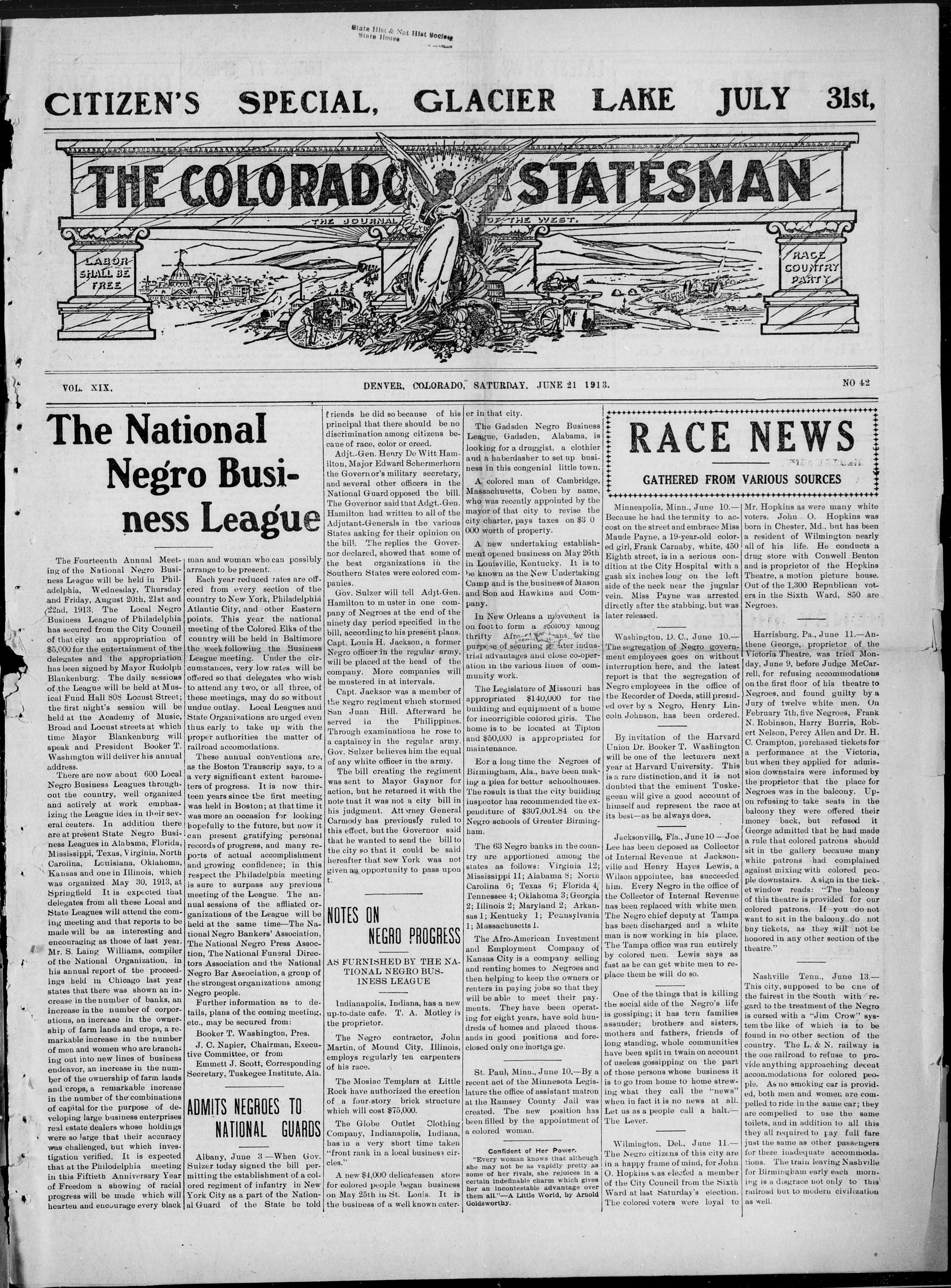
The National Negro Business League
VOL. XIX.
The Nat
Negr
ness
The Fourteenth Annual Meeting of the National Negro Business League will be held in Philadelphia, Wednesday, Thursday and Friday, August 20th, 21st and 22nd, 1913. The Local Negro Business League of Philadelphia has secured from the City Council of that city an appropriation of $5,000 for the entertainment of the delegates and the appropriation has been signed by Mayor Rudolph Blankenburg. The daily sessions of the League will be held at Musical Fund Hall 808 Locust Street; the first night's session will be held at the Academy of Music, Broad and Locust streets at which time Mayor Blankenburg will speak and President Booker T. Washington will deliver his annual address.
```markdown
```
man and woman who can possibly arrange to be present. Each year reduced rates are offered from every section of the country to New York, Philadelphia Atlantic City, and other Eastern points. This year the national meeting of the Colored Elks of the country will be held in Baltimore the week following the Business League meeting. Under the circumstances, very low rates will be offered so that delegates who wish to attend any two, or all three, of these meetings, may do so without undue outlay. Local Leagues and State Organizations are urged even thus early to take up with the proper authorities the matter of railroad accommodations.
These annual conventions are, as the Boston Transcrip says, to a very significant extent barometers of progress. It is now thirteen years since the first meeting was held in Boston; at that time it was more an occasion for looking hopefully to the future, but now it can present gratifying personal records of progress, and many reports of actual accomplishment and growing confidence; in this respect the Philadelphia meeting is sure to surpass any previous meeting of the League. The annual sessions of the affiliated organizations of the League will be held at the same time—The National Negro Bankers' Association, The National Negro Press Association, The National Funeral Directors Association and the National Negro Bar Association, a group of the strongest organizations among Negro people.
Further information as to details, plans of the coming meeting, etc., may be secured from:
Booker T. Washington, Pres. J. C. Napier, Chairman, Executive Committee, or from Emmett J. Scott, Corresponding Secretary, Tuskegee Institute, Ala.
ADMITS NEGROES TO NATIONAL GUARDS
Albany, June 3—When Gov. Sulzer today signed the bill permitting the establishment of a colored regiment of infantry in New York City as a part of the National Guard of the State he told
DENVER, COLORADO, SATURDAY, JUNE 21 1913.
State Hist & Nat Hist Bodies
State House
IAL, GL
ADC
THE JOURNAL
DENVER, COLORADO
friends he did so because of his principal that there should be no discrimination among citizens because of race, color or creed. Adjt..Gen. Henry De Witt Hamilton, Major Edward Schermerhorn the Governor's military secretary, and several other officers in the National Guard opposed the bill. The Governor said that Adgt..Gen. Hamilton had written to all of the Adjutant-Generals in the various States asking for their opinion on the bill. The replies the Governor declared, showed that some of the best organizations in the Southern States were colored companies.
Gov. Sulzer will tell Adjt-Gen. Hamilton to muster in one company of Negroes at the end of the ninety day period specified in the bill, according to his present plans, Capt. Louis H. Jackson, a former Negro officer in the regular army, will be placed at the head of the company. More companies will be mustered in at intervals. Capt. Jackson was a member of the negro regiment which stormed San Juan Hill. Afterward he served in the Philippines. Through examinations he rose to a captaincy in the regular army. Gov. Sulzer believes him the equal of any white officer in the army.
The bill creating the regiment was sent to Mayor Gaynor for action, but he returned it with the note that it was not a city bill in his judgment. Attorney General Carmody has previously ruled to this effect, but the Governor said that he wanted to send the bill to the city so that it could be said hereafter that New York was not given an opportunity to pass upon
NOTES ON
NEGRO PROGRESS
AS FURNISHED BY THE NATIONAL NEGRO BUSINESS LEAGUE
Indianapolis, Indiana, has a new up-to-date cafe. T. A. Motley is the proprietor.
The Negro contractor, John Martin, of Mound City, Illinois, employs regularly ten carpenters of his race.
The Mosiac Templars at Little Rock have authorized the erection of a four-story brick structure which will cost $75,000.
The Globe Outlet Clothing Company, Indianapolis, Indiana, has in a very short time taken "front rank in a local business circles."
A new $4,000 delicatessen store for colored people began business on May 25th in St. Louis. It is the business of a well known cater-
---
er in that city.
The Gadsden Negro Business League, Gadsden, Alabama, is looking for a druggist, a clothier and a haberdasher to set up business in this congenial little town.
A colored man of Cambridge, Massachusetts, Cohen by name, who was recently appointed by the mayor of that city to revise the city charter, pays taxes on $3 000 worth of property.
A new undertaking establishment opened business on May 26th in Louisville, Kentucky. It is to be known as the New Undertaking Camp and is the business of Mason and Son and Hawkins and Company.
In New Orleans a movement is on foot to form a colony among thrifty Afro-Americanans for the purpose of securing greater industrial advantages and close co-operation in the various lines of community work.
The Legislature of Missouri has appropriated $140,000 for the building and equipment of a home for incorrigible colored girls. The home is to be located at Tipton and $50,000 is appropriated for maintenance.
Eor a long time the Negroes of Birmingham, Ala., have been making a plea for better schoolhouses. The result is that the city building inspector has recommended the expenditure of $307,001.84 on the Negro schools of Greater Birmingham.
The 63 Negro banks in the country are apportioned among the states as follows: Virginia 12; Mississippi 11; Alabama 8; North Carolina 6; Texas 6; Florida 4; Tennessee 4; Oklahoma 3; Georgia 2; Illinois 2; Maryland 2; Arkansas 1; Kentucky 1; Pennsylvania 1; Massachusetts 1.
The Afro-American Investment and Employment Company of Kansas City is a company selling and renting homes to Negroes and then helping to keep the owners on renters in paying jobs so that they will be able to meet their payments. They have been operating for eight years, have sold hundreds of homes and placed thousands in good positions and foreclosed only one mortgage.
St. Paul, Minn., June 10.—By a recent act of the Minnesota Legislature the office of assistant matron at the Ramsey County Jail was created. The new position has been filled by the appointment of a colored woman.
Confident of Her Power.
"Every woman knows that although she may not be as vapidly pretty as some of her rivals, she rejoices in a certain indefinable charm which gives her an incontestable advantage over them all."—A Little World, by Arnold Goldsworthy.
RACE NEWS GATHERED FROM VARIOUS SOURCES
Minneapolis, Minn., June 10. Because he had the termity to accost on the street and embrace Miss Maude Payne, a 19-year-old colored girl, Frank Carnaby, white, 450 Eighth street, is in a serious condition at the City Hospital with a gash six inches long on the left side of the neck near the jugular vein. Miss Payne was arrested directly after the stabbing, but was later released.
Washington, D. C., June 10. The segregation of Negro government employees goes on without interruption here, and the latest report is that the segregation of Negro employees in the office of the Recorder of Deeds, still presided over by a Negro, Henry Lincoln Johnson, has been ordered.
By invitation of the Harvard Union Dr. Booker T. Washington will be one of the lecturers next year at Harvard University. This is a rare distinction, and it is not doubted that the eminent Tuskegeean will give a good account of himself and represent the race at its best—as he always does.
Jacksonville, Fla., June 10—Joe Lee has been deposed as Collector of Internal Revenue at Jacksonville and Henry Hayes Lewis, a Wilson appointee, has succeeded him. Every Negro in the office of the Collector of Internal Revenue has been replaced with white men. The Negro chief deputy at Tampa has been discharged and a white man is now working in his place. The Tampa office was run entirely by colored men. Lewis says as fast as he can get white men to replace them he will do so.
One of the things that is killing the social side of the Negro's life is gossiping; it has tern families assunder; brothers and sisters, mothers and fathers, friends of long standing, whole communities have been split in twain on account of useless gossiping on the part of those persons whose business it is to go from home to home strewing what they call the "news" when in fact it is no news at all. Let us as a people call a halt.—The Lever.
Wilmington, Del., June 11.—The Negro citizens of this city are in a happy frame of mind, for John O. Hopkins was elected a member of the City Council from the Sixth Ward at last Saturday's election. The colored voters were loyal to
NO 42
Mr. Hopkins as were many white voters. John O. Hopkins was born in Chester, Md., but has been a resident of Wilmington nearly all of his life. He conducts a drug store with Conwell Benton and is proprietor of the Hopkins Theatre, a motion picture house. Out of the 1,300 Republican voters in the Sixth Ward, 850 are Negroes.
Harrisburg, Pa., June 11.—Anthene George, proprietor of the Victoria Theatre, was tried Monday, June 9, before Judge McCarrell, for refusing accommodations on the first floor of his theatre to Negroes, and found guilty by a Jury of twelve white men. On February 7th, five Negroes, Frank N. Robinson, Harry Burris, Robert Nelson, Percy Allen and Dr. H. C. Crampton, purchased tickets for a performance at the Victoria, but when they applied for admission downstairs were informed by the proprietor that the place for Negroes was in the balcony. Upon refusing to take seats in the balcony they were offered their money back, but refused it George admitted that he had made a rule that colored patrons should sit in the gallery because many white patrons had complained against mixing with colored people downstairs. A sign in the ticket window reads: "The balcony of this theatre is provided for our colored patrons. If you do not want to sit in the balcony do not buy tickets, as they will not be honored in any other section of the theatre."
Nashville Tenu., June 13.—This city, supposed to be one of the fairest in the South with regard to the treatment of the Negro is cursed with a "Jim Crow" system the like of which is to be found in no other section of the country. The L. & N. railway is the one railroad to refuse to provide anything approaching decent accommodations for colored people. As no smoking car is provided, both men and women are compelled to ride in the same car; they are compelled to use the same toilets, and in addition to all this they all required to pay full fare just the same as other passengers for these inadequate accommodations. The train leaving Nashville for Birmingham early each morning is a disgrace not only to this railroad but to modern civilization as well.
THE MONARCH
WINE & LIQUOR CO.
You Can Get
One Case of Good, Ste
ized Beer, 24 Pints
Or One Gallon of Purc
California Port, Sherry
Muscatel Wine.
Or One Full Quart o
Bond Rye or Bourb
The Monarch L
PHONE CHAMPA
1516 Court Place
SEEDS
Your back yard will help pay you
BARTELD
"WESTERN SEEDS FOR WES
THE BARTELDES S
1521-1525 Fifteenth St.
The Largest Poultry Supply H
HENRY MILL
Case of Good, Steamed, Sterilizer, 24 Pints to the Case. A Gallon of Pure 8 Year Oldonia Port, Sherry, Angelica or Angel Wine. The Full Quart of Bottled in Rye or Bourbon Whiskey. Monarch Liquor Co PHONE CHAMPA 1231
One Case of Good, Steamed, Sterilized Beer, 24 Pints to the Case. Or One Gallon of Pure 8 Year Old California Port, Sherry, Angelica or Muscatel Wine. Or One Full Quart of Bottled in Bond Rye or Bourbon Whiskey.
SEEDS
hard will help pay your rent if you plan
BARTELDES'
SEEDS FOR WESTERN PLANTE
E BARTELDES SEED CO.
th St. Denver, Col
est Poultry Supply House in the West
Y MILLER & C
1939 BROADWAY
GRAVEL ROOFING
AND CEMENT WORK
THE BARTELDES SEED CO.
1521-1525 Fifteenth St. Denver, Colorado
The Largest Poultry Supply House in the West
Cement Ash Pits, $5 Up Repairing Promptly Done Tin Roofs Painted
All Work Guaranteed Give Us
Phone Main 1062
N. F. Davis
Plumbing Inspector for City and County of
g, Heating and Ventilation
and Tests for Sewer Gases On All
defective buildings
Estimates Given
PHONE SOUTH 855 DENVER
WER & SCHUO
All Work Guaranteed Give Us a Trial
Phone Main 1062
W. F. D
(12 Years Chief Plumbing Inspector for
Plumbing, Heating and
Examination and Tests for Sew
defective build
Estimates C
842 BROADWAY PHONE SOUTH
BROWER &
W.F.Davis
REAL ESTATE
311 Cooper Building
DENVER, COLORADO
JOHN ENG
I & Engstrom
Beck & En
Beck @ Engstrom
WHOLESALE DEALERS IN
Wines, Liquors
Cigars
Western Agents for Minneapolis Grain Belt Beer and C
Imported Beer and Bock Ol.
1644-46-48-50 Larimer S
Phone Main 1053
es, Liquors and
Cigars
Minneapolis Grain Belt Beer and Carnegie Port
Imported Beer and Bock Ol.
4-46-48-50 Larimer Street
53 Denver, C
Western Agents for Minneapolis Grain Belt Beer and Carnegie Porter, Pripps Imported Beer and Bock Ol.
STEAM ENGINE
HENRY BECK
Denver, Colo.
rent if you plant
S'
EERN PLANTERS"
ED CO.
Denver, Colorado
se in the West
R & CO.
ROOFING
ENT WORK
Give Us a Trial
tain 1062
avis
(ly and County of Denver)
Ventilation
Gases On All Old
ys
ven
DENVER, COLO
CHUCK
RM LANDS
Telephone Champa 1962
Residence Phone Main 7345
JOHN ENGSTROM
strom
RS IN
rs and
and Carnegie Porter, Pripps
Ql.
er Street
Denver, Colorado
LATEST NEWS EPITOMIZED
FROM TELEGRAPHIC REPORTS THAT COVER THE WEEK'S EVENTS.
OF MOST INTEREST
KEEPING THE READER POSTED
ON MOST IMPORTANT
CURRENT TOPICS.
Western Newspaper Union News Service.
WESTERN.
Of the 700 members of the San
Francisco Dishwashers' union, 100 are
college graduates.
Potatoes of last year's crop sold as
low as 10 cents a bushel in carload
lots at Kansas City.
Despite the cool wave Tuesday, five
additional deaths from heat were re-
ported, making the death toll forty.
The Southwestern Telegraph & Telephone Co. (Bell) telephone operators were called out on strike in St. Louis. The Associated Newspapers, in convention at Minneapolis, voted to hold their next convention in Denver, in June, 1914.
Six hundred federals were killed in a battle at Sausillo, according to reports reaching El Paso, Tex., from Southern Chihuahua.
The Diamond Special on the Illinois Central railroad was held up by two masked robbers near Glenarm, ten miles south of Springfield, Ill.
Four deaths by drowning and twelve heat prostrations, six of which may result fatally, were reported in Milwaukee on the 15th. It was the hottest day of the season.
Special classes in politics for women are to be opened in some of the churches in Chicago as soon as Governor Dunne signs the women's suffrage bill passed by the Legislature. Indictments charging Edmond E. C. Von Klein with the theft of $3,500 worth of diamonds from Ethel Newcomb and with polygamous relations with her, have been returned by the county grand jury at Portland, Ore.
CONGRESSIONAL.
Representative Rucker introduced a bill for six-year presidential term.
Senator Chamberlin introduced a bill to authorize building of government railway in Alaska. A message from J. Brazilian senate expressing gratification at the reception of Dr. Lauro Muller was read. Representative Campbell introduced a bill to reduce number of representatives to 233 after March 3, 1917. President Wilson nominated Thomas Nelson Page as ambassador to Italy and P. A. Stovall as minister to Switzerland. Senator Borah demanded immediate legislation on behalf of homestead entrymen of Oregon, Idaho and other Western states. Senator Owen introduced a resolution to direct secretary of commerce to investigate whether price of oil in Oklahoma was being artificially fixed.
Representative Humphrey introduced a bill to prevent representatives elected to fill an unexpired term from drawing salary for time seat was vacant.
Secretary McAdoo urged deficiency appropriation of $1,353,661 for public building work and submitted letter urging Boston immigration building cost limit be raised $427,000.
Senator Hitchcock introduced amendments to tariff bill placing a graduated income tax on $100,000,000 corporations controlling more than one-quarter of the production in their respective lines.
WASHINGTON.
Frank H. Haigler of Colorado was nominated by the President as assistant surgeon in the navy medical reserve corps.
When noon whistle blows henceforth, Secretary of State Bryan will eat his midday repast in manner of other workmen as he will carry his lunch.
Secretary McAdoo said that his statement announcing that $500,000,000 of the emergency currency would be forthcoming should banks need it, was made in response to numerous inquiries from bankers.
One of the immediate results of the conferences between Secretary Garrison and Colonel Goethals, chairman of the aPnama canal commission, now in Washington, will be the introduction into the canal zone of the jury system for the trial of persons charged with felonies.
Of thirty-nine cities having postal savings deposits of over $100,000 on May 31, Denver stands eighteenth on the list with deposits of $297,120.
Walker K. Vick of Burlington, N. J., prominently identified with President Wilson's campaign, was appointed general receiver of customs at San Domingo.
Senator La Follette, the scrappy Wisconsin member, is learning literally to live up to his nickname of Fighting Bob. He is being taught pugilism—for physical culture, however, he insists.
FOREIGN.
The bodies of one hundred dead have been taken from the ruins of the houses demolished in the earthquake at Tirnovo.
In reference to rumors to the effect that Mr. Rudolph Spreckles probably will be the next American ambassador at Paris, it is learned that the foreign office has been asked whether he would be persona grata.
Herren Gothein and Waldstein, radical members of the German Reichstag, have announced their determination to interpellate the chancellor on the case of a German subject, Oswald Heinrich, who they allege was killed February 4, at Alma, Colo., by debtors.
Emperor William's silver jubilee, which has filled the Berlin streets with the greatest, gayest crowds ever seen in the capital, reached its climax with visit from the allied sovereigns and closed with a gala dinner, followed by a picturesque torchlight procession of students. The dinner guests included Andrew Carnegie.
Adjustment of her compasses was all that remained to be done aboard the whaler Karluk at Victoria, B. C., before she sailed to carry Dr. Vilhjalmar Stefansson's scientific and exploring expedition into the Arctic for a three-years' stay. Captain Robert Bartlett, who commanded Peary's ship Roosevelt, master of the Karluk, said his ship would steam north through the inside passage toward Cross Channel, where she will turn westward and head for Unimak Pass, the entrance to Bering Sea.
SPORT.
Won. Lost. Pct.
Denver .37 17 .685
St. Joseph .33 23 .589
Lewistones .32 25 .545
Lincoln .32 25 .545
Omaha .30 27 .526
Sioux City .22 33 .407
Topeka .21 36 .368
Wichita .18 40 .310
Arizona will send its first sociability run to a city outside the state this year. Leaving Phoenix on July 1 and July 15 two parties of Phoenix autoists will motor to San Diego.
A new world's record for a four-mile relay race was made at Easton, Pa., by the team of the Boston Athletic Association when they covered the distance in 17 minutes 511.1-5 seconds.
Johnny Dundee of New York was given the decision over Jack White of Chicago at the end of their twenty-round bout at Vernon arena at Los Angeles. They fought at catch weights.
The French aviator, Edmond Perreyon, who holds the world's altitude record for an aeroplane, both for pilot and one passenger, broke the world's record for carrying two passengers at Vienna. He reached a height of 15,480 feet.
A ball game between teams representing the upper and lower sections of Rossiter, near India, Pa., was a record-breaker as an endurance contest. The game lasted from 10:30 o'clock in the morning until 3:30 in the afternoon, without a luncheon intermission. The score was 112 to 98 in favor of the lower section of the town. Fifty-seven players were used.
Lieutenant Von Egan-Krieger, of the First Hussars, a well-known gentleman jockey, won the first race at Madgeburg and then mounted his aeroplane and flew to Berlin. He landed in the middle of the Gruenwald race course, ran to the scales and weighed out. He immediately mounted his horse, which was entered in the fifth race, and won handily. Madgeburg is 76 miles from Berlin.
GENERAL.
Mrs. Jack Levy, whose stage name was Della Fox, died at New York.
For the first time in the history of the famous Newport, R. I., beach two women police were placed on duty.
Princess Olga Golitzine of Russia, girl wife of Prince Andre Golitzine of the czar's own cavalry, disappeared from the Holland apartments in New York.
The board of trustees of Vanderbilt university at Nashville, Tenn., unreservedly accepted the recent gift of Andrew Carnegie of $1,000,000 to the medical department.
Fire started by lightning at Terre Haute, Ind., burned to death eleven race horses in the stables at the county fair grounds. The animals were valued at $25,000.
United States Senator Miles Poindexter of Washington, "General" Rosalie G. Jones of New York and Mrs. Ella S. Stewart of Chicago were the principal speakers at a woman suffrage meeting at Buffalo, N. Y.
In a corner of a cemetery at Birmingham, Ala., practically unescorted, has been buried the body of Louise Wooster, the woman whose name will be handed down in history as the last sweetheart of J. Wilkes Booth, who killed Abraham Lincoln.
Dr. Friedrich F. Friedman, the Berlin physician who announced several months ago that he had a cure for tuberculosis, sailed from New York for home. His institute was closed recently after the board of health had forbidden the use of his vaccine.
The estate of Colonel John Jacob Astor, who perished in the Titanic disaster, was officially appraised at close to $88,000,000, of which Vincent Astor receives $68,964,499; Mrs. Madeline Force Astor $7,678,896; Muriel Astor $4,866,758, and John Jacob Astor, son by his second marriage, $2,922,672.
EDITORS AT SPRINGS
PROBLEMS OF NEWSPAPERS DISCUSSED AT MEETING.
Varied Program of Amusement and Interest Keeps Members National Press Association Busy.
Western Newspaper Union News Service.
Colorado Springs.—Addresses by prominent editors from all parts of the country featured the annual meeting of the National Press Association of America in Colorado Springs, June 17-19. The entertainment of the visitors included a smoker, dance at Stratton park, picnic in Cheyenne canon and drives to all points of interest in the Pike's Peak region. After the convention here the visitors go to Denver, whence they will be taken on a trip around "the horn," visiting Greeley, Fort Collins, Boulder and other towns in the rich agricultural districts of the state. They then will spend a day at Estes park, returning to Denver and disbanding.
Editors Denounce Use of Referendum
Colorado Springs.-The Colorado Editorial Association in its opening session here condemned the unfair and unscrupulous use of the initiative and referendum by certain interests and urged the voters of the state not to sign petitions for referring measures unless they personally investigate the merits or demerits of the issue. Resolutions were also adopted urging the candidacy of George E. Hosmer of Fort Morgan as vice president of the National Press Association.
Paper in Shoe: Was "Over 18."
Paper in Shoe; Was "Over 18." Fort Collins.—Stating that she had placed in her shoe a slip of paper marked "18" that her husband-to-be might truthfully swear that she was "over 18." Mrs. Albert B. Cain, sixteen-year-old bride, who, with her husband, was arrested on complaint of her father, made a plea before Justice H. E. Frey for the release of her husband. The charge of juvenile delinquency against the bride was dismissed, but Cain was convicted and sentenced to a year in the Buena Vista reformatory.
Stock Growers Meeting in July.
Glenwood Springs.At the 1912 midsummer meeting of the Colorado Stock Growers' Association, it was decided to make this city the permanent midsummer meeting place. The meeting this year will be held in July and it is being planned to hold it at the same time the Indiana autoists are here. A barbecue and wild west show will be features and a special effort will be made to impress the visiting Easterners with the bigness of the stock growing industry of the West.
Laborer Hangs Himself in Barn.
Longmont.—Julius Johnson, twenty two years old, a laborer employed on the farm of Frederick West, near Longmong, hanged himself to a rafter in his employer's barn. Johnson's father killed himself in Sweden a few years ago. He has a mother and brother living in Sweden, and a brother, Leonard Johnson, living at Windsor.
New Charges Against Danford.
Cripple Creek.—Suit was filed by Tony Cuaz, an assayer, against U. G. Danford, missing city treasurer, who is charged with being $25,000 short in his accounts, alleging that while acting as cashier of the Cripple Creek bank Danford appropriated $1,000 of Cuaz's account. The bank is made a party of the suit.
Trinidad.—Jose Martinez, a Mexican truck farmer of Cokedale, is marked with the sign of the cross burned into his flesh by a bolt of lightning. The bolt killed the horse he was driving, and cut the harness from the animal.
Two Leas Broken. Rides.
Craig.—Both legs of W. H. Richardson of Big Gulch were broken when his horse slipped on the muddy road and fell. The injured man climbed upon his horse after the accident and rode several miles to the ranch of a neighbor, where he collapsed.
Arrested After Chase.
Hayden.—John Hankins, wanted on a charge of cattle stealing in Adams county, was arrested twenty-five miles northwest of here in the wildest part of Colorado.
John T. Larkin Is Dead.
Denver.—John T. Larkin, eighty-one, pioneer mining man of Denver and veteran of the Civil War, died at his home, 2427 Vine street.
Plan Triple Celebration.
Fruita.—Fourth of July, Iowa Day and Interurban Day will be celebrated here jointly on July 4.
Leadville Slayer Gets Life Term.
Leadville.—Peter Japich, thirty-five, was convicted of the murder of James Clearly, twenty-one, at the Moyer mine, on iron hill, Feb. 7 last. Judge Cavender imposed a sentence of life imprisonment. The defense was given fifteen days in which to file a motion for a new trial.
Baby Doesn't Care.
Windsor.—An eight-pound Friday, the 13th, baby was born here. Mr. and Mrs. F. A. Burton are the parents.
Western Newspaper Union News Service.
DATES FOR COMING EVENTS.
June 26-27.—W. C. T. U. Seventh District Convention at Akron.
June 26-29. Christian Behavior State Convention at Denver.
July 9-10.—Meeting Colorado Postmasters' Association at Colorado Springs.
July 28.—Pacific Jurisdiction, W. O. W.
Aug. 12-15.—32nd Triennial Conclave of Knights Templar, Denver.
Aug. 16-20 Army of the Philippines
Mark Superintendent at Denver.
Aug. 18-20 Army of the Philippines
National Society at Denver.
Aug.—Grand Council of Order of Red
Aug. 25—Conference of Governors at Colorado Springs.
Aug. 26—Knights of Pythias Grand Lodge meeting at Trinidad.
Sep. 16-20—Colorado State Fair at Pueblo.
Sept.—National Association of First-Class Postmasters at Denver.
Oct. 1-3—State W. C. T. U. Convention School.
Oct. 21.—Colorado State Baptist Association at Pueblo.
1915.—Last Grand Council of North American Indians, Denver.
The new automobile law goes into effect July 15.
Counterfeit $10 and $20 bills are reported circulating in Denver.
Platoro, the new mining town, now has daily mail service and a newspaper.
The Colorado Editorial Association held its annual meeting at Colorado Springs.
The Senate confirmed Colorado postmaster nominations as follows: F. F. Reinert, Fort Morgan; Bruce Russell, Yuma.
The Rio Grande is contemplating building an addition to the railroad hospital at Salida worth from $50,000 to $100,000.
Patriotic men, women and children turned out to celebrate the 136th anniversary of the American flag in many cities throughout the state. Jose Atancis, aged twenty years, and Charles Ames, aged fifteen years, were struck by lightning and instantly killed while working in the beet fields at Longmont. Newton Large, former cashier of the Florence State bank, is charged with accepting and receiving money for deposits after he knew the institution to be insolvent. Alice Petini Clark, deputy superintendent of public instruction, has been offered the position of school director of the Argentine republic at a salary of $5,000 a year.
M. Ortez, a Mexican beetweeder, who has been working on the ranch of Frank Hornbaker, a mile north of NiWot, is in jail as the result of a scrap in which he used a knife on Tom Tobin.
The Postoffice Department has issued an order permanently discontinuing branch station No. 12 of the Denver postoffice, Fourteenth and Lawrence streets. The order becomes effective June 30.
Miss Sarah H. Dorsey, sixty-nine, one of the founders of the Young Women's Christian Association in Colorado Springs and for many years prominent in philanthropic and religious work there is dead.
The United States Supreme Court denied the motion of the Denver Union Water Company for a rehearing of the suit recently decided against the company in the role of trespasser in the streets of Denver.
A huge illuminated cross, fifty feet square, is being erected on Pike's peak and will be used especially during the visit to Colorado Springs in August of the Knights Templar, who hold their conclave in Denver.
A penal bond in the sum of $250,000 was filed by the Burlington railroad to insure the carrying out of its contract with the city of Denver in regard to the laying of tracks on Market street and the paving of that street.
Game and Fish Commissioner Shinn advises that during the past two years 2,500,000 trout have been deposited in the streams of Colorado and that he expects the number will reach 30,000,000 during the next two years.
The merger of the five big irrigation projects contiguous to Denver on the north and east, covering approximately 535,000 acres of rich, fertile lands, is being contemplated by a large Eastern corporation, according to announcement from New York.
Ten cottages, which are now being constructed for the Myron Stratton Home at Colorado Springs, will be completed and ready to receive adult inmates before September 1, but the dormitories for the boys and girls will not be completed before November.
A jury in the District Court at Steamboat Springs has failed to agree and been discharged in the case of Robert King, an artist, who recently attempted to elope with the seventeen-year-old daughter of F. E. Miller, millionaire lumberman and hotel proprietor. King was charged with beating a bill at the hotel owned by his sweetheart's father.
Conscience stricken, a woman whose name is not known, but who is supposed to live in St. Louis, has returned to the Cliff house in Manitou several hundred dollars' worth of linens and silverware which she acknowledges in an unsigned note accompanying the consignment that she stole while a guest at the Manitou hotel last summer.
The body of Julius Johnson, twenty-one, farm hand, was found at Longmont dangling from the end of a rope, the young man having committed suicide.
AFRO-AMERICAN CULLINGS
At New Orleans a small white child had fallen into the lake and was drowning. A Negro woman who saw it hastened to the place, taking another one with her. There being no means of rescue of any other character at hand, the woman told the other one to hold her by her feet and then she dived into the water (it was all most speedily done), and she brought the little child up and it was restored to the normal condition. Whereupon the New Orleans Christian Advocate pays the woman in particular, and the race in general, the compliment which here follows: "At this time, when the crimes of colored people are so paraded in the public press, it is well to call attention to such incidents as this. Nor are they as rare as some may suppose. In this section of New Orleans in which we live, within the past two years two small children have been killed by a street car, and in each instance a colored nurse, though not on the track, sacrificed her life in an effort to save the child. The fidelity of Negro servants to their masters and mistresses during the stormy days of the Civil war has long been much extolled, and rightly so. Nor has this spirit of loyalty and faithfulness to those for whom they work by any means ceased to exist among the colored people of the South during the nearly fifty years of their freedom. The truth is, the black race, like every other, has in it both the good and the bad. To condemn sweepingly all who belong to it because of the crimes of some of its members is both illogical and unjust. With the tide of immigration from the Old World beginning to turn toward this section, we may ere long be made to realize, more fully than we do at present, that there are things vastly worse than a large Negro tenant population."
An obligation rests upon the Negroes of this country to subscribe for and advertise in their race newspapers. With white newspapers refraining as much as possible from publishing news about and concerning Negroes, except when they have a bit of sensational news that may further incite growing race prejudice, it becomes a bonded duty to support race newspapers. With the loyal support of Negroes of this community, the Bee, already a power, can be made vastly more powerful in conserving race interests." The above is a truth to which none should become indifferent because it has been so often uttered. The Negro newspaper is a brave thing. Even the weaker members of the tribe do good service to the race by improving and rectifying a distorted public opinion about us. The newspapers of other men do not feel this obligation and they do comparatively little along this line. Hear! Hear! Hear! Hear ye! Oh, ye misrepresented people, help your Negro newspaper with something which can be handed in at the window of the receiving teller down at the bank. They are silently, but potentially helping to fight your battles. Supply them with ammunition.
We have outlived the fallacy as to the indefinite improvability of the mind, but there is still much lingering superstition as to possible betterments of character. It is as idle to say "Be a Saint Paul" as to say "Be an Aristotle."
Occasionally one gets too much of a good thing in the way of a better half.
Once more in favor are these glistening, gleaming yellow beads, which, since the time of our grandmothers have been worn as necklaces.
With the collarless blouse and the lingerie frocks with their low necks, neck ornaments are especially fashionable, and this gives added opportunity for the wearing of this pretty old-fashioned head.
All sizes are worn, from the small pea-sized bead to the one large as a good sized marble. And in the jewelers' shops one may purchase them by the string or by the dozen—in this latter way making the necklace as one pleases.
Pelt handbags of smart appearance and perfect workmanship are of suede, in colors to match any walking suit, made over a gun metal frame and equipped with a silk cord handle. The same design comes in English morocco, Levant leather, beaverskin and buffed calf, while in mission pattern are some attractive looking receptacles of verde green and dull brown calf, ornamented with hand toolings and embossings.
For the young girl to wear over her pretty white frock at resort hotels or for evening use generally there are the most charming Red Riding Hood capes in soft blue, pink and pure white broadcloth. The hood is lined with satin of the same color, and the smart capes, which come only a trifle below the waist, are finished at the neck with a heavy silk cord and tassel.
Woman can stand more pain than man can. However, she isn't expected to suffer in silence.
The colored population of this country has records of generations of patriotic loyalty. There were colored soldiers in the Revolutionary war who fought bravely at the battle of Brandywine and took part in other engagements. In every war in which the American nation has been engaged colored men have fought bravely and there are few, if any, records of colored traitors. The colored women are loyal in their reverence for those of their race who have accomplished work for some worthy cause. Their records of those who at sacrifice to themselves have helped others to rise is a long one. Few will be longer remembered than Harriet Tubman Davis, who died last month in the Home for Aged Negroes, which she had founded in New York. Harriet was called "The Moses of the Negroes" because having run away herself from the brutality of an overseer, she made no less than 19 trips back to the south to lead other negroes into freedom. A price of $40,000 was finally put upon her head, but this did not deter her, and her native cunning enabled her to lead large parties of slaves to freedom. During the Civil war she was a faithful army nurse and also performed valuable services as a spy and scout so that she was honored by the highest officers in the Union army. Elizabeth Wright, Mrs. E. C. Bethuna and Lucy Lane are others name reverenced by the educated colored women for the work they have done to help their own race.
There are so many attractive things in the way of bathing paraphernalla this season that even those who do not expect to go in swimming might be tempted to add a natatory outfit to their summer wardrobe. Fashion writers have done justice to the new harem bathing suit, but the accessories may not be so familiar. The half handkerchief bathing caps of plaid silk rubber have the ends lined with a contrasting color to match the collar of the bathing suit or the stockings. Another new rubber cap has a band finished with a becoming frill and fastened with a buckle and bow.
Beach capes of rubber lined satin are novelties of the season, and small bags which fasten securely are convenient for holding the little things of the toilet. Most attractive bathing shoes come to match the suits, in blues, greens, reds, browns and polka dots. These have rubber or canvas soles and tops of waterproof satin or sateen.
---
It is kind of fashion to decree that white crepe constitutes summer mourning. It is lighter and cooler than black, yet it maintains all the traditions of mourning. Hats of all sizes, from the small turban to the broad brimmed creation, are made entirely of white crepe or crepe combined with hemp straw and may be bought at prices ranging from $11 to $22. The crepe is also made into wide collar and cuff bands to be worn with simple gowns of plain white wool materials. A foot wide band of the white crepe is frequently used at the bottom of skirts.
In no shop that has the interest of its customers at heart will a woman be advised to try the shoes of Panama straw that came in a year ago. Their price is $12 and they crack and break on the slightest provocation. They are to be regarded merely as a fad for the extravagant.
Dr. Booker T. Washington has an article in The Independent on "Solving the Negro Problem in Detail." He says he receives many letters, books and pamphlets "in which someone has tried to formulate a solution of the race question." The difficulty, he says, with most of the solutions is that they "start out with the notion that the Negro problem is a fixed quantity, always and everywhere the same, like a problem in arithmetic, to be solved once and for all." How, then? He says:
"The trouble in this case is that, like other human problems, the race problem is one in which the terms are not fixed and cannot, therefore, be brought into the shape of a hard and fast formula." What, then? He says: "I have long ago given up the notion of solving the race problem wholesale. It seems to be rather that it can only be solved in detail." He is, therefore, "Interested in the progress of the individual Negro quite as much as in the progress of the"—race as a whole.
A woman has no use for a secret that she can't tell or money that she can't spend.
What was at first merely by the way may become the very heart of a matter. Flints were long flaked into knives, arrowheads, spears. Incidentally it was found that they struck fire; today that is their one use.
A synthetic tannin, distilled from tan products, has been invented by an English leather industries expert for tanning light colored leathers.
By doing a man a favor you may convert him to the theory that one good turn deserves a lozen more.
SPRING WHEAT REPORTED 93.5
PER CENT OF NORMAL.
Government Estimates Yield of 13.5 Bushels per Acre From 18,663, 000 Acres Planted.
Western Newspaper Union News Service.
Washington.—Some idea of the area planted to the great grain crops of the country and of the prospective size of these crops, with the exception of corn, was given, when the Department of Agriculture issued its June crop report, showing the condition of the grains on June 1, the acreage planted to each and estimates of the yield per acre and the total production, based upon the ratio of the average condition on June 1 to the final yield in preceding years.
These statistics were gathered from the many correspondents and agents of the department's bureau of statistics and compiled by the crop-reporting board. Statistics for the various crops, with comparisons for other years, follow:
Spring Wheat.
Area planted, 18,663,000 acres, compared with 19,243,000 acres last year, 20,381,000 acres in 1911 and 18,352,000 acres in 1910. Condition 93.5 per cent of normal, compared with 95.8 per cent last and 93.8 per cent the ten-year average. Indicated yield 13.5 bushels per acre, compared with 17.2 bushels last year and 13.3 bushels the 1908-12 average. Estimated total production 252,000,000 bushels, compared with 330,348,000 bushels last year, 190,682,000 bushels in 1911, 200, 979,000 bushels in 1910 and 265,000,000 in 1909.
Winter Wheat.
Area planted, 30,938,000 acres, compared with 26,571,000 acres last year, 29,162,000 acres in 1911 and 27,329,000 acres in 1910. Condition, 83.5 per cent of a normal, compared with 91.9 per cent on May 1 this year, 74.3 per cent June 1 last year and 80.7 per cent the ten-year average. Indicated yield, 15.9 bushels per acre, compared with 15.1 bushels last year and 15.2 bushels the 1908-12 average. Estimated total production, 492,000,000 bushels, compared with 399,919,000 bushels last year, 430,656,000 bushels in 1911, 434,142,000 bushels in 1910 and 418,000,000 bushels in 1909.
All Wheat.
Area planted, 49,601,000 acres compared with 730,267,000 acres last year, 621,338,000 acres in 1911 and 635,121,000 acres in 1910. Condition 87.2 per cent of a normal, compared with 83.3 per cent last year and 86.1 per cent the ten-year average. Indicated yield 15 bushels per acre, compared with 15.9 bushels last year and 14.5 bushels, the 1908-12 average. Estimated total production, 744,000,000 bushels, compared with 730,267,000 bushels last year, 621,338,000 bushels in 1911, 635,121,000 bushels in 1910 and 683,000,000 bushels in 1909.
Oats.
Area planted, 38,341,000 acres compared with, 37,917,000 acres last year, 37,763,000 acres in 1911 and 37,548,000 acres in 1910. Condition, 87 per cent of a normal, compared with 91.1 per cent last year and 88.4 per cent the ten-year average. Indicated yield, 28.8 bushels per acre, compared with 37.4 bushels last year and 29.7 bushels the 1908-12 average. Estimated total production, 1,014,000,000 bushels, compared with 1,418,337,000 bushels last year, 922,298,000 bushels in 1911 1,186,341,000 bushels in 1910 and 1,007,000,000 in 1909.
Rye.
Condition, 90.9 per cent of a normal compared with 91.0 per cent on May 1, 1913, 87.7 per cent on June 1 last year and 89.7 per cent the ten-year average. Indicated yield, 16.5 bushels per acre, compared with 16.8 bushels last year and 16.2 bushels the 1908-12 average.
Barley.
Area planted, 7,255,000 acres; compared with 7,530,000 acres last year, 7,627,000 acres in 1911 and 7,743,000 acres in 1910. Condition, 87.1 per cent of a normal, compared with 91.1 per cent last year and 90.5 per cent the ten-year average. Indicated yield 24.4 bushels per acre, compared with 29.7 bushels last year and 24.5 bushels the 1908-12 average. Estimated total production, 177,000,000 bushels, compared with 223,824,000 bushels last year, 160,240,000 bushels in 1911, and 173,832,000 bushels in 1910.
Hay.
Condition, 87.5 per cent of a normal compared with 88.5 per cent on May 1, 1913, and 89.8 per cent last year.
Pastures.
Condition, 89.2 per cent of a normal compared with 87.1 per cent on May 1, 1913, 93.7 per cent in 1912 and 89.5 per cent the ten-year average.
Washington—President Wilson has signed a proclamation eliminating 890 acres from the Gunnison national forest. An examination of the land revealed that it had no value for forest or watershed protection. It will be restored to settlement and entry.
Swallowed Minnows; Coughs up Fish.
Benton Harbor, Mich.—Paul Nickols of Sodus township, a farmer, is a human aquarium. For weeks he has been suffering from stomach complaint. Recently he was seized winn a violent coughing spell and emitted a four inch fish. Other coughing spells have been attended with like results. Attending physicians say Nickols swallowed tinny minnows which developed and grew in his stomach. The sufferer is rapidly recovering.
JURY FINDS HAROLD F. HENWOOD
GJILTY OF KILLING GEO.
E. COPELAND.
HENWOOD TO BE HANGED
SLAYER WAS ASHY PALE AS THE CLERK READ THE VERDICT OF THE JURY.
Western Newspaper Union News Service
Chronology of Henwood Case.
May 24, 1911—Harold F. Henwood shoots Nylvester L. (C'tony') Von soulshoel in bar form of the Brown Palace hotel. The shooting of the Copeland and Aklin war museum at the buildings being intended for Phul. with whom Henwood quarreled over Mrs. John W. Slugger.
June 5, 1811—John W. Springer Hiles
attorney; June 18, 1811—District Attorney Elliott
elects to try Henwood for the death of
Copeland instead of on the Von Phul
Attorney.
June 19, 1911. — Judge Greeley W. Whitford overrules plea in court for the murder of the Juror V. Von Phil. June 24, 1911. — Mrs. Springer testifies for the murder of 1911. — Henwood convicted of murder in the second degree of Henwood to life imprisonment. Henwood to life imprisonment Court grants Henwood a new trial. Feb. 15, 1911. — Henwood leaves jail for motion to free Henwood on the Von Phil charge. June 28, 1912. — Second trial of the Copeland case begins. June 28, 1912. — District Attorney John A. Rush causes arrest of John T. Garver on charge of perjury. Judge Butler threatens attorney attorneys unless buildozing tactics cease.
June 17, 1913—John W. Springer testified June 18, 1913—Henwood found guilty of first degree murder and sentenced to hang. June 18, 1913—Attorneys ask new trial要求他们 will appeal if necessary to the Supreme Court of the United States.
Denver.—Flinging aside the testimony of the defense that Harold F. Henwood acted as a protector of the home of John W. Springer and the further defense that Henwood fired upon and killed Sylvester L. Von Phil in protection of his own life, the jury that tried Henwood returned the following verdict:
"We, the jury, find the defendant, Harold Frank Henwood, guilty of murder in the first degree as charged in the information herein, and fix the penalty at death."
Henwood was arraigned upon the charge of killing George E. Copeland, who had nothing whatever to do with the affairs of either Von Phul or Henwood, in the barroom of the Brown Palace hotel on the night of May 24, 1911.
Henwood, enclosed down by Von Phul, arose, drew a revolver and emptied it. He mortally wounded Von Phul and Copeland and permanently crippled James M. Atkinson of Colorado Springs, who, with Copeland, was standing at the bar at the time.
Attorney John Bottom, counsel for Henwood, gave notice of a motion for a new trial. This will be taken under advisement by the court within the next two weeks and until it is disposed of Henwood will not be taken into court to receive sentence.
"Henwood never will be hanged!" says his attorney, John Bottom. "It is ridiculous to think of such a thing as hanging, in this case."
It was clear, however, that the verdict was a knockout blow to the pale faced Henwood, his counsel and his friends.
The jury retired Tuesday night at 10:25 o'clock. The verdict was returned at 4:40 o'clock Wednesday afternoon. Thirty ballots were taken. On the first ballot the twelve men unanimously agreed that Henwood was guilty of murder. The second ballot showed that all were agreed that the homicide was of first degree.
Charleston, W.Va.—A general strike of miners in the New River coal fields, District No. 29, United Mine Workers of America, will be called, says Thomas Haggerty, member of the International Miners' Board. Fifteen thousand and men are employed in the New River field.
Big Irrigation Celebration.
Denver.—The opening of the Nile and Antero projects was celebrated here. The Nile is complete and is now serving 45,000 of the richest acres in Colorado with its life-giving waters. The Antero has its first unit completed and water was turned on 5,000 of its best acres.
Surgeons Remove Wood Tick.
Greeley.—P. W. Allen was operated on and a woodtick which had burrowed under the skin, was removed.
Dix Recommended for Philippines.
Washington. — Senator O'Gorman recommended former Governor John A. Dix of New York, for governor general of the Philippines.
Denver Schoolgirl, 13, Hangs Self.
Denver. — Florence Woolley, 13-year-old schoolgirl, committed suicide in the Robinson apartments, 228 Broadway, by hanging herself with a silken curtain cord in almost exactly the same manner that Mrs. Sarah Heines, 1534 Cleveland Place, killed herself.
Astor Buys London Post.
London.—Announcement that William Waldorf Astor has purchased the Morning Post, is the topic of general interest in political and social circles.
FLORAL DESIGNS PUT UP WHILE YOU WAIT
CHOICE PLANTS AND CUT FLOWERS CONSTANTLY ON HAND
GREENHOUSES: Thirty-Fourth and Curtis Streets
TELEPHONE, MAIN 1511 DENVER, COLO
The Central Bottling & Distributing Co.
Agents for the famous
CAPITOL BEER---IT'S CAPITAL
Try a case, 2 doz. pints for $1.10, delivered promptly; empties called for.
Family Liquors, Wines, and Cordials Genuine Goods at Popular Prices A glass of good wine will improve your Sunday dinner, and aid digestion.
Twentieth and Champa,
Is the place to get your
DRUGS, CHEMICALS AND PATENT MEDICINES
Prescriptions Our Specialty.
Phone us and we will deliver the goods to all parts of the city.
JAMES E. THRALL, PROPR.
PHONE MAIN 2425.
WORK CALLED FOR AND DELIVERED
THE CA
RE
SEWED HALF
HE
1511 CHAMPA STR
Boost Colorado P
ZA
DE
COLUMBIA
VI
DELICIOUS TABLE BEERS COLUMBINE, VIENNA AND PILSENER Guaranteed Absolutely Pure. Delivered Daily to All Parts of the City.
The Ph. Z
We Boost for Colo
DAY OR NIGHT.
A. M
U m
A first-class Mortuar
time of death of loved or
LAWRENCE
LOUIS HUB
PARLORS 19
LET U
Shirts, Colla
Curtains a
The Denver
A first-class Mortuary establishment. First aid to the bereaved in the time of death of loved ones. Prices below competitors. Polite service LAWRENCE JONES, Licenced Embalmer LOUIS HUBBARD, Funeral Director PARLORS 1925 Arapahoe Street
LET US WASH YOUR Shirts, Collars and Cuffs, Blankets, Curtains and Rough Dry Work. The Denver Sanitary Laundry. PHONE MAIN 5670
---
1082 Broadway.
REPAIRING DONE WHILE
YOU WAIT
THE COLORADO STATESMAN
JOS. D. D. RIVERS.....Proprietor
1824 Curtis Street, Room 25.
Phone Main 7417.
SUBSCRIPTION RATES:
One Year .....$2.00
Six Months .....1.00
Tthree Months ......60
PAYABLE IN ADVANCE.
Entered as second-class matter at the postoffice in the city of Denver,
Colorado.
All communications of a personating nature that are not complimentary
will be withheld from the columns of this paper.
Display advertising, 25 cents per squ are. A square contains ten agate lines.
Reading notices, ten lines or less, 10 cents per line. Each additional line
over ten lines, 5 cents per line.
No discounts allowed on less than three months' contract. Cash must accompany all orders from parties unknown to us. Further particulars on application.
Remittances should be made by Express Money Order, Postoffice Money Order, Registered Letter or Bank Draft. Postage stamps will be received the same as cash for the fractional part of a dollar. Only 1-cent and 2-cent stamps taken.
Communications to receive attention must be newsy, upon important subjects, plainly written only upon one side of the paper; must reach us Tuesdays, if possible, anyway, not later than Wednesdays, and bear the signature of the author. No manuscript returned, unless stamps are sent for postage.
It occasionally happens that papers sent to subscribers are lost or stolen. In case you do not receive any number when due, inform us by postal card and we will cheerfully forward a duplicate of the missing number.
POLITENESS.
general sense, is not suppl-
est, it being presumed that
persons which applies to order,
certain criticisms that have
ties or callings which are
of colored waiters and
paint which they are chan-
ged especially when disap-
pear that in numerous insta-
tions to make him an ade-
pant who earns his living
as persons in service, ou-
ne no more polite, courte-
ter than the American Negr-
tic today.
Many are voluntary vocati-
s of persons are engaged in
all every requirement of the
unners being not the lea-
der for such acquirement,
parents are surly, ill-man-
er for the criticisms referre-
tive. Many parents are
early neglect or forget to
win every walk of life.
Forcing children to follo-
principle of good manners
children do what they see
parents tell them to do.
States) yelling at other chil-
ing to correct them. The
insolence. Such children
little respect for real
and refinement. They are
special motive. The hou-
ness mistaken ideas of
courteous to them
often lead to dissatisf-
those who furnish the em-
. Then white waiters
owners are a recommenda-
stock in trade. While
pass does not leave a person
be first to lose his te-
not do so, and employees
they will be compelled to
or places. It will not
Good manners, inborn,
else to win the fight.
be afraid to speak. Wha-
but to prove our efficient
erlook the value of politi-
Department, in a general sense, is not supposed to be a subject requiring editorial advice, it being presumed that social taste creates and inculcates good manners which applies to ordinary social intercourse, but we have in mind certain criticisms that have been passed upon the Negro in certain capacities or callings which are often the source of his living. The criticism of colored waiters and porters in the dining car and Pullman services, in which they are charged with being "impudent" and "insolent," especially when disappointed. But we consider it best to admit that in numerous instances the rearing of the young Negro does not tend to make him an adept in good manners, such as every ordinary person who earns his living by direct contact with others, and especially as persons in service, ought to be. There was a time when there were no more polite, courteous and good mannered servants in the world than the American Negro, but we doubt that the boast can be safely made today.
Waiting and serving are voluntary vocations, now everywhere and entirely honorable. If persons are engaged in these callings, they owe it to themselves to fulfill every requirement of their work, never failing politeness and good manners being not the least. Many colored men recognize the necessity for such acquirement, but all of them do not. Too many Negro servants are surly, ill-mannered and disagreeable. Such are responsible for the criticisms referred to above. The fault is generally in their raising. Many parents set bad examples before their children and utterly neglect or forget to impress upon them the value of good manners in every walk of life. Some of our parents are serupulously zealous in forcing children to follow certain rules or mannersisms, but the real principle of good manners is often spoiled even in these same homes. Children do what they see or hear their parents do, rather than what the parents tell them to do. So we often hear colored children (and some whites) yelling at other children when demanding a service or when seeking to correct them. This is a sure sign of illbreeding and inbred insolence. Such children grow up with some knowledge cf, but very little respect for real good manners. Their manners lack culture and refinement. They exist only in theory and are practiced with a special motive. The house servant is often thus afflicted. They possess mistaken ideas of pride and often expect their employers to be more courteous to them than they are to the employers. These errors often lead to dissatisfaction and sometimes to disgust on the part of those who furnish the employment. Then comes ericism and discharge. Then white waiters and servants find openings. Real good manners are a recommendation to any person and ought to be a servant's stock in trade. While we serve we should serve well. Inbred politeness does not leave a person, as a rule.
No servant should be first to lose his temper. If he has been properly raised, he will not do so, and employés of all classes are reaching the point where they will be compelled to meet the competition of the whites seeking their places. It will not do to meet the situation with surly defiance. Good manners, inborn, and well practiced, will do more than anything else to win the fight. In so far as our cause is just, we should not be afraid to speak. When we are maligned, we should talk back. But to prove our efficiency beyond a doubt, we must not forget or overlook the value of politeness and good manners under all circumstances.
DENVER'S FUTURE
quality of the commissionity of Denver seems a relief from political turmoil condition in its final years our destiny to commissioners and an auditor the choice of the the departments of a la
Now that the legality of the commission form of government for the City and County of Denver seems a certainty, its citizens may take a sigh of relief from political turmoil, which causes an unsettled and unhealthy condition in its financial and social welfare. For the next four years our destiny to a large degree rests in the hands of five commissioners and an auditor elected last month. These six gentlemen were the choice of the people, and in them is vested the care of all the departments of a large and prosperous city. There are two requisites for success in any business or vocation—efficiency and honesty—and there is little doubt about these gentlemen being able to qualify in these requisites. Commissioners Pitcher, Nisbet, Hunter, Thum and Mayor Perkins and Auditor Markey are all practical men, schooled in the affairs of the municipality and their honesty is above question.
Coupled with our good fortune in having honest and fearless officials, Denver is facing an era of prosperity brought about in part by the opening of the Antero irrigation system, which will irrigate thousands of acres of land in the vicinity of Denver, and will mean millions to the truck gardeners, farmers and merchants. This is only the first step in irrigation and before many years the Queen City of the Plains will take its stand among other large cities that are surrounded by rich farming districts.
We are holding our own as a convention city and, location considered, we are the greatest in America. The Shriners and Turnvereins and several other conventions meet in Denver this summer, and these gatherings bring tens of thousands of visitors, which means increased business, a large amount of advertising and ultimately an increasing population. It may be reasonably expected that in the near future many of the houses now vacant will be occupied and that there will be general prosperity.
a traveler neither creditably represents his country while abroad, nor brings back to it the information and benefit wherewith the United States ought to be enriched by every American tourist and pilgrim.
As a matter of fact, not only in France—as the proverb goes—but everywhere in Europe, they do certain things better than we do here. Among these superior achievements of Europe, is the important matter of the government of cities.
That is not to be wondered at. Though ours is the oldest constitutional government on earth, we are (excepting only Australia and New Zealand) practically the youngest of the nations. We call ourselves a democracy, but actually we are very inexpert in self-government. Indeed, we do not seriously undertake to govern ourselves, whether in city, state or nation. We are too prone to delegate our powers, and thus to give over to parties, machines, bosses and to those temporarily in office, a comparatively irresponsible rulership, which fairly places a premium upon the twin public vices of inefficiency and corruption.
Contrast this with European conditions. There, even when the democratic spirit dominates the situation, the traditions of aristocratic government prevail. "Noblesse Oblige" is the unconscious motto, and the official class are held, both by these traditions and by public opinion, to a type of public administration and service that illustrates habitually the twin public virtues of integrity and efficiency.
They are used to government in Europe. They are old at the business. We, on the other hand, are not merely young at it, but we are too busy, each of us, with our own individual business to be deeply concerned for what ought to be everybody's business.
I believe unalterably in political democracy, both in the right and in the ability of people to govern themselves. But it needs only half an eye to see (even without instituting a comparison between European and
for grocery boys, and in an interesting report to his government says:
"A boy who desires to follow the business must serve an apprenticeship of three years, during which service he usually pays his employer from $20 to $30 per annum. In a few instances an apprenticeship of but two years is served. In such cases the employer usually demands about $60 per annum from the apprentice, who in return for his services and said payment is furnished with plain board and lodging.
"While serving his apprenticeship a boy is compelled to attend an advanced business school at least twice a week and on Sundays study an additional language, either German or Bohemian, according to his nationality, as both German and Bohemian are essential here in business establishments. In case the apprentice is not industrious and falls behind in his studies he must attend the business school an additional half year. Before being taken as an apprentice he must have a certificate from a grammar school showing he attended the school at least three years."
"After apprenticeship has been served wages are paid which vary somewhat according to the grade of the grocery where the apprentice is employed, the average being about $4 to $7.30 a month, including plain room and boarding; without the latter, about $10 to $14.25 a month. Wages advance according to a salesman's merit; a capable and experienced one can earn $20 to $25 a month with board and lodging when employed in a first-class grocery.
"Girls are not usually employed as grocers' apprentices, but sometimes to arrange salads, cold meats, cheese, etc., for customers. When a man desires to open a grocery in his own name he must present an apprentice's certificate from the business men's association to the highest government official in the district. He must also prove that he has served five years, including his apprenticeship and service as a grocer's assistant."
2,069 lost children were restored to their parents in Boston alone. Out of this number 536 children were conveyed to police stations in patrol wagons.
I think that Governor Foss is correct when he states that no prisoner under seventeen years of age should be carried in a vehicle which is occupied at the same time by prisoners above that age.
I think that when a child is lost the first act should be to restore it to its parents or guardians, and I agree with the governor that a policeman should either take the child on foot or in a trolley car to the nearest station.
I recently had to look into the matter and found that the Boston police in 1912 had to do with 2,243 delinquent or wayward children. Of these, 1,409 were before the courts on summonses.
There were 939 who were actually arrested. A bill was recently passed in Massachusetts to allow the police to carry lost children in the patrol wagons, but it has been vetoed by Governor Foss.
stood. No one can have failed to see in the long ago the healthful rivalry exhibited by the pupils under the old oral way of spelling down. Here both eye and ear were at attention. Eagerness and enthusiasm were noted, where now a languid interest is manifested.
Let us in the public schools have some of both types of spelling drill say, three times of writing to two of old fashioned spelling down. You will note a marked difference in a short time in both interest and efficiency by so doing.
European Municipalities Are Best Governed By Rabbi Charles Fleischer, Boston, Mass.
a traveler neither creditably represents he brings back to it the information and benefit ought to be enriched by every American toow. As a matter of fact, not only in France everywhere in Europe, they do certain the Among these superior achievements of Europe of the government of cities.
That is not to be wondered at. Thou tional government on earth, we are (except Zealand) practically the youngest of the democracy, but actually we are very inexperienced, but seriously undertake to govern our nation. We are too prone to delegate our to parties, machines, bosses and to those tentively irresponsible rulership, which fairly twin public vices of inefficiency and corruption.
Contrast this with European conditions cratic spirit dominates the situation, the treatment prevail. "Noblesse Oblige" is the unclass are held, both by these traditions and of public administration and service that public virtues of integrity and efficiency.
They are used to government in Euro-ness. We, on the other hand, are not mere busy, each of us, with our own individual b for what ought to be everybody's business.
I believe unalterably in political dem in the ability of people to govern themselves eye to see (even without instituting a comp
American municipalities) that we Americans still have everything to learn regarding the efficient and honest organization of life in our cities.
American Grocery Boys Receive Good Wages By William J. Herndon, New York
for grocery boys, and in an interesting report.
"A boy who desires to follow the business of three years, during which service he will $20 to $30 per annum. In a few instances, years is served. In such cases the employee per annum from the apprentice, who in real payment is furnished with plain board and a
"While serving his apprenticeship a boy advanced business school at least twice a week additional language, either German or Bohemian, as both German and Bohemian are establishments. In case the apprentice is not in his studies he must attend the business school Before being taken as an apprentice he must mar school showing he attended the school at
"After apprenticeship has been served somewhat according to the grade of the girl employed, the average being about $4 to $6 room and boarding; without the latter, about advance according to a salesman's merit; a can earn $20 to $25 a month with board and first-class grocery.
"Girls are not usually employed as girls to arrange salads, cold meats, cheese, man desires to open a grocery in his own nature's certificate from the business men's assignment official in the district. He must also years, including his apprenticeship and service.
Keep Lost Children From Patrol Wagons By G. P. BROWN, Boston, Mass.
2,069 lost children were restored to their place of this number 536 children were conveyed wagons.
I think that Governor Foss is correct wi under seventeen years of age should be carried at the same time by prisoners above that.
I think that when a child is lost the f to its parents or guardians, and I agree wi man should either take the child on foot or station.
I recently had to look into the matter an in 1912 had to do with 2,243 delinquent or 1,409 were before the courts on summonses.
There were 939 who were actually arrest in Massachusetts to allow the police to car wagons, but it has been vetoed by Governor
Poor Spelling of Average School Child
By H. S. Le Valley, Kankakee, Ill.
stood. No one can have failed to see in the exhibited by the pupils under the old oral both eye and ear were at attention. Eagermore where now a languid interest is manifested.
Let us in the public schools have some say, three times of writing to two of old f will note a marked difference in a short time by so doing.
Often in Europe I have been amused by the air of complacent superiority and of more or less indulgent patronage which your average American traveler assumes and maintains. Such
this country while abroad, nor benefit wherewith the United States tourist and pilgrim. France—as the proverb goes—but things better than we do here. Europe, is the important matter though ours is the oldest constitutivepting only Australia and New Zealand nations. We call ourselves apert in self-government. Indeed, ourselves, whether in city, state our powers, and thus to give over temporarily in office, a comparably places a premium upon the auction.ons. There, even when the demostraditions of aristocratic govern- unconscious motto, and the official and by public opinion, to a type at illustrates habitually the twin Europe. They are old at the busi-erely young at it, but we are too ill business to be deeply concerned us. democracy, both in the right and selves. But it needs only half an comparison between European and
Charles Hirsch
The boy who is employed in an American grocery store should never complain about his pay. The United States consul at Prague, Austria, has looked into the matter of wages
port to his government says: business must serve an apprentice-ee usually pays his employer fromices an apprenticeship of but twooyer usually demands about $60 return for his services and said lodging.
A boy is compelled to attend an week and on Sundays study an chemian, according to his nation-essential here in business estab-industrious and falls behind in school an additional half year. must have a certificate from a gram- at least three years.
oved wages are paid which vary in grocery where the apprentice is $7.30 a month, including plain out $10 to $14.25 a month. Wages; a capable and experienced one and lodging when employed in a grocers' apprentices, but some-ese, etc., for customers. When a name he must present an appren-association to the highest govern-also prove that he has served five service as a grocer's assistant."
Governor Foss of Massachusetts says that lost children should not be conveyed to the station houses in Boston and other cities in his native state in the police patrol wagons. Last year
or parents in Boston alone. Out
eyed to police stations in patrol
at when he states that no prisoner
arried in a vehicle which is occu-
that age.
the first act should be to restore it
with the governor that a police-
or in a trolley car to the nearest
and found that the Boston police
or wayward children. Of these,
estested. A bill was recently passed
carry lost children in the patrol
or Foss.
Business men are constantly calling attention to the poor spelling of the average school child. It need excite no wonder, as there are psychological reasons for it that are well under-
the long ago the healthful rivalry
final way of spelling down. Here
nerness and enthusiasm were noted.
ed.
one of both types of spelling drill
and fashioned spelling down. You
me in both interest and efficiency
GUARD AGAINST STORM
GUARD AGAINST STORM
PRECAUTIONS TO PRESERVE THE WASHINGTON MONUMENT.
Apex Is Covered With Expensive Aluminum to Which is Connected Four Copper Rods Extending to the Ground.
Protecting tall edifices from danger of being struck in case of lightning during electrical storms occupies much of the time of the builders. The lightning rod plan is usually accorded the most efficient means to safeguard a building, and a system working on this principle is doing everything toward the protection of
storms occupies much of the time of the builders. The lightning rod plan is usually accorded the most efficient means to safeguard a building, and a system working on this principle is doing everything toward the protection of that. very vulnerable shaft, the Washington monument. This equipment is not visible to outside observers and is rarely mentioned to sightseers, who have probably never wondered how great would be the fall thereof if the monument were to be struck and disrupted.
At the very beginning of the construction of the monument a plan for protection was provided. The possibility of its being struck in case of storm was obvious, so the protective plan matured with the blue prints.
The four iron beams forming the framework for the elevator shaft which rises in the center of the monument were always, during course of construction, made to extend higher than the surrounding masonry, so that when the shaft was left in an unfinished state during the Civil war, at the height which is indelibly marked on the outside, the beams exceeded in height. The purpose of this was to have them serve doubly—that of attractors and conductors of the lightning which would play about the monument and framework for the elevator. At the base of the beams, where they rested on their foundation stones, copper wires were attached. These were run to an underground well thirty-two feet in depth under the shaft. This well was filled with water and had a bottom of clear sand. Under this sand ran a thin layer of water in which was grounded a flat copper plate. It was to this plate that the wires were attached. This seemingly intricate grounding is an illustration of the delicacy with which the details for the protection were worked out.
During the suspension of work this system adequately protected the monument. When the work was resumed the beams were extended to the point where the crowning pyramid joins the slanting sides of the shaft. When this pyramid was completed the most delicate work was at hand.
At the apex—a height of 555 feet—a top of pure aluminum, then so expensive that it was worth about $15 a pound, was adjusted. From this tip directly to the summit of each shaft on the inside of the pyramid were extended and connected four copper rods about one and one-half inches in diameter. This connection then formed a complete course for the conduction of the lightning flashes in electrical storms from the apex down through the construction beams to the inundated plate in the grounding.
The monument was finished in 1884 and the system effectively protected until April 5, 1885. Then, during the course of a severe storm, five immense sparks were seen to center on and fly from the apex, but no damage resulted. Two months later, however, during another storm, a severe discharge of lightning cracked a stone under the apex and forced it slightly outward. The efficacy of the system was then questioned, and a decision to investigate resulted in the appointment of a commission composed of Colonel Casey, United States army engineer corps; Prof. Henry A. Rowland of Johns Hopkins University and Prof. P. C. Mendenhall of the Massachusetts Institute of Technology. These three men were about the most prominent in the electrical world at that time and of all the most competent to judge and decide. They investigated and concurred in the opinion that the fault of the system lay not in its insufficient carrying capacity, but was due to a deficient number of points of attraction.
To remedy this they extended ten rods horizontally around the pyramid. On each of these rods, at an interval of five feet between, were placed pointed conductors, gold plated and tipped with platinum, three inches in length. There are 200 of these conductors in all, exposed on the pyramid. Down the four outer edges of the pyramid from the apex copper wires were run. They were brought forward toward the center to connect with the iron beams. These four wires, then, crossing the rods holding the small pointed conductors, connected them and the aluminum apex to the beams. With the four wires that were placed on the inside of the pyramid as original connection, there are now eight wires connecting 201 points with the grounding, whereas before four wires had connected with one point. This increase was the remedy the commission effected.
Family Debate
The debaters of the family circle have before them this important resolve: "That the house should be painted, the ceilings whitewashed and the rooms papered." It is likely to pass and a committee appointed to try to jolly the landlord.
VIEW OF CAPITAL'S SKYLINE
As Seen From Meridian Hill In Early Morning, It Presents Impressive Panorama.
The skyline of Washington viewed from the crest of Meridian Hill in the soft light of early morning is an impressive panorama. It is a wide aro which the vision sweeps. There is haze enough to drape a thin veil over the prospect so that only the prominent features come into the picture. The early mist rests most heavily over the lower lying structures with the result that the great and lofty objects rise from the dimmer into the clearer light and perhaps the spring sunshine burnishes them.
Far off to the east on the left hand are the yellow stacks of an electric power plant at Benning. You know that they are utilitarian objects of hard brick, but in the misty distance they appear as tall and slender towers. The next object, letting the eye follow southerly and westward, is the dome of the Library of Congress and the low eastern sun makes the gilded roof sparkle and flash. Then the capitol's dome, gray and lacy, stands up against the sky. Still bend to the west and you come to the clock tower of the postoffice building and further to the west the monument reaches high out of the low gray and purple vapors that rest upon the southern part of the city, and extends so far into the regions of light that its marble gleams pure and pallid. Next to the right and in the middle ground is the red and brown dome tipped with a gilded ball comes into view. It is a new thing in the Washington sky. To the right of that is the gray-drab tower of the Church of the Covenant, and as you circle westward the prospect is terminated by the castellated brown stone Henderson house in the right foreground.
As the mist thins and rises a number of church spires appear like sharp points that prick the skyline and a few commercial stacks come into sight and around which whiffs of pale smoke wreath and linger. Then the far-off wireless towers at Arlington are seen. By this time the mist has nearly cleared away and it is time to set out for the office.
SIMPLE LIFE FOR CHILDREN
Capital Mothers Adopt Regulations Against Late Hours, "Nameless" Dances and Immodest Dress.
Washington children, at least those whose mothers are members of the local branch of the National Congress of Mothers, are preparing to return to the social "simple life." The organization is having printed a set of rules to govern the future social conduct of the children of its members. The rules were adopted at a meeting the other day in which the housekeepers' alliance also participated, and in part contains the following commands:
"That all entertainments in our homes, including dances, stop at 12, midnight, or earlier, and that it be so announced on the cards of invitation
"That the 'nameless' dances not only be discouraged but be forbidden in our homes and to our children.
"When objectionable dancing is commenced, that the music cease at once. The orchestra leader may announce he has been so instructed.
"That simplicity and modesty in dress 'distinguish' our girls.
"That we teach our sons smoking during an entertainment planned for their pleasure is a discourtesy to the hostess and her other guests.
"That we instruct our boys to end a social call at 10 or 10:30 o'clock."
The members also pledged themselves to frown upon Sunday entertainments and to refrain from having parties for their children on school nights.
FROM A BRAND NEW ANGLE
Another Instance of the "Pen" Proving Mightier Than the Sword—Contrast Explained.
When Solicitor-General Lehmann left Washington to pick up the threads of his St. Louis practice he left a gap in the ranks of Washington's official raconteurs that will not be easily filled. In spite of the volume of his work—and a great part of the government's most important trust litigation was handled by him before the Supreme court—Lehmann never lacked time to swap stories.
One of his favorites concerns the visit of a New Yorker to St. Louis. Judge Lehmann pointed out to him one day the modest house in which Sherman had made his headquarters at the start of the Civil war. Just opposite was an imposing residence built by a man who had made his millions in the ment export business.
"That's a curious contrast," said Lehmann, "the old home of a great soldier and the magnificent palace of a man who made his money in pork." "The pen," replied the New Yorker, "was always mightier than the sword."
Very Latest Dance.
"Paresis Glide" is the very latest dance to arrive in Washington, and it will be tried out at the dances this spring. While the dance itself has just arrived, there are a good many society matrons who have been sitting on the new dances, who were quite of the opinion that paresis has really struck most of the young people in the dancing set, or they would not indulge in the antics that some of them cut in their efforts to keep up with the latest art.
Mrs. Florestine Doolcy is convalescent.
Ralph Millikin is out again, after an acute illness.
Miss Inez Horton of Memphis, Tenn., is here for the summer.
John Donaldson is convalescent from a severe attack of tonsilitis.
DEATHS
Geo. R. Clingman, died at the County hospital Friday, funeral was held Monday 2 p. m. Rev. A. E. Reynold officiated.
Louis Carter, died at the County hospital, Friday, funeral was held Wednesday morning 9 a.m. Geo. Langston was found dead in bed Sunday
Sam Shirley is on the sick list this week, suffering with rheumatism.
All aboard the choo choo train, Monday, July 14 for Tolland, Colo.
Mrs. Etta Herdon left last Thursday for Ft. Smith, Ark., on business.
Andrew Carr left the city last Friday for Little Rock, Ark., on business and pleasure.
Miss Hattie E. Huff of Memphis, Tenn., sister of Dr. Huff is visiting in the city.
Joseph B. Burns of 1150 Broadway is suffering with a severe attack of rheumatism.
Miss Hermione Jones of Leadville arrived in the city Monday night and is the guest of Mrs. Louis George.
A Night in Manila with Corp. White Camp, No. 4, U. S. W. V., Eureka Hall, July 4. Dancing from 8 p. m. to 2 a. m. Admission 35 cents.
Miss Addie Miller and her brother Harrison Miller of Weeping Water, Nebr., arrived in the city last Saturday to remain indefinitely.
A. G. Fallings, clerk in the Postoffice department left Monday for Kansas City, to spend his vacation with his wife, who is visiting her mother.
Judge Townsend, settled two important estates in the courts for two widows, this week, which gave one several thousand dollars and the other some valuable real estate.
Mrs. Lenox, Mrs. Winchester, and Miss Vernon of La Junta, Colo., who were delegates to the Woman's Federation, which convened in Cheyenne, last week, were guests of Mrs. A. Colston a few days this week.
Hiram Commandery No. 20 has excepted an invitation to escort the blue lodges to their annual sermon on St. John's Day, June 22, at the church of Redeemer, corner 22nd ave and Humboldt st.
A night in Manila with Corp. White Camp, No. 4, U. S. W. V., Eureka Hall, July 4. 'Dancing from 8 p. m. to 2 a. m. Admission 35 cents.
Mr. Leonard Anderson entertained a party of his friends at the residence of Mrs. John Short, 1539 East 30th ave at a stag party Monday evening, June 16th. Quite an enjoyable evening was spent playing cards and discussing the issues of the day at about 1:30 a. m. an enjoyable repast was served. Those enjoying Mr. Andersons hospitality were Messrs. C. A. Astwood, Chas De Smithea, Raymond Clark, John Watkins, Mr. Maddox and the old reliable Clarence Holmes, and Billie Knight.
You will miss a treat if you fail to go on the GRAND UNION EXCURSION Monday, July 14 to Tolland, Colo., given under the auspices of Campbell A. M. E. church and Bethleham Baptist church.
Miss Pearl Mary Thrashley and Mr. Jonas Sanford Cooper were married at the home of the bride's mother, Mrs. Moses Thrashley last Wednesday evening, in the presence of a large number of friends. Rev. D. E. Overs performed the ceremony. The wedding march was played by her youngest sister, Miss Francheon, Baby Jimie Adams was ring bearer, the ring being carried in an Easter lily. They recevied many beautiful and expensive presents. They will be at home to their friends at Sullivan, Colo., after Wednesday, June 25th.
The Grand Union Excursion to Tolland, Colo., Monday July 14 is the only one of the season. You cannot afford to miss it.
In the case of O. T. Jackson vs. N. R. Pratt, the Supreme Court last week refused to grant the supersedeas, Mr. Jackson being permitted thereby to have his judgment. He now has his horse and damages for use. This case was begun May 25, 1912, in the County Court of Denver. It was tried before two juries, once in the county, and once in the District Court, a verdict having been rendered in favor of Mr. Jackson in both Courts. The case was then appealed to the Supreme Court of this state. Mr. A. W. Lewis, Mr. Jackson's attorney, says that while the case is not finally determined, the decision of the Supreme Court in denying the supersedeas practically decides the case.
NOTICE.
The undersigned will receive bids for the refreshment privileges on the excursion to Tolland, July 14, 1913. No bids will be considered after June 24, 1913. Half of the amount must accompany each bid. The committee reserves the right to reject any and all bids.
H. FRANKLIN BRAY,
2320 Lawrence St.
DEATHS
Geo. R. Clingman, died at the County hospital Friday, funeral was held Monday 2 p. m. Rev. A. E. Reynolds officiated.
Louis Carter, died at the County hospital, Friday, funeral was held Wednesday morning 9 a. m. Geo. Langston was found dead in bed Sunday, in the rear of 2245 Lawrence st., Funeral was held Wednesday 10 a. m. Rev. E. J. Thompson officiated.
David Stewart, who died at his home, 2522 Glenarm Place Monday funeral was held Wednesday 2 p. m., from the Douglass Undertaker Co. Parlors. Rev Pope officiated.
Mrs. Ida Higgins Adams, died at the Mercy hospital Monday. Funeral was held Wednesday from her home, 2528 Franklin street at 2 p. m. Rev. A. M. Ward and Rev. H. F. Bray, officiated. Mrs. Adams leaves a husband, mother and six children besides a host of friends to mourn her loss.
Mrs. Sarah Caldwell, who died at her home, 403 Fox street Saturday. Funeral will be held Sunday from Campbell church at 2 p. m.
Geo. Hanley, died at the County hospital Monday.
GOOD NEWS
..The masons next big picnic in a Bloomfield Park Wednesday, July 10 1913. Attendance 25c.
RECEPTION.
Mr. and Mrs. Dan Williams entertained in honor of the marriage of their son, Geo. K. Williams of Kansas City to Miss Arnicholas Chiles of Topeka, Kan., at their home, 2811 Welton street, on the evening of Monday, June 16th, from 8 to 11. The house was artistically decorated with colors green and white with cut flowers. The guests were received by Misses Lillian Richards and Verona Mason. Mrs. Chester Franklin introduced the guests to the following persons who composed the receiving line: Mrs. Dan Williams, Mr. G. K. Williams, the bride, Mrs. Arnicholas Chiles Williams and the bride's aunt, Mrs. Lucile Jordan of Colorado Springs. In the dining room Mesdames Payne, Holmes, Canaday and Phillips assisted in serving and Mrs. Bert Patrick at the punch bowl. During the evening about seventy-five guests called.
Mr. and Mrs. Williams were recipients of many beautiful and useful presents from friends in the city. They will remain in the city for a few weeks before leaving for their home in Kansas City, Kan.
The moonlight Club will give an excursion and dance at Golden Opera House, Monday, June 23rd, 1913. Round trip 60c each, including dance. Webster's full orchestra. John Carrie Jr., president, F. D. Ratley, Manager. Cars leave 14th and Arapahoe, 8:30 p. m.
Please get tickets at Ratley Bros. barber shop to avoid rush at station.
RECEPTION.
The reception given by Mr. and Mrs. Lewis George Wednesday evening last, in honor of the graduation of their nephew, Earl George, and Miss Hermione Jones of Leadville, proved an entire success, and between the hours of 7 and 10 the older people called to congratulate the young people for their success. From 10 to 12 the young people danced to the strains of Webster's orchestra.
The color scheme was caried out in red and white and flowers were everywhere in profusion. As the guests entered the door they were received by Mr. and Mrs. George. Mrs. George carried a large bunch of pink roses, while Miss Jones carried a bunch of red and white peonies.
The gowns worn by the ladies were beautiful.
Those who assisted were Mesdames Turner, Hubbard, Keelen, Barnes, Ealy, Waldon, Hyman, Cole, McCain, the Misses Lena Barnes, Maud Wright and Hazel Robinson. Dorothy Galmore was the ribbon girl and Robt. Barnes and Alexander Keelen tended door.
THE HENWOOD CASE.
The long tedious and expensive trial of Harold Henwood for the shooting of Copeland in the Brown Palace hotel two years ago, has ended by the jury returning a verdict of murder in first degree and death penalty. The verdict seems to be an unpopular one as well as very unsatisfactory to Henwood and his attorneys, who will renew their efforts to have the verdict of the jury set aside and a new trial granted, even though the case must be carried through the State Supreme Court, and there to the Supreme Court of the United States at Washington.
NOTICE.
All Master Masons in good standing are requested to attend the celebration of St. John's day, June 22nd. Meet at hall, 2630 Welton street, at 1 o'clock. Sermon will be preached at the church of the Holy Redeemer, 22nd avenue and Humboldt st., at 2:30 p. m.
FOR SALE—Nice 8-room house to a desirable colored family. Thoroughly modern, nice neighborhood, 2515 Humboldt st. $2,500; call at premises.
SHORTER CHAPEL NOTES.
Rev. Robert L. Pope, B. D., Washington and Twenty-third streets.
The following order of service will be observed at Shorter Chapel tomorrow:
10:00 a. m. Sunday school. Lesson:
The Blinding Effect of Sin. Amos
6:1-8.
(Temperance Lesson).
11:00 sermon; New Sense of Values, by the pastor.
3:00 p. m. Special rally service in which Campbell Chapel, Zion Baptist, Central Baptist and Bethlehem Baptist churches are invited to affiliate.
Rev. David E. Over will deliver the sermon and Zion Baptist choir will give the music. Rev. Bray, Price and Reynolds will be present to assist in the rally.
6:45 p. m. Allen Christian Endeavor League. Topic: Mission Work at Home and Abroad. VI. Missionary Tours. Acts 15:36-41: 16:1-15.
8:00 sermon by Rev. A. Wayman Ward recently returned from Wilberforce University.
Rev. J. C. Bell of Booneville, Mo., preached quite an enthusiastic sermon at Shorter last Sabbath morning, at its close Brother G. R. White, an old citizen of Denver, came forward and was received into the church, he having professed a saving faith in the Lord Jesus Christ.
Sister Ida Adams of 2528 Franklin and Brother David B. Stewart of 2522 Glenarm Place peacefully closed their earthly career Monday morning, June 16 and were laid to rest with appropriate services Wednesday, Revs. Ward and the pastor officiating respectively.
The Sunday school rendered a very interesting Children Day program Sunday afternoon, Mrs. O. W. Gleen being in charge.
We are glad to welcome back into our fellowship Sister Matilda Whitesell who has been on an extended trip visiting points in Michigan.
Mr. Roy C. Brown, Mrs. Mamie Harris and Miss Louise Harris were elected to represent Shorter's Allen League at the International C. E. convention to be held next month in Los Angeles, Cal.
Sunday being rally day at Shorter, it is expected that our membership will exhibit such a spirit of liberality as is commensurate our present demand. Let us all pull and pull altogether.
CAMPBELL NOTES.
Campbell Chapel A. M. E., Church, Corner 23rd and Lawrence Sts., Rev. H. Franklin Bray,
Campbell Chapel A. M. E. church, Rev. H. Franklin Bray, D. D. pastor, corner 23rd and Lawrence streets. Sabbath services as follows: 9:45 Sabbath school, Miss Ethel Fitchue superintendent. 11:00 a.m. preaching by the pastor. 12:45 class meeting. 6:45 Allen League, Mr. D. D. Howard president. 7:45 preaching by the pastor. Last Sunday was the best quarterly meeting this year by far. The attendance was large and the collections nearly doubled any previous quarter. Rev. A. M. Ward, presiding Elder, Rev. S. L. Deas of Scott Chapel M. E. church and Rev. A. Wayman Ward recently returned from Wilberforce where he is preparing himself for the ministry, all preached able and inspiring sermons. It was indeed a day of great rejoicing. Mrs. Margerite Gardiner of Brown Chapel A. M. E. church, Selma, Alabama was added to the membership.
Standing room was at the premium at the wedding Thursday evening. The entire affair was such as to place Campbell under lasting obligations to all the participants. Mrs. Blackwell is a wide-a-wake church worker. Entertainments next week for the benefit of the rally as follows: Tuesday evening a grand musical by club No. 9. Mrs. Alberta Kirtley Captain. Thursday evening baby contest and drama by club No. 11, Mrs. L. O. Tucker and Mr. Bray captians. Remember the grand rally Sunday, June 29th. Campbell will unite with Shorter next Sunday in the rally at 3 o'clock. Mrs. Sarah Caldwell aged member of the church died last Saturday and will be buried Monday at 2 p. m. The delegates to the state federation from Pueblo were guests at the parsonage Monday.
NOTES OF THE ZION BAPTIST CHURCH.
The Sixth Annual Convention of Colorado Baptist met this week in Colorado Springs, where Rev. Over and a number of Zion's workers enjoyed the sessions.
A splendid audience was present at Zion last Sunday morning and enjoyed the sermon of the pastor from the subject, "The Food, Groth and Activities of Spiritual Manhood."
Mr. Allan Lewis and Mrs. Nancy Patrick were married at the home of Mrs. Lillie B. Moore last Wednesday evening, by the pastor. Only a few friends were present.
Mr. Jonas Cooper and Miss Pearl Thrashley were united in matrimony at the home of the bride's mother, Wednesday evening. A large party of friends witnessed the elaborate ceremony. Rev. Over officiated.
The Stereopticon sermons on Sunday evenings are meeting the favor of the congregation and friends. The subject for Sunday evening is, "The Good Shepherd." Ten beautiful views will illustrate the lecture. Sankey's sweet song, "The Ninety and Nine" will be illustrated by ten slides also. The service will be more than helpful.
Peculiar Alpine Custom.
A curious eastern custom has been observed for many centuries in the western Alps. One hundred eggs are distributed over a level space covered with sand and the young men and women perform a dance around them. If a couple are fortunate enough to finish the dance without breaking an egg it is taken as a token of the compatibility of their temperaments and they are betrothed.
One nicely unfurnished room for rent at 2360 Tremont Place.
$1.00 reward to the first party giving us the correct address of Mrs. Andrew C. Ballard who recently moved from 2349 Tremont place. Columbine Music Co., 924 Fifteenth street.
When you want Lawyer Townsend, call Champa 618. Office, 313 Kittredge building.
NOTICES TO BE PAID FOR.
Owing to the increased cost of publication, it becomes necessary to make a nominal charge of 50 cents, payable in advance, for all cards of thanks, notices of condolence and resolutions. The price of room rent ads and other liners that run on a monthly rate of 50 cents must be paid in advance, as small a rate and pay a collector's commission. No items of this nature accepted without a cash payment.
Brickler's New Barber Shop is located at 2208 Larimer street, Shave, 10c. Hair Cut, 25c. Children, 15c.
SEVENTH-DAY ADVENTIST
CHURCH.
"I was glad when they said unto me, let us go into the house of the Lord.—Psa. 1221:1.
Dear friend: A personal and cordial invitation is extended to you to attend the services conducted by the Seventh-Day Adventist, in the chapel of the People's Presbyterian church, corner E. 23rd avenue and Washington street.
Sabbath school (Saturday) 10:30 a.m.
Preaching, 11:15 a.m.
Young People's Miss'y Volunteer society (Saturday), 1:30 p.m.
Prayer meeting (Tuesday), 8 p.m.
Bible lecture (Sunday), 7:30 p.m.
A special program will be rendered once each month, to be composed of sacred music, recitations, etc., bearing on some special phase of the Gospel.
Bibles and other religious literature may be obtained from any of our agents, or direct from the conference office. 1112 Kalamath St.
Elder, J. W. Owens, Pastor, 2941
Glenarm Place. Phone Main 6646.
THE DE LUXE.
Furnished apartments. 2 and 3 rooms, with hot and cold water in each kitchen. Also front room, single, electric lights and gas. Modern throughout. Rates very reasonable. 2352 Ogden St., Cor. 24th Ave. Phone York 6707. Mrs. R. M. Blakey.
13 CENTS A DAY BUYS A PIANO. WITH MUSIC LESSONS FREE. PIANOS FROM $88 UP. COLUMBINE MUSIC CO., 920-924 15th STREET, CHARLES BUILDING.
NOTICE OF PROCEEDING FOR DE-TERMINATION OF HEIRSHIP
AND FINAL SETTLEMENT.
In the case of the Estate of Mary Ferre, Deceased.
Monday, the 30th day of June, A. D. 1913, being one of the regular days of the May term of the County Court of the State of Colorado, the state of Colorado, I. Nicolino Ferre, administrator of said estate, will appear before said Court, present my final settlement as such administrator, will then apply to be discharged as such administrator. At which time and place any person in interest may appear and present objections to the statement if my petition is made.
Notice is also hereby given that Nicolino Ferre has filed his duly verified petition alleging that he is an heir at the estate and the only heir at law of said deceased known to said petitioner as follows:
Nicolino Ferre, 1905 Curtis; husband. Accordingly on said date hereinbeforein, he said he was the only one which such hearing may then be continued, the Court will proceed to ascertain and determine who are heirs or said deceased and as such entitled to the property or other property, real or personal, constituting all or a part of the estate of said deceased, and enter into a contract of sale of all persons claiming to be heirs at law of said deceased may appear and present their proofs.
Dated at Denver, Colorado, May 15,
1913.
NICOLINO FERRE,
Administrator of the Estate of Mary
Frey, Deposed.
W. H. Hunt, Attorney.
Date of first publication May 24,
1913.
Date of last publication June 28,
1913.
ORIENTAL CAFE
1848
Arapa
hoe
Street
PHONE
MAIN
4896
THE TIVOLI UNION BREWING CO.
Frosti
DEWVER, COLO.
SERMONS IN PICTURES BY MENAS OF THE STEREOPTICON.
SUBS
"The
Song,
Ten Best
ILLU
E
Come and be
Best Material,
Best of W
THE
Customer T
Order
SUBJECT—TO-MORROW NIGHT:
"The Good Shepherd"
Song, "The Ninety and Nine"
Ten Beautiful Views Will Be Used With
ILLUSTRATED SONGS
EVERYBODY WELCOME
and be Measured. Do it The
material, Latest Styles, Lowest
best of Work. My Rent is low
THE PROFIT IS YOURS
ner Tailor--Clothes M
Order at Half Price
---
$25.00 SUIT FOR.....$12.50
$28.00 SUIT FOR.....$13.25
$30.00 SUIT FOR.....$15.00
$35.00 SUIT FOR.....$17.50
$38.00 SUIT FOR.....$18.50
ERY Phone M
1905 Cu
SE YOU, TELD-YOUR FRIENDS, IF NO
hen You W
eads, Feet, Tails Snouts, Ne
erlings or any other part of
except the squeal go to
ast's Marke
er Street. Phon
IF I PLEASE YOU,
When
The Heads, F
or Chiterlings
except
Eas
NEW YORK, TAMMENA
DELARST FORM, PRESENTATION
TAMMENA, NEW YORK
IF I PLEASE YOU, TELD YOUR FRJENDS, IF NOT, TELL US
When You Want
The Heads, Feet, Tails Snouts, Neckbones or Chiterlings or any other part of the hog except the squeal go to
East's Market
2300-6 Larimer Street.
The Colo
and P
WALL
OILS
Interior and Exter
Coach Colors, Paid
Masury & Sons. T
728 W. Colfax Ave.,
THE PRIC
1814 C
NEW AND SECOND
SOLD AND EX
AND SEWING
PAID
Colorado Wall Pd Paint Compa
The Colorado Wall Paper and Paint Company
WALL PAPER, PAINTS, OILS AND GLASS
Interior and Exterior Decoration. We do House Painting, Coach Colors, Paints and Varnishes. Agents for John W. Masury & Sons. TELEPHONE MAIN 871.
NEW AND SECOND HAND FURNITURE BOUGHT,
SOLD AND EXCHANGED. WINDOW SHADES
AND SEWING MACHINES SOLD AND RE-
PAIRED A SPECIALTY
Phone. Champa 392 Cash or Cred
N. FERRY
J. R. DRESSOR
RIGHT:
"Werd"
"Nine"
Ed With
GS
Do it To-Day.
Lowest Prices,
it is low.
OURS
Hes Made to
Price
Phone Main 7411
1905 Curtis Street
OS, IF NOT, TELL US
Want
its, Neckbones
part of the hog
to
rKet
All Paper
Company
PAINTS,
GLASS
House Painting,
aints for John W.
ATURE CO
STREET
ATURE BOUGHT,
OW SHADES
O AND RE-
TY
---
WILLIAM CLOW
Phone Main 1461.
A. B. CLOW
Denver, Colorado
Cash or Credit
SUPPLY OF RADIUM
Two-Thirds of Ore Comes From United States.
Then This Country Is Forced to Buy Abroad Valuable Product From Raw Material Bought Here—Industry to Be Developed.
Washington. — Fully two-thirds of the radium supply of the world comes from the United States, according to the bureau of mines. This discovery has just been made by officials of the bureau, who have found that large quantities of the radium-bearing ores are being shipped abroad through the foresight of foreign scientists. Although the bureau of mines has ascertained that the United States has the greatest known supply of radium-bearing ores, not one bit has been produced here. It is the intention of the bureau of mines, in view of these facts, to encourage the development of this industry, the product of which is valued at approximately $2,250,000 an ounce.
"The United States today is in the humiliating position of being forced to purchase at extravagant prices from abroad such radium as its hospitals and physicians can afford for experimental purposes, while we have been supplying the ores from which it is made," said Charles L. Parsons, chief of the division of mineral technology of the bureau.
"Several months ago rumors reached the buraeu of mines that in Colorado there had been an increased demand for carnotite, the radium-carrying ore, and that this ore was being shipped abroad in considerable quantity. It was also reported that the Europeans were insisting upon only the highest grades of these ores, and that a great amount of lower grade ores was practically being wasted.
"R. B. Moore and K. L. Kithil, in charge of the Denver (Col.) laboratory, investigated these rumors and found that, while all the radium placed upon the market in the last few years had been produced in Europe, a large portion of this had come from American ores.
"The Austrian government, realizing the untold possibilities of the radium ores at St. Joachimtshal, purchased the mines. On the other hand, the United States has allowed her much greater resources to be exploited by foreigners on a basis which wastes perhaps irretrievably a large portion of the ores mined, and has exported carefully selected ores at a price by no means commensurate with its radium value.
"The discovery of radium has already changed our ideas regarding the constitution of matter, and scientific investigation will undoubtedly lead to valuable results which we cannot now even foresee. It is the purpose of the bureau of mines to encourage the development of a radium industry in the United States."
SAVINGS SYSTEM TRANSFERRED.
Postmaster General Burleson has signed an order transferring the postal savings system to the bureau of the third assistant postmaster general. The order became effective on May 1, 1913. Since the creation of the postal savings system on January 1, 1911, it has been conducted as a separate and distinct bureau under the direction of the postmaster general. The transfer of the system is deemed advisable by the postmaster general, since all other financial functions of the postal service are segregated in the bureau of the third assistant postmaster general. At the present time the postal savings system is operating in approximately 13,000 post offices, and the amount on deposit aggregates $35,000,000, exclusive of $2,500,000 which has been converted into postal savings system bonds. In the central office at Washington there are 188 employees, including the director, assistant director and four other supervisory officers. The appropriation for carrying on the business of the system for 1912 amounted to $500,000, and the appropriation for 1913 is $400,000 and the unexpended amount of the 1912 appropriation. In addition to these appropriations there is an appropriation of $229,980 for clerk hire and $105,500 for supplies and miscellaneous expenses for 1914.
UNCLE SAM'S MANY CUSTOMERS
The department of commerce has issued a bulletin which shows that more than one hundred countries, colonies and dependencies furnish markets for American manufactures. Automobiles constitute one of the chief factors in this commerce. Such out-of-the-way places as the Canary islands, the Dutch East Indies, French islands of the Pacific, Portuguese possessions in Africa, Asiatic Turkey and the Balkan states purchase American-made automobiles. American aeroplanes were sold during the last year to Japan, Brazil, Russia, Panama, France, Germany, Canada, Cuba, the Philippines, Jamaica and Australia. Several million dollars' worth of American plows were exported during the last year to turn the soil of 80 foreign countries. Ninety countries import prepared breakfast foods. American candies are sent broadcast. Railway cars made in the United States are bought in many countries, including China, nearly $8,000,000 worth of these manufactures having been purchased in the last year; and lesser vehicles, including wheelbarrows, push-carts, hand trucks and the like, find their way to
75 countries. Two million dollars' worth of celluloid products were exported to 50 countries during the year, and wood alcohol exports went to 40 countries. Seventy countries and colonies purchased $11,500,000 in American made cotton cloth. Ten million dollars' worth of sewing machines made here were sold last year in 90 different countries, including the Island of Madagascar, Central Africa, Korea and Persia. Typewriters are sent to 70 countries and cash registers to about as many.
WHY GIRLS QUIT SCHOOL.
"Why girls leave school" is the title of a bulletin issued the other day by the United States bureau of education, based on an inquiry made by its experts into trade and labor conditions among girls in Worcester, Mass. The claim that children are forced to leave school to work because their parents need the money is repudiated by the officials of the bureau. They found that from one-half to three-fourths of the girls at work in the factories could have had further schooling if they had desired or if their parents had insisted upon it.
Various reasons were assigned by the girls for their refusal to attend school longer, according to the bureau. Some said "they did not like school;" others "could not get along with the teacher and were not promoted," while many simply "wanted to go to work." Only 17 per cent. of the girls questioned had finished the grammar schools, while most of them had left in the sixth and seventh grades.
"Conditions such as were found," says the bulletin, "emphasizes the imperative need for special training of a practical sort for girls between the ages of thirteen and fifteen. Not getting the kind of training they might have liked and would have profited by, they blindly joined the army of shifting, inefficient, discontented girls that go from one monotonous factory job to another, and because of their lack of training, rarely rise above the class of low paid, unskilled workers."
JAPANESE IN HAWAII SCHOOLS.
Of the 30,000 children enrolled in the Hawaiian public schools nearly 10,000 of them are Japanese. This information was received by the United States bureau of education in a report from Gov. Walter F. Frear of the islands. The Japanese, moreover, are increasing their attendance on the schools more rapidly than any other race, the report adds.
A notable feature of Governor's Frear's report is found in the statement that the children of Americans and other Caucasian races, outside of the Portuguese, constitute only 12 per cent. of the attendance. The Portuguese enrollment in the schools is next highest to that of the Japanese, being approximately 17 per cent. of the total. The Hawaiian and part-Hawaiian children form about 29 per cent. of the whole and Chinese 11 per cent.
The cost of maintaining the schools in the territory last year was approximately $625,000. There are 151 schools of elementary grade, three industrial institutions, a normal schools, a college of agriculture and mechanical arts and two high schools.
HEAD STOPS A BRICK.
William Moore, a negro, awakened the other day with a bad headache while physicians expected that he would have been occupying space in the morgue. He stopped a brick the day before after it had fallen ten stories and was traveling with the velocity of a cannon ball. When it hit Moore on the top of his head it broke into bits. Moore sat down suddenly, and apparently was a subject for the coroner.
Workmen on the building from which the brick dropped sent hurriedly for a physician. Before the doctor arrived Moore was up.
"What'ye want to do that for?" he demanded angrily of a workman who was bending over to catch the supposedly dying man's last words.
Examination of Moore revealed that all he suffered was a headache. The brick contractor charged the brick to profit and loss.
HARPOONER GETS BIG PAY.
If a member of congress who receives $7,500 a year cannot live in Washington as he and his family should and make ends meet, why doesn't he become a harpooner in the Norwegian whale fleet?
Secretary Redfield of the department of commerce, has received a report from Consul General Charles A. Holder, stationed at Christiania, Norway, showing that the average harpooner on one of the whaling vessels attached to the Norwegian fleet for five months' work receives $5,360 Incidentally, the harpooner is not worried over the patronage game, and is not required to pay the expenses in Washington of a stranded office seeker.
Saving the Day.
"A bad mess," declared the junior partner. "Lots of urgent mail to be answered and the typewriter has just left."
"The office boy is always fooling around that machine," suggested the senior partner. "Put him in now and let's see what he can do as a pinch hitter."
Mother's Tongue.
"Do you realize the power of the mother tongue?" asked the young man who professed interest in literature. "Yes, and so does father," replied the young woman.
AS CHILDREN LEARN VANITY'S BIG TOLL
How Young Birds Are Taught to Sing.
It Is Mainly by Imitating Parents, But While Mother Is Chief Instructor of Children, Father Is Principal Tutor of Baby Birds.
Young birds learn to sing, as children learn to talk, for the most part by imitating their parents, but while the mother is the chief instructor of baby children, the father is the principal tutor of baby birds, Harper's Weekly says. The power of mimicry is strongly developed in many birds, like our mocking birds, the English starlings, and the Indian minas, to say nothing of parrots and cockatoos. Some years ago there was a glossy black hillmina in the London zoo, which used to say: "I sy!" and "all raight," with a perfect cockney accent, picked up from a worthy keeper, and parrots can learn Hindustani as easily as the parrot in "Vert-vert" learned French.
The mocking bird seems quite consciously to imitate other birds. Many less conspicuous songsters do the same. The little English redbreast, who is the true robin, has been heard singing the brilliant song of the thrush. The English blackbird, one of the finest feathered choristers, has on two or three occasions been caught imitating the cheery call of chanticleer. An English skylark has borrowed the homely little song of the chaffinch, and converted it into soaring skylark rhythms. But quite apart from this random borrowing, which, however, shows the perfection of ear, and of the faculty of mimicry, there is the regular study and practice by which young birds learn their own proper songs, as well as their call notes, their flight songs and the whole repertory of bird music. Certain birds have been heard giving regular singing lessons to their nestlings. Ovenbords, the little brown, gold-crested ground warblers which fill our woods during May and June with their excited call: "Teacher! teacher! teacher! teacher!" give their little ones systematic singing lessons, while the youngsters are still in the brown, Dutch-oven shaped nest on the ground, that has gained the birds their name.
First the father and mother bird sing a duet; then the little ones try to imitate it; the parents go over it again, and the youngsters try it again. After a while the dinner question presses and the elders go off to hunt for grubs and caterpillars. While they are away the young ones practice their singing lesson, going over it again and again, and then singing it once more after their parents on their return. English naturalists have noted very similar lessons given in the month of August by the familiar and attractive yellow bunting, so abundant in the hedge rows and so popular a personage in folklore. The song of the "yellowhammer" has for generations been rendered thus: "A little bit of bread and no cheese!" Then the young yellowhammer tries to copy it, haltingly at first, and perhaps gets as far as "A little—bit of bread—and no—" and then stops, not remembering, or not feeling equal to, the cheese. The parent sings again, and the youngster again repeats, still in a weak and uncertain way; but as August merges into September, and the haws swell on the boughs, the young one's song grows stronger and more assured, till at last he graduates with the full melody.
But not all young birds get such regular lessons. Many try the songs themselves, after listening to their fond fathers, and queer, stumbling attempts they make at first, very much like the efforts of children learning to talk. Imitation, therefore, counts for much. Thus the eggs of the English common linnet have been taken from the nest, and placed under brooding skylarks, wood larks and titlarks; and in such case the young linnets have learned the song of their foster parents. But imitation is not everything. Quite apart from singing lessons and mimicry, song seems to be as natural for birds as the true baby talk is for children who only begin consciously to imitate their parents after many months of "goo-goo"-ing and "ba-baba"-ing on their own accounts. The European cuckoo, for example, is notorious for laying her eggs in other birds' nests, generally those of the quiet little hedge sparrow, just as the American cowbird lays hers in the nest of the wood-warblers. Yet young cuckoos learn to call, though they never know their parents, and there is no record of their ever repeating the song of their involuntary foster parents, the hedge sparrows.
Work for Robert.
It is particularly desirable for the principals of female seminaries never to lose their self-command. Miss X——, the principal of an establishment of this kind, is noted for her coolness. One day she heard a number of her pupils screaming violently in the class-room.
"Young ladies! Young ladies!" she said, reprovingly, entering the room. "What can be the matter that you shriek in such a way?"
"There's a mouse in the room!"
"Indeed! But why should you become excited over so small a matter?"
And then, with a sharp eye on the floor, she turned to a subordinate and remarked, with great coolness, "Miss Jones, go and fetch a policeman as quickly as you can."
Is Fed by Great Destruction of Life.
Silk for Millions of Wearers That 200,000,000,000 Worms Die to Provide —They Live Only to Work— Interesting Data.
Women who deck themselves out in silks, and men, too, for silk enters into their ties and socks and other garments that some can afford to buy, as well as into most of the things worn by femininity, concern themsleves with the awful destruction of lift that is necessary to permit their vanity to have sway. About 15,000,000,000 worms are killed every year to make silk for use of the hosiery and underwear manufacturers of the United-States alone in the manufacture of their products. This statement was made by H. F. Hofer, a manufacturer of Paterson, N. J., in an address at a recent convention of the National Association of Hosiery and Underwear Manufacturers, held in Philadelphia.
Mr. Hofer presented figures to show that the manufacturers consume around 5,000,000 pounds of silk annually, and that it requires 3,000 cocoons to make a pound, in other words, 3,000 worms give up their lives to produce each pound of the raw material. He gave the number of the worms that must die to give to the world all the silk that is produced in a year as about 200,000,000,000.
"The silk worm, without a sex, is a mere being destined to perform functions of a most unselfish manner," said Mr. Hofer in his most interesting address. "This worm knows nothing but duties and obligations. It does more work relatively than any other creature in existence, because from its first day of life until its last it is working uninterruptedly without sleep or rest of any sort.
"True enough, its work might by human beings be considered to be an enviable occupation, since it consists of eating and nothing else. In the six weeks of life this little creature eats all that is necessary to enable its growing to more than a thousand times its original size.
"At the first hour of life the total weight of these 200,000,000,000 amounts to about 500,000 pounds, and after about six weeks this lot of little creatures will have done away with about 10,000,000,000 pounds of mulberry leaves furnished by about 40,000 mulberry trees.
"The growing of the worm is so fast that it has to develop a new and more elastic skin every week for the period of five weeks. The time for the shedding of one skin to the shedding of the next is considered or called one stage of life, and in the last stage the worm has accumulated so much food and transformed the same into a uniform solution of silky constituencies as it deems sufficient to enable it to build a net or a house around itself, in which it expects to remain unprotected from the attacks of enemies while laying dormant during its transformation from a worm to a butterfly. In that dormant state of chrysalis, when imagining to be safe from all outside enemies, within the artistically-built house, the cocoon, it is mercilessly murdered by men, wilfully destroyed to satisfy the growing sense of vanity of men, or, rather, women.
"Of course, the killing is necessary if we are to derive the full benefit from the cocoon, because if we allow the chrysalis inside the cocoon to develop into a butterfly, the latter will pierce the cocoon and destroy the thread at so many places that it would render the unwinding of the fine silk filaments an impossibility. A very small proportion of all these millions of silk worms are enjoying the privilege to grow to maturity, the butterfly, the female one of which upon maturity and all within a few hours' time, lays from 5 to 600 eggs, which will make up a new generation a year afterward.
"The time required for the transformation from the full-grown worm into a butterfly varies somewhat and is influenced by climatic conditions, but on an average it does not take longer than three weeks. Therefore, the wholesale killing must be affected within these three weeks. In lots of hundreds of thousands are the cocons thrown into an especially constructed oven and therein baked at a certain rate of heat until all life is extinguished."
There was much more in Mr. Hofer's address that was particularly interesting to the men interested in the manufacture of hosiery and underwear who heard him.
Elevated Clothes Closet.
Changeroom lockers in German collieries are being abandoned and their place taken by anchors on which the clothes are hung and then raised nearly to the ceiling. Each miner has his anchor and there is a lock on the rope or chain by which it is raised and lowered. Security is thus obtained and, as the rooms are built high, excellent ventilation is secured—Engineering and Mining Journal.
Appropriate Fate.
"How did your wife come out in the argument with the carpet man?"
"Oh, she floored him."
Requisites.
"Can the girl cook a good dinner?"
"Can the young man earn the materials to cook it with?"
ASK FOR CARLSON'S Peerless Ice Cream Phones: Main 112 and Main 5787
It's made right, and tastes right. None better made anywhere and This is a Strictly Colorado Production BE SURE AN TRY IT.
JOHN K. RETTIG
Fancy and Staple Gr
1864 CURTIS STREET
eenth.
E ZOBEL BROTHE
AMPLE ROO
Nineteenth Street, Corner of
THE ZOBE
SAMPL
1004 Nineteenth
1004 Nineteenth Street, Corner of Curtis
FINE WINES, LIQUORS AND CIGARS
COORS' CELEBRATED BEER ON TAP
DENVER CO
FIRST TREATMENT $1.50
OTHER TREATMENTS EACH $1.00
RATES BY THE MONTH
DISCOUNT
TREATED
ADD 3 CENTS FOR POSTAGE
MADAM M. A. HOLL
ADD 3 CENTS FOR POSTAGE
ADAM M. A. HOLL
Manufacturer Of
Manufacturer Of Madam Holly's Wonderful Hair Grower PHONE YORK 2229 2618 DOWNING STREET.
Supply Your Home with the Celebrated Tivoli Beer BOTTLED BY THE EMPIRE BOTTLING CO. Phone Gallup 245
J. A. GARFIELD, Pres. C. A. BRYANT, Mgr.
If you have a warm spot in your heart for the Maceo Ice Cream and Confectionery Parlors, stop in and get cool.
THE MACEO
Fountain Drinks, Confectionery and Cigars
ICE CREAM, DAIRY LUNCHES
Our Specialty, Hot Drinks, Chili and Spaghetti.
2712½ WELTON STREET. DENVER, COLORADO.
Tesch's Market and Grocery When You Want Live Chickens, Fresh Meats and Fresh Vegetables WE RENDER OUR OWN LARD 2601 Lafayette Street Telephone York 1979
Five-Points Pool and Billiard Parlor CIGARS, TOBACCO and SOFT DRINKS
Corner Nineteenth.
DENVER
RES. PHONE GALLUP 942
RETTIG
Staple Groceries
STREET
ROTHERS'
ROOM
, Corner of Curtis
COLORADO
Denver, Colo.
HOLDS COURT FOR FOURTEEN HOURS DAILY
ONLY WOMAN BOSS OF A BIG BASEBALL TEAM
VASSAR GIRL, SWEET 16. WINS COVETED "V"
PRINCESS INDISA FLEES HER NATIVE INDIA
What do you think of a judge who holds court from 9 a. m. to 11 p. m. day in and day out with just twenty minutes for luncheon, and who sends fewer persons to jail than any other judge on the bench.
PETER H.
Well, that describes Judge Joseph C. Uhlir of the court of domestic relations, in Chicago, who declared in an interview the other day that the judge must be the father of the people as well as their judge.
In Judge Uhlir's court seventy to eighty cases of domestic infidelity are dealt with in one way or another every day in the week.
To take care of the enormous mass of trouble, the judge rises at 6:30 daily and seldom goes to bed before 1 a.m. Speaking practically all the languages and dialects of southern Europe, Judge Uhlir talks directly from the bench with wives and husbands who have quarreled, with children who have sinned, to officials who have erred.
Here is Judge Uhlir's judicial philosophy:
The errant husband may be chided into decency.
The wasteful wife may be talked into thrift.
The delinquent child may be saved by kindness.
Divorce should be the last resort of the unhappily married.
Sundry enthusiastic and emotional citizens of the Mound City who make a practice of attending baseball games may observe during the amenities between a visiting club and the St. Louis Nationals a little woman sitting in the distinguished region just behind the center of localized hostilities, or, to put it more colloquially, in line with the
P
plate. It will be observed that she fits only an infinitesimal portion of the time. Good or bad plays bring her swinkly to her feet, and if they operate to the advantage of the St. Louis team provoke shrill and unmistakable expressions of approval. It is evident that she is filled with extraordinary interest. Moreover, she knows the game.
This little woman is Mrs. Helen Hathaway Robison Britton, owner of the St. Louis team, sometimes known as the Cardinals.
Mrs. Britton is not a suffragette. If she has added one more to the ever increasing number of feminine invasions upon the whilom domain of man it is through accident rather than design. She does think that a woman can run a baseball team with masculine facility. Whether this is true remains to be seen. The Cardinals never have been particularly distin-
At sixteen, to wear a rose colored "V upon one's sweater!
That is something in the college girls' world. It means that Vassar college has a new idol, an idol who is five feet eight and one-half inches in height and possessed of clear brown eyes, a bright, healthy complexion and thick brown hair, which was long
That is something in the college girls' world.
It means that Vassar college has a new idol, an idol who is five feet eight and one-half inches in height and possessed of clear brown eyes, a bright, healthy complexion and thick brown hair, which was long enough to sit on when she wore it in "pigtails" in her "prep" school days.
But it isn't any of these qualities that have won Miss Elizabeth Abigail Hardin the devotion of her college mates. Infinitely more important than these is the rose colored "V" which has fallen to her for making a college
Princess Indiaa, the beautiful daughter of the reigning Gaekwar of Baroda. whose sensational flight from Calcutta on the eve of her marriage to Prince Jitendra of Cooch Behra, threw India society into an uproar, is visiting in France with her parents.
A
Reasons advanced for her action are that a strange mingling of the advanced ideals of English and American women with the ancient traditions of India have made her entirely a "new woman." Retrothals among the reigning fami-
ORIGINAL IN FOOR CONDITION
False standards of living should be denounced from the bench.
The persistent evil-doer should be swiftly and severely punished.
The judge on the bench should be a father to his petitioners.
"The position of domestic court judge is no sinecure, but it is intensely interesting and profitable. It is the court of all the people," said Judge Uhlir.
"I consider it a complete vindication of the new court that we are able to reunite at least one-half of the husbands and wives who come here seeking divorce or separation. This is accomplished by reasoning with the people instead of applying the strict rules of legal procedure."
"The lazy man is brought here. He refuses to work. He insists he cannot get work. Now, the arguments placed before this man are few but convincing. He generally goes to work and if he doesn't he goes to the bridewell.
"This brings me to an idea I have that we should establish big farms where all lazy men, wife deserters, all men who neglect their responsibilities and refuse to heed the admonitions of the court, may be compelled to work and their wages go to the families they neglect when they are free.
"When a wife needs a scolding I don't mince words with her. I tell her just where she gets off, to use a colloquialism, and often she goes home in tears to be a better woman.
"Oh, there is no doubt that the court of domestic relations is a permanent institution and that the principle upon which it is conducted will become general within a few years."
gulished for pennant winning proclivities. If in this, their second year of feminine ownership, they succeed in landing anywhere near the first division, the average fan will be inclined to consider Mrs. Britton a success.
Mrs. Britton inherited the Cardinals. They belonged originally to her father, Frank De Haas Robison, who was also the one-time proprietor of the Cleveland Spiders. On his death the Cardinals passed into the hands of his brother, Stanley Robison. The latter's death in 1911 threw the team into the ownership of Mrs. Britton. She was left 997 of the 1,000 shares—an inheritance, considering the popularity of baseball in St. Louis, amounting to a good deal more than a million dollars.
Mrs. Britton knows baseball from top to bottom, and she is not afraid to express her opinions when the occasion calls for it. True, she does not express them so graphically as an unhampered male, but she puts it plain enough for their tenor to reach second base. (Musicians, kindly take note.) She is only a little more than five feet tall, but when she rises to make a remark it carries. And it is always straight to the point. Mrs. Britton says:
"As for the Cardinals, the happiest day of my life will be when they bring home a pennant. Perhaps that won't be this year, but it is going to happen some day. That will be the best answer to the question of whether a woman can be a good baseball proprietor.
record, on May 4, at the field day meet, when she put the shot thirty-two feet and three-fourths inch, distancing the old record, made in 1909, of 31 feet 9½ inches. Miss Hardin is the first girl to have established such a record in her freshman year, and in addition to her shot putting prowess she broke two interlegiate records at the same field day meet. She threw the baseball 205 feet and 7 inches, as against the old mark, made by Miss Dorothy Smith, of the class of 1914, of 204 feet and 5 inches. The other new record established by Miss Hardin was a basketball throw of 80 feet and 1½ inches, distancing the record held by Miss Milholland, 1909, of 77 feet 9½ inches.
Miss Hardin is the daughter of Mr. John R. Hardin, a lawyer, of Newark. N. J. All her girlish life has been passed in Newark and before entering Vassar her education had been obtained entirely at the Townsend school.
lies of India are seldom broken, but it has been said that the princess confided her secret to friends that she believed the prince to be of an inferior caste.
The maharina of Baroda, her mother, has very decided views on caste and the evolution of the latter day Indian woman from the customs of their ancestors.
The Gaekwar of Baroda rules over 8,000 miles of territory and has 2,000,000 subjects. He is one of the wealthiest men in India and is highly educated.
Statements have followed statements since the episode. One version is that the prince made a formal proposal for the princess, but that her parents would not give their consent.
The prince, it is said, then caused preparations for the marriage to continue.
STILL HAVE PIRATES AS THE COIN SPUN
Freebooters of the Sea Not Yet Stamped Out.
Captain and Mate of Large Vessel Forced to Walk the Plank Only a Short Time Ago--Attacks
A few weeks ago a London man was sentenced to penal servitude for life for the crime of piracy. It sounds preposterous to talk of the black flag in these days of 40,000-ton liners and wireless telegraphy, yet the bald fact remains that piracy is by no means an extinct offense.
This modern buccaneer was a steward who, after serving in various ships, was stranded at Callao, in Peru. There he picked up with a man named Sherratt, and the two shipped aboard a small schooner, the Neuvia Tigre. They, with the captain and mate, composed the whole crew.
A week out from port these two scoundrels attacked the captain and mate with an ax and gun and literally made them walk the plank in the most approval 18th century fashion.
They then renamed the vessel White Rose and set sail for nowhere in particular. Neither knew the first principles of navigation, so eventually they ran ashore in the Gilbert islands, where they were promptly arrested. The most daring case of piracy on record for years past occurred aboard the Alaska-Pacific liner Buckman, when two armed passengers made a deliberate attempt to seize the big ship and her cargo. One of them named Thomas took a revolver, went into the cabin and coolly shot Captain Wood, then ran on deck to help his accomplice, whom he had left to tackle the mate on the bridge.
But the mate had been too quick for the pirate, and Thomas reached the deck to find his accomplice in irons. He at once seized a lifebuoy and jumped overboard. As he was never seen again he was, presumably, drowned.
Aboard the Italian trans-Atlantic liner Margherita there was a few years ago a regular Captain Kettle battle. The steamer, after leaving Trieste, called at Messina and there 22 Sicilians stowed themselves away. As soon as the Margherita was out of sight of land they rushed on deck in a body and attacked the crew.
They were surrounded and driven below, but at night broke out again and rushed the officers' quarters. The crew armed themselves with revolvers and a fierce fight raged for over an hour. Two of the mutineers were killed, a number were wounded and four sailors were badly hurt.
At last the pirates were driven into the fo'c'sle, and while the crew stood guard the vessel steamed hard for Algiers, where the police took the rufians into custody.
The steamer Sophia was crossing the Black Sea from Odessa to Korthion, and the captain and passengers had just sat down to supper in the saloon when three young men, masked and armed, appeared in the doorway and covered them, bidding them not to move on pain of death.
At the same time two others seized the man at the wheel and forced him to turn the vessel back to Odessa. Others—there were 18 in all—opened the safe and took out $25,000, the property of a Russian bank. They then robbed the passengers of all they possessed, disabled the engines, destroyed one boat and, taking the other two, escaped.
There is, or was a few months ago, still in use a Danish schooner named Emanuel, believed to be the oldest vessel afloat. She was built in 1749, and for years sailed the Caribbean Sea under the black flag.—Stray Stories.
Uneducated.
A stranger visiting Harvard Memorial Hall recently found that the only attendants from whom he could derive information were the colored waiters at the students' tables. One of the busts along the wall seemed to look like President Ellot. But as the visitor was not sure he asked one of the most intelligent of the waiters if he could tell him whose bust that was. "Well, no, suh; I don't think I could, suh," was the answer. "Ah'm a strangah myself, suh. Only been heah 'bout three months. I'll ask."
He beckoned to a fellow waiter. "De gemmen wants to know who dat bust am."
"Dat burst!" replied his comrade. "Why everybody knows who dat's the burst of. It's de college boss, suh; I don't recolleck his name dis minute suh."
As the visitor turned away he overheard one of them reply to some remark of the other: "Havahd man! No, suh. Ain't idicated enough foh that. Catch a Havahd man saying 'bust.'"
Teeth and Wisdom.
"I shall be dreadfully stupid now," said the wife, who had just returned from the dentist's.
"Why so, my dear?" asked her husband.
"I have had all my wisdom teeth pulled out," she replied.
"Of course, my love," said her husband, with the best intention in the world, "you know it is nothing but a superstitious idea that wisdom teeth have anything to do with wisdom. If you were to have every tooth in your head drawn it couldn't make you any more stupid, you know."
He succeeded after a while in smoothing matters out, but it was a narrow escape.
"Heads, we go; tails, we stay at home."
Jack Raymond flipped a coin carelessly, in spite of his desire to sit in the Cole parlor and talk with Grace instead of going out with her to make calls. The 25-cent piece spun for a moment, and then settled down with "heads" the winner. There was no help for it; he reached for his hat, and the two of them started on their walk in apparent good humor. Grace, however, noticed the half-concealed disappointment in his face, and with a spirit of daring said:
"Let's not go to Margaret's after all, unless the coin takes up directly there. You flip it at every street corner for the next half hour, and we'll follow its direction. Whenever 'heads' turns up, we'll walk towards her house, when 'tails' some up, then we'll turn to the right and see where we land." It was a sporting proposition, and Jack seized it heartily.
The first tossing of the quarter sent them straight ahead; likewise the second. Then came a lucky turning to the right. Jack, warming up to the situation, suggested that for the rest of the time they take note of the buildings which stood at each corner where they would have to stop. The turning points ought to have, he thought, some significance in themselves since fate was now in full control of things. His amendment added to the gambling interest of their scheme, and they followed it in high spirits. It is barely possible Jack knew that the first corner ahead was occupied by a jeweler's shop. There he stopped and announced:
"One minute here for appropriate conversation."
He drew Grace to the show window where was displayed a brilliant assortment of diamonds.
"There," he exclaimed, "reposes my ideal of an engagement ring. How do you like it?"
The young lady assumed a very impersonal air, and in judicial tones replied: "It is a beautiful ring. As to its being ideal for an engagement ring, that depends upon various considerations. First, there must be two people deeply in love with each other; secondly, there must be an engagement; thirdly, there must be enough money in the young man's purse to warrant the purchase of so fine a diamond; fourthly—"
"That will do," interrupted Jack. "The minute is over. You have answered very wisely."
The resumed their walk, straining their eyes to see what the next corner was going to furnish. Only a modest dwelling house revealed itself. As they stopped in front of it, Jack read from the door plate: "Reverend Cecil Harrage, D. D."
There was trimph in his voice as he exclaimed:
"Oh, indeed! Chance is very logical.
The engagement ring, then the clergyman! And what an imposing name for a newspaper announcement!
Wouldn't it read fine?—Married at high noon today, by the Reverend Cecil Hargrave, Miss Grace Cole, daughter of Mr. and Mrs. Richard T. Cole to John—"
Grace laid a restraining hand on the young man's lips. The minute was up and they moved on. The next stop was in front of a fine new apartment house, almost ready for occupancy. Over one of the porches a big "For Rent" sign flaunted itself. This was too much for Grace's self-possession. She tried to hurry past the place without honoring the minute for conversation. But the young man seized her by the arm and made her listen, while he elaborately interpreted fate's dealings with them. She put her hands over her ears. As he drew them down, his tone dropped to serious tenderness. "Grace, dear, won't you ever let me tell you that I love you; that I want you for my wife?" She lifted her teasing eyes to his in attempted raillery, but the look in his face forbade it. They forgot to flip another coin, and the half hour was gone.
Bees in Cities.
There is not a city in America without its bees, to say nothing of the towns. Of course in New York, Chicago or Philadelphia they would hardly be successful in the central, of congested districts, nor would they be appropriate in such localities; but they can be located anywhere within two miles of the open country or suburban districts, which offer growths of weeds, wild plants, or crops of any kind which produce flowers. In this connection, I might remark that it is very seldom that any one except a beekeeper ever realizes the immense quantity of flowering plants, usually the so-called "weeds," that may be found in the vacant lots, hillsides and ravines in the average American city. Bees will travel two, three, or, perhaps, four miles in their search for nectar.—Suburban Life Magazine.
The Original.
"Well, Auntie, have you got your photographs yet.
"Yes, and I sent them back in disguise."
"Gracious! How was that?" "Why, on the back of every photo was this: 'The original of this is carefully preserved.'"—London Opinion.
As Is Often the Case.
Pretty Stenographer—If I marry you, I give up a salary of $25 a week.
Arthur Goodlocks—Not at all! As a special privilege, you may keep on working—Judge.
WORTH PAGE OF SCRAPBOOK
Some More or Less Novelties That Will Give Relish to the Allotted Daily Menu.
A Point in Preparing Cucumbers—It is well to know that a good soaking of sliced cucumber in cold water before it goes to the table will render it much more digestible. Take thick parings from the fruit, removing every bit of the green which holds the bitter principle next to the skin. Slice wafer thin and lay in ice water for an hour. If a little salt is added it becomes even more digestible, but its tender crispness will be lost. A combination of cucumber with little young onions is also healthful and appetizing.
Green Pea Salad—Shell peas to make a quart. Boll in salted water to cover, seasoning with mint, salt and pepper. Drain thoroughly, pour in a salad bowl and while still hot season with a tablespoonful of butter. Set on the ice to chill while you prepare the dressing. Rub smooth in a basin the yolks of three hard boiled eggs, season with a half-teaspoonful each of salt and white pepper and a half-teaspoonful of made mustard. Blend carefully then beat in, little by little, four tablespoonfuls of olive oil. When thick add gradually a tablespoonful and a half of cider vinegar; pour over the peas and serve.
Peas with Mint—The English custom of adding a few sprigs of fresh mint to green peas while cooking is an agreeable one to most palates. They also use mint with dressed cucumbers.
Mint Vinegar—Now is the time also to put up mint vinegar for flavoring purposes when the fresh mint cannot be obtained, and the dried mint of commerce lacks the "woodsy" flavor that you are used to. Put the washed mint leaves in a wide-mouthed bottle, but do not pack. Fill up with good cider vinegar. In three weeks uncork and pour off the clear liquid into another bottle, corking tightly. If a little strip of horseradish is added to each bottle before sealing, it can be kept through the winter.
VALUABLE HINTS TO COOKS
Proper Method of Serving Asparagus to Get Best Flavors—Turnip Cups Also Very Good.
Asparagus Steamed—We are indebted to Sir Henry Thompson for this recipe. He says: "A hint about bolling asparagus is worthy of mention, since the proper method is rarely followed by English cooks. Asparagus of the stouter sort always, when of the giant quality, should be cut of exactly equal lengths and boiled standing heads upward in a deep saucepan. Nearly two inches of the heads should be out of the water—the steam sufficing to cook them—as they form the tenderest part of the plant, while the hard, stalky part is rendered soft and succulent by the longer boiling which this plan permits. Slide the asparagus (they should be tender in about 30 or 40 minutes) out very tenderly on an inverted sleeve with a cloth laid on it."
Turnip Cups—Boll and halve turnips. Scoop out the centers and fill with peas, carrots in dice, beans or beet root—anything, in short, that will form a pleasant contrast in point of color. These can be put round a dish of lamb or veal. The scooped out part can be used for a puree and the cups put round it. Before filling the cups, coat them with white sauce.
Turnips au Beurre—Young turnips are required, shaped according to taste. Sufficient butter is then to be melted in a steewan. It should just cover them in a single layer and the cooking should be gentle or they are liable to break. Cook 30 to 40 minutes. A great improvement in flavor is effected by parbelling them in white stock. Serve as they are, or sprinkle with chopped parsley or capers. They are nice with lamb or veal.
Greens a la Creme
Wash and boll two young cabbages in the usual way; press them between two plates to drain the water from them. Roll a lump of butter the size of an egg in some flour; stir it over the fire with a wooden spoon till it is quite smooth, but not in the least colored. Add gradually a quarter of a pint of cream, a teaspoon of salt, one-half teaspoon of pepper and one-eighth of a nutmeg grated. Simmer 10 minutes and serve poured over the cabbages. Time, from 15 to 20 minutes to boil the cabbage. Sufficient for five or six.
To Revive Cut Flowers.
To revive cut flowers plunge the stems into boiling water, and by the time the water is cold the flowers have revived. Then cut the ends of the stems and place them in cold water.
For the Coal Scuttle
When you have purchased a new coal scuttle have the carpenter cut a piece of wood to fit the bottom. This prolongs the life of the scuttle, and the wood once cut will last indefinitely.
GreenIng.
Wash a handful of young spinach leaves, pound them in a mortar; put the bruised leaves into muslin and squeeze out as much juice as required; use sparingly until desired shade is obtained.
Dark Steamed Pudding.
Two cups flour, half cup milk, half teaspoon soda, half cup molasses, mixed; one tablespoon chopped suet, half cup chopped raisins, half teaspoon cloves.
A Big Gift to the Public THE DENVER REPUBLICAN
DELIVERED TO SUBSCRIBERS AT SIXTY CENTS A MONTH.
A reduction of more than 20 per cent on former rates.
At this price THE REPUBLICAN is the cheapest and best paper published in Denver.
Neither money nor labor will be spared to make THE REPUBLICAN, as it has always been in the past, the best and most reliable paper in the West.
THE REPUBLICAN'S news service has no equal. The Associated Press, supplemented by the splendid New York Herald news service, gives our readers every morning all the news gathered from every part of the world.
THE ILLUSTRATED SUNDAY MAGAZINE section of THE REPUBLICAN contains stories by the leading authors and humorists of the day and many pages of photographs of great interest.
SEND IN YOUR SUBSCRIP
TION TODAY
Please fill out and forward this
blank.
THE REPUBLICAN PUBISHING Co.
DENVER, COLO.,
Send to my address until I order
it discontinued, THE DENVER RE
PUBLICAN, Daily and Sunday.
Name.....
SIXTY CENTS A MONTH.
WARD AUCTION COMPANY
Sales Daily at 2 p.m. Office Furniture a Specialty.
PRIVATE SALES AT ALL TIMES
HAVE MOVED TO—
1723-39 GLENARM ST.
PHONE MAIN 1675.
Miss M. Cowden Hair Dressing Parlor
Shampoo, cutting and curling. Scalp treatment, hair tonics, hair straightening, manicuring. Stage wigs for rent; theatrical use and masquerades. Goods delivered out of the city. All shades of hair matched by sending sample of hair; also combings made up.
Cheapest Switches 50 Cents
1219 21st St. Denver, Colo
THE BEST ICE CREAM AND
CANDIES AT
O.P. BAUR & CO.
CATERERS AND
CONFECTIONERS
Phone: 168.
1512 Curtis Street, Denver, Colo.
A Word to the Borrower
IF you are a borrower of this paper, don't you think it is an injustice to the man who is paying for it? He may be looking for it at this very moment. Make it a regular visitor to your home. The subscription price is an investment that will repay you well.
---
Do You Know That
The Colorado Statesman
is Prepared to Do All Kinds of
Job Printing?
Commercial, Fraternal, Church, Book and Stationery Jobs a Specialty
Ball and Concert Programs, Bill and Letter Heads, Calling Cards, Wedding Cards, Envelopes and Everything in the Printing Line Turned Out in Neatest and Best Style Promptly on Short Notice.
We have supplied our office with job press and type of up-to-date style and our work will be on a par with the
Very Best
Give Us a Trial and We Will Give You Satisfaction
PRICES AS REASONABLE
AS THOSE OF ANY JOB
OFFICE IN DENVER.
THE
Colorado
Statesman
1824 Curtis Street
A
LOW COLLARS WITH JABOTS CARE OF TAILORED CLOTHES
Two views are given here of a mid-summer hat, which is a triumph of design for those occasions which only summertime brings. For the garden party, the hotel plaza, the open-air tea, the park concert and all the rest of our warm weather functions, this is an ideal bit of millinery.
The large shape (only modestly large at that) has a low crown. Hemp or chip hats answer for this model. The crown is covered with white silk crepe showing a small rose and foliage in natural colorings. The brim has an overlay of white gross-grain ribbon with picot edge.
The brim is caught up at the back
Idea of Fashion That Has Much to Recommend It in Its Dainty Appearance.
Second in position to the low collars are low collars with jabots, says the Dry Goods Economist. Many of the styles that are taking the best, bear marked resemblance to the low Robespierres of the last season, but this term was so overdone then that it is rarely heard now. The difference, however, lies in the shaping of the collar and the jabot. Some of the most striking of these low collars with jabots have the collar portion with extremely deep shoulder points and a flatly plaited broad jabot. Many of the best sellers are finished simply with a dainty hemstitching. Among the favored materials for the collar portion are plain and brocaded silk, crepe de chine, volle, linen, crepe and net. For the jabots, net and shadow lace are liked. In some instances the entire collar is made of the same material, the jabot portion being plaited and either hemstitched or lace trimmed.
Massage Yourself.
Jus before going to bed one night each week slip into your room gown and draw a chair before the basin in your bathroom. Provide yourself with a Turkish towel, a face towel, an ordinary face cloth and face cream, sit and begin operations.
First, apply the cleansing cream, smearing it well in, removing what remains on the surface with the soft cloth. Then douse the face with very warm water. Cover the face with the soft cloth and sit back and rest while it remains, from three a five minutes. Remove it, and while the face is still hot from the cloth, rub in more cream and cover with a cloth dipped in water as cold as it is possible to have it. Allow this to remain a few minutes, then remove and wipe the face gently, dust with rice powder, and there you are, your skin feeling, and perhaps looking, as fresh as that of an infant. Remember this treatment should not be taken oftener than once a week, but then regularly.
Flowered Chiffon Linings.
The prettiest coat lining of the moment is certain flowered ninon. For some reason or another this has never had a real run for dresses. Flowered fabrics are apt to be a little difficult, not having enough of the subtle qualities we sum up in the one word "wearable." But as a lining, only revealed now and then flowered shiffons have a picturesque value not to be overlooked or ignored, and especially when chosen (as, of course, they would be), with a view to the color and texture of the material they are to line.
A pink ninon with mauve flowers lined a coat of tilieul crepe de chine seen the other day, and the scheme was really nice. A little hint of mauve broche embroidered somewhere and worked in loose floss silk, would be in keeping. For the soft, caplike hat this broche crepe de chine is admirable, the soft dome crowns, which are flannel lined, being very picturesque in it.
When Bathing Children.
Some children are timid about venturing into a bathtub. Often the fright comes from being plunged bodily into water that is either too cold or too hot. Sometimes this plunge is accidental. One mother has solved the problem by laying a large Turkish towel in the tub and providing a small stool on which the child can sit part of the time. This is convenient when a little girl is having her hair washed. Instead of filling the tub with water, put in but a little. The use of the bath towel to prevent slipping is also suggested for elderly persons, especially if you do not have gum mat for this purpose.
and at the left side. A wreath of half bloom roses, beautifully shaded extends about the crown and over the brim following the line of the head, and disappearing when the droop begins at the back. A small ribbon ornament made of two crushed loops gives a finishing touch, which is remarkably original in mounting and altogether clever.
A parasol covered with the same silk as that used in covering the crown, is finished with the ribbon used on the brim. Its handle is of natural wood finished with heavy white silk tassel. Isn't it pretty?
Especially Important If Wearer Would Get the Best Results for Money Expended.
The value of taking proper care of tailored clothes is seldom fully realized, but it is really almost as important as the proper cut. A tailored suit should be thoroughly brushed as soon as it is taken off, especially the bottom of the skirt and the collar of the coat. The coat should be put on a padded hanger, which in turn should be bung on a pole in the closet, so that the garment will not come in too close contact with anything else. The skirt should be hung by two tapes placed at each side of the belt, or else clenched by trousers hangers. In the latter case the waistband of the skirt should be folded in half and the hangers closed over it.
Pressing and repairing are equally important. A wrinkled suit is shorn of its style, and one with a loose skirt braid, a frayed edge or a shabby liming is beyond the pale. When more than just a stitch is needed a small tailor should be employed. Such details as these are all important from an economical stand point, as they preserve the suit and give the well groomed air that is so essential to smartness.
DAINTY SUMMER DRESS.
Model of lingerie with rich eyellet embroidery and plaited ruffle with valenciennes insertions. Belt and sash of pink taffeta.
New Straw.
The shaded colorings that appear in feather trimmings appear in the form of shaded straw. One beautiful hat is shaded from the darkest and richest shade of purple through the tone known as "dregs of wine" up to the palest pink lavender. The heavier tones appear on the softly rolled brim and the lighter tints on the crown.
The ribbons and feathers that trim this hat are shaded in like fashion.—London Daily Mirror.
Brightening the Hair.
To brighten blonde hair; add juice of half a lemon and one teaspoonful of salts of tartar to the first water of the shampoo. Rinse thoroughly Some people find about half a wine glass of light-colored ale, used in the water once a week, or every two weeks, keeps the hair light.
HER LAST LONG SIGH
"It isn't as though she had cared," Atherton said, in a tired voice, turning the letters and telegrams over listlessly. "It isn't as though she had cared," he repeated, dully, opening and closing the small drawers, one by one. He was searching for a photograph that she had kept on her desk—a likeness taken in her early girlhood, long before he had met her. As he felt clumsily about among the papers a letter fell out. He started to replace it, but caught sight of his own name in the familiar writing and paused. He opened it with trembling fingers.
"I did the best I could," he said, slowly to himself. "I couldn't help not caring. I thought I could—at first. I thought it would come with time. God! how hard it has been, how bitter hard!" He passed his thin, nervous hand wearily across his colorless face. "At least, she never knew, never suspected, nor cared, either way," he said, bitterly. "She was as indifferent as—as I was." "I wonder if she knows now," he breathed. "I wonder if she knows—and understands. She never seemed to understand anything. I used to wonder how anyone could feel so little and live. I tried once to tell her how I felt and she laughed. Said I needed something to tone me up. Perhaps she was right. Perhaps I am a morbid chap. Poor Helen!" he sighed as he pored over the letter in the falling light. He sat up, startled.
"Dear," he read, "I couldn't hope ever to make you understand how I love you. You have just left me—cold, unloving, careless, as you always are—and I (poor foolish, loving thing) put my starved arms about your chair and laid my lips passionately against the spot where your dear head has lain. Dearest, no man was ever loved more deeply, more tenderly, than you are. O, the sadness, the heartbreak of it all!
"I want you to know if you are left—and you will be—that I have always cared. Dear, I know how it is with you. I know that the bonds have become so irksome that they have worn into your very soul. If you had cared, John, we should have been very happy. I love your work, your interests, but I have not dared voice it for fear—O that look! that cruelly indifferent, hard, careless look! It burns into me as I write and I writhe under the torture of it."
He sat with his head on his arms for hours. Once he cried out in agony: "My God, if I had known! If I had known!"
At last he climbed the heavy, dark stairway to the room above to face his dead. He turned back the white coverlid with hands strangely steady after his long vigil.
Her face was oddly girlish as it was in the little photo. He felt a vast tenderness welling up within him as he looked.
"If I could tell her just once and see her smile as she used to smile before!" He buried his face in the clothes at her side at the recollection.
He remembered suddenly that she had been possessed of a horror of burial with life still existant. He started and looked again, piercingly, into her still face. It was not marble-like as the faces he had seen in death. A sudden hope clutched at his heart.
"Helen," he cried, "come back! You are mine, child; I have always loved you—always. I didn't know. O child, open your eyes to me!" His face went gray with the effort of his life. He was straining, striving against death, the conqueror himself. He prayed by all he held sacred. By his mother's memory. By his belief in love, by the prayers of the long-gone dead, and holding her two cold hands in his own, he chafed and warmed them unwearied, repeatedly, calling to her, pleading with her, begging her to come back.
The passionate warmth of his appeal softened the cold stillness of her fingers. They seemed to him to be growing pliant, human.
"Helen," he called for the last time, "Helen child, it is—open your eyes to me!" It was the impassioned appeal of soul to soul.
Then slowly, wearly, unwillingly, as of some child waking from a sleep of deep exhaustion, the cold, white lids lifted and the familiar eyes looked into his own, though faintly as from a long distance. The shadow of a smile parted the gray lips—the lips of death.
"You are going to live!" he cried, loudly. "You are going to live-for me" He felt her cold, cold face against his own hot cheek. He heard her sigh—a long sigh of rapture that was almost a sob—then blackness.
In the little study below the sick room—the room of resurrection—a few hours later Atherton again fumbled about his wife's desk for the little photo. Again his awkward hands tumbled the contents of the drawers in reckless confusion, but at last they closed on the treasured picture. Tears of joy, the great tears that rise out of the deepest feeling of a strong man's heart, fell thickly, unrestrainedly on the child-like face of the woman who had been his wife for four long miserable years.
(Copyright, by Daily Story Pub. Co.)
She Knew It.
Mr. Gazip—That romantic Miss Passe says there is a secret connected with her birth. Miss Pickles—So I've heard. It's the date.
PHONE MAIN 61 23—Day or Night
RESIDENCE PH ONE YORK 1669.
PARLORS, 1830 ARAPAHOE ST.
TOMB OF THE MAYOR
POLITE SERVICE TO ALL.
Ambulance and Carriages Furnished for
DRINK CAPITOL BE
DENVER'S PRIDE
The purity of Capitol Beer is demonstrated by its strength-giving qualities. It's capital.
HAVE A CASE SENT HOME.
The Capitol Brewing Co
Phone Champa 356.
Deliv
SHOE REPAIRING
1023 EIGHTEENTH ST.
We Have the Best Equipped Outfit in the West to F
Sewed Soles .....60c 75c, $1.00
Nailed Soles .....50c 65c, 75c
Heels .....25c, 35c, 50c
Rubber Heels .....50c
Turn Rips .....15c to 25c
Patches .....15c to 25c
We Use the Best Oak Lether.
REPAIRING WHILE YOU WAI
WALTER CAMBERS
NICE TO ALL.
Furnished for All Occasions
BREWING COMPANY
TOL BEER,
G PRIDE
demonstrated by its superior flavor
capital.
SENT HOME.
Brewing Co.
Delivered Anywhere.
PAIRING
SEVENTH ST.
In the West to Produce the Goods
Resolving from heel to heel, entire
new bottom
and heel ... $1.50
SHOES MADE-TO ORDER.
Tailor Made ... $10
WE CAN FIT ANY KIND OF
DEFORMED FOOT.
ILE YOU WAIT
MBERS
1023
Eighteenth St
Ambulance and Carriages Furnished for All Occasions
The CAPITOL BREWING COMPANY
THE SEWING MACHINE
The Best Place in the City to Get a Home-Cooked Meal Is at the Holmes
nes Cafe
oprietress
PHONE
OLIVE 1117
MRS. L. P. HOLMES, Proprietress
Before You Buy Property, Let Lawyer
J. H. BIGGINS
Furniture Repairing and Upholstering. All work Cash.
PHONE YORK 7602
1417 East 24th Ave Denver.
---
J. R. CONTEE
Pres. and Mgr.
Licensed
Embalmer
Frank Rogers
Assistant
Funeral
Director.
2121 Arapahoe Street
W. B. TOWNSEND
EXAMINE THE TITLE AND MAKE YOUR CONTRACT. LAWYER TOWNSEND MAKES A SPECIALTY OF COLLECTING FROM INSURANCE COMPANIES, ALSO ENDOWMENT MONIES.
OFFICE 313 KITTREDGE BUILDING
CURTIS M.
HARRIS
Asst. Manager
and Funeral
Director.