Colorado Statesman
Saturday, June 28, 1913
Denver, Colorado
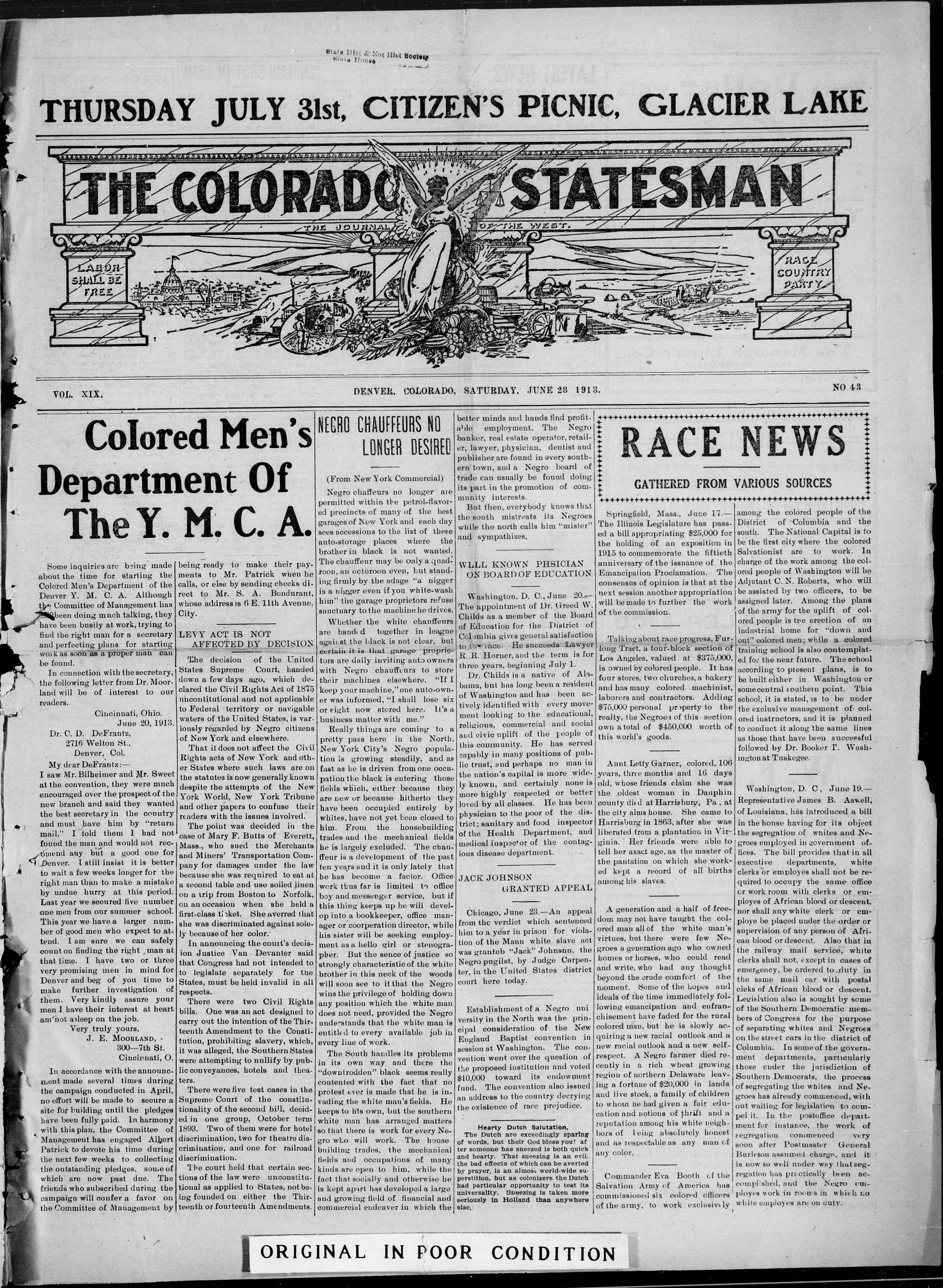
Page text (machine-generated)
THURSDAY JULY 31st, CITIZEN'S PICNIC, GLACIER LAKE
THE COLORADO STATESMAN
THE JOURNAL OF THE WEST.
LABOR SHALL BE FREE
RAGE COUNTRY PARTY
Colored Men's Department Of The Y. M. C. A.
Color Department The Y.
Some inquiries are being made about the time for starting the Colored Men's Department of the Denver Y. M. C. A. Although the Committee of Management has not been doing much talking, they have been busily at work, trying to find the right man for a secretary and perfecting plans for starting work as soon as a proper man can be found.
In connection with the secretary, the following letter from Dr. Moorland will be of interest to our readers.
Dr. C. D. DeFrautz,
2716 Welton St.
Denver, Col.
I saw Mr. Bilheimer and Mr. Sweet at the convention, they were much encouraged over the prospect of the new branch and said they wanted the best secretary in the country and must have him by "return mail." I told them I had not found the man and would not recommend any but a good one for Denver. I still insist it is better to wait a few weeks longer for the right man than to make a mistake by undue hurry at this period. Last year we secured five number one men from our summer school. This year we have a larger number of good men who expect to attend. I am sure we can safely count on finding the right man at that time. I have two or three very promising men in mind for Denver and beg of you time to make further investigation of them. Very kindly assure your men I have their interest at heart am not asleep on the job. Very truly yours.
J. E. MOORLAND. 300—7th St. Cincinnati, O.
In accordance with the announcement made several times during the campaign conducted in April, no effort will be made to secure a site for building until the pledges have been fully paid. In harmony with this plan, the Committee of Management has engaged Albert Patrick to devote his time during the next few weeks to collecting the outstanding pledges, some of which are now past due. The friends who subscribed during the campaign will confer a favor on the Committee of Management by
ORIGINAL IN FOOR CONDITION
being ready to make their payments to Mr. Patrick when he calls, or else by sending checks direct to Mr. S. A. Bondurant, whose address is 6 E. 11th Avenue, City.
LEVY ACT IS NOT
AFFECTED BY DECISION
The decision of the United States Supreme Court, handed down a few days ago, which declared the Civil Rights Act of 1875 unconstitutional and not applicable to Federal territory or navigable waters of the United States, is variously regarded by Negro citizens of New York and elsewhere. That it does not affect the Civil Rights acts of New York and other States where such laws are on the statutes is now generally known despite the attempts of the New York World, New York Tribune and other papers to confuse their readers with the issues involved.
The point was decided in the case of Mary F. Butts of Everett, Mass., who sued the Merchants and Miners' Transportation Company for damages under the law because she was required to eat at a second table and use soiled linen on a trip from Boston to Norfolk, on an occasion when she held a first-class ticket. She averred that she was discriminated against solely because of her color.
In announcing the court's decision Justice Van Devanter said that Congress had not intended to to legislate separately for the States, must be held invalid in all respects.
There were two Civil Rights bills. One was an act designed to carry out the intention of the Thirteenth Amendment to the Constitution, prohibiting slavery, which, it was alleged, the Southern States were attempting to nullify by public conveyances, hotels and theaters.
There were five test cases in the Supreme Court of the constitutionality of the second bill, decided in one group, October term 1893. Two of them were for hotel discrimination, two for theatre discrimination, and one for railroad discrimination.
The court held that certain sections of the law were unconstitutional as applied to States, not being founded on either the Thirteenth or fourteenth Amendments.
DENVER, COLORADO, SATURDAY, JUNE 28 1913.
State HIst & Nat Hist Boccey
State House
1st, CITIZE
ADC
THE JOURNAL
DENVER, COLORADO
NEGRO CHAUFFEURS NO
LONGER DESIRED
(From New York Commercial)
Negro chauffeurs no longer are permitted within the petrol-flavored precincts of many of the best garages of New York and each day sees accessions to the list of these auto-storage places where the brother in black is not wanted. The chauffeur may be only a quardroon, an octooroon even, but standing firmly by the adage "a nigger is a nigger even if you white-wash him" the garage proprietors refuse sanctuary to the machine he drives.
Whether the white chauffeurs are banded together in league against the black is not clear, but certain it is that garage proprietors are daily inviting auto owners with Negro chauffeurs to store their machines elsewhere. "If I keep your machine," one auto-owner was informed, "I shall lose six or eight now stored here. It's a business matter with me."
Really things are coming to a pretty pass here in the North New York City's Negro population is growing steadily, and as fast as he is driven from one occupation the black is entering those fields which, either because they are new or because hitherto they have been occupied entirely by whites, have not yet been closed to him. From the housebuilding trades and the mechanical fields he is largely excluded. The chauffeur is a development of the past ten years and it is only lately that he has become a factor. Office work thus far is limited to office boy and messenger service, but if this thing keeps up he will develop into a bookkeeper, office manager or coorporation director, while his sister will be seeking employment as a hello girl or stenographer. But the sense of justice so strongly characteristic of the white brother in this neck of the woods will soon see to it that the Negro wins the privilege of holding down any position which the white man does not need, provided the Negro understands that the white man is entitled to every available job in every line of work.
The South handles its problems in its own way and there the "downtrodden" black seems really contented with the fact that no protest ever is made that he is invading the white man's fields. He keeps to his own, but the southern white man has arranged matters so that there is work for every Negro who will work. The house building trades, the mechanical fields and occupations of many kinds are open to him, while the fact that socially and otherwise he is kept apart has developed a large and growing field of financial and commercial endeaver in which the
better minds and hands find profitable employment. The Negro banker, real estate operator, retailer, lawyer, physician, dentist and publisher are found in every southern town, and a Negro board of trade can usually be found doing its part in the promotion of community interests. But then, everybody knows that the south mistreats its Negroes while the north calls him "mister" and sympathizes.
WLLL KNOWN PHSICIAN
ON BOARDOF EDUCATION
Washington, D. C., June 20. The appointment of Dr. Greed W. Childs as a member of the Board of Education for the District of Columbia gives general satisfaction to face. He succeeds Lawyer R. R. Horner, and the term is for three years, beginning July 1.
Dr. Childs is a native of Alabama, but has long been a resident of Washington and has been actively identified with every movement looking to the educational, religious, commercial and social and civic uplift of the people of this community. He has served capably in many positions of public trust, and perhaps no man in the nation's capital is more widely known, and certainly none is more highly respected or better loved by all classes. He has been physician to the poor of the district; sanitary and food inspector of the Health Department, and medical inspector of the contagious disease department.
JACK JOHNSON
GRANTED APPEAL
Chicago, June 23.—An appeal from the verdict which sentenced him to a year in prison for violation of the Mann white slave act was granteb "Jack" Johnsnu, the Negro pugilst, by Judge Carpenter, in the United States district court here today.
Establishment of a Negro university in the North was the principal consideration of the New England Baptist convention in session at Washington. The convention went over the question of the proposed institution and voted $10,000 toward its endowment fund. The convention also issued an address to the country decrying the existence of race prejudice.
Hearty Dutch Salutation.
Hearty Dutch Salutation.
The Dutch are exceedingly sparing of words, but their God bless you! after someone has sneezed is both quick and hearty. That sneezing is an evil, the bad effects of which can be averted by prayer, is an almost, world-wide superstition, but as colonizers the Dutch had particular opportunity to test its universality. Sneezing is taken more seriously in Holland than anywhere else.
RACE NEWS
GATHERED FROM VARIOUS SOURCES
Springfield, Mass., June 17. The Illinois Legislature has passed a bill appropriating $25,000 for the holding of an exposition in 1915 to commemorate the fiftieth anniversary of the issuance of the Emancipation Proclamation. The consensus of opinion is that at the next session another appropriation will be made to further the work of the commission.
Talking about race progress, Furlong Tract, a four-block section of Los Angeles, valued at $375,000, is owned by colored people. It has four stores, two churches, a bakery and has many colored machinist, laborers and contractors. Adding $75,000 personal property to the realty, the Negroes of this section own a total of $450,000 worth of this world's goods.
Aunt Letty Garner, colored, 106 years, three months and 16 days old, whose friends claim she was the oldest woman in Dauphin county died at Harrisburg, Pa, at the city alms house. She came to Harrisburg in 1863, after she was liberated from a plantation in Virginia. Her friends were able to tell her axact age, as the master of the pantation on which she worked kept a record of all births among his slaves.
A generation and a half of freedom may not have taught the colored man all of the white man's virtues, but there were few Negroes a generation ago who owned homes or horses, who could read and write, who had any thought beyond the crude comfort of the moment. Some of the hopes and ideals of the time immediately following emancipation and enfranchisement faded for the rural colored man, but he is slowly acquiring a new racial outlook and a new racial outlook and a new self-respect. A Negro farmer died recently in a rich wheat growing region of northern Delaware leaving a fortune of $20,000 in lands and live stock, a family of children to whom he had given a fair education and notions of thrift and a reputation among his white neighbors of being absolutely honest and as respectable as any man of any color.
Commander Eva Booth of the Salvation Army of America has commissioned six colored officers of the army, to work exclusively
NO 43
among the colored people of the District of Columbia and the south. The National Capital is to be the first city where the colored Salvationist are to work. In charge of the work among the colored people of Washington will be Adjutant C. N. Roberts, who will be assisted by two officers, to be assigned later. Among the plans of the army for the uplift of colored people is the erection of an industrial home for "down and out" colored men; while a colored training school is also contemplated for the near future. The school according to present plans, is to be built either in Washington or some central southern point. This school, it is stated, is to be under the exclusive management of colored instructors, and it is planned to conduct it along the same lines as those that have been successful followed by Dr. Booker T. Washington at Tuskegee.
Washington, D. C., June 19. Representative James B. Aswell, of Louisiana, has introduced a bill in the house having for its object the segregation of whites and Negroes employed in government offices. The bill provides that in all executive departments, white clerks or employees shall not be required to occupy the same office or work room with clerks or employees of African blood or descent, nor shall any white clerk or employee be placed under the order or supervision of any person of African blood or descent. Also that in the railway mail service, white clerks shall not, except in cases of emergency, be ordered to duty in the same mail car with postal cleks of African blood or descent. Legislation also is sought by some of the Southern Democratic members of Congress for the purpose of separating whites and Negroes on the street cars in the district of Columbia. In some of the government departments, particularly those under the jurisdiction of Southern Democrats, the process of segregating the whites and Negroes has already commenced, with out waiting for legislation to compel it. In the postoffice department for instance, the work of segregation commenced very soon after Postmaster General Burleson assumed charge, and it is now so well under way that segregation has practically been accomplished, and the Negro employees work in rooms in which no white employees are on duty.
What a Dollar Will Do
at the
THE MONARCH
LINE & LIQUOR CO.
You Can Get
One Case of Good, Ste
ized Beer, 24 Pints
Or One Gallon of Pure
California Port, Sherry
Muscatel Wine.
Or One Full Quart o
Bond Rye or Bourb
The Monarch L
PHONE CHAMPA
1516 Court Place
SEEDS
Your back yard will help pay you
BARTELD
"WESTERN SEEDS FOR WES
THE BARTELDES S
1521-1525 Fifteenth St.
The Largest Poultry Supply H
HENRY MILLI
Case of Good, Steamed
Beer, 24 Pints to the
Gallon of Pure 8 Yea
onia Port, Sherry, Angle
tel Wine.
The Full Quart of Boo
Rye or Bourbon W
Monarch Liquor
PHONE CHAMPA 1231
Place D
SEEDS =
ward will help pay your rent
BARTELDES'
SEEDS FOR WESTERN
THE BARTELDES SEED O
nth St.
Largest Poultry Supply House in
Y MILLER
1939 BROADWAY
GRAVEL RO
AND CEMENT
Good, Steamed, Steril- 4 Pints to the Case. of Pure 8 Year Old art, Sherry, Angelica or e. Quart of Bottled in Bourbon Whiskey. March Liquor Co E CHAMPA 1231
One Case of Good, Steamed, Sterilized Beer, 24 Pints to the Case. Or One Gallon of Pure 8 Year Old California Port, Sherry, Angelica or Muscatel Wine. Or One Full Quart of Bottled in Bond Rye or Bourbon Whiskey.
SEEDS
help pay your rent if you plan
ARTELDES'
FOR WESTERN PLANTEES
ARTELDES SEED CO.
Denver, Coli
try Supply House in the West
MILLER & C
9 BROADWAY
AVEL ROOFING
AND CEMENT WORK
THE BARTELDES SEED CO.
1521-1525 Fifteenth St. Denver, Colorado
The Largest Poultry Supply House in the West
GRAVEL ROOFING AND CEMENT WORK Cement Ash Pits, $5 Up Repairing Promptly Done Tin Roofs Painted
All Work Guaranteed
Phone Main 1
V. F. Dav
Plumbing Inspector for City and
g, Heating and V
and Tests for Sewer Gas
defective buildings
Estimates Giver
PHONE SOUTH 855
WER & SC
Guaranteed Give Us
Phone Main 1062
F. Davis
Inspector for City and County of
Plumbing and Ventilation
Products for Sewer Gases On All
active buildings
Inates Given
NNE SOUTH 855 DENVER
R & SCHUCK
TE FARM LANDS
All Work Guaranteed Give Us a Trial
Phone Main 1062
W. F. D.
(12 Years Chief Plumbing Inspector for
Plumbing, Heating and
Examination and Tests for Sewer
defective build
Estimates G
842 BROADWAY PHONE SOUTH
BROWER &
W.F.Davis
(12 Years Chief Plumbing Inspector for City and County of Denver Plumbing, Heating and Ventilation Examination and Tests for Sewer Gases On All Old defective buildings
REAL ESTATE
311 Cooper Building
DENVER, COLORADO
K @ Eng'st
Engstrom
Beck & En
Beck & Engstrom
WHOLESALE DEALERS IN
Wines, Liquors
Cigars
Western Agents for Minneapolis Grain Belt Beer and C
Imported Beer and Bock Ol.
1644-46-48-50 Larimer S
Phone Main 1053
es, Liquors
Cigars
Minneapolis Grain Belt Beer and C
Imported Beer and Bock Ol.
4-46-48-50 Larimer S
53 D
LIQUORS and
CIGARS
Grain Belt Beer and Carnegie Porte
ed Beer and Bock Ol.
5-50 Larimer Street
Denver, Co
Wines, Liquors and Cigars Western Agents for Minneapolis Grain Belt Beer and Carnegie Porter, Pripps Imported Beer and Bock Ol.
1644-46-48-50 Larimer Street
Phone Main 1053 Denver, Colorado
A steam engine
HENRY BECK
Denver, Colo.
rent if you plant
S'
EERN PLANTERS"
ED CO.
Denver, Colorado
se in the West
R & CO.
ROOFING
ENT WORK
Give Us a Trial
tain 1062
avis
(ly and County of Denver)
Ventilation
Gases On All Old
ys
ven
DENVER, COLO
CHUCK
RM LANDS
Telephone Champa 1962
Residence Phone Main 7345
JOHN ENGSTROM
strom
S IN
rs and
LATEST NEWS EPITOMIZED
FROM TELEGRAPHIC REPORTS THAT COVER THE WEEK'S EVENTS.
OF MOST INTEREST
KEEPING THE READER POSTED
ON MOST IMPORTANT
CURRENT TOPICS.
Western Newspaper Union News Service.
WESTERN.
To hasten the harvesting, farmers
around Wichita, Kan. are cutting
wheat by moonlight.
A million dollars in gold, the first
shipment from Nome, Alaska, this
year, was received by the steamships
Senator and Victoria.
Wm, J. Burns, the detective, will be
paid $10,000 by the state of California
for capturing the McNamara brothers
in connection with the dynamiting of
the Los Angeles Times.
Twenty-one automobiles and twelve teams were waiting at the depot at Pratt, Kan., for harvest hands when a train arrived. Pratt county needs 200 more harvest hands and but few are coming.
Although she had $1,000 in local banks, and owned property in Kansas City and Denver, Miss Anna Lersen, aged seventy-five years, died alone in squalor in a small room in San Diego, Cal.
Practically complete unofficial returns of the Democratic primary election give Judge George Hays 27,785 votes and former Congressman Stephen Brundidge 26,525 in the contest for the nomination for governor of Arkansas.
A judgment ordering the payment of $758,953.94 damages with interest and costs, making a total of over $1,000,000, by the Silver King Coalition Company to the Silver King Consolidated Company was made by the United States District Court at Salt Lake. James T. Garrett, cashier of the Clear Creek county bank of Georgetown, Colo., from which Mrs. Ella McClendon, former postmistress at Sturdivant, Mo., is charged with fraudulently obtaining $900 of the account of John Rowan, returned and announced that Mrs. McClendon was bound over to the District Court in St. Louis to await a grand jury indictment.
Seven railroads operating in Minnesota have agreed to abide by the terms of a recent decision of the United States Supreme Court in the Minnesota rate cases, and announcement was made that the new rates probably would be placed in effect by July 10 and that refunds of overcharges would be made in all cases where proper proofs of such overcharges were produced.
WASHINGTON.
Bill for Hetchy Hetchy water works for San Francisco agreed on by public lands committee and introduced. June 24th was the twenty-eighth anniversary of the wedding of President and Mrs. Wilson. No formal celebration marked the event. Telegraph of congratulation were received at the White House. Secretary Bryan announced that he was strongly in favor of the Glass currency bill, and let it be known that he would use what influence he could in bringing about its early enactment by Congress. "Forget and forgive," was the keynote of an address delivered in Omaha by former Vice President Charles W. Fairbanks at a banquet tendered him by 300 Republican leaders of Nebraska.
For constructing the proposed federal building at Grand Junction the Treasury Department received the bid of J. J. Linnsden of Grand Junction, as follows: Colorado marble, $121,493, Colorado sandstone, $117,482; limestone, $116,367.
President Wilson signed the sunday civil appropriation bill with a statement declaring that he would have vetoed, if he could, the provision in it exempting labor unions and farmers organizations from prosecution under a certain $300,000 fund designated for the operation of the Sherman anti-trust law.
Bearing a personal plea for immediate action by Congress to revise the banking and currency laws, that business may be aided in meeting tariff revision. President Wilson for the second time went to the House of Representatives and personally read his address on the subject to both Houses of Congress assembled in joint session.
Junk dealers in 1912 did an enormous business, the geological 'survey asserts. The value of "secondary metals," exclusive of gold, silver, platinum, iron and aluminum, recovered last year was $77,395,843, as compared with $52,585,390 in 1911.
The administration currency bill is to undergo some important changes before it is pushed for action in either House or Senate, although the measure will be introduced in both houses virtually in the same form in which it was recently made public by Representative Glass.
FOREIGN.
The city of Durango was captured by rebels after a siege of several weeks.
The Duke of Sutherland is critically ill at his London home. He is in his sixty-second year.
What is alleged to have been a militant suffrage attempt to wreck an express train from London to Plymouth in a tunnel near Devenport was reported.
The prospect that the Balkan dispute will be submitted to Russian arbitration and that the premiers of the four Balkan states will meet at St. Petersburg is much brighter.
Raymond Poincare, president of the French republic, was entertained by King George at a state banquet with as great a display of pomp and magnificence as ever shown in honoring a royal guest at Buckingham palace.
Four fierce bulls broke loose at Almeira, Spain, while they were being taken to the bull ring. They charged furiously down the narrow streets, goring all in their path. One man was killed and many were injured.
A special dispatch from Sofia says that Bulgaria has definitely declined the Russian emperor's proposal for the meeting of the premiers of the Balkan states at St. Peterburg to discuss the critical situation in the near East.
Nicholas de Pierola, a noted peruvian statesman, died at Lima. General de Pierola was president of Peru from 1896 to 1899. He proved a strong executive and during his term of office there were no revolutionary disturbances.
SPORT.
Standing of Western League Clubs.
Won. Lost. Pct.
Denver 42 20 .677
St. Joseph 36 27 .571
Jacobus 36 29 .547
Des Moines 34 29 .540
Omaha 35 30 .538
Sioux City 26 36 .419
Topeka 29 39 .371
Wichita 22 44 .333
Pitcher Charles Wheatley of the Detroit American League team has been signed by the Sioux City Western League team.
Fred F. Gardiner, an aviator, was drowned in Lake Keuka, according to a dispatch from Bath, N. Y., when his airplane fell about 150 feet.
An aviator, Fairbarns, is said to have been drowned off Shoeburryness, near London. Fairbarns fell into the sea from a height of a thousand feet.
Eddie Campi of San Francisco was given the decision over Charles Ledoux of Paris at the end of their twenty-round bout at Vernon arena at Los Angeles.
Charlie French, Denver's fast second bascinan, broke his ankle in the game at Omaha. He will be out of the game for the rest of the season, and may not play again.
Ed. Hall, who was assisting Dick McMahon in workouts, drove the Denver pacer, Echo Direct, a mile in 2:16 at Libertyville, Ill. This was his fastest mile of the season without a break.
GENERAL.
The New York Assembly defeated Governor Sulzer's direct primary bill by a vote of 54 to 92.
Judge Henry C. Jones, ninety-four years old and last surviving member of the Confederate congress, died at his home at Florence, Ala.
The hills of Gettysburg, where the armies of Meade and Lee pitched their tents fifty years ago, are flecked with canvas, harbingers of the tended city which will soon arise on the battlefield.
Surgeons at the Medico-Chirurgical hospital in Philadelphia are interested in the case of John Michael, not yet fifteen year of age, who is six feet seven inches tall and is sill growing. He is outgrowing every organ of his body.
John H. Trenor, who died at his home in New Rochelle, N. Y., at the age of eighty-eight years, boasted that he had taught Theodore Roosevelt, William K. Vanderbilt, Chauncey M. Depew and James Gordon Bennett how to dance.
Mrs. Edna Wagner, thirty-two years old, of Brooklyn, N. Y., is dead from an acute attack of heart disease brought on by dancing the tango, turkey trot and the onestep for four consecutive hours at the Marathon dance given by the Ridgewood block party association.
Charged with hitching his twelve year old son Frank to a cultivator beside a mule and working him in the field in a temperature of 120 in the sun, John Freismuth, a farmer, was sought at LaCrosse, Wis., on a warrant issued on complaint of the state humane officer.
Four men are known to be dead, sixty were injured, some fatally, and several are unaccounted for as the result of an explosion in the elevator and grain storehouse of the Husted Milling Company at Buffalo, N. Y. Fire followed and destroyed the wooden section of the elevator.
In the election of Chris Irving as president and A. J. Davis as secretary of the National Association of Master Plumbers at their annual convention in Philadelphia, Denver will be the headquarters for the national association during the ensuing year.
Officers of the largest national banks of New York said that should the currency bill be enacted into law in its present shape no course would be left open to their banks except to withdraw entirely from the national banking system and take out charters under state laws.
ENGLISH SHOT IN HOME
WIFE PULLS BLIND AS MAN FIRES
THROUGH WINDOW.
Wealthy Itallan's Wife, Who Was Hit By Two Shots, Declares Cousin Did the Shooting.
Western Newspaper Union News Service.
Montrose, Colo.—Tony English, a wealthy Italian farmer and money lender, was shot through the window of his home a mile east of town and instantly killed. His wife, who saw a man with a gun lurking near the window, was attempting to draw a blind when the shot was fired. The gun was loaded with a charge of No. 6 shot and the wife was wounded.
Dan English, a cousin, residing on a neighboring farm, is held, charged with having done the shooting. He had quarreled with Tony English earlier in the day over $1,000 which had been loaned to him. During the quarrel Tony ejected him from his home and it is charged that he had a gun secreted outside, with which he did the shooting.
Mrs. Tony English, who was hit by two shot, declares that she identified the man outside, who did the shooting, as Dan English. When placed in jail here he denied all knowledge of the crime and declared that he was home in bed at the time of the killing. There has been bad blood between the two families for some time, which reached a climax when Tony ejected Dan from the house. The dead man was one of the wealthiest Italians in the western part of the state and besides his large ranching business loaned money to his countrymen.
One Dead and Four Wounded.
Trinidad. — Ventura Romero was shot and instantly killed and three others wounded at the ranch of Enrico Valentine, near Aguilar. The wounded men are Jim Resardi, who was shot through the right shoulder; Louis Apodoca, shot through the left arm, and Jesus Garcia, stabbed in the right side. Resardi is in a critical condition and may die. The shooting was done by Moses Maes of Aguilar as the result of a quarrel over the possession of a collie dog. Maes escaped to the hills after the shooting.
Rate Casé Postponed.
Denver.—The action of the Consumers' league to compel the Colorado & Southern and other roads hauling coal from the northern Colorado fields, to submit to the schedule of rates fixed by the state railway commission, was contained by Judge Perry until August 25. The hearing was postponed at the request of attorneys for the railroads.
Fruit Growers Begin Rate Eight.
Fruit Growers Begin Rate Fight. Grand Junction—The Western Colorado Railway Rate Association, which is composed of all fruit growers and shippers' organizations on the western slope, have started their fight against the Colorado Midland and Denver & Rio Grande railroads for a reduction of freight rates out of Grand Junction to other state points.
Highlanders Name Four Delegates.
Denver.—E. L. Fribourg, W. E. Freeman, Mrs. Augusta Thompson and Mrs. Julia Conover, all of Denver, at a district convention, attended by delegates from Utah, Nevada, New Mexico, Colorado and Wyoming, were elected delegates to the national convention of the Royal Highlanders, September 8 to 14.
Indians, 102, 97. Guests.
Montrose.—The board of directors of the Western Slope Fair Association decided to bring fifty Ute Indians from the reservation in Utah to Montrose during the fair in September. The Indians will include Chief McCook, ninety-seven, and his sister Chippea, 102, who is the widow of Chief Ouray.
Breaks His Hunger Strike.
Cripple Creek.—Two whole chickens, a two-pound layer cake, six cups of coffee, a pint of pickles, ten radishes, a dish of fried potatoes and a loaf of bread broke the hunger strike of James L. Bacon, former member of the state legislature, held here on a charge of dynamiting his home and killing his wife and stepchild.
Gambler Asks Pardon.
Denver.—Ell Green, serving a nineteen month sentence in the Las Animas county jail for operating a gambling house in Trinidad, appalled to Governor Ammons, through an attorney, for a pardon. Green urges that he was made "the goat" in an anti-gambling crusade.
Miner Killed By "Slow Shot" Blast.
Gunnison. — Theodore Phillips, seventy, a prospector, was killed at Ohio City, twenty-five miles northeast of Gunnison, by the explosion of a "slow shot."
Mrs. Copeland in Auto Crash.
Cripple Creek.—The car of W. S. Copeland, while returning from Colorado Springs to Victor, skidded and turned completely over at a point below the Moffat tunnel but none of the occupants was seriously injured. In the car were Mrs. Henry B. Nelson, Mrs. George E. Copeland, wife of the late G. E. Copeland, who was killed by a bullet from Harold Henwood's revolver, and Fred B. and Charles, sons of W. S. Copeland of the Copeland Sampling Company.
Western Newspaper Union News Service.
DATES FOR COMING EVENTS.
July 9-10—Meeting Colorado Postmasters' Association at Colorado Springs.
July 23-26—National Convention of Federation of American Motorcyvists at Colorado Springs.
July 28—Pacific Jurisdiction, W. O. W. at Colorado Springs.
Aug. 12-15—32nd Triennial Conclave of Anglo-Templar Denver.
Aug. 19-20—National Association of Park Superintendents at Denver.
Aug. 18-20—Army of the Philippines National Society at Denver.
Aug.—Grand Council of Order of Red Cross.
Aug. 25.—Conference of Governors at Colorado Springs.
Aug. 26.—Knights of Pythias Grand
Lodge meeting at Trinidad.
Sept. 2-4. Chanah at Indian Festival
at Chanah Springs.
Sept. 15-20. Colorado State Fair at
Pueblo.
Sept. National Association of First-
class Fostermasters at Denver.
Oct. 1-3. State W. C.T. U. Convention
at Salida.
Oct. 21.—Colorado State Baptist Association at Pueblo.
1915.—Last Grand Council of North American Indians, Denver.
The D. & R. G. will probably erect a new round house at Salida.
Forty-three years ago Friday, June 24, 1870 the first railroad train steamed into Denver.
Alfalfa cutting began in the vicinity of Loveland, and one of the biggest crops on record is being harvested.
Members of the National Editorial Association and the visiting Turners were entertained at the Denver Auditorium.
With the influx of Turners to Denver, came the record day in marriage licenses, which indicates that cupid is at work among the Turners.
The body of Clare Ward, domestic, who committed suicide in Denver after firing a bullet at Mrs. Renetta S. Van Schnaack, will be shipped to her brother, Curtis Ward, at Keosuqua, Iowa.
Assistant Coach McFadden of the University of Colorado has been offered a position as athletic director of Huron college, a Presbyterian school at Huron, S. D., with about 500 students.
The jury in the case of the Farmers Life Insurance Co., vs. John D. Wehrle, editor of the Center Post-Dispatch returned a verdict in favor of Wehrle at the June term of the Saguache county District Court.
The John W. Springer ranch, near Littleton, one of the largest and finest country places in the West, will be taken over by Col. William Hughes, Springer's former father law, and millionaire cattleman.
Semi-official notice was served upon Governor Ammons by the executive committee of the Colorado Bankers' Association that the new bank code adopted by the Nineteenth General Assembly and signed by the governor, will be referred.
A large number of teachers from various parts of the state are enjoying the time of their lives at Greeley. They are attending the State Teachers' college and, while all are engrossed in their studies several hours each day, yet there is time for recreation.
The stupendous sum of $2,000,000-000 was named by Governor Ammons in an address to the directors of the Chamber of Commerce as the increase in the value of Colorado lands which would results from watering all irrigable lands in the state. Henry L. Doherty and Frank W. Fruceauff were guests of the meeting.
While brass bands were giving a noisy welcome at the union depot to delegations of Turners, and while much cheer prevailed throughout Denver, there assembled in the Auditorium hotel in Denver sad-visaged delegates to the sixteenth annual convention of the Colorado Funeral Directors' and Embalmers' Association.
State Dairy Inspector Charles E. Cochran is entitled to serve in that capacity and draw salary from the state until the expiration of the term for which he was appointed, regardless of legislative acts or the governor's veto, according to the ruling of Judge Teller in the District Court at Denver.
Work on the Grand Valley High Line irrigation project of the United States reclamation service will begin immediately, according to a dispatch from Washington. A contract has been awarded the Reynolds-Ely Construction Company of Springville, Utah, for the excavation of the Canyon division of the main canal at a price of $109,568.
The Denver Union Water Company must either sell its plant to the city of Denver for $7,000,000 or the city must construct its own water distributing system, according to a letter sent to the Water company by the Denver water commission. In the letter the commission defined its powers and purposes and advised the maximum price that $7,000,000 was the maximum price it was authorized to pay.
The parents of Miss Lucy Smith of Fort Collins, an attractive girl who was graduated from the School of Agriculture a few weeks ago, are convinced that their daughter is being held by white slave agents. No news of her whereabouts has been received.
John Dalsant, timberman helper in Camp Bird mine, at Ouray, fell from a shaft bucket at the sixth level, crashed through a two-inch plank into the sump, dropped 105 feet and suffered only a few bruises and cuts on the head. The doctor sewed up the gashes to stop the flow of blood.
PRESIDENT URGES CURRENCY REFORM
Public Duty Makes Prompt Action Imperative.
READS MESSAGE TO CONGRESS
Business Men of Country Should Be Given Banking and Currency System. Which Will Make Possible Individual Initiation.
Washington, June 23.—The following is President Wilson's message to congress on the subject of currency reform:
Mr. Speaker, Mr. President, Gentlemen of the Congress: It is under the compulsion of what seems to me a clear and imperative duty that I have a second time this session sought the privilege of addressing you in person. I know, of course, that the heated season of the year is upon us, that work in these chambers and in the committee rooms is likely to become a burden as the season lengthens, and that every consideration of personal comfort, perhaps, in the cases of some of us, considerations of personal health even, dictate an early conclusion of the deliberations of the session; but there are occasions of public duty when these things which touch us privately seem very small; when the work to be done is so pressing and so fraught with big consequence that we know that we are not at liberty to weigh against it any point of personal sacrifice. It is absolutely imperative that we should give the business men of this country a banking and currency system by means of which they can make use of the freedom of enterprise and of individual initiative which we are about to bestow upon them.
We are about to set them free; we must not leave them without the tools of action when they are free. We are about to set them free by removing the trammels of the protective tariff. Ever since the Civil war they have waited for this emancipation and for the free opportunities it will bring with it. It has been reserved for us to give it to them. Some fell in love, indeed with the slothful security of their dependence upon the government; some took advantage of the shelter of the nursery to set up aalmic mastery of their own within
walls. Now both the tonic and the discipline of liberty and maturity are to ensue. There will be some adjustments of purpose and point of view. There will follow a period of expansion and new enterprise, freshly conceived. It is for us to determine now whether it shall be rapid and facile and of easy accomplishment. This it can not be unless the resourceful business men who are to deal with the new circumstances are to have at hand and ready for use the instrumentalities and conveniences of free enterprise which independent men need when acting on their own initiative.
It is not enough to strike the shackles from business. The duty of statesmanship is not negative merely. It is constructive also. We must show that we understand what business needs and that we know how to supply it. No man, however casual and superficial his observation of the conditions now prevailing in the country, can fail to see that one of the chief things business needs now, and will need increasingly as it gains in scope and vigor in the years immediately ahead of us, is the proper means by which readily to vitalize its credit, corporate and individual, and its originate brains. What will it profit us to be free if we are not to have the best and most accessible instrumentalities of commerce and enterprise? What will it profit us to be quit of one kind of monopoly if we are to remain in the grip of another and more effective kind? How are we to gain and keep the confidence of the business community unless we show that we know how both to aid and to protect it? What shall we say if we make fresh enterprise necessary and also make it very difficult by leaving all else except the tariff just as we found it? The tyrannies of business, big and little, lie within the field of credit. We know that. Shall we not act upon the knowledge? Do we not know how to act upon it? If a man cannot make his assets available at pleasure, his assets of capacity and character and resource, what satisfaction is it to him to see opportunity beckoning to him on every hand, when others have the keys of credit in their pockets and treat them as all but their own private possession? It is perfectly clear that it is our duty to supply the new banking and currency system the country needs, and that it will immediately need it more than ever.
The only question is, When shall we supply it—now, or later, after the demands shall have become reproaches that we were so dull and so slow? Shall we hasten to change the tariff laws and then be laggards about making it possible and easy for the country to take advantage of the change? There can be only one answer to that question. We must act now, at whatever sacrifice to ourselves. It is a duty which the circumstances forbid us to postpone. I should be recreant to my deepest convictions of public obligation did I not press it upon you with solemn and urgent insistence. The principles upon which we should
ORIGINAL IN POOR CONDITION
act are also clear. The country has sought and seen its path in this matter within the last few years—see it more clearly now than it ever saw it before—much more clearly than when the last legislative proposals on the subject were made. We must have a currency, not rigid as now, but readily, elastically responsive to sound credit, the expanding and contracting credits of everyday transactions, the normal ebb and flow of personal and corporate dealings. Our banking laws must mobilize reserves; must not permit the concentration anywhere in a few hands of the monetary resources of the country or their use for speculative purposes in such volume as to hinder or impede or stand in the way of other more legitimate, more fruitful uses. And the control of the system of banking and of issue which our new laws are to set up must be public, not private, must be vested in the government itself, so that the banks may be the instruments, not the masters, of business and of individual enterprise and initiative.
The committees of the congress to which legislation of this character is referred have devoted careful and passionate study to the means of accomplishing these objects. They have honored me by consulting me. They are ready to suggest action. I have come to you, as the head of the government and the responsible leader of the party in power, to urge action now, while there is time to serve the country deliberately and as we should, in a clear air of common counsel. I appeal to you with a deep conviction of duty. I believe that you share this conviction. I therefore appeal to you with confidence. I am at your service without reserve to play my part in any way you may call upon me to play it in this great enterprise of exigent reform which it will dignify and distinguish us to perform and discredit us to neglect.
PASSION FOR THE "PARLOR"
Medical Officer Finds Fault With Custom of Using Poorest Rooms for Sleep.
In the course of lectures on personal hygiene at the Royal Sanitary institute, Prof. H. R. Kenwood, medical officer of health for Bedfordshire, dealt with "The Home." Much might be done for the prevention of tuberculosis by the improvement of the home, he said, according to the London Daily Telegraph. Wherever there was dirt there was also degradation. But it was the really invisible dirt in the form of germs in the atmosphere or ground that was the most harmful. It was essential in dealing with these to make the acts of cleansing as simple as possible, and there should be no heavy pieces of furniture to move; no nailed-down carpets, but movable strips and squares and light washable curtains. It should be remembered that there is no such thing as dry cleaning. Dusting was a mere disturbance of particles unless a damp cloth, tea leaves or wet sand were employed.
Was there, he asked, anything more absurd than to find a little house in a shabby genteel street with its bedroom accommodation overtaxed and the best apartment used as the parlor—that holy of holies, with its odor that might be called sanctimonious, and occupying cubic space that could be far better used? This passion for the parlor was almost like the fetish of the uncivilized.
Direct sunshine, with its regenerative power and germicide effects, should not be reduced by heavy curtains. It was the soundest of investments to make the home as healthy and attractive as possible. The cuckoo type of parent, depositing its children at school and expecting them to learn everything there, should realize that the true influences in youth are those of the home itself.
Obliterating Field of Waterloo.
Obliterating Field of Waterloo.
While Americans are observing the semi-centennial of Gettysburg, and thousands study the battle by the aid of the monuments and markers on the battlefield, complaint comes to England that the Waterloo terrain is in danger. While La Hale Sainte and Hougomont still bear the marks of cannon shot, both are in danger of being rebuilt, and part of the Hougomont wall against which the wave of French courage dashed in vain has already been pulled down. That is not the worst of the situation, according to a British officer who recently visited the field. "Tramcars" and cheap fares have been followed by "tawdry cafes" located on the very spot whence the Imperial Guard recoiled. What is to be done? The suggestion is that co-operation of Belgians and Englishmen who would preserve the topography of Waterloo many be effective in doing for that famous field what has been done for Gettysburg, but the first step, it is admitted, will be very expensive. If preservation is not organized there is danger that the strategic points will be obliterated by garden and farm field—Boston Transcript.
To Train Porch Vines.
One of the best labor-saving arrangements is a device to fasten the strings or wire netting for the vines of the porch. A strip of wood one inch square and about six feet long, with a strong screw eye at each end, is all that is needed. Drive two nails into the upper part of the porch, the same distance apart as the screw eyes, then after tying the strings onto the strip lift it up and hook the screw eyes over the nails. Fasten the lower ends of the strings into the ground with small pegs and train the vines on them.
All problems are ultimately problems of education. If there is civic irresponsibility, the remedy is to educate the people. If there is a moral degeneration, the remedy is to educate the people. If there is industrial backwardness, the remedy is to educate the people. This is gradually being appreciated the world over, and the most remarkable demonstration of it appears to be in the little land of the Danes, which Booker T. Washington in the current World's Work, New York city, declares to be "the happiest country in Europe, perhaps the happiest country in the world." Yet Denmark, half a century ago, sustained a crushing military defeat at the hands of Prussia, and lost one-third of her richest territory. Perhaps it was this loss that awakened the country to its opportunity and need. The army has been doing as a state, making the most of its limited area, few resources and humble population. The agency described by Mr. Washington as most characteristic is the rural high school system of Denmark. These rural high schools, he believes, have transformed the country. They are the power back of the Danish farmer who is the power back of the Danish throne. He lives better than his class in any other part of Europe, and we are told that, if not every peasant's cottage, at least every co-operative dairy has its shower bath. Illiteracy has almost disappeared in Denmark. Of all the immigrants who enter the United States, 24.2 per cent. are unable to read or write. Of the Scandinavian immigrants, however, only eight per cent. are thus deficient, the significance of which fact can be fully appreciated only when it is known that even the German immigrants are 5.8 per cent. illiterate, though Germany's educational system is supposed to be well-nigh perfect.
1. In all cases of typhoid, however mild, the patient should remain in bed. The course of the disease may be greatly shortened by keeping the patient in a prostrate position. 2. The vessels used in the sick room should be thoroughly scalded after use. 3. All food utensils should be washed and scalded separately before placing with dishes used by the family. 4. Bed linen, towels, wearing apparel, should be plunged into boiling water or water containing a strong solution of carbolic acid before they are washed. 5. Chloride of lime, which can be bought by dozen cans, or bichloride of mercury, are safe disinfectants for vessels used in the sick room. 6. The caretaker should cleanse her hands with a disinfectant (carbolic acid, creolin, bichloride of mercury), before taking food. 7. Treat all excreta from patients with disinfectant of sufficient strength that all typhoid germs may be killed before removing from the sick room. 8. Bury all excreta from typhoid patient. 9. Keep all flies from the sick room. 10. Write to your state board of health for literature upon the care and treatment of typhoid fever.—Raleigh (N. C.) Progressive Farmer.
Hens over three years old will not be producers in the winter. Unless they are exceptional they should be marketed.
A turnip cut in half and suspended from the roof of the henhouse just out of reach of the hens will afford them diversion and exercise.
In the matter of saving moisture in the soil a good many of us are a good deal like the rabbit in the fable. In the winter time he was always speaking of building a house next summer. When summer came and he was reminded of it, he answered: "Every bush is a house now." When a good shower comes we ought to get the moisture into the soil and keep it there. We have no assurance that we will have enough to ripen the crop, to put the soil in good condition for plowing, to leave the soil with a good moisture content for next spring. More can be done in the 36 hours following a rain than at any other time. If the soil is too dry, then save what little moisture is left. Remember that moisture can not pass up through loose soil.—W. C. Palmer, North Dakota.
Disease germs will infect egg shells, hence to be sure of healthy chicks have healthy and germ-free surroundings for the laying flock. Whitewashing and spraying with a mixture of kerosene and carbolic acid will kill insects and disease germs in poultry houses and nest boxes.
Bran should be moistened with a little milk and seasoned with salt and pepper.
After some men have been handed a lemon they act as if they were trying to corner the vinegar market.
A woman thinks more of her figure and complexion than a man does of everything he pays taxes on.
Lamp chimneys rubbed with salt after washing have a surprising brilliancy.
The woman who is too stout should avoid, above all things, a hard line at the bust. Most women who are acquiring too much flesh make the mistake of wearing high corsets and having their dresses fitted very tightly from shoulder to waist line. Others go to the other extreme and have loose corsets, very low in the bust, so that they resemble meal bags. These also wear rather tight waists, though not so snugly fitted as the other type, for they want to be comfortable and are usually content to sit around and grow fatter uncomplainingly. The medium corset is best, especially when the first evidence of a tendency to overplumpness is noticed. Then should the woman in question begin to study her lines far more assiduously than if she were too slender. The dressmaker takes care of the woman who is too thin, draping artfully to hide defects, but overplumpness is usually beyond her powers and she almost invariably tries to treat it by compression.
1. Remember that a mother should know, not guess. 2. The milk for the baby should have your first care. Just one feeding of impure milk may be sufficient to bring on an attack of diarrhoea or other grave symptoms. 3. When babies are teething rub their gums with cold water. It will often prove a great relief. 4. Begin early teaching the baby regular habits. Two or three months old is not too young—a certain time for the bath, after the bath, the food, then a nap. 5. Arrange a separate bed for the baby. It should be placed, when in use, in a spot protected from excessive light and strong drafts. 6. Keep in mind that it is not enough to love our babies. We must love understandingly.—Raleigh (N. C.) Progressive Farmer.
Brown, which is to be the color vogue of the coming year, appears in bags of striped antelope, in suede equipped with gold military cord handles, in brown leather with strap handles, in giraffe calf mottled in self tones on an Etruscan metal frame embedded with amber, and in snake-skin over an oxidized German silver frame faceted with topaz. These bags are lined with malale or amethyst colored suede, have capacious outer pockets containing a beveled mirror, comb, memorandum book and ivory tipped pencil, and their handles are attached to a silver bracelet which may be slipped over the wrist.
John Milton Milne suggests that certain experiments made by him, showing that photographic effects are produced by some form of radiation from chalk and granite in the Isle of Wight and Cornwall—radiation which he thinks is probably of an electric nature—may possibly throw light upon differences of climate observed in places which are relatively near together. Future research, he thinks, may perhaps show that the wellbeing of living things on the surface of the earth is more dependent upon its radiations than has hitherto been supposed.
You will find it easy to have your roast well-browned, yet not overdone, in fact, as rare as you please, if you add a little sugar to the salted water which you use to baste the roast with. This will serve to give it a rich brown color, delightful to the eye, and the taste of burnt sugar will be delectable to the taste as well.
Before washing ebony brushes smear a little good vaseline over the backs. This prevents the ammonia or soda water in which they are washed from injuring the ebony. The vaseline should afterwards be carefully rubbed off and the backs polished with dry cloths.
If you wish to bleach faded summer dresses allow a tablespoonful of chloride of lime to every quart of water required. Stir the article about in this water until all color has disappeared, then rinse thoroughly in clean water.
Egg shampoo is made by beating the yolks of two eggs in two cupfuls of warm soft water and then adding one teaspoonful of borax. Rub this into the hair, washing it off gradually with more warm water and rinsing at least three times.
To sweeten jars and cans which have contained onions or anything else of strong odor, wash the articles clean, then fill them with fresh garden earth, cover and let stand for twenty-four hours. Then wash and dry them.
Argentina has established a meteorological station at an elevation of 4,000 feet.
A new electrical clock is run easily renewed dry batteries, requiring no winding.
The Transvaal is now producing considerably more than one-third of the world's gold.
So-called Chinese glue is made by dissolving shellac in ten times its weight in ammonia.
FLORAL DESIGNS PUT UP WHILE YOU WAIT
CHOICE PLANTS AND CUT FLOWERS CONSTANTLY ON HAND
GREENHOUSES: Thirty-Fourth and Curtis Streets
TELEPHONE, MAIN 1511 DENVER, COLO
2735 Welton St. Main 6363
The Central Bottling & Distributing Co.
Agents for the famous
CAPITOL BEER---IT'S CAPITAL
Try a case, 2 doz. pints for $1.10, delivered promptly; empties called for.
Family Liquors, Wines, and Cordials Genuine Goods at Popular Prices A glass of good wine will improve your Sunday dinner, and aid digestion.
The Champa Pharmacy
Twentieth and Champa,
Is the place to get your
DRUGS, CHEMICALS AND PATENT MEDICINES
Prescriptions Our Specialty.
Phone us and we will deliver the goods to all parts of the city.
JAMES E. THRALL, PROPR.
PHONE MAIN 2425.
WORK CALLED FOR AND
DELIVERED
REPAIRING DONE WHILE
YOU WAIT
TELEPHONE MAIN 7377
THE CAPITAL CITY SHOE
REPAIRING CO.
SEWED HALF SOLES 60 cts. and 75 cts.
HENRY WARNECKE, President
1511 CHAMPA STREET DENVER, COLO.
Boost Colorado Produits Patronize Home Industry
ZANG'S
DELICIOUS TABLE BEERS
COLUMBINE,
VIENNA AND
PILSENER
Guaranteed Absolutely Pure.
Delivered Daily to All Parts of the City.
The Ph. Zang Brewing Co.
TELEPHONE GALLUP 395.
We Boost for Colorado You Should Boost for Us
DAY OR NIGHT. PHONE MAIN 6243
A. M. LAWHORN
Undertakers
A first-class Mortuary establishment. First aid to the bereaved in the time of death of loved ones. Prices below competitors. Polite service
LAWRENCE JONES, Licenced Embalmer
LOUIS HUBBARD, Funeral Director
PARLORS 1925 Arapahoe Street
Shirts, Collars and Cuffs, Blankets, Curtains and Rough Dry Work. The Denver Sanitary Laundry. PHONE MAIN 5670
THE COLORADO STATESMAN
JOS. D. D. RIVERS.....Proprietor
1824 Curtis Street, Room 25.
Phone Main 7417.
SUBSCRIPTION RATES:
One Year ..... $2.00
Six Months ..... 1.00
Taree Months ..... .60
PAYABLE IN ADVANCE.
Entered as second-class matter at the postoffice in the city of Denver,
Colorado.
All communications of a personating nature that are not complimentary
will be withheld from the columns of this paper.
Display advertising, 25 cents per square. A square contains ten agate lines.
Reading notices, ten lines or less, 10 cents per line. Each additional line
over ten lines, 5 cents per line.
No discounts allowed on less than three months' contract. Cash must accom-
pany all orders from parties unknown to us. Further particulars on application.
Remittances should be made by Express Money Order, Postoffice Money Order, Registered Letter or Bank Draft. Postage stamps will be received the same as cash for the fractional part of a dollar. Only 1-cent and 2-cent stamps taken.
Communications to receive attention must be newsy, upon important subjects, plainly written only upon one side of the paper; must reach us Tuesdays, if possible, anyway, not later than Wednesdays, and bear the signature of the author. No manuscript returned, unless stamps are sent for postage.
It occasionally happens that papers sent to subscribers are lost or stolen. In case you do not receive any number when due, inform us by postal card and we will cheerfully forward a duplicate of the missing number.
SHREWD BUSINESS ACUMEN.
upon this important subject we have to pass, both in business and the laity, the fine festive dollar, second in wisely in that dollar come back to you with skill and only stop to study the circuit of a lesson that would be a benefit. For going is to keep the dollar moving, but not ourselves. In this way the dollar does not for all. Buy only of the man that the dollar comes back to you again. The sacumen. The Negro needs a few less Colorado Statesman wants to give this in every week, you will find them intensely keen to the situation. The note of warnin the light is visible in the sky, but we our advice, whose very safety and totally oblivious to our warning and his master. It is for this reason we are asking reading this page to put out our lesson and help others, and if we can get a hug talking they will tell others.
In our talks upon this important subject we have sought to impress upon our readers, both in business and the laity, the necessity first in accumulating the festive dollar, second in wisely investing it, and, thirdly in having that dollar come back to you with some increase. If our people would only stop to study the circuit of a dollar they would get a fine object lesson that would be a benefit. For instance, the fine art of financiering is to keep the dollar moving, but moving in a circle around among ourselves. In this way the dollar does not make wealth for one only, but for all. Buy only of the man that will in turn buy of you and your dollar comes back to you again. This is the secret of shrewd business acumen. The Negro needs a few lessons in the school of coin. The Colorado Statesman wants to give this instruction. Read these articles every week, you will find them intensely interesting if your eyes are open to the situation. The note of warning to the Negro is being sounded, the light is visible in the sky, but we fear that the very people who need our advice, whose very safety and progress is being endangered are totally oblivious to our warning and heed not our alarm or signal of disaster. It is for this reason we are asking the thoughtful people who are reading this page to put out our lessons to others. If it helps you it will help others, and if we can get a hundred live people to thinking and talking they will tell others.
LAPSE OF LITERARY GENIUS.
t in the sciences is generally regard Negro which will hasten his recognition the world at large, as an indivisible p
Development in the sciences is generally regarded as one of the avenues to the Negro which will hasten his recognition by the people in general and the world at large, as an indivisible part of that social brotherhood whose higher intelligence dominates the affairs of men and breaks down the barriers which ignorance and prejudice erect to perpetuate the social separation of the races, elements and classes. Literature is the mirror in which the higher intelligence of people is reflected, and its numerous branches provide an almost limitless field for the demonstration of genius such as moves men to acknowledge the indestructible existence of a universal human brotherhood. We all remember that some years ago a number of our brighter literary lights were commanding the admiration and approbation of the nation's thought leaders and winning for themselves and their intellectual contemporaries that social recognition which no other qualifications had been able to achieve. When Paul Lawrence Dunbar's genius was recognized, it opened to him social and literary relations and associations which aroused to activity new influences of material benefit to his entire race, and Charles W. Chestnutt, the novelist, and other contemporaneous writers of note, added to the prestige which the Negro then began to enjoy. This was more than a passing fad, for it lived without abatement while the evidence of pure and undiminished genius was maintained. But our corps of brilliant passion painters was not rapidly augmented, as those of other races seem to be, and with the passing of these exceptional lights, that sympathetic affection which was knitting us into close relations with our fellows has suffered discernably. We still have Du Bois, the logician, and Kelley Miller, the essayist and critic, but they lack the romantic qualities which appealed to all classes so urgently through the works of our disciples of fiction. The need for greater literary devotion on the part of the Negro is apparent. The careful schooling and training and the patient and deliberate application, which develop latent genius in other men and women and among other races, ought to be more generally appreciated by those who are responsible for the instilling of educational ideals and aspirations in the minds and hearts of our Negro youth.
The right Kind of Reading Matter
---
The home news; the doings of the people in this town; the gossip of our own community, that's the first kind of reading matter you want. It is more important, more interesting to you than that given by the paper or magazine from the outside world. It is the first reading matter you should buy. Each issue of this paper gives to you just what you will consider
The Right Kind of Reading Matter
clear way is provided for merit in whatever guise it may appear.
It is not my purpose to compare in general the worth of our public and of our private schools, or to lament that necessity of protest which has brought private schools into being. In the growth of institutions, as in the development of man, there is ever "something to cast off—something to become." The public school system has had its share of attendant defects which private schools have sought to lessen or to remedy. It is fair to say, however, that in the attempt to reach the ideal of democracy the public school takes precedence, not only of private schools, but of all other institutions. In the nature of its constituency, the public school provides opportunities of contact which within wise limits must ever be the basis of democratic society.
To unite people, young or old, in human associations of any kind, depends upon the ability to overcome certain instinctive prejudices. We need to rise above the tendency to put people into classes according to superficial marks of feature or of color. We need to see the individual rather than the class.
In the public schools throughout our land a social life based upon this lighter form of thinking is slowly but surely evolving. Inherited prejudices are laid aside, as character, ability, and the capacity for good comradeship come to the front, and win their rightful recognition. In a country in which the people is sovereign, it is important that the boys and girls who are to grow into sovereign power learn this great lesson of individual worth—that they cease to class one another according to race or religion, wealth or artificial power, that they be lifted into the larger thought of true neighborliness.
Cliques have no place in a public school. Secret societies are excluded as a menace to the democratic ideal. The common tasks, the daily recreations, the mutual enjoyment of the columns of the school paper, the sympathetic appreciation of the virtues and the foibles of teachers, the pride of the school's standing in the community, these are the interests that unconsciously lift the boys and girls into a social life that binds them for all the years to come in the joy of a happy retrospect.
The time is coming, I believe, when our boys and girls through the instruction of especially trained teachers, will better understand their relations to each other in the home and in society, and the foundations laid for a higher social order. I believe that inquiry would prove that cities which have adopted the co-educational plan would be able to present facts that would wipe away every vestige of ancient prejudice. I write this in full appreciation of the difficulties of
case, and persons who have contracted it should not be married.
Education of the masses is necessary before the plan can be properly carried out. Parents should be educated by members of the medical profession, and they in turn should educate their sons and daughters. The matter should be taken up in the public schools. The teachers should be instructed so they can impart their knowledge to the children under them. The plan of requiring medical certificates before marriage is not new. The question has interested the public for 4,000 years. The ancients had to confront it. Now there is a national association to fight the white plague. Recently a resolution was offered in congress with a view toward compelling men to secure clean bills of health before marriage.
There is not a medical society in this country that has not discussed the matter, and it will not be very long before each state in the Union has a law compelling all persons to present a certificate.
The boards of health in all large cities have considered the matter and many of them have passed resolutions advocating the health certificates.
When only persons of sound health are married it will be one of the greatest steps that has ever been taken to stamp out contagious diseases.
some adverse comment. On the other hand, they are decidedly a benefit. There is little doubt that they are the workingman's best friends. If it were not for the cat, what about the rat? I think Chicago would have to call upon the fabled "Piper."
Rats and mice eat the workingman's hard-earned food to the value of thousands of dollars. If they were permitted to multiply undisturbed, imagine the value of the food this army of rodents would consume. Likewise they spread disease to a greater extent than do cats. Perhaps the Chinese plague question will throw some light on that point.
Cats do not simply drive out rodents as do some of the advertised "rat catchers." They catch, kill and consume their prey. Why tax a necessity for which no adequate substitute has been found while the rich are permitted luxuries on which either a very small tax or none at all is levied?
nor is it hard for any man who is used to work. I have passed two seasons in the harvest field, and the work on the boat is a snap compared to this. You are not compelled to "sleep with the cattle." Each man is provided with two blankets and a bunk or berth to sleep in.
I sailed from Boston and landed in Liverpool. We were twelve days making the trip. I enjoyed it more than anything I had ever attempted.
I passed nearly five months in Europe on very little money and visited England, Ireland, France, Switzerland, Germany, Belgium, the Netherlands, Denmark, Norway and Sweden and returned from Copenhagen, Denmark, arriving in New York after eleven days on the water.
Democracy Among Boys and Girls in Schools By CLARA BANCROFT BEATLEY
clear way is provided for merit in whatever g
It is not my purpose to compare in ge
and of our private schools, or to lament th
has brought private schools into being. In
in the development of man, there is ever "son
to become." The public school system has
defects which private schools have sought to
fair to say, however, that in the attempt to
the public school takes precedence, not only
other institutions. In the nature of its con-
vides opportunities of contact which within
basis of democratic society.
To unite people, young or old, in hun
depends upon the ability to overcome certa
need to rise above the tendency to put per
superficial marks of feature or of color. We
rather than the class.
In the public schools throughout our la-
lighter form of thinking is slowly but sure
dices are laid aside, as character, ability, an
radeship come to the front, and win their rig
try in which the people is sovereign, it is
girls who are to grow into sovereign power
individual worth—that they cease to class one
religion, wealth or artificial power, that t
thought of true neighborliness.
Cliques have no place in a public school
as a menace to the democratic ideal. The co-
tions, the mutual enjoyment of the columns
thetic appreciation of the virtues and the
of the school's standing in the community
unconsciously lift the boys and girls into a
all the years to come in the joy of a happy
The time is coming, I believe, when o
instruction of especially trained teachers, wi
tions to each other in the home and in soc
for a higher social order. I believe that in
which have adopted the co-educational plan
that would wipe away every vestige of anci
full appreciation of the difficulties of
such a plan, and in equal faith that they may be surmounted.
Only Persons of Sound Health Should Marry By Dr. J. P. MOORE, San Francisco
ease, and persons who have contracted it should Education of the masses is necessary be carried out. Parents should be educated by resi nation, and they in turn should educate their reter should be taken up in the public scho instructed so they can impart their knowledge The plan of requiring medical certificates be question has interested the public for 4,000 yr front it. Now there is a national associat Recently a resolution was offered in congress men to secure clean bills of health before ma There is not a medical society in this the matter, and it will not be very long be has a law compelling all persons to present The boards of health in all large cities b many of them have passed resolutions advoc When only persons of sound health are greatest steps that has ever been taken to
Cats Prove Worth by Killing Rats and Mice By H. D. JARNETT, Chicago
some adverse comment. On the other hand There is little doubt that they are the work were not for the cat, what about the rat? I call upon the fabled "Piper."
Rats and mice eat the workingman's haw thousands of dollars. If they were permit imagine the value of the food this army of wise they spread disease to a greater extent Chinese plague question will throw some light Cats do not simply drive out rodents "rat catchers." They catch, kill and consumsity for which no adequate substitute has permitted luxuries on which either a very sm
European Trip Made by Means of Cattle Boat By E. C. JENSEN, Chicago
nor is it hard for any man who is used to wander in the harvest field, and the work on the beaches. You are not compelled to "sleep with the cow with two blankets and a bunk or berth to sleep." I sailed from Boston and landed in days making the trip. I enjoyed it more attempted.
I passed nearly five months in Europe, fitted England, Ireland, France, Switzerland, erlands, Denmark, Norway and Sweden and Denmark, arriving in New York after eleven months.
A democracy has been called a form of society in which every man has a chance and knows that he has it. In our public schools every boy has a chance. He knows that he has it. A
general the worth of our public that necessity of protest which in the growth of institutions, as something to cast off—something has had its share of attendant to lessen or to remedy. It is to reach the ideal of democracy of private schools, but of all institucy, the public school prowise limits must ever be the human associations of any kind, main instinctive prejudices. We people into classes according to We need to see the individual and a social life based upon this merely evolving. Inherited prejudice and the capacity for good comghtful recognition. In a couns important that the boys and learn this great lesson of indie another according to race or they be lifted into the larger. Secret societies are excluded common tasks, the daily recrea of the school paper, the sympa foibles of teachers, the pridey, these are the interests that social life that binds them for retrospect. Our boys and girls through the will better understand their relaciety, and the foundations laid inquiry would prove that cities a would be able to present facts client prejudice. I write this in
Llora Cawcroft Pattley
Physicians in nearly every state in the Union are now advocating that medical certificates shall be presented by persons who desire to be married. Tuberculosis is an awful dis
should not be married.
before the plan can be properly members of the medical professions and daughters. The matsools. The teachers should be led to the children under them. before marriage is not new. The years. The ancients had to conition to fight the white plague with a view toward compelling marriage.
a country that has not discussed before each state in the Union it a certificate.
have considered the matter and eating the health certificates.
are married it will be one of the stamp out contagious diseases.
The cat taxing problem should be held up for reconsideration. Cats are undesirable only in so far as they spread disease, although their occasional duets on the back fence create
and, they are decidedly a benefit. Workingman's best friends. If it I think Chicago would have to hard-earned food to the value of snitted to multiply undisturbed, rodents would consume. Likelent than do cats. Perhaps the right on that point. As as do some of the advertised me their prey. Why tax a neces been found while the rich are small tax or all at is levied?
I made a trip to Europe by cattle boat years ago. Of course, a fellow has to rough it a little, but it is certainly a good experience for any young man. The work is not disagreeable.
work. I have passed two seasons boat is a snap compared to this. cattle." Each man is provided sleep in. Liverpool. We were twelve more than anything I had ever be on very little money and visi, Germany, Belgium, the Nethand returned from Copenhagen, ten days on the water.
FLAGS IN WASHINGTON
FLAGS IN WASHINGTON
BANNERS OF ALL NATIONS TO BE SEEN THERE.
At Legations of Civilized Nations, and Perhaps Some Others—Distinguished Persons Always Coming and Going.
The people of Washington probably are better acquainted with the flags of nations than dwellers in any other American city. The legations of all civilized nations are here, and then perhaps some others. Distinguished persons or persons are always coming and going in the capital of the United States and courtesy calls for the display of many different
dwellers in any other American city. The legations of all civilized nations are here, and then perhaps some others. Distinguished persons or personages are always coming and going in the capital of the United States and courtesy calls for the display of many different flags. The leading hotels keep flags of all nations and they make frequent display of flags representative of nations that were, before their absorption or extinction.
And this brings to mind that in the flags of all nations which may be seen in Washington red is the most usual color. You will see it in nineteen national standards. You will see blue in the emblems of the United States, Russia, France, Great Britain, Holland, Equador, Sweden, Chile, Portugal, Venezuela and Cuba. Yellow appears in the flags of Austria, Spain, Belgium, Brazil, Persia, Sweden, Egypt, China and Venezuela. The yellowest flag is, of course, the United States quarantine flag. Black is to be seen in the flags of Germany, Belgium and China. The ensign of Samoa has or had black in it. Green appears in the flags of Brazil, Bolivia, Mexico, Italy and Persia. The merchant flag of Bulgaria has green in it and so, too, has the merchant flag of Austria-Hungary.
The flags that are all red are the ensigns of Morocco and of Zanzibar and the merchant flag of Tunis. There is a larger ratio of red in the imperial flag of Japan, the ensign of Switzerland, the ensign of Turkey and the merchant flag of Great Britain than in the flags of other important nations. The flag with the largest ratio of white is that of Equador.
It is appropriate in this connection to recall that the flag of the Confederated American colonies was a field of red with a red cross of St. George on a white ground in the upper staff corner, the Bunker Hill American flag was a blue field with a red cross of St. George on a white ground in the upper staff corner, the Rattlesnake flag was a yellow field with a coiled snake in black in the center, and the American Appeal to Reason flag was a white field with a green pine tree in the middle.
STANLEY'S WAY TO CONGRESS
Traveled on Steamboat as Long as Funds Lasted and Then Got Off.
Representative A. O. Stanley of Kentucky was once a school teacher in the mountains of his native state. The employment was not entirely satisfactory to the young man and accordingly one day he decided to go out and see the world.
Boarding a steamboat, he went direct to the captain and handed him what funds he had in his possession. He told the captain to let him stay aboard until his money was used up and then put him off.
Reaching the town of Henderson, the captain went up to young Stanley and announced that this was his getting off place.
"Your money's all gone," he said. "All right, captain," replied the youthful Kentuckian with spirit. "I'll get my luggage and go ashore. I am going to get ready to go to congress from here." Ten years later Stanley presented his credentials to the speaker of the house of representatives, as a member of congress from Henderson, Ky.
Declined With Thanks
A southern admirer of President Wilson wants to present him with a live alligator. He wrote to inquire if the president would accept the saurain. The White House is thanking its good fortune that he did not send the alligator first and write afterwards. He closed his letter with the phrase "awaiting your reply most anxiously." Precisely what he means is not known, but his anxiety over having a live alligator off his hands can be no greater than that of the White House at the prospect. The raw materials for pocketbooks and traveling bags was declined with thanks.
Ambassador's Typewriter.
There is a new piece of furniture at the German embassy in the shape of Baron Marschall von Bieberstein's typewriter.
It is a secret typewriter, too, with a type that is different from all others in the world. It is locked up in the ambassador's desk, only to be brought out when there is confidential and important cipher correspondence to be typed, says the London Express.
Then the ambassador sits down and types with the secret typewriter himself, not even entrusting the messages to his private secretary.
LAMPS FEATURE OF BUILDING
Soft. Glowing Bulbs at Pan-American Structure Are Objects of Great Interest.
There are no lamps in Washington like those that shed their soft glow at the east entrance to to Pan-American building on 17th street. Very many persons overlook them because they are only a single feature of that dazzling white building and are encompassed by so many other beautiful things.
From the sidewalk is a level space of pure white marble pave leading to a low flight of seven marble steps. At the sides of this wide and low stairway are the lamps, which are of gray green bronze, resting on square marble pedestals taller than the tallest man. Then the eye sees the base of the lamps, a lion's paw with prominent claws supporting each corner. Above this base is the strong circular stem of the lamp, and next above is the lamp proper, modeled after the fashion of a great lantern. The light is glass-inclosed, three panes high of frosted glass and twelve panes in circumference. Thus there are thirty-six of these panes of glass, each about the size of the old-fashioned window lights familiar in old-time houses and which are sometimes put in new houses for colonial or early republican effect. Around the base of each light are six small bronze heads of tigers. The top of each lamp is convex and reminds one of the top of a big, round tureen or chafing dish.
Flanking the lamps are a marble balustrade and the sunken garden, with its rich green turf bordered by white marble coping and hedges of box. In the garden at each side of the approach are yellow graveled walks coped with short staircases which overcome the difference in level between that of the street and the lower garden. Also notable are four big old sycamore trees—three in the north garden and one in the south.
In the southeast corner of the south garden is a sign, put there by the inaugural committee on the marking of historic sites, which reads:
"Site of the residence of Gen. Van Ness, who married the daughter of Davy Burns, original owner of the grounds now occupied by the White House, treasury and state, war and navy departments."
The sign stands close to a great old sycamore, the noon shadow of which falls across the marker. Perhaps the shade of that sycamore fell often on Gen. Van Ness and his wife, Marta Burns, and perhaps it was growing there when old Davy owned the land.
SENATE BATHROOMS NO
Showers, Plunges, X-Ray Machines, Upholstered Couches, and Other Luxuries Locked Up.
The senate bathrooms are locked up. The showers, the plunges, the X-ray machines, the delicately-upholstered couches, the masseurs and other luxuries, for which Uncle Sam has been paying handsomely, are no more, so far as the senators are concerned. If a senator wants a bath he has to get it at home or hire a bath of the common or garden variety at the prevailing prices. One of the solemn questions before the Democratic caucus some days ago had to do about the baths. In secret, behind tightly closed doors, the matter was debated. It was before the caucus intermittently for several days. Finally it was decided that the Democratic party could not talk economy while senators were bathing extravagantly and luxuriantly at public expense. So it was decided the bathrooms should be closed.
As a result, the magnificent marble establishment is in disuse. The chief messeur and his attendants are gone. It is estimated the bathrooms cost for operation and all something like $10,000 a year. Several thousand dollars were paid out to the field marshal of the masseurs and his subordinates. Besides, there was the cost of keeping up the establishment, a rather indefinite sum, but still considerable. The next thing that may have to go is the senate barber shop. It is under suspicion as an adjunct of the Democratic economy program. It was not a Democrat, but a Republican, who was really responsible for the downfall of the senate bathrooms. Senator Kenyon of Iowa began the war on it last con-
Argues While Seated.
An unique scene was enacted in the Supreme court room one day recently. Something that has never happened before in the history of the Supreme court, excepting, possibly in the case of Oliver P. Morton of Indiana and Alexander H. Stephens of Georgia, occurred. P. H. Gilmore of Denver had an argument to make before the Supreme court. He was a stanch supporter of Blaine in the presidential campaign in 1884, and was overcome while making a stump speech, and never since that day has been able to make an address standing. He asked Chief Justice White for permission to make his argument while seated and it was granted.
General Lee's Monument
Gen. Robert E. Lee is to have a splendid memorial erected to his honor in Washington. The chief feature of the monument will be a statue of heroic size of the Confederate leader. This tribute has been made possible by the gift of a northern man Emerson McMillin, a New York banker who has offered $50,000 to pay for the statue. Admirers of General Lee will seek to secure a fine site for the memorial, the details of which are as yet not completed.
THE COLORADO STATESMAN
Mrs. Taylor Lowe and children are visiting relatives in Laramie, Wyo.
Mrs. O. C. Goens left last Sunday night for Detroit, Michigan.
Mrs. Nora Bird has been numbered among the sick this week.
All aboard the choo choo train, Monday, July 14 for Tolland, Colo.
ters of the members may enjoy the privilege of the club, from six p. until 2 p. m. suitable refreshment music and dancing will be permitted by the board of directors.
FREE—FREE.
A free ticket on the Union church excursion to Tolland, Monday, July 14th for the aged as follows:
Shorter Chapel, 3 oldest membe
Miss Nellie Beckwith of Colorado Springs was a visitor in the city a few days' this week.
The excursion and dance, given by the Moonlight club at Golden last Monday night was very well attended and everybody had a good time.
Mrs. W. C. Bradfield returned to the city Saturday, after spending two years in Indianapolis, St. Louis and Kansas City, Mo.
The picnic given at Bloomfield park last Wednesday by Aetna Co. No. 1 U. R. K. of P. drew a large crowd which made the event a success in every respect.
Tuesday evening, Mr. and Mrs. Walter Lytton of East Colfax entertained in honor of Mr. Thomas Z. Smith of Phoenix.
A Night in Manila with Corp. White Camp, No. 4, U. S. W. V., Eureka Hall, July 4. Dancing from 8 p. m. to 2 a. m. Admission 35 cents.
Mrs. A. Mallory and son Hernan, left last Friday for Topeka, Kansas to visit her sister. She has a host of friends here who wish her stay a delightful one.
Mr. and Mrs. George K. Williams, who have been royally entertained by their many friends for two weeks, returned to their home in Kansas City, Kansas last Tuesday.
Mr. and Mrs. David Long entertained last Thursday afternoon in honor of Mr. T. Z. Smith of Phoenix, Ariz., Mrs. Francis K. Wilson, of Kansas City, Mo., and Mrs. Hilbert of Wichita, Kans.
Tobe Johnson, having been appointed guard at the county jail under commissioner Nisbet, went to work at Saturday. Mr. Johnson has many friends in Denver who are elated over his appointment.
Mrs. S. I. Norris of Ogden, Utah arrived in the city last week to attend the wedding of her sister, she will remain in the city for several weeks, visiting with friends.
A night in Manila with Corp. White Camp, No. 4, U. S. W. V., Eureka Hall, July 4. 'Dancing from 8 p. m. to 2 a. m. Admission 35 cents.
Miss J. S. Pope, daughter of Rev. and Mrs Pope, after having closed her school in Alabama, arrived in the city last week and will spend her summer at home with her parents. She will return South in September to resume her work as teacher.
T. Z. Smith of Phoenix, Arizona has been visiting his mother, Mrs. Hilbert, sister and many old friends for several days. Mr. Smith has been employed at the Elk's club at Phoenix several years and left for his home Thursday.
The National Convention of the Turners Turnfest which was held in Denver this week brought fifty thousand visitors to the queen city and the hospitality extended to them by our citizens keeps Denver in the front rank for such loyalty. It was a galy week throughout and everybody has felt that it was good to be here.
Mr. and Mrs. Williams entertained at dinner Sunday in honor of their brother, Thos. Z. Smith of Phoenix Arizona, and Mrs. Maria Hilbert Wichita, Mrs. Francis K. Wilson Kansas City, Mo., Mrs. Sarah Byrd, Pueblo, the other guests were Mesdames Lillie Lewis. Caster Mar, Halton King, Mr. and Mrs. Walter Lytton.
Get your tickets for the Grand Union excursion to Tolland, Monday, July 14, at Campbell chapel parsonage, 2320 Lawrence street, Bethlehem Baptist church parsonage, corner 322nd avenue and Lafayette street, or Mr. A. C. Cash's residence, 2504 Clarkson street. Buy early and avoid the rush at the station. Train leaves at 8:30 a. m.
You will miss a treat if you fail to go on the GRAND UNION EXCURSION Monday, July 14 to Tolland, Colo., given under the auspices of Campbell A. M. E. church and Bethleham Baptist church.
The Building Laborers Union No. 1, of Denver will hold their annual sermon at Eureka hall, Sunday, July 18, at 3 p. m., sermon by Rev. P. J. Price of Central Baptist church, music by Campbell Chapel choir. R. M. Grigsby will act as master of ceremonies. The public is invited to attend.
The directors of the Rocky Mountain Athletic Association have announced a new policy in the management of its social affairs. Thursday of each week will be ladies day, on said days, wives, sweethearts and sis-
---
ters of the members may enjoy the privilege of the club, from six p. m. until 2 p. m. suitable refreshments, music and dancing will be permitted by the board of directors.
FREE-FREE.
A free ticket on the Union church excursion to Tolland, Monday, July 14th for the aged as follows:
The tickets will be placed in the hands of the pastors, each of whom will select the oldest in his membership for the free outing.
GOOD NEWS
.The masons next big picnic at Bloomfield Park Wednesday, July 16, 1913. Admission 25c.
THE FITZPATRICK-MADDISON WEDDING.
On Monday evening, June 23, at the residence of Mrs. Logan and sister, Mrs. Overman, Mr. Frank Maddison of Huston, Texas, claimed for his bride, Kathleen Fitzpatrick, the daughter of A. J. Fitzpatrick, one of Colorado's first settlers. The house was beautifully decorated in pink, white and green. Mrs. Lillian Jones, in her sweet est tones, sang the famous song, "Oh, Promise Me," while to strain of the Bridal Chorus, rendered from the harp of Prof. Anello Devino, the bridal party desecended the stairs. First came the ring bearer, little Miss Aurry Arnold, bearing the ring in a lily, followed by Miss Harriett Logan, the bride's maid, gowned in a beautiful Brussels net over pink silk, wearing a large Mary Garden hat to match her dress, and carrying a bouquet of pink roses. Then came the bride's sister, Mrs. S. I. Norris of Ogden, Utah, as the maid of honor wearing a gown of light blue crape de chene, trimmed in shadow lace, and gold trimmings, and carrying a bouquet of the beautiful flower of iris to match her gown. Then came Miss Thelma Thomas as the flower girl, strewing rose leaves in the bride's path. The bride was like a beautiful picture in simple gown of white satin, wearing a dutchess vell, and carrying a shower bouquet of bridal roses. She was met at the gates of gold and white by the groom and best man, Mr. Ralph Milligan. While the bride and groom stood just outside the gates, under a large floral bell, the Rev. Over of Zion Baptist church, stood just inside the gates with roses and palms and read the ceremony which made them man and wife. The couple received many valuable and beautiful presents and a beautiful floral offering from California, from the bride's father. After the ceremony, Mrs. Logan and Mrs. Overman served the guests with a dainty repast while the harpist and Mrs. Lillian Jones furnished songs and music for the evening. The bride is known as one of Colorado's sweetest soprano singers and will continue her studies at the Colorado Conservatory of Music. The bride and groom will be at home after July 1 at 2515 Curtis.
NOTICE.
Remember all paying advertisements in church notes will be omitted unless arrangements are made by the proprietor.
NOTES OF THE ZION 'BAPT!S'
CHURCH.
The stereopticon service last Sunday evening drew a large congregation. The parable of "The Good Shepherd" was rendered in ten magnificent views, while Sankey's "Ninety and nine" was also illustrated while being sung by sister Lillian Jones. The service was very touching.
Tomarrow night the "Prodigal Son" will be illustrated by ten views. This is, perhaps the best known of the parables of Jesus and by use of the stereopticon can be made even more powerful in its application to life. "Throw out the Life Line" will be pictured in five views. No one should miss this service.
A meeting of the members of Zion is called to take final action in securing title to its home on Odgen st., following which possession will be given by the other congregation. Moving day is now very close at hand. Every adult member is expected to be present Wednesday night.
A very beautiful wedding ceremony, at the home of Sister Frances Logan, 2363 Odgen st., last Monday evening, united Mr. Frank S. Maddison and Miss Ida Katherine Fitzpatrick. The pastor officiated.
There will be a great men' meeting at Zion next Tuesday evening. The Men's Bible Class will close the season' work with a special programme for men. Dr. Westbrook will read a paper from the subject, "Some things all Men Should Know." This subject will be discussed by Drs. Spratlin, Jones, De Frantz and Huff. Every man is invited and every man in the community should be in the meeting Refreshments will be served, free, after the programme.
Before You Buy Property, Let Lawyer W. B. TOWNSEND
EXAMINE THE TITLE AND MAKE
YOUR CONTRACT. LAWYER TOWN
SEND MAKES A SPECIALTY OF
COLLECTING FROM INSURANCE
COMPANIES, ALSO ENDOWMENT
MONIES.
OFFICE 313 KITTREDGE BUILDING
NEW AND SECOND HAND FURNITURE BOUGHT, SOLD AND EXCHANGED. WINDOW SHADES AND SEWING MACHINES SOLD AND RE-PAIRED A SPECIALTY
Washington and Twenty-third Sts.,
Rev. Robert L. Pope, B.D.,
Pastor.
The following order of service will
be observed at Shorter Chapel tomorrow:
10:00 a. m. Sunday school. Lesson;
Review—The Victories of Faith,
Acts, 7:9-16; Heb. 11:20-22.
11:00 Sermon, "Without the Camp,"
by the pastor.
6:45 p. m. Allen Christian Endeavor
League. Topic: "Our Nation's
Glories and Perils," Ex. 19:1-8.
8:00 Monthly Sacred Concert. Program.
At the morning service last Sunday, Shorter welcomed into her communion an entire family. Those to join were Mr. and Mrs. H. C. Ellison, H. C. Ellison, Jr., of Memphis, Tenn., and Mrs. Fannie White of Birmingham, Ala.
Our membership rallied nobly last Sabbath, two clubs reporting $76 each and several others $30 each. Thirty two clubs were given till tomorrow evening to round-out their report, when the campaign closes. Full announcement of returns will then be made.
Revs. Over, Bray and Reynolds were on hand at the afternoon service and contributed of their talent, influence and means to its success, and Rev. A. Wayman Ward and Dr. R. A. Randolph assisted the pastor at the evening hour.
Rev. Dr. Julian C. Caldwell, general secretary of the Allen Christian Endeavor League, with headquarters at Nashville, Tenn., will arrive in the city Friday of next week and will fill the pulpit at Shorter Sunday, July 6th.
A rare treat is promised our Sunday evening congregation. The sacred concert will be one of the best yet rendered. Three of the numbers were rendered at the recent session of the Federation held in Cheyenne, Wyo., and excited most flattering comment. These numbers will be given tomorrow evening in answer to an urgent and general demand by the public. Shorter's Teacher Normal class will hold its closing exercises Wednesday evening, July 2nd. Mrs. Jean F. Webb, superintendent of the Teacher Normal department of the Colorado Sunday School Association, will deliver the principal address.
CAMPBELL CHAPEL.
Campbell Chapel A. M. E., Church, Corner 23rd and Lawrence Sts., Rev. H. Franklin Bray,
Tomorrow is rally day and every member is expected to answer to his name. Rev. A. E. Reynolds of Bethlehem Baptist church will preach at the afternoon service, which will be held at 3 o'clock. The ministers of the city and their congregations will be with us in this service. Let everybody help Campbell just a little in this rally.
Mr. Jack Turner was added to the membership last Sunday. He gives promise of rendering splendid service to the church.
Mrs. Sarah Caldwell, a mother in Israel, was buried Monday afternoon. She was a ward of the church and was given a nice burial by the church assisted by Zion Baptist church. Miss Cummings, superintendent of the Deaconess settlement of the Methodist Episcopal church, is deserving of special mention for the very great interest she took in caring for Mother Caldwell and her paralyzed daughter, Mrs. Tolliver. Mrs. Tolliver, who is sorely afflicted remains to be looked after by the church and friends. Many members in Campbell find special pleasure in ministering unto the afflicted. God bless them.
The pastor and several members united with Shorter in her rally last Sunday and enjoyed a fine service and a wonderful gospel sermon from that splendid pulpiteer, Dr. David E. Over. Mrs. Kenneth Daniels is reported improved in health since going to Memphis. Her friends and the church are rejoiced and pray for her complete recovery.
The church is being renovated this week, you won't know Campbell tomorrow.
One nicely unfurnished room for rent at 2360 Tremont Place.
$1.00 reward to the first party giving us the correct address of Mrs. Andrew C. Ballard who recently moved from 2349 Tremont place. Columbine Music Co., 924 Fifteenth street.
When you want Lawyer Townsend, call Champa 618. Office, 313 Kittredge building.
FOR SALE—Nice 8-room house to a desirable colored family. Thoroughly modern, nice neighborhood, 2515 Humboldt st. $2,500; call at premises.
13 CENTS A DAY BUYS A PIANO. WITH MUSIC LESSONS FREE. PIANOS FROM $88 UP. COLUMBINE MUSIC CO., 920-924 15th STREET, CHARLES BUILDING.
His Choice.
First Urchin—"Say, Tommy, would you rather be a zeebra or a giraffe?" Second Urchin—"A giraffe, er course. It'd be a cinch fer lookin' over de fence at de ball game."
Brickler's New Barber Shop is located at 2208 Larimer street, Shave, 10c. Hair Cut, 25c; Children, 15c.
THE PRIOR FU
1814 CURT
NEW AND SECOND HAND
SOLD AND EXCHANGE
AND SEWING MACH
PAIRED A
Phone. Champa 392
GINAL IN PO
NOTICES TO BE PAID FOR.
Owing to the increased cost of publication, it becomes necessary to make a nominal charge of 50 cents, payable in advance, for all cards of thanks, notices of condolence and resolutions. The price of room rent ads and other liners that run on a monthly rate of 50 cents must be paid in advance, as small a rate and pay a collector's commission. No items of this nature accepted without a cash payment.
THE DE LUXE.
Furnished apartments. 2 and 3
rooms, with hot and cold water
in each kitchen. Also front room, single,
electric lights and gas. Modern
throughout. Rates very reasonable.
2352 Ogden St., Cor. 24th Ave.
Phone York 6707. Mrs. R. M. Blakey.
SUMMONS IN DIVORCE.
In the County Court.
STATE OF COLLEGE ABO, )
City and County of Denver. ss.
No. 48849.
Alexander Jackson, Plaintiff,
vs.
Annie Jackson, Defendant.
The People of the State of Colorado, to
the Defendant above named, Greeting:
You are hereby required to appear in an action brought against you by the above-named plaintiff in the Court of the State of Colorado, Denver, State of Colorado, and answer the complaint therein within thirty days after the service hereof if you are served within this State, or within fifteen days after the service hereof if you are served personally outside the State of Colorado, or, if served by publication, within sixty days from the date of the service hereof, or if served by the same as though you were present. This is an action brought to obtain a decree of divorce on the ground of Adultery and such other and further reasons as may be appropriate from the Court and equitable from the complaint, a copy of which is hereunto attached, and the evidence adduced upon the title. Witness, Thomas L. Bonfils, Clerk of the County Court, in and for the said City and County of Denver, at his office, and见证 this 19th day of May, A. D. 1913, the seal of said Court hereunto affixed.
First publication June 28, 1913.
Last publication July 26, 1913.
NOTICE OF PROCEEDING FOR DE-TERMINATION OF HEIRSHIP AND AWARD OF TITLEMENT
In the Matter of the Estate of Mary Ferre, Deceased.
Monday, the 30th day of June, A. D. the 30th day of June, A. D.
of the May term of the County Court of the City and County of Denver, in the State of Colorado, I. Nicolino Ferre, of the City and County of Denver, pear before said Court, present my final settlement as such administrator, pray the approval of the same, and ask permission to be assigned such administrator. At which time and place any person in interest may appear and present objections to the settlement.
Notice is also hereby given that Nicolino Ferre has filed his duly verified petition alleging that he is an heir at law of said deceased and the only heir at law of said deceased known to said petitioner as follows:
Nicolino Ferre, 1905 Curtis; husband. Accordingly on said date herein beferred, that he was the father of which such hearing may then be continued, the said Court will proceed to ascertain and determine who are heirs of said deceased and as such entitled to the estate of the deceased, heiress, heiress' titaments or other property, real or personal, constituting all or a part of the estate of said deceased, and enter all persons claiming to be heirs of said deceased may appear and present their proofs.
W. H. Hunt, Attorney.
Date of first publication May 24,
1913.
Date of last publication June 28,
1913.
SPECIAL BRUSHES
Headquarters for all kinds of Brushes and Janitor Supplies SAM FRANCIS, Mgr. Branch 1408 Curtis St. Denver Brush Factory 418 15th St Champa 770
ORIENTAL CAFE
乐泽轩
1848
Arapa
hoe
Street
URNITURE CO
TIS STREET
D FURNITURE BOUGHT,
ED. WINDOW SHADES
INES SOLD AND RE-
SPECIALTY
Cash or Credit
DOR CONDITION
---
SERMONS IN PICTURES BY MENAS OF THE STEREOPICON.
SUBJECT—TO-MORROW NIGHT:
"The Prod
Illustrated Song," T
ILLUS
EVE
Come and be M
Best Material, L
Best of W
THE P
Customer Ta
Order
"The Prodigal Son," 10 Views
ed Song, "Throw out the Life Line" 5
ILLUSTRATED SONGS
EVERYBODY WELCOME
and be Measured. Do it The
Material, Latest Styles, Lowest
Best of Work. My Rent is low
THE PROFIT IS YOURS
mer Tailor--Clothes M
Order at Half Price
"The Prodigal Son," 10 Views; Illustrated Song, "Throw out the Life Line" 5 Views.
Come and be Measured. Do it To-Day. Best Material, Latest Styles, Lowest Prices, Best of Work. My Rent is low. THE PROFIT IS YOURS
$25.00 SUIT FOR.....$12.50
$28.00 SUIT FOR.....$13.25
$30.00 SUIT FOR.....$15.00
$35.00 SUIT FOR.....$17.50
$38.00 SUIT FOR.....$18.50
MERRY
Phone M
1905 Cu
ASE YOU, TELL YOUR FRIENDS, IF NO
When You W
Heads, Feet, Tails Snouts, N
iterlings or any other part of
except the squeal go to
Cast's Mark
mer Street.
IF I PLEASE YOU, THE
When
The Heads, Fee
or Chiterlings o
except t
East
THE WORK FOR THE
MUSEUM FOR PHOTOGRAPHY
IN CAMPAIGNING
FOR THE WORK FOR THE
MUSEUM FOR PHOTOGRAPHY
IN CAMPAIGNING
IF I PLEASE YOU, TELL YOUR FRIENDS, IF NOT, TELL US
When You Want
The Heads, Feet, Tails Snouts, Neckbones or Chiterlings or any other part of the hog except the squeal go to East's Market 2300.6 Larimer Street. Phone Main 1461.
The Color
and Pa
WALL P
OILS
Interior and Exterior
Coach Colors, Painting
Masury & Sons. TE
728 W. Colfax Ave., P
THE PA
DANCING
Will Still Continue to
Colorado Wall Paint
and Paint Company
WALL PAPER, PAINTS,
WILLS AND GLASSES
Color and Exterior Decoration. We do House Pa-
tion Colors, Paints and Varnishes. Agents for Job-
ery & Sons. TELEPHONE MAIN 871.
Wolfax Ave., Foot of Welton St. Denver
C PARISIENNE
CING ACADEMY
Continue to Hold Their Monday Night
Dances a
The Colorado Wall Paper and Paint Company
WALL PAPER, PAINTS, OILS AND GLASS
Interior and Exterior Decoration. We do House Painting, Coach Colors, Paints and Varnishes. Agents for John W. Masury & Sons. TELEPHONE MAIN 871.
728 W. Colfax Ave., Foot of Welton St. Denver, Colorado
THE PARISIENNE DANCING ACADEMY
Will Still Continue to Hold Their Monday Night Dances at
Dancing Every
Monday Evening
RATLEY AND CAMPBELL
ION
---
N. FERRY
J. R. DRESSOR
real Son," 10 Views;
now out the Life Line" 5 Views.
RATED SONGS
EBODY WELCOME
Measured. Do it To-Day.
Best Styles, Lowest Prices,
k. My Rent is low.
OFIT IS YOURS
Nor--Clothes Made to
at Half Price
Phone Main 7411
1905 Curtis Street
YOUR FRIENDS, IF NOT, TELL US
You Want
Tails Snouts, Neckbones
any other part of the hog
squeal go to
s Market
WILLIAM CLOW
Colorado Wall Paper
Print Company
PAPER, PAINTS,
IND GLASS
Decoration. We do House Painting,
and Varnishes. Agents for John W.
PHONE MAIN 871.
of Welton St. Denver, Colorado
RISIENNE
ACADEMY
old Their Monday Night
Dances at
FERN HALL
27th & Welton Sts.
ALL SUMMER
Phone Main 1461.
A. B. CLOW
The year 1777 was one of mingled victory and defeat for the cause of American freedom. In the north the splendid leadership of Arnold, Morgan and Stark, and the patriotism of the people of New York and New England foiled the British plan of cutting off the northeastern states from
AN ENTRENCHMENT AT VALLEY FORCE
HOSPITAL HUT RESTORED ON VALLEY FORCE CAMP GROUND
WASHINGTON AT VALLEY FORCE
newcomer's merits were in proportion to the length of his name. He had been an aid-d-camp to Frederick the Great, the ablest soldier of the day, and was thoroughly versed in the science of war. He had proposed to congress that he enter the service as a volunteer, with the understanding that congress should defra
the other revolted provinces and forced the surrender of Burgoyne at Saratoga. But in the middle states, Lord Howe, alder by the lukewarmness of the inhabitants of Pennsylvania, defeated Washington at the Brandywine and firmly established himself in Philadelphia, the American metropolis and the rebel capital.
The continental congress fled to Lancaster and then to York. Washington hovered about Philadelphia, fought the brilliant but indecisive battle of Germantown, and late in December went into winter quarters in what, says the English historian, Trevelyan, "bids fair to be the most famous encampment in the world's history." Valley Forge, up the Schuylkill river about twenty miles from Philadelphia, strategically left little to be desired, for it enabled the Americans to restrict British raids and was, besides, well fitted for defense.
Many civilians insisted that the army ought not to go into winter quarters at all. The fugitive Pennsylvania assembly adopted a remonstrance to that effect. Harassed by a thousand cares and dangers, Washington tartly responded that "we have by a field return this day (December 23, 1777) no less than 2,898 men now in camp unfit for duty because they are barefoot and otherwise naked. . . . Numbers have been obliged, and still are, to sit up all night by fires, instead of taking comfortable rest in a natural and common way," because of a lack of blankets.
"I can assure these gentlemen that it is a much easier and less distressing thing to draw remonstrances in a comfortable room by a good fire-side than to occupy a cold, bleak hill and sleep under frost and snow without clothes and blankets."
The troops were divided into squads of twelve, and to encourage the men Washington offered a reward of $12 to the squad in each regiment that finished a log hut for quarters in the quickest and most workmanlike manner. Inside the huts bunks were to be built, and the farmers living near the camp were ordered to thrasher their wheat in order that the straw could be used for bedding. In building many of the huts a considerable hole was first dug, and dozens of these "hut holes" or "cellars," can still be seen. Until a few years ago one of the more substantial huts still remained, but unfortunately it was destroyed by fire. The Daughters of the Revolution in 1905 constructed an excellent facsimile of a hut, over an old "hut hole," and this reproduction undoubtedly gives a fair idea of the structures. Some of the officers found quarters in the scattered farmhouses that stood within or near the encampment. Those who lived in houses without the lines pal) a heavy price for their comfort, for unceasing vigilance was required to guard against British attacks. Early one January morning a force of about two hundred British surrounded
W
ASHINGTON AT VALLEY FORGE!" Thousands of students of American history have been thrilled by the story. It has done more to instill a spirit of patriotism and love of country into youthful hearts than any other narrative. In the face of most trying hardships the patriots made Valley Forge the most wonderful military camp ever maintained in this land of the free and home of the brave.
the house in which Captain Lee (Light Horse Harry, the father of Robert L. Lee) was staying, but Lee and his guard manned the doors and windows and drove the enemy off with loss. Lee was the son of Washington's famed "Lowland Beauty," and the general was already deeply interested in the young man. For the deed of gallantry he obtained Lee's promotion.
Washington's own quarters were at first in a tent or marquee, which is at present in the Valley Forge museum in a good state of preservation, for Americans had not then forgotten how to make the things that would last.
To Washington's worries during this awful winter was added the miserable "Conway cabal," a plot to remove him in favor of Gates. Little wonder that strong man though he was, Washington despaired of earthly aid and turned to heaven for assistance. Isaac Potts was one day passing through a woods near headquarters when he heard a voice, and looking into a thicket discovered the general "on his knees in the act of devotion to the Ruler of the universe. At the moment when Friend Potts, concealed by the trees, came up, Washington was interceding for his beloved country. . . . He utterly disclaimed all ability of his own for this arduous conflict; he wept at the thought of that irretrievable ruin which his mistakes might bring on his country, and with the patriot's pathos spreading the interests of unborn millions before the eyes of Eternal Mercy, he implored the aid of that arm which guides the starry host. As soon as the general had finished his devotions and had retired, Friend Potts returned to his house and threw himself into a chair by the side of his wife.
"Isaac,' she said with tenderness, 'thee seems agitated; what's the matter?"
"Indeed, my dear,' quoth he, 'if I appear agitated 'tis no more than what I am. I have seen this day what I shall never forget. Till now I have thought that a Christian and a soldier were characters incompatible; but if George Washington be not a man of God, I am mistaken, and still more shall I be disappointed if God do not through him perform some great thing for this country.'"
In all about three thousand men died in the camp, but the grave of only one is now known. Lieutenant John Waterman, a brigade commissary, died in April, and some one erected a rough stone and cut on it the inscription: "J. W. 1778." A marble shaft, 50 feet high, was erected, 11 years ago, by this grave, dedicated "To the Soldiers of Washington's Army Who Sleep at Valley Forge." Dozens of other graves have been discovered, but no others have been identified.
Fearful as was the suffering at Valley Forge the time spent there proved fruitful, thanks, in large measure, to the arrival in camp of Frederick Augustus Henry Ferdinand von Steuben. The
newcomer's merits were in proportion to the length of his name. He had been an aid-decamp to Frederick the Great, the ablest soldier of the day, and was thoroughly versed in the science of war. He had proposed to congress that he enter the service as a volunteer, with the understanding that congress should defray his expenses. If the revolt failed, or his services proved unsatisfactory, he was to receive nothing more; otherwise, he was to be refunded the income he had given up (about three thousand dollars a year) and properly remunerated. His offer was accepted, and Steuben reached Valley Forge on February 23.
The suffering of the troops and their lack of discipline and proper organization astonished Steuben greatly. "I have seen," he wrote long afterward, "a regiment consisting of 30 men, and a company of one corporal. . . We had more commissaries and quartermasters at that time than all the armies of Europe together."
Hitherto five to eight thousand muskets had been lost yearly through discharged soldiers carrying them home as souvenirs.
The loss of bayonets was still greater. The American soldier, never having used this arm, had no faith in it, and never used it only to reat his beefsteak, and, indeed, often left it at home. With regard to their military discipline Steuben found no such thing existed.
In spite of jealousy on the part of some of the other officers, Steuben accomplished wonders. The next year not more than a score of muskets were lost instead of thousands. Steuben turned drill sergeant and introduced a discipline such as the troops had never known. Rising at three in the morning, he would drink a cup of coffee, smoke a pipe, and then ride to the parade ground for a hard day's labor. His enthusiasm proved contagious, and the whole camp fell to drilling.
The army was greatly cheered in April by the news that France, long America's secret ally, had at last decided openly to enter the lists in her favor.
"I believe no event was ever received with more heartfelt joy," wrote Washington. May 6 was set apart "for gratefully acknowledging the Divine Goodness, and celebrating the important event, which we owe to His benign interposition." By Washington's orders the whole army paraded, salutes were fired from both artillery and small arms, and the troops cheered lustily for "the king of France," "the friendly European power," and "the American states."
Not less joyful to the waiting army was the news brought to Valley Forge on June 8 that the British had evacuated Philadelphia. The long months of suffering and discouragement had at last borne fruit. By their patriotic devotion Washington and his men had held the enemy in check until better days dawned. By holding together during those awful winter days they had preserved the revolution.
Not less joyful to the waiting army was the news brought to Valley Forge on June 8 that the British had evacuated Philadelphia. The long months of suffering and discouragement had at last borne fruit. By their patriotic devotion Washington and his men had held the enemy in check until better days dawned. By holding together during those awful winter days they had preserved the revolution.
A large part of the land upon which Washington's troops shivered, starved, and died, is owned today by the state of Pennsylvania, and pious care is devoted to preserving the fortifications, the old bake ovens, and other relics of that memorable winter.
Black Spots Wiped Out by His Firm
Belief in a Noiseless
Fourth.
"Before I consent to let you have
my daughter," said the grim old gentleman,
"there are some questions I
would like to ask you. Are you quick-
tempered?"
"Well, yes, to tell the truth, I'm
afraid I am."
"Hm. Ever swear?"
"Sometimes, when I become very an-
gry, I do."
"Smoke?"
"Yes, but I have never noticed that
it injured me."
"Every drink intoxicating liquors?"
"I occasionally take a drink, but I'm
not a slave to the habit, I assure
you."
Have you ever been in jail?
"Once. I took some funds to which I had no right, but I did not do it deliberately, I assure you. It was the result of a misunderstanding."
"Yes. It generally is. How about your family? What kind of ancestors did you have?"
"Do you think it is fair to hold a man responsible for what his ancestors did?"
"Answer my question."
"Well, I can't say that my ancestors amounted to a great deal. My grandfather was—was—in short, he was hanged."
"You've never held a job anywhere very long, have you?"
"I can't say that I have."
"What was the highest salary you ever earned?"
"Nineten dollars a week."
"Ever jump a board bill?"
"I wouldn't exactly call it that. I owe a lady for several months' board that I had three or four years ago, but I fully intend to pay her some day."
"Have you ever rocked a boat?"
"No, sir, never."
"Have you ever set off a firecracker under your grandmother's chair or been hurt while trying to make a racket on the Fourth of July?"
"No, sir. I believe in a noiseless Fourth."
"All right. You may have her. I'm glad to get you into our family."
MERIAM'S CORNER, CONCORD
THE RIVER
Meriam's Corner, Concord, Mass. gained lasting fame in the early days of the Revolution because, according to the inscription on a tablet erected there, "the British troops retreating from the old North bridge were here attacked in flank by the men of Concord and neighboring towns and driven under a hot fire to Charlestown."
MUSIC FOR FOURTH OF JULY
"Yankee Doodle" Oldest of Our National Songs—Origin of the Other Three.
By the direction of congress investigation was recently made regarding what are known as our four national songs. According to the report the oldest of these songs is "Yankee Doodle." It was sung 150 years ago and next to "Dixie" still is the most popular of our national melodies. There are 16 different theories as to how the song originated, but the most reliable information seems to point to the fact that the song was written by a British officer, brought to this country and first played by British bands, thereafter being appropriated by the colonists. The first printed version of the song is found in Walsh's collection of dance music, published in the year 1750. The most substantial song is "America," written by Rev. Samuel F. Smith, at Andover, Mass., in February, 1832, but this song was set to the music of "God Save the King." The "Star Spangled Banner," which was written by Francis Scott Key, while witnessing the bombardment of Fort McHenry from a British man of war on which he was held prisoner, has in recent years been adopted as the national anthem and is now played on all patriotic occasions. By order of the government it is received in both army and navy circles with bared head.
A Pertinent Question
"My people have lived in this country for five generations." "And did you inherit from them your disinclination to pay taxes?"
Read It Again.
Read the Declaration of Independence through again. There may be some essential parts of it that you have forgotten.
The most fervent prayer may be made in silence and the most patriotic citizen may make little noise.
A Big Gift to the Public THE DENVER REPUBLICAN
DELIVERED TO SUBSCRIBERS AT SIXTY CENTS A MONTH.
A reduction of more than 20 per cent on former rates.
At this price THE REPUBLI-CAN is the cheapest and best paper published in Denver.
Neither money nor labor will be spared to make THE REPUBLI-CAN, as it has always been in the past, the best and most reliable paper in the West.
THE REPUBLICAN'S news service has no equal. The Associated Press, supplemented by the splendid New York Herald news service, gives our readers every morning all the news gathered from every part of the world.
THE ILLUSTRATED SUNDAY MAGAZINE section of THE REPUBLICAN contains stories by the leading authors and humorists of the day and many pages of photographs of great interest.
SEND IN YOUR SUBSCRIPTION TODAY
Please fill out and forward this blank.
THE REPUBLICAN PUBISHING CO.
DENVER, COLO.,
Send to my address until I order
it discontinued, THE DENVER RE-
PUBLICAN, Daily and Sunday.
Name.....
Address.....
SIXTY CENTS A MONTH.
The
WARD AUCTION COMPANY
Sales Daily at 2 p.m. Office Furniture a Specialty.
PRIVATE SALES AT ALL TIMES
HAVE MOVED TO—
1723-39 GLENARM ST.
PHONE MAIN 1675.
Miss M. Cowden Hair Dressing Parlor
Shampoo, cutting and curling. Scalp treatment, hair tonics, hair straightening, manicuring. Stage wigs for rent; theatrical use and masquerades. Goods delivered out of the city. All shades of hair matched by sending sample of hair; also combings made up.
Cheapest Switches 50 Cents
1219 21st St. Denver, Colo.
THE BEST ICE CREAM AND
CANDIES AT
O.P. BAUR & CO.
CATERERS AND
CONFECTIONERS
Phone: 168.
1512 Curtis Street, Denver, Colo.
A Word to the Borrower
IF you are a borrower of this paper, don't you think it is an injustice to the man who is paying for it? He may be looking for it at this very moment. Make it a regular visitor to your home. The subscription price is an investment that will repay you well.
---
Do You Know That
The Colorado Statesman
Is Prepared to Do All Kinds of
Job
Printing?
Commercial, Fraternal, Church, Book and Stationery Jobs a Specialty
Ball and Concert Programs, Bill and Letter Heads, Calling Cards, Wedding Cards, Envelopes and Everything in the PrintingLine Turned Out in Neatest and Best Style Promptly on Short Notice.
We have supplied our office with job press and type of up-to-date style and our work will be on a par with the
Very Best
Give Us a Trial and We Will Give You Satisfaction
PRICES AS REASONABLE AS THOSE OF ANY JOB OFFICE IN DENVER.
THE Colorado Statesman 1824 Curtis Street
NET TO MATCH GOWNS
WIDE AMOUNT OF ACCESSORIES
FOR SUMMER DRESSES.
Cowns of Net Made High and Low, Girdles and Sashes of Net, Long and Short Sleeved Gulmpes, Some Varieties.
So enamored have women become of the various and interesting things that have been invented in net that they are getting together a wide amount of accessories for the summer made of this fabric.
Just think for a moment what can be done. There are gowns of net, made high and low; there are girdles and Japanese sashes of net, there are long-sleeved and short-sleeved gulmpes, there are parasols lined with silk or made of several layers of white and colored net, there are peticorns and brassieres and fancy corset covers trimmed with chiffon roses. And this is not all
There are small hats and large hats of black, white and colored tulle; there are Medici collars and Robes-pierre ones of net that is plain and net that is sprinkled with figures. There are net neck ruffs, there are huge roses and little violets and broad green leaves and pink moss rosebuds made of net to use as trimming on underwear, on room robes, on boudoir caps and on evening gowns. And the end is not yet. All any woman would have to do to enlarge her vision concerning the possibilities of net would be to make a tour through the shops.
It was some time before those who sell caught the contagion, but when they did catch it, net garments and accessories sprang into being overnight, and everyone who had an idea immediately worked it out, and therefore the windows and the counters—to say nothing of the advertisements in the papers—were filled with ingenious possibilities in this one fabric.
Where women once bought net or tulle by the yard they now buy it by the piece. They use it in a dozen ways to vary a gown, to add to its color scheme, to achieve some of those clever individual touches over which women have become enthusiastic since the cut-and-dried fashions in clothes have gone out.
It is an interesting subject, this one of individuality, and it has arisen with much gusto in the last few months; whether the cry for it produced the supply or whether the women's apparel produced the talk is hard to tell. What matters the cause? We are in the stir of the movement and it is one to develop and encourage, although it may produce during a short life more mistakes than successes.
Plumeless Hats Fashion Now.
Featherless hats provided one of the features of an exhibition and conference held in London lately for the purpose of bringing together societies and individuals interested in the suppression of cruelty to animals.
The exhibits were intended to prove that women's hats may be both beautiful and fashionable without the aid of feathers and plumes, the plucking of which, it is said, causes unnecessary pain to the birds.
A hat with a large plume made of grasses, stiffened and colored, won general approval from fashion experts. Ribbons played a great part in the trimming. Other exhibits fashioned in the shapes of plumes and feathers proved most effective.
Draped Skirts.
Dressy tallored suits for summer made of line, ratine, eponge, volle, silk, etc., show the belts completed by sash ends of satin with tasseled or fringed ends. They also show draped skirts, which increase in favor.
TOMMY'S
Drawers and petticoat for a young girl of eight to ten years may both be made in nainsook, madapollam or longcloth.
The drawers are gathered in at knees into insertion bands edged with tace or embroidery.
The petticoat is a simple one-piece pattern, trimmed with insertion and
```markdown
```
Model of gray and black checked silk, with accordeon plaited skirt and plain panels front and back. Lace collar and jabot.
MAKES PRETTY WEDDING GIFT
Novel Centerpiece, Braided in, Rickrack Braid Will Be Found Very Acceptable.
A novel centerpiece is one which is braided in rickrack braid instead of the much-used coronation and soutache braids. Get a centerpiece that is not too close in pattern, as the lines must be far enough apart to conveniently lay the rickrack braid upon them without overlapping. When sewing the braid on to the centerpiece use the running stitch through the middle of the braid, taking care that only very short stitches show on the right side. Embroider French knots on each point of the braid, using a medium weight embroidery cotton. This is very effective with the French knots in Delft blue or a pretty green. If the pattern has extra lines like veins to a leaf, or dots, embroider these in the same color that you use for the French knots. The edge may be buttonholed in white an outline of the color on the inside edge, or it may be in one solid color. No. 17 in the braid is a pretty size. This makes a handsome centerpiece, and one that is entirely new.
Dainty Summer Portiers
Red bordered white toweling, held together with wide rick-rack braid, makes a pretty portiure to hang in a girl's room.
lace; the neck and armholes are edged with narrow lace.
Materials required for drawers: 1 yard 36 inches wide, $ \frac{3}{4} $ yard insertion, 1 yard lace. For the petticoat, $ 1 \frac{1}{2} $ yard 36 inches wide, $ 1 \frac{1}{2} $ yard lace 2 inches wide, $ 1 \frac{1}{4} $ yard insertion, $ 1 \frac{1}{4} $ yard narrow lace.
Hat Receptacles.
Make your own hatbox of pasteboard and cover it with wall paper or cretonne. Hinge the sides to the bottom of the box with baby ribbon run through eyelets. Make the top to hinge to one of the sides. This can be folded and carried in a trunk, and is more convenient than a regular hatbox.
For travelling on the train make a gray summer silk bag to cover the hat when placed on the car rack. Silk sheds the dust and will not permit it to sift through. Close both ends of the bag with a drawstring, and it will not then be necessary to draw the hat out from one end only, which sometimes breaks fragile trimmings when the hat is thrust into the bag.
Attractive Table Plant
Break off the top leaves of a pineapple by gently working them from side to side until they come out quite clean. Now put two spoonfuls of coarse sand in the bottom of a glass jar, and fill with water. Place the pineapple top in it where it broke off, and always keep it a little under water. Be sure and keep in the light, and after a few weeks roots will sprout. As soon as they are strong enough, put in a pot, and then in a small jardiniere. With a little care a lovely evergreen table plant will spread out which will last for years.
AN EGYPTIAN BRACELET
By CORA JOHNSON.
The collector of antique jewelry emptied the contents of her jewel casket on the table, and turned to her companion, saying:
"Here is a bracelet which I am sure you will like. Examine it closely, for the workmanship is particularly beautiful and the large sapphire in the center almost flawless. It has an interesting history, for it once adorned the arm of Atossa, an Egyptian princess.
"One day while while visited Cafro, I stopped at the bazar to make some purchases. Halting before a jeweler's booth I gazed at the display of antiques, rare examples of the ancient goldsmiths' craft.
"Several rings appealed to me, but I could not quite make up my mind to buy. The jeweler, schooled through much dealing with tourists, realized this, and not caring to miss a sale, took a small ebony box from a shelf, which he unlocked and drew forth this bracelet, a necklace and several amulets.
"When I eagerly reached for the bracelet he smiled and said: 'I knew that you could not resist the jewel of Atossa, and when I relate how it came into my possession it will increase in value tenfold. An ancestress of mine was the favorite companion of the princess, not because she was of noble birth, but because the erratic Atossa wanted the most beautiful maledens in the kingdom for her associates, and she was among those chosen.
"Her name was Maroda and she played on the harp with wonderful skill.
"The princess seldom joined the court at its revels, preferring to enjoy the beauties of the garden on the housetops, surrounded by her maidens.
"When the Persians invaded Egypt and Cambyses occupied the royal palace with Pharaoh, Atossa pleaded with her father until he agreed that she should live in one section of the palace, seldom frequented by his household. Here her privacy would be respected and she could remain in retirement until the Persian guests departed.
"One evening, when the princess and her maidens were on the house-tops enjoying the cool breezes of the night, a messenger summoned her to the king's presence. She was commanded to attire herself and her maidens in gorgeous raiment and appear before the guests.
"Atossa refused to obey, and the infuriated king sent seven soldiers, each of whom bore a struggling maiden to the royal presence. Atossa knelt before her father, asking for pardon that she might return to her apartments."
"The evil had been wrought, however, for Cambyses commanded Pharaoh to consent to his marriage with Atossa. Too late the Egyptian king realized his grave mistake and refused his consent, for the princess was little more than a child and Cambyses long past his youth. Then the Persian king ordered his guards to seize the princess to carry her to his ship.
"As she left the banqueting hall she took the bracelet from her arm and threw it to Maroda. "Keep this for love of me," she said.
"My ancestress never saw her again, and the bracelet has been in our possession ever since, but I need money and must sell it."
"I purchased the bracelet."
SALMON UP THE WILLAMETTE
Tributary of the Columbia Is Well Stocked With Fish, According to Reports.
Salmon are ascending the Upper Willamette in larger numbers than for years, says Lou Rushbun, deputy fish warden, who visited Oregon City recently and reported that schools of the fish were jumping up the ladders provided for them at Willamette Falls.
During the winter corporations engaged in logging above are permitted to place gates across the upper end of the ladders so as to conserve the water supply, and owing to high water it was not until recently that the gates were removed this season, so the passage of the fish was delayed. Mr. Rathbun says that the salmon go upstream to where the McKenzie river is reached, as there is a state fish hatchery on the latter stream. Anglers are permitted to within 200 feet of Willamette Falls, so the traveling salmon are not disturbed gaining the upper river—Portland Oregonian.
Wage Too Minimum.
An Irish M. P. is telling a story of a man who complained to three friends, an Englishman, a Scotchman and an Irishman, that his servant was constantly breaking china.
"What do you think I ought to do with her?" he asked plaintively.
do with her! he asked politely.
The practical Englishman said:
'Discharge her!' But as she was otherwise an excellent servant, her master was unwilling to do that.
'Then, take it out of her wages,' suggested the thrifty Scot.
'That wouldn't do much good,' was the reply, "for her wages are less than the amount of damage she does."
'Then raise her wages,' said the Irishman promptly.—Pearson's Weekly.
The fibers of wood are' strongest near the center of the trunk.
PHONE MAIN 61 23—Day or Night
RESIDENCE PH ONE YORK 1669.
PARLORS, 1830 ARAPAHOE ST.
CURTIS M. HARRIS
Asst. Manager and Funeral Director.
Lady Assistant
ICE TO ALL.
Furnished for All Occasions
BREWING COMPANY
ITOL BEER,
IS PRIDE
demonstrated by its superior flavor
capital.
SENT HOME.
Brewing Co.
Delivered Anywhere.
PAIRING
SEVENTH ST.
In the West to Produce the Goods
Resoling from heel to heel, entire new bottom and heel ... $1.50
SHOES MADE TO ORDER.
Tailor Made ... $10
WE CAN FIT ANY KIND OF DEFORMED FOOT.
ILE YOU WAIT
MBERS
1023
Eighteenth St
J. R. CONTEE
Pres. and Mgr.
Licensed
Embalmer
Frank Rogers
Assistant
Funeral
Director.
POLITE SERVICE TO ALL.
Ambulance and Carriages Furnished for
The Capitol Brewing Company
DRINK CAPITOL BEER
DENVER'S PRIDE
The purity of Capitol Beer is demonstrated by its
and strength-giving qualities. It's capital.
HAVE A CASE SENT HOME.
The Capitol Brewing Co
Phone Champa 356.
Delit
SHOE REPAIR
1023 EIGHTEENTH ST.
We Have the Best Equipped Outfit in the West to R
Sewed Soles ... 60c 75c, $1.00
Nailed Soles ... 50c 65c, 75c
Heels ... 25c, 35c, 50c
Rubber Heels ... 50c
Turn Rips ... 15c to 25c
Patches ... 15c to 25c
We Use the Best Oak Lether.
Resolving from h
new bottom
and heel ... SHOES MADE
Tailor Made ... WE CAN FIT
DEFORM
REPAIRING WHILE YOU WAIT
WALTER CAMBERS
THE CAPITOL BREWING COMPANY
DRINK CAPITOL BEER,
DENVER'S PRIDE
The purity of Capitol Beer is demonstrated by its superior flavor and strength-giving qualities. It's capital.
HAVE A CASE SENT HOME.
The Capitol Brewing Co.
Phone Champa 356.
Delivered Anywhere.
A man sewing a garment on a large machine.
SHOE REPAIRING
The Best Place in the City to Get a Home-Cooked Meal Is at the Holmes
nes Cafe
Holmes Cafe
MRS. L. P. HOLMES, Proprietress
PHONE
OLIVE 1117
J. H. BIGGINS
Furniture Repairing and Upholstering. All work Cash.
PHONE YORK 7602
1417 East 24th Ave Denver.
```markdown
```
---
A. B.
Licensed
Embalmer
Frank Rogers
Assistant
Funeral
Director.
2121 Arapahoe Street
THE TIVOLI UNION BREWING CO.
Tivoli
DENVER, COLO.
A. B.
PHONE
OLIVE 1117