Colorado Statesman
Saturday, July 5, 1913
Denver, Colorado
Page text (machine-generated)
GLACIER LAKE, THURSDAY JULY 31st, CITIZEN'S PICNIC
THE COLORADO STATESMAN
THE JOURNAL OF THE WEST.
LABOR SHALL BE FREE
RACE COUNTRY PARTY
The State Historical and Natural History Society of Colorado. Denver.
GLACIER
THE
LABOR
SHALL BE
FREE
Soushern Misceg
M. H. E. Jordan Thinks He Has
Fulatto Has A Mission. In Pop
at University of Virginia
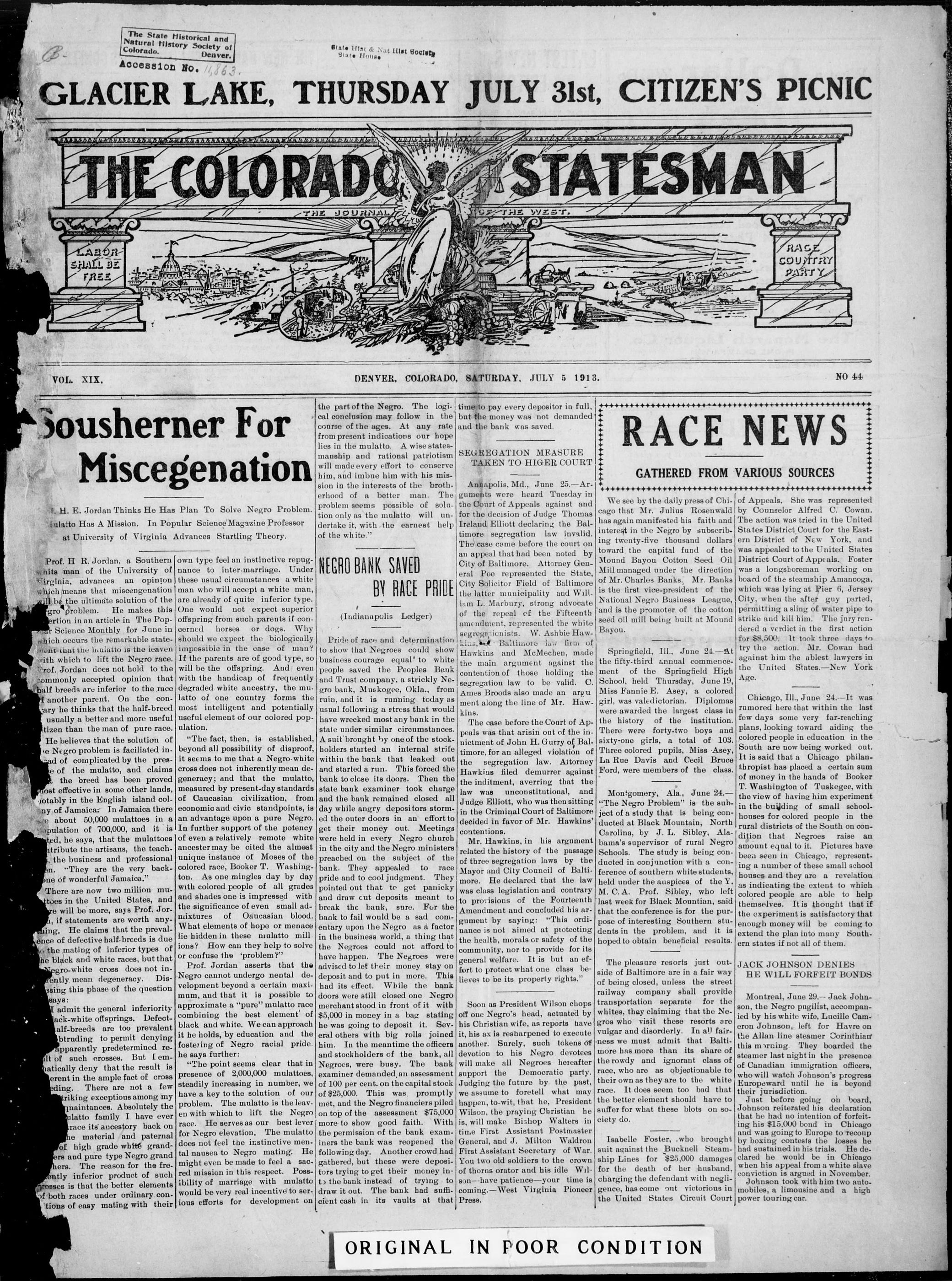
Sousherner For Miscegenation
1. H. E. Jordan Thinks He Has Plan To Solve Negro Problem
fulatto Has A Mission. In Popular Science Magazine Professor
at University of Virginia Advances Startling Theory.
Prof. H R. Jordan, a Southern units man of the University of Virginia, advances an opinion which means that miscengation will be the ultimate solution of the Negro problem. He makes this assertion in an article in The Poplar Science Monthly for June in which occurs the remarkable statement that the mulatto is the leaven with which to lift the Negro race. Prof. Jordan does not hold to the commonly accepted opinion that half breeds are inferior to the race of another parent. On the contrary he thinks that the half-breed usually a better and more useful citizen than the man of pure race. He believes that the solution of the Negro problem is facilitated instead of complicated by the presence of the mulatto, and claims that the breed has been proved most effective in some other lands, notably in the English island colony of Jamaica. In Jamaica there are about 50,000 mulattoes in a population of 700,000, and it is noted, he says, that the mulattoes contribute the artisans, the teachers, the business and professional men. "They are the very backbone of wonderful Jamaica."
th, if statements are worth anything. He claims that the prevalence of defective half-breeds is due to the mating of inferior types of the black and white races, but that Negro-white cross does not infinitely mean degeneracy. Discussing this phase of the question says:
I admit the general inferiority of black-white offsprings. Defective half-breeds are too prevalent in abbreuding to permit denying apparently predetermined result of such crosses. But I emphatically deny that the result is inherent in the ample fact of cross breeding. There are not a few striking exceptions among my acquaintances. Absolutely the mulatto family I have ever trace its ancestory back on the material and paternal side of high grade white grand-parents and pure type Negro grand-others. The reason for the frequently inferior product of such crosses is that the better elements of both races under ordinary conditions of easy mating with their
VOL. XIX.
LAKE, T
ner For
genation
Plan To Solve Negro Problem.
Regular Science Magazine Professor
Advances Startling Theory.
own type feel an instinctive repugnance to inter-marriage. Under these usual circumstances a white man who will accept a white man, are already of quite inferior type. One would not expect superior offspring from such parents if concerned horses or dogs. Why should we expect the biologically impossible in the case of man? If the parents are of good type, so will be the offspring. And even with the handicap of frequently degraded white ancestry, the mulatto of one country forms the most intelligent and potentially useful element of our colored population.
"The fact, then, is established, beyond all possibility of disproof, it seems to me that a Negro-white cross does not inherently mean degeneracy; and that the mulatto, measured by present-day standards of Caucasian civilization, from economic and civic standpoints, is an advantage upon a pure Negro. In further support of the potency of even a relatively remote white ancester may be cited the almost unique instance of Moses of the colored race, Booker T. Washington. As one mingles day by day with colored people of all grades and shades one is impressed with the significance of even small admixtures of Oaucasian blood. What elements of hope or menace lie hidden in these mulatto millions? How can they help to solve or confuse the 'problem?'
Prof. Jordan asserts that the Negro cannot undergo mental development beyond a certain maximum, and that it is possible to approximate a "pure" mulatto race combining the best element of black and white. We can approach it he holds, by education and the fostering of Negro racial pride he says further:
"The point seems clear that in presence of 2,000,000 mulattoes, steadily increasing in number, we have a key to the solution of our problem. The mulatto is the leaven with which to lift the Negro race. He serves as our best lever for Negro elevation. The mulatto does not feel the instinctive mental nausea to Negro mating. He might even be made to feel a sacred mission in this respect. Possibility of marriage with mulatto would be very real incentive to serious efforts for development on
---
DENVER, COLORADO, SATURDAY, JULY 5 1913.
ORIGINAL IN FOOR CONDITION
State Hist & Nat Hist Society
State House
HURSDAY
ADO
THE JOURNAL
DENVER, COLORADO
the part of the Negro. The logical conclusion may follow in the course of the ages. At any rate from present indications our hope lies in the mulatto. A wise statesmanship and rational patriotism will made every effort to conserve him, and imbue him with his mission in the interests of the brotherhood of a better man. The problem seems possible of solution only as the mulatto will undertake it, with the earnest help of the white."
NEGRO BANK SAVED BY RACE PRIDE
(Indianapolis Ledger)
Pride of race and determination to show that Negroes could show business courage equal to white people saved the Peoples Bank and Trust company, a strickly Negro bank, Muskogee, Okla., from ruin, and it is running today as usual following a stress that would have wrecked most any bank in the state under similar circumstances. A suit brought by one of the stockholders started an internal strife within the bank that leaked out and started a run. This forced the bank to close its doors. Then the state bank examiner took charge and the bank remained closed all day while angry depositors stormed the outer doors in an effort to get their money out. Meetings were held in every Negro church in the city and the Negro ministers preached on the subject of the bank. They appealed to race pride and to cool judgment. They pointed out that to get panicky and draw cut deposits meant to break the bank, sure. For the bank to fail would be a sad commentary upon the Negro as a factor in the business world, a thing that the Negroes could not afford to have happen. The Negroes were advised to let their money stay on deposit and to put in more. This had its effect. While the bank doors were still closed one Negro merchant stood in front of it with $5,000 in money in a bag stating he was going to deposit it. Several others with big rolls joined him. In the meantime the officers and stockholders of the bank, all Negroes, were busy. The bank examiner demanded, an assessment of 100 per cent. on the capital stock of $25,000. This was promptly met, and the Negro financiers piled on top of the assessment $75,000 more to show good faith. With the permission of the bank examiners the bank was reopened the following day. Another crowd had gathered, but these were depositors trying to get their money into the bank instead of trying to draw it out. The bank had sufficient cash in its vaults at that
ORIGINAL
time to pay every depositor in full, but the money was not demanded and the bank was saved.
Annapolis, Md., June 25.—Arguments were heard Tuesday in the Court of Appeals against and for the decision of Judge Thomas Ireland Elliott declaring the Baltimore segregation law invalid. The case came before the court on an appeal that had been noted by City of Baltimore. Attorney General Poe represented the State, City Solicitor Field of Baltimore the latter municipality and William L. Marbury, strong advocate of the repeal of the Fifteenth amendment, represented the white segregationists. W. Ashbie Hawkins, Baltimore law firm of Hawkins and McMechen, made the main argument against the contention of those holding the segregation law to be valid. C. Ames Broods also made an argument along the line of Mr. Hawkins.
The case before the Court of Appeals was that arisin out of the imincetment of John H. Gurry of Baltimore, for an alleged violation of the segregation law. Attorney Hawkins filed demurrer against the indictment, averring that the law was unconstitutional, and Judge Elliott, who was then sitting in the Criminal Court of Baltimore decided in favor of Mr. Hawkins' contentions.
Mr. Hawkins, in his argument related the history of the passage of three segregation laws by the Mayor and City Council of Baltimore. He declared that the law was class legislation and contrary to provisions of the Fourteenth Amendment and concluded his argument by saying: "This ordinance is not aimed at protecting the health, morals or safety of the community, nor to provide for its general welfare. It is but an effort to protect what one class believes to be its property rights."
Soon as President Wilson chops off one Negro's head, actuated by his Christian wife, as reports have it, his ax is resharpened to execute another. Surely, such tokens of devotion to his Negro devotees will make all Negroes hereafter support the Democratic party. Judging the future by the past, we assume to foretell what may happen, to-wit, that he, President Wilson, the praying Christian he is, will make Bishop Walters in time First Assistant Postmaster General, and J. Milton Waldron First Assistant Secretary of War. You two old soldiers to the crown of thorns orator and his idle Wilson—have patience—your time is coming.—West Virginia Pioneer Press.
RACE NEWS
GATHERED FROM VARIOUS SOURCES
We see by the daily press of Chicago that Mr. Julius Rosenwald has again manifested his faith and interest in the Negro by subscribing twenty-five thousand dollars toward the capital fund of the Mound Bayou Cotton Seed Oil Mill managed under the direction of Mr. Charles Banks, Mr. Banks is the first vice-president of the National Negro Business League, and is the promoter of the cotton seed oil mill being built at Mound Bayou.
of Appeals. She was represented by Counselor Alfred C. Cowan. The action was tried in the United States District Court for the Eastern District of New York, and was appealed to the United States District Court of Appeals. Foster was a longshoreman working on board of the steamship Amanooga, which was lying at Pier 6, Jersey City, when the after guy parted, permitting a sling of water pipe to strike and kill him. The jury rendered a verdict in the first action
Springfield, Ill., June 24. At the fifty-third annual commencement of the Springfield High School, held Thursday, June 19. Miss Fannie E. Asey, a colored girl, was valedictorian. Diplomas were awarded the largest class in the history of the institution. There were forty-two boys and sixty-one girls, a total of 103. Three colored pupils, Miss Asey, La Rue Davis and Cecil Bruce Ford, were members of the class.
Montgomery, Ala., June 24. "The Negro Problem" is the subject of a study that is being conducted at Black Mountain, North Carolina, by J. L. Sibley, Alabama's supervisor of rural Negro Schools. The study is being conducted in conjunction with a conference of southern white students, held under the auspices of the Y. M. C. A. Prof. Sibley, who left last week for Black Mountian, said that the conference is for the purpose of interesting Southern students in the problem, and it is hoped to obtain beneficial results.
The pleasure resorts just outside of Baltimore are in a fair way of being closed, unless the street railway company shall provide transportation separate for the whites, they claiming that the Negros who visit these resorts are vulgar and disorderly. In all fairness we must admit that Baltimore has more than its share of the rowdy and ignorant class of race, who are as objectionable to their own as they are to the white race. It does seem too bad that the better element should have to suffer for what these blots on society do.
Isabelle Foster, who brought suit against the Bucknell Steamship Lines for $25,000 damages for the death of her husband, charging the defendant with negligence, has come out victorious in the United States Circuit Court
NO 44
of Appeals. She was represented by Counselor Alfred C. Cowan. The action was tried in the United States District Court for the Eastern District of New York, and was appealed to the United States District Court of Appeals. Foster was a longshoreman working on board of the steamship Amanooga, which was lying at Pier 6, Jersey City, when the after guy parted, permitting a sling of water pipe to strike and kill him. The jury rendered a vcrdict in the first action for $8,500. It took three days to try the action. Mr. Cowan had against him the ablest lawyers in the United States.—New York Age.
Chicago, Ill., June 24.—It was rumored here that within the last few days some very far-reaching plans, looking toward aiding the colored people in education in the South are now being worked out. It is said that a Chicago philanthropist has placed a certain sum of money in the hands of Booker T. Washington of Tuskegee, with the view of having him experiment in the building of small schoolhouses for colored people in the rural districts of the South on condition that Negroes raise an amount equal to it. Pictures have been seen in Chicago, representing a number of these small school houses and they are a revelation as indicating the extent to which colored people are able to help themselves. It is thought that if the experiment is satisfactory that enough money will be coming to extend the plan into many Southern states if not all of them.
Montreal, June 29.—Jack Johnson, the Negro pugillist, accompanied by his white wife, Lucille Cameron Johnson, left for Havre on the Allan line steamer Corinthian this morning. They boarded the steamer last night in the presence of Canadian immigration officers, who will watch Johnson's progress Europeward until he is beyond their jurisdiction.
Just before going on board, Johnson reiterated his declaration that he had no intention of forfeiting his $15,000 bond in Chicago and was going to Europe to recoup by boxing contests the losses he had sustained in his trials. He declared he would be in Chicago when his appeal from a white slave conviction is argued in November. Johnson took with him two automobiles, a limousine and a high power touring car.
‘ORIGINAL IN POOR CONDITION
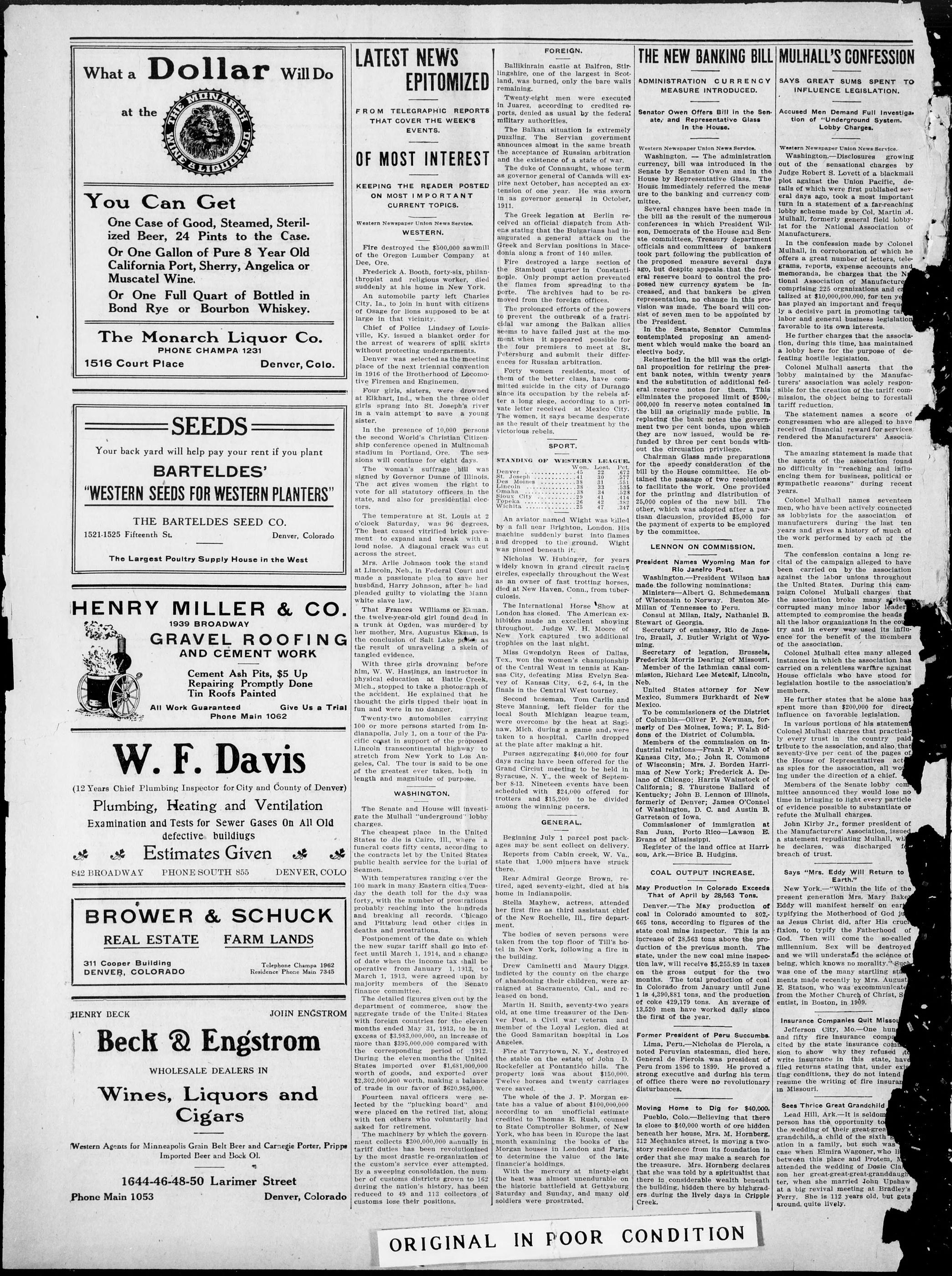
LATEST NEWS
EPITOMIZED
What a Dollar Will Do
BSL.
at the ey er Oi sos
el 4 a > \e
KA he Soa EI
he irae” AS)
KN LZ
Qa
You Can Get
Gne Case of Good, Steamed, Steril-
ized Beer, 24 Pints to the Case.
Or One Gallon of Pure 8 Year Old
California Port, Sherry, Angelica or
Muscatel Wine.
Or One Full Quart of Bottled in
Bond Rye or Bourbon Whiskey.
The Monarch Liquor Co.
| PHONE CHAMPA 1231
| 1516 Court Place Denver, Colo.
KEEPING THE READER POSTED
ON MOST IMPORTANT
CURRENT TOPICS.
Western Newspaper Union Newa Service,
WESTERN.
Fire destroyed the $500,000 sawmill
of the Oregon Lumber Company at
Dee, Ore.
Frederick A. Booth, forty-six, philan-
thropist and religious worker, died
suddenly at his home in New York.
An automobile party left Charles
City, Ia., to join in hunt with citizens
of Osage for lions supposed to be at
large in that vicinity.
Chief of Police Lindsey of Louis-
ville, Ky. issued a blanket order for
the arrest of wearers of split skirts
without protecting undergarments.
Denver was selected as the meeting
place of the next triennial convention
in 1916 of the Brotherhood of Locomo-
tive Firemen and Enginemen.
Four girls, sisters, were drowned
at Elkhart, Ind., when the three older
girls sprang into St. Joseph's river
in a vain attempt to save a young
sister.
In the presence of 10,000 persons
the second World’s Christian Citizen
ship conference opened in Multnomah
stadium in Portland, Ore. ‘The ses-
sions will continue for eight days.
The woman's suffrage , bill was
signed by Governor Dunne of Mlinois.
‘The act gives women the right to
vote for all statutory officers in the
state, and also for presidential elec-
tors.
| ‘The temperature at St, Louis at 2
o'clock Saturday, was 96 degrees.
‘The heat caused vitrified brick pave-
ment to expand and break with a
loud noise. A diagonal crack was cut
across the street.
Mrs. Arlie Johnson took the stand
at Lincoln, Neb., in Federal Court and
made a passionate plea to save her
husbfind, Harry Johnson, after he liad
pleaded guilty to violating the Mann
white slave law.
‘That Frances Williams or Ekman,
the twelve-year-old girl found dead in
a trunk at Ogden, was murdered by
ler mother, Mrs. Augustus Ekman, is
the conclusion of Salt Lake pdt: as
‘the result of unraveling a skein of
tangled evidence.
With three girls drowning before
him, W. W. Hastings, an instructor in
physical education at Battle Creek,
Mich., stopped to take a photograph of
the accident. He explained that he
thought the girls tipped their boat in
fun and were in no danger.
Twenty-two automobiles carrying
100 or more persons started from In-
dianapolis, July 1, on a tour of the Pa-
cific eqast in support of the proposed
Lincoln transcontinental highway to
stretch from New York to Los An-
geles, Cal, The tour is said to be one
pf the greatest ever taken, both in
length and magnitude of purpose.
Your back yard will help pay your rent if you plant
BARTELDES’
“WESTERN SEEDS FOR WESTERN PLANTERS”
THE BARTELDES SEED CO.
1521-1525 Fifteenth St. prea Denver, Colorado
The Largest Poultry Supply House in the West
WEA 1939 BROADWAY
wey GRAVEL ROOFING
hy AND CEMENT WORK
sya a
3 So Cement Ash Pits, $5 Up
Vi yy Repairing Promptly Done
it ( } Tin Roofs Painted
SOW |All Work Guaranteed Give Us a Trial
pie Phone Main 1062
F D i
W. F. Davis
(12 Years Chief Plumbing Inspector for City and Gounty of Denver)
Plumbing, Heating and Ventilation
Examination and Tests for Sewer Gases On All Old
defective. buildiugs
wt w EstimatesGiven &
842 BROADWAY PHONE SOUTH 855 DENVER, COLO
WASHINGTON.
The Senate and House will investi-
gate the Mulhall “underground” lobby
charges.
The cheapest place in the United
States to die is Cairo, Ill, where a
funeral costs fifty cents, according to
the contracts let by the United States
public health service for the burial of
Seamen,
With temperatures ranging over the
100 mark in many Eastern cities Tues-
day the death toll for the day was
forty, with the number of prostrations
probably reaching into the hundreds
and breaking all records. Chicago
and Pittsburg lead other cities in
deaths and prostrations.
Postponement of the date on which
the new sugar tariff shall go into ef-
fect until March 1, 1914, and a change
of date when the income tax shall be
operative from January 1, 1913, to
March 1, 1913, were agreed upon by
majority members of the Senate
finance committee.
‘The detailed figures given out by the
department of commerce, show the
aggregate trade of the United States
with foreign countries for the eleven
months ended May 31, 1913, to be in
excess of $3,983,000,000, an increase of
more than $395,000,000 compared with
the corresponding period of 1912,
During the eleven months the United
States imported over $1,681,000,000
worth of goods, and exported over
$2,302,000,000 worth, making a balance
of trade in our favor of $620,985,000.
Fourteen naval officers were se-
lected by the “plucking board” and
were placed on the retired list, along
with ten others who voluntarily had
asked for retirement.
‘The machinery by which the govern.
ment collects $30,000,000 aunually in
tariff duties has been revolutionized
by the most drastic re-organization of
the custom’s service ever attempted.
By a sweeping consolidation, the num.
ber of customs districts grown to 162
during the nation’s history, has been
reduced to 49 and 113 collectors of
customs lose their positions,
[aoe PTS AES Veg
BROWER & SCHUCK
REAL ESTATE FARM LANDS
311 Cooper Building Telephone Champa 1962
DENVER, COLORADO Residence Phone Main 7345
JHENRY BECK JOHN ENGSTROM
- Beck @ Engstrom
WHOLESALE DEALERS IN
Wines, Liquors and
Cigars
{Western Agents for Minneapolis Grain Belt Beer and Carzegie Porter, Prippe
Imported Beer and Bock Ol.
1644-46-48-50 Larimer Street
Phone Main 1053 Denver, Colorado
FOREIGN.
Ballikinrain castle at Balfron, Stir.
lingshire, one of the largest in Scot.
land, was burned, only the bare walls
remaining.
‘Twenty-eight men were executed
in Juarez, according to credited re
ports, denied as usual by the federal
military authorities,
‘The Balkan sitnation is extremely
Puzzling, The Servian government
announces almost in the same breath
the acceptance of Russian arbitration
and the existence of a state of war.
The duke of Connaught, whose term
a8 governor general of Canada will ex-
pire next October, has accepted an ex-
tension of one year. He was sworn
in as governor general in October,
1911.
The Greek legation at Berlin re-
ceived an official dispatch from Ath-
ens stating that the Bulgarians had in-
augurated a general attack on the
Greek and Servian positions in Mace-
donia along a front of 140 miles.
Fire destroyed a large section of
the Stamboul quarter in Constanti-
nople. Only prompt action prevented
the flames from spreading to the
porte. The archives had to be re-
moved from the foreign offices.
The prolonged efforts of the powers
to prevent the outbreak of a fratri-
cidal war among the Balkan allies
seems to have failed just at the mo
ment when it appeared possible for
the four premiers to meet at St,
Petersburg and submit their differ-
ences for Russian arbitration.
Forty women residents, most of
them of the better class, have com-
mitted suicide in the city of Durango
since its occupation by the rebels af-
ter a long siege, according to a pri-
vate letter received at Mexico City.
The women, it says became desperate
as the result of their treatment by the
victorious rebels.
SPORT.
STANDING OF WESTERN LEAGUE.
Won. Lost. Pet,
Denver a crevecescsersd0i ak 073
St. Joseph cL00ccfilay go ‘at
Des Moines 2227551iigg 31pm
Bincoln ..yerangescce:a8 83 (888
Omaha, i ccrtesssss8B (54 IbEs
Sloux city 50505151189 41 ata
Mopelka.-.--ba.cccs5-:88 | 42 JARB
Wichita tc... stiaee 8B OT | USAT
An aviator named Wight was killed
by a fall near Brighton, London. His
machine suddenly burst into flames
and dropped to the ground. Wight
was pinned beneath it.
Nicholas W. Hubinger, for years
widely known in grand circuit racing
circles, especially throughout the West
as an owner of fast trotting horses,
died at New Haven, Conn., from tuber-
culosis. :
The International Horse ‘Show at
London has closed. The American ex-
hibitérs made an excellent showing
throughout. Judge W. H. Moore of
New York captured two additional
trophies on the last night.
Miss Gwendolyn Rees of Dallas,
Tex., won the women’s championship
of the Central West in tennis at Kan-
sas City, defeating Miss Evelyn Sea-
vey of Kansas City, 62, 6-4, in the
finals in the Gentral West tourney.
Second beseman, ‘Tom Carlin and
Steve Manning, left fielder for the
local South Michigan league team,
were overcome by the heat at Sag
naw, Mich. during a game and, were
taken to a hospital. Carlin dropped
at the plate after making a hit.
Purses aggregating $40,000 for four
days racing have been offered for the
Grand Circiut meeting to be held in
Syracuse, N. Y., the week of Septem-
ber 8-19, Nineteen events have been
scheduled with $24,000 offered _ for
trotters and $15,200 to be divided
among the winning pacers.
GENERAL,
Beginning July 1 parcel post pack-
ages may be sent collect on delivery.
Reports from Cabin creek, W. Va.
state that 1,000 miners have struck
there,
Rear Admiral George Brown, re-
tired, aged seventy-cight, died at his
home in Indianapolis.
Stella Mayhew, actress, attended
her first fire as third assistant chief
of the New Rochelle, IL, fire depart:
ment.
‘The bodies of seven persons were
taken from the top floor of Till's ho-
tel in New York, following a fire in
the building.
Drew Caminetti and Maury Diggs.
indicted by the county on the charge
of abandoning their children, were ar.
raigned at Sacramento, Cal., and re
leased on bond.
Martin H. Smith, seventy-two years
old, at one time treasurer of the Den-
ver Post, a Civil war veteran and
member of the Loyal Legion, died at
the Good Samaritan hospital in Los
Angeles.
Fire at Tarrytown, N. Y., destroyed
the stable on the estate of John D.
Rockefeller at Pontantido hills, ‘The
Property loss was about $150,000,
Twelve horses and twenty carriages
were saved.
‘The whole of the J. P. Morgan es-
tate has a value of about $10,000,000
according to an unofficial estimate
credited to ‘Thomas E. Rush, counsel
to State Comptroller Sohmer, of New
York, who has been in Europe the last
month examining the books of the
Morgan houses in London and Paris,
to determine the value of the late
financier’s holdings.
With the mercury at ninety-eight
the heat was almost unendurable on
the historic battlefield at Gettysburg
Saturday and Sunday, and many old
soldiers were prostrated.
ADMINISTRATION CURRENCY
MEASURE INTRODUCED.
Senator Owen Offers Bill in the Sen-
ate and Representative Glass
In the House.
Western Newapaper Union News Service,
Washington. — The administration
currency, bill was introduced in the
Senate by Senator Owen and in tho
House by Representative Glass, ‘The
House immediately referred the meas:
ure to the banking and currency com:
mittee.
Several changes have been made in
the bill as the result of the numerous
conferences in which President Wil
son, Democrats of the House and Sen-
ate committees, Treasury department
officials and committees of bankers
took part following the publication of
the proposed measure several days
ago, but despite appeals, that the fed-
eral reserve board to control the pro-
Posed new currency system be in-
creased, and that bankers be given
representation, no change in this pro-
vision was made. ‘The board will con-
sist of seven men to be appointed by
the President.
In the Senate, Senator Cummins
contemplated proposing an amend-
ment which would make the board an
elective body.
Reinserted in the bill was the origi-
nal proposition for retiring the pres-
ent bank notes, within twenty years
and the substitution of additional fed-
eral reserve notes for them, This
eliminates the proposed limit of $500,
000,000 in reserve notes contained in
the bill as originally made public. In
replacing the bank notes the goyern-
ment two per cent bonds, upon which
they are now issued, would be re-
funded by three per cent bonds with-
out the circulation privilege.
Chairman Glass made preparations
for the speedy consideration of the
bill by the House committee. He ob-
tained the passage of two resolutions
to facilitate the work. One provided
for the printing and distribution of
25,000 copies of the new bill. The
other, which was adopted after a par-
tisan discussion, provided $5,000 for
the payment of experts to be employed
by the committee,
LENNON ON COMMISSION.
President Names Wyoming Man for
Rilo Janeiro Post,
‘Washington.—President Wilson has
made the following nominations:
Ministers—Albert G. Schmedemann
of Wisconsin to Norway. Benton Mc-
Millan of Tennessee to Peru.
Consul at Milan, Italy, Nathaniel B.
Stewart of Georgia.
Secretary of embassy, Rio de Jane
lro, Brazil, J. Butler Wright of Wyo
ming.
Secretary of legation, Brussels,
Frederick Morris Dearing of Missouri.
Member of the Isthmian canal com-
mission, Richard Lee Metcalf, Lincoln,
Neb.
United States attorney for New
Mexico, Summers Burkhardt of New
Mexico.
‘To be commissioners of the District
of Columbia—Oliver P. Newman, for-
merly of Des Moines, Iowa; F. L. Sid-
dons of the District of Columbia,
Members of the commission on in-
dustrial relations—Frank P, Walsh of
Kansas City, Mo.; John R. Commons
of Wisconsin; Mrs. J. Borden Harri-
man of New York; Frederick A. De-
lano of Chicago; Harris Wainstock of
California; S. Thurstone Ballard of
Kentucky; John B, Lennon of Mlinois,
formerly of Denver; James O’Connel
of Washington, D. C. and Austin B.
Garretson of Iowa.
Commissioner of immigration at
San Juan, Porto Rico—Lawson E.
Byans of Mississippi.
Register of the land office at Harrk
sou, Ark.—Brice B, Hudgins.
COAL OUTPUT INCREASE.
May Production In Colorado Exceeds
‘That of April by 28,563 Tons.
Son Rp ena ALOR NEE aco Rica ena
Denver—The May production of
coal in Colorado amounted to 802,-
605 tons, according to figures of the
state coal mine inspector. This is an
increase of 28,563 tons above the pro-
duction of the previcus month. The
state, under the new coal mine inspec-
tion law, will receive $5,255.89 In taxes
on the gross output for the two
months. The total production of coal
in Colorado from January until June
1 is 4,390,881 tons, and’ the production
of coke 429,179 tons. An average of
13,520 men have worked daily since
the first of the year.
Former President of Peru Succumbs.
Lima, Peru.—Nicholas de Pierola, a
noted Peruvian statesman, died here.
General de Pierola was president of
Peru from 1896 to 1899. He proved a
strong executive and during his term
of office there were no revolutionary
disturbances.
Moving Home to Dig for $40,000.
Pueblo, Colo—Believing that thers
is close to $40,000 worth of ore hidden
beneath her house, Mrs. M. Hornberg,
312 Mechanics street, is moving a two-
story residence from its foundation in
order that she may make a search for
the treasure. Mrs. Hornberg declares
that she was told by a spiritualist that
there is considerable wealth beneath
the building, hidden there by highgrad-
ers during the lively days in Cripple
Creek.
MULHALL’S CONFESSION
SAYS GREAT SUMS SPENT TO
INFLUENCE LEGISLATION.
Accused Men Demand Full Investigar
tion of “Underground System.
Lobby Charges.
‘Western Newspaper Union News Service.
Washington.—Disclosures growing
out of the sensational charges by
Judge Robert S. Lovett of a blackmail
plot against the Union Pacific, de-
tails of which were first published sev-
eral days ago, took a most important
turn in a statement of a far-reaching
lobby scheme made by Col. Martin mM.
Mulhall, formerly general field lobby-
ist for the National Association of
Manufacturers.
In the confession made by Colonel
Mulhall, in corroboration of which he
offers a great number of letters, tele-
grams, reports, expense accounts an
memoranda, he charges that the Nj
tional Association of Manufactur
comprising 225 organizations and ct
talized at $10,000,000,000, for ten ys
‘has played an important and frequi
ly a decisive part in promoting tal
labor and general business legislatio
favorable to its own interests.
He further charges that the associa-
tion, during this time, has maintained
a lobby here for the purpose of de-
feating hostile legislation,
Colonel Mulhall asserts that the
lobby maintained by the Manufac-
turers’ association was solely respon-
sible for the creation of the tariff com-
mission, the object being to forestall
tariff reduction.
The statement names a score of
congressmen who are alleged to have |
received financial reward for services
rendered the Manufacturers’ Associa-
tion.
‘The amazing statement is made that
the agents of the association found
no difficulty in “reaching and influ-
encing them for business, political or
sympathetic reasons” during recent
years,
Colonel Mulhall names seventeen
men, who have been actively connected
as lobbyists for the association of
manufacturers during the last ten
years and gives a history of much of
the work performed by each of the
men,
The confession contains a long re-
cital of the campaign alleged to have
been carried on by the association
against the labor unfons throughout
the United States. During this cam-
paign Colonel Mulball charges that
the association broke many. sprit
corrupted many minor labor léade!
attempted to compromise the heads
all the labor organizations in the co
try and in every way used its influ-
ence for the benefit of the members
of the association, 5
Colonel Mulhall cites many alleged
instances in which the association has
carried on a relentless warffre against
House officials who haye stood for
legislation hostile to the association's
members.
He further states that he alone has
spent more than $200,000 for direct
influence on favorable legislation.
In various portions of his statement
Colonel Mulhall charges that practical.
ly every trust in the country paid,
tribute to the association, and also, tha’
seventy-five per cent of the pages of
the House of Representatives act;
as spies for the association, all wo}
ing under the direction of a chief.
Members of the Senate lobby co!
mittee announced they would lose no
time in bringing to light every particle
of evidence possible to substantiate or
refute the Mulhall charges.
John Kirby Jr., former president of
the Manufacturers’ Association, issue
a statement repudiating Mulhall, whi
he declares, was discharged § f{
breach of trust.
Says “Mrs. Eddy Will Return to}
Earth.”
New York.—“Within the life of the
present generation Mrs, Mary Baka
Eddy will manifest herself on ear;
typifying the Motherhood of God ji
as Jesus Christ did, after His crud
fixion, to typify the Fatherhood of
God. Then will come the so-called
millennium. Sex will be destroyed
and we will understafd the sciénce ot
being, which knows no morality."*Si
was one of the many startling sti
ments made recently by Mrs. August]
B, Statson, who was ‘excommunicat
from the Mother Church of Christ, §|
entist, in Boston, in 1909.
Insurance Companies Quit Misso
Jefferson City, Mo—One hung
and fifty fire Insurance comp
cited by the state insurance cof
sion to show why they refused |
write insurance in this state, hay
filed returns stating that, under ex}
ting conditions, they do not intend
resume the writing of fire insur:
in Missouri,
Sees Thrice Great Grandchild
Lead Hill, Ark.—It is seldon
person has the opportunity t
the wedding of their great-greal
grandchild,.a child of the sixth
ation in a family, but such was
case when Elmira Wagoner, who If
between this place and Protem, M
attended the wedding of Dosie Cla
son her great-great-great-granddaug
ter, when she married John Upshs
at a big revival meeting at Bradley
Ferry, She is 112 years old, but g¢
around, quite lively. 4
STORY OF FAMOUS CIVIL WAR FIGHT
Battle of Gettysburg Which Brought Credit to Both Blue and Gray. TURNING POINT OF CONFLICT
Total Losses on Both Sides in Three Days' Fighting Over 50,000—Several Generals Killed and Wounded.
By EDWARD B. CLARK.
WASHINGTON—It is possible, some people would say probable, that the Battle of Gettysburg changed utterly the course of American history. It was a great fight between armies of Americans, for probably fully ninety per cent. of the men who fought on the two sides were born natives to the American soil. The bravery shown at Gettysburg was of the order which Americans have shown on every field and which reflects credit upon the hardy and heroic ancestry of the men engaged, no matter from what race they may have sprung.
At Gettysburg there was nothing to choose between the valor of the North and the South. The South lost the fight, but it lost it honorably and with the prestige of its soldiery undimmed. The charges made on that field have gone down into history as assaults made under conditions which every man felt might mean death at the end. The defenses made at Gettysburg were of the kind which it takes iron in the blood to make perfect. At Gettysburg Northerners and Southerners replenished their store of respect for their antagonists. The battle marked the high tide of the war between the states. After it the South largely was on the defensive, but its defense was maintained with fortitude and in the face of privations which could not chill the blood of men fighting for what they thought was the right.
The Northern armies were persistent in their attacks through the campaigns which after a few months were started against the objective point, Richmond. Brave men here and brave men there, and after the end came it was the qualities which keep company with bravery which made the soldiers of the North and South so ready to forget and to forgive and to work again for the good of a common country.
The great battle of Chancellorsville was fought not long before the opposing Union and Confederate forces met on the field of Gettysburg. Chancellorsville was a Confederate victory. The Southern government believed that the victory should be followed up by an invasion of the North for, according to its reasoning, if an important engagement could be won upon
9
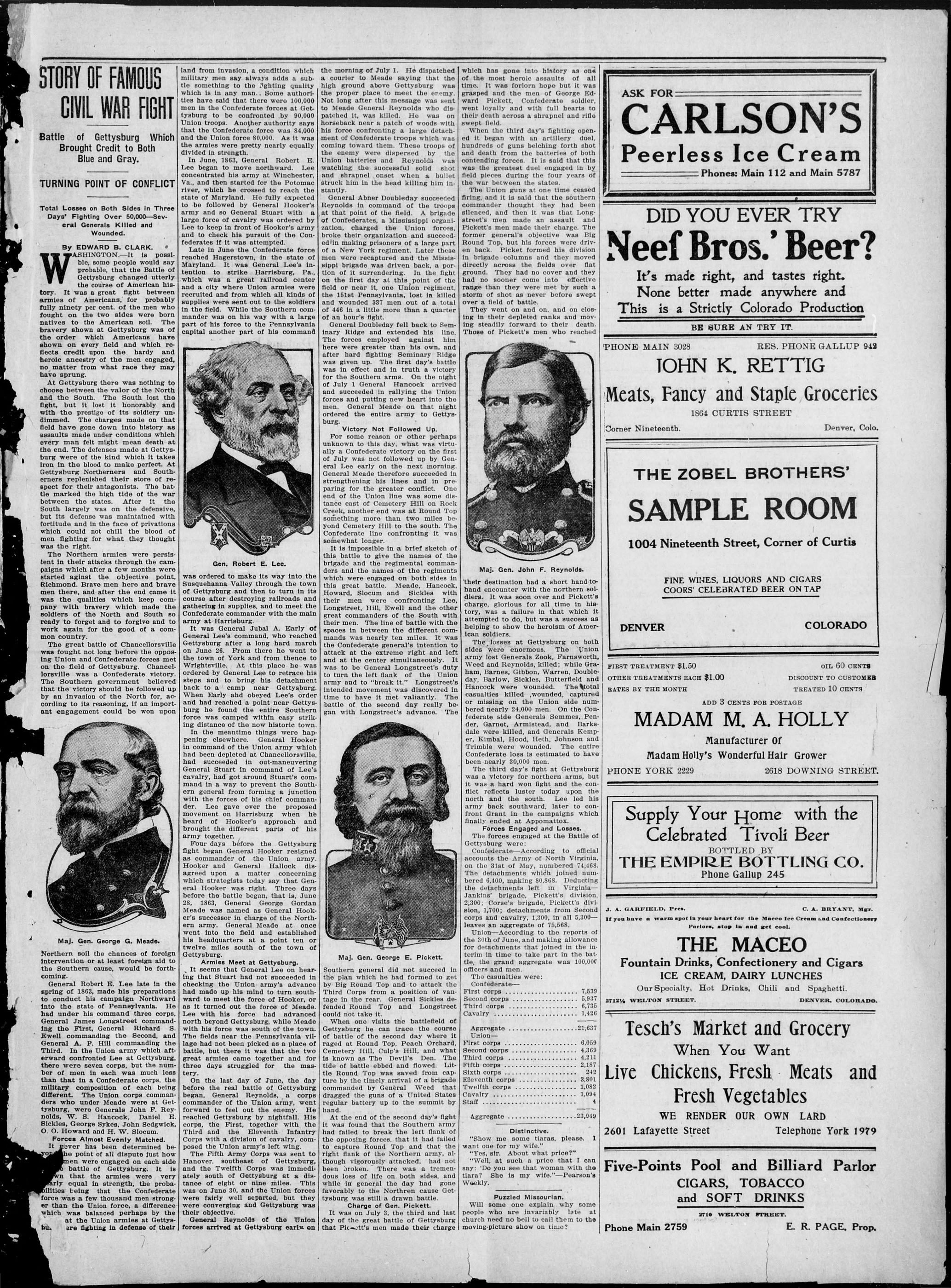
Maj. Gen. George G. Meade. Northern soil the chances of foreign intervention or at least foreign aid to the Southern cause, would be forthcoming.
General Robert E. Lee late in the spring of 1863, made his preparations to conduct his campaign Northward into the state of Pennsylvania. He had under his command three corps, General James Longstreet commanding the First, General Richard S. Ewell commanding the Second, and General A. P. Hill commanding the Third. In the Union army which afterward confronted Lee at Gettysburg, there were seven corps, but the number of men in each was much less than that in a Confederate corps, the military composition of each being different. The Union corps commanders who under Meade were at Gettysburg, were Generals John F. Reynolds, W. S. Hancock, Daniel E. Sickles, George Sykes, John Sedgwick, O. O. Howard and H. W. Slocum.
It never has been determined beyond the point of all dispute just how men were engaged on each side in the battle of Gettysburg. It is known that the armies were very early in strength, the probabilities being that the Confederate force was a few thousand men stronger than the Union force, a difference which was balanced perhaps by the at the Union armies at Gettysburg, are fighting in defense of their
land from invasion, a condition which military men say always adds a subtle something to the Nighting quality which is in any man. Some authorities have said that there were 100,000 men in the Confederate forces at Gettysburg to be confronted by 90,000 Union troops. Another authority says that the Confederate force was 84,000 and the Union force 80,000. As it was the armies were pretty nearly equally divided in strength. In June, 1863, General Robert E. Lee began to move northward. Lee concentrated his army at Winchester, Va., and then started for the Potomac river, which he crossed to reach the state of Maryland. He fully expected to be followed by General Hooker's army and so General Stuart with a large force of cavalry was ordered by Lee to keep in front of Hooker's army and to check his pursuit of the Confederates if it was attempted.
Late in June the Confederate force reached Hagerstown, in the state of Maryland. It was General Lee's intention to strike Harrisburg, Pa., which was a great railroad center and a city where Union armies were recruited and from which all kinds of supplies were sent out to the soldiers in the field. While the Southern commander was on his way with a large part of his force to the Pennsylvania capital another part of his command
X
Gen. Robert E. Lee.
was ordered to make its way into the Susquehanna Valley through the town of Gettysburg and then to turn in its course after destroying railroads and gathering in supplies, and to meet the Confederate commander with the main army at Harrisburg.
It was General Jubal A. Early of General Lee's command, who reached Gettysburg after a long hard march on June 26. From there he went to the town of York and from thence to Wrightsville. At this place he was ordered by General Lee to retrace his steps and to bring his detachment back to a camp near Gettysburg. When Early ahd obeyed Lee's order and had reached a point near Gettysburg he found the entire Southern force was camped within easy striking distance of the now historic town
In the meantime things were happening elsewhere. General Hooker in command of the Union army which had been depleted at Chancellorsville, had succeeded in out-maneuvering General Stuart in command of Lee's cavalry, had got around Stuart's command in a way to prevent the Southern general from forming a junction with the forces of his chief commander. Lee gave over the proposed movement on Harrisburg when he heard of Hooker's approach and brought the different parts of his army together.
Four days before the Gettysburg fight began General Hooker resigned as commander of the Union army. Hooker and General Hallock disagreed upon a matter concerning which strategists today say that General Hooker was right. Three days before the battle began, that is, June 28, 1863, General George Gordan Meade was named as General Hooker's successor in charge of the Northern army. General Meade at once went into the field and established his headquarters at a point ten or twelve miles south of the town of Gettysburg.
Armies Meet at Gettysburg.
It seems that General Lee on hearing that Stuart had not succeeded in checking the Union army's advance had made up his mind to turn southward to meet the force of Hooker, or as it turned out the force of Meade. Lee with his force had advanced north beyond Gettysburg, while Meade with his force was south of the town. The fields near the Pennsylvania village had not been picked as a place of battle, but there it was that the two great armies came together and for three days struggled for the mastery.
On the last day of June, the day before the real battle of Gettysburg began, General Reynolds, a corps commander of the Union army, went forward to feel out the enemy. He reached Gettysburg by nightfall. His corps, the First, together with the Third and the Eleventh Infantry Corps with a division of cavalry, composed the Union army's left wing.
The Fifth Army Corps was sent to Hanover, southeast of Gettysburg, and the Twelfth Corps was immediately south of Gettysburg at a distance of eight or nine miles. This was on June 30, and the Union forces were fairly well separated, but they were converging and Gettysburg was their objective.
General Reynolds of the Union forces arrived at Gettysburg early on
the morning of July 1. He dispatched a courier to Meade saying that the high ground above Gettysburg was the proper place to meet the enemy. Not long after this message was sent to Meade General Reynolds who dispatched it, was killed. He was on horseback near a patch of woods with his force confronting a large detachment of Confederate troops which was coming toward them. These troops of the enemy were dispersed by the Union batteries and Reynolds was watching the successful solid shot and shrapnel onset when a bullet struck him in the head killing him instantly.
General Abner Doubleday succeeded Reynolds in command of the troops at that point of the field. A brigade of Confederates, a Mississippi organization, charged the Union forces, broke their organization and succeeded in making prisoners of a large part of a New York regiment. Later these men were recaptured and the Mississippi brigade was driven back, a portion of it surrendering. In the fight on the first day at this point of the field or near it, one Union regiment, the 151st Pennsylvania, lost in killed and wounded 337 men out of a total of 446 in a little more than a quarter of an hour's fight.
General Doubleday fell back to Seminary Ridge and extended his line. The forces employed against him here were greater than his own, and after hard fighting Seminary Ridge was given up. The first day's battle was in effect and in truth a victory for the Southern arms. On the night of July 1 General Hancock arrived and succeeded in rallying the Union forces and putting new heart into the men. General Meade on that night ordered the entire army to Gettysburg.
Victory Not Followed Up. For some reason or other perhaps unknown to this day, what was virtually a Confederate victory on the first of July was not followed up by General Lee early on the next morning. General Meade therefore succeeded in strengthening his lines and in preparing for the greater conflict. One end of the Union line was some distance east of Cemetery Hill on Rock Creek, another end was at Round Top something more than two miles beyond Cemetery Hill to the south. The Confederate line confronting it was somewhat longer.
It is impossible in a brief sketch of this battle to give the names of the brigade and the regimental commanders and the names of the regiments which were engaged on both sides in this great battle. Meade, Hancock, Howard, Slocum and Sickles with their men were confronting Lee, Longstreet, Hill, Ewell and the other great commanders of the South with their men. The line of battle with the spaces in between the different commands was nearly ten miles. It was the Confederate general's intention to attack at the extreme right and left and at the center simultaneously. It was to be General Longstreet's duty to turn the left flank of the Union army and to "break it." Longstreet's intended movement was discovered in time to have it met valiantly. The battle of the second day really began with Longstreet's advance. The
[Illustration of a military officer in uniform with a star insignia. The background is a dark, indistinct pattern. The officer's name is not visible.]
Maj. Gen. George E. Pickett.
Southern general did not succeed in the plan which he had formed to get by Big Round Top and to attack the Third Corps from a position of vantage in the rear. General Sickles defended Round Top and Longstreet could not take it.
When one visits the battlefield of Gettysburg he can trace the course of battle of the second day where it raged at Round Top, Peach Orchard, Cemetery Hill, Culp's Hill, and what is known as The Devil's Den. The tide of battle ebbed and flowed. Little Round Top was saved from capture by the timely arrival of a brigade commanded by General Weed that dragged the guns of a United States regular battery up to the summit by hand.
At the end of the second day's fight it was found that the Southern army had failed to break the left flank of the opposing forces, that it had failed to capture Round Top and that the right flank of the Northern army, although vigorously attacked, had not been broken. There was a tremendous loss of life on both sides, and while in general the day had gone favorably to the Northren cause Gettysburg was still a drawn battle.
Charge of Gen. Pickett.
It was on July 3, the third and last day of the great battle of Gettysburg that Picott's men made their charge
which has gone into history as one of the most heroic assaults of all time. It was forlorn hope but it was grasped and the men of George Edward Pickett, Confederate soldier, went loyally and with full hearts to their death across a shrapnel and rifle swept field. When the third day's fighting opened it began with an artillery duel, hundreds of guns belching forth shot and death from the batteries of both contending forces. It is said that this was the greatest duel engaged in by field pieces during the four years of the war between the states.
The Union guns at one time ceased firing, and it is said that the southern commander thought they had been silenced, and then it was that Long-street's men made an assault and Pickett's men made their charge. The former general's objective was Big Round Top, but his forces were driven back. Picket formed his division in brigade columns and they moved directly across the fields over flat ground. They had no cover and they had no sooner come into effective range than they were met by such a storm of shot as never before swept over a field of battle. They went on and on, and on closing in their depleted ranks and moving steadily forward to their death. Those of Pickett's men who reached
Maj. Gen. John F. Reynolds. their destination had a short hand-to-hand encounter with the northern soldiers. It was soon over and Pickett's charge, glorious for all time in history, was a failure in that which attempted to do, but was a success as helping to show the heroism of American soldiers.
The losses at Gettysburg on both sides were enormous. The Union army lost Generals Zook, Farnsworth, Weed and Reynolds, killed; while Graham, Barnes, Gibbon, Warren, Doubleday, Barlow, Sickles, Butterfield and Hancock were wounded. The total casualties killed, wounded, captured or missing on the Union side numbered nearly 24,000 men. On the Confederate side Generals Semmes, Pender, Garnet, Armistead, and Barksdale were killed, and Generals Kemper, Kimbal, Hood, Heth, Johnson and Trimble were wounded. The entire Confederate loss is estimated to have been nearly 30,000 men.
The third day's fight at Gettysburg was a victory for northern arms, but it was a hard won fight and the conflict reflects luster today upon the north and the south. Lee led his army back southward, later to confront Grant in the campaigns which finally ended at Appomattox.
**Forces Engaged and Losses.**
The forces engaged at the Battle of Gettysburg were:
Confederate—According to official accounts the Army of North Virginia, on the 31st of May, numbered 74,468. The detachments which joined numbered 6,400, making 80,868. Deducting the detachments left in Virginia—Jankins' brigade, Pickett's division, 2,300; Corse's brigade, Pickett's division, 1,700; detachments from Second corps and cavalry, 1,300, in all 5,300—leaves an aggregate of 75,568.
Union—According to the reports of
the 30th of June, and making allowance
for detachments that joined in the interim in time to take part in the battle, the grand aggregate was 100,000 officers and men.
The casualties were:
Confederate—
First corps ..... 7,539
Second corps ..... 5,937
Third corps ..... 6,735
Cavalry ..... 1,426
Distinctive.
"Show me some tiaras, please. I want one for my wife."
"Yes, sir. About what price?"
"Well, at such a price that I can say: 'Do you see that woman with the tiara? She is my wife.'—Pearson's Weekly.
Puzzled Missourian.
Will some one explain, why some people who are invariably late at church need no bell to call them to the moving-picture show on time?
It's made right, and tastes right. None better made anywhere and This is a Strictly Colorado Production BE SURE AN TRY IT.
JOHN K. RETTIGER
Fancy and Staple Gro
1864 CURTIS STREET
eenth.
THE ZOBEL BROTHER
AMPLE ROO
Nineteenth Street, Corner of
JOHN K Meats, Fancy a 1864 CU
THE ZOBE
SAMPL
1004 Nineteenth
1004 Nineteenth Street, Corner of Curtis
FINE WINES, LIQUORS AND CIGARS
COORS' CELEBRATED BEER ON TAP
DENVER CO
FIRST TREATMENT $1.50
OTHER TREATMENTS EACH $1.00
BATES BY THE MONTH
DISCOUNT
TREATER
ADD 3 CENTS FOR POSTAGE
MADAM M. A. HOLL
Manufacturer Of
ADD 3 CENTS FOR POSTAGE
ADAM M. A. HOLL
Manufacturer Of
Manufacturer Of Madam Holly's Wonderful Hair Grower PHONE YORK 2229 2618 DOWNING STREET.
Supply Your Home with the Celebrated Tivoli Beer BOTTLED BY THE EMPIRE BOTTLING CO. Phone Gallup 245
J. A. GARFIELD, Pres. C. A. BRYANT, Mgr.
If you have a warm spot in your heart for the Maceo Ice Cream and Confectionery
Parlors, stop in and get cool.
THE MACEO
Fountain Drinks, Confectionery and Cigars
ICE CREAM, DAIRY LUNCHES
Our Specialty, Hot Drinks, Chili and Spaghetti.
2712½ WELTON STREET. DENVER, COLORADO.
Tesch's Market and Grocery
When You Want
Live Chickens, Fresh Meats and
Fresh Vegetables
WE RENDER OUR OWN LARD
2601 Lafayette Street Telephone York 1979
Five-Points Pool and Billiard Parlor CIGARS, TOBACCO and SOFT DRINKS
PHONE MAIN 3028
Corner Nineteenth.
DENVER
RES. PHONE GALLUP 942
RETTIG
Staple Groceries
STREET
BROTHERS'
ROOM
t, Corner of Curtis
OIL 60 CENTS
DISCOUNT TO CUSTOMEB
TREATED 10 CENTS
FOR POSTAGE
A. HOLLY
rer 0f
Denver, Colo.
COLORADO
Stephen Lowe, an employé of the Shirley hotel is off on his vacation, and is sojourneying in Colorado Springs.
Mrs. Ida Gatewood Holley and sister, Miss Iva Hayden of Alamosa are the house guest of Mrs. Mack Wright, and Joe Garriett of Durango, Colo., and are having a delightful time.
All aboard the choo choo train, Monday, July 14 for Tolland, Colo.
SHORTER CHAPEL.
Washington and Twenty-third street. Rev. Robert L. Pope, B. D. paste. The order of service at Shorter morrow will be as follows:
10:00 a.m. Sunday school. Lesson "The Child Moses Saved From Death. Ex. 1:8-14, 22-2:10. Mrs. O. W. Gle superintendent.
11:00 Rev. Dr. Julian C. Caldwe general secretary of Allen Christi Endeavor with headquarters at Nasville, Tenn., will occupy the pulp
A delightful matinee party was given at Elitches Gardens last Wednesday afternoon at the closing of the meetings of the Self Improvement club for the summer. The afternoon ended with a box luncheon, having been prepared by each member of the club, several visiting ladies were invited as guests.
Mr. and Mrs. Henry Henderson and Mr. and Mrs. H. R. Smith of Springfield, Mo., left Friday of last week for their home, after a very enjoyable stay of two weeks in the city. They expressed themselves as being highly elated with Denver and her hospitable citizens.
Miss Georgia E. Morrow, a popular teacher of Houston, Tex., en route to Portland, Ore., to spend her vacation detoured via Denver to visit friends. Upon departing she declared that Denver for its artistic beauty and its people for their hospitality are unexcelled. She was the guest of Mrs. Atkinson of 2230 Curtis street.
A. A. Ealy has accepted the position as messenger in the Hibernia Bank and Trust Co. Mr. Ealy is one of Denver's most highly respected citizens and his experience of over thirty years as messenger for the Colorado Mortgage and Investment Co., makes him quite well fitted for the position, and this, together with his honesty, which is above reproach is very important to the firm, which is to be congratulated on receiving the services of Mr. Ealy.
You will miss a treat if you fail to go on the GRAND UNION EXCURSION Monday, July 14 to Tolland, Colo., given under the auspices of Campbell A. M. E. church and Bethleham Baptist church.
Mr. and Mrs. J. W. Levell of 2546 South Broadway entertained at a 3 o'clock dinner, Sunday in honor of the following guests: Miss V. L. Jones, Misses Edna Alexander and Guarda Clay, of Des Moines; Misses Grace Morton, Rock Island, Ills.; Miss Leana Lindsey, Mr. Burgaman Hough and Mrs. L. B. Blagburn, Denver. The house was very artistically decorated with carnations and roses, as was also the table which groaned under a very sumptuous menu. The hospitality of Mr. and Mrs. Level is always greeted with the highest of praise and congratulations for their unique and elaborate manner of entertaining.
DEATHS
Mrs. Amanda King, formerly of Denver, died in Los Angeles, California this week and was buried there.
Mrs. James Clark, died at 2520
2520 Lafeyette street Tuesday night at
9:45, she is the mother of Chas. A. Clark, who is employed in the mail service. Funeral notice later.
Mrs. Elizibeth Franklin, died at the county hospital, June 29, 1913, and was buried from her home, 4449 Chereeke street, Tuesday at 2 o'clock. Rev. Over officiating, enternment at Fairmount.
If the Colored people who get into trouble would get a severe case of tetanus or lock jaw, so they could not talk so much, and thereby cease trying to argue their cases with the police and to a disadvantage from behind the jail bars, its my experience that it would be better for them—Lawyer Townsend.
Baby King, died at 2838 Walnut street and buried Sunday from Laworn Parlors. Lawhorn in charge of of above funerals.
Word was received in the city this week that Miss Amanda King, Miss Wanita Beecham's aunt, died June 29th at Los Angeles, Calif.
The remains of Shirley Peate are at the Douglass Undertaking parlor awaiting burial.
John Balles of 1221 Twenty-fourth street died at the county hospital. Remains are at the Douglas Undertaking Company parlors. Funeral notice later.
Mrs. Branch of 2234 Clarkson street died at St. Joseph's hospital July 3rd. Remains at Douglass Undertaking Company parlors. Funeral notice later.
MASONS' PICNIC PRIVILEGES.
All privileges at the Masons' Big Picnic at Bloomfield Park July 16th are for sale. See J. R. Contee or T. S. Rector for particulars.—Adv.
13 CENTS A DAY BUYS A PIANO. WITH MUSIC LESSONS FREE. PIANOS FROM $88 UP. COLUMBINE MUSIC CO., 920-924 15th STREET, CHARLES BUILDING.
Washington and Twenty-third streets.
Rev. Robert L, Pope, B. d. pastor.
The order of service at Shorter tomorrow will be as follows:
10:00 a. m. Sunday school. Lesson:
"The Child Moses Saved From Death",
Ex. 1:8-14, 22:2-10. Mrs. O. W. Glen,
superintendent.
11:00 Rev. Dr. Julian C. Caldwell,
general secretary of Allen Christian
Endeavor with headquarters at Nashville, Tenn., will occupy the pulpit.
He will also deliver an address before
the Christian Endeavor League at
6:45. The public is invited.
8:00 Sermon, Three Perilous but
Common Delusions, by the pastor.
The number of tourists in our midst this season is increasingly large. The following were welcome visitors at Shorter last Sabbath morning: Prof. R. W. Foster, Mr. and Mrs. C. A. Robinson, Mrs. M. Lucas and Mrs. Jack Johnson of Kansas City, Mo., Miss Edith Miller of Phoenix, Ariz., Mr. and Mrs. Chas J. Parson of Santa Fe, N. M., Mrs. Dora Mathews of Kansas City, Kan., Mrs. Florence Simons of Lawrence, Kan., and Miss Maude Hancock and Mrs. Wilbur Woods of Lincoln, Neb.
Our monthly sacred concerts grow in favor and helpfulness. The one given Sunday evening drew out a most flattering audience to be instructed, entertained and thrilled by the rendition of a strong and spicy program.
Our spring rally netted $1,232. (including a donation from the sewing circle) with twenty-four clubs still to report
A party consisting of Dr. Julian C. Caldwell, our pastor and Mr. and Mrs. Royal C. Brown will leave over the D. & R. G. railroad Monday morning for Los Angeles, Cal., to attend the International convention of Christian Endeavor.
GOOD NEWS
...The masons next big picinic at Bloomfield Park Wednesday, July 16, 1913. Admission 25c.
CAMPBELL CHAPEL.
The rally opened last Sunday with a large measure of success, will close tomorrow evening. Full announcements will be made and the thanks of the trustees and church expressed.
Mr. E. W. Jones of 2528 Glenarm Place was admitted to membership last Sunday.
Dr. Julian C. Caldwell one of the greatest platform orators and pulpit dialecticians in this country will preach Sunday evening at 7:30. Nobody can afford to miss hearing this treat. Dr. Caldwell is the secretary of the Allen Christian Endeavor League of the world.
Bishop H. Blanton, D. D. presiding Bishop of the Fifth Episcopal District and the grand man eloquent, will preach at Campbell Sunday evening, July 13th. The mantle of the beloved Bishop Grant has fallen upon this israelithic giant, hear him.
Rev. A. E. Reynolds preached the rally sermon Sunday afternoon and rendered a good account of himself as a good gospel preacher. Revs. R. L Pope and David E. Over were present and contributed very greatly to the success of the effort.
Up to date Mrs. W. C. Blackwell leads with $50 to the credit of her club.
The pastor and family with a few friends spent Wednesday very pleasantly at Littleton at the home of sister Wyman and Mother Rivis.
The Building Laborers Union No. 1, of Denver will hold their annual sermon at Eureka hall, Sunday, July 13, at 3 p. m., sermon by Rev. P. J. Price of Central Baptist church, music by Campbell Chapel choir. R. M. Griggsby will act as master of ceremonies. The public is invited to attend.
One nicely unfurnished room for rent at 2360 Tremont Place.
$1.00 reward to the first party giving us the correct address of Mrs. Andrew C. Ballard who recently moved from 2349 Tremont place. Columbine Music Co., 924 Fifteenth street.
When you want Lawyer Townsend, call Champa 618. Office, 313 Kittredge building.
FOR SALE—Nice 8-room house to a desirable colored family. Thoroughly modern, nice neighborhood, 2515 Humboldt st. $2,500; call at premises.
FREE-FREE.
A free ticket on the Union church excursion to Tolland, Monday, July 14th for the aged as follows:
Shorter Chapel, 3 oldest members.
Zion Baptist, 3 oldest members.
Episcopal, 2 oldest members.
Presbyterian, 2 oldest members.
Scott Chapel, 2 oldest members.
Bethlehem, 2 oldest members.
Central, 2 oldest members.
Campbell, 2 oldest members.
The tickets will be placed in the hands of the pastors, each of whom will select the oldest in his membership for the free outing.
Before You Buy Property, Let Lawyer W. B. TOWNSEND
EXAMINE THE TITLE AND MAKE YOUR CONTRACT. LAWYER TOWNS SEND MAKES A SPECIALTY OF COLLECTING FROM INSURANCE COMPANIES, ALSO ENDOWMENT MONIES
OFFICE 313 KITTREDGE BUILDING
ORIGINAL IN POOR CONDITION
HAS GOOD COAL YEAR
COLORADO PRODUCES 10,977,824
SHORT TONS IN 1912.
This Was An Increase of 820,441 Tons
Over 1911, and Output Was
Valued at $16,345,336.
Western Newspaper Union News Service.
Trinidad.-Colorado is the most important coal-producing state west of Mississippi river and ranks seventh among all the states. The coal mined in 1912 was 10,977,824 short tons, an increase of 820,441 tons over 1911, according to E. W. Parker, of the United States Geological Survey at Washington. The value increased from $14,747,764 to $16,345,336. This increased production may be attributed to the bountiful crops and general prosperity throughout the state, which naturally created an improved condition in the coal trade, particularly in the last four months of the year. There was much complaint of deficiencies in labor and car supplies.
The coal-mining industry of Colorado was singularly free from labor troubles in 1912, an output of practically 11,000,000 tons being won without a strike or suspension, so far as reported. The United States Bureau of Mines reports a total of ninety five deaths from accidents in the coa mines of Colorado in 1912, an increase of four over 1911.
Utah, New Mexico and Montana each broke their previous records last year, while Colorado showed a big increase—a gain of 820,441 tons.
Utah produced 3,000,000 tons, a 20 per cent increase over last year; New Mexico 3,100,000, and Montana 3,000,000.
Tri-ennial Conclave Knights-Templar
Denver—From the Sovereign Great Priory of Canada will come a distinguished group of visitors to the Thirty-second Tri-ennial Conclave of the Knights-Templar, which will be held in Denver in August. Word to this effect has just been received at tri-ennial headquarters in this city. The party will consist of Most Eminent Wm. P. Ryrie of Toronto, supreme grand master; Right Eminent P. D. Gordon, Montreal, deputy grand master; Most Eminent Wm. H. Whyte, Montreal, grand chancellor; Most Eminent J. B. Tressider, Montreal, past supreme grand master; Most Eminent A. A. Campbell, London, Ont., past supreme grand master; Most Eminent L. B. Archibald, Truro, N. S., past supreme grand master, and Most Eminent D. F. MacWatt, Sarnia, Ont., past supreme grand master. All will be accompanied by their wives, with the exception of Supreme Grand Master Ryrie, who is a bachelor.
Christian Endeavorers Elect Officers
Longmont.—Following the general session of the Christian Endeavor convention, Walter L. Jaeger took up the efficiency campaign. He stated that 10,000 new societies had been organized and 1,000,000 new members had been enrolled in the last two years. Mrs. Crosby reported nominations for the state officers. Her report was accepted and the following were elected: H. G. Fisher, Denver, president; A. D. Crossley, Boulder, vice president; Mrs. Edna Brunner, Loveland, recording secretary; Miss Gladys Painter, Colorado Springs, corresponding secretary; J. F. Schlotter, Colorado Springs, treasurer; H. F. Chapman, Colorado Springs, vice president World's C. E. Union.
County Survevor Falls to Death.
Pagosa Springs.—While working on a cliff about 60 feet above the east fork of the San Juan river, Alonzo Mitchell, county surveyor of Conejo county, lost his footing, fell into the stream and was drowned. Mitchell was in charge of a surveying party, which was fixing the route for the new state highway which is to circle through the southern part of the state.
Degenerate Sentenced.
Durango.—F. S. Flaugh, who was taken over to Pagosa Springs, was tried before the District Court there. He pleaded guilty to the charge of rape, the object of his degeneracy being his own daughter, and was sentenced to not less than seven nor more than fifteen years in the penitentiary.
Governor O'Neal to Speak.
Colorado Springs.—Gov. Emmett O'Neal of Alabama has accepted an invitation to speak at the conference of governors here in August. He will give an address on "Distrust of State Legislation—The Causes and Remedy."
State Banks Gain $500,000.
Denver, — Banks operating under charters issued by the state gained $500,000 in resources in the four months ending on June 5.
Lane May Attend Stockmen's Meeting
Glenwood Springs.—The 1913 midsummer meeting of the Colorado stockraisers will be held here July 17, 18 and 19. Secretary of the Interior Lane will be in the West at that time and an effort will be made to have him attend.
Girl Struck by Car Fatally Injured.
Colorado Springs.—Goldie Merrill, eighteen, high school graduate, was struck by a street car here and fatally injured
ALL ABOARD!
FOR THE BIG PICNIC AND EGG HUNT ZION BAPTIST SUNDAY SCHOOL
Biggest and Most Enjoyable Outing in the History of the Sunday School "Come with us, and we will do thee good."
SOMETHING DOING ALL THE TIME
Base Ball -- Foot Races -- Tight Skirt Race, (It's Funny) -- Sack Race -- Croquet -- Horse Shoe Throwing -- Shooting Gallery. Many prizes given to various contestants.
ALL AMUSEMENTS FREE
Trains Le
ROUND TRIP T
Come and
Best Material
Best of
TH
Customer
Or
$25
$28
$30
$35
$38
Trains Leave Union
ROUND TRIP TICKETS, $1.25
Come and be Measured.
Best Material, Latest Style
Best of Work. My
THE PROFIT IS
Customer Tailor--C
Order at Ha
is Leave Union Depot at
RIP TICKETS, $1.25 CHILDREN Under Years
and be Measured. Do it with
Material, Latest Styles, Lowest
Best of Work. My Rent is low
THE PROFIT IS YOURS
mer Tailor--Clothes M
Order at Half Price
Trains Leave Union Depot at 8:15 ROUND TRIP TICKETS, $1.25 CHILDREN Under 12 Years of Age 65c
Come and be Measured. Do it To-Day. Best Material, Latest Styles, Lowest Prices Best of Work. My Rent is low. THE PROFIT IS YOURS
$25.00 SUIT FOR.....$12.50
$28.00 SUIT FOR.....$13.25
$30.00 SUIT FOR.....$15.00
$35.00 SUIT FOR.....$17.50
$38.00 SUIT FOR.....$18.50
N. FERRY
RY Phone
1905 C
SE YOU, TELL YOUR FRIENDS, IF NO
IF I PLEASE YOU
IF I PLEASE YOU, TELL YOUR FR
NEW YORK, NEW JERSEY, NEW YORK
HEAVY TRAVEL TOWN
A MEMORIAL HISTORY OF THE
TOWN
IF I PLEASE YOU, TELL YOUR FRIENDS, IF NOT, TELL US
J. R. DRESSOR WILLIAM CLOW A. B. CLOW
The Co
and
WALK
OIL
Interior and
Coach Colors
Masury & So
The Colorado W
and Paint C
WALL PAPER,
OILS AND
Interior and Exterior Decoration. V
Coach Colors, Paints and Varnishes
Masury & Sons. TELEPHONE MAINT
Colorado Wall H
and Paint Company
WALL PAPER, PAINT
WILS AND GLAS
r and Exterior Decoration. We do House Pa
Colors, Paints and Varnishes. Agents for Jo
y & Sons. TELEPHONE MAIN 871.
The Colorado Wall Paper and Paint Company
WALL PAPER, PAINTS, OILS AND GLASS
Interior and Exterior Decoration. We do House Painting,
Coach Colors, Paints and Varnishes. Agents for John W.
Masury & Sons. TELEPHONE MAIN 871.
728 W. Colfax Ave., Foot of Welton St. Denver, Co
PAPER DOLLAR BAR
STEVE TODOROFF, PROP.
Fine Wines Liquors and Cigars.
Phone Champa 1156
1038 Nineteenth Street. Corner 19th and Arapahoe St.
Denver,
PAPER DOLL
STEVE TODOROF
Fine Wines Liquors
Phone Champa
1038 Nineteenth Street. Corner I
Denver,
APER DOLLAR BA
STEVE TODOROFF, PROP.
The Wines Liquors and Cigars
Phone Champa 1156
Nineteenth Street. Corner 19th and Arapah
Fine Wines Liquors and Cigars. Phone Champa 1156
WILLIAM CLOW
foot at 8:15
REN Under 12 Years of Age 65c
Do it To-Day.
Lowest Prices,
it is low.
OURS
mes Made to
Price
Phone Main 7411
1905 Curtis Street
OS, IF NOT, TELL US
All Paper
Company
PAINTS,
GLASS
House Painting,
aints for John W.
R BAR
OP.
d Cigars.
and Arapahoe Sts
Colorado
A. B. CLOW
Denver, Colorado
Western Newspaper Union News Service.
DATES FOR COMING EVENTS.
July 17-19—Meeting of Colorado
Stock Growers at Glenwood Springs.
July 24-25—Cattlemen's celebration
at Gunnison.
July 23-26. National Convention of
American Motorocyclists, Denver.
Minghua, Templar, Denver.
Aug. 15-16 Class of the Golden
Eagle, at Denver.
Aug. 18-20—American Association
of Park Superintendents at Denver.
Aug. 18-20—Army of the Philippines
National School at Denver.
Aug.—Grand Council of Order of Red
Men at Denver.
Aug. 25—Conference of Governors at
Colorado Springs.
Aug. 26—Knight of Pythias Grand
Lodge meeting at Trinidad.
Sept. 2-4—Shan Kive Indian Festival
at Colorado Springs.
Sept. 5—Meeting of Royal High-
landers in Las Vegas.
Sept. 15-20—Colorado State Fair at
Pueblo.
Sept. 1—National Association of First-
Postmasters at Denver.
Oct. 1-3—State W.C.T. U. Convention
at Salida.
La Junta may have a full-fledged gas plant before the snow flies.
J. R. Clark, a convict, escaped from the prison farm at Avondale, east of Pueblo.
Bids will again be asked for the construction of the federal building at Grand Junction.
A pencil sketch of plans for L. Junta's new theater has been submitted to the opera house building committee.
The coroner's jury at Cripple Creek returned a verdict that J. L. Bacou died from a wound made with suicidal intent.
Mrs. Horace Osborn, of Montrose, was found dead in her bed. She had been a sufferer from heart trouble for years.
Fire destroyed the barn and its contents on the farm of J. M. Barnes, at Rocky Ford. The loss is estimated at $500.
James H. Colwell, a convict on parole, is under arrest at Loveland, charged with breaking the rules of his parole.
F. C. Burke, of Montezuma, had his face and body badly cut up by the explosion of a defective cap at his mine near Montezuma.
John Schwilke, a rancher of Boulder county, living near Lyons, is dead as the result of being kicked in the abdomen by a colt.
The first civil service examination for fourth-class postmasters in the history of the state will be held at Colorado Springs July 26.
Frank Howbert completed his services as collector of internal revenue at Denver and Mark A. Skinner, President Wilson's appointee, took over the office.
Three accidents, one of them resulting fatally, have been reported as the result of preparations for the Fourth of July celebration at Steamboat Springs.
The State Supreme Court has denied a writ of supersedeas in the case of County Judge William H. Harrison against John P. Allan for the judgement of Lake county.
Frank Rosse, 45, was taken into Greeley by Sheriff J. McAfee from Hungerford, Weld county, where he is said to have attempted to rob the safe of a lumber company.
The Larimer County Fish and Game association received 10,000 bass and 5,000 trout fry to be placed in the Ryan gulch reservoir as a fish preserve for members of the association.
Her dress catching fire from an overturned lamp, Mrs. S. W. Morris, prominent in Socialist work in Fort Collins, was probably fatally burned at her home, 617 Maple street.
Colorado drank less beer, less distilled spirits and smoked fewer cigars and cigarettes during the past year than in 1911, according to the internal revenue report for the district.
Miss Goldie Merrill, 18, who was struck by a street car at Colorado Springs, is in Bethel hospital in critical condition. She sustained a fractured skull and internal injuries.
Denver's new postoffice and the Gas and Electric building will be reproduced in detail at the grand Central palace in New York next September when the Colorado Industrial exposition's exhibit is staged.
Nearly all the ranchmen of the Tomichi and Cochetopa, and the residents of Sillisville, and business houses at Gunnison, have signed a petition to have a rural mail route established from Gunnison up the Tomichi and Cochetopa creeks to McDough's ranch, distance about thirty miles.
Said to be unaware that her unexplained absence has caused her father to fear she had fallen into the hands of evil-disposed persons and that the police throughout the state were on the lookout for her, Miss Lucy Smith, daughter of J. W. Smith, of Berthoud, returned to Fort Collins.
The seventh annual gathering of the Boulder county Hawkeyes held at Boulder Chautauqua grounds proved the largest and most successful one ever held, there being from 350 to 400 in attendance throughout the day.
AFRO-AMERICAN CULLINGS
Negro chauffeurs no longer are permitted within the petrol-flavored precincts of many of the best garages of New York and each day sees accessions to the list of these auto-storage places where the brother in black is not wanted. The chauffeur may be only a quadroon, an octooron even, but standing firmly by the adage "a nigger is a nigger even if you white-wash him" the garage proprietors refuse sanctuary to the machine he drives.
Whether the white chauffeurs are banded together in league against the black is not clear, but certain it is that garage proprietors are daily inviting auto owners with Negro chauffeurs to store their machines elsewhere. "If I keep your machine," one auto-owner was informed, "I shall lose six or eight now stored here. It's a business matter with me."
Really things are coming to a pretty pass here in the north. New York city's Negro population is growing steadily, and as fast as he is driven from one occupation the black is entering those fields which, either because they are new or because hitherto they have been occupied entirely by whites, have not yet been closed to him. From the housebuilding trades and the mechanical fields he is largely excluded. The chauffeur is a development of the past ten years and it is only lately that he has become a factor. Office work thus far is limited to office boy and messenger service, but if this thing keeps up he will develop into a bookkeeper, office manager or corporation director, while his sister will be seeking employment as a hello girl or stenographer. But the sense of justice so strongly characteristic of the white brother in this neck of the woods will soon see to it that the Negro wins the privilege of holding down any position which the white man does not need, provided the Negro understands that the white man is entitled to every available job in every line of work.
The south handles its problems in its own way and there the "downtrodden" black seems really contented with the fact that no protest ever is made that he is invading the white man's fields. He keeps to his own but the southern white man has arranged matters so that there is work for every Negro who will work. The housebuilding trades, the mechanical fields, and occupations of many kinds are open to him, while the fact that socially and otherwise he is kept apart has developed a large and growing field of financial and commercial endeavor in which the better minds and hands find profitable employment. The Negro banker, real estate operator, retailer, lawyer, physician, dentist and publisher are found in every southern town, and a Negro board of trade can usually be found doing its part in the promotion of community interests.
But then, everybody knows that the south mistreats its Negroes while the north calls him "mister" and sympathizes.—New York Commercial.
Aunt Letty Garner, colored, 106 years, three months and 16 days old, whose friends claim she was the oldest woman in Dauphin county, died at Harrisburg, Pa., at the city almshouse. She came to Harrisburg in 1863, after she was liberated from a plantation in Virginia. Her friends were able to tell her exact age, as the master of the plantation on which she worked kept a record of all births among his slaves.
The new Y. M. C. A. building for negroes at Chicago was formally dedicated a few days ago. Preceding the program at the building there was a parade in which marched the Eighth infantry, Illinois National guard; Knights Templar of Illinois and jurisdiction; Twelfth regiment of patriarchs, G. U. O. of O. F.; the negro Masonic orders; Great Lakes lodge No. 43, I. B. P. O. E. of the W.; and the United Brothers of Friendship. The building is the finest structure for this patronage in the world, made possible through considerable local benefactions, and is considered by negro leaders the most important event in the local history of their race.
To clean cotton gowns, make a solution of soap and wash them in the usual way; but, as greens or reds may run, add a little lemon juice or vinegar or oil of vitriol to the rinsing water.
Richard Lorenz, a member of the German consulate in St. Paul, Minn., has received the golden cross in token of his elevation to membership in the Knights of the Order of the Prussian Crown.
The earliest attempt at sewing by machinery of which there is any authentic record was in 1775, in which year a machine was patented in England by Charles F. Weisenthal.
Germany exported 6,000,000 tons of iron and steel last year, as compared with 5,400,000 tons in 1911 and 4,800,000 tons in 1910.
Curved metal shields, to be strapped to the head to train eyebrows into graceful curves, are the invention of an Illinois woman.
Lattevi Ajaji, a young African prince, is now in Booker Washington's school at Tuskegee. Ajaji is the lineal heir to a kingdom as large as Texas, with a population of more than three million blacks; he came to this country to study agriculture. In the Journal of American Folklore, Dr. John A. Lomax describes a meeting with this young prince, who will soon return to Africa when graduated, with a Texas negro girl to whom he is now engaged: "He came into my room quietly and stood with some embarrassment before me, as erect as 2 soldier, while I questioned him. Although plainly ill at ease, his dignity was impressive. His eyes met my look squarely, and he gave my questions prompt, thoughtful answers. He had not learned to dissemble any more than has a wild animal suddenly taken captive." Ajaji's grandfather is the present king of the Yoruba people who live north of the Gulf of Guinea, in West Central Africa.
John Thomas Blackwell, aged eighty-seven years, a feeble-minded colored man, applied at the Suffolk (Va.) police station last night for lodging. He had funds, but desired, he said, to be in a safe place. Blackwell has just returned from Richmond, where he enlisted the sympathy and aid of the capital city newspapers in his search for his brother, from whom he was separated 68 years ago. He was owned in slavery days by Dr. Stevenson, of Winchester. He and his brother, in 1855, were sold for $500 each to Baltimore speculators. John L. Blackwell was sold to persons in New Orleans for $750, and twice more was sold, bringing $1,000 and $1,800. He has spent much time and money seeking the brother from whom he was torn 68 years ago. The papers have not been able to find any trace of the brother. Blackwell has never worn a pair of shoes in his life. His footgear consists of sandals, which he makes himself.
A generation and a half of freedom may not have taught the colored man all of the white man's virtues, but there were few negroes a generation ago who owned homes or horses, who could read and write, who had any thought beyond the crude comfort of the moment. Some of the hopes and ideals of the time immediately following emancipation and enfranchisement have faded for the rural colored man, but he is slowly acquiring a new racial outlook and a new self-respect. A negro farmer died recently in a rich wheat growing region of northern Delaware leaving a fortune of $20,000 in lands and live stock, a family of children to whom he had given a fair education and notions of thrift and a reputation among his white neighbors of being absolutely honest and as respectable as any man of any color.
Establishment of a negro university in the north was the principal consideration, of the New England Baptist convention in session at Washington. The convention went over the question of the proposed institution and voted $10,000 toward its endowment fund. The convention also issued an address to the country decrying the existence of race prejudice.
If your broom becomes shorter on one side than the other, as it's sure to do, dip it in hot water and trim it down quite evenly with sharp shears. The result will be a broom as serviceable as a new one.
Newfoundland is now regarded as one of the most promising future sources of supply of petroleum within the British empire. There are oil indications for two hundred miles along the west coast.
The conscientious woman has silence for the foolish words of a coward. That humanity can so descend makes her responsible in a vague way for all its wrongs.
Cleanliness and speed are the virtues claimed for a Pennsylvania inventor's hand-operated machine for placing paper caps in milk bottles.
South African railways are experimenting with mechanical stokers for use on locomotives.
To bore the deepest hole in the world, an opening in Silesia 7,350 feet deep, cost more than $10 a foot.
Sometimes knocking a vase off a table will raise a row.
Be sure the bric-a-brac is solidly in place before you step on the cat.
The first bale of cotton goes to the gambling house and is then sold for charity. It's just as well that some left hands don't know what the right hands do.
A Californian has designed a fireplace that sends out its heat in all directions, the chimney being supported above the grate by steel columns.
With portable wireless apparatus the Swedish army has established communication over distances of 110 miles by day and for 360 miles at night.
SERVICES CAME FROM BATTLESHIPS NOW RETIRED.
Disposal of Sets a Big Problem for Officials of Navy Department—Each Year Lengthens List of Retired Vessels.
A problem that is confronting the officials of the navy department is the proper disposition of the valuable presentation silver services that have been taken from the old vessels of the navy as they have been ordered out of commission. As each year lengthens the list of retired vessels, the amount of treasure that the government finds on its hands increases
tion of the valuable presentation silver services that have been taken from the old vessels of the navy as they have been ordered out of commission. As each year lengthens the list of retired vessels, the amount of treasure that the government finds on its hands increases steadily, and there is now stored away thousands of dollars of this silver for which no use has been devised.
Practically every battleship in the United States navy carries its silver set presented by the citizens or the legislature of the state for which it was named. These sets range in value from $5,000 to $25,000 and contain anywhere from 100 to 200 pieces. Many of the ships of smaller class, such as the cruisers and torpedo destroyers, which have been named for cities or individuals, also have their complimentary silver sets and the total value of all such silver ware in the navy is now more than a half million dollars. As long as the ship is in commission this presentation set is carried in a glass case in the officers' mess, where it is kept under lock and key by the captain. Only on rare occasions do its chaste and filigreed pieces deck the dining table, and form an elaborate setting for the banquets of state.
Only in one way has the government found an outlet for all the silverware on its storage books. In many cases, when a new ship is constructed that bears the same name as did a predecessor, the old presentation set is placed on the new vessel and a new lease on life is given it in more modern surroundings. One or two of the newest ships of the navy are carrying old sets of this kind.
One plan that has been indicated for the disposition of these unused sets is that they should be placed on exhibition in one of the national museums. So far, the navy department has taken no action on this plan. Only the silverware presented to the old battleship Maine, that was taken from the mud of Havana harbor and carefully cleaned and scoured, has been placed on view. It forms one of the interesting relics of the vessel in the war, state and navy building in Washington.
Most valuable of all the services that are being carried by the ships of the navy is that of the battleship Pennsylvania. This service was purchased with an appropriation by the Pennsylvania state legislature, and presented by the governor. It cost $25,000 and consists of 250 pieces, including candlesticks, candelabras and many knicknacks. The Louisiana carries a service that cost the citizens of that state $15,000; the school children and residents of Utah presented to the vessel of that a $10,000 set of silver that includes a centerpiece costing $800, two candelabras costing $970 and four candlesticks costing $270; while the Georgia, the Delaware, the Mississippi and a number of other battleships have services of equal value.
The battleship Indiana, for which the people of Indiana, through the legislature, purchased an expensive silver service, is now held on the reserve list, and will within the next few years be replaced by a new and more modern engine of war. Some months ago there was talk of using the battleship for target purposes, but the idea was abandoned, for the time being at least. For a long time the Indiana has been lying at the navy yard at Philadelphia, though she is at this time being made ready for service again.
Increase for Indians
Secretary of the Interior Lane has signed an order, which becomes effective July 1, providing that all Indian funds on deposit to the credit of superintendents of the various agencies that hitherto have not drawn interest shall be placed upon an interest-bearing basis at the same rate that prevails in the localities where the money is deposited.
It is estimated that these accounts approximate $1,000,000, and the order of Secretary Lane will increase the income of the individual Indians $30,000 per year on a basis of three percent, per annum. The order is based upon an investigation conducted by Otis L. Benton, supervisor of Indian funds, and has been recommended by Acting Commissioner of Indian Affairs F. H. Abbott.
Strange Indian Names
New and strange Indian names continually are being added to the government pay rolls. The treasury department recently sent warrants drawn to the order of the following allottees of lands in the west: Mary Full Stomach, John Brings Home the Baby, George Circle Foot, Kettle Woman, Susan Howling Horse, She Paints Her Shoes, Helen Crows, Like Water and Edward Useful Heart.
Indian nomenclature has full play on this pay roll, the most interesting in the files of the government.
W. Lanier Washington Presents Valuable Relics—One Is a Patent to Estate.
W. Lanier Washington of New York city has presented to the board of regents of the Mount Vernon Ladies' association a number of valuable relics that descended to him from Gen. George Washington. In addition to these relics, he has also sent to them a reproduction of the only oil portrait ever made of Gen. Washington's mother. The original is in his possession, and has been pronounced by an expert from the Metropolitan Museum of Art a fine example of the portraiture work of that period. The identity of the artist has not been established.
Another valuable gift, to be added to the collection of Washington relics, is the original patent of deed, signed by Lord Culpeper, to 5,000 acres of land which subsequently descended to Washington and of which the present Mount Vernon estate is a part. The document is dated 1674 and is in a good state of preservation.
In 1848, the collection of books forming Gen. Washington's library was sold by the members of the Washington family who had inherited them to a Boston syndicate, which purchased them for the Boston Atheneum, where they now are. For several years, the library committee of the Mount Vernon Ladies' association has tried to induce the officials of the Boston Atheneum to return the books to their original home, but without success.
While these negotiations have been in progress the regents have made a wide search for any scattered volumes that once formed a part of Washington's library, and have been successful in obtaining a limited number of such books. To the few originals which they have acquired they have been adding from time to time duplicate volumes of the same edition as those in the Boston Atheneum whenever they have been procurable. A number of duplicate volumes of this edition also have bene received recently as gifts.
WHITE HOUSE IS SPLENDID
Everything in the Mansion Is as Fine as a Great System Can Possibly Make It.
The White House, over which Mrs. Woodrow Wilson is the new mistress, is as splendid as any palace. Everything in the White House is as fine and orderly as a great system can make it.
Congress appropriates each year $25,000 for the care and furnishing of the executive mansion.
While the wives of the presidents order some changes to keep abreast of the times and to renew any scratched or damaged furniture, much of the charm of the place comes from its furniture and silver, dating back to the earliest presidents
Some of the show furnishings of the White House are: A gold piano, valued at $22,000, two wonderful blue Sevres vases valued at $5,000 each, oil portraits of priceless value, including one of Martha Washington, chandeliers containing 6,300 pieces of crystal, carpets and draperies of great value and rarity, several sets of chinaware containing each 1,550 pieces.
Marble and gold leaf combine with the richest materials in furnishings to make the White House a fitting home for the natioin's chief executive.
CAPITAL FASCINATES WOMEN
There Is Renaissance of the Spirit of True Hospitality and Delicate Courtesy.
Washington has a peculiar fascination for women. Ask any congressman why he desires to remain in Washington, and he will answer, "My wife likes it." "It is the woman in the case," remarked a cynical bachelor congressman, "who decides upon Washington." Once immersed in the whirl of society, where national celebrities, past and present, mingle freely together, the woman in Washington is soon under the fascination of society that is so often read about and so seldom experienced elsewhere. The first session of the Democratic house and senate was coeval with an overture of social liveliness that takes some of the sharp edge off the tariff ax.
As was anticipated, many new society leaders have appeared in Washington, and largely from the south, and there follows a renaissance of the spirit of true southern hospitality, and delicately toned courtesy and attention in social affairs, such as has not been known for years past.
Makes Big Saying.
The navy department has saved $3,352,377.92 in thirteen years in the manufacture of gun powder. Thirteen years ago after an investigation of the charges of the powder trust for powder for the big and small guns of the navy, it was decided to build a powder making plant at Indian Head, Md. Since the plant has been in operation the government has saved the amount named by the secretary.
Secretary Daniels points to this economy in the expectation that it will be adequate reply to those who assert that a government-owned armor plate plant will be a costly venture.
Only Three Jobs.
Those who are trying to get into the agricultural department without civil service examination might as well understand in the beginning that there are but three jobs in the department that are not under the classified service.
FLORAL DESIGNS PUT UP WHILE YOU WAIT
CHOICE PLANTS AND CUT FLOWERS CONSTANTLY ON HAND
GREENHOUSES: Thirty-Fourth and Curtis Streets
TELEPHONE, MAIN 1511 DENVER, COLO
The Central Bottling & Distributing Co.
Agents for the famous
CAPITOL BEER---IT'S CAPITAL
Try a case, 2 doz. pints for $1.10, delivered promptly; empties called for.
Family Liquors, Wines, and Cordials Genuine Goods at Popular Prices A glass of good wine will improve your Sunday dinner, and aid digestion.
The Champa Pharmacy
Twentieth and Champa,
Is the place to get your
DRUGS, CHEMICALS AND PATENT MEDICINES
Prescriptions Our Specialty.
Phone us and we will deliver the goods to all parts of the city.
JAMES E. THRALL, PROPR.
PHONE MAIN 2425.
TELEPHONE MAIN 7377 THE CAPITAL CITY SHOE REPAIRING CO. SEWED HALF SOLES 60 cts. and 75 cts. HENRY WARNECKE, President
Boost Colorado Produits Patronize Home Industry
ZANG'S
DELICIOUS TABLE BEERS
COLUMBINE,
VIENNA AND
PILSENER
Guaranteed Absolutely Pure.
Delivered Daily to All Parts of the City.
The Ph. Zang Brewing Co.
TELEPHONE GALLUP 395.
We Boost for Colorado You Should Boost for Us
DAY OR NIGHT. PHONE MAIN 6243
A. M. LAWHORN
Undertakers
A first-class Mortuary establishment. First aid to the bereaved in the time of death of loved ones. Prices below competitors. Polite service
LAWRENCE JONES, Licenced Embalmer
LOUIS HUBBARD, Funeral Director
PARLORS 1925 Arapahoe Street
LET US WASH YOUR Shirts, Collars and Cuffs, Blankets, Curtains and Rough Dry Work. The Denver Sanitary Laundry. PHONE MAIN 5670
WORK CALLED FOR AND DELIVERED
THE CA
RE
SEWED HALF
HE
1511 CHAMPA STRE
Boost Colorado P
Z A
DE
COLUMB
VI
Gu
Dellvered
The Ph. Z
TE
We Boost for Colo
DAY OR NIGHT.
A. M
U m
A first-class Mortua
time of death of loved on
LAWRENCE
LOUIS HUE
PARLORS 19
LET U
Shirts, Colla
Curtains a
The Denver
1082 Broadway.
REPAIRING DONE WHILE
YOU WAIT
NATURAL GAS LOSS
Government Document Shows a Deplorable Condition.
Situation Has Improved Since the Operators Have Learned to Close the Wells, but the Waste Is Still Immense In Places.
Washington.—The history of the natural gas industry of the United States is an appalling record of incredible waste, according to Ralph Arnold and Frederick G. Clapp, authors of technical paper 38 of the United States bureau of mines on the subject, "Wastes in the Production and Utilization of Natural Gas and Means of Their Prevention." In this technical paper, which has just been issued by the bureau, are the following statements from the authors:
"There was evidently no great waste of gas in this country before 1873, as no large gas fields had been discovered, although gas was always wasted in oil production. In 1878 a well of great volume and pressure was struck at Murraysville, Pa., 20 miles east of Pittsburgh, and the gas from this well was allowed to flow to waste for three years, with no effort to check it. Up to this time the belief that natural gas was inexhaustible seemed to be universal, just as in later years a similar opinion prevailed regarding the forests, coal and many minerals, and hence it was not until 15 or 20 years after the first utilization of gas that the pronounced decline of production caused the truth to dawn upon producers and consumers—that the supply was indeed limited.
"The waste of natural gas has drawn the attention of the entire country, and because the waste threatens the life of gas fields it has prevented many investors from building plants in the various fields, thereby depriving the localities of increased population and wealth. In considering the question of waste it must be understood that the geologic occurrence of the gas in the sandstone, sand or limestone reservoirs is such that the flow of gas from one well causes a decrease in the flow of others and a reduction of the supply throughout the entire field.
"Instances are common where carelessness and indifference in drilling have resulted in waste of gas from formations penetrated above the regular sand.
"In other instances, if the formations are loose, the gas sand fairly shallow, the pressure great, and the proper precautions are not taken in setting the casing, the gas may escape around the casing, loosening the ground rapidly, and ultimately gaining sufficient volume and pressure to blow the casing from the well. Such 'blow-outs' have happened a number of times in the Texas and Caddo fields. They are likely to occur in the first wells drilled in any field before the conditions attending the gas pockets are generally known. Some excuse may exist for the occurrence of one such 'blow-out' in a new field, before the presence of the high-pressure gas pocket is known, but there is usually little reason for a second or a subsequent 'blow-out' in a field, because precautions can be taken to prevent it."
"Waste in drilling is not so great as formerly, because at the present time drillers have usually every facility at hand to close a well as soon as completed. By proper preparation most wells can be packed, tubed and shut in within two hours. According to the conservation commission of Louisiana, the waste from the two principal 'wild' wells in Louisiana had its beginning more from a lack of knowledge of what precautions would be effective that from negligence or indifference. The waste from the first big gas well encountered in drilling for oil in the Buena Vista hills field of California was due to the unexpectedness of the great flow and to local inexperience in handling such pressures. This well was controlled only after a Texas operator had been engaged to do the work.
"The most notorious waste at present is in Oklahoma, Louisiana and California. The commission on the conservation of the natural resources in Louisiana, after an exhaustive examination of the situation in the Caddo field, found that the waste approximated 75,000,000 cubic feet per 24 hours, an amount equal to 20 times what the city of Shreveport uses now in the same space of time, and equal to one-twentieth of the amount consumed by the entire United States.
"It also found that the value of the gas wasted from a single 'wild' well in that state was in excess of $2,000 per day."
DOUBLE BARRELED.
Carter Glass, representative in congress from the sixth district of Virginia, had his picture taken in his office not long ago. While the photographer was arranging his camera Mr. Glass remarked that he hoped the picture wouldn't flatter him too much. "I had some taken once," he said. "to give to my friends. One I gave to a neighbor down in Lynchburg, who placed it on the mantelpiece in the parlor.
"Not long after it had been placed there, Aunt Hannah, an old colored woman, who had known me since I was a boy, was called in to help with the housecleaning. She was working away in the parlor when the mis-
tress of the house came in to see how the work was progressing.
"Aunt Hannah, resting on her broom, pointed toward the picture on the mantel and asked:
"Missy, who am de gemman in de photograf?"
"The lady replied that it was Mr. Glass.
"Does ye mean Marse Ca'tab Glass?" inquired the old woman.
"Yes, of course," replied her mistress.
"Well, fo' de lan' sake!" exclaimed Aunt Hannah. 'Ah guess Ah never seen dat side ob his face befo'."'
By this time the camera man had his apparatus arranged and the pictures were quickly made. When the finished product came to the office Mr. Glass glanced at them hastily and hurried down the hall to show them to his colleague, Representative Jones. Mr. Jones looked them over carefully, but passed no comment.
"What's the matter? Don't you like them?" inquired Glass.
"Why, yes, I like them," replied Jones, "but who sat for them?"
HOME LIFE OF CONGRESSMEN.
In Congress Hall hotel, located near the Capitol building, eighty congressmen are domiciled. They are of all parties and beliefs, but on Sunday evening the neighborly spirit of all men of all climes is manifested. The program follows no order, and is limited to no special number of "artists." There is no lack of volunteers, however, and the piano is kept going with song and music. Congressman Falconer of Washington walks bravely to the piano and sings, followed by other colleagues, and down through the corridor ring the voices of the people's representatives in Sunday evening song. There is hearty and enthusiastic applause, and little groups gather all about the lobby, having a good old-fashioned time.
Later in the evening the singing naturally drifts to the old-time songs; there is a hush, the chairs cease rocking, and the conversation softens as the old heart songs are sung, awakening memories of the folks at home—for there are congressmen who get homesick in spite of an attractive salary and the honor of serving the government under the Capitol dome. The heartfulness of the home life of the American people as indicated in these gatherings of congressmen is one of the most fascinating and charming aspects of American democracy.—National Magazine.
CAPITAL'S PURCHASING BUREAU
By the establishment of a communal warehouse and the creation of a bureau which will supervise the purchase of all supplies, the local government of the District of Columbia expects not only to save thousands of dollars annually in the operation of the capital, but to point a way for other cities to improve their systems. A special committee has been at work for some time past mapping out the plans.
The main advantages that will accrue, the committee believes, will be the prevention of "leaks" in the acquisition of supplies through a coordination of the various purchasing offices.
Equipped with a central warehouse, advantage also could be taken of prices when the market is low. Another function of the bureau will be its supervision of property acquired, and it will be given full authority to demand an accounting from employees for the condition of municipal property.
Inquiry into the proposed reform was made by Alonzo Tweedale, auditor of the district; W. A. McFarland, superintendent of the water department, and M. C. Hargrove, purchasing officer. The district commissioners have authorized the adoption of the plan.
CROP PRICES LOWER.
Producers in the United States were receiving for their staple crops 28 per cent less on June 1 than at the same time last year, 5.1 per cent, less than in 1911, and 9.2 less than in 1910. The average price for corn on June 1 was 60.6 cents, against 82.5 last year; for wheat, 82.7, against 102.8; for oats 36, against 55.3; for barley, 52.7, against 91.1; for rye, 64.1, against 86.1, and for potatoes 55.2, against 119.7.
Prices paid for meat animals on May 15, according to the department of agriculture, averaged about 10.7 per cent, higher than at the same time last year, 27.7 higher than two years ago, but 4 per cent, lower than in 1910.
The average price for hogs per 100 pounds on May 15 was $7.45, against $6.79 last year; for beef cattle $6.01, against $5.36; for veal calves, $7.17, against $6.23; for sheep $4.91, against $4.74, and for lambs $6.66, against $6.16.
Wasted Telephone Talk.
Those who have made a close calculation declare that from one-quarter to one-half a minute is wasted by the average telephone user just in getting under way in talking. The necessary talk on the average could be condensed to one minute. The "goodbys" and the "don't forgets" that exceed in time just the saying of these words once consume another full minute. This divides the average call into three parts, only one of which is indispensable. Cases are know where women subscribers call up a regular circle of friends every morning just for a chat. They have nothing important to say, but treat the matter as if they had met their acquaintance or friend on the street and had stopped to "pass the time of day."
HOUSTON SAYS RURAL SCHOOLS INEFFICIENT
MRS. MENNINGER TEACHES THE BIBLE BY MAIL
MRS. MENNINGER TEACHES THE BIBLE BY MAIL
HOW YOUNG MILLIONAIRE PROVED HIS WORTH
GAVE UP HER TITLE FOR LOVE OF LIEUTENANT
"The most neglected and the most inefficient of all American institutions
today is the rural school," said David Franklin Houston, secretary of agriculture, when asked the other day to talk on the most urgent problem faced in the work of improving country life conditions, of making life more attractive in centers which are producing, the nation's food supply.
school," said David Franklin Houston, secretary of agriculture, when asked the other day to talk on the most urgent problem faced in the work of improving country life conditions, of making life more attractive in centers which are producing the nation's food supply. "Our boys and girls of the country," said Secretary Houston, "are not given a square deal, so far as their education is concerned, and there is little wonder that they are flocking to the cities. Most people will admit that country boys and girls should have an opportunity for as good an education as the city boys and girls receive, but we know that they are not getting it from the rural school.
"A glance at a few figures will show why the children of the country are not getting fair treatment. In the whole United States there is a reported expenditure of more than $440,000,000 a year for school purposes, with an investment in school property of $1,220,000,000 and an enrollment of approximately 18,000,000 pupils. These figures are inspiring when we are boasting of the greatness of the American public school, but our enthusiasm drops suddenly when we consider what share of the expenditure goes to rural education.
"The enrollment of the rural schools is more than 65 per cent. of the total enrollment, but the annual expenditure for rural schools is less than 40 per cent. of the total, and the in-
Topeka, Kan., is to be the home of an unique religious institution, "Mrs.
institution, "Mrs. Menninger's Bible Class." That's the title and the class is known among Bible students throughout the world and there are students now taking the courses in cities from Oakland, Cal., to Battle Creek, Mich., and there have been students in practically every state of
Menninger's Bible Class." That's the title and the class is known among Bible students throughout the world and there are students now taking the courses in cities from Oakland, Cal., to Battle Creek, Mich., and there have been students in practically every state of the Union.
The course of study requires 120 lessons, covering a period of four years, and the eighth graduating class held its commencement exercises in Topeka recently. There were 100 graduates this year, the largest number having ever received diplomas.
The course of study covers the entire Old and New Testament, divided into four parts, each a year's work, with 30 lessons each. They are grouped as follows: Genesis to Kings, patriarchal; Kings to Malachi, prophets; Gospels, life of Christ; Epistles, or life of Paul.
Three women who do not live in Topeka were there to graduate: Mrs. Nelia Gregg of Harrisburg, Ill.; Mrs. O. S. Johnston of Hutchinson and Mrs. Clara Hoaglin of Manhattan. The latter two formerly lived in Topeka and were members there of Mrs. Mennin-
Papa Longyear of Boston is satisfied. He wanted all his children to
in this country to be able to earn their own living despite the many millions he had piled up in mining and other fields of finance. They have all made good and John Longyear, Jr., has so far followed the parental edict that even his wife can do the same and poverty has no fear for the
their own living despite the many millions he had piled up in mining and other fields of finance. They have all made good and John Longyear, Jr., has so far followed the parental edict that even his wife can do the same and poverty has no fear for the two.
Miss Elizabeth Barrett, the daughter of an electrical contractor at Houghton, Mich., is the immediate cause of the Longyear happiness.
Papa Longyear has four children. Three of them are girls and all have been taught some useful occupation. Even the youngest has cultivated her voice and it is of the kind that is
Romantic Archduchess Eleonore of Austria gave up her title to marry a naval lieutenant
A.
Her father, the Archduke Charles Stephen, second cousin of the emperor, had Lieut. von Glass assigned to the command of his yacht. On board he met the Archduchess Eleonore, and they fell in love, although there is no stricter court in the world as regards matters of rank.
But Emperor Franz Josef is a soft-
vestment in rural school property is less than 33 per cent. On a city child there is an average expenditure for education of $33 a year, but in the rural community the amount spent each year is only $13 for each scholar. Averages do not tell the whole story of the neglect of the country child, for the city the amount of money appropriated is spent under much more favorable conditions, with less waste and increased efficiency.
"All persons who have the slightest acquaintance with the average country school knows the result of the inadequate financial support and the general neglect of these institutions. The teachers are poorly paid, and usually inexperienced and badly trained. There is a lack of supervision from top to bottom; equipment is almost always inadequate; surroundings are often insanitary and work in the school is lacking in efficiency and is usually unsuited to the life of the community. Frequently there is the baneful influence of politics. School teachers' salaries in rural sections range from $200 to $400, and in the cities from $500 to $1,800 to $2,000 or more. Rural school teachers get less than street laborers in cities, and in one place the superintendent reports that the pay is less than the average earnings of convicts.
"We cannot hope to better conditions in rural education until teachers are paid a living wage, and until more money is put into equipment. Little can be expected from untrained, poorly paid girls, or men either, working with little or no supervision or assistance, without proper facilities, having many recitations from pupils of widely different ages each day during a few months of the year. The problems of a country school teacher are many. I know, for I served as the head of a typical one-teacher school when I was seventeen years old."
ger's classes. Mrs. Gregg was a student in Mrs. Menninger's Bible classes for two summers at Winona, Ind., at the Chautauqua. She organized a class at Harrisburg, her home, and now has 94 students there. Miss Edna Beedle and Miss Mamie Chandler of Bazaar, Kan., who were taking the work, but did not graduate this year, were at the commencement as visitors.
Almost four, hundred women and girls have been taking the Bible study work this year. There were 91 in the Tuesday classes for married women; 131 in the Y. M. C. A. classes and 19 in the Sunday, or high school, class. Then there are classes in Laramie, Wyo.; Spokane, Wash.; Clay Center and Cottonwood Falls, Kan. There are persons also taking the work in Oakland, Cal.; Portland, Ore.; Battle Creek, Mich.; El Paso, Tex.; Kirkwood, Mo.; Sherdan, Wyo.; Chicago, Santa Paula, Cal., and many Kansas towns, including Hutchinson, Manhattan, Ottawa, Cottonwood Falls and Bazaar.
Fifteen years ago Mrs. Menninger began teaching the Bible, first in the Sunday school of the First Presbyterian church, but her success was such that there was not sufficient time to carry on the work in the school, so she arranged a special four-year course of study for week-day classes, and in addition has the normal training work for the Presbyterian Sunday school. She has graduated eight different classes which have completed the four-year course.
worth "so much per" on the stage. She even tried it and that is proof enough being as she drew a nice little pay envelope each week.
But to get back to John, Jr. He went out to Houghton to the copper mills, attended the mining school, ran a boarding house and a motor car to earn his way and then struck the mine boss for a job.
They made him an efficiency boss "What's that?" he asked the boss.
"Go take a pick and get down into the dirt and show the other miners how to use their tools," said the boss Johnny shouldered his pick and went at the job. He made good.
Then he married Miss Barrett, who was not considered in the running for the Longyear millions because she was poor. They are off on a honeymoon, and the old man is going to welcome his son and his bride when they come home this summer.
"They're all married and self-supporting," said the old man, "and I guess I ought to be happy."
hearted ruler, and when he learned of the attachment of the two young persons he promptly gave his consent to their union, stipulating, however, that the archduchess gives up her rank and become simple Frau von Kloss. While the handsome archduchess has lost her right of precedence at court, she has not chosen poverty as her lot, for upon her wedding day she came into a great fortune, and she and her lieutenant-husband ought to have many causes for happiness if their romance continues. Von Kloss is the son of a poor harbormaster at Trieste.
Its Definition.
"What does this here notice mean by 'abutting premises?'"
"I guess it means premises where they keep a goat."
EXAMINE LAMAR IN LOBBY PROBE
FORMER DENVER MAN BARES
GIGANTIC WALL STREET
BLUFF TO COMMITTEE.
HOUSE TO INVESTIGATE
RULES COMMITTEE TO REPORT RESOLUTION AUTHORIZING A BROAD INVESTIGATION.
Western Newspaper Union News Service.
Washington, July 2.—A story of misrepresentation, impersonation of public men and organized effort to influence huge Wall Street financial operations, probably without parallel in the history of congressional investigation, was unfolded yesterday before the lobby committee. It was told by a prosperous-looking, self-possessed individual calling himself David Lamar of New York, but who admitted that at one time he had lived in Denver, where he was known as David H. Lewis. His real name he refused to give. He denied that he had ever been known as Simon Wolf, and smiled as his nickname in Wall Street, "The Wolf," was mentioned.
With entire abandon, arousing the committee to laughter at times by his naive admissions, he told of his impersonations, his participation in attempts to influence Wall Street operations and his association with Edward Lauterbach, a New York lawyer, in efforts to have Lauterbach retained by the Morgan firm, the Union Pacific and other great interests to head off congressional activity in Washington.
Lewis Cass Ledyard of New York, counsel for the Morgan firm, was one of his attempted victims. Mr. Ledyard came to the witness stand armed with almost a verbatim account of all the conversations held with Lamar, who had represented himself as Congressman Palmer. As he read the record of the conversations, in themselves unusual in their tone, Lamar, sitting nearby, laughed and nodded, saying, "that's right," and slapping his leg with apparent enjoyment.
The purpose of his impersonations, Lamar contended, was to secure reinstatement for his friend, Edward Lauterbach, in the good graces of the Morgan firm.
Lamar denied that there had been any attempt at extorting money from any of the New York financial men. The story evolved during the day, mainly through the Ledyard testimony, indicated that the latter had been to various members of the Morgan firm, to tell them of the "steel trust" investigation resolution which Lamar had prepared; but that none of the Morgan firm members would pay any attention to the matter or make any effort to stop it.
The Lauterbach incident, Lamar added, "paled into insignificance" compared with an $82,000,000 forgery which he alleged was committed on the Union Pacific books in 1961.
Senator Stone took the stand before Ledyard had finished and denounced the whole thing as a malicious fabrication and a "common lie."
Lamar laughingly clinched the matter by breaking in and admitting there was no truth in the allegations.
House to Order Probe.
A sweeping investigation of the lobbying charges made by Martin M. Mulhall involving members of the House will be authorized by the House probably on Saturday.
TORRID WAVE IS BROKEN.
During Four Days 222 Die in Chicago Heat.
Chicago, July 3.—Eleven more persons perished of heat yesterday, notwithstanding the decided change in temperature. All the victims had been stricken by the heat during the terrible three-day siege, thus bringing the total in Chicago for the four-day period to 122 adults and more than a hundred babies. At the same time nearly 100 other deaths were reported from cities and towns in the Middle and Central West.
Fresh lake breezes, which have permitted Chicago and vicinity to take a new grip on life, are scheduled to disappear today, according to the forecasters, who say a fresh blast of torridity is due to settle down over all the district affected in the death dealing siege.
U. S. Has Forty Million Surplus.
Washington.—The United States government closed the fiscal year 1913 with a surplus of $40,083,229. This exceeds last year's surplus $3,750,0,00.
Thomas and Keating to Speak.
Washington, July 3.—Senator C. S. Thomas will deliver an oration before the Tammany Hall Club, New York City, on July 4th. Representative Edward Keating will address a men's meeting in this city on the subject of woman's suffrage, July 9th.
Bishop Janssen Dies of Heart Disease.
St. Louis.—Bishop John Janssen of the Roman Catholic diocese of Bellville, ill., died of heart disease at the episcopal residence in Bellville.
A Big Gift to the Public THE DENVER REPUBLICAN
DELIVERED TO SUBSCRIBERS AT SIXTY CENTS A MONTH.
A reduction of more than 20 per cent on former rates.
At this price THE REPUBLICAN is the cheapest and best paper published in Denver.
Neither money nor labor will be spared to make THE REPUBLICAN, as it has always been in the past, the best and most reliable paper in the West.
THE REPUBLICAN'S news service has no equal. The Associated Press, supplemented by the splendid New York Herald news service, gives our readers every morning all the news gathered from every part of the world.
THE ILLUSTRATED SUNDAY MAGAZINE section of THE REPUBLICAN contains stories by the leading authors and humorists of the day and many pages of photographs of great interest.
SEND IN YOUR SUBSCRIPTION TODAY
Please fill out and forward this blank.
THE REPUBLICAN PUBISHING Co.
DENVER, COLO.
Send to my address until I order
it discontinued, THE DENVER REPUBLICAN, Daily and Sunday.
Name.....
Address.....
SIXTY CENTS A MONTH.
The
WARD AUCTION
COMPANY
Sales Daily at 2 p.m. Office Fur-
niture a Specialty.
PRIVATE SALES AT ALL TIMES
HAVE MOVED TO—
1723-39 GLENARM ST.
PHONE MAIN 1675.
Miss M. Cowden Hair Dressing Parlor
Shampoo, cutting and curling. Scalp treatment, hair tonics, hair straightening, manicuring. Stage wigs for rent; theatrical use and masquerades. Goods delivered out of the city. All shades of hair matched by sending sample of hair; also combings made up.
Cheapest Switches 50 Cents
1219 21st St. Denver, Colo
THE BEST ICE CREAM AND
CANDIES AT
O.P. BAUR & CO.
CATERERS AND
CONFECTIONERS
Phone: 168.
1512 Curtis Street, Denver, Colo.
A Word to the Borrower
IF you are a borrower of this paper, don't you think it is an injustice to the man who is paying for it? He may be looking for it at this very moment. Make it a regular visitor to your home. The subscription price is an investment that will repay you well.
Do You Know That The Colorado Statesman Is Prepared to Do All Kinds of Job Printing?
Commercial, Fraternal, Church, Book and Stationery Jobs a Specialty
Ball and Concert Programs, Bill and Letter Heads, Calling Cards, Wedding Cards, Envelopes and Everything in the PrintingLine Turned Out in Neatest and Best Style Promptly on Short Notice.
We have supplied our office with job press and type of up-to-date style and our work will be on a par with the
Very Best
Give Us a Trial and We Will Give You Satisfaction
PRICES AS REASONABLE AS THOSE OF ANY JOB OFFICE IN DENVER.
THE Colorado Statesman
1824 Curtis Street
Room 25
THE FASHION OF THE TWENTIETH CENTURY
The black charmeuse frock is made with a front drapery of "blonde" lace opening onto a fischu of white nilon. A soft silk crepe in flesh pink forms the second design and is worn with a deep fichu in a paler shade of pink. The effect is enhanced by the front butterfly bow, which is in black silk, flowered with deep crimson. The last sketch shows a delightful little model, the bodice and panier of which is in gray and blue flowered muslin, velling a pale gray cashmere.
Social Forms and Entertainments
Celebrating the Tin Wedding.
An author who was about to celebrate the tenth anniversary of her marriage describes her plans in this way:
"For refreshments, will serve coffee in tin cup, with tin spoons, and dainty sandwiches on tin plates; will pass water in a tin pail, using a tin dipper. All refreshments will be passed in tin pans, the waiters will use tin coffee pots to refill the coffee cups. For a centerpiece for the table, will use a large tin cake pan, with an opening in the center, in which a small fish horn can be placed, the cake pan and fish horn both being filled with flowers. Shall decorate the rooms with tin as far as possible. In one archway shall use tin plates tied together with ribbon, a small hole being punched in the plates for the purpose. This will form a curtain for one archway. In another archway shall use tin cups for the same purpose. Tin candlesticks can be used if one is fortunate enough to have them. Wire toasters tied with ribbon can be hung on the walls to hold photographs. Small tin spoons tied with ribbons can be given as souvenirs, being passed around by the waiters, in a tin dust pan."
A few more suggestions would be that the bride carry her bouquet in a tin funnel and the bridegroom could have a very small tin horn in his buttonhole containing a small bouquet. Potted plants and flowers may be set in tin pails for jardinieres and vases, and small tin basins can be passed instead of finger bowls. Tin foli may be put to various decorative uses, not forgetting to wrap the bonbons in it.
A Bluebird Party.
Cut the cards on which to write the questions from blue water color board or from heavy blue paper and they should be bird shaped. The answers are all birds and children will love this game. As a reward a "bluebird" pin might be a suggestion: 1. A child's plaything. (Kite). 2. What you do at every meal. (Swallow). 3. Nothing, twice yourself and fifty. (Owl). Less than the whole and the top of a house. (Partridge). Equality and decay. (Parrot). A celebrated English architect. (Wren.) A tailor's implement. (Goose). Part of an ancient fireplace. (Crane). A girl's nickname and a baked dish. (Magpie). A turbulent country. (Turkey). To spoil and half a score. (Marten). Popular in baseball season. (Bat). A bit of wood and a disturbance. (Sparrow).
A Novel Sewing Shower
There were 12 neighborhood girls who had grown up together and when the first one announced her engagement and approaching marriage, the others decided to give her a sewing shower. Each one brought a yard of
dainty figured lawn and the hostess supplied patterns for the following articles which were useful and easily made in the afternoon. There was lace, beading, ribbon, embroidery cotton, needles and thread on hand and the girls worked merrily. Here is what the happy little bride-elect took home: Small aprons, a sunbonnet, a slumber-pillow cover, a hair-combing jacket, a corset bag and a set of bureau drawer sachets.
The refreshments were: Lettuce sandwiches, lemonade, green-and-white frosted cakes and pistachio ice cream They were served on little tables covered with white dolls.
Menu for a Spinster Tea
Several weeks ago I had several requests for ideas for "spinister" affairs, of bachelor maids' parties. I just found this clever menu that would be just the thing to use at such a party, and hope it will not be too late to help out.
1. Always in pair.
2. Would they were here.
5. Warranted to pop.
8. High backed comb.
9. Cause of woe.
10. Courtship.
11. A lover.
12. Our tears.
13. Left over.
KEY TO THE MENU.
1. Cup and saucer.
2. Jolly boys.
3. Curled molasses chips.
8. Honey in comb.
9. Spiced tongue.
10. Mush.
11. A spoon.
12. Salt.
13. Heart (baked).
A Good Thing to Know.
To increase the lasting capacity of candles, kep them in the ice box for 24 hours before using. They will burn much slower, and to the up-to-date hostess who uses candles constantly this is quite an item. It is quite customary to light the dining room almost entirely with candles placed around the room or the plate rail, mantel and sideboard. These are not shaded, and it is a very pretty idea to have individual candles at each plate. These are usually shaded to protect the eyes.
A Jack Horner Pie "Shower."
This is a pretty way to present the gifts to a bride at a shower if the articles are small like hosiery or handkerchiefs. Make a Jack Horner pie in the colors the hostess wishes to have and when dessert time comes (if the occasion is a luncheon) ask each guest to pull her ribbon and as the package is forthcoming, each one has some excuse to find like "This piece of pie is too large, please hand it to Miss B—(the honored guest). And the next one says: "My piece is very much too small, just pass it to Miss B—". This makes loads of fun and opening the parcels add zest to the occasion. It is well to have an appropriate sentiment written on the donor's card to be read aloud. Handkerchiefs and stockings may be rolled and concealed in tissue paper with fringed ends and so look like the snapping motto favors so popular at all social functions. The ribbons tied around each one and all put within the pie.
MADAME MERRI. Charming
keks for Indoor Wear
THEIR POINTS OF VIEW
By SARAH E. HIPP.
She was about nineteen and she wore a canoe-shaped hat with one red rose dangling rakishly off the back of the brim. Her cheeks were as pink as a baby's. The headgear of her male companion had a little bow at the rear. His trousers had cuffs at the ankles and he had not shaved often enough to have acquired the whitish-gray complexion of a grown up man. The two fell into the chairs at the little table in the confectionery store and ordered chocolate sodas with the exuberance of youth.
"Goodness!" said she, following with her eyes a middle aged couple who had entered and taken a table in a corner. "Shouldn't you think when people were as old as that they would have got over caring for soda water and ice cream?"
"I should say so," agreed the young man. His expression was distinctly pitying as he watched the newcomers. The man was getting portly and, while the woman's hair was arranged in the latest mode, it was sprinkled with gray and she had a decided matronly look. One could be certain that she had tucked all the children in bed before she and dad started for their evening stroll.
"Wouldn't you hate to be as old as that?" said the young man. "What do you suppose people find to enjoy in life at that age?"
"Goodness knows!" said the pretty girl. "They can't go to dances any more or have any sort of fun! I should think it would be perfectly awful! I read about a woman once who was a famous beauty and when she found her first gray hair she died of a broken heart. I know just how she felt!"
"You'll never get gray!" comforted the young man. "Not if you live to be 100. But I should think people like those over there would envy young
A
"Playing With Tops and Dolls Yet." folks like us when they saw them getting so much enjoyment out of life! Why, they aren't even talking to each other only now and then! They're just bored with existence. I don't wonder!"
"I should think," said the pretty girl as she daintily poised her spoon and watched the persons under discussion, "that they'd feel kind of silly coming in here and ordering anything so juvenile as sodas! It seems funny, somehow! You never think of old people liking such things!"
"We'll never be as old as that," said the young man meditatively. "We won't let ourselves get so old. I can't imagine you getting old, anyway. You'll always be just as slim and girlish as you are now—"
"And think of you as fat as that man!" she trilled with laughter. "I suppose they have grown so apathetic that they don't care! Poor things!" Meanwhile the middle aged man in the corner was saying to his wife: "That's a pretty girl over there with the funny shaped hat."
"Yes," agreed his wife. "I may get one like it for Milly. How callow the boy with her looks! Somehow it always makes me want to cry when I see two interexperienced young things such as they are!"
"I know," said her husband understandingly. "They are so beautifully sure of themselves and their knowledge of the world! When you think of all they've got to go through—"
"And all the disillusionment and heartaches," said his wife. "And it takes so many years to get to the point where you can begin to understand and really enjoy life! I suppose they fancy they're having a good time!"
"Silly children!" smiled her husband. "They're only playing with tops and dolls yet! I'll bet they haven't exchanged one sensible remark since they sat down there!"
"She's got an engagement ring!" said his wife suddenly. "Think of infants like that marrying! Why, it's terrible!"
"You were only eighteen when you married me," her husband reminded her.
"That was different!" said his wife quickly. "We had more sense than those two! They are so terribly inexperlenced! Life must be so empty for them, really!"
"But they think they're having a good time," said the man as they rose. "They don't know you have to be as old as we are before you're really happy! Poor things!"—Chicago Daily News.
PHONE MAIN 6123—Day or Night
RESIDENCE PHONE YORK 7992.
PARLORS, 1830 ARAPAHOE ST.
THE DOUGLASS
UNDERTAKING
COMPANY
J. R. CONTEE
Pres. and Mgr.
Licensed
Embalmer
Frank Rogers
Assistant
Funeral
Director.
CURTIS M.
HARRIS
Asst. Manager
and Funeral
Director.
Lady Assistant
POLITE SERVICE TO ALL.
Ambulance and Carriages Furnished for All Occasions
J. R. CONTEE Pres. and Mgr.
The CAPITOL BREWING COMPANY
A man sewing a garment on a machine.
SHOE REPAIRING
The Best Place in the City to Get a
Home-Cooked Meal Is at the
Holmes
MRS. L. P. HOLMES, Proprietress
2121 Arapahoe Street
THE IVOLI UNION BREWING CO.
Fivoli
DENVER, COLO.
J. H.
Furniture
holsterin
PHC
1417 East 2