Colorado Statesman
Friday, July 11, 1913
Denver, Colorado
Page text (machine-generated)
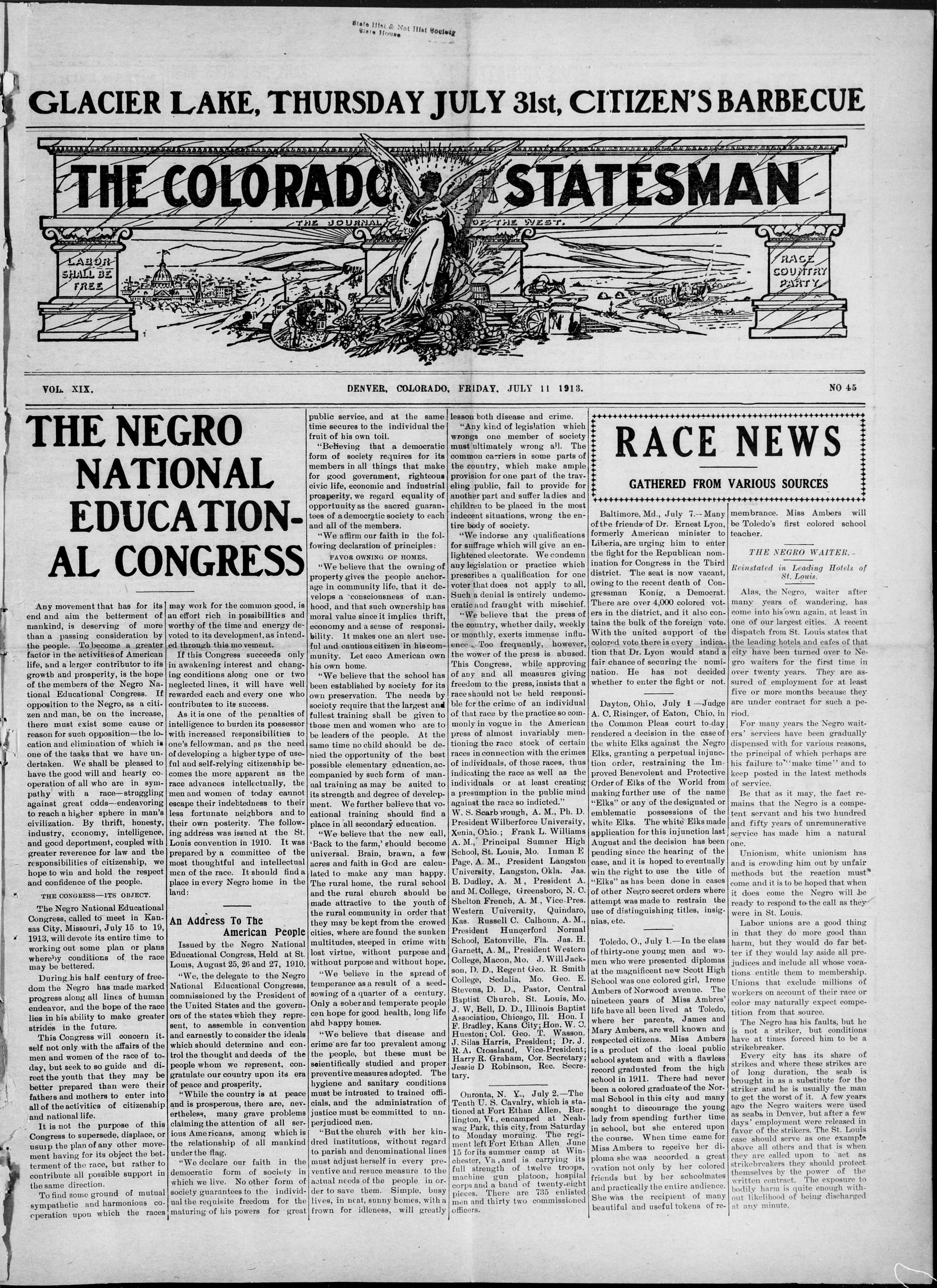
GLACIER LAKE, THURSDAY JULY 31st, CITIZEN'S BARBECUE
THE COLORADO STATESMAN
THE JOURNAL OF THE WEST.
LABOR SHALL BE FREE
RAGE COUNTRY PARTY
THE NEGRO NATIONAL EDUCATION- AL CONGRESS
VOL. XIX.
THE NEW NATIONAL EDUCATIONAL CO
Any movement that has for its end and aim the betterment of mankind, is deserving of more than a passing consideration by the people. To become a greater factor in the activities of American life, and a larger contributor to its growth and prosperity, is the hope of the members of the Negro National Educational Congress. If opposition to the Negro, as a citizen and man, be on the increase, there must exist some cause or reason for such opposition—the location and elimination of which is one of the tasks that we have undertaken. We shall be pleased to have the good will and hearty cooperation of all who are in sympathy with a race—struggling against great odds—endeavoring to reach a higher sphere in man's civilization. By thrift, honesty, industry, economy, intelligence, and good deportment, coupled with greater reverence for law and the responsibilities of citizenship, we hope to win and hold the respect and confidence of the people.
THE CONGRESS—ITS OBJECT.
The Negro National Educational Congress, called to meet in Kansas City, Missouri, July 15 to 19, 1913, will devote its entire time to working out some plan or plans whereby conditions of the race may be bettered.
During his half century of freedom the Negro has made marked progress along all lines of human endeavor, and the bope of the race lies in his ability to make greater strides in the future.
This Congress will concern itself not only with the affairs of the men and women of the race of today, but seek to so guide and direct the youth that they may be better prepared than were their fathers and mothers to enter into all of the activities of citizenship and national life.
It is not the purpose of this Congress to supersede, displace, or usurp the plan of any other movement having for its object the betterment of the race, but rather to contribute all possible support in the same direction.
To find some ground of mutual sympathetic and harmonious cooperation upon which the races
may work for the common good, is an effort rich in possibilities and worthy of the time and energy devoted to its development, as intended through this movement. If this Congress succeeds only in awakening interest and changing conditions along one or two neglected lines, it will have well rewarded each and every one who contributes to its success.
As it is one of the penalties of intelligence to burden its possessor with increased responsibilities to one's fellowman, and as the need of developing a higher type of useful and self-relying citizenship becomes the more apparent as the race advances intellectually, the men and women of today cannot escape their indebtedness to their less fortunate neighbors and to their own posterity. The following address was issued at the St. Louis convention in 1910. It was prepared by a committee of the most thoughtful and intellectual men of the race. It should find a place in every Negro home in the land:
An Address To The
Issued by the Negro National Educational Congress, Held at St. Louis, August 25, 26 and 27, 1910. "We, the delegate to the Negro National Educational Congress, commissioned by the President of the United States and the governors of the states which they represent, to assemble in convention and earnestly to consider the ideals which should determine and control the thought and deeds of the people whom we represent, congratulate our country upon its era of peace and prosperity. "While the country is at peace and is prosperous, there are, nevertheless, many grave problems claiming the attention of all serious Americans, among which is the relationship of all mankind under the flag.
"We declare our faith in the democratic form of society in which we live. No other form of society guarantees to the individual the requisite freedom for the maturing of his powers for great
DENVER. COLORADO. FRIDAY. JULY 11 1913.
DENVER. COLORADO. FRIDAY. JULY 11 1913.
State Hst & Nat Hst Socieig
State House
HURSDAY JU
ADO
THE JOURNAL
DENVER, COLORADO,
public service, and at the same time secures to the individual the fruit of his own toil.
"Believing that a democratic form of society requires for its members in all things that make for good government, righteous civic life, economic and industrial prosperity, we regard equality of opportunity as the sacred guarantees of a democratic society to each and all of the members.
"We affirm our faith in the following declaration of principles:
FAVOR OWNING OF HOMES.
"We believe that the owning of property gives the people anchorage in community life, that it develops a consciousness of manhood, and that such ownership has moral value since it implies thrift, economy and a sense of responsibility. It makes one an alert useful and cautious citizen in his community. Let eaco American own his own home.
"We believe that the school has been established by society for its own preservation. The needs by society require that the largest and fullest training shall be given to those men and women who are to be leaders of the people. At the same time no child should be denied the opportunity of the best possible elementary education, accompanied by such form of manual training as may be suited to its strength and degree of development. We further believe that vocational training should find a place in all secondary education.
"We believe that the new call, 'Back to the farm,' should become universal. Brain, brawn, a few acres and faith in God are calculated to make any man happy. The rural home, the rural school and the rural church should be made attractive to the youth of the rural community in order that they may be kept from the crowed cities, where are found the sunken multitudes, steeped in crime with lost virtue, without purpose and without purpose and without hope.
"We believe in the spread of temperance as a result of a seed-sowing of a quarter of a century. Only a sober and temperate people can hope for good health, long life and happy homes.
"We believe that disease and crime are far too prevalent among the people, but these must be scientifically studied and proper preventive measures adopted. The hygiene and sanitary conditions must be intrusted to trained officials, and the administration of justice must be committed to unperjudiced men.
"But the church with her kindred institutions, without regard to parish and denominational lines must adjust herself in every preventive and resuce measure to the actual needs of the people in order to save them. Simple, busy lives, in neat, sunny homes, with a frown for idleness, will greatly
lesson both disease and crime.
"Any kind of legislation which wrongs one member of society must ultimately wrong all. The common carriers in some parts of the country, which make ample provision for one part of the traveling public, fail to provide for another part and suffer ladies and children to be placed in the most indecent situations, wrong the entire body of society.
"We indorse any qualifications for suffrage which will give an enlightened electorate. We condemn any legislation or practice which prescribes a qualification for one voter that does not apply to all. Such a denial is entirely undemocratic and fraught with mischief.
"We believe that the press of the country, whether daily, weekly or monthly, exerts immense influence. Too frequently, however, the wower of the press is abused. This Congress, while approving of any and all measures giving freedom to the press, insists that a race should not be held responsible for the crime of an individual of that race by the practice so commonly in vogue in the American press of almost invariably mentioning the race stock of certain races in connection with the crimes of individuals, of those races, thus indicating the race as well as the individuals or at least creating a presumption in the public mind against the race so indicted."
W. S. Scarborough, A. M., Ph. D. President Wilberforce University, Xenia, Ohio.; Frank L. Williams A. M., Principal Sumner High School, St. Louis, Mo. Inman E. Page, A. M., President Langston University, Langston, Okla. Jas. B. Dudley, A. M., President A. and M. College, Greensboro, N. C. Shelton French, A. M., Vice-Press. Western University, Quindaro, Kas. Russell C. Calhoun, A. M., President Hungerford Normal School, Eatonville, Fla. Jas. H. Garnett, A. M., President Western College, Macon, Mo. J. Will Jackson, D. D., Regent Geo. R. Smith College, Sedalia, Mo. Geo. E. Stevens, D. D., Pastor, Central Baptist Church, St. Louis, Mo. J. W, Bell, D. D., Illinois Baptist Association, Chicago, Ill. Hon. I. F. Bradley, Kans City; Hon. W. C. Hueston; Col. Geo. T. Wasson. J. Silas Harris, President; Dr. J. R. A. Crossland, Vice-President; Harry R. Graham, Cor. Secretary; Jessie D Robinson, Rec. Secretary.
Onronta, N. Y., July 2.—The Tenth U. S. Cavalry, which is stationed at Fort Ethan Allen, Burlington, Vt., encamped at Neahwag Park, this city, from Saturday to Monday morning. The regiment left Fort Ethan Allen June 15 for its summer camp at Winchester, Va., and is carrying its full strength of twelve troops, machine gun platoon, hospital corps and a band of twenty-eight pieces. There are 735 enlisted men and thirty two commissioned officers.
RACE NEWS
Baltimore, Md., July 7.—Many of the friends of Dr. Ernest Lyon, formerly American minister to Liberia, are urging him to enter the fight for the Republican nomination for Congress in the Third district. The seat is now vacant, owing to the recent death of Congressman Konig, a Democrat. There are over 4,000 colored voters in the district, and it also contains the bulk of the foreign vote. With the united support of the colored vote there is every indication that Dr. Lyon would stand a fair chance of securing the nomination. He has not decided whether to enter the fight or not.
membrance. Miss Ambers will be Toledo's first colored school teacher.
THE NEGRO WAITER.
Reinstated in Leading Hotels of St. Louis.
Alas, the Negro, waiter after many years of wandering, has come into his own again, at least in one of our largest cities. A recent dispatch from St. Louis states that the leading hotels and cafes of that city have been turned over to Negro waiters for the first time in over twenty years. They are assured of employment for at least
Dayton, Ohio, July 1 — Judge A. C. Risinger, of Eaton, Chio, in the Common Pleas court to-day rendered a decision in the case of the white Elks against the Negro Elks, granting a perpetual injunction order, restraining the Improved Benevolent and Protective Order of Elks of the World from making further use of the name "Elks" or any of the designated or emblematic possessions of the white Elks. The white Elks made application for this injunction last August and the decision has been pending since the hearing of the case, and it is hoped to eventually win the right to use the title of "Elks" as has been done in cases of other Negro secret orders where attempt was made to restrain the use of distinguishing titles, insignias, etc.
Toledo, O., July 1.—In the class of thirty-one young men and women who were presented diplomas at the magnificent new Scott High School was one colored girl, Irene Ambers of Norwood avenue. The nineteen years of Miss Ambres' life have all been lived at Toledo, where her parents, James and Mary Ambers, are well known and respected citizens. Miss Ambers is a product of the local public school system and with a flawless record graduated from the high school in 1911. There had never been a colored graduate of the Normal School in this city and many sought to discourage the young lady from spending further time in school, but she entered upon the course. When time came for Miss Ambers to receive her diploma she was accorded a great ovation not only by her colored friends but by her schoolmates and practically the entire audience. She was the recipient of many beautiful and useful tokens of re-
NO 45
membrance. Miss Ambers will be Toledo's first colored school teacher.
THE NEGRO WAITER.
Reinstated in Leading Hotels of St. Louis.
Alas, the Negro, waiter after many years of wandering, has come into his own again, at least in one of our largest cities. A recent dispatch from St. Louis states that the leading hotels and cafes of that city have been turned over to Negro waiters for the first time in over twenty years. They are assured of employment for at least five or more months because they are under contract for such a period.
For many years the Negro waiters' services have been gradually dispensed with for various reasons, the principal of which perhaps are his failure to "make time" and to keep posted in the latest methods of service.
Be that as it may, the fact remains that the Negro is a competent servant and his two hundred and fifty years of unremunerative service has made him a natural one.
Unionism, white unionism has and is crowding him out by unfair methods but the reaction must come and it is to be hoped that when it does come the Negro will be ready to respond to the call as they were in St. Louis.
Labor unions are a good thing in that they do more good than harm, but they would do far better if they would lay aside all prejudices and include all whose vocations entitle them to membership. Unions that exclude millions of workers on account of their race or color may naturally expect competition from that source.
The Negro has his faults, but he is not a striker, but conditions have at times forced him to be a strikebreaker.
Every city has its share of strikes and where these strikes are of long duration, the seab is brought in as a substitute for the striker and he is usually the man to get the worst of it. A few years ago the Negro waiters were used as scabs in Denver, but after a few days' employment were released in favor of the strikers. The St. Louis case should serve as one example above all others and that is when they are called upon to act as strikebreakers they should protect themselves by the power of the written contract. The exposure to bodily harm is quite enough without likelihood of being discharged at any minute.
What a Dollar Will Do
THE MONARCH
WINE LIQUOR CD.
You Can Get
One Case of Good, Ste
ized Beer, 24 Pints w
Or One Gallon of Pure
California Port, Sherry
Muscatel Wine.
Or One Full Quart o
Bond Rye or Bourb
The Monarch L
PHONE CHAMPA
1516 Court Place
SEEDS
Your back yard will help pay you
BARTELD
"WESTERN SEEDS FOR WES
THE BARTELDES S
1521-1525 Fifteenth St.
The Largest Poultry Supply H
HENRY MILLI
Case of Good, Steamed, Steril-
teer, 24 Pints to the Case.
The Gallon of Pure 8 Year Old
Nia Port, Sherry, Angelica or
Cel Wine.
The Full Quart of Bottled in
Rye or Bourbon Whiskey.
Monarch Liquor Co.
PHONE CHAMPA 1231
Place Denver, C
SEEDS
ard will help pay your rent if you pla
BARTELDES'
SEEDS FOR WESTERN PLANTE
E BARTELDES SEED CO.
North St. Denver, Col
West Poultry Supply House in the West
Y MILLER & C
1939 BROADWAY
GRAVEL ROOFING
AND CEMENT WORK
One Case of Good, Steamed, Sterilized Beer, 24 Pints to the Case. Or One Gallon of Pure 8 Year Old California Port, Sherry, Angelica or Muscatel Wine. Or One Full Quart of Bottled in Bond Rye or Bourbon Whiskey.
The Monarch Liquor Co.
PHONE CHAMPA 1231
1516 Court Place Denver, Colo.
The Largest Poultry Supply House in the West
Cement Ash Pits, $5 Up Repairing Promptly Done Tin Roofs Painted
All Work Guaranteed Give Us
Phone Main 1062
V. F. Davis
Plumbing Inspector for City and County of
g, Heating and Ventilation
and Tests for Sewer Gases On All
defective buildings
Estimates Given
PHONE SOUTH 855 DENVER
WER & SCHUCK
All Work Guaranteed Give Us a Trial Phone Main 1062
W. F. D
(12 Years Chief Plumbing Inspector for
Plumbing, Heating and
Examination and Tests for Sewer
defective build
Estimates G
842 BROADWAY PHONE SOUTH
BROWER &
W.F.Davis
(12 Years Chief Plumbing Inspector for City and County of Denver) Plumbing, Heating and Ventilation Examination and Tests for Sewer Gases On All Old defective buildings Estimates Given 842 BROADWAY PHONE SOUTH 855 DENVER, COLO
REAL ESTATE
311 Cooper Building
DENVER, COLORADO
JOHN ENG
K & Engstrom
Beck & En
Beck @ Engstrom
WHOLESALE DEALERS IN
Wines, Liquors
Cigars
Western Agents for Minneapolis Grain Belt Beer and C
Imported Beer and Bock Ol.
1644-46-48-50 Larimer S
Phone Main 1053
es, Liquors and
Cigars
Minneapolis Grain Belt Beer and Carnegie Port
Imported Beer and Bock Ol.
4-46-48-50 Larimer Street
3 Denver, C
Western Agents for Minneapolis Grain Belt Beer and Carnegie Porter, Pripps Imported Beer and Bock Ol.
THE STEAM TANK
HENRY BECK
Give Us a Trial
tain 1062
avis
(ly and County of Denver)
Ventilation
Gases On All Old
ys
ven
DENVER, COLO
CHUCK
RM LANDS
Telephone Champa 1962
Residence Phone Main 7345
JOHN ENGSTROM
strom
NEWS TO DATE IN PARAGRAPHS
CAUGHT FROM THE NETWORK OF WIRES ROUND ABOUT THE WORLD.
DURING THE PAST WEEK
RECORD OF IMPORTANT EVENTS
CONDENSED FOR BUSY
Inquiry as to criminal liability in the failure of the First-Second National bank of Pittsburg will be made by the government.
George Alexander, mayor of Los Angeles for more than four years, has been succeeded by H. H. Rose, formerly a police justice.
Theodore Roosevelt and his two sons, Quentin and Archie, have left New York for the West where they are to spend a couple of months.
The newly enfranchised Woman's party of Cook county, ill., began the organization of a political machine by selecting a chairman for each ward in the city.
Thousands of teachers at Salt Lake attending the National Education Association convention escaped the heat of the city, spending the afternoon on the shores of the Great Salt Lake.
Ray Pfanschmidt, aged 21, slayer of his father, mother, sister and Miss Emma Kaempen, a young school teacher friend, was sentenced at Quincy, Ill., to be hanged October 18.
A fire that started in the beef house of the Nelson Morris Packing Company at South Omaha threatened at one time to entirely destroy the plant, but the firemen got the flames under control with a loss of perhaps $150,000.
With every available man from Mill Valley and the surrounding country, reinforced by troops from the Presidio at San Francisco and Fort Baker on the fire line, combatting with backfire the half-mile front of the forest blaze which swept down Mount Tamalpias, Calif., the authorities expressed confidence that they would be able to save Mill Valley and nearby resort towns from destruction.
Confronted by evidence obtained from the localities of his "seven murders," Simon Helfinstine, the self-styled crime wonder, confessed at Los Angeles that his entire story was a fabrication. He had hoped he would be taken East to answer to some of these murder charges and that he would thus escape a sentence to San Quentin for uttering the worthless check to Japanese merchants in Venice, which caused his arrest.
At Rochester, N. Y., Grand Treasurer Edward Leach of New York was elected grand exalted ruler of the Benevovelt Protective Order of Elks to succeed Thomas B. Mills of Superior, Wis. Mr. Leach was opposed by J. Cookman Boyd of Baltimore. The vote was Leach 1,119; Boyd, 392. Grand Secretary Fred C. Robinson of Dubuque, Iowa, was re-elected in a three-cornered fight. Atlanta withdrew from the race for the 1914 convention before the grand lodge went into session and the delegates were unanimous for Denver.
WASHINGTON.
President Wilson appointed as American ambassador to Austria-Hungary, Frederick Courtland Penfield.
Animals slaughtered in the federally inspected establishments of Colorado in 1912 totaled 329,455. These consisted of 42,251 cattle, 3,570 calves, 72,888 sheep, 100 goats and 210,646 hogs.
Not until President Wilson returns to Washington and consults with Secretary of Labor William B. Wilson will it be known what action he will take in connection with the publication of the story of Secretary Wilson's arrest at Cumberland, Md., in 1895.
A hair-raising story of hand-to-hand conflict spear-hurling Moro savages, of battle to the death on an isolated mountaintop, with no quarter given or expected, was cabled to the War Department from the Philippines by Major General Bell.
Opposition by a few senators to the confirmation of Mrs. H. W. J. Ham as postmistress at Gainesville, Ga., as the successor to Mrs. Helen D. Longstreet, practically tied up the confirmation of the list of the nominations pending before the Senate.
Secretary McAdoo in a statement declared that the general banking condition in Pittsburg, as well as in the entire country, are strong and sound and that he expected no further trouble as a result of the failure of the Pittsburg First-Second National bank.
John Skelton Williams, assistant secretary of the treasury, who represented Secretary McAdoo at the closing of the Pittsburg First-Second National bank, declared the institution had been "seriously mismanaged and the extent of the mismanagement would be determined by the department of justice."
Washington was actually "dry" Sunday for the first time in its history. This was the first Sunday of the new Jones-Works excise law for the District of Columbia.
FOREIGN.
A son was born to Lord and Lady Camoys, Lady Camoys formerly was Mildred Sherman of New York and Newport.
Armando Riva, chief of the national police, was mortally wounded during a pistol fight in the most crowded part of the Prado at Havana.
Six men were killed and thirty injured, several fatally, when a flat car crowded with members of the United State coast artillery was wrecked between Manila and Corregidor.
Francisco de La Barra resigned as minister of foreign affairs at Mexico City, Emilio Rabasa, recently appointed ambassador to the United States, is prominently mentioned for the foreign office.
In the House of Commons the motion of Andrew Bonar Law, the opposition leader, to reject the home rule bill was defeated by a vote of 352 to 243. The bill then passed its third reading without division.
Many of the gold miners at Johannesburg refuse to return to work. At a meeting, militant leaders delivered fiery speeches, and a resolution declaring that the strike was still on and condemning the strike leaders was carried.
The will of the late Sir John Murray Scott, leaving nearly $5,000,000 to Lady Sackville, daughter of the former British minister to Washington, was sustained at London by the jury which heard the evidence in the contest brought by Sir John's relatives. The jury found no undue influence or fraud on the part of Lady Sackville.
Father Michel, superior of the French Catholic mission at Kilkish, confirms reports of massacres committed in that district by Bulgarian irregulars. In one instance they burned to death 700 men belonging to Kurkut by imprisoning them in a mosque, under which they exploded bombs, setting the building on fire. They had previously assembled the victims' wives and daughters to witness the spectacle.
SPORT.
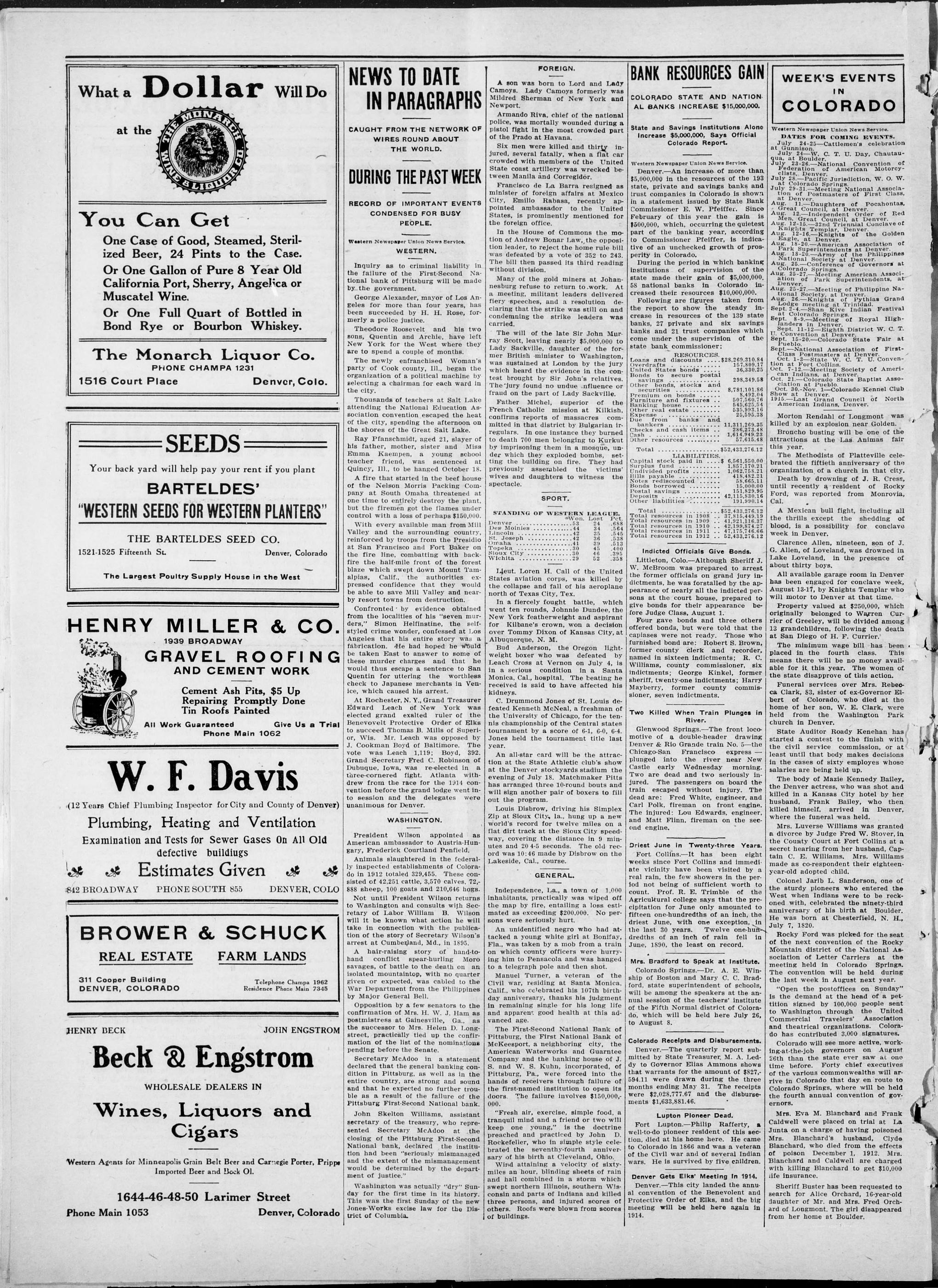
STANDING OF WESTERN LEAGUE.
Won. Lost Pct.
Denver .....53 24 .688
Des Moines .....44 34 .564
Lincoln .....42 25 .545
St. Joseph .....42 36 .538
Ornaha .....41 29 .513
Topeka .....30 45 .460
Sloux City .....30 46 .395
Wichita .....29 52 .358
Léut. Loren H. Call of the United States aviation corps, was killed by the collapse and fall of his aeroplane north of Texas City, Tex.
In a fiercely fought battle, which went ten rounds, Johnnie Dundee, the New York featherweight and aspirant for Kilbane's crown, won a decision over Tommy Dixon of Kansas City, at Albuquerque, N. M.
Bud Anderson, the Oregon lightweight boxer who was defeated by Leach Cross at Vernon on July 4, is in a serious condition in a Santa Monica, Cal., hospital. The beating he received is said to have affected his kidneys.
C. Drummond Jones of St. Louis defeated Kenneth McNeal, a freshman of the University of Chicago, for the tennis championship of the Central states tournament by a score of 6-1, 6-0, 6-4. Jones held the tournament title last year.
An all-star card will be the attraction at the State Athletic club's show at the Denver stockyards stadium the evening of July 18. Matchmaker Pitts has arranged three 10-round bouts and will sign another pair of boxers to fill out the program.
Louis Disbrow, driving his Simplex Zip at Sioux City, Ia., hung up a new world's record for twelve miles on a flat dirt track at the Sioux City speedway, covering the distance in 9 minutes and 20 4-5 seconds. The old record was 10:46 made by Disbrow on the Lakeside, Cal., course.
GENERAL
Independence, La., a town of 1,000 inhabitants, practically was wiped off the map by fire, entailing a loss estimated as exceeding $200,000. No persons were seriously hurt.
An unidentified negro who had attacked a young white girl at Bonifay, Fla., was taken by a mob from a train on which county officers were hurrying him to Pensacola and was hanged to a telegraph pole and then shot.
Manuel Turner, a veteran of the Civil war, residing at Santa Monica, Calif., who celebrated his 107th birthday anniversary, thanks his judgment in remaining single for his long life and apparent, good health at this advanced age.
The First-Second National Bank of Pittsburg, the First National Bank of McKeesport, a neighboring city, the American Waterworks and Guarnee Company and the banking house of J. S. and W. S. Kuhn, incorporated, of Pittsburg, Pa., were forced into the hands of receivers through failure of the first-named institution to open its doors. The failure involves $150,000,000.
"Fresh air, exercise, simple food, a tranquil mind and a friend or two will keep one young," is the doctrine preached and practiced by John D. Rockefeller, who in simple style celebrated the seventy-fourth anniversary of his birth at Cleveland, Ohio.
Wind attaining a velocity of sixtymiles an hour, blinding sheets of rain and hail combined in a storm which swept northern Illinois, southern Wisconsin and parts of Indiana and killed three persons, and injured scores of others. Roofs were blown from scores of buildings.
BANK RESOURCES GAIN
COLORADO STATE AND NATION
AL BANKS INCREASE $15,000,000.
State and Savings Institutions Along Increase $5,000,000, Says Official Colorado Report.
Western Newspaper Union News Service.
Denver.—An increase of more than $5,000,000 in the resources of the 193 state, private and savings banks and trust companies in Colorado is shown in a statement issued by State Bank Commissioner E. W. Pfeiffer. Since February of this year the gain is $500,000, which, occurring the quietest part of the banking year, according to Commissioner Pfeiffer, is indicative of an unchecked growth of prosperity in Colorado.
During the period in which banking institutions of supervision of the state made their gain of $5,000,000, 58 national banks in Colorado increased their resources $10,000,000.
Following are figures taken from the report to show the steady increase in resources of the 139 state banks, 27 private and six savings banks and 21 trust companies which come under the supervision of the state bank commissioner:
RESOURCES.
Loans and discounts:
28,285,310.84
Unearned profits:
157,889.17
United States bonds:
36,330.25
Bonds to secure postal savings
298,349.58
Other bonds, stocks and securities:
8,781,101.86
Premium on bonds
8,492.04
Furniture and fixtures
507,560.76
Banking loans:
545,754.54
Other real estate:
535,993.16
Expense
25,595.38
Due from banks and bankers
11,311,269.25
Checks and cash items:
286,237.48
Cash
1,614,949.23
Other resources:
576,515.48
Total LIABILITIES:
$2,433,276.12
Capital stock paid in surplus fund
6,561,550.00
1,857,170.00
Undivided profits
1,062,758.21
Bills payable
418,482.21
Notes rediscounted
58,665.11
Bonds borrowed
15,000.00
Postal savings
151,829.95
Deposits
42,115,830.16
Other liabilities
191,990.14
Total
$52,433,276.12
Total
37,815,449.19
Total
41,921,116.37
Total
42,289,417.46
Total
47,174,746.66
Total
52,433,276.12
Indicted Officials Give Bonds.
Littleton, Colo.—Although Sheriff J. W, McBroom was prepared to arrest the former officials on grand jury indictments, he was forstalled by the appearance of nearly all the indicted persons at the court house, prepared to give bonds for their appearance before Judge Class, August 1.
Four gave bonds and three others offered bonds, but were told that the caplases were not ready. Those who furnished bond are: Robert S. Brown, former county clerk and recorder, named in sixteen indictments; R. C. Williams, county commissioner, six indictments; George Kinkel, former sheriff, twenty-one indictments; Harry Mayberry, former county commissioner, seven indictments.
Two Killed When Train Plunges in River.
Glenwood Springs.—The front locomotive of a double-header drawing Denver & Rio Grande train No. 5—the Chicago-San Francisco express —plunged into the river near New Castle early Wednesday morning. Two are dead and two seriously injured. The passengers on board the train escaped without injury. The dead are: Fred White, engineer, and Carl Polk, fireman on front engine. The injured: Lou Edwards, engineer, and Matt Flinn, fireman on the second engine.
Driest June in Twenty-three Years.
Fort Collins.—It has been eight weeks since Fort Collins and immediate vicinity have been visited by a real rain, the few showers in the period not being of sufficient worth to count. Prof. R. E. Trimble of the Agricultural college says that the precipitation for June only amounted to fifteen one-hundredths of an inch, the driest June, with one exception, in the last 30 years. Twelve one-hundredths of an inch of rain fell in June, 1890, the least on record.
Mrs. Bradford to Speak at Institute.
Colorado Springs.—Dr. A. E. Winship of Boston and Mary C. C. Bradford, state superintendent of schools, will be among the speakers at the annual session of the teachers' institute of the Fifth Normal district of Colorado, which will be held here July 26, to August 8.
Colorado Recelpts and Disbursements.
Denver.—The quarterly report submitted by State Treasurer, M. A. Leddy to Governor Elias Ammons shows that warrants for the amount of $827, 594.11 were drawn during the three months ending May 31. The receipts were $2,028,777.67 and the disbursements $1,633,881.46.
Lupton Pioneer Dead.
Fort Lupton.—Philip Rafferty, a well-to-do pioneer resident of this section, died at his home here. He came to Colorado in 1866 and was a veteran of the Civil war and of several Indian wars. He is survived by five children.
Denver Gets Elks' Meeting In 1914.
Denver.—This city landed the annual convention of the Benevolent and Protective Order of Elks, and the big meeting will be held here again in 1914.
Western Newspaper Union News Service.
DATES FOR COMING EVENTS.
July 24-25—Cattlomen's celebration
at Gunnison.
July 24—W. C. T. U. Day, Chautauqua,
at Boulder.
July 23-26—National Convention of
Federation of American Motorcyclists,
Denver.
July 28—Pacific Jurisdiction, W. O. W.
at Colorado Springs.
July 29-31—Meeting National Association
Postmasters of First Class,
at Denver.
Aug. 11—Daughters of Pocahontas,
Great Council, at Denver.
Aug. 12-16.—Knights of the Golden
Eagle, at Denver.
Association of Association of
Aug. 18-20, American Association of
Mark St. John
Aug. 18-20, Army of the Philippines
Aug. 18-20, Army of the Philippines
at Denver
Aug. 25—Conference of Governors at Colorado Springs
Auk, 25-27 - Meeting American Association of Park Intendents, at Denver
Aug. 25-27 - Meeting of Philippine National Society, at Denver.
National Science Grand
Sept. 11-12—Eighth District W. C. T. U. Convention at Denver.
Sept. 15-20—Colorado State Fair at Pueblo.
Oct. 7-12—Meeting Society of American Indians, at Denver
Baptist Assoc.
Morton Rendahl of Longmont was killed by an explosion near Golden.
Broncho busting will be one of the attractions at the Las Animas fair this year.
The Methodists of Platteville celebrated the fiftieth anniversary of the organization of a church in that city.
Death by drowning of J. R. Cress, until recently a resident of Rocky Ford, was reported from Monrovia, Cal.
A Mexican bull fight, including all the thrills except the shedding of blood, is a possibility for conclave week in Denver.
Clarence Allen, nineteen, son of J. G. Allen, of Loveland, was drowned in Lake Loveland, in the presence of about thirty boys.
All available garage room in Denver has been engaged for conclave week, August 13-17, by Knights Templar who will motor to Denver at that time. Property valued at $250,000, which originally belonged to Warren Currier of Greeley, will be divided among 13 grandchildren, following the death at San Diego of H. F. Currier. The minimum wage bill has been placed in the fourth class. This means there will be no money available for it this year. The women of the state disapprove of this action. Funeral services over Mrs. Rebecca Clark, S3, sister of ex-Governor Elbert of Colorado, who died at the home of her son, W. E. Clark, were held from the Washington Park church in Denver.
State Auditor Roady Kenehan has started a contest to the finish with the civil service commission, or at least until that body makes decisions in the cases of sixty employees whose salaries are being held up.
The body of Mazie Kennedy Bailey, the Denver actress, who was shot and killed in a Kansas City hotel by her husband, Frank Bailey, who then killed himself, arrived in Denver, where the funeral was held.
Mrs. Luverse Williams was granted a divorce by Judge Fred W. Stover, in the County Court at Fort Collins at a secret hearing from her husband, Captain C. E. Williams. Mrs. Williams made as co-respondent their eighteen-year-old adopted child.
Colonel Jarib L. Sanderson, one of the sturdy pilowers who entered the West when Indians were to be reckoned with, celebrated the ninety-third anniversary of his birth at Boulder. He was born at Chesterfield, N. H., July 7, 1820.
Rocky Ford was picked for the seat of the next convention of the Rocky Mountain district of the National Association of Letter Carriers at the meeting held in Colorado Springs. The convention will be held during the last week in August next year.
"Open the postoffices on Sunday" is the demand at the head of a petition signed by 100,000 people sent to Washington through the United Commercial Travelers' Association and theatrical organizations. Colorado has contributed 3,000 signatures.
Colorado will see more active, working-at-the-job governors on August 26th than the state ever saw at one time before. Forty chief executives of the various commonwealths will arrive in Colorado that day en route to Colorado Springs, where will be held the fourth annual convention of governors.
Mrs. Eva M. Blanchard and Frank Caldwell were placed on trial at La Junta on a charge of having poisoned Mrs. Blanchard's husband, Clyde Blanchard, who died from the effects of poison December 1, 1912. Mrs. Blanchard and Caldwell are charged with killing Blanchard to get $10,000 life insurance.
Sheriff Buster has been requested to search for Alice Orchard, 16-year-old daughter of Mr. and Mrs. Fred Orchard of Longmont. The girl disappeared from her home at Boulder.
```markdown
```
AFRO-AMERICAN CULLINGS
Some curious causes that contribute toward the prejudice that negroes feel toward labor unions, in addition to their resentment at being excluded from many of the unions, are spoken of by Booker T. Washington, in an article in the Atlantic, in which he shows that economic forces are working toward the elimination of this mutual prejudice. The negro country boy of the south, like country boys everywhere, longs for the city. One of the first and most surprising things that the country boy learns in the city is that work is not always to be had. The average negro laborer in the southern country districts has rarely the experience of looking for work; work has always looked for him. In the southern states, in many instances, the employment agent who goes about the country seeking to induce laborers to leave the plantation is looked upon as a kind of criminal. Laws are made to restrict and even to prohibit his operations. The result is that the average negro who comes to town from the plantations does not understand the necessity or advantage of a labor organization, which stands between him and his employer, and aims apparently to make a monopoly of the opportunities for labor. "Another thing which is to some extent peculiar about the negro in the southern states," says Mr. Washington, "is that the average negro is more accustomed to work for persons than wages. When he gets a job, therefore, he is inclined to consider the source from which it comes. The negro himself is a friendly sort of person, and it makes a great deal of difference to him whether he believes the man he is working for is a friend or an enemy. One reason for this is that he has found in the past that the friendship and confidence of a good white man who stands well in the community, are a valuable asset in time of trouble. For this reason he does not always understand, and does not like, an organization which seems to be founded on a sort of impersonal enmity to the man by whom he is employed."
Suggestions for nominations to several of the District of Columbia offices that heretofore have been given to colored men were made to the president by Bishop Alexander Walters of the A. M. E. Zion church, now living in New York, and the principal director in the last presidential campaign of the National Colored Democratic league. Besides the District places, those in foreign countries also were discussed by the president and Bishop Walters. The District posts that have regularly gone to colored men are recorder of deeds and register of the treasury. For the last named place Bishop Walters' suggestions were George C. Clement of North Carolina and A. E. Patterson of Oklahoma, and for the position of recorder of deeds Alfred B. Cosey of New Jersey and James A. Rose of New York. For assistant register of the treasury Bishop Walters suggested Peter J. Smith of Massachusetts and Ralph Langston of New York.
Selfishness sometimes steps in and usurps control, thereby depriving us of those manly attributes which elevate and ennoble. Human desire is boundless in its pursuits, and avarice in its greed overrides every consideration of another's weal. When love of honesty and justice shall have taken possession of the human heart and become imbedded in human life, our troubles will be easier to bear.—Atlanta Phalanx.
Soventy-seven graduates of the colored high school received their diplomas at the twenty-fifth annual commencement exercises at Baltimore. The diplomas were presented the graduates by Mayor Preston, who congratulated the students upon the successful completion of their course and told the vast audience, composed of relatives and friends of the graduates, how proud they should feel of the achievements of those upon the stage. Harry S. Cummings of the First Branch city council, delivered the address to the graduates. The invocation was made by Rev. A. G. Hill, presiding elder of the African Methodist Episcopal church, Baltimore district, and among the invited guests on the stage was Henry Lincoln Johnson, recorder of deeds, of Washington, D. C.
To accommodate the dirigible balloons no matter which way the wind is blowing, a German hangar is mounted on a turntable and is provided with doors at both ends.
Submarine cables resting at the bottom of the sea represents a valuation of $250,000,000.
Stanislaus Czynszky of West Springfield, Mass., is the owner of a cat with a harelip which whistles with the facility of a schoolboy, but cannot mew, or at least never has mewed.
An expert from the United States has been engaged by the Brazilian government to conduct experiments by which that country hopes to increase its cotton crop.
Men and women take desperate chances sometimes-for instance, when they get married.
Pride of race and determination to show that negroes could show business courage equal to white people saved the Peoples Bank and Trust company, a strictly negro bank, Muskogee, Okla., from ruin, and it is running today as usual following a stress that would have wrecked most any bank in the state under similar circumstances. A suit brought by one of the stockholders started an internal strife within the bank that leaked out and started a run. This forced the bank to close its doors. Then the state bank examiner took charge and the bank remained closed all day while angry depositors stormed the outer doors in an effort to get their money out. Meetings were held in every negro church in the city and the negro ministers preached on the subject of the bank They appealed to race pride and to cool judgment. They pointed out that to get panicky and draw out deposits meant to break the bank, sure. For the bank to fall would be a sad commentary upon the negro as a factor in the business world, a thing that the negroes could not afford to have happen. The negroes were advised to let their money stay on deposit and to put in more. This had its effect. While the bank's doors were still closed one negro merchant stood in front of it with $5,000 in money in a bag stating that he was going to deposit it. Several others with big rolls joined him. In the meantime the officers and stockholders of the bank, all negroes, were busy. The bank examiner demanded an assessment of 100 per cent. on the capital stock of $25,000. This was promptly met, and the negro financiers piled on top of the assessment $75,000 more to show good faith. With the permission of the bank examiner the bank was reopened the following day. Another crowd had gathered, but these were depositors trying to get their money into the bank instead of trying to draw it out. The bank had sufficient cash in its vaults at that time to pay every depositor in full, but the money was not demanded and the bank was saved.
The bill introduced in congress by Representative Howard of Georgia providing for separation of the races on street cars in the District of Columbia was criticized at the session of the New England Colored Baptist missionary convention at Washington. E. M. Hewlett of Washington started the argument against the bill when he urged the delegates to use every effort to defeat it. Rev. L. J. Jordan of Philadelphia declared that separate cars were repugnant to any colored man or woman of pride. Revs. G. L. P. Talliafero, E. W. Johnson and W. Bishop Johnson, president of the convention, also delivered addresses attacking the bill. Dr. Johnson told of the recent formation of an organization of representative colored men to keep tab on all legislation aimed at the negro, as well as to keep a watch on the stand that western and northern congressmen take in regard to such measures. He urged that any congressman favoring such legislation be fought at the polls. The protests against the bill came to an end with the passage of a resolution offered by Rev. W. D. Reed of Newport, R. I. The report of the committee on state of the country declares that disfranchisement, lynchings and separate cars are discriminations that the negro should fight. The hope is expressed that President Wilson will live up to his inaugural declaration.
July 6 will be a day long remembered by the colored citizens of Indianapolis. On that day the new Y. M. C. A. building for the colored men's branch was dedicated. The dormitory section, which has accommodations for 101 men, will provide a splendid home for the men who desire to take quarters there. The rooms are provided with electric light, steam heat and individual bed accommodation for each man. The ventilation facilities are good. The charges for the rooms are small. The interest shown in the Tuskegee band was notable. Mr. Stevenson, secretary of the Y. M. C. A. at Tuskegee, and under whose supervision the band travels, said that the band this year is better than ever, and that the selection of their program was drafted to suit the taste of Indianapolis people.
The weight of a bushel of salt as established in the different states, varies from fifty to eighty pounds.
Dogs are made use of to haul light artillery in the Belgian army and are being experimented with by the Holland army.
The largest electrical steel furnaces in the United States, having a capacity of 80,000 tons a year, will be opened in the near future at Lebanon, Pa.
A new form of sanitary bubbling fountain for public places has four knife edges radiating from its opening to prevent a person putting his mouth against the orifice.
Satan furnishes his own gasoline when you permit him to act as your chauffeur.
HOUSE ORDERS LOBBY PROBE
INQUIRY OF EXTRAORDINARY SCOPE DECIDED UPON BY CONGRESS.
START PROBE AT ONCE
FOUR DEMOCRATS, TWO, REPUBLI CANS AND ONE PROGRESSIVE ON COMMITTEE.
Western Newspaper Union News Service.
Washington, July 10.—A lobby investigation of extraordinary scope was authorized by the House to supplement the Senate probe already under way.
With the passage of the Henry investigation resolution a special committee of seven members was immediately appointed by Speaker Clark with Representative Garrett of Tennessee as chairman. The committee will meet today to make plans for the institution of the probe at once.
While the House investigation was prompted largely by the allegations of Colonel M. M. Mulhall regarding the legislative activities of the National Association of Manufacturers, the resolution as finally adopted so enlarged the scope of the inquiry that all efforts to control members of the House or to influence legislation by any person or organization will be subject to the inquisitorial powers of the committee.
The speaker appointed, with Chairman Garrett of Tennessee, Representatives Cline of Indiana, Russell of Missouri, Roddenberry of Georgia, Democrats; Willis of Ohio, Stafford of Wisconsin, Republicans; Nolan of California, Progressive.
Many of the witnesses involved in the Mulhall charges are already in Washington, summoned to take the stand before the Senate Committee. Among those are several former members of Congress and the officers of the National Association of Manufacturers.
New York.—Deputy United States District Attorney Marshall admitted that he was investigating the activities of David Lamar, with a view to bringing them to the attention of the grand jury if the facts warrant.
FIVE MEN BURN TO DEATH.
Three Thousand Fight Fire on Lark
spur Side of Mount Talmabais.
San Francisco, Calif., July 10.—Five men were burned to death early this morning on the Larkspur side of Mount Tamalpais. Correspondents talked with men who declared they saw the five bodies carried away on stretchers toward Mill Valley. The dead are being brought here.
The women and children of Mill Valleq, the suburb across San Francisco bay, are huddled in terrorized groups in the streets watching the approach down Blythedale canon of the Mount Tamalpais forest fire, which their husbands and fathers, aided by 2,000 men of the United States army and navy, are struggling to check. More than 3,000 men are fighting the fire. The wind slackened somewhat early in the evening, but the flames continued to advance steadily toward the town.
All residents in the fire area, including the 1,500 inhabitants of Mill Valley and the hundreds of others whose homes are scattered along the Tamalpais canions, were warned to seek safety in flight and with them hundreds of tourists poured down from the summer camping districts.
$750,000 REFINERY FOR CASPER.
Standard Oil Co. Buys Forty-acre
Tract for Big Plant.
Casper.—The Standard Oil Company of Indiana has purchased a forty-acre tract, located near the Chicago & Northwestern Railroad tracks, and within a short time will begin the erection of a refinery costing about $750,000, for the production of motor spirits, lubricants and other by-products of petroleum. All fuel oil produced by the Midwest Oil Company in both its refineries not already sold to the Chicago & Northwestern, and all by the Franco Petroleum Company, including the present plant and the one now building, will be utilized by the Standard.
Horse Bolts; Peddler Hurt.
Boulder.—H. Scharsh, junk peddler, broke his left leg here when his horse ran away near the union depot.
Wyoming Greeks Volunteer.
Cheyenne.—Local Greeks are preparing to send a delegation of volunteers to Greece, to enlist against the Bulgarians.
Greeks Defeat Bulgarians at Seres.
Belgrade, Servia.—The town of Seres, about forty-five miles to the northeast of Saloniki, was captured from the Bulgarians by the Greek army. The Greek fleet bombarded the seaport of Kavala on the Aegean sea and took it from the Bulgarians.
Cuban Police Chief Dies of Wounds
Havana. Cuba.—General Armando Riva, chief of the Cuban National police, died of wounds received during a pistol fight on the Prado.
SERVIANS KILL 5,000 BULGARS
INVADERS REPULSED IN FIERCE
BATTLE AT ENTRANCE TO
MOUNTAIN PASS.
BURN WOMEN AND MEN
BARBARIC ATROCITIES SAID TO HAVE BEEN PERPETRATED BY BULGAR IRREGULARS.
Belgrade, Servia, July 9.—Five thousand Bulgarian troops, who invaded Servia at Konagevatz, were annihilated when they met the Servian forces and engaged in a desperate battle at the entrance of Zajetars mountain pass. The battle was the most desperate of the last twelve days of fighting. The Servians have recaptured Istip after routing the Bulgarians. A desperate battle was fought with heavy losses, but the Servian guns previously lost were retaken. King Peter has issued a proclamation to his people announcing war.
An official dispatch asserts that the Servians have repulsed the Bulgarians at Zetchar, on the frontier, with heavy losses and also at Vlasina.
Saloniki, July 8.—Father Michel, Superior of the French Catholic Mission at Kilkish, confirms reports of massacres committed in that district by Bulgarian irregulars. In one instance they burned to death 700 men belonging to Kurkut by imprisoning them in a mosque, under which they exploded bombs, setting the building on fire. They had previously assembled the victims' wives and daughters to witness the spectacle. Even more terrible scenes were enacted at Kilkish, Planitza and Raynovo, women also being burned to death. Father Michel asserts that among the irregulars responsible for these atrocities were business and professional men and students from Sofia.
"I AM THE ONY VILLAIN."
Sneers Lamar—"Others Are Actuated by Highest Motives."
Washington.—The Senate lobby investigating committee took a look at Wall street through the spectacles of David Lamar. The dapper operator on the bear side, who admits that he bandied about in the market place the names of men high in Congress, took the committee completely into his confidence. For all the machinations he contrived there was, after all, he swore, but two reasons. He wished to cause an "explosion" which would bring the Wall street men whom he felt were antagonistic to him "into the open" and he wished to insure the re-employment of Edward Lauterbach, his lawyer friend, who had fallen into disfavor with the mighty of the Street.
Although the committee tried to develop that there might have been some other consideration involved, Lamar denied such an allegation as often as it was made. He was on the stand for several hours and although five senators wielded the scalpel at various times they uncovered nothing that Lamar did not wish to reveal. He summed up his whole story in a few words when he said:
"It was the Wall street game I was playing."
Later he added bitterly:
"I am the only villain in Wall street. All the others are actuated by the highest motives and possess the highest ideals."
Banker Gets Jail Term.
Sturgis, S. D.—Bensey E. Perkins, banker, was sentenced to not less than two years nor more than four in prison. He was tried and convicted at a recent term of court for receiving deposits after the defunct Meade County Bank of Sturgis was insolvent.
Denver Gets Elks' Meeting in 1914.
Denver.—This city landed the annual convention of the Benevolent and Protective Order of Elks, and the big meeting will be held here again in 1914.
Six Dead, Thirty Hurt, in Wreck.
Manila, P. I.—Six men were killed and thirty injured when a flat car, crowded with members of the coast artillery, was wrecked between here and Corregidor.
Roosevelt Starts on Arizona Trip. Chicago. — Theodore Roosevelt, accompanied by his sons Archibald and Quentin, spent an hour in Chicago before proceeding on his trip to Arizona.
Colorado Receipts and Disbursements. Denver.—The quarterly report submitted by State Treasurer M. A. Leddy to Governor Elias Ammons shows that warrants for the amount of $827,-594.11 were drawn during the three months ending May 31. The receipts were $2,028,777.67 and the disbursements $1,633,881.46.
Bryan's Commoner Now a Monthly. Lincoln, Neb.—W. J. Bryan's Commoner is to be changed from a weekly to a monthly publication, beginning with the present number.
ASK FOR CARLSON'S Peerless Ice Cream Phones: Main 112 and Main 5787
It's made right, and tastes right. None better made anywhere and This is a Strictly Colorado Production
Meats, Fancy and Staple Groceries 1864 CURTIS STREET
THE ZOBE
SAMPL
1004 Nineteenth S
1004 Nineteenth Street, Corner of Curtis
FINE WINES, LIQUORS AND CIGARS COORS' CELEBRATED BEER ON TAP
DENVER CO
DENVER CO
FIRST TREATMENT $1.50
OTHER TREATMENTS EACH $1.00 DISCOUNT
RATES BY THE MONTH TREATE
ADD 3 CENTS FOR POSTAGE
MADAM M. A. HOL
MADAM M. A. HOLLY
Manufacturer Of Madam Holly's Wonderful Hair Grower PHONE YORK 2229 2618 DOWNING STREET.
Supply Your Home with the Celebrated Tivoli Beer BOTTLED BY THE EMPIRE BOTTLING CO. Phone Gallup 245
J. A. GARFIELD, Pres. C. A. BRYANT, Mgr.
If you have a warm spot in your heart for the Maceo Ice Cream and Confectionery
Parlors, stop in and get cool.
THE MACEO
Fountain Drinks, Confectionery and Cigars
ICE CREAM, DAIRY LUNCHES
Our Specialty, Hot Drinks, Chili and Spaghetti.
2712½ WELTON STREET. DENVER, COLORADO.
Tesch's Market and Grocery
Five-Points Pool and Billiard Parlor CIGARS, TOBACCO and SOFT DRINKS
Corner Nineteenth
THERS'
OOM
ner of Curtis
OIL 60 CENTS
DISCOUNT TO CUSTOMER
TREATED 10 CENTS
TAGE
HOLLY
Denver, Colo.
COLORADO
THE COLORADO STATESMAN
JOS. I. D. RIVERS.....Proprietor
1824 Curtis Street, Room 25.
Phone Main 7417.
SUBSCRIPTION RATES:
One Year .....$2.00
Six Months .....1.00
Three Months .....60
PAYABLE IN ADVANCE.
Entered as second-class matter at the postoffice in the city of Denver,
Colorado.
All communications of a personating nature that are not complimentary
will be withheld from the columns of this paper.
Display advertising, 25 cents per square. A square contains ten agate lines
Reading notices, ten lines or less, 10 cents per line. Each additional line
ever ten lines, 5 cents per line.
No discounts allowed on less than three months' contract. Cash must accompany all orders from parties unknown to us. Further particulars on application.
Remittances should be made by Express Money Order, Postoffice Money Order, Registered Letter or Bank Draft. Postage stamps will be received the same as cash for the fractional part of a dollar. Only 1-cent and 2-cent stamps taken.
Communications to receive attention must be newsy, upon important subjects, plainly written only upon one side of the paper; must reach us Tuesdays, if possible, anyway, not later than Wednesdays, and bear the signature of the author. No manuscript returned, unless stamps are sent for postage.
It occasionally happens that papers sent to subscribers are lost or stolen. In case you do not receive any number when due, inform us by postal card and we will cheerfully forward a duplicate of the missing number.
UNJUST DISCRIMINATIONS.
The barring of Negroes and Japanese from bathing in the lakes at Washington park and Berkeley lake by the Park Board has brought about a vigorous protest by the Japanese, and while the Negroes have made no great demonstration in the matter, it is said that they, as American citizens and who pay taxes for the maintainance of such public places, will demand of the board why the Constitution is abridged in their case—"taxation without representation." It has been less than a month ago that we were deprived of such privileges from the public bath house, where we were allowed certain days of the week to ourselves. Is it not high time that we, as American citizens and taxpayers should call a halt on such unjust discrimination? As long as we allow such discriminating orders to go unnoticed, it will be no long while before other discriminating orders will be heaped upon us. The Afro-American Protective Association, the People's Sunday Alliance and in fact every organized Negro society in Denver should rise in a solid phalanx against all such discriminations.
MAKE GOOD YOUR CREDIT!
This ought to be the banner to fly at the head of the banner of every loyal Negro Denverite. It would mean much to every institution and business among us. The church, the lodges and newspapers alike would profit by such a motto strictly conformed to. We have known colored business men in Denver who failed because Negroes would not pay their debts. Churches have to beg and solicit funds on the streets because members won't pay their obligations, lodges carry long lists of delinquents and have to finally expel members because they won't pay their dues. Newspapers have to live at a poor ('dying rate' because their subscribers won't pay their subscriptions. '(Pay your debts' ought to be blazoned on the door posts of every house in Denver, on your watch fob and calling cards. The Negro is growing careless about this thing. He is losing friends because people are losing confidence in him financially. Neither his note or bond is worth much nowadays. The Colorado Statesman is not saying this for itself alone. While we need money and would be glad to collect all that is owing to us (drop us a card when to call), but we want to sound a toesin and warn the race. We can't afford to wear fine clothes and shine in society and be known as "dead beats." The doctor, the groceryman, the landlords, the newspaper collectors, the lodges treasurers and church officers, besides the whole business world have their eyes upon us; we can not afford to be derelict; to be rated as N. G., to be put down as C. O. D. The race is making a sad mistake. The Colorado Statesman asks you to "cut out" dodging and come up with the "straight thing." Be a man, pay your debts, look the world in the face. We know it may cut you short some time, but it is better to be short than not to be honest; better not to be liberal than a dead beat. It would mean much more for every organization in Denver if the people of this city would pay their bills. Restaurants and rooming housekeepers and every other business would flourish, the Colorado Statesman would be happy and you would have one of those "won't come off smiles" if you would pay your bills. It would add years to your life and peace to your sleep. Try it for a month or two and see if your scribe is not right and you will never go back to the "call again game" any more.
A MO
falls sk
dressed
listener
you w
small o
you an
those w
ested in
make y
A MOST TOUCHING APPEAL
falls short of its desired effect if addressed to a small crowd of interested listeners. Mr. Business Man, are you wasting your ammunition on the small crowd that would trade with you anyway, or do you want to reach those who are not particularly interested in your business? If you do, make your appeal for trade to the largest and most intelligent audience in your community, the readers of this paper. They have countless wants. Your ads will be read by them, and they will become your customers. Try it and see.
Trained Nursing as Woman's Occupation
By CELIA K. HUSIK, Milwaukee, Wita.
Nursing the sick is one of the best professions a woman can take up, provided she is fitted for it. The first and the most important requisite is a love for the work. This must be possessed by every girl who is thinking of becoming a nurse. If she lacks this requisite it is best for her to look to some other channel for an occupation.
Patience, intelligence, a sympathetic nature, a cheerful disposition, personal neatness and cleanliness and, above all, a strong, healthy physical constitution are essential for the successful nurse. The ability and the will to carry out strictly all orders from her superiors is another important quality. A pleasant manner and an agreeable voice are helpful and will add to success.
The only way to become an efficient nurse is to enter a hospital. An ordinary school education with a knowledge of good English are essential preliminaries. In the hospital courses of lectures are given, covering the whole scientific and theoretical part of the subject. And in addition the future nurse receives practical, valuable experience in the care and handling of the sick. Two to three years constitute a complete course, after which the nurse must pass a state board examination in order to obtain her license.
During the course of training most hospitals pay a small monthly salary to the undergraduate nurse. After graduation nurses receive in private work from $25 to $35 per week and their board. A particularly capable and intelligent nurse, especially if she possesses executive ability, may in time attain the position of head nurse at some public or private hospital or other institution. These positions pay from $40 to $75 per month and maintenance.
While the pay in the latter case is less, the permanency of the position and the sense of responsibility and authority often make it desirable
Before taking up nursing bear in mind these qualifications: You must have a strong physical constitution, a great love for the work, a sympathetic yet self-controlled and cheerful nature and a strong sense of duty. With these you are bound to become an efficient and successful nurse.
Bachelors Should Be Tagged and Taxed
By JESSIE N. BURNESS, San Francisco
Should bachelors be tagged? By all means, yes, and taxed, too. Also an "open season" should be declared for them, when they shall be fair game for everybody.
The tags cut in some manner to indicate the reason why—say red for voluntary, blue for involuntary, and a common brass tag would properly indicate that common reason, lack of gold.
I'm hardly prepared to go the length of saying this should be made a law. The poor bachelors are kept so busy dodging the laws we now have, that one is tempted to feel sorry for them, but let custom decree the tag, and the thing is done, painlessly.
A good many of 'em are tagged now, though some of 'em don't know it. If you doubt, watch when some hungry news hunter has the luck to put over a story about "Bachelors of Prominence," or "Misfit Fortunes," or something like that. Besides an access of zeal in the dear stalking they are always subject to, you will see his mail double in size, the telephone will ring until he will probably smash it, the callers in his waiting room will remind you of a bread line, and chances are that inside of ten days he will go fishing. He has to. Even a married man couldn't stand the strain.
Perhaps a gentler custom than tagging could be devised, such, for instance, as that in use for "Miss" and "Mrs." If bachelors could know what a protection that is—what a stay and prop, what an insurance of what one wants and against what one doesn't want, they'd beg for it!
Lodgings of Right Sort for Poor Boys
By J. B. NORTON, Kansas City, Mo.
Much is said and written of the manner in which unattached girls and young women are obliged to live in the city when working for a small wage. It might be well to inquire if boys and young men, likewise working for small pay, are much better off in this respect.
Kansas City is endeavoring to provide lodgings of the right sort for the homeless boy who is barely self-supporting. In that city a hotel has been built to accommodate this class of youths.
In October, 1910, a campaign was started and $65,000 was raised for this purpose. One year afterward a building that would accommodate 120 boys was in operation, equipped with all the necessities that a boy should have to aid his physical and mental growth and to instill into him the proper understanding of his position before the world. Here he finds a real home, a large reception room, library, game rooms, gymnasium, shower baths and a night school (furnished by the board of education) presided over by competent teachers—everything, in fact, that a boy should have.
For this he must pay one-half of his income, not to exceed $3 a week. When he has advanced so that he earns $10 a week he is found a boarding place in a good neighborhood and must leave the hotel, thus making room for the poorer boy who is at all times seeking admission.
Cool Drinks Needed for the Hot Season
By Miss Martha Baxter, Poplar Bluffs, Mo.
Now that the hot days have come let us try to have our meals pleasant and healthful at the same time.
Arrange the table in some neat, dainty way and place flowers about the room. Men just come in from the field, tired and hungry never like a lot of flowers standing in their way. So leave the table minus the flowers.
The general diet of vegetables, etc., should be in the plainest way. Always try to have dinner and supper ready when the men come from work and see how they will appreciate any effort for their comfort.
Have some cool drink or some delicacy if possible. Just anything, like lemonade, strawberry, orange or peachade. These are inexpensive and easy to make. Oranges and bananas cut in small pieces mixed with a little sugar make a good salad. A little pineapple flavoring makes a most desirable ingredient.
Any of these are made to taste better if placed in the refrigerator for a few minutes or small pieces of ice may be placed in the glasses. If you do not own a refrigerator some fresh, cool water from the pump will do nicely. Strawberries and cream are about the nicest dish one can serve. Peaches are delicious served this way.
Trained Nursing as Woman's Occupation By CELIA K. HUSIK, Milwaukee, Wis.
Bachelors Should Be Tagged and Taxed By JESSIE N. BURNESS, San Francisco
Lodgings of Right Sort for Poor Boys By J. B. NORTON, Kansas City, Mo.
Cool Drinks Needed for the Hot Season By Miss Martha Baxter, Poplar Bluff, Mo.
ALL ABOARD!
BIG PICNIC AND EGG HUNT
ZION BAPTIST
SUNDAY SCHOOL
DOME ROCK
THURSDAY, JULY 24
Biggest and Most Enjoyable Outing in the History of
the Sunday School
SOMETHING DOING ALL THE TIME Base Ball -- Foot Races -- Tight Skirt Race, (It's Funny) -- Sack Race -- Croquet -- Horse Shoe Throwing -- Shooting Gallery. Many prizes given to various contestants.
Trains Leave Union Depot at 8:15 ROUND TRIP TICKETS, $1.25 CHILDREN Under 12 Years of Age 65c
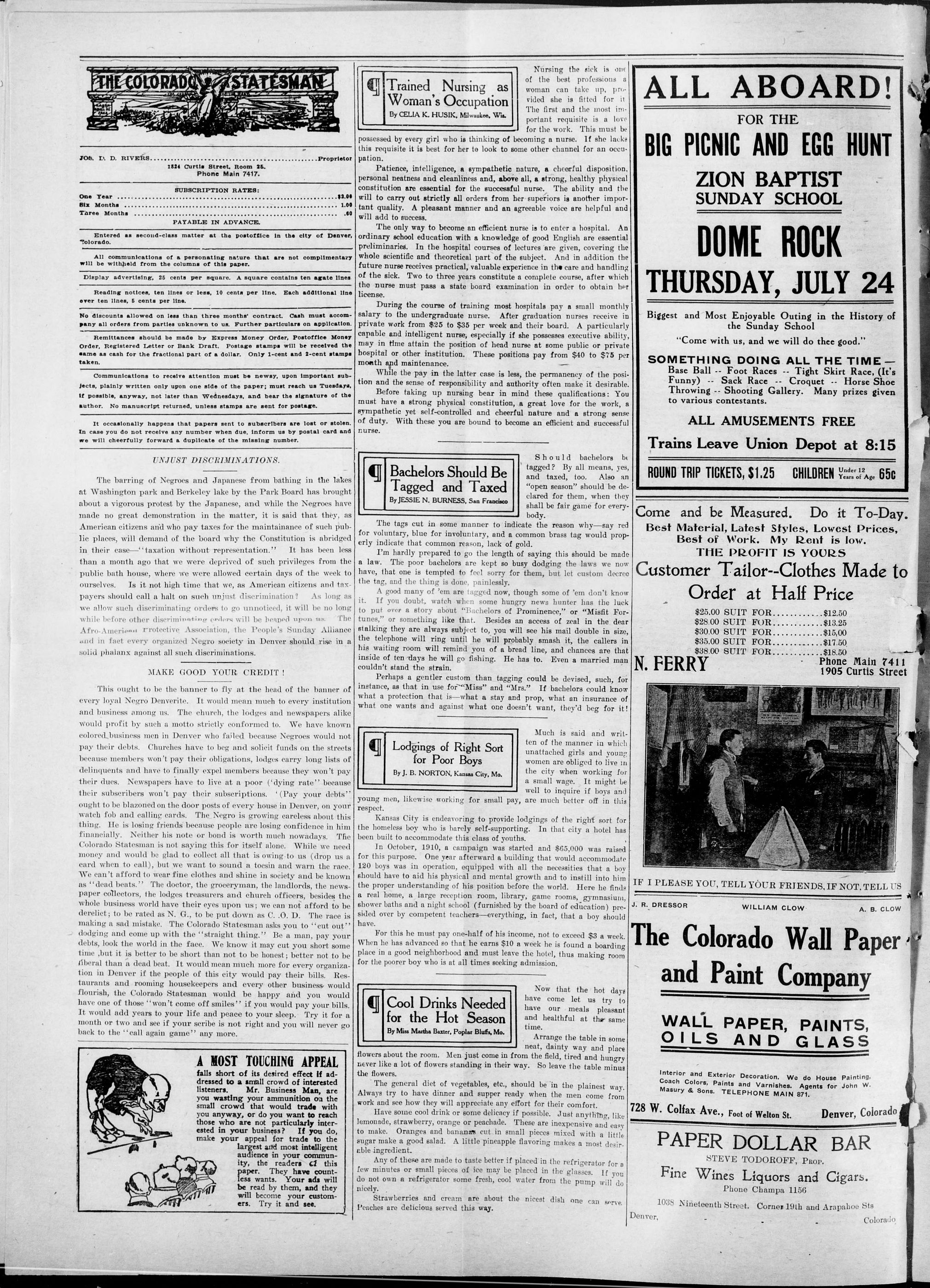
Come and be Measured. Do it To-Day. Best Material, Latest Styles, Lowest Prices, Best of Work. My Rent is low. THE PROFIT IS YOURS Customer Tailor--Clothes Made to Order at Half Price
N. FERRY
WHERE IS THE INVITATION
KEEP THE INVITATION
IN THE MIND OF THE
WHO WAS INVITED
IF I PLEASE YOU, TELL YOUR FRIENDS, IF NOT, TELL US J. R. DRESSOR WILLIAM CLOW A. R. CLOW
The Colorado Wall Paper and Paint Company
WALL PAPER, PAINTS, OILS AND GLASS
Interior and Exterior Decoration. We do House Painting, Coach Colors, Paints and Varnishes. Agents for John W. Masury & Sons. TELEPHONE MAIN 871.
728 W. Colfax Ave., Foot of Welton St. Denver, Colorado
PAPER DOLLAR BAR
STEVE TODOROFF, PROP.
Fine Wines Liquors and Cigars.
Phone Champa 1156
1038 Nineteenth Street. Corner 19th and Arapahoe Sts
Denver, Colorado
"Come with us, and we will do thee good."
ALL AMUSEMENTS FREE
$25.00 SUIT FOR.....$12.50
$28.00 SUIT FOR.....$13.25
$30.00 SUIT FOR.....$15.00
$35.00 SUIT FOR.....$17.50
$38.00 SUIT FOR.....$18.50
Phone Main 7411
1905 Curtis Street
WILLIAM CLOW
THE COLORADO STATESMAN
John R. Jackson arrived home last week from Hot Springs, Ark. Mrs. Jackson is visiting in Ewing, Ky.
Mrs. H. J. M. Brown, who underwent an operation at St. Joseph's hospital, returned home Monday and is getting along nicely.
Miss Allene Campbell left this week for Trinidad, Colo., to, visit a few weeks with her aunt.
COLORED ORPHANS' HOME.
The Sheridan Home for Colored Orphans was the scene of a very enjoyable picnic on June 28th. About a score of ladies were in attendance and all were very favorably impressed with the conditions there. The home will soon be enlarged as it can only accommodate about 20 children at present and is now taxed with that number. Mrs. Morgan is matron, while Mrs. Jas Williams, president of the State Char
Remember the Grand Union excursion to Tolland next Monday, July 14th. The train will leave the Moffat depot at 15th and Bassett streets at 8 o'clock.
Miss Lou Bigsbee of Sparta, Illinois, arrived in the city last Saturday and is the guest of her sister, Miss Evangeline.
Mrs. Robt. Roy returned home from an extensive trip to Vancouver, B. C., en route this way visited Victoria, B. C., Seattle, Portland, Salt Lake City and Ogden.
Mrs. Louis Parks was in the city this week from Wattenburg. She returned home Thursday accompanied by Miss Minnie Sanderline and little Harriet Montgomery, who will visit her a few days.
Mrs. M. A. Cole, after being absent from her home for the past seven years, is now comfortably located at her beautiful home, 2815 Arapahoe St. Her son and daughter-in-law are residing with her.
The following persons visited Colorado Springs last Sunday: Mrs. Rosa Patton, Mrs. M. M. Austin, Miss Lillian Hamlet, Miss Katherine Patton and Wendell Hamlet. They report a very enjoyable trip.
Monday night, about 12 o'clock, the Elite drug store at Twenty-first and Arapahoe streets, was held up and robbed, rifling the cash register and securing $20. The robber fired two shots at the manager, Dr. E. F. Canty.
The Denver Brush Factory, 418 15th street, with a branch store at 1408 Curtis street, can supply you with any kind of a brush imaginable. Brushes and janitor's supplies a specialty. Call and see them.
Rev. George Clark, an old resident of Denver, died Saturday July 5th, at his home in Kansas City, Kan., after a very short illness. Rev. Clark is survived by one daughter, a mother, Mrs. Dudley Clark of this city and a brother and sister, Mrs. R. K. De Priest and Duff Clark. The aged mother and other relatives have the sympathy of their many friends.
Mr. and Mrs. Frank G. Turner, celebrated their fifteenth wedding anniversary last Thursday evening at the beautiful home, 2229 Clarkson street. Many beautiful and expensive presents were received by Mr. and Mrs. Turner from their hosts of friends.
Mrs. Emma Galimore gave a picnic party at Elitch's Gardens Tuesday of last week in honor of Mrs. Francis Wilson of Kansas City. Others present were Mrs. Sarah Byrd, Mrs. Holmes, Mrs. H. King, Rev. Deas and little Miss Dortha Lewis. Light refreshments were served and the day was very enjoyably spent by all.
The Alpha Kappa Club, consisting of several young men of the city, delightfully entertained a number of their friends last Friday evening, in honor of the graduates of nineteen hundred and thirteen. The principal amusement of the evening was a hayrack ride to city park and other places of amusement, after which they returned to the home of Mr. and Mrs. Clarence Holmes, where dancing was indulged in until 1 o'clock.
The Citizen's Picnic and Barbecue, to be given at Glacier Lake Thursday, July 31st, promises to be one of the biggest events of the season as the committee in Charge is sparing neither pains nor expense to make it such. Don't fail to join the crowd for a day's outing. Train leaves Union depot at 6:59 a.m. Round trip $1.50.
DEATHS
The remains of Mrs. Jennie Montgomery, who died at 3721 Williams street, July 4, were shipped from the Douglas Undertaking Co., parlors 7 inst., to Hiawatha, Kan., for burial.
Mrs. Louzetta Branch funeral service was held at Shorter church Sunday, July 5. Interment at Fairmount.
The funeral services of John Battles will be held at the Douglas Undertaking Co. parlor, Saturday, 10 a.m. Interment Fairmount.
Joseph Young, who died at county hospital, was buried July 12. Riverside.
Shirley Peates, who died at county hospital, was buried Saturday, July 12 at Riverside.
Miss Irene Branson, died July 8th, 1913 at 801 Newton street, funeral Sunday from Zion Baptist church.
Mrs. Crump died at 2033 Lawrence street, July 8, 1913; will be buried Sunday by the Court of Colanthe.
Mr. John Flimming, died, July 10, 1913 at 2719 California street, funeral notice later.
A. M. Lawhorn in charge of above funerals.
COLORED ORPHANS' HOME.
The Sheridan Home for Colored Orphans was the scene of a very enjoyable picnic on June 28th. About a score of ladies were in attendance and all were very favorably impressed with the conditions there. The home will soon be enlarged as it can only accommodate about 20 children at present, and is now taxed with that number. Mrs. Morgan is matron, while Mrs. Jas. Williams, president of the State Charity Board, is president. Mrs. Williams will call a meeting in September for the purpose of taking up plans to purchase the site of 36 acres, which is well supplied with fruit trees and alfalfa and berries. Besides selling a large quantity of fruit, about 50 quarts has been put up by the inmates. Denver is very much in need of such a home and it has been suggested that all the secret societies, churches and women's clubs lend a helping hand in promoting the project.
You will miss a treat if you fail to go on the GRAND UNION EXCURSION Monday, July 14 to Tolland, Colo., given under the auspices of Campbell A. M. E. church and Bethleham Baptist church.
Shorter Chapel.
Washington and Twenty-third streets.
Rev. Robert L. Pope, B. D., Pastor.
The following order of service will be observed at Shorter tomorrow:
10:00 a.m. M. Sunday school. Lesson: "Moses Prepared for Work." Ex. 2:12-15.
11:00 a. m. Preaching by the Rt. Rev. H. Blanton Parks, D. D. of Chicago, ill.
6:45 p. m. Allen Christian Endeavor League. Topic: "Speak Not, Evil One, of another." Jas. 4:6-12.
8:00 p. m. Sermon by the pastor.
At the morning hour last Sabbath, Dr. Julian C. Caldwell of Nashville, Tenn., delivered a most eloquent and forceful appeal for higher ideals for the youth. His sermon was highly instructive and edifying, and our congregation was deeply impressed with both the man and the message. He left Monday over the D. & R. G. for Los Angeles, Cal. to attend the international convention of Christian Endeavor.
Among the out-of-town visitors who worshipped at Shorter last Sabbath were Messrs. C. H. Payne, Chicago, and Roy Oliver, St. Louis; Mr. and Mrs. Fred Gray, St. Louis; Mesdames Bella Lopez, New York, J. W. Towns, Dallas, T. F. Norris, New York, L. W. Bell, Minneapolis, Fannie Brooks, Kansas City, S. G. Pryor, Little Rock, W. H. Rodgers, Pueblo, Cook, Dallas, and M. M. Darmon, Little Rock.
Sisters Frances A. Earley, Agnes H. Bruce and J. S. Pope were admitted into our membership last Sunday. At a recent meeting of the stewardess board, held at the home of Mrs. Thos. Reed, 2052 Lawrence street, Mrs. Martha A. Green was elected its president. She assumed duties under encouraging conditions.
While Miss Jennie Hicks, our popular and efficient chorister is on a vacation, Mrs. Lillian (Hawkins) Jones will serve as directoress of the choir. Mrs. Jones is perfectly at home in a choir and the officers are fortunate in securing her service.
The Building Laborers Union No. 1 of Denver will hold their annual sermon at Eureka hall, Sunday, July 13 at 3 p. m., sermon by Rev. P. J. Price of Central Baptist church, music by Campbell Chapel choir. R. M. Griggsby will act as master of cere monies. The public is invited to attend.
Campbell Chapel.
The pastor will preach at 11 o'clock tomorrow. If you like good music hear Campbell's choir. You haven't heard music until you do.
A large and attentive congregation heard Dr. Julian C. Caldwell last Sunday evening in the delivery of a sermon which, for eloquence, logic and spiritual fire, was a masterpiece.
We have just wound up our third quarter's work, with the following report:
Trustees, $381.79 (not including the report from clubs for this week);
stewards, $424.75; sewing circle, $49.30; pastor's aid, $25.46; Missionary society, $33.37; choir, $8.54; Allen league, $2.56; usher bds., $5.30. God bless the faithful who made it so.
Bishop H. Blanton Parks, D. D., presiding bishop of the Fifth Episcopal district, will preach at 7:45 Sunday evening. If you fail to hear him you are the loser; if you hear him, the bishop and the church, are profited. There is no greater preacher in the ranks of the ministry today than Bishop Parks. The choir will furnish some special music for this service, among the numbers to be sung is that inspiring song "The Church is Moving On." The official board made all necessary arrangements Monday evening for the collection of every conference obligation and the completion of what is generally conceded to be the best year's work in the history of Campbell.
All aboard the choo choo train, Monday, July 14 for Tolland, Colo.
Before You Buy Property, Let Lawyer W. B. TOWNSEND
EXAMINE THE TITLE AND MAKE YOUR CONTRACT. LAWYER TOWN. SEND MAKES A SPECIALTY OF COLLECTING FROM INSURANCE COMPANIES, ALSO ENDOWMENT MONIES.
OFFICE 313 KITTREDGE BUILDING
...The masons next big picnic at Bloomfield Park Wednesday, July 16, 1913. Admission 25c.
Notes of the Zion Baptist Church.
Notwithstanding the heat last Sunday morning, the attendance was fine, and the congregation seemed to enjoy the sermon of the pastor. Also at the evening service a goodly number were present for the communion. One was added to the membership and eight persons were fellowshiped into the church.
Zion is somewhat enthused over the prospect of an early move into its new quarters. The date is set for the first Sunday in the month of October. The fall rally is so timed as to be held on the last Sunday in the old church and the first Sunday in the new.
A very generous subscription has already been secured from the membership, to be paid in at the time of the rally. The entire church will be canvassed and the hope is that each loyal member of Zion will be heard from at this effort.
This Sunday evening subject for the stereopticon service is "The Story of Daniel." Being one of the most beautiful and touching stories in the Bible, the congregation is assured a most helpful lesson and a large number is expected to be present. Dr. S. N. Vass of the American Baptist society will hold an institute at the church the week of August 10-15. Afternoon and evening Bible studies will be given free to the public. Everyone is invited to come and see the old Scriptures made new.
COME ONE. COME ALL.
Elder N. H. Hicks, missionary work er has opened a free to all gospel mission at 2733 Welton street. All are invited to attend.
Sunday services, 3:30 p. m.
Sunday evening services, 7:30 p. m.
Tuesday evening, 7:30 p. m.
Friday evening, 7:30 p. m.
MASONS' PICNIC PRIVILEGES.
All privileges at the Masons' Big Picnic at Bloomfield Park July 16th are for sale. See J. R. Contee or T. S. Rector for particulars.—Adv.
One nicely unfurnished room for rent at 2360 Tremont Place.
FOR SALE—Nice 8-room house to a desirable colored family. Thoroughly modern, nice neighborhood, 2515 Humboldt st. $2,500; call at premises.
Eight-room brick house, with well; concrete chicken house and barn; five-cherry trees; garden; good, airy place; plenty of run for chickens; for rent or sale cheap. Mrs. C. Anderson, 1064 Ivanhoe, Montclair.
A free ticket on the Union church excursion to Tolland, Monday, July 14th for the aged as follows:
Shorter Chapel, 3 oldest members.
Zion Baptist, 3 oldest members.
Episcopal, 2 oldest members.
Presbyterian, 2 oldest members.
Scott Chapel, 2 oldest members.
Bethlehem, 2 oldest members.
Central, 2 oldest members.
Campbell, 2 oldest members.
The tickets will be placed in the hands of the pastors, each of whom will select the oldest in his membership for the free outing.
Furnished apartments. 2 and 3
rooms, with hot and cold water in
each kitchen. Also front room, singla
electric lights and gas. Modern
throughout. Rates very reasonable.
2352 Ogden St., Cor. 24th Ave.
Phone York 6707. Mrs. R. M. Blakey.
13 CENTS A DAY BUYS A PIANO.
WITH MUSIC LESSONS FREE. PIANOS FROM $88 UP. COLUMBINE MUSIC CO., 920-924 15th STREET, CHARLES BUILDING.
Why Not Be Cool
At Zion Church
Evening During the
SERMONS IN PICTURE
STEREO
SUBJECT—TO-MORROW NIGHT:
"The Story Of I
ILLUSTRATED SONG
"The Lower
ILLUSTRAT
EVERYBODY
THE PARIS
DANCING A
Will Still Continue to Hold
---
Will Still Continue to Hold Their Monday Night Dances at
RATLEY AND CAMPBELL
GOOD NEWS
FREE-FREE.
THE DE LUXE
Dancing Every Monday Evening
NOTICES TO BE PAID FOR.
Owing to the increased cost of publication, it becomes necessary to make a nominal charge of 50 cents, payable in advance, for all cards of thanks, notices of condolence and resolutions. The price of room rent ads and other liners that run on a monthly rate of 50 cents must be paid in advance, as small a rate and pay a collector's commission. No items of this nature accepted without a cash payment.
Brickler's New Barber Shop is located at 2208 Larimer street. Shave, 10c. Hair Cut, 25c: Children, 15c.
Where Women Run Cara.
The suggestion that women may be employed as street car conductors in Philadelphia has brought out the fact that the women of Latin America, usually thought of as sheltered, retiring and unprogressive, have been doing this kind of work for years. During the war between Chill and Peru, when all the men of Chill were needed at the front, women took their places on the street cars, and Santiago, Valparaiso and several other cities have had women conductors ever since.
indignantly Denied.
I see by your paper that you have published in the Duncan news department what you called a dance at my house and the statements made are entirely false. True, we had a few of our neighbors to spend the evening and some pups from Duncan came entirely without any invitation whatever, and when they came they were given to understand that they were not wanted.—Thornbury (Ont.) Herald Refector.
The Kind He Liked.
I overheard the following conversation between my little brother and his playmate: Jack remarked: "You said you had a 'bad' cold; did you ever have a 'good' one, Herbert?" Herbert answered: "Sure. Once I had one that kept me home from school."
for
to a highly Hum-
well; parry
airy; for
person.
church July
SUMMONS IN DIVORCE.
In the Court of
STATE OF COLORADO
City and County of Denver. ss.
No. 48849.
Alexander Jackson, Plaintiff,
and
Annie Jackson, Defendant.
The People of the State of Colorado, to
the Defendant above named, Greet-
lily.
You are hereby required to appear
in an action brought against you by
the above-named plaintiff in the Coun-
tity of Colorado, and County of
Denver, State of Colorado and answer
the complaint within thirty
days after the service hereof if you are
satisfied with the state, or
ty days after the service hereof if
served personally outside the State of
Colorado, or, if served by publication,
within thirty days from the date of the
last publication, or trial will be had
the same as though you were present.
This is an action brought to obtain
a decree of divorce on the ground of
referral, and relief as may seem to the Court just
and equitable from the complaint, a
copy of which is hereunto attached,
and the evidence adduced upon the
trial.
Witness, Thomas L. Bonfils, Clerk of the County Court, in and for the said City and County of Denver, his affidavit in Denver this 15th day of May, A. D. 1913, and the seal of said Court hereunto affixed
(Seal) Clerk of the County Court.
By ETHEL L. LING.
Deputy.
W. B. Townsend, Attorney for Plaintiff.
First publication June 28, 1913.
Last publication July 26, 1913.
J. W. CARRIE, SR
J. W. CARRIE, JR
Carrie & Carrie
TONSORIAL PARLOR
HAND AND ELECTRICAL FACE MASSAGE
1841 Arap. St. Denver, Colo.
Cool and Comfortable
Church Each Sunday
During the Hot Weather?
PICTURES BY MENAS OF THE
EREOPTICON.
Of Daniel," ten views
SONGS: "Hold The Fort" and
Power Lights"
RATED SONGS
BODY WELCOME
RISIENNE
ACADEMY
old Their Monday Night
Dances at
FERN HALL
27th & Welton Sts.
ALL SUMMER
---
Citizens' Picnic AND BARBECUE THURSDAY, JULY 31st., GLACIER LAKE
Circling the crater on the Crest of the Continent—a trip to cloudland over the famous "Switzerland Trail of America." Four rounds of "the Giant's Ladder, Boating and Fishing, Webster's Full Orchestra.
GENERAL COMMITTEE—Eph Barton, Arnold Smith, Chas. Overton, Sandford Caldwell, Olie Grigsby, R. E, Webster, W. B. Townsend, Leonard Haynes, George Morrison.
ROUND TRIP $1.50
TRAIN LEAVES UNION
REFRESHMENT AND T
E. B. Blackwell, 2847 Glenarm
Caldwell, 2246 Tremont Place;
Miss Beatrice Walker, 2546 Wai
ley, 2546 Walnut street; Miss B
avenue, Pablo Walskino, 2737 C
Buy Tickets from Rice &
2632 Welton St., Or Th
NOTICE—Tickets on SALE
only for $1.25, after that date $
OFFICER WM. BAKER IN
N LEAVES UNION DEPOT 6:59 A. M.
RESHMENT AND TICKET COMMITTEE—Mrs. Well, 2847 Glenarm Pl. Olive 1918; Mrs. E. Ethel 246 Tremont Place; Miss Banks, 2542 Curtis street; The Walker, 2546 Walnut street; Miss Alberta Kirt-almut street; Miss Rose Watson, 1717 Pennsylvania Walskino, 2737 California street.
Tents from Rice & Rice Confectionery Co., Welton St., Or The Maceo, 2721 Welton St
Tickets on SALE at the above places, July 20th 15, after that date $1.50
WM. BAKER IN CHARGE OF THE TRAIN
TRAIN LEAVES UNION DEPOT 6:59 A. M.
REFRESHMENT AND TICKET COMMITTEE—Mrs.
E. B. Blackwell, 2847 Glenarm Pl. Olive 1918; Mrs. E. Ethel
Caldwell, 2246 Tremont Place; Miss Banks, 2542 Curtis street;
Miss Beatrice Walker, 2546 Walnut street; Miss Alberta Kirt-
ley, 2546 Walnut street; Miss Rose Watson, 1717 Pennsylvania
avenue, Pablo Walskino, 2737 California street.
Buy Tickets from Rice & Rice Confectionery Co.,
2632 Welton St., Or The Maceo, 2721 Welton St
NOTICE—Tickets on SALE at the above places, July 20th
only for $1.25, after that date $1.50
Great Sacrifice Sale During Month of July ON FUR COATS
Such as Natural and Black Ponies, Marmotts, Coneys and Seals, etc. Also all Fur Collars and Muffs.
A small deposit will secure any garment in this store.
Youman's
Youman's Fur Company
en You Want
Hands, Feet, Tails Snouts, Neckbones
Earlings or any other part of the hog
except the squeal go to
East's Market
When Y
The Heads, Feet, Tax
or Chiterlings or any
except the sq
East's
When You Want
The Heads, Feet, Tails Snouts, Neckbones or Chiterlings or any other part of the hog except the squeal go to East's Market
PRIOR FURNITURE CO
14 CURTIS STREET
SECOND HAND FURNITURE BOUGHT,
AND EXCHANGED. WINDOW SHADES
SEWING MACHINES SOLD AND RE.
PAIRED A SPECIALTY
THE PRIOR FY
1814 CURT
NEW AND SECOND HAND
SOLD AND EXCHANGE
AND SEWING MACH
PAIRED A
NEW AND SECOND HAND FURNITURE BOUGHT, SOLD AND EXCHANGED. WINDOW SHADES AND SEWING MACHINES SOLD AND RE- PAIRED A SPECIALTY
SPECIAL BRUSHES
MADE
TO
ORDER
Headquarters for all kinds of
Brushes and Janitor Supplies
SAM FRANCIS, Mgr.
Branch 1408 Curtis St.
Denver Brush Factory 418 15th St
Champa 770
Factory
Champa 770 Denver, Colo
.
PHONE MAIN 8045
2300-6 Larimer Street
Phone. Champa 392
422-424 15th STREET
Phone Main 1461.
Cash or Credit
FOR GOOD MEALS
GO TO
Mamma Neeley's
RESTAURANT
1829 Arapahoe St.
Everything Neat and Clean. Service First class.
PRODUCER OF FOOD
United States Leads in Supply of Great Staples.
Raises Products for Own People and Many Other Nations—Each Country and Epoch Has Questions of Food Supply.
Washington.—Each country and each epoch has its special food problems. During the last 400 years and more the United States has passed on from the conditions prevailing in a newly discovered country, with only a small area under cultivation, and has become a producer of food and other great staple products not only for its own people, but also for export to other nations. An equally great change has taken place with respect to the different regions of the United States. As the country has been developed frontier conditions of living have receded, until today, as never before, the food problems of country and town are approaching each other, and it is no longer the case that the rural community is, as regards its supply of staple food, largely independent and the urban community largely dependent.
Each must rely on the other, for in general the farm-grown crop is milled and the live stock is slaughtered in the large establishments where facilities are adequate, as they could not be in the case of home enterprise. And, indeed, in all economic ways the two regions are perhaps more naturally interdependent than ever before. All this means that many problems related to food demand are studied in order that the best use may be made of agricultural food crops by the farmer who grows them, the manufacturer who converts the raw material into food products, the merchant who supplies the food to the household and the housewife who selects and prepares it for the family table.
Some of the problems which pertain to this subject have been studied by the Federal department of agriculture and C. F. Langworthy, has compiled the data regarding food conditions as a whole, the characteristics of the American diet and the special problems of housekeepers in both country and town. The majority of persons set their pleas of the food habits of a race or region from popular writings and often the source of information is inaccurate or incomplete. If a writer states that the diet in New England is pork and beans and brown bread, or that in the south it is corn meal and pork, every one knows that the statement is very inadequate. With the question of diet-in less familiar regions, the discrepancy is not so obvious.
It is often said and is generally believed that the diet in the United States is generous and that the range in variety of food products is unusually large. The dietary combines many customs and food habits of the races which have helped to make up the population, but in its general character it is British, as is natural, for the bulk of the earlier settlers were from Great Britain and brought the customs and manners of the old home with them, adapted them to the new country, and passed them on to the succeeding generations. As time has passed marked changes in the character of the diet have taken place, owing largely to improved methods of cultivation of food crops, to better methods of transportation and storage, to improvements in milling and other manufacturing processes which pertain to food, to improvement in house construction and kitchen appliances and to similar factors. Whether the value of the daily diet has changed when considered from the standpoint of the amount of nutritive material supplied is another matter, and one which is more difficult to decide.
As an illustration of changed food conditions, facts relating to the diet in public institutions may be of interest, as it seems fair to say that such a ration bears the same relation to the food habits of any one period as does a corresponding one to those of another. In an account of the diet in a large institution in Boston in 1850 a very simple ration was supplied in which bread, molasses, potatoes and salt pork were the staples. In recent studies carried on in the same city in a similar institution the ration is much more varied and contains many articles, such as oatmeal, fresh and dried fruits, tapioca and sago, which would have been considered luxuries in most homes in 1850.
It is not without interest to consider in more detail some of the factors which have modified dietary habits. In northern regions of the United States, in earlier times, the vegetable supply in the summer was fairly abundant, but in the winter was limited to a few varieties, chiefly root crops, which were of good keeping quality. Eggs, salt meats and less commonly poultry were staple summer foods, but fresh beef, mutton and pork were more abundant in winter than in summer because they could be kept in good condition frozen. The lack of variety of vegetable foods in winter and of fresh meat in summer was without doubt the reason for the great abundance of preserves and pickles which every housewife deemed necessary, and for the great number of kinds of pastry, cake and similar dishes. In other words, there was a craving for variety, and it was satisfied by using in many different ways the comparatively small number of food materials which were most commonly obtainable. With im-
provements in crop growing, transportation, storage and marketing of foods there is much less seasonal variation in the food supply and consequently much more uniformity in the diet at different times of the year. In considering the human race, as a whole, there are three great epochs in man's diet, namely: The early hunting period, in which man depended entirely on a natural supply of both animal and vegetable food; the cooking period, in which man still used a natural supply of food, but prepared it for use with the aid of heat, and the so-called biclucultural or food producing period—that is, the period in which man has depended upon the cultivation of both flocks and herds and field and garden crops to supplement a wild supply of food.
Is easy to see there is a press agent at work in the department of agriculture. For he comes to bat for All. with two wonderful tales, vibrant with exciting news interest. The first announces the startling discovery by the omniscient bureau of chemistry in Secretary Houston's department of a method by which "wrapped bread" can be warmed.
"The experts found," says the announcement, "that if a cold wrapped loaf is unwrapped and placed in a pan in the oven, in good medium heat for ten minutes, it will be as good as fresh, crisp without and tender within."
The other dissertation touches upon an even more important item of house-hold economy—"how to keep eggs from cracking." To show how important this problem is, the press agent records the fact that out of 1,532,275-200 shipped into New York last year, 137,804,768 were broken. So Secretary Houston has put the food research laboratory to work on this problem, and they are shipping eggs to all quarters of the country, by parcel post and otherwise, in an effort to find the best way to ship them, without breaking. No results have yet been announced.
Col. George W. Goethals, who is in charge of the army of men on the construction of the Panama canal, while in Washington some time
ago, referred to the great number of reports which are sent to his office from all branches of the work, and which he reads himself. He declared that if gathered together the reports would make a volume of most interesting reading.
A copy of a report from the assistant foreman of the toolroom to his superior officer, which had been forwarded to Colonel Goethals, was produced. The report was on an accident to a Jamaica negro employee of the canal commission, and was as follows:
"Mr. Jordan: Mr. D. Adams got bust his big thumb almost cut off. He was attended by other machinists in toolroom. The uses of wrappings was required. He start fainting and stretchers was getting ready. There was no small stir; everybody in motion as brigade. Mr. Cassell was the swiftest. Locomotive ready at hand and blowing solemn for hospital. I guess he was gone and all was over.
Forty-two delegates, representing all English-speaking countries, gathered in Washington and former Senator Chaucey M. Depew of New York, acting as guide, conducted the party through a greater part of the capitol and then announced that he would next show them the "Chamber of Horrors."
A number of the English delegates failed to comprehend, and Andrew Carnegie raised his hands in horror at the remark as the delegation entered Statuary hall, where the great men of the nation repose in granite and stone. The visitors commented on each statue and were as polite as any one could be under the shock of the first sight of this hall.
"And now, gentlemen, we come to the chamber of the senate of the United States," said Guide Denew
"Have you many rules?" asked Lord Weardale.
"No rules to shut off debate," said Guide Depew.
"And when a senator talks too long, you call that filibustering, do you not?" inquired a Frenchman.
"We call it a nunsance," replied the venerable and polished capitol guide.
The ink used in printing the paper money is a splendid germicide and for
Ink on Money Is Germicide.
ever contracted disease from this source, according to Dr. W. C. Rucker, assistant surgeon general of the United States public health service.
"The formula of the ink used in the engraving of the money is, either by design or accident, a splendid germicide," said Dr. Rucker.
"The public health service was called upon some time ago to examine the old money returned to the treasury after months of traveling around the country and passing through all kinds of hands. It was found that it was comparatively free from bacteria, and the ink is given credit for this satisfactory condition of affairs."
It is not known to what ingredient of the recipe for the ink is due the credit, for the secret of its composition is carefully guarded by the government.
GLADYS VANDERBILT IS SNUBBED BY ROYALTY
SENATOR ISAAC STEPHENSON 84 YEARS OLD
SAYS SOCIETY WORST WORLD HAS EVER SEEN
CHICAGO WOMAN IS WON BY SUFFRAGE VOTE
The Countess Szechanyl has given up her struggle for social recognition
and has moved to London. She has become disheartened and is willing to admit that she has been beaten in the game of ranking with nobility. The count has spent his income, too. The count and countess are living now on Vanderbilt money.
London. She has become disheartened and is willing to admit that she has been beaten in the game of ranking with nobility. The count has spent his income, too. The count and countess are living now on Vanderbilt money. This moving to London marks another step in the too frequently repeated history of the American heiress who marries a foreign nobleman. Other disappointments have been hers, but this social defeat has been the greatest of all.
Fortunately, the Countess Szechenyi has not, according to her intimate friends, suffered disillusion in love, one defeat which many helresses have suffered. The other defeats—lack of social prominence, lack of social success, disappointment in being a "countess," and of nobility and titles in general—have been hers.
Countess Szechenyi was Miss Gladys Vanderbilt. She was married in January, 1908, to Count Laszio Szechenyi, a Hungarian noble. Love, not money, was supposed to be the inspiration of the engagement. It was Gladys Vanderbilt's beauty and charm and not her father's millions that are supposed to have won the foreign nobleman.
The Szechenyi family were not as poor as the noble families of Europe sometimes are. They had lands, castles, money. Their wealth was small, according to American standards of wealth, but they were not even as "land poor" as many nobles, who own land but are not able to pay for its upkeep. It is quite possible that the marriage of Miss Vanderblit to Count Szechenyi really was a love match. Disillusions started directly after the wedding. This time it was not the disillusion of love. But the disillusions nevertheless were great. The first disappointment came in Budapest, after several months of travel. Instead of being received with open arms, as she had expected, Countess Gladys was received much
Senator Isaac Stephenson of Wisconsin, the oldest member of the up
per house in point of age, entered upon his eighty-fifth year June 18, but is as vigorous as the average man of fifty. For many years Senator Stephenson has been an influential figure in the financial and industrial affairs of his state and of the nation. Of late years he has be-
per house in point of age, entered upon his eighty-fifth year June 18, but is as vigorous as the average man of fifty. For many years Senator Stephenson has been an influential figure in the financial and industrial affairs of his state and of the nation. Of late years he has be- come a power in national politics.
Senator Stephenson is a type of the self made, self-educated American. His boyhood was spent in poverty. Today he is the richest man in Wisconsin, being worth at least $15,000,000. The bulk of his vast fortune was made in lumber.
Mr. Stephenson was born on June 18, 1829, near the city of Fredericton, N. B. He went to Wisconsin with his family when he was only sixteen
---
One of the greatest evolutionists, the codiscoverer with Darwin of the
doctrine of natural selection, Alfred Russell Wallace, makes the charge that the "progress" of the world during the last century has resulted in a social system which is "the worst that the world has ever seen."
A. B.
According to him, after a century of such progress, "our whole system of society is rotten from top to bottom." According to this great authority on evolution, "the result of this vast economic revolution has been almost wholly evil."
It is not a mere jeremiaid that he delivers, for he points the way out. Character is being warped by a rot-
"Our engagement will be announced when the woman's suffrage bill passes in the lower house of the state legislature."
N.Y.
This is said to have been the reply Miss Katherine Riley, daughter of Mrs. P. M. Riley, 43 East Division street, Chicago, to the pleadings of William McKinley, speaker of the house.
Suffice it to say that the woman's with a handsome
as if she had been any other countess in any other capital, or even in New York. To be sure, people were anxious for a glimpse of her, but they were not the people whom she cared to know. They were idle curiosity seekers, for the most part, and newspaper reporters. Beggars and charity seeking people sought an audience; beggars were more insistent than in America. But nobility and royalty left her alone.
After a short visit in Budapest the count and countess went to Castle Szcheenyl, in Oermezeo, Hungary. Oermezeo is a small village near Kaschau, Upper Hungary, and is over a hundred miles from Budapest.
And the castle proved the worst disappointment of all, so far. Instead of a wonderful castle, a castle of dreams, it was a rambling, old fashioned structure. The grounds were beautiful, but the castle itself was old and weather beaten. The interior was furnished with various kinds of furniture, nearly all old, but not really antique. It was dark, dismal. Ever since her marriage Countess Szechenyi wanted to be presented at court in Vienna. Millions may be helpful. They may seem even indispensable at times. But they do not give one court entries. Countess Szechenyi was ineligible. She and the count did all they could, but she could not gain real acquaintanceship to the inner circle of the Austrian court.
This snubbing by royalty has been the greatest disillusion of all for the American girl.
In the five years since her marriage Countess Szechenyi has done everything in her power to gain admittance into the court circles of Hungary and Austria. All in vain. Millions have been spent on charities and on entertainments.
Count Szechenyi himself at last is disheartened. He has spent much money in the Balkan war. His small fortune is gone. Some intimate friends say that he still wishes his wife to change her mind and move back to Vienna. Others say that he has expatriated himself for love of his wife and his two children. For in spite of the many disillusions that come when an American heirs and a titled foreign marry, love between the Szechenyi has still remained as firm as ever, according to all reports.
years old, and was one of the first to plow its soil. At that time his parents were so poor that the children had to go barefooted even in the winter. When only seventeen the future senator broke 130 acres of land near Janesville and helped put in 400 acres of wheat. In the winter he went up into the lumber regions and worked, hauling logs with a six-ox team. In 1850 he began to do business on his own account. During the summers he sailed vessels on the lakes and during the winters he continued to work in the lumber camps.
Being a good judge of the value of timber, he was able to locate for himself and associates hundreds of thousands of acres in northern Wisconsin and Michigan, which later made them all millionaires. He established mills, factories and banks in his home town of Menominee. Elsewhere his financial, manufacturing and commercial investments reached into vast fields. In addition to his northern lumber and timber interests he acquired thousands of acres of pine land in Louisiana.
ten social environment, but character is not a thing which can be ruined by environment, as he proceeds to prove, and whenever the environment is improved the unconquerable spirit of man rises as if it had never been suppressed. He has small patience with such reformers as the eugenists, who seek to improve character by improving "the breed," and declares that they are aiming at effects, not causes. It is idle, he asserts, to try to improve the human character until the conditions that spoil it are removed, and this cannot be done without reforming our whole system.
Attacks upon our social system have been made before, but generally on the ground that there are serious defects, though on the whole there has been progress. It is not usual to assert, as this eminent scientist does, that not only has there been no progress except material progress, but that there has been actual retrogression, and that the world has never seen such a rotten social environment.
majority and that Mrs. Riley will make formal announcement of the engagement of her daughter and the youthful speaker of the house.
For several months the women leaders in the equal suffrage movement have marveled at the affability and uniform courtesy of Speaker McKinley while they were lobbying for their bill. But they knew not of Miss Riley.
Mr. McKinley was not a member of the state legislature when he met Miss Riley four years ago. He had just finished a night school course in law after going to Chicago from Iowa, where he had been a school teacher. The couple met at a school reception.
FLORAL DESIGNS PUT UP WHILE YOU WAIT
CHOICE PLANTS AND CUT FLOWERS CONSTANTLY ON HAND
GREENHOUSES: Thirty-Fourth and Curtis Streets
ELEPHONE, MAIN 1511 DENVER, COLO
2735 Welton St. Main 6363
The Central Bottling & Distributing Co.
Agents for the famous
CAPITOL BEER---IT'S CAPITAL
Try a case, 2 doz. pints for $1.10, delivered promptly; empties called for
Family Liquors, Wines, and Cordials Genuine Goods at Popular Prices A glass of good wine will improve your Sunday dinner, and ald digestion.
The Champa Pharmacy
Twentieth and Champa,
Is the place to get your
DRUGS, CHEMICALS AND PATENT MEDICINES
Prescriptions Our Specialty.
Phone us and we will deliver the goods to all parts of the city.
JAMES E. THRALL, PROPR.
PHONE MAIN 2425.
WORK CALLED FOR AND DELIVERED
THE CA
RE
SEWED HALF
HE
1511 CHAMPA STRE
Boost Colorado P
ZA
DE
COLUMBIA
VI
SEWED HALF SOLES 60 cts. and 75 cts.
HENRY WARNECKE, President
511 CHAMPA STREET DENVER, COLO.
Guaranteed Absolutely Pure. Delivery Daily to All Parts of the City.
The Ph. 2
We Boost for Colo
DAY OR NIGHT.
A. M
U m
A first-class Mortua
time of death of loved on
LAWRENCI
LOUIS HUB
PARLORS 19
LET U
Shirts, Colla
Curtains a
The Denver
A first-class Mortuary establishment. First aid to the bereaved in the time of death of loved ones. Prices below competitors. Polite service LAWRENCE JONES, Licenced Embalmer LOUIS HUBBARD, Funeral Director
Shirts, Collars and Cuffs, Blankets, Curtains and Rough Dry Work. The Denver Sanitary Laundry. PHONE MAIN 5670
```markdown
```
1082 Broadway.
REPAIRING DONE WHILE
YOU WAIT
TY SHOE
CO.
and 75 cts.
ident
DENVER, COLO.
ze Home Industry
'S
D
ILSENER
Brewing Co.
185.
Should Boost for Us
PHONE MAIN 6243
HORN
ers
bid to the bereaved in the
citizens. Polite service
Ed Embalmer
Director
Street
YOUR
Fits, Blankets,
Dry Work.
y Laundry.
---
Denver, Colo.
VETERANS HEAR THE PRESIDENT
Mr. Wilson Delivers Address at Gettysburg Celebration.
DRAWS LESSON FROM BATTLE
Declares Great Army of the People
Must Fight Peacefully to
Perfect the Nation
All Love.
Gettysburg, Pa., July 4.—National
day in the semi-centennial celebration of
the Battle of Gettysburg was made
especially notable by an address
delivered by President Woodrow Wilson.
In his audience were many thousands
of the veterans who fought in the
great battle, as well as a great throng
of other visitors.
The president's address follows:
The president's address follows:
Friends and Fellow Citizens: I need not tell you what the battle of Gettysburg meant. These gallant men in blue and gray sit all about us here. Many of them met here upon this ground in grim and deadly struggle. Upon these famous fields and hillsides their comrades died about them. In their presence it were an impertinence to discourse upon how the battle went, how it ended, what it signified! But 50 years have gone by since then and I crave the privilege of speaking to you for a few minutes of what those 50 years have meant.
What have they meant? They have meant peace and union and vigor, and the maturity and might of a great nation. How wholesome and healing the peace has been! We have found one another again as brothers and comrades in arms, enemies no longer, generous friends rather, our battles long past, the quarrel forgotten—except that we shall not forget the splendid valor, the manly devotion of the men then arrayed against one another, now grasping hands and smiling into each other's eyes. How complete the union has become and how dear to all of us, how unquestioned, how benign and majestic, as state after state has been added to this great family of free men! How handsome the vigor, the maturity, the might of the great nation we love with undivided hearts; how full of large and confident promise that a life will be wrought out that will crown its strength with gracious justice and a happy welfare that will touch all alike with deep contentment! We are debtors to those 50 crowded years; they have made us heirs to a mighty heritage.
Nation Not Finished.
But do we deem the nation complete and finished? These venerable men crowding here to this famous field have set us a great example of devotion and utter sacrifice. They were willing to die that the people might live. But their task is done. Their day is turned into evening. They look to us to perfect what they established. Their work is handed on to us, to be done in another way but not in another spirit. Our day is not over; it is upon us in full tide.
Have affairs paused? Does the nation stand still? Is it what the 50 years have wrought since those days of battle finished, rounded out, and completed? Here is a great people, great with every force that has ever beaten in the life blood of mankind. And it is secure. There is no one within its borders, there is no power among the nations of the earth, to make it afraid. But has it yet squared itself with its own great standards set up at its birth, when it made that first noble, naive appeal to the moral judgment of mankind to take notice that a government had now at last been established which was to serve men, not masters? It is secure in everything except the satisfaction that its life is right, adjusted to the uttermost to the standards of righteousness and humanity. The days of sacrifice and cleansing are not closed. We have harder things to do than were done in the heroic days of war, because harder to see clearly, requiring more vision, more calm balance of judgment, a more candid searching of the very springs of right.
Look around you upon the field of Gettysburg! Picture the array, the fierce heats and agony of battle, column hurled against column, battery bellowing to battery! Valor? Yes! Greater no man shall see in war; and self-sacrifice, and loss to the uttermost; the high recklessness of exalted devotion which does not count the cost. We are made by these tragic, epic things to know what it costs to make a nation—the blood and sacrifice of multitudes of unknown men lifted to a great stature in the view of all generations by knowing no limit to their manly willingness to serve. In armies thus marshaled from the ranks of free men you will see, as it were, a nation embattled, the leaders and the led, and may know, if you will, how little except in form its action differs in days of peace from its action in days of war.
May we break camp now and be at ease? Are the forces that fight for the Nation dispersed, disbanded, gone to their homes forgetful of the common cause? Are our forces disorganized, without constituted leaders and the might of men consciously united because we contend, not with armies, but with principalities and powers and wickedness in high places. Are we content to lie still? Does our union mean sympathy, our peace contentment, our vigor right action, our maturity self-comprehension and a clear
confidence in choosing what we shall do? War fitted us for action, and action never ceases.
Our Laws the Orders of the Day.
I have been chosen the leader of the Nation. I cannot justify the choice by any qualities of my own, but so if has come about, and here I stand. Whom do I command? The ghostly hosts who fought upon these battle fields long ago and are gone? These gallant gentlemen stricken in years whose fighting days are over, their glory won? What are the orders for them, who rallies them? I have in my mind another host, whom these set free of civil strife in order that they might work out in days of peace and settled order the life of a great nation. That host is the people themselves, the great and the small, without class or difference of kind or race or origin; and undivided in interest, if we have but the vision to guide and direct them and order their lives right in what we do. Our constitutions are their articles of enlistment. The orders of the day are the laws upon our statute books. What we strive for is their freedom, their right to lift themselves from day to day and behold the things they have hoped for, and so make way for still better days for those whom they love who are to come after them. The recruits are the little children crowding in. The quartermaster's stores are in the mines and forests and fields, in the shops and factories. Every day something must be done to push the campaign forward; and it must be done by plan and with an eye to some great destiny.
How shall we hold such thoughts in our hearts and not be moved? I would not have you live even today wholly in the past, but would wish to stand with you in the light that streams upon us now out of that great day gone by. Here is the nation God has builted by our hands. What shall we do with it? Who stands ready to act again and always in the spirit of this day of reunion and hope and patriotic fervor? The day of our country's life has but broadened into morning. Do not put uniforms by. Put the harness of the present on. Lift your eyes to the great tracts of life yet to be conquered in the interest of righteous peace, of that prosperity which lies in a people's hearts and outlasts all wars and errors of men. Come, let us be comrades and soldiers yet to serve our fellow men in quiet counsel, where the blare of trumpets is neither heard nor heeded and where the things are done which make blessed the nations of the world in peace and righteousness and love.
LOOK TO RUSSIAN OIL FIELDS
Are Certain to Play an Important Part In Furnishing Power for Battleships.
In discussing the fact that the use of oil instead of coal as fuel in the English navy is under consideration it is time Russia should pay serious attention to this question. If England is replacing its own cheap coal by the more expensive foreign product, there must be important advantages on the side of naphtha, and in the future Russian fleet the part to be played by this fuel will be a most important one, the Novoe Vremya says. Many mills and factories have gone over to naphtha as fuel and the consumption is increasing every year.
Russia owns immense oil fields and it could be the chief supplier of the world. The need of organization in the business is recognized by the government and a number of special meetings have been held for discussing the subject. New conditions have been laid down for the exploitation of government territories, and the regulations for investigations have been changed. Some territories known as being rich in oil have been closed to private enterprise, such as the Apsheron peninsula, near Baku, and various islands of the Caspian sea, as well as some territories in the Transcaspian Ural and Gerghana districts, and others in the north of Russia and Siberia, amounting to millions of acres. The reason for this action is the wish to preserve these districts from exhaustion.
Another question concerns the matter of investigation. It is quite necessary that the right of investigation be granted on a large scale, and not only for comparatively small lots of ground, where the investigation might not pay. The government is aware of this fact, and, according to the new regulations the plots of ground allotted for investigation are to be increased tenfold. The most advisable system is to grant concessions that would induce capitalists to place their money in such undertakings. Under the new regulations regarding the investigation of naphtha districts, the government proposes to publish geological descriptions of the various districts.
Ready Wlt Saved Situation.
A very laughable incident once occurred in the house of commons. An Irish member having risen was assailed by loud cries of "Spoke! Spoke!" meaning that having spoken once already he had no right to do so a second time. He had evidently a second speech struggling in his breast for an introduction into the world, when seeing after remaining for some time on his legs, that there was not the slightest chance of being suffered to deliver a sentence of it, he observed with imperturbable gravity and in rich Tipperary brogue: "If the honorable gintlemlin suppose that I was going to spake again they are quite mistaken. I merely rose for the purpose of saying that I had nothing more to say on the subject." The house was convulsed with laughter for a few seconds afterward at the ready wit of the Hibernian M. P.
Copyright.
Underwood &
Underwood
A pitiful sight indeed is this, of a member of the G. A. R. who, came unscathed through the three days' fighting of the greatest battle of the Civil war, overcome by the heat at the reunion of Gettysburg survivors, and being led off the field to medical aid by a couple of young guardsmen.
WITH BLUE AND GRAY AT GETTYSBURG
Many were the stories told and innumerable were the incidents, both pathetic and humorous, which marked the great reunion of the Union and Confederate veterans on the Gettysburg battlefield. Commemorating the fiftieth anniversary of the most stubbornly contested battle of the Civil war, fragments of the hosts which faced each other in that conflict gathered to renew old acquaintances and to recount the deeds of other days.
Here is a story which was told by A. T. Dice, vice-president of the Reading railway:
Once upon a time there were a veteran in gray and a veteran in blue. They came to Gettysburg and in the course of events and visits to hotels they happened to meet. They looked over the sights of Gettysburg and the monuments of the field. But they found they must part.
The one in blue lived in Oregon; the one in gray in New Orleans. They went weeping together to their station and passed by train after train, deferring the parting that must come. Just what they said, just how they reached the final grand idea of the meeting. Mr. Dice did not know.
But, however, yesterday they finally decided that the time for parting had come. The one from Oregon could not figure how to reach home via New Orleans and his gray comrade, while willing to see the west, didn't have the money for a ticket.
They lined upon on the platform as their trains stood waiting and then before the crowd, they slowly stripped off their uniforms and exchanged them there while the curious flocked to see them.
The Oregonian who came proudly to town with a coat of blue, went as proudly away with one of gray and the veteran from Louisiana who boasted the gray of the south sat with swelling chest in his new uniform of blue.
James H. Lansberry of St. Louis, Mo., who enlisted in the Third Indiana cavalry from Madison, Ind., recited to his comrades the details of his capture in the town of Gettysburg by Confederates 50 years ago. Following the skirmish just outside of town which marked the opening of what was to be a world-famed engagement, he had been detailed to assist in carrying a wounded officer to the old seminary in Gettysburg. While in town frantic women flocked about him and begged that he tell of the battle. He remained to tell the story, with the result that he had to spend several days in following the Confederate army as a prisoner. After tramping 50 miles over rough country without shoes he succeeded in escaping and finally made his way back to Gettysburg, where he remained till August in assisting in the care of the wounded, which were housed in the seminary, churches, barns and public buildings.
Harry K. Thaw has come to the financial rescue of Gen. Daniel E. Sickles from his cell in Matteawan. He sent a letter to Chairman Schoonmaker, having charge of the celebration of the fifthth anniversary o the battle of Gettysburg, in which $1,000 in cash was inclosed. In the letter Thaw wrote that he felt the deepest sympathy for General Sickles because of the misfortunes that had come to him in his old age. This sympathy the writer declared, was heightened by the fact that Thaw had two uncles in the Union army
The camp is full of unexpected meetings. Every day brings forth numerous meetings between men who have not seen one another for many years. Many are commonplace, but some are extraordinary. For instance, here is one:
I. D. Munsee of Erie county, Pennsylvania, a soldier in the 111th Pennsylvania, was captured by the confederates at Peachtree Creek, Ga. when he was one of Sherman's army on the celebrated march to the sea. He was being conveyed to the rear by a confederate soldier when the union batterles opened fire upon the party among whom he was a prisoner. The man who was guarding Munsee was hit and fell, knocking Munsee down and lying on top of him.
Seeing his chance of escape, Munsee lay very still under the unconscious confederate while the battle raged around them. That night he slipped from under the body and escaped to the union lines.
"I thought that fellow was dead," said Munsee, "but I saw him today. Poor fellow, his mind's bad, and he didn't recognize me, but I was sure of him. I couldn't even get his name, but I'm goin over later to the Georgia camp and try to find out who he is."
One of the most interesting places in camp was the lost and found bureau, located under the benches in the big tent. Everything found on the grounds was brought there and thousands applied every day for missing articles.
There were at least 100 crutches piled up in the bureau, dozen or so applicants having called for them. Those who come to redeem their lost crutches seldom can recognize them and most of them go away with somebody else's.
There was one wooden leg also lying unclaimed. It was brought in by a Boy Scout, who had found it under a tree.
Several sets of false teeth were found.
A grandson of Francis Scott Key composer of "The Star-Spangled Banner," is here. He is John Francis Key aged eighty-two, of Pikeville, Md., and he is a veteran of the Second Maryland infantry of the confederate army.
Wearing a suit of gray, Key came into town, weak and almost dropping. He has been in falling health, but declared he was "going to see Gettysburg on this occasion or die."
One of the oldest veterans in the big camp is Captain W. H. Fleig of Houston, Texas, who was ninety years of age on his last birthday, February 23. During the war he served with distinction in the marine department of the confederate navy. Captain Fleig is one of the best preserved men in camp and is more active than many of the other veterans a score of years less advanced.
Wearing a tattered uniform of gray, Alexander Hunt of Virginia was the central point of interest on the streets of the town. Mr. Hunter was wearing the identical suit and hat which he wore at Gettysburg fifty years ago.
The suit was in rags and has a bullet hole through one of the sleeves. He carried all his accoutrements used at Getsburg and wore a union belt taken from a foe here. Mr. Hunter was a member of the Black Horse cavalry.
One of the unadvertised reunions of the celebration occured in the confederate section of the camp. A fife and drum corps of men in blue trumped up and down the streets of the confederate part of the city of tents.
They stopped before the tents, played such a fanfare as only drums and fife can make, summoned forth the occupants and shook hands, threw their arms about the gray shoulders and in a dozen other ways showed their feellings of friendship.
They kept it up for hours and visited practically every "reb" tent. Their reception was as warm as their greeting.
A remarkable coincidence of the camp was the meeting of two men of exactly the same name, coming from towns of the same name, but in different states. One fought on the union side in the battle of Gettysburg, and the other with the confederates.
These two men are John Carson of Burlington, N. J., and John Carson of Burlington, N. C.
They met by the merest chance. The Jersey Carson was walking along one of the streets, and saw a man in gray. Just to be friendly, the Jersey man stopped him and gave him a greeting. It was not until they had talked for several minutes that they discovered their names were identical.
One bearded veteran of an Illinois regiment told of an incident that happened 50 years ago.
"As we rode through Gettysburg that last time," he said, "I remember a little girl stopped my horse and said she wanted to give me a bouquet. I got down and she plinned a ribbon—a little purple ribbon to my coat. 'Wear that in the next battle you go into,' she said. "We're not going to have any more battles around here." I told her.
"Yes, you are," she insisted. "Those hills back there are full of rebels."
"I wore that purple ribbon through the battle. I never saw the girl afterward, but I kept that ribbon, and it's back at home in Illinois today."
A striking contrast is seen in the menu provided for the soldiers fifty years ago and what they enjoyed this year:
1863—Breakfast—Hardtack, bacon, beans and coffee.
Dinner—Bacon, beans, hardtack and coffee.
Supper—Beans, hardtack, bacon and coffee.
1913—Breakfast—Puffed rice, fried eggs, fried bacon, cream potatoes, fresh bread, hard bread, butter and coffee.
Dinner — Fricassee chicken, peas, corn, ice cream, cake, cigars, fresh bread, hard bread, butter, coffee, iced tea.
Supper — Salmon salad, macaroni and cheese, fresh bread, butter and coffee.
When the house of representatives recently undertook to name a committee of its members to represent it at the reunion of the blue and gray at Gettysburg it was found that not a veteran of the Civil war sat on the Republican side of that body. The only Union veterans in the house, three in number, are all Democrats, and six veterans of the Confederate army also sit on that side. In the senate, however, there are six Confederate veterans on the Democratic side and six Union veterans on the Republican side. As indicating the passage of time, it today in congress more veterans of the Spanish-American war than of the Civil war. Nineteen members of the senate are veterans of the war with Spain. One member of the house, who has not seen war service at all, served five years in the signal corps of the army as a private, and Delegate Quezon of the Philippines was a staff officer under Aguinaldo during the Philippine rebellion.
My heart beats faster tonight, sale Gen. Daniel E. Sickles. The thronging hordes who have motored and walked and trolleyed to my camp today have swept their hats off and halted it as "Sickles Day."
And so I have always regarded July 2.
It was on this day a half century ago that God gave me strength to serve my country and my maker better than I ever had been able to serve them before.
It was upon this day in '63 that I lost my leg and did my little part by the mercy of God to preserve the Union.
July 2, 1863, broke hot and clear. Just as in the early hours today a morten sun poured out of a sky but a trifle overclouded. I had retired shortly after midnight the previous evening and slept the quiet, dreamless sleep that is generally attribute to babes.
Last night I enjoyed just the same kind of sleep. But that is to be expected of a young fellow who at ninety-three is still able to read without his glasses, eh?
Many men who came today to shake my hand told me they were too busy to do so 50 years ago—that their whole hearts and minds were wrapped up in the conflict to come.
"I hid in a barn when I discovered that Confederates had arrived in town, but I left it when it was peppered by infantry fire and concealed myself at the mouth of an alley," said Lansberry. "While I remained in the alley two of my comrades attempted to dart across the street to another alley with a hope of escaping from town. They got to the middle of the street when guns of Confederates stationed at street intersections cracked and they fell in a heap. I was soon found and disarmed."
A Big Gift to the Public THE DENVER REPUBLICAN
A Big Gift to the Public THE DENVER REPUBLICAN
DELIVERED TO SUBSCRIBERS AT SIXTY CENTS A MONTH.
A reduction of more than 20 per cent on former rates.
At this price THE REPUBLICAN is the cheapest and best paper published in Denver.
Neither money nor labor will be spared to make THE REPUBLICAN, as it has always been in the past, the best and most reliable paper in the West.
THE REPUBLICAN'S news service has no equal. The Associated Press, supplemented by the splendid New York Herald news service, gives our readers every morning all the news gathered from every part of the world.
THE ILLUSTRATED SUN-
DAY MAGAZINE section of
THE REPUBLICAN contains
stories by the leading authors and
humorists of the day and many
pages of photographs of great interest.
SEND IN YOUR SUBSCRIPTION TODAY
Please fill out and forward this blank.
THE REPUBLICAN PUBLISHING Co.
DENVER, COLO.
Send to my address until I order
it discontinued, THE DENVER RE-
PUBLICAN, Daily and Sunday.
Name.....
Address.....SIXTY CENTS A MONTH.
The
WARD AUCTION
COMPANY
Sales Daily at 2 p.m. Office Furniture a Specialty.
PRIVATE SALES AT ALL TIMES
HAVE MOVED TO—
1723-39 GLENARM ST.
PHONE MAIN 1675.
Miss M. Cowden Hair Dressing Parlor
Shampoo, cutting and curling. Scalp treatment, hair tonics, hair straightening, manicuring. Stage wigs for rent; theatrical use and masquerades. Goods delivered out of the city. All shades of hair matched by sending sample of hair; also combings made up.
Cheapest Switches 50 Cents
1219 21st St. Denver, Colo.
THE BEST ICE CREAM AND
CANDIES AT
O.P. BAUR & CO.
CATERERS AND
CONFECTIONERS
Phone: 168.
1512 Curtis Street, Denver, Colo.
A Word to the Borrower
IF you are a borrower of this paper, don't you think it is an injustice to the man who is paying for it? He may be looking for it at this very moment. Make it a regular visitor to your home. The subscription price is an investment that will repay you well.
---
Commercial, Fraternal, Church, Book and Stationery Jobs a Specialty
Ball and Concert Programs, Bill and Letter Heads, Calling Cards, Wedding Cards, Envelopes and Everything in the PrintingLine Turned Out in Neatest and Best Style Promptly on Short Notice.
We have supplied our office with job press and type of up-to-date style and our work will be on a par with the
Very Best
Give Us a Trial and We Will Give You Satisfaction
PRICES AS REASONABLE
AS THOSE OF ANY JOB
OFFICE IN DENVER
THE
Colorado
THE HAT
FOR the mother or big sister who is anxious to do millinery work at home there are models which may be attempted with every chance of success, especially in hats for children's wear. Shapes, as a rule, are becoming to start with. If the home milliner will be satisfied to copy the work of professional milliners at first, and not attempt original designing until copying has trained her taste, she will be able to make certain kinds of hats that will pass muster anywhere.
Here are three pretty hemp hats. They are the work of special designers of headwear for children. They look quite simple but they are the result of trained knowledge and expert skill in the making of this particular kind of millinery. Any one can copy them successfully, but everyone cannot originate hats equally good.
Select a shape that is becoming to the little miss whose needs are to be filled, and be careful to get a hat that fits. This is half the battle. Choose an attractive color—they are rather gay this season—or select a white or natural straw color. Any one of the methods of trimming shown here will add to the becomingness of the hat, since none of them interfere with its outlines.
The simplest trim consists of a band of soft wide ribbon—Alice blue, perhaps. At the front a flat bow of four loops is centered with a buckle made of tiny June roses. Sew this trimming to place and avoid that fault which amateurs most often fall into—don't sew it too flat to the shape.
A childish and fascinating method of trimming is shown in the hat adorned with a wreath of large ox-eyed daisies and three upstanding bows of messaline ribbon. These bows consist of two loops each, one loop about half as long as the other. The heart of the bow is finished with two small puffs of ribbon. Tack the bows to the shape with the taller loops standing up and the shorter extending to the upturn of the brim. It will not be necessary to wire the loops because they are supported by the crown to which they are fastened with a few stitches.
The most original of the three designs is shown with a plaited ribbon and fancy cord used to form the band and "stick up." A silk cord is braided in three strands and applied to the accordion-plaited ribbon which surrounds the crown. A fan or wing at the side is made by sewing three rows of the plaited ribbon to a small piece of rice net cut into the proper shape and wired at the edge. The plaited cord is sewed to this, following its outlines. When this is done a short length of cord is left free to form the knot which finishes the trimming.
FOR SEA BATHING OR MOTOR
Here Is Combination Headwear That Is Pretty and Has Additional Merit of Cheapness.
If you love to sea bathe and also to motor and cannot afford to buy distinctive caps for each sport, there is a new combination in headwear perfectly suited to your purse. It is an affair in white rubber having a gored crown and the three-inch brim finished with rows of machine stitching which distinguishes the regulation beach or steamer cap, and, like that familiar article, is trimmed with a band and a bow, also in rubber. The lining of the crown forms an inside cap of rubber which, instead of being pushed upward, is drawn downward, fits closely about the head and protects the half from the water, while the brim protects the eyes from the sun's glare. Without the hat, the cap may be used for motoring in fine weather as it is light and sheds the dust, but when traveling during a high wind, it is better to use the tight-fitting cap without the upper section.
Chin Ribbons on Hats.
Satin chin ribbons are fastened to some of the white straw hats for little girls. The ribbon, in pale pink or blue, is attached to the inside of the hat brim, close to one ear, with a small rosette. It is looped in a permanent bow under the chin and fastens under a rosette at the other side of the hat brim. These soft chin ribbons are especially becoming to the dainty, pretty type of face.
Gifts for Bridesmaids.
One little bride, with more ingenuity than money, made photograph frames from material like her wedding dress, placed therein her portrait and that of her fiance, then had the whole thing mounted under glass with a small gilt rim of picture frame molding. Her malds were delighted with the gifts.
Hairpin Holder
A hairpin holder for the handbag or the traveling bag is made of suede and holds a full package of hairpins of medium length or large size. It is the shape and length of the package of hairpins and the top clasps down much like a case of scissors.
Ribbon Flowers on Parasols.
Small bunches of black and white satin rosebuds appear on the edge of one of the bibs and upon the handle of smart parasols. Medium large pink ribbon roses and foliage are arranged in wreath form around some parasols.
JULIA BOTTOMLEY.
PRETTY SUMMER DRESS
MERCER H. H. H.
Model of hand-embroidered lingerie with broad belt of pleated light blue taffeta.
Cutting Beneath Lace
In cutting away the good beneath lace insertion one is very likely to cut the lace itself. This can be obviated, however, if a narrow cardboard, pointed at one end, is slipped between the lace and goods while cutting.
Flowers.
In selecting flowers for wedding decorations the white English stock should not be forgotten. This, because of its close-growing blossoms, gives the very white effects so desirable in either church or home weddings.
GIVE THOUGHT TO GARNISHING
Summer Salads Appetizing or the Reverse, According to How This Detail Is Attended To.
Salads arranged in a border of hard boiled eggs, plickled beets, cold boiled carrots and slices of potato cut in fancy forms—hearts and circles and rings and triangles—are too ornate to be in good taste. But the ungarnished dish is almost as unappetizing.
Summer garnishes should always be fresh, crisp and dainty. Watercress, fresh parsley, lettuce heart leaves, capers and small radishes, crisp and cold, all form appropriate and appetizing garnishes for meat, fish and vegetable dishes.
Another way of garnishing is by combining two dishes. For instance, if hashed brown potatoes are to be served with a hash of lamb and peppers, place the meat hash in the center of the dish and arrange the potatoes neatly about it. Creamed fish can be piled in the center of the platter, creamy mashed potatoes can be arranged about it, and the whole can be browned in the oven—with a few buttered bread crumbs sprinkled over the dish—for 10 to 15 minutes. Bacon can be used as a garnish to liver or poached or fried eggs. It should be broiled, crisp and dry, and should be neatly put on the serving dish; nothing is more unsightly than greasy, limp, half-cooked bacon piled hit or miss on a dish.
PACKING THE PICNIC BASKET
Small Amount of Care in This Makes All the Difference When Supper Is Served.
Almost as much depends on the packing of the picnic basket as on the making of the picnic fare. For a moderate amount of money many things can be bought to make the work of packing the basket easy. Thermos bottles for cream and milk, special sandwich boxes, paper sets of doilies, napkins and tablecloths, paper plates and saucers to match and paper cups can all be bought.
A menu for a hearty cold picnic supper is as follows: Cold broiled chicken, stuffed tomatoes with lettuce and mayonnaise, currant jelly, buttered rolls, ice coffee and strawberry or raspberry shortcake. Each stuffed tomato can be wrapped in a damp cloth, the chicken can be packed in a paper lined box and the rolls can be carried in a box or basket. The two layers of cake for the shortcake can be carefully wrapped in a napkin. The berries, prepared with sugar, cream to whip for the shortcake and to use for the coffee, the coffee itself and the mayonnaise dressing for the salad can all be carried in fruit jars; although the cream, if there is a thermos bottle, had better be carried in that.
Macaroni Croquettes.
Cook two-thirds cup of macaroni broken into small pieces in boiling salted water until tender, drain and rinse in cold water. Melt two tablespoonfuls butter, add two tablespoonfuls flour, one tablespoonful of curry powder, one-fourth teaspoonful salt, and cook until frothy. Add gradually one cupful of milk, stir in while boiling one-half cup grated cheese and the macaroni. Turn into a dish and when thoroughly cold shape into balls or flat cakes. Roll in sifted crumbs, dip in beaten egg, diluted with two tablespoon water and roll again in crumbs. Fry in a basket in deep fat, drain on paper and serve at once.
Soda Biscult Without Milk
One quart of flour, two heaping tablespoons butter chopped up in the flour, two cups cold water, two teaspoons cream tartar sifted thoroughly with flour, one teaspoon soda, dissolved in boiling water, a little salt. When flour, cream of tartar, salt and butter are well incorporated stir the soda into the cold water and mix the dough very quickly, handling as little as may be. It should be just stiff enough to roll out. (Stiff soda biscuits are always failures.) Roll out half an inch thick with a few rapid strokes, cut out, bake at once in a quick oven.
To Clean Light Woolens
Make a mixture of cornmeal, a handful of borax and half a cake of magnesia. Mix this dry, and scrub the goods with it. To clean wool shawls, jackets, etc., sprinkle the mixture over the garment, place inside a sheet folded several times, and beat lightly. It is surprising how much the borax assists in the cleaning process. Leave for several hours and shake out the dust and dirt in the open air. It will also clean light felt hats. Use a soft brush.
Maple Cup Custards.
Beat three eggs slightly, add a pinch of salt and three tablespoonfuls of scraped maple sugar. Pour over all three cupfuls of hct milk with one-fourth cupful of thick cream. Of course, the latter may be omitted, if liked. Fill the custard into wetted custard cups, place these in a dish of hot water and bake in a very slow oven until the custard is set.
Wring by Hand.
If you wish your table linen to look nice, do not put it through the wringer, as it makes creases that will not come out, even if the cloth is ironed when very damp. In fact, any clothes that you wish to look nice when ironed will be better if they are wrung by hand.
To Remove Paint
If you get paint on clothes immediately rub the mark with a rough rag wet with turpentine. This removes the stain and does not leave a mark.
PHONE MAIN 6123—Day or Night
RESIDENCE PHONE YORK 7992.
PARLORS, 1830 ARAPAHOE ST.
THE DOUGLASS
UNDERTAKING
COMPANY
J. R. CONTEE
Pres. and Mgr.
Licensed
Embalmer
Frank Rogers
Assistant
Funeral
Director.
CURTIS M.
HARRIS
Asst. Manager
and Funeral
Director.
Lady Assistant
POLITE SERVICE TO ALL.
Ambulance and Carriages Furnished for All Occasions
The CAPITOL BREWING COMPANY
SEWING
SHOE REPAIRING
REPAIRING WHILE YOU W
WALTER CAMBER
The Best Place in the City to Get a
Home-Cooked Meal Is at the
Holmes
MRS. L. P. HOLMES, Proprietress
---
J. R. CONTEE Pres. and Mgr
Sewed Soles ..... 60c 75c, $1.00
Nailed Soles ..... 50c 65c, 75c
Heels ..... 25c, 35c, 50c
Rubber Heels ..... 50c
Turn Rips ..... 15c to 25c
Patches ..... 15c to 25c
2121 Arapahoe Street
THE TIVOLI UNION BREWING CO.
Tivoli
DENVER, COLO.
ues Cafe
rietress
PHONE
OLIVE 1117
J. H. BIGGINS