Colorado Statesman
Saturday, January 24, 1914
Denver, Colorado
Page text (machine-generated)
PATRONIZE MERCHANTS WHO ADV. IN THE PEOPLE'S PAPER
THE COLORADO STATESMAN
THE JOURNAL OF THE WEST.
LABOR SHALL BE FREE
RACE COUNTRY PARTY
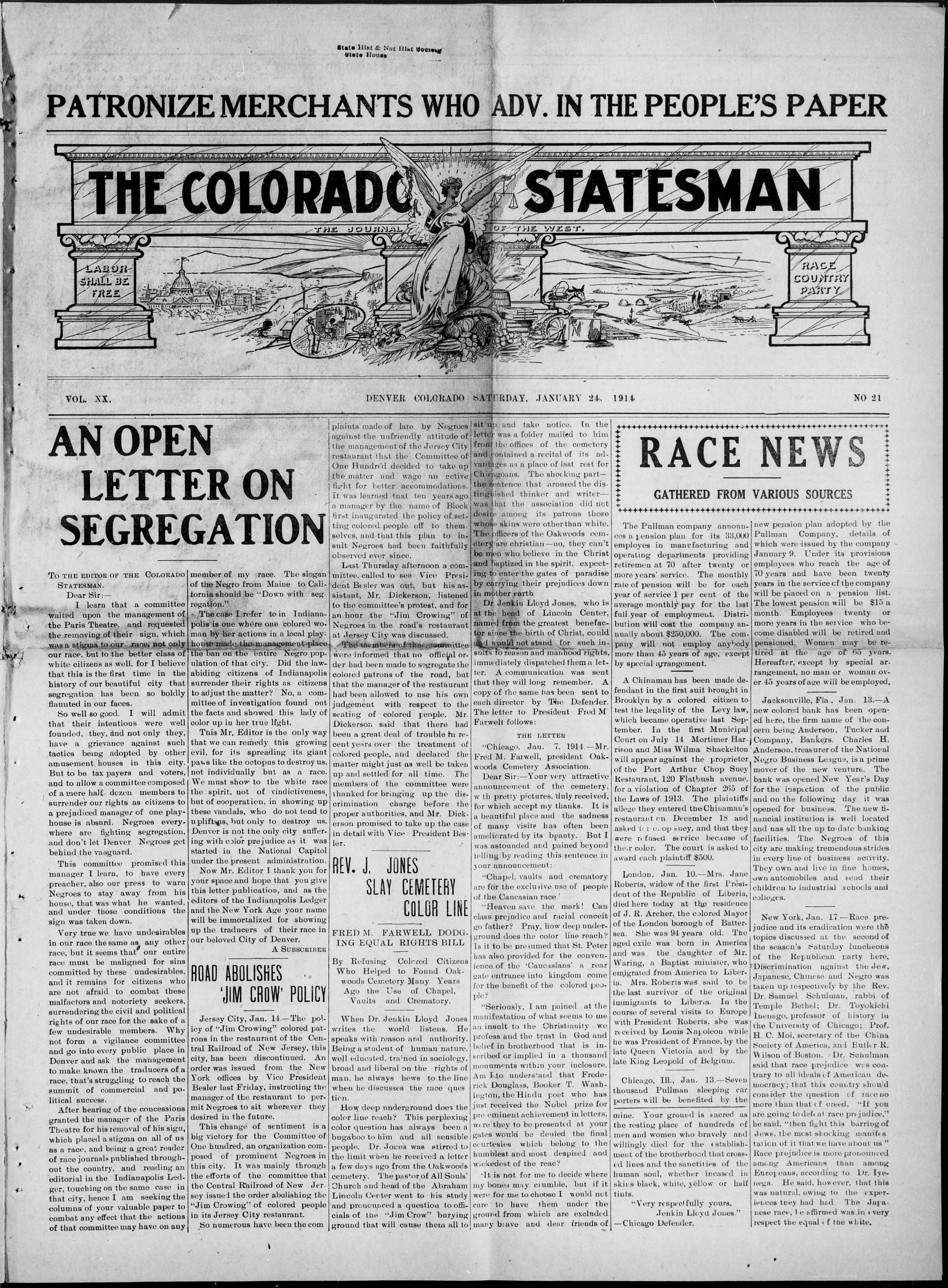
AN OPEN LETTER ON SEGREGATION
VOL. XX.
AN OPEN
LETTER
SEGRE
TO THE EDITOR OF THE COLORADO
STATESMAN.
Dear Sir:
I learn that a committee waited upon the management of the Paris Theatre, and requested the removing of their sign, which was a stigma to our race, not only our race, but to the better class of white citizens as well, for I believe that this is the first time in the history of our beautiful city that segregation has been so boldly flaunted in our faces.
So well so good. I will admit that their intentions were well founded, they, and not only they, have a grievance against such tactics being adopted by other amusement houses in this city. But to be tax payers and voters, and to allow a committee composed of a mere half dozen members to surrender our rights as citizens to a prejudiced manager of one playhouse is absurd. Negroes everywhere are fighting segregation, and don't let Denver Negroes get behind the vaquard.
This committee promised this manager I learn, to have every preacher, also our press to warn Negroes to stay away from his house, that was what he wanted, and under those conditions the sign was taken down.
Very true we have undesirables in our race the same as any other race, but it seems that our entire race must be maligned for sins committed by these undesirables, and it remains for citizens who are not afraid to combat these malfactors and notoriety seekers, surrendering the civil and political rights of our race for the sake of a few undesirable members. Why not form a vigilance committee and go into every public place in Denver and ask the management to make known the traducers of a race, that's struggling to reach the summit of commercial and political success.
After hearing of the concessions granted the manager of the Paris Theatre for his removal of his sign, which placed a stigma on all of us as a race, and being a great reader of race journals published throughout the country, and reading an editorial in the Indianapolis Ledger, touching on the same case in that city, hence I am seeking the columns of your valuable paper to combat any effect that the actions of that committee may have on any
member of my race. The slogan of the Negro from Maine to California should be "Down with segregation."
The case I refer to in Indianapolis is one where one colored woman by her actions in a local playhouse made the management place the ban on the entire Negro population of that city. Did the law abiding citizens of Indianapolis surrender their rights as citizens to adjust the matter? No, a committee of investigation found out the facts and showed this lady of color up in her true light.
This Mr. Editor is the only way that we can remedy this growing evil, for its spreading its giant paws like the octopus to destroy us, not individually but as a race. We must show to the white race the spirit, not of vindictiveness, but of cooperation, in showing up these vandals, who do not tend to uplift us, but only to destroy us. Denver is not the only city suffering with color prejudice as it was started in the National Capitol under the present administration. Now Mr. Editor I thank you for your space and hope that you give this letter publication, and as the editors of the Indianapolis Ledger and the New York Age your name will be immortalized for showing up the traducers of their race in our beloved City of Denver. A SUBSCRIBER
ROAD ABOLISHES
'JIM CROW' POLICY
ROAD ABOLISHES
'JIM CROW' POLICY
Jersey City, Jan. 14.—The policy of "Jim Crowing" colored patrons in the restaurant of the Central Railroad of New Jersey, this city, has been discontinued. An order was issued from the New York offices by Vice President Besler last Friday, instructing the manager of the restaurant to permit Negroes to sit wherever they desired in the future.
This change of sentiment is a big victory for the Committee of One hundred, an organization composed of prominent Negroes in this city. It was mainly through the efforts of the committee that the Central Railroad of New Jersey issued the order abolishing the "Jim Crowing" of colored people in its Jersey City restaurant.
So numerous have been the com
DENVER COLORADO SATURDAY, JANUARY 24. 1914
State Hist & Nut Hist Society
State House
GIANTS WHO
ADC
THE JOURNAL
DENVER COLORADO
plaints made of late by Negroes against the unfriendly attitude of the management of the Jersey City restaurant that the Committee of One Hundred decided to take up the matter and wage an active fight for better accommodations. It was learned that ten years ago a manager by the name of Block first inaugurated the policy of setting colored people off to themselves, and that this plan to insult Negroes had been faithfully observed ever since. Last Thursday afternoon a committee, called to see Vice President Besler was out, but his assistant, Mr. Dickerson, listened to the committee's protest, and for an hour the "Jim Crowing" of Negroes in the road's restaurant at Jersey City was discussed.
The members of the committee were informed that no official order had been made to segregate the colored patrons of the road, but that the manager of the restaurant had been allowed to use his own judgement with respect to the seating of colored people. Mr. Dickerson said that there had been a great deal of trouble in recent years over the treatment of colored people, and declared the matter might just as well be taken up and settled for all time. The members of the committee were thanked for bringing up the discrimination charge before the proper authorities, and Mr. Dickerson promised to take up the case in detail with Vice President Besler.
REV. J. JONES
SLAY CEMETERY
COLOR LINE
FRED M. FARWELL DODGING EQUAL RIGHTS BILL
By Refusing Colored Citizens Who Helped to Found Oakwoods Cemetery Many Years Ago the Use of Chapel, Vaults and Crematory.
When Dr. Jenkin Lloyd Jones writes the world listens. He speaks with reason and authority. Being a student of human nature, well educated, trained in sociology, broad and liberal on the rights of man, he always hews to the line when he discusses the race question.
How deep underground does the color line reach? This perplexing color question has always been a bugaboo to him and all sensible people. Dr. Jones was stirred to the limit when he received a letter a few days ago from the Oakwoods cemetery. The pastor of All Souls' Church and head of the Abraham Lincoln Center went to his study and pronounced a question to officials of the "Jim Crow" burying ground that will cause them all to
sit up and take notice. In the letter was a folder mailed to him front the offices of the cemetery and contained a recital of its advantages as a place of last rest for Chicagoans. The shocking part—the sentence that aroused the distinguished thinker and writer—was that the association did not desire among its patrons those whose skins were other than white. The officers of the Oakwoods cemetery are Christian—no, they can't be men who believe in the Christ and baptized in the spirit, expecting to enter the gates of paradise by carrying their prejudices down in mother earth
Dr Jenkin Lloyd Jones, who is at the head of Lincoln Center, named from the greatest benefactor since the birth of Christ, could and would not stand for such insults to reason and manhood rights, immediately dispatched them a letter. A communication was sent that they will long remember. A copy of the same has been sent to each director by The Defender. The letter to President Fred M Farwell follows:
THE LETTER
"Chicago, Jan. 7, 1914.—Mr. Fred M. Farwell, president Oakwoods Cemetery Association.
Dear Sir:—Your very attractive announcement of the cemetery, with pretty pictures, duly received, for which accept my thanks. It is a beautiful place and the sadness of many visits has often been ameliorated by its beauty. But I was astounded and pained beyond telling by reading this sentence in your announcement:
"Chapel, vaults and crematory are for the exclusive use of people of the Caucasian race."
"Heaven save the mark! Can class prejudice and racial conceit go father? Pray, how deep underground does the color line reach? Is it to be presumed that St. Peter has also provided for the convenience of the 'Caucasians' a rear gate entrance into kingdom come for the benefit of the colored people?
"Seriously, I am pained at the manifestation of what seems to me an insult to the Christianity we profess and the trust in God and belief in brotherhood that is inscribed or implied in a thousand monuments within your inclosure. Am I to understand that Frederick Douglass, Booker T. Washington, the Hindu poet who has just received the Nobel prize for pre eminent achievement in letters, were they to be presented at your gates would be denied the final courtesies which belong to the humblest and most despised and wickedest of the reac?
'It is not for me to decide where my bones may crumble, but if it were for me to choose I would not care to have them under the ground from which are excluded many brave and dear friends of
RACE NEWS
The Pullman company announces a pension plan for its 33,000 employes in manufacturing and operating departments providing retiremen at 70 after twenty or more years' service. The monthly rate of pension will be for each year of service 1 per cent of the average monthly pay for the last full year of employment. Distribution will cost the company annually about $250,000. The company will not employ anybody more than 45 years of age, except by special arrangement.
A Chinaman has been made defendant in the first suit brought in Brooklyn by a colored citizen to test the legality of the Levy law, which became operative last September. In the first Municipal Court on July 14 Mortimer Harrison and Miss Wilma Shackelton will appear against the proprietor of the Port Arthur Chop Suey Restaurant, 120 Flatbush avenue, for a violation of Chapter 265 of the Laws of 1913. The plaintiffs allege they entered the Chinaman's restaurant on December 18 and asked for chop suey, and that they were refused service because of their color. The court is asked to award each plaintiff $500.
London, Jan. 10.—Mrs. Jane Roberts, widow of the first President of the Republic of Liberia, died here today at the residence of J. R. Archer, the colored Mayor of the London borough of Battersea. She was 94 years old. The aged exile was born in America and was the daughter of Mr. Waring, a Baptist minister, who emigrated from America to Liberia. Mrs. Roberts was said to be the last survivor of the original immigrants to Liberia. In the course of several visits to Europe with President Roberts, she was received by Louis Napoleon while he was President of France, by the late Queen Victoria and by the late King Leopold of Belgium.
Chicago, Ill., Jan. 13.—Seven thousand Pullman sleeping car porters will be benefited by the
mine. Your ground is sacred as the resting place of hundreds of men and women who bravely and willingly died for the establishment of the brotherhood that crossed lines and the sanctities of the human soul, whether incased in skins black, white, yellow or half tints.
"Very respectfully yours.
Jenkin Lloyd Jones."
—Chicago Defender.
NO 21
new pension plan adopted by the Pullman Company, details of which were issued by the company January 9. Under its provisions employees who reach the age of 70 years and have been twenty years in the service of the company will be piaced on a pension list. The lowest pension will be $15 a month. Employees twenty or more years in the service who become disabled will be retired and pensioned. Women may be retired at the age of 65 years. Hereafter, except by special arrangement, no man or woman over 45 years of age will be employed.
Jacksonville, Fla., Jan. 13.—A new colored bank has been opened here, the firm name of the concern being Anderson, Tucker and Company, Bankers. Charles H. Anderson, treasurer of the National Negro Business League, is a prime mover of the new venture. The bank was opened New Year's Day for the inspection of the public and on the following day it was opened for business. The new financial institution is well located and has all the up-to-date banking facilities. The Negroes of this city are making tremendous strides in every line of business activity. They own and live in fine homes, own automobiles and send their children to industrial schools and colleges.
New York, Jan. 17 — Race prejudice and its eradication were the topics discussed at the second of the season's Saturday luncheons of the Republican party here. Discrimination against the Jew, Japanese, Chinese and Negro was taken up respectively by the Rev. Dr. Samuel Schulman, rabbi of Temple Bethel; Dr. Toyokichi Inenago, professor of history in the University of Chicago; Prof. H. C. Moi, secretary of the China Society of America, and Butler R. Wilson of Boston. Dr. Schulman said that race prejudice was contrary to all ideals of American democracy; that this country should consider the question of race no more than that of creed. "If you are going to defeat race prejudice," he said, "then fight this barring of Jews, the most shocking manifestation of it that we have about us." Race prejudice is more pronounced among Americans than among Europeans, according to Dr. Iyenga. He said, however, that this was natural, owing to the experiences they had had. The Japanese race, he affirmed in every respect the equal of the white.
CONDENSATION OF FRESH NEWS
THE LATEST IMPORTANT DIS PATCHES PUT INTO SHORT, CRISP PARAGRAPHS.
STORY OF THE WEEK
STORY OF THE WEEK
SHOWING THE PROGRESS OF EVENTS IN OUR OWN AND FOREIGN LANDS.
Western Newspaper Union News Service.
J. W. Hunt, a brakeman of Ogden, Utah, was ground to pieces under the wheels of a wild Southern Pacific yard engine at Elko, Nev.
Mayor Donn M. Roberts was arrested at Terre Haute, Ind., on indictments charging him with bribery, conspiracy to commit fraud and stuffing ballot boxes.
Mrs. L. S. Sheldon of Lawrence, Kan., announced her candidacy for associate justice of the Supreme Court of Kansas on the nonpartisan judiciary ballot.
At Sheridan, Wyo., attorneys for William Hawkins, announced they would appeal from the verdict of second degree murder returned for the killing of his wife.
The first day of Denver's National Western Stock show closed with the selection of many blue ribbon winners in the Short Horn, Hereford and Galloway cattle classes.
Judge Hollister of the Federal District Court at Cincinnati imposed a fine of $1,000 and costs on the Adams Express Company on the charge of overcharging on shipments.
John R. Thomas, who was shot and killed at McAlester, Okla., by convicts in a dash for liberty, served five terms as representative in Congress from the fourth Illinois district from 1879 to 1889.
The Texas state banking department announced that the Lockney State bank of Lockney, Tex., had been ordered closed because of the alleged embezzlement of nearly $10,000 by a former official of the bank.
Midsummer weather for ten days brought out such numbers of grasshoppers in Hamilton county, central Texas, that the state department of agriculture was appealed to to assist in preventing these insects from ravaging crops.
Governor Oswald West of Oregon was upheld at Baker by Judge Gustave Anderson of the Circuit Court in his enforcement of martial law in Copperfield, where state militia under the direction of Miss Fern Hobbs, the governor's secretary, closed the saloons. Truckee, Cal., is emerging from one of the heaviest snowstorms in twenty years. The Chamber of Commerce put a hundred men at work breaking roads to Donner lake. The snow lies seven feet on the level. Five small houses collapsed from the weight of the snow, but no one was hurt.
WASHINGTON.
To have a broken rib for almost two weeks and not know it was the rather unusual experience of Senator Bacon of Georgia.
Mrs. Woodrow Wilson gave the second of the season's musicales at the White House. Miss Alice Nielson of New York, a noted soprano, gave the principal part of the program.
The cruiser Denver was ordered to leave San Diego, February 1, to relieve the transport Buffalo at Corinto, Nicaragua, and serve as a base ship for the hundred marines in Managua.
Treasury officials have begun the task of picking out internal revenue agents and inspectors who are to collect the income tax. There are more than 10,000 applications on file for the 400 jobs.
Another $1,000,000 saved to the navy was announced by Secretary Daniels when he placed contracts for $1,917,340 worth of armor-piercing and common projectiles at last year's prices the projectiles would have cost $3,025,200.
William A. Clark, former senator from Montana, has been elected a member of the board of trustees of the Corcoran Art gallery, succeeding Thomas Nelson Page, resigned. Clark has been a liberal supporter of the Corcoran gallery.
President Wilson's suggestion to Congress in his trust address that the government and business men are ready to meet each other half way "in a common effort to square business methods with both public opinion and the law," fell on attentive ears and struck a responsive chord in representatives of different parties.
To handle $250,000,000 of Uncle Sam's money during a period of thirty-five years without a debt or credit error of so much as one cent is believed to establish a new record in accurate disbursement of government funds. This record was set by George W. Evans, disbursing officer of the Department of the Interior.
Carl Browne, chief lieutenant to General Coxey in the march from Massillon, Ohio, to the capital in 1894, dropped on the street here from acute indigestion and died soon after in a hospital.
FOREIGN.
Prof. Silas Marcus MacVane of Harvard university, died and was buried at Rome.
Lord Strathcona, ninety-three, High Commissioner for Canada, died peacefully in sleep at London.
Almost all of the 3,300 Mexican soldiers and the 1,367 women and children, refugees who were driven out of Ojinaga, Mexico, by the rebels, arrived in Marfa, Tex., from the border Monday.
Pascual Luna Parra, former minister of finance, and Jesus Flores Magon, minister of governacion in the Madero cabinet, arrived at Vera Cruz. It is reported that they have been commissioned to confer with John Lind.
The presidents of the Venezuelan states have notified the central government that it will be impossible, because of the state of war, to hold elections for congressmen and state officials whose terms expire in February.
A graphic narrative of the eruption and earthquakes which devastated the island of Sakura and the town of Kagoshima, destroying hundreds of lives, on Jan. 14, was given by Theodore H. Hoyer of Wisconsin, who was a witness.
Frederico Gamboa will be recalled to the foreign office and Querido Moheno will be appointed minister to finance, succeeding Adolfo de la Lama, recently resigned, because of General Huerta's repudiation of interest payments, according to reports at Mexico city.
Cardinal Bartholomew Macillieri, bishop of Verona, Italy, has issued a pastoral letter strongly condemning and prohibiting the tango. He calls attention to the fact that tango has already been prohibited by civil and military authorities in Europe, both Catholic and Protestants.
SPORT.
Jack Britton of Chicago outpointed Mike Glover of Boston in a ten-round bout at New York.
Georges Carpentier, the French heavyweight champion, knocked out Pat O'Keefe of Ireland at Nice in the second round.
Irving Kanthelener, the southpaw pitcher who was bought by Pittsburg from Victoria last season for $4,000 signed a contract with the Pirates.
The six-round bout between George Chip and Tim O'Neal was stopped in the second round at Grand Rapids, O'Neal being unable to continue.
Bonne Chance, Jefferson Livingston's great racing mare, established a new world's record for a circular track when she ran one mile on the Juarez Jockey club course at Juarez, Mex.
A coroner's jury exonerated Charles Kirby, a middleweight pugilist, of responsibility for the death of Philip Schindler, who was fatally injured in the sixteenth round of a boxing contest at Santa Rosa, Cal.
After toying with Johnny Lewis of Denver for six rounds in a scheduled ten-round bout at Albuquerque, Benny Chavez, Trinidad, Colo., featherweight, opened up, and in the next two rounds gave Lewis a severe beating. In the eight round Chavez floored Lewis twice, he being down for the count at the bell. Lewis failed to come up for the ninth round, and Chavez was awarded the decision.
Enthused at the interest shown in the first ski tournament at Inspiration point in Denver, members of the Denver Ski Club participated in a banquet, following which a permanent organization was perfected. The new club is known as the Denver-Rocky Mountain Ski Club. Officers elected were R. Gordon Chaney, president; B. O. Johnson, vice president; C. Andrews, secretary, and Dr. M. R. H. Howard, treasurer.
GENERAL.
New York stock exchange seats took a $5,000 jump. Two sold at $50,000. The previous sale was on Dec. 24 at $45,000.
Miss Alice A. Holmes, who delighted in the title of "The Blind Poetess of Jersey City," died in her home in that city in her ninety-third year.
Mrs. William A. Quayle of St. Paul. Minn., wife of Bishop Quayle of the Methodist Episcopal church arrived in Baltimore to be with her daughter, Miss Margaret Quayle, who is taking the radium treatment in the Kelly sanitarium.
Mrs. Violet Hartman, twenty-one years old, known as "the bride of the air," whose marriage in a balloon to Dr. Milo E. Hartman was the opening event of the national elimination balloon races in 1912, died at Kansas City of pneumonia.
Don A. Moun Day of Topeka, Kan,
and Mrs. L. D. W. Moun Day, his wife,
were found guilty in the Federal
Court in Kansas City, Kan., of the
use of the mails to defraud in the
sale of lands in the Upper Pecos-valley of New Mexico.
At Ossining, N. Y., Frank Muehlfield, alias "the kid," went smilingly to his death in the electric chair at Sing Sing prison; the second man to die in the chair for the murder of Patrick Burns in New York city two years ago. "Big Bill" Lingley, Muehlfield's accomplice, was executed on May 5. Burns was robbed and shot down in his saloon on Feb. 11, 1912.
The second trial of Hans Schmidt for the murder of Anna Aumuller began in the Superior Court in New York. The first trial of Schmidt ended in a disagreement Dec. 29.
COLORADO STATE NEWS
Western Newspaper Union News Service.
DATES FOR COMING EVENTS.
July 13-14.—Grand Lodge Session, B.
P. O. Elks at Denver.
Sept. 7.—Colorado State Fair at Pu-
1915.—Last Grand Council of North
American Indians at Denver.
Judge Ben B. Lindsey and his bride
will be the guests of honor at a banquet
to be given in Denver Tuesday,
Jan. 27.
John Trevillion and Arthur Hedberg,
miners employed at the Capital mine
at Georgetown, fell 600 feet to instant death.
Jones Brothers & Company of Denver,
vinegar manufacturers, have signed a contract to erect a large factory at Manzanola.
Mrs. Minna B. McKay, mother of
Mrs. L. Milton Brown of Denver, died
at St. Joseph's hospital. Death was
due to nervous prostration.
The executive committee of the Kansas Club at its meeting in Denver completed the program for its annual banquet, to be given Jan. 29.
James Coplai, 45, an Austrian striker living at the Ludlow tent colony, was killed when he was run down by a Colorado & Southern train.
Dr. Pliny H. Perkins, aged forty-one, one of the most prominent surgeons of Colorado Springs, died following a brief illness of kidney disease.
A. P. Anderson was elected president of the railroad commission, and S. S. Kendall, secretary. This is the first organization under the new law.
After an illness of two years, Thomas Foulkes, 75 years old, a resident of Denver for more than forty years, died at St. Anthony's hospital from cancer.
As a strict business proposition, measured by benefits to the city and the livestock industry of the West, Denver's stock show of 1914 set many new records.
With his skull fractured, the body of John Miller, fifty-five years old, a farmer, living fifteen miles west of Pueblo, was found in his home by a neighbor, Joseph Davis.
Luke Grant, special agent of the recently-created federal commission on industrial relations, was in Denver to investigate strike conditions in the coal fields of southern Colorado.
The funeral of Dr. Pliny H. Perkins, at Colorado Springs was attended by hundreds of persons at St. Mary's church at requiem high mass. The burial services were private.
The Jane Jefferson Democratic Club held a reception in honor of Thomas R. Woodrow, Democratic county chairman and James R. Klian, clerk of the State Supreme Court.
More than twenty-five of the most prominent educators of the United States will join the University of Colorado faculty for the 1914 summer session, which will open June 22 at Boulder.
There was the most complete display of Colorado products ever held in the state at the manufacturers' exhibit and food show given in the Denver Chamber of Commerce building Stock Show week.
In recognition of her services as record keeper for the past ten consecutive years, the Ladies of the Maccabees, Columbine hive, No. 6, Pueblo, presented Mrs. Minnie Chellgard a gold necklace and jewel of honor.
Mrs. J. F. Armstrong, fashionably gowned and registered from Toledo, Ohio, was arrested at Colorado Springs on a charge of shoplifting. According to the police, she admits the theft of a fur coat worth $150 and a $50 muff from two stores here.
A day when a short and practical course in baby training will be a part of the curriculum in every college and university where girls attend, is the ideal and the expectation of Dr. Mary E. Bates, Mrs. Mary T. Watts, national president of the Baby Health Association, and others of the eugenists who promoted the eugenic baby show held in connection with the Denver stock show.
The sun of the second day of Denver's ninth annual horse show swept across the prairie horizon and set triumph as 8,000 admirers of the well-bred horse packed the stockyards stadium and cheered the steeds that whirled about the tanbark. Following a day of unprecedented success in the sales and judging of blue-ribbon cattle, society turned out to pay respects to the kingpins of horsedom.
Mrs. Della Reasonor at Colorado Springs dismissed, at her own cost, the $10,000 suit for allenation of affections which she brought some time ago in the District Court against Mrs. Pauline Link. The temporary injunction granted to Mrs. Link restraining Sheriff Birdsall from selling certain property to satisfy a judgment obtained by Mrs. Reasonor against her divorced husband for alimony, was made permanent.
While hundreds of persons were listening to a discussion of the water question in the Auditorium in Denver, Mrs. Blanche McNutt, thirty-three years old, wife of Alfred L. McNutt of 2236 Glenarm place, was stricken by heart disease and died a few minutes afterwards in one of the rest rooms of the building.
At Central City Dan Williams was indicted for murder as a result of the grand jury investigation of the finding of the mummified bodies of three babies in the attic of a house in Black Hawk, Sept. 25.
SHOW FUND $100,000 FREE--OUR 1914 CATALOG JUST OUT Shows All New Styles in Colored Women's Hair.
AND GOVERNOR ASKED TO AP- POINT COMMISSION.
Commercial Executives Want Immigration Board, With Strong Man at Head, to Advertise Advantages of Colorado.
Western Newspaper Union News Service.
Colorado Springs.—Urgging that the Board of Immigration be reorganized and that the governor "appoint three active men with a commissioner big enough to command the respect of the whole state." the Colorado Association of Commercial Executives went on record for many reforms, adopting resolutions covering a wide range and transacting routine business that made the one day's session a record breaker for the amount of work accomplished. Governor Ammons is urged by the executives to appoint a non-partisan commission of five representative men to collect and place an exhibit worth at least $100,000 at the Panama exposition in California.
It is stipulated that of this fund $50,000 shall be cash pledges and in the hands of the commission before the commission assumes any financial obligations.
In addition, the governor is urged to get through legislation appropriating sufficient money to cover the cost of transportation and placing of the exhibit. It is figured that $50,000 will be required to do this.
Commenting upon the reorganization of the Board of Immigration, the resolutions recommend that in the event the present finances of the state will not permit of the employment of a commissioner, that money be raised to provide for such a man, "in order that the Board of Immigration may effectively co-operate with this commission and be in a position to intelligently present the possibilities of Colorado to the investing public that may visit our state during 1915."
Denver was indorsed by the executives as the logical location for a regional reserve bank.
Denver.—"When I look back over my life, in spite of what people are pleased to call my many activities and varied interests, the memory in which I take most pleasure is that of my children's arms around my neck, and of the hours spent with my husband and in my home." So said Mrs. J. B. Belford, "Denver's most honored woman." Mrs. Belford has lived in this state since 1870, and in Denver since 1884, and has been identified with nearly every movement for the sex and for humanity in general that has been begun during that time.
Denver.—Peace has been restored in Oak Creek and there is no prospect of trouble arising between the striking miners and the Taxpayers' Association, according to a report which Secretary Claud W. Fairchild made to Governor Ammons. The militia has the situation well in hand, he reported, and there appears to be no danger of any outbreak so long as the military officers are on the ground. The mines are now operating with about three-fourths of their usual working forces.
Military Board Orders Eleven Held.
Trinidad—The Military Commission concluded its investigation here in connection with the coal strike troubles. The report filed recommends that eleven men be held indefinitely in connection with the burning of the buildings of the southwestern mines near Aguilar. These men, who are in jail here, include Albert Hill, president, and Robert McGuire, secretary of the局 at Aguilar, and James T. Davis, town marshal of Aguilar.
Florence.—A hunting accident will probably cost the life of Otto Holtz. 15. With Philip Freeze he was hunting with a repeating rifle. The boys had been shooting at a hawk and thought the gun magazine was empty. When they started to reload there was an explosion. Holtz was shot in the left side, and his condition is critical.
Live Stock Association Meets.
Denver.—The seventeenth annual convention of the American National Live Stock Association, held at the Broadway theatre, is the most important gathering that has ever been held by that organization. Matters of the gravest import to the public were taken up, including the tariff, public lands, markets, railroads and sanitation.
Woman Killed By Speeding Train.
Pueblo.—Struck by Eastbound Rio Grande passenger train No. 6, at Goodnight, eight miles west of here, Mrs. C. S. Neumeyer was instantly killed.
Mrs. Bland is Internal Revenue Clerk. Denver.—In recognition of the services of Richard Parks Bland, known as "Silver Dick" Bland during the many years be served in Congress before his death in 1899. President Wilson has appointed Mrs. Virginia Bland, his wife, as clerk in the office of Mark A. Skinner, internal revenue collector of Denver.
Swift Prize Team at Stock Show. Denver.—Swift, & Company's six horse prize draft team arrived in its private palace car in Denver to take part in the Stock Show.
FREE FREE
KEYSTON OPEN FOR BUSINESS New D to Key like it Strictly home cooking. Low food. Eastern corn-fed meat
YSTONE CAFE
N FOR
BINESS New Dining Room in Connection to Keystone Social Club. Nothing like it ever attempted in Denver. Some cooking. Lowest prices for best quality of eastern corn-fed meats. Your patronage solicited.
OPEN FOR BUSINESS New Dining Room in Connection to Keystone Social Club. Nothing like it ever attempted in Denver. Strictly home cooking. Lowest prices for best quality of food. Eastern corn-fed meats. Your patronage solicited.
FULL DINNER
11:30 a. m.
to
8:30 p. m.
Soup, Fish or Meat, Two Vegetables
Coffee, Tea or Cocoa Desert
25 CENTS
SHORT ORDERS AT ALL HOURS
Syl. Stewart Manager.
1857 Champa St. Phone C
ampa St. Phone Champa 3543 Denver, Colo.
ck & Engstrom
WHOLESALE DEALERS IN
ines, Liquors and
Cigars
for Minneapolis Grain Belt Beer and Carnegie Porter, Pripps
Imported Beer and Bock Ol.
644-46-48-50 Larimer Street
1053 Denver, Colorado
ALL KINDS OF REPAIR WORK NEATLY DONE.
REFINISHING A SPECIALTY.
Welton Street Furniture Co.
F. R. LINDENMIER, Prop.
2619 WELTON STREET
Second Hand Furniture Bought, Sold
and Exchanged
We Pay the Highest Cash Price for Furniture
8247. DENVER, COLO.
Beck & H
WHOLESALE
Wines, Lic
Cig
Western Agents for Minneapolis Grains
Imported Beer
1644-46-48-50
Phone Main 1053
ALL KINDS OF REPAIR
REFINISHING
The Welton Street
F. R. LINDEN
2619 WELTO
New and Second Hand
and Exc
We Pay the Highest Ca
Beck @ Engstrom
WHOLESALE DEALERS IN Wines, Liquors and Cigars Western Agents for Minneapolis Grain Belt Beer and Carnegie Porter, Pripps Imported Beer and Bock Ol.
1644-46-48-50 Larimer Street
Phone Main 1053 Denver, Colorado
ALL KINDS OF REPAIR WORK NEATLY DONE.
REFINISHING A SPECIALTY.
New and Second Hand Furniture Bought, Sold and Exchanged We Pay the Highest Cash Price for Furniture
.
MARKET DEPARTMENT
We are handling nothing but
poultry. At present we are getting
caught fish, salmon, trout, cat fish,
FRESH VEGETABLES
CHAS. HARRIS, Pres. J. M. JOHN
RAILROAD PO
LUNCH ROOM I
DEPARTMENT
We handling nothing but the highest quality meats, fish and
present we are getting by express shipment strictly fresh
salmon, trout, cat fish, halibut and oysters.
FRESH VEGETABLES EVERY MORNING
RIS, Pres. J. M. JOHNS, Treas. SEIB MILLER, Sec.
ROAD PORTERS' CLUB
LUNCH ROOM IN CONNECTION
We are handling nothing but the highest quality meats, fish and poultry. At present we are getting by express shipment strictly fresh caught fish, salmon, trout, cat fish, halibut and oysters.
FRESH VEGETABLES EVERY MORNING
CHAS. HARRIS, Pres. J. M. JOHNS, Treas. SEIB MILLER, Sec.
17281/2 Wazee St. Only one block from Union Depot Phone Main 8416. Denver, Colorado
FULL
DINNER
11:30 a.m.
to
8:30 p.m.
HENRY BECK
PHONE MAIN 8247.
We are the largest Importers and Manufacturers in the oldest and most reliable firm in this line. We guarantee perfect satisfaction or money refunds for any hair to be superior to any on the market, and our prices are lower than those quoted anywhere else. This hair will stand combination with our own woven. We sell hair by the pound, hair nets and all styles of hair, also an exceptionally fine line of toilet articles and flattening combs at wholesale prices.
Send 2-cent stamp for Free Book.
Agents Wanted.
HUMANIA HAIR COMPANY
Dept. 102. No. 23 Dune Street.
NEW YORK CITY.
Soup, Fish or Meat, Two Vegetables Coffee,Tea or Cocoa Desert 25 CENTS
JOHN ENGSTROM
DENVER, COLO.
2700 WELTON STREET
PHONE 8488 MAIN
The Only Up-to-Date Grocery and Market at Five Points
MEATS It will pay you, if you are not buying your food supply from us, to make a change.
AFRO-AMERICAN CULLINGS
"How many people in Atlanta," asks the Constitution of that city, "know to a certainty that their domestic servants do not come from diseased homes?" And in the discussion it puts forth these pertinent truths: "The business of safeguarding the health of the community, in its negro as well as its white sections, is that of self-preservation and not sentiment or philanthropy. The disease germ is the original democrat. It ignores the boundary line of race, of wealth and of station, as well as of mere geography. It knows no prejudices, inherited or acquired. It is murderously impartial in its depredations. You may not believe you are 'your brother's keeper,' and you may be a trifle cynical about your 'duty,' to the negro. But you can hardly be negligent about your duty to your own child, and your own health personally, and keep a clean conscience."
The Post for years has been stressing the importance of this very question for all southern cities. It has repeatedly urged upon the people of Houston that they cannot afford, even from the selfish point of view, to ignore the living conditions of the negro population. The negroes are the domestic servants of the servant-employing class of the southern cities. The negroes are a part of the life of the south, and will always be, and even if the white who employ them are not concerned in philanthropy at all, they owe it to themselves to have a deep concern for everything affecting the health and morals of the negro people.
The nobler part is, of course, to realize in a broad and sympathetic sense our obligation to aid the negroes to better standards of living, because they are in so many respects dependent upon the whites and because they so implicitly rely upon the whites. It will be to our everlasting honor and glory if history shall be able to say of us that we accepted the problems the war left us, and worked them out kindly, intelligently and well, but if we are concerned only for our own welfare, then it will be secondary philanthropy for us to see that living conditions among the negroes are such that they will not menace the health and prosperity of the white people.
Negroes living amid insanitary conditions in southern cities are going to suffer the hardships of poverty and disease, they are going to suffer contamination and destruction in a moral sense, they are going to be a heavily consuming and inefficient element of populatoin.
But the whites will not be able to escape the consequences. They will have to bear the economic losses that a large and inefficient mass is certain to inflict, they will be victimized by the diseases that spread death and disaster among poorly housed and miserably environed human beings, and they will not escape the deadly blight of the immorality and vice that thrive among the ignorant, the desperate and the neglected poor.
The vital statistics of every southern city reveal the inevitable consequence of inefficiency to conditions among the negroes—the servant class that brings into well-kept homes the deadly germs that multiply amid the miserable conditions that afflict the negro sections of so many southern cities.—Houston (Tex.) Post.
Golf enthusiasts in Massachusetts yearly spend about $800,000 on the game.
The 300 striking nego students of Shaw university at Raleigh, N. C., forwarded a memorial to the trustees of the institution in New York asking that Dr. Charles Meserve, president of the institution, be removed and a negro be put in his place.
President Meserve, backed by southern white members of the faculty, issued an ultimatum ordering all rebellious students to resume their places at once, under penalty of expulsion. During the holiday a student married, against the college rules, and was dismissed. The boys asked to be heard through a committee. Dr. Meserve refused to receive the committee, but agreed to hear any individual. The strike resulted.
The most exhaustive of tests have shown that it takes only one-seventh of a second for a wireless signal to pass across the continent from Washington to San Francisco.
A Wyandotte hen belonging to Francis Baines, a well-known Wiltshire (England) poultry expert, has laid 588 eggs in the three years it has lived.
In Glasgow in 1912 there were erected 11 warehouses and shops, 104 factories and stores and 11 new churches and halls.
Although Belgium has reduced the working day of its coal miners to nine hours, the enforcement of the law has not apparently affected the production.
The material taken from the Panama canal would make a pile higher than the Woolworth building in New York and 1,350 feet square at the base.
For the first time since 1905, a colored boy is among the senior officers at Harvard. Alexander Louis Jackson of Englewood, N. J., was chosen class orator at the 1914 election a few days ago, and will write and deliver the oration, which is one of the principal parts of the exercises in Sanders theater on the morning of class day.
Jackson has been a member of the varsity track teams for two seasons. He is one of the best hurdlers now in the eastern colleges, particularly good over the high hurdles, but fast in both events, and has won many points for the Crimson teams in various meets.
He has not been particularly prominent in other ways during his college course. He has won good grades, though he is not in the honor class. At Andover he won several prizes in public speaking, but at Harvard he has been so much occupied with other affairs that he has not tried for the prizes in speaking, though he has taken some of the courses offered. He is preparing for a teaching position in some one of the negro schools of the south.
It is not the first time that a negro has been honored by election to such office at Harvard. The last time was with the class of 1905, when William Clarence Matthews, a clever baseball player, was chosen a member of the class day committee.
In the years before that, the election of negro orators was quite frequent with the college classes. William H. Lewis, who has since served as assistant attorney general of the United States, was a commencement speaker on his graduation from the law school in 1895. He was not a graduate of Harvard college, but had his college education at Amherst, where he was graduated in 1892.
There are in the southern states 9,000,000 negroes, writes Booker T. Washington. There are 3,000,000 negro children of school age. Fifty-three per cent., or more than half, never go to school. Many of these negro children, particularly in the country district, are in school only from three to four months in the year. I am trying to get the white people to see that, both from an economic point of view and as a matter of justice and fair play, these conditions must be changed. I am trying to get the white people to see that sending ignorant negroes to jails and penitentiaries, putting them in the chain gang, hanging and lynching them does not civilize, but on the contrary, though it brutalizes the negro, if at the same time blunts and dulls the conscience of the white man.
I want the white people to see that it is unfair to expect a black man who goes to school only three months in the year to produce as much on the farm as a white man who has been in school eight or nine months in the year; that it is unjust to let the negro remail ignorant, with nothing between him and the temptation to fill his body with whisky and cocaline, and then expect him, in his ignorance, to be able to know the law and be able to exercise that degree of self-control which shall enable him to keep it.
I am trying to get the white people to realize that since no color line is drawn in the punishment for crime, no color line should be drawn in the preparation of life, in the kind of education, in other words, that makes for useful, clean living.
The men who don't go to jail are either too good, or too rich.
So far as the south is concerned the problem is in process of wholesome an certain solution. The future of the negro has never seemed so promising and bright. As a laborer, citizen and a man the negro, under this bright and beneficent policy, has advanced and is advancing day by day. There are no greater people in the history of nations than the people of the south. And in view of the history of the Civil war and of the reconstruction period that followed, the southern people have never been greater and wiser than in their present splendid attitude toward their former slaves.—Chicago American.
Colored babies are often regarded as "cuter," if anything, than white babies. A newspaper for negroes, The Crisis, notes the fact*that at a recent baby show held in Fall River, the first prize was won by a one-year-old colored baby, the only colored entrant in the contest.
Fuel oil consumption by the United States navy this year is estimated at 30,000,000 gallons.
The estimated production of rice for Japan is 16,662,000 pounds, an increase of 5.1 per cent. over the crop of last year.
During 1912 about 157,600,000 people rode in the omnibus lines of Berlin, about one-third of this number in the power 'buses.
Designed for feminine use is a new hand mirror fitted with an electric light at one end, current being supplied by a storage battery contained in the handle.
SHOWS BIG WASTE
Important Fertilizing Material Is Thrown Away.
Only 25 Per Cent. of Country Tankage is Available, and Lost Products in the Distillation of Coal Amount to Millions.
Washington.—Seventy-five per cent. of a highly valuable fertilizing material in the form of tankage and blood from the country slaughter of food animals is being wasted throughout the country districts. In addition $22,000,000 worth of ammonia from which ammonium sulphate, another valuable fertilizing material could be made, is annually wasted by the practice of making coke in the beehive type of oven, according to a recent bulletin of the department of agriculture.
Tankage, a product of slaughterhouses consisting of such waste material as bones, horns, hoofs, hair, etc., contains a large percentage of nitrogen and other products used in commercial fertilizer and in the larger packing houses is carefully saved. In country killing, however, only 25 per cent. of the tankage and blood are saved for fertilizer. The nitrogen content of tankage is said to vary from 5 to 8 per cent. and its phosphoric acid content between 5 and 12 per cent. Dried blood is perhaps the richest in nitrogen of all the organic materials used in the fertilizing industries. Unadulterated blood when quite dry contains 14 per cent. of nitrogen, but as obtained on the market its content varies from 9 to 13 per cent.
From the figures estimated by the bureau of animal industry, department of agriculture, as representing the total slaughter of cattle, calves, swine, and sheep in the United States, in 1912, it has been calculated that if all the materials rendered available by this slaughter had been saved and converted into tankage and dried blood, they would have produced 222,535 tons of tankage and 79,794 tons of dried blood.
The introduction of a co-operative system among American farmers undoubtedly would result in an increased utilization of blood and tankage for fertilizing purposes. In Denmark country killing is being practiced on a co-operative basis in small country abattoirs, and the blood is carefully preserved.
The loss of ammonium sulphate which compares favorably with sodium nitrate as a plant stimulant in the distillation of coal for the production of coke, is described in the bulletin as follows:
"In the main, coal is distilled in this country in that form of coke oven, the beehive oven, which does not admit of the recovery of the distillation products. Instead, they are allowed to go to waste. So we are indebted to the by-product recovery oven for the main supply of ammonium sulphate. The amount recovered is valued at about $4,000,000, while the recoverable ammonia annually destroyed in the coking processes by the beehive ovens is valued at $22,000,000. At the beginning of 1912 there were 4,624 by-product coke ovens in operation in the United States and 698 building."
The great product of Chile, sodium nitrate, possesses less nitrogen content (15.5 per cent.) than ammonium sulphate. The United States, however, imports a great quantity (in 1911, 70, 000 tons) for use in agriculture, owing to the deficient supply of other fertilizers in this county. This is only a small part of the total amount of sodium nitrate America imports yearly from Chile, as it has many other uses. The more intensive agriculture of recent years has emphasized the demand for nitrates, and the fact that the Chilean beds of nitrates have been surveyed and figures have been obtained which make possible a fairly close estimate of the amount of nitrate remaining there should stimulate the manufacture of nitrogenous substances suitable for fertilizer manufacture, and serve as a warning against undue waste.
Artificial nitrates have become commercially important to supply the demand in this country, calcium cyanamide being perhaps the most nitrogenous material manufactured for fertilizer purposes. It is prepared from calcium carbide and free nitrogen, the latter being prepared from the atmosphere by the removal of oxygen. This industry is considered to be as yet only in its infancy, and with the increased capacity of existing factories and extensions now under way should prove an important factor in the present source of nitrogenous fertilizers. The relative values of the different fertilizers are brought out fully in this bulletin (No. 37) which can be had on application to the division of publications, United States department of agriculture, Washington, D. C.
number 209,327 head, as compared with 72,420 for the corresponding period of 1912. All came from Canada and Mexico except 447 head of purebred cattle, for breeding purposes, imported from Great Britain. The imports were classified as follows: October—For immediate slaughter, 72,166; as stockers and feeders, 54,595; for dairy and breeding purposes, 739; total, 128,470. November—For
immediate slaughter, 39,086; as stockers and feeders, 41,548; for dairy and breeding purposes, 223; total, 80,857. The bulk of the slaughter cattle came from Canada, while Mexico furnished over four-fifths of the stockers and feeders.
Imported meats and meat-food products inspected during October amounted to 6,000,735 pounds, and in November to 11,792,575 pounds, making a total of 17,793,311 pounds for the two months. The bulk of this consisted of fresh and refrigerated beef, 16,082,578 pounds. There were 275,847 pounds of other fresh and refrigerated meats. The remainder consisted of cured and canned meats, 1,169,517 pounds, and other products (sausage, compound, and oleo stearin), 265,369 pounds. Of the total, Canada furnished 8,098,197 pounds, Argentine 6,209,700 pounds, Australia 2,725,142 pounds, Uruguay 559,843 pounds, and other countries much smaller quantities. Of these imports there were condemned in October 4,690 pounds and in November 14,123 pounds, or a total of 18,813 pounds.
The secretary of agriculture has announced the appointment of the following committee To Investigate "to conduct a general inquiry into the various factors which have brought about the present unsatisfactory conditions with respect to meat production in the United States, especially in reference to beef, with a view to suggesting possible methods for improvement:"
Dr. B. T. Galloway, assistant secretary of agriculture, chairman.
Dr. H. J. Waters, president Kansas State Agricultural college.
Prof. C. F. Curtiss, dean and director Iowa State college.
Prof. H. W. Mumford, professor of animal husbandry, University of Illinois.
Dr. A. D. Melvin, chief, bureau of animal industry, U. S. department of agriculture.
Dr. T. N. Carver, director, rural organization service, U. S. department of agriculture.
The work of the committee will be centered largely on the study of economic questions involved in the production, transportation, slaughter and marketing of meat. As the first step the committee will investigate carefully the changes within the last two or three decades which have increased cost of production, and the centralizing of the meat industry. Among the important considerations to be gone into will be the taking up of the public lands, the effect of the capacity of the range, especially on the remaining public lands and forest reserves, with a view to suggesting changes in the laws to make the public lands of greater use in cattle raising. The committee also will give special attention to the economic changes in meat production and distribution brought about through the centralizing of slaughtering and meat preparations in large packing establishments, and the changes in transportation and similar matters which have resulted from this centralization and other causes, the economic possibility of communal and community effort in cattle raising and the advantages of establishing local or municipal abattoirs will also be investigated.
The committee will not deal specifically with questions of animal husbandry which has to do with the actual breeding of cattle, as this work will be left to the specialists in the department and state agricultural colleges in this field. The appointment of a committee will not interfere in any way with investigations now under way in any of the state agricultural colleges or experiment stations. The letter of appointment announces that the chairman within a short time will supply details regarding the scope of the investigation and the lines of work which the committee might take up.
The imports of the 11 months ended with November were $1,609,000,000, and should the December imports equal those of November, the total for the full year would be $1,756,000,000. The exports of the 11 months ended with November were $2,251,000,000, and should the December exports equal those of November, the total would be $2,479,000,000. This estimate would make the excess of exports over imports approximately $740,000,000.
The figures of exports and of excess of exports over imports will exceed those of any earlier year. The largest export of any preceding calendar year was that of 1912, which showed a total of $2,399,217,993; and as the 11 months ended with November are $102,000,000 in excess of the corresponding period of the preceding year, the estimate of approximately $2,500,000,000 for 1913 seems to be justified. The excess of exports over imports in the 11 months ended with November was $642,000,000, and for the single month of November $97,000,000, thus apparently justifying the estimate of $740,000,000 excess of exports for the full year.
In imports, the total for 1913 will be less than that of 1912 but larger than that of any year preceding 1912. This decline in imports in 1913 is due in part to reduction in prices of certain articles imported. While the quantity of sugar imported in the ter months ended with October exceeded that of the corresponding period of 1912 by 368,000,000 pounds, the value of this larger quantity imported during the 1913 period was $22,000,000 less than that of the corresponding period of 1912.
The Monarch Liquor Co.
The Only Strictly Family Liquor House in Denver
The
Curtis
Park
Floral
Company
FLORAL DESIGNS PUT UP WHILE
YOU WAIT
CHOICE PLANTS AND CUT FLOWERS CONSTANTLY
ON HAND
GREENHOUSES: Thirty-Fourth and Curtis Streets
TELEPHONE, MAIN 1511
DENVER, COLO
ASK FOR CARLSON'S Peerless Ice Cream Phones: Main 112 and Main 5787
DID YOU EVER TRY Neef Bros.' Beer?
It's made right, and tastes right.
None better made anywhere and
This is a Strictly Colorado Production
BE SURE AN TRY IT.
PHONE MAIN 3028 RES. PHONE GALLUP 9
JOHN K. RETTIG
Meats, Fancy and Staple Grocerie
1864 CURTIS STREET
JOHN K. RETTIG
Fancy and Staple G
1864 CURTIS STREET
month.
DELIVER THE G
quality, Accuracy, Good
service and Low Price
WHITE SWAN DRU
Meats, Fancy and Staple Groceries 1864 CURTIS STREET
WE DELIVER
Quality, Acc
Service and
THE WHITE SW
WE DELIVER THE GOODS
Quality, Accuracy, Good Service and Low Prices
THE WHITE SWAN DRUG CO.
THREE GOOD STORES
27th and Welton—17th Ave. and Downing—31st Ave. and Columbine
Everybody who reads magazines buys news-
papers, but everybody who reads newspapers
doesn't buy magazines.
Catch the Drift?
Here's the medium to
reach the people of
this community.
---
Corner Nineteenth.
RES. PHONE GALLUP 942
RETTIG
Staple Groceries
STREET
THE GOODS
Privacy, Good
Low Prices
AN DRUG CO.
ning—31st Ave. and Columbine
Denver, Colo.
THE COLORADO STATESMAN
LABOR HALLEY IS FREE
MASS COUNTY PARTY
JOS. D. D. RIVERS.....Proprietor
1824 Curtis Street, Room 25.
Phone Main 7417
SUBSCRIPTION RATES:
One Year ..... $2.00
Six Months ..... 1.00
Tthree Months ..... .60
PAYABLE IN ADVANCE.
class matter at the postoffice
of a personating nature that
the columns of this paper.
10 cents per inch. An inch contai
on lines or less, 10 cents per line
per line.
on less than three months' contract
parties unknown to us. Further par
will be made by Express Money O
mer or Bank Draft. Postage stamp
actional part of a dollar. Only 10
receive attention must be news
only upon one side of the paper; nor
later than Wednesdays, and be
returned, unless stamps are sent
opens that papers sent to subscr
ive any number when due, inform
a duplicate of the missing
Entered as second-class matter at the postoffice in the city of Denver, Colorado.
All communications of a personating nature that are not complimentary will be withheld from the columns of this paper.
Display advertising, 50 cents per inch. An inch contains twelve agate lines.
Reading notices, ten lines or less, 10 cents per line. Each additional line over ten lines, 5 cents per line.
No discounts allowed on less than three months' contract. Cash must accompany all orders from parties unknown to us. Further particulars on application.
Remittances should be made by Express Money Order, Postoffice Money Order, Registered Letter or Bank Draft. Postage stamps will be received the same as cash for the fractional part of a dollar. Only 1-cent and 2-cent stamps taken.
Communications to receive attention must be newsy, upon important subjects, plainly written only upon one side of the paper; must reach us Tuesdays, if possible, anyway, not later than Wednesdays, and bear the signature of the author. No manuscript returned, unless stamps are sent for postage.
It occasionally happens that papers sent to subscribers are lost or stolen. In case you do not receive any number when due, inform us by postal card and we will cheerfully forward a duplicate of the missing number.
EFFECTIVE AGITATION.
discussion. The greatest era of de-
position of importance is brought in
among the discussions going ther-
a of the Negro. The time has
manfully meet the issue and to e-
force being made by paid correspo-
dent a order to wisely accomplish this
organization and training of a-
band women whose business it si-
clic press and magazines concern
and effective way. Unless a
battens the Negro to such an exte-
t articles can be sent to many
am in the magazines, besides they
ing people in defense of the ra-
ely contend for his rights in the
felt.
This is an era of discussion. The greatest era of discussion in the world's history. Every question of importance is brought into the limelight of discussion. Uppermost among the discussions going the rounds of the press today is the segregation of the Negro. The time has now fully come for the intelligent Negro to manfully meet the issue and to effectively rebut the current slander on the race being made by paid correspondents and professional paragraph writers. In order to wisely accomplish this The Colorado Statesman would suggest the organization and training of a club of intelligent and promising young men and women whose business it shall be to pay attention to articles in the public press and magazines concerning the race and reply to them in an intelligent and effective way. Unless this is done, sentiment will be crystallized against the Negro to such an extent that it will be hard to overcome. These articles can be sent to many different papers and a place be found for them in the magazines, besides they will afford opportunity for training of our young people in defense of the race. The Negro has not yet learned to effectively contend for his rights in the avenues that make his contention heard and felt.
SEGREGATION.
bacilli that is sapping the vital capital palet under the present Denver every hamlet throughout the lenient a resting place in Denver by the supromise with a prejudiced man of the race, who has the upliftation and we wish to announce all times. Trying to know that others—other against unfair treatment of the men here in this paper. To win out, well as elsewhere must stand Co-operate with the white man settlement of the community in w this race and forever eradicate the spokesman of the committee there where a sign was posted, "No Ou if he would remove the sign I would advise the Negroes to stay for these conditions that he remove our rights and privileges to be to the fact that we must standations. house and park in Denver display tree should act in all such cases as instance, the source of recrear would in a large measure be care in the South, but should seek to curtail our privileges.
Segregation, the bacilli that is sapping the vitality of a struggling race, started at the National capitol under the present Democratic administration and re-echoed from every hamlet throughout the length and breadth of the land, has at last found a resting place in Denver by the actions of a committee agreeing to a compromise with a prejudiced manager of a local theater. We, nor any member of the race, who has the uplift of the Negro at heart, cannot condone segregation and we wish to announce that we will be found fighting such evils at all times.
It is indeed gratifying to know that others—other than the press—have taken up the fight against unfair treatment of the race, as is shown by a communication elsewhere in this paper. To win out against such evils, the Negroes of Denver as well as elsewhere must stand as a solid phalanx and confront the enemy. Co-operate with the white man, not only in business and politics, for the betterment of the community in which he lives, but with the better element of his race and forever eradicate these parasites who are pulling us down. The spokesman of the committee that waited on the manager of a local theater where a sign was posted, "No Colored Trade Wanted," told the manager that if he would remove the sign he would see to it that the pulpit and press would advise the Negroes to stay away from the theater, and it was only under these conditions that he removed the sign. We as a race should not allow our rights and privileges to be jeopardized by a tew, but should wake up to the fact that we must stand as a unit in fighting against such discriminations.
Should every playhouse and park in Denver display such a sign as above quoted and a committee should act in all such cases as in the case of the one mentioned in this instance, the source of recreation and enjoyment of the Negroes of Denver would in a large measure be cut short. We should not imagine that we are in the South, but should seek to have stamped out every stigma that seeks to curtail our privileges.
WEIGHED IN THE BALANCE
als subscribes to the opinion that thinks he ought to have. It point is not careful to impress the wan.
supports our theory that the hils at the present time is to may be plainly pointed out that, to liberties which it already posses serious-minded and therefore ree are many such), would make vation and race salvation, to mwanton vice and general unwo would be a vast
One of our journals subscribes to the opinion that the Negro does not deserves all that he thinks he ought to have. It points out that he does not save his earnings; he is not careful to impress the world that he belongs to the highest type of man.
The paper thus supports our theory that the highest duty of the race press and race pulpits at the present time is to make war upon the vices of the race. It should be plainly pointed out that, to a startling extent, our race is abusing the liberties which it already possesses. We sincerely believe that if all of the serious-minded and therefore really deserving Negroes of Colorado (and there are many such), would make up their minds, as an essential to self-preservation and race salvation, to mercilessly condemn and constantly oppose the wanton vice and general unworthiness inherent in all of our conduct, there would be a vast improvement in the race in the next year. We have many good traits and some Negroes are doing exceptionally well, but it is the general condition to which the newspapers are calling attention. The white man is making war upon the Negro in many insidious ways, and in some instances we are losing ground, because we are unable and unfit to hold it. As the newspaper points out, it is not sufficient ground for total discouragement, that we are being deprived of guarantee rights, for this is a world in which men and races are compelled to deserve and defend what they possess and hope to enjoy. The Negro who stops for a moment to contemplate the vast amount of earnest and determined energy which the white man is expending in Colorado to advance his standing and maintain his supremacy individually and nationally, will practically realize that the Negro has got to wake up or practically get out of Denver. The white man is not going to carry the Negro up with him. There are no indications that he takes any such charitable view of what he calls the "white man's burden." The Negro has got to "get up and hump," swim or sink. We are living too easy. We are not serious enough. Our play hours are too long, our business hours too short. We are too narrow in our vision and too wise in our ignorance. We have got to get down upon a more simple and therefore a more stable foundation. Money-saving and industrial activity, clannish support of race enterprises, honest business and stern determination to promote fairness, encourage virtue and to condemn and punish vice, depravity, profligacy and all the weak and unworthy characteristics which we have been covering up and tolerating are imperative duties whose neglect condemns us all. How are these principles to be instilled into the minds of the people? That is a serious question. We believe it depends upon those already of a sober turn of mind. The complaints of the press or of individual can do no good unless some action is aroused. The remedy does not lie in big, showy conventions, where men display their oratory and their poverty. It is a matter for communities to take up. The sober men and women who think of these things should get together and plan. Co-operation, not in a single business effort, but in the support of enterprises already established or to be started, would be a thing worthy of long discussion and earnest trial. Educate and elevate the social and business ideas of the people, and lead and teach them by the most practical and worthy of examples.
GETTING HIS REVENGE
By ALICE KILLIAN.
"Every time," the riding master was muttering, savagely, "every single time I'm away from this academy for a few days things go wrong."
The immediate cause of his anger was a heap of grayish garments on the table in his office. He inspected each article carefully, and then tossed it wrathful in some corner of the room, until the room took on the appearance of a windstruck clothing shop. Finally he could contain himself no longer.
"Hey, Jim!" he shouted. "Jim!"
Grasping one of the objects of his rage in a gingerly fashion between thumb and finger, he held it up scornfully to the gaze of his assistant when the latter appeared in response to the call. With exaggerated patience he asked: "Jim, what in the name of wonder do you call this thing?"
Jim glanced at it. He also noted the purple face of his employer and the devastation about him, but he answered in a matter of fact way: "Why, Mr. Leonard, that's one of the new riding outfits that Cuttum & Quick sent over while you were gone."
"Truly," responded Leonard, with elaborate sarcasm. "I suppose I'll have to believe you, but I thought it was a couple of feed bags sewed together. Anyhow, take them all back to that taller shop and tell those fellows to put more material into them, ruffles or plaits—any improvement at all that may suit my fastidious taste. If they don't they can keep the lot."
"They won't do anything to the things now," declared Jim. "I paid for them with the check you left."
"Paid for them! You're mighty lavish with other people's money, aren't you?"
"Well," answered Jim, sulkily, "the man said they were according to contract."
"Oh! he did! And you believed him like a good little boy? Well, he's sly. But take them back and tell those tailors to fix them right."
Jim followed instructions, but returned in due time with the message that the tailors said the garments had been made according to contract, and that the alterations would have to be paid for.
Then for a week Jim carefully avoided the riding master. A cloud of dissatisfaction rested continually on the latter's face. When looking at the new riding skirts he was heard by Jim to mutter: "Oh. I'll get even yet—I've got to get even." Jim was uneasy.
At last one day Leonard came up behind Jim and, clapping him joyfully on the shoulder, exclaimed: "Well, I did get even after all." Then at sight of Jim's face he laughed and said: "Oh, not with you. That is, not yet."
"What do I know about riding clothes?" growled Jim in extenuation. "I'm no tailor."
"You'll learn." Leonard rested one foot comfortably on 'the mounting block and tapped his boot with his riding crop. "There's more to a school like than just horses. Now, I'll tell you how I got even with Cuttum & Quick.
"Last night Mrs. Leonard and I went to that tailor shop, ostensibly to order a riding habit. Cuttum was out but his partner officiated in full glory. He just spread himself showing patterns and materials."
"But, madam," he said, 'we make riding habits for the best society people. Miss Dash has just ordered her third suit from us and Mrs. Blank is having us make habits for herself and her daughter. Just recently,' here he puffed himself up proudly, 'we filled a large order for the Leonard Riding academy.'
"At that Mrs. Leonard gave a little shriek. 'Those awful things?' she cried. 'Why, the academy doesn't rent them to its patrons, nor does it even let us beginners go out of doors in them when we're having instruction.' She jumped up and said to me: 'Come, let's go somewhere else. Any tailor that would make such things as those dreadful misfits at Leonard's—she shuddered—isn't good enough.' "At the door I turned and said, sympathetically: 'I think, Mr. Quick, you'd better not tell any one else that you made those misfits. Evidently, they're no advertisement.' "His face at that moment wore an expression that more than pays for those skirts. So I got even, Mrs. Leonard helping."
Fisherman's Paradise.
Fish are so plentiful in Alaskan waters that they almost jump at you. The fishing grounds extend for over 2,000 miles along the coast and up all the rivers (one of which is at least 2,000 miles long), and all over the adjacent seas. A conservative estimate of the fish taken from Alaskan waters, not counting that used for native food and for dog food, places the total valuation at $185,000,000 since we bought Alaska for $7,200,000. In one year ten fishing vessels alone pulled in 7,708,000 pounds of the choicest kind of fish. If the ordinary American were asked to guess how many people are permanently engaged in the fishing business in Alaska, the answer would probably be—about 200. As a matter of fact there are 18,000 men pulling up salmon, halibut and herring and storing them away in cans and ice houses. That number of men can make a big hole in anybody's fish pond; if the looting by the fishermen goes on indefinitely, there will be nothing left except the water presently—Leslie's.
BETHLEHEM BAPTIST CHURCH.
9:45. Sunday school, lesson. Serving Jesus, Scripture Luke 8: 1-3, Luke 9: 57-62, Luke 10: 38-42.
11 a. m. Preaching, subject, This Man, Scripture, Luke 15:2.
7:30. B. Y. P. U. conquest missionary meeting, subject. The Challenge of the Life of Judson to the Young Life of Today. Mrs. A. E. Reynolds, leader. A splendid program has been prepared, and will be rendered by the young boys of the society. Preaching 8 p. m.
the executive board of the Great Western association will meet with the church Tuesday the 27th, at 2 p. m. Our sick, Mrs. Lella Reynolds, 3126 Downing; Mr. Zenon Lockett, 2413 Washington street, upstairs and the little son of Mrs. Lala Johnson, 1026 29th street; Mrs. Mary Hollis, 335 Adams street.
The Mission Circle elected the following officers for the year: President, Mrs. Mary Souders; vice president, Mrs. Nannie J. Welch; secretary, Mrs. Clara Grant; treasurer, Mrs. Emma Austin; chairman of sick committee, Mrs. A. Jones; chairman of program committee, Mrs. Nannie J. Welch; current events, Mrs. Arletha Walton. The society meets the first and third Thursdays of each month.
Our mid-week meetings, Wednesday night, prayer meeting; Thursday night choir rehearsal, Friday night teachers' meeting.
An industrious man wanted to learn the undertaking business, one who has some business ideas. Call at Lawn horn's, 1925 Arapahoe street, for further particulars.
H. C. Radcliff has opened a nice, neat barber shop at his old stand, 1226 18th street. The shop has been remodeled in the latest style, and the only colored shop in the city giving artesian baths. Mr. Radcliff is well known and liked by the citizens of Denver. He solicits the trade of all his friends.
THE DE LUXE.
Furnished apartments. Two and three rooms, with hot and cold water in each kitchen. Also front room, single, electric lights and gas. Modern throughout. Rates very reasonable, 2352-2358 Odgen street, corner Twenty-fourth avenue. Phone York 6707. Mrs. R. M. Blakey.
Brickler's New Barber Shop is located at 2208 Larimer street, Shave, 10. Hair cut, 25c; children, 15c.
WANTED—MANAGER AND SODA DISPENSER.
Wanted—A first-class soda water dispenser. Colored man to take charge of fountain and manage store. Salary $50 per month and board. Give experience.
Address:
St. Louis Delicatessen Co.,
2315 Market Street.
St. Louis, Mo.
Beyond His Understanding.
"The Englishman was attending his first ball game. He seemed very uneasy after the fifth inning and finally said to his American friend: "I say, old chap, when do they serve the tea?" "They don't serve tea at a ball game," laughed the American. "No tea between innings?" gasped the Englishman. "Then what's the object of the blooming game?"
Too Much Responsibility.
A lady remarked to her nephew, aged seven: "Tommy, you should try and be a better boy. You are our only child and we expect you to be good," and he replied: "It is tough on me to be good for a lot of brothers and sisters I haven't got!"
Back at Her.
A dear little girl visiting at my aunt's home kept one amused by her ori nal remarks. One day she was telling how she and her sister played together. "Oh, yes," she said, "we quarrel sometimes. Once sister told me I made her sick and then I told her she didn't give me much of an appetite."—Chicago Tribune.
Modern Way.
"Sakes alive!" exclaimed the Stork, upon meeting the little God of Love crying bitterly. "What is the matter, Dan?" "The m-mum-matter," sobbed Cupid, "is that Cupidity is making twice as many matches as I am! Uhwah! hah! haa-a-aah!"—Judge.
What Astonished Legal Expert.
"The Declaration of Independence is a wonderful document," said the patriotic citizen. "Yes," replied the legal expert. "It's one of the ablest documents I ever saw. And the most remarkable thing is that with all the ability it represents, nobody appears to have received a cent for drawing it up."
Call Again, Please.
Bix—"Jones says he gives employment to a large number of men." Dix—"So he does—other people's bill collectors."—Boston Transcript.
Snail Shells in Demand.
More than 600,000 pounds of snail shells are shipped out of Malaysia every year to Europe and America to be used in the making of buttons and novelties. The shells, when of good quality, bring about 16 cents a pound in New York. The shells are taken from the ocean by fishermen and sold through Chinese collectors to European firms at Singapore.
THE NEWPORT SALOON
TELEPHONE MAIN 7377
THE CAPITAL CITY SHOE
REPAIRING CO.
SEWED HALF SOLES 60 cts. and 75 cts.
HENRY WARNECKE, President
1511 CHAMPA STREET DENVER, COLO.
LYNN HAVENS, COTUETS, BLUE POINTS, BALTIMORE STANDARDS, BALTIMORE SELECTS, NEW YORK COUNTS THE ONLY EXCLUSIVE FISH AND OYSTER HOUSE IN DENVER
REO CLUB
2710=12 Welton St
Phone Main 2759 Denver, Colo.
Did you ever stop to think that you are helping to pay the big up town rents when you buy without considering this. Patronize Home Industry
$20.00 AND $25.00 SUIT IN THE CITY Best Goods, Best Workmanship, Best for the money in the City of Denver. Give me a trial and you will be convinced I give all my customers perfect Satisfaction, Fit, Style, Workmanship and the BEST FOR THE MONEY.
How do I Turn Out Such Fine suits for the Money? Why? On account of THE LOW RENT.
M. B. HARRIS
WORK CALLED FOR AND DELIVERED
TELEPHONE
THE CAPITAL
REPAIR
SEWED HALF SOLES
HENRY WARN
1511 CHAMPA STREET
YOUR SUNDAY
Will Not Be C
OYSTERS CLAM
Received Daily
LYNN HAVENS, COTUETS,
STANDARDS, BALTIMORE S
THE ONLY EXCLUSIVE FISH
WASHB
1506 Arapahoe St.
PROMPT
REO
2710=12
Phone Main 2759
Stop! CONS Did you ever stop to ing to pay the when you buy ing this. Patroni
N. FERRY
I PAY SMALL RENT, D
$20.00 AND
Best Goods, Best Workmans
City of Denver. Give me a
I give all my customers perfect
manship and the BEST FOR
How do I Turn Out Such Fin
account of THE LOW RENT.
Bolden Bros.' Barber
Rufus Bolden, Mgr. W. D.
Smith, G. C. Craig Artists
BATHS AND ELECTRICAL MASSAGE
QUICK SERVICE
PHONE MAIN 4052
926 19th Street Denver.
Near Curtis
Miss M. Cowden Hair Dressing Parlor
Shampoo, cutting and curling. Scalp treatment, hair tonics, hair straightening, manicuring. Stage wigs for rent; theatrical use and masquerades. Goods delivered out of the city. All shades of hair matched by sending sample of hair; also combings made up.
Cheapest Switches 50 Cents
1219 21st St. Denver, Colo.
Only Colored Saloon in Denver.
SHORT ORDERS AT ALL HOURS
CHINESE DISHES OF ALL KINDS
FURNISHED ROOMS
TOM LEWIS, Proprietor.
DÉNVER, COLORADO
REPAIRING DONE WHILE
YOU WAIT
MONE MAIN 7377
RITAL CITY SHOE
HAIRING CO.
SALES 60 cts. and 75 cts.
WARNECKE, President
DENVER, COLO.
SUNDAY DINNER
Complete Without
RAMS OR LOBSTERS
Daily By Express
ITS, BLUE POINTS, BALTIMORE
RE SELECTS, NEW YORK COUNTS
FISH AND OYSTER HOUSE IN DENVER
HBURN'S
Phone Champa 2211
PT DELIVERY
D CLUB
112 Welton St
759 Denver, Colo.
Stop!
insider
to think that you are help-
big up town rents
y without consider-
onize Home Industry
Phone Main 7411
1905 Curtis Street
T. DELIVER THE BEST
BAND $25.00 SUIT IN THE CITY
manship. Best for the money in the
e a trial and you will be convinced
perfect Satisfaction, Fit, Style, Work-
FOR THE MONEY.
Fine suits for the Money? Why? On
T.
AGENTS WANTED
To Sell
MAGIC SHAVING POWDER.
A new discovery for shaving the
face and head without using razor
or shears.
Will send half pound can by mail,
postage paid, for 25 cents in stamps.
Write
THE SHAVING POWDER CO.
Savannah, Georgia.
Telephone Main 8698.
Seth Hoffman Coal Co.
Dealers in
Coal, Wood, Coke, Hay
Grain
Coal from Sack to Carload Delivered
Anywhere in the City.
Office: 2807 Welton Street
DENVER - COLORADO
The
WARD AUCTION
COMPANY
Sales Daily at 2 p.m. Office Fur-
niture a Specialty.
PRIVATE SALES AT ALL TIMES
HAVE MOVED TO—
1723-39 GLENARM ST.
PHONE MAIN 1675.
S. H. Hobson, 2352 Glenarm Place, is on the sick list.
Tom Arrington is numbered with the sick this week.
Alex Duke, the famous mixologist of the Keystone Social Club, is on the sick list.
has sufficiently improved that he able to be out again.
Our Stewardess board, under the leadership of Mrs. Montgomery is a healthful condition. Inspiring ports were made at its monthly meeting on Friday last.
Our quarterly meeting will be held on the first Sunday of February.
DEATH CLAIMS ONE OF DENVER
James Rease of 2358 Curtis is confined to his bed suffering from an attack of the heart.
Mrs. Isaac Hickman of Barnum, who has ben quite ill with pneumonia since Christmas, is improving.
Robert Russ, who has a good position in Victor, Colo., visited his family this week.
Thomas Bass, the well known horseman from Missouri, is attending the annual stock show with a string of horses. No doubt as usual he will receive several prizes.
Tobe Johnson, employed at the county jail as guard, is very sick at 2231 Glenarm Place. His many friends hope for him a speedy recovery.
A public meeting will be held at Mt. Olivet Baptist church, 2765 Blake street in the interest of the Moffat tunnel on Tuesday, the 27th. Everybody interested in a better Denver is invited. Meeting at 8 p. m.
Miss Florence Hodge left Wednesday for her home in San Diego, California, after spending a month in our city visiting her cousins, Mr. Bedford Hodge and sister. Miss Hodge is returning from a visit in the East and South, where she spent last summer visiting relatives.
Mrs. Eliza Rice, widow of the late Rev. Spottswood Rice, one of the oldest ministers of the A. M. E. church at the time of his death, died at Colorado Springs last Friday after a long illness. Mrs. Rice is survived by one son, Frank Fane, who resides in New York, and several distant relatives and a host of friends.
The funeral services of Mr. A. M. Lawhorn will be held at Campbell A. M. E. church Sunday, January 25th, at 2 p. m. Rev. James Washington pastor, assisted by Rev's. D. E. Over. R. L. Pope, A. E. Reynolds and S. L. Dease, officiating.
Pythias Lodge No. 11, K. of P., elected the following officers at their regular meeting last Wednesday night; Harry Jones, C. C.; Harry Galimore, V. C.; C. A. Green, M. of F; N. J. Skillern, M. of E.; Ed. Johnson, M. of A.; A. R. Butler, K. of R. and S.; Dr. J. H. P. Westbrook, Prelate.
The White Swan Drug Co., at 27th and Welton streets has been granted a license to sell liquors This popular firm had no trouble in securing signers as is required by the city and county in order that a license might be granted. Their large and increasing patronage is a barometer that it is the store to trade with.
"HAPPY GIRLS" COMING TO DENVER.
Aida Overton Walker's "Happy Girls" have ben booked over the Pantages circuit, and have consecutive vaudeville booking up to the middle of next May. This act has been extremely fortunate in getting work since it opened at Yonkers, October 19. It has had but two weeks lay-off since that date.
The members of the act are Harry Reed, Kraton Thompson, Katie Jones, Hazel Thompson, Marion Potter, Nettie Anderson, Corola Atchez and Louise Cook. The act is under the management of N. S. Feldman. Aida Overton Walker is financially interested in it.
They will appear in Denver at the Pantages theater the week beginning May 11th.
SHORTER CHAPEL'S NOTES.
The subjects of the pastor's sermon tomorrow will be as follows; 11:00 a.m. "The Privilege of the Strong." 7:30 p. m. "Working Out Your Own Salvation." Brother Wm. H. White, recently of Chicago, departed this life in great peace on Monday evening and was buried from the Douglass undertaking parlors Friday afternoon. The sympathy of the church goes out to Sister White and daughter in this hour of bereavement. Brother Clark Anderson of 536 Josephine street and Sister Della Herron of 922 Santa Fé Drive are on the sick list. We pray for their speedy recovery. Also we rejoice that the condition of Brother S. A. McGuire's health
---
has sufficiently improved that he is able to be out again.
Our Stewardess board, under the leadership of Mrs. Montgomery is in a 'healthful condition. Inspiring reports were made at its monthly meeting on Friday last.
Our quarterly meeting will be held on the first Sunday of February.
DEATH CLAIMS ONE OF DENVER'S LOYAL AND PROGRESSIVE RACE AND BUSINESS MEN.
Mr. A. M. Lawhorn, the prominent undertaker and funeral director of 1925 Arapahoe street, died at his home Monday, January 19th, at 12:10 a. m. Mr. Lawhorn came to Denver from Detroit, Mich., in 1905. He engaged himself as clerk in Dr. Faulkner's drug store. In 1907 he established an undertaking business on 18th street, known as A. M. Lawhorn Undertaking Co., and now known as the Douglas Undertaking Co. Later in the year 1909 he opened a place for himself at 2540 Washington street at the expiration of-five months he removed to 1925 Arapahoe street.
THE LATE A. M. LAWHORN.
Mr. Lawhorn was the founder of both the present colored undertaking establishments in Denver and has developed a large numbr of young men into undertakers with his personal training. He was a 32nd Degree Mason in Hiram Lodge, Detroit, Mich., and at the time of his death Chancelor Commander of Progress Lodge No. 12, K. of P., of Denver. Since coming to Denver he has made a host of friends who will miss him, his congenuality, his charitable disposition and his Christian and brotherly feeling which he had for everybody. He leaves to mourn his loss, a wife, son, two sisters and two brothers.
The business will be continued under the present name by Mrs. Mattie Lawhorn and E. V. Cammel as manager and funeral director.
CAMP8ELL A. M. E. CHURCH.
REV. JAS. WASHINGTON, Pastor.
Mr. A. M. Lawhorn's funeral will be held Jan. 25, at 2 p. m.
Allen's C. E. League—6:30 p. m.
Preaching—7:45 p. m.
Prayer Meeting—Wednesday 8 p. m.
Thursday evening, Jan. 29, the Trustees' Aid will give a rabbit fry social.
The revival meetings will start Feb. 10th. The pastor will be ably assisted by Rev. J. P. Howard, the conference evangelist of Kansas City. To these services all have a cordial invitation.
DEATHS.
Funeral of John Spriggs was held Wednesday, 3 p. m., from parlors. Rev. R. L. Pope officiated.
Religious services were held Wednesday at 3:45 p. m., over the remains of Mrs. Jennie Harris and Mr. John Lawrence at parlors. Rev. R. L. Pope officiated.
Mr Edward Turner's funeral was held Thursday, 11 a. m., from parlors. Rev. Jno. Washington officiated.
Mr. Wm H. White died January 19 at 2815 Glenarm. Religious services held at parlors. The remains were shipped to Chicago for burial Thursday, January 22. Rev. R. L. Pope officiated, assisted by Rev. D. E. Over.
Douglas Undertaking Co., in charge of above funerals.
Ruth McSpratlen, the infant daughter of Mrs. Ella Lawrencer was buried Monday at Riverside. The A. M. Lawhorn Undertaking Co in charge.
To the memory of my dear Mother, Jane Purnell. Jan. 18, 1906-Jan. 18, 1914.
Nicely furnished rooms for rent at 2441-43 Lawrence street. Phone Champa 2783.
For rent a five room frame house at 322 24th street. Apply at 1824 Curtis street, room 25.
Three nicely furnished rooms for light housekeeping at 2929 Glenarm Place. Call at 2815 Arapahoe St.
For Rent—Nicely modern furnished rooms at 2210 Clarkson street, also plain and fancy sewing done at the above address.
To Lower Your Water Taxes Vote For Merchants' Plan
Let Denver own and operate its water supply system. That's the object of the plan submitted to the voters by the retail merchants. To build a new system would cost many millions more than to buy the present system at a fair valuation. This fact is proved by the engineers' report of the Public Utilities Commission. The plan proposed by the retail merchants provides for the purchase by the city of the present water plant at a fair valuation.
To operate a new system would cost more than to operate the present system, because the pipes of a new system would have to be laid deeper and "this increased depth would add materially to the cost of repairs, maintenance and operation." So says the engineers' report of the Utilities Commission.
The greater first cost of building a new system and the greater cost of operating a new system would add materially to the burdens of the taxpayers.
Purchase by the city of the present water plant will reduce the operating cost because of the saving in taxes and lower rate of interest on the bonds. This saving will be enough to make possible a 25% reduction in water taxes. If you want to lower your water taxes vote for the Retail Merchants' plan.
F. S. DENTON, PROPRIETOR
FOUNTAIN DRINKS OF ALL KINDS. SHORT ORDERS
CHILE, AND SANDWICHES, AT ALL HOURS.
ORDERS SENT OUT ON SHORT NOTICE
BEST OF SERVICE GUARANTEED
2721 Welton Street
13 CENTS A DAY BUYS A PIANO.
WITH MUSIC LESSONS FREE. PIANOS FROM $88 UP. COLUMBINE MUSIC CO., 920-924 15th STREET, CHARLES BUILDING.
J. H. BIGGINS
Furniture Repairing and Upholstering. All work Cash.
PHONE YORK 7602
1417 East 24th Ave Denver
Write for copy of the plan in full.
The Retail Association of the Denver Chamber of Commerce 400 Chamber of Commerce Building
Mme. Walker has opened hair dressing, manicuring and massage parlors. Body massage a specialty, and will also teach classes in all branches of her work. Residence, 2515 Clarkson St. Phone York 5532.
Before You Buy Property, Let Lawye W. B. TOWNSEND
EXAMINE THE TITLE AND MAKE YOUR CONTRACT. LAWYER TOWN SEND MAKES A SPECIALTY OF COLLECTING FROM INSURANCE COMPANIES, ALSO ENDOWMENT MONIES.
OFFICE 313 KITTREDGE BUILDING
NEW
We handle only the best of Coal, Wood, Hay and Grain at the Lowest Prices.
Denver.
G. M. GOEHRING, Proprietor.
SPECIAL BRUSHES MADE TO ORDER
Brushes and Janitor Supplies SAM FRANCIS, Mgr. DENVER BRUSH FACTORY Branch 1408 Curtis St. Champa 770 418 Fifteenth St.
WANTS TRUST LAWS CLEARLY DEFINED
President in Special Message Declares It Is Not His Policy to Hamper Business—Experience Has Pointed Out Harmful Practices Which Can Now Be Forbidden.
Washington, Jan. 20.—President Wilson appeared before a joint session of both houses of congress and delivered the following message on trusts:
first place for laws which will effectually prohibit and prevent such interlocking of the personnel of the directorates of great corporations-banks and railroads. industrial. con
"Gentlemen of the congress:
"In my report 'On the State of the Union,' which I had the privilege of reading to you on the 1st of December last, I ventured to reserve for discussion at a later date the subject of additional legislation regarding the very difficult and intricate matter of trusts and monopolies. The time now seems opportune to turn to that great question; not only because the currency legislation, which absorbed your attention and the attention of the country in December, is now disposed of, but also because opinion appears to be clearing about us with singular rapidity in this other great field of action.
Business of Interpretation.
"Legislation has its atmosphere like everything else and the atmosphere of accommodation and mutual understanding which we now breathe with so much refreshment is matter of sincere congratulation. It ought to make our task very much less difficult and embarrassing than it would have been had we been obliged to continue to act amidst the atmosphere of suspicion and antagonism which has so long made it impossible to approach such questions with dispassionate fairness. Constructive legislation, when successful, is always the embodiment of convincing experience and of the mature public opinion which finally springs out of that experience. Legislation is a business of interpretation, not of origination; and it is now plain what the opinion is to which we must give effect in this matter. It is not recent or hasty opinion.
"The great businessmen who organized and financed monopoly and those who administered it in actual everyday transactions have year after year, until now, either denied its existence or justified it as necessary for the effective maintenance and development of the vast business processes of the country in the modern circumstances of trade and manufacture and finance; but all the while opinion has made headway against them. The average businessman is convinced that the ways of liberty are also the ways of peace and the ways of success as well; and at last the masters of business on the great scale have begun to yield their preference and purpose, perhaps their judgment also, in honorable surrender.
Will Not Hamper.
"What we are purposeing to do, therefore, is happily not to hamper or interfere with business as enlightened business men prefer to do it, or in any sense to put it under the ban. The antagonism between business and government is over. We are now about to give expression to the best business judgment of America, to what we know to be the business conscience and honor of the land. The government and business men are ready to meet each other half way in a common effort to square business methods with both public opinion and the law. The best informed men of the business world condemn the methods and processes and consequences of monopoly as we condemn them; and the instinctive judgment of the vast majority of business men everywhere goes with them. We shall now be their spokesman.
"When serious contests ends, when men unite in opinion and purpose, those who are to change their ways of business, joining with those who ask for the change, it is possible to effect it. In the way in which prudent and thoughtful and patriotic men would wish to see it brought about, with as few, as slight, as easy and simple business readjustments as possible in the circumstances, nothing essential disturbed, nothing torn up by the roots, no parts rent asunder, which can be left in wholesome combination. Fortunately, no measures of sweeping or novel change are necessary. It will be understood that our object is not to unsettle business or anywhere seriously to break its established courses atthwart. On the contrary, we desire the laws we are now about to pass to be the bulwarks and safeguards of industry against the forces that have disturbed it. What we have to do can be done in a new spirit, in thoughtful moderation, without revolution of an untoward kind.
Private Monopoly Intolerable.
"It awaits with acquiescence in the
Most Famous Eastern Mine.
China's famous iron mine, the Tayeh, the foremost in the far east, is especially notable for the ease with which it is worked. It stands peerless in the world in this respect, excavation requiring no machine power. The work is done by hand by the Chinese coolies. The mine is reputed to be inexhaustible in its ore. In the days of the "three kingdoms" the locality formed a theater of bloody fighting, and the vicinity abounds in relics of that memorable period in
first place for laws which will effectually prohibit and prevent such interlocking of the personnel of the directorates of great corporations—banks and railroads, industrial, commercial and public service bodies—as in effect result in making those who borrow and those who lend practically one and the same, those who sell and those who buy but the same persons trading with one another under different names and in different combinations, and those who affect to compete, in fact, partners and masters of some whole field of business. Sufficient time should be allowed, of course, in which to effect these changes of organization without inconvenience or confusion.
"Such a prohibition will work much more than a mere negative good by correcting the serious evils which have arisen because, for example, the men who have been the directing spirits of the great investment banks have usurped the place which belongs to independent industrial management working in its behoof. It will bring new men, new energies, a new spirit of initiative, new blood into the management of our great business enterprises.
Harm and Injustice Done.
"In the second place, business men, as well as those who direct public affairs, now recognize and recognize with painful clearness, the great harm and injustice which has been done to many, if not all, of the great railroad systems of the country by the way in which they have been financed and their own distinctive interests subordinated to the interests of the men who financed them and of their business enterprises which these men wished to promote.
"The country is ready therefore to accept and accept with relief as well as approval, a law which will confer upon the interstate commerce commission the power to superintend and regulate the financial operations by which the railroads are henceforth to be supplied with money they need for their proper development to meet the rapidly growing requirements of the country for increased and improved facilities of transportation. We cannot postpone action in this matter without leaving the railroads exposed to many serious handicaps and hazards; and the prosperity of the railroads and the prosperity of the country are inseparably connected. Upon this question those who are chiefly responsible for the actual management and operation of the railroads have spoken very plainly and very earnestly, with a purpose we ought to be quick to accept. It will be one step, and a very important one, toward the necessary separation of the business of production from the business of transportation.
"The business of the country awaits also, has long waited and has suffered because it could not obtain further and more explicit legislative definition of the policy and meaning of the existing anti-trust laws. Nothing hampers business like uncertainty. Nothing daunts or discourages it like the necessity to take chances, to run the risk of falling under the condemnation of the law before it can make sure just what the law is.
Definition Now Possible.
Denition Now Possible.
"Surely we are sufficiently familiar with the actual processes and methods of monoply and of the many hurtful restraints of trade to make definition possible, at any rate up to the limits of what experience has disclosed. These practices, being now abundantly disclosed, can be explicitly and item by item, forbidden by statute in such terms as will practically eliminate uncertainty, the law itself, and the penalty being made
"And the business man of the country desire something more than that the menace of legal process in these matters be made explicit and intelligible. They desire the advice, the definite guidance and information which can be supplied by an administrative body, an interstate trade commission.
"The opinion of the country would instantly approve of such a commission. It would not wish to see it empowered to make terms with monopoly or in any sort to assume control of business, as if the government made itself responsible. It demands such a commission only as an indispensible instrument of information and publicity, as a clearing house for the facts by which both the public mind and the managers of great business undertakings should be guided, as an instrumentality for for doing justice to business where the processes of the courts or the natural forces of correction outside the courts are inadequate to adjust the remedy to the wrong in a way that will meet all the equities and circumstances of the case.
Chinese history. It is about 3,630 Chinese miles from Peking overland, and about 4,980 Chinese miles by water. Tayeh-Hsien is traversed by ranges of hills and mountains, the valleys of which abound in innumerable lakes of all sizes, with watercourse facilities. Consequently the locality is rich in scenery of great beauty and the Chinese poets from olden times have never tired of singing of the "Eight Views" of Tayeh. In the neighborhood of Tayeh iron mine are found the ruins of ancient
"Producing industries, for example, which have passed the point up to which combination may be consistent with the public interest and the freedom of trade, cannot always be dissected into their component units as readily as railroad companies or similar organizations can be. Their dissolution by ordinary legal process may oftentimes involve financial consequences likely to overwhelm the security market and bring upon it breakdown and confusion. There ought to be an administrative commission capable of directing and shaping such corrective processes, not only in aid of the courts but also by independent suggestion, if necessary.
Make Punishment Certain.
"Inasmuch as our object and the spirit of our nation in these matters is to meet business half way in its processes of self-correction and disturb its legitimate course as little as possible, we ought to see to it, and the judgment of practical and sagacious men of affairs everywhere would applaud us if we did see to it that penalties and punishments should fall, not upon business itself, to its confusion and interruption, but upon the individuals who use the instrumentalities of business to do things which public policy and sound business practice condemn. Every act of business is done at the command or upon the initiative of some ascertainable person or group of persons. These should be held individually responsible and the punishment should fall upon them, not upon the business organization of which they make illegal use. It should be one of the main objects of our legislation to divest such persons of their corporate cloak and deal with them as with those who do not represent their corporations, but merely by deliberate intention break the law.
"Other questions remain which will need very thoughtful and practical treatment. Enterprises, in these modern days of great individual fortunes, are oftentimes interlocked, not by being under the control of the same directors, but by the fact that the greater part of their corporate stock is owned by a single person or group of persons who are in some way intimately related in interest.
Holding Companies.
"We are agreed, I take it, that holding companies should be prohibited, but what of the controlling private ownership of individuals or actually co-operative groups of individuals? Shall the private owners of capital stock be suffered to be themselves in effect holding companies? We do not wish, I suppose, to forbid the purchase of stocks by any person who pleases to buy them in such quantities as he can afford, or in any way arbitrarily to limit the sale of stocks to bonafide purchasers. Shall we require the owners of stock, when their voting power in several companies which ought to be independent of one another would constitute actual control, to make selection in which of them they will exercise their right to vote? This question I venture for your consideration.
"There is another matter in which imperative considerations of justice and fair play suggests thoughtful remedial action. Not only do many of the combinations effected or sought to be effected in the industrial world work an injustice upon the public in general; they also directly and seriously injure the individuals who are put out of business in one fair way or another by the many dislodging and exterminating forces of combination. I hope that we shall agree in giving private individuals who claim to have been injured by these processes the right to found their suits for redress upon the facts and judgments proved and entered in suits by the government where the government has upon its own initiative sued the combinations complained of and won its suit, and that the statute of limitations shall be suffered to run against such litigants only from the date of the conclusion of the government's action.
Individual Justice.
"It is not fair that the private litigant should be obliged to set up and establish again the facts which the government has proved. He cannot afford, he has not the power to make use of such processes of Inquiry as the government has command of. Thus shall individual justice be done while the processes of business are rectified and squared with the general conscience.
"I have laid the case before you, no doubt as it lies in your own mind, as it lies in the thought of the country. What must every candid man say of the suggestions I have laid before you, of the plain obligations of which I have reminded you? That these are new things for which the country is not prepared? No; but that they are old things now familiar, and must of course be undertaken if we are to square our laws with the thought and desire of the courty. Until these things are done, conscientious business men the country over will be unsatisfied. They are in these things our mentors and colleagues. We are now about to write the additional articles of our constitution of peace, the peace that is honor and freedom and prosperity."
iron foundries probably 1.000 years old. Millions of tons of slag lie in heaps.
Losing Game.
Redd—I see an indoor golf school, in which all the strokes can be made with full force, has been established in London.
Greene—But where's the fun if a fellow can't lose a golf ball or two?
"But he can. You see they forget and leave the windows open sometimes."
Method of Preparation Has Much to Do With Its Appreciation When Put on the Table.
Sausage, considered by some as a plebeian edible, ranking with Irish stew and corn beef and cabbage, and not possible on the ultra-refined board, may really be made the basis of many delicious and even dainty luncheon dishes.
Sausage sliced and delicately fried in its own grease, drained and then browned crisply, and served with tiny little buckwheat cakes four inches across, will make a delightful luncheon on a cold winter day.
Sausage smothered in potato is another luncheon dainty, which even the most cultured need not disdain.
Parboil some very small link sausage five minutes. Bake a number of medium sized potatoes, and when done cut in half and remove the mealy pulp, mashing it well and adding butter and a little cream or milk, as well as some salt and pepper. Fill the potato skins with this mixture, leaving a depression in the center of each. Lay in the parboiled sausages and brown well in the oven for a few minutes.
PLUM PUDDING ICE CREAM
Change From the Usual Method of Serving Will Be Appreciated by All the Family.
A novel change from the usual plum pudding is this delightful dessert, which is quite easily made:
Scald a pint of milk, add to it four eggs beaten with one cupful and a half of sugar. Stir constantly over hot water until it forms a rich custard; strain and set aside to cool. Dissolve two tablespoonfuls of cocoa in one-half cupful of boiling water and boil for a moment. Chill this and add to the cold custard with one tablespoonful of vanilla and one pint of cream. Shred sufficient citron to measure one-half cupful; steam one-half cupful of seeded raisins and one-quarter cupful of sultanas until plump and tender. Blanch and cut fine two dozen almonds; mix these, add just enough sherry to moisten, and let stand for an hour. Pour the mixed cream into the freezer and freeze until like a thick mush. Open, and work in the fruit, then finish freezing. In serving, garnish with whipped cream.
Sauce for Chops.
Pound fine an ounce of black pepper and half an ounce of allspice, with an ounce of salt, and a half ounce of scraped horseradish and the same of shalots peeled and quartered; put these ingredients into a pint of mushroom ketchup or walnut pickle; let them steep for a fornight and then strain it. A teaspoonful or two of this is generally an acceptable addition, mixed with the gravity usually sent up for chops and steaks; or added to thick melted butter.
Another delightful sauce for chops is made by taking two wineglasses of port and two of walnut pickle; four of mushroom ketchup; half a dozen anchovies pounded, and a like number of shalots sliced and pounded; a tablespoonful of soy and half a drachm of Cayenne pepper; let them simmer gently for ten minutes; then strain, and when cold put into bottles, well corked and sealed over. It will keep for a considerable time.
Fish Croquettes.
Stir over the fire in a saucepan one tablespoonful of butter, the same amount of flour and two-thirds of a cupful of milk or water. Boll up once and add one small half teaspoonful of salt, a dash or two of pepper, then remove from the fire and stir in the yolks of two eggs. Rub a deep plate with salad oil, pour in the mixture and stir in gently one cupful of flakes of cold cooked fish. Allow to cool thoroughly. Make out into corked shaped rolls. Wet the hands to prevent sticking. Roll in sifted bread crumbs, then in beaten eggs; roll again in bread crumbs, lay in a wire basket, hang in boiling fat and fry a delicate brown. Lift out with a skimmer, place on brown paper a moment to absorb superfluous grease. The finer the bread crumbs the more certainty of success.
Apple Sponge.
Cover one-half box of gelatin with cold water and allow it to stand for half an hour; then pour over it half a pint of boiling water and stir until dissolved. Mix a pint of strained apple sauce with the gelatin, add a pound of sugar and stir until it meits, and the juice of two lemons. Set on ice until it begins to thicken. Beat the whites of three eggs to a stiff froth, stir into the apple mixture and pour into a mold. Serve with whipped cream.
Meat and Rice.
Line bowl with cooked rice, fill the center with any chopped cooked meat, seasoned with salt, celery salt, pepper and onion juice, one-half teaspoonful of sage and two tablespoonfuls of fine cracker crumbs moistened with hot water; steam 30 minutes and serve with tomato sauce.
Making Better Coffee.
If a little salt is added to the coffee before pouring on the boiling water it will greatly improve the coffee's flavor.
Filling Lamps.
An oil lamp should be filled only within about an inch of the top, as the oil will expand slightly when the wick is lighted.
When You Want
The Heads, Feet, Tails Snouts, Neckbones or Chiterlings or any other part of the hog except the squeal go to
2800.6 Larimer Street.
THE ZO
SAMI
1004 Ninetee
1004 Nineteenth Street, Corner of Curtis
FINE WINES, LIQUORS AND CIGARS COORS' CELEBRATED BEER ON TAP
The Cha
Twe
DRUGS, CHEMIC
WE S
Prescript
Phone us and we will
JAMES
The Champa Pharmacy
Twentieth and Champa,
Is the place to get your
DRUGS, CHEMICALS AND PATENT MEDICINES
WE SERVE DRINKS.
Prescriptions Our Specialty.
Phone us and we will deliver the goods to all parts of the city.
JAMES E. THRALL, PROPR.
PHONE MAIN 2425.
Boost Colorado Products
ZANG'
NOW O
GUARANTEE
Delivered Da
The Ph. Z
Tele
GUARANTEED ABSOLUTELY PURE Delivered Daily to All Parts of the City
We Boost for Colorado PATRONIZI
PATRONIZE HOME INDUSTRY!
SATISFACTION GU
We have been making
established. Every Trunk
Best Made.
WE CARRY A COMPLET
TELESCOPES, ETC. EVE
Second-hand Tru
We Repair Trunks, Suit C
If you have any Rep
call and give you
The Welt
SATISFACTIONGUARANTEED or MONEYREFUNDED We have been making Trunks for fifteen years, and our quality is well established. Every Trunk we sell is strictly Hand-Made, Denver-Made, the Best Made. WE CARRY A COMPLETE LINE OF SUIT CASES, BAGS, COAT CASES, TELESCOPES, ETC. EVERYTHING GUARANTEED AS REPRESENTED. Second-hand Trunks Taken in Trade Used Trunke for Sale Cheap. We Repair Trunks, Suit Cases, Ladies' Pocketbooks, Etc., on Short Notice If you have any Repairing, telephone us and we will be glad to call and give you an estimate on the work. Keyes Fitted.
The Central Bottling & Distributing Co.
Agents for the famous
CAPITOL BEER--IT'S CAPITAL
Try a case, 2 doz. pints for $1.10, delivered promptly; empties called for.
Family Liquors, Wines, and Cordials Genuine Goods at Popular Prices A glass of good wine will improve your Sunday dinner, and aid digestion. 2727 Welton Street. Phone Main 6363.
Supply Your Home with the Celebrated Tivoli Beer BOTTLED BY THE EMPIRE BOTTLING CO. Phone Gallup 245
DENVER
```markdown
```
OTHERS'
ROOM
ner of Curtis
Pharmacy
Empa,
our
ENT MEDICINES
DRINKS.
Specialty.
to all parts of the city.
L, PROPR.
Patronize Home Industry
BEERS
MARKET
UTELY PURE
ts of the City
ewing Co.
395
You Should Boost for Us
INDUSTRY! COLORADO! Made Trunk from
Buy a Denver Made Trunk from the Factory and You Will Be Money Ahead.
Phone Main 1461
COLORADO
SCHWAB YEARNS FOR HAPPY BAREFOOT DAYS
ALEXANDRA IS MORE CHARMING THAN EVER
THIS ONE IS ACCREDITED TO MANUEL QUEZON
THIS ONE IS ACCREDITED TO MANUEL QUEZON
GAY TIME FOR A REAR ADMIRAL'S DAUGHTER
"Those times were real and splendid." A mist spread over the eyes of Charles M. Schwab as he proposed a toast to "Cambrian county, Pennsylvania," the home of his boyhood. Like a flash his mind had gone back from his mansion in River side drive to the humble days in Loretto, near the top of the Allegheny mountains.
```markdown
```
He referred to the days when, as a youngster, he went swimming with the rest of the gang; to the days in the winter when, warmly clad and wearing those old ear-lugs, he had gone hunting for chipmunks and rabbits and then had gathered with his little pals in a lean-to to have a campfire feast. That was the time when he was a happy youngster and had no thought of wealth
Gathered about him in his home in Riverside drive in New York the other day were the friends of his boyhood and of his early manhood. There was A. W. Buck, whom he had known as a boy, and who now is a prosperous banker of Ebensburg, Pa. There was Judge Francis J. O'Connor, jolly and rotund, a friend of many years. There were 60 of them all told—old-time friends when a friend in need was a friend. There was sons of some of Mr. Schmidt's boy-
Just before Christmas Queen Alexandra was in London doing her Christmas shopping, and for the first time since the death of King Edward has been photographed, intending the picture as a Christmas souvenir for her intimate friends, with her autograph written across the corner. This photograph bears testimony to the really miraculous manner in which she has retained the appearance of almost youth, with
ping, and for the first time since the death of King Edward has been photographed, intending the picture as a Christmas souvenir for her intimate friends, with her autograph written across the corner. This photograph bears testimony to the really miraculous manner in which she has retained the appearance of almost youth, with out any suggestion of being "done up."
Everywhere Queen Alexandra is seen in the West end these days the invariable exclamation is:
"How wonderfully young she looks,
and more charming than ever!"
She is really a woman who is as
An example of oriental indolence is accredited to Delegate Manuel Quezon, representative in congress of the Philippine islands. According to the tale there was once a water cart driver in the islands—not the kind to which the occidental sportsman climbs on New year, but a leather colored, rather unclad individual who owned a little donkey and a small wagon upon which he used to pile skins of water obtained from
tive in congress of the Philippine islands. According to the ,tale there was once a water cart driver in the islands—not the kind to which the occidental sportsman climbs on New year, but a leather colored, rather unclad individual who owned a little donkey and a small wagon upon which he used to pile skins of water obtained from a little pool near a small village. This water cart driver one day was
No social event of the present season had more interest for Americans all over the country than the debut recently of Miss Marie Ahnightito Peary, the daughter of Rear Admiral Robert E. Peary, discoverer of the north pole.
M.
Ever since her birth, which occurred far inside the arctic circle, Miss Peary has been one of the most - talked - of young women of any country, and attentions tha t have been showered on her in nearly every civilized nation of the globe, as well as in the frozen north, where she still remembers some of her Eskimo playmates, she has grown up an unspoiled and altogether charming young woman.
"The Snowbird of the North," so called because her middle name is the Eskimo name for snowbird, returned last summer from a European trip to find that she had been preceded by a rumor that she was engaged to wed Donald MacMillan, himself one of the most prominent of the younger gen-
hood friends. They were part of the members of the Pennsylvania society who had come from Cambrian county to attend the dinner, and were being entertained by Mr. Schwab. They are all successful men now, several of them being judges, others merchants and wealthy business men. Mr. Schwab showed he was happy to see them. He was glad to welcome in his home, with its costly paintings and its exquisite decorations, the friends of what almost might we termed "the barefoot days." That Mr. Schwab remembered these days was shown by his manner when he proposed the toast. He quickly changed the subject, and with his characteristically happy way he said: "But this place is just a copy of the old place in Loretto."
Mrs. Schwab and he welcomed the guests. Mr. Schwab had not forgotten a single name, nor even a "nickname," but, of course, he had to be introduced to some of the wives of the old friends. Mr. Schwab showed his guests his art room, where he has gathered, as far as he could, the best painting of the artists that he admired. To the wondering question of a visitor he said that the paintings were insured for $3,000,000. Then the visitors wandere about the house under the guidance of Mr. Schwab, and listened to music from the pipe organ. "Oh, I live here for a few minutes of the year," he said laughingly to one friend. Mr. Schwab's father and mother also were present and they saw again friends who live in Ebensburg, Loretto and Johnstown.
sweet and womanly as she looks. Her generosity is the despair of her secretary, as, entirely regardless of the state of her balance, she insists on giving handsomely to any suddenly arising case of public charity. This is especially resented by the queen, who has to go one better or else not contribute at all, and she has done the latter more than once. Since the dowager empress of Russia has come to share Sandringham with her, Queen Alexandra's expenses have been greatly reduced, and consequently this year she gave handsomer Christmas presents than ever.
Queen Mary's frugality, on the other hand, is displayed at this season. When she has a dress made all the spare pieces of the stuff, whatever it may be, are collected and sent to her by the dressmaker, and these are handed over to Queen Mary's sewing maids to contrive satchets, pillow coverings and such like out of them. This Christmas she had a large number of nightdress cases made from the clippings, and these were sent around Christmas to her women friends. Queen Alexandra was born December 1, 1844.
passed by a traveler who was bound for the village. The water cart donkey was standing still and mute by the side of the road with his ears hung down and his eyes closed.
"Are you not worried about the water supply?" demanded the traveler of the driver.
"Not at all," replied the driver. "We will arrive in good time."
The traveler went to the village, transacted his business and started home again. On his way out he found the donkey exactly where he had left him, with his eyes closed and his ears drooping. The driver was squatting on the grass.
"Are you not yet alarmed about your lateness?" asked the traveler.
"No," replied the driver, "we are progressing."
"Progressing?" echoed the traveler. "Yes," responded the owner of the donkey, "half an hour ago this creature opened his eyes and braved."
eration of arctic explorers. She laughingly denied the rumor and her father corroborated her with the statement that she was "only a little girl still."
Smart for Sure.
Mrs. J. Borden Harriman, who has so suddenly and brilliantly stepped into a leading place in the modern sociological movement in New York, has a rather caustic wit.
At a luncheon at the Colony club Mrs. Harriman was asked one day if a certain family was really smart—"smart" being used in the sense of "fashionable."
"Oh, yes," said Mrs. Harriman, "they're very, very smart, indeed. They've got eight houses, thirty-five servants, twenty-nine horses, eleven motor cars, and one child!"
Lavender.
Lavender comes from the Italian word lavanda, a washing. The name is applied to the fragrant plant because its dried blooms are put away with freshly washed linen to perfume it. An old writer says that the Romans used the flowers of lavender to perfume their bathing water. To lie in lavender was anciently to lie in pawn. Old Ben Jonson says, humorously: "And a black sateen to go before her in; which suit, for the more sweet'ning, now lies in lavender."
"LET RADIUM LANDS ALONE"
OR YOU WILL RUIN THE INDUSTRY, IS HENEHAN'S WARNING TO CONGRESS.
ENCOURAGE THE MINERS
COLORADO CAN SUPPLY WORLD
FIVE TIMES OVER, SAYS
J. M. FLANNERY.
Western Newspaper Union News Service.
Washington.—Vigorous opposition to the proposal to withdraw radium land from entry was made before the House mines committee by Thomas R. Henaen, state mining commissioner of Colorado, who declared such action would ruin the radium mining industry.
"All we want is to be let alone," he declared. "We are getting out the radium. If you tie up these lands, prospectors will not go into them. As it is, 99 out of 100 prospectors fall. What they need is encouragement, not discouragement, if the radium is to be mined."
Joseph M. Flannery, president of the Standard Chemical Company, of Pittsburg, said his company had spent in three years $650,000 to produce two grams of radium. The gram cost $480,000 to produce, he estimated, and brought in $240,000. In April, he said, the company would be producing one gram a month.
"There is enough radium ore in Colorado to supply the world five times over," said Flannery. "Only two hundred grams are needed for the whole United States. I will undertake to deliver to the government in five years from Jan. 1, 1915, two hundred grams of radium at a maximum price of $80,000 a gram."
Flannery told the committee he had a friend "philanthropically inclined," whose name he declined to give, who was considering spending $15,000,000 in building twenty radium hospitals in sections of the country where they would serve sixty-six per cent of the population.
PRIZE STEER SELLS FOR $12.50.
Stock Show Animals Command Top Prices at Auction.
Denver. — The first prize winner among single entry fat steers at the Denver Stock Show, a shorthorn steer from the Colorado Agricultural College, weighed 1,060 pounds, and sold for $12.50 per hundred, or $2.25 per hundred better than the champion carloads. The champion steer entered by the Kansas Agricultural college sold for $11.25 per hundred.
Ten dollars a hundred for a carload of fat hogs—10 cents a pound on the hoof—the record price for years, and 2 cents per pound higher than last year, was paid by the Coffin Packing Company. They were Colorado-bred hogs, raised by J. M. Hammel of Proctor, Colo. Their aggregate weight was 6,380 pounds, and they represented the grand championship for a carload of hogs.
The grand champion load of commercial fat cattle, fifteen Hereford steers, averaging in weight 1,190 pounds, sold to Swift & Company for $10.25 per hundred, equalling the record price paid at Chicago. They were fed by Clayton & Murnan of Eaton. Colorado-fed lambs sold for $9.75 per hundred. They were the first prize winners in the open class. The lot, numbering fifty Southdown lambs which averaged eighty-one pounds, had been entered by Bruce Eaton of Eaton, Colo.
PREPARING FIVE NEW BILLS
Measures to Carry Out President's Trust Plan Being Drawn.
Washington.-Five bills to carry out the suggestions of President Wilson's trust message are being completed in Congress. The bills will embrace the following:
An interstate trade commission, with inquisitorial powers into corporations and authority to aid the courts and keep big business within the law.
Prohibition of interlocking directorates in interstate corporations, railroads and national banks.
Empowering the Interstate Commerce Commission to regulate the issuance of railroad stocks and bonds.
A Sherman law definitions bill, which would define specifically what constitutes restraint of trade.
A general relations measure seeking to eliminate "cuttthroat" competitive business, and which would provide punishment for individuals instead of business and make it possible for firms or individuals injured by unlawful business restraint to avail themselves of findings against combinations and institute suits in equity for relief.
Japs Are Still Unsatisfied.
Washington.—An address by Baron Nobuaki Makino, the Japanese foreign minister, to the Parliament of Japan, outlining the status of negotiations over the California alien land legislation and declaring that the Japanese government had "come to see the necessity of considering some other way for solution of the question," because the replies of the United States had not been found satisfactory, was cabled in full from Tokio to the Japanese embassy here.
Do You Know That—
SHOWS THAT TYPHOID FEVER IS DECREASING.
State Board Commends Roller Towel Law and State Tuberculosis Statutes
Western Newspaper Union News Service.
Denver.—A remarkable reduction in the number of typhoid fever cases in Colorado in 1913 over the previous year is shown by the annual report of the State Board of Health submitted to Governor Ammons. There were 182 less cases in the state last year than in 1912, and a decrease of 2,396 cases in 1913 over the previous three years together. Colorado now shows less typhoid in a whole year than it did every three months of previous years. It is believed these results were attained by the effective campaign waged the last few years against the deadly housefly and the strict watch which has been kept over the possible contamination of the drinking waters of the state.
The COLORADO STATESMAN
IS PREPARED TO DO ALL KINDS OF
The report mentions the success and benefits derived from the new tuberculosis law requiring that every case be reported so that possible infection may be guarded against. The Denver city ordinance prohibiting the use of the unsanitary roller towel is commended.
JOB PRINTING
It is stated in the report that 2,500 children die annually in Colorado before they are 2 years of age and that 50 per cent. of them could be saved by sanitary surroundings and careful attention.
Commercial, Fraternal, Church, Book and Stationery Jobs A SPECIALTY
The course of the board has been, it is said, prevention rather than eradication, to enlighten the people of the dangers of infection from disease and the means of preventing it.
The board, according to the report has been handicapped by insufficient appropriation, but much money has been saved the state. Dr. Paull S. Hunter, secretary of the board, says that $10,000 less was expended last year by the board than during the previous year.
In spite of the indorsement of the fight against the roller towel by the board of health, however, the roller towel is in general use in the state capitol except in the office of the board of health itself.
Ball and Concert Programs, Bill and Letter Heads, Calling Cards, Wedding Cards, Envelopes and Everything in the Printing Line Turned Out in the Neatest and Best Style Promptly on Short Notice.
Exhibit World Beater. Says Ammons.
Exhibit World Beater, Says Ammons. Denver.—"I have just been through every department of the show," said Governor Ammons on the morning of the opening of the ninth annual Western Stock Show in Denver. "It is 25 per cent larger than it was last year in both quality and quatity. We have the greatest feeder cattle exhibit ever assembled in the world. We have the only carload competition of breeding cattle in the world. The horse show will bring out more competition and interest than ever before. As a whole we have here the greatest educational and upbuilding force of our West. It represents an industry that, properly fostered, will double the size of Denver in a few years."
We Have Supplied Our Office with New Job Press & Type of Up-to-Date Style and Our Work Will Be on a Par with the Very Best.
Miners Protest Land Withdrawal.
Denver. — Denver mining men formed a county organization and elected delegates to a state convention which is to be held on Feb. 19 for organizing a state association to promote the general mining interests of the state. Seventeen counties have now either elected delegates to the state gathering or have taken action for their election. Besides formation, selection of representatives and discussion of mining subjects, the Denver men passed a resolution denouncing the proposed withdrawal of radium-bearing ore lands from public entry.
Give Us a Trial and We Will Give You Satisfaction
Scope of Eight-hour Law.
Denver.—The woman's eight-hour law is sweeping in its application and includes bookkeepers, stenographers and cashiers who are employed in mercantile, mechanical and manufacturing establishments, according to a ruling by Judge C. C. Butler in the West Side Criminal Court. This is the first time this part of the law has been interpreted by any court in the state, and the decision is regarded by lawyers as of far-reaching importance.
Prices as Reasonable as Those of Any Job Office in Denver
State Spent $542,877 for Charity.
Denver.—Through the county commissioners Colorado cared for 15,252 poor during 1913, according to a report issued by Secretary Thomas of the State Board of Charities and Corrections. Of these 9,614 were men and 5,638 women. The total sum expended was $42,877.16.
Twenty-seven Ask Citizenship.
Denver. — Twenty-seven applicants for citizenship will be heard in the Federal District Court Monday, January 26.
Increased Valuation Upheld.
Denver.—The contentions of state authorities as to their power to increase the valuations fixed by county assessors upon property for taxation purposes were upheld by the State Supreme Court and the assessors of fifty-eight counties of the state will have to make additions to their valuations ordered by the state board of equalization and the Colorado Tax Commission. The total increases amount to $186,351,658. Denver's increase is approximately $102,000,000.
Rocky Mountain Athletic Ass'n.
It is a tribute to the officers and members of the Rocky Mountain Athletic Association, of Denver, Colorado, that in a city noted the world over for its hospitality, it has been accorded first honors as a place of social amusement and relaxation. Colorado is the Switzerland of America. Its snow-clad hills and verdant valleys, its charming resorts, its rugged beauty are famous the world over. Denver, its capital, is one of the most beautiful cities in America. Matchless in climate, situated where first the eternal snowy hills rear their snowy tops to the heavens, it has long been the mecca of visitors. Its people have been well trained in hospitality, and of that training the Rocky Mountain Athletic Association is the highest expression.
In offering to the public this set of interior views of its home, the Board of Directors of the Association have only one regret, that they cannot reproduce in black and white the cordial good fellowship that exists among the members, and the hearty welcome which is accorded visitors. The limitations of the camera are understood, so that they will convey an idea of the building and accommodations, but words cannot take the place of the handshake, the smile and friendly greeting. Therefore the Association extends to all men of good character a cordial invitation to visit the Association quarters while in Denver, and assures them that their inspection is no intrusion, but, on the other hand, will give it an opportunity for doing for them the duty which Denver lays upon its citizens.
It is the spirit of good fellowship that has made the Rocky Mountain Athletic Association a factor in Denver life, though it is only a year and a half old, and it has occupied its present quarters, 2014 Champa street, since April, 1910. In that time it has grown to 900 members, a part of whom are non-residents, being accorded the privileges of the Association under the provisions of the bylaws relative to non-resident members.
It is not the desire to burden you with facts and figures, but to entertain you—on paper now, and in the hope that some day we may entertain you in person. Therefore let's make an inspection of the Association quarters. The Rocky Mountain Athletic Association is housed in a twenty-room two-story brick building situated at 2014 Champa street, Denver, Colorado, on a plot of ground 50x125 feet, one block from the new postoffice now building. In preparation for its occupancy this building was remodeled a year ago. VICTOR WALKER, PRESS
MIDDLE SCHOOL
The pool and billiard room is high class. To those who have never played upon the famous Wellington tables with Monarch cushions, a game upon these tables would be a revelation. The equipment is entirely new, with special attendants and instructors at your service.
Open Every Evening 7 P. M. to 10:30 P.M. Sunday Matinee, 1:30 to 5:30
High-class Vaudeville and 3,000 feet of Moving Pictures. Change of Vaudeville and Pictures Daily. One hour and a half show for five cents.
5 This is EVERY
Everybody
WE'RE HERE
SHOE RE
1023 EIGHT
We Have the Best Equipped Outfit
is EVERYBODY'S Theatre
Everybody Welcome
RE HERE TO STAY 5
E REPAIRING
1023 EIGHTEENTH ST.
Equipped Outfit in the West to Produce the
This is EVERYBODY'S Theatre Everybody Welcome WE'RE HERE TO STAY
A man sewing a garment on a sewing machine.
SHOE REPAIRING
Sewed Soles .....60c 75c, $1.00
Nailed Soles .....50c 65c, 75c
Heels .....25c, 35c, 50c
Rubber Heels .....50c
Turn Rips .....15c to 25c
Patches .....15c to 25c
We Use the Best Oak Lether. REPAIRING W
WALTER CAI
REPAIRING WHILE YOU WAIT
ER CAMBERS 1023
Eighteenth
C
BROCADE OPERA
COAT WITH CAP
OF GOLD LACE
BROCADES in silk and velvet, crepe and velvet and in satin have had, are having now and will continue to have a wonderful vogue. They are luxurious and beautiful and drape the figure in the manner of classic drapery. Women are inspired by them; they embody the "splendor" dear to women" which Tennyson noted. There is no gainsaying their effect upon the
G
carriage of their wearers. They are queenly garments.
The fabrics are wonderful to start with, as rich looking as the old, heavy brocades after which they are patterned, and as light and supple as crepe. Many of them show raised velvet flowers or conventional designs on a crepe ground, the velvet flowers weighing the crepe so that it hangs in lovely lines about the figure.
5
These garments are cut longer than plush or cloth coats in order to cover
The Simplest
AN attractive waist made of all-over lace is shown here, which is as simple as can be and at the same time stylish and effective. It is cut by a blouse pattern, having the sleeves and bodice in one. The scams are set together with hem-stitching and frills of net finish them and the neck.
Unlike many net and lace waists, the sleeves are barely elbow length, for in many of the new waists they are long. In fact, one extreme or the other seems to be the rule—either very long, coming well down over the hands, or else ending just above the elbow.
A waist like that shown is useful in many ways. It is cut on the right lines by expert cutters. Women buy these simple lace and net waists and use them as a foundation on which to build much more elaborate affairs. By adding chiffon drapery—embroidered motifs, fine net or lace guttps, handsome girdles—they work transformations and lift the waist from the three dollar class into the thirty dollar class.
Or if a lace and draped bodice is
more of the light evening dresses worn under them than need be covered by coats for day wear. They are ornamented with fur at the neck and sleeves, and heavy cords and long tassels used for fastenings. Everything about them is sumptuous.
For lining, plain crepe de chine and the thin supple satins are liked. The matter of warmth is not given great attention, for the wearers of so much splendor are supposed to ride and not walk upon the occasions that call for the coat. Still one may see plenty of these beautiful wraps in the cafes and elsewhere, on people who go about in the street cars and subways. But these conveyances are quite comfortable nowadays and the distances to be walked over are short.
The evening coats fashionable now are ample and simple in outline. Most of them are cut with a yoke and having big, roomy sleeves in one with the body of the garment. They are easily put off and on. The picture shows an example which is a good type of the majority of cloaks. The small cap of gold lace trimmed with a standing spray of silk fibre aigrettes is simple enough. The gold of the cap and the black of the aigrette repeat these colors as they appear in the deep and vivid nattier blue of the wrap.
JULIA BOTTOMLEY.
Flower Decorations for Muffs.
Flowers are extraordinarily popular this season as decorative adjuncts for the muff. Huge, vivid-toned chrysan themums and dahlias in velvet, lead the way, and the splash of color afforded by the tawny shades running through all the gamut of lotous reds and yellows appeals irresistibly to the feminine mind.
Many opportunities for the display of superb peltry are given this season by the varied arrangements of fur on the winter suits. It seems as though women were more than ever convinced that fur makes the most fascinating background for the complexion and were determined to lose no chance of using it for decorative purposes on every possible occasion.
Lingerie Vanity Bag.
Every woman knows the dainty squares of linen or lawn with elaborately embroidered corners that are called glove handkerchiefs, but every woman doesn't know that they may be fashioned into the most sanitary or vanity bags. As the glove handkerchief is never more than five inches square, it is easy to realize how very tiny will be the bag that is formed after a strip of lace beading has been run circle-wise between the corners and they have been drawn in with a quarter yard length of narrow ribbon which ties in the smallest of bows. When the bag is closed, the four embroidered ends fall over like the petals of a white lily.
of Lace Waists
wanted with a skirt of velvet or satin or any other of the season's fashionable fabrics, one of these neel or lace waists is draped with a bit of the material of the skirt. Sometimes there is a drapery over the shoulders, and sometimes it is in the form of the girdle. Often it is merely a panel at the back and front with chiffon over it and a separate girdle of ribbon. The skirt is separate usually but after the waist is adjusted and the girdle pinned to place the dress seems all in one.
Nothing was ever more useful to the tourist than these simple blouses of lace and net. They are so soft and light that it is no trouble to carry them. One needs pretty corset covers of silk or lace under them, and they are mere wisps of clothing weighing nothing. With a pretty lace waist a ribbon girdle and the fancy corset cover, a plain skirt will answer and still the wearer may feel "dressed up" for dinner at the hotel or on the steamer, or at home, wherever there is a call for a pretty demi toilette.
JULIA BOTTOMLEY.
PHONE MAIN 6123—Day or Night
RESIDENCE PHONE YORK 7992.
PARLORS, 1830 ARAPAHOE ST.
THE DOUGLASS
UNDERTAKING
COMPANY
J. R. CONTEE
Pres. and Mgr.
Licensed
Embalmer
Frank Rogers
Assistant
Funeral
Director.
CURTIS M.
HARRIS
Asst. Manager
and Funeral
Director.
Lady Assistant
POLITE SERVICE TO ALL.
Ambulance and Carriages Furnished for All Occasions
AGENTS WANTED
FINE CREOLE HAIR
We are the largest dealers in Creo Hair Goods, Raw Hair by the poultry Electric Combs, etc., in this country. We show a larger variety styles and sell more Fine Creo Wigs than any other manufacturer in the United States.
Write for Catalogue. IT IS FRI
SAM WILLER
HUMAN HAIR GOODS CO.,
SHREVEPORT, LA.
P. O. BOX 298
Bank Capitol Brew
DENVER'S PRIDE
CAPITOL BREW
COMPANY
Security of Capitol Beer is de
d by its superior flavo
th-giving qualities. It's
Drink Ca
DENVE
The CAPITO
The purity of Ca
strated by its
strength-giving
Drink Capitol Beer
The CAPITOL BREWING COMPANY The purity of Capitol Beer is demonstrated by its superior flavor and strength-giving qualities. It's capital.
HAVE A CASE SENT HOME The Capitol Brewing
Capitol Brewing
The Capitol Brewing Co. Phone Champa 356 Delivered Anywhere
C. H. SHIRLEY, Pres. J. C. HAMPSON, Vice Pres PAUL J. SHIRLEY, Sec. and Treas.
Courteous Treatmet. Right Prices Leaders in Prescription
DAY OR NIGHT. PHONE MAIN 6243
A first-class Mortuary establishment. First aid to the bereaved in the time of death of loved ones. Prices below competitors. Polite service
PARLORS 1925 Arapahoe Street
We are the largest dealers in Creole Hair Goods, Raw Hair by the pound, Electric Combs, etc., in this country. We show a larger variety of styles and sell more Fine Creole Wigs than any other manufacturer in the United States. Write for Catalogue. IT IS FREE
ite for Catalogue. IT IS FREE SAM WILLER HUMAN HAIR GOODS CO., SHREVEPORT, LA.
pitol Beer
R'S PRIDE
BREWING
COMPANY
pitol Beer is demon-
superior flavor and
qualities. It's capital.
Brewing Co.
Delivered Anywhere
J. C. HAMPSON, Vice Pres
LEY, Sec. and Treas.
AS DRUG CO.
Hmet. Right Prices
on Prescription
Store No. 2.
26TH AND WELTON
Main 4955-4956
PHONE MAIN 6243
LAWHORN
rtakers
ment. First aid to the bereaved in the
mes below competitors. Polite service