Colorado Statesman
Saturday, January 31, 1914
Denver, Colorado
Page text (machine-generated)
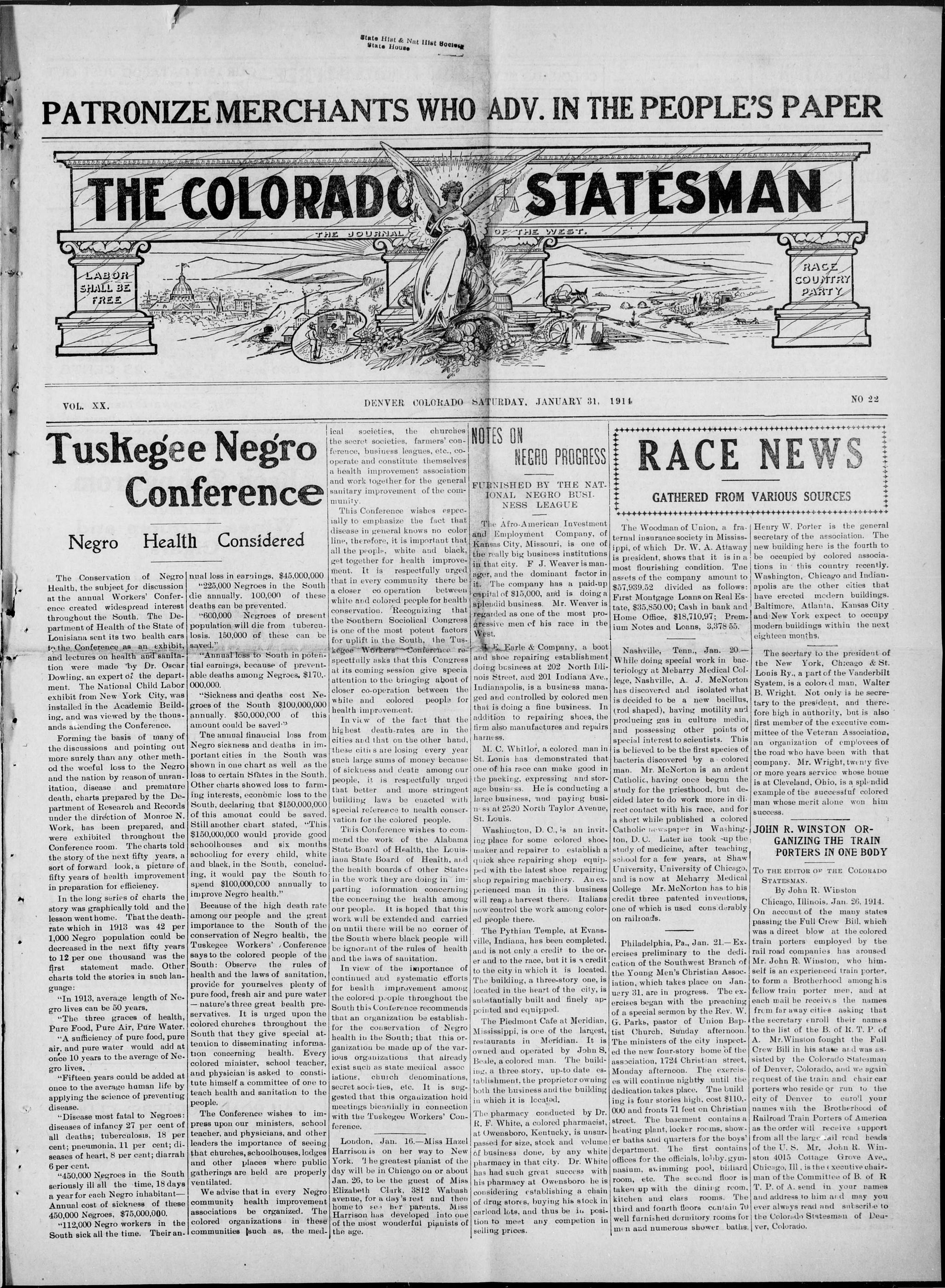
PATRONIZE MERCHANTS WHO ADV. IN THE PEOPLE'S PAPER
THE COLORADO STATESMAN
THE JOURNAL OF THE WEST.
LABOR SHALL BE FREE
RACE COUNTRY PARTY
TusKegee Negro Conference
Negro Health Considered
VOL. XX.
TusKege
Con
Negro Healt
The Conservation of Negro Health, the subject for discussion at the annual Workers' Conference created widespread interest throughout the South. The Department of Health of the State of Louisiana sent its two health cars to the Conference as an exhibit, and lectures on health and sanitation were made by Dr. Oscar Dowling, an expert of the department. The National Child Labor exhibit from New York City, was installed in the Academic Building, and was viewed by the thousands attending the Conference.
Forming the basis of many of the discussions and pointing out more surely than any other method the woeful loss to the Negro and the nation by reason of unsanitation, disease and premature death, charts prepared by the Department of Research and Records under the direction of Monroe N. Work, has been prepared, and were exhibited throughout the Conference room. The charts told the story of the next fifty years, a sort of forward look, a picture of fifty years of health improvement in preparation for efficiency.
In the long series of charts the story was graphically told and the lesson went home. That the deathrate which in 1913 was 42 per 1,000 Negro population could be decreased in the next fifty years to 12 per one thousand was the first statement made. Other charts told the stories in such language:
"In 1913, average length of Negro lives can be 50 years.
"The three graces of health, Pure Food, Pure Air, Pure Water.
"A sufficiency of pure food, pure air, and pure water would add at once 10 years to the average of Negro lives.
"Fifteen years could be added at once to the average human life by applying the science of preventing disease.
"Disease most fatal to Negroes: diseases of infancy 27 per cent of all deaths; tuberculosis, 18 per cent; pneumonia, 11 per cent; diseases of heart, 8 per cent; diarrah 6 per cent.
"450,000 Negroes in the South seriously ill all the time, 18 days a year for each Negro inhabitant—Annual cost of sickness of these 450,000 Negroes, $75,000,000.
"112,000 Negro workers in the South sick all the time. Their an-
---
nual loss in earnings, $45,000,000
“225,000 Negroes in the South die annually. 100,000 of these deaths can be prevented.
“600,000 Negroes of present population will die from tuberculosis. 150,000 of these can be saved.”
“Annual loss to South in potential earnings, because of preventable deaths among Negroes, $170,.000,000.
“Sickness and deaths cost Negroes of the South $100,000,000 annually. $50,000,000 of this amount could be saved.”
The annual financial loss from Negro sickness and deaths in important cities in the South was shown in one chart as well as the loss to certain States in the South. Other charts showed loss to farming interests, economic loss to the South, declaring that $150,000,000 of this amount could be saved. Still another chart stated, "This $150,000,000 would provide good schoolhouses and six months schooling for every child, white and black, in the South, concluding, it would pay the South to spend $100,000,000 annually to improve Negro health."
Because of the high death rate among our people and the great importance to the South of the conservation of Negro health, the Tuskegee Workers' Conference says to the colored people of the South: Observe the rules of health and the laws of sanitation, provide for yourselves plenty of pure food, fresh air and pure water nature's three great health preservatives. It is urged upon the colored churches throughout the South that they give special attention to disseminating information concerning health. Every colored minister, school teacher, and physician is asked to constitute himself a committee of one to teach health and sanitation to the people.
The Conference wishes to impress upon our ministers, school teacher, and physicians, and other leaders the importance of seeing that churches, schoolhouses, lodges and other places where public gatherers are held are properly ventilated. We advise that in every Negro community health improvement associations be organized. The colored organizations in these communities such as, the med-
State Hist & Nat Hist Society
State House
ANTS WHO
ADO
THE JOURNAL
DENVER COLORADO
ical societies, the churches the secret societies, farmers' conference, business leagues, etc., cooperate and constitute themselves a health improvement association and work together for the general sanitary improvement of the community.
This Conference wishes especially to emphasize the fact that disease in general knows no color line, therefore, it is important that all the people, white and black, get together for health improvement. It is respectfully urged that in every community there be a closer co operation between white and colored people for health conservation. Recognizing that the Southern Sociological Congress is one of the most potent factors for uplift in the South, the Tuskegee Workers Conference respectfully asks that this Congress at its coming session give specia attention to the bringing about of closer co-operation between the white and colored people for health improvement.
In view of the fact that the highest death-rates are in the cities and that on the other hand, these cities are losing every year such large sums of money because of sickness and death among our people, it is respectfully urged that better and more stringent building laws be enacted with special reference to health conservation for the colored people. This Conference wishes to commend the work of the Alabama State Board of Health, the Louisiana State Board of Health, and the health boards of other States in the work they are doing in imparting information concerning the concerning the health among our people. It is hoped that this work will be extended and carried on until there will be no corner of the South where black people will be ignorant of the rules of health and the laws of sanitation.
In view of the importance of continued and systematic efforts for health improvement among the colored people throughout the South this Conference recommends that an organization be establish for the conservation of Negro health in the South; that this organization be made up of the various organizations that already exist such as state medical associations, church denominations, secret societies, etc. It is suggested that this organization hold meetings biennially in connection with the Tuskegee Workers' Conference.
Loudon, Jan. 16.—Miss Hazel Harrison is on her way to New York. The greatest pianist of the day will be in Chicago on or about Jan. 26, to be the guest of Miss Elizabeth Clark, 3812 Wabash avenue, for a day's rest and then home to see her parents. Miss Harrison has developed into one of the most wonderful pianists of the age.
---
NOTES ON
NEGRO PROGRESS
FURNISHED BY THE NATIONAL NEGRO BUSI-NESS LEAGUE
The Afro-American Investment and Employment Company, of Kansas City, Missouri, is one of the really big business institutions in that city. F J. Weaver is manager, and the dominant factor in it. The company has a paid-up capital of $15,000, and is doing a splendid business. Mr. Weaver is regarded as one of the most progressive men of his race in the West.
I. E. Earle & Company, a boot and shoe repairing establishment doing business at 202 North Illinois Street, and 201 Indiana Ave., Indianapolis, is a business managed and controlled by colored men that is doing a fine business. In addition to repairing shoes, the firm also manufactures and repairs harness.
M. C. Whitlor, a colored man in St. Louis has demonstrated that one of his race can make good in the packing, expressing and storage business. He is conducting a large business, and paying business at 2520 North Taylor Avenue, St. Louis.
Washington, D. C., is an inviting place for some colored shoe maker and repairer to establish a quick shoe repairing shop equipped with the latest shoe repairing shop repairing machinery. An experienced man in this business will reap a harvest there. Italians now control the work among colored people there.
The Pythian Temple, at Evansville, Indiana, has been completed, and is not only a credit to the orer and to the race, but it is a credit to the city in which it is located. The building, a three-story one, is located in the heart of the city, is substantially built and finely appointed and equipped.
The Piedmont Cafe at Meridian, Mississippi, is one of the largest, restaurants in Meridian. It is owned and operated by John S. Beale, a colored man. The building, a three-story, up-to-date establishment, the proprietor owning both the business and the building in which it is located.
The pharmacy conducted by Dr. R. F. White, a colored pharmacist, at Owensboro, Kentucky, is unsurpassed for size, stock and volume of business done, by any white pharmacy in that city. Dr. White has had such great success with his pharmacy at Owensboro he is considering establishing a chain of drug stores, buying his stock in carload lots, and thus be in position to meet any competition in selling prices.
RACE NEWS
GATHERED FROM VARIOUS SOURCES
The Woodman of Union, a fraternal insurance society in Mississippi, of which Dr. W. A. Attaway is president, shows that it is in a most flourishing condition. The assets of the company amount to $57,939.52 divided as follows: First Montgage Loans on Real Estate, $35,850.00; Cash in bank and Home Office, $18,710.97; Premium Notes and Loans, 3,378 55.
Henry W. Porter is the general secretary of the association. The new building here is the fourth to be occupied by colored associations in this country recently. Washington, Chicago and Indianapolis are the other cities that have erected modern buildings. Baltimore, Atlanta, Kansas City and New York expect to occupy modern buildings within the next
Nashville, Tenn., Jan. 20. While doing special work in bacteriology at Meharry Medical College, Nashville, A. J. McNorton has discovered and isolated what is decided to be a new bacillus, (rod shaped), having motility and producing gas in culture media, and possessing other points of special interest to scientists. This is believed to be the first species of bacteria discovered by a colored man. Mr. McNorton is an ardent Catholic, having once begun the study for the priesthood, but decided later to do work more in direct contact with his race, and for a short while published a colored Catholic newspaper in Washington, D.C. Later he took up the study of medicine, after teaching school for a few years, at Shaw University, University of Chicago, and is now at Meharry Medical College Mr. McNorton has to his credit three patented inventions, one of which is used considerably on railroads.
Philadelphia, Pa., Jan. 21.—Exercises preliminary to the dedication of the Southwest Branch of the Young Men's Christian Association, which takes place on January 31, are in progress. The exercises began with the preaching of a special sermon by the Rev. W. G. Parks, pastor of Union Baptist Church, Sunday afternoon. The ministers of the city inspected the new four-story home of the association, 1724 Christian street, Monday afternoon. The exercises will continue nightly until the dedication takes place. The building is four stories high, cost $110,000 and fronts 71 feet on Christian street. The basement contains a heating plant, locker rooms, shower baths and quarters for the boys' department. The first contains offices for the officials, lobby, gymnasium, swimming pool, billiard room, etc. The second floor is taken up with the dining room, kitchen and class rooms. The third and fourth floors contain 70 well furnished dormitory rooms for men and numerous shower baths.
NO 22
Henry W. Porter is the general secretary of the association. The new building here is the fourth to be occupied by colored associations in this country recently. Washington, Chicago and Indianapolis are the other cities that have erected modern buildings. Baltimore, Atlanta, Kansas City and New York expect to occupy modern buildings within the next eighteen months.
The secretary to the president of the New York, Chicago & St. Louis Ry., a part of the Vanderbilt System, is a colored man, Walter B. Wright. Not only is he secretary to the president, and therefore high in authority, but is also first member of the executive committee of the Veteran Association, an organization of employees of the road who have been with that company. Mr. Wright, twenty five or more years service whose home is at Cleveland, Ohio, is a splendid example of the successfuluf colored man whose merit alone won him success.
JOHN R. WINSTON ORGANIZING THE TRAIN PORTERS IN ONE BODY
TO THE EDITOR OF THE COLORADO STATESMAN.
By John R. Winston
Chicago, Illinois, Jan. 26, 1914. On account of the many states passing the Full Crew Bill, which was a direct blow at the colored train porters employed by the rail road companies has aroused Mr. John R. Winston, who himself is an experienced train porter, to form a Brotherhood among his fellow train porter men, and at each mail he receives the names from far away cities asking that the secretary enroll their names to the list of the B. of K. T. P. of A. Mr.Winston fought the Full Crew Bill in his state and was assisted by the Colorado Statesman of Denver, Colorado, and we again request of the train and chair car porters who reside or run to the city of Denver to enroll your names with the Brotherhood of Railroad Train Porters of America as the order will receive support from all the large rail road heads of the U. S. Mr. John R. Winston 4015 Cottage Grove Ave., Chicago, Ill., is the executive chairman of the Committee of B. of R T. P. of A. send in your names and address to him and may you ever always read and subscribe to the Colorado Statesman of Denver, Colorado.
CONDENSATION OF FRESH NEWS
THE LATEST IMPORTANT DIS
PATCHES PUT INTO SHORT,
CRISP PARAGRAPHS.
STORY OF THE WEEK
SHOWING THE PROGRESS OF EVENTS IN OUR OWN AND FOREIGN LANDS.
Western Newspaper Union News Service.
WESTERN.
Robbers blow bank safe at Ludlow, Mo., and escape with sum said to aggregate $5,000.
Los Angeles police blame highwaymen for murder of English tourist shot dead on street.
The segregated vice district of St. Louis will be closed for all time on March 1, 1914, by an order of the board of police commissioners.
The condition of George D. Perkins, editor and publisher of the Journal at Sioux City, Ia., who is seriously ill at a local hospital, showed little change.
Fire caused by crossed electric wires threatened the Chicago Union passenger station, but the blaze was extinguished with a loss of $10,000.
Earnest Wallace was killed and John Philipps was probably fatally wounded by Sheriff N. T. Moore while they were trying to escape from jail at Hiawatha, Kan.
Frank E. Murray, convicted forger, was sentenced by Superior Judge William Beasly to serve two years as a hermit in the mountains forty miles from San Jose, Cal.
John F. Heron, twenty-nine year of age, who until recently had been managing the Heron hotel in Salt Lake, was almost instantly killed by a Bamber train at the St. Joseph road crossing.
S. Imura, a Japanese gardener at Mobile, Ala., sent to William Jennings Bryan, secretary of state at Washington, two radishes, weighing thirty and twenty-eight pounds respectively. His action was prompted by the report of a California farmer sending Secretary Bryan a radish weighing twelve pounds.
Charges that Fedral Judge Emory Speer "wrecked" the Central of Georgia Railroad and Banking Company in 1892 were made before the congressional committee investigating charges of official misconduct against the jurist by A. R. Lawton, vice president of the Central of Georgia railroad at Savannah, Ga.
A lusty, kicking infant was delivered by parcel post at Hoquam, Wash. The "package" which weighed twenty pounds, was sent by Assistant Postmaster Jesse Havens prepaid from Olympia to the home of a relative, Mrs. Havens having been taken ill. Miss Eva Smith, a postal clerk saw to it that the bundle reached its destination. The distance is about sixty miles.
WASHINGTON.
A sweeping investigation of strike conditions in the coal fields of Colorado and the copper district of Michigan was authorized by the House.
The President and Mrs. Wilson gave the second of the state receptions at the White House in honor of the judiciary of the United States government.
Former Senator Lyman R. Casey of Jamestown, N. D., died at his home in Washington of heart failure. He served from 1889 to 1893 and was seventy-seven years old.
The White House bride and bridegroom, Mr. and Mrs. Francis B. Sayre, returned to the White House accompanied by the eldest sister of Mrs. Sayre, Miss Margaret Wilson.
An extensive system of land fortifications for the Hawaiian islands is proposed in the annual fortifications appropriation bill reported to the House by Representative Sherley of Kentucky.
The nominations of Henry M. Pindell of Peoria, Ill., to be ambassador to Russia, and Winfred T. Denison of Portland, Me., to be member of the Philippine commission and secretary of the interior of the Philippines, were confirmed by the Senate.
The campaign of the National Association Opposed to Woman Suffrage is to be carried into every Southern state, according to Mrs. Arthur M. Dodge, its president, who has returned from South Carolina, where the fight has just been started.
President Wilson conferred for nearly three hours with the Senate committee on foreign relations. The entire committee, Republicans and Democrats, with the exception of Senator Clark, who is in Arkansas, discussed foreign affairs of the nation.
Organization of a permanent government for the Panama canal zone to supersede the Isthmian canal commission on April 1st was authorized by President Wilson with the announcement that the nomination of Colonel George W. Goethals to be first governor of the canal zone would be sent to the Senate in a few days.
Resolutions authorizing congressional investigation of the Colorado and Michigan strike were reported by the House rules committee in accordance with the recommendations of the Democratic caucus.
FOREIGN.
John Henry Frederick Bacon, the painter, died in London. He painted the coronation of King George V. and Queen Mary. He was born in 1805.
Mrs. Napoleon Rodin and three little girls, one a neighbor's daughter were burned to death in the Rodin home at Notre Dame Des Rosare, Que.
The first court of the season will be held at Buckingham palace in London on Feb. 13, and the rush of applications to the lord chamberlain's office has already begun.
Officials of the Mexico Northwestern railroad received word at Juarez that a train filled with American ranchmen and Mexican which left Juarez, had been held up by bandits near Guzman, eighty-five miles south of the border.
The body of the late Lord Strathcona and Mount Royal, high commissioner for Canada, was buried with simple ceremonies, in Highgate cemetery, North London. His body lies beside that of his wife, who died only a few months ago.
A severe earthquake occurred at Lepante. Almost every house in the town was damaged and the fortress partially wrecked, but nobody was injured. Lepante or Naupaktos is a seaport of the Gulf of Corinth with a population of about 3,000.
The American, Cunard and White Star lines at London announced reductions of $4 in their rates for eastbound passengers and $2.50 for westbound passengers, bringing their prices down to the cut rates of the Hamburg-American line.
The cold is so intense in northern France that the harbors are gradually closing. Temperatures ranging from 25 to 28 degrees below freezing were recorded at various points, and the inside basin of Dieppo harbor was entirely covered with thick ice.
At Batavia, Dutch East Indies, fifty-eight children sixteen women and one man were killed during a panic caused by a fire at a moving picture show on a plantation in the Dutch residency of Surahaya. Most of the victims were trampled to death or suffocated.
Fidencio Hernandez and Guillermo Muxeiro, captives of the states of Oaxaca, have been arrested on the charge of being implicated in the plot to overthrow the Mexican federal government. Maxueiro and Hernandez were identified with the political fortunes of General Felix Diaz.
Lieut. Maximo Ramos, a Spanish military aviator, was killed at Madrid, Spain, when he fell with his aeroplane from a considerable height.
Announcement was made by James C. McGill that Jack Coffey probably will succeed Jack Hendricks as manager of the Denver Baseball Club.
Plans for an eight-club circuit, comprising the leading cities of the Western slope, were outlined by Louis T. Robinson of Denver, at a meeting at Grand Junction.
Phil Kearney at Denver signed articles to meet Soldier Fred Walter in a ten-round bout at Fort Logan Feb. 7. The pair will weigh in at 142 pounds ringside.
American athletes scored three victories and one tie in the track events at the championship meeting of the Australasian Amateur Association at Melbourne, Australia.
Maurice Flynn, coast battler, who has shown much promise in his various ring engagements, was matched to battle Joe Bishop in a ten-round wind-up at Racine on Feb. 6.
GENERAL
Jim Wilson, charged with the murder of Mrs. W. M. Lynch at Wendell, N. C., was lynched by a mob.
William M. Shemeley, whose funeral took place at Mount Holly, N. J., had lived for twenty-five years with a broken neck.
Posses with bloodhounds begin search for men who held up and robbed Southern railway train near Facklers, Ala.
Directors of the National City bank of New York, the largest financial institution in the United States, voted to join the federal reserve system.
Construction of the National Home of the Benevolent and Protective Odder of Elks at Bedford, City, Va., has been started. The "home" is to cost more than $260,000 and will comprise eight buildings.
The letter written by Gen, U. S. Grant to his father, in which he announced his determination to enlist, was sold in New York during the auction of the rare autograph letters in the Remsen Lane collection for $910, the highest price of the day, to J. Ewing. Edward Beardsley, who defied arrest for eight days at Summerdale, N. Y., was arraigned before Justice Young on a charge of assault, first degree, for the shooting of Postmaster John G. W. Putnam. He waived examination and was held without ball for the grand jury.
None of the members of the crowd who assaulted Charles H. Moyer, president of the Western Federation of Miners, in Hancock, Mich., on the night of Dec. 26, and then deported him, were identified to the satisfaction of the special grand jury, and a "no true bill" was returned in the case.
A deficit of slightly more than $1,000,000 after payment of fixed charges and dividends was disclosed at New York in the statement of the United States Steel Corporation for the last quarter of 1913.
Western Newspaper Union News Service.
DATES FOR COMING EVENTS.
Feb. 12—Lincoln Day banquet at El Jebel Temple, Denver.
Feb. 16-17—First annual Municipal Conference at Boulder.
Feb. 22—Washington Day banquet at Grand Junction.
July 13-14—Grand Lodge Session.
Sept. 5—Colorado State Fair at
Sept. 11 — Colorado State Fair at 12 o'clock
1915 — Last Grand Council of North American Indians at Denver.
B. J. Bounds a street car conductor, was struck and seriously injured at Pueblo by a motorcycle.
Spinal meningitis caused the sudden death at Cripple Creek of W. H. Allen, fifty, a Chicago salesman.
The Rev. Cecil P. Garnett, pastor of the First Baptist church at Victor, has resigned on account of ill health.
A large timber deal was consumed at Fraser, with the purchase of 2,500,000 feet of timber by V. H. Liniger.
Mrs. Ella L. Layton, a clerk in the Boulder postoffice, was secretly married on Dec. 23 to Frank M. Root of Denver.
Practically every large milk condensing firm in the United States is looking for a location for a factory in Colorado.
Denver gave to the government's organization committee its reasons why one of the regional reserve banks created by the new currency law should be located in Denver.
King W, Basham, aged thirty-four years, was crushed to death at Colorado Springs when a rock weighing twelve tons fell upon him in the Dorr mine, near Pike View.
A "wireless party," the first of its kind ever held in Denver, was given by the Denver Press Club at the club's rooms, and the innovation marked the closing of "Roundup" week.
The Reide-Yoakum bout at Pueblo was called a draw at the end of the fifteenth round. The decision was unpopular, as Reide did all the aggressive work from the start to the end of the fight.
The Colorado-Wyoming Laundrymen's Association held its semi-annual convention in Denver to elect new officers and to discuss "The Law and Power of Co-operation." A Cheyenne man was elected president.
The executive committee of Denver loge, No. 17, B. P. O. E., has named its sub-committees and practically completed plans for the greatest anniversary ever held by the order at the golden jubilee in Denver next July.
Tal Bepsuezh, charged with robbing the United States mall at Lamar, was not only acquitted at Pueblo, but his dismissal was accompanied by the gift of a silver dollar by Gardner M. Greene, United States commissioner.
Burglar at Longmont broke into the drug store of C. E. Smith, and after making an unsuccessful effort to open the safe, departed with $3 or $4 from the cash register. A few boxes of choice cigars were also taken.
Earl Hogue, of Press Assistant's Union, No. 14, was chosen president of the Denver Trades and Labor Assembly. He defeated Fred Wessel of the bartenders, retiring president and candidate for re-election, by five votes.
W. S. Littlefield, master mechanic at the Copeland sampler, was killed instantly at Cripple Creek when he was caught in a belt and hurled against the beams supporting the shafting. He leaves a widow and four children.
Two standards of conduct, one for men and one for women, were advocated from the pulpit of the Cathedral of the Immaculate Conception at solemn high mass in Denver by the Rev. Father Hugh L. McMenamin, pastor of the parish.
Mounted militiamen, with drawn swords repeatedly charged a crowd of 1,500 strikers and strike sympathizers who attempted to march through the streets of Trinidad to the San Rafael hospital, where Mother Jones is held by the military authorities.
F. L. Meyers, a representative of the United States Department of Labor, arrived at Trinidad to investigate charges growing out of the coal strike, particularly the one made in the report of the special labor committee which probed charges of militia misconduct to Governor Ammons.
After a run of 122 days—the longest in its history—the sugar factory at Longmont has ended its season's production. It paid out $1,500,000 of which $1,200,000 went to the sugar beet growers. The sacks of sugar produced numbered 625,000 and the beet pulp conditioned 22,500 head of cattle.
Honors at the National livestock show at Denver were divided in the Percheron division between J. P. Klung, of Greeley and the A. J. Zang stables of Denver. Klung received first and Zang second prizes for Percheron stallions. Zang winning both first and second prizes for Percheron mares.
George B. Magill, convicted of having passed a forged check for $8.745 on J. C. Nichols of a Denver hotel and who confessed to having victimized merchants in Louisville, Kansas City, Omaha, Lincoln, Galveston, San Antonio, Oklahoma City and other cities, was sentenced to from four to seven years in the penitentiary by Judge Charles C. Butler of the West Side Court in Denver.
Miss Marguerite Coulson of Boulder was married at Sajardo, Porto Rico, to Thomas Mora, a native of the island.
RANCHER'S WIFE, WITH AID OF
DOG, FINDS BODY.
Forrest Dill Crushed to Death While
Trying to Load Heavy Timber
Upon a Sled.
His young wife found the body with the aid of the family dog which followed the trail of its master through the heavy snow.
Mrs. Dill was unable to extricate her husband's body because of the great weight of the log and was compelled to walk three miles, over an unbroken road to the home of her father, D. W. Hammond, who returned with her and removed the log.
Dill went out with a sled and horses to haul to his home a log he had cut previously. He was trying to get the log on the sled when it fell upon him, crushing him terribly. Apparently death was almost instantaneous.
Dill was thirty years old and was married on Christmas, 1912, to Miss Mary Hammond.
His home formerly was in West Virginia. The body will be sent to that state for burial.
Misappropriation of $100,000 Charged.
Denver.—Charged with embezzlement, misappropriation of bank funds and false entries to the amount of $100,000, with the possibility of this sum reaching $500,000, Orson Adams, who for thirty years has occupied a high position in banking and political circles in Colorado, was arrested at Grand Junction on a warrant which has been sworn to by Louis Reeves of the Department of Justice bank accounting force; George Goodell, national bank examiner, and H. Walter Smith, also of the Department of Justice.
Municipal Congress, Feb. 16-17. Boulder. The date for the first annual Colorado Municipal Conference was set for Feb. 16 and 17. Invitations to the mayors, other officers and others interested in municipal government, were sent out by Dr. L. D. Osborn, dean of the extension department of the University of Colorado, under whose auspices the meetings are to be held. The invitation was signed by the mayors of sixteen Colorado towns. Clinton Rogers Woodruf, executive secretary of the National Municipal League, with headquarters at Philadelphia, will be the principal speaker.
Found Dead Clasping Photo.
Aguilar.—Lying in his lonely ranch house, with the photograph of a beautiful girl at his side, the dead body of Walter Dutton, fifty years old, a recluse, was found by neighbors. He had been shot through the head and it is believed by the authorities that he committed suicide. Dutton had lived for several years on a small ranch not far from Aguilar. He seldom came to town and little is known concerning him. He is said to have relatives in Texas.
Bomb Hurled at Militia Tent.
Walsenburg. — Camp Walsenburg was thrown into great excitement when a dynamite bomb, apparently thrown from a coal chute of the Colorado & Southern railroad, exploded within twenty feet of the regimental headquarters, and endangered the lives of Colonel Verdeckberg, Captain Long and four regimental clerks.
Alleged Diamond Thief Captured.
Pueblo.—After being indicted by the recent Pueblo county grand jury, E. J. Condiff, charged with a diamond robbery here, was arrested at Durant, Okla. Sheriff Fields E. McMillan left at once to bring Condiff back to Pueblo for trial.
Mary McKinney's Profits $112,190.
Colorado Springs.—With the disbursement of a dividend of $26,740.04, the Mary McKinney Mining Company issued its report for the year to stockholders. The total net profit for 1913 was $112,190.02.
James H. Brown Weds Prima Donna.
Denver.—James H. Brown, son of Denver's pioneer builder, Henry C. Brown, was married in Atchison, Kansas, to Miss Grace Drew, formerly prima donna with the "Chocolate Soldier" company.
Colorado Springs.—President W. F. Slocum of Colorado college will deliver the invocation at the Lincoln Day banquet to be held in Denver Feb. 12 by the Republican State Central Committee.
Burns' Anniversary Observed.
Colorado Springs.—The Caledonian Society held a banquet in observance of the birthday anniversary of Robert Burns. The Rev. Merle N. Smith was the principal speaker.
100-Barrel Spouter at De Beque.
De Beque.—An oil strike which is spouting 100 barrels a day was made here and people of De Beque and near by towns are wild with excitement. The strike was made on the property of W. E. Dudley of Grand Junction at a depth of 1,750 feet, and a steady flow of oil and gas is gushing over the top. Rush orders have been sent for tanks. The oil is a rich green, with asphaltum base. Little water is flowing with it. The strike was made by the Grand River Oil and Gas Co.
FREE FREE
KEYSTON OPEN FOR BUSINESS New D to Key like it Strictly home cooking. Low food. Eastern corn-fed meat
KEYSTONE CA
N FOR
BINESS
New Dining Room in C
to Keystone Social Clu
like it ever attempted
home cooking. Lowest prices for best
tern corn-fed meats. Your patronag
OPEN FOR NEW Dining Room in Connection to Keystone Social Club. Nothing like it ever attempted in Denver. Strictly home cooking. Lowest prices for best quality of food. Eastern corn-fed meats. Your patronage solicited.
FULL DINNER
11:30 a. m.
to
8:30 p. m.
Soup, Fish or Meat, Two Vegetables
Coffee, Tea or Cocoa Desert
25 CENTS
FULL
DINNER
11:30 a. m.
to
8:30 p. m.
SHORT ORDERS AT ALL HOURS
Syl. St.
1857 Champa St. Phone C
HENRY BECK
Beck & E
WHOLESALE
Wines, Lic
Cig
Western Agents for Minneapolis Grain
Imported Beer
1644-46-48-50
Phone Main 1053
ALL KINDS OF REPAIR
REFINISHING A
The Welton Street
F. R. LINDEN
2619 WELTO
New and Second Hand
and Exc
We Pay the Highest Car
Syl. Stewart Manor
ampa St. Phone Champa 3543
K JOHN
Rock & Eng'stre
WHOLESALE DEALERS IN
Janes, Liquors and
Cigars
for Minneapolis Grain Belt Beer and Carnegie
Imported Beer and Bock Ol.
644-46-48-50 Larimer Street
1053 Denw
L KINDS OF REPAIR WORK NEATLY DO
REFINISHING A SPECIALTY.
Welton Street Furniture
F. R. LINDENMIER, Prop.
2619 WELTON STREET
Second Hand Furniture Bo
and Exchanged
e Pay the Highest Cash Price for Furniture
8247.
1857 Champa St. Phone Champa 3543 Denver, Colo.
Beck & Engstrom
WHOLESALE DEALERS IN Wines, Liquors and Cigars Western Agents for Minneapolis Grain Belt Beer and Carnegie Porter, Pripps Imported Beer and Bock Ol.
1644-46-48-50 Larimer Street
Phone Main 1053 Denver, Colorado
ALL KINDS OF REPAIR WORK NEATLY DONE. REFINISHING A SPECIALTY.
New and Second Hand Furniture Bought, Sold and Exchanged We Pay the Highest Cash Price for Furniture
MARKET DEPARTMENT
We are handling nothing but the
poultry. At present we are getting
caught fish, salmon, trout, cat fish,
FRESH VEGETABLES
CHAS. HARRIS, Pres. J. M. JOHN
RAILROAD PO
LUNCH ROOM
DEPARTMENT
We handling nothing but the highest quality meat
present we are getting by express shipment to
salmon, trout, cat fish, halibut and oysters.
FRESH VEGETABLES EVERY MORNING
RIS, Pres. J. M. JOHNS, Treas. SEIB M.
ROAD PORTERS' C
LUNCH ROOM IN CONNECTION
We are handling nothing but the highest quality meats, fish and poultry. At present we are getting by express shipment strictly fresh caught fish, salmon, trout, cat fish, hallibut and oysters.
FRESH VEGETABLES EVERY MORNING
CHAS. HARRIS, Pres. J. M. JOHNS, Treas. SEIB MILLER, Sec.
LUNCH ROOM IN CONNECTION
1728 $ \frac{1}{2} $ Wazee St. Only one block from Union Depot Phone Main 8416. Denver, Colorado
PHONE MAIN 8247.
We are the largest Importers and Manufacturers of Colored People's Hair, being the oldest and most reusable firm in the industry. We offer satisfaction or money refunded. We positively guarantee our hair to be superior to any on the market, and our prices are lower than those quoted anywhere else. This hair will stand combing and washing, the same as hair. We sit by the door, hair nets and all styles of hair, also an exceptionally fine line of toilet articles and straightening combs at wholesale prices.
Send 2-cent stamp for Free Book.
Agents Wanted.
HUMANIA HAIR COMPANY
Dept. 102. No. 23 Dunne Street.
NEW YORK CITY.
NE CAFE
Dining Room in Connection
Stone Social Club. Nothing
ever attempted in Denver.
Best prices for best quality of.
Your patronage solicited.
Soup, Fish or Meat, Two Vegetables Coffee, Tea or Cocoa Desert 25 CENTS
ewart Manager.
ampa 3543 Denver, Colo.
Engstrom
DEALERS IN
Liquors and
Cars
Belt Beer and Carnegie Porter, Pripps
and Bock Ol.
Larimer Street
Denver, Colorado
WORK NEATLY DONE.
SPECIALTY.
Furniture Co.
MIER, Prop.
IN STREET
Furniture Bought, Sold
changed
High Price for Furniture
ED. POLAND
Five Points Grocery
2700 WELTON STREET
PHONE 8488 MAIN
The Only Up-to-Date Grocery and Market at Five Points
MEATS It will pay you, if you are not buying your food supply from us, to make a change.
the highest quality meats, fish and by express shipment strictly fresh albut and oysters.
EVERY MORNING
S, Treas. SEIB MILLER, Sec.
RTERS' CLUB
CONNECTION
JOHN ENGSTROM
DENVER, COLO.
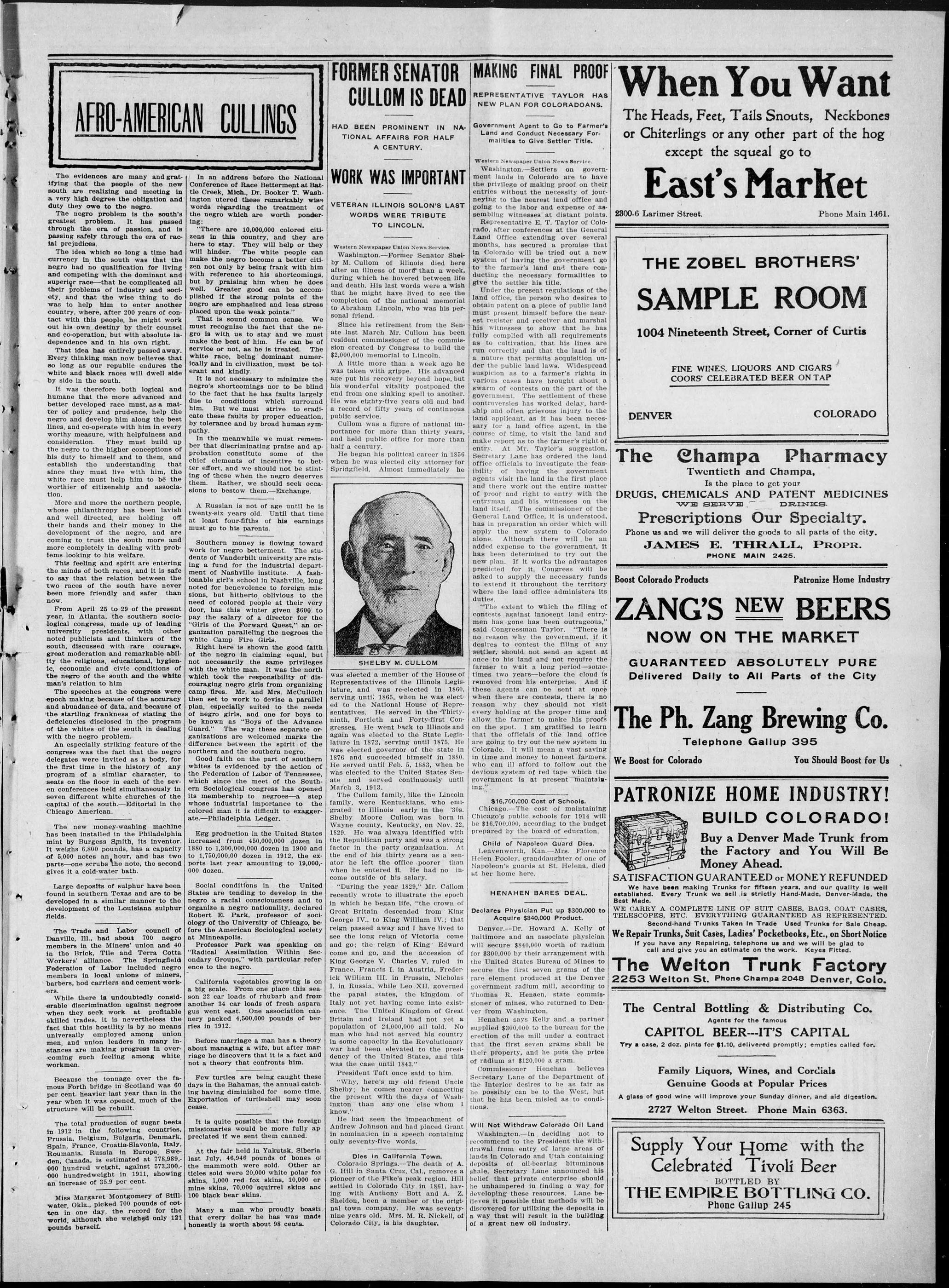
AFRO-AMERICAN CULLINGS
The evidences are many and gratifying that the people of the new south are realizing and meeting in a very high degree the obligation and duty they owe to the negro. The negro problem is the south's greatest problem. It has passed through the era of passion, and is passing safely through the era of racial prejudices. The idea which so long a time had currency in the south was that the negro had no qualification for living and competing with the dominant and superior race—that he complicated all their problems of industry and society, and that the wise thing to do was to help him to enter another country, where, after 200 years of contact with this people, he might work out his own destiny by their counsel and co-operation, but with absolute independence and in his own right.
That idea has entirely passed away. Every thinking man now believes that so long as our republic endures the white and black races will dwell side by side in the south.
It was therefore both logical and humane that the more advanced and better developed race must, as a matter of policy and prudence, help the negro and develop him along the best lines, and co-operate with him in every worthy measure, with helpfulness and consideration. They must build up the negro to the higher conceptions of his duty to himself and to them, and establish the understanding that since they must live with him, the white race must help him to be the worthier of citizenship and association.
More and more the northern people, whose philanthropy has been lavish and well directed, are holding off their hands and their money in the development of the negro, and are coming to trust the south more and more completely in dealing with problems looking to his welfare.
This feeling and spirit are entering the minds of both races, and it is safe to say that the relation between the two races of the south have never been more friendly and safer than now.
From April 25 to 29 of the present year, in Atlanta, the southern sociological congress, made up of leading university presidents, with other noted publicists and thinkers of the south, discussed with rare courage, great moderation and remarkable ability the religious, educational, hygienic, economic and civic conditions of the negro of the south and the white man's relation to him
The speeches at the congress were epoch making because of the accuracy and abundance of data, and because of the startling frankness of stating the deficiencies disclosed in the program of the whites of the south in dealing with the negro problem.
An especially striking feature of the congress was the fact that the negro delegates were invited as a body, for the first time in the history of any program of a similar character, to seats on the floor in each of the seven conferences held simultaneously in seven different white churches of the capital of the south.—Editorial in the Chicago American.
The new money-washing machine has been installed in the Philadelphia mint by Burgess Smith, its inventor. It weighs 6,800 pounds, has a capacity of 5,000 notes an hour, and has two parts—one scrubs the note, the second gives it a cold-water bath.
Large deposits of sulphur have been found in southern Texas and are to be developed in a similar manner to the development of the Louisiana sulphur fields.
The Trade and Labor council of Danville, Ill., had about 700 negro members in the Miners' union and 40 in the Brick, Tile and Terra Cotta Workers' alliance. The Springfield Federation of Labor included negro members in local unions of miners, barbers, hod carriers and cement workers.
While there is undoubtedly considerable discrimination against negroes when they seek work at profitable skilled trades, it is nevertheless the fact that this hostility is by no means universally employed among union men, and union leaders in many instances are making progress in overcoming such feeling among white workmen.
Because the tonnage over the famous Forth bridge in Scotland was 60 per cent. heavier last year than in the year when it was opened, much of the structure will be rebuilt.
The total production of sugar beets in 1912 in the following countries, Prussia, Belgium, Bulgaria, Denmark, Spain, France, Croatia-Slavonia, Italy, Roumania, Russia in Europe, Sweden, Canada, is estimated at 778,989,000 hundred weight, against 573,300,000 hundredweight in 1911, showing an increase of 35.9 per cent.
Miss Margaret Montgomery of Stillwater, Okla., picked 700 pounds of cotton in one day, the record for the world, although she weighed only 121 pounds herself.
In an address before the National Conference of Race Betterment at Battle Creek, Mich., Dr. Booker T. Washington uttered these remarkably wise words regarding the treatment of the negro which are worth pondering:
"There are 10,000,000 colored citizens in this country, and they are here to stay. They will help or they will hinder. The white people can make the negro become a better citizen not only by being frank with him with reference to his shortcomings, but by praising him when he does well. Greater good can be accomplished if the strong points of the negro are emphasized and less stress placed upon the weak points."
That is sound common sense. We must recognize the fact that the negro is with us to stay and we must make the best of him. He can be of service or not, as he is treated. The white race, being dominant numerically and in civilization, must be tolerant and kindly.
It is not necessary to minimize the negro's shortcomings nor to be blind to the fact that he has faults largely due to conditions which surround him. But we must strive to eradicate these faults by proper education, by tolerance and by broad human sympathy.
In the meanwhile we must remember that discriminating praise and approbation constitute some of the chief elements of incentive to better effort, and we should not be stinting of these when the negro deserves them. Rather, we should seek occasions to bestow them—Exchange.
A Russian is not of age until he is twenty-six years old. Until that time at least four-fifths of his earnings must go to his parents.
Southern money is flowing toward work for negro betterment. The students of Vanderbilt university are raising a fund for the industrial department of Nashville institute. A fashionable girl's school in Nashville, long noted for benevolence to foreign missions, but hitherto oblivious to the need of colored people at their very door, has this winter given $600 to pay the salary of a director for the "Girls of the Forward Quest," an organization paralleling the negroes the white Camp Fire Girls.
Right here is shown the good faith of the negro in claiming equal, but not necessarily the same privileges with the white man. It was the north which took the responsibility of discouraging negro girls from organizing camp fires. Mr. and Mrs. McCulloch then set to work to devise a parallel plan, especially suited to the needs of negro girls, and one for boys to be known as "Boys of the Advance Guard." The way these separate organizations are welcomed marks the difference between the spirit of the northern and the southern negro.
Good faith on the part of southern whites is evidenced by the action of the Federation of Labor of Tennessee, which since the meet of the Southern Sociological congress has opened its membership to negroes—a step whose industrial importance to the colored man it is difficult to exaggerate.—Philadelphia Ledger.
Egg production in the United States increased from 450,000,000 dozen in 1880 to 1,300,000,000 dozen in 1900 and to 1,750,000,00 dozen in 1912, the exports last year amounting to 19,000,000 dozen.
Social conditions in the United States are tending to develop in the negro a racial consciousness and to organize a negro nationality, declared Robert E. Park, professor of sociology of the University of Chicago, before the American Sociological society at Minneapolis.
Professor Park was speaking on "Radical Assimilation Within Secondary Groups," with particular reference to the negro.
California vegetables growing is on a big scale. From one place this season 22 car loads of rhubarb and from another 34 car loads of fresh asparagus went east. One association canery packed 4,500,000 pounds of berries in 1912.
Before marriage a man has a theory about managing a wife, but after marriage he discovers that it is a fact and not a theory that confronts him.
Few turtles are being caught these days in the Bahamas, the annual catching having diminished for some time. Exportation of turtleshell may soon cease.
It is quite possible that the foreign missionaries would be more fully up preciated if we sent them canned.
At the fair held in Yakutsk, Siberia last July, 46,946 pounds of bones of the mammoth were sold. Other art ticles sold were 20,000 white polar fox skins, 1,000 red fox skins, 10,000 emrine skins, 70,000 squirrel skins and 100 black bear skins.
Many a man who proudly boasts that every dollar he has was made honestly is worth about 98 cents.
FORMER SENATOR CULLOM IS DEAD
HAD BEEN PROMINENT IN NATIONAL AFFAIRS FOR HALF A CENTURY.
WORK WAS IMPORTANT
VETERAN ILLINOIS SOLON'S LAST
WORDS WERE TRIBUTE
TO LINCOLN.
Western Newspaper Union News Service.
Washington.—Former Senator Shelby M. Cullom of Illinois died here after an illness of more than a week, during which he hovered between life and death. His last words were a wish that he might have lived to see the completion of the national memorial to Abraham Lincoln, who was his personal friend.
Since his retirement from the Senate last March Mr. Cullom has been resident commissioner of the commission created by Congress to build the $2,000,000 memorial to Lincoln.
A little more than a week ago he was taken with grippie. His advanced age put his recovery beyond hope, but his wonderful vitality postponed the end from one sinking spell to another. He was eighty-five years old and had a record of fifty years of continuous public service.
Cullom was a figure of national importance for more than thirty years, and held public office for more than half a century. He began his political career in 1856 when he was elected city attorney for Springfield. Almost immediately he
SHELBY M. CULLOM
was elected a member of the House of Representatives of the Illinois Legislature, and was re-elected in 1860, serving until 1865, when he was elected to the National House of Representatives. He served in the Thirty-ninth, Fortieth and Forty-first Congresses. He went back to Illinois and again was elected to the State Legislature in 1872, serving until 1875. He was elected governor of the state in 1876 and succeeded himself in 1880. He served until Feb. 5, 1883, when he was elected to the United States Senate and served continuously until March 3, 1913.
The Cullom family, like the Lincoln family, were Kentuckians, who emigrated to Illinois early in the '30s. Shelby Moore Cullom was born in Wayne county, Kentucky, on Nov. 22, 1829. He was always identified with the Republican party and was a strong factor in the party organization. At the end of his thirty years as a senator he left the office poorer than when he entered it. He had no income outside of his salary.
"During the year 1829," Mr. Cullom recently wrote to illustrate the epoch in which he began life, "the crown of Great Britain descended from King George IV., to King William IV.; that reign passed away and I have lived to see the long reign of Victoria come and go; the reign of King Edward come and go, and the accession of King George V. Charles V. ruled in France, Francis I. in Austria, Frederick William III. in Prussia, Nicholas I. in Russia, while Leo XII, governed the papal states, the kingdom of Italy not yet having come into existence. The United Kingdom of Great Britain and Ireland had not yet a population of 24,000,000 all told. No man who had not served his country in some capacity in the Revolutionary war had been elevated to the presidency of the United States, and this was the case until 1843."
"Why, here's my old friend Uncle Shelby; he comes nearer connecting the present with the days of Washington than any one else whom I know."
He had seen the impeachment of Andrew Johnson and had placed Grant in nomination in a speech containing only seventy-five words.
Colorado Springs.—The death of A. G. Hill in Santa Cruz, Cal., removes a pioneer of the Pike's peak region. Hill settled in Colorado City in 1861, having with Anthony Bott and A. Z. Sheldon, been a member of the original town company. He was seventy-nine years old. Mrs. M. R. Nickell, of Colorado City, is his daughter.
MAKING FINAL PROOF
REPRESENTATIVE TAYLOR HAS
NEW PLAN FOR COLORADOANS.
Government Agent to Go to Farmer's
Land and Conduct Necessary Formalities to Give Settler Title.
Western Newspaper Union News Service.
Washington.—Settlers on government lands in Colorado are to have the privilege of making proof on their entries without the necessity of journeying to the nearest land office and going to the labor and expense of assembling witnesses at distant points. Representative E. T. Taylor of Colorado, after conferences at the General Land Office extending over several months, has secured a promise that in Colorado will be tried out a new system of having the government go to the farmer's land and there conducting the necessary formalities to give the settler his title.
Under the present regulations of the land office, the person who desires to obtain patent on a piece of public land must present himself before the nearest register and receiver and marshal his witnesses to show that he has fully complied with all requirements as to cultivation, that his lines are run correctly and that the land is of a nature that permits acquisition under the public land laws. Widespread suspicion as to a farmer's rights in various cases have brought about a swarm of contests on the part of the government. The settlement of these controversies has worked delay, hardship and often grievous injury to the land applicant, as it has been necessary for a land office agent, in the course of time, to visit the land and make report as to the farmer's right of entry. At Mr. Taylor's suggestion, Secretary Lane has ordered the land office officials to investigate the feasibility of having the government agents visit the land in the first place and there work out the entire matter of proof and right to entry with the entryman and his witnesses on the land itself. The commissioner of the General Land Office, it is understood, has in preparation an order which will apply the new system to Colorado alone. Although there will be an added expense to the government, it has been determined to try out the new plan. If it works the advantages predicted for it, Congress will be asked to supply the necessary funds to extend it throughout the territory where the land office administers its duties.
"The extent to which the filing of contests against innocent land entrymen has gone has been outrageous," said Congressman Taylor. "There is no reason why the government, if it desires to contest the filing of any settler, should not send an agent at once to his land and not require the farmer to wait a long period—sometimes two years—before the cloud is removed from his enterprise. And if these agents can be sent at once when there are contests, there is no reason why they should not visit every holding at the proper time and allow the farmer to make his proofs on the spot. I am gratified to learn that the officials of the land office are going to try out the new system in Colorado. It will mean a vast saving in time and money to honest farmers, who can ill afford to follow out the devious system of red tape which the government is at present maintaining."
Chicago—The cost of maintaining Chicago's public schools for 1914 will be $16,700,000, according to the budget prepared by the board of education.
Child of Napoleon Guard Dies.
Leavenworth, Kan.—Mrs. Florence Helen Pooley, granddaughter of one of Napoleon's guards at St. Helena, died at her home here.
HENAHEN BARES DEAL.
Declares Physician Put up $300,000 to Acquire $340,000 Product.
Denver.--Dr. Howard A. Kelly of Baltimore and an associate physician will secure $840,000 worth of radium for $300,000 by their arrangement with the United States Bureau of Mines to secure the first seven grams of the rare element produced at the Denver government radium mill, according to Thomas R. Henaen, state commissioner of mines, who returned to Denver from Washington.
Henaen says Kelly and a partner supplied $300,000 to the bureau for the erection of the mill under a contract that the first seven grams shall be their property, and he puts the price of radium at $120,000 a gram.
Commissioner Henehan believes Secretary Lane of the Department of the Interior desires to be as fair as he possibly can be to the West, but that he has been misled as to conditions.
Washington.—In deciding not to recommend to the President the withdrawal from entry of large areas of lands in Colorado and Utah containing deposits of oil-bearing bituminous shale, Secretary Lane announced his belief that private enterprise should be unhampered in finding a way for developing these resources. Lane believes it possible that methods will be discovered for utilizing the deposits in a way that will result in the building of a great new oil industry.
When You Want
The Heads, Feet, Tails Snouts, Neckbones or Chiterlings or any other part of the hog except the squeal go to
THE ZO
SAM
1004 Ninetee
1004 Nineteenth Street, Corner of Curtis
FINE WINES, LIQUORS AND CIGARS COORS' CELEBRATED BEER ON TAP
The Cha
Twee
DRUGS, CHEMICAL
WE S
Prescript
Phone us and we will
JAMES
The Champa Pharmacy
Twentieth and Champa,
Is the place to get your
DRUGS, CHEMICALS AND PATENT MEDICINES
WE SERVE DRINKS.
Prescriptions Our Specialty.
Phone us and we will deliver the goods to all parts of the city.
JAMES E. THRALL, PROPR.
PHONE MAIN 2425.
Boost Colorado Products
Patronize Home Industry
ZANG'
NOW O
GUARANTEE
Delivered Da
The Ph. Z
Tele
ZANG'S NEW BEERS NOW ON THE MARKET
GUARANTEED ABSOLUTELY PURE Delivered Daily to All Parts of the City
The Ph. Zang Brewing Co.
We Boost for Colorado PATRONIZI
PATRONIZE HOME INDUSTRY!
SATISFACTION GU
We have been making
established. Every Trunk
Best Made.
WE CARRY A COMPLETE
TELESCOPES, ETC. EVE
Second-hand Trun
We Repair Trunks, Suit C
If you have any Rep
call and give you
The Welt
SATISFACTIONGUARANTEED or MONEYREFUNDED
We have been making Trunks for fifteen years, and our quality is well established. Every Trunk we sell is strictly Hand-Made, Denver-Made, the Best Made.
WE CARRY A COMPLETE LINE OF SUIT CASES, BAGS, COAT CASES, TELESCOPES, ETC. EVERYTHING GUARANTEED AS REPRESENTED.
Second-hand Trunks Taken In Trade Used Trunks for Sale Cheap.
We Repair Trunks, Suit Cases, Ladies' Pocketbooks, Etc., on Short Notice
If you have any Repairing, telephone us and we will be glad to call and give you an estimate on the work. Keves Fitted.
The Welton Trunk Factory 2253 Welton St. Phone Champa 2048 Denver, Colo.
CAPITOL BEER---IT'S CAPITAL
Try a case, 2 doz. pints for $1.10, delivered promptly; empties called for.
Family Liquors, Wines, and Corcials Genuine Goods at Popular Prices A glass of good wine will improve your Sunday dinner, and aid digestion. 2727 Welton Street. Phone Main 6363.
Supply Your Home with the Celebrated Tivoli Beer BOTTLED BY THE EMPIRE BOTTLING CO. Phone Gallup 245
DENVER
```markdown
```
OTHERS'
ROOM
ner of Curtis
Pharmacy
mpa,
our
ENT MEDICINES
DRINKS.
Specialty.
all parts of the city.
L, PROPR.
Patronize Home Industry
BEERS
MARKET
UTELY PURE
ts of the City
Brewing Co.
1395
You Should Boost for Us
INDUSTRY! COLORADO! Made Trunk from
Buy a Denver Made Trunk from the Factory and You Will Be Money Ahead.
Phone Main 1461.
COLORADO
THE COLORADO STATESMAN
JOS. L. D. RIVERS.....Proprietor
1824 Curtis Street, Room 25.
Phone Main 7417.
SUBSCRIPTION RATES:
One Year ..... $2.00
Six Months ..... 1.00
Three Months ..... .60
PAYABLE IN ADVANCE.
Entered as second-class matter at the postoffice in the city of Denver, Colorado.
All communications of a personating nature that are not complimentary will be withheld from the columns of this paper.
Display advertising, 50 cents per inch. An inch contains twelve agate lines.
Reading notices, ten lines or less, 10 cents per line. Each additional line over ten lines, 5 cents per line.
No discounts allowed on less than three months' contract. Cash must accompany all orders from parties unknown to us. Further particulars on application.
Remittances should be made by Express Money Order, Postoffice Money Order, Registered Letter or Bank Draft. Postage stamps will be received the same as cash for the fractional part of a dollar. Only 1-cent and 2-cent stamps taken.
Communications to receive attention must be newsy, upon important subjects, plainly written only upon one side of the paper; must reach us Tuesdays, if possible, anyway, not later than Wednesdays, and bear the signature of the author. No manuscript returned, unless stamps are sent for postage.
It occasionally happens that papers sent to subscribers are lost or stolen. In case you do not receive any number when due, inform us by postal card and we will cheerfully forward a duplicate of the missing number.
VALUE OF PURE WATER.
A city's water is a city's life, more than anything else. You can carry meat and provisions and fuel anywhere, to meet almost any demand, and keep them in healthful and serviceable condition, but you cannot always provide the same safe and adequate supply of water. Then the people of a city can make daily choice or change their supply of meats and other provisions, selecting the best, in their judgment, at will, refusing the poor and the stale, but they must take the water that is provided for them, in the manner in which it is provided. Infected meats and provisions can be quickly condemned and banished by food inspectors and health commissioners, but a germ-burdened water supply must be allowed to work its havoc upon the health and the life of the unsuspecting or helpless citizen until tiersome tests and experiments and almost endless sacrifices lead to the correction of the evil. Pure water is a blessing with which no city or community can afford to part. If they have it, they should rather spend millions of dollars than to give it up. A pure water supply for a large city is not easily obtained. The mere tapping of water sources, impounding in reservoirs and the digging of ditches and laying of pipes for its conduct and distribution will not insure its purity, no matter how clean the original supply. In fact, when long ditches, canals and conduits are necessary, pure water will quickly become impure if it is improperly impounded or allowed to flow through improper courses.
The poisonous seepage of improper courses or dangerous tributaries will so thoroughly infect a pure water supply as to totally destroy its virtue in the homes of the consumers. A pure water supply for a large community is the result of the most careful and painstaking work of years. It cannot be guaranteed as an original product, and the city that would risk obtaining it upon an experimental project would hazard the health and the lives of its citizens in a most foolish manner. New York City spent one hundred and sixty million dollars to make its water supply more adequate and pure. Philadelphia spent more than thirty-five million dollars for the installation of a huge filtration plant alone, to improve and purify its dangerously unhealthy water supply. Chicago, St. Louis and New Orleans have had similar experiences and many other large cities have this problem of impure water supply to face.
The people of Denver do not appreciate well enough the fact that they passed far beyond that point of danger. Our present water supply is a filtered, purified and protected water supply of a character impossible to be duplicated by less than the work of many years, if at all. The source of its original supply, the location and character and extent of its reservoirs, with their scientific construction and unremitting care, the filtration beds and processes which make and keep the water wholesome and pure, with ample, modern mains and pipes for its distribution, make a water system as perfect as that of any city in the world, and one which the citizens of Denver cannot afford to dispense with. The self-interested, responsible and unremitting care of private enterprise represented by the officials of The Denver Union Water Company, has made this possible, and their chief reward is the health of the city. There can be no condition or cost that would give the citizens of Denver reasonable warrant to ignore or sacrifice the work on their behalf which the company has so wisely consummated. The following is a letter from Dr. C. A. Powers, president of the American Surgical Society and a leader in the medical profession of Denver, who is opposed to the construction of a new water plant in Denver:
"Aside from the economic questions involved there can be no question whatever but that the tearing up of the streets of Denver and the installation of a new water plant would result in much illness and be detrimental to the best interests of the city from every point of view. It is well known that the purity of the present water supply to the citizens of Denver is beyond question. The substitution of another supply for the present one would be to say the least, an experiment, which might or might not result disastrously. The health of the city depends in no small degree upon its supply of water and the city of Denver may well be proud of the place, in this regard, which it occupies among the cities of the country."
The Right Kind of Reading Matter
```markdown
```
The home news; the doings of the people in this town; the gossip of our own community, that's the first kind of reading matter you want. It is more important, more interesting to you than that given by the paper or magazine from the outside world. It is the first reading matter you should buy. Each issue of this paper gives to you just what you will consider
The Right Kind of Reading Matter
France Trains Nurses for Public Hospitals By J. B. RICE, New York
welfare of children and the care of the aged, Paris has found it necessary to recruit a corps of nurses for its public hospitals as well. Accordingly, about five years ago there were opened in various parts of the city schools for nurses under state charge. Today the profession of nursing bids fair to excel that of elementary teaching as an opening for the daughters of the petite bourgeoisie.
The largest and best equipped of these schools for nurses is l'Ecole middle class. It has room for 1,800 old people, who share the ancient gardens, with their well-trimmed hedges, neat flower beds and weather-beaten statues, with the young girls who are studying at the nurses' school.
The big classroom where the nurses meet in assembly overlooks a favorite walk of the old women, who hobble in and out all day long, as their predecessors have done for generations. The 200 fresh-faced girls within, in their cream white, unbleached muslin dresses and gauzy caps with frill and flowing blue ribbons, as they sit listening to a dignified doctor or bewhiskered professor, are a striking contrast to these ancient dames below.
In contrast, too, to the age-begrimed dwellings of the old people is the beautifully equipped building which is their home as well as their school. The training includes lodging, food, clothing and a small allowance during the two years' course. There are beautiful dormitories with every convenience, a spacious salon and dining room, besides the big classrooms and gymnasium. After the two years' study, including anatomy, hygiene, massage and medicine, the girls go into one of the city hospitals for three years' practice in nursing.
When the five years' course is completed the nurse is qualified for a position in one of the city hospitals. She holds this for life and may be promoted after certain years of service, and on retirement receives a pension in proportion to the salary she has earned.
Many Things Are Wrong in America
By JOHN CHENOWITH, Boston, Mass.
America is becoming a country without front yards or alleys. One is struck with this after a visit to Europe and the great cities thereof. There is hardly a residence in England that has not its front yard, and the workingman who goes home in the evening has his little patch of garden which he finds recreation in cultivating.
I dare say there is not a garden of any pretensions in New York city. I observed that the alleys in New York are disappearing with the increasing height of the skyscrapers. In Washington I find there are few alleys in the business sections, and there are not many in the residential communities.
There has got to be a stop to the continually increasing haste of Americans. They are all bent upon the same thing, apparently—to make money, and the "get-rich-quick" germ seems to have entered into every system.
Apparently the Americans do not know how to live. An Englishman or a German will spend an hour at his meals, whereas the average American will gulp down his breakfast in two minutes, grab a five-minute lunch at noon, and grudgingly will wait at his dinner table for twenty minutes or a half-hour. It isn't a question of enjoying the meal, but of appeasing the hunger and putting enough into one's stomach to nourish the system.
Back-to-Nature Craze Is Quite Popular
By Charles R. Goodwin, Charlotte, N. C.
The back-to-nature craze seems to be still popular. I know of one farmer out in Kansas who sold $1,000 worth of lettuce in a year he had raised on one acre of land.
There are many persons who think it requires a large farm to make money. Farming at present has been reduced to a science and many of the small farms are paying better than the large ones. It only requires a few acres if they are handled right.
The modern farmer studies his land in the same manner as a doctor looks into a case of sickness he is called in to attend. The soil may be adapted to certain products that would not grow anywhere else in that part of the country.
He has his soil studied by experts and then he finds out just what he should plant. It is not a gamble with him for he knows exactly what his crops will be. If there is a drought the modern farmer has a well and his farm is small enough to pump enough water to save his crops.
Public Schools Assist in Commercial Spirit
By ROBERT T. DOWD, Toronto, Ont.
Public schools have been the means of blending the different nationalities that have drifted to the United States from every quarter of the world. The common schools have been assisted
by the commercial spirit. The commercial spirit should direct the public schools. It has made the common schools of the United States a powerful factor for assimilation and has done the same in Germany.
Now that the tide of immigration has been turned toward Canada, the government will look to the common school to blend the nationalities.
It is the commercial spirit that brings thousands of immigrants to the United States in the hope that they will better themselves.
After they arrive it is for the government and people of the country to direct them to become respectable and share in the commercial citizenship.
The money men and capitalists and millionaires like Carnegie are the most reliable of the exponents of the commercial spirit at work.
Possess Mania for Wearing Freak Clothes
By F. JAY KNOX, London, Eng.
Women are not alone in wearing freak clothes. Tailors of advanced ideas had not insisted until the season had well set in that coats and trousers of various blue shades were bound to put the decent black out of fashion. As for silk shirts, they were to banish starched linen from the masculine wardrobe altogether, and certainly there are enough of them in the market, crinkly, plaited and warranted to bulge.
But these things were not to be. Blue dress coats and silk dress shirts may still be worn, as they have been, by men who like to make themselves unduly conspicuous.
The stewed-stripe effects in bosoms and cravats will still be esteemed as corollaries of the dinner jacket, which knows no laws, by flamboyant young men who wear plush soft hats, but the rigor of evening dress has not abated.
France Trains Nurses for Public Hospitals By J. B. RICE, New York
Many Things Are Wrong in America By JOHN CHENOWITH, Boston, Mass.
Back-to-Nature Craze Is Quite Popular By Charles R. Goodwin, Charlotte, N. C.
Public Schools Assist in Commercial Spirit By ROBERT T. DOWD, Toronto, Ont.
Possess Mania for Wearing Freak Clothes By F. JAY KNOX, London, Eng.
JOHN H. HARRIS
THE NEWPORT SALOON
Only Colored Saloon in Denver.
ANNEX CAFE AND LUNCH ROOM
SHORT ORDERS AT ALL HOURS
CHINESE DISHES OF ALL KINDS
FURNISHED ROOMS
TOM LEWIS, Proprietor.
1841-45 ARAPAHOE STREET. DENVER, COLORADO
DENVER, COLORADO
REPAIRING DONE WHILE
YOU WAIT
WORK CALLED FOR AND REPAIRING DONE WHILE DELIVERED YOU WAIT
TELEPHONE MAIN 7377
THE CAPITAL CITY SHOE REPAIRING CO.
SEWED HALF SOLES 60 cts. and 75 cts.
HENRY WARNECKE, President
1511 CHAMPA STREET DENVER, COLO.
YOUR SUNDAY DINNER
Will Not Be Complete Without OYSTERS CLAMS OR LOBSTERS
Received Daily By Express
LYNN HAVENS, COTUETS, BLUE POINTS, BALTIMORE
STANDARDS, BALTIMORE SELECTS, NEW YORK COUNTS
THE ONLY EXCLUSIVE FISH AND OYSTER HOUSE IN DENVER
WASHBURN'S
1506 Arapahoe St. Phone Champa 2211
PROMPT DELIVERY
REO CLUB
2710=12 Welton St
Phone Main 2759 Denver, Colo.
Stop!
Stop!
consider
Did you ever stop to think that you are helping to pay the big up town rents when you buy without considering this. Patronize Home Industry
N. FERRY Phone Main 7411 1905 Curtis Street
I PAY SMALL RENT, DELIVER THE BEST $20.00 AND $25.00 SUIT IN THE CLTY
Best Goods, Best Workmanship, Best for the money in the City of Denver. Give me a trial and you will be convinced I give all my customers perfect Satisfaction, Fit, Style, Workmanship and the BEST FOR THE MONEY. How do I Turn Out Such Fine suits for the Money? Why? On account of THE LOW RENT.
Bolden Bros.' Barber
AGENTS WANTED
To Sell
MAGIC SHAVING POWDER.
A new discovery for shaving the face and head without using razor or shears.
Will send half pound can by mail, postage paid, for 50 cents in stamps.
Write
THE SHAVING POWDER CO.
Savannah, Georgin.
Rufus Bolden, Mgr. W. D. Smith, G. C. Craig Artists
Telephone Main 8698.
926 19th Street Denver. Near Curtis
Miss M. Cowden Hair Dressing Parlor
Coal from Sack to Carload Delivered
Anywhere in the City.
Office: 2807 Welton Street
DENVER COLORADO
Shampoo, cutting and curling. Scalp treatment, hair tonics, hair straightening, manicuring. Stage wigs for rent; theatrical use and masquerades. Goods delivered out of the city. All shades of hair matched by sending sample of hair; also combings made up.
Sales Daily at 2 p.m. Office Furniture a Specialty.
Cheapest Switches 50 Cents
1219 21st St. Denver, Colo.
HAVE MOVED TO—
1723-39 GLENARM ST.
PHONE MAIN 1675.
S. Summerville is carrying his right hand in a sling as the result of an accident.
Mrs. J. R. Contee continues quite ill at her residence. She is much missed in church and social circles.
Messrs. H. J. Foster and George Anderson left the city Sunday for Western points.
Las, Tex., was quietly married to Mrs. Blanche Boone on Thursday evening the 29th, at 2549 Clarkson, Rev. Ov of Zion Baptist church officiating Miss Boone is a Denver girl, born a reared in our city, a graduate of Ed Denver High School and is quite accomplished young lady. The mu for the occasion was furnished Prof. Hike and after the completion of the simple, but impressive ce
L. E. Tillery, a former resident of St. Joseph, Mo., but now of Chicago, is running into Denver over the Rock Island.
Mrs. Margaret Jones of Leadville spent the week-end in the city as guest of Mrs. Lewis George.
Mrc. Louise Burrell and son, Henry, returned to the city last Monday after nine months of residence in Los Angeles, Cal.
David Strosier obtained a divorce from Mrs. Ada Strosier on the grounds of desertion on the 23rd of January. Lawyer Townsend acting as attorney.
Mr. and Mrs. J. S. Mason have rented their home on Humboldt street to Mr. and Mrs. C. E. Langston and are at home to their friends at the Bectoldi apartments, 1711 Pennsylvania street.
Mr. and Mrs. Ralph Garvin, the newly-weds, are the proud parents of a baby girl, which arrived on this terrestrial sphere last Wednesday. Cigars are in order, Ralph.
Mrs. Ned O'Banion came up from Colorado Springs last week to spend several weeks in the city with her parents. Her many young friends were pleased to welcome her.
J. J. Neely and Ollie Jackson of Sheridan, Wyo., were visitors in the city this week en route to California. While here they were the guests of "Syl" Stewart, the congenial manager of the Keystone Social Club.
Edward C. Davis received the sad news this week of the serious illness of his mother, who lives in Hearne, Texas. His brother, George Davis, who is now in Sheldon, Ia., left last Tuesday night to be at his mother's bedside.
Mrs. F. E. Embry of Colorado Springs, recording secretary of the Negro Educational Congress is leaving Feb. 1st for an extensive Southern tour, embracing Kansas City, Memphis, Mound Bayou, Miss.; Birmingham, Tuskegee, Atlanta and Jacksonville, Fla., where she expects to spend a few weeks, returning home in the early spring.
Mr. and Mrs. Claude Robinson of 1350 Jasimine street were hosts at a dinner of handsome appointment last Tuesday evening, in honor of Mr. and Mrs. Walter Pritchett. Quantities of carnations were formed into a beautiful center piece. Covers were laid for Mr. and Mrs. W. H. Pritchett, Mrs. Rothwell and daughter and Mr. and Mrs. Claude Robinson.
Miss Veronia Mason entertained fifty of Denver's younger set Jan. 20 at her residence, 2352 Humboldt street, in honor of her seventeenth birthday. Many beautiful presents received. The evening was spent in dancing. At a late hour light refreshments were served and the guests departed wishing Miss Mason many more happy birthdays. Misses Richardson, Colston, Gaines and Terrill assisted the hostess.
H. C. Radcliff received a letter from H. R. Jackson, who has been employed in the mining business at Sunset, Colo., for several years, stating that he met with a serious accident Jan. 11th, by slipping and falling 400 feet down the side of a mountain, breaking two ribs and receiving internal injuries. He is now able to leave his bed, but it will be several weeks before he is able to resume his work.
The Sunshine Club met at the residence of Mrs. Wesley Lyons, 1914 Washington street, and elected the following officers; Mrs. E. H. Morris, president; Mrs. Mollie Barnes, vice president; Mrs. Eliza Holley, second vice president; Mrs. Rachel Butler, secretary; Mrs. Tillie Burn, assistant Secretary; Mrs. Wesley Lyons, treasurer; Mrs. Mabel Fallings, corresponding secretary; Mrs. America Finley, chairman sick committee. The club will meet with Mrs. Mabel Fallings, 1919 Clarkson street, Feb. 5, 1914.
```markdown
```
Mr. W. D. Baker, formerly of Dal-
las, Tex., was quietly married to Miss Blanche Boone on Thursday evening, the 29th, at 2549 Clarkson, Rev. Over of Zion Baptist church officiating, Miss Boone is a Denver girl, born and reared in our city, a graduate of East Denver High School and is quite an accomplished young lady. The music for the occasion was furnished by Prof. Hike and after the completion of the simple, but impressive ceremony, the invited guests whiled away the hours in dancing. The Colorado Statesman wishes this couple all the happiness than come to them through their future years of life.
The Colorado Electric Club, formerly known as the Traffic Club, located in the Chamber of Commerce, has retained the services of Mr. Thomas Williams, as head waiter, also Mr. J. B. Gist as second. The Colorado Statesman wishes those men success and hope that they may render such valuable service that they may retain their position permanently, thereby opening another avenue of employment for our men. These men took charge on the 29th.
PYTHIAS LODGE NO. 11.
The next meeting of Pythias lodge will be held Wednesday evening, February 4th. All members are summoned to be present. Please bring or send your present address to Harry Jones, C. C., 926 19th street. Attest: A. R. Butler, K. of R. & S.
FUNERAL OF A. M. LAWHORN.
The funeral of Brother A. M. Lawhorn was held from Campbell church, Sunday, Jan. 25th, at 2:30 p. m., Rev J. S. Washington, D. E., Over, R. E. Reynolds and Thomas J. Hazel officiating.
Mrs. A. M. Lawhorn wishes to thank her many friends for their kindness and tender care, which was rendered during the late bereavement of her dear husband, A. M. Lawhorn. She also gives many thanks to the fraternal organizations and friends for the beautiful floral offerings.
We loved him better than tongue can tell.
We will miss him more than you ever will.
But he has gone to that city beyond Death's sea.
And we will meet him there when death comes to me.
MATTIE LAWHORN,
SADDIE BROOKS,
A. L. LAWHORN.
SHORTER CHAPEL.
Tomorrow will be Quarterly Meeting Day at Shorter. Rev. J. P, Howard of Kansas City, Mo., and who arrived in the city Friday evening for the purpose of assisting our pastor in the mid-winter revival, will occupy the pulpit at the morning and evening hours. Rev. Howard is easily one of the foremost evangelists of the country and it is earnestly hoped that great good will result from this soulsaving campaign. At 3 o'clock p. m. Rev. S. L. Deas of Scott M. E church will preach the quarterly communion sermon and Campbell Chapel's choir will sing. The pastors of our sister churches and their congregations are invited to worship with us at this service.
Our revival will begin Monday evening, Feb. 2nd and every Christian in Denver is urgently invited to join us in this campaign. A special invitation is made to every unsaved man and woman. If you desire help attend the meetings. God helps those who help themselves. Let every member of Shorter prepare to put in full time and render his best service. No sacrifice is too great to make to save a human soul. Rev. Howard comes to us rejoicing over a very successful meeting held last month in his home city. The spelling bee and ciphering contest given by the Allen C. E. League Thursday evening was a shouting success. Good for the young people of Shorter.
CAMPBELL A. M. E. CHURCH
Corner 23rd and Lawrence Streets.
JAS. WASHINGTON, Pastor.
The monthly sacrament will be administered 11 a. m.
Class—12:15 p. m.
Allen C. E. League—6:30 p. m.
Sermon to mothers—7:45 p. m.
The services were largely attended last Sunday, especially the funeral of Mr. A. M. Lawhorn, which was the largest in the history of Denver.
Prayer meeting last Wednesday was the largest ever at Campbell, 87 persons being present, and all were spiritually benefited.
The W. M. M. Society has very interesting meetings and is largely attended.
The pastor is elated over the renewed interest of every department in the church.
To these services all have a cordial invitation.
All Eaters of Insects
It may be that all civilized races are insect eaters in greater or less degree. There is a certain insect, the corn weevil, which eats our grain and sometimes does thousands of dollars' worth of damage to a single crop. No matter how clean the wheat is, there are almost sure to be a few of these insects hidden away among the kernels, and these are ground up into flour and become a part of our bread and cake.
DEATHS.
Mr. Clark Anderson, one of the oldest residents of the city, died Thursday, January 22, after many years' illness. Mr. Anderson has lived in Denver for more than 25 years and was loved and respected by all who knew both white and colored. He was a faithful member of Shorter A. M. E. church and Rocky Mountain lodge. No. 1, F. & A. M. Mr. Anderson leaves four children besides a host of friends to mourn his loss. Funeral was held Sunday from the Doughlass Undertaking Co. parlors under the auspices of Rocky Mountain lodge, No. 1, F. & A. M.
Mrs. Annie J. Brown died at her home. 2024 Humboldt, Jan. 25. Funeral was held Thursday from her residence under the auspices of the Household of Ruth, No. 376. Rev. R. L. Pope officiated. Interment at Fairmount.
Mr. Chas, Smithy died at,2814 Glenarm, Jan. 27. He was a member of Pinion Mesa lodge, No. 20, Masons of Grand Junction, Colo. His funeral will be held Sunday, 2 p. m. from 2814 Glenarm, under the auspices of Rocky Mountain Lodge, No. 1, Masons. Rev, D. E. Over, assisted by Rev. Day, Douglass Undertaking Co. in charge of above funerals.
The funeral of Harvey B. Cunningham, Jr., son of Mr. and Mrs. Harvey B. Cunningham, of 3921 Tennyson street, was held Saturday at 1 p. m. from parlors.
Mrs. Lizzie Combs died at County hospital, Jan. 26. If any one knows her daughter, Miss Mildred Combs, tell her to call at the Douglas Undertaking Co., 1830 Arapahoe street.
Douglas Undertaking Co., in charge of above funerals.
CARD OF THANKS.
W we wish to thank our friends and Rocky Mountain Lodge, No. 1, F & A M., for the beautiful flowers and for their kindness and sympathy shown us during our recent bereavement in the loss of our dear father.
PASTIME RESORTS.
Denver is "on the map" in the way of amusement resorts, not only among the whites, but Negroes as well, in fact there is no other city in the country the size of Denver which can beast of more first-class clubs than those conducted by Denver Negroes, and strangers who have visited the various resorts always leave a word of praise for the up-to-the-minute manner in which such places are conducted.
The Railroad Porters' Club at 1728½ Waze street, which has just been recently opened with Charlie Harris as manager, has already become famous. It is neatly furnished throughout with dining room in connection. The new pool and billiard tables which have just been installed affords much pleasure for the que knights.
The Keystone Social Club and café at 1857-59 Champa street, can always be counted in the front ranks and will always be found there as long as it is under the management of Syl Stewart.
There is hardly any need of mentioning the popularity of the Railroad Men and Waiters' Club at 2149 Curtis street, for it has long since been made a topic throughout the country as a place of recreation and enjoyment and it goes without saying that Manager Frank Burnley is responsible for the good reputation it maintains.
The Reo Club, at 2710 Welton street, has a following second to none and no one knows better how to cater to the wants of its members and patrons that E. R. Page, the congenial manager.
The Rocky Mountain Athletic Association, under the supervision of Vic Walker, is one of the best advertised and most up-to-date resorts in the country, in fact no one has attempted a bigger undertaking and has been crowned with a bigger success than Mr. Walker when he organized and opened up this famous resort.
The Newport saloon, the only saloon in Denver conducted by a colored man, is never overlooked by the numerous friends and patrons of the proprietor, Tommy Lewis, who carries only the best grade of wines, liquors and cigars. Mr. Lewis believes in keeping his place presentable and this together with his good treatment and wining ways, has made his place one that is always popular with the genial public.
Pleasures of the Table.
"Then I commended mirth, because a man hath no better thing under the sun than to eat, and to drink, and to be merry."—Ecclesiastes, 8:15. "And I will say to my soul, 'Soul, thou hast much goods laid up for many years; take thine ease, eat, drink and be merry.'"—Luke 12:19. "What advantageget it me if the dead rise not? Let us eat and drink, for tomorrow we die."—I. Corinthians 15:32. "Let us eat and drink, for tomorrow we shall die."—Isgiah, 22:13.
Do You Know This?
The middle verse of the Bible is the eighth verse of the 118th psalm. The twenty-first verse of the seventh chapter of Ezra contains all the letters of the alphabet except the latter "j." The longest verse is the ninth verse of the eighth chapter of Esther. The shortest verse is the ninth verse of the eleventh chapter of St. John.
How Shaving Originated.
The comparative advantages and propriety of shaving the face and of permitting the beard to grow are not easy to determine. On the side of non-shaving it has been argued that nature must have bestowed beards on men for the purpose of being worn, and that, as Tertullian affirmed, it was "blasphemy against the face to reject it altogether."
Facts About the Water Question
If the Retail Merchants' plan to buy the present water plant is defeated at the polls on February 17th the city MUST build a new plant. There is no alternative. The Public Utility Commission has positive instruction from the city to issue $8,000,000 in bonds and proceed at once with the construction of a new plant. Yet the Public Utility Committee of Engineers says a new plant cannot be built for $8,000,000. This committee says it will take at least $12,750,000. They say it will take $16,250,000 if the water is brought by tunnel from the Western Slope. And they say it may require even more than this amount if the water
The Retail Association 400 Chamber of Commerce Building
Five-room house, strictly modern except furnace; good condition, $15; 2134 Humboldt street. Inquire at 1824 Curtis street, Room 25.
Nicely furnished rooms for rent at 2441-43 Lawrence street. Phone Champa 2783.
For rent a five room frame house at 222 24th street. Apply at 1824 Curtis street, room 25.
Three nicely furnished rooms for light housekeeping at 2929 Glennarm Place. Call at 2815 Arapahoe St.
For Rent—Nicely modern furnished rooms at 2210 Clarkson street, also plain and fancy sewing done at the above address.
An industrious man wanted to learn the undertaking business, one who has some business ideas. Call at Lawhorn's, 1925 Arapahoe street, for further particulars.
H. C. Radcliff has opened a nice, neat barber shop at his old stand, 1226 18th street. The shop has been remodeled in the latest style, and the only colored shop in the city giving artesian baths. Mr. Radcliff is well known and liked by the citizens of Denver. He solicits the trade of all his friends.
THE DE LUXE.
Furnished apartments. Two and three rooms, with hot and cold water in each kitchen. Also front room, single, electric lights and gas. Modern throughout. Rates very reasonable, 2352-2358 Odgen street, corner Twenty-fourth avenue. Phone York 6707. Mrs. R. M. Blakey.
Brickler's New Barber Shop is located at 2208 Larimer street. Shave, 10. Hair cut, 25c; children, 15c.
Mme. Walker has opened hair dressing, manicuring and massage parlors. Body massage a specialty, and will also teach classes in all branches of her work. Residence, 2515 Clarkson St. Phone York 5532.
13 CENTS A DAY BUYS A PIANO. WITH MUSIC LESSONS FREE. PIANOS FROM $88 UP. COLUMBINE MUSIC CO., 920-924 15th STREET, CHARLES BUILDING
J. H. BIGGINS
Furniture Repairing and Upholstering. All work Cash.
PHONE YORK 7602
Before You Buy Property, Let Lawyer W. B. TOWNSEND
EXAMINE THE TITLE AND MAKE YOUR CONTRACT. LAWYER TOWN-SEND MAKES A SPECIALTY OF COLLECTING FROM INSURANCE COMPANIES, ALSO ENDOWMENT MONIES.
OFFICE 313 KITTREDGE BUILDING
is taken by legal procedure from the water company's present supply. If you vote against the merchants' plan you vote for an expenditure of twelve, sixteen or maybe twenty million dollars. This money will be spent by politicians who as yet have no definite plan for the construction of a plant or the source of water supply. Such a venture will raise taxes and double the cost of water for five or ten years.
The merchants' plan provides for purchase of the present plant at a fair valuation, and it makes possible a 25 per cent reduction in water rates. Write for a copy of the plan in full, read it carefully and do your own thinking.
ERNEST HOWARD
Carpenter, Job and Repair Work.
COAL AND FEED STORE
We handle only the best of Coal, Wood, Hay and Grain at the Lowest Prices.
SPECIAL BRUSHES MADE TO ORDER
Brushes and Janitor Supplies SAM FRANCIS, Mgr.
DENVER BRUSH FACTORY
C. H. SHIRLEY, Pres. J. C. HAMPSON, Vice Pres PAUL J. SHIRLEY, Sec. and Treas.
THE ATLAS DRUG CO.
Courteous Treatmet. Right Prices
Leaders in Prescription
Store No. 1.
2701 WELTON ST.
Main 895 875
Store No. 2.
26TH AND WELTON
Main 4955-4956
F. S. DENTON, PROPRIETOR
FOUNTAIN DRINKS OF ALL KINDS. SHORT ORDERS
CHILE, AND SANDWICHES, AT ALL HOURS.
ORDERS SENT OUT ON SHORT NOTICE
BEST OF SERVICE GUARANTEED
(Advertisement.)
About the Water Question
ents’ plan to plant is de- briary 17th de- february 17th a new plant. The Public positive in- tity to issue a proceed at on of a new Utility Com- a new plant 10,000. This take at least it will take or is brought eastern Slope. require even if the water is taken by legal water company’s.
If you vote again plan you vote for twelve, sixteen million dollars. be spent by pol- have no definite struction of a pla water supply. S raise taxes and water for five or The merchant purchase of the fair valuation, and a 25 per cent redu- Write for a copy read it carefully thinking.
Retail Assoc- member of Commerce
ERNEST HO
Carpenter, Job and
Paints, Oils and Glass.
Coal, Wood and
1021 21st Street.
NEW
COAL AND FERT
2958 Welton St. Phone
We handle only the best of Grain at the Lower Prompt Deliver and Full W
Give Us a trial before order
G. M. GOEHRING
SPECIAL BRU
Headquarters for All
Brushes and Jan
SAM FRANCIS
DENVER BRUSH
Branch 1408 Curtis St. Champa
C. H. SHIRLEY, Pres.
PAUL J. SHIRLEY, S
THE ATLAS
Courteous Treatment
Leaders in Press
Store No. 1.
2701 WELTON ST.
Main 895 875
NEW
PHONE CHAMPA 2570
THE MAIR
F. S. DENTON, PR
FOUNTAIN DRINKS OF ALL KIN
CHILE, AND SANDWICHE
ORDERS SENT OUT ON
BEST OF SERVICE GU
2721 Welton Street
Phone Champa 752
Elo TIMBER OUTPUT
Policy of the rant Service Is
Summarized.
A Large Number of National Forests
Already More Than Pay Operating
Expenses—its Aims Are Told
in Report of Forester.
ing to the annual report of Henry 8.
Graves, forester. This is an increare
of 167 per cent over the sales of the
preceding year. The timber sold was
largely for future cutting under con-
tracts that will run for a number of
years. The actual cut was a little less
than 500,000,000 board feet, an in-
crease of 15 per cent over 1912. ‘sull
larger sales are in prospect.
The timber sale policy of the forest
service is summarized as aiming first
of all to prevent losses by fire, and
secondly to utilize the ripe Umber
which can be marketed. Other aims
are: To cut so as to insure restock-
ing and forest permanence; to get
the full market value for the timber
sold; to prevent speculative acquisi-
tion and private monopoly of public
timber and to maintain competitive
conditions in the lumber industry #0
far as possible; to provide first for
the needs of local communities and
industries; to open lands of agricul:
tural value to settlement without al-
lowing them to be tied up by timber
speculators, and finally to secure as
soon as possible the cost of produc-
tion and administration to the gov-
ernment and a revenue to the national
forest states, to which go 25 per cent
of all receipts.
A large number of national forests
already more than pay operating ex-
penses. The revenue from the Alas:
kan forests now exceeds the cost of
administration. The same is true gen-
erally in the southwest.
The forage resources of the national
forests are pointed out as contributing
to the maintenance of over twenty
«million head of livestock, which sup-
ply.in part at least the demands for
maat, hides, or wool of every state in
the union. The receipts from sraz-
ing during 1913, though second to
those from timber were more than @
million dollars, and showed an in
crease over the previous year in spite
of the fact that the season was less
favorable and the area reduced. Over
4 per cent more stock was grazed as
the result of increased forage produc-
tion and improvements in handling
stock, especially sheep.
The system of range management
employed by the forest service is held
to offer hope of relief to the average
citizen coneerned over the dwindling
supply of meat products and their
alarming rise in cost. The national
forests furnish abundant forage sup-
plies, opportunity for the adoption of
the best methods, freedom from live-
stock diseases, and protection in the
enjoyment of all rights and privileges.
Cattle from the Hayden national for-
est in Colorado took the grand cham-
pionship prize at the national live
stock show in Denver, and in many
cases the lambs from the forests
topped the market. Losses from pre-
datory animals are growing less as
the wolves, bears, and other animals
are killed off by forest officers.
In connection with the grazing work
the forests serve to protect game, and
‘the Wichita forest, with its buffalo
herd, is one of the show places of
Oklahoma. During the year the
service co-operated with the biological
survey in placing over two hundred
elk on various national forests. A
large number of streams were’ stocked
with trout fry.
One of the largest tasks of the serv-
ice during the past year has been the
classification of lands within the na-
tional forests in respect to their high-
est future use. This work was under.
taken during 1913 on a more compre-
hensive scale than ever before, be
cause there Was a specific appropria
‘tion for the purpose. Large areas are
being classified where the amount of
land chiefly valuable for agriculture
warrants its being taken out of the
forests, and {t also takes care of areas
on which detailed classification will
disclose small areas suitable for agri
cultural development within the for
ests. The work is being carried on
with the assistance of the bureau of
soils and the bureau of plant indus
try. One result of this work was the
elimination of 340,000 acres from the
Nebraska national forest, 23,000 acres
from the Rainier, in Washington, and
413,770 acres from the Deschutes and
‘Paulina in Oregon. About 300,000
acres in small isolated tracts were
listed for settlement during the year
‘The areas now being examined fo1
classification have a total area of
about three million acres,
‘The forests are being made increas
ingly accessible. More than 350 miles
of rdad, nearly 300 miles of fire line
nearly 4,000 miles of telephone lines,
and 2,600 miles of trails were built
‘The present value of all public im
provements on the forests is some
what over $3,000,000, two-thirds of this
amount having been put into lines o:
communication and protection.
Receipts from all sources for the
year were slightly under $2,500,000
phowing an increase of 14 per cent
some regions and that larger receipts
from timber are contingent upon the
funds that can be made available for
this purpose. Although money for
timber-sale work is necessarily sub-
tracted from what is needed to pro-
tect the forests against fire, improved
organization of the fire-protective sys-
tem ha~ increased its efficiency. Ow-
ing partly to favorable weather condi-
tions the total fire loss was only $67,-
000, less than 19 per cent of last year,
which was the best to date.
‘The resident population of the for-
ests is given as nearly 200,000, and
the transient population as over 1,500,-
000. Recreation use of the forests is
incteasing greatly, and is in some
places giving rise to the need for
careful sanitary regulation in the in-
terest of the 1,200 cities deriving their
water supplies from streams protect-
ed by the forests.
VALUE OF SKUNK TO AGRICUL-
TURE.
The skunk which is represented
throughout the country by a number
of varieties, is an animal of great
economic importance. Its food con-
sists very largely of insects, mainly
of those species which are very de-
structive to garden and forage crops.
Field observations and laboratory, ex-
amination demonstrate that they de-
stroy immense numbers of white
grubs, grasshoppers, crickets, cut-
worms, hornets, wasps, and other
noxious forms, The alarming in-
crease of the white grub in some lo-
calities is largely due to the exter-
mination of this valuable animal.
It 1s a matter of common observa-
tion where white grubs are particular-
ly abundant In corn fields to note lit-
Ule round holes burrowed in_ the
ground about hills of corn. These
are made by skunks in their search
during the night for these grubs. Dur-
ing the recent outbreak of grasshop-
pers in Kansas it has been determined
that In many cases a large proportion
of the food of skunks consisted of
these grasshoppers.
Some of the most destructive in-
sects in agriculture are such as do
their work below ground and out of
reach of any method that the farmer
can apply and it ts against many of
these that the skumfk is an inveterate
enemy. Notwithstanding all of this,
there is probably not an animal that
is as ruthlessly slaughtered as is this
one, whereas it is equally entitled to
protection with, if not more so than
some of our birds which enjoy this
privilege
In some regions, especially in the
southwest, the bite of the skunk fs
supposed to produce hydrophobia.
This fear is unfounded since it is
proved that the bite of .a healthy
skunk {s no more serious than similar
wounds caused by other agencies.
In connection with the work of the
range caterpillar Investigations In
northeastern New Mexico Ip has beer
found that skunks destroy a great
many of the pupae (chrysalis) of this
caterpillar and in fact, during Septem
ber and October when this food is
easily available, they prefer it to al
other. About the middie of September
it was discovered that many webs
were empty, the pupae having beer
neatly extracted from the web and
either carried off or eaten, In many
areas containing hundreds of acres
from 25 to 75 per cent. of the pupae
had been carried off, while in a few
isolated places as high as 95 per cent
of the Hemileuca (Mexican range cat
erpillar) pupae were gone. Following
these observations. piles of skunk ex
erement were found which consiste¢
in some cases almost entirely of pupac
shells. Subsequent counts made show
the excrement found to have from 6
to 95 per cent. of its contents consist
ing of these crushed shells. On the
Crow Creek Ranch there was not at
area observed but what had some o'
the Hemileuca pupae destroyed _b;
these animals. It {s thus seen thal
the common skunk {s at the presen|
time one of the most important fac
tors looking toward the control o
Hemileuca outbreaks and should by
protected by the ranchers in the in
fested district.
EXACT ELEVATIONS.
The United States Geological Sur
vey 1s publishing a series of reports
containing the results of spirit level
ing in all parts of the country and
giving the exact elevations or alt!
tudes of a great number of points.
One of these reports+Bulletin 515,
“Results of Spirit Leveling in Penn.
sylvania, 1899 to 1911”—is available
for free distribution and can be had
‘on application to the director of the
survey at Washington. The work
during the period covered by the re-
port was done in co-operation witb
the topographic and geologic survey
commission of Pennsylvania. The vol:
ume gives the exact elevations above
mean sea level of about 2,700 points
in the state, in addition to nearly 250
secondary elevations from records and
topographic maps of the United States
Geological Survey, including altitudes
of well-known summits, elevations of
water surface of prominent lakes, ani
other useful elevations. These eleva:
tions have been determined by the
survey in connection with its topo:
graphic surveying. To engineers and
surveyors this publication should be
of great advantage, as the elevations,
which have been accurately deter
mined, afford a starting point for a
survey of any kind that may be con:
templated.
What Holds Him Back.
“Why don't you propose to her?
Are you afraid?”
“Not of her.”
“Then what's the trouble?"
“It’s asking her father that I dread”
GERMANY’S CROWN PRINCESS OUSTS OLD MEN
BRIG. GEN. FRANK MWINTYRE’S ARDUOUS TASK
SECRETARY OF STATE W. J. BRYAN AT WORK
STANLEY ADOPTED HIS OPPONENT’S TACTICS
Crown Princess Cecilie of Germany
is one of the most active women in
Be| lin soctety and
it has not sur-
prised any one
that she has wast-
ed no time in ex-
erting her old in-
” fluence over her
E imperial — father-
oe inlaw from the
ee moment she re-
a | turned from her
pe ey exile In Danzig.
es | The result of
tee! i her Influence be-
a came known on
ee New Year's day,
e when a number of
: t the oldest officials
“ee 3 ot the Kaiser's
oe court, whom the
Crown. “Hilliicess
it has not sur.
prised any one
that she has wast-
ed no time in ex-
erting her old in-
os fluence over her
. imperial father-
‘ii, inlaw from the
eo | moment she _re-
bo ae turned from her
ge | exile in Danzig.
ee | ‘The result of
i her influence be-
a came known on
ae New Year's day,
ie i when a number of
ie 4 the oldest officials
ee 8 of the Kaiser's
cat court, whom the
Crown — Princess
with her usual lack of reverence has
always designated as a lot of mum-
mies,” were placed on the retired list
to give way for younger and more up-
to-date men, who, it {s hoped, will in-
sist less on ceremony thaf their pre
decessors.
The Crown Princess, who is a pas-
sionate lover of the tango, even hopes
that she will be able to persuade them
to Join forces with her in her efforts
to induce the Kaiser to raise his ban
against South American dances.
Chief among the court officials who
Nearly everybody knows that in the
war department of the United States
there is a bureau
Ss of insular affairs,
but there are very
yea me] few who know
Pires. | just what this bu
ieee eo) | roan is and what
. it does. The ordi-
ee f | nary citizen, pos.
Y eo sessed of average
ce F information con-
Sein cerning things
Be mas | politic, has a
a mY vague Idea that it
. has something to
Fon oe do with the af.
fairs of our little
Bo) brown brothers in
the Philippines,
* Ge) and he is right
so far; but the bu
———— is not cop
neem | 9 ‘nsular affairs,
E but there are very
ey ME) few who know
Ft it wre just what this bu-
eee See | roau is and what
c it does. The ordi-
2 | nary citizen, pos-
F eo sessed of average
7’ | information con-
wef | cerning things
Bmw | politic, has a
A my vague idea that it
ie has something to
4 | do with the af-
| fairs of our little
bl) brown brothers in
the Philippines,
s fe) and he is right
so far; but the bu
————————= reau 18 not con-
fined in its activities to the Philip-
pines. It ha» other and grave re-
sponsibilities and it is an exceeding.
ly active body. Furthermore, it 1s a
handy sort of an institution for doing
the new things that the growth and
expansion of the United States have
made it necessary to do right off the
bat, without waiting for congressional
enactments and Supreme court Inter.
pretations of those enactments
Wor: Gxatinle: wMhane ino doh yee
Just across Executive avenue from
the White House offices in Washing.
ton open the por-
a tals of the state
department. Visi
} tors who arrive
a after five o'clock,
; when the elevator
stops running, are |
compelled to as-
2 cend two long,
ae winding pairs of
e stone steps, but
the secretary's of-
eS fice in the state
deparmtent hae
long been work-
ing overtime, and
is ablaze with
light. In room
212 sits Secretary
Wyvell, one of the
‘Gana ines tenn
Ithaca, N. Y., who since college days
has given hearty support to Mr. Bryan.
A suitease whose exterior tells of
strenuous travel ang activity has a
prominent place Afiong the stately,
somber furnishings of the office, and
the bright polish of the new flat-top
desk, under the dignified stare of for-
mer secretaries of state as portrayed
around the walls, {s another evidence
Mr. Bryan's personality.
In the rooms of the state depart-
ment throngs of visitors aseemble, re-
maining even as late as seven o'clock
just for an opportunity to see Secre-
tary Bryan, who naturally has more
visitors than any other member of the
cabinet.
The massive desk ts fringed with ac-
cumulated papers, and here and there
are pencil-scribbled notes which have
been already incorporated in state doc-
Representative A. O, Stanley, mem-
ber from the state of fine horses, once
ait got the better of
ae a political oppo-
y nent by adopting
: the man's own
= tactics. This gen-
— tleman had gone
about the district
i demanding elec-
fF tion! by stating
that the Stanley
: family had for
ee many years and
‘ generations been
Boe distinguished
a statesmen holding
important offices
in the common-
wealth, while he
was poor and un-
known,
Bo Stanley
=
have been “permitted” to retire 1s the
chief master of ceremonies and mar-
shal of court, Count August Zu Hulen-
burg, who is seventy-five years old,
and-who, it is said, consented to retire
only on condition that he be made
minister of the royal house, a mere
sinecure, where the old man will be
quite harmless.
‘The man chosen to fill the important
office of Count Zu Eulenburg is Fret-
berr Huge von Reischach, former
court marshal to Empress Frederick
and brother-inlaw of the Duke of
Ratibor, by no means a young man,
but in thorough sympathy with the
younger element at court.
A number of colonels of the vari-
ous regiments of the guard have been
given minor offices at court and this
fact prophesies well for future enter-
tainments at which the Crown Prin-
cess will now permanently take the
place of the empress, whose health is
still far from good.
As for the Crown Prince, who Is
now attached to the general staff of
the army, his new duties are far more
arduous than those of a regimental
commander, and certainly far less to
his liking, but the Kaiser has Insisted
that’ he must remain at least a year
with the general staff and his super-
iors have orders to keep his nose con-
tinually against the grindstone, so
Berlin society will see very little
SPE.
Uncle Sam found {t expedient to cre-
ate a sort of a receivership over the
customs receipts of the Dominican re-
public, he borrowed the machinery of
the bureau of insular affairs to do the
work.
‘The sudden expansion of the terri-
torial limits of the United States, fol-
lowing the Spanish-American war?
brought the bureau of insular affairs
into being, first as a division of the
war department and later as a full
bureau,
Alabama was the birthplace of this
army officer, who has become civil ad-
ministrator. The same state was the
birthplace of his ancestors for several
generations back. And yet there is
nothing of the typical southerner in
his appearance. In face, figure and ap-
pearance he is the sturdy north of
Ireland Celt, heavy bodied, muscular,
with a tint of sand in his hair and
true Celtic blue eyes. Generations in
a new land have not wiped out radi-
cal physical characteristics.
Genealogy does not interest Gen.
McIntyre and he does not know just
when his ancestors came over from
the land where fighting men are bred.
‘The south has given him gentle cour-
tesy, and his wide experience a charm
of manner characteristic of those Jong
trained in handling large public at-
‘faire.
uments—a scrap of paper with a few
words is oftentimes the germ of an
important state document. Mr. Bay-
an’s activities and official habits dif-
fer so radically from those of his pred-
ecessors that it has occasioned com-
ment among Washington people who
arg largely wedded to tradition. None
have ever been able to accuse the new
secretary of being aught but the busi-
est of men, but his methods are both
unusual and unconventional, and he
insists upon Jeffersonian simplicity,
and feels that by doing things in his
own way he is dispatching business
much more rapidly than by conform.
ing to the habits of his predecessors.
When a knotty problem confronts
him Mr. Bryan writes a letter to a
friend to find out the facts in a simple
and direct way. There is always some
friend somewhere who can throw light
upon a vexed question.
If-some of his critics could follow
William Jennings Bryan on one of his
working days at Washington, his in-
dustry and hours of labor would occa-
sion commendation rather than critl-
cism. In his work at Washington he
continues and. often exceeds the al-
ways arduous effort that has charac-
terized his career. Far Into the night
his labors continue, and the only ind!-
cation of activity in the long, dark cor-
ridors at the state department, with
its black-and-white checkered floor,
is the presence of Edwin Savoy, the
colored messenger, who has been on
duty in the department since 1869.
During his years of service many sec-
retaries have come and gone, but it
you want-to know which one puts in
the longest hours at the office, ask the
messenger, who patiently keeps sentry
outside the door.—National Magazine.
rigged himself up till his own mother
would not have known him. Torn
clothing, a brimless lid, ragged coat
and a general air of having slept in
an ash barrel for a week characterized
him when he had finished his costume
and mounted the rostrum
Then he adopted the opponent's tac-
tics in full, pleading that he was so
poor, 80 worthless, that he could not
make a living any other way except
to go to congress; that he had been
born a failure and kept his birthright
through life. In fact, he made his op-
ponent’s plea so ridiculous that the
crowd roared. The man was so dis-
gruntled that he stepped up to Stan-
ley and said: -
“If you will. put on your. store
clothes and talk politics I promise
never to refer to my poverty again.”
Tt {s needless to say that Stanley
won by a big majority.
°
The Monarch Liquor Co.
The Only Strictly Family Liquor House in Denver
WE CARRY A FULL LINE OF, ;
Imported and Domestic Wine, Liquors
and Beer
DELIVERIES FROM 7 A. M. TO MIDNIGHT
Plow: Chan Blend 1538 Court Pl.
PROMPT ATTENTION TO OUT OF TOWN ORDERS
aa ‘ih 35 F.
The Wzae ea es
e Nah > nee me i
Curtis “3 Ba et
ad Bee et Nae
Park © g u Ai
Floral aa
ompany \ pe yy b
FLORAL DESIGNS SZ" RMR
GHOIGE PLANTS AND GUT FLOWERS S°S"hS23 “RWG
GREENHOUSES : Thirty-Fourth and Corus Streets \
SS O8
CARLSON’S
Peerless Ice Cream
——————— Phones: Main 112 and Main 5787
DID YOU EVER TRY
es
Neef Bros.’ Beer?
It’s made right, and tastes right.
None better made anywhere and
This is a Strictly Colorado Production
lt) DOSE SUREUN TRY In
PHONE MAIN 3028 a RES. PHONE GALLUP 942
JOHN K. RETTIG
Meats, Fancy and Staple Groceries
1864 CURTIS STREET
fSorner Nineteenth. Denver, Colo.
WE DELIVER THE GOODS
Quality, Accuracy, Good |
Service and Low Prices
THE WHITE SWAN DRUG CO.
THREE GOOD STORES
27th and Welton—17th Ave. and Downing—3lst Ave. and Columbine
Everybody who reads
magazines buys news-
papers, but everybody
who reads newspapers
"J doesn't buy magazines.
Catch the Drift?
Here's the medium to
reach the people of
this community.
THE BEST ICH CREAM AND
: CANDIES aT
0.P.BAUR 2 CO
: CATERERS AND
: CONFECTIONERS
: Phone: 168.
> 1612 Curtis Street, Denver, Cole.
Injunctive relief is accorded against the law.
FOUR NEW ANTI- TRUST BILLS OUT
Measures Based on Wilson Policies Define Sherman Act and Allied Laws.
FULL PUBLICITY IS SOUGHT
Trade Commission Instead of Corporation Bureau Would Report Violations of the Statutes—Rigid Inquiries Are Ordered.
Washington, Jan. 23.—Embodying the program laid down by the president in his recent message, the administration's trust bills were presented to congress.
The bills have received the approval of Mr. Wilson and the Democratic leaders of both houses of congress. With little modification they will be enacted into law. Their purposes are:
1. Definition of unlawful monopoly or restraints of trade.
2. Prohibition of unfair trade practice.
3. Creation of an interstate trade commission.
4. Regulation of corporation didectorates and prohibition of interlocking directorates.
Unlawful Monopoly Defined.
Unlawful monopoly is defined as any combination or agreement between corporations, firms, or persons designed for the following purposes:
1. To create or carry out restrictions in trade or to acquire a monopoly in any interstate trade, business, or commerce.
2. To limit or reduce the production or increase the price of merchandise or of any commodity.
3. To prevent competition in manufacturing, making, transporting, selling, or purchasing of merchandise, produce, or any commodity.
4. To make any agreement, enter into any arrangement, or arrive at any understanding by which they, directly or indirectly, undertake to prevent a free and unrestricted competition among themselves or among any purchasers or consumers in the sale, production, or transportation of any product, article, or commodity.
The penalty for violation of the law is fixed at not more than $5,000 or imprisonment for one year or both.
Guilt is made personal through a section that whenever a corporation shall be guilty of the violation of the law the offense shall be deemed to cover the individual directors, officers, and agents of such corporation, as authorizing, ordering, or doing the prohibited acts, and they shall be punished as prescribed above.
A paragraph prohibiting holding companies is to be added to this measure.
Covers Unfair Trade Practices.
The bill forbidding unfair trade practices declares that to discriminate in price, between different purchasers of commodities, with the purpose or intent to injure or destroy a competitor, either of the purchaser or of the seller, shall be deemed an attempt to monopolize interstate commerce.
It is specifically declared that the law is not intended to prevent discrimination in price between purchasers of commodities "on account of difference in the grade, quality, or quantity of the commodity sold, or that makes only due allowance for difference in the cost of transportation."
Further, it is prescribed that nothing contained in the act shall prevent persons from selecting their own customers, "but this provision shall not authorize the owner or operator of any mine engaged in selling its product in interstate or foreign commerce to refuse arbitrarily to sell the same to a responsible person, firm, or corporation, who applies to purchase."
An attempt at monopoly also is declared to exist for any person to make a sale of goods, wares, or merchandise or fix a price charged thereof, or discount from or rebate upon such price, on the condition or understanding that the purchaser thereof shall not deal in the goods, wares, or merchandise of a competitor or competitors of the seller.
Deals With Damage Suits.
A judgment against any defendant in a suit brought under the anti-trust law the bill provides shall constitute as against such defendant conclusive evidence of the same facts and be conclusive as to the same issues of law in favor of any other party in any other proceeding brought under and involving the provisions of the law.
For the benefit of parties injured in their business or property, by any person or corporation found guilty of violating the law the statute of limitations applicable to such cases shall be suspended
As It Seemed to Her.
After viewing her new baby brother, little Laura said: "Mamma, I know why they went and cut baby's hair in heaven. The angels knew he wouldn't be strong enough to walk to the barber's for several weeks."
Out of Commission.
Wife—"Oh, William, dear, do order
rat-trap to be sent home today!"
Husband—"But you bought one last
week." Wife—"Yes, dear, but there's
rat in it!"
threatened loss or damage by a violation of the act under the same conditions and principles that injunctive relief against threatened conduct which will cause loss or damage is granted by courts of equity.
It is required that a proper bond shall be executed against damages for an injunction improvidently granted, and it must be shown that the danger of irreparable loss or damage is immediate.
Hits Interlocking Directorates.
Concerning directorates, the bill on that subject, which is to become effective two years from date of approval of the act, provides:
"No person engaged as an individual or as a member of a partnership or as a director or other officer of a corporation in the business of selling railroad cars or locomotives, or railroad rails or structural steel, or mining or selling coal, or conducting a bank or trust company, shall act as a director or other officer or employee of any railroad or other public service corporation which conducts an interstate business.
"No person shall at the same time be a director or other officer or employ in two or more federal reserve banks, national banks, or banking associations, or other banks or trust companies which are members of any reserve bank; and a private banker and a person who is a director in any state bank or trust company not operating under the provisions of the recent currency law shall not be eligible to serve as a director in any bank or banking association or trust company operating under the provisions of the law."
Violation of these sections is made punishable by a fine of $100 a day, or by imprisonment not exceeding one year, or both.
If any two or more corporations have common director or directors, the fact shall be conclusive evidence that there exists a real competition between such corporation and such elimination of competition shall be construed as a restraint of interstate trade and be treated accordingly.
The trade commission bill provides for commission of five members, with the commissioner of corporations as chairman, and transfers all the existing powers of the bureau of corporations to the commission.
The principal and most important duty the commission besides conducting investigations will be to aid the courts when requested in the formation of decrees of dissolution.
With this in view, the bill empowers he court to refer any part of pending litigation to the commission, including the proposed decree, for information and advice.
The trust bills as framed will be the subject of sharp criticism on the part of progressives of all parties who claim they do not go far enough. It will be declared that the definition of monopoly remains inadequate that the prohibition of unfair trade practice does not cover this evil in our economic life that interlocking stock control is not covered and that the powers of the proposed trade commission are insufficient.
It is interesting to note that the proposal to place the burden of proof upon a combination believed to be violating the law has been omitted. No attempt is made to prevent or destroy monopoly based on patents. The greatest difficulty experienced in the effective enforcement of the law has been found to be in the unwillingness of the courts to impose jail penalty. It remains optional under the proposed measures wilt the courts to fine or imprison.
Trade Board May Disappoint.
In connection with the trade commission President Wilson declared in his message that the country "demands such a commission only as an indispensable instrument of information and publicity as a clearing house for the facts by which both the public mind and the managers of great business undertakings should be guided."
The bill prescribes that the commission acts are to constitute a "public record" but the body is authorized to make public the information "in such form and to such extent as may be necessary" or "by direction of the attorney general."
It is apparent that the public mind cannot be guided unless it has the facts, and then it will not get-unless the commission or the attorney general deems it politic.
Settlement of Differences.
The most important feature of the bill is that which legalizes the policy of the administration of terminating an unlawful condition by agreement between the combination attacked and the attorney general.
This feature is comprehended under a section which requires the commission, upon the request of the attorney general or any corporation affected, to investigate whether a combination is violating the law. In case the commission should find the violation to exist it must report to the attorney general a statement of the objectionable acts and transactions and the readjustments necessary for the offending combination to conform to the law.
To many people the drinking of half a pint or more of clear cold water on retiring brings about a cure for sleeplessness. It clears the blood, washes irritating food out of the stomach, and promotes a feeling of quietude which helps sleep.
Getting It Straight
She—"I believe you married me sim-
ply because I had money." He—
"Quite the opposite, madam. I mar-
ried you because I hadn't any."
SALES FOR FOUR DAYS AT STOCK SHOW TOTAL $5,000,000.
High Marks of Former Years Are Equaled and Surpassed By Champion Stock This Year.
Western Newspaper Union News Service.
Denver.-All records for feeder cattle were broken in the sales at the Denver Union stockyards Thursday. Twenty Angus calves, averaging 602 pounds, raised by W. L. Harrison of Roggen, Colo., were sold for $13.10 a hundred to A. W. Bragg of Tuscola, Ill. This is the highest price ever paid in any market and excels the record of $12.25 made at the Denver stockyards last year. These cattle were reserve champions. Another lot of twenty-five of the same kind were disposed of through the same parties for $11.10 per hundred.
The highest price paid for champions also went on record when the H. Jones Cattle Company of Kremmling, Colo., sold a carload of twenty three-year-old Herefords averaging 1,045 pounds to Anderson, Clark & Weeks of Tarkio, Mo., for $10.60 per hundred.
Still another record went by the boards when the first eleven carloads sold for an average of $9.39, which is the highest average price for first carloads sold.
The Jones Cattle Company sold a carload of third prizes winning yearlings to B. F. Meyers of Dexter, Iowa, for $10 per hundred.
The breeders' sale, which was conducted by the American Hereford Breeders' Association, resulted in some record sales. Three pure bred Herefords sold for over $1,000 each, while the average price paid for sixty head was $441.50. Many of the animals were purchased by Eastern buyers, thus marking the movement of pure bred cattle from the West to improve the herds of the East.
Governor Ammons, who lost none of his interest in the livestock industry when he became the state's chief executive, proved himself a capable auctioneer when he conducted the sales of dressed carcasses. Thursday's business through the Stockyards bank aggregated $1,500,000. The day was one of the heaviest in the history of the yards. Transactions, it was estimated, exceeded the $2,000,000 mark.
MORRIS HEADS STATE GRANGE.
President Lory of Agricultural College Addresses Colorado Farmers at Yearly Session.
J. M. Reynolds, Montrose, and R. J. Altig, Boulder, were named on the executive board, and Moses Hoover of Boulder was named a member of the legislative committee.
Suffrage Loses in Mississippi.
Jackson, Miss.—The lower house of the Mississippi Legislature defeated a resolution to amend the constitution to give full suffrage to women.
Stockmen Elect Officers.
Denver.—The American National Livestock Association elected the following officers and adjourned: President, H. A. Jastro, Bakersfield, Cal.; first vice president, Wallis Huidekoper, Wallis, Mont.; second vice president, J. B. Kendrick, Sheridan, Wyo.; third vice president, C. M. O'Donel, Bell Ranch, N. M.; fourth vice president, M. K. Parsons, Salt Lake City, Utah; fifth vice president, Ike T. Pryor, San Antonio, Tex.; sixth vice president, C. B. Rhodes, Orchard, Colo.; treasurer, John W. Springer, Denver; secretary, T. W. Tomilinson, Denver.
Eighteen Saved From Sea.
Gloucester, Mass.—The wrecking of the Gloucester fishing schooner Eglantine off the Nova Scotia coast became known through a dispatch to the owners. The vessel was driven ashore near Liscomb, N. S., and will bee a total loss. The eighteen men aboard were rescued.
IGNORANCE CAUSE OF DEATH.
Washington.—More than half of the 2,360 mine workers who perished in the coal mines of the country in 1912 would be alive today "if all the miners and mine operators had acquainted themselves with and had used with proper care the mine safety precautions now recognized as possible," said Dr. Joseph A. Holmes, chief of the federal bureau of mines, in a report on the use and misuse of explosives in mining.
Do You Know That一
BILLION FEET SOLD FROM KAIBAB NATIONAL FOREST.
In Order to Get Timber Out It Will Be Necessary to Build Railroad 200 Miles Long.
Washington.—Secretary of Agriculture Houston has approved the disposal of one billion feet of western yellow pine timber from the Kaibab national forest in northern Arizona. In order to get this timber out it will be necessary to build a railroad approximately 200 miles long. Such a railroad will connect Colorado and Utah with the world-famous Grand canyon of the Colorado, which hitherto has been accessible only from the south.
For several years the construction of such a railroad has been considered by various capitalists, but it has been stated that the lack of assured immediate traffic was an effectual barrier. It is pointed out, however, that a contract for a billion feet of timber will overcome this difficulty by providing a commodity for transportation which, together with tourist and local traffic, will place the project on a paying basis practically from the outset.
IS PREPARED TO DO ALL KINDS OF
Chief Forester Henry S. Graves made a personal examination on the ground, and this examination supplemented by the reports of his forest engineers, induced him to recommend the sale of such a large body of timber in order that the country might be developed through the supplying of this resource. Mr. Graves, says, however, that the Kaibab forest is one of the most beautiful in America, and gives assurance that the marketing of the mature crop of timber will not be allowed to mar the scenic beauty of the region.
Commercial, Fraternal, Church, Book and Stationery Jobs A SPECIALTY
In accordance with the timber sale policy of the government the stumpage will be disposed of to the highest bidder. In order to attract a sufficient investment to assure the building of the railroad and of the necessary lumber mills at least a billion feet of timber had to be offered. The investment necessary to make this timber accessible will amount to more than $3,000,000. By placing this quantity of timber before the lumbermen of the country the officials of the forest service believe that the development of extensive areas in southern Utah may be looked for, because the necessary railway will render accessible resources which have heretofore been undeveloped. The whole region is rich in agricultural land, in cattle and sheep range, and in coal and copper deposits, as well as in timber.
Ball and Concert Programs, Bill and Letter Heads, Calling Cards, Wedding Cards, Envelopes and Everything in the Printing Line Turned Out in the Neatest and Best Style Promptly on Short Notice.
Bids for the timber will be received up to the middle of June, 1914, and three years will be allowed for the building of the railroad and mills, and twenty-five years for the cutting of the timber. The stumpage rates, however, will be readjusted at the end of each five-year period of the contract, the readjustments being based on the then current lumber prices. By the end of the contract period, the forest officers say, the young trees left on the area first cut over will be ready for cutting, so that by the system of lumbering which the government will require, operations can continue permanently in this lumber belf. The annual cut will be not less than forty million feet, most of which will be readily sold in the large consuming lumber markets in Utah and Colorado.
We Have Supplied Our Office with New Job Press & Type of Up-to-Date Style and Our Work Will Be on a Par with the Very Best.
The Kalab forest is one of the most heavily timbered in the Southwest, the stand of timber being broken only occasionally by beautiful meadows or openings locally known as parks. Lumbermen who have visited it consider the country ideally adapted to logging. There are, altogether, two billion feet of timber, of which more than one billion feet are mature and ready for cutting.
Give Us a Trial and We Will Give You Satisfaction
$3,775,464,096 Cash in United States.
Washington.—The general stock of money in the United tSates on Jan. 2, 1914 amounted to $3,775,464,096, which is about $8,000,000 more than the stock of the same article on Dec. 1, 1913, according to the treasury's monthly statement. Of this amount nearly $2,000,000,000 was in gold coin, including bullion in the treasury. About $757,000,000 was in national bank notes and about $565,000,000 in silver dollars. The treasury estimates the population of continental United States at 98,181,000, and says the circulation per capita was $35.11.
Prices as Reasonable as Those of Any Job Office in Denver
Vaccination Law Invalid, Says Farrar. Rocky Ford.—In the case at issue between the health officer and the parents of some of the school children regarding compulsory vaccination Attorney General Farrar has decided that the city ordinance passed several years ago compelling all children attending the public schools to be vaccinated is not valid and it is believed that the fifty children whose parents refused to have them vaccinated will be permitted to resume their studies.
$80,351,975 for Goods from Paris.
$80,351,975 for Goods from Paris.
Washington. — Parisian goods apparently are in greater demand in the United States than ever before. American Consul General Trackers at Paris has telegraphed the bureau of foreign and domestic commerce that the declared values of exports from his consular district during 1913 amounted to $80,351,975. This is more than $500,000 increase over 1912, and the largest business the district ever did with the United States in one year.
Rocky Mountain Athletic Ass'n.
It is a tribute to the officers and members of the Rocky Mountain Athletic Association, of Denver, Colorado, that in a city noted the world over for its hospitality, it has been accorded first honors as a place of social amusement and relaxation. Colorado is the Switzerland of America. Its snow-clad hills and verdant valleys, its charming resorts, its rugged beauty are famous the world over. Denver, its capital, is one of the most beautiful cities in America. Matchless in climate; situated where first the eternal snowy hills rear their snowy tops to the heavens, it has long been the mecca of visitors. Its people have been well trained in hospitality, and of that training the Rocky Mountain Athletic Association is the highest expression.
In offering to the public this set of interior views of its home, the Board of Directors of the Association have only one regret, that they cannot reproduce in black and white the cordial good fellowship that exists among the members, and the hearty welcome which is accorded visitors. The limitations of the camera are understood, so that they will convey an idea of the building and accommodations, but words cannot take the place of the handshake, the smile and friendly greeting. Therefore the Association extends to all men of good character a cordial invitation to visit the Association quarters while in Denver, and assures them that their inspection is no intrusion., but, on the other hand, will give it an opportunity for doing for them the duty which Denver lays upon its citizens.
It is the spirit of good fellowship that has made the Rocky Mountain Athletic Association a factor in Denver life, though it is only a year and a half old, and it has occupied its present quarters, 2014 Champa street, since April, 1910. In that time it has grown to 900 members, a part of whom are non-residents, being accorded the privileges of the Association under the provisions of the by-laws relative to non-resident members.
It is not the desire to burden you with facts and figures, but to entertain you—on paper now, and in the hope that some day we may entertain you in person. Therefore let's make an inspection of the Association quarters.
The Rocky Mountain Athletic Association is housed in a twenty-room two-story brick building situated at 2014 Champa street, Denver, Colorado, on a plot of ground 50x125 feet, one block from the new postoffice now building. In preparation for its occupancy this building was remodeled a year ago.
BENCHROOM
The pool and billiard room is high class. To those who have never played upon the famous Wellington tables with Monarch cushions, a game upon these tables would be a revelation. The equipment is entirely new, with special attendants and instructors at your service.
THE SEWING MACHINE
SHOE REPAIRING
WALTER CAMBERS 1023 Eighteenth St
Paper Dollar Bar
Fine Wines, Liquors and Cigars
Corner Nineteenth and Arapahoe Streets, DENVER, COLORADO
A first-class Mortuary establishment. First aid to the bereaved in the time of death of loved ones. Prices below competitors. Polite service
PARLORS 1925 Arapahoe Street
Phone Champa 1156
---
to the officers and members of the Rochester of Denver, Colorado, that in a city noted has been accorded first honors as a place on. Colorado is the Switzerland of America, its charming resorts, its rugged Denver, its capital, is one of the most press in climate; situated where first the tops to the heavens, it has long been the well trained in hospitality, and of that Association is the highest expression. The public this set of interior views of its association have only one regret, that they one cordial good fellowship that exists and welcome which is accorded visitors. The stood, so that they will convey an idea about words cannot take the place of the handling. Therefore the Association extends an invitation to visit the Association quarter, that their inspection is no intrusion an opportunity for doing for them the services of good fellowship that has made them a factor in Denver life, though it is not occupied its present quarters, 2014 Crest at time it has grown to 900 members, and accorded the privileges of the Association laws relative to non-resident members desire to burden you with facts and figures, and in the hope that some day we may let's make an inspection of the Association Mountain Athletic Association is housed building situated at 2014 Champa street, Dexter 125 feet, one block from the new post office its occupancy this building was remodeled.
VICTOR W.
REPAIRING
1023 EIGHTEENTH ST.
Best Equipped Outfit in the West to Prest Oak Lether.
60c 75c, $1.00
50c 65c, 75c
25c, 35c, 50c
50c
15c to 25c
15c to 25c
Resolving from heel new bottom and heel
SHOES MADE
Tailor Made
WE CAN FIT A DEFORME
REPAIRING WHILE YOU WAIT
ER CAMBERS
per Dollar Bar
per Dollar Bar STEVE TODOROFF, Proprietor
Vines, Liquors and
038 NINETEENTH STREET
th and Arapahoe Streets, DENVE
RIGHT. PHONE
A. M. LAWHOR
Undertakers
Mortuary establishment. First aid to the
loved ones. Prices below competitors.
PAQUIN, who delights in surprising us with novel and intricate gowns, sometimes charms us with the simplest of creations which still embody the stamp of Paquin distinction. One of the latter is pictured in the illustration here. The skirt is of black charmeuse with a little coatee of black velvet and a bodice of plaited chiffon. The skirt is a marvel of clever adjustment to the lines of the figure by means of shaping and the least possible draping. It is made in one with the corsage which includes the little coat and bodice effect. A more practical development of the toilette would manage to make the coat separate, because it could be removed indoors or worn as a separate coat with other gowns.
The coat is trimmed with fashionable skunk fur in a fine silky grade. This fur varies so much in quality that some skins are worth twice as much—and more—than others. It is used on practically every outside garment which women wear.
This gown should be chosen by those of plump figure who wish to wear velvet. Like other pile fabrics velvet must be carefully managed and
COMBINATION OF WHITE WITH BLACK CREPE
COMBINATION OF WHITE WITH BLACK CREPE
APPARENTLY the combination of white with black crepe has come to stay. In those shops that specialize in this branch of apparel one sees a great deal of white crepe used in millinery. In the winter time it appears in facings or borders, or in made ornaments. It is in facing hats of black crepe that it is best liked. For summer mourning, white crepe is used more extensively. All-white hats, and combinations of black and white crepe, in which the latter predominates, gives us a new kind of mourning millinery in which it is possible to be comfortable and to look cool as well. The method of draping vells varies with the season and with ideas that
W.
enter the realm of fashion and succeed in remaining there. The veil of crepe is only moderately long now and usually draped in a box plait at the back. It may be widened to hang from the sides of the shape as shown in the illustration, or narrowed o hang straight down. The crepe veil is, in fact, not worn
is best made up along plain and severe lines, like those shown in the model pictured.
There is not much warmth in an outside garment which leaves the chest uncovered, and therefore similar little coats are shown with wide revers to turn forward when one is outdoors and away from the chest indoors. But the lovely Paquin model, which we are studying, was not designed so much with reference to its practical side as to its picturesque and novel appearance. The clever handling of the fastening in front, where ribbon is wrapped about the fur and we are left, to wonder how the wearer gets into or out of the gown, is most attractive.
The standing and full riff of tulle is a wonderful touch in the finishing of the costume.
In keeping with it, and not taking the attention at all, the fur trimmed turban of black velvet with its little nosegay of gay flowers is just the hat for this gown. The ensemble leaves nothing to be desired—it is simple enough to please the most quiet taste and distinctive enough to suit the most discriminating dresser.
JULIA BOTTOMLEY.
as a veil but as a part of the composition of hats for first mourning Small face veils of net, with narrow border of crepe are supplied on the models that carry the long crepe veils. All models in mourning millinery are made up in the fashionable shops in either white or black, except in cases where the character of the design calls for a combination of the two or for one color alone.
The manufacture of crepe has been so perfected that it has become practical for people of moderate means. The waterproofing processes have made it among the most durable of fabrics instead of fragile, as it used to be. We are indebted to the English manufacturers for this fine achievement. Crepe used to be a luxury which only rich people could really afford.
JULIA BOTTOMLEY.
Comforter Slip.
Make your comforter in the usual way, using white cheesecloth next to the cotton. Take your silkoline or other goods; steam it up in the usual way, sewing the edges together to form a slip; now slip it on the white comforter and tie enough to hold it in place. When comforter becomes soiled take the slip off and launder; hang the cotton on the line. Beat lightly with the carpet beater; you will have a clean comforter without the usual hard labor of lifting a heavy wet comforter, and your cotton will stay soft and fluffy much longer.—Los Angeles Express.
New Chiffon Bags.
The newest thing in bags to carry in the afternoon and evening is made of figured chiffon with a brown back ground. figured with yellow roses in an indistinct design.
This is mounted over cloth of gold and silver stripes and has a silver clasp and chain.
Another bag is made of mauve and green chiffon mounted over silver cloth. Silver cords are used for draw strings at the top and a silver tassle is fastened to the pointed end of the bag.
PHONE MAIN 6123—Day or Night
RESIDENCE PHONE YORK 7992.
PARLORS, 1830 ARAPAHOE ST.
THE DOUGLASS
UNDERTAKING
COMPANY
J. R. CONTEE
Pres. and Mgr.
Licensed
Embalmer
Frank Rogers
Assistant
Funeral
Director.
CURTIS M.
HARRIS
Asst. Manager
and Funeral
Director.
Lady Assistant
POLITE SERVICE TO ALL.
Ambulance and Carriages Furnished for All Occasions
2
Drink Ca
DENVE
The CAPITO
The purity of Ca
strated by its s
strength-giving q
nk Capitol B
DENVER'S PRIDE
CAPITOL BREW
COMPANY
urity of Capitol Beer is d
ed by its superior flavo
th-giving qualities. It's
Drink Capitol Beer DENVER'S PRIDE
The CAPITOL BREWING COMPANY The purity of Capitol Beer is demon- strated by its superior flavor and strength-giving qualities. It's capital.
HAVE A CASE SENT HOME
The Capitol Brewing
Phone Champa 356 Delivered A
Capitol Brewing Champa 356 Delivered A
The Capitol Brewing Co. Phone Champa 356 Delivered Anywhere
BUY YOUR COAL CO HAY AN
L COKE W
RY AND GRA
OM TURNER
Full Weight Guaranteed
Main 3762 2601 Ara
's Furniture H
and Second-hand Fur
pets, Stoves, Ranges,
ght, Sold and Excha
COAL COKE WOOD HAY AND GRAIN
TOM T
Full Weig
Telephone Main 3762
Pete's Fur
New and Second
Carpets, Stov
Bought, Sold
TOM TURNER
Full Weight Guaranteed
Telephone Main 3762 2601 Arapahoe Street
Pete's Furniture House
New and Second-hand Furniture,
Carpets, Stoves, Ranges, etc.,
Bought, Sold and Exchanged
CASH OR CREDIT
All Kinds of Furniture Repairing
2559 WELTON STREET DENVER, COLORADO
TON STREET DENVER, C
2559 WELTON STREET DENVER, COLORADO
From
We are the largest dealers in Creole Hair Goods, Raw Hair by the pound, Electric Combs, etc., in this country. We show a larger variety of styles and sell more Fine Creole Wigs than any other manufacturer in the United States. Write for Catalogue. IT IS FREE
atte for Catalogue. IT IS FREE
SAM WILLER
HUMAN HAIR GOODS CO.,
SHREVE PORT, LA.
pitol Beer
R'S PRIDE
BREWING
COMPANY
pitol Beer is demon-
uperior flavor and
qualities. It's capital.
Brewing Co.
Delivered Anywhere
KE WOOD
AND GRAIN
TURNER
nt Guaranteed
2601 Arapahoe Stre
Furniture House
hand-hand Furniture
es, Ranges, etc.,
and Exchanged
DENVER, COLORADO