Colorado Statesman
Saturday, February 21, 1914
Denver, Colorado
Page text (machine-generated)
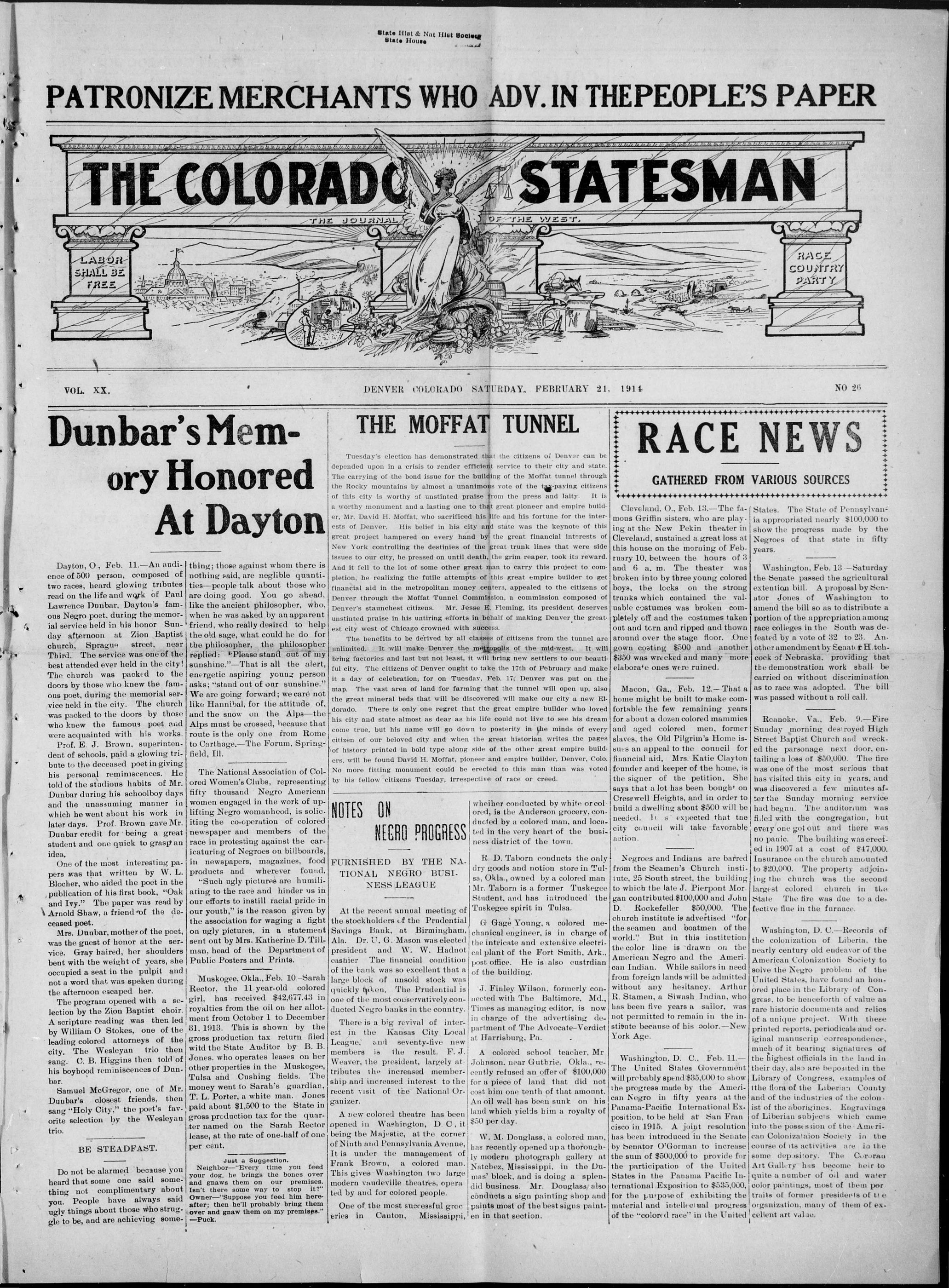
PATRONIZE MERCHANTS WHO ADV. IN THEPEOPLE'S PAPER
THE COLORADO STATESMAN
THE JOURNAL OF THE WEST.
LABOR SHALL BE FREE
RACE COUNTRY PARTY
Dunbar's Mem- ory Honored At Dayton
VOL. XX. Dunbar' ory H A
Dayton, O., Feb. 11.—An audience of 500 person, composed of two races, heard glowing tributes read on the life and work of Paul Lawrence Dunbar, Dayton's famous Negro poet, during the memorial service held in his honor Sunday afternoon at Zion Baptist church, Sprague street, near Third. The service was one of the best attended ever held in the city! The church was packed to the doors by those who knew the famous poet, during the memorial service held in the city. The church was packed to the doors by those who knew the famous poet and were acquainted with his works.
Prof. E. J. Brown, superintendent of schools, paid a glowing tribute to the deceased poet in giving his personal reminiscences. He told of the studious habits of Mr. Dunbar during his schoolboy days and the unassuming manner in which he went about his work in later days. Prof. Brown gave Mr. Dunbar credit for being a great student and one quick to grasp an idea.
One of the most interesting papers was that written by W. L. Blocher, who aided the poet in the publication of his first book, "Oak and Ivy." The paper was read by Arnold Shaw, a friend of the deceased poet.
Mrs. Dunbar, mother of the poet, was the guest of honor at the service. Gray haired, her shoulders bent with the weight of years, she occupied a seat in the pulpit and not a word that was spoken during the afternoon escaped her.
The program opened with a selection by the Zion Baptist choir. A scripture reading was then led by William O Stokes, one of the leading colored attorneys of the city. The Wesleyan trio then sang. C. B. Higgins then told of his boyhood reminiscences of Dunbar.
Samuel McGregor, one of Mr. Dunbar's closest friends, then sang "Holy City," the poet's favorite selection by the Wesleyan trio.
BE STEADFAST.
Do not be alarmed because you heard that some one said something not complimentary about you. People have always said ugly things about those who struggle to be, and are achieving some-
thing; those against whom there is nothing said, are negligible quantities—people talk about those who are doing good. You go ahead, like the ancient philosopher, who, when he was asked by an apparent friend, who really desired to help the old sage, what could he do for the philosopher, the philosopher replied: "Please stand out of my sunshine."—That is all the alert, energetic aspiring young person asks; "stand out of our sunshine." We are going forward; we care not like Hannibal, for the attitude of, and the snow on the Alps—the Alps must be crossed, because that route is the only one from Rome to Carthage.—The Forum, Springfield, Ill.
The National Association of Colored Women's Clubs, representing fifty thousand Negro American women engaged in the work of uplifting Negro womanhood, is soliciting the co-operation of colored newspaper and members of the race in protesting against the caricaturing of Negroes on billboards, in newspapers, magazines, food products and wherever found. "Such ugly pictures are humiliating to the race and hinder us in our efforts to instill racial pride in our youth," is the reason given by the association for waging a fight on ugly pictures, in a statement sent out by Mrs. Katherine D. Tillman, head of the Department of Public Posters and Prints.
Muskogee, Okla., Feb. 10-Sarah Rector, the 11-year-old colored girl, has received $42,677.43 in royalties from the oil on her allotment from October 1 to December 31, 1913. This is shown by the gross production tax return filed wild the State Auditor by B. B. Jones, who operates leases on her other properties in the Muskogee, Tulsa and Cushing fields. The money went to Sarah's guardian, T. L. Porter, a white man. Jones paid about $1,500 to the State in gross production tax for the quarter named on the Sarah Rector lease, at the rate of one-half of one per cent.
Just a Suggestion.
Just a Suggestion.
Neighbor—"Every time you feed your dog, he brings the bones over and gnaws them on our premises. Isn't there some way to stop it?" Owner—"Suppose you feed him hereafter; then he'll probably bring them over and gnaw them on my premises." —Puck.
THE MOFFAT TUNNEL
THE MOFFAT TUNNEL
Tuesday's election has demonstrated that the citizens of Denver can be depended upon in a crisis to render efficient service to their city and state. The carrying of the bond issue for the building of the Moffat tunnel through the Rocky mountains by almost a unanimous vote of the tax-paying citizens of this city is worthy of unstinted praise from the press and laity. It is a worthy monument and a lasting one to that great pioneer and empire builder, Mr. David H. Moffat, who sacrificed his life and his fortune for the interests of Denver. His belief in his city and state was the keynote of this great project hampered on every hand by the great financial interests of New York controlling the destinies of the great trunk lines that were side issues to our city, he pressed on until death, the grim reaper, took its reward. And it fell to the lot of some other great man to carry this project to completion, he realizing the futile attempts of this great empire builder to get financial aid in the metropolitan money centers, appealed to the citizens of Denver through the Moffat Tunnel Commission, a commission composed of Denver's staunchest citizens. Mr. Jesse E. Fleming, its president deserves unstinted praise in his untiring efforts in behalf of making Denver the greatest city west of Chicago crowned with success.
The benefits to be derived by all classes of citizens from the tunnel are unlimited. It will make Denver the metropolis of the mid-west. It will bring factories and last but not least, it will bring new settlers to our beautiful city. The citizens of Denver ought to take the 17th of February and make it a day of celebration, for on Tuesday, Feb. 17, Denver was put on the map. The vast area of land for farming that the tunnel will open up, also the great mineral beds that will be discovered will make our city a new Eldorado. There is only one regret that the great empire builder who loved his city and state almost as dear as his life could not live to see his dream come true, but his name will go down to posterity in the minds of every citizen of our beloved city and when the great historian writes the pages of history printed in bold type along side of the other great empire builders, will be found David H. Moffat, pioneer and empire builder, Denver, Colo. No more fitting monument could be erected to this man than was voted by his fellow citizens Tuesday, irrespective of race or creed.
State Hist & Nut Hist Societies
State House
Tuesday's election has demonstrated a depended upon in a crisis to render efficient. The carrying of the bond issue for the buildup of the Rocky mountains by almost a unanimous of this city is worthy of unstinted praise, a worthy monument and a lasting one to the trer, Mr. David H. Moffat, who sacrificed his ests of Denver. His belief in his city is a great project hampered on every hand. New York controlling the destinies of the issues to our city, he pressed on until death. And it fell to the lot of some other great pletion, he realizing the futile attempts of financial aid in the metropolitan money of Denver through the Moffat Tunnel Comm. Denver's staunchest citizens. Mr. Jesse unstinted praise in his untiring efforts in the west city west of Chicago crowned with success.
The benefits to be derived by all class unlimited. It will make Denver the most bring factories and last but not least, it will ful city. The citizens of Denver ought to to it a day of celebration, for on Tuesday, map. The vast area of land for farming, the great mineral beds that will be discovered. There is only one regret that to his city and state almost as dear as his life come true, but his name will go down to the citizen of our beloved city and when the of history printed in bold type along sides, will be found David H. Moffat, pioneer. No more fitting monument could be erected by his fellow citizens Tuesday, irrespectively.
NOTES ON
NEGRO PROGRESS
FURNISHED BY THE NATIONAL NEGRO BUSINESS LEAGUE
At the recent annual meeting of the stockholders of the Prudential Savings Bank, at Birmingham, Ala. Dr. U. G. Mason was elected president and W. W. Hadnot cashier The financial condition of the bank was so excellent that a large block of unsold stock was quickly taken. The Prudential is one of the most conservatively conducted Negro banks in the country. There is a big revival of interest in the Kansas City Local League, and seventy-five new members is the result. F. J. Weaver, the president, largely attributes the increased membership and increased interest to the recent visit of the National Organizer.
A new colored theatre has been opened in Washington, D.C., it being the Majestic, at the corner of Ninth and Pennsylvania Avenue. It is under the management of Frank Brown, a colored man. This gives Washington two large modern vaudeville theatres, operated by and for colored people.
One of the most successful groceries in Canton, Mississippi,
wheliher conducted by white or colored, is the Anderson grocery, conducted by a colored man, and located in the very heart of the business district of the town.
R. D. Taborn conducts the only dry goods and notion store in Tulsa, Okla., owned by a colored man. Mr. Taborn is a former Tuskegee Student, and has introduced the Tuskegee spirit in Tulsa.
G Gage Young, a colored mechanical engineer, is in charge of the intricate and extensive electrical plant of the Fort Smith, Ark., post office. He is also custrdian of the building.
J. Finley Wilson, formerly connected with The Baltimore, Md., Times as managing editor, is now in charge of the advertising department of The Advocate-Verdict at Harrisburg, Pa.
A colored school teacher, Mr Johnson, near Guthrie. Okla., recently refused an offer of $100,000 for a piece of land that did not cost him one tenth of that amount. An oil well has been sunk on his land which yields him a royalty of $50 per day.
W. M. Douglass, a colored man, has recently opened up a thoroughly modern photograph gallery at Natchez, Mississippi, in the Dumas' block, and is doing a splendid business. Mr. Douglass also conducts a sign painting shop and paints most of the best signs painten in that section.
RACE NEWS GATHERED FROM VARIOUS SOURCES
Cleveland, O., Feb. 13.—The famous Griffin sisters, who are playing at the New Pekin theater in Cleveland, sustained a great loss at this house on the morning of February 10, between the hours of 3 and 6 a.m. The theater was broken into by three young colored boys, the locks on the strong trunks which contained the valuable costumes was broken completely off and the costumes taken out and torn and ripped and thrown around over the stage floor. One gown costing $500 and another $350 was wrecked and many more elaborate ones were ruined.
Macon, Ga., Feb. 12. That a home might be built to make comfortable the few remaining years for about a dozen colored mammies and aged colored men, former slaves, the Old Pilgrim's Home issues an appeal to the council for financial aid. Mrs. Katie Clayton founder and keeper of the home, is the signer of the petition. She says that a lot has been bought on Cresswell Heights, and in order to build a dwelling about $500 will be needed. It is expected that the city council will take favorable action.
Negroes and Indians are barred from the Seamen's Church institute, 25 South street, the building to which the late J. Pierpont Morgan contributed $100,000 and John D. Rockefeller $50,000. The church institute is advertised "for the seamen and boatmen of the world." But in this institution the color line is drawn on the American Negro and the American Indian. While sailors in need from foreign lands will be admitted without any hesitancy. Arthur R. Stamen, a Siwash Indian, who has been five years a sailor, was not permitted to remain in the institute because of his color.—New York Age.
Washington, D. C., Feb. 11. The United States Government will probably spend $35,000 to show the progress made by the American Negro in fifty years at the Panama-Pacific International Exposition, to be held at San Francisco in 1915. A joint resolution has been introduced in the Senate by Senator O'Gorman to increase the sum of $500,000 to provide for the participation of the United States in the Panama Pacific International Exposition to $535,000, for the purpose of exhibiting the material and intellectual progress of the "colored race" in the United
NO 26
States. The State of Pennsylvania appropriated nearly $100,000 to show the progress made by the Negroes of that state in fifty years.
Washington, Feb. 13. —Saturday the Senate passed the agricultural extension bill. A proposal by Senator Jones of Washington to amend the bill so as to distribute a portion of the appropriation among race colleges in the South was defeated by a vote of 32 to 23. Another amendment by Senator H. tchock of Nebraska, providing that the demonstration work shall be carried on without discrimination as to race was adopted. The bill was passed without a roll call.
Rcanoke, Va., Feb. 9.—Fire Sunday morning destroyed High Street Baptist Church and wrecked the parsonage next door, entailing a loss of $50,000. The fire was one of the most serious that has visited this city in years, and was discovered a few minutes after the Sunday morning service had begun. The auditorium was filled with the congregation, but every one got out and there was no panic. The building was erected in 1907 at a cost of $47,000. Insurance on the church amounted to $20,000. The property adjoining the church was the second largest colored church in the State. The fire was due to a defective flue in the furnace.
Washington, D. C.—Records of the colonization of Liberia, the nearly century old endeavor of the American Colonization Society to solve the Negro problem of the United States, have found an honored place in the Library of Congress, to be henceforth of value as rare historic documents and relics of a unique project. With these printed reports, periodicals and original manuscript correspondence, much of it bearing signatures of the highest officials in the land in their day, also are deposited in the Library of Congress, examples of the flora of the Liberian County and of the industries of the colonist of the aborigines. Engravings of Liberian subjects which came into the possession of the American Colonization Society in the course of its activities are in the same depository. The Coronan Art Gallery has become heir to quite a number of oil and water color paintings, most of them portraits of former presidents of the organization, many of them of excellent art value.
CONDENSATION OF FRESH NEWS
THE LATEST IMPORTANT DIS PATCHES PUT INTO SHORT, CRISP PARAGRAPHS.
STORY OF THE WEEK
SHOWING THE PROGRESS OF EVENTS IN OUR OWN AND FOREIGN LANDS.
Western Newspaper Union News Service.
WESTERN.
Knex college at Galesburg, Ill., celebrated the seventy-seventh anniversary of its founding with a banquet as the principal feature.
A definite announcement of a leprosy cure has been made at the Louisiana leper colony. Nine victims have been discharged perfectly well.
John M. Blazier, a Portland timber operator, filed a petition in bank-rutpcy through attorneys declaring inability to pay obligations aggregating $499,412.
Lieutenant Carbary of the United States army aviation corps at San Diego, Cal., broke the American military record for altitude when he ascended 8,700 feet.
Three Waddell-Mahon Detective Agency guards and a deputy sheriff were found guilty of manslaughter, for the killing of Steve Putrich, a striking copper mine worker, at Seeberville, Mich., August 14th last.
Complete returns from the Iowa second district congressional election, show that Harry Volmer, Democrat, was elected by 1,850 plurality over Harry Hull, Republican. Charles P. Hanley, Progressive, ran third.
Charles Gale, a British subject and well-known in the gold camps of Alaska and Nevada, was found murdered in his saloon at Mexicali, Lower California. Diamonds and cash amounting to $10,000 were stolen.
Otoman Zar-Adusht Hanish, the high priest of the Mazdaznan sun worshipers' cult, perfected his appeal from his conviction in the Federal District Court at Chicago on the charge of having sent improper matter by interstate express.
Four-year-old Josephine Ashdown of Los Angeles, Golden-haired and blue-eyed, is the baby swimming and diving champion of the world. She has dived from a height of fifty feet and swam half a mile in nine minutes and forty seconds, and 120 yards in one minute and thirty seconds.
The estate of the late William Deering consists of real and personal property valued at $15,000,000, according to the inventory filed at Chicago. The inventory contains 2,505 items, the largest of which showed cash on deposit of $236,667. The property was left to the two sons and five grandchildren. Each of the sons, Charles and James, receives $5,000,000.
Denouncing the allegation as an "infamous lie," United States Senator T. P. Gore from the witness stand in Oklahoma City, declared that charges of improper conduct, the basis of the $50,000 damage suit against him, were the invention of a coterie of disappointed office seekers intended to bring him into disrepute and wreck his chances for a renomination.
WASHINGTON.
The president and Mrs. Wilson were hosts at the final state dinner of the winter at the White House, in honor of Speaker Champ Clark.
Bids for the interior work of the Denver postoffice were opened at Washington. Norman Keys Company of New York was low at $686,000; G. A. Keys Co., of St. Paul was low for the mechanical equipment at $133,797.
Following the suspension of Superintendent Friedman, the books of the Carlisle Indian school have been turned over to the department of justice for investigation. It is intimated that criminal prosecutions are likely to follow.
Those who consulted President Wilson about Alaskan legislation learned that he earnestly hoped that the bill passed by the Senate providing for a government-constructed railroad in the territory would be approved by the House at an early date. The President evidenced much interest in the project.
Senator Gallinger, the Republican floor leader, introduced an amendment to the tariff laws proposing that fifty per cent of the income tax collected in each state shall be paid over to the state treasurer to be equitably distributed to the various cities and towns. Senator Gallinger said his object was to reduce the local tax rates.
The desk of the late Senator Bacon of Georgia was draped in mourning Monday. The funeral of former Senator Hanna was held in the Senate chamber Feb. 17, 1904, ten years ago. Senator Bacon's funeral was held there Tuesday.
Federal interference in the radium industry as proposed in pending bills was attacked as "paternalistic government," offensive to 99 per cent of the people of the West," by William H. King, former member of Congress from Utah, before the Senate mines committee.
FOREIGN.
Fire destroyed the village of Spinosa De Los Caballeros in the province of Avila.
London suffragettes woke up Blackburn by firing a sixty-year-old cannon, relic of the Crimean war.
The United Spanish War Veterans held services at the American Club in Havana in memory of the Maine.
John H. Harjes, who for years was a partner in the banking house of Morgan, Harjes & Co. of Paris, died at Grasse, France.
Electrically sterilized milk, in which bacteria are shocked to death, is being tried out by the Liverpool municipality with considerable success.
May 30 is announced for the maiden trip of the Cunarder Aquitania, the largest steamship afloat, outstripping the Imperator in length, beam and tonnage.
The German balloon pilot Hane Berliner, carrying two passengers in his spherical balloon, telegraphed from Kirkigschan in the Ural mountains, Russia, that he had landed there after a forty-seven-hour flight from Bitterfeld, Germany. The flight marks a new distance record.
King Gustave of Stockholm approved the selections of Dr. Knut Hammarskjoeild for the new cabinet in which he himself will be premier and minister of war. K. A. Wallenberg has been chosen for the ministry of foreign affairs; M. Brostroem, marine, and M. Vennersten, finance.
Sir Stuart Montagu Samuel, Radical member of parliament for White Chapel, was ordered by Justice Sir Sydney Rowlatt of the king's bench division to pay penalties and costs amounting to $65,000, because he voted in the House of Commons when his firm had a contract with the British government. The money will be paid to Dr. William Bird as informer.
SPORT.
Willie Ritchie, lightweight champion, has signed to meet Ad. Wolgast in a ten-round fight at Milwaukee March 12.
The Cincinnati Reds will not do their training at Mobile, Ala., as had been announced. Alexandria, La., having been chosen instead.
Louis Altman of Tulane university was fatally injured in a basketball game with the Louisiana State University team at Baton Rouge and three other Tulane men were hurt.
Rube Waddell, the former big league pitcher, who is suffering from a bronchial affection, is in a serious condition and may not recover, according to a statement by his mother made at San Antonio, Tex.
Justice Devendorff granted a final decree of divorce to Rena Flynn from Maurice R. Flynn, fullback on the Yale football team of 1912, forbidding him also to marry in New York. The couple lived together only eleven days. Gustave Fristensky, claimant of the European championship, and Paul Sampson, heavyweight wrestlers, struggled through a long match at Chicago, only to find, at the conclusion of the bout, that a deputy sheriff had attached the box office receipts of $550.
GENERAL
Though her $10,000 income fell under the list of exemptions, Mrs. Ella Flagg Young, superintendent of Chicago schools, paid $55 income tax as a "conscience balm."
Theodore Lowe Divinne, dean of the printing fraternity and author of several books on printing and types and their use, died in New York in his eighty-sixth year. Devinne was born in Stamford, Conn.
Mrs. Henrietta Nicholls Smith, widow of Charles Emory Smith, former postmaster general and ambassador to Russia, has become a novice in the Institute of Our Lady of Christian Doctrine in New York.
The "ideal marriage" of the Duke Don Arthur de Majo Durrazo, twenty-four, to Miss Elizabeth Frances Hanan, fifty-four, sister of John H. Hanan, took place at the bride's home at 1073 Fifth avenue, New York.
Charged with the murder of her husband and accused by the police of attempting to feed arsenic to her children, one of whom died of a peculiar illness, Mrs. William Buffum went to trial at Buffalo, N. Y.
Dr. Roswell Park, one of the best known surgeons in America, died suddenly at his home in Buffalo, N. Y. The cause of death was heart failure. Dr. Park had been in perfect health up to within twenty minutes of the end.
The funeral of John J. Kennedy, the state treasurer, who committed suicide at Buffalo, N. Y., was held on Wednesday from Bishop Colton's chapel. The board of aldermen, of which Kennedy was a member for twenty-six years, adopted a resolution expressing regret at the loss of a "faithful public official, a loyal and patriotic citizen," and many other organizations with which Kennedy was identified took similar action.
Telephone messages from Orient Point, at the eastern end of Long island, told of the safety of eleven persons, including four women and two children, who were on the four barges which were cut loose from the tow of the tug Pliny Fisk on that vessel's trip up Long Island sound in the storm.
Mrs. Henrietta Nicholls Smith, widow of Charles Emory Smith, former postmaster general and ambassador to Russia, has become a novice in the Institute of Our Lady of Christian Doctrine in New York.
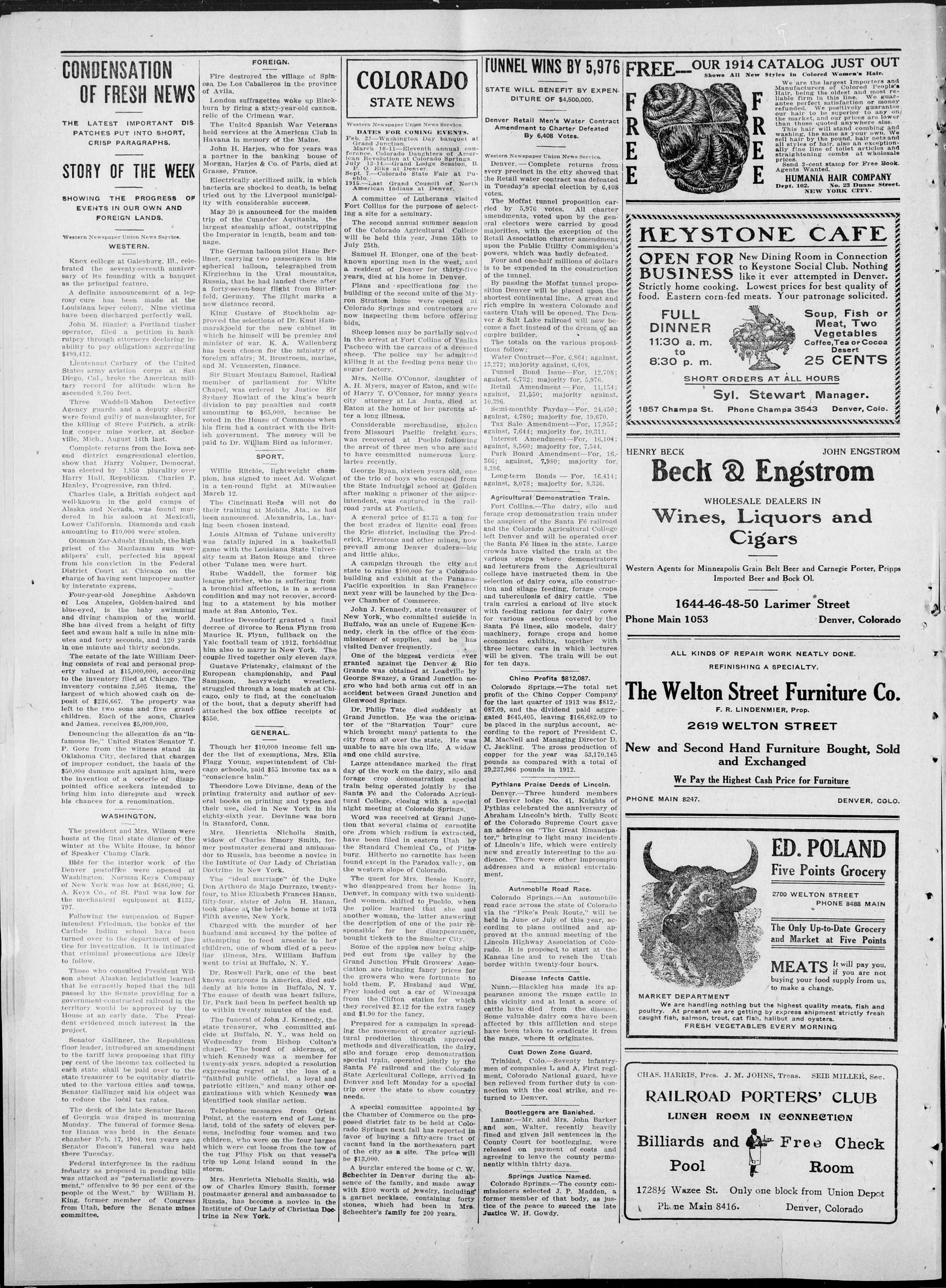
COLORADO STATE NEWS
Western Newspaper Union News Service.
DATES FOR COMING EVENTS.
Feb. 22—Washington Day banquet at Grand Junction.
March 10-11—Eleventh annual conference of American Revolution at Colorado Springs.
July 13-14—Grand Lodge Session, B. P. O. Elks at Denver.
Sept. 7. Colorado State Fair at Pueblo.
1915. Last Grand Council of North American Indians at Denver.
A committee of Lutherans visited Fort Collins for the purpose of selecting a site for a seminary.
The second annual summer session of the Colorado Agricultural College will be held this year, June 15th to July 25th.
Samuel H. Blonger, one of the best-known sporting men in the west, and a resident of Denver for thirty-five years, died at his home in Denver.
Plans and specifications for the building of the second unite of the Myron Stratton home were opened at Colorado Springs and contractors are now inspecting them before offering bids.
Sheep losses may be partially solved in the arrest at Fort Collins of Ysalks Pacheco with the carcass of a dressed sheep. The police say he admitted killing it at the feeding pens near the sugar factory.
Mrs. Nellie O'Connor, daughter of A. H. Myers, mayor of Eaton, and wife of Harry T. O'Connor, for many years city attorney at La Junta, died at Eaton at the home of her parents after a long illness.
Considerable merchandise, stolen from Missouri Pacific freight cars, was recovered at Pueblo following the arrest of three men who are said to have committed numerous burglaries recently.
George Ryan, sixteen years old, one of the trio of boys who escaped from the State Industrial school at Golden after making a prisoner of the superintendent, was captured in the railroad yards at Fortieth.
A general price of $3.75 a ton for the best grades of lignite coal from the Erie district, including the Frederick, Firestone and other mines, now prevail among Denver dealers—big and little alike.
A campaign through the city and state to raise $100,000 for a Colorado building and exhibit at the Panama-Pacific exposition in San Francisco next year will be launched by the Denver Chamber of Commerce.
John J. Kennedy, state treasurer of New York, who committed suicide in Buffalo, was an uncle of Eugene Kennedy, clerk in the office of the commissioner of supplies, and he has visited Denver frequently.
One of the biggest verdicts ever granted against the Denver & Rio Grande was obtained at Leadville by George Swazey, a Grand Junction negro who had both arms cut off in an accident between Grand Junction and Glenwood Springs.
Dr. Philip Tate died suddenly at Grand Junction. He was the originator of the "Starvation Tour" cure which brought many patients to the city from all over the state. He was unable to save his own life. A widow and one child survive.
Large attendance marked the first day of the work on the dairy, silo and forage crop demonstration special train being operated jointly by the Santa Fé and the Colorado Agricultural College, closing with a special night meeting at Colorado Springs.
Word was received at Grand Junction that several claims of carnotite ore, from which radium is extracted, have been filed in eastern Utah by the Standard Chemical Co., of Pittsburg. Hitherto no carnotite has been found except in the Paradox valley, on the western slope of Colorado.
The quest for Mrs. Bessie Knorr, who disappeared from her home in Denver, in company with two unidentified women, shifted to Pueblo, when the police learned that she and another woman, the latter answering the description of one of the pair responsible for her disappearance, bought tickets to the Smelter City.
Some of the apples now being shipped out from the valley by the Grand Junction Fruit Growers' Association are bringing fancy prices for the growers who were fortunate to hold them. F. Husband and Wm. Frey loaded out a car of Winesaps from the Clifton station for which they received $2.12 for the extra fancy and $1.90 for the fancy.
Prepared for a campaign in spreading the movement of greater agricultural production through approved methods and diversification, the dairy, silo and forage crop demonstration special train, operated jointly by the Santa Fé railroad and the Colorado State Agricultural College, arrived in Denver and left Monday for a special trip over the state to show country needs.
A special committee appointed by the Chamber of Commerce on the proposed district fair to be held at Colorado Springs next fall has reported in favor of buying a fifty-acre tract of vacant land in the northeastern part of the city as a site. The price will be $13,000.
A burglar entered the home of C. W. Schechter in Denver during the absence of the family, and made away with $200 worth of jewelry, including a garnet necklace, containing forty stones, which had been in Mrs. Schechter's family for 200 years.
TUNNEL WINS BY 5,976 FREE----OUR 1914 CATALOG JUST OUT
STATE WILL BENEFIT BY EXPEN
DITURE OF $4,500,000.
Denver Retail Men's Water Contract
Amendment to Charter Defeated
By 6,408 Votes.
Western Newspaper Union News Service.
Denver. - Complete returns from
every precinct in the city showed that
the Retail water contract was defeated
in Tuesday's special election by 6,408
votes.
The Moffat tunnel proposition
carried by 5,976 votes. All charter
amendments, voted upon by the general electors were carried by good
majorities, with the exception of the
Retail Association charter amendment
upon the Public Utility Commission's
powers, which was badly defeated.
Four and one-half millions of dollars is to be expended in the construction of the tunnel.
By passing the Mofft tunnel proposition Denver will be placed upon the shortest continental line. A great and rich empire in western Colorado and eastern Utah will be opened. The Denver & Salt Lake railroad will now become a fact instead of the dream of an empire builder.
The totals on the various propositions follow:
Water Contract—For, 6,864; against, 13,272; majority against, 6,408.
Tunnel Bond Issue—For, 12,708; against, 6,732; majority for, 5,976.
Retail Amendment—For, 11,154; against, 21,550; majority against, 10,396.
Semi-monthly Payday—For, 24,450; against, 4,780; majority for, 19,670.
Tax Sale Amendment—For, 17,955;
against, 7,644; majority for, 10,311;
Interest Amendment—For, 16,104;
against, 8,560; majority for, 7,544;
Park Board Amendment—For, 16,
366; against, 7,980; majority for,
8,286;
Long-term Bonds — For, 16,414;
against, 8,078; majority for, 8,336.
Agricultural Demonstration Train.
Fort Collins.—The dairy, silo and forage crop demonstration train under the auspices of the Santa Fé railroad and the Colorado Agricultural College left Denver and will be operated over the Santa Fé lines in the state. Large crowds have visited the train at the various stops where demonstrators and lecturers from the Agricultural college have instructed them in the selection of dairy cows, silo construction and silage feeding, forage crops and tuberculosis of dairy cattle. The train carried a carload of live stock with feeding rations for dairy cows for various sections covered by the Santa Fé lines, silo models, dairy machinery, forage crops and home economics exhibits, together with three lecture cars in which lectures will be given. The train will be out for ten days.
Chino Profits $812,087.
Colorado Springs.—The total net profit of the Chino Copper Company for the last quarter of 1913 was $812,087.09, and the dividend paid aggregated $645,405, leaving $166,682.09 to be placed in the surplus account, according to the report of President C. M. MacNell and Managing Director D. C. Jackling. The gross production of copper for the year was 53,170,145 pounds as compared with a total of 29,237,966 pounds in 1912.
Pythians Praise Deeds of Lincoln.
Denver.—Three hunderd members of Denver lodge No. 41, Knights of Pythias celebrated the anniversary of Abraham Lincoln's birth. Tully Scott of the Colorado Supreme Court gave an address on "The Great Emancipator," bringing to light many incidents of Lincoln's life, which were entirely new and greatly interesting to the audience. There were other impromptu addresses and a musical entertainment.
Automobile Road Race.
Colorado Springs.—An automobile road race across the state of Colorado via the "Pike's Peak Route," will be held in June or July of this year, according to plans outlined and approved at the annual meeting of the Lincoln Highway Association of Colorado. It is proposed to start at the Kansas line and to reach the Utah border within twenty-four hours.
Disease Infects Cattle
Nunn.—Blackleg has made its appearance among the range cattle in this vicinity and at least a score of cattle have died from the disease. Some valuable dairy cows have been affected by this affliction and steps have been taken to eradicate it from the range, where it originates.
Cust Down Zone Guard.
Trinidad, Colo.—Seventy infantrymen of companies L and A. First regiment, Colorado National guard, have ben relieved from further duty in connection with the coal strike, and returned to Denver.
Bootleggers are Banished.
Lamar,—Mr. and Mrs. John Barker and son, Walter, recently heavily fined and given jail sentences in the County Court for bootlegging, were released on payment of costs and agreeing to leave the county permanently within thirty days.
Springs Justice Named.
Colorado Springs.-The county commissioners selected J. P. Madden, a former member of that body, as justice of the peace to succed the late Justice W. H. Gowdy.
FREE FREE
KEYSTON OPEN FOR New D to Key BUSINESS like it Strictly home cooking. Low food. Eastern corn-fed meats
KYSTONE CAFE
N FOR New Dining Room in Connection to Keystone Social Club. Nothing like it ever attempted in Denver. Some cooking. Lowest prices for best quality of eastern corn-fed meats. Your patronage solicited.
OPEN FOR BUSINESS New Dining Room in Connection to Keystone Social Club. Nothing like it ever attempted in Denver. Strictly home cooking. Lowest prices for best quality of food. Eastern corn-fed meats. Your patronage solicited.
FULL DINNER
11:30 a. m.
to
8:30 p. m.
Soup, Fish or Meat, Two Vegetables
Coffee, Tea or Cocoa Desert
25 CENTS
SHORT ORDERS AT ALL HOURS
Syl. Stewart Manager.
1857 Champa St. Phone Ch
ampa St. Phone Champa 3543 Denver, Colo.
1857 Champa St. Phone Champa 3543 Denver, Colo.
ck & Engstrom
WHOLESALE DEALERS IN
nes, Liquors and
Cigars
for Minneapolis Grain Belt Beer and Carnegie Porter, Pripps
Imported Beer and Bock Ol.
644-46-48-50 Larimer Street
1053 Denver, Colorado
L KINDS OF REPAIR WORK NEATLY DONE.
REFINISHING A SPECIALTY.
elton Street Furniture Co.
F. R. LINDENMIER, Prop.
Beck & E
WHOLESALE
Wines, Lic
Cig
Western Agents for Minneapolis Grain
Imported Beer
1644-46-48-50
Phone Main 1053
ALL KINDS OF REPAIR
REFINISHING A
The Welton Street
F. R. LINDEN
Beck @ Engstrom
WHOLESALE DEALERS IN Wines, Liquors and Cigars
Western Agents for Minneapolis Grain Belt Beer and Carnegie Porter, Pripps Imported Beer and Bock Ol.
1644-46-48-50 Larimer Street
Phone Main 1053 Denver, Colorado
ALL KINDS OF REPAIR WORK NEATLY DONE.
REFINISHING A SPECIALTY.
2619 WELTON STREET New and Second Hand Furniture Box and Exchanged We Pay the Highest Cash Price for Furnit
Second Hand Furniture Bought, Sold and Exchanged
e Pay the Highest Cash Price for Furniture
8247. DENVER, COLO.
New and Second Hand Furniture Bought, Sold and Exchanged We Pay the Highest Cash Price for Furniture
Bison
MARKET DEPARTMENT
We are handling nothing but the
poultry. At present we are getting a
caught fish, salmon, trout, cat fish, h
FRESH VEGETABLES
CHAS. HARRIS, Pres. J. M. JOHN
RAILROAD PO
LUNCH ROOM IN
DEPARTMENT
We handling nothing but the highest quality meats, fish and
present we are getting by express shipment strictly fresh
salmon, trout, cat fish, halibut and oysters.
FRESH VEGETABLES EVERY MORNING
RIS, Pres. J. M. JOHNS, Treas. SEIB MILLER, Sec.
ROAD PORTERS' CLUB
LUNCH ROOM IN CONNECTION
We are handling nothing but the highest quality meats, fish and poultry. At present we are getting by express shipment strictly fresh caught fish, salmon, trout, cat fish, halibut and oysters.
FRESH VEGETABLES EVERY MORNING
CHAS. HARRIS, Pres. J. M. JOHNS, Treas. SEIB MILLER, Sec.
LUNCH ROOM IN CONNECTION
172812 Wazee St. Only one block from Union Depot Phone Main 8416. Denver, Colorado
FULL
DINNER
11:30 a.m.
to
8:30 p.m.
HENRY BECK
PHONE MAIN 8247.
We are the largest Importers and Manufacturers of Colored People's Hair, being the oldest and most successful line. We guarantee perfect satisfaction or money refunded. We positively guarantee our hair to be superior to any on the market, and our products show anywhere else. This hair will stand combing and washing, the same as your own. We sell hair by the pound, hair nets and all styles of hair, also an exception to the line of toilet water straightening combs at wholesale prices.
Send 2-cent stamp for Free Book.
Send 2-cent stamp for Free Book.
Agents Wanted.
HUMANIA HAIR COMPANY
Dept. 102, 16, 22 Diane Street,
NEW YORK, CITY.
Soup, Fish or Meat, Two Vegetables Coffee,Tea or Cocoa Desert 25 CENTS
JOHN ENGSTROM
DENVER, COLO.
Five Points Grocery
2700 WELTON STREET
PHONE 8488 MAIN
The Only Up-to-Date Grocery and Market at Five Points
MEATS It will pay you, if you are not buying your food supply from us, to make a change.
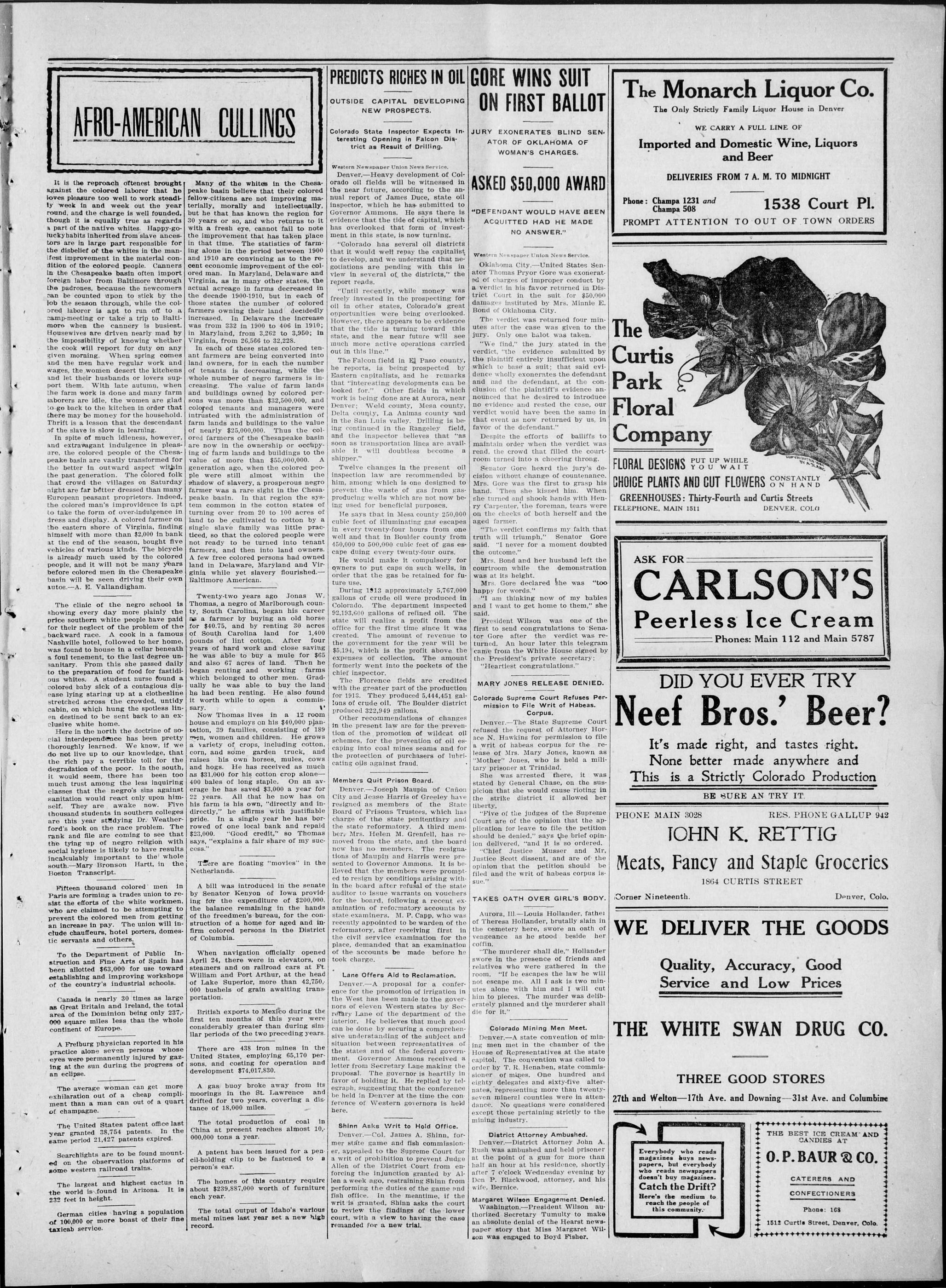
AFRO-AMERICAN. CULLINGS
it is the reproach oftenest brought
against the colored laborer that he
loves pleasure too well to work stead
ly week in and week out the year
round, and the charge is well founded,
though it is equally true as regards
4 part of the native whites. Happy-go-
tuckyhabits inherited from slave ances-
tors are in large part responsible for
the disbeliet of the whites in the man-
ifest improvement in the material con-
dition of the colored people. Canners
in the Chesapeake basin often import
foreign labor from Baltimore through
the padrones, because the newcomers
can be counted upon to stick by the
Job the season through, while the col-
ored laborer is apt to run off to a
camp-meeting or take a trip to Balti-
more when the cannery {s busiest.
Housewives are driven nearly mad by
the impossibility of knowing whether
the cook will report for duty on any
given morning. When spring comes
and the men have regular work and
wages, the women desert the kitchens
and let their husbands or lovers sup-
port them. With late autumn, when
the farm work is done and many farm
laborers are idle, the women are glad
to-go back to the kitchen in order that
there may be money for the household.
Thrift is a lesson that the descendant
of the slave is slow in learning.
In spite of much idleness, however,
and extravagant indulgence in pleas-
are, the colored people of the Chesa-
peake basin are vastly transformed for
the better In outward aspect within
the past generation. The colored folk
that crowd the villages on Saturday
night are far bétter dressed than many
European peasant proprietors. Indeed,
the colored man’s improvidence is apt
to take the form of over-indulgence in
dress and display. A colored farmer on
the eastern shore of Virginia, finding
himself with more than $2,000 in bank
at the end of the season, bought five
vehicles of various kinds. The bicycle
is already much used by the colored
people, and it will not be many years
before colored men in the Chesapeake
basin will be seen driving their own
autos.—A. BH. Vallandigham.
‘The clinic of the negro school is
showing every day more plainly the
price southern white people have paid
for their neglect of the problem of the
backward race. A cook in a famous
Nashville hotel, followed to her home,
was found to house in a cellar beneath
a foul tenement, to the last degree un-
sanitary. From this she passed daily
to the preparation of food for fastidi-
ous whites. A student nurse found a
colored baby sick of a contagious dis-
ease lying staring up at a clothesline
stretched across the crowded, untidy
cabin, on which hung the spotless lin-
en destined to be sent back to an ex-
elusive white home.
Here in the north the doctrine of so-
cial interdependence has been pretty
thoroughly learned. We know, if we
do not live up to our knowledge, that
the rich pay a terrible toll for the
degradation of the poor. In the south,
it would seem, there has been too
much trust among the less inquiring
classes that the negro’s sins against
sanitation would react only upon him-
self. They are awake now. Five
thousand students in southern colleges
are this year stftdying Dr. Weather-
ford’s book on the race problem. The
rank and file are coming to see that
the tying up of negro religion with
social hygiene is likely to have results
incalculably important to the! whole
south—Mary Bronson Hartt, in the
Boston Transcript.
Fifteen thousand colored’ men in
Paris are forming a trades union to re-
sist the efforts of the white workmen,
who are claimed to be attempting to
prevent the colored men from getting
an increase in pay. ‘The union will in-
clude chauffeurs, hotel porters, domes-
tic servants and others.
‘To the Department of Public In-
struction and Fine Arts of Spain has
‘een allotted $63,000 for use toward
establishing and improving workshops
of the country’s industrial schools.
Canada is nearly 30 times as large
as Great Britain and Ireland, the total
area of the Dominion being only 237,-
900 square miles less than the whole
continent of Europe.
‘A Frefburg physician reported in his
practice alone seven persons whose
eyes were permanently injured by gaz-
ing at the sun during the progress of
an eclipse.
‘The average woman can get more
exhilaration out of a cheap compli-
ment than a man can out of a quart
of champagne. ;
‘The United States patent office last
year granted 38,754 patents. In the
game period 21,427 patents expired.
Searchlights are to be found mount-
ed on the observation platforms of
some western railroad trains.
The largest and highest cactus in
the world is\found in Arizona. It is
232 feet in height.
German cities having a population
‘of 100,000 or more boast of their fine
taxicab service.
Many of the whites in the Chesa-
peake basin belleve that their colored
fellow-citizens are not improving ma-
terially, morally and intellectually,
but he that has known the region for
30 years or so, and who returns to it
with a fresh eye, cannot fail to note
the improvement that has taken place
in that time. ‘The statistics of farm-
ing alone in the period between 1900
and 1910 are convincing as to the re-
cent economic improvement of the col-
ored man. In Maryland, Delaware and
Virginia, as in many other states, the
actual acreage in farms decreased in
the decade 1900-1910, but in each of
those states the number of colored
farmers owning their land decidedly
increased, In Delaware the Increase
was from $32 in 1900 to 406 in 1910;
in Maryland, from 3,262 to 3,950; in
Virginia, from 26,566 to 32,228.
In each of these states colored ten-
ant farmers are being converted into
land owners, for in each the number
of tenants is decreasing, while the
whole number of negro farmers is in-
creasing. The value of farm lands
and buildings owned by colored per-
sons was more than $32,500,000, and
coloped tenants and managers were
intrusted with the administration of
farm lands and buildings to the value
of nearly $25,000,000. ‘Thus the col-
ored farmers of the Chesapeake basin
are now in the ownership or ecctpy-
ing of farm lands and buildings to the
value of more than $55,000,000. A
generation ago, when the colored peo-
ple were still almost within the
shadow of slavery, a prosperous negro
farmer was a rare sight in the Chesa-
peake basin. In that region the sys-
tem common in the cotton states of
turning over from 20 to 100 acres of
land to be cultivated to cotton by a
single slave family was little prac-
ticed, so that the colored people were
not ready to be turned into tenant
farmers, and then into land owners.
A few free colored persons had owned
land in Delaware, Maryland and Vir
ginia while yet slavery flourished. —
Baltimore American.
Twenty-two years ago Jonas W.
Thomas, a negro ot Marlborough coun-
ty, South Carolina, began his career
as a farmer by buying an old horse
for $40.75, and by renting 30 acres
of South Carolina land for 1,400
pounds of lint cotton. After four
years of hard work and close saving
he was able to buy a mule for $65
and also 67 acres of land. Then he
began renting and working farms
which belonged to other men. Grad-
ually he was able to buy the land
he had been renting. He also found
it worth while to open a commis-
sary.
Now Thomas lives in a 12 room
house and employs on his $40,000 pjan-
tetion, 29 families, consisting of 189
men, women and children. He grows
a variety of crops, including cotton,
corn, and some garden truck, and
raises his own horses, mules, cows
and hogs. He has received as much
as $31,000 for his cotton crop alone—
400 bales of long staple. On an ay-
erage he has saved $3,000 a year for
22 years. All that he now has on
his farm is his own, “directly and in-
directly,” he affirms with justifiable
pride. In a single year he has bor-
rowed of one local bank and repaid
$23,000. “Good credit,” so Thomas
says, “explains a fair share of my suc-
cess.”
Tfere are floating “movies” in the
Netherlands.
A bill was introduced in the senate
by Senator Kenyon of Iowa provid-
ing for the expenditure of $200,000.
the balance remaining in the hands
of the freedmen’s bureau, for the con-
struction of a home for aged and in-
firm colored persons in the District
of Columbia.
When navigation officially opened
April 24, there were in elevators, on
steamers and on railroad cars at Ft
William and Port Arthur, at the head
of Lake Superior, more than 42,750,
000 bushels of grain awaiting trans:
portation.
British exports to Mexito during the
first ten months of this year were
considerably greater than during sim:
llar periods of the two preceding years.
There are 438 fron mines in the
United States, employing 65,170 per-
sons, and costing for operation and
development $74,017,830.
A gas buoy broke away from its
moorings in the St Lawrence and
drifted for two years, covering a dis:
tance of 18,000 miles. ::
The total production of coal in
China at present reaches almost 10,-
000,000 tons a year.
‘A patent has been issued for a pen
cil-holding clip to be fastened to a
person's ear.
The homes of this country require
about $289,887,000 worth of furniture
each year.
‘The total output of Idaho's various
metal mines last year set a new high
record.
OUTSIDE CAPITAL DEVELOPING
NEW PROSPECTS.
Colorado State Inspector Expects In-
teresting Opening in Falcon Dis-
trict as Result of Drilling.
Denver.—Heavy development of Col-
orado oil fields will be witnessed in
the near future, according to the an-
nual report of James Duce, state oil
inspector, which he has submitted to
Governor Ammons. He says there is
evidence that the tide of capital, which
has overlooked that form of invest
ment in this state, is now turning.
“Colorado has several oil districts
that it would well repay the capitalist
to develop, and we understand that ne-
gotiations are pending with this in
view in several of the districts,” the
report reads.
“Until recently, while money was
freely invested in the prospecting for
oil in other states, Colorado's great
opportunities were being overlooked.
However, there appears to be evidence
that the tide is turning toward this
state, and the near future will see
much more active operations carried
out in this line.” -
The Falcon field in E] Paso county,
he reports, is being prospected by
Eastern capitalists, and he remarks
that “interesting developments can be
looked for.” Other fields in which
work is being done are at Aurora, near
Denver; Weld county, Mesa county,
Delta county, La Animas county and
in the San Luis valley. Drilling is be-
ing continued in the Rangeley field,
and the inspector believes that “as
soon as transportation lines are avail-
able it will doubtless become a
shipper.”
Twelve changes in the present oil
inspection law are recommended by
him, among which is one designed to
prevent the waste of gas from gas-
producing wells which are not now be-
ing used for beneficial purposes.
We says that in Mesa county 250,000
cubie feet of illuminating gas escapes
in every twenty-four hours from one
well and that in Boulder county from
450,000 to 500,000 cubic feet of gas es-
cape duing every twenty-four ours.
He would make it compulsory for
owners to put caps on such wells, in
order that the gas be retained for fu-
ture use.
During 1913 approximately 5,767,000
gallons of crude oil were produced in
Colorado. The department inspected
92,193,600 gallons of refined oil. The
state will realize a profit from the
office for the first time since it was
created. The amount of revenue to
the government for the year will be
35,194, which is the profit above the
expenses of collection, The amount
formerly went into the pockets of the
chief inspector.
The Florence fields are credited
with the greater part of the production
for 1913, They produced 5,444,451 gal-
lons of crude oil, ‘The Boulder district
produced 322,949 gallons.
Other recommendations of changes
in the present law are for the preven:
tion of the promotion of wildcat oi!
schemes, for the prevention of oil es-
caping into coal mines seams and for
the protection of purchasers of lubri-
cating ols against fraud. :
Members Quit Prison Board.
Denver.—Joseph Maupin of Canon
City and Jesse Harris of Greeley have
resigned as members of the State
Board of Frisons Trustees, which has
charge of the state penitentiary and
the state reformatory. A third mem
Dery Mrs. Helen M. Grenfell, has re
moved from the state, and the board
now has no members, The resigna-
tions of Maupin and Harris were pre
sented to Governor Ammons. It is be-
Meved that the members were prompt
ed to resign by conditiops arising with-
in the board after refusal of the state
auditor to issue warrants on vouchers
for the board, following a recent ex-
amination of refozmatory accounts by
state examiners. M. P. Capp, who was
recently appointed to be warden of the
reformatory, after receiving first in
the civil service examination for the
place, demanded that an examination
of the accounts be made before he
took charge.
Lane Offera Ald-to Reclamation.
Denver—A proposal for a confer-
ence for the promotion of irrigation in
the West has been made to the gover-
nors of eleven Western states by Sec-
retary Lane of the department of the
interior. He believes that much good
can be done by securing a comprehen-
sive understanding of the subject and
situation between representatives of
the states and of the federal govern-
ment. Governor Ammons received @
letter from Secretary Lane making the
proposal. The governor is heartily in
favor of holding it, He replied by tel-
egraph, suggesting that the conference
be held in Denver at the time the con
ference of Western governors is held
here,
Shinn Asks Writ to Hold Office.
Denver.—Col. James A, Shinn, for-
mer state game and fish commission-
er, aypealed to the Supreme Court for
a writ of prohibition to prevent Judge
Allen of the District Court from en-
forcing the injunction granted by Al-
len a week ago, restraining Shinn from
performing the duties of the game nd
fish office. In the meantime, if the
writ is granted, Shinn asks the court
to review the findings of the lower
court, with a view to having the caso
remanded for a new trial.
JURY EXONERATES BLIND SEN.
ATOR OF OKLAHOMA OF
ASKED $50,000 AWARD
NO ANSWER.”
Western Newspaper Union News Service.
Oklahoma City—United States Sen-
ator Thomas Pryor Gore was exonerat-
ed of charges of improper conduct by
a verdict in his favor returned in Dis-
trict Court in the suit for 350,900
damages instituted by Mrs. Minnie B.
Bond of Oklahoma City.
The verdict was returned four min-
utes after the case was given to the
jury. Only one balot was taken.
“We find,” the jury stated in the
verdict, “the evidence submitted by
the plaintiff entirely insufficient upou
which to base a suit; that said evi-
dence wholly exonerates the defendant
and had the defendant, at the con.
clusion of the plaintiff's evidence an-
nounced that he desired to introduce
no evidence and rested the case, our
verdict would have been the same in
that event as now returned by us, in
fayor ot the defendant.”
Despite the efforts of bailiffs to
maintain order when the verdict was
read, the crowd that filled the court-
room turned into a cheering throng.
Senator Gore heard the jury’s de
cision without change of countenance.
Mrs. Gore was the first to grasp his
hand. Then she kissed him. When
she turned and shook hands with Hen
ry Carpenter, the foreman, tears were
on the cheeks of both herself and the
aged farmer,
“The verdict confirms my faith that
truth will triumph,” Senator Gore
said. “I never for a moment doubted
the outcome.”
Mrs. Bond and her husband left the
courtroom while the demonstration
was at its height.
Mrs, Gore declared the was “toc
happy for words.”
“I am thinking now of my babies
and I want to get home to them,” she
said.
President Wilson was one of the
first to send congratulations to Sena
tor Gore after the verdict was re
turned. An hour later this telegran
camie from the White House signed b;
the President’s private secretary:
“Heartiest congratulations.”
| MARY JONES RELEASE DENIED.
Colorado Supreme Court Refuses Per-
mission to File Writ of Habeas.
Corpus.
Denyer.—The State Supreme Court
refused the request of Attorney Hor-
ace N. Hawkins for permission to file
a writ of habeas corpus for the re-
lease of Mrs. Mary Jones, known as
“Mother” Jones, who is held a mili-
tary prisoner at Trinidad,
She was arrested there, it was
stated by General Chase, on the sus-
picion that she would cause rioting in
the strike district it allowed her
liberty,
“Pive of the judges of the Supreme
Court are of the opinion that the ap-
plication for leave to file the petition
should be denied,” says the brief opin-
ion delivered, “and it is so ordered.
“Chief Justice Musser and Mr,
Justice Scott dissent, and are of the
opinion that the petition should be
filed and the writ of habeas corpus is
sue.”
TAKES OATH OVER GIRL'S BODY.
Aurora, [ll—Louis Hollander, fathe:
of Theresa Hollander, brutally slain in
the cemetery here, swore an oath of
vengeance as he stood beside her
coffin,
“The murderer shall die,” Hollander
swore in the presence of friends and
relatives who were gathered in the
room, “If he escapes the law he will
not eseape me, All I ask is two min-
utes alone with him and I will cut
him to pieces. ‘The murder was delib-
erately planned and the murderer shall
die for it,” 7
Colorado Mining Men Meet.
Denyer.—A state convention of min-
ing men met in the chamber of the
House of Representatives at the state
capitol, The convention was called to
order by 'T. R. Henahen, state commis-
sioner of mies. One hundred and
eighty delegates and sixty-five alter-
nates, Tepresenting more than twenty-
seven minerel counties were in atten-
dance. No questions were considered
except those pertaining strictly to the
mining industry.
Sikerins Attorney. Ammbuahed,
Denver.—District Attorney John A,
Rush was ambushed and held prisoner
at the point of a gun for more than
helt an hour at his residence, shortly
after 7 o'clock Wednesday evening by
Den P. Blackwood, attorney, and his
wife, Bernice.
Margaret Wilson Engagement Denied.
Washington.—President Wilson au:
thorized Secretary Tumulty to make
an absolute denial of the Hearst news-
paper story that Miss Margaret Wil-
son Was engaged to Boyd Fisher.
°
The Monarch Liquor Co.
The Only Strictly Family Liquor House in Denver
2 WE CARRY A FULL LINE OF
Imported and Domestic Wine, Liquors
and Beer
DELIVERIES FROM 7 A. M. TO MIDNIGHT
Mew: Gunes water! 1538 Court Pl.
PROMPT ATTENTION TO OUT OF TOWN ORDERS
Na i" Tes i ry
Th a ee ae ry i Fd
e eee Ns Te
Curtis ae) Ps | EEE!
Cg ET)
Park Od Wi iS
ge SVai ae
Floral a A
Company a ea A
FLORAL DESIGNS Y's U* wait SR
CHOICE PLANTS AND CUT FLOWERS SOSSSN “RM
- GREENHOUSES: Thirty-Fourth and Curtis Streets X\
TELEPHONE, MAIN 1511 DENVER, COLG
5S. See
CARLSON’S
Peerless Ice Cream
————— Phones: Main 112 and Main 5787
‘DID YOU EVER TRY
”B
Neef Bros.’ Beer?
It’s made right, and tastes right.
None better made anywhere and
This is a Strictly Colorado Production
BE SURE AN TRY IT.
PHONE MAIN 3028 RES. PHONE GALLUP 942
JOHN K. RETTIG
Meats, Fancy and Staple Groceries
1864 CURTIS STREET
Corner Nineteenth Denver, Colo,
WE DELIVER THE GOODS
Quality, Accuracy, Good
Service and Low Prices
THE WHITE SWAN DRUG CO.
THREE GOOD STORES
21th and Welton—17th Ave. and Downing—3lst Ave. and Columbine
Everybody who reads
magazines buys news-
papers, but everybody
who reads newspapers
doesn’t buy magazines.
Catch the Drift?
Here's the medium to
reach the people of
this community.
PUN ee at ro ae at aye eae
| THE BEST ICR CREAM” AND -
CANDIES AT :
= CATERERS AND :
: CONFECTIONERS
3 Phone: 168 ;
; 1512 Curtis Street, Denver, Colo. |
SOPOT OPP LS.
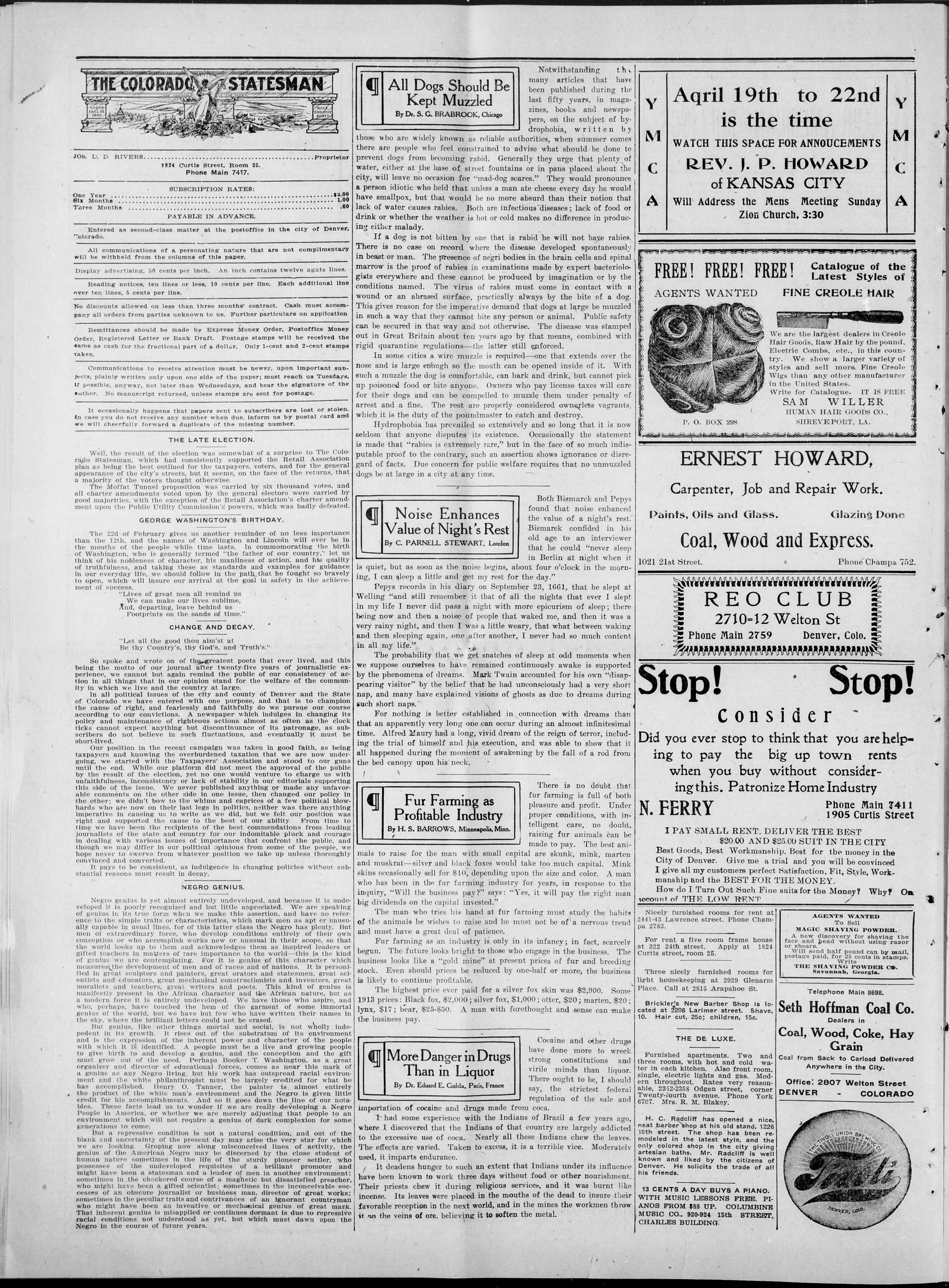
THE COLORADO STATESMAN
CAMOON SHALL BE FREE
MASS COUNTRY PARTY
JOS. L. D. RIVERS....Proprietor
1824 Curtis Street, Room 25.
Phone Main 7417.
One Year ..... $2.00
Six Months ..... 1.00
Three Months ..... .60
PAYABLE IN ADVANCE.
Entered as second-class matter at the postoffice in the city of Denver, Colorado.
All communications of a personating nature that are not complimentary will be withheld from the columns of this paper.
Display advertising, 50 cents per inch. An inch contains twelve agate lines.
Reading notices, ten lines or less, 10 cents per line. Each additional line over ten lines, 5 cents per line.
No discounts allowed on less than three months' contract. Cash must accompany all orders from parties unknown to us. Further particulars on application.
Remittances should be made by Express Money Order, Postoffice Money Order, Registered Letter or Bank Draft. Postage stamps will be received the same as cash for the fractional part of a dollar. Only 1-cent and 2-cent stamps taken.
Communications to receive attention must be newsy, upon important subjects, plainly written only upon one side of the paper; must reach us Tuesdays, if possible, anyway, not later than Wednesdays, and bear the signature of the author. No manuscript returned, unless stamps are sent for postage.
It occasionally happens that papers sent to subscribers are lost or stolen. In case you do not receive any number when due, inform us by postal card and we will cheerfully forward a duplicate of the missing number.
THE LATE ELECTION.
Well, the result of the election was somewhat of a surprise to The Colorado Statesman, which had consistently supported the Retail Association plan as being the best outlined for the taxpayers, voters, and for the general appearance of the city's streets, but it seems, on the face of the returns, that a majority of the voters thought otherwise.
The Moffat Tunnel proposition was carried by six thousand votes, and all charter amendments voted upon by the general electors were carried by good majorities, with the exception of the Retail Association's charter amendment upon the Public Utility Commission's powers, which was badly defeated.
GEORGE WASHINGTON'S BIRTHDAY.
The 22d of February gives us another reminder of no less importance than the 12th, and the names of Washington and Lincoln will ever be in the mouths of the people while time lasts. In commomorating the birth of Washington, who is generally termed "the father of our country," let us think of his nobleness of character, his manliness of action, and his quality of truthfulness, and taking these as standards and examples for guidance in our everyday life, we should follow in the path that he fought so bravely to open, which will insure our arrival at the goal in safety in the achievement of success.
"Lives of great men all remind us
We can make our lives sublime,
And, departing, leave behind us
Footprints on the sands of time."
CHANGE AND DECAY.
"Let all the good thou aim'st at Be thy Country's, thy God's, and Truth's."
So spoke and wrote on of the greatest poets that ever lived, and this being the motto of our journal after twenty-five years of journalistic experience, we cannot but again remind the public of our consistency of action in all things that in our opinion stand for the welfare of the community in which we live and the country at large.
In all political issues of the city and county of Denver and the State of Colorado we have entered with one purpose, and that is to champion the cause of right, and fearlessly and faithfully do we pursue our course according to our convictions. A newspaper which indulges in changing its policy and maintenance of righteous actions almost as often as the clock ticks cannot expect anything but discontinuance of its patronage, as subscribers do not believe in such fluctuations, and eventually it must be short-lived.
Our position in the recent campaign was taken in good faith, as being taxpayers and knowing the overburdened taxation that we are now undergoing, we started with the Taxpayers' Association and stood to our guns until the end. While our platform did not meet the approval of the public by the result of the election, yet no one would venture to charge us with unfaithfulness, inconsistency or lack of stability in our editorials supporting this side of the issue. We never published anything or made any unfavorable comments on the other side in one issue, then changed our policy in the other; we didn't bow to the whims and caprices of a few political blow-hards who are now on their last legs in politics, neither was there anything imperative in causing us to write as we did, but we felt our position was right and supported the cause to the best of our ability. From time to time we have been the recipients of the best commendations from leading journalists of the state and country for our indomitable pluck and courage in dealing with various issues of importance that confront the public, and though we may differ in our political opinions from some of the people, we hope never to swerve from whatever position we take up unless thoroughly convinced and converted.
It pays to be consistent, as indulgence in changing policies without substantial reasons must result in decay.
NEGRO GENIUS.
Negro genius is yet almost entirely undeveloped, and because it is undeveloped it is poorly recognized and but little appreciated. We are speaking of genius in its true form when we make this assertion, and have no reference to the simple traits or characteristics, which mark men as apt or unusually capable in usual lines, for of this latter class the Negro has plenty. But men of extraordinary force, who develop conditions entirely of their own conception or who accomplish works new or unusual in their scope, so that the world looks up to them and acknowledges them as inspired leaders or gifted teachers in matters of rare importance to the world—this is the kind of genius we are contemplating. For it is genius of this character which measures the development of men and of races and of nations. It is personified in great sculptors and painters, great orators and statesmen, great scientists and educators, great mechanical constructionists and inventors, great moralists and teachers, great writers and poets. This kind of genius is manifestly present in the African character and the African nature, but as a modern force it is entirely undeveloped. We have those who aspire, and who, perhaps, have touched the hem of the garment of some immortal genius of the world, but we have but few who have written their names in the sky, where the brilliant letters could not be erased.
But genius, like other things mortal and social, is not wholly independent in its growth. It rises out of the substratum of its environment and is the expression of the inherent power and character of the people with which it is identified. A people must be a live and growing people to give birth to and develop a genius, and the conception and the gift must grow out of the need. Perhaps Booker T. Washington, as a great organizer and director of educational forces, comes as near this mark of a genius as any Negro living, but his work has outspread racial environment and the white philanthropist must be largely credited for what he has accomplished. Henry O. Tanner, the painter is almost entirely the product of the white man's environment and the Negro is given little credit for his accomplishments. And so it goes down the line of our notables. These facts lead us to wonder if we are really developing a Negro People in America, or whether we are merely adjusting that people to an environment which will not require a genius of dark complexion for some generations to come.
But a repressive condition is not a natural condition, and out of the blank and uncertainty of the present day may arise the very star for which we are looking. Groping now along misconceived lines of activity, the genius of the American Negro may be discerned by the close student of human nature sometimes in the life of the sturdy pioneer settler, who possesses of the undeveloped requisites of a brilliant promoter and might have been a statesman and a leader of men in another environment; sometimes in the checkered course of a magnetic but dissatisfied preacher, who might have been a gifted scientist; sometimes in the inconceivable successes of an obscure journalist or business man, director of great works; sometimes in the peculiar traits and contrivances of an ignorant countryman who might have been an inventive or mechanical genius of great mark. That inherent genius is misapplied or continues dormant is due to repressive racial conditions not understood as yet, but which must dawn upon the Negro in the course of future years.
All Dogs Should Be Kept Muzzled
By Dr. S. G. BRABROOK, Chicago
Notwithstanding the many articles that have been published during the last fifty years, in magazines, books and newspapers, on the subject of hydrophobia, written by those who are widely known as reliable authorities, when summer comes there are people who feel constrained to advise what should be done to prevent dogs from becoming rabid. Generally they urge that plenty of water, either at the base of street fountains or in pans placed about the city, will leave no occasion for "mad-dog seares." They would pronounce a person idiotic who held that unless a man ate cheese every day he would have smallpox, but that would be no more absurd than their notion that lack of water causes rabies. Both are infectious diseases; lack of food or drink or whether the weather is hot or cold makes no difference in producing either malady.
If a dog is not bitten by one that is rabid he will not have rabies. There is no case on record where the disease developed spontaneously in beast or man. The presence of negri bodies in the brain cells and spinal marrow is the proof of rabies in examinations made by expert bacteriologists everywhere and these cannot be produced by imagination or by the conditions named. The virus of rabies must come in contact with a wound or an abrased surface, practically always by the bite of a dog. This gives reason for the imperative demand that dogs at large be muzzled in such a way that they cannot bite any person or animal. Public safety can be secured in that way and not otherwise. The disease was stamped out in Great Britain about ten years ago by that means, combined with rigid quarantine regulations—the latter still enforced.
In some cities a wire muzzle is required—one that extends over the nose and is large enough so the mouth can be opened inside of it. With such a muzzle the dog is comfortable, can bark and drink, but cannot pick up poisoned food or bite anyone. Owners who pay license taxes will care for their dogs and can be compelled to muzzle them under penalty of arrest and a fine. The rest are properly considered ownerless vagrants, which it is the duty of the poundmaster to catch and destroy.
Hydrophobia has prevailed so extensively and so long that it is now seldom that anyone disputes its existence. Occasionally the statement is made that "rabies is extremely rare," but in the face of so much indisputable proof to the contrary, such an assertion shows ignorance or disregard of facts. Due concern for public welfare requires that no unmuzzled dogs be at large in a city at any time.
Noise Enhances Value of Night's Rest By C. PARNELL STEWART, London
Both Bismarck and Pepys found that noise enhanced the value of a night's rest. Bismarck confided in his old age to an interviewer that he could "never sleep in Berlin at night when it is quiet, but as soon as the noise begins, about four o'clock in the morning, I can sleep a little and get my rest for the day."
Pepys records in his diary on September 23, 1661, that he slept at Welling "and still remember it that of all the nights that ever I slept in my life I never did pass a night with more epicurism of sleep; there being now and then a noise of people that waked me, and then it was a very rainy night, and then I was a little weary, that what between waking and then sleeping again, one after another, I never had so much content in all my life."
The probability that we get snatches of sleep at odd moments when we suppose ourselves to have remained continuously awake is supported by the phenomena of dreams. Mark Twain accounted for his own "disappearing visitor" by the belief that he had unconsciously had a very short nap, and many have explained visions of ghosts as due to dreams during such short naps.
For nothing is better established in connection with dreams than that an apparently very long one can occur during an almost infinitesimal time. Alfred Maury had a long, vivid dream of the reign of terror, including the trial of himself and his execution, and was able to show that it all happened during the moment of awakening by the fall of a rod from the bed canopy upon his neck.
There is no doubt that fur farming is full of both pleasure and profit. Under proper conditions, with intelligent care, no doubt, raising fur animals can be made to pay. The best animals to raise for the man with small capital are skunk, mink, marten and muskrat—silver and black foxes would take too much capital. Mink skins occasionally sell for $10, depending upon the size and color. A man who has been in the fur farming industry for years, in response to the inquiry, "Will the business pay?" says: "Yes, it will pay the right man big dividends on the capital invested."
The man who tries his hand at fur farming must study the habits of the animals he wishes to raise and he must not be of a nervous trend and must have a great deal of patience.
Fur farming as an industry is only in its infancy; in fact, scarcely begun. The future looks bright to those who engage in the business. The business looks like a "gold mine" at present prices of fur and breeding stock. Even should prices be reduced by one-half or more, the business is likely to continue profitable.
The highest price ever paid for a silver fox skin was $2,900. Some 1913 prices: Black fox, $2,000; silver fox, $1,000; otter, $20; marten, $20; lynx, $17; bear, $25-$50. A man with forethought and sense can make the business pay.
More Danger in Drugs Than in Liquor
By Dr. Eduard E. Gulda, Paris, France
Cocaine and other drugs have done more to wreck strong constitutions and virile minds than liquor. There ought to be, I should say, the strictest federal regulation of the sale and importation of cocaine and drugs made from coca.
I had some experience with the Indians of Brazil a few years ago, where I discovered that the Indians of that country are largely addicted to the excessive use of coca. Nearly all these Indians chew the leaves. The effects are varied. Taken to excess, it is a terrible vice. Moderately used, it imparts endurance.
It deadens hunger to such an extent that Indians under its influence have been known to work three days without food or other nourishment. Their priests chew it during religious services, and it was burnt like incense. Its leaves were placed in the mouths of the dead to insure their favorable reception in the next world, and in the mines the workmen throw it on the veins of ore, believing it to soften the metal.
Noise Enhances Value of Night's Rest By C. PARNELL STEWART, London
Fur Farming as Profitable Industry By H. S. BARROWS, Minneapolis, Minn.
More Danger in Drugs Than in Liquor By Dr. Eduard E. Gulda, Paris, France
Aqril 19th to 22nd is the time
WATCH THIS SPACE FOR ANNOUCEMENTS
REV. J. P. HOWARD
of KANSAS CITY
Will Address the Mens Meeting Sunday
Zion Church, 3:30
FREE! FREE! FREE! Catalogue of the Latest Styles of
```markdown
```
We are the largest dealers in Creole Hair Goods, Raw Hair by the pound, Electric Combs, etc., in this country. We show a larger variety of styles and sell more Fine Creole Wigs than any other manufacturer in the United States. Write for Catalogue. IT IS FREE
P. O. BOX 298
ERNEST HOWARD
Carpenter, Job and Repair Work. Paints, Oils and Glass. Glazing Done Coal. Wood and Express.
REO CLUB
2710=12 Welton St
Phone Main 2759 Denver, Colo.
Did you ever stop to think that you are helping to pay the big up town rents when you buy without considering this. Patronize Home Industry
N. FERRY
N. FERRY
Phone Main 7411
1905 Curtis Street
I PAY SMALL RENT, DELIVER THE BEST
$20.00 AND $25.00 SUIT IN THE CITY
Best Goods, Best Workmanship. Best for the money in the
City of Denver. Give me a trial and you will be convinced
I give all my customers perfect Satisfaction, Fit, Style, Work-
manship and the BEST FOR THE MONEY.
How do I Turn Out Such Fine suits for the Money? Why? On
account of THE LOW RENT
Nicely furnished rooms for rent at
2441-43 Lawrence street. Phone Cham-
pa 2783.
AGENTS WANTED
To Sell
MAGIC SHAVING POWDER
AGENTS WANTED
To Sell
MAGIC SHAVING POWDER.
A new discovery for shaving the face and head without using razor or shears.
Will send half pound can by mail, postage paid, for 25 cents in Write
THE SHAVING POWDER CO.
Savannah, Georgia.
For rent a five room frame house at 322 24th street. Apply at 1824 Curtis street, room 25.
Three nicely furnished rooms for light housekeeping at 2929 Glenarm Place. Call at 2815 Arapahoe St.
Telephone Main 8698.
Brickler's New Barber Shop is located at 2208 Larimer street. Shave 10. Hair cut, 25c; children, 15c.
THE DE LUXE.
Furnished apartments. Two and three rooms, with hot and cold water in each kitchen. Also front room single, electric lights and gas. Modern throughout. Rates very reasonable, 2352-2358 Odgen street, corner Twenty-jourth avenue. Phone 7670. Mrs. R. M. Blakey.
Coal from Sack to Carload Delivered
Anywhere in the City.
Office: 2807 Welton Street
DENVER - COLORADO
THE TIVOLI UNION BREWING CO.
Tivoli
DENVER, COLOR.
H. C. Radcliff has opened a nice, neat barber shop at his old stand, 1226 18th street. The shop has been remodeled in the latest style, and the only colored shop in the city giving artesian baths. Mr. Radcliff is well known and liked by the citizens of Denver. He solicits the trade of all his friends.
13 CENTS A DAY BUYS A PIANO. WITH MUSIC LESSONS FREE. PIANOS FROM $88 UP. COLUMBINE MUSIC CO., 920-924 15th STREET, CHARLES BUILDING.
THE COLORADO STATESMAN
R. E. Barnett of Chicago was a visitor in the city Wednesday.
H. Bonaparte, after spending several months in Omaha, has returned home.
Louis D. Lamb spent several days in Colorado Springs last week visiting Mrs. Laura Warren, his sister.
commemoration. At midnight a five course birthday dinner was serve which was heartily enjoyable.
LAWYER TOWNSEND WINS.
You should have heard the eloquent plea of Lawyer Townsend Wednesday in court for his client, Clark Jame
Mrs. B. E. Cole left the city Saturday for Kansas City, where she will reside.
Miss Hazel Wood a winsome young lady of Bellwood, Mo., is a visitor in the city. She may locate here.
Mr. and Mrs. Arthur Franklin will leave the city this week for Salt Lake City, Utah, their future residence.
J. W. Shields, assistant editor of the Progressive Age, Omaha, Nebr., was a visitor in the city last week.
Connel Ellis, who has been making his home at Kansas City, has returned to Denver for a short visit with his relatives.
Tobe Johnson, guard at the county jail, who has been sick for quite awhile, is improving to the delight of his many friends.
Mrs. Frank Osborne and daughter, Hazel, arrived home a few days ago from a three months visit to Los Angeles and San Diego, California.
Mr. Frank and Jethro Pratt of 2337 Ogden, street and 2126 Stout street, left for Emporia, Kans., on account of the death of their father, Henry Pratt.
Mrs. David Turner and her niece, Miss Cleo Crawford, will leave the city Thursday for Kansas City, Kans., on a visit to relatives and their many friends.
Miss Hazel Crawford, after spending several months in the city with relatives, has returned to her home in Brownlee, Nebraska.
Campbell's A. M. E. church, under the pastorate of Rev. J. Washington, commenced their revival Monday evening. Rev. J. P. Howard, the noted evangelist, will assist the pastor.
A popular carnival and "get-together" movement to celebrate the adoption of the Moffat tunnel bill at the election on Tuesday, will be held at the Auditorium tonight.
Mrs. Naomi Wilson, step daughter of A. G. Eliot, has returned to the city from Vancouver, B. C., after five years absence and now resides at 4311 Clayton Street.
Word has been received in the city of the recent marriage of Mrs. H. V. Ray, a former resident of Denver, to Dr. Arthur Williams at Seattle, Washington.
Clarence Carroll Clark, our renowned soloist of whom we are all proud, has been giving recitals at Pittsburg, Pa., the past few weeks. Mr. Clark has been in the East for several years studying and giving recitals and has met with success.
Mrs. Thomas Linzy of 1661 Williams received word Monday that her mother, Mrs. Amy Parish, who resides at Rock Island, Ill., was quite ill and remains in a comatose state. Mrs. Parish is about 83 years old. The Linzy's have the sympathy of the Colorado Statesman and their many friends.
Mrs. J. C. Porter was hostess to a birthday surprise party on her husband, the popular letter carrier and prominent church worker. The guests who helped to add eclat to the affair were Rev. and Mrs. R. L. Pope, Rev. J. R. Howard, Mrs. Louisa Williams and Mrs. S. E. Cook. An elegant dinner was served which was much enjoyed.
Miss Frances Russ, daughter of Mr. and Mrs. Robert Russ, celebrated her eighteenth birthday anniversary Monday evening, to which she invited a few of her most intimate friends to help her make merry this auspicious occasion. Music, dancing and social games enlived the evenings' pleasure. Dainty refreshments were served. Miss Russ received many tokens and congratulations on her natal days
commemoration. At midnight a five course birthday dinner was served, which was heartily enjoyable.
LAWYER TOWNSEND WINS.
You should have heard the eloquent plea of Lawyer Townsend Wednesday in court for his client, Clark James, charged with statutory crime. Townsend, was at his best, carried off the honors in the stubborn legal battle and cleared his man after a days effort.
DEATHS
Wilbur Hudson, son of Mr. and Mrs. Dennis Hudson of 2337 Glenarm Place, died February 14, funeral was held Monday from Douglas Undertaking Co. parlors.
Mrs. Amelia Gilcrest died at her home, 2021 Lawrence street, Tuesday evening at the age of 104 years old, funeral notice later.
Mr. Sam McClindon, died Wednesday morning at 2831 E. Colfax avenue, funeral notice later.
Charley Monroe of 1919 Welton street, a well known and popular hotel porter, died Sunday with that dread disease pneumonia after several weeks illness. He was intending to leave for Arizona in hopes of benefiting his health, but alas the summons came. Mr. Monroe is survived by his widow, a niece and will be mourned by a host of friends. His funeral will take place Sunday from Zion Baptist, under the auspices of Denver Lodge No. 8646 of G. U. O. of O. F., Rev. D. E. Over officiating. Interment at Fairmount. Douglas Undertaking Company in charge of the above funerals.
THE ZION BAPTIST CHURCH.
24th Avenue and Ogden St., David E. Over, Minister.
The visit of Dr. William Beckham was a source of great enrichment to the church and community. His Wednesday evening's address was a masterpiece. Dr. Beckham is the field head of the Negro Baptists of America.
Zion's evangelistic services will begin Sunday, March 15th. Dr. J. P. Howard will assist the pastor in these meetings.
The church will hold afternoon cottage prayer services in various parts of the city during this soul-winning effort, beginning early next week.
The Bible class work at Zion is attracting unusual attention. Nearly one hundred ladies were present at the meeting last week. Every woman is welcome. Each Thursday at 2:30 at the church.
The men were out in goodly numbers at the Bible class last Tuesday night. A very tender discussion of the lesson was enjoyed by those present. All men are welcome.
Brother John Georgia is reported on the sick list this week. Sister Carrie Little is much improved. Sister Belle Barber is also convelescent. Others last reported are about recovered.
Dr. Beckman left last Thursday morning for Colorado Springs and Pueblo en route to California.
SHORTERS CHAPEL'S NOTES.
Our mid-winter revival closed out Sunday evening, last, when enthusiasm had reached its highest point, and the auditorium was aglow with spiritual fervor. Not within many years has Shorter enjoyed such visitation from the presence of the Lord and it has been a long while since our membership has been so thoroughly stirred. Our pastor and his congregation are loud in their commendation of Rev. J. P. Howard as an evangelist. Rev. Howard not only draws large audiences, but he easily hold all he draws. Nor is this done through sensational sermons; for his sermons are faithful expositions of the Scriptures. He is a preacher and evangelist of whom the entire race may be justly proud.
Presiding Elder A. M. Ward was expected to have arrived, in the city in time to hold the second quarterly conference at Shorter Tuesday evening of this week.
Mr. Geo. W. Cooper, who accepted Christ at the Y. M. C. A. meeting last Sunday afternoon, has united with Shorter Chapel. Our revival brought into the church a splendid crop of young men.
Unintended Generosity
"One of the distinct shocks of my life," the Vinland Vine quotes Bill Sincaller as saying, "came when I lost a button off my trousers as I went to church. I put it in my pocket along with a quarter I had. Imagine my surprise upon returning home to find that I still had the button."—Kansas City Star.
Ernest R. McKinney
Paper D STEVE TODOROFF and R Fine Wines, Lio
per Dollar
TODOROFF and RAY BRONSON, P
Wines, Liquors and
Paper Dollar Bar
STEVE TODOROFF and RAY BRONSON, Proprietors Fine Wines, Liquors and Cigars 1038 NINETEENTH STREET
Corner Nineteenth and Arapahoer
SHOE RE
1023 EIGHT
We Have the Best Equipped Outfit
EIGHTEENTH and Arapahoe Streets, DENVER
DE REPAIR
1023 EIGHTEENTH ST.
Best Equipped Outfit in the West to Pro
Corner Nineteenth and Arapahoe Streets, DENVER, COLORADO
THE SEWING MACHINE
SHOE REPAIRING
Sewed Soles . . . 60c 75c, $1.00
Nailed Soles . . . 50c 65c, 75c
Heels . . . 25c, 35c, 50c
Rubber Heels . . . 50c
Turn Rips . . 15c to 25c
Patches . . 15c to 25c
We Use the Best Oak Lether.
REPAIRING WE
WALTER CAR
WALTER CAMBERS
CAMPBELL A. M. E. CHURCH.
23rd and Lawrence St., James Washington, Pastor.
The Revival meetings commenced Monday evening at Campbell chapel, Rev. Howard's sermons have been spiritual, instructive and convincing, which has resulted in several additions to the church. He will preach two special sermons Sunday at 11 a. m. and 7:30 p. m. The meetings will continue during the next week, commencing each evening at 7:30 sharp, and we extend a cordial invitation to all the pastors and their congregations to aid us in this soul saving crusade.
J. H. BIGGINS
Furniture Repairing and Upholstering. All work Cash.
PHONE YORK 7602
1417 East 24th Ave Denver
The
WARD AUCTION
COMPANY
Sales Daily at 2 p.m. Office Furniture a Specialty.
PRIVATE SALES AT ALL TIMES
HAVE MOVED TO—
1723-39 GLENARM ST.
PHONE MAIN 1675.
---
Phone Champa 1156
Furnished Rooms in Connection Dollar Bar AY BRONSON, Proprietors Liquors and Cigars
Streets, DENVER, COLORADO
PAIRING
Eighteenth St.
in the West to Produce the Good
Resolling from heel to heel, entire
new bottom
and heel ... $1.50
SHOES MADE TO ORDER.
Tailor Made ... $10
WE CAN FIT ANY KIND OF
DEFORMED FOOT.
WHILE YOU WAIT
MBERS
1023
Eighteenth St
Bolden Bros.' Barber
Shop
Rufus Bolden, Mgr. W. D.
Smith, G. C. Craig Artists
BATHS AND ELECTRICAL MASSAGE
QUICK SERVICE
PHONE MAIN 4052
926 19th Street Denver.
Near Curtis
Before You Buy Property, Let Lawyer W. B. TOWNSEND
EXAMINE THE TITLE AND MAKE
YOUR CONTRACT. LAWYER TOWN-
SEND MAKES A SPECIALTY OF
COLLECTING FROM INSURANCE
COMPANIES, ALSO ENDOWMENT
MONIES.
OFFICE 313 KITTREDGE BUILDING
Miss M. Cowden Hair Dressing Parlor
Miss M. Cowden Hair Dressing Parlor
Shampoo, cutting and curling. Scalp treatment, hair tonics, hair straightening, manicuring. Stage wigs for rent; theatrical use and masquerades. Goods delivered out of the city. All shades of hair matched by sending sample of hair; also combings made up.
Cheapest Switches 50 Cents
1219 21st St. Denver, Colo.
---
WASHINGTON CITY
SIDELIGHTS
Prisoner Sends Pictures to Mr. and Mrs. Wilson
Prisoner Sends Pictures to Mr. and Mrs. Wilson
WASHINGTON.—When President Wilson reached Washington after his vacation on the gulf coast, he found awaiting him two pencil portraits, one of himself and the other of Mrs. Wilson. There was also a story, the like of which he had not met with every day since he entered the White House.
The pictures are the work of a convict in Sing Sing prison, and the story is that of his life. Both pictures and story are remarkable, so much so that several philanthropists in New York city, which was the scene in recent years of the crime of which the prisoner was convicted, saw to it that the pictures were sent to the White House, and have tried to implant a bit of hope
in the
Under one consideration only was the step of the letter which accompanied them reveal that was absolute secrecy as to the prisoner crime.
The convict's letter to the president was a "To the President of the United States.
"Your Excellency: It is not a desire to prompt me to send you this picture, for I reties, owing to the fact that I never took a draw it a token of highest regard and sincerest esteem within one of your humblest admirers.
"This picture and that of Mrs. Wilson are tempted; there were no mechanical aids—just was done with an ordinary lead pencil, and moments of three months. It was executed $3\frac{1}{2}$ by 7 by 6 feet. The cell was illuminated the enlargement was made from a newspaper pictures.
"In view of these things it is hoped the c each line and plane will testify to the respe president is held by an obscure young man s Respectfully,
consideration only was the story of the picture accompanied them revealed by the phantom secrecy as to the prisoner's name and a letter to the president was as follows: of the United States.ancy: It is not a desire to present a wield you this picture, for I realize there must act that I never took a drawing lesson in it regard and sincecrest esteem which have humblest admirers.and that of Mrs. Wilson are the only one are no mechanical aids—just the naked e ordinary lead pencil, and to it were de months. It was executed in a cell whose.and the cell was illuminated by an C-candle was made from a newspaper print, which these things it is hoped the crudities shall be the will testify to the respect and veneration by an obscure young man so low down in
Under one consideration only was the story of the pictures and contents of the letter which accompanied them revealed by the philanthropists, and that was absolute secrecy as to the prisoner's name and the details of his crime.
The convict's letter to the president was as follows:
"To the President of the United States.
"Your Excellency: It is not a desire to present a work of art which prompts me to send you this picture, for I realize there must be many crudities, owing to the fact that I never took a drawing lesson in my life; rather is it a token of highest regard and sincerest esteem which have been engendered within one of your humblest admirers.
"This picture and that of Mrs. Wilson are the only ones I have ever attempted; there were no mechanical aids—just the naked eye. All the work was done with an ordinary lead pencil, and to it were devoted the leisure moments of three months. It was executed in a cell whose dimensions are $3\frac{1}{2}$ by 7 by 6 feet. The cell was illuminated by an 3-candlepower lamp, and the enlargement was made from a newspaper print, which accompanies the pictures.
"In view of these things it is hoped the crudities shall be overlooked, and each line and plane will testify to the respect and veneration in which the president is held by an obscure young man so low down in the social scale. Respectfully,
Nettleton Declares Mustache
JOHN GILBERT NETTLETON, secretary
den of Chicago, is having a hard time con-
that he is the said Nettleton. The difficulty
black mustache. Here is the history
of the hirsute adornment
declares Mustache Will Ha NETTLETON, secretary to Congressman is having a hard time convincing his friend Nettleton. The difficulty is all due to a Here is the history
Nettleton Declares Mustache Will Have to Go
Nettleton Declares Mustache Will Have to Go
JOHN GILBERT NETTLETON, secretary to Congressman Martin B. Madden of Chicago, is having a hard time convincing his friends in the capital that he is the said Nettleton. The difficulty is all due to a small and a very black mustache. Here is the history of the hirsute adornment
Mr. and Mrs. Nettleton had tired of conventional vacations. They wanted something out of the ordinary, and so they engaged passage on a lumber boat on the great lakes last summer.
The itinerary took the vessel to many places, with most of the time passed in open lake. Shaving seemed a loss of time and somewhat of a useless effort. Therefore the captain and Mr. Nettleton decided to let their
whiskers grow. Eventually they made Dulut good sailors, couldn't resist going ashore. urlant, were sacrificed, but the mastaches we was again reached Mr. Nettleton's facial atta pride. He has nourished it tenderly ever sin have to go after all.
"It is either the loss of my mustache or of friends," said Mr. Nettleton. "And I guess it When three-year-old Paul Henderson, Jr., Mr. the round of the family the other night, kiss looked me.
"When I reminded the young man, he ack poisted to my prized mustache, and declared He compromised by kissing what my friend ncted for its scarcity of hair.
Eventually they made Duluth and with the didn't resist going ashore. Whiskers, I bleed, but the mustaches were left on. By I Mr. Nettleton's facial attainment had been purished it tenderly ever since. But, alas, all, he loss of my mustache or of the kisses of Nettleton. "And I guess it will have to old Paul Henderson, Jr., Mr. Madden's grand family the other night, kissing them good. Ended the young man, he acknowledged the need mustache, and declared in a lisping voice by kissing what my friends know to be beauty of hair.
whiskers grow. Eventually they made Duluth and with the usual longing of good sailors, couldn't resist going ashore. Whiskers, by that time luxuriant, were sacrificed, but the mustaches were left on. By the time Chicago was again reached Mr. Nettleton's facial attainment had become a matter of pride. He has nourished it tenderly ever since. But, alas! It will probably have to go after all.
"It is either the loss of my mustache or of the kisses of one of my dearest friends," said Mr. Nettleton. "And I guess it will have to be the mustache. When three-year-old Paul Henderson, Jr., Mr. Madden's grandson, was making the round of the family the other night, kissing them good night, he overlooked me.
"When I reminded the young man, he acknowledged the oversight, but he poited to my prized mustache, and declared in a lisping voice that it tickled. He compromised by kissing what my friends know to be a high forehead ucted for its scarcity of hair.
"I guess the mustache will have to go."
Always Eating Something at the Food Bureau
THEY are always eating something down at the bureau of food hygiene. Incidentally they study out mathematically the different ingredients which can best be combined with a certain brand of nutriment to make a pleasant dish, and the result of those experi-
ing Something at the For is eating something down at the bureau of study out mathematically the different ned with a certain brand of nutriment to
Always Eating Something at the Food Bureau
Always Eating Something at the Food Bureau
THEY are always eating something down at the bureau of food hygiene. Incidentally they study out mathematically the different ingredients which can best be combined with a certain brand of nutriment to make a pleasant dish, and the result of these experiments are duly set forth by Uncle Sam in his official cook-books. One time they started on tomatoes. They succeeded in doing things to tomatoes that the most imaginative tomato on earth never anticipated. They achieved stews that were wonders, and everybody duly performed the rite of gastronomy, fletcherizing the food and giving comfortable consideration to the progress of digestion.
mere idle experimenting. The result of the by the newspapers and millions of people without knowing it, the advice to these two They are given chief credit for the recent pop good old English mutton.
It was Dr. Milner's idea that if more people stead of lambs the supply of meat in the Unincreased. Coming from old English stock his of proper recipes for cooking mutton, which he set out to carry the ideas into effect.
That he was wonderfully successful was she received for copies of the book which he
"Treasury Clerk" Comes Back
JOHN BURROUGHS of Roxbury, N. Y., nationally visited with Representative Edmund
mere idle experimenting. The result of the bureau are published broadcast by the newspapers and millions of people in the United States follow without knowing it, the advice to these two scientists in matters of food. They are given chief credit for the recent popularity of mutton—not lamb, but good old English mutton.
entering. The result of the bureau are pu-
sss and millions of people in the Uni-
tit, the advice to these two scientists in
self credit for the recent popularity of mutt
mutton.
Her's idea that if more people would eat fu-
supply of meat in the United States wo-
from old English stock himself and appr
for cooking mutton, which has a peculiar
ideas into effect.
Wonderfully successful was subsequently at-
tries of the book which he put out through
"Clerk" Comes Back After
HS of Roxbury, N. Y., naturalist, the oth-
with Representative Edmund Platt the se
when he was a clerk and saw for the fu
It was Dr. Milner's idea that if more people would eat full-grown sheep in stead of lambs the supply of meat in the United States would be perceptibly increased. Coming from old English stock himself and appreciating the value of proper recipes for cooking mutton, which has a peculiarly strong odor, he set out to carry the ideas into effect.
That he was wonderfully successful was subsequently attested by requests he received for copies of the book which he put out through the department
"Treasury Clerk" Comes Back After Fifty Years
JOHN BURROUGHS of Roxbury, N. Y., naturalist, the other day unostenta tiously visited with Representative Edmund Platt the scene of his labors of 50 years ago, when he was a clerk, and saw for the first time the show
of 50 years ago, places that are now viewed daily by thousands of tourists, who on coming to the capital make the treasury one of their chief points of interest, were as virgin territory to Mr. Burroughs, although he had a half century ago worked in the treasury building for nine pears as clerk and later as national bank examiner for 11 years. Mr. Burroughs found some places in the treasury unchanged despite the lapse of time since he had before visited them, and pointed out the
place on the second floor where he had wished in 1871, the second book compiled by ters. He met several men whom he had not more than 40 years ago, and shook hands served with him as clerks, and several menagers in the long ago.
Mr. Iurroughs was introduced to United who showed him about that portion of the bus Earlier in the day Mr. Burroughs called on Pi Since 1874 Mr. Burroughs has lived on a culture and literature.
and floor where he had written his "W
the second book compiled by this now fa-
ral men whom he had not seen since he w
rers ago, and shook hands with several
clerks, and several men who had serve
ago.
I was introduced to United States Treas
about that portion of the building he had n
Mr. Burroughs called on President Wilson
Burroughs has lived on a farm, devoting
future.
place on the second floor where he had written his "Wake Robin," published in 1871, the second book compiled by this now famous man of letters. He met several men whom he had not seen since he worked with them more than 40 years ago, and shook hands with several women who had served with him as clerks, and several men who had served him as messengers in the long ago.
Mr. Jurroughs was introduced to United States Treasurer John Burke, who showed him about that portion of the building he had never before seen. Earlier in the day Mr. Burroughs called on President Wilson.
Since 1874 Mr. Burroughs has lived on a farm, devoting his time to fruit culture and literature.
The pictures are the work of a convict in Sing Sing prison, and the story is that of his life. Both pictures and story are remarkable, so much so that several philanthropists in New York city, which was the scene in recent years of the crime of which the prisoner was convicted, saw to it that the pictures were sent to the White House, and have tried to implant a bit of hope in the man behind the bars.
In the story of the pictures and contents
in revealed by the philanthropists, and
prisoner's name and the details of his
it was as follows:
1. desire to present a work of art which
for I realize there must be many crudities
a drawing lesson in my life; rather is
most esteem which have been engendered
2.elson are the only ones I have ever attended—just the naked eye. All the work, and to it we devoted the leisure
executed in a cell whose dimensions are dominated by an S-candlepower lamp, and newspaper print, which accompanies the
and the crudities shall be overlooked, and
the respect and veneration in which the man so low down in the social scale.
ache Will Have to Go
secretary to Congressman Martin B. Mad
me convincing his friends in the capital
fliculty is all due to a, small and a very
YOUR WHISKERS
THICKLES ME
the Duluth and with the usual longing of
ashore. Whiskers, by that time lux
ches were left on. By the time Chicago
social attainment had become a matter
ever since. But, alas! It will probably
he or of the kisses of one of my dearest
guess it will have to be the mustache
Mr., Mr. Madden's grandson, was making
night, kissing them good night, he over
he, he acknowledged the oversight, but he
declared in a lisping voice that it tickled
my friends know to be a high forehead
to go."
Lung at the Food Bureau
down at the bureau of food hygiene. In
factically the different ingredients which
brand of nutrition to make a pleasant
dish, and the result of these experiments are duly set forth by Uncle Sam in his official cook-books. One time they started on tomatoes. They succeeded in doing things to tomatoes that the most imaginative tomato on earth never anticipated. They achieved stews that were wonders, and everybody duly performed the rite of gastronomy, fletcherizing the food and giving comfortable consideration to the progress of digestion.
It may not be supposed that this is of the bureau are published broadcast people in the United States follow these two scientists in matters of foodent popularity of mutton—not lamb, but are people would eat full-grown sheep in the United States would be perceptibly stock himself and appreciating the value which has a peculiarly strong odor, he was subsequently attested by requests which he put out through the department
Back After Fifty Years
Y., naturalist, the other day unostenta Edmund Platt the scene of his labors, and saw for the first time the show
THIS IS WHERE
I WROTE
"WAKE
ROBIN"
he had written his "Wake Robin." publi- cled by this now famous man of let- hed not seen since he worked with them hands with several women who had men who had served him as messen- United States Treasurer John Burke, the building he had never before seen on President Wilson. and on a farm, devoting his time to fruit
MILL CHINGH BUGS
They Are Best Destroyed During
Winter Months.
According to Department of Agricul-
ture Pest Has Caused Loss Consid-
erably in Excess of $350,000,-
066 iS Aimerinan Farmers:
Washington.—The chinch bug, which
in 60 years has probably caused loss
considerably in excess of $350,000,000
to American farmers, ie more effective-
ly destroyed during the winter months
than later when it has left its winter
quarters, according to the department
ot agriculture, The burning of dry
grass, leaves and rubbish along the
margin of woods and fields is the best
method of destroying the pest at this
season of the year,
The pest, which is distributed gen-
erally throughout the United States
except in the extreme west, has caused
particular damage to the staple grains
throughout the middle west. The
greatest losses from the insect are
suffered in Ohio, Indiana, Illinois, Ken-
tucky, North Carolina, Missouri, lowa,
Wisconsin, Minnesota, Kansas, Nebras-
ka, Oklahoma and Texas. 'The fact
that this bug causes such widespread
depredations makes this warning for
its destruction during the winter of
very general importance.
The chinch bug when full grown is
only about one-fifth of an inch in
length and may be less. It may be de-
seribed as black with numerous hairs,
also black. The underwings are white.
There are two forms of the fully de-
veloped insect, one with long wings
and the other with shorter wings. The
short wing form differs very much in
its habits from the long wing form, the
first passing the winter in the mea-
dows, which it usually attacks in pref-
erence to grain crops. The other kind
may be observed flying about during
Indian summer in search of winter
quarters. The short wing insects are
not able to fly and therefore cannot
make such extensive migrations to
and from winter quarters. The chinch
bug with the short wings is found in
abundance only in the east. The more
dangerous long wing variety ranges
over most of the country between the
Rockies and the Appalachians.
Pasturing sometimes aids in «ne de-
struction of the chinch bug. This is
particularly effective to the northward
in the middle west when the grass is
green and matted or occurs along
hedge rows and rail fences so that it
cannot be burned. Leaving the ground
bare of vegetation permits the bugs to
be exposed to the winter weather, and
this kills them. It is sometimes pos-
sible to clear out hedge rows and along
rail fences, piling the refuse to one
side where it can be burned later.
‘These measures should be carried
out some’ time between now and
spring (the earlier the better) before
the chinch bugs leave their winter
quarters and take themselves to the
fields. In the southern part of the mid-
dle west the burning is not very ef-
fective if done after February 1 and
is very effective if done in November
or December. Along with these pre-
ventive measures, all grass growing on
waste lands should be burned and es-
pecially clumps of broom sedge in pas:
tures and similar localities,
It is most advisable to get rid of the
chinch bugs before they enter the
young wheat in the early spring. Once
they have reached the wheat they are
not readily accessible. Most of the
bugs spend the winter in the thick
bunches of clump-forming grass in
waste places, pastures and meadows,
along roadsides and ratlroad rights of
way. During late fall and early win-
ter great numbers of living bugs can
be found in corn husks, piles of kafir,
corn, ete. In the spring, however, very
few living bugs but many dead ones
may be found in such situations. This
seems to show that the current betief
that most of the bugs pass the winter
beneath such refuse has no founda-
tion in fact.
It is very important when grass is
burned that it be dry and yet burn
slowly so that the heat will penetrate
the densest portions and reach the
bugs. The bugs need not come in di-
rect contact with the fire. This burning
in early fall and late spring is not as
effective as when done during the win-
ter, for green and wet stems in the
former seasons furnish protection to
certain of the bugs. Even the most
careful burning will ‘not reach the
bugs under this condition,
An important item in the destruc-
tion of these pests is the co-operation
of all the farmers in a neighborhood.
It is really an easy matter to fight
this pest if a whole neighborhood un-
dertakes it.
‘The secretary of agriculture recent-
ly issued two on#ers relating to the ad-
3 mission of foreign
Quarantine potatces into. tha
‘The secretary of agriculture recent-
ly issued two on#ers relating to the ad-
x mission of foreign
Quarantine potatoes into the
Is Extended. United States.
One of these
orders provides for the admission of
disease-free potatoes from uninfected
foreign districts under proper regula-
tion and inspection,
The other order, to protect Amert-
can potatocs from the powdery scab
and other diseases, temporarily ex-
tends the quarantine effective since
September 20, 1912, against the impor-
tation of potatoes from Newfoundland,
the islands of St. Pierre and Miquelon,
Great Britain, including England, Scot-
land, Wales and Ireland; Germany,
and Austria-Hungary, to include also
the rest of continental Europe and the
dominion of Canada. This quarantine
became effective on December 24,
1913, except that shipments covered by
consular invoices issued on or prior to
December 24, 1913, will be admitted up
to January 15, 1914.
As soon as any country or district
can be shown free from potato disease
the quarantine will be lifted, and pota-
toes will be admitted under proper
regulation and inspection, as provided
in the other order. It is possible that,
in tho caso of certain provinces in
Canada, and certain countries and dis-
tricts in Europe, the absolute quaran-
tine can be lifted in time to allow the
later movement of the present year’s
crop under regulation and inspection.
‘The weather bureau displays at cer-
tain points the information contained
in its forecasts
How to Read = and warnings by
Weather Flags. ™eans of a system
the flag system has the advantage of
being comparatively inexpensive to in-
stall and maintain, it 1s not in gen-
eral use, since in large cities the flags
“are quickly discolored, and on account
of the prevailing smoke and haze it
‘soon becomes difficult to distinguish
them,
‘The interpretation of these displays
may be more easily mastered if {t 1s
kept In mind that the meaning {s con-
ditioned on the color and form of the
flag; thus a white flag, if displayed
alone, means clear or fair weather,
with practically no change in temper-
‘ature; a blue flag alone indicates gen-
‘eral rain or snow, with stationary |
‘temperature; a flag composed of
‘equal portions ,of white and blue
Indicates local rain or snow, &s con-
trasted with general rain or snow. A
| triangular flag is used to indicate tem-
perature changes. When displayed
‘above any one of the flags already
mentioned it indicates rising temper-
ature; when below, falling tempera-
ture.
Forecasts of decidedly lower tem-
perature, or much colder, are indi-
cated by the display of the cold wave
nee —a white rectangular fag with a
“black square as g center. The cold
wave flag is always displayed alone.
ae
| It Is planned by the department of
agriculture to put men in the winter- |
Bird Lew Put — migratory water |
Into Effect. fowl in order to
take a rough cen-
sus of the kinds that occupy each
main wintering area along the south-
ern California coasts in the east and
along the Pacific coast in the west.
‘This scheme is in connection with the
migratory bird law and to keep track
of the water fowl, so that it can be
found out exactly what benefit ts be-
ing obtained through the law.
Without the annual census the ex-
tent of the benefit derived from the
law will not be known. If it {s found
that from year to year the ducks are
increasing, it will, of course, show the
law is beneficial. [t will alse furnish
data for necessary changes in the law
and regulation, If it Is discovered
) that some species are being wiped out
in spite of the law, then ‘more strict
regulation will be needed: but if it ts
found that the several species are {n-
creasing largely, the shooting season
can be lengthened.
. er
| Over 4,000,000 ducks died during
the last three years as the result of
Ducxs Killed. yauey. at) Hret
it was thought
‘that the deaths were caused by some
‘bacterial disease, and the blological
‘survey co-operated with the bureau of
‘animal industry, department of agrt
culture, in investigating the matter.
In some of the birds, traces of cocel-
diosis were found, but as a rule, the
internal organs were tn healthy con-
dition, Asa result the department au-
‘thorities arrived at the conclusion
‘that the cause of the great destruc:
tion was poison
‘The mortality among the ducks {s
always greater after a rain, showing
that possibly some poison was washed
in the feeding grounds. Quite n num-
ber of the streams of the locality are
connected in some way with the smel-
ters, and recently the Salt Lake city
papers have been calling attention to
the poisoning of stock and the de-
struction of certain plants along these
streams.
One thing 1s known, that fs, the
cause of the tremendous loss 1s not a
bacterial disease, because {t was
found in, not only ducks and geese,
but other birds and even muskrats
have been killed
When It is considered that ducks
are becoming so expensive tt {s a
matter of the greatets interest, be-
cause of the fact. that the millions of
‘ducks that are killed annually trom
this unknown cause would be worth
es $2,000,000 to $3,000,000.
| Under existing law, 25 per cent. of
the gross receipts from the forests {s
paid over to the
States Are states by the fed-
ji eral government
Getting Money. for the benefit of
county schools and roads, says the
annual report of the chief forester, de-
partment of agriculture. An addition:
al 10 per cent. is expended in build:
ing roads and trails for the benefit of
the public. About $587,000 will be
available for the states during the
current year from last year’s receipts,
besides $235,000 provided for in the
road fund. Altogether, including spe-
cial funds to Arizona and New Mexico,
the national forests provided nearly
$867,000 to be expended for the bene
fit of the states in which they are
situated.
More than 700,000 acres have been
acquired for national forest purposes
in the southern Appalachians and
White mountains, of which consider-
ably more than half was secured dur-
ing 1913. a
WOMAN DOCTOR WHO BRAVED INDIA DANGERS
PLAYED SANTA TO THOUSANDS OF CHILDREN
EARL OF KINTORE PAYS VISIT TO AMERICA
J. B. DUKE MAY BECOME A BRITISH SUBJECT
You never can tell what a woman
is going to do in these days, and the
interesting thing
about it Is that
she can generally
do as she pleases
In the old days
she went along
certain lines,
whether she en
joyed them or not.
. f and was very tim
4 id about over
fear of criticism
a not only b¥ her
family, ‘but also
> 7 | vy her dear five
Ee ome 4 * | hundred — friends.
a JN Nowadsyalt hie
oy i more unusual a
ON 2 ine Noe
—— i | OSs there it.
!
>
seems to redqund to her credig, espe-
cially when her departure from un
conventional paths is along humani-
tarian lines. A case in point fs Dr.
Arley Munson, a young American wo:
man who, after having acquired a thor:
ough training and taken her M. D. de:
gree, set sail for India to see what she
could do with her up-to-date methods
in that faroff country, wher® foreign
doctors are few and native doctors
not always able to combat disease.
For five years Dr. Munson worked in
India, not in the big cities, nor towns,
but in villages and the jungles, and
she battled with thd ailments of the
half-starved natives with extraordi
nary success. Not only did she give
her own service, but she established
The “Santa Claus Association” was
a feature of the recent holiday season
in New York, and.
Tas to between 16,000
Cae and 17,000 chil.
\ | dren, a most im
A | portant feature
: ‘The absolutely
| new idea was first
_ @) otterea to that
Mowat | portion of the
Sy 94 | New York public
7 READ | which is pleas-
<§ @ | antly disposed to-
gf | ward creatures on
Of | dec. 10, after
or about nine days’
a work of prepara.
si tion on the part
a | of John D, Gluck,
.e an energetic
, young New York
| without revi. |
scam to between 16,000
o eS and 17,000 chil.
| dren, a most im
A | portant feature
| the absolutely
| new idea was first
_ | offerea to that
2a a portion of the
May Bete | New York puviic
PRA) | which ts pleas:
% % @ antly disposed to-
7 | ward creatures on
Scena af Dec. 10, after
Onl 4 about nine days’
a work of prepara.
tise tion on the part
ti ms | of John D, Gluck,
.e an energetic
3 young New York
er, without previ
ous training in philanthropic work
but who had experience as a publicity
man and as an efficiency engineer.
He says that the thought grew out
of something which occurred years
ago, when a man starved to death in
Brooklyn, although he had been Iiving
naar! 1G aday peosperOGk GaGnle mite
It used to be the case that English-
men who come to this country com-
plained of the
speed with which
am, things were being
he a» done. They did
i \ | not like the rash
: that characterized
fn 4 everything, wheth-
ee 2 RY) | or it was a mat-
ee 4 || ter of business or
- ft / | pleasure, and were
s fond of telling us
ee that we did not
oe know how to rest,
le and that we sim-
ey ply dashed
tgs through life with-
7] out stopping to
inquire what it
re meant, or really
a d| to enjoy the good
thinwethat che
speed with which
am, things were being
a» done, They did
ie not like the rush
F tame, 2 that Cons ea
Fo 7 everything, wheth-
be a) | or it was a mat.
| | ter of business or
e tJ / | pleasure, and were
= fond of telling us
ee that we did not
oe know how to rest,
ne ply dashed
yey through life with-
vf out stopping to
. inquire what it
re meant, or really
a d| to enjoy the good
things that came
our way. From visiting Englishmen
nowadays that complaint is seldom
heard. Indeed the fashion seems to be
in danger of growing up among them
of trying to outstrip us in speed when
they come to this side. A noteworthy
example was set not long ago by no
less a personage than Lord Chancellor
Haldane, who took less than four days
to “see” New York, make a trip to
Canada and deliver an address before
the annual meeting of the American
Bar association at Montreal and take
part in several festivities arranged in
his honor.
Now the earl of Kintore, who ar-
rived here a short time ago, was soon
According to London Despatch, the
leasing of Crewe house, the property
of the marquis of
(eae Crewe, by James
Ries B. Duke, the
« >, American tobacco
. 4 man, has raised
the question
a whether or not
— | Mr. Duke will ul-
Ve D>) | Gnete? chtrely
Re live in England
BS and become a@
eS British subject,
. 5 | like Wiliam Wal
dorf Astor. ‘The
correspondent un-
derstands that this
ix not likely, but
the renting of the
house will mean
that Mr, Duke will
cual ck anche
i Crewe, by James
ee B. Duke, the
« >, American tobacco
x 4 man, has raised
the question
¢ whether or not
— S| Mr. Duke will ul
Ve D>) | Gnete? chtrely
Co live in England
bc and become a
- —. British subject,
. 5 | like Wiliam Wal
“ dorf Astor, The
correspondent un-
derstands that this
ix not likely, but
the renting of the
house will mean
that Mr, Duke will
spend at least six
months a year in England, mainly on
account of his increasing duties as
president of the British-American To-
bacco company.
‘Crewe horne is on Curzon street, in
When You Want
The Heads, Feet, Tails Snouts, Neckbones
or Chiterlings or any other part of the hog
except the squeal go to
9
East's Market
2300.6 Larimer Street. Phone Main 1461,
poeple, though she did not spend
her time in them, for she traveled
alone for days and nights, fighting
plagues and pestilences. She had ex
periences and adventures such as fall
to the lot of few women.
When Dr. Munson’s friends asked
her “Why did you leave the splendid
opportunities of your own country for
the discomforts and dangers of a far-
off pagan land?” she felt inclined to
make the submissive reply heard so
frequently from the lips of the meek.
voiced women of India: “Kismet!
Adrushtam! It was my destiny. How
else should I find peace?”
The desire to visit India and help
the natives seized Dr. Munson when
she was a small child, for on turning
the leaves of a mission book she found
an fllustration representing a Hindu
mother throwing her baby into the
gaping jaws of a crocodile as a sacri-
fice to the gods. The child asked her
mother what the dreadful picture
meant, and when it was explained to
her she hid her tearful face, and with
her heart swelling with sorrow and
pity she resolved to “hurry and grow
up” that she might go out to India and
save those poor little babies.
In the years that followed she stu-
died the history of India and learned
the tragedy of the existence of the wo-
men of that country, so that the smol-
dering resolve of her childhood flamed
into a mature and steady determina-
tion to spend a part of her lite prac-
tising medicine and surgery in India
No sooner were her college and hos:
pital studies completed than she left
for India.
THE ZOBEL BROTHERS’
* 1004 Nineteenth Street, Corner of Curtis
FINE WINES, LIQUORS AND CIGARS
COORS' CELEBRATED BEER ON TAP
DENVER COLORADO
cluding Gluck's own family, who glad-
ly would have helped him had they
known his need.
But they diti not. Only certain
charity workers were familiar with it
and the operation of the beneficent
machines they set in motion was too
slow to save his life. Had he lived
another day or two he would have
been well cared for; but he did not
dive that other day or two.
Well, after that, Gluck gave much
thought to matters of the sort, decid
ing, finally, that it might be possible
to bring the need and the impulse to
give into something nearer speaking
distance. The Santa Claus association
was the ultimate result. It seems to
have been amazingly effective.
In the fourteen days preceding
Christmas it received 14,000 letters—
1,000 every day—from little ones who.
through them, aimed to reach to the
headquarters of the Christmas spirit.
A careful estimate of fact proved
that these 14,000 letters represented
not less than two children each upon
the average. This would give a total
child population of 28,000 who within
two weeks grasped and acted upon
the Santa Claus assoctation idea.
The Champa Pharmacy
Twenticth and Champa,
Is the place to get your
DRUGS, CHEMICALS AND PATENT MEDICINES
wt SERVE ~ DRINES.
Prescriptions Our Specialty.
Phone us and we will detiver the goods to all parts of the city,
JAMES E. THRALL, Propr.
PHONE MAIN 2425.
‘Boost Colorado Products ——====_—atronize Home Industry
ZANG’S NEW BEERS
| NOW ON THE MARKET
| GUARANTEED ABSOLUTELY PURE :
Delivered Daily to All Parts of the City
The Ph. Zang Brewing Co.
Telephone Gallup 395
We Boost for Colorado You Should Boost for Us
busy flying about the country from
one place to another, attending din
ners, “being presehted,” as thes
would term in England his meeting
with the president, meeting commer
cial and other bodies, and in other
“ways trying to follow the pace which
they say in Europe is necessary it
order to keep abreust of things over
here,
Happening to reach his hotel in New
York before Lord Kintore had got un
der way for his day's programme, the
writer was able to find the nobleman
alone for a few moments, but not un
guarded. For it appears that when
the earl decided to make his present
visit to this country he also made up
his mind that he would not talk excep
upon two subjects, those being the
two in whose interest he had started
for this side. Those matters are the
approaching centenary of peace be
tween England and the United States
and the Anglo-American exposition,
which will celebrate that one hun.
dredth anniversary.
Lord Kintore, who is a privy coun
cilor and a grand commander of the
order of St, Michael and St. George,
is chairman of the executive commit
tee of the Anglo-American exposition.
He is the head of an old Scottish fam:
ily, and one of his ancestors married
the great-granddaughter of James
of Scotland. The present earl is the
ninth holder of his title. For some
years he was governor of South Aus:
tralia, where he was very popular.
He is also popular in England.
PATRONIZE HOME INDUSTRY!
gS, BUILD COLORADO!
Bes analen
Ree Buy a Denver Made Trunk from
iS fasted the Factory and You Will Be
pa Money Ahead.
SATISFACTION GUARANTEED or MONEY REFUNDED
We have been making Trunks for fifteen years, and our quality Is well
established. Every Trunk we sell is strictly Hand-Made, Denver-Made, the
WE CARRY A COMPLETE LINE OF SUIT CASES, BAGS, COAT CASES,
TELESCOPES, ETC. EVERYTHING GUARANTEED AS REPRESENTED.
Second-hand Trunks Taken in Trade Used Trunks for Sale Cheap.
We Repair Trunks, Suit Cases, Ladies’ Pocketbooks, Etc., on Short Notice
If you have any Repairing, telephone us and we will be glad to
call and give you an estimate on the work. Keyes Fitted.
The Welton Trunk Factory
2253 Welton St. Phone Champa 2048 Denver, Colo.
The Central Bottling ‘& Distributing Co.
Agents for the famous
CAPITOL BEER---IT’S CAPITAL
Try ® case, 2 doz. pints for $1.10, delivered promptly; empties called for.
Family Liquors, Wines, and Cordials
Genuine Goods at Popular Prices
A glass of good wine will improve your Sunday dinner, and ald digestion.
2727 Welton Street. Phone Main 6363.
Mayfair, directly across the street
from Sunderland house, the home ot
the duchess of Marlborough, who was
formerly Miss Consuelo ‘Vanderbilt. It
fs one of the most attractive rest
dences in London. The reason the
marquis of Crewe gaye it up was be-
cause he was balked in his desire to
add another story to the house. He
was prevented from doing this by a
law known as “ancient lights,” under
the provisions of which owners of ad
Jacent property can recover huge dam:
ages if a neighboring structure cuts off
the sun at noon from théir windows.
“Ancient lights” were claimed by the
neighbors of the marquis of Crewe,
and when Mr. Duke wanted to take
over the place the former was over.
Joyed to get rid of it.
Mr. Duke was also delighted because
of Mrs. Duke's particular fondness for
low houses. This feature of Crowe
house, which is only two stories high,
greatly pleased Mr. and Mrs, Duke,
who will undoubtedly buy the place
unless the price asked by the marquis
is too high.
Supply Your Home with the
Celebrated Tivoli Beer
BOTTLED BY
THE EMPIRE BOTTLING Co.
Phone Gallup 245
WASHINGTON AND
HIS FAMILY
which has deprived him of a great deal of the appreciation which has been lavished on less deserving characters.
What ever the vices of the man, they were always held within respectable restraint. Whatever his virtues, he never gave them undue prominence.
So it is that, after more than a cen-
V
tury, there has come a tendency to depreciate the ability of the one man who, more than any other, would naturally be exalted. For a long time it was held that his fame was tarnished because he swore real oaths at the battle of Monmouth. That was succeeded by the present epoch, which has chosen to regard him as a lovable gentleman, with enough horse sense not to make a fool of himself and, by a series of events over which he had no control, to become the father of his country.
And yet it is doubtful if another character of the age is more to be admired for its many-sided excellenies. As a man, warrior and statesman, Washington yields to no figure of his time.
What place Washington held, in his own day, must now become a matter of interest. Shortly after his death, Felix Faulcon voiced the opinion of the French parliamentarians when he addressed the legislative assembly as follows:
"The tomb has claimed him who was the model of republican perfection. This is not the time to trace all this truly great man has accomplished for the liberties of America, the generous inspirations which he imparted to the French who were attracted to his school of arms; the sublime act which will ever add luster to his memory, when, after having exerted his talents in giving liberty to his country, he voluntarily relinquished supreme power to conceal his glory in the obscurity of private life."
Naturally, Napoleon was attracted to the great general who led an army of ragamuffins to victory, after a long campaign of almost unparalleled vicissitudes, and whose power was attested by the fact that none of his general, except Wayne, accomplished much after they left him. When the news of his death reached France, the first consul issued the following order:
"Washington is no more! That great man fought against tyranny. He firmly established the liberty of his country. His memory will ever be dear to the French people, as it must be to every friend of freedom in two worlds, and especially to the French soldiers, who, like him and the Americans, bravely fight for liberty and equality. The first consul, in consequence, orders that, for ten days, black crepe shall be suspended to all the standards and flags of the republic."
At almost the same the Gazette de France said:
"Washington is dead! The news in the time of the directory it would have been imprudent to announce. Now, the heart may with confidence abandon itself to all the generous emotions of the soul, and we may dare to weep at the tomb of a great man. A general funeral service has been ordered in America, and this will be observed by the citizens of every nation. No period has sustained a loss so irreparable as the end of the eighteenth century."
This concluding sentence may be taken as generally expressing the estimation in which the "father of his country" was then held. Since then, with that flash tendency to appreciate high-sounding phrases rather than sound statesmanship, it has become the fashion rather to exalt the orators and the writers, who had secondary roles, than to accept the verdict of colonial times. It is doubly strange, too, that in a country whose citizenship is rapidly altering, because of the large and continuous additions from foreign lands, should have no one great work, not even an essay, which vitally and vigorously presents the character of its first great general, statesman and citizen.
When reading the first president's letters, it seems strange that his correspondence should never have excited more attention or study. By comparison they are almost unknown when one considers for example how much attention and controversy has been directed of late years to lives and writings of Hamilton and Burr.
Very strange it is, indeed, that the correspondence of so commanding a character as Washington should be so little known to the ninety and more millions of people who owe their liberty and prosperity to him. And to the fact
that his letters are so little read may be attributed the further fact that his fame is that of a successful general rather than of a broad, constructive genius, whose all-seeing statesmanship guided a new nation of his own making to greatness. Also, it is probable that no man who wrote as much as he did put so little on paper that is open to criticism.
due to fellow-citizens and brethren, but even those execrable parricides, whose counsels and aid have deluged their country with blood, have been protected from the fury of a justly enraged people. Far from compelling or permitting their assistance, I am embarrassed with the numbers who crowd to our camp, animated with the purest principles of virtue and love to their country.
"You affect, sir, to despise all rank not derived from the same source with your own. I cannot conceive one more honorable, than that which flows from the uncorrupted choice of a brave and free people, the purest source and original fountain of all power. Far from making it a plea for purity, a mind of true magnanimity and enlarged ideas would comprehend and respect it.
"What may have been the ministerial views which have precipitated the present crisis, Lexington, Concord and Charlestown can best declare. May that God, to whom you, too, appeal, judge between America and you. Under his providence, those who influence the councils of America, and all the other inhabitants of the United Colonies, at the hazard of their lives, are determined to hand down to posterity those just and invaluable privileges which they received from their ancestors."
To Washington's high personal character, and his lack of small weaknesses, his correspondence all bears testimony.
As a statesman, Washington was as sure, as broadminded and as determined as he was as a general. All his letters to his friends and to those who served him show that his efforts were directed toward the prevention, not only of entangling alliances abroad, but to calming internal dissensions and directing the business of the nation into healthy channels.
For a time the agricultural interests and the merchants saw the growth of manufactures with jealousy and distrust. But Washington yielded to no economic fallacies. Scarcely had the Revolution been brought to a successful termination when he wrote to the Delaware Society for Promoting Domestic Manufactures, in 1798, as follows:
"The promoting of domestic manufactures will, in my conception, be among the first consequences which may naturally be expected to flow from an energetic government. For myself, having an equal regard for the prosperity of the farming, trading and manufacturing interests, I will only observe that I cannot conceive the extension of the latter (so far as it may afford employment to a great number of hands which would be otherwise in a manner idle) can be detrimental to the former. On the contrary, the concurrence of virtuous individuals, and the combination of economic societies, to rely as much as possible on the resources of our own country, may be productive of great national advantages by establishing the habits of industry and economy. The objects of your institution are, therefore, in my opinion, highly commendable; and you will permit me to add, gentlemen, that I propose to demonstrate the sincerity of my opinion on this subject by the uniformity of my practice in giving a decided preference to the products and fabrics of America, whosoever it may be done without involving an unreasonable expense or very great inconvenience."
Along educational lines Washington's ideas were equally sure and far-seeing. When the federal commissioners in 1795 were considering the erection of a university, he wrote to them as follows:
"It has always been a source of serious reflection and sincere regret with me that the youth of the United States should be sent to foreign countries for the purpose of education. Although there are doubtless many, under these circumstances, who escape the danger of contracting principles unfavorable to republican government, yet we ought to deprecate the hazard attending ardent and susceptible minds from being too strongly and too early prepossessed in favor of other political systems before they are capable of appreciating their own.
"For this reason I have greatly wished to see a plan adopted by which the arts, sciences and belles-letters could be taught in their fullest extent, thereby embracing all the advantages of European tuition, with the means of acquiring the liberal knowledge which is necessary to qualify our citizens for the exigencies of public as well as private life; and (which with me is a consideration of great magnitude) by assembling the youth from the different parts of this rising republic contributing from their intercourse and interchange of information to the removal of prejudices, which might perhaps sometimes arise from local circumstances."
These few extracts have been selected at random from Washington's correspondence, extending over a period of 25 years. If they stimulate just a few persons to make a first-hand study of the life and writings of the father of this country they will have fulfilled their mission.
that his letters are so little read may be attributed the further fact that his fame is that of a successful general rather than of a broad, constructive genius, whose all-seeing statesmanship guided a new nation of his own making to greatness. Also, it is probable that no man who wrote as much as he did put so little on paper that is open to criticism. Read a dozen or more volumes of his correspondence, as compiled by Sparks, and you will find not one epistle which does not bear
tribute to his love of freedom, his wisdom and kindliness of heart. All of them show why he never failed in anything of consequence he undertook. Without exception, they bear witness to the thought, the careful consideration, the sound judgment of the writer.
With these qualities dominant, there is lacking, as a matter of course, the bias, the egotism, the proneness to give way to the passions, that have caused so many able men to fail.
Above all, there is an abounding love of freedom, an all-powerful desire to serve the best interests of his fellowmen, that cannot fail to touch the heart of any one who cares to read the old volumes that have been shelved in favor of so much less worthy material.
Take him, for instance, as a soldier. His earlier show that he realized fully the difficulties of the tasks ahead of him. First of all, his breadth of vision prevented his army from being divided and subdivided by the claims of the various colonies that the troops they raised should be devoted to their own defense. As he wrote to the governor of Connecticut:
"I am by no means insensible to the situation of the people on the coast. I wish I could extend protection to all, but the numerous detachments necessary to remedy the evil would amount to a dissolution of the army, or make the most important operations of the campaign depend upon the piratical operations of two or three men-of-war and transports."
Again, when he was recruiting his forces, he was dismayed by the fact that not all the people were animated by motives as high as his. To his secretary, Joseph Reed, one of the closest of his friends, he wrote:
"Such dearth of public spirit, and such want of virtue, such stock jobbing, and fertility in all the low arts to obtain advantage of one knid or another in this great change of military arrangement, I never saw before, and I pray God's mercy I may never see again. What will be the end of these manoeuvers is beyond my scan. I tremble at the prospect. Could I have foreseen what I have experienced and am likely to experience, no consideration upon earth should have induced me to accept this command."
His letters during the winter at Valley Forge are models of their kind. But nothing he wrote, during his period of command, bears higher tribute to his character as a man than his letters to General Gage that "the officers engaged in the cause of liberty and their country, who by the fortune of war have fallen into your hands, have been thrown indiscriminately into a common jail, appropriated to felons."
General Gage insolently replied that but for his clemency the captured men would have been hanged, and made counter-charges that British captives were mistreated. To this Washington replied with the following letter:
I addressed you, sir, on the 11th instant, in terms which gave the fairest scope for that humanity and politeness which we supposed to form a part of your character. I remonstrated with you on the unworthy treatment shown to the officers and citizens of America whom the fortune of war, chance or a mistaken confidence had thrown into your hands. Whether British or American mercy, fortitude, and patience are most prominent; whether our virtuous citizens whom the hand of tyranny has forced into arms to defend their wives, their children, and their property, or the merciless instruments of lawless domination, avarice, and revenge, best deserve the appellation of rebels and the punishment of that cord, which your affected clemency has forbore to inflict; whether the authority under which I act is usurped or founded upon the genuine principles of liberty, were altogether foreign to the subect. I purposely avoided all political discussion, nor shall I now avail myself of those advantages which the sacred cause of my country, of liberty, and of human nature give me over you; much less shall I stoop to retort and in-
vective, but the intelligence you say you have received from our army deserves a reply. I have taken time, sir, to make a strict inquiry, and find it has not the least foundation in truth. Not only your officers and soldiers have been treated with the tenderness
Do You Know That—
IS PREPARED TO DO ALL KINDS OF JOB PRINTING
Commercial, Fraternal, Church, Book and Stationery Jobs A SPECIALTY
Ball and Concert Programs, Bill and Letter Heads, Calling Cards, Wedding Cards, Envelopes and Everything in the Printing Line Turned Out in the Neatest and Best Style Promptly on Short Notice.
We Have Supplied Our Office with New Job Press & Type of Up-to-Date Style and Our Work Will Be on a Par with the Very Best.
Give Us a Trial and We Will Give You Satisfaction
Prices as Reasonable as Those of Any Job Office in Denver
The Colorado Statesman
Rocky Mountain Athletic Ass'n.
It is a tribute to the officers and members of the Rocky Mountain Athletic Association, of Denver, Colorado, that in a city noted the world over for its hospitality, it has been accorded first honors as a place of social amusement and relaxation. Colorado is the Switzerland of America. Its snow-clad hills and verdant valleys, its charming resorts, its rugged beauty are famous the world over. Denver, its capital, is one of the most beautiful cities in America. Matchless in climate, situated where first the eternal snowy hills rear their snowy tops to the heavens, it has long been the mecca of visitors. Its people have been well trained in hospitality, and of that training the Rocky Mountain Athletic Association is the highest expression.
In offering to the public this set of interior views of its home, the Board of Directors of the Association have only one regret, that they cannot reproduce in black and white the cordial good fellowship that exists among the members, and the hearty welcome which is accorded visitors. The limitations of the camera are understood, so that they will convey an idea of the building and accommodations, but words cannot take the place of the handshake, the smile and friendly greeting. Therefore the Association extends to all men of good character a cordial invitation to visit the Association quarters while in Denver, and assures them that their inspection is no intrusion, but, on the other hand, will give it an opportunity for doing for them the duty which Denver lays upon its citizens.
It is the spirit of good fellowship that has made the Rocky Mountain Athletic Association a factor in Denver life, though it is only a year and a half old, and it has occupied its present quarters, 2014 Champa street, since April, 1910. In that time it has grown to 900 members, a part of whom are non-residents, being accorded the privileges of the Association under the provisions of the by-laws relative to non-resident members.
It is not the desire to burden you with facts and figures, but to entertain you—on paper now, and in the hope that some day we may entertain you in person. Therefore let's make an inspection of the Association quarters. The Rocky Mountain Athletic Association is housed in a twenty-room two-story brick building situated at 2014 Champa street, Denver, Colorado, on a plot of ground 50x125 feet, one block from the new postoffice now building. In preparation for its occupancy this building was remodeled a year ago. WALTON & FRAZIER Managers
THE BAR
The pool and billiard room is high class. To those who have never played upon the famous Wellington tables with Monarch cushions, a game upon these tables would be a revelation. The equipment is entirely new, with special attendants and instructors at your service.
F. S. DENTON, PROPRIETOR FOUNTAIN DRINKS OF ALL KINDS. SHORT ORDERS CHILE, AND SANDWICHES, AT ALL HOURS. ORDERS SENT OUT ON SHORT NOTICE BEST OF SERVICE GUARANTEED
The Right Kind of Reading Matter
The home news; the doings of the people in this town; the gossip of our own community, that's the first kind of reading matter you want. It is more important, more interesting to you than that given by the paper or magazine from the outside world. It is the first reading matter you should buy. Each issue of this paper gives to you just what you will consider
WORK CALLED FOR AND
DELIVERED
TELEPHON
THE CAPIT
REP
SEWED HALF S
HENRY
1511 CHAMPA STREET
PRIVA
1841-45 ARAPAHOE STREET.
PHONE CHAMPA 25701
THE
F. S. DE
FOUNTAIN DRINKS O
CHILE, AND SA
ORDERS SEE
BEST O
2721 Welton Street
The Right Reading M
---
acces and members of Colorado, that in an accorded first honor, is the Switzerland charming resorts, capital, is one o'clock, situated where the heavens, it has located in hospitality, it is the highest extent of love only one regreed good fellowship that which is accorded visit that they will convey cannot take the place before the Association to visit the Association their inspection is necessary for doing for them is high class. The tables with Morrison. The equipment is at your service.
EPHONE MAIN 712
FINAL CLEAR PAIRING
GOLLES 60 C
BY WARNECKE, PRINT
ATE DINNIG ROOM
THE NEWP
and members of the Rocky Mountain Colorado, that in a city noted the world is dressed first honors as a place of socialism as the Switzerland of America. Its sarming resorts, its rugged beauty are capital, is one of the most beautiful cities situated where first the eternal snow evens, it has long been the mecca of in hospitality, and of that training that is the highest expression.
Set of interior views of its home, the building only one regret, that they cannot repreceive fellowship that exists among the members accorded visitors. The limitations they will convey an idea of the building do not take the place of the handshake, the Association extends to all members to visit the Association quarters while inspection is no intrusion, but, on the contrary, for doing for them the duty which the ownership that has made the Rocky Mountain Denver life, though it is only a year old present quarters, 2014 Champa street grown to 900 members, a part of which the privileges of the Association unite to non-resident members.
In you with facts and figures, but to explore that some day we may entertain an inspection of the Association static Association is housed in a twentieth at 2014 Champa street, Denver, Colorado block from the new postoffice now built in this building was remodeled a year after high class. To those who have never lived with Monarch cushions, a game. The equipment is entirely new, with your service.
PHONE MAIN 7377
CITAL CITY SHOE
HAIRING CO.
LES 60 cts. and 75 cts.
VARNECKE, President
DENVER, CO
E DINNIG ROOM
PHONE MAIN
E NEWPORT SALO
THE NEWPORT SALOON
Only Colored Saloon in Denver.
SHORT ORDERS AT ALL HOURS
CHINESE DISHES OF ALL KINDS
FURNISHED ROOMS
TOM LEWIS, Proprietor.
DENVER, COL
E MACEO
ENTON, PROPRIETOR
FURNISHED ROOMS
TOM LEWIS, Proprietor.
DENVER, COL
MACEO
TON, PROPRIETOR
The Right Kind of Reading Matter
REPAIRING DONE WHILE
YOU WAIT
TY SHOE
CO.
and 75 cts.
Student
DENVER, COLO.
PHONE MAIN 7413
ORT SALOON
EED ROOMS
IS, Proprietor.
DENVER, COLORADO
EO
RIETOR
IS. SHORT ORDERS
AT ALL HOURS.
NOT NOTICE
UNTEED
r
Denver
Ribbon Vests and Velvet Girdles
A.
THE popularity of little fancy waistcoat doesn't seem to be waning. On the contrary, new varieties, with new decorations, are making their appearance every day. There is a continuous performance going on in ribbon departments where the gorgeous materials at hand inspire the designers of dress accessories.
A gay vest of velvet brocaded ribbon is shown here, lined with plaishatin. There is a plaited girdle of messaline which extends about the waist and holds the little vest in place. This vest and girdle, by the way, is often worn as an ornament with a lace or net waist. It is a separate garment and need not be removed with the coat or jacket worn over it.
Handsome rhinestone, cut steel or jet buttons are often added to the ribbon waistcoat. Altogether it is a very brilliant little affair of much ele-
So Much Depends on the Carriage of the Wearer as to Whether She Looks Her Best.
I am sure every normal girl wants to look dainty and pretty, only she doesn't always know how to go about it.
First and foremost let her stand straight.
Stooping is a habit that one needs great will power to overcome.
There is a dangerous tendency toward stooping shoulders in the present limp picturesque clothes now in fashion, but don't give way to it.
Indulge in the baggy effects and Magyar and kimono styles, but don't stoop.
Simply let them fall into natural, easy lines.
A crumpled collar, a guimpe that is so small that it gapes in the back just between the hooks, a button missing where its absence is revealed, a plain pin where there should be a little silver or gilt safety pin, all these are calamities when one starts off in a hurry and then is suddenly conscious of them.
Of what use is it to have a dainty blouse if you stoop so that it wrinkles and sags, or to have a handsome gown if you stand so badly that its graceful lines are spoiled.
You've seen the girl who has a generous dress allowance, yet somehow cannot manage to look well dressed.
We've all seen her. She exists everywhere. She wears her clothes badly in the first place, and she has not the slightest realization of the value of little things which go to make a successful toilette.
Her ribbons are crumpled, her frillings are soiled, her collar is not neatly pinned down in the back, but insists upon riding up under her coat, so that it soon loses its pristine freshness.—Exchange.
The Tricorne.
Three-cornered toques never go quite out of fashion. They are too becoming. Not to all, however. A face like Jove, an eye like Mars, a nose like a distant mountain range, do not go well with the coquettish suggestion of such a form of headgear. It suits a saucy face, a mutinously defiant expression such as youth wears in some of its gayest moments. The latest edition of the tricorne has the point in the center, set on quite straight, material black velvet of felt, with a white feather rising high above the point. The hair is pushed down under it and appears in curls all round the face.
To Protect Arms.
To prevent my arms from being burned which I reach into the oven to baste meats or move baking dishes, I wear an arm protector. This is a long narrow bag made of an old piece of heavy bedticking large and long enough to slip on the hand and arm easily, up past the elbow. It is of more than one thickness, and is somewhat larger at the hand.—Kansas City Star.
gance. Every one likes such furbellews.
The girdle of wide velvet ribbon hardly needs description. This one is finished with a simple, flower-like bow. And the more this finishing bow looks like or suggests a big, rich flower, the more it meets with the approval of the lady of fashion. It is worn at the front or near the front of the bodice. The bow takes the place of those large velvet flowers which were and are so much liked as a finish to the dress.
Sashes and girdles, it seems, are to reign another season. The styles demand them. If a woman excels in the management of her waist line—she is sure to be called stylish. We are just learning how important it is to give attention to this detail and how greatly we may vary the dressing of the waist effectively.
JULIA BOTTOMLEY.
THOSE whose business it is to think up pretty designs in lingerie, appear to have no mental pictures of garments in which ribbons are left out. All the lacy and dainty made undermuslinns shown, for spring are constructed to carry ribbons, not alone for decoration, but for fastening and holding the garments in place. For simple decoration, bows of all sorts with and without ends of baby ribbon and of wider ribbons, are made separately and pinned on with small safety pins. Narrow ribbon rosettes and bows are sewed to place with a few easily removed stitches. They are not supposed to need laudering as often as the body of the garment and are therefore removable.
A new design for a nightgown is shown here, having a yoke made of alternating rows of Val lace and Swiss embroidery in narrow insertions. It is set onto the body of the gown with a band of embroidery. The fulness in the body of the gown is laid in very
1
narrow tucks at the front and there is a panel of wide embroidery at each side set in with embroidery insertion. The same wide embroidery appears on the top of the bell sleeves.
The neck and sleeves are finished with a Val edging an inch and a half wide. A ribbon bow appears on each sleeve, at the end of each panel and at the neck. That one at the neck is made by the ends of ribbon run in a beading to adjust the gown to the figure.
Nainsook or lawnsdale cambric or longcloth are the fabrics used for these gowns. Seams are felled and as a rule laces and insertions stitched together on the sewing machine.
Gowns made by hand are far more expensive and in reality are more elegant. But the sewing machine saves much time and eyesight. Besides, the finished garment is pretty whether made by machine or hand.
Renovating Black Gloves. Ink mixed with the white of an egg will make old black gloves look like new.
PHONE MAIN 6123—Day or Night
RESIDENCE PHONE YORK 7992.
PARLORS, 1830 ARAPAHOE ST.
THE DOUGLASS
UNDERTAKING
COMPANY
J. R. CONTEE
Pres. and Mgr.
Licensed
Embalmer
Frank Rogers
Assistant
Funeral
Director.
CURTIS M.
HARRIS
Asst. Manager
and Funeral
Director.
Lady Assistant
POLITE SERVICE TO ALL.
Ambulance and Carriages Furnished for All Occasion
Drink Capitol Beer DENVER'S PRIDE
The CAPITOL BREWING COMPANY The purity of Capitol Beer is demonstrated by its superior flavor and strength-giving qualities. It's capital.
HAVE A CASE SENT HOME
The Capi
Phone Champa
C. H. SHIRLEY, Pres.
PAUL J.
THE AT
Courteous T
Leader
Capitol Brewing
Champa 356 Delivered A
LEY, Pres. J. C. HAMPSCO
PAUL J. SHIRLEY, Sec. and Treas.
E ATLAS DRUG
Cous Treatmet. Right
Leaders in Prescription
I. STOR
TON ST.
26TH AN
875 Main
C. H. SHIRLEY, Pres. J. C. HAMPSON, Vice Pres PAUL J. SHIRLEY, Sec. and Treas.
THE ATLAS DRUG CO.
Courteous Treatmet. Right Prices Leaders in Prescription
BUY YOUR COAL HAY
L COKE W
COAL COKE WOOD HAY AND GRAIN
TOM Full
Telephone Main 3762
TOM TURNER Full Weight Guaranteed Telephone Main 3762 2601 Arapahoe Street
SPECIAL BRUSHES MADE TO ORDER
Brushes and Janitor Supplies
SAM FRANCIS, Mgr.
DENVER BRUSH FACTORY
Branch 1408 Curtis St. Champa 770 418 Fifteenth St.
We handle only the best of Coal, Wood, Hay and Grain at the Lowest Prices.
Store No. 1.
2701 WELTON ST.
Main 895 875
From
wing Co.
ivered Anywhere
HAMPSON, Vice Pres
4 Treas.
RUG CO.
Right Prices
option
Store No. 2.
26TH AND WELTON
Main 4955-4956
NEW