Colorado Statesman
Saturday, March 7, 1914
Denver, Colorado
Page text (machine-generated)
PATRONIZE MERCHANTS WHO ADV. IN THEPEOPLE'S PAPER
THE COLORADO STATESMAN
THE JOURNAL OF THE WEST.
LABOR SHALL BE FREE
RACE COUNTRY PARTY
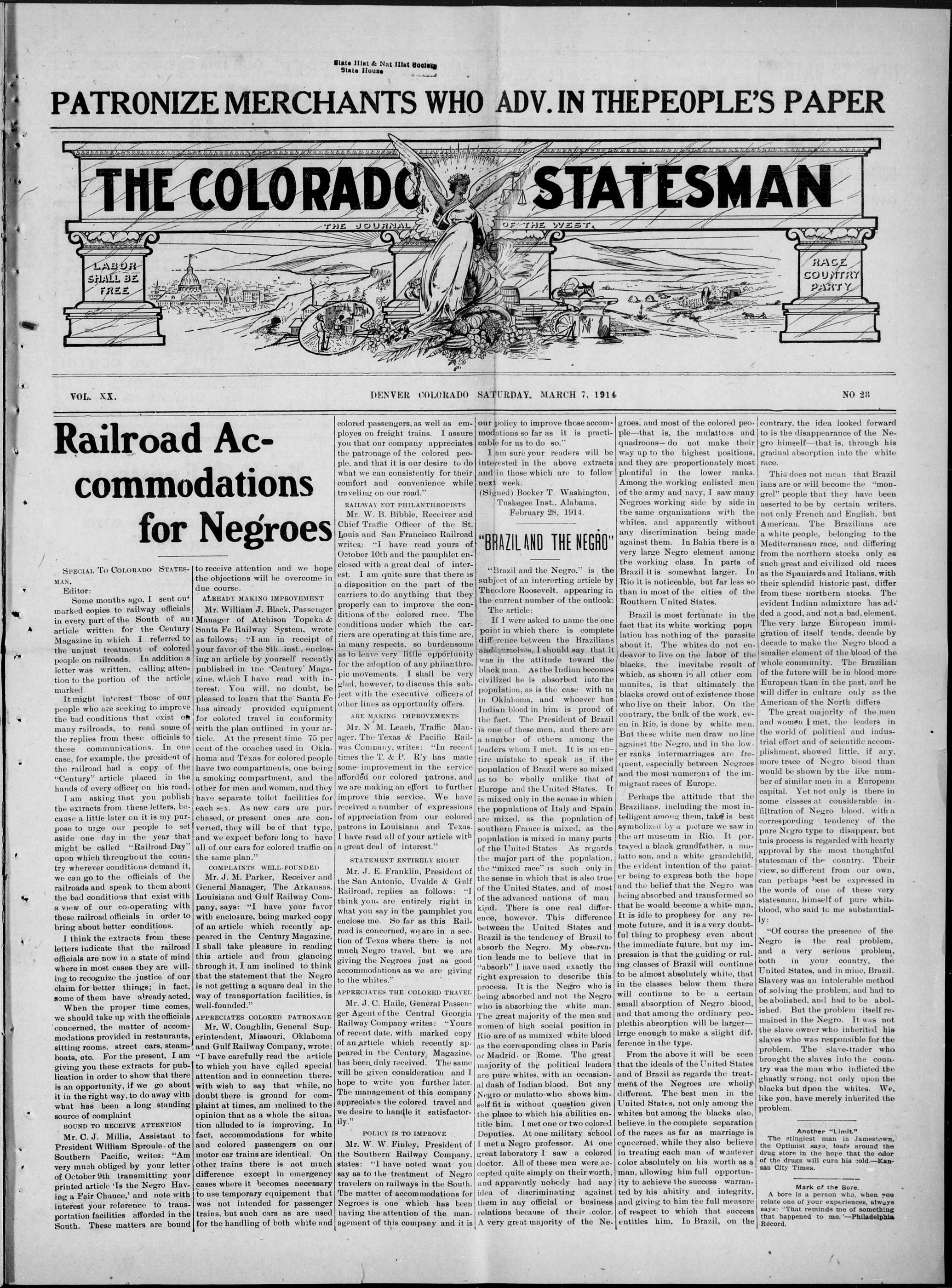
Railroad Accommodations for Negroes
VOL. XX.
Railroad
commo
for
SPECIAL TO COLOBADO STATES-
MAN.
Some months ago, I sent out marked copies to railway officials in every part of the South of an article written for the Century Magazine in which I referred to the unjust treatment of colored people on railroads. In addition a letter was written, calling attention to the portion of the article marked. It might interest those of our people who are seeking to improve the bad conditions that exist on many railroads, to read some of the replies from these officials to these communications. In one case, for example, the president of the railroad had a copy of the "Century" article placed in the hands of every officer on his road.
I am asking that you publish the extracts from these letters, because a little later on it is my purpose to urge our people to set aside one day in the year that might be called "Railroad Day" upon which throughout the country wherever conditions demand it, we can go to the officials of the railroads and speak to them about the bad conditions that exist with a view of our co-operating with these railroad officials in order to bring about better conditions.
I think the extracts from these letters indicate that the railroad officials are now in a state of mind where in most cases they are willing to recognize the justice of our claim for better things; in fact, some of them have already acted.
When the proper time comes, we should take up with the officials concerned, the matter of accommodations provided in restaurants, sitting rooms, street cars, steamboats, etc. For the present, I am giving you these extracts for publication in order to show that there is an opportunity, if we go about it in the right way, to do away with what has been a long standing source of complaint
BOUND TO RECEIVE ATTENTION
Mr. C. J. Millis, Assistant to President William Sproule of the Southern Pacific, writes: "Am very much obliged by your letter of October 9th transmitting your printed article 'Is the Negro Having a Fair Chance,' and note with interest your reference to transportation facilities afforded in the South. These matters are bound
to receive attention and we hope the objections will be overcome in due course.
Mr. William J. Black, Passenger Manager of Atchison Topeka & Santa Fe Railway System, wrote as follows: "I am in receipt of your favor of the 8th inst., enclosing an article by yourself recently published in the 'Century' Magazine, which I have read with interest. You will, no doubt, be pleased to learn that the Santa Fe has already provided equipment for colored travel in conformity with the plan outlined in your article. At the present time 75 per cent of the coaches used in Oklahoma and Texas for colored people have two compartments, one being a smoking compartment, and the other for men and women, and they have separate toilet facilities for each sex. As new cars are purchased, or present ones are converted, they will be of that type, and we expect before long to have all of our cars for colored traffic on the same plan."
COMPLAINTS WELL-FOUNDED
Mr. J. M. Parker, Receiver and General Manager; The Arkansas, Louisiana and Gulf Railway Company, says: "I have your favor with enclosure, being marked copy of an article which recently appeared in the Century Magazine, I shall take pleasure in reading this article and from glancing through it, I am inclined to think that the statement that the Negro is not getting a square deal in the way of transportation facilities, is well-founded."
APPRECIATES COLORED PATRONAGE Mr. W. Coughlin, General Superintendent, Missouri, Oklahoma and Gulf Railway Company, wrote: "I have carefully read the article to which you have called special attention and in connection therewith wish to say that while, no doubt there is ground for complaint at times, am inclined to the opinion that as a whole the situation alluded to is improving. In fact, accommodations for white and colored passengers on our motor car trains are identical. On other trains there is not much difference except in emergency cases where it becomes necessary to use temporary equipment that was not intended for passenger trains, but such cars as are used for the handling of both white and
DENVER COLORADO SATURDAY. MARCH 7, 1914
State Hist & Nat Hist Society
State House
ANTS WHO
ADO
THE JOURNAL
DENVER COLORADO
colored passengers, as well as employees on freight trains. I assure you that our company appreciates the patronage of the colored people, and that it is our desire to do what we can consistently for their comfort and convenience while traveling on our road."
RAILWAY NOT PHILANTHROPISTS
RAILWAY NOT PHILANTHROPISTS Mr. W. B. Bibble, Receiver and Chief Traffic Officer of the St. Louis and San Francisco Railroad writes: "I have read yours of October 10th and the pamphlet enclosed with a great deal of interest. I am quite sure that there is a disposition on the part of the carriers to do anything that they properly can to improve the conditions of the colored race. The conditions under which the carriers are operating at this time are, in many respects, so burdensome as to leave very little opportunity for the adoption of any philanthropic movements. I shall be very glad, however, to discuss this subject with the executive officers of other lines as opportunity offers.
ARE MAKING IMPROVEMENTS
Mr. N M. Leach, Traffic Manager. The Texas & Pacific Railwas Company, writes: "In recent times the T. & P. R'y has made some improvement in the service afforded our colored patrons, and we are making an effort to further improve this service. We have received a number of expressions of appreciation from our colored patrons in Louisiana and Texas. I have read all of your article with a great deal of interest."
STATEMENT ENTIRELY RIGHT
Mr. J. E. Franklin, President of the San Antonio, Uvalde & Gulf Railroad, replies as follows: "I think you are entirely right in what you say in the pamphlet you enclose me. So far as this Railroad is concerned, we are in a section of Texas where there is not much Negro travel, but we are giving the Negroes just as good accommodations as we are giving to the whites."
APPRECIATES THE COLORED TRAVEL
APPRECIATES THE COLORED TRAVEL
Mr. J. C. Haile, General Passenger Agent of the Central Georgia Railway Company writes: "Yours of recent date, with marked copy of an article which recently appeared in the Century Magazine, has been duly received. The same will be given consideration and I hope to write you further later. The management of this company appreciates the colored travel and we desire to handle it satisfactorily."
POLICY IS TO IMPROVE
Mr. W. W. Finley, President of the Southern Railway Company, states: "I have noted what you say as to the treatment of Negro travelers on railways in the South. The matter of accommodations for Negroes is one which has been having the attention of the management of this company and it is
our policy to improve those accommodations so far as it is practicable for us to do so." I am sure your readers will be interested in the above extracts and in those which are to follow next week.
(Signed) Booker T. Washington, Tuskegee Inst., Alabama, February 28, 1914.
"BRAZIL AND THE NEGRO"
"Brazil and the Negro." is the subject of an intererting article by Theodore Roosevelt, appearing in the current number of the outlook. The article:
If I were asked to name the one point in which there is complete difference between the Brazilians and ourselves, I should say that it was in the attitude toward the black man. As the Indian becomes civilized he is absorbed into the population, as is the case with us in Oklahoma, and whoever has Indian blood in him is proud of the fact. The President of Brazil is one of these men, and there are a number of others among the leaders whom I met. It is an entire mistake to speak as if the population of Brazil were so mixed as to be wholly unlike that of Europe and the United States. It is mixed only in the sense in which the populations of Italy and Spain are mixed, as the population of southern France is mixed, as the population is mixed in many parts of the United States. As regards the major part of the population, the "mixed race" is such only in the sense in which that is also true of the United States, and of most of the advanced nations of mankind. There is one real difference, however. This difference between the United States and Brazil is the tendency of Brazil to absorb the Negro. My observation leads me to believe that in "absorb" I have used exactly the right expression to describe this process. It is the Negro who is being absorbed and not the Negro who is absorbing the white man. The great majority of the men and women of high social position in Rio are of as unmixed white blood as the corresponding class in Paris or Madrid, or Rome. The great majority of the political leaders are pure whites, with an occasional dash of Indian blood. But any Negro or mulatto-who shows himself fit is without question given the place to which his abilities entitle him. I met one or two colored Deputies. At one military school I met a Negro professor. At one great laboratory I saw a colored doctor. All of these men were accepted quite simply on their worth, and apparently nobody had any idea of discriminating against them in any official or business relations because of their color. A very great majority of the Ne-
groes, and most of the colored people—that is, the mulattoes and quadroons—do not make their way up to the highest positions, and they are proportionately most plentiful in the lower ranks. Among the working enlisted men of the army and navy, I saw many Negroes working side by side in the same organizations with the whites, and apparently without any discrimination being made against them. In Bahia there is a very large Negro element among the working class. In parts of Brazil it is somewhat larger. In Rio it is noticeable, but far less so than in most of the cities of the Southern United States.
Brazil is most fortunate in the fact that its white working population has nothing of the parasite about it. The whites do not endeavor to live on the labor of the blacks, the inevitabe result of which, as shown in all other communities, is that ultimately the blacks crowd out of existence those who live on their labor. On the contrary, the bulk of the work, even in Kio, is done by white men. But these white men draw no line against the Negro, and in the lower ranks intermarriages are frequent, especially between Negroes and the most numerous of the immigrant races of Europe.
Perhaps the attitude that the Brazilians, including the most intelligent among them, take is best symbolized by a picture we saw in the art museum in Rio. It portrayed a black grandfather, a mulatto son, and a white grandchild, the evident intention of the painter being to express both the hope and the belief that the Negro was being absorbed and transformed so that he would become a white man. It is idle to prophesy for any remote future, and it is a very doubtful thing to prophesy even about the immediate future, but my impression is that the guiding or ruling classes of Brazil will continue to be almost absolutely white, that in the classes below them there will continue to be a certain small absorption of Negro blood, and that among the ordinary people this absorption will be larger—lrrge enough to make a slight difference in the type.
From the above it will be seen that the ideals of the United States and of Brazil as regards the treatment of the Negroes are wholly different. The best men in the United States, not only among the whites but among the blacks also, believe in the complete separation of the races as far as marriage is concerned, while they also believe in treating each man of whatever color absolutely on his worth as a man, allowing him full opportunity to achieve the success warranted by his abitity and integrity, and giving to him the full measure of respect to which that success entitles him. In Brazil, on the
NO 28
contrary, the idea looked forward to is the disappearance of the Negro himself—that is, through his gradual absorption into the white race.
This does not mean that Brazilians are or will become the "mongrel" people that they have been asserted to be by certain writers, not only French and English, but American. The Brazilians are a white people, belonging to the Mediterranean race, and differing from the northern stocks only as such great and civilized old races as the Spaniards and Italians, with their splendid historic past, differ from these northern stocks. The evident Indian admixture has added a good, and not a bad, element. The very large European immigration of itself tends, decade by decade to make the Negro blood a smaller element of the blood of the whole community. The Brazilian of the future will be in blood more European than in the past, and he will differ in culture only as the American of the North differs.
The great majority of the men and women I met, the leaders in the world of political and industrial effort and of scientific accomplishment, showed little, if any, more trace of Negro blood than would be shown by the like number of similar men in a European capital. Yet not only is there in some classes at considerable infiltration of Negro blood, with a corresponding tendency of the pure Negro type to disappear, but this process is regarded with hearty approval by the most thoughtful statesman of the country. Their view, so different from our own, can perhaps best be expressed in the words of one of these very statesman, himself of pure white blood, who said to me substantially:
"Of course the presence of the Negro is the real problem, and a very serious problem, both in your country, the United States, and in mine, Brazil. Slavery was an intolerable method of solving the problem, and had to be abolished, and had to be abolished. But the problem itself remained in the Negro. It was not the slave owner who inherited his slaves who was responsible for the problem. The slave-trader who brought the slaves into the country was the man who inflicted the ghastly wrong, not only upon the blacks but upon the whites. We, like you, have merely inherited the problem.
Another "Limit."
The stingiest man in Jamestown, the Optimist says, loafs around the drug store in the hope that the odor of the drugs will cure his gold.—Kansas City Times.
Mark of the Bore
A bore is a person who, when you relate one of your experiences, always says: "That reminds me of something that happened to me."—Philadelphia Record.
NEWS TO DATE IN PARAGRAPHS
CAUGHT FROM THE NETWORK OF WIRES ROUND ABOUT THE WORLD.
DURING THE PAST WEEK
RECORD OF IMPORTANT EVENTS
CONDENSED FOR BUSY
Western Newspaper Union News Service.
WESTERN.
Thre children are dead the result of a fire which destroyed their home in Queensboro, La.
Fire of unknown origin swept the business district of Danville, Ky., doing damage estimated at more than $100,000.
The Santa Fé railway storehouse at Albuquerque, N. M., was totally destroyed by fire. The loss was estimated at from $20,000 to $40,000.
The Indiana Republican state convention will be held at Indianapolis April 22 and 23, it was decided at a meeting of the state central committee.
Two sons of Mrs. John L. Williams — Virgil, fourteen, and Dillard, twelve — were burned to death when the Williams home at Enfield, Ill., was destroyed by fire.
The last of approximately 28,000 individual income tax schedules which will net the United States government more than $3,000,000 for the first ten months of 1913, were filed in Chicago.
Otto H. Moyesen, formerly a district judge in North Dakota, and at one time an American consul in Norway, shot himself through the heart at Glasgow, Mont.
Tributes to the memory of former United States Senator Henry M. Teller of Colorado were paid by former residents of Denver now living in Seattle, Wash.
Further trouble was expected in the gangsters' feud which broke out anew with the killing of Red Simon by Henry Zang, state's witness against Simon in a murder trial at St. Louis. George Hohn, in resisting arrest at Hammond, Ind., bit off the town marshal's thumb. Hohn was then lassoed and dragged to jail. There he tore the bars off the cell and wrecked the interior of the jail. Hiram C. Gill, who was elected mayor of Seattle in 1910, recalled in 1911 just after the women of Washington had been enfranchised, and defeated in 1912, was elected mayor of Seattle by a majority of 14,000, defeating James D. Trenholme.
J. S. Flower of Denver received a telegram from Senator C. S. Thomas at Washington saying that bids submitted by various contractors for interior finish of Denver's new postoffice exceeded the amount of the appropriation by $132,000.
A state line was not sufficient to deter Sheriff Forsling of Kimball, Neb., from arresting A. L. Scutt of Leigh, Neb., at Pine Bluffs, which is in Wyoming, half a mile from the Nebraska line. Scutt was arrested on complaint of Miss Mary McFarlane, a clerk in his store at Leigh. The girl's mother is preparing to sue Scutt for $25,000 damages.
WASHINGTON.
Already the Postoffice Department is having trouble in securing acceptable bidders on its star routes. All phases of the woman suffrage question were presented to the House judiciary committee, accompanied by cheers, jeers, hisses and applause. Haiti's new government with General Oreste Zamor, successful revolutionist, as president, will be recognized immediately by the United States. President Wilson gave his approval to the proposal to give irrigators on government projects twenty years instead of ten to repay the government for their water rights, embodied in bills now pending in Congress.
A bill authorizing the secretary of war, in his discretion, to accept 4,000 acres of land at Anniston, Ala., or 5,000 acres of Tullahoma, Tenn., for the establishment of a permanent maneuver camp for the army, was passed by the House.
Announcing his support of President Wilson's policy to repeal the provision of the Panama act exempting from toils American coastwise shipping, Senator Thornton, Democrat, of Louisiana, in a statement said the President had informed him that "in his judgment the repeal of the exemption clause is necessary for the continuance of our present friendly relations with foreign powers and the success of our foreign policies."
A new baby girl at Secretary Bryan's home delayed a conference with the British ambassador, and also the Cabinet meeting. Bryan telephoned his office and the White House that he would be late, and announced the birth of a girl to his daughter, Mrs. Richard L. Hargreaves of Lincoln, Neb. Bryan now has six grandchildren. Senator Thomas introduced a resolution to authorize Colorado to sue the secretary of the interior to revoke an order which prohibited diversion of water from the Rio Grande to Colorado projects.
FOREIGN.
King Alfonso signed a renewal of the Spanish arbitration treaty with the United States.
The intention of Italy to participate officially in the Panama-Pacific exposition was communicated to Ambassador Page at Rome.
Emperor William ordered a new competition among German architects for the drafting of plans for the new German embassy at Washington.
At Nogales, the Sonora, a commission to investigate the Benton case was appointed by General Carranza. The decision was taken after a long session of the Provisional Cabinet.
Cardinal George Kopp died at Troppan, Austrian Silesia. Meningitis was the cause of death. The prelate, who was in his seventy-seventh year, was the highest dignitary of the Roman Catholic church in Germany.
Wild rumors that the United States would recognize the Huerta government within forty-eight hours spread through the Mexico City and finally were traced to a financial source. Apparently somebody, as yet undiscoverel, tried to manipulate the local money market by the report.
General Villa was wrathy over the murder of one Chinaman and the fatal wounding of another at Chihuahua, Mex. Three men broke into a small store kept by John Sen and Woo Kee and stole groceries valued at $30. On Sen's body eighteen knife wounds accounted for his death. Woo Kee was stabbed six times and will die.
The rebels of Mexico must answer to the government of Great Britain for the death of William S. Benton, now or at some future time. If the answer is not obtained by United States action it will be brought about directly by England. This was the substance of an address made in the House of Commons by Sir Edward Grey, British foreign secretary.
SPORT.
William Church Osborn was elected chairman of the Democratic state committee of New York to succeed George M. Palmer.
One dead and two seriously injured was the toll of the 403-mile Grand Prix road race on the Santa Monica course which was won by Eddie Pullen.
Jim Flynn, the "white hope crusher" from Pueblo, and Jack Dillon of Indianapolis fought ten terrific to a draw before 5,000 members of the Grand Avenue Athletic Club at Kansas City.
While "looping the loop" at Santa Barbara, Cal., Lincoln Beachey lost control of his biplane, and fell 1,600 feet, but managed to right himself 400 feet from the ground and escaped with slight injuries.
Arthur R. Cavill, the London swimmer, who was the first man to swim the Golden Gate at San Francisco and who was recognized as the champion swimmer of the world from 1895 to 1900, died of exhaustion at Seattle. Wash., soon after he had been taken from the water, after an unsuccessful attempt to swim across the Seattle harbor, a distance of three miles.
Entries closed at Louisville, Ky., for the famous turf classic, the Kentucky Derby, which this year will be worth $15,000. For the first time in the history of the race, $10,000 was added. The total worth of $15,000 makes it the richest race in the forty years' history of this classic. Entries for six other big events carded for the new Louisville Jockey Club spring meeting also closed.
GENERAL.
Mrs. Katherine O'Neill died at Hartford, Conn., aged 106 years. She had been in good health until a few weeks ago. Her husband died sixty years ago.
United States Senator George E. Chamberlain, Democrat, will be a candidate for re-election this year. His declaration was filed with the secretary of state.of Oregon.
Word came to New London, Conn., of the death in Jerusalem of Brig. Gen. John W. Barlow, United States army, retired. General Barlow, accompanied by his wife, was making a tour of the Holy land.
Two hundred American theaters and all the business of the Sullivan-Considine vaudeville circuit have been purchased by Marcus Loew, Adolph Zukor and Joseph M. Schenck of New York and Aaron Jones of Jones, Linick & Schaeffer of Chicago. The price is in the millions, for many of the theaters and the reality on which they stood were purchased outright.
Mrs. Kate Edwards, who has been in the shadows of the gallows for nearly thirteen years for the killing of her husband, was released from the Berks county jail, under a pardon granted by Governor Tener of Pennsylvania, and secretly taken from Reading to begin life over again. She was convicted of first degree murder in 1901 and sentenced to be hanged, but four governors declined to fix a day for her execution.
Bishop Thomas. Bowman of the Methodist Episcopal church, affectionately known for a generation as "the Grand Old Man of the Faith," died aged ninety-seven, at the home of his daughter in Orange, N. J. He was the patriarch of Methodism in America.
Mrs. Amelia Schevengot, aged seventy, saved her husband, a cripple of the same age, from death in the flames of their farm home, and then collapsed herself and was killed under the falling wall, just as the neighbor's carried her husband to safety at Port Washington, Wis.
STATE NEWS OF INTEREST TO ALL COLORADO PEOPLE
Western Newspaper Union News Service.
DATES FOR COMING EVENTS.
July 13-14. Grand Lodge Session, B.
10. Iowa at Denver.
Apr. 9. General Irrigation Conference
at Denver.
September 11. Colorado State Fair at
Publix.
1915.—Last Grand Council of North
American Indians at Denver.
Colorado is fifty-three years old.
The annual Denver automobile show will be held in the Auditorium the last week in March.
Four prominent Grand Junction men were arrested on indictments charging the theft of the Dan Casement cattle last fall.
Stanley D. Burno, for the past three years chief of police of Colorado Springs, has resigned to take the management of a large ranch at Kremmling.
Mrs. Mary Russell Wheeler, eighty-two years old, died at St. Luke's hospital in Denver. Her death followed a severe fall three weeks ago when she broke her hip.
According to the meteorological summary for the month of February, out of the 200 possible hours of sunshine the sun shone 184 hours, which was 61 per cent of the greatest possible.
City Attorney Stevens is preparing to enforce recognition of its franchise by the Denver Gas and Electric company in the matter of rebates from excess sales of gas, as provided for in the company's franchise.
While Harialambos P. Karuntzos was unloading cinders near Sugar City, he was struck and killed by a Missouri Pacific train. Mrs. Sophia Karuntzos, his wife, filed suit in the District Court for $5,000 damages.
Scientific experiments are developing the uses to which the radio-active springs of Colorado may be put. Thirteen of such springs have been analyzed by Professor Russell D. George of the University of Colorado.
The first reduction in the tariff on sugar made by the Underwood bill became effective with refined sugar in Colorado selling at $4.35 per 100 pounds, as against $4.90 when the tariff bill was signed last December.
A bureau to advertise every city, town and section in the state which is willing to co-operate in telling the outside world of its attractions and investment possibilities will be organized by the All-Colorado committee of Denver.
Suit for $50,000 damages has been filed in the District Court by Mrs. Eva M. Land against C. H. Boley, inventor of the process by which briquette fuel is made. The complaint asserts that Boley assaulted Mrs. Land in her home in Denver.
The Denver city council passed the initiated measure reducing water rates twenty per cent. All the commissioners voted in favor of the measure. The reduction in rates will become effective May 1, unless stopped by litigation or referred to a vote of the people.
The following men have been chosen by Loran T. Peters, coach of debating at the University of Colorado, to represent the university in the debate against the University of Oklahoma next April: William A. Rauck, Boulder; Burtis H. Shattuck, Boulder, and Charles Swindler, Dawson Springs, Kentucky.
Forty-two members of the Montrose company of the Colorado National Guard, who saw service in the southern coal field, have not received any pay for their services during the last two months according to a message received in Denver. The militiamen are indignant and demand that they be paid without further delay.
Mrs. Mary Joe Heberton, society belle of Denver and Colorado Springs, was granted a divorce from Dr. Charles M. Heberton by District Judge Teller of Denver. She was also awarded $100 a month alimony and given the unconditional ownership of fifty shares of Denver Tramway stock, a former gift from Dr. Heberton.
The March term of the Arapahoe County District Court commenced at Littleton with seventy-two criminal and fifty-three civil cases on the docket. The principal interest of the term centers on Dr. C. C. Fowler's second divorce suit against his wife, in which life brings twenty charges, including various forms of nagging. The case was set for trial on March 23.
With the return of good weather in the mountainous section of the county near Boulder come reports from the various mining camps indicating a revival of the mining industry. Besides much activity on the Yellow Pine and Logan mines, in the Crisman district, the El Dora Mining., Milling and Refining Company, headed by F. M. Woods of Denver, is doing much to revive mining in El Dora by taking out considerable ore from the Mogul tunnel property.
When it was shown to a jury in the District Court that Charles T. Ball of Colorado City refused to milk his own cows, leaving, the work to his wife, although he regularly milked a cow for a neighbor woman, the six men awarded Mrs. Ball a decree of divorce.
Miss Lillie Johnson, a popular Longmont girl and senior in the College of Liberal Arts, was elected May queen of the annual university May day exercises, at a meeting of all the women in the university. Miss Johnson is the first non-sorority girl to be accorded the honor of May queen.
RANCHER SLAIN BY AX FREE----OUR 1914 CATALOG JUST OUT Shows All New Styles in Colored Women's Hair.
BODY THEN HURLED OVER CLIFF
AND BURNED.
Charred Bones Found in Cave in Cañon and Two Mexicans Arrested, Charged With Crime.
Western Newspaper Union News Service.
Trinidad.—A bunch of keys and one tiny shred of underwear were the only clews officers had to go on when the charred bones of Morris Williams, a ranchman near Watervale, were found in a cannon two miles from his home by a searching party.
Following the finding of the remains Miguel Martinez and Don, his son, were brought to the county jail here, where they are held on a murder charge. Williams and the Martinez family are said to have had trouble over the sale of some hay.
Williams had been missing several days. It is the theory of Sheriff Sipe that Williams was murdered in his home with an ax and that his body was then taken to Pinon cafon, where the remains were found, and burned. Officers were mystified as to the method by which the body was burned so completely. Watervale is a small town sixty miles southeast of Trinidad, in Las Animas county, and the point where the remains were found is almost on the Colorado-New Mexico line. In 1896 a double murder, similar to the Williams killing, occurred at almost identically the same point. Deputy Sheriffs Green and Kelly were slain and their bodies burned. Only a few buttons were found.
Peonage Charge Was Not Proved.
Peonage Charge Was Not Proved. Denver.—In accordance with the report of his special assistant, Walter F. Daly, United States District Attorney Harry P. Kelly says he will bring no complaint at present against the coal operators in the southern coal fields charging violation of federal laws against peonage. Daly returned from Trinidad after investigating strikers' charges that the strike breakers were virtually held prisoners. While he found some evidence that they were restrained from freely leaving the mines, the restraint, if any, he says, was exercised by the military authorities and not by the operators and did not constitute the offense charged. Daly found sufficient evidence upon which to make a complaint against Charles Costa, David Jeffries. Max, Martinez, Casano Gemelli and Dominic Fugare for burning the postoffice at Delagua and they were arraigned before United States Commissioner A. L. tSone. They are alleged to have fired the general store of the Southwestern Mining Company containing the postoffice the night before the militia arrived.
Ward Is Springs Postmaster.
Colorado Springs. — Colorado Springs has a new postmaster. O. W. Ward received his commission, and took over the duties of the office relieving Postmaster Aleck J. Strachan, who has been postmaster here for the last twelve years. T. J. Sandford will take over the Manitou postoffice, relieving H. H. Grafton, who has served in that capacity for sixteen years.
Lieutenant Darragh Dies at Trinidad.
Denver.—Lieut. Arthur W. Darragh of company A signal corps, National Guard of Colorado, dropped dead on the streets of Trinidad of apoplexy. Lieutenant Darragh had been stationed in Trinidad since Nov. 24 and was in charge of the provost guard. He leaves a widow and five children.
Methodists Lay Chapel Cornerstone.
Methodists Lay Chapel Cornerstone.
Colorado Springs.—The cornerstone of the new chapel of the Second Methodist Episcopal church was laid by the Rev A. F. Bridges, first pastor of the Colorado Springs church. Dr. H. A. Rall, president of the Bliff School of Theology, Denver, delivered the principal address.
Moffat County Gets Jail.
Craig.—After having been compelled, ever since it became a county, to board its prisoners either in the jails in Steamboat Springs or Meeker, Moffat county now has a jail of its own. An escape-proof structure has been completed and turned over to the county commissioners.
Assessment Paid to Bank Receiver. Grand Junction.—An assessment of twenty-five per cent was paid to the receiver of the Mesa County National bank, on the call of the comptroller of the currency. It is probable that the first dividend will be paid to depositors within a few weeks.
Water Rate Cut 20 Per Cent
Denver.—The city council, at a special meeting, unanimously passed the initiated bill for an ordinance cutting water rates 20 per cent horizontally.
Utah and Colorado Governors Confer.
Denver.—That Utah is ready and willing to work hand in hand with Colorado for the mutual benefit of both states, is the message which was brought to Denver by Governor William Spry of Utah, who was en route from Washington to his home in Salt Lake. He held a long conference with Governor Ammons, during which it was decided to hold the Western Governor's Conference in Denver April 7, two days in advance of the National Irrigation Conference to be called by Secretary Lane.
FREE FREE
KEYSTON OPEN FOR New D to Key BUSINESS like it Strictly home cooking. Low food. Eastern corn-fed meats
KEYSTONE CAFE
N FOR
BINESS
New Dining Room in C
to Keystone Social Clu
like it ever attempted
home cooking. Lowest prices for best
tern corn-fed meats. Your patronag
OPEN FOR
BUSINESS New Dining Room in Connection
to Keystone Social Club. Nothing
like it ever attempted in Denver.
Strictly home cooking. Lowest prices for best quality of
food. Eastern corn-fed meats. Your patronage solicited.
FULL
DINNER
11:30 a. m.
to
8:30 p. m.
Soup, Fish or
Meat, Two
Vegetables
Coffee,Tea or Cocoa
Desert
25 CENTS
FULL
DINNER
11:30 a.m.
to
8:30 p.m.
SHORT ORDERS AT ALL HOURS
Syl. Stewart Man
1857 Champa St. Phone Champa 3543
Syl. Stewart Manor
Empa St. Phone Champa 3543 De
K JOHN
Ck & Eng'str
WHOLESALE DEALERS IN
Lines, Liquors and
Cigars
for Minneapolis Grain Belt Beer and Carnegie
Imported Beer and Bock Ol.
644-46-48-50 Larimer Street
1053 Denver
L KINDS OF REPAIR WORK NEATLY DOES
REFINISHING A SPECIALTY.
Welton Street Furniture
F. R. LINDENMIER, Prop.
2619 WELTON STREET
Second Hand Furniture Bo
and Exchanged
e Pay the Highest Cash Price for Furniture
8247.
Beck & E
WHOLESALE
Wines, Lic
Cig
Western Agents for Minneapolis Grain
Imported Beer
1644-46-48-50
Phone Main 1053
ALL KINDS OF REPAIR
REFINISHING A
The Welton Street
F. R. LINDEN
2619 WELTO
New and Second Hand
and Excl
We Pay the Highest Cas
Beck & Engstrom
WHOLESALE DEALERS IN Wines, Liquors and Cigars
Western Agents for Minneapolis Grain Belt Beer and Carnegie Porter, Pripps Imported Beer and Bock Ol.
1644-46-48-50 Larimer Street
Phone Main 1053 Denver, Colorado
ALL KINDS OF REPAIR WORK NEATLY DONE. REFINISHING A SPECIALTY.
New and Second Hand Furniture Bought, Sold and Exchanged We Pay the Highest Cash Price for Furniture
MARKET DEPARTMENT
We are handling nothing but the
poultry. At present we are getting
caught fish, salmon, trout, cat fish, H
FRESH VEGETABLES
CHAS. HARRIS, Pres. J. M. JOHN
RAILROAD POP
LUNCH ROOM IN
DEPARTMENT
We handling nothing but the highest quality meat
present we are getting by express shipment to
salmon, trout, cat fish, halibut and oysters.
FRESH VEGETABLES EVERY MORNING
RIS, Pres. J. M. JOHNS, Treas. SEIB M.
ROAD PORTERS' C
LUNCH ROOM IN CONNECTION
We are handling nothing but the highest quality meats, fish and poultry. At present we are getting by express shipment strictly fresh caught fish, salmon, trout, cat fish, hallibut and oysters.
FRESH VEGETABLES EVERY MORNING
CHAS. HARRIS, Pres. J. M. JOHNS, Treas. SEIB MILLER, Sec.
1728 $ \frac{1}{2} $ Wazee St. Only one block from Union Depot Phone Main 8416. Denver, Colorado
HENRY BECK
PHONE MAIN 8247.
We are the largest Importers and Manufacturers of Dressed People and the oldest and most reliable firm in this line. We guarantee perfect satisfaction or money refunded. We point to superior to any on the market, and our prices are lower than those quoted anywhere else. This hair will stand combing and wiggle by the pound, hair nets and all styles of hair, also an exception to one line of toilet articles and straightening combs at wholesale prices.
Send 2-cent stamp for Free Book.
Agents Wanted.
HUMANIA HAIR COMPANY
Dept. 102. No. 23 Duane Street.
NEW YORK CITY.
NE CAFE
Dining Room in Connection
Stone Social Club. Nothing
ever attempted in Denver.
Best prices for best quality of.
Your patronage solicited.
Soup, Fish or Meat, Two Vegetables Coffee,Tea or Cocoa Desert 25 CENTS
ewart Manager.
ampa 3543 Denver, Colo.
Engstrom
DEALERS IN
alcoors and
wars
Belt Beer and Carnegie Porter, Pripps
and Bock Ol.
Larimer Street
Denver, Colorado
WORK NEATLY DONE.
SPECIALTY.
et Furniture Co.
MIER, Prop.
IN STREET
Furniture Bought, Sold
changed
High Price for Furniture
ED. POLAND
Five Points Grocery
2700 WELTON STREET
PHONE 8488 MAIN
The Only Up-to-Date Grocery and Market at Five Points
MEATS It will pay you, if you are not buying your food supply from us, to make a change.
the highest quality meats, fish and y express shipment strictly fresh alibut and oysters.
EVERY MORNING
S, Treas. SEIB MILLER, Sec.
RTERS' CLUB
N CONNECTION
JOHN ENGSTROM
DENVER, COLO.
AFRO-AMERICAN CULLINGS
"The educated man usually overestimates himself because his intellect has grown faster than his experience of life."—General Armstrong.
"Every time I think of Hampton, I get a new definition of education and a new ideal of human training. I believe that Hampton\is, after all, the real American university. I believe that this institution comes nearer having found the clew to the maze in this great process of training people for life, in life and by life, than any other institution in the world."
This striking tribute has been paid to Hampton institute by Dr. Wallace Buttrick, secretary of the General Education board, who knows intimately educational institutions throughout the whole country.
Some 20,000 people are attracted annually to Hampton institute, the pioneer industrial and agricultural training school for negro and Indian youth, founded in 1868 by Gen. Sam
```markdown
```
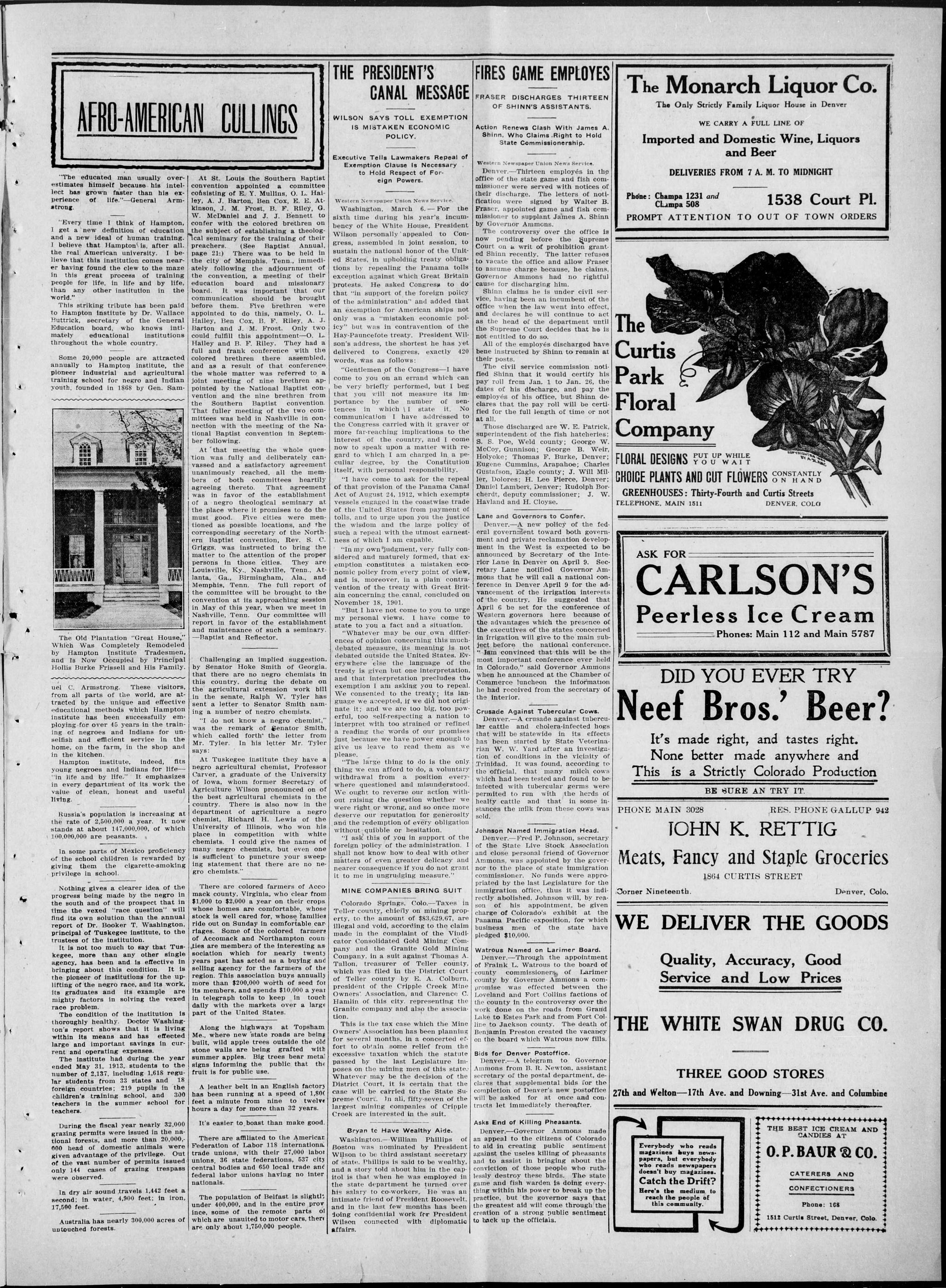
The Old Plantation "Great House," Which Was Completely Remodeled by Hampton Institute Tradesmen, and Is Now Occupied by Principal Hollis Burke Frissell and His Family.
uel C. Armstrong. These visitors, from all parts of the world, are attracted by the unique and effective educational methods which Hampton institute has been successfully employing for over 45 years in the training of negroes and Indians for unselfish and efficient service in the home, on the farm, in the shop and in the kitchen.
Hampton institute, indeed, fits young negroes and Indians for life—"in life and by life." It emphasizes in every department of its work the value of clean, honest and useful living.
Russia's population is increasing at the rate of 2,500,000 a year. It now stands at about 147,000,000, of which 100,000,000 are peasants.
In some parts of Mexico proficiency of the school children is rewarded by giving them the cigarette-smoking privilege in school.
Nothing gives a clearer idea of the progress being made by the negro in the south and of the prospect that in time the vexed "race question" will find its own solution than the annual report of Dr. Booker T. Washington, principal of Tuskegee institute, to the trustees of the institution.
It is not too much to say that Tuskegee, more than any other single agency, has been and is effective in bringing about this condition. It is the pioneer of institutions for the uplifting of the negro race, and its work, its graduates and its example are mighty factors in solving the vexed race problem.
The condition of the institution is thoroughly healthy. Doctor Washington's report shows that it is living within its means and has effected large and important savings in current and operating expenses.
The institute had during the year ended May 31, 1913, students to the number of 2,137, including 1,618 regular students from 33 states and 18 foreign countries; 219 pupils in the children's training school, and 300 teachers in the summer school for teachers.
During the fiscal year nearly 32,000 grazing permits were issued in the national forests, and more than 20,000,000 head of domestic animals were given advantage of the privilege. Out of the vast number of permits issued only 144 cases of grazing trespass were observed.
In dry air sound travels 1,442 feet a second; in water, 4,900 feet; in iron, 17,500 feet.
Australia has nearly 300,000 acres of untouched forests.
At St. Louis the Southern Baptist convention appointed a committee consisting of E. Y. Mullins, O. L. Hailey, A. J. Barton, Ben Cox, E. E. Atkinson, J. M. Frost, B. F. Riley, G. W. McDaniel and J. J. Bennett to confer with the colored brethren on the subject of establishing a theological seminary for the training of their preachers. (See Baptist Annual, page 21:) There was to be held in the city of Memphis, Tenn., immediately following the adjournment of the convention, a meeting of their education board and missionary board. It was important that our communication should be brought before them. Five brethren were appointed to do this, namely, O. L. Hailey, Ben Cox, B. F. Riley, A. J. Barton and J. M. Frost. Only two could fulfill this appointment—O. L. Hailey and B. F. Riley. They had a full and frank conference with the colored brethren there assembled, and as a result of that conference the whole matter was referred to a joint meeting of nine brethren appointed by the National Baptist convention and the nine brethren from the Southern Baptist convention. That fuller meeting of the two committees was held in Nashville in connection with the meeting of the National Baptist convention in September following.
At that meeting the whole question was fully and deliberately canvassed and a satisfactory agreement unanimously reached, all the members of both committees heartily agreeing thereto. That agreement was in favor of the establishment of a negro theological seminary at the place where it promises to do the must good. Five cities were mentioned as possible locations, and the corresponding secretary of the Northern Baptist convention, Rev. S. C. Griggs, was instructed to bring the matter to the attention of the proper persons in those cities. They are Louisville, Ky., Nashville, Tenn., Atlanta, Ga., Birmingham, Ala., and Memphis, Tenn. The full report of the committee will be brought to the convention at its approaching session in May of this year, when we meet in Nashville, Tenn. Our committee will report in favor of the establishment and maintenance of such a seminary.—Baptist and Reflector.
Challenging an implied suggestion, by Senator Hoke Smith of Georgia, that there are no negro chemists in this country, during the debate on the agricultural extension work bill in the senate, Ralph W. Tyler has sent a letter to Senator Smith naming a number of negro chemists.
"I do not know a negro chemist," was the remark of Senator Smith, which called forth the letter from Mr. Tyler. In his letter Mr. Tyler says:
At Tuskegee institute they have a negro agricultural chemist, Professor Carver, a graduate of the University of Iowa, whom former Secretary of Agriculture Wilson pronounced on of the best agricultural chemists in the country. There is also now in the department of agriculture a negro chemist, Richard H. Lewis of the University of Illinois, who won his place in competition with white chemists. I could give the names of many negro chemists, but even one is sufficient to puncture your sweeping statement that there are no negro chemists."
There are colored farmers of Accomack county, Virginia, who clear from $1,000 to $2,000 a year on their crops whose homes are comfortable, whose stock is well cared for, whose families ride out on Sunday in comfortable carriages. Some of the colored farmers of Accomack and Northampton counties are members of the interesting as sociation which for nearly twenty years past has acted as a buying and selling agency for the farmers of the region. This association buys annually more than $200,000 worth of seed for its members, and spends $10,000 a year in telegraph tolls to keep in touch daily with the markets over a large part of the United States.
Along the highways at Topsham Me., where new state roads are being built, wild apple trees outside the old stone walls are being grafted with summer apples. Big trees bear metal signs informing the public that the fruit is for public use.
A leather belt in an English factory has been running at a speed of 1,800 feet a minute from nine to twelve hours a day for more than 32 years.
It's easier to boast than make good
There are affiliated to the American Federation of Labor 118 international trade unions, with their 27,000 labor unions, 36 state federations, 537 city central bodies and 650 local trade and federal labor unions having no internationals.
The population of Belfast is slightly under 400,000, and in the entire province, some of the remote parts of which are unsuited to motor cars, there are only about 1,750,000 people.
THE PRESIDENT'S CANAL MESSAGE
WILSON SAYS TOLL EXEMPTION IS MISTAKEN ECONOMIC POLICY.
Executive Tells Lawmakers Repeal of Exemption Clause Is Necessary to Hold Respect of Foreign Powers.
Western Newspaper Union News Service.
Washington, March 6. — For the sixth time during his year's incumbency of the White House, President Wilson personally appealed to Congress, assembled in joint session, to sustain the national honor of the United States, in upholding treaty obligations by repealing the Panama toils exception against which Great Britain protests. He asked Congress to do that "in support of the foreign policy of the administration" and added that an exemption for American ships not only was a "mistaken economic policy" but was in contravention of the Hay-Pauncefote treaty. President Wilson's address, the shortest he has yet delivered to Congress, exactly 420 words, was as follows:
"Gentlemen of the Congress—I have come to you on an errand which can be very briefly performed, but I beg that you will not measure its importance by the number of sentences in which \I state it. No communication I have addressed to the Congress carried with it graver or more far-reaching implications to the interest of the country, and I come now to speak upon a matter with regard to which I am charged in a peculiar degree, by the Constitution itself, with personal responsibility.
"I have come to ask for the repeal of that provision of the Panama Canal Act of August 24, 1912, which exempts vessels engaged in the coastwise trade of the United States from payment of tolls, and to urge upon you the justice the wisdom and the large policy of such a repeal with the utmost earnestness of which I am capable.
"In my own judgment, very fully considered and maturely formed, that exemption constitutes a mistaken economic policy from every point of view, and is, moreover, in a plain contravention of the treaty with Great Britain concerning the canal, concluded on November 18, 1901.
"But I have not come to you to urge my personal views. I have come to state to you a fact and a situation.
"Whatever may be our own differences of opinion concerning this much-debated measure, its meaning is not debated outside the United States. Everywhere else the language of the treaty is given but one interpretation, and that interpretation precludes the exemption I am asking you to repeal. We consented to the treaty; its language we accepted, if we did not originate it; and we are too big, too powerful, too self-respecting a nation to interpret with too strained or refined a reading the words of our promises just because we have power enough to give us leave to read them as we please.
"The large thing to do is the only thing we can afford to do, a voluntary withdrawal from a position everywhere questioned and misunderstood. We ought to reverse our action without raising the question whether we were right or wrong, and so once more deserve our reputation for generosity and the redemption of every obligation without quibble or hesitation.
"I ask this of you in support of the foreign policy of the administration. I shall not know how to deal with other matters of even greater delicacy and nearer consequence if you do not grant it to me in ungrudging measure."
MINE COMPANIES BRING SUIT
Colorado Springs. Colo.—Taxes in Teller county, chiefly on mining property, to the amount of $83,629.67, are illegal and void, according to the claim made in the complaint of the Vindicator Consolidated Gold Mining Company and the Granite Gold Mining Company, in a suit against Thomas A. Tallon, treasurer of Teller county, which was filed in the District Court of Teller county by E. A. Colburn, president of the Cripple Creek Mine Owners' Association, and Clarence C. Hamlin of this city, representing the Granite company and also the association.
This is the tax case which the Mine Owners' Association has been planning for several months, in a concerted effort to obtain some relief from the excessive taxation which the statute passed by the last Legislature imposes on the mining men of this state. Whatever may be the decision of the District Court, it is certain that the case will be carried to the State Supreme Court. In all, fifty-seven of the largest mining companies of Cripple Creek are interested in the suit.
Bryan tc Have Wealthy Aide.
Washington.—William Phillips of Boston was nominated by President Wilson to be third assistant secretary of state. Phillips is said to be wealthy, and a story told about him in the capitol is that when he was employed in the state department he turned over his salary to co-workers. He was an intimate friend of President Roosevelt, and in the last few months has been doing confidential work for President Wilson connected with diplomatic affairs.
FIRES GAME EMPLOYES
FIRES GAME EMPLOYES
FRASER DISCHARGES THIRTEEN OF SHINN'S ASSISTANTS.
Action Renews Clash With James A. Shinn, Who Claims.Right to Hold State Commissionership.
Western Newspaper Union News Service.
Denver.—Thirteen employés in the office of the state game and fish commissioner were served with notices of their discharge. The letters of notification were signed by Walter B. Fraser, appointed game and fish commissioner to supplant James A. Shinn by Governor Ammons.
The controversy over the office is now pending before the Supreme Court on a writ of prohibition granted Shinn recently. The latter refuses to vacate the office and allow Fraser to assume charge because, he claims, Governor Ammons had no rightful cause for discharging him.
Shinn claims he is under civil service, having been an incumbent of the office when the law went into effect, and declares he will continue to act as the head of the department until the Supreme Court decides that he is not entitled to do so.
All of the employés discharged have bene instructed by Shinn to remain at their posts.
The civil service commission notified Shinn that it would certify his pay roll from Jan. 1 to Jan. 26, the dates of his discharge, and pay the employés of his office, but Shinn declares that the pay roll will be certified for the full length of time or not at all.
Those discharged are W. E. Patrick, superintendent of the fish hatcheries; S. S. Poe, Weld county; George W. McCoy, Gunnison; George B. Weir, Holyoke; Thomas F. Burke, Denver; Eugene Cummins, Arapahoe; Charles Gustafson, Eagle county; J. Will Miller, Dolores; H. Lee Pierce, Denver; Daniel Lambert, Denver; Rudolph Borcherdt, deputy commissioner; J. W. Havland and H. Cloyse.
Lane and Governors to Confer.
Denver:A new policy of the federal government toward both government and private reclamation development in the West is expected to be announced by Secretary of the Interior Lane in Denver on April 9. Secretary Lane notified Governor Ammons that he will call a national conference in Denver April 9 for the advancement of the irrigation interests of the country. He suggested that April 6 be set for the conference of Western governors here because of the advantages which the presence of the executives of the states concerned in irrigation will give to the main subject before the national conference. "I am convinced that this will be the most important conference ever held in Colorado" said Governor Ammons when he announced at the Chamber of Commerce luncheon the information he had received from the secretary of the interior.
Crusade Against Tubercular Cows.
Denver.—A crusade against tubercular cattle and cholera-infected hogs that will be statewide in its effects has been started by State Veterinarian W. W. Yard after an investigation of conditions in the vicinity of Trinidad. It was found, according to the official, that many milch cows which had been tested and found to be infected with tubercular germs were permitted to run with the herds of healthy cattle and that in some instances the milk from these cows was sold.
Johnson Named Immigration Head.
Denver.—Fred P. Johnson, secretary of the State Live Stock Association and close personal friend of Governor Ammons, was appointed by the governor to the place of state immigration commissioner. No funds were appropriated by the last Legislature for the immigration office, thus it was indirectly abolished. Johnson will, by reason of his appointment, be given charge of Colorado's exhibit at the Panama Pacific exposition, for which business men of the state have pledged $10,000.
Watrous Named on Larimer Board. Denver.—Through the appointment of Fraink L. Watrous to the board of county commissioners, of Larimer county by Governor Ammons a compromise was effected between the Loveland and Fort Collins factions of the county in the controversy over the work done on the roads from Grand Lake to Estes Park and from Fort Colline to Jackson county. The death of Benjamin Preston created the vacancy on the board which Watrous now fills.
Bids for Denver Postoffice.
Denver.—A telegram to Governor Ammons from B. R. Newton, assistant secretary of the postal department, declares that supplemental bids for the completion of Denver's new postoffice will be asked for at once and contracts let immediately thereafter.
Asks End of Killing Pheasants.
Denver.—Governor Ammons made an appeal to the citizens of Colorado to aid in creating public sentiment against the useless killing of pheasants and to assist in bringing about the conviction of those people who ruthlessly destroy these birds. The state game and fish warden is doing everything within his power to break up the practice, but the governor says that the greatest aid will come through the creation of a strong public sentiment to back up the officials.
The Monarch Liquor Co.
Imported and Domestic Wine, Liquors and Beer DELIVERIES FROM 7 A.M. TO MIDNIGHT
Phone: Champa 1231 and
Clampa 508
PROMPT ATTENTION TO
The
Curtis
Park
Floral
Company
FLORAL DESIGNS PUT UP WHILE
YOU WAIT
CHOICE PLANTS AND CUT FLOWER
GREENHOUSES: Thirty-Fourth
TELEPHONE, MAIN 1511
ASK FOR
CARL
Peerless
Phone
DID YOU
Neef Bro
It's made right
None better m
This is a Strictly
Tampa 1231 and
Tampa 508
1538 Cou
ATTENTION TO OUT OF TOWN
S
l
pany
DIGNS PUT UP WHILE
YOU WAIT
PLANTS AND CUT FLOWERS CONSTANTLY
ON HAND
USES: Thirty-Fourth and Curtis Streets
MAIN 1511
DENVER, COLO
FOR
CARLSON
Waterless Ice Cream
Phones: Main 112 and M
DID YOU EVER TH
ef Bros.' Be
is made right, and tastes ri
one better made anywhere
is a Strictly Colorado Pro
Phone: Champa 1231 and 1538 Court Pl. Champa 508 PROMPT ATTENTION TO OUT OF TOWN ORDERS
The
Curtis
Park
Floral
Company
FLORAL DESIGNS PUT UP WHILE
YOU WAIT
CHOICE PLANTS AND CUT FLOWERS CONSTANTLY
ON HAND
GREENHOUSES: Thirty-Fourth and Curtis Streets
TELEPHONE, MAIN 1511
DENVER, COLO
ASK FOR CARLSON'S Peerless Ice Cream Phones: Main 112 and Main 5787
DID YOU EVER TRY Neef Bros.' Beer?
Neef Bros.' Beer?
It's made right, and tastes right.
None better made anywhere and
This is a Strictly Colorado Production
BE SURE AN TRY IT.
PHONE MAIN 3028 RES. PHONE GALLUP 9
JOHN K. RETTIG
Meats, Fancy and Staple Grocerie
1864 CURTIS STREET
MAIN 3028 RES. PHONE C
JOHN K. RETTIGER
Fancy and Staple Gr
1864 CURTIS STREET
seventh.
DELIVER THE GO
Quality, Accuracy, Good
Service and Low Price
WHITE SWAN DRU
Meats, Fancy and Staple Groceries 1864 CURTIS STREET
WE DELIVER
Quality, Acc
Service and
THE WHITE S
WE DELIVER THE GOODS
Quality, Accuracy, Good Service and Low Prices
THE WHITE SWAN DRUG CO.
THREE GOOD STORES
27th and Welton—17th Ave. and Downing—31st Ave. and Columbine
Everybody who reads magazines buys newspapers, but everybody who reads newspapers doesn't buy magazines.
Catch the Drift?
Here's the medium to reach the people of this community.
---
Corner Nineteenth
Denver, Colo.
THE COLORADO STATESMAN
COLORADO SHALL BE FREE
COLORADO PARTY
JOS. D. D. RIVERS.....Proprietor
1824 Curtis Street, Room 25.
Phone Main 7417.
SUBSCRIPTION RATES:
One Year ..... $2.00
Six Months ..... 1.00
Three Months ..... .60
PAYABLE IN ADVANCE.
has second-class matter at the postoffice in the city
communications of a personating nature that are not
held from the columns of this paper.
printising, 50 cents per inch. An inch contains two
notices, ten lines or less, 10 cents per line. Each
line, 5 cents per line.
allowed on less than three months' contract. Cases
from parties unknown to us. Further particulars.
places should be made by Express Money Order, Post
erated Letter or Bank Draft. Postage stamps will
for the fractional part of a dollar. Only 1-cent and
locations to receive attention must be newsy, upon
written only upon one side of the paper; must ree
away, not later than Wednesdays, and bear the a
manuscript returned, unless stamps are sent for po
onally happens that papers sent to subscribers are
not receive any number when due, inform us by
fully forward a duplicate of the missing number.
Entered as second-class matter at the postoffice in the city of Denver, Colorado.
All communications of a personating nature that are not complimentary will be withheld from the columns of this paper.
Display advertising, 50 cents per inch. An inch contains twelve agate lines.
Reading notices, ten lines or less, 10 cents per line. Each additional line over ten lines, 5 cents per line.
No discounts allowed on less than three months' contract. Cash must accompany all orders from parties unknown to us. Further particulars on application.
Remittances should be made by Express Money Order, Postoffice Money Order, Registered Letter or Bank Draft. Postage stamps will be received the same as cash for the fractional part of a dollar. Only 1-cent and 2-cent stamps taken.
Communications to receive attention must be newsy, upon important subjects, plainly written only upon one side of the paper; must reach us Tuesdays, if possible, anyway, not later than Wednesdays, and bear the signature of the author. No manuscript returned, unless stamps are sent for postage.
It occasionally happens that papers sent to subscribers are lost or stolen. In case you do not receive any number when due, inform us by postal card and we will cheerfully forward a duplicate of the missing number.
THE FIRST YEAR'S ADMINISTRATION
day, March fourth, was the first anniversary of the Wilson as President of the United States. The first twenty years. The Colorado Statesman, in viewing Wilson's administration in regards to the race, democracy is segregation. The national capital is the father of segregation. Members of the land lucrative employment have been either dismantled policy of segregation. Some of the laws initiated recommendable. His income tax law was an admin. His tariff views we cannot condone, being trained of protection. The Statesman was prompted by leading an editorial published in the Rocky Mountain President Wilson's patriotism and achievements to ban a President of a great country like ours showery and ignore 10,000,000 of its citizens who he protect and defend the honor of his native land the. We believe, like the immortal Lincoln, that good is governed!
Wednesday, March fourth, was the first anniversary of the inauguration of Woodrow Wilson as President of the United States. The first Democratic President in twenty years. The Colorado Statesman, in viewing the past year of President Wilson's administration in regards to the race, finds that the keynote of Democracy is segregation. The national capital today under his administration is the father of segregation. Members of the race who for years enjoyed lucrative employment have been either dismissed or humiliated by the policy of segregation. Some of the laws initiated by President Wilson are commendable. His income tax law was an admirable piece of legislation. His tariff views we cannot condone, being trained in the Republican principle of protection. The Statesman was prompted to write this article from reading an editorial published in the Rocky Mountain News as an eulogy on President Wilson's patriotism and achievements during his first year. How can a President of a great country like ours show his patriotism to his country and ignore 10,000,000 of its citizens who have stood ever ready to protect and defend the honor of his native land the same as any other citizen. We believe, like the immortal Lincoln, that government is the consent of the governed!
THE CONSUMER AND THE PRODUCER.
could argue that this topic should be reversed, "Prove we use it this way for the purpose of a little exercise as a whole ever thought how we would progress in the consumption we would think of production? Journals of our press in the Southland, The Color measure the statistical accounts of the producer, pride over the success that is being achieved in the reason we feel it our bounden duty to offer a new issue. The industrial situation has been hard, and still being advocated. This paper indorses incesses, and would be more than pleased to see a law be engaged therein; but unfortunately for us, this is establishing itself in an extraordinary form inado, inducements are offered us to acquire lands for each of the City of Denver, and if we would lay hold now presents itself in Arvada, Harmon, Barnum, Denver, in a comparatively short time we would join to Note carefully our consumption of foodstuffs, and of some of us would resolve to produce as well as giving that now hangs over us would be very late to start, and all people who are amenable to my suggestions that tend to their uplift.
One would argue that this topic should be reversed, "Producer and Consumer," but we use it this way for the purpose of a little emphasis. Have our people as a whole ever thought how we would progress and prosper, if in our great consumption we would think of production? In perusing the papers and journals of our press in the Southland, The Colorado Statesman notes with pleasure the statistical accounts of the producer, and our hearts go out with pride over the success that is being achieved by our people, and for this reason we feel it our bounden duty to offer a few suggestive ideas in this issue. The industrial situation has been handled again and again, and is still being advocated. This paper indorses industrial actions to their fullness, and would be more than pleased to see a larger proportion of our people engaged therein; but unfortunately for us, the tendency of "getting by" is establishing itself in an extraordinary form at present.
In Colorado, inducements are offered us to acquire lands for farming, etc., within easy reach of the City of Denver, and if we would lay hold of the opportunity that now presents itself in Arvada, Harmon, Barnum, Deerfield and surrounding places, in a comparatively short time we would join the ranks of the producers. Note carefully our consumption of foodstuffs, and it must be conceded that if some of us would resolve to produce as well as consume, the burden of living that now hangs over us would be very much alleviated. It is not too late to start, and all people who are amenable to reason will be guided by suggestions that tend to their uplift.
"Let us then be up and doing,
With a heart for any fate—
Still achieving, still pursuing,
Learn to labor and to wait."
THE UNDESIRABLES
is hardly possible to realize that we are being treated as recently expressed by one of the leading policy), but the fact remains, when the present condition returning to the time of the yoke and bondage, some argue that fair play is given us, yet it is in treatment meted out to us since we have proven our unity and every sphere to the average citizen of the agency is being worked to make us otherwise. As the colored American is used conveniently to engage to change his political faith, even though he him adhere to the doctrine of self-preservation
It seems hardly possible to realize that we are being treated as "undesirables" (as was recently expressed by one of the leading political characters of this country), but the fact remains, when the present condition of things in general is returning to the time of the yoke and bondage.
While some argue that fair play is given us, yet it is indisputable that from the treatment meted out to us since we have proven ourselves equal in every capacity and every sphere to the average citizen of the United States, nearly every agency is being worked to make us otherwise than desirable citizens.
In politics the colored American is used conveniently to the extent of being encouraged to change his political faith, even though his convictions ought to make him adhere to the doctrine of self-preservation; in the financial upkeep of the country's treasury, while he plays an important part as a contributor (by paying his taxes, etc., etc.), he is made to understand that he has no civil rights, by the unfair actions brought to bear on him in many channels, and even in the halls of justice.
In the social system he is highly entertained in some servile position; but when the nation enters into any bellicose action with a foreign power, then his undesirableness is forgotten—he's put on the plane of any American citizen—and requested to go to the front to defend the honor of his country.
Boasting of present-day characters of our people, as a Booker T. Washington, Kelly Miller, C.B. Mason, Burghart DuBois, Williams (eminent surgeon), Bishops Tanner and Walters, LeRoy Locke, and many others, do we look like UNDESIRABLES, gentle reader, or do we appear as a race and a people that any nation or country should feel proud to possess? Taking this view of the question, let us live with the hope, though the outlook is gloomy and discouraging, that some day, sometime and right here in our great union, this army of UNDESIRABLES will materialize into a wise and strong factor which of necessity must put an end to our sufferings from racial hatred of our brother, an appearance for which we are not responsible.
The man with a long, straight thumb, square at the tip, possesses good mental capacity, and can always be relied upon to carry out successfully any work with which he may be intrusted. His temperament is even and judicial; he is a born governor of men, overcomes difficulties, carries himself with dignity, and by his ability to concentrate all his faculties upon the matter in hand, combined with his tenacity of purpose, rapidly becomes a power among his fellows.
If the thumbs be long, thick and heavy at the tip, with the joints prominent, a tyrannical and cruel nature is indicated, everything being viewed from an intensely selfish standpoint.
A short, straight thumb shows obstinacy and driving power. If very thick and heavy at the tip, a brutish, unreasoning disposition will be noticed.
A short thumb, tapering at the tip, denotes an inconstant, changeable nature, particularly in matters of the affections. A man with a tapering thumb cannot concentrate, and has consequently little continuity, in addition to being unpunctual and unable to work except in spurts. Such a man takes up many things, but finishes nothing properly, and often makes others suffer from his indecision.
If the thumb lie close to the hand, a cautious, timid, mean nature is indicated.
If the thumb curve outward at the tip, adaptability to people and circumstances is shown, accompanied by natural politeness and a tendency to make compliments. The owner is broad-minded, a good conversationalist, impulsive, generous and easy-going.
If the curve be very marked and the whole thumb stands away from the hand, extravagance and want of principle in money matters will be found, accompanied by boasting, a desire to "show off" and vain pride in any abilities or accomplishments which may be possessed. The nature is also highly impulsive, erratic and careless.
If the first joint—that which forms part of the hand—be full and fleshy, a warm and affectionate nature is denoted; but if very full, sensuality lowers the character.
the American Magazine, he says: "Parents are beginning to 'want to know.' They are often asking: 'How can I standardize my boy so as to tell whether he is properly developed for his years?' Well, a boy can be standardized, after a fashion, but it is no simple matter."
To this end Mr. Taylor has divided boys into three types—slender, medium and heavy—and has prepared tables showing what should be the measurements of each at nine to fifteen, inclusive.
Applying these tests it becomes possible to judge what form of exercise is best adapted to fit any particular case.
Since with the tables there goes a system of markings which reveal the physical ratings of boys, it is not hard to interest them in improving themselves.
Thus Mr. Taylor writes: "The best of a score like the above is that it can be comprehended easily by the boy himself. If a poorly developed boy is shown his chart in comparison with that of a boy friend or classmate who has a perfect score, and if at the same time he can be shown an example or two of a perfect physique, his interest is likely to be stimulated to such an extent that he is quite willing to work for self-improvement. In the Philadelphia schools in which this work has been tried out awards are given for improvement as well as for perfection of physique, and the results have been successful beyond expectation."
idea quicker and occasionally make more out of it than a man who has not gone through the process of education. These are the advantages.
To be a success in the business world a man must have, first of all, hope, as hope is the spark of life's enterprises. He must be able to concentrate his mind and work on one thing, and, last of all, must possess sound common sense. Any of these qualities cannot be got in school.
If a man takes up correspondence, the school will teach him the form and general rules of a letter, but the tact and common sense which form the most important part must come out of his thinking cell and not his memory.
In learning any line of business the college man will learn it faster, but the alertness of mind to grasp the hard problems, which you must have in order to make a success of any business undertaking, depends upon yourself.
College will teach a man etiquette and polish him on the outside, but success in social life depends upon his character.
lishment of a store or stores similar to American five and ten cent stores. The basis there would probably have to be 20 and 30 cents Argentine currency, which would be in American currency $8\frac{1}{2}$ and $12\frac{1}{2}$ cents.
Practically the same lines could be carried as in the United States except articles for use with stoves for heating and ranges. The use for these would be very limited. The manager of such a concern would need not only experience in the business, but also a knowledge of Spanish, unless he could procure an able assistant.
Buenos Aires has a population of 1,400,000, made up largely of Spaniards and Italians, but including also Germans, British and Americans Rosario with 300,000 inhabitants, Bahia Blanca with 75,000 inhabitants, and Mendoza with 75,000 inhabitants might also present opportunities for the establishment of stores of this character.
I have recently talked with one of the American consuls in South America and he was of the same opinion.
ProperPhysical Standard of Modern Youth
By N. M. HELM, Philadelphia, Pa.
the American Magazine, he says: "Parents are know.' They are often asking: 'How can I stand tell whether he is properly developed for his years standardized, after a fashion, but it is no simple To this end Mr. Taylor has divided boys int medium and heavy—and has prepared tables show measurements of each at nine to fifteen, inclusive. Applying these tests it becomes possible to exercise is best adapted to fit any particular case. Since with the tables there goes a system of the physical ratings of boys, it is not hard to inter themselves. Thus Mr. Taylor writes: "The best of a score it can be comprehended easily by the boy himself. boy is shown his chart in comparison with that of mate who has a perfect score, and if at the same ti example or two of a perfect physique, his interest is to such an extent that he is quite willing to work In the Philadelphia schools in which this work has are given for improvement as well as for perfectio results have been successful beyond expectation."
College Education to Assist in Success By M. A. SIMON, St. Louis, Mo.
idea quicker and occasionally make more out of it not gone through the process of education. These e To be a success in the business world a man hope, as hope is the spark of life's enterprises, concentrate his mind and work on one thing, and, sound common sense. Any of these qualities cannot If a man takes up correspondence, the school w and general rules of a letter, but the tact and com the most important part must come out of his th memory. In learning any line of business the college m but the alertness of mind to grasp the hard problem in order to make a success of any business undo yourself. College will teach a man etiquette and polish success in social life depends upon his character. Education makes only one-fourth of the man.
American Ideas in South America
By H. M. BENSON, Argentine, S. America
ishment of a store or stores similar to American f
The basis there would probably have to be 20 an
currency, which would be in American currency 85
Practically the same lines could be carried as
except articles for use with stoves for heating and
these would be very limited. The manager of such
not only experience in the business, but also a know
he could procure an able assistant.
Buenos Aires has a population of 1,400,000.
Just as the chin gives qualities to the face, so the thumb marks the personality of the hand, and is an unerring index to a man's natural strength or weakness of character.
square at the tip, possesses
ed upon to carry out success-
crusted. His temperament is
of men, overcomes difficulties.
by to concentrate all his facul-
tith his tenacity of purpose,
by at the tip, with the joints
is indicated, everything being
and driving power. If very
reasoning disposition will be
notes an inconstant, change-
sections. A man with a taper-
requently little continuity, in
work except in spurts. Such
nothing properly, and often
eautious, timid, mean nature
, adaptability to people and
rural politeness and a tendency
minded, a good conversation-
sole thumb stands away from
role in money matters will be
"show off" and vain pride
may be possessed. The nature
part of the hand—be full and
noted; but if very full, sensu-
How to judge whether boys are up to the proper physical standard is the task set for himself by Charles K. Taylor, who has already put his system to the test in Philadelphia. Writing in
are beginning to 'want to standardize my boy so as to years?' Well, a boy can be simple matter."
ays into three types—slender, showing what should be theusive.
able to judge what form of case.
m of markings which reveal interest them in improving
a score like the above is that itself. If a poorly developed that of a boy friend or class-time he can be shown an interest is likely to be stimulated to work for self-improvement. Work has been tried out awards-section of physique, and the notion."
Whether a college education is to assist in attaining success depends upon the man who acquires it. The thing it will do for any man is to develop his analytical power. He will grasp an
t of it than a man who has these are the advantages. man must have, first of all, rises. He must be able to and, last of all, must possess cannot be got in school. school will teach him the form and common sense which form his thinking cell and not his ege man will learn it faster. problems, which you must have undertaking, depends upon polish him on the outside, but later. man.
There are many opportunities to make money in different parts of the world upon American ideas. Just at present there is good opportunity in Buenos Aires Argentina, for the estate
ican five and ten cent stores 20 and 30 cents Argentina cey 8½ and 12½ cents. died as in the United States and ranges. The use for of such a concern would need knowledge of Spanish, unless 00, made up largely of Spanians, British and Americans with 75,000 inhabitants also present opportunities for American consuls in South
THE SEWING MACHINE
SHOE REPAIRING
We Have the Best Equipped Outfit in the West to Produce the Good
Shoe Re
We Have the Best Equipped Outfit
Sewed Soles .....60c 75c, $1.00
Nailed Soles .....50c 65c, 75c
Heels .....25c, 35c, 50c
Rubber Heels .....50c
Turn Rips .....15c to 25c
Patches .....15c to 25c
We Use the Best Oak Lether.
REPAIRING WITH WALTER CA
The Masons' big entertainment Easter Monday. Eureka hall. Good music. Admission, 35c.
WEST AND EAST IN SIMILAR ACTION.
On or about the same time Colonel Lee, second in command of the Colorado National Guard, handed his keys to Governor Ammons, thereby resigning, on account of continuous interference with financial affairs of the military by Roady Kenehan, state auditor, John Bassett Moore, counselor of the state department at Washington, and the strongest man of the present administration on international law, resigned his position, over the favoring of the Mexican policy, under the Huerta's regime, which it is said he advocated. If things are to continue this way by the constant losing of our best officials, it appears that permanent success will not be assured us in state or country.
CARD OF THANKS
We desire to express our heartfelt thanks to our many friends for the beautiful flowers, kind services and sympathy extended to us in our great sorrow, the death of our beloved daughter and sister, Corinne.
MR. and MRS. J. M. ATKINSON.
MRS. E. M. REEVES.
MANAGEMENT, CIRCULA-
TION, ETC.
Of Colorado Statesman, published weekly at Denver, Colorado, required by the act of August 24, 1912.
Edited by Joseph D. D. Rivers, Denver, Colorado.
Managing Editor, Joseph D. D. Rivers, Denver, Colorado.
Business Manager, Joseph D. D. Rivers, Denver, Colorado.
Publisher, Joseph D. D. Rivers, Denver, Colorado.
Swoorn to and subscribed before me, this 7th day of March, 1912.
LULU O. TROUTE.
Notary Public.
(My Commission expires July 22, 1916.)
Nicely furnished rooms for rent at 2441-43 Lawrence street. Phone Champa 2783.
For rent a five room frame house at 322 24th street. Apply at 1824 Curtis street, room 25.
Nicely furnished rooms in modern house, suitable for man and wife, or ladies who work out. Call at 2933 Welton street, Mrs. D. C. Strosier.
Daughter Was Curious
Invited out to dinner, mother stood before the mirror, and, having made her yellow locks a trifle yellower, she proceeded to apply the pencil to her eyebrows. The little daughter stood by and wondered. Finally she asked:: "Mother, what are you writing on your face for?"
Boldness and Faith
Boldness and faith go together; fear and unbelief go together. If ye will not believe, surely ye shall not be established. It is always want of faith that is at the bottom of all fear. Why are ye fearful?—F. R. Havergal.
When Document Is Valuable.
"Father, what is the Constitution?" "My son, it is a document that is most sacred to the party that is not in power."—New York Sun.
Maintain High Ideals
The most difficult problem that any human being has to solve is the prevention of an insidious lowering of his standards. It is so easy to grow a little careless about personal appearance, to be a trifle less particular in discerning the difference between right and wrong, to drop into habits of neglect in small matters that were once considered duties, that gradually the whole life has slipped to a lower plane before one is aware. The lowering of ideals along any line means a lowered life.—Great Thoughts.
PAIRING
TEENTH ST.
in the West to Produce the Good
Resolving from heel to neck, entire
new bottom
and heel ..... $1.50
SHOES MADE TO ORDER.
Tailor Made ..... $10
WE CAN FIT ANY KIND OF
DEFORMED FOOT.
HILE YOU WAIT
MBERS
1023
Eighteenth St
13 CENTS A DAY BUYS A PIANO.
WITH MUSIC LESSONS FREE. PIANOS FROM $88 UP. COLUMBINE MUSIC CO., 920-924 15th STREET, CHARLES BUILDING
THE DE LUXE.
Furnished apartments. Two and three rooms, with hot and cold water in each kitchen. Also front room, single, electric lights and gas. Modern throughout. Rates very reasonable. 2352-2358 Odgen street, corner Twenty-iourth avenue. Phone York 6707. Mrs. R. M. Blakey.
H. C. Radcliff has opened a nice, neat barber shop at his old stand, 1226 18th street. The shop has been remodeled in the latest style, and the only colored shop in the city giving artesian baths. Mr. Radcliff is well known and liked by the citizens of Denver. He solicits the trade of all his friends.
AGENTS WANTED
To Sell
MAGIC SHAVING POWDER.
A new discovery for shaving the face and head without using razor or shears.
Will send half pound can by mail, postage paid, for 25 cents in stamps.
THE SHAVING POWDER CO.
Savannah, Georgia.
Before You Buy Property, Let Lawyer W. B. TOWNSEND
EXAMINE THE TITLE AND MAKE YOUR CONTRACT. LAWYER TOWN-SEND MAKES A SPECIALTY OF COLLECTING FROM INSURANCE COMPANIES, ALSO ENDOWMENT MONIES.
OFFICE 313 KITTREDGE BUILDING
Bolden Bros.' Barber Shop
Rufus Bolden, Mgr. W. D.
Smith, G. C. Craig Artists
BATHS AND ELECTRICAL MASSAGE
QUICK SERVICE
PHONE MAIN 4052
926 19th Street Denver.
Near Curtis
Telephone Main 8698.
Seth Hoffman Coal Co.
Dealers in
Coal, Wood, Coke, Hay
Grain
Coal from Sack to Carload Delivered
Anywhere in the City.
Office: 2807 Welton Street
DENVER - COLORADO
THE TIVOLI UNION BREWING CO
Tivoli
DENVER, COLO.
Mr. Peter Holmes is again in the hospital.
Mrs. A. M. Lawhorn is suffering with pneumonia.
Mrs. Jane Vernell is on the semi-ind disposed list this week.
Lawyer W. B. Townsend's new phone number is Main 2797.
lic in general would save money by purchasing from this firm, as not on are their prices moderate, but the geniality and courteous treatment their patrons merit your trade.
DEATHS.
Mr. Sam McClundon and Mr. John Carter were buried from the Dough Undertaking Company parlors Wednesday morning.
The funeral of Baby Inez Browne held Wednesday.
The friends of Mrs. H. R. Crawford from Shorter's church paid her a pleasant visit this week.
Curtis Harris is suffering with a sprained ankle and is confined to his room at 1830 Arapahoe street.
John E. Oglesby, the fireman who was taken to the hospital last week, is at home again.
H. J. Foster is spending a few days enjoying the pleasures of Palm Beach, Fla.
Watch next issue of this paper for full particulars of boxing contest under the auspices of Railroad Porters' Club.
Capt. Thomas Campbell was called last Wednesday on account of the serious illness of his mother.
The Masons' big, entertainment Easter Monday. Eureka hall. Good music. Admission, 35c.
W. H. White, 2852 Welton, who recently was operated on in the hospital, is able to be out and is improving rapidly.
Mrs. L. M. Froman has gone to Kansas City to visit her daughter. She hopes that the visit will greatly improve her health, which has been impaired.
Last Tuesday evening a large crowd attended the dance given by the Terpsichorean Club at Colony hall. The next dance will be given Saturday evening, March 14th.
A cordial invitation is extended to the public to the Lenten services of the Church of the Redeemer, 22nd avenue and Humboldt street, on Wednesday and Friday evenings 8 o'clock.
Mrs. Nettie Whitehead left for her home in Texarkana, Arkansas, Thursday evening. She had a pleasant visit with Mrs. Earnest Howard before returning to her home.
Miss Nellie Beckwith of Colorado Springs returned home last Monday after a pleasant visit with friends. She was entertained last Sunday afternoon at a dinner given by Mr. and Mrs. Louis George.
Lymans millinery, the largest in the city, will have their spring opening Tuesday the 10th. The public is invited to inspect their exclusive designs in spring headgear for the ladies.
The Keystone Social Club was not affected by the recent enforcement of the law prohibiting clubs and saloons near the schools. Mr. Sylvester Steward, the manager, wishes to announce that he is still at the old stand.
Morrison brothers from Boulder, Colo., were in the city this week visiting their brother, Geo. Morrison, and to meet their brother-in-law, Alfred Ray, who arrived from their home (Fayette, Mo.) to look after their shining parlers of Boulder, Colo.
Mr. E. V. Cammel, State Grand Master of U. B. F., S. M. T., and Juveniles of the Colorado jurisdiction, returned Tuesday from his annual tour over the state in the interest of the work, he reports all the local lodges and temples in Colorado Springs, Pueblo and Trinidad in a thriving condition and the work rapidly progressing. New members are being made daily and several new organizations are on their way, Mr. Cammel being a member of the Grand Lodge since its organization, is sufficiently in touch with the work and the conditions that he is making great success and putting the order on a substantial business basis, which means much to the order and is winning for it great merit and friends throughout the state.
THE CURTIS PARK FLORAL CO
We had the extreme pleasure of visiting the green houses of the above floral company, situate at 34th avenue and Downing street, through the courtesies of Messrs. Satterthwaite and Wheatley, and were very much delighted with the exhibition of plants, flowers and evergreens. Visitors are welcome by the proprietors and it would well repay any one's time to see this, the finest and largest green house of the West and one of the best in the country.
Our subscribers as well as the pub-
lic in general would save money by purchasing from this firm, as not only are their prices moderate, but their geniality and courteous treatment to their patrons merit your trade.
DEATHS
Mr. Sam McClundon and Mr. John Carter were buried from the Douglas Undertaking Company parlors Wednesday morning. The funeral of Baby Inez Brown was held Wednesday afternoon, 2 p.m. from the residence, 1904 21st street, Rev. D. E. Over officiated. Douglass Undertaking Company in charge.
S. S. CLUB.
On account of the demise of one of their members, who was also an officer, the S. S. Girls re-organized Thursday night. The order of meetings will be published later.
The I. C. C. are a classy set,
So are the Bon Viants;
But wait until we S. S. Girls
Have had just half a chance!
SECRETARY.
SHORTER CHAPEL'S NOTES.
Our pastor will deliver a series of five sermons at the 11 o'clock service under the caption: "Beneath the Shadow of the Cross," preparatory to Easter. His subject Sunday morning will be, "Just Beyond Jericho" which will be the first of the series. Mr. Y. S. Reid will render a baritone solo, "Fear Not, Ye O, Israel." "Greatness by Great Service" will be the topic for evening. $^{b}$ Shorter was in her glory last Sabbath, both morning and evening. The attendance and spiritual tide were in keeping with the bright and beautiful day. Mr. W. J. Pritchett was lead to accept Christ and united with the church. Mrs. Sarah Alexander of Corsica, Tex. joined us also.
The Allen C. E, League held a most inspiring business meeting Monday evening last at the home of Mr. and Mrs. Cox, 2633 Marion. Good reports were submitted from all the committees. The Lookout committee's report showed that the average attendance for the month of February was 144, a record-breaker. The Free Employment Bureau, under the auspices of the Ushers' Club, has given employment to 103 persons within ninety days. 'A considerable number of strangers to the city have been directed to good homes also. The beautiful lilliputian wedding with childhood games which won the heart of the large audience at Shorter Thanksgiving evening, will be repeated at our church Thursday evening, March 26th, for the benefit of the Easter rally. Mesdames Bvrd, Waldon and Richardson are behind it and they always spell success.
During the weeks Mrs. O. W. Glem is being retained at her home, Mrs. J. A. Waldon, the assistant superintendent, has the direction of our Sunday school forces. This department is doing splendidly under her leadership.
CAMPBELL A. M. E. CHURCH.
Corner 23rd and Lawrence Streets. The series of evangelistic meetings, which are being conducted at Campbell chapel under the leadership of Rev. J. P. Howard have been up-to-date, the most spiritual and well attended meetings of their kind held in Denver for some time. Sunday was a record breaker financially and for annexations to the church. The collections for the day were close to $70 and eighteen souls were won for the cause of Christ.
The morning service was full of loud praises for the Lord and testimonials that they were in the fight for God's holy cause and more willing than ever to spread the salvation to the unsaved souls in Denver, that they may join in the Christian fight. The children's meeting was largely attended by the children and their parents and eleven young souls were won over to the Lord's side. The evening service was so largely attended that many had to stand and Rev. Howard delivered an excellent sermon full of feeling, which was evidenced by the loud amens throughout the congregation. Rev. Howard has tried throughout his services to impress upon his audiences that there is but one standard of religion from which there is no deviation and has asked every Christian to try to reach that standard by constant prayer that they may live in such a manner that their lives cannot be criticised by the sinner, or be an excuse for them not joining the Christian ranks. In all his sermons the truth has been clearly implied and through faith and decision we are to become true children of God.
"There will be three special services Sunday, at 11:00 a. m., 7:30 p. m. and 3:30 p. m. for the children. All the Sunday schools of the city are cordially invited. Each member of the church has pledged themselves to be the cause of at least ten persons to attend the Sunday services. It is planned to make these services the crowning event of the revival. The annual fair of Campbell A. M. E. church, given under the auspices of the "Women's Mite Missionary" and the "Young Ladies" Literary and Art Club," will be held at the church April 1st, 2nd and 3d. There will be a concert each night and many beautiful pieces of needle work will be on sale at the various booths. All the members are working hard to make it a success.
REV. JAMES WASHINGTON,
Pastor.
Three nicely furnished rooms for light housekeeping at 2929 Glenarm Place. Call at 2815 Arapahoe St.
IMPERIAL COMOS CLUB HOLDS ANNUAL BANQUET.
The Imperial Comos Club, the most exclusive social organization of this city, held its fourth annual banquet at Old Colony hall last Thursday night.
This banquet excelled all previous social functions of the season, and you will have to go some to beat it.
If you see any one that was there just ask them about it. They could talk all day and couldn't tell you how well they enjoyed that evening.
Members and guests assembled at 9 o'clock sharp, from that time until 9:30 was occupied in filling the dance program. Then at 9:30 were seated as Mr. Baker says the cream of Denver, at the most unique banquet table in the history of Denver's social club.
The menu consisted of nine courses, and the men in charge of the serving were there with system and promptness. Morrison's orchestra was better than ever. They played classics to entertain the diners, but once they started playing Mamy Jenny's Jubilee, and everybody's feet got restless, and when they came to the part where Mamy Jenny said "honey shake your feet," her children were very obedient. The orchestra was ordered to cease that everybody might be seated to resume the serving of the menu.
The leader of the orchestra seemed to be in good humor and again varied from classic about the seventh course, and this time everybody was sailing down the Chesapeake. Then the orchestra laid aside their instruments to dine, consequently this quieted the restless feet and the menu was rushed and every course served. Speeches were made by Mr. Baker, Davis and Thomas. Mr. Baker welcomed the guests and assured them that the Imperial Comos club is now and every shall be theirs for exclusive social entertainments.
Mr. Davis remarked, upon the club in general, especially the main obstacles in social organizations, spoke to S. S. Club on loyalty and to unite for exclusive entertaining of their members and friends, and that foresight to plan and fortitude to sustain are the elements necessary to the successful career of any organization. Mr. Thomas came with interesting remarks upon the club, referring to the members and menu in a witty manner, than closing saying:
You think me fanatic for you read the history of the Imperial Comus Club with your eyes, but four years later, when truth gets hearing, taking now as leaders the Bon Vivants, the Self Improvement Club and the University Club boys, choosing the S. S. Club as your earliest, brightest and consumate flower, than dipping your pen in the sunlight, you will write in the clear above them all the name of the Imperial Comus Club as the genuine of them all.
Order of Dances.
The "Comos Called That Lost Dog"
"Sailing Down the Chesapeake Bay"
found "Aloah By Moonlight" cross the
"Mason Dixie Line." Then exclaiming
"You're My Girl," and with "Too Much Mustard," "The International Rag" made "Nights of Gladness" ask,
"Where Did You Get That Girl?"
"Peg O My Heart," asked "Mamy Jenny's Jubilee" to have "Sympathy," for the performance "Called Oh You Beautiful Girl."
Then Comos, the God of joy that
had been carried that night by the Imperial thirty, realized that they were too weak to continue, had to "Get Out and Get Under," sheltering himself from the night said good by everybody, and first and second extras served as pickets.
THE LADIES' COSTUMES
Misses Kathineine Bell, Ivory Charmeuse, tunic of yellow chiffon, shadow lace trimmings. Lavender sweet peas. Nina Kelley, shadow lace over white panama with trimmings of green message line and rhinestones. Pink sweet peas. Myrtle Travers, white net with tunic embroidered in valley illies over pink messageline. Pink sweet peas. Bonzetta Stafford, nell rose crepe meteor, with tunic of broacaded velvet. American Beauty Roses. Marguerite Graves, canary satin with rhinestone trimmings. Violets and Lillies of the valley. Mrs. Lela Davis, yellow charmeuse with shadow lace and rhinestone trimmings. Pink sweet peas. Rose Hooper, yellow satin with drape chiffon bead trimming. Violets. Ruth Montgomery, lavender crepe de chene. Roses. Hazel Robinson, white crepe de chene, shadow lace and rhinestone trimmings. Roses.
Bettina Jackson, American beauty charmeuse with chiffon tunic, crystal trimmings: Roses and lilies of the valley.
Katherine Hubbard, pale blue crepe de chene with drape of wine colored chiffon blue maribo trimmings. Sweet peas and roses.
Heromine Jones, pink messaline, trimmed with shadow lace. Violets.
Jenine Hicks, pink silk with shadow lace and brown fur trimmings. Pink sweet peas.
Maude Wright of Edgewater, cream satin with shadow lace and bead trimmings. Pink sweet peas.
Nellie Beckwith of Colorado Springs, yellow crepe de chene. Lavender sweet peas.
Gents in evening dress: Dee L. Thomas, Edw. C. Davis, Cornelius Rice, Bryce Woodard, Elbert Robinson, L. Earl George, Hugh D. Baker, Ledger Jones, Jas. E. Bianon, C. Clay Matthews, F. E. Starks, Bruce Pone Chas. Austin, F. A. Baker, Wendell Hamlet, Patron and Pratroness, Mr. George and Mrs. George.
BEST METHODS OF WORKING
Little Things Generally Known, Though it Will Do No Harm to Freshen the Memory.
To remove grease from rugs make a paste of fuller's earth and turpentine. Rub it well into the soiled places and then allow them to dry thoroughly. When dried beat the spots gently and then remove all traces of the powder with a soft brush.
To prevent milk from burning rinse the saucepan in clean, cold water before pouring the milk into it. It is also more easily cleaned when it is so rinsed beforehand.
To get the best value out of meat bones boll them when boiling a piece of bacon or a ham. The liquor, when cold, sets in a jelly, which is very useful and nourishing for making soup or gravy. An astonishing amount of goodness can be boiled out of bones, and doing it with the ham saves trouble and fuel.
To get the best flavor and effect from the lemon when making mincemeat boll the lemon till tender and when cold take away the seeds and chop it up before adding to the other ingredients. This is an excellent way, for the mincemeat keeps much longer, and no hard case forms on top, which often appears when the lemon is used in the raw state.
TO MAKE PAN WASHING EASY
In the Way Described a Great Deal of Hard Work in the Kitchen. May Be Saved.
A little five-cent hand scrub brush and plenty of soda, which can be bought for one cent a pound, will save much work in the kitchen.
As soon as a meal is cooked and served remove as much of the grease and food from the pans as possible with a knife; then fill them with hot water, into which put a few lumps of soda, and let them boil or stand for awhile, when you will find that a light scrubbing with your little brush will remove all dirt and grime, which has been softened with soda.
Then wipe them off with a clean, dry cloth and set them upside down on the stove and let them stay until they are thoroughly dry before putting them away.
When Beets Are Tough.
Late in the winter old beets are so tough and pithy as to be unpleasant. besides which objection there is the further one of their taking so long to cook until approximately tender. A new way of preparing them may prove a welcome change, as well as overcoming these objections. After boiling the beets, as usual, and removing the skin, pass them through the food chopper, then return to the fire to reheat, adding seasoning of butter, salt and pepper. Every particle of the vegetable will then be tender, eatable and well flavored.
Stuffed Potatoes.
These are especially nice for lunch-on: Take half a dozen medium-sized potatoes and bake until they are soft. Cut them in halves and remove the inside without breaking the skins. Mash the potato, add two tablespoonfuls of butter, quarter of a cupful of milk, three-quarters of a teaspoonful of salt and a dash of paprika. Beat hard and refill the skins. Place in a hot oven until the potatoes are a light brown. An egg may be added to the mixture, but it is not necessary.
To Mend a Long Tear.
Mend a long tear in any garment which will not be subjected to close inspection by putting underneath the break a piece of some strong fabric. Machine stitch on the inside down each edge, then turn the needle to the middle and zigzag across the seam. This makes a firm as well as a neat mend. For the hard worn places on a small boy's trousers it is the best treatment, strengthening a thin place as well as mending it.
Lemon Rice Pudding
Pick over and wash one cupful rice, cook in boiling water with one tablespoonful salt until soft. Drain and add to the rice one pint milk, half cupful sugar, two tablespoonful butter and the grated rind and juice of half a lemon. Put into buttered baking dish and bake until firm. Cover with meringue, using four egg whites, one and a half cupfuls powdered sugar and one tablespoonful lemon juice.
To Rub Furniture.
If the hardwood trim of a house and pieces of old mahogany furniture are rubbed repeatedly with a mixture of linseed oil and turpentine in the proportion of two of the former to one of the latter, they will have a soft beautiful polish. The mixture "feeds" the wood and takes away what one dealer expresses as the "hungry" look wood has when neglected.
Minced Chicken.
Cut up chicken, cook till tender in a little water, with salt and pepper When done remove to deep dish There should be a pint of stock. Add to it a large piece of butter, one pint of milk, one large spoon of flour wet in some of the milk. Bring to a boll, put over the meat and serve with hot riced potatoes.
How to Hang Pictures.
Pictures are hung preferably nowadays without long pieces of wire dropped from a molding, except in the case of extra large and heavy ones. They should be hung flat against the wall; and small pins or books that hold firmly and do not mar the wall, may be had to effect the invisible hanging.
Union Restaurant
Mr. and Mrs. A. M. Dykes, Proprietors
CUT FLOWERS POTTED PLANTS Floral Designs for all Occasions MRS. L. A. DUNSMORE
CUT FLOWERS POTTED PLANTS Floral Designs for all Occasions MRS. L. A. DUNSMORE
FLORIST
Greenhouses Half Block West of Highland Park West Thirty-third and Irving. 3269 Fairview Pl. LUP 355 DENVER, COLORADO NEST HOWARD,orer, Job and Repair Work. and Glass. Glazing Done Wood and Express. Phone Champa 752.
Greenhouses Half Block West of Highland Park West Thirty-third and Irving. 3269 Fairview Pl. LUP 355 DENVER, COLORADO
PHONE, GALLUP 355
ERNEST
Carpenter, Job
Paints, Oils and Glass
Coal, Wood
ERNEST HOWARD.
Carpenter, Job and Repair Work.
er Dollar Bar
OROFF and RAY BRONSON, Proprietors
nnes, Liquors and Cigars
8 NINETEENTH STREET
and Arapahoe Streets, DENVER, COLORADO
REO CLUB
2710=12 Welton St
Main 2759 Denver, Colo.
Paper D
STEVE TODOROFF and
Fine Wines, Li
1038 NINETE
Corner Nineteenth and Arapahoe
REO
2710=12
Phone Main 2759
Paper Dollar Bar
STEVE TODOROFF and RAY BRONSON, Proprietors Fine Wines, Liquors and Cigars
REO CLUB
2710=12 Welton St
Phone Main 2759 Denver, Colo.
Consider
Did you ever stop to ing to pay the when you buy ing this. Patron
stop to think that you are help- the big up town rents you buy without consider- s. Patronize Home Industry
Did you ever stop to think that you are helping to pay the big up town rents when you buy without considering this. Patronize Home Industry
I PAY SMALL RENT, D
$20 00 AND
Best Goods, Best Workmans
City of Denver. Give me a
I give all my customers perfe-
manship and the BEST FOR
How do I Turn Out Such Fir
count of THE LOW RENT
ALL RENT, DELIVER THE BEST
$20.00 AND $25.00 SUIT IN THE CITY
Best. Workmanship. Best for the money in the
Give me a trial and you will be convinced
customers perfect Satisfaction. Fit, Style, Work-
the BEST FOR THE MONEY.
Out Such Fine suits for the Money? Why? On
OW RENT
I PAY SMALL RENT, DELIVER THE BEST
$20.00 AND $25.00 SUIT IN THE CITY
Best Goods, Best Workmanship, Best for the money in the
City of Denver. Give me a trial and you will be convinced
I give all my customers perfect Satisfaction, Fit, Style, Work-
manship and the BEST FOR THE MONEY.
How do I Turn Out Such Fine suits for the Money? Why? On
How do I Turn Out Such Fine suits for the Money? Why? On
account of THE LOW RENT
Miss M. Cowden Hair Dressing Parlor
and curling.
hair tonics,
manicuring.
t; theatrical
es.
out of the
hair matched
of hair; also
1417 East 24th Ave Denver
The
WARD AUCTION
COMPANY
Shampoo, cutting and curling. Scalp treatment, hair tonics, hair straightening, manicuring. Stage wigs for rent; theatrical use and masquerades. Goods delivered out of the city. All shades of hair matched by sending sample of hair; also combings made up.
Cheapest Switches 50 Cents
1219 21st St. Denver, Colo
PRIVATE SALES AT ALL TIMES
HAVE MOVED TO—
1723-39 GLENARM ST.
PHONE MAIN 1675.
Brickler's New Barber Shop is located at 2208 Larimer street. Shave 10. Hair cut, 25c; children, 15c.
Paeonia suffruticosa
1021 21st Street.
Phone Champa 1156
Stop!
N. FERRY
A
Denver, Colorado
Furnished Rooms in Connection
Stop!
Phone Main 7411
1905 Curtis Street
J. H. BIGGINS
Furniture Repairing and Upholstering. All work Cash.
PHONE YORK 7602
Sales Daily at 2 p.m. Office Furniture a Specialty.
FORMER QUEEN ALEXANDRA ALWAYS IN DEBT
RETIRES AFTER 58 YEARS AS A TRAVELER
RETIRES AFTER 58 YEARS AS A TRAVELER
NEW KING OF ALBANIA ON TURBULENT THRONE
SPEAKER'S ALTITUDINOUS IDEAS OF WOMEN
For some time past Queen Alexandra's financial affairs have been the
subject of a good deal of talk among those in her immediate entourage.
1910
Her dowager majesty is perhaps one of the worst women of business who ever had the unfettered control of a considerable fortune. Her income from the state is $350,000 per annum and her private fortune in the way of charges on the estate of the late king and interest from invested moneys amounts to about $600,000.
This income, properly managed, would far more than have sufficed to meet the needs of her majesty after King Edward's death, and would have been sufficient to have kept her in the dignity and state which the widow of the sovereign might have naturally desired to have maintained.
But her expenditures have been steadily increasing until during the past year, it has exceeded her income by several tens of thousands.
The catering bills and wages at Marlborough house, which Sir Dighton Probyn considered should not exceed $100,000 per annum, last year amounted to $200,000, while her majesty's living expenses and the wages at Sandringham amounted to $400,000; thus in living expenses alone Queen Alexandra last year spent $250,000 more than the sum which she receives from the nation, which was supposed to cover the cost of her maintenance and the upkeep of her two establishments.
Before Queen Alexandra went with her sister to Balmoral she ordered a special through train from London to Ballater, and then almost at the last
"Uncle George" has retired. If a traveling man reads that statement the odds are about ten to one that he will know what it means. But for those who do not belong to the fraternity of the road it may be expanded into this bit of news—George A. Olney of 163 Herkimer street, Brooklyn, has ceased to be a commercial traveler after a career of more than fifty-eight consecutive years in the business. He returned home from his
the odds are about ten to one that he will know what it means. But for those who do not belong to the fraternity of the road it may be expanded into this bit of news-George A. Olney of 163 Herkimer street, Brooklyn, has ceased to be a commercial traveler after a career of more than fifty-eight consecutive years in the business. He returned home from his farewell trip. a jaunt through the middle west, a few days ago.
This dean of the travelers has been known for thirty years to drummers, business men and hotel clerks from one end of the United States to the
After much pressure from the statesmen of the triple alliance, Prince Wil-
liam of Wied has accepted the nomination to the throne of the new kingdom of Albania. He is regarded as the one man qualified by his training, by his family connections and by his peculiar qualities to bring order out of chaos in Albania, to weld the barbarous and turbulent tribes into a united nation, and by establishing law and order, to avert another
PETER
war in the Balkans. The Wieds are one of the mediatized or formerly reigning families of Germany, which retain a number of their old-time preagatives, including that of mating on a footing of perfect equality with the
has an attitudinous
In a speech before
the Democratic
League of Women
he said:
Speaker Clark has an altitudinous idea of women. In a speech before the Democratic League of Women he said: "In surveying the city of Washington the eye of the visitor is struck by the marvelous beauty of the granite, bronze and marble statues erected to the heroes of the battlefield or the men who won achievement in other walks of life. There is not one statue to woman; and yet
"In surveying the city of Washington the eye of the visitor is struck by the marvelous beauty of the granite, bronze and marble statues erected to the heroes of the battlefield or the men who won achievement in other walks of life. There is not one statue to woman; and yet there never was a deed accomplished in history, no matter how great, that did not have behind its -maker the guiding influence of a good woman.
"The women should be recognized."
moment, altered the hour she had arranged to leave London from 2:30 p. m. to 3:45 p. m. The alteration in the special service naturally caused great inconvenience to the railway company and put an additional $1,500 to the cost of the special, and the only reason why her majesty made the alteration in the hour of her departure from London was in order to allow her time to see some new designs for the papering of one of the rooms at Marlborough house, which could have easily been sent on to her at Balmoral.
Queen Alexandra's expenditure on gifts to relations and friends is lavishly extravagant. Her majesty paid $14,000 for a gold vase which she presented to the duchess of Fife for a wedding present.
Her majesty, when at Balmoral, ordered a pearl and diamond necklace as a present for the Princess Mary to wear at the royal wedding. Four necklaces were sent from London to Balmoral by special messenger for her majesty's approval. One of these was valued at $15,000, and this she would have given to the princess, but Queen Mary would not allow her majesty to do so.
A few months ago Queen Alexandra was forced to face the fact that her expenditure was exceeding her income by a notification from her bankers that her private account was overdrawn by nearly $75,000. To meet her bankers' overdraft, Queen Alexandra has had to realize some of her securities, and at the urgent solicitations of King George, her majesty has allowed Mr. Leopold de Rothschild to go into her financial affairs thoroughly.
Recently, on the suggestion of the chief groom at the stables at Marlborough house, she allowed an order to be sent out for three motor luggage wagons at a cost of $2,000 per wagon, which will put a commission of at least $750 in the pocket of the groom, and the wagons, which are not required, will probably never be used.
other as "Uncle George," a nickname which, as he expresses it, "has become a kind of trademark for me, and, by George! I wouldn't part with it for a million dollars. No, sr."
It would be odd, indeed, if Mr. Olney were not known to a huge number of men. For, as a knight of the grip, he has traveled in every state of the Union save eight—North and South Dakota, Montana, Arizona, New Mexico, Nevada, Vermont and New Hampshire.
Now seventy-nine years of age, although he seems mentally and physically much younger, he has been journeying over the country since 1855. In that period he has traveled more than 580,000 miles—probably considerably more.
"A very low estimate," he said to a reporter last week, "would be 10,000 miles for each year. One year I covered more than 25,000 miles."
Yet, with this extensive mileage to his credit, he has never been in a railroad accident. He has been just behind accidents, just ahead of accidents, but never in one.
now sovereign dynasties of Europe. Thus, the mother of William of Wied was Princess Marie of the Netherlands. He is in the line of succession to the throne of that country and at one time was regarded as a favored suitor for the hand of his cousin, the present Queen Wilhelmina of Holland. He is the favorite nephew of "Carmen Sylva," the aged queen of Roumania. William is no needy adventurer, no penuiless German princelet, ready to jump at any fat dignity that comes his way. His own income is $40,000 a year, while his wife has as much more Austria, Italy, Germany and Great Britain have guaranteed him a minimum civil list of $100,000 a year, and a pension of $50,000 if he should abdicate or be deposed. If he is killed, which is not at all unlikely, the pension will go to his wife.
A Discrimination.
"Does your husband play cards for money?"
"I don't think so," replied young Mrs. Torkins. "But those who play with him do."
If I had the building of a suitable statue to American womanhood I would mold its base as large as eternity; for its shaft I would use the everlasting granite of truth, and I would build it so high that its piercing pinnacle should reach through the clouds into the fairest sanctuaries of heaven in order that the two maidens I would place thereon could whisper into the ears of God Almighty.
"In the hands of a maiden clad in blue I would place the Stars and Stripes, and the maid in gray should have the Stars and Bars, while the angelic choirs of seraphim and cherubim joined them in singing 'Yankee Doodle' and 'Dixie.'"
Amusing the Baby
"Look," cried mother, playfully jabbing father in the ribs with a eove litter, "every time I hit you the baby smiles all over her face." With a great show of recovering his balance from the blower father retorted: "Why don't you get an ax and make her laugh right?"
ABOUT BEET GROWING
SUGAR BEETS WILL GROW ON ANY GOOD, WELL DRAINED SOIL.
Even So-Called Muck Soils Will Produce Good Beets, If Properly Worked.
Western Newspaper Union News Service.
Washington, D. C.—Any good soil if properly worked will produce satisfactory sugar beets, provided the climatic conditions are favorable. Besides being well drained, the soil should be able to hold a sufficient amount of moisture. Even the so-called muck soils will produce good beets if they are well drained and properly worked. These facts are emphasized in a new bulletin issued by the U. S. Department of Agriculture entitled "Sugar-Beet Growing Under Humid Conditions."
The new bulletin, which may be had free on application to the department, recommends the following measures to beet growers:
Select the field for sugar beets with reference to the quality of the surface and subsolls, the condition of drainage, and their fitness to follow the preceding crop.
Plow thoroughly and deeply in the fall if possible.
Make the seed bed firm below as well as near the surface.
Plant in the spring as soon as the soil and weather conditions are right.
Use plenty of seed to insure a good stand, and do not plant too deep.
Hold the moisture in contact with the seed by the use of the press wheels and the roller.
Cultivate as soon as the rows can be seen, but do not throw the first over the beets.
Block and thin the beets just as soon as they are large enough to handle.
Space with reference to the strength and moisture-holding capacity of the soil. In thinning, aim to leave the strongest and best beets. Rotate with other crops to improve the soil condition and to eliminate pests. Keep plenty of live stock to utilize the beet tops and other feed and to supply stable manure. In harvesting the beets see that they are all gathered, properly topped, and as free as possible from dirt. Cover the beets as soon as topped to prevent evaporation. Utilize beet tops, pulp and lime with a view to improving soil conditions.
For the retention of sufficient moisture for crop production the supply of humus plays an important part. A soil that is well drained and at the same time properly supplied with humus will not only hold enough moisture for the needs of the plants but it will permit the air to circulate through it and enable the soil organisms to thrive and multiply, thereby liberating an abundance of plant food.
The nature of the subsoil has an important bearing upon the selection of soil for sugar beet growing. Hardpan subsoils should be avoided, especially if they are so near the surface that they will interfere with the proper growth and development of the roots. Likewise, the very porous or gravelly subsoils will not give the best results with sugar beets. In general, if a soil has been producing good crops of corn, potatoes, etc., it will produce good beets provided it receives the proper preparation and cultivation. In selecting a field for sugar beet it is advisable, therefore, to note the kind of soil and its condition, especially with reference to drainage and humus, the kind and quality of the preceding crops, and the nature and location of the subsoil.
The field selected should be reasonably free from weeds, since extreme foulness of ground adds very materially to the cost of growing beets. The beet field must be kept free from weeds if one expects to obtain anything like satisfactory results. It is sometimes claimed that a beet crop is of great advantage in freeing a field from weeds. This is true if the ground is properly handled, but one should see to it that not too large a percentage of the profits of the crop is consumed in fighting the weeds, a condition which may be avoided by careful attention to the preceding crops with respect to weed growth.
An average temperature of about $ 7 0^{\circ} \mathrm{F} $ during the growing season will usually give the best results in sugar content of the beets. Spring weather has much to do with the success or failure of a sugar beet crop. A late spring freeze following a favorable period for planting will frequently destroy young plants. A well-drained soil rich in humus will tend to offset this to some extent. Cool nights and moderately warm days in the latter part of summer and in the fall are most favorable for the
Grand Junction, Colo.—The Primos Chemical Company of Newmire, Colo., purchased ten claims in radium ore in the gateway district in Mesa county. The Primos company has been the largest producer of vanadium in the United States for many years. Its mill at Newmire, near Telluride, is the largest in existence. The deal is said to presage the invasion of the entire western slope carnotite fields by this company, which is known as the radium trust.
storage of sugar in the beets. The great danger from extreme cold in the fall is that the beets may be frozen in the ground. This sometimes occurs, and causes considerable loss to the grower. Every grower should alm to get his beets out, and, if necessary, siloed, before freezing weather sets in. If the roots themselves freeze, no great amount of damage will result, provided taey remain frozen until they are worked through the mill, but if they alternately freeze and thaw, they will soon blacken. decay and become worthless for sugar-making purposes.
Sugar Beet Haa Valuable By-Products. The by-products of the beet field and sugar mill, if properly handled, may form a valuable asset to the beet grower. Many farmers sell the beet tops for a cash price ranging from $2.50 to $5 per acre. If a farmer does this he is the loser. The tops are of greater value to him as a stock food, and, besides, if he allows the tops to leave his farm, he loses their value as manure.
The most economical way is to gather the tops into piles soon after they wilt. After they have cured in the piles they should be hauled to the feed yard, where they should be fed in properly-constructed racks to avoid waste. The manure resulting from this feeding should be hauled to the field, spread evenly and plowed under. If the tops were free from disease, the manure can be profitably applied to the ground to be used for the next crop of beets. However, if any disease, especially leaf-spot or crownrot, was noticeable on the beet leaves and crowns, the manure should be used only on the ground that is not to be put into beets for two years or more; or, better, the wilted tops should be put into the silo, where all leaf-spot spores will be killed.
Another by-product of the sugar beet which makes excellent stock food is the beet pulp. This is the refuse that remains after the beet roots have been sliced and the sugar extracted. As a stock food it may be used as green pulp or it may be dried. The pulp is prepared for the drier by having the excess water pressed out, after which it is subjected either to direct heat or steam heat until it is apparently dry. It may be dried by itself or it may have molasses or other material mixed with it to improve its feeding value.
The pulp either green or dried, however, is not a balanced ration, and should be fed with other material furnishing protein. The dried pulp will keep almost indefinitely if stored in a dry place. The wet pulp will keep for several months even when piled on the ground in the open.
The third important by-product of the sugar beet is the waste lime. This has considerable value if used to correct the aid condition of the soil. It is well known that a soil should be neutral or slightly alkaline to produce the best results. Lime can combine with injurious acids that develop in soils and render them neutral. If therefore, a soil is inclined to be acid, an application of lime will be beneficial. Ordinarily an application of 500 to 2,000 pounds of waste lime per acre will correct the acidity and otherwise improve the soil. Any finely-divided or air-slaked lime will serve this purpose, but the waste lime may usually be bead for the hauling. It is, therefore, an inexpensive remedy. Heavy soils which tend to become too compact, are improved by the use of lime.
The value of lime has never been fully realized, and it should come into more general use to improve soil conditions. In Europe it has an actual money value not only for farmers who purchase large quantities of it, but for manufacturers of commercial fertilizer, who use it as a filler for their goods.
END RAIL PROBE AT ONCE
Hill Tells President Quick Action Will Eliminate Business Uncertainty. Washington. James J. Hill talked with President Wilson about business conditions and said afterwards that the outlook for prosperity was bright and that things were moving. Hill was mentioned recently as a probable selection for the federal reserve board but administration officials said he was not being considered in that connection. It was learned at the White House later that Hill advocated rigid regulation by the government, not only of railway securities, but of industrial securities. He favored also, it was said, an early termination of pending or proposed government investigation of railroads so as to eliminate uncertainty in the railway world as early as possible.
Suffrage Society Elects.
Reno, Nev.—Miss Anne H. Martin of Reno was re-elected president of the Nevada Equal Franchise Society at the state convention here. Fourteen vice presidents and other administrative officers were also selected. All the elections were by unanimous choice.
Confesses Aiding in Killing Family.
Pueblo, Colo.—According to information received from Wellington, Kan., by the Pueblo police, John Kidwell, a former resident of Colorado, and who served a term in the Colorado-penitentiary for horse stealing, has confessed to having assisted Otto McKnelly to kill the latter's father, mother and sister, in a tent, at Wellington, September 24, 1912. Kidwell was paroled from Cañon City Sept. 1912, eleven days before the alleged killing, came to Pueblo and remained two days.
When You Want
The Heads, Feet, Tails Snouts, Neckbones or Chiterlings or any other part of the hog except the squeal go to
East's Market
2800-6 Larimer Street.
THE ZO
SAMI
1004 Ninetee
1004 Nineteenth Street, Corner of Curtis
FINE WINES, LIQUORS AND CIGARS COORS' CELEBRATED BEER ON TAP
Champa Pharma
Twentieth and Champa,
Is the place to get your
CHEMICALS AND PATENT M
WE SERVE DRINKS.
Descriptions Our Special
and we will deliver the goods to all parts
JAMES E. THRALL, PR
PHONE MAIN 2425.
To Products Patronize
NG'S NEW BE
DOW ON THE MARK
GRANTED ABSOLUTELY
ed Daily to All Parts of t
Ph. Zang Brewin
The Cha
Twee
DRUGS, CHEMICAL
WE S
Prescript
Phone us and we will
JAMES
Prescriptions Our Specialty. Phone us and we will deliver the goods to all parts of the city. JAMES E. THRALL, PROPR. PHONE MAIN 2425.
Boost Colorado Products
ZANG'
NOW O
GUARANTEE
Delivered Da
The Ph. 7
Tele
ZANG'S NEW BEERS NOW ON THE MARKET
GUARANTEED ABSOLUTELY PURE Delivered Daily to All Parts of the City
The Ph. Zang Brewing Co.
The Ph. Zang Brewing Co.
Telephone Gallup 395 Colorado You Should ONIZE HOME INDU
We Boost for Colorado PATRONIZI
PATRONIZE HOME INDUSTRY!
SATISFACTION GU
We have been making
established. Every Trunk
Best Made.
WE CARRY A COMPLETE
TELESCOPES, ETC. EVE
Second-hand True
We Repair Trunks, Suit C
If you have any Rep
call and give you
The Welt
SATISFACTIONGUARANTEED or MONEYREFUNDED
We have been making Trunks for fifteen years, and our quality is well established. Every Trunk we sell is strictly Hand-Made, Denver-Made, the Best Made.
WE CARRY A COMPLETE LINE OF SUIT CASES, BAGS, COAT CASES, TELESCOPES, ETC. EVERYTHING GUARANTEED AS REPRESENTED.
Second-hand Trunks Taken in Trade Used Trunks for Sale Cheap.
We Repair Trunks, Suit Cases, Ladies' Pocketbooks, Etc., on Short Notice
The Welton Trunk Factory
2253 Welton St. Phone Champa 2048 Denver, Colo.
Family Liquors, Wines, and Cordials Genuine Goods at Popular Prices A glass of good wine will improve your Sunday dinner, and aid digestion. 2727 Welton Street. Phone Main 6363.
Supply Your Home with the Celebrated Tivoli Beer BOTTLED BY THE EMPIRE BOTTLING CO. Phone Gallup 245
DENVER
```markdown
```
THERS'
ROOM
ner of Curtis
Pharmacy
mpa,
ur
ENT MEDICINES
DRINKS.
Specialty.
all parts of the city.
L, PROPR.
Patronize Home Industry
BEERS
MARKET
UTELY PURE
ests of the City
Brewing Co.
1395
You Should Boost for Us
INDUSTRY! COLORADO! Made Trunk from
Buy a Denver Made Trunk from the Factory and You Will Be Money Ahead.
Phone Main 1461
COLORADO
Range Improvement Will Increase Meat Supply.
Shown That the Forage Resources on the National Forests Represent Valuable Asset Upon Which the Welfare of Stockmen Depends.
Washington.—Albert F. Potter, associate forester, United States forest service, made an address before the National Woolgrowers' association at Salt Lake City recently, and said that the question of meat supply is involved in the methods of grazing used on the national forests. He also made the statement that overgrazed ranges can be improved quicker through use than they could be if they were left idle.
He pointed out that the forage resources on the national forests represent a valuable asset upon which not only the welfare of the stockmen depends, but that of a large proportion of the people. The task of the government has been to work out a plan which would develop this resource and promote its use to the fullest extent without harming tree growth.
During the first three years of administration, from 1905-7, the problem of the service was to take care of areas which had been badly overgrazed, and a material reduction had to be made in the number of stock grazed before the damage could be stopped. From the very beginning, the forest service invited the co-operation of the stockmen and consulted with them regarding the practicability of the plans which were to be adopted. This co-operation was secured through the various stockgrowers' associations and it was so successful that similar associations have grown up among other users of the national forests.
Before range control was put into effect, the feed belonged to the man who got his stock on the land first, though there was no way by which he could hold it except by physical force. Under such a system, might made right, and the only thought was to get what feed there was while it lasted. This condition led to serious controversy and out of it grew the range wars which often resulted in loss of life and property. Under the present control, right prevails, and had nothing else been accomplished, Mr. Potter said, the removal of this one evil alone would have made the work worth while.
But he went still further and stated that the systematic use of the ranges has stopped loss of forage and that the feed formerly wasted has been putting the stock in better condition, with the result that, in many cases, the stockmen have been able to sell beef and mutton direct from the ranges where they were before producing only animals which had to be fed and conditioned before they could be put on the market.
He called attention to the experiments of the government in artificially reseeding the grazing areas to cultivated grasses, and showed that in some cases the forage crop has been increased as much as 400 per cent. He maintained, however, that this method is both slow and expensive and said that the great part of the range lands must be improved by protection and natural reseeding, for the next 20 years at least. He said, too, that investigations have established beyond a doubt that natural reseeding can be accomplished best by a rotation system of grazing based upon the simple principle that grazing aids in scattering and planting the seed after the seed has been given an opportunity to mature. Reports show that areas protected until after seed maturity and then grazed, as compared with areas absolutely protected for the whole year against grazing, are approximately 50 per cent. better, and probably 200 per cent. better than range which has not been protected at all. This means that ranges can be improved faster in use than they can be in idleness and the principle is being adopted on many of the forests.
He also spoke of the new open system of handling sheep, which is simply quieter herding during the day and bedding the sheep where night overtakes them. He contrasts this with the old plan of herding sheep close by the use of dogs and returning them each night to a fixed bed ground. The old plan, of course, rendered certain areas absolutely bare and the going from and returning to the bed grounds trampled a great deal of forage. He estimates that an increase of 10 to 25 per cent, has been added to the carrying capacity of the ranges and that five pounds weight has been added per lamb, because they have not been harassed by herding or forced to trail long distances to and from bed grounds. On 5,000,000 lambs this means 25,000,000 pounds is added to the sheepmen's salable product, and to the country's meat supply.
He gave an amusing instance of a government experiment in which it was attempted to try out the old alongside of the new system, but it was found impossible to secure a sheep owner who would return to the old method, except through a bonus. The change in handling has been in large part responsible for the building up of the Madison forest, which there enabled an increase in the number of sheep grazed from 90,000 to 107,000, with promises of further increases of several thousand.
One objection to the new method of handling sheep brought up by many owners has been that the herders who were used to the close system would not adopt the new one. The associate forester said that herders naturally take a pride in having their sheep look well and that since they are coming to realize that open herding means better sheep, they voluntarily adopt it.
In conclusion Mr. Potter mentioned other studies and experiments which the forest service is undertaking to help stock growers secure a better utilization of the forest resources and said that the success in the work has been due largely to the hearty cooperation of the stockmen.
Heavy losses from preventable diseases in the cereal crops alone cost the people of the country each year more than twice as much as it takes to run the wnole department of agriculture. This fact was brought out in hearings before the house committee on agriculture, when Carleton R. Ball, a government grain expert, told the members that the office of cereal investigations of the department had estimated the losses to the grain crop from preventable diseases each year to be approximately $25,000,000.
Representative Helgesen of North Dakota added that in his state alone the disease known as "black smut" wiped out from six to ten million dollars' worth of the farmers' profits in two to three weeks' time some years. The loss of money by the farmers because of cereal diseases is much more than $35,000,000 each year, according to grain experts. The sum named covers only the loss from disease if the farmers will make use of the information which scientists have already gathered in their various experiments.
The disease known as "smut" is a peculiar fungus growth on the surface of the grain, which either reduces its value a great deal, or destroys it altogether. With the exception of corn, this disease can be prevented in practically all of the grain crops, according to government cereal experts. The best method is to use seed from a crop which is known to have had no smut in it, and the second method is to use hot water at varying temperatures in a manner which will kill the smut and yet leave the seed uninjured. Great care must be taken in following out the hot water method, because if the water is too low in temperature the smut will not be killed, and if it is too high the grain is injured, and germination is prevented.
The government has an office in the agricultural department, the principal duty of whose grain exports is to advise the farmers of the use of these methods in preventing these diseases, and the proper method to check the spreading of smut through the wheat, oats and barley crops. There are still some questions of the smut problem which are yet undetermined, and government scientists and cereal experts under the direction of Mark A. Carleton are working all the time to devise methods by which practically all of the troublesome diseases may be prevented.
melon, and a melon in winter attracts attention.
"Waiter," called one of the senators in parliamentary tone, "what's this amendment recorded here on the fourth line?"
"That, sa, am a Cassenaba melon."
"What is it like? You look like a melon expert."
"It looks like a muskmelon, tastes like a watermelon, but eats like a cucumber." The new hybrid product was tackled with mingled palate sensations of cucumber, watermelon and cantaloupe, and the testimony given by the waiter was fully verified.
The provision of fruits, cucumbers, melons and other vegetables out of season has become an important industry of the United States. One firm has 15 acres of cucumber plants under glass and in winter sells the products at high prices to all hotels and high-priced lobster palaces in New York city and elsewhere, where the four seasons are eliminated as far as the palate is concerned.
The high cost of living when carefully analyzed often shows that President James J. Hill's statement, that it was "the cost of high living" that caused most of the trouble is worth serious attention.-National Magazine
A big business man of this city received a nice little letter in the mail one day reminding him that he had subscribed $5 to a certain charitable organization last year and that the time was now ripe for another one.
Whereupon he sent, as he thought, a five-dollar check.
Two days later he received an acknowledgment of a check for twenty-one dollars. That's strange, thought he, and immediately looked at the stub. The memorandum showed $5 but immediately preceding it was a stub for another check for $21. His generous subconscious self had raised the check and there was no comeback.
But the treasurer of that society must have thought it was an odd amount, and perhaps he has hopes or raising it to $25 by next year.
"JIMMIE" SLOAN, GUARDIAN OF
THE NATION'S CHIEF.
He Now Leads a Quiet Life Compared to That Led During the Roosevelt Regime—Doesn't Wear Uniform or Star.
If James Sloan, Jr., address White House, Washington, D. C., would accept the offers chautauqua managers have made him to talk he might add materially to his bank account. But he will not do it. The trouble is they want him to tell about his experiences as personal protector of the last three presidents of the United States—Roosevelt. T a f t
chautauqua managers have made him to talk he might add materially to his bank account. But he will not do it. The trouble is they want him to tell about his experiences as personal protector of the last three presidents of the United States. Roosevelt, Taft and Wilson—and on this subject he is a word miser, writes Lambert St. Clair in Collier's.
Now, if they would select baseball, the weather or something like that for discussion he would gladly consider any fair offer. On such topics he converses ably and affably. Of living first men of the nation he probably knows more and says less than any man in this country.
Wherever the president has been during his term of office in the last 11 years, at work or play, on land or sea, afoot or horseback, Sloan generally has been at his elbow. Yet few people know him by sight, for his job is to be never noticeable and to keep his eyes open and his mouth shut. In Washington's official circles, where he is best known, he is "Jimmie" Sloan, able-bodied gentleman.
When I learned—not from him—that he had received flattering offers for lectures, I asked him why he did not accept. He grinned and said:
"It's not for me; I'm a workingman."
That explains why Sloan has made so good on his job that three presidents have retained him without asking his politics. He knows his work and he likes it. He is a born protector. His father before him was sheriff of Vermilion county, Illinois, and when he died he was in the employ of a railroad as a special officer. A brother, Henry, was a deputy sheriff, and later, in the Illinois state fire marshal's office, he made an enviable record. The first time I ever saw Sloan was back in 1890, out in Danville, ill. He was a deputy sheriff, but wore only a small star.
Within three years I began to read in the newspapers that Sloan had reached the White House, via the secret service, so I just naturally had to brag around our town about seeing him face to face. Something told me then that Sloan no longer was lacking in regalia. I pictured him as being dressed like a military aid with a sword swinging around when he walked and making his left leg all black and blue. Again, when I reflected that he really was a high grade detective it occurred to me that possibly he had six or eight sets of false whiskers to help keep his identity secret so that he could slip into anarchists' meetings and learn their plans.
Time came when I saw him on duty in the White House, and I never was more surprised. I asked for Sloan and he was pointed out right away. He sat just outside the president's office, and he was dressed like a business man rather than a soldier or a Hawkshaw. He was the best tailored and best groomed man in sight. If he wore a star I did not see it.
A president's protector does not work union hours. When the president leaves the White House it is Sloan's duty to go with him.
There are other secret service men detailed to the executive offices, but Sloan is the chief staff and personal bodyguard. Many times he works every week day at the office and then spends part of the night motor riding with the president, or at a theater—which President Wilson attends frequently—and again is on duty on Sunday. He seldom is more than a few feet away from the president in public. Every move made by the executive and those about him is noted carefully by his bodyguard.
Sloan's life under President Wilson is quiet compared to what it was under Colonel Roosevelt. Because Sloan was of the athletic type the colonel admired him greatly and they were boon companions. It was nothing unusual to see them trudging around Washington in the rain late at night or galloping over the hills in the daytime. Under President Taft life for Sloan was less strenuous, though he walked many miles across golf links.
Somewhat Puzzling
"Um, yes! Ah! Um!" remarked the doctor in his best bedside manner to his patient, as they stood in the consulting room. "I'll give you the following prescription." And he handed him the small packages.
The patient opened them, and read the directions.
"A powder for my headache," he said aloud, "a pellet for my liver," he continued, "and a capsule for my gouty foot."
Then he stopped and pondered deeply for a moment.
"I say, doctor," he queried, "how'll the little beggars know the right place to go when they get inside?"
What Charles Dickens Wrote After Attending Session of the Law Making Body.
Do You Know That—
What is now Statuary hall was occupied by the house of representatives from 1807 to 1844, when the capitol was in ruins. After the restoration of the building two or three years later the house convened again in this hall and continued its sessions there until the autumn of 1857, when the present chamber in the south wing was taken possession of by the house of representatives. The drapery and furniture—chairs, desks and sofas—were removed from the old hall and the wooden floor was relaid with marble. The floor of the old chamber used to be four feet lower than it is at present and was lower than the floor of the old senate, now occupied by the United States Supreme court. One author has said that from this fact originated the habit of calling the house of representatives the "lower house." Everybody knows that the two branches of congress are co-ordinate, and that neither are higher or lower than the other, but the phrases "upper house" and "lower house" persist.
IS PREPARED TO DO ALL KINDS OF
The house met in this chamber when Charles Dickens made his first visit to the United States, and part of his unpopularity was due to his description of the place and the habits of the members. Part of what he wrote was this:
"It is a beautiful and spacious hall of semicircular shape supported by handsome pillars. One part of the gallery is appropriated to ladies, where they sit in front rows, and come in and go out as at a play or concert. It is an elegant chamber to look at, but a singularly bad one for all purposes of hearing. The house is handsomely carpeted, but the state to which these carpets are reduced by the universal disregard of the spittoons, with which every honorable member is provided, and the extraordinary improvement on the pattern which has been squirted and dabbled upon it in every direction, does not admit of being described. It is strange enough to see an honorable gentleman leaning back in his tilted chair with his legs on his desk before him, shaping a convenient plug with his penknife, and when he is quite ready to use it, shoot the old one from his mouth as from a popgun and clap the new one in its place. I was surprised to learn that steady old chewers of great experience are not always good marksmen."
Commercial, Fraternal, Church, Book and Stationery Jobs A SPECIALTY
Ball and Concert Programs, Bill and Letter Heads, Calling Cards, Wedding Cards, Envelopes and Everything in the Printing Line Turned Out in the Neatest and Best Style Promptly on Short Notice.
WANTED THE AUTHOR'S NAME
Senator Smoot Demanded That the Senate Be Told Who Wrote the Constitution.
During a discussion in the senate upon an addition to the constitution the speeches had been numerous. There were stretches of uproar, and then of monotony, that lasted all day. Senator Smoot of Utah was very much interested, but he had been button-holed by a fellow Republican leader and made to listen to quite an argument during one of the rather dry speeches.
We Have Supplied Our Office with New Job Press & Type of Up-to-Date Style and Our Work Will Be on a Par with the Very Best.
The two had become so wrapped up in their own conversation, near the cloakroom doors, that they did not know of the progress of things under the gavel's attention.
When the senator who had had the floor for some time sat down another jumped up and asked that the constitution be placed on the record with the speech.
There was a stir, and Senator Smoot recalled himself. He went to his desk rather excitedly for so well poised a man and, asking permission of the chair to speak, amidst the confusion, said in a voice that intended to be heard:
Give Us a Trial and We Will Give You Satisfaction
"Before I vote for this to be placed on the Congressional Record I demand that we be told who's the author of it!"
MARCO & EWING
Prices as Reasonable as Those of Any Job Office in Denver
Miss Calle Hoke Smith, the debutante daughter of the United States senator from Georgia, and Mrs. Hoke Smith a few days ago entertained two of their Atlanta friends in Washington. They were Miss Mamie Ainsley and Miss Adgate Ellis. In the accompanying picture Miss Smith is shown standing, with Miss Ainsley sitting at the left and Miss Ellis at the right.
THE
B. L. JAMES M. & M.
CO.
DEALERS IN
PAINTS- OILS- GLASS-
VARNISHES -
WALL- PAPERS -
ARTISTS- MATERIALS-
ARAPAHOE NEAR FIFTEENTH
- PAINTING - GRAINING - GLAZING -
- PAPERHANGING - DECORATING -
- AND- HARDWOOD FINISHING -
Rocky Mountain Athletic Ass'n.
It is a tribute to the officers and members of the Rocky Mountain Athletic Association, of Denver, Colorado, that in a city noted the world over for its hospitality, it has been accorded first honors as a place of social amusement and relaxation. Colorado is the Switzerland of America. Its snow-clad hills and verdant valleys, its charming resorts, its rugged beauty are famous the world over. Denver, its capital, is one of the most beautiful cities in America. Matchless in climate, situated where first the eternal snowy hills rear their snowy tops to the heavens, it has long been the mecca of visitors. Its people have been well trained in hospitality, and of that training the Rocky Mountain Athletic Association is the highest expression.
In offering to the public this set of interior views of its home, the Board of Directors of the Association have only one regret, that they cannot reproduce in black and white the cordial good fellowship that exists among the members, and the hearty welcome which is accorded visitors. The limitations of the camera are understood, so that they will convey an idea of the building and accommodations, but words cannot take the place of the handshake, the smile and friendly greeting. Therefore the Association extends to all men of good character a cordial invitation to visit the Association quarters while in Denver, and assures them that their inspection is no intrusion, but, on the other hand, will give it an opportunity for doing for them the duty which Denver lays upon its citizens.
It is the spirit of good fellowship that has made the Rocky Mountain Athletic Association a factor in Denver life, though it is only a year and a half old, and it has occupied its present quarters, 2014 Champa street, since April, 1910. In that time it has grown to 900 members, a part of whom are non-residents, being accorded the privileges of the Association under the provisions of the bylaws relative to non-resident members.
It is not the desire to burden you with facts and figures, but to entertain you—on paper now, and in the hope that some day we may entertain you in person. Therefore let's make an inspection of the Association quarters. The Rocky Mountain Athletic Association is housed in a twenty-room two-story brick building situated at 2014 Champa street, Denver, Colorado, on a plot of ground 50x125 feet, one block from the new postoffice now building. In preparation for its occupancy this building was remodeled a year ago.'
THE CLASSROOM
The pool and billiard room is high class. To those who have never played upon the famous Wellington tables with Monarch cushions, a game upon these tables would be a revelation. The equipment is entirely new, with special attendants and instructors at your service.
TELEPHONE MAIN 7377
CAPITAL CITY SHOE
REPAIRING CO.
LF SOLES 60 cts. and 75 cts.
HENRY WARNECKE, President
STEET DENVER, COLO.
PRIVATE DINNIG ROOM PHONE MAIN 7413
THE NEWPORT SALOON
F. S. DENTON, PROPRIETOR FOUNTAIN DRINKS OF ALL KINDS. SHORT ORDERS CHILE, AND SANDWICHES, AT ALL HOURS. ORDERS SENT OUT ON SHORT NOTICE BEST OF SERVICE GUARANTEED
WORK CALLED FOR AND
DELIVERED
TELEPH
THE CAPIT
REPA
SEWED HALF SC
HENRY
1511 CHAMPA STREET
1841-45 ARAPAHOE STREET.
PHONE CHAMPA 2570
REPAIRING DONE WHILE
YOU WAIT
DENVER, COLO.
Only Colored Saloon in Denver.
ANNEX CAFE AND LUNCH ROOM
SHORT ORDERS AT ALL HOURS
CHINESE DISHES OF ALL KINDS
STOKE
Tango Cap for Wear at Popular Dance
A
HERE is a fascinating negligee made of lace and trimmed with very narrow bands of fur, for which marabout or swansdown may be substituted, or the very smart and fashionable quilled ribbon. Made on the same lines, the gay flowered voiles and mulls make possible the prettiest and daintiest of all garments for boudoir and breakfast wear.
This little sacque could hardly be more simply cut. It is slightly full at the back and smartly gathered in below the waist line to a narrow strap of ribbon. The opening at the neck is finished with a double row of chiffon. The sleeves are set in, hang straight, and reach to the elbow. Here a ruffle of fine wide lace is sewed in which falls to the hands.
Under this neglige a trained petticoat of crepe-de-chine, finished with a flounce of wide shadow lace falls close to the figure and is undraped. A bodice of lace and ribbon (which might be called a corset cover, if any corset were worn) is glimpsed through the semi-transparent material of the neglige. Even prettier than the narrow bands
Tango Cap for Wea
CAPS for wear at the various dancing functions which are furnishing exercise for the younger set—and all the other sets—in the social world just now, are among the several dress features that the fad for dancing has emphasized. Just "why a cap" for dancing is not apparent, but the caps are.
A pretty cap, made of alternating rows of ribbon and lace, is pictured here, and is a type of the greater number of the caps which are worn. These caps are made of all sorts of fancy laces—the metal laces among others—and of tulle and silks. Ribbons, beads, jeweled bands, and embroideries help out in their construction.
The ribbon used for the cap shown in the picture is about three inches wide and is in one of those reddish-yellow tones which are classed as the "Tango color." There is a rosette with long hanging ends of satin ribbon in the same color. The ends are finished with a bow which ornaments and weights them. A covered disk made of the wider ribbon finishes the cap at the center.
No less a potentate in the realm of Fashion than Paul Poiret designed the daring gown and cap for the din-
of dark fur are bands of swansdown. Where this very perishable dainty is not practical, bands of ribbon laid in triple boxplains close together, make a finish as effective as either fur or feathers, and much more likely to withstand wear. If voile or mull or other light fabric is chosen, let it be in gay colors, use narrow lace or net to define the neck, and be sure to have the ruffles of wide lace over the arms. This little morning jacket fastens with a tiny hook and eye under a flat bow of ribbon like that used for the strap across the back.
It is pleasant to contemplate the fact that these fascinating little garments cost very little. Three yards of a narrow goods and less of wider materials, will make the body. Less than two yards of five-inch ribbon is needed for the strap and bow, and about three yards of the ribbon quilling or swansdown. An ordinary white lace-trimmed petticoat or a petticoat of sheer white material made for the purpose, will be found to do quite as well as a crepe-de-chine.
r at Popular Dance
ner-dance, shown in the other pictures. There is a straight-hanging underskirt and an overdress on the lines of the "lamp-shade" tunic, of which this particular designer is so fond. But it is the cap that invites attention. It is a close-fitting affair covered with beads. The design is daring and the wearer must be able to "carry it off." The cap terminates in a little extension at the back which supports a long, curling peacock feather without the "eye." Such a cap demands an unusual costume. Altogether a dress and cap of this kind are bound to be somewhat sensational.
The cap of ribbon and lace is a modest design which will look well with the average dancing frock. This last, by the way, is to be gay and frivolous in light colors and made up with as many furbelows as the wearer likes. Among these the girdle is not to be forgotten.
JULIA BOTTOMLEY.
For the Plain Woman.
Women need not be beautiful every day of their lives; it is sufficient that they have moments which one does not forget and the return of which one expects.—Victor Cherbulles.
PHONE MAIN 61 23—Day or Night
RESIDENCE PHONE YORK 7992.
PARLORS, 1830 ARAPAHOE ST.
THE DOUGLASS
UNDERTAKING
COMPANY
J. R. CONTEE
Pres. and Mgr.
Licensed
Embalmer
Frank Rogers
Assistant
Funeral
Director.
CURTIS M.
HARRIS
Asst. Manager
and Funeral
Director.
Lady Assistant
POLITE SERVICE TO ALL.
Ambulance and Carriages Furnished for All Occasio
Drink Capitol Beer DENVER'S PRIDE
Drink Capitol Beer DENVER'S PRIDE
The CAPITOL BREWING COMPANY The purity of Capitol Beer is demonstrated by its superior flavor and strength-giving qualities. It's capital.
HAVE A CASE SENT HOME The Capitol Brewing
Capitol Brewing
The Capitol Brewing Co.
Phone Champa 356
C. H. SHIRLEY, Pres.
PAUL J. SHIR
THE ATL
Courteous Treat
Leaders in
LEY, Pres. J. C. HAMPSCO
PAUL J. SHIRLEY, Sec. and Treas.
THE ATLAS DRUG
Fewous Treatmet. Right
Leaders in Prescription
1. Store
ON ST. 26TH AN
875 Main
C. H. SHIRLEY, Pres. J. C. HAMPSON, Vice Pres PAUL J. SHIRLEY, Sec. and Treas.
THE ATLAS DRUG CO.
Courteous Treatmet. Right Prices Leaders in Prescription
BUY YOUR COAL CO
L COKE W
COAL COKE WOOD HAY AND GRAIN From
TOM TURNER Full Weight Guaranteed Telephone Main 3762 2601 Arapahoe Street
SPECIAL BRUSHES MADE TO ORDER
Headquarters for All Kinds of Brushes and Janitor Supplies SAM FRANCIS, Mgr. DENVER BRUSH FACTORY Branch 1408 Curtis St. Champa 770 418 Fifteenth St.
We handle only the best of Coal, Wood, Hay and Grain at the Lowest Prices.
Store No. 1.
2701 WELTON ST.
Main 895 875
ewing Co.
Delivered Anywhere
J. C. HAMPSON, Vice Pres
t. and Treas.
DRUG CO.
t. Right Prices
description
Store No. 2.
26TH AND WELTON
Main 4955.4956
NEW