Colorado Statesman
Saturday, April 4, 1914
Denver, Colorado
Page text (machine-generated)
PATRONIZE MERCHANTS WHO ADV. IN THE PEOPLE'S PAPER
THE COLORADO STATESMAN
THE JOURNAL OF THE WEST.
LABOR SHALL BE FREE
RACE COUNTRY PARTY
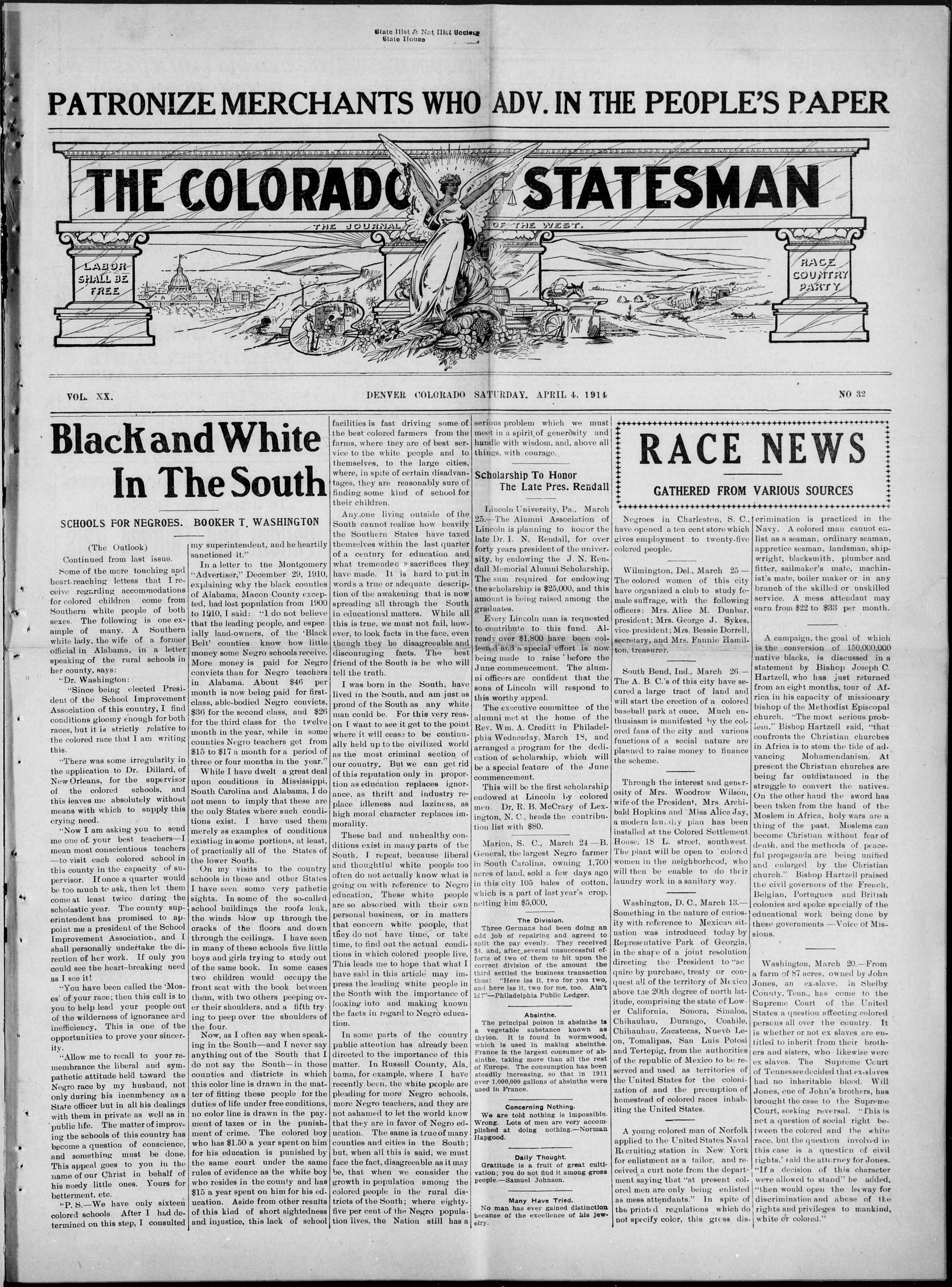
BlackandWhite In The South
SCHOOLS FOR NEGROES. BOOKER T. WASHINGTON
VOL. XX.
Blackam
In T
SCHOOLS FOR NEGROES.
(The Outlook)
Continued from last issue.
Some of the more touching and heart-reaching lettess that I receive regrdring accommodations for colored children come from Southern white people of both sexes. The following is one example of many. A Southern white lady, the wife of a former official in Alabama, in a letter speaking of the rural schools in her county, says:
"Dr. Washington:
"Since being elected President of the School Improvement Association of this country, I find conditions gloomy enough for both races, but it is strictly relative to the colored race that I am writing this.
"There was some irregularity in the application to Dr. Dillard, of New Orleans, for the supervisor of the colored schools, and this leaves me absolutely without means with which to supply this crying need.
"Now I am asking you to send me one of your best teachers—I mean most conscientious teachers—to visit each colored school in this county in the capacity of supervisor. If once a quarter would be too much to ask, then let them come at least twice during the scholastic year. The county superintendent has promised to appoint me a president of the School Improvement Association, and I shall personally undertake the direction of her work. If only you could see the heart-breaking need as I see it!
"You have been called the 'Moses' of your race; then this call is to you to help lead your people out of the wilderness of ignorance and inefficiency. This is one of the opportunities to prove your sincerity.
"Allow me to recall to your remembrance the liberal and sympathetic attitude held toward the Negro race by my husband, not only during his incumbency as a State officer but in all his dealings with them in private as well as in public life. The matter of improving the schools of this country has become a question of conscience, and something must be done. This appeal goes to you in the name of our Christ in behalf of his needy little ones. Yours for betterment, etc.
"P. S.—We have only sixteen colored schools. After I had determined on this step, I consulted
my superintendent, and he heartily sanctioned it." In a letter to the Montgomery "Advertiser," December 29, 1910, explaining why the black counties of Alabama, Macon County excepted, had lost population from 1900 to 1910, I said: "I do not believe that the leading people, and especially land-owners, of the 'Black Belt' counties know how little money some Negro schools receive. More money is paid for Negro convicts than for Negro teachers in Alabama. About $46 per month is now being paid for first-class, able-bodied Negro convicts, $36 for the second class, and $26 for the third class for the twelve month in the year, while in some counties Negro teachers get from $15 to $17 a month for a period of three or four months in the year."
While I have dwelt a great deal upon conditions in Mississippi, South Carolina and Alabama, I do not mean to imply that these are the only States where such conditions exist. I have used them merely as examples of conditions existing in some portions, at least, of practically all of the States of the lower South.
On my visits to the country schools in these and other States I have seen some very pathetic sights. In some of the so-called school buildings the roofs leak, the winds blow up through the cracks of the floors and down through the ceilings. I have seen in many of these schools five little boys and girls trying to study out of the same book. In some cases two children would occupy the front seat with the book between them, with two others peeping over their shoulders, and a fifth trying to peep over the shoulders of the four.
Now, as I often say when speaking in the South—and I never say anything out of the South that I do not say the South—in those counties and districts in which this color line is drawn in the matter of fitting these people for the duties of life under free conditions, no color line is drawn in the payment of taxes or in the punishment of crime. The colored boy who has $1.50 a year spent on him for his education is punished by the same court under the same rules of evidence as the white boy who resides in the county and has $15 a year spent on him for his education. Aside from other results of this kind of short sightedness and injustice, this lack of school
DENVER COLORADO SATURDAY. APRIL 4, 1914
State Hist & Nat Hist Booces
State House
GIANTS WHO
ADC
E JOURNAL
DENVER COLORADO S
facilities is fast driving some of the best colored farmers from the farms, where they are of best service to the white people and to themselves, to the large cities, where, in spite of certain disadvantages, they are reasonably sure of finding some kind of school for their children.
Any one living outside of the South cannot realize how heavily the Southern States have taxed themselves within the last quarter of a century for education and what tremendous sacrifices they have made. It is hard to put in words a true or adequate description of the awakening that is now spreading all through the South in educational matters. While all this is true, we must not fail, however, to look facts in the face, even though they be disagreeable and discouraging facts. The best friend of the South is he who will tell the truth.
I was born in the South, have lived in the South, and am just as proud of the South as any white man could be. For this very reason I want to see it get to the point where it will cease to be continually held up to the civilized world as the most criminal section of our country. But we can get rid of this reputation only in proportion as education replaces ignorance, as thrift and industry replace idleness and laziness, as high moral character replaces immorality.
These bad and unhealthy conditions exist in many parts of the South. I repeat, because liberal and thoughtful white people too often do not actually know what is going on with reference to Negro education. These white people are so absorbed with their own personal business, or in matters that concern white people, that they do not have time, or take time, to find out the actual conditions in which colored people live. This leads me to hope that what I have said in this article may impress the leading white people in the South with the importance of looking into and making known the facts in regard to Negro education.
In some parts of the country public attention has already been directed to the importance of this matter. In Russell County, Alabama, for example, where I have recently been, the white people are pleading for more Negro schools, more Negro teachers, and they are not ashamed to let the world know that they are in favor of Negro education. The same is true of many counties and cities in the South; but, when all this is said, we must face the fact, disagreeable as it may be, that when we consider the growth in population among the colored people in the rural districts of the South; where eighty-five per cent of the Negro population lives, the Nation still has a
serious problem which we must meet in a spirit of generosity and handle with wisdom, and, above all things, with courage.
Scholarship To Honor The Late Pres. Reindall
Lincoln University, Pa., March 25.—The Alumni Association of Lincoln is planning to honor the late Dr. I. N. Rendall, for over forty years president of the university, by endowing the J. N. Rendall Memorial Alumni Scholarship. The sum required for endowing the scholarship is $25,000, and this amount is being raised among the graduates. Every Lincoln man is requested to contribute to this fund. Already over $1,800 have been collected and a special effort is now being made to raise before the June commencement. The alumni officers are confident that the sons of Lincoln will respond to this worthy appeal.
The executive committee of the alumni met at the home of the Rev. Wm. A. Creditt in Philadelphia Wednesday, March 18, and arranged a program for the dedication of scholarship, which will be a special feature of the June commencement.
This will be the first scholarship endowed at Lincoln by colored men. Dr. R. B. McCrary of Lexington, N. C., heads the contribution list with $80.
Marion, S. C., March 24 — B. General, the largest Negro farmer in South Carolina, owning 1,700 acres of land, sold a few days ago in this city 105 bales of cotton, which is a part of last year's crop, netting him $5,000.
The Division.
Three Germans had been doing an odd job of repairing and agreed to split the pay evenly. They received $4, and, after several unsuccessful efforts of two of them to hit upon the correct division of the amount the third settled the business transaction thus: "Here is it, two for you two, and here is it, two for me, too. Ain't id?"—Philadelphia Public Ledger.
Absinthe.
The principal poison in absinthe is a vegetable substance known as thylon. It is found in wormwood, which is used in making absinthe. France is the largest consumer of absinthe, taking more than all the rest of Europe. The consumption has been steadily increasing, so that in 1911 over 1,000,000 gallons of absinthe were used in France.
Concerning Nothing.
We are told nothing is impossible.
Wrong. Lots of men are very accomplished at doing nothing.—Norman Hapgood.
Daily Thought.
Gratitude is a fruit of great cultivation; you do not find it among gross people.—Samuel Johnson.
Many Have Tried.
Many Have Tried. No man has ever gained distinction because of the excellence of his jewelry.
RACE NEWS
Negroes in Charleston, S. C., have opened a ten cent store which gives employment to twenty-five colored people.
Wilmington, Del., March 25 — The colored women of this city have organized a club to study female suffrage, with the following offices: Mrs. Alice M. Dunbar, president; Mrs. George J. Sykes, vice-president; Mrs. Bessie Dorrell, secretary, and Mrs. Fannie Hamilton, treasurer.
crimination is practiced in the Navy. A colored man cannot enlist as a seaman, ordinary seaman, appretice seaman, landsman, shipwright, blacksmith, plumber and fitter, sailmaker's mate, machinist's mate, boiler maker or in any branch of the skilled or unskilled service. A mess attendant may earn from $22 to $33 per month.
A campaign, the goal of which is the conversion of 150,000,000
South Bend, Ind., March 26. The A. B. C.'s of this city have secured a large tract of land and will start the erection of a colored baseball park at once. Much enthusiasm is manifested by the colored fans of the city and various functions of a social nature are planned to raise money to finance the scheme.
Through the interest and generosity of Mrs. Woodrow Wilson, wife of the President, Mrs. Archibald Hopkins and Miss Alice Jay, a modern laundry plan has been installed at the Colored Settlement House, 18 L. street, southwest. The plant will be open to colored women in the neighborhood, who will then be enable to do their laundry work in a sanitary way.
Washington, D. C., March 13. Something in the nature of curiosity with reference to Mexican situation was introduced today by Representative Park of Georgia, in the shape of a joint resolution directing the President to "acquire by purchase, treaty or conquest all of the territory of Mexico above the 20th degree of north latitude, comprising the state of Lower California, Sonora, Sinaloa, Chihauhau, Durango, Coahile, Chihauhau, Zacatecas, Nuevo Leon, Tomalipas, San Luis Potosi and Tterepig, from the authorities of the republic of Mexico to be reserved and used as territories of the United States for the colonization of and the preemption of homestead of colored races inhabiting the United States.
---
A young colored man of Norfolk applied to the United States Naval Recruiting station in New York for enlistment as a tailor, and received a curt note from the department saying that "at present colored men are only being enlisted as mess attendants." In spite of the printed regulations which do not specify color, this gross dis
NO 32
crimination is practiced in the Navy. A colored man cannot enlist as a seaman, ordinary seaman, appretice seaman, landsman, shipwright, blacksmith, plumber and fitter, sailmaker's mate, machinist's mate, boiler maker or in any branch of the skilled or unskilled service. A mess attendant may earn from $22 to $33 per month.
A campaign, the goal of which is the conversion of 150,000,000 native blacks, is discussed in a statement by Bishop Joseph C. Hartzell, who has just returned from an eight months, tour of Africa in his capacity of missionary bishop of the Methodist Episcopal church. "The most serious problem," Bishop Hartzell said, "that confronts the Christian churches in Africa is to stem the tide of advancing Mohamendanism. At present the Christian churches are being far outdistanced in the struggle to convert the natives. On the other hand the sword has been taken from the hand of the Moslem in Africa, holy wars are a thing of the past. Moslems can become Christian without fear of death, and the methods of peaceful propaganda are being unified and enlarged by the Christian church." Bishop Hartzell praised the civil governors of the French, Belgian, Portugues and British colonies and spoke specially of the educational work being done by these governments —Voice of Missions.
Washington, March 20.—From a farm of 87 acres, owned by John Jones, an ex-slave, in Shelby County, Tenn., has come to the Supreme Court of the United States a question affecting colored persons all over the country. It is whether or not ex slaves are entitled to inherit from their brothers and sisters, who likewise were ex slaves. The Supreme Court of Tennessee decided that ex-slaves had no inheritable blood. Will Jones, one of John's brothers, has brought the case to the Supreme Court, seeking reversal. "This is not a question of social right between the colored and the white race, but the question involved in this case is a question of civil rights," said the attorney for Jones. "If a decision of this character were allowed to stand" he added, "then would open the leavway for discrimination and abuse of the rights and privileges to mankind, white or colored."
NEWS TO DATE IN PARAGRAPHS
CAUGHT FROM THE NETWORK OF WIRES ROUND ABOUT THE WORLD.
DURING THE PAST WEEK
DURING THE PAST WEEK
RECORD OF IMPORTANT EVENTS
CONDENSED FOR BUSY
PEOPLE.
Western Newspaper Union News Service.
Violent earthquake shocks were recorded by the United States magnetic observatory eleven miles east of Tucson, Ariz.
The meeting at Lincoln, Nebr., of the two rival Republican state committees in an effort to obtain harmony failed to effect a union.
Nine persons are in a hospital and two other injured were sent to their homes, the result of a collision between Halsted and Archer street cars in Chicago.
Seaboard Air Line train No. 2, known as the Northern Express, from Jacksonville Fla., was held up and the express car robbed of $40,000 by a lone bandit at Columbia, S. C.
Ohio mine operators stood firm and 500 coal mines, employing approximately 50,000 men, suspended operations because of the failure of the miners and operators to reach a new wage scale agreement.
The Mississippi valley suffrage conference opened for the third annual meeting in Des Moines, Ia., with several hundred woman suffragists, including some of the most prominent leaders in the movement, in attendance.
Police Chief Ed Holler of Terre Haute, Ind., was sent to jail for thirty days for contempt of court. Judge Fortune enforced a suspended sentence of thirty days and $100 fine for contempt, held up recently following an apology by Holler.
Adolfo Padilla, charged with killing his wife by cutting her throat with a razor, was dragged from the county jail at Santa Fe, N. M., by a mob of twenty masked men, his hands and throat slashed with sharp knives, his lungs punctured with stab wounds, and left lying in the street in front of the jail.
Plans for the Illinois building at the Panama-Pacific exposition were adopted unanimously by the State Art Commission at Chicago. They call for a three-story structure with a frontage of 136 feet and a depth of 96 feet. The cost is estimated at $90,000. From $18,000 to $20,000 will be expended for furnishings.
The commission appointed by President Wilson to visit the Antipodes and the Orient in behalf of the Panama-Pacific international exposition, reported by cable from Shanghai to the exposition directors that Siam has accepted an invitation to participate, and that Prince Rajani has been appointed commissioner.
With nearly 20,000 votes cast, 4,000 more than ever before, Mayor James R. Hanna and Councilman Joseph I. Myerly were returned to the city hall for two years more at the city election under the Des Moines, Ia., plan of city government. The Business Men's Association elected one candidate, W. F. Mitchell, and the labor unions one man, J. M. Leonard. Fred German, a Bull Mooser, is the fourth man.
WASHINGTON.
Miss Eleanor Wilson, who is to be the fourteenth White House bride, is the creator of a new fashion fad. Her idea is a corsage bouquet of hothouse flowers which match the artificial flowers on her hats.
Well-defined reports in diplomatic circles said that Ambassador Jusserand, who has been the representative of France in this country for the last eleven years, and who is the dean of the diplomatic corps in Washington, may be transferred to London.
An order suspending until July 30 the tariffs filed by Western railroads, increasing class and commodity rates to Utah common points from Chicago. Missouri river and Mississippi river territory, has been issued by the Interstate Commerce Commission.
The Panama canal entered upon another phase of progress when civil government was established on Uncle Sam's ten-mile strip from ocean to ocean. Col. George W. Goethals, who as chief engineer during construction of the big ditch has been autocrat of its administration, is to be civil governor. Ever since the United States undertook building of the zone, it has been technically under military rule.
The House of Representatives, after one of the most spectacular legislative struggles in the history of the nation, voted to repeal the provision of the Panama Canal Act exempting American vessels from the payment of tolls. The vote on the repeal bill was 247 to 161, a majority of 86 votes in support of the personal plea of President Wilson.
Youssouf Zia Pasha, the Turkish ambassador who has represented his government in Washington since June 14, 1910, is to be transferred soon to another capital
FOREIGN.
Sir Hubert von Kerkomer, famous artist, died in London, aged sixty-five. An attempt was made to assassinate Jose Santos Zelaya, former president of Nicaragua, at Casa Torres, where Zelaya resides. Vice Admiral Wa Matsumoto, formerly in command of the Kuro naval station, who was arrested at Tokio in connection with the naval scandals, will be courtmartialed. The dowager empress Haruko, who is suffering from angina pectoris, continues in a serious condition at the imperial villa at Numazu, a watering place southwest of Yokohama, it was announced. Court physicians are in attendance.
At Juarez, General Carranza said that while there was every reason to hope for the early capture of Torreon, the town had not yet fallen, and that the positions of the troops have not materially changed in the twenty-four hours ending Tnuesday night.
A mysterious cargo of 300 tons of rifles, supposed to be intended for Ireland, disappeared from the vicinity of the Danish island of Langeland during the night after an embargo had been placed on it by the authorities at Copenhagen, Denmark.
The establishment of a federal system of government for the British isles was suggested to the House of Commons by Sir Edward Grey as a solution of the home rule difficulty. The suggestion was received with great attention by the House, which was engaged in debate on the second reading of the home rule bill.
How five members of the crew of a National Railways train were tortured and killed and three terribly injured by rebels was told in Mexico City in a report in the hands of the railroad officials. The report was sent in by Daniel M. Mier, the only survivor of the train crew. He said one of his comrades was killed by a rebel officer who felled his victim with the butt of a rifle and then dropped huge stones upon his head.
SPORT.
Jack Britton of Chicago won from Leo Kelly, a St. Louis lightweight, after eight rounds of tame boxing at St. Louis. Giving its capital stock as $800,000 the Federal Baseball Club of Brooklyn filed articles of incorporation with Secretary of State May of New York. That John T. Connery, coal dealer, and his associates, will gain control of the Chicago Cubs within ten days for about $800,000, was the statement made in Chicago. Captain Reinhardt, a passenger on a biplane, was killed at Strasburg, Germany, when in making a landing the aviator tried to avoid a collision with a monoplane and capsized. The Oakland team of the Coast League has purchased Clinton Prough, a pitcher, from the Chicago Americans. Prough was a star performer in the Southern League last season.
Willie Ritchie, light weight champion of the world, left Chicago for Glenwood Springs, Colo., for a week's rest. He is expected to stop over a short time in Denver on his way to the mountain resort.
GENERAL
Governor Adolph O. Eberhart announced his candidacy for re-nomination on the Republican ticket at the primaries June 16 for governor of Minnesota.
Sub-marine K-6 was successfully launched at Quincy, Mass. She was christened by Mrs. Ethel Roberts, wife of Lieutenant T. G. Roberts, a United States naval constructor.
Chicago, in 1912, granted more than five times as many divorces as London, notwithstanding the fact that London's population is more than three times that of the Windy city.
Sight has been restored to David Kane, three months old, of Baltimore, Md., through an operation by which the cornea of the eye of a pig was grafted on one of the boy's sightless eyes.
Charged with having stolen $20,000 in two registered packages being sent to a New York banking house from St. Paul, William R. Baum, a Harrisburg, Pa., postoffice clerk, was placed under arrest.
Exceptions to 186 suits demanding $160,000,000 damages against the American Sugar Refining Company and Jackson T. Witherspoon, local manager of the company, were filed in the Federal Court at New Orleans, La.
Denying with great heat that she wasted the money of the thousands who trusted Henry Siegel's bank in society climbing, denying that she ever worked for Siegel and bitterly denouncing him as faithless even to his family, Mrs. Marie Vaughn Siegel of New York, through her attorneys, issued a statement to the public. She purported to tear the veil from Siegel's operations and to show up the former merchant prince as a king of confidence men.
J. Eades How, "millionaire hobo," and founder of the Brotherhood Welfare Association, has written to Alexander Law, secretary of the association, it was announced in New York, that he is arranging with his followers for a national demonstration at Washington on May 1 in connection with Coxey's army.
Chief of Police Long detailed detectives to investigate reports that a child resembling Catherine Winters, kidnaped from her home in Newcastle, Ind.. a year ago, may be in a gypsy camp near Newark, N. J.
STATE NEWS
OF INTEREST TO ALL
COLORADO
PEOPLE
Western Newspaper Union News Service.
DATES FOR COMING EVENTS.
April 9.—General Irrigation Conference
at Denver.
May 12-14 - State Council of Junior
American Mechanics, at Colorado
Springs
May 14-16—Race Meet, Durango
Denver
July 7-11—Race Meet, Pueblo
July 9—Cherry Pie Day, Manzanola.
July 13—14-14. Grand Lodge Session, B.
F. O. Elks at Denver.
July 22-23—Cattlemen's Day, Gunnison.
Aug. 18-21 — Prowers Co. Fair, Lamar.
Aug. 25-28 — Bent Co. Fair, Las Animas.
Aug. 27 — Santa Fé Trail Day, Las Animas.
Sept. 1-4. Arkansas Valley Fair, Rocky Ford.
Sept. 3. Watermelon Day, Rocky Ford.
Sept. 2-5. Farmers' and Stockmen's Burlington.
Sept. 1-4. Morgan Co. Fair, Fort Morgan.
Sept. 1-4—Larimer Co. Fair, Loveland.
Sept. 8-11—Crowley Co. Fair, Sugar
Rain.
Sept. 10—Sugar Day, Sugar City.
Sept. 14—Colorado State Fair at Pueblo.
Sept. 14-19—Colo, State Fair, Pueblo.
Sept. 19-26—Race Meet, Denver.
Sept. 22-25—Western Slope Fair, Montrose.
Sept. 22-25—Trinidad Fair, Trinidad.
Sept. 23-26—El Paso Co. Fair, Calhan.
Sept. 28-20—Inter-County Fair and Race Meet, Limon.
1915—Last Grand Council of North American Indians at Denver.
The President nominated Edward H. Krutchen postmaster at Flagler.
The San Luis valley faces one of the most prosperous years in its history, with heavy crops and apparently the best prospects for satisfactory market conditions.
Plans for three new Denver apartments, to cost approximately $105,000, have been completed by Denver real estate men and work on one of the structures has been started.
Mrs. Elizabeth McLaughlin, well-known resident of Lincoln, Neb., died suddenly of pneumonia in Denver at the home of her son, Charles E. McLaughlin, whom she was visiting.
Oscar H. Hill, a painter, is suing William M. McNulty, a retired ranchman, for $20,000 damages in the District Court at Colorado Springs, charging alienation of Mrs. Hill's affections.
Advices from the chief of police of Pueblo declare that a band of gypsies headed by Fred Burro left there recently for New York. With them was a child the Pueblo police suspected was Catherine Winters.
Mrs. Alberta Revell, whose husband is in the state militia and on guard duty in the southern strike field, was sentenced by Judge Butler in the West Side Court of Denver to a term of from one to one and one-half years in the penitentiary on her plea of guilty of forgery.
Lodgepole pine, of which there are abundant stands in Colorado and Wyoming, when treated with preservatives ought to serve in the place of red cedar as a pole timber, says the Department of Agriculture in a bulletin just issued on Rocky mountain woods for telephone poles.
Plans for the remodeling of the Denver union depot and the construction of new yards, trainsheds and electric interlocking plant have been approved and were given to the public. The new project will require the expenditure of $4,000,000 and will give Denver one of the finest stations in the West.
Mrs. Carl Heinrich, wife of the manager of the Social Turner hall of Denver, was carried out of the burning building when fire practically destroyed the structure. Mrs. Heinrich was asleep in her apartment on the second floor of the building and was almost suffocated when Truckman Kitterman rescued her.
J. Ogden Armour, head of the great Armour packing interests and allied industries, while in Denver made a statement of capital importance regarding the opportunities of Denver and its territory for development—that "Denver is the center of a territory with the greatest growth ahead of it of any part of the country."
The output of the mines of the Cripple Creek district for the month of March totaled 79,505 tons, with the gross bullion value of $1,121,380.40. The average value per ton of all ores treated was $19.10. As compared with the preceding month an increase obtains of 8,212 tons and $132,803 in valuation. The average value of ore per ton also shows the slight increase of 28 cents per ton.
Miss Hazel Ruch, young and attractive, known in Denver as a "woman of mystery," was arrested in Evanston, Wyo., on a charge of forgery after she had been traced through three states by members of a detective agency. Immediately after her arrest she attempted to end her life by drinking carbolic acid. Quick action by detectives, who knocked the bottle containing the acid from her hand, prevented her from succeeding. Miss Ruch is wanted in Salt Lake City, Cheyenne and Laramie for forging the name of Miss Nellie Smith of Boulder, Colo., to three checks and obtaining more than $200.
Preliminary negotiations to determine whether the city of Denver is willing to purchase the Denver Union Water Company's plant at the amount of its bonded indebtedness, $11,200,000, will be conducted by a committee appointed at a meeting of bondholders
Estes Park will be the scene this summer of the national convention of the Kappa Kappa Gamma sorority, according to an acceptance received at Boulder by the Beta Mu chapter of the University of Colorado of its invitation extended to the grand council a year ago.
COLORADO RANKS FIRST
IN PRODUCTION OF LUMBER FROM LODGEPOLE PINE.
In 1912, Colorado Produced 11,697,000
Feet Out of a Total of 22,030,000.
According to Census Bureau.
Western Newspaper Union News Service.
Denver.—Colorado ranks first in the production of lumber manufactured from lodgepole pine according to a report just issued by the bureau of the census for the year 1912. The total production of lodgepole pine lumber in 1912, as shown by the report, was 22,050,000 board feet, of which Colorado produced 11,697,000 feet, of fifty-three per cent. The other five states producing lodgepole pine lumber were Wyoming, Montana, Idaho, Utah and Oregon, in the order given.
Although Colorado ranks thirty-fifth in total annual production of all species throughout the United States, the state takes first place in the output of lumber from lodgepole pine, sixth from douglas fir, sixth from white fir, eighth from western yellow pine, and tenth from spruce. The total output of all species in the state was 88,151,000 board feet, as reported by 155 active mills, divided as follows: douglas fir, 2,816,000 board feet; white pine, 1,500,000; spruce, 19,301,000; western yellow pine, 51,732,000; white fir, 1,145,000; lodgepole pine, 11,697,000; and cottonwood, 260,000 board feet. Included in the state's output were 4,975,000 laths and 265,000 shingles.
The total 1912 production of lumber, lath and shingles in the United States, as shown by reports from 29,648 mills, was over thirty-nine billion board feet.
Oddie Will Attend Irrigation Meeting.
Denver. — Governor Ammons received letters from Gov. George W. P. Hunt of Arizona and Gov. L. B. Hanna of North Dakota informing him that fifteen delegates from Arizona and two from North Dakota have been appointed to attend the irrigation conference to be held in Denver on three days beginning April 9. The two executives say that they themselves will be unable to attend the meeting. Governor Oddle of Nevada will attend, according to another letter received by Governor Ammons.
Stratton Property in Mine Merger.
Denver.—That the big mining properties of the Stratton estate at Cripple Creek are to be included in the proposed Golden Cycle-El Paso consolidation is the information received from Tyson S. Dines, who is now in Paris. Dines is a member of the board of trustees of the Stratton estate. The estate's holdings include 700 acres of land adjoining some of the biggest producers in the district. Before his death, Stratton estimated that this group should be worth $25,000,000.
Escaped Convict Held as Assailant.
Trinidad.—James Mackley, an escaped convict from the Cañon City penitentiary, and Charles and Nicholas Cronin, brothers, were placed in jail here and the Trinidad police believe that they are the men implicated in the assault on W. M. Williams, a lumber dealer, who was attacked in his office, robbed, and almost beaten to death. A detail of state troops and the sheriff made the arrests on the strength of a statement made by Williams.
Soldiers Who Killed Miner Released.
Trinidad.—Members of the detail of militiamen who shot and killed James Johnson, a negro miner who had shot and seriously wounded Marshal Clinton Robinson of Hastings and then fled to the hills, were exonerated by the coroner, who investigated the affair. Johnson opened fire on the soldiers when surrounded. Six men arrested near the place where Johnson was killed, said to be strikers, are still being held by the military authorities.
Woman Is Stabbed With Shears.
Denver.—Wielding a long pair of scissors, Luigi Conferti, 28, an Italian, twice stabbed and probably fatally injured Mrs. Eve Bianco, a pretty Italian woman, in the workshop of a millinery establishment operated by her.
La Junta Elks as Minstrels.
La Junta.—The members of La Junta lodge of Elks have started rehearsals for their big minstrel which will be given at the new Rourke opera house, April 21 and 22.
Boulder Mining Men Hold Meeting.
Boulder.—The Boulder County Chapter of the Colorado Metal Mining Association was organized here at a meeting attended by about 150 mining men from all parts of the county.
Palisade.—The Rev. W. H. Clark of San Diego, Calif., has been called to the Presbyterian church in this city.
To Develop Paradox Valley Mines.
Grand Junction.—R. L. Pomeroy of Denver announced here that a syndicate had been organized by Denver and eastern capitalists to develop the radium fields in western Colorado. For several months the company has been acquiring land in the Paradox valley and in the Henry mountains. Pomeroy said the company would establish a refinery in Grand Junction or at Hanksville in the Henry mountains. Headquarters are to be established here and a big force of men put to work.
The OLD RELIABLE EAST END DINING ROOM AND RESTAURANT
2345 LARIMER STREET, DENVER, COLORADO
Colorado Wall Paper & Paint Company
WALL PAPER, PAINTS OILS AND GLASS Interior and Exterior Decorators. We Do House Painting. Coach Colors, Paints and Varnishes. Agents John W. Masury & Sons. Phone Main 871 728 W. Colfax, foot Welton St. Denver
In All the Latest Novelties TORREY'S MILLINERY 2647 WELTON STREET, DENVER, COLO.
Paper Dollar Bar
STEVE TODOROFF and RAY BRONSON, Proprietors Fine Wines, Liquors and Cigars 1038 NINETEENTH STREET Corner Nineteenth and Arapahoe Streets, DENVER, COLORADO
Jones' Restaurant
I Am Headed That Way, Where I Get the Cleanest, Best and Most Wholesome Food, Which Gives You that Round, Comfortable, Contented Feeling
2236 LARIMER STREET, DENVER, COLO.
The Denver Paste
J. W. BEACH
Phone Main 5277 1855 Ara,aloe Street
DENVER, COLORADO
SPECIAL BRUSHES MADE TO ORDER
Headquarters for All Kinds of Brushes and Janitor Supplies SAM FRANCIS, Mgr. DENVER BRUSH FACTORY Branch 1408 Curtis St. Champa 770 418 Fifteenth St
B
D
S
DAVID
2345 LARIMER
J. R. DRESSOR
Colorado
Paint
WALK
OILS
Interior and B
Painting. Co
Agents John W
728 W. Colfa
YOU ARE
To Ins
Pattern
In All
TORRI
2647 WELTO
'Phone Champa 1156
Paper
STEVE TODOR
Fine Wine
```markdown
```
BREAKFAST from 6 to 8:30
DINNER from 12 to 2:30
SUPPER from 5:30 to 7:30
Furnished Rooms in Connectio
AFRO-AMERICAN CULLINGS
The American Missionary association is making a strong effort to raise $1,000,000.00 for the partial endowment of the following colleges: Fisk, Talladega, Tougaloo, Straight and Tillotson, for the education of our people in the south, writes Booker T. Washington. They are concentrating particularly on Talladega at present.
I wish people might realize how farreaching the work of these colleges is in the development of the civilization of our country. I am constantly traveling throughout the South and other sections of our country, and wherever I go I meet strong men and women who have been educated at one of these institutions. The men and women from these colleges are succeeding as teachers and leaders in nineteen other occupations. Many of the strongest men in the pulpits of the large denominations, such as Methodist and Baptist, have been educated at one of these institutions. But for the presence and influence of such educated men and women it would have been impossible for us to maintain peace and order between the white and black people in the South during all these years.
If anyone wants to help in changing the attitude of the white people in the South toward the education of the colored people, he cannot do it in a more effective way than by contributing toward the endowment of these five leading colleges for our race in the South.
It was my privilege recently, through an invitation, to attend the meeting of the executive committee of the American Missionary association, and I have never met a body of men who were more unselfishly devoted to the welfare of the South than is true of these committeemen. I very much hope the appeal which they are making to the public will meet a hearty response.
Those cities which have a large colored population show high death rates. It has long been known as a scientific fact that the mortality among the negroes is greater than among whites, and the returns from the various states and cities demonstrate this fact. For instance, while the death rate in Portland, Ore., is but 11.0, in Richmond, Va., it is 22.4; in Birmingham, Ala., 20.4; in Atlanta, Ga., 19.3; in New Orleans, La., 21.3, and in Baltimore, Md., 19.4. Here in Washington, where one-third of the population is colored, the death rate is 17.5, and in 1911 it was as high as 18.9. These figures for the national capital are more significant when it is remembered that conditions are vastly different from those prevailing in such industrial centers as Pittsburgh, Cleveland and Detroit, where the danger from violent death in the mills and factories is a feature to be reckoned with. Here there are no factories and death from accident is much rarer than in cities such as those named.—Washington Star.
Coal is by far the most important mineral product of India. The value of the output of the coal fields in 1912 reached a total of $16,088,374, which represents an advance of more than 32 per cent.
But it's better to be born great than it is to thrust yourself upon greatness.
Chinese bought 1,000,000 Bibles the first six months of this year.
For thirty years a work for colored mothers has been maintained under many difficulties at Haddonville, N. J., under the auspices of the Woman's Christian Temperance Union. Mrs. Isabel Shipley is the superintendent, and has succeeded in bringing a great deal of comfort into the lives of working women of the colored race who have homes dependent upon them. These mothers are brought together in cheerful meetings and both helped and taught to better their lot. Arrangements are made to assist them in their necessary purchases and to help them in their earnings. This winter the work has been extended to take in a larger district, the need being great. Mrs. Shipley found herself confronted with many pleas for a larger circle of those who could enjoy the benefits of these mother-meetings, and in the face of the heavily increased expense has undertaken to meet the call. These helpful meetings are but one line of the excellent work among colored people conducted under Mrs. Shipley's direction.
There are some 60,000 Asiatics employed on British ships.
A strange instance of freak memory is recorded in the case of a servant girl in a Scottish manse. She was almost illiterate, yet, when delirious in fever, surprised those around her by repeating long passages of the Bible in Hebrew. The kitchen where the girl spent her evenings adjoined the minister's study. He was accustomed to read aloud. The girl had not understood or consciously taken heed of the reading, yet her mind had seized upon and stored the phrases.
Hard to please—The stage villain.
In an address before the Wabash Avenue Y. M. C. A., former Governor Charles S. Deneen of Illinois, reviewing the negro's activities in this country during the half century of his freedom, told the exact truth when he said that the record was one of which no member of the race need be ashamed. The sudden stepping from a "paternal and protective" condition, where the negro was entirely a dependent and his individual efforts were repressed to the utmost by the very nature of his condition, to a status of freedom made his problem an unusually difficult one.
When to the normal difficulties of such a condition were added the natural race prejudice which existed and still exists, and the bitter prejudices engendered of four years of bloody civil strife, it is plain enough that the negro's problem was one of the hardest that history records. Thus, however, is the negro's record summarized by Mr. Deneen:
"It was under these adverse conditions that the negroes of the United States began their uphill struggle for industrial independence. Fifty years have elapsed since that time; a very brief period in the calendar of racial or national progress, and yet in that time I think it can safely be said that the advancement made has been something which the American people, and those of your own race in particular, may well be proud."
The conclusion reached by Mr. Deneen is that the negro has "made good." That must be the conclusion of every unbiased observer. This fact gives promise that, despite noisy and offensive agitators among the whites and the impulsive and frequently ill-timed and ill-judged utterances of some negro leaders, we shall ultimately reach a solution of the "race problem" through the fairness and tolerance of the majority of the dominant race and the industry and continued usefulness and progress of the great majority of the negroes.—Chicago Inter Ocean.
Addressing an audience of 500 negroes at Chicago, Judge Orrin N. Carter pointed out the real and gratifying progress made by the negro in America since the Civil war and, commenting upon the future of the race, said:
"The future is largely in your own hands and must be provided for by education. It depends upon both the white and colored races if the Emancipation Proclamation is fully carried out."
It is true that education is usually a solvent of prejudice. In that sense education is an excellent thing for the negro. Education to a certain degree is absolutely requisite. The negro should be able to read and write, should know commercial arithmetic and should have a fair knowledge of things in general.
It is doubtful, however, whether what is commonly known as "higher education" will prove an unmixed blessing to the negro. One of the unhappiest persons in the world is the average highly educated negro. By superduction he acquires a contempt for the ordinary activities of his race and the prejudice which still unhappily prevails prevents him from mingling upon terms of equality with the dominant white race, in which he would find in larger numbers his intellectual and cultural equals. There are exceptions to this rule, but their number is exceedingly small.
Colored teachers of the District of Columbia public schools formed an organization looking to obtain closed relations between these educators. Officers were elected at the meeting, which was held in the colored Y. M. C. A., as follows: R. A. Gillen, president; Miss May Cromwell, vice-president; Miss Helen Moore, recording secretary; Miss Julia H. Smith, corresponding secretary, and Miss N. E. Gibbs, treasurer. A. U. Craig, Robert Mattingly, Miss Zela Dyson, Miss L. G. Arnold and J. L. Chestnut were appointed a committee to frame a constitution and by-laws.
The Italian supreme court has refused to allow Signorina Teresa Labriola to practise law in the country on the grounds that a woman cannot do anything in public life without the consent of her husband, and if she were allowed to practise law her husband might withdraw his consent.
As an additional safeguard against icebergs one transatlantic passenger steamer is carrying a 72,000 candlepower searchlight with an effective range of five miles.
The Texas owner of a large dairy herd believes he is the only man in the United States who cultivates the prickly pear, raising a 600-acre field of it annually and feeding his stock the pods after removing the thorns.
The Swiss silk industry consists at present of more than 80 mills, nearly all of which are in the vicinity of Zurich. There are 14,000 looms in operation, and about 25,000 workers, chiefly women, are employed in this industry, earning from 60 cents to $1.20 a day.
TORREON TAKEN BY VILLA'S MEN
FHOUSANDS ARE DEAD IN CITY'S STREETS AFTER A MOST TERRIFIC BATTLE.
ELEVEN DAYS FIGHTING
REBEL CHIEF ADMITS 500 SLAIN
1,500 WOUNDED; DEFENDERS'
LOSS ABOVE 2,000 MEN.
Western Newspaper Union News Service.
Villas' Fight for Torreon.
The battle of Torreon ended Thursday night with victory by the Mexican rebel forces under command of General Francisco Villa. It was the most terrific in the modern history of Mexico. Fighting continued incessantly for days. About 12,000 rebels attacked the city, which was defended by 8,000 federalis, the best of Huerta's army under General Velasco. The rebels were repulsed in the first battle of Palacio, the main outpost of Torreon, but returned to the attack.
After desperate fighting, Gomez Palacio, Lerdo and several smaller towns were taken. Then the attacker wounded him and Villa estimates his own casualties at 500 dead and 1,500 wounded, but says the federal losses are far greater. He estimates the capture of many prisoners and the pursuit of the retreating federals.
Torreon is regarded as the key to Mexico City and the last important obstacle in the path of the rebels in the march toward the capital of Mexico.
Juarez, Mex., April 3.—Torreon fell completely into the hands of the rebels last night, according to announcements made here by General Veniantiano Carranza.
Latest reports direct from Gomez Palacio, declare the streets of Torreon are choked with dead and wounded. Some of the federals who had been fighting on the outskirts of the town fled, but a large number of prisoners who had been defending the barracks and street barricades were captured. The rebel soldiers were exhausted with fighting and when it became known that the enemy had been routed most of them fell asleep in the streets wherever they were:
The first news was conveyed in the following official dispatch from General Villa to his chief:
"Torreon, Coahulla, Mexico, April 2.—General Venustiano Carranza, Supreme Chief of the Constitutionalists: In this moment the remnants of the fedelals are leaving Torreon in flight. After eleven days of terrible fighting, in which we lost 1,500 wounded and 500 killed, and the fedelals, from the enormous number of bodies burned must have had over 1,000 killed, and their number of wounded I am unable to estimate. Our forces have full possession of Torreon. I regret to announce that among the wounded were General Ysabel Robles and General Calixto Contrasa. I congratulate and salute you with respect and esteem that I have always had for you.
"GENERAL FRANCISCO VILLA.
"Commander in Chief, Constitutional
ist Forces in Chihuahua."
Envoy Lind Returns to United States.
Envoy Lind Returns to United States
Washington. — John Lind, former
governor of Minnesota, and for the
last eight months President Wilson's
personal representative in Mexico,
sailed from Vera Cruz for Washington
aboard the presidential yacht Mayflower.
Nominated by President:
Washington. — President Wilson nominated William Woodburn, Jr., of Reno, Nev., United States attorney for Nevada.
RESERVE BANK CITIES NAMED
Colorado Goes in Region Ruled by Kansas City.
Denver.—Coincident with the announcement of the selection of twelve reserve bank cities news was brought here that Denver, while not one of the regional centers, will be chosen as a branch city.
Under the division announced by the reserve organization board, Denver and all of Colorado are included in the territory of Kansas City, which is one of the reserve centers. Besides Kansas City, regional banks will be located in New York, Boston, Philadelphia, Chicago, Richmond, Va., Minneapolis, St. Louis, Atlanta, Dallas, Cleveland and San Francisco.
Gov. McDonald Gets Blackhand Note.
Santa Fé, N. M.—A blackhand letter was received by Gov. William C. McDonald in which the executive is threatened with death and in which the writer also declares that the executive mansion and the capitol will be blown up with dynamite within the next thirty days.
Miss Tyler Loses Job.
Washington.—After serving sixteen years as postmistress at Courtland, Va., Mattie R. Tyler, granddaughter of John Tyler, tenth president of the United States, was dropped from the rolls by the Postoffice Department.
Indicted for Killing Teacher
Little Falls, N. Y.—Jean Glanini, who is held in jail at Herkimer on a charge of murdering his former school teacher. Miss Lida Beecher, was indicted for the crime by the Herkimer county grand jury.
50,000 MINERS ARE LOCKED OUT
DHIO OPERATORS WILL NOT OPEN COLLIERIES UNTIL AN AGREEMENT REACHED.
BOND ASKED BY UNION
DEMAND PROTECTION FOR THE AMOUNTS DUE THEM IN CASE THEIR EMPLOYERS FAIL.
Western Newspaper Union News Service.
Columbus, Ohio, April 2.—Ohio bituminous coal mines will not resume operations today after the holiday celebrating the eight-hour day anniversary according to operators of this city.
The operators said they had decided to stand by their decision to suspend operation until a new wage scale is agreed upon.
No attempt has been made thus far by either side to effect a new working agreement, the fifty thousand miners having signified their intention to mark time until the results of their referendum vote is known.
The miners in some districts may carry out their intentions of reporting at their usual places of employment as if no differences existed with their employers. Action of this sort, the miners pointed out, would emphasize their willingness to continue under the old wage scale pending the outcome of their referendum.
Threaten to Shut Mines.
Philadelphia.—The miners and operators of the central Pennsylvania bituminous field continued their conference here April 1 in an effort to agree on a new working agreement to take the place of the one that expired April 1. The operators have notified their superintendents to shut down the mines if an agreement is not reached.
Will Seek Arbitration.
Colliers, W. Pa.—It was announced that Governor H. D. Hatfield of West Virginia has asked the striking miners formerly employed by the West Virginia Pittsburg Coal Company and officials of the company to name representatives on a board of arbitration which will consider means for ending the strike, which has been in progress since last September.
Miners Demand Bond.
Peoria, Ill.—Illinois miners decided to ask the mine operators to furnish a bond to the local unions before any miner is allowed to enter the mines as a workman. The bond will be as large as the payroll of the various companies throughout the state. Several large operators, when informed of the plan, declared that they would flatly refuse to furnish any bond. Secretary McDonald issued orders to different parts of the state for the miners to remain at work.
Tolls Fight Reopened in Senate.
Washington.—The Panama tolls controversy, surpassing in interest any problem that has absorbed the attention of Congress in recent years, was transferred to the Senate from the House, where the Sims bill repealing the toll exemption clause of the Panama canal act was passed by the vote of 247 to 162. The measure's appearance was accepted as the signal for the beginning of one of the most protracted and complicated contests the Senate ever has faced.
Policewomen for Pittsburg.
Pittsburg, Pa.—C. H. Hubbard, director of public safety, announced the appointment of four policewomen, the first in Pittsburg.
REBELS CHECK TORREON RELIEF
Villa Continues Battle and Heavy Fighting Reported From Besieged Town.
Juarez, Mex., April 2.—Federal reinforcements under Gen. Joaquín Maas, hurrying to Torreon to relieve General Velasco's men, were intercepted twenty-eight miles southeast of Torreon, along the line of the Mexican Central railroad, by Gen. Monclovio Herrera's brigade of rebels.
A battle in the narrow cañon of Picardias was in progress between the reinforcements and Herrera's men and there were heavy losses on both sides.
There are 3,000 men in the Federal command and Herrera has less than 2,000 rebels with which to hold them back.
Advices from Gomez Palacio say 3,000 men of the Federal garrison in Torreon succeeded in escaping from the city and that Villa now is fighting a mere remnant of the force of 8,000 which originally opposed him.
Heavy fighting was in progress at Torreon, according to a 1,000-word report received by General Carranza from General Villa.
Hostilities Continue In Haiti.
Washington.—Continued rebel activity in Haiti was reported by Lieutenant Commander Bostwick on the gunboat Nashville. The town of Hinche has been reoccupied by the government. Former Senator Theodore's forces are at Ouinaminthe.
Miss Cudahy to Be Nurse.
Boston.—Miss Helen Cudahy, daughter of Patrick Cudahy, a wealthy Milwaukee packer, entered the training school for nurses at the Massachusetts general hospital.
OPEN FOR New Dining Room in Connection to Keystone Social Club. Nothing like it ever attempted in Denver. Strictly home cooking. Lowest prices for best quality of food. Eastern corn-fed meats. Your patronage solicited.
SHORT ORDERS AT ALL HOURS
Syl. Stewart Manor
Pampa St. Phone Champa 3543 Denver
JOHN
Rock & Engstro
WHOLESALE DEALERS IN
Wines, Liquors and
Cigars
for Minneapolis Grain Belt Beer and Carnegie
Imported Beer and Bock Ol.
644-46-48-50 Larimer Street
1053 Denver
ALL KINDS OF REPAIR WORK NEATLY DO
REFINISHING A SPECIALTY.
Welton Street Furniture
F. R. LINDENMIER, Prop.
2619 WELTON STREET
Second Hand Furniture Bo
and Exchanged
We Pay the Highest Cash Price for Furniture
8247.
When You W
Heads, Feet, Tails Snouts, N
erlings or any other part of
except the squeal go to
East's Mark
er Street.
THE ZOBEL BROTHE
AMPLE ROO
Nineteenth Street, Corner of
SHORT
1857 Champa St.
HENRY BECK
Beck
WH
Wines
Western Agents for Minn
I
1644-4
Phone Main 1053
ALL KINDS
The Welton
2619
New and Second
We Pay th
Syl. Stewart Manager. 1857 Champa St. Phone Champa 3543 Denver, Colo.
WHOLESALE DEALERS IN Wines, Liquors and Cigars Western Agents for Minneapolis Grain Belt Beer and Carnegie Porter, Pripps Imported Beer and Bock Ol.
1644-46-48-50 Larimer Street
Phone Main 1053 Denver, Colorado
ALL KINDS OF REPAIR WORK NEATLY DONE.
REFINISHING A SPECIALTY.
The Welton Street Furniture Co.
F. R. LINDENMIER, Prop.
2619 WELTON STREET
New and Second Hand Furniture Bought, Sold
and Exchanged
We Pay the Highest Cash Price for Furniture
When The Heads, or Chiterlings except Eas
When You Want
When You Want
The Heads, Feet, Tails Snouts, Neckbones or Chiterlings or any other part of the hog except the squeal go to
2300-6 Larimer Street
THE ZO
SAM
1004 Ninete
1004 Nineteenth Street, Corner of Curtis
FINE WINES, LIQUORS AND CIGARS
COORS' CELEBRATED BEER ON TAP
R CO
RRIS, Pres. J. M. JOHNS, Treas. SEIB M.
ROAD PORTERS' C
CHAS. HARRIS, Pre
RAILROA
LUNCH
Billiards
RAILROAD PORTERS' CLUB LUNCH ROOM IN CONNECTION
17281 $ \frac{1}{2} $ Wazee St. Only one block from Union Depot Phone Main 8416. Denver, Colorado
FULL
DINNER
11:30 a.m.
to
8:30 p.m.
PHONE MAIN 8247.
DENVER
Soup, Fish or
Meat, Two
Vegetables
Coffee, Tea or Cocoa
Desert
25 CENTS
HOURS
t Manager.
543 Denver, Colo.
strom
S IN
ers and
and Carnegie Porter, Pripps
Ol.
er Street
Denver, Colorado
NEATLY DONE.
ALTY.
Furniture Co.
op.
STREET
Furniture Bought, Sold
d
for Furniture
Want outs, Neckbones part of the hog to rKet
OTHERS'
ROOM
ner of Curtis
SEIB MILLER, Sec.
RS' CLUB
NECTION
ree Check
THE GARDENERS
JOHN ENGSTROM
DENVER, COLO.
Phone Main 1461.
COLORADO
THE COLORADO STATESMAN
LABOR SHALL BE FREE
RACE COUNTRY PARTY
JOS. L. D. RIVERS.....Proprietor
1824 Curtis Street, Room 25.
Phone Main 7417.
One Year ..... $2.00
Six Months ..... 1.00
Three Months ..... .60
PAYABLE IN ADVANCE.
Entered as second-class matter at the postoffice in the city of Denver, Colorado.
All communications of a personating nature that are not complimentary will be withheld from the columns of this paper.
Display advertising, 50 cents per inch. An inch contains twelve agate lines.
Reading notices, ten lines or less, 10 cents per line. Each additional line over ten lines, 5 cents per line.
A QUESTION OR TWO.
In whose interest is the constantzens being kept up? Who are the present time what have the colored people? What if any real advancement in my result of our constantly knifing each of these are serious questions, we of every race-loving man and woman being kept up in the interest of the moment of the Negro. It has been a hate us to take advantage of our jealous thing like a union of purpose or acceiple which the capitalistic or corporate organizations.
Just so long as these organizations alities just so long is it possible for Men persist in permitting their prelikes to bend them down until it be them the yoke of servitude. The men lieves that the Negro should have no desires to weaken his claims by divresult of knifing each other made contrary we have lost much of the for recognition. We have developed most any one of our factions is strong of any man of the other faction and too weak to take up a man and man.
The result of our work is one of the conditions would be reversed. Later is this: these jealousies, animosity are pervading our entire social fabric the church, business walks, and are destined to bring to our children harvests of division and war. Let means suicide to our future hopes.
EX-PRESIDENT TAFT ON THE COURT
In the Saturday Evening Post of M President Taft on the Progressive party decisions, that calls for more than an article a masterpiece of real scholasticence between the legal mind and the reader that Mr. Roosevelt's idea w that is impracticable.
Mr. Taft shows the inconsistency argues that the lack of training in law for this invention, "the recall."
Everyone should endeavor to secure and read the article carefully, as it Quoting directly from the Post, Mr. R. "Any professional adherence to our time this doctrine is repudiated, meant the passing of laws for social justice with impunity by the courts or by any proposition is a vital point in the Pro
Mr. Taft in concluding his article that would be brought to bear on the to carry, said: "When one compares that is done in the English courts we especially in the state courts, he begin having trained and expert judges and their courts so as to prevent irrelevance to the disposition of the real Roosevelt has undoubtedly begun at the administration of justice in this the courts and the lack of confidence has inspired. Still there may come on attacks and his fantastic remedy such in and thus enable the courts, by a long, of the public—of which Mr. Roosevelt, justly sought to deprive them."
In all probability, Mr. Roosevelt, South America, and the request is no matter at issue clearly as there is more
In whose interest is the constant fight in the ranks of colored citizens being kept up? Who are the real beneficiaries? Up to the present time what have the colored people gained by these dissensions? What if any real advancement in material welfare has come to us as a result of our constantly knifing each other?
These are serious questions, worthy the thoughtful consideration of every race-loving man and woman in our community. The fight is being kept up in the interest of those who are opposed to the advancement of the Negro. It has been the policy for years of those who hate us to take advantage of our jealousy of each other to prevent anything like a union of purpose or action among us. It is the same principle which the capitalistic or corporate influence applies to labor organizations.
Just so long as these organizations can be kept fighting over trivialities just so long is it possible for corporate greed to enslave them. Men persist in permitting their prejudices and personal likes and dislikes to bend them down until it becomes an easy matter to slip upon them the yoke of servitude. The real beneficiary is the man who believes that the Negro should have no place in the public service and who desires to weaken his claims by dividing his influence. We have as a result of knifing each other made no material advancement. On the contrary we have lost much of the respect formerly paid our demands for recognition. We have developed a very undesirable strength. Almost any one of our factions is strong enough to defeat the aspirations of any man of the other faction and nearly, if not all our factions are too weak to take up a man and make him.
The result of our work is one defeat after another, while if united the conditions would be reversed. Another bad feature about this matter is this: these jealousies, animosities, bickerings and unseemly strifes are pervading our entire social fabric; they enter the home, the lodge, the church, business walks, and are planting deep the seeds of hate that are destined to bring to our children and the race for years to come harvests of division and war. Let us do away with the policy which means suicide to our future hopes and ambitions.
EX-PRESIDENT TAFT ON THE COURTS AND THE PROGRESSIVE PARTY.
In the Saturday Evening Post of March 28th we read an article by former President Taft on the Progressive party and the recall of judges and their decisions, that calls for more than passing comment. Not only is the article a masterpiece of real scholastic ability, but it proves the vast difference between the legal mind and the mind otherwise, and clearly impresses the reader that Mr. Roosevelt's idea was more of the nature of an invention that is impracticable.
Mr. Taft shows the inconsistencies of Mr. Roosevelt's policy, and plainly argues that the lack of training in law and court procedure was responsible for this invention, "the recall."
Everyone should endeavor to secure a copy of the Saturday Evening Post and read the article carefully, as it is very helpful to the educated mind. Quoting directly from the Post, Mr. Roosevelt expressed himself thus:
"Any professional adherence to our other doctrines, while at the same time this doctrine is repudiated, means nothing. It is useless to advocate the passing of laws for social justice if we permit these laws to be annulled with impunity by the courts or by any one else after they have passed. This proposition is a vital point in the Progressive platform."
Mr. Taft in concluding his article, after showing the terrible injustice that would be brought to bear on the people of this country if this idea were to carry, said: "When one compares the amount of most important business that is done in the English courts with that which is done in this country, especially in the state courts, he begins to realize the necessity there is for having trained and expert judges and for giving to them complete control in their courts so as to prevent irrelevant diversions and to hold counsel down to the disposition of the real issue in the case. But I do not despair. Mr. Roosevelt has undoubtedly begun at the wrong end, and has seriously injured the administration of justice in this country, by his unfounded criticism of the courts and the lack of confidence in them, for a wrong reason, that he has inspired. Still there may come out of the feeling aroused by his unjust attacks and his fantastic remedy such a popular scrutiny of the real defects in our administration of justice as to enable us to secure a real improvement and thus enable the courts, by a long, hard struggle, to regain the confidence of the public—of which Mr. Roosevelt and the Progressive party have unjustly sought to deprive them."
In all probability, Mr. Roosevelt will reply to this on his return from South America, and the request is made to our subscribers to follow this matter at issue clearly as there is much information to be gathered.
```markdown
```
GOLDEN CHEST MINING, MILLING
AND TUNNEL COMPANY.
Capital Stock, $250,000; Incorporated in
To the Stockholders of the Golden
Chest Mining, Milling and Tunnel
Company:
Denver, Colo., April 4, 1914.
You are invited to a special meeting of the stockholders of the Golden Chest Mining, Milling and Tunnel Company is hereby called to meet in Denver, Colorado, May 5, 1914, at room $2, Good block, at 2 p. m., to con-
tain stock, to make lists of incorporation, increasing the capital stock from $250,000 to $1,000,000.
STATE OF COLORADO, Insurance Department.
SYNOPSIS OF STATEMENT FOR 1913
AND OCCURRENCE CIVICATE
OF AUTHORITY
THE UNION HEALTH AND ACCIDENT
COMPANY OF Denver, Colo-
STATE OF COLORADO, Insurance Department.
CERTIFICATE OF AUTHORITY FOR THE YEAR ENDING FEBRUARY
28TH, 1915.
Office of Commissioner of Insurance.
It is authorized that the
UNION HEALTH AND ACCIDENT COMPANY, a corporation organized under the laws of Colorado,
whose principal office is located at
the city of Denver, contains the requirements of the laws of this State applicable to said company,
the company itself, thorized to transact business as an insurance company in accordance with its Charter or Articles of
Colorado, subject to the provisions and requirements of the law, until the last day of February, in the year of our
thousand nine hundred and fifteen.
In testimony whereof, I. S. Epsteen,
Commissioner of Insurance of the State
of Colorado, remunerated $100,000 of office, at the City of Denver, this first day of
March. A. D. 1914.
(Seal)
Commissioner of Insurance
Commissioner of Insurance
---
P. E. SPRATLIN. Secretary.
Assets= $154,027.89
Liabilities= $9,898.02
Capital= $100,000.00
Surplus= $44,138.87
at fight in the ranks of colored citi- cical beneficiaries? Up to the pres- people gain by these dissensions? material welfare has come to us as a each other? morally the thoughtful consideration man in our community. The fight is ease who are opposed to the advance- the policy for years of those who olousy of each other to prevent any- ion among us. It is the same prin- orate influence applies to labor or- ons can be kept fighting over trivi- corate greed to enslave them. judices and personal likes and dis- comes an easy matter to slip upon real beneficiary is the man who be- place in the public service and who iding his influence. We have as a no material advancement. On the prespect formerly paid our demands and a very undesirable strength. Alng enough to defeat the aspirations and nearly, if not all our factions are take him. defeat after another, while if united Another bad feature about this maties, bickerings and unseemly strifes; they enter the home, the lodge, planting deep the seeds of hate that men and the race for years to come us do away with the policy which and ambitions.
ITS AND THE PROGRESSIVE PARTY.
March 28th we read an article by former city and the recall of judges and their passing comment. Not only is the ability, but it proves the vast differ- mind otherwise, and clearly impresses as more of the nature of an invention of Mr. Roosevelt's policy, and plainly law and court procedure was responsible
be a copy of the Saturday Evening Post is very helpful to the educated mind. Roosevelt expressed himself thus: our other doctrines, while at the same was nothing. It is useless to advocate if we permit these laws to be annulled one else after they have passed. This impressive platform."
be, after showing the terrible injustice people of this country if this idea were the amount of most important business which that is done in this country, for to realize the necessity there is for giving to them complete control in it diversions and to hold counsel down in the case. But I do not despair. Mr. be wrong end, and has seriously injured country, by his unfounded criticism of them, for a wrong reason, that he but of the feeling aroused by his unjust a popular scrutiny of the real defects enable us to secure a real improvement hard struggle, to regain the confidence and the Progressive party have un- will reply to this on his return fromade to our subscribers to follow this information to be gathered.
STATE OF COLORADO, Insurance Department.
SYNOPSIS OF STATEMENT FOR 1913
AND CURIOUS INCITATE
OF AUTHORITY
THE BANKERS' INTERNATIONAL
HOSPITAL HOSPICE COMPANY
of Denver, Colorado.
Assets—$220,020.40.
Liabilities—$44,686.65.
Capital—$100,000.00.
Surplus—$75,333.75.
STATE OF COLORADO, Insurance De-
partment.
CERTIFICATE OF AUTHORITY FOR
THE YEAR ENDING FEBRUARY
28TH, 1915.
Office of Commissioner of Insurance.
It is hereby certified that
THE UNIVERSITY OF NATIONAL
LIFE, ASSURANCE COMPANY, a
corporation organized under the
laws of Colorado, whose principal
office is located at Denver, has
conducted all equipments of the
laws of this State applicable to
said company, and the company is
hereby authorized to transact business
as an insurance company in accord
with the laws of this State,
incorporation, within the State of
Colorado, subject to the provisions
and requirements of the law, until the last
day of February, in the year of our
ordnance one thousand nine hundred
and fifteen.
In testimony whereof, I, S. Epsteen,
Commissioner of Insurance of the State of
Colorado, have hereunto set my hand
in affirmation of my belief of the
City of Denver, this first day of
March, A. D. 1914.
(Seal) S. EPSTEEN, Commissioner of Insurance.
NOTICE OF STOCKHOLDERS'
Denver, Colo., April 14, 1914.
To the Stockholders of the Western Loan and Investment Association:
You are hereby notified that the annual meeting of the stockholders of the Western Loan and Investment Association will be held on Tuesday May 19, 1914, at the hour of $ o'clock p. m. of said day, at room 25, Western Newspaper Union building, 1824 Curtis street, Denver, Colorado, for the election of officers and directors of said association and for the transaction of any and all other business which may properly come before said association.
L. C. CONNELL, President.
J. R. CONTEE, Secretary.
Buy Everything New for Easter
Daniels & Fisher's
(The Store with The Tower)
V
New Neckties are Bright Colors, Pa Good, Big Selection
Neckties are Beautiful Colors, Particular Big Selection, 50c
es are Beautiful ors, Particularly selection, 50c each
New Neckties are Beautiful Bright Colors, Particularly Good, Big Selection, 50c each
MEN'S SHOP
Rocky Mountain Ath
A high class Pool and Billiard room and in fact everything that goes CLASS RESORT.
WALTON &
Mountain Athletic
Pool and Billiard room. A sup
t everytning that goes To ma
T.
ain Athletic Ass'n.
Billiard room. A supberb Gymna-
g that goes To make up a FISRT
Rocky Mountain Athletic Ass'n.
BENCHROOM
A high class Pool and Billiard room. A supberb Gymnasium and in fact everytning that goes To make up a FISRT CLASS RESORT.
WALTON & FRAZIER, Managers
2014 Champa Street. Denver, Colorado
The
Before You Buy Property, Let Lawyer
W. B. TOWNSEND
WARDAUCTION COMPANY
Sales Daily at 2 p.m. Office Furniture a Specialty.
PRIVATE SALES AT ALL TIMES
HAVE MOVED TO—
1723-39 GLENARM ST.
PHONE MAIN 1675.
Three nicely furnished rooms for light housekeeping at 2929 Glenarm Place. Call at 2815 Aranapahoe St.
THE DE LUXE.
Furnished apartments. Two and three rooms, with hot and cold water in each kitchen. Also front room, single, electric lights and gas. Modern throughout. Rates very reasonable, 2352-2358 Odgen street, corner Twenty-fourth avenue. Phone York 6707. Mrs. R. M. Blakey.
Keep off the date, Tuesday, April 28
—Celebration of Elks' Anniversary—Fern Hall.
---
---
2014 Champa Street
A Complete Outfit for MEN For $33.00 Including One Stylish Spring Suit,
$15.00
Spring
Overcoat,
Newest Style,
$15.00
Fine New
Spring Hat
for $3.00
W. B. TOWNSEND
EXAMINE THE TITLE AND MAKE YOUR CONTRACT. LAWYER TOWN-SEND MAKES A SPECIALTY OF COLLECTING FROM INSURANCE COMPANIES, ALSO ENDOWMENT MONIES.
OFFICE 313 KITTREDGE BUILDING
Bolden Bros.' Barber Shop
Rufus Bolden, Mgr. W. D.
Smith, G. C. Craig Artists
BATHS AND ELECTRICAL MASSAGE
QUICK SERVICE
PHONE MAIN 4052
926 19th Street Denver.
Near Curtis
J. H. BIGGINS
Furniture Repairing and Upholstering. All work Cash. PHONE YORK 7602
1417 East 24th Ave Denver
Denver, Colorado
We are Agents for Burbank's Seeds
SPRING
We invite particular attention to our showing of the new in
THE DENVER DRY GOODS CO
Garden and Lawn Tools
We have a new and complete Spring line of everything for lawn or garden work.
No Higher Grade Sewing Machine Can Be Bought at Any Price and
Our "Princess" Machine $13.95
Joslin DRY GOODS CO.
We are Agents for
SPR
We invite particula
showing of
DRESSES, SUITS,
L. C.
WAIST NEWS We
THE DENVER D
Garden and
We have a new and complete Spr
or garden work.
Garden Hoes .....20c to 50c
Weeding Hoes .....30c to 45c
Garden Rakes .....20c to 75c
Garden Trowels .....10c to 65c
Spading Forks .....75c to $1.25
Steel Spades .....60c to $1.25
Pruning Shears .....35c to $1.00
All wood Wheelbarrow for .....$2.50
Every piece of Garden Hose we
sell is fully guaranteed.
50 ft. ½ inch, 5-ply Hose, complete for $4.00
50 ft. ¾ inch, 5-ply Hose, complete for $4.50
No Higher Grade S
Can Be Bought a
THE DENVER
Our "Princess"
CLUB PLAN OR CASH
We offer a special attraction in our excellent Princess Machine, with a complete set of attachments, for $13.95.
The Princess is a drophead machine, and is sold with The Denver's Ten-Year Guarantee. Demonstrated every day in our Basement Housefurnishing Department. We want to show you this machine.
COSTS NO MORE TO RAISE BURBANKS' FLOWER THAN THE COMMON GARDEN VARIETY. for Burbank's Seeds RING regular attention to our of the new in CLOAKS, WAISTS
SPECIAL STOUT SUITS
SPECIAL SMALL SUITS
Second Floor
The Women's Apparel Department
Advise That They Have Just Received
100 of Those Value-Giving Suits at
$16.75
All Sizes. All New Materials. All
the New Styles
Of course you know we specialize on
this price suit; by that we mean that
we give you more for your money
than you have ever had before. Such
style, such material and such work-
manship you have never seen in a suit
at this price.
WE OFFER, ON THE FOURTH
FLOOR, THESE SPECIAL
VALUES:
SUITS FOR MISSES AND SMALL WOMEN
In wonderful models, that you surely
should see before selecting your new
suit. Sizes 14 to 20, perfectly fitting
(without alteration) women who wear
34, 36 and 38 bust.
PRICES:
$10.00 $15.00
$12.50 $25.00
Our $25.00 Suits are really $35 and
$40 values, but it is the highest price
we carry in this department, and we
give you the special advantage. Remember—"Only one of a kind."
COATS FOR MISSES AND SMALL WOMEN
ON THE FOURTH FLOOR
These Special Underpriced Items:
ELEGANT MODELS; 2,000 TO
SELECT FROM
$5.00 $10.00
$7.50 $15.00
Including White Coats and Balmaccaans at $10.00.
We always have a table of Waists
at SPECIAL PRICES
Dry Goods Co.
Lawn Tools
Spring line of everything for lawn
Couplings, washers and nozzle fur-
nished when sold in 50-foot lengths.
Hose Washers, 2 doz for ..... 5c
Nozzles, all kinds ..... 25c to 75c
No Agents, No Collectors
And when you consider that
in the average sale the agent
gets about half you pay for the
machine, you can readily see
how our lower price is possible.
Old line prices $35.00 to $60.00
The Denver prices $20 to $35
Save. This Difference---You
lose nothing in quality.
Our Guarantee protects you
from all sewing machine trouble
for Ten Years.
See The Denver Machines
Demonstrated in Fifteenth
Street Store Basement.
H
on
a-
of
a-
n-
e-
ur
De-
ou
Rev. Braxton of Colorado Springs was in the city last week.
James W. Clark, formerly with the Keystone Club, is now employed at the popular Reo Club.
Mrs. Rhoda Duncan of Minneapolis, Minn., is the guest of her sister, Mrs. B. F. Givens of 2515 Curtis street.
Cameron White of the West, quite a treat with his violin selection. The recital was up to the standard up-to-date musical events and worth, by far, more than the price admission. The promoters must congratulated on their efforts, Secretary McKinney deserves encouragement in his work towards the M. C. A.
Mrs. A. W. Stradwick of 2337 Glenarm Place was taken ill last Wednesday. We hope for her a speedy recovery.
Messrs. Dunlap of Sacramento, Cal., were city visitors last week. They were entertained at a house party by Mrs. Frank Gaines.
Mrs. Miller, mother of Mrs. B. Patrick, has moved to the city from Weeping Water, Neb., and is living at 2631 Humboldt street.
Jesse Smith received the sad intelligence Monday of the sudden death of his mother, who resided in St. Joseph, Mo.
Born, to Mr. and Mrs. J. G. Baxter a fine 8½ pound girl last Monday morning. Mother and daughter doing nicely.
Dr. W. T. Vernon arrived in the city Thursday afternoon from the coast. While in the city he was the guest of Mr. and Mrs. George Ingram.
R. M. Blakey, proprietor of the DeLuxe apartments of 2352-58 Ogden street, who has been suffering with billious fever for the past four weeks is able to be out.
Hello! Meet me at the Tenth Annual Reception of Mountain Lodge of Elks No. 39, I. B. P. O. E. of W., at Fern hall, Tuesday, April 28th. Good music. Admission 35c.
Daniel Turner, better known as "Feathers," died at his home, 1450 Market street, March 29th, at the age of eighty-two years. Remains at Douglass Undertaking Company. Funeral notice later.
Tommy Lewis, proprietor of the popular Newport saloon, will in the near future open a hotel, modern throughout, exclusively for the use of the race. He no doubt will meet with success.
The Carter Drug Co., corner of 22d and Welton, has changed hands and is now conducted by Mr. Hill, who solicits the patronage of the public. Fresh and pure drugs, perfumes, toilet articles, cigars, etc. Give him a call.
M. W. Buck & Co., successors to Lowe & Lowe, dealers in second hand furniture, at 2204 Welton street, solicit the patronage of the people. They carry an extensive line of goods. Give them a call and you may rest assured that they will treat you right.
Confirmation service was held at St. John's Cathedral (Episcopal) on Tuesday evening, last, when quite a number of candidates were confirmed by Bishop Anderson of Chicago. Among them were eight persons of the Church of the Redeemer, the only colored Episcopal church in the city.
Curtis M. Harris is no longer connected with The Doughlass Undertaking Co. By J. R. CONTEE, President and Manager.
Subscribers are specially requested to patronize merchants who advertise in this paper for Easter. All stores advertised by this paper guarantee their stock and perfect satisfaction is given purchasers..
A "Wolcott School" in Darkest Africa is what the pupils of Denver's Wolcott School are going to build. An entertainment was given last Tuesday night for the benefit of Dan Crawford, the African explorer and missionary. The girls have already donated $300 from their allowances to the African fund, but $200 more is necessary and the benefit entertainment was decided upon.
A large and appreciative audience listened to the Hon. W. T. Vernon, ex-register of the U. S. treasury, in his masterly delivery of his lecture "The 20th Century Negro and a message to the World." Those who failed to hear him on Thursday evening last, missed a treat that may not be theirs to get again. It cannot be doubted when the Hon. gentleman is accredited with being one of the best orators in the country, and Shorter's church is worthy of congratulation for having succeeded in bringing this worthy member of our race here.
NEW LIFE TO Y. M. C. A.
A grand recital, under the auspices of the Young Men's Christian Association, took place at the People's Presbyterian church on Tuesday evening, last, and was a huge success. A large and appreciative audience greeted the performers, who came in for very much applause. Mrs. I. K. Madison, a new acquisition to Denver musical circles, also Messrs Jacob Reid and Spratlen, made very good impressions, and this being their first appearance before a critical audience deserve commendation. Mme Lilian Hawkins Jones was in her usual brilliant style, her rendition of "Ah! Love But A Day," and "Who Knows," being perfect. Wm. Geo. Morrison, the
Cameron White of the West, gave quite a treat with his violin selections. The recital was up to the standard of up-to-date musical events and was worth, by far, more than the price of admission. The promoters must be congratulated on their efforts, and Secretary McKinney deserves encouragement in his work towards the Y. M. C. A.
CARD OF THANKS
We desire to express to our many friends our deep gratitude and hearty appreciation of the many tokens of sympathy during the protracted illness and death of our dear wife and mother.
A precious one from us is gone
A voice we loved is stilled;
A place is vacant in our home,
Which never can be filled.
God in His wisdom has recalled
The boone His love has given,
And though the body slumbers here
The soul is safe in Heaven.
HENRY R. CRAWFORD,
FRED R. CRAWFORD,
FLORENCE LEACHMAN.
HENRY CRAWFORD,
FRED W. HICKMAN.
BETHLEHEM BAPTIST CHURCH
NOTES.
9:45 a. m., Sunday School.
11:00 a. m., Preaching; Doctrinal Sermon.
12:30, The Rites of Baptism will be administered at Central Church.
The B. Y. P. U. will begin at 7 p. m. instead of 6:30 during the spring and summer months, and preaching at 8 p. m.
The hand of welcome will be given to all the persons who joined the church during the revival meetings, and administering of the Lord's Supper.
Our revival meetings closed last Sunday night. Though the weather was very inclement an enjoyable time was had by all present, and we all feel that untold good will result to the church from the meetings. Many souls saved and united with the church. Rev. Nickerson, the Evangelist, left Tuesday for Pueblo to engage in meetings with the Eighth Street Baptist Church.
Services in the future as usual, to which the public is invited.
FOR SALE, LEASE OR RENT.
A choice five-lot corner 3907 West Third avenue, Barnum, near car line; three-room frame house; water in kitchen and yard; wire fence all around; a good frame barn. A nice garden spot and chicken yard. Cheap. See J. C. Cooper, 2227 Tremont Pl., Phone Main $348.
SHORTER CHAPEL'S NOTES.
Easter services at Shorter this year will be the most elaborate and attractive ever witnessed here. The passion and resurrection of Christ will be emphasized by a program covering Palm Sunday and all of Holy Week. During the week the service will begin at 7:30 p. m. and the first half hour will be devoted to musical renditions, after which the pastor will deliver a short sermon on some phase of the Christ life. On Easter Sunday evening our choir will render the beautiful sacred cantata, "From Manger to the Cross," by John S. Witty.
In connection with our Easter celebration our Spring Rally will be had. It is earnestly desired that every member and friend of ours will make the largest possible sacrifice to the end that $2000 may be realized to meet a pressing obligation now facing our church.
On Easter Monday evening a grand recital will be given by the Pioneers of Denver under the direction of Mesdames Lillie Lewis and Elizabeth Branford. When Age speaks, let Youth take notice.
Our rally will close Tuesday evening, April 14th, with a follow-up meeting in which the several pastors and their congregations of the city will be asked to join us.
Easter-tide Announcement.
Easter Sunday, April 12.—6:00 a.m. m.
Baptism by immersion. 10:00 a.m. m.
Sunday School 11:00 a.m. m., Sermon,
"The Easter Pilgrim"; vocal solo,
"Easter Morn" (Coleridge - Taylor),
Miss Frankie Buchanan; anthem,
"An Easter Alleluia," Senior Choir.
Baptism by affusion.
3:00 p. m., Exercises by Primary Department of Sunday School and Baptism of Children.
6:30 p. m., Allen C. E. League.
6:30 p. m., Allen C. E. League.
7:30 p. m., Sacred Cantata, "From Manger to the Cross" (by John S. Witty), Senior Choir.
Surely at this season we should magnify the Lord in the highest that men may be won to Christ. To these services the public is invited.
DAVID E. OVER. Minister.
Our series of revival meetings closed last Tuesday night, at which service two were added to the church by baptism and one by experience, bringing the total additions up to ninety. Counting those who went to the other churches the net gain from the meeting is about one hundred.
Dr. Howard left the city Wednesday for California, where he is to conduct a series of meetings for the people on the coast. The service rendered to the church and the community by the mighty preaching of our brother cannot be estimated and will bear fruit in the years to come.
The community has been stirred to its very heart and as a consequence the standard of Christianity has been
lifted higher than in the history of the city before.
The zeal which was manifested by the faithful in Zion had much to do with the success of the meetings. For three months there has been mighty striving in prayer and in fastings by a large number of consecrated people to the end that the Master might show His power to save the souls of men. This glorious outpouring has been the result.
Tomorrow the pastor hopes to conclude the work of baptising the candidates. It is hoped that every one will be prepared to receive the rite sc that all may be partakers at the monthly communion table, which service will be observed at the evening hour.
A meeting is called for new members at five o'clock at the church. Attendance at this meeting is necessary before the hand of fellowship is given. The pastor hopes to see every one.
The Sunday school Easter program will be given at the eleven o'clock hour in the auditorium of the church.
MADAM MORRIS' SPRING OPENING
Saturday, April 4th, Madame Morris of 2953 Stout street, our colored milliner, invites the public to attend her spring opening. She will have on display a complete assortment of the latest millinery, at prices cheaper than you can purchase from the downtown stores. You should take advantage of her special sale of $2.50 street hats. A number of these hats will also be shown. During the evening a beautiful hat will be given away. Remember the date—Saturday, April 4th, 2953 Stout street.
The Masons' big entertainment Easter Monday. Eureka hall. Good music. Admission, 35c.
Big Easter Dance given by the W. S. S. Club at Houston Hall Tuesday
$15.00 and $16.50 Suits and O'coats
The Masons' big entertainment
Easter Monday. Eureka hall. Good
music. Admission, 35c.
Big Easter Dance given by the W.
S. S. Club at Houston Hall Tuesday
evening, April 14. Admission 35c. Committee:
Pete Nelson, Alvin Wright and
Fred O'Neal. Morrison's Orchestra.
Brickler's New Barber Shop is located at 2208 Larimer street. Shave,
10. Hair cut, 25c; children, 15c.
For rent a five room frame house at
322 24th street. Apply at 1824
Curtis street, room 25.
Nicely furnished rooms in modern
house, suitable for man and wife, or
ladies who work out. Call at 2933
Welton street, Mrs. D. C. Strosier.
The Masons' big entertainment Easter Monday. Eureka hall. Good music. Admission, 35c.
has opened a nice,
at his old stand, 1226
shop has been re-
latest style, and the
in the city giving
Mr. Radcliff is well
by the citizens of
its the trade of all
Y BUYS A PIANO.
LESSONS FREE. PI-
UP. COLUMBINE
224 15th STREET,
ING.
nicely modern fur-
r information apply
24 Curtis St., room
CUT FLOWERS POTTED PLANTS
Floral Designs for all Occasions
MRS. L. A. DUNSMORE
H. C. Radcliff has opened a nice, neat barber shop at his old stand, 1226 18th street. The shop has been remodeled in the latest style, and the only colored shop in the city giving artesian baths. Mr. Radcliff is well known and liked by the citizens of Denver. He solicits the trade of all his friends.
13 CENTS A DAY BUYS A PIANO. WITH MUSIC LESSONS FREE. PIANOS FROM $88 UP. COLUMBINE MUSIC CO., 920-924 15th STREET, CHARLES BUILDING.
For Rent—Two nicely modern furnished rooms. For information apply at this office, 1824 Curtis St., room 25.
FLORIST
Greenhouses Half Block West of Highland Park West Thirty-third and Irving. 3269 Fairview Pl. ALLUP 355 DENVER, COLORADO
Greenhouses Half Block West of Highland Park West Thirty-third and Irving. 3269 Fairview Pl.
Ettrell
CLOTHING CO.
621 TO 627 SIXTEENTH ST.
© THE SYSTEM
nese, which are equal to any shown in on at $20, have earned for us the repu- America's greatest Blue Serge House.
And these, which are equal to any shown in competition at $20, have earned for us the reputation of America's greatest Blue Serge House.
Paeonia suffruticosa
Pre-Easter Sale
We Deliver the Best $20 to $25 Tailor Made Suit in Denver. Best Goods. Best Workmanship. Tailoring in all its Branches for LADIES AND GENTLEMEN.
EASTER Sunday is less than two weeks away and you must actively plan your apparel now. This mammoth assortment of spring and summer clothing affords you the widest field for selection in Denver and at prices which CANNOT be equaled elsewhere. The thousands of new styles, models and colorings make our Clothing Department a veritable "Fashion Show," and we cordially invite your critical inspection of these Suits and Overcoats. Come.
$11.50
$18.00 to $22.50
Suits and O'coats
STEIN=BLOCH Smart Clothes and L. SYSTEM The Nobby Clothes for Young Men We Specialize on Blue Serge SUITS at $14.50
C
WCB
$25.00= $30.00 Suits and O'coats
$19.50
AY co.
SAVE YO
$10.00
O.
WE SAVE YOU $10.00
WE SAVE YOU $10.00
THE PROFIT IS YOURS
er the Best $20 to $25 T it in Denver. Best Go kmanship. Tailoring in
525 Tailor
st Goods
ing in al
N. Ferry, 1905 CURTIS STREET
ERNEST HOWARD,
Carpenter, Job and Repair Work. Paints, Oils and Glass. Glazing Done
Margaret L. C.
FOR SOCIAL CENTER
Much Interest Manifested in Wider Use of School Plants.
United States Bureau of Education Has Obtained the Co-operation of the Russell Sage Foundation in Carrying Forward Movement.
Washington.—Uncle Sam is interested in the wider use of the public school plant. The social center idea has taken such firm hold on the people in many parts of the country that the United States bureau of education has asked for and obtained the ready cooperation of the Russell Sage foundation in planning and carrying forward the most extensive investigation yet made in this country to obtain information in regard to the use of school houses and equipment for activities and interests other than those of ordinary school work. The only extensive studies of the social center movement made up to the present time have been carried on by the Russell Sage foundation, working without government co-operation and alone
Commissioner P. P. Claxton of the bureau of education has addressed more than 1,300 letters to school superintendents in practically all cities and towns of more than 4,000 population, asking for a complete record of all after-school uses of the buildings for special purposes during the months of February, March and April. These blanks when filled out will be returned to the bureau of education for use in compiling what will be the most complete report yet made of the progress of the "wider-use-of-the-school-plant" movement.
Clarence Arthur Perry, assistant director of the department of recreation of the Russell Sage foundation, and officers of the bureau of education will be in charge of the co-operative study. The object of the investigation is to prepare for the American people an accurate report on just how much progress has been made in the use of school buildings as civic centers and to help show how the results of a program of effort in one school can be compared with that of another city and how the results of one administrative plan compare with those obtained by a different system in another city.
Widespread interest in the evening use of public school buildings for social center activities is reported in all parts of the country. Different cities have different ideas of just what is a social center. In many places the institution is not even known under this name, being variously called "recreation center," "evening center," "civic center," "community center," and other terms. The character of the uses to which the schools are put varies a great deal in many cities and also the amount of use of the school. Some cities open the schools six nights a week for social center purposes, while others restrict this use of the school plan to once a week or several times a month. In urging upon school superintendents the need of a comprehensive report on social center work and a comparison of results obtained, Mr. Perry says:
"Evening occasions in public schools are multiplying with great rapidity." In their increase we see the school gradually developing new functions, a closer and more direct relationship with society. Like all other exhibitions of power, the new function brings with it the universal administrative necessity of devising methods of testing various expenditures of energy in the terms of the results obtained. In a growing number of school systems and in many buildings within these systems efforts are constantly put forth to arrange entertainments discussions and club activities.
"Another problem connected with the evening use of school edifices arises out of the need, felt chiefly by the promoters of the new movement, of annually taking stock, estimating progress and reporting achievements to the public. In certain cities the evening activities have crystallized into an institution known as 'social center' or 'recreation center,' and there is both a propagandist and an administrative need of being able to report at intervals upon the number of these 'centers.' But the increase of miscellaneous occasions in school houses has in recent years become so great and so general that it is now practically impossible to say which buildings are 'social centers' and which are not.
"The difficulty here is largely due to the fact that the school center has not been described in terms so concrete and definite that it can serve as a criterion. Such a standard, to be applicable as a measuring unit, cannot be set up arbitrarily, but must be based upon usage and prevalent undertakings, and before one can be formulated data which are both precise and comparable must be obtained regarding existing activities. The information, however, which school officials now have regarding their undertakings of a social center character is not only fragmentary, but usually so different from that possessed by the officials of another city as to render comparison impracticable."
The annual mortality statistics of the bureau of census are of great value in studying causes of death in different communities. These statistics are collected in states having laws providing for death registration. This registration area has increased until now it contains considerably
more than one-half the total population of the country. These annual reports show the number of deaths in each state, classified with respect to age, race and nativity of decedents and with respect to the cause of death. They also contain detailed statistics concerning the death rates from different causes in the various cities, counties and states. Birth statistics are also collected annually in the registration areas. The director of the census is endeavoring to reorganize the work so as to collect annual birth statistics in all the states. The scope of this inquiry will include place and date of birth, sex of child, name, color, age, residence, birthplace, and occupations of parents.
Since 1902 the bureau of the census has published annual reports of financial statistics of cities with a population of 30,000 and over. These reports give a complete presentation of the financial transactions of the principal cities of this country, showing their indebtedness and assets, the assessed valuation of taxed property, the net cost of conducting the cities' business, the revenue collected, and the municipal indebtedness incurred.
To Reorganize Census Bureau. tical inquiries in which the bureau of the census, department of commerce, will be engaged during the next few years, has been issued by Director William J. Harris. This circular is intended to inform the public regarding the many and varied lines of work done by the census. Now that the task of taking the thirteenth decennial census and publishing its results is practically at an end, the bureau is prepared to turn to its numerous "intercensal" lines of work.
Director Harris states that it is his purpose to reorganize the work of the bureau so as to concentrate the force on the main census investigations with a view to securing publication of the statistics more rapidly than heretofore. Every effort will be made to prevent the work of the bureau from becoming congested. So far as possible, the work on the investigations in hand will be completed before new inquiries are taken up.
The principal reports which the census bureau expects to issue during the next two or three years are the general reports on electrical industries for the year 1912; a report on wealth, debt and taxation of 1913; the census of manufactures for 1914; the census of agriculture for 1915; religious bodies, 1916, and water transportation, 1916. In addition there will be issued the annual reports on mortality statistics, birth statistics, financial statistics of cities, cotton statistics (cotton ginned, cotton consumed, cotton spindles and cotton stocks), and tobacco statistics. The special reports to be issued will include studies on racial classes of population; population of metropolitan districts; Indian population; negro population; supplementary occupation statistics, embracing occupations of adults and children, occupations of women, occupations of children, occupations of the foreign born and unemployment; fecundity of women; general statistics of cities; statistical atlas; plantation study in the southern states; age of the farmer in relation to tenure and size of farm, stability of farm population; inmates of institutions (prisoners and juvenile delinquents, paupers in almshouses, insane and feeble-minded), the blind and the deaf and special monographs.
Great Value in Acacia Trees.
culture in a bulletin recently issued, that the commercial cultivation in certain portions of the United States may prove extremely profitable. Aside from their value for tannin and lumber, the department goes on to say, they are well adapted to the reclamation of sandy and semidesert lands, some species being able to thrive with only three inches of rainfall.
All told, there are about 450 species of acacias, 300 of which are Australian species and the rest scattered over the world, principally in Asia, Africa and America.
In addition to tannin and timber, many of the acacias produce valuable by-products. The widely known gum arabic is derived principally from the Arabic acacia, though also from a number of Asiatic and African desert species. Cutch, an astringent gum in constant demand, is another acacia product. Many other kinds of gums are yielded by different acacia species. The flowers of still another species, known as cassie, yield a perfume, the manufacture of which at Grasse, France, the center of the perfume industry, is very profitable. A full-grown tree yields about 300 pounds of flowers. Cassie growing utilizes poor soils, incapable of bearing grain or fruit crops.
So far, acacias have been planted in the United States simply as ornamentals, and the information secured from a study of these does not throw much light upon the behavior of the trees under closely planted commercial conditions. Their cultivation will have to be confined, of course, to the comparatively frostless regions of the Gulf coast, the Southwest and California.
Undisciplined.
"How do you know that man is not married?"
"He continues to think he can treat all this talk about votes for women as a joke."
MEMBER OF WASHINGTON'S SENATORIAL SET
COLORADO FARM WOMAN'S BIG ACHIEVEMENT
COLORADO FARM WOMAN'S BIG ACHIEVEMENT
DR. FRIEDMAN SAYS INDIANS ARE HONEST
DR. FRIEDMAN SAYS INDIANS ARE HONEST
IS ACTIVE IN SOCIAL LIFE OF THE CAPITAL
IS ACTIVE IN SOCIAL LIFE OF THE CAPITAL
One of the most prominent and delightful members of Washington's sen-
prominent and de Washington's senatorial set is Mrs. Albert B. Fall, wife of the senator from New Mexico. Southern by birth, she seems rather more a westerner, Tall, slender, she has a quiet forcefulness which makes itself felt without a sense of obtrusion. She exemplifies the woman who is capable of helping those she comes in contact with to do big things.
M.
And in the case of her husband
she has seen him rise from an untried lawyer to one of the ablest in his state; from a member of the legislature to the associate justiceship of the supreme court of New Mexico, on to the attorney generalship, and now to the United States senate. And through all that time she has had faith in him—the faith that makes a man ashamed not to accomplish things. To subjects that may affect her husband and four children, help them or interest them she is keenly alive—but beyond that Mrs. Fall finds time for little.
It is not difficult to find a woman who says she believes a wife should be a helpmate to her husband. The difficulty lies in finding one who lives up to the statement. Mrs. Fall does.
A farm woman who lives in a cottage in the center of a cherry orchard in Colorado is president of the International Congress of Farm Women, which has 20,000 members in 28 nations. Mrs. Belle Van Dorn Harbert was chosen president of this congress last summer at Ghent, Belgium. She went to the congress not expecting any honors at all. She had organized the farm women of her neighborhood in
P.
Colorado into a society that was an auxiliary to the dry farmers' congress in Colorado Springs three years ago, the idea being to work together to try to make life easier and brighter for the women of the farms. After she formed this society she learned that some women in other countries were working to the same end. In Germany there was a large organization of farm wives, and it had affiliated with other organizations of the same kind in other countries, and all of them had united into the International Congress of Farm Women.
"The Indian whose blood is undiluted is inherently honest, truthful, generous, kind, patient and grateful. If approached the wrong way he may be obstinate. He is not lazy, cruel nor treacherous."
A. B.
Thus spoke Dr. Moses Friedman, superintendent of the United States Indian school at Carlisle. Scores of young men, old enough and strong enough to be warriors, could be seen through the windows of his office going from building to building or hurrying along the walks that edge the campus.
Many young girls, dark-eyed, with hair as black and brilliant as polished ebony, were grouped on the long porches of their barrack-like dormitory. They were laughing and talking like any other girls, though the Indian is said never to smile and to be deficient in conversational ability.
"There is no stealing here," Doctor Friedman went on to say. "There is no lying here. An Indian youth or an
The Viscountess Chinda, wife of the Japanese ambassador to the United
nor to the United States, is again taking a part in the social life of the capital. She made an extended visit to Japan last year and returned to Washington only a short time ago, bringing with her one of her sons. The viscountess is giving up part of each day to learning the English language, of which she knew nothing until her husband took up his post in Washington. It
taking a part in the social life of the capital. She made an extended visit to Japan last year and returned to Wash ington only a short time ago, bringing with her one of her sons. The viscountees is giving up part of each day to learning the English language, of which she knew notting until her husband took up his post in Washington. It is unusual to find the wife of a diplomat unaccounted with the
It is not hard to find wives of prominent men, but it is not always the case that such a wife has materially aided in the accomplishment of that success. Mrs. Fall has.
And if all this is apparent after an interview with Mrs. Fall, it is not because she is either boastful or talkative upon the subject. It is learned through little remarks dropped, direct questions and diplomatic leads.
"My husband's success was not due to chance," his wife claims. "When he started to practice, the first thought we had upon taking a case was whether or not he could win it. The question of fee was secondary."
That "we" was one of the "remarks dropped," and although Mrs. Fall is not a graduate of law, the expression was correct. She comes from a family of lawyers. Her father was one. Her cousin was Augustus H. Garland, attorney general in Cleveland's cabinet. And, it can be added, Mrs. Fall is a lawyer by instinct, sufficiently learned to take an active part in helping her husband.
When asked the direct question as to woman's ability to help her husband, Mrs. Fall admitted it could be done, but there were conditions.
"A woman can do much in inspiring her husband, and can help him. She is sure to be of use to him if she takes an active, intelligent interest in his work."
That has been her motto, with emphasis on the intelligent, and as a result, it is safe to say that few have been the cases handled by Senator Fall of which she was ignorant.
which was to hold a convention in Belgium.
Mrs. Harbert had not much time to spare, and not much money to spare, either, but she decided to go to the congress in Belgium because she had some practical ideas that had come to her while, as an orphan girl, she was doing the housework, and much of the field work, too, on a farm in Iowa; and later as a school teacher and ranch woman in Colorado. She had known bitterest poverty on a farm. She knew from experience the hardness and the loneliness of the life. She had ideas for lightening the burdens of farm women and for making their lives happier, and she wished to tell the farm women of the world about it.
Just before she departed for the congress in Belgium she pruned with her own hands 1,000 cherry trees on her farm near Manzanola, and then she packed her trunk and went.
In that congress were women delegates from Canada, Ireland, Scotland, England, Spain, France, Belgium, Holland, Germany, South Africa, Australia, Hungary, Denmark, Servia, Colombia, South America, Panama, Austria, Switzerland, Poland and Russia.
The princess of Spain was there as a delegate and there were many other titled women, and women of distinction, but the majority of them were farmers' wives. The only woman from the United States was Mrs. Harbert.
Indian girl is brave enough to tell the truth.
"The Indian is moral and instinctively. This is a co-educational institution, in a sense, but we have less sex annoyances than would be the case were the students white. The Indian girl is modest. If marriage is uppermost in her mind she does not show it in her conduct.
"Tradition represents the Indian as being indolent. I say that he is industrious. Among aboriginal Indians the labor of families was divided, as it is supposed to be divided among civilized people. The husband hunted, fished and went to war.
"The wife remained at home, cooked the food of the family, and made such clothing as was customary to be worn.
"History is filled with the atrocities of the Indians. The records we have, however, were written by their white enemies. The fighting of civilized nations today is said to be much like the fighting of the savages which we look upon with horror. Scalping was in part a ceremony. Armies all over the world are now preparing to drop bombs from the air on their adversaries. The Maine was blown up in Havana. The scalping of a man already dead is, by comparison, a humane performance. "No one has ever heard of an Indian mother whipping her children."
English tongue, as most of them have had some training in it in other countries. They all do not speak it fluently, to be eure, but they understand it and are able to carry on a conversation satisfactorily. Most of the foreigners who come to Washington speak at least one other language besides that of their own country, and many of them are familiar with several tongues.
Gaucho and Gringo.
"Gaucho" and "Gringo" do not mean the same. The Gatecho (now nearly extinct) was the cowboy of the Argentine pampas, a half-wild fellow who dressed in his "poncho," spent his entire time looking after the great droves of cattle that roamed over the South American plains. "Gringo" is a term applied by the South Americans to a North American or Englishman, and sometimes by Mexicans to a citizen of the United States.
The Monarch Liquor Co.
The Only Strictly Family Liquor House in Denver
Imported and Domestic Wine, Liquors and Beer
Boost Colorado Products
ZANG'S NOW ON THE
GUARANTEED A
Delivered Daily to
The Ph. Zang
NOW ON THE MARKET GUARANTEED ABSOLUTELY PURE Delivered Daily to All Parts of the City
The Ph. Zang Brewing Co.
The Ph. Zang Brewing Co.
Telephone Gallup 395
Champa Phara
Twentieth and Champa,
Is the place to get your
CHEMICALS AND PATENT
WE SERVE DRINK
Scriptions Our Special
we will deliver the goods to all pa-
TES E. THRALL, B.
PHONE MAIN 2425.
Central Bottling & Distrib
Agents for the famous
TOL BEER--IT'S CAFE
z. pints for $1.10, delivered promptly; e
Daily Liquors, Wines, and Cor-
nineuine Goods at Popular Price
wine will improve your Sunday dinner,
Welton Street. Phone Main
ARLSON
Airless Ice Cream
Phones: Main 112 and
D YOU EVER T
Bros.' B
made right, and tastes
better made anywhere
a Strictly Colorado P
BE SURE AN TRY IT.
By Your Home w
Celebrated Tivoli B
BOTTLED BY
EMPIRE BOTTLE
Phone Gallup 245
The Champion
Twentieth and
Is the place
DRUGS, CHEMICALS AND
WE SERVE
Prescriptions
Phone us and we will deliver the
JAMES E. TH
PHONE M
The Central Bottling
Agents for
CAPITOL BEER
Try a case, 2 doz. pints for $1.10, de
Family Liquors, W
Genuine Goods
A glass of good wine will improve y
2727 Welton Street
ASK FOR
CARL
Peerless
Phones
DID YOU
Neef Bro
It’s made right,
None better ma
This is a Strictly
BE SURE
Supply Your P
Celebrated
BOTTLE
THE EMPIRE
Phone G
The Champa Pharmacy
Twentieth and Champa,
Is the place to get your
DRUGS, CHEMICALS AND PATENT MEDICINES
WE SERVE DRINKS.
Prescriptions Our Specialty.
Phone us and we will deliver the goods to all parts of the city.
JAMES E. THRALL, PROPR.
PHONE MAIN 2425.
The Central Bottling & Distributing Co.
Agents for the famous
CAPITOL BEER---IT'S CAPITAL
Try a case, 2 doz. pints for $1.10, delivered promptly; empties called for.
Family Liquors, Wines, and Cordials Genuine Goods at Popular Prices A glass of good wine will improve your Sunday dinner, and aid digestion. 2727 Welton Street. Phone Main 6363.
CARLSON'S Peerless Ice Cream Phones: Main 112 and Main 5787
Neef Bros.' Beer?
It's made right, and tastes right. None better made anywhere and This is a Strictly Colorado Production BE SURE AN TRY IT.
Supply Your Home with the Celebrated Tivoli Beer BOTTLED BY THE EMPIRE BOTTLING CO. Phone Gallup 245
Everybody who reads magazines buys newspapers, but everybody who reads newspapers doesn't buy magazines. Catch the Drift? Here's the medium to reach the people of this community.
```markdown
```
We Boost for Colorado
NEW BEERS
THE MARKET
ABSOLUTELY PURE
All Parts of the City
Brewing Co.
You Should Boost for Us
Pharmacy
and Champa,
to get your
PATENT MEDICINES
DRINKS.
Our Specialty.
Goods to all parts of the city.
RALL, PROPR.
IN 2425.
& Distributing Co.
The famous
-IT'S CAPITAL
Powered promptly; empties called for.
Nines, and Cordials
Popular Prices
For Sunday dinner, and aid digestion.
Phone Main 6363.
SON'S
Ice Cream
Main 112 and Main 5787
EVER TRY
s.' Beer?
and tastes right.
See anywhere and
Colorado Production
IN TRY IT.
Home with the
Tivoli Beer
D BY
BOTTLING CO.
Lup 245
THE BEST ICE CREAM AND
CANDIES AT
O.P. BAUR & CO.
CATERERS AND
CONFECTIONERS
Phone: 168.
1512 Curtis Street, Denver, Colo.
Patronize Home Industry
Mother and Son
Master John Leavitt, the favorite grandchild of Mrs. William Jennings Bryan, spent last winter with his grandparents in Washington. The above photograph of the young man and his grandmother was taken in the house formally occupied by Mrs. John A. Logan, now the Washington home of the secretary of state.
WARRIOR'S HEAD ON HOUSE NAME OF STREET CHANGED
Peouliar Decoration of Broad, Handsome and Ambitious Capital Dwelling—Serves as Keystone.
Wyoming avenue a few squares west of Connecticut avenue runs into Twenty-third street, and if you would follow the course of the first-named way you will make an acute turn to the north at Twenty-third street for a few paces and then you will see that Wyoming avenue leads over high ground westward to the crest above Rock creek. This part of Wyoming avenue has only recently been cut through.
Opposite the point where Wyoming avenue strikes Twenty-third street is a fine new house which faces on the new-made and unimproved part of the avenue, but the east side of which, with a terrace garden before it, is on Twenty-third street. It is a broad, handsome and ambitious house of yellow brick and gray-white stone, and has a steep roof covered with dark red tile. The lawn along the east face, which is about three feet above the grade of Twenty-third street, has been planted with young trees.
In the middle of the east face of this house there is a recessed portico with a semi-circular stone balustrade before it, with a facade of columns and pilasters. Two pairs of columns, the pairs set close together, flank the outer line of the recess, and above these columns the entablature is broken that a rounded arch may project upward from the cornice of the first story half way to the eaves of the red roof.
At the top of this arch is the massive stone head of a man. It is the keystone of the arch. The head is helmeted and the face is carved with a heavy mustache and beard. It is a carving which no doubt illustrates the sculptor's or the stonecutter's conception of a stalwart classic warrior.
ABOLISH ANCIENT PROCEDURE
Gruesome Custom of Filing on Prospective Vacant Senate Seats Is Abandoned.
The United States senate from time immemorial has had a gruesome sort of a procedure in securing advantageous seats. Of course, the United States senate is a continuing body; only a portion of its members go out every year, so that the older members retain their seats, and only a limited number are ever vacated at any one term. The custom referred to is that of filing on a senate seat which it is thought will be vacated in either the near or distant future. Seats that are filed on in this manner are usually aisle seats and those close in front of the presiding officer. In the past when a senator liked the seat of some other senator better than his own he would go to the sergeant-at-arms of the senate and file a claim to that seat, should its holder die, resign or fall of re-election to the senate. It really was a horrid sort of custom, and claims have been filed on certain senators' seats for years at a time, being a sort of gamble with fate.
```markdown
```
The rules committee of the senate has now passed a resolution directing the sergeant-at-arms of the senate to cancel all filings and instructing him that hereafter all such are prohibited. Another resolution adopted by the rules committee will limit those senators who are not chairmen of committees to three office rooms in the Senate office building or in the Capitol building. It is said that at the present time some of the senators have four or five office rooms.
Sixteenth Street, N. W., Is Now Designated as "Avenue of the Presidents."
At the last session of congress the name of Sixteenth street, N. W., was changed to "Avenue of the Presidents," which is so long a name as to make general use impossible. Without doubt, the name of Sixteenth street will continue to be applied to this thoroughfare, because the people of Washington can hardly think of it otherwise. Many have questioned the advantage of the change, and the significance of the new name. No president has ever lived upon this street, and in fact it does not begin until nearly two blocks north of the White House. Standing in its main entrance, however, one may look to the north for a great distance, up this broad street. While the name, "Avenue of the Presidents," may induce ambassadors and other dignitaries to locate upon it, yet the change upsets seriously the plan by which the city streets and avenues were designated. The word "avenue" in Washington carries with it the meaning that a thoroughfare so designated runs at an angle, intersecting the lettered streets running east and west and the numbered streets running north and south, and making possible a direct route from one section of the city to another. As Sixteenth streets runs due north and south, the change in name from street to avenue is misleading.
It is to be regretted that street nomenclature in Washington and other cities is so easily changed, when the names which streets have borne have become known the world over.—National Magazine.
TENNIS COURTS ARE POPULAR
Groups of White-Flanneled Players Can Be Seen There in Pleasant Weather.
The public tennis courts of Washington are seldom without players in pleasant weather. During last summer and autumn the number of these courts was increased, and others will be added.
Perhaps in crossing the Connecticut avenue bridge or the Calvert street bridge the visitor has seen far below in the valley of Rock creek two tennis courts and active groups of white-flanedne players. Perhaps they have thought that some exclusive tennis club has built these courts in that romantic situation, a place difficult of access until one knows the way. The courts are on the west side of the creek, close under the steep hillside. Pine trees grow along the east side of the courts, while along the west edge a muddy road winds, little used, but now and then traveled by riders or walkers in search of sequestered and picturesque places.
The courts are between the bridges. From that location the height of those familiar structures is impressive and one cannot help remarking the massiveness of the piers and arches of the Connecticut avenue bridge and the slender, weblike ironwork of the Calvert street bridge. There is a gentle song from the flowing creek and if there is any wind it sings in those pine trees.
When Packing China.
Get a number of stout boxes, one fitting in the other, and a quantity of excelsior. Put but a few pieces in each box and embed these in the wrapping material. Place each box inside one larger one, and pack tightly around each one, so that they are well wedged in. The outside box may then be marked and sent safely on its way.
HAVE QUEER MANIAS THE LOST PERFUME
Burglars Sometimes Seem to Steal for Pure Fun.
All Sorts of Articles Taken Which It Would Seem Could Be of Very Little Use to the Daring Maurauders.
The tendency nowadays in all trades and industries is toward specialization and London criminals have followed the example of honest men.
There is a burglar—still at large, by the way—who takes nothing but old silver. He has ransacked over thirty houses in the aristocratic section of London.
One of the houses was that of the Spanish ambassador. Here piles of silver were found collected on a table, yet the only thing that was missing was a silver vase of great age, and worth many times its weight as precious metal. The man must have a very considerable knowledge of old silver and its marks.
Recently a man was sentenced for stealing bicycles. So many were found on his premises that a large furniture van was required to bring them to the court. This thief seems to have been a very clever mechanic, for handle-bars, name-plates and pedals were altered all around, making identification a very difficult matter. So far as known, he stole nothing but bicycles.
India rubber mats were the especial prey of a man who was sentenced to a year's imprisonment at the London guildhall. Twice before the man had been convicted of a similar offense, yet the moment he was out of prison he went back to the same form of crime. Some of the mats weighed half a hundred pounds and were worth $25 apiece.
Cemetery thieves form a class apart. Their prey is the artificial wreaths placed by sorrowing relatives on the graves of their loved ones. From Woodgrange Park cemetery 60 were taken in one night, and 1,200 in a little over a year. The City of London cemetery lost a similar number within seven months.
Some of these wreaths, including their cases, cost as much as $25 each. The question is how the thieves dispose of their plunder.
Every second-hand book shop knows the book thief. The man who steals books rarely interferes with any other form of property. Only a year ago one of these gentry was sentenced at Peterborough to three years' penal servitude for stealing old books to the value of $500, the property of the dean and chapter of Peterborough cathedral.
At Kew and other botanical gardens watch is always kept for the plant thief. One caught at Kew in May, 1912, had two small tins of water fastened under his waistcoat for the purpose of keeping his stolen cuttings alive.
Ferry In the Air.
An interesting application of aviation to the practical requirements of every-day life is reported from Florida. This is an airboat ferry at Tampa. Three hydroplanes have been put in commission on a commercial basis in a commuters' ferry service at Tampa bay—a 22 mile trip at a mile a minute.
Other services of the same sort suggest themselves for other localities. The two prime concerns for a hydroaeroplane ferry are population to furnish the traffic and climate to insure that the water shall remain water. What has been done on Tampa bay could be done as easily and profitably on Delaware and Chesapeake bays, or in the vicinity of Los Angeles and Santa Catalina. Unfortunately a millionaire limited to Lake Forest or a honeymoon express to St. Joe has to figure, through a good part of the year, on ice.
French Catholics Active.
The Roman Catholic bishops of France have just met in Paris to lay the foundations of a great Catholic party, and to constitute a committee which shall draw up a program to offer to candidates, to watch over absentation from the poll, and, above all, to centralize resources. The movement would appear to have a definite political complexion, says the London Times.
Not Guilty.
The negro teamster has been arrested for using the whip too freely on the public street.
"You are charged with cruelty to animals," said the judge. "How do you plead?"
"Why, jedge," answered the prisoner, "I wa'n't crool to no animilles. Them beasts dat I wuz lickin' war mewls."—Buffalo Express.
King Ferdinand to Travel.
King Ferdinand of Bulgaria, together with Princes Boris and Cyril, probably will visit the San Francisco exhibition next year. It is possible that Queen Eleanore may spend some weeks this spring in the United States, her majesty's visit being connected with various charitable objects.
A Friendly Tip.
Mistress—I don't want you to have so much company. You have more callers in a day than I have in a week. Domestic—Well, mum, perhaps if you'd try to be a little more agreeable you'd have as many friends as I have.
Do You Know That—
Near Trouville, in the south of France, are endless fields of flowers that bloom and flourish but for a single day. They grow to yield their fragrance to the perfume distillers, who haunt this region. The vine-clad house of Henri Conde was situated in the midst of a lovely garden bordering the flower fields. Poplar trees sheltered it from the intense heat, and a fountain bubbled and sparkled among the flower beds, now and then casting a misty spray over the thirsty plants.
The unrivaled distiller of perfumes dwelt with his young daughter Elizabeth in this pleasant environment, and they were very happy. Each day found Monsieur Conde busily engaged in his laboratory at the foot of the rose garden, striving to obtain a wonderful blending of essences to produce some exquisite perfume. His fame had already spread over the earth, and the perfumes made in the Conde distillery were favored by the courts of Europe.
IS PREPARED TO DO ALL KINDS OF
On this particular morning in June the maker of perfumes perused the contents of a note which came from the Empress Josephine. This paragraph, particularly, he re-read several times: "I desire, my dear Monsieur Conde, a perfume possessing a spicy odor, free from musk and attar of roses, something delicate, yet characteristic enough to linger with all who ever breathe it into their nostrils."
He smiled and gazed through the window toward the flower fields, where the women were filling their huge baskets with the full-blown flowers. So enraptured was he by the scene that the entrance of his daughter Elizabeth was unnoticed. Her beauty in its fragile delicacy rivaled that of the flowers. Always simply attired in white, she made many an artist long to transfer her charms to canvas.
Commercial, Fraternal, Church, Book and Stationery Jobs A SPECIALTY
Finally Monsieur Conde, being sub-consciously aware of her presence, turned and pleasantly greeted her. "Daughter, we have a new commission from the empress. She desires a perfume such as we have been trying to perfect for years—a delicate aroma combining the scents of flowers with the witchery of eastern perfumes. You, my Elizabeth, possess the ability to mix the essence, knowing intuitively what varieties and proportions blend best to produce a delicate odor. I know the secret of extracting the scents, but to you I shall intrust the mixing. The empress must have a perfume so exquisite that she will never use another, and the formula will be preserved for her descendants alone."
Ball and Concert Programs, Bill and Letter Heads, Calling Cards, Wedding Cards, Envelopes and Everything in the Printing Line Turned Out in the Neatest and Best Style Promptly on Short Notice.
After many attempts Elizabeth obtained the desired result by combining the scents from 100 flowers.
"My daughter," said Henri Conde, "never has there been such a perfume. It is perfect. Do not commit the formula to paper, for none must know it. You remember perfectly the proportions combined?"
"Perfectly. I have thought of nothing else for days." They carefully packed the bottle of perfume and sent the gardener personally to deliver it to the empress.
We Have Supplied Our Office with New Job Press & Type of Up-to-Date Style and Our Work Will Be on a Par with the Very Best.
He brought back a letter stating how pleased she was with the scent and requesting them to send 50 more bottles immediately. Monsieur Conde kissed his fair daughter. "See, my Elizabeth, we are famous at last. Tomorrow we will begin the empress' perfume." But on the morrow Elizabeth was unable to leave her room. Monsieur Conde had not noticed how extremely pale she had grown during the year, nor how slowly she moved about among the flowers. When a week passed and she was still too weak to rise, the father said: "Child, we dare not keep the empress waiting. Tell me the formula and I will combine the essence."
Give Us a Trial and We Will Give You Satisfaction
She repeated accurately two-thirds of the proportions, then suddenly a strange expression overspread her features and her memory was a blank. In vain the distracted father strove to win her recognition. Eminent physicians were consulted to no avail. Her reason was destroyed. At the sight of flowers a sweet smile would spread across her features, then quickly fade away.
One morning a royal messenger arrived bearing a small packet containing a string of pearls for Elizabeth. This was a gift of appreciation from the empress Josephine. Monsieur Conde quietly entered the room and leaned over the sleeping form, intending to clasp the pearls about her neck. He saw that her face was as waxen as the white roses in her arms. Elizabeth slept and there would be no awakening—Jean Douglas in the New York Press.
Prices as Reasonable as Those of Any Job Office in Denver
Famous American Soldier
Famous American Soldier.
One hundred years ago March 10 Winfield Scott was promoted to the rank of brigadier general in the American army. General Scott had a longer active career than any other celebrated American commander. At the beginning of the war of 1812 he was a lieutenant colonel of artillery. He commanded in the only two American victories of note that were fought on Canadian soil during the war. He took part in the Seminole war in Florida and in 1841 he was made general-in-chief in command of the American army. On the declaration of war with Mexico in 1846 he planned the campaign and accompanied the army to Vera Cruz. From that point he fought his way to Mexico City, the capture of which ended the war. He remained in command of the army until shortly after the beginning of the Civil war, when he was succeeded by General McClellan. General Scott's death occurred at West Point, N. Y., in 1866.
Pool Hall and Barbe
Hall and Barber Shop
Pool Hall and Barber Shop
CIGARS
SHOES SHINED BY EXPERTS
2051 Champa Street
CHAMPA 2570
THE MACEO
F. S. DENTON, PROPRIETOR
IN DRINKS OF ALL KINDS. SHORT ORDERS
WHILE, AND SANDWICHES, AT ALL HOURS.
ORDERS SENT OUT ON SHORT NOTICE
BEST OF SERVICE GUARANTEED
Belton Street Denver.
PHONE CHAMPA 2570
THE M
F. S. DENTON,
FOUNTAIN DRINKS OF AL
CHILE, AND SANDWIS
ORDERS SENT OUT
BEST OF SERVI
2721 Welton Street
Union Re
PHONE CHAMPA 2570
THE MACEO
F. S. DENTON, PROPRIETOR
FOUNTAIN DRINKS OF ALL KINDS. SHORT ORDERS
CHILE, AND SANDWICHES, AT ALL HOURS.
ORDERS SENT OUT ON SHORT NOTICE
BEST OF SERVICE GUARANTEED
2721 Welton Street Denver.
Union Restaurant
Mr. and Mrs. A. M. Dykes, Proprietors
First Class Meals, Short Orders
and Good Service
1831 Arapahoe Street, Denver, C
Class Meals, Short Orders
and Good Service
Arapahoe Street, Denver, Colorado
PRIVATE DINNIG ROOM PHONE MAIN 7413
1831 Arapahoe Street, Denver, Colorado
THE NEWPORT SALOON
Only Colored Saloon in Denver. ANNEX CAFE AND LUNCH ROOM
1841-45 ARAPAHOE STREET.
WORK CALLED FOR AND DELIVERED
TELEPHONE
THE CAPITAL
REPAIR
SEWED HALF SOLES
HENRY WARNE
1511 CHAMPA STREET
SHOE RE
1023 EIGHT
We Have the Best Equipped Outfit
TELEPHONE MAIN 7377
THE CAPITAL CITY SHOE
REPAIRING CO.
WED HALF SOLES 60 cts. and 75 cts.
HENRY WARNECKE, President
IAMPA STREET
DENVER, COLO.
OE REPAIRING
1023 EIGHTEENTH ST.
the Best Equipped Outfit in the West to Produce the Good
THE CAPITAL CITY SHOE REPAIRING CO.
SEWED HALF SOLES 60 cts. and 75 cts.
HENRY WARNECKE, President
1511 CHAMPA STREET DENVER, COLO.
THE SEWING MACHINE
SHOE REPAIRING
REPAIRING WHILE YOU WAIT LTER CAMBERS 1023 Eighteenth St
WALTER CAMBERS 1023 Eighteenth St
Phone Main 6159
JOHN H. HARRIS
T. W. BEAN, Prop.
Denver, Colorado
A woman serving a tray.
SHORT ORDERS AT ALL HOURS
CHINESE DISHES OF ALL KINDS
FURNISHED ROOMS
TOM LEWIS, Proprietor.
DENVER, COLORADO
REPAIRING DONE WHILE
YOU WAIT
LYMAN'S
The largest. Greatest and Most exclusive Wholesale and Retail Millinery Store in the West. FOUR big FLOORS of the Very newest in Millinery.
Pattern Hats
Untrimmed Shaw
Flowers and Fea
Lym
1120
REO
2710-12
Phone Main 2759
PHONE MAIN 3028
JOHN K.
Meats, Fancy an
1864 CUR
Corner Nineteenth.
Hats = $1.95 to
med Shapes, 95c to
s and Feathers, 29c
Ryman
1120=22 16th
REO CLUB
2710=12 Welton St
phone Main 2759 Denver, Co
N 3028 RES. PHONE
OHN K. RETTIG
Fancy and Staple Gr
1864 CURTIS STREET
enth.
190 C. E. S
Res. Pho
Market Comp
and Retail Staple and Fancy Grocer
s. Hotels and Restaurants Our Sp
and Cured Eastern Corn Fed Meats
Vegetables, Poultry and Game.
shoe Street Den
4473 Exp
W. Buck &
Pattern Hats = $1.95 to $50.00 Untrimmed Shapes, 95c to $2.75 Flowers and Feathers, 29c and up Lyman's 1120=22 16th St.
REO CLUB
2710=12 Welton St
Phone Main 2759 Denver, Colo.
Meats, Fancy and Staple Groceries 1864 CURTIS STREET
The Marke
Wholesale and Retail Staples
Oysters. Hotels and H
Fresh and Cured Easter
Vegetables, Po
1633-39 Arapahoe Street
Wholesale and Retail Staple and Fancy Groceries, Fish and Oysters. Hotels and Restaurants Our Specialty. Fresh and Cured Eastern Corn Fed Meats, Fruits, Vegetables, Poultry and Game. 1633-39 Arapahoe Street Denver, Colorado
M. W. B
M. W. Buck & Co.
Successors to LOWE & LOWE Dealers in
NEW AND SECOND-HAND FURNITURE
TIN AND GRANITE WARE
n Street Dem
The Weatherhe
2204 Welton Street
Miss M. Cowden Hair Dressing Parlor
Shampoo, cutting and curling. Scalp treatment, hair tonics, hair straightening, manicuring. Stage wigs for rent; theatrical use and masquerades. Goods delivered out of the city. All shades of hair matched by sending sample of hair; also combings made up.
Cheapest Switches 50 Cents
1219 21st St. Denver, Colo.
---
Phones Main 169,181,189,190
Phone Main 4473
KO3T MOHARVIC
$1.95 to $50.00
grapes, 95c to $2.75
feathers, 29c and up
man's
0=22 16th St.
CLUB
2 Welton St
59 Denver, Colo.
RES. PHONE GALLUP 942
K. RETTIG
and Staple Groceries
ARTIS STREET
C. E. Smith, Manager
Res. Phone South 1608
Market Company
Food and Fancy Groceries, Fish and
Restaurants Our Specialty.
Vern Corn Fed Meats, Fruits,
Poultry and Game.
Denver, Colorado
uck & Co.
The Weatherheaed Hat Co.
Practical
Hatters
Poineer Hatters of the West
Established 1876
RENOVATORS, BLEACHERS
DYERS AND FINISHERS
of Gents' and Ladies' Hats of Every
Description.
1624 Champ St. Denver, Colo.
Telephone Main 8698.
Seth Hoffman Coal Co.
Dealers in
Coal, Wood, Coke, Hay
Grain
Coal from Sack to Carload Delivered
Anywhere in the City.
Office: 2807 Welton Street
DENVER - COLORADO
Denver, Colo.
Express No. 360
Denver, Colorado
J. R. CONTEE
Pres. and Mgr.
RESIDENCE PHONE YOR
Lady Assistant
Polite Service
to All
Parlors, 1830 Arapahoe
Drink C
DENV
The CAPIT
The purity of C
strated by its
strength-giving
830 Arapahoe Street Denver
ink Capitol B
DENVER'S PRIDE
CAPITOL BREWING
COMPANY
Security of Capitol Beer is de
ed by its superior flavo
th-giving qualities. It's
Drink Capitol Beer DENVER'S PRIDE
Drink Capitol Beer DENVER'S PRIDE
The CAPITOL BREWING COMPANY The purity of Capitol Beer is demonstrated by its superior flavor and strength-giving qualities. It's capital.
HAVE A CASE SENT HOME
The Capita
Phone Champa 35
C. H. SHIRLEY, Pres.
PAUL J. SHI
THE ATL
Courteous Tre
Leaders
Capitol Brewing
Champa 356 Delivered A
LEY, Pres. J. C. HAMPSON
PAUL J. SHIRLEY, Sec. and Treas.
THE ATLAS DRUG
Fewous Treatmet. Right
Leaders in Prescription
1. ST.
ON ST.
875
Store
26TH AN
Main
S
al
pany
IGNS PUT UP WHILE
YOU WAIT
NTS AND GUT FLOWERS CONSTANTLY
ON HAND
USES: Thirty-Fourth and Curtis Streets
MAIN 1511 DENVER, COLO
C. H. SHIRLEY, Pres. J. C. HAMPSON, Vice Pres PAUL J. SHIRLEY, Sec. and Treas.
THE ATLAS DRUG CO.
Courteous Treatmet. Right Prices Leaders in Prescription
The
Curtis
Park
Floral
Company
FLORAL DESIGNS PUT UP WHERE
CHOICE PLANTS AND CUT F
GREENHOUSES: Thirty-Four
TELEPHONE, MAIN 1511
FLORAL DESIGNS PUT UP WHILE YOU WAIT
CHOICE PLANTS AND CUT FLOWERS CONSTANTLY ON HAND
GREENHOUSES: Thirty-Fourth and Curtis Streets
TELEPHONE, MAIN 1511 DENVER, COLO
BUY YOUR
COAL CO
HAY A
From
TOM
Full We
Telephone Main 3762
L COKE W
RY AND GRA
OM TURNER
Full Weight Guaranteed
Main 3762 2601 Ara
COAL COKE WOOD HAY AND GRAIN
Full Weight Guaranteed
Telephone Main 3762 2601 Arapahoe Street
A. B.
Store No. 1.
2701 WELTON ST.
Main 895 875
PHONE MAIN 6123—Day or Night
DOUGLASS UNDERTAKING
COMPANY
INCORPORATED, AND BONDED
YORK 7992.
ant
rice
hoe Street Denver, Colorado
Capitol Beer
DRIVER'S PRIDE
CAPITOL BREWING
COMPANY
If Capitol Beer is demon-
its superior flavor and
ng qualities. It's capital.
itol Brewing Co.
356 Delivered Anywhere
J. C. HAMPSON, Vice Pres
SHIRLEY, Sec. and Treas.
TLAS DRUG CO.
Treatmet. Right Prices
ers in Prescription
Store No. 2.
26TH AND WELTON
Main 4955.4956