Colorado Statesman
Saturday, April 11, 1914
Denver, Colorado
Page text (machine-generated)
PATRONIZE MERCHANTS WHO ADV. IN THE PEOPLE'S PAPER
THE COLORADO STATESMAN
THE JOURNAL OF THE WEST.
LABOR SHALL BE FREE
RACE COUNTRY PARTY
Oklahoma Woman Kills Seducer
VOL. XX. Oklahom ma
(From Chicago Defender)
Guthrie, Okla., April 3.—The lynching of Marie Scott at Muskogee on Tuesday was the fiendish outcome of one of the most hellish outrages in the history of downrodden womanhood, the result of white man's lust. Marie Scott met a horrible death. In fact, she was brutally murdered for slaying the seducer who was trying to forsake her. Her story is like hundreds of others here and in other lawless portions of this Southern-dominated country, the true facts never being told. This young woman was only three months from motherhood. Her paramour wanted to quit her to marry a white girl. He offered her $50 to help her through her sickness, but she refused. She wanted him to protect her and his child and he refused.
"Kill me, then," she cried, as he began packing his clothes to leave her. He did knock her down when he received the knife thrust that killed him. Of course, the community and the country is shocked, but that will soon pass away. Their is the usual talk of an investigation by the county attorney, but that, too, is only a farce. Farce it is, day in and day out, from one year's end to another. Even Afro-Americans live lives of shame. A brown-skinned man over there says that he loves a light-complexioned woman and they live together.
He wants to marry her. He knows that she is of his own blood, but the white citizens say that it is not so and the law says that blacks shall not wed whites, and they go on living in open adultery and their neighbors turn their backs and say nothing. This has been going on for three years and they say that there is no redress. Certain Afro-American newspapers threw four fits when they heard that Villa, the Mexican outlaw, was a colored man. They said that they did not want such a man in their race. But Villa, as bad as he is, won't want to be identified with a race (if those in Muskogee are a fair sample) who in the first place permit a white man to live in open adultery right next door to them and keep their mouths shut. Do they suppose that a colored man could live with a white woman in the same manner in the same town? Marie Scott is not
---
the only wench, as the Southern white gentlemen would call them, who is living with and raising children for white men. But all over that town the Afro-American society rating as to your prestige or standing depends wholly on the amount of white blood in the African descendant's veins. The black men and women are looked upon as freaks. The time is at hand when all Afro-Americans must begin to think that they are black regardless of the white skin.
The time has come when all Afro Americans must rise up and strike for the social equality. laws in order that their daughters will be protected. The time has come when the white Afro-Americans must stop marrying among themselves to have white children with blue eyes and flaxen hair, but let there be more unions of the black and white Afro-Americans and reclaim the race. Stop the farce, let the laws be just ones. If a white man wants to associate with a colored woman he must marry her and stop the open adultery among ourselves.
This story began with Marie Scott and it must end with her. Here is the Associated Press report of the lynching: "Marie Scott, a Negro woman, who Sunday night killed Lemuel Peace, a young white man, by driving a knife into his heart, was taken out of the Wagoner county jail early today and hanged to a telephone pole. The mob, which was masked, overpowered the jailer, a one armed man, threw a rope over the woman's head and dragged her out of the jail.
A knock at the door aroused the sleeping jailer, alone in the office. A voice outside said an officer was there with prisoners. The jailer opened the door and faced twelve revolvers. He was bound quickly, his keys were taken from him and he was thrown into the corner. The mob then pulled the screaming woman from her sell, tied a rope about her neck and dragged her to a telephone pole a block from the jail. An hour later the sheriff cut down the body. The county attorney began an investigation of the lynching within an hour after the body was cut down.
Called to Order.
Mater at the Theater—"Now, daughter, don't laugh satirically at the sad parts. If you can't cry, keep still."—Columbia Jester.
State Hist & Nat Hist Bochee
State House
ANTS WHO
ADO
E JOURNAL
DENVER COLORADO
WHO ARE
DOLORADO SATURDAY
DENVER COLORADO SATURDAY. APRIL 11. 1914
New Orleans, March 19, 1914.—Eight children of Mrs. Camillo Monroux Prados, heretofore known officially as Negroes, were officially declared white persons yesterday after a long court fight, during which sensational charges were made. Each of the eight, all adults, were registered by the city board of health as Negroes when born. Church records show them to be white. The first ancestor of whom there was record came here in 1786 and married a white woman. He was of Latin origin and his complexion was dark. The Prados family declares this is the reason the family officially has been called Negroes.
Portland, Me., March 31.—Federal investigation of the proposed
A. B.
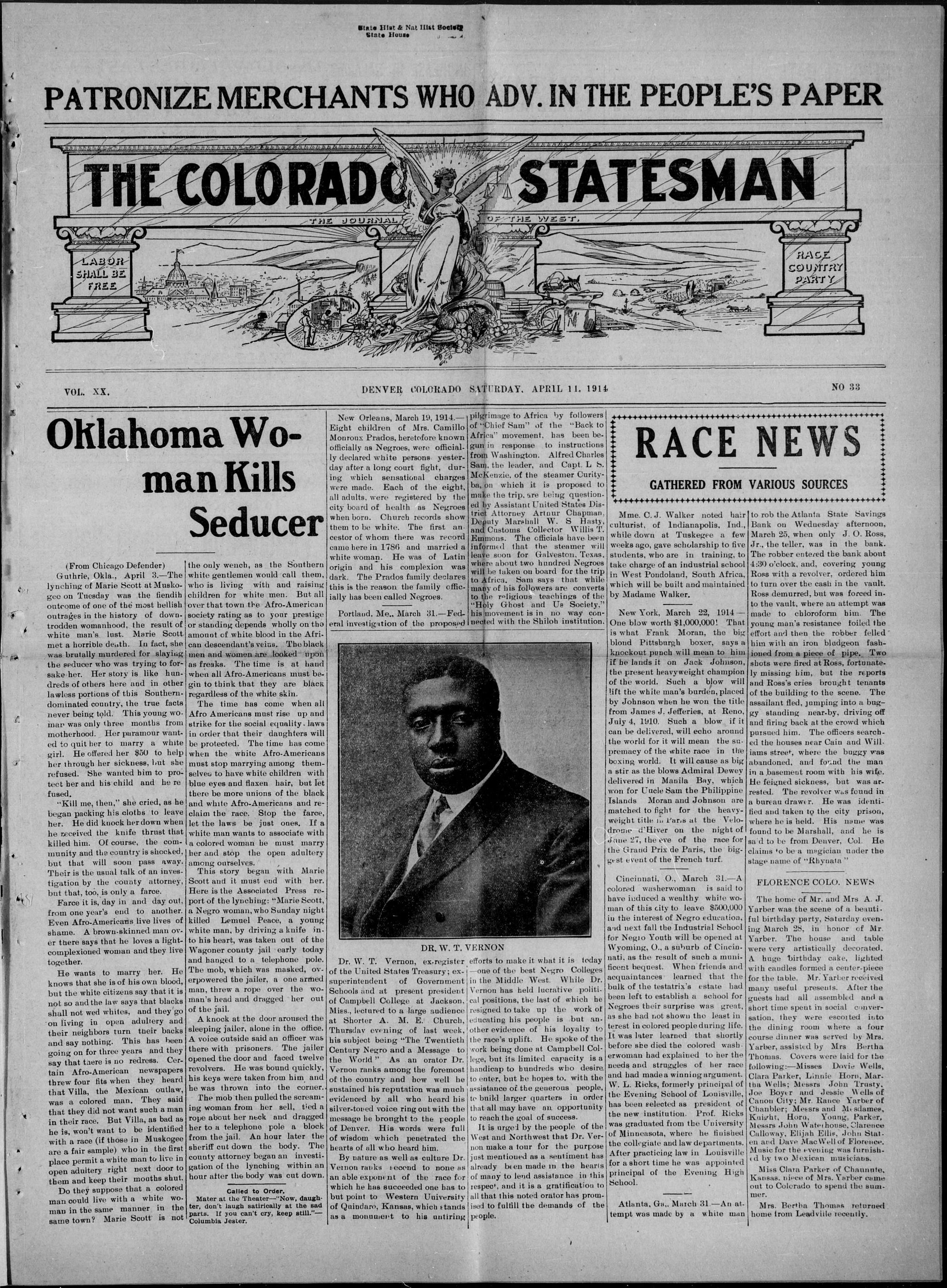
DR. W. T. VERNON
Dr. W. T. Vernon, ex-register of the United States Treasury; ex-superintendent of Government Schools and at present president of Campbell College at Jackson, Miss., lectured to a large audience at Shorter A. M. E. Church, Thursday evening of last week, his subject being "The Twentieth Century Negro and a Message to the World." As an orator Dr. Vernon ranks among the foremost of the country and how well he sustained his reputation was much evidenced by all who heard his silver-toned voice ring out with the message he brought to the people of Denver. His words were full of wisdom which penetrated the hearts of all who heard him.
efforts to one of the M. Vernon his local positive resigned in educating other evic the race's work being lege, but handicap to enter, assistance to build l that all m to reach t
It is un West and non make
By nature as well as culture Dr. Vernon ranks second to none as an able exponent of the race for which he has succeeded one has to but point to Western University of Quindaro, Kansas, which stands as a monument to his untiring
---
pilgrimage to Africa by followers of "Chief Sam" of the "Back to Africa" movement, has been begun in response to instructions from Washington. Alfred Charles Sam, the leader, and Capt. L S. McKenzie, of the steamer Curityba, on which it is proposed to make the trip, are being questioned by Assistant United States District Attorney Artnur Chapman, Deputy Marshall W. S Hasty, and Customs Collector Willis T. Emmons. The officials have been informed that the steamer will leave soon for Galveston, Texas, where about two hundred Negroes will be taken on board for the trip to Africa. Sam says that while many of his followers are converts to the religious teachings of the "Holy Ghost and Us Society," his movement is in no way connected with the Shiloh institution.
VERNON
efforts to make it what it is today—one of the best Negro Colleges in the Middle West. While Dr. Vernon has held lucrative political positions, the last of which he resigned to take up the work of educating his people is but another evidence of his loyalty to the race's uplift. He spoke of the work being done at Campbell College, but its limited capacity is a handicap to hundreds who desire to enter, but he hopes to, with the assistance of the generous people, to build larger quarters in order that all may have an opportunity to reach the goal of success.
It is urged by the people of the West and Northwest that Dr. Vernon make a tour for the purpose just mentioned as a sentiment has already been made in the hearts of many to lend assistance in this respect, and it is a gratification to all that this noted orator has promised to fulfill the demands of the people.
---
RACE NEWS
GATHERED FROM VARIOUS SOURCES
Mme. C.J. Walker noted hair culturist, of Indianapolis, Ind., while down at Tuskegee a few weeks ago, gave scholarship to five students, who are in training, to take charge of an industrial school in West Pondoland, South Africa, which will be built and maintained by Madame Walker.
New York, March 22, 1914 One blow worth $1,000,000! That is what Frank Moran, the big blond Pittsburgh boxer, says a knockout punch will mean to him if he lands it on Jack Johnson, the present heavyweight champion of the world. Such a blow will lift the white man's burden, placed by Johnson when he won the title from James J. Jefferies, at Reno, July 4, 1910. Such a blow if it can be delivered, will echo around the world for it will mean the supremacy of the white race in the boxing world. It will cause as big a stir as the blows Admiral Dewey delivered in Manila Bay, which won for Uuole Sam the Philippine Islands. Moran and Johnson are matched to fight for the heavyweight title in Paris at the Velodrome d'Hiver on the night of June 27, the eve of the race for the Grand Prix de Paris, the biggest event of the French turf.
Cincinnati, O., March 31.—A colored washerwoman is said to have induced a wealthy white woman of this city to leave $500,000 in the interest of Negro education, and next fall the Industrial School for Negro Youth will be opened at Wyoming, O., a suburb of Cincinnati, as the result of such a muni-ficent bequest. When friends and acquaintances learned that the bulk of the testatrix's estate had been left to establish a school for Negroes their surprise was great, as she had not shown the least interest in colored people during life. It was later learned that shortly before she died the colored washerwoman had explained to her the needs and struggles of her race and had made a winning argument. W. L. Ricks, formerly principal of the Evening School of Louisville, has been selected as president of the new institution. Prof. Ricks was graduated from the University of Minneasota, where he finished the collegiate and law departments. After practicing law in Louisville for a short time he was appointed principal of the Evening High School.
Atlanta, Ga., March 31.—An attempt was made by a white man
NO 33
to rob the Atlanta State Savings Bank on Wednesday afternoon, March 25, when only J. O. Ross, Jr., the teller, was in the bank. The robber entered the bank about 4:30 o'clock, and, covering young Ross with a revolver, ordered him to turn over the cash in the vault. Ross demurred, but was forced into the vault, where an attempt was made to chloroform him. The young man's resistance foiled the effort and then the robber felled him with an iron bludgeon fashioned from a piece of pipe. Two shots were fired at Ross, fortunately missing him, but the reports and Ross's cries brought tenants of the building to the scene. The assailant fled, jumping into a buggy standing near-by, driving off and firing back at the crowd which pursued him. The officers searched the houses near Cain and Williams street, where the buggy was abandoned, and found the man in a basement room with his wife. He feigned sickness, but was arrested. The revolver was found in a bureau drawer. He was identified and taken to the city prison, where he is held. His name was found to be Marshall, and he is said to be from Denver, Col. He claims to be a magician under the stage name of "Rhynata."
FLORENCE COLO. NEWS
The home of Mr. and Mrs. A. J. Yarber was the scene of a beautiful birthday party, Saturday evening March 28, in honor of Mr. Yarber. The house and table were very artistically decorated. A huge birthday cake, lighted with candles formed a center-piece for the table. Mr. Yarber received many useful presents. After the guests had all assembled and a short time spent in social conversation, they were escorted into the dining room where a four course dinner was served by Mrs. Yarber, assisted by Mrs Bertha Thomas. Covers were laid for the following:—Misses Dovie Wells, Clara Parker, Linnie Horn, Martha Wells; Messrs John Trusty, Joe Boyer and Jessie Wells of Canon City; Mr. Rance Yarber of Chanbler; Messrs and Mesdames, Knight, Horn, Young, Parker, Messrs John Waterhouse, Clarence Calloway, Elijah Ellis, John Station and Dave MacWell of Florence. Music for the evening was furnished by two Mexican musicians.
Miss Clara Parker of Chaunte, Kansas, niece of Mrs. Yarber came out to Colorado to spend the summer.
Mrs. Bertba Thomas returned home from Leadville recently.
NEWS TO DATE IN PARAGRAPHS
CAUGHT FROM THE NETWORK OF WIRES ROUND ABOUT THE WORLD.
DURING THE PAST WEEK
RECORD OF IMPORTANT EVENTS
CONDENSED FOR BUSY
PEOPLE.
Western Newspaper Union News Service.
WESTERN.
At Boston James A. Galligan, a
Democrat, was elected to Congress
over Republican and Progressive oppo-
nents.
Sterling S. Burtin, formerly a police
reporter on a newspaper, was elected
chief of police of Cedar Rapids, Ia,
by the city council.
Fifty dollars reward has been off-
fered by the government for the arrest
of Capt. J. H. Griffiths, U. S. A.,
deserter from Seattle, Wash.
Though past 113 years old, Aunt Elmira Wagoner, who lives a few miles south of Protem, Mo., is preparing to put in her spring garden.
Mrs. Otis L. Spurgeon, wife of the Des Moines minister who was deported from Denver, left for Denver to be at the bedside of her husband.
An estate of $5,500,000 is disposed of in the will of Byron L. Smith, president of the Northern Trust Company, who died in Chicago several weeks ago.
Vitoria Gusmano, druggist, and Sam Cipranio were killed and two other Italians were injured when a bomb exploded in Gusmano's store in Detroit, Mich.
Fire at Decatur, Ill., destroyed the Linn & Scruggs department store and the Powers theater building, occupying an entire block. The total damage was $750,000.
The fourth trial of Dr. B. Clarke Hyde, charged with the murder of Col. Thomas H. Swope, was continued indefinitely when called in the Criminal court in Kansas City.
The Union Pacific is to operate "tango" cars to the national conference of the Elks at Denver next summer. The information was given out at headquarters in Omaha.
President Joseph Smith, the venerable head of the reorganized Latter Day Saints church, delivered his annual address at the general conference of the church at Independence, Mo.
The Ku Klux Klan, a band of silent men who ride at night, wreaking censure for real or fancied grievances, is terrorizing the coal mining district of Muhlenberg county, Kentucky.
Nine Chicago women candidates failed of election as aldermen. "Bath House" John Coughlin, against whom the suffrage element centered its fight, won against Marion Drake, three to one.
Compromise, by which Mrs. Ellen J. Golden, or Ewald, will receive $300,000 cash and $10,000 a year from the $4,000,000 estate of the late Louisville and Nashville railway iron master, L. P. Ewald, was agreed upon by opposing counsel at Louisville, Ky. The compromise is expected to end the suit for $1,750,000, in which the woman has attempted to prove herself the common-law wife of the late eccentric Louisville millionaire.
WASHINGTON.
President Wilson and his family will spend Easter at Hot Springs, Va.
Senator Shafroth introduced a bill to increase the pension of Thomas H. Muchmore of Denver to $50 a month.
Legislation against "dummy" directors may be recommended to the House by the Colorado strike probs as the result of John D. Rockefeller's testimony.
Capital society was stirred by a rumor that Secretary of the Treasury McAdoo and Miss Eleanor Wilson would be quietly married during the latter part of April.
Reargument on April 20 of the contempt cases against President Gompers, Vice President Mitchell and Secretary Morrison was ordered by the Supreme Court of the United States.
The Explorers' Club gave a dinner in New York to celebrate the fifth anniversary of the discovery of the North pole, and presented its first gold medal of honor to Rear Admiral Peary. Vigorous representations went from the American government to General Carranza, the constitutionalist chief, urging that he modify the order of General Villa expelling Spaniards from Torreon. Senator Theodore E. Burton of Ohio, after twenty years in Congress, has issued a statement announcing his retirement from public life. He says in this connection that he intends to vote for the repeal of the canal toll exemption.
The charge that John D. Rockefeller, Jr., Sunday school worker and reformer, is profiting as a stockholder in the Colorado Fuel & Iron Company from the rental of saloons in Colorado was made by Representative Foster, chairman of the Colorado strike-probing committee.
FOREIGN.
At Saskatoon, Sask., the Cairns building, occupied by several retail merchants, was destroyed by fire. The loss is estimated at $250,000.
Maurice Delacroix, an inspector of police shot and killed his comrade and intimate friend, Inspector Raymond Dupin, at police headquarters in Paris. The last spike on the Grand Trunk Pacific Transcontiental railway was driven near the Nechaco river, at Fort Fraser, B. C., 220 miles east of Prince Rupert.
No trace of the missing sealer Southern Cross has been found by the steamer Kyle, which was sent cut from St. Johns, N. F., to search for her by the government.
Arthur A. Vickers, a millionaire real estate broker, killed himself at his home at Fort William, Ont., with a shotgun. Vickers, who was married recently, was forty-one years old.
Bare feet, shod only with sandals, are the latest fashion fad in Paris. Jewelers are making rings for exposed toes. Mlle. Provost, actress, who introduced the trouser skirt, started the sandal fad.
The report that Maxine Elliott, the beautiful and talented actress and Anthony Wilding, the famous English lawn tennis champion, are married is believed in the smart Bohemian circles of both London and Paris.
Final enactment of the Irish home rule bill by June was predicted in London, following the victory of the government, when the measure was carried in the House of Commons on second reading by a vote of 356 to 276.
SPORT.
Young Kansas, the Buffalo featherweight, knocked out Tommy Breshnahan of Rochester in the second round at Buffalo, N. Y.
Ray Campbell of San Francisco and "Soak-em" Yoakum will be the principals at the next Colorado Athletic club show on April 21, in Denver.
A remarkable tribute was paid Waddell by Connie Mack when the manager of the world champions was informed of the famous Rube's death.
Al McCoy of Brooklyn knocked out George Chip of New Castle, Pa., a leading claimant for the middleweight title in the first round of their ten-round match in New York.
Billy Walters welterweight, has been matched by Manager Silvie Ferretti for a tussle with his old rival, Wildcat Ferns, at Kansas City on April 16. They are scheduled to weigh 145 pounds at 3 o'clock and will box a scheduled ten rounds at Chicago.
Death levied a heavy toll on the aviators of the world during the first three months of this year. Between Jan. 1 and April 1, thirty-eight men in all parts of the world lost their lives through the uncertainty of air currents or the failure of their flying machines. The United States, with five killed, stands fourth on the list, which France heads with ten dead.
Ivan S. Sopornowski, a Russian millionaire, during his lifetime refused to enter a motor car. In his will, however, was a clause bequeathing $100,000 to any airman who would convey his coffin to the graveyard in an aeroplane. A young aviator named Posoff offered to undertake the task, and, placing the coffin in his biplane, flew to the cemetery, where he made such a bad landing that nearly killed himself. M. Sopornowski's relatives, according to the St. Petersburg press reluctantly paid him $100,000 out of the estate.
GENERAL.
In New Jersey Dow H. Dunkker, a Republican was elected to Congress over J. J. O'Bryne.
Kansas City—Major Jost was reelected by a large majority over the non-partisan candidate.
In Milwaukee Emil Seidel, Socialist, was badly defeated in the mayoralty contest by G. A. Bading.
Conferences which mean a revival of land development in the West began in Denver when the Western Governors' conference met in the Senate chamber at the State Capitol.
The Hub retains the bean eating championship. During the past winter it is estimated that the 1,283,458 persons in Greater Boston spent more than $10,000,000 on baked beans alone.
Secretary Daniels' action baring the use of intoxicating liquors in the navy was unanimously endorsed in a resolution adopted by the New York conference of the Methodist Episcopal church.
L. B. Musgrove, campaign manager for Congressman Richmond Pearson Hobson, conceded Oscar W. Underwood's nomination to the United States senate for the long term in Alabama.
Mrs. William Pert, wife of the secretary of the Salvation Army in the United States, and second to Miss Booth in command of the army in this country, died at her home in Mount Vernon, N. Y.
In Minnesota heavy anti-saloon gains were made, while in Nebraska the result was about an even break in Tuesday's election.
Samuel Gompers arrived in New York from San Juan, Porto Rico, where he made a study of labor conditions. Babies, according to the orders is sued at the St. Paul, Minn., postoffice, are livestock, and not produce to be mailed around the country with butter, eggs and other parcel post business.
COLORADO STATE NEWS
Western Newspaper Union News Service.
DATES FOR COMING EVENTS.
May 12-14—State Council of Junior Order of American Mechanics, at Colourwood.
Spring 2018
May 14 - Race Meet. Durango.
June 13-July 1 - Race Meet. Denver.
July 7-11 - Race Meet. Pueblo.
July 9 - Cherry Pie Day. Manganola.
July 13-14—Grand Lodge Session, B. P. O. Elks at Denver
July 22-23—Cattlemens' Day, Gunnellson
July 18-21—Prowers Co. Fair, Lamar
Aug. 25-28—Bent Co. Fair, Las Animas
Aug. 27—Santa Fe Trail Day, Las Animas.
Aug. 29—Farmers' Fair at Fowler.
Sept. 1-4—Arkansas Valley Fair, Rocky
Sept. 3—Watermelon Day, Rocky Ford.
Sept. 2-5—Farmers' a.r.d Stockmen's
Fair, Burlington.
Sept. 1, 4.—Morgan Co. Fair, Fort Morgan
gan.
Sept. 1-4.—Larimer Co. Fair, Loveland.
Sept. 8-11.—Crowley Co. Fair, Sugar City.
Sept. 10—Sugar Day, Sugar City.
Sept. 14—Colorado State Fair at Pu-
lmo.
Sept. 14-19—Colo. State Fair, Pueblo.
Sept. 19-26—Race Meet, Denver.
Sept. 22-25—Western Slope Fair, Mont-
ney.
Sept. 22-25—Trinidad Fair, Trinidad.
Sept. 23-26—El Paso Co. Fair, Calhoun.
Sept. 28-30—Inter-County Fair and
Cice Meat, Lamon.
1915—Last Grand Council of North
American Indians at Denver.
Mrs. Helen Webster Montague, sev-
enty-four years old, one of the oldest
woman pioneers of Colorado, died in
Denver.
James S. Clague, wealthy ranch
owner of Greeley, was arrested on a
warrant sworn to by his wife, who
trailed Clague to Denver.
Thirty armed men watched the Vindicator mine for ore thieves, known in the mining districts as "high graders," with whom mine guards exchanged shots near Victor.
So enormous has Denver's parcel post business become recently, Postmaster Joseph Harrison has asked Washington to provide a separate building for the department.
The discovery of a gold filling in the tooth of a hog has led to the discovery of what may prove one of the richest placer claims in the state on the Blue river east of Dillon.
The names of five leading Denver financiers are being discussed in Washington as probable members of the directorate of the regional bank to be established at Kansas City.
Denver stands an excellent chance of getting the national sanatorium of the Loyal Order of the Bull Moose, according to Arthur H. Jones, past supreme dictator of the organization.
Mayor Perkins of Denver received a cablegram from United States Consul Heenan at Moscow, Russia, stating James Williams, mining engineer of Denver, was buried in the Russian city.
The United States Geological Survey has just issued its first map of the Long's peak quadrangle, which includes all the territory included in the proposed Rocky Mountain national park.
Governor Ammons and Frederick N. Innes, municipal band leader, were guests of the Denver Press Club which held its annual breakfast and inauguration of officers at the hotel in Denver.
In many Colorado towns wets and drys broke about even in Tuesday's election. Manitou remains wet. Walsenburg's Union Miners' ticket was beaten. Aguilar's Union ticket was successful.
The annual report of Auditor James F. Markey of Denver for the year ending Dec. 31, 1913, were submitted to the council, and it shows that there was an actual deficit in the city for the year of $198,612.
Information charging embezzlement against Leslie W. Turnbull, resident manager of the Cribben & Sexton Company, Chicago stove manufacturers, were issued in Denver by the district attorney's office.
Mrs. Spurgeon, wife of the Rev. Otis L. Spurgeon, who was abducted from his room at a Denver hotel and taken out twenty miles on the Brighton road in a machine, where he was beaten by the occupants of the car, arrived in Denver from Des Moines to be at the bedside of her husband.
Pueblo has launched a campaign for a branch regional bank at that city, under the parent federal regional bank of this district at Kansas City. Fred O. Roof, a leading banker of Pueblo and president of the Colorado Bankers' Association, and other prominent citizens of Pueblo are at the head of the movement and have taken the matter up directly with Washington.
J. S. Brown, Jr., and Frederick S. Brown, executors of the estate of their father, John Sidney Brown, founder of the mercantile company which bears his name, who died one year ago, have filed their final report with Judge Rothgerber of the Denver County Court. The inventory accompanying the petition for a discharge from their duties shows that the estate is worth $1,500,000.
The State Board of Medical Examiners has the right to revoke the licenses of physicians for the publication of advertisements concerning sexual diseases, according to a decision of the State Supreme Court.
Orson Adams, president of the Mesa County National bank, will have to answer more charges in indictments than any man who ever lived in Colorado. They are to be preferred before the federal grand jury, which began a two weeks' session at Pueblo. At least fifty counts are to be in the indictments and they may run to 150.
COUNTRY SCHOOL TEACHERS TO
DEMAND MORE PAY.
Letters to Be Sent Boards of Education All Over State Urging Higher Wages for Capable Instructors.
Western Newspaper Union News Service.
Denver.—Due to the appeal of Miss Charlotte Abernathy, a teacher of Arapahoe, Mrs. Mary C. C. Bradford, state superintendent of public instruction, will send out letters to the various school boards of the state urging an increase in the salaries of first grade teachers in the rural districts of Colorado as the first move in a campaign towards that end to be waged for the next school election in May.
In a letter to Mrs. Bradford, Miss Abernathy says that eighth-grade graduates, given third-grade teachers' certificates in the teachers' examinations, teach in the rural district at the same salaries received by first-grade teachers with normal training, and from six to twenty years' experience, and that as a result, first-class teachers are leaving the rural schools and their positions are filled by inexperienced young girls.
In the country districts, she writes, the services of experienced and competent instructors are more badly needed than in any other sections of the state.
The first-grade teachers in rural districts. Miss Abernathy states, are so underpaid that they become discouraged and leave. The third grade teachers' salaries were raised; why, she argues, cannot justice be done to the first-grade teachers?
Cuthbert Host for Peace Board.
Denver.—The newly chosen members of the peace commission were the guests of Lucius M. Cuthbert, vice president and chairman of the referendum committee at a luncheon at the University Club. Normal Angell, noted English editor and peace advocate, who was visiting in Denver, was the guest of honor. The members of the peace commission are Wardner Williams, Lawrence C. Phipps, Platt Rogers, Andrew C. Carson, E. A. Peters, F. W. Sanborn, Armour C. Anderson, Wr. James H. Baker, Rabbi W. S. Friedman, E. B. Hendrie, the Rev. J. H. Houghton, Irving Howbert, Judge J. R. King Frank McLaughlin, Verner Z. Reed, William F. Slocum, Judge Harrison White and E. J. Yetter. "The women of the country are best fitted to take up the problems of international interest," said Norman Angell, international peace advocate, at a meeting of the Woman's Peace organization. "Women's minds are not entirely taken up with money matters, and it is their duty to make international topics a course of study among the school children and in colleges."
Cripple Railroad Must Operate Line.
Denver.—Probably the most important and far-reaching decision ever made by the state railroad commission was rendered when it ruled that a railroad company had no right to discontinue operating the whole or any part of its line within the state without the commission's permit. The decision was made upon the petition of Cañon City to compel the Florence & Cripple Creek Railroad Company to rebuild a four-mile strip of its line between Ora Junta and Wilbur, which was washed out in July, 1912. Since that time the railroad company has refused to carry freight and passengers between Cañon City and Cripple Creek.
Planning State Study Course.
Denver.—Mrs. Mary C. C. Bradford, state superintendent of public instruction, is preparing a course of study for all high schools in Colorado not in class A districts, which will include most of the country and town high schools. It will be published some time this summer and will be put in use att the beginning of the fall term of school. The course will not be compulsory, but it is expected that it will be generally carried out over the state.
Colorado Gets Better Show Site.
Denver.—A much better site for Colorado at the Panama-Pacific exposition has been obtained, according to a letter received by the Chamber of Commerce from Commissioner of Concessions Burt. The new site is on the bay and at the junction of two main arteries. It was held by the Hawaiian islands, but the islands were induced to change to a position farther back.
Reformatory For Girls Urged
Denver.—The lack of a reformatory for girls in the state of Colorado was deplored by Judge Butler in the West Side Court when he came to sentence Mrs. Alberta Revell, twenty years old, for forgery. The absence of such an institution forced him, he said, to sentence the young woman to serve a term of from one year to one and one-half years in the penitentiary at Canon City.
Fraser Replies to Appeal of Shinn.
Denver.—Walter B. Fraser, through his attorney, filed an answer and argument in the State Supreme Court against the granting of a writ of prohibition to James A. Shinn staying Fraser from ousting him from the office of state game and fish commissioner. Fraser, since his appointment to the office by Governor Ammons several months ago, has been seeking to oust Shinn and obtained a writ in the District Court. Shinn appealed to the Supreme Court.
The OLD RELIABLE EAST END DINING ROOM AND RESTAURANT
BREAKFAST from 6 to 8:30
DINNER from 12 to 2:30
SUPPER from 5:30 to 7:30
2345 LARIMER STREET, DENVER, COLORADO
Colorado Wall Paper & Paint Company
WALL PAPER, PAINTS OILS AND GLASS Interior and Exterior Decorators. We Do House Painting. Coach Colors, Paints and Varnishes. Agents John W. Masury & Sons. Phone Main 871 728 W. Colfax, foot Welton St. Denver
To Inspect Our Display of Pattern and Tailored Hats
In All the Latest Novelties TORREY'S MILLINERY 2647 WELTON STREET, DENVER, COLO.
Paper Dollar Bar
Jones' Restaurant
I Am Headed That Way, Where I Get the Cleanest, Best and Most Wholesome Food, Which Gives You that Round, Comfortable, Contented Feeling
2236 LARIMER STREET, DENVER, COLO.
J. W. BEACH
Phone Main 5277 1855 Arapaioe Street
DENVER, COLORADO
SPECIAL BRUSHES MADE TO ORDER
Brushes and Janitor Supplies SAM FRANCIS, Mgr. DENVER BRUSH FACTORY Branch 1408 Curtis St. Champa 770 418 Fifteenth St
Fruit Bowl
MEALS:
DAVID LONG
2345 LARIMER STREET,
J. R. DRESSOR WALLACE
The Colorado Wall Paint Co. WALL PAPER OILS AND INTERIOR and Exterior Decor Painting. Coach Colors, Agents John W. Masury & 728 W. Colfax, foot W. YOU ARE CORDIAL To Inspect Our Pattern and Tail In All the Late TORREY'S M 2647 WELTON STREET
Phone Champa 1156 Paper Dol STEVE TODOROFF and RAY Fine Wines, Liqu
P
Furnished Rooms in Connectio
AFRO-AMERICAN CULLINGS
Lindsay Winslow, born a slave, for 42 years a messenger in the war department, body servant to a succession of commanding generals of the army, and known to every officer in the military service, died from a stroke of apoplexy at his home in Washington. Messenger Lindsay was fifty-nine years old, having been appointed in the government service when a youth of seventeen years. Lindsay was born in 1855, the property of the Temple family of Fredericksburg, Va. Miss Temple, one of the daughters of the family, who now lives in Richmond, Va., never came to Washington without calling on the old family slave, whom she held in great esteem and watched over.
It was during the Civil war that Lindsay first made acquaintance with the army, with which he was to be associated for the rest of his life. In 1865, when ten years old, he used to sell plies to the soldiers of the army, encamped near Fredericksburg. One of the veterans of that campaign, now an official of the war department, tells of an attack of indigestion which he charges against a bit of pastry bought from Lindsay.
A year ago Lindsay made his first appearance as an actor. In the role of himself, playing the part of a messenger to the commanding officer of the army, in a playlet written by Captain McCoy of the army, he appeared when the play was presented at the dinner of the Carabao society.
Lindsay saw service in Cuba during the Spanish-American war. Detached from the war department he accompanied General Bell, in command of the army of pacification, and was his personal attendant throughout the campaign.
Appointed a laborer in the war department July 1, 1872. Lindsay was given a fireman's job November 1, the same year. July 17, 1879, he was made a messenger. Transferred to the door of the adjutant general of the army, at that time the commanding officer of the military service, November 4, 1879. Lindsay was given the rank of an assistant messenger because of the change of service. June 16, 1893, he became a messenger at $840 a year.
When the office of adjutant general of the army lost its directing influence, and the office of chief of staff was created, Lindsay was transferred from the one office to the other, maintaining his dignity and responsibilities. He was relieved for temporary duty in Cuba October 6, 1906, when he accompanied General Bell. He resumed his duties as messenger January 4, 1907. Lindsay served as messenger and personal attendant to every adjutant general of the army from incumbency of General Drum to that of General Corbin, and of every chief of staff of the army since that time.
Not many years ago Russia was a strong rival of the United States in the production of petroleum. Now the Russian empire yields only about 68 per cent as much old as California alone, and not much more than Oklahoma.
Two carpenters and a plumber from England have recently been traveling in Belgium. Vocational scholarships were awarded to them, by means of which they are investigating old and new methods of house construction.
The colored man in America has gone through the same experiences as the white man. He gave 250 years of unrequited toil to build up the nation. In the Revolutionary war Crispus Attucks, a mulatto, was the first man to shed his blood that white men might be really free.
One hundred and nine of the 425 dauntless sailors who fought with Perry at the battle of Lake Erie were colored men. Nearly 200,000 colored soldiers fought with white men in the slaveholders' rebellion in defense of their common country. In the Spanish-American war the colored troopers did their duty splendidly at El Caney.
From a little farm owned by John Jones, a former slave in Shelby county, Tenn., has come to the Supreme court of the United States the question of whether former slaves are entitled to inherit from their brothers and sisters who likewise were in servitude.
The supreme court of Tennessee had held that ex-slaves have no inheritable blood. One of John Jones' brothers has taken the case to the United States Supreme court seeking a reversal.
It is estimated that 75 per cent of the laws have to do with the home in some way.
The United States has become the heaviest buyer of South African diamonds.
A bill providing for women judges in the children's court has been introduced in the New York legislature.
Margaret E. McNamara has been appointed chief matron of the Industrial School for Girls at Delaware, Ohio.
A woman lives in Philadelphia who has seen three centuries; who has been an eye witness of the changes they have brought; who has herself been most thrillingly affected by them. Her name is Mrs. Kate Whitehurst, and her century and more of life was most of it lived as a slave in the South long years before there was a dream of questioning seriously the rights of slavery to exist.
Her home is at 2237 Oxford street with her daughter, Mrs. Caroline Mitchell. She is still able to move about, although feebly, for she suffered a serious nervous shock a few weeks ago, when fire broke out right in her bedroom, and she was saved by policemen when she was not very far from suffocation.
She is known to be in her one hundred and fourteenth year, but she may be somewhat older, and one estimate gave her age as one hundred and seventeen. But the recollection of her age by a daughter of her old master in the South, based on the record in her sales papers as a slave, is that she was born at the end of the eighteenth century, and she may be the senior by a few months of Aunt Mahala Ayers, whose one hundred and fourteenth birthday celebration has been planned as an event this year at the Home for Aged Colored People. Mrs. Whitehurst's own memory of dates in her long life carries her back as far as 1811, when the great comet, from whose year the most famous wines of Europe have been dated, was visible and gravely af frightening all over the world.
"I saw the great star fall," she says, when she refers to that overshadowing event in her childhood, the one thing which could leave an indelible impression on the mind of a girl slave not yet in her teens, when all the ignorant, startled throng around her lived in terror of the great star's fall. She still sees herself standing in the midst of other slaves, at night under the soft southern sky, staring up at the awful portent and wondering, while her elders in that doubly hapless horde argued its consequences of pestilence and war.
PRACTICAL TRAINING FOR GIRLS.
THE SCHOOL
Hampton girls are taught to do plain hand and machine sewing, cut, fit and make dresses, trim hats, weave rugs and select house furnishings.
Tuskegee institute was opened July 4, 1881, in a rented church, a mere shanty, with 30 pupils and one teacher. To bring a school with such a beginning as that up to what it is now, and to gain for it a more than national reputation in the lifetime of one man, is a marvelous work. Back of it all is a master mind. There are scores of well-trained teachers, preachers (from Phelps Hall Bible training school), farmers, mechanics, trained nurses, seamstresses and good housekeepers send out every years from this school, carrying with them the spirit of Tuskegee to uplift the race.
Wyoming mines and oil wells in 1913 had an output valued at $37,000,000, and live stock gave the state's ranchers revenues totaling more than $35,000,000.
Gas City, Kan., has a population of 1,200, but abolished the office of city marshal for the reason that there has been nothing for him to do in a long time.
Boston is planning to establish municipal lodging houses.
There are two wage-earning women to every five wage-earning men in Great Britain.
In Denver a woman can sign her husband's name to a check even when the bank account is in the latter's name.
Vancouver recently received a shipment of 125 cub foxes from Skagway, Alaska, valued at $100,000.
Sweden this year will import coal from Spitzbergen.
VILLA TAKES FIVE BANKS
AND $15,000,000 IN COTTON, TO FOIL
REBELS, AS TAMPICO BATT
TLE RAGES.
CASH SENT TO EL PASO
PENNILESS SPANIARDS RELY ON
UNITED STATES FOR FOOD
AND SHELTER.
Western Newspaper Union News Service.
Villa confiscates five banks in
the city of Torreon and takes
charge of cotton valued at $15,000,
-000.
Torreon bankers anticipate con-
fiscation and ship $1,000,000 in bonds
to the United States.
Carranza upheld the expulsion order issued by Villa, driving 600 Spaniards out of Torreon. Washington pugilated by defiance of such laws, realizes America must care for deported Spaniards. Battle of Tampico rages with neither side in apparent advantage.
Juarez, Mex.—General Villa took over the four principal banks of Torreon, according to a report which he telegraphed to this city with the request that it be given to the press of the United States.
His prize does not include money or negotiable securities, however, as the bankers took the precaution of shipping these out when Federal General Velasco evacuated the city.
He has the buildings and the furniture, however. The banks affected are the Banco Nacional, the Banco de Laguna, the German and South American Bank, and the Bank of London and Mexico.
The most important property left behind by the Spaniards was cotton said to be valued at $15,000,000. Word was received from Torreon that $1,000,000 was being loaded on trains for shipment to El Paso by General Villa. It is stated that the Spanish owners cannot touch the property if it arrives here in bond, as is frequently the case. If it comes bonded for transit through the United States for shipment abroad it cannot be recovered, it is said. A precedent to this effect was established sometime ago in the case of a consignment of hides confiscated by the rebels and which the former owners attempted to recover through the United States courts.
Among the refugees were three priests. There are still in the Laguna district 150 planters on their farms. They will be gathered together at Torreon and also sent out of the country.
General Venustiano Carranza gave out a statement dealing with the subject of the expulsion of foreigners, justifying Villa's action and stating that Spanish property would not be confiscated.
A similar statement on the subject of confiscation was made by Isidro Fabela, Carranza's minister of foreign relations.
LEASING PLAN ROUNDLY SCORED
Permanent Prosperity of West Must Come From Ownership.
Denver.—Positive positions against the principles of leasing public lands and public resources were taken in the conference of Western governors by Governors Oddle of Nevada, Spry of Utah and Ammons of Colorado. They went on record as opposing all such leasing whenever it is in any way avoidable.
Leasing, they argued, tends to make tenants instead of owners, whereas the permanent prosperity of the western states must be built up on a basis of ownership rather than of leasing.
Another clash of ideas resulted at this, for A. A. Jones, assistant secretary of the interior, defended the leasing policy. Ownership instead of leasing, he declared, would tend to cause monopoly, the thing it was most desirable to avoid.
$25,000,000 FOR PANAMA CANAL.
Diplomats Sign Paper to Be Ratified by Senate and Central Americans. Washington. — Twenty-five million dollars is the amount the United States agrees to pay to Colombia for the partition of Panama and the acquisition of the canal zone, in the treaty signed in Bogota by American Minister Thompson and the Colombian authorities. This was stated here at the Colombian legation. No rights for a new interoceanic canal across Colombia, by the Atrató river route, and no coaling privileges on San Andreas and Providencia islands, off the Colombian coast, it was added, were contained in the treaty. The boundary between Colombia and Panama is to follow the line laid down in an earlier treaty which was signed but never approved by the Colombian Congress.
U. S. Attorney Ridgley Removed.
U. S. Attorney Ridgley Removed
Cheyenne—H. S. Ridgley was removed from the United States district attorneyship by telegraph. Judge Riner of the United States Court appointed W. E. Mullen, Ridgley's assistant, acting attorney. Charles L. Ridgdon will be appointed Ridgley's successor.
General Wood Sees U. S. War Near
New Haven, Conn.—Gen. Leonard Wood admitted the United States expects war and must prepare for it.
STERLING MILK PLANT
NEARLY 1,000 -COWS PLEDGED FOR CONDENSORY.
Dairy Advantages Considered, Committee Is Canvassing Conditions and Contracts Are Being Signed.
Western Newspaper Union News Service.
Sterling, Colo.—Every day brings greater assurance of the establishment of a condensory at Sterling. During the last week, County Agriculturist D. C. Bascom, special representative of the Sterling Commercial Association, has been visiting the farmers tributory to this city, and without exception, all have given their hearty assurance that they will co-operate in the success of the proposed milk plant.
During the visit here a short time ago of Gilbert Landell, manager of the Colorado Condensed Milk Company, enthusiasm was manifested by the merchants and farmers of the county and nearly 1,000 cows were promised in case the condensory is established. Bascom has been making personal visits throughout the county and presenting contracts for signatures.
Books of contracts have been placed at the banks of the city and elsewhere at convenient points. Indications are that a sufficient number of cows will be guaranteed to assure the installation of the plant by next fall. For the first year, only 1,500 cows will be required.
The activity in establishing the condensory here has suggested many changes that will necessarily ensue. A more convenient tram service will be necessary between here and the Peetz section for the accommodation of those who will ship their products. And, in many cases, for the benefit of those who will baul by wagon, road improvement will be necessary.
Dairying advantages are declared to be ideal, and it has been pointed out frequently by dairy experts from other sections and other states that the resources at hand are much greater than in many regions where great wealth has resulted in the maintenance of the dairy industry.
Lost Arm. $10,000; Life. $2,000.
Denver.—Two thousand dollars damages for a death and $10,000 for the loss of an arm in accidents which occurred on the same day in 1913 were verdicts returned almost simultaneously by injuries in two divisions of the District Court. Five minutes after they had been returned came the filing of a suit by Mrs. Sarah Moores to recover $15,000 for the loss of an eye against the Denver & Rio Grande railroad. Frederick Kalkman, twenty-five, a coffee roaster, was awarded the $10,000 verdict against the Independent Coffee & Spice Company in Judge Denison's division. Across the hall in Judge Allen's court a few minutes later a jury awarded Mrs. Mary De Yorio $2,000 for the death of her husband against the Denver City Tramway Company.
Heroic Women Fight Fire.
Greeley.—Forming a bucket brigade and fighting the flames like veteran fire fighters, the women of the neighborhood saved valuable property from destruction in a fire that destroyed the big barn and contents on the T. T. Wilson plaice, sixteen miles from here. The loss of the barn and contents was about $1,000, partly covered with insurance.
100.000 Pine Trees Gathered.
Colorado Springs.—Students of the Colorado College school of forestry have gathered for the government over 100,000 young pine trees from the United States nurseries north of here, and shipped them to the forest reserve station at Halsey, Neb. As many more are to be sent to North Dakota for replanting.
Woman Accused of Looting Homes.
Cripple Creek.—Charged with having looted and stripped the homes of Mrs. Daisy Manghan and Mrs. Dora Crill while they were visiting out of the city, Mrs. Jennie Dwyer, fifty-four, property owner and taxpayer of this city, was arrested on complaints of grand larceny and burglary.
Longmont Wants Milk Plant.
Longmont.—At a meeting of the directors of the Longmont Commercial Association a movement was started for the location of a milk condensory at this place. The work of making a survey of this section to ascertain the amount of milk and cream that can be contracted will be started at once.
Banker McBride Gets Five Years. Denver.—Will R. McBride, president of the defunct Night and Day bank, convicted of obtaining $25,000 from an aged miner by means of false pretenses, was sentenced to from five to seven years in the penitentiary by Judge Butler in the West Side Court.
Coloradoan Weds in London.
Colorado Springs—William F. Richards of this city was married at Christ church, London to Miss Leora Moore, an American girl whom he met while traveling abroad. After an extended tour they will return to this city to reside.
Girl's Slayer Given Ten Years.
Pueblo—James Williams, convicted slayer of Alberta Serfting, 3 years old, here last September, was sentenced to serve from ten to twelve years in the penitentiary at Cafon City.
OPEN FOR BUSINESS New Dining Room in Connection to Keystone Social Club. Nothing like it ever attempted in Denver. Strictly home cooking. Lowest prices for best quality of food. Eastern corn-fed meats. Your patronage solicited.
FULL DINNER
11:30 a. m.
to
8:30 p. m.
Soup, Fish or Meat, Two Vegetables
Coffee, Tea or Cocoa Desert
25 CENTS
SHORT ORDERS AT ALL HOURS
1857 Champa St.
Syl. Stewart Manag
Champa St. Phone Champa 3543 Denver
BECK JOHN D.
Beck & Engstrom
WHOLESALE DEALERS IN
Vines, Liquors and
Cigars
Parts for Minneapolis Grain Belt Beer and Carnegie B
Imported Beer and Bock Ol.
1644-46-48-50 Larimer Street
In 1053 Denver
ALL KINDS OF REPAIR WORK NEATLY DONE
REFINISHING A SPECIALTY.
Welton Street Furniture
F. R. LINDENMIER, Prop.
2619 WELTON STREET
And Second Hand Furniture Boug
and Exchanged
Syl. Stewart Manager. 1857 Champa St. Phone Champa 3543 Denver, Colo.
Beck
WH
Wines
Western Agents for Minn
1644-4
Phone Main 1053
ALL KINDS
The Welton
2619
New and Second
Beck & Engstrom
WHOLESALE DEALERS IN Wines, Liquors and Cigars Western Agents for Minneapolis Grain Belt Beer and Carnegie Porter, Pripps Imported Beer and Bock Ol.
1644-46-48-50 Larimer Street
Phone Main 1053 Denver, Colorado
ALL KINDS OF REPAIR WORK NEATLY DONE. REFINISHING A SPECIALTY.
New and Second Hand Furniture Bought, Sold and Exchanged We Pay the Highest Cash Price for Furniture
IN 8247. DE
When You Wear
Heads, Feet, Tails Snouts, New
iterlings or any other part of
except the squeal go to
Cast's Market
mer Street. Phone
THE ZOBEL BROTHER
AMPLE ROO
4 Nineteenth Street, Corner of C
When The Heads, F or Chiterlings except Eas
When You Want
When You Want
The Heads, Feet, Tails Snouts, Neckbones or Chiterlings or any other part of the hog except the squeal go to East's Market 2300.6 Larimer Street. Phone Main 1461.
THE ZO
SAM
1004 Ninete
1004 Nineteenth Street, Corner of Curtis
FINE WINES, LIQUORS AND CIGARS
COORS' CELEBRATED BEER ON TAP
ER COLO
ARRIS, Pres. J. M. JOHNS, Treas. SEIB MILLE
LROAD PORTERS' CL
CHAS. HARRIS, Pres
RAILROA
LUNCH
Billiards
RAILROAD PORTERS' CLUB LUNCH ROOM IN CONNECTION
17281/2 Wazee St. Only one block from Union Depot Phone Main 8416. Denver, Colorado
HENRY BECK
PHONE MAIN 8247.
DENVER
Soup, Fish or Meat, Two Vegetables Coffee,Tea or Cocoa Desert 25 CENTS
Manager.
643 Denver, Colo.
strom
S IN
rs and
and Carnegie Porter, Pripps
Ol.
er Street
Denver, Colorado
EATLY DONE.
ALTY.
urniture Co.
pp.
STREET
ure Bought, Sold
Wantuts, Neckbones part of the hog to rKet
OOM
ner of Curtis
SEIB MILLER, Sec.
RS' CLUB
INECTION
ee Check
THE TROLLERS
JOHN ENGSTROM
DENVER, COLO.
Phone Main 1461.
COLORADO
THE COLORADO STATESMAN
Lagoon shall be free
House of Country Party
JOS. L. D. RIVERS.....Proprietor
1824 Curtis Street, Room 25.
Phone Main 7417.
One Year ..... $2.00
Six Months ..... 1.00
Three Months ..... .60
PAYABLE IN ADVANCE.
Entered as second-class matter at the postoffice in the city of Denver, Colorado.
All communications of a personating nature that are not complimentary will be withheld from the columns of this paper.
Display advertising, 50 cents per inch. An inch contains twelve agate lines.
Reading notices, ten lines or less, 10 cents per line. Each additional line over ten lines, 5 cents per line.
No discounts allowed on less than three months' contract. Cash must accompany all orders from parties unknown to us. Further particulars on application
Remittances should be made by Express Money Order, Postoffice Money Order, Registered Letter or Bank Draft. Postage stamps will be received the same as cash for the fractional part of a dollar. Only 1-cent and 2-cent stamps taken.
Communications to receive attention must be newsy, upon important subjects, plainly written only upon one side of the paper; must reach us Tuesdays, if possible, anyway, not later than Wednesdays, and bear the signature of the author. No manuscript returned, unless stamps are sent for postage.
It occasionally happens that papers sent to subscribers are lost or stolen, in case you do not receive any number when due, inform us by postal card and we will cheerfully forward a duplicate of the missing number.
EASTER.
are reminded of the celebration of
the history of the Christian we
opportunity of attending the varied
special sermons and music.
In making the Easter celebration
the faith entertained by the
sus and wonderful Resurrection of
the church goer is familiar with the
but it is an established fact that
anostic, with his strong opposition,
in their efforts to overthrow our
from our minds, all seem to be
pamemoration; as historically it has
death, was buried, and the tomb
sealed, guarded by soldiers, and
the days the empty tomb was only
sudulous event, which really impress
dath unto life, and as in the past
self-denials and sacrifices, we s
cope, put on new life, get out of
and gladness to join in praise to
us, especially the hope of the
though he were dead, yet shall he
me to inspire and invigorate us, a
song), seems to harmonize with a
of green of the surrounding vegeta-
ness and newness of life in every
cribe to our acquisition of better
of success in our home as well as
what we are spared to participate in
with renewed health and vigor
up us to surmount the obstruction
ficulties that seem to overwhelm
our, glad Easter, has come again,
no more of sorrow or no more pa-
tening the thoughts to greater su-
love in our hearts to cheer and taul!
Once more are we reminded of the celebration of Easter, which marks the greatest event in the history of the Christian world, and we ought to avail ourselves of the opportunity of attending the various places of worship where will be rendered special sermons and music.
The efforts put forth in making the Easter celebration superior to all others undoubtedly prove the faith entertained by the members of Christendom in the marvelous and wonderful Resurrection of the Saviour, Christ. Every Bible reader or church goer is familiar with the story, so it is unnecessary to relate herein; but it is an established fact that the skeptic, with all his skepticism, the agnostic, with his strong opposition to Scriptural truths, the atheist and infidel, in their efforts to overthrow our creed and eradicate everything religious from our minds, all seem to be puzzled over the event which caused this commemoration; as historically it has come to us that the Man Jesus was put to death, was buried, and the tomb containing his body was almost hermetically sealed, guarded by soldiers, and in spite of all these precautions, after three days the empty tomb was only to be seen. Believing as we do in this miraculous event, which really impresses us with the thought of the passing from death unto life, and as in the past forty days of Lent we have been engaged in self-denials and sacrifices, we should now arouse ourselves and take new hope, put on new life, get out of our lethargic condition, and awaken with joy and gladness to join in praise to Him for the gifts and blessings bestowed on us, especially the hope of the resurrection expressed in the following: "Though he were dead, yet shall he live." The message brought by Easter seems to inspire and invigorate us, and coming during this season of the year (Spring), seems to harmonize with the cheerful songs of the birds, the mantle of green of the surrounding vegetation, the beauty of the flowers, the freshness and newness of life in everything around and about us—all of which subscribe to our acquisition of better and nobler qualities and the achievement of success in our home as well as our business life. We should then rejoice that we are spared to participate in another annual celebration of Easter, and with renewed health and vigor start out to lay hold of that which will help us to surmount the obstructions that lie in our path, and overcome the difficulties that seem to overwhelm us.
Easter, glad Easter, has come again,
With no more of sorrow or no more pain;
Awakening the thoughts to greater success,
With love in our hearts to cheer and to bless.
Happy Easter to all!
A LESSON AND A WARNING
last, shortly after 8 o'clock, a amounted to lawlessness, served alts that will be attendant with your leaders.
On Sunday evening last, shortly after 8 o'clock, an incident occurred in this city that, while it amounted to lawlessness, served the purpose of showing some of the results that will be attendant with indiscreet actions engaged in by some of our leaders.
The Rev. O. L. Spurgeon, Baptist minister of Des Moines, Iowa, and secretary of a society called the Knights of Luther (an anti-Catholic organization), was so indiscreet as to appear in Denver, a city boasting of so many highly-respected Catholics, to lecture on the topic of "Roman Catholic Priesthood, the Worst of White Slavers."
This minister was refused permission to lecture at Trinity Methodist church, after the people had assembled, the church authorities having been informed at the last moment that the lecturer would make terrible and serious reflections on the Roman Catholic church.
On Saturday night, the 4th, inst., Rev. Spurgeon succeeded in getting the hall of the "Pillar of Fire Society," on Champa street, and during his address was so interrupted that the riot call was sent in, and eventually the meeting was off. He was advertised to speak at the Presbyterian church—Ogden and Twenty-third avenue, on the same evening that he was forcibly taken from his room in the Pierce hotel, put in an automobile and carried twenty-two miles out of Denver on the Brighton road, where he was severely beaten and left among the weeds. He was discovered two hours later by the police and taken to St. Luke's hospital, and is considered to be in a serious condition.
Now, this idea of denouncing religious denominations and their respective heads has been before us very often, but no case as glaring as this; as the White-slave question appears one of paramount importance in this country today, and quite a number of Legislatures have enacted stringent laws to stamp it out.
The indiscretion of this minister, especially in a city like Denver, with its growing population, consisting of a fair proportion of Catholics, and coming at the Lenten season, would only serve to stir the minds of such people, and those who are given to impulsive actions would certainly be inflamed and infuriated to the extent of resorting to lawless methods to avenge the attack on their priests. As we stated, we are not indorsing the action of the men who sought revenge in this particular, but we say, and with much emphasis, that this is a lesson worth while learning, and some of the ministers of our race and in our city should be warned, as not only do they speak harshly against other denominations in their zeal to foster their own or their particular charge, but often do they persecute individuals in such a manner that instead of ameliorating domestic conditions they contribute to a more strained relationship.
Be warned, therefore; and our advice to our clerical friends is: "To be forewarned is to be forearmed." "Do good unto all men, especially those who are of the household of faith," is a wise scriptural saying, which, if adhered to by our brethren in the ministry, will hinder any such outrage as recently occurred in our city. Verbum sat sapienti. (A word is enough for a wise man).
THE most becoming S ever wore. In eve braid and in every co
most becoming Shapes wore. In every quality and in every color. Price
THE most becoming Shapes women ever wore. In every quality of braid and in every color. Priced at 95c to $2.75
Special bargains each day
Lyman
1120=22
Buy Everything New
AT
Daniels &
al bargains each day of the
Ceyman's
1120=22 16th S
Everything New for Ea
AT
niels & Fishe
Special bargains each day of the year Lyman's 1120=22 16th St.
Buy Everything New for Easter
Daniels & Fisher's
(The Store with The Tower)
4
New Neckties are Bright Colors, Pa Good, Big Selection
New Neckties are Beautiful Light Colors, Particularly Red, Big Selection, 50c ea
New Neckties are Beautiful Bright Colors, Particularly Good, Big Selection, 50c each
MEN'S SHOP
Pool Hall and Barbe
Hall and Barber
Pool Hall and Barber Shop
CIGARS
SHOES SHINED BY EXPERTS
2051 Champa Street
Extreme of Laziness.
"Noodles is the laziest man I know. He has an invention fixed so that by merely pulling a wire in bed he can light the fire; but that doesn't seem to improve matters." "Why not?"
"He's too lazy, so pull the wire."
---
ing Shapes women every quality of my color. Priced at
each day of the year
man's
=22 16th St.
New for Easter
& Fisher's
A Complete
Outfit for
MEN
For $33.00
Including
One Stylish
Spring Suit,
$15.00
Spring
Overcoat,
Newest Style,
$15.00
Fine New
Spring Hat
for $3.00
are Beautiful Particularly ction, 50c each
Barber Shop
13 CENTS A DAY BUYS A PIANO. WITH MUSIC LESSONS FREE. PIANOS FROM $88 UP. COLUMBINE MUSIC CO., 920-924 15th STREET, CHARLES BUILDING
For Rent--Two nicely modern furnished rooms. For information apply at this office, 1824 Curtis St., room 25.
AT
The Store Accommodating
SPRING
We invite particular attention to our showing of the new in
THE DENVER DRY GOODS CO.
Garden and Lawn Tools
We have a new and complete Spring line of everything for lawn or garden work.
No Higher Grade Sewing Machine Can Be Bought at Any Price and
Our "Princess" Machine $13.95
C. C.
WAIST NEWS We
THE DENVER D
Garden and
We have a new and complete Spr
or garden work.
Garden Hoes .....20c to 50c
Weeding Hoes .....80c to 45c
Garden Rakes .....20c to 75c
Garden Trowels .....10c to 65c
Spading Forks .....75c to $1.25
Steel Spades .....60c to $1.25
Pruning Shears .....35c to $1.00
All wood Wheelbarrow for .....$2.50
Every piece of Garden Hose we sell is fully guaranteed.
50 ft. 1/2 inch, 5-ply Hose, complete for .....$4.00
50 ft. 3/4 inch, 5-ply Hose, complete for .....$4.50
THE DENVER
CLUB PLAN OR CASH
We offer a special attraction in our excellent Princess Machine, with a complete set of attachments, for $13.95.
The Princess is a drophead machine, and is sold with The Denver's Ten-Year Guarantee. Demonstrated every day in our Basement Housefurnishing Department. We want to show you this machine.
COSTS NO MORE TO RAISE
BURBANKS' FLOWER THAN THE
COMMON GARDEN VARIETY.
for Burbank's Seeds
RING
ular attention to our
of the new in
, CLOAKS, WAISTS
SPECIAL STOUT SUITS
SPECIAL SMALL SUITS
Second Floor
The Women's Apparel Department
Advise That They Have Just Received
100 of Those Value-Giving Suits at
$16.75
All Sizes. All New Materials. All
the New Styles
Of course you know we specialize on
this price suit; by that we mean that
we give you more for your money
than you have ever had before. Such
style, such material and such work-
manship you have never seen in a suit
at this price.
WE OFFER, ON THE FOURTH
FLOOR, THESE SPECIAL
VALUES:
SUITS FOR MISSES AND
SMALL WOMEN
In wonderful models, that you surely should see before selecting your new suit. Sizes 14 to 20, perfectly fitting (without alteration) women who wear 34, 36 and 38 bust.
PRICES:
$10.00 $15.00
$12.50 $25.00
Our $25.00 Suits are really $35 and $40 values, but it is the highest price we carry in this department, and we give you the special advantage. Remember—"Only one of a kind."
COATS FOR MISSES AND SMALL WOMEN
ON THE FOURTH FLOOR
These Special Underpriced Items:
ELEGANT MODELS; 2,000 TO
SELECT FROM
$5.00 $10.00
$7.50 $15.00
Including White Coats and Balma-caens at $10.00.
We always have a table of Waists
at SPECIAL PRICES
DRY GOODS CO.
1 Lawn Tools
Spring line of everything for lawn
Couplings, washers and nozzle fur-
nished when sold in 50-foot lengths.
Hose Washers, 2 doz for .....5c
Nozzles, all kinds .....25c to 75c
No Agents, No Collectors
And when you consider that
in the average sale the agent
gets about half you pay for the
machine, you can readily see
how our lower price is possible.
Old line prices $35.00 to $60.00
The Denver prices $20 to $35
Save This Difference--You
lose nothing in quality.
Our Guarantee protects you
from all sewing machine trouble
for Ten Years.
See The Denver Machines
Demonstrated in Fifteenth
Street Store Basement.
H
on
a-
of
a-
n-
e-
ur
e
ou
Mrs. Wm. Slaughter was badly injured last Tuesday by one of her roosters, and is now under the doctor's care.
Mrs. A. E. Reynolds left for Cripple Creek last Tuesday to be at the bedside of Mrs. M. E. Scott, who is very sick at this time.
ness experience and executive ability is capable of carrying on the Association to a successful issue. Success to the R. M. A. A. Success!
DEATHS.
Arthur Ramey died at the County hospital. Remains in care of the Department of Public Health.
Lawrence George, of 2828 Stout street, who has been a sufferer for some time, is gradually improving, of which we are glad to announce.
Mrs. M. Austin arrived home Monday from Colorado Springs where she has been visiting her sister, Mrs. Lillian Collins, for two weeks.
Grand Master E. V. Cammel organized Columbine Temple No. 11, S. M. T., on Saturday, April 4th, which adds to the strength and great prosperity of the order in this jurisdiction.
Mr. Richard Cowden of this city, also Mr. and Mrs. Bennett of Colorado Springs, left last Saturday for Estes Park to prepare the Hotel Stanley for its spring and summer season.
Mrs. Rosa Duncan of Minneapolis, Minn., who has been the guest of her sister-in-law, Mrs. B. Glvens, 2515 Curtis street, for the past three weeks, the called home Thursday on account of the illness of her husband.
The following claims were paid recently by the Grand Lodge of the U. B. F. and S. M. Ts.: Mrs. Josie Ramey, beneficiary of Mrs. Mattie Smith of Denver, $100; Mrs. Louis Doty, beneficiary of Mrs. Hattie Riley of Colorado Springs, $100.
Frank Burnley, the energetic and ever enterprising manager of the Railroad Men and Waiters' Club, 2149 Curtis street, begs to remind his patrons that he is carrying out his intention of making his club rooms the most favorite and finest resort in the city. The artistic decorations and the installing of a new and up-to-date library are evidences de facto of Mr. Burnley's professional ideas.
Railroad Porters' Club, 1728½ Wazee street, under the presidency and management of Chas. Harris, is forgiving its way to the front, and promises to eclipse all efforts made heretofore in catering to the enjoyment of its members. Mr. Harris is a specialist on catering to human wants, wishes, etc., and with this experience in club life he is sure to satisfy the most critical from the Atlantic to the Pacific and from the Lakes to the Gulf.
J. F. Maul, proprietor and manager of the Western Columbia Laundry, 1833 Welton street, was arrested on a warrant for refusing to appear in court after being summoned at the instance of Officer U. Baker, who charged him with breach of the laws regulating to automobiles. Defendant in reply to Judge Stapleton, who enquired of his reason for not appearing remarked that though he had a number of colored patrons of his business, yet he could not allow himself to be brought to court by a colored man. He was severely reprimanded by the court and fined heavily.
While his son was a month old last Monday, H. G. Lyman, vice president of the Lyman Millinery Co. at 1120-22 16th street, is still setting up the cigars, and says he has the finest boy in the Queen City. Well, we cannot vouch for that statement but we are in a position to say that he has one of the finest millinery establishments in the city and are selling goods that cannot be excelsed and at prices to suit your pocketbook.
Mrs. M. M. Berry, mother of Thos. C. Berry, entertained a few of her son's friends at a sumptuous dinner last Sunday afternoon at her residence, 2831 South Logan. Covers were laid for thirty and so heartily was the enjoyment of the good things that were prepared that the guests were loathed to leave at the time of departure. Much praise and highest commendations were offered Mrs. Berry, who was ably assisted by Mrs. S. E. Jones, by those present, who declared her entertainment one of the best of the season.
A. C. Lindsey, proprietor of the Little Savoy, 2721 Welton street, begs to announce that he' opens for business tomorrow, Easter Day, April 12th, and promises faithfully to do all in his power to satisfy his patrons. Short orders, ice cream and confectionaries will be served at the shortest notice, and Mr. Lindsey being thoroughly acquainted with the idea of catering to the public will surely make a success of this venture. Some of the city's best entertainers are engaged to delight the patrons of this new hostelry, so do not fail to put in your appearance at the opening and judge for yourself.
Mr. Gassaway Walton has resigned his position as one of the managers of the Rocky Mountain Athletic Association 2014 Champa, and has taken up a new position, that of chairman of the athletic and sport department. Under his chairmanship the interest of the members promises quite an increase, and with devotion to the cause and energy in the work, nothing short of success should attend such efforts. The management now devolves on Mr. Richard Frazier, who is not only popular with the members, but from his busi-
ness experience and executive ability is capable of carrying on the Association to a successful issue. Success to the R. M. A. A. Success!
DEATHS.
Arthur Ramey died at the County hospital. Remains in care of the Douglas Undertaking Co. Funeral notice later.
Edward Whipple, age 90, pioneer father of Mesdames Rachel Haskins, Maria Hamilton and Amanda Hill, died Friday, 3rd inst., at his daughter's home, 2357 Ogden street. Funeral services were at Zion Baptist church Monday under the auspices of Centennial Lodge, No. 4, F. & A. M. Interment at Riverside.
Sara Thompson died at the County hospital. Remains in care of the Douglas Undertaking Co. Funeral notice later.
MADAM MORRIS OPENING
Madam Esther Morris, our own reliable and fashionable milliner, scored a great success Saturday, April 4th, in her spring opening of a choice and varied assortment of goods. Quite a number of people both colored and white took advantage of visiting, and the unanimous opinion was that the business is worthy of support from her own as well as any other race. The display compared very favorably with the down-town business, and purchasers would be greatly benefited to call at the Millinery Parlors, 2953 Stout street, where they will be convinced that the madam is quite at home in catering to the tastes of the public in this particular.
The usual gift of a costly and well trimmed hat to the person drawing the winning number among the visitors, was awarded to Mrs. Thomas A. Cox of 2633 Marion street. Madurn Morris left Thursday for Boulder to make some deliveries. A successful season and continuous patronage of this, the only colored business of its kind, is hoped for this energetic business woman.
BETHLEHEM BAPSTAT CHURCH
NOTES.
Sunday School, 9:45 a. m. Lesson, The Journey to Emmaus (Easter lesson), Luke 24:13-35, 11:00 a. m., preaching; subject, The Empty Grave of Jesus. 7:00 p. m., Y. P. B. U.; Topic, A Long Look Ahead Scripture. 1 Cor. 15:35-58, 8:00 p. m., preaching; subject, Earth but a Tent, Heaven a Residence.
The largest number in the history of the church participated in the Lord's Supper last Sunday night. We were blessed to fellowship quite a number of young men and young women, which will prove a great blessing to the welfare of the church. The church organized last week for their annual rally that will take place June 14th. We must raise money then to take up a note that is now past due, and we are expecting our friends to help us.
A chicken dinner will be served by the Mission Circle Saturday, April 18, from 12 m. to 10 p. m. for 25c. Come and take dinner with the ladies.
Our Sunday school is growing every Sunday and you that are not attending Sunday school you will find a hearty welcome and a pleasant superintendent and corps of teachers to greet you every Sunday morning at 9:45.
SHORTER CHAPEL'S NOTES.
Easter service at Shorter this year will be the most inspiring and attractive ever witnessed here. Our committee on decoration is sparing no pains to make the church a thing of beauty and a carefully prepared program has been arranged to cover the entire day.
Easter Program.
6:00 a. m. Christian baptism.
9:45 special service by Sunday school.
11:00 Vocal solo, "Easter Morn," Coleridge-Taylor, by Miss Frankie Buchanan. Sermon, "The Easter Pilgrim," by the pastor. Anthem, "An Easter Alleluia," Ashford, by choir. Easter rally roll call.
3:00 p. m. Easter exercises by Primary department of Sunday school. Christian baptism for children.
6:30 Allen Christian Endeavor League.
8:00 Sacred cantata, "From Manger to Cross," by John S. Witty—Choir.
On Monday evening a grand concert will be rendered by the pioneers of Denver, Mesdames Lewis and Bradford managers.
On Tuesday evening our rally will close with a follow-up meeting in which the several pastors of the city and their congregations will affiliate, and the following program will be rendered:
Symposium: The Church and Its Obligation.
1. To the Medical Profession, Rev. P. J. Price.
2. To Negro Business, Rev. D. E. Over.
3. Secret Organization, Rev. Jas. Washington.
4. To Women's Clubs, Rev. A. E. Reynolds.
5. To the Toiler, Rev. J. A. Thos- Hazel.
Selos will be rendered by Mr. Y. S. Reed, Mrs. Ida (Cox) Holley and Miss Jennie M. Hicks. The choir also will assist.
It is sincerely hoped and earnestly expected that every member of Shorter and our friends will turn out Sunday prepared to make the largest possible sacrifice to the end that $2,000 may be realized to cancel mortgage against our property. Remember, that tomorrow is the time to prove your loyalty. By their fruits, ye shall know them.
STATE OF COLORADO, Insurance Department.
SYNOPSIS OF STATEMENT FOR 1913
AND COPY OF CERTIFICATE
OF AUTHORITY.
THE UNION HEALTH AND ACCIDEN-
COMPANY of Denver, Colorado.
Assets—$154,027.89.
Liabilities—$9,889.02.
Capital—$100,000.00.
Surplus—$44,138.87.
STATE OF COLORADO, Insurance Department.
CERTIFICATE OF AUTHORITY FOR
THE YEAR ENDING FEBRUARY
28TH, 1915.
Office of Commissioner of Insurance.
It is hereby certified that
THE UNION HEALTH AND ACCIDENT COMPANY, a corporation or organization whose principal office is located at Denver, has complied with the requirements of the laws of this State applicable to said company, and the company is hereby authorized to act business insurance company in accordance with its Charter or Articles of Incorporation, within the State of Colorado, subject to the provisions and requirements of the law, until the last day of February, in the year of our birth one thousand nine hundred and fifteen.
In testimony whereof, I, S. Epsteen, Commissioner of Insurance of the State of Colorado, have hereunto set my hand and affixed my seal of office, at the City of Denver, this first day of March, A. D. 1814. (Seal) S. EPSTEEN, Commissioner of Insurance.
STATE OF COLORADO, Insurance Department.
SYNOPSIS OF STATEMENT FOR 1913
AND COPY OF CERTIFICATE
OF AUTHORITY.
THE BANKERS' INTERNATIONAL
LIFE ASSURANCE COMPANY of
Denver, Colorado.
STATE OF COLORADO, Insurance Department.
CERTIFICATE OF AUTHORITY FOR
THE YEAR 1915
28TH, 1915
Office of Commission of Insurance.
It is hereby certified that
THE BANKERS' INTERNATIONAL
LIFE, ASSURANCE COMPANY, a
corporation organized under the
law of Colorado, whose office
office is located at Denver, has
complied with the requirements of
the laws of this State applicable to
said company, and the company is
hereby authorized to transact business
with its Charter or Articles of
Incorporation, within the State of
Colorado, subject to the provisions and
requirements of the law, until the last
day of February, in the year of our
one thousand nine hundred and
fifteen.
In testimony whereof, I. S. Epsteen, Commissioner of Insurance of the State of Colorado, have hereunto set my hand and affixed my seal of office, at the City of Denver, this first day of March, A. D. 1814.
FOR SALE, LEASE OR RENT.
A choice five-lot corner 3907 West Third avenue, Barnum, near car line; three-room frame house; water in kitchen and yard; wire fence all around; a good frame barn. A nice garden spot and chicken yard. Cheap. See J. C. Cooper, 2227 Tremont Pl. Phone Main 8348.
Keep off the date, Tuesday, April 28
—Celebration of Elks' Anniversary—Fern Hall.
THE DE LUXE.
Furnished apartments. Two and three rooms, with hot and cold water in each kitchen. Also front room, single, electric lights and gas. Modern throughout. Rates very reasonable. 2352-2358 Odgen street, corner Twenty-fourth avenue. Phone York 6707. Mrs. R. M. Blakey.
Three nicely furnished rooms for light housekeeping at 2929 Glenarm Place. Call at 2815 Arapahoe St.
THE ZION BAPTIST CHURCH.
24th Avenue and Ogden.
DAVID E. OVER Pastor
Last Sunday was indeed a great day for Zion. In it the congregation enjoyed something of the culmination of the revival through which the church has just passed. The pastor preached to a splendid congregation in the morning on the "Doctrine of Baptism," after which the rite was administered to a number of candidates. In all some forty odd have been baptized, leaving about twenty yet upon the list. At the evening service sixty-five new members were fellowship into the church, following which a record number sat down to the table of the Lord. There are about forty persons yet to be given the hand of fellowship. The Sunday school Easter program will be rendered at the eleven o'clock hour in the auditorium of the church. The superintendent expects to present one of the best programs in the history of the school. Every parent should be present.
The Men's Bible class, which suspended its meetings during the revival, will take up the regular program Tuesday evening at 8 o'clock. All the men of the congregation are urged to be present.
The Women's Bible class will meet Thursday afternoon at 2:30 at the church. All the ladies are welcome.
Teachers' Training class Thursday evening at the church. Members will kindly endenvor to be present on time.
Rev, Dr, Scott of Raleigh, N. C., will preach at the evening service.
NOTICE OF STOCKHOLDERS'
Denver, Colo., April 14, 1914.
To the Stockholders of the Western
You are hereby notified that the annual meeting of the stockholders of the Western Loan and Investment Association, 19, 1914, at the hour of 8 o'clock p.m. of said day, at room 25, Western Newspaper Union building, 1824 Curtis Hall, University of Colorado, institution of officers and directors of said association and for the transaction of any and all other business which may properly come before said association. L. C. COLELL, President. J. R. CONTEE, Secretary.
AND TUNEL COMPANY.
Capital Stock Co. Incorporated in Colorado.
To the Stockholders of the Golden Chest Mining, Milling and Tunnel Company, Denver, Colo., April 4, 1914.
You are hereby notified that a special meeting of the stockholders of the Golden Chest Mining, Milling and Tunnel Company is hereby held in Denver, Colorado, May 5, 1914, at room 32, Good block, at 2 p. m., to con-
corporation, increasing the capital stock from $250,000 to $1,000,000.
(Signed) J. R. LEWIS,
President.
P. E. SPRATLIN, Secretary.
```markdown
```
Pre-Easter Sale
EASTER SUNDAY is less than TWO DAYS away and you must actively plan your apparel now. This mammoth assortment of spring and summer clothing affords you the widest field for selection in Denver and at prices which CANNOT be equaled elsewhere. The thousands of new styles, models and colorings make our Clothing Department a veritable "Fashion Show," and we cordially invite your critical inspection of these Suits and Overcoats. Come.
$15.00 and $16.50 Suits and O'coats $11.50 $18.00 to $22.50 Suits and O'coats
1450
THE M
---
This is an event of startling money-saving significance, coming as it does at a time when all fashionable apparel is high priced. But we aim to make it an occasion that will be an unforgettable advertisement for our Glove Department.
16-Button Kids—Extra fine material; white and colors; $4 is the regular price. For Easter Sale $2.45
Best French Lambskin Gloves—One and two clasps; plain and fancy embroidered; $1.25 and $1.35 values. For Easter Sale 95c
BATHS AND ELECTRICAL MASSAGE
QUICK SERVICE
PHONE MAIN 4052
926 19th Street Denver.
Near Curtis
THE Perini Bros. CO.
1021 21st Street. Phone Champa 752.
Phone Main 6159 T. W. BEAN, Prop.
---
The Masons' big entertainment
Easter Monday. Eureka hall. Good
music. Admission, 35c.
Big Easter Dance given by the W.
S. S. Club at Houston Hall Tuesday
evening, April 14. Admission 35c. Committee: Pete Nelson, Alvin Wright and
Fred O'Neal. Morrison's Orchestra.
Brickler's New Barber Shop is located at 2208 Larimer street. Shave,
10. Hair cut, 25c; children, 15c.
For rent a five room frame house
at 322 24th street. Apply at 1824
Curtis street, room 25.
Nicely furnished rooms in modern
house, suitable for man and wife, or
ladies who work out. Call at 2933
Welton street, Mrs. D. C. Strosier.
The Masons' big entertainment
Easter Monday. Eureka hall. Good
music. Admission, 35c.
Hello! Meet me at the Tenth Annual Reception of Mountain Lodge of Elks No. 39, I. B. P. O. E. of W., at Fern hall, Tuesday, April 28th. Good music. Admission 35c.
Bolden Bros.' Barber Shop
Rufus Bolden, Mgr. W. D.
Smith, G. C. Craig Artists
THE TIVOLI UNION BREWING CO.
Tivoli
DENVER, COLOR.
C
WCB
$25.00= $30.00 Suits and O'coats
$1950
AY co.
er Glove Sale
vent of startling money-saving signifi-
s it does at a time when all fashionable
priced. But we aim to make it an oc-
be an unforgettable advertisement for
ment.
Easter Glove Sale
-Extra fine material; white and regular price. For Easter Sale $2.45
umbskin Gloves-One and two clasps;
embroidered; $1.25 and $1.35
ester Sale 95c
9
MA
Easter
This is an event cance, coming as it d apparel is high price ca ion that will be a our Glove Department
A
16-Button Kids—Ext
colors; $4 is the regu
Best French Lambsh
plain and fancy emb
values. For Easter S
THE
Peru
1021 SIXTEE
Cut Prices on Gloves Recognized as the Standards of the Season's Styles.
Finest French Kid Gloves, with heavy embroidered backs, from the world's best maker; regularly sold at $2 and $2.50. Special for Easter Sale $1.45
Kid Gloves, Splendid Values; black, white and colors, with dainty embroidery; very latest styles; $1.50 and $1.75 values for Easter Sale $1.15
[Illustration of a floral arrangement with roses, peach blossoms, and other flowers].
1
FASHIONABLE millinery is gay with flowers and there is no end to the flower story. After one has become acquainted with a world of them, an excursion into any of the best shops will discover a new lot or a new manner of using them, or a new color combination that is liable to en capture the beholder. They are made of all sorts of fabrics and of other things than fabrics. For recently (but rarely) small china flowers have been discovered on hats, and little blossoms made of leather, or something that looks like it. Besides, there are any number of small fruits made of some sort of composition, and there are grasses that grew out of the ground, which no hand but nature's could fashion. They are so dainty and wonderful, with hairlike branches and showers and pods the size of pinheads.
Grasses should be reckoned with by the milliner, for they appeal to the best of her trade. There are a few artificial grasses which, like the natural ones used, have been dyed into all the lovely colors of the season and are used in connection with small flowers with such fine effect that they are sure to be in increasing demand as the season advances.
Small flowers appear to lead in popular demand, but there is no great discrepancy between the liking for them and for larger varieties. Wreaths and bouquets made of several kinds of blossoms make possible the use of many harmonizing colors at once, which is a feature of the demands of this particular season. But there are just as many hats trimmed with flowers in a single variety as there are trimmed with bouquets.
Neckwear and Unde
THE new feature in neckwear is the Medici collar, which is supported by small wires or tiny bones. Ruffs and demi-collars are all made to stand up in the most sprightly fashion, which is a quite decided change from the slimpsy, falling-down effects which have prevailed during the past year.
Besides the wired collars and ruffs there are many net undersleeves. They extend from the elbow to the wrist with ruffles hanging over the hands. These ruffles are either of the net or of fine lace and are rather full. When made of net, fine side plaits are preferred to plain ruffles. Also in choosing nets a fine quality is the only satisfactory selection, because it stands the necessary washing without being harmed.
The Medici collar is worn with turndown and sailor collars or without them. It is combined with fichu ends also, as shown in the illustration given here. These fichu ends are usually made of net and trimmed with lace insertions and edges, but the filmy shadow lace woven with a net pattern
And there is no one flower more favored than all others. Even the rose holds no pre-eminence, but roses of all sorts, from the tiniest "button roses" to the most gorgeous full bloom, extra big kind, are blooming on spring millinery wherever a display of it is seen.
Millinery flowers deserve the success they are making. Their manfacturers have produced them with the most painstaking care. The colors are beautiful beyond any that have gone before. The color combinations are wonderful and new. Nothing apparently has been too much trouble, no detail too intricate or too small for the makers of flowers to undertake. As a result, millinery is charming and bright, the most pleasing that has been produced for several springs. The illustration given here pictures a few of the new flowers and from it their sizes and forms can be learned. Their beauty of coloring and their sheen and softness of texture is lost, since they cannot be reproduced in a picture.
The rose with long stem and foliage is made of silk in the natural rose colors with petals and leaves that are marvels of fidelity to nature. The illacs are made of a fabric manufactured especially for the use of flower makers, with a surface so like that of the blossom that it easily deceives the eye. Velvet, also specially manufactured, is used for many flowers and together with silk in some of the roses. Small fruits are made of it, little green and yellow lemons and peaches, cherries, plums and a few grapes. Satin is used also for smaller fruits and berries.
JULIA BOTTOMLEY.
sleeves for Summer
at the top, make very pretty fichus, which do not need lace insertion or edging; the pattern woven in the lace takes their place. These pretty accessories seem to belong to the fabrics which are popular for summer dresses—the printed challies and volles, the thin and quaintly figured silks, and all the soft crepes in cotton or silk which are so attractive in appearance and in price. Many of the cotton fabrics and the light wool challies are as beautiful in design and coloring as the most expensive silks, after which they are patterned, but they range in price between 40 and 80 cents a yard and sometimes may be bought for even less.
The accessories that prove the greatest satisfaction to the wearer are those that can be used to freshen up a dress and that will stand freshening up themselves by means of soap and water. Therefore, these net sleeves and sprightly coliars are destined to play a prominent part in our summer belongings.
JULIA BOTTOMLEY.
TO DESTROY FLIES
Maggot Trap Possible Solution of the Fly Problem.
United States Department of Agriculture Makes Successful Experiments That Should Be of Interest to Health Officers.
Washington.—A trap to destroy the maggote of the typhoid or housefly before they develop into winged insects is a possible solution of the fly problem and one that should interest health officers, sanitarians and others who might make use of it on manure heaps where this common pest breeds. The department of agriculture's scientists in their preliminary experiments with such a trap have succeeded in destroying from 70 to 99 per cent of the maggots in a pile of manure. This method of attack differs from those which have been generally used. Fly poisons have been made to tempt the appetite of the adult fly, or fly-tight receptacles have been used to keep the adult female from laying her eggs in manure. The newer method is based on the knowledge of certain habits of the undeveloped fly maggot.
The maggots of the typhoid fly, it has been discovered, have a habit of migrating from their breeding places into drier portions of the manure heap. This seems a distinct move on their part to permit the adult fly to issue from the refuse in the easiest and quickest manner. The efficiency of the new trap is based on the regularity of this deep-seated habit.
A large galvanized iron pan, measuring five by three feet, with sides four inches high, was made. In this stood a container on legs eight inches high. This container measured four by two two feet. The sides and bottom were of heavy wire, one-fourth-inch mesh, supported by a light wooden framework. Twelve cubic feet of manure well infested with eggs and larvae were placed in this container and sprinkled with water. Water was also poured into the pan below to the depth of about one inch. Surrounding and covering both pan and container was a fly-tight enclosure made of a large cage, six by six by six feet. This prevented further infestation of the manure, and an arrangement of traps at the top of the cage made it possible to capture and keep a record of any flies that might emerge. At the time for the emergence of flies the sides of the cage were darkened with black cloth in order to drive the flies into the traps at the top. Each day the maggots were collected from the pan and counted, and each day the manure in the container was sprinkled thoroughly with water and the pan was washed out and again partly filled with water to drown the larvae which fell into it.
The experiments of the department's entomologists showed that from 98 to 99 per cent, of all the maggots in the manure pile were destroyed, if the manure was kept moist. From comparatively dry manure about seventy per cent were destroyed.
These experiments, as yet, have been tried only on a comparatively small scale. The question immediately arises whether the trap which appears so successful on a small scale can be adapted to the handling of manure in a practical way on a large scale. Every consideration points to the probability that it can and that it will afford "an additional weapon of great value." However, the final verdict as to the value of the maggot trap must wait upon the solution of certain practical problems. To point out some of these here is to suggest lines for further investigation.
(1) In the first place, there must be determined what form, size and construction of trap will give the best results. The answer to this will depend largely on the particular conditions obtaining at any given stable, such as the amount of manure produced daily, the arrangements for drainage, etc. It will also depend on the answer to the following problems:
(2) How deeply may manure be heaped in a trap without interfering with the migration? It will probably be found that the depth will make little difference, provided that the manure is kept moist, and provided that avenues of escape are afforded at the sides as well as at the bottom.
(3) How long must manure be kept in a maggot trap before it is entirely free from larvae? This is a very important question from a practical standpoint, and one will find scant suggestion as to the answer in the literature on the life history and habits. The housefly breeds preferably in horse manure, but it has never been determined just how long a given lot of manure continues to be an attractive place for egg laying, nor for how long a period fly larvae will continue to appear in it. It is obvious that the maggot trap would not be practical if the infestation of the manure were daily renewed for a long time. Under ordinary conditions the drying of the surface of a heap of manure probably limits the period of egg laying to the first day or of exposure. But in a maggot trap the manure must be kept wet in order to insure the greatest amount of migration. Would not such a moist surface be daily reinfested and maggots continue to appear in the manure as long as any fermentation were in progress? As a matter of fact, the period of infestation appears to be rather short, and even under the most favorable conditions maggots will rarely be found in a given lot of manure after ten or 12 days' exposure.
In support of this claim some experimental data may be given here.
(4) The disposal of the maggots is another practical consideration. If the larvae were allowed to drop to the ground they would burrow into it to pupate there and nothing would be gained. It would be necessary to have some sort of vessel, e. g., a concrete basin, beneath the trap. This should have vertical sides and contain an inch or more of a weak disinfectant or of water covered with a film of kerosene oil. If such a basin were connected with a sewer or cesspool the maggots collecting in it could be flushed out each week without the necessity of handling them in any way and without any offensive decomposition.
That the maggot trap possesses certain advantages is obvious and ought to lead to many attempts to develop it along practical lines. Cheapness would be one of its strong points. Practically the only cost would be the initial one for the construction of the trap and of a basin or receptacle for catching and disposing of the maggots. Very little additional time or labor would be required in operating it. The sprinkling of the manure would be a very small part of the daily routine of removing the manure from the stables. Proper arrangements for the disposal of the maggots would require only a few minutes' attention at long intervals.
WARNS AGAINST FIRE
Post cards cautioning forest users in the Appalachian region against setting fires in the woods have recently been sent by the federal forest service to residents in the vicinity of the forest areas which have been purchased by the government.
These post cards state that burning of the woods does not improve the grazing, and does not exterminate poisonous insects or animals. On the other hand, the cards say such burning injures the grazing value of the land by killing off the better grasses, by decreasing the fertility of the soil and by increasing the possible damage to the ground, and its covering of vegetation, from frost, sun, wind and rain. Furthermore, they state that burning injures the timber, impairs its merchantability, and lowers its selling price; that it increases insect damage by weakening the vitality of the trees and affording an entrance for insects through fire scars; and, in addition, that it kills out the young trees which are just getting started.
For-the reasons enumerated, it is announced that no grazing will be allowed on the government lands which have been recently burnt, the rule being enforced in order to give the range a chance to recuperate from the effects of the burning. The effect of this prohibition will be to close certain areas against grazing; therefore, fires set through a mistaken notion that they will improve grazing will curtail the forage resources. The cards further ask co-operation of all forest users in the prevention and control of forest fires.
AMERICAN CAVIAR.
The use of the roe of salmon and other American fish for the making of American caviar is growing rapidly, and as a result what at one time was a very serious waste has been turned into an excellent and valuable food. The principal difference between this caviar and the Russian caviar is, that the Russian article is made principally out of sturgeon roe, while excellent American caviar is made from salmon roe, white fish roe, and the roes of other fish that are handled on a large commercial scale as well as from sturgeon roe. This caviar is made in the same manner as the Russian caviar. The roe of the fish is pressed through screens which allow the eggs to pass, but hold back all the membrane and the egg sacks. These eggs are then packed in a large quantity of salt which draws some of the water and other subscances from them. They are then canned or boxed and put on the market.
American caviar, the specialists of the department of agriculture advise, should be sold for just what it is and labeled to show the name of the fish from which the roe is taken, for example, American caviar from the Pacific salmon should be labeled "Salmon Caviar"; and that made from white fish should be called "White Fish Caviar."
It is believed that the American caviar industry can develop a big sale of the product on its own merits, and should offer it as an article that its American makers are proud to acknowledge, rather than as an imitation of an imported article.
POTATOES FROM HOLLAND.
Potatoes may now be imported from the Kingdom of Holland to the United States if shipped in accordance with the restrictions and regulations that apply to the admission of other foreign potatoes. Notice to this effect has just been issued by the United States department of agriculture, as it has been ascertained that Holland is now free from the injurious potato diseases and insect pests which caused the quarantine of December 22, 1913, to be extended against it, and has compiled with all the conditions and requirements of the regulations governing the importation of potatoes into this country.
The Master.
Church—That sounds like a master hand at the piano.
Gotham—It is. It's my wife!
The Monarch Liquor Co.
GUARANTEED ABSOLUTELY PURE Delivered Daily to All Parts of the City
The Ph. Zang Brewing Co.
Telephone Gallup 395
The Champa Pharmacy
Twentieth and Champa,
Is the place to get your
DRUGS, CHEMICALS AND PATENT MEDICINES
WE SERVE DRINKS.
Prescriptions Our Specialty.
Phone us and we will deliver the goods to all parts of the city.
JAMES E. THRALL, PROPR.
PHONE MAIN 2426.
The Central Bottling & Distributing Co.
Agents for the famous
CAPITOL BEER--IT'S CAPITAL
Try a case, 2 doz. pints for $1.10, delivered promptly; empties called for.
Family Liquers, Wines, and Cordials Genuine Goods at Popular Prices A glass of good wine will improve your Sunday dinner, and aid digestion. 2727 Welton Street. Phone Main 6363.
CARLSON'S Peerless Ice Cream Phones: Main 112 and Main 5787
It's made right, and tastes right. None better made anywhere and This is a Strictly Colorado Production BE SURE AN TRY IT.
Supply Your Home with the Celebrated Tivoli Beer BOTTLED BY THE EMPIRE BOTTLING CO. Phone Gallup 245
Boost Colorado Products
ZANG'S
NOW O
GUARANTEE
Delivered Da
The Ph. Z
Tele
We Boost for Colorado
Patronize Home Industry BEERS MARKET UTELY PURE ts of the City ewing Co. 395
You Should Boost for Us
THE LILY
"Go forth ye radiant things of scent and bloom Who know not toil or spinning— Brighten with life My risen Son's cleft tomb The Easter triumph winning!"
All Turn to Jerusalem
Sacred Scenes of Crucifixion and Resurrection Attract Pilgrims in Thousands at Easter Time
YPICAL of the passing of winter gloom and of the coming of summer splendor, that was Easter from the beginning, the very embryo of nature study, the spontaneous expres-
T
sion of man's delight in the ever joyful and beautiful annual miracle of the springtime. "A thousand hills" in verdure clad, rare valleys spangled with wee wildlings, nurtured in nature's endless chain of gardens; vast forests putting on robes of spring and those trees which in their fruition offer feasts to humanity, first holding out their flowery offerings to their deities; flawless skies with cloudlets by way of making the blue dome more radiant—that was the world's pagan springtime up to that springtime of springtimes, that Sunday of Sundays, which we now celebrate as the chief festival of the resurrection of Christ and of the Christian era.
Easter! glorious Easter! Herald of nature's year, symbol of life eternal! Upon Easter all the Christian churches the wide world over hold commemorative services. Millions of voices are raised in praise; millions of heads are bowed in worship.
In the primitive church it was one of the special days for baptism. The Latin name of the Octave, or the following Sunday, Dominicus in albs, preserves the memory of the custom of the newly-baptized, wearing their white robes throughout the entire Week. Russian Christians, who now make pilgrimages to the Holy Land, however poor they may be, and however much they may need the room for food and extra clothing, carry with them one precious parcel which contains the white robe for the baptism in the Jordan, to which they go after celebrating Easter in Jerusalem. After this baptism the robe is never put on again until it serves as a shroud.
```markdown
```
Going down to Jericho from Jerusalem and returning two or three companies of pilgrims will be met, thousands of them in each group, walking single file as a rule, though some of them ride on donkeys. In the distance they look like ants winding round and round the mountain roads, the blackness of the little line showing all the clearer from afar, because there are no other living things, animal or vegetable, to break the wild and awful mountainous monotony of the clayey and chalky limestone chasms and precipices.
However, compelling in interest other parts of Palestine may be at Easter, the thoughts of the Christian world, as well as the steps of pilgrims, turn Jerusalemward. And of all the places of overwhelming interest in Jerusalem those connected with the crucifixion and the resurrection are of the most vital and compelling interest. The various sects have shed blood following their arguments over sacred matters hereabouts, but, according to the guide-book, the Church of the Holy Sepulcher covers the traditional spot of both. Reached through narrow, crooked, none too clean streets, this church fills the visitor with mingled emotions. Squatting on the stone-paved space before the south
Traditional Tomb of Christ in the Church of the Holy Sepulcher. entrance are sellers of beads, evil eyes and various souvenirs made of olive wood.
Once inside, one finds armed Moslem custodians, who are necessary to keep the peace between the jealous Christian pilgrims from various parts of the world, some of them half-starved fanatics, who have sacrificed everything except life itself to get there. And here one finds hanging any number of beautiful metal lamps. The Greeks are allowed a certain number, the Armenians so many, and so on. Almost as soon as the guard is passed the large "Stone of Anoint
C
ITH the coming of Easter interest is always aroused in the ancient belief, ceremonies and observances that are brought together in the celebration of the modern festival. These include such things as eggs, cakes, flowers, presents and the Easter hare, to say nothing of other items obsolete in our times. Individual notings of one or another of the ceremonies or observances have there been, but it is by no means easy to lay hand on any assembling of them.
Authorities agree that the remote ancestor of Easter was a ceremony of pagan worship. Distant as are the origins of the old religious iorms and intertwined as are the threads, connecting them with the present, it is not now easy to disentangle them, so that it may be said that Easter observances among the people include remnants of the ancient worship of the sun, the moon and fire and water. The keynote of the festival has been from the very beginning resurrection, the re-awakening of the vernal world. The name is that of a goddess of spring, and certain of the emblems have had a co-relation that is remarkable, and through thirty centuries they have come down to us together, preserving the early significance of resurrection, although the faith that originated the ideas had ages ago been forgotten. The idea of Easter sprang truly from a tomb; that tomb was, however, the tomb of winter. The strong angel that rolled away the stone from the door of the sepulcher was the April sun.
Although Lent has the claim of Christian origin, there are antiquarians who assert that it is of far more ancient origin. It arose, as nearly as has yet been determined, in the fasting that was customary among the Babylonians, whose worship formed the starting point of Easter. The fast was one of sympathy with the goddess of reproduction, who mourned her consort, and the period was marked by fasting and an abstinence from mirth and social festivals. Fasting has been a widespread custom, Humboldt noting fasts in Mexico, where, curiously enough, the invading Spaniards found the natives practicing baptism, with an invocation to Cioacooat that "the sin which was given before the beginning of the world might not visit the child, but that cleansed by these waters it might live and be born anew."
Easter was at first a continuation of the Jewish Passover and came on the fourteenth of the month Nisan. When the revulsion of feeling in the church against the Jews occurred it was changed and deliberately fixed so that it could by no possibility fall on the same day as the Passover. This matter was settled in A. D. 325. Easter was set for the first Sunday following the full moon that comes after March 21. This relation to the vernal equinox brought it to the time of the pagan festival of the goddess of spring, dating back to the Astarte worship of Babylonia. The name, Easter, is comparatively modern, but the principle of the story and the emblems and observances are of this ancient date.
"Easter fires continue even now in northern Europe," wrote Grimm a generation ago. On the Weser a tar barrel was tied to a fire tree and lighted in the evening and the men and the maidens sang and danced about it. There was a fire on every hilltop. There were processions to these fires and hymn singing and the bearing of white rods were features. The people liked to carry the fire home with them; it was a sacred fire and embodied elements of the old fire worship. It was produced by friction, a natural method, and to kindle it two boys were selected who knew nothing of the vanities of the world. Within a quarter of a century in Hildesheim the Easter fire has been struck with the steel. Here the people take the fire home to rekindle their extinguished hearths. The old sacred fires were lighted by natural means, some of them by concentration of the gun's rays through mirrors.
If
if were not
for Spring we
should lack
one main prop
to our faith
in a future
life
ment" is reached. On this the body of Jesus is said to have lain when it was anointed by Nicodemus. The principal part of this building is the rotunda of the sepulcher. The chapel of the sepulcher is about six feet each way, and very low, 43 precious lamps hanging from the ceiling. It is here on the split marble slab, which serves as an altar, that the members of the Catholic church (Latin, Greek, Armenian chiefly), or their friends, have blessed rosaries and crucifixes. It is entered through the vestibule called the Angels' chapel. The vast and dim church is explored by the painstaking visitor with guide, lamp and opera glasses. It varies from the finished, marble-faced and much decorated parts to others that suggest dusty store rooms in neglected attics.
In 1894 the site known as the Garden Tomb was purchased for $10,000 by Church of England people, this body believing it to be the site of the entombment. It is a beautiful spot with quantities of fragrant rosemary wands forever swaying along with the rosy-fruited racemes of the pepper trees. It is very near to Gordon's Calvary, which is best seen from the entrance to Solomon's quarries; though just outside the Damascus gate, these quarries extend under the city to a distance of 700 feet. One authority says that from them enough marble was taken to build ten cities the size of Jerusalem. No wonder "not a sound was heard," since all the cutting was done before the stones were taken out.
"Why Weepest Thou."
Wherever grief walks lonely in its garden, an upward glance again reveals him, and there comes again the gentle question, like a soft touch on the heart's door to invite confession. Why should any one go uncomforted? To every one who grieves or suffers, the tender Lord stands as close today as he did to Mary on that first Easter morning. And to one who really takes the comfort that is offered, there is ever after, no one hour or day of comfort only, but a year-long Easter.
Glorious Easter Message.
How it changes the outlook on life, this Easter message! How differently we look upon the inhumanities of this life, the unfairness, the indignity, the sorrow of it all. It is for such a tiny part of our life! Just the schooling period! All the evidence shows there will be a balancing of accounts and a better state of things for those who wish for it, on the other side of the grave.
Do You Know That一
TH the coming of Easter interest is always aroused in the ancient belief, ceremonies and observances that are brought together in the celebration of the modern festi-
IS PREPARED TO DO ALL KINDS OF
Commercial, Fraternal, Church, Book and Stationery Jobs A SPECIALTY
Ball and Concert Programs, Bill and Letter Heads, Calling Cards, Wedding Cards, Envelopes and Everything in the Printing Line Turned Out in the Neatest and Best Style Promptly on Short Notice.
We Have Supplied Our Office with New Job Press & Type of Up-to-Date Style and Our Work Will Be on a Par with the Very Best.
Prices as Reasonable as Those of Any Job Office in Denver
BENCHROOM
A high class Pool and Billiard room. A supberb Gymnasium and in fact everytning that goes To make up a FISRT CLASS RESORT.
WE SAVE YOU $10.00
WE SAVE YOU $10.00
We Deliver the Best $20 to $25 Tailor Made Suit in Denver. Best Goods. Best Workmanship. Tailoring in all its Branches for LADIES AND GENTLEMEN. N. Ferry, 1905 CURTIS STREET
SEWING MACHINE
SHOE REPAIRING
1023 EIGHTEENTH ST.
We Have the Best Equipped Outfit in the West to Produce the Good
Sewed Soles ..... 60c 75c, $1.00 | Resolving from heel to heel, entire
Nailed Soles ..... 50c 65c, 75c
Heels ..... 25c, 35c, 50c
Rubber Heels ..... 50c
Turn Rips ..... 15c to 25c
Patches ..... 15c to 25c
We Use the Best Oak Lether.
REPAIRING WHILE YOU WAIT
WALTER CAMBERS
Eighteenth St
2014 Champa Street.
PHONE. GALL. WE
OUR
RENT
IS
LOW
We Deliver Made Suit Best Work
RICHARD FRAZIER, Manager Denver, Colorado
CUT FLOWERS POTT
Floral Designs for al
MRS. L. A. DU
FLOR
Greenhouses Half Block West
West Thirty-third and Irving.
LLUP 355 DENVER
SAVE
$10.00
CUT FLOWERS POTTED PLANTS Floral Designs for all Occasions MRS. L. A. DUNSMORE
Greenhouses Half Block West of Highland Park West Thirty-third and Irving. 3269 Fairview Pl. LUP 355 DENVER, COLORADO
Ringgold L. L.
er the Best $20 to it in Denver. Best kmanship. Tailor
THE PROFIT IS YOURS
1841-45 ARAPAHOE STREET.
THE BL·JAMES
M.&M. CO.
PAINTS. OILS. VARNISHES. GLASS.
PAINTING, GRAINING, GLAZING, PAPER HANGING,
DECORATING AND HARD WOOD FINISHING
WALL
PAPER
1517-23 ARAPAHDE ST. DENVER
ARTISTS
MATERIALS
THE B.L. JAMES
M. & M. CO.
ARTS, OILS, VARNISHES, GLASS,
GRAINING, GLAZING, PAPER HANGING,
CRAFTING AND HARD WOOD FINISHING.
WALL
PAPER
ARAPAHOE ST. DENVER
ARTISTS
MATERIALS
3028 RES. PHONE GALLUP 942
OHN K. RETTIG
Fancy and Staple Groceries
1864 CURTIS STREET
enth. Denver, Colo.
THE
BL·JAM
M.& M.
PAINTS, OILS, VARNISH
PAINTING, GRAINING, GLAZING, PAPER
DECORATING AND HARD WOOD FI
1517-23 ARAPANOE ST. DEN
JOHN K.
Meats, Fancy and
1864 CUR
Corner Nineteenth.
Phones Main
169, 181, 189, 190
The Mark
Wholesale and Retail Staple
Oysters. Hotels and I
Fresh and Cured Easter
Vegetables, P
1633-39 Arapahoe Street
Meats, Fancy and Staple Groceries 1864 CURTIS STREET
Market Company
and Retail Staple and Fancy Groceries, Fish and
Hotels and Restaurants Our Specialty.
and Cured Eastern Corn Fed Meats, Fruits,
Vegetables, Poultry and Game.
Shoe Street Denver, Colorado
The Market Company
Wholesale and Retail Staple and Fancy Groceries, Fish and Oysters. Hotels and Restaurants Our Specialty. Fresh and Cured Eastern Corn Fed Meats, Fruits, Vegetables, Poultry and Game. 1633-39 Arapahoe Street Denver, Colorado
M. W. B
W. Buck & Co.
M. W. Buck & Co.
Successors to LOWE & LOWE Dealers in
NEW AND SECOND-HAND FURNITURE
TIN AND GRANITE WARE
Miss M. Cowden Hair Dressing Parlor
Shampoo, cutting and curling. Scalp treatment, hair tonics, hair straightening, manicuring. Stage wigs for rent; theatrical use and masquerades. Goods delivered out of the city. All shades of hair matched by sending sample of hair; also combings made up.
Cheapest Switches 50 Cents
1219 21st St. Denver, Colo.
---
PETER H. HARRIS
PHONE MAIN 3028
Phone Main 4473
2204 Welton Street
DENVER, COLORADO
C. E. Smith, Manager Res. Phone South 1608
Express No. 360
Denver, Colorado
Practical
Hatters
Poineer Hatters of the West
Established 1876
RENOVATORS, BLEACHERS
DYERS AND FINISHERS
of Gents' and Ladies' Hats of Every
Description.
1624 Champa St. Denver, Colo.
Coal from Sack to Carload Delivered
Anywhere in the City.
Office: 2807 Welton Street
DENVER - COLORADO
P. B.
PHONE MAIN 6123—Day or Night
THE
DOUGLASS UNDERTAK
COMPANY
THE DOGLASS UNDERTAKING COMPANY
RESIDENCE PHONE YORK 7992
Lady Assistant
Polite Service
to. All
Street Denver, Colorado
Capitol Beer
ER'S PRIDE
CAPITOL BREWING COMPANY
Capitol Beer is demon-
s superior flavor and
qualities. It's capital.
Parlors, 1830 Arapahoe Street
Drink Cap
DENVER'
The CAPITOL
The purity of Capite
strated by its sup
strength-giving qual
Drink Capitol B
DENVER'S PRIDE
CAPITOL BREW
COMPANY
urity of Capitol Beer is d
ed by its superior flavo
th-giving qualities. It's
Drink Capitol Beer DENVER'S PRIDE
Drink Capitol Beer DENVER'S PRIDE
The CAPITOL BREWING COMPANY The purity of Capitol Beer is demonstrated by its superior flavor and strength-giving qualities. It's capital.
HAVE A CASE SENT HOME
The Capitol B
Phone Champa 356
C. H. SHIRLEY, Pres.
PAUL J. SHIRLEY
THE ATLAS
Courteous Treatment
Leaders in Pr
Capitol Brewing Champa 356 Delivered A
ol Brewing Co.
66 Delivered Anywhere
J. C. HAMPSON, Vice Pres
IRLEY, Sec. and Treas.
LAS DRUG CO.
eatmet. Right Prices
in Prescription
The Capitol Brewing Co. Phone Champa 356 Delivered Anywhere
C. H. SHIRLEY, Pres. J. C. HAMPSON, Vice Pres PAUL J. SHIRLEY, Sec. and Treas.
THE ATLAS DRUG CO.
Courteous Treatmet. Right Prices Leaders in Prescription
The
Curtis
Park
Floral
Company
FLORAL DESIGNS PUT UP WHILE
YOU WAIT
CHOICE PLANTS AND CUT FLOWER
GREENHOUSES: Thirty-Fourth and
TELEPHONE, MAIN 1511
---
FLORAL DESIGNS PUT UP WHILE YOU WAIT
CHOICE PLANTS AND CUT FLOWERS CONSTANTLY ON HAND
GREENHOUSES: Thirty-Fourth and Curtis Streets
TELEPHONE, MAIN 1511 DENVER, COLO
BUY YOUR
COAL COK
HAY AND
From
TOM TU
Full Weight G
Telephone Main 3762
Full Weight Guaranteed
Telephone Main 3762 2601 Arapahoe Street
Store No. 1.
2701 WELTON ST.
Main 895 875
IN CORPORATED AND BONDED
A horse-drawn carriage
Store No. 2.
26TH AND WELTON
Main 4955-4956