Colorado Statesman
Saturday, April 18, 1914
Denver, Colorado
Page text (machine-generated)
PATRONIZE MERCHANTS WHO ADV. IN THE PEOPLE'S PAPER
THE COLORADO STATESMAN
THE JOURNAL OF THE WEST.
LABOR SHALL BE FREE
RACE COUNTRY PARTY
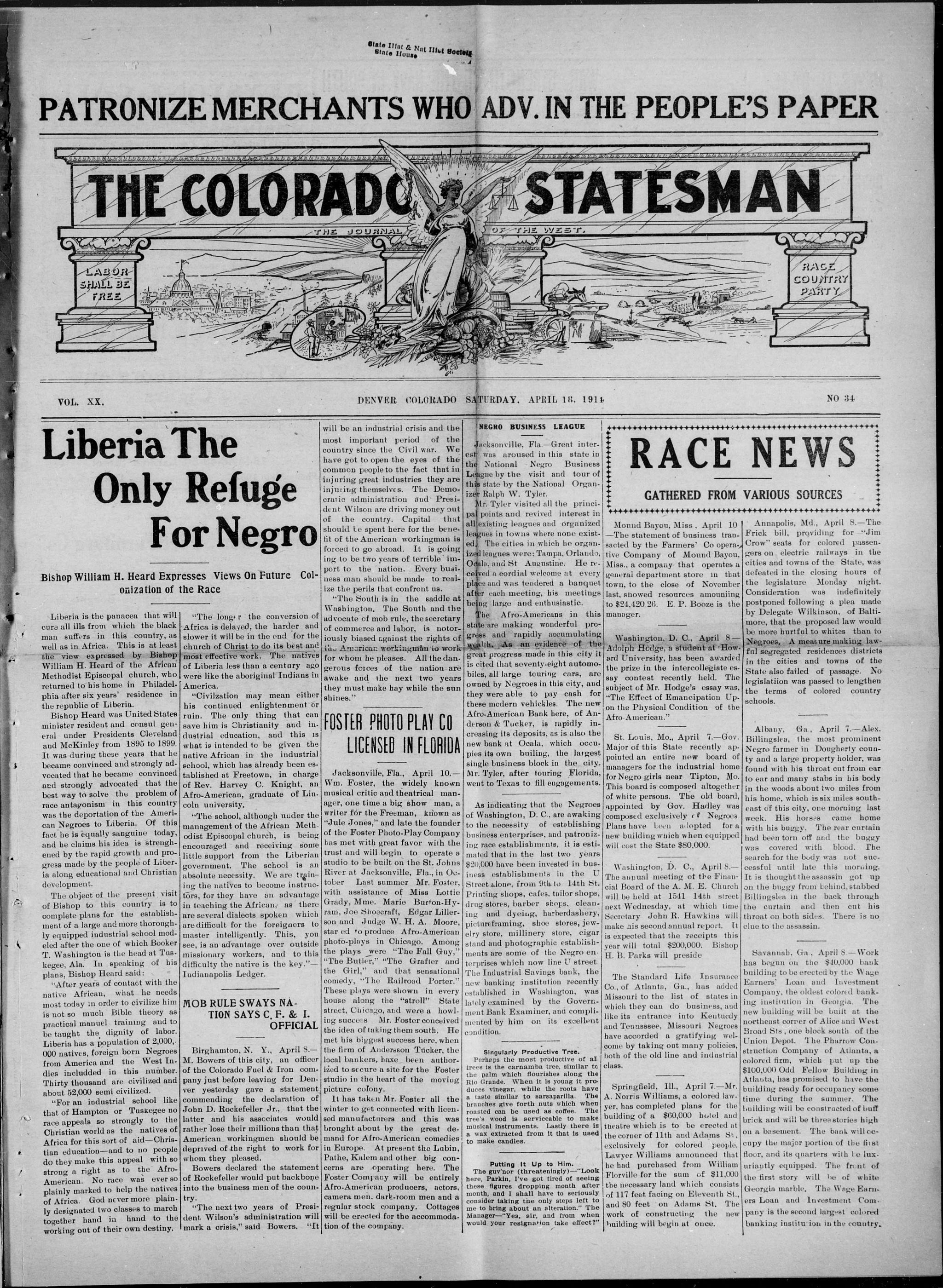
Liberia The Only Refuge For Negro
Bishop William H. Heard Expresses Views On Future Colonization of the Race
VOL. XX.
Liberia
Only
Bishop William H. Heard Exp
onization of
Liberia is the panacea that will cure all ills from which the black man suffers in this country, as well as in Africa. This is at least the view expressed by Bishop William H. Heard of the African Methodist Episcopal church, who returned to his home in Philadelphia after six years' residence in the republic of Liberia.
Bishop Heard was United States minister resident and consul general under Presidents Cleveland and McKinley from 1895 to 1899. It was during these years that he became convinced and strongly advocated that he became convinced and strongly advocated that the best way to solve the problem of race antagonism in this country was the deportation of the American Negroes to Liberia. Of this fact he is equally sanguine today, and he claims his idea is strengthened by the rapid growth and progress made by the people of Liberia along educational and Christian development.
The object of the present visit of Bishop to this country is to complete plans for the establishment of a large and more thoroughly equipped industrial school modeled after the one of which Booker T. Washington is the head at Tuskegee, Ala. In speaking of his plans, Bishop Heard said:
"After years of contact with the native African, what he needs most today in order to civilize him is not so much Bible theory as practical manuel training and to be taught the dignity of labor. Liberia has a population of 2,000, 000 natives, foreign born Negroes from America and the West Indies included in this number. Thirty thousand are civilized and about 52,000 semi civilized. "For an industrial school like that of Hampton or Tuskegee no race appeals so strongly to the Christian world as the natives of Africa for this sort of aid—Christian education—and to no people do they make this appeal with so strong a right as to the Afro-American. No race was ever so plainly marked to help the natives of Africa. God never more plainly designated two classes to march together hand in hand to the working out of their own destiny.
---
"The longer the conversion of Africa is delayed, the harder and slower it will be in the end for the church of Christ to do its best and most effective work. The natives of Liberia less than a century ago were like the aboriginal Indians in America.
"Civilization may mean either his continued enlightenment or ruin. The only thing that can save him is Christianity and industrial education, and this is what is intended to be given the native African in the industrial school, which has already been established at Freetown, in charge of Rev. Harvey C. Knight, an Afro-American, graduate of Lincoln university.
"The school, although under the management of the African Methodist Episcopal church, is being encouraged and receiving some little support from the Liberian government. The school is an absolute necessity. We are training the natives to become instructors, for they have an advantage in teaching the African, as there are several dialects spoken which are difficult for the foreigners to master intelligently. This, you see, is an advantage over outside missionary workers, and to this difficulty the native is the key."—Indianapolis Ledger.
MOB RULE SWAYS NA
TION SAYS C. F. & I.
OFFICIAL
Birghamton, N. Y., April S.—M. Bowers of this city, an officer of the Colorado Fuel & Iron company just before leaving for Denver yesterday gave a statement commending the declaration of John D. Rockefeller Jr., that the latter and his associates would rather lose their millions than that American workingmen should be deprived of the right to work for whom they pleased.
Bowers declared the statement of Rockefeller would put backbone into the business men of the country.
"The next two years of President Wilson's administration will mark a crisis," said Bowers. "It
DENVER COLORADO SATURDAY. APRIL 18, 1914
State Hiat & Nat Hiat Society
State House
ANTS WHO
ADC
THE JOURNAL
DENVER COLORADO S
will be an industrial crisis and the most important period of the country since the Civil war. We have got to open the eyes of the common people to the fact that in injuring great industries they are injuring themselves. The Democratic administration and President Wilson are driving money out of the country. Capital that should be spent here for the benefit of the American workingman is forced to go abroad. It is going ing to be two years of terrible import to the nation. Every business man should be made to realize the perils that confront us.
"The South is in the saddle at Washington. The South and the advocate of mob rule, the secretary of commerce and labor, is notoriously biased against the rights of the American workingman to work for whom he pleases. All the dangerous forces of the nation are awake and the next two years they must make hay while the sun shines."
FOSTER PHOTO PLAY CO LICENSED IN FLORIDA
Jacksonville, Fla., April 10.—Wm. Foster, the widely known musical critic and theatrical manager, one time a big show man, a writer for the Freeman, known as "Jule Jones," and late the founder of the Foster Photo-Play Company has met with great favor with the trust and will begin to operate a studio to be built on the St. Johns River at Jacksonville, Fla., in October. Last summer Mr. Foster, with assistance of Miss Lottie Grady, Mme. Marie Burton-Hyram, Joe Shoecraft, Edgar Lillerson and Judge W. H. A. Moore, stared to produce Afro-American photo-plays in Chicago. Among the plays were "The Fall Guy," "The Butler," "The Grafter and the Girl," and that sensational comedy, "The Railroad Porter." These plays were shown in every house along the "stroll" State street, Chicago, and were a howling success Mr. Foster conceived the idea of taking them south. He met his biggest success here, when the firm of Andersson Tucker, the local bankers, haxe been authorized to secure a site for the Foster studio in the heart of the moving picture colony.
It has taken Mr. Foster all the winter to get connected with licensed manufacturers and this was brought about by the great demand for Afro-American comedies in Europe. At present the Lubin, Pathe, Kalem and other big concerns are operating here. The Foster Company will be entirely Afro-American producers, actors, camera men, dark-room men and a regular stock company. Cottages will be erected for the accommodation of the company.
NEGRO BUSINESS LEAGUE
Jacksonville, Fla.—Great interest was aroused in this state in the National Negro Business League by the visit and tour of this state by the National Organizer Ralph W. Tyler. Mr. Tyler visited all the principal points and revived interest in all existing leagues and organized leagues in towns where none existed. The cities in which he organized leagues were: Tampa, Orlando, Ocala, and St Augustine. He received a cordial welcome at every place and was tendered a banquet after each meeting, his meetings being large and enthusiastic.
The Afro-Americans in this state are making wonderful progress and rapidly accumulating wealth. As an evidence of the great progress made in this city it is cited that seventy-eight automobiles, all large touring cars, are owned by Negroes in this city, and they were able to pay cash for these modern vehicles. The new Afro-American Bank here, of Anderson & Tucker, is rapidly increasing its deposits, as is also the new bank at Ocala, which occupies its own builing, the largest single business block in the city. Mr. Tyler, after touring Florida, went to Texas to fill engagements.
As indicating that the Negroes of Washington, D. C., are awaking to the necessity of establishing business enterprises, and patronizing race establishments, it is estimated that in the last two years $20,000 have been invested in business establishments in the U Street alone, from 9th to 14th St. Printing shops, cafes, tailor shops, drug stores, barber shops, cleaning and dyeing, harberdashery, pictureframing, shoe stores, jewelry store, millinery store, cigar stand and photographic establishments are some of the Negro enterprises which now line U street. The Industrial Savings bank, the new banking institution recently established in Washington, was lately examined by the Government Bank Examiner, and complimented by him on its excellent condition.
Singularly Productive Tree.
Singularly Productive Tree.
Perheps the most productive of all trees is the carnamba tree, similar to the palm which flourishes along the Rio Grande. When it is young it produces vinegar, while the roots have a taste similar to sarsaparilla. The branches give forth nuts which when roasted can be used as coffee. The tree's wood is serviceable to make musical instruments. Lastly there is a wax extracted from it that is used to make candles.
Putting It Up to Him.
The guvnor (threateningly)—"Look here, Parkin, I've got tired of seeing these figures dropping month after month, and I shall have to seriously consider taking the only steps left to me to bring about an alteration." The Manager—"Yes, sir, and from when would your resignation take effect?"
RACE NEWS
GATHERED FROM VARIOUS SOURCES
Mound Bayou, Miss , April 10 The statement of business transacted by the Farmers' Co operative Company of Mound Bayou, Miss., a company that operates a general department store in that town, to the close of November last, showed resources amounting to $24,420 26. E. P. Booze is the manager.
Washington, D. C., April 8—Adolph Hedge, a student at Howa ard University, has been awarded the prize in the intercollegiate essay contest recently held. The subject of Mr. Hodge's essay was, "The Effect of Emancipation Upon the Physical Condition of the Afro-American."
St. Louis, Mo., April 7.—Gov. Major of this State recently appointed an entire new board of managers for the industrial home for Negro girls near Tipton, Mo. This board is composed altogether of white persons. The old board, appointed by Gov. Hadley was composed exclusively of Negroes Plans have been adopted for a new building which when equipped will cost the State $80,000.
Washington, D. C., April 8. The annual meeting of the Financial Board of the A. M. E. Church will be held at 1541 14th street next Wednesday, at which time Secretary John R. Hawkins will make his second annual report. It is expected that the receipts this year will total $200,000. Bishop H. B. Parks will preside
The Standard Life Insurance Co., of Atlanta, Ga., has added Missouri to the list of states in which they can do business, and like its entrance into Kentucky and Tennessee, Missouri Negroes have accorded a gratifying welcome by taking out many policies, both of the old line and industrial class.
Springfield, Ill., April 7.—Mr. A. Norris Williams, a colored lawyer, has completed plans for the building of a $60,000 hotel and theatre which is to be erected at the corner of 11th and Adams St. exclusively for colored people. Lawyer Williams announced that he had purchased from William Florville for the sum of $11,000 the necessary land which consists of 117 feet facing on Eleventh St. and 80 feet on Adams St. The work of constructing the new building will begin at once.
NO 34
Annapolis, Md., April 8.—The Frick bill, providing for "Jim Crow" seats for colored passengers on electric railways in the cities and towns of the State, was defeated in the closing hours of the legislature Monday night. Consideration was indefinitely postponed following a plea made by Delegate Wilkinson, of Baltimore, that the proposed law would be more hurtful to whites than to Negroes. A measure making lawful segregated residences districts in the cities and towns of the State also failed of passage. No legislatiion was passed to lengthen the terms of colored country schools.
Albany, Ga., April 7.—Alex. Billingslea, the most prominent Negro farmer in Dougherty county and a large property holder, was found with his throat cut from ear to ear and many stabs in his body in the woods about two miles from his home, which is six miles southeast of this city, one morning last week. His horses came home with his buggy. The rear curtain had been torn off and the buggy was covered with blood. The search for the body was not successful until late this morning. It is thought the assassin got up on the buggy from behind, stabbed Billingslea in the back through the curtain and then cut his throat on both sides. There is no clue to the assassin.
Savannah, Ga., April 8 — Work has begun on the $40,000 bank building to be erected by the Wage Earners' Loan and Investment Company, the oldest colored banking institution in Georgia. The new building will be built at the northeast corner of Alice and West Broad Sts, one block south of the Union Depot. The Pharrow Construction Company of Atlanta, a colored firm, which put up the $100,000 Odd Fellow Building in Atlanta, has promised to have the building ready for occupancy some time during the summer. The building will be constructed of buff brick and will be three stories high on a basement. The bank will occupy the major portion of the first floor, and its quarters with be luxuriantly equipped. The front of the first story will be of white Georgia marble. The Wage Earners Loan and Investment Company is the second largest colored banking institution in the country.
NEWS TO DATE IN PARAGRAPHS
CAUGHT FROM THE NETWORK OF WIRES ROUND ABOUT THE WORLD.
DURING THE PAST WEEK
RECORD OF IMPORTANT EVENTS
CONDENSED FOR BUSY
PEOPLE.
Western Newspaper Union News Service.
WESTERN.
Vincent Astor is seriously ill at Hopeland house, Staatsburg, N. Y., the home of his fiancee, with four doctors attending him.
Jacob B. Barnes, formerly part owner of the El Paso, Ill. Journal and of the Peoria Journal, died at Peoria, aged seventy-four years.
Two men are dying as the result of an unsuccessful attempt by two bandits to hold up a Seattle-Tacoma interurban train at Riverton, south of Seattle, Wash.
Construction has started on the government-owned and operated railroad to run twenty miles southwest from Yuma, Ariz., through part of the neighboring federal reclamation district.
Victor Maki, thirty years old, met his brother John, twenty-three years old, at Painsdale, Mich., after a separation of seven years, and, instead of fraternal greetings, they quarreled and Victor shot John to death.
Establishment of a "poor man's club" to supplant the saloons voted out at the recent election, was announced by the trustees of the Baptist church at Lockport, Ill. Bowling alleys and a billiard room will be fitted out in the basement.
General Carranza, head of the Constitutionalists' revolution in Mexico, has a fighting force of 141,500 men, according to reports and authentic lists received by Signor Salvador Catana, representative of the rebel government in Denver.
Robert Higgins was sentenced to life imprisonment in the state penitentiary by Judge Olmstead at Galesburg, Ill., for the murder of Mrs. Higgins, Julia Flake, Higgins' step-daughter, for love of whom Higgins killed his wife, has not been tried for her part in the crime.
A branch regional bank, adequate to the needs of the city and its tributary territory, will be established in Denver, according to word received from Senator John F. Shafroth. The information stated that assurances of the branch bank had been given to Senator Shafroth by Secretary McAdoo.
Finding of what was believed to be a charred torso in the ruins of the Missouri Athletic Club at Fourth street and Washington avenue in St. Louis made it possible that thirty-eight persons lost their lives as a result of the fire which destroyed the club building the morning of March 9.
The confession of "Dago Frank" Ciroflic, made a few hours before he was executed for the part he played in the murder of Herman Rosenthal, in New York, will not be permitted to interfere in the plans of District Attorney Charles S. Whitman for the second trial of former Police Lieutenant Charles Becker.
WASHINGTON.
Mtj. Benjamin M. Koehler, tried by court-martial at Fort Terry Conn., on serious charges, has been sentenced to dismissal from the army.
With the return of President Wilson Monday from his three-day vacation in West Virginia, an early decision was expected on the plan of some administration leaders in Congress to postpone until next session all anti-trust legislation except the bill to create an interstate trade commission.
The American colony in Mexico City is now equipped to defend itself in case of an uprising in that city. Secretary of State Bryan admitted that Charge O'Shaughnessy had wired him that all of the Krag-Jorgensens with ammurition, shipped by the government to him, have been delivered.
Official Washington seems fully convinced that a declaration of war against Mexico is only a question of a few days. John Lind reported to the President in his conference that the "watchful waiting" policy was not productive of results. President Wilson feels that the arrest of Assistant Paymaster Charles C. Copp and the bluejackets of the Dolphin at Tampa, followed by their forced parade through the streets, when they were insulted by Hueristas, was inexcusable and indicative of the suppressed hatred of Americans by Huerta and his followers.
President Wilson had as his guests the children of the national capital. The occasion was the annual frolic and egg-rolling on the White house grounds.
Investigation of wages in the steel industry by the Department of Commerce was asked by a resolution by Representative Lobeck (Dem.) of Nebraska. Unqualified disapproval was expressed by President Wilson of the proposal in Congress to curtail the anti-trust legislative program for this season.
FOREIGN.
Fernand Forest, the inventor of the internal combustion motor, died at Monte Carlo from fright caused by an accident to his motor boat.
The London Daily Mall in an editorial considers that the United States "is on the very edge of armed intervention in Mexico, with all its incalculable consequences."
The suit at Paris of the Spanish Marquis d'Amosio for a separation from his wife who was formerly Miss Josephine Wright of St. Louis, is the result, it is said, of the latter's infatuation for a Spanish dancer named Morales.
Premier Asquith was greeted with an ovation on his return to the House of Commons. His progress from the entrance of the chamber to the chair of the speaker was accompanied by volleys of cheers from the ministerial and Nationalist members.
Walter Hines Page, the United States ambassador, has been notified that the rent of the offices in Victoria street, in London, which the American embassy has occupied for nearly thirty years, is to be raised to more than three times its present figures when the lease expires this fall.
Tokujiro Fujita, a wealthy farmer who was formerly attached to the Dowager Empress' palace, dressed in white robes, fasted a week and prayed in the temple on Mount Ashigara for the recovery of the dowager. On descending from the mount he learned that the dowager was dead, and committed suicide at Tokio.
SPORT
Patsy Drouillard of Detroit beat Pal Moore at Rochester, N. Y., winning the decision after eight rounds of clever battling./
D; W. King and C. D. Plank, both noted shots of Denver, finished an interesting match in which King was the winner by 59 points.
At Sydney, Australia, Eddie McGoorty, the American boxer, knocked out Dave Smith of Australia in the tenth round of a twenty-round bout.
At Caracas, Venezuela, an American aviator, Cecil Peoli, made the first flight from Caracas over the mountains. He landed safely at La Guaira.
Kid Kearney of Denver died from injuries received at Billings, Mont., in the seventh round of a scheduled ten-round bout with Roy Coquil of Cody, Wyo.
Jack Johnson, negro heavyweight pugilist, was granted a new trial on the Mann white slave act charge under which the negro was sentenced to a year in the penitentiary and $1,000 fine at Chicago.
Tens of thousands of fans turned out in eight Eastern cities to see the sixteen clubs of the American and National Leagues make their annual getaway in the championship baseball races. With but one or two exceptions warm weather and fair skies greeted the teams, and the baseball which resulted was spectacular in the extreme.
Breaking the world's tournament record for a five-man-team score, the Genesee team of Rochester, N. Y., scored a total of 3,035 pins in their three games at Atlantic City, N. J. The former National Bowling Association record was 2,997, held by the Grand Central team of Rochester, which score was made at Paterson, New Jersey.
GENERAL
Announcement was made in New York of the marriage at Hoboken, N. J., of Miss Billie Burke, the actress, to Florenz Ziegfeld, Jr., the theatrical manager.
Seven persons met death and another is missing as the result of a fire in Boston which raced through the fashionable Hotel Melvin in Allston and trapped the occupants.
Mrs. William Howard Taft, wife of the ex-president, is an anti, having joined the local branch of the Connecticut association opposed to woman suffrage of which Mrs. Hopkins, wife of Professor E. W. Hopkins of Yale, is chairman.
Desert land may not be obtained hereafter from the government unless the applicant can prove that water can be developed or procured for irrigation purposes. Notice to this effect was received by the Los Angeles United States Land Office.
T. F. Hunt, a farmer, was arrested at Tucumcari, N. M., on order of District Judge Lieb, charged with knowledge of the murders of John Sweaze and William Jones, prominent farmers who were shot to death from ambush near Tucumcari. Sweaze's wife also is held as a witness for the grand jury now in session.
With Dr. C. C. Meredith, head of the house of mystery at Bellevue, and Lucy D. Orr, alias Lucy Damms, his head nurse, held in the county jail at Pittsburg, Pa., charged with murder in connection with the death of Mrs. Myrtle B. Allison of Wilkinsburg, chief interest attached to a third arrest in the case at Washington, D. C.
At Pittsburg, Pa., investigation is being made by the county authorities into sixty burials in the private plot of Undertaker O. J. Goetz in the United States cemetery at Westview. And at the same time examination was being made of all burial permits issued to Dr. C. C. Meredith, head of the Bellevue sanitarium. The four New York gunman convicted of killing Herman Rosenthal, gambler, in front of a Broadway hotel in July, 1912, were put to death in the electric chair at Sing Sing prison at Ossining, N. Y.
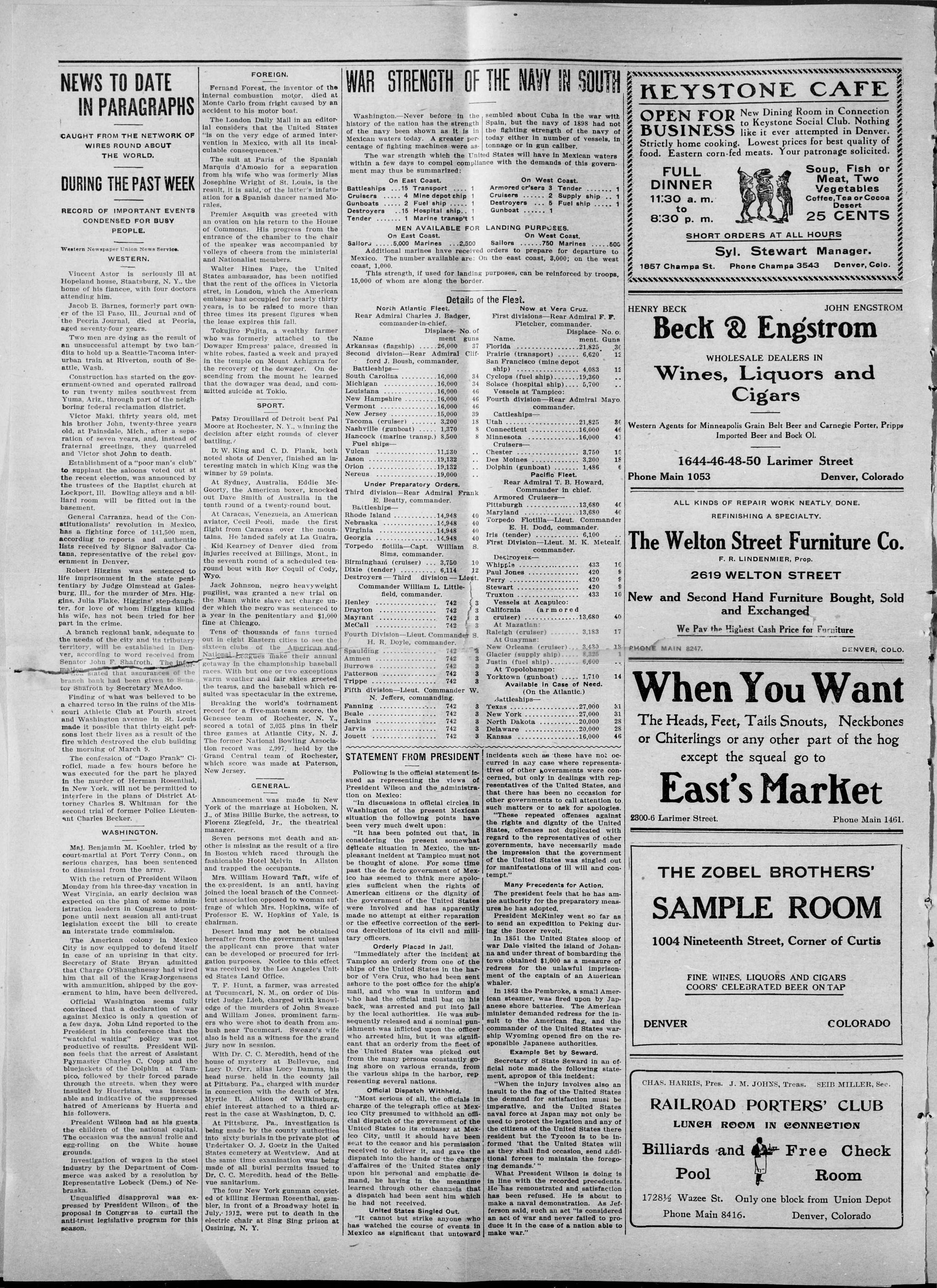
WAR STRENGTH OF THE NAVY IN SOUTH
Washington.—Never before in the history of the nation has the strength of the navy been shown as it is in Mexican waters today. A greater percentage of fighting machines were as-
The war strength which the United States will have in Mexican waters within a few days to compel compliance with the demands of this government may thus be summarized:
On East Coast.
Battleships ...15 Transport ...1
Cruisers ...4 Mine depot ship 1
Gunboats ...2 Fuel ship ...1
Destroyers ...15 Hospital ship...1
Tender ...1 Marine transp't 1
On West Coast.
Armored cr'sers 3 Tender ...1
Cruisers ...4 Mine depot ship ...1
Destroyers ...5 Fuel ship ...1
Gunboat ...1
Sallors .....5,000 Marines .....2,500 Sailors .....750 Marines .....500 Additional marines have received orders to prepare for departure to Mexico. The number available are: On the east coast, 3,000; on the west coast, 1,000. This strength, if used for landing purposes, can be reinforced by troops, 15,000 of whom are along the border.
Details of the Fleet.
North Atlantic Fleet.
Rear Admiral Charles J. Badger, commander-in-chief.
Displace- No. of
Name ment guns
Arkansas (flagship) ... 26,000 37
Second division—Rear Admiral Clifford J. Boush, commander.
Battleships—
South Carolina ... 16,000 34
Michigan ... 16,000 34
Louisiana ... 16,000 46
New Hampshire ... 16,000 46
Vermont ... 16,000 46
New Jersey ... 15,000 39
Tacoma (cruiser) ... 3,200 18
Nashville (gunboat) ... 1,370 8
Hancock (marine transp.) 8,500 8
Fuel ships—
Vulcan ... 11,230 ...
Jason ... 19,132 ...
Orion ... 19,132 ...
Nereus ... 19,000 ...
Under Preparatory Orders.
Third division—Rear Admiral Frank E. Beatty, commander.
Battleships—
Rhode Island ... 14,948 40
Nebraska ... 14,948 40
Virginia ... 14,948 40
Georgia ... 14,948 40
Torpedo flotilla—Capt. William S. Sims, commander.
Birmingham (cruiser) ... 3,750 10
Dixie (tender) ... 6,114 12
Destroyers—Third division—Lieut.
Commander William L. Littlefield, commander.
Henley ... 742 3
Drayton ... 742 3
Mayrant ... 742 3
McCall ... 742 3
Fourth Division—Lieut. Commander S. H. R. Doyle, commander.
Spaulding ... 742 3
Ammen ... 742 3
Burrows ... 742 3
Patterson ... 742 3
Trippe ... 742 3
Fifth division—Lieut. Commander W. N. Jeffers, commanding.
Fanning ... 742 3
Beale ... 742 3
Jenkins ... 742 3
Jarvis ... 742 3
Jouett ... 742 3
STATEMENT FROM PRESIDENT
Following is the official statement issued as representing the views of President Wilson and the administration on Mexico:
"In discussions in official circles in Washington of the present Mexican situation the following points have been very much dwelt upon:
"It has been pointed out that, in considering the present somewhat delicate situation in Mexico, the unpleasant incident at Tampico must not be thought of alone. For some time past the de facto government of Mexico has seemed to think mere apologies sufficient when the rights of American citizens or the dignity of the government of the United States were involved and has apparently made no attempt at either reparation or the effective correction of the serious derelictions of its civil and military officers.
"I immediately after the incident at Tampico an orderly from one of the ships of the United States in the harbor of Vera Cruz, who had been sent ashore to the post office for the ship's mail, and who was in uniform and who had the official mail bag on his back, was arrested and put into jail by the local authorities. He was subsequently released and a nominal punishment was inflicted upon the officer who arrested him, but it was significant that an orderly from the fleet of the United States was picked out from the many persons constantly going shore on various errands, from the various ships in the harbor, representing several nations.
Official Dispatch Withheld.
"Most serious of all, the officials in charge of the telegraph office at Mexico City presumed to withhold an official dispatch of the government of the United States to its embassy at Mexico City, until it should have been sent to the censor and his permission received to deliver it, and gave the dispatch into the hands of the charge d'affaires of the United States only upon his personal and emphatic demand, he having in the meantime learned through other channels that a dispatch had been sent him which he had not received.
United States Singled Out.
"It cannot but strike anyone who has watched the course of events in Mexico as significant that untoward
Now at Vera Cruz.
First divisions—Rear Admiral F. F.
Fletcher, commander.
Displace- No. o.
Name. ment. Guns
Florida ... 21,825 ... 30
Prairie (transport) ... 6,620 ... 12
San Francisco (mine depot ship) ... 4,083 ... 12
Cyclops (fuel ship) ... 19,360 ... -
Solace (hospital ship) ... 5,700 ... -
Vessels at Tampico:
Fourth division—Rear Admiral Mayo, commander.
Cattleships—
Utah ... 21,825 ... 80
Connecticut ... 16,000 ... 46
Minnesota ... 16,000 ... 45
Cruisers—
Chester ... 3,750 ... 10
Des Moines ... 3,200 ... 18
Dolphin (gunboat) ... 1,486 ... 6
Pacific Fleet.
Rear Admiral T. B. Howard, Commander in chief.
Armored Cruisers—
Pittsburgh ... 13,680 ... 40
Maryland ... 13,680 ... 40
Torpedo Flotilla—Lieut. Commander E. H. Dodd, commander.
Iris (tender) ... 6,100 ... -
First Division—Lieut. M. K. Metcalf, commander.
Destroyers—
Whipple ... 433 ... 10
Paul Jones ... 420 ... 9
Perry ... 420 ... 9
Stewart ... 420 ... 9
Truxton ... 433 ... 10
Vessels at Acapulco:
California (armored cruiser) ... 13,680 ... 40
At Mazatlan:
Raleigh (cruiser) ... 3,183 ... 17
At Guaymas:
New Orleans (cruiser) ... 3,430 ... 18
Glacier (supply ship) ... 8,325 ... 1
Justin (fuel ship) ... 6,600 ... -
At Topolobambo:
Yorktown (gunboat) ... 1,710 ... 14
Available in Case of Need.
(On the Atlantic.)
Battleships—
Texas ... 27,000 ... 31
New York ... 27,000 ... 31
North Dakota ... 20,000 ... 28
Delaware ... 20,000 ... 28
Kansas ... 16,000 ... 46
incidents such as these have not occurred in any case where representatives of other governments were concerned, but only in dealings with representatives of the United States, and that there has been no occasion for other governments to call attention to such matters or to ask for apologies. "These repeated offenses against the rights and dignity of the United States, offenses not duplicated with regard to the representatives of other governments, have necessarily made the impression that the government of the United States was singled out for manifestations of ill will and contempt."
Many Precedents for Action.
The president feels that he has ample authority for the preparatory measures he has adopted.
President McKinley went so far as to send an expedition to Peking during the Boxer revolt.
In 1851 the United States sloop of war Dale visited the island of Johanna and under threat of bombarding the town obtained $1,000 as a measure of redress for the unlawful imprisonment of the captain of an American whaler.
In 1863 the Pembroke, a small American steamer, was fired upon by Japanese shore batteries. The American minister demanded redress for the insult to the American flag, and the commander of the United States warship Wyoming opened fire on the responsible Japanese authorities.
Example Set by Seward.
Secretary of State Seward in an official note made the following statement, apropos of this incident:
"When the injury involves also an insult to the flag of the United States the demand for satisfaction must be imperative, and the United States naval force at Japan may not only be used to protect the legation and any of the citizens of the United States there resident but the Tycoon is to be informed 'that the United States will as they shall find occasion, send additional forces to maintain the foregoing demands.'"
What President Wilson is doing is in line with the recorded precedents. He has demonstrated and satisfaction has been refused. He is about to make a naval demonstration. As Jefferson said, such an act "is considered an act of war and never failed to produce it in the case of a nation able to make war."
---
OPEN FOR New Dining Room in Connection to Keystone Social Club. Nothing like it ever attempted in Denver. Strictly home cooking. Lowest prices for best quality of food. Eastern corn-fed meats. Your patronage solicited.
SHORT ORDERS AT ALL HOURS
Syl. Stewart Manor
Empa St. Phone Champa 3543 De
JOHN
Rock & Engstro
WHOLESALE DEALERS IN
wines, Liquors and
Cigars
for Minneapolis Grain Belt Beer and Carnegi
Imported Beer and Bock Ol.
644-46-48-50 Larimer Street
1053 Denver
ALL KINDS OF REPAIR WORK NEATLY DO
REFINISHING A SPECIALTY.
Welton Street Furniture
F. R. LINDENMIER, Prop.
2619 WELTON STREET
Second Hand Furniture Bo
and Exchanged
We Pay the Highest Cash Price for Furniture
8247.
When You W
oads, Feet, Tails Snouts, N
erlings or any other part of
except the squeal go to
East's Mark
er Street.
THE ZOBEL BROTHER
AMPLE ROO
Nineteenth Street, Corner of
SHORT
1857 Champa St.
HENRY BECK
Beck
WH
Wines
Western Agents for Minn
I
1644-4
Phone Main 1053
ALL KINDS
The Welton
2619
New and Secon
We Pav th
Beck & Engstrom
WHOLESALE DEALERS IN Wines, Liquors and Cigars Western Agents for Minneapolis Grain Belt Beer and Carnegie Porter, Pripps Imported Beer and Bock Ol.
1644-46-48-50 Larimer Street
Phone Main 1053 Denver, Colorado
ALL KINDS OF REPAIR WORK NEATLY DONE.
REFINISHING A SPECIALTY.
The Welton Street Furniture Co.
New and Second Hand Furniture Bought, Sold and Exchanged We Pay the Highest Cash Price for Furniture
When The Heads, F or Chiterlings except Eas
When You Want
The Heads, Feet, Tails Snouts, Neckbones or Chiterlings or any other part of the hog except the squeal go to
East's Market
2300.6 Larimer Street.
THE ZO
SAM
1004 Ninete
1004 Nineteenth Street, Corner of Curtis
FINE WINES, LIQUORS AND CIGARS,
COORS' CELEBRATED BEER ON TAP
R CO
RRIS, Pres. J. M. JOHNS, Treas. SEIB M.
LROAD PORTERS' C
CHAS. HARRIS, Prec
RAILROA
LUNCH
Billiards
17281 $ \frac{1}{2} $ Wazee St. Only one block from Union Depot Phone Main 8416. Denver, Colorado
FULL
DINNER
11:30 a.m.
to
8:30 p.m.
PHONE MAIN 8247.
DENVER
Soup, Fish or
Meat, Two
Vegetables
Coffee, Tea or Cocoa
Desert
25 CENTS
HOURS
t Manager.
543 Denver, Colo.
strom
S IN
rers and
and Carnegie Porter, Pripps
Ol.
er Street
Denver, Colorado
MEATLY DONE.
ALTY.
Furniture Co.
op.
STREET
Furniture Bought, Sold
d
for Furniture
Want outs, Neckbones part of the hog to rKet
OTHERS'
ROOM
ner of Curtis
SEIB MILLER, Sec. R'S' CLUB NNECTION free Check
DENMARK
```markdown
```
JOHN ENGSTROM
DENVER, COLO.
Phone Main 1461.
COLORADO
AFRO-AMERICAN CULLINGS
Liberia is the panacea that will cure all ills from which the black man suffers in this country, as well as in Africa. This is at least the view expressed by Bishop William H. Heard of the African Methodist Episcopal church, who returned to his home in Philadelphia after six years' residence in the republic of Liberia.
Bishop Heard was United States minister resident and consul general under Presidents Cleveland and McKinley-from 1895 to 1899. It was during these years that he became convinced and strongly advocated that the best way to solve the problem of race antagonism in this country was the deportation of the American negroes to Liberia. Of this fact he is equally sanguine today, and he claims his idea is strengthened by the rapid growth and progress made by the people of Liberia along educational and Christian development.
The object of the present visit of Bishop Heard to this country is to complete plans for the establishment of a large and more thoroughly equipped industrial school modeled after the one of which Booker T. Washington is the head at Tuskegee, Ala. In speaking of his plans, Bishop Heard said:
"After years of contact with the native African, what he needs most today in order to civilize him is not so much Bible theory as practical manual training and to be taught the dignity of labor. Liberia has a population of 2,000,000 natives, foreign-born negroes from America and the West Indies included in this number. Thirty thousand are civilized and about 52,000 semi-civilized.
"For an industrial school like that of Hampton or Tuskegee no race appeals so strongly to the Christian world as the natives of Africa for this sort of aid—Christian education—and to no people do they make this appeal with so strong a right as to the Afro-American. No race was ever so plainly marked to help the natives of Africa. God never more plainly designated two classes to march together hand in hand to the working out of their own destiny.
"The longer the conversion of Africa is delayed, the harder and slower it will be in the end for the church of Christ to do its best and most effective work. Hence I deem it our duty here in America to do that work. The natives of Liberia less than a century ago were like the aboriginal Indians in America.
"Civilization may mean either his continued enlightenment or ruin. The only thing that can save him is Christianity and industrial education, and this is what is intended to be given the native African in the industrial school, which has already been established at Freetown, in charge of Rev. Harvey C. Knight, an Afro-American, graduate of Lincoln university.
"The school, although under the management of the African Methodist Episcopal church, is being encouraged and receiving some little support from the Liberian government. The school is an absolute necessity. We are training the natives to become instructors, for they have an advantage in teaching the African, as there are several dialects spoken which are difficult for the foreigner to master intelligently. This, you see, is an advantage over outside missionary workers, and to this difficulty the native is the key."
The best thing to do is your best.
It is a fine thing the negro leaders in Kansas City are undertaking in bringing together their various charities in a federation. The charities which they sustain are highly creditable to the energy and self-sacrifice of the colored people themselves. There is very great need for all these institutions. Much of the work they do is preventive in character. Consider, for instance, the wholesome effect of the domestic science school which Mrs. T. H. W. Williams has instituted in her own home, which has trained 366 negro girls. With the various organizations federated, so they can avoid duplication of effort and co-operate more effectively, their efficiency and influence in the community must be greatly increased.—Kansas City Star.
The highest determined point in Florida is Mt. Pleasant, 302 feet above sea level, according to the United Geological Survey. The approximate average elevation of the state is 100 feet above the sea.
In England there are at least three farms devoted to the cultivation of butterflies and moths.
Henry Clay Folger, Jr., is said to have one of the finest collections of Shakespeareiana in the United States. He recently became the owner of the late Sir Edward Dowden's Shakespearean library, comprising some two thousand volumes. Book collecting is Mr. Folger's avocation; in the business world he is known as the president of the Standard Oil Company of New York.
The wife of an old soak rarely seems to realize that others are wise, too.
While the colored people of the Chesapeake basin are gradually growing into a landed class, even many of the landless majority have acquired personal property of various kinds. Some own their village homes, and it is believed that about half the colored farm laborers in Delaware own horses and carriages. In the bargain struck for wages between the white farmer and the colored farm laborer, it is a very common thing for the farmer to undertake the feeding and housing of the laborer's horse at a charge of about $2 per month to be taken out of the wages, which may be from $20 to $25 a month, with board and lodging. On Saturday night the colored people crowd into the Delaware villages, many of them bringing their wives and children in their own conveyances, and making purchases for the week to come.
There are few regions in the United States where comfortable living is so cheap as it is in the tidewater area of the Chesapeake basin. Here for 6,000 or 8,000 square miles all the inhabitants are within easy reach of perhaps the richest waters in the world. Fish, oysters, clams and for much of the year aquatic game birds of many kinds, to say nothing of the muskrat, sold for food as "marsh rabbit," are amazingly plentiful, while employment in the industries dependent upon the tidal waters is almost continuous and extremely well paid.
How big the negro department, or Nashville institute, is likely to bulk in the regeneration of the South is plain when we realize that negro churches have to date absolutely divorced religion from social service, writes Mary Bronson Hartt in the Boston Transcript. A negro theological student gets Greek and Hebrew and systematic theology enough to enable him to shine as a professor in a divinity school; but not one hour's training is given him in sociology, public hygiene or any topic fitting him to deal with the acute problems of the salvation of his race. Two negroes die of preventable disease for every white man. Yet the religious leaders of the people have made no capital of "Cleanliness next to godliness."
The social clinic of Nashville institute sends its students into the field as a part of their course. A kindergarten and milk depot are maintained at the school, and students of nursing, sanitation and home economics go out into the negro quarter to study and to help.
In a recent lecture was shown a significant photograph of a negro hovel of the worst ramshackle type, set in a vilely insanitary dooryard, so close under the shadow of the finest negro church in Nashville that the beautiful stone tower fills the background of the picture. In the dooryard stands a negro student from the new school for negro workers, himself a clergyman, dramatically dissertating upon the sanitary dangers of rubbish and urging the reformation of the cluttered dooryard. For years the church had looked down serenely on that hovel, satisfied with emotional fervor and quite unaware of its criminal neglect of life.
Gathering and selling acorns is a new industry in Arkansas to supply eastern nursery firms with material for forest planting.
Kansas City schools have shortened study days one hour.
The patrons of the negro public schools in the vicinity of Ellicott City, Md., have asked that the board of the Howard county school commissioners increase their teachers' salaries and make certain changes in the manner of conducting their schools. In addition to increased pay for their teachers they ask that they be paid monthly, instead of quarterly as at present. They also ask that colored trustees for the schools be dropped, and that the school board take charge of selecting their teachers and conducting their schools.
The colored petitioners also urge the establishment of a negro industrial school at Alpha, where the colored people own a tract of land. They would raise $500 toward the cost of the erection of the building. If the school should be built and meet with the approval of the state board of education, $1,500 would come from the state treasury for its use.
The Philippine Bureau of Forestry reports that American and European lumbermen are trying to procure large and regular shipments of Philippine woods, mainly for cabinet making.
How greatly hunting enters into British social life is shown by the fact that there are, according to a recent computation, 456 recognized packs of hounds in the United Kingdom. Of these, England has 364 packs, Ireland 75 packs and Scotland 17 packs. In round numbers, the packs which hunt the fox and deer total some 9,000 couples of hounds, while of harriers and beagles there are 3,500 couples.
None but very handsome women should take a chance on using stang.
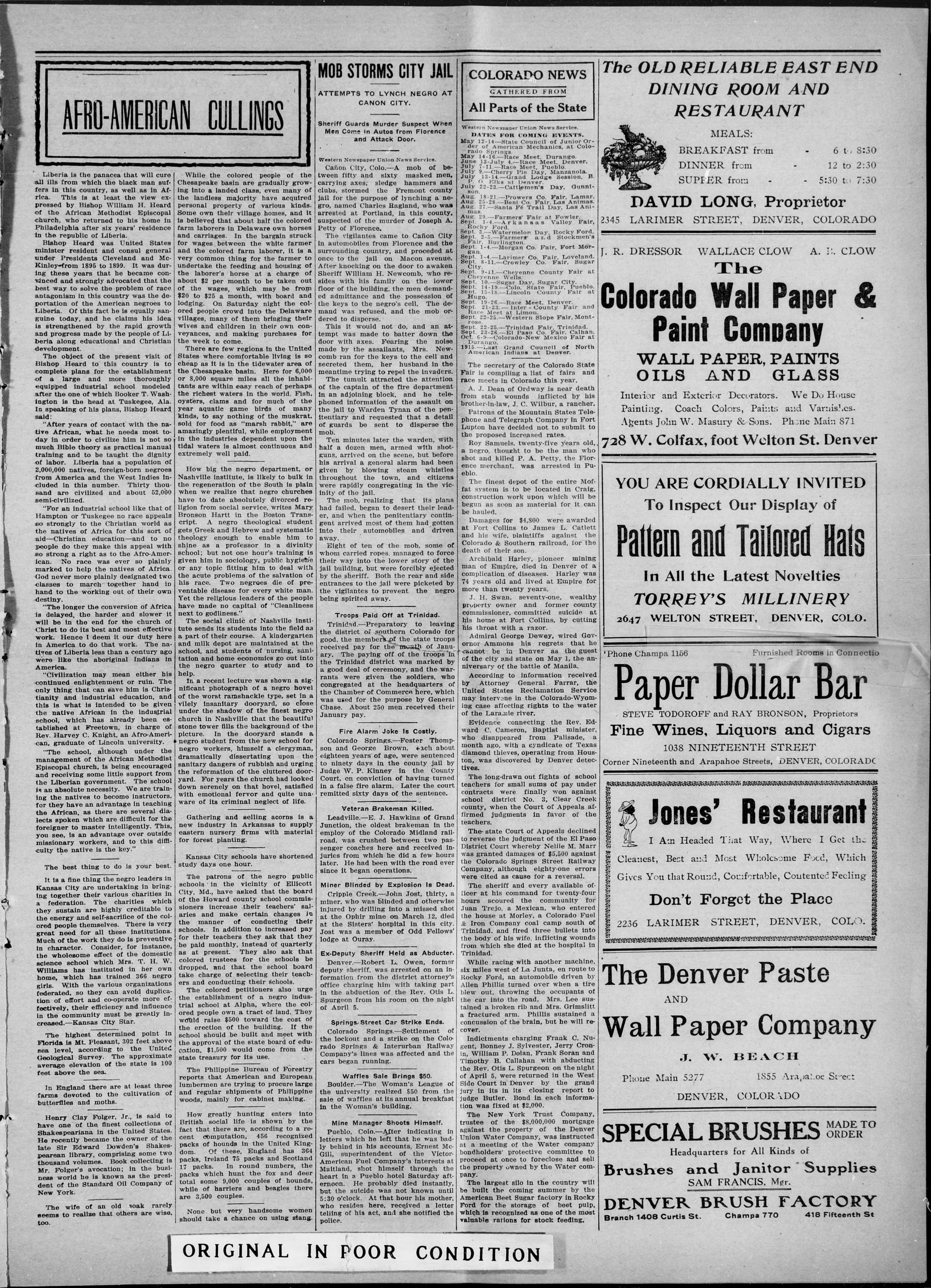
MOB STORMS CITY JAIL
ATTEMPTS TO LYNCH NEGRO AT CANON CITY.
Sheriff Guards Murder Suspect When Men Come In Autos from Florence and Attack Door.
Western Newspaper Union News Service.
Cañon City, Colo.—A mob of between fifty and sixty masked men, carrying axes; sledge hammers and clubs, stormed the Fremont county jail for the purpose of lynching a negro, named Charles Ragland, who was arrested at Portland, in this county, suspected of the murder of Joseph A. Petty of Florence.
The vigilantes came to Cañon City in automobiles from Florence and the surrounding country, and proceeded at once to the jail on Macon avenue.
After knocking on the door to awaken Sheriff William H. Newcomb, who resides with his family on the lower floor of the building, the men demanded admittance and the possession of the keys to the negro's cell. The demand was refused, and the mob ordered to disperse.
This it would not do, and an attempt was made to batter down the door with axes. Fearing the noise made by the assailants, Mrs. Newcomb ran for the keys to the cell and secreted them, her husband in the meantime trying to repel the invaders. The tumult attracted the attention of the captain of the fire department in an adjoining block, and he telephoned information of the assault on the jail to Warden Tynan of the penitentiary and requested that a detail of guards be sent to disperse the mob.
Ten minutes later the warden, with half a dozen men, armed with shotguns, arrived on the scene, but before his arrival a general alarm had been given by blowing steam whistles throughout the town, and citizens were rapidly congregating in the vicinity of the jail.
The mob, realizing that its plans had failed, began to desert their leader, and when the penitentiary contingent arrived most of them had gotten into their automobiles and driven away.
Eight of ten of the mob, some of whom carried ropes, managed to force their way into the lower story of the jail building, but were forcibly ejected by the sheriff. Both the rear and side entrances to the jail were picketed by the vigilantes to prevent the negro being spirited away.
Troops Paid Off at Trinidad.
Trinidad.—Preparatory to leaving the district of southern Colorado for good, the members of the state troops received pay for the month of January. The paying off of the troops in the Trinidad district was marked by a good deal of ceremony, and the warrants were given the soldiers, who congregated at the headquarters of the Chamber of Commerce here, which was used for the purpose by General Chase. About 250 men received their January pay.
Fire Alarm Joke Is Costly.
Colorado Springs.—Foster Thompson and George Brown. 4ch about eighteen years of age, were sentenced to ninety days in the county jail by Judge W. P. Kinney in the County Court, on conviction of having turned in a false fire alarm. Later the court remitted sixty days of the sentence.
Veteran Brakeman Killed
Leadville.—E. J. Hawkins of Grand Junction, the oldest brakeman in the employ of the Colorado Midland railroad, was crushed between two passenger coaches here and received injuries from which he did a few hours later. He had been with the road ever since it began operations.
Miner Blinded by Explosion Is Dead.
Cripple Creek.—John Jost, thirty, a miner, who was blinded and otherwise injured by drilling into a missed shot at the Ophir mine on March 12, died at the Sisters' hospital in this city. Jost was a member of Odd Fellows' lodge at Ouray.
Ex-Deputy Sheriff Held as Abductor.
Denver.—Robert L. Owen, former deputy sheriff, was arrested on an information from the district attorney's office charging him with taking part in the abduction of the Rev. Otis L. Spurgeon from his room on the night of April 5.
Springs Street Car Strike Ends.
Colorado Springs.—Settlement of the lockout and a strike on the Colorado Springs & Interurban Railway Company's lines was affected and the cars began running.
Waffles Sale Brings $50.
Boulder.—The Woman's League of the university realized $50 from the sale of waffles at its annual breakfast in the Woman's building.
Mine Manager Shoots Himself.
Pueblo, Colo.—After indicating in letters which he left that he was badly behind in his accounts, Ernest McGill, superintendent of the Victor-American Fuel Company's interests at Maitland, shot himself through the heart in a Pueblo hotel Saturday afternoon. He probably died instantly, but the suicide was not known until 5:30 o'clock. At that hour his mother, who resides here, received a letter telling of his act, and she notified the police.
Western Newsman Union News Service.
DATES FOR COMING EVENTS.
May 12-14—State Council of Junior Or-
dine Mechanics, at Colorado Springs.
son.
Aug. 18-21 - Prowers Co. Fair, Lamar.
Aug. 25-28 - Bear Fé Fair, Las Animas.
Aug. 27 - Santa Fé Trail Day, Las Animas.
Aug. 29 - Farmers' Fair at Fowler.
Sept. 1-4 Arkansas Valley Fair, Rocky Ford.
Sept. 4 - Watermelon Day, Rocky Ford.
Sept. 3 - Farmers' a.r.d Stockman's Fair, Burlington.
Sept. 1-4 - Morgan Co. Fair, Fort Morgan.
Sept. 1-4 - Larimer Co. Fair, Loveland.
Sept. 8-11 - Crowley Co. Fair, Sugar City.
Sept. 9-11.—Cheyenne County Fair at Cheyenne Wells.
Sept. 10.—Sugar Day, Sugar City.
Sept. 14-19.—Colo. State Fair, Pueblo.
Sept. 15-18.—Lincoln County Fair at
Hugo.
Sept. 19-26—Race Meet, Denver
Sept. 21-23—Inter- County Fair and
Race Meet at Limon
Sept. 22-25—Western Slope Fair, Mont-
ose
Sept. 22-25—Trinidad Fair, Trinidad
Sept. 22-26—El Paso Co. Fair, Cahalan
Oct. 6-9—Colorado-New Mexico Fair at
Durango.
1915.—Last Grand Council of North American Indians at Denver.
The secretary of the Colorado State Fair is compiling a list of fairs and race meets in Colorado this year.
A. J. Dean of Ordway is near death from stab wounds inflicted by his brother-in-law, J. C. Wilbur, a rancher. Patrons of the Mountain States Telephone and Telegraph Company in Fort Lupton have decided not to submit to the proposed increased rates.
Roy Samuels, twenty-five years old, a negro, thought to be the man who shot and killed P. A. Petty, the Florence merchant, was arrested in Pueblo.
The finest depot of the entire Moffat system is to be located in Craig, construction work upon which will be begun as soon as material for it can be hauled.
Damages for $4,800 were awarded at Fort Collins to James L. Cattlett and his wife, plaintiffs against the Colorado & Southern railroad, for the death of their son.
Archibald Harley, pioneer mining man of Empire, died in Denver of a complication of diseases. Harley was 74 years old and lived at Empire for more than twenty years.
J. H. Swan, seventy-one, wealthy property owner and former county commissioner, committed suicide at his home at Fort Collins, by cutting his throat with a razor.
Admiral George Dewey, wired Governor Ammons his regrets that he cannot be in Denver as the guest of the city and state on May 1, the anniversary of the battle of Manila.
According to information received by Attorney General Farrar, the United States Reclamation Service may intervene in the Colorado-Wyoming case affecting rights to the water of the Laramie river.
Evidence connecting the Rev. Edward C. Cameron, Baptist minister, who disappeared from Palisade, a month ago, with a syndicate of Texas diamond thieves, operating from Houston, was discovered by Denver detectives.
The long-drawn out fights of school teachers for small sums of pay under contracts were finally won against school district No. 3, Clear Creek county, when the Court of Appeals affirmed judgments in favor of the teachers.
The state Court of Appeals declined to reverse the judgment of the El Paso District Court whereby Nellie M. Marr was granted damages of $5,500 against the Colorado Springs Street Railway Company, although eighty-one errors were cited as cause for a reversal.
The sheriff and every available officer at his command for twenty-four hours scoured the community for Juan Trejo, a Mexican, who entered the house at Morley, a Colorado Fuel & Iron Company coal camp south of Trinidad, and fired three bullets into the body of his wife, inflicting wounds from which she died at the hospital in Trinidad.
While racing with another machine, six miles west of La Junta, en route to Rocky Ford, an automobile driven by Allen Phillis turned over when a tire blew out, throwing the occupants of the car into the road. Mrs. Lee sustained a broken rib and Mrs. Grimslitt a fractured arm. Phillis sustained a concussion of the brain, but he will recover.
Indictments charging Frank C. Nugent, Bonney J. Sylvester, Jerry Cronin, William P. Dolan, Frank Soran and Timothy B. Callahan with abducting the Rev. Otis L. Spurgeon on the night of April 5, were returned in the West Side Court in Denver by the grand jury in its its closing report to judge Butler. Bond in each information was fixed at $2,000.
The New York Trust Company, trustee of the $8,000,000 mortgage against the property of the Denver Union Water Company, was instructed at a meeting of the Water company bondholders' protective committee to proceed at once to foreclose and sell the property owned by the Water company.
The largest silo in the country will be built the coming summer by the American Beet Sugar factory in Rocky Ford for the storage of beet pulp, which is recognized as one of the most valuable rations for stock feeding.
2345 LARIMER STREET, DENVER, COLORADO
Colorado Wall Paper & Paint Company
WALL PAPER, PAINTS OILS AND GLASS Interior and Exterior Decorators. We Do House Painting. Coach Colors, Paints and Varnishes. Agents John W. Masury & Sons. Phone Main 871 728 W. Colfax, foot Welton St. Denver
In All the Latest Novelties TORREY'S MILLINERY 2647 WELTON STREET, DENVER, COLO.
Paper Dollar Bar
STEVE TODOROFF and RAY BRONSON, Proprietors Fine Wines, Liquors and Cigars
Jones' Restaurant
I Am Headed That Way, Where I Get the Cleanest, Best and Most Wholesome Food, Which Gives You that Round, Comfortable, Contented Feeling Don't Forget the Place 2236 LARIMER STREET, DENVER, COLO.
The Denver Paste
J. W. BEACH
Phone Main 5277 1855 ArapaLoe Street
DENVER, COLORADO
SPECIAL BRUSHES MADE TO ORDER
Brushes and Janitor Supplies
SAM FRANCIS, Mgr.
DENVER BRUSH FACTORY
Branch 1408 Curtis St. Champa 770 418 Fifteenth St
Fruit Bowl
DAVID
2345 LARIMER
J. R. DRESSOR
Colorado
Pain
WALD
OILS
Interior and E
Painting. Coa
Agents John W
728 W. Colfa
YOU ARE
To Ins
Pattern
In All
TORRI
2647 WELTO
Phone Champa 1156
Paper
STEVE TODOR
Fine Wine
```markdown
```
MEALS:
BREAKFAST from 6 to 8:30
DINNER from 12 to 2:30
SUPPER from 5:30 to 7:30
Furnished Rooms in Connectio
THE COLORADO STATESMAN
LADY BAIL IS FAIR
FAMILY COUNTRY PARTY
JOS. L. D. RIVERS.....Proprietor
1824 Curtis Street, Room 25.
Phone Main 7417.
SUBSCRIPTION RATES:
One Year ..... $2.00
Six Months ..... 1.00
Three Months ..... .60
PAYABLE IN ADVANCE.
PAYABLE IN ADVANCE.
Second-class matter at the postoffice in the
nations of a personating nature that are
from the columns of this paper.
long, 50 cents per inch. An inch contains
les, ten lines or less, 10 cents per line. B
ents per line.
saved on less than three months' contract.
from parties unknown to us. Further particu
should be made by Express Money Order,
Letter or Bank Draft. Postage stamps wi
one fractional part of a dollar. Only 1-cent.
us to receive attention must be newsy, u
en only upon one side of the paper; must
not later than Wednesdays, and bear the
script returned, unless stamps are sent for
happens that papers sent to subscribers
receive any number when due, inform us
forward a duplicate of the missing num
Entered as second-class matter at the postoffice in the city of Denver, Colorado.
All communications of a personating nature that are not complimentary will be withheld from the columns of this paper.
Display advertising, 50 cents per inch. An inch contains twelve agate lines.
Reading notices, ten lines or less, 10 cents per line. Each additional line over ten lines, 5 cents per line.
No discounts allowed on less than three months' contract. Cash must accompany all orders from parties unknown to us. Further particulars on application.
Remittances should be made by Express Money Order, Postoffice Money Order, Registered Letter or Bank Draft. Postage stamps will be received the same as cash for the fractional part of a dollar. Only 1-cent and 2-cent stamps taken.
Communications to receive attention must be newsy, upon important subjects, plainly written only upon one side of the paper; must reach us Tuesdays, if possible, anyway, not later than Wednesdays, and bear the signature of the author. No manuscript returned, unless stamps are sent for postage.
It occasionally happens that papers sent to subscribers are lost or stolen, in case you do not receive any number when due, inform us by postal card and we will cheerfully forward a duplicate of the missing number.
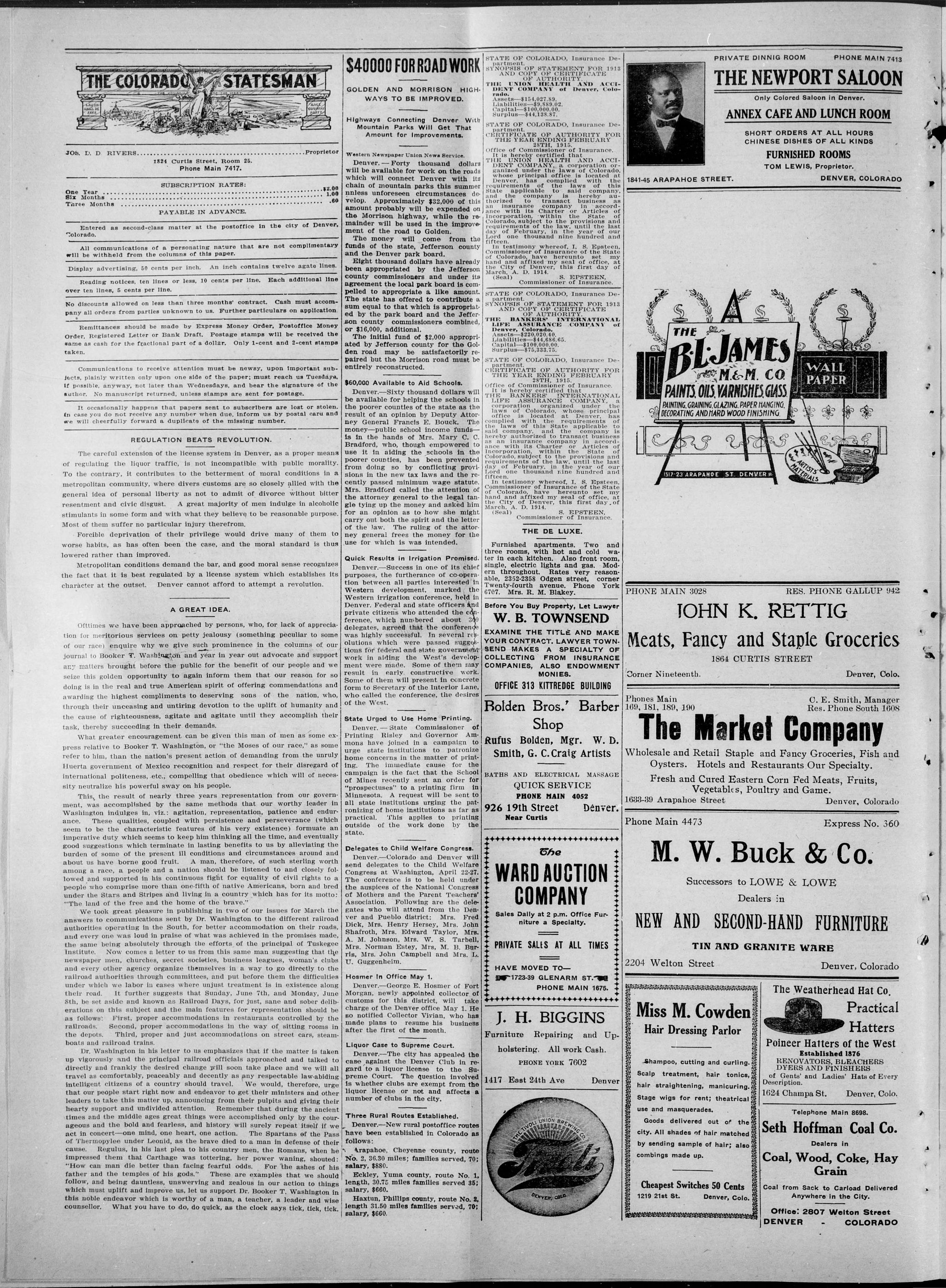
REGULATION BEATS REVOLUTION.
extension of the license system in Denver, and liquor traffic, is not incompatible with it contributes to the betterment of more community, where divers customs are so close personal liberty as not to admit of divic disgust. A great majority of men in form and with what they believe to be in no particular injury therefrom.ervation of their privilege would drive it has often been the case, and the morals been improved. conditions demand the bar, and good more best regulated by a license system which outset. Denver cannot afford to attempt
The careful extension of the license system in Denver, as a proper means of regulating the liquor traffic, is not incompatible with public morality. To the contrary, it contributes to the betterment of moral conditions in a metropolitan community, where divers customs are so closely allied with the general idea of personal liberty as not to admit of divorce without bitter resentment and civic disgust. A great majority of men indulge in alcoholic stimulants in some form and with what they believe to be reasonable purpose. Most of them suffer no particular injury therefrom.
Forcible deprivation of their privilege would drive many of them to worse habits, as has often been the case, and the moral standard is thus lowered rather than improved.
Metropolitan conditions demand the bar, and good moral sense recognizes the fact that it is best regulated by a license system which establishes its character at the outset. Denver cannot afford to attempt a revolution.
A GREAT IDEA.
have been approached by persons, who, for us services on petty jealousy (something is why we give such prominence in the T. Washington and year in year out ad right before the public for the benefit of opportunity to again inform them that
Oftimes we have been approached by persons, who, for lack of appreciation for meritorious services on petty jealousy (something peculiar to some of our race) enquire why we give such prominence in the columns of our journal to Booker T. Washington and year in year out advocate and support any matters brought before the public for the benefit of our people and we seize this golden opportunity to again inform them that our reason for so doing is in the real and true American spirit of offering commendations and awarding the highest compliments to deserving sons of the nation, who, through their unceasing and untiring devotion to the uplift of humanity and the cause of righteousness, agitate and agitate until they accomplish their task, thereby succeeding in their demands.
What greater encouragement can be given this man of men as some express relative to Booker T. Washington, or "the Moses of our race," as some refer to him, than the nation's present action of demanding from the unruly Huerta government of Mexico recognition and respect for their disregard of international politeness, etc., compelling that obedience which will of necessity neutralize his powerful sway on his people.
This, the result of nearly three years representation from our government, was accomplished by the same methods that our worthy leader in Washington indulges in, viz.: agitation, representation, patience and endurance. These qualities, coupled with persistence and perseverance (which seem to be the characteristic features of his very existence) formulate an imperative duty which seems to keep him thinking all the time, and eventually good suggestions which terminate in lasting benefits to us by alleviating the burden of some of the present ill conditions and circumstances around and about us have borne good fruit. A man, therefore, of such sterling worth among a race, a people and a nation should be listened to and closely followed and supported in his continuous fight for equality of civil rights to a people who comprise more than one-fifth of native Americans, born and bred under the Stars and Stripes and living in a country which has for its motto: "The land of the free and the home of the brave."
We took great pleasure in publishing in two of our issues for March the answers to communications sent by Dr. Washington to the different railroad authorities operating in the South, for better accommodation on their roads, and every one was loud in praise of what was achieved in the promises made, the same being absolutely through the efforts of the principal of Tuskegee Institute. Now comes a letter to us from this same man suggesting that the newspaper men, churches, secret societies, business leagues, woman's clubs and every other agency organize themselves in a way to go directly to the railroad authorities through committees, and put before them the difficulties under which we labor in cases where unjust treatment is in existence along their road. It further suggests that Sunday, June 7th, and Monday, June 8th, be set aside and known as Railroad Days, for just, sane and sober deliberations on this subject and the main features for representation should be as follows: First, proper accommodations in restaurants controlled by the railroads. Second, proper accommodations in the way of sitting rooms in the depots. Third, proper and just accommodations on street cars, steamboats and railroad trains.
Dr. Washington in his letter to us emphasizes that if the matter is taken up vigorously and the principal railroad officials approached and talked to directly and frankly the desired change will soon take place and we will all travel as comfortably, peaceably and decently as any respectable law-abiding intelligent citizens of a country should travel. We would, therefore, urge that our people start right now and endeavor to get their ministers and other leaders to take this matter up, announcing from their pulpits and giving their hearty support and undivided attention. Remember that during the ancient times and the middle ages great things were accomplished only by the courageous and the bold and fearless, and history will surely repeat itself if we act in concert—one mind, one heart, one action. The Spartans of the Pass of Thermopylee under Leonid, as the brave died to a man in defense of their cause. Regulus, in his last plea to his country men, the Romans, when he impressed them that Carthage was tootering, her power waning, shouted: "How can man die better than facing fearful odds. For the ashes of his father and the temples of his gods." These are examples that we should follow, and being dauntless, unswerving and zealous in our action to things which must uplift and improve us, let us support Dr. Booker T. Washington in this noble endeavor which is worthy of a man, a teacher, a leader and wise counsellor. What you have to do, do quick, as the clock says tick, tick, tick.
$40000 FOR ROAD WORK
GOLDEN AND MORRISON HIGH
WAYS TO BE IMPROVED.
Highways Connecting Denver With Mountain Parks Will Get That Amount for Improvements.
Western Newspaper Union News Service.
Denver. — Forty thousand dollars will be available for work on the roads which will connect Denver with its chain of mountain parks this summer unless unforeseen circumstances develop. Approximately $32,000 of this amount probably will be expended on the Morrison highway, while the remainder will be used in the improvement of the road to Golden.
The money will come from the funds of the state, Jefferson county and the Denver park board.
Eight thousand dollars have already been appropriated by the Jefferson county commissioners and under its agreement the local park board is compelled to appropriate a like amount. The state has offered to contribute a sum equal to that which is appropriated by the park board and the Jefferson county commissioners combined, or $16,000, additional.
The initial fund of $2,000 appropriated by Jefferson county for the Golden road may be satisfactorily repaired but the Morrison road must be entirely reconstructed.
$60,000 Available to Aid Schools.
Denver.—Sixty thousand dollars will be available for helping the schools in the poorer counties of the state as the result of an opinion by Deputy Attorney General Francis E. Bouck. The money—public school income funds—is in the hands of Mrs. Mary C. C. Bradford, who, though empowered to use it in aiding the schools in the poorer counties, has been prevented from doing so by conflicting provisions in the new tax laws and the recently passed minimum wage statute. Mrs. Bradford called the attention of the attorney general to the legal tangy tying up the money and asked him for an opinion as to how she might carry out both the spirit and the letter of the law. The ruling of the attorney general frees the money for the use for which it was intended.
Quick Results in Irrigation Promised.
Denver.—Success in one of its chief purposes, the furtherance of co-operation between all parties interested in Western development, marked the Western irrigation conference, held in Denver. Federal and state officers and private citizens who attended the conference, which numbered about 300 delegates, agreed that the conference was highly successful. In several resolutions which were passed suggestions for federal and state government work in aiding the West's development were made. Some of them may result in early constructive work. Some of them will present in concrete form to Secretary of the Interior Lane, who called the conference, the desires of the West.
State Urged to Use Home Printing.
Denver. — State Commissioner of Printing Risley and Governor Ammons have joined in a campaign to urge state institutions to patronize home concerns in the matter of printing. The immediate cause for the campaign is the fact that the School of Mines recently sent an order for "prospectuses" to a printing firm in Minnesota. A request will be sent to all state institutions urging the patronizing of home institutions as far as practical. This applies to printing outside of the work done by the state.
Delegates to Child Welfare Congress.
Delegates to Oral Welfare Congress.
Denver.—Colorado and Denver will send delegates to the Child Welfare Congress at Washington, April 22-27. The conference is to be held under the auspices of the National Congress of Mothers and the Parent Teachers' Association. Following are the delegates who will attend from the Denver and Pueblo district: Mrs. Fred Dick, Mrs. Henry Hersey, Mrs. John Shafroth, Mrs. Edward Taylor, Mrs. A. M. Johnson, Mrs. W. S. Tarbell, Mrs. Norman Estey, Mrs. M. B. Burris, Mrs. John Campbell and Mrs. L. U. Guggenheim.
Hosmer In Office May 1
Denver.—George E. Hosmer of Fort Morgan, newly appointed collector of customs for this district, will take charge of the Denver office May 1. He so notified Collector Vivian, who has made plans to resume his business after the first of the month.
Liquor Case to Supreme Court.
Denver.—The city has appealed the case against the Denver Club in regard to a liquor license to the Supreme Court. The question involved is whether clubs are exempt from the liquor license or not and affects a number of clubs in the city.
Three Rural Routes Established.
Denver.—New rural postoffice routes have been established in Colorado as follows:
Arapahoe, Cheyenne county, route No. 2, 36.30 miles; families served, 70; salary, $880.
Eckley, Yuma county, route No. 1, length, 30.75 miles families served 35; salary, $660.
Haxtun, Phillips county, route No. 2, length 31.50 miles families served, 70; salary, $660.
STATE OF COLORADO, Insurance Department.
SYNOPSIS OF STATEMENT FOR 1913
AND CURRENCIATE
OF AUTHORITY
THE UNION HEALTH AND ACCE
COMPANY OF Denver, Colorado.
Assets—$154,027.89.
Liabilities—$9,889.02.
Capital—$100,000.00.
Surplus—$44,138.87.
STATE OF COLORADO, Insurance Department.
CERTIFICATE OF AUTHORITY FOR
THE YEAR ENDING FEBRUARY
28TH, 1915.
Office of Commissioner of Insurance.
It is hereby certified that
the Commissioner of Insurance
AGL
DENT COMPANY, a corporation organized under the laws of Colorado, whose principal office is located at Denver, has complied with the requirements of the laws said company, State applicable to the said company, and the company is hereby authorized to transact business as an insurance company in accord with the Quarterly or annual incorporation, within the State of Colorado, subject to the provisions and requirements of the law, until the last day of February, in the year of our Lord one thousand nine hundred and fifteen. In testimony whereof, I, S. Epstein, Commissioner of Insurance of the State of Colorado, have hereunto set my seal on my seal of office of the City of Denver, this first day of March, A. D. 1914.
(Seal) S. EPSTEEN, Commissioner of Insurance.
STATE OF COLORADO, Insurance Department.
SYNOPSIS OF STATEMENT FOR 1913
AND COPY OF CERTIFICATE
OF AUTHORITY.
THE BANKERS' INTERNATIONAL
LIFE ASSURANCE COMPANY of
Denver, Colorado.
STATE OF COLORADO, Insurance Department
CERTIFICATE OF AUTHORITY FOR THE YEAR ENDING FEBRUARY 28TH, 1915
Office of Commission of Insurance.
It is hereby certified that
THE BANKERS' INTERNATIONAL LIFE ASSURANCE COMPANY, a corporation organized under the laws of Colorado, whose principal office is located in Denver, is complied with the requirements of the laws of this State applicable to said company, and the company is hereby authorized to transact business and provide insurance with its Charter or Articles of Incorporation, within the State of Colorado, subject to the provisions and requirements of the law, until the last of February, in the year of our Lord one thousand nine hundred and fifteen.
In testimony whereof, I. S. Epsteen, Commissioner of Insurance of the State of Colorado, have hereunto set my hand and affixed my seal of office, at A. D. of Denver, this first day, of March, A. D. 1914. (Seal) S. EPSTEEN.
THE DE LUXE.
Furnished apartments. Two and three rooms, with hot and cold water in each kitchen. Also front room, single, electric lights and gas. Modern throughout. Rates very reasonable, 2352-2358 Odgen street, corner Twenty-fourth avenue. Phone York 6707. Mrs. R. M. Blakey.
Before You Buy Property, Let Lawyer W. B. TOWNSEND
EXAMINE THE TITLE AND MAKE YOUR CONTRACT. LAWYER TOWN-SEND MAKES A SPECIALTY OF COLLECTING FROM INSURANCE COMPANIES, ALSO ENDOWMENT MONIES.
OFFICE 313 KITTREDGE BUILDING
Bolden Bros.' Barber Shop
Rufus Bolden, Mgr. W. D. Smith, G. C. Craig Artists
BATHS AND ELECTRICAL MASSAGE
QUICK SERVICE
PHONE MAIN 4052
926 19th Street Denver.
Near Curtis
The
WARD AUCTION
COMPANY
Sales Daily at 2 p.m. Office Furniture a Specialty.
PRIVATE SALES AT ALL TIMES
HAVE MOVED TO—
1723-39 GLENARM ST.
PHONE MAIN 1675.
J. H. BIGGINS
Furniture Repairing and Upholstering. All work Cash.
PHONE YORK 7602
1417 East 24th Ave Denver
THE TIVOLI UNION BREWING CO.
Tivoli
DENVER, COLD
```markdown
```
THE NEWPORT SALOON
FURNISHED ROOMS
TOM LEWIS, Proprietor.
HOE STREET.
DENVER, COLORADO
THE B.L. JAMES
M. & M. CO.
ARTS, OILS, VARNISHES, GLASS
G. GRAINING, GLAZING, PAPER HANGING,
CINING AND HARD WOOD FINISHING.
WALL
PAPER
ARAPAHDE ST. DENVER
ARTISTS
MATERIALS
1841-45 ARAPAHOE STREET.
THE
B.L.JAM
M.E.M.
PAINTS, OILS, VARNISH
PAINTING, GRAINING, GLAZING, PAPER
DECORATING AND HARD WOOD FI
1517-23 ARAPAH0E ST. DEN
THE
B.L. JAMES
M. & M. CO.
PAINTS, OILS, VARNISHES, GLASS
PAINTING, GRAINING, GLAZING, PAPER HANGING,
DECORATING AND HARD WOOD FINISHING
WALL
PAPER
1517-23 ARAPANOE ST. DENVER
ARTISTS
MATERIALS
JOHN K
Meats, Fancy and
1864 CUR
Corner Nineteenth.
Phones Main
169, 181, 189, 190
The Mark
Wholesale and Retail Staple
Oysters. Hotels and I
Fresh and Cured Easter
Vegetables, P
1633-39 Arapahoe Street
OHN K. RETTIG Fancy and Staple Groceries 1864 CURTIS STREET tenth. Denver, Colo.
Market Company
and Retail Staple and Fancy Groceries, Fish and
Hotels and Restaurants Our Specialty.
and Cured Eastern Corn Fed Meats, Fruits,
Vegetables, Poultry and Game.
Wholesale and Retail Staple and Fancy Groceries, Fish and Oysters. Hotels and Restaurants Our Specialty.
M. W. B
W. Buck & Co.
M. W. Buck & Co.
Successors to LOWE & LOWE Dealers in NEW AND SECOND-HAND FUR
ND SECOND-HAND FURNITURE
NEW AND SECOND-HAND FURNITURE
TIN AND GRANITE WARE
Miss M. Cowden Hair Dressing Parlor
Shampoo, cutting and curling. Scalp treatment, hair tonics, hair straightening, manicuring. Stage wigs for rent; theatrical use and masquerades. Goods delivered out of the city. All shades of hair matched by sending sample of hair; also combings made up.
Cheapest Switches 50 Cents
1219 21st St. Denver, Colo.
---
A. H.
PHONE MAIN 3028
Phone Main 4473
2204 Welton Street
SHORT ORDERS AT ALL HOURS
CHINESE DISHES OF ALL KINDS
RES. PHONE GALLUP 942
Denver, Colo.
C. E. Smith, Manager Res. Phone South 1608
Denver, Colorado
Express No. 360
Denver, Colorado
Practical
Hatters
Poineer Hatters of the West
Established 1876
RENOVATORS, BLEACHERS
DYERS AND FINISHERS
of Gents' and Ladies' Hats of Every
Description.
1624 Champa St. Denver, Colo.
Telephone Main 8698.
Seth Hoffman Coal Co.
Dealers in
Coal, Wood, Coke, Hay
Grain
Coal from Sack to Carload Delivered
Anywhere in the City.
Office: 2807 Welton Street
DENVER - COLORADO
THE COLORADO STATESMAN
LABOR SHALL BE FREE
MASS COUNTRY PARTY
Mrs. G. M. Morris left today for Or-
chard, Colo., to spend the summer.
Mrs. G. M. Morris left today for Orchard, Colo., to spend the summer.
James Johnson left Wednesday for Oakland, Calif., to join his wife, who has been in California several months.
The Terpsichorean Club will give their regular dancing school every Tuesday evening at Old Colony hall.
Mrs. George S. Contee arrived home today from Phoenix, Ariz., where she has been several months in the interest of her health.
Mrs. F. A. Newman, conducting the Five Points Creamery at 817-819 26th avenue, is making a specialty in ice cream. Call and see her when purchasing cream for parties and entertainments.
The Imperial Cosmos Club entertained several of their friends at a formal dance at Colony Hall Tuesday evening. A most delightful time was enjoyed by all present.
Mrs. A. W. Stradwick of 2337 Glen-arm place, who was very ill last week, is improving but not yet able to leave her home. Mr. Stradwick underwent a slight operation last Wednesday.
Hello! Meet me at the Tenth Annual Reception of Mountain Lodge of Elks No. 39, I. B. P. O. E. of W., at Fern hall, Tuesday, April 28th. Good music. Admission 35c.
W. L. Kirchelow, who drew a 640-acre homestead in Nebraska several months ago left this week for his place to commence improvement. It is a fine tract of land and his many friends wish him success.
Mrs. Sarah Thompson's funeral will be held at Campbell A. M. E. Church Sunday afternoon at 2 o'clock. Rev. Washington will officiate. Interment at Riverside, arranged by the Douglass Undertaking Company.
The Saturday evening's entertainment given by the Rocky Mountain Athletic Association of 2014 Champa street, under the management of Richard Frazier, is proving a great success.
Mr. Henry Marks and Mrs. M. J. Ewing were married Wednesday evening in the presence of a few of their immediate friends. Rev. Washington of Campbell A. M. E. Church officiated. They are at home to their friends at 2733 Marion street.
Tommy Lewis, proprietor of the Newport saloon, hotel and café, has moved his place of business to 1837 Arapahoe street, which was especially remodeled for him. The opening which takes place today promises to be one of the most elaborate affairs.
Mr. and Mrs. Joseph Young passed through the city this week from Chandler Creek, Colo., to their ranch in Deerfield, Colo. Mr. Young was the third person who settled in Deerfield, and speaks in the highest terms of the place. He says by hard and steady work he is making good on his ranch.
EASTER DANCE
There were some four Easter dances given in Denver this week, but the one that was given at Houston hall so far excelled all others that the dancing public has termed it the real Easter dance. For the second time in its history beautiful Houston hall, perfect in every appointment, opened wide its doors to the Negroes of Denver, and they turned out en masse in celebration of the event. Their dress and mannerisms were all that could be asked of any people and if the managers of the various halls in Denver could have seen them from start to finish there would be less trouble in renting any hall that we may desire.
Morrison's orchestra furnished the music, and it may be said to its credit that it showed off even better in that spacious hall than it does in the smaller halls.
Pete Nelson, Alvin Wright and Fred O'Neal, the managers, deserve all the credit for this delightful event, and it is hoped that they will not wait for another Easter for a repetition.
BOXING CONTEST.
Much credit must be given Sylvester Stewart, manager of the Keystone Social Club, for the fistic entertainment which was successfully carried off on Wednesday evening last, before the largest crowd that ever attended at Eureka hall. "Scotty" Williams of Denver and Otis Bruce of Trinidad (but formerly of Denver) were the combatants in the pugilistic arena, and the fastest milling of ten rounds was witnessed by hundreds of people who declared that they were never served such a treat for quite a long time in the city of Denver. Williams got the decision on points as he dropped his opponent twice to the floor, but it could clearly be seen that Bruce was more clever and quite a clean exponent of the game. The preliminaries between Kid Keyes of Texas and John Catlett of Denver ended in the second round when Catlett knocked out his man.
In the semi-wind-up Dinge McCarthy of Salt Lake put his opponent, Willie Williams of Colorado Springs,to sleep in the fifth round. Quite a lot of fun was created in the battle royal when silver coins were thrown in the ring by the spec-
tators and the tactics used by the boys to gather the money added materially to the amusement. Nearly a thousand people witnessed this event, which will be long remembered, and Mr. Stewart has received many congratulations and encouragements to keep up the sport by his usual "acting on the square."
CITY FEDERATION OF COLORED WOMEN'S CLUBS WINS SIGNAL VICTORY.
Petition Honored by City Council and Shorter Chapel to Have Beau-
For a number of years the beauty of Shorter Chapel's property has been marred by fronting an unsightly building located on the triangular plot at the junction of Washington, Twentieth and Park avenues. Again and again efforts had been made to have this undesirable structure moved, but without success.
During the summer of 1913 the attention of the City Federation of Colored Women's Clubs was drawn to this much-needed improvement, and by an unanimous vote the federation agreed to undertake the task. A steering committee, of which Mrs. Josephine Cassell was made chairman, was appointed to act in co-operation with the pastor and officers of said church in securing the desired end.
Led on by Mrs. Cassell and her committee, the ball was set in motion immediately and within a short time a petition signed by the adjacent property owners, members of this congregation and members of the several clubs was presented to the park board asking that the city buy over said property and convert it into a park. A committee of ladies also appeared before this board and in brief speeches emphasized the justice of their request. But after giving a respectful hearing, the Park Board, as it wont to do, passed up the petition labeled with the ingenious excuse, "lack of funds."
Daunted by this defeat, the matter was allowed to rest for a time, but with Mrs. Cassell in charge, it could not remain thus long. Finally the petition was taken up with the City Council and again a committee representing the several clubs, along with the pastor and trustees, appeared before the City Council and there urged that favorable action be taken on the petition. As a result of the wise and persistent action on the part of this committee, the City Council on Monday afternoon last voted to purchase the property and to convert it into a park.
Through this achievement our women have rendered a great service for Shorter's congregation and for the entire colored citizenry of Denver as well. This is but another illustration justifying woman suffrage. Give our women a chance and they will demonstrate their ability to bring things to pass. As pastor of Shorter Chapel, A. M. E. Church, I desire to publicly express* my deep appreciation and gratitude for this remarkable service rendered my congregation by the City Federation of Colored Women's Clubs.
ROBERT L. POPE.
ZION BAPTIST CHURCH.
The Sunday school presented a magnificent program at the morning hour of worship last Sunday. A large and appreciative congregation was present to enjoy the treat. The committee received the commendation of the entire church.
The Rev. Dr. Scott of Raleigh, North Carolina, preached at the evening service. Dr. Scott is a young man of great learning and prominence in his section of the country.
The Willing Workers, one of our active church auxiliaries, has furnished up the pastor's study in sumptuous style. The pastor will maintain his office at the church and may be found there between the hours of 11 a. m. and 1 p. m. except Monday and Saturday.
The time for Zion's May Festival is drawing nigh. Plans for the entertainment, together with dates, will be published next week.
The Men's Bible Class had a splendid lesson and a generous attendance last week. Every man in the city will be welcome at this meeting at eight o'clock each Tuesday evening.
The Women's Bible Class holds forth Thursday afternoons at 2:30, where the ladies of the church will be glad to meet any woman who is interested in the study of the Word of God. These meetings draw a large at tendance and are proving of great benefit to the ladies.
The Willing Workers will give a box social at the home of Sister Nannie Johnson, 2431 Ogden, Thursday evening, April 30th. Everyone welcome.
SHORTER CHAPEL'S NOTES.
It is generally reported that the Easter festivities in Denver this year eclipsed everything of the kind in the history of the city. This was no less true of the services at Shorter. The services held each evening during holy week were surprisingly appreciated and paved the way for the Sunday service most admirably. Our Allen League choir and Dr. R. A. Randolph came in for special mention.
The baptismal service early Sunday morning was beautiful and inspiring. Six adults received the rite. The Sunday school rendered a special program at the usual hour with Mrs. M. E. Wade presiding. It was a source of rejoicing to have Mrs. O. W. Glenn back at post of duty.
The Easter sermon was preached by the pastor at 11:30. At its conclusion, the invitation having been extended, one person accepted.
The exercises by the primary department of the Sunday school at 3 p
m. were brilliant and are the subject of flattering comment on all sides. Mrs. Fannie Brown and her associates enjoy the distinction of operating one of the best primary departments west of the Mississippi.
Our Easter celebration culminated in the rendition of the sacred cantata, "From Manger to the Cross," by our senior choir. The announcement of this exercise drew a large congregation of representative churchgoers, the ushers being forced to throw open the gallery to accommodate the crowd. The recital captivated the audience and is generally pronounced the most complete cantata that has been rendered in a colored church in the city. Representatives of fashionable white congregations who heard it are equally loud in its praise. Demands for its repetition have already reached us. This brilliant recital is but a testimonial of the proficiency of Miss Jennie Mae Hicks, our chorister, and Mrs. G. N. Ross, our organist. Credit is also due the president and members for their loyal support of their leader.
Doubtless some small part of the credit for the success of the day is due to the beautifully decorated auditorium. Gorgeous morning glories adorned the arches, door lintels and electric jets; clusters of white and lilac wistaria hung in profusion from the large chandellers; over the aisles Easter bells were suspended from the ceiling in rows on morning glory vines; clusters of illies encircled the gas jets; an empty tomb covered with grey paper and illies appeared in one corner of the choir loft, and near by was an angel sitting upon a stone; handsome palms, singing birds and beautiful pot illies made the auditorium a thing of beauty. Mrs. L. N. Norris and her committee deserve and have the hearty commendation for this delightful service. The Pioneers, under the direction of Mesdames Lewis and Turner held forth Monday evening netting the promoters a neat sum.
The follow-up meeting held Tuesday evening was graced by the presence of Revs. A. E. Reynolds, D. E. Over, J. A. Thos-Hazel, R. A. Randolph and — Wallace and Mr. Y. S. Reed, who made contributions to the occasion through a sweet solo and splendid addresses; they also left with us some of their earthly substance. The report from the rally showed that upward of $1,000 had been raised. Owing to the financial stringency now upon us and the urgent demands of our obligation our rally has been extended two weeks longer, when it is expected that the $1,500 mark will be reached.
For Rent, Cheap—Two ranches with good houses at Deerfield, Colorado. Apply 1009 16th St., Room 15.
Nicely furnished rooms in modern house, suitable for man and wife, or ladies who work out. Call at 2933 Welton street, Mrs. D. C. Strosier.
Keep off the date, Tuesday, April 28
—Celebration of Elks' Anniversary—
Fern Hall.
For Rent—Two nicely modern furnished rooms. For information apply at this office, 1824 Curtis St., room 25.
For rent a five room frame house at 322 24th street. Apply at 1824 Curtis street, room 25.
ERNEST
Carpenter, Job a
Paints, Oils and Glass
Coal, Wood
1021 21st Street.
Phone Main 6159
WORK CALLED FOR AND
DELIVERED
TELEPHONE
THE CAPITA
REPAIR
SEWED HALF SOLES
HENRY WARNE
1511 CHAMPA STREET
Five Points
Five Points Creamery
Mrs. F. A. NEWMAN, Proprietor ICE CREAM A SPECIALTY Phone MAIN 4395
817-819 TWENTY-SIXTH BEA Pool Hall and CIG
817-819 TWENTY-SIXTH AVE., DENVER, COLO.
Pool Hall and Barber Shop
Pool Hall and Barber Shop
SHOES SHINED BY EXPERTS
2051 Champa Street
To the Stockholders of the Western Loan and Investment Association:
You are hereby notified that the annual meeting of the Western Loan and Investment Association will be held on Tuesday, May 19, 1914, at the hour of 8 o'clock p. m. 19, 1914, at room 25, Western News paper, Union Hill, Chicago, Curse street, Denver, Colorado, for the election of officers and directors of said association and for the transaction of any and all other business which may properly come before the association.
L. C. CONNELLE
GOLDEN CHEST MINING, MILLING
AND TUNNEL COMPANY.
Capital Stock, $250,000; Incorporated in
Columbus, Ohio.
To the Stockholders of the Golden
Chest Mining, Milling and Tunnel
Company:
Denver, Golo, April 4, 1914.
You are hereby notified that a special
meeting of the stockholders of the
Golden Chest Mining, Milling and Tunnel
Company is hereby called to meet in
Denver, Colorado, May 5, 1914, at
room 12, room 100, room 101.
sider amending the articles of incorporation,
increasing the capital stock from
$250,000 to $1,000,000.
(Signed) J. R. LEWIS,
President.
P. E. SPRATLIN, Secretary.
FOR SALE, LEASE OR RENT.
A choice five-lot corner, 3907 West
Third avenue, Barnum, near car line;
three-room frame house; water in
kitchen and yard; wire fence all
around; a good frame barn. A nice
garden spot and chicken yard. Cheap.
See J. C. Cooper, 2227 Tremont Pl.
Phone Main 8348.
Three nicely furnished rooms for
light housekeeping at 2929 Glenarm
Place. Call at 2815 Arapahoe St.
Brickler's New Barber Shop is located at 2208 Larimer street. Shave.
10. Hair cut, 25c; children, 15c.
13 CENTS A DAY BUYS A PIANO.
WITH MUSIC LESSONS FREE. PIANOS FROM $88 UP. COLUMBINE
MUSIC CO., 920-924 15th STREET.
CHARLES BUILDING
Prehistoric English Quarry
Prehistoric English Quarry.
A prehistoric quarry, believed to have belonged to the ancient Britons, was recently unearthed by accident at Gaping Hills, Hitchin, Hereford, England. A plow horse was walking along a deep furrow in a field when he stepped into a circular hole about two feet in diameter. Two flint implements were found, such as were used in ancient quarries.
Blue Monday.
In Bavaria and some other parts of Europe the Monday before Lent was at one time known as Blue Monday. The churches were decorated with blue, and the day was kept as a holiday by classes whose ordinary avocation required them to labor on Sunday. As this led to violent disturbances the custom was legally abolished.
"What can you tell me about the spinal column, Adolf?" "The spinal column is a wavy line. My head sits on one end, and I sit on the other."—Simplicissimus (Munch).
HOWARD,
and Repair Work.
Glazing Done
and Express.
Phone Champa 752
T. W. BEAN, Prop.
REPAIRING DONE WHILE
YOU WAIT
MAIN 7377
L CITY SHOE
ING CO.
60 cts. and 75 cts.
BECKE, President
DENVER, COLO.
s Creamery
AVE., DENVER, COLO.
Barber Shop
ARS
---
Definition.
Denver, Colorado
THE most becoming Shapes women ever wore. In every quality of braid and in every color. Priced at
Special bargains each day of the year Lyman's 1120=22 16th St. THE DENVER DRY GOODS CO.
Garden and Lawn Tools
We have a new and complete Spring line of everything for lawn or garden work.
Couplings, washers and nozzle furnished when sold in 50-foot lengths.
Garden Washers, 2 doz for 50.
Hose Washers, 2 doz for 50.
Nozzles, all kinds 250 to 750
Spading Forks 1.25
Steel Spades 60 to $1.25
Poultry Netting In Full 150-foot Rolls
Pruning Shears 350 to $1.00
All wood Wheelbarrow for 2.50
Every piece of Garden Hose we sell is fully guaranteed.
50 ft. ½ inch, 5-ply Hose, complete for 4.00
50 ft. 3½ inch, 5-ply Hose, complete for 4.50
In cut lengths, 3½ per square foot
No Higher Grade Sewing Machine Can Be Bought at Any Price and
No Higher Grade Sewing Machine Can Be Bought at Any Price and
THE DENVER
Our "Princess"
CLUB PLAN OR CASH
We offer a special attraction in our excellent Princess Machine, with a complete set of attachments, for $13.95.
The Princess is a drophead machine, and is sold with The Denver's Ten-Year Guarantee. Demonstrated every day in our Basement Housefurnishing Department. We want to show you this machine.
The Little Sa A. C. LiNDSEY, Proprietor
2721 Weiton S
2721 Weiton Street, Denver
VINEGAR
Sewing Machine at Any Price and We Save You $15 to $25 on the Price.
No Agents, No Collectors—
And when you consider that
in the average sale the agent
gets about half you pay for the
machine, you can readily see
how our lower price is possible.
Old line prices $35.00 to $60.00
The Denver prices $20 to $35
Save This Difference---You
lose nothing in quality.
Our Guarantee protects you
from all sewing machine trouble
for Ten Years.
See The Denver Machines
Demonstrated in Fifteenth
Street Store Basement.
e Savoy
RT ORDERS CREAM and ECTIONERIES
AN IMPORTANT GROP
American Tobacco Industry Is Highly Specialized.
Department of Agriculture Recommends Methods of Culture for Types of Weed Suited Only to Well Defined Areas.
Washington.—Each important tobacco district of the United States produces a type of tobacco for special purposes of manufacture or export. The methods of growing and handling a crop must vary according to type of leaf desired, and therefore according to the particular districts where it is grown. The United States department of agriculture has just issued a bulletin on "Tobacco culture" which recommends methods for the production of various American types.
The bulletin emphasizes the fact that overproduction is a constant menace in all the established centers of tobacco growing and that the development of the industry in new sections on a large scale is hardly advisable at present. Another reason why tobacco culture in untied sections may result in failure is that the leaf produced will not be quite right in type, and therefore it will not find a satisfactory market.
The commercial value of tobacco is influenced to a greater degree by particular soil and climatic conditions than is that of almost any other important crop. This has caused the industry to become highly specialized and the trade looks regularly to well-defined areas for the various types of leaf it requires.
As tobacco grows readily over so large an area it is not strange that many farmers experiment with it and often secure seeming success. That is, the plants grow readily but when it comes time to sell the crop the farmer can find no market.
"I have grown five acres of tobacco," a farmer writes from a district, where tobacco is not grown for the commercial trade. "But there seems to be no market. Can the department of agriculture help me?"
The department can only advise this farmer that conditions are such that even though his product appears to be of good quality he will probably be unable to market it, as the trade does not recognize his section as a tobacco-producing area. Here we have the difference emphasized between tobacco and a crop like corn for which a market may readily be found, no matter where it is grown if the quality is good.
There are three general classes of tocoacc described in the new bulletin:
(1) Cigar tobaccos.
(2) Export tobaccos.
(3) Manufacturing tobaccos.
By manufacturing tobaccos are meant all types used in manufacture other than cigars. The manufacturing and export classes, however, have much in common as regards cultural methods, and some types are used for manufacturing and for export; therefore these two classes are considered together as distinguished from the cigar tobaccos.
Each of these three classes of tobacco may be subdivided into types, depending on their special uses, methods of growing and curing, or on the variety of seed used. In the case of cigar tobaccos there are three principal types, corresponding to the three parts of the cigar—wrapper leaf, binder leaf, and filler leaf. In the manufacturing and export tobaccos are such types as the flue-cured, Virginia suncured, White Burley, dark fire-cured, etc. These various types are produced on certain special types of soil and according to definite methods of growing, curing and handling the crop. In some cases the variety of seed used is also an important factor. The special uses of the principal types embraced in the three fundamental classes of tobacco are brought out in connection with the cultural directions for the more important types.
A typical district for the culture of cigar togacos is the Connecticut valley. The new bulletin outlines briefly the best cultural methods for this region. Detailed instructions are given on care of the seed bed, preparing and fertilizing the land, transplanting and cultivating, and harvesting. The export and manufacturing types of tobaccos are grown mainly in Kentucky, Maryland, North Carolina, South Carolina, Virginia, Tennessee, West Virginia, southern Ohio and southeastern Indiana. Best methods for the culture of the various types, are explained in the new bulletin.
One of the most troublesome and expensive features of tobacco culture, particularly in the southern districts, is the control of numerous insects, which if not combated would oftentimes completely destroy the commercial value of the crop. Among the more important insects attacking the tobacco plant may be mentioned the tobacco flea-beetle, the tobacco "wireworm," cutworms, the hornworms, or "Greenworms" and the tobacco budworm. Of these the hornworms, or "greenworms," are usually the most destructive.
"Congress has appropriated $500,000 for the eradication of hog cholera. Why cannot the government expend an equal amount of money, or more, for the eradication of typhoid fever and malaria, two diseases which
are causing a far more serious economic loss to the American people that is the dangerous alliment which affects the pork supply of the country?"
This question occurred to Senator J. E. Ransdell of Louisiana a few days ago, and the introduction of a bill providing for the appropriation of $500,000 for the encouragement of rural sanitation, with special reference to the eradication of malaria and typhoid, is the result of the southern member's inquiry. When the introduction of the bill was announced briefly many persons wondered how the government would spend a half million dollars in work to eradicate typhoid and malaria. Senator Ransdell's bill provides for the work to be done under the authority of the United States public health service because, through this bureau, the government is already carrying on restricted investigations having the same object as the legislation which is now proposed. The work is now being pushed as fast as funds will allow, in a few states; the new legislation will permit it to be intensified and extended into every state where the diseases are prevalent.
For several years the federal government has been represented in malarial investigations by Dr. R. H. von Ezdorf, who has been detailed by Surgeon General Rupert Blue to work in a number of southern states in co-operation with municipal and state health authorities. Headquarters for the work were established in Mobile, and investigations have been carried on in various sections of Alabama, Arkansas, Florida South Carolina, and at the present time a malaria survey is being made in North Carolina.
The public health service has also carried on various typhoid studies, and it is planned to continue these investigations so long as the amount of money available will permit the work to go on. The government's health authorities are particularly anxious to lend aid and co-operate with state and municipal health authorities in all parts of the country in the work of eradicating both malaria and typhoid. Although these two diseases are caused by two entirely different germs and have no relation, the work for their eradication is similar and makes for the improvement of public health conditions generally.
To guard against malaria it is necessary to drain swamps and clean up other places where malaria-carrying mosquitoes breed, and to prevent typhoid it is necessary to purify water, milk and food supplies in which the typhoid bacillus may be carried, and to improved system of sewage disposal. The screening of houses is advised in the work to prevent both diseases, keeping out mosquitoes to guard against malaria and the germ-carrying house fly to prevent the spread of typhoid. According to health authorities, if every community in the country did everything possible to guard its people against the two diseases, malaria and typhoid, the United States would have an almost perfect system of sanitation and a greatly improved condition of the public health.
Writes to 58,- or day 58,000 letters addressed to his constituents in Little Rhody. Each letter contained a frank slip which, being returned to the congressman properly addressed, will be good for one package of vegetable and garden seeds furnished by Uncle Sam to the people through their representatives in congress. Mr. O'Shaughnessy recommends in his letter to the farmers' wives the series of farmers' bulletins issued by the agricultural department, and offers to send them under congressional frank to all who may apply.
One hundred and twenty-five thousand packets is Representative O'Shaughnessy's quota of seeds this year and he expresses the opinion that as a result of his campaign on behalf of the "back to the farm" movement, every seed in every packet will be planted this year in Rhode Island. However successful his seed campaign may be Mr. O'Shaughnessy cannot be elected president of the United States, as according to the congressional directory he was born in Ireland on May 1, 1868.
This Senator Went It Alone.
out being escorted thither by another senator. Usually the sitting state colleague performs the service for the new man.
Mr. Clarke was elected to succeed the late James K. Jones. The struggle was of the character that leaves scars. Senator James H. Berry—dead within the past few weeks—had served for many years with Mr. Jones, and in the campaign between Jones and Clarke was so partial to the former that when Mr. Clarke came into the senate to begin his services he did not ask to allow Mr. Berry to introduce him.
When some one suggested that he accept the escort of some other senator he refused, saying:
"No; if I cannot go down with my colleague, I will not ask any one else to go with me. I will go alone."
And he did.
She—Those dear old trees; I never see them but they remind me of the past.
He—The only tree that reminds me of the past is the birch.—Boston Evening Transcript.
CUSTODIAN OF UNCLE SAM'S MANY MILLIONS
HE EXPECTS TO LIVE TO BE AT LEAST 100
HE EXPECTS TO LIVE TO BE AT LEAST 100
HEAD OF ENGLAND'S GREAT PUBLIC SCHOOL
HEAD OF ENGLAND'S GREAT PUBLIC SCHOOL
GEORGIA'S NEW REPRESENTATIVE IN SENATE
The man who has more money than anyone else in the United States is John Burke plain John Burke of Devil's Lake, N. D. The size of his holdings is nearly a billion and a half dollars. John D. Rockefeller is a very rich man, but he cannot lay his hands on nearly as much ready cash as can John Burke. John Burke of Devil's Lake is treasurer of the United States, so the money is not actually his. "Money, money every-
D. HARRIS & EVINE
where, he mused the other day, "but not a cent to spend." Not that he has a hankering to spend prodigally, for John Burke, like others who command large wealth, is a frugal man. Literally, Mr. Burke has all kinds of money in his hands. Very few people know how many kinds of money there are in the United States. There are 10, to be exact, with the 11th, in the form of the new reserve notes, about to come into existence. First there is gold, which is full legal tender, but which is not circulated freely in the states, though a common medium of exchange on the Pacific coast, where, like elsewhere in the West and South, a disinclination exists among the people to use paper.
"I expect to live to be 100 and may be more," said Henry Gassaway Davis as he swung aboard a train in Washington the other night for the South. "I'm going away for a little rest and a little sunshine and warmth. After these gales and blizzards and other touches of the Arctic I believe a sojourn of a fortnight in the South will do me good."
```markdown
```
Mr. Davis, who was senator from West Virginia from 1871 until 1883, and candidate for the vice presidency on the Democratic ticket in 1904, has celebrated his nintieth birthday, but he still may be seen almost daily in the streets of Washington attending business affairs, and he is as active, alert, and wide awake as most men at sixty-five years. Recently ex-Senator Davis gave a dinner at the home of his daughter, Mrs. Stephen B. Elkins, widow of the man who died a few years ago when a senator from the state that her father once represented. Mr. Davis' guests were the presidents of some of the largest railroad companies in
Eton, Harrow and Winchester are three schools of which all Englishmen are proud. One need not have been educated at one of them to feel the thrill which these names recall. To many Eton has a magic all its own. As one mounts to Upper school one reads upon the walls name after name of boys who have made history. And in that stately room in which the senior boys do congregate one notes not only names
PETER HARRIS
but reflections in painting and statuary of boys who became great men, who were to live to carve their names not merely in wood but in their country's story—Pitt and Fox, Fielding and Shelley not the least. This beautiful room, designed by Sir Christopher Wren, contains the busts of many of the old boys. We see the desk of a
To fill the unexpired term of the late Senator Bacon, chairman of the for-
eign relations committee of the senate, Governor Slaton of Georgia has named W. S. West of Valdosta, a close personal a n d political friend.
K. H. H. H.
The new senator is sixty-five years old and while at one time a practising lawyer, the greater part of his life has been devoted to the lumber business. He is reputed to be worth several millions. He has figured in state politics for many years, has been several times a member of the legislature and is an ex-president of the
Next there is the standard silver dollar, rarely seen in the East, but common in the West and South. Some 72,000,000 of these are circulating today, but, merely as one item in his possession, Mr. Burke has 156,000,000 tucked away in canvas bags in his vaults. The silver dollar is legal tender except where the contract provides otherwise.
Third on the list is subsidiary silver, legal tender to any sum not exceeding $10. Fourth is the treasury note of the act of July 14, 1890, legal tender except where otherwise provided in the contract. Then come the greenbacks, legal tender except as to duties on imports and interest on the public debt. Gold certificates and silver certificates make_up two more classifications. Though not legal tender, these certificates are receivable for all public dues and make up the chief circulating medium. National bank notes are an eighth kind.
Right now he is exceptionally busy. The previous administration in its closing days installed in the service a new method of receiving money into the treasury from the many collection points—customs houses, offices of collectors of internal revenue and the like. To displace an old and cumbersome method of remitting by cash to sub-treasuries, a check system was installed by which remittances by check came direct to Washington. This threw a tremendous burden of added work on the office of the treasurer, which, among other new characteristics, took on that of a clearing house.
the United States, important business men of Washington and other cities, and distinguished lawyers, including Judge Alton B. Parker of New York, who headed the ticket on which Mr. Davis was a candidate for vice president.
It had been the custom of Senator Elkins to have an annual dinner to bring together his business associates, and since his death his father-in-law has continued the custom. The dinner was not in any sense a business or political gathering but speeches were made, chiefly reminiscent, and it seemed to be the consensus of opinion of the railroad men present that good times are coming again.
The fact is not generally known that Mr. Davis is a railroad president himself, engaged in the active management of the coke and coal railroad that is developing the great coal sections of West Virginia. The office of the company is in Washington, and Mr. Davis' son-in-law, Arthur Lee, is vice president of the company. Senator Davis began life as a brakeman on the Baltimore & Ohio railroad when in his teens, and gave up that occupation to begin, in Piedmont, W. Va., the business career that has since brought him wealth, distinction and power. He is a self-made man in the fullest sense of the term, his educational advantages having been limited, and his success due entirely to his own industry and brains.
famous head master, Dr. Keate, whose name survives in Keate's Lane. Through Upper school we pass to the head master's room, and the morbid will note the flogging block.
Before entering Upper school we shall have visited Lower school, devoted to the training of the younger boys. Here also the first thing which meets the eye is another flogging block, destined for service when these same younger boys are unduly troublesome.
Eton college was founded by Henry VI in 1440, and his statue today ornaments the quadrangle which faces the chapel. That chapel was also founded by the king and was intended to be larger than, as it is in some respects a counterpart of, King's college, Cambridge. The chapel was finished in 1482, and meantime the college buildings were growing up beside it. One doorway bears date 1517, and, indeed, in Henry VIII's day much was added to the school; about this time Provost Lupton added a chapel and a beautiful tower. It was in this Henry's reign that we find the first literary schoolmaster, Nicholas Udall, who wrote the earliest English comedy, "Ralph Roister Doister."
state senate. His alignment has been with the faction opposed to Senator Hoke Smith. West has been Governor Slaton's friend for a long time and is also very close to Clark Howell, editor of the Atlanta Constitution, who might have had the senatorship, according to Governor Slaton's own statement, had he not declined the honor.
West's home is in extreme southern Georgia, close to the Florida line. His appointment will please that section of the state, which complains that it has been ignored in Georgia politics. West will hold office until his successor is elected in November of this year. He will in all likelihood be a candidate for the senate in the primaries next summer.
Patience—Is she economical?
Patrice—Oh, my, yes. Why, she has
used the same candles in her birthday
cakes for 15 years.
The Monarch Liquor Co.
The Only Strictly Family Liquor House in Denver
Imported and Domestic Wine, Liquors and Beer
ZANG'S
NOW ON
GUARANTEED
Delivered Daily
The Ph. Za
NOW ON THE MARKET GUARANTEED ABSOLUTELY PURE Delivered Daily to All Parts of the City
The Ph. Zang Brewing Co.
The Ph. Zang Brewing Co.
Telephone Gallup 395
Colorado You Sh
Champa Phas
Twentieth and Champa,
Is the place to get your
CHEMICALS AND PATENT
WE SERVE DRINK
Scriptions Our Special
we will deliver the goods to all pa
TES E. THRALL, B
PHONE MAIN 2426.
Central Bottling & Distrib
Agents for the famous
TOL BEER---IT'S CAR
z. pints for $1.10, delivered promptly; e
Family Liquors, Wines, and Co
genuine Goods at Popular Pr
wine will improve your Sunday dinner,
Welton Street. Phone Main
ARLSON
Farless Ice C
Phones: Main 112 and
D YOU EVER T
Bros.' B
made right, and tastes
better made anywhere
a Strictly Colorado F
The Char
Twenty
Is the
DRUGS, CHEMICALS
WE SEE
Prescription
Phone us and we will de
JAMES E
PHO
The Central Bo
Ag
CAPITOL B
Try a case, 2 doz. pints for
Family Liqu
Genuine C
A glass of good wine will im
2727 Welton
ASK FOR
CAR
Peerless
DID YOU
Neef B
It's made r
None better
This is a Str
BE
Supply You
Celebrate
THE EMPIR
Twentieth and Champa,
Is the place to get your
DRUGS, CHEMICALS AND PATENT MEDICINES
WE SERVE DRINKS.
Prescriptions Our Specialty.
Phone us and we will deliver the goods to all parts of the city.
JAMES E. THRALL, PROPR.
PHONE MAIN 2426.
The Central Bottling & Distributing Co.
Agents for the famous
CAPITOL BEER---IT'S CAPITAL
Try a case, 2 doz. pints for $1.10, delivered promptly; empties called for.
Family Liquors, Wines, and Cordials Genuine Goods at Popular Prices A glass of good wine will improve your Sunday dinner, and aid digestion. 2727 Welton Street. Phone Main 6363.
DID YOU EVER TRY Neef Bros.' Beer?
It's made right, and tastes right. None better made anywhere and This is a Strictly Colorado Production
By Your Home we
celebrated Tivoli B
BOTTLED BY
EMPIRE BOTTLIE
Phone Gallup 245
Supply Your Home with the Celebrated Tivoli Beer BOTTLED BY THE EMPIRE BOTTLING CO. Phone Gallup 245
Everybody who reads magazines buys newspapers, but everybody who reads newspapers doesn't buy magazines.
Catch the Drift?
Here's the medium to reach the people of this community.
---
Boost Colorado Products
We Boost for Colorado
Patronize Home Industry
NEW BEERS
THE MARKET
SOLUTELY PURE
All Parts of the City
Brewing Co.
You Should Boost for Us
Pharmacy
and Champa,
to get your
PATENT MEDICINES
DRINKS.
Our Specialty.
goods to all parts of the city.
RALL, PROPR.
IN 2426.
& Distributing Co.
the famous
-IT'S CAPITAL
powered promptly; empties called for.
ines, and Cordials
Popular Prices
for Sunday dinner, and aid digestion.
Phone Main 6363.
SON'S
ice Cream
Main 112 and Main 5787
EVER TRY
s.' Beer?
and tastes right.
le anywhere and
Colorado Production
BE SURE AN TRY IT.
ome with the Tivoli Beer
ED BY
BOTTLING CO.
Ilup 245
THE BEST ICE CREAM AND
CANDIES AT
O.P. BAUR & CO.
CATERERS AND
CONFECTIONERS
Phone: 168.
1512 Curtis Street, Denver, Colo.
THE TREES
OF TREES
Of Man Treated
Courtesy.
ing Materials, Fur-
, Utensils, Tools
ings in the
Variety.
light of things;
teacher.
—Wordsworth.
Trees furnish one of the most striking and permanent forms of beauty. What stately grace, what fine proportions, what variety of expression, and what unconscious dignity may be seen in a well-developed tree. How they beautify and glorify every landscape. Trees improve the climate and conserve soil and water. Although the influence of trees and forests on climate is not definitely known, the effect of an all too reckless destruction is beginning to be felt. Springs and streams are falling that never failed before; soil droughts are more severe and protracted. Untimely frosts are more ruinous to all the more delicate fruits, and wind storms are more damaging than in former years.
Trees furnish safe shelter and the natural resting places for birds. Birds are the best allies we have in fighting insects, but the removal of the forests has greatly lessened the number of insect-eating birds. Trees furnish a great variety of miscellaneous, useful products, such as fruits, nuts, sugar, honey, tannin, pitch, turpentine, dyes and medicines.
As the only source of wood supply, trees touch the welfare of every man, woman and child, but their influence goes much farther. It underlies the great questions of soil preservation and soil fertility; the use and control of rivers and streams; the water supply of towns and cities. In short, civilization and progress are based largely on trees. There is no crime against nature that draws down a more certain or severe punishment than that of stripping the earth of all her trees. William R. Lazenby, Professor of Forestry, Ohio State University.
WHAT DO WE PLANT?
What do we plant when we plant the tree?
We plant the ship which will cross the sea,
We plant the masts to carry the sails,
We plant the plank to withstand the gales,
The keel, keelson and beam and knee,
We plant the ship when we plant the tree.
What do we plant when we plant the tree?
We plant the houses for you and me,
We plant the rafters, the shingles, the floor,
We plant the studding, the laths, the door,
The beams and sidings, all parts that be,
We plant the house when we plant the tree.
What do we plant when we plant the tree?
A thousand things that we daily see.
We plant the spire that outtowers the crag,
We plant the staff for our country's flag,
We plant the shade, from the hot sun free,
We plant all these when we plant the tree.
—Henry Abbey.
TREES HAVE HUMAN TRAITS
They Possess Some of the Same Characteristics That Belong to People.
Trees have the power of suggesting thoughts and feelings. These thoughts and feelings are attributes of people. In other words, trees are sometimes thought of as being possessed of some of the same characteristics that belong to people. The oak tree, because of its size and shape of limbs, suggests strength. The elm tree symbolizes grace and beauty. The birch is sometimes called the "Lady of the Forest." Some trees are weeping, some gay, some quiet and retiring. Some, such as the sycamore, are ghostlike. Others, like the honey locust, because of the great array of thorns, appear warlike. The Lombardy poplar, which grows so tall, suggests precision. One of these trees standing by itself like a lone sentinel is one of Nature's most impressive sights.
BENEFITS OF TREES
Natural Friends of Man Treated With Scant Courtesy.
They Furnish Building Materials, Furniture, Implements, Utensils, Tools and Other Things in the Greatest Variety.
Come forth into the light of things; Let nature be your teacher.
—Wordsworth.
TREES are among the most common things in nature. They either cover or have covered a large part of the earth's surface that is suitable for human life. They are the natural friends of man, yet we often treat them with scant courtesy, and sometimes re-little use, if not
gard them as of
T
gard them as of little use, if not actual enemies. A little study will reveal some of the things that trees do. Animals grow and become larger. This is due to the food they eat. Trees also grow, but they use different food, and take it in quite a different way. They live upon mineral matter—that is, air, water and soil, which they change into their own substance. By gradual addition of new material, trees become larger and larger each year, for growth is simply the increase of a living thing in size and substance.
Trees help to keep the air pure for man and the lower animals. How do they do this? The element of the air that makes it fit for breathing is a gas called oxygen. About one-fifth of the volume of the air is oxygen, and at every breath animals take in some of this oxygen and change it into carbonic acid gas. In other words, the oxygen is breathed in, combines with the carbon in the blood and this makes carbonic gas, which is breathed out into the air in place of the oxygen taken in. There is a small amount of carbonic acid gas in the air everywhere, and at all times; the usual amount is about one part in every 2,500 parts of air.
This carbonic acid is unfit for the breathing of animals, and wherever it increases in the air, even to a slight extent above the usual amount found, animals cannot live. Trees and other plants prevent the carbonic acid from accumulating in dangerous quantities in ordinary air. They do this by absorbing this gas through their leaves. It is their principal food. It makes trees grow, for a little more than one half of the trunks and branches of every tree is carbon, and this all comes from the carbonic acid from the air. Trees supply a large part of all the fuel in the world. The real wood of trees is of little or no use as a food, but it does largely serve to cook food and serve as a protection against cold. Even the coal dug from the earth, as well as the coal and gas now so generally used for fuel, come from the vegetable matter and are largely the remains of trees in forests that flourished before man existed on earth.
Trees give us wood, and wood furnishes building material, furniture, implements, utensils, tools and other useful things in great variety. Wood is one of the necessities of life. We are rocked in cradles made of wood; when we sit down, it is in chairs or benches of wood; every day we eat from wooden tables; the papers and books that we read and study are printed on paper made from wood; whenever we ride out it is in a wagon, carriage or car made largely of wood. More than one-half of the houses in the world are built of wood and the other half use wood for doors, floors and other interior parts; nearly all barns are made of wood. We ship our fruits, vegetables and many other products in baskets, barrels and crates made of wood; we pack our butter and pork, and buy our nails and salt in firkins, kegs or barrels made of wood. Wood is indispensable to our comfort, convenience and happiness.
GOVERNORS ADOPT RESOLUTIONS
Pledge Support to All Projects Backed by Taxpayers, and Name Special Committee to Tell Wants to the President and Other Washington Officials.
ORIGINAL IN POOR CONDITION
Denver.—The Western governors definitely expressed their views upon the problems of the West in a set of resolutions adopted at a closing meeting of their body.
The resolutions were adopted after a week's consideration of the questions both in meetings of the governor's conference and the sessions of the irrigation conference called by Secretary of the Interior Lane.
A committee of three governors—Spry, of Utah; Oddie, of Nevada, and Ammons of Colorado was appointed to present the views of the Western governors to President Wilson, Secretary of the Interior Lane and other federal officials at Washington.
Resolutions of Governors.
The resolutions follow:
The resolutions follow.
"We, the members of the Western Governors' conference, in convention assembled at Denver, Colorado, April 7, 8, 9, 10 and 11, 1914, do hereby adopt the following resolutions:
Conservation.
"We believe in conservation—in sane conservation. We believe that the all-wise Creator placed the vast resources of this nation here for the use and benefit of all the people—generations past, present and future, and while we believe due consideration and protection should be given to the rights of those who came hereafter, we insist that the people of this day and age should be given every reasonable opportunity to develop our wonderful resources and put them to a beneficial use.
State Control.
"That it is the duty of each and every state to adopt such laws as will make for true conservation of our resources, prevent monopoly and render the greatest good to the greatest number; and that as rapidly as the states prepare themselves to carry out such a policy of conservation the federal government should withdraw its supervision and turn the work over to the states.
Settlement of Our Lands.
Settlement of Our Lands.
"Believing that those who control the soil control the nation and that the most blessed nations are those where the ownership of lands is in many hands, we insist that in the management and sale of our public lands both the federal government and the state should maintain such a policy as will make for the rapid settlement of all vacant agricultural lands.
Desert Land Act.
"Resolved, That this convention recommend to Congress amendments of the following nature to the Desert Land act;
(1) That the entryman's proof of citizenship in the state wherein he makes a desert land filing, be changed from the time of filing to the time of proving up.
"(2) That the requirements of reclamation be enlarged to embrace the alternative proof of cultivation by the actual growing of crops by dry farm methods on double the acreage required if by irrigation.
Homestead Entry.
"We approve the plan now before Congress to permit homestead entries by persons over eighteen years of age.
Water Power.
"Whereas, Congress has declared the water of all lakes, rivers and other sources of water supply, upon the public lands and not navigable, shall remain and be held free for the appropriation and use of the public for irrigation, mining and manufacturing purposes,' we insist the Federal government has no lawful authority to exercise control over the water of a state through ownership of public lands.
"We maintain the waters of a state belong to the people of the state and that the states should be left free to develop water power possibilities and should receive fully the revenues and other benefits derived from such development.
Precious Metals.
"We reiterate our expression contained in Article 10 of the 1913 resolutions, referring to the reopening of mineral land, and in addition would urge that the revenues derived from the sale of such lands should be used for the reclamation of the arid lands of the West.
Grazing Lands.
"We believe grazing lands should be disposed of through an enlarged homestead' act giving the settler sufficient ground to enable him on a livestock basis to support a family.
Summer Homestead Law.
"We favor the passage of a summer homestead or pre-emption law, permitting land not valuable for timber, minerals or agriculture, but suitable for summer homes, to be acquired in not to exceed forty-acre tracts for summer homes. The entryman should not be required to be a resident of the state in which the land is situated, and suitable improvements of the value of $300, and three years' summer
$10,000 FOR BILLY SUNDAY.
Springs Ministers and Laymen Arrange to Raise Fund.
Colorado Springs.—A breakfast and prayer meeting was held at a hotel here to discuss the financing of Billy Sunday's revival here in June. Sixty ministers and laymen attended and immediately after started a campaign to get the money. It requires about $10,000 cash to bring Sunday here, when he will begin raising money immediately and pay the guarantee.
Do You Know That—
residence should be necessary to s cure patent.
Good Roads.
"We reiterate that 5 per centum of the public land in the several states should be granted to the said states to aid in construction of permanent roads.
Delays—Red Tape.
"We believe one of the greatest blessings the officials at Washington could bestow upon the West would be the elimination of all red tape and the taking of prompt action upon all matters pending before the departments and in which the Western states are interested, and we are pleased to note that efforts are already being made in that direction.
Interior Department.
IS PREPARED TO DO ALL KINDS OF
"We are pleased at the thoughtfulness of the secretary of the interior in sending so many of his representatives to the irrigation conference now in session in this city. We express our appreciation of his intention to adopt a more liberal policy toward the settlement and development of the West, and assure him of our hearty co-operation in this direction.
"We recommend that 10 per centum of all vacant and unappropriated public lands in each of the arid states be donated to such states and each of them as shall so request, said lands to be sold by such states as other state lands are disposed of and the proceeds of such sales to form a reservoir fund to be used under the direction of the state for irrigation reclamation purposes.
Commercial, Fraternal, Church, Book and Stationery Jobs A SPECIALTY
"We urgently recommend that the United States reclamation projects now under process of construction be completed at the earliest practicable moment and turned over to the settlers thereunder as soon as can be. Would Complete Projects
Would Complete Projects. "We urgently recommend that the United States reclamation service immediately investigate any and all Carey land, irrigation district or like projects commenced or under construction in the arid states and render such projects all financial and other assistance possible, to the end that they may be immediately completed and the settlers thereunder protected and assisted, and the persons holding bonds issued against said projects be compensated as far as practicable.
Ball and Concert Programs, Bill and Letter Heads, Calling Cards, Wedding Cards, Envelopes and Everything in the Printing Line Turned Out in the Neatest and Best Style Promptly on Short Notice.
"Whereas, the Western governors have received many kindnesses and courtesies from Governor Ammons, the good citizens of Colorado and of Denver in particular,
"Now, therefore, be it resolved, That the hearty thanks of this conference of Western governors be extended to Governor Ammons and the people of Denver and of the state of Colorado for their uniform kindness and hospitality.
"We urge the press of the Western states to investigate and actively support these principles."
We Have Supplied Our Office with New Job Press & Type of Up-to-Date Style and Our Work Will Be on a Par with the Very Best.
The governors re-affirmed the resolutions they adopted at their Salt Lake meeting in 1913. Governor Spry of Utah is the new president of the organization and Governor Ernest Lister of Washington is secretary.
The next meeting will be held in Seattle in 1915. Most of the members probably will attend the general governors' conference at Madison, Wis., in June.
Land Leasing Condemned by Stockmen Denver. — The Colorado Stockgrowers' Association adopted resolutions condemning the government's land-leasing bills now pending in Congress, and favoring changes in the laws which will permit of the fullest use of the public ranges without interfering with the development of the state.
Give Us a Trial and We Will Give You Satisfaction
A. A. Jones, first assistant secretary of the Interior, intimated that the department was not satisfied with the grazing bill. He declared that the public lands had been set aside essentially for the creation of homes and that he was strongly adverse to letting out large areas for long leases to individuals.
The cattlemen's district organizations are expected to take further action. Fred P. Johnson, secretary of the state organization, said that he believed the smaller organizations would stand solidly against the present program. These associations, he said, are formed mostly of the smaller stock raisers who fear that the leasing of public lands in large areas will aid in establishing monopolies which may ultimately embarrass their business.
Prices as Reasonable as Those of Any Job Office in Denver
The convention closed with the election of officers. Three of the four executives were re-elected—Frank D. Squier of Rifle, president; M. J. McMillin of Lamar, vice president, and Fred P. Johnson of Denver, secretary, Arnold Powell of Yampa succeeded J. P. Adams of Denver as treasurer on Adams' nomination.
Gunmen Die in Electric Chair.
Ossining, N. Y.—The four New York gunmen convicted of killing Herman Rosenthal, gambler, in front of a Broadway hotel in July, 1912. were put to death in the electric chair at Sing Sing prison. "Dago Frank" Ciroficl hoped for life up to the last minute. The men were electrocuted one at a time in the following order: Harry Horowitz ("Gyp the Blood"), Louis Rosenberg ("Lefty Louie"), Frank Ciroficl ("Dago Frank"), Frank Seidenshue ("Whitey Lewis").
Rocky Mountain Athletic Ass'n.
BENCHROOM
A high class Pool and Billiard room. A supberb Gymnasium and infact everytning that goes To make up a FISRT CLASS RESORT.
MRS. L. A. DUNSMORE
Greenhouses Half Block West of Highland Park West Thirty-third and Irving. 3269 Fairview Pl. LUP 355 DENVER, COLORADO
WE SAVE YOU $10.00
OUR
RENT
IS
LOW
We Deliver the Best $20 to $25 Tailor Made Suit in Denver. Best Goods. Best Workmanship. Tailoring in all its Branches for LADIES AND GENTLEMEN. N. Ferry, 1905 CURTIS STREET
THE SEWING MACHINE
SHOE REPAIRING
2014 Champa Street
PHONE, GALLUP 355
WE SAV
$10
OUR
RENT
IS
LOW
We Deliver the Best
Made Suit in Den
Best Workmanship
its Branches for LA
TLEMEN.
N. Ferry,
SHOE RE
1023 EIGHT
We Have the Best Equipped Outfit
Sewed Soles .....60c 75c, $1.00
Nailed Soles .....50c 65c, 75c
Heels .....25c, 35c, 50c
Rubber Heels .....50c
Turn Rips .....15c to 25c
Patches .....15c to 25c
We Use the Best Oak Lether.
REPAIRING WILDLY
WALTER CA
RICHARD FRAZIER, Manager Denver, Colorado
WERS POTTED PLANTS
Designs for all Occasions
L. A. DUNSMORE
LORIST
Half Block West of Highland Park
third and Irving. 3269 Fairview Pl.
DENVER, COLORADO
VE YOU
0.00
THE PROFIT IS YOURS
best $20 to $25 Tailor Denver. Best Goods.hip. Tailoring in all
8
Attractive Turban and Crape Toque
A
ONE of those pretty fancy waists which are so easily made by draping a net foundation with silk or chiffon and lace is pictured here. Any woman who can saw even a little can manage a waist of this kind and get results that will delight her.
The blouse shown in the picture is made over a ready-made foundation waist of cream-colored net, cut with a round neck and elbow sleeves. Waists of this kind, or of inexpensive all-over lace, may be had for a dollar or two. And, since fashion decrees that clothes are not to fit but to hang upon the figure, a ready-made foundation is altogether satisfactory for use in making a dressy blouse of lace or of crepe or silk or chiffon, or combinations of these fabrics.
Over the foundation waist of net there is a surplice drapery of wide shadow lace. It is gathered in at the shoulder seams and brought to the waist line at the front and back, where it is sewed into the narrow belt or tape that finishes the net waist. This gives the blouse the full, soft appearance which is required for style and for beauty.
A plain over-bodice of crepe de chine in paprika color is cut, opened in a V shape to the waist line at
Attractive Turban
THE toque for mourning, illustrated here, is designed for a widow and shows a conservative shape covered with crape very cleverly put on. A crape veil, in the fashionable length and drape, is a part of the design and is not removable.
The toque frame is rather long and narrow. The coronet is covered with narrow folds of crape laid on in a pattern. The veil falls from the back and is a part of the hat, not removable. It falls not quite to the waist line. This veil is a good type of those used this season. It is entirely of crape, with a three-inch hem, and somewhat shorter than the average of former seasons. Veils as a rule are shorter and are used as a part of the design.
The turban is to be worn with a face veil of net bordered with a narrow fold of crape. The frame is covered smoothly with black crape and
---
the back and in front. This is finished with a very narrow hem and a fold of chiffon, in the same color as the crepe. It is placed over the waist and sewed in at the waist line. The shoulder is long and the armholes are finished with a narrow border of chiffon.
Sleeves of net dyed to match the crepe in color are placed over the sleeves of the foundation and sewed down to them at the armholes. The crepe bodice extends over the arm's eye and conceals it.
Short motifs of dyed lace with touches of silk embroidery in turquoise blue, pale green and silver thread are placed over the full lace surplice at the front. The round neck is finished with narrow velvet ribbon in turquoise blue.
There is a wide, soft girdle of the crepe de chine, which fastens in front and, as a finishing touch, frills of plaited net are set on to the sleeves. Such a waist would be as effective developed in any other color or in black and white. The color of the velvet at the neck and those colors in the embroidery are to be chosen to harmonize with that used for the over-bodice.
and Crape Toque
is faced with white crape which extends part way up on the coronet. It is prettily trimmed with a knot and ends made of the crape.
For summer wear mourning millinery shows all the designs that are made up in black, duplicated in white crape, which is correct mourning Combinations of black and white in the same hat develop wonderfully at tractive millinery and demonstrate that it is the fabric rather than its color which signifies its use and purpose.
Among the shapes fashionable this season there are many which are adapted to crape hats. They are medium in size and set almost squarely on the head, two things which are excellent points in their favor. When crape veils are used with them they are almost always rather short and fall from the back of the hat.
JULIA BOTTOMLEY.
Drink Capitol Beer DENVER'S PRIDE
The CAPITOL BREWING COMPANY The purity of Capitol Beer is demonstrated by its superior flavor and strength-giving qualities. It's capital.
C. H. SHIRLEY, Pres. J. C. HAMPSON, Vice Pres PAUL J. SHIRLEY, Sec. and Treas.
Courteous Treatmet. Right Prices Leaders in Prescription
The
Curtis
Park
Floral
Company
FLORAL DESIGNS PUT UP WHILE
YOU WAIT
CHOICE PLANTS AND CUT FLOWERS CONSTANTLY
ON HAND
GREENHOUSES: Thirty-Fourth and Curtis Streets
TELEPHONE, MAIN 1511
DENVER, COLO
COAL COKE WOOD HAY AND GRAIN
```markdown
```
Drink C
DENW
The purity of
strated by its
strength-giving
HAVE A
The Capi
Phone Champa 3
C. H. SHIRLEY, Pres.
PAUL J.
THE AT
Courteous Tr
Leader
Store No. 1.
2701 WELTON ST.
Main 895 875
The
Curtis
Park
Floral
Company
FLORAL DESIGNS PUT UP
YOU
CHOICE PLANTS AND CUT
GREENHOUSES: Thirty-P
TELEPHONE, MAIN 1511
BUY YOUR
COAL C
HAY A
From
TOM
Full
Telephone Main 3762
DOUGLASS UNDERTAKING COMPANY
TOMB RIDE
Capitol Beer
DENVER'S PRIDE
CAPITOL BREWING COMPANY
If Capitol Beer is demon-
its superior flavor and
ing qualities. It's capital.
A CASE SENT HOME
Capitol Brewing Co.
356 Delivered Anywhere
J. C. HAMPSON, Vice Pres
SHIRLEY, Sec. and Treas.
TLAS DRUG CO.
Treatmet. Right Prices
ers in Prescription
Store No. 2.
26TH AND WELTON
Main 4955-4956