Colorado Statesman
Saturday, May 23, 1914
Denver, Colorado
Page text (machine-generated)
PATRONIZE MERCHANTS WHO ADV. IN THE PEOPLE'S PAPER
THE COLORADO STATESMAN
THE JOURNAL OF THE WEST.
LABOR SHALL BE FREE
RACE COUNTRY PARTY
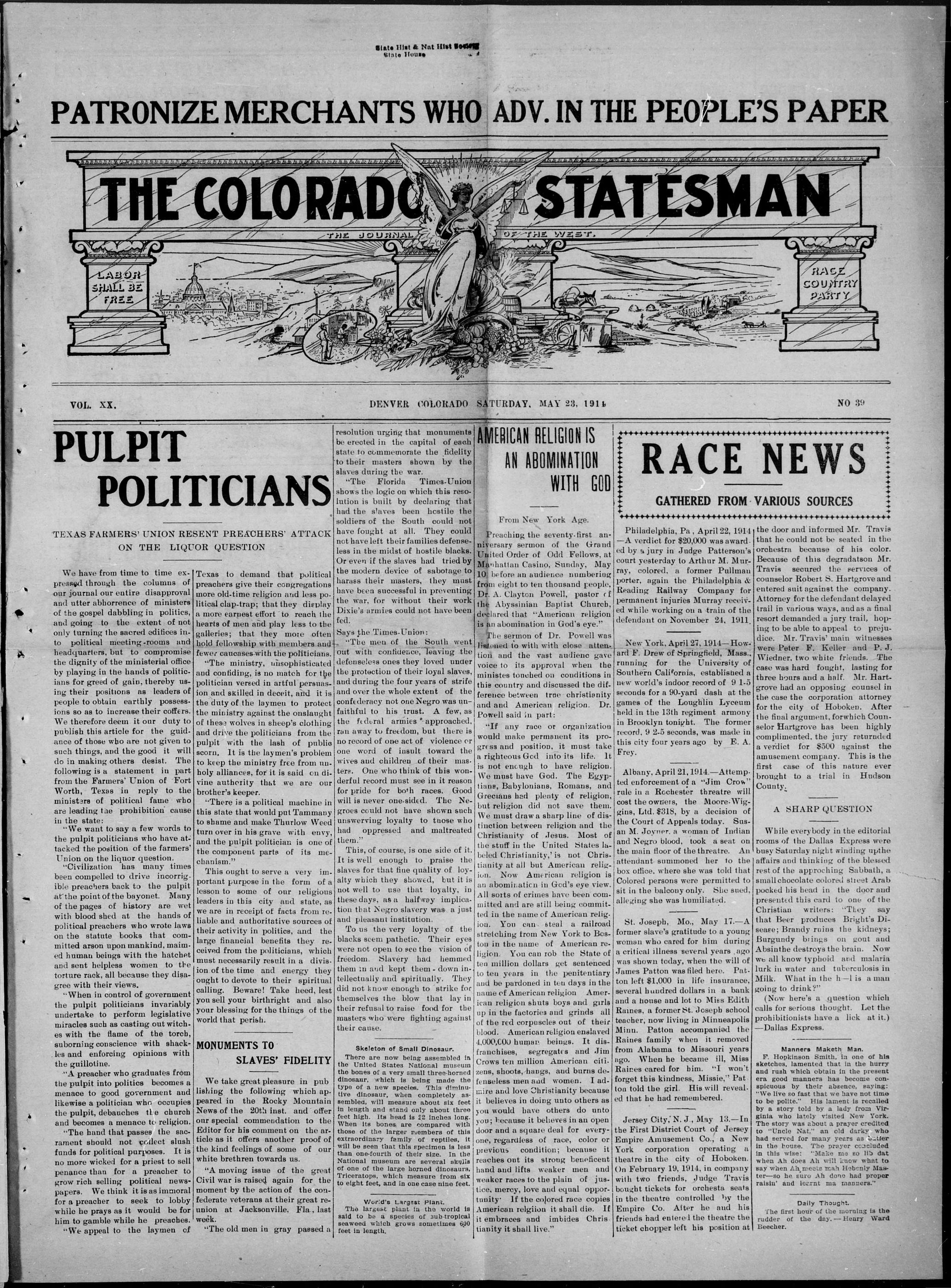
PULPIT POLITICIANS
TEXAS FARMERS' UNION RESENT PREACHERS' ATTACK ON THE LIQUOR QUESTION
VOL. XX.
PULPIT
POLIT
TEXAS FARMERS' UNION RE
ON THE LIQU
We have from time to time expressed through the columns of our journal our entire disapproval and utter abhorrence of ministers of the gospel dabbling in politics, and going to the extent of not only turning the sacred edifices into political meeting-rooms and headquarters, but to compromise the dignity of the ministerial office by playing in the hands of politicians for greed of gain, thereby using their positions as leaders of people to obtain earthly possessions so as to increase their coffers. We therefore deem it our duty to publish this article for the guidance of those who are not given to such things, and the good it will do in making others desist. The following is a statement in part from the Farmers' Union of Fort Worth, Texas in reply to the ministers of political fame who are leading the prohibition cause in the state:
"We want to say a few words to the pulpit politicians who have attacked the position of the farmers' Union on the liquor question.
"Civilization has many times been compelled to drive incorrigible preachers back to the pulpit at the point of the bayonet. Many of the pages of history are wet with blood shed at the hands of political preachers who wrote laws on the statute books that committed arson upon mankind, maimed human beings with the hatchet and sent helpless women to the torture rack, all because they disagree with their views.
"When in control of government the pulpit politicians invariably undertake to perform legislative miracles such as casting out witches with the flame of the torch, suborning conscience with shackles and enforcing opinions with the guillotine.
"A preacher who graduates from the pulpit into politics becomes a menace to good government and likewise a politician who occupies the pulpit, debauches the church and becomes a menace to religion.
"The hand that passes the sacrament should not collect slush funds for political purposes. It is no more wicked for a priest to sell penance than for a preacher to grow rich selling political newspapers. We think it is as immoral for a preacher to seek to lobby while he prays as it would be for him to gamble while he preaches.
"We want to the larmon of
"We appeal to the laymen of
Texas to demand that political preachers give their congregations more old-time religion and less political clap-trap; that they display a more earnest effort to reach the hearts of men and play less to the galleries; that they more often hold fellowship with members and fewer caucuses with the politicians. "The ministry, unsophisticated and confiding, is no match for the politician versed in artful persuasion and skilled in deceit, and it is the duty of the laymen to protect the ministry against the onslaught of these wolves in sheep's clothing and drive the politicians from the pulpit with the lash of public scorn. It is the laymen's problem to keep the ministry free from unholy alliances, for it is said on divine authority that we are our brother's keeper.
"There is a political machine in this state that would put Tammany to shame and make Thurlow Weed turn over in his grave with envy, and the pulpit politician is one of the component parts of its mechanism."
This ought to serve a very important purpose in the form of a lesson to some of our religious leaders in this city and state, as we are in receipt of facts from reliable and authoritative sources of their activity in politics, and the large financial benefits they received from the politicians, which must necessarily result in a division of the time and energy they ought to devote to their spiritual calling. Beware! Take heed, lest you sell your birthright and also your blessing for the things of the world that perish.
MONUMENTS TO SLAVES' FIDELITY
We take great pleasure in publishing the following which appeared in the Rocky Mountain News of the 20th inst. and offer our special commendation to the Editor for his comment on the article as it offers another proof of the kind feelings of some of our white brethren towards us.
"A moving issue of the great Civil war is raised again for the moment by the action of the confederate veterans at their great reunion at Jacksonville, Fla., last week.
"The old men in gray passed a
State Hist & Nat Hist Board
State House
ANTS WHO
ADO
THE JOURNAL
DENVER COLORADO
resolution urging that monuments be erected in the capital of each state to commemorate the fidelity to their masters shown by the slaves during the war.
"The Florida Times-Union shows the logic on which this resolution is built by declaring that had the slaves been hostile the soldiers of the South could not have fought at all. They could not have left their families defenseless in the midst of hostile blacks. Or even if the slaves had tried by the modern device of sabotage to harass their masters, they must have been successful in preventing the war, for without their work Dixie's armies could not have been fed.
Says the Times-Union:
"The men of the South went out with confidence, leaving the defenseless ones they loved under the protection of their loyal slaves, and during the four years of strife and over the whole extent of the confederacy not one Negro was unfaithful to his trust. A few, as the federal armies approached, ran away to freedom, but there is no record of one act of violence or one word of insult toward the wives and children of their masters. One who think of this wonderful record must see in it reason for pride for both races. Good will is never one-sided. The Negroes could not have shown such unswerving loyalty to those who had oppressed and maltreated them."
This, of course, is one side of it. It is well enough to praise the slaves for that fine quality of loyalty which they showed, but it is not well to use that loyalty, in these days, as a halfway implication that Negro slavery was a just and pleasant institution.
To us the very loyalty of the blacks seem pathetic. Their eyes were not open to see the vision of freedom. Slavery had hemmed them in and kept them down intellectually and spiritually. They did not know enough to strike for themselves the blow that lay in their refusal to raise food for the masters who were fighting against their cause.
Skeleton of Small Dinosaur.
There are now being assembled in the United States National museum the bones of a very small three-horned dinosaur, which is being made the type of a new species. This diminutive dinosaur, when completely assembled, will measure about six feet in length and stand only about three feet high. Its head is 22 inches long. When its bones are compared with those of the larger members of this extraordinary family of reptiles, it will be seen that this specimen is less than one-fourth of their size. In the National museum are several skylis of one of the large horned dinosaurs, Triceratops, which measure from six to eight feet, and in one case nine feet.
World's Largest Plant.
The largest plant in the world is said to be a species of sub-tropical seaweed which grows sometimes 600 feet in length.
AMERICAN RELIGION IS AN ABOMINATION WITH GOD
From New York Age.
Preaching the seventy-first anniversary sermon of the Grand United Order of Odd Fellows, at Manhattan Casino, Sunday, May 10 before an audience numbering from eight to ten thousand people, Dr. A. Clayton Powell, pastor of the Abyssinian Baptist Church, declared that "American religion is an abomination in God's eye."
The sermon of Dr. Powell was listened to with with close attention and the vast audience gave voice to its approval when the ministers touched on conditions in this country and discussed the difference between true christianity and American religion. Dr. Powell said in part:
"If any race or organization would make permanent its progress and position, it must take a righteous God into its life. It is not enough to have religion. We must have God. The Egyptians, Babylonians, Romans, and Grecians had plenty of religion, but religion did not save them. We must draw a sharp line of distinction between religion and the Christianity of Jesus. Most of the stuff in the United States labeled Christianity,' is not Christianity at all but American religion. Now American religion is an abomination in God's eye view. All sorts of crimes have been committed and are still being committed in the name of American religion. You can steal a railroad stretching from New York to Boston in the name of American religion. You can rob the State of ten million dollars get sentenced to ten years in the penitentiary and be pardoned in ten days in the name of American religion American religion shuts boys and girls up in the factories and grinds all of the red corpuscles out of their blood. American religion enslaved 4,000,000 human beings. It disfranchises, segregates and Jim Crows ten million American citizens, shoots, hangs, and burns defenseless men and women. I admire and love Christianity because it believes in doing unto others as you would have others do unto you; because it believes in an open door and a square deal for everyone, regardless of race, color or previous condition; because it reaches out its strong beneficent hand and lifts weaker men and weaker races to the plain of justice, mercy, love and equal opportunity. If the colored race copies American religion it shall die. If it embraces and imbides Christianity it shall live."
RACE NEWS
Philadelphia, Pa., April 22, 1914 — A verdict for $20,000 was awarded by a jury in Judge Patterson's court yesterday to Arthur M. Murray, colored, a former Pullman porter, again the Philadelphia & Reading Railway Company for permanent injuries Murray received while working on a train of the defendant on November 24, 1911.
New York, April 27, 1914 — Howard F. Drew of Springfield, Mass., running for the University of Southern California, established a new world's indoor record of 9 1-5 seconds for a 90-yard dash at the games of the Loughlin Lyceum held in the 13th regiment armony in Brooklyn tonight. The former record, 9 2-5 seconds, was made in this city four years ago by E. A. Frey.
the door and informed Mr. Travis that he could not be seated in the orchestra because of his color. Because of this degradatson Mr. Travis secured the services of counselor Robert S. Hartgrove and entered suit against the company. Attorney for the defendant delayed trail in various ways, and as a final resort demanded a jury trail, hoping to be able to appeal to prejudice. Mr. Travis' main witnesses were Peter F. Keller and P. J. Wiedner, two white friends. The case was hard fought, lasting for three hours and a half. Mr. Hartgrove had an opposing counsel in the case the corporation attorney for the city of Hoboken. After the final argument, for which Counselor Hartgrove has been highly complimented, the jury returned a verdict for $500 against the amusement company. This is the
Albany, April 21, 1914.—Attempted enforcement of a "Jim Crow" rule in a Rochester theatre will cost the owners, the Moore-Wiggins, Ltd. $318, by a decision of the Court of Appeals today. Susan M. Joyner, a woman of Indian and Negro blood, took a seat on the main floor of the theatre. An attendant summoned her to the box office, where she was told that Colored persons were permitted to sit in the balcony only. She sued, alleging she was humiliated.
St. Joseph, Mo., May 17.—A former slave's gratitude to a young woman who cared for him during a critical illness several years ago was shown today, when the will of James Patton was filed here. Patton left $1,000 in life insurance, several hundred dollars in a bank and a house and lot to Miss Edith Raines, a former St. Joseph school teacher, now living in Minneapolis Minn. Patton accompanied the Raines family when it removed from Alabama to Missouri years ago. When he became ill, Miss Raines cared for him. "I won't forget this kindness, Missie," Patton told the girl. His will revealed that he had remembered.
Jersey City, N.J., May 13.—In the First District Court of Jersey Empire Amusement Co., a New York corporation operating a theatre in the city of Hoboken. On February 19, 1914, in company with two friends, Judge Travis bought tickets for orchestra seats in the theatre controlled by the Empire Co. After he and his friends had entered the theatre the ticket chopper left his position at
NO 39
the door and informed Mr. Travis that he could not be seated in the orchestra because of his color. Because of this degradatson Mr. Travis secured the services of counselor Robert S. Hartgrove and entered suit against the company. Attorney for the defendant delayed trail in various ways, and as a final resort demanded a jury trail, hoping to be able to appeal to prejudice. Mr. Travis' main witnesses were Peter F. Keller and P. J. Wiedner, two white friends. The case was hard fought, lasting for three hours and a half. Mr. Hartgrove had an opposing counsel in the case the corporation attorney for the city of Hoboken. After the final argument, forwhich Counselor Hartgrove has been highly complimented, the jury returned a verdict for $500 against the amusement company. This is the first case of this nature ever brought to a trial in Hudson County.
A SHARP QUESTION
While everybody in the editorial rooms of the Dallas Express were busy Saturday night winding up the affairs and thinking of the blessed rest of the approching Sabbath, a small chocolate colored street Arab pocked his head in the door and presented this card to one of the Christian writers: "They say that Beer produces Bright's Disease; Brandy ruins the kidneys; Burgundy brings on gout and Absinthe destroys the brain. Now we all know typhoid and malaria lurk in water and tuberculosis in Milk. What in the h—l is a man going to drink?"
(Now here's a question which calls for serious thought. Let the prohibitionists have a lick at it.) —Dallas Express.
Manners Maketh Man.
F. Hopkinson Smith, in one of his sketches, lamented that in the hurry and rush which obtain in the present era good manners has become conspicuous by their absence, saying: "We live so fast that we have not time to be polite." His lament is recalled by a story told by a lady from Virginia who lately visited New York. The story was about a prayer credited to "Uncle Nat," an old darky who had served for many years as buffer in the house. The prayer concluded in this wise: "Make me so lib dat when Ah does Ah will know what to say when Ah meets mah Hebenly Master—so he sure Ah done had proper raisin' and lecrant ma manners."
Daily Thought.
The first hour of the morning is the rudder of the day.—Henry Ward Beecher.
NEWS TO DATE IN PARAGRAPHS
CAUGHT FROM THE NETWORK OF WIRES ROUND ABOUT THE WORLD.
DURING THE PAST WEEK
RECORD OF IMPORTANT EVENT8
CONDENSED FOR BUSY
WESTERN.
Five were drowned in the Mississippi when a launch containing a party of nine capsized, according to a Minneapolis dispatch.
Laity rights for women was defeated by the general conference of the Methodist Episcopal church, South, at Oklahoma City by a vote of 171 to 105.
Railroad traffic in the Texas Panhandle, southeastern Colorado and northeastern New Mexico was nearly at a standstill Tuesday, due to floods.
The first watermelons of the season were put on sale in St. Louis at $4 each. Only nine melons were in the shipment, which came from Florida.
In a revolver duel in the business section of Douglas, Ariz., Eduardo Soto, a Mexican, 24 years old, was shot and killed by Luke Short, a mounted customs inspector.
William McKinney, 45, and his two children, 5 and 9, were drowned while attempting to row across the Tongue river, near Sherldan, Wyo. McKinney's body was recovered.
Three men were injured, one fatally, by the explosion of a steam box in the engine room of the naval receiving ship Intrepid at the Mare Island navy yard, at Vallejo, Cal.
Because members of the Epworth Methodist church failed to pay him back salary, amounting to $40, the Rev. H. C. Breese, the pastor, sold the church building at Bartlesville, Okla.
Robert T. Hodge, Progressive candidate for governor in 1912, and formerly a coal miner, was admitted to the bar by the State Supreme Court at Olympia. Wash., after being rejected three times.
Mrs. Victor Hall, widow of a young merchant, shot to death in his home in Green Spring, Va., on April 15, was indicted for murder by a special grand jury which has been investigating the crime for five days.
The union coal miners of Colorado will never surrender in their present fight, according to John P. White, national president of the organization, in an address at Fort Smith, Ark. White declared that if the United States troops are withdrawn from the state there would be a repetition of the Ludlow massacre.
Three men entered the State Bank of Spangle, Wash., when Cashier O. W. Newton was alone, locked him in the bank vault, took about $4,000, went out the back door, rented an automobile and escaped undetected. Later a posse was formed and the robbers were surrounded in the woods near Waverly, Wash.
WASHINGTON.
Mexico has promised to avenge the death of Private Parks.
The President nominated Bo Sweeney of Seattle, Wash., to be assistant secretary of the interior.
After an absence of eight months, due to illness, Senator Culberson of Texas resumed his seat in the Senate.
Secretary of State Bryan reiterated his advice to Americans not to return to Mexico under conditions now prevailing.
Claims of mail carrying railroads against the United States aggregating $31,000,000 and involving 720 railroads were denied in a test case decided by the Court of Claims.
Resignations of Moses Friedman, superintendent, and S. J. Nori, chief clerk of the Carlisle Indian school, were accepted by Cato Sells, commissioner of Indian affairs.
General Huerta has authorized the Mexican mediation delegates to submit his resignation, in case such a course is found necessary to a settlement in peace negotiations.
American citizens only are to be trusted to pilot vessels passing through the Panama canal under the rules just laid down by Colonel George W. Goethals to govern the appointment of pilots.
Officials of the United States public health service were exercised over the escape of John R. Early, the leper, whose case has attracted public attention for several years, from the Diamond Head quarantine station near Port Townsend, Wash.
Former President Mellen of the New Haven railroad testified before the Interstate Commerce Commission that he had discussed the Boston and Maine-New Haven railroad merger with the then President Roosevelt, in 1907. The colonel told him, he said, that the merger was not illegal, and he favored it.
President Wilson is reported forming a Mexican policy to which he will pledge the government of the United States when General Huerta is finally eliminated as dictator and hostilities in Mexico have ceased.
FOREIGN.
Cardinal Gibbons was received in audience by the Pope at Rome.
Actual mediation of the Mexican imbroglio was begun at Niagara Falls, Ont., Wednesday afternoon.
Archbishop Mora y del Tio was driven out of Mexico City by Provisional President Huerta, according to information reaching Vera Cruz.
The body of Lillian Nordica was shipped from Batavia on board the stoomer Van Cloon for Singapore, from which port it will be taken to the United States.
American women delegates to the quinquennial session of the International Council of Women were present at a garden party given by the queen mother, Margherita, at Rome, who presented each with a bunch of roses and a silver medal as a souvenir.
The two horses belonging to Lieut. Col. Elmore F. Taggert, which were taken into the Mexican lines by Private Samuel Parks when the soldier disappeared, were returned to the American military authorities at Vera Cruz by order of the Mexican commander.
A Shanghai dispatch to the London Daily Mail gives details of a loan of $30,000,000 negotiated by the Chinese government with the Bethlehem Steel works for the construction of a naval base at Foo Chow dock. Only American engineers and material will be employed.
Baron Erland von Nordenskjold, the leader of the Norwegian South American exploring expedition, who was reported to have been killed by Indians March 14 last, is safe. The news of his escape from the Indians reached London in a letter from Santta Cruz de La Sierra, Bolivia, dated March 21, which reported his arrival at Trinidad, capital of the Bolivian department of Beni.
SPORT.
Standing of Western League Clubs. Clubs Won. Lost. Pet. Denver St. Joseph 18 10 643 St. Joseph 16 10 815 Des Moines 15 12 556 Sioux City 16 13 552 Lincoln 13 16 448 Vichita 12 16 429 Omaha 10 16 385 Topeka 11 18 379
Glen Stokes of Los Angeles suffered a broken collar bone in a five-mile professional motorcycle race at Chicago.
Leading golf exponents of the Senate and House matched their skill at Washington with a dinner as the stake.
Irwin G. Baker arrived in New York, having traveled 3,362 miles from San Diego, Calif., on a motorcycle, in 11 days, 11 hours and 10 minutes.
E. Hammitt equaled the world's record in the 120-yard hurdle event in the interclass field meet at State College, Pa., covering the distance in 15-1-5 seconds.
In one of the best lightweight battles staged at Sydney, Australia, in many days, young Joe Shugrue of New York knocked out Herb McCoy of Australia in the fifteenth round.
Twenty-nine colleges from California to Maine will compete at the annual championship track and field meeting of the Intercollegiate Amateur Athletic Association of America, to be held at the Harvard stadium at Cambridge, Mass., May 29 and 30.
At Nevers, France in order to show her confidence in an automatic detachable parachute invented by her husband, Mme. Gayat de Castella dropped 2,500 feet from an aeroplane. She landed gently in the grass of the aerodrome, and an enthusiastic crowd carried her shoulder high from the field.
GENERAL
Vincent Astor, much improved in health, according to his friends, has sailed away from New York with his bride for a short sea trip.
Six hours of desperate fighting, in which fifty fireman dropped unconscious and one was severely injured; were required to control a fire here in a block on Greenwich street in New York.
The notable collection of jewels, valued at $1,000,000, including the famous Nordica pearl and other gems almost priceless because of their flawlessness and beauty, were disposed of by Mme Lillian Nordica, the singer in her will
The funeral of William Henry Pulliam, the first-class fireman of the United States battleship Utah, who died from wounds received in the fighting at Vera Cruz, was held at Pualaski, Va. Five thousand people attended the services. Among the floral tributes was one from President Wilson.
The million dollar estate of Gen. Hiram Duryea of New York who was killed on May 5 by his son, Chester Duryea, will be divided among his three children, the patricide sharing equally with his brother, Harry H Duryea, and his sister, Mrs. Henry O Anderson, according to friends of the family to whom the general is said to have made known his plans for the disposal of his property.
Becoming enraged over what was started as a joke, Charles P. Harris and Henry Bigley, merchants at Ford Blackmore, near Gate City, Va., engaged in a duel with pistol's while attending the funeral of a friend and shot each other to death.
Theodore Roosevelt set foot on his native soil Tuesday night for the first time in seven months. His home coming was a quiet affair, in sharp contrast to the noisy welcome he received when all New York turned out to greet him on his return from Africa four years ago.
WEEK'S EVENTS IN COLORADO
Western Newspaper Union News Service.
DATES FOR COMING EVENTS.
May 27. — Log-Rolling Contest, W.O.W.
at Loveland.
June 9-11.-G. A. R. Encampment at Fort Morgan.
June 16-18.—State Sunday School Convention at Denver.
June 19-20—Meeting Colorado Bankers Association at Colorado Springs
June 25-26—Basketball Enthusiast Convention at Colorado Springs.
June 13-July 4—Race Meet, Denver.
June 18-July 15—Basketball Enthusiast Convention at Colorado Springs.
June 19—Cherry Pie Day, Manzanola.
July 13-19—Grand Lodge Session, B.P. Olks at Denver.
July 22-23—Cattlemen's Day, Gunnellson.
Aug. 18-21. -Prowers Co. Fair, Lamar.
Aug. 25-28. -Bent Co. Fair, Las Animas.
Aug. 27. -Santa Fé Trail Day, Las Animas.
Aug. 29. -Farmers' Fair at Fowler.
Sept. 1-4. -Arkansas Valley Fair, Rocky Ford.
Sept. 3- Watermelon Day, Rocky Fork
Sept. 2- 5- Farmers' a n d Stockmen's
Burlington.
Sept. 1- 4- Morgan Co. Fair, Fort Morgan.
Sept. 1-4—Larimer Co. Fair, Loveland
Sept. 8-11—Crowley Co. Fair, Sugar
City,
Sept. 8-11—Cheyenne County Fair at
Cheyenne Wells.
Sept. 10—Sugar Day, Sugar City,
Sept. 14-19—Colo. State Fair, Pueblo
Sept. 19-26—Lincoln Co. Fair at Hugo
Sept. 19-26—Lincoln Co. Fair at Hugo
Sept. 21-23—Inter-Co. Fair, and Race
Sept. 21-23—Inter-Co. Fair and Race Meet at Limon.
Sept. 22-25. — Western Slope Fair, Montrose.
Sett. 22-25. — Montrose. Sett.
Sept. 22-25.—Montezuma Co. Fair at Cortez.
Sept. 22-25.-Trinidad Fair, Trinidad.
Sept. 23-26.-El Paso Co. Fair, Calhan
Oct. 6-9.-Colo.-New Mex. Fair at Du-
rango.
1915. Last Grand Council of North American Indians at Denver.
A new $15,000-canning factory is being built at Grand Junction.
The eight-year-old son of J. W. Carpenter of Mancos fell into the Dolores river and was drowned.
Automobile thieves are abroad in Fort Collins, two cars having been stolen from off the streets.
The Democratic state executive committee decided to hold the central committee meeting August 1.
The only known victim of the flood at Pueblo was William Cassidy, 53 years old, a zinc smelter employé.
Memorial day is to be observed this year in Craig on a more elaborate scale than ever before, notwithstanding the fact that there are but a few veterans of the Civil war in the vicinity.
Residents in the 900 block on Pearl street protested to the city commissioners of Denver against a big billboard on a vacant lot. They asked the council to order its removal as a nuisance.
Francis B. Sayre, son-in-law of President Woodrow Wilson, was in Denver as the guest of honor at a lunch on given by the Williams College Alumni association at the University club.
Pending the arrivals of Corporal Mills and Private Pacheco from Ludlow the general court-martial, which is trying Major Hamrock at the Golden rifle range, was forced to take a recess Tuesday.
Every dealer in firearms in the United States, every express company and every railroad company, has been warned by Secretary of War Garrison not to ship any arms or ammunition into Colorado.
The Colorado portion of the Laramie, Hahn's Peak & Pacific roadal was sold at Walden to the Guaranty Trust Company of New York for $100,000. J. W. Dickson of New York represented the company.
Acting on an idea that they have had in mind for some time, at a meeting of the Farmers' Union, they took the preliminary steps for the establishment of a retail market in Fort Collins, a thing that has been more or less agitated for a number of months past.
Fear of a state-wide revolution on the part of labor if the militia re-enters the strike zone was expressed in a telegram sent to Senator Shafroth by the general counsel for the United Mine Workers of America, who said he feared the worst if the militia returned.
A Gunnison county branch of the Colorado Metal Mining Association was formed at a meeting of mining men which was held in Gunnison, Delegates representing Pitkin, Ohio City, White Pine, Bowerman, the Cochotopa and Gunnison district were present.
The "mediation" committee named by the Legislature to conduct an investigation into the industrial war and to assist in settling the strike, had a conference with Governor Ammons. The first formal meeting of the committee will be held at the state house and a chairman named and active work begun.
Col. George M. Lee, assistant adjutant general, has been sent to Washington by Adj. General John Chase to get equipment for the state militia from the War Department. He will ask Secretary of War Garrison to replace 200 tents burned or otherwise ruined while the state guard was camped in the coal strike district.
Nicholas Bolkjoviz, who told Sheriff S. J. McAfee when he was arrested at Platteville that he had killed a fellow-countryman, a Slav, in Denver, inflicting wounds with a beer bottle from which the victim died, tried to commit suicide in the county jail at Greeley by butting his head against the bars of the steel corridor surrounding the cells.
Mrs. Luvisa Thompson, one of the oldest residents of Boulder, and a charter member of the First Christian church of that city, passed away, aged 91.
WEATHER CROP REPORT
FRUIT, WHEAT AND ALFALFA DOING NICELY.
Prospects on Western Slope Especially Favorable According to Forecaster F. H. Brandenburg.
Western Newspaper Union News Service.
Denver.—"Fine" and "good" are the terms used by F. H. Brandenburg, forecaster in charge of the Colorado district of the weather bureau, in his official report for the week ending May 18, concerning the condition of Colorado crops.
He is to issue a weekly report throughout the growing season, showing just what has been the effect of the weather on the principal crops of the state. The first says:
"The weather conditions on the Western slope have been generally favorable to the growth of vegetation, while in the Eastern part of the state plant growth and farming operations have been retarded by too much moisture, deficient sunshine and low temperature.
"In the western counties, apples, peaches and plums are coming into bloom, uninjured by frosts, and doing nicely; winter and spring wheat are doing well; alfalfa is in fine condition, as also hay and grasses.
"In the eastern part of the state the winter wheat crop is generally in good condition; spring wheat is in fine condition, as also rye, alfalfa, hay and grass.
"The weather has been generally favorable to the growth of sugar beets, although some reports indicate too lithe sunshine for that crop."
Many Thrilling Escapes.
Pueblo.—With the passing of the flood waters which swept down over a large section of the city and wreaked widespread damage in less than four hours' time, railroads and other owners of property in the path of the torrent began an estimate of their losses and there came to light at the same time many stories of heroism and of not a few thrilling escapes from drowning.
The flood came so fast that those living below First street did not know of the damage until they were awakened to find themselves surrounded by water. C. C. Hartman, superintendent of the stockyards, was awakened by the blowing of the siren to find himself hemmed in by the flood waters. Placing his wife in a buggy he tried to get away when the buggy upset and both were thrown into the surging torrent and drifted about two blocks. Hartman dragged his wife to safety. The damage caused by the flood will reach more than $150,000.
Declares Dog Had Rabies.
Colorado Springs. Positive proof of the presence of rabies in Colorado Springs was received by Health Officer O. R. Gillett from H. J. Washburn, acting chief of the division of pathology, bureau of animal industry of the United States Department of Agriculture, who examined the brain of a dog killed in this city and positively declared that the animal had rabies.
Strike Leaders Give Bonds.
Boulder—John R. Lawson, international board member of the United Mine Workers of America; E. L. Doyle, district secretary of the same organization, and William T. Hickey, secretary of the Colorado Federation of Labor, gave bond to appear before Judge Graham of the Boulder County Court July 27.
Held as a Burglar
Colorado Springs.—With the arrest of M. Blankenship at Pueblo the local police believe they have secured another member of the gang that has been robbing homes in this city for some time. It is claimed that when arrested the man was trying to pawn articles taken from the Richard Clough home in this city.
Flood Drowns Boy.
Colorado Springs.—As a result of the flood in the Fountain valley between Colorado Springs and Pueblo, the 4-year-old son of Mr. and Mrs. R. B. Harrison, who live on a ranch north of Fountain, was drowned in an irrigating ditch near the Harrison home.
Accused Man Killed in Mine.
Steamboat Springs.—A. H. House, thirty-seven, under indictment for the June term of District Court for his alleged connection with the killing of John Mott and Jack Gill on the night of March 16, at Oak Creek, was killed by a fall of rock in the Perry mine at Oak Creek.
Trinidad.—Juan Cruze, twenty-three, a union miner, was shot from ambush at the mouth of Riley canon, a short distance from Segundo.
Owners Will Reject Arbitration Plan.
Owners Will Reject Arbitration Plan.
Denver.—The attitude toward arbitration of the coal strike which has characterized each side of the industrial controversy since it began last September is still maintained by the operators and striking miners. When asked for the position of the operators in regard to the appointment of a federal commission, Frank E. Gove, attorney for the coal operators, said: "We made our proposition to the governor four months ago. It still stands and will not be changed."
The OLD RELIABLE EAST END DINING ROOM AND RESTAURANT
2345 LARIMER STREET, DENVER, COLORADO
Colorado Wall Paper & Paint Company
WALL PAPER, PAINTS OILS AND GLASS Interior and Exterior Decorators. We Do House Painting. Coach Colors, Paints and Varnishes. Agents John W. Masury & Sons. Phone Main 871 728 W. Colfax, foot Welton St. Denver
In All the Latest Novelties TORREY'S MILLINERY 2647 WELTON STREET, DENVER, COLO.
Paper Dollar Bar
STEVE TODOROFF and RAY BRONSON, Proprietors Fine Wines, Liquors and Cigars
Corner Nineteenth and Arapahoe Streets, DENVER, COLORADO
Jones' Restaurant
I Am Headed That Way, Where I Get the Cleanest, Best and Most Wholesome Food, Which Gives You that Round, Comfortable, Contented Feeling
The Denver Paste
Wall Paper Company
J. W. BEACH
Phone Main 5277 1855 Arapaloe Street
DENVER, COLORADO
SPECIAL BRUSHES MADE TO ORDER
DENVER BRUSH FACTORY Branch 1408 Curtis St. Champa 770 418 Fifteenth St
VINEGAR
DAVID
2345 LARIMER
J. R. DRESSOR
Colorado
Pain
WALK
OILS
Interior and H
Painting. Co
Agents John W
728 W. Colfa
YOU ARE
To Ins
Pattern
In All
TORRIE
2647 WELTO
'Phone Champa 1156
Paper
STEVE TODOR
Fine Wine
```markdown
```
BREAKFAST from 6 to 8:30
DINNER from 12 to 2:30
SUPPER from 5:30 to 7:30
Furnished Rooms in Connectio
AFRO-AMERICAN CULLINGS
"There probably will never be a great emigration on the part of American negroes to Liberia. The difficulty of transporting millions of black men, women and children would make the scheme of a general exodus impracticable. Besides, there is a limited range of promising occupations. But there is room for thousands of immigrants who are forceful, self-reliant and willing to work. The American negro should become acquainted with Liberia and interest himself in it."—Professor Starr.
In the exhibition arranged by Professor Starr there is the best collection of books and printed matter relating to Liberia that has ever been brought together at one time. Besides the books written about the country by strangers and scientific men traveling in the country, there are books and pamphlets printed in Liberia and written by Liberians on the politics, government, history and religion of their own country. There are files of the principal Liberian newspapers and magazines, the Liberian Register, the African League, Liberia Times, Liberia Recorder, the Guide and a missionary paper, Liberia and West Africa.
A whole case is devoted to the activities of the missions in Liberia. In the exhibit the Protestant Episcopal, the Methodist Episcopal, the African Methodist Episcopal, the Lutheran and the Christian missions are represented. They have been especially active in providing schools and much needed education for the natives. Among the notable mission schools are Epiphany hall, under the direction of the Protestant Episcopal church, and the College of West Africa, a Methodist Episcopal school, located at Monrovia. At Epiphany hall there is a farm and coffee plantation connected with the school, and four hours of practical agriculture and horticulture are required.-Chicago Inter Ocean.
Closely following the action of the senate in favor of a substantial appropriation for continuing the work on the new Central high school building, and for the purchase of a site for the new Eastern High school, comes the news that the work of constructing a new high school building for colored pupils will probably be begun next fall, says the Washington Star. Congress last July having appropriated $15,000 toward the construction of this building, the authorized cost of which is to be $55,000, the announcement is now made that the plans for the proposed structure are practically complete.
The pressing need for a new building for the colored high school is shown in the statement that the structure now in use was built to accommodate 450 pupils; that its present enrollment is more than 800, and that libraries, study halls and other rooms have been pressed into service as classrooms, though designed for other purposes. The efficiency of this school has suffered somewhat for a long time because of its crowded condition. The plans for the new building show a provision of space for 1,400 pupils, nearly double the present enrollment of the school. This appears to be looking well into the future, but the building will not be completed until the spring of 1916, and the school population of Washington is increasing rapidly. With the facilities and attractions of the new high school buildings, a marked increase in the high school enrollment may be looked for.
There was buried in Mt. Hope cemetery, at Boston, last week. Mrs. Sarah Spence, who claimed to be one hundred and thirteen years old. At her grave were three daughters, all of whom were born in slavery. All of her 16 children were slaves. After the war they came North, one by one, and the mother herself came to Boston 14 years ago. Mrs. Spence was born in Camden. Her parents were slaves of a family named Barnett. Later she was sold to Col. Dennis Furby of North Carolina, for whom she wove cloth and made garments. Mrs. Furby and the slave did not get along well and the young girl ran away once a year for four years. She was sold to Timothy Smith and at his death she was carried into Tennessee. After the war she went back to North Carolina and worked on the Furby estate for pay, as did her children. Her first husband, Alida Furby, died before the war and she was married to Thomas Spence.
The University of Southern California has appealed to the Central Labor council of Los Angeles to aid in the work of making its course in trade unionism a success.
Nearly one-third of the population of Washington is negro, according to the bulletin of the census bureau. The total estimated population of Washington this year is 353,378, of which 101,339 are negroes. In Philadelphia it is estimated that the total population this year will be 1,657,810, of whom 91,652 are reported as negroes. Of the population of Pittsburgh this year 537,479 are whites and 27,399 negroes.
Nothing makes the rest of us so tired as the fellow who puts up a bluff at hustling.
There is an old and tenaciously held theory that the negro has a greater resistance to malaria than the white man. Recent investigations by public health service tend to throw doubt on this belief.
In Alabama, during a three-year period, the number of deaths from malaria was one and one-half times as great among colored persons as among white. In Mississippi in 1913 2.3 times as many negroes as whites died of this group of diseases. Several thousand blood examinations were made to test the prevalence of malarial infection in the general population. In Arkansas, less than six per cent of the whites examined had the malarial organism in their blood, while 7.6 per cent of the negroes were so afflicted. In North Carolina the germ was found in 7.5 per cent of the whites and 11.5 per cent of the colored persons examined.
In spite of these statistics the old opinion may be correct. The investigation is still too incomplete to warrant any sweeping conclusions. Malaria is a rural disease, and the negro is a country dweller. His environment is against him in other ways. The bulk of the population in the healthy uplands of Mississippi is white, but the negro clusters so thickly in the fertile but malarial cotton lands of the Yazoo delta and other parts of the "black belt" that the census of the state shows 1,009,487 colored persons to only 786,111 white.
The question can be settled only by an exhaustive comparison of whites and blacks living in the same environment, under the same conditions.
There is a strong probability that such a test would support the old belief that the negro resists malaria better than the white man.
A study of the situation in the Negro Baptist churches of Chicago strengthens the conviction that an efficient and unifying organization is really their greatest necessity. Their disposition to organize and the special needs of the city should eventually bring this about. At present we have improved upon the Methodist churches. They have five different conferences, but it must be said that in spite of this they co-operate in a friendly spirit.
The Negro Baptists at the present time have two associations. Any time spent in efforts to explain the basis of their doctrinal or personal differences might better be used in trying to secure a real basis of co-operation for their mutual improvement and advance. It seems that some organization of these churches on the basis of the city work, to prevent overlapping, to over assistance, to plan future work as necessity may require and not as individual caprice may suggest is a matter of real importance.
This organized co-operation to increase the efficiency of all the churches is a natural step to be taken in the processes of their growth and may be looked for at any time. As one examines the location and the activities of different Baptist churches, and sees new churches started under the very eaves of some older one, because of a doctrinal cr personal difference, he is convinced that the weight of influence of these who are trying to make the churches more useful should be set against this and in favor of that practical comity for which the executive council stands.
Sixty-seven theaters and music halls in London are licensed to sell liquor.
Rev. Richard D. Stinson, head of the Atlanta Normal and Industrial institute, spoke to the congregation of the Bethel Avenue Methodist Episcopal church and the Christian Missionary alliance at Pittsburgh. He urged the people of his race to develop a racial pride and history by making themselves able, educated, honorable citizens. He declared that the race never could cope with alcohol and other drugs. Before the Christian Missionary alliance he outlined the work which is being done at the school, which he heads, and told of the aspirations and hopes of the leaders of the negro race in the South.
Michael Spartall, who died recently at Shanklin, Isle of Wight, at the age of ninety-five, was formerly consul general for Greece in London. He was present at the funeral of George IV and at the coronation of William IV. Among his friends were Gladstone, Cobden and Bright.
There are 160 dramas and 21 melodramas based on the life of Joan of Arc.
The most cosmopolitan child in the world is probably Peggy Venner, at present living in Berkeley, Cal. She speaks five languages, and has traveled 81,000 miles since birth. Her father has interests in London, South Africa and Australasia, and is traveling most of the time.
Ollie James, the senator from Kentucky, has the record of having defended more than eighty men accused of murder, without losing one of the cases. He was admitted to the bar when he was eighteen year old.
ROUGH RIDER SCORNS ILLNESS
COL. ROOSEVELT WAS SERIOUSLY ILL FOR FIVE DAYS WHILE IN JUNGLE.
LOST 55 POUNDSWEIGHT
SHOWS EFFECT OF FEVER AND INJURY WHEN GROUP FACED STARVATION.
Western Newspaper Union News Service.
New York.—May 21.—Those who saw Theodore Roosevelt on his return from Brazil realized from his appearance that he had passed through a trying time. Though his cheeks were bronzed, his smile pleasant and his grip firm, there were many traces of the hardships he had endured in his six-hundred mile journey down the Rio Duvida, the unknown river he explored.
The trip from Para, which began May 7, did much to restore Colonel Roosevelt. It gave back to him twenty-five or thirty of the fifty-five pounds he had lost, and the jungle festers that ran from the ankle to the knee of his right leg were nearly all healed.
"I have been very ill with jungle fever," he said on his arrival, "but I'm all right now; I feel fine."
It was from April 5 to April 15, it was learned, that Colonel Roosevelt was gravely ill. Other members of his party, including his son, Kermit, were ill in that time, but the Colonel himself was so sick and weak that there were days when one hundred yards of travel marked the measure of his endurance.
For five days Colonel Roosevelt was delirious with $105^{\circ}$ of fever. Under it he begged his companions, it is stated, to go and leave him where he lay in the jungle.
Actual starvation menaced the party during the last of the sixty days that were taken up by the journey down the Duvida. The pinch was sharper by far, it is said, than was indicated by the leader's declaration that they had to hold themselves to half-rations.
At Manaos, the point of the expedition's return to civilization, Colonel Roosevelt was still so ill that he had to be helped aboard the steamer Dunstan, on which he traveled to Para. During the four days of his stay on the Dunstan he was confined to his bed. Not until the first day of his stopover at Para did he show the improvement which has continued since. The Colonel rested from Tuesday until today at Sagamore Hill, when he went to Oyster Bay to meet his neighbors.
Next Tuesday he plans to go to Washington to address the National Geographic Society on the results of his Brazilian exploring trip and on May 30 he probably will start for Europe, to attend, in Madrid, the wedding of his son Kermit.
Maps Out Strenuous Campaign.
Oyster Bay.—Twelve hours after Theodore Roosevelt returned from South America he was back in the thick of politics. He was up early and as soon as breakfast was over he was hard at work, picking up the threads where he dropped them seven months ago. Colonel Roosevelt, it was learned, looks forward to one of the hardest political campaigns of his career.
May Recall War Ships from Mexico.
Washington.—Plans for the withdrawal of a part of the naval force now in Mexican waters were considered at the Navy Department.
CONSIDERS STRIKE PLAN.
Washington. — Representative Seldomridge said that the mine owners and strikers in Colorado should be given an opportunity to express themselves as to federal arbitration before any action as to such course should be taken in Washington.
He intimated that if federal troops are to be continued in the strike field, Congress could properly consider means of having them removed. If those means involved settlement of the strike controversy itself, well and good.
"If the United States treasury funds are to be applied in Colorado," said Seldomridge, "Congress should not be criticised if it decides to remove the cause of their expenditure. I am not saying just how far such action should go, but compulsory arbitration certainly would come in for discussion."
Seldomridge discussed the Colorado situation with President Wilson and received assurance that the executive was willing to go to any extent within the bounds of the constitution in aiding Colorado to bring about peace.
Pick Penrose, Palmer and Pinchot.
Philadelphia.—Pennsylvania for the first time held primaries to choose candidates for United States senator, governor, Congress, the Legislature and minor offices. Boies Penrose won the Republican nomination for senator; Martin J. Brumbaugh, practically unopposed, the Republican nomination for governor. Congressman A. Mitchell Palmer was selected for senator on the Democratic ticket; Gifford Pinchot was unopposed for the nomination for senator by the Progressives.
BY EXTRA SESSION OR 19TH GENERAL ASSEMBLY.
Authorized Governor to Close Saloona in Disturbed District and to Prohibit Sale of Firearms.
Denver.—The extraordinary session of the Nineteenth General Assembly of Colorado, which convened May 4 and adjourned on the 16th, appropriated $1,000,000 for the payment of the militia, the sum including $300,000 for future expense of the militia.
Passed the bill authorizing the governor to close the saloons in disturbed districts.
Passed the bill authorizing the governor to prohibit the sale of firearms in disturbed districts.
Passed the short appropriation bill, amounting to $3,500.
Killed the bill providing for compulsory arbitration.
Adopted a resolution for a committee of six, three from each branch, to confer with the governor and other officers looking to a settlement of the coal strike and investigating the strike to report to the next regular session. Passed resolutions thanking President Wilson for federal troops and assuring the nation Colorado stood for law and order.
Speaker Slattery Gets Elk's Charm.
Speaker Slattery Gets Elk's Charm.
Denver.—Members of the House of Representatives presented a gold-mounted elk's tooth watch chain to Speaker J. H. Slattery at the closing of the extraordinary session of the Legislature.
Representative John S. Hasty made the speech of presentation. In his response, Speaker Slattery said the extra session will go down in history as one of the most remarkable Colorado has ever had.
In announcing the adjournment of the Senate as the session closed, President Fitzgarrard referred to a watch presented him at a former session of the Legislature. According to Fitzgarrard, the watch reached the hour of adjournment, at 4:30 o'clock, at the same time the Senate clock was allowed to resume its ticking after standing stationary for half an hour at 4:29 o'clock.
Exposition Wants Colorado Flag.
Denver. — Governor Ammons received a letter from the American commissioner general of the Anglo-American exposition, asking him to be present at the opening ceremony at Shepherd's Bus, London, on May 14. He was also requested to present the American section of the exposition with the state flag of Colorado. September 17 has been named as Colorado day at the exposition.
Legislator Not Citizen When Elected.
Denver.—John Redmond Williams, Democratic member of the Legislature from Denver, who took part in the proceedings of the regular session of the Nineteenth General Assembly and participated in the deliberations of the extra session, did not become a citizen of the United States until Jan. 26 of this year, according to an affidavit on file in the Federal Court.
Would Hold Up Pay of Game Warden. Denver. Col. James A. Shinn, state game commissioner who was ousted by Judge Denison in the District Court, served notice through his attorneys on State Auditor Kenehan that he must not pay the salary of the office of Walter B. Fraser, the governor's appointee.
Legislators Will Get $174 each.
Denver.—Each member of the legislature will have $174 coming to him Dec. 15, which comes in handy for Christmas. The legislator is paid $1,000 salary which covers his term. He was paid $735 in the regular session and $91 in this special session, or a total of $826 for his services.
Trustee Ordered to Pay Stratton Tax.
Denver.—Trustees of the Winfield Scott Stratton estate were ordered to pay the government $4,883 internal tax, which was demanded in a suit in addition to the amount paid when the millionaire mining man sold his interest in the Independence mine at Cripple Creek.
Tedrow Named on Pardon Board.
Denver.—Harry B. Tedrow, Boulder lawyer, succeeds himself as a member of the State Pardons Board, according to an announcement from Governor Ammons. Tedrow's term expired and the executive reappointed him.
Mrs. Bradford Operated Upon.
Denver.—An operation for appendicitis was performed on Mrs. Mary C. C. Bradford, state superintendent of public instruction at Mercy hospital. She is reported to be recovering rapidly.
Celebrate Centennial of Independence.
Denver.—The Norwegians celebrated the centennial of the independence of Norway at a banquet at El Jebel temple auditorium and at services in the Y. M. C. A. auditorium. Preceding the banquet a play and several tableaux were given, those taking part wearing the costumes in vogue 100 years ago, when Norway obtained its freedom. Patriotic songs and toasts were features of the banquet. The interior of El Jebel was decorated in the Norse national colors.
OPEN FOR New Dining Room in Connection to Keystone Social Club. Nothing like it ever attempted in Denver. Strictly home cooking. Lowest prices for best quality of food. Eastern corn-fed meats. Your patronage solicited.
SHORT ORDERS AT ALL HOURS
Syl. Stewart Manor
Empa St. Phone Champa 3543 Dept.
JOHN
RICK & ENGSTRO
WHOLESALE DEALERS IN
wines, Liquors and
Cigars
for Minneapolis Grain Belt Beer and Carnegie
Imported Beer and Bock Ol.
644-46-48-50 Larimer Street
1053 Denver
ALL KINDS OF REPAIR WORK NEATLY DO
REFINISHING A SPECIALTY.
Velton Street Furniture
F. R. LINDENMIER, Prop.
2619 WELTON STREET
Second Hand Furniture Bo
and Exchanged
We Pay the Highest Cash Price for Furniture
8247.
When You W
heads, Feet, Tails Snouts, N
erlings or any other part of
except the squeal go to
East's Mark
er Street.
THE ZOBEL BROTHER
AMPLE ROO
Nineteenth Street, Corner of
SHORT
1857 Champa St.
HENRY BECK
Beck
WH
Wines
Western Agents for Minne
I
1644-46
Phone Main 1053
ALL KINDS
The Welton
2619
New and Second
We Pay th
WHOLESALE DEALERS IN Wines, Liquors and Cigars Western Agents for Minneapolis Grain Belt Beer, and Carnegie Porter, Pripps Imported Beer and Bock Ol.
1644-46-48-50 Larimer Street
Phone Main 1053 Denver, Colorado
ALL KINDS OF REPAIR WORK NEATLY DONE.
REFINISHING A SPECIALTY.
The Welton Street Furniture Co.
New and Second Hand Furniture Bought, Sold and Exchanged We Pay the Highest Cash Price for Furniture
When The Heads, F or Chiterlings except Eas
When You Want
When You Want
The Heads, Feet, Tails Snouts, Neckbones or Chiterlings or any other part of the hog except the squeal go to
2800-6 Larimer Street.
THE ZO
SAM
1004 Ninete
1004 Nineteenth Street, Corner of Curtis
FINE WINES, LIQUORS AND CIGARS
COORS' CELEBRATED BEER ON TAP
R COD
RRIS, Pres. J. M. JOHNS, Treas. SEIB M
L ROAD PORTERS' C
CHAS. HARRIS, Pres
RAILROA
LUNCH
Billiards
17281/2 Wazee St. Only one block from Union Depot Phone Main 8416. Denver, Colorado
FULL
DINNER
11:30 a.m.
to
8:30 p.m.
PHONE MAIN 8247.
DENVER
Soup, Fish or Meat, Two Vegetables
Coffee, Tea or Cocoa
Desert
25 CENTS
HOURS
t Manager.
543 Denver, Colo.
Megstrom
MIS IN
Cars and
Carnegie Porter, Pripps
Ol.
Ever Street
Denver, Colorado
MEATLY DONE.
ALTY.
Furniture Co.
app.
STREET
Furniture Bought, Sold
d
for Furniture
Want outs, Neckbones part of the hog to rKet
OTHERS'
ROOM
ner of Curtis
SEIB MILLER, Sec.
RS' CLUB
NECTION
ree Check
THE TROLLERS
JOHN ENGSTROM
DENVER, COLO.
Phone Main 1461.
COLORADO
THE COLORADO STATESMAN
LAWYER SHALL BE FREE
BACK COUNTRY PARTY
JOS. D. D. RIVERS.....Proprietor
1824 Curtis Street, Room 25.
Phone Main 7417.
SUBSCRIPTION RATES:
One Year ..... $2.00
Six Months ..... 1.00
Taree Months ..... .60
One Year
Six Months
Three Months
PAYABLE IN A
Entered as second-class matter at the Colorado.
All communications of a personating will be withheld from the columns of this.
Display advertising, 50 cents per inch.
Reading notices, ten lines or less, 10 over ten lines, 5 cents per line.
No discounts allowed on less than three m any all orders from parties unknown to us.
Remittances should be made by Exp Order, Registered Letter or Bank Draft, same as cash for the fractional part of a debt taken.
Communications to receive attention n ects, plainly written only upon one side or if possible, anyway, not later than Wednes day author. No manuscript returned, unless st
PAYABLE IN ADVANCE.
Second-class matter at the postoffice in the
notions of a personating nature that are
from the columns of this paper.
big, 50 cents per inch. An inch contains
ten lines, ten lines or less, 10 cents per line. E
ents per line.
used on less than three months' contract,
in parties unknown to us. Further particu
should be made by Express Money Order,
Letter or Bank Draft. Postage stamps w
the fractional part of a dollar. Only 1-cent.
us to receive attention must be newsy, u
un only upon one side of the paper; must
not later than Wednesdays, and bear the
script returned, unless stamps are sent for
Entered as second-class matter at the postoffice in the city of Denver, Colorado.
All communications of a personating nature that are not complimentary will be withheld from the columns of this paper.
Display advertising, 50 cents per inch. An inch contains twelve agate lines.
Reading notices, ten lines or less, 10 cents per line. Each additional line over ten lines, 5 cents per line.
No discounts allowed on less than three months' contract. Cash must accompany all orders from parties unknown to us. Further particulars on application.
Remittances should be made by Express Money Order, Postoffice Money Order, Registered Letter or Bank Draft. Postage stamps will be received the same as cash for the fractional part of a dollar. Only 1-cent and 2-cent stamps taken.
Communications to receive attention must be newsy, upon important subjects, plainly written only upon one side of the paper; must reach us Tuesdays, if possible, anyway, not later than Wednesdays, and bear the signature of the author. No manuscript returned, unless stamps are sent for postage.
THE NECESSITY FOR ORGANIZING.
In our review of the progress of India a successful race, people and nation, we than that this success has its origin in adherence to such organizations, hence out to our readers (especially the members which if acted on now will be advantage handed down to our posterity for their gain.
The fact cannot be disputed that the race in this country who by perseverance to overcome and overthrow anything progress in their lives, have achieved as we may repeat this question that was ask a crucial moment: "What are these and witnesses of some miraculous performance the Arch Performer in the flesh to come get-to-gether spirit and pertain to the hall. It therefore devolves on us to meet more frequently, and last but not least, form organ in us that will necessarily result in such a less enemy, prejudice cannot defeat, and success alike any other people on this dictation of how to govern and be gover this great United States, with its wond to solve the problem of the cause for such we particularly note the way how these efforts and consolidate their actions, while wise and in the end attain the enviable rest positions in the land politically, in find them occupying the presidential chair Senate, classed among the greatest rallies conceivable form of business they notchers by their prominence. The real in the way of organizing, they endeavor, unknown to each other in their native ho so that soon after they establish an imp which safeguards their superstructure and than ordinary type from our government but success in the superlative sense of early, do not fight and wrangle within t for one purpose, becoming so impregnable and their offspring perpetual privileges, government. Nearly all the wealthy maleatees) have had their experience of results obtained by them through the aggriefed and demonstrated again and again. Don't say no; don't think the impossible dictionary of our lives and let us profit long established by the dominating fact home of the brave. Politicians must take gressives are preparing. Their leader, time, having returned home on the 19th his campaign in 1916, which will be the g.
Fellow Negro Republicans, wake up life dormant. Be active now; start the ball and we will soon discover that if we are faithfully to our organizations there is a recognition that has long been forfeited sons and daughters of this American soil mendable to this eleven million portion. Remember the tried and true expression
of the progress of individuals, which must people and nation, we can arrive at new success has its origin in their ability to organize, hence our taking this opportunity, especially the members of our race) can now will be advantageous to us in the our posterity for their guidance and welfare, not be disputed that there are a few persons who by perseverance, backed up by a land and overthrow anything tending to retaliates, have achieved and accomplished this question that was asked on an important "What are these among so many?" and miraculous performances in these days, in the flesh to command and compete, and pertain to the habit of closer unions on us to meet more often, to exchange, but not least, form organizations with the necessarily result in such an adamantine fear of justice cannot defeat, and then we will see other people on this earth, enabling us to govern and be governed. As we travel States, with its wonderful natural advantage of the cause for such an emigration to note the way how these emigrants strive to update their actions, which make them be and attain the enviable role of leaders of the land politically, financially, socializing the presidential chair, the houses of among the greatest railroad magnates of the form of business they are what is common prominence. The reason is obvious, and organizing, they endeavor, even though they bother in their native homes, to live, act, and they establish an impenetrable and in their superstructure and finally forces rise from our government. What other role is superlative sense of the word, as, unintended and wrangle within their ranks, but we becoming so impregnable that they seceding perpetual privileges, facilities and actually all the wealthy men of this country and their experience of poverty's role, and them through the agency of organization instrated again and again. Why can't we think the impossible; eliminate the lives and let us profit by the examples by the dominating factor in this our law. Politicians must take particular notice separating. Their leader, Theodore Roosevelt home on the 19th inst. and starting in 1916, which will be the greatest in his life. Republicans, wake up! The party is not active now; start the ball off, do not wait, discover that if we are bent on organizing there is every possibility that has long been forfeited us; and as regards of this American soil rise and progress, eleven million portion of the population died and true expression:
In our review of the progress of individuals, which makes them become a successful race, people and nation, we can arrive at no other conclusion than that this success has its origin in their ability to organize and their adherence to such organizations, hence our taking this opportunity to present to our readers (especially the members of our race) certain information which if acted on now will be advantageous to us in the near future and be handed down to our posterity for their guidance and welfare.
The fact cannot be disputed that there are a few persons of the Negro race in this country who by perseverance, backed up by a strong determination to overcome and overthrow anything tending to retard the wheels of progress in their lives, have achieved and accomplished great things; but we may repeat this question that was asked on an important occasion and at a crucial moment: "What are these among so many?" and although we are witnesses of some miraculous performances in these days, yet we have not the Arch Performer in the flesh to command and compel us to imbibe the get-to-gether spirit and pertain to the habit of closer union with one another. It therefore devolves on us to meet more often, to exchange our ideas frequently, and last but not least, form organizations with the glue-like quality in us that will necessarily result in such an adamantine feature that the baseless enemy, prejudice cannot defeat, and then we will reach the goal of success alike any other people on this earth, enabling us to assist in the dictation of how to govern and be governed. As we travel in and through this great United States, with its wonderful natural advantages, we seem to solve the problem of the cause for such an emigration to this country, and we particularly note the way how these emigrants strive to combine their efforts and consolidate their actions, which make them become wealthy and wise and in the end attain the enviable role of leaders of us, filling the highest positions in the land politically, financially, socially, etc. We can find them occupying the presidential chair, the houses of our Congress and Senate, classed among the greatest railroad magnates of the world, and in every conceivable form of business they are what is commonly called topnotchers by their prominence. The reason is obvious, as they start early in the way of organizing, they endeavor, even though they might have been unknown to each other in their native homes, to live, act and work together, so that soon after they establish an impenetrable and invincible foundation which safeguards their superstructure and finally forces recognition of more than ordinary type from our government. What other result can there be but success in the superlative sense of the word, as, unlike us, they start early, do not fight and wrangle within their ranks, but unite with one aim, for one purpose, becoming so impregnable that they secure for themselves and their offspring perpetual privileges, facilities and advantages from our government. Nearly all the wealthy men of this country (excluding the legatees) have had their experience of poverty's role, and the wonderful results obtained by them through the agency of organization have been declared and demonstrated again and again. Why can't we measure up? Don't say no; don't think the impossible; eliminate the word can't from the dictionary of our lives and let us profit by the examples and standards so long established by the dominating factor in this our land of the free and home of the brave. Politicians must take particular notice of how the Progressives are preparing. Their leader, Theodore Roosevelt, is losing no time, having returned home on the 19th inst. and starting his machinery for his campaign in 1916, which will be the greatest in his life.
Fellow Negro Republicans, wake up! The party is not dead, so do not lie dormant. Be active now; start the ball off, do not wait for political bosses, and we will soon discover that if we are bent on organizing and adhering faithfully to our organizations there is every possibility of our winning the recognition that has long been forfeited us; and as real and true-hearted sons and daughters of this American soil rise and progress in a manner commendable to this eleven million portion of the population of this country. Remember the tried and true expression:
"Time is gliding fast away.
Let us act and act TODAY."
A MO
falls she
dressed
listener
you w
small
you an
those w
ested i
make
---
---
SALE IN ADVANCE.
Order at the postoffice in the city of Denver.
Observing nature that are not compliments of this paper.
An inch. An inch contains twelve agate lines less, 10 cents per line. Each additional line.
Three months' contract. Cash must account to us. Further particulars on application.
By Express Money Order, Postoffice Money Draft. Postage stamps will be received the cost of a dollar. Only 1-cent and 2-cent stamps.
ention must be newsy, upon important supe side of the paper; must reach us Tuesday, Wednesday, and bear the signature of the unless stamps are sent for postage.
of individuals, which makes them become a nation, we can arrive at no other conclusion. Origin in their ability to organize and the influence our taking this opportunity to present (members of our race) certain information advantageous to us in the near future and to their guidance and welfare.
What there are a few persons of the Negro everance, backed up by a strong determination in anything tending to retard the wheels he achieved and accomplished great things; but he was asked on an important occasion and less among so many?" and although we are performances in these days, yet we have not to command and compel us to imbibe them the habit of closer union with one another, meet more often, to exchange our ideas for form organizations with the glue-like quality such an adamantine feature that the backfeat, and then we will reach the goal on this earth, enabling us to assist in the government. As we travel in and through its wonderful natural advantages, we see for such an emigration to this country, and now these emigrants strive to combine their sons, which make them become wealthy and valuable role of leaders of us, filling the highly, financially, socially, etc. We can artificial chair, the houses of our Congress, best railroad magnates of the world, and less they are what is commonly called to the reason is obvious, as they start earner, even though they might have been native homes, to live, act and work together as an impenetrable and invincible foundation and finally forces recognition of government. What other result can there be sense of the word, as, unlike us, they stay within their ranks, but unite with one and unpregnable that they secure for themselves privileges, facilities and advantages from our healthy men of this country (excluding the chance of poverty's role, and the wonderful agency of organization have been and again. Why can't we measure us impossible; eliminate the word can't from our profit by the examples and standards being factor in this our land of the free and must take particular notice of how the Fulbright Leader, Theodore Roosevelt, is losing the 19th inst. and starting his machinery to be the greatest in his life.
Wake up! The party is not dead, so do it the ball off, do not wait for political bosses if we are bent on organizing and adhering here is every possibility of our winning forfetted us; and as real and true-hearted soil rise and progress in a manner common portion of the population of this county expression:
A MOST TOUCHING APPEAL
falls short of its desired effect if addressed to a small crowd of interested listeners. Mr. Business Man, are you wasting your ammunition on the small crowd that would trade with you anyway, or do you want to reach those who are not particularly interested in your business? If you do, make your appeal for trade to the largest and most intelligent audience in your community, the readers of this paper. They have countless wants. Your ads will be read by them, and they will become your customers. Try it and see.
---
RUGS FROM THE OLD CARPET
Make the Best Possible Foundation
Not Costly, and Are Attractive
and Practical.
When your carpets have become too worn for use, cut them up into any desired sizes as foundations for new rugs to be made in this way: Take, let us say, two yards of dark green monk's cloth, which is 53 inches wide, and lay it smoothly down over a worn piece of carpet, sewing the selvage of the carpet—or if the carpet has had to be cut so that a selvage is impossible, whip the raw edges carefully before fastening the monk's cloth to it. At the ends allow about two inches of the cloth to extend beyond the edges of the carpet, which must be first whipped before they are fastened down. Then unravel the ends of the cloth—a particularly easy thing to do with monk's cloth—and in this way make a finishing fringe. If further ornamentation is desired a stenciled border may be painted on either end. Or a band of a lighter or darker shade than the color of the monk's cloth may be stitched on perfectly plain or applied in a conventional design.
In my own home we have made not only rugs such as the above, but most attractive small rugs for the bathroom, using burlap instead of the monk's cloth, and ornamenting them with a simple cross-stitch design work in heavy yarn. The old carpet under them gives durability and keeps them from curling up! When the burlap wears out or becomes much soiled it is a very simple matter to take it off and put a new piece over the old foundation. These rugs cost very little, yet they are really a most attractive and practical invention.—Exchange.
The Hazekeeper
To make hard butter spread easily, beat it to a cream instead of warming it. This way gives it better flavor and prevents waste.
To use mustard with bacon use it in the cooking of it; in this way cover each side of the slice of bacon with a thin layer of made mustard (make with water, not vinegar), and fry as usual. This does not cause the mustard to get hot, but gives it a delicious flavor.
To enjoy mashed potatoes at their best, add a little baking powder just before serving, the proportion being half a teaspoonful if six people are to be served. This makes them so deliciously white and light that you will never serve them without it again.
To make new potatoes scrape easily, and also to prevent the hands being stained, put them to soak in water for a little while, to which a small piece of common soda has been added.
To keep moths out of your closets and chests without giving the clothes an unpleasant odor sprinkle oil of cedar freely inside on the wood in the corners. Be careful that it does not touch the clothing, or it may leave a stain.
Honeycomb Pudding.
Heat two eggs, add one-half cupful sugar, one-half cupful molasses, one-half cupful milk, in which dissolve one-half teaspoonful soda, one-half cupful flour. Pour into pudding dish and bake in moderate oven 45 minutes. Sauce: One cupful sugar, one cupful boiling water, butter size small egg, salt, one tablespoonful flour dissolved in three tablespoonfuls cold water, one-half teaspoonful lemon extract.
Savory Beef.
Take a shin of beef from the hind-quarter, saw it into four pieces and boil till the meat and gristle drop from the bone. Chop the meat very fine, put in dish, season with salt, pepper, clove and sage, or season to your own taste. Pour in liquor in which the meat was boiled. Place on the ice to harden. When cold cut in slices, serve plain or on lettuce leaves. This is a good old-fashioned recipe.
Tritadella, Made From Soup Meat. Chop or mince the meat left over from making soup or stew, season with little salt and pepper, finely chopped onion or onion juice, little table sauce or beef extract. Mix with an equal amount of potato (mashed) and heat in a hot spider. This may be also pressed into a mold, steamed or baked according to your liking.
Spanish Stew.
Cook two pounds of lean pork cut in small pieces three hours. Add one cup of tomatoes, one onion, sliced thin, one clover of garlic, salt, pepper and paprika to suit taste, one-half teaspoonful of extract of beef and one cup of rice. Stew for one hour more.
Apple and Pca Salad.
Drain through a colander a can of peas. Rinse with cold water. Chop two apples fine with one medium-sized cucumber. Mix with the peas together with one-half cupful of coarsely chopped pecans or walnuts. Serve on lettuce with mayonnaise dressing.
Famous Chef's Advice
In making a fruit cake pour half the batter in the pan before adding the fruit, then the fruit will not be found at the bottom of the cake.
Don't Rinse Chamois Gloves.
Chamois gloves will remain softer after washing if the soapsuds are not entirely rinsed out, but allowed to dry in the gloves.
For Rent—Furnished Rooms, modern. No. 2108 Arapahoe Street. Mrs. Lizzie Peopletoe Carter, Proprietor.
Wanted good barber. Apply Rocky Mountain Athletic Club, 2014 Champa street.
FOR RENT—Seven room house, good condition. Gas and electricity, 2018 Champa street, $15 per month. Apply Rocky Mountain Athletic Club, 2014 Champa street.
For Rent—A nicely modern furnished room. Apply Mrs. George Ingram, 2255 Ogden street.
Brickler's New Barber Shop is located at 2208 Larimer street. Shave, 10. Hair cut, 25c; children, 15c.
13 CENTS A DAY BUYS A PIANO.
WITH MUSIC LESSONS FREE. PIANOS FROM $88 UP. COLUMBINE MUSIC CO., 920-924 15th STREET, CHARLES BUILDING.
Old Beliefs Lost
Few are the beliefs and still fewer the superstitions of today. We pretend to account for everything until we do not believe enough for the humanity so essential to moral discipline. The phantasmic age has long been unfurnished of all its ingenious garniture. That glowing day has set, leaving none of its ethereal hues in our old twilight. We have lost something for which we have no substitute
The Weatherhead Hat Co
Practical Hatters
Poineer Hatters of the West
Established 1876
RENOVATORS, BLEACHERS
DYERS AND FINISHERS
of Gents' and Ladies' Hats of Every
Description.
1624 Champa St. Denver, Colo.
Telephone Main 8698.
Seth Hoffman Coal Co.
Dealers in
Coal, Wood, Coke, Hay
Grain
Coal from Sack to Carload Delivered
Anywhere in the City.
Office: 2807 Welton Street
DENVER - COLORADO
Bolden Bros.' Barber Shop
Rufus Bolden, Mgr. W. D.
Smith, G. C. Craig Artists
BATHS AND ELECTRICAL MASSAGE
QUICK SERVICE
PHONE MAIN 4052
926 19th Street Denver.
Near Curtis
Miss M. Cowden
Hair Dressing Parlor
Shampoo, cutting and curling.
Scalp treatment, hair tonics,
hair straightening, manicuring.
Stage wigs for rent; theatrical
use and masquerades.
Goods delivered out of the city. All shades of hair matched by sending sample of hair; also combings made up.
Cheapest Switches 50 Cents
1219 21st St. Denver, Colo.
DRINK
Tivoli
Finest Beer Ever Brewed.
Made In Colorado; Sold
In Colorado; Drank in
Colorado
ORDER A CASE
PHONE MAIN 1350.
```markdown
```
THE DENVER DRY GOODS CO.
Garden and Lawn Tools
We have a new and complete Spring line of everything for lawn or garden work.
Garden Hoes .....20c to 50c
Weeding Hoes .....30c to 45c
Garden Rakes .....20c to 75c
Garden Trowels .....10c to 65c
Spading Forks .....75c to $1.25
Steel Spades .....60c to $1.25
Pruning Shears .....35c to $1.00
All wood Wheelbarrow for ..$2.50
Every piece of Garden Hoes we
Couplings, washers and nozzle furnished when sold in 50-foot lengths.
Hose Washers, 2 doz for .....5c
Nozzles, all kinds .....25c to 75c
Poultry Netting
In Full 150-foot Rolls
1 ft. wide, per roll .....68c
1½ ft. wide, per roll ..$1.00
2 ft. wide, per roll ..$1.35
1½ ft. wide, per roll ..$1.45
Every piece of Garden Hose we sell is fully guaranteed.
50 ft. ½ inch, 5-ply Hose, complete for .....$4.00
50 ft. ¾ inch, 5-ply Hose, com-
50 ft. 3/4 inch, 5-ply Hose, complete for $4.50 No Higher Grade Can Be Bought a
her Grade Sewing Machine Be Bought at Any Price and
No Higher Grade Sewing Machine Can Be Bought at Any Price and
THE DENVER
Our "Princess" CLUB PLAN OR CASH
Our "Princess" Machine $14.50
We offer a special attraction in our excellent Princess Machine, with a complete set of attachments, for $13.95.
The Princess is a drophead machine, and is sold with The Denver's Ten-Year Guarantee. Demonstrated every day in our Basement Housefurnishing Department. We want to show you this machine.
e Little Savoy
The Little Savoy
A. C. LiNDSEY, Proprietor SHORT ORDERS ICE CREAM and CONFECTIONERIES
SHORT ORDERS ICE CREAM and CONFECTIONERIES Phone CHAMPA 2570
2721 Welton S
Welton Street, Denver
CUT FLOWERS POTTED PLANTS
Floral Designs for all Occasions
MRS. L. A. DUNSMORE
2721 Welton Street, Denver
CUT FLOWERS POTTED PLANTS Floral Designs for all Occasions MRS. L. A. DUNSMORE
FLORIST
Greenhouses Half Block West of Highland Park West Thirty-third and Irving. 3269 Fairview Pl. GALLUP 355 DENVER, COLORADO ERNEST HOWARD, carpenter, Job and Repair Work. Oils and Glass. Glazing Done oal, Wood and Express.
Greenhouses Half Block West of Highland Park West Thirty-third and Irving. 3269 Fairview Pl. PHONE, GALLUP 355 DENVER, COLORADO
PHONE, GALLUP 355 ERNEST H Carpenter, Job and Paints, Oils and Glass. Coal, Wood a
ERNEST HOWARD, Carpenter, Job and Repair Work. Paints, Oils and Glass. Glazing Done Coal, Wood and Express.
Five Points
Points Creamery
Five Points Creamery
Mrs. F. A. NEWMAN, Proprietor
ICE CREAM A SPECIAL
Phone MAIN 4395
817-819 TWENTY-SIXTH AVE., DENVER
CREAM A SPECIALTY
Phone MAIN 4395
WENTY-SIXTH AVE., DENVER, COLO.
Fruit Bowl
Paeonia suffruticosa
1021 21st Street.
Couplings, washers and nozzle furnished when sold in 50-foot lengths.
Hose Washers, 2 doz for . 5c
Nozzles, all kinds . 25c to 75c
Poultry Netting
In Full 150-foot Rolls
No Agents, No Collectors
And when you consider that
in the average sale the agent
gets about half you pay for the
machine, you can readily see
how our lower price is possible.
Old line prices $35.00 to $60.00
The Denver prices $20 to $35
Save This Difference---You
lose nothing in quality.
Our Guarantee protects you
from all sewing machine trouble
for Ten Years.
See The Denver Machines
Demonstrated in Fifteenth
Street Store Basement.
SINGER'S SEWING TABLE
Phone Champa 752.
A. Bowler of Omaha was in the city this week.
Charlie George, brother of Louis and Lawrence George is very ill in California.
Mrs. E. D. Fountain was hostess at a charming luncheon last Wednesday in honor of a few friends.
Lina, Kan., where he will wed M. Janie De Priest Wednesday, May 2. Miss De Priest is very finely educated and one of Salina's most popular young ladies.
Miss Lillian Isabella Overstreet. Mr. David Morris were married on Wednesday evening at the residence of Mr. and Mrs. W. H. Hopkins, B. David Overofficiating. The bride
Ralph Garvin, third assistant at the Standish hotel, is numbered among the sick this week.
On May the 28th the Terpsichorean Club will give a dance at Old Conoly hall.
Mrs. Robert Russ of 2612 South Logan street, who has bene very ill, is improving slowly.
Mrs. Lucile Jordan of Colorado Springs is the guest of Mrs. Minnie Robinson.
Hon. J. G. Groves, the "Potato King," spent last week in the city on business.
Zobel Bros. corner of 19th and Curtis tsreets, have remodeled their saloon and everything looks "brand new."
H. J. Foster arrived home Sunday from a trip to Indianapolis, Ind. He enjoyed a very pleasant visit with Mrs. Chas. Barnes and daughters.
Mrs. N. J. Holley of 2712 Marion street left Monday night for Harrisburg, Ill., having been called to the sick bed of her sister, Mrs. Sarah Elliott.
E. Yarnell has recently purchased a Harley Davidson motorcycle, built for two. He and his estimable wife motored to Brighton last Sunday where races are always held on that day.
Wm. Lee of Lincoln, Neb., passed through the city on Saturday last on his way to Colorado Springs, where he will visit with friends for two weeks.
Dr. J. E. Moreland, general secretary of the Y. M. C. A., will arrive in the city today from Washington, D. C., to look after the interest of the Colored department of the Y. M. C. A.
Miss Carrie L. Steel of Greenville, Mississippi and Harry Lee Rue McClain of this city were quietly married in Memphis, Tenn., the 17th of February. We wish the young couple much success.
"LEAN, Baby LEAN," and listen to me. Will YOU go to the big SHIRT WAIST dance Wednesday evening, June 3, at the beautiful Houston hall? A large TIME awaits YOU.
Mr. J. W. Tinsley, a member of the Zion Baptist church living at 3325 Williams, leaves Tuesday evening on an extended trip to visit his children and grandchildren in Oakley, Kansas. If any care to write to him his address is Oakley, Kansas, R. F. D. No3.
Mr. and Mrs. J. W. Pertilla of 4140 Winona Court have remodeled their residence and made one of the most beautiful and comfortable bungalow porches on the North Side, where they are very highly respected by their neighbors.
Walter Evans of Morgan county, Colo., is visiting in the city for a few weeks. Mr. Evans has a homestead of 360 acres and reports that he is looking forward to a fine crop of wheat, as the showers have helped wonderfully.
Mrs. R. L. Norman has gone into the chicken business on quite an extensive scale. She has more than 100 young chickens and an excellent garden. The Statesman would like to see more of our people utilize their spare ground for raising gardens and chickens.
Mrs. R. F. Hill of Crescent, Oklahoma, is here for the summer visiting her uncle, Mr. Thomas Linzy, and brother, Pearl Ware, and wife. Mrs. Hill hasn't seen her uncle for twenty-three years. She is receiving calls at the home of Mrs. Joe Lee, 1659 Gilpin street.
M. A. Austin, one of our popular young men, left the city today for Sa-
```markdown
```
Jina, Kan., where he will wed Miss Janie De Priest Wednesday, May 27th. Miss De Priest is very finely educated and one of Salina's most popular young ladies.
Miss Lillian Isabella Overstreet and Mr. David Morris were married last Wednesday evening at the residence of Mr. and Mrs. W. H. Hopkins, Rev. David Over officiating. The bride was given away by her old friend, Mr. Winlock. Miss Margaret Willis was bridesmaid and Mr. McCain acted as best man. The bride and groom received many beautiful and useful presents. They left Thursday night for their home in Leadville, Colo.
GEORGE-LEGGEE NUPTIALS.
Hon. Herbert George, a former prominent newspaper publisher and promoter, was married to Miss Annie J. Leggee last Saturday night at George's home in the Highlands in the presence of a few intimate friends. The Colorado Statesman extends congratulation to Mr. and Mrs. George and wishes them success and untold happiness.
IT PAYS CENT PER CENT.
We advise the Negro to take a little advice from those who have attained success through strictly business methods; always giving the whole of the time you contract for with your employer, not dividing, for your personal ends, entertaining the highest and best motives for the success of your employer's business, discarding any suggestive thought of DISHONESTY, and possessing the loftiest ambition and aspiration of becoming your own boss sooner or later by your constant application to the job. Learn while you may, for this is the way to be happy and gay. Despise any petty actions that will bring disgrace to self and family and more particularly place a stumbling-block in the way of others of your race succeeding. Your position, remember, with the present condition of things, it is quite an advantage and benefit to you to be able to be working and earning a livelihood, when there are millions unemployed. The salaries and wages may not be commensurate with the employment, but "he that is contented in little is also contented in much." Go to the ant, thou sluggard, consider her ways, and be wise.
The Young Peoples' Carnival, Shorter's Chapel, June 2nd, by the Sunshine Club.
RAILWAY MEN AND WAITERS' CLUB.
While the Railroad Men and Waiters' Club has always been an attractive pleasure resort, Manager Frank Burnley is continuously adding to its beauty in various ways, the latest of which is an installment of some very fine pictures, which together with those that already adorn the wall, present a very attractive as well as admirable gallery, and to see the members and visitors going from room to room commenting on the several groups, reminds one of a crowd surging around a circus managerie.
The reading or library room with all the latest books, papers and magazines is a feature that affords much pleasure to those seeking the latest news, as well as information on most any subject, and much knowledge is obtained through reading and discussions. There is always something doing in the musical department, where finished musicians manipulate the keys of the beautiful upright piano, the soft tones of which float with the melody of excellent vocalists.
The pastime games comprise those of pool, billiards, whist, cribbage, chess and checkers, all of which afford much amusement. Those who know the congenial manager, Frank Burnley, deem it a pleasure to speak in the highest terms of the Railway Men and Waiters' Club, which is located at 2149 Curtis street.
FOR SALE.
8 room modern, 24th and Marion,
$2,500.
6 room modern ex. fur., 28th and
Cal., $2,000.
5 room brick, 8th and Elati, $1,500.
5 room modern ex. fur., 400 block,
South Grant, $1,850.
Above properties can be handled by
making small payment down and rest
like rent. S. A. BONDURANT,
6 East Eleventh Ave., Tel. Main 3433.
LOOK OUT FOR publications of the
largest and best stores in our next issue,
where you will make your purchases
for Decoration Day and commencement exercises. Good bargains.
THE
BL JAMES
M.& M. CO.
PAINTS, OILS, VARNISHES, GLASS.
PAINTING, GRAINING, GLAZING, PAPER HANGING,
DECORATING AND HARD WOOD FINISHING
WALL
PAPER
1517-23 ARAPAHOE ST. DENVER
ARTISTS
MATERIALS
DEATHS.
John Fler, who died at the County hospital, was buried Tuesday, 19th inst., at Riverside.
William Martin, who came to his death sudden, remains in care Douglas Undertaking Co. Funeral notice later.
Harry Smith, an old employer of A. M. Lawhoun, died at the County hospital. Funeral notice later.
Steven Adams died at the County hospital. Funeral notice later.
Douglas Undertaking Co. in charge of the above remains.
In fond remembrance of our beloved wife and mother Mrs. Anna M. Davis, who departed from us one year ago May 21, 1913:
In silence she suffered,
In patience she bore
Till God called her home
To suffer no more.
As she closed her eyes in slumber
With her hands upon her breast,
We said good-bye, Mother,
Till God calls us home to rest.
We loved her, we loved her,
But Jesus loved her more,
And called her home to glory
To dwell forever more.
MR. G. W. DAVIS,
MRS. LINA WALTON.
MRS. ALLIE FORBUSH,
SHORTER CHAPEL'S NOTES.
Our pastor will preach to morrow as follows: 11 a. m., Memorial of Liberty. 8 p. m., The Unprofitable Servant. Mr. and Mrs. R. W. Shelton and Mrs. Emma Dixon were welcomed into our fellowship last Sabbath. The final examination of Shorter's Training class was held Tuesday evening when eleven teachers made passmark and will form the first class of Sunday school teachers to graduate from the teachers' training course in our history. This class was organized two years ago under the direction of our pastor and since then it has faithfully prosecuted the work prescribed. The graduating exercises will occur during the month of June.
A delegation, consist of Rev. Robert L. Pope, Messrs. C. A. Burton and C. Von Dickersohn, and Mesdames O. W. Glenn, M. E. Wade, Fannie Brown and Thetta E. Miller and Miss Etta Parker, will leave Tuesday afternoon over the D. & R. G. road for Pueblo to attend the Rocky Mountain district conference and Sunday school and Allen Christian Endeavor League convention.
Our sick list this week includes Sisters Edith Smithhea, 1873 Marton; Willa Kennedy, Mercy hospital; Isabelle Steward, Carrie Jones and Nellie Cook, County hospital. We have been informed that all of them are improving.
Rev. J. W. Rodgers, pastor of St. John A. M. E. church, Pueblo, was guest at the parsonage this week, having been called to the bedside of his cousin, Mrs. Susie Brown, 1115 Inca street.
THE DE LUXE
Furnished apartments. Two and three rooms, with hot and cold water in each kitchen. Also front room, single, electric lights and gas. Modern throughout. Rates very reasonable, 2352-2258 Odgen street, corner Twenty-fourth avenue. Phone York 6707. Mrs. R. M. Blakey.
THE
B.L. JAM
M. & M.
PAINTS. OILS. VARNISHES
PAINTING. GRAINING. GLAZING. PAPER
DECORATING AND HARD WOOD FINISH
1517-23 ARAPAHOE ST. DENV
Before You Buy Property, Let Lawyer
W. B. TOWNSEND
EXAMINE THE TITLE AND MAKE
YOUR CONTRACT. LAWYER TOWN-
SEND MAKES A SPECIALTY OF
COLLECTING FROM INSURANCE
COMPANIES, ALSO ENDOWMENT
MONIES.
OFFICE 313 KITTREDGE BUILDING
J. H. BIGGINS
Furniture Repairing and Upholstering. All work Cash.
PHONE YORK 7837
1417 East 24th Ave Denver
CANTERBURY TELEPHONE & TELEPHONE RAIL
EST. 1870
ASSOCIATED COMMUNITY
The people of this country are building a National Highway as a lasting monument to a great man.
Through fertile fields, thriving cities, across rivers and over mountains, the Lincoln Highway will extend from the Atlantic to the Pacific.
San Francisco will be joined with New York, and the thousand cities and towns along the way will be benefitted.
Another National Highway—The Telephone Way—will be opened to the Public before the Lincoln Way is ready for travel.
From New York to San Francisco the big copper wires of the Bell System extend in an unbroken line—the broad highway of Universal Service.
This Highway, too, is a lasting monument—to the energy of private enterprise.
To that spirit of service that has made the Bell System one of the largest and most useful corporations in the country.
In your own telephone company's territory alone—the Seven Mountain States—there are 80,000 miles of long distance highways open for your messages every day.
The Mountain States Telephone and Telegraph Co.
WARD AUCTION COMPANY
Sales Daily at 2 p.m. Office Furniture a Specialty.
PRIVATE SALES AT ALL TIMES
HAVE MOVED TO—
1723-39 GLENARM ST.
PHONE MAIN 1675.
The Market Company
Wholesale and Retail Staple and Fancy Groceries, Fish and
Oysters. Hotels and Restaurants Our Specialty.
Fresh and Cured Eastern Corn Fed Meats, Fruits,
Vegetables, Poultry and Game.
1633-39 Arapahoe Street Denver, Colorado
WORK CALLED FOR AND REPAIRING DONE WHILE
DELIVERED YOU WAIT
TELEPHONE MAIN 7377
THE CAPITAL CITY SHOE
REPAIRING CO.
SEWED HALF SOLES 60 cts. and 75 cts.
HENRY WARNECKE, President
1511 CHAMPA STREET DENVER, COLO.
Rocky Mountain Athletic Ass'n.
THE SCHOOL
A high class Pool and Billiard room. A supberb Gymnasium and infact everything that goes To make up a FISRT CLASS RESORT.
NATIONAL HIGHWAYS
NATIONAL HIGHWAYS
"The Corporation Different"
Phones Main
169, 181, 189, 190
C. E. Smith, Manager Res. Phone South 1608
REPORT ON PATENTS
Official Document Shows Inventors' Increased Activities.
Uncle Sam's Patent Office Is Practically the Only Branch of the Government Which Is Entirely Self-Sustaining.
Washington.—Nineteen fourteen will be a banner year in the history of American invention if the business of the United States patent office continues at its present rate of increase. In a special report prepared for Patent Commissioner Thomas Ewing the other day much interesting information is made public. As is generally known, the United States patent office is practically the only branch of the government which is entirely self-sustaining, its income received from patent and trade mark fees and sales of printed copies of patents amounting each year to more than the total expenditures for running the office.
The report made to Commissioner Ewing showed that on the second Thursday of April the office had total receipts of more than $12,000, the largest for any single day since the government began to grant patents in 1836. There have been days, of course—Mondays or on the day following a holiday, when two days' receipts were counted as one—when this amount has been exceeded, but business for Thursday, April 9, reached the high record for a single day's receipts. The report shows that the patent office receipts for the first three months of this year were nearly $566,000, against less than $537,000 for last year. March business was the largest of any of the three months, and the increase promises to continue through the year. If this proves to be the case the total amount of cash receipts for the year would be far in excess of the record business for 1912, when the total income was $2,118,000.
C HARRIS & EWING
Commissioner Thomas Ewing.
There is an interesting story back of the figures which show Uncle Sam's increased activities in issuing patents. When Commissioner Thomas Ewing came into office about a year ago he felt that long-delayed applications for patents and the operation of a time-consuming system of amending patents were the principal abuses of the American patent system. Many old cases had been delayed by the applicants for the patents for a long time, in some cases as long as fifteen years.
One reason for delaying applications is that on a certain class of patents inventors believe there will be a greater demand for the article in future years than there is at the present time. For this reason, everything possible is done to protect their idea after the application has been once filed and to delay the date of final issue of the patent as long as possible. The law allows one year in which to make answer to various letters. Commissioner Ewing found that there was a scientific system of delaying applications by certain patent attorneys using the limit of time allowed to make answer to letters written about the patents for which they had applied.
The number of applications for patients delayed more than five years is less than 5,000. As there are 125,000 applications in the patent office, it can be seen that about four per cent of the applications have been slowing up the work of the office. The fact that 96 per cent of the applications went through the office in less than five years and that the average application went through in less than two years convinced Commissioner Ewing that most of the delays were due to time-consuming tactics of the applicants. Of the 81 applications which he found in the office January 1 which were older than 15 years, he has already reduced the number by 18, or nearly 20 per cent.
Commissioner Ewing has not been slow to let those patent attorneys know that he does not like this dilatory and time-consuming system of delaying applications for patents. His expression of disapproval has had the effect of speeding up dilatory applicants who have tried to hold back
the time for the final issue of their patents. This cleaning up of business which has been delayed through no fault of the men in the patent office, but because of the applicants themselves, has resulted in greatly increased receipts by the office. In the belief of Commissioner Ewing it may become possible, with proper administration, to limit the time during which an application for patent may be kept pending in the office to less than five years, and perhaps to less than three years. The commissioner of patents hopes that the announcement that the patent office officers dislike the dilatory tactics of the applicants in delaying the issue of patents will be sufficient to insure the speeding up of the work and the cutting down of the list of delayed applications. If the announcement is not sufficient the commissioner will consider the propriety and wisdom of having old applications published, a thing which has not been done in the past. There is no law against this, although the rules and custom of the office have been to preserve applications in secrecy. If these means, which the office has adopted to encourage lawyers to transact their business promptly, are not effective it is likely that Commissioner Ewing will recommend corrective legislation at the next regular session.
SOURCE OF FOREST FIRES.
Exhaustive inquiry has established the fact that lightning ranks next to railroads as a source of forest fires. Forest officers say that the increasing care with fire in the part of the railroads and the public generally tends to make lightning the largest single contributing cause.
This statement represents a change of view from that held less than a decade ago in this country, when forest journals gravely argued whether lightning caused forest fires, though it was known that trees were the objects most often struck. Trees are said to be oftenest struck simply because they are so numerous, and extending upward they shorten the distance between the ground and the clouds; further, their branches in the air and roots well into the earth invite electrical discharges.
While certain trees are said to invite lightning, and others to be immune from stroke, it seems to be a fact that any kind of tree will be struck, and the most numerous tree species in any locality is the one most likely to suffer.
Other things being equal, lightning seeks the tallest tree, or an isolated tree, or one on high ground. A deep-rooted tree is a better conductor than a shallow rooted one, and a tree full of sap, or wet with rain, is of course a better conductor than a dry one.
Lightning sets fires by igniting the tree itself, particularly when it is dead, or partly decayed and punky, or by igniting the dry humus or duff at its base. The forest soil, when dried out, ignites readily, because it is made of partly decayed twigs and leaves, and it can hold a smoldering fire for a considerable period. It is probable that most of the lightning-set fires start in the duff.
In the mountains of southern California, Arizona, and New Mexico there are likely to be each year a number of electrical disturbances known as "dry thunder storms." They come at the end of the long dry season, and being unaccompanied by rain are very likely to start many serious fires. For this reason the forest service has to keep up its maximum fire fighting strength in those regions until the rains are fully established. In the plans and organization for fire fighting the service alms particularly to catch these unpreventable lightning-set fires at the time they start.
POST OFFICE EMPLOYES.
There are 219,910 employees in post offices of the United States, according to figures just compiled by the post office department. The compilation of these figures is in line with the general inventory and stock-taking of the department ordered by Postmaster General Burleson some time ago. These figures do not include department employees or those in the service at large.
There are in all 58,021 postmasters -454 first-class, 1,936 second-class, 36,053 third-class and 49,598 fourth-class.
There are 116,415 clerks and assistant postmasters, including 35,546 clerks in first and second-class offices, 2,362 assistant postmasters, 4,707 clerks in contract stations, 10,800 clerks in third-class offices and 62,000 clerks in fourth-class offices. In addition there are 1,954 watchmen, messengers and laborers, and 45,474 city letter carriers.
ANTEDATES THE GOVERNMENT
It is 138 years since Benjamin Franklin became the first postmaster general in America as representative of the colonists, and the postal service of the United States antedates the government by just one year. The first declaration of independence ever made by the colonists was in the establishment of a postal service of their own to evade the Crown post masters, who spied upon the mails. This service aided in bringing the colonists together and raising the voice of public opinion. Though Benjamin Franklin was postmaster general at $1,000 a year, a Maryland editor named Goddard, who printed the Maryland Journal-Post, established a private service a year before the colonists took charge.
MRS. ANSBERRY IS MODERN AND ADVANCED
TO RETIRE AFTER 22 YEARS IN CONGRESS
MRS. FAIRCHILD UP ON BUSINESS MATTERS
MRS. FAIRCHILD UP ON BUSINESS MATTERS
MRS. JOHN LAFLIN RENTS A 35-ROOM FLAT
"I defy you," laughed Mrs. Timothy T. Ansberry, the other day, shaking a warning forefinger at her interviewer, "to even imagine a story about me. There is not a hobby in the Ansberry family. As for politics and public work, I leave them to my husband. Now, he—"
A.
"Is most certainly your hobby," accused her caller, finishing the sentence for her. "Any one in the world would know it by the look you wear when you mention him!"
weak when you mention him.
"Inasmuch," she laughed back, "as there is nothing to do when caught but confess, I plead guilty."
All of which brings us to the point of the story. Driving her electric, or with a big gasoline car under the guidance of her capable hands, Mrs. Ansberry, the young wife of Representative Ansberry of Ohio, looks every bit the modern and advanced woman, capable of presiding at a mass meeting or holding office. In reality she is an old-fashioned woman in the best sense of what that phrase implies. She has been largely the inspiration of her husband's public career, by bringing to bear upon it
When Senator Theodore E. Burton of Ohio retires to private life on
private life on March 3, 1915,
he will have seen
22 years of service
in congress,
16 in the house
of representatives
and six in the
senate. That is
far more than
falls to the lot of
the average
statesman, and it
is a plenty for
Mr. Burton.
J. B.
Last week, in reply to inquiries as to whether he would be a candidate for re-election to the senate, Mr. Burton issued a formal statement announcing his withdrawal from public life. The next morning, when the newspapers all over the country published his decision, a friend met him at the capitol and asked if after sleeping over it he regretted his decision.
"Regret it?" said the senator. "Indeed I do not. I feel happier this morning than I have felt for many years. The cares and worries of politics have fallen from my shoulders and now there is nothing to prevent me from finishing my senatorial term in peace and comfort."
These are the sentiments of practically every man who, after a long term of public service, faces voluntary retirement to private life. Former
The women who count change on their fingers and to whom a market page and a time table are equally unintelligible look with awe and admiration not unmixed with envy on Mrs. George W. Fairchild, wife of Representative Fairchild of New York. Mrs. Fairchild has a business ability which, if she had been a man, would probably have made her a captain of finance. With characteristic modesty she overlooks this
M.
fact whenever she is asked for information regarding herself, but the truth concerning her may always be had upon good authority. This authority is her husband. Mr. Fairchild gives her credit in a large measure for his success as a business man,
Mrs. John P. Laffin, now living at the Coronet, Fifty-eighth street and Sixth avenue, New York city, has leased a suite of 35 rooms in the apartment house now in course of construction at West End avenue and Seventy-first street, because she is planning much entertaining next winter. Mrs. Laffin expects to move into her new home about October.
M.
While Mrs. Lafail would not tell the exact number of years she has
leased the commodious quarters, she admitted that her tol-rental would
the gentle influence of her hopes and sympathies. Her interests center in the administration of her household affairs. She is one of a family of eight children, and, like most girls reared in big households, she had taken a course of home instruction in domestic science before she put on long frocks. She learned food values, judicious marketing and principles of household efficiency from her mother.
Before her marriage Mrs. Ansberry was Miss Nelle Kettenring of Ohio. Like her husband she was born and reared in the town of Defiance. This place, still sometimes called Fort Defiance, is rich in historic associations, having been an important fort during the Revolutionary war, and in command of Gen. Anthony Wayne throughout much of those troublous times. At the old fort, a picturesque spot overlooking the junction of the Maumee and Anglaise rivers, a Carnegie library now stands. To the little town of Defiance both representative and Mrs. Ansberry are devotedly loyal. They always speak of it with that affection which every man and woman so fortunate as to have been born and reared in a small town feel for its intimate ties and friendships.
Mrs. Ansberry is regarded as one of the handsomest women in the congressional set. She has what too many women of the present day lack, a superb physique and superabundant health. She is fond of outdoor life and sports, and she has, too, the normal woman's love of social life.
Secretary of State Knox, upon leaving the cabinet with the advent of the Wilson administration last year, said to a friend: "I feel like a boy out of school," and he hurried to catch the first train for Palm Beach. High public office is not all beer and skittles, by any means. With the honors and power and salary go heavy responsibilities, and arduous work.
Mr. Burton's public service will be remembered principally in connection with his work on the rivers and harbors committee of the house, of which committee he was for 13 years a member and for ten years the chairman. Under his regime river and harbor legislation was further divorced from "pork barrel" methods than under any other. He studied every project which congress was called upon to consider, and because of his thorough knowledge of his subject and because his colleagues had every confidence in his fairness and justice he had little difficulty in getting his appropriation bills through the house.
Mr. Burton is more than sixty-two years old, but is well preserved. He is much sought after socially in Washington. When he gets out of congress he expects to travel for a time before settling down at his home in Cleveland. Travel has been his greatest diversion for years, and he has made many trips abroad, where he has studied river and harbor improvements and water transportation. Being a lawyer by profession, it is presumed he will devote his attention to his practise.
Mrs. Fairchild having for years been familiar with every detail of her husband's business interests and having played an important part in their development. He advises and consults with her on all business matters and does not hesitate to say that he values her sagacity and her judgment as highly as those of any man of his acquaintance. Before her marriage Mrs. Fairchild was Josephine Mills Sherman, niece of the late Joseph G. Mills of New York. She comes of a family which has produced some notably efficient persons, the late D. O. Mills and Mrs. Whitelaw Reid being members of the same family.
Executive and business ability in a woman are usually arguments for woman suffrage. Yet, with true womanly inconsistence, Mrs. Fairchild is anti-suffrage in her sympathies. She believes a woman's influence will in no wise be strengthened by the right of franchise, and that woman's sphere, even with the limitations implied in the old-fashioned phrase, is full of undeveloped opportunities for all womankind.
be $50,000. The length of one of the rooms in the apartment will be 56 feet, and the suite will cover one entire floor.
"Instead of following the plans for other floors in the building," Mrs. Lafin explained, "I am having the whole space, which would be divided into several apartments, thrown into one. All the rooms will be large and admirably fitted for the entertaining we are planning next winter."
Included in the 35 rooms are eight bathrooms. Mrs. Lafin was asked how many children would have the run of the suite. She laughed and said:
"I have an unusually small family. My daughter and I live alone with our servants. But, as I said before, I expect to do a lot of entertaining and my guest rooms always will be needed."
Mrs. Laflin is the daughter of the late Frank Smith of Brooklyn.
The Monarch Liquor Co.
The Only Strictly Family Liquor House in Denver
Imported and Domestic Wine, Liquors and Beer
Phone: Champa 1231 and Champa 508 1538 Court Pl. PROMPT ATTENTION TO OUT OF TOWN ORDERS
Boost Colorado Products
ZANG'S
NOW ON
GUARANTEED
Delivered Daily
The Ph. Za
ZANG'S NEW BEERS
NOW ON THE MARKET GUARANTEED ABSOLUTELY PURE Delivered Daily to All Parts of the City
The Ph. Zang Brewing Co.
Telephone Gallup 395
Champa Phas
Twentieth and Champa,
Is the place to get your
CEMICALS AND PATENT
WE SERVE DRINK
Scriptions Our Special
we will deliver the goods to all pa
TES E. THRALL, B
PHONE MAIN 2425.
Central Bottling & Distrib
Agents for the famous
TOL BEER---IT'S CAFE
z. pints for $1.10, delivered promptly; en
Daily Liquors, Wines, and Core
guineine Goods at Popular Price
wine will improve your Sunday dinner,
Welton Street. Phone Main
ARLSON
Airless Ice Cream
Phones: Main 112 and
D YOU EVER T
Bros.' B
made right, and tastes
better made anywher
a Strictly Colorado P
The Char
Twenty
Is the
DRUGS, CHEMICALS
WE SEE
Prescription
Phone us and we will do
JAMES E.
PHOTO
The Central Bo
Ag
CAPITOL B
Try a case, 2 doz. pints for
Family Liqu
Genuine C
A glass of good wine will in
2727 Welton
ASK FOR
CAR
Peerless
DID YOU
Neef B
It's made r
None better
This is a Str
BE
Supply You
Celebrate
THE EMPIR
The Champa Pharmacy
Twentieth and Champa,
Is the place to get your
DRUGS, CHEMICALS AND PATENT MEDICINES
WE SERVE DRINKS.
Prescriptions Our Specialty.
Phone us and we will deliver the goods to all parts of the city.
JAMES E. THRALL, PROPR.
PHONE MAIN 2425.
The Central Bottling & Distributing Co.
Agents for the famous
CAPITOL BEER--IT'S CAPITAL
Try a case, 2 doz. pints for $1.10, delivered promptly: empties called for
Family Liquors, Wines, and Cordials Genuine Goods at Popular Prices A glass of good wine will improve your Sunday dinner, and aid digestion. 2727 Welton Street. Phone Main 6363.
ASK FOR CARLSON'S Peerless Ice Cream Phones: Main 112 and Main 5787
DID YOU EVER TRY Neef Bros.' Beer?
It's made right, and tastes right. None better made anywhere and This is a Strictly Colorado Production
By Your Home wi
cebrated Tivoli B
BOTTLED BY
MPRE BOTTLIN
Supply Your Home with the Celebrated Tivoli Beer BOTTLED BY THE EMPIRE BOTTLING CO. Phone Gallup 245
Everybody who reads magazines buys newspapers, but everybody who reads newspapers doesn't buy magazines. Catch the Drift? Here's the medium to reach the people of this community.
We Boost for Colorado
Patronize Home Industry
BE SURE AN TRY IT.
First Unofficial Memorial Day
XCEPTING in some southern states Memorial day is now observed throughout the United States and its territories in the western hemisphere. A world
XCEPTING in some southern states Memorial day is now observed throughout the United States and its territories in the western hemisphere. A world of sentiment clings to it and an ocean of tears has been dried by the tender and sacred feelings it has inspired.
He was a true knight of humanity who established the day exactly 48 years ago on May 1. James Redpath was a Scotchman, whose self-imposed mission in life was to help the lowly and oppressed. At 19 years of age he was an editor on the New York Tribune; and that he might see slavery for himself, at a time when the question was deeply agitating the country, he visited the South, lived in the cabins of the slaves and journeyed on foot through the seaboard states. He became an abolitionist and during the war served as an army correspondent. He was in Charleston when that old, aristocratic South Carolina city surrendered and wishing to raise the negroes to a higher plane of civilization he offered his services as superintendent of education and organized the school system of the state. It was while serving in this capacity that he created Memorial day, or as it was then and subsequently more generally called, Decoration day.
One day while teaching in a Presbyterian church a lot of black gamins, for whom no place could be found in the regular schools, he suggested to them the propriety of decorating the graves of their friends and defenders who lost their lives in the fight for freedom. One little girl suggested that all should go and get armfuls of posies and "jes hide the graves from sight till we caint see 'em again nevah no more."
The suggestion was acted upon. A day was set for decorating the graves; wide publicity was given to the idea and on May 1, 1865, 10,000 persons, with a battalion of soldiers, participated in the first Memorial day. The idea spread. It was taken up by the Grand Army of the Republic and four
James Redpath. years later Gen. John A. Logan, commander-in-chief, changed the date to May 30.
In 1881 at the height of the land agitation in Ireland, when the people under Parnell and Davitt were engaged in a life and death struggle with landlordism and famine was stalking through the land, he visited that country. He went to Ireland a skeptic; he came back a convert to her cause. He traveled over the island by jaunting car and on foot; interviewed priest and peasant and landlord; saw with his own eyes misery greater than he had ever witnessed in the South, and fresh from the firing line of that battle poured out into the columns of the New York Tribune graphic and passionate descriptions of the sights his eyes beheld. He did much to mold public opinion in the United States in Ireland's behalf, and no returning home he founded a paper devoted to the Irish cause and from the platform told the story of Ireland's struggle to millions of people in the United States and Canada. He fled in 1891.
Another Leason of the Day.
As the graves of the nation's heroes are decorated with flowers, the minds of men and women should be decorated with earnest thoughts.
We do not render full honor to a man who died for his country unless we do all we can to make better the country to which he gave his life.
Only Heroic Memory Now.
The celebration of Memorial day has lost long since any trace of bitterness toward a gallant though mistaken brother, now back in a brother's place. The rancor of conflict has passed away. Only the heroic memory remains; the heroism, and the pathos.
TELEGRAMS EXCHANGED
TELEGRAMS EXCHANGED
ABOUT LEGISLATURE'S WORK BY WILSON AND AMMONS.
President Regrets Special Session Ad-
journment and Warns U. S. W. Will
Withdraw Troops; Governor
Defends Self and Assembly.
Western Newspaper Union News Service.
President' Wilson's Message.
The telegram from the President to Governor Ammons reads as follows:
Am disturbed to hear the probability of the adjournment of your Legislature and feel bound to remind you that the State government is obliged to the maintenance of order in Colorado are not to be indefinitely continued by the inaction of the State government, and that there only until the State of Colorado has time and opportunity to resume complete sovereignty and control in the State without prospect of state is willing to foresee her sovereignty or to throw herself entirely on the Government of the United States, and quail that we has constituted a right to so what it is within the power of her Legislature to take effective action.
Governor Ammons' Reply:
Governor Ammons replied as follows to the President's telegram: I regret exceedingly that you have been misinformed. The Legislature has just passed an act, which I have approved, providing for a bond issue of paying the indebtedness which has been incurred and which may be incurred in suppressing insurrection and the bonds can be issued, these funds will be available, and this state can, and will, control the situation. This is the funds in immediate method of raising funds in immediate action. In addition to this act, the Legislature has enacted a law permitting the governor to close schools in time of disorder or bombing and disposition of firearms in times of disorder. Moreover a committee on mediation of the present strike has been provided for an appointed
Minority Senators to Wilson.
After adjournment of the Legislature, the minority senators sent the following telegram to the President:
The undersigned members of the Senate of the Nineteenth General Assembly in special session convened by the Government of the State, respectively represent that the special objects mentioned in the message of the governor to be legislated upon by the special session did not appear to us to be "efficient to cover the exigencies of the case and wherein we were called to act, that we have in actors' need endowed to indicate such insufficiency; that we have strenuously urged and voted to widen the scope of the objects that might be considered to cover the entire situation. We be双方都 believe that the measures passed the legislature on this session are inadequate to meet the situation in this state. We protest our sincere desire to alleviate the conditions in this state. We deplore the necessity of your telegram to Governor Ammon and the addition that makes necessary a reminder to the government of Colorado by the chief executive of the nation that the state is derelict in its duty in the premises.
Washington.—President Wilson expressed satisfaction with the situation after he had received Governor Ammons' reply. It was said by officials in close touch with the President that Wilson was greatly pleased with what had been done after he had been informed by Governor Ammons of the work of the Colorado Legislature, and that he hoped the state would assume control of the situation in the near future so the federal troops might be withdrawn.
Washington.—President Wilson Saturday made it clear that Colorado must quickly solve its own difficulties growing out of the strike situation, and that the federal troops now on duty there would be withdrawn as soon as possible.
He telegraphed Governor Ammons telling him the state Legislature should not adjourn without taking steps to control the situation, and received a reply from the governor saying everything possible was being done.
At the White House it was stated by officials close to the President, that he does not plan to withdraw the federal troops if, anarchy is to break out again but he feels there is no excuse for the Legislature adjourning and leaving the problem to the federal government.
Members of the Colorado delegation in Congress were alarmed by the President's telegram to Governor Ammons, and said anarchy would reign again if the troops were taken away before the strike was settled. They asserted that although orders for the disarming of the contending factions had been issued, only a small proportion of the arms have been turned in, and that practically an armed truce exists at present.
The President will be reasonable about the question, it was said at the White House, but believes that under the constitution he has no right to use the federal troops in Colorado when the Legislature has a chance to act. It was recalled that when he sent the troops to Colorado he made it clear the act was only temporary.
Civil War Nurse Dead.
Terre Haute, Ind.—Mrs. Leonora Wright, 83 years old, who served as a nurse during the Civil War, died at her home here.
Fifteen Die in Sea Fire.
Halifax, N. S.—After thirteen days of terrible suffering in an open boat drift at sea, five survivors of the freight steamer Columbian were picked up in the North Atlantic by the United States revenue cutter Seneca. Eleven others of the boat's crew which left the Columbian when she was burned just south of Sable Island on May 3, had succumbed to injuries and privations and their bodies had been thrown overboard. The death roll of the lost freighter now stands at fifteen.
PAYS HIS GROCERY BILL
Inquisitive Congressman Is Told That the President Maintains the Wilson Family.
"Who pays the grocery bill of the president's family?" was discussed in the house the other day, when Representative Stafford of Wisconsin got inquisitive. It was finally demonstrated to his satisfaction and that of others that the president pays for his own food, although the White House has a liberal allowance for furnishings and upkeep.
During the debate on items in the legislative appropriation bill relating to the White House Mr. Stafford said: "The gentleman from Oregon (Mr. Lafferty) led us to believe the other day that the government pays the president's household expenses. I find nothing in this bill authorizing the purchase of food and other household items."
Representative Johnson of South Carolina, in charge of the measure, explained that the sundry civil bill will carry about $80,000 additional for the White House.
"This includes the traveling allowance of the president and also the cost of furnishing and maintaining the executive manion and the upkeep of the grounds. It does not provide for the food that goes on the president's table. The president buys his own groceries."
"And who pays for the receptions that they have every year?" asked Representative Murdock.
"The president foots the bill," said Mr. Johnson.
"He pays for the entertainment of his guests?" queried Mr. Murdock again.
"He does," said Representative Johnson.
Representative Stafford wanted to know how the $75,000 salary of the president compared with the salaries paid to the ruling heads of other countries.
"I haven't the figures with me." answered Mr. Johnson, "but his salary is low compared with the salaries of the rules of the leading nations of Europe."
BROWN'S HOTEL DINNER BELL
Search Being Made for Old Ringer That Called People to Their Meals.
A Washingtonian of long residence has written to a local newspaper for information as to the big dinner bell of the Indian Queen, or Brown's hotel. He thinks that this old bell that called people to their meals in that old hotel for many years may be in the possession of somebody in Washington. He says that in 1795 a little hotel was built in the square on the north side of Pennsylvania avenue near Sixth street, and that some time after the removal of the seat of government to Washington a hotel called the "Metropolitan" was built there. The name of that hotel was changed in 1820 to the "Indian Queen Tavern," kept by a man named Brown, and the place was variously known as the "Indian Queen" and as "Brown's hotel." There was a huge swinging sign in front of the hotel and the feature of that sign was the painted picture of an Indian girl, or Indian queen, which was said to represent Pocahontas.
In front of the hotel was a post and bell, like those which may be seen now in front of many country or small town hotels in Maryland and Virginia. That bell was rung at mealtime and the story is that it was such a large bell and that its tone was so loud that it could be heard all over the then inhabited part of Washington.
FAMILY OF MINISTER NAON
MR. RAMOS & EWING
This is the very interesting family of the new minister from the Argentine republic. The children were all born in South America, and none of them speak English. Minister and Mme. Naon have been in Washington since about the middle of last winter. From left to right they are; Juan Jose, Ronulo Jr., Isabella, Sellisa and Baby Carola.
Emphasis on the Cash.
Dorothy Dix says the woman demands of the man she loves that he be a Cash Register, Sweetheart, Philosopher, and Slave. And she might have added that, failing to bat at an average of .500 as a cash register, a percentage of 1,000 in other respects will not suffice—Houston Post.
WHITE HOUSE CLERKS
Do You Know That—
SOME REFLECTIONS REGARDING GROWTH OF STAFF THERE.
Force Has Increased Greatly In Size in the Last 33 Years, Having Six Times as Many Members at This Time.
If you were to look over the files of the newspapers of the summer of 1881 you would find that they reported the bulletins from the bedside of President Garfield as being made public by one Warren Young, whose name has recently appeared in all the public prints — perhaps for the first time since
The COLORADO STATESMAN
BANK
IS PREPARED TO DO ALL KINDS OF
those days of sad and tragic memories. While Gen. Garfield was still in congress he brought to Washington Warren Young, from Warren, near Youngstown, in Ohio, and on becoming president made him a clerk in the White House. Two days ago Mr. and Mrs. Wilson and others of prominence banked the desk of Mr. Young with flowers in acknowledgement of his thirty-three years of unbroken service there.
JOB PRINTING
For many years the clerical force of the White House was made up of the men whom the successive presidents brought there, each executive out of courtesy to his predecessors, retaining those appointees in office. Col. Brook, whose reminiscences appeared a few years ago in the Century, when to the White House in Lincoln's time, and is still there. The late O. L. Pruden was assigned to a position there by Grant, Warren Young by Garfield and so on down the line. Several of these White House attaches President McKinley transformed into military men in the Spanish war. President Harrison made E. W. Halford, his private secretary, a paymaster. Mr. Roosevelt promoted his young men to outside offices. He made one of his clerks the postmaster of Washington. He made Private Secretary Cortelyou a cabinet officer and otherwise showered his favors upon those closely associated with him.
Commercial, Fraternal, Church, Book and Stationery Jobs A SPECIALTY
Ball and Concert Programs, Bill and Letter Heads, Calling Cards, Wedding Cards, Envelopes and Everything in the Printing Line Turned Out in the Neatest and Best Style Promptly on Short Notice.
The White House staff has increased greatly in size in the last thirty-three years. It contains from four to six times as many stenographers, telegraphers and messengers today as sufficed in the time of Garfield. It is only natural that the increasing complexity of American life should reflect itself in the clerical establishment of the president. And he performs only a small part of the duties which the people think of him as doing. His is largely a clearing house for department business. Ninety per cent of the letters addressed to the White House are hurried on to the bureaus which they immediately concern. Another 8 per cent are disposed of by the secretaries without the president's knowing anything about them.
We Have Supplied Our Office with New Job Press & Type of Up-to-Date Style and Our Work Will Be on a Par with the Very Best.
Great changes have come to pass in White House methods since Warren Young arrived there on the Garfield tide of 1881.
FORDNEY TELLS THIS ONE
His Friend Was Not Too Old to Mind
His Own Business, and Said So,
With Emphasis.
Give Us a Trial and We Will Give You Satisfaction
A group of representatives sat in the house restaurant recently discussing business conditions throughout the country. One phase and another was taken up. Finally the conversation turned to the subject of competition. Representative Joseph W. Fordney of Michigan, one of the few standup Republicans of the Cannon type in the house, spoke up and expressed the opinion that "the only thing in which there is no competition is minding your own business."
"Speaking of minding one's own business," continued Mr. Fordney, "reminds me of an incident that happened in my home town of Saginaw. I was walking down the street with one of my friends, an old man, when we chanced to meet an acquaintance.
"Good mornin'; how air you this mornin?' he inquired of the old man.
"Oh, I'm fairly tollable, fairly tollable,' my friend replied.
Prices as Reasonable as Those of Any Job Office in Denver
'‘Gettin’ pretty old, ain’t you?' was the next remark.
'‘Wal, I ain’t too durn old to mind my own business!’ snapped the old man, decidedly 'peeved' over the allusion to his age.'
Killing Bookworms.
Books are sometimes put into cold storage for a while to kill the bookworms, or are exposed to heat for the same purpose. But the best way to deal with them is to shake them. A machine of recent invention, already in use in some large libraries, embraces a number of books together and agitates them until, without the slightest damage to the volumes, any bugs that are in them are simply shaken to death.
Naturally to Be Expected.
Stranger—The stock in this jewelry store seems to be pretty low down. Do you suppose I could get any sort of a ring there?
Wag—Certainly. Rings are things always kept on hand.
Pool Hall & Barber Shop
SHOES SHINED BY EXPERTS PHONE MAIN 6159
GIVE ME
Blatz
BEER
IN 3028 RES. PHONE C
JOHN K. RETTIG
Fancy and Staple Gro
1864 CURTIS STREET
eenth.
E SAVE Y
$10.00
JOHN K. RI
Meats, Fancy and St
1864 CURTIS ST
Corner Nineteenth.
WE SAVE
$10.0
Meats, Fancy and Staple Groceries
WE SAVE YOU $10.00
A. M. M.
We Deliver the Best $ Made Suit in Denver Best Workmanship. its Branches for LAD TLEMEN. N Ferry, 1902 SHOE REP 1023 EIGHTEEN We Have the Best Equipped Outfit in the
Deliver the Best $20 to $25
Suit in Denver. Best
Workmanship. Tailorin
unches for LADIES AND
EN.
Ferry, 1905 CURTIS
DE REPAIR
1023 EIGHTEENTH ST.
The Best Equipped Outfit in the West to Prod
We Deliver the Best $20 to $25 Tailor Made Suit in Denver. Best Goods. Best Workmanship. Tailoring in all its Branches for LADIES AND GENTLEMEN. N Ferry, 1905 CURTIS STREET
THE SEWING MACHINE
SHOE REPAIRING
Sewed Soles . . . 60c 75c, $1.00
Nailed Soles . . . 50c 65c, 75c
Heels . . . . 25c, 35c, 50c
Rubber Heels . . . . . 50c
Turn Rips . . . 15c to 25c
Patches . . . 15c to 25c
We Use the Best Oak Lether.
REPAIRING WHILE
WALTER CAMB
LTER CAMBERS
PHONE MAIN 3028
OUR RENT IS LOW
VAL
BLATZ'S
PRIVATE
STOCK
BEATS
THEM ALL
Denver, Colorado
Denver, Colo.
THE PROFIT IS YOURS
Millinery for the Small Girl
THE FILM "THE LOVE OF THE WEEK" BY JOHN HARRISON AND JOHN HARRISON, WITH A FILM BY JOHN HARRISON AND JOHN HARRISON.
THE FILM "THE LADY OF THE RAIN"
ABOUT the most durable and among the most elegant of shapes made for little girls, are hats of fine milan. Great numbers of them have been made this season, trimmed in practical and attractive ways with plain or figured ribbons, silk covered buttons and rings, silk tassels, flat braidflowers and other novelties suited to juvenile millinery.
Ribbon, as in former seasons, is more in evidence on children's hats than any other trimming. But, in a time when the millinery of grownups is so universally flower trimmed, it is natural that this vogue should be reflected in hats for little people. Therefore, on lacy, dressy hats for mid-summer wear one sees tiny wreaths and little nosegays of the best known flowers adorning children's hats. But on the heavier straws, particularly on milan, the best effects are wrought with ribbon trimming.
Three good shapes, pictured here, are trimmed with plain messaline ribbon. The methods of applying it are worth studying because they are characteristic of children's millinery and so different from the elaborate bows and ribbon on hats for grownups.
In the first picture the crown of the shape is covered with figured crepe, and a large buckle, cut from buckram, is covered with the same material. A sash of No. 60 message ribbon is folded about the crown. A loop of the same ribbon, one hanging end, and a long knot, is fastened flat to the shape, under the covered
For the Afternoon
For the Afternoon Tea and Dance
THE WOMEN'S WEEKLY
RATHER simple gowning and small, well-fitting hats predominate at the afternoon tea, which is enlivened by the new dances. One sees a greater number of turbans than of other shapes, although many of the new sailor shapes are so becoming that they threaten the supremacy of the turban before the season is over. In the group shown here there is a representative selection, with a turban of jet, a sailor of silk and maline, and a small leghorn hat with rolling brim and a crown of brocaded satin ribbon.
The smart and brilliant turban of jet is finished with a jaunty ribbon ornament mounted on a large jet bead at the edge of the upturned brim. It is worn with a taffeta gown made in the loosely fitting kimono shape with rolling collar. A wired collar of lace and frills of net in the sleeves provide the simple and dainty finishing touches which are always-present accessories of these afternoon toilettes.
Crepe de chine, with girdles and cuffs of moire and trimming of covered buttons, provides the material for the second gown. There is a full ruche
KELLY
buckle. Three small silk-covered buttons are added, by way of finish, set on the pointed loop.
In the center figure the ribbon is put on in a sash about the crown with a flat shirred rosette applied on the side crown. The sash is caught to the hat at the right side with a tiny cluster of button roses. The center of the rosette is finished with a similar cluster and two pointed ends of ribbon extending from it to the edge of the brim.
In the third picture a five-inch ribbon is shirred over a fine wire on each edge and a shining thread is run along the middle. By means of these shirrings a ribbon fan is formed. Two lengths of ribbon, one of which is knotted at intervals, are used for encircling the crown. The unknotted length is slipped through the knots in the other length and tied in a little bow below the shirred fan.
Milan hats like these are not at all hard to trim, and the home milliner may manage them very successfully. The shapes are more expensive than less durable straws, but by following the copy and trimming them at home one may save the expense of the milliner's work and bring the price down to the allowance made. The home milliner will accomplish better results by following a copy than by trying to execute independent ideas. For children's hats are designed by specialists, and even the professional milliner is guided by their work.
n Tea and Dance
of plaited maline about the neck and a little vest of lace at the front.
The waist, below the two buttons at the neck, opens in two small revers faced with moire, and the lace fills in the opening.
The skirt is made with a tunic over a shaped flounce that hangs longer in the back than in front. A wreath of very small blossoms and a single half-blown rose with foliage provide the hat with a bit of lively color.
The black crepe de chine in the last figure is another example of simple lines in the dancing frock. It is open at the front over a scarf of net worn surplice fashion. Bands of tucked net finish the sleeves. A collar of Irish lace, unlike the majority of fashionable collars, lies flat to the dress at the back of the neck. Nearly all collars, just now, are wired and stand up and away from the bodice.
For evening dances gowns of light colored taffeta, crepes and satins, lace trimmed and finished with gauze sashes and scarfs are worn by the dancers. But at the afternoon tea quiet gowns like those pictured are appropriate and fashionable.
JULIA BOTTOMLEY.
[Image of a man with a white beard and mustache, wearing a dark suit and a bow tie. The background is a plain, light color.]
RESIDENCE PHONE YORK 7992
Lady Assistant
Polite Service
to All
Parlors, 1830 Arapahoe Street
Drink Cap
DENVER
The CAPITOL
The purity of Capi
strated by its sup
strength-giving qua
830 Arapahoe Street Denver
Drink Capitol Beer
DENVER'S PRIDE
CAPITOL BREWING
COMPANY
Security of Capitol Beer is d
ed by its superior flavo
th-giving qualities. It's
Drink Capitol Beer DENVER'S PRIDE
The CAPITOL BREWING COMPANY The purity of Capitol Beer is demonstrated by its superior flavor and strength-giving qualities. It's capital.
HAVE A CASE SENT HOME
The Capitol
Phone Champa 356
C. H. SHIRLEY, Pres.
PAUL J. SHIRLE
THE ATLAS
Courteous Treaty
Leaders in P
Capitol Brewing
Champa 356 Delivered A
LEY, Pres. J. C. HAMPSON
PAUL J. SHIRLEY, Sec. and Treas.
THE ATLAS DRUG
Famous Treatmet. Right
Leaders in Prescription
1. STOR
ON ST.
26TH AN
875
Main
S
al
pany
DIGNS PUT UP WHILE
YOU WAIT
ENTS AND CUT FLOWERS CONSTANTLY
ON HAND
USES: Thirty-Fourth and Curtis Streets
MAIN 1511 DENVER, COLO
C. H. SHIRLEY, Pres. J. C. HAMPSON, Vice Pres PAUL J. SHIRLEY, Sec. and Treas.
Courteous Treatmet. Right Prices Leaders in Prescription
The
Curtis
Park
Floral
Company
FLORAL DESIGNS PUT UP WHILE
YOU WAIT
CHOICE PLANTS AND CUT FLOWE
GREENHOUSES: Thirty-Fourth an
TELEPHONE, MAIN 1511
FLORAL DESIGNS PUT UP WHILE YOU WAIT
CHOICE PLANTS AND CUT FLOWERS CONSTANTLY ON HAND
GREENHOUSES: Thirty-Fourth and Curtis Streets
TELEPHONE, MAIN 1511 DENVER, COL0
BUY YOUR COAL COK HAY ANI
AL COKE W
AY AND GRA
OM TURNE
Full Weight Guaranteed
Main 3762 2601 Ar
COAL COKE WOOD HAY AND GRAIN
Full Weight
Telephone Main 3762
TOM TURNER
Store No. 1.
2701 WELTON ST.
Main 895 875
From
FUNERAL CARRIAGE
Denver, Colorado
bitol Beer
'S PRIDE
BREWING
COMPANY
bitol Beer is demon-
perior flavor and
lities. It's capital.
Brewing Co.
Delivered Anywhere
J. C. HAMPSON, Vice Pres
Y, Sec. and Treas.
S DRUG CO.
met. Right Prices
Prescription
Store No. 2.
26TH AND WELTON
Main 4955.4956