Colorado Statesman
Saturday, January 23, 1915
Denver, Colorado
Page text (machine-generated)
PATRONIZE MERCHANTS WHO ADV. IN THE PEOPLE'S PAPER
THE COLORADO STATESMAN
THE JOURNAL OF THE WEST.
LABOR SHALL BE FREE
RACE COUNTRY PARTY
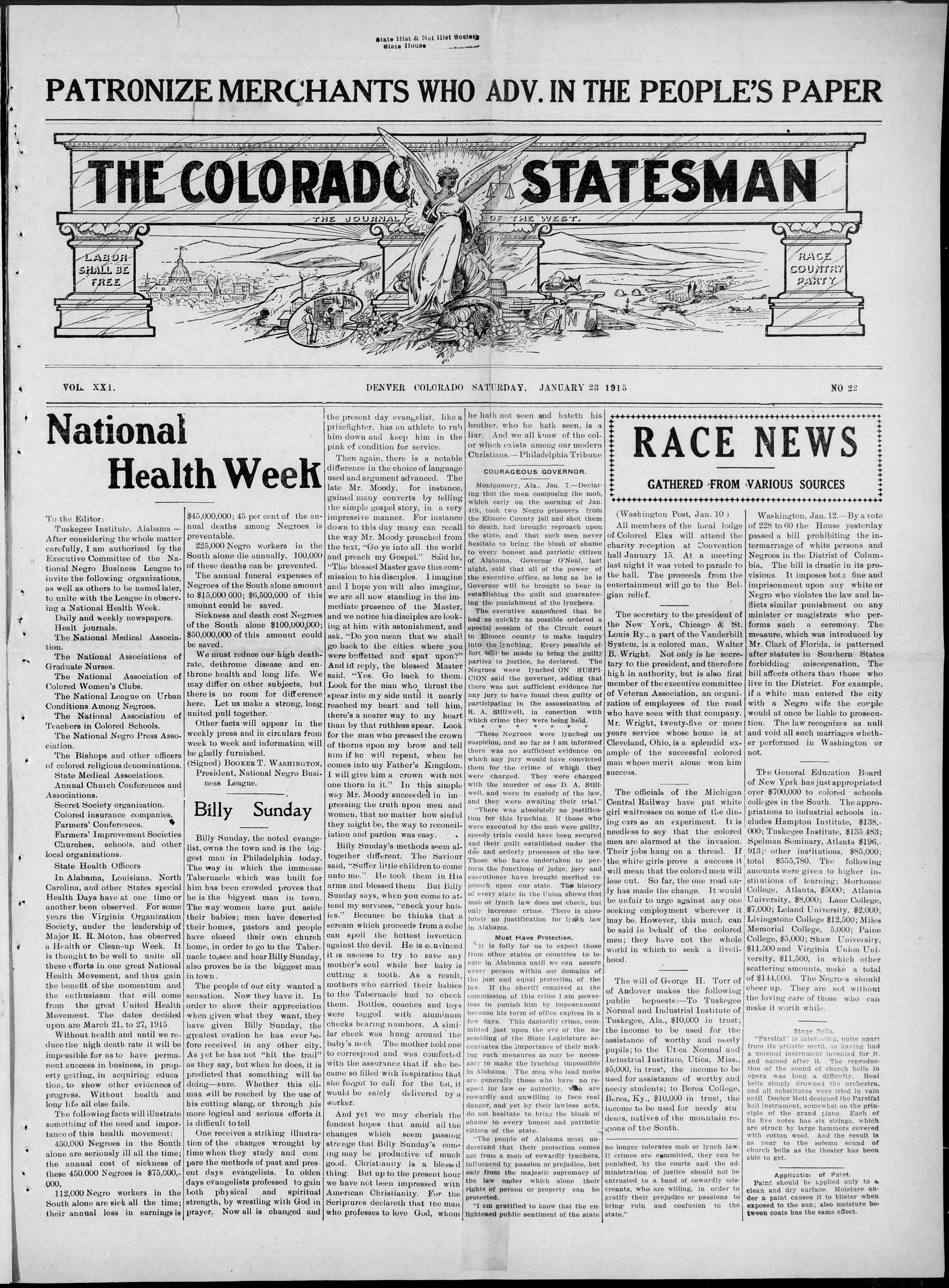
National Health Week
National Heal
To the Editor:
Tuskegee Institute, Alabama — After considering the whole matter carefully, I am authorized by the Executive Committee of the National Negro Business League to invite the following organizations, as well as others to be named later, to unite with the League in observing a National Health Week.
Daily and weekly newspapers.
Healt journals.
The National Medical Association.
The National Associations of Graduate Nurses.
The National Association of Colored Women's Clubs.
The National League on Urban Conditions Among Negroes.
The National Association of Teachers in Colored Schools.
The National Negro Press Association.
The Bishops and other officers of colored religious denominations.
State Medical Associations.
Annual Church Conferences and Associations.
Secret Society organization.
Colored insurance companies.
Farmers' Conferences.
Farmers' Improvement Societies
Churches, schools, and other local organizations.
State Health Officers
In Alabama, Louisiana, North Carolina, and other States special Health Days have at one time or another been observed. For some years the Virginia Organization Society, under the leadership of Major R. R. Moton, has observed a Health or Clean-up Week. It is thought to be well to unite all these efforts in one great National Health Movement, and thus gain the benefit of the momentum and the enthusiasm that will come from the great United Health Movement. The dates decided upon are March 21, to 27, 1915. Without health and until we reduce the nigh death-rate it will be impossible for us to have permanent success in business, in property getting, in acquiring education, to show other evidences of progress. Without health and long life all else fails. The following facts will illustrate something of the need and importance of this health movement:
```markdown
```
450,000 Negroes in the South alone are seriously ill all the time; the annual cost of sickness of these 450,000 Negroes is $75,000,000. 112,000 Negro workers in the South alone are sick all the time; their annual loss in earnings is
$45,000,000; 45 per cent of the annual deaths among Negroes is preventable.
225,000 Negro workers in the South alone die annually, 100,000 of these deaths can be prevented.
The annual funeral expenses of Negroes of the South alone amount to $15,000,000; $6,500,000 of this amount could be saved.
Sickness and death cost Negroes of the South alone $100,000,000; $50,000,000 of this amount could be saved.
We must reduce our high deathrate, dethrone disease and enthrone health and long life. We may differ on other subjects, but there is no room for difference here. Let us make a strong, long united pull together.
Other facts will appear in the weekly press and in circulars from week to week and information will be gladly furnished.
(Signed) BOOKER T. WASHINGTON, President, National Negro Busi-
ness League.
Billy Sunday
Billy Sunday, the noted evangelist, owns the town and is the biggest man in Philadelphia today. The way in which the immense Tabernacle which was built for him has been crowded proves that he is the bigyest man in town. The way women have put aside their babies; men have deserted their homes, pastors and people have closed their own church home, in order to go to the Tabernacle to see and hear Billy Sunday, also proves he is the biggest man in town.
The people of our city wanted a sensation. Now they have it. In order to show their appreciation when given what they want, they have given Billy Sunday, the greatest ovation he has ever before received in any other city. As yet he has not "hit the trail" as they say, but when he does, it is predicted that something will be doing—sure. Whether this climax will be reached by the use of his cutting slang, or through his more logical and serious efforts it is difficult to tell.
One receives a striking illustration of the changes wrought by time when they study and compare the methods of past and present days evangelists. In olden days evangelists professed to gain both physical and spiritual strength, by wrestling with God in prayer. Now all is changed and
DENVER COLORADO SATURDAY. JANUARY 23 1915
State Hist & Nat Hist Books
State House
ANTS WHO
ADC
THE JOURNAL
DENVER COLORADO SA
the present day evangelist, like a prizefighter, has an athlete to rub him down and keep him in the pink of condition for service.
Then again, there is a notable difference in the choice of language used and argument advanced. The late Mr. Moody, for instance, gained many converts by telling the simple gospel story, in a very impressive manner. For instance down to this day many can recall the way Mr. Moody preached from the text, "Go ye into all the world and preach my Gospel." Said he, "The blessed Master gave this commission to his disciples. I imagine and I hope you will also imagine, we are all now standing in the immediate presence of the Master, and we notice his disciples are looking at him with astonishment, and ask, "Do you mean that we shall go back to the cities where you were buffetted and spat upon?" And if reply, the blessed Master said, "Yes. Go back to them. Look for the man who thrust the spear into my side until it nearly reached my heart and tell him, there's a nearer way to my heart than by that ruthless spear. Look for the man who pressed the crown of thorns upon my brow and tell him if he will repent, when he comes into my Father's Kingdom, I will give him a crown with not one thorn in it." In this simple way Mr. Moody succeeded in impressing the truth upon men and women, that no matter how sinful they might be, the way to reconciliation and pardon was easy.
Billy Sunday's methods seem altogether different. The Saviour said, "Suffer little children to come unto me." He took them in His arms and blessed them. But Billy Sunday says, when you come to attend my services, "check your babies." Because he thinks that a scream which proceeds from a colic can spoil the hottest invection against the devil. He is convinced it is useless to try to save any mother's soul while her baby is cutting a tooth. As a result, mothers who carried their babies to the Tabernacle had to check them. Bottles, coaches and toys were tagged with aluminum checks bearing numbors. A similar check was hung around the baby's neck. The mother held one to correspond and was comforted with the assurance that if she became so filled with inspiration that she forgot to call for the tot, it would be safely delivered by a worker.
And yet we may cherish the fondest hopes that amid all the changes which seem passing strange that Billy Sunday's coming may be productive of much good. Christianity is a blessed thing. But up to the present hour we have not been impressed with American Christianity. For the Scriptures declareth that the man who professes to love God, whom
be hath not seen and hateth his brother, who he hath seen, is a liar. And we all know of the color which exists among our modern Christians.—Philadelphia Tribune
COURAGEOUS GOVERNOR.
Montgomery, Ala.. Jan. 7.—Declaring that the men composing the mob, which early on the morning of Jan. 4th, took two Negro prisoners from the Elmore County jail and shot them to death, had brought reproach upon the state, and that such men never hesitate to bring the blush of shame to every honest and patriotic citizen of Alabama, Governor O'Neal, last night, said that all of the power of the executive office, as long as he is Governor will be brought to bear in establishing the guilt and guaranteeing the punishment of the lynchers. The executive announced that he had as quickly as possible ordered a special session of the Circuit court in Elmore county to make inquiry into the lynching. Every possible effort will be made to bring the guilty parties to justice, he declared. The Negroos were lynched ON SUSPIION said the governor, adding that there was not sufficient evidence for any jury to have found them guilty of participating in the assassination of R. A. Stillwell, in confection with which crime they were being held.
"These Negroes were lynched on suspicion, and so far as I am informed there was no sufficient evidence on which any jury would have convicted them for the crime of which they were charged. They were charged with the murder of one D. A. Stillwell, and were in custody of the law, and they were awaiting their trial." "There was absolutely no justification for this lynching. If those who were executed by the mob were guilty, speedy trials could have been secured and their guilt established under the due and orderly processes of the law. Those who have undertaken to perform the functions of judge, jury and executioner have brought merited reproach upon our state. The history of every state in the Union shows that mob or lynch law does not check, but only increase crime. There is absolutely no justification for lynch law in Alabama.
Must Have Protection.
"It is folly for us to expect those from other states or countries to locate in Alabama until we can assure every person within our domains of the just and equal protection of the law. If the sheriff connived at the commission of this crime I am powerless to punish him by impeachment because his term of office expires in a few days. This dastardly crime, committed just upon the eve of the assembling of the State Legislature accentuates the importance of their making such measures as may be necessary to make the lynching impossible in Alabama. The men who lead mobs are generally those who have no respect for law or authority, who are cowardly and unwilling to face real danger, and yet by their lawless acts, do not hesitate to bring the blush of shame to every honest and patriotic citizen of the state.
"The people of Alabama must understand that their protection comes not from a mob of cowardly lynchers, influenced by passion or prejudice, but only from the majestic supremacy of the law under which alone their rights of person or property can be protected.
"I am gratified to know that the enlightened public sentiment of the state
RACE NEWS
(GATHERED FROM VARIOUS SOURCES)
(Washington Post, Jan. 10 )
All members of the local lodge of Colored Elks will attend the charity reception at Convention hall January 15. At a meeting last night it was voted to parade to the hall. The proceeds from the entertainment will go to the Belgian relief.
Washington, Jan. 12.—By a vote of 228 to 60 the House yesterday passed a bill prohibiting the intermarriage of white persons and Negroes in the Distrist of Columbia. The bill is drastic in its provisions. It imposes both fine and imprisonment upon any white or Negro who violates the law and in-
The secretary to the president of the New York, Chicago & St. Louis Ry., a part of the Vanderbilt System, is a colored man, Walter B. Wright. Not only is he secretary to the president, and therefore high in authority, but is also first member of the executive committee of Veteran Association, an organization of employees of the road who have seen with that company. Mr. Wright, twenty-five or more years service whose home is at Cleveland, Ohio, is a splendid example of the successful colored man whose merit alone won him success.
The officials of the Michigan Central Railway have put white girl waitresses on some of the dining cars as an experiment. It is needless to say that the colored men are alarmed at the invasion. Their jobs hang on a thread. If the white girls prove a success it will mean that the colored men will lose out. So far, the one road only has made the change. It would be unfair to urge against any one seeking employment wherever it may be. However, this much can be said in behalf of the colored men; they have not the whole world in which to seek a livelihood.
The will of George H. Torr of of Andover makes the following public bepuests:—To Tuskegee Normal and Industrial Institute of Tuskegee, Ala., $10,000 in trust; the income to be used for the assistance of worthy and needy pupils; to the Utica Normal and Industrial Institute, Utica, Miss., $5,000, in trust, the income to be used for assistance of worthy and needy students; to Berea College, Berea, Ky., $10,000 in trust, the income to be used for needy students, natives of the mountain regions of the South.
no longer tolerates mob or lynch law. If crimes are committed, they can be punished, by the courts and the administration of justice should not be entrusted to a band of cowardly miscreants, who are willing, in order to gratify their prejudice or passions to bring ruin and confusion to the state."
NO 22
Washington, Jan. 12.—By a vote of 228 to 60 the House yesterday passed a bill prohibiting the intermarriage of white persons and Negroes in the Distrist of Columbia. The bill is drastic in its provisions. It imposes both fine and imprisonment upon any white or Negro who violates the law and inflicts similar punishment on any minister or magistrate who performs such a ceremony. The measure, which was introduced by Mr. Clark of Florida, is patterned after statutes in Southern States forbidding miscegenation. The bill affects others than those who live in the District. For example, if a white man entered the city with a Negro wife the couple would at once be liable to prosecution. The law recognizes as null and void all such marriages whether performed in Washington or not.
The General Education Board of New York has just appropriated oyer $700,000 to colored schools colleges in the South. The appropriations to industrial schools includes Hampton Institute, $138.000; Tuskegee Institute, $135.483; Spelman Seminary, Atlanta $196.913; other institutions, $85,000; total $555,780. The following amounts were given to higher institutions of learning; Morhouse College, Atlanta, $5000; Atlanta University, $8,000; Lane College, $7,000; Leland University. $2,000; Livingstone College $12,500; Miles Memorial College, 5,000; Paine College, $5,000; Shaw University, $11,500 and Virginia Union University, $11,500, in which other scattering amounts, make a total of $144,000. The Negroes should cheer up. They are not without the loving care of those who can make it worth while.
Stage Bells.
"Parsifal" is interesting, quite apart from its artistic merit, as having had a musical instrument invented for it, and named after it. The reproduction of the sound of church bells in opera was long a difficulty. Real bells simply drowned the orchestra, and all substitutes were tried in vain until Doctor Moti designed the Parsifal bell instrument, somewhat on the principle of the grand piano. Each of its five notes has six strings, which are struck by large hammers covered with cotton wool. And the result is as near to the solemn sound of church bells as the theater has been able to get.
Application of Paint.
Paint should be applied only to a clean and dry surface. Moisture under a paint causes it to blister when exposed to the sun; also moisture between coats has the same effect.
NEWS TO DATE IN PARAGRAPHS
CAUGHT FROM THE NETWORK OF WIRES ROUND ABOUT THE WORLD.
DURING THE PAST WEEK
RECORD OF IMPORTANT EVENTS
CONDENSED FOR BUSY
Western Newspaper Union News Service.
ABOUT THE WAR.
The London Morning Post's Stockholm correspondent says: "During the last fortnight five German steamers have disappeared in the Baltic sea with all their crews. They were lost by striking mines."
Snow fell Monday in Belgium, in northern France and in the Vosges, but nevertheless there was artillery fighting in these sections, according to the official communication of the French war office.
German aircraft made long-threatened air raids on England Monday night and attempted to blow up with bombs the King's royal residence in Sandringham, County Norfolk. King George and Queen Mary, who had been staying at Sandringham with their family, had returned to London to resume their residence in Buckingham palace.
A Zeppelin is reported to have been brought down by the fire of a warship at Hunstanton, a few miles north of Sandringham. Bombs were dropped by the Germans in Yarmouth, King's Lynn, Sandringham, Cromer, Sheringham, Beeston and Ipswich and everywhere, except at Beeston, casualties and damage to property resulted. Many civilians were reported killed.
WESTERN
A force of several hundred men have been engaged in double-tracking the Union Pacific road out of Ogden. John M. Brewer, freight claim agent of the Southern Pacific Company, died suddenly at a sanitarium in San Francisco of paralysis of the throat. One hundred German women and children, refugees from Tsing Tau, China, which the Japanese now hold, arrived at San Francisco on the liner Korea. After a campaign of more than six years' duration by the people of Colorado the House and Senate passed on its final reading the bill making Estes park a national park. Petition for a receiver for the M. Rumley Company, a $30,000,000 agricultural machinery manufacturing concern, was filed in the United States District Court at Indianapolis.
Formal demand will be made on John D. Fredericks, former district attorney and candidate for governor at the last election, for $2,531 expended in detective work from a fund of $4,000 alleged to have been gathered by Bert Franklin, a detective, for the purpose of bribing jurors during the trial of the McNamara brothers at San Francisco.
Habeas corpus writs for the release of Michael ("Muckie") McDonald, deposed president of the Butte Mine Workers; Joseph Bradley, vice president of the union; Owen Smith and William Winchester, all of whom have been sentenced to prison for kidnapping miners during the recent labor trouble at Butte, were denied by Judge Erickson of the Federal District Court, sitting at Deer Lodge, Mont.
WASHINGTON.
President Wilson held that he has no authority to place an embargo on foodstuffs to prevent them from reaching prohibitive prices.
President Wilson has sent the following Colorado postoffice nominations to the Senate: Aspen, Mary Farrell; Breckenridge, J. A. Theobold; Carbondale, D. W. Shores; Grand Valley, James Brennan.
Republican Leader Mann, in his plea for a Rocky Mountain National park in Colorado, told the House he thought the day would come when "the vast horde of Americans who now go to see the mild scenery of Europe will go to see the grand scenery of the Rocky mountains."
"Billy" Sunday, the revivalist, visited Washington, called at the White House and talked to some 5,000 people about "If Christ Came to Washington." Members of the cabinet, congressmen, diplomats, and government officials helped to swell the big audience that listened to the picturesque german of the baseball evangelist as he climbed upon a table and warned his hearers that "God must be served."
Solicitor Johnson of England advised Edward W. Breitung, who bought the Decia from the Hamburg-American line, that the British fleet would regard his ship as a fair prize if it started either for Rotterdam or Bremen.
Government acquisition of all telephone properties was advocated before the House postoffice committee by representative Lewis of Maryland, author of a bill for that purpose, and by Samuel H. Bell of Washington, representing the International Typographical Union.
FOREIGN.
A severe earth shock rocked the houses in Belfort, France.
An earthquake of great force has shaken all Calabria, in the southwestern part of Italy.
The Bank of England sold $1,310,000 gold. The sale is believed to be for America and includes French coin.
A message of condolence on the earthquake disaster has been sent by King Albert of Belgium to King Victor Emmanuel of Italy.
Slight earthquake shocks continue in Italy, causing destruction of unsafe walls in the districts where the earthquake did the greatest damage.
Hermann Homburg, attorney general of south Australia since 1909, has resigned his position because of the anti-German feeling existing among the public.
The small Norwegian steamer Castor is reported to have struck a mine in the North Sea. All the crew were saved with the exception of one and landed at Hamburg.
An Amsterdam dispatch to the Central News states that the American steamer Pathfinder, with a cargo of cotton from America for Germany, has arrived at Ymuiden, Hølland, and is awaiting a pilot to proceed to Bremen.
The sultan of Turkey has conferred the decoration of the grand order of Nichan-I-Chefakat on Mrs. Henry Morgenthau, wife of the American ambassador to Turkey, and decorations of the second class of the same order on the three daughters of Mr. and Mrs. Morgenthau, in recognition of the services they are rendering to philanthropic and educational institutions in Turkey.
Detailed reports received in Rome regarding Italy's stupendous earthquake disaster, increase rather than diminish the appalling list of dead and the enormous property loss. The Messaggero, after making a careful computation of all the figures it has been able to gather from the districts and villages hitherto isolated, announces that the number of dead and injured in the Abruzzi alone is 30,000, without including the Sora district. San Atolio has 200 dead and 500 injured; Marino, 1,500 dead; Canistro, 600 injured; Cervaro, 300 victims; Borgo, 50 dead, and Valleroveto, 1,800. At Civitello Roveto, almost the entire population escaped, because they were working in the field when the shock occurred.
SPORT.
Frankie Callahan, lightweight of Brooklyn, knocked out Joe Rivers of Los Angeles in the second round of what was scheduled to have been an eight-round bout at Memphis, Penn. Duke Kahanamoku, the Honolulu and Olympic swimming champion, has set a new record for the 100-yard swim, according to word received at New York from Syüney, N. S. W. The duke negotiated the distance in 53 3-5 seconds.
After breaking the world's long distance record in checkerdom by playing twenty-three draw games at the National Sportsmen's Club in Chicago, the contest between Alfred Jordan, title holder and Newell Banks, former American champion, closed when the Englishman took the twenty-fourth game. The old mark of eighteen games has stood for eleven years.
At the Denver horse show Tuesday honors in the evening harness events were divided between Miss Loula Long of Kansas City and O. J. Mooers of Columbia, Mo., each being credited with one first, one second, and one third award. William Daniel of Chicago captured one first prize; John R. Thompson of Chicago, one second, with other awards going to Mrs. M. F. Clifford of Denver, one first; N. R. Pratt, Jr., of Denver, one first; M. J. Woodliffe, Denver, one third, and Karl Hayes of Denver, one second.
GENERAL.
At Middletown, N. Y., Theodore W. Decker, eighty-two, hiccuoghed himself to death, the paroxysms lasting two weeks.
The Grafton, W. Va., bank, a state institution, with a capital of $100,000 and deposits of $500,000, failed to open for business.
Southwest Texas witnessed the first snowstorm in many years Sunday. In several places it was the heaviest fall in twenty-five years.
United States Senator Ellhu Root was elected president of the Union League Club at the annual meeting in New York. Myron T. Herrick, former ambassador to France, was one of the vice presidents elected.
A meeting of unemployed men at Hull House, in Chicago, broke up in a riot that ended when mounted police had charged the crowd, arresting a score. Numerous shots were fired and a dozen men and women among the unemployed were cut and bruised.
Crazed by the word from Italy that his entire family had been wiped out in the earthquake disaster, Gluseppe Gradingo, an Italian, ran amuck at Jefferson Junction, Pa., with two guns, and injured five persons, one of them fatally, and then committed suicide.
Alleging that her luxurant blond hair fell out and was replaced by "darky wool," Mrs. Alice Davis is suing a New York hairdresser for $25,000.
The Bethlehem Steel corporation declared an annual dividend of 7 per cent on its preferred stock, which is 2 per cent in excess of the distribution made a year ago.
The steamship St. Louis, arriving at New York from Liverpool, brought as passengers sixty shipwrecked sailors, members of the, crews of two vessels recently lost in the Atlantic.
Western Newspaper Union News Service.
It cost the dog owners of Denver $9,346 in 1914 for city licenses for their pets.
A "Jayhawker dance" will feature the annual Kansas Club dinner which will be held in Denver, Jan. 29.
Thomas Chamberlain, seventy-three years old, a pioneer of Denver, committed suicide by hanging himself.
A fund for the relief of the sufferers in the earthquake zone of Italy has been started by the Italian residents of Denver.
Colorado must live within its income during the next two years, according to the announcement made by Governor Carlson.
The proposed workmen's compensation act, advocated by Governor Carlson, was insoiled by the Denver Manufacturers' Association.
The birthday of Scotland's beloved bard, Bobbie Burns, will be commemorated at a banquet given in Denver by Caledonian Society No. 1 of Colorado.
James Tanner, a prominent farmer, died at his home several miles east of Model, from pneumonia, Tanner was 85 years old and is survived by a widow.
Hearing of the various proceedings involving control of the Barth millions will be resumed in Denver before Judge Butler of the District Court on Jan. 28.
Dr. F. W. Noble, who is accused with Dr. J. R. Mason of causing the death of Miss Ruth Merriweather, was released from jail in Denver under a $15,000 bond.
State Auditor Mulnix continued his work of housecleaning in his department by announcing the appointment of J. A. Nelson as state examiner, to succeed R. E. Durrett.
State highways and the insane of Colorado were the chief topics discussed during the opening session of the seventh annual convention of the County Commissioners' Association held in Denver.
State Treasurer Stocker is now at work both upon the distribution of state funds to banks of the state and upon amendments to the farmers' loan law which may remove objections that have been made to it.
With ten-pound hammers, seven drug users and four vagrants spending the winter in the county jail, began the task of making little stones out of big ones on the "rock pile" of the county jail in Denver.
The Denver police have been asked to make a search of all Denver pawn shops and other places where jewelry might be disposed of for $12,600 worth of diamonds and pearls stolen from the home of Adolphus Busch III. of St Louis, Mo., on Jan. 3.
Mrs. Blanche Taylor, formerly Mrs. George M. Trimble of Colorado Springs and Leadville, sixty-one, died of paralysis in Los Angeles, according to word received at Colorado Springs by her mother, Mrs. Emily McFarren, and her sister, Mrs. William Wells Price.
With her clothes a flaming torch about her, seventeen-year-old Mabel Potter ran shrieking down the stairs of the House of the Good Shepherd in Denver evading a sister who hurried after her endeavoring to put out the flames, and sustained burns which caused her death in the county hospital.
Mrs. Anna W. Jacobson, founder of St. Vincent's orphanage and the House of the Good Shepherd, and owner of the Jacobson building and other property in Denver, died at her home, 1756 Grant street, after an illness of seven years. Mrs. Jacobson was seventy eight years old and was born in Baltimore, Md.
Mathias Roberts, a locomotive engineer of Tabernash, was crushed to death when a rotary snowplow broke within three miles of Corona Pass, the highest railroad point in the world, and tore down the eastern slope of James peak at a terrible speed. The plow left the rails on a curve and dashed down a thirty-foot hill.
Plans for perfecting a permanent state organization to deal with problems of the unemployed, 2,000 of whom it was estimated are objects of charity in Denver at present, were launched at a Club building meeting of 400 delegates of organized and unorganized labor, members of churches and representatives of civic bodies, in Denver.
Mrs. Pearl Hargus, thirty, will go through life disfigured as the result of several deep knife wounds inflicted on her face and arms in a Denver cafe at 1118 Eighteenth street by Mrs Helen Thayer of 1309 Eighteenth avenue, according to her charges to the police. Physicians at the county hospital took eighteen stitches in Mrs. Hargus' face.
Plans for the improvement of horse racing in Colorado were discussed in Denver at a meeting of the Colorado Racing and Fair Association in the rooms of the Gentlemen's Riding and Driving Club. Twelve secretaries of Colorado fair associations attended.
Denver housewives need have no fear of any immediate rise in the cost of bread. Leading bakers of the city say they have sufficiently large quantities of flour on hand and in transit to tide over the period in which flour will remain at top-notch prices.
MINE $30,000 IN GOLD
STRIKE OF FREE ORE MADE
NEAR BRECKENRIDGE.
Find Made in Lead Carbonate Vein
600 Feet Below the Surface of
the Dunkin Mine.
Western Newspaper Union News Service.
Breckenridge, Colo.—Breaking all records for this section of the state, $30,000 in free gold has been taken from the Dunkin mine near here in three days.
The end of the "strike" is not in sight, according to the statement of O. K. Gaymon, majority lessee of the property. He predicted an indefinite continuance of the run.
One hundred pounds of the first-class ore has been stored and assays at $300,000 a ton, declared Gaymon. That amount constitutes $15,000 worth of the present "strike," or one-half the value.
It is pointed out by the lessees of the mine that theories of geologists and experts have been shattered by the discovery of this free gold in lead carbonate 600 feet beneath the surface. Those experts had said such ore could not be found more than 300 feet underground in the Breckenridge district.
The present run is the third rich "strike" made in the Dunkin property in the last eighteen months and is the best, although one of its predecessors totaled $20,000. The present "strike," however, should reach an aggregate of several thousand dollars more at least, the lessees believe.
Saturday a few hours' work produced $14,000 worth of free gold, two solid chunks together being valued at $5,000.
Short Appropriation Bill.
Denver.—The short appropriation bill carrying $397,856.40 was introduced in the State Senate by Senator Hasty. It provides for the running expenses of the state for December, 1914, and January, February and March of this year. The bill calls for about $150,000 less than in 1912, but the saving to the state is only $70,000. This item is found in the expense of printing initiative and referred bills, which was $70,000 less than two years previous. The present appropriation measure does not carry a "defense fund" item of $50,000 which appeared in the 1912 bill. This will be provided for in the regular appropriation bill to be introduced later. The $50,000 is needed to protect Colorado's water rights from being taken by other states.
Wilson Invited to Springs
Colorado Springs.—Congressman H. H. Seldomridge has wired the Chamber of Commerce that he will make every effort to persuade President Wilson to stop in Colorado Springs on his way to the Pacific coast this summer, when he will attend the San Francisco Exposition. The Chamber of Commerce and Mayor McKesson have wired the President to stop here and make an address.
Fears for Recovery of Witness.
Boulder.—The district attorney's office is greatly worried over the fact that Charles Broughton, the only eye witness to the shooting of Will Hopkins at Hygiene two weeks ago, is seriously ill in his home with pneumonia. Broughton, who is the state's main witness in the trial of Dr. Beers, who did the shooting, belongs to a sect which does not believe in medical treatment.
Boulder Men Open Louisville Bank.
Boulder—Close on the heels of the closing of the doors of the Louisville bank last week came the incorporation of the First State bank of Louisville backed largely by Boulder capital. The bank opened for business Monday morning in temporary quarters and enrolled a large number of depositors. The capital stock is $15,000, and it is expected soon to increase it to $25,000.
Sugar Run in 100 Days.
Fort Collins.—The sugar factory closed down here after having operated 100 days. During the campaign the company sliced 217,000 tons of beets and paid out many thousand in excess of $1,000,000 for them. The sugar department has not yet finished work. On one shift recently more than 4,100 bags of sugar were turned out.
Veteran 77. Weds Widow 60.
Boulder.—After a courtship of less than two months, John H. Emmett, seventy-seven, G. A. R. veteran and one of the best known citizens of Boulder county and Mrs. Elizabeth Ferguson, sixty, widow of a veteran, were married at the home of the Rev. J. N. Hanes of the United Brethren church.
Milk Production Gains.
Fort Lupton.—Belleving that the 17, 000 pounds of milk received weekly by the condensed milk factory here will be doubled within the next six months, because of the increase in number of dairy cows in this section of the country, G. S. Landell, manager, is making extensive improvements in the capacity of the factory. The business has already increased fourfold during the last two years, and increased capacity was necessary for the factor-
The Curtis Park Floral Company
FLORAL DESIGNS PUT UP WHILE YOU WAIT
CHOICE PLANTS AND CUT FLOWERS CONSTANTLY ON HAND
GREENHOUSES: Thirty-Fourth and Curtis Streets
TELEPHONE, MAIN 1511 DENVER, COLO
When You Want
When You Want
The Heads, Feet, Tails Snouts, Neckbones or Chiterlings or any other part of the hog except the squeal go to
East's Market
The Champ
Twentieth
Is the ph
DRUGS, CHEMICALS A
WE SERVE
Prescriptions
Phone us and we will deliver
JAMES E. T
PHONE
THE ZOBE
SAMPL
1004 Nineteenth S
The Champa Pharmacy
Twentieth and Champa,
Is the place to get your
DRUGS, CHEMICALS AND PATENT MEDICINES
WE SERVE DRINKS.
Prescriptions Our Specialty.
Phone us and we will deliver the goods to all parts of the city.
JAMES E. THRALL, PROPR.
PHONE MAIN 2425.
1004 Nineteenth Street, Corner of Curtis
FINE WINES, LIQUORS AND CIGARS
COORS' CELEBRATED BEER ON TAP
The
WARD AUCTION
COMPANY
Sales Daily at 2 p.m. Office Furniture a Specialty.
PRIVATE SALES AT ALL TIMES
HAVE MOVED TO
1723-39 GLENARM ST.
PHONE MAIN 1675.
ES AT ALL TIMES
ED TO—
GLENARM ST.
PHONE MAIN 1675.
Miss M. C
Hair Dressin
```markdown
```
2300-6 Larimer Street.
DENVER
Pharmacy
and Champa,
to get your
PATENT MEDICINES
DRINKS.
Our Specialty.
goods to all parts of the city.
RALL, PROPR.
IN 2425.
BROTHERS'
E ROOM
eet, Corner of Curtis
J. H. BIGGINS
Furniture Repairing and Upholstering. All work Cash.
PHONE YORK 7837
1417 East 24th Ave Denver
Miss M. Cowden
Hair Dressing Parlor
Shampoo, cutting and curling. Scalp treatment, hair tonics, hair straightening, manicuring. Stage wigs for rent; theatrical use and masquerades. Goods delivered out of the city. All shades of hair matched by sending sample of hair; also combings made up.
Cheapest Switches 50 Cents
1219 21st St. Denver, Colo.
Phone Main 1461.
COLORADO
AFRO-AMERICAN CULLINGS
What shall be done with the Negro? This question is frequently asked and but seldom given a rational, intelligent, satisfactory answer. Possibly it ought to be changed to read thus: What shall the Negro do with himself? Not a few Negroes are answering the question in this form and in very satisfactory fashion, too. Instance the Negroes who have been building up the town of Boley, Okla., and its surrounding section. There is an illustration of the successful and suggestive working out of the self-segregation idea. It has been described and commented on by the Southern Workman:
"Boley, Okla., is the largest Negro city in the United States. It is surrounded by some of the richest land in the world and has in its neighborhood most valuable mines of coal and wells of oil. Recently it was the scene of joyous activity when Dr. Booker T. Washington and some 400 delegates to the National Negro Business league came to its citizens from Muskogee, through Okmulgee, Boynton and Clearview, where Negroes are succeeding in farming, in cattle raising, in mining, in the oil and gas fields and in storekeeping.
"Boley was founded in 1904 by Thomas M. Hayes of Texas in the rolling prairie land on the Fort Smith & Western railroad between Deep Fork and North Canadian rivers, and is in the heart of a vast region capable of producing such diversified crops as corn, wheat, cotton, potatoes, alfalfa, apples, peaches, grapes, berries and the common garden vegetables.
"This Negro town is 'making good.' Today it has over eighty business concerns, an electric lighting plant, efficient waterworks, two banks, several attractive churches, a high school worth over $15,000, a normal and industrial school supported by the C. M. E. church, flourishing fraternal orders, a Masonic temple of the Oklahoma jurisdiction worth $25,000, a telephone system, several cotton gins, a chamber of commerce, a city hall, a Negro station agent and a Negro newspaper.
From 15,000 to 20,000 people live in the region surrounding Boley—3,000 are in the township of Boley and 1,300 are in the city of Boley. Here, then, is the beginning—really an excellent beginning—of a demonstration in Negro city building which will be watched closely by those who are interested in the Negro as a factor in business.
"The people of Boley, all of whom are Negroes, have shown rare pluck in going into a new country and doing together what most people said Negroes never could do—exercise initiative and judgment in building up business enterprises apart from white men. They have won their present success by making their lot one with the man on the farm.
"Boley is in many ways a substantial evidence of the ambition, thrift and capacity of the Negro who takes life more seriously than the average man of the race and is not interfered with by unwise friends or out-and-out enemies Boley reflects credit on Mr. Haynes and his coworkers. It gives promise of great things. It ought to be better known by young, doubting Negroes, especially city Negroes, who are dissatisfied with their lot and are ignorant of what the South and the Southwest offer in golden opportunities for the sober, hard-work-
The Negro Year Book, 1914-1915, has just been issued from the Tuskegee institute, Alabama, Monroe N. Work, editor, and is a more thorough compendium of vital information than ever before, not only to persons of the race, but all students of the life and growth of that race, and all who wish to be informed in regard to a people which has had amazing growth in numbers and in all material and intellectual development since their emancipation from slavery hardly more than half a century ago, the present issue of 448 pages is about 70 pages larger than the last previous issue. Another interesting publication is "The Crisis, a Record of the Darker Races," published weekly at 70 Fifth avenue, New York city. In both publications the question of race segregation is discussed at some length.
The warden of a Georgia prison has been puzzled by an order to give one of his prisoners a ten days' allowance on his sentence. As the sentence is for life the order is difficult to carry out.
Alien law may bar a red-headed man, but it won't bar a red-headed woman.
The earning capacity of a woman determines her right to vote in Norway.
Success is always due more to the ability to stand the bumps than anything else.
As a rule the self-appointed censor of other people's morals has a busy time of it.
ing, cheerful man, regardless of color.
"What the future of Boley will be depends not only on the men and women who have planted a thriving city in a rough country, but also upon the Negroes who are trained (and will be trained within the next few years) for leadership in education, business and public health, as well as in religion and law.
"Dr. Washington's visit to Boley, his words of encouragement and advice, together with his vital relation to problems of race adjustment, give the demonstration in 'big business' for the Negro more than passing significance."
I am sure that it will prove both interesting and educative to many of your readers to have laid before them certain statistics of church work among the colored race, and gleaned from the recently issued Living Church Annual and Churchman's Almanac for 1915, writes George F. Bragg, Jr., in a communication to the Living Church.
Organized congregations to the number of 233, within 53 dioceses and missionary districts, report 23,706 colored communicants. They are distributed as follows:
The province of New England: In two dioceses and five congregations, there are 1,413 communicants.
The province of New York and New Jersey: In six dioceses 19 congregations, 4,439 communicants.
The province of Washington: In nine dioceses, 63 congregations, 6,432 communicants.
The province of Mid-West: In eight dioceses, 15 congregations, 2,318 communicants.
The province of Southwest: In eight dioceses, 18 congregations, 1,189 communicants.
The province of California: In two dioceses, two congregations, 222 communicants.
The combined colored communicant lists in the entire states of Alabama, Mississippi, Louisiana, Kentucky, Tennessee, Arkansas and Texas amount to just 266 more communicants than are reported by the single colored parish of St. Philip's church, New York. It would certainly seem that the church needs the "Racial Episcopate," or something else, which promises better results than the machinery we have tried for a whole half century.
Here is the real thing which tests the catholicity of the church.
Steps taken to improve facilities for the education of the Negro and summarized in an installment just made public of the forthcoming report of the general educational board. Assistance is shown to have been given what the board alludes to as some of the more efficient of the industrial training schools as follows: Hampton institute, $138,000; Tuskegee, $196,912; other institutions, $85,384, making a total of approximately $558,780.
To provide for higher education of Negroes, contributions have been made to colleges and universities as follows: Atlanta Baptist college, $5,000; Atlanta university, $8,000; Fisk university, $70,000; Lane college, $7,000; Leeland university, $2,000; Livingstone college, $12,500; Mines Memorial college $5,000; Paine college, $5,000; Shaw university, $18,000; and Virginia Union university, $11,500, total, $144,000.
That the men of the Negro race are strongly averse to taking their own lives as a way out of this world of woe is proved most conclusively by the suicide and attempted suicide records of Houston for the past five months. Bichloride of mercury tablets have no fascination for him and all other forms of poison are classed in the "don't touch" list.
On the other hand, the women of the Negro race are not so prone to take solace in the carbolic acid bottle as are the women of the white race, and in following the statistics still further it is shown by the records that there are fewer attempts at suicide by women of the white race than by men. —Houston (Tex.) Post.
Rich phosphate deposits have been discovered in Chile.
Western Australia's gold fields cover 224,000 square miles.
Portland, Me., has a barber who has been in continuous service 50 years.
Austria's population is 51,340,000.
Cotton goods constitute about one-third of England's manufactured exports.
New Brunswick has 17,393,000 acres of land, of which only 1,474,076 acres are cleared.
Manchester, England, has 1,000 students in an evening school of commerce.
West Virginia declares her "blue sky" law void, overlooking a chance to shoot it full of holes.
SENATE AND HOUSE COMMITTEES NAMED
List of Chairmen and Members of Various Committees Selected to serve During Twentieth General Assembly of Colorado.
Western Newspaper Union News Service.
The Senate Committees.
Agriculture and Irrigation—F. M. Weiland, chairman; O. L. Mitton, F. H. Means, F. W. Wilkin, H. H. Adams, W. J. Buris, F. Geedest. Banking—O. L. Mitton, chairman; W. R. Eaton, R. E. Winbourn, F. H. Means, W. D. Reilly, C. B. Hamilton, B. T. Napier. City and County of Denver—F. L. Dairman, F. I. Kearns, W. R. Eaton, C. B. Hamilton, R. J. Morris, Joseph Berry, H. R. Robinson, John L Tierney. Constitutional Amendments—Wm. C. Rairman, H. E. Kearns, W. J. Candish, C. Barela, T. H. Iles, B. T. Napier, E. Affolter. Corporations—H. E. Curran, chairman; B. Carela, F. L. Dodge, C. F. Wilkins, J. M. Berry, B. T. Napier, C. B. Hamilton. County affairs—M. N. Lines, chairman; E. W. Winbourn, O. L. Mitton, C. Carela, W. J. Reilly, J. M. Berry, George Lewis. Education and Educational Institutions—H. E. Elliott, chairman; F. J. Russell, F. M. Kearns, C. F. Wilkins, E. Affolter, William R. Robinson. Enrollment—F. M. Means, chairman; W. J. Reilly, William C. Robinson, B. F. Carver, B. T. Napier
Finance—John Hasty, chairman; W. O Peterson, R. E. Winbourn, C. F. Williams, F. E. Fassett, W. H. Adams, Williams, S. J. Burris, W. H. Adams, F. H. Means, O. E. West, Dodge, Adams, Fish, Forestry and Game, C. F. Williams, F. M. Ward, H. E Curran, D. Dodge, I. H. Berry, T. H Iles and F. L, Schermhorn.
Horticulture—B. T. Napier, chairman; F. M. Weiland, R. E. Winbourn, M. N. Lines and J. T. Tierney. Insurance—R. E. Winbourn, chairman; F. L. Dodge, W. R. Eaton, H. E. Curran, Reuben J. Morris, B. T. Napier and F. L. Schermerhorn. Judiciary—Charles Hayden, chairman; W. C. Robinson, R. E. Winbourn, F. J. Knauss, O. L. Mitten, F. H. Means, H. E. Curran, B. T. Napier, C. B. Hamilton, George Lewis and L. J. Burris.
Medical Affairs—C. F. Wilkins, chairman; F. L. Schermerhorn, J. F. Pearson; F. L. Schermerhorn, J. F. Pearson; Herman Kluge and T. H. Hles, Mines and Mining—W. J. Candlish, chairman; John F. Pearson, Charles Herman; Matt N. Lines, H. E. Curran, Edward Affolter, George Lewis and H. E. Curran.
Printing—C. Barela, chairman; F. L. Schermerhorn, W. O. Peterson, Charles Herman; Herman Kluge and Eph Berry, Privileges and Elections—F. L. Dodge, chairman; W. O. Peterson, Matt N. Lines, F. L. Schermerhorn, C. B. Hamilton, Josse Berry, Railroads—C. Barela, chairman; L. J. Williams, John Hasty, F. L. Dodge, W. H. Adams, George West and W. D. Reilson.
Reapportionment—R. E. Winoburn, chairman; Matt N. Lines, David Elliot, W. O. Peterson, F. H. Means, John Elliot, W. O. Peterson, Josse Berry, S. J. Burris, H. Kluge, George West, F. J. Pearson, Joseph Berry, W. D. Reilly and F. L. Schermerhorn.
Engrossert—W. J. Candlish, chairman Hasty, Chas Hayden, R. J. Morris and H. R. Robinson.
Rules—L. J. Williams, chairman; Charles Hayden, David Williams, W. H. Adams and J. F. Pearson.
State Institutions and Public Buildings—F. J. Knaus, chairman; W. J. Knaus, J. W. Pearson, H. E. Curran, C. Barela, J. W. Pearson, J. Burris and F. L. Schermerhorn.
Military Affairs—W. R. Eaton, chairman; W. R. Eaton, J. Hasty, David Elliott, Hermann; W. R. Eaton, State Officers and Public Lands—W. C. Robinson, chairman; W. J. Candlish, O. L. Mitten, L. J. Williams, J. S. Burrows, Stock—Gorge E. West, chairman; F. H. Means, C. Barela, F. M. Welland and W. D. Reilly.
Spouses and Expenditures—David Elliott, chairman; John Hasty, O. L. Mitten, E. Affolter, B. F. Carver.
Industrial Relations — W. R. Eaton
chairman; F. J. Knaus, W. O. Peterson, Matt N. Lines, Charles Hayden, C. B. Hamilton, and J. F. Pearson
Temperance—W. O. Peterson, David Elliott, F. J. Knauss, F. C. Willin, F. M. Weiland, Herman Kluge and F. L. Schermerhorn.
The House Committees.
Banking — Montgomery, chairmans Graves, Kruse, Scott, Taylor (El Paso) Wallace, Best, Dunland, and Staley.
Wallace, Best, Dunlap and Staley,
Counties and County Lines—Graves,
chairman; Green, Colgate, Damewood,
Hickman, Scott, Staley, Norvell and
Counter.
Corporations — Garcia, chairman; Bills, Crist, McDevitt, Puffer, Stokes, Thompson, Hutch Taylor, Bruce, Dunkerson, Kernan — Nona of the Temperance, George Taylor, chairman; Wallace, Garwood, Greene, Colgate, Inge, Ardourel, Horton and West. Agriculture and Irrigation — Gilcrest, chancellor, George Green, Montgomery, Nelson, Stokes, Born, Bruce, Maroid, Porter and Horton. Appropriations and Expenditures — Puffer, chairman; Gilcrest, Andrew Billem, Humison, McDevitt, Schmidt, Ardourel, Crist, Staley, Fox and Porter. Criminal Jurisprudence — Nelson.
WELLS IS MINERS' PRESIDENT.
Metal Men Discuss Legislation to Aid Revival of Industry.
Denver.—Plans for legislation which will foster the present great revival of the mining industry in Colorado were discussed at the closing session of the Colorado Metal Mining Association. Schemes for more just taxation for mining lands and the blocking of land leasing bills in the National Legislature were discussed.
The following officers were elected to serve during the coming year: Bulkeley Wells of Telluride, president; George O. Argall of Leadville, first vice president; Horace F. Lunt of El Paso, second vice president; Richard Doelofs of Cripple Creek, third vice president; John M. O'Connell, Denver, secretary, and A. M. Collins, Creed, treasurer.
The members of the executive committee are Bulkeley Wells, John M. O'Connell, R. M. Henderson, Thomas R. Henahen, James Doyle, C. H. Hannington, E. N. Moscript, John G. Clark and Jesse F. McDonald.
Couple Remarries at Littleton.
Littleton. — Remarried after each had wed and divorced another, Charles Miner, fifty, and Mrs. Rosie Frazer, forty-seven, both of Johnstown, are Pain nappy. They procured a license here. Neither was able to remember the date of the divorce which originally separated them. By a coincidence, they both became legally separated from their second mates in March, 1913. Miner in Denver on nonsupport charges and Mrs. Frazer at Bridgeport, Neb., on the ground of desertion.
chairman; Spencer, Schmidt, Noonan, drake, Graves, Sabin, Bolsinger, Kennedy, Roberts and Wright
chairman; Roberts and Wright—Noonan, chairman; Crist, Sabin, McGarth, Bruce, Daily, Counter, Garcia, Taylor (El Paso).
Recruitment — Damewood, chairman; Krusse, Gill, Colgate, Spencer, Graves, Heartz, Norvell and O'Rourke.
Denver City Affairs—Harris, chairman; Bills, Drake, Garwood, Hagerman, Dietrich and Dinklee.
Enrollment — Hagerman, chairman; Andrew, White, Ardourel and Kennedy, Crist, chairman; Inge, Stokes, Dinklee, Dietrich, Elections and Appointments—Krusse, chairman; Scott, Glicest, Noonan, Gallegos, White, Fox, Marold and West, Crist, chairman; Inge, Montgomery, Weiss, Garcia, Inge, Montgomery, Fincher, DuPraw and Kennedy.
Nuer Relations—Mayer, chairman; Stokes, Weiss, Tongue, Pferr, Hugh Taylor, Bruce, Horton and Wright.
Finance, Ways and Means—Bills, chairman, Howland, McGarth, Hugh, Weiss, Weiss, Ardourel, Dunlap and Dinklee.
House Expenses—McDevitt, chairman; Andrew, White, Thompson, Tongue, Garwood, Heartz, Fox and Doyle.
Fish and Game—Weiss, chairman;
Hagerman, Nelson, Spencer, Wallace,
Crist, Norvell, Marold and Wright.
Insurance-Drake, chairman; Howland-Drake, Weiss, Kruse, Fox, Dunlap and Dietrich.
Indian and Military Affairs-Humason, chairman; Garwood, Garcia, McDeyitt, McGrath, Bolsinger, Best, Born and Macdonald.
Medical Affairs and Public Health-Garwood, chairman; Wallace, Mayer, Bills, Thompson, Hugh Taylor, West, McNair and Born.
Insurance-Drake, chairman; Mayer, Andrew, Colgate, Stokes, Tonge, Roberts, McNair and Dunlap.
Judiciary—Sabin, chairman; Nelson, Schmidt, Spencer, Drake, Noonan, Crist, Bruce, DuPraw, Dunklee and Staley.
Mines and Mining - Tongue, chairman; Tongue, Chairman; Mayer, Mayer-Devitt, Greene, Doyle, McNair, O'Rourke, Roberts and DuPraw, Mercantile and Manufacturing Inter-Interior, chairman; Hurls, Bills, Puffon, Hagermann, McDevitt, Deltrich, Counter and Fincher, Andrew, chairman; White, Scott Hagermann, Spencer, Dalley, Eolsinger and Porter.
Penitentiary — Colgate, chairman; Harris, Mayer, Gill, Thompson, Nelson, Wright, Norvell, and Horton. Public Buildings, mosques, chairman; Gilcrest, Damewood, Humason, Harris, West, Kennedy, Dalley and Mayer. Hills Lands — Inge, chairman; Kruse, Montgomery, Hugh Taylor, Howland, Graves, O'Rourke, Bruce and Counter.
Revision and Constitution—Schmidt, chairman; Drake, Howland, Humason, Macmillan; Andrew, Dietrich, Bolsinger and Norvell.
State Affairs and Reapportionment—Chairman; Puffer, Graves, McGrath, Gigos, Hugh Taylor, Heartz and Horton.
Rounds and Bridges—Scott, chairman; Kruse, Harris, Damewood, McGrath, Macmillan.
Stock—Stokes, chairman; Gill, Inge, Montgomery, Hagerman, Weiss, Best Norwell and Marold. Witnesses—Hugh Taylor, chairman; Wallace, Nelson, Humason, Colgate, Gilcrest, Harris, Spencer, Heartz, Dardourel, Dunklee, Staley and Wright. Towns and Cities—Wallace, chairman, Schmidt, Garcia, Scott, Tonge, White, Dietrich, Kennedy and Bolsinger.
Forest Reserves and Forestry — Green, chairman; Montgomery, Wallace, Galllegos, Drake, Damewood, Born, Doyle and Fincher.
Wants Mountain Named Columbus.
Denver.—Angelo Noce, "father" of Columbus day in Colorado, president of the Columbus Pioneer' Association, has interested a large number of Colorado people in his movement to name a mountain peak after Christopher Columbus. He has worked for a number of months enlisting this aid of men and women in all walks of life, and has been assured that a summit is to be given the name of Columbus. President Noce says that it is not the intention of the association to try to change the name of any mountain to Columbus. If a peak at present unnamed is given Columbus' name, it will satisfy the association, says Noce. He has held conferences with federal officers, officers of the Colorado Geographic Society, the Colorado Pioneers, Pioneer Printers, Knights of Columbus and others.
PREDICTS $2.50 FOR WHEAT.
Portland Lecturer Says That Price Will Be Paid Before Another Crop Is Harvested.
Fort Collins.—Wheat will rise to $2.50 a bushel before another crop is harvested. This was the prediction made at a lecture at the farmers' congress and short course in session here at the agricultural college by L. M. Jeffers of Portland, Ore., in charge of the Portland grain standardization laboratories for the United States Department of Agriculture.
Jeffers said that at the rate wheat is being exported more than the country's surplus will have been shipped abroad. Under this condition, he said, the ensuing shortage would send the grain up to $2.50 before the next crop could be thrashed. It would be impossible in the meantime to get wheat from Russia and Hungary and Argentina could not send enough to supply this country's deficiency.
32,000 Animals Killed by U. S. Denver.—A statement issued by the local office of the forest service shows the number of predatory animals killed by forest officers in four years in the national forests of Colorado. Wyoming and South Dakota. Since July 1, 1910, the total number of animals killed, including bears, mountain lions, wildcats, lynxes, coyotes and wolves, is as follows: 1911, 1,584; 1912, 1,475; 1913, 1,279; and 1914, 937, making a total of 5,275. Including among these were 240 wolves and 4, 474 coyotes.
ERNEST HOWARD,
ERNEST HOWARD,
Carpenter, Job and Repair Work.
Paints, Oils and Glass.
Coal, Wood
1021 21st Street.
Coal, Wood and Express
Street. Phon
Tried the Rest Our Pr
v the Best Satisfac
Coal, Wood and Express.
You Have Tried the Rest
Now Try the Best
THE
Giant
FOR QUALITY
CLEANING, PRESSING,
ING, RELINING AND
WORK CALLED FOR
2549 Washington Avenue
NING, PRESSING, DYEING,
ING, RELINING AND REMODEL
WORK CALLED FOR AND DELIVER
ington Avenue D
CLEANING, PRESSING, DYEING, REPAIRING, RELINING AND REMODELING.
WORK CALLED FOR AND DELIVERED
2549 Washington Avenue Denver, Colorado
PHONE MAIN 3028
JOHN K.
Meats, Fancy and
1864 CURTIS
JOHN K. RETTIGER
Bis, Fancy and Staple Grocery
1864 CURTIS STREET
neteenth.
Main C. E. Sn
189, 190 Res. Pho
The Market Com-
ture and Retail Staple and Fancy Grocery
Masters. Hotels and Restaurants Our Spo-
d Cured
Eastern Corn Fed Meat
Fruits, Vegetables, Poultry and Gam-
rapahoe Street Den
HARRIS, Pres. J. M. JOHNS, Treas. SEIB M.
RAILROAD PORTERS' C
LUNCH ROOM IN CONNECTION
Giards and Free C
Pool Roo
5 Wazee St. Only one block from Un-
phone Main 8416. Denver, Col
Corner Nineteenth.
The Market
Wholesale and Retail Staple and
Oysters. Hotels and Re-
fresh and Cured
Eastern Corn
Fruits, Vegetables,
1638-89 Arapahoe Street
CHAS. HARRIS, Pres. J. M. JOHN
RAILROAD POOL
LUNCH ROOM I
Billiards and
Pool
1728½ Wazee St. Only on
Phone Main 8416.
The Market Company
Wholesale and Retail Staple and Fancy Groceries, Fish and Oysters. Hotels and Restaurants Our Specialty.
Eastern Corn Fed Meats
Fruits, Vegetables, Poultry and Game.
CHAS. HARRIS, Pres. J. M. JOHNS, Treas. SEIB MILLER, Sec.
1728% Wazee St. Only one block from Union Depot Phone Main 8416. Denver, Colorado
The Corbett Ice Cream Co.
1115 WELTOW
THE ICE
That Is Just a Litu
Kind You Thou
C. H. SHIRLEY, Pres.
1115 WELTON STREET
THE ICE CREAM
That Is Just a Little Better Than the
Kind You Thought Was Best
IRLEY, Pres.
J. C. HAMPSC
That Is Just a Little Better Than the Kind You Thought Was Best
C. H. SHIRLEY, Pres. J. C. HAMPSON, Vice Pres PAUL J. SHIRLEY, Sec. and Treas.
THE ATLAS DRUG CO.
Courteous Treatmet. Right Prices Leaders in Prescription
Phones Main
169,181,189,190
and Express.
CLEANERS
AND
TAILORS
McCAIN & RICHARDS, PROPS
Phone Main 7376
ING, DYEING, REPAIR-
AND REMODELING.
OR AND DELIVERED
Denver, Colorado
RES. PHONE GALLUP 942
. RETTIG and Staple Groceries TIS STREET
et Company
and Fancy Groceries, Fish and
Restaurants Our Specialty.
Barn Fed Meats
es, Poultry and Game.
Denver, Colorado
OHNS, Treas. SEIB MILLER, Sec.
ORTERS' CLUB
IN CONNECTION
Free Check
Room
one block from Union Depot
Denver, Colorado
TON STREET
THE CREAM
Little Better Than the
ought Was Best
J. C. HAMPSON, Vice Pres
LEY, Sec. and Treas.
AS DRUG CO.
Hmet. Right Prices
Prescription
Store No. 2.
26TH AND WELTON
Main 4955-4956
Glazing Done
Phone Champa 752.
Our Prices Reasonable Satisfaction Guaranteed
Denver, Cola
C. E. Smith, Manager Res. Phone South 1608
THE COLORADO STATESMAN
THE JOURNAL OF THE COUNTY
KABUH
SHOULD BE FREE
BACK
COUNTRY
SARTY
SUBSCRIPTION RATES:
One Year ..... $2.00
Six Months ..... 1.00
Three Months ..... 6.00
PAYABLE IN ADVANCE.
Entered as second-class matter at the postoffice in the city of Denver, Colorado.
Display advertising, 50 cents per inch. An inch contains twelve agate lines.
Reading notices, ten lines or less, 10 cents per line. Each additional line over ten lines, 5 cents per line.
No discounts allowed on less than three months' contract. Cash must accompany all orders from parties unknown to us. Further particulars on application.
It occasionally happens that papers sent to subscribers are lost or stolen. In case you do not receive any number when due, inform us by postal card and we will cheerfully forward a duplicate of the missing number.
Remittances should be made by Express Money Order, Postoffice Money Order, Registered Letter or Bank Draft. Postage stamps will be received the same as cash for the fractional part of a dollar. Only 1-cent and 2-cent stamps taken.
Communications to receive attention must be newsy, upon important subjects, plainly written only upon one side of the paper; must reach us Tuesdays, if possible, anyway, not later than Wednesdays, and bear the signature of the author. No manuscript returned, unless stamps are sent for postage.
All communications of a personating nature that are not complimentary will be withheld from the columns of this paper.
LYNCHINGS IN THE UNITED STATES.
good seems to curdle in our veins when we being the realization of our American citizen, lawlessness as transpires year in and year, her superiority to other nations, her great rapid strides in the march of progress.agement of mob-rule in this country must rehe must undergo of necessity in her being to be committed on a portion of humanity and plays an important part in its destiny. Women individually and collectively to the severer to compel a cessation of this barbarism, we have succeeded in reducing the number yet the thirst for blood resolves to satiate feminine. Towards the latter part of 1914 of women were lynched in a greater degree co and this must have lent an inspiring influence begins with the murder of two men and two men of religious boastings, with your reformer-Alexander, a Billy Sunday—have ye for joy against Jerusalem—"Oh, Jerusalem, Jerred thee unto me like a hen doth her broil to remember the penalty she paid?" How how the black American fought side by side in revolution, the Civil War and the Spanish his quota to the maintenance of the integ Can he venture to efface from his memory protection of the chastity of his women, the children afforded him not so long ago by a human family? You men of might and power through your veins, with your vaunted civilly send your indorsement, your encouragement, which makes "our land of the brave and the civilized nations, which makes them jeer-niations of the present war, when in our huwanton cruelty and destruction being done, over the biblical expression: "Be not deceive we whatsoever a man soweth that shall he a- nations.
How our blood seems to curdle in our veins when we have to write on such a topic, having the realization of our American citizenship and yet the victims of such lawlessness as transpires year in and year out in this land that boasts of her superiority to other nations, her great advancement in civilization, her rapid strides in the march of progress.
The encouragement of mob-rule in this country must result in a just retribution which she must undergo of necessity in her being purged of the wrongs she allows to be committed on a portion of humanity that is an entity in the nation and plays an important part in its destiny. We have been making representations individually and collectively to the several agencies vested with the power to compel a cessation of this barbarism for a number of years, and while we have succeeded in reducing the number of victims on the masculine side, yet the thirst for blood resolves to satiate itself in the increase of the feminine. Towards the latter part of 1914 our poor, helpless and unfortunate women were lynched in a greater degree comparatively than were our men, and this must have lent an inspiring influence to these brutal actions, as 1915 begins with the murder of two men and two women in Georgia last week. Nation of religious boastings, with your reformation by a Sanky and Moody, a Torrey-Alexander, a Billy Sunday—have ye forgotten the cry of the days gone by against Jerusalem—"Oh, Jerusalem, Jerusalem! How oft have I not gathered thee unto me like a hen doth her brood, and ye would not?" Can you fail to remember the penalty she paid?" Has the white man forgotten already how the black American fought side by side with him in the wars of the revolution, the Civil War and the Spanish-American, materially contributing his quota to the maintenance of the integrity of this country and people? Can he venture to efface from his memory the safeguarding of his home, the protection of the chastity of his women, the assistance in the rearing of his children afforded him not so long ago by this dark-skinned species of the human family? You men of might and power, with the blue blood coursing through your veins, with your vaunted civilization, how much longer will you lend your indorsement, your encouragement, your support to this atrocity, which makes "our land of the brave and the free" a laughing-stock of the other civilized nations, which makes them jeer and taunt us with our peace negotiations of the present war, when in our home, in our very midst, there are wanton cruelty and destruction being done to a part of the people. Remember the biblical expression: "Be not deceived; God is not mocked; therefore whatsoever a man soweth that shall he also reap." This is also applicable to nations.
A CRY FROM COLORADO.
our nation, President Wilson, is quoted as a serious fervor. Born of religious parents, rears of godliness, a man whom we listened to in Denver, Colo., in response to the invitation three years ago, when he addressed us on the United States, surely he can help to ameliorate our people. He assisted his fellow white men in the Colorado strike zone, and kept our peace was restored; may he not help us our women, from such inhuman actions, seeing powerless to act, as is their general complaint due respect to them) adjudicate on the requisite on the atrocities heaped on the c
The head of our nation, President Wilson, is quoted as being a man of particularly religious fervor. Born of religious parents, reared and trained in the environments of godliness, a man whom we listened to very favorably when he came to Denver, Colo., in response to the invitation of religious societies about three years ago, when he addressed us on the ter-centenary of the Bible in the United States, surely he can help to ameliorate conditions of this kind among our people. He assisted his fellow white man by sending federal troops to the Colorado strike zone, and kept them on the scene of the disturbance until peace was restored; may he not help us colored Americans, and especially our women, from such inhuman actions, seeing that the officers of the law are powerless to act, as is their general complaint; seeing that the courts (with all due respect to them) adjudicate on the rights of the white man and remain quiescent on the atrocities heaped on the colored man?
OUTSPOKEN CHARACTERS.
nightman of New York, in his inaugural ad-
duty of the penalty she will have to pay and
prepared to make if she will unheed the laws,
saws and people, and the outcome of unjust dis-
the law. Dr. E. Lester Jones, deputy com-
port of a few days ago to President Wilson,
assignment of the white man's conduct in Ala-
sia the native women," and says: "The white
of the sanctity of the natives' home is the crie
wife and daughters are dishonored, and a
other or brother, is overcome by threats
that there are a few individuals who are fearle
t tell them of their faults and impress them.
tience is a virtue, but there are times whi
is NOW COME.. Like the cry of old, we are
pouls, "How long, O Lord, how long, in eru-
??" If Paul Laurence Dunbar would be resu-
that LYNCHING has been extended to the
soul fired with denunciation and vehemen-
dred the following lines:
Governor Whitman of New York, in his inaugural address recently, reminded this country of the penalty she will have to pay and the retribution she must be prepared to make if she will unheed the laws pertaining to the protection of lives and people, and the outcome of unjust discrimination in the dispensation of the law. Dr. E. Lester Jones, deputy commissioner of fisheries, in his report of a few days ago to President Wilson, comes out forcibly in a terrible arraignment of the white man's conduct in Alaska regarding the "Dishonoring of the native women," and says: "The white man's lack of care and regard for the sanctity of the natives' home is the crime of Alaska. In many sections the wife and daughters are dishonored, and any resistance from the husband, father or brother, is overcome by threats and bribes." This goes to prove that there are a few individuals who are fearless enough among the white race to tell them of their faults and impress them with the necessity of amending. Patience is a virtue, but there are times when it ceases to be, and the time has NOW COME. Like the cry of old, we are shouting from the depths of our souls, "How long, O Lord, how long, in cruel bonds shall we deliverance wait?" If Paul Laurence Dunbar would be resurrected at this moment to witness that LYNCHING has been extended to the gentler sex of his race, his poetic soul fired with denunciation and vehemence of such outrages might have inspired the following lines:
My country, 'tis of thee
O land of mockery
Or some such mess.
Land where my fathers died,
Land of the lynching pride,
Often we have cried and cried,
But no redress.
---
Particularly is this true of those who want to take up the cultivation of land. For the most part, I have discovered, the lands are in possession of big holders, private owners, who are disinclined to part with it unless they get big profits. This cuts out the man with small capital.
Nearly all the states of Australia offer attractive opportunities to prospective emigrants from other countries, particularly to those of the city, to take up farms for dairying or stock purposes. New South Wales has been called the land of the small farmer, and properly so, for there are more small land owners, I believe, in that state than in any other community in the world. Much of New South Wales is under irrigation, and the soil and climate are such that any kind of crop can be produced.
In order to get men to take up land the government offers liberal terms. All the irrigation lands are held on perpetual lease in tracts of five to twenty acres, or any amount that one man or family can take care of properly.
The cost of the lease is simply a fair interest on the assessed valuation of the land and the actual cost of the water supplied to it.
The only change that may be made in the cost of the rental to the farmer comes through revocation, but that is made only once every 25 years, so it is nothing to worry about.
The governments of the other states of Australia are equally liberal, and all have a system of loaning money for improvements to reliable and competent farmers.
means of prevention. There is certainly no necessity for carrying purses openly in public as women persist in doing. Recently a newspaper contained an account of an eight-year-old boy being a purse snatcher, with the statement that it was not his first offense and that the art had been taught him by other boys.
Surely it is a sad condition of affairs when such temptations are permitted to be flaunted in the very faces of boys of this age.
Men, driven to desperation by want, have sometimes taken advantage of the opportunities afforded by purses carried openly; therefore is it any great wonder that the undeveloped reasoning powers of an eight-year-old child should grasp the means so openly offered?
Laws prevent the carrying of concealed weapons, because they are a menace to the community, and yet they are little more dangerous in their entirety than purses carried openly.
In sincerity I should suggest laws compelling the carrying of concealed purses in public.
Many men and women then prefer to remain unemployed so long as charitable people extend a helping hand. In hard times the unwilling workers are re-enforced by thousands compelled to lose their jobs. These last suffer mainly because they have not learned to save or to practice economy, and, by their own fault, have become dependent upon charity.
Within three months one industrial concern laid off, temporarily, 1,000 employees earning ordinarily from $3 to $4 per day. After a few weeks these men were restored to work, and immediately a large percentage of them applied for advance payment of wages to pay the grocers' and butchers' bills created during their enforced vacation.
Is it not evident that in good times the average well-paid employee saves nothing for a rainy day, and his family practices none of the desirable household economies in either good or bad times?
have accomplished little. Bills were presented to the legislature at its session of two years ago, but because the sponsors of different systems were unable to agree, seemingly, the matter was abandoned.
It is highly important that this topic be considered further, that intelligent thought be given it and that constructive action be taken as soon as possible.
Children, as soon as they are past the compulsory school age, are more and more, by reason of industrial competition, forced into the ranks of the wage earners.
It is a crime against them that they must therefore be denied any opportunity of additional education, and especially education in the trades and crafts, thus denying them the chance of earning good wages and forcing them into the ranks of the unskilled.
cians and scientists: Dr. E. B. Foote of New York says: "Thoroughly vaccinated persons may take smallpox, while many unvaccinated ones never do. It is always a risky practice, the fatalities resulting from it being covered up. Compulsory vaccination is tyrannical and should not be tolerated. Doctors who know most of this brutal practice think the worst of it."
Sir Alfred Russel Wallace, the eminent British scientist, presents instances covering more than one hundred pages showing that smallpox commits the worst ravages among the "successfully vaccinated" and that cities having had the least vaccination had the fewest cases of that disease.
The London Medical Times and Gazette declares that "consumption was widely spread and greatly increased since the introduction of vaccination."
means of prevention. There is certainly no openly in public as women persist in doing tained an account of an eight-year-old boy the statement that it was not his first offer taught him by other boys.
Surely it is a sad condition of affair permitted to be flaunted in the very faces.
Men, driven to desperation by want, hail of the opportunities afforded by purses ca any great wonder that the undeveloped rease old child should grasp the means so openly.
Laws prevent the carrying of concealed menace to the community, and yet they are entirety than purses carried openly.
In sincerity I should suggest laws concealed purses in public.
Wage Earners Not Inclined to Thriftiness
By T. H. RIFT, Providence, R. I.
Many men and women then prefer to remain table people extend a helping hand. In hard are re-enforced by thousands compelled to suffer mainly because they have not learned to and, by their own fault, have become dependent. Within three months one industrial or 1,000 employees earning ordinarily from $3 weeks these men were restored to work, and if of them applied for advance payment of w butchers' bills created during their enforced. Is it not evident that in good times they save nothing for a rainy day, and his family household economies in either good or
Children in Need of Vocational Training
By J. P. MORELAND, Chicago
have accomplished little. Bills were present session of two years ago, but because the were unable to agree, seemingly, the matter. It is highly important that this topic be ligent thought be given it and that construct possible.
Children, as soon as they are past the co and more, by reason of industrial competi the wage earners.
It is a crime against them that they opportunity of additional education, and esp and crafts, thus denying them the chance forcing them into the ranks of the unskilled
Does Vaccination Prevent Disease Spread
By Hermann Wettstein, San Francisco
cians and scientists: Dr. E. B. Foote of N. vaccinated persons may take smallpox, whenever do. It is always a risky practice, the being covered up. Compulsory vaccination be tolerated. Doctors who know most of the worst of it." Sir Alfred Russel Wallace, the eminent instances covering more than one hundred commits the worst ravages among the "succicities having had the least vaccination had th
In this country, where everybody is supposed to have an equal chance, it is much more difficult to get a start without capital than it is in Australia, New Zealand, or even in Canada.
to take up the cultivation of
the lands are in possession
declined to part with it unless
with small capital.
For attractive opportunities to
particularly to those of the
purposes. New South Wales
and properly so, for there are
state than in any other com-
Wales is under irrigation, and
of crop can be produced.
The government offers liberal
perpetual lease in tracts of
one man or family can take
interest on the assessed valua-
ter supplied to it.
The cost of the rental to the
is made only once every 25
Australia are equally liberal,
improvements to reliable and
In the face of the fact that the daily newspapers seem with accounts of women having been robbed by purse snatchers it would seem that the deed itself would be suggestive of a necessity for carrying purse. Recently a newspaper conbeing a purse snatcher, with me and that the art had been when such temptations are of boys of this age. He sometimes taken advantageried openly; therefore is it ning powers of an eight-year-offered? weapons, because they are a little more dangerous in their spelling the carrying of con-
Whoever reads the daily newspaper recognizes that the poor are always with us. In good times, when every able-bodied person can get work, poverty is a disease which charity does not cure. Unemployed so long as charitimes the unwilling workers lose their jobs. These last save or to practice economy, dent upon charity. Concern laid off, temporarily, to $4 per day. After a few immediately a large percentage ages to pay the grocers' and vacation. The average well-paid employee practices none of the desirous times?
What has become of the agitation in favor of continuation schools and vocational training? A year ago there was much agitation of this topic here in Chicago, but it appears to
ted to the legislature at its sponsors of different systems was abandoned. considered further, that intelive action be taken as soon as impulsory school age, are more on, forced into the ranks of must therefore be denied any socially education in the trades of earning good wages and
That the medical profession is far from being unanimous that vaccination prevents smallpox may be seen from the following extracts from the opinions of some of our most eminent physi-
New York says: "Thoroughly male many unvaccinated ones die fatalities resulting from it this tyrannical and should not this brutal practice think the at British scientist, presents pages showing that smallpox successfully vaccinated" and that the fewest cases of that disease. He declares that "consumption once the introduction of vaccine
COURSE OF TRUE LOVE
By JENNIE H. OLIVER.
It was a storm quite notable in history. It came out of a blur of angry, evening red, with wild sheets of screaming, white rain from the murky, boiling river. Under it the little cabin cowered like a beaten hound—even the three shadows within looming grotesquely backward from the fireplace, shrinking and flaring fitfully as the eddying flame sprang upward and strung itself like rubies on threads of cobweb swaying from the blackened rafters.
Between crashes of deafening thunder two of the shadows talked doggedly and persistently.
"Yes, Steve," said one, lifting his shrewd, calculating features in a vain endeavor to suck into life his neglected pipe, "yuh ricollect what I told yuh last time yuh ast fe Retta-May. Conditions is jist th' same now, and allus will be.
"Cur'us, Steve, yuh kain't remember that old like Pedigrew don't say things for' th' fun of hit. Twenty year I be'n wantin' that north forty. Yer daddy and I fit hand tuh hand over hit; but he died a year too soon. Lived, an' I'd a had him. Reckon I've got yuh, Steve, instid—fer hit's that north forty, er no Retta-May."
"They ain't no justice in hit, Ike," cried the young man hotly. "Hit's plum' robbery. How'm I goin' to take keer o' Retta ef I give up the only part o' my land that's wuth workin'?" "I hain't astin' yuh to take keer on her; jest tuh tigger on that land with me. Ef that's iny other way tuh do hit, so much the better, fer I've got other plans for Retta-May. Not that hit hain't fitted her her tuh bring me somethin' fer her ralsin', as her sisters never done. "They was saller and skinny; but, land, look at Retta-May; Blue and peenk and gold—slim and straight; strong as a young pant'er. Ef she hain't wuth more tuh tuh than the north forty, why, yuh don't hev tuh take her—that's all." There was a sudden, fierce outburst of the storm, as if the very prince of demons had broken loose; and under its clutching hand the stanch little structure shuddered and rattled fearsomely. Dark streams of rain crawled in from the sill-less door, and the girl rose silently to sweep back the flood and block its further entrance with an old ragged coat.
"Tain't jest, Ike," fumed the young man when at last he could make himself heard. "Yuh know there's coal and mbebe gas on that paster-ridge, and that I'm raisin' money tuh work hit. Yuh think I didn't see yuh with that passel o' prospectors from Little Rock, but I did. And hit's mine, Ike Pedigrew, and I don't 'low tuh give hit up. I 'low tuh dress Retta like a queen when I builds her a new house up under that bunch o' pine!"
"Well, Steve," answered the old man provokingly, slowly sucking at his re-lighted pipe. "I reckon hit'll turn out by yur buildin' one on stilts for her over on the south forty under them elms. Reckon yuh'll hev tuh raise rice tuh keep her, for her goin' tuh hev that north forty—that, or she marries Jake Dempsey.
"Don't make much difference tuh me. Jake offered me mighty nigh as good a forty, and a fine Jersey cow thrown in. Reckon I'd ruther hev Jake fer relation—he hain't so blamed obstinate."
Pedigrew laughed disagreeably, and bent to throw on another log.
"Reckon yuh see how hit is, Steve, he went on, after he had gone to stuff up a broken shutter and stop the swirl of red embers that enveloped them for a breathless moment. "Yur north forty and mine bumps heads at a mighty convenient bend in the river. Now, whin I git busy with them commodities that natur' has packed in thar, I kin mighty easy make use o nature's waterway tuk pack 'em off tuh companies that needs 'em. Reckon old man Pedigrew won't be a rich man then—no, I reckon not!" "Whut et Retta and I takes things in our own hands, like? Whut ef—" "I'll tell yuh, Steve, whut ef. Retta-May'll marry Jake Dempsey in the mawnin' jist as soon's hit is good and light. Ast him and Justice Potter over to witness the windin' up—be handy tuh hev 'em inyway the cat jumps. 'Nother thing, Retta-May hain't her own boss by two year and then some. Retta-May hain't be'n outen this yard sense yuh an' I tangled up in this deal. Guess I hold the whup-hand, Steve."
The young man dropped his face in his hands and sat for some time in deep thought. The roaring light sprang rudely over his dark head, over the old man's hard, shrewd eyes, and the girl's beauty. Around them roared and wailed and crashed the tireless fury of the storm. Finally Stephen Martin sprang erect, a brave resolve in his deep-set gray eyes.
"I'll give her up, Ike," he said, huskly. "I'd ruther she married some one as has plenty then tuh go out into the world empty-handed with me. Heaven knows I'd ruther do without her than tuh see her eyes grow hopeless and her form thin and bent like her mother's and mine."
"Stop!" cried the girl suddenly, with blazing eyes. "Yuh don't never leave hyt' thou me. Leave him hev the old north forty. I'd ruther hev yuh than Jake ef he was made o' gold. As soon as hit's light we'll walk outen yarand leave pappy with his money. Yuh' hey tuh do hit, Stephen," she
went on, with her excited eyes on his troubled face, "cause I'll go inyears—pappy kain't keep me in this prison no more."
Stephen took the girl's coaxing hand and smoothed it gently. He thought of it seamed and darkened and roughened. Still her eyes commanded him, and he answered hesitatingly:
"The north forty's your'n, Ike, and Retta's mine."
"Retta-May, yuh're a fool," growled her father with well-assumed dissatisfaction. "Yuh'll wear rags yit. Reck-on we'd better put this deal in writin' right now, Steve. There ain't no use o' waitin'."
"Hadn't we better fix this door first, Ike?" said the young man, regarding with suspicion the black stream sleeping through Retta's barrier. "Looks like we'd be swamped perty soon."
"Hain't nuthin' we kin do but let the water run out again. Does that every time hit rains. Hain't never be'n swamped yit. Retta-May, climb onto that bench and tuck yer feet under yuh. Now, Steve, write hit in that I gits yur north forty as divided from the south forty by Big Rock and Sentinel Gum Tree. Hain't no mistakin' that way o' puttin' hit. Everythin' north's mine — everythin' south's your'n. Write hit in, Steve—write hit in!"
Standing almost ankle-deep in water, the young man bent over the rude table and gravelly wrote the document as directed.
As he handed it to Pedigrew the cabin tilted sickeningly forward, there was a gurgling inrush of the foamy flood, and the fire went out quickly with a strong smell of wet ashes. They were in total darkness.
"Retta," shouted Stephen, groping for her in the blackness. "Retta, Retta!"
There was a gasping cry from among the huddled furniture as the cabin righted itself with a hissing outpour of water, and then sprang sidewise like a chunk of driftwood in a whirlpool; and in a moment he held the girl's dripping, shaking form tightly with one arm while he braced his back against the heaving side of the rough wall and spread a protecting hand over the silk of her hair.
Any minute something might drop upon them—some awful thing reach out of the hideous melee of sound.
They could hear the old man blundering and sputtering furiously among the shifting debris. They could hear the grinding and tearing of rock and tree—the continuous swirl and roar of angry water bearing them jerkily along in the awful gloom.
Occasionally a red flare of lightning showed them the cabin's wild interior, with objects heaped grotesquely against the fireplace. By one such flash the old man made his way over to Stephen and Retta.
"Devil's own night, this!" he shouted angrily. "Be'n hyar nigh on to twenty year, and never did see no sich goin's on before. I'll bet we're in the river right now, goin' south like thunder."
So he punctuated the awful uncertainty, and reiterated raspingly as the night wore on.
Finally, after what seemed an eternity of tipping and whirling nono could guess whither, they felt the cabin settle firmly and remain at anchor. The storm rested, and through the broken shutters filtered the grateful light of the coming dawn.
Righting the obstructing furniture, they made their way through the slimy mud to the door. Pulling it wide on its sagging hinges, they looked out on a scene that drew a sharp cry of wonder from the young couple and a yell of consternation from the thwarted old schemer.
They were south of Big Rock and Sentinel Gum Tree, on a firm, rootbound clump that had washed safely out into the stream and worked its way to a quiet inlet in the water side of the south forty.
The two valuable pastures were nowhere to be seen. Undermined and crumbled by the wearing flood of centuries, they had melted and spread uselessly under the furious yellow stream, and over their coal and gas the water rushed and foamed and swirled; while, freed from its pentup, film-covered pools, Stephen Martin's southland lay green and smiling on the ridges—richly, muckly black where the deeps caught the rosy morning light.
Amazed at the miracle wrought overnight by the storm and the freakish river, the trio stood, silently gazing from the cabin door. Finally the old man spoke:
"Well, Steve," he said matter-of-factly, "'tain't what I expected, but 'tis as 'tis, and I hain't goin' tuh squelab about hit. I reckon the parson'll do as well as the justice, the way things turned out, 'sides bein' a sight nearer, lessen he's washed away.
"Hurry up breakfast, Retty-May—I'm mighty nigh starved to death!"
Old-Time Warfare.
Naval guns possessed no sights at the beginning of the last century.
A line was scored on each gun in order to assist the aim, but, belong of thicker metal near the breech than the muzzle, the line did not even represent the axis of the gun.
Just before the battle of Copenhagen, Nelson was asked if he would interview an inventor who wished to demonstrate before him the value of a simple form of sights that would enable the gunner to hit accurately an object at a distance.
"If the person comes," said the great little man, "I shall, of course, look at it, or be happy, if necessary, to use it. But I hope we shall be able, as usual, to get so close to our enemies that our shot cannot miss the object."—Answers
THE COLORADO STATESMAN
LABOR
SHOULD
BE
FARE
BACK
COUNTRY
PARTY
Mrs. Mittie Cook is convalescent after a brief spell of sickness.
Miss Lee Dora Loupe is seriously ill at this writing.
Mrs. C. D. Campbell is out again after a painful sick spell.
Mrs. Mattie Jordon is somewhat indisposed.
Mrs. Lucy Smith has been sunfeering with bronchitis.
Mrs. Katie Skillern, who has been ill, is improving.
Brother Ed. Johnson remains somewhat disabled from recent illness.
Mrs. Sarah Robinson is slowly improving from an attack of bronchitis.
Mrs. Joseph Damon is slightly ill.
Mrs. Leila Irving is suffering with la gripe.
J. R. Contee of the Douglas Undertaking Co., made a flying trip to Idaho Springs Sunday last, on business.
Roy Wilson, employee at the Fontius shoe store, is confined to bed with an attack of pneumonia.
Mrs. Newlands of California and Twenty-eighth streets, whose baby died recently, is sick at the County Hospital.
Eli Hickman was in the city last week from Alamosa, Colo., to attend the funeral of his mother-in-law, Mrs. Myra Thornton.
Mrs. C. H. Robinson gave an elaborate dinner last Sunday in honor of Mr. and Mrs. J. R. Benoit of Kansas City and Mr. and Mrs. Geo. Robinson of Colorado Springs.
Mr. Claude Bodenhammer entertained a few friends with a pleasant surprise social Monday night at the residence of his mother, Mrs. Celia Dudley, 2944 California street. Miss Susie Hall and Mr. Marshall Lewis won both the five hundred and whist prize. Others who enjoyed Mr. Bodenhammer's hospitality were Miss S. A. Jones, Mrs. I. Jones and Mrs. Ollie Hicks.
The Douglass Undertaking Company, after being in charge of the corpse of a white man and removed the body to their parlors had to turn same over to a white firm that got busy and secured the body on information that it was in the hands of a colored undertaker. This is another lesson for our people, and it clearly demonstrates how the other side will do the needful in life and also in death. Our folks ought to profit by such examples.
The choir room of Shorter A. M. E. church was entered on Sunday last by someone who although in a place of worship did not remember the eighth commandment as they went off with overcoats, hats and other things. Quite a stir was created after the discovery and some of the victims were fortunate to recover their goods some days later in the pawnshops of the city. The choirester, Miss Jennie Hicks, and others of the choir were among the sufferers.
Mrs. Myra Thornton, aged 68, beloved mother of Mrs. Florence Hickman, died January 14 at residence, 534 Galapago street. Funeral services were held Sunday, 2 p. m., from residence, Rev. Pope officiated. Interment Riverside Cemetery. Arrangements by Douglas Undertaking Company.
Mr. Jacob Jackson Brown, age 78 years, died January 17 at County Hospital. Funeral services held January 20 at Campbell A. M. E. Church, Rev. Joseph Washington officiated. Interment Riverside Cemetery. Arrangements Douglas Undertaking Company.
COAL MINERS MEET WITH C. F.
& I. CO.
---
Two colored miners from Foster, Colo., were in attendance on Tuesday last with a delegation which comprised a grievance committee before the authorities of the Colorado Fuel and Iron Co.
A luncheon was served in the office of the company in the Boston building to the delegates and afterward each was given an opportunity to ex-
press his views. Mr. Welborn, president of the company, gave a patient hearing to the men, who have been coal miners for years, and assured them he would do all in his power to adjust matters satisfactorily to all concerned.
Messrs. Wesley, Lyons and Price served the luncheon, which was quite a sumptuous repast.
ANNOUNCEMENT EXTRAORDINARY.
The Rocky Mountain Athletic Club has recently installed a new pleasure feature, Tango Room, for the enjoyment of its members and friends. Club dances every Tuesday and Friday evening. Private parties and dances per request club members. In that event the Tango Room will be seperated from the rest of the club house.
IN MEMORIAM
Gone to rest, A. M. Lawhorn, our brother, passed from time into eternity one year ago, January 19, 1914, so pure and so good and true that we think the Angels are rejoicing to have him with them; how we loved him and oh, how we miss him.
BROTHER & SISTER,
A. L. LAWHORN,
SADIE JONES,
MRS A. L. LAWHORN.
CARD OF THANKS
We, the undersigned, wish through the columns of this paper to thank our many friends for their valuable and substantial assistance rendered us during the illness and death of our dear mother, cousin and aunt. We also extend thanks for the beautiful floral offerings and the kind words of comfort by Rev. Pope. (Signed.) Mr. and Mrs. Hickman, Mr. and Mrs. Henry Brown, Mr. and Mrs. Charlie Burns, Mrs. Nettie Seymour, grandchildren.
CARD OF THANKS
The family of the late Mrs. Edith Smithea gratefully acknowledge kind expression of sympathy and beautiful floral offerings from the many friends
BON VI-VANTS HOLD 15TH AN
NUAL DINNER.
The Bon Vi-Vant Club held sway at Dania hall Friday evening, January, 15th. The gentlemen wore the conventional black, and the ladies were in evening gowns that for elegance and good taste could not be surpassed; the menu was all that the palate could wish and dancing was indulged in until 4 a. m. The Bons always set the pace as entertainers.
THE CARPER-ELLSBERRY
WEDDING.
On Wednesday evening at 8 o'clock Mrs. Kate Carper, daughter of Mrs. Dollie S. Hamilton, became the wife of Mr. Robert Ellsberry. The ceremony was performed by the Rev. Ward at the home of the bride's mother, 2705 Downing street, in the presence of a number of friends, who expressed their opinion of this event as being one of the most beautiful ever held in Denver.
Mrs. Ellsberry, though born in Virginia, is a real Denverite, as she has been a resident of Denver nearly all her life, is very popular and held in high esteem by the people. Mr. Ellsberry originally from Little Rock, Ark., made Denver his home for the past two years and is well known as a fine and upright young man. The bride's dress, made by her mother, was of white imported cream panvelet over delicate white charmeuse, trimmed with silk lace, peal seed peas, pink French roses and a large silk rosette. Her white satin slippers and gloves with a beautiful bouquet of pink roses in her hand lent the finishing touches which gave her an exquisitely charming appearance. Ruth, the little daughter of Mrs. Ellsberry, looked beautiful in a lace dress trimmed with blue, and the bride's mother and sister, Mrs. Lizzie Reese, were very attractive in their gowns of silk cream skirt with white silk waist decorated with baby red roses and yellow silk trimmed with pink and French roses respectively. Mrs. Mabel Fallings played the wedding march, which was pleasingly rendered. The house decorations were of pink, white and green, which added much to the occasion.
The presents, which were numerous and costly, showed the prestige that the bride and groom have established in the community and the esteem in which they are held. The Statesman hopes a bright and happy future for this couple, who have launched on the matrimonial sea of life accompanied with every blessing.
Nicely furnished rooms for rent with or without board, or rooms for light housekeeping. Apply Mrs. T. H. Johnson, 2048 Arapahoe St.
For rent four-room house, 322 24th street. Apply at 1824 Curtis street, room 25.
For Rent a strickly modern six-room house at 956 Emerson street.
THE DENVER DRY GOODS CO.
IMPORTANT JANUARY SALES
THE NEW YORK MALL
Womens', Misses' and Girls' Outergarments—Great Annual Clearing Sale of All Winter Garments. All Through January.
$ \frac{1}{4} $ OFF Clearanec of Men's and Boys' Clotinhg.—All through January.
The Greatest Linen Sale in Our History.—Limens, Domestics, Bedding—January 4, Continuing to January 23.
Revs. Over and Pope will exchange pulpits tomorrow at the morning hour. It is to be desired that Shorter's congregation will literally pack the auditorium in appreciation of the splendid message Dr. Over will bring us. Our pastor will preach for us in the evening. The choir has a real surprise in store for the congregation; you will enjoy it.
Our second quarterly meeting will be held Sunday, January 31. Let us make it the biggest and best.
The regular meeting of the Women's Mite Missionary Society will be held in the lecture room Thursday next at 2:35 p. m.
The annual installation of officers of the Usher's Club Monday evening was attended by more than usual ostentation. The obligation was taken in the presence of some sixty or more invited guests. President K. G. Johnson, Vice President W. A. Johnson, Secretary C. Von Dickersohn, Assistant Secretary Charles Halloway and Treasurer Charles A. Burton. At the conclusion of this ceremony the guests were assigned places at the table, which was most artistically decorated, and a fashionable dinner was served. Short, spicy speeches were made by Dr. P. E. Spratlin, Mr. S. Caldwell, Mr. Jones, Mr. David Turner, Mr. J. C. Porter and Mesdames Unity Hall, Eva Thomas and the pastor.
The funeral of Mrs. Myra J. Thornton of 2014 Galapago street, whose death occurred on the evening of the 14th, was held from her residence Sunday afternoon, Rev. R. L. Pope officiating. It was just beautiful to see the way in which her friends entered into tenderest sympathy with Mrs. Hickman the four dear children left.
Little George, Jr., the darling little son, and only son, of Brother and Sister George Morrison, 2228 Lafayette street, after two weeks of intense suffering, fell asleep in the arms of Jesus Tuesday evening at 10:30. The funeral was held from the home Thursday at 2 o'clock. Our hearts go out in tenderest sympathy to Mr. and Mrs. Morrison in their great loss.
Among those welcomed into Shorter's fellowship last Sabbath were Brother E. V. Cammel, the undertaker: Sister Lucy Smith and Rosa Lee Ward.
For Rent—Furnished rooms, modern. 2917 Welton st. Phone Blue 1681.
For rent furnished room, man and wife preferred, in modern house. Mrs. C. Anderson, 1539 E. 30th avenue.
Three furnished or unfurnished rooms for rent at 2929 Glenarm place.
Nicely, modern furnished room for rent. Apply Mrs. B. Given, 2515 Curtis street.
THE ZION BAPTIST CHURCH.
24th Avenue and Ogden Street.
David E. Over, D. D., Pastor.
The Sunday School Institute which closed last week, held in our church, was indeed the finest program of the sort we have ever known. The addresses, lectures and class work were of the highest possible order, and were presented by the Sunday School experts of the five leading denominations in this section. Sixteen of our Sunday School workers, who prepared and presented their notes to the examining committee, made averages from 80 to 97 per cent, and were given credit for one-half book in the teacher training work. The meeting was inspirational and highly profitable.
The men's Bible class will enjoy a great treat next Tuesday night. Dr. Frank T. Bayley, pastor of the First Congregational Church, will address the class from the subject, "Everybody's Book." This is Dr. Bayley's great lecture and should be heard by every man. The meeting begins at 8 sharp. The class program for the season includes, once each month, an address by one of the leading pastors of the city. Dr. Bayley's is the first.
The board of the Western Baptist Association will meet next Wednesday in Colorado Springs with the St. John's Church. All the Baptist churches should send offerings to Mr. A. A. Waller, 2606 Glipin stret, Denver, or Rev. D. E. Over, 2356 Humboldt street.
The Rev. E. Davis, former pastor on the M. E. Church in Colorado Springs, who several weeks ago gave up his pulpit and was baptized into the Baptist Church, preached in Zion's pulpit last Sunday morning. Brother Davis is a man thoroughly trained for the ministry and of rare and pleasing power. His sermon was a jewel. At the board meeting next week he will be ordained to the Baptist ministry.
The pastors of Shorter and Zion will exchange pulpits Sunday morning. It is our hope that the congregation will give Brother Pope a full house and a hearty response. Such exchanges work good for all concerned.
Our sick this week includes Mr. George Washington, husband of our Sister Nellie Washington, who is recovering from pneumonia. Sister Minie Sparks is much improved. Sister Anna Baptiste is some better. Sister Lillie Dixon is about recovered. Sister Annie Hughes is also about to take up her household affairs. Sister Sarah Crump continues feeble, but is some better. Mother Roley continues about the same.
PEOPLE'S PRESBYTERIAN CHURCH.
E. 23d Ave. and Washington St.
Pastor, Rev. J. A. Thos. Hazell, S.T. B. Sermon topics Sunday, Jan. 24:
11 a. m., "Lovest Thou Me?" 2:30 p. m., services at Poor Peoples Mission
1921 New Haven; 4:15 p. m., Y. P. S. C. E.; 5 p. m., "Jesus" Rebuke, or
"Mind Your Own Business."
Every member tomorrow is urged to make a free will offering in addition to the regular offertory of the day to meet the interest on $2,000 loan from Presbyterian Board of Church Erection, New York City, amounting to $51.30.
The Eureka Choral Club at its last meeting Tuesday night elected the following officers: President, Mrs. M. E. Morrison; vice president, Mr. C. A. Clark; secretary, Mrs. Irene Fife; assistant secretary, Miss Samira Harris; treasurer, Mrs. Stella Scott; director, J. A. Thos. Hazell; assistant director, Mrs. Mabel Fallings. Board of directors, the above named officers, with Mesdames Lillian Hawkins, Jones and Evelyn Andrews.
Our Annual Sale of Muslin Undergarments
—Monday, January 11 to Saturday, January 16.
Annual January Shoe Sale—Every Shoe in Stock Is Included.—Now in Progress.
Our Annual January Sale of White Goods, Wash Laces and Embroideries—Monday, January 18, to Saturday, January 30.
Bottling & Distributing Co.
Agents for the famous
BEER---IT'S CAPITAL
for $1.10, delivered promptly; empties called for.
Liquors, Wines, and Cordials
Goods at Popular Prices
I will improve your Sunday dinner, and aid digestion.
On Street. Phone Main 6363.
Try a case, 2 doz. pints for $1.10, delivered promptly; empties called for.
A glass of good wine will improve your Sunday dinner, and aid digestion. 2727 Welton Street. Phone Main 6363.
---
SHORTER CHAPEL NOTES.
Brickler's New Barber Shop is located at 2208 Larimer street. Shave, 10. Hair cut, 25c; children, 15c.
13 CENTS A DAY BUYS A PIANO. WITH MUSIC LESSONS FREE. PIANOS FROM $88 UP. CASSEL BROS. MUSIC CO., MAJESTIC BUILDING, BROADWAY AND 16th STREETS.
Office 3131 Kittridge Bldg.
Phone Main 7416
Residence 822 32nd St.
Phone Main 8397
T. Ernest McClain, A. B. D. D. S.
Sundays and Nights by Appointment.
Office Hours:—8 a. m. to 12 m.
2 p. m. to 6 p. m.
Phone Main 4896 1848 Arapahoe
乐泽轩
ORIENTAL RESTAURANT Chop Suey,'Noodles and Short Orders
Dr. Westbrook Office 31 Good Block 16th & Larimer sts. Phone Main 1433 Out of Office and at nights Call Residence, 2714 Arapahoe Street Phone Champa 570
FOR THE SUCCULENT CARROT
Six Ways of Serving Vegetable That Should Be of More General
Creamed Carrots. — Scrape and wash the carrots, cut in thin slices crosswise; boil in salted water until tender, drain off the water, cover with sweet milk, add salt to taste and a small piece of butter. Thicken with a spoonful of flour to the consistency of good cream.
Carrot Croquettes.—Boil four large carrots until tender; drain and rub through sieve, add one cupful of thick white sauce, mix well and season to taste. When cold, shape into croquettes, and fry same as other croquettes.
Carrot Soup.—One quart of thinly sliced carrots, one head of celery, three or four quarts of water, boil for two and one-half hours; add one half cupful of rice and boil for an hour longer; season with salt and pepper and a small cupful of cream.
Carrot Pie.—Scrape and boil the carrots until very tender, then mash thoroughly, and to one cupful of carrot add one pint of milk, one-half teaspoonful each of salt, cinnamon and ginger, one well-beaten egg, sugar to sweeten to taste. Bake slowly in one crust like squash pie.
Carrot Preserve.—Boil the carrots until tender; peel and slice them and to each pound add one pound of granulated sugar and one-half cupful of water; flavor with lemon. Simmer slowly until rich and thick, then seal.
Carrot Marmalade.—Boil the carrots until perfectly tender, then mash to a fine smooth pulp, and to each pound allow one pound of sugar, six almonds, the grated rind of one lemon and the juice of two and a few drops of almond flavoring. Bring to a boil gradually, and let boil, stirring constantly for five minutes; then pour into jars and seal.
DAINTY BASKET OF MACARONI
For the Luncheon Table or the Afternoon Tea This Is a Delicious Confection.
Take two cupfuls sugar, one cupful boiling water and one-eighth teaspoonful cream of tartar. Put ingredients in a smooth saucepan, stir, place on range and heat to boiling point. Boil without stirring until sirup begins to dissolve. Remove from fire and place in larger pan of cold water to instantly stop boiling. Remove from cold water and place in a saucepan of hot water. Now dip macaroni in sirup at regular intervals close to edge and put two together. When firm add a third macaroni and so on until a circle is formed large enough for base of basket.
Over these fit another layer of macaroni and over the second layer a third one. Make a handle of stretched candy twisted, and adjust same. Arrange basket on small plate, fill with ice cream, garnish with whipped cream, flavored and sweetened, and surround with holly.—Exchange.
Wash Chamois and Doeskin Gloves. The secret of success in washing chamois and doeskin gloves lies in using lukewarm or cool water—better cool than even a few degrees too warm.
That, at least, is one of the secrets the other is to use soapy water. The soapier the water, providing it is of the right temperature, the silkier and softer the gloves will be. They should first be freed from all dirt in a soap bath, and then put through another soapy bath in order that, they may be rinsed from the dirt set free. They should then be pressed and squeezed in a thick towel until they are free from soap and water as nearly as possible. Then they are ready to be hung to dry in a cool, dry place. Never hang them near a fire, and never hang them in the sunshine if you would have them soft and pliable after laundering.
Date and Peanut Pudding.
Dates and peanuts make an exceptionally good combination. Beat two eggs well, add one cupful of granulated sugar, one cupful peanuts finely chopped, one-third of a cupful of flour sifted with one teaspoonful baking powder, and one-eighth teaspoonful of salt. Turn into a large layer cake pan, buttered and bake in a moderate oven about one hour. When cool turn out upon a flat serving dish, sprinkle with two tablespoonfuls of lemon juice and cover with whipped cream.
Heavenly Hash.
Beat yolks of four eggs until very thick; beat into them gradually one cupful powdered sugar and one-half teaspoonful of salt. Beat until sugar is dissolved. Add juice of two lemons and beat again. Peel and slice thin six bananas and four oranges, put in a deep dish a layer of bananas, then a layer of dressing, then of oranges, and so on, having the bananas on top, and pour the remainder of dressing over it. Serve very cold.
Soup for Invalids
Cut into small pieces one pound of beef or mutton or a part of both. Boll it gently in two quarts of water. Take off the scum and when reduced to a pint strain it and season with a little salt. Give one teacupful at a time.
Odd Use for Coffee Grounds.
Needles and pins will never rust if kept in a cushion filled with coffee grounds. Rinse the groundes in cold water, spread on a sheet of paper to dry thoroughly, and then stuff the cushion.
INTERNATIONAL
NEWS SERVICE
WORLD WONDER GUN
General von Rohne Writes of 42 Centimeter Howitzer.
Remarkable Weapon Is Big Surprise of the War—Deadly Effects of Krupp Firm's Latest Creation Described.
Washington.—In the Field Artillery Journal, published by the officers of the field artillery arm of the United States army, appears under the caption "Concerning the Fall of the Belgian Forts," the first authentic reference to the great German 42-centimeter guns, which, as the Field Artillery Journal points out, constitute the "great ordnance surprise of the present war."
The article is of unusual interest to ordnance officers and experts throughout the world because of the high standing of its author, who is Lieutenant General von Rohne, for years admittedly one of Germany's greatest ordnance authorities.
During the Franco-Prussian war, 1870-71." General von Rohne says, "the German foot artillery was in action against 16 French forts. Among these were only three which, according to the standards of that time, could be designated as modern forts. These were Metz, which held out ten weeks; Paris offering resistance for four months and surrendering through starving out, and Belfort, which withstood for three months and fell only after a regular siege. All other forts, even Strassburg, were not up to date; they lacked the protective outer belt of fortresses, so that the main attack could immediately be directed against the city walls. Nevertheless, Strassburg fell only seven weeks after the first appearance of the German troops
"How entirely different is the aspect furnished by the assault upon the Belgian forts! On the sixth day after the beginning of the mobilization the German flag was unfurled over five of the Liege forts and a few days later the entire fortified town was in possession of our troops. Namur fell as quickly, if not more so, although the enemy had the opportunity of improving the protection of this fortress over that of Liege
"Both these fortresses were constructed by the foremost strategical architect of the world, General Brialmont, upon entirely modern principles, and surrounded by a belt of forts which almost precluded a shelling of the city unless the forts were taken first. All of the forts were protected by armor and equipped with modern heavy guns, in spite of which they succumbed after such a short period of shelling that even the artillerymen, who are generally believed to overestimate the efficiency of their guns, were completely astonished.
"From the experience of recent wars, particularly the siege of Port Arthur, the principle was evolved that a modern fortress could be taken only by infantry assault, approaching under cover and having its way cleared by artillery.
"Before Liege a different method was employed for the first time. Instead of using a large number of small projectiles, one very powerful projectile was thrown into the fort, which produced such an immense effect that one hit was sufficient to destroy all the guns of the fort at once, and thus break down its resistance. This is clearly shown by the published photographs of the fort turned into a pile
CITY OF
HAMBURG
BROOKLYN
NEW YORK
Feeding a death-dealing shell into one of the guns of a German battery.
of wreckage. The close fight during the last half century between guns and armor has been decided, probably conclusively, by the recent results in favor of the gun.
"This is not the proper time to furnish further details; suffice it to say that this result is due to the 42-centimeter mortar whose bore is twice as large as that of the largest caliber gun of the land artillery. This step is most interesting and shows great courage. In the line of naval artillery the Krupp firm first constructed 24-centimeter guns, then 28, 30.5, 35.36, 38.1, and finally 40.46 centimeter guns, that is six different groups, and has not even reached the 42-centimeter caliber. The gifted engineers of the Krupp works, who worked out the plans of the world wonder and then actually constructed it, are entitled to the thanks of the fatherland.
"Without these guns, streams of blood would have had to flow—as in the case of Port Arthur—before the doors of the two forts would have been opened. What valuable time—the most essential thing in such an energetically conducted war—has been saved and how many other fortresses will have to surrender after the first greeting from this giant gun!"
CARING FOR THE WOUNDED
KOSMETIK
CHEMISTRY
BIOLOGY
The ambulance division of the German army caring for a wounded soldier.
ONLY OFFICEHCLDER IN CITY
This Oklahoma Man Apparently Runs the Town and Surrounding Country.
McAlester, Okla.-The town of Massey, Pittsburg county, is not exactly boasting that it is a "one-man town," but the records show officially that it comes as near that as any town in the state that has as many as 250 population. At any rate there is one man in the town who does all the work. The record doesn't show what the others do, but one is left to conjecture that they are busy making a living.
W K. Terry is that one man. He is postmaster, station agent, telephone manager, school trustee, notary public and mayor—at least he bears the title "mayor of Massey." Just to fill up his idle moments he looks after a 600-acre farm and hay ranch, and on the side he is a railway tie contractor and operates the only general store in the town
HERE'S A TIMELY WARNING
If You Break Your Telethermoscope You Can't Get a New One Until War Is Over.
Pittsburgh, Pa.—Until the warring nations of Europe sheathe the sword and get down to the business of making scientific instruments again, the Pittsburgh station of the weather bureau will have to work along without a telethermoscope
The telethermoscope is a useful little instrument in that it allows the observer sitting in his comfortable office to tell the temperature at a glance.
Without it, he must climb a 60-foot ladder on top of a 300-foot building when he desires the information.
Pays Way Washing Dishes.
Chehalis, Wash.—Stillman Dempsey, one of the graduates at the State college, finished his term with $51 cash balance to his credit, it is now learned, after washing dispes in Stevens hall to pay for his baard and firing the furnace to meet other obligations. The past two seasons Dempsey was the champion strong man at the college
STIRS UP THE NAVY
Battle in South Pacific Opens Up Controversy.
Efficiency of Big Guns in Rough Sea
Is Subject Naval Officers Must
Give Their Attention
to Soon.
By EDWARD B. CLARK.
(Staff Correspondent Western Newspaper
Union)
Washington.—American naval officers are showing a deep interest in the fairly complete report just received of the fight between the German and English squadrons in the South Pacific, a fight which ended in the defeat of the British and in the sinking with a loss of all on board of the cruiser Good Hope. There is a reason for the sharp interest of the American officers.
This first fight in the South seas between German and English vessels took place while a gale of wind was blowing and the sea was running high. German reports as well as those from smaller English cruisers which escaped from the combat, were to the effect that the Good Hope could not use its big guns because of the pitch of the ship in the high seas.
During the latter days of the Roosevelt administration a writer on naval affairs said that some of the American cruisers, ships of much the same type as that of the English Good Hope, although the latter vessel was not mentioned or thought of at the time, were so constructed that in a high sea they could not use their big guns efficiently. This criticism aroused a lot of attention and some naval officers said that it was not well based and others said that it was entirely well based.
One American ship which was mentioned by the critic was the West Virginia, of which it was said with a sea running a more stable enemy's ship with the same armament and the same guns could knock the American to pieces because the latter would pitch so that her guns could not be sighted accurately.
One curious thing in connection with this criticism was that just before the article appeared President Roosevelt had taken a trip on the West Virginia from the Mississippi river below New Orleans around Florida to Hampton roads. While on the journey a gale came up and Admiral Brownson, who was in command of the West Virginia, took the president on the bridge and said to him: "I want to show you how the vessel behaves in a high sea and also to show you that with conditions as they are we can make good use of our guns."
It was accounted singular that the very ship which had been singled out as a type of those which would be inefficient in a high sea was the ship on which the president had sailed and had seen under the conditions outlined. Moreover, it was accounted a coincidence that Admiral Brownson, without knowing anything of the forthcoming criticism, should have made an answer to it in advance.
It seems likely that a complete study of the possibility of the efficient use of the big gunz on our warships of a certain type will be tested before very long, in order that a point of controversy may be settled. If it should prove true that some of our ships cannot give a good account of themselves, even with a moderate sea running, there probably will be a change of construction methods involving a readjustment of weights. The navy just now is studying this matter with a good deal of interest, attention, as has been said, having been drawn to it by the predicament which the English ship Good Hope found herself in when the more stable German vessels met it on the high seas in a gale of wind.
HER BOARDERS ALL MARRIED
Landlady of "Lovers' Retreat" Declares She Is Going to Try Wedlock Herself.
Allentown, Pa.—Erwin Boyer of this city and Miss Sallie Cutshaw of Perkasie, who recently took out marriage license, are the tenth couple among the boarders of Mrs. Celia Alspach to be wedded this fall. They left for Perkasie to have the ceremony performed.
The boarding house of Mrs. Alspach is known as "Lovers' Retreat." She says two other couples under her roof are to get married soon and that as soon as she has these two couples safely launched she is going to get married again herself.
RIGHT IN SAME PLACE
By R. K. THOMPSON.
(Copyright.)
Locked out!
At midnight!
In this predicament Mr. Googe found himself after a search, carried on as he stood in front of his darkened and deserted residence, for his keys, which were nowhere upon his person.
Even in the instant of discovery that they were missing, he knew where they were.
By the mockery of fate, the keys were even now safely reposing in the pocket of the trousers he had changed from that morning—hanging in his bedroom closet, inside the house before which he stood helpless to enter.
Mr. Googe's family were away for the summer. The servants, too—every one—so he was in a nice fx!
Without enough cash in his pocket to pay for a night's lodging in a decent hotel! And without the physical ability to endure a night spent on a park bench!
He must get into the house without his keys, some way—somehow.
Every window was impossible, from the ground up. The basement's were protected by shields of iron wire. Those on the first floor, near the top of the stoop, were locked. He knew, for he had locked them.
Only the breaking of a pane would permit his entrance here. And Mr. Googe disliked to think of smashing one of those eighteen-dollar panes of plate glass.
Suddenly he started, under the inspirational slap on the back of his mind by an idea.
Mr. Googe had remembered that the lock on a kitchen window at the rear of the house was broken. If he could surmount the high board fence which walled in his lot from the sidewalk, go through the vacant ground, climb over his back-yard fence, and literally bump into the wall of his kitchen, he could open the window with the providential lock of disrepair.
In the excess of his impatience at the obstacle of the impassive, wooden barrier in his path to his comfortable bed, Mr. Googe lifted his foot and kicked it viciously in the slats.
Whereupon, to his wide-eyed surprise, a strip of board fell away, a yard above the spot where the blow of his foot struck, forming a most excellent open step in the hitherto unassallable wall.
Two minutes later, at the cost of all his vest-buttons, the mangling of every cigar in his pockets, the barking of one shin, the instantaneous growth of two water-blisters in his palms, and the loss of all his wind, the red-faced, disheveled, panting and puffing gentleman attained the top of the fence.
For a precarious moment he huddled there—slipped—and fell on all fours in the rank weeds inside the vacant lot!
Instantly he rose and, brushing what mud and clinging burs from his now dilapidated clothes that he could, he tramped over tin cans and coal-ashes, through the Stygian blackness of the lot, in the direction he thought would lead him to his own back yard.
And then, finding the window with the broken lock, he lifted the sash and—was at last in his home.
Fifteen minutes later, his strength partially recuperated after a much-needed rest, he remembered something.
It was a letter from his family, which he had been expecting for two or three days.
Had it come? he wondered. If he hadn't been worried over not hearing from his wife and grown children for forty-eight hours, it is doubtful if Mr. Googe would have been stirred to make the effort just then of going down to the basement mail-box to look for it.
But he did go down-stairs.
And there, through the peep-hole in the letter-box fastened to the outside of the grille-work basement door which he opened, he saw that the letter was there.
Reaching down into the vestibule of the doorway, he took down the key. With it in his hand, he stepped out into the areaway to unfasten the box. The door, under the pressure of the key in the lock of the letter-box on its front, closed, the spring-lock catching—locking him out again as effectually as before!
There was nothing to do but repeat his acrobatic entrance of the house!
He was still without his keys. There remained only that kitchen window with the faulty lock as a means of getting into the dwelling. Between him and that window was the obstacle of the lot's fence, the littered ground itself, and the back-yard board wall.
With a weary sigh, Mr. Google again tackled the first of these barriers that seemed, to his exhausted senses, forever erected to keep him out of his bed.
After what appeared an eternity of struggling, he finally fell over the high fence once more.
He hurried through the empty lot. He threw himself over the lower partition separating it from his back yard—
To land half in, half out, of the arms of a protective officer who was waiting for him.
Tenderly this private guardian of private houses, whose particular
"beat" covered the block of residences of which Mr. Googe's was one, gathered the collapsing form of that gentleman up against the metal shield on the broad chest of his gray uniform.
"Got ye, me laddy buck!" he exclaimed triumphantly.
"Le—leggo me!" gasped Mr. Googe, fighting in the bearlike embrace of his unexpected captor.
"That I'll not," responded the other promptly. "I've caught yez, me bucko, an' a fine burglar ye are. Ye won't git away from me—"
"You're an idiot!" shouted Mr. Googe. "Leggo of me this minute, Bryant!"
"Don't try to bluff me wit' yer 'Bryants,' at all!" said the officer.
He pushed him away at arms' length, holding him out for inspection.
His prisoner took one look at him—and his heart sank.
This was not the regular patrolman on that block, whom he knew.
It was a substitute—who did not know him!
"I've caught yez red-handed!" said the other. "Ye were tryin' to break into this house—"
"As I've got a right to do, you fool!" rasped Mr. Googe. "I own this house; it's mine, I can go into it any way I like—"
"That's a good one!" scoffed the patrolman. "Yez look like the owner of a house like this—I don't think!"
His eyes scornfully swept over Mr. Googe's dilapidated appearance.
"I can prove who I am!" snapped his captive.
"Ye'll have th' chance!" returned the officer, "when I trot ye to the lockup!"
Mr. Googe looked at the man. He knew no words of his could ever pierce the abysmal unintelligence of the special "cop." And he wanted to go to bed—he was tired, fagged out—bed was where he ought to be!
"All right!" he said shortly. "Take me to the station-house. It's right round the corner. I'll go with you quietly. I'm known there, and it won't take two minutes to prove to you what a blockhead you are!"
"I'll take ye there fast enough," retorted the officer, "when I've got yer confederate!"
Mr. Googe started.
"My—what?" he exclaimed
"Yer confederate!" repeated the patrolman firmly. "There wuz two av ye on the job of breakin' into this house. I saw yer pal go over the fence from the street beyond, before you came round just now. And I'll not take yez to jail till I've caught th' both av yez!"
The fellow had watched Mr. Googe's first entrance to the house, and now thought his present prisoner was a second "burglar!"
The humor of the situation was not manifest to Mr. Googe, however.
He wanted to go to bed!
Yet, until this prince of stupidity before him found the nonexisting "confederate" he was after, Mr. Googe would not be taken to the station-house, where he could be identified and released from the clutches of the officer who had him in his hold.
He could not go to bed till the patrolman found a duplicate of Mr. Googe himself!
In vain did he explain, argue, protest, and complain to the obstinate fool of a man who would not let him go.
"Whist, now!" ordered his captor, at the end of five minutes of impassioned oratory on the part of Mr. Googe. "You come wit' me, quiet, mind, an' we'll nab yer buddy that's inside the house! Come along!"
Still protesting—in whispers which were forced—against doing anything of the kind, Mr. Googe was led inside his own home by the iron hand of his Nemesis.
They started at the basement, and went slowly through the house. The search was slow. Mr. Googe was about ready to drop at the end of a half-hour, during which he had finally talked himself into insanely wrathful speechlessness.
And then—
The patrolman dashed suddenly forward into a shadowy corner of the second-floor bedroom, dragging Mr. Googe behind him, and clutched, with his free hand, the collar of a man who was hiding in the dark!
"Got ye, me laddy buck!" He repeated his first words to Mr. Googe of the previous half-hour.
"I'll go quiet!" gasped the second prisoner.
All three moved quietly—Mr. Googe being too stunned with surprise for words—to the station-house round the corner.
There the gentleman was instantly released, and the man who was found in the house told his story.
"I was sleepin' in the vacant lot, when this guy come through and waked me up," said the fellow—a tramp. "I follored him. He went in through a kitchen window—and I went in a minute or two later. It was warm inside. I was lookin' for some place to sleep comf'ttable—honest, I wasn't goin' t' steal nothin'. An' then—this cop caught me—which is all, gents!"
"Well, well!" said Mr. Googe, turning to the special patrolman. "You made a mistake—but I have you to thank that my house wasn't burgled by this hobo!"
He stepped forward and presented the red-faced officer with what little money he had in his pockets, as he shook his hand.
And then, with a brisk good night all round, he went home—to bed. Or, rather, to the third scaling of the high board fence!
NEW REVOLUTION BEGUN IN MEXICO
GUTIERREZ AND OBREGON JOIN TO PUT CARRANZA AND VILLA OUT OF NATION.
GOVERNOR IS EXECUTED
PLEA MADE TO HAVE ALL FAC TIONS REGARD MEXICO CITY AS NEUTRAL ZONE.
Western Newspaper Union News Service.
El Paso, Tex.-The elimination of Venustiano Carranza and Francisco Villa, the two opposing chieftains in the present Mexican controversy, has been projected by a new movement in the southern republic. This was learned in most authentic reports from the interior.
The new revolution is headed by General Alvaro Obregon, Carranza's military chief, and General Eulalio Guiterrez, the Villa-Zapata provisional president, who fled from the national capital together with several of his cabinet members and troops.
They have agreed, together with several of the Carranza and Villa leaders, to organize an independent movement, which they calculate will establish lasting peace in revolutionary Mexico. This agreement, it was learned, dates back to the early part of the present month.
The statement attributed to General Gutierrez at the time when he was in power at the Mexican capital, given to a person in close acquaintance with his policy, said:
"I will use all my power in a last effort to restore peace in Mexico and to that end I will insist upon the elimination of both Carranza and Villa. If my life is spared, I believe that the effort will be successful."
Several prominent Villa officials have been jailed or met execution as a result of the new revolutionary project. Luis Benavides, General Villa's private secretary and confidential adviser, is in jail at Mexico City by order of the Villa officials. His brother, General Eugenio Benivides, one of Villa's principal military leaders, was reported as having turned his brigade over to the Gutierrez faction at San Luis Potosí.
Albert Fuentes, the governor of Aguas Calientes state, was reported as having been executed by the Villa officials. The troops which left Mexico City with Gutierrez have formed a junction with Obregon's column, and are preparing to enter the capital, according to apparently reliable reports Villa remained at Aguas Calientes, north of the capital, whence he returned after visiting the capital. Americans from the interior are arriving here daily, having left in fear, they say, of the confused condition.
AIRSHIPS DROP TWENTY BOMBS
Only Few Fatalities Result, But Nation Fails to Learn Kind of Craft Used. London.—The German airships, for they are thus described by the German official report, which paid a four hours' visit to the coast towns of Norfolk Wednesday night, dropped twenty or more bombs. The raiders' missiles killed four persons, injured ten or more others and did considerable damage to property. The report that a fifth person, a soldier, had been killed proved incorrect.
Yarmouth and King's Lynn, the largest towns visited, suffered the heaviest damage. Eight bombs were dropped in the former town, one of them killing an old man and an old woman, injuring three others and smashing every window within a radius of several hundred yards. In King's Lynn a woman and boy were killed by bombs which demolished a row of cottages. The aircraft also visited Cromer which, however, was not attacked; Sheringham, where four bombs were dropped; Dersingham, Grimston, Snetisham and Heacham, each of which received one missile.
Amsterdam, Jan. 21.—Holland will protest against German Zeppellins flying over the country on their way to attack England. The Dutch foreign minister declares the sky above Holland belongs to that nation and that the Germans are violating the neutrality of the country.
Paris.—All Paris was darkened because of fear of German Zeppellin raids, café entrances on the front streets closed and many collisions of vehicles occurred on the black highways.
Idaho Approves Anti-Alien Land Act.
Boise, Idaho.—The lower house of the Idaho Legislature passed the anti-alien land ownership bill.
Gutright Recalled From British Post.
Bright Recalled by British Post
Washington — John L. Cutright,
American vice consul at Nottingham,
England, was recalled, according to a
statement by Secretary Bryan, because
a letter written by Mr. Cutright and
published in an Omaha paper "contained expressions of opinion in regard
to the war."
Cheyenne.—A bill abolishing the death penalty has been introduced in the Wyoming Senate.
MOTHER'S MILK.
It is universally conceded that the most carefully bottle-fed infant has a smaller chance of escaping trouble and achieving health and life than a breast-fed baby of the most ignorant and slovenly mother.
Of course, when the child's artificial food is prepared and given by an intelligent person under competent advice, the baby may get through with a minimum of discomfort and danger from digestive disorders arising from bacterial contamination of its food from unclean cans, bottles, spoons, nipples, tubes and other utensils, devices and attachments intervening between the cow or the factory and its mouth; but granting that all sources of bacterial contamination are overcome, there still will remain the absence of an automatically adjusting physiological food supply, which no other than the human animal can furnish.
In composition milk is highly complex and variable. The important constituents are the fats, held in emulsion as minute oil droplets; casein, a nucleo-albumen which clots under the influence of reinn; milk albumen or lactalbumen; a proteid resembling serum albumen; lactoglobulin; lactose or milk sugar; lecithin, cholesterin, phosphocarnic acid, urea, citric acid, enzymes and mineral salts. The mineral contents of milk comprise appreciable quantities of sodium, calcium, magnesium, iron, phosphorus and choline, besides probably minute quantities of other elements not yet determined.
By reason of the fact that casein and milk sugar do not exist in the blood it is held that they are formed by the secretory metabolism of the gland cell under the action of a hormone (stimulating property). And the composition of the milk fat and the histological appearance of the gland cells during secretion leads to the view that the fat is also constructed within the gland itself. Bunge has called attention to the fact that the inorganic salts of milk differ quantitatively from those in the blood plasma and resemble closely the proportions found in the body of the young animal, thus indicating an adaptive secretion. The casein of human milk is smaller in amount, curdles in looser flocks than cow's milk and seems to dissolve more easily and completely in gastric juice. Human milk also contains relatively more lecithin and less ash, while cow's milk, on the other hand, contains less sugar and fat. Human milk, in short, is a complex compound no factory can even approximate to any appreciable degree.
Experience by poultry raisers proves artificial brooding to be lamentably inefficient; the best kerosene lamp, assisted by the most earnest human effort, making but a pitliable showing compared with the average results achieved by a sturdy old hen—and bottle fed babies are about at par with brooder chicks.
The absence of normal building material while the foundations of life are being laid insures a handicap the organism must carry all through life; hence every mother should recognize the ethical and racial obligations she is under to keep up a supply of milk through the period of normal lactation
This brings up the question of how a poor or deficient supply of mother's milk may be increased or bettered and how it may be maintained through the period of lactation Generally the physician is not consulted about the matter until a short time before the baby is expected, and then the best he can do is to recommend a nourishing diet. It is highly suggestive in this connection to note that practically every such recommendation includes some form of malt extract, and that practically without exception all proprietary compounds claiming to be good for nursing mothers are founded on malt. Experience proves that nothing appears more quickly to promote the secretion of milk than good malt extracts and many brands possessing various degrees of merit and grades of nutritive value are to be found in the market.
The experience of dairymen proves that it makes little difference what food is given a cow; the quality of the milk, so far as the fat content is concerned, will remain the same. Quality is inherent and essentially a matter of type and of breeding, but quantity can be developed. A cow will be born to give milk containing, for example, four per cent butter fat, and she will continue to give four per cent milk under all conditions, be the quantity much or little. An abundance of food and water coupled with kind treatment may increase the quantity of milk given, but it will not influence the quality; that will remain steadfastly at four per cent fat.
The cow is generally believed to be the most placid, calm and docile of animal; nevertheless she is highly sensitive to handling and under identical conditions of food and stabling one milker may be able to secure nearly double the quantity of milk from the same cow that another milker will pro
duce, the difference in the results depending on the bond of sympathy established between the animal and the milker. Good food and equanimity then, are essential factors to an abundant milk supply. Inasmuch as all animal life is subject to the same laws it is reasonable to assume that, as the human being is more intellectual than the cow, mental irritation and anxiety may exert proportionately even a greater influence on the human milk secretion. But however that may be, obviously the full action of these two factors will not be attained by telephone conversations or by means of a written order on a drug store; on the contrary results can be expected only from a careful, comprehensive preparation and training on the part of the mother.
The absence of this training in the individual home constitutes one of the fundamental weaknesses in our civilization and is, to no small degree, responsible for our weaklings and the serious problems of intemperance and social unrest now confronting us.
MALT AND MILK.
It is perfectly obvious that the ultimate source of milk in all mammals must rest on the food intake. Consequently, wherever a mother suffering from a deficient milk supply seeks, from those qualified to advise, information as to how she may correct the unfortunate condition, she is invariably recommended to use a more nutritious diet. In other words, she is informed indirectly that the food she has habitually used is deficient in some important particular. Almost without exception, the diet recommended to a mother includes some form of malt.
The word malt is believed to be derived from a Sanscrit word meaning soft, and having a reference to the fact that malt is raw grain made soft or tender by a process in which germination has been caused to proceed to a certain stage and is then controlled and checked by the gradual removal of the water and finally completely arrested by drying through the application of heat in kilns. During this limited germination enzymes are developed and the constituents of the grain are so modified that the finished malt differs from the original raw grain in that the greater portion is split into simpler compounds that more easily dissolve. An enzyme is a complex organic substance, or an unorganized or chemical ferment, capable of effecting by catalytic action the transformation, splitting up or digestion of other compounds.
The changes effected by the partial germination and subsequent treatment of the grain are chiefly the conversion of the nitrogenous substances into diastase, the conversion of the starch into grape sugar by the action of the diastase, and the imparting of color and flavor to the malt in the kiln Diastase is an enzyme of great physiological importance in that it is capable of converting starch and glycogen into sugar (principally maltose) and dextrins. It occurs in germinating seeds, in the leaves and in other parts of plants and also in various animal secretions, such as the saliva and the pancreatic juice.
A very common medical preparation in the form of a sirup of about the consistency of a heavy molasses is made by digesting sprouting malt in water, expressing the solution, precipitating it with alcohol and drying the precipitate.
Two new words have recently been added to our vocabulary—"hormones," by Starling in 1906, and "vitamines," by Funk in 1912. Investigations conducted since 1889 have fully demonstrated that some of our ductless glands play a role of vast importance in general nutrition, and this knowledge has proved very useful in widening our conception of the nutritional relations in the body. The conception that certain glandular organs may give rise to chemical products which on entering the circulation influence the activity of one or more other organs is finding application in the study of the digestive secretions.
The gastric and pancreatic "secretions" are regarded as examples of internal secretions. Chemical products of this kind which stimulate the activity of special organs are what Starling designates hormones.
Following a long series of investigations into the causes of beri-ber' and similar diseases, Funk in 1912 isolated some highly complex nitrogenous bodies from the grindings from rice, from seeds, whole grains raw milk, fresh meat, yeast, fresh fruit juices, the yolk of egg and the like. Because these compounds were nitrogenous and proved to be absolutely essential to organic life—the absence of them is demonstrated to be the cause of death from polyneuritis—Funk named them "vitamines."
The vitamines are soluble in water and are destroyed by exposure for ten to twenty minutes to a temperature of 248 to 260 degrees Fahrenheit and by extreme dryness. So far as is known, animals are incapable of making vitamins; normally they are found in plants, and especially in their seeds, and in animals that eat fresh vegetable matter containing vitamines. Funk regards vitamines as the mother substance of ferments and the hormones and of vital importance to the thyroid and other ductless glands; consequently, they are fundamentally the regulators of the genera' coordination of our bodies
Obviously this all points to a reason for the effectiveness of malt on milk secretion and opens wide the question of nutrition in general
Panama is considering the establishment of a national school of telegraphy.
WASHINGTON.—Dr. A. K. Fisher, chief of the department of economic investigations of the biological survey, has just returned to Washington from an extended trip in the West, where he has been supervising the cam-
turned out its report on the work of the destruction of prairie dogs, ground squirrels and burrowing rodents generally, but it does not go into details concerning the beginning of these campaigns and what the work has done not only for the health of communities and for the preservation of crops, but for the biological survey itself.
It was not so long ago that an attempt was made to cut off the appropriation for the survey. The next year Dr. C. Hart Merrifam, who for years was the chief of the survey, went before the committee with an "exhibit." One of the main features of his exhibit was a peculiar kind of field mouse. The doctor told the members how hundreds of thousands of these field mice had started in to devastate the alfalfa fields in Nevada and how quick action on the part of the agents of the survey had put an end to the mice and their campaign of destruction, thereby saving hundreds of thousands of dollars to the agricultural interests of the state. The committee members added a good lump sum to the appropriation and they have been more generously inclined in recent years than ever before.
Army and Navy Nicknames Prevail in This Club
Army and Navy Nicknames Prevail in This Club
THERE are many social clubs in Washington, but perhaps the most prosperous is the Army and Navy club. The officers of the twin services recently erected a new club house and it is one of the fine structures of the
a fine old soldier, Brigadier General Charles Morton. General Morton's hair was as white as any snow that drifted across the field of his winter campaignings, against the Indians in the old days, and yet when Morton would enter the big assembly room of the Army and Navy club some white-haired comrade was sure to hail him with "Hello, Gory."
In his youth the white-haired Morton had red hair, so fiery red that his fellow-cadets at the military academy called him "Gory," and Gory he was to his classmates all through the years that he was serving his country in campaigns against the enemy.
A man six feet two inches tall, with a deep chest and a great breadth of shoulders and aged about fifty-four years enters the big room of the Army and Navy club. Almost instantly a comrade of his own age welcomes him not by his army title, but as "Goliath." This big soldier is Lieutenant Colonel William L. Sibert of the engineer corps of the army, the man who built the Gatun dam, locks and spillway and created the Gatun lake on the Isthmus of Panama. He was just as big as a cadet thirty-five years ago as he is today.
Another veteran enters the room and a man in a far corner, seeing him, calls across, "Hello, Corp."
"Corp" is short for corporal, but the man so addressed is a lieutenant colonel of the United States cavalry. When he entered West Point as a cadet this old soldier made an attempt before he was drilled to look "military," and the boys instantly advanced him one grade and called him in fun "Corp."
It is said that nicknames in the United States army and navy stick longer than they do in the ranks of any other profession which the American life knows.
American Indians Must Not Be Called Mongolians
THE American Indian has taken to the warpath again. He has dabbed himself with red paint, thrown dust into the air and has sharpened his bowie knife. He is after the scalp of certain modern writers, who, in recent ethno-
bonian institution, Commissioner Sells asserts he is convinced there is not the slightest justification for classing the Indian with the Mongolian races.
"I am advised by the best authority," said Mr. Sells, "that the Indians are classed by anthropologists as a distinct race, commonly designated as the red race, or as red men, in contradistinction to the white (Caucasian), yellow (Mongolian), brown (Malay) and black (negro) races. I shall do everything in my power to oppose the arbitrary classification advanced by a few publishers of school books, which seek to link the Indian with the Mongolian."
Speaking of Indians, Washington was the first capital of the Algonquin Indian nation long before the white man set his foot on this side of the water, according to Dr. William Tindall, secretary of the board of commissioners of the District of Columbia, who has just written a history of the capital.
Secretary Garrison Almost Put Over This One
SECRETARY of War Garrison surprised newspaper callers the other day by taking up an artistic document covered with oriental hieroglyphics and reading it readily. The secretary did not pause when he came to designs
The letter was delivered to Secretary Garrison by Maj. Albert J. Bowley, who has closed a term as military attache at Peking. In it the Chinese minister said:
"I am personally acquainted with Maj. Albert J Bowley, who has been here for a number of years, well known for his profound knowledge and sterling character. Availing myself of the splendid opportunity afforded by the return of Major Bowley to the States, I have asked him to take with him some of the products of this country, which I pray you will kindly accept."
BIOLOGICAL SURVEY
WELCOME
turned out its report on the work of t squirrels and burrowing rodents genera cerning the beginning of these campa only for the health of communities a for the biological survey itself.
It was not so long ago that an attention for the survey. The next year Dr the chief of the survey, went before the main features of his exhibit was doctor told the members how hundred started in to devastate the alfalfa field the part of the agents of the survey campaign of destruction, thereby save to the agricultural interests of the sta good lump sum to the appropriation inclined in recent years than ever be
Army and Navy Nicknam
THERE are many social clubs in W perous is the Army and Navy cl recently erected a new club house and
city. There in the evenings are gathered many men ranging in rank and age from the lieutenant general who has passed the psalmist's allotted time of life down to the second lieutenant who has been out of West Point less than a twelfemonth. In this club of the armed services old, white-haired men are heard calling one another by nicknames fixed on individuals when they were cadets at Annapolis or at West Point. Within a few days there died in Washington.
a fine old soldier, Brigadier General C was as white as any snow that drifted, paignings, against the Indians in the enter the big assembly room of the A comrade was sure to hail him with "H In his youth the white-haired M fellow-cadets at the military academy to his classmates all through the year campaigns against the enemy. A man six feet two inches tall, t of shoulders and aged about fifty-four, and Navy club. Almost instantly a not by his army title, but as "Gollath." William L. Sibert of the engineer corp Gatun dam, locks and spillway and o of Panama. He was just as big as a ca Another veteran enters the room calls across, "Hello, Corp." "Corp" is short for corporal, but colonel of the United States cavalry cadet this old soldier made an attem tary," and the boys instantly advance "Corp." It is said that nicknames in the U than they do in the ranks of any other knows.
American Indians Must M HE American Indian has taken to the self with red paint, thrown dust in knife. He is after the scalp of certain
I FIX UM
ponian institution, Commissioner Sell
the slightest justification for classing
"I am advised by the best author
are classed by anthropologists as a
the red race, or as red men, in conti
yellow (Mongolian), brown (Malay)
everything in my power to oppose
a few publishers of school books, w
Mongolian."
Speaking of Indians, Washington
Indian nation long before the white man
according to Dr. William Tindall, secr
the District of Columbia, who has just
Secretary Garrison Alm
SECRETARY of War Garrison surp
by taking up an artistic document
and reading it readily. The secretary
that resembled red painted wicker chairs. He negotiated two chicken coops and a Chinese bungalow without a break, and sound up at the top of the page (he was reading from the bottom) by repeating the signature of Tuan Chi-Jin, the Chinese minister of war.
In turning the page, however, he "tipped his hand," for there was a translation of the letter, which lost the secretary the new reputation as a linguist he had acquired
The letter was delivered to Secretary who has closed a term as military atti- tioner said:
"I am personally acquainted with here for a number of years, well kn- sterling character. Availing myself on the return of Major Bowley to the S- him some of the products of this country
CAPITAL
Do You Know That—
ear on Burrowing Rodents er, chief of the department of economic survey, has just returned to Washington where he has been supervising the cam-
The COLORADO STATESMAN
paign against the ground squirrels, which animals had not only become an agricultural pest in places, but were more than suspected of transmitting the germ of bubonic plague. The biological survey carries on a constant warfare against animals which re known to be destructive, but it first makes sure that the good that the creatures do does not outweigh the evil. The biological survey, through the department of agriculture, has just
IS PREPARED TO DO ALL KINDS OF
of the destruction of prairie dogs, ground
generally, but it does not go into details con-
pulsals and what the work has done not
s and for the preservation of crops, but
attempt was made to cut off the appropria-
Dr. C. Hart Merriam, who for years was
the committee with an "exhibit." One of
was a peculiar kind of field mouse. The
reeds of thousands of these field mice had
fields in Nevada and how quick action on
they had put an end to the mice and their
saving hundreds of thousands of dollars
state. The committee members added a
ton and they have been more generously
before.
James Prevail in This Club
In Washington, but perhaps the most pro-
club. The officers of the twin services
and it is one of the fine structures of the
JOB PRINTING
Commercial, Fraternal, Church, Book and Stationery Jobs A SPECIALTY
HELLO
"GORY"
Ball and Concert Programs, Bill and Letter Heads, Calling Cards, Wedding Cards, Envelopes and Everything in the Printing Line Turned Out in the Neatest and Best Style Promptly on Short Notice.
cal Charles Morton. General Morton's hair
rifted across the field of his winter cam-
the old days, and yet when Morton would
the Army and Navy club some white-haired
"Hello, Gory."
Morton had deep hair, so fiery red that his
army called him "Gory," and Gory he was
years that he was serving his country in
well, with a deep chest and a great breadth
four years enters the big room of the Army
a comrade of his own age welcomes him
th." This big soldier is Lieutenant Colonel
corps of the army, the man who built the
old created the Gatun lake on the Isthmus
a cadet thirty-five years ago as he is today.
Tom and a man in a far corner, seeing him,
but the man so addressed is a lieutenant
alary. When he entered West Point as a
attempt before he was drilled to look "mili-
enced him one grade and called him in fun
the United States army and navy stick longer
other profession which the American life
Not Be Called Mongolians
into the warpath again. He has dabbed him
into the air and has sharpened his bowle
tain modern writers, who, in recent ethno-
logical works, have classed him as a
Mongolian.
We Have Supplied Our Office with New Job Press & Type of Up-to-Date Style and Our Work Will Be on a Par with the Very Best.
Give Us a Trial and We Will Give You Satisfaction
Protests from Carlisle, Haskell and other Indian colleges and seminaries have, poured in on Indian Commissioner Cato Sells, who has taken up the cause of his charges, and in an order barred from Indian schools all books which seek to take away from the American red man his birthright. After consultation with Dr. F. W. Hodge, in charge of the bureau of American ethnology of the Smith-
Sells asserts he is convinced there is not being the Indian with the Mongolian races, authority," said Mr. Sells, "that the Indians have a distinct race, commonly designated as contradistinction to the white (Caucasian), day) and black (negro) races. I shall do the arbitrary classification advanced by, which seek to link the Indian with the Anton was the first capital of the Algonquin man set his foot on this side of the water, secretary of the board of commissioners of just written a history of the capitai.
Almost Put Over This One
surprised newspaper callers the other day statement covered with oriental hieroglyphics did not pause when he came to designs maker
Prices as Reasonable as Those of Any Job Office in Denver
日本寿司
日本寿司
Secretary Garrison by Maj. Albert J. Bowley, attache at Peking. In it the Chinese min- with Maj. Albert J Bowley, who has been known for his profound knowledge and self of the aptendid opportunity afforded by the States, I have asked him to take with country, which I pray you will kindly accept.
IS PREPARED TO DO ALL KINDS OF
Commercial, Fraternal, Church, Book and Stationery Jobs A SPECIALTY
Ball and Concert Programs, Bill and Letter Heads, Calling Cards, Wedding Cards, Envelopes and Everything in the Printing Line Turned Out in the Neatest and Best Style Promptly on Short Notice.
We Have Supplied Our Office with New Job Press & Type of Up-to-Date Style and Our Work Will Be on a Par with the Very Best.
Give Us a Trial and and We Will Give You Satisfaction
Prices as Reasonable as Those of Any Job Office in Denver
Phone Main 7417
Semifitted Princess Dress of Broadcloth
THE FILM OF "THE LADY OF THE RING" BY JOHN B. HARRIS, WITH A FILM BY JOHN B. HARRIS, AND A FILM BY JOHN B. HARRIS.
WHEN one has tired of new fads in the fashioning of gowns and wishes to turn to something that always looks "fit" and is superior, it is the gown in one-piece or princess style that comes to one's relief. And if it is of plain broadcloth the chances are that it stands high in the estimation of its owner and leaves the mind at rest. It is like the plain well-made street suit of serge, tried and not found wanting—like a good friend.
A very attractive semi-fitted dress of plain broadcloth is pictured here. it has nothing in the way of novelty to boast, and needs nothing. All its points are excellent and it is a dress of which no one will grow tired. Besides there are several small details in its makeup that bespeak the artist.
The bodice is short-waisted with gle large rose posed Dinner or Reception Gown
G
A
IT IS NOT so much what is worn in apparel as it is the manner of wearing it, that counts for style in dress. No matter how chic the costume as it comes from the hands of its designer, it is quite possible to lose all its class on a woman who has no sense of clothes. And we all know people who can wear rather plain things in a way to make them seem full of distinction. All of which goes to prove that if one chooses certain gowns according to good judgment they may be worn for several seasons and not look out of date or lose their attractiveness.
In selecting a gown for afternoon or evening wear, with a view to getting more than a few months of usefulness out of it, the first requisite which it must possess is real beauty of outline. If it fits the figure rather vaguely, sets well and is more like a pretty draping than a garment cut along definite style lines, it may be counted upon to outlast the life of those gowns that are merely exponents of a passing style.
An afternoon gown which does duty for a reception or dinner dress is shown here, made of satin and moire. It may be worn with a lace guimpe, and, with the new little accessories that each season brings in, could not
skirt attached. It is wrapped at the front and back with a plain piece of the material which is cut out in a round neck, finished with a small piping, and fastens on the shoulder with button and buttonhole. There is a small guipme of satin finished with a frill of plaited lace which is doubled at the front.
Short sleeves of the broadcloth are supplemented with big long undersleeves of satin. The skirt fastens down the left side and is decorated with barrel-shaped buttons covered with satin. There is a smart straight hanging sash of broad ribbon fastened near the front.
Worn with this is a smart sailor hat with a sash of wide ribbon and a single large rose posed at the front.
D
be called in the least out of date. Re calling the modes of the past five years it would be rather difficult to determine in just which particular season this dress might be placed as a type of its style.
A coatee of beaded net enters into the composition of the gown, but is not used on the left side of the bodice. This side is made of chiffon and decorated with rows of passementerie. Chiffon forms the foundation of the other side, also, with half the body of the coatee draped over it. At the left side the drapery is caught with a pointed buckle of cut steel. The coat skirts fall about the back and hips and a pointed satin tunic forms the upper part of the skirt, with the underskirt of moire.
Plain silk stockings and satin slippers with small rhinestone buckles certainly belong to the modes of the hour. Also the high hair dress, with part at the left side and narrow band of rhinestones, speaks of the hairdresser's last triumphs. Altogether the tolette is one that compels admiration. It is graceful and pleasing in its details and its wearer has shown a clever discrimination in selecting it. JULIA BOTTOMLEY.
RESIDENCE PHONE YORK 7992.
Lady Assistant
Polite Service
to All
Parlors, 1830 Arapahoe Street
KEYSTON OPEN FOR BUSINESS New D to Keys like it Strictly home cooking. Lower food. Eastern corn-fed meats
YSTONE CAFE
N FOR BUSINESS New Dining Room in Connection to Keystone Social Club. Nothing like it ever attempted in Denver. Some cooking. Lowest prices for best quality ofTERN corn-fed meats. Your patronage solicited.
OPEN FOR BUSINESS New Dining Room in Connection to Keystone Social Club. Nothing like it ever attempted in Denver. Strictly home cooking. Lowest prices for best quality of food. Eastern corn-fed meats. Your patronage solicited.
FULL DINNER
11:30 a. m.
to
8:30 p. m.
Soup, Fish or Meat, Two Vegetables
Coffee, Tea or Cocoa Desert
25 CENTS
SHORT ORDERS AT ALL HOURS
Syl. Stewart Manager.
2217 Champa St. Phone Cha
ampa St. Phone Champa 3543 Denver, Colo.
[Picture of a man in a suit].
TOM LEWIS, Prop.
The Marian Hotel The Only Colored Hotel in Denver
1835.37-39 ARAPAHOE STREET.
PRIVATE DINING ROOMS
Rocky Mountain
A high class Pool and Billia
sium and in fact everytning tha
CLASS RESORT.
RIC
2014 Champa Street.
Mountain Athletic Club
ass Pool and Billiard room. A supberb Gymna-
fact everytning that goes To make up a FISRT
ORT.
RICHARD FRAZIER, Manager
Street. Denver, Colorado
THE CLASSROOM
A high class Pool and Billiard room. A supberb Gymnasium and infact everytning that goes To make up a FISRT CLASS RESORT.
PHONES: MAIN 2274 & 2275
Made From Sunflower Seeds. Seeds of sunflowers are found to make excellent food for live stock; its oil is equal to the best linseed oil, and its stalks are as good as coal for producing heat. And yet only a few years ago Kansas regarded the sunflower as a pest for all purposes except as an emblem.
---
PETER H. BURGESS
FULL
DINNER
11:30 a. m.
to
8:30 p. m.
PHONE CHAMPA 2077
Parlors 2807 Welton St
A. H.
INCORPORATED AND BONDED
Denver, Colorado
Soup, Fish or Meat, Two Vegetables Coffee, Tea or Cocoa Desert 25 CENTS
DAY OR NIGHT
CAMMEL & CO. UNDERTAKERS
FIRTS:CLASS MORTUARY ESTABLISHMENT, AMBULANCE SERVICE. FIRST AID TO THE BEREAVED. COURTEOUS TREATMENT.
LADY ASSISTANT.
Denver, Colorado
DENVER, COLORADO.
Annex Cafe
Short Orders at All Hours
Chinese Dishes of All Kinds
PHONE MAIN 7413
Furnished apartments. Two and three rooms, with hot and cold water in each kitchen. Also front room, single, electric lights and gas. Modern throughout. Rates very reasonable. 2352-2358 Odgen street, corner Twenty-fourth avenue. Phone York 6707. Mrs. R. M. Blakey.