Colorado Statesman
Saturday, February 6, 1915
Denver, Colorado
Page text (machine-generated)
PATRONIZE MERCHANTS WHO ADV. IN THE PEOPLE'S PAPER
THE COLORADO STATESMAN
THE JOURNAL OF THE WEST.
LABOR SHALL BE FREE
RACE COUNTRY PARTY
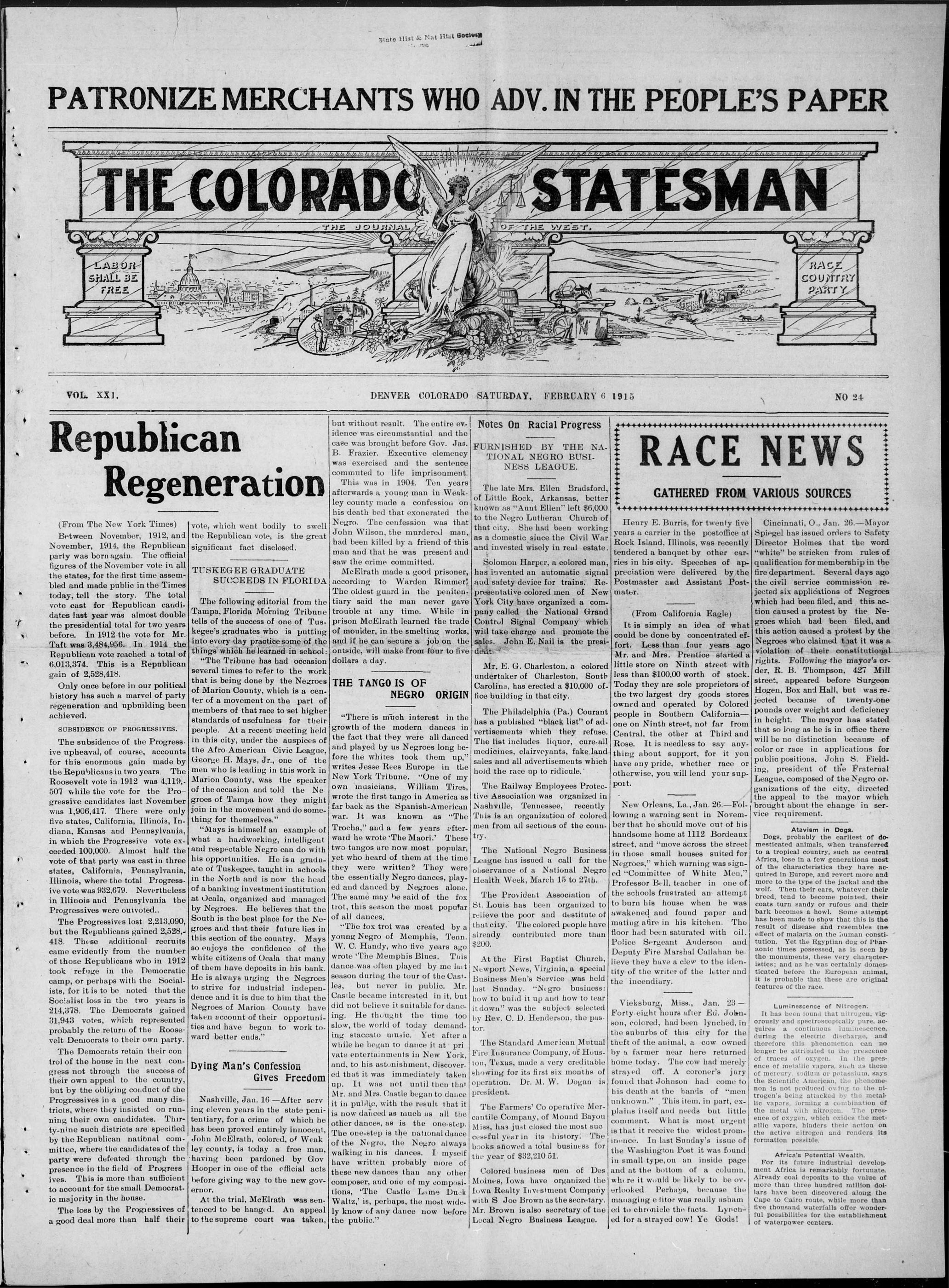
Republican Regeneration
VOL. XX1. Republic Rege (From The New York Times)
(From The New York Times)
Between November, 1912, and November, 1914, the Republican party was born again. The official figures of the November vote in all the states, for the first time assembled and made public in the Times today, tell the story. The total vote cast for Republican candidates last year was almost double the presidential total for two years before. In 1912 the vote for Mr. Taft was 3,484,956. In 1914 the Republican vote reached a total of 6,013,374. This is a Republican gain of 2,528,418.
Only once before in our political history has such a marvel of party regeneration and upbuilding been achieved.
SUBSIDENCE OF PROGRESSIVES.
The subsidence of the Progressive upheaval, of course, accounts for this enormous gain made by the Republicans in two years. The Roosevelt vote in 1912 was 4,119,507 while the vote for the Progressive candidates last November was 1,906,417. There were only five states, California, Illinois, Indiana, Kansas and Pennsylvania, in which the Progressive vote exceeded 100,000. Almost half the vote of that party was cast in three states, California, Pennsylvania, Illinois, where the total Progressive vote was 932,679. Nevertheless in Illinois and Pennsylvania the Progressives were outvoted..
The Progressives lost 2,213,090, but the Republicans gained 2,528,.418. These additional recruits came evidently from the number of those Republicans who in 1912 took refuge in the Democratic camp, or perhaps with the Socialists, for it is to be noted that the Socialist loss in the two years is 214,378. The Democrats gained 31,943 votes, which represented probably the return of the Roosevelt Democrats to their own party.
The Democrats retain their control of the house in the next congress not through the success of their own appeal to the country, but by the obliging conduct of the Progressives in a good many districts, where they insisted on running their own candidates. Thirty-nine such districts are specified by the Republican national committee, where the candidates of the party were defeated through the presence in the field of Progressives. This is more than sufficient to account for the small Democratic majority in the house.
```markdown
```
The loss by the Progressives of a good deal more than half their
vote, which went bodily to swell the Republican vote, is the great significant fact disclosed.
TUSKEGEE GRADUATE
The following editorial from the Tampa, Florida Morning Tribune tells of the success of one of Tuskegee's graduates who is putting into every day practice some of the things which he learned in school: "The Tribune has had occasion several times to refer to the work that is being done by the Negroes of Marion County, which is a center of a movement on the part of members of that race to set higher standards of usefulness for their people. At a recent meeting held in this city, under the auspices of the Afro American Civic League, George H. Mays, Jr., one of the men who is leading in this work in Marion County, was the speaker of the occasion and told the Negroes of Tampa how they might join in the movement and do something for themselves."
"Mays is himself an example of what a hardworking, intelligent and respectable Negro can do with his opportunities. He is a graduate of Tuskegee, taught in schools in the North and is now the head of a banking investment institution at Ocala, organized and managed by Negroes. He believes that the South is the best place for the Negroes and that their future lies in this section of the country. Mays so enjoys the confidence of the white citizens of Ocala that many of them have deposits in his bank. He is always urging the Negroes to strive for industrial independence and it is due to him that the Negroes of Marion County have taken account of their opportunities and have begun to work toward better ends."
Dying Man's Confession
Gives Freedom
Nashville, Jan. 16—After serving eleven years in the state penitentiary, for a crime of which he has been proved entirely innocent, John McElrath, colored, of Weakley county, is today a free man, having been pardoned by Gov Hooper in one of the official acts before giving way to the new governor. At the trial, McElrath was sentenced to be hanged. An appeal to the supreme court was taken,
DENVER COLORADO SATURDAY. FEBRUARY 6 1915
State Hist & Nat Hist Society
NANTS WHO
COLORADO
THE JOURNAL
DENVER COLORADO S
but without result. The entire evidence was circumstantial and the case was brought before Gov. Jas. B. Frazier. Executive clemency was exercised and the sentence commuted to life imprisonment. This was in 1904. Ten years afterwards a young man in Weakley county made a confession on his death bed that exonerated the Negro. The confession was that John Wilson, the murdered man, had been killed by a friend of this man and that he was present and saw the crime committed.
McElrath made a good prisoner, according to Warden Rimmer. The oldest guard in the penitentiary said the man never gave trouble at any time. While in prison McElrath learned the trade of moulder, in the smelting works, and if he can secure a job on the outside, will make from four to five dollars a day.
THE TANGO IS OF
NEGRO ORIGIN
"There is much interest in the growth of the modern dances in the fact that they were all danced and played by us Negroes long before the whites took them up," writes Jesse Rees Europe in the New York Tribune. "One of my own musicians, William Tires, wrote the first tango in America as far back as the Spanish-American war. It was known as "The Trocha," and a few years afterward he wrote 'The Maori.' These two tangos are now most popular, yet who heard of them at the time they were written? They were the essentially Negro dances, played and danced by Negroes alone. The same may be said of the fox trot, this season the most popular of all dances.
"The fox trot was created by a young Negro of Memphis, Tenn. W. C. Handy, who five years ago wrote 'The Memphis Blues. This dance was often played by me last season during the tour of the Castles, but never in public. Mr. Castle became interested in it, but did not believe it suitable for dancing. He thought the time too slow, the world of today demanding staccato music. Yet after a while he began to dance it at private entertainments in New York, and, to his astonishment, discovered that it was immediately taken up. It was not until then that Mr. and Mrs. Castle began to dance it in public, with the result that it is now danced as much as all the other dances, as is the one-step. The one-step is the national dance of the Negro, the Negro always walking in his dances. I myself have written probably more of these new dances than any other composer, and one of my compositions, 'The Castle Lame Duck Waltz,' is, perhaps, the most widely know of any dance now before the public."
---
Notes On Racial Progress
FURNISHED BY THE NATIONAL NEGRO BUSINESS LEAGUE.
The late Mrs. Ellen Bradsford, of Little Rock, Arkansas, better known as "Aunt Ellen" left $6,000 to the Negro Lutheran Church of that city. She had been working as a domestic since the Civil War and invested wisely in real estate.
Solomon Harper, a colored man, has invented an automatic signal and safety device for trains. Representative colored men of New York City have organized a company called the National Grand Control Signal Company which will take charge and promote the sales. John E. Nail is the president.
Mr. E. G. Charleston, a colored undertaker of Charleston, South Carolina, has erected a $10,000 office building in that city.
The Philadelphia (Pa.) Courant has a published "black list" of advertisements which they refuse. The list includes liquor, cure-all medicines, clairveyants, fake land sales and all advertisements which hold the race up to ridicule.
The Railway Employees Protective Association was organized in Nashville, Tennessee, recently This is an organization of colored men from all sections of the country.
The National Negro Business League has issued a call for the observance of a National Negro Health Week, March 15 to 27th.
The Provident Association of St. Louis has been organized to relieve the poor and destitute of that city. The colored people have already contributed more than $200.
At the First Baptist Church, Newport News, Virginia, a special Business Men's Service was held last Sunday. "Negro business: how to build it up and how to tear it down" was the subject selected by Rev. C. D. Henderson, the pastor.
The Standard American Mutual Fire Insurance Company, of Houston, Texas, made a very creditable showing for its first six months of operation. Dr. M. W. Dogan is president.
The Farmers' Co operative Mercantile Company, of Mound Bayou Miss, has just closed the most successful year in its history. The books showed a total business for the year of $32,210 51.
Colored business men of Des Moines, Iowa have organized the Iowa Realty Investment Company with S Joe Brown as the secretary. Mr. Brown is also secretary of the Local Negro Business League.
RACE NEWS
Henry E. Burris, for twenty five years a carrier in the postoffice at Rock Island, Illinois, was recently tendered a banquet by other carries in his city. Speeches of appreciation were delivered by the Postmaster and Assistant Postmater. Cincinnati, O., Jan. 26.—Mayor Spiegel has issued orders to Safety Director Holmes that the word "white" be stricken from rules of qualification for membership in the fire department. Several days ago the civil service commission rejected six applications of Negroes
(From California Eagle)
It is simply an idea of what could be done by concentrated effort. Less than four years ago Mr. and Mrs. Prentice started a little store on Ninth street with less than $100.00 worth of stock. Today they are sole proprietors of the two largest dry goods stores owned and operated by Colored people in Southern California—one on Ninth street, not far from Central, the other at Third and Rose. It is needless to say anything about support, for it you have any pride, whether race or otherwise, you will lend your support.
New Orleans, La., Jan. 26.—Following a warning sent in November that he should move out of his handsome home at 1112 Bordeaux street, and "move across the street in those small houses suited for Negroes," which warning was signed "Committee of White Men," Professor Bell, teacher in one of the schools frustrated an attempt to burn his house when he was awakened and found paper and mating afire in his kitchen. The floor had been saturated with oil. Police Sergeant Anderson and Deputy Fire Marshal Callahan believe they have a clew to the identity of the writer of the letter and the incendiary.
Vieksburg, Miss., Jan. 23—Forty eight hours after Ed. Johnson, colored, had been lynched, in the suburbs of this city for the theft of the animal, a cow owned by a farmer near here returned home today. The cow had merely strayed off. A coroner's jury found that Johnson had come to his death at the hands of "men unknown." This item, in part, explains itself and needs but little comment. What is most urgent is that it receive the widest prominence. In last Sunday's issue of the Washington Post it was found in small type, on an inside page and at the bottom of a column, where it would be likely to be overlooked. Perhaps, because the managing editor was really ashamed to chronicle the facts. Lynched for a strayed cow! Ye Gods!
NO 24
Cincinnati, O., Jan. 26.—Mayor Spiegel has issued orders to Safety Director Holmes that the word "white" be stricken from rules of qualification for membership in the fire department. Several days ago the civil service commission rejected six applications of Negroes which had been filed, and this action caused a protest by the Negroes which had been filed, and this action caused a protest by the Negroes who claimed that it was a violation of their constitutional rights. Following the mayor's order, R. B. Thompson, 427 Mill street, appeared before Surgeon Hogen, Box and Hall, but was rejected because of twenty-one pounds over weight and deficiency in height. The mayor has stated that so long as he is in office there will be no distinction because of color or race in applications for public positions. John S. Fielding, president of the Fraternal League, composed of the Negro organizations of the city, directed the appeal to the mayor which brought about the change in service requirement.
Atavism in Dogs.
Dogs, probably the earliest of domesticated animals, when transferred to a tropical country, such as central Africa, lose in a few generations most of the characteristics they have acquired in Europe, and revert more and more to the type of the jackal and the wolf. Then their ears, whatever their breed, tend to become pointed, their coats turn sandy or rufous and their bark becomes a howl. Some attempt has been made to show that this is the result of disease and resembles the effect of malaria on the human constitution. Yet the Egyptian dog of Pharaonic times possessed, as is seen by the monuments, these very characteristics; and as he was certainly domesticated before the European animal, it is probable that these are original features of the race.
Luminescence of Nitrogen
Luminescence of Nitrogen. It has been found that nitrogen, vigorously and spectroscopically pure, acquires a continuous luminescence, during the electric discharge, and therefore this phenomenon can no longer be attributed to the presence of traces of oxygen. In the presence of metallic vapors, such as those of mercury, sodium or potassium, says the Scientific American, the phenomenon is not produced owing to the nitrogen's being attacked by the metallic vapors, forming a combination of the metal with nitrogen. The presence of oxygen, which oxides the metallic vapors, hinders their action on the active nitrogen and renders its formation possible.
Africa's Potential Wealth.
For its future industrial development Africa is remarkably fortunate. Already coal deposits to the value of more than three hundred million dollars have been discovered along the Cape to Cairo route, while more than five thousand waterfalls offer wonderful possibilities for the establishment of waterpower centers.
NEWS TO DATE IN PARAGRAPHS
CAUGHT FROM THE NETWORK OF WIRES ROUND ABOUT THE WORLD.
OURING THE PAST WEEK
RECORD OF IMPORTANT EVENTS
CONDENSED FOR BUSY
Western Newspaper Union News Service.
ABOUT THE WAR.
Artillery duels almost exclusively have been the measure of the recent fighting in France and Belgium.
The eldest son of General Von Kluck, who was a naval lieutenant, is reported to have fallen in an artillery battle near Lake Middelkerke Jan. 26.
Sergt. Paul Marchand, cousin of M. Marchand, who won fame at Fashoda, is back in Paris from the front bearing no fewer than 197 wounds. He is barely alive.
The cargo on board the Toko Maru, one of the five steamers sunk in the English channel by a German submarine, was valued at $500,000. The Toko Maru was on her way from Wellington, N. Z., to London when she was sent to the bottom.
A member of the crew of the British steamer Ben Cruachen, one of the vessels sunk in the Irish sea on the 30th ult., by the German submarine U-21, who has arrived in Cardiff, says the German submarine U-31 also was in the Irish sea and sank one of the three steamers.
The German lines, after a long period of preparation, appear, judging from reports reaching London, to be putting into execution their plans for an advance on Warsaw. At the same time the Austrians seem to have renewed their forward movement in the Carpathian mountains.
"A German submarine made an unsuccessful attempt to torpedo the British hospitalship Asturios," according to a communication given out at Paris by the ministry of marine, "thus violating the formal clause of The Hague convention of 1907 regarding the attacking of hospital vessels."
WESTERN.
Heavy rain inundated the business section of Estancia, N. M., so that the traffic through it was by means of wagons.
Women voters of Chicago must tell their ages when they register according to a ruling by County Judge Thomas G. Scully.
William Inhoff of Tulsa, Okla., pleaded guilty to the Conjoint bank robbery and was sentenced to thirty years in the penitentiary.
After a day of sensational advances, which started at the very opening, May wheat closed on the 2nd at $1.65 per bushel. July wheat closed at $1.43.
The House of the Wyoming Legislature passed a resolution providing for submission of a constitutional amendment permitting investment of state funds in farm lands.
One of the large baking companies in Chicago, the output of which is 25,000 loaves of bread daily, announced that 1 cent would be added to the price of the 5-cent loaves.
The Rev. Dr. George C. Rankin, editor of the Texas Christian Advocate and one of the leaders of Methodism in the South, died at his home in Dallas, Tex., from a sudden attack of heart trouble.
Nearly a dozen persons are dead in Michigan and scores are injured as a result of the three days' storm that caused one of the most paralyzing tie-ups to telegraph, telephone, railroad and street railway companies in the history of the state.
WASHINGTON
The Supreme Court, after concluding its opinions, recessed until Feb. 23. All newspaper offices in Mexico City were closed by order of the government.
The Senate confirmed Senator O'Connell as postmaster at Georgetown, Colo., and Robert E. Norvell as postmaster at Hayden.
General Carranza intends to wipe out completely the Villa and Zapata opposition, according to advices to the Carranza junta. Desertions from the Villa ranks continue, reports declare.
Formal opening of the San Francisco exposition, Feb. 20, probably will be celebrated with ceremonies in the capitol rotunda, at which President Wilson is expected to speak. Plans also include the raising of flags at a telegraphic signal in every state capitol and the insular possessions.
The Supreme Court held for the first time that local commerce between the mainland of a state and an island belonging to it is subject to state regulation.
One of the worst storms of the winter was general from the Middle West to the Middle Atlantic states, New England and throughout Canada, the first of the week.
The National House of Representatives passed the bill authorizing the establishment by the Department of the Interior of mineral experiment stations in the Western states.
FOREIGN.
New Zealand has arranged, it is announced at Wellington, to purchase 1,000,000 bushels of Canadian wheat for delivery in July.
Earth shocks occurred in districts of Yorkshire. One miner was killed and many had narrow escapes owing to the shaking down of coal in the pits.
Among the missing in a casualty list just made public is Maj. Arthur C. Morrison-Bell, member of parliament for Honiton division of Devonshire.
Indignation is expressed by the Berlin newspapers generally over the execution of Karl Fleke and Herr Grundler in Morocco on charges of treason preferred by the French.
Earth disturbances of a minor nature continue at Avezzano, Italy, the most important feature being the lowering of the level of Lake Paterno by sixteen feet, after a vortex had appeared in its center.
The Berlin Tageblatt, according to dispatches received at Amsterdam, announced that the council of Greater Berlin has appointed 12,000 special constables to guard bakers' shops because of the fear of bread riots.
Leading Jesuits of the entire world assembled at Rome for the election of a new leader, popularly known as the "black pope." The position was made vacant by the passing away of Father Wernz, whose death was almost simultaneous with that of Pope Pius X.
Parliament reassembled in London after a recess for the House of Commons since Nov. 27 and for the House of Lords since Jan. 8. The members dispensed with ceremonies and plunged at once into business, consisting of various matters, chiefly financial, which have arisen as a result of the war.
SPORT.
"Gunboat" Smith won a newspaper decision at Cincinnati over Jim Flynn in a ten-round boxing contest.
Notice of the sale of three Cleveland ball players was given by Vice President Barnard of the Cleveland Baseball Company.
Fifteen-round boxing bouts would be legalized in Delaware by the passage of a bill introduced in the lower House of the Legislature.
Albert Cutter defeated Welker Cochran, 300 to 198, in a Billiard Players' league match in New York. Averages and high runs: Cutler 10-10, 29; 49; Cochran, 6-24, 29, 42.
Word was received by Secretary Julius Epstein in Denver that Magnate McGill has acquired Outfielder Carman from the Salt Lake City Club. He goes to Denver, it is understood, as part payment for Lou Barbour and Eddie Faye, who were sold to the Mormons.
An American record for the two-mile indoor walk—13 minutes 35 2-5 seconds — was made by George H. Goulding of the Toronto Young Men's Christian Association at the games of the Diocesan Union in Brooklyn, N. Y. This time bettered his former record, made March 30, 1912, by 3 1-5 seconds.
GENERAL.
The bill providing for submission of the prohibition question was defeated by the Wyoming Senate, 17 to 9. The New Jersey House unanimously passed the joint resolution to amend the state constitution by extending suffrage to women.
A British aviator, writing from his post at the front, says "there is only one way of stopping aeroplane raids and that is to have faster aeroplanes than the enemy."
Twenty boys and girls from four to sixteen years of age were injured at New Orleans when a building at the St. Alphonsus orphan asylum collapsed in a heavy wind storm.
Ohio paid tribute to the memory of William McKinley on the anniversary of his birth. In the cities especially, the carnation, McKinley's favorite flower, was much in evidence.
Gen. John J. Pershing was notified at El Paso, Tex., by wire that the armory of the New Mexico National guard at Silver City, N. M., was broken into and the arms and ammunition stolen. The Department of Agriculture sees cheaper meat and shoes for people of the country in figures gathered by its agents, showing that the number of livestock in the United States is on the increase. Women gained their first real political victory in Alabama when a bill giving them the privilege or being elected and serving as members of county boards of education passed the Senate and went to the governor.
John Mitchell, former president of the United Mine Workers of America and now a member of the state workmen's compensation commission, told the federal industrial relations commission in New York that the Rockefeller plan of settling labor troubles in Colorado was "simply absurd."
The United States cruiser San Diego arrived at San Diego from Mexican waters with the bodies of two of the victims of the boiler explosion on the vessel Jan. 21, which has taken a total thus far of nine lives. Four others injured are expected to recover.
Suit was filed in the New York Supreme Court to recover $7,500,000 from Daniel G. Reid, W. H. Moore and their associates, alleged to have diverted as a "pretended loan" from the treasury of the Chicago, Rock Island & Pacific Railway Company with no benefit to the company
COLORADO STATE NEWS
Western Newspaper Union News Service.
The Texas Oil Company has moved its district offices from Pueblo to Denver.
The annual banquet and dinnerdance of the Kansas Club of Colorado was held in Denver.
Farmers' week in Lamar, opening Feb. 16, promises to be attended by many agriculturists.
Beet growers in the Fort Collins district averaged about $75 per acre on last year's crop.
A general merchandise store in Niwot was destroyed by fire, causing a loss of about $15,000.
The high state officials of Colorado are to pay their compliments to the officials of Wyoming Saturday, the 6th.
The hearing of evidence upon the admission to probate of the will of William Barth was continued until Feb. 23 in Denver. The Colorado branch of the Committee of Mercy, a new organization formed to do work among the needy, was organized in Denver. August Benot, fifty years old, a rancher from Watkins, was found unconscious from gas in a bathroom in a rooming house in Denver. Clarence M. Hawkins of Colorado Springs has been appointed an assistant by Attorney General Farrar and he has entered upon his duties. Indicating the expected business revival due this year in Denver, permits for erection of store buildings for January totaled $78,000 in value.
A reduction in the price of coal went into effect among the coal dealers at Denver, notwithstanding the fact that the ground hog saw his shadow.
More than 50 per cent of the possible hours of sunshine were realized in Denver last month, according to the official report from the Denver weather bureau.
Arguments in behalf of W. L. Ryan of Fort Collins, who is under sentence of death for killing Attorney Newton Crose last Aug. 14, were filed with the State Supreme Court.
Much interest was taken at Colorado Springs by patrons of the school in the dedication of the new addition to the Helen Hunt building, which provides one of the best equipped small auditoriums of the city.
Eli M. Gross, superintendent of the free employment bureaus of the state, has been dismissed by Secretary of State Ramer, who has appointed William Scott Lee, formerly mayor of Denver, to the position.
The death of Mrs. Frank LaLone, sixth member to perish of a family of seven found dying at their home near Hugo, adds the final tragic touch to one of the darkest mysteries which has baffled Colorado officials.
Robert Jolly, husband of Pearl Jolly, woman leader at Ludlow, was arrested on an old indictment charging murder in strike disorders and issued by the grand jury held in Las Animas county some months ago.
Colorado potatoes have been given the post of honor in the government's exhibit at the Panama-Pacific exposition, in recognition of the fact that Colorado holds the record for the largest yield of potatoes of the finest quality.
It is stated that 485 miners, who have been out of work for five years, were found by the House committee appointed by Speaker Stewart to investigate the condition of the former strikers in the northern coal district. Of these 229 are in Lafayette, 196 in Louisville, 20 in Superior and 40 in Marshall.
Until the hearing of her divorce suit in March, Mrs. Alta M. McCausland was granted $25 a month alimony in Judge Class' court in Littleton. Mrs. McCausland is seeking a divorce from Jacob W. McCausland and asks $40,000 alimony in addition to $50,000 damages against her husband's mother, Mrs. Elizabeth McCausland.
The President nominated the following postmasters for Colorado: Sarah J. O'Connell, Georgetown; Robert E. Norvell, Hayden, and Muriel L. Hunt, Maybell, Moffat county. Other Colorado postoffice appointments: Lewis W. Carle, Ford; Will H. Thomas, Manassa; Joseph C. Zimmerman, Peyton; George A. Grisso, Ramah.
Lucille Lewis, nineteen years old, daughter of Mrs. A. S. Lewis, is lost. She disappeared from the Oakes home in Denver, on New Year night between darkness and daylight, and since that time no word or trace of her has been found by parents, friends, hospital officials or police. In some mysterious manner she has been spirted away and her name joins those of Dorothy Arnold and the Nelm sisters on the ever-growing list of the missing.
Guarded by his dog, which refused to permit the rescuing party to approach the body, Leslie Ewing, eighteen years old, a resident of the Animas valley, was found frozen in a draw five miles from his home near Durango.
J. O. Whitman, who arrived in Denver Jan. 17 armed with two revolvers and a razor in search of his wife, Nellie, whom he accused of running away from her home with $30,800 of securities and money, was arrested in Denver by city detectives charged with issuing two worthless checks.
ORE YIELD $34,839,577
TELLER COUNTY LED IN COLORA-
DO'S 1913 OUTPUT.
Mine Commissioner's Report Saves
State Has Billion Dollar Output
Since 1870.
Western Newspaper Union News Service.
Denver.—Colorado's production of
gold, silver, sopper, lead and zinc in
1913 was worth $34,839,577.49, according
to the biennial report of Thomas R.
Henahen, state commissioner of mines.
With the exception of the production
of 1912, it was the highest record
since 1907.
The production for 1914 will not be
computed for several months.
Colorado's total production since 1870, including that of 1913, in all the minerals named has been $1,222,383,355.90. The gold mined during the period has been worth $543,375,018, the silver $439,001,951, the lead $155,989,603, the copper $30,996,634 and the zinc $55,527,026. The zinc has been produced only since 1902.
The banner production for the year was made by Teller county, whose output was $10,905,914.
The recommendation is made by the commissioner that the Legislature make an appropriation of $10,000 to aid in the operation of a mineral experiment station, if Congress passes the bill now pending to establish one in the West.
Mann Confesses He Is "Clipper." Victor—Karl A. Mann, twenty-four year old, was arrested in this city by Chief of Police John Connor on suspicion that he was the person who had been clipping hair from the heads of young girls in motion picture theaters in Victor and Cripple Creek during the last few weeks. Mann later signed a confession saying he had been actuated by a strange influence and could not help himself. The girls whose hair was cut by Mann are Ruth Kling and Alice Murphy of Victor and Nellie Bright, Margaret Lenz and Florence O'Brien of Cripple Creek.
Miner Drops 1,000 Feet.
Cripple Creek.—N. A. Laburge is believed to have been instantly killed in a fall down the 1,000-foot shaft of the John A. Logan mine, a Stratton property on Bull hill. Laburge was in the cage, which was being lowered, when he was overcome by boul air in the shaft and fell out. The cage immediately returned to the surface. It was necessary to send for the Portland's rescue crew to recover his body with the aid of oxygen helmets.
Hecla Mine Cases Set for Feb. 8.
Hecla Mine Cases Set for Feb. 8. Boulder.-All the defendants in the three Hecla mine strike cases, which have been known as the "Knowles cases," growing out of an attack on the Hecla mine at Louisville, because the first defendant in each one is one William Knowles, were ordered by District Judge Strong to appear in court here Feb. 8, to have the date of the trial definitely fixed.
State Federation Heads Indicted.
Denver.—William T. Hickey, secretary and treasurer of the Colorado State Federation of Labor, and Elli M. Gross, vice president of the same organization, were arrested in Denver on indictments charging them with murder returned by the grand jury which has been sitting in Walsenburg since last November investigating the strike violations in Huerfano county.
Jan. Cripple Creek Output $1,921,884.
Cripple Creek.—The output of the Cripple Creek district for the initial month of 1915, chiefly due to the rich shipment of gold ore from the Cresson mine, has not only made a material increase in the gross bullion value of the product, but also has raised the value of smelting ores from $55 to $166.11 a ton and the general average of all ores treated to $25 a ton.
Boy, 17. Weds Girl of 14.
Boulder.—Miss Sylvia Stockton and Felix Carr, both of Ward, who were married here, are the youngest couple to whom a license has been issued in this county in many years. The combined age of the two is but 31 years, the bride being 14, while her husband lays claim to 17 years.
Asks $50,000 for Broken Promise. Colorado Springs.—Alleging that J. D. Gillette, a wealthy resident of Colorado Springs, promised to marry her and then refused to do so. Mrs. Alma E. Graves has filed suit against him in the District Court, asking $50,000 damages.
Commerce Club Reorganizes.
Fort Lupton.—With forty-five charter members, the Fort Lupton Commercial Club has been reorganized and elected A. E. Dawson president, B. A. St. John secretary and E. C. Winbourn treasurer.
Canadian Concern Denied License. Denver.—The Denver Fair and Racing Association has been refused a permit to hold a meet at Overland park in 1915. The state racing commission, at its last meeting, decided that if Denver gave a racing program this year it would be under the auspices of Denver or Colorado people. The refusal of a license to the association came as a result of internal quarrels among the directors, stockholders and officers of the organization which gave a successful meet last summer.
ERNEST HOWARD,
ERNEST HOWARD,
Carpenter, Job and Repair Work.
Coal, Wood and Express.
CLEANING, PRESSING, DYEING, REPAIRING, RELINING AND REMODELING.
WORK CALLED FOR AND DELIVERED
2549 Washington Avenue Denver, Colorado
The Market Company
Wholesale and Retail Staple and Fancy Groceries, Fish and Oysters. Hotels and Restaurants Our Specialty. Fresh and Cured
Eastern Corn Fed Meats
Fruits, Vegetables, Poultry and Game.
1688-89 Arapahoe Street Denver, Colorado
1728% Wazee St. Only one block from Union Depot Phone Main 8416. Denver, Colorado
That Is Just a Little Better Than the Kind You Thought Was Best
C. H. SHIRLEY, Pres. J. C. HAMPSON, Vice Pres PAUL J. SHIRLEY, Sec. and Treas.
THE ATLAS DRUG CO.
Courteous Treatmet. Right Prices Leaders in Prescription
Paints, Oils and Glass.
Coal, Wood a
1021 21st Street.
You Have Tried the Rest
Now Try the Best
THE
Giant
FOR QUALITY
CLEANING, PRESSING,
ING, RELINING AND
WORK CALLED FOR
2549 Washington Avenue
PHONE MAIN 3028
JOHN K.
Meats, Fancy and
1864 CURT
Corner Nineteenth.
Phones Main
169, 181, 189, 190
The Market
Wholesale and Retail Staple and
Oysters. Hotels and Re-
Fresh and Cured
Eastern Corr
Fruits, Vegetables,
1688-89 Arapahoe Street
CHAS. HARRIS, Pres. J. M. JOHN
RAILROAD POOL
LUNCH ROOM I
Billiards and
Pool
1728½ Wazee St. Only on
Phone Main 8416.
The Corr
Ice Cream
1115 WELTO
THE ICE
That Is Just a Litt
Kind You Thou
C. H. SHIRLEY, Pres.
PAUL J. SHIRLE
THE ATLAS
Courteous Treatm
Leaders in P
Store No.1.
2701 WELTON ST.
Main 895 875
s. Glazing Done and Express. Phone Champa 752.
Our Prices Reasonable
Satisfaction Guaranteed
CLEANERS
AND
TAILORS
McCAIN & RICHARDS, PROPS
Phone Main 7376
ING, DYEING, REPAIR-
AND REMODELING.
OR AND DELIVERED
Denver, Colorado
RES. PHONE GALLUP 942
E. RETTIG
and Staple Groceries
TIS STREET
Denver, Colo.
C. E. Smith, Manager
Res. Phone South 1606
et Company
and Fancy Groceries, Fish and
Restaurants Our Specialty.
Barn Fed Meats
es, Poultry and Game.
Denver, Colorado
OHNS, Treas. SEIB MILLER, Sec.
ORTERS' CLUB
IN CONNECTION
Free Check
Room
one block from Union Depot
Denver, Colorado
rbett
ream Co.
TON STREET
CREAM
Little Better Than the
thought Was Best
J. C. HAMPSON, Vice Pres
LEY, Sec. and Treas.
AS DRUG CO.
atmet. Right Prices
Prescription
Store No. 2.
26TH AND WELTON
Main 4955.4956
AFRO-AMERICAN CULLINGS
In the article of Mr. James Croggon, in the Sunday Star, it is stated that "one hundred years ago the first colored troops who ever served in the army of the United States won the commendation of General Jackson in the battles in and around New Orleans." This statement as to when the first colored troops served in the army of the United States is incorrect, writes Albert N. Seip in a communication to the Washington Star. Bancroft's History, volume five, pages 152, 153, says: "On the first of January, 1776, the tricolored American banner, not yet spangled with stars, but showing 13 stripes of alternate red and white in the field, and the united red and white crosses of Saint George and Saint Andrew on a blue ground in the corner, was unfurled over the new continental army around Boston, which, at that moment of its greatest weakness, consisted of but 9,650 men. On that day, free Negroes stood in the ranks by the side of white men. In the beginning of the war they had entered the provincial army; the first general order which was issued by General Ward had required a return, among other things, of "the complexion" of the soldiers; and black men, like others, were retained in the service after the troops were adopted by the continent.
We have seen Edward Rutledge defeated in his attempt to compel their discharge. In October, the conference at the camp, with Franklin, Harrison and Lynch, thought it proper to exclude them from the new enlistment; but Washington, at the crisis of his distress, finding that they were very much dissatisfied at being discarded, reversed the decision and asked the approval of congress. That body appointed Wythe, Samuel Adams and Wilson to deliberate on the question; and, on the report of their able committee, they voted "that the free Negroes who had served faithfully in the army at Cambridge might be re-enlisted therein, but no others." The right of free Negroes to take part in the defense of the country having thus been partially admitted by the highest power, the limitation was lost sight of, and they served in the ranks of the American armies during every period of the war.
When in 1778 the army was reduced to its lowest point in numbers, Bancroft states, in volume six, page 48, that "Varnum, a brigadier of Rhode Island, proposed the emancipation of slaves in that state, on condition of their enlisting in the army for the war. The scheme, approved by Washington, and by him referred to Cooke, the governor of the state, was accepted. Every able-bodied slave in Rhode Island received law liberty to enlist in the army for the war. On passing muster he became free and entitled to all the wages and encouragements given by congress to any soldier. The state made some compensation to their masters.
As the object of this communication is simply to correct the error of Mr. Croggon as to when the first colored troops served in the army of the United States, it is not necessary to refer to the well-known fact that Negroes fought at the battle of Bunker Hill, taking part in common with the white yeomanry of Massachusetts and other states. Their services in the Union army during the Civil war are well known.
Kansas City has 130 miles of boulevards.
Houston has a Negro population of probably thirty thousand, and we be believe it can be said without exaggeration that there is not a city in the country where the Negroes are making better progress. We do not mean to say that there is not room for improvement or that everything that might be done to aid them is being done, but year by year the white people are coming to know that their interest in everything that improves conditions among the Negroes is one of vital importance. It is no longer difficult to enlist the co-operation of the white people in any movement having for its object the welfare of the Negro people, and we think nearly all of the southern cities can say as much.—Houston (Texas) Post.
One of the objects of an Australian antarctic expedition will be the establishment of a meteorological station to give warnings by wireless of the severe storms which sweep for southern seas.
Peruvian oil fields are rapidly being developed.
The Illinois river was so termed from the Illini, a tribe of Indians on its banks. Another derivation is suggested in Isle aux Noix, Island of Nuts. Several derivatives more or less fanciful are suggested by the etymologists and geographers.
One of the strangest cargoes ever carried on the sea was a shipload of bees sent from Holland to the Isle of Wight, England, where the native bees are threatened with extinction by disease. The cargo consisted of 300 hives, containing about 10,000,000 bees.
"There is much interest in the growth of the modern dances in the fact that they were all danced and played by us Negroes long before the whites took them up," writes Jesse Rees Europe in the New York Tribune. "One of my own musicians, William Tires, wrote the first tango in America as far back as the Spanish-American war. It was known as "The Trocha,' and a few years afterward he wrote 'The Maori.' These two tangos are now most popular, yet who heard of them at the time they were written? They were the essentially Negro dances, played and danced by Negroes alone. The same may be said of the fox trot, this season the most popular of all dances.
"The fox trot was created by a young Negro of Memphis, Tenn. Mr. W. C. Handy, who five years ago wrote 'The Memphis Blues.' This dance was often played by me last season during the tour of the Castles, but never in public. Mr. Castle became interested in it, but did not believe it suitable for dancing. He thought the time too slow, the world of today demanding staccato music. Yet after a while he began to dance it at private entertainments in New York, and, to his astonishment, discovered that it was immediately taken up. It was not until then that Mr. and Mrs. Castle began to dance it in public, with the result that it is now danced as much as all the other dances put together. Mr. Castle has generously given me the credit for the fox trot, yet the credit, as I have said, really belongs to Mr. Handy. You see, then, that both the tango and the fox trot are really Negro dances, as is the one-step. The one-step is the national dance of the Negro, the negro always walking in his dances. I myself have written probably more of these new dances than any other composer, and one of my compositions, 'The Castle Lame Duck Waltz,' is, perhaps, the most widely know of any dance now before the public."
In the southern states are to be found about seventy banks that are owned, controlled and operated by Negroes. In addition to these might be mentioned numerous building and loan associations.
The kindly spirit that prevails between white people and colored in the South is evidenced by the fact that presidents or cashiers of white people's banks have given liberally of their advice to the competing Negroes' banks, sometimes opening the first set of books for them and supervising their operation until they were well under way.
Not long ago a bank conducted by Negroes in Richmond nearly became the object of a "run" because of an erroneous report concerning the bank's integrity. Several of the leading banks conducted by white people, through their presidents, told the Negro bank managers to pay claims promptly and that they would provide the funds required if necessary. They knew that the Negroes' bank was safe and solid and they had confidence in the honesty of the Negro president. Robert R. Moton of the Hampton institute reports that "in almost every community the Negro and white business men are on terms of harmony and co-operation, loaning and borrowing and crediting as if both were white or both were black.
In two years Minnesota has spent $3,524,814 for better roads.
"I have written unto you, young men, because ye are strong, and the word of God abideth in you, and ye have overcome the evil one" (I John 2:15). As Professor Findlay comments on this passage, "a manly self-respect and self-mastery are gained at adolescence or are forfeited." In the days when all our native powers of will, imagination, enthusiasm and aspiration are at their best, and when the conditions of life are most favorable to self-discipline, we must deal with those ignoble motions of pride, covetousness, fretfulness, impatience, wrath and egotism which so painfully disfigure unsanctified old age. Age chiefly shows what a man is, what he has ever been, whether to his honor or discredit. It is not the season of degeneration so much as that of revelation. When the paint peels off, the grain of the timber becomes evident. When wine grows sour with age, it is seen that it was always akin to vinegar.
Twenty-four driving wheels, each 63 inches in diameter, are part of a cocomotive recently completed at Philadelphia the most powerful yet built.
Amber is believed by the Turks to be an infallible guard against the injurious effects of nicotine; hence its extensive use for mouthpieces of pipes.
In France a bronze statue weighing three and a half tons, that was too large to be handled by railroad or canal, was hauled on a motor truck to its destination, 246 miles.
For fiscal year ending June 30, 1914, Porto Rico's exports to the United States were valued at $35,000,000.
BILL TO ALLOW HIGHWAY COMMISSION SUM OF $250,000.
Former Senator Hiram E. Hilts Is
Sponsor for Measure to Give
State Fund at Once.
Denver.—A bill which would allow the State Highway Commission to obtain $250,000 immediately from the State Board of Capitol Managers for highway improvement this year has been prepared by Hiram E. Hilts, member of the Board of Capitol Managers and former state senator from Denver. It was approved by Attorney General Farrar.
The measure provides for the issuance of three certificates covering portions of the capitol board's income during three years to meet the total amount owed by the board to the internal improvement fund with interest. The certificates would be credited to the school funds from which the money would be taken and their amounts would be paid as the income was received under the capitol board's annual levy.
Governor Carlson has been considering a plan of the kind in order that the road improvement work throughout the state may be pushed this year. Receipt of the money would allow the Highway Commission to spend approximately $400,000 during the coming working season and would thus assure that about $800,000 would be spent this year on Colorado roads, as the counties must duplicate the sums spent by the state.
The institution of extensive road work has also been suggested to the governor as a means of relieving the condition of unemployed men in the state.
Eugenic Marriage Bill Introduced.
Denver. —A bill providing for eugenic marriages and prohibiting persons from wedding in Colorado who have not first submitted to medical examination and filed affidavit of the result with the city clerk, was introduced in the House by Representative F. E. Wallace of Pueblo. The bill states that the results of all examinations, which both woman and man must undergo, will be kept secret. Hereditary insanity, incurable diseases and tuberculosis will also disqualify a person from marrying in Colorado under provisions of the bill. Another clause is designed to prevent persons with a criminal record from wedding. Dr. Wallace declared that he has made a study of eugenics and believes the passage and enforcement of such a measure would do much to better future generations.
Utllities Body to Probe Rail Fares.
Denver.—Passenger fares and rules, regulations and practices affecting passenger fares of every steam railroad in the state will be the subject of the most sweeping investigation ever made in the state of Colorado, in hearings before the State Public Utilities Commission, to be begun in the commission's chambers at the state capitol March 1. The probe has been begun by the commission's own motion, superseding a proposed investigation into rates and fares, rules and practices of railroads operating between Pueblo and other points in the state.
Brief in Loan Law Contest.
Denver.—Volney T. Hoggatt, register of the state land board, is acting as associate counsel in the suit now pending before the State Supreme Court to test the validity of the farmers' loan law. At the request of Attorney General Farrar, he is participating in the case and is preparing a brief to be filed with the court in the next few days. An effort will be made to have an early hearing in the case so that any defects in the law may be remedied by the present General Assembly.
County Unit School Bill.
Denver.—The industrial commission and temperance bills enjoy the distinction of being "big" legislation before the Twentieth General Assembly, but even these two measures do not promise to arouse the direct, personal interest among legislators that will be given to the proposed law to create the county unit and rural school system in Colorado.
Inheritance Tax to Pay Indebtedness
Denver.—Receipts from inheritance taxes will be set aside to meet the indebtedness of the state, under an agreement reached by Governor Carlson and Republican legislative leaders for the introduction and passage of such a bill. The state's indebtedness is approximately $4,200,000 and the average estimated annual inheritance tax income is $300,000.
Lee New Factory Inspector.
Denver.—William Scott Lee, formerly mayor of Denver, was appointed a deputy state factory inspector by Secretary of State Ramer. He takes the place of J. K. Radley.
Carlson Grants Extraditions
Denver.—Extraditions were granted by Governor Carlson, one for Wiley Scott, charged with murder in Pittsburg county, Oklahoma; the other for W. J. Jones, wanted in Kansas on a charge of grand larceny.
WILSON OFFERS AID TO BUSINESS
WILSON OFFERS AID TO BUSINESS
DECLARES COMMERCIAL MEN
OFTEN COME TO GOVERNMENT
"WITH BRISTLES OUT."
TO AMEND TRUST LAWS
PRESIDENT INVITES CO-OPERATION IN FRAMING MEASURES "FOR GOOD OF ALL."
Washington.—Co-operation between business and the government in framing laws for the benefit of all the people was urged by President Wilson in an address before several hundred representative business men here attending the annual convention of the Chamber of Commerce of the United States. He declared that "we must all pool our interests" in order to discover the best means for handling public problems.
The creation in the United States in time of peace of the same kind of united spirit which moves nations during wars was advocated by the President, who remarked that "when peace is as handsome as war there will be no wars" and "when men engage in the pursuits of peace in the same spirit of self-sacrifice as they engage in wars, wars will disappear."
The President predicted that while there is a shortage of food in the world now, the shortage will be much greater later. He pointed out that under the guidance of the Department of Agriculture efforts must be made by farmers in the United States to grow more grain, in order that the world may be fed.
Speaking of the foreign trade of the United States, the President asked that business men devise some way of allowing exporters in the United States to combine to get common selling agencies and to give long time credits in such a way that these cooperative devices may be open to the use of all. He declared that apparently the anti-trust laws prohibited such combinations now, but he would favor a change if a method fair to all could be found.
He spoke of the work being done by the Bureau of Foreign and Domestic Commerce in "surveying the world" for the benefit of all business men. Business men themselves are to blame if intelligent laws affecting them are not framed, the President asserted. He added that they should come out into the open and use their knowledge of conditions to bring about fair laws to prevent business evils. The Mexican question was mentioned by Wilson as an example of the difficulty he had in getting accurate information. Secretary Bryan urged support for the administration ship bill and ratification of the Colombian treaty.
GERMAN SHIPS TORPEDOED.
Russian Submarines Make Attack Off Danish Island of Moen, Is Report. London.—The Exchange Telegraph Company has received the following from its Copenhagen correspondent: "Emperor William's visit to Wilhelmshaven is believed to be in connection with the warning of the German admiralty to neutral shipping that great activity may be expected off the north and west coasts as a result of German attempts to stop England's transportation of troops and munitions. This is interpreted here as a prolog to important events at sea. It is rumored that Germany will try to engage the British fleet in southern waters, while another squadron goes northward at full speed with the object of covering the landing of troops in England. Great Britain now has 1,000,000 new troops ready to be started across the channel.
"Large contingents of troops are reported to have been mobilized at Wilhelmshaven at the time of the Scarborough raid."
An official statement from Petrograd says that a German torpedo boat destroyer was sunk by a Russian submarine on the Baltic on Jan. 29. The submarine attack was made off the Danish island of Moen.
Three German warships in the Baltic have suffered at the hands of the Russians within a week. The German protected cruiser Gazelle was torpedoed near the island of Ruegen and was taken to the port of Sassnitz, badly damaged. A dispatch said another German gunboat had been sunk in the Baltic.
Stockyards Bank Officials Change. Denver.—An audit of the accounts of the Union Stockyards Bank was ordered following a change in the bank's officers.
MADMAN BATTLES FIREMEN
Drug Fiend Fights Rescuers on High Ledge of Denver Hotel.
Denver.—Crazed with cocaine, W. A. Tracy of 1422 Fifteenth street fought with Denver firemen on the ledge of the seventh floor of the Brown hotel and was rescued, hanging head down and struggling after a fight in midair 100 feet above the ground.
It was undoubtedly the most thrilling rescue ever effected by the Denver fire department.
The
Curtis
Park
Floral
Company
FLORAL DESIGNS PUT UP WHILE
YOU WAIT
CHOICE PLANTS AND CUT FLOWERS CONSTANTLY
ON HAND
GREENHOUSES: Thirty-Fourth and Curtis Streets
TELEPHONE, MAIN 1511
DENVER, COLO
When You Want
When You Want
The Heads, Feet, Tails Snouts, Neckbones or Chiterlings or any other part of the hog except the squeal go to
2300-6 Larimer Street.
The Che
Tw
DRUGS, CHEMIC
WE
Prescrip
Phone us and we w
JAMES
THE ZO
SAM
1004 Ninete
The Champa Pharmacy
The Champa Pharmacy
Twentieth and Champa,
Is the place to get your
DRUGS, CHEMICALS AND PATENT MEDICINES
WE SERVE DRINKS.
Prescriptions Our Specialty.
Phone us and we will deliver the goods to all parts of the city.
JAMES E. THRALL, PROPR.
PHONE MAIN 2425.
1004 Nineteenth Street, Corner of Curtis
FINE WINES, LIQUORS AND CIGARS COORS' CELEBRATED BEER ON TAP
---
COMPANY
at 2 p.m. Office Fur-
a Specialty.
TES AT ALL TIMES
ED TO—
GLENARM ST.
PHONE MAIN 1675.
PHONE YORK
1417 East 24th Ave
Miss M. C.
Hair Dressing
---
DENVER
Pharmacy
and Champa,
to get your
PATENT MEDICINES
DRINKS.
Our Specialty.
the goods to all parts of the city.
IRALL, PROPR.
AIN 2425.
BROTHERS'
E ROOM
eet, Corner of Curtis
J. H. BIGGINS
Furniture Repairing and Upholstering. All work Cash.
PHONE YORK 7837
1417 East 24th Ave Denver
Miss M. Cowden
Hair Dressing Parlor
Shampoo, cutting and curling. Scalp, treatment, hair tonics, hair straightening, manicuring. Stage wigs for rent; theatrical use and masquerades. Goods delivered out of the city. All shades of hair matched by sending sample of hair; also combings made up.
Cheapest Switches 50 Cents
1219 21st St. Denver, Colo.
Phone Main 1461.
COLORADO
THE COLORADO STATESMAN
THE FEDERAL REPUBLIC OF THE UNITED STATES
CASUN
SHARE DE
FREE
HACK
COUNTRY
DART
SUBSCRIPTION RATES:
One Year ..... $2.00
Six Months ..... 1.00
Three Months ..... 60
PAYABLE IN ADVANCE.
Entered as second-class matter at the postoffice in the city of Denver, Colorado.
Display advertising, 50 cents per inch. An inch contains twelve agate lines.
Reading notices, ten lines or less, 10 cents per line. Each additional line over ten lines, 5 cents per line.
No discounts allowed on less than three months' contract. Cash must accompany all orders from parties unknown to us. Further particulars on application.
It occasionally happens that papers sent to subscribers are lost or stolen. In case you do not receive any number when due, inform us by postal card and we will cheerfully forward a duplicate of the missing number.
Remittances should be made by Express Money Order, Postoffice Money Order, Registered Letter or Bank Draft. Postage stamps will be received the same as cash for the fractional part of a dollar. Only 1-cent and 2-cent stamps taken.
Communications to receive attention must be newsy, upon important subjects, plainly written only upon one side of the paper; must reach us Tuesdays, if possible, anyway, not later than Wednesdays, and bear the signature of the author. No manuscript returned, unless stamps are sent for postage.
All communications of a personating nature that are not complimentary will be withheld from the columns of this paper.
Entered as second-class matter at the postoffice in the city of Denver, Colorado.
Display advertising, 50 cents per inch. An inch contains twelve agate lines.
Reading notices, ten lines or less, 10 cents per line. Each additional line over ten lines, 5 cents per line.
No discounts allowed on less than three months' contract. Cash must accompany all orders from parties unknown to us. Further particulars on application.
It occasionally happens that papers sent to subscribers are lost or stolen. In case you do not receive any number when due, inform us by postal card and we will cheerfully forward a duplicate of the missing number.
Remittances should be made by Express Money Order, Postoffice Money Order, Registered Letter or Bank Draft. Postage stamps will be received the same as cash for the fractional part of a dollar. Only 1-cent and 2-cent stamps taken.
Communications to receive attention must be newsy, upon important subjects, plainly written only upon one side of the paper; must reach us Tuesdays, if possible, anyway, not later than Wednesdays, and bear the signature of the author. No manuscript returned, unless stamps are sent for postage.
All communications of a personating nature that are not complimentary will be withheld from the columns of this paper.
MEMBER NATIONAL NEGRO PRESS ASSOCIATION.
The Colorado Statesman offers its sincere thanks to the members of the Senate and Legislature; also the state officers for their patronage in becoming subscribers, and promises to do its best in the work of news and up-to-date articles touching upon everything in state and nation-wide affairs for their edification. Publication of meetings, etc., will be found in every issue and questions of paramount importance engaging and arresting the minds of the people will be brought to your attention for your consideration. Success to your political career which may bring your further indorsement from the public whom you now represent.
THINGS THE STATESMAN WOULD LIKE TO SEE HAPPEN.
That the whole-hearted, true-hearted members of the human family of white appearance in the United States, in conjunction with our ministers (white and black) of the religion of Jesus Christ which teaches no color qualification; also the Negro educators and leaders continue to agitate and advocate the righteous dispensation of the laws of this country in accordance with the constitution, irrespective of class, creed, color or previous condition of servitude.
That more of such courageous characters and personalities in the shape of Governors Whitman of New York, O'Neal of Alabama, Senator Shafroth of Colorado, Congressmen Copley, Madden, Mann, Thompson and a few others be scattered over the land and express fearlessly the wrongs indulged in by some of the people, so as to purify our present state of affairs, giving the world a true representation of well-merited commendation.
That Governor Carlson, with his far-seeing ability, and his state officers, Senate and Legislature will carry out their program of organization and cooperation for the benefit of the state and bring about successful results as the members of the houses in Washington in the grand example set by them in their unanimous action on the park bill which they passed, thereby making Colorado the playground of America.
That Governor Carlson's wife, who promises to do all she can to help her husband in the state affairs pertaining to women and children will bear in mind that our women have always supported the cause of righteousness, and having been very helpful in insuring the success of her husband, she will treat them with due consideration in matters relating to their welfare.
That the much-talked-of prosperity may hasten, as things are tightening up and 'there is a slip 'twixt the cup and the lip.'
The Colorado Statesman offers its sincere thanks to the members of the Senate and Legislature; also the state officers for their patronage in becoming subscribers, and promises to do its best in the work of news and up-to-date articles touching upon everything in state and nation-wide affairs for their edification. Publication of meetings, etc., will be found in every issue and questions of paramount importance engaging and arresting the minds of the people will be brought to your attention for your consideration. Success to your political career which may bring your further indorsement from the public whom you now represent.
THINGS THE STATESMAN WOULD LIKE TO SEE HAPPEN.
That the whole-hearted, true-hearted members of the human family of white appearance in the United States, in conjunction with our ministers (white and black) of the religion of Jesus Christ which teaches no color qualification; also the Negro educators and leaders continue to agitate and advocate the righteous dispensation of the laws of this country in accordance with the constitution, irrespective of class, creed, color or previous condition of servitude.
That more of such courageous characters and personalities in the shape of Governors Whitman of New York, O'Neal of Alabama, Senator Shafroth of Colorado, Congressmen Copley, Madden, Mann, Thompson and a few others be scattered over the land and express fearlessly the wrongs indulged in by some of the people, so as to purify our present state of affairs, giving the world a true representation of well-merited commendation.
That Governor Carlson, with his far-seeing ability, and his state officers, Senate and Legislature will carry out their program of organization and cooperation for the benefit of the state and bring about successful results as the members of the houses in Washington in the grand example set by them in their unanimous action on the park bill which they passed, thereby making Colorado the playground of America.
That Governor Carlson's wife, who promises to do all she can to help her husband in the state affairs pertaining to women and children will bear in mind that our women have always supported the cause of righteousness, and having been very helpful in insuring the success of her husband, she will treat them with due consideration in matters relating to their welfare.
That the much-talked-of prosperity may hasten, as things are tightening up and 'there is a slip 'twixt the cup and the lip.'
STARTING SOMETHING.
Progressiveness, as the modern, descriptive title for things in general, which represent the "away-ahead" thoughts and ideas of individuals who want to get something new and startling out of the ordinary conditions of life, is being over-worked in these days. "Something doing" is the announcement which commands the attention of an expectant people, and the desire for movement, action, excitement, has become so universal that all the old, modest customs and habits of society are being abandoned, and all who aspire to lead or command are finding themselves under actual obligation to "start something" and keep it going.
So it goes with all the progressives. Something new, outlined upon a program as big as you can conceive it and properly handle it, is the rule of action.
Those who would lead in any field must lay out and start the big work themselves and thereby draw their following. There is no more waiting to be sought out and shoved to the front. If you want anything more than ordinary in this world at present, just make up your mind that you have got to peel off your coat and start that thing for folks to look at.
Progressiveness, as the modern, descriptive title for things in general, which represent the "away-ahead" thoughts and ideas of individuals who want to get something new and startling out of the ordinary conditions of life, is being over-worked in these days. "Something doing" is the announcement which commands the attention of an expectant people, and the desire for movement, action, excitement, has become so universal that all the old, modest customs and habits of society are being abandoned, and all who aspire to lead or command are finding themselves under actual obligation to "start something" and keep it going.
So it goes with all the progressives. Something new, outlined upon a program as big as you can conceive it and properly handle it, is the rule of action.
Those who would lead in any field must lay out and start the big work themselves and thereby draw their following. There is no more waiting to be sought out and shoved to the front. If you want anything more than ordinary in this world at present, just make up your mind that you have got to peel off your coat and start that thing for folks to look at.
The Right Kind of Reading Matter
The home news; the doings of the people in this town; the gossip of our own community, that's the first kind of reading matter you want. It is more important, more interesting to you than that given by the paper or magazine from the outside world. It is the first reading matter you should buy. Each issue of this paper gives to you just what you will consider
The Right Kind of Reading Matter
---
don't want to read anything about socialism, it might unsettle me, for I wish to be comfortable in my mind." That is an increasingly common attitude in Boston. Let us laugh and be comfortable.
Grand opera and drama require thought, therefore they languish. Musical comedy requires little or no thought, therefore it thrives. In a more artistic community the theater is not a place for exciting amusement only; it is rather an institution where life may express itself through a great and serious art.
A few years ago President Lowell bewailed the fact that the taste of college students had so degenerated that they flocked to witness musical comedies, while they neglected serious drama. Their lack of esthetic taste leads them to be easily amused so long as "the show" is lively, gaudy and has plenty of pretty chorus girls. Sometimes, however, the personality of a single dancer or singer is the chief point of appeal, and to exploit that personality the musical comedy manufacturers build around it a crazy structure of songs, dances and impossible plot, which demand no thought from the spectator.
But callow collegians are not the only patrons of these "shows." The "tired business man," whose days are spent in strenuous competition with his fellows, the man whose aim is to have more money each year than he had the last, he, too, seeks relaxation when the tension of the day is over. Since he wishes to banish all thought, he seeks the musical comedy, that he may sit passively and give up his senses to the lilt of music and the thrill of dances. With him also forgathers the woman who hates to think because it hurts her unused brain. She, too, goes merely to be amused and dazzled by the highly artificial spectacle.
Therefore as long as so large a proportion of Boston's public regard amusement as the only purpose of the theater, as long as they show a decided aversion to art that requires thinking, so long will musical comedy be popular here.
have but one kind of work to do—the conversion of land rent into public improvements. This is for the following reasons:
Every living person has an inalienable right, by birth, to free and common use of the earth. The earth is public property, and private use of it is a special privilege which should be subject to a rental charge equal to the value of the privilege. All land rent belongs to the public and should go into the public treasury. All land rent should be used for public improvements. Such use of the land rent would require the steady services of all the unemployed.
Steady work for the unemployed will raise wages in all lines of industry and increase all markets. The increased sale will cover the increase in wages without increasing the prices.
All of the people individually, as consumers and tenants, continually pay land rent unequally, in prices and rents, to the so-called land owners, claimants or squatters. This land rent really belongs to all of the people collectively and equally, by birth, and should be paid to them in the form of public improvements, thus providing free and common use of land rent in lieu of certain land. It is an enormous amount, but it only equals the poverty of the people to whom it rightfully belongs and should be paid.
The people cannot get their land rent and higher wages without first hiring all of the unemployed to convert the rent into public improvements.
necessity. When Margaret Fuller, in her large, transcendental, Boston way, said, "I accept the universe," Carlyle growled, "Gad, she'd better." It is out of the same kind of compulsion perhaps that we accept our own age. It is the only one we have ever had, and it behooves us to accept it.
Yet it is the heart of Christianity to believe that each new age is the best. Optimism is only another term for belief in God.
Our age is the best the world has ever known—until the next one. The most difficult and fascinating task is in forecasting the future. When we look back to the beginnings of our own national life and realize how far as we have progressed, who will dare set limits to the achievements of the coming age.
When we realize the tremendous uses of gas and steam, we smile at the venturesome predictions of a day gone by. So the coming age may make our largest dreams seem ridiculously small.
It will see greater things in material development, but also greater things in the spiritual movements that are even now clearly discernible.
The tendency toward a spiritual philosophy, the rediscovery of the social conscience and the united world-wide missionary movements are foregleams of a better day.
Christian nations, like the United States and Great Britain, to educate the Chinese people to use liquor, tobacco and morphine.
Chinese officials have said, "Before the black devil of opium is disposed of the little white devils of cigarettes and morphine are coming in."
A big tobacco company has carried on a systematic and ingenious educational campaign with the slogan "A cigarette in the mouth of every man, woman and child in China."
It is said that, though cigarettes were hardly used twelve years ago, China now uses more cigarettes than the people of the United States.
Wu Ting Fang, former minister from China to the United States, heads a movement against the cigarette and says: "If cigarette smoking is allowed to go on unrestricted the evil will soon be greater than that caused by opium smoking."
Boston Public Wants Its Senses Tickled By MARY E. WYNNE. Boston, Mass.
don't want to read anything about socialism wish to be comfortable in my mind." That is attitude in Boston. Let us laugh and be comfort. Grand opera and drama require though Musical comedy requires little or no thought more artistic community the theater is not a only; it is rather an institution where life is great and serious art.
A few years ago President Lowell bewildered college students had so degenerated that the comedies, while they neglected serious drama, leads them to be easily amused so long as "it has plenty of pretty chorus girls. Sometimes of a single dancer or singer is the chief point that personality the musical comedy manufactures of songs, dances and impossible pleasures from the spectator.
But callow collegians are not the only part "tired business man," whose days are spent in his fellows, the man whose aim is to have me had the last, he, too, seeks relaxation when t. Since he wishes to banish all thought, he so he may sit passively and give up his senses thrill of dances. With him also forgathers t because it hurts her unused brain. She, to and dazzled by the highly artificial spectacle.
Therefore as long as so large a proportion amusement as the only purpose of the the decided aversion to art that requires thinking be popular here.
Collecting Land Rent to Assist Unemployed By DR. MAURICE F. DOTY. Evanston, Ill.
have but one kind of work to do—the conven-
improvements. This is for the following re-
Every living person has an inalienable
common use of the earth. The earth is pul-
of it is a special privilege which should be su-
to the value of the privilege. All land rent
should go into the public treasury. All l
public improvements. Such use of the land
services of all the unemployed.
Steady work for the unemployed will ra-
try and increase all markets. The increase
in wages without increasing the prices.
All of the people individually, as consu-
pay land rent unequally, in prices and rents,
claimants or squatters. This land rent real-
collectively and equally, by birth, and she
form of public improvements, thus provid-
land rent in lieu of certain land. It is an
equals the poverty of the people to whom it
be paid.
The people cannot get their land rent a
hiring all of the unemployed to convert the
Better Day Foreseen For the World
By REV. DR. CHARLES F. WISHART
Pastor of Second Presbyterian Church, Chicago
necessity. When Margaret Fuller, in her way, said, "I accept the universe," Carlyle grie is out of the same kind of compulsion per age. It is the only one we have ever had, and Yet it is the heart of Christianity to the best. Optimism is only another term for Our age is the best the world has ever The most difficult and fascinating task is in we look back to the beginnings of our own far as we have progressed, who will dare set the coming age. When we realize the tremendous uses of the venturesome predictions of a day gone make our largest dreams seem ridiculously It will see greater things in material things in the spiritual movements that are The tendency toward a spiritual philo social conscience and the united world-wide foregleams of a better day.
Successful Effort to Suppress Opium By DUNCAN C. MILNER, San Francisco
Christian nations, like the United States and the Chinese people to use liquor, tobacco and Chinese officials have said, "Before disposed of the little white devils of cigaring in."
A big tobacco company has carried out educational campaign with the slogan "A cien man, woman and child in China."
It is said that, though cigarettes were China now uses more cigarettes than the pet.
Wu Ting Fang, former minister from heads a movement against the cigarette and is allowed to go on unrestricted the evil w caused by opium smoking."
The public is amusement- mad. It merely wants its senses tickled. Don't require it to think outside of business hours, any other thinking burts. It is like the college graduate who said, "I
it might unsettle me, for I can increasingly common atti-
titable. Right, therefore they languish. It, therefore it thrives. In a place for exciting amusement may express itself through a
mailed the fact that the taste they flocked to witness musical
Their lack of esthetic taste the show" is lively, gaudy and
ines, however, the personality of appeal, and to exploit
curers build around it a crazy
tit, which demand no thought
strons of these "shows." The
a strenuous competition with more money each year than he
the tension of the day is over.
cks the musical comedy, that
to the lilt of music and the
the woman who hates to think
goes merely to be amused
on of Boston's public regard
ater, as long as they show a
so long will musical comedy
It seems to me the efforts to make work for the unemployed are doomed to the usual failure because they are based on the charity plan. The unemployed as a class
session of land rent into public reasons:
on right, by birth, to free and public property, and private use subject to a rental charge equal that belongs to the public and rent should be used for rent would require the steady use wages in all lines of industrial sale will cover the increase of owners and tenants, continually to the so-called land owners, by belongs to all of the people could be paid to them in the long free and common use of enormous amount, but it only rightfully belongs and should and higher wages without first rent into public improvements.
Probably there never has been an age since time began which has not said to itself, "This is the greatest age the world has ever seen." This easy optimism may be making a virtue of
large, transcendental, Boston owled, "Gad, she'd better." It haps that we accept our own and it behooves us to accept it. I believe that each new age is our belief in God. I known—until the next one, forecasting the future. When national life and realize how limits to the achievements of gas and steam, we smile at byy. So the coming age may small, development, but also greater even now clearly discernible, sophy, the rediscovery of the missionary movements are
One of the wonderful events of the century is the largely successful effort of China to suppress the opium traffic. The dreadful thing, however, is the effort made by misrepresentatives of
and Great Britain, to educate and morphine.
the black devil of opium isettes and morphine are com-
m in a systematic and ingenious cigarette in the mouth of every hardly used twelve years ago, apple of the United States.
China to the United States, says: "If cigarette smoking will soon be greater than that
THIS HOUSE 1717 LAFAYETTE STREET
Two lots, a fine neighborhood at a bargain. Owner lives in Chicago.
THE ZION BAPTIST CHURCH.
Twenty-Fourth Avenue and Ogden, David E. Over, D. D., Minister.
Sunday afternoon at 2:30 o'clock, the three Baptist churches of the city will hold a union covenant and communion service at Central church. This should be a sort of record service both from attendance and enthusiasm. It is the pastor's hope that Zion will be well represented in the meeting.
Last Sunday afternoon the ladies of the Mission Circle were addressed by Dr. A. Houghton Rodgers of South Africa. The address was both interesting and instructive. During the year the Missionary ladies' will hold an afternoon service on each fifth Sunday.
Dr. Morse of the First Baptist church will address the Men's Bible Class on the last Tuesday evening of this month. Dr. Morse is a pleasing and magnetic speaker and the men will be delighted with his address. Every man is welcome to the meetings of the class, Tuesday evenings at 8 o'clock. A very pleasant and profitable meeting of the executive board was held at the Springs last week, being entertained by the St. John's Baptist Church. At the close of the meeting the Rev. Davis, formerly of the M. E. Church, was ordained and set apart to the gospel ministry of the Baptist Church. The Woman's Bible Class is doing splendid work this season. The lessons at this time are from that interesting period of Israel's wanderings in the Wilderness. The hour is 2:30 on Thursday afternoon. Every woman is welcome.
Our sick list this week contains the names of Brother Robt. Johnson, who is suffering severely from an injured foot. Sister Sallie Buford and Sister Emma Taylor. Others, who were mentioned earlier, are conceived. Seven persons were received into the church last Sunday: Sisters Georgia Thornton, Helen Moody, Minnie Smith, Ella Ross and Brothers D. F. Mallard, Richard Pate and I. C. Mumford. The two latter were received for baptism.
THE PEOPLE'S PRESBYTERIAN.
East Twenty-Third and Washington J. A. Thos. Hazell, S. T. B., Pastor.
Sermon topics Sunday, Feb. 7: 11 a. m., "Jew and Gentile Allike Guilty," 2:30 p. m., "Services at the Mission," 1921 New Haven; 4:15 p. m., "Y. P. S. C. E.;" 5 p. m., "Monthly Musical With Lecture on Africa."
Sunday afternoon at the People's Church, a double-barrel feast of high class vocal and orchestral selections, in addition to a first-class lecture on "What I Saw in South Africa," awaits the audience. The speaker, Rev. A. H. Rodger, a Presbyter of the Presbytery of Crawfordsville, Cayuga, Synod of Indiana, is on a transcontinental lecturing tour in Presbyterian and other churches. Press comments and deliverances of the various denominations describe the lecture and musical program will be taken. Let everyone come prepared.
Sunday week, Feb. 14th at 5 p. m., the pastor will address the citizens of Denver en masse on the subject "Senator Reed's Amended Bill to Exclude Foreign Negroes From U. S. Citizenship." Rev. Thos. Hazell has gathered all his ammunition of war on, the subject from the Congressional Record, Panama Canal Commission, and U. S. Department of Labor, Bureau of Immigration. Every thinking man, woman and child of color should hear this discourse.
The young people of the church will observe Lincoln's birthday next Friday night at the residence of Mrs. Mattie Wilson, 2427 Court Place, in a social.
Mrs. M. E. Morrison, superintendent of the Poor People's Mission at New Haven St., reports very encouragingly with regards to the work. Mrs. A. Malanda, Mrs. Laura Hill, Mrs. Mattie Wilson, Miss Samiro Harris Compose a most energetic staff of workers in this respect. The organ donated by the School of Mines at Golden through the Moderator of the Prebystery for this work is appreciatively received.
THE DESTINY OF THE WICKED
(Continued.)
Man, lead by the dim, flickering candle of his own reason, cannot solve the question of what awaits the incorrigible in the life beyond. Our only hope for the correct solution of this mystery is the Scriptures of Truth. We turn, therefore, reverently to the Word of God, and inquire of its Author, what is the final destiny of sinful, unregenerate men who reject the overtures of mercy and die in their sins? Surely this divine revelation, given us as a guide light upon the problem, will shine forth, and from its sacred pages we do indeed gain a most clear and comprehensive answer. This we shall endeavor to make plain from the Scriptures to the mind of the candid reader by a consideration of the question under a few simple propositions.
First. The sinner does not have
eternal life. Jesus declares, "He that believeth on the Son hath everlasting life, and he that believeth not on the Son shall not see life, but the wrath of God abideth on him," John 3:36. The unrepentant sinner, therefore, is without life; he is alienated from the life of God through the ignorance that is in them, Eph. 4:18. Everlasting life is embraced and received through faith. Those who believe have life, but those through unbelief who are separated from the life of God, who do not "see life" and are "cut off" from the life of God, do not have life and cannot live eternally in the confines of despair. This must be apparent to all.
Again we read, "And this is the record, that God hath given to us eternal life, and this life is in his Son. He that hath the Son hath life; and he that hath not the Son of God hath not life." I John 5:11, 12. The wicked are "without Christ, "having no hope, and without God in the world," Eph. 2:11, 12. They are therefore without life, for this text tells us clearly that he that "hath not the Son of God hath not life." The wicked, therefore, being without life, and under the sentence of death, can have no second probation, neither can they have a conscious existence in a place of torment throughout eternity. To suffer in the lake of fire forever, the lost would need to have eternal life as well as the righteous. This is not only unscriptural, but destroys the foundation of the Gospel, which gives life only to the believer.
The great central truth of Christianity is life through Christ. It was that those who were dead in trespasses and sin might have life, and that they might have it more abundantly, that Christ was manifested in the flesh, John 10:10. "My sheep hear my voice, and I know them, and they follow me; and I give unto them eternal life; and they shall never perish, neither shall any man pluck them out of my hand." John 10:27, 28. By this we see that eternal life is the gift of God, bestowed only upon the little flock. "But the gift of God is eternal life through Jesus Christ our Lord," Romans 6:23.
The apostle Paul speaking of the gospel and power of God, says: "Who hath saved us and called us with an holy calling, not according to our works, but according to his own purpose and grace, which was given us in Christ Jesus before the world began, but is now made manifest by the appearing of our Saviour Jesus Christ, who hath abolished death and hath brought life and immortality to light through the gospel." II Timothy 1:9, 10.
"Life" and "immortality" are not synonyms. Christ brought two things to light through the gospel: one is life, the other is immortality. Man by nature has neither. He is "dead in trespasses and sin." He is a mortal man, Job 4:17. God only hath immortality, I Timothy 6:16. We receive eternal life when we believe, but immortality will be bestowed upon the righteous only at the resurrection of the just. It is at this time that "this mortal must put on immortality," I Cor. 15:53. To live forever man must believe on Jesus. The wicked, through unbelief, are separated from life. They cannot therefore be conscious, enduring unspeakable torture in a place of punishment throughout all eternity. We repeat, any teaching which clothes man with life, apart from the gospel, distorts the plan of salvation brought to man through the sacrifice of Christ. J. W. OWENS. (To Be Continued.)
THE ATLAS DRUG CO.
Twenty-seventh and Welton Streets.
"Onward, even onward," the motto of the Atlas Drug Co., asserts itself once more, and so conspicuously this time that one cannot help taking notice of it. The many and various changes of the interior of their stores from time to time, coupled with the most improved line of merchandise in drugs, toilet articles, etc., cater to the satisfaction of their patrons, who continue to praise them as being second to none in this particular business. The latest improvement is the installation of a new soda fountain, after the latest iceless design, the same being made of onyx and Assyrian marble and capable of accommodating twice as many persons as the old; also the erection of a gallery, which makes it more advantageous to clerks in reaching for drugs. These, with other decorations, complete Store No. 1, the attractiveness of which magnetizes the passer-by. Quite a renovation has also taken place at Store No. 2, Twenty-sixth and Welton streets, where the splendid fountain which once graced the headquarters of the firm is to be seen, and what with the frescoing of the walls and equipment of the shelves, etc., this store bids fair to be a favorable competitor with its friendly rival.
The firm promises to continue the same courteous treatment to its customers, prompt attention to the filling of prescriptions, the quickest possible delivery service, as well as its readiness to supply anything in the periodical and magazine line for those of literary tastes.
THE COLORADO STATESMAN
Major Geo. Sample is reported sick with an attack of rheumatism.
Rev. Washington, pastor of Campbell's A. M. E. church, will preach Sunday morning, at Scott's M. E. church.
R. M. Johnson, employee of the Joslin Dry Goods Co., continues ill at his residence 2660 Lawrence street.
Paul Walker, Mrs. Frank Payne, Josie Andrews, Miss C. Meeks, Edward Johnson, Mrs. M. Phil Mrs. Chas. Muse, Mrs. E. V.amel, Miss Marion Reed, Mrs. A Colston, Mrs. John Easley and Robt. Johnson.
In our issue of Feb. 20, R. O. write an article you should r
Mr. Chas. McCollum of Little Rock, Ark., was in the city on business, the first of this week.
Mrs. Eliza Bailey was granted a divorce from Roy Baily in Judge Rothgerber's court Friday, January 29th.
Miss Edna Ashley of 2612 Downing street, who has been ill for several days with a very severe cold is reported much better.
Don't forget the Mason's Big Entertainment at East Turner Hall, Eastern Monday. This will be another big event given by the Masons.
Rev. D. Smith, pastor of the Scott's M. E. church, will preach at Campbell A. M. E. church Sunday morning, Feb. 7.
Mrs. L. Boone, who has been visiting her daughter, Mrs. Baker, and other friends in the city several weeks, returned to Casper, Wyo., Thursday.
Miss Thelia Tucker, who was in the junior class at the East Denver High school, has left off her studies in order to prepare to go to Fisk university next fall.
Mrs. C. M. Stewart, who has a position with the Denver Star, and has been visiting her mother in Indianapolis, Ind., will leave there in order to arrive in Denver Sunday, Feb. 7.
Mr. E. V. Cammel, G. M. of the U. B. F., S. M. T. & J's., made his annual visit to several of the organizations in the city Tuesday night, and found them in a thriving and prosperous condition.
The news reached the city Thursday of the death of John E. Oglesby, formerly a member of Engine Co. No. 3, who died at his mother's residence in Zenia, Ohio. Mr. Oglesby has many friends in the city who will be sorry to learn of his death.
Mrs. Eli Burrell and son, Henry, came in from the ranch at Wiggins, Colo., on a visit to Mr. Burrell. You ought to have seen the elder Burrell's face with smiles over the good things brought him by his wife and son. They will return in a few days.
Mrs. Julia Reed and her charming daughter, Miss Myrtle, of Colorado Springs, were in the city last week, the guest of Mr. and Mrs. Thos. Brumell 2040 Lafayette street. They came especially to attend The Self Improvement Club ball.
Mrs. Moral Keelan entertained the Avondale 500 club at her beautiful residence, Friday afternoon, Jan. 29, in a very sumptuous manner. The house was beautifully decorated and all the members enjoyed themselves. A dainty luncheon was served in Mrs. Keelan's inimitable manner.
The Elk's Mountain Lodge No. 39 held their public social session last Wednesday evening at their hall, 2630 Welton street, which was largely attended. The program consisted of speeches and songs, and after a delightful repast was served to their guests. The wee, sma' hours of the morning saw them departing for home with nothing but praise for the Elks and their hospitality. Keep it up, Brother Elks.
Rev. A. M. Ward, who is so highly esteemed in this community, has departed for Kansas City, Kan., where a pair of winsome dark eyes and a sweet and loving personality is awaiting his gentle footsteps. After a brief honeymoon trip, Rev. and Mrs. Ward will return to Denver, where a hearty welcome awaits them. The Statesman extends the best of wishes to the newlyweds, wishing them a happy and prosperous voyage on the matrimonial sea. God bless you, my children.
Wait for the Mason's Entertainment at East Turner Hall, Easter Monday.
Mrs. J. L. Burnett at her beautiful home 3412 Columbine street, entertained with a luncheon, last Friday afternoon. In the serving and preparation of the table she was assisted by Mrs. Wm. Fletcher. White and red spring flowers were used in the decorations. Those present were Mrs.
Paul Walker, Mrs. Frank Payne, Mrs. Josie Andrews, Miss C. Meeks, Mrs. Edward Johnson, Mrs. M. Phillips, Mrs. Chas, Muse, Mrs. E. V. Cammel, Miss Marion Reed, Mrs. A. R. Colston, Mrs. John Easley and Mrs. Robt. Johnson.
In our issue of Feb. 20, R. O. will write an article you should read: "Why Slumber Ye in the Land of Opportunity?"
You say you came to Denver twenty, thirty or forty years ago. What have you done for others since you have been here, or to give you an opportunity? What are you willing to do now?
Mrs. Rose Tumlin, wife of our well known townsman, E. C. Tumlin, employe of the U. S. mint, died Saturday, 30th ult., at her late residence, 2555 Clarkson street. Funeral services were held from Scott M. E. church Wednesday afternoon 2 o'clock.
The large attendance that gathered to view her last remains, showed the popularity of the deceased and the esteem she was held in both in church and club circles. She was a faithful member of Scott church for ten years, and labored assiduously for the cause of Christ. The Revs, Smith, Reynolds and Price officiated, the sermon being preached by the first, who brought consolation to the bereaved ones as well as a warning to those who are living Godless lives. Having been a very active member of the church in choir work and class work, resolutions were read expressing deep regrets over her demise, which, although a loss here, is a gain beyond. Many beautiful floral offerings adorned the casket. The Douglass Undertaking Co. were in charge of the remains, everything being carried out successfully under the direction of Frank Rogers, one of the staff. Interment at Riverside cemetery. The Colorado Statesman extends its sincere sympathy to Mr. Tumlin and others of the bereaved family commending them to the Arch-Consoler.
SOCIAL EVILS AND SOCIETY.
R. O. says: "Whether an organized body with officers, or not, society is a human force at work for the betterment of all humanity, and, that, if society gossip is the worst of all social evils, gossip encouragement is equally as dangerous.
This article has been abbreviated in order to be brief and pointed, that the reader will not loose interest, and read it all.
True society is one of the necessary elements, for the accomplishments of things tangible, and one of the elementary steps to greatness, power and influence, for any Race or Nation. We often hear the expression from one among the masses, "They are society folks," this expression, with its meaning, eminates from one of our "Social Evils," that is, a misconception of true society and society leaders, by the so-called Society Folks," and the one who speaks from among the masses; particularly true of the former. There are so many men and women, who strive hard to become "society leaders," with little or no knowledge of what it actually is or really means. To be a society leader is not to be proclaimed so by the few, but by your "social welfare work," you will be so proclaimed by the many.
You must be one, who is always doing things; with a smile and pleasant word for all, alike. The leaders in organized and exclusive societies have not attained this distinction, by mere dress and expensive entertaining, but rather by the manner in which they present themselves. Whether an organized body with officers, or not, society, is a human force at work for the betterment of all humanity, and a social leader is one who is the common choice of all the people.
Probably the greatest of all social evils is "Society Gossip and Gossip Encouragement," the generation of Mary, did you hear the report about Miss Thompkins?" (when she hasn't heard it herself). Mary, (excited and eager to learn). "No, what is it?" Gossiper, "Why, they are connecting her name with the Johnson affair." Unaware of the fact that she is lending encouragement to an unauthoritative scandal, Mary, asks for details. Now here is where you loom up as a real society gem, do not ask the gossiper for details, but better tell her you do not care to hear it, that you doubt the truthfulness of it, and tell the gossiper she had better be careful for fear her authority, if any, will deny any knowledge of the affair, once it has gained a wide circulation and is to be traced. Though "Society Gossip" is such an evil, Gossip Encouragement may be equally as dangerous.
Resolve to be a desert for the gossiper, and if she finds no fertile soil, it will mean, the social myriologue for the social gossiper.
Society leaders, popular and exclusive society are necessities, and we will enlarge upon their merits in our article of next week, Denver Society for 1915.
On Easter Monday, April 5th, the Masons will give a big entertainment at East Turner Hall. Morrison's orchestra.
Mrs. J. E. Thomas, 1260 Vine street, has nicely furnished rooms to rent to first-class men, with board reasonable.
SHORTER CHAPEL'S NOTES.
Rev. Robert L. Pope, B. D., Pastor.
Our pastor's sermon topics for tomorrow will be as follows: 11:00 a.m., "The Ministry of Angels," and 7:30 p. m., "Spiritual Telegraph." The choir will render one of Chas. H. Gabriel's choice compositions, "All Hall Immunel." And the rite of Christian Baptism will be administered at the close of the morning service. Despite the storm last Sunday, our quarterly meeting was attended with considerable interest and enthusiasm. Presiding Elder Ward and Rev. D. R. Jones of Cheyenne, Wyo., were the pulpiteers and both acquitted themselves most creditably. At the quarterly conference Tuesday evening, the facts were disclosed that during the past three months seventeen persons have been received into the church; three have been converted to the Christian faith. Our membership numbers six hundred and one, and our total receipts for all purposes have been upward of $1,200.
The musical drama repeated Thursday evening proved to be more popular than at its first rendition. The ladies selling tickets made the following fine showing: Mrs. A. L. Clement, $35; Miss Elizabeth Miller, $25, and Miss Gladys Briedlove, $4.50. All three of them are very grateful to the public for supporting them so generously, and the pastor and trustees wish to thank most heartily Mrs. Mae E. Byrd and her associates for the fine entertainment and the financial assistance given.
Mr. and Mrs. Henry Brown of 1182 South Pearl street, on Tuesday last, entertained at a six o'clock dinner Revs. R. R. Jones of Cheyenne, Wyo. A. M. Ward, R. L. Pope and Mrs. Unity Hall. The affair was beautiful and the guests left this home almost too full for expression.
The regular meeting of the Mite Missionary Society will be held in the lecture room of the church Thursday next at 2:30 p. m. It is earnestly desired that every member will answer the roll call.
A SUCCESSFUL AFFAIR
The Ladies' Busy Aid Society of Shorters, which appeared before the public several weeks ago in a comical skit, which met with popular approval, repeated the play last Thursday evening to a large and appreciative audience. As on their previous appearance the participants covered themselves with glory and met with unstinted praise. Their acting was supurb and the songs were catchy. Several of the members possess histrionic ability of a high order, which only needs development to place them on the highest rung of the ladder of fame. There is much latent talent among us which only needs coaching.
There will be a Chitterling supper and musical entertainment given by the Queen of the West Temple No. 1, S. M. T., Tuesday evening, February 9th, at the residence of Mrs. Evelyn Andrews, 1336 Broadway. A cordial invitation extended to all.
For Rent a strickly modern six
room house at 956 Emerson street
apply at O. K. Barber shop, 1834
Arapahoe street.
$50,000 PER MONTH, MADE DURING
YOUR SPARE TIME, Selling
YOUR SPARE TIME, Selling
for sample certit. instructions and solicitor's
certificate. This is the chance of a life time for any enter-
ture. The family wants a community
to get this position. Every family wants a Negro
Doll, the beauty of modern invention.
Send 5 cents for reply to inquiry and catalog.
NATIONAL NEGRO DOLL COMPANY.
519 Second Ave. N., Nashville, Tenn.
Ceremony and Cannon Balls
There is a tale told about an officer who was conversing with Marlborough during a hot engagement, and insisted on taking off his hat and bowing profoundly every time he spoke to the duke. That great man suggested that at such a time they might very well waive all ceremony. But the officer bowed deeply to his commander's suggestion, and just as he was bending down a cannon ball cleared him and took off the head of a comrade. The officer, on coming up again, and seeing what had happened, remarked calmly: "Your grace perceives that one loses nothing by politeness." — London News.
Thinking Charity.
If we could realize that, supposing we were all created alike and subject to the same circumstances, we should all make the same mistakes and blunders, our judgment of others would be different. There is no phase of charity so beautiful as thinking charity. If you give all you have to the poor, or show your charity in any other way, it availeth nothing so long as you think unkindly and unjustly. Charity hurts no one by word or deed. —J. N. Street.
Disavowed the Corset.
In the nineteenth century, directly following the French revolution, when men lived and dreamed in terms of freemen, women expressed their desire for an untrammeled existence by disavowing their corsets and adopting the long, easy lines of the empire gown. The style of the corset depends on the style of the gown, and here, again, concessions were made to the figure, which rendered stays unnecessary.
Scared the Scare.
Through a moving day accident little Tim had been left all day in a locked and lonely house. "Weren't you scared?" he was asked, when his absence from the reunited family had been discovered and his rescue effected. "Didn't it frighten you to stay there so long all alone?" "I was awful scared at first," was Tim's naive confession, "but this afternoon I was just sort o' sleepy. I guess I got so scared this morning that it scared the scare right out of my bones!"
SCIENCE
The Triumph of Science
A new era of commercial and social development has dawned for this busy, progressive nation.
The means by which the human voice can be carried across the continent have been provided.
Talking by telephone from New York to San Francisco is now an accomplished fact.
The celebration of this latest and greatest triumph in the art of telephony has just taken place.
This triumph of American brains, American initiative and American scientific and technical skill has no equal among the civilized nations of the world.
One hundred million people will have for their daily use the greatest system of communication in the world.
It knows no North, no South, no East, no West. It advances the neighborliness of the whole nation.
With no traditions to guide, and no experience to follow, the engineers of the Bell System have created an entirely new art—the Art of Telephony.
They have given to the people of this country a telephone service that has no equal.
The Bell System, with its connecting companies, now comprises 21,000,000 miles of wire and 9,000,000 telephones.
It serves daily a nation of one hundred million people.
The Mountain States Telephone and Telegraph Co.
T. Ernest McClain, A. B. D. D. S.
Sundays and Nights by Appointment.
Office Hours:—8 a. m. to 12 m.
2 p. m. to 6 p. m.
Dr. Westbrook
Office 31 Good Block
16th & Larimer sts,
Phone Main 1433
Out of Office and at
nights Call Residence,
2714 Arapahoe Street
Phone Champa 570
PHONE SOUTH 3820
M. M. REID
REGISTERED NURSE
HOURLY WORK
250 South Pearl Denver.
THE SEWING MACHINE
W. CAMBERS, 1023 Eighteenth Street.
MEN'S SEWED SOLES ..... 75c
LADIES' SEWED SOLES ..... 68c
NAILED SOLES, 50c and 60c.
CAPITOL BEER---IT'S CAPITAL Try a case, 2 doz. pints for $1.10, delivered promptly; empties called for
Family Liquors, Wines, and Cordials Genuine Goods at Popular Prices A glass of good wine will improve your Sunday dinner, and aid digestion. 2727 Welton Street. Phone Main 6363.
"The Corporation Different"
16
While You Wait.
FACTORY SHOP
W. CAMBERS, 102
MEN'S SEWED SOLES ...
LADIES' SEWED SOLES ...
NAILED SOLL
The Central Bottling
Agents for
CAPITOL BEER
Try a case, 2 doz. pints for $1.10, de-
Family Liquors, W
Genuine Goods a
A glass of good wine will improve y
2727 Welton Street
For rent four-room house, 322 24th street. Apply at 1824 Curtis street, room 25.
For Rent—Furnished rooms, modern. 2917 Welton st. Phone Blue 1681.
We Use Best Leather:
DE REPAIRING
Eighteenth Street.
75c
60c
S, 50c and 60c.
& Distributing Co.
the famous
IT'S CAPITAL
covered promptly; empties called for.
ines, and Cordials
t Popular Prices
our Sunday dinner, and aid digestion.
Phone Main 6363.
For rent furnished room, man and wife preferred, in modern house. Mrs. C. Anderson, 1539 E. 30th avenue.
Three furnished or unfurnished rooms for rent at 2929 Glenarm place
LINCOLN
We strive in narrow, selfish ways
To win advancement or have praise,
To gain rewards, to hear applause,
To be accounted great or wise;
We make convenience a cause,
And ever look with watchful eyes
For that approval, right or wrong,
Recorded by the noisy throng
To them that have the wit to see
Which way the crowds intend to fare,
And brazenly pretend to be
The God-sent, glorious leaders there
11
He saw with vision true and clear, And, crushing doubt and scorning fear, Advanced, with conscience as his provider.
guide;
Discerning where the course was laid,
He waited not for wind or tide,
Nor for the mob's approval stayed;
A giant where weak pygmies rose
To jeer and clamor and oppose.
He pressed with godlike earnestness
And an unconquerable soul
Through hellish hate and bloody
stress,
To die a martyr at the goal.
III.
We worry over little cares,
We mutter foolish, selfish, prayers,
And think that God will deign to heed;
We scheme to keep our brothers back,
We long to dazzle or to lead.
And sigh for riches that we lack;
We covet honors and are proud
To win the favors of the crowd
That for a little while has time
To cheer us where we strut, to let
Us fancy we have grown sublime,
And then is ready to forget.
IV.
We read the sad appeal that lies
within his kindly, sunken eyes
And learn a little of his lore;
We mark the lines upon his brow
And dimly see how much he bore,
And in our weakness wonder how;
We gaze upon the sculptured face,
And all the patient sorrows trace;
We search for vanity, for pride,
That, human-like, he might have
claimed.
Then thrust our little cares aside.
And turn away, and are ashamed.
PENS THAT ENDED
GREAT CIVIL WAR
Precious Historic Relics Used By Generals Grant and Lee Are Now Treasured in Missouri City.
THE two pens that ended the great Civil war are in Missouri. Only once have they been dipped in ink since the memorable day when U. S. Grant and Robert E. Lee made use of them in the Virginia hamlet diggified by the name of Appomattox Courthouse. The present owner, Dr. E. P. Cronkite, a St. Joseph dentist, would deem it little short of sacrilege for the pens to be touched by any drop of ink destined to flow into ordinary sentences. The pens repose securely in a strong box in Doctor Cronkite's St. Joseph home, 2015 Francis street. They still are wrapped in a paper taken from the table on which the surrender paper was signed.
The coming of these historic pens to Missouri was not heralded. They were added to one of the most interesting private historical collections in the state, but a collection the existence of which is quite unknown even in St. Joseph save to those of Doctor Cronkite's intimates who have had the hospitality of his den on the third floor of his home.
The pen came to Doctor Cronkite from Mrs. A. B. Lawrence of Warsaw, N Y., after the death of her husband, Colonel Lawrence, who in his lifetime was indeed an indefatigable collector. The colonel gathered together every Bible translation but two, while his collection of coins sold for $10,000 on his death. One tie between the St. Joseph collector and Colonel Lawrence was the fact that Doctor Cronkite's father was an officer in the First New York dragoons, of which Colonel Lawrence was lieutenant colonel.
No better history of the pens probably is to be desired than the one written out in Colonel Lawrence's handwriting:
"The pens in this box, one a quill, the other steel, marked at the time, April 10, 1865, are the ones used in signing the Gen. R. E. Lee surrender papers in the Col. Wilmer McLean house, where the surrender took place at Appomattox Courthouse, Va. April 10, 1865, and were given to me in the McLean house April 10, 1865, as souvenirs with a piece of the table on which General Lee signed the surrender dictated by General Gran. The piece of table was given to me next day in my office in the sheriff's room of the courthouse by Colonel Wilmer McLean, with a certificate of his history. The sheriff was William Daniel Hix, now in Hixburg, Appomattox, Va., to whom I turned over the surplus surrender property for distribution among the poor and deserving of the vicinity of the surrender by verbal order of General Grant to me in the presence of Maj. Gen John Gibbons, president of the commission
left by General Grant to close up surrender matters at the courthouse. The ragged piece of paper in which the pens are wrapped was part of a larger piece on the table on which the surrender papers were written, and which I took from the table to wrap the pens in as they were handed to me by General Potter, our Twenty-fourth army corps chief of staff, for the valued souvenirs they were.
"These pens have never been but once since dipped in ink, and then at the Soldiers' fair in New York city for my signature the evening General Grant was there.
"(Signed) A. B. LAWRENCE."
An 'even more detailed account, in Colonel Lawrence's handwriting, tells of his coming into possession of a bit of the surrender table:
"Piece of the table upon which Gen. Robert E. Lee signed the terms of surrender dictated by Gen. U. S. Grant, April 9, 1865. Colonel McLean said that Gen. P. H. Sheridan sought to buy the table, but that he would not sell it; that in his absence General Sheridan left a $50 greenback and carried off the table, from which this piece had been broken off in
The pens, one quill, the other a common steel pen, used by Gen. U. S. Grant and Gen. Robert E. Lee at the surrender at Appomattox Courthouse.
the doing.' Which piece he later brought as a relic to Col. A. B. Lawrence in his office in the sheriff's room of the courthouse, also saying that he, McLean, had moved from Manassas, Va., after the Bull Run battle, to escape any more such, and to the safe Appomattox Courthouse, Va., where he had to endure the guying of the residents for running away, etc., and was now glad that they had an eye-opening experience of their own in war terrors, and that it was his vindication which he was glad to have. Also, that the Bull Run battle was fought mainly on his plantation, on which was Bull Run ford, Blackburn ford, McLean ford, etc.; that General Beauregard used his (McLean's) home for his headquarters during the battle, and wrote his orders and dispatches there on this table or stand, and so McLean says: 'The war began on my plantation and ended in my house on this table. So I did not want-to sell it. I have had a hand in the beginning and the end of the war; and enough of it!'
"I have since learned that General Sheridan gave the table to Mrs. General Custer.
"The certificate given me by Colonel McLean about this table is on file with my Appomattox Courthouse surrender papers, where, under order of General Grant, I acted as chief quartermaster of the United States forces at Appomattox Courthouse, Va., from April 9, 1865, until we retired to Rienmond with effects.
"A. B. LAWRENCE,
"Late Lieutenant Colonel U. S. V.
Twenty-fourth Army Corps, Army of the James."
LINCOLN HOUSE OF WORSHIP
WADK
www.wadk.org
Pulpit in church the great president attended at Washington. View is taken from his pew, on the right of the picture.
Lincoln an Inventor.
Among the inventions on file at the patent office in Washington is one by Abraham Lincoln, designed to enable freight-laden flatboats: to work their way over the sand bars of the Mississippi river. Lincoln conceived the idea when, as a young man, he was himself a boatman on the Mississippi, and met the obstacles that his invention was meant to overcome.
The invention consists of one or more huge bellows attached to each side of the boat. When the boat sticks on a shoal, the bellows are to be inflated by means of a windlass connected with upright poles attached to the bellows. The idea is that the air in the bellows increases the buoyancy of the craft, and makes it draw less water.
1809—ABRAHAM LINCOLN—1865
M. Lincoln.
1806—Marriage of Thomas Lincoln and Nancy Hanks, June 12, Washington county, Kentucky.
1809—Abraham Lincoln born February 12, Hardin (now La Rue) county, Kentucky.
1816—Family moved to Spencer county, Indiana.
1818—Death of Abraham's mother, Nancy Hanks Lincoln.
1819—Thomas Lincoln married Sally Bush Johnson, December 2, at Elizabeth-town, Kentucky.
1830—Lincoln family moved to Illinois, settling in Macon county.
1831—Abraham Lincoln went to live at New Salem, Sangamon county.
1832—A captain in the Black Hawk war.
1833—Appointed postmaster at New Salem.
1834—A surveyor. First election to the legislature.
1835—Love romance with Anne Rutledge.
1836—Second election to the legislature.
1837—Licensed to practice law; took up residence at Springfield.
1838—Third election to the legislature.
1840—Presidential elector on Harrison ticket. Fourth election to the legislature.
1842—Married November 4 to Mary Todd.
1843—Birth of Robert Todd Lincoln, August 1.
1846—Elected to congress. Birth of Edward Baker Lincoln, March 10.
1848—Delegate to the Philadelphia national convention.
1850—Birth of William Wallace Lincoln, December 2.
1853—Birth of Thomas Lincoln, April 4.
1856—Assisted in formation of Republican party.
1858—Joint debate with Stephen A. Douglas. Defeated for the United States senate.
1860—Nominated and elected to the Presidency.
1861—Inaugurated as President, March 4.
1863—Issued emancipation proclamation.
1864—Re-elected to the Presidency.
1865—Assassinated by J. Wilkes Booth, April 14. Died April 15. Remains intered at Springfield, Ill., May 4.
GREAT MAN'S DEATH
Country He Served So Well Remembers Lincoln's Work With Gratitude.
AT TWENTY minutes past ten o'clock Friday evening, April 14, 1865, Abraham Lincoln was shot by John Wilkes Booth in the back of the head behind the left ear and mortally injured. At 22 minutes past seven o'clock the next morning, Saturday, April 15, 1865, he died.
There have been many and vast changes since that fateful day, and the prayer which Lincoln prayed that the country might be one again has been answered in a way that would have rejoiced his great heart. Not an anniversary of his birth and death has passed since his cruel taking off on some tribute has not been paid to his memory, and so it will be to the end of time among generous Americans, wherever their residence or inherited sentiments; for, however he may have been misjudged in the confusion and stress of antagonistic opinion, there is none now who does not praise him for his courage and his faithfulness to his honest convictions.
He was born in Kentucky February 12, 1809, and died in Washington April 15, 1865, in his fifty-seventh year at the very zenith of his powers. The books are full of the story of his life and work, but there are still many interesting facts connected with him that have not yet been noted, notwithstanding the industry of those who have collected great masses of everything they could find in any way connected with his life and death.
Mr. Lincoln, as everyone knows, was shot by Booth while he was attending a theatrical performance at Ford's theater in Washington. "Our American Cousin" held the boards that night and Laura Keene was playing the part of Florence Trenchard for the last time. She had already performed the same part for a thousand nights. Five years before she had played the role at McVicker's theater
1
in Chicago the night of the day on which Mr. Lincoln was nominated for president by the Republican convention, in May, 1860, and all unconscious of the terrible tragedy, she played with uncommon cleverness, and while yet the theater was ringing with laughter and applause, came the crack of the pistol shot from the president's box that plunged the country into mourning.
After Mr. Lincoln had been shot he was removed across the street from the theater to the residence of William Petersen, a highly respected merchant tailor, who lived directly opposite the playhouse, at 516 Tenth street. This house is still standing, as is also the old Ford theater, and both are now owned by the government. There have been few changes in the Petersen house.
For 40 years Osborn H. Oldroyd has been devoting himself to the assembling together of an invaluable collection, in which are included more than three thousand relics, which constitute, as Elizabeth Porter Gould has said, "one of the most interesting and valuable ever collected in behalf of a human being." The collection contains 250 funeral sermons, about seventy pieces of music, a thousand volumes relating to Lincoln, 300 portraits, busts and medals, photographs of Booth, pictures of the assassin, the family cradle in which the Lincoln children were rocked, an original black locust rail split by the young man, then dreaming of the place he was to fill in the history of the world; the family Bible from which Lincoln's mother read to him when he was a boy, and literally thousands of other things in some sort associated with the murdered president.
"The First American."
As Lowell said of him, Lincoln was the first American. Whitman calls him "the sweetest, wisest soul of all my days and lands." And today he, the leader in a great Civil war, is loved and revered by the South as by the North. Some of the noblest tributes ever paid to him have been those paid by the Southerners. He belongs to the whole nation, and he is the only man since Washington of whom that can be said
MET IN THE CAPITAL
First Time That President Lincoln and General Grant Greeted Each Other.
THERE is a man in the public service in Washington who saw the first meeting between President Lincoln and General Grant in the White House nearly sixty years ago. Charles H. Richards, who for more than fifty years has worked in the stationery room of the senate, saw the meeting. In an interview Mr. Richards narrated the incidents connected with the meeting and recalled the first words ever exchanged between the two great figures on the Union side of the Civil war. Mr.
Richards was appointed to his position in the senate stationery room on the recommendation of Charles Sumner and Henry Wilson. He is a native of Massachusetts and was appointed from that state.
A. B.
"Congress had just passed the act creating the rank of lieutenant general of the army," said Mr. Richards. "While it was well understood at the time that it was for the benefit of General Grant, he was not named in the bill. It was the first time congress had authorized the rank to be conferred in the army since General Washington held it.
"President Lincoln summoned General Grant to Washington from the field to confer about the appointment. Grant arrived at 8 p. m. at the old Willard hotel. At 9:30 he showed up at the White House. I was there.
"It was a kind of reception, as I recall. The affair was proceeding in an informal way, the president, some members of his cabinet, and Mrs. Lincoln being in the red room, where persons were being received.
"The affair was suddenly interrupted by a cry, 'Here comes General Grant!'
"President Lincoln immediately left his place in the receiving line and hurried to the door leading to the red room from the vestibule, where he met President Grant. He promptly recognized the general, although they had never met before. My curiosity had led me to the center of interest.
"I heard Mr. Lincoln say: 'General Grant, I believe this is the first time we have ever met.'
"To this General Grant replied: 'Yes, Mr. President, you are right. You are right; this is the first time we have ever met.'
"The rest of the conversation was lost to me, as the two men came closer together and moved away, talking in lower tones. I recall that Seward
and Stanton crowded forward and greeted the general and that Mrs. Lincoln also greeted him cordially.
A. H.
"General Grant soon was hustled into the east room, and as he sat on a sofa he was surrounded by a great crowd. He seemed modest and somewhat bored by the attention showered upon him.
"I do not believe there is another man alive who witnessed that affair, and I surely doubt if there is another alive who can recall the first words that ever passed between Lincoln and Grant.
"It was understood in Washington at the time that there was some doubt about Grant accepting the commission. He took the ground that if it required him to relinquish active duty in the field and come to Washington he would prefer not to accept it. It was finally arranged that he should continue in active duty in the field and take charge of the movement 'on to Richmond', which was much talked about in that day."
THEIR INSPIRATION
A. LING
LINCOLN'S BIRTHDAY.
A day of joy, a holiday;
A day in festal colors dressed
To honor one who knew not play,
Nor ever tasted rest!
Oh, man of sorrows and of tears,
Would we could bring to you
Back through the pathway of the years
One touch of comfort true!
Would you might penetrate
The shadows in between.
Through all the clouds of war and hate,
And mists that intervene,
Into the hearts of all the throng
Of living men to find
Your name and fame the first among
The treasures of mankind!
IN ENGLISH CHURCH
IN ENGLISH CHURCH
Bust of Great American Has Been Placed in Country of His Ancestors.
IN THE parish church of the village of Hingham, in Norfolk, England, near the old cathedral city of Norwich, lived many generations of Lincolnans, ancestors of Abraham Lincoln. A bust of the great American, set up in that church by a committee of Americans, is shown with the church. A description of the church by Rev. Milo H. Gates, vicar of the Chapel of the intercession and secretary of the memorial committee, is as follows:
"The building, dedicated to St. Andrews, is constructed of rough flints with free-stone dressings. It consists of a spacious chancel, a nave with clerestory, north and south aisles, and
E
Bust of Abraham Lincoln.
a battlemented tower 120 feet high, containing a fine chime of eight bells cast originally in 1619, on one of which is inscribed: 'Omnis, sonus, laudet, Dominum.'
"The nave, one of the best examples of fourteenth-century architecture, has five clerestory windows on each side. It is separated from the aisles by pillars resting on quattrofoil columns. Formerly at the east end of the two aisles were chapels, probably erected early in the fifteenth century. The east window of the south aisle is one of very great beauty, containing a mixture of geometrical and flowing tracery. The other windows to the north were probably once the same, but have since been replaced
PARKS
Hingham Church
by perpendicular tracery. The chancel window, 36 feet high and 18 feet wide, is filled with ancient German glass dating back to about 1500. Apart from its historic interest the church is well worth a visit by anyone who is interested in church architecture. For the building is quite the best preserved of its style in England."—New York Evening Post.
Not Bitter in Defeat:
The emotions of defeat at the close of a struggle in which I felt more than a merely selfish interest, and to which the defeat the use of your name contributed largely, are fresh upon me; but even in this mood I cannot for a moment suspect you of anything dishonorable.—Letter from Lincoln to J. Crittenden, November 4, 1858.
Saw the Future Clearly.
I am glad I made the late race. It gave me a hearing of the great and durable question of the age, which I could have had in no other way; and though I now sink out of view and shall be forgotten, I believe I have made some marks which will tell for the cause of civil liberty long after I am gone.—Lincoln's letter to Dr. A. G. Henry, November 19, 1858.
WASHINGTON CITY
SIDELIGHTS
WASHINGTON.—Although it has been definitely decided that there shall be no social affairs at the White House this winter, one form of social affair will continue to maintain its hold within the White House precincts. Every
spondent, a little bolder than his brethren, asks a point-blank question demanding a direct answer on some matter concerning which the correspondents are on tiptoe, the president is likely to laugh and to tell a story in answer, the story always having some kind of a moral intended to point up the fact that it is not always wise to answer questions until the mind has been fully made up as to what the answer should be.
When President Wilson meets the newspaper men in conference he stands behind a desk in his circular office room while his visitors form three-quarters of a circle about him. Questions are fired at him all along, or, rather, all around, the line. He parries some of them, answers more of them directly and turns some of them away, as has been said, with a story.
Ordinarily about thirty correspondents are present at this Tuesday morning gathering. They are all men, save one, a clever newspaper woman, Mrs. George F. Richards, who is the correspondent of some New England papers. Mrs. Richards is the only woman who holds membership in the press galleries of the two houses of congress. Her husband, who died some time ago, was a member of the gallery. After his death she took up his work and has followed it ever since.
Hard to Keep Visitor's Elbows Off the Railings
Hard to Keep Visitor's Elbows Off the Railings
THERE is an unwritten law that the guest in the gallery of the house or the senate shall not put his elbows, his hat, coat, gloves, guide book, muff, or fan on the railing of the gallery. Indeed, if he but lets his fingers rest ever so tightly on the balcony, as he leans for-
looks up with a jerk. "Sit back, please," is all the doorkeeper says; or "Please take your elbows off the railing;" or, "No coats allowed to hang over the balcony."
Not long ago one of the doorkeepers, well up in the advantages of labor-saving devices, had cards printed with instructions to guests to keep everything, themselves included, off the railing of the gallery.
The cards have been pasted to the capping of the gallery railing of the senate, and on the broad mahogany look like place cards at a banquet. But they do not entirely serve the purpose for which they were intended. Only the other day one was intensely amused watching the patient, vigilant doorkeepers of the senate gallery creep down the aisles and ask people to take their elbows off the cards, and read what was written thereon.
As yet no cards have been placed around the gallery of the house. Perhaps it cannot be done, because, whereas the railing of the senate gallery is mahogany, that in the house is marble, and it is possible the cards cannot be made to stick in the usual process of pasting.
Rare Collection of Fans in the National Museum
Rare Collection of Fans in the National Museum
IN THE National museum is a small but rare collection of fans loaned by the late Mrs. James W. Pinchot, Mrs. Theodore Roosevelt and other women well-known in Washington and New York society. In this collection are ex-
phrygian caps on the figures and the costumes of the revolutionists. While in the time of Louis XVI, the period immediately preceding, fans were elaborately decorated with shepherds and shepherdesses and all the exquisite detail which characterized the court of Marie Antoinette.
There are several beautiful fans of the Louis XVI period, with wonderfully carved ivory and pearl sticks, and painted with fascinatingly foolish and well-bred looking shepherds and shepherdesses, disporting themselves under impossible trees and reading love sonnets, while seated on uncomfortable, sloping mounds of green. Some of these fans have dainty verses to milady's eyebrows or retrouseuse interwoven with the design.
This mock pastoral style was inherited from the Louis XV period, and was soon superseded by elegant and equally absurd-looking ladies and gentlemen, dressed in the costumes of the court. The boudant skirts, and towering head dresses brought into vogue by the ill-fated Marie Antoinette were painted on the parchment leaf, and the sticks, often of tortoise shell, gilt and replete in carving, became the fashion.
Washington's Most Used Church May Be Restored
THERE has been some talk of "restoring" old St. John's church, on Lafayette square. The structure as it shows today is not quite as when built about cue hundred years ago. It seems that it did not then, as now, have the pillared
sure of a large congregation. There is difficulty at times in filling the pews, as they are owned outright, after the fashion of 100 years ago. The church is fashionable for many things, and especially for weddings and funerals, and particularly of these latter for generals and admirals, the final last rites for whom are most frequently said in Washington. So it is no surprise, in going by the church, which is neighbor to the White House, to see awnings proclaiming a wedding or lines of sailors from the navy yard or soldiers afoot or on horseback stationed upon the streets by the church. No other church in Washington seems so much used.
A man is standing in front of a desk and is smiling. He is wearing a suit and tie. There are three other men standing behind him, each wearing a suit and tie. They are looking at the man.
spondent, a little bolder than his breath, manding a direct answer on some matters are on tiptoe, the president is likely to story always having some kind of a man is not always wise to answer questions as to what the answer should be.
When President Wilson meets the behind a desk in his circular office room of a circle about him. Questions are around the line. He parries some of and turns some of them away, as has Ordinarily about thirty correspond ing gathering. They are all men, save George F. Richards, who is the corres Mrs. Richards is the only woman who of the two houses of congress. Her member of the gallery. After his delivered it ever since.
Hard to Keep Visitor's
THERE is an unwritten law that the senate shall not put his elbows, his fan on the railing of the gallery. Index
tightly on the balcony, as he leans forward to listen to the debate, the patient, vigilant doorkeeper comes creeping down the aisle and taps him on the shoulder.
Invariably the guest so accosted has an awful sensation of being called to account for some mystery in the past, or all but faints under the certain knowledge that there has been an accident in which someone near and dear to him has been killed He always turns crimson or white, and
looks up with a jerk. "Sit back, please, take your elbows off the railing;" or balcony."
Not long ago some one of the doctor labor-saving devices, had cards printe everything, themselves included, off the The cards have been pasted to the senate, and on the broad mahogany lo they do not entirely serve the purpose the other day one was intensely amus keepers of the senate gallery creep do their elbows off the cards, and read what As yet no cards have been placed haps it cannot be done, because, when mahogany, that in the house is marble made to stick in the usual process of
Rare Collection of Fans
IN THE National museum is a small late Mrs. James W. Pinchot, Mrs. well-known in Washington and New Y
AREN'T THOSE FANS BEAUTIFUL MAUDE?
phrygian caps on the figures and in the time of Louis XVI, the period is rately decorated with shepherds and s tail which characterized the court of M There are several beautiful fans a fully carved ivory and pearl sticks, and well-bred looking shepherds and shepher possible trees and reading love sonnet ing mounds of green. Some of these f brows or retrouse nose interwoven wi This mock pastoral style was inhen soon superseded by elegant and equally dressed in the costumes of the court. dresses brought into vogue by the ill-f the parchment leaf, and the sticks, oft carving, became the fashion.
Washington's Most Used
THERE has been some talk of "restor square. The structure as it shows, cue hundred years ago. It seems that
portico in front. The church is not much in the way of architecture, and it is a great pity that it was not beautifully designed, for the Wren churches were still the fashion when it was built. It has since become famous as the president's church, though not all presidents have worshipped there, the church being Episcopalian. But it has had many famous worshippers.
Its services, because of the historic character of the church, are always
sure of a large congregation. There is they are owned outright, after the fash The church is fashionable for man and funerals, and particularly of these final last rites for whom are most freq surprise, in going by the church, which awnings proclaiming a wedding or line diers afoot or on horseback stationed other church in Washington seems so
Tuesday morning at ten o'clock President Wilson receives the newspaper men and while "information business" is supposed to be the basis of procedure the gathering in a sense is a social one.
President Wilson has a sense of humor. Somebody has said that it is the Scotch sense of humor which manifests itself foggly at times, but it is humor nevertheless, and the president seems to enjoy bearing his share in its creation. When some agree
thren, asks a point-blank question dear concerning which the correspondents laugh and to tell a story in answer, the oral intended to point up the fact that it until the mind has been fully made up newspaper men in conference he stands from while his visitors form three-quarters fired at him all along, or, rather, all them, answers more of them directly been said, with a story.ents are present at this Tuesday morn- one, a clever newspaper woman, Mrs. respondent of some New England papers. holds membership in the press galleries husband, who died some time ago, was a path she took up his work and has fol- Elbows Off the Railings guest in the gallery of the house or the hat, coat, gloves, guide book, muff, or, and, if he but lets his fingers rest ever so
SIT BACK PLEASE
"it is all the doorkeeper says; or "Please
be, "No coats allowed to hang over the
orkeepers, well up in the advantages of
did with instructions to guests to keep
a railing of the gallery.
The capping of the gallery railing of the
look like place cards at a banquet. But
for which they were intended. Only
used watching the patient, vigilant door-
down the aisles and ask people to take
it was written thereon.
I around the gallery of the house. Per-
ces the railing of the senate gallery is,
and it is possible the cards cannot be
pasting.
in the National Museum
out rare collection of fans loaned by the
Theodore Roosevelt and other women
work society. In this collection are ex-
cellent examples of different periods in the art and style of fan decoration, which, in different countries, seemed to adapt itself to the exigencies of the period in which they were used, largely depicting the dress and tastes of the people, unless the subject was allegorical or mythological. For example, during the revolution in France, the decorations were republican in idea, such as figures of Liberty, triangles, the letters "R. F." standing for Republique Francaise.
costumes of the revolutionists. While immediately preceding, fans were elabo-hepherdesses and all the exquisite dearie Antoinette. Of the Louis XVI period, with wonderlined painted with fascinatingly foolish and ardesses, disporting themselves under imms, while seated on uncomfortable, slopans have dainty verses to milady's eye, the design. It elated from the Louis XV period, and was by absurd-looking ladies and gentlemen. The bouffant skirts, and towering head dressed Marie Antoinette were painted on ten of tortoise shell, gilt and replete in Church May Be Restored
ing" old St. John's church, on Lafayette today is not quite as when built about it did not then, as now, have the pillared
A soldier stands in front of a building.
difficulty at times in filling the pews, as
vision of 100 years ago.
Many things, and especially for weddings
the latter for generals and admirals, the
quently said in Washington. So it is no
neighbor to the White House, to see
of sailors from the navy yard or sol-
upon the streets by the church. No
much used.
AT PLACE OF PEACE
By GEORGE FOXHALL.
(Copyright.)
Gangs of yeggmen were invading the freight yards of San Andora. There was war—real war—the yeggmen on one side and the employees on the other. A man's life was cheaper than a barrel of apples in San Andora at that time, for the yeggman has neither code nor conscience. He gives no quarter, and he gets none.
Four men met in the office of Yardmaster O'Curran. They had met there the previous evening, joking with the grim humor of men whose lives are suspended on a hair between two worlds.
Tonight there was no humor in their grimness. Tonight there were four of them. The previous night there had been six.
Tom Clarkson, brother and chief assistant of the chief, snapped the magazine of his automatic into place and expressed the sentiment of them all.
"There's only one way to beat these murderers," he said, "and that is, if you see your man before he sees you, shoot him first and warn him after." "Tis the only way," agreed Yardmaster O'Curran, "and 'tis the plan I shall use myself if I get into anything. My brother Martin is on his way home, an' I want his welcome to be more fitting than a funeral."
The two Clarksons turned in quick surprise to the big yardmaster.
"That's good news, Tim," said the chief; "when do you expect him?"
"Within the week," answered O'Curran, smiling happily.
Mr Clarkson put out a hearty hand. "It's a long and lonely trail he's been on, Tim," said he. "I hope he doesn't bear any grudge against me for his starting on it."
"Never a grudge did Martin bear in his life. I know you were rivals in pretty near everything, and by some luck you generally managed to beat him, but I reckon the winner felt more enmity than the loser, even when you beat him for the girl."
A momentary frown showed that the elder O'Curran at least felt that there was some cause for grudge.
A wet mist was drifting over the yards as the men sought their various patrols. No man was more glad than Tom Clarkson that Martin O'Curran was coming home, for it was when he had married the girl both had courted that Martin had left San Andora on his aimless, restless tramp; but the elder brother's attitude toward him depressed him in spite of himself.
He was aroused to the need of watchfulness by the sound of a scuffle at the end of a box car, and as he advanced with drawn pistol, a man with a bludgeon in his hand sprang toward him.
He fired. He fired with the intent and skill that takes no chances. A surprised, frightened sob gasped from the stricken man's lungs. For a second he stood upright, then sank to the ground—dead.
From beyond the car came the sound of fleeing footsteps. Clarkson sprang past the inert figure and stumbled over another man slowly struggling to his feet between the rails. He was evidently dazed, and Clarkson, still working on the principle of taking no chances, snapped a pair of handcuffs on him before he could recover.
"All right, bo," said the man resignedly. "You can't prove nothin' on me mor'n trespass. Did you get the guy you fired at?"
"You bet I did. It's the only way to make sure of you murdering thieves."
"Huh! Then I guess there'll be somebody to pay an' no brimstone hot. He warnn't no yegg."
"He made a pretty good imitation of one when he came for me with his club."
The yeggman laughed sardonically, "Say, bo," he said, "I reckon you shot the yardmaster's brother. That's who he said he was. He clubbed me on the head when I tried to make him go in with us."
The sickening horror of that minute, and the ordeal of the next few days wrote haggard lines upon the face of Tom Clarkson.
Sad of soul, he went back to duty, and the big yardmaster, Tim O'Curran, with a pitiful ache in his heart, read and reread the letter in which his brother had told him that his fit of wanderlust had passed and he was coming home.
Two days after the funeral Tom stepped softly into the yardmaster's office and closed the door after him. The yardmaster, bending unseeingly over some papers, looked up as the shadow fell across the light.
"Tim," said Clarkson, "I don't know exactly what I've come to say, but somehow I want to add my sorrow to yours and to know that you bear me no enmity."
O'Curran stared at him with hard eyes and grimly set lips without saying a word, and Clarkson knew that the hope that he had felt was vain; but pity for the sorrow he had brought was in his heart.
"I hope you bear me no enmity, Tim," he said gently.
The thin, grim line of O'Curran's lips parted. He spoke in his low, rich, Irish voice, with the faint suggestion of brogue.
"Tis the family feud, Tom," said he. "I guess 'tis the family feud. Me an' Martin, an' you an' Jim have been arrayed against each other since we were in knee pants, an' I guess we shall be till one of us ends the feud
forever. Me an' Jim, the two eldest, were pretty even matched, an' it was more a game of give an' take.
Do You Know That-
"But Martin was a soft an' gentle kind, an' you beat him at pretty near everything. Finally you beat him out for the woman he loved as only the tender heart of him could love, an' that sent him wandering on his lonely quest for peace.
"Whether 'twas peace or strength he found, I don't know, an' now I never will know; but he was coming home. You knew he was coming, an' whether you feared an' hated him I'll never know that either, but you met him—an' you killed him. 'Twas the feud, conscious or unconscious. 'Twas still the feud.
The COLORADO STATESMAN
"Do I bear you enmity? Listen! I hate the air you breathe an' the ground you walk on. I hate the clothes you wear an' the food you eat. You bested him always, an' then you killed him, an' I hate you till the soul of me aches with hatred of you an' of your brother. An' so I will till the end of the feud."
That night the soft snow lost itself in the wet misery of rain-drenched surfaces as it vainly tried to cover the harsh outlines of things, and black thoughts were stirred in the mind of Tim O'Curran by the distorted memories of the years.
IS PREPARED TO DO ALL KINDS OF
The next morning Tom Clarkson was found in the northwest corner of the freightyard, a thin film of snow jewelling the blackness of his clothes and glazing his face.
JOB PRINTING
It was the chief who found him—his brother. He was sitting on the ground, propped against a flat-car wheel, his head thrown back and his dead eyes staring into space, as though anxiously following the flight of his departed spirit. An ugly dent marred the fine outline of his forehead, brutally sufficient for its murderous purpose.
Commercial, Fraternal, Church, Book and Stationery Jobs A SPECIALTY
The chief dropped onto his knees and ripped the stiff gloves from the stiff fingers, trying, with something of hysteria, to chafe life back into the loved hand. Then he ripped open overcoat, coat, vest, and shirts—but beyond the cold flesh the heart was still forever. The crunching of heavy footsteps aroused him, and he turned the agony of his strong face to the eyes of Tim O'Curran, the yardmaster. At the sight of it the black vengeance died from the heart of Tim O'Curran like a small fire of hate before a deluge of pity. The sorrow of the grief-stricken man leaped straight to the sorrow of O'Curran's own grief-stricken heart. The quickened memory of his own anguish wrapped itself around the anguish of his enemy and bound him closer than kin or love.
Ball and Concert Programs, Bill and Letter Heads, Calling Cards, Wedding Cards, Envelopes and Everything in the Printing Line Turned Out in the Neatest and Best Style Promptly on Short Notice.
He ran forward, white as the dead face, and in his heart he wished that God would end his grief and remorse with annihilation. Tenderly Clarkson let the stiffening form rest against the wheel and arose.
"The yegmen have got him, Tim," he said hoarsely, grateful for the pale sympathy of O'Curran's face. O'Curran, in desperate hope, bent down to the lifeless clay, from which he knew the life had gone six hours before.
"Twas a cruel deed," he muttered.
"Twas a cruel deed," but his fast-falling tears would not warm back the life his own hand had taken. Together they carried him to the freight shed.
We Have Supplied Our Office with New Job Press & Type of Up-to-Date Style and Our Work Will Be on a Par with the Very Best.
The O'Curran and the Clarkson plots were side by side, and two days later they laid him beside the man whom he had sent on the journey so short a while before him.
But the spirit of tragedy still hovered over the freightyard of San Andora, for Tim O'Curran knew that this was not the end of the feud.
With bent head he stood by his brother's grave and fought the matter out with his soul.
Give Us a Trial and We Will Give You Satisfaction
At length he found strength for the resolve he would make.
"'Twas a cruel vengeance I took for the life of you, Martin," he muttered, "but 'tis the grief of the living an' not the ghost of the dead that has haunted me ever since—the grief of the woman your true heart loved, an' the grief of the strong man that I saw like a little child. I can feel the love an' the ache of his heart, for did I not feel it for yourself. An' now his is added to my own.
"'Twas a cruel an' a senseless feud, made in my own mind as it is borne in my own heart, an' 'tis myself only can end it. So I will go to Jim Clarkson an' I will say:
"My pity has eaten the heart out of my revenge, but 'tis by the mercy of God. So now, end the feud, but do it by the way of the law, an' so gain ease for your grief an' rest for my soul!"
Prices as Reasonable as Those of Any Job Office in Denver
He knelt for a moment by the grave, then, arising, turned to go, and, brighter than the moonlight, looking into his own were the eyes of Jim Clarkson. Snow began to sift through the still air. For an eternity they stood and stared into each other's eyes. Finally Clarkson spoke.
"So it was you who killed my brother," he said.
"Jim," said O'Curran, "I was crazy with grief for the poor boy coming home. As for the dead, Jim, 'tis but a little hastening on the road; but for yourself my heart has broken itself over your sorrow, an' my spirit has brooded over yours as a mother trying to comfort a child, and 'twas the punishment of God that I could give you no comfort. So now, take me, an' end the feud an' ease your grief."
"I will end the feud," said Clarkson quietly. "Pity has eaten the heart out of my revenge, too, and over these graves let us end the feud."
With wonderful gentleness he took the hand of O'Curran. The snow fell softly, white and clinging, as the benison of heaven.
The COLORADO STATESMAN
IS PREPARED TO DO ALL KINDS OF
JOB PRINTING
Commercial, Fraternal, Church, Book and Stationery Jobs A SPECIALTY
Ball and Concert Programs, Bill and Letter Heads, Calling Cards, Wedding Cards, Envelopes and Everything in the Printing Line Turned Out in the Neatest and Best Style Promptly on Short Notice.
We Have Supplied Our Office with New Job Press & Type of Up-to-Date Style and Our Work Will Be on a Par with the Very Best.
Give Us a Trial and and We Will Give You Satisfaction
Prices as Reasonable as Those of Any Job Office in Denver
1824 CURTIS STREET
Room 25 Phone Main
Phone Main 7417
4
Two Dressy Blouses of Airy Fabrics
THE WOMEN'S SOCIETY
WHILE the winter evenings are long, and stormy days tempt one to the coziness of indoors, undermuslings for the coming spring and summer are made. They beguile the mind with thoughts of summer time and provide work that is not at all trying. The average needlewoman can make them as pretty to look at and a little more carefully finished than the ready-made garments, although there is not a great saving in cost.
Ready-made undermuslins may be bought in several grades, the price increasing according to the amount of handwork and the quality of the making in the garments. Very good materials are used in the moderately priced as well as the higher priced pieces. It is wonderful, in fact, how such good-looking things can be bought for such low prices. But the homemade garment has two points of superiority over the ready-made. More attention is given to details of finishing, and the individual taste of the wearer, in laces and embroidery, has a chance to make itself apparent.
Narrow valenciennes insertions and edgings, lace patterns in bedings, and small dainty designs in embroidery,
Two Dressy Blouse
A BLOUSE of white crepe de chine draped with wide shadow lace in a fine and novel pattern and having half-sleeves of lace, has proved itself to be one of the most useful and dependable articles for the wardrobe of any woman. The same design in light, pink, light blue, or maize, is equally pretty.
The underblouse of crepe is plain, with front and back gathered along the shoulder seam, and sleeveless. The lace drapery is merely a short jacket lengthened at the side but not reaching to the waist line.
A medicel collar of the lace is gathered at the back and supported by wires. It is extended down the front at each side of the blouse to the bottom.
The second blouse is designed to match a suit and is made of a dark-colored chiffon draped over an under-waist of lace and chiffon. It is made with a short yoke at the back and front and has long, fashionable mousquetaire sleeves.
A pretty lace chemisette with flaring collar is set in at the front, and lace cuffs finish the sleeves. As a last
are favored in all the new models in nightgowns, corset covers, combinations, chemises and drawers. Medallions of fine embroidery of lace, set into the material, are especially liked. And everywhere ribbons are used. The ribbonless undergarment is hardly to be found.
Two new nightdresses are shown in the picture, one of them with sleeves made of rows of valenciennes insertion stitched together. Sleeves of this kind are immensely popular, and the new corset covers are provided with them. The body of the gown is simply two widths of nalnsook sewed together and shaped at the top to fit a shallow yoke and lace sleeves.
Nainsook is liked best of all the materials made for the new undermusslins. Heavier pieces are made of lonsdale cambric, and very fine ones of batiste. Fine cotton crepes, some of them figured, mercerized mulle, crepe de chine and all-over embroidery figure in the body of many garments; the figured crepe and colored lawns are used for nightgowns and all-over embroidery for corset covers and brassieres.
es of Airy Fabrics
finishing touch a cavat of narrow black velvet ribbon extends about the neck, terminating in a tiny flat bow, with double loops at the front. Similar bows adorn the sleeves above the lace cuffs.
There are many small brilliant buttons made for these dressy blouses. Although they are not featured as they are on coats and dresses they add a very effective and elegant touch in the finish of these very useful garments.
Many of the latest models in blouses are made with high military collars. These are not practical unless they are detachable, as collars become quickly solled. But chemisettes with standing collars are made to be worn under the blouse, and this solves the difficulty for those who like the new high collar.
JULIA BOTTOMLEY.
A rubberized plaid cape with green and blue coloring and yellow cross stripes is the latest thing for motoring. The reverse side is of gray. A deep yoke and full hood, for head wear, make it ideal.
RESIDENCE PHONE YORK 7992
Lady Assistant
Polite Service
to All
Parlors, 1830 Arapahoe Street
KEYSTON OPEN FOR BUSINESS New D to Keys like it Strictly home cooking. Lower food. Eastern corn-fed meats.
YSTONE CAFE
N FOR New Dining Room in Connection to Keystone Social Club. Nothing like it ever attempted in Denver. Some cooking. Lowest prices for best quality of eastern corn-fed meats. Your patronage solicited.
OPEN FOR BUSINESS New Dining Room in Connection to Keystone Social Club. Nothing like it ever attempted in Denver. Strictly home cooking. Lowest prices for best quality of food. Eastern corn-fed meats. Your patronage solicited.
FULL DINNER
11:30 a. m.
to
8:30 p. m.
Soup, Fish or Meat, Two Vegetables
Coffee, Tea or Cocoa Desert
25 CENTS
SHORT ORDERS AT ALL HOURS
Syl. Stewart Manager.
2217 Champa St. Phone Cha
ampa St. Phone Champa 3543 Denver, Colo.
2217 Champa St. Phone Champa 3543 Denver, Colo.
PHONE CHAMPA 2077
The Marian Hotel The Only Colored Hotel in Denver
1835-37-39 ARAPAHOE STREET.
PRIVATE DINING ROOMS
Rocky Mountain
A high class Pool and Billia
sium and in fact everytning tha
CLASS RESORT.
Mountain Athletic Club
ass Pool and Billiard room. A supberb Gymna-
fact everytning that goes To make up a FISRT
ORT.
THE CLASSROOM
A high class Pool and Billiard room. A supberb Gymnasium and infact everytning that goes To make up a FISRT CLASS RESORT.
YOU CAN BUY A PIANO ON PAYMENTS OF $5.00 A MONTH, OR RENT ONE FOR $2.50 A MONTH AT CASSELL BROS. 16th and Broadway.
Brickler's New Barber Shop is located at 2208 Larimer street. Shave, 10. Hair cut, 25c; children, 15c.
THE
Furnished apart three rooms, with ter in each kitchen, single, electric lern throughout. able, 2352-2358 C Twenty-fourth a 6707. Mrs. R. M.
---
A. B. B.
FULL
DINNER
11:30 a.m.
to
8:30 p.m.
Parlors 2807 Welton St
TOM LEWIS, Prop.
JOHN H. HARRIS
2014 Champa Street.
INCORPORATED AND BONDED
Denver, Colorado
Soup, Fish or Meat, Two Vegetables Coffee,Tea or Cocoa Desert 25 CENTS
DAY OR NIGHT
CAMMEL & CO. UNDERTAKERS
FIRTS-CLASS MORTUARY ESTABLISHMENT. AMBULANCE SERVICE. FIRST AID TO THE BEREAVED. COURTEOUS TREATMENT.
LADY ASSISTANT.
Denver, Colorado
DENVER, COLORADO.
Annex Cafe Short Orders at All Hours Chinese Dishes of All Kinds
PHONE MAIN 7413
RICHARD FRAZIER, Manager Denver, Colorado
THE DE LUXE.
Furnished apartments. Two and three rooms, with hot and cold water in each kitchen. Also front room, single, electric lights and gas. Modern throughout. Rates very reasonable, 2352-2358 Odgen street, corner Twenty-fourth avenue. Phone York 6707. Mrs. R. M. Blakey.