Colorado Statesman
Saturday, February 13, 1915
Denver, Colorado
Page text (machine-generated)
PATRONIZE MERCHANTS WHO ADV. IN THE PEOPLE'S PAPER
THE COLORADO STATESMAN
THE JOURNAL OF THE WEST.
LABOR SHALL BE FREE
RAGE COUNTRY PARTY
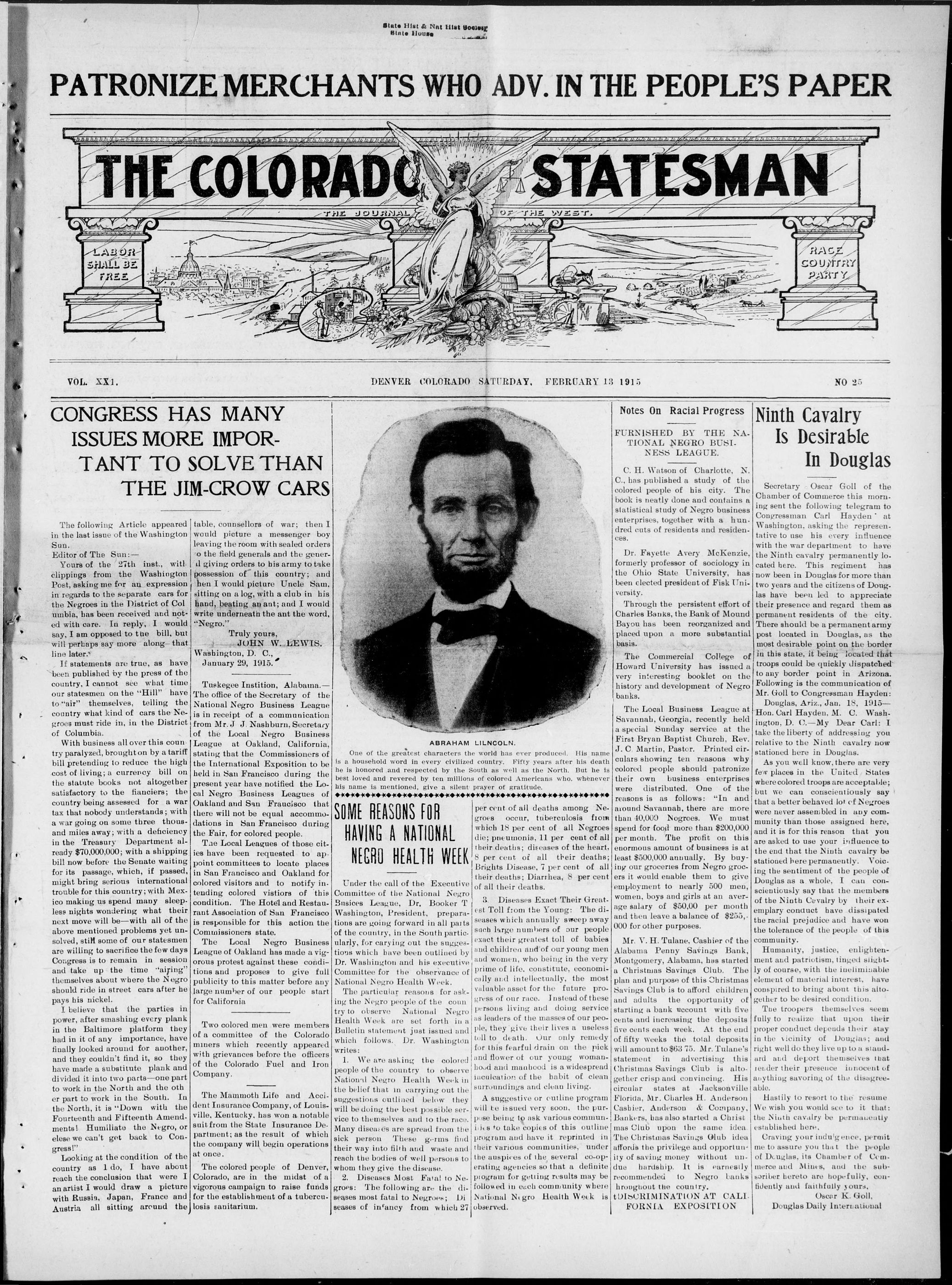
CONGRESS HAS MANY ISSUES MORE IMPORTANT TO SOLVE THAN THE JIM-CROW CARS
VOL. XX1.
CONGRESS HAS ISSUES MORE TANT TO THE JI
The following Article appeared in the last issue of the Washington Sun.
Editor of The Sun:—
Yours of the 27th inst., with clippings from the Washington Post, asking me for an expression in regards to the separate cars for the Negroes in the District of Columbia, has been received and noted with care. In reply, I would say, I am opposed to the bill, but will perhaps say more along that line later. If statements are true, as have been published by the press of the country, I cannot see what time our statesmen on the "Hill" have to "air" themselves, telling the country what kind of cars the Negroes must ride in, in the District of Columbia.
With business all over this country paralyzed, brought on by a tariff bill pretending to reduce the high cost of living; a currency bill on the statute books not altogether satisfactory to the financiers; the country being assessed for a war tax that nobody understands; with a war going on some three thousand miles away; with a deficiency in the Treasury Department already $70,000,000; with a shipping bill now before the Senate waiting for its passage, which, if passed, might bring serious international trouble for this country; with Mexico making us spend many sleepless nights wondering what their next move will be—with all of the above mentioned problems yet unsolved, still some of our statesmen are willing to sacrifice the few days Congress is to remain in session and take up the time "airing" themselves about where the Negro should ride in street cars after he pays his nickel.
I believe that the parties in power, after smashing every plank in the Baltimore platform they had in it of any importance, have finally looked around for another, and they couldn't find it, so they have made a substitute plank and divided it into two parts—one part to work in the North and the other part to work in the South. In the North, it is "Down with the Fourteenth and Fifteenth Amendments! Humiliate the Negro, or else we can't get back to Congress!"
```markdown
```
Looking at the condition of the country as I do, I have about reach the conclusion that were I an artist I would draw a picture with Russia, Japan, France and Austria all sitting around the
table, counsellors of war; then I would picture a messenger boy leaving the room with sealed orders o the field generals and the general giving orders to his army to take possession of this country; and then I would picture Uncle Sam, sitting on a log, with a club in his hand, beating an ant; and I would write underneath the ant the word, "Negro."
Truly yours,
JOHN W. LEWIS.
Washington, D. C.,
January 29, 1915.
Tuskegee Instition, Alabama. The office of the Secretary of the National Negro Business League is in receipt of a communication from Mr.J J. Nashburn, Secretary of the Local Negro Business League at Oakland, California, stating that the Commissioners of the International Exposition to be held in San Francisco during the present year have notified the Local Negro Business Leagues of Oakland and San Franciscso that there will not be equal accommodations in San Francisco during the Fair, for colored people. The Local Leagues of those cities have been requested to appoint committees to locate places in San Francisco and Oakland for colored visitors and to notify intending colored visitors of this condition. The Hotel and Restaurant Association of San Francisco is responsible for this action the Commissioners state.
The Local Negro Business League of Oakland has made a vigorous protest against these conditions and proposes to give full publicity to this matter before any large number of our people start for California
Two colored men were members of a committee of the Colorado miners which recently appeared with grievances before the officers of the Colorado Fuel and Iron Company.
The Mammoth Life and Accident Insurance Company, of Louisville, Kentucky, has won a notable suit from the State Insurance Department; as the result of which the company will begin operations at once.
The colored people of Denver, Colorado, are in the midst of a vigorous campaign to raise funds for the establishment of a tuberculosis sanitarium.
GIANTS WHO AD
ADC
THE JOURNAL
DENVER COLORADO SATURD
DENVER COLORADO SATURDAY. FEBRUARY 13 1915
A. B.
ABRAHAM LILNCOLN.
One of the greatest characters the world has is a household word in every civilized country. He is honored and respected by the South as well best loved and revered by ten millions of colored his name is mentioned, give a silent prayer of gr
One of the greatest characters the world has ever produced. His name is a household word in every civilized country. Fifty years after his death he is honored and respected by the South as well as the North. But he is best loved and revered by ten millions of colored Americans who, whenever his name is mentioned, give a silent prayer of gratitude.
SOME REASONS FOR HAVING A NATIONAL NEGRO HEALTH WEEK
Under the call of the Executive per cent of all deaths among Negroes occur, tuberculosis from which 18 per cent of all Negroes die; pneumonia, 11 per cent of all their deaths; diseases of the heart, 8 per cent of all their deaths; Brights Disease, 7 per cent of all their deaths; Diarrhea, 8 per cent of all their deaths.
3. Diseases Exact Their Greatest Toll from the Young: The diseases which annually sweep away such large numbers of our people exact their greatest toll of babies and children and of our young men and women, who being in the very prime of life, constitute, economically and intellectually, the most valuable asset for the future progress of our race. Instead of these persons living and doing service as leaders of the masses of our people, they give their lives a useless toll to death. Our only remedy for this fearful drain on the pick and flower of our young womanhood and manhood is a widespread inculcation of the habit of clean surroundings and clean living.
A suggestive or outline program will be issued very soon, the purpose being to ask various communities to take copies of this outline program and have it reprinted in their various communities, under the auspices of the several co-operating agencies so that a definite program for getting results may be followed in each community where National Negro Health Week is observed.
---
State Hist & Nat Hist Geology
State House
SOME REASONS FOR HAVING A NATIONAL NEGRO HEALTH WEEK
Under the call of the Executive Committee of the National Negro Busices League, Dr. Booker T Washington, President, preparations are going forward in all parts of the country, in the South particularly, for carying out the suggestions which have been outlined by Dr. Washington and his executive Committee for the observance of National Negro Health Week. The particular reasons for asking the Negro people of the country to observe National Negro Health Week are set forth in a Bulletin statement just issued and which follows. Dr. Washington writes:
1. We are asking the colored people of the country to observe National Negro Health Week in the belief that in carrying out the suggestions outlined below they will be doing the best possible service to themselves and to the race. Many diseases are spread from the sick person These germs find their way into filth and waste and reach the bodies of well persons to whom they give the disease.
2. Diseases Most Fatal to Negroes: The following are the diseases most fatal to Negroes; Diseases of infancy from which 27
Notes On Racial Progress
FURNISHED BY THE NATIONAL NEGRO BUSINESS LEAGUE.
C. H. Watson of Charlotte, N. C., has published a study of the colored people of his city. The book is neatly done and contains a statistical study of Negro business enterprises, together with a hundred cuts of residents and residences.
Dr. Fayette Avery McKenzie, formerly professor of sociology in the Ohio State University, has been elected president of Fisk University.
Through the persistent effort of Charles Banks, the Bank of Mound Bayou has been reorganized and placed upon a more substantial basis.
The Commercial College of Howard University has issued a very interesting booklet on the history and development of Negro banks.
The Local Business League at Savannah, Georgia, recently held a special Sunday service at the First Bryan Baptist Church, Rev. J. C. Martin, Pastor. Printed circulars showing ten reasons why colored people should patronize their own business enterprises were distributed. One of the reasons is as follows: "In and around Savannah, there are more than 40,000 Nogroes. We must spend for food more than $200,000 per month. The profit on this enormous amount of business is at least $500,000 annually. By buying our groceries from Negro grocers it would enable them to give employment to nearly 500 men, women, boys and girls at an average salary of $50,00 per month and then leave a balance of $255,000 for other purposes.
Mr. V. H. Tulane, Cashier of the Alabama Penny Savings Bank, Montgomery, Alabama, has started a Christmas Savings Club. The plan and purpose of this Christmas Savings Club is to afford children and adults the opportunity of starting a bank account with five cents and increasing the deposits five cents each week. At the end of fifty weeks the total deposits will amount to $63 75. Mr. Tulane's statement in advertising this Christmas Savings Club is altogether crisp and convincing. His circular states at Jacksonville Florida, Mr. Charles H. Anderson Cashier, Anderson & Company, Bankers, has also started a Christmas Club upon the same idea. The Christmas Savings Club idea affords the privilege and opportunity of saving money without undue hardship. It is earnestly recommended to Negro banks throughout the country.
DISCRIMINATION AT CALI
FORNIA EXPOSITION
NO 25
Ninth Cavalry Is Desirable In Douglas
Secretary Oscar Goll of the Chamber of Commerce this morning sent the following telegram to Congressman Carl Hayden at Washington, asking the representative to use his every influence with the war department to have the Ninth cavalry permanently located here. This regiment has now been in Douglas for more than two years and the citizens of Douglas have been led to appreciate their presence and regard them as permanent residents of the city. There should be a permanent army post located in Douglas, as the most desirable point on the border in this state, it being located that troops could be quickly dispatched to any border point in Arizona. Following is the communication of Mr. Goll to Congressman Hayden: Douglas, Ariz., Jan. 18, 1915—Hon. Carl Hayden, M. C. Washington, D. C.—My Dear Carl: I take the liberty of addressing you relative to the Ninth cavalry now stationed here in Douglas.
As you well know, there are very few places in the United States where colored troops are acceptable; but we can conscientiously say that a better behaved lot of Negroes were never assembled in any community than those assigned here, and it is for this reason that you are asked to use your influence to the end that the Ninth cavalry be stationed here permanently. Voicing the sentiment of the people of Douglas as a whole, I can conscientiously say that the members of the Ninth Cavalry by their exemplary conduct have dissipated the racial prejudice and have won the tolerance of the people of this community.
Humanity, justice, enlightenment and patriotism, tinged slightly of course, with the ineliminable element of material interest, have conspired to bring about this altogether to be desired condition.
The troopers themselves seem fully to realize that upon their proper conduct depends their stay in the vicinity of Douglas; and right well do they live up to a standard and deport themselves that render their presence innocent of anything savoring of the disagreeable.
Hastily to resort to the resume We wish you would see to it that: the Ninth cavalry be permanently established here.
Craving your indulgence, permit me to assure you that the people of Douglas, its Chamber of Commerce and Mines, and the subscriber hereto are hopefully, confidently and faithfully yours.
Oscar K. Goll,
Douglas Daily International
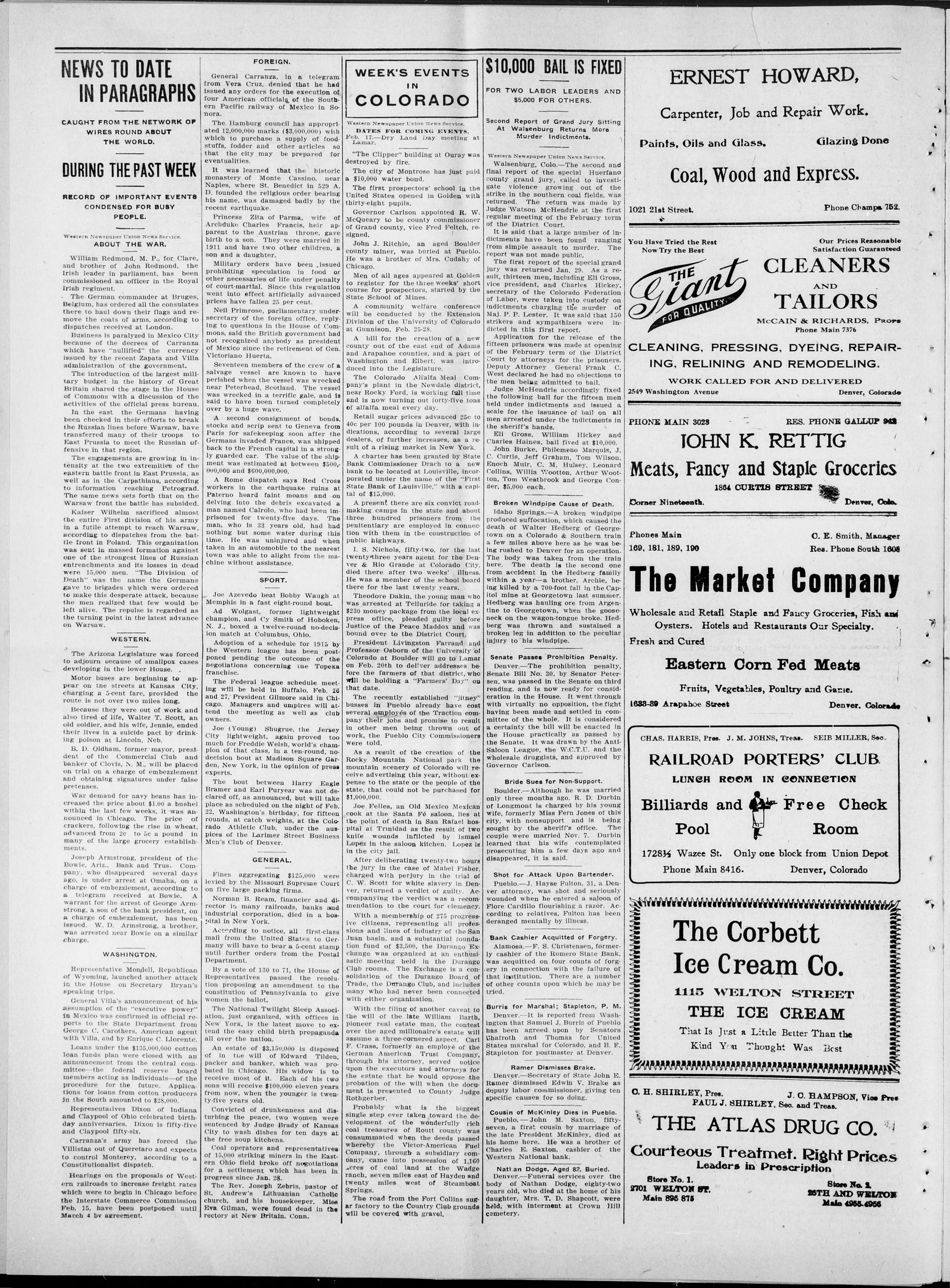
NEWS TO DATE IN PARAGRAPHS
CAUGHT FROM THE NETWORK OF WIRES ROUND ABOUT THE WORLD.
DURING THE PAST WEEK
RECORD OF IMPORTANT EVENTS
CONDENSED FOR BUSY
Western Newspaper Union News Service.
ABOUT THE WAR.
William Redmond, M. P., for Clare, and brother of John Redmond, the Irish leader in parliament, has been commissioned an officer in the Royal Irish regiment.
The German commander at Bruges, Belgium, has ordered all the consulates there to haul down their flags and remove the coats of arms, according to dispatches received at London.
Business is paralyzed in Mexico City because of the decrees of Carranza which have "nullified" the currency issued by the recent Zapata and Villa administration of the government.
The introduction of the largest military budget in the history of Great Britain shared the stage in the House of Commons with a discussion of the activities of the official press bureau.
In the east the Germans having been checked in their efforts to break the Russian lines before Warsaw, have transferred many of their troops to East Prussia to meet the Russian offensive in that region.
The engagements are growing in intensity at the two extremities of the eastern battle front in East Prussia, as well as in the Carpathians, according to information reaching Petrograd. The same news sets forth that on the Warsaw front the battle has subsided.
Kaiser Wilhelm sacrificed almost the entire First division of his army in a futile attempt to reach Warsaw, according to dispatches from the battle front in Poland. This organization was sent in massed formation against one of the strongest lines of Russian entrenchments and its losses in dead were 15,000 men. "The Division of Death" was the name the Germans gave to brigades which were ordered to make this desperate attack, because the men realized that few would be left alive. The repulse is regarded as the turning point in the latest advance on Warsaw.
WESTERN
The Arizona Legislature was forced to adjourn because of smallpox cases developing in the lower House. Motor buses are beginning to appear on the streets at Kansas City, charging a 5-cent fare, provided the route is not over two miles long. Because they were out of work and also tired of life, Walter T. Scott, an old soldier, and his wife, Jennie, ended their lives in a suicide pact by drinking poison at Lincoln, Neb. B. D. Oldham, former mayor, president of the Commercial Club and banker of Clovis, N. M., will be placed on trial on a charge of embezzlement and obtaining signatures under false pretenses.
War demand for navy beans has increased the price about $1.00 a bushel within the last few weeks, it was announced in Chicago. The price of crackers, following the rise in wheat, advanced from 2c to 5c a pound in many of the large grocery establishments.
Joseph Armstrong, president of the Bowie, Ariz., Bank and Trus. Company, who disappeared several days ago, is under arrest at Omaha, on a charge of embezzlement, according to a telegram received at Bowie. A warrant for the arrest of George Armstrong, a son of the bank president, on a charge of embezzlement, has been issued. W. D. Armstrong, a brother, was arrested near Bowie on a similar charge.
WASHINGTON
Representative Mondell, Republican of Wyoming, launched another attack in the House on Secretary Bryan's speaking trips.
General Villa's announcement of his assumption of the "executive power" in Mexico was confirmed in official reports to the State Department from George C. Carothers, American agent with Villa, and by Enrique C. Llorente.
Loans under the $135,000,000 cotton loan funds plan were closed with an announcement from the central committee—the federal reserve board members acting as individuals—of the procedure for the future. Applications for loans from cotton producers in the South amounted to $28,000.
Representatives Dixon of Indiana and Claypool of Ohio celebrated birthday anniversaries. Dixon is fifty-five and Claypool fifty-six.
Carranza's army has forced the Villistas out of Queretaro and expects to control Monterey, according to a Constitutionalist dispatch. Hearings on the proposals of Western railroads to increase freight rates which were to begin in Chicago before the Interstate Commerce Commission Feb. 15, have been postponed until March 4 by agreement.
FOREIGN.
General Carranza, in a telegram from Vera Cruz, denied that he had issued any orders for the execution of four American officials of the Southern Pacific railway of Mexico in Sonora.
The Hamburg council has appropriated 12,000,000 marks ($3,000,000) with which to purchase a supply of foodstuffs, fodder and other articles so that the city may be prepared for eventualities.
It was learned that the historic monastery of Monte Cassino, near Naples, where St. Benedict in 529 A.D. founded the religious order bearing his name, was damaged badly by the recent earthquake.
Princess Zita of Parma, wife of Archduke Charles Francis, heir apparent to the Austrian throne, gave birth to a son. They were married in 1911 and have two other children, a son and a daughter.
Military orders have been, issued prohibiting speculation in food or other necessaries of life under penalty of court-martial. Since this regulation went into effect artificially advanced prices have fallen 25 per cent.
Neil Primrose, parliamentary undersecretary of the foreign office, replying to questions in the House of Commons, said the British government had not recognized anybody as president of Mexico since the retirement of Gen. Victoriano Huerta.
Seventeen members of the crew of a salvage vessel are known to have perished when the vessel was wrecked near Peterhead, Scotland. The vessel was wrecked in a terrific gale, and is said to have been turned completely over by a huge wave.
A second consignment of bonds, stocks and scrip sent to Geneva from Paris for safekeeping soon after the Germans invaded France, was shipped back to the French capital in a strongly guarded car. The value of the shipment was estimated at between $500,000,000 and $600,000,000.
A Rome dispatch says Red Cross workers in the earthquake ruins at Paterno heard faint moans and on delving into the debris excavated a man named Calrolo, who had been imprisoned for twenty-five days. The man, who is 33 years old, had had nothing but some water during this time. He was uninjured and when taken in an automobile to the nearest town was able to alight from the machine without assistance.
SPORT.
Joe Azevedo beat Bobby Waugh at Memphis in a fast eight-round bout.
Ad Wolgast, former lightweight champion, and Cy Smith of Hoboken, N. J., boxed a twelve-round no-decision match at Columbus, Ohio.
Adoption of a schedule for 1915 by the Western league has been postponed pending the outcome of the negotiations concerning the Topeka franchise.
The Federal league schedule meeting will be held in Buffalo, Feb. 26 and 27, President Gilmore said in Chicago. Managers and umpires will attend the meeting as well as club owners.
Joe (Young) Shugrue, the Jersey City lightweight, again proved too much for Freddie Welsh, world's champion of that class, in a ten-round, no-decision bout at Madison Square Garden, New York, in the opinion of press experts.
The bout between Harry Eagle Bramer and Earl Puryear was not declared off, as announced, but will take place as scheduled on the night of Feb. 22. Washington's birthday, for fifteen rounds, at catch weights, at the Colorado Athletic Club, under the auspices of the Larimer Street Business Men's Club of Denver.
GENERAL.
Fines aggregating $125,000 were levied by the Missouri Supreme Court on five large packing firms.
Norman B. Ream, financier and director in many railroads, banks and industrial corporation, died in a hospital in New York.
According to notice, all first-class mail from the United States to Germany will have to bear a 5-cent stamp until further orders from the Postal Department.
By a vote of 130 to 71, the House of Representatives passed the resolution proposing an amendment to the constitution of Pennsylvania to give women the ballot.
The National Twilight Sleep Association, just organized, with offices in New York, is the latest move to extend the easy child birth propaganda all over the nation.
An estate of $3,150,000 is disposed of in the will of Edward Tilden, packer and banker, which was probated in Chicago. His widow is to receive most of it. Each of his two sons will receive $100,000 eleven years from now, when the younger is twenty-five years old.
Convicted of drunkenness and disturbing the peace, two women were sentenced by Judge Brady of Kansas City to wash dishes for ten days at the free soup kitchens.
Coal operators and representatives of 15,000 striking miners in the Eastern Ohio field broke off negotiations for a settlement which has been in progress since Jan. 28.
The Rev. Joseph Zebris, pastor of St. Andrew's Lithuanian Catholic church, and his housekeeper, Mise Eva Gilman, were found dead in the rectory at New Britain, Conn.
WEEK'S EVENTS IN COLORADO
Western Newspaper Union News Service.
DATES FOR COMING EVENTS.
Feb. 17.—Dry Land Day meeting at Lamar.
"The Clipper" building at Ouray was destroyed by fire.
The city of Montrose has just paid a $10,000 water bond.
The first prospectors' school in the United States opened in Golden with thirty-eight pupils.
Governor Carlson appointed R. W. McQueary to be county commissioner of Grand county, vice Fred Feltch, resigned.
John J. Ritchie, an aged Boulder county miner, was buried at Pueblo. He was a brother of Mrs. Cudahy of Chicago.
Men of all ages appeared at Golden to register for the three weeks' short course for prospectors, started by the State School of Mines.
A community welfare conference will be conducted by the Extension Division of the University of Colorado at Gunnison, Feb. 25-28.
A bill for the creation of a new county out of the east end of Adams and Arapahoe counties, and a part of Washington and Elbert, was introduced into the Legislature.
The Colorado Alfalfa Meal Company's plant in the Newdale district, near Rocky Ford, is working full time and is now turning out forty-five tons of alfalfa meal every day.
Retail sugar prices advanced 25c to 40c per 100 pounds in Denver, with indications, according to several large dealers, of further increases, as a result of a rising market in New York.
A charter has been granted by State Bank Commissioner Drach to a new bank to be located at Louisville, incorporated under the name of the "First State Bank of Lausville," with a capital of $15,000.
A present there are six convict road-making camps in the state and about three hundred prisoners from the penitentiary are employed in connection with them in the construction of public highways.
I. S. Nichols, fifty-two, for the last twenty-three years agent for the Denver & Rio Grande at Colorado City, died there after two weeks' illness. He was a member of the school board there for the last twenty years.
Theodore Dakin, the young man who was arrested at Telluride for taking a $230 money package from the local express office, pleaded guilty before Justice of the Peace Maddox and was bound over to the District Court.
President Livingston Farrand and Professor Osborn of the University of Colorado at Boulder will go to Lamar on Feb. 20th to deliver addresses before the farmers of that district, who will be holding a "Farmers' Day" on that date.
The recently established "jitney" busses in Pueblo already have cost several employees of the Traction company their jobs and promise to result in other men being thrown out of work, the Pueblo City Commissioners were told.
As a result of the creation of the Rocky Mountain National park, the mountain scenery of Colorado will receive advertising this year, without expense to the state or the people of the state, that could not be purchased for $1,000,000.
Joe Felles, an Old Mexico Mexican cook at the Santa Fé saloon, lies at the point of death in San Rafael hospital at Trinidad as the result of two knife wounds inflicted by ismael Lopez in the saloon kitchen. Lopez is in the city jail.
After deliberating twenty-two hours the jury in the case of Mabel Fisher, charged with perjury in the trial of C. W. Scott for white slavery in Denver, returned a verdict of guilty. Accompanying the verdict was a recommendation to the court for clemency.
With a membership of 275 progressive citizens, representing all professions and lines of industry of the San Juan basin, and a substantial foundation fund of $3,500, the Durango Exchange was organized at an enthusiastic meeting held in the Durango Club rooms. The Exchange is a consolidation of the Durango Board of Trade, the Durango Club, and includes many who had never been connected with either organization.
With the filing of another caveat to the will of the late William Barth, pioneer real estate man, the contest over the aged millionaire's estate will assume a three-cornered aspect. Carl F. Crass, formerly an employe of the German American Trust Company, through his attorney, served notice upon the executors and attorneys for the estate that he would oppose the probation of the will when the document is presented to County Judge Rothgerber.
Probably what is the biggest single step ever taken toward the development of the wonderfully rich coal treasures of Routt county was consummated when the deeds passed whereby the Victor-American Fuel Company, through a subsidiary company, came into possession of 1,160 acres of coal land at the Wadge ranch, seven miles east of Hayden and twenty miles west of Steamboat Springs.
The road from the Fort Collins sugar factory to the Country Club grounds will be covered with gravel.
$10,000 BAIL IS FIXED
FOR TWO LABOR LEADERS AND $5,000 FOR OTHERS.
Second Report of Grand Jury Sitting At Walsenburg Returns More Murder Indictments.
Western Newspaper Union News Service.
Walsenburg, Colo.—The second and final report of the special Huerrano county grand jury, called to investigate violence growing out of the strike in the southern coal fields, was returned. The return was made by Judge Watson McHendrie at the first regular meeting of the February term of the District Court.
It is said that a large number of indictments have been found ranging from simple assault to murder. The report was not made public.
The first report of the special grand jury was returned Jan. 29. As a result, thirteen men, including Eli Gross, vice president, and Charles Hickey, secretary of the Colorado Federation of Labor, were taken into custody on indictments charging the murder of Maj. P. P. Lester. It was said that 150 strikers and sympathizers were indicted in this first report.
Application for the release of the fifteen prisoners was made at opening of the February term of the District Court by attorneys for the prisoners. Deputy Attorney General Frank C. West declared he had no objections to the men being admitted to bail.
Judge McHendrie accordingly fixed the following bail for the fifteen men held under indictments and issued a scale for the issuance of bail on all men arrested under the indictments in the sheriff's hands.
Eli Gross, William Hickey and Charles Haines, ball fived at $10,000. John Burke, Philemeno Marquis, J. C. Curtis, Jeff Graham, Tom Wilson, Enoch Muir, C. M. Hulsey, Leonard Collins, Willia Wootton, Arthur Wootton, Tom Westbrook and George Conder, $5,000 each.
Broken Windpipe Cause of Death.
Idaho Springs.—A broken windpipe produced suffocation, which caused the death of Walter Hedberg of Georgetown on a Colorado & Southern train a few miles above here as he was being rushed to Denver for an operation. The body was taken from the train here. The death is the second one from accident in the Hedberg family within a year—a brother, Archie, being killed by a 700-foot fall in the Capitol mine at Georgetown last summer. Hedberg was hauling ore from Argentine to Georgetown, when the goose-neck on the wagon-tongue broke. Hedberg was thrown and sustained a broken leg in addition to the peculiar injury to his windpipe.
Senate Passes Prohibition Penalty. Denver.—The prohibition penalty, Senate Bill No. 30, by Senator Petersen, was passed in the Senate on third reading, and is now ready for consideration in the House. It went through with virtually no opposition, the fight having been made and settled in committee of the whole. It is considered a certainty the bill will be enacted in the House practically as passed by the Senate. It was drawn by the Anti-Saloon League, the W.C.T.U. and the wholesale druggists, and approved by Governor Carlson.
Bride Sues for Non-Support.
Boulder.—Although he was married only three months ago, R. D. Durbin of Longmont is charged by his young wife, formerly Miss Fern Jones of this city, with nonsupport and is being sought by the sheriff's office. The couple were married Nov. 7. Durbin learned that his wife contemplated prosecuting him a few days ago and disappeared, it is said.
Shot for Attack Upon Bartender.
Pueblo.—J. Hayse Fulton, 31, a Denver attorney, was shot and seriously wounded when he entered a saloon of Flore Cardillo flourishing a razor. According to relatives, Fulton has been deranged mentally by illness.
Bank Cashier Acquitted of Forgery.
Alamosa.—F. S. Christensen, formerly cashier of the Romero State Bank, was acquitted on four counts of forgery in connection with the failure of that institution. There are a number of other counts upon which he may be tried.
Burris for Marshal; Stapleton, P. M.
Denver.—It is reported from Washington that Samuel J. Burris of Pueblo has been agreed upon by Senators Ufafroth and Thomas for United States marshal for Colorado, and B. F. Stapleton for postmaster at Denver.
Ramer Dismisses Brake.
Denver.—Secretary of State John E. Ramer dismissed Edwin V. Brake as deputy labor commissioner, giving ten specific causes for so doing.
Cousin of McKinley Dies in Pueblo. Pueblo.—John M. Saxton, fifty-seven, a first cousin by marriage of the late President McKinley, died at his home here. He was a brother of Charles E. Saxton, cashier of the Western National bank.
Nathan Dodge, Aged 82, Buried. Denver—Funeral services over the body of Nathan Dodge, eighty-two years old, who died at the home of his daughter, Mrs. T. D. Shapcott, were held, with interment at Crown Hill cemetery.
ERNEST HOWARD,
ERNEST HOWARD,
Carpenter, Job and Repair Work.
Paints, Oils and Glass. Coal, Wood
Coal, Wood and Express
Street. Phone
ed the Rest Our Price
the Best Satisfaction
Coal, Wood and Express.
You Have Tried the Rest
Now Try the Best
THE
Giant
FOR QUALITY
CLEANING, PRESSIN
ING, RELINING AN
WORK CALLED FOR
2549 Washington Avenue
ING, PRESSING, DYEING, F
RELINING AND REMODEL
WORK CALLED FOR AND DELIVERE
Boston Avenue Denv
CLEANING, PRESSING, DYEING, REPAIRING, RELINING AND REMODELING.
WORK CALLED FOR AND DELIVERED
2549 Washington Avenue Denver, Colorado
JOHN K.
Meats, Fancy and
1864 CURTLE
Corner Nineteenth.
JOHN K. RETTIG
Fancy and Staple Grocery
1864 CURTIS STREET
seventh.
C. E. Smith
9, 190
Res. Phone
Market Comp
and Retail Staple and Fancy Groceries
ers. Hotels and Restaurants Our Speci
Cured
Eastern Corn Fed Meat
Fruits, Vegetables, Poultry and Game.
Spaboe Street
Denver
ARRIS, Pres. J. M. JOHNS, Treas. SEIB MILLE
ILROAD PORTERS' CLUB
LUNCH ROOM IN CONNECTION
ards and Free Cl
Pool
Room
Wazee St. Only one block from Union
one Main 8416. Denver, Colorado
The Corbett
Ice Cream Co.
1115 WELTON STREET
THE ICE CREAM
The Market
Wholesale and Retail Staple and
Oysters. Hotels and Re-
Fresh and Cured
Eastern Corr
Fruits, Vegetables,
1688-89 Arapahoe Street
CHAS. HARRIS, Pres. J. M. JOHN
RAILROAD POOL
LUNCH ROOM I
Billiards and
Pool
1728½ Wazee St. Only on
Phone Main 8416.
The Corr
Ice Cream
1115 WELTO
THE ICE
The Market Company
Wholesale and Retail Staple and Fancy Groceries, Fish and Oysters. Hotels and Restaurants Our Specialty. Fresh and Cured
Fruits, Vegetables, Poultry and Game.
1688-89 Arapahoe Street Denver, Colorado
CHAS. HARRIS, Pres. J. M. JOHNS, Treas. SEIB MILLER, Sec.
RAILROAD PORTERS' CLUB
LUNCH ROOM IN CONNECTION
Billiards and Free Check
Pool Room
1728½ Wazee St. Only one block from Union Depot
Phone Main 8416. Denver, Colorado
That Is Just a Little Better Than the
Kind You Thought Was Best
C. H. SHIRLEY, Pres. J. C. HAMPSON
PAUL J. SHIRLEY, Sec. and Treas.
THE ATLAS DRUG C
Courteous Treatmet. Right P
Leaders in Prescription
RLEY, Pres. J. O. HAMPSON
PAUL J. SHIRLEY, Sec. and Treas.
THE ATLAS DRUG C
eous Treatmet. Right P
Leaders in Prescription
o. 1.
C. H. SHIRLEY, Pres. J. C. HAMPSON, Vice Pres PAUL J. SHIRLEY, Sec. and Treas.
---
1021 21st Street.
PHONE MAIN 3028
Phones Main
169,181,189,190
Store No. 1.
2701 WELTON ST.
Main 895 875
s. Glazing Done and Express.
Our Prices Reasonable
Satisfaction Guaranteed
CLEANERS
AND
TAILORS
McCAIN & RICHARDS, PROPS
Phone Main 7376
ING, DYEING, REPAIR-
AND REMODELING.
OR AND DELIVERED
Denver, Colorado
RES. PHONE GALLUP 943
E. RETTIG
and Staple Groceries
TIS STREET
Denver, Colo.
C. E. Smith, Manager
Res. Phone South 1606
et Company
and Fancy Groceries, Fish and
Restaurants Our Specialty.
Barn Fed Meats
es, Poultry and Game.
Denver, Colorado
OHNS, Treas. SEIB MILLER, Sec.
ORTERS' CLUB
IN CONNECTION
Free Check
Room
one block from Union Depot
Denver, Colorado
rbett
ream Co.
TON STREET
E CREAM
J. C. HAMPSON, Vice Pres
LEY, Sec. and Treas.
AS DRUG CO.
Itmet. Right Prices
Prescription
Store No. 2
26TH AND WELTON
Main 4955 4956
---
Phone Champa 752
---
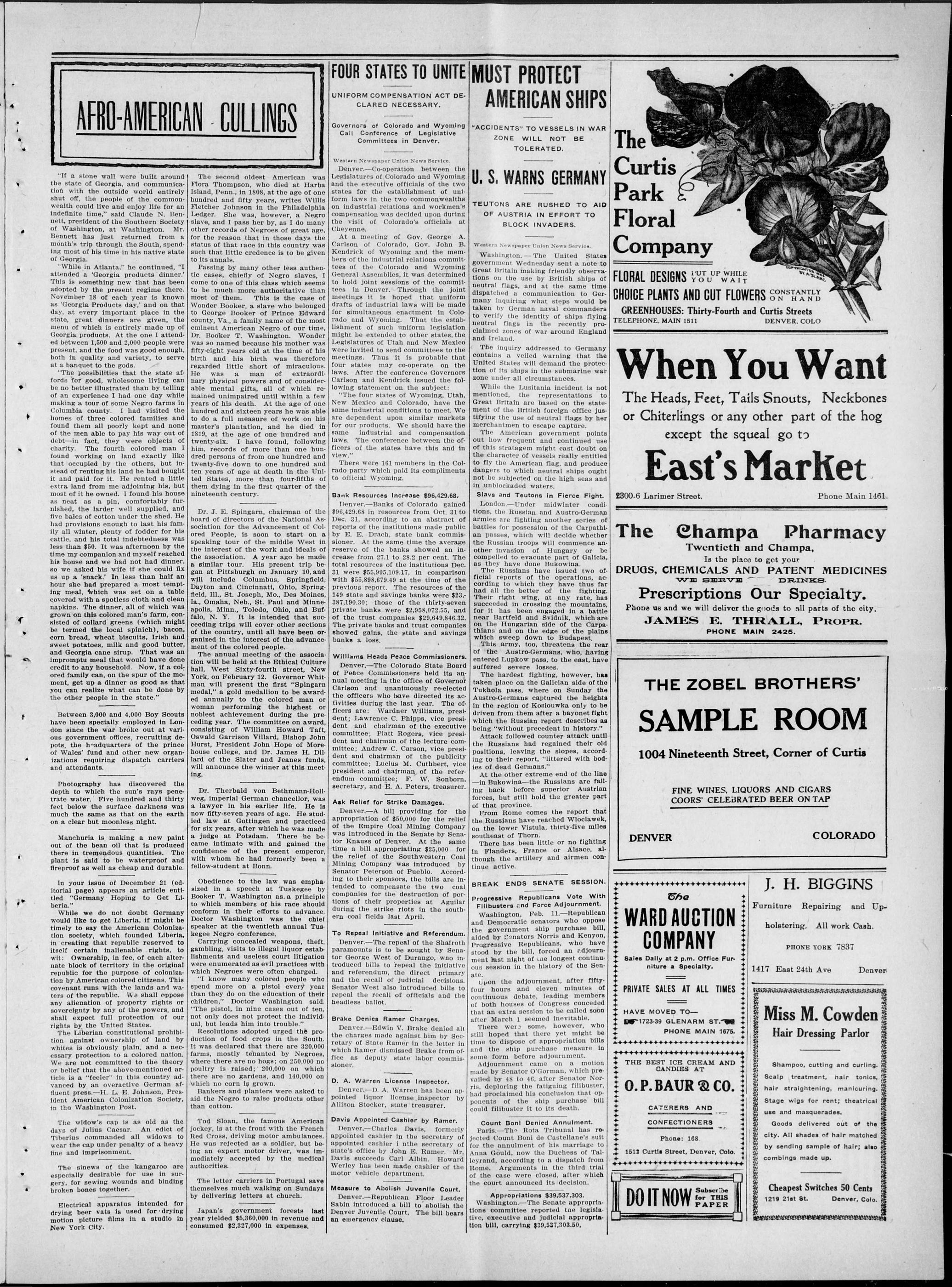
AFRO-AMERICAN CULLINGS
"If a stone wall were built around the state of Georgia, and communication with the outside world entirely shut off, the people of the commonwealth could live and enjoy life for an indefinite time," said Claude N. Bennett, president of the Southern Society of Washington, at Washington. Mr. Bennett has just returned from a month's trip through the South, spending most of his time in his native state of Georgia.
"While in Atlanta," he continued, "I attended a 'Georgia products dinner.' This is something new that has been adopted by the present regime there. November 18 of each year is known as 'Georgia Products day,' and on that day, at every important place in the state, great dinners are given, the menu of which is entirely made up of Georgia products. At the one I attended between 1,500 and 2,000 people were present, and the food was good enough, both in quality and variety, to serve at a banquet to the gods.
"The possibilities that the state affords for good, wholesome living can be no better illustrated than by telling of an experience I had one day while making a tour of some Negro farms in Columbia county. I had visited the homes of three colored families and found them all poorly kept and none of the men able to pay his way out of debt—in fact, they were objects of charity. The fourth colored man I found working on land exactly like that occupied by the others, but instead of renting his land he had bought it and paid for it. He rented a little extra land from me adjoining his, but most of it he owned. I found his house as neat as a pin, comfortably furnished, the larder well supplied, and five bales of cotton under the shed. He had provisions enough to last his family all winter, plenty of fodder for his cattle, and his total indebtedness was less than $50. It was afternoon by the time my companion and myself reached his house and we had not had dinner, so we asked his wife if she could fix us up a 'snack.' In less than half an hour she had prepared a most tempting meal, which was set on a table covered with a spotless cloth and clean napkins. The dinner, all of which was grown on this colored man's farm, consisted of collard greens (which might be termed the local spinich), bacon, corn bread, wheat biscuits, Irish and sweet potatoes, milk and good butter, and Georgia cane sirup. That was an impromptu meal that would have done credit to any household. Now, if a colored family can, on the spur of the moment, get up a dinner as good as that you can realize what can be done by the other people in the state."
Between 3,000 and 4,000 Boy Scouts have been specially employed in London since the war broke out at various government offices, recruiting depots, the headquarters of the prince of Wales' fund and other new organizations requiring dispatch carriers and attendants.
Photography has discovered the depth to which the sun's rays penetrate water. Five hundred and thirty feet below the surface darkness was much the same as that on the earth on a clear but moonless night.
Manchuria is making a new paint out of the bean oil that is produced there in tremendous quantities. The plant is said to be waterproof and fireproof as well as cheap and durable.
In your issue of December 21 (editorial page) appears an article entitled "Germany Hoping to Get Liberia."
While we do not doubt Germany would like to get Liberia, if might be timely to say the American Colonization society, which founded Liberia, in creating that republic reserved to itself certain inalienable rights, to wit: Ownership, in fee, of each alternate block of territory in the original republic for the purpose of colonization by American colored citizens. This covenant runs with the lands and waters of the republic. We shall oppose any alienation of property rights or sovereignty by any of the powers, and shall expect full protection of our rights by the United States.
The Liberian constitutional prohibition against ownership of land by whites is obviously plain, and a necessary protection to a colored nation. We are not committed to the theory or belief that the above-mentioned article is a "feeler" in this country advanced by an overactive German affluent press—H. L. E. Johnson, President American Colonization Society, in the Washington Post.
The widow's cap is as old as the days of Julius Caesar. An edict of Tiberius commanded all widows to wear the cap under penalty of a heavy fine and imprisonment.
The sinews of the kangaroo are especially desirable for use in surgery, for sewing wounds and binding broken bones together.
Electrical apparatus intended for drying beer vats is used for drying motion picture films in a studio in New York City.
The second oldest American was Flora Thompson, who died at Harba Island, Penn., in 1808, at the age of one hundred and fifty years, writes Willis Fletcher Johnson in the Philadelphia Ledger. She was, however, a Negro slave, and I pass her by, as I do many other records of Negroes of great age, for the reason that in those days the status of that race in this country was such that little credence is to be given to its annals.
Passing by many other less authentic cases, chiefly of Negro slaves, I come to one of this class which seems to be much more authoritative than most of them. This is the case of Wonder Booker, a slave who belonged to George Booker of Prince Edward county, Va., a family name of the most eminent American Negro of our time, Dr. Booker T. Washington. Wonder was so named because his mother was fifty-eight years old at the time of his birth and his birth was therefore regarded little short of miraculous. He was a man of extraordinary physical powers and of considerable mental gifts, all of which remained unimpaired until within a few years of his death. At the age of one hundred and sixteen years he was able to do a full measure of work on his master's plantation, and he died in 1819, at the age of one hundred and twenty-six. I have found, following him, records of more than one hundred persons of from one hundred and twenty-five down to one hundred and ten years of age at death in the United States, more than four-fifths of them dying in the first quarter of the nineteenth century.
Dr. J. E. Spingarn, chairman of the board of directors of the National Association for the Advancement of Colored People, is soon to start on a speaking tour of the middle West in the interest of the work and ideals of the association. A year ago he made a similar tour. His present trip began at Pittsburgh on January 10, and will include Columbus, Springfield, Dayton and Cincinnati, Ohio, Springfield, Ill., St. Joseph, Mo., Des Moines, Ia., Omaha, Neb., St. Paul and Minneapolis, Minn., Toledo, Ohio, and Buffalo, N. Y. It is intended that succeeding trips will cover other sections of the country, until all have been organized in the interest of the advancement of the colored people.
The annual meeting of the association will be held at the Ethical Culture hall, West Sixty-fourth street, New York, on February 12. Governor Whitman will present the first "Spingarn medal," a gold medallion to be awarded annually to the colored man or woman performing the highest on noblest achievement during the preceding year. The committee on award, consisting of William Howard Taft, Oswald Garrison Villard, Bishop John Hurst, President John Hope of Morehouse college, and Dr. James H. Dillard of the Slater and Jeans funds, will announce the winner at this meeting.
Dr. Therbald von Bethmann-Hollweg, imperial German chancellor, was a lawyer in his earlier life. He is now fifty-seven years of age. He studied law at Gottingen and practiced for six years, after which he was made a judge at Potsdam. There he became intimate with and gained the confidence of the present emperor, with whom he had formerly been a fellow-student at Bonn.
Obedience to the law was emphasized in a speech at Tuskegee by Booker T. Washington as a principle to which members of his race should conform in their efforts to advance. Doctor Washington was the chief speaker at the twentieth annual Tuskegee Negro conference.
Carrying concealed weapons, theft, gambling, visits to illegal liquor establishments and useless court litigation were enumerated as evil practices with which Negroes were often charged.
"I know many colored people who spend more on a pistol every year than they do on the education of their children," Doctor Washington said.
"The pistol, in nine cases out of ten, not only does not protect the individual, but leads him into trouble."
Resolutions adopted urged the production of food crops in the South. It was declared that there are 320,000 farms, mostly tenanted by Negroes, where there are no hogs; on 250,000 no poultry is raised; 200,000 on which there are no gardens, and 140,000 on which no corn is grown.
Bankers and planters were asked to aid the Negro to raise products other than cotton.
Tod Sloan, the famous American jockey, is at the front with the French Red Cross, driving motor ambulances. He was rejected as a soldier, but being an expert motor driver, was immediately accepted by the medical authorities.
The letter carriers in Portugal save themselves much walking on Sundays by delivering letters at church.
Japan's government forests last year yielded $5,360,000 in revenue and consumed $2,327,000 in expenses.
UNIFORM COMPENSATION ACT DECLARED NECESSARY.
Governors of Colorado and Wyoming
Call Conference of Legislative Committees in Denver.
Western Newspaper Union News Service. Denver.—Cooperation between the Legislatures of Colorado and Wyoming and the executive officials of the two states for the establishment of uniform laws in the two commonwealths on industrial relations and workmen's compensation was decided upon during the visit of Colorado's officials at Chevenne.
At a meeting of Gov. George A. Carlson of Colorado, Gov. John B. Kendrick of Wyoming and the members of the industrial relations committees of the Colorado and Wyoming General Assemblies, it was determined to hold joint sessions of the committees in Denver. Through the joint meetings it is hoped that uniform drafts of industrial laws will be made for simultaneous enactment in Colorado and Wyoming. That the establishment of such uniform legislation might be extended to other states, the Legislatures of Utah and New Mexico were invited to send committees to the meetings. Thus it is probable that four states may co-operate on the laws. After the conference Governors Carlson and Kendrick issued the following statement on the subject:
"The four states of Wyoming, Utah, New Mexico and Colorado, have the same industrial conditions to meet. We are dependent upon similar markets for our products. We should have the same industrial and compensation laws. The conference between the officers of the states have this and in view."
There were 161 members in the Colorado party which paid its compliments to official Wyoming.
Bank Resources Increase $96,429.68.
Denver.—Banks of Colorado gained $96,429.68 in resources from Oct. 31 to Dec. 31, according to an abstract of reports of the institutions made public by E. E. Drach, state bank commissioner. At the same time the average reserve of the banks showed an increase from 27.1 to 28.2 per cent. The total resources of the institutions Dec. 31 were $55,995,109.17, in comparison with $55,898,679.49 at the time of the previous report. The resources of the 149 state and savings banks were $23.387,190.30; those of the thirty-seven private banks were $2,958,072.55, and of the trust companies $29,649,846.32. The private banks and trust companies showed gains, the state and savings banks a loss.
Williams Heads Peace Commissioners.
Denver.—The Colorado State Board of Peace Commissioners held its annual meeting in the office of Governor Carlson and unanimously re-elected the officers who have directed its activities during the last year. The officers are: Wardner Williams, president; Lawrence C. Phipps, vice president and chairman of the executive committee; Platt Rogers, vice president and chairman of the lecture committee; Andrew C. Carson, vice president and chairman of the publicity committee; Lucius M. Cuthbert, vice president and chairman of the referendum committee; F. W. Sonborn, secretary, and E. A. Peters, treasurer.
Ask Relief for Strike Damages.
Denver.—A bill providing for the appropriation of $50,000 for the relief of the Empire Coal Mining Company was introduced in the Senate by Senator Knauss of Denver. At the same time a bill appropriating $25,000 for the relief of the Southwestern Coal Mining Company was introduced by Senator Peterson of Pueblo. According to their sponsors, the bills are intended to compensate the two coal companies for the destruction of portions of their properties at Aguilar during the strike riots in the southern coal fields last April.
To Repeal Initiative and Referendum.
Denver.—The repeal of the Shafroth paramounts is to be sought by Senator George West of Durango, who introduced bills to repeal the initiative and referendum, the direct primary and the recall of judicial decisions. Senator West also introduced bills to repeal the recall of officials and the headless ballot.
Brake Denies Ramer Charges.
Denver.-Edwin V. Brake denied all the charges made against him by Secretary of State Ramer in the letter in which Ramer dismissed Brake from office as deputy state labor commissioner.
Denver.—D. A. Warren has been appointed liquor license inspector by Allison Stocker, state treasurer.
Davis Appointed Cashier by Ramer.
Denver.—Charles Davis, formerly appointed cashier in the secretary of appointed cashier i the secretary of state's office by John E. Ramer. Mr. Davis succeeds Carl Albin. Howard Werley has been made cashier of the motor vehicle department.
Measure to Abolish Juvenile Court.
Denver.—Republican Floor Leader Sabin introduced a bill to abolish the Denver Juvenile Court. The bill bears an emergency clause.
MUST PROTECT AMERICAN SHIPS
"ACCIDENTS" TO VESSELS IN WAR
ZONE WILL NOT BE
TOLERATED.
U. S. WARNS GERMANY
TEUTONS ARE RUSHED TO AID OF AUSTRIA IN EFFORT TO BLOCK INVADERS.
Western Newspaper Union News Service.
Washington. — The United States government Wednesday sent a note to Great Britain making friendly observations on the use by British ships of neutral flags, and at the same time dispatched a communication to Germany inquiring what steps would be taken by German naval commanders to verify the identity of ships flying neutral flags in the recently proclaimed zones of war around England and Ireland.
The inquiry addressed to Germany contains a veiled warning that the United States will demand the protection of its ships in the submarine war zone under all circumstances.
While the Lusitania incident is not mentioned, the representations to Great Britain are based on the statement of the British foreign office justifying the use of neutral flags by her merchantmen to escape capture.
The American government points out how frequent and continued use of this stratagem might cast doubt on the character of vessels really entitled to fly the American flag, and produce dangers to which neutral ships ought not be subjected on the high seas and in unblockaded waters.
Slavs and Teutons in Fierce Fight. London.—Under midwinter conditions, the Russian and Austro-German armies are fighting another series of battles for possession of the Carpathian passes, which will decide whether the Russian troops will commence another invasion of Hungary or be compelled to evacuate part of Galicia, as they have done Bukowina.
The Russians have issued two official reports of the operations, according to which they have thus far had all the better of the fighting. Their right wing, at any rate, has succeeded in crossing the mountains, for it has been engaged in a battle near Bartfeld and Svidlnik, which are on the Hungarian side of the Carpathians and on the edge of the plains which sweep down to Budapest. This army, too, threatens the rear of the Austro-Germans, who, having entered Lupkow pass, to the east, have suffered severe losses.
The hardest fighting, however, has taken place on the Galician side of the Tukhola pass, where on Sunday the Austro-Germans captured the heights in the region of Kosionwka only to be driven from them after a bayonet fight which the Russian report describes as being "without precedent in history."
Attack followed counter attack until the Russians had regained their old positions, leaving the slopes, according to their report, "littered with bodies of dead Germans."
At the other extreme end of the line—in Bukowina—the Russians are falling back before superior Austrian forces, but still hold the greater part of that province.
From Rome comes the report that the Russians have reached Wloclawek, on the lower Vistula, thirty-five miles southeast of Thorn.
There has been little or no fighting In Flanders, France or Alsace, although the artillery and airmen continue active.
BREAK ENDS SENATE SESSION
Progressive Republicans Vote With
Filibusters and Force Adjournment
Washington, Feb. 11.—Republican and Democratic senators who oppose the government ship purchase bill, aided by Senators Norris and Kenyon, Progressive Republicans, who have stood by the bill, forced an adjournment last night of the longest continuous session in the history of the Senate.
Upon the adjournment, after fifty-four hours and eleven minutes of continuous debate, leading members of both houses of Congress conceded that an extra session to be called soon after March 1 seemed inevitable.
There were some, however, who still hoped that there yet might be time to dispose of appropriation bills and the ship purchase measure in some form before adjournment.
Adjournment came on a motion made by Senator O'Gorman, which prevailed by 48 to 46, after Senator Norris, deploring the fatiguing fillbuster, had proclaimed his conclusion that opponents of the ship purchase bill could fillbuster it to its death.
Count Bone Denied Annulment.
Count Boni Denied Annulment.
Paris.—The Rota Tribunal has rejected Count Boni de Castellane's suit for the annulment of his marriage to Anna Gould, now the Duchess of Talleyrand, according to a dispatch from Rome. Arguments in the third trial of the case were closed, after which the court announced its decision.
Appropriations $39,537,303.
Washington.—The Senate appropriations committee reported the legislative, executive and judicial appropriation bill, carrying $39,537,303.50.
The
Curtis
Park
Floral
Company
FLORAL DESIGNS PUT UP WHILE
YOU WAIT
CHOICE PLANTS AND CUT FLOWERS CONSTANTLY
ON HAND
GREENHOUSES: Thirty-Fourth and Curtis Streets
TELEPHONE, MAIN 1511
DENVER, COLO
When You Want
When You Want
The Heads, Feet, Tails Snouts, Neckbones or Chiterlings or any other part of the hog except the squeal go to
2300-6 Larimer Street.
The Ch
Tw
DRUGS, CHEMIC
WE
Prescrip
Phone us and we w
JAMES
THE ZO
SAM
1004 Ninete
The Champa Pharmacy
The Champa Pharmacy
Twentieth and Champa,
Is the place to get your
DRUGS, CHEMICALS AND PATENT MEDICINES
WE SERVE DRINKS.
Prescriptions Our Specialty.
Phone us and we will deliver the goods to all parts of the city.
JAMES E. THRALL, PROPR.
PHONE MAIN 2425.
1004 Nineteenth Street, Corner of Curtis
FINE WINES, LIQUORS AND CIGARS COORS' CELEBRATED BEER ON TAP
---
COMPANY
at 2 p.m. Office Fur-
a Specialty.
PHONE YORK
1417 East 24th Ave
TUES AT ALL TIMES
---
DENVER
Pharmacy
and Champa,
to get your
PATENT MEDICINES
DRINKS.
Our Specialty.
the goods to all parts of the city.
MIRALL, PROPR.
AIN 2425.
BROTHERS'
E ROOM
Street, Corner of Curtis
J. H. BIGGINS
Furniture Repairing and Upholstering. All work Cash.
PHONE YORK 7837
1417 East 24th Ave Denver
Miss M. Cowden Hair Dressing Parlor
Shampoo, cutting and curling. Scalp treatment, hair tonics, hair straightening, manicuring. Stage wigs for rent; theatrical use and masquerades. Goods delivered out of the city. All shades of hair matched by sending sample of hair; also combings made up.
Cheapest Switches 50 Cents
1219 21st St. Denver, Colo.
Phone Main 1461.
COLORADO
THE COLORADO STATESMAN
KADOW
HARVARD
FREE
BACK
COUNTRY
PARTY
Entered as second-class matter at the postoffice in the city of Denver, Colorado.
No discounts allowed on less than three months' contract. Cash must accompany all orders from parties unknown to us. Further particulars on application.
It occasionally happens that papers sent to subscribers are lost or stolen. In case you do not receive any number when due, inform us by postal card and we will cheerfully forward a duplicate of the missing number.
Remittances should be made by Express Money Order, Postoffice Money Order, Registered Letter or Bank Draft. Postage stamps will be received the same as cash for the fractional part of a dollar. Only 1-cent and 2-cent stamps taken.
Communications to receive attention must be newsy, upon important subjects, plainly written only upon one side of the paper; must reach us Tuesdays, if possible, anyway, not later than Wednesdays, and bear the signature of the author. No manuscript returned, unless stamps are sent for postage.
All communications of a personating nature that are not complimentary will be withheld from the columns of this paper.
MEMBER
NATIONAL NEGRO PRESS
ASSOCIATION.
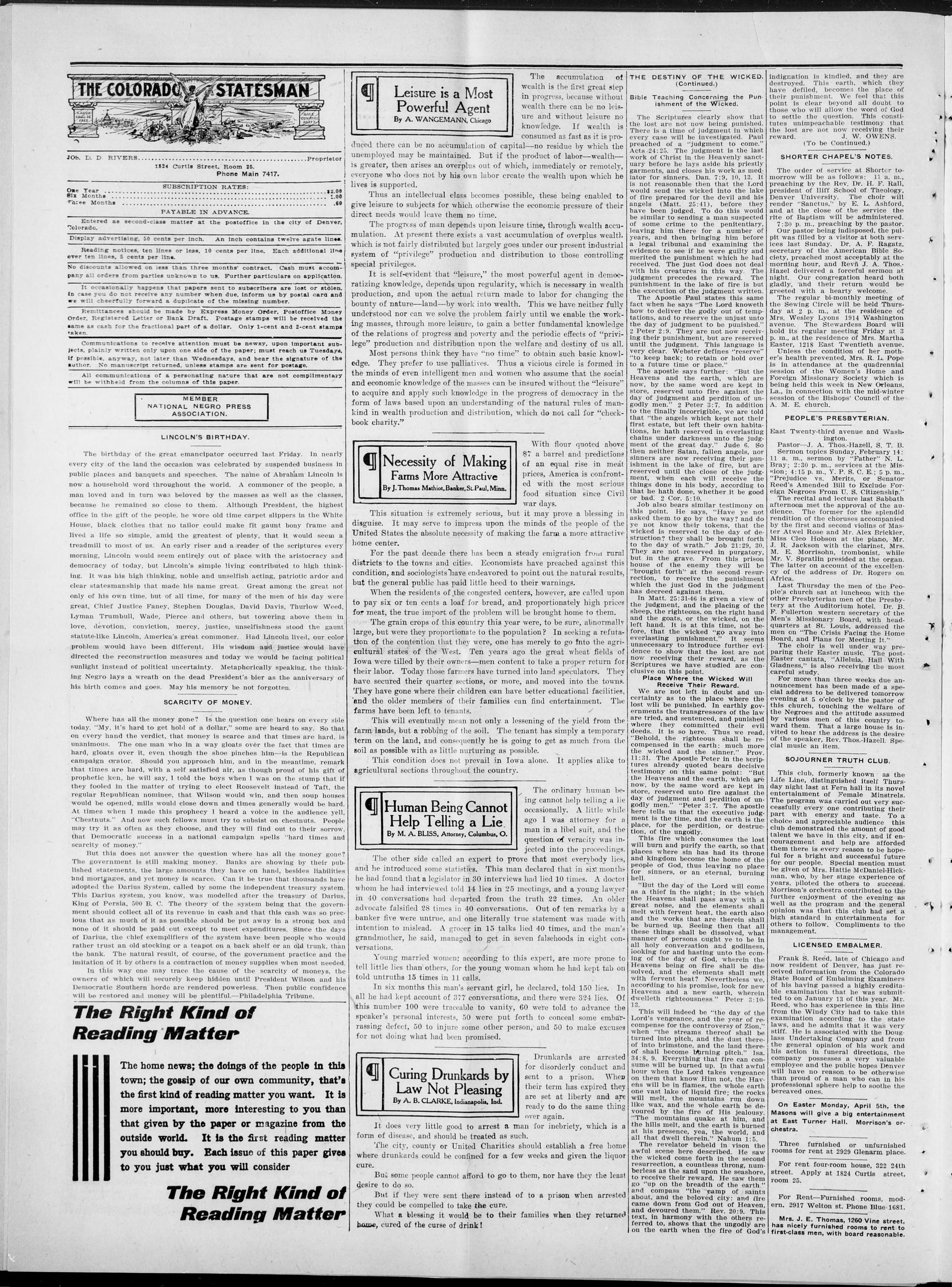
LINCOLN'S BIRTHDAY.
of the great emancipator occurred, and the occasion was celebrated by banquets and speeches. The name heard throughout the world. A cow-corn was beloved by the masses and so close to them. Although the people, he wore old time clothes, that no tailor could make five, amid the greatest of plenty, us. An early riser and a reader would seem entirely out of place, but Lincoln's simple living cost thinking, noble and unselfish as that made his name great. Grie, but of all time, for many of us, Faney, Stephen Douglas, David Wade, Pierce and others, but conviction, mercy, justice, unselfish America's great commoner. He been different. His wisdom, construction measures and today we political uncertainty. Metaphoric death on the dead President's be goes. May his memory be not
The birthday of the great emancipator occurred last Friday. In nearly every city of the land the occasion was celebrated by suspended business in public places and banquets and speeches. The name of Abraham Lincoln is now a household word throughout the world. A commoner of the people, a man loved and in turn was beloved by the masses as well as the classes, because he remained so close to them. Although President, the highest office in the gift of the people, he wore old time carpet slippers in the White House, black clothes that no tailor could make fit gaunt bony frame and lived a life so simple, amid the greatest of plenty, that it would seem a treadmill to most of us. An early riser and a reader of the scriptures every morning, Lincoln would seem entirely out of place with the aristocracy and democracy of today, but Lincoln's simple living contributed to high thinking. It was his high thinking, noble and unselfish acting, patriotic ardor and clear statesmanship that made his name great. Great among the great not only of his own time, but of all time, for many of the men of his day were great, Chief Justice Faney, Stephen Douglas, David Davis, Thurlow Weed, Lyman Trumbull, Wade, Pierce and others, but towering above them in love, devotion, conviction, mercy, justice, unselfishness stood the gaunt statute-like Lincoln, America's great commoner. Had Lincoln lived, our color problem would have been different. His wisdom and justice would have directed the reconstruction measures and today we would be facing political sunlight instead of political uncertainty. Metaphorically speaking, the thinking Negro lays a wreath on the dead President's bier as the anniversary of his birth comes and goes. May his memory be not forgotten.
SCARCITY OF MONEY.
the money gone? Is the question to get hold of a dollar," some verdict, that money is scarce an man who in a way gloats over
Where has all the money gone? Is the question one hears on every side today. "My, it's hard to get hold of a dollar," some are heard to say. So that on every hand the verdict, that money is scarce and that times are hard, is unanimous. The one man who in a way gloats over the fact that times are hard, gloats over it, even though the shoe pinches him—is the Republican campaign orator. Should you approach him, and in the meantime, remark that times are hard, with a self satisfied air, as though proud of his gift of prophetic ken, he will say, I told the boys when I was on the stump that if they fooled in the matter of trying to elect Roosevelt instead of Taft, the regular Republican nominee, that Wilson would win, and then soup houses would be opened, mills would close down and times generally would be hard. At times when I made this prophecy I heard a voice in the audience yell, "Chestnuts." And now such fellows must try to subsist on chestnuts. People may try it as often as they choose, and they will find out to their sorrow, that Democratic success in a national campaign spells "hard times and scarcity of money."
But this does not answer the question where has all the money gone? The government is still making money. Banks are showing by their published statements, the large amounts they have on hand, besides liabilities and mortgages, and yet money is scarce. Can it be true that thousands have adopted the Darius System, called by some the independent treasury system. This Darius system, you know, was modelled after the treasury of Darius, King of Persia, 500 B. C. The theory of the system being that the government should collect all of its revenue in cash and that this cash was so precious that as much of it as possible should be put away in a strong box and none of it should be paid out except to meet expenditures. Since the days of Darius, the chief exemplifiers of the system have been people who would rather trust an old stocking or a teapot on a back shelf or an old trunk, than the bank. The natural result, of course, of the government practice and the imitation of it by others is a contraction of money supplies when most needed. In this way one may trace the cause of the scarcity of moneys, the owners of which will securely keep hidden until President Wilson and his Democratic Southern horde are rendered powerless. Then public confidence will be restored and money will be plentiful.—Philadelphia Tribune.
The Right Kind of Reading Matter
The Right Kind of Reading Matter
The home news; the doings of the people in this town; the gossip of our own community, that's the first kind of reading matter you want. It is more important, more interesting to you than that given by the paper or magazine from the outside world. It is the first reading matter you should buy. Each issue of this paper gives to you just what you will consider
The Right Kind of Reading Matter
duced there can be no accumulation of capital—no residue by which the unemployed may be maintained. But if the product of labor—wealth—is greater, then arises an overplus out of which, immediately or remotely, everyone who does not by his own labor create the wealth upon which he lives is supported.
Thus an intellectual class becomes possible, these being enabled to give leisure to subjects for which otherwise the economic pressure of their direct needs would leave them no time.
The progress of man depends upon leisure time, through wealth accumulation. At present there exists a vast accumulation of overplus wealth, which is not fairly distributed but largely goes under our present industrial system of "privilege" production and distribution to those controlling special privileges.
It is self-evident that "leisure," the most powerful agent in democratizing knowledge, depends upon regularity, which is necessary in wealth production, and upon the actual return made to labor for changing the bounty of nature—land—by work into wealth. This we have neither fully understood nor can we solve the problem fairly until we enable the working masses, through more leisure, to gain a better fundamental knowledge of the relations of progress and poverty and the periodic effects of "privilege" production and distribution upon the welfare and destiny of us all.
Most persons think they have "no time" to obtain such basic knowledge. They prefer to use palliatives. Thus a vicious circle is formed in the minds of even intelligent men and women who assume that the social and economic knowledge of the masses can be insured without the "leisure" to acquire and apply such knowledge in the progress of democracy in the form of laws based upon an understanding of the natural rules of mankind in wealth production and distribution, which do not call for "checkbook charity."
This situation is extremely serious, but it may prove a blessing in disguise. It may serve to impress upon the minds of the people of the United States the absolute necessity of making the farm a more attractive home center.
For the past decade there has been a steady emigration from rural districts to the towns and cities. Economists have preached against this condition, and sociologists have endeavored to point out the natural results, but the general public has paid little heed to their warnings.
When the residents of the congested centers, however, are called upon to pay six or ten cents a loaf for bread, and proportionately high prices for meat, the true import of the problem will be brought home to them.
The grain crops of this country this year were, to be sure, abnormally large, but were they proportionate to the population? In seeking a refutation of the contention that they were, one has merely to go into the agricultural states of the West. Ten years ago the great wheat fields of Iowa were tilled by their owners—men content to take a proper return for their labor. Today those farmers have turned into land speculators. They have secured their quarter sections, or more, and moved into the towns. They have gone where their children can have better educational facilities, and the older members of their families can find entertainment. The farms have been left to tenants.
This will eventually mean not only a lessening of the yield from the farm lands, but a robbing of the soil. The tenant has simply a temporary term on the land, and consequently he is going to get as much from the soil as possible with as little nurturing as possible.
This condition does not prevail in Iowa alone. It applies alike to agricultural sections throughout the country.
The other side called an expert to prove that most everybody lies, and he introduced some statistics. This man declared that in six months he had found that a legislator in 30 interviews had lied 10 times. A doctor whom he had interviewed told 14 lies in 25 meetings, and a young lawyer in 40 conversations had departed from the truth 22 times. An older advocate falsified 28 times in 40 conversations. Out of ten remarks by a banker five were untrue, and one literally true statement was made with intention to mislead. A grocer in 15 talks lied 40 times, and the man's grandmother, he said, managed to get in seven falsehoods in eight conversations.
Young married women; according to this expert, are more prone to tell little lies than others, for the young woman whom he had kept tab on told untruths 15 times in 11 calls.
In six months this man's servant girl, he declared, told 150 lies. In all he had kept account of 377 conversations, and there were 324 lies. Of this number 100 were traceable to vanity, 60 were told to advance the speaker's personal interests, 50 were put forth to conceal some embarrassing defect, 50 to injure some other person, and 50 to make excuses for not doing what had been promised.
It does very little good to arrest a man for inebriety, which is a form of disease, and should be treated as such.
The city, county or United Charities should establish a free home where drunkards could be confined for a few weeks and given the liquor cure.
But some people cannot afford to go to them, nor have they the least desire to do so.
But if they were sent there instead of to a prison when arrested they could be compelled to take the cure.
What a blessing it would be to their families when they returned home, cured of the curse of drink!
Leisure is a Most Powerful Agent By A. WANGEMANN, Chicago
duced there can be no accumulation of capita unemployed may be maintained. But if there is greater, then arises an overplus out of which everyone who does not by his own labor creates lives is supported.
Thus an intellectual class becomes possible leisure to subjects for which otherwise the direct needs would leave them no time.
The progress of man depends upon leisureulation. At present there exists a vast accession which is not fairly distributed but largely goes system of "privilege" production and distric special privileges.
It is self-evident that "leisure," the moratizing knowledge, depends upon regularity, production, and upon the actual return maacky of nature—land—by work into wealth understood nor can we solve the problem facing masses, through more leisure, to gain a b of the relations of progress and poverty and lege" production and distribution upon the w
Most persons think they have "no time" edge. They prefer to use palliatives. Thus the minds of even intelligent men and women and economic knowledge of the masses can be to acquire and apply such knowledge in the form of laws based upon an understanding of kind in wealth production and distribution, to book charity."
Necessity of Making Farms More Attractive By J. Thomas Mathiot, Banker, St. Paul, Minn.
This situation is extremely serious, but disguise. It may serve to impress upon the United States the absolute necessity of making home center.
For the past decade there has been a large districts to the towns and cities. Economists condition, and sociologists have endeavored to but the general public has paid little heed to. When the residents of the congested center to pay six or ten cents a loaf for bread, and for meat, the true import of the problem will be the grain crops of this country this year large, but were they proportionate to the population of the contention that they were, one ha cultural states of the West. Ten years ago Iowa were tilled by their owners—men contend their labor. Today those farmers have turned have secured their quarter sections, or more. They have gone where their children can have and the older members of their families of farms have been left to tenants.
This will eventually mean not only a le farm lands, but a robbing of the soil. The term on the land, and consequently he is got soil as possible with as little nurturing as possible. This condition does not prevail in Iowa agricultural sections throughout the country.
Human Being Cannot Help Telling a Lie By M. A. BLISS, Attorney, Columbus, O.
The other side called an expert to pro-
and he introduced some statistics. This man
he had found that a legislator in 30 interview-
whom he had interviewed told 14 lies in 25
in 40 conversations had departed from the
advocate falsified 28 times in 40 conversation
banker five were untrue, and one literally t
intention to mislead. A grocer in 15 talks
grandmother, he said, managed to get in s
versations.
Young married women; according to t
tell little lies than others, for the young wom
told untruths 15 times in 11 calls.
In six months this man's servant girl, I
all he had kept account of 377 conversations,
this number 100 were traceable to vanity,
speaker's personal interests, 50 were put in
rassing defect, 50 to injure some other per-
for not doing what had been promised.
Curing Drunkards by Law Not Pleasing By A. B. CLARKE, Indianapolis, Ind.
It does very little good to arrest a man form of disease, and should be treated as su
The city, county or United Charities where drunkards could be confined for a fe
cure.
But some people cannot afford to go to desire to do so.
But if they were sent there instead of they could be compelled to take the cure.
What a blessing it would be to their home, cured of the curse of drink!
The accumulation of wealth is the first great step in progress, because without wealth there can be no leisure and without leisure no knowledge. If wealth is consumed as fast as it is pro
nal—no residue by which the product of labor—wealth—which, immediately or remotely,ate the wealth upon which hesible, these being enabled to the economic pressure of their time, through wealth accumulation of overplus wealth under our present industrial substitution to those controlling most powerful agent in democ-which is necessary in wealth due to labor for changing the. This we have neither fully until we enable the worketter fundamental knowledge the periodic effects of "privilegelfare and destiny of us all. to obtain such basic knowl-a vicious circle is formed in man who assume that the social insured without the "leisure" progress of democracy in the of the natural rules of man-which do not call for "check-
With flour quoted above $7 a barrel and predictions of an equal rise in meat prices, America is confronted with the most serious food situation since Civil war days.
it may prove a blessing in the minds of the people of the ring the farm a more attractive steady emigration from rural areas have preached against this point out the natural results, and their warnings. Others, however, are called upon and proportionately high prices be brought home to them. If were, to be sure, abnormallyolation? In seeking a refutations merely to go into the agrigo the great wheat fields of that to take a proper return for into land speculators. They are, and moved into the towns, the better educational facilities, can find entertainment. Theessening of the yield from the tenant has simply a temporary going to get as much from the possible. It alone. It applies alike to
The ordinary human being cannot help telling a lie occasionally. A little while ago I was attorney for a man in a libel suit, and the question of veracity was injected into the proceedings.
love that most everybody lies,
a declared that in six months
is had lied 10 times. A doctor
meetings, and a young lawyer
is truth 22 times. An older
ans. Out of ten remarks by a
true statement was made with
lied 40 times, and the man's
even falsehoods in eight con-
tis expert, are more prone to
man whom he had kept tab on
he declared, told 150 lies. In
and there were 324 lies. Of
60 were told to advance the
orth to conceal some embrar-
son, and 50 to make excuses
Drunkards are arrested for disorderly conduct and sent to a prison. When their term has expired they are set at liberty and are ready to do the same thing over again.
man for inebriety, which is a
ch.
should establish a free home
w weeks and given the liquor
them, nor have they the least
of to a prison when arrested
families when they returned
THE DESTINY OF THE WICKED.
(Continued.)
Bible Teaching Concerning the Punishment of the Wicked.
The Scriptures clearly show that the lost are not now being punished. There is a time of judgment in which every case will be investigated. Paul preached of a "judgment to come." Acts 24:25. The judgment is the last work of Christ in the Heavenly sanctuary before he lays aside his priestly garments, and closes his work as mediator for sinners. Dan. 7:9, 10, 13. It is not reasonable then that the Lord would send the wicked into the lake of fire prepared for the devil and his angels (Matt. 25:41), before they have been judged. To do this would be similar to sending a man suspected of some crime to the penitentiary, leaving him there for a number of years, and then bringing him before a legal tribunal and examining the evidence to see if he were guilty and merited the punishment which he had received. The just God does not deal with his creatures in this way. The judgment precedes the reward. The punishment in the lake of fire is but the execution of the judgment written.
The Apostle Paul states this same fact when he says "The Lord knoweth how to deliver the godly out of temptations, and to reserve the unjust unto the day of judgment to be punished." 2 Peter 2:9. They are not now receiving their punishment, but are reserved until the judgment. This language is very clear. Webster defines "reserve" "to keep back; to retain or hold over to a future time or place."
The apostle says further: "But the Heavens and the earth, which are now, by the same word are kept in store, reserved unto fire against the day of judgment and perdition of ungodly men." 2 Peter 3:7. In addition to the finally incorrigible, we are told that "the angels which kept not their first estate, but left their own habitations, he hath reserved in everlasting chains under darkness unto the judgment of the great day." Jude 6. So then neither Satan, fallen angels, nor sinners are now receiving their punishment in the lake of fire, but are reserved until the close of the judgment, when each will receive the things done in his body, according to that he hath done, whether it be good or bad. 2 Cor. 5:10.
Job also bears similar testimony on this point. He says, "Have ye not asked them to go by the way? and do ye not know their tokens, that the wicked is reserved to the day of destruction? they shall be brought forth to the day of wrath." Job 21:29, 30. They are not reserved in purgatory, but in the grave. From this prison house of the enemy they will be "brought forth" at the second resurrection, to receive the punishment which the just God in the judgment has decreed against them. In Matt. 25:14:36 is given a view of the judgment, and the placing of the sheep, the righteous, on the right hand and the goats, or the wicked, on the left hand. It is at this time, not before, that the wicked "go away into everlasting punishment." It seems unnecessary to introduce further evidence to show that the lost are not now receiving their reward, as the Scriptures we have studied are conclusive on this point.
Place Where the Wicked Will
Receive Their Reward.
We are not left in doubt and uncertainty as to the place where the lost will be punished. In earthly governments the transgressors of the law are tried, and sentenced, and punished where they committed their evil deeds. It is so here. Thus we read, "Behold, the righteous shall be recompensed in the earth; much more the wicked and the sinner." Prov. 11:31. The Apostle Peter in the scriptures already quoted bears decisive testimony on this same point: "But the Heavens and the earth, which are now, by the same word are kept in store, reserved unto fire against the day of judgment and perdition of ungodly men." "Peter 3:7. The apostle here tells us that the executive judgment is the time, and the earth is the place, for the perdition, or destruction, of the ungodly.
This fire which consumes the lost will burn and purify the earth, so that places where sin has had its throne and kingdom become the home of the people of God, thus leaving no place for sinners, or an eternal, burning hell.
"But the day of the Lord will come as a thief in the night; in the which the Heavens shall pass away with a great noise, and the elements shall melt with fervent heat, the earth also and the works that are therein shall be burned up. Seeing then that all these things shall be dissolved, what manner of persons cought ye to be in all holy conversation and godliness, looking for and hasting unto the coming of the day of God, wherein the Heavens being on fire shall be dissolved, and the elements shall melt with fervent heat? Nevertheless we, according to his promise, look for new Heavens and a new earth, wherein dwelleth righteousness." Peter 3:10-13.
This will indeed be "the day of the Lord's vengeance, and the year of recompense for the controversy of Zion," when "the streams thereof shall be turned into pitch, and the dust thereof into brimstone, and the land thereof shall become burning pitch." Isa. 34:8, 9. Everything that fire can consume will be burned up. In that awful hour when the Lord takes vengeance on them that know Him not, the Havens will be in flames, the whole earth one vast lake of liquid fire; the rocks will melt, the mountains run down like wax, and the whole earth be devoured by the fire of His jealousy. "The mountains quake at him, and the hills melt, and the earth is burned at his presence, yea, the world, and all that dwell therein." Nahum 1:5.
The revelator beheld in vison the awful scene here described. He saw the wicked come forth in the second resurrection, a countless throng, numberless as the sand upon the seashore, to receive their reward. He saw them go "up on the breadth of the earth" and compass "the camp of saints about, and the beloved city; and fire came down from God out of Heaven, and devoured them." Rev. 20:9. This text, in harmony with the others referred to, shows that the ungodly are on the earth when the fire of God's
indignation is kindled, and they are destroyed. This earth, which they have defiled, becomes the place of their punishment. We feel that this point is clear beyond all doubt to those who will allow the word of God to settle the question. This constitutes unimpeachable testimony that the lost are not now receiving their reward. J. W. OWENS.
(To be Continued.)
SHORTER CHAPEL'S NOTES.
The order of service at Shorter tomorrow will be as follows: 11 a. m., preaching by the Rev. Dr. H. F. Rall, president of lilf School of Theology, Denver University. The choir will render "Sanctus," by E. L. Ashford, and at the close of the service the rite of Baptism will be administered. 7:30 p. m., preaching by the pastor. Our pastor being disposed, the pulpit was filled by a visitor at both services last Sunday. Dr. A. F. Ragatz, secretary of the American Bible Society, preached most acceptably at the morning hour, and Revn J. A. Thos-Hazel delivered a forceful sermon at night. Our congregation heard both gladly, and their return would be greeted with a hearty welcome.
The regular bi-monthly meeting of the Sewing Circle will be held Thursday at 2 p. m., at the residence of Mrs. Wesley Lyons 1914 Washington avenue. The Stewardess Board will hold its regular meeting Friday at 3 p. m., at the residence of Mrs. Martha Easter, 1218 East Twentieth avenue. Unless the condition of her mother's health prevented, Mrs. R. L. Pope is in attendance at the quadrennial session of the Women's Home and Foreign Missionary Society which is being held this week in New Orleans, La., in connection with the mid-winter session of the Bishops' Council of the A. M. E. church.
PEOPLE'S PRESBYTERIAN
East Twenty-third avenue and Washington.
Pastor—J. A. Thos.-Hazell, S. T. B. Sermon topics Sunday, February 14: 11 a. m., sermon by "Father" N. L. Bray; 2:30 p. m., services at the Mission; 4:15 p. m., Y. P. S. C. E; 5 p. m., "Prejudice vs. Merits, or Senator Reed's Amended Bill to Exclude Foreign Negroes From U. S. Citizenship."
The recital and lecture last Sabbath afternoon met the approval of the audience. The former for the splendid rendition of the choruses accompanied by the first and second violins of Master Atwel Rose and Mr. Alex Brickler, Miss Cleo Hobson at the piano, Mr. J. R. Jackson with the clarinet, Mrs. M. E. Morrison, trombonist, while Mr. V. Sprattlin presided at the organ. The latter on account of the excellency of the address of Dr. Rogers on Africa.
Last Thursday the men of the People's church sat at luncheon with the other Presbyterian men of the Presbytery at the Auditorium hotel. Dr. B.F. Fullerton western secretary of the Men's Missionary Board, with headquarters at St. Louis, addressed the men on "The Crisis Facing the Home Board, and Plans for Meeting it." The choir is well under way preparing their Easter music. The post-Easter cantata, "Alleluia, Hail With Gladness," is also receiving the most careful study. For more than three weeks due announcement has been made of a special address to be delivered tomorrow evening at 5 o'clock by the pastor of this church, touching the welfare of the Negroes and the attitude assumed by various men of this country toward them. That a large house is invited to hear the address is the desire of the speaker, Rev. Thos.-Hazell. Special music an item.
SOJOURNER TRUTH CLUB
This club, formerly known as the Life Line, distinguished itself Thursday night last at Fern hall in its novel entertainment of Female Minstrels. The program was carried out very successfully every one contributing their part with energy and taste. To a choice and appreciable audience this club demonstrated the amount of good talent we have in this city, and if encouragement and help are afforded them there is every reason to be hopeful for a bright and successful future for our people. Special mention must be given of Mrs. Hattie McDaniel-Hickman, who, by her stage experience of years, piloted the others to success. Morrison's orchestra contributed to the further enjoyment of the evening as well as the program and the general opinion was that this club had set a high standard in entertainments for others to follow. Compliments to the management.
LICENSED EMBALMER
Frank S. Reed, late of Chicago and now resident of Denver, has just received information from the Colorado State Board of Embalming Examiners of his having passed a highly creditable examination that he was submitted to on January 13 of this year. Mr. Reed, who has experience in this line from the Windy City had to take this examination according to the state laws, and he admits that it was very stiff. He is associated with the Douglass Undertaking Company and from the general opinion of his work and his action in funeral directions, the company possesses a very valuable employee and the public hopes Denver will have no reason to be otherwise than proud of a man who can in his professional sphere help to soothe the bereaved ones.
On Easter Monday, April 5th, the Masons will give a big entertainment at East Turner Hall. Morrison's orchestra.
Three furnished or unfurnished rooms for rent at 2929 Glenarm place.
For rent four-room house, 322 24th street. Apply at 1824 Curtis street, room 25.
For Rent—Furnished rooms, modern. 2917 Welton st. Phone Blue-1681.
Mrs. J. E. Thomas, 1260 Vine street, has nicely furnished rooms to rent to first-class men, with board reasonable.
Ruth Fife continues very ill at her home 2712 Marion street.
Mrs. Ella Brown of Edgewater is slowly recovering from a protracted illness.
Mr. Emerald W. Blackwell, who has been down with pneumonia, is able to be about.
The management of the Keystone Social club can well be proud of encouraging sentiments that are coming from members and visitors. They are pleased to see the club living to expectations and are much pressed with the civil and courteous treatment offered by the employee Wednesday and Friday are ladies evenings.
Mrs. Mary Long 2443 Larimer street, who has been a sufferer from chronic ailments is better and able to sit up.
William T. Fields of Deerfield Colony paid a visit to the city and reports things in good condition at the colony.
Mrs. Hattie King 618 Twenty-third street has been confined to her rooms for a few days.
Miss Eva Thomas who has been ill for several weeks is now able to be out.
Frank Rogers is no longer connected with the Douglass Undertaking Co. By J. R. Contee, president.
R. L. James a prominent business man of Lake City, was a Denver visitor this week.
Mr. W. E. Huntley is in Denver from Boulder, where he spent four very pleasant months.
Mr. E. V. Cammel, G. M. of the U. B. F. and S. M. T., made his annual visit last week to Capitolia and Queen Elizabeth temples.
Jesse Wilson returned home this week from Evansville, Ind., where he has been visiting his sisters.
Mrs. George Ingram, who fell last week and injured her hip is improving.
Invitations are out for a party to be given Thursday night, Feb. 18, at 3010 California street, in honor of Miss Ona Warfield and Mr. Earl Tivis.
Rev. W. J. Price, minister of Central Baptist, left the city Wednesday last on a visit to Pueblo and Hot Springs, Ark.
Mrs. Garrett of Durango, Colo., mother of Emerald Blackwell has been in the city two weeks attending her son during his recent illness.
Mrs. N. Reynolds of Spokane, Wash., arrived in the city last Saturday, and is the guest of her brother, O. W. Washington at the residence of Mrs. N. Skillern.
J. C. Gentry of 3714 Franklin street was brought home from his work last Tuesday in a sick condition. The Colorado Statesman hopes a speedy recovery for our popular townsman.
Mrs. William Hall of 1028 East Colfax avenue visited in Boulder last Sunday and was accompanied home by her mother, Mrs. Martha Hall, who is visiting this week with her sons and daughter-in-law.
The Eros Club entertained with their annual social Friday night, Feb. 12, at the residence of Mr. Charlie Rothwell, 1351 Jasamine street. The many young people present report a most delightful time.
Listen, when our reporter comes around talk to him freely because he wants to write about you so the public will know the good things you are doing or have in mind to do. Your acts "worth while" should not be hidden under a bushel.
The U. B. F. and S. M. T., of the city have been awakened, aroused and greatly benefited, they say, by the recent series of talks and lectures given them by their beloved Grand Master, Mr. E. V. Cammel.
The Taka Art Club gave one of their inimitable magazine affairs at Shorter's Chapel last Thursday evening to a large and enthusiastic audience. The vocal trio were at their best, the members of whom possess sweet voices. The different posings were admirably executed.
The Groves Bros., of Manitou have taken charge of the hog ranch of the late Harvey Groves, formerly known as the Groves Bros. ranch. The estimation of this year's business will be greater than it has been for years, as the business will be carried on, on a larger scale. They have on hand at the present time about $2,000 worth of stock.
---
The management of the Keystone Social club can well be proud of the encouraging sentiments that are coming from members and visitors. They are pleased to see the club living up to expectations and are much impressed with the civil and courteous treatment offered by the employees, Wednesday and Friday are ladies' evenings.
L. F. Brown 2328 Walnut street, comes in for marked attention in various parts of the United States for his special breeds of rabbits that he has been sending all over the country from Denver. A specialty in Belgian hares is an interesting feature of Mr. Brown's breeding plan, and the demand of the past year and up to the present proves he is the right man in the right place.
Mrs. Young and daughter, Miss Maud Wright, gave a "hen party" Saturday afternoon February 6, at their residence 1846 Downing. We were not admitted, but from the cackling we heard, eggs ought to be rather cheap around that way. They all say they enjoyed a delightful time, and the only moment of regret was when the bugle gave the call for home.
We visited the B. Y. P. U., at Zion Baptist church Sunday evening and found it to be so interesting as to cause us to want to go again. Miss N. Baldwin sang a beautiful solo, and the paper and the thought contained in the paper on "A. B. Y. P. U., read by Miss Holloway, was really worth going far to hear. This is one church where the people ought to be proud of their pastor and the pastor proud of his people.
Nearly all the members of Capitolia Temple No. 3, S. M. T., were present at their last meeting February 6, at their hall 1832 Arapahoe, to greet their most worthy state grand master, Brother E. V. Cammel, who was present with them on his annual visit, Sister Nanie Welch, worthy princess of Queen of the West No. 1, was also present and gave a splendid talk. The lecture, suggestions and information given by the state grand master was very timely. At the close of the meeting refreshments of the season were served, much to the delight of all.
Misses Glydas and Mattie Breedlove and Mrs. Evylin Andrews gave a beautiful surprise party Friday night, Feb. 5, at 1336 Broadway, in honor of Miss Gelana Andrews. Miss Andrews is a very attractive young lady, and a member of the Junior class at Longfellow High school. The occasion was her birthday, but when the reporter asked her age, Miss Andrews said her recollection was not very good. There were about thirty who enjoyed the evening. After enjoying many games, they all tried to hold each other while Messrs. Addison O'Neal and Franklin Barnes furnished the music.
Mrs. R. K. De Priest entertained Friday, Feb. 5th, complimentary to her daughter, Mrs. Claude H. De Priest. The color scheme of green and white was beautifully carried out in the menu and the spring flowers which adorned the two tables around which covers were spread for sixteen guests. The guest of honor wore an exquisite creation in white. Many of the gowns worn by the guests were of the latest spring styles. Those present were: Mesdames David Douglas, Harry Johnson, William Parks, James Waddell, Jeff Simms, Clarence Langston, Frank Gaines, Robert Davis, Chas Britton, M. L. Payne, G. W. Holder, Geo. Bradfield, Alvin Fallings, Chas Smithea, Leon De Loache, Claude H. De Priest.
OUR MEN MAKE GOOD
Supt. McAfee of the dining car service of the Denver & Rio Grande railroad in unmistakable terms expressed his satisfaction over the service given by some of our townsmen, who were especially employed for work on the dining cars that left here on Monday last with the Fruit Jobbers' Association. These men had to serve some of the best representative merchants of the country, and it is clear that they had done their work in a thorough manner to receive the plaudits of the association and the commendation of the superintendent. Well done, men! And The Colorado Statesman, in endorsing this action, hopes that others will follow your example in whatever sphere of employment they are, doing the best all the time. The following comprised the crew that went out: Messrs. Jarrett, Irby, Gaines, Danforth, Flemmings, Clements, Davis, Brown, Coleman and others. All returned safely last Wednesday evening.
Wait for the Mason's Entertainment at East Turner Hall, Easter Monday.
Two nicely modern furnished rooms for rent. Apply 2355 Ogden street.
DENVER SCOIETY FOR 1915.
Let us not misuse our influence because we have the good fortune to be a member of some "exclusive set." Exclusive society can only be counted worthy of its existence by its accomplishments. Like all other great movements true society is causing the leading newspapers to abolish the critic, and why? Because of a misuse of his self-thought power and self-styled authority; so let us begin now to see to it that our society counts for something. We had better all be on one common level unless those of us, who are above that level are willing to reach back for that unfortunate hand, and give into the body from which it is extended some sunshine and sweetness, with the hope and every effort possible that it might some day be the equal of all that is good and noble.
We can no longer sit idly by and wish for others to do for our people the things that we are able to do for them ourselves. We must cease to let our ideas, thoughts, hopes and plans for good end in idle dreams and quarrelsome arguments. Instead of spending your time talking about what other races will not do for us, search yourself and see if you have done all within your own power and means to open up avenues of employment and encouragement for your boys and girls.
Our boys and girls are products of our own flesh and blood, and feel that we should make an effort in their behalf, other than "big speeches." Our splendid schools all over this country are giving us every day the raw material for a world commercial power. Are we doing our best to provide a field for their activities? Let the slogan of Denver society for 1915 be: While our boys and girls do thirst.
We'll give them first, our Lord and church;
While some complain and others shirk,
We will provide (in the world of
commerce) a place for them to
work. —R. O.
MANY NEGRO DOLLS BEING SENT OUT.
Nashville, Tenn.—An announcement was made by the National Negro Doll Company that their rush season, which it usually has during the Christmas, is just now on. This is occasioned, declares the manager of the company, on account of the delay in the importation of material from which these dolls are made. The ship was caught and held as a prize of war and was only recently released, hence, the material did not reach Nashville until Christmas day. But the people, says the manager, were so determined to have the size doll they wanted that they all replied, "We will wait to get the big dolls." While hundreds of small dolls were sent out, the manager declares that it was surprising to note that the people wanted the dolls ranging in sizes from seventeen to thirty-six inches. The orders are being sent out rapidly. Many of the churches have sent in orders that they might conduct their bazaars. Dolls will be shipped throughout the year, declares the manager of the doll company, as we are ready to fill orders as they come.
LYMAN'S MILLINERY STORE.
To give full justice to yourself in making your selections for spring fashion in the millinery line, you must visit Lyman's, 1629-31 Arapahoe street, where the firm has moved into new quarters and is exhibiting the very latest in headwear and trimmings to please all classes of the public. This store, the largest of its kind in the West, is so well laid out that patrons can be very easily accommodated in making their purchases. On the first floor is the retail department, where numerous counters and stands of the latest type are alive with hats, trimmed and untrimmed. A number of aisles running parallel to these counters facilitate the employees in expediting their work, as well as furnish the purchasers with a clear view and easy reach of the stock in trade. A French room where milady can behold herself and be delighted with the goods she gets here, and only here, also the offices of the firm are on this floor, in conjunction with the shipping room in the rear. The wholesale department on the second floor being so attractive from the systematic order of the goods cannot help to bring abundance of success, the exhibition in the show windows, specially designed for this purpose, attracts the attention of the passerby, and what is not seen therein will be found elsewhere on the premises. An important feature is the system of lighting, which will be advantageous to evening patrons, as in place of the usual powerful rays of light that causes a strain on the eye, the reflecting rays from this new form of lighting for stores will lend a soft and soothing effect. This old reliable Millinery Emporium of the West invites the public to inspect its stock, its premises, etc., and prove for themselves that Lyman's has always its customers at heart, and whenever it resolves to do anything it is to please and satisfy the people. Without your approval their business cannot succeed. It is therefore your turn to go and see, as this store is especially designed, constructed and fashioned for your benefit. The management promises the same courteous treatment from employees and guarantees that as formerly their goods can stand the test in any part of the world, their slogan being: "The best for the people at moderate prices." Keep it up, Lyman's.
Don't forget the Mason's Big Entertainment at East Turner Hall, Easter Monday. This will be another big event given by the Masons.
For Rent a strickly modern six-room house at 956 Emerson street, apply at O. K. Barber shop, 1834 Arapahoe street.
For rent furnished room, man and wife preferred, in modern house, Mrs. C. Anderson, 1539 E. 30th avenue.
The Lynchburg (Va.) Opportunity has started a movement for a Negro bank in that city.
THIS HOUSE 1717 LAFAYETTE STREET
Two lots, a fine neighborhood at a bargain. Owner lives in Chicago.
CALL AT OFFICE OF
COLORADO STATESM
Room 25, 1824 Curtis St.
IF IT'S FROM TABO
FURNITURE HOUSE
It's Right. See Us Before You Buy
CALL AT OFFICE OF
COLORADO STATESM
Room 25, 1824 Curtis St.
FROM TABOR
FURNITURE HOUSE
It's Right. See Us Before You Buy
Exchanged 2233-7
Central Bottling & Distribution
Agents for the famous
CAPITOL BEER---IT'S CAPITOL
2 doz. pints for $1.10, delivered promptly; emptied
Family Liquors, Wines, and Cordial
Genuine Goods at Popular Prices
good wine will improve your Sunday dinner, and
27 Welton Street. Phone Main 63
Wait. We Use
STORY SHOE REPAIR
W. CAMBERS, 1023 Eighteenth Street.
WED SOLES
EWED SOLES
CALL AT OFFICE OF COLORADO STATESMAN Room 25,1824 Curtis St.
Furniture Exchanged
The Central Bottling
Agents for
CAPITOL BEER
Try a case, 2 doz. pints for $1.10, de
Family Liquors, W
Genuine Goods
A glass of good wine will improve y
2727 Welton Street
The Central Bottling & Distributing Co.
Agents for the famous
CAPITOL BEER---IT'S CAPITAL
Try a case, 2 doz. pints for $1.10, delivered promptly; empties called for.
Family Liquors, Wines, and Cordials Genuine Goods at Popular Prices A glass of good wine will improve your Sunday dinner, and aid digestion. 2727 Welton Street. Phone Main 6363.
THE WORKING MACHINE
FACTORY SHC W. CAMBERS, 102 MEN'S SEWED SOLES LADIES' SEWED SOLES
FACTORY SHOE REPAIRING
NAILED SOLES. 50c and 60c.
$50.00 PER MONTH, MADE DURING
YOUR SPARE TIME, Selling
YOUR BROWN TEA Coffee
for sample outfit, instructions and solicitor's certificate.
This is the chance of a HIfe time for any enter-
prising person. Be the brave family who wants a Negro
Doll, the beauty of modern invention,
the beauty of modern invention,
NATIONAL NEGRO DOLL COMPANY,
519 Second Ave., N., Nashville, Tenn.
Office 313½ Kittridge Bldg.
Phone Main 7416
Residence 822 32nd St.
Phone Main 8397
T. Ernest McClain, A. B. D. D. S.
Sundays and Nights by Appointment.
Office Hours:—8 a. m. to 12 m.
2 p. m. to 6 p. m.
Dr. Westbrook Office 31 Good Block 16th & Larimer sts. Phone Main 1433 Out of Office and at nights Call Residence, 2714 Arapahoe Street Phone Champa 570
M. M. REID
REGISTERED NURSE
HOURLY WORK
250 South Pearl Denver.
---
While You Wait.
PHONE SOUTH 3820
OFFICE OF
STATESMAN
24 Curtis St.
ABOR'S
RE HOUSE
Before You Buy
2233-7 Glenarm Pl.
& Distributing Co.
the famous
---IT'S CAPITAL
delivered promptly; empties called for.
Vines, and Cordials
at Popular Prices
our Sunday dinner, and aid digestion.
Phone Main 6363.
DE REPAIRING
3 Eighteenth Street.
75c
60c
Phone Main 4896 1848 Arapahoe
乐泽轩
The Weatherhead Hat co.
TELEPHONE MAIN 3203
PIONEER HATTERS OF THE WEST
We Make
Old Hats
New
ESTABLISHED 1876.
PRACTICAL HATTERS
RENOVATORS, BLEACHERS,
DYERS AND FINISHERS
Of Gents' and Ladies' Hats of Every
Description.
1624 CHAMPA ST., DENVER, COLO.
We Use Best Leather
We Make Old Hats New
USES FOR THE WHISK BROOM
Can Serve Many Other Purposes
Than One for Which They Usually Are Employed.
Whisk brooms are useful not only for brushing clothes, but for other purposes as well.
Keep a little broom in the kitchen to clean the kettles, spiders, saucepans, etc. It saves time, does better work and saves the hands. You can scrub around the ears of the kettle with it and get into all the crevices of your pots and pans with it. The same little broom does duty as a vegetable cleaner.
After the clothes are brought in from the line a clean little broom, kept solely for the purpose, should be used to sprinkle them. It accomplishes this quite as effectively as the Chinese laundryman who sprays the water through his teeth.
Washtubs, wringers and washboards can be kept in order with almost no labor at all by having a little broom handy to scrub them off with.
Pantry shelves, kitchen sink and table can be cleaned with a whisk broom.
Even the kitchen windows, in fly time, should be washed down first with the inevitable little broom, which cleans the corners of the sashes in less than half the time necessary to accomplish the work in any other way.
Blacking the stove is no longer a task to be dreaded. A little broom puts on the black and does all the polishing.
BEST COLORS IN BEDROOM
Harmony Is the First Principle, Always Remembering Necessity for Touch of Brightness.
When a bedroom or small dressing-room is papered with anything but a plain or neutral paper, bright colored or flowered chintz should never be used, but often a little color is needed to add tone to the room.
In a case of this kind, one of the new bedspreads which are so pretty and easily made is just the thing to give the necessary color. Select a plain white spread of a good quality and rather heavy. Cut from chintz a bunch of roses or a spray of gay colored flowers and paste one in each corner with a larger one for the center. Sew to the spread and finish the raw edges with a fine feather stitch or with a long and short button-hole stitch.
This idea can be carried out for scarfs to cover the dressing-table and bureau. Make the scarf of linen cut to fit the top of each and finish the edges with a scallop or a hem and finish this with the stitch that was used on the spread. Cut out the flowers and applique to the edges of the scarf. Bunches of the same flowers can be added to the corners of the white curtains with good effect.
Golden Rolls.
One-half cupful scalded milk, one yeast cake dissolved in a little cold milk, one-quarter cupful eggs (two eggs not beaten), one-eighth cupful yolk (two yolks), one-quarter cupful sugar, one-third cupful butter, little salt, one-quarter teaspoonful lemon extract, two and one-half cupful flour. Let rise six hours, roll out thin, spread with melted butter and fold over twice, making three layers. Cut in strips and roll round. Let rise and bake. Make stirp of powdered sugar and brush thick over top when taken from oven. These are fine and it is not as much work as it sounds.
Cream Puffs.
One coffee cupful of boiling water and butter the size of a small egg; melt the butter in the water; while boiling stir in one cupful of flour, slifted. Use the same size cup for all. Stir thoroughly; when cool stir in two eggs one at a time, and a pinch of soda the size of a pea; beat well, then drop in tin far enough apart so they will not touch while baking; bake in a very hot oven. This makes nine puffs.
Filling for Puffs.—One cupful sweet milk, one egg, one teaspoonful of corn-starch and sugar to taste; flavor with vanilla.
Stuffed Eggs With Ham.
Boll half a dozen eggs hard. Remove the shells and cut the eggs crosswise in two. Slice off a piece from each end to make them stand firmly. Remove the yolks and mix with them a little chopped ham. Fill the whites with this mixture, heaping it up in cone shape. Put the stuffed halves on a flat dish and pour over them this dressing: Beat two egg yolks with half a teaspoonful of mustard, half a teaspoonful of salt and 12 tablespoonfuls of salad oil added slowly. Thin as it is necessary with wine vinegar.
Tomato Jelly.
One quart of tomatoes, one teaspoonful of salt, one cupful of sugar, one teaspoonful of ginger, the juice of one lemon, two tablespoonfuls of corn starch. Strain the tomatoes, put them in a saucepan with the ginger, sugar, lemon juice and salt. Molten the cornstarch in two tablespoonfuls of cold water, add it to the tomato, boil a moment and turn into a mold to cool! Serve cold with the turkey.
Potato Filling for Fowl
Chop up fine the giblets of one chicken, mix one cupful of mashed potatoes, one tablespoonful butter, one half cupful sweet milk, one cupful of bread crumbs, two eggs, season with salt, pepper and sage.
PAMELA'S VALENTINE THE sales division of the Hutchinson company occupied the entire length of the building. It was well lighted and well ventilated, but every inch of space had been so utilized that the
HE sales division of the Hutchinson company occupied the entire length of the building. It was well lighted and well ventilated, but every inch of space had been so utilized that the desks and tables were almost uncomfortable crowded. Hundreds of girls sat busily working with every appearance of industrious application, and above the whir and click of the type-writers came the noise of their ceaseless conversation.
The man who had immediate charge of this assortment of femininity was tall and thin, with keen dark eyes, a pleasant voice and an air of alert patience not easily described. His quick, restless movements and the manner in which he continually walked up and down the long aisles proved the possession of an intensely nervous temperament, but his unvarying patience and the even character of his quiet voice spoke of self-control. He looked not unlike an amiable but absent-minded brownie, as with his hair all rumpled up he walked between the rows of smiling girls, peering through his glasses in a nearsighted way.
It is no easy matter for any mere man to gain and hold the good will of several hundred girls of varying tempers and dispositions, but Mr. Miller had accomplished this. He was sincerely liked and respected by all the girls, who were accustomed to refer to him as "that darling old angel," while with equal candor, but much less enthusiasm, they described Mr. Morris, his assistant, as "an old stiff, as handsome as a prince, but as cold as a lemon sherbet."
"Mr. Miller has an awful cold," said Elizabeth, as the tall manager passed up the aisle snuffling and sneezing with an incipient attack of influenza.
"Yes; he's had it for several days," replied Margaret. "I saw him taking tablets yesterday."
"He's taking them again," returned Elizabeth. "See there, he's taking them again."
All eyes were turned in the direction of the unconscious manager.
"He'll be down with the grip presently," said Alice.
"He has it already," said Elizabeth.
"Why," said Pamela, innocently,
"why doesn't his mother give him a hot mustard foot bath and a not lemonade and put him to bed and cover him up warm;
then he would soon get well."
R. S.
A general smile greeted this naive suggestion.
"May be he hasn't got a mother, kiddo; why don't you suggest it to him yourself?" said Elizabeth.
"I couldn't," said Pamela, blushing to the roots of her hair.
"Don't mind me, Tutts," said Elizabeth, "I'm just teasing you. Listen, tomorrow is St. Valentine's day. I believe I'll send Mr. Miller a valentine, poor dear, just because he's slick."
She scribbled busily away for a few minutes and then handed over the following screed adorned with a circle in inky-red hearts.
Love is such a funny thing.
It's something like a lizard.
It winds itself around your heart,
And nibbles at your gizzard.
"Well!" said Miss Ellsworth in disgust, "if you are going to send a valentine, send one; don't send a thing like that. It isn't even decent."
Elizabeth sat nibbling her pen handle pensively as the verse was passed around among the girls. It was at this psychological moment that one of the errand boys came around the table and placed in front of Pamela a small, square box neatly wrapped in white paper and tied with a gilt cord. Elizabeth's eyes widened with excitement:
"A valentine! Oh, kiddo," she said enthusiastically, "some one has sent you a valentine."
"Oh, no," said Pamela, quite positively.
"Oh, yes," said Elizabeth. "Open it. Let's see!"
Sure enough when the box was opened it disclosed a very pretty valentine, all pink roses, flying doves and gilt arrows. The heart in the center bore in fancy script the following sentiment:
Without thee, dear, 'tis summer without sum,
Or springtime with no fair and fragrant flowers.
But with thy love, dear heart, my life
doth run
In golden streams and through bright
fairy bowers.
The expression of surprise on Pamela's face deepened into amazement as she read the neatly typewritten note which accompanied the valentine:
Miss Pamela Alderson,
Care of the Hutchinson Company.
Dear Miss Alderson:
I think you are the most beautiful girl in the world, and I love you with all my heart.
Your faithful friend,
Arthur Eustace Henderson
Arthur Eustace Henderson.
"Oh, Pamela," whispered Elizabeth gleefully, "it is from your sweet-heart!"
But Pamela shook her head very positively.
She was entirely in the dark as to the identity of Arthur Eustace Henderson. She had not a single young man acquaintance in the city, and was quite free from the usual entanglements of youth. Hardly more than a child, her life had been hedged about with peculiar carefulness, and until this moment she had not met with the tiniest whisper of romance.
It seemed like an age before she was free to hasten to the shabby little apartment, so poor in its appointments, so rich in its unpurchasable atmosphere of love.
Who Arthur Eustace Henderson was indeed was a mystery. The Aldersons were acquainted with few people in the city. He did not belong to the church they attended; there was no young man of that name employed in Mr. Miller's division. His name was not even in the city directory. Who was he? Whoever he was, he evi-
dently preferred to remain a mystery, for as the days passed by he made no sign, which in itself was surprising. For a short while Don kept up his teasing remarks about Pamela's unknown admirer, then he dropped the subject. The incident was soon forgotten—that is by all except Pam
I am a writer.
ela. Her imagination had been touched and her family would have been surprised had they known how large a part of her thoughts was occupied by the unknown sender of her valentine. In these girlish dreams to which all maidens are prone a handsome young gentleman now figured. He had dark, soulful eyes, a graceful, manly form and patrician features. His name was Arthur Eustace Henderson.
The Hutchinson company did little night work; the girls were seldom required to work overtime. Occasionally a few girls were asked to remain and help rush through an accumulation of business matters. On one of these occasions some of the workers of Mr. Miller's division were asked to stay, and Pamela was among them. It was a few minutes past nine when she passed through the storm doors to join her brother, who she knew was outside waiting for her. There was no real reason for Don to come down to walk home with her when she worked late, for several of the girls went her way, and Billiken, the office boy, always went in that direction. "Billiken," she said pleasantly, as the boy would have fallen to the rear at sight of her handsome escort, "this is my brother Don, who knows you quite well already, for I have often told him how kind you are to me."
"Young man," said Don, with a cordial grip of his hand, "I am glad to make your acquaintance, and to thank you for your courtesies to my sister." Billiken's face opened into a tremendous grin.
"Ah," he said, twisting with embarrassment, "that ain't nothin'. Anybody would be nice to her."
"Yes," said Don, with a smile, "I think anybody with good judgment would."
They walked down the street to gether, Donald holding fast to his sister's arm to prevent her slipping on the icy pavement. "Your young friend's cognomen," said Don, presently, "is highly descriptive but rather confusing. What is your patronymic, young fellow?" he said, turning to Billiken.
"Sir?" said Billiken confusedly.
"Your name," said Don pleasantly, "your real name."
"Oh," said Billiken, his face brightening, "my name? Arthur Eustace Henderson. That's my name." For a second Don stopped stock still in amazement, but he recovered himself immediately. "A very nice name," he said agreeably. "Yessir," said Billiken. Donald stole a look at his sister's face. She was crimson with confusion. Her lids were downcast and he could see nothing of the expression of her eyes. They walked a few blocks farther
few blocks farther in silence. The Alderson rooftree was reached at last. Then Billiken passed up the street, whistling as he went.
VV
Donald managed to keep silence until the door was closed on the youthful cavaller. Then he broke into a hearty unrestrained laugh that was good to hear. There was a faint smile on his little sister's face, but a suspicion of tears in her eyes. She stared at him a moment in science and then she, too, laughed uneasily. "Well," said Don, taking Lor into his brotherly embrace, "aren't you glad we've found out who he is?" "Yes," said Pamela faintly. "Well," said Don, giving her a great bear's hug. "I am certainly relieved to know it was only the office boy." But Pamela made no reply.
FROM PAGAN TIMES
Celebration of St. Valentine's Day Is One of the Oldest of Customs.
St. Valentine's day is the outgrowth of a pagan custom. The feast of Lupercalia, which was held on February 15 in honor of the great god Pan, was undoubtedly its origin. At this feast the names o. the virgin daughters of Rome were put in a box and drawn therefrom by the young men and each youth was bound to offer a gift to the maiden who fell to his lot and to make her his partner during the time of the feast.
This custom became allied with the name of St. Valentine, probably only through a coincidence in dates. St. Valentine was a bishop of Rome during the third century. He was martyrred on February 14, A. D. 270. When the saint came to be placed in the calendar his name was given to the day of his death, and this was made a festival.
In the days of quill pens and dear postage the transmission of valentines through the post was an expensive luxury. The amorous swains of that period had to content themselves and their idolized fair ones with thick sheets of gilt-edged letter paper, the first page of each being adorned with a gift Cupid, carefully gummed. With the reduction of the heavy postal charges printed valentines gradually came into use. They generally consisted of a gaudily colored picture, representing a lovely couple
A
seated in a bower, with a church in the distance, and a few lines descriptive of the tender sentiments of the persons forwarding the same. The designers of these amatory billets seem to nave entertained rather singular notions respecting the proper attitude of the ladies and gentlemen of whose feelings they sought to become the interpreters. The lady was invariably dressed in a scarlet gown, with a blue or green shawl; the gentleman was attired in lavender trousers, yellow waistcoat, blue surtout, and green or crimson cavat. The effect thus obtained was, as might be imagined, somewhat striking; but our fathers and mothers were apparently satisfied with these quaint productions. The introduction of the cheap postage of today laid the foundation of the present trade in valentines, the manufacture of which now constitutes an important branch of industrial activity, furnishing, directly or indirectly, employment to several thousand persons of both sexes.
Cheap postage is also responsible for the introduction of the comic valentine, that hideous bit of vulgarity soid for a cent in the United States and in Great Britain for a penny or a half-penny, which still remains one of the tribulations of the day. But side by side with this monstrosity grew up the pretty and fanciful cards whose use in a modified form has been extended also to Christmas and to New Year's.
LOVE'S CALL
LOVE'S CALL
When you wake, dear, call me
If 'tis break of day;
On the wings of love,
Like a dove—like a dove—
I will come in the early gray.
In the gloaming call me,
Call me when the flowers
Are sweet with dew;
Then so true—then so true—
I will come in the shadow hours.
Carolyn B. Lyman in the Pittsburgh
Gazette-Times
Picture Post Cards
The picture post card, which so revolutionized the observance of St. Valentine's day in the United States, is a very recent idea. It was born in Europe about seven years ago, and from a small beginning has grown into a manufacturing industry that employs thousands of people throughout the world. The first cards were photographs or paintings of crowned heads, prominent personages and actresses. Then came scenes of noted places, excellent examples of art nouveau, mezzotints, sepia work, poster effects, and then sketches done by artists of note. The puzzle card being a set of several pieces that have to be pieced together to make one large picture, almost set France crazy for awhile. People would get part of a design and watch the mail with great curiosity to see what was coming next. The comic card has had great vogue abroad, but has been very much restricted in this country on account of the United States post office placing it under a ban.
Mr. Slickum—Here, children, if you want some fun deliver these valentines to the people in this row.
"Now the old cranks that I directed them to will get mad and think the kids sent them and—
"Take it out of the kids. Haw, haw haw!
"Oh, I say! Hold on! Can't a man laugh on the street with being assaulted?"
ST. VALENTINE IN YEAR 1754
Love Plaints of Youths and Maidens Certainly No Sillier Now Than Then.
Some folks find everything worse than what is old. Among other things, the behavior of youth is condemned as more thoughtless and inconsequential than ever before. The young girl is called unconscionably silly in regard to men. But just read this confession of a young girl in 1754:
"Last Friday was St. Valentine's day, and the night before I got five bay leaves, and pinned four on the corners of my pillow and the fifth to the middle, and then if I dreamt of my sweetheart, Betty said we should be married before the year was out. But to make it more sure, I boiled an egg hard, and took out the yolk and filled it with salt; and when I went to bed ate it, shell and all, without speaking or drinking after it. We also wrote our lovers' names upon bits of paper, and rolled them up in clay, and put them into water; and the first that rose was to be our valentine. Would you think it? Mr. Blossom was my man. I lay abed, and shut my eyes, all the morning till he came to our house, for I would not have seen another man before him for all the world."
Probably the popular song of today is the most inane form that the alphabet has ever taken. And yet in the eighteenth century "The Cabinet of Love; or Cupid's Repository," used to contain this sort of thing:
The beauties of her polished mind,
It needs no lover's eye to find;
The hermit freezing in his cell,
Might wish the gentle Flavia well.
Certainly the gentle Flavia deserved "the book." And just listen:
You are the girl I delight in
Much more than haddock, smelts, or whiting.
This may not be quite so bad as the contemporary popular song, but it isn't worlds away. Possibly, after all, our predecessors didn't have so much on us in the line of perfection—Collier's Weekly.
DAY IN THE JUNGLE
-
WASHINGTON GOSSIP
Officials in Washington Miss Their Duck Hawks
WASHINGTON.—When Frank H. Hitchcock was assistant postmaster general he was compelled to order that the door of the entrance leading to the tower of the department building should be nailed up to keep from the roof
world. It occurs in all continents, being whi politan bird.
The winter after Mr. Hitchcock had save only one duck hawk reappeared, and this was a who "potted" it from the roof of a building acr winter another duck hawk appeared and went a few days. The members of the government that one will come back and take up the vacate
There is a compensation, however, for the sparrow hawks have come to Washington and to protect them from the assaults of their en of the roof of the State, War and Navy buildi opening toward the White House, there is a eagle with outstretched wings. Between the w ing just under the cornice there is a small ope sparrow hawks have taken for a winter home.
The sparrow hawks hunt daily for mice and House grounds, where they are watched with who controls the grounds. No one is allowe city of Washington, and moreover the grounds are inclosed and the public is forbidden to t the sparrow hawks have a field all to themselves.
Don't Carry Rubber Heels or
world. It occurs in all continents, being what the scientists call a cosmopolitan bird.
The winter after Mr. Hitchcock had saved the birds from the gunners only one duck hawk reappeared, and this was killed by an unknown rifleman, who "potted" it from the roof of a building across Pennsylvania avenue. Last winter another duck hawk appeared and went to the tower, but stayed only a few days. The members of the government's scientific bureaus are hoping that one will come back and take up the vacated roost in the post office tower.
There is a compensation, however, for the loss of the duck hawks. The sparrow hawks have come to Washington and are using the American eagle to protect them from the assaults of their enemies. Just under the cornice of the roof of the State, War and Navy building, directly above the entrance opening toward the White House, there is a bronze figure of the American eagle with outstretched wings. Between the wings and the wall of the building just under the cornice there is a small open space. It is this retreat the sparrow hawks have taken for a winter home.
The sparrow hawks hunt daily for mice and English sparrows in the White House grounds, where they are watched with deep interest by the policeman who controls the grounds. No one is allowed to discharge firearms in the city of Washington, and moreover the grounds in the rear of the White House are inclosed and the public is forbidden to trespass thereon. So it is that the sparrow hawks have a field all to themselves for their hunting.
Don't Carry Rubber Heels or Pennies to Europe
F YOU go to Europe observe these "don'ts:"
Don't carry pennies in your pockets, don't carry a pencil tipped with a rubber eraser, or wear rubber heels. Otherwise you may be detained by the British for carrying contraband to the enemy.
passengers sailing for neutral countries and co On the same principle, applying it to rubber, wear rubber heels on his shoes when he goes cumstances should he take the risk of carrying pocket."
State department officials are showing in attached by the British authorities to the all bales of cotton. The amount of copper which this manner would be so negligible that it w serious notice, they say. Furthermore, the w copper is so nearly the same that no advantage shippers through such a subterfuge.
Washingtonians Gaze at a Da
passengers sailing for neutral countries and confiscate the cent pieces found? On the same principle, applying it to rubber, it won't be safe for a man to wear rubber heels on his shoes when he goes to Europe, and under no circumstances should he take the risk of carrying a rubber-tipped pencil in his pocket."
State department officials are showing impatience over the importance attached by the British authorities to the alleged concealment of copper in bales of cotton. The amount of copper which could be carried to Europe in this manner would be so negligible that it would be entirely unworthy of serious notice, they say. Furthermore, the value per pound of cotton and copper is so nearly the same that no advantage could be derived by American shippers through such a subterfuge.
Washingtonians Gaze at a Daytime Shining Star
ventured the information that the cause of all unusually brilliant star, which could be seen notwithstanding the bright sunlight.
"What's the crowd looking at?" asked a man.
"A star is out later than usual. Rather it the wiseacre.
"I'd better investigate," remarked the reporting me."
"Let's have West 1534," said the reporter a few minutes later, and before long he was the National observatory. From him it was left alias the morning star, alias the evening star.
As a rule Venus is in line with the sun, cannot be seen, but at that time she was fart readily be discerned.
Cemetery Without Graves in
IN Washington there is a singular cemetery with gravestones sculptured with the obituaries of are no graves beneath them. It is a city of th
ventured the information that the cause of all the excitement was a star, an unusually brilliant star, which could be seen quite plainly in the heavens notwithstanding the bright sunlight.
"What's the crowd looking at?" asked a reporter.
"A star is out later than usual. Rather interesting occurrence," replied the wiseacre.
"I'd better investigate," remarked the reporter. "This guy might be stringing me."
"Let's have West 1534," said the reporter to an obliging telephone girl a few minutes later, and before long he was talking with Professor Hall at the National observatory. From him it was learned that the star was Venus, alias the morning star, alias the evening star.
As a rule Venus is in line with the sun during the daylight hours and cannot be seen, but at that time she was farther away than usual and could readily be discerned.
Cemetery Without Graves in National Capital
IN Washington there is a singular cemetery where may be seen long rows of gravestones sculptured with the obituaries of distinguished men; but there are no graves beneath them. It is a city of the dead principally in name, for
were removed to their native states, congress for to each since it had done as much for those been actually buried in the cemetery. So the stone to each public official who died while cenotaph to be placed in the old, forgotten cen. Far different from this little-known and great, silent city of the nation's heroes at Arl Potomac, where the private soldier and general, a mighty host of Union and Confederate camping ground," their graves kept always great and decorated with flowers on each Mem. Arlington is our great national cemetery.
were removed to their native states, congress felt that it should erect a marker to each since it had done as much for those less famous whose remains had been actually buried in the cemetery. So the custom prevailed of erecting a stone to each public official who died while serving his country. The last cenotaph to be placed in the old, forgotten cemetery was in 1891.
Far different from this little-known and little honored cemetery is the great, silent city of the nation's heroes at Arlington, on the other side of the Potomac, where the private soldier and general lie awaiting the final challenge, a mighty host of Union and Confederate, gathered "on fame's eternal camping ground," their graves kept always green, and their monuments cared for and decorated with flowers on each Memorial day as the years roll by, Arlington is our great national cemetery.
LOOK OUT!
A state department official, discussing the British shipping note, suggested that this warning be sent to prospective American travelers to Europe.
"If England's policy is going to take her to such extremes as indicated by past experiences," he said, "why shouldn't she make absolutely sure of no copper reaching German ports by searching the pockets of all
DOWN town Washington the other fair capital of France when an air ened, or like that a few minutes after
few bodies repose beneath these stone cenotaphs. Set aside more than a hundred years ago and known as the Congressional cemetery, it was the original intention that this should be the last resting place of the senators and representatives and other public officials who should die in office. But there was nothing, of course, to require that a man's remains should be interred in this cemetery, yet when the distinguished Henry Clay and John C. Calhoun died, although their bodies
men with gun and traps who were bent on taking the lives of a pair of duck hawks which were using the open tower as a winter resort. The duck hawks had been coming to the tower every winter for years and Theodore Roosevelt, who was president at the time, and the scientists of the biological survey were interested in watching the birds and in saving them from gunners. The duck hawk is a true falcon, and it is one of the most interesting birds of prey in the
being what the scientists call a cosmo-
had saved the birds from the gunners,
this was killed by an unknown rifleman,
riding across Pennsylvania avenue. Last
and went to the tower, but stayed only
gernment's scientific bureaus are hoping
he vacated roost in the post office tower.
for the loss of the duck hawks. The
tion and are using the American eagle
their enemies. Just under the cornice
y building, directly above the entrance
ere is a bronze figure of the American
en the wings and the wall of the build-
small open space. It is this retreat the
er home.
mice and English sparrows in the White
ed with deep interest by the policeman
es allowed to discharge firearms in the
grounds in the rear of the White House
den to trespass thereon. So it is that
themselves for their hunting.
Hels or Pennies to Europe
don'ts:"
ockets, don't carry a pencil tipped with
s. Otherwise you may be detained by
GOT ANY COPPERS?
#OBBER
and confiscate the cent pieces found? Is rubber, it won't be safe for a man to be goes to Europe, and under no circ carrying a rubber-tipped pencil in his bowing impatience over the importance of the alleged concealment of copper in which could be carried to Europe in that it would be entirely unworthy of the, the value per pound of cotton and advantage could be derived by American a Daytime Shining Star morning presented a scene like the raid by Teutonic birdmen was threat- the arrival of a party of sight-seeing tourists from Huckins Run or Pohick Center, looking at skyscraper row in New York city.
On almost every street corner crowds of people stood and gazed skyward. On roof tops and in windows of office buildings people engaged in this same sky-gazing practice. Few knew what they were looking at, but that didn't matter. It was quite the proper thing to look at the sky and at the same time look wise.
Then some wiseacre in the crowd use of all the excitement was a star, and be seen quite plainly in the heavens asked a reporter. Rather interesting occurrence," replied the reporter. "This guy might be string-reporter to an obliging telephone girl she was talking with Professor Hall at it was learned that the star was Venus,ing star. the sun during the daylight hours and was farther away than usual and could lives in National Capital
metry where may be seen long rows of quarries of distinguished men; but there city of the dead principally in name, for
D. H. H.
ingress felt that it should erect a marker for those less famous whose remains had been. So the custom prevailed of erecting and while serving his country. The last fallen cemetery was in 1891. Town and little honored cemetery is the site at Arlington, on the other side of the town and general lie awaiting the final chapel-federate, gathered on fame's eternal ways green, and their monuments cared for Memorial day as the years roll by, every.
: Fundamental ::
RH Saas i %
# Principles of ::
# Health<ed~5 3
x: is
“3 He
< : By ALBERT S. GRAY, M.D. t g
Sse aoc
(Copyright, 1914, by A. 5. Gray)
WONDERS OF DUCTLESS GLANDs.
ES Sat ae eee | BeOUY,: OF staelt iab-
solutely without effect, produces a
very marked improvement or perhaps
even totally corrects all sorts of nerv-
ous and functional disorders of the hu-
man body, if only the patient is con-
vinced beforehand that the remedy
will be effective and that he will be
“cured” thereby.
History, both ancient and modern,
running even down to this present
day, bears witness to many hundreds
of authentic instances of such cases,
and also it records wave after wave of
belief in miracle working remedies
and practices that have from time to
time swept through the habitable globe
“curing” the multitudes of their ills.
‘The uncultured mind has no concep-
tion of the quantitative relations of
cause and effect, but the disciplined
mind knows that there must be an
adequate cause behind every phenom-
enon and it is ever striving for a
comprehensive grasp on laws and
principles; and civilization consists of
the cumulative light of such knowl-
edge.
It 1s quite generally known that a
motion of the hand, or a glance of the
eye, will throw a certain type of weak
and credulous patient into a fit; and
a pill made of bread, if taken with suf-
ficient faith, will operate a cure as
well, or even better, than all the drugs
in the pharmacopela. Such cases are
generally assumed to be “hysterics.”
But we are beginning to understand
that there must be always an adequate
cause behind such manifestations; it
cannot be the result of imaginations;
it cannot be the result of the “super”-
natural, and modern physiologists and
psychologists step by step are unravel-
ing the tangled lines and solving the
puzzles. They are proving these hap-
penings to be neither freaks of the im-
agination nor the work of either be-
nign or malignant “supernatural” pow-
ers, but rather due to an interaction,
the perfectly natural results of ade-
quate stimuli normally active within
every human body, and amenable to
personal development. and to individ-
ual control, proving thereby that in a
very large measure every man makes
his own disease.
In Van der Mye’s account of the
siege of Breda, in 1625, it is stated
that the prince of Orange cured all
his soldiers who were dying of the
scurvy by a philanthropic piece of
quackery which he played upon them
with the knowledge of the physicians,
when all other means had failed: “The
garrison being afficted with the scur-
vy, the prince of Orange sent the phy-
siclans two or three small vials con-
taining a decoction of chamomile,
wormwood and camphor, telling them
to pretend that it was a medicine of
the greatest value and extremest rar-
ity, which had been procured with
very much danger and difficulty from
the East, and so strong, that two or
three drops would impart a healing
virtue to a gallon of water. The sol-
diers had faith in thelr commander;
they took the medicine with cheerful
faces and grew well rapidly.”
Obviously these sturdy Netherland-
er campaigners of that day, possessed
of the stamina necessary to enable
them to defy and withstand the at-
tacks of the most powerful and brutal
of monarchs, could not justly be
classed as weaklings, neurasthenics or
hysterics. And it is useless to deny
or to attempt to brush aside such
facts as being unbelievable fables, be-
cause everywhere about us we have
evidence of similar happenings, taking
place today. But we will have to grant
that the soldiers were superstitious.
Bellef in unmeaning words and in
inadequate remedies implies the ab-
sence of those ideas of causation that
raise the cultured man above the sav-
age; consequently if we claim to be a
part of civilization we must strive to
understand the principles involved in
these amazing reactions in order that
we may use them intelligently for the
advancement of our individual health
and that we may efficiently co-operate
with our fellow men for the better-
ment of the race.
Next to the folly of declaring that
these things cannot be, and the folly
of receiving blindly everything we
hear is the folly of refusing to accept,
to master and eagerly to grasp and
use the results of modern inyestiga-
tion, especially when they are clearly
steps in the course of nature and mark
but another stage on the evolutionary
road.
Few minds possess talent for ab-
stract thinking, but such ability is not
necessary because all minds are capa-
ble of acquiring knowledge {f only
they remain open and are willing to
be shown. Everybody can see an ob-
Ject when it {s placed before him and
all can observe objects in relation—
4f they will—and our scientists are
slowly and systematically working out
“undamentally these fils of ours are
Proving to be functional, not organic,
in origin, and they are very largely
due to bad habits uf mind, as careful
investigation and thought will clearly
show. They rest in the relationship
between the primitive co-ordinating
plan and power of our bodits as now
manifested through the action of our
ductless glands and that of our latér
acquired brain power which we have
not yet learned to use only because we
are not properly trained how to use it.
THE THYROID GLAND.
PR kee ee ee OD | LOFOU RA
the action of products of decomposi-
tion by the organs in different parts
of the body, that any co-ordination of
function is determined, either among
the different organs of a colony or
among the various ‘cells making up
& multicellular organism such as a
sponge.
The mechanism which determines
the movement of phagocytic celis—a
phagocyte is any cell possessing the
property of absorbing and digesting—
the chase of food, the escape from
noxious environment or the approach
of sexual cells, has been given the
name of chemotaxis, The name sig-
nifies the attraction or repulsion ex-
hibited by certain chemicals to living
cells. Since the application of these
chemical stimuli depends on their dif-
fsion through the medium bathing
the cells, the process very obviously
must necessarily be both slow and
lasting.
The most important and definite
knowledge concerning the actions of
these internal chemical secretions has
perhaps resulted from work done on
the thyroid glands, those shieldlike
vesicular bodies filled with colloid ma-
terlal located on the sides of the
trachea (windpipe) just below our
“Adam's apple” (the thyroid carti-
lage). Carried by the blood to all
parts of the body, the metabolic pro-
ducts of the thyroid gland affect every
other gland and tissue and may act
either to heighten or to reduce the
activity of other organs, according to
their specific function.
In 1866 Schift showed that removal
of the thyroid in dugs is followed usu-
ally by the death of the animals in
one to four weeks
The disturbances appearing after
removal of the thyroid affect the most
widely different organic systems of the
body. The skin, especially that of the
head and face, becomes greatly swol-
len because of an accumulation of
mucin in the subcutaneous connective
tissue. Subsequently the skin becomes
hard, rough and dry; its secretion
ceases; the hairs change and fall out;
the visible mucous membranes be-
come swollen and the voice becomes
harsh and monotonous, ‘The internal
organs exhibit ‘marked pathological
changes; the kidneys and the liver
undergo fatty and colloid degeneration
and the arterial walls take on a hya-
line (crystalline) degeneration. Meta-
bolism is abnormally low; that is to
say, not only is the appetite poor, but
the ability to convert the food taken
into the body, to break down and re-
Jease the energy therein contained, is
decreased.
Disturbances of the nervous and
muscular system following removal of
the thyroid are profound; not infre-
quently functional disturbances such
as epilepsy ensue. All those parts of
the brain which are active in the physi-
cal functions become functionally much
reduced, and in myxedematous cases
we meet with weak memory, extreme
irritability, stupidity and the like; all
of which in turn find expression in a
marked decline of muscular tone and
in vigor of the body movements gener-
ally.
In man any material disturbance in
tlte function of the thyroid produces
derangement in the temperature and
heat regulating ability of the body;
the subnormal temperature is one of
the most constant symptoms and the
patient feels cold constantly.
In the growing organism «fter sup-
pression of the thyroid the ‘ones fail
considerably behind in their develop-
ment and the ossification of the carti-
lages connecting bone processes is
materially delayed. The physical dis-
turbances in the young are generally
more pronounced than in grown per-
sons.
Schiff and many others have found
that all these evil results of the com-
plete or partial destruction of the thy-
roid in dogs might be obviated by
grafting pieces of the thyroid into the
body, and this knowledge was quickly
applied with astonishing results to
human beings in cases of myxedema
and cretinism. Then, instead of graft-
ing thyroid tissues, it was found that
injection of extracts under the skin,
or, better still, the simple feeding of
thyroid material, gave similarly favor-
able regults—the individuals recov-
ered their normal appearance and
mental powers.
But prevention {s always better than
cure and we are slowly coming to
understand that anything that will
cause a depletion of the thyroid gland
will cause thyroid troubles and their
train of ills, The chief factor in pre-
vention is simply sane living. The de-
pleting factors are overeating of im-
proper food, the excessive use of
spices, alcoholic drinks, tobacco or
drugs; sexual excesses, too frequent
pregnancies, worry, anxiety or excite-
THE DESERTED WIFE
oe Raa ai Oman ome ae nc cee ge ee
solitude broken only by the yelp of
some prowling coyote, traveling late
and alone. Suddenly there appeared
in the distance a strange cavalcade.
Two Mexicans, and then two more,
marched with hurried step before a
cart in which a muffled bundle re-
posed. The procession stopped, and a
hasty grave was dug. Then the st-
lent bundle was lifted from the cart
and lowered into it,
Riding down a dry arroyo, at right
angles to the procession, was an
American. The clinching of his teeth
and the nervous twitching of his hands
betokened that all was not well with
him.
“I hope to heaven,” he muttered
fiercely, “that another time I'll have
Sense enough to stay within the bor-
ders of civilization. 1 was plumb lo-
coed in those days—didn’t have sense
enough to tell right from left. Great
Scott! Any man who fs content to
throw away his chances in life as I
have ought to be shut up with the
lunatics. Any man in his right mind
who will spend his life among the
greasers, coyotes and horned tonds
is—”
Words failed to convey the ire that
boiled within him.
Unconsciously his hands clenched
until the nails sank deep into the
flesh. Just then he noticed the pro-
cession, and dismounting, stood hidden
by some low mesquite, and watched the
proceedings,
It was only some man from the
States who had been killed in a row
with the greasers. He, Chad Leeks,
had not been above such rows himself,
and the whole thing was as plain as
day to him. It was a common hap-
pening in the country to which he
was tled. ‘Twas probably over some
woman.
Chad’s mind worked quickly. He si-
lently followed one of the men home,
swore at him in approved Mexican
style, and sent him up to the adobe
hut of Chad Leeks to inform his wife
and child that he had been shot in a
dance row the uight before at a Mexi-
can hacienda.
Meanwhile, the supposedly buried
Chad was speeding with all haste over
the border. It was a step that he
had been contemplating for some time;
the witnessing of the burial had mere-
ly precipitated things.
Once across the line, he boarded an
east-bound train and rode until he
had reached his boyhood home.
His father welcomed with open arms
the prodigal son who had run away
from college, and asked him few un-
necessary questions about his wander-
ings.
MW
“Elisabeth, let me present Mr.
Leeks. Chad is a very dear friend of
mine. His mother and I were old
school chums.”
Chad's figure straightened and his
eyes lighted. A slim, cool hand rest-
ed on his for an instant. Mrs, Drew
bustled about and settled everybody
cozily at the card table—and then fate
seemed to settle things for him.
When he left, the night was full of
laughing eyes, of delicate, high-bred
faces, of friendly words, of dainty
hands that slipped softly into his own.
He turned abruptly from the city un-
til he felt the wet sand under his feet,
then he settled down into a swinging
stride that took him miles up the
beach, When he returned to his room,
he was so tired that he slept imme-
diately.
‘The next morning he was making
his way along, head down and hands
in his pockets, when a merry ‘voice
greeted him:
| “Walk with me a moment, please,
Now listen, Elisabeth Barth is crazy
to go out on the bay in a rowboat.
Won't you take her out? I'm afraid
to trust her with an ordinary lands-
man, I'd trust you anywhere; you
know that. ‘This afternoon at three,
then, Thank you so much. No, I
can't talk any longer. Good-by.” And
Mrs. Drew was gone.
ast three o'clock he steadied the bob-
bing boat and held out his hand to
Blisabeth Barth. ‘Those slim fingers
again made him draw in his breath
sharply.
“Are you afraid?” he asked, when
she was seated. “We're going to
bob about considerably, but there's no
danger if you like it.” He was leaning
over the oarlock.
‘Then they were quiet for a long
space of time. She watched the water,
while he watched the bright fluffs of
sunny hair that blew distractingly
about her face.
When he eft her at Mrs. Drew's
door she had promised to ride with
him the next day. He had a horse that
he wanted her to try, he said.
The days that followed were happy
‘ones for one of the party, but the oth-
er—well, he at least was in no hurry
The years dragged their slow
lengths around. Chad Leeks and his
wife Elisabeth were samples of com-
fortable prosperity. But a close ob-
server would have noticed an air of
suppressed restlessness about him,
‘and one of patient resignation about
his wife. The humdrum of business
life was wearing the lightness from
his smile and the elasticity from his
step.
He would have diagnosed the trou-
ble otherwise—the wideness and wild.
ness of the Chihuahua sands and a
dark-eyed boy were calling him. For
years he had succeeded in nearly for-
getting them; but as time passed, and
no heir came to bless him and Elisa-
beth, thought of the boy returned with
increasing persistency. It would seem
80 B00 to have young life in the house,
to have his boy there always, and a
whole string of other boys sometimes,
and be young with them all again.
During the interminably long, empty
days he revolved the thing over and
over in his mind, until, one day, the
restlessness overcame him entirely.
Telling his wife that he had been
called away on some urgent business
that would require his attention for a
month or so, he boarded a west-bound
train, and in the course of a few days
landed on the Chihuahua sands again.
Once at the station he hired a rig
and drove across the plains to his
former home. Inquiring cautiously at
neighbor's as to who lived on the
old Leeks place, he found that
strangers owned his former home;
that his wife was buried beside the
mound that was supposed to be his;
and that his boy, who was described
as a very promising lad, was in some
college in the States,
For a week he stayed, going over
the once familiar scenes. But the
place seemed strange to him, the men
rough and the women simple. The
soul had gone out of things, and, try
as he might, he could not put life in
them.
Again he rode swiftly down to the
dry arroyo, across the low mesquite
to where the trail led into the moun-
tains, and crossed the American line.
‘Once over, he pulled up and looked
back at the forbidding black sills that
shut in his dreams.
Iv.
It was commencement day. Chad
Leeks was valedictorian. At the close
of the exercises, the elder Chad went
up and introduced himself to the
younger man as a friend of his fa.
ther.
“Y'm glad you knew him,” the boy
replied heartily. “My mother could
not die in peace until I promised to
graduate at the same college that he
attended. She thought it might help
me to become the man he was.”
‘With a sigh the elder man turned
away. He would rather die than al
low the boy to be disillusioned.
“She—wanted—him to become—the
man—his—father—was,” he mused bit
terly as he boarded a home-bound
train,
Ib FREPARED [TO DO
ALL KINDS OF
Commercial, Fraternal,
| Church, Book and
Stationery Jobs
|
A SPECIALTY
SS
Ball and Concert Programs, Bill
and Letter Heads, Calling Cards,
Wedding Cards, Envelopes and
Everything in the Printing Line
Turned Out in the Neatest and
Best Style Promptly on Short
Notice.
We Have Supplied Our
Office with New Job Press
& Type of Up-to-Date Style
and Our Work Will Be on
a Par with the Very Best.
Give Us a Trial
and We Will Give
You
Satisfaction
Prices as Reasonable
as Those of Any
Job Office in Denver
The Colorado
Statesman
1824 CURTIS STREET
Room 25 Phone Main 7417
CONSTRUCTING THE BIG GUNS
Enormous Amount of Labor Involved
“Inthe Making of These
Weapons of War.
A fascinating sight is to watch the
first stages in the manufacture of the
big guns, which are proving so devas-
tating in the war. A solid ingot of
steel, some fifty feet in length and
weighing about one hundred tons, is
employed in the making of a 13-inch
gun. After being forged and then al-
lowed to cool, so that it may be
toughened for the heavy work, this gi-
gantic bar of steel is pressed into cylin-
drical shape by a powerful hydraulic
press, which exerts a pressure of any-
thing between 5,000 to 10,000 tons to
the square inch. Later what is known
as the trepanning operation is carried
out, namely drilling the bore from end
to end. Next the bore is rifled.
‘The most impressive sight, however,
fs the hardening process, when the
rough weapon is heated to dazzling
white heat and plunged into a well
full of oil. If the operation takes
place in the night time the sight of
this big, glowing bar of metal being
lowered apparently into the bowels of
the earth issuing leaping tongues of
flames from the burning oil, may be
likened to a scene from Dante's Infer-
no. The gun fs left to cool in the oil
bath, out of which it comes hardened,
toughéned and tempered.
Now follows the wire-winding opera-
tion to make the weapon stronger and
impart to {t some measure of elastic:
ity. This wire winding is much the
same in principle as the whipping on
the handle of a cricket bat. In this
case, however, the whipping takes the
form of a strong steel ribbon, which
is wound around the body of the gun.
Every 13-inch gun has about one hun-
dred and twenty miles of this steel
ribbon wound about it. Some idea of the
labor involved in the manufacture of
one of these guns may be gathered
from the fact that from start to finish
the time occupied is 12 months,
Quite a New Dance.
Like a flying dumpling Uncle Flop-
wit projected himself from the moving
bus to the pavement.
But mud was everywhere.
Poor old Uncle Flopwit's feet
touched the paving stones for a frac-
tion of a second, but he proceeded for
the next ten yards of his way face
downward—his white waistcoat churn-
ing a neat furrow in the slime.
‘Then a lamppost brought him to a
halt. He was still prostrate when a
Samaritan’s voice exclaimed:
“Oh, dear! Poor old gentleman!
Haye you hurt yourself?”
Now, Uncle Flopwit didn’t like be-
ing called old, and he considered the
rest of the question ridiculous.
‘Hurt myself? Of course not! That
sliding business Is the first figure of a
new dance—the walrus glide. Sup
posed to be a walrus sliding off a
block of ice into the sea. Did it rather
neatly, I think, don’t you, you idiot?”
THE FASHION WEEKLY
J
Do You Know That—
IS PREPARED TO DO ALL KINDS OF
JOB PRINTING
NOW that spring is not so far away, smart new coats have begun to herald its coming and to make us welcome the nearing day when we shall see greater numbers of them in the street. The showing of coats for early spring days reveals garments full of style, new and rather intricate cut, many military suggestions and faultless tailoring.
Commercial, Fraternal, Church, Book and Stationery Jobs A SPECIALTY
It would be difficult to pick out a finer specimen of the between-seasons coat than that pictured here. It is of light tan covert cloth, trimmed with buttons and stitchings in self color. It fits easily about the neck and shoulders, flares in the skirt, and is a loose-hanging but graceful garment. This very desirable combination of good points is achieved in the cutting and in the wonderfully expert tailoring.
Ball and Concert Programs, Bill and Letter Heads, Calling Cards, Wedding Cards, Envelopes and Everything in the Printing Line Turned Out in the Neatest and Best Style Promptly on Short Notice.
The sleeves are roomy at the top, sloping to regulation coat-sleeve size at the fore arm. The smart band cuffs are finished with buttons and simulated buttonholes, corresponding
Lovely Coiffures W
We Have Supplied Our Office with New Job Press & Type of Up-to-Date Style and Our Work Will Be on a Par with the Very Best.
Give Us a Trial and and We Will Give You Satisfaction
JUST how important the coiffure is in the scheme of things pertaining to dress can only be realized by changing it. Or, if one can get within reach of a real artist in hairdressing, by having the hair dressed in the most becoming manner possible. This does not mean elaborately or always with waves, curls and puffs. But it generally means waves; there are few people who look their best with a coiffure of straight hair.
Prices as Reasonable as Those of Any Job Office in Denver
The really good hairdresser considers the face of his patron, the contour of her head, the color and texture of her hair, and the occasion for which the colfure is required, and then proceeds. The result is a revelation in graceful line and style. And if hair ornaments are brought into requisition they may be relied upon to furnish immensely becoming finishing touches. Two lovely coiffures with hair ornaments are shown here. In the picture at the left the hair is shown waved, parted at the side and coiled in a short, soft French twist. Very short, frill curls are pinned in along one side of the twist and an invisible net holds all in position neatly. A band of narrow ribbon, woven in blocks of color, is brightened with little sparkling rhinestones set in short rows along each edge. This coiffure and ornament are appropriate for afternoon as well as evening wear.
A similar coifure, except that the coil at the back is arranged in puffs on the crown, is shown in the second picture. The exquisite hair ornament is made of a band and wings of rhinestones, the wings backed with goura feathers. This is a brilliant but not
with the straight military collar with turnover back portion, also decorated with buttons. The coat is double-breasted, fastening with buttons down the front. A "V" cut in each side of the back serves a double purpose, as it helps to shape the garment and affords a position for further decoration with buttons. The let-in pocket at each side is defined with a button at each end. The coat is close-woven and comfortable for sharp weather that comes with early spring. The street gloves worn with the coat of tan are white with black and white stitching on the back. They are heavy and washable, with lining in chamois color—a new departure in fabric gloves.
The small sailor hat is of satin with soft crown in a tan shade somewhat deeper than the coat. It is trimmed with a band of black velvet and a compact nosegay of small bright flowers.
ith Hair Ornaments
too showy decoration, suitable to any occasion where evening dress is worn.
Very effective and sometimes a little startling are the ornaments, in which two or three long, slender feathers spring from a band or a cabochon from the side of the coifure. A single brilliantly marked quill, supported by a band, calls to mind the headdress of Indian maids and leaves no question in the mind as to the picturesque quality of a purely American style in feather decorations.
JULIA BOTTOMLEY.
The fur collarette of the winter demands something especially high in washable neckwear beneath it. For one thing, a collar of ordinary height will not show the coquetry and daintiness of its white edge above the fur, and for another thing, fur worn directly against the neck is apt to leave a disfiguring mark on the skin.
Special new collars for wear with fur neckpieces are displayed in the shops. Usually a plaited ruffle of lace or net is mounted on a tall, transparent stock collar of lace. Sometimes the plaiting stands up all around and sometimes it comes only across the back. The latter style is more becoming to the average woman.
Stripes for Evening.
Stripes such as were worn in the time of the French revolution are worn now, and especially for evening gowns in black and gold. Skirts of this are often worn with velvet bodices, generally of a bright and pretty color.
PHONE MAIN 61 23—Day or Night
DOUGLASS UNDERTAKING COMPANY
RESIDENCE PHONE YORK 7992.
Lady Assistant
Polite Service
to All
Parlors, 1830 Arapahoe Street
KEYSTON OPEN FOR BUSINESS New D to Key like it Strictly home cooking. Lowe food. Eastern corn-fed meats
KEYSTONE CAFE
N FOR
BINESS New Dining Room in Connection to Keystone Social Club. Nothing like it ever attempted in Denver. Some cooking. Lowest prices for best quality of eastern corn-fed meats. Your patronage solicited.
OPEN FOR BUSINESS New Dining Room in Connection to Keystone Social Club. Nothing like it ever attempted in Denver. Strictly home cooking. Lowest prices for best quality of food. Eastern corn-fed meats. Your patronage solicited.
FULL DINNER
11:30 a. m. to 8:30 p. m.
Soup, Fish or Meat, Two Vegetables
Coffee, Tea or Cocoa Desert
25 CENTS
SHORT ORDERS AT ALL HOURS
Syl. Stewart Manager.
2217 Champa St. Phone Ch
Champa St. Phone Champa 3543 Denver, Colo.
2217 Champa St. Phone Champa 3543 Denver, Colo.
PHONE CHAMPA 2077 DAY OR NIGHT
CAMMEL & CO
UNDERTAKERS
FIRTS. CLASS MORTUARY ESTABLISHMENT, AMBULANCE SERVICE. FIRST AID TO THE BE REAVED. COURTEOUS TREATMENT.
LADY ASSISTANT
TOM LEWIS, Prop.
The Marian Hotel The Only Colored Hotel in Denver
1835-37-39 ARAPAHOE STREET.
PRIVATE DINING ROOMS
Rocky Mountain
A high class Pool and Billia
sium and in fact everytning tha
CLASS RESORT.
2014 Champa Street.
PHONES: MAIN
Mountain Athletic Club
ass Pool and Billiard room. A supberb Gymna-
fact everything that goes To make up a FISRT
ORT.
RICHARD FRAZIER, Manager
Street. Denver, Colorado
PHONES: MAIN 2274 & 2275
MIDDLE SCHOOL CLASSROOM
A high class Pool and Billiard room. A supberb Gymnasium and in fact everytning that goes To make up a FISRT CLASS RESORT.
YOU CAN BUY A PIANO ON PAYMENTS OF $5.00 A MONTH, OR RENT ONE FOR $2.50 A MONTH AT CASSSELL BROS. 16th and Broadway.
Brickler's New Barber Shop Is located at 2208 Larimer street. Shave, 10. Hair cut, 25c; children, 15c.
---
J. R. CONTEE
Pres. and Mgr.
FULL
DINNER
11:30 a. m.
to
8:30 p. m.
Parlors 2807 Welton St
JOHN H. HARRIS
INCORPORATED AND BONDED
Denver, Colorado
Soup, Fish or Meat, Two Vegetables Coffee, Tea or Cocoa Desert 25 CENTS
DAY OR NIGHT
CAMMEL & CO. UNDERTAKERS
FIRTS-CLASS MORTUARY ESTABLISHMENT, AMBULANCE SERVICE. FIRST AID TO THE BEREAVED. COURTEOUS TREATMENT.
LADY ASSISTANT.
Denver, Colorado
DENVER, COLORADO.
Annex Cafe Short Orders at All Hours Chinese Dishes of All Kinds
PHONE MAIN 7413
Furnished apartments. Two and three rooms, with hot and cold water in each kitchen. Also front room, single, electric lights and gas. Modern throughout. Rates very reasonable, 2352-2358 Odgen street, corner Twenty-fourth avenue. Phone York 6707. Mrs. R. M. Blakey.