Colorado Statesman
Saturday, February 20, 1915
Denver, Colorado
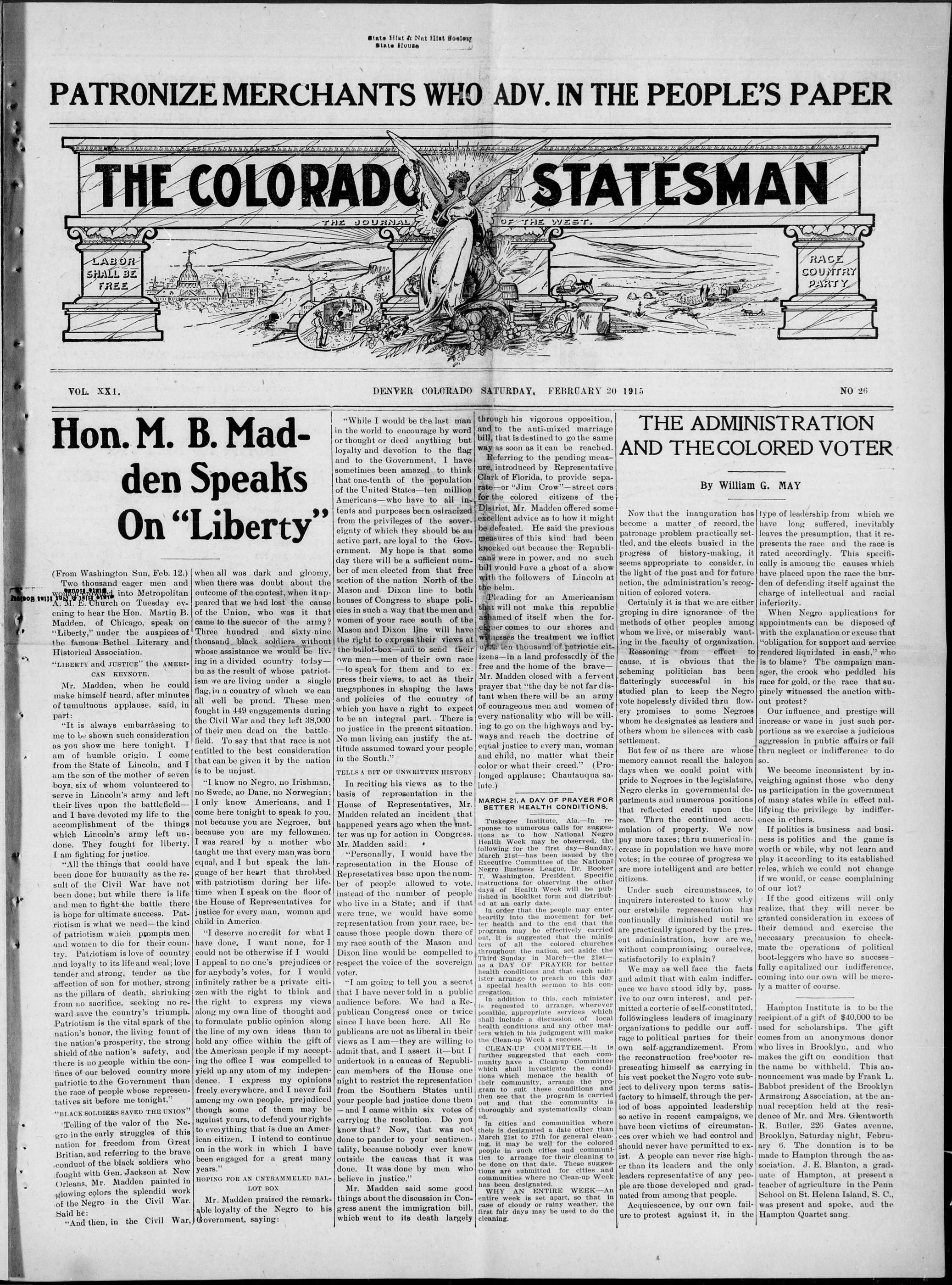
Page text (machine-generated)
PATRONIZE MERCHANTS WHO ADV. IN THE PEOPLE'S PAPER
THE COLORADO STATESMAN
THE JOURNAL OF THE WEST.
LABOR SHALL BE FREE
RACE COUNTRY PARTY
Hon. M. B. Maden Speaks On "Liberty"
Hon. M. H
den
On "
(From Washington Sun, Feb. 12.)
Two thousand eager men and women arrived into Metropolitan A. M. E. Church on Tuesday evening to hear the Hon. Martin B. Madden, of Chicago, speak on "Liberty," under the auspices of the famous Bethel Literary and Historical Association.
"LIBERTY and JUSTICE" the AMERICAN KEYNOTE.
Mr. Madden, when he could make himself heard, after minutes of tumultuous applause, said, in part:
"It is always embarrassing to me to be shown such consideration as you show me here tonight. I am of humble origin. I come from the State of Lincoln, and I am the son of the mother of seven boys, six of whom volunteered to serve in Lincoln's army and left their lives upon the battlefield—and I have devoted my life to the accomplishment of the things which Lincoln's army left undone. They fought for liberty. I am fighting for justice.
"All the things that could have been done for humanity as the result of the Civil War have not been done; but while there is life and men to fight the battle there is hope for ultimate success. Patriotism is what we need—the kind of patriotism which prompts men and women to die for their country. Patriotism is love of country and loyalty to its life and weal; love tender and strong, tender as the affection of son for mother, strong as the pillars of death, shrinking from no sacrifice, seeking no reward save the country's triumph. Patriotism is the vital spark of the nation's honor, the living fount of the nation's prosperity, the strong shield of the nation's safety, and there is no people within the confines of our beloved country more patriotic to the Government than the race of people whose representatives sit before me tonight."
Telling of the valor of the Negro in the early struggles of this nation for freedom from Great Britian, and referring to the brave conduct of the black soldiers who fought with Gen. Jackson at New Orleans, Mr. Madden painted in glowing colors the splendid work of the Negro in the Civil War. Said he:
```markdown
```
"And then, in the Civil War,
when all was dark and gloomy, when there was doubt about the outcome of the contest, when it appeared that we had lost the cause of the Union, who was it that came to the succor of the army? Three hundred and sixty nine thousand black soldiers without whose assistance we would be living in a divided country today—bu as the result of whose patriotism we are living under a single flag, in a country of which we can all well be proud. These men fought in 449 engagements during the Civil War and they left 38,000 of their men dead on the battlefield. To say that that race is not entitled to the best consideration that can be given it by the nation is to be unjust.
"I know no Negro, no Irishman, no Swede, ao Dane, no Norwegian; I only know Americans, and I come here tonight to speak to you, not because you are Negroes, but because you are my fellowmen. I was reared by a mother who taught me that every man was born equal, and I but speak the language of her heart that throbbed with patriotism during her lifetime when I speak on the floor of the House of Representatives for justice for every man, woman and child in America.
"I deserve no credit for what I have done. I want none, for I could not be otherwise if I would I appeal to no one's prejudices or for anybody's votes, for I would infinitely rather be a private citizen with the right to think and the right to express my views along my own line of thought and to formulate public opinion along the line of my own ideas than to hold any office within the gift of the American people if my accepting the office I was compelled to yield up any atom of my independence. I express my opinions freely everywhere, and I never fail among my own people, prejudiced though some of them may be against yours, to defend your rights to everything that is due an American citizen. I intend to continue on in the work in which I have been engaged for a great many years."
HOPING FOR AN UNTRAMMELED BALLOT BOX
Mr. Madden praised the remarkable loyalty of the Negro to his Government, saying:
DENVER COLORADO SATURDAY. FEBRUARY 20 1915
DENVER COLORADO SATURDAY. FEBRUARY 20 1915
State Hist & Nat Hist Bosley
State House
ANTS WHO
ADO
THE JOURNAL
DENVER COLORADO
"While I would be the last man in the world to encourage by word or thought or deed anything but loyalty and devotion to the flag and to the Government, I have sometimes been amazed to think that one-tenth of the population of the United States—ten million Americans—who have to all intents and purposes been ostracized from the privileges of the sovereignty of which they should be an active part, are loyal to the Government. My hope is that some day there will be a sufficient number of men elected from that free section of the nation North of the Mason and Dixon line to both houses of Congress to shape policies in such a way that the men and women of your race south of the Mason and Dixon line will have the right to express their views at the ballot-box—and to send their own men—men of their own race—to speak for them and to express their views, to act as their megaphones in shaping the laws and policies of the country of which you have a right to expect to be an integral part. There is no justice in the present situation. No man living can justify the attitude assumed toward your people in the South."
In reciting his views as to the basis of representation in the House of Representatives, Mr. Madden related an incident that happened years ago when the matter was up for action in Congress. Mr. Madden said:
"Personally, I would have the representation in the House of Representatives base upon the number of people allowed to vote, instead of the number of people who live in a State; and if that were true, we would have some representation from your race, because those people down there of my race south of the Mason and Dixon line would be compelled to respect the voice of the sovereign voter.
"I am going to tell you a secret that I have never told in a public audience before. We had a Republican Congress once or twice since I have been here. All Republicans are not as liberal in their views as I am—they are willing to admit that, and I assert it—but I undertook in a caucas of Republican members of the House one night to restrict the representation from the Southern States until your people had justice done them—and I came within six votes of carrying the resolution. Do you know that? Now, that was not done to pander to your sentimentality, because nobody ever knew outside the caucas that it was done. It was done by men who believe in justice."
Mr. Madden said some good things about the discussion in Congress anent the immigration bill, which went to its death largely
---
through his vigorous opposition, and to the anti-mixed marriage bill, that is destined to go the same way as soon as it can be reached. Referring to the pending measure, introduced by Representative Clark of Florida, to provide separate—or "Jim Crow"—street cars for the colored citizens of the District, Mr. Madden offered some excellent advice as to how it might be defeated. He said the previous measures of this kind had been knocked out because the Republicans were in power, and no such bill would have a ghost of a show with the followers of Lincoln at the helm.
Pleading for an Americanism that will not make this republic ashamed of itself when the foreigner comes to our shores and witnesses the treatment we inflict upon a ten thousand of patriotic citizens—in a land professedly of the free and the home of the brave—Mr. Madden closed with a fervent prayer that "the day be not far distant when there will be an army of courageous men and women of every nationality who will be willing to go on the highways and byways and reach the doctrine of equal justice to every man, woman and child, no matter what their color or what their creed." (Prolonged applause; Chautauqua salute.)
MARCH 21, A DAY OF PRAYER FOR BETTER HEALTH CONDITIONS.
Tuskegee Institute, Ala.—In response to numerous calls for suggestions as to how National Negro Health Week may be observed, the following for the first day—Sunday, March 21st—has been issued by the Executive Committee of the National Negro Business League, Dr. Booker T. Washington, President. Specific instructions for observing the other days of Health Week will be published in booklet form and distributed at an early date.
In order that the people may enter heartily into the movement for better health and to the end that the program may be effectively carried out, it is suggested that the ministers of all the colored churches throughout the nation, set aside the Third Sunday in March—the 21st—as a DAY OF PRAYER for better health conditions and that each minister arrange to preach on this day a special health sermon to his congregation.
In addition to this, each minister is requested to arrange, wherever possible, appropriate services which shall include a discussion of local health conditions and any other matters which in his judgment will make the Clean-up Week a success.
CLEAN-UP COMMITTEE—It is further suggested that each community have a Clean-up Committee which shall investigate the conditions which menace the health of their community, arrange the program to suit these conditions and then see that the program is carried out and that the community is thoroughly and systematically cleaned.
In cities and communities where their is designated a date other than March 21st to 27th for general cleaning, it may be well for the colored people in such cities and communities to arrange for their cleaning to be done on that date. These suggestions are submitted for cities and communities where no Clean-up Week has been designated.
WHY AN ENTIRE WEEK—An entire week is set apart, so that in case of cloudy or rainy weather, the first fair days may be used to do the cleaning.
THE ADMINISTRATION AND THE COLORED VOTER
By William G. MAY
Now that the inauguration has become a matter of record, the patronage problem practically settled, and the elects busied in the progress of history-making, it seems appropriate to consider, in the light of the past and for future action, the administration's recognition of colored voters. Certainly it is that we are either groping in dire ignorance of the methods of other peoples among whom we live, or miserably wanting in the faculty of organization. Reasoning from effect to cause, it is obvious that the scheming politician has been flatteringly successful in his studied plan to keep the Negro vote hopelessly divided thru flowery promises to some Negroes whom he designates as leaders and others whom he silences with cash settlement.
But few of us there are whose memory cannot recall the haleyon days when we could point with pride to Negroes in the legislature, Negro clerks in governmental departments and numerous positions that reflected credit upon the race. Thru the continued accumulation of property. We now pay more taxes; thru numerical increase in population we have more votes; in the course of progress we are more intelligent and are better citizens. Under such circumstances, to inquirers interested to know why our erstwhile representation has continually diminished until we are practically ignored by the present administration, how are we, without compromising ourselves, satisfactorily to explain?
We may as well face the facts and admit that with calm indifference we have stood idly by, passive to our own interest, and permitted a corterie of self-constituted, followingless leaders of imaginary organizations to peddle our suffrage to political parties for their own self-aggrandizement. From the reconstruction freebooter representing himself as carrying in his vest pocket the Negro vote subject to delivery upon terms satisfactory to himself, through the period of boss appointed leadership so active in recent campaigns, we have been victims of circumstances over which we had control and should never have permitted to exist. A people can never rise higher than its leaders and the only leaders representative of any people are those developed and graduated from among that people. Acquiescence, by our own failure to protest against it, in the
A
type of leadership from which we have long suffered, inevitably leaves the presumption, that it represents the race and the race is rated accordingly. This specifically is among the causes which have placed upon the race the burden of defending itself against the charge of intellectual and racial inferiority.
When Negro applications for appointments can be disposed of with the explanation or excuse that "obligation for support and service rendered liquidated in cash," who is to blame? The campaign manager, the crook who peddled his race for gold, or the race that supinely witnessed the auction without protest?
Our influence and prestige will increase or wane in just such portions as we exercise a judicious aggression in public affairs or fail thru neglect or indifference to do so.
We become inconsistent by inveighing against those who deny us participation in the government of many states while in effect nullifying the privilege by indifference in others. If politics is business and business is politics and the game is worth or while, why not learn and play it according to its established rules, which we could not change if we would, or cease complaining of our lot? If the good citizens will only realize, that they will never be granted consideration in excess of their demand and exercise the necessary precausion to checkmate the operations of political boot-leggers who have so successfully capitalized our indifference, coming into our own will be merely a matter of course.
Hampton Institute is to be the recipient of a gift of $40,000 to be used for scholarships. The gift comes from an anonymous donor who lives in Brooklyn, and who makes the gift on condition that the name be withheld. This announcement was made by Frank L. Babbot president of the Brooklyn Armstrong Association, at the annual reception held at the residence of Mr. and Mrs. Glentworth R. Butler, 226 Gates avenue, Brooklyn, Saturday night, February 6. The donation is to be made to Hampton through the association. J. E. Blanton, a graduate of Hampton, at present a teacher of agriculture in the Penn School on St. Helena Island, S. C., was present and spoke, and the Hampton Quartet sang.
NO 26
NEWS TO DATE IN PARAGRAPHS
CAUGHT FROM THE NETWORK OF WIRES ROUND ABOUT THE WORLD.
DURING THE PAST WEEK
RECORD OF IMPORTANT EVENT8
CONDENSED FOR BUSY
PEOPLE
Western Newspaper Union News Service.
ABOUT THE WAR.
Dispatches from Ambassadors Gerard at Berlin and Page at London announced Tuesday that both Germany and England will refuse the American shipping demands.
Chancellor Lloyd - George declares the war will cost the allies $10,000,000,000 during the current year, and that England can carry its share of expense for five years.
Refugees who have been expelled from Alsace-Lorraine declare that the Germans are making extraordinary preparations to resume the offensive in that region. More than 1,000,000 Germans are being assembled along the Rhine, according to the refugees reaching Paris.
The following announcement was made by the Overseas News Agency at Berlin: "Field Marshal von Hindenburg's third battle of the Mazurian Lakes will prove more disastrous to the Russians than the other two, from present indications. It is believed that 40,000 Russians were captured."
The air wing of the British navy made another massed attack on the German positions along the Belgian coast in an effort to destroy or damage the submarine base at Zeebrugge, the guns at Ostend and Middlekerke, and the aerodrome at Ghistelle. While the British airmen were dropping their bombs on the gun positions, the supply trains and barges and the trawlers used in mine laying and mine sweeping operations, eight Frenchmen attacked the Ghistelles areodrome, thus preventing the German airmen from making an attempt to cut off the British machines.
WESTERN.
Michigan Democrats pledged to President Wilson their support for renomination and re-election at their state convention at Lansing.
Fire, starting in the University Club kitchen on the fifth floor, almost destroyed the Board of Trade building in Omaha, causing a property loss of $100,000.
The Chicago municipal tuberculosis sanatorium, termed by experts the largest, finest and most comprehensively equipped in the world, has been dedicated.
Mrs. B. O. Coates, wife of a Pasadena, Cal., physician, who sued Jack Cudahy Dec. 1. for $30,000, declaring he had assaulted her and broken one of her ribs, died at Los Angeles.
The net profits of the Portland Gold Mining Company for the year 1914 was $590,594, according to the annual report of President Frank G. Peck, presented at the annual meeting in Cheyenne, Wyo.
The "cocktail one-step," the newest dance novelty, has been invented by Miss Claudia Dana, dancer at a Chicago restaurant, as an aid to digestion, to take the place of the conventional appetizer. "A good brisk dance before a meal is as effective and more fun than a cocktail," she says, "and better than an after dinner liqueur or a glass between courses."
WASHINGTON
The bill to bar products of child labor from interstate commerce was passed by the House by a vote of 232 to 44.
Members of the Senate itself may be dragged into the investigation of the lobby for and against the ship purchase bill.
The government ship purchase bill, as an amendment to the Weeks naval artillery bill, was passed by the House Wednesday by a vote of 215 to 121.
American attaches of the United States embassy in Mexico City, lately attached to the Brazillian legation, will leave Mexico City if all other diplomatic representatives depart.
Formal announcement of the candidacy of Mrs. William Cumming Story of New York, president general of the Daughters of the American Revolution, for a second term is made. The election will occur in April during the annual congress. Her only opponent is Mrs. George Guernsey, state regent of Kansas.
Cqunt Bernstorff, the German ambassador, presented to the state department a note from his government announcing that Germany stands ready to consider receding from its announced intention of attacking British merchantmen, if Great Britain will withdraw its efforts to prevent foodstuffs from going to Germany for the civilian population.
Memorial services for the dead of the battleship Maine were held in Arlington National cemetery. Patriotic organizations and United States troops, marines and bluejackets participated.
FOREIGN.
Seventeen Spaniards of means, expelled from Lorraine, in Baden, by the German authorities, arrived in Geneva. A large shipment of copper packed in casks which were labeled "sugar" and put aboard the steamship Carmen, was seized at Copenhagen. Helen, Baroness Abinger, widow of the third Baron Abinger, who was said to have been the first British peeress of American birth, died in London. Henry Van Dyke, the American minister at The Hague, turned over $5,000 to the Netherlands Red Cross Society on behalf of the American Red Cross. The Bundesrat at Berlin decided to appropriate all the domestic stocks of oats, with the exception of seed oats and the grain necessary for fodder for horses.
A Vienna Cabinet order forbids the use of barley after Feb. 19 for producing malt. The decree aims at securing the available supply of barley as a substitute for wheat.
Raoul Davidot, a French prisoner of war, returned to Germany from a visit to his home in France, where he was permitted to go, by order of Emperor William, to see his dying mother.
Guadalajara, second largest city in Mexico, fell into the hands of the Villa troops, according to a telegram received at El Paso, Texas. General Villa describes his victory as complete.
The reported expulsion of all foreigners from that part of upper Alsace still occupied by the Germans has been confirmed, and it is also stated that a complete evacuation by the civilian population has been commenced.
Two members of Sofia's aristocracy are reported to have been killed and ten others injured when a bomb was exploded at a masked ball attended by diplomats and representatives of the most exclusive society of the Bulgarian capital. Prince George of Serbia, who has been in Italy, recovering from wounds that have obliged him to use crutches, expressed the belief at Rome that the war would surely end in the triumph of the allies but admitted that this would require enormous sacrifices, especially or men.
SPORT.
The pari-mutuel bill amending the anti-gambling law so as to legalize betting on horse races under the pari-mutuel system, was passed by the Nevada Assembly, 38 to 12. It now goes to Governor Boyle for signature.
Thirty women bowlers of Minneapolis and St. Paul, composing six teams, staged a feature event at Minneapolis at the International Bowling Association's tournament and attracted record crowd of spectators. No unusual scores were made.
Mrs. Jackson Gouraud, formerly Miss Jennie Crocker, of San Francisco, denies her marriage to Prince Miskineff, which was officially reported in London last June. She is a noted horsewoman and is said to have the finest dog kennels on the coast.
Jack Johnson, the negro pugilist who fled to Europe after being sentenced to a year in the federal penitentiary for violation of the Mann act, will be extradited and returned to Chicago on a charge of conspiracy, according to a statement by Charles F. Clyne, United States district attorney.
GENERAL
The trial of Harry K. Thaw on an indictment charging him with conspiracy was set for March 1, instead of Feb. 23.
Mardi Gras Day, marking the end of the reign of Rex, king of the carnival of 1915, was observed at New Orleans with elaborate festivities.
More than 110,000 tons of food has been sent to Belgium up to Jan. 20 by the commission for relief in Belgium, according to its twelfth weekly report.
A message from Saltillo, seemingly confirmed by another message to the Carranza agency at San Antonio, Tex., says Saltillo has been taken by Gen, Euialio Guiterrez from the Villa forces.
News of the death at Nice, France, of Mrs. Ellen Mary McClellan, widow of Maj. Gen. Geo. B. McClellan, was received by her son, Geo. Brinton McClellan, former mayor of New York, Pneumonia was the immediate cause of her death.
After fasting sixty days, Louis Roth, a tailor at Palo Alto, Cal., was given a few spoonfuls of orange juice on advice of a physician and by persuasion of his wife. Gradually his rations will be increased. Roth was convinced that fasting would cure him of a digestive disorder.
District Attorney Perkins announced at New York that he had investigated and established as unfounded certain charges made against John A. Dix, former governor of New York and others, in connection with the pardon granted by Dix, when governor, to Albert T. Patrick, the slayer of William Marsh Rice.
That Federal Judge Alston G. Dayton of the northern district of West Virginia was prejudiced against labor unions was the burden of most of the testimony heard at Wheeling, W. Va., by the congressional sub-committee investigating charges against the jurist. An immediate embargo on the exportation of wheat as a preventative of further increase in the price of bread, is recommended to the federal government in the report of Mayor Mitchel's food committee of New York submitted by George W. Perkins, the chairman.
Western Newspaper Union News Service.
J. I. Hoffman, for thirty years a jeweler of Fort Collins, died of paralysis of the heart.
Louis Sacco, victim of the murdering frenzy of Paolo Rigo, was buried in Riverside cemetery in Denver.
Four separate contests all bearing on the recent Huerrano county elections, will be heard in the County Court at Walsenburg, Feb. 25.
Beekeepers from all over the United States arrived in Denver to be present at the first session of the National Beekeepers' convention.
Rumors of an impending change in the personnel of the Civil Service Commission have been current at the state house for the last week.
Lieut. Ernest John Munby of the Royal engineers, British army, who the dispatches from London stated was killed in action, was known to many Denver people.
A dog show will be the next undertaking in the aid of the Federated Charities of Denver. Cecil Cox is arranging the show, which will be held in the Auditorium, April 22, 23 and 24.
Every citizen of Colorado will be asked to aid in a publicity campaign to be carried on by letter for the purpose of advertising Colorado's scenic, climatic and business advantages.
A bill to put practically every state and city appointive officer and employe under civil service was introduced in the House of Representatives by Republican Floor Leader Sabin
Cutting and slashing of salaries of various city officials was a little game indulgegd in at a recent regular meeting of the city council of Telluride, $3,000 being cut from the yearly salaries of thirteen officials.
Three Mexicans, who gave their names as Pete Lopez, 28; Pedro Salto, 38; and Isaac Ortego, 31, are being held by the Pueblo police, charged with the theft of a horse, saddle and bridle from Tom Flynn.
"I left my husband and my home because I wanted to better my conditions," declared Mrs. Lucille Gerard, 25, when arrested in Denver with Earl L. Frisbee, wanted in Chicago on a charge of wife abandonment.
One of the principal questions to be taken up at the meeting of the board of governors of the International Dry Farming Congress will be that of incorporating the organization and changing the name in so doing.
At the first anniversary of the Denver Housewives' League, held at the Woman's Club, a plan was launched to boost Colorado made products by establishing a large evaporating plant for drying native fruits and berries.
A jury in Judge Butler's division of the District Court in Denver gave John A. McIntyre a verdict for $3,750 against Mr. and Mrs. Ben Kemper. McIntyre was knocked down by the Kemper automobile on the 10th of last May.
A reward of $200 for the arrest and conviction of the murderers of William Dick, merchant and mine owner of Walsenburg, was offered by Frank J. Hayes, international vice president of the United Mine Workers of America.
Reports from banks in various sections of Colorado, received by George T. Wells, published in bulletin form, indicate the most prosperous conditions Colorado has ever faced. Without exception the reports of these Colorado bankers are optimistic, both as to present conditions and the general outlook.
With a smile on her lips because she had been permitted to see her daughter, Mrs. Ida F. Mercer, convicted of killing her son-in-law, Carl Gregerson, last May, left the county jail in Denver to begin serving her life sentence in the penitentiary at Cañon City. Three others prisoners were sent from the jail to begin penitentiary sentences.
The death rate in Denver, computed from the City Bureau of Vital Statistics, shows a remarkable decrease during the last six years, dropping from 16.11 per 1,000 inhabitants in 1909 to 13.26 in 1914. If the number of deaths from tuberculosis contracted outside the state were subtracted from the total deaths, the rate would be lowered to 11.25.
March 1, 1915, is the day set on which everybody all over the state, no matter in what business or what occupation, is expected to write to everybody in every other state all about our own Colorado; all about the many attractive features in which Colorado excels—our clear atmosphere, sunny skies, our crops, mines, factories, livestock, healing springs, fishing, hunting, camping, matchless scenery, good roads, the new Rocky Mountain National park, which comprises 213,000 acres, and which is the most accessible of all the national parks.
Three hours after they announced their engagement Miss Ruby Bell Irion, Denver society girl, and Samuel Watson of Anaconda, Mont., were married by the Rev. Frank Bayley at the home of the bride's parents, Mr. and Mrs. W. H. Irion, in Denver.
That the bomb which killed three youthful anarchists and wrecked the tenement house in New York last fall was designed for killing John D. Rockefeller and his son, John D., Jr., is the opinion of Alexander Berkman, leader of New York anarchists, who is in Denver.
ATTACKS KILLED WIFE
IS CHARGE OF RUDY B. MEYERS AGAINST WALTER McDOWELL.
Woman's Husband Fires Five Shots Into Brain of Enemy, but Doctors Find Only One Wound.
Western Newspaper Union News Service.
Frederick, Colo.—Rudy B. Meyers, an employee of the Evans mine at Firestone, fired six shots from a revolver at Walter McDowell, a Brighton farmer, when they met in front of the Frederick drug store. His first shot brought McDowell to the ground, and then Meyers stood over him, with the revolver against his head and fired five shots more. A hurried examination revealed, only one wound in McDowell's head, but it is believed that five bullets entered at the same place. There is no hope for his recovery.
According to Meyers, McDowell called at the Meyers' home Feb. 3, in Meyers' absence, and attempted to assault Mrs. Meyers, a prepossessing young woman. She seized a butcher knife and drove him from the house, but a few minutes later collapsed and soon passed into convulsion that caused her death in the early morning.
Leaving her body in an undertaking establishment at Firestone, Meyers started out to find McDowell. When they met Meyers at once began shooting, without any warning, and continued until his revolver was empty.
"I have kiled a man and wish to give myself up. Who someone call an officer."
A woman stepped up to him. He handed his revolver to her and a few minutes later surrendered to Town Marshal Runyan.
McDowell, whose home is on a ranch near Brighton, is married and has two children. Recently he has been operating a hay baler near Firestone.
Suffragette Method Releases Girl, Pueblo. The hunger strike, employed by Jean Carre, pretty girl, who walked from Salt Lake City to Delta, 350 miles, and held here for investigation by local police after railroad men had bought her a ticket from Delta to Fort Worth, Texas, was a complete success. She was released after being in the city jail four days, during which time she refused both food and water. Thursday, threatened with a fine if she did not answer questions, she said she'd starve until released. When she finally was freed, the girl triumphed in a woman's way and proceeded to tell what the police wanted to know. She said she was driven to the walking trip by the persecutions of an undesired suitor, a friend of her father's, who followed her and her mother after her father's death, from Cleveland to Kansas City, and then to Salt Lake City. She feared to leave Salt Lake City on a train, lest he follow her, so she walked. Just to show there were no hard feelings, she recounted more of her adventures, later leaving for Fort Worth.
J. W. Hair Dies; Worth $500,000.
Denver.—James W. Hair, 72 years old, a wealthy coal operator and oil man, died at his home, 3006 East Colfax avenue, leaving legal tangles behind him which threaten to involve his large estate for many years to come. The property left by him is estimated at close to $500,000, but lawsuits started before his death and still pending in the courts here and at his former home in Pittsburg leave the question of title to his fortune undecided. The circumstances of Hair's life leave two separate families, each claiming the right to his name and estate. In his youth he married a girl 18 years of age, who bore him seven children. Twenty years ago he met another woman, Miss Rose C. Deahl, and left his wife for her. Of this union was born a son, James W. Hair, Jr., who is named as his chief heir in his will.
Six Troopers Plead Not Guilty.
Denver.—Despite the fact that the federal officials announced that each of the six members of Troop F, Fifth cavalry, arrested on the charge of robbing the Walsenburg postoffice of two packages of currency totaling $15,000 had made confessions, they entered pleas of not guilty when arraigned before Judge R. E. Lewis, on the advice of their attorney. The six soldiers have been in the county jail for several weeks. They appeared in court in full uniform.
Elkton to Pay $50,000 Dividend.
Colorado Springs.—A total of $50,000 will be paid in dividends by the Elkton Consolidated Mining & Milling Company Feb. 24, to stockholders of record.
Bread at the Centre of a Loaf.
Pueblo. The price of bread in Pueblo has been increased from 5c to $7\frac{1}{2}$ a loaf. Large loaves will sell for 15c. The former price was 10c.
Peterson Prohibition Bill Passed.
Denver.—The Colorado House of Representatives the day passed the Peterson prohibition bill with only the absolutely necessary provisions required by the wording of the constitutional amendment adopted last fall, permitting the sale of intoxicants for medicinal and sacramental purposes. Wholesale druggists and retail druggists, the only class of merchants permitted to handle liquors under the provisions of the original bill, were deprived of that right.
ERNEST HOWARD,
Carpenter, Job and Repair Work.
Coal, Wood and Express.
CLEANING, PRESSING, DYEING, REPAIRING, RELINING AND REMODELING.
The Market Company
Wholesale and Retail Staple and Fancy Groceries, Fish and Oysters. Hotels and Restaurants Our Specialty. Fresh and Cured
Eastern Corn Fed Meats
Fruits, Vegetables, Poultry and Game.
1638-39 Arapahoe Street Denver, Colorado
1728% Wazee St. Only one block from Union Depot Phone Main 8416. Denver, Colorado
That Is Just a Little Better Than the Kind You Thought Was Best
C. H. SHIRLEY, Pres. J. C. HAMPSON, Vice Pres PAUL J. SHIRLEY, Sec. and Treas.
Courteous Treatmet. Right Prices Leaders in Prescription
Paints, Oils and Glass.
Coal, Wood a
1021 21st Street.
You Have Tried the Rest
Now Try the Best
THE
Giant
FOR QUALITY
CLEANING, PRESSIN
ING, RELINING AN
WORK CALLED FOR
2549 Washington Avenue
PHONE MAIN 3028
JOHN K.
Meats, Fancy and
1864 CURTIS
Corner Nineteenth.
Phones Main
169,181,189,190
The Market
Wholesale and Retail Staple and
Oysters. Hotels and Res
Fresh and Cured
Eastern Corn
Fruits, Vegetables,
1633-39 Arapahoe Street
CHAS. HARRIS, Pres. J. M. JOHN
RAILROAD POOL
LUNCH ROOM IN
Billiards and
Pool
1728½ Wazee St. Only on
Phone Main 8416.
The Corner
Ice Cream
1115 WELTO
THE ICE
That Is Just a Littu
Kind You Thou
C. H. SHIRLEY, Pres.
PAUL J. SHIRLEY
THE ATLAS
Courteous Treatment
Leaders in Pr
Store No. 1.
2701 WELTON ST.
Main 895 875
Glazing Done
and Express.
Phone Champa 752.
Our Prices Reasonable
Satisfaction Guaranteed
CLEANERS
AND
TAILORS
McCAIN & RICHARDS, PROPS
Phone Main 7376
ING, DYEING, REPAIR-
AND REMODELING.
FOR AND DELIVERED
Denver, Colorado
RES. PHONE GALLUP 942
. RETTIG
and Staple Groceries
TIS STREET
Denver, Cola.
C. E. Smith, Manager Res. Phone South 1608
et Company
and Fancy Groceries, Fish and
Restaurants Our Specialty.
Barn Fed Meats
es, Poultry and Game.
Denver, Colorado
OHNS, Treas. SEIB MILLER, Sec.
ORTERS' CLUB
IN CONNECTION
Free Check
Room
one block from Union Depot
Denver, Colorado
rbett
ream Co.
TON STREET
CREAM
Little Better Than the
nought Was Best
J. C. HAMPSON, Vice Pres
LEY, Sec. and Treas.
AS DRUG CO.
Hmet. Right Prices
Prescription
Store No. 2.
26TH AND WELTON
Main 4953-4956
AFRO-AMERICAN CULLINGS
The collar and cross of a knight commander of the Humane Order of African Redemption, conferred by the Liberian government, was presented at Washington to Dr. H. L. E. Johnson, president of the American Colonization society, founder af the Negro republic on the west coast of Africa. Dr. Ernest Lyon, consul general of Liberia in the United States, made the presentation. Liberia has conferred this decoration on several crowned heads and some distinguished statesmen. It consists of a heavy gold six-pointed star, attached to a neckband of blue and white silk. On one side of the star is a medallion showing a ship in enamel, surrounded by the legend, "The love of liberty brought us here." On the reverse, on a medallion, are shown two Africans kneeling at the foot of a cross.
Doctor Johnson was re-elected president of the American Colonization society at the annual meeting. Henry L. West was re-elected vice-president and Paul Sleman secretary-treasurer. The directors chosen were also by reelection, consisting of Milton E. Alles, J. Henry Small, James B. Reynolds and Charles E. Howe.
The president read his annual report, recommending assertion of sovereignty and property rights in Liberia, with prospects to recover possession of territory alienated by the republic to Great Britain and France. A commission was authorized to investigate.
The report of the secretary-treasurer was accompanied by the report of a public actuary. Walker H. Waker, resident agent of the corporation of Liberia, who is also secretary to President Howard, in a report advocated increase of the pay of the teacher of the Graham school from $100 to $150 a year; the purchase of uniform school books, and presented a small expense account. Favorable 'action was taken. Announcement was made that, subject to friendly litigation, the organization has prospect of enjoying a $1,000 endowment left by the will of John R. Peters, who died in 1858, and whose estate is now being settled.
President Johnson, in his report, called attention to the attitude of Liberia in declaring neutrality in the present European war. It was stated that a foreign wireless station set up on Liberian soil had been definitely sealed for the period of the conflict.
Rachel Howard, an aged colored woman, living near Gaithersburg, Md., is the plaintiff in an interesting suit filed in the circuit court against Herman C. Briggs, a young farmer of Gaithersburg district. The suit seeks to have carried out the wishes of Mrs. Mary J. Briggs, mother of the defendant, expressed in her will, which provides that "it is my desire and wish that my son, Herman C. Briggs, take good care of Rachel Howard during her life for her faithful services rendered during the time she lived with me."
The defendant inherited his mother's estate, the total value of which was about $60,000. Until a year ago the colored woman was provided for, but since then the defendant has, it is charged, refused to care for her.
The bill represents that the defendant has disposed of all the property inherited by him, excepting a portion of a 400-acre farm near Gaithersburg, and that he is fast divesting himself of what remains.
Desiring to contribute their share to the fund Washington is raising for the relief of the Belgian sufferers, thousands of colored people of the district assembled in Convention hall, where a benefit entertainment, consisting of a big ball and feast, was given by a committee of colored citizens who are co-operating with the Washington Belgian relief committee.
Several weeks ago a delegation of prominent colored men of the city, headed by Leon S. Wormley, informed Mrs. John A. Logan, chairman of the relief committee, of the desire of the colored people to assist in the relief work, and asked if the committee would lend its support to a movement among the colored people for a joint benefit entertainment. Mrs. Logan assured them that any sum they might raise would be most welcome, and offered to co-operate with them in every way possible. Committees were immediately appointed, and from the first the success of the movement was assured.
A gigantic gas chandelier in Atlanta sheds a glow of more than 10,000-candle power from 15 powerful lamps.
A two-year-old plantation of Doug las fir on the Oregon national forest shows 94 per cent of the trees living
```markdown
```
China's new mines are exporting above five tons of tungsten each month to Japan, at about $400 a ton.
Cuba is to seek additional American markets for sugar, tobacco leaf and cigars, bee products and hides.
A paper drinking cup that is unfolded by the weight of water flowing into it has been invented.
The Rev. Harry G. Hill, pastor of the People's church of Indianapolis, was the speaker for the men's "monster meeting" at the colored Y. M. C. A. building. Mr. Hill has previously addressed the men's meetings. A feature of the meeting was the special music by Theodore Cable, violinist. Mr. Cable was violinist in the Harvard orchestra while a student in the university.
All the departments of the association are doing efficient work. The special rate for the night course, which was made recently, has added several new names to the association roll. Classes are offered in the fundamentals and special courses in barbering and mechanics. Requests are being considered for a class in mechanical drafting. Special emphasis is placed on the automobile school, which has been one of the most popular departments of the association nearly two years. The Bible study classes continue to attract a large number of men. A three-year course is offered free. The Sunday school lesson work is a feature.
Negro folk songs were presented about ten years ago by one of the influential colored churches at Indianapolis and were well received by a large audience of white and colored persons. Following this effort a number of churches featured the Negro music with varying degrees of success. Within the last ten years, however, few attempts have been made to revive folklore songs.
The management of the Y. M. C. A. feels that some organization of the colored people should make an effort to preserve this form of Negro music and believes that it is peculiarly fitting for the Y. M. C. A. to do so, because it is made up of the representatives of all organizations and churches.
Bob Holmes, aged one hundred and sixteen years, a Negro pensioner of Harris county, and formerly a slave on a Texas plantation, will be the first inmate of a home for aged former slaves that was inaugurated on the outskirts of Houston Heights by John H. Grant, a Negro residing at 1522 Columbia street.
After conferring with Mayor Marmion of Houston Heights relative to moving Holmes to Houston Heights, Grant announced that the new institution will use temporarily a rent house belonging to him at 1518 Columbia street. Two women, also former slaves, will also be moved at once into the home. One of these is Martha Anton and the mother of Anna Briton, both said to be more than eighty years of age.
The home for aged ex-slaves is an outgrowth of a New Year's dinner given about forty aged Negroes January 1 this year by John Grant. Following the dinner a meeting was held at one of the local Negro churches and an organization was formed for the purpose of raising funds and maintaining a home of this kind. Only aged ex-slaves who are without means of support will be cared for. Among the means that will be used for providing funds will be the sale of enlarged portraits of the beneficiaries, framed for hanging in the Negro churches of Harris county.—Baltimore American.
In the province of Shantung, China, is a population of 30,000,000 on an area of one-third the size of California.
In the matter of their treatment in Sunday schools Negroes have no civil rights. This was the ruling of Judge W. S. McClenahan in the district court at Brainerd, Minn. Mary C. Marshall, a Negress, sixteen years old, had brought suit against the officers of a Sunday school at Aitkin, Minn., alleging she had been discriminated against while attending religious services, being forced to sit apart from the white members. "No legislative body," Judge McClenahan said. "ever has specifically included churches or religious societies in the so-called civil rights act. For courts to undertake to dictate how they shall conduct their affairs would meet with just resentment and would be of doubtful legality on constitutional grounds."
The town of Simla, India, is built on the side of a steep hill, and the roof of one house is often on a level with the foundation of one on the next terrace.
"Queen Anne's fan" was the polite name for the action which consists of putting one's thumb to the nose and wiggling the four fingers in derision.
Jamaica annually furnishes from eight million to nine million bunches of bananas to the United States.
The athletes of ancient Greece trained on new cheese, dried figs, grain, milk and warm water.
A machine has been invented for beating carpet thoroughly as it is stretched upon the ground.
A telegraph cable for use between New York and Colon is being made that will cost $1,500,000.
SINK TWO SHIPS EVE OF BLOCKADE
BRITAIN STANDS FIRM IN REFUSAL TO OPEN SEAS FOR FOOD FOR GERMANY.
CREWS OF SHIPS ESCAPE
BERLIN CELEBRATES CAPTURE OF 50,000 RUSSIANS; FRENCH CLAIM VICTORIES.
Western Newspaper Union News Service.
London, Feb. 18.—At the stroke of midnight the waters surrounding the coasts of the United Kingdom become, so far as lies within the power of Germany to make them, a war zone which all vessels neutral or otherwise will penetrate at their peril.
Some of the services across the channel probably will be curtailed, but a majority of the neutral shipping lines will accept the risk and continue their sailings. The names and nationality of vessels and the flags of their nationality will be painted on their sides in the hope that German submarines will not sink them by mistake.
England's announcement of the details of her proposed retaliatory policy, by which she plans to shut off the German food supply from the outside, is expected momentarily, and apparently there is not the slightest prospect that this country will accept the German proposal to call off the blockade if England will relax naval pressure on shipping.
It is not expected that there will be any widespread activity by the German submarines, but the developments regarding neutral ships should bring to a head one of the most interesting and threatening situations of the war.
Two vessels of the allies, one British and one French, were sunk by German submarines as a preliminary to the submarine blockade. They were the British steam collier Dulwich and the French steamer Ville de Lille.
The Dulwich, bound from Hull to Rouen, was torpedoed twenty miles northwest of Cape de la Heve at 6 o'clock Tuesday night. The torpedo struck the middle starboard side. As the crew took to the boats, the submarine which torpedoed the ship was seen speeding away. The Dulwich sank in twenty minutes. Twenty-two members of the crew of thirty-one men were picked up by the French destroyer Arquebuse and brought to Havre. Seven others rowed to Fe camp. The fate of the other two is unknown. The seven seamen from the Dulwich reached Fecamp half-frozen and exhausted, about 11 o'clock last night. They had labored at the oars for twenty-eight hours on a stormy sea. They have been taken to the English hospital and it is hoped that all will recover.
Berlin is again celebrating the success of Field Marshal von Hindenburg as further details of the East Prussian operations are received. It is of ficially claimed in Berlin that 50,000 Russian prisoners were taken, while all dispatches agree that the Russians still are being pressed further east ward, fighting a rear-guard action, in an endeavor to prevent the Germans from surrounding their wings.
In the Carpathians the fighting is yet to reach a decision. The western end and the center of the Russian line is holding, notwithstanding repeated and violent attacks, but in Bukowina the Austrians have pressed on to within twelve miles of Czernowitz.
French aviators have dropped bombs on the railway station at Freiburg, Baden.
Germany's Note Presented.
Washington.—The official text of Germany's note, presented by Count Bernstorff to the United States, proposing that food cargoes be distributed under supervision of American consular officers and urging the Washington government to contend for the right to ship foodstuffs to non-combatants, was made public here by the State Department.
Turkey Declared War to Save Empire.
Constantinople, — "Turkey declared war without being urged by Germany or impelled by any other influences save those of the empire," said Talaat Bey in a statement made in reply to questions concerning the political and military situation in his country.
Fruit Jobbers to Meet in Memphis. Los Angeles.—Memphis, Tenn., was chosen for the 1916 convention of the Western Fruit Jobbers' Association. No date was set.
Boy Shoots Father for Beating Brother
Boy Ghost Father for Beating Brother
Glenrock, Wyo.—"If you strike Mote again, I'll blow your head off," cried Dewey Mortimore, son of A. S. Mortimore, a wealthy ranchman living near here, as the parent was beating Dewey's oldest brother. The father did not heed his son's warning, and continuing to beat the boy, Dewey raised a 30:30 rifle and put a bullet into his father's head.
Washington. — President Wilson nominated Jerry A. Ferris to be postmaster of Golden.
BOARD OF IMMIGRATION
TO GATHER STATISTICS ON MINING AND AGRICULTURE.
Bill Introduced in Legislature Appropriating $50,000.00 to Advertise Colorado's Resources and Advantages.
Western Newspaper Union News Service
Denver.—A bill has been introduced in the House and the Senate appropriating $50,000 for the Board of Immigration to be used for the purpose of gathering statistics on the agricultural, mining and industrial production of each county in the state and to advertise to settlers, tourists and investors the advantages and resources of Colorado for the next two years. This bill has the endorsement of the Colorado Association of Commercial Executives and the Colorado State Chamber of Commerce, both of which organizations have agreed with the governor to give their unanimous support and assistance to make the Board of Immigration an investment for the State of Colorado, rather than an expense.
Every year for ten years after the Franco-Prussian war in 1870, over 250,000 Germans emigrated to this country. The same has been true regarding emigration from European countries ever since the Napoleonic wars. One year it reached as high as 460,000. If we are not ready with a live immigration board to secure our share of the peace-loving farmers and citizens of Europe when the present war is over they will settle in all of the rest of the western states and Colorado will be left out in the cold.
Arizona, New Mexico, Texas, Wyoming, Montana, Idaho and Utah each have an active board of immigration with an appjpropriation sufficient to carry on the work of securing settlers. The result is that during the past five years the population of these states have all increased in a much larger proportion than that of Colorado. They are securing the farmers and sons of farmers from the corn belt states. If Colorado had an active board of immigration, with the support of all sections of the state, to invite them, we could get 5,000 to 10,000 of these farmers every year, who know how to farm and have money to farm with.
If the population of Colorado, outside of the three largest towns, could be doubled in the next ten years, Colorado would be one of the most prosperous states in the Union.
To Pay State Capitol Debt.
Denver.—The last dollar of indebtedness on Colorado's state capitol will be wiped out in 1915, just twenty years after the building was first occupied. As a step in this direction, a bill was introduced in the Legislature providing for legislative permission for the Board of Capitol Managers to pay into the state school fund $115,000, the balance of the funds borrowed nineteen years ago. The transaction will also clear up the debt of the capitol managers to the internal improvement fund, and will terminate payments aggregating $2,704,875.80, the original cost of the building, together with 4 per cent interest for nineteen years.
Senate Passes Winbourn's Bill.
Denver.—Senator R. E. Winbourn's bill, providing penalties of fines from $10 to $100 and imprisonment for "fake" advertising, was passed on third reading, as was another measure by the senator to change the manner of election of city councilmen in cities of the second class so that always half of the members of the councils will be old members familiar with the administration of city affairs.
Farm Plan for Penitentiary.
Denver. Under the plan of Warden Thomas Tynan and the administration, convicts from the penitentiary would be worked upon the state farm much as they are on the state roads at present, and the products of the farm would be placed on the market in competition with the agriculturists of the state. The moneys received would be expected to aid materially in making the state penal institution self supporting.
Plan to Slash $300,000 From Budget.
Denver.—A $300,000 reduction in ap propriations, based on the aggregate amounts appropriated by the last Legislature, is the plan which Governor Carlson and those working with him will attempt to put through in connection with the appropriation program of the present Assembly.
New Bill to Stop Secret Marriages.
Denver.—No marriage license shall be issued until publication five days before the ceremony; also common-law marriages shall hereafter be null and void. These are two drastic provisions in a bill introduced in the House by Scott of Logan and Mrs. Heartz of Denver.
Hawkins Succeeds Montgomery.
Denver.—Attorney General Farrer accepted the resignation of Norton Montgomery, for two years assistant attorney general, and appointed Clarence M. Hawkins of Colorado Springs to succeed him. Hawkins has been connected with the attorney general's office about a week, his services being secured when it became evident that Assistant Attorney General Frank C. West will be required to spend several months in southern Colorado prosecuting cases growing out of the industrial troubles there.
The
Curtis
Park
Floral
Company
FLORAL DESIGNS PUT UP WHILE
YOU WAIT
CHOICE PLANTS AND CUT FLOWERS CONSTANTLY
ON HAND
GREENHOUSES: Thirty-Fourth and Curtis Streets
TELEPHONE, MAIN 1511 DENVER, COLO
When You Want
When You Want
The Heads, Feet, Tails Snouts, Neckbones or Chiterlings or any other part of the hog except the squeal go to
East's Market
The Chambers
Twentieth
Is the p
DRUGS, CHEMICALS
WE SERVE
Prescriptions
Phone us and we will deliver
JAMES E. T.
PHONE
THE ZOBE
SAMPL
1004 Nineteenth S
The Champa Pharmacy
1004 Nineteenth Street, Corner of Curtis
FINE WINES, LIQUORS AND CIGARS COORS' CELEBRATED BEER ON TAP
The WARD AUCTION COMPANY
The
WARD AUCTION
COMPANY
Sales Daily at 2 p.m. Office Fur-
niture a Specialty.
PRIVATE SALES AT ALL TIMES
HAVE MOVED TO—
1723-39 GLENARM ST.
PHONE MAIN 1675.
TES AT ALL TIMES
ED TO—
BILENARM ST.
PHONE MAIN 1675.
Miss M. C.
Hair Dressing
```markdown
```
2300-6 Larimer Street
DENVER
Pharmacy
and Champa,
to get your
PATENT MEDICINES
DRINKS.
Our Specialty.
the goods to all parts of the city.
IRALL, PROPR.
MAIN 2425.
BROTHERS'
E ROOM
Street, Corner of Curtis
J. H. BIGGINS
Furniture Repairing and Upholstering. All work Cash.
PHONE YORK 7837
1417 East 24th Ave Denver
Miss M. Cowden
Hair Dressing Parlor
Shampoo, cutting and curling. Scalp treatment, hair tonics, hair straightening, manicuring. Stage wigs for rent; theatrical use and masquerades. Goods delivered out of the city. All shades of hair matched by sending sample of hair; also combings made up.
Cheapest Switches 50 Cents
1219 21st St. Denver, Colo.
Phone Main 1461
COLORADO
THE COLORADO STATESMAN
JOS. D. D. RIVERS.....Proprietor
1824 Curtis Street, Room 25.
Phone Main 7417.
SUBSCRIPTION RATES:
One Year ..... $2.00
Six Months ..... 1.00
Three Months ..... 60
PAYABLE IN ADVANCE.
Entered as second-class matter at the postoffice in the city of Denver, Colorado.
Display advertising, 50 cents per inch. An inch contains twelve agate lines.
Reading notices, ten lines or less, 10 cents per line. Each additional line over ten lines, 5 cents per line.
No discounts allowed on less than three months' contract. Cash must accompany all orders from parties unknown to us. Further particulars on application.
It occasionally happens that papers sent to subscribers are lost or stolen. In case you do not receive any number when due, inform us by postal card and we will cheerfully forward a duplicate of the missing number.
Remittances should be made by Express Money Order, Postoffice Money Order, Registered Letter or Bank Draft. Postage stamps will be received the same as cash for the fractional part of a dollar. Only 1-cent and 2-cent stamps taken.
Communications to receive attention must be newsy, upon important subjects, plainly written only upon one side of the paper; must reach us Tuesdays, if possible, anyway, not later than Wednesdays, and bear the signature of the author. No manuscript returned, unless stamps are sent for postage.
All communications of a personating nature that are not complimentary will be withheld from the columns of this paper.
BUTTON AND LONGFELLOW'S BEST
birth of birthdays of men of nation,
Lincoln, George Washington, Fre-
cational acumen were born during,
and anniversaries are kept fr-
of the public. But are the men
of fellowship, the scholar, teacher and
will be the anniversary of he
city and among teachers, so
circles the poet, Longfellow, Am-
pe remembered. What would A-
dria, Hiawatha, Voices of the Nite-
last but not least his poems o-
part of the Pilgrim North and
in the war and freedom for the
Longfellow was born at Port-
lous Professor of Modern Languages;
1840. His productions have be-
tween Swedish and he is world k
pet is more beloved by the sch-
han established and fixed day
fully sacred to the memory of
y." The life, service, and char-
erishable memory in the hearts
saved and wrought in the forma-
do with the laying of the found
cornerstone of its greatness. How
nation's marvelous progress a-
ncess of purpose and nobleness
neverend in the affection and m
February 22nd but deepens to
the hearts of the people, so
decreasing, but grows and blossom
the United States has set and
is exalted office to pattern by
peat the hackneyed quotation, "The
hearts of his countrymen." Mr
receives his homage of the nation
WASHINGTON AND LONGFELLOW'S BIRTHDAY
February is a month of birthdays of men of national and international reputation. Abraham Lincoln, George Washington, Frederick Douglass, men of statecraft and political acumen were born during this month of February and their names and anniversaries are kept fresh and green in the thought and memory of the public. But ere the month closes a man of letters, Henry W. Longfellow, the scholar, teacher and poet comes into public view. February 27th will be the anniversary of his birth and in nearly every public school in the city and among teachers, scholars and in various literary societies and circles the poet, Longfellow, America's true child and sweetest singer, will be remembered. What would American literature be without Miles Standish, Hiawatha, Voices of the Night, Excelsior, Psalms of Life, Evangeline and last but not least his poems on American Slavery, that mellowed the heart of the Pilgrim North and started the fires of Abolition that resulted in the war and freedom for the slaves.
Henry Wadsworth Longfellow was born at Portland, Maine, February 27, 1807. In 1835 was Professor of Modern Languages at Harvard and first appeared as a poet in 1840. His productions have been translated in Spanish, Danish, German and Swedish and he is world known in Classic Literature. Probably no poet is more beloved by the school boy and girl than Longfellow.
February 22nd is an established and fixed day in the United States and is held perpetually sacred to the memory of George Washington, "Father of his Country." The life, service, and character of Washington will forever live in imperishable memory in the hearts of a grateful posterity. George Washington lived and wrought in the formative period of the nation's life. He had to do with the laying of the foundations of the Republic and establishing the cornerstone of its greatness. How well he did his work is shown today by the nation's marvelous progress and development. His purity of life, unselfishness of purpose and nobleness of character has made his name loved and reverend in the affection and memory of his countrymen. Each recurring February 22nd but deepens the veneration and increases the respect in the hearts of the people, so that his memory and greatness instead of decreasing, but grows and blossoms from year to year. The first President of the United States has set an illustrious example for all others who fill this exalted office to pattern by. It is no idle thought therefore when we repeat the hackneyed quotation, "First in war, first in peace and first in the hearts of his countrymen." Mt. Vernon, his resting place, is sacred and receives his homage of the nation.
RACE PREJUDICE.
the delegation of colored men c
cent on the subject of race prej
to think soberly, for there is
the surface, and besides this th
people themselves. There are
"The incident of the delegation of colored men calling on the president produced much comment on the subject of race prejudice. It is a subject upon which it is well to think soberly, for there is not as much race prejudice as appears on the surface, and besides this there is much prejudice among the colored people themselves. There are many Negroes who if they are fortunate enough to get in possession of a house and lot, whether paid or not, will scorn and almost treat with contempt every Negro that has not a similar piece of property, and there are many others who will not socially recognize any dark Negroes unless he owns property and still many others that if they can get to associate with white people a little will not associate with any Negro unless it be those that are nearly white. Then there are not a few who hate every Negro that has accumulated anything and call them "Big four hundred." There are also the little, narrow class of prejudiced Negroes who get bigger than the president's wife if they can get a silk dress or a tailor made outfit. Then there is the church prejudiced class who do not care a single straw about you unless you belong to their church. In nearly all of these cases the prejudice is marked, and in some tinged with a bitter contempt. Is this race prejudice? If not, what is it? And if it is, would it not be well to weed some of this out from among ourselves before rising to denounce the president of the United States? There is also another class, the business Negro, who has common sense enough to know that whenever he undertakes to mix Negroes and white people that he must either pick his classes or close his business.
White men do not have to shave in the same chair with Negroes and many of them will not do it, not as a matter of prejudice, for these same men are very friendly to the Negro and like the Negro barber or they would not patronize him. It is not prejudice in the barber nor his customer. It is custom, based on past training. There are many white people, especially Southerners, who would rather eat the Negro's cooking, and yet there are few things that go more against the grain of the Southern man than to sit down to the table with a Negro. There are two or three causes for all this. So far as the white man is concerned it is because of past conditions and training with most of them, and not prejudice. And here is a statement which we dislike to make, and only do so because it is a cold fact, that is this: If the white people of this country had not and did not show themselves to be better friends to the Negro than the Negroes are to each other, then it would be in order for the Negroes to yield up the ghost. For in nine cases out of every ten, the thing that we call prejudice among Negroes toward each other is based upon actual experiences. Many Negroes will treat you so mean and low that unless you are an unusually strong person they will make you almost hate your own race, and the more you do for them the worse they will treat you.
We can do much more for our own good by overcoming our defects as fast as we can, and helping each other in every honorable way that we can, and cease this abuse of the president of the United States and of other white men indiscriminately. Abuse is a rather poor practice that benefits no one any way."—Kansas City Herald, Feb. 13, 1915.
heir closed sleeping quarters, develop diseases formerly unknown. Tuberculosis is rapidly spreading as airtight houses become more common. Air—free, untaxed, unbottled—is fought against as if so much poison. Since humans have so degenerated that they swathe themselves in multitudinous wrappings and consider bare legs or arms highly indecent, why not institute pens where the weakened, diseased and distorted get the blessed sun's rays?
After we become anemic it is common to visit some "nature cure" resort and allow air, water and sun to do their worst. The invariable result of this simple treatment is restored health.
If private air gardens can perform such miracles why not erect public places where people may follow nature-cure methods?
In Germany every hamlet affords public air gardens, where the people may revel in air and sunshine in the nude. Sweden, too, has public baths for both sexes, with air and sunshine.
In America bathing resorts are patronized, but distorted ideas of decency make people swathe themselves in gay rags. Much virtue of the bathing, fresh air and sunshine is lost by so covering the body.
By no means should we bathe nude on our beaches, but municipal effort should institute public parks where water, sun and air might be furnished in secluded sections. Such privileges would mean an abolishment of many hospitals, the relief of many overworked physicians and nurses and lessen the number of prison guests. What would it not mean as a sociological transformation?
the girls learning sewing, mending, housekeeping, music, art, etc., and never appearing on the streets at night alone. The main idea fifty years ago was steady application, thrift and industry.
Alas, the change! The average child of today is placed forward as something "cute," to be played with and laughed at. I am not saying that America has no well-mannered people, because there are thousands upon thousands of them, and well educated, too, but today most children have no respect for their parents or anyone else.
The way some parents are bringing up their children is a disgrace. The girls at twelve years of age go at random on the streets, and it is "cute" to draw attention and be seen; it is "cute" and "smart" to have some man, old enough to be their father, flirt with them.
It is no more respectable to do these things today than it was fifty years ago. The only difference is that fifty years ago the mother was in the home, planning for her children's education and training. Today she is at the club. Today the average woman is dressed in a "hand-me-down" suit of clothing. Fifty years ago the women made their own clothes, and good ones.
Instead of staying at home, as their mothers did fifty years ago, women of today seek the society that holds card parties seven days a week. How can we expect many American girls to be good housekeepers when they have never seen good housekeeping?
raphy of John Stuart Mill: "I do not believe that boys can be induced to apply themselves with vigor, and what is so much more difficult, perseverance, to dry and irksome studies by the sole force of persuasion and soft words. Much must be done and must be learnt by children for which rigid discipline and known liability to punishment are indispensable as means. It is no doubt a very laudable effort in modern teaching to render as much as possible of what the young are required to learn easy and interesting to them. But when this principle is pushed to the length of not requiring them to learn anything but what has been made easy and interesting, one of the chief objects of education has been sacrificed. I rejoice in the decline of the old brutal and tyrannical system of teaching, which, however, did succeed in enforcing habits of application, but the new, as it seems to me, is training up a race of men who will be incapable of doing anything that is disagreeable to them."
If education is "not for the school, but for life," then these words of Mill are worthy of serious meditation by those educators whose theory is that a child is best developed along the lines of least resistance.
Life is not carried along on flowery beds of ease; it requires a Spartan spirit, self-denial and a certain hardness. Is not the spirit of lawlessness that is abroad in the land due to a certain extent to defective educational deals?
To do things the quickest and best way. In order to get efficiency we must be fit for the work we are to do. If not, we must find what we are fit for. The only trouble about this method is that we find ourselves when it is too late.
In the schools pupils ought to be studied by vocational experts to find out what they are fitted for. This is done in the schools of Switzerland. If a man works at a trade or profession for which he is fitted he can do vastly more work than if he worked at a position for which he is not fitted. Consequently the concern for which he works can sell its goods cheaper and widen business.
No investments pay such big dividends as putting workmen into their right places. This is one of the ways to solve the unemployment question.
The wage question is another which is in the balance. The trouble with most people is that they ask too much of their employees. Common sense suggests that the lower the wages the lower the people's buying power, and that, consequently, business will be the loser. Give the working people a fair wage, keep things at a fair and just price; then we can put the unemployment question in its grave with a big tombstone on it.
Many Women of Today Are Derelict By Mrs. George Young, Escanaba, Mich.
the girls learning sewing, mending, housekeeping appearing on the streets at night alone ago was steady application, thrift and inducement. Alas, the change! The average child of something "cute," to be played with and laugh America has no well-mannered people, because thousands of them, and well educated, too, no respect for their parents or anyone else. The way some parents are bringing up The girls at twelve years of age go at rank "cute" to draw attention and be seen; it is some man, old enough to be their father, flirt. It is no more respectable to do these two years ago. The only difference is that fifty the home, planning for her children's education is at the club. Today the average woman is suit of clothing. Fifty years ago the women good ones. Instead of staying at home, as their women of today seek the society that holds on. How can we expect many American girls to they have never seen good housekeeping?
Our Faulty Systems of Training Children By E. W. STAHL, Waukegan, Ill.
raphy of John Stuart Mill: "I do not believe to apply themselves with vigor, and what is verance, to dry and irksome studies by the soft words. Much must be done and must be rigid discipline and known liability to pur means. It is no doubt a very laudable effort as much as possible of what the young are resting to them. But when this principle is requiring them to learn anything but what is esting, one of the chief objects of education in the decline of the old brutal and tyrannical however, did succeed in enforcing habits of it seems to me, is training up a race of doing anything that is disagreeable to them.
If education is "not for the school, but Mill are worthy of serious meditation by is that a child is best developed along the line.
Life is not carried along on flowery beds spirit, self-denial and a certain hardness. I that is abroad in the land due to a certain deals?
Putting Workmen Into Their Right Places
By C. E. NELSON, Syracuse, N. Y.
To do things the quickest and best way. must be fit for the work we are to do. If n fit for. The only trouble about this method it is too late.
In the schools pupils ought to be stu find out what they are fitted for. This is d land. If a man works at a trade or profes can do vastly more work than if he worked not fitted. Consequently the concern for wh
Since the white man came to America the hardy Indians have degenerated through having partial civilization, houses and closed living forced upon them. Highly bred cattle, with
is formerly unknown. Tubercuses become more common against as if so much poison. If they swathe themselves in legs or arms highly indecent, diseased and distorted get the to visit some "nature cure" their worst. The invariable health. miracles why not erect public methods? air gardens, where the people Sweden, too, has public baths sized, but distorted ideas of any rags. Much virtue of the covering the body. Our beaches, but municipaler, sun and air might be fur- would mean an abolishment worked physicians and nurses that would it not mean as a
Do the-average American girls and children compare with those of fifty years ago? The majority of young people fifty years ago were found around their own homes and firesides.
sleeping, music, art, etc., and
etc. The main idea fifty years
try.
If today is placed forward as
used at. I am not saying that
there are thousands upon
out today most children have
their children is a disgrace.
from on the streets, and it is
"cute" and "smart" to have
it with them.
ings today than it was fifty
years ago the mother was in
on and training. Today she
dressed in a "hand-me-down"
made their own clothes, and
mothers did fifty years ago,
and parties seven days a week.
to be good housekeepers when
In these days when there is being scattered abroad much namby-pamby stuff as to methods of educating children, it is refreshing to read such sensible words as these from the autobiog-
ave that boys can be induced so much more difficult, pers-sole force of persuasion and learnt by children for whichishment are indispensable as in modern teaching to render quired to learn easy and interpushed to the length of not as been made easy and internas been sacrificed. I rejoice al system of teaching, which, application, but the new, as men who will be incapable of for life," then these words of those educators whose theories of least resistance. Of ease; it requires a Spartan not the spirit of lawlessness extent to defective educational
In most every shop and commercial house one hears the magic word "efficiency." This word has wide meaning, but it is half matured. The definition I would give for efficiency is this:
in order to get efficiency we not, we must find what we are as that we find ourselves when tried by vocational experts to one in the schools of Switzerland for which he is fitted he at a position for which he is which he works can sell its goods is putting workmen into their the unemployment question. in the balance. The trouble of their employees. Common the lower the people's buying
MARK AND HIS WIFE
By GEORGE A. ENGLAND.
(Copyright.)
"Look here, Malcolm, you've got to tell me! She's my wife, and—"
"Hush! Not so loud!"
"She can hear, then?"
"Yes, she's conscious—how much longer she will be I can't say."
"Sinking, Malcolm?"
"Now, now, no questions! You'd better go out in the hall."
"Never!!" Mark's reddened eyes glinted defiance. "No, no, I'm not going to leave her while she's gasping like that!" His voice shrilled hysterically.
"But you're only harming her by staying!"
"No, no, she's my—"
Malcolm slid a broad palm over the protesting mouth; his other hand gripped Mark's elbow.
"Out you go!" he commanded, trying to thrust Mark into the hall, but Mark clung and the doctor could not shake him off. He had perforce to drag him out. When they were both in the hall and the door was shut:
"Hang you!" said the doctor in a voice tense as steel, "you get out and stay out! Don't be a crazy fool!"
"Mally, Mally! She's my wife and you're my friend—my best, oldest—"
"All the more reason why I'm going to keep you out of there till she—rallies! Till then, I'm not your friend—I'm the doctor, nothing else, nothing. Remember!"
The hand-grip was gone from Mark's angular elbow; the hall door was shut, the man was alone. He leaned against the wall for a minute, shivering as he heard the windows rattle with the January gale; then he shuffled to the stairs and sat down.
His air was that of a man who has been painstakingly mangled on the rack and then given five minutes' respite. The gas flame over his head cast a high light on his salient cheek bones. After a while he nodded and dozed, with pendent arms.
Malcolm's hand on his shoulder waked him in half an hour; he started up wild-eyed and shivering.
"What—what time is it?" he stammered in confusion. "Is Dorry—is she—"
"Come, now, pull yourself together," said the doctor, sternly. "I've got some work for you. Get your things on quick! You've got to go down to the dispensary."
"What! And leave—"
"Yes. I can't go, Miss Abbott here can't go, and somebody's got to go, so you see how it is. We've got to have a tank of oxygen, right off!"
"What?"
"Oxygen. It comes in big steel cylinders like soda water tanks, painted blue, with a valve at the top—you've seen 'em. The quicker you can get one up here, the better it will be."
"What—what are they for, those tanks?"
"Well, when there isn't anything else to do, we give oxygen to aerate the blood and stimulate the heart; sometimes it keeps the patient up until the congestion begins to resolve and then—"
"Her lungs, you mean, are—" he began; but Malcolm interrupted
"Now, you see here, Mark, if you want your wife to die, stand right there where you are and discuss things. If you want her to live, hustle into your overcoat and get a wheel-barrow and bring up a cylinder of oxygen from the dispensary just as quick as the Lord will let you! Understand?" "Yes, yes—but can't you telephone? Can't I? We can save no end of time that way."
"Tried it, and can't. Central says the wires are going down all over Hampton. This storm's a record-breaker. No, you've got to go for it yourself. Hustie out with a wheel-barrow and follow the car tracks. The snow plows have probably kept 'em clear. There's a fellow named Timothy Foley for night orderly down there this week. He knows me. Just say I sent you, and he'll let you have it all right. Now get along! If you're not back in half an hour—"
"All right! All right!" said Mark, and tiptoed shakily downstairs.
Tim Foley, reading an old magazine in the dispensary office, under the yellow circle of a hooded electric light, became vaguely conscious of a curious sound as of some one struggling and floundering up the steps with a burden; then, after a minute or two, he heard a fumbling at the door.
Tim dropped the magazine and listened; then he got up, went silently to the door and opened it.
Through the snow eddy that swirled in he saw something that looked like a man standing outside—a snow-man, thin and tall, with teeth that chattered like castanets.
This man had neither hat nor gloves; he was gripping the handles of a wheelbarrow. He stammered with bloodless lips:
"Oxygen! I'll take it home on this."
He tried to drag the wheelbarrow into the vestibule, but Foley restrained him.
"Hould on, man—hould on! Youse can't bring dat in here!"
"Eh?"
"I say youse can't bring dat wheelbarrier into de hall, see?"
The man stared, but said nothing.
"Say, what d'youse want, anyway?"
"Malcolm sent me."
"Say, youse is way off, ain't you?"
Drop dat autermobile of yours, an' come in an' tell me all about it! I can't keep dis here door open all night—dey's sick folk in here, see?"
"That's so, that's so!" Mark let the barrow handles fall and came into the corridor blinking.
"No, w'at is it youse want? Who sent you?"
"Malcolm—that is, Dr. Miller."
"Yes?"
"And he said for me to get oxygen in a tank, right away."
"Say, are you Mr. Andrews?"
Say, are you me. Andres?
"Andrews? Yes, that's my name. My wife's sick—pneumonia—"
"Oh, yes, now I know. Say, sit down a minute. I'll get it!"
He padded away on his rubber soles. "Plum dotty!" he said to himself as he unlocked the storeroom and switched the light.
Mark, left alone, stared unblinkingly at the incandescent, clenching and unclenching his bony hands. Once he swallowed hard and tried to wet his lips with his dry tongue. After a certain time he heard a metallic rolling noise, and saw in a dream the orderly propelling a long blue cylinder down the hall.
"Here you are!" said Foley, "an' here's de tube an' inspirator. I'll put 'em right here in your pocket, see? Now you wait one minute, an' I'll fix youse a good dose of whisky an' git a hat an' some gloves. I guess one pneumonia case at a time's enough for anny fam'y!"
"No, no! I don't want it, I won't have it! Let me—"
"Shut up! If youuse goes hollerin' like dat you'll wake up all me patients! You kep still, see?"
Mark, cowed, leaned against the wall and waited. In two minutes he was hatted, gloved, and ready for the home trip, with a gill of whisky burning his stomach.
"Lend a hand now," commanded Foley, "an' we'll load it on de wheel-barrier. That's right. Easy down de steps now! I'd send somebody wid youse, if dere was anybody here, but dere ain't. Now, den, I'll hold de door open till you reach de tracks. All right? Got it? Good luck to youuse!"
It was a nightmare, that freezing dark wallow back through the blizzard. Shrieking wind-devils buffeted Mark and snatched the breath from his lips; snow-devils clogged the barrow wheel; cold-devils shot him through and through with long stinging arrows.
His clothes, stiffened and frozen, made every movement doubly painful. Twice he was blocked and had to kick the snow away with numb feet.
Once a snow plow jolted past, glaring and sputtering; it forced him to drag his load off to one side and almost buried him in a smother of snow. The man's reason and thought staggered down and out; he became nothing more than an automaton, lunging onward, sobbing, thrusting the barrow on and on through the tumult
Sight and sound faded, cold faded; darkness and wind and everything faded from his consciousness—everything but the lash of his idea. Time, too, was blotted out; the universe was just a whirl, a whirl, a whirl.
Suddenly a light broke through the whirl and stopped it; then the man saw some steps and felt a thrill of recognition—the steps were his! Someone was coming down those steps—a voice was calling (it seemed miles and miles away):
"Hurry! Hurry!"
Oh, it was Malcolm, dear old Mally, and—the cylinder was lifted; it was carried up the steps. Mark followed. Then his own self surged back again, with sickening pains of memory, and Mark stood shivering, gasping in his own house.
See! Malcolm was carrying the cylinder upstairs on his shoulder Mark followed again; shuffling up the stairs. At the sickroom door the nurse repulsed him.
"No, no! You can't come in here!" she whispered, laying her hand on his thin chest. "No, no! You're all wet and cold. Keep out!"
"Quick!" he heard Malcolm whisper to the nurse. "Hurry! Get that inspirator on! She'll be gone in a minute!"
Then there came a little silence and the click of a metal snap.
"Now let's have it—easy at first!
Just turn the valve till you hear it
hiss!"
Another silence.
"Well, what's the matter? Why
don't you turn the valve?"
"Love turning it."
"I am turning it, doctor!"
"You are? H-m, that's odd; there's no gas coming. Throw it wide open!"
"There, it won't go any further!"
"Say, what the— Why, there's nothing in it! Foley must have given him an empty!"
"An empty?"
Mark appeared in the doorway. His face was the color of old ivory.
"Empty, was it? Empty?" he shouted.
"Hush! Go back!"
"And she's dead—dead?"
Malcolm started toward him, but the man tossed up his arms and whirled about and laughed, laughed, laughed—screamed:
"It's an empty one! It's empty! Ha, ha! What a joke! Ho, ho! He gave me an empty one, and she died! Ha, ha, ha! Capital! Cap—"
His arms dropped, his head dropped, he doubled up like a pocket knife and fell distorted on the carpet.
Malcolm jumped to him, knelt over him, tore open his clothes, put his ear to the narrow chest.
"Hypodermic?" asked the nurse.
"No, no, not the slightest use," Malcolm answered. "Cardiac rupture. He was stone dead when he struck the floor."
THE COLORADO STATESMAN
St. Patrick's Ball, Fern Hall, March 17th.
Mrs. Willie Halley is very ill at her home, 322 Twenty-fourth street, with appendicitis.
Mrs. J. T. Thrower is ill with a slight attack of pneumonia.
FUNERAL NOTICES.
Mrs. Mamie Cole, aged 50, beloved mother of Mrs. Pearl Johnson, died at her residence, 2558 Welton street, Friday, February 12. Funeral service held Sunday, February 14, 1:30 p.m. from Shorter's church. Rev. Pope c officiated, assisted by Rev. Washington Interment at Fairmount cemetery.
Edward Allison and Henry Marks have been appointed janitors at the state capitol.
Mr. J. C. Gentry, in company with Mr. Isaac Hickman of Barnum, were pleasant caller at our office last Wednesday.
Palmer Berry of 2444 Clarkson street is quite sick. He has many friends who hope for him a speedy recovery.
Henry Green of 520 Twenty-fourth street continues ill. He is under the skillful treatment of Dr. De Frantz. We wish him a speedy recovery.
Harry Hayden arrived in the city Thursday from Vancouver, B. C., where he has been for several months. Mr. Hayden was called to the city on account of his mother's illness.
Information reached us that Mrs. John Ogelsby, wife of the late John Ogelsby of Engine No. 3, will receive $42 per month for her life from the Denver fire and policemen's fund, her husband having been in good standing with the association.
On Easter Monday, April 5th, the Masons will give a big entertainment at East Turner Hall. Morrison's orchestra.
Miss Eleanore V. Deneal delightfully entertained a number of her young friends at a Valentine party Sunday afternoon from three to six. The color scheme was red and white and the refreshments in hearts were very appropriate for the occasion. Everyone spent a delightful evening and went home, declaring Miss Eleanor a charming hostess.
Mr. J. T. Irby, father of our well known townsman, Walter Irby, passed from this life at Columbus, Ga. He was a highly respected citizen in the community and his loss was keenly felt among the many relatives and friends that he had. He is survived by a wife, two sons and two daughters. Our sympathy is extended to the bereaved ones.
We, Queen of West Temple, No. 1, take this means of thanking the different temples for turning out with our deceased sister, Mamie Cole, Acting Princess Sister Louisa Cooper No. 11 and members, Worthy Princess Sister Lillie Lewis, No. 3, and members, Worthy Princess Sister Bluckrock and members, No. 8, and all U. B. F. and S. M. T. as a whole. We will assure you, dear sisters, we would gladly return the same to you in the hour of bereavement. United we stand; divided we fall.
Yours in J. M. T.,
N. J. WELCH, W. P.
A. J. MASON, W. S.
Wait for the Mason's Entertainment at East Turner Hall, Easter Monday.
THE CLERGY ENTERTAINED.
The Rev. H, B. Brown, vicar of the Holy Church of the Redeemer, most graciously entertained his "brethren of the cloth" last Tuesday afternoon at the rectory of the church. The Revs. Jas. Washington, D. E. Over, A. E. Reynolds, J. A. Thos.-Hazell and D. Smith, in addition to the vicar, partook of the spread, to their greatest satisfaction. Rev. R. L. Pope, on account of sickness, and Revs. A. W. Ward and P. Price, being out of the city, were conspicuous for their absence. Mesdames Alice Webb and M. Abernathey are to be commended for their splendid preparation of the dinner. Rev. Washington, the president, served notice on the union that he and Mrs. Washington will be the host and hostess for the March meeting.
Three furnished or unfurnished rooms for rent at 2929 Glenarm place.
For rent four-room house, 322 24th street. Apply at 1824 Curtis street, room 25.
For Rent—Furnished rooms, modern. 2917 Welton st. Phone Blue 1681.
FUNERAL NOTICES.
Mrs. Mamie Cole, aged 50, beloved mother of Mrs. Pearl Johnson, died at her residence, 2558 Welton street, Friday, February 12. Funeral services held Sunday, February 14, 1:30 p. m., from Shorter's church. Rev. Pope officiated, assisted by Rev. Washington. Interment at Fairmount cemetery, Arrangements Douglas Undertaking Co.
Mr. James D. Austin, aged 38 years, died at county hospital, February 13. Funeral notice later. Douglas Undertaking Co. in charge.
Mrs. Minnie Harmon, aged 36 years, beloved wife of Mr. Printie Harmon, died at her residence, 762 Navajo street, February 17. Funeral notice later. Douglas Undertalkng Co. in charge.
Baby Cleola Reed died February 18 at the county hospital. Funeral notice later. Douglas Undertaking Co. in charge.
Baby Gordon died at County hospital Feb. 18th Funeral notice later.
Mr. Edward Atkinson, aged forty-three, died at County hospital Feb. 19th. Funeral notice later.
THE MAY CO.'S ADVERTISING MANAGER WEDS
Mr. Charles Tarbell, advertising manager of the May Company clothing store, the largest in the West, was happily united in marriage to Miss Ethel Raiser recently. The wedding was a quiet one, taking place at the residence of the Rev. Allan Tanner. This gentleman, through his indefatigable efforts and particular interest in the company's business, has contributed largely to its success by the quality advertisements he offers to the public.
The Colorado Statesman offers best wishes to the happy couple for a superabundance of success on the matrimonial sea, hoping they will be the gay recipients of the joys and blessings accompanying the two-fold life.
SHORTER CHAPEL'S NOTES
Rev. Robert L. Pope, B. D., Pastor. Our pastor wishes to acknowledge publicly his great appreciation for the generous way in which his fellow clergymen have come to his assistance during the weeks he has been indisposed.
Rev. Jas. Washington will occupy the pulpit at the morning hour tomorrow. The choir will render the anthem, "Sanctus," Ashford, and Mr. George Morrison and a representative pupils of his, Mr. Wesley Lyons, will render as an offerty a violin duette, Mrs. P. M. Maxfield of Colorado Springs will fill the pulpit at the evening hour.
Dr. H. F. Rall of Denver University preached, to the great delight and edification of the large audience in attendance, last Sunday. There was one accession. A visit to the parsonage last week by Mrs. Mary E. Wade left the inmates all smiles. Sister Wade never tires in scattering sunshine in the path of others.
THE PEOPLE'S PRESBYTERIAN.
East Twenty-third avenue and Washington street.
Pastor—J. A. Thos.-Hazell, S.T.B.
Sermon topics, Sunday, February
24:
11 a. m.—"A False Ambition"
2:30 p. m.—Services at the mission.
4:15 p. m.—Y. P. S. C. E.
5 p. m.—"Suffering With Jesus."
Last Sabbath evening a large and appreciative audience listened to the address relative to "Negro Exclusion to U. S. Citizenship." The audience was impressed with the facts as set forth.
The choir of the church bathed themselves with glory last Thursday night at the Adams hotel, where they sang and played before 500 members and friends of the "Sons of Colorado" at their Stag Social. Messrs. Jackson, Brickler, Atwel Rose, Mrs. Morrison and Miss Cleo Hobson at the piano creditably performed their respective parts, that many an encore called for.
Miss Bessie White, one of the most faithful choir members and communicants of the church, and Mr. Archie Hughes, now in the county hospital, continue to be sick, though somewhat improved. These two persons are commended to the prayerful and Christian ministrative consideration of our members.
Mrs. J. E. Thomas, 1260 Vine street, has nicely furnished rooms to rent to first-class men, with board reasonable. Two nicely modern furnished rooms for rent. Apply 2355 Ogden street.
HORNE TO BE TRIED FEB. 25.
Boulder, Colo., Feb. 17.—George L. Horne of Denver, who was arrested last week on the charge of obtaining money under false pretenses in connection with the purchase of the Rainbow mine, near Crisman, to a syndicate of Denver men, was arraigned yesterday. He pleaded not guilty and his hearing was set for Feb. 25. He was remanded to the county jail in default of bond for $700.
Washington, D. C., Feb. 10. The House of Representatives on Monday, by a vote of 168 to 107, sidetracked the Clark Jim Crow Bill which had been reported favorably from the House Committee on the District of Columbia. Representative Fitzgerald of New York was responsible for the sidetracking when his motion to resume the Sundry Civil Appropriation Bill prevailed. The chairman of the District of Columbia Committee, Representative Johnson, opposed Fitzgerald's motion and tried to have the District Bill, which carries the Jim Crow proposal, taken up. On the test vote Fitzgerald's motion was carried by a vote of 168 to 107
For Rent a strickly modern six-room house at 956 Emerson street, apply at O. K. Barber shop, 1834 Arapahoe street.
For rent furnished room, man and wife preferred, in modern house. Mrs. C. Anderson, 1539 E. 30th avenue.
Don't forget the Mason's Big Entertainment at East Turner Hall, Easter Monday. This will be another big event given by the Masons.
Ink Which Bleaches.
As the carbon of ordinary printing inks does not bleach in using printed material for new-paper, a-French firm has patented a special ink. The-black pigment is a compound from tanhark extracts acting on ferrous sulphate; and this is incorporated with resin, or mineral oil and resin, or boiled linseed oil. In repulping the paper the ink is bleached with an acid solution of a hypochloride, chlorine gas or hydrochloric or oxalic acid, the pulp being made perfectly-white.
What Being Nervous Is
The mental state of a person suffering from "nerves" is very much like that of a man who is wanted by the police, or who has just heard a rumor that the ship on which his wife and children have sailed has been sunk in a collision, or who has cried "fire" in a theater and been thrown out, and knows his name has been obtained by the reporters. Very often, says a writer in the Metropolitan Magazine, it is a combination of all three, with perhaps the added sensation of a man in doubt if he closed the safe before leaving the office.
Showing His Hand
"Henry VIII as a Gambler" is the title of an interesting contribution to history. And it must be admitted that he held some queens.—Washington Post.
Diet of Ancient Athletes. The athletes of ancient Greece trained on new cheese, dried figs, grain, milk and warm water.
Immunity of Children.
Professor Armbruster asserts that the reason very young children are relatively immune to infectious diseases is that their hearts beat so much more rapidly than those of older persons that the blood flows swiftly through the arteries; and this swiftness of flow makes it difficult for micro-organisms to gain a foothold in the blood stream.
Origin of Automobile
The word automobile comes from two words; one Greek and the other Latin. The two words are auto and mobile. The former is derived from the Greek autos, meaning self, and the latter from the Latin mobilis, adverb, movable. This is originally derived from the Latin verb, moveo, movo, movi, motus, meaning to move. We are unable to say who first suggested the name for self-propelled vehicles.
Satisfying One's Conscience.
Never pass by or palter with the clear voice of conscience, with the plain command of duty; never let it be doubtful to your own soul whether you belong to the right side or wrong, whether you are a true soldier or a false traitor. Never deliberate about what is clearly wrong, and try to persuade yourself that it is not.—Fredrick Temple.
Be Ready.
The secret of success in life is for a man to be ready for opportunity when it comes.—Disraeli.
Forget Yesterday's Cares.
How active springs the mind that leaves the load of yesterday behind.—Pope.
Optimistic Thought. Sometimes when we ask advice we mean approbation.
THIS HOUSE
Two lots, a fine neighborhood at a bargain. Owner lives in Chicago.
CALL AT OFFICE OF
COLORADO STATESM
Room 25, 1824 Curtis St.
IF IT'S FROM TABOI
FURNITURE HOUSE
It's Right. See Us Before You Buy
CALL AT OFFICE OF
COLORADO STATESM
Room 25, 1824 Curtis St.
FROM TABOI
FURNITURE HOUSE
It’s Right. See Us Before You Buy
Exchanged 2233-7
Central Bottling & Distribution
Agents for the famous
CAPITOL BEER---IT’S CAPIT
2 doz. pints for $1.10, delivered promptly; empti
Family Liquors, Wines, and Cordial
Genuine Goods at Popular Prices
good wine will improve your Sunday dinner, and
227 Welton Street. Phone Main 63
Wait. We Use
STORY SHOE REPAIR
W. CAMBERS, 1023 Eighteenth Street.
WED SOLES
EWED SOLES
CALL AT OFFICE OF COLORADO STATESMAN Room 25,1824 Curtis St.
Furniture Exchanged
The Central Bottling
Agents for
CAPITOL BEER
Try a case, 2 doz. pints for $1.10,
Family Liquors, W
Genuine Goods
A glass of good wine will improve y
2727 Welton Street
The Central Bottling & Distributing Co. Agents for the famous
A glass of good wine will improve your Sunday dinner, and aid digestion. 2727 Welton Street. Phone Main 6363.
THE SEWING MACHINE
FACTORY SHOP
W. CAMBERS, 10
MEN'S SEWED SOLES .....
LADIES' SEWED SOLES ....
FACTORY SHOE REPAIRING
MEN'S SEWED SOLES ..... 75c
LADIES' SEWED SOLES ..... 60c
NAILED SOLES. 50c and 60c.
$50.00 PER MONTH MADE DURING
the High Brown Negro Doll, fast seller. Send $1.60
for sample outfit, instructions and solicitors certi-
fice. This the chance of one time for any enter-
ing person. Be the first one in your community
to get this position. Every family wants a Negro
Doll, the beauty of modern invention,
Send costs for every property and catalog.
NATIONAL NEGRO DOLL COMPANY,
113 Second Ave. N., Nashville, Tenn.
Office 3131g Kittridge Bldg.
Phone Main 7410
Residence 822 32nd St.
Phone Main 8397
T. Ernest McClain, A. B. D. D. S.
Sundays and Nights by Appoint-
ment.
Office 3131½ Kittridge Bldg.
Phone Main 7416
Residence 822 32nd St.
Phone Main 8397
T. Ernest McClain, A. B. D. D. S.
Sundays and Nights by Appointment.
Office Hours:—8 a. m. to 12 m.
2 p. m. to 6 p. m.
Dr. Westbrook
Office 31 Good Block
16th & Larimer sts.
Dr. Westbrook
Office 31 Good Block
16th & Larimer sts,
Phone Main 1433
Out of Office and at
nights Call Residence,
2714 Arapahoe Street
Phone Champa 570
ORIENT
Chop Sue
Phone Main 4896
The Weatherhe
TELEPHONE M
PIONEER HATTERS
M. REID
TERED NURSE
URLY WORK
ESTABLISHED
PRACTICAL H
RENOVATORS, B
DYERS AND FI
Of Gents' and Ladies'
Descripti
M. M. REID
REGISTERED NURSE
HOURLY WORK
250 South Pearl Denver.
---
While You Wait.
PHONE SOUTH 3820
OFFICE OF
STATESMAN
224 Curtis St.
ABOR'S
WARE HOUSE
Is Before You Buy
2233-7 Glenarm Pl.
& Distributing Co.
the famous
IT'S CAPITAL
delivered promptly; empties called for.
Vines, and Cordials
at Popular Prices
our Sunday dinner, and aid digestion.
Phone Main 6363.
DE REPAIRING
13 Eighteenth Street.
.75c
.60c
The Weatherhead Hat Co.
TELEPHONE MAIN 3203
PIONEER HATTERS OF THE WEST
We Make
Old Hats
New
ESTABLISHED 1876.
PRACTICAL HATTERS
RENOVATORS, BLEACHERS,
DYERS AND FINISHERS
Of Gents' and Ladies' Hats of Every
Description.
1624 CHAMPA ST., DENVER, COLO.
We Use Best Leather
乐泽轩
We Make Old Hats New
SERVE CROUTONS WITH SOUP
They Increase Fat Content Very Sensibly--Many Odd Flavors That May Be Utilized.
The fat content of all soups can be increased by using with them some kind of croutons of dry bread sauteed in butter or fat. Cut into dice or julienne strips, they may be brushed with butter and browned in the oven, or sauteed in a skillet, then served floating in the soup. Whipped cream also brings up the fat and makes a pleasing garnish to almost all cream soups. There are many odd flavors too seldom utilized, as, for instance, pimento, which makes a plquant flavor when added to a plain cream purée. One of the most delicious cream soups is made of corn and served with buttered popcorn kernels floating on top. Grated egg yolk is another attractive garnish, and, indeed, the cream soup offers endless possibilities.
Russian Borsch.—The basis is a very strong beef stock, flavored with whole cloves, peppercorn, bay leaf and a few aniseeds. Peel beets and cut into julienne strips. Boil direct in the beef stock, which becomes highly colored from the juice. Serve in individual plates with a garnish of sour cream.
Lentil Puree.—Two cupfuls dry lentil beef stock, two tablespoonfuls butter, two tablespoonfuls flour; salt, pepper, nutmeg. Soak lentils over night, drain, boil in stock until tender. Rub through a sieve and combine with butter and flour mixture, browned together in skillet, season, and if liked, serve with cooked frankfurter in each plate.
NATIONAL SOUP OF FRANCE
Delicious and Nourishing Is That Preparation Known to World as Pot-au-Feu.
Pot-au-feu, which may be called the national French soup, is a delicious, nourishing soup. It should be made in a covered earthenware pot.
Take three pounds of round of beef, a large marrow bone, six carrots, two or three turnips, two leeks, a bunch of parsley, several cloves, a bay leaf, and one lump of sugar. Put the beef into the pot and cover it with as many quarts of water as there are pounds of beef, add a little salt and let it boil up, then skim carefully and add a little cold water. Let it boil again, skim and then add the vegetables. Cover with the lid, allowing a little air to get in, and let cook over a good fire constantly at boiling point for several hours. When cooked, remove the meat and vegetables, skim the liquor, and serve in a tureen with slices of bread. The vegetables may be served separately, and the meat which has been cooked in the pot may be used in many ways; stewed, cooked au gratin, it is especially delicious served with a thick tomato sauce.
Baked Ham and Eggs
Chop or grind trimmings of cold ham; put a rounding tablespoonful of butter into a saucepan and when melted stir in a level tablespoonful of flour, a teaspoonful of vinegar, a dash of cayenne and one-fourth level teaspoonful of mustard; let cook until thick and simmer a little, then stir in as much ham as the seasoning will take up; stir until heated, turn into a baking dish and make several depressions in the top; into each hollow break one egg, dust with salt and set in the oven until the white of the egg is set; serve in same dish.
Mocha Gems.
Cream two teaspoonfuls of butter and one of sugar, add one egg well beaten. Mix one cupful of coffee and one-half cupful of milk, add it alternately with one and one-half cupfuls of flour mixed and sifted with one and one-half teaspoonfuls of baking powder and one-half teaspoonful of salt. Then beat in one cupful of rolled oats. Pour into hot-buttered gem pans and bake 20 minutes in a hot oven.
Boston Cookies.
Mix thoroughly three well-beaten eggs, one and one-half cupfuls of sugar, one and one-half cupfuls of raisins, seeded and chopped fine, one cupful of butter, one-half teaspoonful of soda, a little salt, half a nutmeg and stiffen with flour enough to spread on thin. The dough should not be molded or rolled.
Corn Croquettes.
Put one can of corn through the meat grinder, add one teaspoonful melted butter, one of sugar, salt to taste and the yolk of one egg. Stir in just enough flour to bind the ingredients together so that the croquettes will hold their shape. Fry in deep fat.
Potato Loaf
Five potatoes, one quart milk, onion to taste, also salt, pepper and two tablespoonfuls of butter. Cook milk and onion in double boiler. Boil and mash potatoes, add to milk, then add seasoning and thicken with a little flour if it seems very thin.
Old Southern Cake.
One cupful of honey, one cupful of sugar, one-half cupful of melted butter, two eggs, one pint flour, one cupful milk, one teaspoonful of soda, one teaspoonful of mace. Mix till smooth and bake in a moderately hot oven 30 or 35 minutes.
For Wine Stains.
Wine stains which have have on the table cloth or napkins should be touched with a few drops of whisky before the linen is sent to the laundry.
THE MONUMENT OF THE ARC DECORATION OF THE UNION CITY OF NEW YORK
Arch of Triumph at Valley Forge, Pa., Dedicated to the American Continental Army Whose Sufferings During the Winter of 1777-78 Made That Place Historic—The Log Cabin Is Typical of the Quarters in Which the Soldiers Spent the Winter.
The arch of triumph for which congress appropriated $100,000 in 1910 has been built and dedicated to the American soldiers who endured such terrible privations while in winter quarters at Valley Forge in 1777-78. In 1893 the state of Pennsylvania bought 475 acres of land covering the site of the camp and formed it into "Valley Forge Park." The new monument, which occupies a prominent place in this park, is in the style of a Roman arch and is a massive granite structure, 60 feet high, with inscriptions commemorating the sufferings of the soldiers. Near the arch, and forming a sharp contrast with it, is a log cabin typical of the quarters in which the continental army under General Washington spent that memorable winter in our country's history. Popular Mechanics.
WORTHY OF HONOR
Washington National Monument Association Has Deserved Well of Country.
ON EVERY birthday of George Washington for the last 71 years a meeting of a small but distinguished body has been held in the city of Washington. This body is the Washington National Monument society, the organization which brought about the construction of the giant shaft which dominates the landscape in the federal city. While the war department has the care and custody of the Washington monument, this society has a quasi-public status, exercises a paternal watchfulness over it, possesses the right to send mail under frank and stands ready to reslat any plan or proposal which seeks to change in any way the monument or its surroundings.
John Marshall, that great jurist, was the society's first president. Since then, beginning with Jackson, the presidents of the United States have been ex-officio presidents of the society.
The organization of the monument society in 1833 was undertaken by representative citizens of Washington, after long experience had caused them to despair of congress acting in the matter of erecting a memorial to George Washington. The continental congress as early as 1783 had promised to erect a memorial to Washington, and Major L'Eufant, in laying out the city of Washington, had set apart "reservation No. 3," containing 30 acres—on which the monument now stands—as the site for a memorial to Washington and his compatriots.
The monument society on organization issued an appeal to the country and proceeded to collect subscriptions in amounts not exceeding one dollar to erect a monument. Money came in fairly well. Then the society, having found privately-owned sites increasing in price whenever the owners were approached, appealed to congress in 1838 asking the donation of a site. Not until 1848 did congress respond with a joint resolution authorizing the society to erect the monument on such land as the president of the United States and the society might select.
The 30 acres of "reservation No. 3" were chosen and deeded to the society by deed signed by President Polk.
July 4, 1848, in the presence of some fifteen or twenty thousand persons, the cornerstone was laid in the northwest angle of the foundation with impressive ceremonies.
Actively the society continued to raise money throughout the country and to rear the monument. Six years after the cornerstone had been laid the shaft had reached a height of 153 feet, at an expense, all paid by private subscription, of some $230,000. At last, in 1876, congress voted $500,000 for the building of the monument to be appropriated at the rate of $50,000 a year. The law provided for the work to be carried on by a commission, in which the society was represented.
place in this park, is in the style of a Roman arch and is a massive granite structure, 60 feet high, with inscriptions commemorating the sufferings of the soldiers. Near the arch, and forming a sharp contrast with it, is a log cabin typical of the quarters in which the continental army under General Washington spent that memorable winter in our country's history. Popular Mechanics.
The shaft itself is 500 feet high, on top of which is set the pyramidion 55 feet 5.5 inches in vertical height. The base is 55 feet $1 \frac{1}{2}$ inches square, and the top of the shaft below the pyramidion is 34 feet $5 \frac{1}{2}$ inches square. At two and one-half times its height the shaft would come to a point. The capstone weighs 3,300 pounds and is crowned by a small pyramid of pure aluminum 5.6 inches at its base and 8.9 inches high, weighing 100 ounces.
No mention of the monument would
Washington Monument
be complete without reference to the splendid engineers who had charge of completing the work. These include Gen. Thomas Lincoln Cosey, chief engineer and architect; Gen. George W. Davis; Gen. John M. Wilson, engineer in the final stages and now retired, a resident of Washington, and Bernard R. Green, civil engineer, assistant to General Casey.
Washington Wanted National Children.
It is probably known to comparatively few of our country people that in the original plans of the city of Washington as accepted by its founder, the illustrious man whose name it bears, space was provided for a national church; yet such is the fact. At the beginning of our history as a nation authority was given by congress to President Washington to select a site for the capital of the new republic. One can imagine the interest wherewith he assumed that great responsibility, for which, with the experience gained in his early youth as a land surveyor in Virginia, he was peculiarly fitted. Doubtless not a single detail of the entire project escaped his attention.
PLAYED GREAT HISTORIC PART
Destruction of Falls House, of Revolutionary Fame, Something to Be Deplored by Patriots.
IF THE British spy Taylor had not been captured in the Falls house the United States of America in all probability would never have existed as such. For it was in this house, on October 10, 1777, that the emissary sent by General Clinton carrying dispatches to General Burgoyne was trapped and searched.
It was in the Falls house, in those days known as Woods' tavern, that many famous letters were written by Major Armstrong, one of which is a vivid portrayal of the condition of the continental army, then in sore straits. It also was the headquarters of New York's first governor, Clinton.
Historical societies of Newburg and surrounding towns agitated for the preservation of the Falls house. But, with no available site on which to reerect it and small funds with which to put through such a project, it had to be abandoned.
Something of the history associated with this typical tavern of revolutionary days is related by William J. Roe of Newburg as follows:
"The autumn of 1777 saw the plight of America's arms, endeavoring to assert the right of self-government, at their lowest ebb. From the north Burgoyne was advancing, while from New York Sir Henry Clinton, urged by the necessity of effecting a junction with Burgoyne, had already captured Forts Clinton and Montgomery, dispersing
THE CABIN
Old Falls House.
in fact almost annihilating, the militia under the brothers James and George Clinton.
"George Clinton, gathering the remnant of his defeated troops, established his quarters at this old Falls house. To this house, on October 10, was brought a British prisoner upon whose person was found a message from the British Clinton to Burgoyne which, if it had been safely delivered, might and doubtless would have had the effect to have delayed Burgoyne's surrender at Saratoga, giving time for a conjunction of the two British armies. In fact, a similar message was delivered about a week later. Burgoyne, with suddenly revived hope, hesitated, delayed, endeavored to procrastinate negotiations.
"But happily it was then too late; Burgoyne was compelled to surrender; Saratoga saw the high tide of British dominion.
"The suffering of the troops that winter was most deplorable. It probably was somewhat worse at Valley Forge (for those very words have become synonymous with patriotic wretchedness), but then the army, elated by the victory of Saratoga, was buoyed up by hope of action.
"Of the mutinous spirit there Maj. John Armstrong, aide-de-camp on the staff of General Gates, was the mouthpiece. In a letter—calmly considered now, after the lapse of more than a century, not unworthy of the occasion and a very masterpiece of influencing literature—he portrays the condition of the army, their hopelessness and the supineness of the continental congress. His stirring words must, I think, be recalled by many.
"You remember (having reviewed the wrongs and the just complaints of the army) with what a burst of righteous indignation Armstrong ends his forceful address:
"Can you consent to wade through the vile mire of dependency and owe the miserable remnant of that life to charity which has hitherto been spent in honor? If you can, go and carry with you the jest of Tories and the scorn of Whigs; the ridicule and, what is worse, the pity of the world! Go starve and be forgotten!
"The mutiny was quelled, harmony restored, equity established in the temple; the letter of Armstrong was penned at the Falls house, razed to make way for the march of progress."
HOLY SHRINES OF FREEDOM
Headquarters Occupied by Washington Throughout the Country Are to Be Preserved.
THROUGH the efforts of the various paediatric societies many of the old houses made famous by Washington as his headquarters during the war of independence, have been preserved and are now suitably marked for the information of posterity. During that long struggle for freedom Washington used perhaps a hundred or more houses for this purpose in various parts of the country. Many have disappeared under the ravages of time, but about two score of them have been saved. It was in these houses that he planned his battles and strategy; it was in them that independence was achieved. Cambridge, Mass., points proudly to
THE MUSEUM
Jumel Mansion, Washington's New York Headquarters.
houses that were occupied by Washington. First Washington lived in the residence set apart for principals of Harvard college. Then he moved to the house of a fugitive Loyalist, John Vassall. Later this became the residence of Henry W. Longfellow, the great poet, and here were written many of his works since become world famous.
Washington had many houses in New York. None is more beautiful than the building now known as the Jumel mansion. This was his headquarters from September 16 to October 21, 1776. It is also rich in memories of Aaron Burr, who married the widow of Stephen Jumel. Jumel gained possession of the house when Roger Morris and his wife fled because their Tory sympathies threatened to get them in difficulties. It was Mrs. Morris, who as Mary Philippe, George Washington wooed in vain.
At Neshaminy, 20 miles north of Philadelphia, is a headquarters of Washington rich in historic memories. It is a rough stone building, two stories in height, located near the bridge over the Little Neshaminy creek. Here Washington held an important council of war, at which for the first time the young Marquis de Lafayette took his place as one of Washington's advisers.
The Valley Forge headquarters of Washington is justly famed as one of the holiest shrines of American freedom. This old stone house was the residence of the founder at the time
The Neshaminy Headquarters.
The Neshaminy Headquarters. when the fortunes of the cause went to their very lowest. On the Hudson is the venerable structure that did Washington service at Newburgh. This had a military use. It was situated on a bluff that overlooks the river for eight miles to West Point.
MAKING THE BEST OF IT
Bobby—It ain't much of a cherry tree, but as long as I'm playing George Washington it'll have to do.
Washington's Birthplace Gone.
Washington was born February 22,
1732, at Bridges Creek, Westmoreland
count, Va. The home in which he
was born burned down in 1735. No
vestige remains, only a stone placed
there by George Washington Parke
Custis to mark the site of the "old
low-pitched farm house."
THE HOUSE OF HOWE
By MAX HART.
(Copyright.)
Far out amid the cactus and the eastern tourists lies the town of Cab Horse. It is as typically western as the Pacific coast, and at one time it manifested all the symptoms of becoming a city.
Somebody discovered carbonated asphalt or rock salt or virgin gold in the vicinity of Potato Hill, and at the precise moment Cab Horse was about to take out a city charter, order a new post office from Washington, print up a set of letter-heads and prepare for business as a bona fide and budding metropolis.
Scientists who studied the rise and fall of Cab Horse were inclined for some time to lay the whole blame upon the slanting shoulders of Charley White. It is perfectly true that the bad luck attending Charley White immediately preceded the finding of precious mineral in the neighborhood of Potato Hill; but beyond that coincidence, there is nothing to turn the stern finger of accusation toward Mr. White.
The facts speak for themselves. For a long time Charley could not do so.
About the time Cab Horse began to boom and the gambling element swarmed in from surrounding territory, Ike Dorgan started the Silver Stag on the street which would have been named Main street if anyone had thought it needed a name.
The Silver Stag was a combination of all that is precious to the anti-gambling fraternity, the anti-dance section of the community and the Society for the Improvement of Morals in General. Ike Dorgan accumulated thirteen thousand dollars by way of profit and sold out to a person named Howe, and it was Howe who brought Charley White to the thriving village of Cab Horse, the reason being that Mr. White was in undisputed possession of the finest singing, yodeling and noise-making voice west of Omaha. About the same time Charley White discovered Cab Horse and its principal fount of recreation and amusement, the Silver Stag, Apache Nell discovered him.
Nell was a peculiarly fine specimen of young womanhood wasting its fragrance on the desert air, and if she had gone to New York, instead of squandering her time in Cab Horse, the Sunday papers would have printed her photograph and prominent artists would have beseeched her to pose for them.
The natural and subsequent eventuality was that Nell found many interesting qualities in Charley White, and he returned the compliment.
True, an irritated citizen named Kelley had threatened to remove most of Mr. White's regular features because of Nell's open preference for the singer, but that little disturbance passed over without calamity.
Kelley attempted to drown his sorrow in the well-known liquid made for that purpose, and finally died of a broken heart, superinduced by a broken stomach, a couple of broken kidneys and a badly fractured liver.
At the very height of his popularity Charley White suddenly and inexplicably went into retirement.
The singer came down from his pedestal and his song was hushed.
Woe filled the throbbing atmosphere of the Silver Stag and the chief bouncer explained without avail.
While the regular patrons of the Silver Stag faced this new sorrow in melancholy and dejection, there was one who felt the disappointment greatest.
Cassandra had come in from the East—Lady Cassandra, with the soft Italian voice and the dark eyes of the land at the foot of the Alps.
She had appeared among the dancers in the Silver Stag, and immediately men and women noticed her.
Apache Nell joked with Charley White about it.
"The dark and mysterious lady appears to be hypnotized when you sing," chuckled Nell after Cassandra had manifested her interest for a week or more.
There was a vague note of jealousy in her voice.
"She's a funny-looking wop," Charley retorted indifferently. "Let's take a walk before the nine o'clock session."
For a month Cassandra paid silent devotion before the shrine of melody and at the end of that time her grief was great.
Charley White ceased to sing.
"Why?" demanded Howe. "There's something the matter with my throat." Charley explained.
"They've come to like your singing tremendously," Howe pleaded. "See a doctor. Fix your throat up as soon as you can, and when you come back there's an extra five a week tacked on your pay."
The solitary Cab Horse physician peered down the White throat with fitting solemnity at the earnest request of Mr. Howe, took charge of a four-dollar fee and announced that the trouble was probably a strain.
"He will be well in a week," declared the physician.
"I hope so," Howe replied gloomily.
But Mr. White was not well in a week, or in two or four weeks.
He mooned about Cab Horse and avoided the Silver Stag. He hated to face the crowds and explain over and over that his throat had gone back on him.
In consequence business fell off, and
Howe pleaded with tears in his eyes.
"I can't sing, if I can't sing." Charley retorted on these occasions.
"I couldn't produce a note, no matter how hard I tried."
"Talk to him," Howe had begged of Apache Nell. "Rub his fool throat, Make him get better." Nell promised to do her best, but the lost harmony and the tender, soothing lilt of "I Wonder Who's Kissing Her Now" no longer was wafted across the dismal tables of the Silver Stag.
The Lady Cassandra disappeared without warning.
Without the witchery of Charley's tenor voice the varied attractions of the Silver Stag palled upon her. Whither she went no one knew, and few seemed to care.
Time trudged by in Cab Horse
Apache Nell, on the morning of a sunny day, wandered afar from the purlieus of the town. Two miles from Cab Horse she came to a cluster of scrubby trees and halted to enjoy their slender shade. In the act of brushing her moist forehead with a dainty cambric handkershief she paused, and her eyes lighted.
From somewhere came a sound—and the sound was the voice of Charley White lifted in song.
Nell secreted herself skillfully and waited.
Charley approached from the opposite direction. Harmony wellled from him like a long pent-up oil well in the first fine, careless rapture of its shooting, and the echoes wound their turfeul way over the smiling land.
When he had reached the knot of trees Nell suddenly stepped into the road before him.
"I thought," she said sternly, "that you couldn't sing! Why have you deceived Mr. Howe and me and everybody? Explain!"
Charley removed his hat and hung his head.
"Your throat is perfectly right, isn't it?" Nell demanded.
Charley nodded dismally. "Then why?" Nell asked.
"I lied about my throat," he replied, slowly. "There has never been anything the matter with it."
"Then why did you stop singing at the Silver Stag?"
"Because, Nell, I have enemies, and because by enemies have threatened to kill me."
The argument then ensuing lasted the greater part of an hour, and when it was ended Charley said:
"For your sake I'll go back. If I am killed my blood is upon your head."
"You will not be killed," Nell said.
The Silver Stag greeted its returning songbird with cheers.
All was festive, and the crowds gathered about the yellow tables and spent money with abandon.
At fifteen minutes past ten Charley White turned into the thrilling oratorio known as the "Wyoming Rag," and at ten-sixteen a party of strangers wandered into the Silver Stag and occupied a table.
There were three men and two women, and their hilarity was unusual, even for a Silver Stag party.
Their voices rose after a time, and Charley glanced over inquiringly.
From laughter the newcomers drifted into earnest conversation, low in tone at first.
One of the men rose and made a sweeping gesture.
The two women shrieked.
The other two men leaped to their feet.
Revolvers were drawn in the twinkling of an eye, and in the twinkling of another eye the regulars of the Silver Stag were underneath tables and the strange party was standing in the center of a cloud of smoke.
Their guns barked viciously.
At the top of a long note Charley White ceased singing abruptly.
Quietly he sank to the stage, his frantic hands tugging at his shirtband.
Apache Nell reached him first. Her arms were about him when Howe came into the room.
The warm blood trickled through his coat and colored Nell's waist.
"I told you they'd get me," he whispered faintly.
A few hours later, when they had probed into and got the bullet out of his shoulder, Charley White sat up in Doc Meehan's spare bedroom and cast a faint smile at Nell.
"I'm going to get well," he said cheerfully, and Nell patted his hand. "Of course you are," she replied. "And we'll be married as soon as I can get on my feet." Nell agreed. "You came near chasing your husband-to-be out of the game ahead of his time," the patient continued. "If I were a vindictive sort I might hold it against you. I wonder who that bunch was and what they had against me?" "They didn't have anything against you." Nell said slowly. "The bullet that hit you was an accidental shot." "After the warning I had!" he said scornfully. "Don't kid me, Nell. You can't make me believe that." "The person who wrote you the warning was not the person who shot you," she persisted. "How do you know that?" Charley asked. "Because," Nell replied.
"How do you know?" he insisted.
How do you know? he insisted.
"Do you remember the woman named Cassandra?" she inquired.
He nodded wonderingly.
"Well, there was a time when she got on my nerves with her big, black eyes fastened upon you as you sang.
"I tried to laugh it off, and I couldn't. You simply hypnotized her when you sang, and I felt miserable and—
"Oh, I wrote you that Black Hand letter myself!"
Then Doc Meehan came in with a fresh bandage.
We are compelled to use animals such as the dog, the cat, the monkey and the like for the purpose of securing experimental corroboration of many theories because physiological chemistry experiments along such lines generally necessitate extensive and dangerous surgical procedures. And although an abundance of experimental material is readily obtainable, the demonstrations of theories enormously important to man are necessarily slow, largely because of a widespread prejudice against considering conditions in the lower animals analogous to those found in the human
Schiff noted fatal results to dogs following removal of the thyroid in 1856 and wrote about it in 1859, but no notice was taken of his work by the surgical profession. Again in 1884, following reports of the removal of human thyroids by Raverdin in 1882 and Kocher in 1883, Schiff wrote showing that after complete extirpation of the thyroid all the animals died in four to twenty-seven days. These experiments were confirmed by various observers, but in many instances the symptoms shown by the animals subsequent to the operation proved to be of most variable character, not only in different species, but also in different individuals of the same species. A few of the animals succumbed in a few days, frequently with the accompaniment of convulsions; others lived for some months or even longer and sank gradually from general lack of nutrition, but occasionally a dog would survive the operation.
In the case of the human being complete removal induced a like variety of symptoms, a state resembling myxedema and cretinism (a condition of deficient development and idiocy), besides anemia, a readiness to fatigue, a sensation of cold and occasionally tetany (convulsions).
The four insignificant pealike parathyroid (near-thyroid) glands tucked away behind the more prominent thyroid gland for a long time escaped the eye of the anatomist, and for a long time after they were discovered they were given no particular consideration. But careful investigation of these baby glands by anatomist, histologist and embryologist proved them to be independent organs structurally and functionally distinct from any other tissues, and of vast importance in the economy.
Experimental investigations demonstrated the parathyroids to be vital organs of remarkable physiological activity in a wide range of animal organisms. It was demonstrated that rabbits deprived of these tiny bodies died in convulsions. Gradually the significance of this observation dawned upon surgeons and physiologists. When the parathyroids alone are removed the animal dies quickly with acute symptoms, including convulsions; but when the thyroids alone are removed the animal may survive for a long period, but will develop a condition of chronic malnutrition similar to the disease known as myxedema in man.
The experimental evidence in the case of the parathyroids tends to support the view that their function consists of in some way neutralizing toxic substances formed elsewhere in the body; they are poison destroying organs, whose principal function most probably is to neutralize the metabolic poisons particularly detrimental to the nervous system. Therefore, after removal of these glands, death occurs from the accumulation of the so-called metabolic tetany poisons formed in the blood and tissues, attacking the nerves in the absence of the normal parathyroid secretions.
The tetany (convulsion) of pregnancy and lactation, epilepsy, exophthalmic goiter, paralysis agitans (shaking palsy) and other conditions associated with muscular tremor is closely identified with parathyroid insufficiency. And so, too, is osteomalacia (morbid softening of bone), decaying teeth and rickets. It is known that lack of lime (calcium) in the organism leads to tetany, hence calcium metabolism is doubtless influenced by the parathyroid glands and the parathyroids in turn are, of course, gravelly influenced by lack of calcium. This is a fact of vast importance, as later investigations will prove.
Many observers have reported that injections of parathyroid gland extracts cause the tetany to disappear without, however, protecting the animal from a fatal outcome. But in 1908 Macallum and Voegtlin reported that injection or ingestion of calcium salts completely and instantly checks the symptoms of tetany arising from the removal of the parathyroids and restores the animal to an apparently normal condition. Similar results have been obtained upon human beings suffering from tetany au the result of unintentional removal of the parathyroids. Obviously, then, wherever there is
evidence of muscular tremor or twitching, it is reasonable to suspect some disturbance in parathyroid function. This points strongly toward a mineral deficiency, a calcium starvation, and to the fact that there is undoubtedly some close relationship between the widespread use of demineralized foodstuffs and the large number of careworn, irritable and muscle twitching individuals to be observed everywhere about us. The prevention is the use from infancy upward of natural unprocessed food matter.
THE SUPRARENAL GLANDS.
The next time you wake with a start in the middle of the night with your hair standing on end, your skin all gooseflesh, with those peculiar tingling thrills of fear running up and down your spine and all over your body, and you are conscious that your heart is pounding like a steam trip hammer, do not say you are "nervous" and place all the blame on your "nerves." For, as a matter of fact, the condition is quite the reverse and you are suffering from lack of cerebral nerve action, rather than too much. The brain is essentially an inhibitory, a restraining and controlling organ. And exactly in proportion as the brain is developed and intelligently directed and controlled so is fear eliminated and banished. Permitting the brain to run wild and around a circle tends to derange the entire economy, as we shall see. But returning to the fear mentioned above. Possibly some nerve impulse beginning in a subconscious mental or dream action traveled from the brain down the pneumogastric nerve, touched off and started into action the primordial nerve organization; but the actual active manifestations of fear are now known to be due solely to excitation of the sympathetic nervous system. And it is conclusively demonstrated that excitation of the sympathetic nervous system results from a substance manufactured in the medulla, this is to say, in the interior of the adrenal glands. This substance is known as adrenalin.
There are three organs in our bodies which have the epithelial structure of glands, but are without ducts—the suprarenal capsules, the thyroid gland and the pituitary body. It is assumed that these organs obtain from the blood certain substances which undergo alteration in their epithelial cells, the product of such conversions being again returned to the blood.
Since 1891, when Jacobi described nerves branching from the splanchnics (visceral nerves) and Bidl and Dreyer subsequently demonstrated that electric stimulation of the splanchnics below the diaphragm produced in the adrenal blood an increased amount of the substance increasing arterial blood pressure, more and more attention has been given to the investigation of the function of the suprarenals.
It has been demonstrated that there is present in normal blood a substance which is constantly secreted by the adrenal bodies and which has a marked stimulating effect upon the tone of the blood vessels and upon the heart and perhaps upon the skeletal muscles. It is assumed that this internal secretion is essential to the full activity of the sympathetic self-governing nervous system, and its failure or diminution will be followed by impairment of the functional activity of the tissues thus enervated This substance, epinephyrin (adrenalin), has been isolated and injected into animals, the cat, for instance, and is found to induce all the principal emotions characteristic of discharges along the sympathetic nerve paths; that is to say, the pupils dilate, the stomach and intestines are inhibited, the heart beats rapidly, the hairs of the back and the tail stand erect—in short, the cat is "frightened," if more than the normal quantity of adrenal is introduced into the blood stream. Also it has been demonstrated that when adrenalin is injected into the blood it causes a marked disturbance in the carbohydrate metabolism of the body and sugar appears in the urine. Following these lines it has been demonstrated by Cannon and others that fright and rage increase adrenalin secretion and that sugar develops with promptness directly related to the emotional state of the cat. In other words, the more excitable the animal the quicker the sugar appears.
Great grief, prolonged anxiety, anger and fright then become important physiological factors in sympathetic disturbances and have the power to derange carbohydrate metabolism and produce sugar in the urine of an animal. Adrenalin is found to possess the power to produce results in exceedingly small quantities; Hoskins shows muscular contractions in solution of a strength of one to less than 500,000,000 parts.
The principal duty of the adrenal bodies appears to be to keep the circulatory system—the heart and blood vessels—in proper elastic tone, in this way enabling the blood to be pumped through the body in an easy and even manner.
The adrenals are also demonstrated to have the power of neutralizing in some way the poisonous products resulting from muscular work. The active substance, adrenalin, extracted from the medullary part of the suprarenal glands has found many uses in the hands of the medical profession. Among these chiefly is its use in checking nosebleed and hemorrhages in minor operations, and in shrinking the tissues of the nose in hay fever. Its action in this latter disease opens the question of a relationship between the ductless gland secretions, hypersensitive nerves and the accepted cause of hay fever—plant pollen in the air.
NATIONAL CAPITAL AFFAIRS
Many Wonders in Washington's Botanical Garden
Many Wonders in Washington's Botanical Garden
WASHINGTON.—Washington has a botanical garden of plant valuables and plant curiosities. It occupies a patch of land, entirely inadequate, the plant experts say, on Pennsylvania avenue almost directly in front of the capitol.
Representative James L. Slayden of Texas has introduced a bill for the removal of the garden to Rock Creek park and the transfer of its control to the department of agriculture.
Visitors to Washington always are interested in the botanical garden. Curiosities and wonders, too, make the place of sharp interest not only to botanists, but to laymen.
The Hottentot ordeal tree will interest students of savage jurisprudence to whom Superintendent
Hess will show the little nuts growing on the tree and explain that the Hottentots made persons accused of crime eat them as a test of their innocence. As the nuts are deadly poison and the accused usually died, the trial, it will be seen, was exceedingly simple.
Hess will show the little nuts growing on the tree, and explain that tentots made persons accused of crime eat them as a test of their life. As the nuts are deadly poison and the accused usually died, the tree be seen, was exceedingly simple.
Bridal couples usually are shown the "mother-in-law plant," so is said, because if a person breaks off a leaf and touches it to the speech is lost for nine days. One of the employees once experimenting a leaf in his mouth, whereupon the tongue so swelled that it from the mouth and closed it. The man was rushed to a hospital but made good its dread reputation by keeping him ill for the appointed one.
One of the greatest curiosities in the great greenhouse is a crayfish a little plant with leaves about the size of a dime and a stem no longer's little finger. This stem, coming up out of a bed beside a hut, block upon which rests a large tub of earth, forced its way under a lifting several hundred pounds to make room for itself, and came to another side. It then wandered all over the block, carpeting it compliments its tiny leaves of green.
The lace or lattice leaf plant of Madagascar lives in the water, like a piece of beautiful "drawn work" that some careless visitorCIDENTALLY dropped there.
"Made in America" Gets Impetus in Wash
"M ADE in America" is receiving a big impetus and those who love magic association to the words "foreign" or "imported" are way to change their point of view.
on the tree and explain that the Hot-ear them as a test of their innocence, accused usually died, the trial, it will the "mother-in-law plant," so named, it of a leaf and touches it to the tongue, employees once experimented by stuffing tongue so swelled that it protruded it was rushed to a hospital but the plant plung him ill for the appointed nine days. the great greenhouse is a creeping fig, of a dime and a stem no larger than up out of a bed beside a huge granite earth, forced its way under the block, room for itself, and came out on the block, carpeting it completely with adagascar lives in the water and looks k" that some careless visitor had acs Impetus in Washington big impetus and those who have given "foreign" or "imported" are in a fair
Bridal couples usually are shown the "mother-in-law plant," so named, it is said, because if a person breaks off a leaf and touches it to the tongue, speech is lost for nine days. One of the employees once experimented by stuffing a leaf in his mouth, whereupon the tongue so swelled that it protruded from the mouth and closed it. The man was rushed to a hospital but the plant made good its dread reputation by keeping him ill for the appointed nine days.
One of the greatest curiosities in the great greenhouse is a creeping fig, a little plant with leaves about the size of a dime and a stem no larger than one's little finger. This stem, coming up out of a bed beside a huge granite block upon which rests a large tub of earth, forced its way under the block, lifting several hundred pounds to make room for itself, and came out on the other side. It then wandered all over the block, carpeting it completely with its tiny leaves of green.
The lace or lattice leaf plant of Madagascar lives in the water and looks like a piece of beautiful "drawn work" that some careless visitor had accidentally dropped there.
"Made in America" Gets Impetus in Washington
MADE in America" is receiving a big impetus and those who have given magic association to the words "foreign" or "imported" are in a fair way to change their point of view.
Mrs. Thomas R. Marshall, wife of the vice-president, and Mrs. P. R. McCumber, wife of the senator from North Dakota, with Mrs. Ollie James of Kentucky and other leaders of official Washington, have all declared that the importance which has heretofore been attached to foreign manufactured goods has been largely psychological, and that not all of their popularity has foundation in fact, and that they intend to do their utmost to relieve the masses of the American people of that silly prejudice which has grown so strongly on them.
Among the Washingtonians who joined this movement are Miss Julia Marlowe, the actress; Mrs. Thomas F. Walsh, Mrs. Thomas K. McLaughon, Mrs. George Howard, Mrs. Edward Mitchell, Mrs. Reynolds Hitt, Mrs. Robert Roosevelt, Mrs. Mark Hanna, Mrs. D. A. Blodgett, Mrs. J. B. Aleshire and Mrs. William L. Marshall
Among the Washingtonians who joined this movement are Miss Lowe, the actress; Mrs. Thomas F. Walsh, Mrs. Thomas K. McLaule, George Howard, Mrs. Edward Mitchell, Mrs. Reynolds Hitt, Mrs. Rolvelt, Mrs. Mark Hanna, Mrs. D. A. Blodgett, Mrs. J. B. Aleshire and liam L. Marshall.
The National Made in U. S. A. league, which has its headquarters inington, does not compel its members to sign a pledge, or to limit to any action more definite than preference of American produce come within the taste, or the means of the individual purchaser.
"To my mind," stated one of the honorary patronesses. "It similar to 'the purchase in your home town' agitation which is so many of our thrifty rural centers. When it covers the whole Unit it is larger in aspect, but in principle virtually the same. It is a good encourage American business and to furnish employment for all."
Parcel Post Ice Boxes for Perishable Comm
ALTHOUGH there is now no obstacle to the construction by the post partment of cold storage facilities to take care of perishable shipments, according to decision of controller of the treasury, it was
lined this movement are Miss Julia Maralsh, Mrs. Thomas K. McLaughon, Mrs. Mrs. Reynolds Hitt, Mrs. Robert Rooseedgett, Mrs. J. B. Aleshire and Mrs. Wil-
que, which has its headquarters in Wash-
to sign a pledge, or to limit themselves
reference of American products, if they
the individual purchaser.
honorary patronesses. "It is exactly
town' agitation which is so common in
when it covers the whole United States,
virtually the same. It is a good thing to
ornish employment for all."
Perishable Commodities
to the construction by the post office de-
to take care of perishable parcel post
attroller of the treasury, it was declared
The National Made in U. S. A. league, which has its headquarters in Washington, does not compel its members to sign a pledge, or to limit themselves to any action more definite than preference of American products, if they come within the taste, or the means of the individual purchaser.
"To my mind," stated one of the honorary patronesses. "It is exactly similar to 'the purchase in your home town' agitation which is so common in many of our thrifty rural centers. When it covers the whole United States, it is larger in aspect, but in principle virtually the same. It is a good thing to encourage American business and to furnish employment for all."
Parcel Post Ice Boxes for Perishable Commodities
Parcel Post Ice Boxes for Perishable Commodities
ALTHOUGH there is now no obstacle to the construction by the post office department of cold storage facilities to take care of perishable parcel post shipments, according to decision of controller of the treasury, it was declared that there are to be no radical steps taken to equip post offices with either elaborate cold storage plants or ice boxes.
Postmaster Praeger at Washington did not wait for a decision as to whether the department had authority to build cold storage plants. He just took materials from his building, used his own forces and has contracted one at the post office near the Union station, where perishable products which cannot be delivered im-
mediately are stored until they can be delivered.
delivered.
game up at Denver. At that place there
mountain city approximately 256 miles in
trains a day, one of which leaves about
over a desert country, where it is difficult
of the fact that in order to catch the
post matter at the Denver post office
ents total about one ton a day.
ins require it ice boxes will now be in
desire of the department to educate
marcel post for shipping perishable prod-
will not be necessary to have them lie
lie of the department to make deliveries
the office of destination.
Bark Mud of Anacostia Flats
in the press room of the Municipal
afternoon newspaper in the daytime; at
corn and potatoes from the black mud
The question of cold storage first came up at Denver. At that point is a railroad running out of the mountain city approximately 256 length, over which there are only two trains a day, one of which leaves eight o'clock in the morning. It runs over a desert country, where it is to keep the perishable products, in view of the fact that in order to trains it is necessary to mail the parcel post matter at the Denver office in the evening. The perishable shipments total about one ton a day. It is probable that where conditions require it ice boxes will not stalled, although it is declared to be the desire of the department to that part of the public which uses the parcel post for shipping perishable to ship them at a time when it will not be necessary to have over at any point, and it is the purpose of the department to make of such shipments as they arrive at the office of destination.
Sees Fortune in the Black Mud of Anacostia
JOHN Martin hammers a typewriter in the press room of the building and draws a pay from an afternoon newspaper in the day night he dreams of a fortune in pedigreed corn and potatoes from the office of the Anacostia "flats." between the
The question of cold storage first came up at Denver. At that place there is a railroad running out of the mountain city approximately 256 miles in length, over which there are only two trains a day, one of which leaves about eight o'clock in the morning. It runs over a desert country, where it is difficult to keep the perishable products, in view of the fact that in order to catch the trains it is necessary to mail the parcel post matter at the Denver post office in the evening. The perishable shipments total about one ton a day.
It is probable that where conditions require it ice boxes will now be installed, although it is declared to be the desire of the department to educate that part of the public which uses the parcel post for shipping perishable products to ship them at a time when it will not be necessary to have them lie over at any point, and it is the purpose of the department to make deliveries of such shipments as they arrive at the office of destination.
Sees Fortune in the Black Mud of Anacostia Flats
Sees Fortune in the Black Mud of Anacostia Flats
JOHN Martin hammers a typewriter in the press room of the Municipal building and draws a pay from an afternoon newspaper in the daytime; at night he dreams of a fortune in pedigree corn and potatoes from the black mud of the Anacostia "fats," between the army war college and the government hospital for the insane.
DREAM
I OUGHT TO BE A MILLIONAIRE IN A SHORT TIME WITH SUCH A FARM
olver mud for five years Martin got theided to go into agriculture. ers, he consulted the agricultural depart- lause there was so much acid in the soil. mules and some farm machinery and , and the department told him where you buy 30 bushels of very aristocratic, so of it. Allowing 13 acres for failure, corn, which ought to average around one This will make 75 bushels of shelled finding a ready market at $2 a bushel thousand dollars gross on your first crop. get you about twenty thousand dollars
the question of leasing these acres of river mud for five years Martin got the tip and, having some money laid by, decided to go into agriculture.
the question of leasing these acres of river mud for five years Martin tip and, having some money laid by, decided to go into agriculture.
Having leased the land for five years, he consulted the agriculture and was advised to plant corn because there was so much acid it Martin chartered a negro and two mules and some farm mach started ploughing his land in the fall, and the department told him to buy his corn. An expert said: "You buy 30 bushels of very ar high-toned seed corn and raise a crop of it. Allowing 13 acres for you've still got 100 acres for the good corn, which ought to average a hundred and fifty bushels to the acre. This will make 75 bushels corn to the acre, and with such corn finding a ready market at $ you ought to clean up about fifteen thousand dollars gross on your Your second crop, of potatoes, should get you about twenty thousand gross."
Having leased the land for five years, he consulted the agricultural department and was advised to plant corn because there was so much acid in the soil.
Martin chartered a negro and two mules and some farm machinery and started ploughing his land in the fall, and the department told him where to buy his corn. An expert said: "You buy 30 bushels of very aristocratic, high-toned seed corn and raise a crop of it. Allowing 13 acres for failure, you've still got 100 acres for the good corn, which ought to average around one hundred and fifty bushels to the acre. This will make 75 bushels of shelled corn to the acre, and with such corn finding a ready market at $2 a bushel you ought to clean up about fifteen thousand dollars gross on your first crop. Your second crop, of potatoes, should get you about twenty thousand dollars gross."
A man and a woman stand in a tropical garden, surrounded by palm trees and bananas. The man is wearing a hat and a scarf, while the woman is wearing a wide-brimmed hat and a scarf. They appear to be discussing something, possibly related to the plants in the garden.
Mrs. Thomas R. Marshall, wife of the vice-president, and Mrs. P. R. McCumber, wife of the senator from North Dakota, with Mrs. Ollie James of Kentucky and other leaders of official Washington, have all declared that the importance which has heretofore been attached to foreign manufactured goods has been largely psychological, and that not all of their popularity has foundation in fact, and that they intend to do their utmost to relieve the masses of the American
PP I MUST GIVE MY CUSTOMERS GOOD SERVICE ICE BOX
Last summer a fishing expedition took him to the south shore of the eastern branch of the Potomac, where the government has built up acre after acre with mud dredged from the channels of the branch. Congress has been worrying for a long time over the best means of producing revenue from these flats, and when the district commissioners were asked to pass on
Do You Know That-
The COLORADO STATESMAN
IS PREPARED TO DO ALL KINDS OF
JOB PRINTING
Commercial, Fraternal, Church, Book and Stationery Jobs A SPECIALTY
Ball and Concert Programs, Bill and Letter Heads, Calling Cards, Wedding Cards, Envelopes and Everything in the Printing Line Turned Out in the Neatest and Best Style Promptly on Short Notice.
We Have Supplied Our Office with New Job Press & Type of Up-to-Date Style and Our Work Will Be on a Par with the Very Best.
Give Us a Trial and We Will Give You Satisfaction
Prices as Reasonable as Those of Any Job Office in Denver
The Colorado Statesman
1824 CURTIS STREET
Room 25 Phone Main 7417
Cut on Russian Lines
a =
Me \3~. Fd i
i Z SS
at wei | Fe oS
nS ead i a!
S Ved eee |e °
» EF < oe
Ae esas Oe aavembeee tas
style, and one of the easiest for
the home dressmaker to follow, 1s
shown in the dress pictured here, It
is a style especially well adapted to
plump figures, This dress of velvet,
trimmed with embroidered bands, is
innocent of a waist line, and because
of this and its other peculiarities it is
‘altogether out of the ordinary,
Imagine the effectiveness of a
‘strong, rich shade of blue, a little
darker than sapphire, in an excellent
‘quality of velvet, when contrasted
with bands of trimming closely cov
ered with small steel beads. The com.
bination is very fine, and dark creen
or black used instead of blue will
prove quite as handsome.
There is a straight underskirt of
silk, having the lower part oft velvet
‘The simply cut upper garment hangs
over this in Ines of uncompromising
plainness,
‘The belt and round neck are defined
by the embroidery of beads, the
| sleeves are long and plain. This gown
The Widely Featured Godet Veil
a Nets
ef oe—ol’s
- 2: Ga
/ I ye Wea \
ee A
i Ee
\\ Ae \
ae Le 4
Se mor,
| beg cgi
b AE
TS fad of the hour ts the straight-
hanging ample veil, rippling about
the lower edge and just as full as it
well can be made. It is of dotted or
figured net and usually it is in black,
although a warm gray or mode or
dark fawn color is liked immense-
ly. The latter are often finished
with a lace pattern about the lower
edge, waich does not interfere at all
with their being bound.
The usual binding is a narrow fold
of biack satin. A recent arrival is
the black vell with binding of white
‘etin. A few varieties are bordered
with ribbon an inch wide, but the
great majority of all the vells are cut
circular, hang to a point a little below
the shoulders, and are bound with a
marrow fold of black satin.
An extreme of the mode is made of
‘a square of black filet net having
small solid squares scattered over its
surface, The net is a yard wide. A
cireular piece is cut out from the cen-
ter and the opening 1s hemmed in a
narrow hem into which a round elastic
cord is run, The edges are bound
with a narrow fold of white satia. The
veil is adjusted to the hat by the elas-
te cord and hangs full, and in points,
to waist line.
it is ap easy matter to make one
|
Do You Know
~That—
|
The COLORADO
IS PREPARED TO DO
ALL KINDS OF
Commercial, Fraternal,
Church, Book and
Stationery Jobs
Ball and Concert Programs, Bill
. and Letter Heads, Calling Cards,
Wedding Cards, Envelopes and
Everything in the Printing Line
Turned Out in the Neatest and
Best Style Promptly on Short
Notice.
We Have Supplied Our
Office with New Job Press
& Type of Up-to-Date Style
and Our Work Will Be on
a Par with the Very Best.
Give Us a Trial and
and We Will Give
You
| Satisfaction
aaa
%
is a good Illustration of the axion
that rich materials look best when
simply made up, for it is unusual and
impressive. But the : odel is not sult:
[etigo commonnlace materials
- Shother development in an entirely
different Material is equally effective.
‘This is demonstrated in a gown made
of twine-colored net, the overgarment
showing the net laid in side plaits a
‘half inch“deep. But in this gown a silk
cord partly defines the waist line,
which it encircles at the belt, falling
below it at the front and fastening in
a knot at one side like a Greek girdle.
“The underskirt is of plain net over a
‘foundation of satin in the same color.
"Although there is no flare in the
‘skirt or upper garment, they are both
‘roomy. It is the lack of definition of
‘the figure that adapts the velvet model
to the stout figure. But in the dress
| made of net the plaiting of the ma.
‘terial and the addition of the girdle
produce a gown which is ideal for a
Stender ieure.
of these pretty veils, und anyone cats
afford to indulge in a fad that costs
so little. The prettiest touch is added
by tacking a rose or a small nosegay
of bright flowers to the border at the
left side. This is the very latest trick
of adornment and is wonderfully pleas-
ing. JULIA BOTTOMLEY.
As if to show just what length
fashion would have us follow, the
latest muffs are infinitesimally small.
Quite absurd do they appear after
the huge pillow affairs we have been
cheerfully hauling around with us for
the past few seasons. It may be that
the long, tight sleeves, fur banded as
they are on the modish snit, interfere
with the huge muff, so milady de-
mands that a smaller affair be de.
signed for her comfort.
A useful little day frock is of ola
parchment-colored woolen rep trim:
med with braid, very wide silk braid
to match, worked over again in places
with very narrow braid in black, and
the buttons are wooden, matching the
parchment hue, while there 1s an odd
little waistcoat, of which little! seen
in black and white checked velvet
New Muffs Are Small.
Useful Frock.
“4 Ha. PHONE MAIN 61 23—Day or Night )
ag oe
a Ye THE
© 29 DOUGLASS UNDERTAKING
sf COMPANY
tube CONTEE INCORPORATED AND BONDED
Pres. and Mgr.
RESIDENCE PHONE YORK 7992. By ahaa
Lady Assistant aA = ale oT i
Polite Servic GASES
oat “QU ARZRRIZY
Parlors, 1830 Arapahoe Street Denver, Colorado
g nyerevesuaaveeseomenremne wry wresysusuresorave-von erent wrote ea we any
; ¥
. 4
-REYSTONE CAFE:
; 2: eee
, 4
; New Dining Room in Connection 4
5 zt ¥
; OPEN FOR * Keystone Social Club. Nothing 4
t BUSINESS ike it ever attempted in Denver. $
; Strictly home cooking. Lowest prices for best quality of 4
; food. Eastern corn-fed meats. Your patronage solicited. 4
, 3
e ¥y
, FULL > é soupy Bish or
PES 3 ;
; DINNER BS ae Cam Soe ecocks
, GC Eas £e Vegetables ;
, 11:30 a.m. DV Sp) Coffee,TeaorCocoa §
4 to () Desert
; 8:30 p. m. 4A" 25 CENTS
3
; \
, SHORT ORDERS AT ALL HOURS
; 7 SE aT a
; Syl. Stewart Manager. ;
¥
; 2217 ChampaSt. Phone Champa 3543 Denver, Colo. }
LC SKKSAAAKANSASEKEKASSNNAKNSRNASRAASNS NER NERNS NNEC KINNS
TOM LEWIS, Prop. DENVER, COLORADO.
.
age m@) The Marian Hotel
-. The Only Colored Hotel in Denver
fe).
i hg Annex Cafe
] Short Orders at All Hours
Chinese Dishes of All Kinds
—_— 18353739 ARAPAHOE STREET.
PRIVATE DINING ROOMS PHONE MAIN 7413
PR Co ema
ie ea pia se <i eee
| Pe iene at : er) ae
oe ee ee } i
| er - er ar :
ct ies
' Y encarta Pi rr Oa
a uk A : ae)
, S :
| |
Rocky Mountain Athletic Club
A-high class Pool and Billiard room. A supberb Gymna-
sium and infact everytning that goes To make up a FISRT
CLASS RESORT.
KICHARD FRAZIER, Manager
2014 Champa Street. Denver, Colorado
PHONES: MAIN 2274 & 2275
YOU CAN BUY A PIANO ON PAY-
MENTS OF $5.00 A MONTH, OR
RENT ONE FOR $2.50 A MONTH AT
CASSSELL BROS.
16th and Broadway.
Brickler's New Barber Shop Is lo-
cated at 2208 Larimer street. Shave,
10. Hair cut, 250; children, 15¢.
DAY OR NIGHT
CAMMEL & CO.
UNDERTAKERS
——————————————————
FIRTS-CLASS MORTUARY ESTAB-
LISHMENT, AMBULANCE SER-
VICE, FIRST AID TO THE BE-
REAVED. COURTEOUS TREAT-
MENT.
LaDY ASSISTANT.
BAL THE DE LUXE,
OR! Furnished apartments. Two and
1 AT | three rooms, with hot and cold wa-
ter in each kitchen. Also front room,
way. | single, electric lights and gas. Mod:
ern’ throughout, Rates very reason-
is lo-| able, 2352-2858 Odgen street, corner
have, | Twenty-fourth avenie. Phone York
: 6707. Mrs. R. M, Blakey,