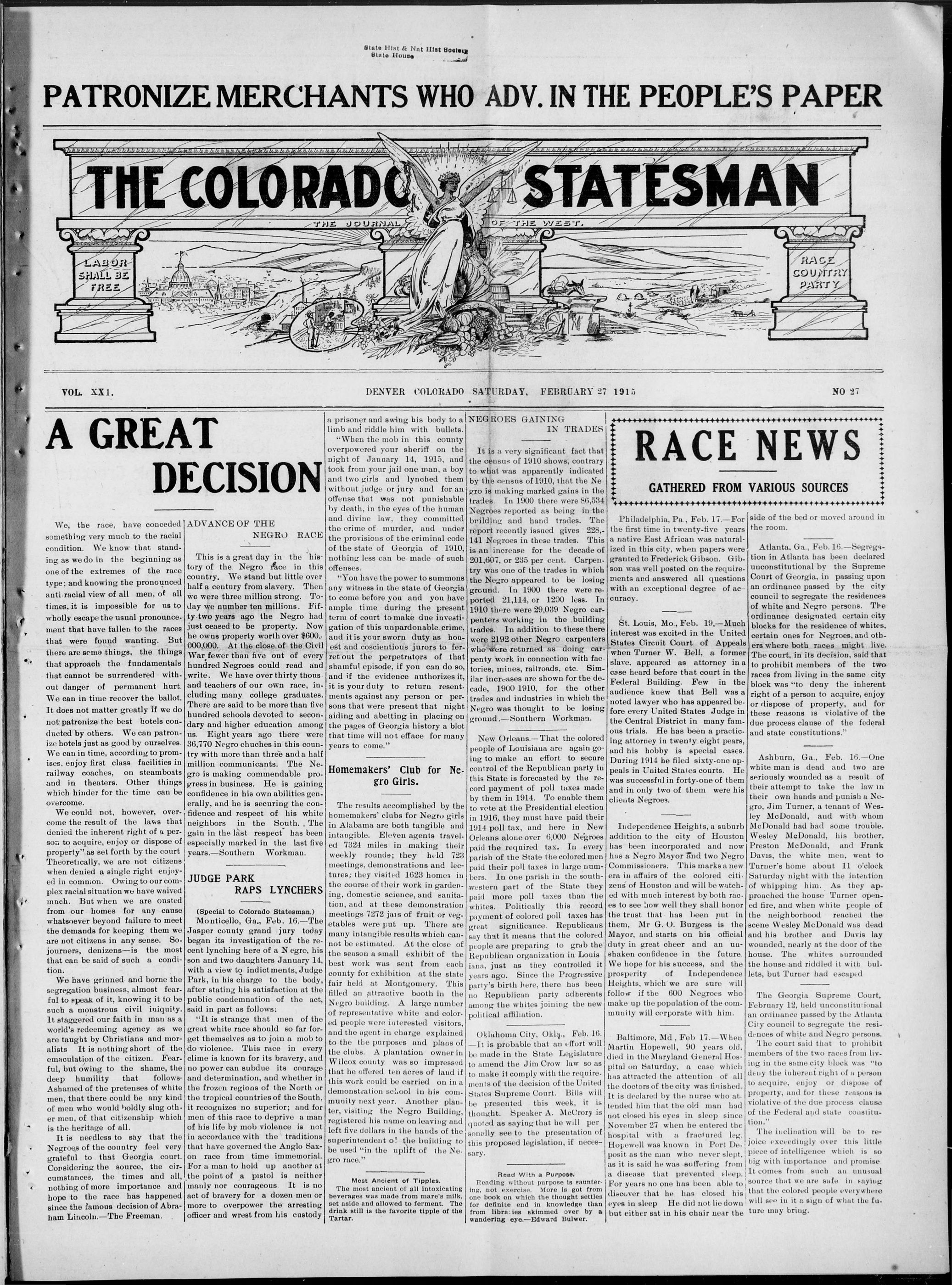
Colorado Statesman
Saturday, February 27, 1915
Denver, Colorado
Page text (machine-generated)
PATRONIZE MERCHANTS WHO ADV. IN THE PEOPLE'S PAPER
THE COLORADO STATESMAN
THE JOURNAL OF THE WEST.
LABOR SHALL BE FREE
RAGE COUNTRY PARTY
A GREAT DECISION
VOL. XX1. A GREAT DI
We, the race, have conceded something very much to the racial condition. We know that standing as we do in the beginning as one of the extremes of the race type; and knowing the pronounced anti-racial view of all men, of all times, it is impossible for us to wholly escape the usual pronouncement that have fallen to the races that were found wanting. But there are some things, the things that approach the fundamentals that cannot be surrendered without danger of permanent hurt. We can in time recover the ballot. It does not matter greatly if we do not patronize the best hotels conducted by others. We can patronize hotels just as good by ourselves. We can in time, according to promises, enjoy first class facilities in railway coaches, on steamboats and in theaters. Other things which hinder for the time can be overcome.
We could not, however, overcome the result of the laws that denied the inherent right of a person to acquire, enjoy or dispose of property" as set forth by the court. Theoretically, we are not citizens when denied a single right enjoyed in common. Owing to our complex racial situation we have waived much. But when we are ousted from our homes for any cause whatsoever beyond failure to meet the demands for keeping them we are not citizens in any sense. Sojourners, denizens—is the most that can be said of such a condition.
We have grinned and borne the segregation business, almost fearful to speak of it, knowing it to be such a monstrous civil iniquity. It staggered our faith in man as a world's redeeming agency as we are taught by Christians and moralists. It is nothing short of the emaculation of the citizen. Fearful, but owing to the shame, the deep humility that follows. Ashamed of the pretenses of white men, that there could be any kind of men who would boldly slug other men, of that citizenship which is the heritage of all.
```markdown
```
It is needless to say that the Negroes of the country feel very grateful to that Georgia court. Considering the source, the circumstances, the times and all, nothing of more importance and hope to the race has happened since the famous decision of Abraham Lincoln.—The Freeman.
ADVANCE OF THE
NEGRO RACE
This is a great day in the history of the Negro race in this country. We stand but little over half a century from slavery. Then we were three million strong. Today we number ten millions. Fifty two years ago the Negro had just ceased to be property. Now he owns property worth over $600,000,000. At the close of the Civil War fewer than five out of every hundred Negroes could read and write. We have over thirty thous. and teachers of our own race, including many college graduates. There are said to be more than five hundred schools devoted to secondary and higher education among us. Eight years ago there were 36,770 Negro chuches in this country with more than three and a half million communicants. The Negro is making commendable progress in business. He is gaining confidence in his own abilities generally, and he is securing the confidence and respect of his white neighbors in the South. The gain in the last respect has been especially marked in the last five years.—Southern Workman.
JUDGE PARK
RAPS LYNCHERS
(Special to Colorado Statesman.)
Monticello, Ga., Feb. 16.—The Jasper county grand jury today began its investigation of the recent lynching here of a Negro, his son and two daughters January 14, with a view to indictments, Judge Park, in his charge to the body, after stating his satisfaction at the public condemnation of the act, said in part as follows:
"It is strange that men of the great white race should so far forget themselves as to join a mob to do violence. This race in every clime is known for its bravery, and no power can subdue its courage and determination, and whether in the frozen regions of the North or the tropical countries of the South, it recognizes no superior; and for men of this race to deprive a man of his life by mob violence is not in accordance with the traditions that have governed the Anglo Saxon race from time immemorial. For a man to hold up another at the point of a pistol is neither manly nor courageous. It is no act of bravery for a dozen men or more to overpower the arresting officer and wrest from his custody
State Hist & Nat Hist Books
State House
ANTS WHO
ADO
DE JOURNAL
DENVER COLORADO
a prisoner and swing his body to a limb and riddle him with bullets. "When the mob in this county overpowered your sheriff on the night of January 14, 1915, and took from your jail one man, a boy and two girls and lynched them without judge or jury and for an offense that was not punishable by death, in the eyes of the human and divine law, they committed the crime of murder, and under the provisions of the criminal code of the state of Georgia of 1910, nothing less can be made of such offenses.
"You have the power to summons any witness in the state of Georgia to come before you and you have ample time during the present term of court to make due investigation of this unpardonable crime, and it is your sworn duty as honest and coscientious jurors to ferret out the perpetrators of that shamful episode, if you can do so, and if the evidence authorizes it, it is your duty to return resentments against any person or persons that were present that night aiding and abetting in placing on the pages of Georgia history a blot that time will not efface for many years to come."
Homemakers' Club for Negro Girls.
The results accomplished by the homemakers' clubs for Negro girls in Alabama are both tangible and intangible. Eleven agents traveled 7324 miles in making their weekly rounds; they held 723 meetings, demonstrations and lectures; they visited 1623 homes in the course of their work in gardening, domestic science, and sanitation, and at these demonstration meetings 7272 jars of fruit or vegetables were put up. There are many intangible results which cannot be estimated. At the close of the season a small exhibit of the best work was sent from each county for exhibition at the state fair held at Montgomery. This filled an attractive booth in the Negro building. A large number of representative white and colored people were interested visitors, and the agent in charge explained to the the purposes and plans of the clubs. A plantation owner in Wilcox county was so impressed that he offered ten acres of land if this work could be carried on in a demonstration school in his community next year. Another planer, visiting the Negro Building, registered his name on leaving and left five dollars in the hands of the superintendent of the building to be used "in the uplift of the Negro race."
Most Ancient of Tipples
The most ancient of all intoxicating beverages was made from mare's milk, set aside and allowed to ferment. The drink still is the favorite tipple of the Tartar.
NEGROES GAINING
It is a very significant fact that the census of 1910 shows, contrary to what was apparently indicated by the census of 1910, that the Negro is making marked gains in the trades. In 1900 there were 86,534 Negroes reported as being in the building and hand trades. The report recently issued gives 228.,141 Negroes in these trades. This is an increase for the decade of 201,607, or 235 per cent. Carpentry was one of the trades in which the Negro appeared to be losing ground. In 1900 there were reported 21,114, or 1200 less. In 1910 there were 29,039 Negro carpenters working in the building trades. In addition to these there were 2192 other Negro carpenters who were returned as doing carpentry work in connection with factories, mines, railroads, etc. Similar increases are shown for the decade, 1900 1910, for the other trades and industries in which the Negro was thought to be losing ground.—Southern Workman.
New Orleans.—That the colored people of Louisiana are again going to make an effort to secure control of the Republican party in this State is forecasted by the record payment of poll taxes made by them in 1914. To enable them to vote at the Presidential election in 1916, they must have paid their 1914 poll tax, and here in New Orleans alone over 6,000 Negroes paid the required tax. In every parish of the State the colored men paid their poll taxes in large numbers. In one parish in the southwestern part of the State they paid more poll taxes than the whites. Politically this record payment of colored poll taxes has great significance. Republicans say that it means that the colored people are preparing to grab the Republican organization in Louisiana, just as they controlled it years ago. Since the Progressive party's birth here, there has been no Republican party adherents among the whites joining the new political affiliation.
Oklahoma City, Okla., Feb. 16. It is probable that an effort will be made in the State Legislature to amend the Jim Crow law so as to make it comply with the requirements of the decision of the United States Supreme Court. Bills will be presented this week, it is thought. Speaker A. McCrory is quoted as saying that he will personally see to the presentation of this proposed legislation, if necessary.
Read With a Purpose.
Reading without purpose is sauntering, not exercise. More is got from one book on which the thought settles for definite end in knowledge than from libraries skimmed over by a wandering eye—Edward Bulwer.
RACE NEWS
GATHERED FROM VARIOUS SOURCES
Philadelphia, Pa., Feb. 17.—For the first time in twenty-five years a native East African was naturalized in this city, when papers were granted to Frederick Gibson. Gibson was well posted on the requirements and answered all questions with an exceptional degree of accuracy.
St. Louis, Mo., Feb. 19.—Much interest was excited in the United States Circuit Court of Appeals when Turner W. Bell, a former slave, appeared as attorney in a case heard before that court in the Federal Building. Few in the audience knew that Bell was a noted lawyer who has appeared before every United States Judge in the Central District in many famous trials. He has been a practicing attorney in twenty eight pears, and his hobby is special cases. During 1914 he filed sixty-one appeals in United States courts. He was successful in forty-one of them and in only two of them were his clients Negroes.
Independence Heights, a suburb addition to the city of Houston has been incorporated and now has a Negro Mayor and two Negro Commissioners. This marks a new era in affairs of the colored citizens of Houston and will be watched with much interest by both races to see how well they shall honor the trust that has been put in them, Mr G. O. Burgess is the Mayor, and starts on his official duty in great cheer and an unshaken confidence in the future. We hope for his success, and the prosperity of Independence Heights, which we are sure will follow if the 600 Negroes who make up the population of the community will corporate with him.
Baltimore, Md, Feb 17.—When Martin Hopewell, 90 years old, died in the Maryland General Hospital on Saturday, a case which has attracted the attention of all the doctors of the city was finished. It is declared by the nurse who attended him that the old man had not closed his eyes in sleep since November 27 when he entered the hospital with a fractured leg. Hopewell was known in Port Deposit as the man who never slept, as it is said he was suffering from a disease that prevented sleep. For years no one has been able to discover that he has closed his eyes in sleep. He did not lie down but either sat in his chair near the
NO 27
side of the bed or moved around in the room.
Atlanta, Ga., Feb. 16.—Segregation in Atlanta has been declared unconstitutional by the Supreme Court of Georgia, in passing upon an ordinance passed by the city council to segregate the residences of white and Negro persons. The ordinance designated certain city blocks for the residence of whites, certain ones for Negroes, and others where both races might live. The court, in its decision, said that to prohibit members of the two races from living in the same city block was "to deny the inherent right of a person to acquire, enjoy or dispose of property, and for these reasons is violative of the due process clause of the federal and state constitutions."
Ashburn, Ga., Feb. 16.—One white man is dead and two are seriously wounded as a result of their attempt to take the law in their own hands and punish a Negro, Jim Turner, a tenant of Wesley McDonald, and with whom McDonald had had some trouble. Wesley McDonald, his brother, Preston McDonald, and Frank Davis, the white men, went to Turner's home about 11 o'clock Saturday night with the intention of whipping him. As they approached the house Turner opened fire, and when white people of the neighborhood reached the scene Wesley McDonald was dead and his brother and Davis lay wounded, nearly at the door of the house. The whites surrounded the house and riddled it with bullets, but Turner had escaped
The Georgia Supreme Court, February 12, held unconstitutional an ordinance passed by the Atlanta City council to segregate the residences of white and Negro persons. The court said that to prohibit members of the two races from living in the same city block was "to deny the inherent right of a person to acquire, enjoy or dispose of property, and for these reasons is violative of the due process clause of the Federal and state constitution."
The inclination will be to rejoice exceedingly over this little piece of intelligence which is so big with importance and promise. It comes from such an unusual source that we are safe in saying that the colored people everywhere will see in it a sign of what the future may bring.
NEWS TO DATE IN PARAGRAPHS
CAUGHT FROM THE NETWORK OF
WIRES ROUND ABOUT
THE WORLD.
DURING THE PAST WEEK
RECORD OF IMPORTANT EVENTS
CONDENSED FOR BUSY
Western Newspaper Union News Service.
ABOUT THE WAR.
Cettinje has been again visited by an Austrian aeroplane, which dropped bombs, and, according to the Monte-negrin report, killing two women.
Fighting is going on along virtually the entire Russian front, but the reports of the general staffs give little or no information of the progress of the campaign.
The steamer Kalibia arrived at Lydd and reports that two vessels had been torpedoed off Hastings. One sank, and the other was supposed to be in a sinking condition, with three trawlers standing by.
Eighteen members of the crew of the Cardiff steamer Branksome Chine, a government collier, landed at London. Their boat either struck a mine or was terpedoed, in the English channel, twenty miles southeast of Beachey Head.
The Norwegian freight steamer Cuba, bound from London to Rotterdam, was sunk in a collision in the North sea. So far as is known, no lives were lost. The Cuba carried an official mail bag of the American commission for the relief of Belgium.
Another American steamer, the Carib, has been destroyed by a mine, off the German coast, while a third Norwegian steamer, the Regin, has been torpedoed or destroyed by a mine off Dover. In the case of the Regin all the crew were saved by British destroyers. The crew of the Carib is missing.
The German Admiralty has communicated a memorandum to Commander Walter R. Gherardi, the American naval attache at Berlin, pointing out that the destruction of the American steamers Evelyn and Carib was due to their not following the course prescribed by the German Admiralty, to a point northwest of Heliogoland.
WESTERN.
Four men were wounded, two probably fatally, in an attempt by three men to rob a gambling house at Tulsa, Okla.
A dying mother in Cape Girardean, Mo., wants to see her only son, John Flentge, 23 years old, and has asked police to find him.
John H. Stutzman, a grocer, his two daughters and a son were burned to death when their home was destroyed by fire in East St. Louis, Ill.
Monroe Armantrout, 70, a resident of Salt Lake City for the last five years and for many years a newspaper man of Denver and Pueblo, Colo., died at his home in Salt Lake.
The Northwest Federation of Indian tribes in session at Tacoma, Wash., adopted a resolution asking congress to appropriate $150,000 to suppress the liquor traffic among the Indians.
Mrs. Helen Farrell, 26, was found dead in bed at a downtown hotel in Chicago by her husband, Charles Farrell, a hotel owner of Omaha. A physician said that death probably had been caused by a drug. Money and jewelry valued at $50,000 were stolen from the apartments of Mrs. A. H. Smith, wife of the president of the New York Central railroad, her son, Emery H. Smith, and his wife, at a suburban hotel in Los Angeles, according to a report made to the police today.
WASHINGTON.
The United States has made truce proposals to end food embargo and submarine attacks of belligerents. Intervention by the United States, Argentina, Brazil and Chile to police Mexico and establish order was urged in the Senate by Senator Fall of New Mexico. The senator concluded with an attack upon General Villa.
The three Democrats named by the President as members of the Federal Trade Commission are Joseph E. Davies of Madison, Wis., now corporation commissioner, to serve seven years; Edward N. Hurley of Chicago, Ill., for six years, and William J. Harris of Cedartown, Ga., for five Years. The other nominees are Will H. Parry of Seattle, Wash., a Progressive Republican, named for four years, and George Rublee of Cornish, N. H., regarded as a Progressive, for three years.
Mrs. W. F. Cockrel of Del Ray, Va., leaped 500 feet down the shaft of Washington monument and was instantly killed. Dr. Juan Carlos Blanco, minister of public works of Uruguay, who is to represent his government at the Panama-Pacific exposition, reached Washington. Emphatic denial of impeachment charges pending against him was made by Federal Judge A. G. Dayton of West Virginia before the investigating sub-committee of the House judiciary committee.
FOREIGN.
Sir Charles Augustus Hartley, a noted engineer, died in London.
The British government may reconsider its ruling permitting the entrance of cotton into Germany.
The Cunard line steamer Orduna, which sailed from New York Feb. 13, arrived safely in port in Liverpool.
The Cabinet of the Duchy of Luxemburg has resigned, but no reason has been given for the ministers' retirement.
The American ambassador, Thomas Nelson Page, gave a reception at the embassy in observance of Washington's birthday.
The right leg of Madame Sarah Bernhardt, the famous tragedienne, was amputated at a hospital in the Rue d'Ares, at Bordeaux, France.
In order to assure the spring seeding, the French war department has decided that horses retired from the army shall be sold only to the farmers.
To conserve the coal supply the management of the state railway system at Rome has decided to decrease the number of passenger trains operated.
A Zeppelin airship bombarded Calais Monday morning, according to a Paris official statement. It dropped bombs which killed five persons, all civilians.
Notwithstanding expectations to the contrary, both tolls and tonnage of the Panama canal for January showed an increase over any previous month since the canal was opened for traffic, Aug. 15 last.
Prince Said Salim, the grand vizier of Turkey, in the first interview he has ever given, has outlined Turkey's reason for entering the war. He explained the abolition of the capitulations and pointed out the advances made during the past six years.
Reports received by the Secretary of State of the Vatican, says the Glorale d'Italia, shows that Germany, although maintaining an excellent military position, feels seriously the consequences of the war and, therefore, has modified materially her views on peace conditions to be imposed.
SPORT.
Johnny Griffiths, Akron lightweight, was given a newspaper decision over Joe Shugrue of New York at Akron, Ohio, in a twelve-round bout.
Joe Azevedo of California was awarded a decision over Frankie Callahan of Brooklyn at Memphis, Tenn., at the end of eight fast and exciting rounds.
Unless Governor Kendrick should veto it a law passed by the Legislature of Wyoming will become effective March 7 and will permit twenty-round boxing bouts.
G. F. Touchard and W. M. Washburn won the national indoor tennis doubles championship at New York, defeating Karl Behr and T. R. Pell in five sets, 7-5, 3-6, 3-6, 6-2, 6-3.
G. F. Touchard and W. M. Washburn won the national indoor tennis doubles championship at New York, defeating Karl Behr and T. R. Pell in five sets, 7-5, 3-6, 6-2, 6-3.
Earl Puryear and Harry Bramer, both of Denver, fought fifteen fast, scientific rounds to a draw at the Broadway swat emporium under the auspices of the Larker Street Business Men's Association of Denver.
GENERAL.
Letting out his prisoners to work for wages that go to their families instead of making them hammer stone. C. S. Whipple, Rock county sheriff, is demonstrating the possibilities of the Wisconsin commitment law.
Patriotic exercises in fifty parks and playgrounds, in many churches and armories and in Washington's headquarters, on Washington heights marked the commemoration in New York of Washington's birthday.
Just $6,397,608.64 was contributed or pledged by the Rockefeller foundation between its establishment and Feb. 1, 1915, according to a statement filed with the United States Commission on Industrial Relations in New York.
The body of Frank James, former outlaw, was cremated at St. Louis. Thousands of persons crowded about the crematory. Robert James, son of the dead man; Jesse James, son and namesake of another of the bandit brothers; Charles Polk and A. P Duckworth, friends of the family, witnessed the cremation. The ashes will be kept in a safety deposit vault until the death of Mrs. James, when they will be interred with her body.
President Taft's action in withdrawing from public entry 4,000,000 acres of oil land in California and Wyoming —virtually the entire unappropriated supply of the United States—was up held by the Supreme Court in Washington. The order, defended by the government on the ground that the supply was intended for the development of the navy, covered land now claimed by the Midwest Oil Company in the Casper and other districts of Wyoming, valued at between $60,000,000 and $150,000,000.
Ernest Thompson Seton, artist and author of books dealing with life in the woods, has retired as chief scout of the Boy Scouts of America.
After two days of fighting, the death list at Bluff, Utah, is five Indians killed, an unknown number wounded, one white man killed and one wounded.
John M. William who, in his lifetime, declared he fired the shot which killed the Confederate general, Albert Sidney Johnston at the battle of Shiloh, died at his home in Mount Carmel, Ill.
Western Newspaper Union News Service.
Rocky Ford has organized a gun club.
A $25,000 warehouse will be built at Grand Junction.
The Geo. A. Moore residence at Oak Creek was destroyed by fire.
W. G. Hubbell has been appointed postmaster at Fort Lupton.
Extensive development of coal mines near Cedarredge is promised.
More than $60 has been raised in Pueblo for the Italian earthquake relief fund.
Some of the beet growers of Colorado and Montana now plan collective bargaining.
Mr. and Mrs. Wm. Yardley of Denver celebrated their fiftieth wedding anniversary.
It is estimated that cantaloupes will be raised on 70 or 80 acres near Lafayette this season.
The Barthalomew Lumber Company's mill on Crosho lake, near Oak Creek, was badly damaged by fire.
Word was received in Denver of the death of Oscar Mayo, former dean of music of Denver university, at Modeste, Cal.
The police are searching Denver for some trace of Mrs. Ed Shumway of Afton, Okla., whose husband is reported near death.
LLB Ranch No. 1, National Order of Cowboy Rangers, gave a Washington's birthday patriotic entertainment at Odd Fellows' hall in Denver.
On April 6 La Junta will vote on a proposition to issue $75,000 in bonds for the purpose of building a municipal electric light plant.
Seven prisoners confined in the Washington county jail, three negroes and four white men, cut through the iron bars to freedom at Akron.
Of a total of 626 bills introduced in the House, about two-thirds, or 400 or more, will be cast into the limbo where all bad and indifferent measures go.
Major Thomas Daugherty, said to have been the first public school teacher in Colorado, died at Allentown, Pa. He was seventy-eight years old.
"Send a Letter Day" will be observed on March 1 by the citizens of Colorado who wish to advertise the resources, climate and advantages of this state.
Nearly 10,000 people witnessed the patriotic celebration at the Auditorium in Denver in commemoration of George Washington and Abraham Lincoln.
Zel Wheeler of Erie is suffering from a fractured rib, a sprained shoulder and several body bruises, as the result of a load of hay falling on him when his wagon overturned.
Miss Ruth Nelson, daughter of James Nelson, known as the "Western slope cattle king," and one of the most expert horsewomen on the Western slope, having ridden wild horses since she was a child, is to be married shortly to Boyd Simmons, a young chauffeur of Grand Junction.
Sam DeJohn, a former striker arrested in connection with the La Veta mine murders, testified for the prosecution at Pueblo. In his story on the witness stand DeJohn said that he was a member of the party that attacked the automobile party, killing four. He implicated five of the defendants.
The payment of strike benefits to union miners in Colorado has ceased, according to the district officials of the United Mine Workers of America. Now the organization will supply only the absolute necessities, said President John McLennan. The union has paid approximately $4,000,000 in benefits since April 1910.
August Warenbourg, a member of the ways and means committee of the Louisville Coal Miners' Union, is at his home at Louisville in a critical condition, as the result of a knife wound inflicted in a row in Bodhaine's salon at Louisville, and Fils Chausart, also of Louisville, is in the county jail, charged with assault.
The resignation of Joseph H. Harrison, postmaster, will be in the hands of the Postoffice Department at Washington not later than Feb. 24. If Benjamin F. Stapleton's name is not sent to the Senate and confirmed before that time Charles F. Trottor, assistant postmaster, will look after the duties of the office.
Mining men returning from Leadville insist that the progress made in that camp in the last few months has been almost as important, if not so spectacular, as in the big producers of the Cripple Creek district and presage a year of prosperity, especially if present prices for zinc-hold up. Enormous bodies of ore are constantly being discovered, and while most of it is of low grade as regards the precious metals, it is of high value considering the price the baser metals command and the quantities taken out.
Clifford G. Rowe, thirty-two, a prominent attorney of Glenwood Springs and second cousin of William Jennings Bryan, died in Denver at St. Luke's hospital after a brief illness, supposedly from heart disease. Rowe had been practicing law in Glenwood for ten years. He was a member of the Elks.
Final plans for the meeting next August in Denver of the National Retail Monument Dealers' Association were made at the fourth annual convention of the Colorado monument men in Denver.
COLORADO POSMASTERS
NOMINATIONS ANNOUNCED BY POSTOFFICE DEPARTMENT.
Several Secure Positions to Handle Uncle Sam's Mail After Taking Civil Service Examinations.
Western Newspaper Union News Service.
Denver.—A batch of Colorado postoffice nominations was announced at the Postoffice Department at Washington as follows:
Copper Rock, Boulder county, Carl I. Nielson, New office.
Camp Bird, Ourry county, Louis F. Kuchs, to succeed Marshal Orendorf, resigned.
Newett, Chaffee county, Gustave Henry Colson, to succeed Victor Fredeen, resigned.
Rodmesa, La Plata county, Irma Taylor, to succeed M. I. Hall, resigned.
Toponas, Routt county, Alice S. Wilson, to succeed P. F. Remhardt, resigned.
The following Colorado postmasters have been covered under the permanent civil service after successfully passing competitive examinations:
Bowie, Delta county, Alexander Bowie.
Coventry, Montrose county, Charles H Smith.
Grand Lake, Grand county, Henry M. Harbison.
Oxford, La Plata county, Andrew J. Buchanan.
Poncho Springs, Chaffee county, Antonio N. Appleby.
Rangely. Rio Blanco county, James H. McGuire. Tincup, Gunnison county, Anthony H. Bauer. The name of the postoffice at Mattison, Elbert county, has been changed to Matheson and Orlando M. White has been continued as postmaster.
New Son Born as One Son Dies.
Walsenburg—Five hours after the death of her four-year-old son, Lewis, in a Pueblo hospital, Mrs. John Muhovitch, wife of a miner in the Walsen camp, gave birth to another boy here. Lewis had been shot accidentally by a playmate, Rugi Panion, and was rushed to the Minnequa hospital, Pueblo, where he died later. The father went to Pueblo just before his son's death and was not at home when the baby was born. A neighbor brought news of Lewis' death to Mrs. Muhovitch an hour or two before the stork arrived. The father brought the body of his dead son home and was greeted by his wife and the new-born babe. Physicians say the mother will survive the shock of her first boy's death despite her present weakened condition.
Man Exonerates Wife: Dies.
Victor.—"Tell her that I forgive her. I was to blame." With those words Frederick Trott exonerated his wife a few hours before he died in the Red Cross hospital from revolver shot wounds inflicted by Mrs. Trott. Mrs. Trott, who had been arrested shortly after the shooting and taken before Justice Valentine Getz by Sheriff Kingsford, was released that night on $1,500 bond. When her husband's antemortem message was sent her she went to the hospital and remained with him until he died.
Patterson Coal Miners Strike.
Colorado Springs.—Thirty-five of the forty men employed at the Patterson coal mine, just north of this city, struck when Alexander Patterson, the owner, attempted to lay off ten of the men because of the slack demand for coal. Patterson was one of the first men to sign up with the union over a year ago, when the general state strike was declared.
Two Killed in D. & R. G. Wreck.
Colorado Springs.—Fireman Krebbs of Denver, who was injured in the wreck on the Denver & Rio Grande railroad near Fountain, died, making two deaths from the wreck. Engineer Frank Hockenberger was killed almost instantly. Nine passengers who were badly bruised or shaken up are reported doing well.
Rocky Ford May Get Oil Plant.
Rocky Ford.—Superintendent Munroe, Engineer Davis and Dr. Gray, all connected with the Texas Oil Company, were visitors to this city and spent the day in looking about the city. They are looking over the state with the idea of establishing plants in a number of places.
Zelmer Freed of Complicity Charge.
Pueblo.—George Zelmer, one of the accused men in the La Veta murder case, was dismissed, upon motion of Jesse C. Northcutt.
Falls to Death in Mill Machine
Fort Collins.—Floyd Conover, 19 years old, whose parents live in Arvada, was killed here by a fall in an alfalfa mill.
Lamar Lawyer Named District Judge.
Denver. — Governor Carlson announced the appointment of Attorney Granby Hillier of Lamar to the position of district judge created by the Hasty law enacted by the Legislature. This gives the third judicial district, of which Las Animas and Huerfano counties are a part, two judges. The new judge is a former member of the lower house of the Legislature and is a Republican. He is in his early thirties. His candidacy was indorsed by the Prowers county bar.
ERNEST HOWARD,
Carpenter, Job and Repair Work.
Coal, Wood
Coal, Wood and Express
Street. Phone
Tried the Rest Our Pre
y the Best Satisfact
Coal, Wood and Express.
You Have Tried the Rest
Now Try the Best
THE
Giant
FOR QUALITY
CLEANING, PRESSIN
ING, RELINING AN
WORK CALLED FOR
2549 Washington Avenue
NING, PRESSING, DYEING,
ING, RELINING AND REMODEL
WORK CALLED FOR AND DELIVER
ington Avenue D
CLEANING, PRESSING, DYEING, REPAIRING, RELINING AND REMODELING.
WORK CALLED FOR AND DELIVERED
2549 Washington Avenue Denver, Colorado
PHONE MAIN 3028
JOHN K. RETTIGER
Fancy, Fancy and Staple Grocery
1864 CURTIS STREET
nineteenth.
Main C. E. Sn
189, 190 Res. Pho
The Market Com-
tle and Retail Staple and Fancy Grocery
Masters. Hotels and Restaurants Our Spe-
d Cured
Eastern Corn Fed Meat
Fruits, Vegetables, Poultry and Garn
rapahoe Street Den
HARRIS, Pres. J. M. JOHNS, Treas. SEIB M
RAILROAD PORTERS' C
LUNCH ROOM IN CONNECTION
Giards and Free C
Pool Room
5 Wazee St. Only one block from Uni-
phone Main 8416. Denver, Col
JOHN K. Meats, Fancy and 1864 CURTIS
The Market
Wholesale and Retail Staple and
Oysters. Hotels and Re-
Fresh and Cured
Eastern Corr
Fruits, Vegetables,
1688-89 Arapahoe Street
CHAS. HARRIS, Pres. J. M. JOHN
RAILROAD POOL
LUNCH ROOM I
Billiards and
Pool
1728½ Wazee St. Only on
Phone Main 8416.
The Market Company
Wholesale and Retail Staple and Fancy Groceries, Fish and Oysters. Hotels and Restaurants Our Specialty.
Eastern Corn Fed Meats
Fruits, Vegetables, Poultry and Game.
1688-89 Arapahoe Street Denver. Colorado
CHAS. HARRIS, Pres. J. M. JOHNS, Treas. SEIB MILLER, Sec.
1728% Wazee St. Only one block from Union Depot Phone Main 8416. Denver, Colorado
The Corbett Ice Cream Co.
1115 WELTOW
THE ICE
That Is Just a Litle
Kind You Thou
C. H. SHIRLEY, Pres.
PAUL J. SHIRLEY
1115 WELTON STREET
THE ICE CREAM
That Is Just a Little Better Than the
Kind You Thought Was Best
IRLEY, Pres.
J. C. HAMPSCO
PAUL J. SHIRLEY See and T
That Is Just a Little Better Than the Kind You Thought Was Best
C. H. SHIRLEY, Pres. J. C. HAMPSON, Vice Pres PAUL J. SHIRLEY, Sec. and Treas.
Courteous Treatmet. Right Prices Leaders in Prescription
1021 21st Street.
Corner Nineteenth
Phones Main
169, 181, 189, 190
and Express.
CLEANERS
AND
TAILORS
McCAIN & RICHARDS, PROPS
Phone Main 7376
ING, DYEING, REPAIR-
AND REMODELING.
OR AND DELIVERED
Denver, Colorado
RES. PHONE GALLUP 942
. RETTIG and Staple Groceries TIS STREET
C. E. Smith, Manager Res. Phone South 1608
et Company
and Fancy Groceries, Fish and
Restaurants Our Specialty.
Barn Fed Meats
es, Poultry and Game.
Denver. Colorado
OHNS, Treas. SEIB MILLER, Sec.
ORTERS' CLUB
IN CONNECTION
Free Check
Room
one block from Union Depot
Denver, Colorado
TON STREET
THE CREAM
Little Better Than the
thought Was Best
J. C. HAMPSON, Vice Pres
LEY, Sec. and Treas.
AS DRUG CO.
Hmet. Right Prices
Prescription
Store No. 2
25TH AND WELTON
Mein 4955-4956
Glazing Done
Phone Champa 752
Our Prices Reasonable Satisfaction Guaranteed
Denver, Cola
AFRO-AMERICAN CULLINGS
One of the very important phases of the work of the Manassas Industrial School for Colored Youth is a summer school, held for the rural school teachers during July of each year. To this come about a hundred teachers from the rural districts, men and women, who are heart and soul in the work. Some of these teachers are well trained and competent, but the greater number are wholly unfit to teach. Many have had no training above fifth grade, and often can only read and write with great difficulty. During the winter of teaching, they often have to travel many miles to their school houses, which are usually meager diapidated frame buildings, neither wind nor rain-proof, where they are compelled to teach all grades and ages in one room. For this they receive pitifully small salaries, and if they want to add any special work over the regular curriculum, the pennies of the children, with a share of their own small income, are forced to meet the added expense.
They must find enough inspiration during this one short month at the summer school to carry them through their trying winter. The state of Virginia contributes to the work. Besides this summer school, there is held for these rural teachers of northern Virginia, a Teachers' institute during the Christmas holidays, where all questions relating to school life and work are discussed by prominent speakers, as well as general discussions on subjects of school hygiene and teaching methods.
There is no doubt that the work accomplished by the school, both in its training of the children and in the broader field of its community work, is of vital importance to the people of northern Virginia—not alone to the colored man, but to the white man as well. That the white man fully realizes this can be judged by the fact that the mayor of Manassas says that the colored community all love and work for the school, and forget to get drunk and get into jail. One mayor told a friend of the school, some years ago, that he attributed his empty jail to the influence of the Manassas Industrial school.
The great financial stress confronting this country on account of the European war, and the diverting into foreign channels of much of the support which in ordinary years goes to our own philanthropies, has forced Manassas, as well as other schools of this type, into a very difficult position. The vitality of this work is too strong to let it die, but if the struggle for existence becomes too great, the work must suffer. There is danger of the crippling of one of our most valuable institutions, which has only gained power for good through years of untiring effort and sacrifice.
White citizens of South Carolina have contributed $10,000 for a hospital for Negroes, to be erected at Columbia. There are 75,000 colored people in the state who are without hospitals where they can go for treatment, as the hospitals for white people do not admit them.
In Kansas 17 per cent of the women are married, 14 per cent separated, divorced or widowed, and 69 per cent are unmarried girls.
Fifty-four women have received medals and rewards for heroism from the Carnegie Hero Fund commission during the past ten years.
Although the most intelligent leaders of the race are proud of the folklore songs as the rhythmic cry of the slave, there are those who feel ashamed of them because they hark back to the days of ignorance, superstition and childlike trust. Doctor Du-Bois says of them: "They are the music of unhappy people, of the children of disappointment; they tell of the death and sufferings and unvoiled longings toward a truer world of misty wanderings and hidden ways. They are the most beautiful expression of human experience born this side of the seas."
Special emphasis is placed on these songs in all the southern colored schools, especially in Tuskegee, Hampton, Spellman and Fiske university, to which the Negro folk-lore will always be indebted for its revival. The Fiske jubilee singers sang the slave songs so deeply into the hearts of a half-credulous world that it can never wholly forget them again.
Fifty St. Louis women have formed a league with the object of cleaning up that city of rats.
The Henry S. Denison memorial building for medical research at the University of Colorado has now been made ready for use. It contains laboratories for research in bacteriology, pathology, physiology, chemistry and clinical methods.
Spain has just given assurances to the officials of the Panama-Pacific International exposition that her participation in the exposition will proceed according to original plans, and that the war will have no effect on Spanish participation.
ORIGINAL IN POOR CONDITION
The New Jersey state board of education decided that the Bordentown Industrial School for Colored Youths shall be made an industrial institution in fact and not merely a school for the academic training of Negro residents of the state.
Contemporaneously with this decision the board accepted the resignations of James M. Gregory, principal of the New Jersey school; Mrs. Gregory, the matron, or preceptress, and J. Francis Gregory, teacher of English. Mr. and Mrs. Gregory had been associated with the school for 18 years, or practically since its inception Both admitted that, although they had been trained to teach academic branches they did not feel equipped to care for the needs of a purely agricultural and mechanical arts school.
Attempts to choose a successor to Principal Gregory precipitated a wrangle in the board and the matter was laid over for a month. The committee on the Bordentown school recommended the selection of William R. Valentine, a Negro educator of Indianapolis, who was graduated from Harvard in 1904. He is now a supervising principal, having charge of a number of schools, and for three years has been vice-president of the National Education Association for Colored Teachers.
Former Senator Joseph S. Frelinghuysen and John P. Murray thought that more than one name should be presented for consideration. He also advocated making the selection from Tuskegee institute with a view of bringing the Bordentown school into closer touch with Booker T. Washington and his associate educators. The committee was disposed to resent the comment of the objecting members as a reflection upon its judgment. The Bordentown school, as recently brought to public attention, has been an object of serious criticism for its seeming failure to accomplish the aims for which it was established. In short the industrial features, including agriculture and the mechanical arts, were subordinated to the teaching of academic subjects. The situation is to be exactly reversed, according to the plans for the future outlined by the state board.
Never to have had instruction in art and yet ability to paint well enough to have a picture hung at the Charcoal club's exhibit in the Peabody institute at Baltimore, is the fortune of Ernest Atkinson, a Negro porter. "It must be natural instinct," said Atkinson, "for I never had any instruction and never saw an artist work. I just studied other paintings, and what I observed in other paintings I applied to my own work." Atkinson is twenty-eight years old and was born in Kingston, Jamaica, where he lived until eight years ago. He then took to the sea and it is to his memory of those years that enabled him to reproduce his present work. His work is an ocean scene, showing the waves breaking against the shore and two boats in the background, one beating against the wind and the other running before it.
His talent was first discovered by Charles H. Webb, an instructor in the Maryland institute, when he was asked to criticize one of Atkinson's paintings. Mr. Webb was astonished at the skill shown, and suggested that it be submitted to the Charcoal club's exhibition. It was submitted without any name on it, and was one of the 82 selected out of the 210 offered.
Talk of cutting down next year's cotton acreage in the South—which may be an economic necessity—comes largely from white planters. What the mass of poor Negro tenant farmers will do is a distressing problem, as Booker T. Washington has said. They have never been taught to plant any crop but cotton, and the system under which they borrow money in the spring to carry them and their families until the harvest is based on cotton growing exclusively. If many of them cannot plant cotton in the coming year they will be idle and plung into the deepest poverty. The North now has its une ployed; the South may have a horde of Negroes to look after before the end of 1915.—Springfield Republican.
Mrs. Mary S. Howarth of Chester, Pa., just admitted to practice in the supreme court of Pennsylvania, is the first woman in that state to be so honored.
Corsets worn by the women on the islands of Malayasia are made of telegraph wires.
Bakers in Rotterdam have started to make bread composed of equal parts of flour and potato. They like it. Potatoes there are cheaper than wheat flour.
Dr. M. D. Edwards of St. Paul has served 40 years as pastor of Dayton Avenue Presbyterian church, his first and only pastor.
More than 46,000,000 bunches of bananas were imported into the United States last year, or about 40 bananas for each man, woman and child.
CRUSHING BLOW DEALT AUSTRIA
HUNDREDS OF WOUNDED CAP
TURED; MANY PICKED FROM
FROZEN GROUND, DYING.
DESTROY ELEVEN SHIPS
WITH MINES AND TORPEDOES,
DURING FIRST WEEK OF UN-
DER·SEA BLOCKADE.
Western Newspaper Union News Service.
London, Feb. 25.—The Austrians
have suffered a severe defeat in Bukowina.
Hundreds of wounded have been
captured, many of whom were picked
up from the frozen ground, wounded
and dying. The Russians have seized
the railway and the important railway
center Stanislau, after delivering a
crushing blow to the allied Teutons.
The German blockade of the British Isles has been in effect for a week with the result that, so far as known, two Norwegian, one French and five British steamers have been sunk or torpeded by submarines, with the surprisingly small loss of four lives. Two of these steamers, the Belridge and the Dinorah, succeeded in reaching port.
On the other side of the account it is reported that two German submarines are missing and a third had been hit and possibly sunk by a French destroyer.
Besides the vessels which fell victims to the submarines two American and one Norwegian steamer have been sunk by mines in the North Sea, and the Swedish steamer Specia and one or two British steamers are overdue and it is feared have been lost with their crews.
In almost every case the steamer sunk by the submarine was a small and slow vessel and at least three of them were caught while at anchor or while they were barely underway. This, with the failure of a submarine to hit a fast cross-channel steamer at which it fired a torpedo, apparently proves to the satisfaction of British naval writers that the steamers with modern speed which observe obvious precautions can invariably escape the underwater craft, and such vessels are continuing to cross the seas.
With conditions such as these, the public, both in England and neutral countries, is naturally curious as to the latest proposal of the American government to Great Britain and Germany, of which little has been allowed to leak out either in London or Berlin, and also as to what the allies' reply to the German blockade will be, another matter in which secrecy is being maintained. The steamer Royperana was sunk off Eastbourne. It is believed that she was torpedoed. The crew of thirty-one men were saved. A dispatch to the Daily News from Copenhagen says it is feared there that the steamer Specia of Stockholm has struck a mine and foundered. The steamer left Liverpool Jan. 31 and was last reported Feb. 2.
The crew of the Norwegian steamer Regin, which was sunk by either a submarine or a mine off Dover arrived in London and was received by the Norwegian consul.
Weds After Making $8,000 in 15 Days.
Weds After Making $8,000 in 15 Days.
Cheyenne.—Having cleared $8,000 in fifteen days from a lease on a mining property near Victor, Colo., James Gordon Kyner celebrated by coming to Cheyenne and marrying Mrs. Bessie McEachern, also of Victor. His bride is a widow with two children.
PLAN CRIPPLE CREEK MERGER
$7,000,000 Consolidation of Vindicator With Golden Cycle Reported Under Way
Denver. — Negotiations have been started for the purchase by the Vindicator Consolidated Gold Mining Company of the Golden Cycle mine and mill at Cripple Creek, at a price said to be between $6,000,000 and $7,000,000 A. E. Carlton, a banker of the Cripple Creek district, was in Denver for the purpose of conferring with the Vindicator managemen. in relation to the terms of the deal.
The properties involved are the two largest dividend payers in the district. The profits of the Golden Cycle were in excess last year of $1,300,000, while the Vindicator distributed about $400,000. A consolidation of the properties would mean the largest combination of capital in the Cripple Creek section and would place the concern far ahead of any mining enterprise in the state.
Billy Sunday to Go to Boston.
Philadelphia.—Billy Sunday and nounced that he will conduct a revival campaign in Boston beginning Oct. 16.
"Dry" Measure Returned to House.
Denver.—The prohibition penalty bill, which passed the House of Representatives, was sent to the Senate, and the Senate, on motion of Senator Peterson of Pueblo, refused to concur in the amendments made by the House. The Peterson motion was carried by a vote of 29 to 1. The bill then went back to the House, which voted to adhere to its original stand on the amendments, thus opening the way for the reference of the bill to a conference committee.
OFFICIALS ASKED TO PREPARE YEARLY ESTIMATES.
Administration Gives Notice to Department Heads That Expenses Must Be Slashed.
Denver.—Except in case of urgent need at penal institutions, and other institutions where confinement is involuntary and where public safety necessitates, all state institutions must expect to keep their maintenance and other expenses within their revenues for the present biennial period, according to administration plans.
Every department of the state government must cut its estimated and actual expenses to the minimum, and heads of departments must voluntarily make such reductions in the number of employés and slashes in wages as may be possible without jeopardizing efficiency.
The state administration acting through Senate and House finance and appropriations committees has given due notice of this to institutions and to department heads.
The finance and appropriations committees began work calling for estimates of expenses for the period under the budget system advocated by the administration.
All estimates will be taken into consideration jointly and severally and if found to be within the estimated revenues—after the inheritance tax estimated income has been subtracted from the estimated general revenues of the state—appropriations will be made in accordance therewith.
This is the program of the administration. What actually is done, of course, will depend upon legislative action, either in conjunction with or regardless of the action of the state administrative officers, heads of departments and institutions and others connected with state finances.
In this connection the "evasion of civil service and salary slash" bill of the Senate finance committee, which was introduced in skeleton form, Feb. 2, and the details of which are identical with those of the Candlish skeleton bill introduced on the same day, has been printed and will be placed on the special calendar.
Members Select Favorite Measures.
Denver.—The Republican members held a caucus at which each submitted to the rules committee a list of his bills showing his first, second and third choices for consideration. The first choice bills are promised preference and will be placed on the calendar which the rules committee will prepare. At the same time there was submitted a list by Minority Leader Fincher, showing the first choice bills of each Democratic member. These also will be considered in the committee of the whole. Bills desired by Governor Carlson, the district attorneys, the county judges and the stockmen will be considered at another caucus. One hundred and ninety-five measures were given right of way by the caucus—in first, second and third classes—and about 500 others will be allowed to die.
Only Two Terms for Officials.
Denver.—State officials and many county officials are limited to two terms and the state auditor cannot succeed the state treasurer, or vice versa, under the provisions of a bill introduced by Senator W. C. Robinson The object of the bill is to prevent perpetual office holding. The officers against which the bar for more than two terms is raised are: Governor, secretary of state, attorney general superintendent of public instruction county clerk, county treasurer, super intendent of schools, county commissioner and coroner, as well as the state auditor or treasurer.
U. S. Records of Land Entries.
Denver.—Number of original entries made at each United States land of fice in Colorado in the seven months ending Jan. 31 last, and the acreage covered by the entries, as reported by the registers and receivers:
Office— No. Entries. Acreage. Lamar ..... 1,461 89,280
Pueblo ..... 1,378 342,763
Hugo ..... 250 57,263
Del Norte ..... 153 24,517
Leadville ..... 224 8,606
Montrose ..... 353 51,255
Sterling ..... 910 215,119
Denver ..... 842 105,000
Durango ..... 328 40,999
Glenwood Springs ..... 100,488
Denver. — The state permanent school fund is not protected under the highway bill which is now pending before the State Senate, according to a letter which Mrs. Mary C. C. Bradford, state superintendent of public instruction, and W. W. Remington, secretary of the Colorado Teachers' Association, sent to Senator John S. Hasty, chairman of the Senate finance committee.
Order Prohibits Cashing Overdrafts. Denver.—An order issued by the comptroller of the currency requiring national banks to adopt a resolution strictly prohibiting overdrafts and threatening them, in case of disobedience, with being placed on the "30-day list," has aroused the opposition of Denver banks as well as those of every community in the country, and patrons of the institutions who have been given to the making of overdrafts are being warned that they must arrange their affairs so as to permit them to cease the practice
The
Curtis
Park
Floral
Company
FLORAL DESIGNS PUT UP WHILE
YOU WAIT
CHOICE PLANTS AND CUT FLOWERS CONSTANTLY
ON HAND
GREENHOUSES: Thirty-Fourth and Curtis Streets
TELEPHONE, MAIN 1511
DENVER, COLO
When You Want
When You Want
The Heads, Feet, Tails Snouts, Neckbones or Chiterlings or any other part of the hog except the squeal go to
2300-6 Larimer Street.
The Champion
Twentieth a
Is the place
DRUGS, CHEMICALS AND
WE SERVE
Prescriptions
Phone us and we will deliver the
JAMES E. T.
PHONE M
THE ZOBEL
SAMPLE
1004 Nineteenth St
The Champa Pharmacy
1004 Nineteenth Street, Corner of Curtis
FINE WINES, LIQUORS AND CIGARS COORS' CELEBRATED BEER ON TAP
---
The
WARD AUCTION
COMPANY
Sales Daily at 2 p.m. Office Fur-
niture a Specialty.
PRIVATE SALES AT ALL TIMES
HAVE MOVED TO—
1723-39 GLENARM ST.
PHONE MAIN 1675.
THE BEST ICE CREAM AND
CANDIES AT
O.P. BAUR & CO.
CATERERS AND
CONFECTIONERS
Phone: 168.
1512 Curtis Street, Denver, Colo.
DO IT NOW Subscribe
for THIS
PAPER
TION
DENVER
Pharmacy
and Champa,
to get your
D PATENT MEDICINES
DRINKS.
Our Specialty.
the goods to all parts of the city.
IRALL, PROPR.
AIN 2425.
BROTHERS'
E ROOM
eet, Corner of Curtis
J. H. BIGGINS
Furniture Repairing and Upholstering. All work Cash.
PHONE YORK 7837
1417 East 24th Ave Denver
Miss M. Cowden
Hair Dressing Parlor
Shampoo, cutting and curling. Scalp treatment, hair tonics, hair straightening, manicuring. Stage wigs for rent; theatrical use and masquerades. Goods delivered out of the city. All shades of hair matched by sending sample of hair; also combings made up.
Cheapest Switches 50 Cents
1219 21st St. Denver, Colo.
Phone Main 1461
COLORADO
THE COLORADO STATESMAN
CABON HAILS DE FREE
CABON COUNTRY PARTY
SUBSCRIPTION RATES:
One Year ..... $2.00
Six Months ..... 1.00
Three Months ..... .60
PAYABLE IN ADVANCE.
Entered as second-class matter at the postoffice in the city of Denver,
Colorado.
Display advertising, 50 cents per inch. An inch contains twelve agate lines.
Reading notices, ten lines or less, 10 cents per line. Each additional line over ten lines, 5 cents per line.
No discounts allowed on less than three months' contract. Cash must accompany all orders from parties unknown to us. Further particulars on application.
It occasionally happens that papers sent to subscribers are lost or stolen, in case you do not receive any number when due, inform us by postal card and we will cheerfully forward a duplicate of the missing number.
Remittances should be made by Express Money Order, Postoffice Money Order, Registered Letter or Bank Draft. Postage stamps will be received the same as cash for the fractional part of a dollar. Only 1-cent and 2-cent stamps taken.
Communications to receive attention must be newsy, upon important subjects, plainly written only upon one side of the paper; must reach us Tuesdays, if possible, anyway, not later than Wednesdays, and bear the signature of the author. No manuscript returned, unless stamps are sent for postage.
All communications of a personating nature that are not complimentary will be withheld from the columns of this paper.
MEMBER
NATIONAL NEGRO PRESS
ASSOCIATION.
FREDERICK DOUGLAS.
an anniversary of the great Fr. various clubs and societies that approach to the birthday of the great Douglas himself did not knowing on his part, Douglas accepted the world.
It is that the birth of this "voice is did be celebrated. While the lives, Douglas, without comparison attached to his personality, the girdirring thoughts, burning words is won for him the highest place and power increases as time did no peer. A born opposer of sent into the conscience of his in orators, but it is no dispar children," he towered above them man into the Nation's council, of the ascendancy, he still would of great statesmen. He was that America has yet production and America's first repre
The ninety-eighth anniversary of the great Frederick Douglas was fittingly celebrated by various clubs and societies throughout the country during the last week.
The nearest approach to the birthday of the great leader is February 14. As to the exact date, Douglas himself did not know; but, by the most careful inquiry and reckoning on his part, Douglas accepted February 14 as the day of his entrance into the world.
It is most fitting that the birth of this "voice in the wilderness of prejudice and hate" should be celebrated. While the race has produced many great and noble lives, Douglas, without comparison, is the greatest of any. The interest which attached to his personality, the giant intellectual strength, his deep emotions, stirring thoughts, burning words and splendid service in behalf of freedom has won for him the highest place in the galaxy of thinkers and leaders. His place and power increases as time moves on. As a public speaker, Douglas had no peer. A born opposer of usurpation, injustice and wrong, his words burnt into the conscience of his hearers.
The race is rich in orators, but it is no disparagement to say that like "Saul among his brethren," he towered above them all. Had Douglas been thrown as a white man into the Nation's council, even when Webster, Clay or Calhoun were in the ascendancy, he still would have been the brightest light amid the galaxy of great statesmen. He was the most remarkable man of Negro extraction that America has yet produced. Maryland's son, the race's greatest champion and America's first representative Negro.
BUSINESS.
attempts to do business in all
ances, and faith in his ability to
contend, coming as they do
from base, and a very few of
them are swellhead, puffed up
to the conditions which surrou-
nge more intelligent brethren into
such as will mass their earnings,
we would soon grow strong
malignities heaped upon us by
as a race, we have yet to learn
or success. It does seem that
we are to get employment at al-
; and if we would support those
business, we, in a measure, are
oular spent with colored merch-
store, grocery or what not, w
very man from whom we buy
ater or son. We must begin s
The Negro who attempts to do business in any form, must be doubly prepared in his finances, and faith in his ability to grapple with the odds with which he must contend, coming as they do from both races. The Negro is a long ways from base, and a very few of them know it, but on the contrary many of them are swellhead, puffed up, self-opinionated, and, in short, ignorant as to the conditions which surround them. If our people would be led by their more intelligent brethren into organizations other than burying societies, such as will mass their earning and make them felt in some given direction, we would soon grow stronger as a race, as well as put shame to the malignities heaped upon us by our enemies. When it comes to business, as a race, we have yet to learn the very first principles that are necessary for success. It does seem that we ought to see that if the girls of the race are to get employment at all, they must get it from colored business men; and if we would support those men, among us, who are attempting to run business, we, in a measure, are making a place for our children. Every dollar spent with colored merchants, whether in a publishing house, drug store, grocery or what not, we are helping ourselves, and some day the very man from whom we buy will be able to hire some colored man's daughter or son. We must begin some time and now is as good a time as any.
HIGH IDEALS
the tree by the fruit it bears"—
rather than his ideals"—thus if a r
of worth, integrity, thrift and
idealizes the low, mean and
his ideals.
"You can tell the tree by the fruit it bears"—so you can judge a man by his ideals.
"No man is higher than his ideals"—thus if a man has high, lofty ideals, you will find a man of worth, integrity, thrift and push, because his ideals are high.
But a man who idealizes the low, mean and degrading things, is sure to be an image of his ideals.
It is said to be a scientific truth that man lives by his ideals—by placing his whole mind, his whole being, in and on some idea or ideals and strives to accomplish or follow his ideal.
Man, by nature, is "prone to err." Thus it is more easy for man to become wedded to erring ideas or ideals than it is for him to grasp hold of the lofty and more elevating ideas.
For this reason it is incumbent on the strong to set proper ideas for the guidance of the weak, that they may lose sight of the lower ideas and place their minds on higher things.
Father and mother, preacher and teacher all owe it to themselves to keep the mind of the young on those ideas which will give them grander and more noble ideals in life.
pend entirely upon the condition of the soldiers. Lord Kitchener, it is said, has 1,250,000 men in training for service, because he knows the importance of conditioning his soldiers. I believe the Latin races are better able to stand a long strain than the Teutons or the English. Both the German and the Briton are meat eaters. The English, particularly, likes his meat, perhaps no less than the German, but he likes it, and science has proved that meat eaters, while physically strong for a supreme struggle, cannot endure an extended strain.
There is not a finer race in Europe than the Bulgarians when it comes to pure physical perfection. The men are big, strong, strapping fellows, capable of enduring all manner of hardships, and they can stand the strain much better than the pure German or the Englishman.
In the Russo-Japanese war it was demonstrated that the Japanese were marvels of physical endurance. The Bulgarians and the Japanese are essentially nonmeat eaters. They live on vegetables and fish and mighty little of the latter.
Meats, particularly red meats, while they give strength, subtract from the sum of endurance, and if this greatest of world's struggles comes to a question of which is going to last, I believe the force that has the larger number of nonmeat eaters will win.
Into the matter may ascertain. Automobile accidents are confined almost entirely to amateur drivers—and their victims. A little thought will make the reason plain and may also tend to lessen the number of accidents.
There are two reasons why professional chauffeurs have few accidents. One, of course, is greater skill in driving, but the second and far more important is that they use greater care. The professional takes no chances. He doesn't try to dodge between two cars coming in opposite directions at a street intersection; he doesn't try to squeeze through any "tight" opening; he doesn't try barely to get past a pedestrian or wagon or anything else, if there is a chance of trouble. Instead, he slows down and waits. In the long run, of course, he makes better time, since, while he may lose a few seconds because of his care, he does not lose the many minutes—and sometimes hours—that accidents cost.
The professional is anxious to keep a whole skin and to save his car, for that means saving his job. He is so expert that he doesn't mind being accused of fear of accident. He knows that he isn't, but that he is merely acting sensibly when he is careful.
That is the great lesson the amateur driver may learn from him, for foolhardiness and recklessness are the cause of nine-tenths of the trouble.
are these: A child usually starts out in the right direction, which is to get a clear mental picture of the word. If kept along this line he would without doubt turn out to be a good speller. But what happens?
The words, which he can separate into letters and put together correctly, he is taught, are also made up of sounds. He must now learn to spell all these phonetically. This is the first thing partly to throw him off the track.
He might still come out all right were it not for someone bobbing up with his ideas of modern spelling. The student, wishing to be up-to-date, absorbs all he can of this, as he is very anxious to be right.
Then, some fine day, twenty-five carefully selected words are unexpectedly put at him. Now, I would ask the Daily if it is not expecting too much of the student to arrange the letters of these words in the good, old-fashioned, correct order, when he has been bothered with these new-fangled ideas?
to the end of time, is handicapped as if actually guilty. And, though pardoned after discovery of innocence, the stigma remains on the blighted life.
Mere arrest leads one's fellow man to view him as a social outcast. The state furnishes police, jail guard, court and prosecuting attorney to see that he is punished. It is only recently that society has provided for his defense. It has remained for Los Angeles to inaugurate the humane plan of providing that the poor man accused of crime shall have a good defense in court—as good a lawyer as the lawyer who prosecutes. Justice must be done! This new office in America has proved a remarkable success.
this country, and through adoption by our people are depriving the home of its just dues. They are extending our cities and leaving our lands depopulated. The rich are the only ones to go to the country from the cities now. The poor, who are needed to work the land, stay in the cities to be Europeanized. There is thus a tendency to neglect the home—America's grand old institution, on which present prosperity is built.
The lives of our greatest men all started in the home. George Washington and Abraham Lincoln, statesmen; Mark Twain, always foremost in American letters, and Walt Whitman, our greatest poet, were men of the home. They were brought up in good, old American fashion, in log zabins.
Amateur Drivers Are Cause of Accidents By S. B. HOFMAN, Brooklyn, N. Y.
into the matter may ascertain. Automobile entirely to amateur drivers—and their victim the reason plain and may also tend to lessen. There are two reasons why professioni- dents. One, of course, is greater skill in far more important is that they use greater no chances. He doesn't try to dodge between directions at a street intersection; he doesn't "tight" opening; he doesn't try barely to go or anything else, if there is a chance of trov and waits. In the long run, of course, he m he may lose a few seconds because of his cam- minutes—and sometimes hours—that accide. The professional is anxious to keep a w for that means saving his job. He is so expe- accused of fear of accident. He knows that acting sensibly when he is careful. That is the great lesson the amateur dr foolhardiness and recklessness are the cause
New Fangled Ideas Make Spelling Hard By A. J. DRESKA, Waupun, Wis.
are these: A child usually starts out in the get a clear mental picture of the word. If I without doubt turn out to be a good speller. The words, which he can separate into rectly, he is taught, are also made up of so spell all these phonetically. This is the fin off the track.
He might still come out all right were up with his ideas of modern spelling. The date, absorbs all he can of this, as he is very. Then, some fine day, twenty-five carefectedly put at him. Now, I would ask the too much of the student to arrange the letter old-fashioned, correct order, when he has b fangled ideas?
Man Is Innocent Until Proven Guilty By ELMER E. ROGERS, Chicago
to the end of time, is handicapped as if a pardoned after discovery of innocence, the s life.
Mere arrest leads one's fellow man to. The state furnishes police, jail guard, court see that he is punished. It is only recently his defense. It has remained for Los Ange plan of providing that the poor man accuse defense in court—as good a lawyer as the la must be done! This new office in Amer success.
European Manners and Customs Are Menace
By Irving Bacheller, Author, Washington, D.C.
this country, and through adoption by our
of its just dues. They are extending our
depopulated. The rich are the only ones t
cities now. The poor, who are needed to w
to be Europeanized. There is thus a ten
America's grand old institution, on which pr
The lives of our greatest men all starte
ington and Abraham Lincoln, statesmen; I
in American letters, and Walt Whitman, o
the home. They were brought up in good,
zabins.
The matter of diet may play an important part in the European war. Expert militarists agree that the question of endurance may determine the length of the war, and endurance will de-
diers. Lord Kitchener, it is service, because he knows theieve the Latin races are better us or the English. Both thee English, particularly, likes but he likes it, and science strong for a supreme struggle, the Bulgarians when it comes big, strong, strapping fellows, ups, and they can stand thee Englishman. constrated that the Japanese Bulgarians and the Japanese on vegetables and fish and they give strength, subtract rest of world's struggles comes believe the force that has the
Why is it that, among the large number of automobile accidents, we find practically none in which professional chauffeurs are involved? This is a fact which anyone who cares to look
accidents are confined almost
s. A little thought will make
the number of accidents.
al chauffeurs have few acci-
driving, but the second and
care. The professional takes
in two cars coming in opposite
it try to squeeze through any
it past a pedestrian or wagon
uble. Instead, he slows down
makes better time, since, while
are, he does not lose the many
ents cost.
whole skin and to save his car,
art that he doesn't mind being
he isn't, but that he is merely
river may learn from him, for
of nine-tenths of the trouble.
The Daily Illini of Champaign, Ill., asks, "Is it possible to teach spelling?" to which I would reply in the negative. In my opinion the two main reasons we have poor spelling in schools
e right direction, which is to kept along this line he would. But what happens? letters and put together corunds. He must now learn to test thing partly to throw him. e it not for someone bobbing student, wishing to be up-to-anxious to be right. fully selected words are unexe Daily if it is not expecting words of these words in the good, been bothered with these new-
Society decreed long ago that man is innocent, or a lawful citizen, until proved guilty. This principle, however, has never governed society. One accused, from the commission of a misdeed
actually guilty. And, though sigma remains on the blighted view him as a social outcast. It and prosecuting attorney to that society has provided for les to inaugurate the humane need of crime shall have a good lawyer who prosecutes. Justicerica has proved a remarkable
The Europeanization of American people today is tending to menace the greatest and proudest of our country's institutions—the home. European manners and customs are invading
people are depriving the home cities and leaving our lands to go to the country from the park the land, stay in the cities tendency to neglect the home present prosperity is built. in the home. George Wash- Mark Twain, always foremost our greatest poet, were men of old American fashion, in log
AN OUTLAW ESCORT
By KING KELLEY.
(Copyright.)
"Halt!" came the clear, sharp ring of a voice as the lead team swung round a bend in the road.
"Hands up!" was the next command as a masked man stepped from behind a tree and advanced toward the wagon.
It was not a commonplace remark. Six pairs of hands groped skyward, nor waited to be told a second time.
"Throw out the sack with the brass lock, Driver!" issued firm and cool from under the handkerchief on the robber's face.
"Now get out and line up."
There had been big talk all morning in the two back seats about adventures with fierce wild animals and bad men, but no one lost a moment's time in getting in line. Nor did they essay to produce any of the guns with which they were so plentifully supplied; the respective merits of which they had each so vociferously argued.
June Cleveland was the only female occupant of the stage. As she fastened her eyes on the hostile gun-barrel and watched the steady, deliberate movements of the man behind it, there came over her, in place of fear, an admiration she could not define.
She was on the last ten of a ninety-mile trip by stage from the railroad to Jackson, Wyoming. Besides enduring the jolts and jars of the incommodious wagon for two days, she had put up with four very uninteresting men and a grimming driver.
At the last stop a rumor was current that the school that had been partially promised her at Jackson had employed another teacher, and was now in progress. So to the woes of a long stage ride and the boasting talk of the elk hunters there was the added anxiety of a position already filled.
"You fellows shell out!" came the order; and they shelled. June and the driver offered their pocketbooks, but the robber declined with a shake of his head. One of the mighty hunters was ordered to rifle the mail-sack, which he did with great alacrity, kneeling in the dust in complete humbleness.
As the highwayman was stuffing the wads of bills into his pockets, a brown bear shambled out of the woods toward them. The horses snorted, reeled, jerked the driver to the ground and dashed madly down the hill. The wagon went over and crashed against a tree a few rods away, and the free horses tore off down the mountainside.
The men, on being given permission to retire, hurried away to gather up their hunting outfits and search for the horses. The robber disappeared in the forest and June stood alone in the road. Tears of gratitude and despair blinded her eyes. She sat down by the mutilated mail-sack and tried to relieve her irritated mind.
Some one touched her on the shoulder. She looked up. The outlaw, now unmasked, stood beside her holding the reins of his saddle-horse. His face was young and firm and kind.
"You can ride my horse. We'll take a cut through the woods. I can't go all the way, but will take you in sight of the town."
June was only too glad to accept. She had been raised on a small ranch in the West, and did not share the common dread of outlaws.
He led the way over a dim trail to the east for a ways. Then they turned north and descended the long slope toward the valley
At an open parklike flat on the mountainside they came upon a small bunch of horses. The outlaw concluded he wanted to ride. June sat on a bowler and watched him rope.
She had seen the science of the larat demonstrated many times, but this was the first man she had ever seen rope a horse by the neck, then throw a half-hitch over its nose with his own and the other animal on a swift run. This was the height of perfection, in her eyes.
He made a hackamore of the rope and slipped it over the horse's head. Then he helped her to mount and leaped on to the bare back. After a few minutes bucking, they rode off side by side.
"This is rather an exciting life you lead, isn't it?" she asked lightly.
"More exciting than profitable," he smiled.
"You seem to have done very well today?"
"There is no such thing as winning at this game any more. This is one game in which the winner loses. In this country, the day for making a stake with a six-shooter has gone never to return. The very best of them—Ed Cassidy, Kid Curry, and many more of them have quit and gone away. If they couldn't make it win, others had better be careful."
"I believe that you couldn't win at most anything," she urged呜nward. "No, I couldn't. The only trade I know anything about has been fenced out of business. Why, girl, I can't even read and write. All I know is the rope and branding-iron. I let all the good land get away from me. A quarter-section of land always looked as small as a town lot to me, anyway. Now there isn't even that much left."
"Many men have succeeded in business who had no education," Jane encouraged him.
"Not when they had a price on their heads, though," he returned a little bitter. "Besides, it would be different
in a yellow had a wife so good that he wanted to make her proud of him."
They were now within plain sight of the village. The afternoon was about gone. The sun was dropping low over the mountains and the shadows of the Tetons were stretching on toward the east.
As they were passing the stage barn at the entrance to the village, a dozen armed men, including the mighty hunters, sailed out and surrounded them.
"That's the man all right!" one of them shouted out. "I recognize the chaps!"
The outlaw said nothing. One of his hands hung close to his gun, and his eyes roved carelessly around as though picking out the six he wanted to kill.
It was a dreadful moment to the girl. A dozen gun-barrels gleamed in as many nervous hands. Death was crouching for the spring.
In another moment many souls would pass from the shadow of the Tetons. She knew that this end was inevitable; that the outlaw would not throw up his hands when ordered.
"Wait!" she cried in time to check the pull of the outlaw's gun. "This man is not the robber. He's just a cowboy who came along and helped me to the town. You don't think the highwayman would have deliberately walked into a trap, do you?
"He's the man who got my money, all right," one of the hunters persisted. "I can tell him by his clothes."
"Search him and see," another big-game man put in.
"Stranger," drawled a tall, bronzeed westerner, who gladly put away his own gun, "it's customary in these parts to take a woman's word. We ain't civilized enough yet to dispute ladies." The two rode on, leaving the tall man to further instruct the hunters in the old ethics of the West to which he seemingly liked to cling. June imagined that the steady eyes of her companion had much to do with this revival in the Westerner's mind. He had probably heard guns bark death before, and concluded that he hadn't lost any outlaws. At the hotel her companion dismounted, pulled the hackamore from his horse's head and coiled it up. June swung out of the saddle and offered her hand.
"I'll never see you again, little girl, except in fancies; for I'm going away to Argentina. Yes, that's the only safe place an outlaw can bury nissel nowadays. I never cared for the reward that hangs over my head before. I rather gloried in it. You've done more to make me white than all the courts in the land could do. I'm going to start all over again in a new place with one object—to deserve a good woman's respect.
"Many cowboys have gone there already, and I'll not be a stranger. It's a fine place, they say. The grass never dies there and no fence ever breaks the cowboy's ride. The cattle roam at will, and the herders dream by the laughing waters. And as I ride in that far land where the moon shadows fall toward the south, I'll see your face in the purple dawn, in the glowing midday, and in the blood red sweat."
She looked from the open window of her room a few minutes later and saw a horseman stop on the crest of a hill a mile or so to the east.
She waved a handkerchief. A hat waved back in reply. Then horse and rider passed on down into the gloom of the gathering night.
BY NO MEANS NEW DISCOVERY
Ancients Were Well Aware of the Value of Perfumes in Treatment of Diseases.
It was recently announced, as a discovery in medical science, that nausea, after a surgical operation under ether, could be prevented by patients inhaling a favorite perfume. This may be new as a post-operative treatment, but it is an old palliative for travelers afflicted with mal der mer on land or sea, for train sickness is almost as common as seasickness. Numerous "headache cologines" as well as favorite perfumes have been found efficacious as a preventative of nausea at sea. Many travelers find that even the aroma of an orange or lemon helps them over a threatened attack of seasickness. One need not peel or eat the fruit. The desired result can be secured by merely scratching at the skin and thus liberating its aromatic essence.
History states that perfumes were used by the ancients both as medicaments and as instruments of injury, so it would appear again that "there is nothing new under the sun." Certain groups of cologines have peculiar effects; for instance, the fruit essences by blending produce the odor of any fruit. Their use is inhibited by the fact that they irritate the respiratory organs, producing coughing and headaches. Other perfumes have sedative effects, and their use is recommended for nervous people. The employment of perfume as a preventive of nausea would therefore seem to be merely a variation of the principle of using colors in the treatment of peculiar ailments, with perfume the appeal being made through the sense of smell.—Kathleen Hills in Leslie's Weekly
Going the Limit.
"Drat the luck!" howled the exbachelor as his teeth crashed into a case-hardened biscuit.
"Go on," rejoined his wife, sweetly.
"I suppose you are getting ready to say I'll drive you to drink."
"Worse than that, woman," retorted the innocent victim of wifes first attempt.
"You'll drive me to the free lunch counter."
Miss Beatrice Chapman is on the sick list.
Mrs. Lina Hayden is slowly improving. We hope to see her around soon.
Mrs. George Gordon and little son of 2532 Blake street is quite sick. A speedy recovery is earnestly hoped for by their many friends.
NEGRO YEAR BOOK JUST O
417 pages. Valuable information ready reference book; should be in library of every minister, chur worker and public man or won Copies for sale at the Statesman fice, 1824 Curtis street, room 25.
J. H. DONIPHAN,
State Agen
1721 Marion
Miss Idelle Gouer and Mrs. Edith Moore of Lafayette street are suffering with la gripe. We hope for their speedy recovery.
Deather has again entered the home of E. C. Tumlin and taken away his little daughter this time. Our heart felt sympathy is extended to Mr. Tumlin, who has been severely tested and tried by the grim monster.
St. Patrick's Ball, Fern Hall, March 17th.
Mrs. Samuel Aymes and daughter, Hazel, of 2445 Humboldt street are confined to bed with an attack of pneumonia. They are under the skillful treatment of Dr. Jones. We wish them a speedy recovery.
Mr. Robert DePriest, brother of R. K. DePriest, who had been ill several years died at his home in Colorado Springs last Friday. Mr. DePriest has several relatives and friends to mourn his loss. The remains were sent to his home in Salina, Kansas, for burial.
The entertainment under the auspices of Knights of Pytyhias, Lodge No. 11, held at East Turner Hall, Feb. 22nd, was a grand success. A very large attendance greeted the efforts of the management of this event which favorably impressed the spectators with the good things that can be achieved by K. P.s when they unite their efforts. Strive to do well.
On Easter Monday, April 5th, the Masons will give a big entertainment at East Turner Hall. Morrison's orchestra.
Walter Irby is the proud owner of a special breed of dogs, which is guaranteed to give perfect satisfaction. As watch dogs they are of unparalleled ferocity, and coming from the Mexican war zone know all about "safety first," being accustomed to the booming of cannons and guns. They would provide ample protection for homes, banks and safety vaults at nights. Mr. Irby will gladly give information to any one as to the peculiar traits of these canine animals.
Don't forget the Mason's Big Entertainment at East Turner Hall, Easter Monday. This will be another big event given by the Masons.
BERT WILLIAMS AT TABOR
GRAND NEXT WEEK.
Numbered among the world's greatest comedians is our popular and genial artist, Bert Williams, who comes to the Tabor with Zeigfield's Follies for a five days' performance. Mr. Williams needs no introduction to Denver's lovers of the stage as he has been seen here with the Williams & Walker Co., some time ago, of which he was one of the proprietors and with this company a few years ago. We are proud of him in his continuing to make good in this phase of art without a peer—a comment expressed about him in more than one continent. The Colorado Statesman wishes a longer career of usefulness for Mr. Williams, being assured that he will keep up the standard that he has set for other artists of our race, and as he has often expressed about the inspiration given him by Mrs. Williams, a devoted wife and the public in general may he continue to impress favorably those whom he serves, and keep intact the prestige established which is the result of arduous and assiduous toil and attention to duty.
AN AMENDMENT TO THE CLERGY'S DINNER.
Under the caption of "The Clergy entertained" in your last week's issue the writer through ignorance, omitted the name of one of the chief participants in the preparation of the dinner given by the Rev. H. B. Brown of the Church of the Holy Redeemer in honor of his brother ministres. Mrs. Belle Contee is to be credited for the preparation and the other ladies for the serving.
J. A. THOS. HAZELL,
For the Sec'y of the Union.
NEGRO YEAR BOOK JUST OUT,
417 pages. Valuable information,
ready reference book; should be in the
library of every minister, church
worker and public man or woman.
Copies for sale at the Statesman office, 1824 Curtis street, room 25.
J. H. DONIPHAN,
State Agent.
1721 Marion St.
DOUGLASS UNDERTAKING CO.
FUNERAL NOTICES.
Mrs. Minnie Harmon, beloved wife of Prince Harmon, who died at her residence, Feb. 17th, 1915. Funeral services were held Sunday, Feb. 21st, 2 p. m., from the Douglass Undertaking Chapel. Rev. Wallace of Central Church officiated. Interment Riverside cemetery.
Elizabeth Neals, baby, granddaughter of Mrs. Mattie Webb. Funeral services were held Monday, Feb. 22nd, 2 p. m., from the Douglass Undertaking Chapel. Rev. Over officiated. Interment Riverside cemetery.
Mr. Woodsy Young, late of 2227 W. 35th street, died Feb. 21st, funeral notice later.
Mrs. Fannie Freeland, aged 70 years, beloved wife of Mr. Horace Freeland, died Feb. 23rd at her residence, 2051 Blake street. Funeral services will be held Sunday, Feb. 28th, at Antioch church. Interment at Riverside cemetery. Douglass Undertaking Co. in charge.
Frank S. Reed, undertaker, has changed his address from 2445 Humboldt to 2533 Franklin street.
William Kempton, formerly of this city, died at Butte, Mont., Feb. 22nd. Remains in charge of Douglass Undertaking Co.
Wait for the Mason's Entertainment at East Turner Hall, Easter Monday.
PROTESTANT EPISCOPAL CHURCH OF THE HOLY REDEEMER.
Twenty-second Avenue and Humboldt Street, Rev. Henry B. Brown,
B. D., Vicar.
Lenten Services.
Sundays, 7:30 a. m., Celebration of the Holy Eucharist.
First and third, 11:15 a. m., Choral celebration with sermon.
Second and fourth, 11:15 a. m.
Choral Matins with sermon.
7:45 p. m., Choral Evensong with sermon.
Wednesdays, 4:30 p. m., half-hour devotional exercises.
Fridays, 8:00 p. m., litary or pen-tential office. A course of addresses on "The Lord's Prayer."
Special preachers on Sunday evenings from Feb. 21 to March 28. Sunday 28, 7:45 p. m., the Rev. J, W. Jones, assistant rector of St. John's Cathedral.
Noon-day services will be held in the Tabor Grand during the third, fourth and fifth weeks of Lent. Special preachers from other states. An invitation is extended to the public to attend all these services.
RESOLUTION AND CONDOLENCE
TO SISTER M. JOHNSON.
Queen of the West Temple No. 1,
S. M. T.
Denver, Colo., Feb. 14, 1915.
Whereas, It has been that death
loves a shining mark, this grim monster has visited our ranks and one
of our brightest stars, Sister Mamie
Cole, was summoned from her earthly
career to the Grand Temple above;
Whereas, We feel deeply for the daughter, Sister Johnson, in this, her hour of bereavement; be it Resolved, That we, the sisters of the Mysterious Ten, Queen of the West, Temple No. 1, extend to her our heartfelt sympathy. Be it further Resolved, That a copy of these resolutions be sent to the bereaved, and that a copy be sent to the press and also that they be spread upon the minutes.
Mourn not the dead whose lives declare
That they have nobly borne their
part.
For victory's golden crown they wear
Reserved for every faithful heart.
They rest with glory wrapped around,
Immortal on the scroll of fame;
Their work, their praises shall re-
sound.
Their name an everlasting name.
Respectfully submitted,
A. L. MASON, Secretary.
M. L. WILLIAMS,
S. E. HICKS.
Twenty-fourth and Ogden Street, David E. Over, D. D., Minister.
Sunday, the 21st of March will be the beginning of the seventh year of the pastorate of Rev. Over. It is being planned to celebrate the occasion with appropriate services. The programme will be announced next week. Following the anniversary services, Zion will hold a few weeks of revival meetings. Dr. Charles P. Jones of Jackson, Miss., will have charge of the campaign. Dr. Jones is considered one of the greatest evangelists in the country. During more than twenty years he has been a great revolutionizing force in things spiritual in
the South. No doubt the city of Denver will greatly profit by his coming. On next Tuesday night the Men's Bible Class will enjoy the second great treat of the season. Dr. A. H. C. Morse of the First Baptist Church will address the men. Every man will be welcomed and will receive a great benefit by coming. The next examination of the Teachers' Training Class will be held on Tuesday evening, March 11th. It is hoped that every student will be in readiness to take the test. The class is doing fine work and the pastor hopes to graduate the entire number. Sunday evening at 5:30 the pastor will hold a volunteer conference preparatory to lining up the forces for the revival. Every person who desires to do something for the salvation of lost souls is asked to be present.
The pastor, with the choir, will serve at 3:00 o'clock in the afternoon at the Scott church. The occasion will close the year's work of Rev. Smith.
SHORTER CHAPEL'S NOTES.
Rev. Robert L. Pope, B. D., Pastor.
Our pastor will fill the pulpit both morning and evening tomorrow and the choir will render one of the masters' favorite anthems, "Like As a Father."
Our congregation was favored with a sermon by Rev. A. M. Ward last Sunday morning, at the close of which Mrs. Lydia E. Ward, the charming bride of the presiding elder, same forward and united with the church. Mr. Fred Eubanks also joined the church. Our congregation gave Mrs. Ward a hearty welcome, and we congratulate both of the contracting parties upon the splendid judgment exercised in making their union possible.
The Allen Christian Endeavor League observed its fifteenth anniversary last Sunday evening with an interesting literary program. Mr. R. C. Brown and his assistants deserve much credit for the splendid showing our young people are making.
At a recent meeting of the choir, Mr. S. A. Bondurant was elected president. With him in charge, and Miss Hicks and Mrs. Ross as chorister and organist supported by the personel of the present membership, we have every reason to expect a high grade of service from this aviary.
The usher's Club, under the direction of Mr. K. G. Johnson, is planning for a refreshing anniversary service in the near future. At a recent meeting, Dr. Paul E. Spartlin was voted a member of the club.
After a long and pleasant visit to the coast, we are glad to welcome home again, Mrs. Martha E. Mackey, who is a loyal member of Shorter Chapel.
Our Teacher Training Class, under the direction of Mrs. Mary E. Wade and the pastor, is making a splendid record both in attendance and in the character of work being done. The quarterly examination on "From Eden to the Jordan" will be held next week.
Our sick list this week embraces Mrs. Samuel Ames, 2445 Humboldt; Miss Ruth Fife, 2718 Marion; Mrs. E. Holley, 2922 Glenarm; Mr. H. M. Green, 520 24th street; Mrs. A. L. Clement, 2218 Lafayette, and Mrs. Anna Whims, 2221 Humboldt.
Sister P. M. Maxfield of Colorado Springs worshiped with us last Sunday evening. While in the city she is the guest of Mr. and Mrs. L. C. Cornell, 829 Elati street.
THE PEOPLE'S PRESBYTERIAN.
East Twenty-third and Washington
St., J. A. Thos. Hazell, T. S. B.,
Sermon topics, Sunday, Feb. 28, 1915: 11 a. m., "Forty Days of Fasting;" 2:30 p. m., services at the Mission; 4:15 p. m., Y. P. S. C. E.; 5:00 p. m., "His First Temptation."
During the month of March the lectures on eminent Bible characters will be suspended until after Easter. Special discourses every Wednesday night pertaining to the temptation, suffering and death of Christ, will be substituted.
The music at the vesper services on the first Sabbath of March will be a departure from the established rule. The renditions will be in absolute keeping with the occasion of the year. Owing to another engagement by the choir that same afternoon the services will take place on that date at 4 o'clock instead of 5.
On Sunday evening the choir of the church will be the guest of Elder D. D. Watson, proprietor of the Auditorium hotel, Fourteenth and Stout streets. Supper will be served at 5:30 p.m. to twenty-five voices. From 6:30 to 8:00 o'clock the choir, with the orchestra, will furnish music to the other guests of this Christain institution. The Auditorium hotel being the only house of any note in Denver where liquor is not served. Mr. Watson, an elder of the Central Presbyterian church, is not merely a sympathizer of the People's Church, but a substantial supporter of the same.
Awful Thought
A little girl receiving her first religious teaching was much impressed by the unique character and omnipotence of the Almighty. Saying her prayers at night, she added a peculiar and earnest petition: "And, O Lord, please take good care of yourself, for if anything happens to you, O Lord, what are the rest of us going to do?"
Spread the Light
If you are acquainted with happi
ness, introduce him to your neighbor
—Phillips Brooks.
THE FLOWER
---
For Rent a strickly modern six-room house at 956 Emerson street, apply at O. K. Barber shop, 1834 Arapahoe street.
Two nicely modern furnished rooms for rent. Apply 2355 Ogden street.
Mrs. J. E. Thomas, 1260 Vine street, has nicely furnished rooms to rent to first-class men, with board reasonable.
$50,000 PER MONTH, YOUR HOME MADE DURING ALL THE High Brown Negro Dell, fast seller, Send $1,00 for sample outfit, instructions and solicitors certifi- his is the chance to earn time or an en- pasing pay. But first dose in your community to this position. Every family wants a Negro Dell. Do not hesitate to inquire and catalog.
Send 5 cents for reply to inquiry and catalog.
NATIONAL NEGRO DOLL COMPANY,
519 Second Ave., N.
Nasville, Tenn.
Office 313½ Kittridge Bldg.
Phone Main 7416
Residence 822 32nd St.
Phone Main 8397
T. Ernest McClain, A. B. D. D. S.
Sundays and Nights by Appointment.
Office Hours:—8 a. m. to 12 m.
2 p. m. to 6 p. m.
Dr. Westbrook Office 31 Good Block 16th & Larimer sts. Phone Main 1433 Out of Office and at nights Call Residence, 2714 Arapahoe Street Phone Champa 570
PHONE SOUTH 3820
M. M. REID
REGISTERED NURSE
HOURLY WORK
250 South Pearl Denver.
ORIENTAL RESTAURANT
Chop Suey, Noodles and Short Orders
Phone Main 4896 1848 Arapahoe
乐洋轩
The Weatherhead Hat Co.
TELEPHONE MAIN 3203
PIONEER HATTERS OF THE WEST
We Make
Old Hats
New
We Make Old Hats New
ESTABLISHED 1876.
PRACTICAL HATTERS
RENOVATORS, BLEACHERS,
DYERS AND FINISHERS
Of Gents' and Ladies' Hats of Every
Description.
1624 CHAMPA ST., DENVER, COLO.
WAIT
MASON'S
EAST
Center
Centennial Lodge No. 4
F. & A. M.
AT
EAST TURNER HALL
MONDAY, APRIL 5, 1915
Good Music by Morrisons Full Orchestra.
Committee
E. C. Tumlin, C. A. Allen, J. H. P. Westbrook.
REFRESHMENTS ADMISSION, 35C.
THIS
1717 LAFAY
HIS HOUSE
7 LAFAYETTE STREET
Two lots, a fine neighborhood at a bargain. Owner lives in Chicago.
IF IT'S FROM TA
FURNITURE
It's Right. See U
Furniture Exchanged
The Central Bottling
Agents for
CAPITOL BEER
Try a case, 2 doz. pints for $1.10, d
Family Liquors, W
Genuine Goods
A glass of good wine will improve y
2727 Welton Street
CALL AT OFFICE OF
COLORADO STATESMAN
Room 25, 1824 Curtis St.
FROM TABOR'S
FURNITURE HOUSE
It's Right. See Us Before You Buy
Exchanged 2233-7 Glenarm Pl
Central Bottling & Distributing Co.
Agents for the famous
CAPITOL BEER---IT'S CAPITAL
2 doz. pints for $1.10, delivered promptly; empties called for.
Family Liquors, Wines, and Cordials
Genuine Goods at Popular Prices
Good wine will improve your Sunday dinner, and aid digestion.
27 Welton Street. Phone Main 6363.
CALL AT OFFICE OF COLORADO STATESMAN Room 25,1824 Curtis St.
Furniture Exchanged 2233-7 Glenarm Pl.
The Central Bottling & Distributing Co.
Agents for the famous
CAPITOL BEER---IT'S CAPITAL
Try a case, 2 doz. pints for $1.10, delivered promptly; empties called for.
Family Liquors, Wines, and Cordials Genuine Goods at Popular Prices A glass of good wine will improve your Sunday dinner, and aid digestion. 2727 Welton Street. Phone Main 6363.
SEWING
FACTORY SHC
W. CAMBERS, 102
MEN'S SEWED SOLES .....
LADIES' SEWED SOLES ....
ORY SHOE REPAIRING W. CAMBERS, 1023 Eighteenth Street. WED SOLES .75c WED SOLES .60c
FACTORY SHOE REPAIRING
MEN'S SEWED SOLES ..... 75c
LADIES' SEWED SOLES ..... 60c
NAILED SOLES. 50c and 60c.
For Rent-Furnished rooms, modern. 2917 Welton st. Phone Blue 1681.
For rent four-room house, 322 24th street. Apply at 1824 Curtis street, room 25.
---
While You Wait.
G
We Use Best Leather.
Three furnished or unfurnished rooms for rent at 2929 Glenarm place.
For rent furnished room, man and wife preferred, in modern house. Mrs.
C. Anderson, 1539 E. 30th avenue.
NCLE SAM'S STAR
FROM PHOTOGRAPH
COPYRIGHT BY
INTERNATIONAL NEWS SERVICE
GENERAL SCOTT IN CAMPAIGN UNIFORM
EN. HUGH L. SCOTT was just getting the chair of chief of staff of the army comfortably warned when, the other day, he was hurriedly dispatched to the Mexican border to per-
EN. HUGH L. SCOTT was just getting the chair of chief of staff of the army comfortably warmed when, the other day, he was hurriedly dispatched to the Mexican border to persuade the turbulent Mexicans to take their civil war out of Arizona's front yard.
That's always the way. Scott never gets well started on an army job anywhere but what he is yanked away to go somewhere and do some pacifying.
He is Uncle Sam's star pacifier.
Dark-skinned people, whether they be Mexican or straight Indian, or Cuban or Filipino, take to him as children take to a fond uncle. Sometimes he has to lick them first. When he does, he licks them thoroughly. But that is only on rare occasions. As a rule he has them eating out of his hand within a week.
Two years ago, with a lifetime of experience behind him, he went down to the Mexican border as colonel of the Third United States cavalry. There he remained until last April, when he came to Washington to become assistant chief of staff and a brigadier general. Only a few weeks ago he moved up to be chief of staff.
Those two years on the border made him, obviously, the man to settle the new trouble that has arisen. All through his army career he has made it a rule in all problems with which he has had to deal to "study the personal equation."
So he studied the personal equation of Pancho Villa, for one, and of Benjamin Hill, the Carranza general, who has been making most of the recent fuss near Naco, Ariz. He came to know both men well, and they, in turn, conceived a profound respect for him and even a sincere a*ection. His hold over them is said to be remarkable.
It is admitted that no man living knows the American Indian more thoroughly than does General Scott. He has fought the Indian and conquered him, but many times more he has reasoned with him and conquered him even more completely. The pre-eminent master of Indian sign language, the author of standard scientific works on American ethnology, General Scott is quite as well known in the field of scholarship as in his profession.
Lacking political influence or powerful friends, General Scott was thirty years in the army before the country at large came to know his name at all. His work, remarkable as it was, was done out of the public eye. He did not have the faculty of pushing himself forward. But in recent years the reward has come. Promotion, so long delayed, while younger men leaped over his head, has been rapid. And now he heads the army.
Observe him at his desk in the war department, his bullet-torn hands, shy several fingers, busy with the multitude of papers presented to him, giving his orders in gentle, conversational cones, his appearance, his manner, his attitude precisely the same as when he was a major of the line those few years ago, modest, democratic, kindly. The erect head, the keen, searching eyes, the strong jaw proclaim the man who is master of himself, fit for command.
Curiously, the dependents of Uncle Sam know him even better than the civilized folk know him. With the Indians of the West and with the savage peoples of the Sulu archipelago the name of Scott is held in reverence. Their faith in him is absolute, their devotion unswerving.
Away back in 1891, when occurred through all the West the last serious Indian outbreak, when, in some mysterious manner the Indians from the Canadian line to the Mexican border suddenly fell victims to the Messiah craze, went to ghost dancing and left their reservations for the war path, the grim jest that was bandied about through the army posts ran:
"The United States army is holding down the Indians in the Northwest; Scott is holding them down in the Southwest." It was generally admitted that Scott did the better job of the two. Every since then, whenever the Indians anywhere get restless and trouble starts, both the interior department, which has jurisdiction over the Indians, and the war department set up the cry, "Send for Scott!" Experience has shown that it is far better, cheaper and more efficient to put Scott on the
BY
HAMMUS L.
EWING
and presently the trouble was all over.
Again in 1911 when the Hopi Indians in Arizona flew the track, Scott went down and brought them back. Only a year ago, when more of these spiradic disturbances started, this time in the Navajo country, Scott had to leave his cavalry command on the Mexican border and adjust matters. These are but a few instances.
How does he do it? Because he knows the savage and the savage mind. He knows how the savage thinks. He has the ability to put himself in the place of the savage.
"Brothers," he begins, when he has to do with a band of Indians who are war dancing, "tell me what troubles you."
And straightway they tell him of this wrong they have suffered at the hands of the officers appointed over them, of that indignity which in their opinion has been put upon them.
In 1878 Lieutenant Camp Robinson, N.C. Cheyenne expedition officer served controlling and studying it he became the accl in the army. So w of 1891 came along work which ordinance would have been can You have heard of Apache warrior, w much trouble in t were on the war p General Scott and O near being "buddle You see, after La
"My heart bleeds for you," he tell them. "I grieve that this trouble has been made between you and the great father at Washington, whose soldiers are as the leaves of the trees. I do not want them to come among you and kill you. Is there not some manner in which we can adjust the differences; some way to restore the friendship between you and the great father who wishes you well?"
And then they get down to a settlement.
One of General Scott's ancestors was Benjamin Franklin—the general's mother was a great-granddaughter of the immortal Ben. It would appear that some of the genius, the philosophy, the diplomacy and the concilating powers of this, the first American diplomatist, has descended upon the new chief of staff.
But, like old Ben, whose phrase on the signing of the Declaration of Independence, "We must all hang together, or we shall hang separately," is immortal, General Scott knows when to abandon pacific measures and to fight.
So it was when, in 1903, he became governor of the Sulu archipelago he determined that this was no time and no place to "brother" the belligerent natives. The Malay mind he mastered as he had mastered the Indian mind. A licking first and brothering afterward plainly was the course marked out for him.
And such a licking he gave them!
Then came the task of breaking up the slave trade in the islands of the archipelago. Alternately "brothering" and punishing, Scott achieved his purpose. He wiped out slavery absolutely.
And when, in 1906, he came to leave, the people wept. Here was a man they could understand; a man whose word always was kept. They asked, through their chiefs, that he remain to rule over them, but his tour of duty was ended.
Back he came to the states to instill other lessons as superintendent of the military academy at West Point, for a period of four years.
Adaptability, that is one of his qualities. He is adaptable because he knows men, civilized men as well as savage men. Is it any wonder they made him a doctor of the humanities?
Seldom does it occur that a young officer just out of West Point—"a shavetail" as the army knows such an officer—gets his baptism of fire within a few weeks of his graduation. Scott is one of the few
job of bringing peace to the troubled Indian souls than to send out a squadron of cavalry, as was done in ancient days.
Back in 1908, when Scott was serving as superintendent of the military academy at West Point, the Navajos in New Mexico and the Mexican Kickapoo, in Arizona started trouble. Scott was yanked away from West Point, sent among the hostiles practically alone, and presently the trouble was all over. Again in 1911
Born in Kentucky in 1852, he was graduated from West Point in the class of 1876. That summer Custer had gone out with his regiment, the famous Seventh cavalry, as part of General Terry's column, in the expedition against the Sloux. Custer and five companies of his command were cut off and wiped out to the last man on the Little Big Horn river in Montana.
Scott and a number of other graduates of his class were hurried West to take the places in the regiment of those killed. He joined his regiment at Fort Abraham Lincoln, on the Missouri river, in Dakota territory, and he, with five other officers, slept their first night in the room formerly occupied by Custer.
Then to the field. Through all the Northwest country the Indians were in arms. The Seventh was sent down the Missouri to disarm and pacify the Indians. It was bitter, trying work, a mixture
In 1878 Lieutenant Scott's regiment was at Camp Robinson, Neb., and participated in the Cheyenne expedition. Then, until 1891, the young officer served continuously on the plains, fighting and studying and learning. And presently he became the acknowledged Indian authority in the army. So when the ghost dancing craze of 1891 came along he was sent alone to do the work which ordinarily a column of cavalry would have been called upon to do—and he did it.
You have heard of old Geronimo, the famous Apache warrior, who gave the government so much trouble in the days when the Apaches were on the war path in the Southwest? Well, General Scott and Geronimo for three years came near being "buddies."
You see, after Lawson and Wood and the rest of them had brought in Geronimo and his band of Chiricahua Apaches, the problem of what to do with them was difficult. Finally, they were held as prisoners at Fort Sill, and in 1894 General Scott was sent to take charge of them. He remained on that duty three years, 1894-97.
Here was a first-class ethnologist's laboratory ready to hand, a bunch of the wildest Indians ever assembled on the continent, herded together, unable to get away, offering a fruitful field for study and observation. The keeper and the kept became fast friends, and the Indians imparted all their plains lore to the studiour but extremely military person who had them in hand. Then, naturally, General Scott was ordered to Washington for duty in the division of military information, and assigned to the bureau of ethnology in the Smithsonian institution, where he proceeded to write his famous report on Indian sign language.
But then came the Spanish-American war. General Scott closed the door on that portion of his mind devoted to abstract science, and opened up the military section to its fullest. Once more he was the fighting cavalry man. As Ludlow's adjutant general he went to Cuba, and presently, after the fighting was over, he was adjutant general to General Wood, commanding the island. For three years, from 1898 to the evacuation May 20, 1902, he was General Wood's right-hand man in doing in Cuba that historic work that has reflected so much credit on the nation.
Higher in rank now, he was just as eager and enthusiastic in his study of the Cuban people as he was in those shavetail days of 1876 away on the Northwestern plains in studying Indians. And, as General Wood tells it, very much of the success of American administration in the island was due to the thorough understanding of the people possessed by this hard-working adjutant and to that adjutant general's sympathetic attitude toward them.
Then to the Philippines as major of the Third cavalry went Scott, there again to justify his reputation as "the greatest little pacifier in the army." Equally apt in pacifying with a machine gun and with sympathetic acts and words, Scott once more demonstrated his many-sidedness.
It is given to few men to be able to shoot up a country and make the people like it. Scott is one of the few. He did that very thing in the Philippines.
of pacific and warlike measures; here a tribe to be won to peace by palaver; there by whipped into docility. As his fellow-officers tell it, Scott had not been in the field twenty-four hours when he became fascinated by a study of the Indian, and particularly of the Indian sign language. He was forever talking with the Indian prisoners, learning from them, gaining an insight into their mental processes.
The next year—1877—came the Nez Perces uprising in Idaho and that wonderful retreat of Chief Joseph from Idaho 1,500 miles through Montana and almost to his goal, the Canadian line. Howard and Gibbon pursued from behind; Miles, from the east, attempted—and finally succeeded—to head off the wily Indian strategist before sanctuary could be found in Canada. The Seventh cavalry was in the front, but just be before Joseph and his band were caught at Snake Creek, and just before that two-day battle in which Joseph was forced to surrender, Lieutenant Scott was detached for special duty.
WILLIAM'SBANQUET
By GEORGE BARTLETT.
William McGrath, known among friends and foes as Sweet William, was hungry. This statement should be amplified. Merely to assert that Sweet William was hungry might convey the impression that in the usual, well-ordered routine of William's daily life, dinner time had arrived, reviving memories, perhaps, of a light lunch of pork chops and ale or some other pleasantly incongruous luncheon combination.
As a matter of fact, dinner time had arrived, but, as yet, it had revived not even a memory.
Since then other meal times had arrived, and with them their corresponding and cumulative appetite, but William's celebrations had been, to say the most, irregular and fragmentary.
It will not seem strange, therefore, that as he crept up the steps of a certain car marked "Division Superintendent, Private," the uppermost thought in William's mind was food. The car had been switched on to a lonely side track near which William's journey had been interrupted by the ill-timed forcefulness of a freight conductor. Evidently the superintendent had just finished his dinner. 'He was standing beside a table of empty dishes, facing down the car, and was just in the act of putting a match to a cigar. William's first glance took in the car and the table with its suggestion of food in the vicinity. Then, as his eyes fell on the man he involuntarily stepped back with an exclamation of surprise.
"Walter Stimson, by jiminy!" he ejaculated. "Must be eighteen years since I saw Walt. Well, I guess I'm pretty sure of a hand-out anyhow." He stroked his coat collar—a quite useless performance—adjusted his mobile features, and pushed open the door. He insinuated himself in on a half turn, but as he faced full around again the pleasing smile was pushed from his face by a sudden onslaught of fear and consternation.
Only two things in the world were visible to him—a taunting rim of steel that seemed contemptuously anxious to wink his life out, and a bright unwinking eye that seemed only too ready to superintend the process.
For a demoralized second William contemplated flight. However, he remembered in time that in a race between a spring door and a hair-trigger the spring door never gets started.
Accordingly he tried to wrinkle his face into its original smirk, put out his hand and made a tentative shuffle toward the man behind the rim of steel.
"I reckon you don't know me, Walt," he said soothingly. "William McGrath? 'Member, I was an operator on the Iron Mountain when you was a brakie?"
"What! Sweet William?"
"The same."
William's shuffle acquired decision and his smile began to have a less skewed effect.
"Hold on Sweet," snapped the voice behind the gun. "I've been separated a long time from your pedigree and you don't look wholesome. What are you monkeying around here for?"
William began a recital of his many sorrows, but Stimson interrupted him.
"I will hear the story of your melancholy past at some other time, William. At present what I want to know is—what are you doing here?" "Why, I was taking the dead-head route to Omaha when one of your fat, underworked, overpaid freight cons tipped me on to the ballast. I seen your car standing here, so I reckoned I'd touch you for a hand-out, not having had enough for two days to support the germs of starvation. When I seen that it was you who was a division superintendent with a private car, I felt sure of my piece of pie." "I believe you, Sweet. Sit down." The gun waved William into a chair and disappeared into the superintendent's hip pocket in the same movement. "As a matter of fact, I'm even glad to see you."
"Does it extend to distributing a little fodder?" asked William, as the super seemed inclined to sink into a moment's mediation.
"Not yet," said Stimson thoughtfully. "I may have a little manual labor for you, and knowing how much you don't like work we'll have the job first and the feed afterward."
"Kinder rotten way to treat a starving man," grumbled William.
"We've a big cut-off building 15 miles up the line, and the pay car was due to go forward there tonight, but we got a line on a hold-up that was to be pulled off between here and there.
"So instead of sending the cash with the pay car, the pay car was loaded with mean-minded men with rifles, and the cash, in case the car should be blown up instead of held up, was loaded into the safe, this car being sidetracked here to wait until the fun was over.
"Well, the dope went wrong somehow. I was held up instead of the pay car. If you'll take a look at my clothes and face you'll see what a pleasant time we had. Finally they got their artillery trained on me and made me open the safe. I fooled 'em some, though. They only got twelve thousand dollars. The rest was in a secret compartment that they didn't tumble to.
"That's why I have to stay with the car. They cut the wire two miles each side of here, so I couldn't cut in on the line. That's why I couldn't let you eat first. I want you to run up the line three miles to Wiggstaff. It's a day station. If the operator's gone home bu'st in and send the details to Assistant Superintendent Wallace, in charge of pay car at Bendover.
"Tell him I heard the chief bandit order his men to split and meet at Flatstone Gulch. Tell him to take all his men there and round up the whole gang. Now hurry, William! Run, and I'll see you fed for the rest of your life."
There's no use arguing with a man who's lost twelve thousand dollars. He doesn't listen. Stimson took William by the arm and led him to the door at the other end from the one by which he had entered.
As they passed the kitchen the odor of recently cooked food brought him almost to the point of rebellion, but the pressure of Stimson's big hand showed him that he would only be delaying the ultimate feast by objections. He dropped to the track. By this time night had fallen. As he looked around at the car he saw Stimson disappear inside. For a few yards he trudged molliously on. Then he stopped. "Three miles, nix!" said he. "If Stimson's twelve thousand can't wait till I forage, Stimson's twelve thousand can beat it. I ain't on his bond." William turned and sneaked back along the track side until he came to the kitchen window. The light was burning and the window was open, but hopelessly high. A fence ran parallel with the track, but it was too far away.
William's hunger made him inventive. Pulling out a fence rail he placed it bridgewise from the fence to the window and crawled slowly and carefully along it.
He paused a moment to get his bearings and feast his eyes as a gradual preparation for feasting his stomach. The preliminary proved too much for him.
With a startled gasp he recolled so suddenly that his narrow perch refused to accommodate his spreading limbs, and Sweet William thudded softly to a sitting posture on the ties below.
He was brought to a consciousness that two objects cannot meet without interruption to one of them, by being encircled in two brawny arms and finding himself in the center of a group of men, among whom he recognized the freight conductor of his recent acquaintance.
"Bring him along! He may be a pal!" shouted somebody.
All hurried forward, leaving William's captor to drag his captive in their wake—a task for which he seemed capable.
William started to explain, but his own lack of breath and his guard's lack of leisure proved a combination too strong for coherence.
The guard poked an unreasonably hard fist into his ribs and told him to shut up. William, being scarcely capable of anything else, did so.
The leaders reached the private car. Two ran to the other end. The others waited. Then each party stole up the steps. William's guardian pushed him ahead of him and stole up behind.
There was a rush, a scuffle and a tremendous shouting. When William could get a clear view of affairs, Mr. Stimson was defectedly surveying, through swollen eyes, the train and engine crew of a freight, while two men were giving first aid to the cook, and the real superintendent was examining the diamond drill that had bitten half-way through his safe.
"Don't tell me that hobo put you wise," pleaded Stimson. "I'd hate to think I couldn't bamboozle Sweet William."
"I don't know what the deuce you're talking about," said the super, "but I don't think any hobo could be greener than the way you tied me up. I dropped out of the kitchen window and happened to pull up with a stalled freight train. Who's Sweet William—a pal of yours?"
"He means me," put in William, smiling. "I was running up the track to get help." Stimson laughed aloud. "Yes he was—not. He thought I was the superintendent." The freight conductor turned from the reviving cook to look William over. "What, him!" said he irrelevantly. "Why that's the bum I dropped on the gravel an hour ago. He's all right. Kick him off."
Napoleon's Wedding
The bride gave her age as three years younger than she actually was, and Bonaparte, with a gallantry that under the circumstances was to be commended, had himself registered one year older than his real age, so as to make the disparity appear less noticeable. . .
The wedding was without ceremony; a pair of peasants could not have had one simpler. . . . There were no groomsmen, nor bridesmaids; only the subscribing witnesses attended. . .
Josephine signed her name to the records as Detascher, ignoring Beauharnais altogether, while the groom wrote Bonaparte instead of Buonaparte.—Napoleon and the End of the French Revolution, Charles F. Warwick.
Around Europe.
"Do you know your way around Europe?"
"Yes, you can go by way of Spitzbergen to the north, or through the Mediterranean to the south. I don't blame you for wanting to air around."
```markdown
```
Hyperesthetic rhinitis, commonly known as "hay fever," "rose cold," "autumnal catarrh," and so forth, is a condition characterized annually by paroxysms of sneezing, accompanied by varying degrees of coryza (cold in the head) more or less prolonged. It is acute catarrhal inflammation of the mucous membrane of the nasal cavities, the eyes and the respiratory tract, sometimes accompanied with fever and asthma.
Hay fever rages during August and September, and the popular belief is that the pollen of the goldenrod is responsible for it; but raggedwe, trees, grasses and other plants, including the cereal grains, also cats, dogs, sheep, chickens, horses and cows all do their part in adding to the atmospheric dust to which so many are hypersensitive. Besides these dusts, chemical fumes and many pungent odors also have their victims. But it is not necessary to the condition that even the irritant should enter the nose. For example, there are probably few persons who have not under certain temporary physical conditions experienced sneezing violently several times immediately on stepping from a dense shade into the bright sunlight—that is a reflex irritation — and unfortunately many individuals are so adjusted that under certain conditions the irritation of any area supplied by the fifth nerve suffices to create distress; hence, a bright light entering the eyes may irritate the hyperesthetic ciliary nerve filaments and for a long time maintain reflex symptoms in the nose.
In addition to the dust, light, heat, cold and other external agencies, there are more immediate local irritations so frequently to be found in the neurotics, consisting of turbinal enlargements, ethmoid, frontal or maxillary sinusitis, deflected septum, polypi and eyestrains. But generally these must be considered concomitant to the fundamental physical condition and not the immediate cause of the explosions. Many a patient has been treated and operated upon with a view to the removal of the irritation through the correction of one or more of these local morbid conditions, only to have the hay fever paroxysms continue from year to year without abatement; while others have been relieved.
It is generally accepted that only two factors are necessary for the causation of hay fever; namely, first, an internal condition which will insure an abnormal sensitiveness of the nerve centers and filaments; and, second, an external irritation.
The strong, well nourished organism is not as a rule excessively irritable; but, on the other hand, the internal condition of abnormal sensitiveness is known to be induced easily as the result of defective metabolism creating a physical state of excessive susceptibility in the individual, a condition generally recognized as a common cause of areas of superficial hypesthesia and even of neuralgia in various parts of the body; a general disturbance of the normal functional equilibrium, under which condition the individual reacts violently to stimuli
We take it quite as a matter of course, because it is universally known, that an ill nourished or a hungry baby will be fretful and peevish, and we are not at all surprised at very marked evidence of irritability in a convalescent formerly noted for general calmness and self-possession. Hence it should require no great strain or stretch of one's imaginative powers to be able to apply the same principle to the individual cells composing our bodies and to comprehend that the neurotic temperament is fundamentally a matter of defective metabolism, because of which the individual cells are not properly nourished. The universal remedy for a fretful infant is proper nutrition; the universal remedy for the irritable convalescent is proper nutrition, and so, too, the remedy for the hay fever victim is to build up a stable nervous system by means of proper nutrition.
The authorities are agreed that among the personal habits which predispose to hay fever are the habitual use of narcotics and alcoholic stimulants, excessive excitement and overexertion and what are known as the rheumatic and gouty tendencies. This all points in the direction of defective metabolism. Moreover, Sajous recommends as a preventive the use of thyroid extract, commencing four weeks before the onset of the periodic attack. Obviously, if the use of the thyroid extract for four weeks prior to the expected attack is of any value as a preventive, it is reasonable to assume that such hygienic steps as will lead to an increased activity of one's own thyroid secretion, beginning right at this time and continuing without interruption up to and through the next season, must inevitably produce some modification in the severity of the symptoms, and con-
---
tinued from year to year it will in time tend to overcome the hyperesthesia permanently.
The great difficulty in such cases lies in the fact that the very nature of the condition is such as almost to preclude the possibility of the victim's persistently adhering to so simple and logical a line of action. But to such as have the courage to investigate and come to understand that even the cell is not the unit of life; that the cell is not only made up of protein molecules but its form and function are determined by the chemical structure of its constituent molecules; in short, to those who come to know themselves and treat their bodies accordingly there is undoubtedly the certainty of permanent relief.
THE PITUITARY GLAND.
The puzzle of the pituitary gland (hypophysis cerebri) presents one of those curious instances known to medical history wherein widely contradictory observations make it difficult to confirm the answer to any given question concerning the physiology and the pathology of the organ or the action (function) of the gland either in health or in disease. Even in the apparently extremely simple propositions as to whether the organ is essential to life we find the investigators divided into two groups, one group comprising those who maintain that the gland is indispensable to life and the other, almost equal in number, holding it to be nonessential to life.
Undoubtedly the confusion is largely due to the fact that the position of this gland is such that it is extremely inaccessible to operative interferences, so that attempts to remove it are usually attended with fatal results from the operation itself; hence we are able to learn but little if anything concerning the significance of the organ in this way, and are forced to depend for our knowledge concerning the pituitary gland on what may be revealed by pathological anatomy and clinical observation. Then, too, this body, while not much larger than a pea, consists of two parts or lobes, very closely blended, but one distinctly larger and of a structure distinctly different from that of the other.
The larger anterior lobe is of a glandular structure and belongs to the type of glands which are believed to form an internal secretion. The much smaller posterior lobe is of nervous origin and composed chiefly of a netlike framework of fibers, the interstices being filled with brain cells. The two lobes are very closely associated, the neck of the posterior lobe being completely enveloped or surrounded by the epithelium of the anterior lobe, this insuring an intimate interaction in function.
Howell and others have shown that extracts of the anterior lobe when injected into the veins have little or no physiological effect, while extracts of the posterior lobe, on the contrary, cause a marked rise of blood pressure and a slowing of the heartbeat. These effects resemble in general those obtained from adrenal extracts but differ in some details. For instance, an extract of the pituitary gland known as "pituritin" is prepared for use in medicine and has been used for the stopping of hemorrhage after childbirth, since it acts like "adrenalin" but maintains its action longer. And Ott discovered that extracts of this body stimulate the activity of the mammary glands and constitute in effect an efficient galactagogue (milk-forming stimulant).
It is generally believed that the pituitary body, in relation with the other ductless glands, helps to promote the normal growth of the body, particularly the bones, and there is evidence associating disturbance of pituitary function with deranged nitrogen, calcium and phosphorus metabolism. Knowledge derived from the action of other glands on these elements proves this alone to be a highly important function and sufficient to justify the existence of the gland.
Pieve Marle in 1886 appears to have first associated a disease known as acromegaly (gigantism) with the pituitary body; the idea was accepted and the connection has since been confirmed by many until at the present time it is generally conceded that there are two distinct clinical entities, both disturbances of growth, to be ascribed to deranged functioning on the part of the pituitary gland. One of these is acromegaly, a disease characterized by the enlargement of certain bones; the other is distinguished by a delayed development with adiposity (excessive development of fat) and general atrophy (a wasting from lack of nutrition).
Regarding the exact nature of the disturbance in the pituitary gland in acromegaly, there is still considerable difference of opinion, but the weight of evidence favors the view that it is due to increased secretion of the anterior lobe. The pathologic condition most frequently associated with acromegaly is an enlargement of the anterior lobe with material increase in the secretory cells. There seems to be some antagonistic relation between the pituitary gland and the sexual glands (ovaries and testes), and it is perfectly well known that when an animal is spayed it grows abnormally large; this would seem to prove that the latter exert a restraining influence over the former, probably preventing its oversecretion. Obviously this implies that whatever will favor general health conditions tends to regulate the action of the powerful ductless glands, so that in wholesome food we have the key which will give us the control of these wonderful vital powers.
WASHINGTON CITY
SIDE LIGHTS
New Star May Be Placed on the American Flag
WASHINGTON.—A new state may be added to the Union. Slices carved from eastern Washington, northern Idaho and western Montana may be joined to create the new state of Lincoln, in area and population about equal
now comes Washington, which would be the chief loser, with a preliminary tender of her blessing on the enterprise. If Washington permits it, Idaho will be the more willing to surrender her northern "pan handle;" and after that the chance of getting Montana to contribute her western projection of territory will increase. Even with only Washington and Idaho consenting, however, the new state could be created with ample area and population.
There is only one precedent which can be taken as bearing upon the proposed creation of a new state from already existing units. That precedent is found in the creation of West Virginia, which was separated from the present state at the time of the Civil war.
It is explained by members of congress who are interested in the revived efforts on the part of the residents of eastern Washington and the Idaho "pan handle" to form a state of their own, that the procedure followed will probably be prefaced by acts of the legislature of the states of Washington and Idaho, and of Montana, if the Bitter Root valley inhabitants wish to enter the fight, giving the consent of the various states concerned to the proposed legislation.
An "enabling act" would then be introduced in congress creating the new state, and if this act becomes law, through the signature of the president, an official proclamation would be made, calling a constitutional convention to organize a state government. With this completed, the vote in congress for formal admission of the new state would be taken.
Why Senator Stone Moved for Extra Session
AS chairman of the committee on foreign relations, Senator Stone's pro-rogative is to move for executive sessions of the senate whenever business is to be transacted behind closed doors. Recently during the debate
"No, do it now," urged Williams. "If you don't I'll go back and make a speech for two hours."
Springing from the comfortable lounge, Senator Stone hurried into the chamber, caught the eye of the vice-president and asked that the senate proceed to the consideration of executive business.
"There is an urgent reason why we should go into executive session at once," he said, in a manner that caused other senators to suspect all manner of dire things.
As the galleries were being cleared and the doorkeepers were locking the double portals, statesmen gathered about Snator Stone and inquired the nature of the problem confronting the government.
Seeing the excitement written on the faces of all those about him, the Missourian said:
"Calm yourself, gentlemen, the danger has now passed. John Williams threatened to make a two-hour speech unless I moved for an executive session. You may now rest your fears."
What the other senators said was not recorded in the Congressional Record.
Members of Congress May Have to Wear Badges
Members of Congress May Have to Wear Badges
THE annoyance to congressmen caused by reports that some of them were arrested in a raid on a poolroom at Myers Station, Md., may make it necessary for senators and representatives to wear badges showing their
discussing the idea Mr. Carey said there would probably be no objection among congressmen themselves to wearing such badges.
"I don't propose that they should wear them conspicuously," said Mr. Carey, "as a policeman would, for instance, but as a secret society man does—under the lapel of his coat. In case of necessity—not that congressmen would ever be caught in a raid—the member could turn up his collar and show who he was. The counterfeit who would pretend to be a congressman could at once be detected by turning his collar up, and if the badge was not there, in the pen he would go."
Should the resolution meet with favor in congress and be passed, the sergeants-at-arms of the senate and house would immediately prepare a suitable badge, which the holder would be allowed to wear only during his term of office.
Sammy April Is "Official Presidential Newsboy"
Sammy April Is "Official Presidential Newsboy"
SAMMY APRIL describes himself as the "official presidential newsboy." He collects monthly for serving papers to the White House. "President Taft shook hands with me whenever we met," he says. "The first time I saw him was about a month after I
"I haven't met President Wilson yet. He knows me, though, and some time I'm going in and shake hands with him."
Sammy's father is a Russian and his mother a Roumanian. He goes to school every day, is up at 6 a.m., sells papers until eight, goes to school and is out at three, selling papers until 6 p.m, and is in bed at 9 p.m. He does not wear, chew or smoke.
IT'S A GOOD IDEA
now comes Washington, which would tender of her blessing on the enterprise will be the more willing to surrender that the chance of getting Montana to territory will increase. Even with no however, the new state could be created. There is only one precedent which proposed creation of a new state from is found in the creation of West Virginia present state at the time of the Civil It is explained by members ofived efforts on the part of the resi Idaho "pan handle" to form a state of will probably be prefaced by acts of ington and Idaho, and of Montana, if it to enter the fight, giving the consent proposed legislation. An "enabling act" would then be in state, and if this act becomes law, the an official proclamation would be made organize a state government. With the formal admission of the new state we
Why Senator Stone Mc
A s chairman of the committee on rogative is to move for executive ness is to be transacted behind close there was a surplus of oratory. The discussion was prolonged and Senator John Sharp Williams of Mississippi grew tired.
Walking into the Democratic cloakroom he found Senator Stone reclining on a lounge.
"Bill," he said, "go in there and move for an executive session and stop this interminable debate. I want to go home."
"Wait a bit," said the Missourian, "it is only 5:30."
"No, do it now," urged Williams, speech for two hours."
Springing from the comfortable chamber, caught the eye of the vice-pceed to the consideration of executive
"There is an urgent reason why once," he said, in a manner that cause of dire things.
As the galleries were being clea the double portals, statesmen gather nature of the problem confronting the Seeing the excitement written on Missourian said:
"Calm yourself, gentlemen, the d threatened to make a two-hour spee cion. You may now rest your fears."
What the other senators said w Record.
Members of Congress M
THE annoyance to congressmen cau arrested in a raid on a poolroom necessary for senators and represen
I'M CONGRESS-
MAN
DOOLITTLE
-AN'
I'M
ALL
RICHT
SHOW
ME YER
BADGE
discussing the idea Mr. Carey said in among congressmen themselves to ww
"I don't propose that they should Carey, "as a policeman would, for the does—under the lapel of his coat In men would ever be caught in a raid and show who he was. The counter gressman could at once be detected badge was not there, in the pen he w
Should the resolution meet with sergeants-at-arms of the senate and h able badge, which the holder would be of office.
Sammy April Is "Official
SAMMY APRIL describes himself a
He collects monthly for serving p
Taft shook hands with me whenever w
him was about a month after I
started to serve papers at the White
House. A man took me into a great,
big room and said, 'Mr. President,
this is your official newsboy.'
"Is that so?" the president said.
"Yes; he's the young man who
brings the papers,' the man said.
"There were a lot of congressmen
and others in the room, but
President Taft knew my time was
valuable, and he made them wait
while be talked with me. He told me
he was glad to see me and that he be
gad to see me and that he hope was filling. He said he thought I wou
"I haven't met President Wilson a time I'm going in and shake hands with
Sammy's father is a Russian and school every day, is up at 6 a. m., sell is out at three, selling papers until 6 p. out swear, chew or smoke.
For thirty years there has been agitation within the "Inland Empire," as the people of this aspiring region love to call their country, for the creation of a new state. Conditions of transportation and natural relationships have long made an appeal to them.
Consent of the older states to such a carving up of their domains has been assumed as impossible, but
be the chief loser, with a preliminary wise. If Washington permits it, Idaho her northern "pan handle," and after to contribute her western projection of only Washington and Idaho consenting, fed with ample area and population, which can be taken as bearing upon the already existing units. That precedent origin, which was separated from the war.
congress who are interested in the re-dents of eastern Washington and the their own, that the procedure followed the legislature of the states of Wash- the Bitter Root valley inhabitants wish of the various states concerned to the
introduced in congress creating the new through the signature of the president, calling a constitutional convention to be completed, the vote in congress for could be taken.
Loved for Extra Session
Foreign relations, Senator Stone's pres-sessions of the senate whenever busi- doors. Recently during the debate
JOHN WILLIAMS THREATENED TO MAKE A TWO HOUR SPEECH
"If you don't I'll go back and make a lounge, Senator Stone hurried into the president and asked that the senate probe business. We should go into executive session at and other senators to suspect all manner of fraud and the doorkeepers were locking in about Snator Stone and inquired the government. In the faces of all those about him, the danger has now passed. John Williams, in unless I moved for an executive ses-sion not recorded in the Congressional Day Have to Wear Badges
ed by reports that some of them were at Myers Station, Md., may make it avatives to wear badges showing their official status. A number of the men arrested are said to have claimed they were congressmen, and some members have been subjected to incessant guying under the pretense that they were caught in the raid. Representative Carey of Wisconsin, who had heard that his name was thus ruthlessly used, introduced a resolution expressing his feelings on the subject. The resolution required senators and representatives to wear badges to identify them. In
there would probably be no objection bearing such badges.
I wear them conspicuously," said Mr. instance, but as a secret society man case of necessity—not that congress—the member could turn up his collar felt who would pretend to be a cony turning his collar up, and if the could go."
favor in congress and be passed, the house would immediately prepare a suit allowed to wear only during his term
"I Presidential Newsboy"
is the "official presidential newsboy." papers to the White House. "President me met," he says. "The first time I saw
I THINK YOU WOULD
MAKE A GOOD
PRESIDENT
ed I would some day sit in the chair he
had make a good president.
vet. He knows me, though, and some
a him."
this mother a Roumanian. He goes to
papers until eight, goes to school and
m, and is in bed at 9 p. m. He does
Do You Know That—
The COLORADO STATESMAN
IS PREPARED TO DO ALL KINDS OF JOB PRINTING
Commercial, Fraternal, Church, Book and Stationery Jobs A SPECIALTY
Ball and Concert Programs, Bill and Letter Heads, Calling Cards, Wedding Cards, Envelopes and Everything in the Printing Line Turned Out in the Neatest and Best Style Promptly on Short Notice.
We Have Supplied Our Office with New Job Press & Type of Up-to-Date Style and Our Work Will Be on a Par with the Very Best.
Give Us a Trial and We Will Give You Satisfaction
Prices as Reasonable as Those of Any Job Office in Denver
The Colorado Statesman
The Colorado Statesman
Room 25 Phone Main 7417
The COLORADO STATESMAN
IS PREPARED TO DO ALL KINDS OF
JOB PRINTING
Ball and Concert Programs, Bill and Letter Heads, Calling Cards, Wedding Cards, Envelopes and Everything in the Printing Line Turned Out in the Neatest and Best Style Promptly on Short Notice.
We Have Supplied Our Office with New Job Press & Type of Up-to-Date Style and Our Work Will Be on a Par with the Very Best.
Give Us a Trial and and We Will Give You Satisfaction
Prices as Reasonable as Those of Any Job Office in Denver
Phone Main 7417
M.
On the Subject of Boudoir Caps
A
THE new collars give one the choice of baring the throat, leaving it more or less veiled, or covering it completely. But almost without exception they are high at the back, many of them very high, and the neck is lost to view. In the greater number the throat is open, there are flaring revers at the side and a turnover portion at the back. Within these lines the variety of ways in which the collars are cut is really bewildering. To judge by this, everyone is to wear novel things in neckwear, and every style is to be suited.
Besides the turnover collars, with revers at the sides and vestees at the front, there are smart styles with standing plaits across the back. These are cut squarely off at the sides, leaving the throat uncovered, but are finished with a long vestee at the front. These, like other standing effects, are supported by fine wires. They are very high, reaching not much below the top of the ears.
Then there are the graduated ruffles of fine lace which are favorites on gowns of lace and net and on afternoon gowns of taffetta or faille or crepe de chine. They are not so high
On the Subject
THE plainest of bou迪尔 caps, such as that one pictured here, will serve to introduce a coterie of others far more elaborately made. The subject of bou迪尔 caps is inexhaustible; they are as varied, almost, as the faces they so prettily set off. Daintiness is the most lasting of feminine charms, and the bou迪尔 cap is an expression of this.
Displayed in a New York shop are a half dozen or so styles, that run the scale from the simplest to the most elaborate. The first one consists of a puff of plain crepe de chine for the crown, which is gathered over a circle of wire that fits the head. Lace, about three inches wide, plaited in narrow side plaitings, is sewed inside the edge of the cap about the front, extending from one temple to the other. A second length of the plaited lace is sewed in, extending from ear to ear. The lace is then turned back off the face and tacked to the crown, forming a coronet of lace about the face.
Where this plaiting leaves off, a third length is sewed in the cap and is left hanging over its neck. A rosette of narrow ribbon is sewed to each side.
The next cap is made of all-over shadow lace with the puffed crown shirred over a circle of wire. A frill of very narrow lace extends about the front of the cap. Across the back there is a scant frill of wider lace
at the back and gradually grow nar rower at the sides and front, finally disappearing at the top fastening of the bodice. But they also require wiring with the finest of silk-covered wire, to give them the sprightly pose required.
One of the new collars of sheer batiste finished with fine embroidery is shown in the picture given here. It is a good example of a type of collar which is featured among the new dress accessories for spring. Equally strong as a novelty, the new very high, standing collars (high at the front as well as the back), attached or unattached to the blouse, are commanding much attention and may prove the favorites. Just at the moment the sheer collar, high at the back and turned over, open at the throat, is liked finished by a band of narrow black velvet ribbon which ties over it around the throat and appears to support it, although fine wires really do the work.
There is a lot of wear in the collars of embroidered batiste; they provide an inexpensive and dainty means of freshening up the dress.
of Boudoir Caps
that is wired with fine wire, to curve outward from the ears and neck. This smart little affair is trimmed with a twist of narrow satin ribbon and occasional clusters of the smallest chiffon roses set about the face. It is finished with a rosette of the ribbon at each side. The third cap was made of fine dotted swiss and shaped like a baby's cap. A frill of cluny lace, very scant, fell about the face, and an insertion of the same was set in about the crown. Between the insertion and the frill a narrow band of ribbon extended about the cap, ending in long loops and ends at the left side.
The fanciest and most novel of caps in this gay array had a puffed crown of colored silk set in a brim of Irish lace. The lace was wired to stand out in four points one at the front, one at the back, and one at each side. It had no trimmings, the richness of the lace making this unnecessary. Many simple caps were shown made of flowered volle and marquisette. They have puffed crowns and short capes of the material and were trimmed with lace and little ribbon roses in several colors. One of the prettiest of all was made of sheer openwork swiss embroidery for the puffed crown, and a double ruffle of lace about the face. Satin ribbon two inches wide was twisted about the crown and tied in a bow at the front. JULIA BOTTOMLEY.
---
PHONE MAIN 61 23-Day or Night
THE
DOUGLASS UNDERTAKING
COMPANY
RESIDENCE PHONE YORK 7992.
Lady Assistant
Polite Service
to All
Parlors, 1830 Arapahoe Street
KEYSTON
OPEN FOR New D
BUSINESS to Keys
like it
Strictly home cooking. Lower
food. Eastern corn-fed meats.
YSTONE CAFE
N FOR
BINESS New Dining Room in Connection to Keystone Social Club. Nothing like it ever attempted in Denver. Some cooking. Lowest prices for best quality of eastern corn-fed meats. Your patronage solicited.
OPEN FOR BUSINESS New Dining Room in Connection to Keystone Social Club. Nothing like it ever attempted in Denver. Strictly home cooking. Lowest prices for best quality of food. Eastern corn-fed meats. Your patronage solicited.
FULL DINNER
11:30 a. m. to
8:30 p. m.
Soup, Fish or Meat, Two Vegetables
Coffee, Tea or Cocoa Desert
25 CENTS
SHORT ORDERS AT ALL HOURS
Syl. Stewart Manager.
2217 Champa St. Phone Cha
Champa St. Phone Champa 3543 Denver, Colo.
2217 Champa St. Phone Champa 3543 Denver, Colo.
PHONE CHAMPA 2077
TOM LEWIS, Prop.
The Marian Hotel The Only Colored Hotel in Denver
1835-37-39 ARAPAHOE STREET.
PRIVATE DINING ROOMS
Rocky Mountain
A high class Pool and Billia
sium and in fact everytning tha
CLASS RESORT.
Mountain Athletic Club
ass Pool and Billiard room. A supberb Gymna-
fact everytning that goes To make up a FISRT
ORT.
10
A high class Pool and Billiard room. A supberb Gymnasium and infact everytning that goes To make up a FISRT CLASS RESORT.
YOU CAN BUY A PIANO ON PAYMENTS OF $5.00 A MONTH, OR RENT ONE FOR $2.50 A MONTH AT CASSSELL BROS. 16th and Broadway.
Brickler's New Barber Shop is located at 2208 Larimer street. Shave, 10. Hair cut, 25c; children, 15c.
THE
Furnished apart three rooms, with ter in each kitchin single, electric lern throughout. able, 2352-2358 C Twenty-fourth a 6707. Mrs. R. M.
---
PETER H. BURGESS
FULL
DINNER
11:30 a.m.
to
8:30 p.m.
Parlors 2807 Welton St
JOHN H. HARRIS
2014 Champa Street.
INCORPORATED AND BONDED
Denver, Colorado
Soup, Fish or Meat, Two Vegetables Coffee,Tea or Cocoa Desert 25 CENTS
DAY OR NIGHT
CAMMEL & CO. UNDERTAKERS
FIRTS.CLASS MORTUARY ESTABLISHMENT, AMBULANCE SERVICE, FIRST AID TO THE BEREAVED, COURTEOUS TREATMENT.
LADY ASSISTANT.
Denver, Colorado
DENVER, COLORADO.
Annex Cafe Short Orders at All Hours Chinese Dishes of All Kinds
PHONE MAIN 7413
RICHARD FRAZIER, Manager Denver, Colorado
THE DE LUXE.
Furnished apartments. Two and three rooms, with hot and cold water in each kitchen. Also front room, single, electric lights and gas. Modern throughout. Rates very reasonable, 2352-2358 Odgen street, corner Twenty-fourth avenue. Phone York 6707. Mrs. R. M. Blakey.