Colorado Statesman
Saturday, March 6, 1915
Denver, Colorado
Page text (machine-generated)
PATRONIZE MERCHANTS WHO ADV. IN THE PEOPLE'S PAPER
THE COLORADO STATESMAN
THE JOURNAL OF THE WEST.
LABOR SHALL BE FREE
RACE COUNTRY PARTY
Protection
Negre
SPEECH OF HON. MARTIN B.
THE HOUSE OF REPRESEN
Protection Of Negro Womanhood
Mr. MADDEN. Mr. Speaker, I am opposed to intermarriage of the races. The Negroes themselves are opposed to such marriages. But I am opposed to legislation making such marriages a crime. If a white man and a black woman want to marry, it should be a matter for them to decide. I think they would both be foolish to thus ostracize themselves from association with their own people, and that is what they do when they marry. But if they want to ostracize themselves, that is a personal matter between them, and should be.
it? By all means, if we are to have a law against mixed marriages, that law should provide for arrest and prosecution for bastardy, so that it will be possible to expose those who boast of the purity of their blood while they continue clandestinely and illegally to cohabit with those against whom this law is directed.
Let the law of marriage stand as it is, and trust to the pride of race both among the Negroes and Caucasians to contract their marriages with their own people. The purpose of this law is to further degrade the Negro, to make him feel
To make such marriages criminal and void would leave the children of such marriages without the protection which they need and should have. Instead of bettering the moral conditions such a law would make them worse. It would leave many young girls at the mercy of brutes willing to take advantage of their virtue and then desert them fo a life of shame. I can not conceive of a condition under which a white man should be allowed to cohabit with a black woman not his wife without being compelled by law to marry her or provide for the care of their children. Why should innocent women of the Negro race not have the same protection of the law which is accorded to women of any other race? It will not do to say there is no such condition as that to which I have alluded. Everyone knows better, else how does it happen that we have so many people of mixed blood in the United States.
The Negroes are willing to confine their marriages to their own race, indeed they would prefer that but they have a right to demand that the women of their race shall be considered the legitimate prey of the men of other races. (Applause.) If marriage between the Negro and Caucasian is so abhorrent as to some it seems to be, why do so many of the Caucasian men insist on taking undue liberties with the defenseless Negro women? Why do they insist on mixing the blood of the races? If the blood of both races can be kept pure by law, all right; but who can assure
VOL. XX1.
it? By all means, if we are to have a law against mixed marriages, that law should provide for arrest and prosecution for bastardy, so that it will be possible to expose those who boast of the purity of their blood while they continue clandestinely and illegally to cohabit with those against whom this law is directed.
Let the law of marriage stand as it is, and trust to the pride of race both among the Negroes and Caucasians to contract their marriages with their own people. The purpose of this law is to further degrade the Negro, to make him feel the iron hand of tyranny so long practiced against his race.
We should do all we can to combat the spirit of persecution and prejudice which confronts the Negroes of this country and to assure to them every right, privilege, and opportunity to which every citizen of the United States is entitled The Negroes ask no favors, no privileges, no special advantages. They ask no indulgence for their shortcomings, or any unusual economic and educational opportunities. They ask only equal opportunity—equality in the courts of the land. We should bestir ourselves to aid the Negroes, not embarrass them or shame them. We should make them feel that they are a useful and desirable part of our people. No other people has ever made greater progress under like conditions. They have increased in numbers from 1863 to 1915 from 4,500,000 to 10,000,000. They have advanced from almost total illiteracy since emancipation until to-day 70 per cent can read and write. They have among them musicians, artists, doctors, lawyers, mechanics, artisans, agriculturists, bankers, educators, preachers, merchantst and are engaged in every useful occupation. They have accumulated property valued at $700,000,000—$70 per capita—a marvelous showing, a greater showing, indeed, than has ever been made before anywhere during all civilization. No other emancipated people have ever made so great a progress in so short a time.
We should remember that the Negroes constitute one-tenth of
State Hist & Nat Hist Hoseng
State House
ANTS WHO
ADC
THE JOURNAL
DENVER COLORADO
our population, that they are a God-loving and law-abiding people who should be encouraged in their efforts to reach a higher moral standard. We should help the Negro to help himself.
We should not continue to put the stamp of our disapproval upon him and cast him adrift and discourage him in an effort to reach that moral standard for which we all hope and continue to pray. The enactment of this law will do that, and will be another step backward, which should never be taken by a Congress representing the people of America. (Applause.)
WHAT TO DO DURING CLEAN-UP WEEK
March 21-27, 1915.
1. Move out and burn up all unnecessary rubbish and all unused old clothing and waste. Move, dust and clean well all pictures, furniture, drapery, carpeting, bedding, clothing, cooking utensils and all household ware. As far as possible, take all the furnishings of the house into the open air and sun them all day. If the day set aside for cleaning up is cloudy or rainy, do this on the next bright day.
2. Brush down the walls and ceiling of all rooms; scrub and clean thoroughly all the floors and woodwork of the house. In scrubbing the floors, use strong lye and hot water, in cleaning furniture and painted woodwork, use warm water and good soap. Do not use lye on anything that is painted.
3. Paint or whitewash the walls, ceiling and woodwork. Then thoroughly dry, air and sun every room, especially the bedrooms.
4 Give careful attention to the front and back yards, and under the houses, as these menace the health and comfort of your family as long as they remain untidy. Scrape off the worn surface dirt, level the walkways and point or whitewash the fences and house.
5 Repair the stable, the barn and the ben house. Whitewash them if you can and see that no filth remains in which flies can breed.
6 Look after the springs and wells and make sanitary the outhouses at schoolhouses and churches.
SENATE RESTORES MONEY FOR HOWARD
Washington. D. C., Feb. 24. By action of the Senate on Saturday the item for $101,000 for Howard University, which was stricken from the sundry civil bill by the House of Representatives, was replaced in the measure. It is expected that the item will be retained in conference.
Senator Hardwick of Georgia, in an effort to hold up action on the matter, declared that the fed-
eral government did not appropriate money for any white institutions of learning in the District. Senator Martin, chairman of the appropriations committee, stated that the government appropriated millions of dollars each year to the state agricultural colleges. Senator Hardwick claimed that these schools were opened to both races, but Senator Martin called his attention to the fact that they did not do so in Georgia and Virginia, and in some of the other states. Senator Martin said also that the necessities of the colored people have appealed to the government and the national government undertook many years ago to aid in giving them education through this institution. "Nothing in this bill," said he, "has appealed to me more strongly than this appropriation."
When the vote was taken it was overwhelmingly in favor of the items for Howard University.
CAVALRY TROOPS GO
TO SCHOOL IN CAMP
(Douglass Daily International)
The Ninth cavalry is the only regiment stationed here which is conducting a school. The latter is in charge of Chaplain George W. Prioleau. A special tent is provided for the purpose. It is used in addition for holding religious services, games, amusements and moving pictures. It is provided with a piano and an organ. These things in the army are now provided through the efforts of the chaplain, but it is beginning to look now as if the government will provide tents, chairs and moving pictures projectoscopes for the purpose. School Superintendent Lutz has helped out by furnishing a number of books.
There are now 100 enlisted men of the regiment attending the school, which has been in session since February 1. In camp the men only take one hour's instruction a day, but in post two oor three times that much. On graduation, they have an education equivalent to an eighth grade education in the public schools. Officers are always willing to help them, and if they have sufficient ambition it is possible for them to learn enough to pass an examination for a commission. The government allows one instructor for every 15 men. It is considered a credit to the regiment that 100 men should have joined the school since the first of the month. They are learning reading, writing, arithmetic, geography and spelling. United States history is given special attention.
Most Ancient of Tipples.
Most Ancient of Tipples.
The most ancient of all intoxicating beverages was made from mare's milk, set aside and allowed to ferment. The drink still is the favorite tipple of the Tartar.
RACE NEWS
St. Louis, Mo., Feb. 15. After twelve years' persistent work, the Federation of Colored Women's Clubs of the State of Missouri has secured a state legislature recommendation of nearly $75,000 for the completion and maintenance of a State Industrial Home for Wayward Colored Girls, Mrs. Ida A Walker is president of the state federation.
that a colored man in charge of a squad of white men would be demoralizing to the morale of the force, and it is probable that he will not be recommended by the chief for promotion.
Birmingham, Ala., Feb. 3. The consolidation of the Alabama Penny and the Prudential Savings
Nashville, Tenn., Feb. 23 — A patient almost blind from an exophthalmic goitre was operated on by Dr. J. H. Hale, of the Meharry staff, assisted by Dr. Josie E. Wells, and internes W. L. Brown H. E. Kingslow, and E. E. Toney. The operation is very rare and requires wonderful skill and technique. Few surgeons are willing to undertake the task. The patient will be dismissed from the hospital in a few days.
T. Thomas Fortune, one of the most forceful and without doubt one of the best known Negro journalists in America, has accepted a position with the Indianapolis Ledger as its assistant editor and will come to Indianapolis at once and take up his residence. Mr. Fortune for the past few months has been doing the editorial writing on the Washington Sun.—Ledger.
Punxutawney, Pa., Feb. 23. Six women, leaders in local society members of the Woman's Charitable association, acted as pallbearers at the funeral at Punxutawney, Pa., of Mrs. Martha Thomas, aged colored washwoman. The women agreed to bury the Negress when it was found that the body would be turned over to an anatomical society, and had an undertaker prepare the body for burial. When the body was about to be removed to the cemetery, the women found they had no pallbearers. They volunteered to act and the funeral proceeded.
The Oakland Enquirer of Feb. 17, says: Twelve policemen, placed upon the eligible list for corporals, have passed examination. Of these five will be appointed to fill vacancies of this rank now in the police department. A. M. Sanderson, who heads the list, is a colored man and has been in the department several years He has proven an efficient policeman, but there is a serious question as to the policy of appointing him to the rank of corporal. It is held
NO 28
that a colored man in charge of a squad of white men would be demoralizing to the morale of the force, and it is probable that he will not be recommended by the chief for promotion.
Birmingham, Ala., Feb. 3.—The consolidation of the Alabama Penny and the Prudential Savings Banks has been announced. The Alabama Penny Savings Bank, established 25 years ago by Dr. W. R. Pettiford, J. O. Duffay, B. H. Hubson and others, is the oldest and strongest Negro bank in the country with a paid-in capital of $61,000. The Prudential Savings Bank, established four years ago by Dr. U. G. Mason, W. W. Hadnott, W. J. Echols and others, is the only Negro bank to have begun operations with a paid-in capital of $25,000. The combined institution will have a capital stock of $100,000 paid in.
Baltimore, Md.—The "color line" has been drawn on the jitney buses operated by the Jitney Bus company of which Miss Sarah Henderson of Mount Royal Apartments is the head. This order was issued by General Manager Henderson today after he had refused to allow a Negro to enter one of the cars as a passenger. Nor there to be any "Jim Crow" cars. At least, the cars owned by the Jitney Bus company will not carry Negroes. This was stated in most emphatic terms by Manager Henderson after the episode of Feb. 9th. "The Jitney buses we are operating," he said, "will not carry Negroes. This service was started for the whites, and as long as we have control of it, it will be used by whites only."
St. Louis, Mo., Feb. 21, 1915. "Jitney" bus drivers cannot draw the color line. This ruling was handed down by Judge Hogan in police court today in the case of John J. Hickey, chauffeur, who had six Negroes arrested yesterday when they refused to get out of his bus. Judge Hogan held that the "jitney" bus is a public conveyance and, as there was no evidence that the Negroes had conspired to raise trouble, he dismissed them. Ten minutes after leaving court Hickey knocked down a man and as he was driving away from the hospital to which he took the man he struck another automobile and damaged it.
NEWS TO DATE IN PARAGRAPHS
CAUGHT FROM THE NETWORK OF WIRES ROUND ABOUT THE WORLD.
DURING THE PAST WEEK
RECORD OF IMPORTANT EVENT8
CONDENSED FOR BUSY
Western Newspaper Union News Service.
ABOUT THE WAR.
British ministers seem confident that Italy will follow Rumania's action in entering the war.
The fall of Constantinople is expected to compel Rumania to enter the conflict on the side of the allies.
The exchange of maimed prisoners through Geneva began with the arrival of 1,800 Frenchmen and 800 Germans.
The Paris Temps asserts that an agreement has been reached between France, Great Britain and Russia regarding the future status of the Dardanelles, which will give Russia free passage of the straits.
The British, following the example of the Belgians, have shown some activity and have captured a German trench near La Basssee, the credit for this going to the men of Princess Patricia's light infantry. The gutters of Przasnysz are running red with blood after a series of desperate battles. The city was taken by assault by the Germans ten days ago and was recaptured three days later by the Russians. It is still the center of fierce fighting.
The Russian armies are now engaged in battles along virtually the whole eastern front. In North Poland, having been enabled to resume the offensive by means of large reinforcements they are slowly pushing the Germans back to the East Prussian frontier. In the Carpathians and in eastern Galicia they have been engaged for several days in resisting fierce and repeated attacks by the Austrians.
WESTERN.
T. H. Matters, twenty-four, before his mother, sisters and wife in the Federal Court in Omaha, pleaded for the jury not to send his father to the penitentiary.
One hundred and seventy men were entombed in mine No. 3 of the New River and Pocahontas Consolidated Coal Company by a gas explosion at Layland, W. Va.
Decision not to declare an organized boycott on Japanese goods was reached at Seattle, Wash, at a meeting of more than 300 Chinese, who debated the question for four hours behind closed doors.
The Equitable Trust Company of New York filed a petition with Judge Van Fleet of the United States District Court in San Francisco asking that the Western Pacific railroad be placed in the hands of a receiver.
Grant T. Martin, a paper hanger, shot and killed his two brothers-in-law, George and John Lockridge, at their ranch near Selma, forty miles southwest of Billings, Mont. He had accused them of persuading his wife to leave him.
Reinforcements of ten Navajo police from the Indian reservation at Shiprock, N. M., headed by Agent Shelton, reached Bluff, Utah, and will join the posse under United States Marshal Nebeker in the field against the rebellious Piutes in Butler's caption.
The president, the cashier and three directors, one of them a woman, of the Williamsville, Mo., State bank, were locked in the bank vault by two masked robbers, who escaped with loot of about $1,500 in cash. Blood-hounds and a large posse started in pursuit.
WASHINGTON
Benjamin F. Stapleton was nominated by President Wilson for postmaster at Denver.
President Wilson shook hands with thirty-nine boys and girls, champion corn growers from Iowa, Minnesota, Illinois, Pennsylvania, New York and Massachusetts. Earle Valler of Cooper, Iowa, who raised 139 bushels on one acre, was especially commended by the President.
While awaiting reply from Major General Wood, in command to the Eastern department, to his inquiry concerning the launching of a movement in New York for the creation of a 300,000 reserve force to be known as the American legion, Secretary Garrison continued to decline to discuss the matter or to indicate what his official attitude would be.
President Wilson stated definitely that he had abandoned plans for an extra session of the Senate immediately after March 4.
President Wilson revealed that he had directed the present New York grand jury investigation into the alleged passport frauds.
President Wilson may be asked to intervene directly in the eastern, Ohio coal strike. Representative Francis told the President he might later ask him to take steps to restore industrial peace in that region.
FOREIGN
The Dutch government has increased the amount of extraordinary war credit from $12,000,000 to $20,000,000.
Internal dissension and political unrest are increasing in Portugal, according to a special dispatch from Madrid.
Seeking independence from the United States in the matter of gasoline supply, Norwegian chemists are trying to produce a cheap alcohol for motor fuel.
Mme. Sarah Bernhardt, whose right leg was amputated at Bordeaux, France, continues to receive a large number of messages daily. Many of them come from friends in the United States.
Returns from all but a few remote precincts in the special election held in Alaska to choose a successor to the late Elwood Bruner, territorial senator, indicate the election of Thomas McGann. The vote stands: McGann, 455; Andrew Anderson, 402; George James, 367.
French casualties in the first six months of the war swept away one third of the entire French army, according to the Hamburg Nachrichten, which compiled figures showing the French losses included 200,000 dead, 700,000 wounded, of which number 400,000 were slightly wounded, and 200,000 missing.
Conditions still are serious at Singapore as the result of the mutiny among Indian troops early in February, if reports brought to Manila by passengers on the steamer St. Egbert are well founded. According to these stories, executions are taking place every day in the public square of Singapore. Hundreds of mutineers are said to be still at large and it is considered possible an entire regiment was involved in the revolt.
Premier Asquith pointed out to the House of Commons that on April 1 the war would have last 240 days, with an average expenditure of $7,500,000 daily. After making full allowance for all items not in the nature of recoverable loans, the expenditure would not work out less than $6,000,000. The total amount raised under votes for credit during the current financial year—$1,610,000,000—represented broadly the difference in expenditures on a peace and a war footing.
SPORT.
The Atlantic league of baseball clubs has disbanded, it was announced officially in New York. The Women's Eastern Golf Association has selected the first five days in June for its annual championship and tri-city matches for the Griscom cup in New York. Jimmy Jackson, former manager of the Wilmington club of the Tri-State league, will be the manager of the Topeka team of the Western league for the 1915 season. Bob Mayfield, the tiny quarterback of the Johns Hopkins football squad whose back was broken in the John Hopkins-Lehigh football game last fall, died at Baltimore.
Harlem Tommy Murphy's battered tin ear, upon which Hal Stewart of Fort Wayne, continually played was the only visible mark that showed after these two lightweight scrappers had gone through a fast ten-round draw at Toledo, Ohio.
Umpire Quigley of the National baseball league was attacked by several hundred students of the University of Missouri, at Columbia, who were angered by his decisions in a basketball game. Missouri lost the game to Kansas Agricultural College by a score of 28 to 19.
GENERAL.
Representative Victor Murdock of Kansas has been chosen chairman of the national committee of the Progressive party.
Four thousand members of the Granite Cutters' union refused to go to the quarries and shops at Barre, Vt., pending the acceptance of a new wage and working agreement offered by the manufacturers.
Three hundred and fifty children in a La Crosse, Wis., school marched out of the building in less than a minute when the fire drill gong sounded and found when they reached the street that the attic and roof of the school was in flames.
Announcement was made in New York that the Western Pacific railroad, having found it impossible to provide $1,250,000 required to meet the semi-annual interest on its $50,000,000 first mortgage bonds, will be thrown into receivership immediately after the interest becomes due. It was announced in New York that Frank Abarno, caught hurling a bomb in St. Patrick's Cathedral, had made a confession, in which he admitted the existence of a plan to begin a reign of terror in that city, which would include the assassination of Andrew Carnegie, John D. Rockefeller, Cornelius Vanderbilt and other wealthy men.
Frank Wilkerson, who is accused of having participated in the robbery of the Williamsville, Mo., State bank when $1,000 was stolen, was captured eleven miles from there by a posse Williams, the authorities say, has confessed.
The State Supreme Court held at Helena, Mont., that Michael ("Muckie") McDonald, Joseph Bradley, Owen Smith and William Winchester, mine workers' leaders, must serve the prison terms imposed on them for their participation in the labor troubles at Butte last summer.
COLORADO STATE NEWS
The Colorado Legislature may adjourn March 20.
Jews of Denver celebrated Purim, or the Feast of Esther.
B. F. Stapleton was appointed and confirmed as postmaster of Denver.
The Senate confirmed the nomination of Jerry A. Ferris for postmaster at Golden.
Daniel S. Waugh, inventor of the Waugh rock drill and one of the first machinists to settle in Denver, died at his home, 2727 York street.
Mrs. Dora Phelps Buell was elected president of the Colorado Equal Suffrage Society at the annual election of the organization held in Denver.
"Too much gossip," was the explanation given by the board of trustees of the Old Ladies' home in Denver for the expulsion of six of its occupants.
Investigation into the passenger rates of twenty-eight common carriers operating within Colorado was begun by the State Public Utilities Commission.
A new organization, composed of the younger business men of La Junta, has been formed, and has as its object the boosting of the city in many ways.
Mrs. Mamie Downey, 75 years old, and her husband, W. E. Downey, 60, were found unconscious from gas fumes in their bedroom at their home in Denver.
Denver Shriners are making preparations to entertain Dr. Frederick R. Smith of Rochester, imperial potentate of the order, who will visit Denver in April.
The State Utilities Commission held an executive session behind locked doors at Pueblo, probing the Fountain wreck of last month, in which two were killed.
An attack of heart trouble resulted in the death of Mrs. Lena B. Stapleton, wife of Police Magistrate Benjamin F. Stapleton, the newly appointed postmaster of Denver.
The Denver Trades and Labor Assembled voted, after prolonged discussion, to withdraw support of the work men's compensation act now pending before the Legislature.
Dr. Joseph C. Shattuck, formerly dean of the University of Denver, was honored by the congregation of Trinity M. E. church in Denver on the occasion of his eighteenth birthday anniver sary.
The home of Otto O. Scruggs, train dispatcher for the Denver & Salt Lake railroad, was destroyed by fire on his ranch east of Golden, near Mount Olivet. The eight-room house is a total loss.
In a verdict directed by District Judge Butler, the suit of Walter E. Rittenhouse for $35,000 damages from the Colorado Fuel & Iron Company for the loss of an arm while in the company's employ at the Tobasco mine, was thrown out of court in Denver.
George L. Nye, who as legal representative of the public utilities commission in the water fight charged the city of Denver $100 a day for his services, won the first battle to collect $10,000 due him by the city when the commissioners voted to pay him $3,500 on account.
Colorado's ore treatment research bill, by which ten metalliferous mining experiment stations will be established throughout the West, was passed by the United States Senate, according to word received by State Mining Commissioner Thomas R. Henaen from Congressman Edward T. Taylor. After an adjournment of six weeks, the rate case of the Denver Union Water Company against the city, which was begun last June, was resumed in the Federal Court. The taking of testimony has been completed, the record covering more than 10,000 typewritten pages. There remains now only the arguments by counsel based on the evidence submitted.
Swearing in affidavits presented to Judge Denison of Denver that he is a physical and nervous wreck because of the trouble and notoriety arising from his difficulties with his wife, Mary E. Bartleson, whom, he avers, he surrendered to the man she loves—Claude Griffey—John H. Bartleson, prominent clubman, asked that his divorce suit be given a speedy hearing.
Hundreds of thousands of letters, bright with descriptions of Colorado scenery and teeming with praise for Colorado's matchless climate, were mailed March 1 by Colorado people to their friends in other states. It is estimated that no fewer than 300,000 such letters were sent from Denver alone, while the Boulder Chamber of Commerce sent out 5,000 and nearly every commercial organization in the state joined in the All-Colorado campaign.
Hugh Davey, thirty-two years old, a car inspector for the Colorado & Southern Railroad Company, was found unconscious under the Sixteenth street viaduct in Denver. His nose was broken and his lips were badly lacerated. It is the opinion of the police that he was assaulted by thugs who attempted to rob him.
Charging his wife, who is now in the insane asylum, with cruelty to him while she was in full possession of her faculties, John Rasmussen of Boulder filed suit for divorce in the County Court.
PENALTY BILL PASSED
THE JOINT CONFERENCE COMMITTEE'S REPORT ACCEPTED.
Prohibition Penalty Measure Adopted by Both Houses to Be Signed by Governor and Become Law.
Western Newspaper Union News Service.
'Denver.-The prohibition penalty bill passed the House of Representatives on final reading Monday by a vote of fifty-eight to two. After it has been engrossed it will be presented to the governor for his signature. The latter said that the expedition the Legislature had shown in its enactment virtually established a record for legislative action on a bill of its sort. It provides punishment for the violation of the provisions of the state prohibition amendment passed by the people last fall.
'The principal amendments suggested by the committee and incorporated in the measure was the limitation of the value of the whisky stock to be carried by any drug store to 1 per cent of the total value of the stock offered for sale. Another amendment reduced the quantity of whisky which can be dispensed on a physician's order from six to four ounces.
Another change is a section which gives the governor and secretary of state the right to refuse a license to any wholesale druggist and requiring that three freeholders must sign a petition for a retail liquor license for druggists.
Speaking of the prohibition penalty act, Governor Carlson said: "It is an excellent bill and I intend to sign it the instant it comes to me."
Ramer Discharges Employment Men
Pueblo.—L. A. Tanquary, superintendent of the State Free Employment Bureau in Pueblo, and his assistant, Ed Anderson, were removed summarily from office by John A. Ramer, secretary of state. Ramer, according to Tanquary, had requested his resignation and that of Anderson, on Feb. 24. They refused to resign, upon the theory that they were under civil service and could not be removed. According to the letter received, Ramer considers them guilty of aiding strikers, assisting lawbreakers, courtesy to patrons and general inefficiency.
Cripple Creek Sets High Record.
Cripple Creek.—The output of the Cripple Creek district for February has totaled 72,166 tons, with a gross bullion value of $1,345,661.40, showing a big increase and establishing a new recent year record. The average value per ton was $18.65. A high average is shown for the ore treated at the mill of the Golden Cycle, directly due to the rich Cresson mine shipment. Dividends were paid during February by the Golden Cycle of $75,000 and the Elkton Consolidated of $50,000, a total of $125,000.
War Bread Made in Grand Junction.
Grand Junction.—War bread, made according to the official German recipe, has been placed on the market by George Lander, a local baker in response to the demand for a bigger loaf for a nickel. The bread is made of potato meal and coarse rye meal, and while somewhat soggy and tough, is said to be highly nutritious. Lander says that he will keep it in stock until the price of flour permits the increase in the size of the regular wheat loaf.
Mrs. Stapleton Dies Suddenly
Denver.—Mrs. Lena Stapleton, wife of Justice of the Peace B. F. Stapleton, died suddenly in her home at 3247 Newton street. Death was caused by la gripe, followed by heart trouble. She was 38 years old. Her husband has just been appointed postmaster of Denver and among the last things of which she was conscious was the information that his appointment had been speedily confirmed by the Senate.
"Boy Bandit" Hillen Must Hang. Denver.—The death sentence of Harry E. Hillen, the self-confessed "boy bandit," who ended a series of daring highway robberies with the killing of Thomas Chase, Oct. 24, 1913, was sustained by the Supreme Court. The date of his execution was fixed as the week of June 20.
Tale of $77,500 Theft Puzzles
Denver. After investigation, the police declared they were unable to verify a strange story told by Miss Julia Swenson, 26, a probationary nurse at St. Joseph's hospital, of the theft of a letter of credit for $77,000 on the Bank of England and a draft for $500 on the same institution.
Jury Acquits Dr. F. W. Noble.
Denver. Not guilty was the verdict returned in the case of Dr. F. W. Noble, whose trial for the death of Ruth K. Merriweather has been in progress since Feb. 16.
Engineer Killed in Train Wreck.
Glenwood Springs.—Engineer Felix Alkire was scalded to death under his engine when his train, Denver & Rio Grande No. 2, eastbound, struck broken rails. Fireman John Moore, although injured, was able to help take Alkire's body from the wreck. There were no other injuries. A heavy wind storm in the mountains seven miles east of here caused the wreck. It blew down trees, which loosened giant bowiders, which in turn crashed down the hill and smashed the rails.
ERNEST HOWARD,
Carpenter, Job and Repair Work.
Coal, Wood and Express.
CLEANING, PRESSING, DYEING, REPAIRING, RELINING AND REMODELING.
WORK CALLED FOR AND DELIVERED
2549 Washington Avenue Denver, Colorado
The Market Company
Wholesale and Retail Staple and Fancy Groceries, Fish and Oysters. Hotels and Restaurants Our Specialty.
Fruits, Vegetables, Poultry and Game.
1688-89 Arapahoe Street Denver. Colorado
1728% Wazee St. Only one block from Union Depot Phone Main 8416. Denver, Colorado
That Is Just a Little Better Than the Kind You Thought Was Best
C. H. SHIRLEY, Pres. J. C. HAMPSON, Vice Pres PAUL J. SHIRLEY, Sec. and Treas.
Courteous Treatmet. Right Prices Leaders in Prescription
Paints, Oils and Glass.
Coal, Wood a
1021 21st Street.
You Have Tried the Rest
Now Try the Best
THE Giant
FOR QUALITY
CLEANING, PRESSIN
ING, RELINING AN
WORK CALLED FOR
2549 Washington Avenue
PHONE MAIN 3028
JOHN K.
Meats, Fancy and
1864 CURTIS
Corner Nineteenth.
Phones Main
169,181,189,190
The Market
Wholesale and Retail Staple and
Oysters. Hotels and Res-
Fresh and Cured
Eastern Corr
Fruits, Vegetables,
1688-89 Arapahoe Street
CHAS. HARRIS, Pres. J. M. JOHN
RAILROAD POOL
LUNCH ROOM I
Billiards and
Pool
1728½ Wazee St. Only on
Phone Main 8416.
The Corr
Ice Cream
1115 WELTO
THE ICE
That Is Just a Litu
Kind You Thou
O. H. SHIRLEY, Pres.
PAUL J. SHIRLEY
THE ATLAS
Courteous Treatm
Leaders in P
Store No. 1.
2701 WELTON ST.
Main 895 875
Glazing Done and Express. Phone Champa 752.
Our Prices Reasonable
Satisfaction Guaranteed
CLEANERS
AND
TAILORS
McCAIN & RICHARDS, PROPS
Phone Main 7376
ING, DYEING, REPAIR-
AND REMODELING.
FOR AND DELIVERED
Denver, Colorado
RES. PHONE GALLUP 943
E. RETTIG
and Staple Groceries
TIS STREET
Denver, Colo.
C. E. Smith, Manager
Res. Phone South 1606
et Company
and Fancy Groceries, Fish and
Restaurants Our Specialty.
Barn Fed Meats
es, Poultry and Game.
Denver, Colorado
OHNS, Treas. SEIB MILLER, Sec.
ORTERS' CLUB
IN CONNECTION
Free Check
Room
one block from Union Depot
Denver, Colorado
rbett
ream Co.
TON STREET
E CREAM
Little Better Than the
thought Was Best
J. C. HAMPSON, Vice Pres
LEY, Sec. and Treas.
AS DRUG CO.
Hmet. Right Prices
Prescription
Store No. 2
26TH AND WELTON
Main 4955-4956
AFRO-AMERICAN CULLINGS
Dewey Green, a fourteen-year-old colored boy of Tulsa county, is Oklahoma's champion cotton raiser. His exhibit was awarded first prize at the Oklahoma state fair, eastern Oklahoma fair at Muskogee and the Tulsa county fair. What this ambitious little colored boy accomplished has brought him into favorable notice of the state board of agriculture.
Dewey Green resides with his father on a farm near Jenks, in the lowlands of the Arkansas river, which cannot be excelled in Oklahoma for cotton. He was enrolled in the Tulsa County Boys' Cotton club early last year.
When it was announced that Dewey had decided to join the club the white boys in the club were inclined to view the advent of a Negro boy with disdain. "You won't get anywhere in a contest with the white boys," was the fling one boy took at Deewy.
"You all jes' wait till pickin' time and I'll show you who can grow cotton," was the rejoinder of the lad. On his one acre of cotton he made more money than did his father on forty acres of the same land adjoining. Not only was the yield unusually heavy, but in point of lint, number of bolls to the stalk and seed it outgraded anything shown in the three fairs. Dewey says he accomplished what he did by following out the instructions of the department of agriculture to the letter and by refusing to seek the shade when the torrid sun of July and August took all of the "play" out of experimental farming.
Dewey has enrolled in the Boys' Corn club of Tulsa county and will go in for corn this year, as the disastrous luck attending the marketing of cotton owing to the war will have a tendency to eliminate cotton from the 1915 crops in Tulsa county.
If anything, the Negro farmers of Tulsa county take more interest in the efforts of the government to promote scientific farming than the whites. They attend agricultural meetings and listen with rapt attention to all that is said. Many Negro farmers are going in for wheat, oats and alfalfa who until two years ago had never raised anything but cotton and corn. All who tried wheat and oats in 1914 made money. Where they have planted alfalfa they have for the first time in their lives gone in for hog raising.
Maj. Robert Russa Moton, commandant of cadets at the Hampton institute, in making his appeal for the school, said:
"As a result of Hampton's extension work, the Negro Organization society, a movement which grew out of Hampton institute, has succeeded in getting nearly two hundred thousand colored people in the state of Virginia during "clean-up week" last April, to clean up their premises, destroy breeding places for mosquitoes, flies, etc., thereby making possible better sanitary conditions for blacks and whites.
"The workers at Hampton, led by its self-effacing principal, Doctor Frissell, are helping in a concrete fashion to bring peace on earth and good will toward men—black men, white men, northern men, and southern men—and helping toward a peace and good will which a very large part of the civilized world, at the present time at least, seems to have quite forgotten.
This year Hongkong has exported $200,000 worth of peanuts to the United States.
After hearing Frederick Douglas and Anna Dickinson speak at the first Southern Loyalist convention at Philadelphia, John Minor Botts, the famous Virginian political leader, said:
"Today I have heard the greatest white woman and the greatest colored orator in America. I tell you, sir, if Douglas had been a white man he would have been regarded as one of the greatest men in America."
"Well, sir," was the reply of his northern listener, "we regard him as one of the greatest men in our country, even though he is a colored man."
After accepting office, Douglas virtually retired from the lecture field, and whenever he appeared in public made Republican speeches.
Mr. Douglas died in Washington, December 10, 1895.
Charles H. Summer of Goffstown, N. H., has an old clock, which is in a soapstone case, with dots for the hours and no numerals. The case stands about fourteen inches high. The works are peculiar, having double escapement with a straight verge and will run in any position. It is more than a century old.
Speaking at New York in behalf of Hampton institute, Booker T. Washington praised the Carnegie and Rockefeller Foundations.
"The work of these boards should be followed into our southern states, where the money that they have given is helping to make a new South and a new civilization," he said. "I wish that those in charge of these investigations could get into the South and trace the influence of the Rockefeller and Carnegie money in bringing about better supervision of the schools."
Booker T. Washington was the principal speaker at the annual New York meeting in the interests of Hampton institute, Virginia, at Carnegie hall. Mr. Washington said: "The Hampton institute in Virginia, whose interests bring us here tonight, more than any single institution in the South has led the way for a higher and better civilization for both whites and blacks in the South, and the credit for this leadership is very largely due to the far-sighted, modest, unselfish, brave man, Dr. Hollis B. Frissell, the principal of Hampton institute.
"Aside from the millions of white people in the South, there are nine millions of black people. Taking the country as a whole, there are more black people in the United States than there are people in the Dominion of Canada, nearly as many as constitute the population of the whole of Mexico. We have enough Negroes in the United States to populate five of the smaller European countries, and then have two million remaining.
"We can all congratulate ourselves that the United States congress refused a few days ago to enact that unjust law preventing more Negroes from coming into the United States. Such a law would have been unjust and needless."
"While here and there we often have evidences of needless racial friction in the South, yet, when we consider what is going on in Europe, where the races are white, we may congratulate ourselves that in the South, where we have two races, different in color, that conditions are so peaceful and hopeful as they are, notwithstanding the wrongs that so frequently come to the surface.
"The South just now is the most interesting place in which to live because there are so many changes taking place and so much work to be done.
If the buildings of the school at Manassas need painting or repairing, the boys take care of it; all the children's shoes are kept in order, from a small patch to half soles and heels, by the young cobblers; the mattresses used in the dormitories are all made at the school; the washing for the entire school, as well as for the teachers, is done by the girls, as well as all the housework and cooking. In fact, there are few occasions when there is need to call in outside labor for a job of any sort.
These boys and girls go back to their home towns or rural communities carrying with them the inspiration of skilled usefulness and ideals of better living, and the surrounding community is showing decided signs of this influence in most gratifying ways. The school comes also in touch with the people of the country round about through the Negro Agricultural, Educational and Industrial alliance, which meets three times a year at Manassas. This brings together the farmers, ministers, teachers and leaders of industrial work among the colored people to discuss their special problems, as well as the best cultivation of the soil, crops and stock, home building, school work, co-operation of home, school and church, and any other subject which presents itself as timely.
A caterpillar's eyes can see nothing at a distance beyond two-fifths of an inch.
Six women, leaders in local society, members of the Women's Charitable association, acted as pallbearers at the funeral at Punxutawney, Pa., of Mrs. Martha Thomas, an aged colored washwoman. The pallbearers were Mrs. James S. Lockard, Mrs. W. E. Porter, Mrs. T. C. Redding, Mrs. W. S. Sutter, Mrs. G. L. Shlicker and Mrs. T. G. Alabran. The women agreed to bury the Negress when it was found that the body would be turned over to an anatomical society, and had an undertaker prepare the body for burial. When the body was about to be removed to the cemetery, the women found they had no pallbearers. They volunteered to act and the funeral proceeded.
While digging potatoes in Hope, Me.
Arthur Hobart found one 12 by 15
inches in circumference, in which was
a mouse nest, containing one old one
and four little ones. The skin was left
on the top like a trap door.
A Chilean province has established
two floating schools to enable the resi-
dents of its many islands to obtain an
education.
High-grade cattle fodder is a new
French product from tomato seeds.
The seeds are dried in a furnace,
sifted to remove woody fiber, crushed
by heated millstones, freed from oil
in a hydraulic press and compressed
into four-pound loaves.
A striking illustration of the desire for education in Formosa is furnished by the fact that the English Presbyterian mission is founding a high school in Tainan which will cost $60,000. Toward this sum $30,000 has been contributed by non-Christian Chinese
TO SAVE WORKERS' ACTS
TO SAVE WORKERS' ACTS
GOVERNOR DENOUNCES THE SENATORS WHO OPPOSE BILLS.
Measures Intended for Justice in Labor Troubles and Not a Partisan Affair, Declares Executive.
Denver.-Governor Carlson issued a statement over his signature regarding the action of the Senate on the 26th on the administration industrial commission law, which, in part, follows:
"I am much disappointed in the action of certain members of the Senate in regard to the compensation and industrial law.
"I feel much like a cashier of a bank must feel when he has just learned that one more than the majority of the bank directors decided in a meeting of the night before to wreck the bank.
"If they had opposed the compensation and industrial bill upon the ground of principle I would have much more hope for them, but when many of these senators agree that what we are trying to do is for the good of the state, and they oppose, obstruct and seek to destroy simply to discredit the administration. I am forced to conclude that their patriotism is at a low ebb.
"Such senators as Billy Adams and West, are, no doubt, opposed to a workmen's compensation and industrial act upon the ground of principle. I have expected their opposition; but, as governor of the state, I had a right to expect the support of senators who for years have represented to the workers and employers of the state that they were for a compensation act.
"As governor I must condemn senators who for partisan reasons alone make an unholy alliance with the avowed enemies of the compensation law, and seek to obstruct and destroy what the administration is endeavoring to do.
"This is not a partisan question. It is a question in which the industries of the state and the laborers of the state are vitally interested. In the face of our experience, it is a question that we should not delay longer, but we should manfully meet and solve. This problem will be solved, in spite of the destructionists.
"I have only this suggestion to make to them, and if they persist in their course they will soon find that it is only too true: No one is quite so sure of destruction as the destructionist himself."
$3,000 Appropriated for Estes Park.
Denver.—Frederick R. Ross, chairman of the National Park committee of the Denver Chamber of Commerce, received a telegram from Representative Edward T. Taylor stating that he had secured the passage in the House of Representatives of an amendment to the urgency deficiency bill appropriating $3,000 for the Rocky Mountain National Park for the rest of the fiscal year ending June 30. An appropriation of $10,000 will be made in connection with the regular appropriation for the Interior Department for the new fiscal year. Ross also received a letter from Taylor stating that Stephen Mather, assistant to Secretary Lane of the Interior Department, and Mark Daniels, superintendent of national parks, will be in Denver March 19 to confer with local officials and others interested in the administration of the new park. They will meet in conference with the governor and other state officials and with representatives of commercial interests, to consider regulations affecting the park.
Civil Service Examination Dates.
Denver.—The United States Civil Service Commission announces a series of examinations to be held in Denver. The following is the list with dates and salaries: Junior chemist March 10-11, for both men and women $1,200-$1,440; physical laboratory helper, male, March 15, $600-$720; assistant in agricultural geography, male March 16, $1,800-$2,000; junior laboratory helper, male, March 17, $480-$540; aide in poultry and egg handling, male, March 17, $720; fireman male, March 17, $720; scientific assistant in library science, male and female, April 14-15, $840-$1,000.
Ramer Picks Axel Swanson.
Denver.—Axel Swanson, deputy state labor commissioner under former secretary of state Timothy O'Connor, during the administration of Governor Buchtel, is to be appointed to the same position under Secretary of State John E. Ramer, according to information at the state house. Ramer was deputy secretary of state under O'Connor.
Senate Kills Smelters Utility Bill.
Denver.—The State Senate finally killed the bill by Senator Edward Afolter for the submission to the people of a constitutional amendment which would make smelters public utilities and put them under the regulation of the Public Utilities Commission.
Experts Talk on Demurrage.
Denver.—In an all-day hearing the State Public Utilities Commission completed the taking of testimony in the investigation which the commission recently initiated as to demurrage charges by railroads operating in Colo rado. On March 15 it will announce a temporary set of regulations governing demurrage charges. The companies then will be allowed to present objections, which the commission will consider. The commission expects to promulgate a permanent set of rules by April 1.
GENERAL SCOTT SENT TO PIUTES
GENERAL SCOTT SENT TO PIUTES
VETERAN INDIAN FIGHTER GOES TO BLUFF IN EFFORT TO PACIFY FIGHTERS.
INDIANS IN MOUNTAINS
REGULAR ARMY CAVALRYMEN
MAY BE CALLED IF PEACE
OFFER FAILS.
Western Newspaper Union News Service.
Washington, March 4.—In an effort to bring about a peaceful adjustment of the Indian uprising in Utah, Brig. Gen. Hugh L. Scott, chief of staff of the United States army, left here Wednesday, accompanied by his aide, Col. Michie, and an orderly.
They will travel by rail to Morris-town, Utah, from which point they will strike into the mountains by horse-back for a distance of 170 miles through the snow.
Word was sent to United States Marshal Nebeker, commanding the posse there, telling of General Scott's departure.
The general's mission will be attended by great personal risk to himself and his little party, which may be augmented by several Navajo Indians as guides when he reaches Morristown. A year ago General Scott brought the recalcitrant Navajos into camp without bloodshed. The Indians in all parts of the country have always treated with him respectfully, and, as he speaks their dialects and understands their characteristics thoroughly, it is believed that if any one can arbitrate the present trouble it is General Scott.
Piutes Flee to Mountains.
Bluff, Utah.—Scouts brought word to Marshal Nebeker that the Plutes have abandoned their stronghold in Butler's caifon and have begun a retreat toward the Navajo mountains, 100 miles southwest of Bluff and in the wilderness below the Shiprock agency. Regular army cavalrymen are the next step looked to if General Scott, word of whose departure for here was received, fails in his mission as pacifi cator.
WILSON TO STOP CONTRABAND
Congress Unanimous in Act to Halt Ships With War Munitions.
Washington, March 4.—A joint resolution enlarging the power of the President to deal with vessels suspected of violating neutrality or making the ports of the United States bases of naval operations was passed unanimously by the House and the Senate. It authorizes the refusal of clearance, except under heavy bonds to American ships suspected of loading men or supplies for belligerent warships and for the interment of foreign merchantmen engaging in such traffic, and would impose heavy penalties for violations.
The official text of Germany's reply to the suggestions of the United States government with reference to the abandonment of submarine warfare on merchant ships, and the shipment of foodstuffs to the civilian population of belligerents, was received by the State Department. The German communication was an acquiescence on practically all of the points proposed by the United States Administration officials were greatly pleased both with its tone and its promise of a cessation of submarine warfare on unarmed merchant ships
AUSTRO-GERMANS REPULSED.
Desperate Effort to Relieve Siege of Przemysl Broken, Assert Muscovite Statements.
London, March 4.—In their determination to relieve Przemysl and drive the Russians out of Galicia, the Austro-German armies, which, for some weeks have been on the Galician side of the Carpathian mountains, have, during the last few days, made repeated attempts to break through the Russian entrenchments, but without success.
With the allied fleet again bombarding the Dardenelles and the Russians pushing their offensive in the Caucasus the near east is again coming into the limelight.
"The allied fleet bombarded and reduced to silence the forts of Dardanus, Hamidish and Tchemerlik, on the Aslatic side of the inside Dardenelles," says a dispatch from Athens. "The telegraph station at Bezikia also was demolished.
"The bombardment was carled out by nine ships, which advanced two miles up the straits."
Ten Miners Taken From Pit Alive.
Hinton, W. Va.—Four more bodies taken out brought the total of known dead resulting from the explosion that cut off 182 men in Layland coal mines to fourteen. So far only ten men have been taken out alive.
Prohibition Penalty Bill Signed.
Denver'. — The Prohibition penalty bill providing penalties for the violation of the constitutional amendment passed by the people last fall was signed by the governor Wednesday.
FLORAL DESIGNS PUT UP WHILE YOU WAIT
CHOICE PLANTS AND CUT FLOWERS CONSTANTLY ON HAND
GREENHOUSES: Thirty-Fourth and Curtis Streets
TELEPHONE. MAIN 1511 DENVER, COLO
When You Want
When You Want
The Heads, Feet, Tails Snouts, Neckbones or Chiterlings or any other part of the hog except the squeal go to
The Champion
Twentieth and
Is the place
DRUGS, CHEMICALS AND
WE SERVE
Prescriptions
Phone us and we will deliver th
JAMES E. TH
PHONE M
THE ZOBEL
SAMPLE
1004 Nineteenth St
The Champa Pharmacy
1004 Nineteenth Street, Corner of Curtis
FINE WINES, LIQUORS AND CIGARS COORS' CELEBRATED BEER ON TAP
The
WARD AUCTION
COMPANY
Sales Daily at 2 p.m. Office Furniture a Specialty.
PRIVATE SALES AT ALL TIMES
HAVE MOVED TO—
1723-39 GLENARM ST.
PHONE MAIN 1675.
THE BEST ICE CREAM AND
CANDIES AT
O.P. BAUR & CO.
CATERERS AND
CONFECTIONERS
Phone: 168.
1513 Curtis Street, Denver, Colo.
DO IT NOW Subscribe
for THIS
PAPER
---
2300-6 Larimer Street
DENVER
Pharmacy
and Champa,
to get your
PATENT MEDICINES
DRINKS.
Our Specialty.
the goods to all parts of the city.
IRALL, PROPR.
AIN 2425.
BROTHERS'
E ROOM
Street, Corner of Curtis
J. H. BIGGINS
Furniture Repairing and Upholstering. All work Cash.
PHONE YORK 7837
1417 East 24th Ave Denver
Miss M. Cowden Hair Dressing Parlor
Shampoo, cutting and curling. Scalp treatment, hair tonics, hair straightening, manicuring. Stage wigs for rent; theatrical use and masquerades. Goods delivered out of the city. All shades of hair matched by sending sample of hair; also combings made up.
Cheapest Switches 50 Cents
1219 21st St. Denver, Colo.
Phone Main 1461.
COLORADO
THE COLORADO STATESMAN
LAUGH SHALL BE FREE
NACTE COUNTRY PARTY
JOS. D. D. RIVERS...
SUBSCRIPTION RATES:
One Year ..... $2.00
Six Months ..... 1.00
Three Months ..... 60
PAYABLE IN ADVANCE.
Entered as second-class matter at the postoffice in the city of Denver, Colorado.
Display advertising, 50 cents per inch. An inch contains twelve agate lines.
Reading notices, ten lines or less, 10 cents per line. Each additional line over ten lines, 5 cents per line.
No discounts allowed on less than three months' contract. Cash must accompany all orders from parties unknown to us. Further particulars on application.
It occasionally happens that papers sent to subscribers are lost or stolen. In case you do not receive any number when due, inform us by postal card and we will cheerfully forward a duplicate of the missing number.
Remittances should be made by Express Money Order, Postoffice Money Order, Registered Letter or Bank Draft. Postage stamps will be received the same as cash for the fractional part of a dollar. Only 1-cent and 2-cent stamps taken.
Communications to receive attention must be newsy, upon important subjects, plainly written only upon one side of the paper; must reach us Tuesdays, if possible, anyway, not later than Wednesdays, and bear the signature of the author. No manuscript returned, unless stamps are sent for postage.
All communications of a personating nature that are not complimentary will be withheld from the columns of this paper.
MEMBER
NATIONAL NEGRO PRESS
ASSOCIATION.
WHERE AND WHAT TO LEARN.
The fact remains that man is a learner. He was born to know and to know is the highest end of his existence, but what to know and where to learn it will always be an important factor in his acquisition of knowledge. Good books, good magazines and good newspapers are in abundance these days, are so cheap that everybody can possess them, and gain the ripest and best knowledge obtainable at the smallest cost. Instead of doing this, many of our people seem to think and act as though the street corners, barber shops and other public places were the only universities in existence and that gossip and street talk are the only information worth having. Many of our so-called good people do not take a newspaper in their home, but depend upon street lore to guide them in all their conversation and information, forgetting that this kind of knowledge is almost worse than trash and is often nothing more than mere opinion and conjecture until it is run through the sieve of broad-minded men and the press and there shorn of its excrescences and fiction and reduced to solid facts.
People who like florid, undigested, yellow gossip will be satisfied with this kind of information, but those who want clean, clear and solid facts will not care to take it from the street corners and curbstone sociologists. They will take a good, reliable newspaper and read the news and results of public opinion as set forth in the light of clear and logical reasoning and careful investigation. It will save you time and worry and money to read a good newspaper and you will have more reliable information in the end; therefore, take a paper and pay for it and be independent of sidewalk and back yard gossip.
OBJECTS AND METHODS OF BUSINESS
Commerce is not one of the muses. A bargain, a contract, an abstract of title, percentage or interest is not so beautiful a thing as a poem, an oratorio, a drama, a novel, a picture or a flight of eloquence. Yet a bargain, business or commercial standing holds no mean place in the framework of the present day world and is of very great interest and value to a race of people who are beginning to climb. Business is the material bond of human society. By business the individual acquires what he could not produce, and is relieved of what he cannot use. By business the best fruits of a skill possessed by one alone is distributed throughout the community. The one thus making and distributing an article, whether it be sugar, clothing, a book, in thus serving the community is advancing himself. By this method individual is linked to individual and nation to nation in a thousand beneficial ways. By this system of exchange the dissimilar products of climates and races and countries lying wide apart meet in a single home. The temperate zone gathering comfort in furs, oils and fish from the polar regions, and summer luxuries from the equator. It is this one fact that makes trade and gives it international importance. Much as we should regret the departure from this world of ours of the poem, the picture, the drama or the oration, the absence of these things would not leave mankind so utterly at a loss or helpless as the departure of the less beautiful bargain and business. Without business we would never behold a store, shop, public conveyance, a factory, a foundry, a ship, a railway or a prosperous town. Business is the foundation of society. It is the one thing that binds communities together and holds them solid, active, eager and strong. Interfere with business and you touch the vital interest of each man.
If the Negro could once intelligently see the basic principles and foundations on which society rests, he, like others, would appreciate its importance and join in its work. He has both the faculty and desire for the business, only it has not been thoroughly stimulated. When it is sufficiently awakened we shall see practical results growing out of his quickened interest in the greatest thing in the life of the world, and that is its business. The scholars, the artists and poets did not build a city like Chicago or New York. It was the business men, the mechanics and the merchants. The great business houses and storage warehouses contain the grains of the farms, the fruits of the orchards, the products of the dairy and the articles of industry ready to be shipped to foreign lands. It is this business life that is the blood of the nation and the sinews of its strength and the sources of its wealth. The Negro must get in on the ground floor of business if he is to be a part of the nation, and this is the object of the Colorado Statesman, to acquaint the Negro with the object and methods of business so that he may make his mark in the channels of trade as he has already made his mark in the channels of literature, art and scholarship.
Some Practical Remedies for Common Cold By WILLIAM BRADY, M. D., Chicago
Some Practical Remedies for Common Cold By WILLIAM BRADY, M. D., Chicago
Everyone who has ever had an acute attack of the great indoor plague, coryza, or "common cold," knows that an active cathartic is great medicine to clear the head.
A dose of salts, next to an adequate supply of moving, cold, night air in the shape of a draft blowing steadily over the bed, is among the most essential remedies for acute coryza. It works by depleting the portal blood vessels and emptying the liver. And since these veins directly communicate with the veins of the stomach, esophagus, throat and nose, it follows that engorgement or congestion of the nasal lining is relieved by the action of the salts.
Now if it helps an acute congestion of the nasal lining to take a saline laxative, it also helps a chronic congestion or inflammation, or catarrh. And if depleting an engorgement of the liver is good for catarrh, preventing the engorgement or congestion of the liver should be even better for the chronic nasal trouble.
To prevent congestion of the liver you must reduce the amount of protein food you are consuming, cut down on meat particularly, but on other hearty foods as well. The full-blooded individual with chronic nasal trouble can do nothing better for his "catarrh" than to adopt the fruit breakfast plan with a more or less rigid vegetarianism for his other meals.
It goes without saying that alcohol in any form must be interdicted before a chronic catarrhal trouble in the head can possibly be cured. Likewise tobacco. These narcotics are contributing causes of chronic inflammation of the muscles and permanent relief cannot be obtained while their use is continued.
Overeating is very obviously one of the chief predisposing factors of chronic "catarrh" of the head. Stuffing and snuffing are simply cause, and effect.
Why the dime? There never was so absurd a piece of currency. It serves no useful purpose in our monetary scheme. It is small and easily lost. It has a habit of concealing itself in the most
Why the dime? There never was so absurd a piece of currency. It serves no useful purpose in our monetary scheme. It is small and easily lost. It has a habit of concealing itself in the most awkward places, such as crevices in one's pocket, in the bowl of one's pipe, between leaves of paper and everywhere except where it ought to be. When lost, it is so small as to be recovered with difficulty—and seldom, indeed, recovered at all. The fact of losing one, like losing anything else, is a prolific source of worry and annoyance, costing in wasted time and energy far more than the value of the coin. Besides, the coin in itself is stupid and objectionable. The self-satisfied smirk of the goddess of liberty upon all of our fractional silver is rather rasping, but when the lady is reduced to a mere shadow of herself—so to speak—as is the miniature upon the dime, she goads beyond endurance.
Now, the nickel—especially those that display the noble "buffalo" contemplating his native plains—is a virile, upstanding coin, a credit to its kind. It has substance, stability, an honest volume that predisposes favorably toward it. The possession of two nickels gives a feeling of ownership of something worth while, which the irritating little dime never warrants.
The dime dates back to the days when men were properly suspicious of token currency, of clipped coins and "shinplasters," of unstable money of all sorts, of the late and unlamented "three-cent piece" and "gold dollar," relics of semibarbaric reverence for precious metals and distrust of government.
It is anachronistic, atavistic, impish, inconvenient, absolutely unbearable.
The dime should go.
American Art and Some of Its Needs By R. J. McBRIDE, Cincinnati, Ohio
American Art and Some of Its Needs By R. J. McBRIDE, Cincinnati, Ohio
It is the general belief that American art now has the best opportunity it has ever had. There is the chance for American artists such as has never before existed. However, will this give permanence and stability to artistic development in America?
Individual creators in any branch of art must have their public or they cannot thrive. No nation without appreciation of art can take high rank artistically and culturally.
Commenting upon the difference between the English and the French in art, Thackeray called attention to the fact that while England had produced a few great painters, France had produced many, and the French painters were better appreciated by their public.
We have infinitely better facilities for the dissemination of worthy artistic work than had the French of the midnineteenth century. We have cartoonists and painters of higher attainments than Philipon or Daumier, whom Thackeray extolled. The trouble with us is that art has been aristocratic—for the dilettante and the wealthy—while the so-called "masses" have had little of it. We have fine galleries and institutes, where the public is admitted free, it is true, but these are not enough.
We must make our popular pictures, sculptures and music better, and through such means wean the people from the meretricious in art. When we have succeeded in doing this we shall become a really artistic nation, and not before.
While reading some lectures recently I came across a striking assertion on "The Evolution of the Tramp." It was this: "The American tramp came in the same day that the American million-
While reading some lectures recently I came across a striking assertion on "The Evolution of the Tramp." It was this: "The American tramp came in the same day that the American millionaire was born." It reminded me of what I saw in New York city. Nowhere else can you see such splendor, such finely dressed people, or such magnificent private buildings, and nowhere else can you see such squalor, such wretched-looking people, or such dirty, offensive-smelling, overcrowded living places.
New York is the city in which the rich society people of America meet, and it is the city in which the bread line meets every night on Broadway.
Everywhere today and everywhere in the past, where some enjoyed enormous privileges and luxuries, at least a corresponding number were in misery.
Only in places where there is none excessively rich is there none extremely poor.
Let us hope and work for a day when there will be no rich and poor, but when we will have equality of happiness on earth
THE MEMORIAL
Frank Burnley, the genial and popular manager of the Railroad Men and Waiters' Club, 2149 Curtis St., who has made extensive improvements and decorations to the club rooms, resulting in special attractions and accommodations to the members and patrons of this recreational resort.
The name of this club is sufficient indication of the welcome extended to all railroad employees and their friends, and the privileges and advantages granted to members will be offered to those who visit the city on their way to California or any other points.
It is therefore to your best interest to call and see these comfortable rest rooms for men, who will find a pleasure in participating in the various offerings for their edification and amusement. What with a library, music room, billiard and pool rooms, and other things to delight the members and visitors, Manager Burnley hopes to set a standard that will be beyond comparison. He says that his delight is in the abundance of pleasure you will find in the Railroad Men and Waiters' Club.
THIS HOUSE 1717 LAFAYETTE STREET
Two lots, a fine neighborhood at a bargain. Owner lives in Chicago.
CALL AT OFFICE OF
COLORADO STATESMAN
Room 25, 1824 Curtis St.
SEWING
While You Wait.
We Use Best Leather.
FACTORY SHOE REPAIRING
MEN'S SEWED SOLES ..... 75c
LADIES' SEWED SOLES ..... 60c
NAILED SOLES. 50c and 60c
Two nicely modern furnished rooms for rent. Apply 2355 Ogden street.
For Rent—Furnished rooms, modern. 2917 Welton st. Phone Blue 1681.
Mrs. J. E. Thomas, 1260 Vine street, has nicely furnished rooms to rent to first-class men, with board reasonable.
For rent four-room house, 322 24th street. Apply at 1824 Curtis street, room 25.
$50.00 PER MONTH, MADE DURING
the High Brown Negrito SPACE, TIME, Selling
the High Brown Negrito SPACE, TIME, Selling
for sample outfit, instructions and policemen certifi-
cation, the chance of a life time for any enter-
prising person, the chance of a life time for any
community to get this position. Every family wants
a Negro Dell, the pity of modern invention,
NATIONAL NEGRO DOLL COMPANY,
592 Superior Ave., N., Nashville, Tenn.
The Weatherhead Hat Co
TELEPHONE MAIN 3203
PIONEER HATTERS OF THE WEST
We Make
Old Hats
New
We Make Old Hats New
PHONE SOUTH 3820
ESTABLISHED 1876.
PRACTICAL HATTERS
RENOVATORS, BLEACHERS,
DYERS AND FINISHERS
Of Gents' and Ladies' Hats of Every
Description.
1624 CHAMPA ST., DENVER, COLO
M. M. REID
REGISTERED NURSE
HOURLY WORK
250 South Pearl Denver.
THE COLORADO STATESMAN
THE JOURNAL OF THE COLORADO STATESMAN
LARGH SHOULD BE FREE
HALF COUNTRY PARTY
```markdown
```
Keep off the date of May 11th. Ball.
Mr. Robert Russ arrived in the city this week from Victor, Colo., to visit with his family a few days.
Mrs. Edith Settle of West Eighth avenue has been numbered among the sick this week.
Mrs. Lizzie Reece still continues quite sick with peritonitis, to the wortment of her relatives and friends.
Mr. and Mrs. Fred Williams have removed to 2533 Franklin street, where they will be pleased to see their friends. Phone York 8742.
Mr. and Mrs. Walter B. Escue will be pleased to welcome their friends at their beautiful home, 2352 Humboldt street, after March 6.
Mr. and Mrs. Thomas Dickerson are numbered among the sick. Mrs. Dickerson being so ill that she is under the care of a trained nurse.
Mrs. Annie Batiste and Mrs. Mallory left last Monday night for Pala Alto, Calif. Mrs. Batiste is going in the interest of her health.
Keep off the date of May 11th. Ball.
Oscar DePriest, cousin of our well-known townsman, Richard K. DePriest was nominated for alderman of the Fourth ward, Chicago, at the recent primary election.
Miss Neale Forbush returned to Chicago last Saturday after a very pleasant stay in our city, visiting her mother. She spoke very commendably of Denver and her association while here.
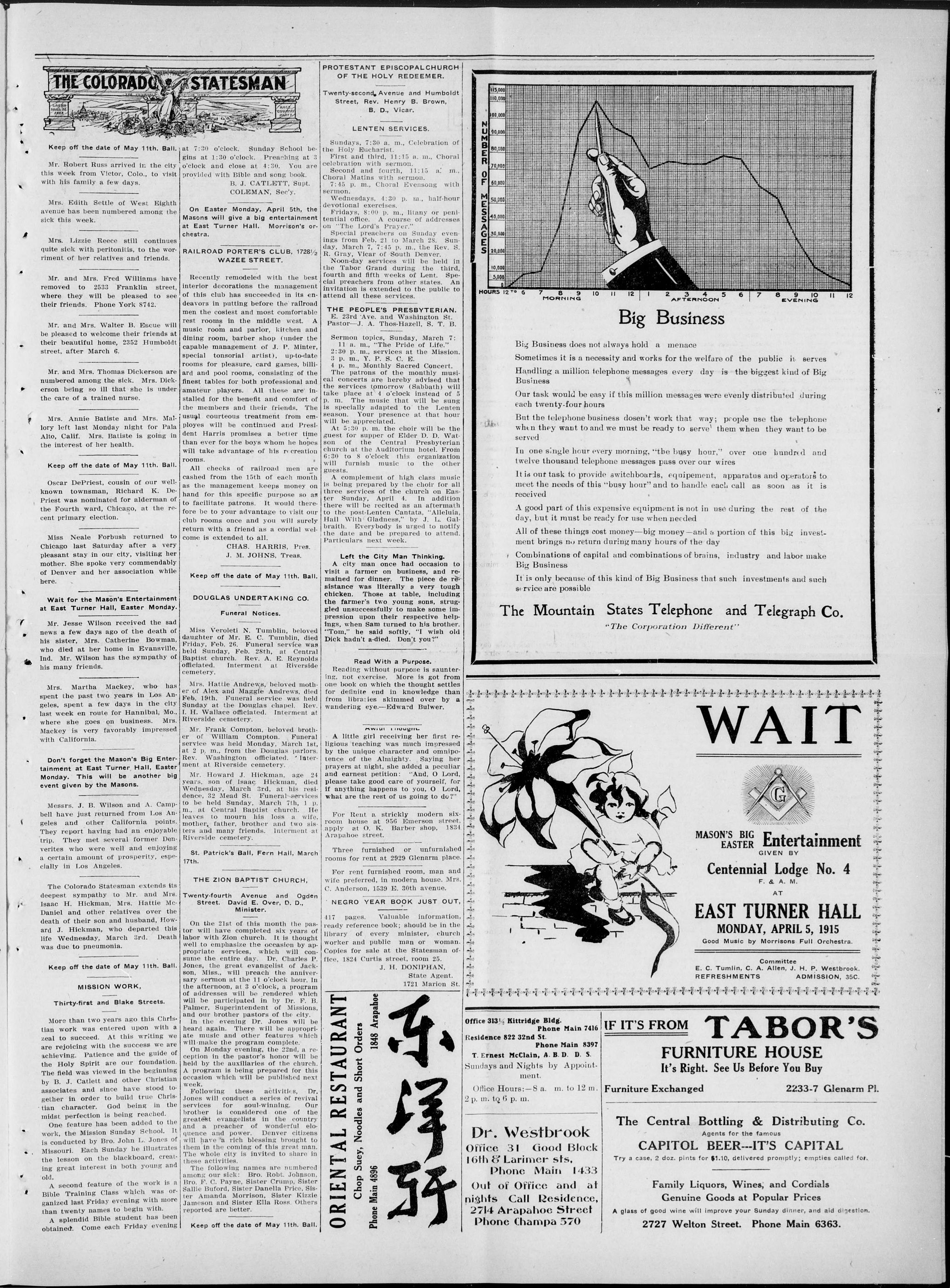
Wait for the Mason's Entertainment at East Turner Hall, Easter Monday.
Mr. Jesse Wilson received the sad news a few days ago of the death of his sister, Mrs. Catherine Bowman, who died at her home in Evansville, Ind. Mr. Wilson has the sympathy of his many friends.
Mrs. Martha Mackey, who has spent the past two years in Los Angeles, spent a few days in the city last week en route for Hannibal, Mo., where she goes on business. Mrs. Mackey is very favorably impressed with California.
Don't forget the Mason's Big Entertainment at East Turner Hall, Easter Monday. This will be another big event given by the Masons.
Messrs. J. B. Wilson and A. Campbell have just returned from Los Angeles and other California points. They report having had an enjoyable trip. They met several former Denverites who were well and enjoying a certain amount of prosperity, especially in Los Angeles.
The Colorado Statesman extends its deepest sympathy to Mr. and Mrs. Isaac H. Hickman, Mrs. Hattie McDaniel and other relatives over the death of their son and husband, Howard J. Hickman, who departed this life Wednesday, March 3rd. Death was due to pneumonia.
Keep off the date of May 11th. Ball.
MISSION WORK.
Thirty-first and Blake Streets
More than two years ago this Christian work was entered upon with a zeal to succeed. At this writing we are rejoicing with the success we are achieving. Patience and the guide of the Holy Spirit are our foundation. The field was viewed in the beginning by B. J. Catlett and other Christian associates and since have stood together in order to build true Christian character. God being in the midst perfection is being reached. One feature has been added to the work, the Mission Sunday School. It is conducted by Bro. John L. Jones of Missouri. Each Sunday he illustrates the lesson on the blackboard, creating great interest in both young and old.
---
A second feature of the work is a Bible Training Class which was organized last Friday evening with more than twenty names to begin with. A splendid Bible student has been obtained. Come each Friday evening
at 7:30 o'clock. Sunday School begins at 1:30 o'clock. Preaching at 3 o'clock and close at 4:30. You are provided with Bible and song book.
On Easter Monday, April 5th, the Masons will give a big entertainment at East Turner Hall. Morrison's or chestra.
RAILROAD PORTER'S CLUB, 17281
WAZEE STREET.
Recently remodeled with the best interior decorations the management of this club has succeeded in its endeavors in putting before the railroad men the cosiest and most comfortable rest rooms in the middle west. A music room and parlor, kitchen and dining room, barber shop (under the capable management of J. P. Minter, special tonsorial artist), up-to-date rooms for pleasure, card games, billiard and pool rooms, consisting of the finest tables for both professional and amateur players. All these are installed for the benefit and comfort of the members and their friends. The usual courteous treatment from employees will be continued and President Harris promises a better time than ever for the boys whom he hopes will take advantage of his recreation rooms.
All checks of railroad men are cashed from the 15th of each month as the management keeps money on hand for this specific purpose so as to facilitate patrons. It would there fore be to your advantage to visit our club rooms once and you will surely return with a friend as a cordial welcome is extended to all.
CHAS. HARRIS, Pres.
J. M. JOHNS, Treas.
Keep off the date of May 11th. Ball
DOUGLAS UNDERTAKING CO.
Funeral Notices
Miss Veroleti N. Tumblin, beloved daughter of Mr. E. C. Tumblin, died Friday, Feb. 26. Funeral service was held Sunday, Feb. 28th, at Central Baptist church. Rev. A. E. Reynolds officiated. Interment at Riverside cemetery.
Mrs. Hattie Andrews, beloved mother of Alex and Maggie Andrews, died Feb. 19th. Funeral service was held Sunday at the Douglas chapel. Rev. I. H. Wallace officiated. Interment at Riverside cemetery.
Mr. Frank Compton, beloved brother of William Compton. Funeral service was held Monday, March 1st, at 2 p. m., from the Douglas parlors. Rev. Washington officiated. 'Interment at Riverside cemetery.
Mr. Howard J. Hickman, age 24 years, son of Isaac Hickman, died Wednesday, March 3rd, at his residence, 32 Mead St. Funeral services to be held Sunday, March 7th, 1 p.m., at Central Baptist church. He leaves to mourn his loss a wife, mother, father, brother and two sisters and many friends. Interment at Riverside cemetery.
St. Patrick's Ball, Fern Hall, March 17th.
THE ZION BAPTIST CHURCH.
Twenty-fourth Avenue and Ogden
Street. David E. Over, D. D.,
On the 21st of this month the pastor will have completed six years of labor with Zion church. It is thought well to emphasize the occasion by appropriate services, which will consume the entire day. Dr. Charles P. Jones, the great evangelist of Jackson, Miss., will preach the anniversary sermon at the 11 o'clock hour. In the afternoon, at 3 o'clock, a program of addresses will be rendered which will be participated in by Dr. F. B. Palmer, Superintendent of Missions, and our brother pastors of the city.
In the evening Dr. Jones will be heard again. There will be appropriate music and other features which will-make the program complete.
On Monday evening, the 22nd, a reception in the pastor's honor will be held by the auxiliaries of the church. A program is being prepared for this occasion which will be published next week.
Following these activities, Dr. Jones will conduct a series of revival services for soul-winning. Our brother is considered one of the greatest evangelists in the country and a preacher of wonderful eloquence and power. Denver citizens will have a rich blessing brought to them in the coming of this great man. The whole city is invited to share in these activities. The following names are numbered among our sick: Bro. Robt. Johnson, Bro. F. C. Payne, Sister Crump, Sister Sallie Buford, Sister Danella Price, Sister Amanda Morrison, Sister Kizzie Jameson and Sister Ella Ross. Others reported are better.
Keep off the date of May 11th. Ball.
PROTESTANT EPISCOPALCHURCH OF THE HOLY REDEEMER.
Twenty-second Avenue and Humboldt Street, Rev. Henry B. Brown, B. D., Vicar.
Sundays, 7:30 a.m., Celebration of the Holy Eucharist.
First and third, 11:15 a.m., Choral celebration with sermon.
Second and fourth, 11:15 a. m., Choral Matins with sermon.
7:45 p. m., Choral Evensong with sermon.
Wednesdays, 4:30 p. m., half-hour devotional exercises.
Fridays, 8:00 p. m., litany or penitential office. A course of addresses on "The Lord's Prayer."
Special preachers on Sunday evenings from Feb. 21 to March 28. Sunday, March 7, 7:45 p. m., the Rev. S. R. Gray, Vicar of South Denver.
Noon-day services will be held in the Tabor Grand during the third, fourth and fifth weeks of Lent. Special preachers from other states. An invitation is extended to the public to attend all these services.
THE PEOPLE'S PRESBYTERIAN.
E. 23rd Ave. and Washington St.
Pastor—J. A. Thos-Hazell, S. T. B.
Sermon topics, Sunday, March 7:
4 p. m., Monthly Sacred Concert.
The patrons of the monthly musical concerts are hereby advised that the services tomorrow (Sabbath) will take place at 4 o'clock instead of 5 p. m. The music that will be sung is specially adapted to the Lenten season. Your presence at that hour will be appreciated.
At 5:30 p. m. the choir will be the guest for supper of Elder D. D. Watson of the Central Presbyterian church at the Auditorium hotel. From 6:30 to 8 o'clock this organization will furnish music to the other guests.
A complement of high class music is being prepared by the choir for all three services of the church on Easter Sunday, April 4. In addition there will be recited as an aftermath to the post-Lenten Cantata, "Allelula, Hall With Gladness," by J. L. Galbraith. Everybody is urged to notify the date and be prepared to attend. Particulars next week.
Left the City Man Thinking:
A city man once had occasion to visit a farmer on business, and remained for dinner. The piece de resistance was literally a very tough chicken. Those at table, including the farmer's two young sons, struggled unsuccessfully to make some impression upon their respective helpings, when Sam turned to his brother. "Tom," he said softly, "I wish old Dick hadn't a-died. Don't you?"
Read With a Purpose.
Reading without purpose is sauntering, not exercise. More is got from one book on which the thought settles for definite end in knowledge than from libraries skimmed over by a wandering eye.—Edward Bulwer.
CWIIRL LUSGHTS
A little girl receiving her first religious teaching was much impressed by the unique character and omnipotence of the Almighty. Saying her prayers at night, she added a peculiar and earnest petition: "And, O Lord, please take good care of yourself, for if anything happens to you, O Lord, what are the rest of us going to do?"
For Rent a strickly modern six room house at 956 Emerson street apply at O. K. Barber shop, 1834 Arapahe street.
Three furnished or unfurnished rooms for rent at 2929 Glenarm place
For rent furnished room, man and wife preferred, in modern house, Mrs C. Anderson, 1539 E. 30th avenue.
NEGRO YEAR BOOK JUST OUT.
417 pages. Valuable information ready reference book; should be in the library of every minister, church worker and public man or woman. Copies for sale at the Statesman office, 1824 Curtis street, room 25. J. H. DONIPHAN. State Agent. 1721 Marion St.
ORIENTAL RESTAURANT Chop Suey, Noodles and Short Orders Phone Main 4896 1848 Arapahoe
NUMBER OF MESSAGES
HOURS 12 TO 6 7 8 9 10 11 12 1 2 3 4 5 6 7 8 9 10 11 12
MORNING AFTERNOON EVENING
Big Business does not always hold a menace
Sometimes it is a necessity and works for the welfare of the public it serves
Handling a million telephone messages every day is the biggest kind of Big Business
Our task would be easy if this million messages were evenly distributed during each twenty-four hours
But the telephone business doesn't work that way; people use the telephone when they want to and we must be ready to serve them when they want to be served
In one single hour every morning, "the busy hour," over one hundred and twelve thousand telephone messages pass over our wires
It is our task to provide switchboards, equipment, apparatus and operators to meet the needs of this "busy hour" and to handle each call as soon as it is received
A good part of this expensive equipment is not in use during the rest of the day, but it must be ready for use when needed
All of these things cost money—big money—and a portion of this big investment brings no return during many hours of the day
Combinations of capital and combinations of brains, industry and labor make Big Business
It is only because of this kind of Big Business that such investments and such service are possible
The Mountain States Telephone and Telegraph Co.
"The Corporation Different"
---
A
---
Office Hours:-8 a. m. to 12 m.
2 p. m. tq 6 p. m.
Dr. Westbrook
Office 31 Good Block
16th & Larimer sts,
Phone Main 1433
Out of Office and at
nights Call Residence,
2714 Arapahoe Street
Phone Champa 570
WAIT
EAST TURNER HALL
MONDAY, APRIL 5, 1915
Good Music by Morrisons Full Orchestra.
Committee
E. C. Tumlin, C. A. Allen, J. H. P. Westbrook.
REFRESHMENTS ADMISSION, 35C.
TABOR'S
FURNITURE HOUSE
Right. See Us Before You Buy
ed 2233-7 Glenarm
Bottling & Distributing Co
Agents for the famous
L BEER---IT'S CAPITAL
The Central Bottling & Distributing Co.
CAPITOL BEER---IT'S CAPITAL Try a case, 2 doz. pints for $1.10, delivered promptly; empties called for.
Family Liquors, Wines; and Cordials Genuine Goods at Popular Prices A glass of good wine will improve your Sunday dinner, and aid digestion 2727 Welton Street. Phone Main 6363.
Big Business
always hold a menace
density and works for the welfare
phone messages every day is
if this million messages were e-
ness doesn't work that way; p
we must be ready to serve the
every morning, "the busy hour,"
one messages pass over our wifi
switchboards, equipement, a
"busy hour" and to handle each
expensive equipment is not in use
study for use when needed
it money—big money—and a po
during many hours of the day
al and combinations of brains,
this kind of Big Business that su
States Telephone
"The Corporation Differen
W
MASON
E
Cen
EAS
M
Good N
E. C. T
REFRES
IF IT'S FROM
FURNITU
It's Right. Se
Furniture Exchanged
The Central Bottle
Agents
CAPITOL BEER
Try a case, 2 doz. pints for $1.10
Family Liquors
Genuine Good
G
Centennial Lodge No. 4
F. & A. M.
AT
EAST TURNER HALL
MONDAY, APRIL 5, 1915
Good Music by Morrisons Full Orchestra.
BOR'S
HOUSE
You Buy
2233-7 Glenarm Pl.
Distributing Co.
CAPITAL
PROTECTIVE SUBSTANCES.
Sir Almroth Wright, the discoverer of opsonins, speaking before the Chelsea Clinical society of London, asserted that, while their origin in the body was unknown, "all the protective substances which were involved in the cure of disease were to be regarded as produced by the internal secretions." "It should be recognized," he added, "that chronic or local infection was a symptom of defective internal secretions and that those secretions could be elaborated in the body when there was youth, strength and health by the application of the appropriate stimulus given in proper quantities."
Naturally the mind of thinking man instinctively turms to the search for this "appropriate stimulus." Other things being equal, it is quite significant that the highest degree of immunity to infection is generally to be found among those people most closely approximating primitive living conditions, and it is among this class that the highest number of breast-fed infants will be found. Also it is significant that hay fever, neurasthenia and the other neurotic disturbances are more prevalent among the refined and the educated than among the illiterate and the poorer classes.
Inasmuch as we all begin as a single cell and every particle of change beyond that state must come as the result of the absorption of external matter, we are inevitably forced to a consideration of the building material out of which the body must be constructed as being the only logical point of departure from the normal state of health. It is impossible to build a substantial and durable building without sound and suitable foundations, lumber, brick and mortar, and it is impossible also to build a normal, healthy human body without suitable building material. If a building disintegrates and falls down we know the cause must have been inferior material and workmanship. Likewise premature physical collapse or disease or abnormal conditions in the human body must come from the same cause. Nature does not make mistakes, but adjusts each thing according to its correct relationship with everything else.
In the past the value of a food has been estimated by its contents in fats, carbohydrates and proteins, as estimated by rather crude chemical analysis and the caloric equivalent of the food. The demonstration of the necessity of certain inorganic salts for the maintenance of body metabolism, a proposition which is still being strenuously fought in many quarters, marked a forward step of vast importance to human health and happiness, but it fell far short of solving the most serious problem confronting modern civilization. Further comprehensive efforts to reach this solution resulted more recently in the discovery that individual protels consist of numerous amino acids (nitrogen holding compounds) and that each protel differs in the quality and the number of these amino acid "building stones." This discovery opens our understanding to a comprehension that proteins which are deficient in certain of these amino acids will not alone suffice to maintain an equilibrium of nitrogen metabolism.
The work of Holst, of Funk and of the later investigators of the different deficiency diseases gives to medicine an entirely new conception of food requirements.
The discovery of these substances (the vitamines) is certain to produce a revolution in existing theories of metabolism and of disease, because such substances have been undreamed of by physiologists and pathologists. They are the key necessary to unlock the doors to the unexplored regions that the comprehensive and brilliant work of Brown-Sequard, Sajous and numerous other keen minds have opened to wondering humanity. The significance of the discovery is not grasped until we come to understand that in these numerous and complicated amino acid bodies we undoubtedly have the "appropriate stimulus" sought for; the "mother substance," according to Funk, out of which are made the wonderfully effective "opsonins," "hormones," or whatever we may choose to call them, the chemical compounds manufactured by the complicated co-operative system of ductless glands that have automatically regulated and carried forward all man's vital functions since the beginning of time, and are fully able to continue the operation normally and in accordance with the laws of the universe to the end of time—provided man acquires sufficient intelligence not to interfere with the operation of the functions.
A brilliant red card is probably as distinct an entity as one can imagine, and yet in the light of the sun from which only the red wave rays are eliminated such a red card will be black. There must be red in any
light that will reflect red. The analogy holds good in every department; it is a universal principle. And in this principle we shall find the key to the solution of most of our ills. Under the exigencies of trade vital parts of the energy stream are diverted and as a consequence we suffer what we call disease.
Sajous holds that millions of infants die solely because they are deprived of what nature provided for them, the maternal milk, which not only nourishes them, but protects them against disease. Human milk contains vitamins, and we have yet to demonstrate the ultimate result of civilization's substitutes for the normal maternal milk, which do not contain these vital principles, on those infants that survive the unnatural feeding. We have yet to establish the relationship between commercially processed foodstuffs and many of our distressing functional diseases.
PROTEIN MATTER.
Every living cell, be it animal, vegetable or bacterial, must feed or cease to exist. The one phenomenon always manifested by living matter and never by nonliving matter is metabolism. Metabolism consists in a constant traffic in energy by means of a certain persistent interchange of energy bearing elements by barter among the individual cells composing the living body. Nitrogen seems to be the master element within the living molecule, because in all cases the living organism is found to consist of one or more nitrogen-containing cells. The nitrogen cell content is known as protoplasm and exists as a wonderfully complex molecule generally in the form of a colloid.
The only essential and constant difference between living and nonliving matter is that within the molecules of living matter there is this constant metabolism making for a continuous interchange or flow of energy, while in the nonliving no such process operates.
In all instances protein or protoplasm is capable of growth and multiplication, but to do this it must assimilate and eliminate; that is to say, it must receive and discard. The living molecule not only absorbs, but it chemically alters what it absorbs. That is to say, it adapts the atoms to its needs by rearranging them into new combinations; or, in other words, it assimilates and eliminates. In effect, it feeds and excretes exactly as does any human individual. Obviously, then, a cell is limited in its food supply to that which lies within its reach, and there must, therefore, be a certain relationship between the cell and the medium in which it exists.
When matter becomes endowed with life it does not cease to be matter, neither does it lose its inherent properties. It simply becomes exceedingly active or unstable, but it is never released from the laws that govern its structure, its attractions and reactions. No animal has the ability individually directly to assimilate the energy or heat locked up in elemental mineral matter. First groups of energy-bearing mineral molecules are torn from nonliving matter by the chemical activity and affinities of the lower forms of life, the primitive forms of protein matter existing in plants and in the interior of these protein bodies the mineral molecular atoms are rearranged by ferments and thereby quickened. Thereafter their interchanges and reactions are very rapid. It is quite certain that these ferments have their origin in the nitrogenous metabolism of the living molecule, and that each living molecule has many of these nitrogenous groups known as receptors, which are in effect hands—atom groups in a cell by means of which foreign substances, toxins, food molecules and the like are anchored to the cell.
It is these nitrogenous bodies, enzymes, ferments or catalyzers that bridge the chasm between the nonliving sources of energy and the living cell; and it is a break in this chain and the consequent disturbance in our relationship with the sources of energy that interferes with the free flow of energy or life through our tissues, thereby creating those conditions of functional disturbance and the chemical conditions necessary for that state known as disease and which sooner or later are quite certain to develop into some form of infection or organic disease.
It is in the elimination from our grain foods of the nitrogenized mineral molecule bearing its store of latent but easily secured energy that we may expect to find the source of the many thin little legs, the many pale, pinched little cheeks and the lusterless eyes. It is in the elimination of these "inorganic, insoluble" elements we shall undoubtedly find the cause of the lack of material for the manufacture of the protective materials secreted by our wonderful ductless glands which control all our involuntary vital functions and insure our immunity against invading protoplasmic enemies.
No protein bodies, such as bacteria are, can live except in favorable chemical solutions; they, like ourselves, are dependent on a constant flow of food energy, and the adjustment in the normal human body makes it impossible for bacteria to exist therein. Hence it must be disturbance in this vital flow, in our chemical balance, that makes us subject to infections as well as to those deficiencies falling under the head of "neutotics" and around which are grouped our neurasthenics, our hay fever and other similar victims.
THE KITCHEN CABINET
But who can paint like nature?
Can imagination boast
Amid its gay creation, hues like hers?
Or can it itm with them that match-
till
And lose them in each other, as ap-
pears
SAVORY DISHES.
Cut thin slices from cold roast beef; chop the trimmings and eat, allowing one tablespoonful f the chopped mixture for each slice of the roast; season highly with salt and pepper, herbs and a fourth as much of cracker
one tablespoonful in the chopped mixture for each slice of the roast; season highly with salt and pepper, herbs and a fourth as much of cracker crumbs as meat.
Spread this on each slice, roll and tie. Dredge with salt and pepper and flour, fry in drippings. Then put them into a stew pan, pour over water and simmer until they are thoroughly hot.
Stuffed Onions—Parboil large-sized onions; take out the center, leaving a cup to hold the filling which will be used. Chop the onion which was taken from the center, mix with cold sausage or bits of bacon, bread crumbs and seasoning. Fill the onions; pour around any nice meat broth or water and butter and bake until the onions are tender.
Cream of Spinach Soup.—Press one cupful of cooked spinach through a sieve, add one pint of hot white sauce, two cupfuls of broth and seasoning. Pour over the well-beaten yolks of two eggs, which have been beaten, with a cupful of cream.
Cheese Souffle.—Cut bread into fine crumbs and mix with a cupful of milk which has been heated. Melt a cupful of grated cheese, beat the yolks of two eggs and add to the cheese, cool and fold in the whites of the egg, beaten stiff. Butter individual dishes and fill with the ingredients. Bake in a moderate oven 15 minutes. Serve very hot.
Onion Souffle.—This is another most appetizing onion dish. Boil eight onions, drop and squeeze out all the juice. Add to a pint of white sauce, made rich by the yolks of two eggs. Fold in the stiffly beaten whites of three and put into a well greased baking dish. Bake until firm.
A sacred burden is this life ye bear. Look on it, lift it, bear it solemnly. Stand up and walk beneath it stand-fastly.
Fall not for sorrow, falter not for sin. But onward, upward, till the goal ye will.
JOT THESE DOWN.
Either put them down in the chambers of memory where they may be easily recalled or on paper where they may be referred to in time of need.
```markdown
```
Use fruits for dessert at least once or twice a week, preferably on busy days when time is limited.
Always follow a heavy dinner of pork with a fruit or very light dessert.
With clear soups pass bread sticks or pulled bread.
With cream soup and puree use croutons, which are squares of bread, either fried brown or buttered and browned in the oven.
Roast mutton or lamb is accompanied by mint sauce. Peas are served as a vegetable with either.
Boiled mutton is served with caper sauce and boiled rice.
Spring lamb is best with new peas and potatoes.
Lamb stew is good served with hominy balls or rice croquettes.
Broiled lamb is served with peas in some form and either creamed or baked potatoes.
Roast venison, quail, duck are good with either currant or spiced jelly, boiled tongue with raisin sauce or accompanied with spinach and tomatato sauce.
Baked sweet potatoes are good with pork, and apples are always an accompaniment.
Sweet potatoes are good with any meat, but especially with turkey.
Apple sauce is served with roast goose, cranberry with turkey and currant jelly with game.
Boiled ham with spinach, or with cider sauce.
Beef stew may be served with dumplings and vegetables or with boiled onions.
Broiled beefsteak with mushroom, mashed, baked or escalloped potatoes.
Cauliflower or asparagus is a good accompaniment to beefsteak.
Fried chicken with waffles or fritters or with rice.
Roast chicken with rice, or roasted in milk after browning and add a cupful of corn to the milk.
Nellie Maxwell.
Expensive Wood
One of the most expensive woods used regularly in an established industry in the United States is boxwood, the favorite material for wood carving. It has been quoted at four cents a cubic inch, and about $1,300 by the thousand board feet.
Precious Sperm-Whale
Sperm-whales are the richest prizes of the ocean, yielding spermaceti from the cavities in their heads, ivory from their lower jaws and rich yellow oil from their sides.
SIXTY-THIRD CONGRESS
RECORD-BREAKING SESSION DIES WITHOUT STRUGGLE.
Postoffice, Indian, and Shipping Bills Expire With It.—President Wilson Signs Seamen's Measure.
Western Newspaper Union News Service.
Washington—The Sixty-third Congress—a record-breaker in many respects—expired by limitation at noon March 4th.
With an unusual record of legislation accomplished, bangs of gavels in the Senate and the House sounded "Taps" on the session launched a month after President Wilson's inauguration two years ago.
"Swan songs" were sung by retiring House members. Resolutions of felicity were given Speaker Clark and the party leaders. A costly oil painting of himself was the members' gift to the retiring Democratic leader, Representative Underwood.
After an all-night vigil Congress showed an unexpected burst of speed and practically finished its legislative work nearly two hours before the time of adjournment.
Two of the principal appropriation bills, the postal bill and the Indian bill, failed at the last moment, and joint resolutions were passed extending the current appropriations for the Postoffice Department and the Indian Bureau over the next fiscal year.
The clause in the postoffice appropriation bill providing that assistant postmasters be abolished, was eliminated by the conference report.
The House finally passed and sent to the President the resolution passed by the Senate, giving the President power to enforce this nation's neutrality. The ship purchase bill is dead. Administration senators, threatened with continuation of the Republican filibuster, did not plan another attempt to revive it. The bill dies in conference. Rural credits legislation also is dead. Instead, a congressional commission is authorized to investigate the whole subject and report to the next Congress by Jan. 1, 1916.
The House passed the bill providing aid to Alaskan agricultural colleges; approved dropping the impeachment charges against former judge Daniel Thew Wright, and, as a tribute to the veteran representative, Bartlett of Georgia, who retires, passed a bill appropriating $50,000 for a federal building at Forsyth, Georgia.
Cleaned Slates.
The House, cleaning its slate before ten o'clock, settled down to wait for noon. Democratic Leader Underwood, making his last speech on the floor—for he goes to the Senate in the Sixty-fourth Congress—declared the House had done its work and it would not be the fault of that body if the government's finances were not cared for.
Tse Senate, after concurring with the House extension of the postal and Indian appropriations, went into executive session to work on nominations.
President Wilson went to the capitol at 10 o'clock and promptly began signing the accumulation of bills and resolutions.
The President signed the La Follette seamen's bill improving the working conditions of American seamen and increasing lifesaving equipment requirements.
Records Smashed.
In time consumed the Congress which ended on the 4th smashed records. It had been in session 637 days. The special session called in April, 1913, leaped into the December session that year, which continued until last October, adjourning only five weeks before the present session began last December.
The principal accomplishments of the Sixty-third Congress were the following laws:
New tariff and income tax, new currency system, creating a Federal Trade Commission, amending the antitrust act, repeal of the Panama canal "free tolls" provision, authorizing a government railroad in Alaska, empowering use of armed forces in Mexico, the war tax creating a war risk insurance bureau and ratification of twenty-one peace treaties.
With the echo of the adjournment gavel many big figures in public life retiree. Nine senators and almost 150 representatives left Congress.
The Senate had 53 Democratic, 42 Republican and 1 Progressive member. The Sixty-fourth Congress will see 56 Democratic, 1 Progressive and 39 Republican senators seated.
The House had 286 Democrats, 124 Republicans, 17 Progressives and 1 Independent. The next House will have 231 Democrats, 194 Republicans, 7 Progressives, 1 Socialist and 1 Independent.
The total appropriations of the session were approximately $1,120,484,324, several millions under the record of previous Congresses.
Wilson Praises Work.
After his return to the White House President Wilson dictated the following statement about Congress and its work: "A great Congress has closed its sessions. Its work will prove the purpose and quality of its statesmanship more and more, the longer it is tested. Business has now a time of calm and thoughtful adjustment before it, disturbed only by the European war. The circumstances created by the war put the nation to a special test, a test of its true character and of its self control.
NATIONAL CAPITAL AFFAIRS
WASHINGTON.—"And while the chair is about it, he will suggest that it is a good thing for members to keep their feet down from the tops of the seats." Thus spake Speaker Clark, scolding his colleagues as a school:
The rules of the house prohibit smoking inside this hall. Complaint has been made more than once about the violation of this rule. Now there is plenty of space outside for gentlemen to smoke.
"And while the chair is about it, he will suggest it is a good thing for members to keep their feet down from the tops of seats."
Thus he robs members of one of the pleasures of legislative life. The seats are comfortable and the back of the chair in front is just the place to rest a pair of No. 11's.
Members from the West seem to have taken to the practice of placing feet on the backs of chairs just as readily as they would hang them on the railing of the country hotel back home.
People from all over the world have seen congressional feet on the tops of chair seats and have gone away, noting in their travelogue diaries that it is one of the sights of the American legislature.
Hereafter it will be a bold congressman (or a new one) who will dare to rest his brogans on the chair of the fellow in front of him.
Little White House Baby Poses for His Picture
Little White House Baby Poses for His Picture
ON the day when Francis Sayre, the eleventh baby born in the White House, was a week old he was presented with an effigy of a Princeton tiger, that he might be influenced in his youth toward seeking an education within the institution recently under.
camera as evidence that he and his relatives appreciate the fact that he is a real White House baby and that all the people of the United States are interested in him.
These pictures were intended only for distribution among members of the presidential family. When the photographers got their opportunity they took many snaps at the defenseless infant.
That's a pretty good record for one week for any baby that hasn't yet learned to make a speech, that isn't yet inured to the customary White House habit of being interviewed regularly, but he's growing. That much may be admitted on no less authority than that of the president himself.
Of course the youngster started with a handicap. Everyone thought naturally that he would be named after his distinguished grandfather, but grandfather had something to say about that. He wanted to give the little fellow a "square deal," and start even with the world, so he was finally named Francis Sayre.
Though there have been eleven White House babies, all of whom have prospered, there was but one child of a president born within the executive mansion. That was Miss Esther Cleveland.
Secretary Daniels Is Proud of These Five Middies
Secretary Daniels Is Proud of These Five Middies
SECRETARY DANIELS has received from the naval academy at Annapolis a photograph of which he is extremely proud. Those to whom he displayed it at the navy department were willing to bet that the picture says
ranks of the navy under the newly enacted law of 1914, which permits 15 enlisted men to enter the academy from the service every year.
The enlisted men who may be admitted to the academy under this law must be citizens of the United States, not over twenty years of age, they must have served at least one year in the navy, and they are subject to the same physical and mental examinations as are required for all other nominees, presidential and congressional. They are obliged to conform to the standards in every respect, and are subject after their admission to the same rules and regulations as apply to all other midshipmen.
The naval appropriation bill was not passed by the senate until June 2, 1914. The examinations for enlisted men were held on August 3, 1914, just two months later. In view of the limited time that candidates had to prepare for the examinations, it is regarded as gratifying that as many as five candidates succeeded in meeting all the requirements. By the time the next examination is held, April 5, 1915, candidates will have had additional time in which to prepare, and it is expected that the number of candidates will be greatly increased.
Would Not Break Rule for President's Daughter
VERY employee and a large number of the members of the house are talking today about the nerve displayed by a capitol elevator man named Kenner in refusing to allow Mrs. McAdoo, wife of the secretary of the treasury, to ride in his car. The ele-
cannot ride in this car," he said, refusing to open the gate
"Why not?" asked one of the men in the party.
Kenner pointed to the sign.
"But you don't understand," said the spokesman. "This is the party of Mrs. McAdoo, daughter of the president and wife of the secretary of the treasury."
"Yes, I do understand; I know Mrs. McAdoo every time I see her; but my orders from the speaker of this house are to obey that sign."
With that he jerked the controller back and the car sank to its resting place on the main floor. Mrs. McAdoo's party then descended in a neighboring public elevator.
IT IS A GOOD THING FOR MEMBERS TO KEEP THEIR FEET DOWN FROM THE TOP OF THE SEATS
The rules of the house prohibit smiles been made more than once about the plenty of space outside for gentlemen. "And while the chair is about it, members to keep their feet down from Thus he robs members of one of seats are comfortable and the back of rest a pair of No. 11's. Members from the West seem to feet on the backs of chairs just as rerailing of the country hotel back home People from all over the world his of chair seats and have gone away, n is one of the sights of the American Hereafter it will be a bold congru to rest his brogans on the chair of the
Little White House Baby
ON the day when Francis Sayre, the House, was a week old he was p tiger, that he might be influenced in
within the institution recently under the guidance of his famous grandfather. Then he was furnished with a neat little pair of boxing gloves, that, as his granddad the president said, he might learn to "strike out for himself" in due season. Next came to the White House a serviceable pair of blue jean overalls that he might ever be reminded that he is to be one of the great mass of working people on whom the welfare of the republic depends. He posed for the
camera as evidence that he and his m
a real White House baby and that a
interested in him.
These pictures were intended on
the presidential family. When the ph
took many snaps at the defenseless in
That's a pretty good record for o
learned to make a speech, that isn't
House habit of being interviewed reep
may be admitted on no less authority y
Of course the youngster started w
ally that he would be named after
grandfather had something to say abe
fellow a "square deal," and start ev
named Francis Sayre.
Though there have been eleven W
prospered, there was but one child of
mansion. That was Miss Esther Clew
Secretary Daniels Is Pro
SECRETARY DANIELS has received
a photograph of which he is extre
played it at the navy department were
A man holding a picture of five men.
ranks of the navy under the newly enlisted men to enter the academy from
The enlisted men who may be ad-
must be citizens of the United State
they must have served at least on
subject to the same physical and med
all other nominees, presidential and
conform to the standards in every re-
mission to the same rules and regulations
The naval appropriation bill was
1914. The examinations for enlisted
two months later. In view of the lim-
pure for the examinations, it is regar-
candidates succeeded in meeting all
next examination is held, April 5, 1914
time in which to prepare, and it is ex-
will be greatly increased.
Would Not Break Rule f
EVERY employee and a large num-
talking today about the nerve disp
Kenner in refusing to allow Mrs. M
treasury, to ride in his car. The elev-
ator runs in a shaft on the outside
of which, on every floor, is a sign
reading: "Exclusively for members
of congress and the press."
Mrs. McAdoo, accompanied by several friends, approached the elevator on the gallery floor and rang the bell. Kenner, the elevator man, pulled the car up from the main floor, but he saw in the group of waiting visitors neither a member of congress nor a newspaper man "You cannot ride in this car," he said, refu "Why not?" asked one of the me Kenner pointed to the sign.
"But you don't understand," said Mrs. McAdoo, daughter of the presi treasury."
"Yes, I do understand; I know Mr my orders from the speaker of this hov With that he jerked the controller place on the main floor. Mrs. McAdoo ing public elevator.
master chiles errant children. Some of the house members were violating house rules by smoking in the chamber, despite the rigorous, censorship on smoking upheld by the doorkeeper and his minions. Speaker Clark himself a strict observer of the house rules in every sense of the word, rose upon the rostrum, gavel in hand, at the close of a vote on one of the bills, and said:
"Before taking up the next bill the chair desires to make a statement.
looking inside this hall. Complaint has the violation of this rule. Now there is to smoke.
he will suggest it is a good thing for on the tops of seats."
of the pleasures of legislative life. The of the chair in front is just the place to
have taken to the practice of placing headily as they would hang them on the
have seen congressional feet on the topsoting in their travelogue diaries that it legislature.
lessman (or a new one) who will dare the fellow in front of him.
New Poses for His Picture
the eleventh baby born in the White presented with an effigy of a Princeton his youth toward seeking an education
A boy sits in a chair with a pillow on his head, while a man in a suit stands behind him, holding a camera.
relatives appreciate the fact that he is all the people of the United States are
by for distribution among members of photographers got their opportunity they infant.
one week for any baby that hasn't yet yet inured to the customary White regularly, but he's growing. That much than that of the president himself.
with a handicap. Everyone thought natur- his distinguished grandfather, but out that. He wanted to give the little men with the world, so he was finally
White House babies, all of whom have a president born within the executive island.
Proud of These Five Middies
from the naval academy at Annapolis
lumely proud. Those to whom he dis-
willing to bet that the picture repre-
sented a quintette of middies at the academy. The secretary admitted that they were middies, full-fledged, and possessed of all the other qualifications and prerogatives of any other midshipmen, and yet they were different, in the sense that these five middies had won their way into the academy by competitive examination from the ranks of the enlisted personnel of the naval service. They were the first five enlisted men to enter the naval academy, from the
in enacted law of 1914, which permits 15
am the service every year.
mitted to the academy under this law
ties, not over twenty years of age,
the year in the navy, and they are
mental examinations as are required for
congressional. They are obliged to
spect, and are subject after their ad-
dons as apply to all other midshipmen.
not passed by the senate until June 2,
men were held on August 3, 1914, just
aited time that candidates had to pre-
ded as gratifying that as many as five
the requirements. By the time the
5, candidates will have had additional
expected that the number of candidates
For President's Daughter
per of the members of the house are
layed by a capitol elevator man named
McAdoo, wife of the secretary of the
YOU CANNOT RIDE IN THIS CAR
---
ing to open the gate
in the party.
the spokesman. "This is the party of
ment and wife of the secretary of the
ers. McAdoo every time I see her; but
use are to obey that sign."
e back and the car sank to its resting
's party then descended in a neighbor-
In the RUBBER COUNTRY
FLOATING RUBBER RAFTS DOWN THE RIO MACHADO
IT HAS rarely been my privilege to penetrate into more primitive regions than the headwaters of the Orinoco, or into a land of greater promise than is found along the upper reaches of the Gy Parana, better known as the Rio Machado, writes Leo E. Miller in an interesting article on the rubber regions of South America, in the India Rubber World. The Gy Parana, it might be well to state, is one of the largest affluents of the Madeira. For many years its lower course has been known to adventurous seekers of orchids, rubber, and other natural products, all of which have been yielded in abundance; but it is only within the last few years that the course of the upper river has been thrown open to navigation of any kind. Even now only an occasional dugout ventures beyond the zone of pestilence and rapids into the land of hostile Indian tribes; but the way has nevertheless been opened, and within a comparatively short time this region will be giving up its fair quota of the natural riches that lie hidden in the vast, untredden wilderness.
The Orinoco is, no doubt, better known by name than the Machada, and at present it must suffice to give merely a vague idea of the remoteness of its hinterlands by citing that it requires approximately three months of travel from Ciudad Bolivar, 240 miles from the mouth of the mighty river, to reach the rapids of Guajaribo, far above the mouth of the Cassiquaire; beyond that point the river is wholly unknown.
At Senor Paraguete's Barraca.
At Senor Paraquete's Barraca.
On February 28, 1913, I stopped at the barraca of one Senor Paraquete, far up on the Orinoco, beyond the mouth of the Ventuari. The main building stood on a high bank 30 feet above the river, and was occupied by Senor Paraquete and his assistants. Several large rooms were used as a venta or store and a fair stock of provisions and merchandise was carried. On one side was the camp of the full-hlooded Indian employees, Maquiritares from the regions of the Cunacunuma, who lived in small palm-leaf huts with their families. On the other side stood long, thatched buildings, open all around, with scores of hammocks strung from the posts and beams; these were the quarters of the natives—Venezuelans and Zambos. In the rear, and some distance away, stood the smokehouses, completely inclosed with palm leaves except for one small door opening. Trails led into the forest from a number of points, and numerous dugouts tied to the landing indicated that work was also prosecuted on the other side of the river. Often, especially in the case of the Indians, man and wife worked together.
Old-fashioned methods are employed entirely. The trees are girded with strips of palm pitch at the base which intercept the latex and deflect it into a folded leaf placed underneath. This system is rather wasteful and injurious to the trees. There is no fixed rule or custom for tapping the trees, the men hacking into the bark at random, but occasionally the herringbone pattern of cut is used. Each man has two routes, and endeavors to have from 300 to 500 trees on each, seldom more, often less, according to the abundance of the rubber trees in the locality. He takes one trail one day, and the other the next, thus permitting the trees to rest on alternate days. If it rains, the day's catch is spoiled, as latex mixed with water is worthless.
The milk was weighed as brought in by each man at midday and credited to his account; in the afternoon the whole force repaired to the smokehouse to work up the day's catch. A kind of wood called Mazarandul is used exclusively for the smudge; it is of a deep reddish color and grows plentifully along the river.
Transportation Is Costly.
The cost of transportation between the Upper Orinoco and Ciudad Bolivar is enormous. In the first place, the distance is very great and the river is full of rapids, necessitating long overland portages; all provisions have to be brought up, and the crude product has to be taken back down; there is always a great loss both ways from theft and wreckage, and as there is no regular system of navigation beyond the mouth of the Apure, the difficulties encountered in securing boats and crews are tremendous.
The headquarters of the Orinoco rubber gatherers is San Fernando de Atabapo, containing about 100 huts, which is the only settlement above the Cataract of Malpures. In February the town was almost deserted. In May it was full of life. Numbers of people were arriving daily; there was dancing and gaming, eating and drinking, day and night, and many a man spent his entire season's earnings in a few evenings. The sight was not unlike that formerly seen in the western mining camps of our own country. Representatives of the big houses in Ciudad Bolívar, which had made advances to the concessioners, were there to see that they received all the rubber collected by their debtors. The governor of the department (Alto Orinoco) made his home farther down the river, on the Río Catanilapo, near the Rapids of Atures.
On the Machado the rubber camps are not abandoned during the rainy season but as the floods advance stand isolated above the muddy water, crowded with their human inhabitants, chickens, pigs and dogs. Many of the houses are built on piles, and the water comes up until it touches the floor. Cooking and washing are done on the front porch and canoes are tied to the posts in readiness for instant flight if necessary, or to use in gathering wood or visiting the neighbors. Behind the huts, banana palms bend and bow gracefully as the current tugs at their bases, and a few vultures are usually perched on the roof.
Happy. Busy People.
The whole presents a scene of devastation, but the people seem perfectly happy. If there is any high country within reach, the men may cut timber and collect copaiba oil or hunt for various kinds of gums. The gathering of Brazil nuts forms one of the chief occupations, and thousands of tons are brought down the various rivers annually. Canoes are hollowed out, palm leaves and poles for new huts are brought in, and everything is made shipshape so that there may be no delay in beginning the rubber season when the water recedes. There are invariably a few men in each camp who are famed for their prowess with gun and harpoon, and it has been my pleasure on several occasions to accompany these nimrods of the tropical jungles on their long rambles in search of meat.
At Calama on the Madeira, just opposite the mouth of the Machado, are located the headquarters of one of the best organized rubber companies I have found anywhere during my four years of explorations. It is the establishment of Aesensi & Co., who started business 18 years ago with eight men; today they employ 3,500 men all told, and produce 700 tons of rubber annually, besides large quantities of copaiba oil, tobacco, lumber, and other natural products. Their concessions cover the entire country bordering the Machado and Commemoracion, extending inland a distance of 30 kilometers on each side of the water. In addition, the concern controls large tracts on the Madeira. The building at Calama are large and comfortable, and besides living quarters include modernly equipped offices, storerooms, warehouses, carpenter and machine shops, and cattle barns. A resident physician is retained for the care of the employees, who are brought down from the camps and cared for when in need of treatment.
One of Nature's Mysteries.
Whence came the first globule or sap? And why? How has it produced all of the marvelous forms? Of all the curiosities and mysteries of nature this is one from which all things are inherent and all things in explicable. Let's not call it protozoa or prophyta or by any other of the learned names but simply "sap" which mysteriously assembles its composition from the grossest ingredients of earth and blossoms forth at the beginning of the real advent of the year in multitudinous phenomena of beauty to the glory of nature.
Steel Product.
The United States of America is by far the greatest steel producing country on earth. Germany comes next, with Great Britain third. The figures for 1910 (the latest at hand for the moment) show this country to be equal in steel products to both Germany and the United Kingdom.
---
ONE WHO LISTENED
By BENJAMIN RUSH THORNBURY.
(Copyright.)
In the smoking compartment of a Pullman on the westbound train were three men. Two of them, one the superintendent of the road and the other an ex-railroad man, were engaged in conversation on the merits of railroaders in general, and concerning those who maintained their positions through official relationship in particular. The third, a well-groomed, portly gentleman, sat quietly in the corner, puffed a cigar, and listened.
"Railroading isn't a profession; it's a science," the ex-railroad man was protesting. "I've always maintained that these relationship jobs are a detriment to the service, and it's been my observation that, as a rule, the incumbents never make good."
"I've known some exceptions to that rule; in fact, I have one in mind now," said the superintendent.
"It was in the old days on the M. I and N. Old Man Goodell had come down to Kensington from the Soo to take over the management of the road; and while he didn't have a great deal of style, he more than made up for it in a system of his own, that resulted in making the two streaks of rust and a right-of-way one of the best paying little roads in the country. I was a general utility clerk in his office at that time, and sorted out the old man's mail. One morning I came across a letter from Tom Goodell. Tom was a brother of the old man, who had been in the lumber business up North, but who had taken a sudden notion that he wanted to be a railroad man. The letter was a request for a job.
"Joe Kelsoe was trainmaster up at Centerpoint at that time. He had some set notions, like yourself, about Tom's kind, and wasn't at all backward about expressing them. The boys said he cussed a blue streak when he got the old man's letter ordering him to send Tom out braking on the local to learn the road.
"Well, everybody knew at once what that meant, and there was a general howl all along the line among the trainmen, not official, of course, but a lot of talk, and, as usual, that's about where it ended.
"About three months after that, Ed Burton, a freight conductor with a through run, came within an ace of getting into a smash-up with an east-bound passenger on an order he misconstrued, and, of course, went on the carpet. The old man was always mighty square with the boys when they got into trouble, and was disposed to be lenient with Ed, though he had known for some time that Ed wasn't a man to be running a train.
"He was oversensitive on the subject, as that kind usually are; so when the old man offered to compromise by giving him thirty days, and a gravel train when he got back, Ed flared up and quit, taking a pass back to Arlington, where he lived."
"That was the only time I ever saw Ed to know him; and when he came through the office, looking as black as a thunder cloud, I surmised he had been having his troubles in the old man's little sanctum.
"Well, as everybody expected, two days later Tom Goodell got his train.
"I had been out on the road looking up a claim on some stock that had been killed, and happened to be in Tom Goodell's caboose on his first run out. I altered my opinion of Tom that night and haven't changed it since, for he proved to be one of the exceptions I spoke about.
"The night operator at Menden had given him orders to pick up some empty stock cars at Arlington, and I guess that's all that saved us from about the worst wreck the road ever had, for we would have gone into that open switch at a forty-five-mile clip.
"They usually went through from Menden without stopping, that being a part of the run where they made up time. As it was, they had slowed down for the stop, and when they unexpectedly shot in on the sliding from the upper end, the engineer had his train pretty well under control; so the little bump they gave that string of empties did no damage. The switch had been thrown, and the light changed so that it showed white.
"When they found out about the changed switchlight, the crew laid it to every cause but the right one. As Tom jumped down from the caboose steps, however, his quick eye had caught sight of a man ducking around the edge of the station that looked an awful lot like Ed Burton.
"He said nothing about this when he came up where the boys were talking, but the next morning he and the old man were closeted for the better part of an hour. I could tell by his loud tone that the old man was considerably worked up about something, for he always was a quiet sort of a man. All the while Tom was talking in a low, pleading voice, and now and then I could hear Ed Burton's name.
"After a while they came out, and the old man took his pass-book from his desk and filled out a blank. I could see his hand tremble as he wrote. Tom took it, and hurried out, as I afterward learned, to catch No. 5. He dropped off at Arlington on the opposite side from the station, and when he came back on No. 6 that evening Ed Burton was with him."
The superintendent screened his eyes with his hand and peered through
the window to see the switch-lights of the Centerpoint-yard twinkling in the darkness.
Do You Know That-
"Here's where I get off," he said.
"I suppose Burton was a guest of the state for a term," pursued the ex-railroad man, also rising.
"No, he wasn't." denied the super-intendent, putting on his overcoat.
"The old man and Tom fixed it up between them to keep the matter quiet and give Burton another chance.
"He wrote to a friend of his somewhere out West that he wanted Ed placed, and in a week or so Ed packed up his wife and baby and followed the letter. I never heard of him after that. Well, good-by; I'm glad to have met you."
The COLORADO STATESMAN
"Same to you. Guess I'll go to bed," returned the ex-railroad man, following him out into the passage.
The superintendent descended to the platform and walked toward the tall frame building that housed the division headquarters. At the foot of the long stair he halted a moment and looked at the big mogul that was standing on a siding attached to a long train of all sorts and conditions that made up No. 85, then turned and climbed to the office on the second floor.
IS PREPARED TO DO ALL KINDS OF
"No. 85 going to get out on time?" he asked of the night dispatcher, who was bending over the train sheet at the long instrument table.
JOB PRINTING
"She's following No. 3 out on time, but I don't know how long she'll stay that way, with a green fireman trying to feed that ten-wheeler. Kelly says Gordon's kicking like a bay steer at the M. M. for turning his engine into a family kindergarten, and I don't blame him much, for John Sharkey was a good man and had been with Gordon going on three years.
"Kelly says it's open gossip at the roundhouse that the old man let Sharky out just to make a place for his brother."
"I can't say as to that." Officials can be supremely noncommittal at times. "Better give 85 a slow-up order past Camden; there's two cars of dynamite on the siding there," he concluded as he passed into his office
No. 3 stopped at Camden long enough to permit the portly gentleman to alight from the rear Pullman, and then her red tail-lights were blinking away like two baleful eyes in the distance. The portly gentleman looked up at the darkened station, down the sliding at the dim outlines of two box cars, then scanned with a quick turn of his head the few scattered houses that had managed to get close enough together on the hill behind the station to call themselves a town.
Ball and Concert Programs, Bill and Letter Heads, Calling Cards, Wedding Cards, Envelopes and Everything in the Printing Line Turned Out in the Neatest and Best Style Promptly on Short Notice.
He picked up his grip and started toward them, when he noticed a dark form skulking in the shadow of the building. He was well able to take care of himself, but he felt curious to know what the fellow was up to.
Hastily crouching at the end of the high platform, he saw a man steal down to the track, cast a furtive glance about him, and then move cautiously to the switch-stand, where he deliberately smashed the lock with a coupling-pin.
He had thrown the switch and was turning the light so that a white gleam flickered to the rails, when the portly gentleman leaped upon him and pinioned his arms in a powerful grasp.
We Have Supplied Our Office with New Job Press & Type of Up-to-Date Style and Our Work Will Be on a Par with the Very Best.
The portly gentleman pushed him backward to the edge of the platform, where he lay moaning. He sat up presently and looked at his captor. "I must have been mad to think of such a thing," he said brokenly, with a helpless wave of his hand toward the hill. "I've been slaving for five long years to make good to that little woman up there who believed in me, and then to get shoved out to make room for the old man's relations—I—it—Oh, you can't understand! And now—now, I suppose I'll have to go over the road for it."
Give Us a Trial and We Will Give You Satisfaction
The strong arm that held him in its viselike grip now stole gently across his shoulders, and the voice that spoke was unsteady with emotion.
"Oh, yes, I do, my boy. I know all about it, and I guess the only road you'll go over will be the Transcontinental, when you go back West with me. I have some mines out there, and a few miles of railroad that are all my own. I guess we can find a place for you where you can make good, all right. I'm visiting some friends here for a few days, and we can get together and talk it over."
The long, walling shriek of a locomotive was heard far down the track, and the trembling gleam of a headlight transformed the rails into glistening ribbons of steel.
Prices as Reasonable as Those of Any Job Office in Denver
"Get down there quick and fix that switch, and then we'll go and find the little woman."
"My name's John Sharkey," said the man, as they moved slowly toward the hill. "May I ask yours?"
"Burton," said the other shortly. They turned and watched the train pull carefully by the station. The light from the open fire-box fell upon the begrimed face of a fireman shoveling in some coal. No. 85 was on time.
The Colorado Statesman
Original Habitat of Irish Potato. A novel contribution to this long-debated subject is that of Mr. C. L. Fitch, who writes from the ecological point of view. His argument is that the open structure of the stomata of the potato leaf, permitting rapid evaporation, and the loose incoherent structure of the root cap, which is adapted only to penetrate in open soils, indicate that the plant is a native of sandy open soils and a maritime atmosphere, or misty well-drained mountain slopes free from prolonged and heavy rains. —Scientific American.
Do You Know That-
IS PREPARED TO DO ALL KINDS OF
JOB PRINTING
Commercial, Fraternal, Church, Book and Stationery Jobs A SPECIALTY
Ball and Concert Programs, Bill and Letter Heads, Calling Cards, Wedding Cards, Envelopes and Everything in the Printing Line Turned Out in the Neatest and Best Style Promptly on Short Notice.
We Have Supplied Our Office with New Job Press & Type of Up-to-Date Style and Our Work Will Be on a Par with the Very Best.
Give Us a Trial and and We Will Give You Satisfaction
Prices as Reasonable as Those of Any Job Office in Denver
RK
And Now the Military Shoe
SINCE dancing has come to be indulged in by everyone from grand-mamma down to the baby, any number of hair ornaments and dancing caps have come to the light of day, or more probably, to the twinkling lights of night. Here are two of them, one for the carefully coifed lady and one for the curly-haired little girl. In those made for young women, caps to hold the hair in place have autnumbered all others, but, with the introduction of less strenuous dancing bands of all kinds encircling the head and holding the hair about the face in place have come to the fore. Nearly all these bands are more or less elaborately set. Rhinestones with silver filagree form the background to their alluring brilliance.
The band shown in the picture employs both rhinestones and tiny velvet flowers in its composition. Small sprays of velvet forget-me-nots remind one of branches of coral because they are coral-colored and set in short, straight spikes of the blossoms, are mounted on a strand of rhinestones. This ornament encircles the head, the ends fastening in with
And Now the
NEW aspirant for favor, with all the signs pointing toward its success, is just launched. Smart shoes, full of snap and style, usher in the military mode in footwear, with colors and braidings and new features in cut and finish distinguishing them from time-honored styles from which they have departed.
The vogue for cloth-topped boots, having gray or tan or white uppers, will help to make the military shoe a success. The transition from these to colors less unobtrusive promises to be easy. Footwear has for the past three seasons been growing more showy and no one can deny the attractiveness of boots made to match costumes, and the elegant black and white footwear which has distinguished the season just passing.
But the new military styles are not confining the manufacturers to neutral or quiet colors. Their uppers are made in cloth, in regimental or other blue shades, in maroon, green and brown. Just the smartest developments of all for spring is the shoe having cloth like the gown embodied in its make-up. The strong materials used in tailored skirts answer the purpose very well. A more practical idea is evident in spats, made of the material of the gown, to be worn over either high or low shoes having patent leather vamps. The military shoes are ornamented with soutache braid and brightened with patent leather tips. They are one of the straws which show which way the wind blows in new footwear. The trend of fashion is toward more 'fanciful' models.
---
short hairpins. A more secure fastening is managed by a small hook at one end of the band which grasps a loop at the other end, the fastening concealed under a strand of hair. A fine hair net helped out with a close-fitting band of this kind will keep the coiffure unspoiled for many a gay hour. Purely for ornament and by way of being unusual, the fragile butterfly made of threads worked into a lace stitch, is mounted on a plain narrow band of ribbon, for the head of a little girl. Her dancing curls will take care of themselves; the band of ribbon will restrain them from falling over her face. The lacy butterfly is outlined with the very finest of silk-covered wire which supports the more than gauzy wings.
The gay and buoyant bows of ribbon, which are set at pert angles on the heads of little girls, are like butterflies in shape and seem to lie poised ready to fly. Just a little more airy, the butterfly of needlework in the very simplest of stitches is pretty for the little girl who is herself like a dancing butterfly.
Military Shoe
The picture given here includes a pair of shoes such as are made for children. There is nothing unusual about them, but they are to be commended for the shape, which accommodates itself perfectly to the foot—this is the requisite of first importance in considering footwear for the young people. JULIA BOTTOMLEY.
A fabric called indestructible voile promises to be much used for spring and summer. A summery frock was embroidered in black and yellow daisies. The long sleeved bodice was shirred over the shoulders with a portion of the bodice edged with net hanging loose over a girdle of black velvet, which was extended in sash ends. The skirt was shirred at the top with two tucks at the center laid closely together. A curving band of the voile was embroidered with daisies and frilled with a narrow edging of net, as was the hem of the skirt.
The small furnishings of a room are the things that really furnish it. The wall covering may be in the most approved of neutral tones, the floors may be faultlessly finished, the rugs may be exquisite and in impeccable taste and the furniture may be the product of careful workmanship and careful choosing. Even the pictures on the wall and the lights may be faultless and yet the room in question will lack a certain air of completeness unless a few objects; vaguely termed "ornaments," be included in its furnishings,
PHONE
DOUGLA
J. R. CONTEE
Pres. and Mgr.
INCO
RESIDENCE PHONE YORK 7992.
Lady Assistant
Polite Service
to All
PARLORS, 1830 Arapahoe Street
KEYSTON
OPEN FOR NEW D
to Keys
like it
BUSINESS
Strictly home cooking. Lower
food. Eastern corn-fed meats
KEYSTONE CAFE
N FOR NEW Dining Room in C
to Keystone Social Club
like it ever attempted
some cooking. Lowest prices for best
extern corn-fed meats. Your patronage
ONE CAFE New Dining Room in Connection to Keystone Social Club. Nothing like it ever attempted in Denver. Lowest prices for best quality of meats. Your patronage solicited.
OPEN FOR BUSINESS New Dining Room in Connection to Keystone Social Club. Nothing like it ever attempted in Denver. Strictly home cooking. Lowest prices for best quality of food. Eastern corn-fed meats. Your patronage solicited.
FULL DINNER
11:30 a. m.
to
8:30 p. m.
Soup, Fish or Meat, Two Vegetables
Coffee, Tea or Cocoa Desert
25 CENTS
SHORT ORDERS AT ALL HOURS
Syl. Ste
2217 Champa St. Phone Cha
Syl. Stewart Man
ampa St. Phone Champa 3543 De
AMPA 2077 DA
Stewart Manager.
Gone Champa 3543 Denver, Colo.
2217 Champa St. Phone Champa 3543 Denver, Colo.
PHONE CHAMPA 2077 DAY OR NIGHT
CAMMEL & CO
UNDERTAKERS
FIRTS. CLASS MORTUARY ESTATE
LISHMENT, AMBULANCE SELF-
VICE. FIRST AID TO THE BLE
REAVED. COURTEOUS TREAT-
MENT.
LADY ASSISTANT
Parlors 2807 Welton St
TOM LEWIS, Prop.
The Marian
The Marian Hotel
A. H.
The Only Colored Hotel in Denver
1835-37-39 ARAPAHOE STREET.
PRIVATE DINING ROOMS
Rocky Mountain
A high class Pool and Billiar
sium and infact everytning that
CLASS RESORT.
RICE
2014 Champa Street.
Mountain Athletic
ss Pool and Billiard room. A supb
act everytning that goes To make
ORT.
RICHARD FRAZIE
Street.
Mountain Athletic Club
Billiard room. A supberb Gymna-
ning that goes To make up a FISRT
RICHARD FRAZIER, Manager
Denver, Colorado
THE CLASSROOM
A high class Pool and Billiard room. A supberb Gymnasium and infact everytning that goes To make up a FISRT CLASS RESORT.
YOU CAN BUY A PIANO ON PAYMENTS OF $5.00 A MONTH, OR RENT ONE FOR $2.50 A MONTH AT CASSELL BROS. 16th and Broadway.
Brickler's New Barber Shop is located at 2208 Larimer street. Shave, 10. Hair cut, 25c; children, 15c.
THE
Furnished apart three rooms, with ter in each kitchen single, electric lrern throughout. able, 2352-2358 C Twenty-fourth st 6707. Mrs. R. M.
---
---
FULL
DINNER
11:30 a.m.
to
8:30 p.m.
INCORPORATED AND BONDED
A
Soup, Fish or Meat, Two Vegetables Coffee, Tea or Cocoa Desert 25 CENTS
CAMMEL & CO. UNDERTAKERS
FIRTS-CLASS MORTUARY ESTABLISHMENT, AMBULANCE SERVICE. FIRST AID TO THE BEREAVED. COURTEOUS TREATMENT.
LADY ASSISTANT.
DENVER, COLORADO
Short Orders at All Hours Chinese Dishes of All Kinds
PHONE MAIN 7413
Furnished apartments. Two and three rooms, with hot and cold water in each kitchen. Also front room, single, electric lights and gas. Modern throughout. Rates very reasonable, 2352-2358 Odgen street, corner Twenty-fourth avenue. Phone York 6707. Mrs. R. M. Blakey.
Denver, Colorado
DAY OR NIGHT
Denver, Colorado