Colorado Statesman
Saturday, March 27, 1915
Denver, Colorado
Page text (machine-generated)
PATRONIZE MERCHANTS WHO ADV. IN THE PEOPLE'S PAPER
THE COLORADO STATESMAN
THE JOURNAL OF THE WEST.
LABOR SHALL BE FREE
RACE COUNTRY PARTY
Pullman Porters Benefit Society
THE PULLMAN COMPANY TAKES INITIATIVE IN EM PLOYEES' RENEFIT ORGANIZATION.
VOL. XX1.
Pullman
Benefit
THE PULLMAN COMPANY T
PLOYEES' RENEF
For the first time in the history of The Pullman Co. recognition was given to the deserving men who have served so faithfully in the capacity of porters when at a conference in the Pullman offices at the Pennsylvania Terminal, New York, on Monday, March 15, between representatives of the company and of the porters, an organization was formed which will proceed for the payment of a sum approximately $500 to the family of each Negro employee of the Pullman company.
The organization is to be known as the Pullman Porters' Benefit Association, embracing the entire country, which is divided into seven zones or divisions. Each zone will have its own administrative offices, but the general control is to be vested in a general committee of seven members, who shall be porters, and elected to serve two years. On the death of a member an assessment of 50 cents is levied upon each surviving member, and when the total amount collected is ascertained by the treasurer, a formal notice of amount collected is filed with the general superintendent of the Pullman company, and a subscription will be made by the company, which it is said will equal five per cent. of the amount collected.
At the meeting on Monday J. T. Ransom, division superintendent of the Pullman company, Philadelphia, presided, and Doctor Kennedy, chief clerk of the Pullman company at Philadelphia, acted as secretary. Other representatives of the Pullman company present were: A. J. Grant, division superintendent, Pennsylvania Terminal, New York; E. F. Hilton, district superintendent, Pittsburgh; T. E. Winsey, district superintendent, Washington, D. C.
The representatives of the porters were: H. L. Curtis of New York, from the Jersey City (Southern) N. A. Jefferson of New York, Field Johnson of West Philadelphia, and J. C. Beckett of Washington, from Pennsylvania Terminal; T. M. Blanton of Philadelphia; W. M. Easle of Uniontown, Pa., from Pittsburgh; J. E. Boone of Washington, from Washington and Baltimore.
```markdown
```
It was due largely to the influence of Division Superintendent A J. Grant that the Pullman company has given this splendid recognition to the worth of its color-
ed employees, and it was the active work of T. M. Blanton of Philadelphia, who is also general agent for the Pullman Porters' Review, a magazine published in Chicago, that the porters were aroused to work. The present organization will take the place formerly held by the Railroad Porters' and Waiters' Voluntary Subscription Fund, an organization which was maintained and financed by the porters themselves, and which has done a commendable work since its organization in 1906.
The new organization, the Pullman Porters' Benefit Association, covers all the territory in which the Pullman company operates, the seven zones being the Association of the East which includes New York and New Jersey, Philadelphia, Baltimore, Washington, and Pittsburgh, the Association of the Northeast, Association of the Southwest, Association of Chicago, East, Association of Chicago West, and Association of the Pacific.
The officers of the association for the Eastern zone are: H. L. Curtis, chairman; J M Brown, Jersey City, secretary; Forrest Hayes, Jersey City, treasurer; district agents—Gen. Henry Forest, Pennsylvania Terminal; John Bates, Jersey City (Southern), Howard Augusta, Philadelphia; E. A. Ridgeley, Washington; S. M. Slaughter, Pittsburg; James Merrick, Baltimore—New York Age.
MRS. J. M. LANGSTON
DIES SUDDENLY
Washington, D. C., March 17. Mrs. Caroline Wall Langston, widow of the late Hon. John Langston, died suddenly at 12:30 p.m. on Tuesday, March 16, at her home 2225 Fourth street, northwest. Her death was entirely unexpected as she was apparently in the best of health. She was about 82 years of age. Mrs. Langston's maiden name was Caroline Wall. She was born in North Carolina and was taken to Ohio when a mere child. There she was reared by Quakers and educated in the schools of that State. She attended Oberlin College, where she met John M. Langston, whom she married later. At the close of the Civil War the Langstons came to Washington, where they made their home
DENVER COLORADO SATURDAY. MARCH 27 1915
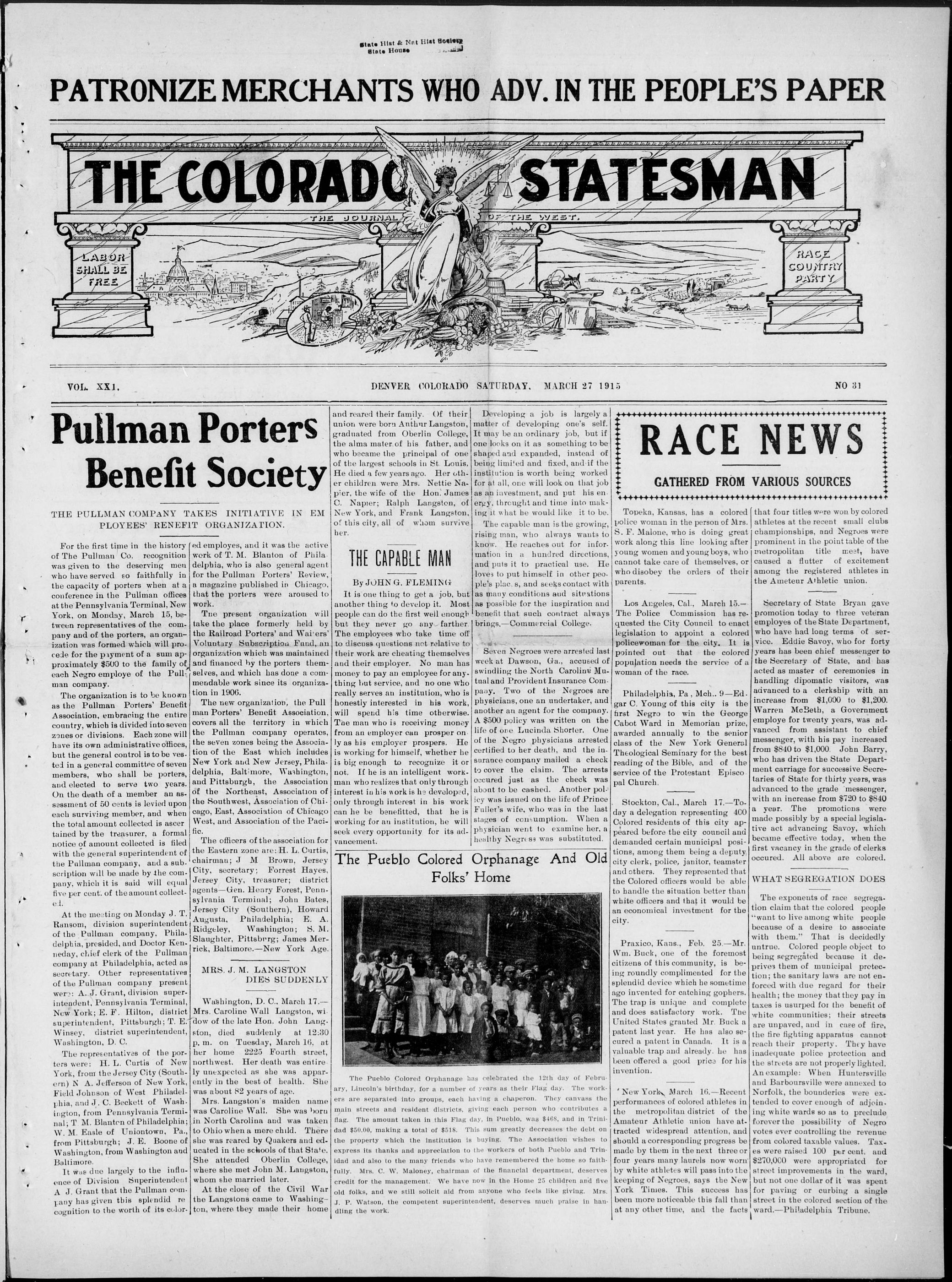
The Pueblo Colored Orphanage And Old Folks' Home
THE WOMEN'S SCHOOL
The Pueblo Colored Orphanage has celebrated the 12th day of February, Lincoln's birthday, for a number of years as their Flag day. The workers are separated into groups, each having a chaperon. They canvass the main streets and resident districts, giving each person who contributes a flag. The amount taken in this Flag day, in Pueblo, was $468, and in Trinidad $50.00, making a total of $518. This sum greatly decreases the debt on the property which the institution is buying. The Association wishes to express its thanks and appreciation to the workers of both Pueblo and Trinidad and also to the many friends who have remembered the home so faithfully. Mrs. C. W. Maloney, chairman of the financial department, deserves credit for the management. We have now in the Home 25 children and five old folks, and we still solicit aid from anyone who feels like giving. Mrs. J. P. Watson, the competent superintendent, deserves much praise in handling the work.
State Hist & Net Hist Bootleg
State House
ANTS WHO
ADC
E JOURNAL
DENVER COLORADO
and reared their family. Of their union were born Author Langston, graduated from Oberlin College, the alma mater of his father, and who became the principal of one of the largest schools in St. Louis. He died a few years ago. Her other children were Mrs. Nettie Napier, the wife of the Hon. James C. Napier; Ralph Langston, of New York, and Frank Langston, of this city, all of whom survive her.
THE CAPABLE MAN
By JOHN G. FLEMING
It is one thing to get a job, but another thing to develop it. Most people can do the first well enough but they never go any farther. The employees who take time off to discuss questions not relative to their work are cheating themselves and their employer. No man has money to pay an employee for anything but service, and no one who really serves an institution, who is honestly interested in his work, will spend his time otherwise. The man who is receiving money from an employer can prosper only as his employer prospers. He is working for himself, whether he is big enough to recognize it or not. If he is an intelligent workman who realizes that only through interest in his work is he developed, only through interest in his work can he be benefitted, that he is working for an institution, he will seek every opportunity for its advancement.
The Pueblo Colored Folks'
Developing a job is largely a matter of developing one's self. It may be an ordinary job, but if one looks on it as something to be shaped and expanded, instead of being limited and fixed, and if the institution is worth being worked for at all, one will look on that job as an investment, and put his energy, throught and time into making it what he would like it to be.
The capable man is the growing, rising man, who always wants to know. He reaches out for information in a hundred directions, and puts it to practical use. He loves to put himself in other people's places, and seeks contact with as many conditions and situations as possible for the inspiration and benefit that such contract always brings.—Commercial College.
Seven Negroes were arrested last week at Dawson, Ga., accused of swindling the North Carolinu Mutual and Provident Insurance Company. Two of the Negroes are physicians, one an undertaker, and another an agent for the company. A $500 policy was written on the life of one Lucinda Shorter. One of the Negro physicians arrested certified to her death, and the insurance company mailed a check to cover the claim. The arrests occurred just as the check was about to be cashed. Another policy was issued on the life of Prince Fuller's wife, who was in the last stages of consumption. When a physician went to examine her, a healthy Negress was substituted.
RACE NEWS
Topeka, Kansas, has a colored police woman in the person of Mrs. S. F. Malone, who is doing great work along this line looking after young women and young boys, who cannot take care of themselves, or who disobey the orders of their parents.
Los Angeles, Cal., March 15.—The Police Commission has requested the City Council to enact legislation to appoint a colored policewoman for the city. It is pointed out that the colored population needs the service of a woman of the race.
that four titles were won by colored athletes at the recent small clubs championships, and Negroes were prominent in the point table of the metropolitan title meet, have caused a flutter of excitement among the registered athletes in the Ameteur Athletic union.
Secretary of State Bryan gave promotion today to three veteran employees of the State Department, who have had long terms of service. Eddie Savoy, who for forty years has been chief messenger to the Secretary of State, and has acted as master of ceremonies in
Philadelphia, Pa., Meh.. 9—Edgar C. Young of this city is the first Negro to win the George Cabot Ward in Memorian prize, awarded annually to the senior class of the New York General Theological Seminary for the best reading of the Bible, and of the service of the Protestant Episcopal Church.
Stockton, Cal., March 17.—Today a delegation representing 400 Colored residents of this city appeared before the city council and demanded certain municipal positions, among them being a deputy city clerk, police, janitor, teamster and others. They represented that the Colored officers would be able to handle the situation better than white officers and that it would be an economical investment for the city.
Praxico, Kans., Feb. 25.—Mr. Wm. Buck, one of the foremost citizens of this community, is being roundly complimented for the splendid device which he sometime ago invented for catching gophers. The trap is unique and complete and does satisfactory work. The United States granted Mr. Buck a patent last year. He has also secured a patent in Canada. It is a valuable trap and already, he has been offered a good price for his invention.
'New York March 16.—Recent performances of colored athletes in the metropolitan district of the Amateur Athletic union have attracted widespread attention, and should a corresponding progress be made by them in the next three or four years many laurels now worn by white athletes will pass into the keeping of Negroes, says the New York Times. This success has been more noticeable this fall than at any other time, and the facts
NO 31
that four titles were won by colored athletes at the recent small clubs championships, and Negroes were prominent in the point table of the metropolitan title meet, have caused a flutter of excitement among the registered athletes in the Ameteur Athletic union.
Secretary of State Bryan gave promotion today to three veteran employees of the State Department, who have had long terms of service. Eddie Savoy, who for forty years has been chief messenger to the Secretary of State, and has acted as master of ceremonies in handling diplomatic visitors, was advanced to a clerkship with an increase from $1,000 to $1,200. Warren McBeth, a Government employee for twenty years, was advanced from assistant to chief messenger, with his pay increased from $840 to $1,000. John Barry, who has driven the State Department carriage for successive Secretaries of State for thirty years, was advanced to the grade messenger, with an increase from $720 to $840 a year. The promotions were made possibly by a special legislative act advancing Savoy, which became effective today, when the first vacancy in the grade of clerks occurred. All above are colored.
WHAT SEGREGATION DOES
The exponents of race segregation claim that the colored people "want to live among white people because of a desire to associate with them." That is decidedly untrue. Colored people object to being segregated because it deprives them of municipal protection; the sanitary laws are not enforced with due regard for their health; the money that they pay in taxes is usurped for the benefit of white communities; their streets are unpaved, and in case of fire, the fire fighting apparatus cannot reach their property. They have inadequate police protection and the streets are not properly lighted. An example: When Huntersville and Barboursville were annexed to Norfolk, the boundaries were extended to cover enough of adjoining white wards so as to preclude forever the possibility of Negro votes ever controlling the revenue from colored taxable values. Taxes were raised 100 per cent, and $270,000 were appropriated for street improvements in the ward, but not one dollar of it was spent for paving or curbing a single street in the colored section of the ward.—Philadelphia Tribune.
NEWS TO DATE IN PARAGRAPHS
CAUGHT FROM THE NETWORK OF WIRES ROUND ABOUT THE WORLD.
DURING THE PAST WEEK
DURING THE PAST WEEK
RECORD OF IMPORTANT EVENTS
CONDENSED FOR BUSY
PEOPLE.
ABOUT THE WAR
Zeppelin airships raided Paris Sunday and dropped a dozen bombs. Seven or eight persons were injured, one seriously.
The bombardment of the forts in the Dardanelles has been resumed by the allied fleet, which entered the straits accompanied by mine sweepers. The dispatch to the Havas agency saves the fleet is prepared for the final assault on the forts.
The size of the garrison at Przemysl and the number of men who surrendered to the Russians greatly exceed all estimates. According to Tuesday's dispatches received from Petrograd the garrison originally consisted of 170,000 men, of whom 40,000 were killed. Just under 120,000 surrendered when the fortress capitulated.
The long investment of the mid-Galician fortress of Przmysl has ended. Depleted by disease, subsisting on horseflesh, and surrounded by a superior force of Russians, the garrison has surrendered to the besieging army after a defense lasting many months, which up to the present is recorded as Austria's most noteworthy contribution to the war. Petrograd, London and Paris celebrated the event.
The bombardment of the Dardanelles by the ten big English and French battleships and many smaller craft was ready Monday to reopen with even greater fury than reigned Thursday when the irresistible and Ocean of the British navy and the French dreadnought Bouvet were sunk and eight other vessels damaged, according to the war offices of London and Paris. While England still insists that the loss of life on her vessels was slight, France admits that nearly 600 of the Bouvet's 621 men were killed, and advices from Constantinople and fort towns along the straits say that fully 3,000 men from the vessels were killed and wounded.
WESTERN
Governor Spry of Utah vetoed the Shields initiative and referendum bill. Arthur Ainsley, 41, was shot and killed at Ward, a mining town twelve miles from Alba, Iowa, as the result of an argument. Police are looking for Ellis Hollingsworth, 21.
Sarah Richards Smith, one of the five wives of Joseph F. Smith, president of the Mormon church, died in Salt Lake. She was born in Salt Lake City in 1850 and was the youngest of the wives.
The Sells-Floto circus with Buffalo Bill was to show in San Francisco from May 2 to May 11. The board of supervisors of the Panama-Pacific exposition, however, voted 10 to 6 to exclude the circus.
A consignment from an Eastern factory of sixty-six traction automobiles arrived at Tacoma, Wash., for transshipment to Vladivostok. The automobiles are intended, it is said, for military use by Russia. All anti-liquor bills, a railroad rate bill and a bill providing for woman suffrage through a constitutional amendment are among those that died when the Missouri Legislature postponed indefinitely all House bills on the calendar preparatory to final adjournment.
WASHINGTON
The Census Bureau reports that the estimated 1914 production of cotton seed will exceed 7,300,000 tons. President Wilson has decided to appoint Adolph Lankering and Emil Groth postmasters, respectively, at Hoboken and Union, N. J. The Hamburg-American liner Odenwald, stopped from leaving San Juan, Porto Rico, by shots across her bow, is being held under the recent congressional resolution empowering the President to prevent supplies going from American ports to ships of the European belligerents at sea.
Claims aggregating $14,000,000, many of them growing out of damage done in the South by federal troops in the civil war, will be thrown out of court if the Court of Claims sustains an interpretation placed by the Department of Justice on a provision of the omnibus claims bill passed by the last Congress. Chevalier Van Rappard, minister from the Netherlands, communicated informally to Secretary Bryan an outline of a note sent by the Netherlands government to Great Britain and France, protesting against the embargo on commerce of neutrals with Germany as having no precedent in law or history.
Formal announcement was made at the White House that at present President Wilson has no intention of calling an extra session of the Senate or of Congress before the beginning of the regular session next December.
FOREIGN
An official parliamentary report on the earthquake of Jan. 12 gives the number of deaths thus far reported as 29,978.
Commander Illarion Michtovt, new naval attache to the Russian embassy, was formally presented to Secretary Daniels in Washington.
Vera Figner, one of the most widely-known leaders of Russian Socialism, has been arrested at Ungheni, near the Rumanian frontier.
An Algeciras, Spain, dispatch says four sailing vessels with Spanish dock laborers on board have been lost in a furious storm. It is estimated that 300 persons on board the vessels were drowned.
A French commission of inquiry into the capture by a French cruiser of the American steamship Dacia while on a voyage from the United States to Rotterdam with a cargo of cotton on board, has declared the seizure to be valid.
Five articles bearing on the Japanese demands upon China were initialed as concluded by the Chinese foreign minister, Lu Chang-Hsiang, and Eki Hioki, the Japanese minister, at the conference which was held at the Japanese legation in Peking.
"Seventeen Belgians, most of whom were young peasants, were shot at daybreak in the Ghent barracks, after having been found guilty by a German court martial of espionage in the interest of the allies," says a dispatch to the Exchange Telegraph Company from Amsterdam.
Col. E. M. House of New York and Texas reached Berlin from London and at once went into a long conference with James W. Gerard, the American ambassador. Col. House will be the ambassador's guest while in Berlin. Col. House is working in the interest of possible peace.
A most pathetic figure at Berne is the aged Baroness De Magnanville of Paris, who is asking the aid of the Swiss government to obtain the liberation of her husband, aged 80, after offering a ransom of $20,000. The Germans took Baron De Magnanville as a hostage near Noyon several months ago.
SPORTING NEWS
The vanguard of the 1915 Grizzlies got into Denver, all smiles, to be back and eager to start off the training season with a rush.
Governor Hunt vetoed a bill providing for the establishment of the pari mutuel system of betting on horse races in Arizona.
Johnny Dundee of New York was awarded a decision over Joe Azevedo of Oakland, Cal., after a fast eight-round bout at Memphis, Tennessee.
Paul Wilson, a member of the Hotel Planters team of Chicago, tied the individual high score of 671 set up by Jule Lellinger of Chicago in the American Bowling Congress at Peoria, Ill.
Champions in the various boxing divisions of the Rocky Mountain branch of the A. A. U. will get down to hard work preparing for the Triangular tournament at the Denver Athletic Club April 6 and 7.
The fear of defeat is upon Jack Johnson. The big negro, who for years has lived the life of an idler and spender, for the first time has a "hunch" that he may lose his title of heavyweight champion. With that loss, Johnson knows that his easy life would disappear.
The schedule of tournament dates officially sanctioned by the United States National Lawn Tennis Association for 1915-16 was given out in New York by Robert D. Wrenn, president, and included the following: Aug. 30, Denver Country Club, Denver, Colorado state championship; Sept. 10, Panama-Pacific exposition grounds, San Francisco, California state championship.
GENERAL
The vice president and his party reached San Francisco to visit the Exposition.
A record for voting of twenty-two times in one day was claimed by Fred Eisler, who testified in the trial of the Terre Haute, Ind., election case.
Copies of records received at Richards, Mo., from Boston, fix the age of John Holloren at 108 years. He's said to be the oldest man in Missouri.
The famous Hoffman House, which an fifty-one years has sheltered many widely-known men, closed its doors in New York. The building will be demolished to give place to a commercial structure.
Former Judge L. S. Roan of Atlanta, who tried and sentenced Leo M. Frank for the murder of Mary Phagan, died in New York in the Polyclinic hospital, where he has been a patient since Feb. 26.
Statements tending definitely to connect Lovey Mitchell and John Knight, negroes, with the murder of W. E. Dawson, his wife and daughter at Monmouth, ill., have been obtained from Annie Knight, wife of one of the suspects, according to the Peoria, Ill., police.
The Supreme Court at New Orleans, La., barred the Bible and prayer book from the public schools of the state as opposed to conventional religious freedom.
The Vermont Legislature passed an act providing for eugenic marriages. A fine of $500 is fixed for any person who weds without fulfilling the requirements of the law.
Reports of plundering and murdering of Christians in northern Persia were contained in a cablegram from Tiflis, Transcaucasia, received in New York by the Persian war relief committee.
OF INTEREST TO ALL
COLORADO
PEOPLE
Western Newspaper Union News Service.
COMING EVENTS.
Sept. 27-Oct. 8.—Meeting International
Dry Farming Congress at Denver
The Dairy Day meeting at Salida was a decided success.
The Holly sugar factory will be moved to Sheridan, Wyo.
Better train service to Johnstown is asked by the people of that city.
Grand Junction's Chamber of Commerce Club now has over 250 members.
The Rocky Mountain Fruit Distributors' Association was formed at Delta.
The Southeast Farmers' Telephone line has merged with the Independent at Center.
Miss A. K. Johnston of Montrose was subpoenaed as a "juryman" by Sheriff Gill.
Nearly 2,500 have enjoyed the rest room comforts since it was opened in Grand Junction.
The second annual conference of the Colorado Municipal League was held at Boulder.
About 500 teachers attended the meeting of the Northern Colorado Teachers' Association at Boulder.
Over 18,000 acres of sugar beets have been signed up by growers under the jurisdiction of the Sterling factory.
Mrs. Lizza Neal, 72, fell dead of heart trouble at the central loop in Denver as she alighted from a street car.
Charles B. Sprague, a veteran of the Civil War, passed away at the home of his daughter, Mrs. J. C. Ayres, in Fort Collins.
Six cars of ore having an estimated value of $12,000 a car were shipped out from the Cripple Creek yards of the Associated lines.
A severe storm on the range completely tied up the South Park line of the Colorado & Southern from Como on the eastern slope to Wartman.
Robert A. Long was named justice of the peace by the City Commissioners of Denver to succeed Benjamin F. Stapleton, who will become postmaster April 1.
Sunday another church was dedicated in Fort Collins, the German Evangelical Lutherans opening their new edifice. The new church cost more than $12,000 and is built of native stone.
Definite plans have been outlined for the tabernacle meetings to be held in Sterling through May and June, when Rev. E. J. Bulgin, noted evangelist, will conduct a spirited revival campaign.
Too Hon, a Chinaman, who pleaded guilty in the United States District Court in Denver, to a charge of manufacturing and smoking opium, was fined $10,000, the minimum penalty under the federal statute.
Eighteen carloads of oranges bobbed about in the foaming surface of the Arkansas river when an eastbound special freight of the Denver & Rio Grande was dumped near Fernleaf, in the Royal Gorge.
Chet Isbell, who was arrested by Grand Junction police, charged with bootlegging, admitted his guilt before Mayor Cherrington and was invited to leave the city. He agreed to depart with his wife for parts unknown.
The business men of Fort Collins held their annual meeting in the Dutch Kitchen, when they not only cared for the inner man and elected officers for the coming year, but listened to good music and speeches which were full of meat.
Wells McClelland, dean of the legal profession in northwest Colorado, died in Denver. He established a practice in Steamboat Springs twenty-two years ago, and was a prominent member of the Elks and Knights of Pythias.
On a plea that "it was all a mistake," a white slave charge against Clement T. A. Martin, author and traveler, following his sensational elopement with Miss Bertha McAndries of Denver, in January, was dismissed in Kansas City.
Prof. E. S. Davis of Shaffer's Crossing in the southern end of Jefferson county, was the victim of a peculiar accident growing out of an argument with A. D. Fairchild as to which could throw a rock the most accurately. A stray missile from the hand of Fairchild inflicted a scalp wound upon Davis' head which necessitated thirteen stitches.
The creation of two more national parks for Colorado, one comprising 128,000 acres and having Mount Evans as its characteristic scenic feature, and the other comprising 140,000 acres and including Pike's Peak, Colorado's most famous mountain, is the plan launched by the Denver mountain parks advisory committee, representing the various commercial bodies of Denver.
The examination of jurors to try the Hecla cases growing out of the coal strike in Boulder county progressed slowly at Boulder and when court adjourned Monday there was no indication that a jury would be obtained within the next few days.
Plans to revive the Colorado Indian Pageant Association were discussed at a meeting of new officers elected to conduct a pageant near City park in Denver, between June 1 and Oct. 1. The officers elected are W. H. Crane, president; J. F. Turner, secretary; G W. Gaines, director general.
TURLEYS ADMIT PLOT
MAN "CREMATED" IN DENVER CAPTURED ON NEBRASKA RANCH.
Couple Will Be Taken to Denver to Face Trial on Charge of Conspiracy to Defraud.
Western Newspaper Union News Service.
Denver.—Vall Turley, supposed dead man, whose body was said to have been cremated in Riverside cemetery on the afternoon of Sept. 3, 1914, was arrested Sunday on the Wilbur Peterson ranch, seven and a half miles from Inavale, Neb., where he sought refuge after his plan to defraud to Massachusetts Mutual Life Insurance Company, the Knights of Maccabee and the Modern Brotherhood of America out of insurance amounting to $19,000, was discovered. Linnie Turley, his wife, named as one of the leading parties in the alleged conspiracy, also was arrested. Both were taken into custody by Sheriff W. R. Lathrop of Smith Center, Kan., who reached the Peterson ranch, across the Kansas Nebraska line in Kansas, after a hard trip over snow-covered roads. Turley and his wife will be brought back to Denver to face charges of attempting a conspiracy to defraud. When arrested by the Kansas sheriff Turley and his wife admitted their part in the plot, according to the sheriff.
They agreed to waive extradition, according to a message from Sheriff Lathrop, and will come back to Denver to face trial with J. Lofton Davidson and Harper H. Orahood.
Epidemic of Fires Arouses Bessemer
Pueblo.—The thirteenth fire within the month in the Italian section of Besseneer destroyed two more houses. In all, twenty-four houses have been burned to the ground since the first of March and the insurance loss in the district now totals $30,000. A reign of terror has been created among the law-abiding citizens of the district, as it is feared that the entire section will be swept if the incendiarism is continued. Some of the companies holding insurance policies al ready have started to cancel all risks.
Eighty Offer Skin to Save Girl.
Colorado Springs.—Eighty people went to the Beth-El hospital here to offer their skin to save the life of 5-year-old Mary Harder of Colorado City, who was so badly burned in a gasoline explosion that physicians asked for 100 square inches of skin. Dr. H. P. Daniels selected six of the volunteers and applied their skin to the child. The operation was successful.
Estes Will Lead All Parks.
Denver.—Accessibility to the East is an advantage held by Colorado's newly created national park that will bring to its gates at least double the number of tourists that any other one of Uncle Sam's fourteen national parks will be able to attract, according to Stephen Tyng Mather, assistant to the secretary of the interior, who was in Denver for conferences relative to the new park.
Kidnaped, Robbed and Beaten.
Denver.—John B. Garvin, principal of the South Denver High School, was bound, gagged and beaten by three men near the corner of Forty-fourth avenue and Grove street. He was then placed in an automobile and taken to the East Denver High School, where he was robbed of a box containing $50 and left half conscious in the snow on the high school lawn.
Bacon & Eggs Start Restaurant.
Golden.—George Bacon and Frank Eggs of Pine have started a restaurant at Shaffer's crossing in the Platte canon district. The firm name is "Bacon and Eggs." The following sign has been placed in front of their place of business: "Bacon and Eggs. Short Order House. No Talking During Meal Hours."
Gun Found After Belcher Fell.
Trinidad.—A revolver picked up from the gutter by M. J. Goldsmith just after the shooting of Baldwin-Felts Detective G. W. Belcher, Nov. 20, 1913, played a conspicuous part in the trial of Louis Zancannelli, charged with murdering Belcher. The revolver was finally introduced as evidence.
Boy Fells Father, Aiding Mother
Denver. — Protecting his mother's life from attacks by his angered father, armed with a razor, Arthur Seastone, 22, felled the maddened man with a potato masher and, believing that he had killed his parent, surrendered to the police.
Greek Miner Shot in Bunkhouse
Boulder.—Mike Pappas, a Greek miner, employed at the Hecla mine near Louisville, was shot and killed by Pete Nickerson, his companion, in a bunkhouse, according to the police. Nickerson fled.
Miner Loses $25,000 Damage Suit.
Miner Loses $25,000 Damage Suit.
Leadville.—A verdict against William Tucker, a miner, who was injured permanently in a cave-in in the Dinero mine, Jan. 19, 1913, was returned in District Court. Tucker was suing for $25,000 damages against the Dinero Mining Company. After arguments, from which the jurors were excluded, Judge Cavender concluded that the defendants' attorney had proved that Tucker, who had charge of the timbering in the mine, assumed the risk of his employment when he accepted the position.
The
Curtis
Park
Floral
Company
FLORAL DESIGNS PUT UP WHILE
YOU WAIT
CHOICE PLANTS AND CUT FLOWERS CONSTANTLY
ON HAND
GREENHOUSES: Thirty-Fourth and Curtis Streets
TELEPHONE, MAIN 1511
DENVER, COLO
When You Want
The Heads, Feet, Tails Snouts, Neckbones or Chiterlings or any other part of the hog except the squeal go to
2300-6 Larimer Street.
The Champ
Twentieth
Is the pl
DRUGS, CHEMICALS A
WE SERVE
Prescriptions
Phone us and we will deliver
JAMES E. T.
PHONE
THE ZOBEI
SAMPL
1004 Nineteenth S
The Champa Pharmacy
Twentieth and Champa,
Is the place to get your
DRUGS, CHEMICALS AND PATENT MEDICINES
WE SERVE DRINKS.
Prescriptions Our Specialty.
Phone us and we will deliver the goods to all parts of the city.
JAMES E. THRALL, PROPR.
PHONE MAIN 2425.
1004 Nineteenth Street, Corner of Curtis
FINE WINES, LIQUORS AND CIGARS
COORS' CELEBRATED BEER ON TAP
The
WARD AUCTION
COMPANY
Sales Daily at 2 p.m. Office Furniture a Specialty.
PRIVATE SALES AT ALL TIMES
HAVE MOVED TO-
1723-39 GLENARM ST.
PHONE MAIN 1675.
THE BEST ICE CREAM AND
CANDIES AT
O.P. BAUR & CO.
CATERERS AND
CONFECTIONERS
Phone: 168
1512 Curtis Street, Denver, Colo.
```markdown
```
DENVER
Pharmacy
and Champa,
to get your
PATENT MEDICINES
DRINKS.
Our Specialty.
goods to all parts of the city.
RALL, PROPR.
AIN 2425.
BROTHERS'
E ROOM
eet, Corner of Curtis
J. H. BIGGINS
Furniture Repairing and Upholstering. All work Cash.
PHONE YORK 7837
1417 East 24th Ave Denver
Miss M. Cowden Hair Dressing Parlor
Shampoo, cutting and curling. Scalp treatment, hair tonics, hair straightening, manicuring. Stage wigs for rent; theatrical use and masquerades. Goods delivered out of the city. All shades of hair matched by sending sample of hair; also combings made up.
Cheapest Switches 50 Cents
1219 21st St. Denver, Colo.
Phone Main 1461.
COLORADO
AFRO-AMERICAN CULLINGS
Only a few days ago we had as visitors to the Tuskegee institute the governor of Alabama, the superintendent of education, judges of the supreme court, and many other state officers, and, without hesitation, they declared themselves in favor of education of all the people regardless of race and color, says a dispatch from Tuskegee.
Progress is being made. Two years ago, for example, in Louisiana 117 children in each thousand between the ages of ten and fourteen could not read or write. Within two years we have reduced that number in Louisiana to 115 in each 1,000. South Carolina, from 150 to 85, in Alabama from 97 to 57, in North Carolina, from 167 to 68, in Georgia from 106 to 58; in Arkansas from 113 to 47, and in Virginia from 97 to 57.
Including what they pay in the way of state taxes and in extra taxes in prolonging the school terms and building schoolhouses and supporting private schools, the Negroes in the South now contribute $8,000,000 annually toward their own education.
Just now in New York, Booker Washington records, I note that much attention is being given to the investigation of the work of the Rockefeller boards and the Carnegie boards. This investigation should go further. The work of these boards should be followed into our southern states where the money that they have given is helping to make a new South and a new civilization. I wish that those in charge of these investigations could get into the South and trace the influence of the Rockefeller and Carnegie money in bringing about better supervision of the schools by reason of the work of the state supervisors; could trace the influence of these boards in the work of the county supervisors, in the work that the farm demonstration agents are doing, in the work of the canning clubs and pigs clubs. I wish the influence of this money could be followed into the colleges, the farms and into the homes of the people. It is here that the influence of the money from these boards may be felt and seen in the bringing about of higher civilization for white and black people.
Through the education of both races we are getting rid of the crime of lynching. Twenty-two years ago there were 225 cases of lynchings, mainly in the South; in 1914 there were only 52 cases of lynchings, a reduction of 400 per cent. Through education the white and the black races are being taught how to live together and work together. There are numerous state and local organizations that now bring the races together in friendly and helpful cooperation. Among these are the Virginia Organization society, the Southern Sociological congress, the Business league, chambers of commerce and women's clubs.
The buildings of the various institutes at Tuskegee were shown to a visiting party as model schoolhouses, types of the new and better school system which Alabama is trying to multiply. We understand that thirty or more such schoolhouses are slated for completion the next year, all under the energetic direction of Professor Sibley, a native born white Alabaman, who holds an appointment from the state superintendent of colored rural schools. The excursion was in his charge and his energy and enthusiasm
Dr. W. D. Weatherford, athlete, author, traveler and Christian leader, addressed a general assembly at the university at Washington on a moral and social subject applicable to undergraduate life. A Southerner by birth and education, and in great demand throughout the South as a speaker, he was forced to cancel engagements with five universities there in order to make a tour of northwestern universities and colleges.
Doctor Weatherford was a varsity baseball and basketball player at his alma mater, Vanderbilt university, and was for three years director of the gymnasium at that institution. For 13 years he has been the Y. M. C. A. student secretary of the international committee for all the colleges in the southern states. He is the author of several volumes, including two on the uplift of the Negro; and is said to have done more than any other man to enlist the friendly co-operation of college men in Negro betterment.
With the exception of lovemaking, there are many new ways of doing old things.
The fur of the cat is full of electricity, and before a thunder storm it will be noticed that a cat is always extremely lively and playful, probably on account of its electrical condition. Before rain is expected a cat will assiduously wash its face.
Labor, to some people, is not so much a problem as a horror.—Nashville Banner.
A cheerful idiot has at least his cheerfulness to commend him to tolerance.
showed how it takes personality plus money to achieve success here as elsewhere. At each place arrangements were made to seat the visitors, most generally in an adjoining church, and there was much singing and a little talking. At Madison we found a station named after a pioneer colored man, an ex-slave, whose daughter is the efficient director of the school. The party arrived at Tuskegee early on Sunday evening in time to listen to the quaint singing of the great student body in the beautiful chapel with a capacity of from 1,800 to 2,000, fully utilized.
Then began three days of inspection filled with surprises to those who saw for the first time the wonderful work being done at Tuskegee, not only for the colored young men and women of the South, but for the cause of education, for Tuskegee is a contribution to pedagogy as well as to the race problem. Educators everywhere will have to reckon with Tuskegee if they want to bring their theories and practice down to date.
Frederick Douglas for two or three decades was one of the favorites of the lyceum, which he abandoned only after the emancipation of his race. Douglas was beyond all comparison the ablest man whom the black race ever produced in our country, either among the pure black or the class of mixed blood.
He himself was a mulatto. His father was pure white of a distinguished Maryland family. His mother was pure black and his father's slave—that is, his mother was a pure black and his father a pure white.
He always gave his mother the credit of his talents. Douglas was born a slave. In early manhood he managed to escape on a ship, and landed in New Bedford, Mass. There he soon learned to read, and worked at such work as he could find. By and by he attended antislavery meetings, and soon became a popular speaker and the pet of the abolitionists. His graphic accounts of his life as a slave were very popular.
From giving the story of his life, he gradually branched out into discussions of the political questions of the day, and, next to Phillips, was probably the ablest orator of the antislavery movement. Eventually he went to Rochester and published, for many years, a weekly antislavery paper. Its title was Frederick Douglas' Paper, which, next to Garrison's Liberator and the Antislavery Standard, was recognized as the ablest antislavery paper in America.
Then he became a lecturer, and his fame spread so rapidly that he took rank in the favor of the lecture-going public with Phillips and the other leading lights of the lyceum. When Lincoln came into power, Douglas moved to Washington, and was appointed to office in the District of Columbia as marshal, a position he held during the entire period of Lincoln's administration.
Douglas' first wife was a plantation Negress without any education. A few years ago he married again. His second wife was white, and a woman of education and ability. The black race has developed under freedom many effective speakers, but Douglas was the only man among them who served to be regarded as a real orator. —The Great Divide.
William E. Valentine of Indianapolis, widely known as a Negro educator, was selected by the New Jersey State Board of Education to succeed James M. Gregory as principal of the Industrial School for Colored Youths at Bordentown.
He was born at Montclair and was graduated from Harvard. He is now a supervising principal of schools in Indianapolis.
In Germany the sofa is invested with a sanctity as of a throne. The visitor must not sit on it unless especially invited to do so by the hostess. To take a seat there unasked is an outrageous presumption.
Wine tasters, employed in their professional duties, never swallow the wine they taste. They merely hold a sip of the beverage in the mouth for a few moments and breathe through the nostrils.
And the average man spends nine tenths of his life trying to accumulate enough money to enable him to spend the other tenth in comfort.
About three minutes after starting an average man finds that he can go downhill fast enough without a sled under him.
Seville reports a dull olive market, the producers and purchasers being deadlocked, waiting for higher or lower prices, respectively.
Using a new aeroplane gun, United States army officers flying at a rate of nearly a mile a minute 600 feet in the air have made more than 90 per cent of hits on a small target on the ground.
ENGLISH AIRFLEET ROUTS ZEPPELINS
FLYERS CROSS LINES, ATTACK
HOBOKEN, AND ESCAPE
GUNS OF FOE.
ONE SUBMARINE SUNK
BOMBARDMENT OF DARDANELLES HALTED, BUT DIXMUDE AND NIEUPORT SHELLED.
Western Newspaper Union News Service.
London, March 25.—A British air fleet, flying inland from the coast above Antwerp, routed two Zeppelins and five Taubes in a battle in mid-air following an attack on the German submarine base at Hoboken, in which one submarine was sunk and another badly damaged by bombs.
Following this exploit the English aviators outflew the German aeroauts and reached their base at Dunkirk in safety.
According to admiralty reports, the fleet originally included five aeroplanes carrying rapid-fire guns in addition to bombs.
Two were obliged to turn back because of bad weather conditions, while a third was forced to land in Holland because of engine trouble. Its pilot and observer were interned. The sinking of the submarine and the scattering of the German aeronauts would seem, therefore, to have been accomplished by but two aviators of the Royal corps.
In the same region it is reported that the Germans are preparing for another supreme effort in Flanders. Already there has been considerable fighting along the Yser, the Germans having bombarded Nieuport and Dixmude, while the Belgians have made progress along both banks of the river.
The big battle of the moment, however, is in progress between Dukla pass and Uzsok pass in the Carpathians, where, in their official communication, the Russians claimed to have captured a number of Austrians and to have made a general advance Austrian correspondents declare that this battle is likely to continue for some time. It is possible that the Russians will use part of the troops released by the fall of Przemysl in an endeavor to bring the battle to an end. The Austrians have developed a fresh offensive in Bukowina, to which they some days ago sent reinforcements and have, according to their account, driven the Russians back across the frontier and removed the immediate menace of Czernowitz.
On the other extreme wing of the eastern front, the Germans have reoccupied Memel with the assistance of their warships, which have since bombed the roads by which the Russians were falling back. The Germans also apparently have checked the Russian advance on Tilsit.
Unfavorable weather is still interfering with the operations of the allied fleet in the Dardanelles.
Resolution Ends Session April 10.
Resolution Ends Session April 10.
Denver.—The House of Representatives passed the Fincher-Taylor joint resolution providing for an adjournment not later than midnight, Saturday, April 10. Representative McDevitt's bill, H. B. 538, for the repeal of the direct primary and substitution of the old convention system, came up on second reading and after long filibustering was killed.
Stonewall Jackson's Widow, 84, Dead.
Charlotte, N. C.—Mrs. Mary Anna Jackson, 84, widow of General Stonewall Jackson, died at her home here.
Many Injured When Church Caves Inc.
Loveland.—Jacob Eisenbach, 19, and Jacob Amend, 22, were seriously injured about the back and neck and twenty other men were bruised and cut as the result of the caving in of the walls of the First German Congressional church here. Eisenbach and Amend are in the Loveland hospital, but will recover, according to the physicians. About fifty others besides Eisenbach and Amend were working on the roof of the structure when the walls caved in. They fell forty feet to the ground, where others were at work. Most of the men were badly cut and bruised. The building is being torn down for the purpose of erecting a new $24,000 edifice, and the wrecking is being done by the members themselves.
Death May Bar Greeley Man's Trial
Greeley,—Rudy Myers, who shot and killed William McDowell at Frederick a few weeks ago, after he claimed the latter had attacked his wife and caused her death, may never be tried for the slaying. Death may interfere.
Supposed Mail Train Robber Jailed.
Supposed Mail Train Robber Jailed.
Pueblo.—Arthur Burleson, 24, whom government secret service agents believe to be Frank Grigware, sentenced to life imprisonment at Fort Leavenworth for the robbery of a Union Pacific mail train at Omaha, May 22, 1909, was arrested in Pueblo. Grigware escaped from Fort Leavenworth last December. Burleson arrived in Pueblo from Albuquerque Jan. 2, and a few weeks later was married here to Juanita Benjegerdes, owner of the rooming house where he lived.
TO END HALF MILL LEVY
MEASURE ON SPECIAL CALENDAR FOR EARLY ACTION.
Senate Strikes Out Enacting Clause on First of Three Measures to Pay for Property Destroyed in Riots.
Denver.—Many of the most important bills pending before the Twentieth General Assembly are listed on the special calendar reported out of the Senate for second reading. Among these is Senator W. C. Robinson's bill to repeal the law providing a 1/2-mill levy for the board of Capitol managers; Senator West's bill abolishing the civil service commission; the Fincher House bill, known as the short ballot bill, and a House bill by Gill and Best to enlarge the powers of the stock inspection department in dealing with epidemics, such as the foot and mouth disease.
The contest anticipated over the bills providing for the remuneration by the state of property losses suffered by coal companies during the strike in southern Colorado last year was staged in the Senate Saturday. It was sharp, but decisive, ending in the defeat of the first of three such relief measures to be considered by the Legislature. The bill, by Senator Knauss of Denver, carried an appropriation of $50,990 for the Empire Coal Company, whose property near Aguilar was burned during the strike riots. Debate on the measure ended when an overwhelming majority voted for Senator Eliot's motion to strike out the enacting clause.
The coal company held that the state was responsible for the loss because former governor Ammons withdrew the militia from the Aguilar district after the representatives of the coal companies had warned him that destruction of property would be the consequence.
Senator Peterson of Pueblo, who defended the Knauss bill, has two similar measures—one for an appropriation of $26,887 for the Southwestern Fuel Company and another for $40,000 for the Chicosa Coal Company.
Thirty-five Bills Signed by Governor
Thirty-five Bills Signed by Governor. Denver.—Governor Carlson signed eighteen Senate bills, seventeen House bills and vetoed one lower House measure to date. He has before him for his consideration a dozen bills finally enacted by the Assembly. During the past week he signed the following measures: House Bill No. 227, known as the "gift enterprise" bill, because it is designed to stop the giving of premiums of any sort as an inducement to the purchase of merchandise. It is especially aimed at certain tobacco companies giving coupons with their goods. House Bill 204, making the changing of an election ballot a forgery, the same as the alteration of a draft or check. The chief executive vetoed House Bill 61 on economy grounds. It provided for an eight-hour day for prison guards, and its approval, it is estimated, would have cost the state about $35,000 a year in added salaries for prison employés.
Industrial Bill Reported to Senate. Denver.—A combination of the Canadian voluntary arbitration act, which is regarded as probably the most effective law of its kind ever drawn, and of the provisions of the United States law creating the United States commission on industrial relations, is made in the industrial relations bill which was reported out to the State Senate by Senators Lewis and Candlish, who compose the special committee to which the administration combination industrial relations-compensation bill was referred.
Inheritance Tax Paid Totals $54,686.
Denver.—Inheritance taxes to the amount of $54,686.08 have been collected by the state so far this year, according to the report of Appraiser Leslie E. Hubbard. From March 1 to March 13, $11,528.16 was collected, and from Jan. 1 to March 1, $43,157.92. The largest amount collected was $6,821.63, the tax on the estate of $314,795.01 left by Grace Goodyear Potter of Colorado Springs.
Board Orders Museum Finished.
Denver. Under fire itself from the opposition to its continued existence as a state body, the board of Capitol managers decided to start something itself. Through Architect Edbrooke notice was served upon L. Scott Twogood that within forty-eight hours he must resume work on the state museum building, for the purpose of bringing about immediate completion.
Carlson to Speak in San Francisco.
Denver. Governor Carlson will be the guest of honor and the principal speaker at the celebration of Swedish day at the Panama Pacific Exposition in San Francisco June 24.
Report Workmen's Compensation Act.
ERNEST HOWARD,
Carpenter, Job and Repair Work.
Coal, Wood and Express.
CLEANING, PRESSING, DYEING, REPAIRING, RELINING AND REMODELING.
WORK CALLED FOR AND DELIVERED
2549 Washington Avenue Denver, Colorado
The Market Company
Wholesale and Retail Staple and Fancy Groceries, Fish and Oysters. Hotels and Restaurants Our Specialty.
Fruits, Vegetables, Poultry and Game.
1638-39 Arapahoe Street Denver. Colorado
CHAS. HARRIS, Pres. J. M. JOHNS, Treas. SEIB MILLER, Sec.
RAILROAD PORTERS' CLUB
LUNCH ROOM IN CONNECTION
Billiards and Free Check
Pool Room
1728½ Wazee St. Only one block from Union Depot
Phone Main 8416. Denver, Colorado
C. H. SHIRLEY, Pres. J. C. HAMPSON, Vice Pres PAUL J. SHIRLEY, Sec. and Treas.
THE ATLAS DRUG CO.
Courteous Treatmet. Right Prices Leaders in Prescription
Paints, Oils and Glass.
Coal, Wood a
1021 21st Street.
You Have Tried the Rest
Now Try the Best
THE Giant FOR QUALITY.
CLEANING, PRESSING
ING, RELINING AND
WORK CALLED FOR
2549 Washington Avenue
PHONE MAIN 3028
JOHN K. Meats, Fancy and 1864 CURTIS Corner Nineteenth.
Phones Main
169,181,189,190
The Marke
Wholesale and Retail Staple and
Oysters. Hotels and Re-
Fresh and Cured
Eastern Corn
Fruits, Vegetables,
1638-39 Arapahoe Street
CHAS. HARRIS, Pres. J. M. JOHN
RAILROAD POOL
LUNCH ROOM I
Billiards and
Pool
1728½ Wazee St. Only on
Phone Main 8416.
The Cor
Ice Cream
1115 WELTO
THE ICE
That Is Just a Litt
Kind You Thou
C. H. SHIRLEY, Pres.
PAUL J. SHIRLEY
THE ATLAS
Courteous Treatm
Leaders in P
Store No. 1.
2701 WELTON ST.
Main 895 875
Glazing Done and Express. Phone Champa 752.
Our Prices Reasonable
Satisfaction Guaranteed
CLEANERS
AND
TAILORS
McCAIN & RICHARDS, PROPS
Phone Main 7376
ING, DYEING, REPAIR-
AND REMODELING.
FOR AND DELIVERED
Denver, Colorado
RES. PHONE GALLUP 942
E. RETTIG
and Staple Groceries
RETTIG STREET
Denver, Colo.
C. E. Smith, Manager
Res. Phone South 1608
Met Company
e and Fancy Groceries, Fish and
Restaurants Our Specialty.
Born Fed Meats
es, Poultry and Game.
Denver, Colorado
OHNS, Treas. SEIB MILLER, Sec.
PORTERS' CLUB
IN CONNECTION
Free Check
Room
by one block from Union Depot
Denver, Colorado
Corbett
ream Co.
BUTTON STREET
CREAM
Little Better Than the
thought Was Best
J. C. HAMPSON, Vice Pres
LEY, Sec. and Treas.
AS DRUG CO.
Metet. Right Prices
Prescription
Store No. 2
26TH AND WELTON
Main 4955-4956
FINE COLORADU\2-x STATESMAN |
ahi! COLORADC\2AcK STATESMA
H Neh eg aa
AA ae : only
Gea Se eee
az ie? Nas =
| direst a Ue eee SE
psbeigy tai A Za AOA nee Ld,
SSS ke See}
SA A Ch en NOT TE Sa eA
es eee Me
a a prtoc?
Soe eon ay eee ee ee eealatee
1824 Curtis Street, Room 25.
Phone Main 7417.
Slap) | MC SUBECRIPRIONGRATES Sap pp a
Bix Months St tee eeee ec ccecccerenscrccesecnccccerscerenesensesessscerscccs 2600
PAYABLE IN ADVANCE.
a ee gee a ee ee
Entered as second-class matter at the postotfice in the city of Denver,
Sotorade, ;
ee ee eee
Display advertising, 50 cents per Inch, An Inch contalna tweive agate lines
Sa ee SOC ey
Reading notices, ten lines oF less, 10 conte per line, Mach additional line
over ten lines, 5 cente per line.
No discounts allowed on less than three months contract. Cash must accom:
Pany all orders from parties unknown to us. Further particulars on application,
It occasionally happens that papers sent to subscribers are lost or stolen,
In case you do not receive any number when due, inform us by postal card and
we will cheerfully forward @ dupiicate of the missing number.
ee
Remittances should be made by Express Money Order, Postoffice Money
Order, Registered Letter or Bank Draft, Postage stamps will be received the
same as cash for the fractional part of a dollar. Only 1-cent and 2-cent stampa
taken,
SS ee
Communications to recolve attention must be newsy, upon important sub-
fects, plainly written only upon one side of the paper; must reach us Tuesdays
1f possible, anyway, not later than Wednesdays, and bear the signature of the
tutor, No manuscript returned, uniess stamps are sent for postage.
SS a ae ea
will be withheld from the columns of this paper. |
$$$ ss
oO
i MEMBER
NATIONAL NEGRO PRESS
ASSOCIATION.
jue colored voters of Colorado should not become impatient, and re-
jnember that Gov. Carlson and the other state officials have been greatly
handicapped by Democratic civil service laws and can do practically nothing
as far as appointments to office are concerned until the General Assembly
affords them some relief. A hint to the wise is sufficient, ‘The Colorado
Statesman has unbounded faith in the officials we helped to elect to office.
We wish in all kindness to suggest to many of our patrons who are in
arrears in payment for the Colorado Statesman that prompt settlement at
this time would be most #:4@ptable. The proprietor of this paper leaves no
stone unturned and sons reasonable expense to make it an up-to-date
Twentieth century orgay! of the race and we leave it to the fair and con:
siderate judgment of ‘our véaders whether we have not measurably suc-
ceeded. But to reach that high standard of excellence at which we aim and
to extend and continue the usefulness of this paper, it is necessary that our
patrons should assist us in meeting our heavy expenses by the prompt pay-
ment of their subscription. No enterprise, however worthy and benevolent,
can be supported or carritd on without money. And this paper is no ex:
ception to the rule,
The outlook for a prosperous year in Colorado is becoming brighter day
by day. In Denver great activity is taking place in the building trades.
Great business blocks of many stories are being planned to go up on sites
where fires have made vacancies or where old and unsightly buildings have
reached a stage where the exigencies of trades and the elegancies of a mod-
erm and progressive city loudly clamor for their removal, The residential
parts also feel the full impulse of this rising tide of industrial activity. Real
estate is rapidly changing hands at good figures. Private residences, flats
and terraces (some of a very pretentious character) are scheduled to rise
in various parts of the city, Considerable paving of streets is under way,
while a plan is being matured by the public-spirited business men, aided by
the city, to so decorate Seventeenth street by substantial, ornamental and
useful improvements as to make that busy artery of traffic one of the most
magnificent and beautiful thoroughfares in the country. ‘This all gives em:
ployment to labor at good living wages. And herein lies the opportunity of
the colored laborer, There will be work for the bricklayer, the carpenter,
the plasterer, the layer of asphalt, and last but not least, the great army of
hod-carriers. Our people are more or less represented in all these lines of
useful Industry. We should early take advantage of these openings and
stick to them through the season, saving as much money as we can for 4
rainy day or to buy homes. In this conection we are pleased to record the
fact, obtained from many reliable sources, that the race seems. more awak-
ened than ever to the great necessity of owning their homes. Many imbued
with this spirit are Investing every dollar they can save in real estate, and
are laying the foundation to become in time substantial and influential citi
zens. For it must not be forgotten that the ownership of a part of the soil
in any community in which one lives always clothes the owner with a cer:
tain added dignity, respect and influence which he could not otherwise enjoy.
This is above all the time to invest, since it is hardly conceivable that
times in Denver will be in the future as quiet as during the past year, The
discrimination and exclusion which have been so potent against the race in
the matter of renting desirable houses have proved a blessing in disguise,
for this policy is compelling them to buy their own homes and thus take
root in the country.
PHO OA OAOA DH OH ON OH OA OL OL ON OH OA OH OH OA OHOLOLOHOHOHOXOXO
DEATH OF ROBERT MAYO ter, on February 12; 1890, he took as
JOHNSON. WN Ua taccenaie Hate erie sects
Robert Johnson, one of Denver's
pioneer and most highly esteemed cit-
izens, died last Saturday at his late
residence, 2660 Lawrence street. De-
ceased had been suffering for several
weeks from blood poison. He was a
member of Rocky Mountain Lodge
No, 2320, G. U. O. of O. F,, Denver
Patriarchy, and Household of Ruth,
and was one of the shining lights in
them all, His demise leaves a ya-
caney that cannot be easily filled.
Funeral services were held from Odd
Fellows hall Thursday afternoon.
Cammel Undertaking Co. had charge
of the funeral, while Rev, Washing
ton officiated, Besides a wife, a host
of friends are left to mourn his loss.
The Colorado Statesman joins with
the general public in extending symp-
athy to the bereaved widow. —Inter-
ment at Riverside,
Robert Mayo Johnson was born
Dec, 9th, 1858, at Versales, Kentucky,
having spent a part of his younger
life in his native state and hearing
of the splendid possibilities awaiting
willing hands in the new West, he
too answered to the call of the West
and located in Denver in the year
1880.
Having been reared in a Christian
family, amid wholesome surround-
ings, the early religious impressions
of his youth ever lingered in his mind
and in 1885 he became a Christian
and united with the Zion Baptist
church of this city.
_ Having established himself in use-
ful and gainful employment and as a
worker in the vineyard of the Mas-
Dai see ie Lies? 65 eA
EULOGY
ter, on February 12; 1890, he took as
his wife and helpmate through life
Mrs. Carrie Scott, who survives him,
But prior to most of these events,
Brother Johnson while yet in his na
tive state became a member of Wood:
ford Star Lodge No, 1730, Grand Unit.
ed Order of Odd Fellows, and it is in
this department of life's activities
that he made his imprint on the
sands of time that must and will go
on and on gathering to his memory
brighter lustre ind grandeur as the
years roll on into centuries; for be
cause of his tireless activities, Odd
Fellowship in the Intermountain
states has been made as enduring
and permanent as our mighty hills.
After a short sojourn in the state
of California, Brother Johnson. re-
turned to this city and in company
with certain other brethren, all of
whom, save one, have fallen’ asleep,
obtained authority and on March 13,
1882, founded Rocky Mountain Lodge
No. 2820, Grand United Order of Odd
Fellows, the parent lodge of Odd Fel-
lows in’ the intermountain region.
‘The year 1891 saw the formation of
the District Grand Lodge with Robert
Mayo Johnson as one of its charter
members, and in 1884 he was called
to the position of Grand Master to
‘pilot the struggling and almost penni-
less Grand Lodge through its most
perilous period, but at the end of his
term he handed to his successor a
District Grand Lodge full of life, vis
or and hope, fully confident that it
was on the highway to success. In
Odd Fellowship he passed through all
the grades of honor to the highest.
When Masters Council No. 118 was
to be formed, Brother Johnson was
one of the charter members. A loyal
and active member of the Household
of Ruth through many years. When
the brethren thought the time ripe to
PROSPERITY.
THE STORE ACCOMADATING
@
Prepared THE nee New
for GOODS Easter
Easter co. Neckwear
GET TOGETHER
Very Special Sale Men’
Shirt
= ae ——— iN
|) As) WB) elie
Ff) ee) f Ea WY WK | WE
Ty ve NM Pe ) E|
Bs SW eo
vr a —o aS =
gs 2) a mq = —— a — ee
Cluett, Peabody and Lenox Brands
The sale includes shirts, madras percales, madras
crepes and French flannels, with soft or stiff cuffs,
plaited or plain bosoms. All colors and sleeve lengths.
All sizes. $1.50 and $2.00 values; equal values have
never before been offered in Denver.
answer, “Yes, Robert, | am here. to
help you.”
No. 2320 Odd Fellows, friends, good
people of Denyer, if the nations have
flags to wave for the man who makes
two blades of grass grow where only
one grew before, what shall we say
of this man who gave so freely of his
Ife that we might grow a better man-
hood and a purer womanhood,
Our co-worker, friend and brother
is over yonder, and let us hope that
he is resting—resting forever and for-
ever.
JAMES J, MANUEL,
March 25, 1915. P.N. F.
COLORED CITIZENS AROUSED
AND ISSUE A CALL FOR A
MASS MEETING.
We, the undersigned, colored citt-
zens of the city and county of Den-
ver, realizing the necessity of form:
ing a league in which every colored
voter who is in accord with its prin-
ciples, is eligible for membership. We
must place ourselves in a position so
that our civil and political rights can
be better protected. ‘Therefore, for
the purpose of organizing said league,
a called is hereby issued for a mass
meeting to be held at Campbell's A.
M. E. church, corner 23rd and Law-
rence Sts., on Tuesday evening, Mar.
a0th, 1915, at 8 o'clock. It is earnest:
ly hoped that both women and men
who have a desire to become a potent
factor in assisting to better our con-
ditions, and to regain at least a por-
tion of our lost prestige which in re-
cent years has been taken from us,
will attend.
Signed: 3. C. Snaden, Wm, Slaugh-
ter, S. F. Shorts, Spencer Smithea, J.
D. D. Rivers, Wesley Lyons, Harrison
Smith, H. Galloway, J. E. Taylor,
Moses Thompson, H. Henderson, L.
R. Arnold, J. H. Jones, Geo, W. Gor-
don, R. J. Von Dickersohn, Thos. A.
Jones, Mrs. Julia Hubbard, Mrs.
re ita =
organize a branch of the Patriarehy,
R. M. Johnson gave it his sanction
and active support, continuing in act
ive membership of all four depart-
ments of the order,
He was for many years a trustee
of 2320, and as such had much to
do with’ its financial transactions and
much money of the lodge passed
through his hands, but there was.
never a suggestion of suspicion that
one penny would be misplaced
Who can recall a session of our
lodge when Brother Johuson was well
and in the city and not at his post In
the lodge? Who ever sought counsel
and instruction in the usages and
tenents of our order but found him
ever ready and eager to impart
What Odd Fellow ever went to him
for help of any description and was
turned away?
He saw many fruits of his labor.
He saw No, 2820 rise, grow and
spread, giving to other communities
lusty offspring until six great states
were blessed and bound together in
friendship, love and truth. Who ever
heard Brother Johnson take any
credit to himself for any of these ac-
complishments?
But lo, while a few of us stood sil
ently by hoping against hope, at 17
minutes to one o'clock on the 20th
day of this month, death touched him
with its shadow and took him away.
In his death No. 2820 loses its most
faithful member, and a good wife
gives up a splendid husband. May I
not say here that no more faithful
wife ever watched at the bedside of
a stricken husband than Mrs. Carrie
Johnson. During those silent watches
of the night when the pains that had
racked him many days seemed to
strike him deeper, and he would ery
out in a faint whisper, “Mamma, can't
you do anything to help me?” this
woman of women, this wife of wives,
never once faltered, though so worn
she could scarcely stand erect, would
Richie Rivers, Mrs. Josephine Cassel,
Mrs. Mary E. Holmes, Mrs. Annie E.
Hamilton, Mrs, Ida DePriest, Mrs,
Isabel Stewart, Mrs. Irene Barbee,
Mrs. Thetta E. Miller, Mrs. Esther
H. Morris, Mrs. Mabel C. Fallings,
Mrs. T. Lyons, Mrs. Thos. Willis,
Rev. 'T, E. Henderson, R. K. DePriest,
E. D. Warfield, S. H. Baxter, J. M.
Mason, P. J. Jackson, I. H. Harper,
G. B. Richardson, W. H. Crawford.
W. G. Smith, I. M. Miller, Wm, Hor:
ton, Robert Gray, Frank Hall, Thomas
Willis, Clarence ‘Holmes.
THE ZION BAPTIST CHURCH.
24th Avenue and Ogden Street,
David E. Over, D. D., Minister,
The occasion of the sixth anniver-
sary of the pastorate of Rev. Over
was celebrated last Sunday and Mon-
day night, in a manner worthy of the
confidence and esteem in which he is
evidently held by the members of the
congregation. At the afternoon sery-
ice on Sunday a'number of forceful
addresses, commending the pastor
and his work, were delivered to an
appreciative audience. Dr. Palmer,
Supt. of Missions for Colorado; Rev.
R. L. Pope, pastor of Shorter, and
Dr. Charles P. Jones each brought a
message calculated to unify and stim-
ulate the activities of our people for
many days to come.
The reception Monday night was
the most delightful function of its na-
ture held in Zion during Rev. Over's
pastorate, A pleasing programme of
music and addresses, participated in
by Dr. McClain, Rev. James Washing-
ton and Brother Wallace, was fol-
lowed by a social period in the par-
lors of the church which was as
pleasant to the many friends as in-
spiring and helpful to the pastor and
Mrs. Over. The Teacher” ‘Training
class presented the. pastor with a
morocco bound traveling companion
and the ladies of the church gave a
purse of $25.00.
The anniversary sermon of Dr.
Jones on Sunday morning was a mas.
terpiece of eloquence and matchless
delivery. ‘The holy spirit bore power-
ful witness and the congregation wit-
nessed an outpouring which lifted it
to higher tevels,
The pastor desires that his expres-
sions of his deepest gratitude be con-
veyed to all the friends who in any
way contributed to these activities
which were so successfully planned
and carried out to the honor of his
ministry, and desires also to say that
such marked appreciation of his serv-
ices can but place him under a deeper
Sense of obligation to,Zion and the
community.
The meetings of Dr. Jones will be
continued nightly for several weeks.
A Bible study will be held daily at
2:30 p.m. Every Christian is invited
to take active part and every uncon-
verted person is doubly welcome,
Office 3131, Kittridge Bldg.
Phone Main 7416
Residence 822 32nd St.
Phone Main 8397
T. Ernest McClain, A. B.D. DS.
Sundays and Nights by Appoint-
ment.
Office Hours:—8 a, m, to 12 m.
2p. m. to 6 p. m
5 IONTH. MADE OURING|
SSO-AOd Poymer Mane ounina
fhe High Brown Mente Dolly fas" seller Send $1)
for sample oath, instructions ‘and ‘solicitors eostine
Fae patntseaeyetete nme tr any, xi
rising person. “Ie the first one in "your, enrmere
Beet positon "tert pain, Nour community |
Ball tne beauty of taoient neantian, .
Sond 8 conts for reply to iiguiey and eatalog.
NATIONAL NEGRO DOLL COMPANY,
519 Second Aves N.Y URO DOLL COMPANY,
THE COLORADO STATESMAN
THE PRESIDENT OF THE UNION
KABON SHALL BE FREE
BASSE COUNTRY PARTY
Don't fail to read the advertisements in the Colorado Statesman, if you are looking for bargains, as we carry ads for all the reliable and leading merchants of the city.
Edward Books is numbered among the sick this week.
Keep off the date of May 11th. Ball.
Gonzal Gehm and Miss Grace Hall were quietly married Tuesday, March 23rd.
Keep off the date of May 11th. Ball.
Wait for the Mason's Entertainment at East Turner Hall, Easter Monday.
R. E. Hogue of Winfield, Kansas, is a visitor in our city. He is charmed with Denver.
Mrs. Geo. Robinson of 1316 E. 24th Ave. is quite ill with la gripe. Her many friends hope for her speedy recovery.
Edward Hayden, a former resident of this city but now of Alamosa, is spending a short vacation in the city with his relatives and many friends.
On Easter Monday, April 5th, the Masons will give a big entertainment at East Turner Hall. Morrison's orchestra.
Mrs. E. L. Pollard of 1414 E. 24th Ave. left Wednesday of last week for Augusta, Ga., where she was called to be with her mother, who is ill.
Wm. Harper, the son of Louis Harper and nephew of I. H. Harper, died Thursday, March 18th, in New York City. Mr. Harper was a member of the Hartford Theatrical Co. and had just finished a very successful engagement with the company.
The choir of the People's Presbyterian church invites your presence Thursday night after Easter, April 8, at the church, to listen to the rendition of the cantata, "Alleluia! Hail With Gladness." Admission 25c and 15c.
L. S. Williams of Portland, Ore., is a recent arrival in the city and will make this his permanent home. He will be joined in a few days by his wife.
Keep off the date of May 11th. Ball.
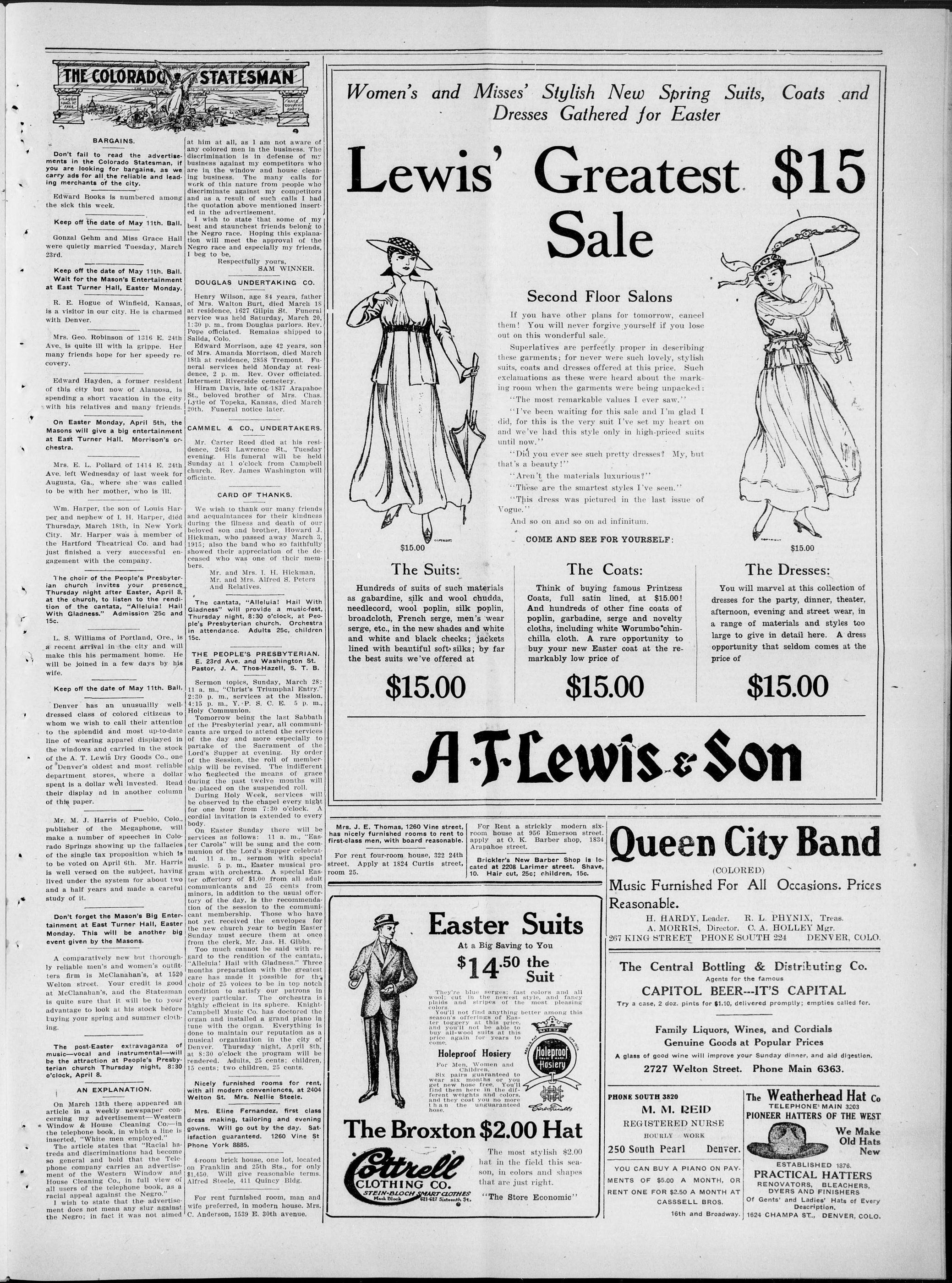
Denver has an unusually well-dressed class of colored citizens to whom we wish to call their attention to the splendid and most up-to-date line of wearing apparel displayed in the windows and carried in the stock of the A. T. Lewis Dry Goods Co., one of Denver's oldest and most reliable department stores, where a dollar spent is a dollar well invested. Read their display ad in another column of this paper.
Mr. M. J. Harris of Pueblo, Colo., publisher of the Megaphone, will make a number of speeches in Colorado Springs showing up the fallacies of the single tax proposition which is to be voted on April 6th. Mr. Harris is well versed on the subject, having lived under the system for about two and a half years and made a careful study of it.
Don't forget the Mason's Big Entertainment at East Turner Hall, Easter Monday. This will be another big event given by the Masons.
A comparatively new but thoroughly reliable men's and women's outfitters firm is McClanahan's, at 1520 Welton street. Your credit is good at McClanahan's, and the Statesman is quite sure that it will be to your advantage to look at his stock before buying your spring and summer clothing.
The post-Easter extravaganza of music—vocal and instrumental—will be the attraction at People's Presbyterian church Thursday night, 8:30 o'clock, April 8.
AN EXPLANATION
On March 13th there appeared an article in a weekly newspaper concerning my advertisement—Western Window & House Cleaning Co—in the telephone book, in which a line is inserted, "White men employed." The article states that "Racial hatreds and discriminations had become so general and bold that the Telephone company carries an advertisement of the Western Window and House Cleaning Co., in full view of all users of the telephone book, as a racial appeal against the Negro." I wish to state that the advertisement does not mean any slur against the Negro; in fact it was not aimed
at him at all, as I am not aware of any colored men in the business. The discrimination is in defense of my business against my competitors who are in the window and house cleaning business. The many calls for work of this nature from people who discriminate against my competitors and as a result of such calls I had the quotation above mentioned inserted in the advertisement.
I wish to state that some of my best and staunchest friends belong to the Negro race. Hoping this explanation will meet the approval of the Negro race and especially my friends, I beg to be.
Respectfully yours,
SAM WINNER.
DOUGLAS UNDERTAKING CO.
Henry Wilson, age 84 years, father of Mrs. Walton Burt, died March 18 at residence, 1627 Gilpin St. Funeral service was held Saturday, March 20, 1:30 p. m., from Douglas parlors. Rev. Pope officiated. Remains shipped to Salida, Colo.
Edward Morrison, age 42 years, son of Mrs. Amanda Morrison, died March 18th at residence, 2858 Tremont. Funeral services held Monday at residence, 2 p. m. Rev. Over officiated. Interment Riverside cemetery.
Hiram Davis, late of 1837 Arapahoe St., beloved brother of Mrs. Chas. Lytle of Topeka, Kansas, died March 20th. Funeral notice later.
CAMMEL & CO., UNDERTAKERS.
Mr. Carter Reed died at his residence, 2463 Lawrence St., Tuesday evening. His funeral will be held Sunday at 1 o'clock from Campbell church. Rev. James Washington will officiate.
CARD OF THANKS.
We wish to thank our many friends and acquaintances for their kindness during the illness and death of our beloved son and brother, Howard J. Hickman, who passed away March 3, 1915; also the band who so faithfully showed their appreciation of the deceased who was one of their members.
Mr. and Mrs. I. H. Hickman,
Mr. and Mrs. Alfred S. Peters
And Relatives.
The cantata, "Alleluia! Hail With Gladness" will provide a music-fest. Thursday night, 8:30 o'clock, at People's Presbyterian church. Orchestra in attendance. Adults 25c, children 15c.
THE PEOPLE'S PRESBYTERIAN.
E. 23rd Ave. and Washington St.
Pastor, J. A. Thos-Hazell, S. T. B.
Sermon topics, Sunday, March 28: 11 a. m., "Christ's Triumphal Entry." 2:30 p. m., services at the Mission. 4:15 p. m., Y. P. S. C. E. 5 p. m., Holy Communion.
Tomorrow being the last Sabbath of the Presbyterial year, all communicants are urged to attend the services of the day and more especially to partake of the Sacrament of the Lord's Supper at evening. By order of the Session, the roll of membership will be revised. The indifferent who neglected the means of grace during the past twelve months will be placed on the suspended roll.
During Holy Week, services will be observed in the chapel every night for one hour from 7:30 o'clock. A cordial invitation is extended to every body.
On Easter Sunday there will be services as follows: 11 a. m., "Easter Carols" will be sung and the communion of the Lord's Supper celebrated. 11 a. m., sermon with special music. 5 p. m., Easter musical program with orchestra. A special Easter offertory of $1.00 from all adult communicants and 25 cents from minors, in addition to the usual offertory of the day, is the recommendation of the session to the communicant membership. Those who have not yet received the envelopes for the new church year to begin Easter Sunday must secure them at once from the clerk, Mr. Jas. H. Gibbs.
Too much cannot be said with regard to the rendition of the cantata, "Alleluia! Hail with Gladness." Three months preparation with the greatest care has made it possible for the choir of 25 voices to be in top notch condition to satisfy our patrons in every particular. The orchestra is highly efficient in its sphere. Knight-Campbell Music Co. has doctored the organ and installed a grand piano in tune with the organ. Everything is done to maintain our reputation as a musical organization in the city of Denver. Thursday night, April 8th, at 8:30 o'clock the program will be rendered. Adults, 25 cents; children, 15 cents; two children, 25 cents.
Nicely furnished rooms for rent, with all modern conveniences, at 2404 Welton St. Mrs. Nellie Steele.
Mrs. Eline Fernandez, first class dress making, tailoring and evening gowns. Will go out by the day. Satisfaction guaranteed. 1260 Vine St Phone York 8885.
4-room brick house, one lot, located on Franklin and 25th Sts., for only $1,450. Will give reasonable terms. Alfred Steele, 411 Quincy Bldg.
For rent furnished room, man and wife preferred, in modern house. Mrs. C. Anderson, 1539 E. 30th avenue.
Women's and Misses' Stylish New Spring Suits, Coats and Dresses Gathered for Easter
Lewis' Greatest $15 Sale
If you have other plans for tomorrow, cancel them! You will never forgive yourself if you lose out on this wonderful sale.
Superlatives are perfectly proper in describing these garments; for never were such lovely, stylish suits, coats and dresses offered at this price. Such exclamations as these were heard about the marking room when the garments were being unpacked:
"The most remarkable values I ever saw."
"I've been waiting for this sale and I'm glad I did, for this is the very suit I've set my heart on and we've had this style only in high-priced suits until now."
"Did you ever see such pretty dresses? My, but that's a beauty!"
Suits: The Coats:
Hundreds of suits of such materials as gabardine, silk and wool chudda, needlecord, wool poplin, silk poplin, broadcloth, French serge, men's wear serge, etc., in the new shades and white and white and black checks; jackets lined with beautiful soft silks; by far the best suits we've offered at
5.00 $15.00 A.T.Lewis & S
A.T.Lewis & Son
For Rent a strickly modern six-
room house at 956 Emerson street,
apply at O. K. Barber shop, 1834
Arapahoe street.
Brickler's New Barber Shop is loca-
tated at 2208 Larimer street. Shave,
10. Hair cut, 25c; children, 15c.
Easter Suits
At a Big Saving to You
$14.50 the
Suit
They're blue serges; fast colors and all wool; cut in the newest style, and fancy plains and stripes of the most pleasing colors. You'll not find anything better among this season's offerings of Easter toggery at this price, and you'll not be able to buy all-wool suits at this price again for years to come.
Holeproof Hosiery
For Men, Women and Children.
Six pairs guaranteed to wear six months, or you get new hose free. You'll find them here in the different weights and colors, and they cost you no more than the unguaranteed hose.
Oxton $2.00 Hat
CAPITOL BEER
Try a case, 2 doz. pints for $1.10, do
Family Liquors, W
Genuine Goods
A glass of good wine will improve y
2727 Welton Street
PHONE SOUTH 3820
M. M. REID
REGISTERED NURSE
HOURLY WORK
Holeproof Hosiery
For Men, Women and Children.
Six pairs guaranteed to wear six months or you will lose them. Find them here in the different weights and colors, and they cost you no more than the unguaranteed price.
The Broxton $2.00 Hat
The Broxton $2.00 Hat
16th and Broadway
$15.00
$15.00
Mrs. J. E. Thomas, 1260 Vine street, has nicely furnished rooms to rent to first-class men, with board reasonable.
For rent four-room house, 322 24th street. Apply at 1824 Curtis street, room 25.
```markdown
```
Cottrell
CLOTHING CO.
STEIN-BLOCH SMART CLOTHES
Mask Block
621-627 Sixteenth St.
Queen City Band
Music Furnished For All Occasions. Prices Reasonable.
H. HARDY, Leader. R. L. PHYNIX, Treas.
A. MORRIS, Director. C. A. HOLLEY Mgr.
267 KING STREET PHONE SOUTH 224 DENVER, COLO.
The Central Bottling & Distributing Co.
Agents for the famous
CAPITOL BEER---IT'S CAPITAL
Try a case, 2 doz. pints for $1.10, delivered promptly; empties called for.
Family Liquors, Wines, and Cordials Genuine Goods at Popular Prices A glass of good wine will improve your Sunday dinner, and aid digestion. 2727 Welton Street. Phone Main 6363.
Second Floor Salons
If you have other plans for tomorrow, cancel them! You will never forgive yourself if you lose out on this wonderful sale.
Superlatives are perfectly proper in describing these garments; for never were such lovely, stylish suits, coats and dresses offered at this price. Such exclamations as these were heard about the marking room when the garments were being unpacked:
"The most remarkable values I ever saw."
"I've been waiting for this sale and I'm glad I did, for this is the very suit I've set my heart on and we've had this style only in high-priced suits until now."
"Did you ever see such pretty dresses? My, but that's a beauty!"
"Aren't the materials luxurious?"
"These are the smartest styles I've seen."
"This dress was pictured in the last issue of Vogue."
And so on and so on ad infinitum.
COME AND SEE FOR YOURSELF:
The Coats:
Think of buying famous Printzess Coats, full satin lined, at $15.00! And hundreds of other fine coats of poplin, garbadine, serge and novelty cloths, including white Worumbo*chinchilla cloth. A rare opportunity to buy your new Easter coat at the remarkably low price of
$15.00
BROADWAY CITY BLOCK
Holeproof
TRADE MARK
Hosiery
PHONE SOUTH 3820
250 South Pearl Denver
The most stylish $2.00 hat in the field this season, in colors and shapes that are just right.
YOU CAN BUY A PIANO ON PAYMENTS OF $5.00 A MONTH, OR RENT ONE FOR $2.50 A MONTH AT CASSELL BROS.
$15.00
You will marvel at this collection of dresses for the party, dinner, theater, afternoon, evening and street wear, in a range of materials and styles too large to give in detail here. A dress opportunity that seldom comes at the price of $15.00
City Band
(COLORED)
For All Occasions. Prices
Leader. R. L. PHYNIX, Treas.
Director. C. A. HOLLEY Mgr.
PHONE SOUTH 224 DENVER, COLO.
Bottling & Distributing Co.
Agents for the famous
BEER---IT'S CAPITAL
for $1.10, delivered promptly; empties called for.
Liquors, Wines, and Cordials
Goods at Popular Prices
improve your Sunday dinner, and aid digestion.
Street. Phone Main 6363.
The Weatherhead Hat Co
TELEPHONE MAIN 3203
PIONEER HATTERS OF THE WEST
We Make
Old Hats
New
ESTABLISHED 1876.
PRACTICAL HATTERS
RENOVATORS, BLEACHERS,
DYERS AND FINISHERS
Of Gents' and Ladies' Hats of Every
Description.
1624 CHAMPA ST., DENVER, COLO
---
nD mr te a ee et EE ee NN 1 i be ee
Dutchy and
Little Doc
2
By FRANK FILSON
Nearly all the boys liked the little
doc when he came to Sapphire. He
wasn't much of a man to look at, but
fils big head was chock full of learn-
ing, and he was as affable and friend-
ly as anyone. The only man who
didn’t take to the doe was Dutchy,
the bully of the camp.
Dutchy was sullen enough and mind-
ed his own business in general, but
when he had two or three drinks in
him he would start out to find trouble.
He generally found it, aid, being the
kind who picks upon a smaller man
by preference, he usually gave better
than he got.
‘The doc was a young fellow, and
pretty Miss Lida, old man Pearce's
daughter, who had been East to school,
seemed to like him well enough. It
made most of the boys rather sore to
see a pretty, clever girl like that take
up with such little runt. However,
that was her business and nobody
thought any the less of the little doc
for succeeding where so many of the
rest had failed. Besides, there was
an epidemic of typhoid that fall, and
everybody was pretty much scared.
Nobody knew who was going to be
the next victim, and the doc was
working with might and main to shut
‘off the spread of the disease.
However, he found time to sit for
@ half hour on Miss Lida’s stoop oc-
eastonally, and fan himself with a
palm leaf. The boys who used to go
there and weren't invited so much
now used to grit their teeth and go
around a block so as to avoid seeing
him, But still, it wasn’t a case for
@ personal grudge.
At least, except with Dutchy, who,
being naturally a boor, and never hav-
ing succeeded tn making any impres-
sion on Miss Lida’s heart, set out to
4 il Lu,
tig i ml
a), a ly
sc x rr I
a | el
b Ne
Bae r =
| = ae
“That's All Right, Dutchy.’
be ugly. He used to scowl at the lit-
{le doc when he met him, But on a
certain night Dutchy, having had
more than was good for him, felt in
the mood for trouble.
Jim Moffat and Phil Duggan, who
were seeing him back, at the request
af the town marshal, tried to pull him
past the stoop, but Dutchy shook
them away and stood facing the lit
Ue doc, who was fanning himself at
Miss Lida’s side.
If you're a man you'll come down
from behind) a woman's skirts and
talk face to face!” screamed Dutchy.
Tho little doc came down. Miss
Lida tet out a cry, but there wasn't
anything to be done, for Dutchy was
a big man and he could have smashed
Phil and Jim with a blow of his fist,
to say nothing of the little doc.
The doc came up to Dutchy and
looked keenly into his eyes.
“Ha, the furor Teutonicus, I see!”
he said to himself, as though sum-
ming up the condition of a patient.
And then, while Dutchy was still
thowering him with insults, he caught
hold of his hand and felt his pulse,
quite in a professional way.
“You'd best go home to bed,
Dutchy,” said the little doc,
Dutchy stared at the doc in speech-
fess anger for a few moments, Then
he shot out his big fist and caught the
floc on the mouth, knocking him down
and cutting his lip open,
“Have you spunk enough to fight,
vou little shrimp?” he roared.
The little doc, very pale, stood be-
fore Dutehy, not attempting to defend
himself. :
“Ho!” roared Dutchy. “Nice sort
of man you're going to get, Miss Lilla.
Why, I'd fight the little whippersnap-
per with one band tied behind me.”
‘Then, being somewhat pleased with
his work, Dutchy permitted Duggan
acd Moffat to lead him home, still
breathing out threats of what he was
going to do to the doc next time
he caught him on Miss Lida’s porch.
What Miss Lida said to him is un-
known, for she sat in a sort of daze
while the Uttle doc was being knocked
flown. However, it was noticed that
Sy oe ee
the little doe didn’t call on her for
a day or two, and next time he
dropped in Jim Moffat was there, hay-
ing apparently been restored to favor.
And though Miss Lida was friendly
enough with the little doc, anyone
could have seen that things weren't
quite the same.
For however small a man may be, it
is expected that he will do something
when he gets a hit across the mouth,
instead of picking himself up and sruil-
ing, as the doc had done. And Miss
Lida was certainly placed in an un-
comfortable position, for no girl likes
going with a coward.
Three days after the episode
Dutchy's friend Hinkman came run-
ning into the doc’s office.
“Dutehy’s got the fever, doc.” he
said, “You won't remember w&st he
did to you, doc? He's scared out of
his wits, doc, and thinks he's going
to die.”
“All right,” answered the doc, He
got up and went round to the shack,
in which Dutchy lay upon his bed,
tossing and muttering deliriously. It
was the last case in Sapphire, but it
was the worst. The doc had pulled
the rest through without a single dis-
aster, but this seemed hopeless from
the first
During the next three weeks the
doc put in nearly all his time with
Dutchy. He told Hinkman to call him
any hour of the night when Dutchy
seemed worse. He persuaded Miss
Lida to lend her aid and between
them at last they got Dutchy out of
the valley of the shadow.
Tt was an awful time, said Hinkman,
Dutchy dimly recognized the doc and
thought he was trying to poison hin
Sometimes he fought so hard that it
was all they could do to keep him
from jumping out of the window. The
Uttle doc showed a good deal of
strength, Hinkman reported, in such
encounters. (
Finally Dutehy, out of danger, and
weighing about one-third as much as
he had done, lay on the bed, conscious,
and looking up at the doc with a sort
of dumb dog gratitude expression
“Doc,” he had the grace to say, “I'm
sorry.”
“That's all right, Dutchy,” the little
doc answered, smiling.
The days passed, and evidently
the doc had succeeded in squaring
himself with Miss Lida, for they sat
together on the stoop every afternoon
now, And there was not a man in
camp but vowed the doc was a white
man, and that he would give his life
rather than let anyone say the op-
posite, or lay a finger on the doc
again,
Well, Dutchy went North to con-
valesce, and at last the day came
when he stood before the doc, who
was still sitting on Miss Lida’s porch
—they being now engaged—and spoke
up much less sheepishly, but still sort
of ashamed.
“Doc, I've come back and I want
to thank you,” he began.
“That's all right, Dutehy,” answered
the doc, “Are you ready now?”
“Ready? For what?” asked Dutehy.
gg Why, for your thrashing,” an-
swered the doc, as if surprised, and
he went down. “Put ‘em up, Dutehy,”
he said. “You see, I couldn't strike
‘a sick man, and I knew by your look
and your pulse that you were getting
ready for a siege with typhoid, But
now I'm going to lick you.”
Which he certainly did. When it
was over Dutchy’s face couldn't have
been recognized by his own mother.
But then we found out that the doc
had been the featherweight champion
at Princeton.
“Now come along to the surgery,
and I'll sew up your wounds. No
charge,” said the little doe,
Dutchy was the sort that couldn't
rest until he got even. He threw the
shoe after the wedding and struck the
doc behind the ear, That settled all
CUSTOM OF ‘EA DRINKING
Love Brewed the First Cup, According
to a Legend Believed
in China.
The Chinese claim to be the first
users of tea as a drink, and how it
originated is told in a pretty little leg-
end that dates from 2,000 years before
the coming of Christ, says Ireland's
Own.
A daughter of a then reigning sover-
eign fell in love with a young noble-
man whose humble birth excluded him
from marrying her. ‘They managed to
exchange glances and he occasionally
gathered a few blossoms and had them
conveyed to her.
One day in the palace garden the
lovers met and the young man endeav-
ored to give her a few flowers, but
so keen was the watchfulness of her
attendants that all she could grasp
was a little twig with green leaves.
On leaving her room she put the
twig in water and toward evening she
drank the water in which the twig
had been kept. So agreeable was the
taste that she even ate the leaves and
stalks, Every day afterward she had
bunches of the tea tree brought to her,
which she treated in the same way.
Imitation being the sincerest form of
flattery, the ladies of the court tried
the experiment, and with such pleas-
ing results that the custom spread
throughout the kingdom—and_ the
great Chinese tea industry became one
of the greatest businesses in the
world.
The Way to Clean Lamp Glasses.
Here is an excellent way to clean
lamp glasses: Hold them over a jug
of boiling water until they are well
steamed; then polish with a soft dry
rag. This {8 a much easier way than
washing them, and the glasses very
rarely break.
AGRICULTURAL DEPARTMENT EX-
PERTS GIVE RESULTS OF
STUDY AND EXPERIMENT,
UNDERGROUND VEGETABLES
Game Facts abet nests ang Uncer
ground Stems That Are Eaten as
Vegetables—Cooking
‘Starch,
Nearly all roots and underground
stems that are eaten as vegetables
contain large quantities of water, in
addition to starch or some similar ma-
terial, a little nitrogenous matter, and
mineral matter. The roots and stems
store materials for future growth dur-
ing favorable seasons. Plants that
store most of their food as insoluble
starch (as potatoes and cassava) are
known as “starch-bearing plants,
While those which store much of their
food in the form of soluble carbohy-
drates (sugar in the case of the beet)
which give the root a more or less
juicy character are classed as “suc-
culent roots.”
In northern regions the potato is
the most important of the starch-bear-
ing plants. In the southern states the
sweet potato is more generally used.
One reason why the potato has be-
come such a favorite is doubtless its
lack of pronounced flavor. It harmon-
izes with foods having a more positive
taste, and one docs not tire of it as
one would of the continuous use of
turnip or squash. Theh, too, it is eas-
ily grown, gives an abundant yield,
and may be readily stored for winter
use.
How Much Should Potatoes Weigh?
Potatoes should weigh 60 pounds to
the bushel, or 15 pounds to the peck.
As three or four average potatoes will
together weigh one pound, a peck
should number from 40 to 60.
The oftener potatoes are handled in
their transit from producer to con-
sumer the poorer their quality and
the greater the percentage of refuse.
When received from the market it is
desirable to sort them carefully, that
those of the same size may be cooked
together—smooth, medium ones to be
baked; large ones to be steamed in
their skins; and imperfect and infer-
for ones to be pared before boiling.
Any portions that are dark-colored or
green should be removed, as they may
impart a bad flavor to the rest.
Sprouts should be broken from pota-
toes before cooking.
When potatoes are old and wrinkled
they are much improved by cutting off
the ends or by partially or wholly par-
ing and by soaking in cold water for
several hours like dried beans, ete. In
fact, inferior potatoes of any age are
much improved by paring and soaking.
Where potatoes are inexpensive or the
parings can be fed to’ animals it is
often a profitable custom to pare be-
fore cooking, since thus imperfections
and strong-flavored portions are dis-
posed of, leaving a nearly pure starch,
comparable to arrowroot or tapioca
and ready for the table as soon as
cooked; this is true notwithstanding
that careful investigations have
proved that such cooking cavses con-
siderable loss of the nutrients in the
potato.
When potatoes are the only yegeta-
ble attainable it might be wiser to
cook them without paring, so that
their mineral salts may be retained,
but people who use salad plants and
other vegetables freely are justified in
considering chiefly convenience and
palatability in the preparation of these
tubers.
Often it ts a convenience for the
housekeeper who has several dishes
to prepare at once just before dinner
to have the potatoes pared earlier in
the day.
Most good cooks believe that it is
wiser to discard the water in which
potatoes are boiled, as it 1s likely to
be strong in flavor.
Potato flour may be found in large
groceries and is used in cakes and for
thickening purposes in much the same
way as cornstarch.
Sweet potatoes are not strictly
tubers like Irish ‘potatoes, but are
tuberous roots. They should be kept
in a dry place if possible at a temper-
ature of from 50 to 65 degrees F. Be-
cause thelr sweetness is to some ex-
tent lost in water, they aro better
steamed than boiled, and baking is a
favorite method of preparation. After
steaming they may be sifted and used
in puddings or pies like squash and
added to breads, * particularly corn-
bread.
Sweet potatoes are sometimes
canned and are often dried like fruits
for family use. A flour is also made
froth the sweet potato,
In southern homes the sliced sweet
potato (often first parboiled) has al-
ways been cooked with sugar, putter,
end other seasoning. Such dishes, an-
Aer a variety of names, are now gen-
sral_ favorites,
When sweet potatoes are baked the
process should not be too rapid, but
should continue for an hour or until
the skin separates from the pulp, and
fn the case of the varieties moist
when cooked, until the sirup con-
denses, and the pulp grows moist, The
fegroes in the southern states bake
them in the ashes in the fireplace;
ana we GOO ae BAR real So eae SO
A New Vegetable—the Dasneen.
ee a aR eas So, ae eee ee
tropical countries. The plants re-
semble the caladium, which is such a
popular ornamental plant, and the
taro, which provides the “poi” of the
Hawaiians, and which is a staple food
in many tropical islands. The dasheens
may be served like potatoes, boiled,
fried, creamed, etc., but to many are,
like ‘potatoes, ‘most acceptable when
baked. They have a rough outer coat-
ing, which may be partially removed
before cooking. If entirely pared
there is a tendency to discolor, a8
with potatoes. More detailed infor-
mation regarding this new introduc-
on and its preparation will be sent
free to the housewife who applies to
the United States department of agri-
culture.
The importance ot Properly Cooking
‘Starch.
Starch cookery 1s a very important
| subject. That starch may be thor-
oughly cooked it is essential that ev-
ery starch grain be brought into con-
tact with water of at least 140 to 178
degrees F.
in the case of starches separated
from the plant cells when they were
formed (arrow root, corn starch, etc.)
cooking is a simple matter, and tong
continued cooking is seldom needed ta
make them pplatable and in good cop-
dition for digestion
The selection of potato starch in-
stead of corn or wheat starch for thick-
ening sauces in accordance with the
custom of French cooks is ratfonal,
since it does not require so long boll-
ing to insure the best results.
In the case of starch still enclosed
in plant cells—as is the case with the
starch present in cereal breakfast
foods, ete.—long cooking is desirable
in order that water may penetrate to
each individual starch grain and unite
with it to form the well cooked mate-
rial which is considered most whole-
some.
Starches from different plants or
plant parts differ in the form of the
starch grain, so that starches of va-
rious kinds can be identified by the
aid of the microscope. But from the
culinary standpoint they are practical-
ly interchangeable, and one form of
starch may be substituted for another
in nearly all cases. Just as we may
| substitute the yam or a dish of rice
| for the potato as a vegetable, so we
may use starch from the potato, or
| corn, or wheat, or rice for thickening
| zravies or making puddings, making
slight changes in proportion, according
to the expansive powers of each kind.
Suggestions Regarding Succulent
Roots.
Beets contain a larger percentage
of sugar than most vegetables, and
should be baked or steamed to retain
as much of this as possible. At all
events, they should be cooked in the
skins, and the tip of the root and a
portion of the leat stems should also
bo left on until after cooking. Even
80, some color and sweetness are lost
in the water in which they are cooked.
Radishes, red or white, when a little
too large to eat raw, may be cooked
like turnips and served with a white
sauce.
Raw carrots often are eaten by chil-
dren, and are advocated by those who
believe in the use of raw foods. When
grated, raw carrots may be used in
soups without further cooking, or
added to salads. The carrot contains
so much sugar that its use for sugar
making in the same way as the beet,
has been seriously considered
The parsnip 1s said to have been
cultivated even before the Christian
era. The woody fiber of these roots
is softened by freezing without injury
to other portions. Hence they are left
in the ground until the frost comes or
even through the winter But the
roots must be used before they begin
to grow again or they lose their sweet-
ness and get “rusty.” ‘The larger ones
are likely to be less sweet and more
woody. Small parsnips just from the
ground in the spring will cook in fess
than a half hour. If steamed tn their
skins, they lose less sweetness than
by boiling. They should be peeled aft-
er cooking, and served plain or with
white sauce, or sauteed in butter or
mashed and made into fritters. They
may be made into a stew with pota-
toes, onions, and milk.
‘The vegetables sometimes known as
the “oyster plant” is the “salsify,”
which is most available for use during
the late fall and winter. The root turns
dark quickly if the skin is removed be-
fore cooking, and after paring should
be dropped at once into vinegar and
water to prevent discoloration. Aft-
er boiling for about thirty minutes, the
salsify may be served with butter or
white sauce, or mashed and made into
fritters.
‘Their Great Scheme.
A loca! couple, recently married, hit
upon a scheme for saving what they
figured was just about right. Hach
month they would save a certain sum
each day. ‘The first day one cent, the
second day two cents, third four cents.
‘Bach day the amount was to be doubled
until the end of 30 days. By that time
they would have a tidy sum laid away.
| Before starting the husband fig-
‘ured out just how much would be ac:
cumulated in this way. After labori-
ous work he found the amount to be
something like $5,300,000, so after con-
sidering the matter they decided that
one dollar a week would be about
their speed.—Youngstown Telegram.
Relic of the Past.
“Seems to be a diversity of opinion
‘about one thing.”
“What is that?”
| “Some old fogies seem to think a
trunk strap is more efficacious in re-
forming a bad boy than a suspended
sentence.’—Kansas City Journal.
Oo, oe
Jee
: PURE Uy
se ss Rss OM.
pea) Vie ss meer A ha
Washington Plate for White House Collection
W ASHINGTON.—The White House collection of presidential ware feceived
a valuable addition when Miss Mary Curtis Lee, daughter of Gen. Robert
E. Lee, contributed to the collection a plate of the George Washington Cin:
of an eagle in gold suspended by.an olive branch from a deep blue ribbon
edged with white, and on the breast and back of the eagle were symbolic
scenes encircled with patriotic mottoes in Latin.
After the society was established the French officers presented Washing:
ton with a handsome insignia studded with precious stones, and the ribbon
bore the words, “Presented in the name of the French soldiers to his excel:
lency, General Washington.” It was this which Lossing confused when he
wrote in his “Mount Vernon” that the French officers presented Washing:
ton with a Sevres dinner set bearing the Cincinnati decorations. A glance
at any piece of the Cincinnati set shows that it is not china at all, but
Cantonese pottery, and it is a well-founded family tradition with the Wash-
ington and Curtis descendants that the Cincinnati dishes, of which there
were originally breakfast, dinner and tea sets, were presented to General
and Mrs. Washington by the American officers.
Soon after Miss Lee came to Washington this winter the subject was
broached to her again, and as she chanced to have one of the plates out of
Storage she decided to present it to the collection. qt is a medium-sized din-
ner plate, with the deep blue mottled border and gold lines of the Cantonese
ware, and in its center is the figure of Fame holding a trumpet to her lips
with one hand, while with the other she bears aloft the insignia of the Society
of Cincinnati. During a call upon Miss Wilson at the White House Miss Lee
presented the plate to her for the collection, and it was placed in the cabinets
in the lower corridor of the mansion.
: ‘ 4
“Life Buoy” Prevents Loss of Gold on Warships
we American cruisers in foreign waters taking gold for the use of
American citizens, and with the recent return of General, Funston from
Vera Cruz to Galveston with approximately $1,000,000 in gold aboard the trans-
most rigid tests, so there can be no danger of the loss of the precious stuff
should a bag be dropped from the side of a vessel to a pier or dock.
Another possibility of loss is presented in the danger of a small boat
being overturned during a heavy sea while transshipping the metal from
shipboard to land or land to ship. This contingency also is guarded against.
To each of the bags used for the transporting of gold is attached by a
long chain a floating buoy large enough to support the maximum capacity
in gold of the bag to which it is attached. Thus, if a launch taking ashore
consignment of gold should be capsized or sunk, the gold would not be lost.
If the water be very deep it will not even go to the bottom, but will hang
suspended to the length of the chain attached to the buoy.
Thus, the only way the gold taken aboard by the Tennessee could have:
been lost would have been in the sinking of the ship.
He Understands the Feelings of the Turks Now
AC cree, sculptor, who makes is home here now, held up his
hands appalled the other day by the magnitude of the -ocial activities of
the womankind of Washington. “Overwhelming! Exhausting! How do you
his pants with pins,” because the womanfolks are so rushed. You call
avidly on army and navy women on Monday and on the judiciary. You call
on the representatives on Tuesday, on Mrs, Marshall, who is a class to her-
self, on the wife of the speaker of the house and on the cabinet women on
Wednesday. The senatorial sisterhoo@ pre-empts the business on Thursday
afternoon. Friday and Saturday in days gone by were wont to be monopo-
lized by diplomatic dames and damsels, But the “dips,” these parlous times,
are “layin’ low and sayin’ nuthin’.”
Defense Wins in Congress—Self, Not National
Cc ONGRESS has so taken to heart. the subject of defense, national and other-
wise, that W. K, Sixsmith says he, Representative W. W. Rucker
and other prominent members of the house, got the consent of Speaker
ing points of order he mey retire to the athletic quarters and punch the bag
or get his torpid circulation in activity by a few whirls about on the flying
rings.
Statesmen whose digestion is imperfect may spend a half hour on the
parallel bars and develop an excellent appetite. With still other statesmen
busy with the chest weights, or the Indian clubs, or the stationary horse,
it is conjectiired that there will be such a spectacle as even “Billy” Mul-
doop vever dreamed of, 1
> en Eon?
a LOOK WELL
CS )) ON OUR TABLE
23 \ > ag —iF WE HAD
Paper ONE, wou
—— iF pr vs THEY LiLuiAH)
Ga —
SE :
cS eens, /-
terest in the navy’s method of han-
dling gold and of safeguarding it so
that it may not be lost.
Gold, or other specie, but usually
gold, on shipboard, for the reason that
it is current the world over, is stored
in bags of such stout material that
should a heavy bagful be dropped
from considerable height the bag
would not split open. The bag, of
course, is locked and the material of
which it is made must stand the
most rigid tests, so there can be no d
should a bag be dropped from the sid
Another possibility of loss is pre
being overturned during a heavy sez
shipboard to land or land to ship. Th
To each of the bags used for the
long chain a floating buoy large enor
in gold of the bag to which it is atta
consignment of gold should be capsia
If the water be very deep it will not
suspended to the length of the chain :
‘Thus, the only way the gold take
been lost would have been in the sink
He Understands the Fe
AC cree, sculptor, who mi
hands appalled the other day by t
the womankind of Washington. “Over
x Vy ovenonerric!
e EXHAUSTING !
wm S22 WB —Howcan
at Sc) THEY MANAGE
ie
me
: uy Me
his pants with pins,” because the 1
avidly on army and navy women on }
on the representatives on Tuesday, or
self, on the wife of the speaker of th
Wednesday. The senatorial sisterhood
afternoon. Friday and Saturday in d
lized by diplomatic dames and damsel
are “layin’ low and sayin’ nuthin’.”
Defense Wins in Cong
C ONGRESS has so taken to heart. the
wise, that W. K, Sixsmith says
and other prominent members of th
ep
R «
CD 2 J x
SPS, 8
OS,
5 IC rey
ery
tL
Soy rr
—— pe ax)
Ong S
ing points of order he mey retire to tl
or get his torpid circulation in activit
rings,
Statesmen whose digestion is imy
parallel bars and develop an excellent
busy with the chest weights, or the
It is covjectired that there will be 1
doon uever dreamed of.
eee te nee emer are een en Se ee en er
this is the most valuable piece in the
collection, as the Cincinnati china has
more historical associations and is
better known than any of the Wash
ington china.
The Society of the Cincinnati
was founded at Annapolis November
21, 1783, by the American and French
officers who had served together dur.
ing the Revolutionary war, and Wash-
ington was made its first president
FAYE SR RRR DORN oo Ke see
Lee alee
eg <2 var Ee
7 EOD aa
om » aaa
Kea) 7a Tyo)
—, A OSs
EO)"
I =
anger of the loss of the precious stuff
of a vessel to a pier or dock.
sented in the danger of a small boat
while transshipping the metal from
is contingency also is guarded against.
transporting of gold is attached by a
zh to support the maximum capacity
thed. Thus, if a launch taking ashore
ed or sunk, the gold would not be lost.
even go to the bottom, but will hang
ttached to the buoy.
1 aboard by the Tennessee could have:
ing of the ship.
lings of the Turks Now
kes is home here now, held up his
1e magnitude of the -ocial activities of
whelming! Exhausting! How do you
Manage hs ne cried, «Avery gooG
Turk,” the sculptor laughed, “goes
down on his knees, on his prayer rug,
the first thing every morning and
thanks God that he is not a woman.
When I see you women wearing your-
selves out in this social strain, I un-
derstand the feelings of the Turk.”
So, “Sister Susie's sewing skirts
for soldiers,” and Nettie’s knitting
knickknacks, only in the interstices,
if there ever are any, in the social
merry-go-round, while “papa pastes
fomanfolks are so rushed. You call
fonday and on the judiciary. You call
Mrs, Marshall, who is a class to her-
» house and on the cabinet women on
pre-empts the business on Thursday
ys gone by were wont to be monopo-
. But the “dips,” these parlous times,
ess—Self, Not National
subject of defense, national and other
he, Representative W. W. Rucker
2 house, got the consent of Speaker
ee | Mcrae: le eRe Ni ee eee ae
training school. These representa-
tives, it is said, feel they are develop-
ing their mental powers to the detri-
ment of physical prowess and believe
punching the bag or medicine ball
practice will remove pudginess and
restore the athletic contours of years
ago,
According to Mr. Sixsmith, ar-
rangements have been made to devote
a room in the capitol to athletic exer-
cises, If a member gets tired of mak-
© athletic quarters and punch the bag
y by a few whirls about on the flying
erfect may spend a half hour on the
appetite. With still other statesmen
indian clubs, or the stationary horse,
uch a spectacle as even “Billy” Mul-
Loyal,
Valiant
Towser
By
Augusta Goodrich Sherwin
(Copyright, 1915, by W. G. Chapman)
Worthless, wandering Neal Barrett opened a package done up in a newspaper and smacked his lips in glowing anticipation. Then as the contents were revealed his rugged face broke into a smile.
"A right royal hand-out!" he gloated. "Chicken and cake, and biscuits—all buttered, too. Must have had a banquet at that house last night."
Neal sat down on a pile of boards and started in to discuss the tempting viands that lay before him. In his grateful mind was a memory of the pleasant little housewife who had so sumptuously provided for him.
"It's been hard grubbing for a day or two," soliloquied Neal. "but this makes up for it all. It's better than free lunch—and without the temptation. I don't pick up much work, but I'm in a 'dry' district. That's my-only safety zone, and I'll stick!"
He was a good-natured and a good-looking fellow. Too good-natured by far he had been in the past. It had led to his grieving a sweet fond girl. It had ended in her father forbidding him the house. That was a good many miles from Neal's present town—of temporary residence. Neal saw the justice of his dismissal, for Mr. Parsons was poor and Neal was spoiling the chances for marriage for his daughter, Florence.
Neal had lost his position through being too easy-going with a reckless, dissipated set. He left town and Florence. Work was not easy to pick
A man in a hat stands in front of a barn, holding a leash attached to a dog. The dog is running towards the barn.
He Looked Invitingly at Neal. up and idleness killed his ambition. He became a wanderer, then a tramp. He was one now, as a matter of fact. For a month, however, he had bettered in one respect. A drinking bout had got him in with a criminal crowd, and had he not abandoned them he would have landed where they did—in the penitentiary. The experience scared him. He took refuge in a local option district. He had not tasted liquor for a month. With sobriety had come sane saddened thoughts of the girl he had left behind him. He had faithfully sought work, but did not find it to do. So, hand-outs had become his portion. "Hello!" ejaculated Neal in a sudden sprightly way.
There had come a rustling in the bushes behind him and then a big handsome collie dog bounded in front of him, sniffed towards the outspread lunch and then sat up and held out a paw.
"Shake, old fellow!" hailed Neal. "Hungry? I see you are. All right. We'll make it fifty-fifty, and there you are!"
It did Neal good to see the half-famished animal enjoy the toothsome meal, which he divided evenly with him. It was getting on toward dusk. Neal had tramped a good many miles that day. He chose a soft grass plat just off the road and stretched himself out.
The dog made no demur, more than content to stay with his new master as long as the latter smoked and spoke to him. As Neal closed his eyes for a nap, however, the animal got up near to him, pulled his sleeve, pranced about, showed plainly that he did not consider it bedtime, nor the site of the siesta favorable for rest and comfort.
"What you trying to tell me, old fellow?" queried Neal whimsically. "Want me to go somewhere? All right—march ahead."
The animal at once adopted the methods of a guide. Down the road he proceeded, then across a lot and darting along a narrow lane arrived at an old barn structure.
He looked invitingly at Neal as he entered its doorway. There was a pair of stairs and a loft with sufficient old hay on its floor to make a very comfortable bed.
"Well, well," laughed Neal—"tit for tat!" I share my meal and you pilot
me to a first-class bed. Good for you, Towser!"
They became close chums, those two, during the next few days. The constant companionship of the animal pleased and cheered Neal. As to Towser, a grateful sample of true fidelity he seemed to be supremely content. One night, however, when they arrived at the barn, they found the doors barred and padlocked, and it was not so dark but that Neal could read scrawled across the new barrier the chalked words: "Trespassers will be prosecuted according to the law."
It had begun to rain and man and dog had tramped a long distance that afternoon. Neal looked for temporary shelter. He found it at the side of the house in a vine-embowered arbor. A long bench invited him to rest and then unconsciously to slumber.
It must have been three or four hours later when Neal awoke. Towser was pulling at his coat. Neal sat up and then sprang to his feet, as from the inside of the house an echoing scream of terror or pain rang out. "Something wrong," uttered Neal, all his keen senses shrewdly alert in an instant, "and Towser knows it." The dog, with an eager impatient glance back at his master, had started for the house. Neal followed. The front door was open. Down the hall the dog stole to where a door stood partly ajar. Beyond it Neal peered for the moment, horrified and spellbound. Across a table in his night dress lay the hermitlike occupant of the house—old Jacob Wise. He was tied across it. There was a fire in the stove, and stuck between its red hot bars was a poker. A rough-looking man was standing over the aged Wise.
"Now then, I've got you safe and sound," he was saying. "You've got a fortune hidden away in some odd corner of this old house and I want it, understand?" Jacob Wise made no response. The robber drew the poker from the stove. "Tell where that money is," he spoke, "or I'll give you a touch of this." The intruder waved the red hot poker menacingly. He moved it across the bare soles of his victim's feet. "I'll tell! It burns! I'll tell!"
"I'll tell! It burns! I'll tell!" shrieked the tortured old man. Just then Neal pushed open the door. The intruder turned quickly, Neal sprang at him. They grappled. Then the robber pressed a revolver against the side of his opponent. The last thing that Neal Barrett saw as he sank unconscious to the floor was the dog, his teeth at the throat of the wretch who had downed his master. The waking moment came days later, although Neal did not realize that fact when he first roused up. In amazement he stared. Old Jacob Wise sat at his bedside in a comfortable room. Through an open doorway, moving about engaged in domestic duties, Neal saw Florence Parsons!
"Ah! better!" chuckled the old miser "Good boy! I've been awfully anxious. Know her?" and he nodded his head towards the tidy, graceful figure in the next apartment.
"Yes," whispered Neal weakly, but his face aglow with tenderness and delight.
"She's true blue," declared the old man fervently.
How "true blue," Neal Barrett knew after a little explanation. The faithful Touser had driven the robber away, terribly lacerated. Jacob Wise, grateful to man and dog who had saved to him a part of his hoarded fortune, had given Neal the best care possible.
Some memoranda found on Neal had advised Wise of the existence of Florence. He had written her. She had come to nurse the unfortunate man she still loved.
"I'll call her in now," advised Wise. "She knows I'm going to start you out on a new life, with plenty of capital. You're a brave man, and that dog shall have a real silver collar. As to the young lady—don't miss your chance to get a good wife." Which Neal did not, and Towsar, loyal, valiant Towser! was not shut out from guestship when the happy wedding took place.
SHE TOURED WORLD AT 85
Elderly Lady Enjoyed Trip, and Lived Two Years to Talk About It.
Mrs. Mary J. Scroggs, who enjoyed the unique distinction of having traveled around the world and enjoyed every mile of the tour when she was eight-five years old, died at the residence of her son, Dr. G. A. Scroggs, at Los Angeles. Particularly free from illness throughout her life, she was ill but a short time before death. She was eight-seven years old.
Two years ago Mrs. Scroggs decided to take a trip around the globe. Many friends had known that she longed to make the tour, but were amazed when she announced that she had completed arrangements. Rugged and with a mind particularly receptive and alert, she traveled through the alien lands with the greatest enjoyment, and gathered an unusually large fund of information.
She was accompanied by her daughter-in-law, Mrs. Doctor Scroggs, and her niece, Miss Elizabeth P. Bailey. The oldest woman ever to make such a trip, according to the records of all transportation companies, she was not ill from ocean travel, and did not miss a day from sightseeing.
Mrs. Scroggs went to Los Angeles 12 years ago from Beverly, Pa. having lived the greater part of her life in that community.
Warren Orders an Expensive Dinner and Helen Can Think Only of the Check
(Copyright, 1915, by the McClure Newspaper Syndicate.)
"We'll, not order just yet," Warren waved aside the dinner card. "Expect a gentleman here in a minute."
"Very well, sir," the waiter filled their glasses, placed the menu before them and hurried off.
"Dinner de Luxe, two dollars," read Helen, with a gasp of dismay. "Two dollars! Why, that's outrageous! It was never more than a dollar and a half."
"That is pretty stiff," Warren admitted. "Well, now they've got the crowd coming—they've boosted the price."
lot, cheerfully. "Do you like a skling wine, Mrs. Curtis?"
"Why, I know so little about win answered Helen, fearing that spark Chablis was expensive, and wanting order Medoc, the cheapest claret the list. "I often tell Warren I eat the red ink at those Italian ta-dhote as much as I do champagne.
But this hint for inexpensive clap passed unnoticed.
Everything was exceptionally good and well served, but Helen, who trying to add up in her mind amount of the bill, could not enio
"But we don't have to take the dinner, do we?" persisted Helen. "Can't we order a la carte?"
"Yes, and it'll cost a darn sight more before we're through."
"Not if we don't order so much, and it's so hot tonight, dear, we won't want much."
"There's Elliot now!" Warren waved the card at a man in white flannels standing expectantly in the doorway. He saw the signal and made his way toward them.
"Hope I haven't kept you waiting," as he greeted Helen. Then in answer to Warren's query, "Yes, a dry Martini."
Helen was unresponsive to Mr. Elliot's genial efforts to include her in the conversation. She had come to dread his semiannual trip to New York, because Warren always took him out and always paid the bill.
How could he accept such hospitality and make no effort to return it? Of course, he had repeatedly invited them to St. Louis, but he was safe in that, for he knew they would never come.
"Now, let's get this ordering over first." Warren pushed the card toward Elliot. "What do you feel like—the dinner?"
"Looks pretty heavy. I don't know about you folks, but I want something light this weather."
Helen greeted this announcement with enthusiasm.
"I was just telling Warren that. We'd all be much better off if we'd eat less while it's so warm."
"All right, we'll order then." Warren turned to the waiter. "Let's see your a la carte card."
The waiter brought it with evident reluctance. Apparently in this room you were expected to take the dinner and not try to economize by a la carte order.
"How about clams?" suggested Warren.
"I can always eat clams," agreed Mr. Elliot.
"Cocktail or plain?"
"Plain."
Helen made a troubled note that clams here were 35 cents—that made a dollar and five for the first course. Perhaps the dinner would have been cheaper after all.
"Soup?" asked Warren. "That St. Germain ought to be pretty good—they make it of fresh peas now."
"Oh, it's too warm for soup," interrupted Helen, hoping desperately that Warren was not going to order a course dinner at a la carte prices. It would be twice as much as the table d'hote.
"Chicken broth jellied," suggested Mr. Elliot, "that's cold."
At this Helen dropped her eyes to hide their resentment.
"All right—three chicken broths," ordered Warren. Then, reading from the fish list: "Bass, Fresh Mackerel, Filet of Sole?"
"Oh, dear, I don't think it's safe to eat fish," broke in Helen, determinedly.
"It ought to be all right at a place like this," Mr. Elliot assured her. "I had some sole here last summer that was exceptionally fine."
Countless times Helen had heard Warren declare that there was no sole in America, that it was only flounder, but now he tactfully refrained from this favorite comment and promptly ordered the sole.
Now, Elliot, look over those entrees. Anything there strikes you?
Helen was wretchedly twisting the napkin in her lap: Clams, soup, fish, and now an entree and probably a roast! Oh, why hadn't they taken the dinner? Every moment increased her fierce resentment of this man. How could he let Warren order so extravagantly?
However, he did suggest that they skip the entree, but for the roast he proposed guinea hen—one of the highest priced items on the menu.
"How about that, waiter?" asked Warren. "That guinea hen enough for three?"
Helen almost gasped. The guinea hen was $2.00—surely he would not order an extra portion! But the waiter said the hens were fair sized and, with the rest of the dinner, should be enough for three.
"Well, bring with it some new potatoes and green peas. That'll do I'll give the rest of the order later. Now, let's see your wine card."
By this time Helen was almost in tears. What would this dinner cost? "I'll tell you a good summer wine—sparkling Chablis," suggested Mr. El-
liot, cheerfully. "Do you like a sparkling wine, Mrs. Curtis?" "Why, I know so little about wines," answered Helen, fearing that sparkling Chablis was expensive, and wanting to order Medoc, the cheapest claret on the list. "I often tell Warren I enjoy the red ink at those Italian tables d'hote as much as I do champagne." But this hint for inexpensive claret passed unnoticed.
Everything was exceptionally good and well served, but Helen, who kept trying to add up in her mind the amount of the bill, could not enjoy it. She had propped the menu against the mirrored wall beside her and kept glancing at it to verify the prices.
After the roast Warren ordered endive salad, then coffee, cordial and cigars. It was half-past ten before he called for the check.
"Here's something I haven't seen since I was in Paris," remarked Mr. Elliot abruptly, taking up the pepper grinder with its unground pods and grinding out a few grains on the tablecloth.
"No, you don't often see those," Helen answered stiffly, feeling that this was merely to make conversation while Warren paid the bill.
"Pepper should always be ground fresh. Now, in India they serve it in—," began Mr. Elliott, but Helen did not hear the rest; she was watching anxiously for the waiter to bring the check.
It was well over twelve dollars, but she had a morbid desire to know the exact amount. Mr. Elliot was launched on a long story about India, so that he might seem absorbed while Warren paid, a subterfuge which she knew Warren was too generous and wholesouled to see through.
The waiter was coming now. But, to Helen's astonishment, he placed the tray by Mr. Elliot—not by Warren. Then she saw that it was not the check—but money! Several bills and some silver! What did it mean?
"See here, what's this?" demanded Warren, with a puzzled frown.
"Got ahead of you this trip," smiled Mr. Elliot, shoving a dollar bill toward the waiter and pocketing the rest. "I've dined with you every time I've been in New York, so it was about my turn."
"But, how in the devil—"
"That was easy. Just slipped the head waiter a twenty-dollar bill as I came in. Told him to deduct the check."
"Well, it's one on me, all right." grinned Warren, "but you'll not put that over again."
Helen's first sensation had been an immense relief. Warren did not have to pay the check—it was paid! But, then, came the thought of her ungraciousness to Mr. Elliot. She had hardly been civil—he must have felt her antagonism throughout the dinner! Could he have guessed the cause and been secretly exultant?
The color flooded her face as she fumbled with her fan. Did she imagine it, or was he looking at her with a grim satisfaction.
It was a relief when he left them at the subway.
"Nice fellow," mused Warren, as he lit a cigarette. "Yes, Elliot's a mighty fine fellow. Corking dinner, too." Then, suddenly, "What the devil made you so glum?" "Why, dear, I wasn't—I didn't mean to be. I've had a headache all day from the heat—perhaps that was it." "Well, when a man gives a dinner like that, it's up to you to look pleasant." "But I didn't know it was his dinner—I thought—" Helen stopped in confusion; she had not intended to admit that. "Oh, that's it, is it?" Warren gave her a keen glance. "You thought the dinner was on me, and you were so blamed stingy you begrudged every mouthful!" "You know it wasn't that," Hed Helen, miserably. "You don't think I—"
"You're a fine kill-joy," contemptuously. "See here, this thing's growing on you. By Jove, if you get to begrudging what we eat—"
But the rest was lost in the roar of the train as it drew in.
Helen sank into a seat, her eyes fixed on the blank walls of the subway. Was she really so small and mercenary? Was this desire to save growing upon her? If it was, how could she combat it?
She thought of the wasted evening, of the dinner which she should have enjoyed, but which had been for her only a period of torture.
And yet when Warren was constantly complaining of "hard times," how could she enjoy a dinner upon which she felt he was squandering money so recklessly?
Paw Knows Everything.
Willie—Paw, do you know everything?
Paw—Yes, my son.
Willie—Well, does the spur of the moment cause time to fly?
Paw—Willie, you get your lessons.—Cincinnati Enquirer.
Do You Know That—
The COLORADO STATESMAN
IS PREPARED TO DO ALL KINDS OF
JOB PRINTING
Ball and Concert Programs, Bill and Letter Heads, Calling Cards, Wedding Cards, Envelopes and Everything in the Printing Line Turned Out in the Neatest and Best Style Promptly on Short Notice.
We Have Supplied Our Office with New Job Press & Type of Up-to-Date Style and Our Work Will Be on a Par with the Very Best.
Give Us a Trial and We Will Give You Satisfaction
Prices as Reasonable as Those of Any Job Office in Denver
The Colorado Statesman
Room 25
Phone Main 7417