Colorado Statesman
Saturday, April 3, 1915
Denver, Colorado
Page text (machine-generated)
PATRONIZE MERCHANTS WHO ADV. IN THE PEOPLE'S PAPER
THE COLORADO STATESMAN
THE JOURNAL OF THE WEST.
LABOR SHALL BE FREE
RACE COUNTRY PARTY
"CONNECTION IS BROKEN."
VOL. XX1.
(From Philadelphia Tribune)
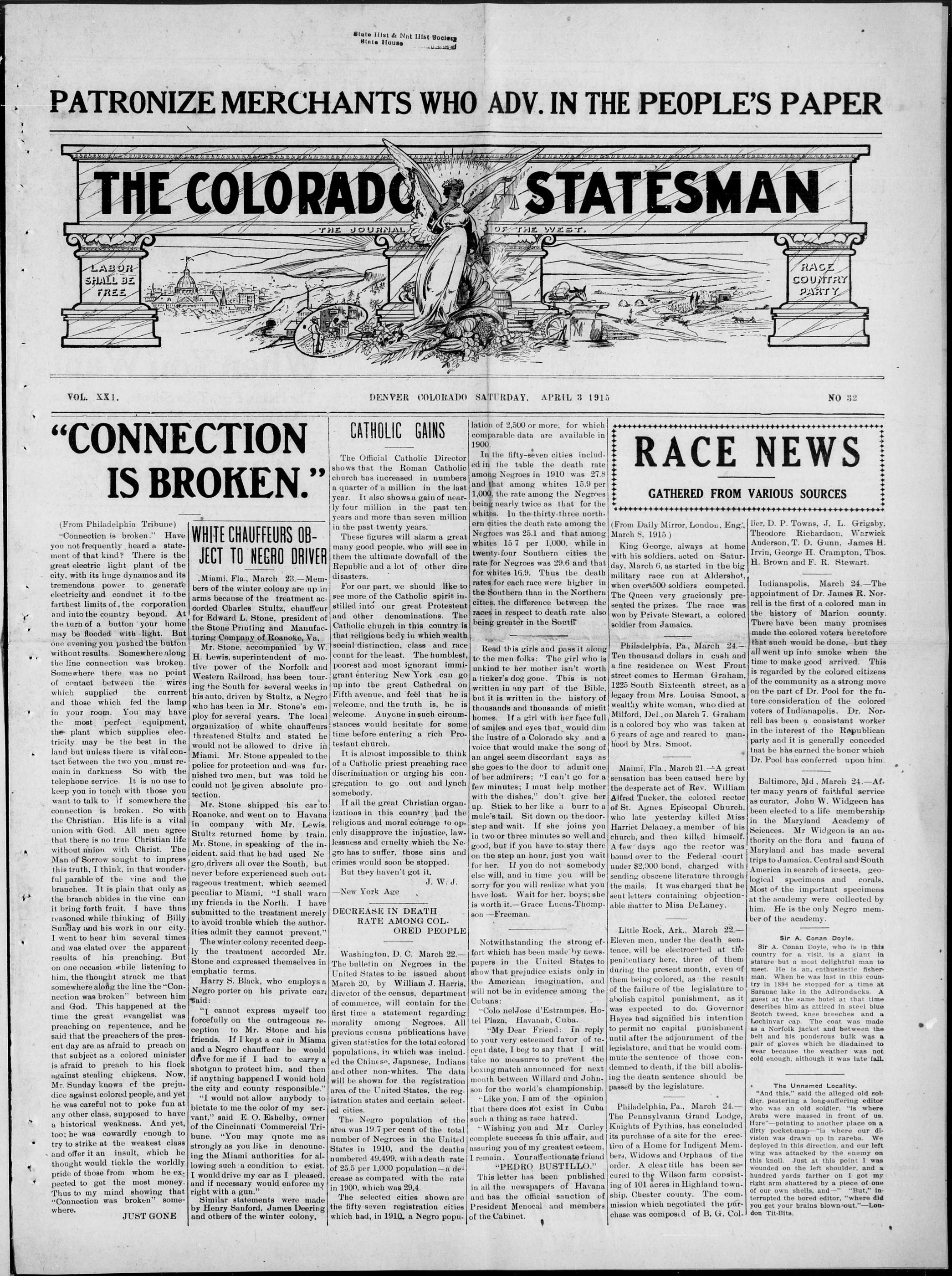
"Connection is broken." Have you not frequently heard a statement of that kind? There is the great electric light plant of the city, with its huge dynamos and its tremendous power to generate electricity and conduct it to the farthest limits of the corporation and into the country beyond. At the turn of a button your home may be flooded with light. But one evening you pushed the button without results. Somewhere along the line connection was broken. Somewhere there was no point of contact between the wires which supplied the current and those which fed the lamp in your room. You may have the most perfect equipment, the plant which supplies electricity may be the best in the land but unless there is vital contact between the two you must remain in darkness. So with the telephone service. It is no use to keep you in touch with those you want to talk to if somewhere the connection is broken. So with the Christian. His life is a vital union with God. All men agree that there is no true Christian life without union with Christ. The Man of Sorrow sought to impress this truth, I think, in that wonderful parable of the vine and the branches. It is plain that only as the branch abides in the vine can it bring forth fruit. I have thus reasoned while thinking of Billy Sunday and his work in our city. I went to hear him several times and was elated over the apparent results of his preaching. But on one occasion while listening to him, the thought struck me that somewhere along the line the "Connection was broken" between him and God. This happened at the time the great evangelist was preaching on repentence, and he said that the preachers of the present day are as afraid to preach on that subject as a colored minister is afraid to preach to his flock against stealing chickens. Now, Mr. Sunday knows of the prejudice against colored people, and yet he was careful not to poke fun at any other class, supposed to have a historical weakness. And yet, too; he was cowardly enough to try to strike at the weakest class and offer it an insult, which he thought would tickle the worldly pride of those from whom he expected to get the most money. Thus to my mind showing that "Connection was broken" somewhere.
```markdown
```
JUST GONE
WHITE CHAUFFEURS OB- JECT TO NEGRO DRIVER
.Miami, Fla., March 23.—Members of the winter colony are up in arms because of the treatment accorded Charles Stultz, chauffeur for Edward L. Stone, president of the Stone Printing and Manufacturing Company of Roanoke, Va.
Mr. Stone, accompanied by W. H. Lewis, superintendent of motive power of the Norfolk and Western Railroad, has been touring the South for several weeks in his auto, driven by Stultz, a Negro who has been in Mr. Stone's employ for several years. The local organization of white chauffeurs threatened Stultz and stated he would not be allowed to drive in Miami. Mr. Stone appealed to the police for protection and was furnished two men, but was told he could not be given absolute protection.
Mr. Stone shipped his car to Roanoke, and went on to Havana in company with Mr. Lewis. Stultz returned home by train. Mr. Stone, in speaking of the incident, said that he had used Negro drivers all over the South, but never before experienced such outrageous treatment, which seemed peculiar to Miami. "I shall warn my friends in the North. I have submitted to the treatment merely to avoid trouble which the authorities admit they cannot prevent." The winter colony recented deeply the treatment accorded Mr. Stone and expressed themselves in emphatic terms. Harry S. Black, who employs a Negro porter on his private car, said:
"I cannot express myself too forcefully on the outrageous reception to Mr. Stone and his friends. If I kept a car in Miama and a Negro chauffeur he would drive for me if I had to carry a shotgun to protect him, and then if anything happened I would hold the city and county responsible." "I would not allow anybody to bictate to me the color of my servant," said E. O. Eshelby, owner of the Cincinnati Commercial Tribune. "You may quote me as strongly as you like in denouncing the Miami authorities for allowing such a condition to exist. I would drive my car as I pleased, and if necessary would enforce my right with a gun." Similar statements were made by Henry Sanford, James Deering and others of the winter colony.
State Hist & Nat Hist Societies
State House
ANTS WHO
ADO
THE JOURNAL
DENVER COLORADO
CATHOLIC GAINS
The Official Catholic Director shows that the Roman Catholic church has increased in numbers a quarter of a million in the last year. It also shows a gain of nearly four million in the past ten years and more than seven million in the past twenty years. These figures will alarm a great many good people, who will see in them the ultimate downfall of the Republic and a lot of other dire disasters.
For our part, we should like to see more of the Catholic spirit instilled into our great Protestent and other denominations. The Catholic church in this country is that religious body in which wealth social distinction, class and race count for the least. The humblest, poorest and most ignorant immigrant entering New York can go up into the great Cathedral on Fifth avenue, and feel that he is welcome, and the truth is, he is welcome. Anyone in such circumstances would hesitate for some time before entering a rich Protestant church.
It is almost impossible to think of a Catholic priest preaching race discrimination or urging his congregation to go out and lynch somebody.
If all the great Christian organizations in this country had the religious and moral courage to openly disapprove the injustice, lawlessness and cruelty which the Negro has to suffer, those sins and crimes would soon be stopped.
But they haven't got it.
J. W. J.
—New York Age
DECREASE IN DEATH
RATE AMONG COL.
ORED PEOPLE
Washington, D. C. March 22. The bulletin on Negroes in the United States to be issued about March 20, by William J. Harris, director of the census, department of commerce, will contain for the first time a statement regarding morality among Negroes. All previous census publications have given statistics for the total colored populations, in which was included the Chinese, Japanese, Indians and other non-whites. The data will be shown for the registration area of the United States, the registration states and certain selected cities. The Negro population of the area was 19.7 per cent of the total number of Negroes in the United States in 1910, and the deaths numbered 49,499, with a death rate of 25.5 per 1,000 population—a decrease as compared with the rate in 1900, which was 29.4.
The selected cities shown are the fifty-seven registration cities which had, in 1910, a Negro popu-
lation of 2,500 or more, for which comparable data are available in 1900.
In the fifty-seven cities included in the table the death rate among Negroes in 1910 was 27.8 and that among whites 15.9 per 1,000, the rate among the Negroes being nearly twice as that for the whites. In the thirty-three northern cities the death rate among the Negroes was 25.1 and that among whites 15.7 per 1,000, while in twenty-four Southern cities the rate for Negroes was 29.6 and that for whites 16.9. Thus the death rates for each race were higher in the Southern than in the Northern cities, the difference between the races in respect to death rate also being greater in the South
Read this girls and pass it along to the men folks: The girl who is unkind to her mother isn't worth a tinker's dog gone. This is not written in any part of the Bible, but it is written in the history of thousands and thousands of misfit homes. If a girl with her face full of smiles and eyes that would dim the lustre of a Colorado sky and a voice that would make the song of an angel seem discordant says as she goes to the door to admit one of her admirers; "I can't go for a few minutes; I must help mother with the dishes," don't give her up. Stick to her like a burr to a mule's tail. Sit down on the door-step and wait. If she joins you in two or three minutes so well and good, but if you have to stay there on the step an hour, just you wait for her. If you do not somebody else will, and in time you will be sorry for you will realize what you have lost. Wait for her, boys; she is worth it.—Grace Lucas-Thompson—Freeman.
Notwithstanding the strong effort which has been made by newspapers in the United States to show that prejudice exists only in the American imagination, and will not be in evidence among the Cubans:
"Colo nelJose d'Estrampes, Hotel Plaza, Havanah, Cuba.
"My Dear Friend: In reply to your very esteemed favor of recent date, I beg to say that I will take no measures to prevent the boxing match announced for next month between Willard and Johnson for the world's championship.
"Like you, I am of the opinion that there does not exist in Cuba such a thing as race hatred.
"Wishing you and Mr Curley complete success in this affair, and assuring you of my greatest esteem, I remain. Your affectionate friend
"PEDRO BUSTILLO." This letter has been published in all the newspapers of Havana and has the official sanction of President Menocal and members of the Cabinet.
RACE NEWS
GATHERED FROM VARIOUS SOURCES
(From Daily Mirror, London, Eng., March 8, 1915)
King George, always at home with his soldiers, acted on Saturday, March 6, as started in the big military race run at Aldershot, when over 500 soldiers competed. The Queen very graciously presented the prizes. The race was won by Private Stewart, a colored soldier from Jamaica.
Philadelphia, Pa., March 24.—Ten thousand dollars in cash and a fine residence on West Front street comes to Herman Graham, 1225 South Sixteenth street, as a legacy from Mrs. Louisa Smoot, a wealthy white woman, who died at Milford, Del., on March 7. Graham is a colored boy who was taken at 6 years of age and reared to manhood by Mrs. Smoot.
lier, D. P. Towns, J. L. Grigsby, Theodore Richardson, Warwick Anderson, T. D. Gunn, James H. Irvin, George H. Crampton, Thos. H. Brown and F. R. Stewart.
Indianapolis, March 24.—The appointment of Dr. James R. Norrell is the first of a colored man in the history of Marion county. There have been many promises made the colored voters heretofore that such would be done, but they all went up into smoke when the time to make good arrived. This is regarded by the colored citizens of the community as a strong move on the part of Dr. Pool for the future consideration of the colored voters of Indianapolis. Dr. Norrell has been a consistent worker in the interest of the Republican party and it is generally conceded
Maimi, Fla., March 21. A great sensation has been caused here by the desperate act of Rev. William Alfred Tucker, the colored rector of St. Agnes Episcopal Church, who late yesterday killed Miss Harriet Delaney, a member of his church, and then killed himself. A few days ago the rector was bound over to the Federal court under $2,000 bond, charged with sending obscene literature through the mails. It was charged that he sent letters containing objectionable matter to Misa DeLaney.
Little Rock, Ark., March 22. Eleven men, under the death sentence, will be electrocuted at the penitentiary here, three of them during the present month, even of them being colored, as the result of the failure of the legislature to abolish capitol punishment, as it was expected to do. Governor Hayes had signified his intention to permit no capital punishment until after the adjournment of the legislature, and that he would commute the sentence of those condemned to death, if the bill abolising the death sentence should be passed by the legislature.
Philadelphia, Pa., March 24. The Pennsylvania Grand Lodge, Knights of Pythias, has concluded its purchase of a site for the erection of a Home for Indigent Members, Widows and Orphaus of the order. A clear title has been secured to the Wilson farm consisting of 101 acres in Highland township. Chester county. The commission which negotiated the purchase was composed of B. G. Col-
NO 32
lier, D. P. Towns, J. L. Grigsby, Theodore Richardson, Warwick Anderson, T. D. Gunn, James H. Irvin, George H. Crampton, Thos. H. Brown and F. R. Stewart.
Indianapolis, March 24.—The appointment of Dr. James R. Norrell is the first of a colored man in the history of Marion county. There have been many promises made the colored voters heretofore that such would be done, but they all went up into smoke when the time to make good arrived. This is regarded by the colored citizens of the community as a strong move on the part of Dr. Pool for the future consideration of the colored voters of Indianapolis. Dr. Norrell has been a consistent worker in the interest of the Republican party and it is generally conceded that he has earned the honor which Dr. Pool has conferred upon him.
Baltimore, Md, March 24. After many years of faithful service as curator, John W. Widgeon has been elected to a life membership in the Maryland Academy of Sciences. Mr Widgeon is an authority on the flora and fauna of Maryland and has made several trips to Jamaica, Central and South America in search of insects, geological specimens and corals. Most of the important specimens at the academy were collected by him. He is the only Negro member of the academy.
Sir A. Conan Doyle.
Sir A. Conan Doyle, who is in this country for a visit, is a giant in stature but a most delightful man to meet. He is an, enthusiastic fisherman. When he was last in this country in 1894 he stopped for a time at Saranac lake in the Adirondacks. A guest at the same hotel at that time describes him as attired in steel blue Scotch tweed, knee breeches and a Lochinvar cap. The coat was made as a Norfolk jacket and between the belt and his ponderous bulk was a pair of gloves which he disdained to wear because the weather was not cold enough, although it was late fall.
- The Unnamed Locality.
"And this," said the alleged old soldier, pestering a long-suffering editor who was an old soldier, "is where Arabs were massed in front of us. Here"—pointing to another place on a dirty pocket-map—"is where our division was drawn up in zareba. We deployed in this direction, and our left wing was attacked by the enemy on this knoll. Just at this point I was wounded on the left shoulder, and a hundred yards farther on I got my right arm shattered by a piece of one of our own shells, and—" "But," interrupted the bored editor, "where did you get your brains blown out."—London Tit-Bits.
FOREIGN
ene
Sir John Cameron Lamb, sixty-nine,
noted English statesman and scientist,
died at London.
General Villa is reported from Mon-
terey tol ave received: eid’ eiaiowl:
edged a contribution of 1,000,000 pesos
from Monterey merchants;
At Naco, Sonora, where the Scott
agreement was entered into, the Villa
general, Jose Maytorena, has ordered
the Americans out of town.
According to official German re
ports, Lieutenant Lammers and Major
Stilter, German war prisoners, have
been executed by the French without
Feason,
The new motor busses, built to re-
place those requisitioned by the army,
will soon make their appearance in
Paris with wives of mobilized men as
conductors.
The absence of the German crown
prince from his headquarters in front
of Verdun was explained in private
advices received at Copenhagen, The
stork is expected to visit the crown
princess within a few days.
Authorities at Budapest are greatly
concerned over the provisioning of the
city, The municipal finance commit
tee's report says that grain is obtain-
able only with the greatest difficulty.
It complains that the publie still re-
fuses to be satisfied with war bread.
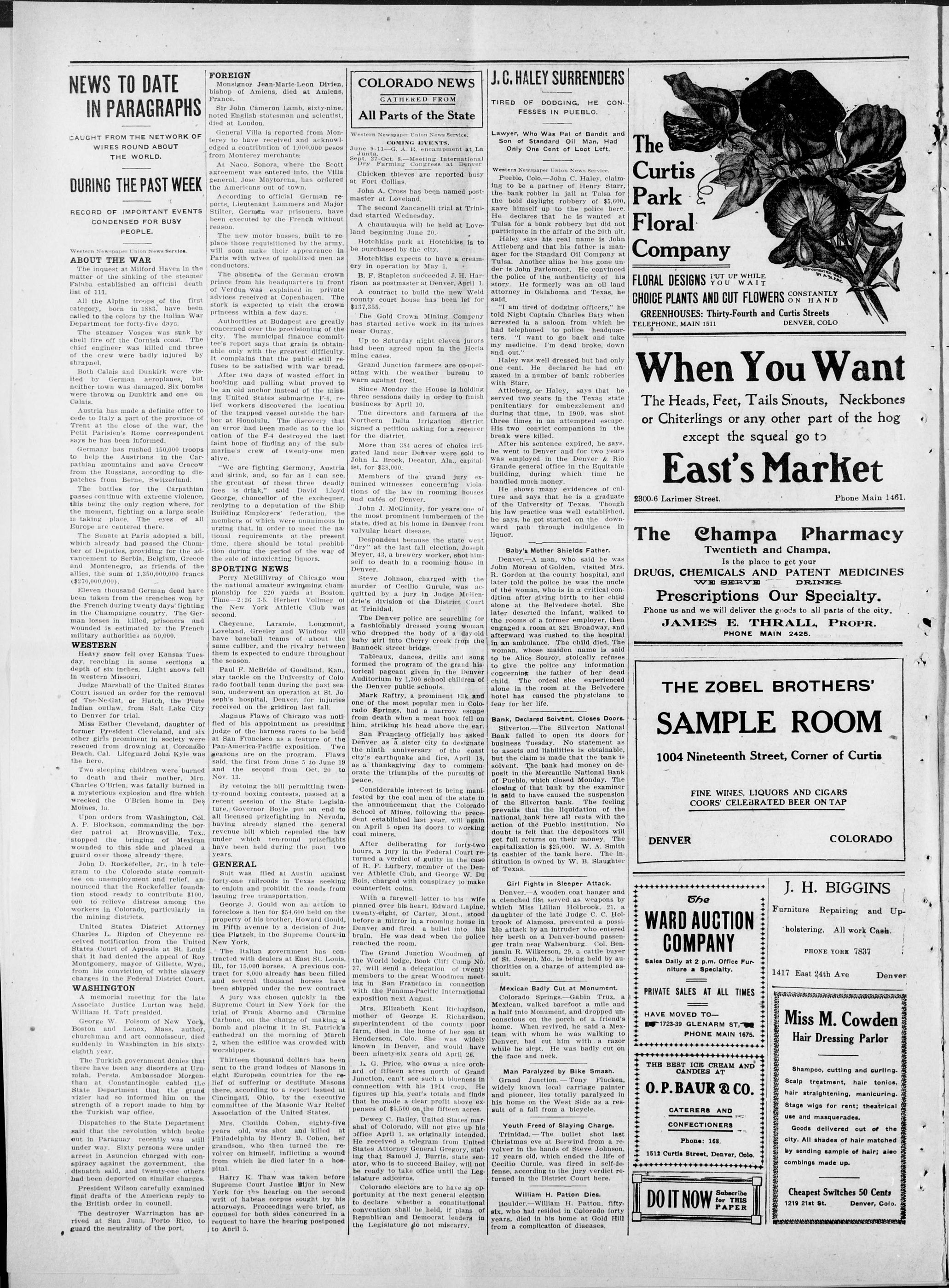
After two days of wasted effort in
hooking and pulling what proved to
be an old anchor instead of the miss-
ing United States submarine F-4, re-
lief workers discovered the location
of the trapped vessel outside the har
bor at Honolulu. The discovery that
an error had been made as to the lo-
cation of the F-4 destroyed the last
faint hope of finding any of the sub-
aarines crew of twenty-one men
alive.
“We are fighting Germany, Austria
‘and drink, and, so far as 1 can see,
the greatest of these three deadly
foes is drink,” said David Lloyd
George, chancellor of the exchequer,
revlying to a deputation of the Ship
Building Employers’ federation, the
members of which were unanimous in
urging that, in order to meet the na
tional requirements at the present
time, there should be total prohibi-
‘tion during the period of the war of
| the sale of intoxicating liquors.
‘SPORTING NEWS
Perry McGillivray of Chicago won
the national amateur swimming cham:
pionship for 220 yards at Boston.
Time—2:26 3-5, Herbert Vollmer ot
the New York Athletic Club was
second.
Cheyenne, Laramie, Longmont,
Loveland, Greeley and Windsor will
have baseball teams of about the
sume caliber, and the rivalry between
them is expected to endure throughout
the season.
Paul F. MeBride of Goodland, Kan,,
star tackle on the University of Colo.
rado football team during the past sea
son, underwent an operation at St. Jo:
seph’s hospital, Denver, for injuries
received on the gridiron last fall.
Magnus Flaws of Chicago was nott-
fied of his appointment as presiding
Judge of the harness races to be held
at San Francisco as a feature of the
Pan-America-Pacific exposition. Two
seasons are on the program. Flaws
said, the first from June 5 to June 19
and the second from Oct, 20 te
Nov. 13.
By vetoing the bill permitting twen-
ty-round boxing contests, passed at a
recent session of the State Legisla
ture, Governor Boyle put an end to
all licensed prizefighting in Nevada,
having already signed the general
revenue bill which repealed the law
under which ten-round _ prizefights
have been held during the past two
years,
GENERAL
Suit was filed at Austin against
forty-one railroads in Texas seeking
[to enjoin and prohibit the rouds from
issuing free transportation,
George J. Gould won an action to
foreclose # lien for $54,600 held on the
property of his brother, Howard Gould,
in Fifth avenue by a decision of Jus:
tice Platzek, in the Supreme Court-in
New York,
The Italian government has con:
tracted with dealers at East St. Lonis,
IL, for 15,000 horses. A previous con:
tract for 8,000 already has been filled
and several thousand horses have
been shipped under the new contract.
A jury was chosen quickly in the
Supreme Court in New York for the
trial of Frank Abarno and Carmine
Carbone, on the charge of making a
bomb and placing it in St. Patrick's
cathedral on the morning of March
2, when the edifice was crowded with
worshippers.
Thirteen thousand dollars has been
sent to the grand lodges of Masons in
eight European countries for the re-
Nef of suffering or destitute Masons
there, according to a report issued at
Cineinpatt, Ohio, by the executive
committee of the Masonic War Relief
Association of the United States.
Mrs, Clotilda Cohen, — eighty-five
years old, was shot and Killed at
Philadelphia by Henry B. Cohen, her
grandson, who then tumed the re-
volver on himself, inflicting a wound
from which he died later in a hos-
pital
Harry K. Thaw was taken before
Supreme Court Justice Bijur in New
York for th» hearing on the second
writ of habeas corpus sought by his
attorneys. Proceedings were brief, as
covnsel for both sides concurred in a
request to have the hearing postponed
‘to April 5.
NEWS TO DATE
IN PARAGRAPHS
DURING THE PAST WEEK
ABOUT THE WAR
SIASOE OF WS SDKIDE Ol) ie
Falnba established an official death
list of 111,
All the Alpine trovps of the first
category, born in 1883, have been
called to the colors by the Italian War
Department for forty-five days.
The steamer Vosges was sunk by
shell fire off the Cornish coast. The
chief engineer was killed znd three
of the crew were badly injured by
shrapnel,
Both Calais and Dunkirk were vis-
Ited by German aeroplanes, but
neither town was damaged. Six bombs
were thrown on Dunkirk and one on
Calais.
Austria has made a definite offer to
cede to Italy a part of the province of
Trent at the close of the war, the
Petit Parisien’s Rome correspondent
says he has been informed.
Germany has rushed 150,000 troops
to help the Austrians in the Car-
pathian mountains and save Cracow
from the Russians, according to dis-
patches from Berne, Switzerland.
The battles for the Carpathian
Passes continue with extreme violence,
this being the only region where, for
the moment, fighting on a large scale
is taking place. The eyes of all
Europe are centered there,
The Senate at Paris adopted a bill,
which already had passed the Cham-
ber of Deputies, providing for the ad-
vancement to Serbia, Belgium, Greece
and Montenegro, as friends of the
allies, the sum of 1,350,000,000 francs
($270,000,000).
leven thousand German dead have
been taken from the trenches won by
the French during twenty days’ fighting
in the Champaigne country. The Ger-
man losses in killed, prisoners and
wounded is estimated by the French
military authorities as 50,000,
WESTERN
Heavy snow fell over Kansas Tues-
day, reaching in some sections a
depth of six inches. Light snows fell
in western Missouri,
Judge Marshall of the United States
Court issued an order for the removal
of Tse-Ne-Gat, or Hatch, the Piute
Indian outlaw, from Salt Lake City
to Denver for trial.
Miss Esther Cleveland, daughter of
former President Cleveland, and six
other girls prominent in society were
rescued trom drowning at, Coronado
Beach, Cal. Lifeguard John Kyle was
the hero,
‘Two sleeping children were burned
to death and their mother, Mrs.
Charles O'Brien, was fatally burned in
& mysterious explosion and fire which
wrecked the O'Brien home in Des
Moines, Ta.
Upon orders from Washington, Col.
A. P. Hlockson, commanding the bor.
der patrol at Brownsville, Tex.
stopped the bringing of Mexican
wounded to this side and placed a
guard over those already there.
John D. Rockefeller, Jr., in & tele
gram to the Colorado state commit
tee on unemployment and relief, an
nounced that the Rockefeller founda
tion stood ready to contribute $100,
000 to relieve distress among the
workers in Colorado, particularly in
the mining districts.
United States District Attorney
Charles L. Rigdon of Cheyenne re
ceived notification from the United
States Court of Appeals at St, Louls
that it had denied the appeal of Roy
Montgomery, mayor of Gillette, Wyo,
from his conviction of white slavery
charges in the Federal District Court
WASHINGTON
A memorial meeting for the late
Associate Justice Lurton was held.
William H, Taft presided,
George W. Folsom of New York,
Boston and Lenox, Mass, author,
churchman and art connoisseur, died
suddenly in Washington in his sixty-
eighth year,
‘The Turkish government denies that
there have been any disorders at Uru
miah, Persia, Ambassador Morgen
thau at Constantinople cabled the
State Department that the grand
vizier had so informed him on_ the
strength of a report made to him by
the Turkish war office.
Dispatches to the State Department
said that the revolution which broke
out in Paraguay recently was still
under way. Sixty persons were under
arrest in Asuncion charged with con:
spiracy against the government, the
dispatch said, and twenty-one others
had been deported on similar charges,
President Wilson carefully examined
final drafts of the American reply to
the British order in couneil,
‘The destroyer Warrington has ar-
rived at San Juan, Porto Rico, to
guard the neutrality of the port.
COLORADO NEWS
GATREREDERROM
All Parts of the State
wefbeth a a aecine eee
at Fort Collins,
Jobn A, Cross has been named post-
master at Loveland. 2
The second Zancanelli trial at Trini-
dad started Wednesday.
A chautauqua will be held at Love-
land beginning June 20. E
Hotchkiss park at Hotchkiss is to
be purchased by the city.
Hotchkiss expects to have a cream-
ery in operation by May 1. ¥,
B. F. Stapleton succeeded J, H. Har-
rison as postmaster at Denver, April 1.
A contract to build the new Weld
county court house has been let for
$137,355.
The Gold Crown Mining Compeny
has started active work in its mines
near Ouray,
Up to Saturday night eleven jurors
had been agreed upon in the Hecla
mine cases,
Grand Junction farmers are co-oper-
ating with the weather bureau to
warn against frost,
Since Monday the House is holding
three sessions daily in order to finish
business by April 10.
‘The directors and farmers of the
Northern Delta Irrigation district
signed a petition asking for a receiver
for the district
More than 384 acres of choice irri.
gated land near Defiver were sold to
John L. Brock, Decatur, Ala., capital
ist, for $38,000,
Members of the grand jury ex:
amined witnesses concerning yiola-
tions of the law in rooming houses
and cafés of Denver.
John J. McGinnity, for years one of
the most prominent lumbermen of the
state, died at his home in Denver from
valvular heart disease.
Despondent because the state went
“dry” at the last fall election, Joseph
Meyer, 43, a brewery worker, shot him-
seif to death in a rooming house in
Denver,
Steve Johnson, charged with the
murder of Cecilio Gurule, was ac:
quitted by a jury in Judge Metlen-
drie’s division of the District Court
at Trinidad, -
The Denver police are searching for
a fashionably dressed young woman
who dropped the body of a day-old
baby girl into Cherry creek from the
Bannock street bridge.
Tableaux, dances, drills and song
formed the program of the grand his-
torical pageant given in the Denver
Auditorium by 1,300 school children of
the Denver public schools.
Mark Raftry, a prominent Wik and
one of the most popular men in Colo-
rado Springs, had a narrow escape
from death when a meat hook fell on
him, striking his head above the ear.
San Francisco officially has asked
Denver as & sister city to designate
the ninth anniversary of the coast
city’s earthquake and fire, April 18,
as a thanksgiving day to commem-
orate the triumphs of the pursuits of
peace.
Considerable interest is being mani-
fested by the coal men of the state in
the announcement that the Colorado
School of Mines, following the prece-
dent established last year, will again
on April 5 open its doors to working
coal miners,
After deliberating for forty-two
hours, a jury in the Federal Court re-
turned a verdict of guilty in the case
of R. F. Lufbery, member of the Den-
ver Athletic Club, and George W. Du
Bois, charged with conspiracy to make
counterfeit coins.
With a farewell letter to his wife
pinned over his heart, Edward Lapine,
twenty-elght, of Carter, Mont,, stood
before a mirror in a rooming house in
Denver and fired a bullet into his
brain. He was dead when the police
reached the room,
The Grand Junction Woodmen of
the World lodge, Book Cliff Camp No.
37, will send a delegation of twenty
members to the great Woodmen meet
ing in| San Francisco in connection
with the Panama-Pacifie International
exposition next August.
Mrs. Elizabeth Kent Richardson,
mother of George E. Richardson,
superintendent of the county poor
farm, died in the home of her son at
Henderson, Colo. She was widely
known in Denver, and would have
been ninety-six years old April 26.
1. G. Price, who owns a nice oreh-
ard of fifteen acres north of Grand
Junction, can't see such a blueness in
connection with his 1914 crop, He
figures up his year’s totals and finds
that he made a clear profit above ex-
penses of $5,500 onthe fifteen acres.
Dewey C. Bailey, United States mar
shal of Colorado, will not give up his
office April 1, as originally intended,
Te gant Od eet Pale min MBean
J.C, HALEY SURRENDERS
TIRED OF DODGING, HE CON.
FESSES IN PUEBLO.
Lawyer, Who Was Pal of Bandit and
Son of Standard Oil Man, Had
Only One Cent of Loot Left.
Weatern Newspaper Union News Service.
Pueblo, Colo—John C, Haley, claim.
ing to be a partner of Henry Starr,
the bank robber in jail at Tulsa for
the bold daylight robbery of $5,000
gave himself up to the police here.
He declares that he is wanted at
Tulsa for a bank robbery but did not
participate in the affair of the 20th ult.
Haley says his real name is Jobr
Attleberg and that his father is man-
ager for the Standard Oil Company at
Tulsa. Another alias he has gone un:
der is John Parlemont. He convinced
‘the police of the authenticity of his
story. He formerly was an oil land
attorney in Oklahoma and Texas, he
said.
“I am tired of dodging officers,” he
told Night Captain Charles Baty when
arrested in a saloon from which he
had telephoned to police headquar-
ters. “I want to go back and take
my medicine. I'm dead broke, down
and out.”
Haley was well dressed but had only
one cent, He declared he had en-
gaged in a number of bank robberies
with Starr,
Attleberg, or Haley, says that he
served two years in the Texas state
penitentiary for embezzlement and
during that time, in 1909, was shot
three times in an attempted escape.
His two convict companions in the
break were killed.
After his sentence expired, he says,
he went to Denver and for two years
was employed in the Denver & Rio
Grande generat office in the Equitable
building, during which time he
handled much money.
He shows many evidences of cul-
ture and says that he is a graduate
of the University of Texas. Though
his law practice was well established,
he says, he got started on the down-
ward path through indulgence in
Manee:
Baby's Mother Shields Father.
Denver—A man, who said he was
John Moreau of Golden, visited Mrs.
R. Gordon at the county hospital, and
later told the police he was the uncle
of thé woman, who is in a critical con-
djtion after giving birth to her child
alone at the Belvedere shotel, She
later deserted the infant, walked to
the rooms of a former employer, then
engaged a room at 821 Broadway, and
afterward was rushed to the hospital
‘in an ambulance, The child died. The
woman, whose maiden name is said
to be Alice Souroy, stoically refuses
[to give the police any Information
concerning the father of her dead
child. The ordeal she experienced
alone in the room at the Belvedere
hotel has caused the physicians to
| fear for her life.
Bank, Declared Soivent, Closes Doors.
Silverton.—The Silverton National
Bank failed ‘to open its doors for
business Tuesday. No statement as
to assets and liabilities is obtainable,
but the claim is made that the bank is
solvent. The bank had money on de-
posit in the Mercantile National Bank
of Pueblo, which closed Monday. The
closing of that bank by the examiner
is said to have caused the suspension
of the Silverton bank. The feeling
prevails that the liquidation of the
national, bank here all rests with the
action of thé Pueblo institution, No
doubt is felt that the depositors will
get full returns on their money. The
capitalization is $25,000, W. A. Smith
‘is cashier of the bank here. The in-
Stitution is owned by W. B. Slaughter
of Texas.
Girl Fights in Sleeper Attack.
Denver.—A wooden coat hanger and
a clenched fist served as weapons by
which Miss Lillian Holbrook, 21, a
daughter of the late Judge C. C, Hol-
brook of Alamosa, prevented a possi-
ble attack by an intruder who entered
her berth on a Denver-bound passen-
ger train near Walsenburg. Col. Ben.
jamin R, Wilkerson, 29, a cattle buyer
of St. Joseph, Mo., is being held by au-
thorities on a charge of attempted as-
sault,
Adaxuican Madly. Gut.at. @onument:
Colorado Springs—Gabin Truz, a
Mexican, walked barefoot a mile and
a half into Monument, and dropped un-
conscious on the porch of a friend's
home. When revived, he said a Mex-
jean with whom he was walking to
Denver, had cut him with a razor
while he slept, He was badly cut on
the face and neck.
Man Paralyzed by Bike Smash.
Grand Junction, — Tony Flucken,
widely known local carriage painter
and pioneer, lies totally paralyzed in
his home on the West Side as a res-
sult of a fall from a bicycle.
Youth Freed of Slaying Charge.
‘Trinidad,— The bullet shot last
Christmas eve at Berwind from a re-
volver in the hands of Steve Johnson,
17 years old, which ended the life of
Cecilio Curule, was fired in self-de-
fense, according to the jury verdict re-
turned in the District Court here.
William H. Patton Dies.
Boulder.—William H, Patton, fifty.
six, who had resided in Colorado forty
years, died in his home at Gold Hill
from a complication of diseases,
N a G om :
The BS Sn eed
Curtis 2A toy wey f
—— LaF or Be LN s
Park © Ra eed.
Floral) ~ SA
Company a Se o
FLORAL DESIGNS WUE hi
HOE PLANTS AND CUT FLOWERS wiexats TY
| GREENHOUSES: Thirty-Fourth and Curtis Streets
TELEPHONE, MAIN 1511 DENVER, COLO
When You Want
The Heads, Feet, Tails Snouts, Neckbones
or Chiterlings or any other part of the hog
except the squeal go to
9
East's MarKet
2800-6 Larimer Street. Phone Main 1461,
The @hampa Pharmacy
Twentieth and Champa,
Is the place to get your
DRUGS, CHEMICALS AND PATENT MEDICINES
WHE SERVE ~ DRINES.
Prescriptions Our Specialty.
Phone us and we will deliver the goods to all parts of the city. |.
JAMES E. THRALL, PROPR.
PHONE MAIN 2425.
THE ZOBEL BROTHERS’
1004 Nineteenth Street, Corner of Curtis
FINE WINES, LIQUORS AND CIGARS
COORS' CELEBRATED BEER ON TAP
DENVER COLORADO
FPP VOI TOTTI VT ON OTT
é
; Ghe 1
: 4
E 3
P 3
: 3
, 3
;
r 3
; COMPANY:
3
F Bales Dally at 2 p.m. Office Fur 3
; niture a Specialty. 3
Ss ge
; PRIVATE SALES AT ALL TIMES 3
r = 3
; 3
; HAVE MOVED TO— 3
. MF 1723-39 GLENARM ST,
: PHONE MAIN 1675.
e ee NF 9
faa aaareertar a nes
$ THE BEST ICE CREAM AND $
od CANDIES AT 3
+ :
. ;
+ 0.P.BAUR @ CO.
x ;
Be :
z CATERERS AND 3
t eee eee
¥ CONFECTIONERS :
+ aaa Te
t Phone: 168 -
= 3
J 1512 Curtis Street, Denver, Colo.
Spteteesseseeresserereeseg
—_—_SS———SS—
Subscribe
DO IT NOW e388
PAPER
————
J. H. BIGGINS |
Furniture Repairing and Up-
“holstering, All work Cael.
PHONE YORE 7837 i
1417 Bast 24th Ave Denver
2 pO eg een aad PS
: ;
| Miss M. Cowden
: Iss Wi. Cowden :
Hair Dressing Parlor
ae
: chamaoas ait eataee |
: Scalp treatment, hair tonics, }
;
@ hair straightening, manicuring. 3
Stage wigs for rent; theatrical :
} use and masquerades.
f Goods delivered out of the
: city. All shades of hair matched
j by sending sample of hair; aleo
combings made up.
Cheapest Switches 50 Cents
1219 2t0t St. Denver, Colo.
AFRO-AMERICAN CULLINGS
Three judges of the United States circuit court of appeals listened with profound interest to the plea of a Negro attorney, a one-time slave, who appeared before them in the Federal building at St. Louis.
Probably few in the courtroom realized until he started his argument that a gray-haired Negro sitting near the front was a noted lawyer who has appeared before every United States judge in the central district in many famous trials.
The attorney, Turner W. Bell, represented three men who are confined in the federal penitentiary at Leavenworth, Kan., serving sentences on convictions of conspiracy in the famous structural iron workers' dynamiting cases two years ago.
Bell fingered his brief as he sat listening to the argument of Assistant United States District Attorney L. S. Harvey of the eastern district of Kansas, representing the government.
He had spoken but a few words, however, when the crowd knew that such incidents evidently were in the every-day life of the Negro lawyer.
The men represented by Bell are white and were given sentences of six years at Indianapolis in December, 1912.
They were convicted of being implicated in more than one hundred dynamiting cases, including the destruction of the Times building in Los Angeles, in half of the states of the United States. They were at one time officers of the organization of which J. J. McNamara was a member and who is now serving a life sentence in California.
Bell represented the men in the United States district court in Kansas last July and was defeated. He appealed. Bell's chief contention is that the men could legally have been convicted on but one charge under the revised statutes of the United States, and that the maximum penalty should have been but two years in the penitentiary or a fine of $10,000. They were charged with having transported dynamite throughout the country, and with the blowing up of a bridge at Indianapolis. Bell has been a practicing attorney in Leavenworth 28 years. His "hobby," he said, is appeal cases. In 1914 he filed 61 appeals in the United States courts, and was successful in 41 of them. In but two cases were his clients Negroes.
Bell was born a slave in Tennessee He was taken with his parents to Oskaloosa, Ia., when young, and earned enough money to carry him through a course in law. The day he was admitted to the bar, at Leavenworth, United States Judge Hook was in the courtroom, and Bell considers Judge Hook one of his best friends. Among famous appeals in which Bell has been successful was the case of Charles A. Stevens, a wealthy Negro boy, of Kansas City, who stole a mail sack containing $55,800. Stevens' sentence was reduced from ten to five years. As his fee Bell received $13,000.
For the first time in about a dozen years mackerel have been caught in the New Haven waters. In recent years porpoises are believed to have driven them away, but in the last month thousands of mackerel have been caught.
The Supreme court, speaking through the chief justice, denied the appeal taken by the state of Illinois in the case of John B. Gaskill against the Forest Home Cemetery company of Chicago, which has become historical.
Gaskill is a Negro who purchased a lot in the cemetery, but was denied permission to bury a member of his family there by the trustees of the cemetery after they made the discovery that the purchaser was a Negro.
A bill for the relief of Gaskill passed the Illinois legislature some years ago, but was vetoed by the governor on the advice of the attorney general.
The case was dismissed by Chief Justice White on the ground that no federal question was involved in the judgment rendered by the supreme court of Illinois, which found against Gaskill.
In the opinion of an English scientist, the wear of macadam roads is not due to the suction of automobile tires, but almost entirely to the crushing effect of horseshoes and iron-tired wheels.
In view of prevailing high prices for necessities in Santiago, Chile, it is planned to establish municipal provision shops there at an initial cost of $560,000.
The neighbors say S. W. Featheringham's initials stand for "Southwest Wind." "The southwest wind," they explain, "blows nearly all the time."
Every member of the family of Sir Roper Lethbridge of England has gone to the war or training for it—the men to fight, the women to nurse.
Eli Williamson (colored) ninety years old, for many years a licensed pilot, died at the home of his daughter, Mrs. W. B. Faire, in Washington, following an illness lasting only five days.
For half a century Williamson had followed the sea before he retired and made his home in Washington. He served in the navy and in the merchant marine. He became a skillful pilot and was the first colored man to obtain a first-class license at the United States custom house at Norfolk, Va.
Captain Williamson, as he was known to his friends, was born in Murfreesboro, N. C., December 23, 1824, the son of Trial and Winnie Williamson, and the grandson of George Williamson, who had been a noted shoemaker and had bought his freedom from his master by making fine shoes. Ell Williamson's freedom came to him from his grandfather.
When he was a youth Williamson went to live with a family of Quakers, who taught him to read and write, to the fishing nets and to rig seines for large fisheries. This gave him a taste for the sea which never left him. He enlisted in the United States navy and served faithfully. After leaving the navy Williamson entered the merchant service, and when the Civil war broke out he was chief pilot on the steamer Curlew. It was pressed into the service of the Confederacy and later was sunk.
Williamson was highly regarded by the officers under whom he sailed. He did much to aid in the uplift of his race, and was the founder of the Cold Spring church at Franklin, Va. He married Miss Emmaline Hunter of Virginia. Ten children were born to them, five growing to maturity. One son, the late W. E. Williamson of Norfolk, Va., died February 1, 1910. His four daughters, Mrs. Curlew Weaver, Mrs. Katherine Reid, Mrs. Sea Bird Faire and Mrs. Emma Gray, survive him. For the last five years Captain Williamson had made his home in Washington with his daughter, Mrs. Faire. Burial was in Harmony cemetery beside the body of his wife, who died March 14, 1914.
It is true, of course, that Professor Just is not the only colored man to do scientific work of a high order, nor the only colored teacher ready to labor for a pittance in order to aid the education of his people. But the honor bestowed upon him is worth while merely if it recalls to public attention once more the fact that no one can measure the contributions colored Americans are certain to make to our common civilization, and not merely in the fields in which lie their peculiar talents. It was a colored physician who first ventured an operation on the living human heart; a colored painter is in the front rank of his art as the delineator of Biblical scenes; no composer of reeent years won greater honors than Coleridge Taylor, the negro. Any policy, therefore, which should limit the education and the opportunities of the race must be a grave loss to humanity as a whole. No one would think, in any country outside Russia, of refusing to Jewish genius the fullest play in every field. Yet we continue to hear, not only in the South, but in the North as well, repeated assertions that anything except common schooling is out of place for the colored people.—New York Evening Post.
The highest determined point in Florida is Mount Pleasant, 301 feet above sea level, according to the United States geological survey. The approximate average elevation of the state is 100 feet above the sea.
All-steel cars are being experimented with on several railways in India. Metal freight cars have long been in use, but passenger cars have usually been built of teak wood resting on steel under-frames.
Mrs. Kate Penner and Gertrude Pendel, English nurses connected with the Constantinople hospital, have received Red Cross medals from the German emperor for gallant service during the Balkan war.
If you wish to interest idle men circulate the story that the hull of a sunken ship is full of treasure. If you wish to excite them circulate the story that it is full of fine old whisky.
The yellow poplar, or tulip tree, the largest broadleaf tree in America, has been known to reach nearly 200 feet in height and ten feet in diameter.
During courtship a girl thinks marriage is a haven of rest in which she will be free from worry and care. After marriage she has another think coming.
The new poison extracted from seeds of the castor oil plant by a German chemist is said to be so powerful that a single gram would kill a million and a half guinea pigs.
Probably the speediest journey is that negotiated by a prize fighter who is on his way back to obscurity.
PROPOSED IN HOUSE BY REPRESENTATIVE DAILEY.
Pitkin County Man Introduces Resolution to Make Up Highway Needs Until Special Levy Is Collected.
Western Newspaper Union News Service.
Denver.—Relief for the unemployed of Colorado, most of them coal miners displaced during the strike, is in sight if the Legislature passes a resolution introduced in the House by Representative Dailey. This resolution provides that the state shall barrow $350,000 in anticipation of the half-mill levy for good roads, which does not become available until next year. It has the support of Governor Carlson, and has been indorsed by Hugh J. Alexander, treasurer of the committee on unemployment appointed by the governor.
This committee includes besides Mr. Alexander, F. J. Radford, president of the Trimidah Chamber of Commerce, and A. A. Reed of Boulder. It was named to prepare a plan for furnishing as much work as possible for the miners who were thrown out of employment by the strike and such other men as are unable to make a living, until such time as conditions improve in the industries.
Mr. Radford, working with the county commissioners of Las Animas county, has provided employment for several hundred men in the vicinity of Trinidad. These men are engaged at 20 cents an hour to work upon the highways, and they have been working three eight-hour days a week. In that way they earn enough to keep their families from absolute wants. They are paid in orders upon merchants for supplies, and these orders are redeemed by the county commissioners.
If the state can legally anticipate the returns from the half-mill levy by the issue of warrants or certificates of indebtedness, the fund will be distributed largely in the districts where the need is greatest and especially in Las Animas, Huerfano, Boulder, Fremont and Gunnison counties. It is expected that a certain amount of assistance will be furnished by the counties, so that perhaps a half million dollars immediately will become available.
Stock Raisers Indorse Leasing Plan.
Denver.—Volney T. Hoggatt, register of the State Land Board, in acknowledging a letter from Weld county stock raisers, has outlined the plans and hopes of the department with reference to farmers on unirrigated tracts. He points out the things already done and the department's stand in encouraging the man who is willing to go on unirrigated or only partly watered lands. Also he explains a few things he has in contemplation for future betterment of the agriculturist, small dairyman and stock raiser.
Governor Vetoes Repeal Bill.
Denver. — The veto by Governor Carlson of S. B., by Knauss, which would repeal a statute relating to public improvements was received by the Senate. The executive stated that Senator Knauss had requested the veto of the measure after learning that the repeal of the law would effect outside cities and towns. Senator Knauss believed the law an obsolete one, as it was passed simply for the benefit of Denver and had outlived its usefulness so far as this city is concerned.
Goveronr Exercises Parole First Time.
Denver.—Walter Valley, C. W. Garrett, G. E. Morgan, John A. Frazier and C. R. Galpin, sentenced to terms of five months each for padding the payrolls of the Colorado Fuel and Iron steel plant at Pueblo, were paroled by Governor Carlson at the request of the judge, the prosecuting attorney, the sheriff and officers of the company. The men's sentences expire in three weeks, but their families are destitute, and the governor granted executive clemency for the first time since he took office.
Commission Fixes Demurrage Rate.
Denver.—Demurrage rates on refrigerator cars in Colorado were fixed by the Colorado State Public Utilities Commission in accordance with the Interstate Commerce Commission's instructions. Under the order, cars may be held forty-eight hours free, with a charge of $1 a day for the next three days.
$200,000 "Pork" Bills Doomed.
Denver.—More than $200,000 worth of "pork barrel" bills virtually were killed by the appropriations committee of the lower House of the State Assembly when it reported adversely by indefinitely postponing them.
Legislature to Adjourn April 10.
Denver.—The Twentieth General Assembly will adjourn at midnight, April 10. The time was fixed when the Senate concurred in the joint resolution which passed the House of Representatives.
Women Active in Library Measure.
Denver.—Women's organizations of Denver and Colorado are active for the Dodge bills, passed by the Legislature, appropriating $4,000 for 1915-16 to carry on the work of the traveling library.
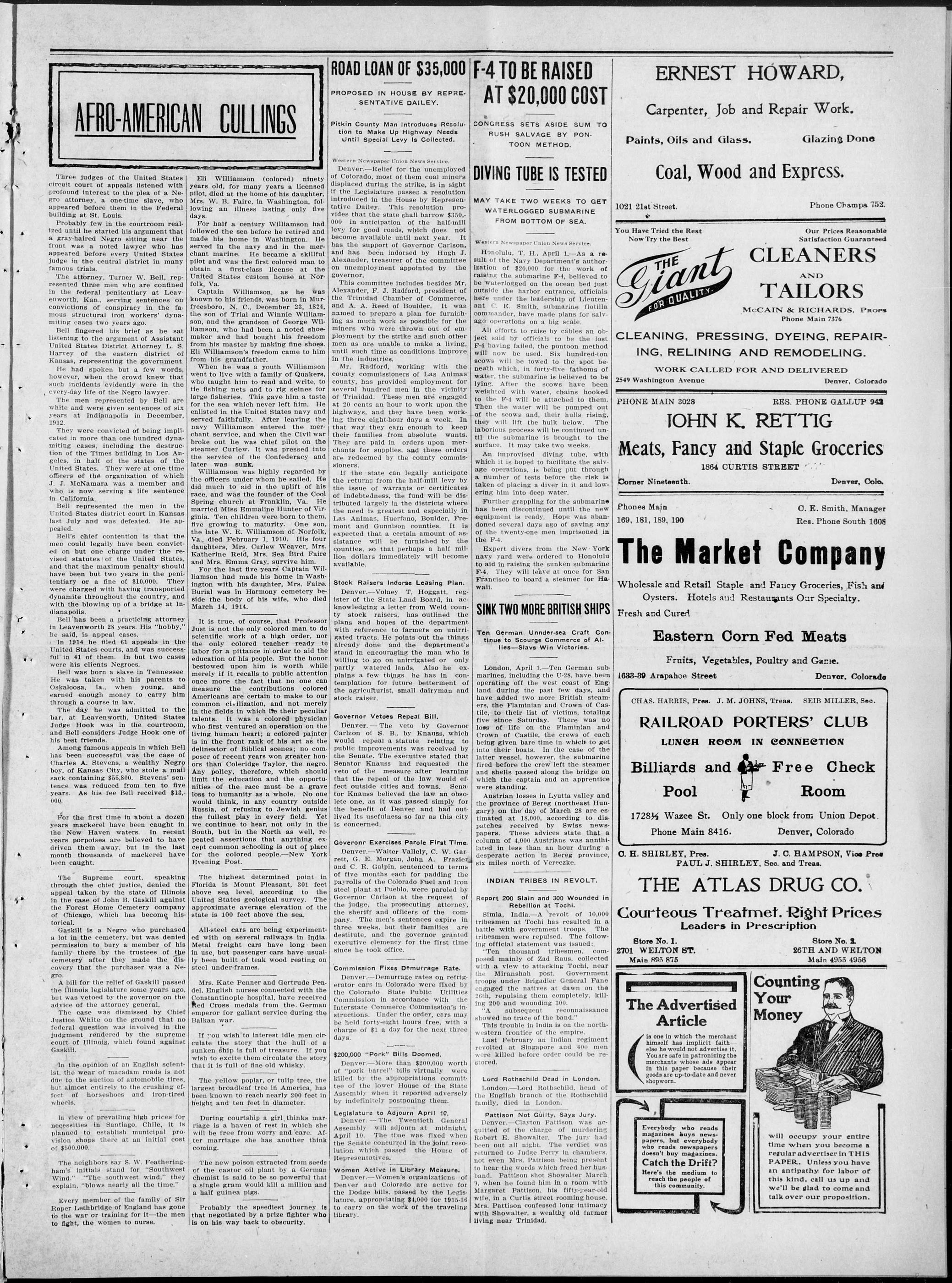
F-4 TO BE RAISED AT $20,000 COST
CONGRESS SETS ASIDE SUM TO RUSH SALVAGE BY PON- TOON METHOD.
DIVING TUBE IS TESTED
MAY TAKE TWO WEEKS TO GET WATERLOGGED SUBMARINE FROM BOTTOM OF SEA.
Western Newspaper Union News Service.
Honolulu, T. H., April 1.—As a result of the Navy Department's authorization of $20,000 for the work of raising the submarine F-4, believed to be waterlogged on the ocean bed just outside the harbor entrance, officials here under the leadership of Lieutenant C. E. Smith, submarine flotilla commander, have made plans for salvage operations on a big scale.
All efforts to raise by cables an object said by officials to be the lost F-4 having failed, the pontoon method will now be used. Six hundred-ton scows will be towed to the spot beneath which, in forty-five fathoms of water, the submarine is believed to be lying. After the scows have been weighted with water, chains hooked to the F-4 will be attached to them. Then the water will be pumped out of the scows and, their hulls rising, they will lift the hulk below. The laborious process will be continued until the submarine is brought to the surface. It may take two weeks.
An improvised diving tube, with which it is hoped to facilitate the salvage operations, is being put through a number of tests before the risk is taken of placing a diver in it and lowering him into deep water.
Further grappling for the submarine has been discontinued until the new equipment is ready. Hope was abandoned several days ago of saving any of the twenty-one men imprisoned in the F-4.
Expert divers from the New York navy yard were ordered to Honolulu to aid in raising the sunken submarine F-4. They will leave at once for San Francisco to board a steamer for Hawaii.
SINK TWO MORE BRITISH SHIPS
Ten German Unnder-sea Craft Continue to Scourge Commerce of Allies—Slavs Win Victories.
London, April 1.—Ten German submarines, including the U-28, have been operating off the west coast of England during the past few days, and have added two more British steamers, the Flaminian and Crown of Castile, to their list of victims, totaling five since Saturday. There was no loss of life on the Flaminian and Crown of Castile, the crews of each being given bare time in which to get into their boats. In the case of the latter vessel, however, the submarine fired before the crew left the steamer and shells passed along the bridge on which the captain and an apprentice were standing.
Austrian losses in Lytta valley and the province of Bereg (northeast Hungary) on the day of March 28 are estimated at 18,000, according to dispatches received by Swiss newspapers. These advices state that a column of 4,000 Austrians was annihilated in less than an hour during a desperate action in Bereg province, six miles north of Vereczke.
INDIAN TRIBES IN REVOLT.
Report 200 Slain and 300 Wounded in Rebellion at Tochi.
Simla, India.—A revolt of 10,000 tribesmen at Tochi has resulted in a battle with government troops. The tribesmen were repulsed. The following official statement was issued:
"Ten thousand tribesmen, composed mainly of Zad Raus, collected with a view to attacking Tochi, near the Miranshah post. Government troops under Brigadier General Fane engaged the natives at dawn on the 26th, repulsing them completely, killing 200 and wounding 300.
"A subsequent reconnaissance showed no trace of the band."
This trouble in India is on the northwestern frontier of the empire.
Last February an Indian regiment revolted at Singapore and 400 men were killed before order could be restored.
Lord Rothschild Dead in London.
London.—Lord Rothschild, head of the English branch of the Rothschild family, died in London.
Pattison Not Guilty, Says Jury. Denver.—Clayton Pattison was acquitted of the charge of murdering Robert E. Showalter. The jury had been out all night. The verdict was returned to Judge Perry in chambers, not even Mrs. Pattison being present to hear the words which freed her husband. Pattison shot Showalter March 9, when he found him in a room with Margaret Pattison, his fifty-year-old wife, in a Curtis street rooming house. Mrs. Pattison confessed long intimacy with Showalter, a wealthy old farmer living near Trinidad.
ERNEST HOWARD,
Carpenter, Job and Repair Work.
Paints, Oils and Glass.
Coal, Wood
1021 21st Street.
oal, Wood and Express
reet. Phone O
ed the Rest Our Price
the Best Satisfaction
Coal, Wood and Express.
You Have Tried the Rest
Now Try the Best
THE
Giant
FOR QUALITY.
CLEANING, PRESSIN
ING, RELINING A
WORK CALLED FOR
2549 Washington Avenue
ING, PRESSING, DYEING, F RELINING AND REMODEL ORK CALLED FOR AND DELIVERE Boston Avenue Denver
CLEANING, PRESSING, DYEING, REPAIRING, RELINING AND REMODELING.
WORK CALLED FOR AND DELIVERED
2549 Washington Avenue Denver, Colorado
JOHN K.
Meats, Fancy and
1864 CURTI
JOHN K. RETTIG
Fancy and Staple Grocery
1864 CURTIS STREET
eighteenth. De
C. E. Smith
9, 190 Res. Phone
Market Comp
and Retail Staple and Fancy Groceries
ers. Hotels and Restaurants Our Speci
Cured
Eastern Corn Fed Meat
The Market
Wholesale and Retail Staple and
Oysters. Hotels and Re
Fresh and Cured
Eastern Corn
The Market Company
Wholesale and Retail Staple and Fancy Groceries, Fish and Oysters. Hotels and Restaurants Our Specialty.
Eastern Corn Fed Meats
Fruits, Vegetables, Poultry and Game.
1633-39 Arapahoe Street
CHAS. HARRIS, Pres. J. M. JOHN
RAILROAD POOL
LUNCH ROOM
Billiards and
Pool
1728½ Wazee St. Only o
Phone Main 8416.
C. H. SHIRLEY, Pres.
PAUL J. SHIRLEY
THE ATLAS
Courteous Treatment
Leaders in P
Epahoe Street Denver
HARRIS, Pres. J. M. JOHNS, Treas. SEIB MIL
ILROAD PORTERS' CL
LUNCH ROOM IN CONNECTION
CHAS. HARRIS, Pres. J. M. JOHNS, Treas. SEIB MILLER, Sec.
1728½ Wazee St. Only one block from Union Depot
Phone Main 8416. Denver, Colorado
C. H. SHIRLEY, Pres. J. C. HAMPSON, Vice Pres.
PAUL J. SHIRLEY, Sec. and Treas.
THE ATLAS DRUG CO.
Courteous Treatmet. Right Prices Leaders in Prescription
The Advertised Article
is one in which the merchant himself has implicit faith—else he would not advertise it. You are safe in patronizing the merchants whose ads appear in this paper because their goods are up-to-date and never shopworn.
The Advertised Article
is one in which the merchant himself has implicit faith else he would not advertise it. You are safe in patronizing the merchants whose ads appear in this paper because their goods are up-to-date and never shopworn.
Everybody who reads magazines buys newspapers, but everybody who reads newspapers doesn't buy magazines.
Catch the Drift?
Here's the medium to reach the people of this community.
Counting Your Money
will occupy your entire time when you become a regular advertiser in THIS PAPER. Unless you have an antipathy for labor of this kind, call us up and we'll be glad to come and talk over our proposition.
PHONE MAIN 3028
Corner Nineteenth.
Phones Main
169, 181, 189, 190
Store No. 1.
2701 WELTON ST.
Main 885 875
and Express.
Our Prices Reasonable
Satisfaction Guaranteed
CLEANERS
AND
TAILORS
McCAIN & RICHARDS, PROPS
Phone Main 7376
ING, DYEING, REPAIR-
AND REMODELING.
FOR AND DELIVERED
Denver, Colorado
RES. PHONE GALLUP 942
. RETTIG and Staple Groceries TIS STREET
O. E. Smith, Manager
Res. Phone South 1608
et Company
e and Fancy Groceries, Fish and
Restaurants Our Specialty.
rn Fed Meats
Denver, Colorado
JOHNS, Treas. SEIB MILLER, Sec.
PORTERS' CLUB
IN CONNECTION
Free Check
Room
by one block from Union Depot.
Denver, Colorado
J. C. HAMPSON, Vice Pres.
LEY, Sec. and Treas.
AS DRUG CO.
Attmet. Right Prices
Prescription
Store No. 2
26TH AND WELTON
Main 4955 4956
Counting
Your
Money
Phone Champa 752
Denver, Colo.
THE COLORADO STATESMAN
JOS. D. D. RIVERS.....Proprietor
1824 Curtis Street, Room 25.
Phone Main 7417.
SUBSCRIPTION RATES:
One Year ..... $2.00
Six Months ..... 1.00
Three Months ..... 60
PAYABLE IN ADVANCE.
Entered as second-class matter at the postoffice in the city of Denver, Colorado.
Reading notices, ten lines or less, 10 cents per line. Each additional line over ten lines, 5 cents per line.
No discounts allowed on less than three months' contract. Cash must accompany all orders from parties unknown to us. Further particulars on application.
It occasionally happens that papers sent to subscribers are lost or stolen. In case you do not receive any number when due, inform us by postal card and we will cheerfully forward a duplicate of the missing number.
Remittances should be made by Express Money Order, Postoffice Money Order, Registered Letter or Bank Draft. Postage stamps will be received the same as cash for the fractional part of a dollar. Only 1-cent and 2-cent stamps taken.
Communications to receive attention must be newsy, upon important subjects, plainly written only upon one side of the paper; must reach us Tuesdays, if possible, anyway, not later than Wednesdays, and bear the signature of the author. No manuscript returned, unless stamps are sent for postage.
All communications of a personating nature that are not complimentary will be withheld from the columns of this paper.
Our motto is help those who stand up for us, regardless of consequences.
To know what is going on among the Negroes and is being done to the Negroes in all parts of the United States, read the Colorado Statesman.
This is a representative Negro journal and we will support no worthless, shiftless person for any position, be he black or white.
The Negroes are wealthier, more cultured, show signs of improvement along all lines—even the color line, still we have the vexed question with us just the same as in days of vore. What's the next thing to do?
EASTER IN DENVER CHURCHES.
Down through the centuries Easter has come to greet us with triumphant joy, as did the risen Christ when He appeared to His disciples.
Easter services at the various churches tomorrow promise to be very interesting. We believe our churches are in better condition both financially and morally than they have been for years.
The resurrection of the world's Savior will be commemorated in the Denver churches tomorrow with great joy and splendor. The interior of the city houses of worship will present a beautiful sight and will be in keeping with the spirit of the day. Pure, fragrant flowers will offer their beauty and incense to cheer men and women along life's rugged path, while from the throats of birds will burst sweet melodies blending with glad anthems of the choir and thrilling the listener, and the message each pastor will bring to his congregation will be the theme of the risen Christ and the blessed hope of eternal life.
PUBLIC MARKET PLACE, 23RD AND WELTON STREETS
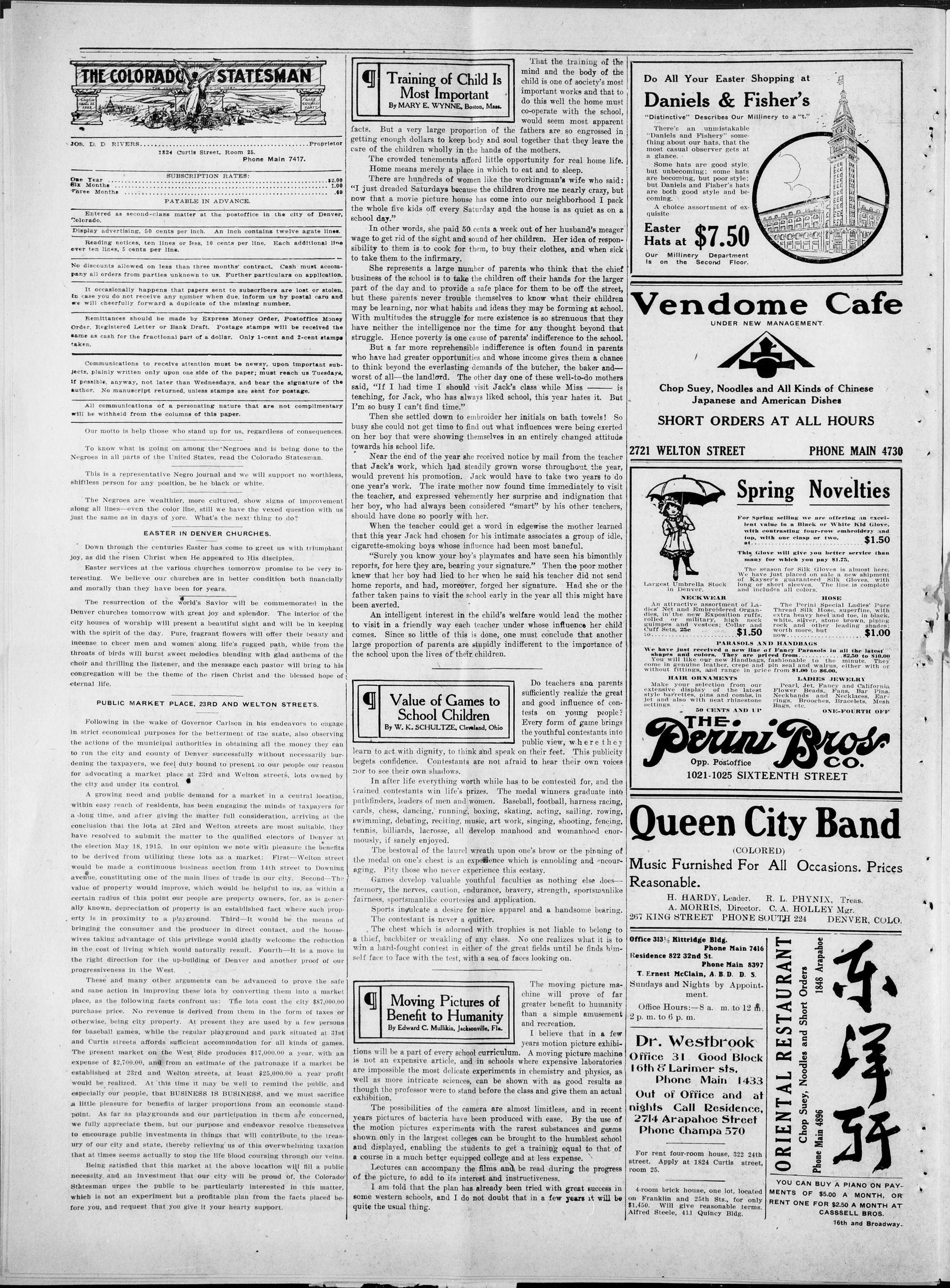
Following in the wake of Governor Carlson in his endeavors to engage in strict economical purposes for the betterment of the state, also observing the actions of the municipal authorities in obtaining all the money they can to run the city and county of Denver successfully without necessarily burdening the taxpayers, we feel duty bound to present to our people our reason for advocating a market place at 23rd and Welton streets, lots owned by the city and under its control.
A growing need and public demand for a market in a central location, within easy reach of residents, has been engaging the minds of taxpayers for a long time, and after giving the matter full consideration, arriving at the conclusion that the lots at 23rd and Welton streets are most suitable, they have resolved to submit the matter to the qualified electors of Denver at the election May 18, 1915. In our opinion we note with pleasure the benefits to be derived from utilizing these lots as a market: First—Welton street would be made a continuous business section from 14th street to Downing avenue, constituting one of the main lines of trade in our city. Second—The value of property would improve, which would be helpful to us, as within a certain radius of this point our people are property owners, for, as is generally known, depreciation of property is an established fact where such property is in proximity to a playground. Third—It would be the means of bringing the consumer and the producer in direct contact, and the housewives taking advantage of this privilege would gladly welcome the reduction in the cost of living which would naturally result. Fourth—It is a move in the right direction for the up-building of Denver and another proof of our progressiveness in the West.
These and many other arguments can be advanced to prove the safe and sane action in improving these lots by converting them into a market place, as the following facts confront us: The lots cost the city $87,000.00 purchase price. No revenue is derived from them in the form of taxes or otherwise, being city property. At present they are used by a few persons for baseball games, while the regular playground and park situated at 31st and Curtis streets affords sufficient accommodation for all kinds of games. The present market on the West Side produces $17,000.00 a year, with an expense of $2,700.00, and from an estimate of the patronage if a market be established at 23rd and Welton streets, at least $25,000.00 a year profit would be realized. At this time it may be well to remind the public, and especially our people, that BUSINESS IS BUSINESS, and we must sacrifice a little pleasure for benefits of larger proportions from an economic standpoint. As far as playgrounds and our participation in them are concerned, we fully appreciate them, but our purpose and endeavor resolve themselves to encourage public investments in things that will contribute to the treasury of our city and state, thereby relieving us of this overwhelming taxation that at times seems actually to stop the life blood coursing through our veins.
Being satisfied that this market at the above location will fill a public necessity and an investment that our city will be proud of, the Colorado Sthtesman urges the public to be particularly interested in this matter, which is not an experiment but a profitable plan from the facts placed before you, and request that you give it your hearty support.
Training of Child Is Most Important
By MARY E. WYNNE, Boston, Mass.
That the training of the mind and the body of the child is one of society's most important works and that to do this well the home must co-operate with the school, would seem most apparent facts. But a very large proportion of the fathers are so engrossed in getting enough dollars to keep body and soul together that they leave the care of the children wholly in the hands of the mothers.
The crowded tenements afford little opportunity for real home life.
Home means merely a place in which to eat and to sleep.
There are hundreds of women like the workingman's wife who said: "I just dreaded Saturdays because the children drove me nearly crazy, but now that a movie picture house has come into our neighborhood I pack the whole five kids off every Saturday and the house is as quiet as on a school day."
In other words, she paid 50 cents a week out of her husband's meager wage to get rid of the sight and sound of her children. Her idea of responsibility to them is to cook for them, to buy their clothes, and when sick to take them to the infirmary.
She represents a large number of parents who think that the chief business of the school is to take the children off their hands for the larger part of the day and to provide a safe place for them to be off the street, but these parents never trouble themselves to know what their children may be learning, nor what habits and ideas they may be forming at school. With multitudes the struggle for mere existence is so strenuous that they have neither the intelligence nor the time for any thought beyond that struggle. Hence poverty is one cause of parents' indifference to the school.
But a far more reprehensible indifference is often found in parents who have had greater opportunities and whose income gives them a chance to think beyond the everlasting demands of the butcher, the baker and—worst of all—the landlord. The other day one of these well-to-do mothers said, "If I had time I should visit Jack's class while Miss —— is teaching, for Jack, who has always liked school, this year hates it. But I'm so busy I can't find time."
Then she settled down to embroider her initials on bath towels! So busy she could not get time to find out what influences were being exerted on her boy that were showing themselves in an entirely changed attitude towards his school life.
Near the end of the year she received notice by mail from the teacher that Jack's work, which had steadily grown worse throughout the year, would prevent his promotion. Jack would have to take two years to do one year's work. The irate mother now found time immediately to visit the teacher, and expressed vehemently her surprise and indignation that her boy, who had always been considered "smart" by his other teachers, should have done so poorly with her.
When the teacher could get a word in edgewise the mother learned that this year Jack had chosen for his intimate associates a group of idle, cigarette-smoking boys whose influence had been most baneful.
"Surely you know your boy's playmates and have seen his bimonthly reports, for here they are, bearing your signature." Then the poor mother knew that her boy had lied to her when he said his teacher did not send home reports, and had, moreover, forged her signature. Had she or the father taken pains to visit the school early in the year all this might have been averted.
An intelligent interest in the child's welfare would lead the mother to visit in a friendly way each teacher under whose influence her child comes. Since so little of this is done, one must conclude that another large proportion of parents are stupidly indifferent to the importance of the school upon the lives of their children.
Value of Games to School Children
By W. K. SCHULTZE, Cleveland, Ohio
Do teachers and parents sufficiently realize the great and good influence of contests on young people? Every form of game brings the youthful contestants into public view, where they learn to act with dignity, to think and speak on their feet. This publicity begets confidence. Contestants are not afraid to hear their own voices nor to see their own shadows.
In after life everything worth while has to be contested for, and the trained contestants win life's prizes. The medal winners graduate into pathfinders, leaders of men and women. Baseball, football, harness racing, cards, chess, dancing, running, boxing, skating, acting, sailing, rowing, swimming, debating, reciting, music, art work, singing, shooting, fencing, tennis, billiards, lacrosse, all develop manhood and womanhood enormously, if sanely enjoyed.
The bestowal of the laurel wreath upon one's brow or the pinning of the medal on one's chest is an experience which is ennobling and encouraging. Pity those who never experience this eestasy.
Games develop valuable youthful faculties as nothing else does—memory, the nerves, caution, endurance, bravery, strength, sportsmanlike fairness, sportsmanlike courtesies and application.
Sports inculcate a desire for nice apparel and a handsome bearing.
The contestant is never a quitter.
The chest which is adorned with trophies is not liable to belong to a thief, backbiter or weakling of any class. No one realizes what it is to win a hard-fought contest in either of the great fields until he finds himself face to face with the test, with a sea of faces looking on.
Moving Pictures of Benefit to Humanity By Edward C. Mullikin, Jacksonville, Fla.
The moving picture machine will prove of far greater benefit to humanity than a simple amusement and recreation.
I believe that in a few years motion picture exhibitions will be a part of every school curriculum. A moving picture machine is not an expensive article, and in schools where expensive laboratories are impossible the most delicate experiments in chemistry and physics, as well as more intricate sciences, can be shown with as good results as though the professor were to stand before the class and give them an actual exhibition.
The possibilities of the camera are almost limitless, and in recent years pictures of bacteria have been produced with ease. By the use of the motion pictures experiments with the rarest substances and germs shown only in the largest colleges can be brought to the humblest school and displayed, enabling the students to get a training equal to that of a course in a much better equipped college and at less expense.
Lectures can accompany the films and be read during the progress of the picture, to add to its interest and instructiveness.
I am told that the plan has already been tried with great success in some western schools, and I do not doubt that in a few years it will be quite the usual thing.
Training of Child Is Most Important By MARY E. WYNNE, Boston, Mass.
Value of Games to School Children
By W. K. SCHULTZE, Cleveland, Ohio
Moving Pictures of Benefit to Humanity By Edward C. Mullikin, Jacksonville, Fla.
Shopping at Fisher's Millinery to a "t."
Do All Your Easter Shopping at Daniels & Fisher's
"Distinctive" Describes Our Millinery to a "t."
There's an unmistakable "Daniels and Fishery" something about our hats, that the most casual observer gets at a glance.
Some hats are good style, but unbecoming; some hats are becoming, but poor style; but Daniels and Fisher's hats are both good style and becoming.
A choice assortment of exquisite
Easter Hats at $7.50
Our Millinery Department Is on the Second Floor.
Vendome Cafe
UNDER NEW MANAGEMENT. Chop Suey, Noodles and All Kinds of Chinese Japanese and American Dishes SHORT ORDERS AT ALL HOURS
2721 WELTON STREET
PHONE MAIN 4730
```markdown
```
Spring Novelties
Spring Novelties
For Spring selling we are offering an excellent value in a Black or White Kid Glove, with contrasting four-row embroidery and top, with one clasp or two. $1.50 at.....
This Glove will give you better service than many for which you pay $1.75.
The sensor for Silk Gloves is almost here. We have just placed on sale a new shipment Kayssa guaranteed Silk Gloves, with long or short sleeves. The line is complete and includes all colors.
Largest Umbrella Stock in Denver.
HOSE
An attractive assortment of Ladies' Net and Embroidered Organdies, in the new Exposition ruffs, rolled or military, high neck gulpsm and vestees; Collar and Cuff Sets, 25e $1.50
An attractive assortment of Ladies' Net and Embreidered Organies, in the new Exposition ruffs, rolled or military, high neck gulps and vestees; Collar and Cuff Sets, 25c $1.50 worth more, but now.
PARASOLS AND HANDBAGS
We have just received a new line of Fancy Parasols in all the latest shapes and colors from $82.50 to $100.00. You will like our new Handbag designs fashionable to the minute. They come in genuine leather, crepe and pin seal and walrus, either with or without fittings, and range in price from $1.00 to $8.00.
HAIR ORNAMENTS
Pearl, Jet, Fancy and California Flower Beads, Fans, Bar Pins, neckbands and Necklaces, Earrings, Brooches, Bracelets, Mesh Bags, etc
Make your selection from our extensive display of the latest style barrettes, pins and combs, in jet and also with neat rhinestone settings.
50 CENTS AND UP
THE Perini Bros. CO.
Opp. Postoffice
1021-1025 SIXTEENTH STREET
Pearl, Jet, Fancy and California Flower Beads., Fans, Bar Pins, Neckbands and Necklaces, Earrings, Brooches, Bracelets, Mesh Bags, etc.
ONE-FOURTH OFF
Queen City Band
Music Furnished For All Occasions. Prices Reasonable.
267 KING STREET PHONE SOUTH 224 DENVER. COLO.
Phone Main 4896 1848 Arapahoe
乐泽驿
Office 315 Hittridge Blvd.
Phone Main 7416
Residence 822 32nd St.
Phone Main 8397
T. Ernest McClain, A. B.D. D. S.
Sundays and Nights by Appointment.
Office Hours:—8 a. m. to 12 m.
2 p. m. to 6 p. m.
Dr. Westbrook
Office 31 Good Block 16th & Larimer sts. Phone Main 1433 Out of Office and af nights Call Residence, 2714 Arapahoe Street Phone Champa 570
For rent four-room house, 322 24th street. Apply at 1824 Curtis street, room 25.
YOU CAN BUY A PIANO ON PAYMENTS OF $5.00 A MONTH, OR RENT ONE FOR $2.50 A MONTH AT CASSSELL BROS. 16th and 17th
4-room brick house, one lot, located on Franklin and 25th Sts., for only $1,450. Will give reasonable terms. Alfred Steele, 411 Quincy Bldg.
THE COLORADO STATESMAN
LANGH SHALL BE FREE
RACE CONFINIT JUST
W. A. Smith, who has been quite sick for several days, is improving slowly.
Orestes Murphy announces the engagement of his daughter, Miss Georgia Murphy to Mr. Ira T Turner.
Keep off the date of May 11th. Ball.
FUNERAL NOTICE.
To the Officers and Members of R Mountain Lodge No. 1, F. & A You are hereby notified to meet the lodge rooms, 2630 Welton st Sunday, April 4th, 1915, at 1 o' p. m., to attend the funeral of Thomas J. Riley. All Master Ma in good standing are invited to
Andrew J. Riley and wife arrived in the city Wednesday to attend the funeral of their father, Thomas J. Riley.
When in need of first class clothes cleaning, pressing, dyeing, repairing, be sure and see J. Sobel, 807 E. 22nd avenue. Reasonable prices.
The Vendome Cafe, 2721 Welton street, is now under new management. Chop suey, noodles, and all kinds of Chinese, Japanese and American dishes.
Don't forget the Mason's Big Entertainment at East Turner Hall, Easter Monday. This will be another big event given by the Masons.
Miss Marguerite Graves, the petite maid at Apperson's millinery parlors, is well liked by the patrons and her employer. She is certainly making good.
Mrs. Geo. Robinson, of 1316 Twenty-fourth avenue, continues quite ill, to the alarm of her relatives and friends. Mrs. Robinson is one of the Overton sisters of Leavenworth, Kans.
Mrs. E. L. Pollard, who was called to Augusta, Ga., a few days ago to be with her mother, who is ill, was suddenly called to Savannah, Ga., to be with her sister, who is not expected to live. Mrs. Pollard has the sympathy of her friends.
On Easter Monday, April 5th, the Masons will give a big entertainment at East Turner Hall. Morrison's orchestra.
Mrs. Mary Butts, of 1636 Penn. St., celebrated her 104th birthday anniversary March 7th, she having been born in Charleston, Ga., March 7th, 1811. Mrs. Butts in the dark days of slavery was considered the property of R. Smith.
Mrs. W. B. Townsend, a Denverite, whom to know is to love, honor and respect, will leave the city today for California points on pleasure bent. No doubt the change will benefit her health. She will visit the expositions at San Diego and San Francisco
Keep off the date of May 11th. Ball.
Charles Britton, the competent post office clerk, has received an increase of $100 this week. He is now in the $1,200 yearly class. The Statesman extends congratulations to Charley. A charming wife and an increase in salary, all inside of a year, is going some.
Keep off the date of May 11th. Ball
The Republican Standard, a breezy young bantam from the "Windy City" (Chicago), is on our desk. Prof. W. H. A. Moore, the poet and polished writer, is editor and L. H. Ferribee, the popular all around citizen, is business manager. With such talent at the helm, the Standard ought to be a successful venture.
Wait for the Mason's Entertainment at East Turner Hall, Easter Monday.
Rev J. W. Owens and wife were royally entertained by Mrs. M. Cole, 2929 Glenarm place, on Wednesday evening last, prior to their departure for St. Louis on Thursday, April 1. Rev. Owen has filled the pastorate of the Seventh Day Adventist for three years in this city and we can conscientiously affirm as to his ability and uprightness as a religious leader from the impressions he has established among members of the community. Such men are very helpful wherever they go, so that our loss will be St. Louis' gain. We wish for this distinguished divine and his wife a further career of usefulness in the Master's vineyard and heaven's richest blessings on them and their work in their new field of labor.
```markdown
```
The cantata, "Alleluia! Hail With Gladness" will provide a music-fest, Thursday night, 8:30 o'clock, at People's Presbyterian church. Orchestra in attendance. Adults 25c, children 15c.
FUNERAL NOTICE
To the Officers and Members of Rocky Mountain Lodge No. 1, F. & A. M.: You are hereby notified to meet at the lodge rooms, 2630 Welton street, Sunday, April 4th, 1915, at 1 o'clock p. m., to attend the funeral of Bro. Thomas J. Riley. All Master Masons in good standing are invited to attend. Fraternally yours.
THE DOUGLAS UNDERTAKING CO
FUNERAL NOTICES.
The funeral service of Mr. Hiram Davies, age 44 years, late of 1837 Arapahoe, was held on Wednesday, March 31st, at 2 p.m., from the Douglas parlors. Rev. Over officiated. Interment Riverside cemetery. Mrs. Maggle Thomas, age 56 years, mother of Jas, Neals, died March 31. Funeral notice later. Miss Ruth Helen Fife, 2712 Marion; age 17 years, beloved daughter of Mrs. Mary Irene Fife, died April 2nd, 3:30 a. m. Funeral notice later.
CAMMEL & CO., UNDERTAKERS
FUNERAL NOTICES.
Miss Georgia Bell Giles died at her residence, 1625 East Thirtieth street, March 25. Her funeral was held Wednesday afternoon at 2 p. m. from Cammel & Co. parlors. Interment at Fairmont.
Mr. Bert King, who committed suicide at his residence, 2225 Lawrence street, March 28. His funeral was held Friday morning, 10 a.m., from the residence. Interment at Riverside, Cammel & Co. in charge.
Fred Clark died at the residence of his grandmother's, Mrs. Emma Price, 434 Twenty-fifth street, Tuesday evening. His funeral will be held Sunday, 1:30 p. m., from Shorter's church. Friends are invited.
THOMAS J. RILEY, PIONEER COLO
RADOAN, PASSES AWAY.
Grand Old Man.
No better tribute, grander title, or more fitting application could be given Thomas J. Riley than that of "Grand Old Man," as his career for the period of over threesecc years and ten was filled with everything that savored of and was embodied in the word "grand." Mr. Riley, after a brief illness of one week, responded to the death summons on Tuesday afternoon last at the home of his daughter, 2114 Arapahoe St. Concious to the last, having possessed wonderful vitality, he gave instructions as to his funeral and burial, and died with the Christian's hope of the Resurrection, a belief which he entertained for nearly all his life.
Born in 1842 in Cherokee county, Georgia, Mr. Riley journeyed with his father in 1860, in company with a band of Georgians, to Memphis, Tenn., thence to Colorado. The privations and hardships suffered by them in contact with the Indian tribes were almost beyond endurance, yet as fortune favors the brave, he survived these experiences.
Mr. Riley finally settled in Denver, and was a member of the police force, a position which he served with credit to his race and the city, having made quite a record. He came in for recognition as a character of usefulness both in civic and religious spheres, and stood conspicuously as one of the foundationers of the present Zion Baptist church, formed in 1865, and one of the fathers of Free Masonry and Odd Fellowship in the Rocky Mountain region. Being a self-made man, it was wonderful to listen to his reasonings on topics of the day and his ability and keenness of perception exceeded the men of his day and time. He leaves a son, Andrew Riley; two daughters, Mrs. Elizabeth Owens and Mrs. Naomj Morrison, to mourn their irreparable loss, and the Colorado Statesman in offering sympathy to the bereaved ones can only indorse the sentiment of the public that a GRAND OLD MAN IS GONE—another link in the chain of old and new Colorado is broken. May he leave "footprints on the sands of time."
Funeral at Campbell chapel, 23rd and Lawrence Sts., tomorrow, 3 p. m. Douglass Undertaking Co. in charge. Rev. Washington officiating.
The choir of the People's Presbyterian church invites your presence Thursday night after Easter, April 8, at the church, to listen to the rendition of the cantata, "Alleluia! Hail With Gladness." Admission 25c and 15c.
BARGAINS.
Don't fail to read the advertisements in the Colorado Statesman, if you are looking for bargains, as we carry ads for all the reliable and leading merchants of the city.
Nicely furnished rooms for rent, with all modern conveniences, at 2404 Welton St. Mrs. Nellie Steele.
Mrs. Eline Fernandez, first class dress making, tailoring and evening gowns. Will go out by the day. Satisfaction guaranteed. 1260 Vine St. Phone York 8885.
The post-Easter extravaganza of music—vocal and instrumental—will be the attraction at People's Presbyterian church Thursday night, 8:30 o'clock, April 8.
SHORTER CHAPEL NOTES.
The Easter service this season at Shorter Chapel will be better and more elaborate than ever. No pains are being spared to make the decoration highly pleasing and suggestive, in fact, the decoration will be one of the specialties of the celebration. And then the music will easily eclipse any of our former renditions. The main Sunday School will render its exercises at the Sunday School hour and the primary department at 3 p. m., both of which will interest you. The choir, supported by Denver's popular violinist, Mr. Geo. Morrison, and the cello of Mr. Clarence B. Duncan, will render choice Easter numbers at the morning hour and the eventide as well. The beautiful cantata, "Cross and Crown," by Wilson, will be rendered at 7:30 p. m. and without question will be one of the most brilliant cantatas ever rendered in Denver. A silver offering will be taken at the door at this service. The pastor will deliver a special Easter message and the rite of Christian Baptism will be administered at the afternoon service.
9:45 a. m.—Easter Service by main Sunday School. Mr. Geo. C. King, Superintendent.
11:00 a. m.—Processional; Doxology; hymn, "Christ, the Lord, Is Risen Today;" Invocation; hymn, "Rejoice Evermore;" Scripture lesson, Matt. 28, anthem, "Lift Up Your Heads" (Ludebuehl); cello solo, selected, Mr. Clarence B. Duncan, with Mrs. Minnie Hayes, accompanist; announcements; anthem, "Christ Our Passover" (Ashford), choir; sermon, "Easter Joy," by the pastor; Invitation; Offertory, cello, selected, Mr. Clarence B. Duncan; Doxology; Benediction; Recessional.
1:00 p. m.—The funeral service of Mr. Frederick Clark will be held from the church.
3:00 p. m.—Easter service by the Primary Department of the Sunday School. Mrs. Henry Brown, Superintendent.
4:30 p. m.—Baptism, by immersion,
6:30 p. m.—Allen Christian Endeavor League.
7:30 p. m.—Easter cantata, "Cross and Crown" (Ira B. Wilson), by the choir.
Our RED and BLUE rally will be held tomorrow, closing out Monday evening. Every member of our congregation and friend is asked to help us. The men are asked to contribute $5.00 and the women $4.00 and $3.00. The pastors and members of Campbell, Bethlehem and Scott are expected to join us Monday evening.
PROTESTANT EPISCOPAL CHURCH OF THE HOLY REDEEMER.
Twenty-Second Avenue and Hum-
boldt street. Rev. Henry B. Brown.
B. D., Vicar.
Easter Day, Sunday, April 4th.
6 a. m., celebration of the Holy
Eucharist.
11:15 a. m., choral celebration with
sermon.
4 p. m., Sunday School Easter exercises.
7:45 p. m., choral evensong with sermon.
A cordial invitation is extended to the public to worship at all of these services, as special hymns and anthems have been prepared by the choir, and in conjunction with the sermons on the Resurrection and the children's exercises, this celebration of Easter promises to eclipse previous ones.
PEOPLE'S PRESBYTERIAN.
E. 23rd Ave. and Washington St.
Pastor, J. A. Thos-Hazell, S. T. B.
Services Easter Sunday, April 4th: 6 a. m., Easter Carols and Communication. 11 a. m., "Side Issues from the Resurrection." 2:30 p. m., services at the Mission. 5 p. m., special Easter program with orchestra.
The public is cordially invited to attend all the services of this church tomorrow. The communicants are earnestly urged to commune at the 6 a. m. services and make their special offertory for the day. Special features of the forenoon services are a forceful and appropriate pulpit delivery and special music by the choir and orchestra. The 5 p. m. program is the presentation of a galaxy of vocalists and instrumentalists with Dr. Westbrook and Miss Isabel Chapman on the firing line as essayists. No one can afford to miss hearing this extravaganza. The public is asked for a liberal contribution. The congregation is reminded to begin the new church year on that day right by their attendance and offertory.
To thoroughly round up the festivities of Easter in a becoming manner the choir of this church will sing and recite the cantata, "Alleluia! Hail with Gladness" by Galbraith, next Thursday night promptly at 8:30 o'clock. Captain Thos. Campbell will address the audience on "The Easter Aftermath." The orchestra will intersperse the program with selections. Admission 25 and 15 cents. The patronage of the public is solicited and will be appreciated.
Mrs. J. E. Thomas, 1260 Vine street, has nicely furnished rooms to rent to first-class men, with board reasonable.
Of Colorado Statesman, published weekly, at Denver, Colo., required by the University of Colorado, 1812. Editor, Joseph D. D. Rivers, Denver, Colorado. Editor, Joseph D. D. Rivers, Denver, Colorado. Business Manager, Joseph D. D. Rivers, Denver, Colorado. Editor, Joseph D. D. Rivers, Denver, Colorado.
Owners: (If a corporation, give names and addresses of stockholders holding 1 per cent or more of total amount $1,000,000, J. D. D.Rivers, own bondholders, holding 1 per cent or more of total amount of bonds, mortgages, other securities: None. Sworn to and subscribed before me, the above.
Sworn to and subscribed before me this 1st day of October, 1914.
LULU. THE NOTE.
Notary Public.
(My Commission expires July 22, 1916.)
NTANA
HO WYOMING
UTAH COLORADO
IZONA NEW MEXICO
Every detail of the telephone business is being constantly watched by the American people
The keen eyes of trained observers paid by the citizens of this country study every phase of the business
Every telephone company in the United States is under the direct supervision of the Interstate Commerce Commission
In nearly every state in the Union this telephone business is under constant observation by a State Public Service Commission
The local authorities in every county, city and town keep in direct touch with our affairs
These commissions and representatives, choosen by the people themselves, are the Eyes of the Public
The time has come when there can be few, if any, secrets in a public service corporation
In our business we have no secrets—we want none—we have nothing to conceal The exact condition of our business is revealed from every angle of the reports required by the various commissions Every detail of our business is open to the public through these reports; the public is safeguarded at every step
The Mountain States Telephone and Telegraph Co. "The Corporation Different"
---
THE FLOWER
The Weatherhead Hat Co
TELEPHONE MAIN 3203
PIONEER HATTERS OF THE WEST
We Make
Old Hats
New
We Make Old Hats New
Of Gents' and Ladies' Hats of Every Description.
1624 CHAMPA ST., DENVER, COLO.
$50.00 PER MONTH, MADE DURING YOUR SPARE TIME, Selling the High Brown Outfit, doll last seller. Send 5 cents for sample outfit, instructions and solicitors certificate. This is the chance of a life time for any enterprising person. Be the first one in your community to get the position. Every family wants a Negro Doll, the beauty of modern invention. Send 5 cents for reply to inquiry and catalog.
NATIONAL NEGRO DOLL COMPANY,
519 Second Avenue., N. Nashville, Tennessee.
Brickler's New Barber Shop is located at 2208 Larimer street. Shave, 10. Hair cut, 25c; children, 15c.
The Eyes of the Public
The Eyes of the Public
the telephone business is being constantly
trained observers paid by the citizens of this
business
company in the United States is under the d
Commerce Commission
state in the Union this telephone business in
State Public Service Commission
cities in every county, city and town keep in o
us and representatives, choosen by the people
public
we when there can be few, if any, secrets in
we have no secrets—we want none—we have no
mon of our business is revealed from every ang
various commissions
our business is open to the public through the
ordered at every step
Min States Telephone and T
"The Corporation Different"
being constantly watched by the
the citizens of this country study
es is under the direct supervision
phone business is under constant
mission
and town keep in direct touch with
seen by the people themselves, are
if any, secrets in a public service
none—we have nothing to conceal
ed from every angle of the reports
public through these reports; the
hone and Telegraph Co.
"Different"
WAIT
MASON'S BIG
EASTER
Centennial
EAST TU
MONDAY
Good Music by M
MASON'S BIG
EASTER Entertainment
GIVEN BY
Centennial Lodge No. 4
F. & A. M.
AT
EAST TURNER HALL
MONDAY, APRIL 5, 1915
Good Music by Morrisons Full Orchestra.
Committee
E. C. Tumlin, C. A. Allen, J. H. P. Westbrook.
REFRESHMENTS
ADMISSION. 35C.
2077 DAY OR NIGHT CAMMEL AND CO. The Progressive Funeral Directors
WE TAKE GREAT PRIDE IN THE FACT THAT WE ARE "THE LEADING FUNERAL DIRECTORS." WE CAN FURNISH ELEGANT ROLLING STOCK. AUTOS IF PREFERRED.
E. V. Cammel, PRES. @ MGR. PREFERRED
You Will Be Delighted With Our Ser-
little Things That Count LADY ATT
CURTIS M. HARRIS
Assistant Manager and Funeral Director
OFFICE AND PARLORS 2807 W
Lated With Our Service As We Look After Theount LADY ATTENDANT.
ARRIS ROBERT OLLIVER
Funeral Director Assistant Funeral Director
ORS 2807 WELTON ST. DENVER.
You Will Be Delighted With Our Service As We Look After The Little Things That Count LADY ATTENDANT.
CURTIS M. HARRIS ROBERT OLLIVER
Assistant Manager and Funeral Director Assistant Funeral Director
OFFICE AND PARLORS 2807 WELTON ST. DENVER.
PHONE CHAMPA 2077
G
DAY OR NIGHT
PHOTO BY FRANK FOURNIER
Lilies sound His praises at the Easter-tide. Who from highest glory came to earth and died. Lo! a-dying, quite defying Satan's mighty power, Bands a-bursting, our Redeemer rises in His hour. Can a pulsing, freshening lily show aught else beside Happy, joyous welcome at the Easter-tide.
MISS THE VISION OF THE VALLEY
umphant.
A CAMPING party from the East stepped from a belated train late one August afternoon at the station of a bleak little frontier town at the edge of the Black Hills, and looked anxiously at the shadows already lying long across the one street.
"Well, here's one day lost," grumbled a member of the party. "It will be night before everything is loaded and ready, and we can't start off in the dark."
"Why not?" asked the guide.
"Couldn't find the way."
"Couldn't find the way."
"I know the way," returned the guide simply. "We'll start at eight." Night was swallowing the last dregs of daylight when eight o'clock came, and apprehension was lined into every face as the party climbed into the wagon and plunged into the dark mouth of the canyon, which opened abruptly into the town. The road hugged the canyon wall on one side; on the other rushed a noisy little mountain brook, its chatter softening gradually into a quiet murmur as the canyon road wound up the hillside, leaving it far behind in the depths below. Dense darkness separated the travelers each from each. Stones dislodged by the scrambling hoofs of the horses slid down into the canyon, measuring the narrow margin between safety and destruction. Hand gripped hand, and breath came short.
"It's like the valley of the shadow of death!" a voice shuddered out into the darkness.
The guide, directing his team in front, sensed an unspoken fear.
"Just look up," he called hearteningly over his shoulder.
A wedge of brilliant star-strewn sky seemed swung into the abyss, forcing the canyon walls apart and stretching a luminous canopy from crag to crag. The radiance transformed the valley, in the uplook, into a vision of glory. Up and up wound the road, nearer and nearer to that ever-widening arch of star-shot brightness, till the travelers at last stood safe upon the shining hillcrest, the dark hours of trembling bewilderment over and joy beyond.
They looked back silently, as far as the starlight revealed it, over the road up which they had come.
"I wouldn't have missed it for the world," one of the party finally broke the spell. "It would have been a tragedy to lose an experience like that." And in that brief sentence she unconsciously summed up the one real tragedy of life—to miss the vision of the valley. The valley itself is not a tragedy to thinking people. For while men can still "just look up," and looking, realize that ahead lie fairer lands, to which they are surely bound, they
CONSIDER THE LILIES
T
on certain stocks came from a man with inside knowledge, and to take the money from the bank would just be borrowing it. The stocks were scheduled to make a wild plunge upward within the next few days and then he could sell, replace the money he had taken from the safe before it was missed and have enough ahead to justify several of his intended moves toward social advancement. Why, it was all just the simplest thing in the world to accomplish! All the time he argued with himself he was not quite easy in his conscience, but his thought of the confidential position of the friend who had given him the tip made the outcome seem a certainty—an end that would surely justify the means. He pulled the blind, unlocked the safe, concealed the money he needed on his person, carefully covering his tracks. Then he locked the safe and quietly let himself into the balmy April air.
It was past midnight when he stole silently out of his home for a little walk, being unable to sleep. The moonlight held the world in its thrall, bathing the spring flowers in its silvery light, but the cashier was oblivious to its beauty as he wandered aimlessly down first one street and then another, until his attention was arrested by the sound of a glad hosanna from a nearby church—the final choir rehearsal for Easter music. Scarcely realizing what he did the troubled man slipped into the vestibule of the big church, drawn by the lights, the music and the hunger for human companionship which gnawed his troubled heart. As he stood undecided what he should do the joyous anthem ended, the choir filed into the vestry room and the old sexton turned out all save the chancel lights. The cashier slipped quietly into the church and sank wearily into a seat, his eyes fixed on the lily-laden altar.
Easter lillies were everywhere. Great banks of them covered the altar, and
H
from every nook and corner they gleamed white in the dim chancel lights. They were like a prayer—a mother's prayer for her children—pure, and clean, and white. Their delicate fragrance was pleasant to his senses, but above all else it was their whiteness which riveted his thought. He could not get away from it.
Suddenly he buried his face in his hands to shut the lilies away from his sight, while he went over the argument he had used to himself when he had taken the money from the safe. But, strangely, in the midst of his effort at justification, the whiteness and purity of the Easter lilies surged through his brain.
of the pew in front of him, his eyes fixed on the lily-banked altar. Then he squared his shoulders even as he had seen his father do in that long gone year. And when the first soft flush of Easter day crept across the eastern sky the money was safe in the bank again. For the cashier kept faith with his mother.
Easter.
"She, supposing him to be the gardener—"
Dead is our Christ and our hearts cry "Where?"
We would peer in the tomb behind thee. Ah! Not there!
But as of old in the open air. Out in the garden, Lord, we find thee.—Mary Eleanor Roberts, in Lippincott's.
```markdown
```
are safe. It is "where there is no vision the people perish."
The road toward those fairer lands is the common, everyday road of hourly living. It lies inevitably through the valleys, often through environing night. To travel it means weariness bruised and trembling feet, groping hands, poignant pain, and a back look through a vista of disappointments and apparent failures.
But there is a way out. Centurier ago, on the day that we call Easter a light broke into the darkened valleys, and the way shone forth for all who will "just look up." Now, since that Easter, we climb, not as slaves who endure because there is no escape but with joy triumphant. For the as surance is ours that we shall thus rise with him into the light.
And so he bids us on this Easter day to accept our valleys, for they lead out into life; not alone beyond, but now. The sliding stones cannot plunge us over the brink, nor the threatening rocks crash down and crush out our lives. We have his word that because he lives we shall live also. Our feet are set securely upon the road, and we shall climb in safety up the vision-brightened way to the goal.
It is into our night-dark valleys that the vision comes, for sunshine blots it out. The valley is by day a smiling thing, tempting to loitering among its trees and flowers, and to dreaming beside its singing brooks. So completely does it satisfy the senses that it may even become a lotus vale of forgetfulness, to lure the traveler from his sturdy purpose and beguile him into indifference to the way that leads to the plains of God. But presently night overtakes him. Then he rouses. With the shadows chill and heavy on his heart, he at last looks up and, beholding the star, begins his climb up toward the morning. Gethsemane and Golgotha lie along the way, but Easter breaks beyond. The vision has glorified the vale.
And still Easter does not mean to us all that it should. It is a day of somewhat selfish rejoicing. We quicken to the new life of the spring, we make our heartsides gay with fresh blossoms; our hearts echo the glad message of the bells. It is our joy, our peace, our brightness, our Easter.
But it was very different on that first Easter. If you will think back a moment you will recall the word of the angel to the women at the sepulcher—"He is risen—go tell his disciples." Now, as then, there are many to whom Easter has not come. They are dead to life, back there in the valley—little children defrauded of their birthright of joy; women exploited for gain; youth drawn into evil by the lure of false brightness. "That ye might have life" is the purpose of the Christ in his resurrection; and yet in that death valley they know nothing of life and light, they who are also a part of that all-inclusive "ye."
Before we can make our Easter truly his Easter we must first hearken to his message: "Go down into the valley and carry the vision to those who perish there. Make your joy their joy; your life their life; your safety their safety. Lead them up with you, into the light."
The First Easter Dawn
HE cashier was alone. He drew a pencil and scratch pad from his pocket and figured rapidly. Yes, he could do it easily. Just a turn of the combination and the safe was open. His tip
Yes, He Could Do It Easily.
Then out of the stillness a sound was made. It was the sound of a voice—the voice of his mother.
"Consider the lilies," it pleaded softly.
The cashier sprang to his feet and looked about him wildly. There was no one in the big lily-laden church except himself—himself—and the voice.
"Consider the illies," came the advice to him once more.
The voice was unmistakable. Although his mother had been dead lo, these twenty years, he could never forget the gentleness of her voice. But that was not all. The admonition had a familiar ring which was not of the voice alone, nor yet of some long-forgotten reading. The words were borne in upon his senses now as in that long-ago yester-year, when, as a little lad, he had sat in the living room of his home listening to his father's heartbroken confession to his mother that he had failed in business. It was Easter then as now. On the broad casement of the low French
A
Stood Clutching the Seat.
window stood a row of exquisite white lilies. His mother had turned from his stricken father to regard them, and over her face had come that tender, confident smile the little lad had so loved. "Consider the lilies," she had told the man, "they toil not, neither do they spin, yet Solomon in all his glory was not arrayed like one of these." And his father had taken her into his arms with a great sob, while the little lad had looked on, understanding only that his mother had somehow helped his father over a great crisis.
And now in the crisis of his own life, when temptation had mastered him, he sat alone in a lily-laden church and lo! the voice of his mother bade him "consider the lilies." Whence had it come? From the heart of an Easter illy? Or had it come into the house of God with him with a ray of moonlight? Or, was the voice in his brain alone—born of memories? He could not tell, and it did not matter. When he had laid her away twenty years ago he had not laid away the influence that had been hers all through his young life, her faith in him, her smile, nor the memory of a certain day when he had been graduated from college and had promised her that he would seek first the kingdom of God and his righteousness through all the days that he should live. And he had kept his promise—until tonight, when the greed of gold became the dominating motive of his life; tonight, when the thirst for luxury had conquered him.
The cashier stood clutching the seat of the pew in front of him, his eyes fixed on the lily-banked altar. Then he squared his shoulders even as he had seen his father do in that long-gone year. And when the first soft flush of Easter day crept across the eastern sky the money was safe in the bank again. For the cashier kept faith with his mother.
Easter.
"She, supposing him to be the gardener—"
Dead is our Christ and our hearts cry
"Where?"
We would peer in the tomb behind thee,
Ah! Not there!
WHEN PREPARING EGGS
MUCH CARE SHOULD BE GIVEN
TO THEIR COOKING.
Digestibility Is Affected by Temperature of Water in Which They Are Boiled—Proper Method of Making Omelet.
While it would seem that anyone can cook so simple a food as an egg satisfactorily, no other food is so affected by different cooking methods and particularly by degrees of temperature. The albumen, or egg white is greatly changed by heat, and the way the heat is applied. If it is gently warmed, coagulation, or hardening, does not at once take place, although the substance may be perfectly cooked. But if plunged at once into boiling water or liquid the albumen becomes tough and far less desirable as a food element. It is, therefore, much better to cook eggs by some other method than direct boiling: steaming, poaching or "codling" keeps the albumen soft while cooking. For dishes requiring "hard-boiled" eggs, it is best to let them simmer for about twenty minutes, so that the white will be solid, yet tender, and the yolk dry and mealy. Frying, or coating the egg directly with fat, also hardens the albumen and makes it less digestible. It is far better to put the eggs in a buttered dish and "shirr" or bake them in the oven. The secret of successful dishes like the omelet, which is made so well abroad, lies all in the temperature of the pan, the fat and the quickness and skill with which it is handled before allowed to become tough or stringy.
Eggs contain no starchy qualities. This teaches us to build up our eggs menus with starches such as potatoes, rice, macaroni. Eggs also need to be served with fat, which does not mean frying in fat, but a sauce or dressing containing butter or other oil.
An error common to housewives is to relegate the use of eggs chiefly to cakes and puddings, adding these to an already heavy meat meal. Since eggs are the equivalent of meat, if we use them generously in a pudding we do not then need meat in our first course. Similarly, it is unwise dietetics to serve a heavy, rich cake as the last course of a dinner beginning with a fatty meat like lamb, which already has given us muscle and fat.
Pineapple Pancakes.
Scald a single pint of milk; when lukewarm, add one teaspoonful of salt and one-half cake of compressed yeast, dissolved in one-quarter cupful of lukewarm water. Sift in enough flour to make a thin batter and let rise over night. In the morning add one cupful of thick milk, one tablespoonful of melted butter, two eggs beaten separately and one teaspoonful of soda sifted with one cupful of flour. Add enough more flour to make a smooth, thin batter, let stand one-half hour, then add one heaping tablespoonful of grated pineapple for each cupful of butter. Bake in a soapstone griddle and serve with sweetened pineapple juice.
Plain Paper Best.
A plain paper or one with quiet self-tone pattern is the only kind that makes a successful background for pictures. The soft neutral tone of cartridge paper is a splendid setting for ornaments and pictures, while soft brown is a safe choice of paper for the average room, as against it almost any picture, be it oil painting, water color, portrait, etching or photograph, appears to advantage. Gray is also a good restful color. A happy and popular combination is the gray wall covering with white woodwork. It is an admirable idea for the city apartment, where there is none too much light.
Angel Cakelets.
Sift together several times one-half cupful of fine granulated sugar, one-half cupful of pastry flour, one-half level teaspoonful cream tartar, beat whites of four eggs till stiff and dry then gradually mix in the sugar and flour. Flavor with one-half teaspoonful of almond, rose or vanilla, drop with a teaspoon on pans covered with buttered paper an inch or two apart; sprinkle with sugar, white or pink and bake in a moderate oven ten or fifteen minutes; will make two dozen
Ginger Cream.
Beat the yolks of three eggs, add one pint of milk, two tablespoonfuls sirup from preserved ginger and one cupful sugar. Cook all together until thick Strain, add one tablespoonful gelatin that has been dissolved in a little cold milk, the whites of three eggs beaten stiff and beat all together until it begins to thicken, then add four ounces preserved ginger cut in very small pieces. Put in a mold to cool and serve with whipped cream.
Hungarian Salad.
One pint cold boiled potatoes sliced very thin, one small onion, grated, two cold boiled beets, sliced, five sardines, boned and mashed, one tablespoonful minced cold cooked ham, one small green pepper thinly shredded. Sprinkle with salt, add one-half cupful French dressing. Chill.
To Cream Hard Butter
If butter is hard to cream don't warm it. This changes the texture of it. Instead, run it through the vegetable ricer. This breaks it into small pieces and it can then be readily creamed.
STATE OF COLORADO. Insurance De-
partment.
SYNOPSIS OF STATEMENT FOR 1914
AND COPY OF CERTIFICATE
OF AUTHORITY
FREEMONT COUNTY PROTECTIVE
ASSOCIATION, of Carbon City, Colo.
STATE OF COLORADO, Insurance Department.
CITY OF COLORADO OF AUTHORITY FOR
CERTIFICATE OF AUTHORITY FOR
THE YEAR ENDING FEBRU-
RARY 2015
Office of Commissioner of Insurance
It is hereby certified, that the
Commissioner of Insurance
FREMONT COUNTY PROTECTIVE ASSOCIATION, a corporation organized under the laws of Colorado where municipal office is located at Caban City.
Cannon has applied with the requirements of the laws of this State applicable to said company, and the company is by industry used to transact business as an insurance company in accordance with its Charter or Articles of Incorporation within the State of Colorado, to the within the State and/or departments of the law, until the last day of February, in the year of our Lord one thousand nine hundred and sixten years, testimony whereof, I, D. M.rol. Commissioner of Insurance of the State of Colorado, have hereunto set my mind and done my seal of office, at the City of Denver, this first day of March, A. D. 1915.
(Seal) D. M. ROLPH,
Commissioner of Insurance.
Published in The Colorado Statesman
by authority of the Company.
STATE OF COLORADO, Insurance De-
partment.
SYNOPSIS OF STATEMENT FOR 1914
AND COPY OF CERTIFICATE
OF AUTHORITY
LUMBERMEN'S INSURANCE COMPANY,
of Philadelphia, Pennsylvania.
Assets—$1,875,400.30.
STATE OF COLORADO, Insurance Department
OF MICHIGAN FOR AUTHORITY FOR
CERTIFICATE OF AUTHORITY FOR
THE YEAR ENDING FERU-
RU
Office of Commissioner of Insurance.
It is hereby certified, that the
LUMBERMENS INSURANCE COMPANY, a corporation organized under the laws of Pennsylvania, whose potential office is located at Philadelphia.
has compiled with the requirements of the laws of this State applicable to the company and the company hereby authorized to transcribe as an insurance company in accordance with its Charter or Articles of Colorado, subject to the provisions and requirements of the law, until the last day of February, in the year of our Lord one thousand nine hundred and sixten. In testimony whereof, I, D. M.rolph, Commissioner of Insurance of the State of Colorado, have hereunto set my hand and affirmed my office of the City of Denver, this first day of March, A. D. 1915.
(Seal) D.M. ROLPH, Commissioner of Insurance. Published in The Colorado Statesman by authority of the Company.
STATE OF COLORADO, Insurance Department
SYNGESTING OF STATEMENT FOR 1914
AND COPY OF CERTIFICATE
OF AUTHORITY.
MINNEAPOLIS FIRE AND MARINE
INSURANCE COMPANY, of Minneapolis, Minnesota
STATE OF COLORADO, Insurance Department
CERTIFICATE OF AUTHORITY FOR
THE YEAR ENDING FEBRUARY 29TH, 1916
Office of Commissioner of Insurance.
It is hereby certified, that the
MINNEAPOLIS FIRE, AND MARINE
INNOCENT INFANTRY, a corporation
organized under the laws of
Minnesota, whose principal office is
located at Minneapolis.
has complied with the requirements of the laws of this State applicable to said company, and the company is hereby authorized to transact business in accordance with its Charter Articles of Incorporation, within the State of Colorado, subject to the provisions and agreements of the law, until the last day in January of our Lord one thousand nine hundred and sixteen.
In testimony whereof, I. D. M. Rolph, Commissioner of Insurance of Colorado, have hereunto set my hand and affixed my seal of office, at the City of Denver, this first day of March, M. D. 1915.
(Seal) D. M. ROLPH, Commissioner of Insurance. Published in The Colorado Statesman by authority of the State.
STATE OF COLORADO, Insurance Department.
SIGNATURE STATEMENTS
SYNOPSIS ELEMENT FOR 1914
AND COPY OF CERTIFICATE
OF AUTHORITY
UNION HEALTH AND ACCIDENT IN-
SURANCE COMPANY, of Denver,
Colorado.
Assets—$154,174,49.
STATE OF COLORADO, Insurance De-
partment
CERTIFIED STATE OF AUTHORITY BON
CEREMONY OF AUTHORITY FOR
THE YEAR 1916, EBRU-
ARY 29, 1916
Office of Commissioner of Insurance, a corporation certificated, that the UNION HEALTH INSURANCE COMPANY, a corporation organized under the laws of Colorado, whose principal office is located at Denver, has compiled with the requirements of the law to be applicable said company, and the company is hereby authorized to transact business an insurance company in accordance with the Articles of Incorporation, within the laws of Colorado, subject to the provisions and requirements of the law, until the last of February, in the year of our Lord one thousand ninety hundred and sixteen.
in testimony whereof, I. D. M. Rolph,
Consul General of the State of
Colorado, have hereunto set forth
the Claims and affixed my seal of office,
at the City Hall, this first day of
March, A. D. 1915.
(Seal) D.M. ROLPH,
Commissioner of Insurance.
Published in The Colorado Statesman
by authority of the Company.
COLORADO, Insurance De-
partment.
SYNOPSIS OF STATEMENT FOR 1914
AND COPY OF CERTIFICATE
OF A HOURY
THE BANKERS' INTERNATIONAL
LIFE ASSURANCE COMPANY, of
Denver, Colorado.
STATE OF COLORADO, Insurance
Department.
CITY OF AUTHORITY, DEN
CERTIFICATE OF AUTHORITY FOR
THE YEAR ENDING FERU-
RAL Office of Commissioner of Insurance.
It is hereby certified that the
THE BANKERS' INTERNATIONAL
FEDERAL ASSURANCE COMPANY, a cor-
poration under the laws of
Colorado, whose principal office is
located at Denver.
has complied with the requirements of the laws of this State applicable to said company, and the company is hereby authorized to transact business in accordance with its Charge company in accordance with its Incorporation, within the State Colorado, subject to the provisions and requirements of the law, until the last of February. In the year of our Lord one thousand nine hundred and sixteen. In testimony whereof, I. D. M. Rolph, commissioner of Insurance of the State of Colorado, hereunto set my hand and affixed my seal of office, at the City of Denver, this first day of March, A. D. 1915. (Seal) Commissioner of Insurance. Published in The Colorado Statesman by authority of the Company.
"Nora, when did you clean this stove?"
Nora shut the ice box with a bang before she answered sullenly:
"Wipe it off after every meal."
"Well, just look at this!" With the tip of her finger Helen touched a blackened, grease-crusted burner.
"And this drip pan," drawing it out, "is filthy!"
"Guess I know how it was when I came. Guess I keep my stove and my kitchen cleaner than the girl you had 'fore me."
"That will do, Nora. Now, this pan must be scoured! You'll have to use ammonia to cut that grease, and take a stiff brush to those burners. I want this cleaned this morning—before you begin the silver."
Helen left the kitchen with an angry flush. Nora was getting more sullen and insolent every day. She had made a mistake in taking her back. She should have known that once having clashed, things could never be the same. Now, she was slighting her work. There was no excuse for that stove.
"Thompson's here to fix that hot water spigot," announced Nora, appearing at the door a moment later. "You said you wanted to see him."
Helen turned sharply.
"What did you say, Nora? What did you call Mr. Thompson?"
"I said Thompson's here to fix that hot water spigot," defiantly.
"Nora, I want this to be the last time you ever call Mr. Thompson—Thompson. I've spoken to you about that before. He's the superintendent here, and for you to presume to call him Thompson—"
"Well, that's his name, ain't it?" her face reddening with sulky temper. "And he calls me Nora, doesn't he? I've got no use for that man. He made my uncle come up on that servants' elevator—and my uncle's just as much a gentleman as anybody that comes to this house."
"But, Nora, that's the rule here—anybody calling on the maids must use that elevator. They can't make an exception of your uncle."
And Helen hurried out to Mr. Thompson, irritably conscious that Nora was getting more and more on her nerves.
It was after luncheon before Helen went into the kitchen again. In a glance she saw the stove had been only half cleaned, but she ignored it, not feeling equal to another combat just then. Yet she knew Nora had seen her look at it, and was furious at her own lack of courage.
"Where did these come from, Nora?" taking up a monkey wrench and a large screw driver from the kitchen table.
"He left 'em when he was fixin' the sink."
"Who do you mean by 'he?'" demanded Helen, pointedly.
Nora hesitated. She dared not say "Thompson," and her stubborn pride would not let her say "Mr. Thompson." Then came an inspiration.
"The superintendent, ma'am."
"The superintendent, ma am."
"And what did I tell you to call the superintendent, Nora?"
"Mister Thompson," with sneering emphasis. Then, under her breath,
"But I'll call him what I please when you ain't around."
Pretending not to hear this last mumbled comment, Helen left the kitchen. She went straight to her desk and took up the calendar.
Nora's month would be up the fifteenth—just nine more days. She would tell her tomorrow that she must look for another place. She would not keep her after the fifteenth!
That evening at dinner Nora waited on the table with lowered, reddened eyes and an air of gloomy sullenness.
"What's the matter with her?" demanded Warren, as she left the room.
"She's getting difficult again," admitted Helen, with a sigh. "She had one of her sullen stories today."
"What'd I tell you when you took her back?"
"Well, when her month's up I'm going to let her go. I shall tell her tomorrow that she'll have to look for another place."
"Huh! I'd have fired her long ago."
"You've put up with—"
"Hush, dear!" Through the partly opened pantry door Helen caught the gleam of Nora's white apron. "Oh, I believe she heard!"
"Serves her right for listening."
"Serves her right for listening."
When Nora brought in the salad her eyes were lowered, but Helen saw her hand tremble as she put down the dish. How much had she heard?
For the rest of the evening Helen felt vaguely uncomfortable. She thought of Nora out there brooding alone, thinking, no doubt, they were still "talking her over." She could never bear to feel that they were two against one—and Nora was so alone!
Finally, yielding to her uneasiness, she went out to the kitchen. The door of Nora's room was open, but she was not there.
"Nora!" she called, uncertainly.
On a warm night she sometimes went up to the roof, but never without permission, and never so late as his.
Only yesterday Helen had read about a servant hurling herself from the window because she was homesick and lonely. The next moment she was out in the hall. Not waiting for the elevator she darted up the stairs.
As she stepped out on the roof a rain drop splashed in her face. It was a heat shower. The drops came faster, rattling heavily on the tin roofing. The rumble of a cab came up faintly from the street below.
Nora was not there. The roof was deserted. Helen turned to go down, then paused. What was that over by the chimney? Something moved.
It was Nora, huddled against the chimney, her head on her arms.
"Why, Nora, what are you doing up here in the rain?"
No answer except a choking sob.
"You'll be sick," Helen shook her lightly; her thin waist was damp.
"I don't care," sobbingly.
"Well, I do. I can't afford to have you sick on my hands."
The heartlessness of this remark struck Helen, but it had its effect. It checked Nora's emotionalism. Without a word she rose and started down. Determinedly Helen followed her to her room.
"Nora, you're not happy here. You say your mother wants you to come back to Ireland—now, why don't you go?"
Helen was not prepared for the storm of tears that followed.
"Hush, Nora, hush!" sternly.
"They'll hear you outside. If you won't go back home, then why don't you get another place where you'll have only chamber work? You'd like that better, I'm sure."
Gradually Nora sobbed out that she didn't want another place, that she had heard what they said about the fifteenth but that she wanted to stay
Helen, helpless before this hysterical outburst, finally promised to give her another month's trial, another chance to conquer her sullenness. Reassured by this, Nora quieted down, but Helen left her with vague misgivings. Already she half regretted her promise.
"Where in the deuce have you been?" demanded Warren.
"With Nora. I told you she overheard us at dinner." Then, resignedly. "I've promised to give her another month's trial."
"For the love of Mike! That makes how many times you've discharged and taken her back?"
"Only once before, dear. And this time, if she doesn't improve—she'll have to go. I told her that distinctly."
"Well, by Jingo," stooping for his paper with a disdainful shrug, "that girl's got your number. She can work you to the limit."
Absently, Helen tidied her work-basket, wound up the spools, and thrust pins and needles into the strawberry cushion. Warren was right, Nora did impose on her. No one else would put up with her sullen obstinacy. Why had she promised to keep her? For the moment her resentment against Nora hardened into a positive dislike.
Mechanically she opened a tightly-folded envelope and poured into her hand some bullet-like pearl buttons. Where had they come from? They had been on that old silk waist she had given Nora for a dust cloth, and Nora had carefully cut them off and put them here.
They were a mute testimony of Nora's loyalty and economy. She was always doing just such things. No other girl ever worked so whole-heartedly for their interest.
And it was only lately that she had begun to slight her work. She had said she was not well; perhaps she was tired, overworked. She had been with them over a year without a day's rest or change. Slowly, thoughtfully. Helen put back the buttons, refolded the envelope, then turned to Warren with an abrupt: "Dear, how long has Miss Middleton been with you?"
"Bout a year. Why?"
"You're going to give her a vacation this summer?"
"Sure. Two weeks this month. Why?"
"Nothing. I was just wondering."
The stenographer would get her vacation, that was taken for granted. Why not the servant? Her hours were longer and her work more monotonous. No wonder Nora was growing sullen and irritable. She was never away from that kitchen or her little room adjoining it.
"Warren, about how much does it cost to go to some nearby seashore for a week? I mean for someone who has to cheaply. Not to a big hotel, but just to a cheap boarding house?"
"What're you driving at, anyway? Miss Middleton can engineer her own vacation."
"I wasn't thinking of Miss Middleton," musingly. Then, with sudden briskness, "Dear, do you know it's after twelve—and we were up so late last night. Shall I turn on your bath?"
During the rush hours in Buffalo the street car company operates two-car trains.
WASHINGTON GOSSIP
How Income Tax Law Hits Members of Congress
How Income Tax Law Hits Members of Congress
WASHINGTON.—There isn't the slightest doubt that if the last congress had it all to do over again it would nail fast a provision to the income tax law allowing senators and representatives to deduct their election ex-
internal revenue bureau will not give help; it has ruled that campaign expenses are personal, and are, therefore, returnable as a part of net income and subject to the tax.
This decision, it is said at the treasury, might be altered if congressmen appealed to the secretary of the treasury and could show a basis for an interpretation of the law more favorable to their desires and pocketbooks.
Congressmen, it is explained, have hesitated to take this course for two reasons; first, because such an argument has been difficult to invent, and second, because it might prove embarrassing to any congressman adopting such a course. The treasury department officials hint that a decision favorable to congressmen might also put the secretary of the treasury in a bad light.
It remains now for some congressman bolder than his fellows to introduce an amendment to the income tax law allowing campaign expenses to be deducted from net congressional incomes. In the house, it is learned, those responsible for the income tax law have steadily opposed any such change.
"In reply to your verbal inquiry," says the nearly stereotyped reply of the income tax division to the many applicants for information, "you are advised that the expenses incurred by a member of congress in conducting a campaign for re-election are regarded by this office as purely personal in character, and, therefore, not deductable in a return of your income under the provisions of the income tax law."
The treasury will not divulge the names of the thrifty legislators who have telephoned and written letters on this subject, but it is a matter of wide comment and gossip at the capitol; so the treasury ruling has been spread about from one congressman to another.
English Sparrows Are Still Considered Aliens
N the recent bird census conducted under the supervision and inspiration of the department of agriculture with the aid of bird lovers and enthusiasts throughout the United States no consideration was paid to that bird, which in popular parlance is
English sparrow was because of the difficulty of making a census of him and her or them.
The estimate reached by the department of agriculture was that our native field bird population is something over two billions, exclusive of sparrows, or about one thousand to the square mile of land not planted to crops. The most numerous of these birds were the robins, estimated as averaging fifty pairs to the square mile east of the Mississippi river. The highest average of field birds, seven pairs to the acre, was reported in the suburban area of the District of Columbia, and the lowest estimate was one pair for every three acres in Montana, the forest birds being much less numerous than the birds which dwell in open lands.
The history of the English sparrow in Washington goes back to 1872, in which year, under the supervision of Col. O. E. Babcock, in charge of public buildings and grounds, about one hundred pairs of these birds were purchased and set free in the parks of Washington.
Legal Education Is Paramount at the Capital
LEGAL education is paramount in Washington and court vernacular is common. There are many clerks here who take a law course in college as a diversion, and more lawyers are graduated per capita in the national capital
manner," and the young swain insists on her direct answer "Yes or not" when the proposal of marriage is made, leap year or otherwise. At a quick lunch you may hear the expression, "Give me a potato, or potatoes, with peelings attached thereto." "In detail state to the best of your knowledge and belief the component parts of the hash as set forth." When a lawyer reads a document the lines are perused by words, differentiating the various shades of meaning with all the adjectives known attached, so that there may not be any loopholes for an extra word. Many a student dreams of the time when he may come back to the capital a full-fledged lawmaker, insisting with the confidence and exuberance of youth that he can make better laws than those over which he was compelled to pore while a student in Washington—not to except Blackstone or any other authorities cited—National Magazine.
All Original Plantation Restored to Monticello
All Original Plantation Restored to Monticello
REPRESENTATIVE JEFFERSON M. LEVY of New York is entitled to a vote of gratitude for his preservation of Monticello, the revolutionary home of Jefferson, which perches high on the side of the mountain overlooking Charlottesville and the University of Virginia.
Declaration of Independence is at Monticello, but the spot is still owned by the descendants of Jefferson, as that stipulation was made in the sale. Mr. Levy's affection for the place and his wealth have restored to the plantation all of its original land belongings, so that now the estate comprises 736 acres, the farm just as it was owned by Jefferson.
The house stands almost an exact duplicate of what it was 100 years ago, the colonial furniture being reproduced when the original could not be found, but most of the things, especially those of great value, were those used by Jefferson.
MONGRESS
CAMPANION
EXPRESSED
ARE PERSONAL
AND AREA
SUBJECT
TO TAX
I MUST HAVE
BEEN IN A TRANSIT
WHEN I MADE
THAT LAW
!!!
ternal revenue bureau will not give her are personal, and are, therefore, return object to the tax.
This decision, it is said at the tree appealed to the secretary of the treasury pretation of the law more favorable to Congressmen, it is explained, have reasons; first, because such an argu second, because it might prove emba such a course. The treasury depart vable to congressmen might also put light.
It remains now for some congress duce an amendment to the income tax deducted from net congressional incor responsible for the income tax law he "In reply to your verbal inquiry," the income tax division to the many advised that the expenses incurred by a campaign for re-election are regard character, and, therefore, not deduct the provisions of the income tax law.
The treasury will not divulge the have telephoned and written letters on comment and gossip at the capitol; s about from one congressman to another.
English Sparrows Are
In the recent bird census conducted of the department of agriculture thusiasts throughout the United Stat
bird which in popular parlance is called the English sparrow. It might seem that enough generations of this bird have come into being and have passed away in the United States to have it looked upon as naturalized, but still people interested in birds continue to look upon this species of the sparrow as aliens. In the census enumeration the numerous sparrows marked as native species were taken into account. It may be that one reason for the evident slight to the English sparrow was because of the d
her or them.
The estimate reached by the defini- native field bird population is somethi- rows, or about one thousand to the sq. The most numerous of these birds wi- fifty pairs to the square mile east o- average of field birds, seven pairs to o- area of the District of Columbia, and every three acres in Montana, the fo- than the birds which dwell in open la-
The history of the English sparrow which year, under the supervision of o buildings and grounds, about one hu- chased and set free in the parks of W.
Legal Education Is Pa-
LEGAL education is paramount in W. mon. There are many clerks here diversion, and more lawyers are gradu
IN MY JUDGMENT,
CLARA, YOUR
ANSWER
MUST BE
YES OR
NO—
manner," and the young swain insist when the proposal of marriage is mad lunch you may hear the expression, peelings attached thereto." "In detail and belief the component parts of the reads a document the lines are peruse shades of meaning with all the adjective not be any loopholes for an extra w time when he may come back to the wing with the confidence and exuberan laws than those over which he was Washington—not to except Blackston tional Magazine.
All Original Plantation
REPRESENTATIVE JEFFERSON M vote of gratitude for his preservation of Jefferson, which perches high on Charlottesville and the University of Virginia.
There is one feature of Monticello which has so far escaped most narrators, and that is that under the house, which crowns a high knob on the western side of the mountain, is a subterranean passage through which, it is said, Jefferson escaped once when the British cavalry officer Tarleton raided that section.
The grave of the author of the Declaration of Independence is at
Monticello, but the spot is still owned that stipulation was made in the sale and his wealth have restored to the plings, so that now the estate comprised owned by Jefferson.
The house stands almost an exac ago, the colonial furniture being repro found, but most of the things, especl used by Jefferson.
Do You Know That—
The COLORADO STATESMAN
penses from their income in making up their income tax returns. Members of congress have awakened to the fact that they must allow the rgeants-at-arms of both houses to deduct the income tax in advance from congressional salaries without taking campaign expenses into consideration. Thus there are several congressmen who have paid out large amounts to be-elected who must still pay income taxes on the money they spent.
IS PREPARED TO DO ALL KINDS OF
The income tax division of the inp; it has ruled that campaign expenses liable as a part of net income and sub-essary, might be altered if congressmenry and could show a basis for an inter- their desires and pocketbooks. he hesitated to take this course for two moment has been difficult to invent, andrassing to any congressman adopting ment officials hint that a decision fa- the secretary of the treasury in a bad man bolder than his fellows to intro- law allowing campaign expenses to be bees. In the house, it is learned, those have steadily opposed any such change. says the nearly stereotyped reply of applicants for information, "you are a member of congress in conduct- ed by this office as purely personal in- able in a return of your income under names of the thrifty legislators who this subject, but it is a matter of wide to the treasury ruling has been spread.
Still Considered Aliens
under the supervision and inspiration with the aid of bird lovers and enes no consideration was paid to that
JOB PRINTING
Commercial, Fraternal, Church, Book and Stationery Jobs A SPECIALTY
I CAN'T
SEE WHY
THEY LEFT
ME OUT OF
THE BIRD
CENSUS
Ball and Concert Programs, Bill and Letter Heads, Calling Cards, Wedding Cards, Envelopes and Everything in the Printing Line Turned Out in the Neatest and Best Style Promptly on Short Notice.
difficulty of making a census of him and
department of agriculture was that our
ing over two billions, exclusive of spar-
mare mile of land not planted to crops.
were the robins, estimated as averaging
of the Mississippi river. The highest
the acre, was reported in the suburban
the lowest estimate was one pair for
rest birds being much less numerous
birds.
w in Washington goes back to 1872, in
Col. O. E. Babcock, in charge of public
hundred pairs of these birds were pur-
ashington.
Paramount at the Capital
Washington and court vernacular is com-
who take a law course in college as
aated per capita in the national capital
We Have Supplied Our Office with New Job Press & Type of Up-to-Date Style and Our Work Will Be on a Par with the Very Best.
than in any other city in the country. The law course is especially attractive because the distinguished members of the Supreme court deliver lectures from time to time. Justice Brewer and Justice Harlan were very popular with their law classes, and legal education is so prevalent that even in drawing-room conversation young ladies cautiously state, "In my judgment this procedure should be so and so," or "Whereas the parties differed, the facts were set forth in this
Give Us a Trial and We Will Give You Satisfaction
s on her direct answer "Yes or no"
e, leap year or otherwise. At a quick
"Give me a potato, or potatoes, with
state to the best of your knowledge
e hash as set forth." When a lawyer
by words, differentiating the various
eyes known attached, so that there may
word. Many a student dreams of the
capital a full-fledged lawmaker, insist
ce of youth that he can make better
compelled to pore while a student in
e or any other authorities cited.—Na
Restored to Monticello
LEVY of New York is entitled to a
of Monticello, the revolutionary home
the side of the mountain overlooking
Prices as Reasonable as Those of Any Job Office in Denver
J
The Colorado Statesman
d by the descendants of Jefferson, as
ase. Mr. Levy's affection for the place
antation all of its original land belong-
es 736 acres, the farm just as it was
not duplicate of what it was 100 years
produced when the original could not be
nally those of great value, were those
Society Brand Clothes
EVERY retailer sees his own merchandise through a "mental magnifying glass." It looks larger to him than to others. He speaks of "MY store," "MY house," "MY dog." That's human nature. So we paint no "word pictures," for our judgment doesn't count. We must abide by your decision. Will you come here today and give it? We can simply say that this assortment of spring and summer apparel is the ABSOLUTE BEST that our highly specialized corps of buyers, with their years of experience, could select. Easter Sunday is only a week away, so don't delay your selections, but let us outfit you today.
Blue Serges Included
$15.00 and $16.50
Suits and O'coats
$11.50
$18.00 and $22.50
Suits and O'coats
$14.50
$25.00 $35.00 Suits and O'coats $1950
THE MAY CO.
F.
Revealing Charm of Classic Coiffure
R.
Covert cloths, shepherd's-checked and striped suitings seem to be dividing honors in tailored suits for spring. It is hard to say which is most favored. All of them are developed in many smartly cut and perfectly tailored plain suits that are far and away the most elegant of all street dresses. Some of the new models are what may be called severely plain, allowing themselves only machine stitching and buttons by way of garniture and finishing touches. Buttons this season are made of the fabric of the garment in many elegant suits, but in unusual shapes. In an equal number of designs they are selected from the various composition, bone or pearl designs. But severe lines and finishing do not characterize all the new spring tailor-mades.
The coat-suit shown in the picture belongs to the plain well-tailored class that should be found in every woman's wardrobe. It is just right for the business woman, the traveler, or for street wear where one finds need for only one new tailored costume.
Revealing Charm
A coifure which is beautiful from any point of view is not met with every day. Here is one which is exquisite from whatever side you look upon it. It convinces one that there is nothing quite so pretty as curls, and should prove that the classic lines, which it follows closely, have never been improved upon.
The hair for this coifure is waved and parted at the left side. The short hair about the forehead and temples is curled into very short ringlets. The back hair is brought to the top of the crown and coiled in a loose soft coil. The waved front hair is brought back to the coil and pinned to it, leaving the ends free. These ends are separated into strands and curled in short curls. They are pinned close to the head about the coil. Finally
---
The skirt is cut with wide overlapped side seams forming a sloping panel down the front. It is cut with a sufficient flare and is ankle-length. In many of these skirts the waist line is high, and suspender tops and pockets at the sides give them an air of utility that is very snappy and smart.
The coat in this suit follows the lines of the figure rather more closely than is the rule in spring styles. It has a panel back and plain coat sleeves finished with a band and two buttons at the wrist. At each side of the front an applied strap, pointed at the end and decorated with a button and simulated buttonhole, suggests a belt.
The suit is worn with a soft silk waist having a square turn-over collar at the back. This has a "V"shaped opening at the front showing a dainty collar and vestee of lace or net worn under it. Cloth-top shoes and a pretty hemp hat with trimming of ribbon and cherries complete a spring costume that merits no criticism.
of Classic Coiffure
a narrow band of silk or velvet ribbon is fastened about the head to support the waved hair and keep the ringlets about the face in place. But one's hair must be naturally curly in order to make successfully the short ringlets about the coil. Also there must be no end of time to give to hairdressing. When neither of these requisites is present, pinned in curls are to be used. They save time and stay in curl better than the natural hair. They may be bought in any length needed and are always ready. Even one who cherishes a prejudice against acquired hair will forgive its use when it is impossible to detect it and when a coiffure is as adorably pretty as that one described and pictured here.
JULIA BOTTOMLEY
The Marian Hotel
The Only Color
Anne
The Only Colored Hotel in Denver
Annex Cafe
PRIVATE DINING ROOMS
Mountain Athletic Club
and Billiard room. A supberb Gymna-
vting that goes To make up a FISRT
RICHARD FRAZIER, Manager
Denver, Colorado
ES: MAIN 2274 & 2275
Bottling & Distributing Co.
Agents for the famous
BEER---IT'S CAPITAL
for $1.10, delivered promptly; empties called for.
Uuors, Wines, and Cordials
Goods at Popular Prices
improve your Sunday dinner, and aid digestion.
Street. Phone Main 6363.
STONE CAFE
New Dining Room in Connection
to Keystone Social Club. Nothing
like it ever attempted in Denver.
ng. Lowest prices for best quality of
fed meats. Your patronage solicited.
Rocky Mountain
A high class Pool and Billiard
sium and in fact everytning tha
CLASS RESORT.
2014 Champa Street.
PHONES: MAIN
The Central Bottling
Agents for the
CAPITOL BEER--
Try a case, 2 doz. pints for $1.10, deliver
Family Liquors, Wine
Genuine Goods at
A glass of good wine will improve your
2727 Welton Street.
KEYSTON
OPEN FOR
BUSINESS
New Dis
to Keys
like it
Strictly home cooking. Lower
food. Eastern corn-fed meats.
Mountain A
and Billiard room
ning that good
RICHAR
: MAIN 2274
ottling &
events for the famu
BEER---IT'S
$1.10, delivered p
oors, Wines, a
Foods at Popu
improve your Sund
Street. Phon
ONE
New Dining
to Keystone
like it ever
g. Lowest pric
ed meats. You
10:00
Rocky Mountain Athletic Club
A high class Pool and Billiard room. A supberb Gymnasium and infact everytning that goes To make up a FISRT CLASS RESORT. RICHARD FRAZIER, Manager 2014 Champa Street. Denver, Colorado PHONES: MAIN 2274 & 2275
CAPITOL BEER---IT'S CAPITAL
Try a case, 2 doz. pints for $1.10, delivered promptly; empties called for.
Family Liquors, Wines, and Cordials Genuine Goods at Popular Prices A glass of good wine will improve your Sunday dinner, and aid digestion. 2727 Welton Street. Phone Main 6363.
OPEN FOR BUSINESS New Dining Room in Connection to Keystone Social Club. Nothing like it ever attempted in Denver. Strictly home cooking. Lowest prices for best quality of food. Eastern corn-fed meats. Your patronage solicited.
FULL DINNER
11:30 a. m.
to
8:30 p. m.
Soup, Fish or Meat, Two Vegetables
Coffee, Tea or Cocoa Desert
25 CENTS
SHORT ORDERS A
Syl. Ste
2217 Champa St. Phone Cha
ORDERS AT ALL
N. Stewart
phone Champaign
PHONE MAIL
OUGLASS
CO
INCORPORA
ORDERS AT ALL HOURS
vl. Stewart Manager.
Phone Champa 1379 Denver, Colo.
PHONE MAIN 6123—Day or Night
THE
DOUGLASS UNDERTAKING
COMPANY
INCORPORATED AND BONDED
RESIDENCE PHONE YORK 7992
FRANK S. REED,
License Embalmer & Director
Lady Assistant
Polite Service
to All
Parlors, 1830 Arapahoe Street
NEGRO YEAR BOOK JUST OUT,
417 pages. Valuable information,
ready reference book; should be in the
library of every minister, church
worker and public man or woman.
Copies for sale at the Statesman office, 1824 Curtis street, room 25.
Also agent for Dunbar's complete works.
J. H. DONIPHAN,
State Agent.
1721 Marion St.
---
---
TOM LEWIS, Prop.
FULL
DINNER
11:30 a. m.
to
8:30 p. m.
J. R. CONTEE
Pres. and Mgr.
Short Orders at All Hours Chinese Dishes of All Kinds
THE FIREMAN'S WAGON
NOTICE OF STOCKHOLDERS' MEETING.
Denver, Colorado, April 3, 1915.
To the stockholders of the Western Loan and Investment Association, be held on Tuesday, May 18, 1915 at the office of the stockholder of said day, at room 25, Western Newspaper Union building, Denver, Colorado, for the election of officers and directors for said association and for transaction of any property or business which may properly come before said meeting.
L. C. CONNELL
J. R. CONTEE, President,
Secretary
DENVER, COLORADO.
PHONE MAIN 7413
Soup, Fish or Meat, Two Vegetables Coffee, Tea or Cocoa Desert 25 CENTS
Denver, Colorado