Colorado Statesman
Saturday, April 17, 1915
Denver, Colorado
Page text (machine-generated)
PATRONIZE MERCHANTS WHO ADV. IN THE PEOPLE'S PAPER
THE COLORADO STATESMAN
THE JOURNAL OF THE WEST.
LABOR SHALL BE FREE
RAGE COUNTRY PARTY
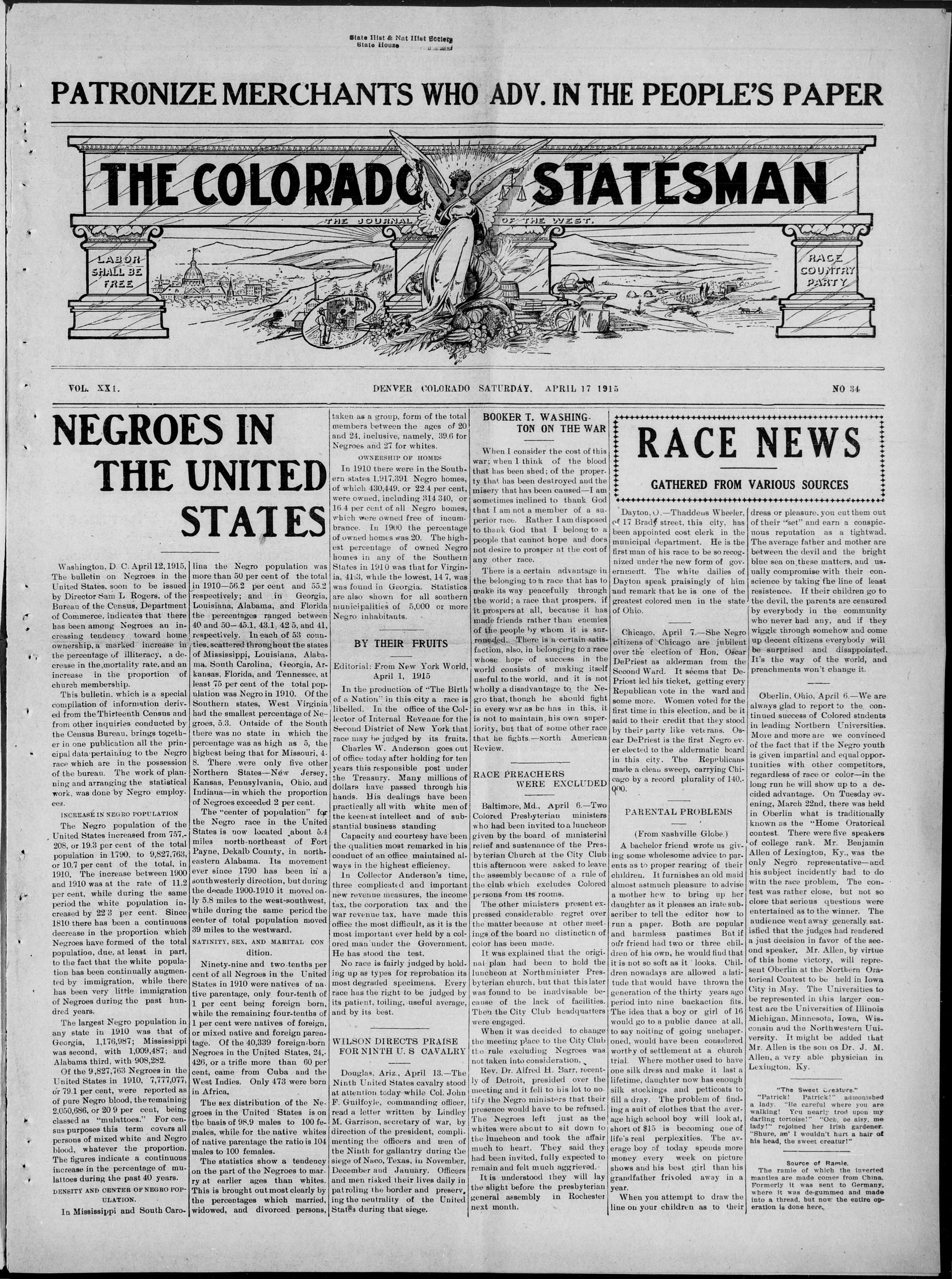
NEGROES IN THE UNITED STATES
VOL. XXI.
NEGRO
THE
Washington, D. C. April 12, 1915. The bulletin on Negroes in the United States, soon to be issued by Director Sam L. Rogers, of the Bureau of the Census, Department of Commerce, indicates that there has been among Negroes an increasing tendency toward home ownership, a marked increase in the percentage of illiteracy, a decrease in the mortality rate, and an increase in the proportion of church membership. This bulletin, which is a special compilation of information derived from the Thirteenth Census and from other inquiries conducted by the Census Bureau, brings together in one publication all the principal data pertaining to the Negro race which are in the possession of the bureau. The work of planning and arranging the statistical work, was done by Negro employees.
INCREASE IN NEGRO POPULATION
The Negro population of the United States increased from 757,208, or 19.3 per cent of the total population in 1790, to 9,827,763, or 10.7 per cent of the total, in 1910. The increase between 1900 and 1910 was at the rate of 11.2 per cent, while during the same period the white population increased by 223 per cent. Since 1810 there has been a continuous decrease in the proportion which Negroes have formed of the total population, due, at least in part, to the fact that the white population has been continually augmented by immigration, while there has been very little immigration of Negroes during the past hundred years.
The largest Negro population in any state in 1910 was that of Georgia, 1,176,987; Mississippi was second, with 1,009,487; and Alabama third, with 908,282.
Of the 9,827,763 Negroes in the United States in 1910, 7,777,077, or 79.1 per cent, were reported as of pure Negro blood, the remaining 2,050,686, or 20.9 per cent, being classed as "mulattoes." For census purposes this term covers all persons of mixed white and Negro blood, whatever the proportion. The figures indicate a continuous increase in the percentage of mulattoes during the past 40 years. DENSITY AND CENTER OF NEGRO POPULATION.
In Mississippi and South Caro-
lina the Negro population was more than 50 per cent of the total in 1910—56.2 per cent and 55.2 respectively; and in Georgia, Louisiana, Alabama, and Florida the percentages ranged between 40 and 50—45.1, 43.1, 42.5, and 41, respectively. In each of 53 counties, scattered throughout the states of Mississippi, Louisiana, Alabama, South Carolina, Georgia, Arkansas, Florida, and Tennessee, at least 75 per cent of the total population was Negro in 1910. Of the Southern states, West Virginia had the smallest percentage of Negroes, 5.3. Outside of the South there was no state in which the percentage was as high as 5, the highest being that for Missouri, 4.8. There were only five other Northern States—New Jersey, Kansas, Pennsylvania, Ohio, and Indiana—in which the proportion of Negroes exceeded 2 per cent.
The "center of population" for the Negro race in the United States is now located about 5.4 miles north-northeast of Fort Payne, Dekalb County, in northeastern Alabama. Its movement ever since 1790 has been in a southwesterly direction, but during the decade 1900-1910 it moved only 5.8 miles to the west-southwest, while during the same period the center of total population moved 39 miles to the westward.
NATINITY, SEX, AND MARITAL CON dition.
Ninety-nine and two-tenths per cent of all Negroes in the United States in 1910 were natives of native parentage, only four-tenth of 1 per cent being foreign born, while the remaining four-tenths of 1 per cent were natives of foreign, or mixed native and foreign parentage. Of the 40,339 foreign-born Negroes in the United States, 24,426, or a trifle more than 60 per cent, came from Cuba and the West Indies. Only 473 were born in Africa.
The sex distribution of the Negroes in the United States is on the basis of 98.9 males to 100 females, while for the native whites of native parentage the ratio is 104 males to 100 females.
The statistics show a tendency on the part of the Negroes to marry at earlier ages than whites. This is brought out most clearly by the percentages which married, widowed, and divorced persons,
DENVER COLORADO SATURDAY. APRIL 17 1915
State Hist & Nat Hist Booley
State House
GIANTS WHO
COLORADO
THE JOURNAL
DENVER COLORADO
taken as a group, form of the total members between the ages of 20 and 24, inclusive, namely, 39.6 for Negroes and 27 for whites. OWNERSHIP OF HOMES In 1910 there were in the Southern states 1,917,391 Negro homes, of which 430,449, or 22.4 per cent, were owned, including 314,340, or 16.4 per cent of all Negro homes, which were owned free of incumbrance. In 1900 the percentage of owned homes was 20. The highest percentage of owned Negro homes in any of the Southern States in 1910 was that for Virginia, 41:3, while the lowest, 147, was was found in Georgia. Statistics are also shown for all southern municipalities of 5,000 or more Negro inhabitants.
BY THEIR FRUITS
Editorial: From New York World, April 1, 1915
In the production of "The Birth of a Nation" in this city a race is libelled. In the office of the Collector of Internal Revenue for the Second District of New York that race may be judged by its fruits. Charles W. Anderson goes out of office today after holding for ten years this responsible post under the Treasury. Many millions of dollars have passed through his hands. His dealings have been practically all with white men of the keenest intellect and of substantial business standing. Capacity and courtesy have been the qualities most remarked in his conduct of an office maintained always in the highest efficiency. In Collector Anderson's time, three complicated and important new revenue measures, the income tax, the corporation tax and the war revenue tax, have made this office the most difficult, as it is the most important ever held by a colored man under the Government. He has stood the test.
No race is fairly judged by holding up as types for reprobation its most degraded specimens. Every race has the right to be judged by its patient, toiling, useful average, and by its best.
WILSON DIRECTS PRAISE FOR NINTH U. S CAVALRY
Douglas, Ariz., April 13.—The Ninth United States cavalry stood at attention today while Col. John F. Guilfoyle, commanding officer, read a letter written by Lindley M. Garrison, secretary of war, by direction of the president, complimenting the officers and men of the Ninth for gallantry during the siege of Naco, Texas, in November, December and January. Officers and men risked their lives daily in patrolling the border and preserving the neutrality of the United States during that siege.
BOOKER T. WASHINGTON ON THE WAR
When I consider the cost of this war; when I think of the blood that has been shed; of the property that has been destroyed and the misery that has been caused—I am sometimes inclined to thank God that I am not a member of a superior race. Rather I am disposed to thank God that I belong to a people that cannot hope and does not desire to prosper at the cost of any other race.
There is a certain advantage in the belonging to a race that has to make its way peacefully through the world; a race that prospers, if it prospers at all, because it has made friends rather than enemies of the people by whom it is surrounded. There is a certain satisfaction, also, in belonging to a race whose hope of success in the world consists of making itself useful to the world, and it is not wholly a disadvantage to the Negro that, though he should fight in every war as he has in this, it is not to maintain his own superiority, but that of some other race that he fights.—north American Review.
RACE PREACHERS
WERE EXCLUDED
Baltimore, Md., April 6.—Two Colored Presbyterian ministers who had been invited to a luncheon given by the board of ministerial relief and sustenance of the Presbyterian Church at the City Club this afternoon were asked to leave the assembly because of a rule of the club which excludes Colored persons from tts rooms.
The other ministers present expressed considerable regret over the matter because at other meetings of the board no distinction of color has been made.
It was explained that the original plan had been to hold the luncheon at Northminister Presbyterian church, but that this later was found to be inadvisable because of the lack of facilities. Then the City Club headquarters were engaged.
When it was decided to change the meeting place to the City Club the rule excluding Negroes was not taken into consideration.
Rev. Dr. Alfred H. Barr, recently of Detroit, presided over the meeting and it fell to his lot to notify the Negro ministers that their presence would have to be refused. The Negroes left just as the whites were about to sit down to the luncheon and took the affair much to heart. They said they had been invited, fully expected to remain and felt much aggrieved. It is understood they will lay the slight before the presbyterian general assembly in Rochester next month.
RACE NEWS
GATHERED FROM VARIOUS SOURCES
Dayton, O.—Thaddeus Wheeler, of 17 Brady street, this city, has been appointed cost clerk in the municipal department. He is the first man of his race to be so recognized under the new form of government. The white dailies of Dayton speak praisingly of him and remark that he is one of the greatest colored men in the state of Ohio.
dress or pleasure, you cut them out of their "set" and earn a conspicuous reputation as a tightwad. The average father and mother are between the devil and the bright blue sea on these matters, and usually compromise with their conscience by taking the line of least resistance. If their children go to the devil, the parents are censured by everybody in the community
Chicago, April 7.—She Negro citizens of Chicago are jubilent over the election of Hon. Oscar DePriest as alderman from the Second Ward. It seems that DePriest led his ticket, getting every Republican vote in the ward and some more. Women voted for the first time in this election, and be it said to their credit that they stood by their party like veterans. Oscar DePriest is the first Negro ever elected to the aldermatic board in this city. The Republicans made a clean sweep, carrying Chicago by a record plurality of 140.-000.
PARENTAL PROBLEMS
(From Nashville Globe.)
A bachelor friend wrote us giving some wholesome advice to parents as to proper rearing of their children. It furnishes an old maid almost astmuch pleasure to advise a mother how to bring up her daughter as it pleases an irate subscriber to tell the editor how to run a paper. Both are popular and harmless pastimes. But if our friend had two or three children of his own, he would find that it is not so soft as it looks. Children nowadays are allowed a latitude that would have thrown the generation of the thirty years ago period into nine backaction fits. The idea that a boy or girl of 16 would go to a public dance at all, to say noiting of going unchaperoned, would have been considered worthy of settlement at a church trial. Where mother used to have one silk dress and make it last a lifetime, daughter now has enough silk stockings and petticoats to fill a dray. The problem of finding a suit of clothes that the average high school boy will look at, short of $15 is becoming one of life's real perplexities. The average boy of today spends more money every week on picture shows and his best girl than his grandfather frivoled away in a year.
When you attempt to draw the line on your children as to their
NO 34
dress or pleasure, you cut them out of their "set" and earn a conspicuous reputation as a tightwad. The average father and mother are between the devil and the bright blue sea on these matters, and usually compromise with their conscience by taking the line of least resistance. If their children go to the devil, the parents are censured by everybody in the community who never had any, and if they wiggle through somehow and come up decent citizens everybody will be surprised and disappointed. It's the way of the world, and preachments won't change it.
Oberlin, Ohio, April 6.—We are always glad to report to the continued success of Colored students in leading Northern Universities. More and more are we convinced of the fact that if the Negro youth is given impartial and equal opportunities with other competitors, regardless of race or color—in the long run he will show up to a decided advantage. On Tuesday evening, March 22nd, there was held in Oberlin what is traditionally known as the "Home Oratorical contest. There were five speakers of college rank. Mr. Benjamin Allen of Lexington, Ky., was the only Negro representative—and his subject incidently had to do with the race problem. The contest was rather close, but not so close that serious questions were entertained as to the winner. The audience went away generally satisfied that the judges had rendered a just decision in favor of the second speaker. Mr. Allen, by virtue of this home victory, will represent Oberlin at the Northern Oratorical Contest to be held in Iowa City in May. The Universities to be represented in this larger contest are the Universities of Illinois Michigan, Minnesota, Iowa, Wisconsin and the Northwestern University. It might be added that Mr. Allen is the son os Dr. J. M. Allen, a very able physician in Lexington, Ky.
"The Sweet Creature."
"Patrick! Patrick!" admonished a lady. "Be careful where you are walking! You nearly trod upon my darling tortoise!" "Och, oe alisy, me lady!" rejoined her Irish gardener. "Shure, am' I wouldn't hurt a hair of his head, the sweet creature!"
Source of Ramle.
The ramie of which the inverted mantles are made comes from China. Formerly it was sent to Germany, where it was de-gummed and made into a thread, but now the entire operation is done here.
FOREIGN
ferers from the war.
An accident in a coal mine near
Shimonoseki resulted in the loss of
236 lives, according to information re-
ceived in Tokio,
Pope Benedict issued a decree for
the recital of prayers for peace in
Roman Catholic churches over the
world during the month of May.
Six thousand bales of American cot-
ton aboard the steame San Gugliel-
mo were destroged by fire in the har-
bor at Naples, Italy. The loss is es-
timated at 1,000,000 lire ($200,000.)
The Alaska Senate passed a bill
submitting territorial prohibition to
the voters at the November election
in 1916. If the voters approve pro-
hibition, it will become effective Jan.
1, 1918,
Demos Lermos, one of the most no-
torious outlaws of the Arizonayonora
border, was hanged with three com-
panions forty miles east of Agua
Prieta by a border patrol of Gen. P.
Elias Calles’ forces.
The charge that explosives and
spare parts of guns are being carried
into Turkey through Rumania by Ger-
man and Austrian diplomatic couriers
is made in a dispatch to the Paris
Journal from Bucharest.
_ Four men and a boy were blown to
pieces, forty persons badly injured
jand the big city herring market
‘gutted by fire in a mysterious explo:
‘sion at Lerwick, capital of Shetland,
according to a wireless message re.
ceived in London.
The countess of Granard, who was
Miss Beatrice Mills daughter of Og:
'den Mills of New York, has giver
| birth to a son in London. He will
be given the title of Viscount Forbes.
‘The earl and countess of Granard have
two other children, both girls.
| SPORTING NEWS
| It has been announced that Ad Wol.
Bast will meet Freddie Welsh in Mil
waukee on May 4 in a ten-round, no
decision bout.
President McGill of the Denver
Western league baseball club pur.
chased outright John Dell, an out.
fielder from the Columbus Club of the
American Association, and two other
players,
W. R. Applegarth defeated Jack
Donaldson of Australia in a 220-yard
race at Salford, England, for the
world’s profesional championship for
that distance, held by Donaldson.
Applegarth’s time was 2214 seconds.
Al Reich and Jim Coffey, two of
Jess Willard’s foremost challengers
will get together in the ring with the
champion as referee some time in
May, if statements by their respective
managers issued in New York count
for anything.
Rube Smith, a light heavyweight o
Denyer was knocked out in the twelfth
round of a bout at Cripple Creek by
George Coplan of Cripple Creek. ‘The
fight was staged by the Cripple
Creek Athletic Club and a crowd of
1,400 attended,
The Philadelphia Country Club pole
team defeated the Boise, Idaho, four
on the San Mateo polo field by a
score of 17 to 101% goals in the second
round for the Polo Association cups
in the Panama-Pacific exposition
tournament at San Francisco.
Bob Fitzsimmons, the former
heavyweight champion, was married
in Washington to Miss Temo Zillen,
who has been associated with him for
some time in theatricals, The bride's
gift from the bridegroom is said to
have been $85,000 in jewels,
GENERAL
E. B. Parkhurst was killed and s
traction engine he was driving was
demolished when run down by a
Union Pacific fast passenger train at
Durham, fifteen miles east of Chey.
enne, Wyo.
Averaging 130 words a minute for
one hour, notwithstanding deductions
of five words each for forty-four er
| rors, Miss Mary B. Owen of Passaic,
N. Y., made a new world’s record for
speed in typewriting at Boston.
Seventy thousand milk bottles,
worth, empty, $3,500, have been con:
demned and seized in the last two
weeks for being short measures by J.
E, Harshman, sealer of weights and
To Ee ganic meres Ba tee ee
NEWS TO DATE
IN PARAGRAPHS
DURING THE PAST WEEK
Decorations have been conferred by
the emperor of Russia upon sixty-one
French officers, 500 non-commis-
sioned officers and 700 soldiers, all
of whom have distinguished them-
relves in yarious Ways since the war
began.
The bombardment of Gaza marks
the development of hostilities in @
new quarter, Gaza is in southern
Palestine, near the Egyptian frontier.
‘The city lies two miles inland from
the Mediterranean and forty-eight
ailes southwest of Jerusalem,
In a sortie Tuesday the Carranza
garrison at Matamoras inflicted a
heavy blow upon the Villa army be-
sieging them. Gen. Saulo Navarro,
second in command of the Villa
troops, was taken to Brownsville,
Tex. dangerously wounded, and the
Carranza consulate there claimed that
the Villa dead numbered 300.
With the capture by the Russians
of Hill $92 and the rest of the main
chain of mountains the battle of the
Carpathians, which has lasted up-
ward of eighty days, has apparently
come to an end over one extensive
front, for the Russians are now mov.
ing by railways and roads and along
the rivers and streams, down the
southern slopes on the plains of Hun-
gary.
German submarines have again
been showing activity and, besides the
Harpalyce which, according to one
member of her crew and the officers
of another steamer, was torpedoed,
they have attacked since Saturday
night the British liner Wayfarer, the
French steamer Frederic Franck and
the little steamer President, ‘The
Wayfarer reached Queenstown in a
sinking condition; the Frederic Franck
was towed into Plymouth, and the
President was still afloat when her
crew of ten left her.
Reports from Carranza officers and
soldiers in Nuevo Laredo, Mex., state
that 350 Villa soldier, who sur.
rendered after the battle between
Vilia and Carranza armies near
Huisachito, thirty miles south of the
border, as well as a number of Mexi-
can women, variously estimated at be-
tween ten and eighteen, were sum.
marily executed by the Carranza
forces, It was stated that a Carranza
general ordered machine guns turned
on one party of surrendering Villa
men, resulting in the death of seventy:
six In the party while the wounded
were bayoneted,
WESTERN
At Madison, Wis., the assembly
passed the antitipping bill.
Edward Preston Moxey, formerly
special bank examiner for the United
States government, died suddenly in
Chicago.
Governor W. C. McDonald of New
Mexico wired to Governor Carlson
that New Mexico has lifted its stock
quarantine against Colorado, Arizona
and Texas
The bodies of Mrs. Luther A. Leon:
ard and her four children’ were found
in the family home at Spokane, Wash.
The police reported Mrs, Leonard had
poisoned her children and then had
poisoned herself.
‘The trial of Charles Ebenbach, an
Idaho ranchman, charged with having
perpetrated the sensational Yellow-
stone park stage robberies last sum-
aer, was started in Sheridan, Wyo.,
at a special term of the United States
District Court held in that elty,
An indictment charging forgery in
the first degree was voted by the
erand jury at St. Louis against A, H,
Frederick, president-elect of the first
board of aldermen chosen under the
mew city charter. The minimum
penalty for this offense is ten years’
imprisonment
WASHINGTON
Authorities at Hong Kong require
all persons pasing through that colony
10 show passports.
Secretary McAdoo of the treasury
and Comptroller of the Currency John
Skelton Williams were made defend-
ants in proceedings begun in the Dis-
trict of Columbia Supreme Court by
the Riggs National bank of Washing-
ton, D.C, which alleges that these
officials haye combined and conspired
to wreck that institution.
Department of commerce statistics
show 714 vessels of all classes, with
an aggregate tonnage of 153,328 were
built during the last nine months,
while in the same period a year ago,
$91 vessels, with a total tonnage af
215,059 were built.
Notification was received by the
State Department of the virtual set-
flement, without prize court proceed.
ings, of the case of the American
steamer Wilhelmina, held up at Fal-
mouth, Englanc, while bound for Ger-
<< ___
OF INTEREST TO ALL
COLORADO
PEOPLE
Western Newspaper Union News Service.
COMING EVENTS,
June 9-11—G. A. R encampment at La
Junta
Sept. 27-Oct. 8.—Meeting International
Dry), Farming Congress ate ot
“ry warming Congress at Denver
“Clean-up and paintup” week in
Denver begins May 10.
Colorado pioneer printers had
dinner and social in Denver,
The old creamery building at
Rocky Ford was destroyed by fire.
About 1,400 wagon loads of trash
were hauled away in Grand June
tion's clean-up campaign.
Cyrus A, Scott, forty-two, was killed
when his motorcycle crashed into a
taxicab at Colorado Springs.
A sufficient acreage has been con
tracted for beets to run the factories
at Las Animas and Rocky Ford.
Longmont farmers are planting
beets, About 20,000 acres have been
contracted by the Longmont factory
Thomas Kyner, Sr., seventy, pub-
lisher of the Cripple Creek ‘Times,
died of Bright's disease in Kansas
City.
TseNeGat, the Ute Indian, await:
ing trial on a murder charge in the
Federal Court, is seriously ill in the
Denver county jail
Mrs, Marie Cornell Squire, seveuty-
eight, niece of Ezra Cornell, founder
of Cornell University at Ithaca, N. Y.,
died at her home in Denver.
Mrs. Sarah 1. Carstarphen, who
died at her home in Denver, was a
classmate and playmate of Mark
Twain, and was herself famed ior her
wit,
J. Jensen, thirty-five, and Harry
Willis, forty-one, were seriously in
jured when thrown from the bumpers
on a Rock Island freight train near
Genoa,
Steps are being taken to have Presi
dent Wilson visit Denver this fall dur-
ing the sessions of the International
Dry Farming Congress and to deliver
an address at the gathering,
Plans for giving wide publicity to
Scenic attractions of northern Colo:
rado and for advancing and cementing
its interests as a tourist center, will
be outlined at a meeting in Boulder.
Michael Carroll, Denver's oldest
resident, aged ninety-eight years seven
months and three days, died at the
home of John F. Alwert, Bronchitis
caused his death after an illness of
three days,
B. R, Wilkerson, traveling man, who
attacked Miss Lillie Holbrook, former
Denver university student, on a train
en route from Pueblo to Denver sev-
eral weeks ago, was fined $100 and
costs in Walsenburg.
Louis M. Reeves, expert bank ac-
countant for the Department of Jus-
tice, arrived in Pueblo and began an
investigation to learn if there was
any criminal lability in the affairs
of the defunct Mercantile National
bank.
George Thomas, colored, the trusty
Who “escaped” from the penitentiary
at Canon City, dfdn’t escape at all.
He was found hiding under an unused
stairway in a deserted basement after
guards had searched the entire insti
tution,
Mrs, Manda Shelden, eighty-tive, a
Prominent worker in the Methodist
churches of Denver and widow of one
of the first itinerant ministers of the
Methodist church in Ilinois, died at
the home of her son, Watt G. Sheldon,
in Denver.
Cornelia Baxter-Tevis-MoKee has
acquired a new name, She is now
Cornelia Baxter-levis-McKee-Tomley.
According to a cable from Paris, the
former Denver beauty was married to
Evelyn Tomley, an Englishman, who
represents Lloyds in Paris
The largest shipment of thorough-
breds that has ever pulied out of BL
Paso left there for Overland park to
participate in the race meet to be
held under the auspices of the Colo-
rado Agricultural Fair and Racing As-
sociation in Denver,
Cases against twelve men which
Grew out of the strike disorders in the
‘Trinidad district were nolled in the
District Court by John J, Hendrick,
district attorney. ‘The charges in-
cluded picketing, intimidation, assault
to murder, assault with intent to kill
and murder,
Mrs. Mabel Bell Porter, formerly
known as the “Evelyn Thaw of Den-
ver,” who was the central figure in a
trial in the West Side Court in Jan-
uary, 1909, when her first husband,
Burdette Bell, was convicted of killing
C. C. Dury, an actor, whom he charged
with stealing his wife's love, again
is in the spotlight. A few days ago
she obtained a divorce in the County
Court from Charles Porter, whom she
married shortly after she obtained a
divorce from her convict husband.
{mprovements amounting to many
bere enon ae eae oe ee
FIND BODY OF J. H. CLARK
STATE TREASURER'S BOOK-
KEEPER COMMITS SUICIDE.
Note Left for Wife Says Ac-
Werlern Newspaper Union News Service.
Denver.—The body of Julius H.
Clark, who for twenty years had been
the head bookkeeper in the office of
successive Colorado state treasurers,
was found in a pile of brush on the
Campbell ranch one and one-half
miles east of the entrance of Fair
mount cemetery Monday afternoon
with a bullet wound through the top
of the head. A brush fire started by
a farm hand who cleared the ground
for plowing had charred and burned
the features almost beyond recogni:
tion. %
Deputy Coroner J. R. Nickels of
Arapahoe county gave a verdict of sui.
cide on the scene.
A s2caliber revolver, a gold watch
with Clark’s initials, his spectacles
and a letter addressed to Mrs. J. H.
‘lark at 1259 Steele street, were
found, and these aided in the identifi-
vation, Clark had been missing from
his home for a week, He was sixty-
one years of age.
In the letter penned by Clark and
left for his wife, the statehouse book-
keeper declared the committee ap-
pointed by the last Legislature had ex.
amined his books and found a short-
age and that he had been waiting at
his home for them to act.
He said his personal bond to the
various treasurers would cover his
shortage. He closed tnis last message
with a warning to all men in a post
tion of trust, and said his suicide
would be a warning to others, but
would not prevent a repetition of the
same offense.
State Treasurer Allison Stocker
said Monday that up to this time he
had discovered no shortage in Clark's
accounts, He said he had noticed the
bookkeeper was acting strangely for
tome months past and feared ie
wouid end his life. He said he was
planning a new check of the books to
get the exact status of his accounts.
J. S. Temple, deputy treasurer,
made the same statement as his su
perior,
Friends of the suicide declared he
had been despondent for months
They stated he had appeared to have
gone to pieces and at the treasurer's
office he had been given a vacation
to regain his mental poise.
Adventists Expel Wife Who Erred.
Boulder.—Mrs. A. S. Beers, whose
husband is in the county jail under
conviction for murder in the second
degree, was expelled from the Sey:
enth Day Adventists’ church at Hy:
giene, by a vote of two to one. Beers,
who killed William Hopkins because
of his alleged relations with Mrs.
Beers, resigned from the church, of
which he had been a prominent mem:
ber, a few days after his arrest, Dec.
23. The reason for Mrs. Beers’ ex:
pulsion was the intimacy with Hop:
kins, which she confessed on the wit
ness stand when called to testify In
her husband's behalf.
Colorado Lambs Bring Top Prices.
Fort Collins. —Larimer county lambs
have this year been topping the mar.
ket at the river points, Saturday’s
market at St. Joseph, Mo., was $10.45
for $2-pound lambs, and Joseph Glick
of Fort Collins sold 1,000 lambs at
that figure. This price, according to
authorities, is equal to $10.75 in Chi
cago. The record price ever paid for
lambs at Chicago was $10.60, which
was paid five years ago for Larimer
sounty lambs.
Harriman Shot: Through. Lune:
Gunnison.—Ralph Harriman, 30, was
shot through the right lung by his
brother-in-law, Harry Nixon, 25, during
a pistol duel between the men at Pit-
kin, twenty-eight miles from here.
Nixon shot at Harriman seven times
and Harriman fired five shots. Harri
man is not expected to live. The
shooting arose over the domestic af-
fairs of the Nixons.
Ranchman Slays Son With Knife.
Montrose.—S. D. Wilson, a well-to
do farmer of Nucla, Colo., stabbed his
son, Levert Wilson, to death at his
home, according to a telephone mes-
sage received by Coroner J. Q. Allen
of Montrose county. The elder Wil-
son is said to have been terribly
beaten by his son during the fight,
and for that reason he has not been
arrested or moved from his ranch.
Jones Surrenders After Shooting.
‘Trinidad.—Walking into the sher-
iff’s office here, J. W. Jones, 50, a
wealthy ranchman of the Aguilar dis-
trict, surrendered three revolvers anc
announced that he had shot George
Green, 6, @ ranchman,
Money Order Forger Sentenced.
Greeley.—Frank Hall, who pleaded
guilty to the charge of passing forged
money orders that he had stolen
from the office where his brother
worked as agent in Holly, and who
came to Evans to spend the proceeds
of one of them, made out in the sum
of $50, was sentenced to from one to
three years in the penitentiary by
Judge Graham. Jose Reyes, the Mexi-
can who pleaded guilty to stealing a
quarter of beef from the back porch
of the J. E. Neill home, was given a
reformatory sentence.
_ Cee ae
The Saar ee ee ay,
The A hae
Curtis 48 ps ea aE ,
Park © fo ( PA \Z ee mf
RS ace
Floral Seg ) sa
| PRN GY ht:
Company Qf A
‘FLORAL DESIGNS SZ" pet
| CHOICE PLANTS AND CUT FLOWERS SosHAewx “ON
GREENHOUSES: Thirty-Fourth and Curtis Streets
| TELEPHONE, MAIN 1511 DENVER, COLO
When You Want
The Heads, Feet, Tails Snouts, Neckbones
or Chiterlings or any other part of the hog
except the squeal go to
9
East's MarKet
2800-6 Larimer Street. Phone Main 1461.
The Champa Pharmacy
Twentieth and Champa, ~
Is the place to got your
DRUGS, CHEMICALS AND PATENT MEDICINES
WH SERVE DRINES.
Prescriptions Our Specialty.
Phone us and we will deliver the goods to all parts of tho city.
JAMES E. THRALL, Propr.
a PHONE MAIN 2426.
THE ZOBEL BROTHERS’
1004 Nineteenth Street, Corner of Curtis
‘FINE WINES, LIQUORS AND CIGARS
COORS' CELEBRATED BEER ON TAP
DENVER COLORADO
Ge eg he en NSE GSN PE Cn ay a
; Ghe 5
3
: WARD AUCTION |
t 3
+
3
< 3
: 3
‘
: 3
$ Sales Dally at 2 p.m. Office Fur. >
t niture a Specialty. 2
t =— 3
3
PRIVATE SALES AT ALL TIMES 3
t = 3
$ HAVE MOVED TO— 3
; 9172339 GLENARM sT.-we
+ PHONE MAIN 1676. 3
Lettttteseertesssssrereees
THE BEST ICH CREAM AND
: CANDIES AT
+ 0.P.BAUR @ CO.
t
i CATERERS AND
CONFECTIONERS
¢ Phone: 168
t
I 1512 Curtis Street, Denver, Colo.
Bee ice he ia Ls aay
DO ITNOW S3383
J. H. BIGGINS
Furniture Repairing and Up-
holstering, All work Cash.
PHONE YORE 7837
1417 East 24th Ave Denver
| Miss M. Cowden
Hair Dressing Parlor
Shampoo, cutting and curling.
Scalp treatment, hair tonics,
hair straightening, manicuring.
Stage wigs for rent; theatrical
use and masquerades,
Goods delivered out of the
city. All shades of hair matched
by sending sample of hair; also
combings made up.
¢ Cheapest Switches 50 Cents
1219 21st St. Denver, Colo.
AFRO-AMERICAN CULLINGS
There died in Montgomery a short time ago a Scotchman who did a noble work in the education of the Negro race in Alabama, and his passing has made a vacancy that will not be easy to fill. His name was W. B. Paterson; his fame was purely local, for he did not make the big noise, and because he was a white man conducting a Negro school he did not get the notoriety that has been such a factor in the upbuilding of the noted Negro educators of the South.
Professor Paterson drifted in Alabama about 1870, looking for work. He was homeless and friendless, afflicted with an incurable deafness that made social intercourse an impossibility with him. He had tramped from New York to Omaha and then back East looking for work, but could find none. By trade he was a gardener. His forebears before him had been gardeners on the estate of a Scotch Laird Albemarle, or some such name, and he had learned their trade. He got a job at Marion, on a plantation, digging ditches and doing ordinary farm work along with the Negroes, and this proximity taught him the exact condition of the Negro's intelligence and educational advancement. Out of it came a Negro school that grew until it became a state normal with a large patronage. The plantation owner for whom he worked took a fancy to him and helped him on with the first school, and with this encouragement he built up an establishment that was too large for Marion. The Scotch gardener had his eye on the state capital, and he made his plans to move his school there.
When it became known in Montgomery that a white man was going to move a Negro school to that city, a mass meeting of the citizens was held and speeches were made, as Professor Paterson often afterward said, "they almost tarred and feathered him." This latter was in a figurative sense only. Nothing daunted, the schoolmaster moved his school to Montgomery, and went quietly about his business. He conducted an orderly institution; he taught the Negroes domestic science, manual training, trades, the dignity of labor, the value of keeping in the place the white people of the South said the Negro must keep. There was no social equality of the races there, and never in the more than forty years of the life of the school under Professor Paterson was there so much as an intimation that he taught such or practiced it. The Negroes had great and grave reverence for him, that was almost patriarchal in its simplicity.
Montgomery quieted down after the school was settled, and in a few years began to look upon it as an asset and on Professor Paterson as a public benefactor. Year by year he increased the membership of his school, and in order to make it self-sustaining and to make it possible for the students to pay their way through, he placed them in the homes of Montgomery as servants, fixing the school hours so that they could do their domestic work and carry on their studies too. His training made itself felt for the servants in Montgomery, and they were in demand. Montgomery is now full of them, and they all command high wages because they can earn them. That in itself is tribute enough for the school and for the memory of this good man.
Of the thousands that went through this school, some were found to pos-
Christ church, Providence, was the first effort of the late Rev. Dr. Crummell, following his ordination in St. Paul's church, Boston, in 1842. He soon relinquished it. Rev. Mr. Stokes, ordained by Bishop Whittington, in St. James' church, Baltimore, in 1843, organized St. Luke's church, New Haven, the following June. In a year or so, having been priested by the bishop of Connecticut, Mr. Stokes yielded to his old friend, whom he had known in Baltimore, Bishop Henshaw, and moved to Providence. About 1850 he went to Africa as a missionary. The Providence church was left without a pastor, and it seems to have gradually gone out of existence. What became of the money from the sale of the church we do not know.
During all our experience, we have never known any two white priests more devoted to the welfare of the colored people, than the late Calbraith B. Perry and Robert H. Paine. If I mistake not, both of them were natives of Rhode Island. Here is a splendid opportunity for the friends of Messrs. Perry, Paine and Crummell
Honduras, in Central America, reports a quiet and prosperous period for the year 1912-13. Actual receipts exceeded expenditures by $103,000. There were no political disturbances of any character. It is about as large as the state of Pennsylvania.
In a London museum is a clock which indicates on the main dial the Greenwich time, and on eight smaller ones the time in as many large cities in the world. The clock also tells the date and has a barometer attached.
ssess intelligence and scholarship enough for higher training, and they were given it, and today they fill places of responsibility as teachers and principals and superintendents of Negro public schools in the large cities of Alabama and neighboring states.—Mobile Register.
About two years ago St. Augustine's mission among the colored people of Providence, R. L., was initiated, writes a correspondent of The Living Church. From a recent account in a church paper, I note the following: "The church building used for the services is rented property, and is likely to be sold at any moment."
The purpose of this article is to point out that as early as 1843 there was a parish of colored people in Providence, "Christ church;" that the parish having gone out of existence, the money for freeing the church building from debt having been raised in England by a colored priest, and turned over to the diocesan authorities in trust, it seems to me that in this emergency the diocesan authorities should welcome the opportunity for making restitution. Here is an extract from the Episcopal address of Bishop Henshaw, in 1849, which throws light upon the matter:
"At the time of the meeting of the last annual convention, Rev. Eli W. Stokes, rector of Christ church in this city, was absent, in Europe, for the purpose of soliciting funds to liquidate the debt by which that parish has been embarrassed ever since their house of worship was erected. In consequence of a certificate, required by the laws of England, furnished by me, he was received with great kindness by the archbishops, bishops and clergy of our mother church; and I am happy to inform you that his mission was crowned with entire success, and the liberal contributions which he received in that distant land have enabled the gentlemen holding the property in trust to make a satisfactory settlement with the mortgages. The congregation is now free from debt, and our colored brethren have wisely made over their corporate property to the 'board of commissioners for church building' with a view of security against embarrassment and incumbrance for the time to come. The Christian generosity with which our English brethren answered the appeal made to them in behalf of that feeble parish has been duly acknowledged in a letter addressed by me to his grace the archbishop of Canterbury, and through him to the church over which he worthy presides."
District Commissioner Louis Brownlow and Charles E. Nesbit, superintendent of insurance of the district, were speakers at a meeting in the Metropolitan A. M. E. Zion church, under the auspices of the trustees and Men's club of the church, relates the Washington Star.
The commissioner spoke of the value of vocational training, and declared that improvement in living conditions is responsible for a reduction in the mortality rate of the colored population of Washington.
Mr. Nesbit urged the men's clubs of colored churches to take an interest in insurance matters, with the object of protecting members of their race against the practices of unscrupulous companies.
to honor them in making this church at Providence, for colored people, all that it ought to be, and a fitting memorial to these pioneer laborers among the colored people.
Alexander Crummell was the first black man to be ordained to the ministry of the church on the soil of New England. Christ church, Providence, was the first parish of colored persons ever organized in the territory of New England. And it was the very first colored church, anywhere in the United States, to be received into union with a diocesan convention. Three colored men sat as deputies from that parish at the diocesan convention which met in St. Stephen's church, Providence, in June, 1843—George F. Bragg, Jr., in the Living Church.
One of the poorest imitations is that given by the woman who is trying to simulate indifference to the fact that she wasn't invited to the party.
There is no particular reason for it but the effeminate man is always called "Lizzie."
To prevent shoe laces from becoming untied a New York inventor has patented small metal clasps to be fastened to the tops of shoes to hold their ends.
The Italian city of Milan has changed from gas street lighting to electricity generating its current by Alpine water falls, nearly one hundred miles away.
If you wish to wring an expression of contempt from a man, refer casually to the woman who jilted him.
ACCORDING TO SECRETARY OF WAGE COMMISSION.
Investigation Shows Conditions in Denver Better Than in Many Cities of the East.
Denver—Mrs. Catherine Van Deusen, secretary of the State Minimum Wage Commission, told the civic federation the results of her investigation of wage conditions in Denver among the women employés in the stores and factories.
"I found," she said, "that 54 per cent of the 2,524 women employed in the stores, factories and laundries are working for less than $8 a week. In the 5, 10 and 15-cents stores, 91.2 per cent of the women employed receive less than $8 a week.
"The employers aided me in every way possible in my investigations. They turned over their payrolls without the slightest protest. I questioned them as to their attitude toward a minimum wage for women and most of them expressed themselves in favor of it.
"In some of the places I found many things were being done for the comfort of the women. In the stores the interest taken in the health and welfare of the employés really is surprising. In all the stores the employés have mutual insurance societies that pay benefits to the sick." In the cities in the East where minimum wage boards investigated living conditions among women employés, Mrs. Van Deusen said, it was found that the least sum on which a woman could maintain herself, according to a decent living standard, was from $8.35 to $8.65 a week.
Colorado Excels in Grain Crops.
Denver.—According to the governments April crop report, the condition of winter wheat in Colorado is 3.2 per cent better than the average condition over the rest of the country, while the condition of rye is 3.5 per cent better than that in the country as a whole. The figures give Colorado's condition on wheat as 92 per cent, as against 88.8 in the entire country. Condition of rye is 93 for Colorado, against 99.5 in the country. Rye in Colorado is 1 per cent better than the seven-year average, but wheat is 2 per cent below the average condition. The price for wheat in Colorado is given at $1.15 a bushel, against $1.37 in the country. But the wheat price in Colorado has increased from 78 cents a year ago. Corn is the same as last year—71 cents in Colorado, against 75.1 cents in the country. Rye shows the greatest proportionate gain in price—94 cents at present, against 56 cents a year ago. The prices of potatoes and hay have been reduced—54 cents against 59 cents for the former, and $7 against $9.80 for the latter.
Senate Confirms Appointments:
Denver.—Governor Carlson Saturday night submitted the following appointments to the Senate, which were forthwith approved by that body:
Governor Carlson Signs Labor Bills.
Denver:—Just a few minutes before 8 o'clock Saturday evening Governor Carlson signed the two measures which are the major laws enacted by the Twentieth General Assembly. They were the acts creating the state commission on industrial relations and providing for a system of workmen's compensation. Governor Carlson was in a felicitous mood as he signed the bills and thus changed into laws the legislative measures that he considers will do most to assure industrial peace in Colorado.
Says Women Will Heal Scars of War.
Denver.—Out of the bloodshed and turmoil of the war gripping Europe will come a binding of ties between women of the nations involved which will serve in the future to prevent such conflicts, in the opinion of Mrs. Mary C. C. Bradford, state superintendent of public instruction. Mrs. Bradford's belief is based on numerous letters which have come to the Woman's Peace Party of America from some of the foremost women of nations at war in Europe.
LEGISLATIVE SESSION ENDS
LEGISLATIVE SESSION ENDS
TWENTIETH GENERAL ASSEMBLY
OF COLORADO PASSED 250
OUT OF 1,092 BILLS.
PASS CIVIL SERVICE ACT
APPROPRIATIONS TOTAL $1,462,
265, COMPARED WITH $1,486,
185 TWO YEARS AGO.
Western Newspaper Union News Service
Denver. — The Twentieth General Assembly passed 250 out of 1,092 bills introduced, on the 10th. The adopted bills of the session included the workmen's compensation act, two of the so-called anti-Lindsey bills, the prohibition penalty bill and the civil service act.
When the session closed, sixty-two bills had been signed by the governor.
Abolition of the Denver Juvenile Court became dependent on the action of Governor Carlson when the State Senate voted, 18 ayes to 16 nays, to repeal the law creating the court, and by a vote of 18 to 15 passed on final reading a measure turning over to the District Court of Denver the pending business before the Juvenile Court and transferring all powers and au thorities of the Juvenile Court to the District bench.
Two companion bills, one giving the Denver district bench an additional judge and the other transferring divorce and alimony matters from the County Court to the District Court of Marital Relations created by the bill, were killed, the first by a vote of 18 nays and 17 ayes, and the second by a vote of 20 nays to 15 ayes.
A large number of bills were rushed through during the last afternoon of the session and sent to the governor.
Concurrence was voted by the House to the Senate amendment to the House bill fixing the millage of the Capitol Board at .07 of a mill. The House originally placed it at .05 of a mill. The Senate raised it to .07 of a mill. For the 1912-1914 period it was .15 of a mill.
The general appropriation bill for the biennial period which began on Dec. 1 last, carries a total of $1,462.265.
Following are the sums appropriated for the present and the preceding biennial periods, exclusive of special levies:
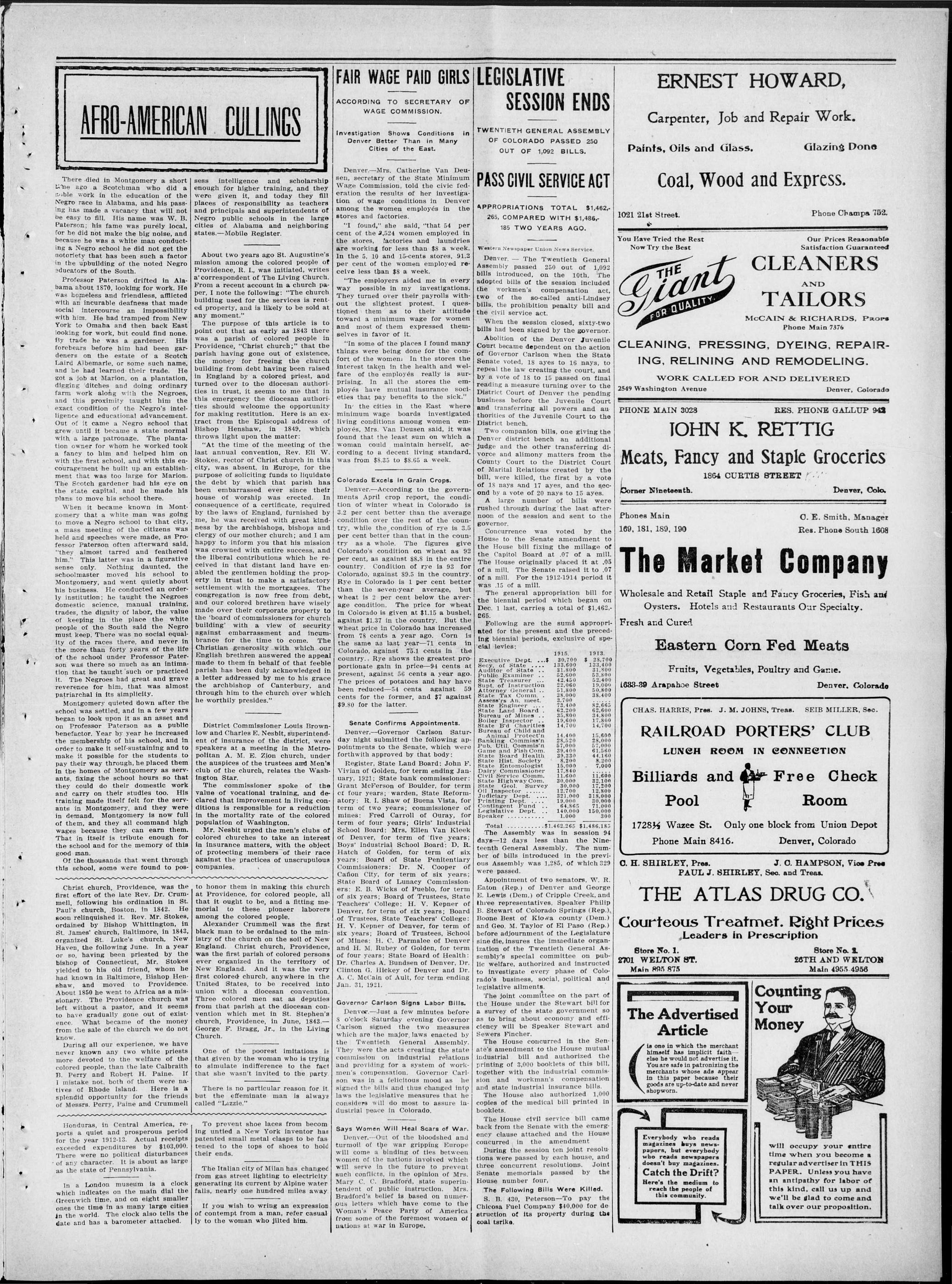
1915. 1913.
Executive Dept. ... $ 30,700 $ 28,700
Secy, of State ... 133,600 133,400
Auditor of State ... 152,600 152,800
State Treasurer ... 42,450 52,400
Supt. of Instruction ... 22,060 19,000
Attorney General ... 51,800 50,800
State Comm. ... 38,400
Assess's Annot. ... 3,700
State Engineer ... 73,400 82,665
State Land Board ... 62,200 62,600
Bureau of Affairs ... 35,800 35,800
State Inspector ... 19,600 18,700
State 'Bard Charities ... 14,700 14,700
Bureau of Child and
Anima 'Protect'n ... 14,400 15,600
Bathing House ... 28,520 28,000
Pub. Util. Commis' ... 57,000 57,000
Game and Fish Com. ... 39,400 61,560
State Board Health ... 39,330 44,160
State Entomologist ... 84,000 84,000
Dairy Commissioner ... 17,840 ...
Civil Service Comm. ... 11,600 11,600
State Geol. Survey ... 30,000 17,200
State Geol. Survey ... 30,000 17,200
Oil Inspector ... 12,700 12,800
Judiciary Dept. ... 321,000 318,000
Judging Department ... 30,000
Consultant Fund ... 64,865 150,000
Legislative Dept. ... 140,000 150,000
Speaker ... 1,000 300
Total ..... $1,482,265 $1,486,185
The Assembly was in session 94
days—12 days less than the Nineteenth General Assembly. The number of bills introduced in the previous Assembly was 1,285, of which 329 were passed.
Appointment of two senators, W. R. Eaton (Rep.) of Denver and George E. Lewis (Dem.) of Cripple Creek, and three representatives, Speaker Philip B. Stewart of Colorado Springs (Rep.), Boone Best of Kiowa county (Dem.) and Geo. M. Taylor of El Paso (Rep.)
before adjournment of the Legislature sine die, insures the immediate organization of the Twentieth General Assembly's special committee on public welfare, authorized and instructed to investigate every phase of Colorado's business, social, political and legislative ailments.
The joint committee on the part of the House under the Stewart bill for a survey of the state government so as to bring about economy and efficiency will be Speaker Stewart and Sewers Fincher.
The House concurred in the Senate's amendment to the House mutual industrial bill and authorized the printing of 3,000 booklets of this bill, together with the industrial commission and workman's compensation and state industrial insurance bills.
The House also authorized 1,000 copies of the medical bill printed in booklets.
The House civil service bill came back from the Senate with the emergency clause attached and the House concurred in the amendment
During the session ten joint resolutions were passed by each house, and three concurrent resolutions. Joint Senate memorials passed by the House number four.
The Following Bills Were Killed.
S. B. 430, Peterson—To pay the Chicosa Fuel Company $40,000 for destruction of its property during the coal tsrike.
ERNEST HOWARD,
Carpenter, Job and Repair Work.
Paints, Oils and Glass.
Coal, Wood a
1021 21st Street.
You Have Tried the Rest
Now Try the Best
Wood and Express
Pho
Our Satisfaction
CLEAN
AND
TAILOR
Coal. Wood and Express.
THE Giant FOR QUALITY.
CLEANING, PRESSIN
ING, RELINING A
WORK CALLED FOR
2549 Washington Avenue
PRESSING, DYEING, CLEANING AND REMODEL ALLED FOR AND DELIVER
CLEANING, PRESSING, DYEING, REPAIRING, RELINING AND REMODELING.
WORK CALLED FOR AND DELIVERED
2549 Washington Avenue Denver, Colorado
JOHN K. Meats, Fancy and
IN K. RETTIG
cy and Staple G
1864 CURTIS STREET
C. E. S
Pos. Pl
The Marke
Wholesale and Retail Staple and
Oysters. Hotels and Re-
Fresh and Cured
Eastern Corr
Fruits, Vegetables,
1633-39 Arapahoe Street
CHAS. HARRIS, Pres. J. M. JOHN
RAILROAD POOL
LUNCH ROOM
Billiards and
Pool
1728½ Wazee St. Only o
Phone Main 8416.
C. H. SHIRLEY, Pres.
PAUL J. SHIRLEY
THE ATLAS
Courteous Treatm
Leaders in P
The Market Company
Wholesale and Retail Staple and Fancy Groceries, Fish and Oysters. Hotels and Restaurants Our Specialty.
Eastern Corn Fed Meats
1728 1/2 Wazee St. Only one block from Union Depot Phone Main 8416. Denver, Colorado C. H. SHIRLEY, Pres. J. C. HAMPSON, Vice Pres PAUL J. SHIRLEY, Sec. and Treas.
THE ATLAS DRUG CO.
Courteous Treatmet. Right Prices Leaders in Prescription
The Advertised Article
is one in which the merchant himself has implicit faith—else he would not advertise it. You are safe in patronizing the merchants whose ads appear in this paper because their goods are up-to-date and never shopworn.
The Advertised Article
is one in which the merchant himself has implicit faith—else he would not advertise it. You are safe in patronizing the merchants whose ads appear in this paper because their goods are up-to-date and never shopworn.
Everybody who reads magazines buys newspapers, but everybody who reads newspapers doesn't buy magazines.
Catch the Drift?
Here's the medium to reach the people of this community.
Counting Your Money
will occupy your entire time when you become a regular advertiser in THIS PAPER. Unless you have an antipathy for labor of this kind, call us up and we'll be glad to come and talk over our proposition.
PHONE MAIN 3028
Corner Nineteenth.
Phones Main
169, 181, 189, 190
Store No. 1.
2701 WELTON ST.
Main 885 875
and Express.
Our Prices Reasonable
Satisfaction Guaranteed
CLEANERS
AND
TAILORS
McCAIN & RICHARDS, PROPS
Phone Main 7376
ING, DYEING, REPAIR-
AND REMODELING.
OR AND DELIVERED
Denver, Colorado
RES. PHONE GALLUP 943
RETTIG and Staple Groceries
C. E. Smith, Manager
Res. Phone South 1608
et Company
e and Fancy Groceries, Fish and
Restaurants Our Specialty.
rn Fed Meats
es, Poultry and Game.
JOHNS, Treas. SEIB MILLER, Sec.
PORTERS' CLUB
IN CONNECTION
Free Check
Room
one block from Union Depot
Denver, Colorado
J. C. HAMPSON, Vice Pres
LEY, Sec. and Treas.
AS DRUG CO.
tmet. Right Prices
Prescription
Store No. 2
26TH AND WELTON
Main 4955.4956
Counting
Your
Money
Glazing Done
Phone Champa 752.
Denver, Colo.
Denver. Colorado
THE COLORADO STATESMAN
CAPITOL
HALL DE
TREE
AUNT OF
COURTIN
PARTY
JOS. D. D. RIVERS.....Proprietor
1824 Curtis Street, Room 25.
SUBSCRIPTION RATES:
One Year ..... $2.00
Six Months ..... 1.00
Three Months ..... .60
PAYABLE IN ADVANCE.
Entered as second-class matter at the postoffice in the city of Denver, Colorado.
Display advertising, 50 cents per inch. An inch contains twelve agate lines.
Reading notices, ten lines or less, 10 cents per line. Each additional line over ten lines, 5 cents per line.
No discounts allowed on less than three months' contract. Cash must accompany all orders from parties unknown to us. Further particulars on application.
It occasionally happens that papers sent to subscribers are lost or stolen, in case you do not receive any number when due, inform us by postal card and we will cheerfully forward a duplicate of the missing number.
Remittances should be made by Express Money Order, Postoffice Money Order, Registered Letter or Bank Draft. Postage stamps will be received the same as cash for the fractional part of a dollar. Only 1-cent and 2-cent stamps taken.
Communications to receive attention must be newsy, upon important subjects, plainly written only upon one side of the paper; must reach us Tuesdays, if possible, anyway, not later than Wednesdays, and bear the signature of the author. No manuscript returned, unless stamps are sent for postage.
All communications of a personating nature that are not complimentary will be withheld from the columns of this paper.
MEMBER
NATIONAL NEGRO PRESS
ASSOCIATION.
SPRING ELECTION.
ning election which takes place in May can positions of Commissioner of Property and Society School Board, and this paper in its advice to the may political upstarts or persons inexperienced in county of Denver. We cannot forget the motto who used to hang in a conspicuous position
At the coming election which takes place in May candidates will be elected for the positions of Commissioner of Property and Social Welfare, also members of the School Board, and this paper in its advice to the public warns them against any political upstarts or persons inexperienced in the needs of the City and County of Denver. We cannot forget the motto of the merchant of former times who used to hang in a conspicuous position in his shop the following:
"We have trusted many to our sorrow.
So buy today and trust tomorrow."
going to this wise saying we are going to support us for these position and who will be so broad in sacrifice personal and individual ends for the priority of which they form an important factor, for another time, and using their authority to maintain civil rights among the American people. We do the present are undergoing some of the ten factors who have been unfortunately elected in of the pudding being in the eating and having less) we should band ourselves, unite our effecting candidates who are born of principle, we will not engage individually or collectively in any of progress, appear un-American, or put a briety, state and nation. Let us, therefore, stand integrity will be the means of uplifting us and that are in the path of progress in our municipal
So in adhering to this wise saying we are going to support men and women who are fitted for these position and who will be so broad in their actions of TODAY as to sacrifice personal and individual ends for the promotion of good in the community of which they form an important factor, acting NOW instead of some other time, and using their authority to maintain, safeguard and foster equal civil rights among the American people. We have suffered before and up to the present are undergoing some of the terrible painful results from characters who have been unfortunately elected in our blindness, but the proof of the pudding being in the eating and having tasted of our Marah (bitterness) we should band ourselves, unite our efforts, consolidate our actions in electing candidates who are born of principle, exist on principle and therefore will not engage individually or collectively in anything that will retard the wheels of progress, appear un-American, or put a blot upon the fair name of our city, state and nation. Let us, therefore, stand for men and women whose integrity will be the means of uplifting us and overthrowing the barriers that are in the path of progress in our municipality.
GOVERNOR CARLSON'S ECONOMIC PLAN.
of the governor, backed up by the Appropriat the Senate and House, in applying the pruning ill ought to receive no unfavorable comment ening with his platform and party nledge priz
The action of the governor, backed up by the Appropriation and Finance committees of the Senate and House, in applying the pruning knife to the long appropriation bill ought to receive no unfavorable comment from the public as this is in keeping with his platform and party pledge prior to his election and during his campaign. There were no "ifs" and "buts" in his inaugural address when he clearly and emphatically stated that he intended to run the expenses of the state on its income (actual receipts) and not its probable income. In going over the ground of appropriations for the six years preceding the present administration one views with alarm the number of offices created for political job-seekers, which unnecessarily increased the appropriation bill, and now in fulfillment of their promises to the people of instituting a strict economic plan without detriment to the welfare of the state, the chief executive and his loyal supporters are adopting the wisdom of the captain who is always on the alert, always at the helm guiding his ship from the shoals by steering away from them. This task is most unenviable one, as its result will affect many who are holding positions which may be amalgamated or expunged from the list. Our representatives, being true to their political faith, cannot but give their head the support necessary to save our state from financial ruin, and if investors, business men and others must be induced to come to glorious Colorado we must set ourselves right, by placing our treasury in such a condition that will give impetus to those who are being attracted to our state by its climatic advantages to do business without fear and suspicion.
A number of employees are on their tip toe of thrilling moments over their retention or dismissal from service, but it must also be borne in mind that whatever is done by the committee is for the good of the state, and therefore the lesser action must give way to the greater. There are others who felt so secured under the civil service rules that they publicly boasted of their being a fixture and no change of administration could remove them. We can imagine their feelings now that they realize there is a higher authority than the Civil Service Commissioners and that state actions are a little different from federal. It's a poor rule that does not work both ways, and employees who were placed in positions under the Democratic regime and being real Democrats who would not come out publicly and support the present administration under the pretext of civil service prevention, but privately did all they could to defeat the Republican ticket, should have a spark of principle left in them to step down and give way to those who were not afraid to shoulder the musket at the perilous moment and champion our cause to victory. No one would feel safe with an employee in office of a political faith in opposition to theirs who does not express a reformation as is demonstrated by President Wilson in his example of getting rid of Republican office-holders, and the precedent is a very good one for the state of Colorado and others when the reaping of harvest falls to the other side. We say then the governor's action merits the endorsement of every citizen who stands for fulfillment of promises and party pledges, and we have every confidence and faith in him and his associates that their action will be judicious in their aiming at the strictest economical purposes that will long be remembered as a credit to the administration.
Hopkins university, right around on Howard street, and saw things a couple of thousand years old that are in use right now. Among these were the plain gold signet rings, with the flat oval, where the setting usually is, and on which the monogram is engraved.
I also saw copper wine strainers, which in tin of the very same shape and size are now sold for a dime to strain tea and coffee through. I also saw ladies' necklaces and pendants, very much the same as can be bought anywhere today.
There is also a mummy there, swathed in cotton cloth which, while made by hand, is almost identical with our duck used for shirts and trousers today.
I have been through the ruins of Pompeii and seen many things which are now in every-day use. For instance, they had folding doors and hot water urns. They put grating to their windows to keep out thieves. Their children had toys like ours do today—dogs, cats, pigs, bears lions, etc
People wrote on the walls and carved their names on seats just as they do now. They kept birds in cages and ate sausages, and hung up strings of onions. They had stands for public vehicles and the old school-masters used to whale the dunces with birch rods. They put stepping stones across muddy roads and their cook shops had marble counters.
It was never cold enough to freeze and burst their water pipes, but they had stop cocks on them all the same, so they could turn the water off at will. They mended broken crockery with rivets and cement just as we do today.
The men drank wine and went home wobbly just as they do now, and they had their political clubs the same as we have.
Things haven't changed so much in a score of centuries after all.
about immodesty in women's dress. To me women have never been so unhampered by superfluous dry goods and so attractively and becomingly and naturally dressed as they are today. Clothes are so simple that it is possible for the home dressmaker to do most of her own sewing and for the woman in business to find time to do more for herself than she has ever been able to do before. Of course the women who have unlimited means can still dress as extravagantly as they wish. There is a certain class of women who always aim to make themselves conspicuous, and if they were not wearing too few clothes they would be doing something else to appear ridiculous. Why should woman be ashamed of the fact that she was born with two legs and have to be forever trying to dress to conceal the fact? Her skirts are not so tight nor so shockingly form revealing as are the men's trousers.
As to the theory that it is a temptation to men, if the men were guarding their own thoughts they would not be looking on every woman to lust after her, in which, as the Master said, they have already committed adultery in their hearts. It is the old Adam cry of "the woman, she tempted me" as an excuse for their own sin.
Talk about the woman being the weaker sex—if that isn't the apex of weakness! Why should woman be expected to manifest all the virtues and man be allowed to cultivate all the vices?
I suppose they will keep up this agitation until they have us wearing skirts that are six yards around again or three yards long, and then there will be another hue and cry about the folly of women.
ing disease of cattle and swine is not a mere chance. It is a merciful force that has come to sweep away the horrors of cattle killing and the noisome custom of using corpse food.
America's method of diet is proving of great degenerative influence upon the health, morals and fitness of the people. With all its vaunted refinement and intelligence, the national multitude in the selection of food fail to sense the demoralization of their slaughtering customs as weakening the race.
The nation has long revealed in a dead flesh diet, delighting in taking the lives of helpless brutes. The greed for both gold and feasting have been so great that every law of nature has been broken and unheeded. An unseen force now enters and makes many creatures unfit for contemplation as food. This force will eventually put right the social crimes of eating and drinking and murdering, thus again setting the children of the universe free and making them strong.
Disease that attacks animals used for food will prove a rich blessing and no other power could check the greediness and indelicate appetites of civilized humans.
Each day is what we make it. Suppose that your salary has been doubled or that a forgotten uncle has left you $1,000,000. What do you care about the weather then? Or suppose the person you love is dying. Unexpectedly a turn for the better comes. The doctor says your dear one will live. What if it is hotter than Tophet? It is a good day, a great day, a happy day. It is what we think and feel about it that makes each day what it is.
Put down in the notebook of your soul the poet Runeberg's thought, "Each day is a life." When you get up in the morning throw back your shoulders, take a deep breath and meet the new day like a man. Say to yourself, "Another day—another life!" For all we know, it may be the only day we shall ever have. Let us make it the best day we can. Let us strive to make it a day worth while, do all the good we can, get all the happiness we can today.
Right now is the only time you can control. Yesterday is a record. Tomorrow is a secret. Today is yours and mine.
There Is Nothing New Under the Sun
By W. C. COLLINS, Pittsburgh, Pa.
Hopkins university, right around on Howa couple of thousand years old that are in u were the plain gold signet rings, with the fla ally is, and on which the monogram is engra I also saw copper wine strainers, which and size are now sold for a dime to strain to saw ladies' necklaces and pendants, very mu anywhere today.
There is also a mummy there, swathed made by hand, is almost identical with our ders today.
I have been through the ruins of Por which are now in every-day use. For instance hot water urns. They put grating to their Their children had toys like ours do today—d People wrote on the walls and carved they do now. They kept birds in cages and strings of onions. They had stands for publ masters used to whale the dunces with bir stones across muddy roads and their cook she It was never cold enough to freeze and they had stop cocks on them all the same, so at will. They mended broken crockery with do today.
The men drank wine and went home woe they had their political clubs the same as we Things haven't changed so much in a so
Immodesty in Women's Dress Exaggerated By ALICE C. SMITH, Chicago, Ill.
about immodesty in women's dress. To me unhampered by superfluous dry goods and so and naturally dressed as they are today.
Clothes are so simple that it is possible do most of her own sewing and for the woman do more for herself than she has ever been a.
Of course the women who have unlimited extravagantly as they wish. There is a certain aim to make themselves conspicuous, and if few clothes they would be doing something else should woman be ashamed of the fact that she have to be forever trying to dress to conceal.
Her skirts are not so tight nor so shoot the men's trousers.
As to the theory that it is a temptation guarding their own thoughts they would not lust after her, in which, as the Master said, adultery in their hearts. It is the old Act tempted me" as an excuse for their own sin.
Talk about the woman being the weaker of weakness! Why should woman be expectant and man be allowed to cultivate all the vices.
I suppose they will keep up this agitation skirts that are six yards around again or that will be another hue and cry about the folly of
Sweep Away Horrors of Cattle Slaughter By J. R. ALBERT, Evanston, Ill.
ing disease of cattle and swine is not a major force that has come to sweep away the horrorsome custom of using corpse food.
America's method of diet is proving of upon the health, morals and fitness of the prerefinement and intelligence, the national multifail to sense the demoralization of their slaving the race.
The nation has long revelled in a dead fife the lives of helpless brutes. The greed for been so great that every law of nature has been unseen force now enters and makes many creeds as food. This force will eventually put right and drinking and murdering, thus again set verse free and making them strong.
Disease that attacks animals used for food and no other power could check the greedie of civilized humans.
Make the Most of Each Day By S. MARTINSON, Chicago, Ill.
Each day is what we make it. Suppose that or that a forgotten uncle has left you $1,000, the weather then? Or suppose the person you a turn for the better comes. The doctor a What if it is hotter than Tophet? It is a go day. It is what we think and feel about it. Put down in the notebook of your soul. "Each day is a life." When you get up in shoulders, take a deep breath and meet the yourself, "Another day—another life!" For only day we shall ever have. Let us make it strive to make it a day worth while, do all happiness we can today.
Right now is the only time you can co Tomorrow is a secret. Today is yours.
Things haven't changed so very much in the last 2,000 years. We have lots of things now which we consider new, but which are not. Only today I visited the museum of the Johns
ward street, and saw things ase right now. Among these it oval, where the setting usu-ved.
In tin of the very same shape ma and coffee through. I also with the same as can be bought
in cotton cloth which, whileuck used for shirts and trou-
mpeii and seen many things he, they had folding doors and windows to keep out thieves. eggs, cats, pigs, bears, lions, etc. their names on seats just as ad ate sausages, and hung up uc vehicles and the old school-ich rods. They put stepping caps had marble counters. I burst their water pipes, but they could turn the water off privets and cement just as weobly just as they do now, and have. more of centuries after all.
I am a woman in business and have a chance to observe a fair average of the women who are on the streets of Chicago, and I must say I cannot see any excuse for all this agitation
the women have never been so attractively and becomingly for the home dressmaker to run in business to find time to able to do before. Used means can still dress as in class of women who always if they were not wearing too easy to appear ridiculous. Why he was born with two legs and the fact? likingly form revealing as are on to men, if the men were looking on every woman to they have already committed am cry of "the woman, she or sex—if that isn't the apex led to manifest all the virtues? on until they have us wearing see yards long, and then there of women.
An unseen power has intervened to stop what man would not abolish, wickedly converting the subhuman kingdom into food.
Thinking people will reason that the rapidly spread-
are chance. It is a merciful
vors of cattle killing and the
a great degenerative influence
people. With all its vaunted
attitude in the selection of food
fighting customs as weaken-
fresh diet, delighting in taking
both gold and feasting have
been broken and unheeded. An
tatures unfit for contemplation
at the social crimes of eating
ting the children of the uni-
good will prove a rich blessing
ness and indelicate appetites
While walking in the streets one is often greeted with the cheerful remark: "It's a nice day!" Good days and bad days exist only in the mind. The weather has nothing to do with it.
your salary has been doubled
000. What do you care about
a love is dying. Unexpectedly
yours dear one will live.
good day, a great day, a happy
hat makes each day what it is.
the poet Runeberg's thought,
the morning throw back your
new day like a man. Say to
all we know, it may be the
the best day we can. Let us
the good we can, get all the
control. Yesterday is a record
nine.
Shopping at
Fisher's
Millinery to a "t."
Do All Your Shopping at Daniels & Fisher's
"Distinctive" Describes Our Millinery to a "t."
CAMMEL AND CO.
The Progressive Fun-
Funeral Directors
WE TAKE GREAT PRIDE IN THE
FACT THAT WE ARE "THE LEAD-
ING FUNERAL DIRECTORS."
WE CAN FURNISH ELEGANT
ROLLING STOCK. AUTOS IF
PREFERRED.
With Our Service As We Look After The
LADY ATTENDANT.
S ROBERT OLLIVER
Director Assistant Funeral Director
2807 WELTON ST. DENVER
You Will Be Delighted With Our Service As We Look After The Little Things That Count. LADY ATTENDANT.
CURTIS M. HARRIS ROBERT OLLIVER
Assistant Manager and Funeral Director Assistant Funeral Director
OFFICE AND PARLORS 2807 WELTON ST. DENVER
EAGLE BOTTLING WORKS
ing Soda, Seltzer, Ginger Ale, Mineral Water, Root and Birch Beers D. SIMMONS, Prop.
Office 3131% Kittridge Bldg.
Phone Main 7416
Residence 822 32nd St.
Phone Main 8397
T. Ernest McClain, A. B. D. D. S.
Sundays and Nights by Appointment.
Office Hours:—8 a. m. to 12 m.
2 p. m. to 6 p. m.
$50,000 PER MONTH, MADE DURING
the High Brown Nest. Selling
the High Brown Nest for
sample outfit, instructions and solicitors
certificate. This is the chance of a life time for any
enterprising person. Be the first one in your community
to receive a $50,000 Giro Doll, the beauty of modern invention.
Send a letter for reply to inquiry and catalog.
EXTER DULL COMPANY,
519 Second Avenue, N.
Tennessee, Tenn.
Dr. Westbrook Office 31 Good Block 16th & Larimer sts.
Phone Main 1433 Out of Office and at nights Call Residence, 2714 Arapahoe Street Phone Champa 570
---
There's an unmistakable "Daniels and Fisher" something about our hats, that the most casual observer gets at a glance.
Some hats are good style, but unbecoming; some hats are becoming, but poor style; but Daniels and Fisher's hats are both good style and becoming.
A choice assortment of exquisite
Spring Hats at $7.50
Our Millinery Department Is on the Second Floor.
PHONE CHAMPA 2077
Established in 1890
2836 Welton Street.
BARGAINS
Don't fail to read the advertisements in the Colorado Statesman, if you are looking for bargains, as we carry ads for all the reliable and leading merchants of the city.
YOU CAN BUY A PIANO ON PAYMENTS OF $5.00 A MONTH, OR RENT ONE FOR $2.50 A MONTH AT CASSELL BROS. 16th and Broadway.
STATEMENT OF THE OWNERSHIP MANAGEMENT, CIRCULATION, ETC.
Of Colorado Statesman, published weekly, at Denver, Colo., required by the Act of August 24, 1912.
Editor, Joseph D. D. Rivers, Denver, Colorado.
Managing Editor, Joseph D. D. Rivers, Denver, Colorado.
Business Editor, Joseph D. D. Riv
Manager, Joseph D. D. Rivers,
Denver, Colorado
Publisher, Joseph D. D. Rivers, Denver, Colorado
Owners: (If a corporation, give
names and addresses of stockholders
having the total amount of stock)—I. D. D. Rivers
Known bondholders, mortgagees, and other security holders, holding 1 percent more of total amount of bonds, mortgagee other None. Sworn on and subscribed before me, this 3rd day of April, 1915.
LULU Q. TROUTE.
Notary Public.
{My Commission expires July 22, 1916.}
NOTICE OF FINAL SETTLEMENT.
In the Matter of the Estate of John Luke, Deceased.
Notice is hereby given on Monday, the 16th day of May, A.D. 1915, being one of the regular days of the May term of the County Court of City and County of Denver, in the State Gloriette Approval Executer, executor of said estate will pear before the Judge of said Court, present my final settlement as such, the 16th day of approval of the same, and will then pay to be discharged as such executor. At which time and place any person in interest may appear and present object to the Judge there be dated at Denver, Colorado, April 3, 1915.
JOHN E. FETZER.
Executor of the Estate of John Luke.
Deceased.
First publication April 10, 1915.
Last publication, May. 8, 1915.
Weatherhead Hat Co
TELEPHONE MAIN 3203
PIONEER HATTERS OF THE WEST
```markdown
```
We Make Old Hats New
ESTABLISHED 1876.
PRACTICAL HATTERS
RENOVATORS, BLEACHERS,
DYERS AND FINISHERS
Of Gents' and Ladies' Hats of Every Description.
1624 CHAMPA ST., DENVER, COLO.
DAY OR NIGHT
Telephone 3673
Denver, Colo.
1848 Arapahoe
Phone Main 4896
乐泽轩
THE COLORADO STATESMAN
THE JOURNAL OF THE UNION
LABOR SHALL BE FREE
WASH COUNTY PARTY
7
D
APRIL 29 WILL BE REGISTRATION DAY FOR VOTERS AT CITY ELECTION TO BE HELD ON MAY 18TH.
Richard Frazier, manager of the Rocky Mountain Athletic club, is very ill this week.
Mrs. Annie Lindsey of 726 East Twenty fifth avenue, is on the sick list. We wish her a speedy recovery.
Mrs. M. Walters, who has been visiting her daughter in St. Louis several weeks, returned last Tuesday. Her many friends were glad to welcome her home.
Keep off the date of May 11th. Ball.
Wm. Mayo, a newhew of W. D. Mayo, arrived in the city last Sunday from Macomb, Ill. Mr. Mayo is a graduate of the Illinois State Normal school. He will remain in the city indefinitely.
Mrs. Pinkie Jackson Turner, sister of Mrs. E. L. Pollard, 1414 East Twenty fourth avenue, died March 31st, at her home, Savannah, Ga. The funeral service was held at Springfield Baptist church and the remains interred at Augusta, Ga. Rev. Pinkney officiated. She leaves to mourn her loss her mother, Mrs. Eliza Golphine, and sister, Mrs. Rosa Moore of Georgia.
Keep off the date of May 11th. Ball.
The Advisory Board of the Colored Citizens' League met Tuesday, April 13th, at Twenty-first and Arapahoe streets, and transacted business in the interests of the organization. The next meeting will be held Friday evening, 8 o'clock, at 2516 Lafayette street.
Not being satisfied with taking San Juan Hill and Manila, Corporal White Camp, United Spanish War Veterans, will take charge of the Denver Auditorium, Monday, May 31, and hold its annual military ball. Morrison's 12-piece orchestra will make your feet glad. Boxes for those who will have the courage to just sit and look on. Admission 50 cents.
Mrs. Carrie Yochum announces the marriage of her daughter, Marguerite Antoinette Graves, to Orna R. McCormick, April 13, 1915. The bride being well known to us and the community for a number of years as one of our highly respected citizens we wish her every happiness in her new life, and every success for herself and husband that conjugality can offer.
Corporal White camp? You know those soldier boys. You bet I do. When? Monday, May 31, Decoration Day. Where? Man, at the Auditorium. No they ain't? Believe me they are, and Morrison's orchestra, man, of twelve musicians. Going some, I reckon, and only 50 cents. I'll be there if I live.
IN MEMORIAM OF LINCOLN, OUR MARTYRED PRESIDENT.
In accordance with the order of President Wilson, the flags of all public buildings and recruiting stations were flown at half mast in Denver Thursday, April 15th, respecting the memorial of the death of Abraham Lincoln. The business men joined in the action also.
Many of our people now in this city but who were living in other parts of the country, recall the sad incident and acknowledging the debt of gratitude they owe to him, reflected on the terrible incident which closed prematurely a life that was filled with love for his fellow-men.
Corporal White Camp, United Spanish War Veterans, invite you and your friends to dance with them at their Annual Military Ball on the night of Decoration day, Monday, May 31st, at the Denver Auditorium. This is your first great chance to enjoy a real big dance. For those who do not dance, boxes will be reserved, and first come, first served. Music by Morrison's Celebrated Augmented Orchestra of twelve musicians. Admission 50c.
MISSION WORK AND SUNDAY SCHOOL
At 31st and Blake Sts.
Sunday school at 1:30 p. m.
Preaching at 3.
Bible training class, 7:30 each Friday evening. Elder E. J. Clark,
teacher
You are cordially invited to each of these services.
B. J. CATLETT, Supt.
P. W. COLEMAN, Secy.
DOUGLAS UNDERTAKING CO.
Mr. Jesse Williams, age 32 years, beloved son of Mrs. Priscilla Williams departed this life April 9th at residence, 1946 Pearl St. Funeral service was held Tuesday, April 13th, 2 p. m., from Zion Baptist church. Rev. L. E. Over officiated. Interment Riverside cemetery.
Mr. Edward Polk, age 80 years, late of 2058 Delgany St., died April 9th. Funeral service held Thursday, April 15th, from the Douglas parlors. Rev. Washington officiated. Interment at Riverside, Old Soldiers' Rest.
Justina C. Smith, baby of Mr. and Mrs. Errand Smith, departed this life April 12th at residence, 1616 E. 35th Ave. Funeral service from residence, April 15th, 2 p. m. Rev. D. E. Over officiated. Interment at Riverside.
Mr. Peter Holmes, age 58 years, be loved husband of Mrs. Peter Holmes departed this life April 14th at residence, 2040 W. 12th Ave. Funera service to be held Sunday from residence at 2 p. m. Interment at River side.
CARD OF THANKS.
We wish to thank our many friends for their kindness and sympathy extended us during the bereavement of our loving daughter and niece, Georgia Bell Giles; also for the beautiful floral designs. We thank Messrs. E. V. Cammel, C. M. Harris and Robt Oliver, undertakers, for their excellent services rendered.
MRS. MADY GILES, Mother
MR. C. C. METLOCK.
TUSKEGEE SINGERS.
Under the auspices of the colored branch of the Young Men's Christian Association, the Tuskegee Institute Singers will render a program of plantation melodies, etc., assisted by Prof. Charles Winter Wood, dialectic reader, at Zion Baptist church, 24th Ave. and Ogden St., Thursday, April 22nd. This band of singers from the Tuskegee Normal Industrial Institute have been touring the country and have established very good impressions on their audiences, and therefore a large 'attendance should welcome this their initial visit to Denver. Admission, 25c.
Hear Miss Cathrell, the great emotional actress of New York, April 21, East Turner hall.
FUNERAL NOTICES OF CAMMEL & CO., UNDERTAKERS.
Blain W. Clay, son of Mr. and Mrs. Clay, 2852 Glenarm, died Wednesday. Funeral was held Friday, 2 p. m. from Cammel & Co. parlors. Rev. R. L. Pope officiated. Auto service.
The Queen City Band will give its first Grand Musical Concert, East Turner Hall, Monday, April 26. The Band will furnish music for dancing from 9:30 p. m. to 2 a. m. Admission 35c. R. L. Phynix, floor manager.
SHORTER CHAPEL'S NOTES.
Rev. Robert L. Pope, B. D., Pastor.
Our spring revival is now in progress and already signs of showers of blessing appear. Under the forceful gospel sermons by Dr. J. P. Howard, than whom the race has not produced a more successful evangelist, increasingly large crowds are being drawn to the meetings and already a number of persons have been led to confess Christ and others, who were on the back ground, have renewed their covenant. The Billy Sunday campaign had a most wholesome effect upon other races, but our people were practically speaking, untouched. It is hoped that the coming of Dr. Howard to Denver will be the means of a great shaking up of our people here and will be the means of adding to the membership of all of our churches. The Lord used Dr. Howard in a most remarkable way in St. Louis, Mo., where in a two months campaign more than three hundred persons were received into the church. It is our prayer that the Lord will accomplish as much through him in Denver. Dr. Howard's sermon topics for tomorrow will be as follows: 11:00 a.m., "God's Great Love." 8:00 p. m., "Repentance." Since a great outpouring of the public is expected at both services, comfortable seats can be assured only to those who come early. Our Easter rally will be concluded tomorrow, when every member who has not already complied fully with his obligation, is expected to report his assessment in full. Remember, friends, that excuses are not negotiable. If you want to put your officers in position to pay off the church's indebtedness, you must make a sacrifice. Be loyal to your colors. If you are Red, stand by Mrs. Daniel H. Williams, and if you are Blue, then rally to the call of Mrs. Mattie P. King.
Come! and see the Grand Fashion
Show, Redeemer entertainment, April
21, East Turner.
For rent four-room house, 322 24th
street. Apply at 1824 Curtis street,
room 25.
4-room brick house, one lot, located
on Franklin and 25th Sts., for only
$1,450. Will give reasonable terms.
Alfred Steele, 411 Quincy Bldg.
PROTESTANT EPISCOPAL CHURCH OF THE HOLY REDEEMER,
Twenty-second Avenue and Humboldt Street—Rev. Henry B. Brown, B. D.—Second Sunday After Easter, April 18.
7:00 a. m.—Celebration of the Holy
Eucharist.
9:45 a. m.—Sunday School.
11:15 a. m.-Choral Celebration with sermon. Rev. E. C. Rollitt.
11:15 a. m—Choral Celebration with sermon. Rev. E. C. Rollitt.
7:45 p. m—Choral Evensong with sermon.
Sunday being the Annual Missionary Rally of the Episcopal Sunday Schools of the city when the Lenten offerings will be presented, the choir and Sunday School will join in the procession at St. John's Cathedral, Fourteenth avenue and Washington street. Mrs. Lillian Hawkins-Jones, our noted vocalist, will very likely render "Consider the Lilies of the Field," by Topliff. All parents and relatives of the Sunday School children, as well as members and friends of the Church, are requested to attend this service, which begins at 3 p. m. sharp. Bishop Lloyd, President of the Missionary Board, will preach. The choir and Sunday School will meet the Vicar at the Church of the Redeemer at 2:15 p. m., whence they will proceed to the Cathedral. Confirmation service on Tuesday, April 27th, by Bishop Brewster of Western Colorado.
Columbine Temple No. 11, S. M. T., will give a series of entertainments beginning April 29th, at Miss Ada Gibson's, 2942 Glenarm St., following dates, May 27th and June 24th. Locations for May and June later. Keep off dates.
THE ZION BAPTIST CHURCH.
24th Avenue and Humboldt.
David E. Over, D. D., Minister.
Our series of gospel meetings closed Tuesday night and Dr. Jones left Thursday for Colorado Springs, where he will spend Sunday, and then on to the Pacific coast. Undoubtedly the series has brought a great blessing to Zion in deepening the spiritual life of the people. God used the sermons of Dr. Jones to search and sift Zion as he has rarely done before. Many have been brought closer to the Lord and are prepared for a closer walk than they have ever known. Among those who came into the church, twenty-five were received for baptism.
Mrs. Edwin Seldon, of Broadway Baptist church, one of the leading missionary workers of the city, addressed the ladies of the Mison Society last Thursday afternoon. Mrs. Branton Tule, a field worker, who has spent about fifteen years in Africa, was also present and gave a short address. With these two women of experience and power present, the meeting was necessarily one of rich interest and helpfulness.
The pastor will preach Sunday morning from the subject, "The Word of God." All the friends are invited to be present. The rite of baptism will be administered at the close of the service.
Next week the activities of the congregation will take up the regular schedule. A full page of announcements may be had from the Church Bulletin at the Sunday service.
Mr. Jesse Williams, son of Sister Priscilla Williams, who died last week, was buried from the church Tuesday afternoon. The family has the sympathy of the entire community.
The infant daughter of Sister Hattie Smith was buried Thursday afternoon from the home. The friends will remember to comfort our sister through their prayers.
There has been much improvement among the sick of the congregation during the last few weeks. Among those who are yet confined are Mother Roley, Sister Arbuckle and Sister Todd. Others are convalescent.
Next Thursday night the famous Glee Club of Tuskegee Institute, Booker Washington's school, will sing at Zion for the benefit of the Y. M. C. A. Every lover of music will be present.
THE PEOPLE'S PRESBYTERIAN.
E. 23rd Ave. and Washington St.
Pastor, J. A. Thos-Hazell, S. T. B.
Sermon topics, Sunday, April 18: 11 a. m., "Judgment in God's House." 2:30 p. m., services at the Mission. 4:15 p. m., Y. P. S. C. E. 5 p. m., "Man's Chief End."
Amidst the inclementity of the weather, just about the time the people began to gather, the cantata rendered last Thursday night was all that the audience could have expected. Without exception there were sentiments of praise and satisfaction for the participants on the program. The cantata was a financial success. We take the opportunity through these columns to thank the people who contributed to make the cantata such a success. The program will be repeated the first Sabbath afternoon in May.
The choir will sing at Aurora Presbyterian church tomorrow night. The Rev. J. Mont Travis, Presbytery's chairman of Home Mission work, is now supplying the church.
The Presbytery of Denver convenes next Tuesday in the 23rd Ave. Presbyterian church. Elder J. Matlock represents the Union Presbyterian church, Dearfield. The Presbytery, through the Home Mission committee, requests Mr. O. T. Jackson, Governor's messenger, to tell them all about Dearfield colony.
Next Wednesday night the congregation is summoned to hear the annual report of the Presbytery and to take action on some very important matters.
4-room brick cottage on South Logan; small payment down, balance like rent. Apply 215 Wyoming Bldg.
THE COLORED CITIZENS' LEAGUE
This organization, inaugurated on April 6th, 1915, has the best interests of the people at heart along industrial, commercial and political lines, and in its declaration, pledges itself with the support of the people to establish strong, influential, clean, righteous and practical ways and means to assert our rights in accordance with the law and ever strive to gain the recognition which we merit as a whole, but which is being, forfeited to us on account of the actions of some politicians in our city.
There is at present among us a class of men who have a peculiar tendency to turn every patriotic and other public movement into some underhand political scheme to blindfold the people and carry out their selfish motives and desires. Such actions should be discouraged and frowned upon before they result in an open disgrace, as those who are guilty possess no honest interest in any cause launched for the benefit of the race and eventually sink to the element of destructive agents who pride in doing everything to impair the progress of things constructive. It is getting to such a state that even when a body of citizens resolve to stamp out this evil by calling a public meeting, representatives of this unfortunate class will appear in large numbers to disrupt, annoy and make unintelligible by their continuous interruptions the proceedings of the meetings. The time is therefore ripe when the community, tiring of this action, should begin to get rid of this class of people. If these same persons who are so anxious to further this immoral course would be so zealous as to exercise the same amount of honest care for the commercial, industrial and political interests of their race by supporting race enterprises with money and not wind, establishing and patronizing business houses contributing to the upkeep of the church which helps spread civilization, and not enjoy in their present unprofitable action the race would come in for betterment in an ennobling degree. No small clique of decrepit politicians represents the public interest. They may have the right to choose their own course in politics, but they should stick to politics and not be forever trying to deceive the public. No honest public movement need lack for followers, because it must first emanate from a trustworthy source, go before the public on its merits and not be the result of a policy born in a night and brought to light by some parasite. When our men scheme, let them scheme for themselves. When they wish to be patriotic let them get rid of their selfishness, get out of their narrowness and work with preteness of thought and action for their race and country. This the Colored Citizens' League proposes to do and we trust may carry out their plan successfully.
Brickler's New Barber Shop is located at 2208 Larimer street. Shave, 10. Hair cut. 25c; children. 15c.
Blessings of Imagination.
Though a man never fights, he can imagine himself a scraper, and the nation that remains on good terms with the world may still have the comfort of believing that it would clean up all comers if driven to it. Peace is a blessing that runs no risks of disillusionment.—Toledo Blade.
Financial Genius
Mr. Foghorn—Take out your debt in singing lessons! You're crazy! What kind of a voice do you think I have? Professor Squeale—Like a steam whistle, only worse. But when you've taken one lesson in your home the neighbors will raise the money and pay the dent.
Johnny's Distinction
"Dear sir," wrote the anxious mother, "I am afraid Johnny is not trying enough." "Dear Madam," replied the harassed teacher. "I assure you that Johnny is trying enough. He is the most trying boy in the class."—Stray Stories.
Uncle Eben.
"Dey say dat you can't git sumpin' foh nuffin'." said Uncle Eben. "But de gemman dat done collecks de taxes wifout makin' no improvements shows me dat it kin be done."
Flattery Wasted.
The Flatterer—"But don't you think your son is wasting his talents in this little burg?" The Magnate (caus tically)—"Of course he is, but he might as well waste them here as somewhere else."—Life.
Romance to Reality
Girls are such sentimental creatures that it gives romance a rude jolt when the honeymoon is ever and they see Algernon in his shirt sleeves, chopping up kindling wood out in the back yard.—Florida Times-Union.
Between Two Fires.
"I hear you intend to move. What's the trouble?" "Why, hang it, the family above us has bought a pianola, and the girl in the flat below is learning to burn leather." -Boston Transcript
Prof. Chas. Winter Wood, Reader One of the Best in the Race Will render a program of Plantation Melodies, Negro Folk Songs, and Dialect Readings in the interest of
CARSON'S ANNUAL Spring Glassware Sale
Clear White Crystal Glass Baskets, ten different styles to select from. Prices range from $10 to $15.00 each to $1.50 each. On a money-saving standpoint, you cannot afford to miss this opportunity to apply your spring needs in glassware for the dining room as well as the kitchen. The following are a few of the many splendid values we are showing: water tumblers, quality jug and six water tumblers, best quality glass; regular price, $1.50. Sale, set ..... $85c Glass Butter Boxes, made + hold one pound butter; just the thing for the icebox this summer; regular 25c value. Sale price, $1.50. Sale, set ..... $85c Colonial Salt and Pepper Snackers, fitted with heavy plated tops. For this sale, special pair ..... $20c
Full-Sized Measuring Jug, market also wet and dry measure; a boo
sale, special, each ..... Two patterns of stemmed glass
this sale at ONE-HALF PRICE A
to buy high-grade glassware at a
Four new patterns in light c
signs are also included in this s
beautiful!
Colonial Table Tumblers, beautiful
ished glass; regular price $5c; sp
Store, 732-36 15h Street (at Stout
Jug, marked to show capa-
measure, a boon to the carefu-
lity. stemmed glassware are to t
he PUCK AND PILLS—a wee
glassware at a fraction of its
wrins in light cutting and dee-
ded in this sale. Ask to s
ollers, beautifully finished in
price $5c; special for this s
street (at Stout) Denver's Accor
marked to show capacity in cups, ounces,
ce; a boon to the careful housewife; for this
named glassware are to be closed out during
PRICE AND LESS—a wonderful opportunity
to at a fraction of its real value.
in light cutting and deep plate etching de-
in this sale. Ask to see them; "they are
beautifully finished in best grade fine pol-
E 85c; special for this sale, dozen. 69c
ARSONS
(at Stont) Denver's accommodating Glassware
Full-Sized Measuring Jug, marked to show capacity in cups, ounces, also wet and dry measure; a boon to the careful housewife; for this sale patterned glassware are to be closed out during this sale at ONE-HALF PRICE AND LESS—a wonderful opportunity.
Colonial Table Tumblers, beautifully finished in best grade fine polished glass; regular price $5c; special for this sale, dozen.....69c CARSONS
Spring Novelties
An attractive assortment of Ladies' Net and Embroidered Organies, in the new Exposition ruffs, rolled or military, high neck gulpsm and vestes; Collar and Cuff Sets. 25c $1.50
PARASOLS AND HANDBAGS
We have just received a new line of Fancy Parasols in all the latest shapes and colors. They are priced from . . . $2.50 to $10.00 and are available in stainless steel to the minute. They come in genuine leather, crepe and印 seal and walrus, either with or without fittings, and range in price from $1.00 to $6.00.
HAIR ORNAMENTS
Make your selection from our
extensive display of the latest
style barrettes, pins and combs, in
jet and also with neat rhinestone
settings.
50 CENTS AND UP
THE
Perin
Opp. Postoffice
1021-1025 SIXTE
Vendor
UNDER NEW
E mini B
Postoffice
1025 SIXTEENTH ST
dome
UNDER NEW MANAGEMENT
ini Bros. CO.
office
SIXTEENTH STREET
ome Cafe
R NEW MANAGEMENT.
THE Perini Bros. CO.
Opp. Postoffice
1021-1025 SIXTEENTH STREET
Vendome Cafe UNDER NEW MANAGEMENT.
寺
CHOP SUEY, Noodles and Japanese and A SHORT ORDERS
Noodles and All Kinds
Chinese and American D
ORDERS AT ALL
STREET PH
DIDLES and All Kinds of Chinese and American Dishes DERS AT ALL HOURS
Chop Suey, Noodles and All Kinds of Chinese Japanese and American Dishes SHORT ORDERS AT ALL HOURS
2721 WELTON STREET
City Band (COLORED) For All Occasions. Prices
Queen C (COLO) Music Furnished For Reasonable. H. HARDY. Leader.
Queen City Band
Music Furnished For All Occasions. Prices Reasonable.
H. HARDY, Leader. R. L. PHYNIX, Treas.
A. MORRIS, Director. C. A. HOLLEY Mgr.
267 KING STREET PHONE SOUTH 224 DENVER, COLO.
```markdown
```
For Spring selling we are offering an excellent value in a Black or White Kid Glove, with contrasting four-row embroidery and top, with one clasp or two, at $1.50
This Glove will give you better service than many for which you pay $1.75.
The season for Silk Gloves is almost here. We have just placed on sale a new shipment of Kayser's guaranteed Silk Gloves, with long or short sleeves. The line is complete and includes all colors.
HOSE
t of La-Organ- n ruffs, n neck, rock and other leading shades, $1.50 worth more, but $1.00
LADIES JEWELRY
Pearl, Jet, Fancy and California Flower Beads, Fans, Bar Pins, Neckbands and Necklaces, Earrings, Brooches, Bracelets, Mesh Bugs, etc
HOSE
ONE-FOURTH OFF
PHONE MAIN 4730
GREAT OCEAN TO OCEAN HIGHWAY
THE RIVER
IN LITE PASS HE European war has focused attention more strongly than ever before upon the idea embodied in the phrase, "See America First." Thousands who have been in the habit of spending their vacations, winter or summer, abroad are scanning the map of the United States with renewed interest and are discovering that natural attractions, scenic wonders and
HE European war has focused attention more strongly than ever before upon the idea embodied in the phrase, "See America First." Thousands who have been in the habit of spending their vacations, winter or summer, abroad are scanning the map of the United States with renewed interest and are discovering that natural attractions, scenic wonders and good roads which they had hardly thought in existence are to be found without the necessity of making an ocean voyage. With the great impetus which the automobile has within recent years given to touring and with the rapid development of better roads, the motorist has been traveling the highways and byways in search of scenes that are new and roads that are good. This year, 1915, will see a great stream of travel from east to west and west to east—attracted by the two California expositions and by the novelty of a transcontinental tour by motor.
Definite routes have been established, and the automobile owner now has almost as great a choice of routes as has the traveler by train. A truly remarkable work has been done within the last few years in developing highways and linking them together into interstate and national roads. They are named and marked, mapped and pictured until it is the exception for the motorist to find himself on a nameless route.
The latest of the transcontinental highways is the Pikes Peak Ocean to Ocean highway. This road is being developed by an association resulting from the federation of several strong state units.
The Pikes Peak Ocean to Ocean highway has a distinctive organization from Terre Haute, Ind., to Salt Lake City, Utah, with splendid connections at both these termini. At Terre Haute it joins with the National Old Trails road, which carries it through Indianapolis, Columbus, Wheeling, Cumberland to the national capital, Washington, and thence to New York city. From Springfield, Ill., it also has a good connection through Toledo, Cleveland, Erie, Buffalo, Rochester, Albany and down the Hudson to New York city.
From Terre Haute, it continues westward through Springfield, Ill., crossing the Mississippi river at Hannibal, Mo., thence in a direct line over the Hannibal-St. Joseph Cross State highway through Missouri to St. Joseph. Here it joins the Rock Island highway through northern Kansas, through Belleville, Norton and Colby, to connect at the Colorado line with the Pikes Peak route through Limon to Colorado Springs. Here it enters the mountains through Ute pass, and after crossing the South park, begins the ascent of the continental divide which is achieved, just beyond Leadville, on a 4 per cent grade over an improved road. The top of Tennessee pass, 10,400 feet above sea level, is the highest point on the road between the two oceans, and now begins the descent to the Pacific side. The thrilling ride over Battle mountain is followed by the peaceful Eagle River valley, which leads into the
---
bility party. "Every mile of the way is interesting; most of it is pleasant, and some of it is both charming and thrilling. No one can truthfully say that he has seen the grandeur and beauty of the Rocky mountains unless he has made this trip. We enter the mountains at Manitou, through historic Ute pass. The canyon broadens, and then the road winds over pine-covered hills. The bright colors of the rock change to gray, and rugged formations to comparatively smooth hills; a great rock basin, miles across, lies before us; we catch glimpses of snow-capped mountains 80 miles away. We climb through picturesque weeded hills, and as we reach the top of a small pass get our first view of South park—a great tableland, 20 miles long and 40 wide. Beyond, a winding road leads to Vuesta Vista, and as we follow up, the Arkansas river, we pass over the "Eye Brow" road. It is not long until we catch glimpses of Twin lakes—great crystal gems that nestle about the feet of towering mountains. A boulevard leads to Leadville, world-famed mining camp, and the highest city of its size in the world. It is only nine miles to the Continental divide—Tennessee pass, two miles above sea level. The road is smooth as a boulevard, and the upgrade is only 4 per cent. After leaving the Continental divide the road runs over an abandoned railroad grade around and through a valley of indescribable charm; we pass into a rugged canyon to the town of Red Cliff and begin the ascent of Battle mountain. Half way up the moun-
THE RAILWAY
CLIMBING THE CONTINENTAL DIVIDE C8
which assume a multitude of fantastic shapes. Each turn in the canyon brings new charms, and still the decorated walls, the rushing river that hurts itself in sinuous curves over the stony bed
until at last we pass out of the canyon directly into the delightful resort of Glenwood Springs. The ride to Rifle is most refreshing; in place of the ruggedness of the awesome canyon, we have a broad fertile valley, framed by gently rising, bright red mountains. Here the Pikes Peak Ocean to Ocean highway leaves the railroad and turns north, through a country of quiet, pleasing but varied beauty, to Meeker, an inland town in the broad, fertile valley of White river. After leaving the rich, irrigated land, much of the country is not particularly interesting, and between Rangely and the Utah line is the only section of desert, 25 miles, traversed by this highway. As soon as we cross over into Utah we reach a graded road, through flat tableland skirted with rolling, rocky hills. Jensen on the Green river is surrounded by a fertile, well-cultivated valley, and it is most refreshing to come into this prosperous agricultural country which continues as we go westward through the Uintah basin. To the weary traveler, Vernal is an oasis in a desert; some day a railroad will run through this country, and when it does, this will be one of the richest and most desirable sections in the West. We pass through Fort Duchesne, an abandoned military fort; then on to Roosevelt and Myton, both new, modern, progressive towns. All the way from the Utah line to Duchesne we have good, traveled roads; here there are two auto roads to the railroad; one to Colton, 51 miles, and the other to Heber, 80 miles. The road to Provo is through Provo canyon, one of the most beautiful scenic canyons in the mountains. Provo is a modern city, picturesquely located between the mountains and Utah lake, and is an attractive place to visit. A splended graded road, running sufficiently high above the great Utah valley to give a pleasing view of mountain and plain and fields of billowing grain, completes the run into Salt Lake City."
Other things being equal, the transcontinental tourist will naturally seek the route of greatest scenic interest.
Because it does traverse the heart of the scenic country of Colorado and Utah, the Pikes Peak Ocean to Ocean highway, therefore, holds the key to the transcontinental situation. It is the natural and logical way—and its further development is assured by the states, cities, counties and communities through which it passes. Merely drawing a line on a map and giving it a name does not make a transcontinental highway, and the important fact about the Pikes Peak Ocean to Ocean highway is that the state units were already in high state of development before any effort was made to attract travel or to federate for the development of the highway
IN GLENWOOD CANYON
Glenwood canyon, where the road follows the Canyon of the Grand River to Glenwood Springs. At Rifle, the highway turns northward from the railroad, through Meeker, Colo., Vemal, Roosevelt and Duchene, Utah, to Provo and Salt Lake City. At the Mormon capital it has several connections westward, both to the north and south of the lake, via the Lincoln highway through Reno to San Francisco, or the road by way of Tonopah to either Los Angeles or San Francisco. A look at the map will show that the Pikes Peak Ocean to Ocean highway crosses the central part of the United States in a line as straight as the contour of the country will permit; that it traverses a section rich in natural resources, of diversified commercial agricultural and mining interest; of varying topography; a section of the United States of historic associations, and that it cuts through the heart of the Rocky mountains and makes accessible magnificence and grandeur unrivaled in all the world.
To demonstrate the feasibility of this highway, there was held last summer an official inspection trip from St. Joseph to Colorado Springs, followed by a reliability run from that point to Salt Lake City. Regarding that portion of the road between St. Joseph and Colorado Springs a member of the official party said: "This tour holds no dreariness, no weariness, no monotony. This is pleasant thoroughfare. The meeting that was the forerunner of this trail was held in March, 1912, and so busy have the promoters been that you can speed along the whole way at a rate of from twenty-five to thirty-five miles an hour—and we did. Markers everywhere tell you when and how to turn. Hospitality greets you on every hand. There are long, level stretches in Kansas; you'd be disappointed if there weren't. You run through them just long enough to get enjoyment out of the scene, and then you dip down into the most delicious valleys and around wooded trails and through bosky dells. You always think of tolling ox teams and clouds of dust and a dreadful thirst when you turn your mind toward western Kansas. But the real truth is that traveling through this country—and eastern Colorado as well—is a delightful surprise. You get just enough of everything you've heard about as being there, and never too much. You see jack rabbits, and prairie dogs, and sod houses, and tumble weed—and silos and cornfields—cornfields extending as far over the divide as you can see—and wheat until your eyes get tired of distance. Eastern Colorado is the biggest surprise. You are fascinated throughout by the scenery, the spirit of the country and the history, told you by men and by silent landmarks and tokens along the way."
"The trip from Colorado Springs to Salt Lake City by auto over the Pikes Peak Ocean to Ocean highway leaves the memory full of pleasant impressions," said one of the members of the rella-
Half way up the mountain one forgets his scare in the fascination of the panorama which unrolls before him. Now we proceed along the top of the canyon rim past a mining camp; and again we are thrilled as we look into the yawning depths below—the ride along the shelf of this gorge for miles is thrilling—fascinating beyond the power of words. Then we descend into the Eagle River valley and pass from almost appalling grandeur into a peaceful, fertile valley. A run of 45 miles brings us to the entrance to Glenwood canyon, through which runs the Grand river. No word artist can describe this trip as the automobile winds over the narrow road around the base of towering painted cliffs and peaks
NEWS and GOSSIP of WASHINGTON
No Lady Blacksmiths Wanted on Washington Job
WASHINGTON.—The National museum wants a blacksmith and specifies that this blacksmith must be a male blacksmith. No woman blacksmiths, no matter how brawny, need apply. The National museum wants that male blacksmith, and has announced it to the world through the medium of the United States civil service commission, which will have to pass on the points of the candidates.
For fear that a whole slew of woman blacksmiths will descend on the National museum, the civil service announcement is headed in large, aggressive letters. "Blacksmith (Male)" and then goes on to say:
"The United States civil service commission announces an open com-
petitive examination for blacksmith, for men only." Therefore, the dainty young blacksmithess who knows how to grab the off hind foot of a recalcitrant mule, slap it into her lap and then hammer a hot shoe into place on a hoof that would sink a dreadnaught, need not apply for the museum job. Not that she wouldn't be entitled to a place in the museum—for she would—but they just don't want her over there. It's a rank discrimination against the fairest and most tender of our budding young girl blacksmiths, but the hardened old scientists at the government's big aggregation of George Washington's uniforms and pterodactylic bones don't want any female blacksmiths roughing up the iron to make it look red hot. Not a bit of it. They want a man.
petitive examination for blacksmith, for men only." The young blacksmithess who knows how to grab the off his citrant mule, slap it into her lap and then hammer a hoof on a hoof that would sink a dreadnaught, need not apply job. Not that she wouldn't be entitled to a place in the would—but they just don't want her over there. It's a m against the fairest and most tender of our budding young but the hardened old scientists at the government's b George Washington's uniforms and pterodactylic bones of male blacksmiths roughing up the iron to make it look rec it. They want a man.
National Capital Quite Happy Without
for men only." Therefore, the dainty
it to grab the off hind foot of a reca-
lled then hammer a hot shoe into place
ought, need not apply for the museum
led to a place in the museum—for she
over there. It's a rank discrimination
of our budding young girl blacksmiths,
the government's big aggregation of
terodactylic bones don't want any fea-
t to make it look red hot. Not a bit of
Happy Without Congress
without congress may seem like "Hamb-
but it is not; au contraire, as they say
goes ahead without appearing to miss
National Capital Quite Happy Without Congress
National Capital Quite Happy Without Congress
TO many minds the national capital without congress may seem like "Hamlet" without the melancholy Dane, but it is not; au contraire, as they say in diplomatic circles, the government goes ahead without appearing to miss the legislators. Of course, President Wilson has not said that he "is glad to get congress off his hands," but some folks suspect—some folks suspect. So official Washington has been as reconciled to the departure of congress as "big business," that bugaboo of imaginative minds, popularly is supposed to be.
First and foremost, the various executive departments do not live in constant dread of legislation that
be the civil service, or other alleged sins
be feared, and in other ways the minds
s are greatly lightened.
tments no longer are besieged daily,
of statesmen in search of jobs for im-
here is no "closed season" for office
relived when the statesmen hie them
at office department, the department of
grounds for the self-sacrificing hordes
—for a consideration.
is relieved of daily calls from congress.
The army and navy no longer are im-
mer men who had been discharged from
endar, from cowardice to grand larceny
the greater offense.
executive department; peace prevails
is afforded to perform the real work
Pile, but Few Tackle It
anthropy, carefully planned in advance
up and dies in an unaccountable fash-
two District commissioners, a social
on the floor of congress of blindness to the civil service, or of commission or omission, is not to be feared, and in other of the department heads and their aids are greatly lighter. Moreover, the heads of the departments no longer a not to say nightly also, by regiments of statesmen in seafortunate constituents. Of course, there is no "closed seekers, but the pressure is greatly relieved when the seaf home and get out of reach of the post office department, agriculture and other happy hunting grounds for the seaf which are willing to serve Uncle Sam—for a consideration. Beyond this, the pension bureau is relieved of daily men, in person and over the phone. The army and navy portured for honorable discharges for men who had been the service for every crime in the calendar, from cowardice—of which the former is considered the greater offense. And so it runs on through each executive department within their precincts and opportunity is afforded to perform for which they were created.
Many Jobless View Rock Pile, but Fe
EVERY once in so often a great philanthropy, carefully put out of pure altruistic motives, curls up and dies in an uion. Such an occasion is this—involving two District comm
on the floor of congress of blindness to the civil service, or other alleged sins of commission or omission, is not to be feared, and in other ways the minds of the department heads and their aids are greatly lightened.
Moreover, the heads of the departments no longer are besieged daily, not to say nightly also, by regiments of statesmen in search of jobs for important constituents. Of course, there is no "closed season" for office seekers, but the pressure is greatly relieved when the statesmen hie them home and get out of reach of the post office department, the department of agriculture and other happy hunting grounds for the self-sacrificing hordes which are willing to serve Uncle Sam—for a consideration.
Beyond this, the pension bureau is relieved of daily calls from congressmen, in person and over the phone. The army and navy no longer are importured for honorable discharges for men who had been discharged from the service for every crime in the calendar, from cowardice to grand larceny—of which the former is considered the greater offense.
And so it runs on through each executive department; peace prevails within their precincts and opportunity is afforded to perform the real work for which they were created.
Many Jobless View Rock Pile, but Few Tackle It
Many Jobless View Rock Pile, but Few Tackle It
EVERY once in so often a great philanthropy, carefully planned in advance out of pure altruistic motives, curls up and dies in an unaccountable fashion. Such an occasion is this—involving two District commissioners, a social problem and a rock pile located at South Capitol and M streets.
In an effort to solve the question of unemployment the commissioners decided to allow 30 men—husky men, armed with their own hammers—to break up the rock pile. It was possible, said the commissioners, for a forward-looking, earnest man to earn about a dollar a day.
Among the first to arrive was a large colored man, whose unalterable determination to become a pugilist at
at the expense of his wife, had led to an intermittent acquaintance with Occoquan. He studied the pile from various angles. He patted the concrete with his hand. Then he sighed. All of the concrete was equally hard.
at the expense of his wife, had led to an intermittent acquan. He studied the pile from various angles. He p with his hand. Then he sighed. All of the concrete was "Ah' go back to jail," he said, in a low, sorrowful vo no ha'der dan dis—and you gets fed free." One man worked furiously—so furiously that they wen tloned him.
an intermittent acquaintance with Oc-
cious angles. He patted the concrete
of the concrete was equally hard.
a low, sorrowful voice; "de rock ain't
free."
viously that they went to him and ques-
"Ah'll go back to jail," he said, in a low, sorrowful voice; "de rock ain't no ha'der dan dis—and you gets fed free."
One man worked furiously—so furiously that they went to him and questioned him.
"You seem interested in your work," they said. "Not me," he puffed, taking another terrific slam at getting myself in condition so I can beat up the guy that tha this job."
So the rock pile remains, a silent and sinister monum remains the problem of finding work for the unemployed commissioners have demonstrated there is little or no r in Washington.
Secretary Daniels Acts as First Ai
her terrific slam at the concrete, "I'm at up the guy that tipped me off about and sinister monument. And with it for the unemployed, or perhaps the are is little or no real unemployment as First Aid to Cupid LLS has received numerous congratul- ming the role of first aid to Cupid as a member of the service. Austin.
"Not me," he puffed, taking another terrific slam at the concrete, "I'm getting myself in condition so I can beat up the guy that tipped me off about this job."
So the rock pile remains, a silent and sinister monument. And with it remains the problem of finding work for the unemployed, or perhaps the commissioners have demonstrated there is little or no real unemployment in Washington.
Secretary Daniels Acts as First Aid to Cupid
Secretary Daniels Acts as First Aid to Cupid
SECRETARY OF THE NAVY DANIELS has received numerous congratulations as to the result of his assuming the role of first aid to Cupid through reinstating Joseph E. Austin as a member of the service. Austin, an ensign, was dismissed from the service because he married the girl of his choice while F's ship was in Honolulu harbor several years ago. At that time the naval regulations forbade the marriage of junior officers because it was felt their salary was not enough for two to live on.
Mrs. Austin, resenting the suggestion that she was a handicap to her husband, interested Secretary Daniels, and he persuaded congress to pass e. law reinstating Austin. Then, when criticized, he declared if he was in love with a girl and that girl would marry him, he would wed her no matter what the cost.
Elaborating his views in this
Elaborating his views in his home, the secretary said:
When we follow the lodestar of love we cannot go far wrong. In every walk of life the married man is far more efficient than the single one. The latter has no distinct purpose in life. But the married man has. There are the wife and the babies to think of. And he must of necessity be more steady than the man who cares only for himself.
When we follow the lodestar of love we cannot go far walk of life the married man is far more efficient than the latter has no distinct purpose in life. But the married man the wife and the babies to think of. And he must of no steady than the man who cares only for himself.
"Ever since I have been in public life I have advocated the greatest steadier in life. And I want to say here that others may think, I do not believe that men should be ref obey the dictates of love by red tape regulations."
love we cannot go far wrong. In every more efficient than the single one. The But the married man has. There are And he must of necessity be more or himself. life I have advocated marriage. It is want to say here that no matter what men should be refused the right to regulations."
"Ever since I have been in public life I have advocated marriage. It is the greatest steadier in life. And I want to say here that no matter what others may think, I do not believe that men should be refused the right to obey the dictates of love by red tape regulations."
U.S. CIVIL SERVICE EXAMINATIONS FOR POSITION OF BLACKSMITH WITH NATIONAL MUSEUM WOMEN NOT WANTED
FER ONCT TH WIMEN IS OUT OF IT
TO many minds the national capital let" without the melancholy Dane, in diplomatic circles, the government the legislators. Of course, President Wilson has not said that he "is glad to get congress off his hands," but some folks suspect—some folks suspect. So official Washington has been as reconciled to the departure of congress as "big business," that bugaboo of imaginative minds, popularly is supposed to be.
First and foremost, the various executive departments do not live in constant dread of legislation that may turn them topsy-turvy. Criticism
DESE ROCKS LOOK TOO HARD TER BREAK
SECRETARY OF THE NAVY DANIEL as to the result of his ass through reinstating Joseph E. Austin an ensign, was dismissed from the service because he married the girl of his choice while his ship was in Honolulu harbor several years ago. At that time the naval regulations forbade the marriage of junior officers because it was felt their salary was not enough for two to live on. Mrs. Austin, resenting the suggestion that she was a handicap to her husband, interested Secretary Daniels, and he persuaded congress to pass e law reinstating Austin,
STATE OF COLORADO, Insurance De-
PArEBE NE.
CERTIFICATE OF AUTHORITY FoR
THE YAR ENDING FEBRU-
ARY Zou Nave
Office of Commissioner of Insurance,
“itis hereby ‘certitied, that Hie
FREMONT COUN EY PROTECTIVE
ASHOCIATION. # corporation oreate
ined under the “laws of “Colette,
Whose’ principal Office fe located wt
Ganon Cie
has complied with the reauirements of
the Tawa of this State applicable, ¢6
sald ‘company, and “the “Romine $s
hereby “authorized to trannsee bantness
san insurance. company in wecora
ance with its Charter of Articles of
Incorporations ‘within the state: Of
Colorado, subject to the provisions and
Fequirements of the law until the suse
Gay of Pebruary, in the ‘ear of ott
Lora’one thousand "nine hundred and
sixteen,
In testimony whereof, I, D, Mt. Rolph,
Commianioner of Insurance of the Seats
of Golorada. have thersunte “set ins
hand “and affixed my seal of office, at
the City of Denver. this, first das’ Of
Marcha. Basis.
(Seni D.3. ROLPH,
Commissioner of Ingurance.
Published I The Colorado Statesman
by authority of the Company.
STATE OF COLORADO, Tnmurance Des
partment.
s¥YNOPSIS‘OF STATEMENT FOR 1914
‘AND COPY UR CHIFIFICATE
‘OF AUTHORITY,
LOMBERMENS INSURANCE C0M-
PANY, vot Philadelphia, Penang t=
Yama.
Xixets—$1,875,400.30
Riniiities $40.0 26,
Capital $260,000.00
Surplus—sits4 735.05,
STATE OF COLORADO, Insurance De-
partment.
CERTIFICATE OF AUTHORITY FoR
THE YUAR ENDING PRERU-
ARY dst Vote
Office o¢ Commissioner of Insurance,
It'tn hereby certitier, that the
LUMBERMEN'S INSURANCE. COM-
PANY. a corporation. ormanizea une
der the laws of Pennevivanine whose
Principal office Is located at Enis
Seiphias
has complied with the requirements of
the laws of this State applicable. te
hala ‘company, and “the “company te
hereby authorized to transact, business
as au insurance. company: ia Areords
ance with its Chatter or Anticies ae
Incorporation, within. the state: Sf
Colorado, subject to the provisions and
requirements of the ny until the ine
Gay of February. in the ‘year of ate
Yora‘one thousand ‘nine hundred oha
Baten
In testimony whereof, T, D. 4f Rolph,
Comminsioner of Insurance of The Sete
OE uloraton Have heresnta see ane
Rand “and affixed iy seal Of office, at
the ‘city’ of Denver, this. first day of
March, A. B.1818.
eat) D.M.RoLPH,
Commissioner of Ingurance.
Published In Fhe Colorado statesman
py authority of the Compan: ne
STATE OF COLORADO, Tnsurance De
partment,
sYNOPSIS“OR STATEMENT FOR 1914
AND COY OF GHICEIMIC UTD
OR AUTHORITY,
MINNEAPOLIS FIRE AND MARINE
INSURANCE. COMPANS, of Minnes
apelin, Minnenota,
Resets sere tia ss,
Sabhities---#23%-700.58,
Gapital--$200,006,00,
Surplas—s241,424.96,
STATE OF COLORADO, Thsurance De-
area
CERTIFICATE OF AUTHORITY FoR
THE YEAR ENDING FEBRU-
ARY gat Voie
Oftice of Commissioner of Insurance:
Tes hereby certified, thet the
MINNEAPOLIS “It AND AARINE
INSURANCE COMPANY, a corpora:
Hon organized “under the awe of
Minnesota whose principal office Is
Tocated at Minneapolis:
has complied with the requirements of
the laws of this, State Applicable, te
sala company, “and the “eompnny {9
hereby authorized to transact, business
a5 an Insurance: company. in ‘necoras
ance “with its charter of Articles, of
Incorporation. ‘within the State’ of
Colorado, subject to the provisions ang
requirements of the law until the ise
Gay of Februats, in the “year of eur
Yoraone thousand nine hundred sha
sixteen,
in teatimony whereof, I, D,A€ Rolph,
Commissioneror Inmurance of the Seeks
of Goloradg, ave hereunto mets my
hand and affixed iny' seal of office, at
the city of Denver, this. fret day’ of
Marebea. 1813
Seal) P.M. ROLPH,
Commilesioner of Ineurance.
Published in the Colorado statesman
by authority of the Company, san
STATE OF COLORADO, Tisurance De
partment
sYNOrRis"or sraremenr ror 1914
AND COPY OF CHICHPICATE ©
OF AUTHORITY
UNION HEALTHC AND ACCIDENT 1N-
MURANCE. COMPANY, of Denver
Coloratto,
Soeete'$154.174,49.
Liabiiities 1198870,
Gapital--$140,000.00.
Surpiis—s42,aab-79.
STATE OF COLORADO, Insurance De-
partment.
CEHTIPICATE OF AUTHORITY FoR
Ti, YEAR ENDING PEER
TAY fern sie
Oftics of Commissioner of Taurance.
tte hereby wortitied. that tens
UNION HEALTH AND ACeIDENT
COMPANY, 0. corporation. Organized
Under the laws of Colorada. whose
principal office is located au Denver,
has’ complied with the reaulrements of
the laws of this. State applicable 6
nad “company, and. the “company Ss
hereby ‘authorized to transact busters
is an insurance. company: in seconde
ance "with its, Charter of Anticios: of
Incorporation, ‘within the state, of
Goiorado: subject to the provisions aid
Feauirements-of the law until the inst
Gay of Kebruary. in the ‘wear of out
Lord ‘one thousand nine Hundred. snd
siteen
In testimony whereof. I, D. Mt. Rolph,
Gamilenunecar thetrance af the Sete
oc Gulorade: i hava hereunto caer ny
Rand. wearattized thy seat He office,
tis city at Denver’ this’ first day’ of
Mirena A. Be 1913
mh P.M ROLPH,
Commissioner at Thpurance
Published tw the Colorado Statesman
eo ear Ene Omens = i
sVNOPEIRor srareent FOR 1914
AND COPY OR CEHTIFICATE
OP AUTHORITY
THE BANKERS! INTERNATIONAL
TIER ASSURANCE. COMPANY, of
LEE AS EURAN
1 pai
Lay ee oa
Gy ah
faclehiniet Soren
Gree i bre Miah =
Tene Ee ta!
nance Plate
Pt oreo cine
ee reed. OR
Pre aac cee aH oa >
Man tae et ee eee rest i} e
Pree i ee ts Baro web
PPS i ee leno Mee Tita : bees Silisengsctid
CIARA OU REE Haar ads pi poate Rie cece Ie op
Pha ich el to gta leper a eS i ‘oh 1
coat 8 cise Bec me erok
Ee eo has ee ean) Hg
mel ees 11F 7 .$ Aad heed a es Be de
ite TE A hee A
Seb a ea ee
Look Out for Motor Car Gyps When in New York
N“. YORK.—When in New York look out for the gyps. Don't know what
a gyp is? Well, you don't have to fear them unless you attempt to pur-
chase a second-hand automobile. Then watch your step. The gyps are the
i ee eat ae ene ete af eee
vintage of 1911 in the hands of a dealer. “How much?” he asks. “I'll gell
for $650,” but after a good bit of dickering the dealer makes it $500. “I
think it'll just suit a friend of mine,” says Mr. Gyp.
| Looking over the classified newspaper ads the next day we see: “Private
party compelled to sell his car (1914), cost $4,000, for $1,000; all equipment;
just like new. See Gyp, Hotel Pluto.” “Must be all right if he lives in that
hotel,” the bargain hunter argues. He finds the gyp in a low-priced hotel
room. “Oh, yes,” says the gyp. “I have to give up my car. I'm funny about
such things—always wanting a new car. My chauffeur keeps them in per-
fect condition, but I have to geta new one every spring.” And so on and so
forth.
Gyps often hire private garages or stables in the districts inhabitated
by the wealthy. It is known that a gyp has gone as far as Plainfield, N. J.,
in hiring a private garage to give an air of genuineness to the claim of a
private sale.
As to “doping” them, graphite mixed with cedar sawdust is used to tame
the worn gears in a transmission or differential, while a very heavy lubricat
ing ofl or a mixture containing wax will fill the spaces between piston and
cylinder and bring compression almost up to normal.
Ghost Invites New Orleans Girl to Dance Minuet
IN 2, OREBANS.—Legenas like the fragrance of Invender hang apout The
old buildings in Chartres street. Tenement houses now, in the old days
they were the abodes of cavaliers and fair ladies. Even now when the lights
her mother and bid her hearken to the gallants and their ladies ag they
danced the olden dances on the vacant floors below.
Lately she had become imbued with the idea that one of the cavaliers
nightly sought her for a partner in a minuet. The idea of the phantom fol-
lower grew and grew until the girl could stand it no longer, and she decided
to kill herself and to seek release from the “ghost” which followed her so
relentlessly.
Away from the city, in the swamps back of Port Chalmette, the girl
poised on the railing of a bridge over a deep ravine. She was ready to hurl
herself over when she was discovered by Sheriff Fred Hahn of St. Bernard. |
She jumped into the water as Hahn rushed to the rescue. Hahn followed.
In the water there was a struggle, the girl fighting to die, but at last she
was pulled to the bank.
Chicago Con Man Tried the Wrong Old Gentleman
Cc HICAGO.—An old man whose thick-lens spectacles framed a pair of faded,
mild, benevolent blue eyes, walked slowly down North Clark street. At
Austin avenue a young man, whose predominant points were ie street. At |
ing to town tomorrow and I haven't even got enough money left to get my
trunks. There’s $19.75 charges against ‘em, and if I had $20 I'd be all right.
You let me take that $20 and I'll let you keep my $300 stickpin.” i
“Did ye ever hear of a feHer called Long John Wentworth?” the old man
asked, irrelevantly. “He was mayor of Chicago in Civil war days. Don't,
suppose you know who John Turtle was? Turtle was John Wentworth’s
chief of police. Robert Kenney was John Turtle’s chief of detectives. Get-
tng old now, Kenny is, but there isn’t a speck of hayseed in his hair. Ain't |
made an arrest since before you were born—but no telling when he'll start. |
That's all. Now, about that $20 and and the $300 stickpin and the pick- |
pockets and those trunks of yours?” |
‘The young man disappeared, racing around the corner at Vanderbilt nl
speed. |
‘ neal
“Perfect” Babies in Los Angeles Are Betrothed
be ANGELES.—A perfect baby boy and a perfect baby girl have been dedi-
cated to each other by their mothers in the hope that in the coming years
Jove, guided by maternal hands, may lead to an eugenic marriage. The 100-
vinced that fate has thrown their children “ogether tor some great purpose,
but they have agreed that they will not resort to any form of coercion in
shaping the futures of their children,
Alene hag not been walking as long as her possible future admirer.
It will be strange if, in time, William does not become interested in Alene’s
violet eyes. She has naturally long lashes, which are always a great
aid. Her mother thinks that the violet eyes may have a tendency to perfect
the present plans. William has brown curls—natural curls, the kind that
bave charmed feminine eyes in all ages.
oS S&S
NDF fs
7 Vv ei | \
ch RS Vee
=a ember
swords and silks swirl in ghostly
Sarabands as the dwellers of other
days come back and take possession
for the night of their former abodes.
At least that is one of the legends,
and the imaginative of the neighbor-
hood will vouch for its authenticity.
Miss Lucile Lacoste, since she
was a little girl, has lived in one of
these “haunted” tenements. She and
her mother have a dingy little room,
and oftentimes the gifl would waken
her mother and bid her hearken to
danced the olden dances on the vaca
Lately she had become imbued w
nightly sought her for a partner in a
lower grew and grew until the girl co
to kill herself and to seek release fri
relentlessly.
Away from the city, in the swa1
poised on the railing of a bridge over
herself over when she was discovered
She jumped into the water as Hahn
In the water there was a struggle, tl
was pulled to the bank.
Chicago Con Man Tried 1
Cc HICAGO.—An old man whose thick
mild, benevolent blue eyes, walke:
Austin evenus a young man, whose |
Los
ing to town tomorrow and I haven't «
trunks. There's $19.75 charges agains
You let me take that $20 and I'll let y
“Did ye ever hear of a feHer calle:
asked, irrelevantly. “He was mayor
suppose you know who John Turtle
chief of police. Robert Kenney was J
tng old now, Kenny is, but there isn’
ade aularHeaees acento gee ers
That's all. Now, about that $20 and
pockets and those trunks of yours?”
‘The young man disappeared, racin
speed.
” s .
“Perfect” Babies in Los
OS ANGELES.—A perfect baby boy |
L cated to each other by their mother
Jove, guided by maternal hands, may |
Polnt children who are unconsciously
facing a made-to-order romance are
William Charles Flynn, thirty-seven
months old, and Alene Calvert Houck,
seventeen months old.
After the babies emerged from a
baby congress, each with a “perfec-
tion tag,” their mothers held a con-
ference. Three times before the chil-
dren have won first prizes in the
same baby show. The boy is the win-
ner of fourteen first prizes and the
girl of six, The mothers are con-
vinced that fate has thrown their chil
but they have agreed that they will 1
shaping the futures of their children.
Alene has not been walking as
It will be strange if, in time, William
violet eyes. She has naturally long
aid. Her mother thinks that the viole
the present plans. William has brov
have charmed feminine eyes in all ag
Cirect descendants of the old-time
horse traders.
The motor car gyp can accom:
plish temporary miracles. Under his
deft fingers worn down cylinders and
pistons are suddenly brought together
and compression seems nearly per-
fect. Gears that have shrieked and
rattled begin to purr like a well-fed
cat and the victim gets a “demonstra-
tion” that is highly satisfactory.
A gyp sees, for instance, a fairly
Vz
om pa
Pane A Eee ME
EL ee es EN
7) a sth
j aa}
, a err en 11 eee
a a 7
he gallants and their ladies ag- they
nt floors below.
ith the idea that one of the cavaliers
minuet. The idea of the phantom fol-
id stand it no longer, and she decided
m the “ghost” which followed her so
ips back of Port Chalmette, the girl
a deep ravine. She was ready to hurl
by Sheriff Fred Hahn of St. Bernard.
ushed to the rescue. Hahn followed.
e girl fighting to die, but at last she
he Wrong Old Gentleman
lens spectacles framed a pair of faded,
| slowly down North Clark street. At
redominant points were razor-creased
gleaming finger nails, stopped him.
-“Uncle John!” he cried. “Gee,
I'm glad to see you!”
The old man looked puzzled.
“Nope; not Uncle John,” he cor-
rected, gently. “Uncle Bob. Guess
mebbe you made a mistake, sonny.”
“If you ain't my Uncle John Wil-
kins from Indiana I certainly did
make a mistake. I just got off a train
from the West and found someone
had picked my pocket. Wife's com-
ven got enough money left to get my
‘em, and if I had $20 I'd be all right.
yu keep my $300 stickpin.”
Long John Wentworth?” the old man
of Chicago in Civil war days. Don’t
was? Turtle was John Wentworth’s
ohn Turtle’s chief of detectives. Get-
a speck of hayseed in his hair. Ain't
born—but no telling when he'll start.
and the $300 stickpin and the pick-
z around the corner at Vanderbilt cup
Angeles Are Betrothed
ind a perfect baby girl have been dedi-
s in the hope that in the coming years
sad to an eugenic marriage. The 100-
‘CoO ay wn (2)
G00. % Cot
a OE ND,
grec ny
: Be PKS
/ 5
[asst ye LAS
iren “ogether for some great purpose,
ot resort to any form of coercion in
long as her possible future admirer.
does not become interested in Alene’s
lashes, which are always a great
eyes may have a tendency to perfect
n curls—natural curls, the kind that
7
JAPS ACCUSED OF PLOT TO GET
NAVAL BASE IN MEXICAN
PORT.
U.S. TUG ORDERED HOME
OFFICERS SAY VESSEL CANNOT
BE SALVAGED FROM BED IN
DEEP MUD.
Western Newspaper Union News Service. |
Los Angeles, Calif, April 15—|
Japan has 4,000 men and five war
ships in ‘Turtle Bay on the Lower
California coast and a Japanese naval
base is being established there, ac
cording to reports of American news-
Paper men who have visited the
harbor. It is rumored there that the
grounding of the Japanese cruiser
Asama was merely a ruse to enable
the Nipponese to establish a station
on the Pacific coast.
The Japanese fleet is under the
command of Admiral Nakayama, who
won honors in the war against Rus-
sia.
Yusataro Numano, Japanese consul
general at San Francisco, said that
the presence of Japanese vessels in
Turtle Bay on the Lower California
coast, was for the salvage of the
stranded Asama. “I don’t know of any
war ships having been there,” he said.
“I know that colliers have been there,
continuing efforts to float the Asama
Japanese war ships cruising from the
coast of lower California to Honolulu
may have gone in to inspect the Asa
ma. I am confident, however, that no
large number of men or vessels has
been there at any one time.”
“With the Mexican government in
its present condition there is not
much of a neutrality basis for Japan
‘to violate,” said Rear Admiral Charles
F. Pond, commanding the Pacific Re
‘serve fleet, when told here of a re
‘ported Japanese temporary occupation
of Turtle Bay. He would neither con-
firm nor deny the report, but said he
doubted if the harbor had been mined.
‘The tug Sea Rover, reported to have
visited the Japanese cruiser Asama
for salvage purposes, was ordered
back to San Francisco without ever
reaching Turtle Bay, representatives
of her owners said. Upon her return
April 8th it was said she reported the
war ship beyond salvage. It was said
she was chartered by representatives
of the Japanese government, and re-
called. before her destination was
reached.
‘Turtle Bay is 409 miles south of
San Diego, Calif, and is said to be
the first harbor north of Magdalena
Bay, the west coast rendezvous of the
U.S, navy,
No effort is being made to float the
Asama, which the correspondents de-
clare is lying on soft mud at the en-
trance to the harbor. This was ex-
plained by Japanese officers, who said
that they were awaiting the arrival
of a great crane ship.
London.—A German Zeppelin air
ship passed over Blyth, on the North
Sea, in Northumberland, Wednesday,
dropping bombs, says a dispatch to
the Central News from Blyth, The
bombs, it is added, fell in the out-
skirts of the town.
A dispatch to the Exchange Tele-
graph from Newcastle says the Zep
pelin passed over Blyth, the Tyne,
Wallsend and Cramington, in North-
‘umberland, and Seaton and Burn in
‘Durham, dropping bombs at each
‘place.
Full inquiry shows that no loss of
life or serious personal injury re-
sulted from the Zeppelin raid, and
‘that, although several small houses
were damaged, the material loss was
not heavy.
19 FREFARED ILO DO
ALL KINDS OF
Commercial, Fraternal,
| Church, Book and
Stationery Jobs
| Ball and Concert Programs, Bill
| and Letter Heads, Calling Cards,
Wedding Cards, Envelopes and |
Everything in the Printing Line _
Turned Out in the Neatest and
Best Style Promptly on Short
Notice.
| We Have, Supplied Our
| Office with New Job Press
& Type of Up-to-Date Style
and Our Work Will Be on
a Par with the Very Best.
Give Us a Trial
and We Will Give
You
Satisfaction
Prices as Reasonable
as Those of Any
Job Office in Denver |
The Colorado
Statesman
1824 CURTIS STREET
Room 25 Phone Main 7417
DIVES 288 FEET AND FINDS F4.
Frank Crilly Walks on Deck of Lost
U. S. Submarine at Bottom of
‘Ocean.
Honolulu, T. H.—Chief Gunner's
Mate Frank Crilly went 288 feet under
water here Wednesday and walked
along the top of the submarine F-4,
which disappeared March 25. The
depth is said by naval officers to be a
world’s diving record.
He found the F-4 lying on smooth
sandy bottom with no coral growths
to impede hoisting operations. She
lay tilted on her starboard side, her
bow pointing shoreward. Two parted
lines were found attached to the craft,
After Crilly reported, it was said
further’ observations probably would
be made before an attempt is made
to raise the F-4.
Carranza Leaders Reported Repulsed.
Washington.—Gen. Villa appears to
have gained the upper hand in the
first day of the battle with the forces
of Gen. Obregon near Celaya and vic-
inity, according to consular advices to
the State Department from San Luis
Potosi. From other points, as well, it
was reported that in the struggle, in
which officials estimate 45,000 men
engaged, the first fruits of victory are
with the army of Gen. Villa. Gen.
Villa is declared to have been sur-
rounded and his retreat cut off trom
all directions.
COME
HERE FOR
CREDIT
Ready for Spring!
Ready for Spring!
We are ready not only with big assortments of the smartest of metropolitan styles, but also with values that will amaze you. We've got the very garment you want—at the price you want it at—and on terms that make paying for it simple as A B C.
Men's & Women's Spring Suits, Value $22.50; Special for Saturday..... $17.50
YOU
$
Alteration
FREE
Mo
Stop worrying how you your new spring outfit. C see the finest clothing in the values ever attempted—a of payment to make your buying the most economic your experience.
We give you all the cr mere asking. Come in Sa Men's Spring Suits and To Women's Spring Su Women's Spring Dr
YOU $1.00 A terations O FREE
McCLANA 1520 We
Stop worrying how you are going to get your new spring outfit. Come here prepared to see the finest clothing in the land—the greatest values ever attempted—and the easiest terms of payment to make your this spring's clothesbuying the most economical and convenient in your experience.
We give you all the credit you need for the mere asking. Come in Saturday!
Men's Spring Suits and Top Coats, $12.50 to $35
Women's Spring Suits, $9.98 to $35
Women's Spring Dresses, $3.50 Up
THE SEWING MACHINE
While You Wait.
FACTO
MEN'S SEWED
LADIES' SEWF
CTORY SHOE
W. CAMBERS, 1023 Ei
SEWED SOLES .....
SEWED SOLES .....
NAILED SOLES,
MEN'S SEWED SOLES ..... 75c
LADIES' SEWED SOLES ..... 60c
17.50
are going to get here prepared to and—the greatest the easiest terms spring's clothes- and convenient in you need for the day!
nts, $12.50 to $35
9.98 to $35
, $3.50 Up
WEEK
Till 10 0'Clock
SATURDAY
HAN'S
n St.
We Use Best Leather.
REPAIRING
North Street.
.....75c
.....60c
d 60c.
F
Miss Nell Craig Approves New Fashions
THE MASTER OF THE MIRROR
A plain, smart suit, distinctly youthful in suggestion and depending upon color and cut for successful style, is shown in the illustration given here. As to the lines on which it is cut, the skirt belongs to the straight silhouette type which, in spite of the success of the flared variety, has many followers. Caillot and Jenny of Paris are authority enough for its vogue, if one cannot be satisfied without such assurance. It is full, but it is straight, a little longer than ankle length, and plain. The overlapped seam at the front is allowed a few buttons, like those on the jacket, set in groups of three. The skirt fits smoothly about the hips and has a plain finish at the top.
The crisp little coat consists of a plain body (a little short waisted) and a skirt which flares enough to indulge in a tentative ripple or two about the bottom. Buttons and machine stitching finish it. There is a square turnover collar of the serge at the back. A second collar and a belt, in the most vivid military red, are made of thin suede leather. The belt is run through narrow straps of the serge
Miss Nell Craig Ap
That keenness and quickness of apprehension which makes the success of the bright, particular "movie" star before the inexorable camera lends weight to the importance of her judgment in the matter of clothes. Here is a picture of Miss Nell Craig, taken unawares, in a pretty new spring gown, with hat and accessories that meet with her approval among the new modes.
The bodice and tunic of hemstitched chiffon are noticeably simple, and the underbodice, or corset cover, of crepe de chine, is quite the reverse of simple, being a pretty combination of the silk with wide shadow lace and hemstitching used in setting it together and as a decoration. The bodice is very plain, has a high convertible collar worn open at the throat, but wired to keep it upstanding at the back and sides. This carefully careless management of the collar is worth a second thought, and then some more thought.
The suspender-girdle of velvet ribbon makes a graceful and easy solution to the problem of the waist line, which is solved in so great a variety of ways in the new fashions. The girdle is of wide ribbon—and no limit is set as to its width—with the suspenders of narrower ribbon.
The hat is likely to awaken the enthusiasm of many other youthful and pretty wearers, for it is a return to the big, picturesque and gracious type that delights the eye of the artist. It is a "cartwheel" model with broad
stitched to the coat at each side, and fastens with a silver buckle at the front. A second collar and belt, or even a third, may be acquired by way of ringing changes on a suit in which such striking color contrasts are featured. A collar and belt of black and white checkerboard ribbon, or a set in one of the natural leather shades, are to be recommended.
Worn with the suit, when the red belt and collar are brought into requisition, is a hat which is obliged to keep pace with them. It is of blue straw, matching the dress in color, with band and darts of bright red like that in the accessories of the suit. Hardly anything else in a hat would do except one of those sailors in black and white checkerboard silk which are trimmed with black velvet ribbon and a cluster or two of cherries.
It is not often that a suit so simply constructed achieves distinction by the mere management of color, and still less often that a suit admits of "shading" by change of accessories that does not rob it of its smart style.
proves New Fashions
brim of black taffeta faced with black silk-straw braid, and has a soft crown and a collar of taffeta. By way of adornment it is provided with a glorious full-blown red rose, matching it in generous proportions, and long ties or streamers of black velvet ribbon.
The proof of the pudding is in the tasting, and the proof of the styles is in the wearing. These are new modes approved by a practiced and critical eye. JULIA BOTTOMLEY.
When Hoop Skirts Were Worn.
The first modern hoop skirt—representing a costume which the modistes are now threatening to revive—was the invention of Joseph Thomas, who was born in Paris 88 years ago, and who died in Hoboken a few years since. The hoop skirt of Thomas' contrivance was popular from 1850 to 1870, when it began to decline. The monstrosity of cumbrous skirts, held out by hoops, was carried to such a point that the fair sex began to assume the proportions of balloons. Probably no other style of feminine attire was so unsightly and ridiculous as this, yet it enjoyed a tremendous vogue. The "hoops" of Joseph Thomas constituted a revival of the crinoline or farthingales of the time of Queen Elizabeth, when women wore hoop-like petticoats made of whale-bone. The hoop skirt was made the cause of many accidents and loss of life occasioned by coming in contact with fire or machinery.
---
DOUGLASS UNDERTAKING COMPANY
RESIDENCE PHONE YORK 7992
FRANK S. REED.
License Embalmer & Director.
Lady Assistant
Polite Service
to All
Parlors, 1830 Arapahoe Street
TOM LEWIS, Prop.
The Marian Hotel
The Only Colored Hotel in Denver
1835-37-39 ARAPAHOE STREET.
PRIVATE DINING ROOMS
Rocky Mountain
A high class Pool and Billiard
sium and in fact everytning tha
CLASS RESORT.
2014 Champa Street.
PHONES: MAIN
The Central Bottling
Agents for the
CAPITOL BEER--
Try a case, 2 doz. pints for $1.10, deliver
Family Liquors, Wine
Genuine Goods at
A glass of good wine will improve your
2727 Welton Street.
KEYSTON
OPEN FOR
BUSINESS
New Dr.
to Keys
like it
Strictly home cooking. Lower
food. Eastern corn-fed meats.
Mountain Athletic Club
Class Pool and Billiard room. A supberb Gymnast fact everything that goes To make up a FISRT DRT.
RICHARD FRAZIER, Manager
Street. Denver, Colorado
PHONES: MAIN 2274 & 2275
Central Bottling & Distributing Co.
Agents for the famous
CAPITOL BEER---IT'S CAPITAL
doz. pints for $1.10, delivered promptly; empties called for.
Family Liquors, Wines, and Cordials
Genuine Goods at Popular Prices
and wine will improve your Sunday dinner, and aid digestion.
7 Welton Street. Phone Main 6363.
KYSTONE CAFE
NEW FOR BUSINESS
New Dining Room in Connection to Keystone Social Club. Nothing like it ever attempted in Denver. Some cooking. Lowest prices for best quality ofTERN corn-fed meats. Your patronage solicited.
THE CLASSROOM
Rocky Mountain Athletic Club
A high class Pool and Billiard room. A supberb Gymnasium and infact everytning that goes To make up a FISRT CLASS RESORT.
RICHARD FRAZIER, Manager
2014 Champa Street.
Denver, Colorado
PHONES: MAIN 2274 & 2275
CAPITOL BEER---IT'S CAPITAL
Try a case, 2 doz. pints for $1.10, delivered promptly; empties called for
Family Liquors, Wines, and Cordials Genuine Goods at Popular Prices A glass of good wine will improve your Sunday dinner, and aid digestion. 2727 Welton Street. Phone Main 6363.
OPEN FOR BUSINESS New Dining Room in Connection to Keystone Social Club. Nothing like it ever attempted in Denver. Strictly home cooking. Lowest prices for best quality of food. Eastern corn-fed meats. Your patronage solicited.
FULL DINNER
11:30 a. m.
to
8:30 p. m.
Soup, Fish or Meat, Two Vegetables
Coffee, Tea or Cocoa Desert
25 CENTS
SHORT ORDERS AT ALL HOURS
Syl. Stewart Manager.
2217 Champa St. Phone Ch
NEGRO YEAR BOOK JUST OUT,
417 pages. Valuable information,
ready reference book; should be in the
library of every minister, church
worker and public man or woman.
Copies for sale at the Statesman of-
ice, 1824 Curtis street, room 25.
Also agent for Dunbar's complete works.
J. H. DONIPHAN,
State Agent.
1721 Marion St.
---
J. R. CONTEE
Pres. and Mgr.
T. H.
FULL
DINNER
11:30 a.m.
to
8:30 p.m.
PHONE MAIN 6123—Day or Night
INCORPORATED AND BONDED
K 7992.
rector.
Street Denver, Colorado
DENVER, COLORADO.
Annex Cafe
Short Orders at All Hours
Chinese Dishes of All Kinds
PHONE MAIN 7413
Soup, Fish or Meat, Two Vegetables Coffee,Tea or Cocoa Desert 25 CENTS
NOTICE OF STOCKHOLDERS'
MEETING.
Denver, Colorado, April 3 1915.
To the Stockholder, Wesleyan
Loan and Investment Association:
You are hereby notified that the annual
meeting of the stockholders of
Western Loan and Investment Association
will be held at the hour of 8 o'clock p. m.
of said day, at room 25. Western Newspaper
Union building, Denver, Colorado,
directors of officers for
directors for said association and for
the transaction of any and all other
business which may properly come
before said meeting.
L. C. CONNELL.
J. R. CONTEE.
Secretary.