Colorado Statesman
Saturday, May 22, 1915
Denver, Colorado
Page text (machine-generated)
PATRONIZE MERCHANTS WHO ADV. IN THE PEOPLE'S PAPER
THE COLORADO STATESMAN
THE JOURNAL OF THE WEST.
LABOR SHALL BE FREE
RACE COUNTRY PARTY
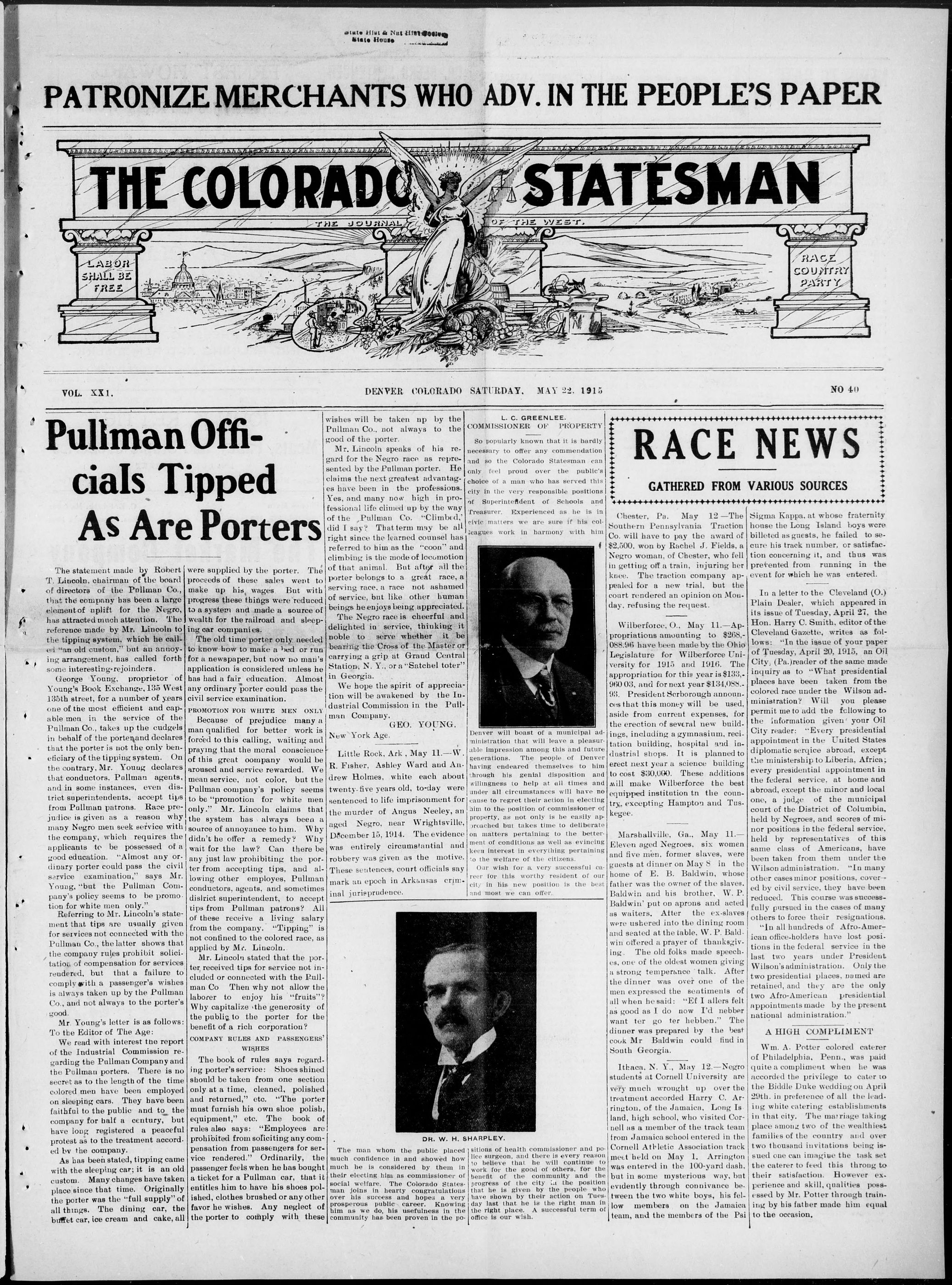
Pullman Officials Tipped As Are Porters
VOL. XX1. Pullman cials T As Are
The statement made by Robert T. Lincoln, chairman of the board of directors of the Pullman Co., that the company has been a large element of uplift for the Negro, has attracted much attention. The reference made by Mr. Lincoln to the tipping system, which he called "an old custom," but an annoying arrangement, has called forth some interesting rejoinders.
George Young, proprietor of Young's Book Exchange, 135 West 135th street, for a number of years one of the most efficient and capable men in the service of the Pullman Co., takes up the cudgels in behalf of the porter and declares that the porter is not the only beneficiary of the tipping system. On the contrary, Mr. Young declares that conductors, Pullman agents, and in some instances, even district superintendents, accept tips from Pullman patrons. Race prejudice is given as a reason why many Negro men seek service with the company, which requires the applicants to be possessed of a good education. "Almost any ordinary porter could pass the civil service examination," says Mr. Young, "but the Pullman Company's policy seems to be promotion for white men only."
Referring to Mr. Lincoln's statement that tips are usually given for services not connected with the Pullman Co., the latter shows that the company rules prohibit solicitation of compensation for services rendered, but that a failure to comply with a passenger's wishes is always taken up by the Pullman Co., and not always to the porter's good.
Mr. Young's letter is as follows: To the Editor of The Age:
We read with interest the report of the Industrial Commission regarding the Pullman Company and the Pullman porters. There is no secret as to the length of the time colored men have been employed on sleeping cars. They have been faithful to the public and to the company for half a century, but have long registered a peaceful protest as to the treatment accorded by the company.
```markdown
```
As has been stated, tipping came with the sleeping car; it is an old custom. Many changes have tsken place since that time. Originally the porter was the "full supply" of all things. The dining car, the buffet car, ice cream and cake, all
were supplied by the porter. The proceeds of these sales went to make up his wages. But with progress these things were reduced to a system and made a source of wealth for the railroad and sleeping car companies. The old time porter only needed to know how to make a bed or run for a newspaper, but now no man's application is considered unless he has had a fair education. Almost any ordinary porter could pass the civil service examination.
PROMOTION FOR WHITE MEN ONLY Because of prejudice many a man qualified for better work is forced to this calling, waiting and praying that the moral conscience of this great company would be aroused and service rewarded. We mean service, not color, but the Pullman company's policy seems to be "promotion for white men only." Mr. Lincoln claims that the system has always been a source of annoyance to him. Why didn't he offer a remedy? Why wait for the law? Can there be any just law prohibiting the porter from accepting tips, and allowing other employees, Pullman conductors, agents, and sometimes district superintendent, to accept tips from Pullman patrons? All of these receive a living salary from the company. "Tipping" is not confined to the colored race, as applied by Mr. Lincoln.
Mr. Lincoln stated that the porter received tips for service not included or connected with the Pullman Co. Then why not allow the laborer to enjoy his "fruits"? Why capitalize the generosity of the public to the porter for the benefit of a rich corporation?
COMPANY RULES AND PASSENGERS' WISHES
The book of rules says regarding porter's service: Shoes shined should be taken from one section only at a time, cleaned, polished and returned," etc. "The porter must furnish his own shoe polish, equipment," etc. The book of rules also says: "Employees are prohibited from soliciting any compensation from passengers for service rendered." Ordinarily, the passenger feels when he has bought a ticket for a Pullman car, that it entitles him to have his shoes polished, clothes brushed or any other favor he wishes. Any neglect of the porter to comply with these
State Hist & Nat Hist Office
State House
GIANTS WHO
ADO
THE JOURNAL
DENVER COLORADO
DENVER COLORADO SATURDAY. MAY 22. 1915
wishes will be taken up by the Pullman Co., not always to the good of the porter.
Mr. Lincoln speaks of his regard for the Negro race as represented by the Pullman porter. He claims the next greatest advantages have been in the professions. Yes, and many now high in professional life climed up by the way of the Pullman Co. "Climbed," did I say? That term may be all right since the learned counsel has referred to him as the "coon" and climbing is the mode of locomotion of that animal. But after all the porter belongs to a great race, a serving race, a race not ashamed of service, but like other human beings he enjoys being appreciated.
The Negro race is cheerful and delighted in service, thinking it noble to serve whether it be bearing the Cross of the Master or carrying a grip at Grand Central Station, N. Y., or a "Satchel toter" in Georgia.
We hope the spirit of appreciation will be awakened by the Industrial Commission in the Pullman Company.
GEO. YOUNG.
New York Age.
Little Rock, Ark, May 11.—W. R. Fisher, Ashley Ward and Andrew Holmes, white each about twenty-five years old, to-day were sentenced to life imprisonment for the murder of Angus Neeley, an aged Negro, near Wrightsville, December 15, 1914. The evidence was entirely circumstantial and robbery was given as the motive. These sentences, court officials say mark an epoch in Arkansas criminal jurisprudence.
DR. W. H. SHARPLEY.
The man whom the public placed much confidence in and showed how much he is considered by them in their electing him as commissioner of social welfare. The Colorado Statesman joins in hearty congratulations over his success and hopes a very prosperous public career. Knowing him as we do, his usefulness in the community has been proven in the po-
COMMISSIONER OF PROPERTY
So popularly known that it is hardly necessary to offer any commendation and so the Colorado Statesman can only feel proud over the public's choice of a man who has served this city in the very responsible positions of Superintendent of Schools and Treasurer. Experienced as he is in civic matters we are sure if his colleagues work in harmony with him
W. H. H.
Denver will boast of a municipal administration that will leave a pleasurable impression among this and future generations. The people of Denver having endeared themselves to him through his genial disposition and willingness to help at all times and under all circumstances will have no cause to regret their action in electing him to the position of commissioner of property, as not only is he easily approached but takes time to deliberate on matters pertaining to the betterment of conditions as well as evincing keen interest in everything pertaining to the welfare of the citizens.
Our wish for a very successful career for this worthy resident of our city in his new position is the best and most we can offer.
sitions of health commissioner and police surgeon, and there is every reason to believe that he will continue to work for the good of others, for the benefit of the community and the progress of the city in the position that he is given by the people who have shown by their action on Tuesday last that he is the right man in the right place. A successful term of office is our wish.
RACE NEWS
Chester, Pa. May 12—The Southern Pennsylvania Traction Co. will have to pay the award of $2,500, won by Rachel J. Fields, a Negro woman, of Chester, who fell in getting off a train, injuring her knee. The traction company appealed for a new trial, but the court rendered an opinion on Monday, refusing the request.
Wilberforce, O., May 11.—Appropriations amounting to $268,088.96 have been made by the Ohio Legislature for Wilberforce University for 1915 and 1916. The appropriation for this year is $133,960.03, and for next year $134,088.93. President Scrborough announces that this money will be used, aside from current expenses, for the erection of several new buildings, including a gymnasium, recitation building, hospital and industrial shops. It is planned to erect next year a science building to cost $30,000. These additions will make Wilberforce the best equipped institution in the country, excepting Hampton and Tuskegee.
Marshallville, Ga., May 11.—Eleven aged Negroes, six women and five men, former slaves, were guests at dinner on May 8 in the home of E. B. Baldwin, whose father was the owner of the slaves. Baldwin and his brother, W. P. Baldwin' put on aprons and acted as waiters. After the ex-slaves were ushered into the dining room and seated at the table, W. P. Baldwin offered a prayer of thanksgiving. The old folks made speeches, one of the oldest women giving a strong temperance talk. After the dinner was over one of the men expressed the sentiments of all when he said: "Ef I allers felt as good as I do now I'd nebber want ter go ter hebben." The dinner was prepared by the best cook Mr Baldwin could find in South Georgia.
Ithaca, N. Y., May 12.—Negro students at Cornell University are very much wrought up over the treatment accorded Harry C. Arrington, of the Jamaica, Long Island, high school, who visited Cornell as a member of the track team from Jamaica school entered in the Cornell Athletic Association track meet held on May 1. Arrington was entered in the 100-yard dash, but in some mysterious way, but evidently through connivance between the two white boys, his fellow members on the Jamaica team, and the members of the Psi
NO 40
Sigma Kappa, at whose fraternity house the Long Island boys were billeted as guests, he failed to secure his track number, or satisfaction concerning it, and thus was prevented from running in the event for which he was entered.
In a letter to the Cleveland (O.) Plain Dealer, which appeared in its issue of Tuesday, April 27, the Hon. Harry C. Smith, editor of the Cleveland Gazette, writes as follows: "In the issue of your paper of Tuesday, April 20, 1915, an Oil City, (Pa.) reader of the same made inquiry as to "What presidential places have been taken from the colored race under the Wilson administration? Will you please permit me to add the following to the information given your Oil City reader: "Every presidential appointment in the United States diplomatic serqice abroad, except the ministership to Liberia, Africa; every presidential appointment in the federal service, at home and abroad, except the minor and local one, a judge of the municipal court of the District of Columbia, held by Negroes, and scores of minor positions in the federal service, held by representatives of this same class of Americans, have been taken from them under the Wilson administration. "In many other cases minor positions, covered by civil service, they have been reduced. This course was successfully pursued in the cases of many others to force their resignations.
"In all hundreds of Afro-American office-holders have lost positions in the federal service in the last two years under President Wilson's administration. Only the two presidential places, named are retained, and they are the only two Afro-American presidential appointments made by the present national administration."
A HIGH COMPLIMENT
Wm. A. Potter colored caterer of Philadelphia, Penn., was paid quite a compliment when he was accorded the privilege to cater to the Biddle Duke wedding on April 29th. in preference of all the leading white catering establishments in that city. The marriage taking place among two of the wealthiest families of the country and over two thousand invitations being issued one can imagine the task set the caterer to feed this throng to their satisfaction. However experience and skill, qualities possessed by Mr. Potter through training by his father made him equal to the occasion.
NEWS TO DATE IN PARAGRAPHS
CAUGHT FROM THE NETWORK OF WIRES ROUND ABOUT THE WORLD.
DURING THE PAST WEEK
RECORD OF IMPORTANT EVENTS
CONDENSED FOR BUSY
. PEOPLE
Western Newspaper Union News Service.
ABOUT THE WAR
In the House of Lords in London Secretary for War Kitchener said he wanted 300,000 more recruits to form new armies.
Confirmation of the previous report of the sinking of the Australian submarine AE-2 in the Dardanelles is contained in an official communication issued by the admiralty at London.
Six thousand Armenians have been massacred at Van in Armenia, Asiatic Turkey, according to a dispatch received in official quarters in London from the Russian consul at Urumiah, Persia.
A revolution has broken out at Trieste, according to a message to the Rome Idea Nazional, telegraphed from the frontier. The dispatch states that forty-seven women were killed and over 300 injured.
Secretary for War Kitchener stated in the House of Lords that the British and French governments felt that the allied troops must be adequately protected against poisonous gases, by the employment of similar methods.
A further Austrian advance in Galicia is announced in an official statement issued at Vienna. The Austrians have captured Drohobcsz in central Galicia about forty miles southwest of Lemberg. They took 500 prisoners and eight machine guns.
The British battleship Goliath was torpedoed and sunk at the Dardanelles by a Turkish destroyer, with the loss of about 500 lives. Official announcement to this effect was made in London, together with the statement that two Turkish gunboats and a Turkish transport had been sunk.
WESTERN
The home rule (liquor) proposition was carried in the Denver city election.
The Liberty bell will leave Philadelphia July 5, reach Denver July 10, and be at the Panama-Pacific exposition July 17.
Cincinnati was chosen as the meeting place for the 1916 conclave of the American Federation of Musicians shortly before the organization concluded its convention at Los Angeles.
Governors of seven Western states met at Seattle, Wash., for a three days' conference. The principal subjects of discussion were timber, irrigation, power sites and public lands.
Gen. Antonio Villa, brother of the northern chieftain, was probably mortally wounded, and seven others were killed at Chihuahua city in a public place where a political argument arose.
A government—thought to be the United States—has placed a rush order with the Great Western Distillery for 30,000 barrels of alcohol to be used in the manufacture of gunpowder, it was learned at Peoria, Ill. The 22,000-ton Finland, of the Panama-Pacific line, first of the big transatlantic steamers to be diverted to the New York-San Francisco run, steamed into San Diego harbor having made the run from New York through the Panama canal in fifteen days and ten hours.
WASHINGTON
Ambassador Guthrie, home from Tokio on leave, conferred briefly with Secretary Bryan and other State Department officials. The relations of labor and the law were again inquired into when the Federal Industrial Commission resumed its hearing. The Supreme Court affirmed the decision of the Ninth United States Circuit Court of Appeals in cancelling five patents to Oregon lands held by the Booth-Kelly Lumber Company because of fraud in entry. Yaqui Indians, who have been besieging, white settlers in the state of Sonora, Mexico, issued a proclamation declaring the Yaqui nation at war with Mexico, according to dispatches from the U. S. S. Colorado.
Votes for women was urged as the remedy for industrial unrest before the commission on industrial relations at Washington by Mrs. Chrystal Eastman Benedict of New York, representing the Congressional Union for Woman's Suffrage.
Recordbreaking cargoes passing through the Panama canal in March, according to War Department statisticians, would have filled approximately 1,800 freight trains of twenty cars each. These trains, it is estimated, would have totaled 275 miles in length or filled five parallel tracks from Panama to Colon.
Communication is cut between Panico, in the Mexican oil fields, and Tampico, bottling up one of the British navy's principal oil supply sources, according to State Department advises.
FOREIGN
A new Portuguese cabinet has been definitely formed.
The Cunard line steamship Transylvania arrived safely at Greenock, Scotland.
G. N. Barnes, member of parliament, has gone to Canada to engage men to work on munitions of war.
Sir Edgar Speyer has sent a letter to Premier Asquith resigning his privy councilorship and requesting also the revocation of his baronetcy.
At Ramsgate, England, an air raid occurred. About forty bombs were dropped. So far as has been ascertained three persons were injured.
A telegram from Hamburg says that the Swedish steamer Bjoern, bound for London with a cargo of ore and food supplies, has been seized and taken to Hamburg.
The London County Municipal railway street car system is tied up by a strike of its men, who are demanding a 15 per cent war bonus, owing to the increased cost of living.
The rebuilding of Colon, about half of which was destroyed by fire on the afternoon of April 30, is occupying the attention of both the government of Panama and of the canal zone authorities.
A brilliant court wedding took place at Tokio when Princess Yasu, the youngest sister of the emperor, was united in marriage to Prince Naruhiko Higashi-Kuni, attached to the Second Army division of the empire.
Senator Frietas, who shot and dangerously wounded Joao Chagas, president of the new Portuguese cabinet at Lisbon, was slain at the Entrocamento to railway station by a soldier who witnessed the attack on Senhor Chagas. Chagas is reported recovering.
Reports from Constantinople confirm the discovery of a plot organized by Armenians and Turks opposed to the new regime to assassinate the Sultan, Enver Pasha, Field Marshal Von Der Goltz and General Liman von Sanders, telegraphs the Paris Journal's Athens correspond.
The resignation of the veteran sailor, Lord Fisher, from his post of first sea lord of the admiralty, because he and his nominal civilian superior, Winston Churchill, first lord of the admiralty, have been unable to work together, is probably the first step toward a sweeping reorganization of the British government.
SPORTING NEWS
Standing of Western League Clubs.
Clubs. Won. Lost. Pet.
Topeka 157.682
Des Moines 1310.565
Omaha 1210.545
Denver 109.526
St. Joseph 1110.524
Lincoln 910.474
Sioux City 1016.383
Wichita 614.303
Yale defeated Harvard in the annual dual track meet at New Haven, Conn. 56 to 48.
Declaring his arm in its old time form, Ed Walsh, the Chicago American pitcher, rejoined his team.
The Longmont Prides of the Rockies defeated the W. O. W. No. 45 team of Denver at Longmont by a score of 3 to 2.
At Milwaukee, Ritchie Mitchell, lightweight contender, outboxed and outfoughted Ad Wolgast in six rounds of a ten-round bout.
The annual field day of the Gentlemen's Driving and Riding Club will be held this year, as it was last, at Overland park, in Denver, on Monday, May 31.
At Louisville, Ky., the filly race at a mile, which was looked upon as a preliminary to the Oakes, was won by Lady Rocha, the property of Andrew Miller of the Jockey Club, New York.
Stanley Yoakum of Denver was given the decision over Jimmy Reagan of San Francisco after twenty rounds of the roughest, toughest wrestling match ever witnessed In a Denver arena, at the Colorado Athletic Club.
The American Automobile Association at its annual meeting in Boston re-elected John A. Wilson of Franklin, Pa., a cousin of President Wilson, as president. Except for the choice of P. J. Walker of California as vice president, all other officers were re-elected.
GENERAL.
A man believed to be the American aviator Frederic Bonnie, delirious for lack of water and food, has wandered into the Villa lines about San Luis Potosi, it was reported in advises at El Paso, Tex. The Georgia Prison Commission set Monday, May 31, as the date for beginning a hearing on Leo M. Frank's petition asking that his death sentence for the murder of Mary Phagan be commuted to life imprisonment.
President Wilson — the man on whom the eyes of the world are turned because of the international situation — reviewed the Atlantic fleet in the Hudson river, and at a luncheon tendered to him on shore by the city of New York, told a distinguished gathering of navy officers, army officers and civilians, what the country and its navy stood for. The great battleships that lay in the river," he said, were "engines to promote the interest of humanity."
Seymour H. Knox, vice president on the F. W. Woolworth company, and prominently identified with a score of financial concerns, died at Buffalo, N. Y.
Supreme Court Justice Hendrick signed an order transferring Harry K. Thaw from the Tombs to the custody of the sheriff in Ludlow street jail in New York.
President Wilson and New York said good-by to the Atlantic fleet Tuesday. The steel jacketed "forces of humanity" ended their holiday and left for their annual war game at sea.
Western Newspaper Union News Service.
COMING EVENTS.
June 9-11—G. A. R. encampment at la
Junta.
June 9-19—Strawberry Days, Glen
wood Springs.
June 19-July 2—Colorado Fair and
Association at Denver.
Aug. 3-18—Salt Lake Lodge, K. of P.
at Colorado Springs.
Aug. 26-28—Fall Festival at Flagler.
Sept. 27-Oct. 8—Meeting International
Dry Farming Congress at Denver
K. S. Rhea of Golden has been appointed water commissioner for district No. 7.
The Mid-Colorado Oil Company at Aurora reports traces of oil and gas at a depth of 1,600 feet.
The Denver Norwegian Association gave a reception and banquet in commemoration of the Norwegian national holiday.
Mrs. Mary Knox Colvin, eighty-four, passed away at the home of her daughter, Mrs. Charles L. Parsons, at Boulder.
The Delta High School track team won the eighth annual track meet in which eight high schools of the Western slope participated.
Mrs. John E. Ramer, wife of Secretary of State Ramer, underwent an operation for a tumor in St. Joseph's hospital in Denver.
Convalescing from a recent serious illness, Mrs. Jane M. Ligget of Denver celebrated her ninety-ninth birthday at her home.
A verdict for $1,000 was awarded to Mrs. Phoebe A. Cunningham, in a $10,500 personal injury damage suit against the city of Denver.
A $20,000,000 consolidation of the biggest producers in the Cripple Creek district is in the air, according to reports in Colorado Springs mining circles.
Private interment at the Fairmount cemetery followed the funeral services in Denver for Joseph C. Helm, former chief justice of the State Supreme Court.
Angelo Marsh, an Austrian laborer, was given a verdict of $750 against the Colorado Fuel and Iron Company in Denver for injuries sustained in a coke oven accident two years ago.
Mrs. Lue Giles of Boulder was severely cut across the forehead and her niece, Miss L. M. Garbarino was badly bruised when the horse Miss Garbarino usually drives, became unmanageable and ran away.
In Brown's park near Craig, the ranchers are becoming interested in sheep. Miss Willa McClure, a schoolma'am of that section, has a small flock which yielded a 200 per cent, lamb crop and averaged better than a twelve-pound clip this season.
Five auto loads of Loveland people left for Highland Lake to join in the search for twenty-one-months-old Newell Faulkner, son of Harry F. Faulkner of Highland Lake. The child disappeared five minutes after coming in from play to ask his mother for a cookie, and is believed to have been kidnapped. A snowstorm that assumed blizzard-like proportions shortly before noon enshrouded Denver Tuesday and threatened all former snow records for the month of May with obliteration. The thermometer registered 32 degrees at noon, the record temperature for Man 18 since the first records were taken in 1872.
William S. La Fair, one of the most prominent cattlemen on the Western slope, died at his Whitewater home, near Grand Junction. Heart disease was the cause. He was 51 years old, and for the last two years had operated the only hotel exclusively for cowboys in the state. It was known as the "Cowboys' home."
Rev, Father Hugh L, McMenamin, pastor of the Immaculate Conception cathedral of Denver, is one of six priests in the United States whose names will be tendered to Pope Benedict for the appointment of bishop of Salt Lake City to succeed the Right Rev. Lawrence Scanlon, who died a week ago, according to word which reached Denver.
With a declaration that he was "about to pull something funny," L. T. Ergood, twenty-seven, a commission brokerage expert, calmly raised a revolver to his breast in the Navarre hotel office in Denver and, smiling, sent a bullet crashing into his heart. He fell to the floor dead. Four persons, standing near, witnessed the tragedy.
With four square inches of his skull cut away, Malcolm Puckett, seventeen-year-old Warren academy student, who plunged sixty feet over a cliff in Bear Creek caffon, is lying at Mercy hospital in Denver near to death, but a surprise to physicians because of the way he has clung to life. A portion of his skull was removed when it became apparent that an operation was necessary in order to give him a chance for his life.
The Agricultural College at Fort Collins will observe Memorial day this year in a manner which has not been touched on in previous years. Patriotic exercises will supplant the usual baccalaureate exercises for the graduates of this year's class. Goods Roads day was observed with such excellent results that arrangements have been made by the state highway commission and other state officials to start a campaign that will put the main highways of the state in good condition by June 10.
DR. BEERS SENTENGED
GIVEN LONG TERM FOR KILLING
WILL HOPKINS.
Physician Weeps in Court, Telling Story of Killing, and Says He Still Has Hope.
Western Newspaper Union News Service.
/Boulder, Colo.-Dr. A, S. Beers of Hygiene, convicted of murder in the second degree for the killing of Will Hopkins, a neighbor, at Burch lake two days before Christmas, was sentenced by District Judge R. G. Strong to serve from twelve to fifteen years in the penitentiary at hard labor.
Before the sentence was pronounced Dr. Beers addressed the court for several minutes, weeping freely as he talked.
He said that the only person toward whom he had any hard feelings was John Carter of Hygiene. "Carter," said Beers, "testified that Hopkins was unarmed, when he knew that he was holding an ice marker above his head ready to strike me down."
Dr. Beers declared that he was not without hope for the future, and that he was looking forward to a time when he would be happier. He spoke of his wife, because of whose relations with Hopkins he slew the latter, and said that for fifteen years he had tried to keep her from temptation, but had failed.
Dr. Beers told the court that he was a victim of circumstance, and that he felt sure that if he had killed his wife when she confessed her shame to him, and had then rushed to Hygiene and shot Hopkins, he would be a free man today.
Dr. Beers was convicted of murder in the second degree March 15, after one of the most sensational trials ever held in Boulder county. During the trial his wife went on the stand and testified that a confession on her part of her relations with Hopkins, while she was at a local sanitarium about to undergo an operation, had prompted Dr. Beers to kill Hopkins.
Greenlee, Sharpley and Teller Elected.
Denver. Official returns from 127 of the 193 precincts in the city insure the election of Lewis C. Greenlee for commissioner of property, Dr. William H. Sharpley for commissioner of social welfare and Henry B. Teller for election commissioner. Third choice votes were required to determine the choice for each office. The home rule amendment was carried. Incomplete unofficial returns indicated the defeat of all but three of the ten proposed charter amendments and the defeat of all five bond issues, calling for a proposed expenditure of $1,000,000.
Longmont Boy Injured.
Longmont.—Word has been received in Longmont of the serious injury of Joel Harrison, former Longmont boy, and son of the Rev. A. G. Harrison, who is a member of the crew of the battleship Maryland, stationed now at Honolulu and aiding in the raising of the sunken submarine F-4. Young Harrison was injured by a fall and is now being treated in the ship's hospital.
Many Errors Alleged by Zancannelli.
Trinidad.—Two hundred and thirty-five assignments of error were alleged in the District Court in the motion for a new trial for Louis Zancannelli, convicted of first degree murder of Baldwin-Felts Detective George W. Belcher after the first jury had disagreed, standing eight to four for acquittal.
Refuse Tramway and Gas Tax Rebates
Refuse Tramway and Gas Tax Rebates
Denver.—The State Tax Commission refused to approve the act of the city commissioners in rebating $188,
000 of delinquent taxes on the property of the Denver City Tramway
Company and the Denver Gas and Electric Light Company.
Train Hits Handcar: One Killed.
Pueblo.—Pedro Povala was instantly killed and nine other Mexican section hands were injured when Colorado & Southern passenger No. 3. Denverbound, crashed into their handcar at the Martin street crossing, Irving place.
Find $32,000 Ore in Victor Mine
Victor.—Ore worth $32,000 a ton and more has been struck on the Franklin lease on the Blue Bird mine, Bull hill. The find was made at a depth of 1,500 feet at the seventeenth level in a raise of about 140 feet and approximately 600 feet south of the main shaft.
$25,000 School for Estes Park.
Estes Park.—The property owners of this section voted to issue $25,000 bonds to erect a new school building in the town of Estes Park.
Burglar Gets Gems Worth $1,000.
Denver.—More than $1,000, worth of diamonds and other jewelry valued at $100 were stolen from the home of Patrick F. Gibbons.
Father Killed, but Baby Escapes.
Victor—P. L. Bressler, an employé of Pepper's Creamery of Cañon City, who was visiting here with his brother-in-law, was killed at a point about ten miles south of here on the Cañon City road, when his automobile turned over, as the result of a cave-in of the road. Death was apparently instantaneous. Mr. Bressler's wife and infant child were with him at the time. Mrs. Bressler sustained critical injuries while the baby was thrown into a creek but was rescued and escaped without a scratch.
Carpenter, Job and Repair Work.
Paints, Oils and Glass. Coal, Wood
Coal, Wood and Express
reet. Phone O
ed the Rest Our Price
the Best Satisfaction
Coal. Wood and Express.
You Have Tried the Rest
Now Try the Best
THE
Giant
FOR QUALITY.
CLEANING, PRESSIN
ING, RELINING A
WORK CALLED FOR
2549 Washington Avenue
ING, PRESSING, DYEING, FREELINING AND REMODELING WORK CALLED FOR AND DELIVERY Boston Avenue Den
CLEANING, PRESSING, DYEING, REPAIRING, RELINING AND REMODELING.
WORK CALLED FOR AND DELIVERED
2549 Washington Avenue Denver, Colorado
JOHN K. Meats, Fancy and
JOHN K. RETTIG Fancy and Staple Gro 1864 CURTIS STREET
eighteenth. D
C. E. Smith
9, 190
Res. Phone
Market Comp
and Retail Staple and Fancy Groceries
ers. Hotels and Restaurants Our Spec
Cured
eastern Corn Fed Meat
The Market Wholesale and Retail Staple and Oysters. Hotels and Re
The Market Company
Wholesale and Retail Staple and Fancy Groceries, Fish and Oysters. Hotels and Restaurants Our Specialty.
Eastern Corn
Eastern Corn Fed Meats
Fruits, Vegetables, Poultry and Game.
1688-89 Arapahoe Street Denver
C. H. SHIRLEY, Pres. J. C. HAMPSON
PAUL J. SHIRLEY, Sec. and Treas.
THE ATLAS DRUG C
Courteous Treatmet. Right H
Leaders in Prescription
BURLEY, Pres. J. C. HAMPSON
PAUL J. SHIRLEY, Sec. and Treas.
THE ATLAS DRUG CO.
Fineous Treatmet. Right H
Leaders in Prescription
No. 1. Store
BUTTON ST. 26TH AND
5 875 Main 4
C. H. SHIRLEY, Pres. J. C. HAMPSON, Vice Pres PAUL J. SHIRLEY, Sec. and Treas.
THE ATLAS DRUG CO.
Courteous Treatmet. Right Prices
Leaders in Prescription
Store No. 1. Store No. 2.
2701 WELTON ST. 26TH AND WELTON
Main 895 875 Main 4955-4956
Dr. Westbrook
Phone Main 1433
Out of Office, and af
nights Call Residence,
2714 Arapahoe Street
Phone Champa 570
$50.00 PER MONTH, MADE DURING YOUR SPARE TIME. Selling High Brown Nestlé products for sample outfit, instructions and solicitor's certificate. This is the chance of a life time for any enterprising person. Be the first in your community to purchase a Nestlé Nero Doll, the beauty of modern invention. NATIONAL FOR repay to inquiry and catalog. NATIONAL DEGRO DOLL COMPANY. 619 Second Avenue, N. Nashville, Tenn.
Office 313½ Kittridge Bldg.
Phone Main 7416
Residence 822 32nd St.
Phone Main 8397
T. Ernest McClain, A. B. D. D. S.
Sundays and Nights by Appointment.
Office Hours:—8 a. m. to 12 m
2 p. m. to 6 p. m.
"STETSON HATS OUR SPECIALTY"
Phone Main 3661.
Mittridge Bldg.
Phone Main 7416
2 32nd St.
Phone Main 8397
McClain, A. B. D. D. S.
1 Nights by Appointment.
hours:—8 a. m. to 12 m.
p. m.
ORIENT
Chop Sue
Phone Main 4896
Weatherhead
TELEPHONE MA
PIONEER HATTERS O
HATS OUR SPECIALTY"
"BROWN, THE HATTER"
HATS CLEANED AND BLOCKED
50 CENTS
SATISFACTION GUARANTEED
A Trial Will Convince You.
7181/2 18TH STREET.
18TH STREET. 1624 CHAMPA ST., DE
1021 21st Street
PHONE MAIN 3028
Corner Nineteenth.
Phones Main
169,181,189,190
Fresh and Cured
s. Glazing Done and Express.
Our Prices Reasonable
Satisfaction Guaranteed
CLEANERS
AND
TAILORS
McCAIN & RICHARDS, PROPS
Phone Main 7376
ING, DYEING, REPAIR-
AND REMODELING.
OR AND DELIVERED
Denver, Colorado
RES. PHONE GALLUP 942
RETTIG and Staple Groceries
C. E. Smith, Manager
Res. Phone South 1608
et Company
e and Fancy Groceries, Fish and
Restaurants Our Specialty.
rn Fed Meats
Denver, Colorado
J. C. HAMPSON, Vice Pres
LEY, Sec. and Treas.
AS DRUG CO.
Hmtmet. Right Prices
on Prescription
Store No. 2.
26TH AND WELTON
Main 4955-4956
ORIENTAL RESTAURANT
Chop Suey, Noodles and Short Orders
Phone Main 4896
1848 Arapahoe
乐泽轩
Weatherhead Hat Co
TELEPHONE MAIN 3203
PIONEER HATTERS OF THE WEST
```markdown
```
RENOVATORS, BLEACHERS,
DYERS AND FINISHERS
Of Gents' and Ladies' Hats of Every
Description.
1624 CHAMPA ST., DENVER, COLO.
Phone Champa 752.
---
Denver, Colo.
We Make Old Hats New
AFRO-AMERICAN CULLINGS
How to help colored children in the public schools toward a more hopeful future than present social conditions promise them, was discussed by educators, welfare workers, and city officials at a conference held April 29 at 130 East Twenty-second street, by the Public Education association.
The association recently issued a report on "Colored School Children in New York," prepared by Miss Frances Blascoer, which, made after a careful investigation, outlines the needs of the 90,000 Negroes in the city, and gives specific recommendations for improving the conditions under which they live. This report was the basis of discussion at the conference.
Miss Eleanor Hope Johnson, chairman of the committee on hygiene of school children of the association, says in the introduction to the report:
"We are constantly learning, through the interpretation by sympathetic students of various races of immigrants, the several ways in which these allens may contribute to our national life; and each discovery, especially in the different fields of art, is halted with joy by constructive patriots. Surely it is time for the Negro to be considered in the light of a national asset, and his loyalty, patience, sympathetic kindness, and artistic instinct be counted on as real contributions to our national welfare.
"The report gives few, perhaps no, recommendations that would not apply to the children of other races. Where the application is more true in regard to colored children it seems to be largely because of this lack of equal justice in the cases of their parents. Race weakness appears, but this could easily be balanced by the same or similar weakness in other races. Given an education carefully adapted to his needs and a fair chance for employment, the normal child of any race will succeed, unless the burden of wrong home conditions lies too heavily upon him. Any philanthropic effort for the encouragement or improvement of these children, to be successful, must take into account their peculiar virtues—affection, loyalty, home-loving spirit—not their defects. It is this conclusion of the report which applies to colored children more than to the children of any other race, and should make them easier rather than harder to help in their climb upwards. Our country has a very real debt to pay, and it can be paid only by helping these children to find for themselves the place in our nation which shall contribute most to their own and its development.—New York Evening Post.
Among the Negroes of the country there has, in late years, developed an increasing tendency toward home ownership, a marked increase in the percentage of school attendance, a pronounced decrease in the percentage of illiteracy, decrease in the mortality rate, and an increase in the proportion of church membership. From 1720, when the Negro population was numbered 757,208, it increased to 9,827,763 in 1910, when the last census was taken. Since 1810 there has been a continuous decrease in the proportion which Negroes have formed of the total population, due, at least in part, to the fact that the white population has been continually augmented by immigration, while there has been very little immigration of Negroes during the past hundred years. The largest Negro population in any state in 1910 was that of Georgia.
Why is the death rate among Negroes, in northern cities and southern cities alike, almost twice as great as among whites? At the last census the average death rate in the 57 registration cities was 15.9 per thousand among whites, while among Negroes it was 27.8. In the North the ratio was roughly 15 to 25, in the South 16 to 29. Taking those degeneracies that have a nervous origin or that come from high living, the ratio among whites was greater, but in tuberculosis and pneumonia, the plague of both races, the havoc among Negroes preponderates enormously. What are the reasons for this hideous disparity? The reason, as everyone may guess, is the poverty of the Negro. The death rate stands in almost fixed relation to housing conditions, and it is clearly proved that as home ownership increases, the death rate diminishes. In the degree that Negroes remain economically inferior, their portion will not merely be social hardship but a vastly greater share of physical suffering and mortal disease. It is these hard facts that make race prejudice so base. The only prejudice that figures
The last siege of Vienna was made by the Austrians themselves. This was in 1848, when, during the Hungarian revolution, Vienna fell into the hands of the insurgents, who were dislodged only after two days' bombardment.
Kukui nut oil is a valuable Hawaiian product and is in demand in the paint and varnish trade. It has been shipped to the United States from various pacific islands for the last 75 years.
1,176,987. In that year Mississippi and South Carolina had a Negro population exceeding that of the white, and in each of fifty-three counties, scattered throughout the states of Mississippi, Louisiana, Alabama, South Carolina, Georgia, Arkansas, Florida and Tennessee, at least seventy-five per cent of the total population was Negro. Of the southern states West Virginia had the smallest percentage, 5.3. In the period of 1900-1910 the greatest gain, both numerically and proportionally, in this class of population was shown by Birmingham, Ala., whose Negro residents increased to the number of 35,730, or to the surprising per cent of 215. The country as a whole indicated that illiteracy among this class is gradually being reduced, it being shown that between the ages of six and twenty slightly over forty-seven per cent were attending school, a large gain over previous reports. Virginia had by far the largest percentage of Negro-owned homes, while Mississippi ranked first in farms. Deaths caused by malaria, tuberculosis of the lungs, other forms of tuberculosis, pneumonia and whooping cough are relatively more numerous among Negroes than among whites; while the mortality due to measles, scarlet fever, diphtheria, cancer, appendicitis, diarrhea and violence (including suicide) is noticeably higher among whites.
Editor of the Washington Herald: In the Herald of April 20 appears a notice to the effect that the body of Lieut. Beverly Perea, U. S. A., brought from Cambridge, Mass., was the first colored officer to be buried in the Arlington National cemetery. This statement is not correct, as the bodies of both Dr. Alexander T. Augusta, surgeon, Seventh U. S. C. infantry, surgeon in chief of Freeman's hospital, and for many years a practicing physician in this city, and Capt. O. S. B. Wall of this city have been buried in the Arlington National cemetery, for many years, both being buried in the officers' section, with monuments standing over their graves; the former officer's grave is close to the gate and the latter not far removed therefrom.
In addition to these two officers of whose burial I have personal knowledge (and there may be others of whom I have no knowledge) there are hundreds of colored soldiers buried in Arlington.
The records at Arlington will confirm the facts as stated.
Believing that it is the purpose of your paper to publish only facts, I am calling your attention to this matter that it may be corrected.—Hamilton S. Smith.
In compliance with his dying wish, Lieut. Beverly Perea, U. S. A., retired, who died in Cambridge, Mass., recently, was buried in Arlington national cemetery—the first colored man to be buried there. His wife and daughter accompanied the body to Washington. Several of his friends in the city attended the burial.
That he might be buried in the national cemetery at Arlington was the wish expressed by Lieutenant Perea shortly before his death. His widow communicated this to Secretary Garrison of the war department through Major Curley, with the result that permission was given.
New York has about 700,000 school children.
like these should induce is prejudice against a poverty which is literally more pestilential than war.—New Republic.
President Wilson, through Secretary Garrison, has officially complimented the officers and enlisted men of the Ninth and Tenth cavalry (colored) for their work in patrolling the Mexican border line to enforce the neutrality laws of the United States during the fighting between the Carranza and Villa forces. Several American soldiers were wounded during the engagements between the Mexican forces.
"By direction of the president," says Secretary Garrison, "I take great pleasure in expressing to the officers and enlisted men of the Ninth and Tenth cavalry his appreciation of their splendid conduct and efficient service in the enforcement of the United States neutrality 'laws at Naco, Ariz., during November, December and January last."
The Ninth cavalry is at Fort Douglas, Ariz., and the Tenth cavalry is at Fort Huachuca, Ariz.
Willie D. James of Bethlehem, Ky., owns a plow which has been handed down from his great-grandfather. It has been all the time on one of the farms now owned by Mr. James—at least 125 years.
The man who begins laughing in the middle of his joke seldom knows anything funny.
It is said of Mrs. Lemuel Wigg that she is as good to old people as she is to babies.
ROUT RUSSIANS FROM GALICIA
BATTLE RAGES FROM CARPATHIANS TO POLAND, AND FALL OF PRZEMYSL THREATENED.
7,000 SLAVS CAPTURED
CHIEF OF ITALIAN STAFF AT FRONTIER; RAILROADS SEIZED AS PARLIAMENT MEETS.
Western Newspaper Union News Service.
London, May 20.—General von Mackenzen's big drive of the whole Russian line to the east in Galicia continues with remarkable rapidity with a prospect of almost entirely freeing Austrian territory of the Slav invaders.
Emperor William is reported to be on the eastern front. Fighting is proceeding continuously along a 200-mile battlefront in Galicia from the mouth of the San river to Kolomea. The Russians are sending in troops as rapidly as possible to meet the ten German and twenty-four Austrian corps, about 1,360,000 men, said to be operating on this front.
Operations along the San may be considered as in three sections; the first from Przemysl south to the Carpathian foothills; the second from Przemysl north to the mouth of the Wisloka; the third from the Wisloka to Sandomir, in Russian Poland, fifty-seven miles southeast of Radom. The first section of the German advance has not developed beyond the stage of patrols and scouting parties. In the second section there are large opposing forces which are prevented from engaging in hand-to-hand encounters by the wide sweep of the San, over which artillery duels are occurring.
The heaviest German forces evidently have been concentrated in the third section in an attempt to reach the right bank of the San, which they have crossed in places. The Russians attempted by counter-attacks to check the German troops which pressed forward across the San but all these attacks failed with heavy losses to the Russians. A division composed of Hanoverian and Oldenburg troops have, during the past two days, made 7,000 prisoners, in the fighting at the crossing of the San.
Rome, May 20.—Lieutenant General Count Cadorna, Italian Chief of Staff, has arrived with his staff at Vicenza, near the Austrian border.
The Italian Parliament will meet today and is expected to authorize a declaration of war against Austria. Mobilization of troops is continuing rapidly in upper Italy. Many trains are leaving Milan carrying soldiers in the direction of the frontier posts. A royal decree under which all railroad lines and stations in Italy are placed under the supervision of the military authorities is published by the Official Gazette.
London, May 20.—The formation of a non-partisan Cabinet for the period of the war is an established fact.
The spokesmen for the two great rival parties, Premier Asquith and Andrew Bonar Law, made statements to the House of Commons confirming the reports of a coalition ministry, which several newspapers had launched.
Portugal's Cabinet Will Be Neutral.
Lisbon.—The newly formed Portuguese cabinet has decided, it was announced, to maintain an absolutely neutral attitude toward all political parties.
"UNLOCKING THE WEST."
Seattle, Wash.-The conference of western governors convened hers early so the program could be disposed of at one session, the afternoon having been reserved for a visit to the Puget Sound navy yard. The governors continued their discussion of water power development under federal control. The principal paper was read by Governor Carlson of Colorado on the topic "Unlocking the West." Governor Carlson's paper urged less national interference in the development of the resources of the western states and advocated state rather than national control of development projects.
Mexicans Fire on U. S. Vessel.
San Diego, Cal.—The American fishing launch New Ancona arrived here with bullet holes in her hull, received, her captain, Joseph Escolanius declared, in an attack by the Mexican patrol launch Ensenada.
Jury to Decide But Two Points:
Syracuse, N. Y.—After denying motion of counsel for William Barnes to direct a verdict in the $50,000 libel suit against ex-President Roosevelt for the plaintiff, Wednesday, Justice Andrews outlined the points upon which the jury will pass. They are: Did Barnes work through an alliance of crooked politics and crooked business? Was there a corrupt alliance between Barnes and Charles F. Murphy, the leader of Tammany hall, during the United States senatorial contest in 1911?
GOVERNOR CARLSON AMONG THE ACTIVE WORKERS.
Wields Pick and Shovel to Show How Real Highway Improvement Can Be Attained.
Denver.—Colorado observed Good Roads day and as a result hundreds of highways over the whole state are in better condition. In the aggregate many thousands of dollars in labor was contributed by citizens in a general effort to better the many roads on mountain and plain. Governor Carlson was one of the first to volunteer for personal service, and he made good his promise. In company with State Highway Commissioner Ehrhart and John F. Kuykendall of the highway advisory board, the state's chief executive went to Bergen park in the mountains west of Denver. Arriving there, Governor Carlson peeled off his coat and vest, threw his collar and tie into the discard, and, selecting a pick with a long handle, proceeded to show how roads should be kept in order.
When the pick no longed proved useful in his labor the governor went at the accumulated dirt pile with a big shovel and showed aptitude in handling that great constructive weapon. Telegrams sent out by the state highway commission brought many responses from different communities, all stating much work had been accomplished by the day. The municipal highway officers started many street improvements and contributed their full quota to the work done, and the Colorado Good Roads Association was busy early and late. The members seem well pleased at the reports of work that came from many sections.
Utilities Board Cuts Coal Rates.
Denver.—The most drastic freight rate reductions ever made in Colorado were announced by the public utilities commission regarding tariffs on coal from practically every district in the state to points east of Denver, Pueblo and Colorado Springs. In some cases the reductions amount to as much as 90 cents a ton from existing rates. In making its ruling, the commission established a new principle for this state by wiping out the time-worn blanket rates that have prevailed for many years and placing all the communities served on a mileage basis, so that those nearest to the point of production will be able to take advantage of their propinquity.
Market Experts to Visit Denver.
Denver.—The federal government will assist actively in a campaign to further upbuild the livestock industry in Colorado through improvements in livestock marketing. A letter was received by Governor Carlson from Clarence J. Brand, chief of the markets and rural organization bureau of the government, announcing that Louis D. Hall and F. M. Simpson, specialists in marketing livestock, and Clarence W. Moomaw of the bureau will arrive in Denver May 31. They will meet with state officials and representatives of Colorado livestock interest to formulate a plan for improved market conditions in Denver and other points in the state.
Alleged Graft Will Be Probed.
Denver.—An investigation into the charges of alleged graft in connection with the management of the county jail, as related by Ben Underhill, exconvict, who has submitted affidavits, will be started soon, according to John H. Gabriel, treasurer of the Colorado Prison Association.
Some Damage to Small Fruits.
Denver.—F. H. Brandenburg, district forecaster, reports some damage to small fruit on the Western slope and southern Colorado counties by reason of the recent unseasonably cold weather. Small grains, alfalfa and pastures are reported in good condition.
Road Through Colorado Playground.
Denver.—Arrangements have been completed by state officials for construction work on the Fall river road which will traverse the Rocky Mountain National park and will connect Estes park with Grand lake. Active labor will be begun as soon as contracts can be let.
Annual Meeting of State Assessors.
Denver.—In signing the long appropriation bill, Governor Carlson approved an appropriation for the annual meeting of state assessors. The gathering will probably soon be called for discussion of subjects relative to the enforcement of the state revenue laws.
Mrs. Bradford to Suffrage Meeting. Denver.-Mrs. Mary C. C. Bradford, state superintendent of public instruction, will be a delegate to the national board meeting of the National Woman Suffrage Association, which will be held in Chicago, June 6 to 9.
Carlson Attends Conference.
Denver. Governor Carlson left the city to attend the conference of western Governors at Seattle. He will be gone about ten days. Secretary Milliken accompanied the executive.
The
Curtis
Park
Floral
Company
FLORAL DESIGNS PUT UP WHILE
YOU WAIT
CHOICE PLANTS AND CUT FLOWERS CONSTANTLY
ON HAND
GREENHOUSES: Thirty-Fourth and Curtis Streets
TELEPHONE, MAIN 1511
DENVER, COLO
W. C. CAMPTON, Pres. J. M. JOHNS, Treas. U. P. JACKSON, Sec. RAILROAD PORTERS' CLUB LUNCH ROOM IN CONNECTION
1728 $ \frac{1}{2} $ Wazee St. Only one block from Union Depot.
J. B. WINTER, Barber.
PHONE MAIN 8416. DENVER, COLORADO
The Champa Pharmacy
Twentieth and Champa,
Is the place to get your
DRUGS, CHEMICALS AND PATENT MEDICINES
WE SERVE DRINKS.
Prescriptions Our Specialty.
Phone us and we will deliver the goods to all parts of the city.
JAMES E. THRALL, PROPR.
PHONE MAIN 2425.
1004 Nineteenth Street, Corner of Curtis
FINE WINES, LIQUORS AND CIGARS
COORS' CELEBRATED BEER ON TAP
TELEPHONE Y
J. H. Bi
The WARD AUCTION COMPANY Sales Daily at 2 p.m. Office Furniture a Specialty.
HAVE MOVED TO—
1723-39 GLENARM ST.
PHONE MAIN 1675.
THE BEST ICE CREAM AND CANDIES AT
CATERERS AND
CONFECTIONERS
Phone: 168
1512 Curtis Street, Denver, Colo.
DENVER
FREE CHECK
ROOM
one block from Union Depot.
ER, Barber.
DENVER, COLORADO.
A Pharmacy
and Champa,
to get your
PATENT MEDICINES
DRINKS.
Our Specialty.
the goods to all parts of the city.
IRALL, PROPR.
AIN 2425.
BROTHERS'
E ROOM
Street, Corner of Curtis
TELEPHONE YORK 6668.
J. H. Biggins
GENERAL FURNITURE REPAIRING
AND UPHOLSTERING.
WORK GUARANTEED.
1417 East 24th Avenue, Denver, Colo.
Miss M. Cowden
Hair Dressing Parlor
Shampoo, cutting and curling.
Scalp treatment, hair tonics,
hair straightening, manicuring.
Stage wigs for rent; theatrical
use and masquerades.
Goods delivered out of the city. All shades of hair matched by sending sample of hair; also combings made up.
Cheapest Switches 50 Cents
1219 21st St. Denver, Colo.
KARAOKE
COLORADO
THE COLORADO STATESMAN
LANGIS SHALL BE FREE
HASSE COUNTRY PARTY
JOS. D. D. RIVERS.....Proprietor
1824 Curtis Street, Room 25.
SUBSCRIPTION RATES:
One Year ..... $2.00
Six Months ..... 1.00
Three Months ..... 60
PAYABLE IN ADVANCE.
less matter at the postoffice.
mns that papers sent to subs
any number when due, inform
a duplicate of the missing
receive attention must be nee
upon one side of the paper,
mater than Wednesdays, and
returned, unless stamps are s
less than three months' con-
sumes unknown to us. Further,
be made by Express Money
or Bank Draft. Postage st
national part of a dollar. Only
cents per inch. An inch con-
lines or less, 10 cents per
line.
of a personating nature tha
the columns of this paper.
Entered as second-class matter at the postoffice in the city of Denver, Colorado.
It occasionally happens that papers sent to subscribers are lost or stolen. In case you do not receive any number when due, inform us by postal card and we will cheerfully forward a duplicate of the missing number.
Communications to receive attention must be newsy, upon important subjects, plainly written only upon one side of the paper; must reach us Tuesdays, if possible, anyway, not later than Wednesdays, and bear the signature of the author. No manuscript returned, unless stamps are sent for postage.
No discounts allowed on less than three months' contract. Cash must accompany all orders from parties unknown to us. Further particulars on application.
Remittances should be made by Express Money Order, Postoffice Money Order, Registered Letter or Bank Draft. Postage stamps will be received the same as cash for the fractional part of a dollar. Only 1-cent and 2-cent stamps taken.
Display advertising, 50 cents per inch. An inch contains twelve agate lines.
Reading notices, ten lines or less, 10 cents per line. Each additional line over ten lines, 5 cents per line.
All communications of a personating nature that are not complimentary will be withheld from the columns of this paper.
A BETTER DENVER.
prevailed over the result. Greenlee was chosen to a city, Dr. William H. Sharp, of Social Welfare, and is with Bert Martin and Sa- mission under the amendmen- men elected for the above confidence and respect with them in their respective working harmoniously for city. These men have fil- there are in a greater or lesser was attached to public offices, administration, every act of a wise deliberation, working city and county of Denver government in the state. The C with the majority of these hope that the same integrity made them successful will must result in a municipal stand the storms, making it
General satisfaction prevailed over the result of the election held on Tuesday last when L. C. Greenlee was chosen to succeed Otto F. Thum as Commissioner of Property, Dr. William H. Sharpley to succeed Dr. J. M. Perkins as Commissioner of Social Welfare, and Henry B. Teller as Elections Commissioner, along with Bert Martin and Samuel Crawford who comprise the Elections Commission under the amendment creating an independent department. The men elected for the above positions have clearly proven that they have the confidence and respect of the people of Denver, and therefore it rests with them in their respective public positions to keep that confidence intact by working harmoniously for the good of humanity and the welfare of our city. These men have filled public positions from time to time and therefore are in a greater or lesser degree cognizant of the duties and responsibilities attached to public offices. We can therefore look forward to a peaceful administration, every act of which will be permeated with sound, judicious and wise deliberation, working as a UNIT for progress and improvement of the city and county of Denver which will have its reflection in all round betterment in the state. The Colorado Statesman being personally acquainted with the majority of these newly-elected officials for many years, can only hope that the same integrity that guided them in their private business life and made them successful will be their GUIDING STAR in their public life, which must result in a municipality built on the foundation of a rock that can stand the storms, making it possible for grander and better superstructures.
HOPE FOR US AT LAST.
The Colorado Statesman early thirty years and kept scribers and advertisers) in mind to realize that at last its prayers, supplications and contention through the c
Fellow countrymen! The Colorado Statesman, a humble weekly news journal struggling for nearly thirty years and keeping its head above the water (thanks to its subscribers and advertisers) is more than proud to inform you that it is beginning to realize that at last the WONDER-WORKING POWER has answered its prayers, supplications and solicitations by the continuous agitation and contention through the columns of this paper for "A COMMON SHARE IN COMMON HUMAN JOY." The realization comes to us through the speech of President Woodrow Wilson, chief executive of the nation, when he addressed an audience of 15,000 at Convention Hall, Philadelphia, on Monday, May 10, responding to an invitation of Mayor Blankenburg to address 4,000 naturalized Americans. The following extracts from the speech (which we regret on account of space we cannot give in full) must fill every Negro's heart with pride and hope when he questions himself whether this terrible embroglio in Europe today among all races is a blessing in disguise, and whether the hand of our heavy taskmaster RACE HATRED is soon to be dismembered and oblivionized, for the benefit of this element of humanity who is made to feel in this country that he is as a whole below the required standard of his so-called superior brother. Says the President: "There is but one longing and utterance of the human heart, and that is for LIBERTY and JUSTICE. You cannot dedicate yourself to America unless you become in every respect and with every purpose of your will thorough Americans. You cannot become thorough Americans if you think of yourselves in groups. My urgent advice to you would be not only always to think first of America but always also to think first of humanity. You do not love humanity if you seek to divide humanity into jealous camps. Humanity can be welded together only by love, by sympathy, by justice, not by jealousy and hatred. I am sorry for the man who seeks to make personal capital out of the passions of his fellow-man. It was but an historical accident, no doubt, that this great country was called 'The United States,' and yet I am very thankful that it has the word 'United' in its title. The man who seeks to divide, man from man, group from group interest from interest in the United States is striking at its very heart America was created to unite mankind by those passions which lift and not by the passions which separate and debase."
The foregoing utterance cannot but impress the Negro population of this country, when we realize what constitutes REAL AND TRUE AMERICANISM. Having fought, bled and died for our liberty, a fact which may not be generally known by our white brother, and having contributed to the peace and order of good government, participating in everything for its financial upkeep, surely this looks like "the dawn of an awakening" when even though we are being governed by a Democratic President, he emphatically informs Americans that they have a higher, nobler and mightier purpose to serve, which means unanimity of action with the people of the United States. If we believe therefore in the sincerity of President Wilson in his address to these 4,000 of alien birth, let us take courage and with a new heart anxiously await a demonstration of the one and only American spirit which, as our President puts it, "will not seek to divide interest and interest, group and group, etc." Starting with the head of the nation giving such advices to a people, let us hope that all that has been done by Americans to set up standards of ill among Americans relative to color, class and creed will vanish into thin air, passing away as the dew before the rising sun.
tice so exasperating. While a half cent or less is too small for the individual to make a fuss over, the number of them filched from thousands of women amounts to a large sum in the course of a year, thus adding materially to the profits of the merchants. The number of times that the person is called upon to suffer from this insignificant cheating also makes the sum taken count to them in the long run.
Certain stores carrying a cheaper grade of merchandise make it a practice to price goods in fractions of a cent; thus $21\frac{1}{2}$, $121\frac{1}{2}$, $63\frac{1}{4}$ and the like are favorite combinations in some stores. One would suppose that two articles purchased at the same counter at the same time and put upon one check would amount to five cents, when each was marked $21\frac{1}{2}$ cents, but by some peculiar method of figuring twice $21\frac{1}{2}$ comes to six cents, in some of these stores.
A favorite trick is to mark popular articles $12\frac{1}{2}$ cents and refuse to sell more than one to a customer. Even when the buyer is willing to pay 13 cents for the article, it is annoying to be compelled to pay more than the advertised price, though it be but the half-cent. There is a strong love of justice in many persons, and even while quite willing to pay out considerable sums for charity, or for desired merchandise, they seriously object to being deliberately cheated.
This matter will be brought to the attention of club women and a movement started either to have half-cents coined to meet this kind of business or else to stop purchasing at stores that mark prices in fractions of a cent. This kind of grafting bears most unpleasantly upon the poorer class of buyers, for whom every cent counts in the necessities of their families.
enough property to take care of his wife and child before he had either. Man must have been placed on a pedestal by some girls. If there was such a thing as the love they speak of those women wouldn't be down in Springfield striving for woman's rights.
On account of injustice in laws women are made selfish, but it is the man who is generally selfish. Most true women marry for love, only to find that the sentiment is entirely on their side. Will this love continue when they find out they have married a drunkard, loafer or libertine, or perhaps a man who does out a dollar grudgingly while he spends many over a bar?
Most women marry with ideals in regard to a home and all that makes a home, only to find out that the man they married had selfish ideals. Love will follow respect, but respect must follow justice.
The comforts that money can buy will be a balm to most women for man's shortcomings.
My advice to young girls is to look into the practical side first and then find their ideal if he can be found.
me that hell is a place where the wicked are punished.
But war is nothing like that. When I look over at the European war I find it is a place where the innocent are being punished, where the innocent suffer the most—innocent women and innocent children, looking for the return of fathers and brothers and husbands who will never come back, innocent soldiers who had nothing to do with the cause of the war, who are fighting for "the grand old flag."
Don't blame the soldiers. They are not to blame for the war. They would be to blame if they didn't fight for their flag and their native land.
But the people to blame are the people who don't suffer—the diplomats, the rulers, the counselors, who were not on their jobs well enough, who did not have the welfare of the people at heart sufficiently to keep peace between the nations.
find it possible to live well without paying any of their just and everyday debts.
They also have enjoyment from new pianos, washing machines and so on by purchasing them on the installment plan. They damage these articles as much as possible before they are surrendered on account of delinquency in payments.
This loss honest people must make up for by having to pay exorbitant prices.
Upon investigation it will be found that this class is usually the poor leisure class—the lazy.
We need more rigid regulation of this class of people.
There is little doubt that many reputations for sound credit have been injured by such loose talk.
Under our court system it is as easy and as cheap to sue a man for $1,000,000 as for $1, if the suit is brought in the circuit or superior court. This is wrong. Reputable concerns should not be subjected to suits for absurd amounts. The remedy is easy enough.
All that is necessary is to set a maximum limit for which suit may be filed for the usual fee, and then charge an additional fee of $1 or $2 per thousand for each additional thousand asked. This would stop irresponsibles from asking ridiculous damages.
Club Women Aroused Over Petty Grafting By LILLIAN SWINEY. St. Louis, Mo
price so exasperating. While a half cent or a
individual to make a fuss over, the number of
of women amounts to a large sum in the o
materially to the profits of the merchants. T
person is called upon to suffer from this insu
the sum taken count to them in the long run.
Certain stores carrying a cheaper gra
practice to price goods in fractions of a cent
like are favorite combinations in some stor
two articles purchased at the same counter a
one check would amount to five cents, wher
out by some peculiar method of figuring two
some of these stores.
A favorite trick is to mark popular a
to sell more than one to a customer. Even
pay 13 cents for the article, it is annoying
than the advertised price, though it be but the
love of justice in many persons, and even v
considerable sums for charity, or for desire
object to being deliberately cheated.
This matter will be brought to the at
movement started either to have half-cents
business or else to stop purchasing at stores
of a cent. This kind of grafting bears most
class of buyers, for whom every cent count
families.
Being More Practical in Love Making By Theresa T. Meyers, St. Louis, Mo.
enough property to take care of his wife and Man must have been placed on a pedestal by a thing as the love they speak of those women field striving for woman's rights.
On account of injustice in laws women the man who is generally selfish. Most true to find that the sentiment is entirely on the tinue when they find out they have married tine, or perhaps a man who doles out a doll many over a bar?
Most women marry with ideals in remakes a home, only to find out that the man to Love will follow respect, but respect must t.
The comforts that money can buy will man's shortcomings.
My advice to young girls is to look in then find their ideal if he can be found.
Where the Innocent Suffer the Most By Rev. J. W. Hudson, Washington, D. C.
one that hell is a place where the wicked die. But war is nothing like that. When I I I find it is a place where the innocent are be- cent suffer the most—innocent women and the return of fathers and brothers and husbai innocent soldiers who had nothing to do we are fighting for "the grand old flag." Don't blame the soldiers. They are no- would be to blame if they didn't fight for th. But the people to blame are the people mats, the rulers, the counselors, who were who did not have the welfare of the people peace between the nations.
People Living on "Nothing a Year"
By E. L. ARMSTRONG, Aurora, Ill.
find it possible to live well without paying debts.
They also have enjoyment from new so on by purchasing them on the installment articles as much as possible before they a delinquency in payments.
This loss honest people must make up prices.
Upon investigation it will be found that leisure class—the lazy.
We need more rigid regulation of this
Exccssive Sums Are Asked in Lawsuits By Byron G. Fronde, Indianapolis, Ind.
equivalent to owing that much money and
There is little doubt that many reputat
injured by such loose talk.
Under our court system it is as easy a
$1,000,000 as for $1, if the suit is broug
court. This is wrong. Reputable concern
suits for absurd amounts. The remedy is e
All that is necessary is to set a maximum
filed for the usual fee, and then charge an
thousand for each additional thousand a
sponsibles from asking ridiculous damages
Club women all over the country are becoming aroused over the petty grafting endured from some merchants. It is the very smaliness of the sums involved that makes the prac
less is too small for the indi-
them filched from thousands
course of a year, thus adding
the number of times that the
significant cheating also makes
of merchandise make it a
thus 2½, 12½, 6¾ and the
less. One would suppose that
the same time and put upon
each was marked 2½ cents.
we 2½ comes to six cents, in
articles 12½ cents and refuse
when the buyer is willing to
to be compelled to pay more
half-cent. There is a strong
while quite willing to pay out
merchandise, they seriously
mention of club women and a
coined to meet this kind of
that mark prices in fractions
unpleasantly upon the poorer
is in the necessities of their
The most vital question to any young woman is whether her future husband can support her at least as well as she has been supported. I have always contended that a man should acquire
child before he had either. Some girls. If there was such wouldn't be down in Spring-
u are made selfish, but it is women marry for love, only their side. Will this love con- a drunkard, loafer or liber- grudgingly while he spends
ard to a home and all that they married had selfish ideals. follow justice.
be a balm to most women for
to the practical side first and
I have come to think that Sherman was wrong. War is not hell. I have been studying up hell lately to find out what it is like. I have asked the men of theology and they have told
are punished. Look over at the European war being punished, where the innocence children, looking for lands who will never come back, with the cause of the war, who to blame for the war. They their flag and their native land. Who don't suffer—the diplo-rot on their jobs well enough, at heart sufficiently to keep
All criminals are punished more or less for their crimes. But there is one kind of offenders who prove a menace to society and who go along unpunished and that is the class who
many of their just and everyday
dianos, washing machines and
plant plan. They damage these
are surrendered on account of
or by having to pay exorbitant
at this class is usually the poor
class of people.
How often do we hear this said: "So-and-so sued So-and-so for $100,000, or $50,000, or $25,000," or some other huge sum! In the popular mind being sued in this way is almost
not paying it.
tons for sound credit have been
and as cheap to sue a man for
night in the circuit or superior
s should not be subjected to
asy enough.
m limit for which suit may be
additional fee of $1 or $2 per
asked. This would stop irre-
The Married Life of Helen and Warren
Originator of "Their Married Life." Author of "The Journal of a Neglected Wife," "The Woman Alone," etc. Helen Is Awed by Their English Valet, but Warren Refuses to Be Impressed
"Where do you want this, ma'am?" the porter lowered the trunk from his shoulder.
"Right here behind the door," Helen shoved a chair out of the way. "That small one you can put there by the dresser."
While he unstrapped the trunks, Helen got out her purse. Would a sixpence tip be enough? But at the last moment his brass buttons and gilt braid made her fumble hurriedly for a shilling.
When the door closed after him, she began an eager, delighted inspection of the rooms. They were the "bachelor chambers" of an army officer now in the war. "Bedroom, living room and bath; valet and catering," the advertisement had read.
As they were to be in London several weeks longer, Helen had rebelled at the hotel room without bath, for which they were paying an exorbitant price.
This place she had found through sheer luck—and the London Times. The furnishings were ideal. There was an air of distinction about the low bookcases, the carved sideboard and the walls hung with deer heads and foreign trophies.
To Helen it looked like the stage setting of a bachelor's room in a Pinero play, the scene where the indiscreet young wife is discovered by her husband. There was even a screen for the lady to hide behind.
"Shall I unpack Mr. Curtis' things now, ma'am?"
With a start Helen turned to find Leopard, the valet, beside her.
"I beg your pardon, ma'am, but if you'll give me the key to Mr. Curtis' trunk—"
Helen thought fast. Her knowledge of a valet's duties was vague, gathered mainly from what she had seen on the stage. She did not want this man to unpack Warren's trunk, but she was too much awed by him to say so.
Nervously she watched him take out the things and arrange them in the closet and chiffonier. On account of the war they had brought few clothes, and she was uncomfortably conscious that Warren's wardrobe must appear very meager to this smart English servant.
She tried to seem absorbed in her own unpacking, as with elaborate care he refolded a pair of worn, faded pajamas that she had thought Warren could wear once more before she threw them away.
Warren's soiled linen he had already carried off, while she looked on helpless. Now he threw a suit over his arm and started off again.
"Is there anything of yours you'd like brushed, ma'am?" "No, I think not," relieved to have him go.
But with soft-footed stealth he kept reappearing. He brought back Warren's suit, then took away his shoes. Then he came in to look after the open fire. He did not knock, and Helen found herself looking nervously over her shoulder to see if he was there.
Disconcerting as was his presence, it gave her a delightful feeling of affluence. Helen's idea of luxury had always been the luxury of the English novel and play. And now that she was in something of that atmosphere, she tried to "live up" to it.
Instead of unpacking in her cottoncrepe kimono, she slipped on a silk negligee. And when at four o'clock the valet brought her tea, she leaned back in one of the luxurious leather chairs while he served it before the fire.
It was after six when Warren came. She greeted him joyously.
"Hello, all settled?" as he hung up his overcoat.
"Oh, yes, dear, isn't it wonderful? I could hardly wait till you came. I'm wild about these rooms!"
"Looks like we're going to be pretty comfortable here."
"And just think—it'll not cost any more than the hotel."
"Not as much—not so many tips. How about that valet? He showed up yet?"
"Dear, he's been here every minute! He doesn't knock, and he walks so softly, you can't hear him."
"Don't like him gum-shoeing around, eh?"
"Oh' yes—yes," hastily, "if I could only know when he's coming."
"Might mine the entrance hall," grinned Warren. "Hello, where'd this come from? Been having a high-ball?" as he took up a half-filled syphon from the sideboard.
"Oh, I found that down here." Helen opeued the cupboard underneath. "The valet must have overlooked it. And these, too," taking out a box of cigarettes. "Look they're crested and initialed."
"Huh, don't think much of a man who has his cigarettes initialized. One of those monocled, white-spatted Johnnes."
"But, dear, he does have good things. Did you notice this sideboard? And this rug," turning one up with her foot, "it's an antique Bokhara. You wouldn't think he'd rent these rooms."
"Guess he needs the coin," shrugged Warren.
"Well, the valet ought to put some of these best things away."
"Don't you worry; that agent was mighty keen about our reference. They're not taking anybody in here without knowing who they are."
"I love this lamp shade—doesn't it give a soft light? Look how it's made—just strips of Japanese embroidery. Some girl made that for him." Then musingly, "That's just what I'll get for our library."
But Warren was busy exploring the sideboard. From a lower drawer he produced a corkscrew, a shriveled lemon, some cloves and a broken spangled fan.
"Huh, a gay old codger! That valet overlooked a lot of things."
Helen was examining the fan. It still held a faint fragrance.
"Can't you picture an after-theater supper here—and she forgot her fan? Maybe that's she," glancing at a photograph in a silver frame.
"Maybe it isn't," scoffed Warren.
"That imagination of yours'll get you into trouble yet." Then as he stepped into the bedroom, "Say, how about this bed? Looks mighty narrow to me."
"Why, dear, we've often slept in three-quarter bed."
"Well, if we're going to stay here, I want a good wide bed. I'll speak to that agent tomorrow."
things. They couldn't change the bed. "Well, if they've rented these rooms to two people, they've got to put in a bed two people can sleep on. See here, this ought to be locked." He had opened the door of a narrow closet crowded with boxes, papers and letter files. "We're not going to be responsible for all this truck. Where's that valet? How do you get him, anyway?"
"I don't know; he's been here all day. Wait. I'll try this bell. Just think, dear, when we get back we can say we've had a valet over here!"
"Not on your life?" scowled Warren, who loathed any form of pretense. "Any blowing about this valet business—we'll can right now!"
Helen flushed. "Well, Mrs. Stevens is always talking about the way they travel, and the wonderful rooms they have. I'd like her to know—"
"Mrs. Stevens can blow all she wants to. But don't let me hear you—"
"Did you ring, sir?" Leopard stood in the door.
"Yes, you'd better lock up this closet. We can't be responsible for all these things."
"Yes, sir, the key's been mislaid, but I'll have one fitted, sir."
"Well, see to it tomorrow."
"Yes, sir; thank you, sir. What time shall I draw your bath, sir?"
"That's all right; I'll draw my own bath. You can serve our breakfast at eight-thirty sharp. And order me the Times. That's all."
"Thank you sir." At the door he hesitated. "I—I don't find any boot trees in your trunk, sir. Perhaps you left them at the hotel, sir."
Breathlessly Helen waited for Warren's answer. It came crisp and curt.
"Never had a pair of boot-trees in my life."
"I—I beg your pardon, sir," and Leopard departed precipitately.
"Oh, what made you say that?" gasped Helen.
"What'd you want me to say—that 'my man in New York left them out?'" mockingly.
"Of course not, but he needn't know—"
"Know what? That I'm not aping any of these bounders over here? Jove, you love pretense! Fairly wallow in it—don't you? Want everybody to think we a pile of money, eh?"
"Warren, I don't." Helen flushed painfully. "You know I don't!"
"Huh, I know you make things out a whole lot different from what they are. Both times we've been over here it's been on business—and on the cheap, too. You're a darn sight more careful of the coin than I am. Yet to hear you talk, anybody'd think we came abroad every year for our health, and spent money like water."
"That isn't true." Indignantly. "You can't tell me one thing I ever said—" "I can't, eh? How about that hot air you always get off about buying your clothes 'abroad?' And we never have anybody to dinner that you don't manage to ring in something about getting our china in England. And all you ever bought over here was six teacups!" "But, Warren—" began Helen feebly, the color flaming her face.
"I've stood for that, but I'll be hanged if I'll stand for any talk about 'our valet.' The first time you put on that company air of yours and spiel off something about 'the valet Mr. Curtis had in London'—well, there'll be trouble. Now just remember that!"
May Have Been It.
"Papa, why did Diogenes seek an honest man?" "I dunno," replied papa, who had recently indorsed a note for a friend, "unless it was to sell him a gold brick."
Mr. and Mrs. David Mallard have removed to 3149 Race street, a nice comfortable dwelling.
T. B. Dennison arrived from Salt Lake City last Sunday on a visit to Denver.
a wife, one son and a host of friends to mourn his loss. A successful fitness man, devout Christian and a citizen gone but not forgotten. General Sunday, 2 p. m., at Shorter pel. Interment Riverside cemetery.
David Strosier has returned to the city of his adoption looking a picture of good health, and is on the lookout for business.
Teddy High of Topeka, Kan., is here to spend the summer with his cousin, Jasper Williams, of Eleventh avenue and Ogden street.
Mr. and Mrs. L. E. Thalley have taken up their residence at 1833 Marion street, where they will be pleased to see their friends.
Mrs. Naomi Wilson, daughter of Mrs. Elliot, a faithful church worker of Shorter, is steadily improving from her severe attack of illness at 2515 Curtis street.
Mrs. Lina Hayden of 726 E. 25th Ave., wishes to thank the Sunshine Club and other friends for their kindness and many remembrances in her illness.
Columbine Temple No. 11, S. M. T., will give a social May 24th at the hall, 2630 Welton St. Admission 10c. Everybody invited.
Mrs. George Holman of 1630 Lafayette street, is quite an active worker of the Women's Relief Corps. She's prepared to give information relative to this department to any one desiring same.
Mrs. F. Jones of 1763 Marion St., entertained a number of friends at a Dutch lunch last Saturday evening in honor of Mr. Charlie Young. Every one present spent a very delightful evening.
Jesse B. Gray, William Anderson and Elijah Jackson, employees in the railway service between Denver, Chicago and Salt Lake, report very favorably of conditions on the roads. The passenger traffic is increasing to a large extent and the "doe" is beginning to multiply for the boys. Success to you and don't forget to lay up for the "leany days."
The Aeolian Club will present a drama entitled "Not a Bit Jealous," under the auspices of the Widows' Club, at Shorter chapel May 27th. Admission 10c. Everybody invited.
The Music Fest given at the chapter house of St. John's Cathedral under the auspices of St. Perpetua Guild, Church of the Holy Redeemer, was an event that will not be easily forgotten by those who had the pleasure of listening to talent that any race would be proud of. The contributors to the program were Madame Lillian Hawkins-Jones, Mlle. Jennie Mae Hicks, vocalists, and Mrs. Claire Smith and Miss Hazel Ames, pianists. A fairly large and appreciative audience greeted them with continuous applause, and the general opinion expressed by music lovers and others was that the talent exhibited was of a high degree and marked ability. The vocalists being well known to the public as real exponents of the art of singing, need no further comment, but special mention must be made of Mrs. Smith who accompanied very admirably, and Miss Ames who gave a brilliant execution of Franz Liszt's "Rigoleto." A bright and successful career for these talented members of our race is the wish of the Colorado Statesman.
Spanish War Veterans are preparing to enter a relay team in the Y. M. C. A. field day exercises, Decoration Day.
CAMMEL & COMPANY FUNERAL NOTICES.
The funeral of Willie Williams, the six-year-old son of Mrs. Rose, 2356 Washington St., was held from Central Baptist church Sunday, May 16, at 2:30 p. m., Rev. Wallace officiating, Interment Fairmount.
Mr. Thomas Reed of 2052 Lawrence St. departed this life Wednesday a.m. at 6:30. He was one of Denver's oldest citizens and a pioneer member of Shorter A. M. E. church and has been engaged in the express business in the city for many years. He leaves
a wife, one son and a host of friends to mourn his loss. A successful business man, devout Christian and loyal citizen gone but not forgotten. Fureral Sunday, 2 p. m., at Shorter chapel. Interment Riverside cemetery.
THE DOUGLASS UNDERTAKING CO. FUNERAL NOTICES.
Mrs. Virginia Frame died May 8th, late of 2447 Tremont place, was buried from above parlors Wednesday, May 19th, 11 a. f. Interment Riverside.
Mr. Blain Clay, age 29 years, beloved husband of Lena Clay, departed this life May 16th at residence, 2847 Glenarm place. Funeral services were held Wednesday, May 19th, 2 p. m., from Shorter's Chapel. Rey. Pope officiated. Interment at Riverside. Rocky Mountain Lodge No. 1, F. & A. M. in charge.
The Colored citizens should patronize the Military Ball of Corporal White Camp at the Auditorium, May 31st, and support the men who defended the flag. For boxes, make application at the office of the Colorado Statesman.
THE ZION BAPTIST CHURCH
24th Ave. and Ogden St.
David E. Over, D. D., Minister.
A splendid audience was present at the morning service last Sabbath and the pastor's sermon from the subject "Sowing and Reaping," was received with marked attention and interest. At the close of the service two were added to the membership of the church.
The very inclement weather last Tuesday night operated to reduce the attendance at the Men's Bible class. The pastor hopes to see all the men in their places next meeting. Rev. J. P. Howard, evangelist of the A. M. E. church, preached at the mid-week service last Wednesday evening. Brother Howard has many friends in Zion who always welcome his coming among us. A very splendid sermon was enjoyed. At the close of the meeting the rite of baptism was administered to Sister Bessie Simpson.
The Woman's Bible class is enjoying very interesting lessons every Thursday afternoon between 2:30 and 3:30. Every lady in the community is welcome and invited to be present. The purpose of the work being done is to make real in life the promises of the Word of God. The Teacher Training class is setting itself earnestly to grapple with the problems growing out of the study of the laws governing mental development and activity. A thorough-going knowledge of psychology, the science of mind, will better equip our teachers to render the kind of service which the conditions of modern society demand. This is the aim in our Sunday school.
The superintendent, with committees, is planning to make Children's day an occasion to be remembered in our school this year.
CHURCH OF THE HOLY RE
DEEMER (ERISCOPAL)
Twenty-second Avenue and Humboldt
St.—Rev. Henry B. Brown, B. D.,
Vicar.
Whitsunday, May 23rd.
7:00 a. m.—Celebration of the Holy
Eucharist.
9:45 a. m.—Sunday School.
11:00 a. m.—Choral celebration of
the Holy Eucharist with sermon.
This day being the birthday of the church and being one of three great festivals—Christmas, Easter and Whitsunday—every communicant is requested to make his or her communion at 7 o'clock, at which time the choir will make their corporate communion. Special music will be rendered and you are asked to make this a "Red Letter Day" in our own and the church's life as our Mother, the Church, intended it to be. A cordial invitation is extended the public to worship with us at these services.
Rocky Mountain Lodge No. 1., A. F. A. M., has appointed a committee to select a team to represent them in the field day exercises of the Y. M. C. A., Decoration Day, May 31.
50 yd. dash; 100 yd. dash; 220 yd. dash; 440 yd. dash; 880 yd. dash; ½ mile relay; High Jump; Broad Jump; Hop, Step and Jump; Shot Put. Junior Division.
50 yd. dash; 100 yd. dash; 150 yd. dash; 220 yd. dash; 440 yd. dash; 600 yd. relay; High Jump; Broad Jump; Hop, Step and Jump.
For rent four-room house, 322 24th street. Apply at 1824 Curtis street, room 25.
GET IN THE BIG FLASH-LIGHT AT AUDITORIUM
Anderson
CORPORAL WHITE CAMP NO. 4.—United Spanish War Veterans. ANNUAL MILITARY BALL—Assembly will be sounded by the Camp Trumpeters at 9 p. m., for the Grand March. Music by Morrison's Celebrated Augmented Orchestra of Twelve Special Musicians
ADMISSION 50 CENTS
Owing to the advance demand for boxes the Cam will reserve boxes for Parties of ten or more only, if tickets are secured by May 25th. Reception from 8:30 to 9 p. m. For Boxes make application at the Office of the Colorado Statesman 1824 Curtis St. Room 25.
CAPITOL BEER---IT'S CAPITAL
Try a case, 2 doz. pints for $1.20, delivered promptly; empties called for.
Family Liquors, Wines, and Cordials
Genuine Goods at Popular Prices
A glass of good wine will improve your Sunday dinner, and aid digestion.
2727 Welton Street. Phone Main 6363.
THE PEOPLE'S PRESBYTERIAN
East Twenty-third Avenue and Washington St.-Pastor. J. A. Thos-
Hazell, S. T. B.
Sermon topics, Sunday, May 23:
11:00 a. m.—"An Unholy Alliance."
2:30 p. m.—Services at Poor People's Mission."
5:00 p. m.—Y. P. S. C. E.
5:30 p. m.—"Religion by Proxy."
The pastor was pleased to note so many of the faithful members and friends at the services last Sabbath, especially at the evening hour. Your presence is urgently needed at all the services.
Instruction class for candidates for membership was opened for enrollment last Wednesday night. All interested persons are requested to avail themselves of these lessons at the appointed time and place.
Last Sabbath evening the choir rendered the cantata "Alleluia! Hail With Gladness" before a very appreciative audience at the Corona Presbyterian church, Eighth avenue and Downing street. This same rendition will be given in lieu of the evening services the first Sabbath in June at this church.
NEGRO YEAR BOOK JUST OUT.
417 pages. Valuable information,
ready reference book; should be in the
library of every minister, church
worker and public man or woman.
Copies for sale at the Statesman office,
1824. Curtis street, room 25.
Also agent for Dunbar's complete
works.
J. H. DONIPHAN,
State Agent.
1721 Marion St.
BARGAINS
Don't fail to read the advertisements in the Colorado Statesman, if you are looking for bargains, as we carry ads for all the reliable and leading merchants of the city.
Three unfurnished rooms for rent for light housekeeping. 2660 Lawrence street.
Monday Evening, May 31, 1915 DECORATION DAY
Absent Members—J. T. Willis, John E. Perry, W. H. Lee.
ADMISSION 50 CENTS
Kingston, N. C., May 11.—A white girl 20 years old, connected by blood with the leading families of Green County, was recently married to one of the most prominent young white men in this section, compelling him to marry on a charge of seduction. She gave birth to a baby a few days ago. When the physician examined the infant, he discovered that it bore evidence of Negro parentage. The doctor accused the girl of miscegenation and she confessed that Simon Carroway, a black man a farm hand on her mother's farm, was the father of her child. Carraway has disappeared, but the authorities declare they will protect him, and are looking for him. He is 35, and the head of a family. He is charged with parentage, in connection with the girl. The citizens of the neighborhood say that the girl must leave the community and they will pay her expenses away, it is reported.
Jaggs (who has run his car into the ditch, gone to sleep and has just been awakened by a rooster crowing on the radiator)—"Marvelous car! Marvelous car! I'm discovering new features every day. Never knew till just now that thish 1915 model had a cuckoo clock."
Shorter's Sunday School is preparing to make a large entry in field day exercises of the Y. M. C. A., Decoration Day.
YOU CAN BUY A PIANO ON PAYMENTS OF $5.00 A MONTH, ORRENT ONE FOR $2.50 A MONTH AT CASSSELL BROS
Hair Cut, 15c. 2208 Larimer Sta
Brickler Barber Shop.
Jones' Little Mistake.
5 Points Cafe
Chop Suey, Noodles and Japanese and
SHORT ORDERS
2721 WELTON STREET
PHONE CHAMPA 2077
JOHN H. HARRIS
E. V. Cammel, PRES. @ MGR. PH
You Will Be Delighted With O
Little Things That Count. LAD
CURTIS M. HARRIS
Assistant Manager and Funeral Direc
OFFICE AND PARLORS
Queen C
(COLO
Music Furnished For
Reasonable. Head
Dancing Every T
Admission
R. L. PHENIX, Mgr. PHONE
You Will Be Delighted With Our Service As We Look After The Little Things That Count. LADY ATTENDANT.
CURTIS M. HARRIS ROBERT OLLIVER
Assistant Manager and Funeral Director Assistant Funeral Director
OFFICE AND PARLORS 2807 WELTON ST. DENVER
Queen City Band
Music Furnished For All Occasions. Prices Reasonable. Headquarters Fern Hall. Dancing Every Thursday Evening. Admission 15 Cents R. L PHENIX, Mgr. PHONE SOUTH 224 DENVER, COLO. 4-room brick house, one lot, located on Franklin and 25th Sts., for only $1,450. Will give reasonable terms. There will be a big Flash light picture of the Military Ball at the Auditorium, May 31st. Don't miss it. Get in the Flashlight.
---
UNDER NEW MANAGEMENT
y, Noodles and All Kinds
Japanese and American Dis
ORDERS AT ALL
STREET PHOTO
2077
Chop Suey, Noodles and All Kinds of Chinese Japanese and American Dishes SHORT ORDERS AT ALL HOURS
S. @ MGR. PREFERRED.
Lighted With Our Service As W
Count. LADY ATTENDANCE.
HARRIS ROBER
and Funeral Director Assis
RLORS 2807 WELTON 8
en City H
(COLORED)
ished For All Occas
e. Headquarters H
Every Thursday
Admission 15 Cents
gr. PHONE SOUTH 224
---
es and All Kinds of Chinese and American Dishes RRS AT ALL HOURS
CAMMEL AND CO.
The Progressive Funeral Directors WE TAKE GREAT PRIDE IN THE FACT THAT WE ARE "THE LEADING FUNERAL DIRECTORS." WE CAN FURNISH ELEGANT ROLLING STOCK. AUTOS IF PREFERRED
PREFERRED.
In Our Service As We Look After The
LADY ATTENDANT.
ROBERT OLLIVER
Director Assistant Funeral Director
2807 WELTON ST. DENVER
City Band
(LORED)
For All Occasions. Prices
Headquarters Fern Hall.
Thursday Evening.
Session 15 Cents
ONE SOUTH 224 DENVER, COLO.
ated only arms. There will be a big Flash light picture of the Military Ball at the Auditorium, May 31st. Don't miss it. Get in the Flashlight.
PHONE MAIN 4730
DAY OR NIGHT
COLORADO LAWS
SUMMARY OF MEASURES PASSED BY TWENTIETH GENERAL ASSEMBLY.
OVER 200 BILLS PASSED
Governor Vetoed Twenty-three House Bills in Full and Eleven in Part, and Eighteen Senate Bills in Full and One in Part.
Western Newspaper Union News Service.
Denver.—The recent Legislature enacted 113 House bills into law and 110 Senate bills into law. Of this number the governor vetoed twenty-three House bills in full and eleven in part. He also vetoed eighteen Senate bills in full and one in part. The total appropriation of the Assembly assigned by the governor and exclusive of the mill levies was $2,057,325.19. These figures may be changed some before final payment is made by the auditing board. The following is a list of the bills passed by the Assembly and the action taken on them by the
Senate Bills.
1—Classification of Teller county and officers' salaries. Signed Feb. 15, 1915.
2—To amend act to incorporate city of Black Hawk. Signed Feb. 5, 1915.
3—Re-licensing of automobiles and providing penalties. Signed Feb. 19, 1915.
5—Repealing Section 1685, R. S., 1908, making it a felony to steal a bicycle. Signed Feb. 25, 1915.
6—Repeal act creating districts to be benefitted, improvements and bonded indebtedness. Vetoed Feb. 25, 1915.
10—Authorizing board of county commissioners to purchase land for fair purposes. Signed March 6, 1915.
11—Authorize tax commission to remit taxes on fair grounds. Signed April 9, 1915.
13—Concerning elections, permitting voting by mail. Signed April 12, 1915.
16—Relating to and prohibiting certain kinds advertising; must state facts in all advertisements. Signed April 9, 1915.
18—Prevent water flowing upon public roads. Signed March 6, 1915.
19—School districts to contract a bonded indebtedness. Signed April 12, 1915.
21—To amend Sections 2, 7, 9; Chapter 23, R. S. 1908, relating to chatel mortgage correcting clerical error in law. Signed April 1, 1915.
24—Prescribing when real estate brokers may claim commission. Signed April 12, 1915.
25—Regulate hunting, trapping or killing of rabbits. Signed March 2, 1915.
26—Increase district judges Third district to two. Signed Feb. 19, 1915.
29—Relief A. B. Emory, $1,000. Vetored April 17, 1915.
30—Water defense bill, $50,000 appropriation. Signed Feb. 24, 1915.
34—Regulate sale mattresses and bedding and penalty, providing that material used must be disinfected. Signed April 9, 1915.
37—Relating to cities and town in drainage districts. Signed Feb. 19, 1915.
42—Payment expenses Wycoff Barela contest first class appropriation. Signed April 8, 1915.
44—Relating to drainage districts and amend act relating to drainage districts. Signed Feb. 19, 1915.
45—Refunding irrigation district bonds. Signed March 6, 1915.
46—Short appropriation bill. Approved in parts Jan. 27, 1915.
47—Concerning drainage districts and amending Sec. 1. Signed Feb. 19, 1915.
48—Minimum wage. Vetoed April 12, 1915.
49—Punish fraudulent giving of checks or drafts on banks. Signed March 24, 1915.
50—Providing establishment and maintenance agricultural experiment station; Greeley, third class, $5,000. Signed April 17, 1915.
56—Making appropriation board agriculture. Veteto April 17, 1915.
61—Appropriation Herbert N. Cornell. Veteto April 17, 1915.
65—Concerning cities of second class. Signed Feb. 25, 1915.
80—Relating to intoxicating liquors, putting prohibition amendment into effect. Signed March 3, 1915.
83—Concerning compensation country commissioners within state. Signed April 12, 1915.
88—Concerning nuisances and providing penalties and procedure. Listing all houses used for immoral purposes as nuisances and providing fine for owners. Signed April 12, 1915.
95—Straighten and deepen channel of South Platte. Signed April 1, 1915.
99—Determine relation between employer and employee. One of the industrial relations commission laws. Signed April 10, 1915.
100—Oil inspector and inspection of oils. Signed April 13, 1915.
128—To repeal act entitled "An Act Relating to Forestry, Game and Fish, Etc." Signed April 12, 1915.
138—Revise act investment of estate funds. Signed April 12, 1915.
141—Fix classification Gunnison county. Signed April 9, 1915.
150—Enable cities and towns to refund bonded indebtedness. Signed April 12, 1915.
164—Repeal law relating to round up commission. Signed April 12, 1915.
168—Relating to estates of deceased persons, insane, etc. Signed April 12, 1915.
169—Relating to mortgaging and sale of real estate belonging to deceased persons, etc. Signed April 12,
170—Relating to estates of deceased persons. Signed April 12, 1915.
173—Relating to insane persons,
mental defectives and their estates.
Signed April 12, 1915.
177—Relating to testing of horses
and mules. Mallien tests. Signed
April 12, 1915.
184—Relating to arson and amending
Sec. 1673 R. S. Signed April 10,
1915.
186 Declare proper trustee to make
public trustee sales. Crowley county.
Signed March 24, 1915.
187—Appropriation board of immig-
ration. Vetoid in part; $15,000 ap-
proved.
189—Amend public utilities act
Vetoid April 17, 1915.
194—Provide for feeding of prisons.
Signed April 12, 1915.
199—Reimburse Peter Jennings $2.
200. Vetoed April 17, 1915.
209—Requiring foreign corporations doing business in Colorado to pay dividends declared upon their shares held by residents of Colorado or other moneys coming due in respect to such shares to the personal representatives of such shareholders appointed by the courts of this state. Signed April 9,
1915.
212—To amend act entitled "Act in Relation to Irrigation Districts. Signed April 12, 1915.
213—Convevance SW14. Block 84, to Grand Junction by state. Signed April 12, 1915.
215—Providing repairs hatchery at Glenwood $1,500. Signed April 17,
1915.
217—Concerning par value of shares of capital stock of corporations. Signed April 10, 1915.
219—Motor vehicles — distribution of fines and fees. Vetoed April 12,
1915.
220—Bonds to be given by contractors cities and towns. Signed April 12, 1915.
223—Annual reports of educational institutions. Signed April 12, 1915.
225—State accepts terms U. S. act to provide agricultural work. (Smith-Lever act). Signed April 9, 1915.
228—Relating to salaries, sheriff, deputy sheriff, etc. Signed April 8, 1915.
229—Relating to public utilities; create utilities commission. Vetoed April 17, 1915.
230—Repeal act "Relation bridges over highways." Vetoed May 8, 1915.
231—Relating to organization. Support of high schools. Signed March 24, 1915.
246—Dissolution of irrigation districts. Distribution of property. Signed April 12, 1915.
247—Relation to irrigation. Making it a misdeneanor to allow irrigation waters to overflow a public road. Signed April 12, 1915.
250—Dispose of newspapers in state library. Signed April 12, 1915.
258—To regulate business of milling, sampling, etc. Signed April 12, 1915.
265—Provide protection of trees, fruits, etc., against insects. Signed April 12, 1915.
278—Fix standard sizes baskets and containers of fruits. Signed April 13, 1915.
280—Concerning election of school boards. Signed April 12, 1915.
281—Concerning crime of perjury. Signed April 12, 1915.
287—Appropriating redeemed school lands from treasurer's sale. Vetoed April 17, 1915.
288—Requiring all commission merchants to file a bond with the secretary of state guaranteeing honest returns to shipper for all goods shipped to them. Signed March 24, 1915.
289—Making an appropriation for relief of Buffalo, Pitts county. Vetoed April 17, 1915.
308—To adopt song entitled "Where the Columbines Grow." Signed May 8, 1915.
353- Concerning printing of reports of public officers. Signed March 24, 1811.
364—Amend act relating to levies on corporate stock. Signed April 9, 1915.
375—Relief of widow of Major Perry P. Lestor, $5,000. Signed May 8, 1915.
381—Amend act to establish workshop for blind. Signed April 8, 1915.
383—Relating to banks and banking. Gives federal banks the right to act trust companies for funds of widows and orphans. Signed April 12, 1915.
390—Secretary of state furnish law library University of Colorado reports. Signed April 9, 1915.
394—Regulate road signs. Gives highway commission right to pass on all road signs. Signed April 9, 1915.
405—Payment salary M. C. Hayes, sergeant-at-arms, Senate 1895. Vetoed April 17, 1915.
406—Appropriation to pay claim
Snodgrass Food Co. Vetoed April 17, 1915.
421—Act relating to public utilities Amend sub. (E) Sec. 2 2-(E). Signed April 9, 1915.
422—Declare transportation of passengers, freight public utility. Placing jitney bus companies under control public utility commission. Signed April 12, 1915.
429—Providing for sale of alcohols by druggists for manufacturing purposes. Signed April 10, 1915.
431—Pay expenses commission to make examination and recommend site Panama exposition. Vetoed April 17, 1915.
508—Providing reduction of cities of lower grade towns. Signed April 12, 1915.
62—Short appropriation — Capitol managers. Signed Feb. 10, 1915.
377—Sayre Newton Lumber Co. Vetoed April 17, 1915.
S. C. R. No 1.—Colorado and Wyoming Day stock show. Signed Jan. 16, 1915.
S. J. M. No. 2.—Members to Congress relating to mining experiment stations. Signed March 4, 1915.
S. J. R. No. 6.—Legislative commission to visit institutions for information. Signed April 9, 1915.
SENATE BILLS
S. C. R. No. 5.—Grand Junction school be enlarged. Signed April 9, 1915.
S. J. M. No. 6.—Relating to waters of natural streams Memorializing Congress that waters belong to state. Signed April 12, 1915.
S. C. R. No. 6.—Opposed to leasing system to apply land. Signed April 12, 1915.
4—Provide fish hatchery Conejos county. Vetetoed April 17, 1915.
6—Short Appropriation Bill, Boys' Industrial School. Signed Feb. 17, 1915.
7—Short Appropriation Bill, Mental Defectives. Signed Feb. 17, 1915.
8—Appropriation Soldiers' and Sailors' Home. Signed April 20, 1915.
9—Declare proper public trustee to make public trustee sales in Alamosa county. Signed Feb. 17, 1915.
14—Fix terms District Court, 9th
Judicial district, Signed April 12,
1915.
18—Appropriation for insane asylum
Dec. 1, 1914 to Nov. 30, 1915.
Signed March 3, 1915.
20—Short appropriation, dependent
and neglected children. Signed Feb.
17, 1915.
22—Appropriation, Girls' Industrial
School. Vetetoed in part May 8, 1915.
23—Appropriation, Boys' Industrial
School. Vetetoed in part May 8, 1915.
29—Amend Sec. 3,869, R. S. Signed April 12, 1915.
30—Purchase additional land Del Norte hatchery. Signed April 17, 1915.
33—Relating to irrigation districts, extending time for payment of certain bonds issued under district law. Signed April 12, 1915.
36—Relating to irrigation districts, extending time for payment of certain bonds issued under district law. Signed April 12, 1915.
40—Relating to sale of merchandise and stocks of goods in bulk. Signed Feb. 19, 1915.
43—Amend 6,037 R. S. relating to Soldiers' and Sailors' home. Signed March 5, 1915.
44—Amend 6,049 Burial Soldiers and Sailors. Veteto April 29, 1915.
47—Classify counties relating to salaries, compensation superintendent school. Veteto April 17, 1915.
49—Short appropriation Normal School, Gunnison. Signed Feb. 17, 1915.
51- Short appropriation, Soldiers and Sailors' Home. Signed Feb. 17, 1955.
58- Appropriation, mental defectives. Signed May 8, 1955.
63-Appreciation School for Deaf
and Blind. Signed April 17, 1915.
Incoming election, correcting
clerical error in election law. Signed
March 18, 1915.
85- Appropriation, industrial work shop. Signed May 8, 1915.
86—Short appropriation, industrial workshop. Signed Feb. 17, 1915.
workshop. Signed Feb. 17, 1915.
91—Preference in appointments given to old soldiers. Vetoed April 17, 1915.
107—Exempting postal employés from jury service. Signed April 8, 1915.
112—Protect retail merchants, etc., against fraud. Vetoed April 12, 1915.
140—Amend act concerning fees for coroners. Signed March 5, 1915.
151—Payment W.H. Kistler. Vetoed April 17, 1915.
155—Amend R. S. 1908, mechanics' liens, miners, mill men. Signed April 3, 1915.
160—Appropriation, penitentiary. Signed April 17, 1915.
170—Appropriation, support dependent and neglected children. Signed April 17, 1915.
173—Concerning Civil Service, creating a new Civil Service board and providing for examinations in every county. Signed April 10, 1915.
177—Industrial Relations and Compensation Act, creating industrial relations commission. Signed April 10, 1915.
178—Relating to practice of medicine, admitting chiropractics on equal basis with other schools of medicine. Signed April 17, 1915.
179—Remodeling fish hatchery—Steamboat Springs. Signed April 17, 1915.
182—Relation to taxation of live stock imported into the state and fed agricultural products. Signed April 10, 1915.
192—Relief of L. Wagner. Vetoed April 17, 1915.
193—Appropriation State Normal School, Greeley. Vetoed in part May 8, 1915.
195—Relating to revenue—assess-
ment for taxation of mines bearing gold, etc. Signed April 7, 1915.
204—Concerning elections, relating to forging, altering ballot. Signed March 9, 1915.
210—Relating to salaries of deputy district attorneys. Signed April 9, 1915.
213—Provide fund maintenance Ft. Lewis school. Signed April 10, 1915.
215—Appropriation Ft. Lewis school Signed in part April 17, 1915.
216—Fish hatchery near Denver, making improvements. Signed April 17, 1915.
219—Levying tax Normal School. Greeley. Signed April 12, 1915.
220—Regulate construction, operation, etc., of mines. Signed April 13, 1915.
223—Provide fund Agricultural college. Signed April 12, 1915.
224—Appropriation board of agriculture and college. Signed May 8, 1915.
225—Levy of tax superintendent
agricultural college. Signed April 12,
1915.
226—Appropriation additional main-
tenance Agricultural college. Vetoed
in part May 8, 1915.
249—Regulate sale opium coca leaves. Prohibiting sale of dope and providing penitentiary sentence for violation. Signed April 9, 1915.
252—Enlarge powers stock inspection commission relating to contagious diseases, giving governor right to pass on all bills under House Bill 242. Signed April 1, 1915.
262—Provide agricultural display Dry Farming Congress. Vetoed April 17, 1915.
266—Amend act relating to incorporate town of Georgetown. Signed March 3, 1915.
276—Amend 6,174 relating to act relating to state treasurer's bond. Signed April 1, 1915.
280—Amend R. S. relating to sales of state lands. Vetoed May 8, 1915.
281—Provide payment portion road tax cities and towns. Vetoed April 12, 1915.
285—To regulate insurance companies. Recodifying insurance laws of state. Signed April 10, 1915.
298—Regulate state officers make inventory state property. Signed April 12, 1915.
307—Levy tax support Normal School, Gunnison. Signed April 12, 1915.
316—Annexation territory to municipal corporation. Vetoed April 23, 1915.
320—Relating to schools. Vetoed April 17, 1915.
322—Fees to be collected county and other officers. San Juan county. Signed April 9, 1915.
324—Terms District Court, 1st Judicial District. Signed April 12, 1915.
334—Relating to professional nursing, providing for regular examinations for nurses. Signed April 10, 1915.
335—Banks and banking, recodifying banking laws of state. Signed April 12, 1915.
337—Relating to corporations and amend 865 R. S. 1908. Amending law in relation to filing of incorporation papers. Signed April 12, 1915.
348—Repeal act establishing Juvenile
349—Amend act concerning delinquent children. Vetoed April 12, 1915.
352—Amend act relating to courts of review. Vetoed April 12, 1915.
361—Creating Colorado Board of Correction. Signed April 23, 1915.
365—Appropriation drainage lands Indian school. Grand Junction. Signed April 17, 1915.
367—Provide maintenance capitol and museum. Vetoed in part May 8, 1915.
377—In relation to officers and employees of General Assembly. Signed Feb. 9, 1915.
388—Relating to a state chemist making appropriation. Signed May 8, 1915.
404—Provide relief pioneers of Colorado. Vetoed April 17, 1915.
406—Provide expenses John Mayer, Boyle, Humason contest proceedings. Signed May 8, 1915.
421—Relating to corporations—relating to formation non-stock. Signed April 12, 1915.
417—Erection monument soldiers' 1st Rej. Inf. Signed May 8, 1915.
449—Amend insurance code act, relating to hail insurance. Signed April 12, 1915.
450—Amend sections game and fish law. Vetoeed April 12, 1915.
454—Appropriation, insane asylum. Vetoeed in part May 8, 1915.
458—Appropriation, relief Trav. library payment indebtedness. Vetoeed April 17, 1915.
499—Amend act relating to insurance code. Signed April 12, 1915.
532—Relief Burdick and Kroeger. Vetoed April 12, 1915.
545—Appropriation maintenance free Trav. Library. Vetoed April 17, 1915.
551—Long appropriation bill. Vetoed in part May 8, 1915.
553—Levy tax $ \frac{1}{2} $ mill constructing and furnishing capitol. Signed April 10, 1915.
581—Provide relief from personal liability corporate debts, making amendments to corporation law so that stockholders are not personally liable for corporation debts. Signed April 12, 1915.
591—Provide for survey of several institutions. Signed April 10, 1915.
594 - Relief Thomas Campbell. Vetoed April 17, 1915.
604—Mutual insurance for employers. Signed April 10, 1915.
S C. R. No. 1—Colorado, Wyoming Day Stock Show. Signed Jan. 21, 1915.
H. J. R. No. 16—Special committee of public welfare. Signed May 8, 1915.
H. J. R. No. 15—Amend constitution for constitutional convention. Vetoed May 8, 1915.
TO MAKE PEACE REPORT.
Mrs. Dick of Denver, Presents Resolutions at Portland Meeting. Portland, Ore.—The strongest peace resolutions ever offered in any large non-political convention will be introduced, it was predicted, at the convention of the National Congress of Mothers and Parent-Teacher Associations. Mrs. Fred Dick of Denver is chairman of the resolutions committee, and is expected to make the report. "Trial marriages" and polygamy were decried in the report on "marriage sanctity," sent to the convention by Mrs. Clarence E. Allen of Salt Lake City, Utah. Monogamy, the report said, was the only right principle and practice.
"Woman and Peace" was discussed by President W. T. Foster of Reed College, an Oregon institution. Dr. Foster urged upon women generally and mothers particularly, the importance of pushing the world peace movement. He urged that all Americans guard their utterances in the present crisis with and among European nations.
British Laud Wilson for Demands. London.—"President Wilson," says the Daily Chronicle, "has at last spoken out. His note to the German government is studiously courteous, but is very firm in substance. There is one paragraph which will jar on British' feeling. It is that in which he alludes to what he calls 'the humane and enlightened attitude hitherto assumed by the German government in matters of international right.' In view of Germany's flagrant violation of international right and the laws of warfare, these compliments sound strangely to the English ear. With this reservation we think that the note is worthy of the great country whence it emanates."
Graft Ring Charged at Denver Jail
Denver.—Charging graft among the officials of the county jail and alleging that men were stripped of their money while incarcerated, Mrs. Bessie Underhill, wife of Ben Underhill, listed by the police as a lead pipe thief and ex-convict, and John C. Monfort, former sheriff of the Kangaroo Court in the lower south wing of the county jail, have submitted affidavits to attorneys representing a group of citizens, and the Colorado Prison Association, to substantiate their allegations.
Hold Service in Four States
Durango, Colo.—A unique religious service was held at Four Corners by four Episcopal churchmen one standing in Colorado, one in Utah, one in Arizona and one in New Mexico. The services were held during a trip through the Shiprock Indian reservation. Those participating were Bishop Brewer of western Colorado, Bishop Paul Jones of Utah, Bishop Howden of New Mexico and Dean Smith, representing the bishop of Arizona. All were here for the eighth annual Episcopal convocation, which just closed
Taft Indorses Wilson Note
New York.—A message to President Wilson indorsing the position taken in the note sent to Germany was voted by an assemblage of several hundred persons attending a dinner for Methodist men given by the laymen's missionary movement. William Howard craft was among those who voted for the adoption of the message, and delivered an address in which he strongly praised the spirit in which the note was drafted and the manner of its phrasing.
Pioneer Miner Accused of Fraud.
Denver.—Joseph W. Parker, pioneer miner former associate of the late Winfield Scott Stratton and J. F. Milliken, St. Louis millionaire, slept on a rude mattress in a county jail cell. He is facing a charge of fraudulently obtaining about $300 from the Golden Cycle mine. Mr. Parker discovered the Golden Cycle mine. It has brought more than $30,000,000 to its owners, but the man in the county jail sold the property for $500.
Sends Family Away for Protection
Cheyenne, Wyo.—Fearing further attempts to assassinate them, George Weller, whose home twice was dynamited, sent his wife and younger five children to Hanover, Kan. His oldest son, 15, he kept with him and states that they will "hold the fort" and await developments. The police believe they have evidence that the dynamiting was done by Italians and arrests are expected.
Fair Commissioner Named
Santa Fé. N. M.—Acting Governor de Baca appointed Robert E. Putney of Albuquerque a member of the State Fair Commission to succeed Simon Sterin of Albuquerque, resigned.
Date for Rate Hearings Is Set.
Washington.—Hearing on the rates and practices of the express companies was set by the Interstate Commerce Commission for May 26 at Washington.
Idaho Postmaster Appointed.
Washington.—President Wilson appointed R. L. Pennell postmaster of Lewiston, Idaho.
THE KITCHEN CABINET
It is not raining rain to me,
It's raining daffodils;
In every dimpled drop I see
Wild flowers on the hills.
A health unto the happy,
A fig for him who frets!
It is not raining rain to me.
It's raining violets.
SOMETHING TO EAT.
The housekeeper and cook has the
three meals a day to plan, and provide for year in and out,
and often the mere thinking is a burden. We all like a change, and tire of the same old things,
so it is necessary to be busy hunting new combinations to please the family palate.
Olive Tree
Eggs With Piquante Sauce.—Chop one green pepper, one teaspoonful of capers, one small pickled onion, one pickle and a sprig of parsley. Dissolve one tablespoonful of butter in boiling water. Add the juice of half a lemon, a pinch of salt, a dusting of flour and the chopped pickle. Cut hard-cooked eggs in quarters and pour the sauce over them.
String Beans and Tomatoes.—Drain some freshly cooked string beans and put into a baking dish with some olive oil, chopped onion, parsley, salt and pepper. Set the dish on the stove and cook slowly. As the beans dry add the strained juice of canned tomatoes.
Rice, Celery and Veal Soup.—Boil a cupful of rice in a quart of sweet milk in a double boiler. Rub through a sieve when tender and add a pint of rich milk or cream. Boil three hearts of celery until tender, after grating fine, in a quart of veal stock, add the milk to the mixture. Season with salt and pepper.
Pineapple Fluff.—Take a pint of double cream, well whipped, mix with a half cupful of powdered sugar and a half cupful of fresh marshmallows quartered. Mix well and serve with a pint of grated pineapple. Serve very cold garnished with a candied cherry or a spoonful of orange marmalade.
Amber Marmalade.—One grapefruit, one lemon and one orange, well washed; put through the meat chopper, add ten cupfuls of water and stand over night, then cook until tender, let stand again until cool, add ten cupfuls of sugar and cook until it jells. Put in jelly glasses.
Absence, hear thou my protestation Against thy strength, Distance and length.
THE JUICY ORANGE
I wonder if we fully appreciate the golden fruit which is such a common one in our markets? It may be used for the tiny baby with advantage; it refreshes when one is thirsty, cools the blood, adds mineral substance to it and is most appetizing and grateful to the sick or the well.
one in our markets? It may be used for the tiny baby with advantage; it refreshes when one is thirsty, cools the blood, adds mineral substance to it and is most appetizing and grateful to the sick or the well.
When giving orange juice to an infant it should be strained and given between feedings. A teaspoonful of cool orange juice to a baby suffering with swollen gums when teething is most grateful. Often a baby cries when thirsty and should be given cold water instead of another meal to overload its little stomach.
Oranges are a cheap fruit, which is another advantage, as they may be used in the poorest homes. Orange filling for a chocolate layer cake is a combination which is not well enough known. It is especially tasty.
Orange Snow.—Peel and take off all the fiber and white pulp. Separate into sections and mix two cupfuls of freshly grated cocoanut with six oranges, one cupful of pulverized sugar and two tablespoonfuls of lemon juice. Garnish with strips of candied orange peel and serve in sherbet cups. Orange marmalade makes a nice sundae, using a tablespoonful of marmalade on top of a sherbet glass of vanilla ice cream.
Orange Sherbet.—Use a pint of orange juice, a quarter of a cupful of lemon juice, sugar to sweeten and add a pint of cream. Freeze and serve in sherbet glasses garnished with candied peel or with orange marmalade. Another way of making this sherbet is to use two lemons, two oranges, two cupfuls of sugar and two cupfuls of cream. Freeze and serve with a garnish of candied orange and lemon peel.
When serving oranges to invalids all of the tough fiber should be removed, sprinkle with sugar and serve in a pretty glass dish.
Nellie Maxwell
Mechanism of the Player Piano.
In the manufacture of actions for player-pianos there are 20,000 operations from the raw material to the finished product and a total of 4,065 individual parts enters into the making of each action.—Scientific American.
Reached His Limit
"The styles are stunning this year," said the enthusiastic young woman "Are they?" rejoined the bashful man "Haven't you noticed?" "No. After observing the stunning styles of last year, I'm afraid to look."
ahe TOME BEAUTHEUL
eho Fiowérs and Shrubbége7 ae”
Their Care and Cultivation.
a ee
eeu wee eh ing SS
Rte peas Robi ee = &
Se MO Ne ae,
eee eS
ers ae:
ee SO ee.
Bes CORN a
oe se eS
me UR ee i al
be LORE mae oe: aed 5 eae a
Cee a
iin Pee RY |, Sa:
Pertenece saad “AM eee
eae cae th a 2
e G a ws ie er. =
Reece iy wae — 3
sini aa fs St Br mes
Everblooming Roses at Their Best Now.
eee
EVERBLUOMING ROSES soil, leaving one ey
as | tacs, firm the earth
Eyerblooming roses should be at|# Sod soaking, and
their best during the fall months, | lass fruit jar, pre
‘Tea roses must be fed liberally; old | 8TOund. Draw the §
rotted. manure, cow-manure is best, | 44", but not over it
Dut bouétmeal tsigead! moist, and leave w
Dig several big spoonfuls of fer-| Rose cuttings m
tilizer about the roots of each rose | Molst sand in any w.
planted, replacing the mulch. Seo Ons ic ULUS ER
Cut back the blooming branches as | *t any time. Wher
soon as the flowers fade; work the | Half an inch long, |
soil under them and give a good soak- | #84 give good care.
ing with manure water early in Sep- |! the border and a
tember and you will have ‘abundant | Fer them.
bloom until frost. Most; cuttings ‘co
Sharp pruning and good feeding is | four points, or eye
the sure means of getting fall roses. | le@f at the top. TI
Keep down all insect pests with spray | ting that does not 1
of sulpho-tobacco soap used according | the plant begins to
to directions on the package. ing of this leaf 1
A tendency to blight of buds at this | Plant, even if it live
Season means insects at the roots.
Dissolve a peck of fresh lime in a bar- ert
rel of water and give the ground a SPLENDID F
good soaking with the solution, using =
only clear water on top. The salvia is a
When pruning the roses, use all cut-| hedges, for massing
tings four or five inches long for root-| as well as for ge
ing. Insert the cutting in well-worked | does best grown by
€eos..
Aa
ry a “ a
EA
RE A od Naa SO ee ae? ee
‘The chrysanthemum is an excellent plant for fall flowering, lasting to the
edge of winter. This flower has teen cultivated and improved until It
is now one of the most beautifub of our autumn flowering plants.
ees
GROWING ’MUMS NOT LUCK ie about straightened up, to set
aa out in the dew of the night, returnin
By HELEN WATTS M'VEY. it each morning to the cellar.
‘There is no luck in growing chrysan-| Do not neglect to provide for th
themums; just care and common] late fall flowers. Cosmos are fin
pense, and a right smart amount of| Dut too often the frost catches then
Work and looking after. ‘The plant| They are too tall to take up and pc
Wil grow without care, and bloom; | for the house during the early autum
but it does so wonderfully much bet-| Bights.
ter with care that it pays to give it. For the chrysanthemums, gro'
‘The greater part of the work is now | Some in boxes or large pots, takin
@one—the growing, the pinching-into-| them not later than July or Augus
shape, the disbudding, and we are now| If you want very large, fine flower
ready to anticipate. Do not let the] thin the buds mercilessly and giv
plant set too many buds, keep clean | Plenty of fertilizer and good growin
from ‘nsects, give plenty of water and | conditions,
fertilizers, and stake up from the ray-| When the asters come up, trans
ages of the autumn winds. plant some of the finest to boxes o
If the plants are still in the border,| pots while small; sink the boxes 4
lift the pot, after a day's soaking of| the soil and as the weather grow
the soil. Take the plant up after | cool remove to the veranda or @ coc
sunset or as late as it can be done,| shed. They will bloom beautifulk
give a thorough watering and shower-| wstil the house must be closed uy
ing the tops, and set away in the dark.| with heated alr inside.
ness of the cool cellar for a few days| The California poppy may be trans
until it recovers from the shock. Do| planted the same way and its bloom
not water while in the darkness, and| Ing period prolonged till long afte
bring gradually to the light. | frost. It is lovely in flower and fol!
It Is a good way. after the plant! age
soil, leaving one eye above the sur-
face, firm the earth about them, give
& good soaking, and turn over them a
glass fruit jar, pressing it into the
ground. Draw the soil up around the
Jar, but not over it, keep the ground
moist, and leave until spring,
Rose cuttings may be rooted fp
moist sand in any warm place, but the
sand must not be allowed to dry out
at any time. When the rootlets are
half an inch long, transplant to soil,
and give good care. ‘They may be set
in the border and a glass covering set
over them.
Most cuttings consist of three ot
four points, or eyes, with a healthy
leaf at the top. Discard every cut
ting that does not hold the leaf until
the plant begins to grow, as the fall
ing of this leaf means a delicate
plant, even if it lives and roots,
AT. 8
SPLENDID FOR HEDGES
The salvia is a splendid plant for
hedges, for massing, and for borders
as well as for general planting. I
does best grown by itself.
has about straightened up, to set it
out in the dew of the night, returning
it each morning to the cellar.
Do not neglect to provide for the
late fall flowers. Cosmos are fine,
Dut too often the frost catches them.
‘They are too tall to take up and pot
for the house during the early autumn
nights.
For the chrysanthemums, grow
some in boxes or large pots, taking
them not later than July or August.
If you want very large, fine flowers,
thin the buds mercilessly and give
plenty of fertilizer and good growing
conditions.
When the asters come up, trans-
plant some of the finest to boxes or
pots while small; sink the boxes in
the soil and as the weather grows
cool remove to the veranda or a cool
shed. They will bloom beautifully
uutil the house must be closed up,
with heated alr inside.
The California poppy may be trans-
planted the same way and Its bloom-
ing period prolonged till long after
frost. It is lovely in flower and foll-
are.
0 Ss
ener
esses: NNN ss OM.
| a Se
‘Uncle Sam to Send Toys to the Eskimo Children
| ASHINGTON.—Uncle Sam, a generous father to the children under his
WwW official care, is preparing to feed, clothe and provide proper shelter for
the native colony on the seal reserve of thé Pribilof islands. He wijl need a
by a community of from two hundred to three hundred persons. The supplies
are to last the long winter through for the officials and natives on the reserve.
The specifications in their unromantic way give one item as follows:
“Paper, festooying, suitable for Christmas decorating, in pieces of about
thirty feet each, three dozen pieces,’””
When the government clerk in Washington wrote this specification, per-|
haps it occurred to him that Uncle Sam had time in the mundane rush of
providing food for his charges to think of their holiday and recreational needs
as well.
“Baseballs, horsehide cover, rubber center.”
So runs a line in the schedule of sundries.
Little Eskimo kids in the frozen Northland are to have the opportunity
of every American Jad to learn to play baseball.
Forty-eight Ingersoll watches are to be supplied.
Among the grocery items is one for 300 pounds of candy, American
mixed, in pails. As a luxury there will be in addition 24 pounds of first-grade
candy, assorted.
| Among the canned goods and grocery luxuries are such items as muscat
grapes, Bahama pineapples, asparagus, strawberries, jelly, almonds, olives,
salad oil and other food articles to serve as dessert or dress the table on
state occasions. ,
There are tam-o-shanters for the girls, ribbon and side and back combs.
To satisfy male tastes, the government has called for bids for 5,000 do-
mestic cigars, 1,000 Habana cigars, ten boxes of cigarette paper and many
hundreds of pounds of smoking tohacco.
Washington Man Harvests Old Shells on His Farm
HEN John Martin acquired his large, peaceful-looking farm near Gies-
Ww boro point he little suspected that the terrors of war would have him
sitting up at nights through sheer anxiety. Martin, a Washington newspaper
ing began one of the colored men found a bomb about half the size of a
man’s head. He approached Martin, lightly juggling his discovery.
“Boss,” he said, “what does I do wif dis?” Martin took one careful look
and turned very pale. The cap of the ancient missile was in place. One
good jolt and almost anything might happen.
“You take that far, far away,” ordered Martin. “Take it to the remotest
section of the field and set it down carefully.”
On other portions of the field similar unwelcome discoveries were made.
Nor was this all, The plowshares turned up projectiles of modern appear-
ance and evidently in the best of health All of these were heaped up in a
pile about the size of a flat-topped desk
Museum Teaches Human Side of American History
A RECENT report on the United States National museum gives an account
of the origin and development of the division of history which will
appeal to every American. The division was originally organized to itlus-
House from the time of Martha Washington to that of a recent administra-
tion. These costumes are so exhibited on lay figures as to bring out the
full effects of the gowns, although no effort has been made to reproduce the
faces of the individuals. Several other dresses and a great number of acces-
sories of apparel, including shawls, shoes, hats and bonnets, gloves, hand-
kerchiefs, combs, fans, and jewelry are also on display
Among the costumes and uniforms of American men shown are a uni-
form and dress suit of George Washington, a court suit of Gen. Thomas
Pincknay, the court dress and other attire of James Monroe, and the uniform
coat of Gen. Andrew Jackson, worn at the battle of New Orleans.
Doric Column as Sample of the Lincoln Memorial
A DORIC column of pure white marble, forty-four feet in height and about
seven feet in diameter, rises on the north side of the central terrace of
the plateau forming the foundation of the $2,000,000 marble memorial to
he plateau! Wormdng the, foundation)
the features of the memorial, as designed by Henry Bacon, is » colonnade
surrounding the walls of Memorial hall, containing a statue of Lincoln of
herelc size. That colonnade will consist of 36 Doric columns, symbolizing
the Union of 1865, each column representing a state existing at the time of
Lincoln's death. There will be nine columns on each side. The experimental
column now standing gives an idea of thelr composition, size and general
appearance. Its 44 feet of height is made up of 11 drums, each four feet thick,
and joined to give the effect of a monolith. Having served its purpose as an
exhibit, it is to be taken dqwn to permit of the construction of the walls of
the Memorial hal) standing within the proposed colonnade.
2 he S
He. Feo AP GS
oon, ae ©
or ie at
” Eee Sst 4
tates editions te tht of A od ae tA Ae seo
was war and peace was peace—but
now he knows differently. For he has
harvested three-quarters of a ton of
unexploded shells dating back to 1865
and he hasn't the faintest idea what
he is going to do with them.
The shells, some spherical and
some cylindrical, had been resting
quietly in the mud of the Anacostia
river and were hauled out when the
river bottom was used to reclaim por-
tions of the flats. Soon after the plow-
ing began one of the colored men f
man’s head. He approached Martin, |
“Boss,” he said, “what does I do»
and turned very pale. The cap of t
good jolt and almost anything might
“You take that far, far away,” or
section of the field and set it down car
On other portions of the field sim
Nor was this all. The plowshares tt
ance and evidently in the best of hea
pile about the size of a flat-topped de:
Museum Teaches Human
A RECENT report on the United St:
of the origin and development
appeal to every American. The divi
NS OU EEE
er & liney
SF }
? Zoi (GREAT
a $
BA \] |i egg CRE
I | is
NN \
: Veh fe ect:
eS
House from the time of Martha Was!
tion. These costumes are so exhibit
full effects of the gowns, although no
faces of the individuals. Several othe
sories of apparel, including shawls, :
kerchiefs, combs, fans, and jewelry a
Among the costumes and uniforn
form and dress suit of George Was!
Pinckney, the court dress and other at
coat of Gen, Andrew Jackson, worn at
Doric Column as Sample
A DORIC colump of pure white mar
seven feet in diameter, rises on |
the plateau forming the foundation
eee ae een Se ee ee pe
‘park.
"It was erected by the contractors
for the superstructure mainly to
demonstrate the beauty and effect of
Colorado Yule marble, the stone of
which the memorial is to be con-
structed. It has been greatly admired
by all who have seen it, including the
omicials of the government supervis:
ing the work of construction and the
many iLousands of people who drive
or walk through the park. One of
the features of the memorial, as des!
surrounding the walls of Memorial h
heroic size. That colonnade will con
the Union af 1865, each column repre
Lincoln's death. There will be nine co
‘column now standing gives an idea «
appearance. Its 44 feet of height is ma
and joined to give the effect of a mon
exhibit, it is to be taken dawn to per
the Memorial hal) standing within the
ee ae Roane eed ik pe ae et
plies,
Bids have been asked for, and the
specifications show that the govern-
ment requires everything from box
kites and comic masks for the
youngsters in the reserves to arms
and ammunition, boots and shoes, fur-
niture and carpets, groceries, hay and
grain, paints, oils and glass, clothing,
lumber, tools and {mplements and oth-
er supplies and articles of general
wietthandise: auch as woulda be used
IS PREPARED TO DO
ALL KINDS OF
Commercial, Fraternal,
Church, Book and
Stationery Jobs
Ball and Concert Programs, Bill
and Letter Heads, Calling Cards,
Wedding Cards, Envelopes and
Everything in the Printing Line
Turned Out in the Neatest and
Best Style Promptly on Short
Notice.
We Have Supplied Our
Office with New Job Press
& Type of Up-to-Date Style
and Our Work Will Be on
a Par with the Very Best.
Give Us a Trial
and We Will Give
You
Satisfaction
Prices as Reasonable
as Those of Any
Job Office in Denver
The Colorado
Statesman
1824 CURTIS STREET
Room 25 Phone Main 7417
SS =é >
Be Se Li
Fae ToS FF
INES See =
ON Ne =
# Reroareny 8
Ee IA
ound a bomb about half the size of a
lightly juggling his discovery.
wif dis?” Martin took one careful look
he ancient missile was in place. One
happen.
dered Martin. “Take it to the remotest
refully.””
ilar unwelcome discoveries were made.
irned up projectiles of modern appear-
Ith All of these were heaped up in a
sk
Side of American History
.tes National museum gives an account
of the division of history which will
sion was originally organized to illus-
from colonial times, by exhibiting
such relics and memorials of note-
worthy personages and events, and
domestic life of the country, as could
be brought together into groups of
objects representing the different
periods. One striking feature in this
connection, which has been added
during the past year, is the unique
Amerfean period costume collection
of nineteen dresses belonging to the
successive hostesses of the White
hington to that of a recent administra-
ed on lay figures as to bring out the
effort has been made to reproduce the
r dresses and a great number of acces-
shoes, hats and bonnets, gloves, hand-
re also on display
ns of American men shown are a@ uni-
hington, a court suit of Gen. Thomas
tire of James Monroe, and the uniform
the battle of New Orleans.
of the Lincoln Memorial
ble, forty-four feet in height and about
the north side of the central terrace of
of the $2,000,000 marble memorial to
J =— 2 se
ee) Sr _ Ss
gned by Henry Bacon, is « colonnade
all, containing a statue of Lincoln of
sist of 36 Doric columns, symbolizing
senting a state existing at the time of
lumns on each side. The experimental
of their composition, size and general
de up of 11 drums, each four feet thick,
ith. Having served its purpose as an
mit of the construction of the walls of
proposed colonnade.
Do You Know That-
IS PREPARED TO DO ALL KINDS OF
Ball and Concert Programs, Bill and Letter Heads, Calling Cards, Wedding Cards, Envelopes and Everything in the Printing Line Turned Out in the Neatest and Best Style Promptly on Short Notice.
We Have Supplied Our Office with New Job Press & Type of Up-to-Date Style and Our Work Will Be on a Par with the Very Best.
Give Us a Trial and and We Will Give You Satisfaction
Prices as Reasonable as Those of Any Job Office in Denver
Phone Main 7417
R.
THE WORLD'S FIRST WEDDING
When a gown outlives the ordeal of a fashion parade—where it must vie with many other gowns in a beautiful galaxy—one may be sure it possesses one or more novel features that end it distinction. These fashion parades, or shows, have become an important institution. At them the selections of new styles of those whose business it is to select are put to the best of a public scrutiny, and the fate of many a style is settled.
The gown of black taffeta, made up with black and white stripe in the same silk, which is shown in the picture given here, was duly paraded by a great New York house that launches its products and imports at a semi-annual affair of this kind. This particular costume was among those successful ones to be placed before the camera and thus destined to inspire admiration in a much broader field than that in which its first triumph was made.
The double skirt and braid trimming are well managed in its makeup. The underskirt is laid in plaits in which the white stripe lies over the black. The plaits at each side are turned toward the front and thus leave a narrow panel of black at the middle of the front. The plaiting is set on to a plain under-petticoat and extends to the knees.
The overdress of the plain silk is gathered to a yoke which is short at
Vagaries in Veils
Whatever vagaries the midsummer may bring in the way of fads, let us hope that pretty floating veils will be numbered among them. Short veils of light net or of supple chiffon, that answer the lightest breeze that blows or play with the stiffest wind, are too becoming and too pretty in themselves to be left out of our reckoning. Just now the face veil of very fine, plain net, in an open mesh, worn with turbans or sailors, serves to keep the hair neat-looking and sometimes to improve the appearance of the complexion. Unless the skin is very clear and somewhat rosy these face veils should be chosen in a color or in the very finest and most inconspicuous threads and meshes in black.
Certain shades of gray and grayish blues and those colors classed as "mode" and fawn color are found to be most becoming in mesh face veils. In the finest weaves they are hardly discernible, but are found to brighten the complexion more than black veils. The godet veil, which was introduced with the beginning of the spring season, promises well as a veil for midsummer. It is more voluminous than veils of plain or figured net or even those of lace, which appeared last summer, but did not come into general use.
Two of the bordered veils, bound with a bliss fold of satin, are pictured here, showing a black set having the
---
the back and front and drops to considerable additional length at each side. The lower part of the skirt must be cut to conform to the shape of the yoke, fancy black silk braid is laid over the joining and then the seams in the yoke are machine-stitched to place.
The bottom of the overdress is shortened at the front but reaches a little below the edge of the plaited skirt at the back. It is finished with a binding of silk braid.
The short, almost straight-hanging jacket has tabs bound with braid forming a quaint-looking basque. Seams and edges are piped with the silk. The sleeves are provided with turnback cuffs of the black taffeta overlaid with a broad strip of the striped taffeta. The neck opens in a long V at the front, with wide turnover collar at the back, which is sloped into narrow revers at each side. The small ball buttons that fasten the jacket are made by covering molds with the taffeta.
It seems as if no other hat could look quite so well with this unpretentious but unusual gown as the flat sailor of black "liseret." with its smart brushlike cockade of white and black feathers. The shoes of white kid with tips of black and black finishing fittingly complete a costume which deserves to be called chic.
for Summertime
shamrock as a motif for the woven in figures. These veils are cut in several different ways. Among others, a large square of the figured net has a circular opening, large enough to slip over the hat crown. This is bound and an elastic cord inserted in the binding, serving to hold the veil about the crown. The outer edge is bound with a narrow, bias strip of white satin and hangs in four points about the shoulders.
But the majority of godet veils are merely straight lengths of figured net or lace, hemmed along the straight edge and gathered on an elastic cord. The other edges are bound with a bias fold of satin, like the binding on the veils shown in the illustration.
Chiffon veils for outing or motor wear have not been changed from those worn heretofore. Most of them are about two yards long and three-quarters wide, with hem-stitched hems an inch and a half or two inches wide. But the wide chiffon, cut in a length sufficient to make a square, and hem-stitched all around, are very practical.
JULIA BOTTOMLEY.
Give a Birth Month Dinner.
If you are looking for a novel form of entertainment for your club or church organization why not try a birth month dinner? The guests are seated at 12 tables according to the months in which they are born.
---
THE
B.L. JAMES
M. & M. CO.
PAINTS, OILS, VARNISHES, GLASS
PAINTING, GRAINING, GLAZING, PAPER HANGING,
DECORATING AND HARD WOOD FINISHING.
WALL
PAPER
1517-23 ARAPAHOE ST. DENVER
ARTISTS
MATERIALS
FRANK S. REED,
License Embalmer & Director.
Lady Assistant
Polite Service
to All
Parlors, 1830 Arapahoe Street
TOM LEWIS, Prop.
---
The Marian Hotel
The Only Colored Hotel in Denver
1835-37-39 ARAPAHOE STREET.
Rocky Mountain
A high class Pool and Billiard
sium and in fact everytning that
CLASS RESORT.
RIC
2014 Champa Street.
PHONES: MAIN
Mountain Athletic Club
and Billiard room. A supberb Gymnastics that goes To make up a FISRT
RICHARD FRAZIER, Manager
Denver, Colorado
S: MAIN 2274 & 2275
MIDDLE SCHOOL CLASSROOM
A high class Pool and Billiard room. A supberb Gymnasium and infact everytning that goes To make up a FISRT CLASS RESORT. RICHARD FRAZIER, Manager Denver, Colorado 2014 Champa Street. PHONES: MAIN 2274 & 2275
EAGLE BOTTL
Manufacturing Soda, Selts
Mineral Water
A. D. SIMM
2836 Welton Street,
OTTLING WORKS da, Seltzer, Ginger Ale, Water, Root and Birch Beers SIMMONS, Prop.
Manufacturing Soda, Seltzer, Ginger Ale, Mineral Water, Root and Birch Beers A. D. SIMMONS, Prop. 2836 Welton Street, Denver, Colo.
A. B.
A. H.
PRIVATE DINING ROOMS
Established in 1890
Denver, Colorado
DENVER, COLORADO.
Annex Cafe Short Orders at All Hours Chinese Dishes of All Kinds
PHONE MAIN 7413
Telephone 3673