Colorado Statesman
Saturday, May 29, 1915
Denver, Colorado
Page text (machine-generated)
PATRONIZE MERCHANTS WHO ADV. IN THE PEOPLE'S PAPER
THE COLORADO STATESMAN
THE JOURNAL OF THE WEST.
LABOR SHALL BE FREE
RAGE COUNTRY PARTY
Newspaper Unfairness
VOL. XX1.
Newspap
Ur
(Editorial from Nashville Globe
May, 21st)
One of the most common complaints made of the newspaper is that it is unfair. The newspaper is the target of constant criticism, and the weapon most frequently used is the charge of unfairness. The average man is so constituted that to disagree with him is perilous. If your friend does not think as you do, if his opinions do not coincide with yours, the chances are that you will have little further use for him. Few friendships are so strong that they are able to survive radical divergence of opinions. Publicity, as embodied in the newspaper, is a powerful weapon. All sorts and conditions of men, day in and day out, are seeking to get into the news columns; on the other hand are those who are seeking to keep out. Between the two, as a general rule, there is slight choice. The man who is trying to get in, in nine cases out of ten, is the man who should not be admitted; the man who is trying to keep out, by the same rule, is the man who should receive publicity, in the interest of the public welfare. Each class, when their desires are not respected, feel that they have been misused, and it is from them that much of the charge of unfairness emanates. Nearly every one has axes to grind, friends he would like to reward, enemies he wishes to punish, interests he is seeking to promote, deals of one kind or another which would be helped by a little newspaper publicity, applied in the skillful way which is a part of the newspaper business. If he is unable to use the newspaper as he would like to do, he becomes irritated and intolerant. He finds it easy to convince himself not only that the newspaper is deliberately unfair, but that it is venal. He is not above spreading the report that the newspaper is submissive to immoral or corrupt influence. He finds it easy to arouse suspicion to his ows mind that the influence of the newspaper is purchasable by one means or another.
Another type of man who constantly is complaining of the unfairness and weakness of the newspaper is the man who will never, by any chance, align himself publicly on any moral issue, either as advocating or opposing it. This man will whisper his opinions to his friends; he wants it understood (privately mind you) that he is on the right side of every moral question, but in no circumstances must
his name be publicly mentioned in connection therewith. This type of man (and he is more numerous than is generally suspected) is the severest, most ungenerous critic of the newspaper when the newspaper does not speak as he thinks it should or as loudly or emphatically as he deems proper, when moral issues are at bar. He is quick to declare that the newspaper is lacking in moral courage, while utterly blind to his own deficiencies in that respect. This is a common form of hypocrisy.
The newspaper, if it is to live with any degree of comfort, must preserve its self respect. It must have a definite purpose and a clearly defined policy, and it must adhere to such purpose and policy. It must possess the determination to run its own business, unmoved by clamor. Its appreciation of its own dignity should be sufficient to restrain it from holding its ear to the ground, in constant effort to learn the drift of the popular current. People have ltttle respect for a newspaper that grabs at every passing band wagon. Few newspapers in this day have desire to be other than fair with the public—to give everyone a square deal. Of course there are exceptions. But in the fulfilment of this purpose the newspaper has a most difficult task, for it is dealing with humanity. Humanity, ever seeking advantage, makes the job of square dealing almost impossible. The newspaper must be a rare judge of human nature and have a wide and intimate knowledge of human characteristics to sift the truth out of all that comes to it in the course of a day's work, and in the sifting process deal justly with every man. One would need to be divine to do that perfectly.
While the newspaper should be immune to passion and prejudice, people who treat the newspaper unfairly have no just cause of complaint if they are treated unfairly in return. The newspaper is only human, after all. It is quick to recognize its friends, and likewise its enemies. The way to have friends is to be friendly. The newspaper would like to be on friendly terms with all well disposed people. Many wise men have learned the secret of getting on with the newspaper, and never have reason to complain of unfair treatment. Understanding human nature, they merely treat the newspaper men like a human being. That is all there is to it.
Real honest people never prate
DENVER COLORADO SATURDAY. MAY 29. 1915
State Hist & Nat Hist Boolez
State House
GIANTS WHO
ADO
THE JOURNAL
DENVER COLORADO
about their honesty. It is always the perogative of the other fellow.
Notes On Racial Progress
FURNISHED BY THE NATIONAL NEGRO BUSINESS LEAGUE.
Although one-third of the population of the District of Columbia is colored—men, women and children who must eat, must be clothed and must wear shoes—yet there is no chance for them behind the counters of white stores. The Negro in Washington is confronting a condition; he is not discussing a theory. He is facing the rigid requirements of existence which he must overcome and by conquering them he will become a stronger man and infuse new life, encouragement and inspiration into the hearts of the young men and women of his race who are just beginning to think, to act and to make a place in the world for themselves and for those of the generations to follow. Judge Robert H. Terrell in the Washington Post.
George E. Beckett, a very successful real estate dealer of Providence, Rhode Island has leased one his properties for a period of fifty years. This property is located in the fashionable section of the city.
Madison Johnson of Cleveland, Ohio, was recently awarded a prize of a $20 Panama hat offered by one of the Cleveland daily papers for the tallest man in the city.
The colored retail dealers of St. Louis, Missouri, have organized an association which has for its object the regulation of credits; a uniform system of prices and an exchange of business ideas.
The firm of Fred Gleed & Son of Lawrence, Kansas, conducts one of the largest jobbing businesses in the State of Kansas. They specialize in eggs and poultry and ship their goods in car lots to the wholesale and retail trade of that section.
The Ocala Knitting Mill, an enterprise owned by colored men of Oscala, Florida, has been put into operation. The factory has a daily capacity of sixty dozen garments and will employ about twenty-five persons. Following the installing of the machinery, all the school children of the city, both white and colored, were taken through the building and shown how garments are made. George Giles is president.
Nine colored men will graduate from the various departments of Yale University this commencement. This will be the largest number of colored men to come out of this institution, and is very encouraging.
EVANSVILLE CITIZENS GIVE CITY A CLEANUP
Evansville, Ind., May 11—Six weeks were required to haul away the trash and rubbish unearthed in this city during the Negro Health and Clean-up Week inaugurated by the Negro Business League under the suggestion of Dr Booker T. Washington. The week of March 21 to 27 witnessed the work of getting ride of unsanitary conditions, and more than five thousand people were actively engaged in setting things straight. All the Negro organizations of the city united in the movement under the direction of the local business league, and the city authorities co-operated willingly by supplying wagons and men to remove the rubbish.
The officers of the league, Logan H, Roberts, president; James T. Roberts, secretary, and Isaac Coffee, Chairman executive committee, have submitted a comprehensive report covering the week's work, of which the following extract is given:
This Health Week was first presented in Evansville to a small gathering at a meeting of the Negro Business League last February a committee of three being ap pointed. March 21 was decided upon as a date for a "Negro Health and Clean-up Week in Evansville."
Six weeks were consumed in hauling away the piles of rubbish from over all parts of the city and more than one thousand loads of unsanity matter were moved to the various city dumps as a direct result of the Clean-up Week.
Efficiency Must Come First. We usually think of revolutions as revolts against despotism, and as making for liberty. That isn't necessarily so. The great Roman revolution was a series of upheavals by which the Roman republic was transformed into an empire. The reason was that the republic failed in efficiency. That is why all persons with the historical sense feel that politicians who sacrifice efficiency to politics are in a very deep sense enemies to the republic.
Originally a Chinese Bird.
Originally a Chinese Bird.
Pheasants, notwithstanding their aristocratic magnificence of appearance, readily interbreed with humber kinds of birds, including the common barnyard fowl, the guinea hen and the black grouse. English pheasants are the descendants of Chinese birds, which, long ago, were brought to England and crossed either with grouse or with some unidentified native species of pheasant, which possessed no great beauty. The descendant of a male pheasant and a domestic hen is known as a "pero."
First Rounded Table Knives
First Rounded Table Knives.
During the first half of the seventeenth century Cardinal Richelieu, the founder of the French Academy, became offended by the rude manner in which pointed knives were used and thereafter caused his knives to be rounded. Before long the fashion was generally adopted, and the pointed blade, which, in lieu of a fork, had been useful in picking up pieces of meat, was abandoned. Since the seventeenth century the form of table knife has remained substantially as we know it.
RACE NEWS
GATHERED FROM VARIOUS SOURCES
Harrisburg. May 20 —The "Equal Rights" bill was finally passed by the Legislature today, both houses concurring in the measure, which was reported from a conference committee after strenuous efforts had been made to defeat it. The bill prohibits, under penalty of a fine not exceeding $100, the proprietor of any hotel, restaurant, cafe or place of amusement from excluding any person his establishment because of race or color
Newark, N. J., May 2, 1915 The Federal customs officers refused a formal demand for permission to show in this city moving pictures of the Johnson-Willard fight at Havana. The demand was made by Charles A. Towne, formerly a Senator of the United States, and Benjamin F. Spellman upon the collector of the port of Newark. The attorneys announced that in a day or two they would apply to the Federal Distsict Court for an injunction restraining the customs authorities from prohibiting the pictures.
Paterson, N. J., May 19. Through the efforts of the Civic Association of Paterson, three Negroes, Isaiah Collins, Thomas H. Williams and William E. Hoopers have been chosen to serve on the Passaic County Grand Jury. This is the first time colored men have been accorded this degree of recognition. Mr. Collins is the only Negro justice of the peace, and is a real estate and insurance broker; Mr. Williams has been in the employ of Henry B. Clarke for twenty years; Mr. Hooper is proprietor of handle and lumber works, being well known in the trade as a manufacturer. There are two colored men on the petit jury, also, William C. Monroe, one of the largest caterers in the city, and Lewis A. Mitchell, a retired watchmaker and jeweler. The civic league officers are John A. Hugss, president; John Junco, secretary; Robert A. Delaney, treasurer.
Philadelphia, Pa, May 19. While 650 spectators shivered in the cold wind on the banks of the Delaware river at Marcus Hook, Sunday afternoon, nine Negro converts of the Cedar Grove, Baptist Church were immersed. The Rev. Leslie Harris, a little man, but brave of heart, baptized the converts, while a large tall man conducted the converts one by one the proper depth. One fat woman
NO 41
weighing over two hundred pounds was seized with heart failure, and almost caused a tragedy, but the brave little pastor heroically held on to his charge and prevented disaster to both. Another young woman, who grew hysterical, almost strangled as the waters closed over her, but she was passed safely to shore in a chorus of song by the choir. The pastor stood in the water up to his chin for an hour, while the crowd on shore shook with cold, and marvelled at his fortitude. The female candidates wore pink slippers and white robes.
Chicago, Ill., May 16.—After thirty years or more of attending the Moody Church, corner of La Salle and Chicago avenues, which have been one of the greatest factors in religious uplift and civic betterment of Chicago among all races and nationalities and which Dwight L. Moody made famous through his great work, the evil of the color line has reached its doors. Rev. Paul Rader, the pastor of the church, is against colored persons attending services there, the place where one of its colored members has twice won medals for attendance. Miss Leonora Curtis, a member of the Sunday School class in that church, has won both a gold and a diamond medal for holding the record for never missing a class. The Moody church has been the church home of many colored citizens of advance thought among the educators because of the splendid work carried on there, which is the foremost in Bible study in the city. A conference was arranged to talk over the matter, the thought having been advanced that as colored people now have their own churches, they should attend them and not crowd white folks out of their seats at Moody Church. But the colored minister who was invited to the conference, refused to have anything to do with it, hense absented himself. It is now said that the question of prejudice had never come up and nothing of the kind ever thought of until the present time, the standing of the church being held so high above such narrow thought during the life of its founder.
That Started Him.
He (at 12:30 a.m.)—"Has your father any objection to my paying you visits, Miss Ethel?" She—"Oh, no, but (yawning) I think he'd rather you paid them in installments."—Boston Evening Transcript.
NEWS TO DATE IN PARAGRAPHS
CAUGHT FROM THE NETWORK OF WIRES ROUND ABOUT THE WORLD.
DURING THE PAST WEEK
RECORD OF IMPORTANT EVENTS
CONDENSED FOR BUSY
PEOPLE.
Western Newspaper Union News service.
ABOUT THE WAR
The Turkish ministry of war places
the total of men under arms at present
at 1,322,000.
The Italian government declared a
blockade of all ports on the Austro-
Hungarian coasts.
The British battleship Triumph was
sunk in the Dardanelles, according to
official announcement at London.
The Austrian barracks at Rovereto,
a town in Tyrol with about 12,000
Italian inhabitants, was blown up.
Italy has given her adhesion to the
agreement already signed by the allied
powers not to conclude a separate
peace.
The Austrian emperor's proclamation to his people recalling the victories over Italy, has further inflamed Italian feeling.
Austro-German armies under General Mackenzen have crossed the San at Radymo, six miles north of Przemysl, after capturing the town of Swiete.
The Overseas news agency gave out the following at Berlin: "According to Bucharest dispatch the Russian armored man-of-war Winteleimon has been sunk, with 1,400 men, in the Black Sea."
Renewing the offensive movement of Przemysl, General Mackenzen's armies have stormed six strongly fortified villages and captured 21,000 Russian prisoners, the war office announced at Berlin.
The official announcement by the Italian war office states that the italian forces penetrated Austria, had occupied Caporetto, the heights between the Judnio and Isonzo and the towns of Cormons, Cervignagno and Terzo.
The American steamer Nebraskan, Captain Green, from Liverpool, May 14, for Delaware breakwater, was torpedoed by a submarine at a point forty miles west-southwest of Fastnet, off the south coast of Ireland and close to the spot where the Lusitania went down.
Austria has struck first with her navy and aircraft along Italy's seacoast; Italy promptly countered by throwing a considerable body of troops across the northeastern frontier and occupying a stretch of Austrian territory along the river Isonzo and capturing four towns.
WESTERN
The market price for speller reached $13,42 a hundred May 25, the highest it has ever attained.
Thomas J. Brown, chief justice of the Texas Supreme Court, died at Greenville, Tex., after an illness of three weeks.
Lassen Peak gave a few weak puffs of smoke early Monday and subsided into its first period of quiescence since Thursday of last week.
Julia Walcott, one of the oldest actresses on the American stage, died at Chicago. She was 76 and had been playing parts since she was 6.
Judge Emlin McCain, dean of the law department of the State University and former chief justice of Iowa, died of heart disease at Iowa City, In.
The Rev. Father John Kelly, treasurer of Creighton University, Omaha, who has been pastor of Catholic churches in Chicago, St. Louis, Baltimore and Kansas, died at St. Mary's, Kans. He was 67 years old.
On the 105th anniversary of the independence of Argentina the Argentine pavilion and all of the Argentine exhibits in the various palaces at the Panama-Pacific exposition at San Francisco were formally opened.
Robert Uhlich, president of the Trinidad local of the United Mine Workers of America, was acquitted at Trinidad, Colo., of the charge of having murdered Mack Powell, also a union man, in the Ludlow fight of Oct. 9, 1943, incident to the coal strike.
WASHINGTON
The Americas for Americans with a wall of inviolability that no European nation shall dare to violate, was the slogan sounded at the Pan-American Financial Conference by Dr. Santiago Perez Triana, delegate from Colombia. The Italian postoffice department notified the United States of the suspension of parcel post between the two countries. Packages now in the mails will be returned to the senders. A neutrality proclamation by the United States covering the entry of Italy in the European war was published by the State Department under date of May 24. A billion dollar trade balance in America's favor, as the direct result of the European war, is already in sight. Secretary Redfield told the President and Cabinet.
FOREIGN
A peace treaty between Argentina, Brazil and Chile was signed in Buenos Aires by the foreign ministers of the three states concerned.
Despite previous claims, the Villa and Carranza armies in central Mexico appear to remain in practically the same position as during the last few weeks.
The government of The Netherlands has sent a note to Germany protesting against the sinking on May 7 of the Cunard line steamer Lusitania by a German submarine.
German diplomacy is exerting itself in every possible way to persuade Rumania to preserve its neutrality, says the Amsterdam correspondent of the London Exchange Telegraph Company.
F. D. Acland, financial secretary to the treasury, speaking at a meeting in London, estimated the cost of the war to Great Britain at $12,960,000 a day, which somewhat exceeds Lloyd-George's recent average of $10,500,000.
Germany's reply to the American note will not be ready for several days. Officials of the Berlin foreign office are so occupied with the Italian developments that they have, had no time to elaborate the draft of the note.
Joao Chagas resigned the premiership of Portugal on the advice of his physician. He was premier in the new revolutionary government of the republic and on May 17 he was shot and seriously wounded by Senator Freitas.
Official information from Morocco indicates that Raisuli, the Moorish brigand and pretender to Morocco's throne, is conducting an agitation among the natives in the district of Charb, in the northern part of the country.
Lord Kitchener retains the post of secretary of war in the new British coalition cabinet which has received the approval of King George. The new first lord of the admiralty will be Arthur J. Balfour. Winston Spencer Churchill, former head of the admiralty, is given the portfolio of chancellor of the duchy of Lancaster, Herbert H. Asquith retains the premiership and Sir Edward Grey the ministry of foreign affairs. David Lloyd-George, chancellor of the exchequer in the old cabinet, will be minister of munitions in the new one.
SPORTING NEWS
Standing of Western League Clubs.
Clubs.
Won. Lost. Pet.
Des Moines ..... 18 11 .621
Topeka ..... 16 11 .592
Omaha ..... 16 11 .592
Denver ..... 14 11 .560
St. Joseph ..... 13 13 .500
Lincoln ..... 10 14 .417
Sioux City ..... 11 17 .393
Wichita ..... 6 16 .273
George H. Mills, known throughout the United States as a starter of trotting horses, died in a hospital at Midleton, N.Y.
The Princeton tennis team won from Harvard at Princeton, N.J., seven matches to two. It was the Crimson's first defeat of the season.
Horse racing was resumed in Germany with the opening of the spring meeting at Hoppegarten track in a suburb of Berlin, in the presence of a crowd almost as large as is usually present in peace times.
Frankie Fleming of La Prateire, Que., Canadian lightweight champion, conceded fourteen pounds to Freddie Welsh, world lightweight champion, and earned a draw with him in a ten-round bout at Montreal, Can.
The boxing bill, legalizing ten-round no-decision boxing bouts in Illinois under the supervision of a state athletic commission, was defeated when it came up for final passage in the lower house of the Legislature. The bill lacked five votes of enough for passage, the vote standing 72 to 67.
Athletes contesting in the Rocky Mountain conference track meet broke two state records at Denver in the first four events at Union park. Fleming of Boulder lowered the record for the mile run from 4:36 to 4:34 3-5, and M. Davis of Colorado set 42 feet 5 inches as the new record for the shotput.
GENERAL
Nine men are dead as the result of a dust explosion in the Smokeless Coal Company's No. 1 mine at Johnstown, Pa.
Fighting foreclosure proceedings instituted by N. Oka, a Japanese, Mrs, Mary Leet and Miss Clara Walter set up the claim in the Superior Court at Los Angeles that under the California alien land ownership law Oka cannot own land in that state and therefore cannot take from them a lot given as security for a $1,500 mortgage loan.
The one hundred and twenty-seventh general assembly of the Presbyterian Church of the United States at Rochester, N. Y., adopted a resolution offered supplementary to the report of the temperance committee, condemning the Rev. Dr. Charles H. Parkhurst of New York for sending a telegram to California, which was interpreted as supporting the anti-prohibition party of that state.
Congressman Joseph G. Cannon of Illinois and twelve colleagues arrived at San Francisco from Honolulu. Mr. Cannon said he had not read the government's note to Germany about the Lusitania, "but," he added, "there are too many notes—and no action."
The funeral of Charles Frohman, theatrical manager and producer, who was one of the victims in the sinking of the Lusatania, were held in New York. Services in four other cities were arranged by actors or actresses who have starred under Mr. Frohman's management.
COLORADO STATE NEWS
Western Newspaper Union News Service.
COMING EVENTS.
June 9-11—G. A. R. encampment at La
Junia.
Aug. 26-28.—Fall Festival at Flagler.
Sept. 27-Oct. 8.—Meeting International
Dry Farming Congress at Denver
Ouray will celebrate July 5-6.
The trout season opened May 25.
Fort Lupton is enjoying a building boom.
About 100 troops from Fort Logan left Denver for the coast.
Denver is going after on eof the big political conventions of 1916.
Pagosa Springs is preparing for a celebration on the Fourth of July.
A tag day is announced for Saturday, June 5, for the benefit of the Denver Home for Adult Blind.
Reports from Greeley state that the damage to crops during the recent storm and cold spell was not great.
The Masonic bodies at Ouray have purchased the Opera House building and will fit up elegant lodge quarters.
The Public Utility Commission has issued an order directing a general reduction of passenger fares all over the state.
Leonard W. Clark, a rancher living six miles from Grand Junction, fell dead while working in the field. Apoplexy is given as the cause.
One of Telluride's richest strikes was made at the third level of the Black Bear mine, owned by the Colorado Superior Mining Company.
The failure of L. B. Sylvester and brothers to meet their obligations on outstanding cattle and sheep loans created considerable stir in Monte Vista.
Loveland welcomed about 300 delegates to the fifty-seventh general assembly of the United Presbyterian church. The sessions continue from May 26 to June 3.
Secretary of Agriculture David F. Houston will be the guest at a complimentary banquet to be given by the Chamber of Commerce at Colorado Springs, June 1.
Two hundred Italian residents of Denver have responded to the call of the mother country and will leave within a few days to fight on the battlefields of Europe.
His excellency the maharajah of Kapurthala, H. H. Jagat Jit Singh Bahadur, with his wife, the maharahane Prem Kaur, and his son Prince Karinjit visited in Denver.
George Matthew Wheeler, a pioneer stage coach driver and freighter of Georgetown and Leadville, died in Denver of bronchial trouble which he contracted while mining.
Gold, currency and certificates of deposit worth $105,594.88 were found in a safe deposit box owned by the late George Filbeck, German pioneer of Denver, when recently opened.
The beginning of the forest fire season in Colorado is marked by the stationing of a forest guard at the summit of Devil's Head, a mountain 10,000 feet high in the Pike national forest.
Miss Alice Patek, a well-known young actress and daughter of Alfred Patek, former newspaper man of Denver, was found dead from asphyxiation by gas in the bedroom of her home in Chicago.
The city attorney of Denver made application to the District Court for the appointment of a receiver for the Denver Tramway Company. Action on the application will be taken within twenty days.
The famous Doctor mine on Spring creek is expected to come to the front this summer by the Aspen lessees who have opened what they describe as a tremendous body of zinc-carbonate ore in the old workings.
The congressional committee now inspecting the government reclamation projects will be in Colorado between June 28 and July 2, and will go over the two federal irrigation enterprises in Colorado.
A total of $484,704; as indemnity for deaths and injuries suffered by employees in the metalliferous mines of Colorado will be paid under the provisions of the workmen's compensation law during the next three years, according to estimates made by Fred Carroll, state mine commissioner.
Harney Sanderson, one of the oldest residents of Pueblo, died at the home of his daughter, Mrs. G. L. L. Gann. He was 89 years old and was one of the pioneers and empire builders of the West. For years Sanderson was a member of the Sanderson-Barlow Overland Stage Company, which ran stage coaches from Kansas City to Santa Fe, N. M.
Five thousand trained Italian soldiers, prepared to go directly to the battle front, are awaiting the government's call in the district under Italian Consul General Chev. Oresta da Vella, whose headquarters are in Denver.
Immediate construction will begin on the laterals of the Grand Valley High Line canal, furnishing employment to hundreds of orchardists and others, according to an announcement by Sydney B. Williamson, chief of construction of the United States reclamation service.
MRS. S. E. WALSEY DEAD
WAS MOTHER OF FIRST WHITE CHILD BORN IN DENVER.
Came to Colorado in Ox Cart in 1860
Was a Methodist for Sixty-
Six Years.
Western Newspaper Union News Service.
Denver.—Mrs. Sarah E. Wolsey, Colorado pioneer and mother of the first white child born in Denver, died at Grand Junction. She was 83 years of age.
Mrs. Wolsey's eldest daughter, Mrs. Auraria Bell Barnes, wife of J. M. Barnes lives at 3465 Madison street.
Mrs. Wolsey followed her first husband, John Atkinson, to Denver in the fall of 1860, traveling in an ox cart and shortly after her arrival her daughter, Mrs. Barnes, was born. As the first child born in Denver, Mrs. Barnes was presented with a pair of lots in Auraria, the town's first settlement, whose name she was given.
The child's father, John Atkinson, was one of the early settlers of Aspen. His son, John W. Atkinson, was a sheriff in the mining camps in the early days and one of the freighters. The elder Mr. Atkinson died a number of years ago. His widow married Captain Wolsey thirteen years, ago. Mrs. Wolsey was a Methodist for sixty-six years.
Presbyterians Name Officers
Loveland.—Almost every state in the Union was represented here when the fifty-seventh annual general assembly of the United Presbyterian Church of North America opened in the church of that denomination of Loveland. Special trains from all directions poured into Loveland and brought probably 300 delegates, together with their wives and families. T. H. McMichael, D. D., president of Monmouth, Ill., college, was elected moderator of the assembly for a one-year term. Dr. J. T. McCrory of Pittsburg, who was a nominee for the office, withdrew and the selection of Dr. McMichael was made unanimous. The Rev. D. F. McGill was re-elected clerk for the fourth consecutive time by a unanimous vote.
Weld Taxpayers Plan Campaign
Grover.—Thursday, June 17, has been set by the committee on organization as the date for permanently organizing the Northwestern Weld County Taxpayers' League, for the purpose of carrying on the fight against increased taxes in the county and to continue efforts started months ago to do away with the State Tax Commission. The organization held a preliminary meeting here some weeks ago and a committee on organization was appointed with instructions to devise a scheme for permanent organization.
Springs' Average Deposits Are High.
Colorado Springs.—Substantial evidence that business in Colorado Springs is much better than it was for the first four months in 1914 is found in a comparison of the bank clearings for the two years. The gain of 1915 over 1914 has been nearly $1,000,000. The bank clearings for the first four months in 1914 were $10,-252,295 and for the same period in 1915, $11,142,257. This makes a per capita deposit of $3,666 for every person in Colorado Springs. April clearings for 1915 were $250,000 over those in 1914.
Blue and Gray to March May 31.
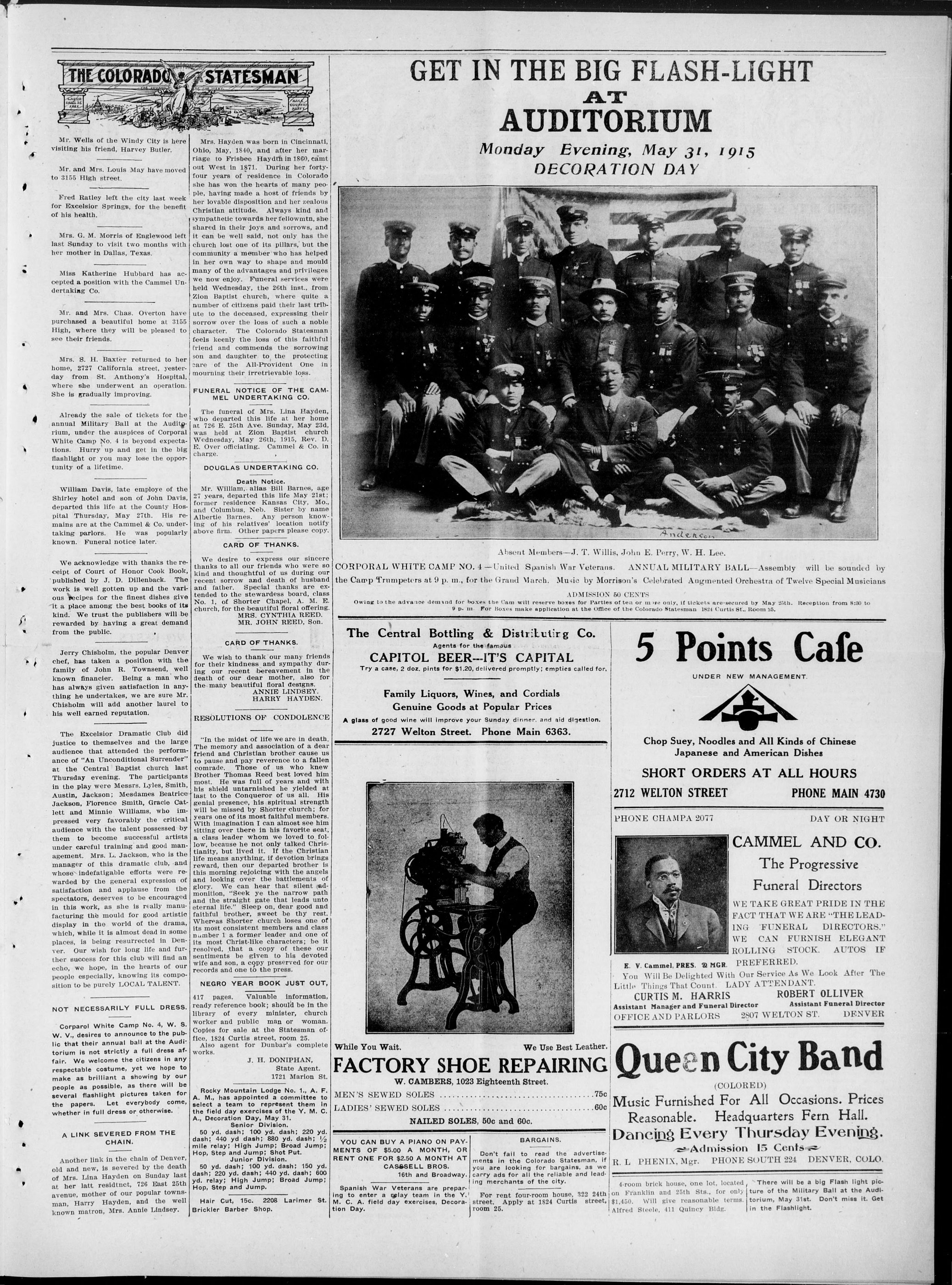
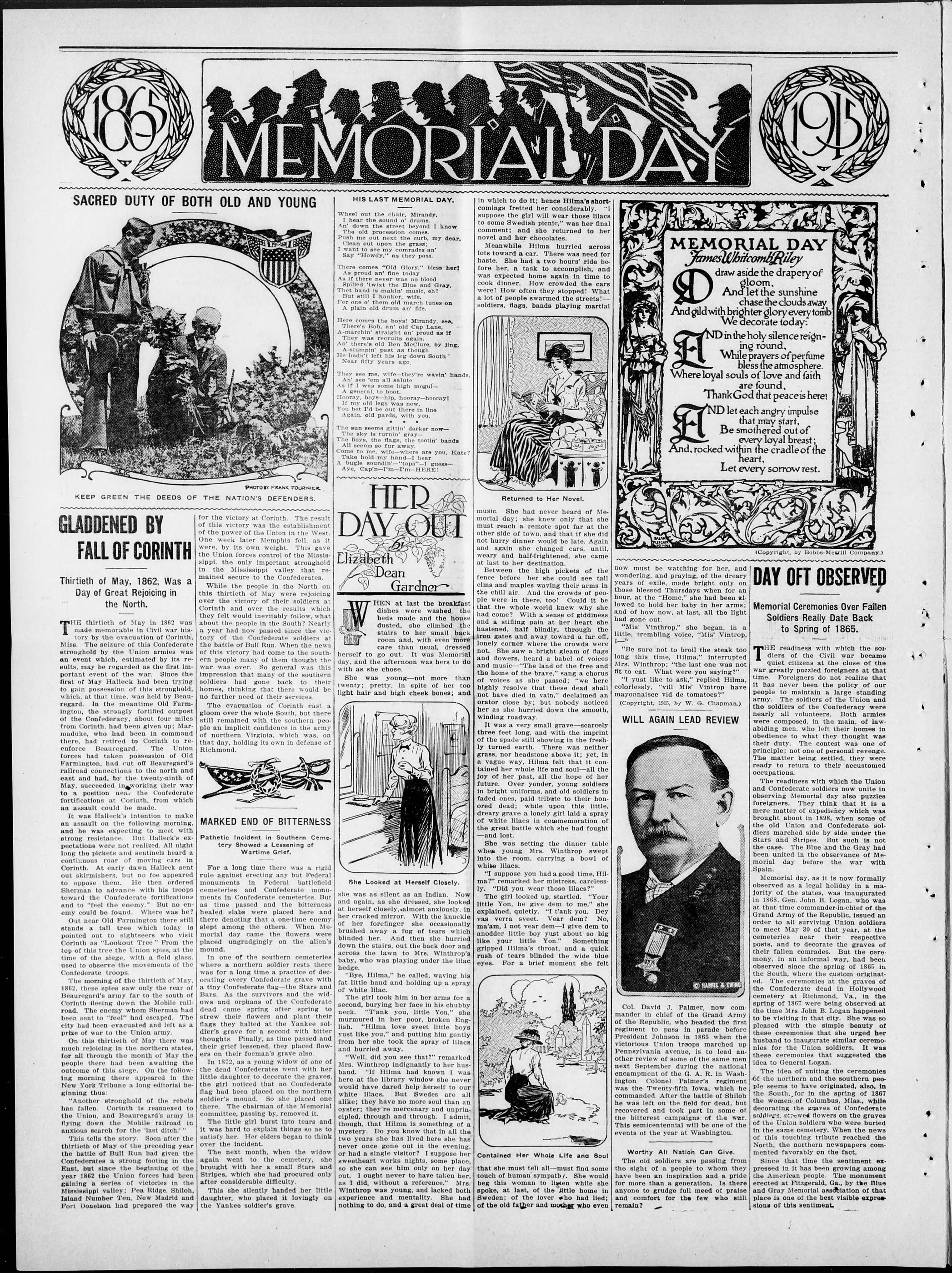
Denver.—Memorial Day—when the members of the Blue and the Gray visit the cemeteries and strew with flowers the graves of their comrades who have passed on—will be celebrated Monday, May 31. Twelve hundred old soldiers, survivors of the War of the States, will parade Denver's streets in honor of the unnumbered dead, the soldiers who didn't come back and those who have since joined them. The men in blue will march side by side with the men in gray.
"Candy Kid" Captured and Confesses
Candy Kid Captured and Confesses.
Denver. With a smile of bravado over his deeds, and with a great respect for the name of the sweetheart for whom he says he turned highwayman, David Tyler, 17-year-old son of Harry L. Tylter, a Denver merchant, confessed in the office of Sheriff J. W. McBroom of Littleton that he is the Candy Kid drug store bandit who has terrorized Denver druggists for the past month. With Tyler was arrested Albert Angerman, 19 years old, bridegroom of a month.
Mother of Boulder Undersheriff Dead.
Mother of Boulder Undersheriff Dead. Boulder.—Mrs. William Euler, 80, mother of Undersheriff Robert L. Euler, died at her residence north of Boulder. Her husband died only four weeks ago, and since that time she had been failing rapidly. She had been a resident of Boulder for almost forty years.
Shoots Wife Who Sued Him
Limon.—A half hour after he had been served with divorce papers in which his wife charged cruelty. Wesley Windsor went to his father-in-law's house in Any, a small town near here, and shot her through the body. She is not expected to live.
Former Coloradoan Killed in France.
Colorado Springs—News reached here that Hamilton de Beauvoir Nelson, formerly a resident of this city, has been killed on the firing line with the allies in France.
The
Curtis
Park
Floral
Company
FLORAL DESIGNS PUT UP WHILE
YOU WAIT
CHOICE PLANTS AND CUT FLOWERS CONSTANTLY
ON HAND
GREENHOUSES: Thirty-Fourth and Curtis Streets
TELEPHONE, MAIN 1511
DENVER, COLO
W. C. CAMPTON, Pres. J. M. JOHNS, Treas. U. P. JACKSON, Sec. RAILROAD PORTERS' CLUB LUNCH ROOM IN CONNECTION
Twentieth and Champa,
Is the place to get your
DRUGS, CHEMICALS AND PATENT MEDICINES
WE SERVE DRINKS.
Prescriptions Our Specialty.
Phone us and we will deliver the goods to all parts of the city.
JAMES E. THRALL, PROPR.
PHONE MAIN 2426.
1004 Nineteenth Street, Corner of Curtis
FINE WINES, LIQUORS AND CIGARS COORS' CELEBRATED BEER ON TAP
The
WARD AUCTION
COMPANY
Sales Daily at 2 p.m. Office Furniture a Specialty.
PRIVATE SALES AT ALL TIMES
HAVE MOVED TO—
1723-39 GLENARM ST.
PHONE MAIN 1675.
THE BEST ICE CREAM AND
CANDIES AT
O.P. BAUR & CO.
CATERERS AND
CONFECTIONERS
Phone: 168
1612 Curtis Street, Denver, Colo.
DO IT NOW Subscribe
for THIS
PAPER
DENVER
FREE CHECK
ROOM
me block from Union Depot.
ER, Barber.
DENVER, COLORADO.
Pharmacy
and Champa,
to get your
D PATENT MEDICINES
DRINKS.
Our Specialty.
the goods to all parts of the city.
IRALL, PROPR.
MAIN 2426.
BROTHERS'
E ROOM
reet, Corner of Curtis
TELEPHONE YORK 6668.
GENERAL FURNITURE REPAIRING AND UPHOLSTERING.
WORK GUARANTEED.
Miss M. Cowden
Hair Dressing Parlor
Shampoo, cutting and curling. Scalp treatment, hair tonics, hair straightening, manicuring. Stage wigs for rent; theatrical use and masquerades. Goods delivered out of the city. All shades of hair matched by sending sample of hair; also combings made up.
Cheapest Switches 50 Cents
1219 21st St. Denver, Colo.
COLORADO
AFRO-AMERICAN CULLINGS
The name Manassas conjures up in the minds of most people in this country the great struggle between the North and the South on the battlefield of Bull Run fifty years ago, in that brother-against-brother strife for the freedom for the Negro. It seems, therefore, peculiarly fitting that on this battlefield which witnessed such havoc and bloodshed for the emancipation of these people, there should spring up a school where they might learn the value and usefulness of the liberty won for them at so great a cost. Such a school—a school of everyday common-sense training with industrial work supplemented by practical academic studies—came into existence there twenty years ago, under the guiding hand of a colored woman, Jennie Dean.
The founding of the Manassas Industrial School for Colored Youth is really the life-story of Jennie Dean. Her parents were slaves, but of the most intelligent class of Negroes, her father having been taught to read and write early in life. He was ambitious after the war, to own his farm, but died before he had finished paying for it. Jennie Dean, then a young girl, left home and went into service in Washington, her wages going to pay the balance on the farm, as well as to pay her younger sister's tuition at college.
Jennie Dean's life in Washington brought to her full realization of the danger her people run in migrating to the cities, and she made up her mind to try to do something to keep them at home. Her first work toward this was the starting of a Sunday school one summer while on a visit home, which later developed, through her efforts, into the founding of a church in Manassas. During the time that she was conducting these Sunday school classes and working for the church, Jennie Dean was also holding Saturday afternoon classes in cooking and sewing, and through this work she realized the possibilities which might develop out of training of this sort for young colored people.
She spent twelve years in this mission work before she determined to devote herself to the industrial education of the Negroes of northern Virginia and to found a school for that purpose. She knew the danger that lurked in the cities for these young people, but she also realized the discouraging situation which confronted them if they remained at home. She was mindful of the skilled labor of slavery days, and bemoaned the fact that nothing had come to replace that industrial side. By this time, Jennie Dean's influence had become very strong in the community, so that they were all ready to help her when she called the people together and said:
"Keep your children at home. Don't send them to the cities. You must buy your land; become taxpayers. Make all you can and save all you can. Meanwhile, I will go out and raise the money to build a school where your children may be educated to trades. You do your part here, and I will do mine in the world."
While Negroes have progressed, poverty still shows its handicap. The death rate of Negroes in thirty-three northern cities, each having a Negro population of at least 2,500 in 1910, was 25.1 per thousand. This was a decrease of 2 per thousand in a decade, but it was still very high in comparison with the white death rate of 15.7 per thousand, incidentally a
It has been a practice in the recent past among our people to stand off and criticize the wayward young Negro and make no effort to help him. Many of us charged him with being responsible for his lost and ruined condition and fussed at him for not turning voluntarily to the paths of rectitude and for not healing his own ills. Others of us blamed our schools and educational institutions for these lamentable conditions, always seeming to excuse parents for their responsibility in the matter.
All of which was wide of the mark. It is beginning to dawn now upon the majority of us that there is no effective substitute for good home training. Neither schools, colleges nor reformatories can do a work for the young as effectively as the home. The schools and colleges do all within their power for the morals of the young; the most of their time must of necessity be spent in technical or book instruction, which of itself may or may not better the morals. But conditions which compel fathers and mothers in Negro homes to become breadwinners to the neglect of the children, force
The highest temperature ever known in a human being was recorded in the case of an Italian recently. A victim of lung disease, his temperature was 138.
Some men who think they are dear are easily bought.
No woman is safer than the length of her hatpin.
There are 70,000 Indian farmers in the United States.
lowering of 2.5 per thousand for the whites.
A comparison for twenty-four southern cities showed a rate of 29.6 for Negroes, a decrease of 4 per thousand, and 16.9 for whites, a decrease of 2.9 from 1900. Malaria, tuberculosis, pneumonia and whooping cough seem to be more deadly among Negroes than among whites, while Negroes are better able to withstand measles, scarlet fever, diptheria, cancer, appendicitis, diarrhea and violence. Also fewer Negroes commit suicide.
Dr. W. F. Brunner, health officer of Savannah, Ga., shows clearly in the current survey, how much of a menace this high death rate is to both Negroes and whites in the South. In 1913 there were about 39,000 whites and 42,000 Negroes in Savannah. Deaths from natural causes totaled 1,038 among the Negroes and only 442 among the whites. The infamous housing upon city dwelling Negroes, North and South, account for this great disparity. Of course, however, the city which permits a high death rate among Negroes pays the penalty among all its people. Bacteria are color blind.
That the mortality rate among the colored population is vastly higher than among the whites has long been known. But efforts to learn the cause and to remedy the trouble have not yet gone very far. The New York department of health, however, is going into that task with an energy that promises good results.
It is taking up the task with the cooperation of various colored civic organizations, all under an impulse given by Booker Washington and the National Negro Business league. It is generally understood that this heavy death rate is the result of ignorance as to the most sanitary methods of life and the care of ailments in their inception. For example, two types of disease are notable for abnormally large death rates among the colored people. These are infant mortality and tuberculosis. But in both of them it has been shown that right methods of living and care in the treatment of the disease can produce a notable saving of life.
The work of training the Negroes to the style of life that will lower mortality is eminently notable in itself. But it is even more so with regard to its effect on the whites. Living as they do, close to us, even when segregated, they cannot convert their quarters into breeding places for disease without enlarging the danger of infection for the white population. It is to be hoped that the New York effort to improve that evil will be successful and widely copied.
The will of Lemuel Googins, a colored barber of Baltimore, who died recently, was filed for probate. Googins' estate is said to be worth $200,000. Letters testamentary were issued to the Colonial Trust company, executor and trustee. The will bequeaths $4,000 to the Colored Masonic home to furnish two rooms in memory of Florence Googins, a deceased daughter. The residue of the estate is placed in trust with the Colonial Trust company as trustee, the income to be paid to Henrietta Googins, widow of the decedent, as long as she lives. At her death the estate goes to Granville Googins and Lemuel Googins, Jr., sons.
upon the schools the impossible task of trying to counteract the evils planted by a lack of adequate hearthside instruction.
According to a Negro publication, the Crisis, members of the darker race have gained recognition from scientific bodies in music, in art and also in the more commonplace walks of life. There is a colored man who is a major in the United States regular army, Maj. Charles Young. He has passed all his examinations with flying colors, is a first-class soldier and fighting man and, as a matter of fact, army officers are rather proud of him in an official way.
The colored American citizen is not an alien. Reaching this country unwillingly about the same time as the white man, he has demonstrated his loyalty in every war in his country's defense. He is a self-supporting, industrious, thrifty and useful citizen, and has as much right to equal treatment as those who have come later and rendered less service.
"She is the sort of girl," said Eph Wiley yesterday in discussing Genevieve Willoughby, "who will turn around to see if she has attracted your attention and then frown at you for looking at her."
A man can't do justice to himself as an entertainer when his wife is around.
The gold industry of the Rand is estimated to be worth $500,000 a day to South Africa.
STATE ASSESSORS MEET
FIX VALUES ON LIVE STOCK AND OTHER PROPERTY.
Mumper Will Endeavor to Have Question of Abolishing Tax Board Submitted to Voters in 1916.
Western Newspaper Union News Service.
Denver.—Despite the fact that to all appearances the most cordial relations existed, the annual meeting of the assessors was made the occasion for a movement to abolish the state taxing board.
A. L. Mumper, assessor of Weld county, is the prime mover in the plan. He has made it known that before the general election in 1916 he will attempt to obtain the necessary signatures to a petition to submit to the voters the question of abolishing the tax commission. Several other assessors agreed to co-operate in the plan through the circulation of similar petitions in their counties.
In addition to the reports of the committees on mine taxation and lands and improvements, the assessors adopted the recommendations of the livestock committee for the fixing of valuations on stock. The report recommended the following valuations:
Beef steers, fed, $60 to $80; steers in bunches, 1 year old, $30, 2 years old $40, and 3 and 4 years old $50 to $65; range cattle in bunches, ages from 6 months old upward, $35 to $40; straight bunches of range cows, $40 to $55; dogas at the discretion of the assessor, but must be shown in the abstract as dogas, from $60 to $75; broncho milk cows, $45; work horses, first class, 1,400 pounds and upward, $150; horses from 1,200 to 1,400 pounds, $100; horses from 900 to 1,100 pounds, $50 to $65; bunches of range horses, $35 to $50; stallions, jacks and bulls to be left to assessor's judgment first-class mules, heavy, $200; medium size mules, $100 to $150; light mules, $50 to $75; range sheep, $3.50 to $4.50; sheep fed in transit, $2.50; swine, 6 cents per pound; pack burros, $15; sheep camp burros, $5; chickens, $5 per dozen and other poultry in proportion; bees, $3 per stand. The committee on automobile valuation recommended that the valuations be fixed as follows:
Machines purchased since Jan. 1, 90 per cent of the cost price; machines 1 year old, 70 per cent of the cost price; machines 2 years old, from 40 to 60 per cent of the cost price; machines more than 2 years old, values to be left to the judgment of the assessor.
U. S. Income Tax Increases $117,000.
Denver.—The United States internal revenue department for the district of Colorado shows that the incomes of the wealthy in this region have increased during the past year, in spite of the fact that all business is supposed, to have suffered a retrenchment. During ten months of the last fiscal year, in which the personal income tax law was effective, $128,000 was collected. This year, Internal Revenue Collector Mark A. Skinner says a smaller number of people will pay nearly $245,000. The tax income for corporations remains nearly the same, which shows that the increased personal incomes are not due to any business retrenchment. Both forms of tax will total at least $600,000. These taxes, together with the receipts from the special war tax on beer, wines, liquors, tobacco dealers, places of amusement, etc., will give the federal government an income of $1,500,000 for one year from this district.
Collect $7,000 in Inheritance Tax.
Denver.—Nearly $7,000 in inherit-
ance taxes have been collected during
the last month by Leslie E. Hubbard,
inheritance tax appraiser. The
following is his report of the amount
collected:
Estate. Co. or State. Tax.
Wm. Teal Marshall, Denver. $ 215
Marion Elizabeth Bagg. Cal. 33
Marian Elizabeth Massachusetts. 35
Bernard Henry Lahmann Larimer. 45
Louis Dejonge, New York. 147
Dan H. Pike, Denver. 205
George Gillespie, Denver. 2,028
Arthur Balkman Center. 23
Proctor B. Mason, Weld. 143
William W. Paynant, Ohio. 83
Frances L. Bellan, Denver 1,775
Joseph L. Juniper, New York. 15
Jubus E. Warren, Massachusetts 25
Henry E. Drake, Denver. 77
Mary Reese, Denver. 81
Austin H. Marshall, Chicago. 1,048
Louis Semmidd, Denver. 19
William C. Donglass, Denver. 100
Frances C. Norton, Denver. 197
C. C. Ten Broeck, New York. 27
Girl May Save Bulger.
Denver.—Miss Willie Bellah, formerly a stenographer at the Savoy hotel in Denver, has written a letter to Gov. ernor Carlson in which she says she has information that may save James C. Bulger from the gallows. She claims in her letter to the governor that she has been unable to reach the attorney and friends of the convicted slayer of Lloyd F. Nicodemus, owner of the Savoy. Miss Bellah now lives in Atlanta, Georgia.
Plan Laws to Develop West.
Denver.—The Federal government is beginning to realize that many of its policies have been a bar to Western development, and the critical time has come for the entire West to join in presenting to the United States specific legislative remedies to counteract and remove the stagnation of the last seven or eight years, according to the unanimous opinion of Western executives, reported in Denver by Governor Carlson, who returned from the Seattle conference full of enthusiasm at the prospective reforms.
TURKSSINKSIXTH HUGE WAR CRAFT
CAPTAIN OF U. S. VESSEL NE
BRASKAN DECLARES THAT
TORPEDO STRUCK IT.
ITALIANS NEAR TRIESTE
MINE-LAYING STEAMER BLOWN
UP AT DOCK NEAR LONDON
AND 327 MEN PERISH.
Western Newspaper Union News Service
EVENTS IN EUROPEAN WAR.
Captain Greene of the American vessel Nebraskan injured by an explosion off Ireland says he is certain a torpedo struck his ship. British battleship Majestic sunk by a torpedo in the Dardanelies. British steamer Morwanna and Danish steamer Betty sunk by submarines in North Sea. British mine-laying ship Princess Irene destroyed by explosion at dock near the mouth of the pass of 327 sailors and dock-workers. Austrians surround Przemysl shutting off Russian communication with Lemburg. Indians continue to advance on Trieste. Mrs. May Fabin killed in another airship raid on Southend, England.
London, May 28.—The American steamer Nebraskan which was disabled by an explosion off the coast of Ireland arrived in Liverpool Thursday. Captain Greene of the Nebraskan said:
"I saw no submarine; but am certain it was a torpedo which hit us. Moreover, a submarine could not have failed to see our name and nationality which was outlined in huge letters on our sides."
The forward part of the ship, is completely wrecked.
Ambassador Page cabled the State Department at Washington that Captain Greene of the Nebraskan had given the naval attache of the embassy a sworn statement at Liverpool concerning the explosion on his ship off the Irish coast and that the attache was returning to London. Lieutenant Powers, the attache, was accompanied to Liverpool by Naval Constructor McBride, who is expected to make an examination, with the hope of ascertaining definitely whether the Nebraskan was damaged by a mine, or a torpedo.
The British battleship Majestic, another of the ships supporting the allied army on the Gallipoli peninsula, was torpedoed and sunk by a German submarine. Nearly all the officers and crew were saved.
At about the same time the steamer Princess Irene, which was built last year for the Canadian Pacific British Columbia coast service, and which was taken over by the admiralty at the commencement of the war as a mine-layer, was accidentally destroyed by an explosion while at anchor at Sheermess where she was undergoing repairs. All her crew, numbering 250, except one seaman, and, besides, 78 lockyard workmen who were aboard at the time, lost their lives.
GREAT FUTURE FOR BIG WEST
Secretry Houston Declares Dry Farming Will Develop Into One of Greatest Assets of Country. Denver.—With the directness of positive conviction, David F. Houston, secretary of agriculture of the United States, in an interview and in a brief address at the Chamber of Commerce, declared that this country—with the West the great producing center—would become the provider of the world in agricultural products, that dry farming had come to stay, and that the cities were more healthy than the country.
He suggested the need of a system of rural credits, praised the spirit of co-operation existing in the West, gave figures to show development of use of the public domain, urged co-operative marketing, and outlined numerous other problems of interest and concern to the country at large and especially the West.
STORM TOLL TWENTY-TWO DEAD.
Killing Frosts Damage Eastern Fruits and Floods Rage in Prairie States.
Denver, May 28.—From the plains east to the Atlantic seaboard weather conditions are unprecedented. New York, Pennsylvania and Ohio, with adjacent territory, are in the grip of a killing frost and grapes, peaches, cherries, plums and truck farms have been hard hit. Kansas, Oklahoma, eastern Colorado and parts of Wyoming have experienced the most serious storms for many years. Wind and rain have played havoc with buildings. The rush of waters is due to the rain that has kept steadily falling, crowding rivers' banks and levees. About twenty-two dead are reported from scattered sections and the injured will make a long list. Several cyclones have been reported.
Vanderbilt Memorial Services Held.
New York.—Tributes to the memory of Alfred G. Vanderbilt, who perished on the Lusitania, were paid in memorial services held at the home of his mother, Mrs. Cornelius Vanderbilt. Relatives and friends only attended the service. Mr. Vanderbilt's body was not recovered
ERNEST HOWARD,
Carpenter, Job and Repair Work.
Paints, Oils and Glass.
Coal, Wood
1021 21st Street.
oal, Wood and Express.
Coal, Wood and Express.
THE Giant FOR QUALITY
CLEANING, PRESSING
ING, RELINING AND
WORK CALLED FOR
2549 Washington Avenue
ING, PRESSING, DYEING, REPAIR- RELINING AND REMODELING. WORK CALLED FOR AND DELIVERED Boston Avenue Denver, Colorado
CLEANING, PRESSING, DYEING, REPAIRING, RELINING AND REMODELING.
WORK CALLED FOR AND DELIVERED
2549 Washington Avenue Denver, Colorado
JOHN K.
Meats, Fancy and
1864 CURTI
JOHN K. RETTIG
Fancy and Staple Groceries
1864 CURTIS STREET
seventh. Denver, Colo.
The Market
Wholesale and Retail Staple
Oysters. Hotels and Re
Market Company and Retail Staple and Fancy Groceries, Fish anders. Hotels and Restaurants Our Specialty. Cured. eastern Corn Fed Meats
The Market Company
Wholesale and Retail Staple and Fancy Groceries, Fish and Oysters. Hotels and Restaurants Our Specialty.
Eastern Corr
Eastern Corn Fed Meats
Fruits, Vegetables, Poultry and Game.
1633-39 Arapahoe Street Denver
C. H. SHIRLEY, Pres. J. C. HAMPSON
PAUL J. SHIRLEY, Sec. and Treas.
THE ATLAS DRUG C
Courteous Treatmet. Right P
Leaders in Prescription
RLEY, Pres. J. C. HAMPSON, Vice Pres. PAUL J. SHIRLEY, Sec. and Treas. THE ATLAS DRUG CO. eous Treatmet. Right Prices Leaders in Prescription
C. H. SHIRLEY, Pres. J. C. HAMPSON, Vice Pres PAUL J. SHIRLEY, Sec. and Treas.
THE ATLAS DRUG CO.
Courteous Treatmet. Right Prices Leaders in Prescription
Dr. Westbrook
Office 31 Good Block
16th & Larimer sts,
Phone Main 1433
Out of Office and afnights Call Residence,
2714 Arapahoe Street
Phone Champa 570
$50.00 PER MONTH, MADE DURING
YOUR SPARE TIME, Selling
the High Brown
Instructions and solicitors
certificate. This is the chance of a life time for any
interprising person. Be the first one in your community
to receive the certificate. Do the beauty of modern invention,
send a call for reply to inquiry and entail.
519 Second Ave., NEGRO DOLL COMPANY,
519 Second Ave., Nashville, Tenn.
Office 3131 Kittridge Bldg.
Phone Main 7416
Residence 822 32nd St.
Phone Main 8397
T. Ernest McClain, A. B. D. D. S.
Sundays and Nights by Appointment.
Office Hours:—8 a. m. to 12 m
2 p. m. to 6 p. m.
"STETSON HATS OUR SPECIALTY"
Phone Main 3661.
"BROWN, THE HATTER"
HATS CLEANED AND BLOCKED
50 CENTS
SATISFACTION GUARANTEED
A Trial Will Convince You.
71814 18TH STREET.
---
You Have Tried the Rest Now Try the Best
PHONE MAIN 3028
Corner Nineteenth.
Phones Main
169,181,189,190
Fresh and Cured
Store No. 1.
2701 WELTON ST.
Main 885 875
Glazing Done
Phone Champa 752
Our Prices Reasonable
Satisfaction Guaranteed
CLEANERS
AND
TAILORS
McCAIN & RICHARDS, PROPS
Phone Main 7376
RES. PHONE GALLUP 942
---
Denver, Colo.
C. E. Smith, Manager Res. Phone South 1608
Denver, Colorado
Store No. 2.
26TH AND WELTON
Main 4955-4956
Weatherhead Hat $ ^{C o} $
TELEPHONE MAIN 3203
PIONEER HATTERS OF THE WEST
We Make
Old Hats
New
We Make Old Hats New
PRACTICAL HATTERS
RENOVATORS, BLEACHERS,
DYERS' AND FINISHERS
Of Gents' and Ladies' Hats of Every
Description.
1624 CHAMPA ST., DENVER, COLO.
THE COLORADO STATESMAN
LABOR SHOULD BE FREE
TAXES COUNTRY PARTY
JOS. D. D. RIVERS.....Proprietor
1824 Curtis Street, Room 25.
Phone Main 7417.
SUBSCRIPTION RATES:
One Year ..... $2.00
Six Months ..... 1.00
Three Months ..... .60
PAYABLE IN ADVANCE.
Entered as second-class matter at the postoffice in the city of Denver, Colorado.
It occasionally happens that papers sent to subscribers are lost or stolen. In case you do not receive any number when due, inform us by postal card and we will cheerfully forward a duplicate of the missing number.
Communications to receive attention must be newsy, upon important subjects, plainly written only upon one side of the paper; must reach us Tuesdays, if possible, anyway, not later than Wednesdays, and bear the signature of the author. No manuscript returned, unless stamps are sent for postage.
No discounts allowed on less than three months' contract. Cash must accompany all orders from parties unknown to us. Further particulars on application.
Remittances should be made by Express Money Order, Postoffice Money Order, Registered Letter or Bank Draft. Postage stamps will be received the same as cash for the fractional part of a dollar. Only 1-cent and 2-cent stamps taken.
Display advertising, 50 cents per inch. An inch contains twelve agate lines.
Reading notices, ten lines or less, 10 cents per line. Each additional line over ten lines, 5 cents per line.
All communications of a personaging nature that are not complimentary will be withheld from the columns of this paper.
MEMORIAL DAY
never-to-be-forgotten mission it has made in people. In Denver, on this event tonight, be held on Monday day—will parade; we as guests of the nation war veterans, s Colorado State National Guard in the years Army of the Republic have charge of the field, too feeble to the body of the parade, be, as it proves. Other events the old day exercises a deep feeling, a more us, and that is Memorial Day has gone extended and expanded and therefore we go not mourning "the home service they the home before the which encourages a man, by decorating an emblematic of a so important an americans can not it is required for their integrity, when un the honor and digni and colors of her grand combination whether internally of the world. They is from the inhabit
The anniversary of this never-to-be-forgotten day has come again—Sunday, May 30—and the impression it has made in the years past is still fresh in the minds of the American people. In Denver and throughout the country, while the churches will speak on this event tomorrow, the celebration which embodies Decoration Day will be held on Monday, 31st. Survivors from both sides—the Blue and the Gray—will parade; veterans who fought for Confederacy will march in parade as guests of the Grand Army of the Republic; one hundred Spanish-American war veterans, sixty veterans of foreign wars and several companies of Colorado State National Guard will take part, giving us a reminder of what transpired in the years gone by. The Women's Relief Corps, Ladies of the Grand Army of the Republic, Daughters of Veterans, auxiliary organizations, will have charge of the ceremonies at the burial grounds. Men crippled, blind, too feeble to tramp in the sun, will ride in autos following the main body of the parade, this specially presenting an aspect too vivid to describe, as it proves the result of true patriots to their country. Other events taking place on this day will be the Y. M. C. A. field day exercises. With all these engagements and events there is a deep feeling, a touch of pathos, a striking reminiscence that looms before us, and that is—"the memory of our honored dead. The celebration of Memorial Day has gone beyond the confines of the soldier's grave, as it has extended and expanded itself to the great area of "our departed loved ones," and therefore we go heart in heart, hand in hand to the various burial places, not mourning "the lost, the dear," but demonstrating our gratitude for some service they performed; our love for some ray of hope that illumined the home before their departure; the faith in the resurrection of the body, which encourages and cherishes the thought of meeting our loved ones again, by decorating their graves with flowers, the choicest and most beautiful, emblematic of a lasting memory and the TIE THAT BINDS.
This anniversary, being so important an one in this country, strikingly serves as a reminder that Americans can not easily forget, as when the call to duty comes, when service is required for the maintenance of peace and the preservation of the nation's integrity, when unswerving and loyal obedience to the flag is demanded and the honor and dignity of this great republic must be upheld, all classes, creeds and colors of her citizens must forget prejudices and petty strifes and in one grand combination prosecute her cause for the suppression of wrongdoing, whether internally or externally, the uplift of humanity and the progress of the world. The Colorado Statesman hopes an entertainment of these truths from the inhabitants of
THE PEOPLE'S PRESBYTERIAN
E. 23d Ave. and Washington St.
11 a. m.—"The Evil That Men Do Lives After Them."
2:30 p. m.—"Services at the Mission."
4:45 p. m.—"Y. P. S. C. E."
5:30 p. m.—Sermon by the Rev. Wm. M. Campbell, Ph. D.
Every Wednesday night the pastor will conduct his instruction class for candidates for church membership in the vestry. Interested persons along this particular line are urged to attend.
There will be an exchange of pulpits Sunday evening between the Revs. J. A. Thos. Hazell, S. T. B., of the People's and the Rev. Wm. M. Campbell, Ph. D.; stated supply of the Immanuel Presbyterian church. All the members and friends will appreciate the change by gracing Dr. Campbell with your presence.
The first Sabbath in June, in lieu of the evening services the choir will stage the cantata, "Alleluia! Hail with Gladness." This beautiful piece of music should have been rendered the first Sabbath of May, but was postponed to June, owing to the pastor's illness. The second Sabbath at eventide the Sabbath School will observe Children's Day program. "The Christian Life" is the title of the piece prepared this year for this department of the work by the Presbyterian Board of Publication and Sabbath School Work. Services for "The Confirmation of
---
4:45 p. m.—"Y. P. S. C. E."
Baptismal Vows" will be observed the last Sabbath of June. The following Sabbath the Rev. Lionel B. West of Macon, Ga., at present a Presbyter of Knox Presbytery, recently appointed assistant pastor to the People's church with work assigned at Union Presbyterian church, Dearfield, will preach the sacramental sermon at the forenoon services and participate in celebrating the Communion of the Lord's Supper. He leaves during that week to enter his term of office.
At a recent meeting of the congregation by a decided vote the second Sabbath of July was set apart as a day of great financial sacrifice for the raising of our annual funds to meet our obligation to the Board of Church Erection, as well as defray our special assessment dues to the city and county of Denver. Without exception every member is called upon to exercise his Christian duty at this particular time. "The Lord loveth a cheerful giver." Your fame in the Presbytery of Denver as a self-sacrificing communicant membership should be an incentive whereby your reputation will be sustained.
Rex Allaman, a traveling man who visits Clovis regularly, tells this story, says the Clovis (N. M.) Journal: "I was telling a lady friend in Atchison recently about the prairie dogs out here. I said, 'Why, there are thousands and thousands of prairie dogs on the plains.' The woman expressed surprise and said: 'What are they doing? Watching the sheep?'
Prairie Dogs' Occupation.
least two years of college work in a reputable college. The study of medicine itself covers four years of nine months each, and some medical schools now require an additional year as an interne in a hospital. This makes seven years of study for one who already has a high-school education. After graduation from a medical school, every graduate must take a state board examination.
The study itself is very difficult, and the hours of study in a medical school are usually from nine in the morning to 5:30 in the evening, six days a week. A great deal of home study is required. The cost of tuition and books is usually about $200 a year.
The student must have a tendency toward philosophy and psychology and the study of human nature, in order to be able to go into the details of modern medicine. Especially if he has to work his way through, he must possess determination and perseverance. He must tend strictly to his studies and must sacrifice a great many pleasures.
He should realize that the medical profession is a noble one, and that there are higher things in life than the mere pursuit of money. From a financial standpoint the medical profession is a poor one, considering the money and time that must be invested in the study. The average physician, contrary to the prevailing idea, does not make more than a fair living, and a great many well-educated physicians have a hard time to make even that. The prospective medical student must also have in mind that he must remain a scholar and student through his whole life, and that when he graduates he has only a very limited, more or less theoretical knowledge of the practice of medicine.
If anyone thinks he can fulfill these requirements, it is well for him to take up the study of medicine, otherwise I would not advise him to do it, as statistics show that only about two-thirds of all the students who take up the study of medicine ever graduate and enter practice.
dislike. It's the ink used in printing the type that makes the moths stay away. That is why, in the absence of moth-proof bags and cedar chests, some housewives pack their furs and woolens away wrapped in newspapers at the end of the winter season and find that is a satisfactory way of preserving them against the ravages of moths. There is nothing better than old newspapers for use under the carpets for the same reason.
Old newspapers have many other uses as well. Wet in water, they serve to clean out the stove splendidly. Crushed newspapers are excellent to clean lamp chimneys. They can even be used for an iron holder for an emergency.
Newspapers dipped in lamp oil are useful for cleaning windows. Irons not much soiled can be rubbed on old newspapers and thus made fit for use. Dipped in lamp oil, they are splendid to rub the outside of the dishpan. They keep it bright and shining. Torn in shreds, slightly dampened and scattered over the carpet, they keep down dust when sweeping. They clean the sink of its grease and sediment; nothing is better, for the greasy paper can be at once burned after use.
Many times folded newspapers will serve as a mat to stand hot and blackened pots or kettles on and save soiling the kitchen table. The kitchen stove is kept bright after the cooking of each meal with old papers, and this saves many polishings.
That's the reason foreigners make such headway with American women. They never forget to be deferential and courteous, to say the little things and to do the little things that warm the cockles of the feminine heart. This may be all wrong. Perhaps she ought to appreciate the character more than the veneer. But she doesn't. The average woman isn't practical. She's romantic. She likes roses and bonbons. Many men give her cabbage and beefsteak. Cabbage and beefsteak are all right, but as a steady diet they are tiresome. She'll take less cabbage and beefsteak if thereby she may have some roses and bonbons.
A woman likes a man to look healthy and to be well groomed. She likes a vigorous body, a healthy skin and a look that betokens a daily acquaintance with the bath tub, not merely because she likes beauty, though she does, but because these things betoken good habits.
A woman, if she is a wife or a sweetheart, likes expressions of love. She gets tired of taking a man's love for granted. It grows faint and faraway, and life is cold and commonplace, when he does not tell her in actual words he loves her, and show her by actual caresses how much. To some men this seems all foolishness. They think that paying bills is the best proof of their love. But again, most women are not practical, and bills are uninteresting things, not half so enjoyable or warm and vital as a kiss or a caress.
from barbarism to such culture as is afforded by letters, that the reading of poetry is so much needed.
In the first place, we are apt today to place too much stress upon the merely material things of life; we need something to counteract this tendency. Poetry does this to a greater degree than any other kind of reading; poetry strives to express the ideal.
Again, because of the use of the telephone, typewriter, phonograph and other mechanical devices, we of this age are falling into easy and therefore slovenly methods of expression. Poetry, because of its limitations as to rule and form, necessarily cultivates the art of correct and epigrammatic expression. As our mental habits are largely formed by our reading, we evidently need poetry more than ever.
Besides, poetry makes for a better rhythmic sense, a finer perception of beauty and a higher culture generally.
Most Difficult of All Studies
By Henry Sherman Knox, Evanston, Ill.
least two years of college work in a reputable cine itself covers four years of nine months and now require an additional year as an inter-seven years of study for one who already After graduation from a medical school, state board examination.
The study itself is very difficult, and the school are usually from nine in the morning days a week. A great deal of home study is and books is usually about $200 a year.
The student must have a tendency toward the study of human nature, in order to of modern medicine. Especially if he has must possess determination and perseverance his studies and must sacrifice a great many.
He should realize that the medical prof there are higher things in life than the me a financial standpoint the medical profession money and time that must be invested in the cian, contrary to the prevailing idea, does living, and a great many well-educated ph make even that. The prospective medical st that he must remain a scholar and student that when he graduates he has only a very li knowledge of the practice of medicine.
If anyone thinks he can fulfill these re to take up the study of medicine, otherwise it, as statistics show that only about two-th take up the study of medicine ever graduate
Old Newspapers are Made Useful
By J. O. Barrington, Poplar Bluff, Mo.
dislike. It's the ink used in printing the type away. That is why, in the absence of moths some housewives pack their furs and woolens at the end of the winter season and find that serving them against the ravages of moths. old newspapers for use under the carpets for Old newspapers have many other uses to serve to clean out the stove splendidly. Cruc to clean lamp chimneys. They can even be used emergency.
Newspapers dipped in lamp oil are used Irons not much soiled can be rubbed on old fit for use. Dipped in lamp oil, they are splined dishpan. They keep it bright and shining. Tened and scattered over the carpet, they kee They clean the sink of its grease and sediment greasy paper can be at once burned after use. Many times folded newspapers will serve blackened pots or kettles on and save soil kitchen stove is kept bright after the cook papers, and this saves many polishings.
Manly Qualities Admiredby Women By ANNIE RUSH, Baltimore, Md.
That's the reason foreigners make such hear They never forget to be deferential and cour and to do the little things that warm the e This may be all wrong. Perhaps she ought more than the veneer. But she doesn't. Tical. She's romantic. She likes roses and her cabbage and beefsteak. Cabbage and be steady diet they are tiresome. She'll take thereby she may have some roses and bonbo A woman likes a man to look healthy likes a vigorous body, a healthy skin and acquaintance with the bath tub, not mere though she does, but because these things be A woman, if she is a wife or a sweethe She gets tired of taking a man's love for gra away, and life is cold and commonplace, actual words he loves her, and show her by a some men this seems all foolishness. They best proof of their love. But again, most bills are uninteresting things, not half so en a kiss or a caress.
Reading of Poetry Is very Desirable By F. B. Endicott, Portland, Ore.
from barbarism to such culture as is afforded of poetry is so much needed.
In the first place, we are apt today to pertainly material things of life; we need a tendency. Poetry does this to a greater degree; poetry strives to express the ideal.
Again, because of the use of the telephe and other mechanical devices, we of this a therefore slovenly methods of expression. tions as to rule and form, necessarily cultiva grammatic expression. As our mental hab reading, we evidently need poetry more than Besides, poetry makes for a better rhyt of beauty and a higher culture generally.
Unquestionably the most difficult of all studies is that of medicine. The requirements for admission to the first-class medical schools is a complete high-school education and at
college. The study of medicine, and some medical schools are in a hospital. This makes has a high-school education. Every graduate must take a few hours of study in a medical degree to 5:30 in the evening, six required. The cost of tuition and philosophy and psychology be able to go into the details to work his way through, he. He must tend strictly to pleasures. Mission is a noble one, and that are pursuit of money. From this a poor one, considering the study. The average physician not make more than a fair musicians have a hard time to indent must also have in mind through his whole life, and visited, more or less theoretical requirements, it is well for him he would not advise him to do birds of all the students who and enter practice.
The mere fact that moths cannot read is no reason why they should detest newspapers, but they do nevertheless. It isn't exactly the newspaper or its editorial policy that moths
oe that makes the moths stay proof bags and cedar chests, away wrapped in newspapers is a satisfactory way of pre-There is nothing better than the same reason. as well. Wet in water, they shed newspapers are excellent used for an iron holder for an useful for cleaning windows. and newspapers and thus made indid to rub the outside of the corn in shreds, slightly damp-up down dust when sweeping-nt; nothing is better, for the be as a mat to stand hot and ring the kitchen table. The king of each meal with old
A woman likes pleasing manners in a man. She likes deference and courtesy and attentiveness in small things. Manners often make more of an appeal to her than sterling worth.
alway with American women. esteous, to say the little things rockles of the feminine heart. it to appreciate the character the average woman isn't prac- clon bonbons. Many men give steak are all right, but as a less cabbage and beefsteak if as. and to be well groomed. She a look that betokens a daily ly because she likes beauty, otoken good habits. heart, likes expressions of love. rated. It grows faint and far- hen he does not tell her in actual careses how much. To think that paying bills is the women are not practical, and enjoyable or warm and vital as
I wonder how many people read poetry! I fear not nearly so great a number, proportionately, as formerly, and yet there is no age in the history of the world, since men emerged
d by letters, that the reading face too much stress upon the something to counteract this agree than any other kind of none, typewriter, phonograph age are falling into easy and Poetry, because of its limitations the art of correct and epics are largely formed by our ever.amic sense, a finer perception
DOWNS
FRANK BURNLEY—MANAGER.
See the Railroad Men and Waiters 2149 Curtis street, and you must come the most energetic manager in this way to please and satisfy the tastes and decorating the club rooms. The very impressive, as he has mounted comrades in the library, and a visit amply repaid by the systematic order.
Saturday
WILL BE THE
Great Decoration
Blue Suits
BLUE SERGE SUITS predicts dressers the year around, plete without one. Alwaysance, proper for semi-dress or business wear—the Blue Serge acy for many years. As a spec are selling
TRUE BLUE SERGE
WITH TW
A Blue Serge and a White Pique Vest W
Slim or Ex
$13
THE M
THE HOME OF SOCIETY
Saturday Night
BE THE LAST OFFER
Out Decoration Day Sale
Blue Serge Suit
THE SUITS predominate in favor of the year around. No man's waist. Always correct in style, men or semi-dress occasions, and most—the Blue Serge Suit has maintained years. As a special offering for the BLUE WIRE-WOW SERGE SUIT WITH TWO VESTS. White Pique Vest With Each Suit. Sizes Slim or Extra Size Men.
$13.75
MAY
HOME OF SOCIETY BRAND CLO
See the Railroad Men and Waiters' Club in their remodelled premises, 2149 Curtis street, and you must conclude that Manager Frank Burnley is the most energetic manager in this part of the country. Making a study of how to please and satisfy the tastes of his patrons, he is always renovating and decorating the club rooms. The appearance for Decoration Day will be very impressive, as he has mounted and decorated all the portraits of old comrades in the library, and a visit by members and their friends will be amply repaid by the systematic order of things in these club rooms.
Saturday Night
WITH TWO VESTS
A Blue Serge and a White Pique Vest With Each Suit. Sizes for Regular, Stout
Slim or Extra Size Men.
SHORTER CHAPEL'S NOTES.
Rev. Robert L. Pope, B. D., Pastor.
The order of service at Shorter Chapel tomorrow will be as follows:
11 a. m.—Sermon by the Rev. Dr. William J. Lowstuter of Denver University.
3 p. m.—Anniversary of the grand order of U. B. F. and S. M. T. Sermon by the pastor and special music by the choir.
8 p. m.—Annual sermon of the Spanish War Veterans. (1) paper, Memorial, Mrs. Cora E. Robinson. (2) War Reminiscences, Capt. Thos, Campbell, Solo, "The Vacant Chair," Mme Lillian Hawkins Jones. (4) Sermon by the pastor.
During the past year our Allen Christian Endeavor League, under the the leadership of Mr. Royal C. Brown, has enjoyed a remarkable growth, both in efficiency and in numbers, and it can safely be said that it is now in the midst of halcyon days. The annual election of ocers, held recently, resulted as follows: President, R. C. Brown; vice president, Herbert Williams; secretary, Miss Jewell Perkins; assistant secretary, Mrs. Rebie L Brown; correspondent secretary, C. Guy Nelson; treasurer, Miss Elizabeth Miller; organist; Miss Madie G. Nelson. Chairmen of committees: Music, Mrs. Effie Waldon; lookout, Mrs. N. L. Douglas; social, Mrs. M. P. King; prayer meeting, Mrs. M. E. Wade; temperance, Miss Dona Nelson; bevevolent, Mrs. Jennie Dishman; flower, Miss Mae Anna Hall.
On Thursday evening, June 11th, in the lecture room of the church, the Mite Missionary Society will repeat "A Birthday with Mirandy," for the benefit of the National Preachers' Home, Colorado Springs. The former rendition was flatteringly applauded; the repetition promises to be even better. Besides the cause is a worthy one. Lend a hand. Admission 10 cents. The Pond Lily Art Club will present "The Spinster's Return Monday evening, May 31st, at Shorter, for the benefit of the Douglas-Lincoln Sanitiorium Association. The admission is ten cents. This should appeal to you. Don't miss it.
---
Day Night
LAST OF THE
On Day Sale of
Gorge Suits
dominate in favor with all good
No man's wardrobe is com-
rect in style, neat in appear-
cations, and most practical for
Suit has maintained its suprem-
cial offering for this week we
WIRE-WOVEN
SUITS
NO VESTS
With Each Suit. Sizes for Regular, Stout
ra Size Men.
3.75
AY CO.
TY BRAND CLOTHES
CHURCH OF THE HOLY REDEEM ER (EPISCOPAL).
22d Ave. and Humboldt St.
Rev. Henry B. Brown, B. D, Vicar.
Trinity Sunday, May 30th:
7 a. m.—Celebration of the Holy
Eucharist.
9:45 a. m.—Sunday School.
11 a. m.—Choral celebration of the Holy Eucharist, with sermon. Subject, "Man's Tripartate Nature." 7:45 p. m.—Choral Evensong. Subject, "Man's Tripartite Nature." Cross."
Solo—"Let Joyous Peace Reign Everywhere"—Robyn. Soloist, Mr. Frank Gaines.
Annual parish meeting Wednesday, June 2d, 8 p. m., at which time the annual church report will be read, and every member is requested to attend. The vicar and guild of St. Perpetua offer their sincere thanks to the members and friends who helped to make the entertainment such a grand success.
Shorter's Sunday School is preparing to make a large entry in field day exercises of the Y. M. C. A., Decoration Day.
To Recover Drowned Bodies.
A Canadian scientist suggests that drowned bodies might often be recovered by a method used by Australian poachers in catching fish. The poachers cast into the water a bottle filled with dampened lime and the fish, stupefied by the explosion, are easily gathered up as they float upon the surface.
On the Mighty Nile.
Twelve thousand miles of navigable waterways are offered by the Nile and its tributaries.
Proof Against Forgery. Checks signed with an electric pen are said to be proof against forgery.
Mr. Wells of the Windy City is here visiting his friend, Harvey Butler.
Mr. and Mrs. Louis May have moved to 3155 High street.
Fred Ratley left the city last week for Excelsior Springs, for the benefit of his health.
Mrs. Hayden was born in Cincinnati, Ohio, May, 1840, and after her marriage to Frisbee Haydth in 1860, came out West in 1871. During her four years of residence in Colorado she has won the hearts of many people, having made a host of friends, her lovable disposition and her zealous Christian attitude. Always kind
Mrs. G. M. Morris of Englewood left last Sunday to visit two months with her mother in Dallas, Texas.
Miss Katherine Hubbard has accepted a position with the Cammel Undertaking Co.
Mr. and Mrs. Chas. Overton have purchased a beautiful home at 3155 High, where they will be pleased to see their friends.
Mrs. S. H. Baxter returned to her home, 2727 California street, yesterday from St. Anthony's Hospital, where she underwent an operation. She is gradually improving.
Already the sale of tickets for the annual Military Ball at the Auditorium, under the auspices of Corporal White Camp No. 4 is beyond expectations. Hurry up and get in the big flashlight or you may lose the opportunity of a lifetime.
William Davis, late employe of the Shirley hotel and son of John Davis, departed this life at the County Hospital Thursday, May 27th. His remains are at the Cammel & Co. undertaking parlors. He was popularly known. Funeral notice later.
We acknowledge with thanks the receipt of Court of Honor Cook Book, published by J. D. Dillenback. The work is well gotten up and the various recipes for the finest dishes give it a place among the best books of its kind. We trust the publishers will be rewarded by having a great demand from the public.
Jerry Chisholm, the popular Denver chef, has taken a position with the family of John R. Townsend, well known financier. Being a man who has always given satisfaction in anything he undertakes, we are sure Mr. Chisholm will add another laurel to his well earned reputation.
The Excelsior Dramatic Club did justice to themselves and the large audience that attended the performance of "An Unconditional Surrender" at the Central Baptist church last Thursday evening. The participants in the play were Messrs. Lyles, Smith, Austin, Jackson; Mesdames Beatrice Jackson, Florence Smith, Gracie Cattell and Minnie Williams, who impressed very favorably the critical audience with the talent possessed by them to become successful artists under careful training and good management. Mrs. L. Jackson, who is the manager of this dramatic club, and whose indefatigable efforts were rewarded by the general expression of satisfaction and applause from the spectators, deserves to be encouraged in this work, as she is really manufacturing the mould for good artistic display in the world of the drama, which, while it is almost dead in some places, is being resurrected in Denver. Our wish for long life and further success for this club will find an echo, we hope, in the hearts of our people especially, knowing its composition to be purely LOCAL TALENT.
NOT NECESSARILY FULL DRESS
Corparol White Camp No. 4, W. S. W. V., desires to announce to the public that their annual ball at the Auditorium is not strictly a full dress affair. We welcome the citizens in any respectable costume, yet we hope to make as brilliant a showing by our people as possible, as there will be several flashlight pictures taken for the papers. Let everybody come, whether in full dress or otherwise.
A LINK SEVERED FROM THE
CHAIN.
Another link in the chain of Denver, old and new, is severed by the death of Mrs. Lina Hayden on Sunday last at her latt residtnct, 726 East 25th avenue, mother of our popular townsman, Harry Hayden, and the well known matron, Mrs. Annie Lindsey.
Mrs. Hayden was born in Cincinnati, Ohio, May, 1840, and after her marriage to Frisbee Haydth in 1860, cait out West in 1871. During her forty-four years of residence in Colorado she has won the hearts of many people, having made a host of friends by her lovable disposition and her zealous Christian attitude. Always kind and sympathetic towards her fellowmtn, she shared in their joys and sorrows, and it can be well said, not only has the church lost one of its pillars, but the community a member who has helped in her own way to shape and mould many of the advantages and privileges we now enjoy. Funeral services were held Wednesday, the 26th inst., from Zion Baptist church, where quite a number of citizens paid their last tribute to the deceased, expressing their sorrow over the loss of such a noble character. The Colorado Statesman feels keenly the loss of this faithful friend and commends the sorrowing son and daughter to the protecting care of the All-Provident One in mourning their irretrievable loss.
FUNERAL NOTICE OF THE CAM MEL UNDERTAKING CO.
The funeral of Mrs. Lina Hayden, who departed this life at her home at 726 E. 25th Ave. Sunday, May 23d, was held at Zion Baptist church Wednesday, May 26th, 1915, Rev. D. E. Over officiating. Cammel & Co. in charge.
DCUGLAS UNDERTAKING CO.
Death Notice.
Mr. William, alias Bill Barnes, age 27 years, departed this life May 21st; former residence Kansas City, Mo., and Columbus, Neb. Sister by name Albertie Barnes. Any person knowing of his relatives' location notify above firm. Other papers please copy.
CARD OF THANKS
We desire to express our sincere thanks to all our friends who were so kind and thoughtful of us during our recent sorrow and death of husband and father. Special thanks are extended to the stewardess board, class No. 1, of Shorter Chapel, A. M. E. church, for the beautiful floral offering.
MRS. CYNTHIA REED.
MR. JOHN REED. Son.
CARD OF THANKS
We wish to thank our many friends for their kindness and sympathy during our recent bereavement in the death of our dear mother, also for the many beautiful floral designs.
RESOLUTIONS OF CONDOLENCE
"In the midst of life we are in death. The memory and association of a dear friend and Christian brother cause us to pause and pay reverence to a fallen comrade. Those of us who knew Brother Thomas Reed best loved him most. He was full of years and with his shield untarnished he yielded at last to the Conqueror of us all. His genial presence, his spiritual strength will be missed by Shorter church; for years one of its most faithful members. With imagination I can almost see him sitting over there in his favorite seat, a class leader whom we loved to follow, because he not only talked Christianity, but lived it. If the Christian life means anything, if devotion brings reward, then our departed brother is this morning rejoicing with the angels and looking over the battlements of glory. We can hear that silent admonition, "Seek ye the narrow path and the straight gate that leads unto eternal life." Sleep on, dear good and faithful brother, sweet be thy rest. Whereas Shorter church loses one of its most consistent members and class number 1 a former leader and one of its most Christ-like characters; be it resolved, that a copy of these our sentiments be given to his devoted wife and son, a copy preserved for our records and one to the press.
NEGRO YEAR BOOK JUST OUT,
417 pages. Valuable information, ready reference book; should be in the library of every minister, church worker and public man or woman. Copies for sale at the Statesman office, 1824 Curtis street, room 25.
Also agent for Dunbar's complete works.
J. H. DONIPHAN,
State Agent.
1721 Marlon St.
Rocky Mountain Lodge No. 1., A. F.
A. M., has appointed a committee to
select a team to represent them in
the field day exercises of the Y. M. C.
A., Decoration Day, May 31.
Senior Division.
50 yd. dash; 100 yd. dash; 220 yd.
dash; 440 yd dash; 880 yd. dash; ½
mile relay; High Jump; Broad Jump;
Hop, Step and Jump; Shot Put.
Junior Division.
50 yd. dash; 100 yd. dash; 150 yd.
dash; 220 yd. dash; 440 yd. dash; 600
yd. relay; High Jump; Broad Jump;
Hop, Step and Jump.
Hair Cut, 15c. 2208 Larimer St.
Brickler Barber Shop.
GET IN THE BIG FLASH-LIGHT AT AUDITORIUM
Anderson
CORPORAL WHITE CAMP NO. 4—United Spanish War Veterans. ANNUAL MILITARY BALL—Assembly will be sounded by the Camp Trumpeters at 9 p. m., for the Grand March. Music by Morrison's Celebrated Augmented Orchestra of Twelve Special Musicians
ADMISSION 50 CENTS
Owing to the advance demand for boxes the Cam will reserve boxes for Parties of ten or more only, if tickets are secured by May 25th. Reception from 8:30 to 9 p. m. For Boxes make application at the Office of the Colorado Statesman 1824 Curtis St., Room 25.
CAPITOL BEER---IT'S CAPITAL Try a case, 2 doz. pints for $1.20, delivered promptly; empties called for.
Family Liquors, Wines, and Cordials
Genuine Goods at Popular Prices
A glass of good wine will improve your Sunday dinner, and aid digestion.
2727 Welton Street. Phone Main 6363.
SEWING
W. CAMBERS, 1023 Eighteenth Street.
MEN'S SEWED SOLES ..... 75c
LADIES' SEWED SOLES ..... 60c
NAILED SOLES, 50c and 60c.
YOU CAN BUY A PIANO ON PAYMENTS OF $5.00 A MONTH, OR RENT ONE FOR $2.50 A MONTH AT CASSSELL BROS.
BARGAINS.
Don't fail to read the advertisements in the Colorado Statesman, if you are looking for bargains, as we
Spanish War Veterans are preparing to enter a relay team in the Y. M. C. A. field day exercises, Decoration Day.
While You Wait.
Monday Evening, May 31, 1915 DECORATION DAY
Absent Members—J. T. Willis, John E. Perry, W. H. Lee.
Absent Members—J. T. Willis, John E. Perry, W. H. Lee.
Don't fail to read the advertisements in the Colorado Statesman, if you are looking for bargains, as we carry ads for all the reliable and leading merchants of the city.
For rent four-room house, 322 24th street. Apply at 1824 Curtis street, room 25.
We Use Best Leather.
BARGAINS.
5 Points Cafe
UNDER NEW MANAGEMENT
Chop Suey, Noodle
Japanese a
SHORT ORDE
2712 WELTON STREET
y, Noodles and All Kinds of
Japanese and American Dis
ORDERS AT ALL
STREET PH
A 2077
Chop Suey, Noodles and All Kinds of Chinese Japanese and American Dishes
PHONE CHAMPA 2077
E. V. Cammel, PRES. @ MGR.
You Will Be Delighted With
Little Things That Count. I
CURTIS M. HARRIS
E. V. Cammel. PRES. @ MGR. PREFERRED. You Will Be Delighted With Our Service As We Look After The Little Things That Count. LADY ATTENDANT.
S. @ MGR. PREFERRED.
Lighted With Our Service As We
Count. LADY ATTENDANCE.
HARRIS ROBER
and Funeral Director Assis-
RLORS 2807 WELTON C
n City I
CURTIS M. HARRIS ROBERT OLLIVER
Assistant Manager and Funeral Director Assistant Funeral Director
OFFICE AND PARLORS 2807 WELTON ST. DENVER
Queen City Band
Pushed For All Occasion
e. Headquarters F
Every Thursday
Admission 15 Cents
Music Furnished For All Occasions. Prices Reasonable. Headquarters Fern Hall. Dancing Every Thursday Evening. Admission 15 Cents R. L PHENIX, Mgr. PHONE SOUTH 224 DENVER, COLO. 4-room brick house, one lot, located on Franklin and 25th Sts., for only $1,450. Will give reasonable terms. Alfred Steele, 411 Quincy Bldg. There will be a big Flash light picture of the Military Ball at the Auditorium, May 31st. Don't miss it. Get in the Flashlight.
es and All Kinds of Chinese and American Dishes RRS AT ALL HOURS
CAMMEL AND CO.
The Progressive
Funeral Directors
WE TAKE GREAT PRIDE IN THE
FACT THAT WE ARE "THE LEAD-
ING FUNERAL DIRECTORS."
WE CAN FURNISH ELEGANT
ROLLING STOCK. AUTOS IF
PREFERRED.
h Our Service As We Look After The
LADY ATTENDANT.
ROBERT OLLIVER
Director Assistant Funeral Director
(COLORED)
PHONE MAIN 4730
DAY OR NIGHT
SACRED DUTY OF BOTH “OLD AND YOUNG | HISLAST MEMORIAL DAY. —_| in which to do {t; hence Hilma’s short- | pyep= pepper paseneney ptr ere -YOT EEE
hes a
( IN \
[Vind Fe A
fi EN VA v
ae Wee iiek Cory ‘ey
2 “ss ES jai)
Ae Ge See
ae - ge | re es no
iohees are eae ee AY
pests Se IE ages i TC, <4
KEEP GREEN THE DEEDS OF THE NATION'S DEFENDERS.
PPA IE SSPE IIR REID A DS PRS DD
for the victory at Corinth. The rest
GLADDENED BY of this vietory was the establistime
of the power of the Union in the We:
One week later Memphis fell, as
were, by its own weight. This ga’
the Union forces control of the Miss
sippi, the only important strongho
ee in the Mississippi valley that 1
wae mained secure to the Confederates.
Thirtieth of May, 1862, Was @) “white the people in the North |
Day of Great Rejoicing in this thirtieth of May vate rejoici
over the victory of their soldiers
the North. Ngee a eee Le geen ara ed ae
HE thirtieth of May in 1862 was
T made memorable in Civil war his-
tory by the evacuation of Corinth,
Miss. The seizure of this Confederate
stronghold by the Union armies was
an event which, estimated by its re-
sults, may be regarded as the first im-
portant event of the war. Since the
first of May Halleck had been trying
to gain possession of this stronghold,
which, at that time, was held by Beau-
regard. In the meantime Old Farm-
ington, the strongly fortified outpost
ot the Confederacy, about four miles
from Corinth, had been given up; Mar-
maduke, who had been in command
there, had retired to Corinth to re-
enforce Beauregard. The Union
forces had taken possession of Old
Parmington, had cut off Beauregard’s
railroad connections to the north and
east and had, by the twenty-ninth of
May, succeeded ingworking their way
to a position nea, the Confederate
fortifications at Corinth, from which
an assault could be made.
It was Halleck’s intention to make
an assault on the following morning,
and he was expecting to meet with
strong resistance, But Halleck's ex-
pectations were not realized. All night
long the pickets and sentinels heard a
continuous roar of moving cars in
Corinth. At early dawn Halleck sent
out skirmishers, but no foe appeared
to oppose them. He then ordered
Sherman to advance with his troops
toward the Confederate fortifications
and to “feel the enemy.” But no en-
emy could be found. Where was he?
Out near Old Farmington there still
stands a tall tree which today is
pointed out to sightseers who visit
Corinth as “Lookout Tree” From the
top of this tree the Union spies, at the
time of the siege, with a field glass,
used to observe the movements of the
Confederate troops.
‘The morning of the thirtieth of May,
1862, these spies saw only the rear of
Beauregard’s army far to the south of
Corinth fleeing down the Mobile rail-
road. The enemy whom Sherman had
been sent to “feel” had escaped. The
city had been evacuated and left as a
prize of war to the Union army.
On this thirtieth of May there was
much rejoicing in the northern states,
for all through the month of May the
people there had been awaiting the
outcome of this siege. On the follow-
ing morning there appeared in the
New York Tribune a long editorial be-
ginning thus:
“Another stronghold of the rebels
has fallen, Corinth is reannexed to
the Union, and Beauregard’s army is
flying down the Mobile railroad in
anxious search for the ‘last ditch.’ ”
‘This tells the story. Soon after the
thirtieth of May of the preceding year
the battle of Bull Run had given the
Confederates a strong footing in the
East, but since the beginning of the
year 1862 the Union forces had been
gaining a series of victories in the
Mississippi valley; Pea Ridge, Shiloh,
Island Number Ten, New Madrid and
Fort Donelson had prepared the way
‘PHOTOBY FRANK FOURNIER,
for the victory at Corinth. The result
of this victory was the establishment
of the power of the Union in the West.
One week later Memphis fell, as it
were, by its own weight. This gave
the Union forces control of the Missis-
sippi, the only important stronghold
in the Mississippi valley that re-
mained secure to the Confederates.
While the people in the North on
this thirtieth of May were rejoicing
over the victory of their soldiers at
Corinth and over the results which
they felt would inevitably follow, what
about the people in the South? Nearly
a year had now passed since the vic-
tory of the Confederate soldiers at
the battle of Bull Run. When the news
of this victory had come to the south-
‘ern people many of them thought the
war was over. So general was this
impression that many of the southern
soldiers had gone back to their
homes, thinking that there would be
‘no further need of their services
The evacuation of Corinth cast a
gloom over the whole South, but there
still remained with the southern peo-
ple an implicit confidence in the army
of northern Virginia, which was, on
that day, holding its own in defense of
Richmond.
Gs
Od)
weet
MARKED END OF BITTERNESS
Pathetic Theltenthin Southern Ceme-
Wartime Grief.
For a long time there was a rigid
rule against erecting any but Federal
monuments in Federal battlefield
cemeteries and Confederate monu-
ments in Confederate cemeteries, But
as time passed and the bitterness
healed slabs were placed here and
there denoting that a one-time enemy
slept among the others. When Me-
morial day came the flowers were
placed ungrudgingly on the alien's
mound.
In one of the southern cemeteries
where a northern soldier rests there
was for a long time a practice of dec-
orating every Confederate grave with
a tiny Confederate flag—the Stars and
Bars. As the survivors and the wid.
ows and orphans of the Confederate
dead came spring after spring to
strew their flowers and plant their
flags they halted at the Yankee sol-
dier’s grave for a second with bitter
thoughts Finally, as time passed and
their grief lessened, they placed flow-
ers on their foeman’s grave also,
In 1872, as a young widow of one of
the dead Confederates went with her
little daughter to decorate the graves,
the girl noticed that no Confederate
flag had been placed on the northern
soldier's mound. So she placed one
there. The chairman of the Memorial
committee, passing by, removed it.
The little girl burst into tears and
it was hard to explain things so as to
satisfy her. Her elders began to think
over the incident.
‘The next month, when the widow
again went to the cemetery, she
brought with her a small Stars and
Stripes, which she had procured only
after considerable difficulty.
| This she silently handed her little
daughter, who placed it lovingly on
the Yankee soldier's grave.
HIS LAST MEMORIAL DAY.
Wheel out the chair, Mirandy,
I hear the sound o* drums,
An’ down the street beyond I know.
Tho old procession comes.
Push me out next the curb, my dear,
Clean out upon the grass;
I want to see my comrades an’
Say “Howdy,” as they pass.
‘There comes “Old Glory,” bless her}
As proud an’ fine today
As if there never was no blood
Spilled ‘twixt the Blue and Gray,
‘Thet band is makin’ music, eh?
But still I hanker, wife,
Per one 0’ them old’march tunes on
‘A plain old drum an’ fife.
Here comes the boys! Mirandy, sae,
‘There's Bob, an' old Cap Lane,
A-marchin’ straight an’ proud as 3
‘They was recrults again,
An’ there's old Ben McClure, by Jing,
A-stumpin’ past as though
He hadn't left lls leg down South *
Near fifty years ago,
‘They see me, wife—they're wavin’ hands
An’ seo ‘em all salute
As if I was some high mogul—
A general, to boot.
Hooray, bo¥s—hip, hooray—hooray!
If my’ old legs was new,
You bet I'd be out there fn line
Asain, old pards, with you.
The sun seems sittin’ darker now—
‘The sky is turnin’ gray—
The Boys, the flags, the tootin’ bands
All seems so fur away.
Come to me, wife—where are you, Kate:
‘Take hold my hand—t hear
A bugle soundin’—“taps""—I_ guess—
Ave, Cap'n—I'm—I'm—HERE!
b=
TER we
TRIS
SEBS"
lize ae ve? .
Leeann 4/
¢_S)__ Gardner
ee
HEN at last the breakfast
rT dishes were washed. the
wi beds made and the house
iil dusted, she climbed the
us stairs to her small back
{GF room ana, with even more
care than usual, dressed
herself to go out It was Memorial
day, and the afternoon was hers to do
ilu ae auatcuore!
She was young—not more than
Eranty pares Gmeiayceiiar tad
light hair and high cheek bones; and
Uf oa. i {
{ Je
Ahi p C2, Wn
i A ei A (Hh I)
! PS 17) NI |
y | ul Ie ( | i
ITT ex WE
! ( . | ;
| ‘
MII |
es NU) All n I <
—Jjsa\||| |=
<<a |
AAA 7
Z-AW}} iy
A) v/] | Vi)
ZA E x
AN pe
MANY =
She Looked at Herself Closely.
she was as silent as an Indian. Now
and again, as she dressed, she looked
at herself closely,:almost anxiously, in
her cracked mirror. With the knuckle
of her forefinger she occasionally
brushed away a fog of tears which
blinded her. And then she hurried
down the stairs, out the back door and
across the lawn to Mrs. Winthrop’s
baby, who was playing under the Iilac
hedge.
“Bye, Hilma,” he called, waving his
fat little hand and holding up a spray
of white Hlac.
‘The girl took him in her arms for a
second, burying her face in his chubby
neck. “T’ank you, little Yon,” she
murmured in her poor, broken Eng.
lish, “Hilma love sveet little boys
yust like you,” and putting him gently
from her she took the spray of lilacs
and hurried away.
“Well, did you see that?” remarked
Mrs. Winthrop indignantly to her hus.
band. “If Hilma had known I was
here at the library window she never
would have dared help herself to our
white lilacs. But Swedes are all
alike; they have no more soul than an
oyster; they're mercenary and unprin
cipled, through and through. I admit
though, that Hilma is something of a
mystery. Do you know that in all the
two years she has lived here she has
never once gone out in the evening,
or had a single visitor? I suppose her
sweetheart works nights, some place,
so she can see him only on her day
out. I ought never to have taken her,
as I did, without a reference.” Mrs.
Winthrop was young, and lacked both
experience and mentality. She had
nothing to do, and a great deal of time
in which to do it; hence Hilma’s short-
comings fretted her considerably. “I
suppose the girl will wear those lilacs
to some Swedish picnic,” was her final
comment; and she returned to her
novel and her chocolates.
Meanwhile Hilma hurried across
lots toward a car. There was need for
haste. She had a two hours’ ride be-
fore her, a task to accomplish, and
was expected home again in time to
cook dinner. How crowded the cars
were! How often they stopped! What
a lot of people swarmed the streets! —
soldiers, flags, bands playing martial
i
i _G Dae
Mera
a
Oe “alee:
ay fi i
music. She had never heard of Me-
morial day; she knew only that she
must reach a remote spot far at the
other side of town, and that if she did
not hurry dinner would be late. Again
and again she changed cars, until,
weary and half-frightened, she came
at last to her destination.
Between the high pickets of the
fence before her she could see tall
elms and maples waving their arms in
the chill air. And the crowds of peo-
ple were in there, too! Could it be
that the whole world knew why she
had come? With a sense of giddiness
and a stifling pain at her heart she
hastened, half blindly, through the
iron gates and away toward a far of,
lonely corner where the crowds were
not, She saw a bright gleam of flags
and flowers, heard a babel of voices
and music—“The land of the free and
the home of the brave,” sang a chorus
of voices as she passed; “we here
highly resolve that these dead shall
not have died in vain,” declaimed an
orator close by; but nobody noticed
her as she hurried down the smooth,
winding roadway.
It was a very small grave—scarcely
three feet long, and with the imprint
of the spade still showing in the fresh.
ly turned earth. There was neither
grass, nor headstone above it; yet, in
@ vague way, Hilma felt that it con-
tained her whole life and soul—all the
joy of her past, all the hope of her
future. Over yonder, young soldiers
in bright uniforms, and old soldiers in
faded ones, paid tribute to their hon.
ored dead; while upon this little,
dreary grave a lonely girl laid a spray
of white lilacs in commemoration of
the great battle which she had fought
—and lost.
She was setting the dinner table
whem young Mrs. Winthrop swept
into the room, carrying a bowl of
white lilacs.
“I suppose you hada good time, Hil-
ma?” remarked her mistress, careless:
ly. “Did you wear those lilacs?”
The girl looked up, startled. “Your
little Yon, he give dem to me,” she
explained, quietly. “I t'ank you. Dey
vas yerra syeet. Vear dem? No,
ma‘am, I not vear dem—I give dem to
anodder little boy yust about so big
like your little Yon.” Something
gripped Hilma’s throat, and a quick
Tush of tears blinded the wide blue
eyes. For a brief moment she felt
aa
C sa
-- Phas
He 8 ug Sia
Bae PRs arte,
i wa iN Zl
5 777 UES Th | ar
ah lo () eee
a Bee 7 ae
p= een
a?
Leese pe gne >
Se
Contained Her Whole Life ana Soul
that she must tell all—must find some
touch of human sympatby. She would
beg this woman to ligen while she
spoke, at last, of the iittle home in
Sweden; of the lover who had lied;
of the old father and moder who even
OST Px 2 es or av. °
Perfil eS eT BLS nA rz)
Rw 4 MEMORIAL DAY hex 4
y " Sameaitconlipiley :
BE" draw aside the draperyof ¥ ~
PS leon, : i
eee And let the sunshine Jat)
Pr, - chase the clouds away Ve
Ay And gildwith brighter glory every tomb] a hy
igs ‘We decorate today: h ee
i ak intheholy silence reign- | in
een > ing round, ey ry
ees “While prayers of perfume oy ys
I TY bless the pale) \) \|
{, f if Where loyal sonnel faith ¥
are found, f
| \ ‘Thank God that peaceis here! : is P
\ Na let con angry fale pal
wi Beanatietdaciot [SE
WI every loyal breast; ]) B
f rocked within the cradleot the ) |
Al Let aes sorrow rest. uae
eee ee ED eS —— z
L er CAL a 3H
L} a be > Ral z
tN = ROY S
PY SAVAD. ACG AC sy
ORSAY
now must be watching for her, and
wondering, and praying, of the dreary
years of exile, made bright only on
those blessed Thursdays when for an
hour, at the “Home,” she had been al.
lowed to hold her baby in her arms;
and of how now, at last, all the light
had gone out.
“Mis’ Vinthrop,” she began, in a
little, trembling voice, “Mis’ Vintrop,
La
“Be sure not to broil the steak too
long this time, Hilma,” interrupted
Mrs. Winthrop; “the last one was not
fit to eat. What were you saying?”
“I yust like to ask,” replied Hilma,
coloriessly, “vill Mis’ Vintrop have
mayonnaisce vid de tomatoes?”
(Copyright, 1915, by W. G. Chapman)
WILL AGAIN LEAD REVIEW
i Bote ‘
ie a. ar
a
Col. David J. Palmer, now com.
mander in chief of the Grand Army
of the Republic, who headed the first
regiment to pass in parade before
President Johnson in 1865 when the
victorious Union troops marched up
Pennsylvania avenue, is to lead an-
other review of some of the same men
next September during the national
encampment of the G. A. R. in Wash-
ington Colonel Palmer's regiment
was the Twenty-fifth Iowa, which he
commanded After the battle of Shiloh
he was left on the field for dead, but
recovered and took part in some of
the bitterest campaigns of the war.
‘This semicentennial will be one of the
events of the year at Washington.
Worthy All Nation Can Give.
‘The old soldiers are passing from
the sight of a people to whom they
have been an inspiration and a pride
for more than a generation. Is there
anyone to grudge full meed ot praise
and comfort for the few who still
‘remain? _.
DAY OFT OBSERVED
Memorial Ceremonies Over Fallen
Soldiers Really Date Back
to Spring of 1865.
HE readiness with which the sow
kas of the Civil war became
quiet citizens at the close of the
war greatly puzzled foreigners at that
time. Foreigners do not realize that
it has never been the policy of our
people to maintain a large standing
army. The soldiers of the Union and
the soldiers of the Confederacy were
nearly all volunteers. Both armies
were composed, in the main, of law-
abiding men, who left their homes in
obedience to what they thought was
their duty. The contest was one of
principle; not one of personal revenge.
The matter being settled, they were
ready to return to their accustomed
occupations.
‘The readiness with which the Union
and Confederate soldiers now unite in
observing Memorial day also puzzles
foreigners, They think that it is a
mere matter of expediehcy which was
brought about in 1898, when some of
the old Union and Confederate sol-
diers marched side by side under the
Stars and Stripes. But such is not
the case. The Blue and the Gray had
been united in the observance of Me-
morial day before the war with
Spain.
Memorial day, as it is now formally
observed as a legal holiday in a ma-
Jority of the states, was inaugurated
in 1868. Gen. John B. Logan, who was
at that time commander-in-chief of the
Grand Army of the Republic, issued an
order to all surviving Union soldiers
to meet May 30 of that year, at the
cemeteries near their respective
posts, and to decorate the graves of
their fallen comrades. But the cere:
mony, in an informal way, had been
observed since the spring of 1865 in
the South, where the custom originat-
ed. The ceremonies at the graves of
the Confederate dead in Hollywood
cemetery at Richmond, Va. in the
spring of 1867 were being observed at
tho time Mrs. John B, Logan happened
to be visiting in that city, She was so
pleased with the simple beauty of
these ceremonies that she urged her
husband to inaugurate similar ceremo-
nies for the Union soldiers. It was
these ceremonies that suggested the
idea to General Logan.
The idea of uniting the ceremonies
6f the northern and the southern peo-
ple seems to have originated, also, in
the South, for in the spring of 1867
the women’ of Columbus, Miss., while
decorating the gxaves of Confederate
soldiers, vtrewed flowers on the grayes
of the Union soldiers who were buried
in the same cemetery. When the news
of this touching tribute reached the
North, the northern newspapers com-
mented favorably on the fact.
Since that time the sentiment ex-
pressed in it has been growing among
the American people. The monument
erected at Fitzgerald, Ga., by the Bluo
and Gray Memorial assdbiation of that
place is one of the best visible expres
sions of this sentiment, __
(Copyright, 1915, by W. G. Chapman.)
"Oh, Hugh Evans is easy," boasted big fat Basil Drake. "He's a good fellow, all right. He's friendly and accommodating. Too much so for his own good. Hasn't any ginger in him, though. Wish I could marry him off and see him settle down for life."
Well might bluff, hearty, but intensely selfish Basil Drake speak indulently and patronizingly of his cousin, Hugh Evans. Years before Drake had been a clerk of the senior Evans. When the latter died he turned the business over to Drake.
"All I ask, Basil," he said, "is that you take care of my boy. Help him along until he can take care of himself, and if you feel like giving him a start in life, then, so much the better."
Now, Drake had done fairly well for this quasi ward, in his own estimation. He had sent him to school and provided for him, but he found Hugh a good helper about the store and had kept him ground down in a business way. Of late Mrs. Drake had intimated that she wished Hugh would find quarters elsewhere, not that she disliked him, but the growing family needed all the living room in the house.
Hugh was a good man. When that was said, it covered the case. He was honest, industrious, sympathetic and kindly to all humanity. The Drake system had in a measure tended to suppress ambition, but the mental and spiritual aspirations of the man were pure and strong. He was content to remain in the humble situation fate seemed to have awarded him. As for the rest, truthfulness and earnest sentiments of humanity for all his fellow creatures gave to Hugh that greatest of all blessings, a peaceful mind. It was towards the close of a fair spring day that Hugh, passing down a squalid street in the poorer portion
7
"Do It," Chuckled Drake.
of the town, paused to take in an unusual scene that appealed powerfully to his warm, sympathetic nature.
A small heap of wretchedly poor furniture lay on the sidewalk, evidently just removed from a two-room tenement. In its midst, wan, poorly dressed and evidently ill, was a young girl of about eighteen. Tears filled her eyes and the look of blank despair in her fired face made Hugh's heart ache. A motherly looking woman with a brood of tattered children at her heels was trying to console the poor girl. Her efforts seemed vain. As she stepped aside Hugh spoke to her and asked her the vision of the distressing scene.
"Oh, sir, it's pitiful." broke out the genuine-souled creature. "She is Ivy Moore. Her father, who was an old physician without a practice, died a month ago. She has been ill since and today they evicted her and the poor sticks of furniture you see. She is crushed. Oh, she has had so little of joy in life that she is heartbroken! I asked her to make her home with us until she is strong and well, but she will not do it, knowing how poor we are, dear soul!" "She must do just that," declared Hugh determinedly. "I will give you some money. You must see to it that she has care and food and nursing." "Bless you, sir! the poor creature needs it," and the woman went back to the girl and talked with her earnestly. Hugh thrilled as the stricken creature cast a glance of gratitude upon him. Then, overcome, she sank back unconscious.
They took her into the rooms of the woman, who promised to care diligently for her charge. Hugh gave her some money. He told Drake the pitiful story of the girl when he got back to the store.
"Humph! You must have money to throw away," remarked his unfeeling relative. "I say, you seem gone on her. I knew her father. A respectable old 'has been. Why don't you marry her—that would solve the problem of a poor homeless girl needing a friend?" Hugh blushed to the roots of his
Hugh blushed to the roots of his hair, but he said, with dignity:
"If I felt myself worthy of that
sweet, patient creature I might con- consider your suggestion."
"Do it," chuckled Drake, "and I'll give you a house and lot as a wedding present."
"You mean that, do you?" interrupted Hugh, rather grimly.
"I do—ha! ha! Sure, I do!" guffawed Drake, as though he was enjoying some immense joke. You give me a sort of cancellation of all obligations and the property I have in mind you shall have."
"That's generous of you, Basil," said Hugh, in his usual way of humility.
He never forgot the evening, one week later, when Ivy, nursed back to strength and hope, listened to his simple appeal.
"I am a lonesome man, you are a lonesome girl. I offer you a home. I think we could be very happy together."
"Oh! If I could think you would not tire of me—I, so poor, so unused to love and tenderness! I could slave for you and be happy in the merest hut," she said.
Basil Drake, in his coarse way, laughed uproariously as, a month before the wedding, he took Hugh to see "the house and lot."
A narrow strip of land two hundred feet wide, half a mile in length, lay between the hills. Once there had been a house there. It had been burned down. All that was left was a substantial but rough tool house.
"There's your house and lot, just as I promised," he said.
Hugh winced, but he said quietly:
"Thank you. I think I can make it do."
He set at work to make the big roomy shell comfortable. One day while he was hard at work a stranger came to him.
"I understand you own the valley strip here clear to the next section line," he remarked.
"That's right," replied Hugh.
"Got a deed to it?"
"A week ago, all clear and recorded."
"We are surveying for a district sewer system," explained the man. "I represent the county board of improvements. Your land has a natural slant and could be utilized without excavating. Would you sell?"
"Why, I suppose I would," answered Hugh. "I've considered the land, so low and narrow, rather valueless, but—"
"I can offer you five thousand dollars," said the man.
Hugh was dazed. It seemed as if the coffers of Croesus had been suddenly set at his disposal.
"I'll—I'll take it," he all but gasped, a wild, joyous vision of a little two thousand dollar rose-embowered cottage nearer town filling his vision. Then he signed a contract to accept five thousand dollars for the strip of ground, the "house and lot" shrewd, calculating Basil Drake had "put over upon him."
Drake looked chagrined and mad when he learned of the transaction.
One glorious evening, that of their plain, simple wedding day, Hugh Evans led his bride to the little cottage of which he was the proud owner.
"Oh, Hugh!" she breathed ecstatically, as he led her up the path to the rose-glorified home, "this is not ours?"
"Ours, my dear, yours and mine," he said.
She put her loving arms about his neck. The blue heavens seemed to smile down upon them. Then, true children of the heart, they passed the humble portal of what was to them the most beautiful palace in all the wide, wide world.
"Blue Stockings."
The name, "blue stockings," as applied to highly intellectual women, originated in England in the eighteenth century. Boswell tells of the origin in his "Life of Johnson." Some leading London women used to give evening parties for eminent literary men. One of the sought-after men of the time was a Benjamin Stillingfleet, whose dress was "remarkably grave," and who always wore blue stockings. If he were late to a party it used to be said, "We can do nothing without the blue-stocking." "Thus by degrees," says Boswell, "the title was established." It became classic in a poem by Hannah More, "Bas Bleu," describing a Blue-Stocking club.
Billy Missed Something.
My sister going to call one day on a school chum, took her little son along. While there, the hostess served refreshments on a highly polished table, with only a centerpiece in the center of the table. It looked like a regular meal to Billy, who looked first at his mother and then at the hostess in a puzzled way. They both began to eat, and finally Billy with a little sigh, seriously lifted his glass and plate and spread out his napkin under them. His mother wanted to know why he was doing that, and Billy, glancing furtively at the hostess, who appeared not to be noticing, whispered: "Sh! She forgot the tablecloth."—Chicago Tribune.
Absolute Size of the Stars.
The latest attempt to determine the absolute diameter of a number of fixed stars is that of Signor Ferrara of Termo, Italy, who publishes his results in the Rivisita di Astronomia. Among the stars having a measureable parallax he estimates, from photometric measurements, that Canopus is the largest, with a diameter fifty-one times as great as that of the sun. Other large stars, and the ratios of their diameters to that of the sun, are: Castor, 18; Arcturus, 10.4; Poliux, 8.7; Capella, 8; Vega, 6.8. Such determinations are, of course, highly problematical.
NATIONAL CAPITAL AFFAIRS
First Medicinal Drug Plant Farm in the World
WASHINGTON.—A medicinal drug plant farm on a large scale a thing unique in the annals of horticulture in this country and abroad, has been established by American scientists on the Virginia hills just opposite the
just across the Potomac river. The new drug plant farm is established on the property of John B. Henderson, Jr., who has taken a scientific interest in the matter and has turned over his land to those in charge for a long period of years.
At the drug farm in Virginia about forty-five acres of land are being planted with drug plants this year, and it is planned to very much increase this acreage next year. Already enough selected belladonna plants for five acres have been brought up under glass. Big beds containing 100,000 ginseng roots have been set out in the woodlands. Other plants which are being grown include cannabis, larkspur, golden seal or hydrastis, Japanese peppermint, senega, colchium and springelia.
Uncle Sam Might Have Replaced Marian's Dolly
ONE fine summer day little seven-year-old Marian Coggeshall was playing with her dolly at her home at Cape Cottage, Me. At intervals the great guns at Fort Williams, near Cape Elizabeth, boomed terribly and shook the base.
plained to her exactly how such claims were attended to, little thinking that Marian had any intention of placing the matter before the authorities at Washington. Marian said nothing, but she went to her little writing desk and penned the following letter:
"Dear Mr. Adjutant General:
"When the big guns were fired last week it shook the house so badly that my Precious dolly fell onto the floor and was broken to Pieces. May I ask the Government for another dolly. She was not very big, but She was my Pet and I loved her very much. Yours truly."
The letter was received by the adjutant general and given the official designation of document No. 1949121. The matter was referred to the quartermaster general for investigation. Then it went to the commanding general of the eastern division of the army, Maj. Gen. William H. Barry, stationed at New York. Finally the matter reached Col. George T. Bartlett, who commanded the artillery division at Fort Williams.
Colonel Bartlett called Mrs. Coggeshall on the telephone and told her of the official document. Marian's mother was greatly surprised, for she knew nothing of her daughter's action, and she assured the officer that Mr. Coggeshall would relieve the government of Marian's claim and buy the new doll himself.
So Marian's father bought here the doll and the matter ended right there. But Marian had a perfect right to ask the government to replace her doll, and if her mother had permitted it, her claim probably would have been granted.
Her letter still is on file at the war department here, and is regarded as one of the most novel documents ever received by the adjutant general.
News Digests Prepared for Our High Officials
News Digests Prepared for Our High Officials
THE average high official of the United States government has little or no time for newspaper reading. He has to have his newspapers read for him, with the result that subordinate officials or employees of his department
which reach Washington by a fast mail in time to be delivered before breakfast. During the day, the president's secretary is kept informed as to what is going on in the outside world by the newspaper correspondents who call regularly at the White House. The White House also takes a large number of representative newspapers, and these are carefully read by an employee assigned to the job, who clips out everything relating to the president, the White House, the administration and politics in general.
When Mr. Tumulty goes home at night he takes this mass of newspaper clippings home with him, and no matter at what hour he may go to bed, he never fails to look these clippings through before retiring. Anything he finds therein which he believes is of sufficient importance to call the attention of the president is carefully marked. The next morning the president may find on his desk one of these clippings with a note attached as follows:
"Dear Governor: I think you ought to read this. TUMULTY."
In this way, the president is kent posted.
Geographic Society Admits a Dog to Membership
Geographic Society Admits a Dog to Membership
THAT a dog has been elected a fellow of the National Geographic society is an announcement that will surprise most persons, but this is no ordinary canine. Bronte is its name—Bronte McCormick. Bronte was elected
derful feats of mind reading. There is no trick, nothing to deceive. Her work is purely mental work and it is, presumably, because of her brain power that she has achieved the distinction of being elected to membership in a society that is supposed to embrace only human savants. Bronte is a Scotch collie of the finest type. She was born July 29, 1903, in the famous collie kennels at Center Moriches, Long Island. She can count money, she can count people and tell how many there are in the room and how many have glasses on.
PILL PLANT
HILLEM QUICK
just across the Potomac river. The r
the property of John B. Henderson, Jr
the matter and has turned over his lair
of years.
At the drug farm in Virginia ab
planted with drug plants this year, and
this acreage next year. Already enou
acres have been brought up under glass
roots have been set out in the wood
grown include cannabis, larkspur, gold
mint, senega, colchium and sprigelia.
Uncle Sam Might Have
ONE fine summer day little seven-y
with her dolly at her home at Cap
guns at Fort Williams, near Cape Ell
house. Finally Marian put her doll on a chair and crept into a corner, frightened. Then came an extra loud boom and dolly lost her balance and fell to the floor, broken into many bits. Marian was broken hearted, for although the dolly was not very big, it was the little girl's pet, and she had grown to love it very much.
A grown-up admirer of the little girl listened to her tearful tale and then told her that she had a just claim against the government and ex-
plained to her exactly how such claim Marian had any intention of placing Washington. Marian said nothing, but penned the following letter: "Dear Mr. Adjutant General:
"When the big guns were fired I that my Precious dolly fell onto the f ask the Government for another dolly my Pet and I loved her very much.
The letter was received by the designation of document No. 1949121. termmaster general for investigation. T of the eastern division of the army, at New York. Finally the matter re- manded the artillery division at Fort Colonel Bartlett called Mrs. Cogg the official document. Marian's mother nothing of her daughter's action, a Coggeshall would relieve the governm doll himself.
So Marian's father bought here there. But Marian had a perfect rie her doll, and if her mother had perm been granted.
Her letter still is on file at the w one of the most novel documents ever
News Digests Prepared
THE average high official of the Un- time for newspaper reading. He him, with the result that subordinate
A man reading a newspaper.
which reach Washington by a fast man fast. During the day, the president's is going on in the outside world by the regularly at the White House. The W of representative newspapers, and the assigned to the job, who clips out even White House, the administration and p When Mr. Tumulty goes home at clippings home with him, and no matter never fails to look these clippings thre therein which he believes is of suffici the president is carefully marked. Th on his desk one of these clippings with "Dear Governor: I think you ough In this way, the president is kept
Geographic Society Admin
THAT a dog has been elected a fell is an announcement that will su ordinary canine. Bronte is its name—
to membership in the society on March 29, 1915, according to a highly ornate certificate of membership signed by O. P. Austin, secretary of the society, and decorated with the society's official seal. Bronte has amused, entertained, instructed and mystified thousands upon thousands of school children, having already given more than two thousand entertainments in public schools. College professors and scientists have marveled at her wom-
derful feats of mind reading. There work is purely mental work and it power that she has achieved the distin in a society that is supposed to embra. Bronte is a Scotch collie of the fir in the famous collie kennels at Cen count money, she can count people room and how many have glasses on.
Do You Know That-
The COLORADO STATESMAN
national capital. It is contended by those in charge of the farm that it will go far toward revolutionizing the trade in medicinal drug plants and the channels of supply of these plants. The whole operation has been undertaken after conference with the experts of the department of agriculture, who for some years have conducted experiments in the cultivation of medicinal drug plants at the Arlington farm, owned by the department
IS PREPARED TO DO ALL KINDS OF
new drug plant farm is established on
who has taken a scientific interest in
and to those in charge for a long period
out forty-five acres of land are being
and it is planned to very much increase
high selected belladonna plants for five
s. Big beds containing 100,000 ginseng
lands. Other plants which are being
den seal or hydrastis, Japanese pepper-
Replaced Marian's Dolly
year-old Marian Coggeshall was playing
be Cottage, Me. At intervals the great
elizabeth, boomed terribly and shook the
JOB PRINTING
Commercial, Fraternal, Church, Book and Stationery Jobs A SPECIALTY
s were attended to, little thinking that
the matter before the authorities at
but she went to her little writing desk
last week it shook the house so badly
door and was broken to Pieces. May I
v. She was not very big, but She was
Yours truly.
Ball and Concert Programs, Bill and Letter Heads, Calling Cards, Wedding Cards, Envelopes and Everything in the Printing Line Turned Out in the Neatest and Best Style Promptly on Short Notice.
"MARIAN COGGESHALL,
"Seven years old."
adjustant general and given the official
The matter was referred to the quar-
then it went to the commanding general
Maj. Gen. William H. Barry, stationed
chief Col. George T. Bartlett, who com-
Williams.
reshall on the telephone and told her of
her was greatly surprised, for she knew
and she assured the officer that Mr.
ent of Marian's claim and buy the new
the doll and the matter ended right
right to ask the government to replace
titted it, her claim probably would have
ar department here, and is regarded as
received by the adjutant general.
for Our High Officials
United States government has little or no
has to have his newspapers read for
officials or employees of his department
We Have Supplied Our Office with New Job Press & Type of Up-to-Date Style and Our Work Will Be on a Par with the Very Best.
are assigned to go over the newspapers daily, and to prepare for him a digest of the news of the day, with reference to his particular field of activity.
Give Us a Trial and We Will Give You Satisfaction
At his right hand President Wilson has in Secretary Tumulty a person keen for the contents of a newspaper. Tumulty usually has read half a dozen or more newspapers before coming to the White House in the morning. These papers are eastern publications from the large cities
all in time to be delivered before break-
secretary is kept informed as to what
the newspaper correspondents who call
White House also takes a large number
these are carefully read by an employee
everything relating to the president, the
politics in general.
night he takes this mass of newspaper
er at what hour he may go to bed, he
eugh before retiring. Anything he finds
ent importance to call the attention of
the next morning the president may find
a note attached as follows:
to read this. TUMULTY."
posted.
It's a Dog to Membership
now of the National Geographic society
arrive most persons, but this is no
Bronte McCormick. Bronte was elected
Prices as Reasonable as Those of Any Job Office in Denver
The Colorado Statesman
Certificate
with
Penmanship
Worth
is no trick, nothing to deceive. Her
his, presumably, because of her brain
action of being elected to membership
ce only human savants.
best type. She was born July 29, 1903,
ter Moriches, Long Island. She can
and tell how many there are in the
R.
The Neatness of the Bobby Coiffure
5
Do You Know That—
The COLORADO STATESMAN
IS PREPARED TO DO ALL KINDS OF
JOB PRINTING
Brides and bridesmaids, with the rest of womankind, are showing a preference for filmy fabrics. The bride often dispenses with the conventional white satin wedding gown and chooses one of lace or chiffon or if she be not inclined to depart from the conventional, inasmuch as her veil enshrubs her with a misty material of some sort, her wants are allowed to take advantage of all the airy materials in making choice for her apparel.
Ball and Concert Programs, Bill and Letter Heads, Calling Cards, Wedding Cards, Envelopes and Everything in the Printing Line Turned Out in the Neatest and Best Style Promptly on Short Notice.
A hat, muff and fichu designed for the maids at a June wedding, bring into requisition three of the loveliest fabrics. The hat employs crepe georgette with the leghorn shape, the muff made of a leghorn plaque and shiffon and the pretty scarf or fichu is made of very fine net. This last item is one of those accessories which may do duty long after its initial parade, and will make
The Neatness of
We Have Supplied Our Office with New Job Press & Type of Up-to-Date Style and Our Work Will Be on a Par with the Very Best.
Give Us a Trial and and We Will Give You Satisfaction
There is a certain pretty primness about the Bobby coiffure, besides its suggestive of youthfulness, to account for its ever-growing success. This particular style is developed in several ways but all of them are, first of all, neat. In them the hair seems to be carefully arranged and put in place—to stay in place. One cannot imagine it blown about. It is, in fact, pinned down with many small pins and further confined with a hair band of some sort. This manner of dressing it helps the coiffure to fulfill what is required of it. Of course this quality of neatness carries with it the impression of refinement.
Prices as Reasonable as Those of Any Job Office in Denver
In this style the hair at the sides is either cut short or dressed in such a way as to appear "bobbed." It is said the hair is benefited by being cropped, if it is thin, so that those whose locks are scanty may sacrifice some of them to the style without regret. But where the hair is abundant this is not to be considered. The cleverness of the hairdresser must be relied upon to dispose of the extra length by curling under the ends, or by combing them out of the way and substituting some acquired short hair for them. This is one of the styles in which long hair is more difficult to handle, than short hair. And it invites the use of extra pieces because they need only to be very light and are easily adjusted.
In the picture given here the coifure shown with the hair waved and part-
1.
a modgst and pretty gift from the bride to the maids. This fichu is not long, but rather wide, is made of the finest brussels net with the edge finished with a narrow ruffle of the material. It is adorned with a small nosegay of fine millinery flowers, set against a quaint little plaque of lace. The hat has the upper brim covered with crepe and a soft crown of this material. On the underbrim of leghorn a rose is posed.
To make the muff a leghorn plaque is lined with shirred chiffon and edged with the graduated flouences of this material. The edges are caught together to form the muff and a finishing touch added in a rosebud set in its foliage. Nothing is quite so pretty as a bouquet or basket of flowers, but if, for the sake of novelty, or other reasons, something else must be used, a muff like this or all of pink chiffon, makes a lovely substitute.
the Bobby Coiffure
ed at one side. The ends are turned under and pinned up to make the boobbed effect. A band of velvet ribbon holds the hair about the face in place. If short enough the hair may be turned under across the back or arranged in a series of puffs. Longer hair is coiled or braided and pinned low, against the crown. JULIA BOTTOMLEY.
FRAME FOR THE SILHOUETTE
Best to Preserve Old-Time Style for Wall Decorations—Hard to Improve Upon.
Should you possess an old silhouette without a frame, and desire to properly preserve it under glass do not make the mistake of putting a modern setting about it. Avoid clean, white mats and new-looking molding.
Preserve as much of the time-honored yellow background as possible, and put an antique-looking oval or square frame of dull gilt about it, as frames of this kind are characteristic of the period when silhouettes were in vogue.
Black frames are also in good taste, but do not give the look of antiquity so well simulated by the dull gilt.
In treating the silhouette in any way it must be remembered that this form of art is old, and its immediate environment must be in keeping in order to preserve its charm.
Street Denver, Colorado
AMES
I. & M. CO.
FURNISHES. GLASS.
ING. PAPER HANGING.
WOOD FINISHING.
WALL
PAPER
T. DENVER
ARTISTS
MATERIALS
THE
B.L. JAMES
M. & M. CO.
PAINTS, OILS, VARNISHES, GLASS
PAINTING, GRAINING, GLAZING, PAPER MANGING,
DECORATING AND HARD WOOD FINISHING
WALL
PAPER
1517-23 ARAPAHOE ST. DENVER
ARTISTS
MATERIALS
The Marian Hotel
The Only Colored Hotel in Denver
Annex Cafe
1835-37-39 ARAPAHOE STREET.
Mountain Athletic Club
A Billiard room. A supberb Gymnastics that goes To make up a FISRT
RICHARD FRAZIER, Manager
Denver, Colorado
MAIN 2274 & 2275
THE CLASSROOM
A high class Pool and Billiard room. A supberb Gymnasium and infact everytning that goes To make up a FISRT CLASS RESORT. RICHARD FRAZIER, Manager 2014 Champa Street. Denver, Colorado PHONES: MAIN 2274 & 2275
OTTLING WORKS a, Seltzer, Ginger Ale, Water, Root and Birch Beers IMMONS, Prop. Denver, Colo.
Manufacturing Soda, Seltzer, Ginger Ale, Mineral Water, Root and Birch Beers A. D. SIMMONS, Prop. 2836 Welton Street, Denver, Colo.
PHONE
DOUGLA
J. R. CONTEE
Pres. and Mgr.
INCOR
RESIDENCE PHONE YORK 7992.
FRANK S. REED,
License Embalmer & Director.
Lady Assistant
Polite Service
to All
Parlors, 1830 Arapahoe Street
THE
B.L. JAM
M. & M.
PAINTS, OILS, VARNISHES.
PAINTING, GRAINING, GLAZING, PAPER
DECORATING AND HARD WOOD FINISH
1517-23 ARAPAHOE ST. DENVER
TOM LEWIS, Prop.
The
183
PRIVATE DINING ROOMS
---
INCORPORATED AND BONDED
K 7992.
rector.
DENVER, COLORADO.
Short Orders at All Hours Chinese Dishes of All Kinds
PHONE MAIN 7413
Telephone 3673