Colorado Statesman
Saturday, June 5, 1915
Denver, Colorado
Page text (machine-generated)
PATRONIZE MERCHANTS WHO ADV. IN THE PEOPLE'S PAPER
THE COLORADO STATESMAN
THE JOURNAL OF THE WEST.
LABOR SHALL BE FREE
RACE COUNTRY PARTY
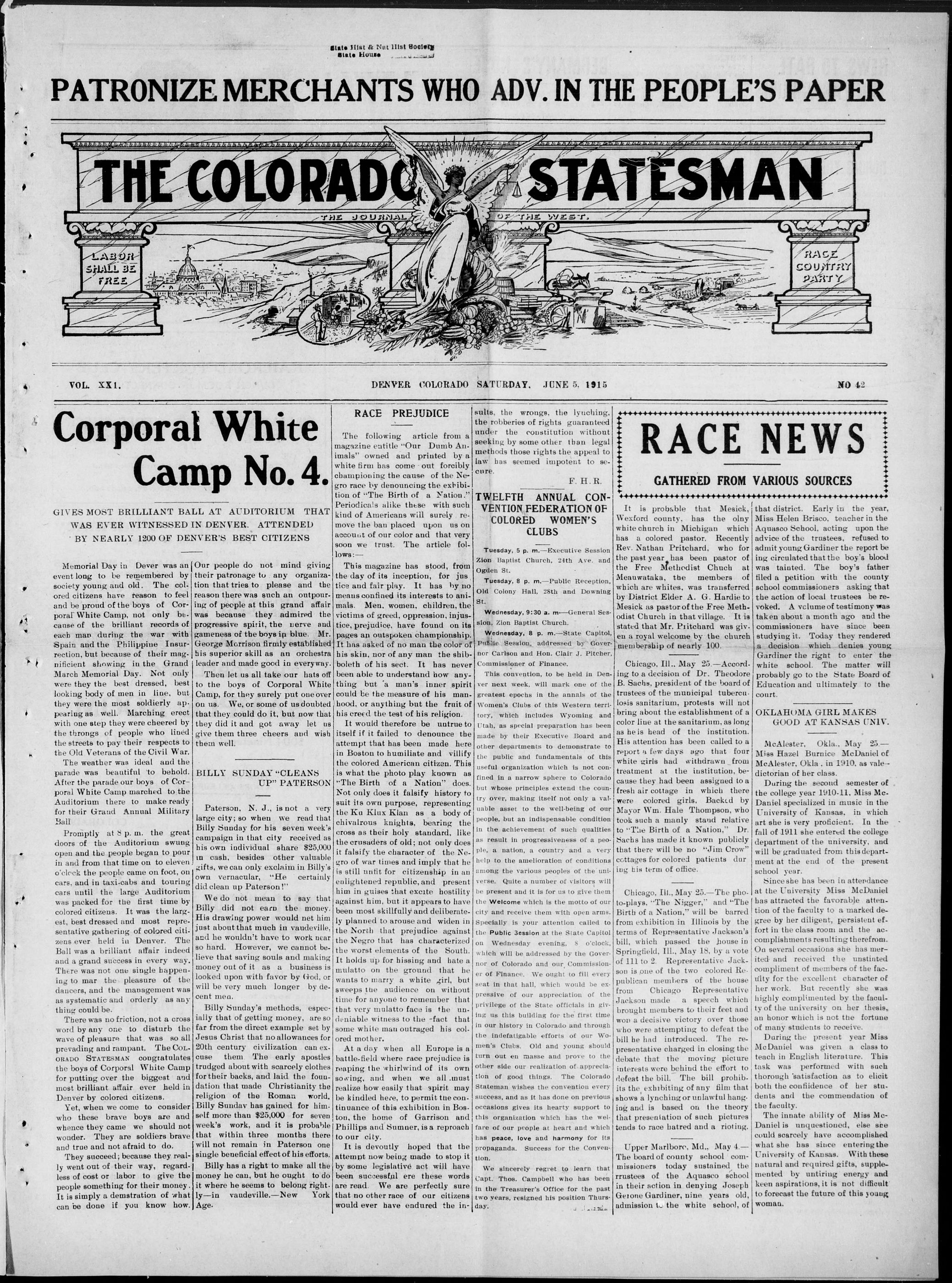
Corporal White Camp No.4.
GIVES MOST BRILLIANT BALL AT AUDITORIUM THAT WAS EVER WITNESSED IN DENVER. ATTENDED BY NEARLY 1200 OF DENVER'S BEST CITIZENS
VOL. XX1.
Corpora
Can
GIVES MOST BRILLIANT BAY
WAS EVER WITNESSED
BY NEARLY 1200 OF DE
Memorial Day in Dever was an event long to be remembered by society young and old. The colored citizens have reason to feel and be proud of the boys of Corporal White Camp, not only because of the brilliant records of each man during the war with Spain and the Philippine Insurrection, but because of their magnificent showing in the Grand March Memorial Day. Not only were they the best dressed, best looking body of men in line, but they were the most soldierly appearing as well. Marching erect with one step they were cheered by the throngs of people who lined the streets to pay their respects to the Old Veterans of the Civil War. The weather was ideal and the parade was beautiful to behold. After the parade our boys of Corporal White Camp marched to the Auditorium there to make ready for their Grand Annual Military Ball
Promptly at 8 p.m. the great doors of the Auditorium swung open and the people began to pour in and from that time on to eleven o'clock the people came on foot, on cars, and in taxi-cabs and touring cars until the large Auditorium was packed for the first time by colored citizens. It was the largest, best dressed and most representative gathering of colored citizens ever held in Denver. The Ball was a brilliant affair indeed and a grand success in every way. There was not one single happening to mar the pleasure of the dancers, and the management was as systematic and orderly as any thing could be.
There was no friction, not a cross word by any one to disturb the wave of pleasure that was so all prevading and rampant. The Colorado STATESMAN congratulates the boys of Corporal White Camp for putting over the biggest and most brilliant affair ever held in Denver by colored citizens.
Yet, when we come to consider who these brave boys are and whence they came we should not wonder. They are soldiers brave and true and not afraid to do.
They succeed; because they really went out of their way, regardless of cost or labor to give the people something for their money. It is simply a demstraction of what can be done if you know how.
Our people do not mind giving their patronage to any organization that tries to please and the reason there was such an outpouring of people at this grand affair was because they admired the progressive spirit, the nerve and gameness of the boys in blue. Mr. George Morrison firmly established his superior skill as an orchestra leader and made good in everyway. Then let us all take our hats off to the boys of Corporal White Camp, for they surely put one over on us. We, or some of us doubted that they could do it, but now that they did it and got away let us give them three cheers and wish them well.
BILLY SUNDAY "CLEANS UP" PATERSON
Paterson, N. J., is not a very large city; so when we read that Billy Sunday for his seven week's campaign in that city received as his own individual share $25,000 in cash, besides other valuable gifts, we can only exclaim in Billy's own vernacular, "He certainly did clean up Paterson!"
We do not mean to say that Billy did not earn the money. His drawing power would net him just about that much in vaudeville, and he wouldn't have to work near so hard. However, we cannot believe that saving souls and making money out of it as a business is looked upon with favor by God, or will be very much longer by decent men.
Billy Sunday's methods, especially that of getting money, are so far from the direct example set by Jesus Christ that no allowances for 20th century civilization can excuse them. The early apostles trudged about with scarcely clothes for their backs, and laid the foundation that made Christianity the religion of the Roman world, Billy Sundav has gained for himself more than $25,000 for seven week's work, and it is probable that within three months there will not remain in Paterson one single beneficial effect of his efforts. Billy has a right to make all the money he can, but he ought to do it where he seems to belong rightly—in vaudeville.—New York Age.
DENVER COLORADO SATURDAY. JUNE 5. 1915
State Hist & Nut Hist Boosts
State House
GIANTS WHO
ADO
THE JOURNAL
DENVER COLORADO
RACE PREJUDICE
The following article from a magazine entitle "Our Dumb Animals" owned and printed by a white firm has come out forcibly championing the cause of the Negro race by denouncing the exhibition of "The Birth of a Nation." Periodicals alike these with such kind of Americans will surely remove the ban placed upon us on account of our color and that very soon we trust. The article follows:—
This magazine has stood, from the day of its inception, for justice and fair play. It has by no means confined its interests to animals. Men, women, children, the victims of greed, oppression, injustice, prejudice, have found on its pages an outspoken championship. It has asked of no man the color of his skin, nor of any man the shibboleth of his sect. It has never been able to understand how anything but a man's inner spirit could be the measure of his manhood, or anything but the fruit of his creed the test of his religion.
It would therefore be untrue to itself if it failed to denounce the attempt that has been made here in Boston to humiliate and villain the colored American citizen. This is what the photo play known as "The Birth of a Nation" does. Not only does it falsify history to suit its own purpose, representing the Ku Klux Klan as a body of chivalrous knights, bearing the cross as their holy standard, like the crusaders of old; not only does it falsify the character of the Negro of war times and imply that he is still unfit for citizenship in an enlightened republic, and present him in guises that excite hostility against him, but it appears to have been most skillfully and deliberately planned to arouse and widen in the North that prejudice against the Negro that has characterized the worst elements of the South. It holds up for hissing and hate a mulatto on the ground that he wants to marry a white girl, but sweeps the audience on without time for anyone to remember that that very mulatto face is the undeniable witness to the -fact that some white man outraged his colored mother.
At a day when all Europe is a battle-field where race prejudice is reaping the whirlwind of its own sowing, and when we all must realize how easily that spirit may be kindled here, to permit the continuance of this exhibition in Boston, the home of Garrison and Phillips and Sumner, is a reproach to our city.
It is devoutly hoped that the attempt now being made to stop it by some legislative act will have been successful ere these words are read. We are perfectly sure that no other race of our citizens would ever have endured the in-
sults, the wrongs, the lynching, the robberies of rights guaranteed under the constitution without seeking by some other than legal methods those rights the appeal to law has seemed impotent to secure. F. H. R.
TWELFTH ANNUAL CONVENTION FEDERATION OF COLORED WOMEN'S
Tuesday, 5 p. m.—Executive Session
Zion Baptist Church, 24th Ave. and
Ogden St.
Tuesday, 8 p. m.—Public Reception,
Old Colony Hall, 28th and Downing
St.
Wednesday, 9:30 a. m.—General Session,
Zion Baptist Church.
Wednesday, 8 p. m.—State Capitol,
Public Session, addressed by Governor Carlson and Hon. Clair J. Pitcher,
Commissioner of Finance.
This convention, to be held in Denver next week, will mark one of the greatest epochs in the annals of the Women's Clubs of this Western territory, which includes Wyoming and Utah, as special preparation has been made by their Executive Board and other departments to demonstrate to the public and fundamentals of this useful organization which is not confined in a narrow sphere to Colorado but whose principles extend the country over, making itself not only a valuable asset to the well-being of our people, but an indispensable condition in the achievement of such qualities as result in progressiveness of a people, a nation, a country and a very help to the amelioration of conditions among the various peoples of the universe. Quite a number of visitors will be present and it is for us to give them the Welcome which is the motto of our city and receive them with open arms. Specially is your attention called to the Public Session at the State Capitol on Wednesday evening, 8 o'clock, which will be addressed by the Governor of Colorado and our Commissioner of Finance. We ought to fill every seat in that hall, which would be expressive of our appreciation of the privilege of the State officials in giving us this building for the first time in our history in Colorado and through the indefatigable efforts of our Women's Clubs. Old and young should turn out en masse and prove to the other side our realization of appreciation of good things. The Colorado Stateman wishes the convention every success, and as it has done on previous occasions gives its hearty support to this organization which has the welfare of our people at heart and which has peace, love and harmony for its propaganda. Success for the Convention.
We sincerely regret to learn that Capt. Thos. Campbell who has been in the Treasurer's Office for the past two years, resigned his position Thursday.
RACE NEWS
GATHERED FROM VARIOUS SOURCES
It is probable that Mesick, Wexford county, has the olny white church in Michigan which has a colored pastor. Recently Rev. Nathan Pritchard, who for the past year has been pastor of the Free Methodist Chuch at Meauwataka, the members of which are whites, was transferred by District Elder A. G. Hardie to Mesick as pastor of the Free Methodist Church in that village. It is stated that Mr. Pritchard was given a royal welcome by the church membership of nearly 100.
Chicago, Ill., May 25.—According to a decision of Dr. Theodore B. Sachs, president of the board of trustees of the municipal tuberculosis sanitarium, protests will not bring about the establishment of a color line at the sanitarium, as long as he is head of the institution. His attention has been called to a report a few days ago that four white girls had withdrawn from treatment at the institution, because they had been assigned to a fresh air cottage in which there were colored girls. Backed by Mayor Wm. Hale Thompson, who took such a manly stand relative to "The Birth of a Nation," Dr. Sachs has made it known publicly that there will be no "Jim Crow" cottages for colored patients during his term of office.
Chicago, Ill., May 25.—The photo-plays. "The Nigger," and "The Birth of a Nation," will be barred from exhibition in Illinois by the terms of Representative Jackson's bill, which passed the house in Springfield, Ill., May 18, by a vote of 111 to 2. Representative Jackson is one of the two colored Republican members of the house from Chicago Representative Jackson made a speech which brought members to their feet and won a decisive victory over those who were attempting to defeat the bill he had introduced. The representative charged in closing the debate that the moving picture interests were behind the effort to defeat the bill. The bill prohibits the exhibiting of any film that shows a lynching or unlawful hanging and is based on the theory that presentation of such pictures tends to race hatred and a rioting.
Upper Marlboro, Md., May 4. The board of county school commissioners today sustained the rrustees of the Aquasco school in their action in denying Joseph Gerone Gardiner, nine years old, admission to the white school, of
NO 42
that district. Early in the year, Miss Helen Brisco, teacher in the Aquasco School, acting upon the advice of the trustees, refused to admit young Gardiner the report being circulated that the boy's blood was tainted. The boy's father filed a petition with the county school commissioners asking that the action of local trustees be revoked. A volume of testimony was taken about a month ago and the commissioners have since been studying it. Today they rendered a decision which denies young Gardiner the right to enter the white school. The matter will probably go to the State Board of Education and ultimately to the court.
OKLAHOMA GIRL MAKES GOOD AT KANSAS UNIV.
McAlester, Okla., May 25 Miss Hazel Burnice McDaniel of McAlester, Okla., in 1910, as valedictorian of her class. During the second semester of the college year 1910-11, Miss McDaniel specialized in music in the University of Kansas, in which art she is very proficient. In the fall of 1911 she entered the college department of the university, and will be graduated from this department at the end of the present school year.
Since she has been in attendance at the University Miss McDaniel has attracted the favorable attention of the faculty to a marked degree by her diligent, persistent effort in the class room and the accomplishments resulting therefrom. On several occasions she has merited and received the unstinted compliment of members of the faculty for the excellent character of her work. But recently she was highly complimented by the faculty of the university on her thesis, an honor which is not the fortune of many students to receive.
During the present year Miss McDaniel was given a class to teach in English literature. This task was performed with such thorough satisfaction as to elicit both the confidence of her students and the commendation of the faculty.
The innate ability of Miss McDaniel is unquestioned, else she could scarcely have accomplished what she has since entering the University of Kansas. With these natural and required gifts, supplemented by untiring energy and keen aspirations, it is not difficult to forecast the future of this young woman.
NEWS TO DATE IN PARAGRAPHS
CAUGHT FROM THE NETWORK OF WIRES ROUND ABOUT THE WORLD.
DURING THE PAST WEEK
RECORD OF IMPORTANT EVENTS
CONDENSED FOR BUSY
PEOPLE.
Western Newspaper Union News Service.
ABOUT THE WAR
The British steamer Ethiopia was torpedoed and sunk.
Since the war began 130 British merchant ships have been lost.
Italian troops have occupied thirty-seven villages, surrounding Cortina in the Ampezzo valley.
Three of the forts of Przemysl have been captured by Bavarian troops, the war office at Berlin announced.
An official Berlin report says the Russians have evacuated the important town of Radom in Poland, to the south of Warsaw.
The Allan liner Corsican, which arrived at Glasgow with about 1,000 passengers, was chased by a submarine near Queenstown.
Ninety bombs were dropped in the raid on London by a Zeppelin airship. Four persons were killed and a few were injured. No public building was damaged.
A prisoner captured a fortnight ago in the Dardanelles says that the Turkish losses in the defense of their positions on the Gallipoli peninsula were, at that time, over 40,000 men.
The Russian bark Montrosa was blown up by a mine in the North Sea twenty-five miles from Spurn. The vessel sank. Her crew was landed at Hull by a Norwegian steamer.
The capture of 9,000 more prisoners is announced by the German war office which represents the situation in the east an favorable to Germany, with the exception of the retreat from the San near Sieniwa.
The British steamer Tullochmoor, 3,520 tons, was shelled and sunk by a German submarine. The crew escaped and was landed at Barry, Wales. The Tullochmoor was in ballast from Genoa for South Shields.
French torpedo boats have brought into port at Brest, France, the crews of the British steamer Glenlee and the Portuguese steamer Cysne, which were torpedoed by a German submarine between the Scilly islands and Cape Finisterre. The crews were picked up at sea by the French schooner Dixi which transferred them to the torpedo boats.
WESTERN
Military patrolled the city at Enid, Okla., following deportation of 300 harvest hands who had threatened food raids unless the city provided for them.
The Kaskaskia river broke through two places near Vandalia, Ill., and inundated 20,000 acres of farm lands. It is estimated the damage to crops alone will exceed $100,000.
Fifteen tons of dynamite, stored on a scow anchored in the harbor at Seattle, Wash., said to have been awaiting shipment to Russia, exploded, completely wrecking the scow. Damage estimated at $40,000 was done to plate glass windows in Seattle.
Testimony tending to show cruelty and that his wife, Alma, formerly of Denver, had chased him with a butcher knife, won an uncontested divorce for Arthur Little, Detroit druggist, from the wife whose efforts to prove herself not of negro descent have interested the nation.
After every legal recourse had failed, the mercy plea of William J. Bryan, secretary of state, which had been rejected by the State Legislature, proved potent to save the lives of the five Mexicans who were to have been hanged at the penitentiary at Florence, Ariz. At the last moment the State Board of Pardons and Paroles, taking cognizance of Mr. Bryan's request for delay, ordered reprieves of six weeks for all of the condemned men and recommended that they be executed separately and not together.
WASHINGTON
President Wilson sent some fifteen Memorial Day wreaths to soldiers' graves throughout the country. Cotton showed a condition of 80 per cent of a normal on May 25, the Department of Agriculture announced in its first report of the season. President Wilson, as head of the American Red Cross, issued an appeal to the American people to contribute money and supplies of food for the relief of starving Mexicans. The Pan-American financial conference came to an end after six days' discussion of problems which have confronted the two Americas as a consequence of the European war and America's first need was declared to be more vessels.
After more than two hours' discussion at Tuesday's cabinet meeting over the international problems with respect to Germany and Mexico, preparation of the second note to Germany was begun and a warning to the factions in Mexico was completed.
FOREIGN
The crew of eight men of the Russian ship Mars have arrived at Aberdeen after a perilous voyage.
News from Belgrade says that the Serbian army has been reorganized and intends taking the offensive to aid the Italians.
The Russian steamer Boro II, caught fire and burned to the water's edge in the harbor at Helsingfors, Gulf of Finland. Forty lives were lost.
To further prevent the waste of food, the Berlin authorities have promulgated new rules for restaurants, abolishing table d'hote meals.
Pope Benedict, at an audience granted to Bishop Thomas F. Kennedy and a number of newly consecrated American priests, expressed the hope that America would use her best efforts to bring an end to the European war.
Switzerland probably will suffer the same fate as Belgium from invasion by German armies in an effort to reach Italy, in the opinion of a high official of the Italian army, according to dispatches from Rome.
No bodies of officers and crew of the United States submarine F-4 were found in the forward hold of the vessel when a diver entered it, according to an announcement by Rear Admiral B. T. Moore at Honolulu.
The American liner St. Paul was chased by a German submarine as it neared Liverpool. The hostile craft pursued the big liner right up to Mersey Bar. The purpose of the submarine is believed to have been to stop the ship and take off William Marconi, the wireless inventor.
Theophile Braga, who was provisional president of Portugal following the revolution which resulted in the abdication of King Manuel, was elected president of the republic by the National Assembly to succeed Manuel De Arriaga who resigned. Senor Braga was elected by a vote of 98 to 1.
SPORTING NEWS
Standing of Western League Clubs.
Clubs. Won. Lost. Pct.
Des Moines 21 12 620
Topeka 18 14 568
Omaha 17 14 568
Denver 15 14 517
St. Joseph 16 15 516
Lewis 14 15 485
Sloux City 13 18 470
Wichita 7 19 269
Capt. A. Noel Edwards, one of Great Britain's famous polo players, died at Ypres from gas poisoning.
John E. Kemp made golf history for the Midland Club at Kewanee, Ill., when he made the sixth hole in one stroke.
Jim Coffey, the Dublin giant, stopped Jim Flynn, the Pueblo fireman, in the ninth round of their ten-round match in the open at the Brighton beach racetrack in New York.
Ralph De Palma, the premier Italo-American driver of the Mercedes, won the 500-mile speedway sweepstakes race at Indianapolis, breaking all records for the distance. His time was 5:33:55.50 and his average 89.84 miles. The record made by Thomas Delage in 1914, was 6:03:45.94; average 82.47. Mrs. Grace Maxwell, one of the Denver society women who has done much towards bringing fame to Denver equestriennes by her skill and grace in hurdling horses at the shows throughout the country, left for the Sierra Vista ranch at Cheno, Cal. There she will school a string of young horses, and appear later with them at the horse show in conjunction with the Panama-Pacific exposition at San Francisco.
GENERAL
Twenty-two deaths were caused by the storms in Eastern states.
The flood danger has passed and the river is receding at Kansas City.
Lassen peak's ninety-ninth eruption did practically no damage in Hat Creek and Lost Creek valleys and but little elsewhere.
Another record price for prime western spelter was reported at $23\frac{1}{2}$ cents a pound for spot delivery. June shipments have sold at 23 cents.
Nearly sixty girls, students of the San Francisco State Normal school, and women spectators were overcome by heat at graduating exercises held in the University of California's Greek theater at Berkeley.
Representatives of the Belgian war department at East St. Louis, Ill., were instructed to purchase 600 Shetland ponies, which will replace the big dogs now used in Belgium to draw small artillery pieces.
Pledges of support to President Wilson "in these perilous times," and prayers for righteous peace of the world marked the opening at Richmond, Va., of the twenty-fifth annual reunion of the United Confederate Veterans.
Maurice Benjamin Medbury, wealthy dealer in antique jewelry, left a mystery behind when he sank with the Lusitania. Two women, Mrs. M. D. Medbury of Alameda, Cal., and a Mrs. Medbury-Danbury of London, each claim to be the jewelry deler's legal wife and have begun a battle for his estate, variously estimated at from $50,000 to $150,000.
Having abandoned all hope of escaping the electric chair in the week of July 12 for the murder of Herman Rosenthal, Charles Becker, former police lieutenant, is bitterly defiant and threatens to publicly repudiate any efforts on the part of his wife or friends to appeal to Governor Whitman for clemency.
An earthquake shock of brief duration shook buildings at Bakersfield, Cal. So far as known no damage was done. Reports from Fresno and other towns said the shock was felt slightly, but that no damage had been caused.
The imperial government allows itself in this connection to point out that the Lusitania was one of the largest and fastest British merchant ships, built with government funds as an auxiliary cruiser and carried expressly as such in the "navy list" issued by the British admiralty.
It is further known to the imperial government, from trustworthy reports from its agents and neutral passengers, that for a considerable time practically all the more valuable British merchantmen have been equipped with cannon and ammunition and other weapons and manned with persons who have been especially trained in serving guns. The Lusitania, too, according to information received here had cannon aboard, which were mounted and concealed below deck.
The imperial government further has the honor to direct the particular attention of the American government to the fact that the British admiralty, in a confidential instruction issued in February, 1915, recommended its mercantile shipping not only to seek protection under neutral flags and distinguishing marks, but also, while thus disguised, to attack German submarines by ramming.
As a special incitation to merchantment to destroy submarines the British government also offered high prizes and has already paid such rewards.
The imperial government, in view of these facts, indubitably known to it, is unable to regard British merchantmen in the zone of naval operations specified by the admiralty staff of the German navy as "undefended." German commanders consequently are no longer able to observe the customary regulations of the prize law, which they before always followed.
Finally, the imperial government must point out particularly that the Lusitania on its last trip, as on earlier occasions, carried Canadian troops and war material, including no less than 5,400 cases of ammunition intended for the destruction of the brave German soldiers who are fulfilling their duty with self-sacrifices and devotion in the fatherland's service.
The German government believes that it was acting in justified self-defense in seeking with all the means of warfare at its disposal to protect the lives of its soldiers by destroying ammunition intended for the enemy.
The British Shipping Company must have been aware of the danger to which the passengers aboard the Lusitania were exposed under these conditions.
The company in embarking them, notwithstanding this, attempted deliberately to use the lives of American citizens as protection for the ammunition aboard and acted against the clear provisions of the American law, which expressly prohibits the forwarding of passengers on ships carrying ammunition, and provides a penalty therefore. The company, therefore, is wantonly guilty of the death of so many passengers.
There can be no doubt, according to the definite report of the submarine's commander, which is further confirmed by all other information, that the quick sinking of the Lusitania is primarily attributable to the explosion of the ammunition shipment caused by a torpedo. The Lusitania's passengers would otherwise, in all human probability, have been saved.
The imperial government considers the above mentioned facts important enough to recommend them to the active examination of the American government.
The imperial government, while withholding its final decision of the demands advanced in connection with the sinking of the Lusitania until receipt of an answer from the American government, feels impelled, in conclusion, to recall, here and now, that it took cognizance with satisfaction of the mediatory proposals submitted by the United States government to Berlin and London as a basis for a modus vivendi for conducting the maritime warfare between Germany and Great Britain. The imperial government, by its readiness to enter upon a discussion of these proposals, then demonstrated its good intentions in ample fashion.
The realization of these proposals was defeated, as is well known, by the declinatory attitude of the British government.
American law does not prohibit ammunition from being carried on passenger ships, it will be asserted, but only self-exploding material, and liners in the past have been permitted to carry arms and ammunition, by special ruling of the State Department on the meaning of federal statutes. Germany's failure even to discuss the reparation demanded by the American note, and evasion of the request that guarantees be given that American vessels and lives be not endangered in the future are the main points, however, which the United States government was generally believed would refer in the second note. The expressions of regret and offers of reparation for unintentional attacks on neutral ships are expected to have little weight in determining the nature of the response of the United States.
Persons close to President Wilson have learned that he is determined to obtain reparation for the Lusitania victims and assurances of respect for American rights in future, and that, failing this, he would not hesitate to sever diplomatic relations with Germany.
Piutes Leave Reservation.
Santa Fe, N. M.—The renegade Piutes of southern Utah are violating their promise to General Scott to remain inside the reservation, are roaming over the country and making threats against the white inhabitants, according to A. H. Spencer of the Mexican Hat, Utah, trading post. The parole agreement provided that if the Indians left the reservation the state authorities would have power to return them forcibly, and Mr. Spencer believes that if this is attempted bloodshed will result.
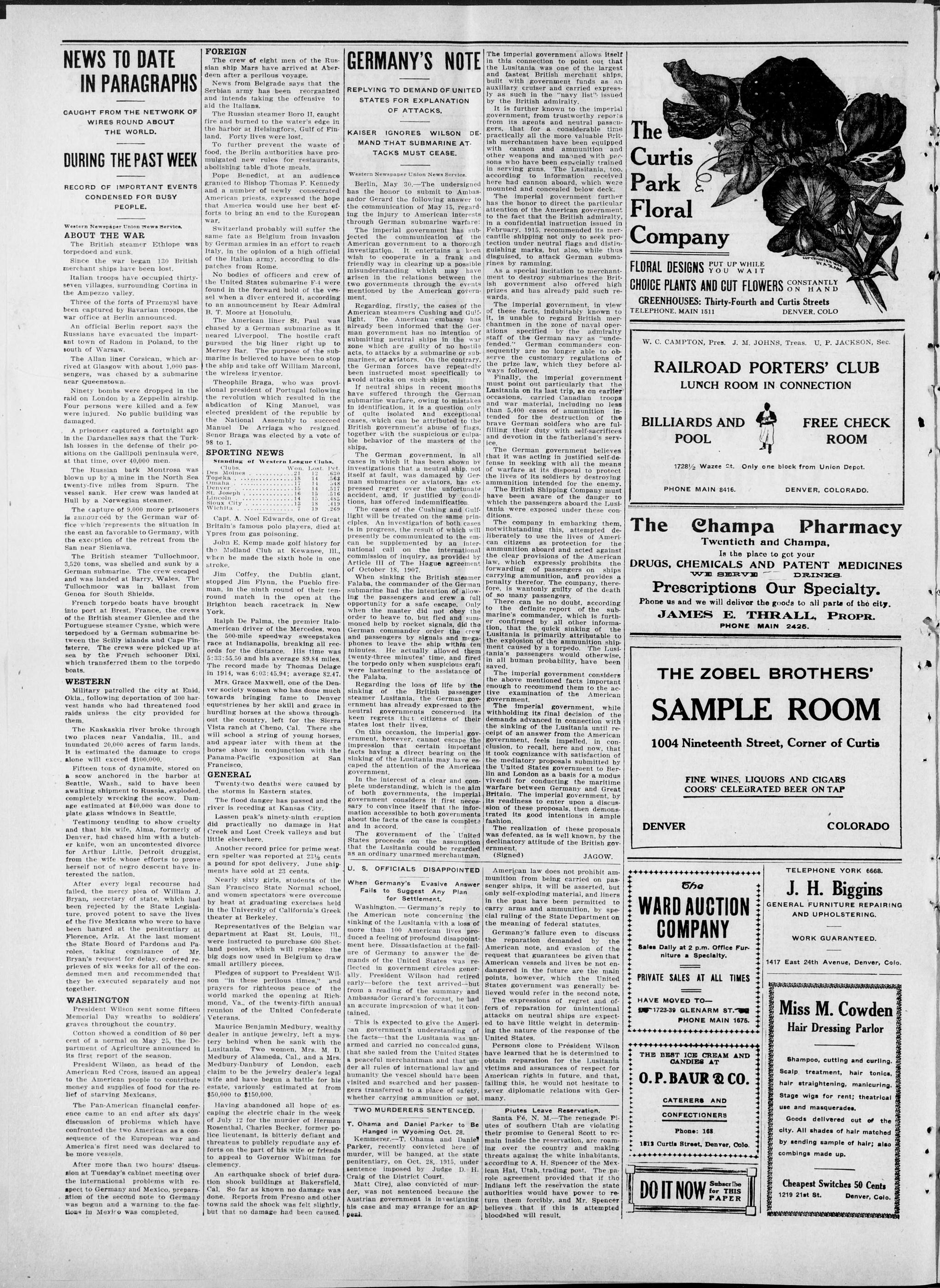
GERMANY'S NOTE
REPLYING TO DEMAND OF UNITED STATES FOR EXPLANATION OF ATTACKS.
KAISER IGNORES WILSON DEMAND THAT SUBMARINE ATTACKS MUST CEASE.
Western Newspaper Union News Service.
Berlin, May 30.—The undersigned has the honor to submit to Ambassador Gerard the following answer to the communication of May 15, regarding the injury to American interests through German submarine warfare:
The imperial government has subjected the communication of the American government to a thorough investigation. It entertains a keen wish to cooperate in a frank and friendly way in clearing up a possible misunderstanding which may have arisen in the relations between the two governments through the events mentioned by the American government.
Regarding, firstly, the cases of the American steamers Cushing and Gullight. The American embassy has already been informed that the German government has no intention of submitting neutral ships in the war zone which are guilty of no hostile acts, to attacks by a submarine or submarines, or aviators. On the contrary, the German forces have repeatedly been instructed most specifically to avoid attacks on such ships.
If neutral ships in recent months have suffered through the German submarine warfare, owing to mistakes in identification, it is a question only of quite isolated and exceptional cases, which can be attributed to the British government's abuse of flags, together with the suspicious or culpable behavior of the masters of the ships.
The German government, in all cases in which it has been shown by investigations that a neutral ship, not itself at fault, was damaged by German submarines or aviators, has expressed regret over the unfortunate accident, and, if justified by conditions, has offered indemnification.
The cases of the Cushing and Gulflight will be treated on the same principles. An investigation of both cases is in progress, the result of which will presently be communicated to the emcan be supplemented by an international call on the international commission of inquiry, as provided by Article III of The Hague agreement of October 18, 1907.
When sinking the British steamer Falaba, the commander of the German submarine had the intention of allowing the passengers and crew a full opportunity for a safe escape. Only when the master did not obey the order to heave to, but fled and summoned help by rocket signals, did the German commander order the crew and passengers by signals and megaphones to leave the ship within ten minutes. He actually allowed them twenty-three minutes' time, and fired the torpedo only when suspicious craft were hastening to the assistance of the Falaba.
Regarding the loss of life by the sinking of the British passenger steamer Lusitania, the German government has already expressed to the neutral governments concerned its keen regrets that citizens of their states lost their lives.
On this occasion, the imperial government, however, cannot escape the impression that certain important facts having a direct bearing on the sinking of the Lusitania may have escaped the attention of the American government.
In the interest of a clear and complete understanding, which is the aim of both governments, the imperial government considers it first necessary to convince itself that the information accessible to both governments about the facts of the case is complete and in accord.
The government of the United States proceeds on the assumption that the Lusitania could be regarded as an ordinary unarmed merchantman.
U. S. OFFICIALS DISAPPOINTED
When Germany's Evasive Answer Fails to Suggest Any Plan for Settlement.
Washington. — Germany's reply to the American note concerning the sinking of the Lusitania with a loss of more than 100 American lives produced a feeling of profound disappointment here. Dissatisfaction at the failure of Germany to answer the demands of the United States was reflected in government circles generally. President Wilson had retired early—before the text arrived—but from a reading of the summary and Ambassador Gerard's forecast, he had an accurate impression of what it contained.
This is expected to give the American government's understanding of the facts—that the Lusitania was unarmed and carried no concealed guns, that she sailed from the United States a peaceful merchantman and that under all rules of international law and humanity the vessel should have been visited and searched and her passengers transferred to a place of safety, whether carrying ammunition or not.
TWO MURDERERS SENTENCED.
T. Obama and Daniel Parker to Be Hanged in Wyoming Oct. 28. Kemmerer,-T. Obama and Daniel Parker, recently convicted here of murder, will be hanged, at the state penitentiary, on Oct. 28, 1915, under sentence imposed by Judge D. H. Craig of the District Court. Matt Cirej, also convicted of murder, was not sentenced because the Austrian government is investigating his case and may arrange for an appeal.
(Signed)
JAGOW
Piutes Leave Reservation.
The Curtis Park Floral Company
FLORAL DESIGNS PUT UP WHILE YOU WAIT
CHOICE PLANTS AND CUT FLOWERS CONSTANTLY ON HAND
GREENHOUSES: Thirty-Fourth and Curtis Streets
TELEPHONE, MAIN 1511
DENVER, COLO
RAILROAD PORTERS' CLUB LUNCH ROOM IN CONNECTION
BILLIARDS AND POOL
17281/2 Wazee St. Only
281/2 Wazee St. Only one block from Union D
17281/2 Wazee St. Only one block from Union Depot.
PHONE MAIN 8416. DENVER, COLORADO
The Champion
Twentieth St
Is the place
DRUGS, CHEMICALS AND
WE SERVE
Prescriptions
Phone us and we will deliver the
JAMES E. T.
PHONE N
THE ZOBEL
SAMPLE
1004 Nineteenth St
Champa Pharm.
Twentieth and Champa,
Is the place to got your
CHEMICALS AND PATENT M
WE SERVE DRINKS.
Descriptions Our Special
and we will deliver the goods to all parts
JAMES E. THRALL, PR
PHONE MAIN 2425.
E ZOBEL BROTHER
AMPLE ROO
Nineteenth Street, Corner of
Twentieth and Champa,
Is the place to get your
DRUGS, CHEMICALS AND PATENT MEDICINES
WE SERVE DRINKS.
Prescriptions Our Specialty.
Phone us and we will deliver the goods to all parts of the city.
JAMES E. THRALL, PROPR.
PHONE MAIN 2426.
1004 Nineteenth Street, Corner of Curtis
FINE WINES, LIQUORS AND CIGARS COORS' CELEBRATED BEER ON TAP
---
The
WARD AUCTION
COMPANY
Sales Daily at 2 p.m. Office Fur-
niture a Specialty.
PRIVATE SALES AT ALL TIMES
HAVE MOVED TO—
1723-39 GLENARM ST.
PHONE MAIN 1675.
THE BEST ICE CREAM AND
CANDIES AT
O.P. BAUR & CO.
CATERERS AND
CONFECTIONERS
Phone: 168
1512 Curtis Street, Denver, Colo.
DO IT NOW Subscribe
for THIS
PAPER
---
---
DENVER
FREE CHECK ROOM one block from Union Depot. DENVER, COLORADO.
a Pharmacy
and Champa,
to get your
D PATENT MEDICINES
DRINKS.
Our Specialty.
the goods to all parts of the city.
IRALL, PROPR.
MAIN 2426.
BROTHERS'
E ROOM
eet, Corner of Curtis
TELEPHONE YORK 6668.
J. H. Biggins
GENERAL FURNITURE REPAIRING
AND UPHOLSTERING.
WORK GUARANTEED.
1417 East 24th Avenue, Denver, Colo.
Miss M. Cowden Hair Dressing Parlor
Shampoo, cutting and curling. Scalp treatment, hair tonics, hair straightening, manicuring. Stage wigs for rent; theatrical use and masquerades. Goods delivered out of the city. All shades of hair matched by sending sample of hair; also combings made up.
Cheapest Switches 50 Cents
1219 21st St. Denver, Colo.
```markdown
```
COLORADO
AFRO-AMERICAN CULLINGS
A Negro woman led a small boy up to the front door of the Y. M. C. A. building at 1834 Paseo a few weeks ago and literally pushed him inside. "Maybe these folks can do something with you," she said severely to the small boy, wh. was looking stubborn and keeping still. "If they can't I'm through with you."
She left a little money for the small boy uplift and departed, voluble with doubts. The young Negro men at the Y. M. C. A. are a hopeful crowd. He was a sturdy small boy, and he would look you squarely in the eye, and abundant energy is a good fault, even though it does take Satanic outlets at times. If there were just some way of getting him.
And presently it developed that the small boy was extremely fond of swimming. A grin of pure raptu overspread his countenance when he saw the big pool of clear green water in the basement—and thereafter the small boy's interest was assured. He's bossing a Bible class now and swimming in races with fellows twice his size, and allowing the big straight military Hardy, "gym" instructor, who used to play on a real college football team with surprising precision. He raps up his orders in good style, this man Hardy; and he's training them not to shuffle their feet, and to hold up their heads and their shoulders, and yet he has time to give a pat on the back to the fat boy who has such a hard time getting over the "horse" and who reduces the entire room, including the "ragging" piano player, to gleeful laughter.
It is very new, this Negro Y. M. C. A. it's only been open two months—and comparatively few people know about it. Also, there is a good deal of fantastic misinformation current on Vine street. A lodging house keeper will tell you that the rooms are kennels and the beds bunks hollowed out of the wall. As a matter of fact, the rooms, with their oak furniture, electric lights, steam heat and clean beds, and a big window in each room, are hard to beat anywhere in town. They rent for $1.50 to $2.50 a week, and there is no accommodation for Negroes in town to compare with them. It is interesting, too, to see the pride the men take in keeping the rooms clean—Kansas City Star.
The growing literacy of the Negroes is an occasion for general approval. In every city and state the percentage of illiteracy among Negroes is lower in younger generations than in the older. In Georgia, for example, among Negroes from ten to fourteen years old the percentage of those who can't write was 22.1. Among those between twenty-five and thirty-four years the percentage of illiteracy was 32.7. Among those from fifty-five to sixty-four years and over the percentage was 70.2. The Negro is taking advantage of the educational opportunities at hand.
In Boston the number of Negro children who go to school is in a greater proportion than the number of native white children in ten other census cities. But even so, less than half of the Negro children from six to twenty years old are attending school, taking the country as a whole. These bare figures, however, recount a record of progress made possible only by tremendous efforts. Within sixty years of freedom the Negro has achievements to his credit of which any race might be proud.
That education is the solution of the Negro problem in the United States is the practical and proved theory being advanced today by the enlightened men and women both of the white and colored races. When one considers that it was only a little more than half a century ago that the Negro was freed from bondage in this country, the advancement made by these people in almost every walk and profession of life is almost remarkable.
Earning a living through civil service furnishes interesting proof of the Negro's faithfulness and ability. When the Negro was first admitted to civil service examination it was pointed out by Negrophobists that with the merit system the Negro would be eliminated from civil service, but just the reverse has happened.
It has been found that wireless telegraph waves are propagated along the surface of the earth with a velocity slightly inferior to that of light.
More than 24,000,000,000 tons of coal remain to be taken from the fields in Wales, according to geologists.
A Sheffield firm has received from Holland a contract for the manufacture of 60,000 army pocket knives, to be made to the pattern of those hitherto imported from Germany.
```markdown
```
The jinticksha is the man-propelled vehicle of the far East. It is being superseded by a vehicle known as the cyclericksha.
Salubite, a new explosive, is 50 times more powerful than dynamite, and is much safer, for it will explode only by means of the percussion cap.
In the American Magazine appears an account of Mrs. Dismukes, Negro laudress in Fisk university at Nashville, Tenn., who, out of her small means has given $1,000 toward a music building for Fisk university. Fortynine other thousands are necessary if the building is to be realized, but Mrs. Dismukes has infinite faith that they will be forthcoming. Following is an extract from the account of what this woman has done. The article was written by the late Dr. George A. Gates, the late president of Fisk university:
"Her story is almost too sacred to put into print. She felt and feels that all of life that is worth while she owes to Fisk university and what it has revealed to her of the spirit of high-minded and generous men and women. She has felt that all she could do was too little in return for what she has received. So this hard-working, faithful and efficient Negro woman has kept her home, her husband maintaining it with a man's self-respect. She meantime has done her full work and borne her full responsibility in her place in the institution. For the last four years she has turned back her monthly salary check into the institution, until just now she has completed her long cherished plan to give $1,000 as the beginning of a fund for a music building on our campus.
"On the day that the last $25 was turned into the school treasury, completing the thousand, Mrs. Dismukes declared she wouldn't exchange places with anyone, that she was the happiest woman in the world.
"The music building has not yet materialized, but her faith is undaunted, and she frequently remarks to some teacher in the music department: 'Of course that music building is coming! I know it. I feel it. Why, it's bound to come! But I wish it might while I'm alive to see it.'"
While Negroes increased numerically in the United States between 1900 and 1910 to the extent of 11.2 percent, they did not keep pace with the whites. That was due to immigration. On this account there has been a continuous decrease in the proportion of Negroes to the rest of the inhabitants. In 1790 Negroes made up nearly one-fifth of the population; in 1910 they composed slightly over one-tenth.
Further, the number of mulattoes appears to have increased continuously during the last forty years. Of the 9,827,763 Negroes in the country at the time of the last counting, more than one-fifth were of mixed white and Negro blood. That indicates how prevalent is the process of miscegenation, a process through which in the course of a thousand years or so the Negro will have lost his color, according to at least one anthropologist of great reputation.
In 1900 20 per cent of Negro homes were owned. In 1910 the percentage had grown to 22.4. In Virginia 41.3 per cent of all Negro homes were owned, an extremely high figure.
Virginia, however, had fewer Negroes in 1910 than it had a decade previous. From Virginia 206,764 Negroes migrated to other states during the ten-year period. Though popular opinion in the South holds that Negroes "go North" when they move, Arkansas, a southern state, showed the greatest gain from this migration.
One of the evils of war is the lowering of the national physique. In the generation after the Franco-German war there was an appreciable decrease in the stature of Frenchmen through the large number of young men of good physique who were killed.
Grape seeds, for which hitherto no use has been known, have been found to contain oil which is especially valuable in the manufacture of soap, and a South American refinery is making preparations to produce it on a large scale.
At Japanese auctions each bidder writes his name and bid on a slip of paper, which he puts in a box provided for the purpose. When the bidding is over the box is opened and the goods declared the property of the highest bidder.
In these days of political germination, some fellows forget their friends and let their enemies forget them.
Even when thawed and cooked frozen beets have been found to contain a poison deadly to live stock.
The mountains of Puerto Rico are so magnetic that they attract surveyors' plumb line. It has been found that some old surveyors are incorrect by half a mile or more.
"He is the sort of fellow," said Eph Wiley, recently, in speaking of his son-in-law, "who builds a theater in a small town."
Marriage is the ceremony which binds a woman to work for her board and clothes for the remainder of her natural life.
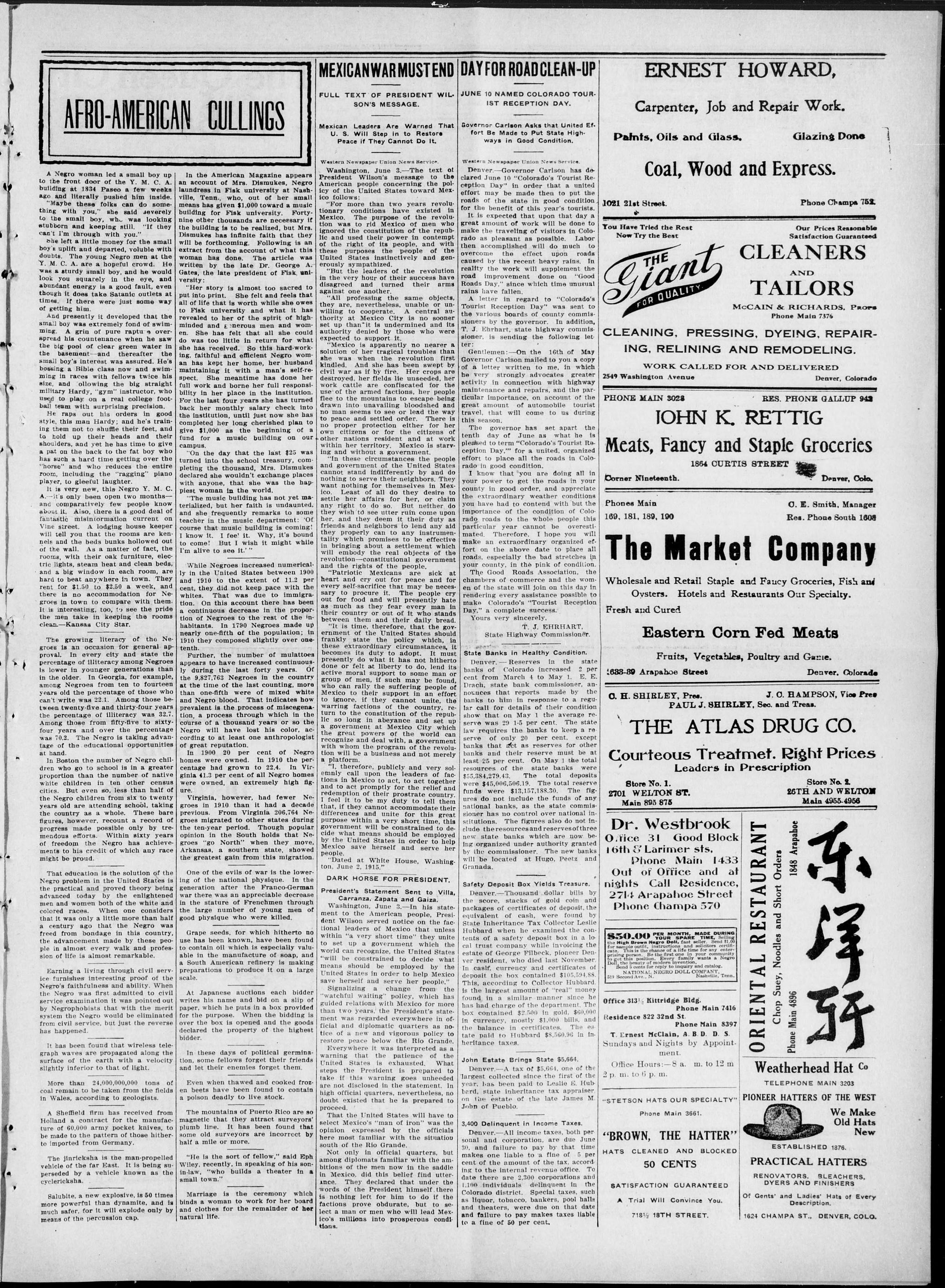
FULL TEXT OF PRESIDENT WILSON'S MESSAGE.
Mexican Leaders Are Warned That U. S. Will Step in to Restore Peace if They Cannot Do It.
Western Newspaper Union News Service.
Washington, June 3.—The text of President Wilson's message to the American people concerning the policy of the United States toward Mexico follows:
"For more than two years revolutionary conditions have existed in Mexico. The purpose of the revolution was to rid Mexico of men who ignored the constitution of the republic and used their power in contempt of the right of its people, and with these purposes the people of the United States instinctively and generously sympathized.
"But the leaders of the revolution in the very hour of their success have disagreed and turned their arms against one another."
"All professing the same objects, they are, nevertheless, unable or unwilling to cooperate. A central authority at Mexico City is no sooner set up than* it is undermined and its authority denied by those who were expected to support it.
"Mexico is apparently no nearer a solution of her tragical troubles than she was when the revolution first kindled. And she has been swept by civil war as if by fire. Her crops are destroyed, her fields lie unseeded, her work cattle are confiscated for the use of the armed factions, her people flee to the mountains to escape being drawn into unavailing bloodshed and no man seems to see or lead the way to peace and settled order. There is no proper protection either for her own citizens or for the citizens of other nations resident and at work within her territory. Mexico is starving and without a government.
"In these circumstances the people and government of the United States cannot stand indifferently by and do nothing to serve their neighbors. They want nothing for themselves in Mexico. Least of all do they desire to settle her affairs for her, or claim any right to do so. But neither do they wish to see utter ruin come upon her, and they deem it their duty as friends and neighbors to lend any aid they properly can to any instrumentality which promises to be effective in bringing about a settlement which will embody the real objects of the revolution—constitutional government and the rights of the people.
"Patriotic Mexicans are sick at heart and cry out for peace and for every self-sacrifice that may be necessary to procure it. The people cry out for food and will presently hate as much as they fear every man in their country or out of it who stands between them and their daily bread
"It is time, therefore, that the government of the United States should frankly state the policy which, in these extraordinary circumstances, it becomes its duty to adopt. It must presently do what it has not hitherto done or felt at liberty to do, lend its active moral support to some man or group of men, if such may be found, who can rally the suffering people of Mexico to their support in an effort to ignore, if they cannot unite, the warring factions of the country, return to the constitution of the republic so long in abeyance and set up a government at Mexico City which the great powers of the world can recognize and deal with, a government with whom the program of the revolution will be a business and not merely a platform.
"I, therefore, publicly and very solemnly call upon the leaders of factions in Mexico to act, to act together and to act promptly for the relief and redemption of their prostrate country. I feel it to be my duty to tell them that, if they cannot accommodate their differences and unite for this great purpose within a very short time, this government will be constrained to decide what means should be employed by the United States in order to help Mexico save herself and serve her people. "Dated at White House, Washington, June 2, 1915."
DARK HORSE FOR PRESIDENT
President's Statement Sent to Villa,
Carranza, Zanata, and Gaiza.
Washington, June 3.—In his statement to the American people, President Wilson served notice on the factional leaders of Mexico that unless within "a very short time" they unite to set up a government which the world can recognize, the United States "will be constrained to decide what means should be employed by the United States in order to help Mexico save herself and serve her people." Signalizing a change from the "watchful waiting" policy, which has guided relations with Mexico for more than two years, the President's statement was regarded everywhere in official and diplomatic quarters as notice of a new and vigorous policy to restore peace below the Rio Grande. Everywhere it was interpreted as a warning that the patience of the United States is exhausted. What steps the President is prepared to take if this warning goes unheeded are not disclosed in the statement. In high official quarters, nevertheless, no doubt existed that he is prepared to proceed.
That the United States will have to select Mexico's "man of iron" was the opinion expressed by the officials here most familiar with the situation south of the Rio Grande. Not only in official quarters, but among diplomats familiar with the ambitions of the men now in the saddle in Mexico, did this belief find utterance. They declared that under the words of the President himself, there is nothing left for him to do if the factions prove obdurate, but to select a man or men who will lead Mexico's millions into prosperous conditions.
JUNE 10 NAMED COLORADO TOUR
IST RECEPTION DAY.
Governor Carlson Asks that United Ef fort Be Made to Put State Highways in Good Condition.
Western Newspaper Union News Service
Western Newspaper Union News Service.
Denver—Governor Carlson has declared June 10 "Colorado's Tourist Reception Day" in order that a united effort may be made then to put the roads of the state in good condition for the benefit of this year's tourists. It is expected that upon that day a great amount of work will be done to make the traveling of visitors in Colorado as pleasant as possible. Labor then accomplished will do much to overcome the effect upon roads caused by the recent heavy rains. In reality the work will supplement the road improvement done on "Good Roads Day," since which time unusual rains have fallen.
A letter in regard to "Colorado's Tourist Reception Day" was sent to the various boards of county commissioners by the governor. In addition, T. J. Ehrhart, state highway commissioner, is sending the following letter:
Gentlemen:On the 16th of May Governor Carlson mailed to you a copy of a letter written to me, in which he very strongly advocates greater activity in connection with highway maintenance and repairs, and the particular importance, on account of the great amount of automobile tourist travel, that will come to us during this season.
The governor has set apart the tenth day of June as what he is pleased to term "Colorado's Tourist Reception Day," for a united, organized effort to place all the roads in Colorado in good condition.
I know that you are doing all in your power to get the roads in your county in good order, and appreciate the extraordinary weather conditions you have had to contend with but the importance of the condition of Colorado roads to the whole people this particular year cannot be overestimated. Therefore, I hope you will make an extraordinary organized effort on the above date to place all roads, especially the bad stretches in your county, in the pink of condition. The Good Roads Association, the chambers of commerce and the women of the state will join on this day in rendering every assistance possible to make Colorado's "Tourist Reception Day," a complete success.
State Banks in Healthy Condition. Denver. — Reserves in the state banks of Colorado increased 2 per cent from March 4 to May 1. E. E. Drach, state bank commissioner, announces that reports made by the banks to him in response to a regular call for details of their condition show that on May 1 the average reserve was 29 1-5 per cent. The state law requires the banks to keep a reserve of only 20 per cent, except banks that act as reserves for other banks and their reserve must be at least 25 per cent. On May 1 the total resources of the state banks were $55,384,279.43. The total deposits were $45,006,506.19. The total reserve funds were $13,157,188.30. The figures do not include the funds of any national banks, as the state commissioner has no control over national institutions. The figures also do not include the resources and reserves of three new state banks which are now being organized under authority granted by the commissioner. The new banks will be located at Hugo, Peetz and Granada.
Safety Deposit Box Yields Treasure.
Denver.—Thousand dollar bills by the score, stacks of gold coin and packages of certificates of deposit, the equivalent of cash, were found by State Inheritance Tax Collector Leslie Hubbard when he examined the contents of a safety deposit box in a local trust company while invoicing the estate of George Fillbeck, pioneer Denver resident, who died last November. In caslf, currency and certificates of deposit the box contained $105,594.88. This, according to Collector Hubbard, is the largest amount of "real" money found in a similar manner since he has had charge of the department. The box contained $2,500 in gold, $60,000 in currency, mostly $1,000 bills, and the balance in certificates. The estate paid to Hubbard $8,560.96 in inheritance taxes.
John Estate Brings State $5,664.
Denver.—A tax of $5,664, one of the largest collected since the first of the year, has been paid to Leslie E. Hubbard, state inheritance tax appraiser on the estate of the late James M. John of Pueblo.
3.400 Delinguent in Income Taxes.
Denver.—All income taxes, both personal and corporation, are due June 30, and failure to pay by that time makes one liable to a fine of 5 per cent of the amount of the tax, according to the internal revenue office. To date there are 2,300 corporations and 1,100 individuals delinquent in the Colorado district. Special taxes, such as liquor, tobacco, bankers, pool halls and theaters, were due on that date and failure to pay makes taxes liable to a fine of 50 per cent.
Carpenter, Job and Repair Work.
Coal, Wood and Express.
CLEANING, PRESSING, DYEING, REPAIRING, RELINING AND REMODELING.
WORK CALLED FOR AND DELIVERED
2549 Washington Avenue Denver, Colorado
The Market Company
Wholesale and Retail Staple and Faucy Groceries, Fish and Oysters. Hotels and Restaurants Our Specialty.
Eastern Corn Fed Meats
Fruits, Vegetables, Poultry and Game.
C. H. SHIBLEY, Pres. J. C. HAMPSON, Vice Pres PAUL J. SHIBLEY, Sec. and Treas.
Courteous Treatmet. Right Prices Leaders in Prescription
Paints, Oils and Glass.
Coal, Wood a
1021 21st Street.
You Have Tried the Rest
Now Try the Best
THE Giant FOR QUALITY
CLEANING, PRESSING
ING, RELINING AN
WORK CALLED FOR
2549 Washington Avenue
PHONE MAIN 3028
JOHN K.
Meats, Fancy and
1864 CURTIS
Corner Nineteenth.
Phones Main
169, 181, 189, 190
The Market
Wholesale and Retail Staple and
Oysters. Hotels and Re
Fresh and Cured
Eastern Corn
Fruits, Vegetables,
1638-39 Arapahoe Street
C. H. SHIRLEY, Pres.
PAUL J. SHIRLE
THE ATLAS
Courteous Treat
Leaders in I
Store No. 1.
2701 WELTON ST.
Main 895 875
Dr. Westbrook
Office 31 Good Block
16th & Larimer sts.
Phone Main 1433
Out of Office and af
nights Call Residence,
2714 Arapahoe Street
Phone Champa 570
$50.00 PER MONTH, MADE DURING
YOUR SPARE TIME, Selling
for sample outfit, instructions and solicitors
certificates. This is the chance of a life time for any enter-
prising person. Is the first one in your year in a Negro
Doll, the beauty of modern invention.
NATIONAL FORD DOLL COMPANY,
519 Second Ave, N., Nashville, Tenn.
Office 3131 $ _{1} $ Kittridge Bldg.
Phone Main 7416
Residence 822 32nd St.
Phone Main 8397
T. Ernest McClain, A. B. D. D. S.
Sundays and Nights by Appointment.
Office Hours:—8 a. m. to 12 m
2 p. m. to 6 p. m.
"STETSON HATS OUR SPECIALTY"
Phone Main 3661.
"BROWN, THE HATTER"
HATS CLEANED AND BLOCKED
50 CENTS
SATISFACTION GUARANTEED
A Trial Will Convince You.
718½ 18TH STREET.
s. Glazing Done and Express. Phone Champa 752.
Our Prices Reasonable
Satisfaction Guaranteed
CLEANERS
AND
TAILORS
McCAIN & RICHARDS, PROPS
Phone Main 7376
ING, DYEING, REPAIR-
AND REMODELING.
OR AND DELIVERED
Denver, Colorado
RES. PHONE GALLUP 943
. RETTIG and Staple Groceries TIS STREET
---
Denver, Colo.
C. E. Smith, Manager
Res. Phone South 1608
Pet Company
e and Fancy Groceries, Fish and
Restaurants Our Specialty.
Corn Fed Meats
es, Poultry and Game.
Denver. Colorado
J. C. HAMPSON, Vice Pres
LEY, Sec. and Treas.
AS DRUG CO.
Hmtmet. Right Prices
on Prescription
Store No. 2.
25TH AND WELTON
Main 4955-4956
ORIENTAL RESTAURANT
Chop Suey, Noodles and Short Orders
Phone Main 4896
1848 Arapahoe
乐泽轩
Weatherhead Hat Co
TELEPHONE MAIN 3203
PIONEER HATTERS OF THE WEST We Make Old Hats New
We Make Old Hats New
PRACTICAL HATTERS
RENOVATORS, BLEACHERS,
DYERS AND FINISHERS
Of Gents' and Ladies' Hats of Every
Description.
1624 CHAMPA ST., DENVER, COLO.
THE COLORADO STATESMAN
LAST HUNDREDS OF YEARS
BACK COUNTY PARTY
JOS. D. D. RIVERS.....Proprietor
1824 Curtis Street, Room 25.
One Year ..... $2.00
Six Months ..... 1.00
Three Months ..... .60
PAYABLE IN ADVANCE.
Entered as second-class matter at the postoffice in the city of Denver, Colorado.
It occasionally happens that papers sent to subscribers are lost or stolen. In case you do not receive any number when due, inform us by postal card and we will cheerfully forward a duplicate of the missing number.
Communications to receive attention must be newsy, upon important subjects, plainly written only upon one side of the paper; must reach us Tuesdays, if possible, anyway, not later than Wednesdays, and bear the signature of the author. No manuscript returned, unless stamps are sent for postage.
No discounts allowed on less than three months' contract. Cash must accompany all orders from parties unknown to us. Further particulars on application.
Remittances should be made by Express Money Order, Postoffice Money Order, Registered Letter or Bank Draft. Postage stamps will be received the same as cash for the fractional part of a dollar. Only 1-cent and 2-cent stamps taken.
Display advertising, 50 cents per inch. An inch contains twelve agate lines.
Reading notices, ten lines or less, 10 cents per line. Each additional line over ten lines, 5 cents per line.
All communications of a personating nature that are not complimentary will be withheld from the columns of this paper.
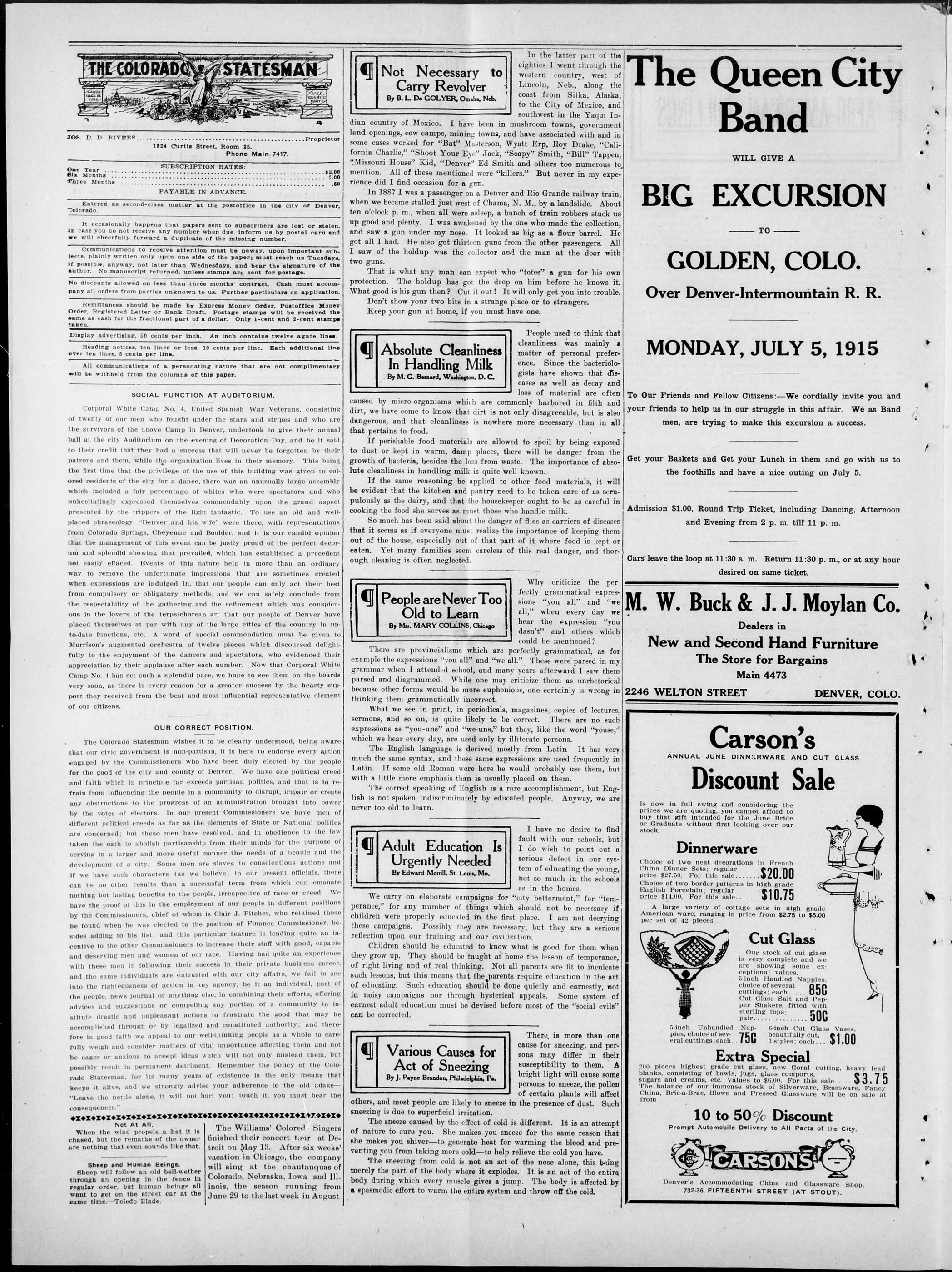
SOCIAL FUNCTION AT AUDITORIUM.
Corporal White Camp No. 4, United Spanish War Veterans, consisting of twenty of our men who fought under the stars and stripes and who are the survivors of the above Camp in Denver, undertook to give their annual ball at the city Auditorium on the evening of Decoration Day, and be it said to their credit that they had a success that will never be forgotten by their patrons and them, while the organization lives in their memory. This being the first time that the privilege of the use of this building was given to colored residents of the city for a dance, there was an unusually large assembly which included a fair percentage of whites who were spectators and who unhesitatingly expressed themselves commendably upon the grand aspect presented by the trippers of the light fantastic. To use an old and well-placed phraseology, "Denver and his wife" were there, with representations from Colorado Springs, Cheyenne and Boulder, and it is our candid opinion that the management of this event can be justly proud of the perfect decorum and splendid showing that prevailed, which has established a precedent not easily effaced. Events of this nature help in more than an ordinary way to remove the unfortunate impressions that are sometimes created when expressions are indulged in, that our people can only act their best from compulsory or obligatory methods, and we can safely conclude from the respectability of the gathering and the refinement which was conspicuous in the lovers of the terpsichorean art that our people of Denver have placed themselves at par with any of the large cities of the country in up-to-date functions, etc. A word of special commendation must be given to Morrison's augmented orchestra of twelve pieces which discoursed delightfully to the enjoyment of the dancers and spectators, who evidenced their appreciation by their applause after each number. Now that Corporal White Camp No. 4 has set such a splendid pace, we hope to see them on the boards very soon, as there is every reason for a greater success by the hearty support they received from the best and most influential representative element of our citizens.
OUR CORRECT POSITION.
The Colorado Statesman wishes it to be clearly understood, being aware that our civic government is non-partisan, it is here to endorse every action engaged by the Commissioners who have been duly elected by the people for the good of the city and county of Denver. We have one political creed and faith which in principle far exceeds partisan politics, and that is to refrain from influencing the people in a community to disrupt, irrepair or create any obstructions to the progress of an administration brought into power by the votes of electors. In our present Commissioners we have men of different political creeds as far as the elements of State or National politics are concerned; but these men have resolved, and in obedience to the law taken the oath to abolish partisanship from their minds for the purpose of serving in a larger and more useful manner the needs of a people and the development of a city. Some men are slaves to conscientious actions and if we have such characters (as we believe) in our present officials, there can be no other results than a successful term from which can emanate nothing but lasting benefits to the people, irrespective of race or creed. We have the proof of this in the employment of our people in different positions by the Commissioners, chief of whom is Clair J. Pitcher, who retained those he found when he was elected to the position of Finance Commissioner, besides adding to his list; and this particular feature is lending quite an incentive to the other Commissioners to increase their staff with good, capable and deserving men and women of our race. Having had quite an experience with these men in following their success in their private business career, and the same individuals are entrusted with our city affairs, we fail to see into the righteousness of action in any agency, be it an individual, part of the people, news journal or anything else, in combining their efforts, offering advices and suggestions or compelling any portion of a community to institute drastic and unpleasant actions to frustrate the good that may be accomplished through or by legalized and constituted authority; and therefore in good faith we appeal to our well-thinking people as a whole to carefully weigh and consider matters of vital importance affecting them and not be eager or anxious to accept ideas which will not only mislead them, but possibly result in permanent detriment. Remember the policy of the Colorado Statesman, for its many years of existence is the only means that keeps it alive, and we strongly advise your adherence to the old adage—"Leave the nettle alone, it will not hurt you; touch it, you must bear the consequences."
The Williams' Colored Singers finished their concert tour at Detroit on May 13. After six weeks' vacation in Chicago, the company will sing at the chautauquas of Colorado, Nebraska, Iowa and Illinois, the season running from June 29 to the last week in August.
When the wind propels a hat it is chased, but the remarks of the owner are nothing that even sounds like that.
Sheep will follow an old bell-wether through an opening in the fence in regular order, but human beings all want to get on the street car at the same time—Toledo Blade.
Not Necessary to Carry Revolver
By B. L. De GOLYER, Omaha, Neb.
In the latter part of the eighties I went through the western country, west of Lincoln, Neb., along the coast from Sitka, Alaska, to the City of Mexico, and southwest in the Yaqun Indian country of Mexico. I have been in mushroom towns, government land openings, cow camps, mining towns, and have associated with and in some cases worked for "Bat" Masterson, Wyatt Erp, Roy Drake, "California Charlie," "Shoot Your Eye" Jack, "Soapy" Smith, "Bill" Tappen, "Missouri House" Kid, "Denver" Ed Smith and others too numerous to mention. All of these mentioned were "killers." But never in my experience did I find occasion for a gm.
In 1887 I was a passenger on a Denver and Rio Grande railway train, when we became stalled just west of Chama, N. M., by a landslide. About ten o'clock p. m., when all were asleep, a bunch of train robbers stuck us up good and plenty. I was awakened by the one who made the collection, and saw a gun under my nose. It looked as big as a flour barrel. He got all I had. He also got thirteen guns from the other passengers. All I saw of the holdup was the collector and the man at the door with two guns.
That is what any man can expect who "totes" a gun for his own protection. The holdup has got the drop on him before he knows it. What good is his gun then? Cut it out! It will only get you into trouble.
Don't show your two bits in a strange place or to strangers.
Keep your gun at home, if you must have one.
Absolute Cleanliness In Handling Milk By M. G. Bernard, Washington, D. C.
People used to think that cleanliness was mainly a matter of personal preference. Since the bacteriologists have shown that diseases as well as decay and loss of material are often caused by micro-organisms which are commonly harbored in filth and dirt, we have come to know that dirt is not only disagreeable, but is also dangerous, and that cleanliness is nowhere more necessary than in all that pertains to food.
If perishable food materials are allowed to spoil by being exposed to dust or kept in warm, damp places, there will be danger from the growth of bacteria, besides the loss from waste. The importance of absolute cleanliness in handling milk is quite well known.
If the same reasoning be applied to other food materials, it will be evident that the kitchen and pantry need to be taken care of as scrupulously as the dairy, and that the housekeeper ought to be as careful in cooking the food she serves as must those who handle milk.
So much has been said about the danger of flies as carriers of diseases that it seems as if everyone must realize the importance of keeping them out of the house, especially out of that part of it where food is kept or eaten. Yet many families seem careless of this real danger, and thorough cleaning is often neglected.
People are Never Too Old to Learn
By Mrs. MARY COLLINS, Chicago
Why criticize the perfectly grammatical expressions "you all" and "we all," when every day we hear the expression "you don't" and others which could be mentioned?
There are provincialisms which are perfectly grammatical, as for example the expressions "you all" and "we all." These were parsed in my grammar when I attended school, and many years afterward I saw them parsed and diagrammed. While one may criticize them as unrhetorical because other forms would be more euphonious, one certainly is wrong in thinking them grammatically incorrect.
What we see in print, in periodicals, magazines, copies of lectures, sermons, and so on, is quite likely to be correct. There are no such expressions as "you-uns" and "we-uns," but they, like the word "youse," which we hear every day, are used only by illiterate persons.
The English language is derived mostly from Latin. It has very much the same syntax, and these same expressions are used frequently in Latin. If some old Roman were here he would probably use them, but with a little more emphasis than is usually placed on them.
The correct speaking of English is a rare accomplishment, but English is not spoken indiscriminately by educated people. Anyway, we are never too old to learn.
Adult Education Is Urgently Needed By Edward Morrill, St. Louis, Mo.
I have no desire to find fault with our schools, but I do wish to point out a serious defect in our system of educating the young, not so much in the schools as in the homes.
We carry on elaborate campaigns for "city betterment," for "temperance," for any number of things which should not be necessary if children were properly educated in the first place. I am not decrying these campaigns. Possibly they are necessary, but they are a serious reflection upon our training and our civilization.
Children should be educated to know what is good for them when they grow up. They should be taught at home the lesson of temperance, of right living and of real thinking. Not all parents are fit to inculcate such lessons, but this means that the parents require education in the art of educating. Such education should be done quietly and earnestly, not in noisy campaigns nor through hysterical appeals. Some system of earnest adult education must be devised before most of the "social evils" can be corrected.
Various Causes for Act of Sneezing
By J. Payne Brandon, Philadelphia, Pa.
There is more than one cause for sneezing, and persons may differ in their susceptibility to them. A bright light will cause some persons to sneeze, the pollen of certain plants will affect others, and most people are likely to sneeze in the presence of dust. Such sneezing is due to superficial irritation.
The sneeze caused by the effect of cold is different. It is an attempt of nature to cure you. She makes you sneeze for the same reason that she makes you shiver—to generate heat for warming the blood and preventing you from taking more cold—to help relieve the cold you have.
The sneezing from cold is not an act of the nose alone, this being merely the part of the body where it explodes. It is an act of the entire body during which every muscle gives a jump. The body is affected by a spasmodic effort to warm the entire system and throw off the cold.
Not Necessary to Carry Revolver By B. L. De GOLYER, Omaha, Neb.
Absolute Cleanliness In Handling Milk By M. G. Bernard, Washington, D. C.
People are Never Too Old to Learn By Mrs. MARY COLLINS, Chicago
Adult Education Is Urgently Needed By Edward Morrill, St. Louis, Mo.
Various Causes for Act of Sneezing By J. Payne Brandon, Philadelphia, Pa.
The Queen City Band
WILL GIVE A
WILL GIVE A
BIG EXCURSION
TO
____ TO ____
GOLDEN, COLO.
Over Denver-Intermountain R. R.
MONDAY, JULY 5, 1915
To Our Friends and Fellow Citizens:—We cordially invite you and your friends to help us in our struggle in this affair. We as Band men, are trying to make this excursion a success.
Get your Baskets and Get your Lunch in them and go with us to the foothills and have a nice outing on July 5.
Admission $1.00, Round Trip Ticket, including Dancing, Afternoon and Evening from 2 p. m. till 11 p. m.
Cars leave the loop at 11:30 a. m. Return 11:30 p. m., or at any hour desired on same ticket.
M. W. Buck & J. J. Moylan Co.
Dealers in New and Second Hand Furniture The Store for Bargains Main 4473 2246 WELTON STREET DENVER, CO
DENVER, COLO.
Carson's ANNUAL JUNE DINNERWARE AND CUT GLASS Discount Sale
Is now in full swing and considering the prices we are quoting, you cannot afford to buy that gift intended for the June Bride or Graduate without first looking over our stock.
A woman holding a pitcher and a pot.
Dinnerware
Choice of two neat decorations in French
China Dinner Sets; regular
price $27.50. For this sale..... $20.00
Choice of two border patterns in high grade
English Porcelain; regular
price $14.00. For this sale..... $10.75
A large variety of cottage sets in high grade
American ware, ranging in price from $2.75 to $5.00
per set of 42 pieces.
Cut Glass
Our stock of cut glass
is very complete and we
are showing some ex-
ceptional values.
5-inch Handled Nappies,
choice of several
cuttings; each..... 850
Cut Glass Salt and Pepper
Shakers, fitted with
sterling tops; 500
pair
Cut Glass
Our stock of cut glass is very complete and we are showing some exceptional values.
5-inch Handled Nappies, choice of several cuttings; each... 85C
Cut Glass Salt and Pepper Shakers, fitted with sterling tops; pair... 50C
5-inch Unhandled Nappies, choice of several cuttings; each... 75C
6-inch Cut Glass Vases, beautifully cut, 3 styles; each... $1.00
Extra Special
200 pieces highest grade cut glass, new floral cutting, heavy lead
blanks, consisting of bowls, jugs, glass comports,
sugars and creams, etc. Values to $6.00. For this sale..... $3.75
The balance of our immense stock of Silverware, Brassware, Fancy
China, Bric-a-Brac, Blown and Pressed Glassware will be on sale at
from
CARSONS
Denver's Accommodating China and Glassware Shop.
732-36 FIFTEENTH STREET (AT STOUT).
Mr. and Mrs. Virgil Graves of Boulder were in the city last Monday.
Robert Russ of Victor, Colo., is in the city on a visit to his family.
Mrst Jane Vernell arrived home last Saturday after spending three months in California.
W. A. Lindsey left for Estes park where he is employed at the Stanley Hotel.
Keep off the date of June 30th—Joint picnic given by Rocky Mountain Lodge No. 2320 and Arapahoe Lodge No. 2936, Denver Lodge No. 8646, G. U. O. of O. F., which promises to be the best of the season at Dome Rock Colo.
nation and strengthen the band friendship which have resulted in America of solidarity and great No one, after seeing the parade, doubt the part played by our wo citizens in helping to make this try attain the standard position now occupies. Bravo, for our b men!
Mr. and Mrs. L. W. George of Glenarm Place, were hosts at a h somely appointed five course din givenin honor of the bride and gree Mr. and Mrs. I. A. Harris, who o married on Monday, May 31st. tables were beautifully decorated pink and white carnations and s peas. Among the invited were, and Mrs. Edward Davis, Mr. and
Mrs. L. Brown, 2452 Glenarm Place, who has been an inmate of St. Luke's hospital for several weeks is improving.
Elder J. S. Christian, teacher, evangelist, overseer for the Church of the Living God, is in the city and located at 31st and Blake Sts.
Dr. De Frantz, our popular physician, returned to the city this week after a trip to Kansas and other points.
Mr. and Mrs. Orlando Gaskins attended the Military Ball, Monday evening, as the guests of Mrs. Dan Williams.
Augustus Dyer, a faithful employee of John L. Campion, is enjoying his vacation. He hopes to take in the exposition.
Mr. Chas. Austin and Mr. Wendell Hamlett came down from Boulder to attend the Ball at the Auditorium, Monday eve, May 31st.
Only $15 a month. No cash down and no interest. 8 room brick house on 1 and 1-3 corner lots, East Denver, $2,500. Owner, Q490, Rocky Mountain News.
Miss Christina Hall of Colorado Springs, came up Monday to attend the dance and is spending a few days visiting her sister, Miss Lena Hall.
Masters Tasker, Spratlin and Miss Alice Norton will graduate from East Denver High School on Thursday, June 10th, after a successful scholastic course, also Master Osborne from North Denver High.
Messrs. George Hall and A. W. Streadwick of Arapahoe and Denver Lodge respectively, were elected delegates to the District Grand Lodge, G. U. O. O. F. to be held at Spokane, Wash., in September.
Mrs. Ford of Edgewater, left Tuesday morning for Deerfield, where she recently purchased property, and will join her daughter and son-in-law, Mr. and Mrs. Robt. Robinson, who preceded her some weeks ago.
Messrs. Harris, Bragg and Hayes of Kansas City arrived in Denver recently to take up positions with the Railway Company between Denver and Ogden, Utah. They express their delight with Denver and it is very likely will make here their home.
Rothwell and Lewis, two of our promising youths, made a pretty good showing in the Rocky Mountain News Marathon, held on Saturady last. While they did not win they were ahead of many other contestants and this encourages them for trial at the next event.
Queen City Band Excursion to Golden will eclipse any event this season. Get ready and prepare for July 5th, when for $1.00 you will have a round trip and dancing for twelve hours. Keep off this date.
The M. W. Buck and J. J. Moylan Co., dealers in new and second hand furniture, have guaranteed the best bargains to the public in this special line. The public would be greatly benefitted by calling at this store first as the class of goods will meet your approval as well as the prices your purse. 2246 Wetton St. is on the car route and you can't miss the place.
Our men, old, middle-aged and young representing Civil and Spanish-American War Veterans, presented an impressive appearance in the parade last Monday in the celebration of Decoration Day. Messrs. Vernell and Robinson were mounted on charges that made one reflect on the days when cavalry and infantry went* boldly to the front to preserve the peace of the
nation and strengthen the bands of friendship which have resulted in an America of solidarity and greatness. No one, after seeing the parade, can doubt the part played by our worthy citizens in helping to make this country attain the standard position she now occupies. Bravo, for our brave men!
Mr. and Mrs. L. W. George of 2918 Glenarm Place, were hosts at a handsomely appointed five course dinner, givenin honor of the bride and groom, Mr. and Mrs. I. A. Harris, who were married on Monday, May 31st. The tables were beautifully decorated with pink and white carnations and sweet peas. Among the invited were, Mr. and Mrs. Edward Davis, Mr. and Mrs. I. A. Harris, Mr. and Mrs. Orna McCormick, Mr. and Mrs. Geo. Morrison, Misses Hazel Robinson, Nina Kelly, Jessie Andrews, Diette Williams, Messrs. Frank Baker, Jas. Banion, Albert Robinson, Earl George, brother of the bride, Baker and Overton Williams. After the repast the remainder of the evening was spent in dancing and cards. Needless to say, all declared themselves as being delighted with the evening's entertainment for Mr. and Mrs. George's fame as hospitable hosts is widespread.
GEORGE-HARRIS
Loyola Chapel on Monday morning was the scene of one of the prettiest weddings of the season.
The hour was eight o'clock and a large number of friends and relatives witnessed the ceremony which made the only daughter of Mr. and Mrs. Lawrence D. George, Miss Charlotte Ruth George, the bride of Mr. Isaiah W. Harris. The wedding was solemnized with a ring and communion service which was very impressive. The Rev. Father Booker officiated.
The attendants were Miss Diette Williams, brides-maid, and Mrs. Overton Williams, best man.
A dainty breakfast at the residence of the bride's brother, Mr. H. Lee Rue McClain, followed the ceremony. The house was beautifully decorated with profusions of spring flowers for the occasion. Places were laid for twelve, consisting of the bridal party and immediate relatives. Although the wedding was quiet the happy couple were the recipients of many useful and handsome gifts.
CARD OF THANKS.
By Corporal White Camp No. 4
U. S. W. V.
To The Public:
Corporal White Camp No. 4 U. S.
W. V. desires to thank the generous
public who so loyally patronized them
at their Annual Military Ball at the
Auditorium, Monday, May 31st, 1915.
We feel that our success was due
largely to the fact that we endeavored
to give the public something for their
money.
The Auditorium managers commend
our people for their grand appearance
and excellent conduct. We are also
proud of our young Orchestra leader,
Mr. Geo. Morrison, who made good
in every way.
We also wish to apologize for the
failure of the flash-light pictures by
saying that we made all arrangements
with one Raymond J. Schwartz, photographer, but he failed to show and
therefore we should not be held responsible for a man that has no business responsibility.
Thos. Campbell, Commander,
Wm. Robinson, Adjt.
SCOTT M. E. CHURCH.
Preaching at 11 a. m. and 8 p. m.
Sunday School at 9:45 a. m.
Epworth League at 7 p. m.
Class and Prayer meeting, Wednesday, 8 p. m.
Ladies' Aid, Thursday at 3 p. m.
Choir practice, Friday at 8 p. m.
A cordial invitation to attend all our religious services is entended to the public.
The Sunday School was very well attended last Sunday and the outlook for an increased attendance is very promising. There are classes for all.
Mrs. John's class served a splendid dinner on Decoration Day, and we desire to thank every one who helped to make it a success.
The Ladies' Aid was splendidly entertained at the residence of Mrs. Winters, 2539 Glenarm Pl., on Thursday afternoon.
BARGAINS.
Don't fail to read the advertisements in the Colorado Statesman, if you are looking for bargains, as we carry ads for all the reliable and leading merchants of the city.
4-room brick house, one lot, located on Franklin and 25th Sts., for only $1,450. Will give reasonable terms. Alfred Steele, 411 Quincy Bldg.
Hair Cut, 15c. 2208 Larimer St. Brickler Barber Shop.
Queen City Band
R. L PHENIX, Mgr. DENVER, COLO
Try a case, 2 doz. pints for $1.20, delivered promptly; empties called for.
Family Liquors, Wines, and Cordials
Genuine Goods at Popular Prices
A glass of good wine will Improve your Sunday dinner, and aid digestion.
2727 Welton Street. Phone Main 6363.
PEOPLE'S PRESBYTERIAN.
E. 23rd Ave. and Washington St. Pastor, J. A. THOS-HAZELL, S. T. B.
Sermon Topics, Sunday, June 6th 11 a. m.—"An Unwarranted Compromise."
2:30 p. m.—Mission Services, 1921 New Haven.
4:45 p. m.—Y. P. S. C. E.
5:30 p. m.—Cantata Repeated.
The Cantata "Alleluia, Hall With Gladness," by Galbraith will be sung for r the second time tomorrow afternoon at 5:30 o'clock. This exceptionally fine selection was rendered two months ago for an admission of 25 cents. The work being out of the ordinary and every phase thereof being especially prepared a large house will undoubtedly appreciate it. A silver voluntary offering will be taken at the door for this particular rendition.
The Rev. Wm. M. Campbell, Ph. D., last Sabbath afternoon occupied the pulpit and delivered one of his scholarly, inspirational and evangelistic sermons to a house of communicant membership and friends who must be commended for their courage in facing the bad weather just at the time of gathering. Rev. Thos-Hazell preached to a packed house at the Dr.'s own church, W. 40th Ave. and Irving St., on that same night.
Sunday week being the second Sabbath of the month is "Children's Day." The pastor will preach an appropriate discourse to the children at the forenoon services. A program under the auspices of the Sabbath School will be rendered at 5:30 p. m. Fine music. Healthy literary selections. Mr. Wilfred Brickler the Superintendent, has delegated the work of preparing the scholars to Miss Gertrude Striplin one of our most efficient specialists in Sabbath School work. At 2:30 on that same day, Mrs. M. E. Morrison, Supt. of the Missionary Sabbath School at 1921 New Haven St., with her corps of workers, Mesdames L. Hill, M. Cowan, A. Malanda will conduct similar services at the mission. The public is invited to these events.
SHORTER CHAPEL'S NOTES
Rev. Robert L. Pope, B. D., Pastor.
The Rev. John Adams, D. D., pastor of St. Paul A. M. E. Church, Pueblo, Colo., will fill our pulpit at both morning and evening service.
Without exception, the anniversary of the U. B. F. and S. M. T. at shorter last Sunday afternoon was the largest audience at an anniversary service we have seen in the West.
The order made a fine showing, reporting a membership of over a half million in the United States, upward of 600 in the state and more than 450 in the city. Since the state grand lodge was organized seven years ago, the order has paid in endowment $2,600 and has a cash balance of $2,300.
The Spanish-American veterans held an interesting annual service at Shorter last Sunday evening, with war reminiscences by Capt. Thos. Campbell, the paper on Memorial Day by Mrs. Cora E. Robinson and the solo, "The Vacant Chair," by Mme. Lilian Hawkins Jones were greatly enjoyed by the large audience.
Revs. John L. Williams, Colorado Springs, J. W. Rodgers, Boulder and W. T. Biggers and Mrs. W. T. Biggers of Pueblo are guests at our parsonage this week.
THE ZION BAPTIST CHURCH.
24th Avenue and Ogden St.,
DAVID E. OVER, Minister.
In spite of the rainy weather Zion enjoyed a splendid day last Sunday. The pastor's sermons at both morning and evening services were instructive and enjoyable. The offering for the day reached nearly $150.00, making a total for the month of May $552.08. Notwithstanding the hard times our people have been remarkably responsive, evidences of real sacrifice are being manifested through their loyalty to the church. The total offerings to the General Fund for the five months of the year 1915 amount to $1,350.00, including the building and Missionary Funds brings the total to above $1,800.00. This is certainly not a bad showing in these hard times. The State Federation of Colored Women's Clubs meets with us next week, consuming the days of Tuesday, Wednesday and Thursday. We give these good women a hearty welcome to our church, trusting that the meeting of the Federation will result in great good for both the community and the race.
A man using a surveying instrument in a desert landscape, with two other men working in the background.
Over Mountain and Plain
A single telephone connected with no other is about the most useless thing in the world; but connect it with one other and both at once become serviceable.
The more telephones connected together through an exchange, the more valuable is the service of each individual telephone.
Likewise, the service of a telephone exchange having no connection with the exchanges of other communities is of very little value.
To furnish service of the highest efficiency and greatest value every exchange must be connected by Long Distance lines with every other exchange, and every telephone with every other telephone.
These Long Distance lines, in this western country, must necessarily traverse rugged mountains and desert plains—lines expensive to construct and costly to maintain.
In the territory of this company, 82,916 miles of Long Distance lines connect our 367 exchanges and 237,000 telephones.
That is what makes possible Universal Service. That is what makes YOUR service valuable.
The Mountain States Telephone and Telegraph Co.
The Western Baptist Association meets in Pueblo in the fourth week in June, 22nd-25th. All the Baptists interests of this Rocky Mountain section will be gathered there and pass in review. We look for the greatest meeting in our history and are planning for a greater work.
CHURCH OF THE HOY REDEEMER
First Sunday after Trinity, June 6.
7 a m.—Celebration of the Holy Eu
charist.
9:45 a. m.—Sunday School.
11 a. m.—Choral Celebration of the Holy Eucharist with Sermon. Subject, "A Man's Thought the Index to his Character."
7:45 p. m.—Choral Evensong—subject, "A Certain Rich Man." Solo, "Let Joyous Peace Reign Everywhere," Robyn. Soloist, Mr. Frank Gaines.
YOU CAN BUY A PIANO ON PAYMENTS OF $5.00 A MONTH, OR ENT ONE FOR $2.50 A MONTH AT CASSSELL BROS.
16th and Broadway.
The Destructive Auto
An increase in parasitical diseases among poultry and game birds in England is attributed to the distribution of dust through air by automobiles.—Houston Post.
W. C. CAMPTON, Pres. J. M. JOHNS, Treas. U. P. JACKSON, Sec.
$ 1 7 2 8 / 2 $ Wazee St. Only one block from Union Depot.
J. B. MINTER. Barber.
5 Points Cafe
UNDER NEW MANAGEMENT.
Chop Suey, Noodle
Japanese a
SHORT ORDER
y, Noodles and All Kinds of
Japanese and American Dis
ORDERS AT ALL
STREET PHC
A 2077
Chop Suey, Noodles and All Kinds of Chinese Japanese and American Dishes SHORT ORDERS AT ALL HOURS
2712 WELTON STREET
E. V. Cammel, PRES. @ MGR.
You Will Be Delighted With
Little Things That Count. I
CURTIS M. HARRIS
S. @ MGR. PREFERRED.
ighted With Our Service As W
Count. LADY ATTENDAN
HARRIS ROBER
You Will Be Delighted With Our Service As We Look After The Little Things That Count. LADY ATTENDANT.
CURTIS M. HARRIS ROBERT OLLIVER
Assistant Manager and Funeral Director Assistant Funeral Director
OFFICE AND PARLORS 2807 WELTON ST. DENVER
PHONE CHAMPA 2077
Only one block from Union Depot.
MINTER. Barber.
DENVER, COLORADO.
es and All Kinds of Chinese and American Dishes RS AT ALL HOURS
CAMMEL AND CO. The Progressive Funeral Directors
WE TAKE GREAT PRIDE IN THE
FACT THAT WE ARE "THE LEAD-
ING FUNERAL DIRECTORS."
WE CAN FURNISH ELEGANT
ROLLING STOCK. AUTOS IF
PREFERRED.
Ch Our Service As We Look After The
LADY ATTENDANT.
ROBERT OLLIVER
Director Assistant Funeral Director
2807 WELTON ST. DENVER
A woman in a dress.
FREE CHECK ROOM
PHONE MAIN 4730 DAY OR NIGHT
Changing Homes and Hearts
By HAROLD CARTER
(Copyright, 1915, by W. G. Chapman.)
"And so—I am going away, Juan-tta."
The girl looked at him in a dim, uncomprehending way. During the six months that he had spent in New Mexico, at the hotel where she assisted her father, Ralph Brunton had come to mean everything to her.
Her indolent father, having amassed a comfortable fortune as the landlord of the most prosperous hotel along the coach route, had had the means to educate his daughter at the convent at Santa Fe. Juanita had all the Spanish charm and grace; now, with the education and refinement got from the good sisters, she could have picked her choice of the wealthy suitors for her hand.
But Ralph Brunton seemed utterly different from the rough ranchers and prospectors who stayed at the hotel, tried to flirt with her and went away. He had never attempted any liberties with her. In his presence, under his respect, her high spirits were subdued to a timid, wistful endeavor to win his regard.
And she, too, had come to mean everything to him, though he dared not admit it to himself. Because—
"I know why you are going," said Juanita. "There is some girl in the East, isn't there, Ralph?"
He admitted it. He had not told her, but she had always guessed the
eau grise
Juanita Saw Him Riding Away in a Cloud of Dust.
reason why he had never made love to her until three nights before. Then the realization of the impending separation had unstrung him. Perhaps it was also the influence of the peaceful night scene, the crisp air, the sparkling stars, the wind among the cactus. He had turned to her and suddenly she was in his arms and their lips together.
And the two days that followed were heaven for both of them. But it was different from heaven, because—it ended.
"I am going away, dear," said Ralph.
She was too proud to try to detain him. "But, remember," she said, half crying, half jestingly, "The Miner's Rest' is always open to wayfarers."
A pressure of the hand, and he was gone toward the coach stables. Afterward Juanita saw him riding away in a cloud of dust. She put her head down on her arms and cried.
A year before Ralph had been sent west with lung trouble. He had been engaged to Mary Leeson; his father and hers were partners in a number of mining claims. Both men were millionaires. It was a natural thing that Ralph, fresh from college, should fall in love with Mary.
He had gone the pace, too, in his last year. A cold, neglected, had spread to his lungs; the upshot was that he was given the alternative between death and New Mexico. He had made the sensible choice. He went with regret, because he was in love with Mary, and he dreaded the rivals who flocked about the wealthy heirs.
"Marry me and come with me," he had urged.
Mary declined. Cold-hearted, she was not going to bury herself in New Mexico with a man who might not live out the year. But she promised to be true to him.
And her letters, gay and full of stories of the home life, had made him incredibly homesick—until he met Juanita.
Now, riding homeward, he knew that Mary was only the pale shadow of his love; that Juanita had his heart and always would have it. He was going home because as a man of honor there was no other course. And he was going home cured.
He had not heard from his fiancee for several weeks. And Ralph had dared to hope what he had once feared—that she, too, had learned that her heart lay in another's keeping.
A week later he stepped off the
platform of the Grand Central station in New York. As he rode in a taxi-cab toward the home of his flancee the solution of his problem came to him at last. Why should he make two lives unhappy if—if Mary did not care for him. He would be as frank with her as she had always been with him.
He descended at the door. When he rang, the butler stared at him in amazement; the man remembered him, and had thought that he would never return.
"I'll tell Mrs. Leeson, sir," he stammered.
"Not Mrs. Leeson, but Miss Mary," explained Ralph.
The butler did not seem to hear him. Ralph walked into the parlor and sat down. His heart was beating fast, and there was an undefinable sense of change. Ralph thought the butler had seemed less courteous than formerly. The furniture was covered, the room had not been dusted for some time. Ralph wondered—he was conscious of something which added to the pain of the approaching interview. When it was all over he must hurry home to his folks in Albany, stay awhile, tell them of Juanita . . .
Mary stood before him. She had come in so quietly that Ralph had not heard her. There was a strange look in her eyes. She shrank away from him, staring hard.
"I happened to be home," Ralph heard her saying.
"But, Mary—Mary—"
"You have not heard?"
"Heard what?" "Sit down," she answered calmly. "I see you do not know. I am a poor woman, Ralph. My father was involved in the crash of the banks last month. I couldn't write—I didn't know what you would think—"
The young man's heart sank, his hopes ebbed, vanished. He seemed plunged into an abyss from which there was no escape. He understood the coldness of her greeting now. She was prepared to release him. She thought he would not want to marry her when her father was a bankrupt. And that was what made his plans impossible. How could he ask her to release him now? The face of Juanita shone upon the background of his spiritual vision.
"Mary, it doesn't make any difference," he heard himself saying. She was staring at him. "Any difference?" she echoed.
"I mean—did you suppose that I would not want to marry you because you are poor?"
She was still staring at him. She rose and put her hands upon his shoulders.
"Ralph, you—you have met another girl you care for, haven't you?" she asked frankly.
Why, the light of understanding in her eyes was amazingly sweet, Shametfacedly he nodded.
"Ralph, I was married last week," she whispered "I know it was wicked, Ralph. But I—I loved him and I felt that you didn't love me and were too honorable to tell me so. You see, your letters had grown different. And I knew that we were not suited together. And as soon as—as father recovers from the blow we are going somewhere upon our honeymoon.
Ralph caught her by the hands. "Mary!" he cried. "You are the wisest woman in the world, and the second dearest. And do you know where your honeymoon will be spent? In New Mexico, at 'The Miner's Rest.' It is always open to wayfaraers."
Difficult to Please.
They had been engaged only a few weeks, but a little coolness had arisen between them.
"There is nothing that makes me so thoroughly angry," she cried, tears of rage in her blue eyes, "as to have anyone contradict me. I just simply hate to be contradicted."
"Well," he said, in a conciliatory tone, "then I won't contradict you any more, Isabel."
"I don't believe you love me," she asserted.
"I don't," he admitted.
"You are a perfectly hateful thing!" I know it, he replied.
"You're trying to tease me, aren't you, Sam?" she queried.
"You're not beaded."
She was silent for a moment. Then she said: "Well, I certainly do despise a man who is weak enough to let a woman dictate to him. A man ought to have a mind of his own."—Harper's Magazine.
Not Altogether Unconscious
In one of the industrial towns in South Wales a workman met with a serious accident. The doctor was sent for, and came and examined him, had him bandaged and carried home on a stretcher, seemingly unconscious. After he was put to bed the doctor told his wife to give him sixpennyworth of brandy when he came to himself. After the doctor had left the wife told the daughter to run and fetch threepennyworth of brandy for her father. The old chap opened his eyes and said, in a loud voice, "Sixpennorth, the doctor said."—London Tit-Bits.
Precocious, Job
"Father," inquired the little brain-twister of the family, "when will our little baby brother be able to talk?" "Oh, when he's about three, Ethel." "Why can't he talk now, father?" "He is only a baby yet, Ethel. Babies can't talk." "Oh, yes, they can, father," insisted Ethel, "for Job could talk when he was a baby." "Job! What do you mean?" "Yes," said Ethel. "Nurse was telling us today that it says in the Bible: 'Job cursed the day he was born.'"—Stray Stories.
COLORADO STATE NEWS
Western Newspaper Union News Service.
COMING EVENTS5.
June 9-11—G. A. R. encampment at La
Junta.
June 11—St. John's
June 18-19. *Strawberry Days, Glencoe*
June 19-July 2. *Colorado Fair and*
Racing Association at Denver.
Avon, Ariz.; Association and Lodge, K. of P.
at Colorado Springs.
Aug. 26-28—Fall Festival at Flagler.
Sept. 27-Oct. 8.—Meeting International
Dry Farming Congress at Denver
Colorado Fair Dates for 1915.
Aug. 18-20—Island Grove Driving Club,
Greeley.
Aug. 27—Bent County Fair Association,
Las Vegas.
Aug. 25-27—Port Collins Racing Association,
Fort Collins.
Aug. 31-Sept. 3.—Arkansas Valley Fair
Association, Ford.
Aug. 31-Sept. 3.—Larimer County Fair
Association, Loveland.
sociation, Longmont.
Sept. 13-18 — Colorado State Fair Assoc.
ueblo.
Sept. 21-24 — Trinidad-Las Animas Co.
Fair Association, Trinidad.
Sept. 21-24 — Montezuma County Fair
at Cortez.
Oct. 2-9 Colorado Agricultural Fair and Racing Association, Denver.
The Garden Place school of Denver was given a flag by the Daughters of Colorado.
Anna Hawker, twenty, of Pueblo, took poison because of her inability to find work.
Lydia Halley, 20, tried to commit suicide at the Oakes Home in Denver by drinking carbolic acid.
J. P. Theobald, 85, died at his home in Berthoud. He was the oldest Elk in the line of parade in Denver last year.
America's first policewoman, Mrs. Alice Stebbins Wells of Los Angeles, Cal., paid Denver and Chief of Police O'Neill a visit.
Denver Typographical Union No. 49 held memorial services for the departed members of the organization in Riverside cemetery.
Frank Atkins, proprietor of Denver's first theatre, died in Johnstown. He was 76 years old and had been a resident of the state since 1865.
Two married couples, a Mesa county official, a chauffeur, and a lad of 12 years comprise the list of injured in three auto accidents at Grand Junction.
Bequests aggregating $30,000 to five grandchildren were made by Mrs. Henrietta Welton Daniels in her will, offered for probate in the County Court in Denver.
Joe Tringa, thirty-six, an Italian foreman at the Pueblo steel works, was instantly killed by an unidentified assassin as he sat in the kitchen of his home.
Frank Rossi, an Italian, who last January shot Sister Libiria, a nurse at St. Anthony's hospital of Denver, was acquitted on the ground that he was insane.
A mass meeting was held at the Auditorium in Denver as a protest against the conviction of John R. Lawson, leader of the miners, on the charge of murder.
John T. Montfort, charged with criminal libel by District Attorney Rush, has been released from the Denver jail on $1,000 bonds, furnished by a casualty company.
Patriotic Memorial Day services were held in most Denver churches Sunday, and Monday the veterans paraded, held services and decorated the graves of departed heroes.
Ernest D. Pattee, who accidentally shot himself on his ranch, May 16, at Bayles, died at Mercy hospital in Denver. Pneumonia set in, which was the immediate cause of his death. Dr. W. M. Bonnett was fined $20 and costs in Denver Police Court for failing to report the illness of Mary Pundt, 6-year-old daughter of C. F. Pundt, who died of scarlet fever. There have been seventy-five applications for summer homes under the five-acre homestead law filed with the forestry officials in Denver. Of this number, eight have selected their locations. Memorial Day services were celebrated at Elizabeth by a parade of patriotic organizations, school children and citizens from the town hall to the local cemetery where the graves were decorated.
Joseph Smith of Colorado Springs was sentenced to from five to seven years for burglary. It is alleged that he has been conducting a "school of crime for small boys" in a small cave under the railroad tracks.
As soon as general revenues are available the deficit in the fund for the state penitentiary, amounting to $34,000, for which a special appropriation was made, will be paid off, according to State Auditor Mulnix.
What is believed to be an organized band of "white slavers," has been unearthed in Sterling, according to local authorities. At least one young girl is known to have been approached by a "cadet," seeking to induce her to leave town.
Fifteen witnesses were indorsed on an information filed in the West Side Court in Denver to testify in the case of Mrs. Berta Wright, charged with shooting and killing her husband, John A. Wright, last April, following a quarrel.
A patriotic program was carried out in Denver by the Robert E. Lee chapter of the United Daughters of the Confederacy which held memorial services at the St. Paul's Methodist Episcopal church. A. D. Marshall, commander of Sterling Price camp, S. C. V., was master of ceremonies.
CARLSON ISSUES DEFI
SAYS HOME-RULERS AIM TO CONTROL POLICE AND JUDGE.
Governor Declares That in 1916 the Prohibition Statute Will Be Enforced.
Western Newspaper Union News Service.
Sterling, Colo.—Governor Carlson, in an address delivered in the tabernacle of Dr. Bulgin, the evangelist, here, defied the "home rule" forces of Denver, which, he intimated, were trying to bring about anarchy in Colorado by the overthrow of the state constitution and the control of Denver police and a judge.
"The liquor interests have spent a lot of money in an effort to defeat and nullify the constitution of the state," he said. "Their own attorney admits that it would be illegal, but there are those who say they can control the police of Denver and they say they can control one district judge.
"A part of their plan is, during the time of trial, to get a stay of judgment and to take advantage of the recall section in our constitution to nullify a part of the constitution
"If those people want a fight," he exclaimed, referring to the backers of the "home rule" amendment passed in Denver, "and if it comes to a fight against anarchy and law violation, they will find that there are those in this state who are ready to enjoy that fight and see to it that the constitution of this state is supported."
The governor was severe in his arraignment of those who seek to make the "home rule" amendment operative, but said that he desired to distinguish between the "good people of Denver and the influences which he condemned, so as to not to cast any reflection on the city as whole."
"I am here to assure you," he said, "that in 1916, when the time comes for that law which you people put on the statute books, making Colorado a prohibition state to be enforced it will be enforced independently of those who voted for 'home rule' in Denver."
Old Gilpin Mine Yields Pay Ore
Central City.—A gold retort weighing 68 ounces, over $5½ pounds, and worth over $1,000, was deposited in one of the banks here a few days ago. The retort was the product of thirteen cords of mill ore from the 600-foot level of the Gllpin-Eureka mine of *this city, under lease to George Grbmaier and Company, who have opened up a fine crevice of both mill and smelting ore. Besides the gold, the mill dirt also made ten tons of concentrates, carrying values of at least one ounce gold to the ton.
Hich Ore Strike in Nichols Shaft.
Cripple Creek.—Walton and Crane, leasing on blocks 20 and 21, at the fifth level of the Nichols shaft, on the north end of the El Paso estate, report a rich strike. The lessees, who have been drifting on the Little Mav vein and making occasional shipments of $14 to $16 ore during the last six months, have entered a rich shoot and are saving ore from a three-foot vein that returns values by assay test of from six to seven ounces gold to the ton, outside of the rich core, which shows $137.40 to the ton, or 6.72 ounces gold.
King Case Thrown Out of Court
Steamboat Springs.—The case of Robert King, the Chicago artist who sued F. E. Milner, the Steamboat Springs banker, for $10,000 for alleged false imprisonment, has been thrown out of the District Court by Judge Shumate on a question of law. King has appealed to the State Supreme Court. King was in love with Milner's pretty young daughter Edith a year ago and tried to elope with her.
Marshal Slashed by Drunken Mexican
Boulder.—While attempting to arrest a drunken Mexican at Lafayette, Marshal Samuel Wood suffered a four-inch slash across the right cheek. The Mexican tried to cut Wood's throat. The wife of the Mexican asked that her husband be arrested because he was abusing her. The Mexican escaped.
Kiowa County Official Shot.
Towner.—County Commissioner N. C. Crites of Kiowa county was shot by T. J. Grow, who is believed to have become demented. Grow, who died after a battle with a posse, had been a charge of the county for some time. He was a bachelor about 50 years of age and lived the life of a recluse.
Zancanelli Denied New Trial
Trinidad.—A motion for a new trial for Louis Zancanelli, convicted in the District Court here, April 9, of the murder of Detective G. W. Belchier, Nov. 20, 1913, has been denied by Judge Granby Hillier of the District Court. Zancanelli was found guilty in the first degree with a recommendation for life imprisonment.
Damage by Frost Light.
Grand Junction.-Local Forecaster E. S. Nichols has investigated many orchards and states that in nearly every case he has found that the damage done by the frost was less than the ranchers had thought after the frost came.
Gold Worth $1,279,144 Produced.
Cripple Creek.-The production of the Cripple Creek district for May, as reported out from the several treatment plants, totaled 78,839 tons, with a gross bullion value of $1,279,144.
WASHINGTON GOSSIP
White House Gardeners Heave Sighs of Relief
WASHINGTON.—Some of the gardeners connected with the propagating gardens, near the old bureau of engraving and printing building, have been heavying sighs of relief over the semiofficial news at the White House
tween seasons with gardeners, when they plan to get ready for next year. This is particularly true of roses. Not knowing whether the president and the members of his family have intended to remain at the White House for a part of the summer, and unaware of whether a large quantity of cut flowers would be needed for the White House throughout the summer, the gardeners had not dared to take up their established plants.
The White House depends very largely upon the propagating gardens for cut flowers, and when there was once a discussion of taking away from the Monument grounds the propagating greenhouses, near the bureau of engraving and printing, President Roosevelt put a stop to the plan for the time being by demanding to know:
"Where am I going to get my roses?"
Washingtonians who were frequent dinner guests at the White House in former administrations have always been grateful to Mrs. Roosevelt for doing away with the superfluity of flowers at formal dinners and other functions there. It was the custom, one woman was recalling the other day, to bank all the mantels, mural tables, and even the window niches and other spaces that could be filled in, with masses of cut flowers and tropical plants. Mrs. Roosevelt inaugurated a more simple style of table decoration and of having vases set here and there with graceful clusters in them.
Postage Stamps Shown in the National Museum
Postage Stamps Shown in the National Museum
ONE of the finest museum collections of postage stamps in the world is owned by the United States government. The public is now, for the first time, given the privilege of viewing these stamps in tabulated and orderly
ranged in alphabetical order, and where there are colonies or possessions they are displayed in alphabetical order directly after the mother country in geographical sequence.
This collection is by no means complete; even from the United States issues a few of the stamps are missing. But even so, the history of the growth of the United States post office is practically reviewed as one examines the collection. The oldest specimens are those of the city issues of 1845—the first postmasters provisionals in this country. These were issued five years after the birth of stamps in Great Britain. The dates bring the fact startlingly to mind that postage stamps have only been in use a little more than fifty years. The first government issues came out in 1847.
One of the gems of the collection is the display of 30-cent stamps of 1869 with inverted medallions. The 30-cent stamp is the rarest square of paper in the entire collection and is worth $1,500.
Dr. Carroll Fox Is Uncle Sam's Expert on Fleas
DR. CARROLL FOX of the United States public health service knows practically all there is to know about fleas. He has a full understanding of fleas' habits and characteristics and is almost able to catch the flea point of
is one of the wicked caprices of many an innocent appearing flea. It is because of these sinister traits that Doctor Fox of the health service has found it advisable to make fleas a life work. A person who knows just what line of germs a given flea carries in stock is naturally able to tell just how far one should go in shunning the society of that particular flea. The whole proposition is simply a matter of daily routine with Fox. He has little if any more regard for the average flea, personally, than you or I have. He is a serious-minded scientist.
Now, being a serious minded scientist, Fox is not given to cracking jokes —particularly not about fleas. Yet, a while ago when Fox made the acquaintance of an entirely new genus of fleas, he gave the genus a name that is not untinged with a certain suggestion of humor. The flea was discovered in the dark interior of Africa. Fox has named it the Rooseveltiella!
Somebody asked him how he happened to pick the name of Rooseveltiella for the new brand of flea.
"Well." Fox replied, in substance, "Theodore Roosevelt did a lot of valuable work in the same locality where the flea was discovered and it seemed rather fitting that it should be named after him."
Moving Picture Machines Bought for the Army
THE war department, through the office of Quartermaster General Aleshire, has let a contract for 66 moving picture machines for the use of the army. This means the war department has set out on a new plan whereby Uncle
Army officers are convinced the moving picture machine will be well worth the money in that it will provide amusement, entertainment, and also instruction for soldiers. It will tend to make the soldiers better satisfied and to reduce desertions. A1so it will tend to keep soldiers in camp at night.
There is a constantly increasing demand on the part of medical officers of the army for films which may be used in moving picture machines as an aid in lectures at army posts and camps in emphasizing the necessity of the enforcement of sanitary measures and of personal habits which shall be conducive to individual health. Sometimes ago an effort was made at Fort Potten to develop a film which would illustrate the protective value of typhoid immunization, but the results were not entirely successful, and those who had arranged for the pictorial development of a demonstration were not satisfied with the results of their labor.
I'M GLAD WE KNOW WHAT THE PRESIDENT IS GOING TO DO
tween seasons with gardeners, when they
This is particularly true of roses. Not k
the members of his family have intended
a part of the summer, and unaware of wh
would be needed for the White House th
had not dared to take up their established
The White House depends very large
cut flowers, and when there was once a c
Monument grounds the propagating gre
graving and printing, President Roosevelt
being by demanding to know:
"Where am I going to get my roses?"
Washingtonians who were frequent dis-
former administrations have always be-
doing away with the superfluity of flow
functions there. It was the custom, one w
to bank all the mantels, mural tables, and
spaces that could be filled in, with masses
Mrs. Roosevelt inaugurated a more simply
having vases set here and there with grace
Postage Stamps Shown in
ONE of the finest museum collections o
owned by the United States governme
time, given the privilege of viewing these
form. Their arrangement in brand
new mahogany cases of most modern
construction has been completed
by Joseph B. Leavy, the government
philatelist, and they now form a per-
manent exhibit of the division of history
of the national museum.
This $200,000 collection is installed in the southwest corner of the old building of the museum in the finest equipment of its kind in the world.
The foreign countries are ar-
ranged in alphabetical order, and where they are displayed in alphabetical order de geographical sequence.
This collection is by no means compi issues a few of the stamps are missing, growth of the United States post office is p the collection. The oldest specimens are the first postmasters provisionals in this count after the birth of stamps in Great Britain, ly to mind that postage stamps have only years. The first government issues came. One of the gems of the collection is 1869 with inverted medallions. The 30-cop paper in the entire collection and is worth
Dr. Carroll Fox Is Uncle S
DR. CARROLL FOX of the United States tically all there is to know about fleas' habits and characteristics and is al
I'M JIST NATURALLY WICKED
GERMS
is one of the wicked caprices of many and cause of these sinister traits that Doctor F. it advisable to make fleas a life work. A of germs a given flea carries in stock is one should go in shunning the society or proposition is simply a matter of daily re any more regard for the average flea, pers a serious-minded scientist.
Now, being a serious minded scientist, —particularly not about fleas. Yet, a while ance of an entirely new genus of fleas, he untinged with a certain suggestion of humd dark interior of Africa. Fox has named it.
Somebody asked him how he happened for the new brand of flea.
"Well," Fox replied, in substance, "The able work in the same locality where the rather fitting that it should be named after
Moving Picture Machines
THE war department, through the office he has let a contract for 66 moving picture. This means the war department
This means the war department has Sam will endeavor to furnish amusement and instruction for his soldiers. A moving picture machine will be sent to the chaplain of each post and each locality where troops are stationed. Not only will each garrison have the use of a machine, but machines will be provided for troops in the field, in the large field camps, and at places like Texas City and Galveston, where large bodies are assembled for possible use in Mexico. Army officers are convinced the
moving picture machine will be well worth amusement, entertainment, and also instruct make the soldiers better satisfied and to re to keep soldiers in camp at night.
There is a constantly increasing demand the army for films which may be used in n in lectures at army posts and camps in enforcement of sanitary measures and of conducive to individual health. Sometimes Totten to develop a film which would i typhoid immunization, but the results were who had arranged for the pictorial develop satisfied with the results of their labora.
which has had to do with the president's plans for the summer, the understanding being that President Wilson is likely to remain at the White House for most of the heated term, although the woman members of his family are expected to go to the summer White House at Cornish, N. H. From the propagating gardens are supplied the flowers for the White House tables, corridors and decorations of that character for friends of the family. This is in be-
they plan to get ready for next year, not knowing whether the president and added to remain at the White House for whether a large quantity of cut flowers throughout the summer, the gardenersished plants. urgely upon the propagating gardens for a discussion of taking away from the greenhouses, near the bureau of envelt put a stop to the plan for the time
es?"
at dinner guests at the White House in been grateful to Mrs. Roosevelt for flowers at formal dinners and other one woman was recalling the other day, and even the window niches and other masses of cut flowers and tropical plants. simple style of table decoration and of graceful clusters in them.
in the National Museum
cons of`postage stamps in the world is moment. The public is now, for the first these stamps in tabulated and orderly
THIS STAMP
IS WORTH
$1500
GEE
WHIZ
!!!
there there are colonies or possessions
other directly after the mother country in
complete; even from the United States
being. But even so, the history of the
is practically reviewed as one examines
are those of the city issues of 1845—the
country. These were issued five years
ain. The dates bring the fact startling-
ly been in use a little more than fifty
ame out in 1847.
in is the display of 30-cent stamps of
30-cent stamp is the rarest square of
north $1,500.
The Sam's Expert on Fleas
states public health service knows prac-
feas. He has a full understanding of
a almost able to catch the flea point of
view. A flea is not always the romping, carefree individual he appears to be. Many fleas are temperamentally wicked—a great deal more wicked than an elephant for example, even though considerably smaller than an elephant in stature. A flea will move into a community that has never given it the slightest motive for revenge and begin to plot against it, spreading disease by means of germs that it carries about on its person—germs even smaller than itself. That
an innocent appearing flea. It is be-
or Fox of the health service has found
A person who knows just what line
is naturally able to tell just how far
y of that particular flea. The whole
ly routine with Fox. He has little if
personally, than you or I have. He is
ist, Fox is not given to cracking jokes
while ago when Fox made the acquaint-
he gave the genus a name that is not
humor. The flea was discovered in the
d it the Rooseveltiella!
ened to pick the name of Rooseveltiella
"Theodore Roosevelt did a lot of valu-
the flea was discovered and it seemed
after him."
S Bought for the Army
Price of Quartermaster General Aleshire,
ture machines for the use of the army.
let out on a new plan whereby Uncle
A man running
north the money in that it will provide destruction for soldiers. It will tend to reduce desertions. Also it will tend demand on the part of medical officers of in moving picture machines as an aid in emphasizing the necessity of the of personal habits which shall be time ago an effort was made at Fort Old illustrate the protective value of were not entirely successful, and those development of a demonstration were not a.
1gR LIGR Wy
END CARVE Pr
Te? ie
'b ae W) 4 i
i eee aa <M \
et cecmuatea ms 20 i _f)
at eee faa ee ;
Ss ame ‘Yl roy eget > Se f -
Bee i Oey ai 2 te (
es eee a Ne . Ea Ay Si
ep GSS homer eg 77h Ke 2
(Olives tidal! are Aoae
ss ia = wre a aA Fe
i ee ee ri ce Sy
beers i a8 —- Wii 3
Gan eee |\ ; ‘ 3
cle iiee) hol ae
: _. JBX ss oe
a ee) Noni
p Ga os Re
SKY we 328 fight Oh Epo OUALRYMEN
: VN i) Gr
© most Americans the United EONAR ZEN gg
(‘T] States army is an abstrac- : oA, %
geeed tion, the average citizen is t ‘
BED dimly aware that stationed mee te
here and there in our wide a Fa
domain there are groups of men wear- ae me a]
ing United States military uniforms, ° : : |
going trough drills, and timing their Be ts, pace |
hours at the call of the bugle. As a rept Re eae ay < |
rocmnt writer sayerat ihe oeace cit| | ah Siete Se :
zen: “He knows next to nothing ce Ge oe oe ra
about the army and doesn't take the | || "= ——)29 SWOMMELs SNF can a *
trouble to find out anything. If an] [[str, PS ee ae ee ENGL. AE
army or navy ofMeer walked up Broad Pe oe ey CO De erat ng
way In uniform, not one in a hundred | |/S@iee Peet etec pate rte 4 ae dean co hee
of the passersby in Gotham would RAP See’ PTET 5
know whether he was a taxi-cab| alli ak a A eee
starter_or a head bellman.” But’way| A CS ee
Loca ih ENE et ae ewe ene nL
as) dimly aware that stationed
here and there in our wide
domain there are groups of men wear-
ing United States military uniforms,
going through drills, and timing their
hours at the call of the bugle. As a
recent writer says of the average citi:
zen: “He knows next to nothing
about the army and doesn't take the
trouble to find out anything. If an
army or navy officer walked up Broad-
Way in uniform, not one in a hundred |
ot the passers-by in Gotham would
know whether he was a taxi-cab
starteror a head bellman.” But ‘way
off in the territory of Hawaii the army
is no abstraction, it looms large.
On Oahu, the island on which Hono-
lulu 4s situated, more soldiers are sta-
tioned than are regularly located in
any army post either in “The States”
or in the Philippines. ‘The 8,000 men
there assembled are divided among
six main posts; there are three regi-
ments of infantry, one of cavalry, one
of field artillery, eight companies of
coast artillery, eight companies of en-
gineers, and a field company of the sig-
nal corps. The names of the posts
are as follows: Fort Ruger, Fort de
Russy, Fort Armstrong, Fort Kameha-
meha, Fort Shafter, and Schofield bar-
racks.
Fort Kamehameha guards the naval
base at Pearl harbor, stands sentinel
down by the sea. Beyond and upon
the tablelands, once a wide ranch
country, stands Schofield barracks,
where all arms of the service are rep-
resented. At an elevation of a thou-
sand feet above sea level, with a plain
spreading out from the Waianae range
to the Koolau mountains, there is af-
forded a healthful home for the troops
as well as a splendid practice and re-
view ground. The barracks are over
twenty miles from Honolulu, but as a
railway crosses Leilehua plain, the
‘soldiers can easily get in to the mo-
vies” and the other delights of town.
It is a splendid location from the
standpoint of health. The climate is
cooler than in Honoluly, the air is
much more invigorating. And the
scenery is superb.
Fort Ruger is considered one of the
most interesting fortifications in the
world. Diamond Head, the jutting
headland that stands out so plainly to
the eager voyager approaching Hon-
olulu, is the center about which the
fort clusters. Diamond Head is called
an extinct crater, but since the “mil-
ingtary” put its seal on it, it has been
roused to a new activity. Here is lo-
cated a powerful mortar battery, and
high on the headland a range station
has been carved out of the solid rock.
The gray old height has been bored
into, and one reaches the inside of
the bowl now by means of tunnel,
steps and ladder. Only American citt-
zens, however, are given this priy-
lege.
Townward from Ruger is stationed
Fort de Russy, with two big gun bat-
terles. Then comes Fort Armstrong,
which guards the entrance to Hono:
lulu harbor. This fort has a mine-con-
trol station and a small gan battery.
Beyond, quite at the other end of
town from the Diamond Head fortifi.
cation, is located Fort Shafter, with
an imposing array of permanent build:
ings and some motley temporary strue-
tures, Here is the department hos.
pital, and here are stationed one in-
fantry regiment, the engineer and eig.
nal troops.
The pay roll for ‘the troops ex.
ceeds $200,000 a month. Add to this
the sums spent on military works,
and one can easily see that to Hawail
the army stands for a good deal in
“addition to protection, it means ready
money and steady money.
Honolulu has a population of less
than 60,000 souls, and the soldier boys,
ever in uniform, fill a proportionally
large place in the life of this pictur.
esque port. The open trolleys are
filled and fringed with them, they
haunt the bathing beaches, they are
interested visitors and generous buy-
ers at the curio shops, the kodak shops
are their hunting grounds, and not a
few are seen chaffing and bartering
with the “lel” folk, the wreath mak.
ers and flower sellers.
One of the features of Hawaii is the
lei, a wreath of flowers or greenery
worn on the hat or around the shoul
SINGS WHEN HE IS SAVED
Tramp, Who Tried Suicide, Bursts In-
to Song on Operating
Table.
Monsieur Ludie de Tramp, age thir-
ty, having the appearance of a hobo-
frtist and possessing wit, a la Mark
‘Twain, staggered into @ garage on Ivy
street, near Edgewood, and frightened
feveral employees by announcing he
had swallowed poison and was dying.
‘vc the man fell unconscious to the
er
KG, ; x
EE :
Tle
on
Lope
| i \\
ee :
KEES ee
ders. The lei makers, men and wom-
en, young and old, seated on mats on
a shady sidewalk deftly string their
leis and as deftly dispose of their fra-
grant wares. «The enlisted men of
army and navy take to the Hawaiian
lel as a duck to water; it adds not a
little to the gayety of the passing
show that so many manly heads are
crowned with carnation wreaths, so
many tall lads in khaki are not
ashamed of the picturesque Hawafian
custom. When a transport is in and
the visiting soldiers are seeing the
town, then the lei sellers reap a rich
harvest, then the streets of Honolulu
are very much alive, ‘business is as
brisk as the trade wind that blows
down from the mountains.
As to the effect on island life of the
presence of the army, it goes without
saying that there are good and bad
consequences. In the interest of
“keeping things up” it is a pretty
good thing to have such a lot of peo-
ple about whose white clothes are
80 very white, whose shoes are so
shiny, whose apparel and accoutre-
ments are so well brushed and well
put on. It is good for beholder and
beheld, there is a moral value to it
as well as to the soldierly posture of
chest up, chin in. Taken as a whole,
taking into consideration this huge
body of familyless men, the soldiers
impress the Honolulu folk as remark:
ably well behaved.
Rudeness to women on street cars
or street is seldom noticed; on the
other hand, the men in khaki display
old ‘school courtesy in public that it
is heartening to find surviving. And
courage as well as courtesy has come
to the fore in the army's residence
in Hawait. Lifesaving at the beach
again and egain, {s the record; quick
and *herofe action in times of emer-
gency. And daring rescue work in
the mountains, is to the credit of the
soldier in those mountainous islands
out there at the crossroads of the Pa-
cific,
Does the army like Hawaii? Yes,
and no. Would ever 8,000 people be
unanimous in approval of anything?
Officer and officer’s wife with experi-
ence of the heat and lassitude of the
Philippines, vote Hawaii delightful,
wish their term of service there might
be lengthened. Enlisted men fresh
from inland, midland regions are eager
and enthusiastic at first. Tirelessly
they tramp the narrow streets of the
oriental quarter, peer into the little
shops with frank curiosity; with frank
curiosity stare at kimonoed Japanese
and trousered Chinese maidens, enjoy
trying to make acquaintance with the
doll-like Oriental babies that overrun
the sidewalks, with relish attack the
Hawallan mango, with somewhat less
relish the Hawaiian pot and salmon.
‘They throng the beaches, sport in the
water themselves or seated on shore
watch the natives after sea-moss,
squid or shrimps. But in course of
time the novelty wears off, they vote
monotonous the constant sunlight, the
myriad flowers, the good old sum:
mertime that never changes to the
remembered frost and snap of their
northern homes. They begin to com
plain that there's nothing doing, begin
to want to move on,
For the deserter, Hawaii is a pretty
difficult place. You can't hide for
floor the Grady ambulance was called.
When the physicians sought to use the
stomach pump, the man regained con-
sciousness and pleaded with them to
let him die.
Removal of the poison, which proved
to be aristol thymol-odide, was like
giving the patient laughing gas, for be
sat bolt upright on the operating table
and sang in a strong clear voice, “My
Old Kentucky Home,” and strains of
other old familiar melodies. ‘The doc-
tors astounded at this performance,
stood back and allowed the patient
long, no matter how you chahge your
name, your clothes and your job. They
are sure to get you.and take you away
from mill village or pineapple field,
from the wife and baby that you have
attained in your role as civilian.
And if you try escape by water, pur-
suit is even quicker. For today there
is that lightning nemesis, wireless,
that will get you before you can reach
the next port. On a recent trip of the
steamer “Matsonia” from Honolulu,
Just twenty-four hours out, a message
came to the captain to look for two
deserters that were known to be hid-
den somewhere on board. Search
should be made for them at once, and
if found they were to be transferred
to the returning “Wilhelmina.” Ofi-
cers, stewards, everybody in the ship's
employ went on the hunt. Before long
both men were found and were put
into the “jail.” But one, a man of
years of experience, a deserter from
the United States army, got away: and
secured in the ship's dark corners a
hiding place that was not ferreted out
\for days. Meanwhile the “Wilhel-
mina” was signaled; it halted, the
two ships lay rocking there in the
moonlight in mid-ocean while the row:
boat carrying the lone stowaway
bobbed over the waves and the lone
stowaway was put aboard the vessel
headed for the port of missing men
During this dramatic, flash-lighted in
cident, where was the United State:
deserter? Down in the hold among
the bananas. In time thirst drove hin
out; he stole forth at noon when folk
generally were at their food and drink
But the first officer was not so en
gaged; he was on the watch, and the
deserter’s hours of freedom came tc
an end. At San Francisco an extré
passenger had to be disclosed.
‘Turning’ from deserters to those
that stand by, let us speak of the wom
en of the army. Army women are
noted for their adaptability, anc
their courage in situations wher
many women would weep and fal
down. ‘Transplanted thousands o
miles to some new post, they arrive
to find provided for them a row o}
whitewashed shacks or some eerie
combination of canvas and boards
They cheerfully set to without loss
of time, and presently the shack:
are homes, pleasing and hospitable;
presently the bare ground around the
humble dwellings sports shrubs anc
blossoms, the whitewashed porche:
are wreathed in vines. ‘The interior:
of the homes show that the dweller:
are citizens of the world; there are
weapons and embroideries from the
far East; there is the polished cala
bash of Hawaii, Hawaiian mats coy
er the floors, Navajo blankets and
cushions are piled on the couches;
there are pictures and pottery be
speaking old civilizations, there are
pictures and pottery of primitive man
Nowadays army residence in Hawai
has advanced beyond the shack and
canvas stage, there is now a some
what settled air at the various posts
Fort Shafter is established looking
und neat and trim, the sizable build
ings are surrounded by well-groomed
lawns; there are well-made roads and
walks. Schofield barracks is a con
siderable city in itself, does not look
as though it could fold up Sts tent and
steal away in a night. Fort Kame
hameha is of no mushroom growth
and assuredly not so the naval sta
tion near by. Fort Armstrong seems
anchored. Fort de Russy has an ait
of belonging on the sandy stretches by
the sea. And on the edge of town,
with the range station there on the
top of old Diamond Head, Fort Ruger
stands guard, a strong rock of de
| tense.
they had snatched from the graye to
enjoy himself.
“I'm from the grand old state of
Kentucky,” said Ludie, when asked for
his address. He said his name was
Monsieur Ludie de Tramp, and that
he had lived up to his name—traveled
the world over.
Asked where he was stopping, he
said, “I haven't stopped yet. I tried to
stay put and you guys queered my
-game.”—Atlanta Constitution,
i rs
a onauethan taatl mibsiaiitend te tans
AMBASSADOR IMPRESSED AT
TALK WITH WILSON; SENDS
REPORT TO GERMANY.
‘EVASIONS’ MEAN BREAK
PRESIDENT DEMANDS ATTACKS
OF SUBMARINES ON UNARMED
SHIPS CEASE AT ONCE.
Western Newspaper Union News Service
Washington, June 3.—Count von
Bernstorff, the German ambassador to
the United States, is preparing a re-
port to his government that probably
will give Berlin its first true impres-
sion of the determination of the Unit-
ed States to insist upon its demand
that the attacks of submarines on un-
armed passenger ships in violation of
international law cease at once,
The «ambassador conferred with
President Wilson in the blue room of
the white house and as the talk was
stripped of the necessity of diplomatic
language, the President, it is under-
stood, was able to make plain to the
German envoy that the American gov-
ernment has not the slightest inten-
tion of bving sidetracked from the
consideration of its demands, made
“in the name of all humanity” May 13.
President Wilson emphasized, in his
talk with Count von Bernstorff, the
Antense feeling of th American people
over the sinking of the Lusitania and
other violations of American rights on
the high seas, and impressed upon him
that the United States must insist on
an adherence by Germany to the ac-
cepted principles of international law,
as they affect neutrals.
No announcements were made after
the conference, which had been ar-
ranged at the ambassador's request,
but it was stated authoritatively that
there would be no change in the plan
of the President and his Cabinet to
send, in response to the German reply
td the last American note, an inquiry
to ascertain definitely whether the im-
perial government will abide by inter-
national law, or follow its own rules
of maritime warfare,
Count von Bernstorff believed the
report which he prepared for trans-
mission to Berlin would enlighten the
German foreign office on the true
state of the American government's
opinion and pave the way to a better
understanding.
Lb THNEPFANEY 1U VU
ALL KINDS OF
Commercial, Fraternal,
Church, Book and
Stationery Jobs
—S__
Ball and Concert Programs, Bill
and Letter Heads, Calling Cards,
Wedding Cards, Envelopes and
Everything in the Printing Line
Turned Out in the Neatest and
Best Style Promptly on Short
Notice.
We Have Supplied Our
Office with New Job Press
& Type of Up-to-Date Style
and Our Work Will Be on
a Par with the Very Best.
Give Us a Trial
and We Will Give
You
Satisfaction
Prices as Reasonable
as Those of Any
Job Office in Denver
The Colorado
Statesman
1824 CURTIS STREET
Room 25 Phone Main 7417
UTES, INVADE COLORADO.
Defiant Redskins Leaving Reservation
to Seize State Land.
Glenwood Springs, Colo.—Claiming
that they own the land by treaties with
the federal government and that they
are going to stand by them to the last
ditch, 75 defiant braves of old Chief
Ouray’s tribe of Utes have come from
the reservation in Utah, and camped
at the junction of Douglas creek and
White river, an out-of-the-way section
of Rio Blanco county.
Fears that the Indians will obtain
liquor have caused Congressman Ed-
ward T. Taylor, who came here, to
take vigorous measures to have the
Utes forced back to the reservation.
In their present mood whisky, he
fears, will inflame them to the point
of shedding blood to maintain what
they claim are their rights.
‘Two hundred more Utes, the 75 say,
are on their way; and word from Utah
says that 400 more Indians are leay-
ing the reservation expressing com-
plete contempt of all attempts to quiet
them and force them to remain on the
reservation.
meeinane Kil Sie Americana)
Houston, Texas.—An American na-
yal officer named Green, from the
United States cruiser Sacramento,
was fired on by Villa soldiers and nar-
rowly escaped death while investigat
ing the death of two Americans near
the Panuco oil fields, according to
Capt. Oscar Lane of the tank steamer
Winifred, who arrived here, Lane
brought news of the assassination of
six Americans in the Panuco oil fields.
Militia Ordered to Be Ready.
Denver—Quiet plans have been
made to prepare all the state militia
of the United States in case of war
with Mexico or Germany, Colorado
officers received special orders from
Washington to get their companies in
the pink of condition and immediately
bring the equipment up to the re-
quired minimum standard.
Permit Sugar Beet Seed Shipments.
Washington.—Great Britain has an-
nounced its willingness to permit ex:
portation of sugar beet seed from
Germany to the United States.
Sebastian Wins in Los Angeles.
Los Angeles.—Charles E. Sebastian,
chief of police, is mayor-elect of Los
Angeles, according to indications of
the nearly completed count of votes.
His estimated plurality over Freder-
ick J. Whiffen, president of the City
Council, is 5,000 votes, Sebastian's
election followed his acquittal after a
sensational trial on a charge of con-
tributing to the dependency of Edith
Serkin, a minor. Mrs. Estelle Lawton
Lindsey was elected to the City Coun-
cil and Mrs, Maude Crew Waters to
the Board of Education
Do You Know That一
IS PREPARED TO DO ALL KINDS OF
JOB PRINTING
Ball and Concert Programs, Bill and Letter Heads, Calling Cards, Wedding Cards, Envelopes and Everything in the Printing Line Turned Out in the Neatest and Best Style Promptly on Short Notice.
We Have Supplied Our Office with New Job Press & Type of Up-to-Date Style and Our Work Will Be on a Par with the Very Best.
Prices as Reasonable as Those of Any Job Office in Denver
Phone Main 7417
Appropriate for Summer Gayeties
M. G. Cain
The dignified and picturesque costume of black taffeta and chantilly lace, worn with a poke bonnet shape of lisenet braid, was designed for an older woman than the model on which it is pictured. But the design is one of those that appeal to the matron of elegant and reserved taste even if youth still smiles from her eyes.
A wide chantilly race veils the underskirt in three scant flouces, the luster of taffeta proving the best of backgrounds for the fine net and intricate pattern in the lace. A short panel of the silk at the front and back of the bodice is extended into a crushed girdle about the figure, fastening at the right side under flat buttons of cut jet. But the details of this particular combination are not so important as the suggestion it carries for the use of lace and taffeta in combination for black gowns. There are many good styles which may be
Coiffures for Y
There is a number of pretty and simple styles in coiffures that are to be recommended to youthful wearers, and to everyone else to whom the plainer arrangements of the hair are becoming. The hair in nearly all of them is unwaved, but if it have a natural ripple so much the better for the coiffure.
Most demure, and a favorite with artists, the coiffure in which the single parting divides the hair over the middle of the forehead is among the revivals that have come along with wide skirts and poke bonnets. In this coifure the ears are covered and the back hair arranged low and close to the head. This is modified, when the hair is straight, by pinning it in waves or undulations about the face, with small invisible wire pins, and wearing a plain band of velvet ribbon about the head to help keep the hair in place. Sometimes the back hair is arranged in a small "chignon" at the base of the crown.
Rather boyish-looking is a hairdress in which the hair is combed straight back about the forehead and bound
---
followed with splendid results in making up equally smart and dignified and dressy costumes.
Just the headwear for such a gown has been chosen here. The bonnet of black straw is faced with pale pink crepe georgette and trimmed with a ruche malines with sash and hanging ends of broad black velvet ribbon. Half-blown garden roses, in natural pink shadings, glow vividly against the rich black of the velvet girdle, and the airy tulle gives the requisite lightness. Two roses are tied with a spray of their foliage into the streamers at the back of the bonnet, one near the waist line and one not far from the brim edge at the back.
Something of olden times is expressed in the poke bonnet, something of the heart of summer and gentle ladyhood in the fine lace and the garden roses.
Youthful Faces
down with a band of velvet. It is loosened by pulling it forward a little until it stands up in a small pompadour over the forehead. At the sides it is pulled forward and pinned in a loop over the ears. The ends at the back are tucked under a small French twist.
One of the prettiest of these simple colifures is shown in the picture given here. The hair is not wavy, but is abundant. It is parted at the right side and pinned into waves about the face and over the ears. A lock is brought down in a dip over the forehead, and the ends are arranged in three short puffs across the back.
Many of these pretty arrangements must be held in place by a hair net, and never was there a greater help to this end than the plain band of velvet which is just now so much in vogue.
The Flower for the Wrist. The newest way of wearing flowers, and the prettiest is at the wrist, tucked into the cuff.
Street Denver, Colorado
JAMES
M. CO.
FINISHES, GLASS
PAPER HANGING.
DOD FINISHING.
WALL
PAPER
DENVER
ARTISTS
MATERIALS
THE
BL·JAMES
M. & M. CO.
PAINTS, OILS, VARNISHES, GLASS
PAINTING, GRAINING, GLAZING, PAPER MANGING,
DECORATING AND MARD WOOD FINISHING
WALL
PAPER
1517-23 ARAPAHOE ST. DENVER
ARTISTS
MATERIALS
The Marian Hotel
The Only Colored Hotel in Denver
Annex Cafe
1835-37-39 ARAPAHOE STREET.
---
THE CLASSROOM
A high class Pool and Billiard room. A supberb Gymnasium and infact everytning that goes To make up a FISRT CLASS RESORT. RICHARD FRAZIER. Manager 2014 Champa Street. Denver, Colorado PHONES: MAIN 2274 & 2275
Manufacturing Soda, Seltzer, Ginger Ale, Mineral Water, Root and Birch Beers A. D. SIMMONS, Prop. 2836 Welton Street, Denver, Colo.
PETER H. BURGESS
RESIDENCE PHONE YORK 7992
FRANK S. REED,
License Embalmer & Director
Lady Assistant
Polite Service
to All
Parlors, 1830 Arapahoe Street
THE
B.L. JAMES
M. & M. C.
PAINTS, OILS, VARNISHES, G.
PAINTING, GRAINING, GLAZING, PAPER MAN
DECORATING AND HARD WOOD FINISHING
1517-23 ARAPAHOE ST DENVER
TOM LEWIS, Prop.
PRIVATE DINING ROOMS
INCORPORATED AND BONDED
FUNERAL CARRIAGE
DENVER, COLORADO.
Short Orders at All Hours Chinese Dishes of All Kinds
PHONE MAIN 7413