Colorado Statesman
Saturday, July 3, 1915
Denver, Colorado
Page text (machine-generated)
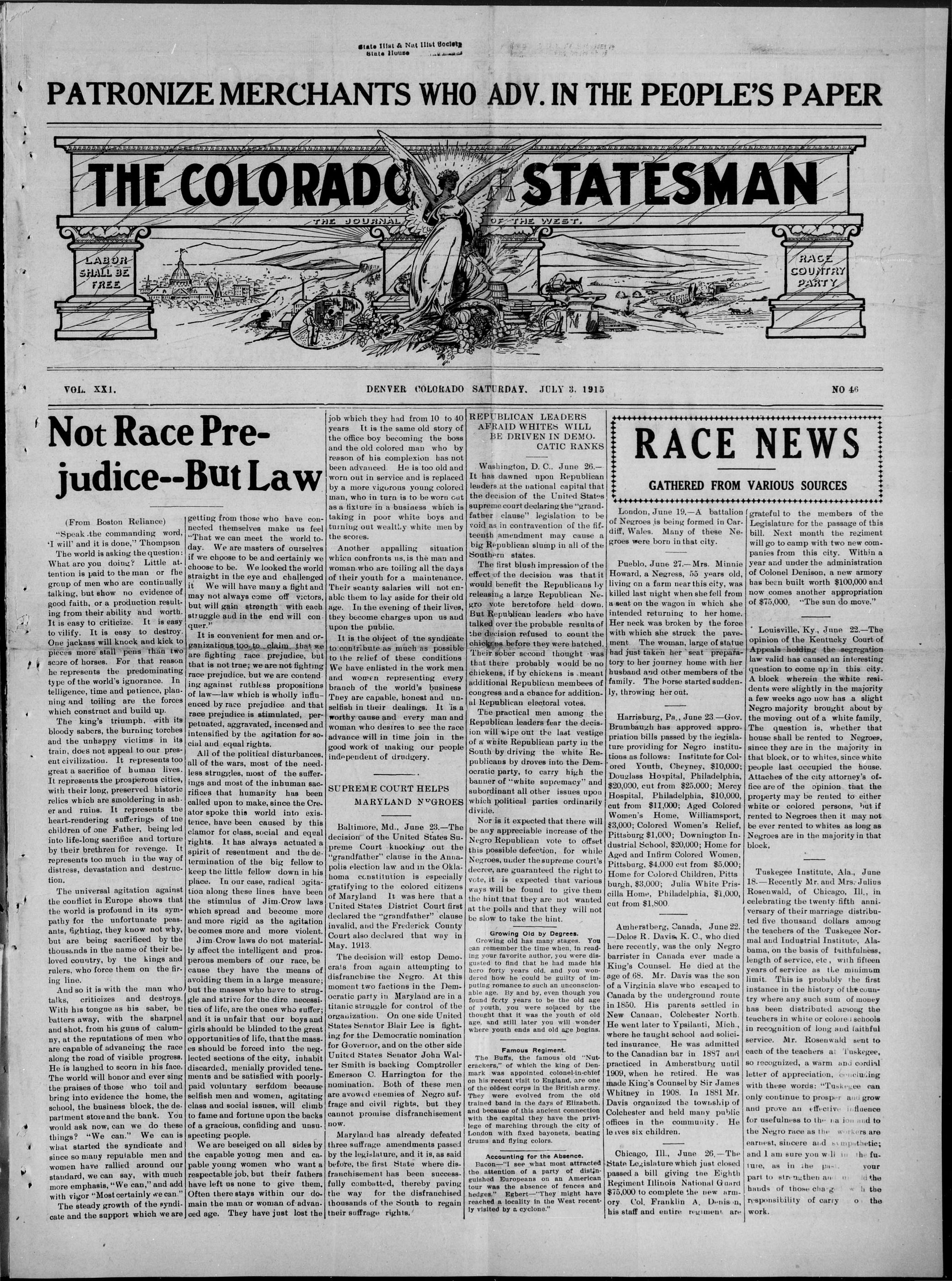
PATRONIZE MERCHANTS WHO ADV. IN THE PEOPLE'S PAPER
THE COLORADO STATESMAN
THE JOURNAL OF THE WEST.
LABOR SHALL BE FREE
RAGE COUNTRY PARTY
Not Race Prejudice--But Law
VOL. XX1. Not Race judice--
(From Boston Reliance)
"Speak the commanding word, 'I will' and it is done," Thompson
The world is asking the question: What are you doing? Little attention is paid to the man or the group of men who are continually talking, but show no evidence of good faith, or a production resulting from their ability and worth. It is easy to criticize. It is easy to vilify. It is easy to destroy. One jackass will knock and kick to pieces more stall pens than two score of horses. For that reason he represents the predominating type of the world's ignorance. Intelligence, time and patience, planning and toiling are the forces which construct and build up.
The king's triumph, with its bloody sabers, the burning torches and the unhappy victims in its train, does not appeal to our present civilization. It represents too great a sacrifice of human lives. It represents the prosperous cities, with their long, preserved historic relics which are smoldering in asher and ruins. It represents the heart-rendering sufferings of the children of one Father, being led into life-long sacrifice and torture by their brethren for revenge. It represents too much in the way of distress, devastation and destruction.
The universal agitation against the conflict in Europe shows that the world is profound in its sympathy for the unfortunate peasants, fighting, they know not why, but are being sacrificed by the thousands in the name of their beloved country, by the kings and rulers, who force them on the firing line.
And so it is with the man who talks, criticizes and destroys. With his tongue as his saber, he batters away, with the sharpnel and shot, from his guns of calumny, at the reputations of men who are capable of advancing the race along the road of visible progress. He is laughed to scorn in his face. The world will honor and ever sing the praises of those who toil and bring into evidence the home, the school, the business block, the department store and the bank. You would ask now, can we do these things? "We can." We can is what started the syndicate and since so many reputable men and women have rallied around our standard, we can say, with much more emphasis, "We can," and add with vigor "Most certainly we can." The steady growth of the syndicate and the support which we are
---
getting from those who have connected themselves make us feel "That we can meet the world today. We are masters of ourselves if we choose to be and certainly we choose to be. We looked the world straight in the eye and challenged it. We will have many a fight and may not always come off victors, but will gain strength with each struggle and in the end will conquer." It is convenient for men and organizations too to claim that we are fighting race prejudice, but that is not true; we are not fighting race prejudice, but we are contending against ruthless propositions of law—law which is wholly influenced by race prejudice and that race prejudice is stimulated, perpetuated, aggravated, incensed and intensified by the agitation for social and equal rights.
All of the political disturbances, all of the wars, most of the needless struggles, most of the sufferings and most of the inhuman sacrifices that humanity has been called upon to make, since the Creator spoke this world into existence, have been caused by this clamor for class, social and equal rights. It has always actuated a spirit of resentment and the determination of the big fellow to keep the little fellow down in his place. In our case, radical agitation along these lines have been the stimulus of Jim-Crow laws which spread and become more and more rigid as the agitation be comes more and more violent.
Jim Crow laws do not materially affect the intelligent and prosperous members of our race, because they have the means of avoiding them in a large measure; but the masses who have to struggle and strive for the dire necessities of life, are the ones who suffer; and it is unfair that our boys and girls should be blinded to the great opportunities of life, that the masses should be forced into the neglected sections of the city, inhabit discarded, menially provided tenements and be satisfied with poorly paid voluntary serfdom because selfish men and women, agitating class and social issues, will climb to fame and fortune upon the backs of a gracious, confiding and unsuspecting people.
We are beseiged on all sides by the capable young men and capable young women who want a respectable job, but their fathers have left us none to give them. Often there stays within our domain the man or woman of advanced age. They have just lost the
DENVER COLORADO SATURDAY. JULY 3. 1915
State Hist & Nat Hist Booleys
State House
GIANTS WHO
ADC
THE JOURNAL
DENVER COLORADO
job which they had from 10 to 40 years It is the same old story of the office boy becoming the boss and the old colored man who by reason of his complexion has not been advanced. He is too old and worn out in service and is replaced by a more vigorous young colored man, who in turn is to be worn out as a fixture in a business which is taking in poor white boys and turning out wealthy white men by the scores. Another appalling situation which confronts us, is the man and woman who are toiling all the days of their youth for a maintenance. Their scanty salaries will not enable them to lay aside for their old age. In the evening of their lives, they become charges upon us and upon the public.
It is the object of the syndicate to contribute as much as possible to the relief of these conditions We have enlisted in the work men and women representing every branch of the world's business They are capable, honest and unselfish in their dealings. It is a worthy cause and every man and woman who desires to see the race advance will in time join in the good work of making our people independent of drudgery.
SUPREME COURT HELPS
MARYLAND N°GROES
Baltimore, Md., June 23.—The decision of the United States Supreme Court knocking out the "grandfather" clause in the Annapolis election law and in the Oklahoma constitution is especially gratifying to the colored citizens of Maryland. It was here that a United States District Court first declared the "grandfather" clause invalid, and the Frederick County Court also declared that way in May, 1913.
The decision will estop Democrats from again attempting to disfranchise the Negro. At this moment two factions in the Democratic party in Maryland are in a titanic struggle for control of the organization. On one side United States Senator Blair Lee is fighting for the Democratic nomination for Governor, and on the other side United States Senator John Walter Smith is backing Comptroller Emerson C. Harrington for the nomination. Both of these men are avowed enemies of Negro suffrage and civil rights, but they cannot promise disfranchisement now.
Maryland has already defeated three suffrage amendments passed by the legislature, and it is, as said before, the first State where disfranchisement has been successfully combatted, thereby paving the way for the disfranchised thousands of the South to regain their suffrage rights.
---
REPUBLICAN LEADERS AFRAID WHITES WILL BE DRIVEN IN DEMOCATIC RANKS
Washington, D. C. June 26. It has dawned upon Republican leaders at the national capital that the decision of the United States supreme court declaring the "grandfather clause" legislation to be void as in contravention of the fifteenth amendment may cause a big Republican slump in all of the Southern states.
The first blush impression of the effect of the decision was that it would benefit the Republicans by releasing a large Republican Negro vote heretofore held down. But Republican leaders who have talked over the probable results of the decision refused to count the chickens before they were hatched. Their sober second thought was that there probably would be no chickens, if by chickens is meant additional Republican membees of congress and a chance for additional Republican electoral votes.
The practical men among the Republican leaders fear the decision will wipe out the last vestige of a white Republican party in the South by driving the white Republicans by droves into the Democratic party, to carry high the banner of "white supremacy" and subordinant all other issues upon which political parties ordinarily divide.
Nor is it expected that there will be any appreciable increase of the Negro Republican vote to offset this possible defection, for while Negroes, under the supreme court's decree, are guaranteed the right to vote, it is expected that various ways will be found to give them the hint that they are not wanted at the polls and that they will not be slow to take the hint.
Growing Old by Degrees
Growing Old by Degrees.
Growing old has many stages. You can remember the time when, in reading your favorite author, you were disgusted to find that he had made his hero forty years old, and you wondered how he could be guilty of imputing romance to such an unconscionable age. By and by, even though you found forty years to be the old age of youth, you were solaced by the thought that it was the youth of old age, and still later you will wonder where youth ends and old age begins.
Famous Regiment.
The Buffs, the famous old "Nutcrackers," of which the king of Denmark was appointed colonel-in-chief on his recent visit to England, are one of the oldest corps in the British army. They were evolved from the old trained band in the days of Elizabeth, and because of this ancient connection with the capital they have the privilege of marching through the city of London with fixed bayonets, beating drums and flying colors.
Accounting for the Absence.
Accounting for the Abuse
Bacon—"I see what most attracted the attention of a party of distinguished Europeans on an American tour was the absence of fences and hedges." Egbert—"They might have reached a locality in the West recently visited by a cyclone."
RACE NEWS
London, June 19.—A battalion of Negroes is being formed in Cardiff, Wales. Many of these Negroes were born in that city.
Pueblo, June 27.—Mrs. Minnie Howard, a Negress, 55 years old, living on a farm near this city, was killed last night when she fell from a seat on the wagon in which she intended returning to her home. Her neck was broken by the force with which she struck the pavement. The woman, large of statue had just taken her seat preparatory to her journey home with her husband and other members of the family. The horse started suddenly, throwing her out.
Harrisburg, Pa., June 23 — Gov. Brumbaugh has approved appropriation bills passed by the legislature providing for Negro institutions as follows: Institute for Colored Youth, Cheyney, $10,000; Douglass Hospital, Philadelphia, $20,000, cut from $25,000; Mercy Hospital, Philadelphia, $10,000, cut from $11,000; Aged Colored Women's Home, Williamsport, $3,000; Colored Women's Relief, Pittsburg $1,000; Downington Industrial School, $20,000; Home for Aged and Infirm Colored Women, Pittsburg, $4,000 cut from $5,000; Home for Colored Children, Pittsburgh, $3,000; Julia White Priscilla Home, Philadelphia, $1,000, cut from $1,800.
Amherstberg, Canada, June 22. —Delos R. Davis, K. C., who died here recently, was the only Negro barrister in Canada ever made a King's Counsel. He died at the age of 68. Mr. Davis was the son of a Virginia slave who escaped to Canada by the underground route in 1850. His parents settled in New Canaan, Colchester North. He went later to Ypsilanti, Mich., where he taught school and solicited insurance. He was admitted to the Canadian bar in 1887 and practiced in Amherstburg until 1909, when he retired. He was made King's Counsel by Sir James Whitney in 1908. In 1881 Mr. Davis organized the township of Colchester and held many public offices in the community. He leaves six children.
Chicago, Ill., June 26.—The State Legislature which just closed passed a bill giving the Eighth Regiment Illinois National Guard $75,000 to complete the new armory Col. Franklin A. Denison, his staff and entire regiment are
NO 46
grateful to the members of the Legislature for the passage of this bill. Next month the regiment will go to camp with two new companies from this city. Within a year and under the administration of Colonel Denison, a new armory has been built worth $100,000 and now comes another appropriation of $75,000. "The sun do move."
Louisville, Ky., June 22.—The opinion of the Kentucky Court of Appeals holding the segregation law valid has caused an interesting question to come up in this city. A block wherein the white residents were slightly in the majority a few weeks ago now has a slight Negro majority brought about by the moving out of a white family. The question is, whether that house shall be rented to Negroes, since they are in the majority in that block, or to whites, since white people last occupied the house. Attaches of the city attorney's office are of the opinion that the property may be rented to either white or colored persons, but if rented to Negroes then it may not be ever rented to whites as long as Negroes are in the majority in that block.
Tuskegee Institute, Ala., June 18.—Recently Mr. and Mrs. Julius Rosenwald, of Chicago, Ill., in celebrating the twenty fifth anniversary of their marriage distributed five thousand dollars among the teachers of the Tuskegee Normal and Industrial Institute, Alabama, on the basis of faithfulness, length of service, etc., with fifteen years of service as the minimum limit. This is probably the first instance in the history of the country where any such sum of money has been distributed among the teachers in white or colored schools in recognition of long and faithful service. Mr. Rosenwald sent to each of the teachers at Tuskegee, so recognized, a warm and cordial letter of appreciation, concluding with these words: "Tuskegee can only continue to prosper and grow and prove an effective influence for usefulness to the nation and to the Negro race as the workers are earnest, sincere and sympathetic; and I am sure you will in the future, as in the past, your part to strengthen and build the hands of those charged with the responsibility of carry on the work.
THE WORLD IN PARAGRAPHS
BRIEF RECORD OF PASSING EVENTS IN THIS AND FOR EIGN COUNTRIES.
IN LATE DISPATCHES
DOINGS AND HAPPENINGS THAT MARK THE PROGRESS OF THE AGE.
Western Newspaper Union News Service.
ABOUT THE WAR
The town of Halicz in Galicia on the Dniester river has been occupied by German troops, according to the announcement given out by German military headquarters.
The British steamships Indrani of 3,640 tons gross, was sunk by a German submarine at a point southwest of Tuskar, Ireland. The crew of the Indrani was saved.
The Russians have begun a retreat from the Vistula river and the district of Zamosza, southeast of Lublin, in Russian Poland, according to the official statement issued by the German army headquarters staff at Berlin.
The supplementary naval estimate, issued in London, provides for the addition of 50,000 officers and men to the navy. This would bring the total personnel for this year to 300,000 officers and men. The last vote of 250,000 men was made in February.
The Russians again are retreating in Galicia, both to the north and south of Lemberg, and in Poland the Germans have launched another attack against Warsaw in the form of a drive from the north through Przansysz. The new blow at the Polish capital has been preceded by a terrific artillery action.
German submarines have sunk five more big ships in the war zone—the British Scottish Monarch and the Norwegian ships Combuskenneth, Gjeso, Katka and Mandel, and the Holland-American line steamship Nieuw Amsterdam, having a large number of passengers on board bound from New York for Rotterdam, was run down in a fog by an unknown steamer while anchored in the Downs.
Twenty-nine persons were lost. at least twenty of whom were Americans, and many others injured when the Dominion liner Armenian, which sailed from Newport News for Avonmouth on June 17, was torpeded by the German submarine U-38. The attack on the Armenian was made twenty miles northwest of Trevoz Head, Cornwall, England. This information was reported by American Consul Armstrong at Bristol, England.
WESTERN
The "drys" made gains in the Utah local option elections.
"Dry" forces captured three out of four counties voting on local option in Minnesota.
The Mormon tabernacle choir of 200 volces will give a series of four concerts at the Panama-Pacific exposition, beginning July 21.
Senator Gore of Oklahoma, while in Denver, stated that he favored the capitol of the Centennial State for the next national Democratic convention.
The militiamen who have been guarding ex-Governor Slaton's home at Atlanta, Ga., since Leo M. Frank's sentence was commuted, have been withdrawn.
William Abernathy, brother of Jack Abernathy, Theodore Roosevelt's famous wolf catcher, was shot by John Hess in a riot between striking zinc and lead miners in the Webb-City Joplin (Mo.) district.
The presence of riches in huge quantities has been detected in abandoned stopes of the Custer Slide Mining and Development Company's property at Custer, Idaho. The company is a close corporation of Colorado Springs capitalists, headed by William H. Pitts.
Miss Genevieve Clark, the 20-year-old daughter of Speaker Champ Clark of the national House of Representatives, was married at the home of her parents in the presence of hundreds of "home folks" at Bowling Green, Mo., to James M. Thompson, editor of the New Orleans Item.
WASHINGTON
Inside details of the plot to restore a Huerta regime to Mexico, nipped in the bud by the United States, began trickling out through the net of official secrecy, while Gen. Huerta and his chief lieutenant, Pascual Orozoo, are under federal detention at El Paso, Other Mexicans, nearly a score of whom had a part in the plot that failed, and probably some Americans, are under surveillance by the Department of Justice.
Only six cases will be under advisement by the Supreme Court during the summer recess, a new record for that tribunal.
The War Department has bought for $50,000 19,000 acres of land at Tobyhanna, Pa., for a field artillery target range for both militia and regular troops.
That Attorney General Gregory holds the President may refuse army experts' resignations if they have no other reason for retiring than offers of higher pay.
FOREIGN
The nucleus of a Chinese transoceanic merchant marine will be purchased soon in the United States, according to Ah Fung-Sui, who arrived at Honolulu on the Chiyo Maru, bound for San Francisco.
"With the help of God Russia will continue the fight until her enemies are crushed. Until that time peace is impossible!" Premier Goremykin issued the foregoing statement in a manifesto at Petrograd.
The trial of Porter Carlton, who was extradited from the United States on the charge of having murder his wife at their villa at Coma, Italy, in 1910, has been postponed from July 4 until next autumn.
An Amsterdam dispatch to the Exchange Telegraph Company says that the Dutch government has decided to issue a new war loan of 900,000,000 florins ($36,000,000) to pay the cost of mobilization and other war expenditures.
One year ago the Austrian archduke, Francis Ferdinand, and his wife were shot and killed in the little Bosnian town of Serajevo by Garvio Prinzip. It was the act of Prinzip, a poor student, which ultimately resulted in eleven nations going to war.
A Reuter dispatch from Alexandria says that the United States cruiser Tennessee has arrived there from Beirut. She had 600 refugees aboard, among whom were 100 Americans and 450 Italians. Twelve consuls also were brought to Alexandria by the Tennessee.
The fate of one-half of the Jews of the world is trembling in the balance as a result of the great war in Europe, according to Rabbi Moses J. Gries of Cleveland, president of the Central Conference of American Rabbis, who addressed the twenty-sixth convention at Charlevoix, Mich.
Herbert C. Hoover, chairman of the American commission for relief in Belgium, has concluded an agreement with Gen. Von Blissing, military governor of Belgium, providing that the wheat and rye crops in the zone occupied by the Germans shall be reserved for the civilian population.
During the latter part of August and the early days of September next several important changes will take place among the higher personnel of the Panama canal. The resignation of Maj. Gen. George W. Goethals, U.S. A., as governor of the Panama canal and his departure from the Isthmus, where he has been in supreme command for the last eight years, will be the beginning of other changes.
SPORTING NEWS
Standing of Western League Clubs. Clubs—
Won. Lost. Pct.
Des Moines . 36 23 .610
Topeka . 34 27 .557
Denver . 29 26 .527
Omaha . 30 28 .517
Lincoln . 28 29 .491
Sioux City . 26 32 .448
Wichita- . 23 31 .426
St. Joseph . 23 34 .404
Eddie Campi of San Francisco easily defeated Kid Sullivan of Brooklyn in their ten-round bout in Brooklyn, N. Y.
When Gunner Moir and Jack Dillon failed to draw a crowd at Evansville, Ind., they postponed their match until July 7.
Arlie Mucks, the University of Wisconsin's giant weightman, bested a world's record when he threw the discus 147 feet at Madison. Wis.
Burlington and Keokuk in the Central Association played twenty-two innings to a scoreless tie at Burlington, Ia., breaking the records of organized baseball for the longest game without a score.
Running horse racing for thirty days, beginning in August, at the Panama-Pacific exposition was assured with the organization of the Golden Gate Thoroughbred Breeding Association.
Clarence O. King, a veteran driver, was instantly killed and Leslie Hewett, his brother-in-law and mechanician, was badly injured by the overturning of their automobile in a race at San Francisco.
Royal G. Bird, who rowed in the winning Cornell varsity crew at Poughkeepsie, N. Y., was notified at the conclusion of the race that his brother, Eugene Bird, was dead at their home in New York City.
Star Shooter, which was made the favorite in the Colorado derby, won by Stolen Ante, redeemed himself with the racing public at Overland park in Denver by winning the Dry Climate handicap and reeling off the mile in the fast time of 1:39 4-5.
GENERAL
Margaret Dreier Robins, president of the Woman's Trade Union League of New York, issued a call to the 7,000,000 women workers in the United States to organize in order to obtain better working conditions. José Zozaya, a wealthy Mexican at El Paso, Tex., was arrested on charges of conspiring to set on foot a military expedition against a friendly country in violation of United States neutrality. He was released on $7,500 bond for hearing before United States Commissioner George Oliver. Evelyn Nesbit Thaw has been served with a subpoena at Malone, N. Y., to appear in her husband's sanity trial in New York. Leo M. Frank might have been a free man if his lawyers had asked former Governor Slaton for a pardon, the late chief executive of Georgia declared in New York.
Jeremiah O'Donovan, better known as O'Donovan Rossa, Irish patriot and revolutionist, died in St. Vincent's hospital, Staten Island, in New York. He had been ill for many months.
COLORADO STATE NEWS
Western Newspaper Union News Service.
COMING EVENTS.
Aug. 12-14.—Frontier Days and Wild West Features at Grand Junction.
Aug. 31-Sept. 2.—Grand Lodge, K. of P., at Colorado Springs.
Aug. 26-28. - Fail Festival at Flagler.
- Meetings meeting international
Dry Farming Association.
The state convention of the C. E
and B. Y. P. U. was held in Pueblo.
and B. I. P. U. was held in Pueblo.
The National Association of Stationary Engineers held its annual picnic at Eldorado Springs.
Geo. W. Wigger of Colorado Springs had his collar bone broken in an auto accident near Manitou.
Mrs. Rosiee Cohen, mother of nine children, who gave birth to triplets in Denver, was reported doing well.
After June 30 the penalty runs against those who are subject to the federal income tax and who failed to pay it.
At Eaton, Irving Carr, 10 years old, lost two fingers of his right hand in an accident while repairing an automobile.
Denver banks gained $2,000,000 in deposits, according to published statements, and July dividends amounted to $650,000.
An amendment providing for home rule under the prohibition law was defeated in Durango by a majority of 1221 in a quiet election with an extremely light vote.
While playing on her father's farm near Broomfield, 2-year-old Ethel Fern Towner, daughter of Mr. and Mrs. A. E. Towner, fell into an irrigation ditch and was drowned.
Semi-annual dividends and interest paid out July 1, by the Denver banks and other corporations in Denver aggregated more than $1,000,000, according to financial experts.
The railroad lines, the hotels and various enterprises serving tourists were taxed to capacity to care for the biggest June month-end run of tourists in many a year in Denver.
Firemen of Gilpin and Jefferson counties held their last annual picnic at Lookout Mountain park. The picnic took the place of a tournament which had been held in former years. John W. Campbell, 74, former resident of Grand Junction, died in his homestead, twenty-nine miles southwest of Grand Junction, from Bright's disease. He is survived by eight children. Rates for workmen's compensation insurance in the state fund will be announced on July 10, according to a statement made by Chairman McLaughlin of the Colorado Industrial Commission. That wild animals in the foothills and mountains to the west of Loveland are more in evidence than ever before is the consensus of opinion among those who spend considerable time in the hills.
While his 5-year-old son, Myron, stood a few paces away and watched, Clarence F. Bergen, 32, proof clerk for the Woodmen of the World, shoot and killed himself in the bedroom of his home in Denver.
Following the decision of Denver merchants, Colorado Springs retail stores enforced a rule that no more women's clothes would be sent from their stores on approval and that such goods purchased would not be exchanged.
A crowd of more than 1,000 persons watched a score of volunteer rescuers save the life of Roy Kendall, an asphalt worker who was pinned fifteen minutes between a street car and a steam roller at Fifteenth and Tremont streets in Denver.
Joseph Lopez, a Mexican, lies in the Sterling hospital with bullet wounds through the calves of his legs and another bullet hole through one of his knees, the victim of a would-be murderer who shot from ambush at Atwood, ten miles southwest of Sterling.
Adam McGregor, the Denver youth who went to Scotland last fall to enter the English army, and who has been in active service in France for the last two months, is among the missing in the Tenth Liverpool Scottish regiment, which he joined in December, according to a cablegram received in Denver.
Jesse E. Fleming, Denver banker and contractor, resigned as a member of the State Board of Capitol Managers, after District Judge Perry had quashed informations against him and James Williams, brother board member, charging them with using their offices to let state contracts beneficial to themselves.
The statement of Frank H. Wolcott, bursar of the University of Colorado at Boulder, that it has cost the institution almost $50,000 to defend the Oles suit has aroused popular indignation to such a pitch that an investigation of the origin of the forged document on which the Oles suit was based is demanded.
Prospects for the greatest crop in the history of eastern Colorado, with consequent prosperity for the residents of that section and for Denver, was the message brought to Denver by more than 300 farmers, bankers, merchants and business men from the great new agricultural empire in the eastern part of the state.
Dead for ten minutes, Murtha Carr, the 6-year-old daughter of City Detective Peter Carr, was brought to life by the efforts of physicians and nurses in St. Joseph's hospital in Denver.
THREE TAKE OWN LIVES
MRS. PEARLE COLONELLO, 18,
SWALLOWS CARBOLIC ACID.
F. C. Ravenscroft, 63, Slashes Throat
With Razor and Winnie Walker, 20,
Took Bichloride of Mercury.
Denver.—While Mrs. Pearle Colonello, 18 years old, pretty bride of eight months, was dying at the county hospital from the effects of a quantity of carbolic acid which she had swallowed with suicidal intent, two men within the same hour each tried to end their lives by slashing their throats with a razor. Mrs. Colonello died an hour after she reached the hospital. F. C. Ravenscroft, 63, of 421 Jason street, an inmate of the county hospital, died four hours after his attempt at suicide. The self-inflicted slashes on the throat of E. M. Mauron, 38, a negro, will not prove fatal.
Another Denver suicide was that of Winnie Walker, 20, a pretty University of Kansas undergraduate, who died from the effects of poison she drank. Miss Walker swallowed bichloride of mercury tablets at the home of Mrs. George Funke, 1374 Humboldt street, where she and her father, James H. B. Walker, were visiting.
Mine Officers Held for Murder.
Boulder.—Edward Doyle, secretary of District 15. United Mine Workers of America; W. T. Hickey, secretary of the State Federation of Labor; John O'Connor, Jack Cassidy and F. J. Potestio, local officers of the United Mine Workers, gave bond in $3,000 each in the District Court for hearing July 19 on a charge of murder in connection with strike violence in the northern Colorado coal fields incident to the recent coal miners' strike. Previous informations against the men were pressed by the district attorney, and the men will be co-defendants on one information charging murder.
Boy Run Over by Auto Asks for Soda
Grand Junction.—Running from the curbing to a bandstand on Main street, to join his playmates, Kenneth Kennedy, 8 years old, was struck by a rapidly driven automobile, and although rolled under the car for sixty feet, he was taken from under the machine with only a few bruises. The first thing he asked for upon being picked up was an ice cream soda. This was quickly served him at the nearest drug store.
Woman's Body Found Under Rock.
Women's Body Fight Club Rock
Boulder.—A body, believed to be that of Mrs. Mary Shackleton, 65, who disappeared March 20 after making suicide threats, was found near Blue Bell canyon, in a region traversed daily by scores of trampers and picknickers, by William Ryan and Carl Wickert, university students, who were on a beefsteak fry with some girl friends. The young men found the body while collecting wood for their fire.
Man Beaten in Fight Dies.
Pueblo.—Jose Huerta, a Mexican, is dead at St. Mary's hospital following a fight with his foreman, H. I. Beavers, who also was badly hurt in the encounter between the two men. Huerta was struck over the head with a shovel with such force that he never regained consciousness.
Denver's Chief of Police Suspended.
Denver.—Chief Felix O'Neill was suspended as head of the Denver Police Department pending a hearing on July 12th of charges that he failed to enforce the laws in relation to the sale of liquor, gambling and vice.
August Muntzing Drops Dead.
Denver.—An hour after he delivered a stirring address proclaiming the merits of eastern Colorado to Denver business men, August Muntzing, pioneer land man and attorney of Akron, dropped dead on Stout street, near the Equitable building.
Youthful Bandits Hold Up Three.
Youthful Bandits Hold Up Three.
Denver.—Two unmasked youthful bandits terrorized the east section of Capitol hill Saturday night, holding up three different persons and committing two house robberies, from which they carried jewelry valued at $165.
U. S. Lawmakers in Denver.
Denver.—The men charged with determining the appropriation of hundreds of millions of dollars of government money for reclamation and irrigation projects, with members of the Reclamation Commission, arrived in Denver Wednesday.
Phone Wire Conveys Lightning
Windsor.—Traversing the telephone wire into the house of J. A. Challgren a bolt of lightning caused much damage to the building and furniture, but did not injure any of the family, who were sitting in the next room.
Four Injured in Train Wreck.
Durango.—Four persons injured in a wreck on the Rio Grande Southern five miles this side of Mancos were brought here and placed in a local hospital for medical attention. The injured are Mrs. J. W. Payne of Colorado Springs, who had two broken ribs and internal injuries; Mrs. J. W. Sowers of this city, one rib broken and many bruises; Miss Zella Sorenson of Pagosa Springs, badly cut over the right eye and on the head; P. Ogitree of Trinidad, several gashes on head.
The Queen City Band
BIG EXCUSE
EXCURSE TO
GOLDEN, C
Over Denver-Intermou
MONDAY, JULY
To Our Friends and Fellow Citizens:—We
your friends to help us in our struggle in
men, are trying to make this exc
Get your Baskets and Get your Lunch in
the foothills and have a nice o
Admission $1.00, Round Trip Ticket, inclu
and Evening from 2 p. m. t
Cars leave the loop at 11:30 a. m. Return
desired on same tick
M. W. Buck & J. J.
Dealers in
New and Second Hand
The Store for Banc
Main 4473
OLDEN, COLL
Denver-Intermountain
SUNDAY, JULY 5, 1915
and Fellow Citizens:—We cordially
help us in our struggle in this affair
we trying to make this excursion a
s and Get your Lunch in them and
bothills and have a nice outing on a
Round Trip Ticket, including Day
and Evening from 2 p. m. till 11 p. m.
Stop at 11:30 a. m. Return 11:30 p. m.
desired on same ticket.
Buck & J. J. Moy
Dealers in
Second Hand Fun
The Store for Bargains
Main 4473
GOLDEN, COLO. Over Denver-Intermountain R. R.
MONDAY, JULY 5, 1915
To Our Friends and Fellow Citizens:—We cordially invite you and your friends to help us in our struggle in this affair. We as Band men, are trying to make this excursion a success.
Get your Baskets and Get your Lunch in them and go with us to the foothills and have a nice outing on July 5.
Admission $1.00, Round Trip Ticket, including Dancing, Afternoon and Evening from 2 p. m. till 11 p. m.
Cars leave the loop at 11:30 a. m. Return 11:30 p. m., or at any hour desired on same ticket.
M. W. Buck & J. J. Moylan Co.
Dealers in
New and Second Hand Furniture
The Store for Bargains
Main 4473
2246 WELTON STREET DENVER, COLO.
ANNUAL JUNE DINNERWARE A
Discount
Carson's
AL JUNE DINNERWARE AND CUT
Discount Sale
Carson's ANNUAL JUNE DINNERWARE AND CUT GLASS Discount Sale
Is now in full swing and considering the prices we are quoting, you cannot afford to buy that gift intended for the June Bride or Graduate without first looking over our stock.
Dinnerware
Choice of two neat decorations in French
China Dinner Sets; regular
price $27.50. For this sale..... $20.00
Choice of two border patterns in high grade
English Porcelain; regular
price $14.00. For this sale..... $10.75
A large variety of cottage sets in high grade
American ware, ranging in price from $2.75 to $5.00
per set of 42 pieces.
Cut Glass
Our stock of cut glass
is very complete and we
are showing some ex-
ceptional values.
5-inch Handled Nappies,
choice of several
cuttings; each..... 85G
Cut Glass Salt and Peper
Shakers, fitted with
sterling tops;
pair..... 50G
Cut Glass
Our stock of cut glass is very complete and we are showing some exceptional values.
5-inch Handled Napples, choice of several cuttings; each.....85C
Cut Glass Salt and Peper Shakers, fitted with sterling tops; pair.....50C
5-inch Unhandled Napples, choice of several cuttings; each.....75C
6-inch Cut Glass Vases, beautifully cut, 3 styles; each.....$1.00
Extra Special
200 pieces highest grade cut glass, new floral cutting, heavy lead blanks, consisting of bowls, jug, glass comports, sugars and creams, etc. Values to $6.00. For this sale..... $3.75 The balance of our immense stock of Silverware, Brassware, Fancy China, Brica-Brac, Blown and Pressed Glassware will be on sale at from
200 pieces highest grade cut glass, new f
blanks, consisting of bowls, jugs, glass com
sugars and creams, etc. Values to $6.00. For
The balance of our immense stock of Silve
China, Bric-a-Brac, Blown and Pressed Glass
from
chest grade cut glass, new floral cutting of bowls, jugs, glass comports, jams, etc. Values to $6.00. For this sale, if our immense stock of Silverware, Brac Brac, Blown and Pressed Glassware will
10 to 50% Discount
Prompt Automobile Delivery to All
CARSON
Denver's Accommodating China and
732-36 FIFTEENTH STREET (
At Automobile Delivery to All Parts of the
CARSONS
Accommodating China and Glassware
22-36 FIFTEENTH STREET (AT STOUT
CARSONS Denver's Accommodating China and Glassware Shop. 732-36 FIFTEENTH STREET (AT STOUT).
DENVER, COLO.
CUT GLASS
ale
A woman holding a pitcher and a pot.
AFRO-AMERICAN CULLINGS
What the Afro-American has thus far accomplished is only a promise—an expectation; the realization belongs to the future. A school must and will be established, perhaps in Washington, D. C.; to head this school, an eminent European composer and teacher secured (preferably a Russian), who, unhindered by prejudice, will understand, appreciate and foster the peculiar musical genius of the Afro-American child. While giving the child the same grasp upon the science of composition as was Beethoven's, he will also show that strength of character and profound knowledge of his people, as well as technical skill, which made Beethoven the master. Individuality—and then, more individuality.
Such a school will require money. It will not be forthcoming if as soon as a few Negroes have learned the principles of breathing, or being able to play the scale of G one or two octaves without serious offense to tonality, they are at once exploited in some temple of music where, maybe, the Boston Symphony orchestra had just finished a concert, perfect in every detail.
The Negro composer (there are a few in the United States who are receiving serious consideration) should mainly find his inspiration in the imperishable melodies of his enslaved ancestors. When he shall have developed works worthy of rendition, he will find both Negroes and whites ready and willing to offer them. All through the South, Southwest and West there are Negroes with beautiful voices. What is more, because of the home life of these people, they are gaining real culture. They are laying aside their shame of the past and are beginning to glory in their unmatched heritage of folk lore and folk songs. The Afro-American Folk Song Singers, Washington, D. C., the chorus of Howard university, Fisk university, and others, are ready to do justice to the choral works of a Negro Beethoven, should he appear. To them we look for results; by them would we be judged. New York and other large cities of the North are neither seeking nor finding the right way.—Will Marlon Cook.
Hannibal Beatty died the other day at Yorkville, S. C. He was born a slave and never rose above the station of a humble worker, yet the whole city joined in paying tribute to his memory. He was sexton one of the churches of the white folks for 46 years—the church of the "quality"—and for 41 years he also was the janitor of the courthouse. By the compelling power of a long life of faithful, honest service he won the respect of everybody. If ever he gave offense to white or black the circumstance is not of record, says the Yorkville Enquirer, one of the best newspapers of the South. Courteous, faithful, kindly and obliging he exemplified in his character the best qualities of his race.
When he came to die he had one request to make. That was that he should be buried from the church of which he had been the sexton so long. The services were conducted by the white pastor with the Negro clergyman of the Methodist church, of which Hannibal was a member, assisting. The church was crowded with whites and blacks in about equal numbers. There were many floral offerings from both whites and blacks. Most remarkable of all the tributes was that bench and bar, city and coun-
A baking spoon and bowl have wrought magic in black hands for many generations. That the secret of their wonder working may not be lost, and that the young Negro women of Kansas City may learn to render good service as cooks and housemaids, Mrs. V. T. Williams, 1325 Jackson avenue, gives her time and her home. For six years Mrs. Williams, herself a famous cook and for years a schoolteacher, has taught the Domestic Science Training circle without compensation, her only reward being the growing efficiency of the members, nearly all of them employed in South side homes.
Although the class meets only on Thursday afternoons, lessons are given every day. Whatever a member of the circle needs, that she is taught. In no case are the lessons measured by the ability of the pupil to pay. Each girl joining the class pays one dollar "if she happens to have one," for a year's membership. This is not enough to pay for the materials used in the class work. But it helps, and the circle is growing so rapidly that the Council of Women's Clubs has
Miss Kathleen Dunsmuir of Vancouver, British Columbia, twenty years old, daughter of James Dunsmuir, former lieutenant-governor of British Columbia and millionaire mine owner, has sailed for France to offer her services to the Red Cross as an ambulance motor driver.
In 1880 there were a few more than 1,000 inns for the accommodation of travelers in Switzerland, but since then the number has probably trebled.
ty officials and officers of the church acted as the pallbearers. They included L. R. Williams, probate judge; W. W. Lewis, J. S. Brice, Thomas F. McDow, J. R. Hart, J. A. Marion, members of the bar; H. I. McCaw, court stenographer; J. L. Moss and George W. Williams, deacons of the Associated Reformed Presbyterian church; H. G. Brown, sheffir; F. E. Quinn, deputy sheffir; B. M. Love, auditor; H. E. Neil, treasurer; John E. Carroll, superintendent of education; J. A. Tate, clerk of the court, and Thomas W. Boyd, supervisor.
Yorkville honored itself in honoring Hannibal Beatty. He played well his modest part and man can do no more. He was a credit to his race in his living and in the tribute paid to him in his death here is abiding proof of the affection in which the Southerner holds the worthy and faithful black.—Richard Spillane in Commerce and Finance.
In the canning plant at Prairie View, Tex., says the Houston Post, a plant by the way which cost $150 complete, sufficient vegetables are canned to last the students at the dormitory the year around. Last year 10,000 cans of vegetables and fruits were put up in this plant and this year the agricultural department will can fully 15,000 cans. In the college garden of 15 acres there are 25 varieties of vegetables grown. Of these beans, beets, tomatoes and a few other such vegetables are canned and are served to the students during the winter months when fresh stuff is not available. Incidentally this greatly reduces the cost of living. Beef is slaughtered by the students under the general direction of members of the teaching staff.
There are 1,400 acres of land in the site owned by Prairie view. Of that number 350 acres are in cultivation, 90 acres being planted to corn, 25 to black-eyed peas, 20 to sweet potatoes, 25 to watermelons, 25 to sorghum for making sirup and the others to various other crops. Twenty acres are planted to broom corn for use in the manufacture of brooms, and ten to cotton for the use of the mattress making school.
In the sewing department all kinds of dresses, children's wearing apparel, hats and fancy work were shown. These patterns were made by the students in the domestic arts department. Graduating dresses also were made by these girls. The sewing department this year has made 684 complete uniforms for the girls, these uniforms consisting of blue serge skirts for wear in the home, on the farm, and men's overalls and jumpers, skirts and undergarments also were made by these girls, who are enrolled in the domestic arts courses.
Food principles, properly balanced rations, chemistry of cooking, the economical management of the kitchen, including cost estimates for each meal are a few of the things that are stressed in the domestic science course of Prairie View. A neatly furnished dining room where the girls are taught to properly serve meals and dinners by courses is another feature of this department.
The number of sheep estimated to have been shorn last season in Australia and New Zealand was 109,692,-264, which produced seven pounds and twelve ounces each head, including lambs, as against seven pounds for the previous season.
lately taken under advisement some provision for its future.—Kansas City Star.
Some labor unions admit Negroes in considerable numbers. The Tunnel and Subway Contractors' International union of New York city, for example, reported about 200 Negro members, and added: "In our trade they are as good as there are in the business." The tobacco workers reported 400 or 500 members, a decrease, however, from the 1,500 they had in 1900. The United Mine Workers of America reported 25,000 colored members, while Negro members predominated in the largest local organization of the union. The secretary of the organization described them as "intelligent, honorable, progressive and good workmen," and this union exacts a fine from members who discriminate against Negroes.
Among the officers of the Indian troops forming part of the British expeditionary force are three native princes, each of whom has a fortune exceeding $20,000,000.
Probably the best cure for the dissatisfied girl is to permit her to run away with a musical comedy. The only objection to the medicine is that it is difficult for the patient to take it without soiling herself.
Pressing a button opens a new automobile door latch that is controlled by electricity.
A tent for automobilists has been invented that uses the top of a car as a supporting pole.
STATE BOARD MAKES REDUCTION OF $5,506,445.
Denver Tramway and Telephone Granted Lower Rate and Santa Fé Materially Increased.
Western Newspaper Union News Service.
Denver.—A decrease of $5,506,445 in the aggregate placed upon the taxable property of corporations in the state from that fixed last year is announced by the State Tax Commission.
According to the figures given out by the commission, the railroads, street railways and other corporations will pay combined taxes on $256,512,390 worth of property this year, as against $262,018,835 las year.
The Denver & Rio Grande Railroad Company, which has the largest assessment, is taxed this year on $42,242,010 worth of property, as against $43,390,100 in 1914, a decrease of $1,148,090.
The Union Pacific Railroad Company, whose property was valued last year at $23,658,940, will pay this year on $23,750,390. The valuation placed by the commission on the property of the Chicago, Burlington & Quincy is $19,056,920, as against $19,464,990 last year. The Colorado Midland is given a decrease of more than $300,000. Last year it was assessed on property valued at $6,156,990, and this year it will pay taxes on a valuation of $5,806,210.
The Santa Fé railroad, on the other hand, will have to pay more taxes this year. It will be assessed this year on a valuation of $19,883,650, as against $19,488,030 in 1914. The Colorado & Southern and the Rock Island both are assessed on the same valuations as last year, the former to pay taxes on $24,253,490 worth of property, and the latter on $6,799,700. The valuation on the taxable property of the Denver City Tramway Company is decreased this year, as is that of the Mountain States Telephone and Telegraph Company, while the Denver Union Water Company and the Denver Gas & Electric Company each will have to pay more taxes. The Tramway Company will be assessed on a valuation of $16,973,650 as against $18,330,790 last year, a decrease of $1,357,140. The Telephone Company will be assessed on a valuation of $10,206,570.
The Denver Gas & Electric Company will have to pay taxes on $38,460 more valuation than in 1914. It will be assessed on a valuation of $13,027, 200 in stead of $12,988,740. The valuation on the taxable property of the Denver Union Water Company has been increased $804,650. The company will pay on $10,624,140 instead of $9,819,490 as in 1914. The valuations placed on the various classes of property as compared with that fixed by the commission last year is as follows: Car lines—$676,000 in 1915, and $761,560 in 1914. Railroads—$176,231,360 in 1915, and $179,460,890 in 1914.
Telephone companies—$10,554,360 in 1915, and $10,842,490 in 1914.
Telegraph lines—$1,477,640 in 1915, and $1,495,800 in 1914.
Express companies—$1,353,390 in 1915, and $1,419,900 in 1914.
Pullman company—$1,101,300 in 1915, and $1,101,300 in 1914.
Selfwinding clock—$25,870 in 1915, and $29,350 in 1914.
The valuations fixed on the property of some of the big corporation other than those aforementioned are:
Western Colorado Power Company—1914, $2,218,770; 1915, $2,364,160.
Western Light & Power Company (formerly Northern Colorado Power Company)—1914, $1,031,000; 1915, $1,392,400.
Denver & Salt Lake—1914, $5,977,000; 1915, $5,165,590.
Northwestern Terminal Railway Company—1914, $1,620,000; 1915, $1,620,000.
Western Union Telegraph Company
—1914. $1,205.240; 1915. $1,205.240.
Colorado Postal Telegraph Company—1914, $293.380; 1914, $213.260.
pany — 1914, $239,880; 1915, $231,260.
Globe Express Company — 1914,
$545,800; 1915, $523,510.
Adams Express Company — 1914,
$395,800; 1915, $399,960.
American Express Company—1914,
$258,050; 1915, $224,290.
Colorado Power Company—1914, $4,
578,130; 1915, $4,493,160.
Colorado Springs & Interurban
Company—1914, $2,030,380; 1915, $1,
750,000.
Colorado Springs Light, Heat and
Power Company—1914, $3,000,000;
1915, $2,861,730.
Arkansas Valley Railway, Light and
Power Company (Pueblo)—1914, $5,
832,180; 1915, $4,888,040.
Bear Creek Stocked With Trout Fry.
Denver.—The city stocked Bear
creek with 40,000 trout trry furnished
by the Department of Fisheries of the
United States government, with the
request that the commissioner of
property place them in that stream.
No Funds on Checks Misdemeanor Denver.—The "short check" law passed by the Twentieth General Assembly is now effective and hereafter it will be a misdemeanor punishable by a fine of $500 and imprisonment in the county jail for a depositor with intent to defraud to present a short check at a bank in which he has not sufficient funds to meet the full amount of the check. The refusal by a bank or banking association to pay upon such a check shall be considered as prima facie evidence of the intent to defraud.
TEUTON FORCES GAIN IN POLAND
ARMIES CONTINUE ON NORTH-
WARD DRIVE FROM GALICIA;
PLANS PUZZLE ALLIES.
TWO STEAMERS SUNK
ATHENS REPORTS TURK STRONG-
HOLD OF. KRITHIA TAKEN
BY THE ALLIES.
Western Newspaper Union News Service.
London, July 2.—The northward drive of the Austro-German armies from Galicia into Poland is daily becoming more formidable and England is puzzled as to whether they propose to make their main effort in that direction instead of maintaining a concentrated offensive to the eastward to force the Russians out of the southeast tip of Galicia.
Whatever the ultimate object is, the fighting along the Gnila Lipa river has not abated and the Berlin official communication not only records progress in this sector, but further north in the arc around Lemberg, as well as along what has now become the northern front, between the Vistula and Bug rivers. The Austro-German forces on this front are estimated at 2,000,000 men and their progress has been rapid. They have crossed the forest fringing the Tanew river and are not far from the Zamocs fortress, twenty-five miles north of the Galician frontier.
Only 100 miles to the north is the great Russian base, Brest-Litovsk, linked with Warsaw by important railways and lying almost due east of the Polish capital.
The Arras sector maintains its reputation as the storm-center of the western front, but despite the fact that the losses are piling up daily, neither side has been able to deliver a decisive blow.
A dispatch from Athens says the allies have taken the Turkish stronghold of Krithia, on the Gallipoli peninsula, to the western edge of which Gen. Ian Hamilton's report carried his forces; but there is no confirmation.
The British torpedo boat destroyer Lightning was damaged off the east coast by a mine or torpedo explosion. She is now in harbor.
The British steamship Lomas, bound from Argentina for Belfast with a cargo of corn, was sunk by a German submarine sixty miles west of the Scilly Islands.
The Italian ship Sardomene, timberladen, was torpeded without warning five miles from Castletown, Bearaaven, Ireland. Two of the crew were killed.
HUERTA'S TRIAL POSTPONED.
Fifty of Dictator's Supporters Ordered Arrested—Many Killed in Train Wreck.
El Paso, Tex., July 2. — The case against Victoriano Huerta, Pascual Orozco and four others charged with conspiracy to violate the United States neutrality laws was postponed to July 12. The defendants were continued under the same bonds.
Washington.—Conditions in Mexico City are growing constantly worse, Consul Canada notified the State Department from Vera Cruz. Serious hunger rioting was reported in progress in Mexico City, with Zapata and Carranza troops fighting in the outskirts.
San Antonio, Tex.—Charges have been made against fifty Huerta supporters believed to be in the United States, and as many more will likely be taken into custody within the next few days.
Laredo, Tex.—Three hundred people, Carranza soldiers, their wives and children, were killed and several hundred injured in a wreck of a military train near Monte Morelos, between Tampico and Monterey.
Becker Offers Tales of Graft.
Albany, N. Y.—Governor Whitman declined to commute the death sentence of Charles Becker, the former New York police lieutenant convicted of the murder of Herman Rosenthal. Simultaneously, Martin B. Manton, Becker's counsel, announced that he would take no further legal step in behalf of his client. In order that other counsel for Becker may have an opportunity to appeal to the federal courts, however, if decided, the governor granted the convicted man a reprieve of two weeks, from the week beginning July 12 to the week beginning July 26. It developed that Becker offered to make revelations to the governor in connection with graft in New York police circles. The governor refused to consider this phase of the case.
Washington. — Official announcement of the greatest favorable trade balance in the nation's history—more than $1,000,000,000—for the current year ending June 30—was made at the Department of Commerce. It exceeds by nearly $400,000,000 the best previous record.
FLORAL DESIGNS PUT UP WHILE YOU WAIT
CHOICE PLANTS AND CUT FLOWERS CONSTANTLY ON HAND
GREENHOUSES: Thirty-Fourth and Curtis Streets
TELEPHONE, MAIN 1511 DENVER, COLO
W. C. CAMPTON, Pres. J. M. JOHNS, Treas. U. P. JACKSON, Sec. RAILROAD PORTERS' CLUB LUNCH ROOM IN CONNECTION
BILLIARDS AND POOL
1728½ Wazee St. Only
28½ Wazee St. Only one block from Union D
1728 $ \frac{1}{2} $ Wazee Ft. Only one block from Union Depot.
PHONE MAIN 8416. DENVER, COLORADO
The Champ
Twentieth
Is the place
DRUGS, CHEMICALS A
WE SERVE
Prescriptions
Phone us and we will deliver
JAMES E. T.
PHONE
THE ZOBEL
SAMPLE
1004 Nineteenth St
Champa Pharm.
Twentieth and Champa,
Is the place to get your
CHEMICALS AND PATENT M
WE SERVE DRINKS.
Descriptions Our Special
and we will deliver the goods to all parts
JAMES E. THRALL, PR
PHONE MAIN 2425.
E ZOBEL BROTHE
AMPLE ROO
Nineteenth Street, Corner of
Twentieth and Champa,
Is the place to get your
DRUGS, CHEMICALS AND PATENT MEDICINES
WE SERVE DRINKS.
Prescriptions Our Specialty.
Phone us and we will deliver the goods to all parts of the city.
JAMES E. THRALL, PROPR.
PHONE MAIN 2425.
THE ZOBEL BROTHERS'
1004 Nineteenth Street, Corner of Curtis
FINE WINES, LIQUORS AND CIGARS
COORS' CELEBRATED BEER ON TAP
The
WARD AUCTION
COMPANY
Sales Dally at 2 p.m. Office Furniture a Specialty.
PRIVATE SALES AT ALL TIMES
HAVE MOVED TO-
1723-39 GLENARM ST.
PHONE MAIN 1675.
THE BEST ICE CREAM AND
CANDIES AT
CATERERS AND
CONFECTIONERS
Phone: 168
1512 Curtis Street, Denver, Colo.
DO IT NOW Subscribe
for THIS
PAPER
---
DENVER
FREE CHECK ROOM one block from Union Depot. DENVER, COLORADO.
a Pharmacy
and Champa,
to get your
AND PATENT MEDICINES
DRINKS.
Our Specialty.
the goods to all parts of the city.
HRALL, PROPR.
MAIN 2425.
BROTHERS'
E ROOM
Street, Corner of Curtis
TELEPHONE YORK 6668.
J. H. Biggins GENERAL FURNITURE REPAIRING AND UPHOLSTERING.
WORK GUARANTEED.
1417 East 24th Avenue, Denver, Colo.
Miss M. Cowden
Hair Dressing Parlor
Shampoo, cutting and curling.
Scalp treatment, hair tonics,
hair straightening, manicuring.
Stage wigs for rent; theatrical
use and masquerades.
Goods delivered out of the city. All shades of hair matched by sending sample of hair; also combings made up.
Cheapest Switches 50 Cents
1219 21st St. Denver, Colo.
```markdown
```
COLORADO
It occasionally happens that papers sent to subscribers are lost or stolen. In case you do not receive any number when due, inform us by postal card and we will cheerfully forward a duplicate of the missing number.
Communications to receive attention must be newsy, upon important subjects, plainly written only upon one side of the paper; must reach us Tuesdays, if possible, anyway, not later than Wednesdays, and bear the signature of the author. No manuscript returned, unless stamps are sent for postage.
No discounts allowed on less than three months' contract. Cash must accompany all orders from parties unknown to us. Further particulars on application.
Remittances should be made by Express Money Order, Postoffice Money Order, Registered Letter or Bank Draft. Postage stamps will be received the same as cash for the fractional part of a dollar. Only 1-cent and 2-cent stamps taken.
Display advertising, 50 cents per inch. An inch contains twelve agate lines.
Reading notices, ten lines or less, 10 cents per line. Each additional line over ten lines, 5 cents per line.
All communications of a personating nature that are not complimentary will be withheld from the columns of this paper.
INDEPENDENCE DAY.
Tomorrow, July 4th, brings clearly before us the remembrance of the institution of the Declaration of Independence, the instrument by and through which the American Nation had its birth. There is no room afforded the pessimist as to his doubting the truism of this document which was drawn up and duly signed by representatives of the people, as there are so many proofs which the generations past and present can behold practically affirming the fact and thereby attesting to the origin of American freedom from British rule and the beginning of self-government. The one hundred and thirty-ninth anniversary of the signing of this charter of Liberty falls on Sunday when appropriate addresses will be given from the pulpits and rostrums of our various churches in commemoration of Independence Day, and everyone should make a special effort to attend some place of worship so as to be impressed with the importance of the value of an event which we hope will never be effaced from the memory of Americans. On Monday, July 5th, the secular portion will be celebrated—the usual firing of bombs, display of fireworks, etc., serving as a reminder of the grand achievement of nearly a century and half ago, when life, vigor and national standing were given to what is now the greatest Republic in the world. All Americans should therefore participate in this celebration whether they are in the home country or in the islands of the seas, as they are fully aware that all nations great and small hold dearly to their hearts any events which not only relieved them from oppression but brought them into the light of international respect and dignity among the peoples of the world.
This Independence which we boast of as a whole is sometimes tampered with by a certain class of the people in their infringement of its principles, their idea of race, class and creed being the dominant factors of a nation in the shaping of its destiny, but when we view seriously the constitution of our liberty-loving country we are more than proud to be able to conclude that our basic principles eclipse such ideas as would lend to interfere with the peace and harmony of our respected country. Celebrations of events as Independence Day must help to unite a people as well as bring about harmonious relationship among the various races of the nation, and the day is not far off, we trust when there will be such an amelioration of whatever strained condition existing at present that in the commemoration of any of our glorious events every American will feel perfectly free to engage in the joys and blessings thereof. The Colorado Statesman hopes a sane and sober enjoyment of our Fourth of July Celebration, and that it may be the means of further cementing the American people in their action to stand by their country, its cause and its honor. The Stars and Stripes forever.
SHORTER CHAPEL'S NOTES.
DENVER PIONEER PASSES AWAY
Samuel Myers Shirley, one of Denver's pioneers and much beloved and respected citizens who died from shock caused by a fall from his wagon, was peacefully laid to rest Wednesday, June 30th at Riverside Cemetery after services were held at Shorter A. M. E. Church, where the funeral was in charge of Rocky Mountain Masonic Fraternity, Lodge No. 1. Mr. Shirley was born in Missouri, May 1853, came to Denver in 1880, where he got married in 1882. To the union were born seven children, five boys and two girls, six of whom survive him. He was one of the foundation members of the Rocky Mountain Lodge No. 1 of Free and Accepted Masons and was beloved by his brethren of the craft. He leaves to mourn his loss a sorrowing wife, six children, two brothers and a sister.
Rev. Robert L. Pope, B. D., Pastor.
The Rev. Mary G. Evans of Chicago, will arrive in the city this afternoon and will speak at Shorter tomorrow morning and evening. Miss Evans comes to us from Omaha, Neb, where last Sabbath forty persons were received into the church. A great outpouring of Denver's church-going public is expected to hear her first sermon here.
The officers are having our church edifice thoroughly cleaned and beautifully decorated, and every member and friend is asked to make a contribution for this purpose tomorrow at one of the services. When the work shall have been completed, Shorter will be one of the prettiest churches in the city and will reflect creditably upon our race. Let every one lend a hand.
For a number of years Mr. Shirley has established a prestige on this community which merited the commendation of all classes of the people. A faithful father and friend to his family, generally kind to the people he came in contact with by his charitable acts, he will not be easily forgotten by Denverites, old and young. Well can it be said of him that he has left "footprints on the sands of time." The Colorado Statesman offers its sincere condolence to the bereaved family, commending them to God's gracious keeping.
After an absence of a number of months visiting in Florida, Alabama and New Orleans, La., Mrs. R. L. Pope, accompanied by her mother, Mrs. Elizabeth Crane, returned to the city Monday evening, the condition of her health having been greatly restored.
Shorter's 47th anniversary, July 18-23, will be a RED LETTER week for our people. Bishop H. B. Parks of Chicago will deliver the anniversary sermon and Bishop Francis J. M. Connell, resident Bishop of M. E. Church, city, will deliver the anniversary address. The program will close Friday evening with a banquet.
FOR SALE—A White sewing machine, cheap, in good condition. Call at 726 E. 25th Ave.
Don't fail to hear Mrs. Mary B. Talbert of Buffalo, N. Y., July 26.
In war times people think a little more deeply, sympathize a little more freely, and forget for the moment their own troubles in the great sorrows of others. In war times the country
Country Divided Into Two Factions
By R. M. MILLER, Evanston, Ill.
In war times people think a little more deeply, sympathize a little more freely, and forget for the moment their own troubles in the great sorrows of others. In war times the country seems divided into two great factions, not German-Austrians and allies, but rather pessimists and optimists. And in war times the pessimists are prone to brag. They poke cold, dismal noses into the societies of optimists and nod their wise old heads in an "I told you so" manner as unbearable as it is uncalled for.
Why is it that the optimist cannot hold his own? Is it because he is depending too much on the intellect? An intellect is a narrow thing, compassed by a great wall which it cannot overcome. The wall extends on one side around birth and hems in this little world on the opposite side by a thing we call death. How can the intellect be anything but narrow if it can see only within this circumscribed span of life?
Let's try faith for a while. Even if this is a scientific age, let us go beyond science and believe in, if we cannot understand, the ultimate good of all things. Let us learn in the examples of science itself that all things are working toward something higher and better than we know, that there is a mind infinitely wise and infinitely good which we cannot begin to fathom, but which we can only believe is true.
In the face of powerful evidence of infinite wisdom, what man with his narrow perspective will dare to say that evil is the conqueror? Who will dare to say that infinite goodness and wisdom cannot overcome the evil, cannot "wipe away all tears," cannot build nobler mansions from these poor, shattered lives lost to us, but not to their Maker in this awful sin of war?
Sidereal Monarch of Summer Nights By Charles Nevers Holmes, Boston, Mass.
Sidereal Monarch of Summer Nights By Charles Nevers Holmes, Boston, Mass. Like some huge sidereal dipper, spectacular and shining, hangs the famous seven-starred sky figure in the constellation Ursa Major, or the Greater Bear, against the bespangled background of the dome of night. This huge sidereal dipper has been given different names, as the Plow in England, Charles' Wain, and so on; and it possesses in common with other suns and constellations an apparent revolving movement around a pivotal sort of sun—the sun Alpha in Ursa Minor (the Lesser Bear), or Polaris, the North star, "friend of the mariner."
Each of the seven conspicuous suns constituting this Great Dipper has an individual name, as, beginning with the end sun in the "handle," Benetnasch (a white sun), Mizar (white and emerald), Alioth (very bright), Megrez (yellow), Preceda (yellow), Merak (greenish white), and Dubhe (yellow). Of these seven sky gems, Merak and Dubhe are well known as the "pointers," pointing out the sidereal situation of Polaris, the North star.
In addition to Merak and Dubhe, Alioth, Mizar and Benetnasch may also be called "pointers," for the curved line of these three suns pointr accurately toward the gigantic and glittering sun Arcturus, harbinger of spring, and the sidereal monarch of evening's summer skies.
Inefficiency is one of the prime causes of the high cost of living. If you pay a man 40 cents an hour for his work, and he loafs away two hours a day, which many do, you actually pay
Inefficiency is one of the prime causes of the high cost of living. If you pay a man 40 cents an hour for his work, and he loafs away two hours a day, which many do, you actually pay him $3.20 for $2.40 worth of work. And then to make up the loss you charge the 80 cents to somebody else, and he passes over the debit to other people. Thus one faithless man spreads wide the loss, while everybody recoups by charging him more for his goods and for his time.
While shiftless work may make a demand for more work, it is at the expense of everybody else, including the worker. This is plain as a practical matter, but as a moral question it is easily discernible.
Inefficiency is dishonest, and dishonesty is costly. If a man is paid for work which he doesn't do, there is a loss that the man himself must make good in some way. He may not pay back that day, but he will some day in some way, or God doesn't run this world.
If a man wastes the time for which he is paid, and thinks he makes by it, he is a fool.
Buttermilk as a Hot Weather Drink
By Dr. J. M. S. WILSON, New York
Buttermilk is a beverage which deserves every encouragement, especially as a hot-weather drink. Most of the fatty elements are removed in the process of making butter, but a num-
Buttermilk as a Hot Weather Drink
By Dr. J. M. S. WILSON, New York
Buttermilk is a beverage which deserves every encouragement, especially as a hot-weather drink. Most of the fatty elements are removed in the process of making butter, but a number of other valuable nutritive qualities are left. These become even more valuable when the buttermilk is taken with other foods. Thus buttermilk contains a certain amount of casein, which will enable one to make a most satisfying meal off a glass of buttermilk plus a very small amount of meat and potatoes.
It also has an excess of lactic bacteria, the foes of nearly all the harmful germs in our digestive systems, which give it a slightly laxative property. It has a decided acid flavor which makes it a thirst quencher.
As the fats have been extracted during the butter-making process, it has practically no body-heating properties. The casein is valuable because it supplies the repair elements needed to replace the wear and tear of muscular tissue.
Many Persons "Visit" Over Telephone By J. L. Hubbard, Minneapolis, Minn.
Many Persons "Visit" Over Telephone By J. L. Hubbard, Minneapolis, Minn.
A development of our day which has most annoying consequences may aptly be termed "telephonitis." It attacks especially those who are either subscribers to or who constantly use "party lines," and it works injustice to other subscribers and users who have a decent sense of their obligations.
"Telephonitis" is the habit of indulging in long—and generally useless and purposeless—talks over the telephone. Many persons have the habit of "visiting" over the telephone. It is indulged in mainly by women.
The telephone company is powerless to remedy the trouble. Subscribers to party lines have the right to use their lines as they choose, but using them practically to the exclusion of other subscribers works, very often, a real hardship, and in all cases betrays an utter lack of consideration for others.
It is an unpleasant commentary upon the character and manners of many telephone users that this affliction should be so general, and it is time that public sentiment was aroused against "telephone hogs."
THE ELKS
Always First Manufacturers of Fun We dispel Gloom and Spread Sunshine OPENING OF
PICNIC SEASON
--- AT ---
Bloomfield Park
Thursday Afternoon and Night July 15
BY Mountain Lodge No. 39 I. B. P. O. E. of W.
```markdown
```
Morrison's Orchestra Refreshments ADMISSION 25 CENTS Take Barnum and Villa Park Car
Let us call your attention to our New Headquarters, 2049 Champa St., to be known as THE ELKS HALL. We invite you to inspect these quarters which are splendidly lighted, ventilated and sanitary. Suitable for lodge room, club rooms, committee meetings, banquet hall, social dances, etc. If you want to know what living is journey with Elks.
LOOK! LOOK! THEY ARE OFF, WHO? The Zion Baptist Sunday School
Come and join us in our Annual Outing and Picnic
AT DOME ROCK, THURSDAY, JULY 22, 1915
Rain or Shine.
GAMES AND SPORTS FOR ALL
Fare, at Reduced Rates—$1.00 for Adults, 50 Cents for Children
All are Welcome. Everybody Invited.
J. HARRISON WALLACE, Supt. A. A. WALLER, Asst. Supt.
REV. DAVID E. OVER, D.D., Pastor.
5 Points Cafe
UNDER NEW MANAGEMENT.
Chop Suey, Noodles and All Kinds of Chinese
Japanese and American Dishes
SHORT ORDERS AT ALL HOURS
2712 WELTON STREET PHONE MAIN 4730
W. C. CAMPTON, Pres. J. M. JOHNS, Treas. U. P. JACKSON, Sec.
RAILROAD PORTERS' CLUB
LUNCH ROOM IN CONNECTION
BILLIARDS AND
POOL
FREE CHECK
ROOM
BILLIARDS AND POOL
FREE CHECK ROOM
1728½ Wazee St. Only one block from Union Depot.
J. B. MINTER. Barber.
PHONE MAIN 8416. DENVER, COLORADO.
S. W. Robinson of 808 Grant St., has been very ill this week, but is getting better.
Remember the Shirt Waist Social Club Annual Dance, Monday, July 5th, Fern Hall. Admission, 35c.
Mrs. B. F. Givens of 2515 Curtis St., has had her home beautifully remodeled throughout.
Nolle Smith; Spanish Music, M. Teenie Hudson; Miss Jessie André at the Piano.
Program begins at 8:30 p. m. mission, 25c. Mrs. Mollie Turn Pres.; Rev. R. L. Pope, Pastor.
Samuel Flemming with a number of waiters left for Estes Park. This day, July 1, to work at the Star Hotel, one of the leading hostels.
The Plenic given by the Odd Fellows of the city at Dome Rock last Tuesday was an enjoyable event. A large crowd attended.
Alfred Rollins, a favorite of the boys and a mixologist in a class by himself, is suffering from severe Neuralgic troubles and at this time is slowly improving.
A. E. McPherson was in the city this week from his ranch at Dearfield. He reports the crops in good condition.
J. C. Thomas of Chicago and W. C. Conway of Omaha, were new arrivals in our city Monday last. They were favorably impressed with Denver.
First big Picnic of the season by the ELKS at Bloomfield Park, Thursday, July 15th. Admission, 25c.
The Railroad Porters' Club, 1728½ Wazee St., has just been remodeled in the latest style. Electric fans have been placed in the club, the dining room is under new management and the best of service is given to the patrons of this club.
The Colored Citizens League in their meeting held last Tuesday evening had very interesting and spirited discussions on plans for the benefit of the public. All present seemed to be alive to the responsibility of the organization in the part it is taking in helping to adjust civic matters and with harmonious working in the future as in the past a storehouse of success appears to be assured those who are working so assiduously for its progress. Keep up the good work and public recognition in a large measure is sure to follow.
Fourth of July celebration will be kept upon Monday, 5th, in a manner that will merit the popular opinion that the Railroad Men and Waiters' Club, under the management of Frank Burnley not only stands without a peer in Denver, Colo., but holds its own among any recreative resort between Chicago and the Pacific Coast. The latest improvements to every department of the Club are specially made for the comfort and enjoyment of members and their friends, and the effort put forth by Mr. Burnley to delight his guests in this particular manner will surely be crowned with success from the large amount of visitors that will be present on Independence Day Celebration. The usual courteous treatment by employes, the stereotyped "welcome to our city and our Club, we are glad to see you, etc." await you, and to loose the opportunity of being a participant in this event to which you are cordially invited is to forget the real significance of the commemoration of Independence Day.
First big Picnic of the season by the ELKS at Bloomfield Park, Thursday, July 15th. Admission, 25c.
Miss Bebecca Smith who left Thursday, July 1st, with her mother, Mrs. G. W. Smith, for an extended trip throughout Oklahoma was charmingly surprised by a number of the younger set Tuesday, June 29. Those present were the Misses Odessa and Oressa McCullough, Marguerite Clark, Georgia Washington, Ozzle Lacey, Galena Andrews and Darlene Rease. After enjoying the evening in music and games they were served to dainty refreshments.
The Ladies' Aid of Shorter Church will furnish one of the best Musicals of the season on Tuesday evening, July 6th, at the Church.
The following persons will take part, representing the leading Grand Opera singers:
Caruso, Mr. Edward Saunders; Melba, Miss Jessie Andrews; Schuman-Heink, Mrs. Lillian Jones; Taganini, Mr. George Morrison; Tetrazzini, Miss Jennie Hicks; Scottie, Mr.
Nolle Smith; Spanish Music, Mrs.
Teenie Hudson; Miss Jessie Andrews
at the Piano.
Program begins at 8:30 p. m. Admission, 25c. Mrs. Mollie Turner,
Pres.; Rev. R. L. Pope, Pastor.
Samuel Flemming with a number of waiters left for Estes Park, Thursday, July 1, to work at the Stanley Hotel, one of the leading hostelries in the Rocky Mountain region and the country at large. Mr. Flemming's experience as a head waiter for a number of years at the El Paso Club, Colorado Springs, where he came in contact with exclusive society folks, places him in a position to cater in an extraordinary manner to the Stanley, and in the selection of men to assist him this season, he is satisfied that he has the finest compliment of waiters Denver can afford. By special request he has gotten the hotel for the second season and it is hoped his men will prove themselves "foemen worthy of their steel."
The Colorado Statesman, knowing this gentleman and some of his associates for a number of years wishes them a bountiful season as well as another establishment of that prestige which counts for now, next and all the time. Mr. Alfred Lamborn, Manager of the Stanley Hotel, having been satisfied in previous years with colored men in the waiting bellstand, soda fountain and other departments, has resolved to make it possible for our people as long as they make up their minds to stand with him in all righteous actions.
THE PEOPLE'S PRESBYTERIAN.
E. 23rd Ave. and Washington St.
Pastor, J. A. Thos.-Hazell, S. T. B.
Sermon Topics: Sunday, July 4th.
11:00 a. m.—Rev, L. B. West, S. T.
B. of Macon, Ga., will Preach.
2:30 p. m.—Services at the Poor People's Mission.
5:00 p. m.—Prayer and Meditation
5:30 p. m.—Holy Communion.
The second Quarterly Communion for the Presbyterial year will be celebrated tomorrow. The Rev. Lionel B. West, ex-pastor of the Presbyterian Church at Macon, Ga., now Assistant Fastor of The People's Church and incumbent of the Union Church at Dearfield will deliver the pre-communion sermon at the fore-noon hour and be a participant in the celebration of the holy Eucharist at eventide. Mr. West, too young in years, is ripe in scholarship. He is fully consecrated to the work of the Gospel-ministry and will be an asset to the Presbytery of Denver. The Communicants of the Church and our friends and visitors are cordially invited to hear Mr. West. He leaves during the week to assume charge of his work at Dearfield.
Next Wednesday night Presbyterian Ministers in the personnel of the Revs. Allen and Blue from Louisville, Ky., passing through Denver to the Exposition will take charge of the mid-week services. After which light refreshments will be served to these Presbyters. Members and friends will be welcome.
The secrament of Baptism was administered last Sabbath afternoon to Mrs. Alice Williams and her daughter, Miss Clover. These two ladies with Miss Fannie Spencer were confirmed into full membership.
The membership is reminded of the financial sacrifice to be made the third Sabbath of July to meet our obligation to the Board of Church Erection. To sustain our reputation in the Presbytery each member will be expected, to honorably discharge his part as an intelligent Christian.
CAMMEL & CO. FUNERAL NOTICES
Baby Dorris the little daughter of Mrs. I. C. Gilmore, died Thursday, June 24, she was buried Saturday, from Cammel's Funeral Parlors, interment in Riverside.
The funeral of Mr. Chester H. Norman, who died at his late residence, 2535 Clarkson St., Saturday, June 19, was held at Shorter A. M. E. Church, Wednesday afternoon, June 30, and the body accompanied by his wife was shipped to Enis, Tex.
Mrs. Jane Eubanks who lived with her son, Mr. Thos. Eubanks, 2844 California St., died Monday night. The others who survive her are: Green Eubanks a son and several grand children.
The funeral services will be held Sunday, July the fourth from Cammel's funeral parlors, at 2:00 o'clock p. m. Rev. Price will officiate. Burial in Riverside cemetery.
DOUGLASS UNDERTAKING CO.
DEATH NOTICES.
Samuel M. Shirley, pioneer, late of 1731 Humboldt St., beloved husband of Julia M. Shirley, departed this life Sunday, 10:15 a.m., June 27th. Cause of death, shock following fracture of left leg. Funeral services were held Wednesday, June 30th, 2 p. m. in Shorter's Chapel. Rev. R. L. Pope officiated. Rocky Mountain Lodge No. 1, F. and A. M. in charge. Arrangements, Douglass Undertaking Co.
Hair Cut, 15c. 2208 Larimer St.
Brickler Barber Shop.
3ASKETS FOR THE VERANDA
THE WESTERN WESTERN WESTERN
Hanging Blossoms or Clusters of Green May Be Employed to Beautify Front of House.
Have you ever tried to have hanging baskets of greenery and flowers on the veranda or in the summer living room? They are charming and they are not very difficult to keep in order. If the flowers do die they can be replenished with new ones, so that you can always keep a hanging bit of love-liness in sight.
First as to the choice of baskets. A porous sort is best, and perhaps the wire ones are best of all. Line the basket with moss.
As for the soil, a mixture of leaf mold and wood loam or rich garden loam is good. This soil must be enriched with fertilizer dissolved from time to time in the water with which it is moistened. The best way to water these baskets is to sink them in a tub of water and leave them there until they are wet through. If the vines and leaves hang in the water suspend them from a peg or bar above the tub.
Hang the basket where it will not be constantly subjected to wind, which dries out the soil, and don't let it have much sunlight—just enough to keep the soil sweet.
When the soil appears to have lost some of its richness place some manure in the water in which the basket is immersed several hours before the watering time. Or use a little bone meal—not too much—for a too-strong fertilizer might burn the roots and foliage. You will have to experiment a little about the amount and kind of enriching to do.
Through Unproductive Territory
The building up of a comprehensive telephone system requires the construction of a network of long lines connecting every exchange with every other exchange.
As for the plants to have, any kind of ivy ought to thrive in a basket and its lovely green makes it especially desirable. Dusty miller and wandering jew are two reliable plants that will thrive under almost any conditions, and they make a charming background for flowering plants. Oxalis makes a pretty flowering plant to put in the basket, and ivy geranium is another. Any kind of geranium can be used, and fuchsias and strawberries are also satisfactory for the boxes. Ferns of various sorts can be used.
In this western country this means crossing wide barren stretches of desert plains and negotiating rugged and treacherous mountain passes.
Nowhere in the civilized world is this task fraught with more difficulties, more construction problems, or more human hardships than those which appear in the territory which we serve.
There is a new self-watering iron hanging basket, which needs watering only once a week and which does not drip, as it must be admitted the wire baskets do. Of course, this iron basket could be placed in a Japanese wicker basket if the iron did not harmonize with its surroundings.
Nowhere else is construction so expensive and nowhere else is the maintenance cost so high.
And yet these long distance lines, often crossing miles of unproductive territory, are absolutely necessary to make your telephone service comprehensive, complete, and therefore valuable to you.
THREE VARIETIES OF BREAD
Each Has Its Distinct Value, and the Point Is One For Individual Consideration.
The Mountain States Telephone and Telegraph Co.
It is well to know something of the differences of the three varieties of bread—white, wholemeal and brown—to aid the matter of choice in individual cases. White bread is made of the inside of the wheat; it is practically all starch, with a small amount of proteid, much of that contained in the grain being removed in the outer shell. White bread is, therefore, less valuable for building up the body and system, but at the same time is the most digestible of the three varieties.
Clearance Sale
Wholemeal bread, in contradistinction, contains the whole grain, after the husk has been removed; it is therefore richer in protel than the white variety, and where digestion need not be considered may be looked upon as the best kind for the ordinary diet of those in normal health. Brown bread completes the list, and contains not only the whole grain, but also the husk of bran; this has no nutritive value, but is very good in providing a sufficiency of bulk, a point apt to be overlooked by those who consider food from the scientific standpoint, and also of real importance where growing boys and girls are concerned. The bran or husk present also sets up a healthful mechanical irritation of the bowels, and so is very useful in cases of chronic constipation, which are also helped by the bulkiness of the food.
Individual Shortcakes.
EVERY summer suit in this great store thousands of them are sacrificed in this mammoth clearance sale, and the range for selection is greater than ever before, owing to the backward season. Come here and outfit yourself for the summer "from head to foot" before the Fourth of July. It means money in your pockets to do so.
Put one cupful of flour, pinch of salt, two teaspoonfuls of baking powder and one heaping teaspoonful of shortening into bowl. Chop until all is well mixed. Add one scant half cupful of milk. Mix all together. Turn on to lightly floured board, press to inch in thickness, cut into large-sized biscuit, put on buttered pan and bake quickly in a very hot oven 12 minutes. When ready to serve break open, spread with butter and a little sugar, cover with berries that have been mashed and sweetened. Put on top of biscuit and lot with whipped cream. Or open biscuits, spread with butter, add mashed berries, then layer of whipped cream, then top of biscuit, berries and cream.
$25=$28=$30
SUMMER SUITS
$17
$35----=$40
SUMMER SUITS
$23
Hashed Brown Potatoes.
One pint of chopped cooked potatoes, one-fourth of a cupful of cream, one-half teaspoonful of salt, one-eighth if a teaspoonful of pepper, one teaspoonful of chopped parsley, three tablespoonfuls butter. Mix the first five ingredients; melt the butter in an amelie pan and when hot add the potatoes. Pack lightly into a layer of uniform thickness and cook slowly like in amelie. Fold and serve like omelet.
Chicken Soup.
Three pints chicken stock (use water you boll your chicken in), ten peppercorns, two slices carrot, one slice onion, one blade mace. Cook half hour. Add one pint milk, thicken with three tablespoonfuls each of butter and flour. Salt and pepper to ast.
THE MAY CO.
FAMOUS OLD LIBERTY BELL
LAY XVII X PROCLAIM LIBERTY TH
IN PHILADELPHIA BY ORDER OF THE ASS
PASS AND STOW
PHILADELPHIA
DCCLIH
FINAL TONE OF LIBERTY BELL?
What Is Believed to Be Its Last Ringing Is Said to Have Recently Taken Place at Philadelphia.
What may prove to be the last ringing of the historic Liberty bell took place in Independence hall at Philadelphia recently.
It was decided to transmit the tones of the bell across the country to San Francisco over the recently completed transcontinental telephone line, partly fulfilling in a literal sense the prophetic words cast on the bell, "Proclaim liberty throughout all the land, unto all the inhabitants thereof." The bell was struck three times with mallets at intervals of five seconds. By an arrangement of three very sensitive transmitters, which were suspended beneath it on rubber bands, so as to exclude all foreign vibration, the tones were caught and clearly heard over the telephone wires on the Pacific coast. At the same time a phonographic record was made of the notes so as to preserve them for posterity.
This is the first time that the great bell has been sounded since it was cracked in 1835 while tolling the death of John Marshall, the first chief justice of the United States Supreme court. The reason that it may never again be rung is that a new crack, more serious than the old one, has developed in it.
It has been found that the bell is afflicted with the "disease of metal." This is partly responsible for the appearance of the latest fissure and has made it necessary to support its weight on padded props in order to relieve the stress which has gradually been pulling it apart.
The new crack is now plainly visible, while only a short time ago it was microscopic. It begins at the upper part of the original fracture, extending from the letter "P" in the "Philadelphia," diagonally a quarter of the way around the circumference, to the letter "y" in "Liberty," near the top. It is believed that the new crack might not have occurred had the bell been allowed to remain at rest after it was first broken. It has, however, been shipped on different occasions to New Orleans, Chicago, Atlanta, Charleston, Boston and St. Louis. That it is actually suffering from a malady known as the "disease of metal," is the description of its ailment in the technical phraseology of the metallurgist, and is not a popular figure of speech. The reason for this distemper is to be found in the history of the bell's casting.
It was originally made by Thomas Lester at London, in 1752, and shipped to Philadelphia. When it was hung to try the sound it was cracked by the clapper. At first it was intended to return it to England, but subsequently two workmen, Pass and Stow, neither of whom was experienced in the art, undertook the recasting in Philadelphia. Obviously the bronze was too brittle, and in order to toughen it, they added approximately ten per cent of copper to the original metal. When the bell was later rehung it was found that too much copper had been used, and, to the chagrin of everyone, the tone was destroyed. The same men again undertook the work, and this time are supposed to have added tin to restore the tone. The third bell was accepted, but too much tin had been used, and the tones were so highly resonant that it was seldom rung.—Popular Mechanics.
It is very hard to convince a writer who is paid by the word that brevity is the soul of wit.
EVADED CAPTURE BY BRITISH
Quick Wit of American Patriot Saved Himself and Family When in Dire Peril.
There is an incident in the life of George Read worthy of mention in connection with these men who were martyrs to the Declaration. Fortunately Read suffered no real privation at the hands of the British, a fact due, however, solely to his presence of mind. When President McKinley, presiding officer of Delaware commonwealth, was made a prisoner, soon after the battle of Brandywine, it was necessary for George Read to take charge, he then being vice-president of that colony. He was in Philadelphia at the time of the president's capture and to return home entailed considerable danger.
The enemy occupied the west bank of the Delaware river and Mr. Read had to take the New Jersey shore, run the risk of crossing the river and elude, if possible, the vigilance of the enemy's ships, which were strung along the whole distance. The 13th of October, 1777, Mr. Read reached Salem, N. J., where he obtained a boat for the purpose of conveying himself and family across the river.
At the place where he undertook the crossing, the river was about five miles wide. Almost in view of the British ships he had about reached the Delaware coast when he was discovered, for his boat had grounded just too far from shore to make it practicable to land his family. Unable to go on or leave the boat they were forced to wait while a ship's boat came up to them. Mr. Read's wits had not been idle, however, and he devised a plan which he and his wife immediately put into practice. They destroyed all traces of identification of their baggage, a feat made possible by the time required for the other boat's approach
When the boat came alongside he politely informed them of his plight, and added that he was a country gentleman returning home from a pleasure excursion he had made with his family. The presence of his mother, wife and children added weight to this story. The commander of the English boat was only a coxswain, his companions common sailors. There was nothing suspicious about the party.
So, taking pity upon a family thus stranded but a short distance from their destination, the English boat's crew obligingly assisted them to land, helped to get the baggage on shore and, after receiving thanks for their kind assistance, returned to their ship. Mr. Read continued his journey, the end of which was the colony's governmental headquarters, where he assumed the role of chief executive until the release of the president was seured.
STATUE OF MINUTEMAN
THE MEMORIAL STATUE OF THE
FORTRESS OF MIDDLEBURG
WHERE THE FORTRESS OF MIDDLEBURG
WERE BUILT IN 1780
AND MARKED BY THE
NAME OF THE FORTRESS
WHERE THE FORTRESS OF MIDDLEBURG
WERE BUILT IN 1780
AND MARKED BY THE
NAME OF THE FORTRESS
WHERE THE FORTRESS OF MIDDLEBURG
WERE BUILT IN 1780
Let the sons of the patriots glow in the pride
That is theirs by the right of succession!
I sing of the allens born far and wide
Who of love for the flag make confession.
We've seen them in action with Mauser and Krag.
And surely they saw in the fluttering flag:
Stars of hope!—'Tis not only a banner,
but shield!
Stripes of merit!—A guerdon from many a field!
Old Glory! Old Glory!
In song and in story
Forever you're flying before us!—
The red of our blood!
The white of our good!
And the blue of the sky that smiles o'er us!
We are brothers and sisters by rule from above.
We're all of us lovers of freedom.
Our daddies ne'er fought for the flag that you love—
But their sons are right here when you need 'em!
And it isn't our fault (Mr. Dooley I quote)
That we're sons of "the fellows who missed the first boat."
So, brothers and sisters, this message I bring.
Our hearts are attuned when we help you to sing:
Old Glory! Old Glory!
In song and in story
Forever you're flying before us!—
The red of our blood!
The white of our good!
And the blue of the sky that smiles o'er us!
—Grif Alexander.
The SANE FOURTH AT DASHVILLE BY MASON RAY
"A sane Fourth's the thing," observed the portly mayor. He glanced across the table at his wife, then let his wandering gaze come to rest on his pretty daughter June. "There's no sense in burning powder and making a racket to celebrate our nation's independence; I say, let's have a sane Fourth."
"Of course we'll have a picnic," planned the mayor's better half. "The tables can be set under the trees in that grove by the station. We'll get some carpenters to contribute work on them and a speaker's stand."
"The sooner I talk it over with the business men the better," decided Mayor Munshaw. "I'll talk 'em into prohibiting the sale of fireworks. We'll keep 'em for evening and have 'em set off under the auspices of the village. Our councilmen will officiate."
"Dinner ready," trumpeted Dan Hughes of the megaphone voice. "Everybody set up! And those what can't set 'll have to stand!"
Instantly the shifting crowd coalesced like magic about the long table with Reverend Fanning in a central position to say grace, and the mayor stationed at his right. A profound silence settled over the multitude during this invocation, then a buzz of laughter burst forth with redoubled gayety.
"Superintendent Eldridge will now read the corner stone of American liberty," announced Mayor Munshaw at the close of the song. He beamed out over the perspiring throng. The celebration was a great success. Not a firecracker in the hands of little boys had disturbed the peace. His patri-
A woman pouring water into a woman's hand. A woman pouring water into a woman's hand.
archal beard hung straight down over his white vest. He was a dignified and imposing figure. As if actuated by an automatic device the superintendent of Dashville high school rose to his feet as the mayor sat heavily down. His carefully-thought-out preliminary remarks lengthened almost to a lecture while his patient audience stared at him stonily. Above domed a sky of brass that loaned a sulphurous hue to the furnace-hot atmosphere. Fans slowly waved. Parboiled countenances were turned toward the speaker. He began, at last, to read: "When, in the course of human events," he intoned sonorously, "it becomes necessary for one people."
Sp-t-t! Bing! Bang! Sp-t-t! sounded the staccato notes of something that drowned the reader's full tones. Bing! Bang! Roar! Sp-t-t! Puff! rolled out accumulated noise—a noise that smote the heavens with projectiles. Projectiles darted like mad in every direction while the choir fired wildly from the place and the councilmen grappled with discharging fireworks.
"Someone musta threw a match!"
"That's the work of a cigarette fiend!"
"Bet-chu some boy did that a purpose," were some of the shouted comments. Meanwhile the frantic efforts of the town council released dormant rockets, pin-wheels, set pieces. The startled audience scattered right and left in confusion. Never since 1776 had the Declaration of Independence been so fittingly introduced and forcibly presented. Order was finally restored. People resealed themselves on the benches. Red countenances again
confronted the reader and again Superintendent Eldridge intoned the rounded phrases of our charter of liberty.
" . . . a decent respect to the opinions of mankind requires that they should declare the causes which impel them . . . ."
"Look!" shouted Dan Hughes of the megaphone voice. "The depot's on fire!"
"The oil tanks! The oil tanks!" shouted a dozen voices. "The tank cars 'll explode!"
They did. At least flames shot upward and seemed to greedily lick the sky. With a dull, prolonged roar ascending fire tongued the heavens while every man, woman and child of Dashville deserted the picnic grounds and raced for the spot. Even Mayor Munshaw managed to join a hastily formed fire brigade and assist in passing water to men on the depot roof. In the thick of fire and smoke he worked valiantly. And when he emerged from the ruins before the final collapse no one would have recognized the mayor of Dashville. His luxuriant beard was no more. Fire had ruthlessly mowed it to his chin. His patriarchal dignity had departed.
The bucket brigade stood back and viewed the roaring conflagration.
"Looks like all hell had broke loose," commented one of the village council.
"Musta been a blazing rocket stick," declared another.
"Or a cigar stub," guessed a third. Straggling at the rear of the last babe-laden woman were June and Tom Norris. June was frightened. She wanted someone to remain at her side and look closely after her welfare. So Tom accepted the office. They turned their backs on the fire and slowly sauntered toward the depopulated town. Never had Tom seen June more charming. Her gown was like a bit of mid-summer sky trimmed with fleecy cloud. Her blue eyes were luminous with love. Her cherry red lips were tempting sweet but when he would have begged a kiss timidity intervened. Instead he looked at the sky and saw, instead of ruby lips, a funnel-shaped cloud of copper hue that approached at meteor speed.
"A cyclone!" he shouted and caught June up in his arms. There was no
A man and woman running away from a tornado.
time for delay. Swift danger swept away his temerity. He forgot that he was but a struggling bank clerk and June the daughter of Dashville's wealthy mayor. Like any knight of medieval times he was rescuing his lady fair from impending death, death from a rampant cyclone. And, unlike the valorous knight of old who wielded spear in defense of his love, he was forced to the ignominious device of seeking a cellar. It would be the only spot respected by the destroyer. With a vicious lunge he burst in the door of the nearest house that offered basement protection and leaped down the cellar stairs. The next moment there came a grinding roar as if the very universe was being uprooted and flung to the raging winds. Terrified, June clung to her lover while he freely uttered the long delayed words of endearment. In that supreme moment their meeting lips sealed their troth. Then they became aware that the destroying agent had passed, leaving desolation in its wake. The house above them was gone, revealing a lurid sky. About them were strewn the ruins of a razed village. Dashville was mainly kindling wood and scattered stone.
Dust-begrimed, disheveled but absurdely happy the two climbed from the cellar and sought the mayor. The station where Tom Norris owned property was unscathed. It was fortunately at one side of the path of the ruin that included the Munshaw residence and over half the town. He would offer refuge to his future father-in-law and at the same propitious moment ask his daughter's hand in marriage. They met dismayed residents searching among the debris for shattered homes yet thankful for their lives. The Fourth of July picnic had saved them. But for the gathering at the grove many would have been caught in crashing buildings and perished. Finally the mayor, or what was left of him, loomed in view.
"Papa," cried June when she recognized the wreck of her once spic-and-span parent, "Tom saved me! Carried me into a cyclone cellar! But whatever happened to you?"
"Nothing's happened to me," testily declared the foremost citizen of Dashville.
"Nothing on earth's happened to me but a condemned sane Fourth that's gone clean looney!"
"Why, papa," said June with a happy glance at her lover, "I think this has been a perfectly beautiful Fourth of July!"
Time to Reflect.
Reflect with reverence, with swelling pride and utter thankfulness upon the great deeds that have made us a nation of strength and courage, upon the heroes whose lives have given additional luster to the banner of our pride and upon the duty to mankind which it lays upon us as an imperative burden.
ERNEST HOWARD,
Carpenter, Job and Repair Work.
Coal, Wood and Express.
CLEANING, PRESSING, DYEING, REPAIRING, RELINING AND REMODELING.
WORK CALLED FOR AND DELIVERED
2549 Washington Avenue Denver, Colorado
The Market Company
The Market Company
Wholesale and Retail Staple and Fancy Groceries, Fish and Oysters. Hotels and Restaurants Our Specialty.
Eastern Corn Fed Meats
C. H. SHIRLEY, Pres. J. C. HAMPSON, Vice Pres PAUL J. SHIRLEY, Sec. and Treas.
Courteous Treatmet. Right Prices Leaders in Prescription
Paints, Oils and Glass.
Coal, Wood a
1021 21st Street.
You Have Tried the Rest
Now Try the Best
THE Giant FOR QUALITY.
CLEANING, PRESSIN
ING, RELINING AN
WORK CALLED FOR
2549 Washington Avenue
PHONE MAIN 3028
JOHN K.
Meats, Fancy and
1864 CURTIS
Corner Nineteenth.
Phones Main
169,181,189,190
The Marke
Wholesale and Retail Staple a
Oysters. Hotels and Re
Fresh and Cured
Eastern Corr
Fruits, Vegetables,
1633-39 Arapahoe Street
O. H. SHIRLEY, Pres.
PAUL J. SHIRLE
THE ATLAS
Courteous Treaty
Leaders in
Store No.1.
2701 WELTON ST.
Main 895 875
Dr. Westbrook
Office 31 Good Block
16th & Larimer sts,
Phone Main 1433
Out of Office and at
nights Call Residence,
2714 Arapahoe Street
Phone Champa 570
$50.00 PER MONTH, MADE DURING YOUR SPARE TIME. Selling Brower Jewelry for sample outfit, instructions and solicitors certificate. This is the chance of a life time for any enterprising person. In the first one in your community, Nesco Doll, the beauty of modern invention, is the beauty of modern invention to inspire and catalog. NATIONAL NEGOTIATION DOLL COMPANY. 519 Second Ave. N., Nashville, Tenn.
Office 313½ Kittridge Bldg.
Phone Main 7416
Residence 822 32nd St.
Phone Main 8397
T. Ernest McClain, A. B. D. D. S.
Sundays and Nights by Appointment.
Office Hours:—8 a. m. to 12 m
2 p. m. to 6 p. m.
"STETSON HATS OUR SPECIALTY"
Phone Main 3661.
"BROWN, THE HATTER"
HATS CLEANED AND BLOCKED
50 CENTS
SATISFACTION GUARANTEED
A Trial Will Convince You.
718 1/2 18TH STREET.
and Express.
Phone Champa 752.
Our Prices Reasonable
Satisfaction Guaranteed
CLEANERS
AND
TAILORS
McCAIN & RICHARDS, PROPS
Phone Main 7376
ING, DYEING, REPAIR-
AND REMODELING.
OR AND DELIVERED
Denver, Colorado
RES. PHONE GALLUP 942
. RETTIG and Staple Groceries TIS STREET Denver, Colo.
C. E. Smith, Manager
Res. Phone South 1608
Pet Company
e and Fancy Groceries, Fish and
Restaurants Our Specialty.
Fed Meats
es, Poultry and Game.
Denver. Colorado
J. C. HAMPSON, Vice Pres
LEY, Sec. and Treas.
AS DRUG CO.
Intmet. Right Prices
on Prescription
Store No. 2.
26TH AND WELTON
Main 4955-4956
ORIENTAL RESTAURANT
Chop Suey, Noodles and Short Orders
Phone Main 4896
1848 Arapahoe
乐泽轩
Weatherhead Hat Co
TELEPHONE MAIN 3203
PIONEER HATTERS OF THE WEST
---
We Make
Old Hats
New
ESTABLISHED 1876.
PRACTICAL HATTERS
RENOVATORS, BLEACHERS,
DYERS AND FINISHERS
Of Gents' and Ladies' Hats of Every
Description.
1624 CHAMPA ST., DENVER, COLO.
The HOME BEAUTIFUL Flowers and Shrubbery Their Care and Cultivation
Iris
Of all plants the most indifferent to all conditions and environments, soils and care, none yields the product that the Iris does, and with high culture it is just that much more satisfactory for the added attention.
In all garden operations one should observe natural conditions of growth, as this with added good care will lead to success.
The Germanic type of Iris is, in many ways, an especially desirable plant. It is most desirable as a garden flower or for cutting, as they keep especially well in the hot sun.
Many people say "Oh, flags, they are so common." However, when they see a collection in good colors they very soon decide differently.
Many growers go to far more trouble than is necessary in making preparations for planting many subjects. For all plants we recommend giving the soil a coat of manure in the fall, the fresher the better.
Apply it at once several inches thick—if the soil is very poor, if good give only an inch thickness. When this thaws out rake it so that the fine particles are taken out.
Do this several times between now and spring time, so the elements are well incorporated with the soil.
Spade when the ground is in good shape—if possible, do so before freezing is over, for when spaded so the frost will penetrate it deeply, pulverizing it so it is soft and pliable, the plants will do much better.
For German Iris, plant the roots deeply; but the bulb should be coy
deeply, but the barb should be so
```markdown
```
A Bit of Nature's Fern Garden.
Your ferns to be at their best next winter, should be repotted late in the summer. About two inches increase in the diameter of the pot is required. A compost can be secured from the florist or made at home.
A good garden soil mixed with barnyard or commercial fertilizer is all that is needed. Too little of the fertilizer is better than too much, which will burn the roots.
Broken bits of crockery must be placed over the hole in the bottom of the pot. Three inches of dirt is then placed over this and leveled ready for the plant.
In removing the plant from the old pot, care should be taken that the leaves are uninjured. To avoid this,
---
By C. BESTCHER.
ered very lightly unless planting late in the fall or very early in the spring, when they should be planted about two inches below the soil level. At other times just barely cover them. When hoeing in the summer it is well not to draw much soil to them, as it is liable to rot them at certain times when they are more subject to this decay than others, when deeply covered with soil; and doubly so after they become larger. All the culture they need is to have the soil kept free from weeds and hoed very lightly or raked just so the crust is broken and kept loose. About November 1, before freezing begins, give them a good hoeing and a light dressing of manure after the hoeing. Plant or divide at any time.
The Japan Iris requires much different treatment, while very easily handled when their requirements are understood, yet they are somewhat fickle. The best results are obtained when the soil is very rich, well watered and kept hoed at all times.
Never allow weeds to attain any start in their beds as they cannot resist the encroachments of strong-growing weeds.
Plant them deeply so that the crowns are fully three inches below the soil level. Plant very early in the spring, just when the growth is showing or late in October.
Water well after doing it. They may be planted at almost any time if the soil is allowed to adhere to the roots and kept well dampened for at least two weeks. In fact, they should never be allowed to become dry.
Give them deep hoeing and good mulching of manure during August 01 September, and hoe it into the soil thoroughly.
```markdown
```
strike the sides of the pot lightly but firmly with a trowel. A sharp blow on the edge should cause the soil and root to come out together. The mold is placed at once in the new pot and given a thorough wetting.
The new compost is then put in around it until the pot is filled. It must be remembered that the plant should always be placed an inch deeper in the soil. The day after repotting the plant should be kept away from the sun.
If ferns are planted in the garden now, cut off all fronds to prevent evaporation.
Ferns should be planted in early spring or early autumn when not in growth but may be planted in summer if properly pruned.
---
WASHINGTON.—The formal presentation to the United States government of more than 400 varieties of roses now growing in the experimental farm of the department of agriculture at Arlington, Va. took place the other
years. They were donated by florists, both amateur and professional, living in all sections of the country. The roses are being grown for the purpose of ascertaining the effect of this climate on the different kinds of plants. Similar testing gardens have been established by the National Rose society at Hartford, Conn.; Minneapolis, Minn.; Ithaca, N. Y., and others are now being established on Long Island and at San Francisco.
Two years ago the department of agriculture set aside about two acres of ground in the experimental farm for rose testing. The rose plants were supplied by various rose growers desiring to have different species tested.
The testing of rose bushes takes three years. They are examined by experts at frequent intervals during this period and an accurate record kept of their growth and performance.
Silkworms and Their Work In National Museum
Silkworms and Their Work In National Museum
A SMALL army of silkworms is busy in the older building of the United States National museum, gorging itself on mulberry leaves, and spinning cocoons from which the silk thread and fabrics are made. The case contain-
itself a cocoon composed of a single thread from 300 to 700 yards in length. The time consumed for spinning is usually from two to five days.
A case of preserved specimens shows the cycle of life of this industrious little animal. The egg of the silk moth is about the size of the head of a small pin, and hatches in about ten days into a tiny worm. Its growth from this minute form takes about a month, during which time it develops into a very respectable worm about three and one-half inches long and one-fourth of an inch in thickness. Upon reaching its maturity, the worm stops feeding, and begins to crawl about in search of a place in which to spin its cocoon.
Within the finished cocoon the silkworm sheds its skin, and passes into the pupa, or chrysalis, stage. If the cocoon is not put through a stoving or stifting process, which kills the chrysalis inside, it will become a grayish-white moth in about two weeks more, and break its way out of one end of the cocoon. Such procedure, however, is allowed only when silk moths are needed for breeding purposes, since in breaking its way out the moth pushes through every layer of the filament, thus making the cocoon useless for reeling, and of value only for spun silk.
In order to reel the cocoons, they are first immersed in boiling water, and brushed, to rid them of the loose outer filaments. The true thread is then unwound almost to the chrysalis, but the inner lining is far too fine to be reeled, and is used with the outer waste in the manufacture of spun silk.
A single cocoon strand is too fine for commercial use, and is, therefore, combined with several others to make a single thread of reeled silk. One pound of six-ply reeled silk will reach a distance of about 180 miles.
How Army Prisoners Get Back to the Colors
N connection with the system of honorable restoration to the colors now in force at the United States disciplinary barracks at Fort Leavenworth, Kan., and the branches at Alcatraz, Cal., and Fort Jay, N. Y., an interesting
shown—the sandbag, sod, fascine, gablon, hurdle, together with the methods of fastening. All men who desire restoration are put through a regular course on modeling these trenches in sand in a "sand table," as well as instruction in constructing overhead shelter, zigzag approaches, pits, barbed wire entanglements, etc., in miniature. After the prisoners have become expert at the modeling game they are transferred to the open fields, where they reproduce the work on the normal field scale.
The sand-table work is a very small part of a very thorough three-month course of instruction required to be taken before a man is considered as qualified for restoration to the army. The course includes, also, drills, instruction in target practice, estimating distance and military signaling (flag and semaphore). Many restored men have been promoted to be noncommissioned officers. One of the latter is used to give lectures to the noncommissioned officers in his regiment, while the reports as to character from a large per cent of those restored show "excellent."
Naval Observatory Exposes North Pole's Vagaries
Naval Observatory Exposes North Pole's Vagaries
THE naval observatory has erected a very curious and interesting machine, whose purpose is to see just how much the North pole falls from grace. This instrument is in charge of Prof. F. E. Ross, who is making the experi-
The instrument is a small house on the observatory grounds. It resembles a water tank standing on end, but is ornamented with scientific paraphernalia. Contrary to the commonly accepted belief the pole does not keep pointing in the same direction. Its axis is moving about constantly in a spiral and describes a path which varies at least 60 miles from its true station. Its farthest point will gain 30 miles one side and the same rate on the other, but it has not yet been known to make any wider swing out of its standard position. Its variations are in periods extending over seven years. The pole spends about three and one-half years in swinging outwards, then the same time in retracing its steps. At the present the pole is going on its outward voyage and will take more than a year to complete the trip.
A man pouring water on a flower.
years. They were donated by florists in all sections of the country. The r. of ascertaining the effect of this cli. Similar testing gardens have been es. at Hartford, Conn.; Minneapolis, Min. being established on Long Island and at Two years ago the department of of ground in the experimental farm supplied by various rose growers de. The testing of rose bushes takes experts at frequent intervals during the of their growth and performance.
Silkworms and Their W
A SMALL army of silkworms is bu. States National museum, gorging cocoons from which the silk thread an
ing the live silkworms forms the beginning of a series of exhibits showing what silk is, how it is manufactured, and many samples of the various products derived therefrom. This section of the division of textiles takes the visitor on a brief tour of instruction in silk—literally from the worm to the gown. The exhibit includes examples of practically every kind of fabric manufactured from silk in this country and abroad, as well as dyed and printed silks. Each worm winds about
itself a cocoon composed of a single T.
The time consumed for spinning is uu
A case of preserved specimens sh
little animal. The egg of the silk m
small pin, and hatches in about ten da
this minute form takes about a month
very respectable worm about three a
of an inch in thickness. Upon reachin
and begins to crawl about in search
Within the finished cocoon the si
pupa, or chrysalis, stage. If the
stifling process, which kills the chry
white moth in about two weeks more
the cocoon. Such procedure, however
needed for breeding purposes, since in
through every layer of the filament
reeling, and of value only for spun s
In order to reel the cocoons, the
and brushed, to rid them of the loos
then unwound almost to the chrysalis
be reeled, and is used with the outer
A single cocoon strand is too fin
combined with several others to mak
pound of six-ply reeled silk will reach
How Army Prisoners C
N connection with the system of how
force at the United States discip
Kan., and the branches at Alcatraz, C
A man writing on a table.
shown—the sandbag, sod, fascine, galb of fastening. All men who desire a course on modeling these trenches in construction in constructing overhead wire entanglements, etc., in miniature pert at the modeling game they are they reproduce the work on the norm. The sand-table work is a very small course of instruction required to be qualified for restoration to the army struction in target practice, estimatim and semaphore). Many restored menSIONed officers. One of the latter is missioned officers in his regiment, wh large per cent of those restored show.
Naval Observatory Expos
THE naval observatory has erected a whose purpose is to see just how This instrument is in charge of Prof.
ments. The object of this new work is to find just what are the variations of the pole. Of course, to a layman it seems strange to hear any reflection cast upon the upright conduct of the North pole, which was supposed to remain always an example of unflinching, steadfast devotion to keeping its position. Yet, as even a Jove may nod, so one must accustom one'self to the sad realization that the pole actually "wobbles."
The instrument is a small house on the observatory grounds. It resembles ornamented with scientific paraphern. Contrary to the commonly accepting in the same direction. Its axis is and describes a path which varies as its farthest point will gain 30 miles on but it has not yet been known to make position. Its variations are in periods exspends about three and one-half years time in retracing its steps. At the pr voyage and will take more than a year
day at a gathering of prominent rosarians from all sections of the country. The roses were accepted on behalf of the government by Dr. W. A. Taylor, director of the bureau of plant industry, who represented the secretary of agriculture at the exercises. The formal presentation was made by Wallace Pierson of Cromwell, Conn., president of the National Rose society. The roses have been growing in the experimental farm for about two
both amateur and professional, living
roses are being grown for the purpose
mate on the different kinds of plants.
established by the National Rose society
n.; Ithaca, N. Y., and others are now
at San Francisco.
agriculture set aside about two acres
or rose testing. The rose plants were
diring to have different species tested.
three years. They are examined by
this period and an accurate record kept
Work In National Museum
day in the older building of the United
itself on mulberry leaves, and spinning
and fabrics are made. The case contain-
SILK WORMS
thread from 300 to 700, yards in length. Usually from two to five days. Draws the cycle of life of this industrious tooth is about the size of the head of a day into a tiny worm. Its growth from it, during which time it develops into a and one-half inches long and one-fourth its maturity, the worm stops feeding, of a place in which to spin its cocoon. Blowworm sheds its skin, and passes into cocoon is not put through a stoving or salis inside, it will become a grayish- and break its way out of one end of it, is allowed only when silk moths are breaking its way out the moth pushes thus making the cocoon useless for silk. They are first immersed in boiling water, the outer filaments. The true thread is but the inner lining is far too fine to waste in the manufacture of spun silk for commercial use, and is, therefore, be a single thread of reeled silk. One a distance of about 180 miles.
Get Back to the Colors
Adorable restoration to the colors now in primary, barracks at Fort Leavenworth, al., and Fort Jay, N. Y., an interesting
exhibit of the system of military instruction required at these places previous to returning general prisoners to duty with companies of the regular army is on view in the office of Adjutant General McCain at the war department. It is a representation in sand, on a reduced scale, of an infantry trench, which the members of disciplinary organizations are required to be proficient in constructing. Many of the kinds of revetment now in use are
ion, hurdle, together with the methods restoration are put through a regular sand in a "sand table," as well as ineltar, zigzag approaches, pits, barbed. After the prisoners have become ex-transferred to the open fields, where al field scale. All part of a very thorough three-month taken before a man is considered as The course includes, also, drills, ing distance and military signaling (flag have been promoted to be noncommisused to give lectures to the noncomile the reports as to character from a "excellent."
es North Pole's Vagaries
a very curious and interesting machine, much the North pole falls from grace. F. E. Ross, who is making the experi-
WHY SHOULD I
STAND IN TH SAME
PLACE ALL TH'
TIME?
poles a water tank standing on end, but malia.
and belief the pole does not keep point-moving about constantly in a spiral least 60 miles from its true station.
the side and the same rate on the other,
be any wider swing out of its standard
ending over seven years. The pole in swinging outwards, then the same present the pole is going on its outward order to complete the trip.
Do You Know That-
The COLORADO STATESMAN
IS PREPARED TO DO ALL KINDS OF
JOB PRINTING
Commercial, Fraternal, Church, Book and Stationery Jobs A SPECIALTY
Ball and Concert Programs, Bill and Letter Heads, Calling Cards, Wedding Cards, Envelopes and Everything in the Printing Line Turned Out in the Neatest and Best Style Promptly on Short Notice.
We Have Supplied Our Office with New Job Press & Type of Up-to-Date Style and Our Work Will Be on a Par with the Very Best.
Give Us a Trial and We Will Give You Satisfaction
Prices as Reasonable as Those of Any Job Office in Denver
The Colorado Statesman
Room 25 Phone Main 7417
You Will Be Delighted With Our Service As We Look After The Little Things That Count LADY ATTENDANT.
CURTIS M. HARRIS ROBERT OLLIVER
Assistant Manager and Funeral Director Assistant Funeral Director
OFFICE AND PARLORS 2807 WELTON ST. DENVER
A glass of good wine will improve your Sunday dinner, and aid digestion. 2727 Welton Street. Phone Main 6363.
A man sewing a garment on a large machine.
FACTORY SHOE REPAIRING
MEN'S SEWED SOLES .....75c
LADIES' SEWED SOLES .....60c
NAILED SOLES, 50c and 60c.
Queen City Band
PHONE CHAMPA 2077
E. V. Cammel, PRES. @ MGR. P
You Will Be Delighted With O
Little Things That Count. LAD
CURTIS M. HARRIS
Assistant Manager and Funeral Direc
OFFICE AND PARLORS
The Central Bottling
Agents for
CAPITOL BEER
Try a case, 2 doz. pints for $1.20
Family Liquors, W
Genuine Goods
A glass of good wine will improve y
2727 Welton Street
While You Wait.
FACTORY SHOP
W. CAMBERS, 102
MEN'S SEWED SOLES .....
LADIES' SEWED SOLES .....
NAILED SOLI
Queen C
(COLOR)
Music Furnished For
Reasonable. Head
Dancing Every T
Admission
Phone Main 19
R. L. PHENIX, Mgr.
The racing season at Overland park closes next Monday with a program of eight big running races in which the best horses at the track will compete. The season which opened June 12 has been the most successful in every way that has ever been conducted in Denver.
The races have been conducted according to the promise of the management which was that they would be honestly run and that objectionable gambling features would be eliminated. The management also kept its word concerning intoxicating liquors being barred from the track. The club rouse not only was closed but it was converted into offices instead of being used by the members, so that no intoxicants were allowed there any more than in any other part of the park.
That Denver has been "racing mad" cannot be denied. Everybody has been talking about the races, and everybody has been attending. It is figured that on next Monday, the closing day, Overland park will be packed with people. The races will start at 2 o'clock and as is always the case, the best horses of the 5 stabled there will compete on the final day.
The races have proved a good thing for the business and social life of Denver and now that it has been proven that Denver wants racing of the high class of the races at Overland this summer, there is no doubt but that next year will see the leading owners of America and Canada at Overland.
```markdown
```
DAY OR NIGHT CAMMEL AND CO. The Progressive
Funeral Directors
WE TAKE GREAT PRIDE IN THE FACT THAT WE ARE "THE LEADING FUNERAL DIRECTORS." WE CAN FURNISH ELEGANT ROLLING STOCK. AUTOS IF
PREFERRED.
With Our Service As We Look After The
LADY ATTENDANT.
ROBERT OLLIVER
Director Assistant Funeral Director
2807 WELTON ST. DENVER
Billing & Distributing Co.
is for the famous
NER---IT'S CAPITAL
$1.20, delivered promptly; empties called for.
Is, Wines, and Cordials
Foods at Popular Prices
Move your Sunday dinner, and aid digestion.
Street. Phone Main 6363.
We Use Best Leather.
HOE REPAIRING
13, 1023 Eighteenth Street.
.75c
.60c
SOLES, 50c and 60c.
City Band
(LORED)
For All Occasions. Prices
Headquarters Fern Hall.
Thursday Evening.
Session 15 Cents
in 1933 or Main 7171
DENVER, COLO
Don't forget the big outing July 5th, given by Queen City Band at Golden, Colo. This promises to be one of the most enjoyable outings this summer. Dancing from 2 p. m. until 11:30 p. m. Encourage the band boys.
YOU CAN BUY A PIANO ON PAYMENTS OF $5.00 A MONTH, OR RENT ONE FOR $2.50 A MONTH AT CASSELL BROS.
16th and Broadway.
BARGAINS.
Don't fail to read the advertisements in the Colorado Statesman, if you are looking for bargains, as we carry ads for all the reliable and leading merchants of the city.
Queen City Band Excursion to Golden will eclipse any event this season. Get ready and prepare for July 5th, when for $1.00 you will have a round trip and dancing for twelve hours. Keep off this date.
4-room brick house, one lot, located on Franklin and 25th Sts., for only $1,450. will give reasonable terms. Alfred Steele, 411 Quincy Bldg.
Three unfurnished rooms for rent, $4.00. Call at 726 E. 25th Ave.
---
R.E.
Cotton Weaves and Ways of Using Them
X
Just to be beautiful is the aim of these lacy and flowery head coverings in which women delight to honor midsummer days and all that they bring of pleasure. All sorts of fabrics, airy or gay, engage the fancy of designers of millinery for the midsummer season. Matter-of-fact utility need not restrain the artistic instinct for the beautiful in composition, and it is allowed free play in color. Therefore we have such fascinating hats as those pictured here.
Increasing width of brim is the rule for the picturesque things that easily find favor with women this season, but the first hat pictured is something of an exception to this. It is as much bonnet as hat, and is one of the many inspirations drawn from the poke bonnet of long ago. The brim is of fine leghorn, wired on the underside, near the edge, with silk-covered wire matching the straw in color. It is set on to a crown of heavy, handmade lace, in Battenberg pattern, in which a fancy braid forms the flower motifs. The crown is lined with mallines in three thicknesses.
A sash of blue velvet ribbon is folded about the crown and finished with bow and long ends at the back. All this makes a lovely background for the wreath of blackberries, set in small rose foliage, in which the berries are shown in gradations of color as they look when ripening on the bush. A few pink roses like those that pay tribute to midsummer in old-fashioned gardens, are set in this dark wreath.
A wide-brimmed hat of open-meshed shadow lace is second in the group. It is shirred over a wire frame and edged
Cotton Weaves and
When we stop to consider wherewithal we are clothed, and count in everything from top to toe, it is agreeably surprising to find that a high percentage of our apparel is made of cotton. Even the blossoms that crown our millinery are fashioned of specially prepared cotton fabrics, woven for the purpose. Cleanliness and durability are the eminent virtues of well-woven cotton fabrics—two items that will forever appeal to civilized humans. Even the sheerest goods stand tubbing successfully. But these essential virtues are abetted by the beauty and ever-increasing variety in weaves of cotton.
Among the weaves that have been most successful this season, cotton crepes, volles and fine lawns may be profitably considered for making all sorts of pretty frocks. Four popular patterns are shown here, one of satin-striped voile, one of wide-striped voile, one of figured crepe, and one of printed lawn. The satin-striped voile has a dim floral pattern printed over the surface. All these fabrics are made with colors on a white ground. Strips, if managed well, make the smartest of frocks. The wide-striped voile will make a very effective skirt by stitching a border of plain blue silk about the bottom edge and one or two bands about the body of the skirt. The fullness at the waist line is laid in wide, flat box plaits with the white stripes folded under. These plaits are pressed down the entire length from waist to hem. The skirt is worn with this white waist, and a draped
---
with narrow val lace. Big half-blown pink roses and daisies of white chiffon, with rose foliage, make up the wreath. There is a bow and hanging ends of narrow black velvet ribbon perched at the edge of the upturned back brim. The ends are not essential to the beauty of the design and may be omitted.
The third hat is made of malines shirred over a wire frame. It has a wide border of leghorn, and a narrow strip of this braid outlines a stay-wire on the underbrim. A butterfly bow of wired black velvet ribbon is poised at the back and a wreath of azallias finishes the design, which may be carried out in any of the pale colors but is shown here in the lightest of pink tints. No one should begrudge the milliner a liberal price for work which requires so much skill as is evident in the making of these hats.
Care of Crochet Lace.
Articles made of crochet may be kept in shape by this method. Wasb carefully and rinse thoroughly, then dip in a basin of warm water in which a teaspoonful of sugar has been dissolved. Next place in a dry cloth and squeeze, after which pull into shape and pin upon a cushion. Be careful to fasten down each part of the articles and they will dry satisfactorily.
To cut crochet lace, put small piece of lawn or organdle under the lace where you wish to cut it, then make two rows of machine stitching across the lace about an eighth of an inch apart. Cut between these rows. Trim off all edges of lawn and the lace will not ravel.
Ways of Using Them
sleeveless bodice of the voile is worn over this, having a girdle of silk like that on the skirt.
Satin-striped volleys may be well managed by plaiting them in side plaits with the satin stripes overlaid and pressed down the length of the skirt. Inserts of lace or cotton embroidery take the place of silk bands, or bands of narrow ribbon (in the lightest weaves) may be stitched to the material.
The figured crepes and printed lawns are made up effectively in so many ways that it is hard to make a choice of design. Now that wide and flaring skirts are so fashionable very quaint and fascinating ones are made of these flowery and airy fabrics by setting one wide ruffle on another. Four or five flounces, each made with a narrow standing ruffle at the top, will make the required length of skirt and right proportion in width of flouncing
JULIA BOTTOMLEY.
Fans as Centerpieces.
Dining table electric fans are the latest summer comfort. These fans revolve horizontally instead of vertically, as do the familiar ones, and the air is thrown off at a tangent from the revolving blades. The mechanism is mounted on a small pedestal, so that such a fan, placed on the dining-room table as a centerpiece throws a continuous current of air to the faces of all the people sitting round the table. — Satu-day Evening Post.
THE DOUGLASS UNDERTAKING COMPANY
Street Denver, Colorado
NAMES
M. & M. CO.
FURNISHES, GLASS
FINING, PAPER HANGING,
WOOD FINISHING.
WALL
PAPER
ARTISTS'
MATERIALS
DENVER, COLORADO.
The Marian Hotel
The Only Colored Hotel in Denver
Annex Cafe
Parlors, 1830 Arapahoe Street
THE
B.L. JAM
M & M.
PAINTS, OILS, VARNISHES
PAINTING, GRAINING, GLAZING, PAPER
DECORATING AND HARD WOOD FINISH
1517-23 ARAPAHOE ST. DENVER
TOM LEWIS, Prop.
THE B.L. JAMES
M. & M. CO.
PAINTS. OILS. VARNISHES. GLASS.
PAINTING. GRAINING. GLAZING. PAPER HANGING.
DECORATING AND HARD WOOD FINISHING.
WALL
PAPER
1517-23 ARAPAHOE ST. DENVER
ARTISTS
MATERIALS
1835-37-39 ARAPAHOE STREET.
Rocky Mountain
A high class Pool and Billiar
sium and in fact everything that
CLASS RESORT.
RICH
2014 Champa Street.
PHONES: MAIN 2
Mountain Athletic Club
Billiard room. A supberb Gymnasing that goes To make up a FISRT
RICHARD FRAZIER, Manager
Denver, Colorado
MAIN 2274 & 2275
THE CLASSROOM
A high class Pool and Billiard room. A supberb Gymnasium and in fact everytning that goes To make up a FISRT CLASS RESORT. RICHARD FRAZIER, Manager 2014 Champa Street. Denver, Colorado PHONES: MAIN 2274 & 2275
EAGLE BOTTL
Manufacturing Soda, Seltz
Mineral Water,
A. D. SIMM
2836 Welton Street,
TTLING WORKS
A, Seltzer, Ginger Ale,
Water, Root and Birch Beers
IMMONS, Prop.
Denver, Colo.
Manufacturing Soda, Seltzer, Ginger Ale, Mineral Water, Root and Birch Beers A. D. SIMMONS, Prop. 2836 Welton Street, Denver, Colo.
A. B.
FRANK S. REED,
License Embalmer & Director
Lady Assistant
Polite Service
to All
JOHN H. BROWN
PRIVATE DINING ROOMS
Established in 1890
PHONE MAIN 6123—Day or Night
INCORPORATED AND BONDED
A
Short Orders at All Hours Chinese Dishes of All Kinds
PHONE MAIN 7413
Telephone 3673