Colorado Statesman
Saturday, August 7, 1915
Denver, Colorado
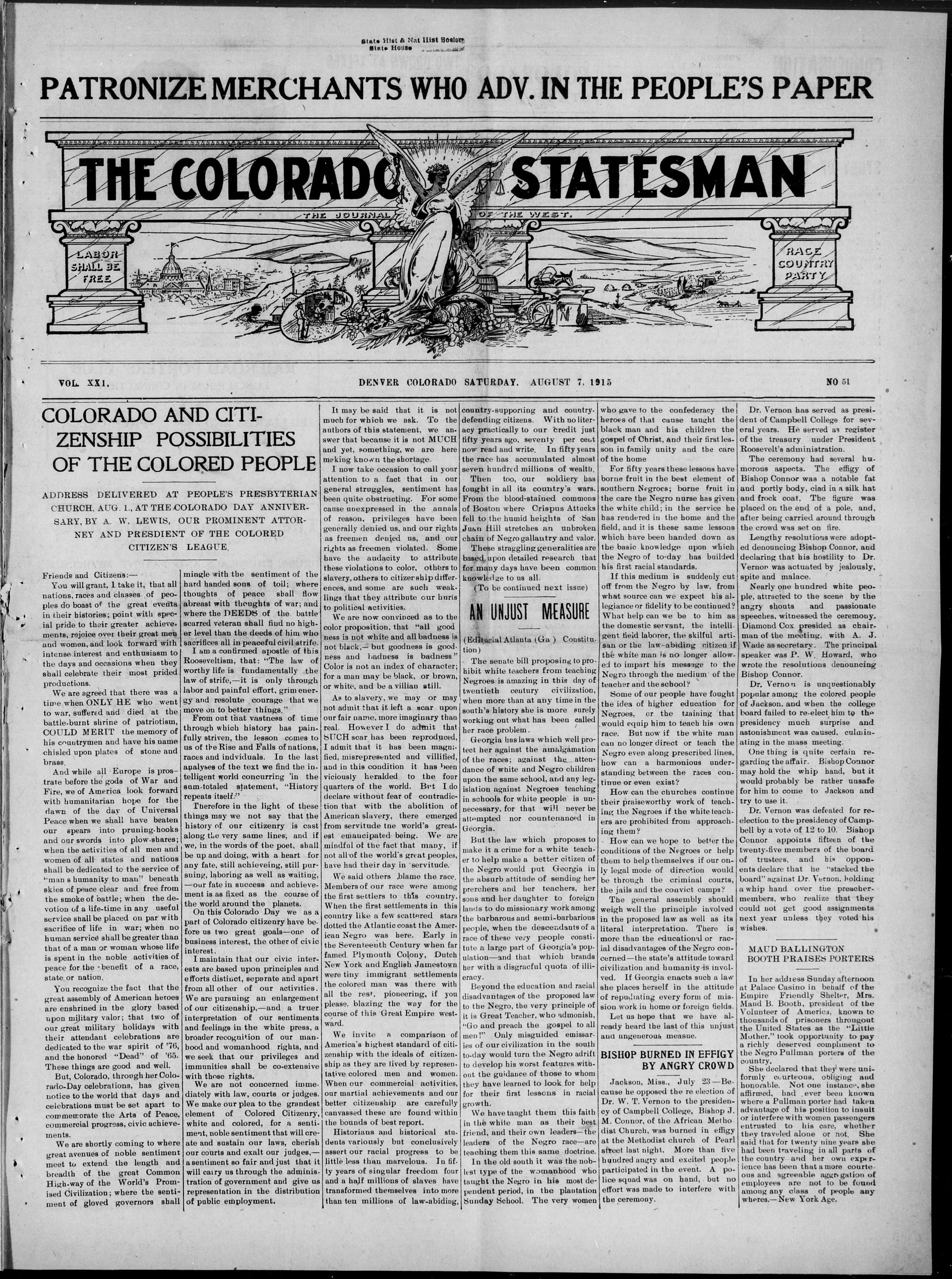

Page text (machine-generated)
PATRONIZE MERCHANTS WHO ADV. IN THE PEOPLE'S PAPER
THE COLORADO STATESMAN
THE JOURNAL OF THE WEST.
LABOR SHALL BE FREE
RACE COUNTRY PARTY
COLORADO AND CITIZENSHIP POSSIBILITIES OF THE COLORED PEOPLE
ADDRESS DELIVERED AT PEOPLE'S PRESBYTERIAN CHURCH, AUG. 1., AT THE COLORADO DAY ANNIVERSARY, BY A. W. LEWIS, OUR PROMINENT ATTORNEY AND PRESDIENT OF THE COLORED CITIZEN'S LEAGUE.
VOL. XXI.
COLORADO AND
ZENSHIP POINT
OF THE COL
ADDRESS DELIVERED AT
CHURCH, AUG. 1., AT THE C
SARY, BY A. W. LEWIS, C
NEY AND PRESDIENT
CITIZEN'S
Friends and Citizens:—
You will grant, I take it, that all nations, races and classes of peoples do boast of the great events in their histories; point with special pride to their greater achievements, rejoice over their great men and women, and look forward with intense interest and enthusiasm to the days and occasions when they shall celebrate their most prided productions.
We are agreed that there was a time when ONLY HE who went to war, suffered and died at the battle-burnt shrine of patriotism, COULD MERIT the memory of his countrymen and have his name chisled upon plates of stone and brass.
And while all Europe is prostrate before the gods of War and Fire, we of America look forward with humanitarian hope for the dawn of the day of Universal Peace when we shall have beaten our spears into pruning-hooks and our swords into plow-shares; when the activities of all men and women of all states and nations shall be dedicated to the service of "man's humanity to man" beneath skies of peace clear and free from the smoke of battle; when the devotion of a life-time in any useful service shall be placed on par with sacrifice of life in war; when no human service shall be greater than that of a man or woman whose life is spent in the noble activities of peace for the benefit of a race, state or nation.
You recognize the fact that the great assembly of American heroes are enshrined in the glory based upon military valor; that two of our great military holidays with their attendant celebrations are dedicated to the war spirit of '76, and the honored "Dead" of '65. These things are good and well.
But, Colorado, through her Colorado-Day celebrations, has given notice to the world that days and celebrations must be set apart to commemorate the Arts of Peace, commercial progress, civic achievements.
We are shortly coming to where great avenues of noble sentiment meet to extend the length and breadth of the great Common High-way of the World's Promised Civilization; where the sentiment of gloved governors shall
---
mingle with the sentiment of the hard handed sons of toil; where thoughts of peace sball flow abreast with thoughts of war; and where the DEEDS of the battle scarred veteran shall find no higher level than the deeds of him who sacrifices all in peaceful civil strife. I am a confirmed apostle of this Rooseveltism, that: "The law of worthy life is fundamentally the law of strife,—it is only through labor and painful effort, grim energy and resolute courage that we move on to better things." From out that vastness of time through which history has painfully striven, the lesson comes to us of the Rise and Falls of nations, races and individuals. In the last analyses of the text we find the intelligent world concurring "in the sum-totaled statement, "History repeats itself."
Therefore in the light of these things may we not say that the history of our citizenry is cast along the very same lines, and if we, in the words of the poet, shall be up and doing, with a heart for any fate, still achieveing, still pursuing, laboring as well as waiting, our fate in success and achievement is as fixed as the course of the world around the planets.
On this Colorado Day we as a part of Colorado citizenry have before us two great goals—one of business interest, the other of civic interest.
I maintain that our civic interests are based upon principles and efforts distinct, separate and apart from all other of our activities. We are pursuing an enlargement of our citizenship, and a truer interpretation of our sentiments and feelings in the white press, a broader recognition of our manhood and womanhood rights, and we seek that our privileges and immunities shall be co-extensive with those rights.
We are not concerned immediately with law, courts or judges. We make our plea to the greatest element of Colored Citizenry, white and colored, for a sentiment, noble sentiment that will create and sustain our laws, cherish our courts and exalt our judges, a sentiment so fair and just that it will carry us through the administration of government and give us representation in the distribution of public employment.
DENVER COLORADO SATURDAY. AUGUST 7. 1915
State Hst and Nat Hist Boosts
State Houses
ANTS WHO
ADO
E JOURNAL
DENVER COLORADO
It may be said that it is not much for which we ask. To the authors of this statement, we answer that because it is not MUCH and yet, something, we are here making known the shortage.
I now take occasion to call your attention to a fact that in our general struggles, sentiment has been quite obstructing. For some cause unexpressed in the annals of reason, privileges have been generally denied us, and our rights as freemen denied us, and our rights as freemen violated. Some have the audacity to attribute these violations to color, others to slavery, others to citizen ship differences, and some are such weaklings that they attribute our hurts to political activities.
We are now convinced as to the color proposition, that "all goodness is not white and all badness is not black,—but goodness is goodness and badness is badness." Color is not an index of character; for a man may be black, or brown, or white, and be a villian still.
As to slavery, we may or may not admit that it left a scar upon our fair name, more imaginary than real. However I do admit that SUCH scar has been reproduced, I admit that it has been magnified, misrepresented and villified, and in this condition it has been viciously heralded to the four quarters of the world. But I do declare without fear of contradiction that with the abolition of American slavery, there emerged from servitude the world's greatest emancipated being. We are mindful of the fact that many, if not all of the world's great peoples, have had their day in servitude.
We said others blame the race. Members of our race were among the first settlers to this country. When the first settlements in this country like a few scattered stars dotted the Atlantic coast the American Negro was here. Early in the Seventeenth Century when far famed Plymouth Colony, Dutch New York and English Jamestown were tiny immigrant settlements the colored man was there with all the rest, pioneering, if you please, blazing the way for the course of this Great Empire westward.
We invite a comparison of America's highest standard of citizenship with the ideals of citizenship as they are lived by representative colored men and women. When our commercial activities, our martial achievements and our better citizenship are carefully canvassed these are found within the bounds of best report.
Historians and historical students variously but conclusively assert our racial progress to be little less than marvelous. In fifty years of singular freedom four and a half millions of slaves have transformed themselves into more than ten millions of law-abiding.
country-supporting and country-defending citizens. With no literacy practically to our credit just fifty years ago, seventy per cent now read and write. In fifty years the race has accumulated almost seven hundred millions of wealth. Then too, our soldiery has fought in all its country's wars. From the blood-stained commons of Boston where Crispus Attucks fell to the humid heights of San Juan Hill stretches an unbroken chain of Negro gallantry and valor. These straggling generalities are based upon detailed research that for many days have been common knowledge to us all. (To be continued next issue)
AN UNJUST MEASURE
(Edited Atlanta (Ga) Constitution)
The senate bill proposing to prohibit white teachers from teaching Negroes is amazing in this day of twentieth century civilization, when more than at any time in the south's history she is more surely working out what has been called her race problem.
Georgia has laws which well protect her against the amalgamation of the races; against the attendance of white and Negro children upon the same school, and any legislation against Negroes teaching in schools for white people is unnecessary, for that will never be attempted nor countenanced in Georgia.
But the law which proposes to make it a crime for a white teacher to help make a better citizen of the Negro would put Georgia in the absurd attitude of sending her prerchers and her teachers, her sons and her daughter to foreign lands to do missionary work among the barbarous and semi-barbarious people, when the descendants of a race of these very people constitute a large part of Georgia's population—and that which brands her with a disgracful quota of illiracy.
Beyond the education and racial disadvantages of the proposed law to the Negro, the very principle of it is Great Teacher, who admonish, "Go and preach the gospel to all men!" Only misguided emissaries of our civilization in the south-to-day would turn the Negro adrift to develop his worst features without the guidance of those to whom they have learned to look for help for their first lessons in racial growth.
We have taught them this faith in the white man as their best friend, and their own leaders—the leaders of the Negro race—are teaching them this same doctrine. In the old south it was the noblest type of the womanhood who taught the Negro in his most dependent period, in the plantation Sunday School. The very women
who gave to the confederacy the heroes of that cause taught the black man and his children the gospel of Christ, and their first lesson in family unity and the care of the home For fifty years these lessons have borne fruit in the best element of southern Negroes; borne fruit in the care the Negro nurse has given the white child; in the service he has rendered in the home and the field, and it is these same lessons which have been handed down as the basic knowledge upon which the Negro of to-day has builted his first racial standards.
If this medium is suddenly cut off from the Negro by law, from what source can we expect his allegiance or fidelity to be continued? What help can we be to him as the domestic servant, the intelligent field laborer, the skilful artisan or the law-abiding citizen if the white man is no longer allowed to impart his message to the Negro through the medium of the teacher and the school?
Some of our people have fought the idea of higher education for Negroes, or the training that would equip him to teach his own race. But now if the white man can no longer direct or teach the Negro even along prescribed lines, how can a harmonious understanding between the races continue or exist?
How can the churches continue their praiseworthy work of teaching the Negroes if the white teachers are prohibited from approaching them?
How can we hope to better the conditions of the Negroes or help them to help themselves if our only legal mode of direction would be through the criminal courts, the jails and the convict camps? The general assembly should weigh well the principle involved in the proposed law as well as its literal interpretation. There is more than the educational or racial disadvantages of the Negro concerned—the state's attitude toward civilization and humanity is involved. If Georgia enacts such a law she places herself in the attitude of repudiating every form of mission work in home or foreign fields. Let us hope that we have already heard the last of this unjust and ungenerous measure.
BISHOP BURNED IN EFFIGY BY ANGRY CROWD
Jackson, Miss., July 23—Because he opposed the reelection of Dr. W. T. Vernon to the presidency of Campbell College, Bishop J. M. Connor, of the African Methodist Church, was burned in effigy at the Methodist church of Pearl street last night. More than five hundred angry and excited people participated in the event. A police squad was on hand, but no effort was made to interfere with the ceremony.
NO 51
Dr. Vernon has served as president of Campbell College for several years. He served as register of the treasury under President Roosevelt's administration.
The ceremony had several humorous aspects. The effigy of Bishop Connor was a notable fat and portly body, clad in a silk hat and frock coat. The figure was placed on the end of a pole, and, after being carried around through the crowd was set on fire.
Lengthy resolutions were adopted denouncing Bishop Connor, and declaring that his hostility to Dr. Vernon was actuated by jealously, spite and malace.
Nearly one hundred white people, attracted to the scene by the angry shouts and passionate speeches, witnessed the ceremony. Diamond Cox presided as chairman of the meeting, with A. J. Wade as secretary. The principal speaker was P. W. Howard, who wrote the resolutions denouncing Bishop Connor.
Dr. Vernon is unquestionably popular among the colored people of Jackson, and when the college board failed to re-elect him to the presidency much surprise and astonishment was caused, culminating in the mass meeting.
One thing is quite certain regarding the affair. Bishop Connor may hold the whip hand, but it would probably be rather unsafe for him to come to Jackson and try to use it.
Dr. Vernon was defeated for re-election to the presidency of Campbell by a vote of 12 to 10. Bishop Connor appoints fifteen of the twenty-five members of the board of trustees, and his opponents declare that he "stacked the board" against Dr. Vernon, holding a whip hand over the preacher-members, who realize that they could not get good assignments next year unless they voted his wishes.
MAUD BALLINGTON
BOOTH PRAISES PORTERS
In her address Sunday afternoon at Palace Casino in behalf of the Empire Friendly Shelter, Mrs. Mand B. Booth, president of the Volunteer of America, known to thousands of prisoners throughout the United States as the "Little Mother." took opportunity to pay a richly deserved compliment to the Negro Pullman porters of the country.
She declared that they were uniformly courteous, obliging and honorable. Not one instance, she affirmed, had ever been known where a Pullman porter had taken advantage of his position to insult or interfere with women passengers entrusted to his care, whether they traveled alone or not. She said that for twenty nine years she had been traveling in all parts of the country and her own experience has been that a more courteous and agreeable aggregation of employees are not to be found among any class of people any wheres.—New York Age.
CONDENSATION OF FRESH NEWS
THE LATEST IMPORTANT DIS PATCHES PUT INTO SHORT, CRISP PARAGRAPH8.
STORY OF THE WEEK
SHOWING THE PROGRESS OF EVENTS IN OUR OWN AND FOREIGN LANDS.
Western Newspaper Union News Service.
ABOUT THE WAR
The British steamer Benvorlich, which left Manilla May 1st for London by way of Marseilles, has been sunk.
The British steamer Clintonia, of 3,858 tons, was shelled and sunk by a German submarine. Eleven men were killed on the vessel and fifteen were injured.
The Leland liner Iberian was sunk by a German submarine. Six members of the crew were killed, two died aboard a rescue boat and sixty-one were landed safely.
A petrograd dispatch states that two hundred Turkish sailing vessels, laden with coal or ammunition, have been destroyed by Russian torpedo boats along the Asia Minor coast. Mitau, the capital of the Russian province of Courland, twenty-five miles southeast of Riga, has been occupied by German troops, according to the official statement issued by the German army headquarters staff.
A dispatch from Constantinople to the Overseas News Agency reports the sinking through an unknown cause of a large Russian torpedo boat destroyer off the island of Kerkin, to the east of Chilea, in the Black sea.
London reports eight more Lowestoft trawlers sunk by a German submarine. The crews were saved. The fishermen sent to the bottom were the Quest, the Strive, the Achieve, the Athena, the Coriander and the Fitzgerald.
A London dispatch of the 3d says the stubborn resistance which the Russians are offering to the Austro-Germans and the slowness with which the forces of the invaders have been able to move during the last few days leads to the belief in some quarters that the German supply of ammunition is beginning to feel the effect of the protracted struggle and that Russia may yet save the Polish capital.
WESTERN
A disastrous storm swept several central and eastern Wyoming counties late Saturday night and Sunday morning. Farms inundated, crops ruined and many houses swept away in three cloubursts at Portland, Ore. Hall and wind storms in Deschutes River valley. Triplets were born to Mrs. Mae Ellis, a resident of Gainesville, Tex., for several years. She already was the mother of fifteen children, all living and healthy. Orders for all patrolmen to salute the American flag every time it passed them on the street went into effect at Los Angeles by direction of Chief of Police C. E. Snively.
From the pulpit of the Trinity Methodist Episcopal church in Berkeley, Cal., Judge Alton B. Parker, Democratic candidate in 1904 for president, made a plea for stronger coast defenses.
Henry Starr, Colorado bandit whose exploits for years have terrorized Oklahoma, pleaded guilty at Chandler, Okla., to the charge of holding up the Stroud National bank a few months ago. He took his sentence of twenty-five years in the McAlester penitentiary calmly.
George H. Jones, the Maywood garage proprietor who killed his wife her brother, John Cosgrove, and her sister, Catherine Cosgrove, and later fired a bullet into his own head, died at a hospital in Chicago. The trouble is said to have grown out of Jones infatuation for a 21-year-old girl Jones was 48.
WASHINGTON
W. J. Boardman, father of Miss Mabel Boardman, executive board head of the American Red Cross, died suddenly.
The condition of the growing cotton crop of the United States on July 25 was 75.3 per cent of normal, the Department of Agriculture announced.
Three notes from Great Britain and one from Germany, all dealing with the commercial rights of neutral nations in war time were before Secretary Lansing Monday.
Preliminary plans designed to make available the resources of the federal reserve system, in the annual fall movement of crops, have been worked out by the Federal Reserve Board.
In its controversy with the United States concerning the English order in council, the London foreign office stands "pat."
Word was received that Gen. Venus stiaro Carranza is preparing to make a strong bid for recognition by the United States within a few days. Two hundred and eight automobile rural delivery routes, distributed over eight states, went into operation Aug. 1. This means that approximately 11,440 miles of rural post roads will be traversed six days a week during August by automobile.
FOREIGN
Haiti, racked by revolution and mob
rule, now is threatened by famine.
The Earl of Kilmorey died in London from pneumonia. He was 73 years old.
The Valdez, Alaska, Bank and Trust Company has suspended business with $16,000 liabilities and assets of $50,000.
In the week of July 12 to 18 there were 366 cases of cholera and 178 deaths in Hungary, says a dispatch from Geneva.
At Toronto, Ont., the lake was whipped by the worst gale in twelve years. One steamer ashore. Heavy loss to shipping.
The body of J. O'Donovan Rossa, the Irish patriot, who died in New York last month, was buried in Glasnevin cemetery in Dublin.
According to a message from Berlin, the German army has been increased by about 1,000,000 men, mostly 17 to 18 years, during the last three weeks. Twelve Mexican bandits are reported killed in fighting with United States cavalrymen and American possemen in the low, thick, thorny brush north of Brownsville, Tex.
Baron Allemand Werther, son-in-law of the late Baron de Rio Branco, Brazil's famous foreign minister, was killed at Rio Janeiro while trying to gain possession of his children, who have been living with his divorced wife.
French marines are guarding the French legation at Port au Prince, Haiti, from which building President Guillaume was taken by a mob and slain during the recent revolution there after many prisoners had been executed.
Clerk Wilson of the American consulate, who was arrested by the Berlin police on the charge of falsely certifying to a passport by use of which an Englishman escaped from Germany, was released through the efforts of Ambassador Gerard
SPORTING NEWS
Standing of Western League Clubs.
Clubs— Won. Lost. Pct.
Davenport 59 37 615
Des Moines 60 38 612
Lincoln 49 46 516
Topeka 50 49 505
Purina 48 51 485
Sloux City 43 49 458
Wichita 40 56 417
St. Joseph 37 58 389
The Grand Lake Yacht Club has
set Aug. 16 for the first face for the
Lipton cup, which will open the annual
regatta of the club, held on the
highest yacht racing course in the
world.
The baseball team of Chicago Uni-
versity left for Tokio, Japan, for three
series of international baseball games
with Waseda, Keio and Meiji uni-
sities. The first game will be played
Sept. 24.
Packey McFarland of Chicago and Mike Gibbons of St. Paul signed the articles for their battle at Brighton Beach, New York, Sept. 11. As the purse to be divided by the boxers amounts to $32,500, it is said to break the records for one offered for a no decision match.
Mrs. Thomas C. Bundy (May Sutton) of Las Angeles defeated Miss Mary K. Browne of Los Angeles, three years national woman's doubles and singles tennis champion, in the woman's finals of the southern California tournament, 6-1, 6-2. It was Miss Browne's first defeat in three years.
The American Automobile Association, through its vice president, Ralph W. Smith, has given its sanction to an 850-mile reliability and economy tour for stock automobiles, to take place the week of Sept. 6. It is under super vision of Charles F. Roehrig, secretary and treasurer of the Denver Motor Club.
Four world's automobile records for a dirt track were shattered by Barney Oldfield in an exhibition at Cleveland, Ohio. The new records are: One mile, 46¼ seconds; three miles, 2:25 2:5; four miles, 3:13 3:5, and five miles, 4:03 1:5. The former mile mark, held by Oldfield, was 46 2:5 seconds. Disbrow held the other records in 2:27 8-100, 3:17 2-100 and 4:06 58-100 respectively.
GENERAL
At Erie, Pa., twenty-five lives were lost and millions of dollars in property done by a cloudburst.
Five persons died in New York in twenty-four hours from the heat and five died from drowning while trying to escape the heat.
One man was killed and three others were seriously injured in an explosion in the experimental bombproof department of the United States arsenal in Frankford, at Philadelphia.
Fruit growers of Palestine stand to lose $30,000,000 because of the European war, according to a letter received at Philadelphia from George Kiat, general commissioner of commerce, with headquarters at Jaffa.
The allies are preparing to continue the war for at least three years more, if necessary, according to William Ellis Cory, formerly president of the United States Steel corporation, who arrived in New York on the French liner Espagne from Bordeaux.
St. Mary's county, southern Mary land, in which there is a large negro population, voted to prohibit the sale of intoxicating liquors.
At New York the funeral of Charles Becker, executed in Sing Sing prison for instigating the murder of Herman Rosenthal, was held at the Church of St. Nicholas of Tolentine, the Bronx.
Three men were killed and eight injured, one of who may die, when the power plant of the Knickerbocker Cement Company at Greenport, half a mile east of Hudson, N. Y., was submerged in quicksand
COLORADO STATE NEWS
Aug. 12-14. - Frontier Days and Wild West Features at Grand Junction.
Aug. 13. - Pickle Day at Platteville.
Aug. 18-20. - Old Settlers' meeting at Hope.
Aug. 19-Sept. 2. - Grand Lodge, K. of P. at Colorado Springs.
Aug. 26-28.—Fall Festival at Flagler:
Sept. 27-Oct. 8.—Meeting International
Farming Congress at Denver
Oct. 2.—Fair and Race Meeting at
Denver.
Colorado, Fair Dale
Aug. 18-20—Island Grove Driving Club,
Greeley.
Aug. 24-27—Bent County Fair Association,
Las Animas.
Aug. 25-27—Fort Collins Racing Association,
Fort Collins.
Aug. 28- Farmers' Fair at Fowler.
Aug. 31-Sept. 3- Arkansas Valley Fair
Rocky Ford
Aug. 31-Sept. 4- Arthur County Fair
Association, Loveland.
Sept. 7-10- Crowley County Fair As-
sociation, Sugar City.
Sept. 7-10- Valley Fair As-
sociation, Sugar City.
Sept. 11. Train Valley Fair As-
sociation.
Longmont.
Sept. 7-10—Logan County Fair at
Sterling.
Sept. 13-18.—Colorado State Fair Association.
Pueblo.
Sept. 15-18.—Lincoln County *Fair at
Hugo.
Sept. 21-23.—Conejos County *Fair at
Manassa.
Sept. 21-24.—Western Slope, Fair at Montrose.
Sept. 22-24—Baca County' Fair at Springfield.
Sept. 21-24- Trinidad-Las Animas Co.
Sept. 21-24- Montezuma County Fair
at Cortez
Saguache County Fair at
Saguache.
Sept. 29-Oct. 2.—El Paso County Fair at Calhan.
Oct. 2-9. Colorado Agricultural Fair and Racing Association, Denver.
The interdenominational missionary campaign will be held in Denver this fall by the laymen of the Congregational churches.
David Beattie, a justice of the peace at Sterling, decided that the law of 1913 compelling automobile owners to ay a state license is unconstitutional.
Violet Moore, the 8-year-old daughter of a rancher residing west of Grand Junction, died of injuries suffered by falling under a wheat binder.
Fifteen decrees were granted at a morning divorce matinee in Denver presided over by Judge Ingram of Boulder, sitting for Judge Rothgerber.
Twenty-nine enlistments for service in the United States navy during July makes the report for the Denver station unusually large for midsummer.
The Federal Trade Commission will hold a meeting in Denver the last of August. The beet sugar, livestock and fruit industries will receive attention. The Denver City Commissioners formally instructed City Attorney Marsh to take no further action in the suit to oust the old municipal Civil Service Board. The state convention of the Anti-Saloon League, which is to be held in Denver this fall, will assemble for registration and other preliminaries Sept. 30. The body of Arthur P. McLaughlin, a tailor who had been missing from Denver for a week, was found fourteen miles east of Kiowa face downward in a sand gulch.
Twelve citizens of Fowler, headed by Marshal Dunn and Charles Delebar, a son, went to Pueblo to search for James Delebar, 81, pioneer of Cañon City and Pueblo, who disappeared a week ago.
Walter Driscoll, 60, a section hand on the Denver & Salt Lake railroad, was instantly killed when a motor car carrying eight men jumped the track on a small bridge near Scenic station, above Plainview.
The body of Mrs. Minerva Caroline Galloway, widow of James P. Galloway, state senator in the early '80s from San Miguel, Ouray, Hinsdale and Gunnison counties, was buried in Riverside cemetery at Pueblo by the side of her husband.
With the wedding day set and her trousseau undergoing the finishing touches, Miss Edith Charnelle Twitchell, 23 years old, died from suffocation following the administration of an anesthetic in extracting a tooth in a Denver dentist's office.
Peter Yerkovich of Pueblo accuses Steve Mircha of stealing his pretty young Austrian wife. So Peter Yerkovich has had Steve Mircha arrested on a charge of petit larceny. Besides the wife, household furniture and clothing are things that Peter says Steve stole.
Charles S. Semper, Colorado's oldest, pioneer printer, who set type on the first issue of the Rocky Mountain News in 1859, celebrated his eighty-fifth birthday with a picnic supper to his pioneer and printer friends, at his farmhouse, in Semper, a town on the Boulder Interurban line.
Richard von Millard, reputed German count and attache of the Crown Prince Frederick Wilselm, who concluded a two weeks' stay in Denver, taking with him the affectionate farewells of fashionable women, but leaving behind unpaid bills at a Denver hotel for expensive wine suppers, was arrested in Salt Lake City. Seventy dollars was the sum paid by John Newton of Plainview, Tex., and son of the district judge of that place, for running into and killing a horse beleaguing to a Jefferson county rancher in Denver.
TWO DROWN AT KELKER
ANOTHER MAN IS MISSING AFTER CLOUDBURST.
Thirty-five Persons Injured When Santa Fé Train Is Derailed by Washout in Severe Storm.
Western Newspaper Union News Service.
Colorado Springs.—Trapped by a terrific wall of water that hurled itself down Sand creek, Harry Robinson, business manager of the Colorado Midland, and Albert W. Colburn, chauffeur, were caught in an automobile ten miles east of Colorado Springs Friday night, swept away and drowned. V. H. Lucas, a wealthy ranchman, is missing and is thought to have perished with them. The storm, which resulted in the tying up of three railroads and the automobile roads, and wrecked Santa Fé train No. 6, swept the men down the stream from eight to ten miles. The drowning was not discovered until Saturday morning, when Colburn's body was found in the sand, eight miles from the spot where the auto attempted to cross the creek.
Colburn was the brother of Walter Colburn, manager of the Colorado Springs zoo. Searching parties were immediately organized and it remained for George Maxwell to discover the body of Robinson, who was his half-brother. Lucas' body has not been discovered.
Colburn and Robinson were partially undressed, indicating an attempt on their part to take their clothes off in order to be able to better swim the stream. Robinson's body was found one and a half miles above Colburn's lodge on a sandbar. Coroner Beyle took charge of the bodies.
Robinson was 43 years old and prominent in musical circles here. He was a bookkeeper in the First National bank and is survived by his mother, Mrs. M. R. Maxwell; his half-brother, Harry Maxwell, also a local musician, and Miss Ruth Maxwell, a half-sister.
Colburn was 22 years old and lived with his parents at 9 South Weber street.
Lucas came here several years ago from Cleveland for his wife's health and purchased the Bar X ranch near Falcon. Mrs. Lucas is seriously ill in Beth-El hospital. Lucas was coming into the city to see her when he was swept away.
Santa Fé train No. 6, southbound, was derailed near the scene of the drowning as the result of a culvert giving way. Late reports indicate that thirty-five passengers were injured, none fatally.
The engine passed over the culvert in safety, but the baggage and chair car turned over and six Pullman cars left the track. Most of the injured were in the chair car.
The storm that caused the damage began in the outskirts of Colorado Springs as a shower, increasing in intensity southward, accompanied by sharp electric disturbances and the fall of hail. Sand creek, where the wreck occurred, ordinarily is a dry arroyo. Down this waterway the deluge ran, undermining the bridge supports and finally emptying into the Fountain river. The wall of water was carried off by the Fountain river without any appreciable damage below.
Home Demolished in Whirlwind
Fountain.—During a heavy hail, rain and wind storm Friday night a whirlwind struck the home of John Stiles on Jim Williams creek six miles east of Fountain and entirely demolished it and carried it off. It twisted a new wagon into splinters. Mr. Stiles was hurt. Mrs. Stiles and child were pelted to helplessness by the hall. Crops were destroyed.
Arrest Three in Bandit Chase.
Pueblo.-What the police characterize as a series of hold-ups and robberies in Bessemer is believed to have been brought to an end by the arrest of Oscar Nash, 20 years old, 35 Block X, and Leo McMahon, 20, 1432 Cedar street.
Despondent Wife Ends Life
Cripple Creek.—Mrs. W. E. Hope, 30 years old, wife of a clerk of Woodland Park, ended her life by drowning in Woodland Lake. Ill-health is believed to have been the motive.
Knights of Golden Eagle to Meet.
Fort Collins.—The grand lodge of the Knights of the Golden Eagle will convene in this city Aug. 12-13, and preparations are being made for their entertainment.
Aged Man Found on Railroad Track.
Trinidad.—Joe Wallace, 77 years old, was found lying unconscious on the tracks of the Colorado & Southern near Ludlow.
Car Rolls Down Hill; Woman Hurt.
Loveland.—Mrs. A. H. Losey of Eaton was critically hurt and four other passengers of a touring car miraculously escaped injury on the Estes Park road when the machine slipped in the road following a light shower and plunged down a hill, overturning three times.
Lafayette Miner Polisons Himself.
Lafayette.—Frank Kulovany', 45, a Bohemian miner, committed suicide by swallowing poison. He was unmarried and had no relatives here.
The
Curtis
Park
Floral
Company
FLORAL DESIGNS PUT UP WHILE
YOU WAIT
CHOICE PLANTS AND CUT FLOWERS CONSTANTLY
ON HAND
GREENHOUSES: Thirty-Fourth and Curtis Streets
TELEPHONE, MAIN 1511
DENVER, COLO
W. C. CAMPTON, Pres. J. M. JOHNS, Treas. U. P. JACKSON, Sec. RAILROAD PORTERS' CLUB LUNCH ROOM IN CONNECTION
BILLIARDS AND POOL
1728½ Wazee St. Only
PHONE MAIN 8416.
The Champ
Twentieth a
Is the place
DRUGS, CHEMICALS AND
WE SERVE
Prescriptions
Phone us and we will deliver the
JAMES E. TH
PHONE M
THE ZOBEL
SAMPLE
1004 Nineteenth Str
28½ Wazee St. Only one block from Union D
NE MAIN 8416. DENVER, COLO
Champa Pharma
Twentieth and Champa,
Is the place to get your
CHEMICALS AND PATENT M
WE SERVE DRINKS.
Descriptions Our Special
and we will deliver the goods to all parts of
JAMES E. THRALL, PR
PHONE MAIN 2425.
E ZOBEL BROTHER
AMPLE ROO
Nineteenth Street, Corner of
1728 $ \frac{1}{2} $ Wazee St. Only one block from Union Depot.
The Champa Pharmacy
Twentieth and Champa,
Is the place to get your
DRUGS, CHEMICALS AND PATENT MEDICINES
WE SERVE DRINKS.
Prescriptions Our Specialty.
Phone us and we will deliver the goods to all parts of the city.
JAMES E. THRALL, PROPR.
PHONE MAIN 2426.
1004 Nineteenth Street, Corner of Curtis
FINE WINES, LIQUORS AND CIGARS COORS' CELEBRATED BEER ON TAP
---
The
WARD AUCTION
COMPANY
Sales Daily at 2 p.m. Office Furniture a Specialty.
PRIVATE SALES AT ALL TIMES
HAVE MOVED TO—
1723-39 GLENARM ST.
PHONE MAIN 1675.
THE BEST ICE CREAM AND
CANDIES AT
O.P. BAUR & CO.
CATERERS AND
CONFECTIONERS
Phone: 163.
1512 Curtis Street, Denver, Colo.
DO IT NOW Subscribe
for THIS
PAPER
---
---
DENVER
FREE CHECK ROOM
one block from Union Depot.
DENVER, COLORADO.
A Pharmacy
and Champa,
to get your
D PATENT MEDICINES
DRINKS.
Our Specialty.
the goods to all parts of the city.
IRALL, PROPR.
AIN 2426.
BROTHERS'
E ROOM
eet, Corner of Curtis
TELEPHONE YORK 6668.
GENERAL FURNITURE REPAIRING AND UPHOLSTERING.
WORK GUARANTEED.
1417 East 24th Avenue, Denver, Colo.
Miss M. Cowden
Hair Dressing Parlor
Shampoo, cutting and curling.
Scalp treatment, hair tonics,
hair straightening, manicuring.
Stage wigs for rent; theatrical
use and masquerades.
Goods delivered out of the city. All shades of hair matched by sending sample of hair; also combings made up.
Cheapest Switches 50 Cents
1219 21st St. Denver, Colo.
A
COLORADO
AFRO-AMERICAN CULLINGS
```markdown
```
Mound Bayou, Bolivar county, Miss., is an exclusively Negro town, carved from the virgin forests of hardwood and cane. Isaiah T. Montgomery founded the town 27 years ago. A party of his relatives and friends braved the panther, bear, wolf and other wild animals which infested Bolivar county at that time and labored with him in dragging a surveyor's chain through tanglewood for the town site.
In casting their lot at this point the colonists selected what proved the center of the largest cotton producing county in the world. The soil is black loam in the higher parts and sticky, dense black land in the lower parts. The loam pulverizes easily and is almost ideal for cotton raising. It also produces pasture crops. The black land is the famous buckshot, which becomes flinty in summer, cracks and forms itself into clods resembling shot.
The population of the town has grown from a small group to 1,000 in the corporate limits and to 7,000 in the settlement. The business has grown with it. There are 23 stores and shops, including two drug stores and a photograph gallery. The business of these stores is considerable and is growing. Each year the merchants are compelled to sell on closer margin, but much of the trade which sought nearby towns on account of greater variety of goods or lower prices made possible by larger stocks or better credit arrangements is pleased to stay at home. The American Express maintains an office there, with a Negro agent, and its business is upward of $500 a month.
The railroad station, which is operated by a Negro, is about the ninth or tenth in importance between Vicksburg and Memphis. The commission to the ticket agent amounts to $1,200 a year. There are two licensed physicians, two lawyers and a real estate agent. There are six churches and the value of their property is around $17,000. The weak point is the school. The enrollment is more than 300, while the equipment is inadequate for 50 pupils. The teachers are poorly paid and the term is not more than five months.
The Baptist college, which is maintained by a board of Negro women known as the "Woman's Auxiliary," holds forth in a two-story frame building and has some little provisions for boarding pupils; but its funds are very slim. The American Missionary association maintains a normal and industrial institute. The value of its property is about $4,000 and it costs about $2,000 a year. Efforts have been made, but with little success, to erect a small modern dormitory for boys. The fraternal insurance societies are well represented and the treasury department of the Masonic order, which handles about $100,000 a year, is there under the guidance of Charles Banks.
The timber industry has been plied since the beginning of the town and still yields a neat revenue in logs, furniture, staves and spokes. Other woods are cut into framing material by the town sawmills.
The three gins of the town wrap and tie most of the cotton raised in the community. The crop will yield this season more than 4,000 bales.
The Cumberland Telephone company three years ago installed its system there with a Negro as local manager and with a woman assistant. It has 71 phones in operation.
When the late Joshua Ellington's heirs came to settle up his estate, they found he had obligated himself to pay $700 for a privilege which would not have been available to Mr. Ellington until he was one hundred and seventeen years old.
Moved by speeches of men prominent in church and business life of the South, 300 southern men and women, delegates to the World's Christian Endeavor convention, in session in Chicago, acknowledged brotherhood with the negro race and determined to extend to it the hand of fellowship.
Out of this idea is to grow the southern extension committee of the Christian Endeavor, which Rev. Ira Landrith of Nashville, Tenn., calls the beginning of the Interdenominational Union of the Colored People.
Doctor Lanard said:
"We are going to take the Christian Endeavor into the Negro churches, organize new societies and help millions of blacks to enlightenment. God has placed at our door the greatest opportunity for Christian work that ever came to any missionaries anywhere."
"The play is so old," said Buck Kilby yesterday in discussing one of the current attractions, "that the magazines have reviewed it."
In the province of Ontario there are, including kindergartens, night schools, high schools, collegiate institutes and continuation classes, 6,942 public schools—all free—the yearly attendance of pupils being 500,000.
Having secured the attention of the crowd, a man goes ahead and performs his trick.
The exposition to commemorate fifty years' achievements of the free Negro, held at Richmond, Va., was because of the place selected for holding the exposition, of particular interest to the Negroes of the South. But it is something more than an event of local importance, for as a national celebration it is of interest to all Negroes and to all interested in the progress of the Negro race. President Wilson has issued a proclamation in which he says: "As president of the United States I bespeak the active interest of the nation in the exposition and trust that every facility will be extended to the leaders, whose earnest work has made the undertaking possible." Congress has appropriated $55,000 "to aid in the promotion and consummation" of the exposition, thus giving to the event a significance which, under private auspices, it might have had difficulty in commanding.
Few are the Negroes who can draw, from personal experience, a comprehensive picture of the progress of the race since it was released from bondage. Since slavery days two generations have been born in freedom, and have accepted freedom as a normal state and nothing to wonder at. To them the statement that in 1860 not more than one Negro in a hundred possessed himself means nothing, for no Negro who did not actually live under slavery can realize that such an institution actually existed in a country founded on the principle that freedom is a right and not a privilege. To these new generations this exposition should mean a great deal. It should fix in their minds a vision of the progress of the race which no amount of imagining could give them, and it should inspire them with a desire to hand down to their children the traditions of slavery in order that they and succeeding generations may appreciate the blessings of liberty.
A "whirlwind" membership campaign was outlined for the provisional organization, colored branch of the Young Women's Christian association at Indianapolis recently, when 81 members of the branch were present, each of these being made a captain of a team. It was decided to place 100 teams in the field with 500 new members as the objective. Previous to the meeting the city was districted and each of the teams will be expected to work in a definite section in order that the entire city may be thoroughly canvassed.
The need of an association for colored women has never been more apparent than today when the rooming house problem is more serious than at any previous time in the history of the city. The high cost of living has increased the cost of board till it is impossible for the working girl outside of a profession to board and room, thus making cheap rooms desirable. These are usually found in the less desirable sections of the city, and the result is that the moral standard of the girls and women is being lowered.
Those who feel the need of a Y. W. C. A. home for the colored women and girls of Indianapolis, whether members of the branch or not, are urged to join in this campaign and do something for it if nothing more than to take out a membership or secure one member. It is up to the Christian people of the colored churches and the clubs organized for uplift work to give their assistance in this effort.—Indianapolis News.
The so-called death watch, with its due to nothing more serious than the mysterious ticking at night time, is furniture beetle. The larva of this insect burrows into the furniture, making the pin-holes which are often seen in old furniture.
Jerry Neal, colored, of Cave Spring, Ga., celebrated his one hundred and twenty-fourth birthday anniversary a few days ago. He is, so far as is known, the oldest person in Georgia, if not in the United States. He has papers which establish his age beyond question, and the oldest inhabitants of Floyd county remember that Jerry was a grown-up man when they were in their kilties. Jerry, the father of forty-four sons and daughters, distinctly remembers the war of 1812, and many of the Indian wars. He is now a widower, but has been married three times. He is well and hearty, but uses a cane when walking.
Recent investigations seem to prove that Bahla, Brazil, is the oldest city on the American continent, having been founded in 1549, or 35 years before St. Augustine, Fla.
Italian farmhouses need improving, according to the opinion of the government, which has offered $7,585 in premiums to be awarded for encouraging the construction of model farm buildings.
If a man can get his own consent to make an absurd or preposterous statement the probabilities are that the newspapers will print it.
Tell a woman the truth and she will not only grow indignant, but probably will claim that you have insulted her.
REJECT ALL U.S. CLAIMS
BRITISH NOTE CITES AMERICAN ACTION IN CIVIL WAR.
England's Replies to Last American Note Denies That Orders in Council Are Illegal.
Western Newspaper Union News Service.
Washington. — Great Britain's replies to the latest American representations against interference with neutral commerce reject entirely the contention that the orders in council are illegal and justify the British course as being wholly within international law. "Unsustainable either in point of law or upon principles of international policy," is the British reply to the American protest against the blockade of neutral ports, with an invitation to submit to international arbitration any cases in which the United States is dissatisfied with the action of British prize courts.
Great Britain's reply, embodied in two notes, one supplemental, was made public here Tuesday night and in London simultaneously by agreement between the two governments. With the notes was made public also the correspondence over the American steamer Neches, seized by the British while en route from Rotterdam to the United States with goods of German origin. All the correspondence aggregates 7,000 words.
Changed conditions of warfare, the British note contends, require a new application of the principles of international law. The advent of the submarine, the airship and the alleged atrocities by German troops in Belgium are cited as justification for the excise of extreme measures.
The blockade is justified on the contention that the universally recognized fundamental principle of a blockade is that a belligerent is entitled to cut off "by effective means the sea-borne commerce of his enemy." The note reiterates that Great Britain will continue to apply the orders complained of, although not without every effort to avoid embarrassment to neutrals and observes that the American statistics show that any loss in trade with Germany and Austria has been more than overbalanced by the increase of other industrial activities due to the war.
In the general reply to the American representations against the orders in council, Sir Edward Grey, the foreign minister, addressing Ambassador Page, begins by expressing the hope that he may be able to convince the administration in Washington "that the measures we have announced are not only reasonable and necessary in themselves, but constitute no more than an adaptation of the old principles of blockade to the peculiar circumstances with which we are confronted." "I need scarcely dwell," wrote Sir Edward, "on the obligations incumbent upon the allies to take every step in their power to overcome their common enemy in view of the shocking violation of the recognized rules and principles of civilized warfare of which he has been guilty during the present struggle."
Sir Edward then refers to atrocities in Belgium, poisoning of wells in German Southwest Africa, use of poisonous gases against the allied troops in Flanders, and finally the sinking of the Lusitania, to show "how indispensable it is that we should leave unused no justifiable method of defending ourselves."
Sir Edward Grey then refers to the American Civil War blockade of 3,000 miles of coast with a small number of vessels, and recalls how the United States finally took recourse to blockading "neighboring neutral territory which afforded convenient centers from which contraband could be introduced into confederate territory and from which blockade running could be facilitated."
The note then refers to the case of the British ship Springbok, seized by United States cruisers during the Civil War while bound for the British West Indies, because her cargo, it was charged, was to be transshipped to the confederate states. The Supreme Court of the United States sustained the seizure against the condemnation of a group of prominent international lawyers.
LINDSEY GUILTY OF CONTEMPT.
Judge Perry Insists Conduct of Juvenile Court Jurist "Most Reprehensible."
Denver.—Terming the conduct of the respondent as "most reprehensible," Judge John A. Perry, in the West Side Criminal Court, handed down a decision declaring Judge Ben B. Lindsey of the Juvenile Court guilty of contempt of court on the face of the pleadings. Sentence was deferred five days. Judge Lindsey is in the East on a lecture tour. His attorney gave notice of appeal.
The contempt case sprang from Judge Lindsey's action in the recent trial of Mrs. Berta Wright, accused slayer of her husband, John A. Wright, before Judge Perry. Lindsey was called to the stand June 8 by District Attorney Rush to testify concerning certain statements made to him by Neal Wright, Mrs. Wright's 12-year-old son, who shortly before the trial had signed an affidavit that it was he and not his mother who fired the fatal shot.
Paris-In the week of July 12-18 there were 366 cases of cholera, and 178 death, in Hungary, says a dispatch from Geneva.
NOTE IN FRYE CASE
KAISER INSISTS ON RIGHT TO SINK SHIPS BUT OFFERS TO ARBITRATE.
While Germany Is Unyielding, Will Pay, With the Stipulation That Amount Is Not To Be Viewed as "Satisfaction" by U.S.
Washington—Germany—is unyielding in her refusal to concede that the sinking of the American sailing ship William P. Frye by the auxiliary cruiser Prinz Eltel Friedrich in the South Atlantic last January was a violation of American rights under the Prussian-American treaty of international law.
In reply to the last representations of the United States the German foreign office in a note made public here Wednesday night by the State Department reiterates a previous justification of Germany's course; declares again her willingness to pay for the ship, and accepts a proposal first advanced by the United States—that the amount of damage be fixed by two experts, one to be selected by each country.
Such a sum the German government pledges itself to pay promptly, with the stipulation, however, that the payment shall not be viewed as a satisfaction for violation of American rights. Should that method be unsatisfactory Germany invites the United States to arbitration at The Hague. The unofficial view here is that separation by a commission of experts probably will be satisfactory to the United States, with the express provision, however, that it is not a waiver of treaty rights for which the American government contends, but applies only to the matter of damages.
It is practically certain that if the United States allows the dispute to go to The Hague for interpretation of the treaty provision or continues the academic discussion of principles through the channel of diplomacy, it will insist that meanwhile Germany refrain from violation of what the United States contends are its rights.
The entire dispute revolves about article 13 of the Prussian-American treaty of 1799, which was revived and included in the treaty of 1828.
That article, the United States contends, specifically protected the William P. Frye from being sunk, although it did not protect a contraband cargo.
Germany takes precisely an opposite view, contending that the article only obligates her to pay damages.
Furthermore, Germany replies that as the Frye's cargo of wheat destined to England was contraband, the ship was liable to confiscation, and that as an attempt to take the prize into a German port would have impérilled her captor, the destruction of the Frye "was according to general principles of international law."
"On the one hand," says the note, "the belligerent party is to have the right to prevent the transportation of war supplies to his adversaries, even when carried on vessels of the neutral party.
"The right of sinking," says the German note, "is not mentioned in the treaty and is therefore neither expressly permitted nor expressly prohibited, so that on this point the party stipulations must be supplemented by the general rules of international law."
"It is not disputed by the American government that, according to the general principles of international law, a belligerent is authorized in sinking neutral vessels under almost any conditions for carrying contraband."
The note argues at length for the German interpretation of the disputed treaty provision, contending that its intent is to establish a reasonable compromise between the military interests of the belligerent contracting party and the commercial interests of the neutral party.
Admits Liability for Damages.
On the other hand, the commerce and navigation of the neutral party is to be interfered with as little as possible by the measures necessary for such prevention, and reasonable compensation is to be paid for any inconvenience or damage which may, nevertheless, ensue from the proceeding of the belligerent party."
That, in short, is Germany's argument, based on her interpretation of the treaty, and to that, the view of the United States is squarely opposed. Payment for the Frye in the manner suggested would not affect the question of rights under the treaty. A German prize court on July 10 held the imperial government for damages, but fixed no amount, since the United States declined to become a party to the proceeding, demanding settlement by diplomacy under the treaty.
The case of the American steamer Leelanaw recently sunk by a German submarine is parallel to the Frye case. It now is in the preliminary stages of diplomatic negotiation.
2,963-Mile Bike Ride to Enlist.
New York.—On their way to Liverpool to enlist in the British army, Robert Frank and George Morley had arrived here after a 2,963-mile ride by motorcycle from Saskatoon, Canada. They followed the old Yellowstone trail.
ERNEST HOWARD,
Carpenter, Job and Repair Work.
Paints, Oils and Glass. Coal, Wood
Goal, Wood and Express
reet. Phone C
d the Rest Our Prices
the Best Satisfaction
Coal, Wood and Express.
You Have Tried the Rest
Now Try the Best
THE
Giant
FOR QUALITY.
CLEANING, PRESSIN
ING, RELINING A
WORK CALLED FOR
2549 Washington Avenue
ING, PRESSING, DYEING, RELINING AND REMODELING WORK CALLED FOR AND DELIVERED on Avenue Denver
CLEANING, PRESSING, DYEING, REPAIRING, RELINING AND REMODELING.
WORK CALLED FOR AND DELIVERED
2549 Washington Avenue Denver, Colorado
JOHN K. Meats, Fancy and 1864 CURTI
JOHN K. RETTIG
Fancy and Staple Grocery
1864 CURTIS STREET
eighteenth.
C. E. Smith
D. 190
Res. Phone
Market Comp
and Retail Staple and Fancy Groceries
ers. Hotels and Restaurants Our Speci
Cured
Eastern Corn Fed Meats
The Market
Wholesale and Retail Staple
Oysters. Hotels and Re
The Market Company
Wholesale and Retail Staple and Fancy Groceries, Fish and Oysters. Hotels and Restaurants Our Specialty.
Eastern Corn Fed Meats
Fruits, Vegetables, Poultry and Game.
1633-39 Arapahoe Street Denver
C. H. SHIRLEY, Pres. J. C. HAMPSON
PAUL J. SHIRLEY, Sec. and Treas.
THE ATLAS DRUG C
Courteous Treatmet. Right P
Leaders in Prescription
Espahoe Street Denver
BIRLEY, Pres. J. C. HAMPSON
PAUL J. SHIRLEY, Sec. and Treas.
THE ATLAS DRUG CO.
Fineous Treatmet. Right For
Leaders in Prescription
No. 1. Store 1
BUTTON ST. 26TH AND
5 875 Main 49
C. H. SHIRLEY, Pres. J. C. HAMPSON, Vice Pres PAUL J. SHIRLEY, Sec. and Treas.
Courteous Treatmet. Right Prices
Leaders in Prescription
Store No. 1.
2701 WELTON ST.
Main 895 875
Store No. 2.
26TH AND WELTON
Main 4955 4956
Dr. Westbrook
Office 31 Good Block
16th & Larimer sts.
Phone Main 1433
Out of Office and at
nights Call Residence,
2714 Arapahoe Street
Phone Champa 570
TAURANT
Short Orders
1848 Arapahoe
$50.00 PER MONTH, MADE DURING YOUR SPARE TIME, Selling the High Brown Negro Doll, fast seller. Send $1.00 for sample outfit, instructions and solicitors certificate. This is the chance of a life time for any enterprising person. Be the first one in your community to get this position. Every family wants a Negro Doll, the beauty of modern invention.
Send 8 cents for reply to inquiry and catalog.
NATIONAL NEGRO DOLL COMPANY,
519 Second Ave., N.
Nashville, Tenn.
Office 3131/2 Kittridge Bldg.
Phone Main 7416
Residence 822 32nd St.
Phone Main 8397
T. Ernest McClain, A. B. D. D. S.
Sundays and Nights by Appointment.
Office Hours:—8 a. m. to 12 m
2 p. m. to 6 p. m.
"STETSON HATS OUR SPECIALTY"
Phone Main 3661.
"BROWN, THE HATTER"
HATS CLEANED AND BLOCKED
50 CENTS
SATISFACTION GUARANTEED
A Trial Will Convince You.
718½ 18TH STREET.
---
---
1021 21st Street.
PHONE MAIN 3028
Corner Nineteenth.
Phones Main
169, 181, 189, 190
Fresh and Cured
s. Glazing Done and Express.
Our Prices Reasonable
Satisfaction Guaranteed
CLEANERS
AND
TAILORS
McCAIN & RICHARDS, PROPS
Phone Main 7376
ING, DYEING, REPAIR-
AND REMODELING.
OR AND DELIVERED
Denver, Colorado
RES. PHONE GALLUP 942
. RETTIG and Staple Groceries TIS STREET
C. E. Smith, Manager
Res. Phone South 1608
Pet Company
e and Fancy Groceries, Fish and
Restaurants Our Specialty.
Corn Fed Meats
J. C. HAMPSON, Vice Pres
RLEY, Sec. and Treas.
AS DRUG CO.
atmet. Right Prices
in Prescription
Store No. 2.
26TH AND WELTON
Main 4955 4956
Phone Main 4896 1848 Arapahoe
乐泽轩
Weatherhead Hat Co
TELEPHONE MAIN 3203
PIONEER HATTERS OF THE WEST
We Make
Old Hats
New
RENOVATORS, BLEACHERS,
DYERS AND FINISHERS
Of Gents' and Ladies' Hats of Every
Description.
1624 CHAMPA ST., DENVER, COLO.
Phone Champa 752
#
Denver, Cola
Denver. Colorado
We Make Old Hats New
THE COLORADO STATESMAN
LABOR
BAND
DE
FREE
HACK
COUNTRY
PARTY
SUBSCRIPTION RATES:
One Year ..... $2.00
Six Months ..... 1.00
Three Months ..... .60
PAYABLE IN ADVANCE.
Entered as second-class matter at the postoffice in the city of Denver, Colorado.
It occasionally happens that papers sent to subscribers are lost or stolen. In case you do not receive any number when due, inform us by postal card and we will cheerfully forward a duplicate of the missing number.
Communications to receive attention must be newsy, upon important subjects, plainly written only upon one side of the paper; must reach us Tuesdays, if possible, anyway, not later than Wednesdays, and bear the signature of the author. No manuscript returned, unless stamps are sent for postage.
Remittances should be made by Express Money Order, Postoffice Money Order, Registered Letter or Bank Draft. Postage stamps will be received the same as cash for the fractional part of a dollar. Only 1-cent and 2-cent stamps taken.
Display advertising, 50 cents per inch. An inch contains twelve agate lines.
No discounts allowed on less than three months' contract. Cash must accompany all orders from parties unknown to us. Further particulars on application.
Reading notices, ten lines or less, 10 cents per line. Each additional line over ten lines, 5 cents per line.
All communications of a personating nature that are not complimentary will be withheld from the columns of this paper.
STRAINING AT A GNAT.
The walking out of a number of soda dispensers from their employment on Saturday last at the Scholtz Drug Co. Stores is an incident which is not only regrettable or deplorable, but one which furnishes another proof of the well-known expression "Straining at a Gnat and Swallowing a Cammel." While Colorado has been endeavoring to get into the world of fame by the different strikes of the miners in recent years, yet the results have proven that unless strikes, walk-outs, etc., are garrisoned with the essential equipments of numerical strength and monetary backbone, not only is the action useless an one, but to indulge in one of our phraseologies, "the game is not worth the candle." It is said that acting on the assumption because of the introduction of white soda dispensers in one of the Company's seven stores, 17th and Broadway, that the entire body of Negro employees would in the near future be supplanted by white help, the proprietors were approached with a contract not to hire any white men for their soda fountain departments. This they refused to do and gave an explanation that there was no intention of ousting or getting rid of the colored dispensers, but the firm was suffering from the lack of securing the number of dispensers required to meet their present demand in trade as there were not many among our race in Denver to draw from. This did not appear satisfactory to the men and hence the incident on Saturday, which as one of the dailies published was laughed at by Messrs. E. L. and W. O. Scholtz, who speedily supplied the places left vacant. The Colorado Statesman being absolutely opposed to strikes, etc., cannot advocate or support the action of these men who, whether they lost their heads at the spur of the moment or became the victims of some wise-acre, resolved on such an unwise and unintelligent course, and in offering our sympathy to the families of these misguided unfortunates can only conclude that another lesson is taught them in the great and illimitable school of experience. Our position in Colorado is too well known by the powers that be for us to engage in any foolish action alike this, and we sincerely trust that other proprietors may not place the Ichabod on our men on account of the Scholtz's incident. We venture to say that the men who are responsible for this action have seen the folly of their ways now that the reaction has set in, and being aware of the fact of the efforts of the Scholtz Co. successfully resulting in the employment of Negro dispensers in other stores which never used them before, we cannot from the standpoint of wisdom, fairplay and judiciousness, commend our fellowmen for changing horses before fording the stream. Knowing the Scholtz Co. for years and what they have done in opening avenues of employment for our people for a quarter of a century we regret this sudden termination and break and would make every effort to request a reconsideration of their decision of not employing any more Negroes. "He that is strong needs no help."
A CLEAN CITY.
We have often heard the expression "Denver Is A Clean City," from our visitors who generally visit during the summer months and early autumn, and we cannot help from saying that we always felt proud realizing the fact that our municipal authorities have never been backward in keeping up the sanitary conditions to a standard meriting such commendation. In spite of this fact however, we have had reasons from conditions confronting us day by day that we are very much lacking in moral cleanliness, as is shown by our police records of the utter disregard for law and order, respect to society, etc., that is freely encouraged by certain elements of the community, which can accomplish nothing else but a serious and unwholesome reflection on our rising township and in the end obliterate any favorable impressions that may be formed of our city from its civic cleanliness. City of conventions, famous tourists' resort, home of health-seekers, and numerous other names that Denver is termed, make us popular the country over, and people have been so charmed with the precious and wonderful benefits they have received, in restoration of health, financial achievements, general or all-round success that it is more than ordinarily grievous to note the immoral acts and vices that seem to grip some of the people in their very claws, having a tendency to remove us from the platform of decency and moral uplift which we acquired through years of perseverance. Some of our readers may try to blame us for coming out so nakedly with the truth, but our standing as a literary organ that has helped to mould and shape everything savoring of good to this community, never hesitating to suppress the evil but espousing and laudating that which tends to its betterment makes us feel justified in doing or saying anything that will cause us to stop and think, cause us to take a particular observation of our present unfortunate position, taking the mote out of our eyes as immortality and crime are exhibiting themselves in very conspicuous forms among us. We are glad we have at the head of our police department a Chief, Glenn Duffied, who has resolved to do everything as far as in his power lies to suppress crime, to reduce the hot-beds of debauchery and ultimately make them extinct; and therefore with the help of a vigilant police corps, the unfailing assistance of our organizations both religious and secular, let us endeavor to get back to the position which made us the pattern for other cities. The increase of murder—the most recent—the dastard and brutal attack on the late Solomon of money-lending fame, the numerous cases of breach of the liquor law by opening on Sundays and after closing hours; the great percentage of our divorce proceedings proving the light-heartedness of the marriage vow, all of these go to prove that we are relapsing to a moral barbarity that is sapping at the vitals of our very existence. While this article cannot address itself to the Colored portion of the population as we fill an almost infinite simul part, yet we must urge our people not to patronize the agencies of evil by which we are enironed, but make special efforts and resolutions to demonstrate that the part we are endeavoring to play as citizens will prove our policy for a stainless life, a stainless people and city. The Colorado Statesman promises to lend its efforts now and in the future, as it has done in the past, to aid the civic authorities in the elimination of wrong-doing from among us and the promotion of right.
Heart-to-Heart Talks Are Lauded By William J. Stewart, Charleston, S. C.
Heart-to-Heart Talks Are Lauded
By William J. Stewart, Charleston, S. C.
It is wonderful the amount of good that a straightforward, heart-to-heart talk does sometimes. And yet, realizing this fact as well as we all say we do, it is strange how often for one reason or another we neglect many opportunities of having an understanding with those with whom we may not at times be on the very best of terms.
It may be that we go on for some time apparently content in the companionship of someone for whom we have a high admiration, then for some unaccountable reason our companionship becomes clouded, and we soon find ourselves on rather uncomfortable if not embarrassing terms.
We do not understand the reason and reach a hasty conclusion that if the other party has anything against us and is not man enough to come forward and say what it is, why, we can afford to forego the pleasure of his acquaintance, when perhaps he thinks very much the same way about us.
Persons have been known to act in this manner for a long time without either one making the first step toward an understanding, and as a consequence much pleasure and even mutual profit is foregone because of their thickheadedness.
Perhaps unwittingly one may have given some slight offense to the other, or vice versa, and because neither has common sense, or courage, enough to demand an explanation their relations become more or less strained and they feel uncomfortable and ill at ease in each other's company.
A few words spoken at the right time and in the right way would pave the way for a better understanding, and after a while a plain talk, straight from the heart, would naturally follow.
The art of conversation may be lost forever, but its sister art of correct pronunciation will not slip entirely away from us if a western newspaper is able to hold its readers up to its own
Keep Pronunciation Up to Standard
By John R. Brannan, Brooklyn, N. Y.
The art of conversation may be lost forever, but its sister art of correct pronunciation will not slip entirely away from us if a western newspaper is able to hold its readers up to its own high standard in this respect. Mingling wisdom with zeal, it does not attempt to do everything at once, but singles out as a strategic beginning a few of the words locally mispronounced.
"The ruler of Japan," for instance, "is the mikado, with the accent on the second syllable, and never the mickadoo." A bit of geographical lore is neatly tucked in one hint: "The antipodes—Australia, you know—is pronounced 'antipodeez.'"
History is represented by the information that when you have anything to say about the Renaissance, you should speak of it as the "Renesans," with the accent on the last syllable, and not by any chance as the "Renavsans."
Nor should one be betrayed into saying "amatoor" or "amachoor" when one means "amaturr." And when the wind soughs through the branches, we read, it "sows," but never "suffs."
All this is excellent, but we fear that it will not entirely do away with what the English lady called "your horrible American ahccent."
Every young girl looks forward to a summer of rest, but after the first few weeks of vacation are over she begins to find time hanging heavily on her hands. There are many
Make Young Girl's Summer Profitable
By Mona Verne Lace, Fort Collins, Colo.
Every young girl looks forward to a summer of rest, but after the first few weeks of vacation are over she begins to find time hanging heavily on her hands. There are many interesting ways in which this time may be profitably spent. Here are a few things some girls are doing: Collecting art copies and writing a short history of each; collecting authors' photographs and learning their life histories, and prominent books they have written; making a scrapbook and forming a history with cartoons from the leading magazines; making scrapbooks with pictures from magazines for little children in the winter. If any girl is so fortunate as to have access to an attic full of old magazines she may make an interesting collection of pictures of women and dating each, which will show the extremely varied and rapid style changes of years. Some girls are busy on their fair work; making jellies or canning fruits and labeling them attractively. Others are busy with fancy work.
These hints will probably suggest others to anyone interested, and every girl who will try some means of passing her summer will find she has a feeling of satisfaction when schooltime comes again.
One thinks of Alaska as the abiding place of rugged mountains, frozen streams, undeveloped mineral resources, of cold and desolation. Agricultural possibilities, truck gardening
Something Besides Glaciers in Alaska
By R. J STANLEY, Cleveland, Ohio
and similar activities are commonly considered as belonging to more favorable climates.
Surprise is in store for many who read a recent bulletin of the United States Agricultural department. Wheat, oats, rye, barley, potatoes and a variety of vegetables have matured every season since experiment stations were established in the northern section of the territory. One of these stations is within 75 miles of the Arctic circle. Chicken raising is profitable, while forage crops are grown in the central and southwestern parts.
The mean annual temperature of Sitka, says the bulletin, is about the same as Washington, D. C., which the North considers a southern city.
The human faculties of perception, judgment, discriminative feeling, mental activity, and even moral preference, are exercised only in making a choice. He who does anything
Exercise Faculties in Making Choice
By John Stuart Mill, New York
The human faculties of perception, judgment, discriminative feeling, mental activity, and even moral preference, are exercised only in making a choice.
He who does anything because it is the custom makes no choice. He gains no practice either in discerning or desiring what is best.
The mental and moral, like the muscular, powers are improved only by being used. The faculties are called into no exercise by doing a thing merely because others do it, no more than by believing a thing only because others believe it.
He who lets the world, or even his own portion of it, choose his plan of life for him has no need of any other faculty than the apelike one of imitation.
He who chooses his plan for himself employs all his faculties.
Do You Know That-
The COLORADO STATESMAN
IS PREPARED TO DO ALL KINDS OF
JOB PRINTING
Commercial, Fraternal, Church, Book and Stationery Jobs A SPECIALTY
Ball and Concert Programs, Bill and Letter Heads, Calling Cards, Wedding Cards, Envelopes and Everything in the Printing Line Turned Out in the Neatest and Best Style Promptly on Short Notice.
We Have Supplied Our Office with New Job Press & Type of Up-to-Date Style and Our Work Will Be on a Par with the Very Best.
Give Us a Trial and and We Will Give You Satisfaction
Prices as Reasonable as Those of Any Job Office in Denver
The Colorado Statesman
1824 CURTIS STREET
Room 25 Phone Main 7417
---
THE COLORADO STATESMAN
Mrs. J. Carter of Cripple Creek is the guest of friends in the city.
Mrs. and Miss Chambers, who spent several weeks in the city with friends, have returned to Cripple Creek.
Mason's Picnic and Outing at Tuilleries Park, Englewood, Thursday, August 19, 1915. Admission, 25c.
A VALUABLE BOOK.
The Negro Year Book—A history of the Negro; a full record of pres events relating to the race. P lished by the Negro Year Bo Company, Tuskegee, Ala.
There has recently been consid able discussion in the newspapers the race concerning the need of
Messrs. J. Henry Turner and G. Tymony of Chicago were in the city last week with several high officials of the Burlington Railway.
Prof. W. R. Carter has returned to Topeka, after spending several days in the city with friends and working for the school of which he is the capable head.
Daily many strangers are passing through the city en route to or returning from the California expositions. Those we have met are charmed with Denver and the West generally.
Prof. H. T. Keating, head of Western University, Quindaro, Kan., spent several days in the city this week. Sunday evening he made a short talk at Shorter's A. M. E. church.
The Statesman is pleased to note that Mrs. Sam Brannum has added very much to the appearance of her property at 18th and Marion by giving the house a fresh coat of paint. Mr. and Mrs. Brannum are among our most worthy and progressive citizens.
Miss Nellie Eubanks, the talented daughter of Mr. and Mrs. Green Eubanks, is spending her vacation at home after a successful school year of teaching near Liberty, Mo. Miss Eubanks is very ambitious and is a credit to Denver.
Shorters and Campbell Churches combined and gave a real picnic at Glacier Lake, Thursday. There was eight coaches filled with merry picnickers bent on pleasure, all who attended had one more time. It was one of the most orderly excursions that ever went out from Denver.
Mrs. Cora Rushing, a very attractive and charming young matron of Chicago, is a recent arrival in the city on her summer outing. Mrs. Rushing went on the excursion to Glacier Lake, Thursday, in company with Mrs. C. A. Garner of the Abyssinia Hotel.
Mason's Picnic and Outing at Tuilleries Park, Englewood, Thursday, August 19, 1915. Admission, 25c.
Mrs. Henry Wilson of Chicago, formerly of Denver, arrived in the city a few days ago to visit a few days with her old friends. Mrs. Wilson is stopping with Mrs. Irving Williams, where she will be pleased to see her friends.
COMMISSIONER GREENLEE CARRIES OUT PROMISE.
In appointing R. J. Von Dickersohn, Edward Allison and C. H. Clark to positions in the City Park, Commissioner of Property Greenlee, gives another proof of being a man of integrity and moral stamina. The Colored citizens did all they could to return Mr. Greenlee in the recent election and having succeeded, he feels and takes pleasure in giving us some recognition and representation on the city's list of employees.
All we can say to the appointees is make good in the positions. Remember the elements that go to make a successful employee, and the exhibition of such qualities as the days, months and years roll by will be the permanent establishment of a place for our people who contribute to the city's treasury, upbuilding, success, etc. We are thankful to Commissioner Greenlee, and we hope sincerely that Doctor Sharpley and Commissioners Nisbet and Pitcher will recognize the thin edge of the wedge.
FOR RENT—A 5-room brick at 1837 Ogden street, also two furnished rooms for rent at 1837 Park avenue. Apply at Colorado Statesman office, 1824 Curtis street, Room 25, for information.
```markdown
```
12-room modern, $1/2 lots, close in, on California St. Good rooming house or club building. Worth $6,500. Owner says sell for $5,000; easy terms. Griffith & Co., 301 Boston Bldg.
A VALUABLE BOOK.
The Negro Year Book—A history of the Negro; a full record of present events relating to the race. Published by the Negro Year Book Company, Tuskegee, Ala.
There has recently been considerable discussion in the newspapers of the race concerning the need of a text-book on Negro history. A careful examination of the Negro Year Book shows that this work meets this need. In its 450 pages one finds in a succinct, comprehensive form not only the important facts of the history of the Negro, but also a great mass of detailed fact concerning present conditions and the progress of the race.
The Negro Year Book circulates very widely, not only in this country but throughout the world. Wherever there are persons interested in the Negro who wish to secure reliable, comprehensive facts concerning him, they consult the Negro Year Book. It has become the standard authority on matters pertaining to the race. Every Negro home should possess a copy of this valuable work. The facts contained in it should be taught in every Negro school. The Tuskegee Institute thus comments on the publication:
"In a considerably enlarged and greatly improved form, the Negro Year Book for 1914-1915 makes its appearance. The success of the previous issue has encouraged the publishers to believe that there is a very real need for a book which will provide, in an inexpensive form, a succinct, comprehensive and impartial review of the events of the year which affect the interests and indicate the progress of the race. It attempts to provide this, together with compact but comprehensive statement of historical and statistical facts arranged for ready reference. It seeks to be at once a permanent record of current events, an encyclopedia of historical and statistical facts arranged for ready reference. It seeks to be at once a permanent record of current events, an encyclopedia of historical and sociological facts, a directory of persons and a bibliographical guide to the literature of the subjects discussed."
DEATH NOTICE
Douglass Undertaking Co.
Mr. Jeff Mahoney, age 48 years, late
of 1740 Market St. departed this life
July 29th. Funeral notice later.
AMERICAN WOODMEN
Local Camp No. 1 of the American Woodmen will carry out the following program at Zion Baptist church on the night of Thursday, August 12, for the purpose of getting the work of that very worthy institution before the people of Denver. It must be remembered this is not a secret society in the usual accepted sense of that term. While it has a fraternal side to it, as a matter of fact it is really a large insurance organization regulated after the fashion of any old line insurance company, with its reserve etc.
Although it is officered entirely by colored men and its membership is composed exclusively of colored, it is rated by the Insurance Department of the state as among the strongest and safest of them all, regardless of color. It is really the duty of every race-loving man and woman of Denver to be present at this meeting and hear about this, one of the biggest Negro business enterprises in the United States.
Program.
1 Chorus, "America—Audience.
2 Invocation—Rev. D. E. Over, D. D.
3 Song, Selection—Zion Choir.
4 Violin Solf—Prof. Geo. Morrison.
4 Violin Solo—Prof. Geo. Morrison.
5 Duet—Misses J. M. Hicks and Jesse Andrews.
6 Quartet—Mesdames L. Jones, Ida Holley, I. Fife, Pearl Rose.
7 Vocal Solo—Mr. Jacob Reed.
8 Instrumental Solo—Valurez Spratl
lin.
9 Selection—Peerless Trio—Messrs
Holley, Wolfskill, Jackson.
10 Address The American Woodmen
10 Address—The American Woodmen
—Hop C. M. White, S. C.
—Hon. C. M. White, S. C.
11 Song, Selection—Bethlehem Choir.
Dr. C. D. DeFrantz, Master of Ceremonies.
NOTE—Admittance to this meeting is free. No collection and no charges for refreshments.
SHORTER CHAPEL'S NOTES.
Washington and Twenty-third. Rev. Robert L. Pope, B. D., Pastor.
Bishop Evans Tyree and a party of five will arrive in the city this afternoon and the bishop will preach at Shorter chapel tomorrow morning. Bishop Tyree is the presiding bishop of the First Episcopal district, embracing the New Jersey, New York, Philadelphia and New England conferences, and while in the city he will be the guest of Rev. and Mrs. R. L. Pope. The bishop is one of the most eloquent preachers of the race and there should be a great outpouring of the citizens of Denver to hear him.
He will leave Sunday evening for the East.
President H. T. Kealing of Western University, Kansas City, Kan., and the Rev. J. F. McDonald, editor of the Western Recorder, were welcome visitors at our last Sabbath service. Brother McDonald spoke for us at the morning hour and Dr. Kealing delivered a brief address in the interest of the school in the evening.
President W. S. Scarboro of Wilberforce University is expected to reach the city next week. Dr. Scarboro is one of the most polished scholars the race has produced and it should be a great inspiration to our boys and girls to be brought into personal touch with this rare spirit.
The honorary members will entertain the Woman's Mite Missionary Society Thursday evening in the lecture room of the church when a very interesting program will be rendered and a delicious luncheon served free. The public is cordially invited.
ESTES PARK NEWS
John Woods of Denver arrived during the week to work at the Brown Teapot Inn, an addition to the hotels of the park. This hotel being new and running on the European plan, is quite an attraction, as it offers the best accommodation and bill of fare at moderate prices.
John Clark and Fred Pinchback of Missouri and Denver respectively motored to the park with their employers.
Mrs. Bessie Mash left Wednesday for Denver after a pleasant stay.
Services at the Presbyterian church were well attended last Sunday. Quite a number of visitors were present. Rev. Montgomery, pastor, officiated and gave a very impressive, delectable discourse on "Gratitude." The singing was up to the usual standard, the pastor, who is the possessor of a fine voice, contributing a solo-gospel song to the order of the service. Lindsay is up again. They cannot get rid of him, as he has a park license from the Secretary of the Interior. William Hoover of Nashville, Tenn., is here for the season with the family of Paul Sloan, wealthy dry goods merchant, who takes up residence at a cottage opposite Elkhorn Lodge.
Services on Sunday were all that could be desired. A large congregation and beautiful singing, with a very impressive address by the minister, created a delight to the worshippers. A duet by Rev. Montgomery and wife had a soul-inspiring effect on the congregation.
STANLEY HOTEL FLASHES AND SPARKS.
"Never judge a woman or a cigar by the wrapper," is the latest expression of the Chilly-Peyt-Coyotes combination, who made a twelve-mile pace on horseback last Monday in company with three of the fair damsels of the mountain park region. They took in Horse Shoe Inn and other points of interest and on the return trip Jupiter Pluvius treated them to one of his aerial shower baths which drenched the sextette to the epidermis. The girls proved themselves as a whole better riders than their escorts when the test came, hence the expression from one of the boys.
Mr. Otis Jr., guest of the hotel, being highly pleased with the treatment afforded him by Capt. Harris and staff of the Bellmen's department, gave them an early morning outing Thursday last in his large touring car, taking in the high drive, fish hatchery and other interesting places.
Have you seen the latest, "the leap of the head gazabo"? See Elder Fosset and he will tell you all about it. A tiger-like spring, a cat-like tread, a telephone call. Say boys, "nuff said."
Thursday, 22nd inst., marked an event not to be easily forgotten among the colored employees of the hotel, also the favorable impression made on the guests who were spectators. A social function of the musical and literary association recently formed among the boys to drive dull care away and break the monotony. All the daisies, pansies and cherry blossoms of the village were invited and the costumes that were in evidence in the mountain region had an appearance of Court of Honor representation. A program consisting of songs, recitations, etc., led by Sam Smith, the dashing Oklahoma Beau Brummel, and Doc Peyton brought rounds of applause. The famous Boulder quartet, with John Martin, tenor robusto, made a hit and was recalled. The program having been concluded, a prize of $5.00 was offered for the best dancing couple by Mr. Thonney of St. Louis, a manufacturer of glassware. Six couples competed, and the prize fell to Doc Peyton and Miss Viola Whitten. Three other prizes offered by the same gentleman for clog and step dancing were awarded to Sporty Court, $2.50, first; Chilly Willie, $1.50, second, and Smithy, $1.00, third. After light refreshments were partaken of, with regret the good folks took to their limousines and hiked.
See Rich J. J., the wonderful watchmaker and jeweler, who has a new patent for aquatic watches. He has a specialty which he can keep under water for 24 hours without disturbing the works. This he performs when he is seeing stars, moons and s——.
A man climbs a utility pole in a mountainous area, with a river flowing below and a village in the distance.
The Problem of the Mountains
Throughout the Rocky Mountains are located cities and towns that require telephone service.
In order that their business and social activities may keep abreast of the times, they must have telephone connections.
Of all the problems involved in the building up of a great telephone system, the problem of mountains is the most difficult of solution.
To the Telephone Engineer, the great masses of granite appear as a formidable adversary that must be conquered.
To the "Troubleman," the storm-swept summits, the rock-bound canyons with their icy torrents and the snow-clad mountain sides with their devastating avalanches always imminent, present a problem of human hardship that must be bravely met.
Miles upon miles of these mountain lines traverse absolutely unproductive areas and at the same time they are the most expensive to construct and the most costly to maintain.
Yet the mountain communities must be connected with the great Bell System in order that THEIR service and YOUR service may be comprehensive and of the greatest possible value.
The Mountain States Telephone and Telegraph Co.
Choice of the House
Only a Few Days Left. Make Your Selections Early. Hundreds of suits in every size
Bones of Prehistoric Animals.
Horn and bones of a wild ox and the antler of a red deer, both prehistoric animals, have been found during dredging in the river Thames at Marlow, Buckinghamshire, England.
NO CHANGE.
Male Customer (to clerk)—What's women we wearing in shoes this spring? "About a size and a half too small, same as usual."—St. Louis Republic.
YOU CAN BUY A PIANO ON PAYMENTS OF $5.00 A MONTH. OR RENT ONE FOR $2.50 A MONTH AT CASSSELL BROS.
16th and Broadway.
In Skeeter Time.
"Here," sighed the unhappy householder, as he put out the light and crawled through the canopy into bed, "is where I retire to my second line of defense."—Newark News.
Clipped Rugs by a New Process. Consul Homer M. Byington of Leeds writes that clipped rugs which for many years, heretofore, have been made by hand in Yorkshire, are now proposed to be made by a new process, whereby they can be turned out by machinery at the rate of sixty to seventy per hour, and a syndicate is reported to contemplate starting a rug-making industry in some town nearer to the center of the West Riding of Yorkshire.
Dunkirk
Oskand
Bruges
Antwerp
Ghent
Colarg
Virgus
Brussels
Liege
Mans
Hamur
Chateau
Maubeuge
Amiens
Aparonne
Reims
Thionville
Metz
Vergun
Nihil
Tou
Paris
Brie
KEY
100 200 300 400 500 600 700 800 900 1000
POLITICAL BOUNDARY
The first general engagement in the West, sometimes known as the battle of Mona-Charleroi, started August 20 and resulted in the defeat of the French British fleet, entrenched south of the Marne, where the second general engagement started. Secondly, the date of this date on the map shows the armies' positions just before the battle.
The German right wing was broken up and forced back, bringing about a retreat on September 9, in the midst of their retreat, are shown on German positions on September 9, while a row of darkened rectangles indicates the carefully prepared trench of the Alsue where they stopped and were attacked by the allies September 13.
Both sides now extended their lines toward the coast. Light squares show the approximate position assumed September 30. By October 15 the siege line was complete from the Alps to the sea. All of September 30 also shows the Germans' great drive into the French line across the 18th. By October 15, the Crossed swords mark the spots of the entrenched siege line where the greatest struggles have taken place since October 15.
FIRST YEAR OF THE WAR IN THE WEST
The first month and a half of the western campaign was made up of startling, swift moves. On September 12, after the defeat on the Marne, the Germans took up defensive positions along the Aisne river. The ten and a half months since then have seen a long deadlock.
The battle line of the Aisne and the Oise quickly extended northeast to the sea. Fighting has been continuous, with tremendous losses. The general situation has remained unchanged, gains of a few miles for one side at one point offset by minor gains for the enemy in other sectors.
At the beginning of August the kaiser took possession of the little state of Luxemburg and demanded passage through Belgium to the Franco-Belgian frontier.
Permission to pass denied, Von Einem attacked Liege (August 4), while other German armies passed around the city and swept over the level Belgian roads at a terrific rate. The little Belgian army yielded Brussels and fell back to Antwerp and Ghent.
First Big Engagement.
Not until the Germans had almost reached the French border did the first important engagement take place This is generally known as the battle of Mons-Charleroi (about August 20-28), but at the same time there was severe fighting along the whole line through Thionville in Lorraine and along the Vosges in upper Alsace, which the French had invaded with temporary success. This battle resulted in defeat for the French and English. While obtaining some successes in counter-attacks on the advancing Germans at Peronne and at Guise, the French were obliged to fall back rapidly to the line of the River Marne. On the left the French had withdrawn to below Paris and the western-most German army, under Von Kluck, followed.
The garrison of Paris was put in thousands of motor cars and hurled on Von Kluck's flank. The latter was not taken entirely unawares and met the attack strongly, but at the same time the army of General Foch attacked the German army on Von Kluck's left and drove it back.
Driven Back From Paris.
The Germans had begun the battle with five armies in line. The withdrawal of the two farthest west now caused the retreat of the third, fourth and fifth in that order, each in turn finding its flank exposed by the withdrawal of the troops on its right. At the same time the movement on the east end of the German line was accelerated by a strong attack from the French fortified zone of Verdun.
The German retreat was as orderly as that of the French and English had been. The invaders took up an admirable defensive position. It ran just north of the Aisne river, on a series of bluffs, then just north of Chalons and through the wooded, rough regions of the Argonne and the Woevre, joining hands here with the troops besieging Verdun. The allies have tried this line in vain ever since.
Both combatants now tried to turn the west flank. Enormous bodies of cavalry. On the part of the French Flanders. On the part of the French there was largely the desire to link up with the Belgians, now being attacked in Antwerp. The mighty siege guns of the Germans made short work of the Belgian seaport, however, and it fell on October 9. The remnants of the Belgian army retreated along the sea coast and the Germans in a final rush reached Ostend (October 15).
Line Extended to the Sea.
The battle line of the Aisne was now extended to the sea, the Germans holding the important French city of Lille, while the allies kept Ypres in Belgium and, partly by flooding the lowlands, held the position of the Yser river and canal.
From October 16 to November 10 was fought the desperate first battle
of Ypres, when the Germans suffered enormous losses in attempts to break through the line in Flanders and reach Calais. They succeeded in pushing back the allies only a little and the invasion of Silesia by the Cossacks finally induced them to desist and send re-enforcements to Russia.
The Germans in September had performed the feat of pushing a salient into the French line south of Verdun, which terminated on the west bank of the Meuse river at St. Mihiel; while the French had taken the offensive with some success in Champagne at about the same time.
For the most part throughout the winter the fighting consisted of regular siege warfare, with heavy artillery combats and mine and counter-mine.
The flooding of the River Alsne from winter snows gave the Germans a chance to entrap the French troops on the north side of that river in the vicinity of Solssons for a considerable distance and kill or capture most of them (January 14).
Take Offensive in Spring.
With the spring, the French and English attempted to take the offensive at several points. Always preparing the way with tens or hundreds of thousands of shells, they tried joint after joint of the German armor.
In the Vosges the dominating height of Hartmannsweilerkopf was taken and retaken several times in sanguinary charges and finally remained in the hands of the French.
The salient of St. Mihiel was also subjected to tremendous French pressure on both "legs." The French succeeded in gaining a little ground, but the Germans, despite the apparent weakness of the sharp wedge they had driven into the French line, could not be dislodged and later succeeded in regaining some of the territory they had lost.
The British also reported "victories" at Neuve Chapelle and Hill No. 60, in Flanders. Whether these should be accounted successes for the allies is doubtful. The British suffered enormous losses and at Neuve Chapelle bungled affairs to the extent of shelling their own men who had taken German trenches. In other cases they left gallant little parties lodged in enemy's trenches without supports to be annihilated.
The next development was the unexpected use of poisonous gas fumes by the Germans in attacks just north of Ypres. With this novel weapon they succeeded in taking several small villages and more than compensating for the British gains south of Ypres. The losses of the French, Canadians and British were severe, but they succeeded in stemming the German onslaught effectively a few miles back from their former position.
Begin Series of Attacks
The German line makes a salient at Soissons, though not such a pronounced one as at St. Mihiel. The French now began a series of attacks on the upper side of this salient, to the north of Arras. Expending hundreds of thousands of shells, they time and again blasted away the barbed wire entanglements and concrete trenches, held by Crown Prince Rupprecht of Bavaria's men, and then charged across the desolate ground for slight gains.
The fighting centered about the sugar refinery of Souchez and the great German work called the Labyrinth. Fighting went on in cellars and tunnels below the earth and the casualties were heavy. The French bent the German line and captured the Labyrinth, but whether the gains justified their sacrifice in human life is questionable.
In July, Crown Prince Frederick William's army attacked in the Argonne forest, west of Verdun, and succeeded in gaining several hundred yards of shattered woodland and capturing several thousand Frenchmen. There were rumors that the Germans were re-enforcing for another great drive toward Calais or Paris but the Teutonic campaign in the West continued to wait upon the crushing of the much weaker enemy in Poland.
FIRST YEAR OF THE
WAR ON THE SEA
At the end of the first year of war not a German fighting craft, except submarines, is known to be at large outside the Baltic sea. The Austrian warships are confined to the upper Adriatic and the Turkish fleet to the Sea of Marmora and adjacent straits. The merchant marine of the central European powers has disappeared utterly from the ocean highways. Sixty million dollars' worth of German shipping lies idle in the docks of New York, while several times as much is bottled up elsewhere. At the same time the German submarines have inflicted enormous losses of allied shipping. While both sides have probably concealed many losses, the following is a fairly accurate summary of the number of craft which have been destroyed:
Entente Allies.
Brit-
lish French slan
Battleships ..10 2 ...
Cruisers ..12 1 2
Submarines ..4 3 ...
Auxil. cruisers 5 .. 1
Gunboats, de-
stroyers, and
torpedo boats 4 6 2
Total Japanese and Italian
losses, seven vessels of all
classes.
Teutonic Allies.
Ger- Aus-
many tria
Battleships ..1 ...
Cruisers ..18 2
Submarines ..9 1
Auxiliary cruisers ..19 ...
Gunboats, destroyers,
and torpedo boats ..20 1
Total Turkish losses of vess-
sels of all classes, four.
Total tonnage en-
tente allies ..376,770
Total tonnage,
Teutonic allies ..224,746
BIG EVENTS IN FIRST
YEAR OF THE WORLD WAR
June 28—Archduke and Archduchess
Francis of Austria sinks in Serbia
massacres.
August 1—Germany declares war on
Russia.
August 2—German forces enter Luxem-
burg (Germany) demands passage
through Belgium.
August 8—British troops land in France and Belgium.
August 11—Germana pass Liege forts.
August 11—England and France de-
fense.
August 15—Austrians Invade Serbia in force.
August 17—Beginning of five days' battle between Serbians and Austrians on the Judar, ending in Austrian rout.
August 20—Germans enter Brussels.
August 21—Germans enter Amur; attack Mons.
August 22—Germans attack over Russians at Krasnalk. Japan declines war.
August 24—British begin retreat from Mons.
August 25—French evacuate Muelhausen.
August 27—Louvain burned by Germans.
August 28—Battle off Helgoland, several German warships sunk.
August 28—Russians crushed in three days' battle near Tannenberg.
September 3—Russians occupy Lemberg.
September 5—Battle of the Marne begins, German right wing defended and retreat begins.
September 2 — Mubenge falls.
September 3 — German retreat halts on the Alane.
September 20 — Germans bombard and injure the famous cathedral.
October 9—Antwerp occupied by the
Germany.
October 10—Beer revolt starts.
October 14—Allies occupy Ypres.
Battle begins on Vistula.
October 15—Ostend occupied by the Germans.
October 19—First battle of Ypres begins.
October 24—Ten days' battle before
Warnaw end in German retirement.
October 27—Russians reoccupy Lods
and Radom.
October 29—Turkey begins war on Russia.
Number 3—German squadron bombs
british British coast.
Number 4—Dardanelles forts bom-
barded.
November 6—Talingtau surrenders.
November 12—Russians defeated at
Lipno and Kutno.
November 15—Russians defeated at
Vlotsluvkev.
November 12—Austrian victory over
Gr塞尔ia at Valjevo announced.
December 2—Austrians occupy Belgrade.
December 5—Serbians defeat Austrians in three days' battle.
December 6—Germans occupy Lodz.
15—Austrians evacuate Belgrade.
December 16—German cruisers hom-
bough and Hertpool船, 16
civilisers killed
December 20-20- Severe fighting on the
south side of the city. January 3, 1915- French advance across
January 24—Naval battle in North sea.
German armored cruiser Blueberch
January 30—Russiaian occupy Tahril.
February 1—German attacks west of Warsaw.
February 3—Beginning of battle in East Prussia, ending in Russian defenses.
February 18—German formal submarine "blockade" on Great Britain beckon
now with many Russian princesses.
May 8—German submarine sinks the Lusitania, more than 1,150 lost. Russian in full retreat from Carpathians.
May 9—Germans capture Libau Baltic port.
May 12—French capture Ceremony, north of Arras at great cost.
May 14—American first submarine note made public.
May 24—Italy declares war on Austria.
May 26—Italians invade Austria.
May 29—Italians take Grodno. Russians check Germans at Sienawa.
May 31—First German note on submarine Washington. Zeppelin drop bombs in London.
June 3—Præmysal falls to Austro-Germans.
June 10—Germans capture Stanislau.
June 11—Seen U. S. submarine note to Germany made public. Italians take Monfalcone.
June 12—Italians take Gradlisca.
June 14—Austro-Germans capture Tornogrod.
June 22—French take Metseral.
June 23—French announce occupation of the "Labyrinth," north of Arras.
June 14—Austro-Germans capture Lemberg.
June 28—Austrians cross the Dnieper at Hallica.
June 28—Hallica falls.
July 2—Austro-Germans attempt to land at Windau.
July 3—Russio-German naval battle of Iottland.
July 3—Austrians take Tolmino.
July 5—Berlin announces gains in the Argonne forest.
July 10—Germans take Prasanynys, 50 miles north of Warsaw.
July 14—Advance at points in Russia, taking Windau, Tukum, Blonde and Grobec.
July 20—Russians report sinking of 59 Turkish sailing vessels, German naval outer forts of Warsaw and damage the Lublin-Cholm railway.
July 21—Third U. S. submarine notes to Germany.
July 22—Austro-German expedition landed in Tripoll.
July 24—Germans take two forts near Warsaw.
July 29—Russians repulse Austrians in Galicia.
CAMPAIGNS OUTSIDE BIG WAR THEATERS
CAMPAIGNS OUTSIDE BIG WAR THEATERS
In a score of regions there has been fighting which would have held worldwide attention were it not for the mighty battle lines in France and Poland.
Servia's own war was a greater trial to her than either of the two preceding Balkan struggles. Assisted by Montenegro, the little Slavic nation twice threw the hosts of Franz Josef beyond her borders and inflicted losses of about 330,000 men, but she suffered severely herself.
The Austrians invaded Serbia in great force about August 15 and penetrated to the Jadar river, where a great five-day battle ended in the rout of the Teutons.
The Austrians returned soon in stronger force than ever. They reached Valjevo, where on November 17 the Serbians met a defeat.
With their supply of artillery ammunition exhausted, the Serbians now had to retreat. The Austrians, believing them crushed, withdrew six army corps for re-enforcements against the victorious Russians in Galicia. Shells and English tars with naval guns reached the Serbians, and on December 5 they turned on the Austrians and cut them to pieces. The entry of Turkey into the war was marked by a brave, but foolhardy attempt to invade Egypt. Great Britain's Indian and colonial troops threw the invaders back with heavy losses. British and Japanese troops invested the fortified German port of Tsingtau, China, and after a siege of a few weeks the defenders gave up the hopeless struggle.
A section of the Boer population of South Africa revolted. The revolt was put down by a Boer, Premier Botha. He then invaded German Southwest Africa, and after a long campaign in the waterless deserts captured the greatly outnumbered Germans (July 8).
After taking three-quarters of a year to arm herself to the teeth, Italy attacked Austria this spring. The effect of the entry of Italy upon the arena has not yet been marked.
FIRST YEAR COST OF
WAR IN MEN AND MONEY
Only approximately accurate tables of the killed, wounded and missing in the first year of the war are possible, because France and Russia and Austria-Hungary do not give out their figures, while Germany has changed her policy recently to one of secrecy. Great Britain still tells her losses from month to month. The following estimates are believed to give a fairly correct idea of the casualties:
Teutonic Allies.
Germany ..... 2,300,000
Austria-Hungary ..... 1,900,000
Turkey ..... 230,000
France ..... 1,700,000
Russia (including pris-
oners, 1,175,000) ..... 3,500,000
Great Britain ..... 480,000
Belgium ..... 260,000
Servia ..... 240,000
Japan ..... 1,210
Italy (no reports of
losses ..... 75,000
Portugal (fighting in
colonies) ..... (minor)
Montenegro ..... 30,000
San Marino ..... (?)
Total ..... 6,286,210
The first year of the war has
cost the belligerent govern-
ments about $16,500,000,000 in
direct expenditures for mili-
tary purposes. The war is now
costing about $45,000,000 a day,
$2,000,000 an hour and $30,000
a minute.
BRASLAU
50 75 100
SCALE OF MILES.
AU
The Germans again have penetrated as close to Warsaw as the star which marks the "high tide" of last autumn.
FIRST YEAR OF THE WAR IN THE EAST
FIRST YEAR OF THE WAR IN THE EAST
The first twelvemonth of fighting between the Russians on one side and the Austrians and Germans on the other is a story of great changes of fortune, both combatants being repeatedly driven back only to show the greatest resiliency in defeat and soon to resume the offensive in a most surprising manner.
The end of the year, however, finds the pendulum swinging strongly against the czar. He may recover and take again the roads to Cracow, Vienna and Berlin, but just at present he is on the whole in worse plight than in any hour since the war started.
Russia's losses in the first year of the war are not approached by those of any nation in any war of history. According to reliable estimates, she has had between 2,500,000 and 4,000,000 men killed, injured and captured. Despite these horrible gaps made in her ranks, she still has millions in the field, and her great reservoir of personnel does not show signs of exhaustion. It is not men she lacks, but guns, shells and brains.
Slow to Mobilize.
On August 1, 1914, Germany declared war on Russia. Almost immediately the Germans crossed the frontier at Thorn and the Austrians south of Lublin. They were practically unopposed because of the slowness of mobilization in Russia. The Grand Duke Nicholas Nicholaievitch was forced to gather his main armies well to the rear of the line of great fortresses running through Kovno, Grodno, Ossowetz, Novo Georgievsk, Warsaw and Ivangorod.
On account of his desire to do all he could to relieve the French, who were being driven from northern France by the amazing German rush through Belgium, Nicholas attacked sooner than he otherwise would have done. As a result, he met two disasters.
He sent General Samsonoff into East Prussia from the south and General Rennenkampf into East Prussia from the east, the latter winning the first large engagement of the war in the East at Gumbinen.
At this moment the Germans, believing that the French were well in hand and about to be surrounded on their eastern frontier, quickly withdrew 250,000 men from France and hurled them by rail into East Prussia, where they fell upon Samsonoff with crushing force in the great German victory of Tannenberg (Aug. 28).
Meanwhile, the Austrians, leaving only a few troops in Galicia to hold back the Russians advancing from Tarnopol on the line of the Gnila-Laipa, struck the Russians en masse at Krasnik and routed them to Lublin.
Most Bloody Drive of War.
With two armies in difficulty, the grand duke decided to abandon one to its fate and save the other. He threw re-enforcements into Lublin and ordered the line of the Gnila-Lipa river be forced at any cost. In one of the most bloody drives of the war the Russians advanced into eastern Galicia and occupied Lemberg. The Russians then advanced to Rawa Ruska and took the Austrian armies in Poland in the rear, cutting them up frightfully.
Meanwhile Von Hindenburg had completed his victory over Samsonoff by turning on Rennenkampf and clearing East Prussia of Muscovites. But though Rennenkampf had been defeated and Samsonoff almost annihilated the Germans.
The Russians were now as far west as Tarnow in Galicia, while their Cossacks were able to make raids into Hungary farther south. Hindenburg concentrated a great force suddenly in Silesia and began a drive from the west against Warsaw and Ivangorod. The Siberian corps arrived in the nick of time to save Warsaw from the enemy.
High Tide of Russian Invasion.
Hindenburg then drew off the northern section of his army in Poland to the north, thinking to take the pursu-
ing Russians in flank with the southern section. But the Austrians were too slow to carry out the field marshal's plans and the Russians, slipping into a gap in the lines between the Germans and their allies, slaughtered the latter. The result was the high tide of Russian invasion. The Austrians withdrew over the Carpathians again, leaving Przemysl to be besieged a second time. The Germans withdrew to Silesta and the Russians, following closely, were able for a brief moment to raid this rich province at Pleschen. At the same time they entered East Prussia again.
But again the German strategic railways proved their undoing. Hindenburg concentrated at Thorn and drove into the right flank of the Russian main forces, throwing them back on Lodz.
He advanced too far, however, and when he had the Russian forces nearly surrounded, he suddenly found Russians in his own rear. In this extremity, the Russians say, he telegraphed for re-enforcements. But before the re-enforcements sent from Flanders arrived the Germans had managed at frightful cost to hack their way to safety. This was the bloody battle of Lodz.
Wins Second Victory.
With stronger German forces opposing them the Russians withdrew to the line of Bzura, Rawa and Nida rivers. At the same time the Austrians, attempting to debouch from the Carpathian passes, were driven back everywhere, leaving 50,000 prisoners.
With January Hindenburg made a third desperate attack on Warsaw. For ten days, both night and day, the Germans came on. Then, having lost probably 50,000 men and the Russians nearly as many, they gave it up.
Unable to reach Warsaw, Hindenburg concentrated twice Siever's force in East Prussia, and won his second overwhelming victory there. Enormous captures of Russians were made and the fortress of Gradno was at tacked farther west, from Ossowetz to Pultusk. The Germans retreated to Milawa and then tried to flank the Russians at Przasnysz, which city they took. But the Russians again flanked the flanking party, as they had done at Lodz and won an important success (February 22-28).
In March and April, the Russians pressed through the western Carpathian passes and entered Hungary. Just when their future seemed brightest, the Germans broke the Russian line in West Galicia and let through enormous forces.
Pressing westward irresistibly, they took the Russian Carpathian armies in the rear. The latter tried to retreat, but vast numbers were captured. Przemysl, which had succumbed to the Russian besiegers March 22, fell again into the hands of the Austro-Germans.
Great German Maneuver.
From Przemysl Von Mackensen drove east through Mosciska and Grodek and captured Lemberg, the Galician capital. Then he turned north and marched upon the Warsaw-Ivangord-Brest-Litovsk triangle from the south.
At the same time the Russians in southern Galicia, putting up a desperate resistance, were driven by Von Linsingen first to the line of the Dnister and then across the Gila-Lipa to the line of the Zhota-Lipa.
Reaching the vicinity of Krasnik in their drive to Warsaw from the south, the Austrians sustained a severe check in the scene of their triumph of the previous summer. Held on this line the Germans attacked hotly from the north and took the town of Przasnysz (July 14).
The Germans now began the greatest maneuver ever seen in the history of human warfare.
From the Windau river in the Baltic provinces all the way along the border of East Prussia and in a gigantic sweep through the vicinity of Radem, west of the Vistula, and a line south of the Lublin-Cholm railway they delivered smashing blows and have reached the very gates of War saw.
WASHINGTON CITY
SIDELIGHTS
WASHINGTON.—A propaganda for the preservation of snakes may be one of the reform movements of the future. There are certain signs in the times today to support the suggestion that another generation may be
nickers in the country along both sides of the upper Potomac. A good many are killed every year, but mishaps because of them have been exceedingly rare.
A not uncommon snake in the District and adjacent territory is the hognose snake, or spreading adder. He is also called the black adder and the blowing viper. He is a "bad acting" snake, but perfectly harmless. If disturbed and cornered he will seek to terrify you by contortions and hissing, but that is all.
The Allegheny black snake, a slender, quick and active fellow, who sometimes grows to the length of eight feet, is a common snake around Washington. The black snake, or the "blue racer," is common in undergrowth near streams and the edges of woods.
The fancy-marked house snake, milk snake and chicken snake are sometimes seen; the brown snake is quite common, and so also are the chain snake or king snake, the smooth green snake or the grass snake, the keeled green snake, the short ground snake, the ring-neck snake, the riband snake, the common garter snake, the short red-bellied snake and Valeria's snake, which frequents thick woods.
Beautiful Statue, Mutilated in the Civil War
TALES of the destruction of many of the priceless statues of Europe during the current war is recalling to a number of Washingtonians the fact that in this city is to be found a statue which lived through centuries of cruder
Even without its head and arms the statue presents a graceful appearance. The statue was brought from Athens before the Civil war by Commodore Boyle of the United States navy, who presented it to his brother, Doctor Boyle, who at that time kept a watering place at White Sulphur Springs. Vt. Doctor Boyle placed the statue, still in its entirety, above the entrance to his hotel.
During the Civil war Union soldiers were encamped in the vicinity of the hotel. A number of them, in a spirit of mischief, pulled the work of art to the ground by means of a rope. It was at this time the head and arms were broken. Then the soldiers set up the statue and used it as a target.
Asked if he had ever thought of trying to restore the head and arms, Mr. Flannery answered, "No, no. That would be cruel."
So it is probable that the headless, armless and yet interesting piece of work will remain without change, continuing to attract the attention and curiosity of passers-by.
Alarm Clock of the Nation's Chief Executive
THERE are four Patrick McKennas in the government service, and yet there is only one Patrick E. McKenna—friends say the middle initial stands for Efficiency. He is the official reminder of the president, and the
of those persons that are to see the president during the day and the time allotted to each.
McKenna carries a split second watch that is as accurate as the naval observatory scientists can make it. When the times comes for the president to receive his first visitor McKenna announces the fact to the person at the head of the waiting list. Then the president's reminder ushers the caller into the president's office.
When this task is completed McKenna returns to his desk with watch in hand. Two seconds before the allotted time expires, McKenna gently opens the door leading from the corridor to the president's office. This is the signal to the chief executive that his visitor's time is up and that the next caller on the list is waiting to see him.
This procedure is continued, in the same punctual manner, until all the appointments are taken care of.
President Wilson May Have to Plant New Elm
President Wilson May Have to Plant New Elm
THE suggestion is impressing itself that Mr. Wilson will have to try his hand again at tree planting on the White House grounds if he is to be represented in the presidential dendrology there. The elm he planted is
the help of President Wilson and considerable ceremony. The new tree was shapely, suggesting that in time it would provide another perfect elm for the White House grounds, and while it did well in the first year, this summer it has presented a drooping appearance, withering in the top limbs. Despite the best of care its future is not encouraging. It had been better to have started with a vigorous sapling.
It is not often that the tree planters of the government in Washington fare badly. They have made the city attractive by the shady streets they have provided. Sick trees are not tolerated and the government has no patience with trees that have no lasting life or that require an extraordinary degree of care. The elm has proved such a care and it is being removed from the streets of Washington proper whole streets at a time. The treatment seems ruthless; only in individual cases is the elm planted.
T
nickers in the country along both sides are killed every year, but mishaps be rare.
A not uncommon snake in the Dish nose snake, or spreading adder. He is blowing viper. He is a "bad acting" turbed and cornered he will seek to t but that is all.
The Allegheny black snake, a slender times grows to the length of eight fengton. The black snake, or the "blue near streams and the edges of woods.
The fancy-marked house snake, m times seen; the brown snake is quit snake or king snake, the smooth green green snake, the short ground snake, the common garter snake, the short which frequents thick woods.
Beautiful Statue, Mutila
TALES of the destruction of many of the current war is recalling to a nu in this city is to be found a statue w
civilization only to be partially damaged during the Civil war in this country. That statue, nameless, and since it was injured by soldiers during the great civil conflict, headless and armless, stands today opposite the United States capitol, in the yard of Lot Flannery, sculptor, who owns it.
Hundreds of persons daily pass the statue, partially hidden by trees, and scores who travel that way frequently stop to comment and wonder.
Even without its head and arms the A
The statue was brought from Atl-
dore Boyle of the United States navy,
Boyle, who at that time kept a wateri
Doctor Boyle placed the statue, still
his hotel.
During the Civil war Union soldier
hotel. A number of them, in a spirit
the ground by means of a rope. It was
broken. Then the soldiers set up the
Asked if he had ever thought of
Mr. Flannery answered, "No, no. Tha-
So it is probable that the headless
work will remain without change, co
curiosity of passers-by.
Alarm Clock of the M
THERE are four Patrick McKennas
there is only one Patrick E. Mc
stands for Efficiency. He is the office
PRESIDENT'S
OFFICE
of those persons that are to see the allotted to each.
McKenna carries a split second observatory scientists can make it. We receive his first visitor McKenna a head of the waiting list. Then the into the president's office.
When this task is completed McKenna in hand. Two seconds before the allot the door leading from the corridor to the chief executive that his caller on the list is waiting to see him.
This procedure is continued, in the appointments are taken care of.
President Wilson May H
THE suggestion is impressing itself hand again at tree planting on the represented in the presidential dend
doing so poorly that its end seems nigh and, of course, it will be replaced and presumably under the auspices of Mr. Wilson, spade in hand. The Wilson elm took the place of the elm planted by President Hayes, which was a magnificent tree shading the easterly portion of the White House. An incipient tornado uprooted it, and it left such a void that it was determined to replace the tree by as large an elm as could be conveniently transplanted. This was done with
the help of President Wilson and co-
was shapely, suggesting that in tim-
elm for the White House grounds, and
summer it has presented a drooping r
Despite the best of care its future is
to have started with a vigorous saplin
It is not often that the tree plan-
fare badly. They have made the city
have provided. Sick trees are not
patience with trees that have no lasti-
degree of care. The elm has proved
from the streets of Washington prop-
ment seems ruthless; only in individu
taught to understand that the nonvenomous snake is the friend and not the enemy of mankind. One of the great economic values of the snake is that he is an active and industrious destroyer of rats and mice.
In the District of Columbia and those parts of Maryland and Virginia adjacent to the District about forty species and subspecies of reptilia have been observed. The copperhead is the snake most thought of by Washington tramppers, campers and ploc
s of the upper Potomac. A good many because of them have been exceedingly strict and adjacent territory is the hogs is also called the black adder and the snake, but perfectly harmless. If diserrify you by contortions and hissing, oder, quick and active fellow, who someeet, is a common snake around Wash- ne racer," is common in undergrowth milk snake and chicken snake are somee common, and so also are the chain snake or the grass snake, the keeled the ring-neck snake, the riband snake, red-bellied snake and Valeria's snake, stated in the Civil War the priceless statues of Europe during number of Washingtonians the fact that which lived through centuries of cruder
A statue of a woman in a crown. Two men stand behind a fence.
statue presents a graceful appearance. Heens before the Civil war by Commo- who presented it to his brother, Doctor ing place at White Sulphur Springs. Vt. in its entirety, above the entrance to ars were encamped in the vicinity of the of mischief, pulled the work of art to us at this time the head and arms were statue and used it as a target. trying to restore the head and arms, it would be cruel."
ars, armless and yet interesting piece of continuing to attract the attention and
Nation's Chief Executive
ins in the government service, and yet Kenna—friends say the middle initial reminder of the president, and the
fact that he has held this responsible position for an even dozen years is proof enough that he is "on to his job."
The president has no need of a watch when McKenna is on duty. He knows by experience that his official reminder will see to it that no caller will be permitted to overstay his appointment.
Bright and early every morning Chief Clerk Brahany takes out his "callers' book" and makes up a list
president during the day and the time
watch that is as accurate as the naval
When the times comes for the president
announces the fact to the person at the
president's reminder ushers the caller
Kenna returns to his desk with watch
ted time expires, McKenna gently opens
the president's office. This is the sig-
visitor's time is up and that the next
m.
the same punctual manner, until all the
Have to Plant New Elm
that Mr. Wilson will have to try his
the White House grounds if he is to be
rology there. The elm he planted is
WONDER
WHAT'S
AILIN'IT?
considerable ceremony. The new tree
name it would provide another perfect
while it did well in the first year, this
appearance, withering in the top limbs.
is not encouraging. It had been better
big.
letters of the government in Washington
y attractive by the shady streets they
tolerated and the government has no
long life or that require an extraordinary
such a care and it is being removed
over whole streets at a time. The treat-
al cases is the elm planted
COLORADO PROSPECTS
OUTLOOK FOR PROGRESS BRIGHT
DECLARES GOVERNOR.
State Never Looked Forward to a Finer Future Than on Thirty-Ninth Birthday, Says Carlson.
Western Newspaper Union News Service.
Denver.—Governor Geo, A, Carlson,
in a message on Colorado's thirty-
ninth birthday, said:
Colorado never had reason to be
prouder than on this her thirty-ninth
birthday. This state never looked for-
ward to a finer future, never had a
firmer foundation for progress than
today. At home and abroad, among
all our sister states, we now stand for
law enforcement, for orderly progress.
All over the East in my recent trip
I found a new idea of Colorado, a true
appreciation of the new order of
things.
On this birthday, therefore, let us
count our resources and blessings and
take careful note of those things that
threaten our good name, our well be-
ing and our peace.
Among these I count first the attempt that is being covertly planned to nullify and overthrow our prohibition law.
Colorado now stands for law enforcement, for the majesty and dignity of the law. A number of our people with a mistaken idea of their portion are seeking to overthrow the constitution, trample upon the law and defy the will of the people solemnly registered on the question of banishing the saloon.
Let us remember in time that individual or group, who would nullify the constitution, is striking at the thing that is deepest and dearest to the American citizens and that by continuing in such folly will soon be compelled to endure the bitter scorn of an aroused and indignant people.
Let us remember that if we break our constitution to favor any special interest, by that act we weaken a fundamental instrument which alone sustains us and what is ours.
Let us give the breath of vital life to our constitution and laws and in the example of obedience and respect that we ourselves furnish, offer inspiration to all others to do the same.
Civil Service Board Organizes.
Denver.—The new State Civil Service Commission, appointed in accordance with the law passed by the last General Assembly, met for the first time. The three members—Frank McLaughlin, Arthur Morrison and Mrs. Imogene Clark—announced their intention of certifying the state payrolls that are approved by the old civil service body until the suit now pending in court involving a referendum on the new law is settled. Frank McLaughlin, president of the old board, was chosen president of the new body. The only new member of the board is Mrs. Clark, who succeeds Judge H. A. Hicks. Mrs. Alice Adams Fulton, secretary, and the other two employees of the old board were appointed to the same positions by the new commission.
To Rehabilitate National Guard.
Denver.—Moved by the timeliness of a national appeal for the strengthening of state defenses, the support of practically every business house and manufacturing organization in Denver was pledged to the campaign of Governor Carlson to perfect the organization of the Colorado National guard. To the unanimous co-operation offered by these concerns was added the endorsement of scores of influential citizens and the promise of immediate action in numerous sections of the state.
Taxicabs Must File Rate Schedule. Denver.—An order issued by the State Public Utilities Commission directs all persons and incorporations operating automobiles and other vehicles for the conveyance of passengers or freight to report to the commission. The order is based on the "jitney bus" amendment to the public utilities law, which went into effect July 12. It requires all such persons and corporations to give their rates and a complete description of the service rendered, and make reports to the commission.
Employers Favor State Insurance.
Denver.—Employers whose payrolls will cover approximately $10,000,000 a year already have signified their intention of taking out their workmen's compensation insurance with the state workmen's compensation insurance fund rather than with private companies, according to an announcement made by W. W. Greene, manager of the state fund and actuary for the State Industrial Commission. Applications for insurance covering a large part of this amount have already been received.
Repairing Turkey Creek Road.
Denver.—The State Highway Commission is repairing portions of the Turkey Creek road near Morrison. The road is said to be in excellent condition between Morrison and Bailey.
Jones Estate Pays $11,797 Tax.
Denver.—William Clayton Jones, as executor, paid over to Leslie Hubbard, state inheritance tax appraiser, $11,797.68. the inheritance tax assessed against the estate of Anna E Jones, who died Feb. 7, 1915.
RUSSIANS RETIRE FROM BLONIE AND TEUTONS BEGIN MAIN ATTACK ON THE CITY.
STUBBORN RESISTANCE
AUSTRO - GERMANS BEGIN AT
TACKS ON FORTRESSES AFTER
THREE WEEKS' ENCIRCLING.
Western Newspaper Union News Service.
EVENTS IN EUROPEAN WAR.
Germany refuses to yield to President
Bush's contention that the
Treaty of 1828 was violated when a
German cruiser sank the American
sailing ship Frye.
Russians retire from Blonie, seventeenth arrondissement, to Teutons begin direct attacks on fortresses of Polish capital.
Retirement of Russians to new
battle point being conducted leisurely and in order to improve the ministers of Allies hold conference with Greek government in effort to induce Greeks to join Allies in the war.
All cities and towns of the United Kingdom, dominions and colonies, hold public meetings, at which people owe their determination not left to look up the right of Warriors until the goal of victory is achieved.
Petrograd, Aug. 5.—An official statement issued from general headquarters admits that the Russians have retired from the Blonie-Nadarzyn line on Warsaw.
London.—After having tried for three weeks to force the Russians to evacuate Warsaw and the Polish salient by encircling movements from the north and pressure from the west the Austro-Germans have commenced attacks on the fortresses of the capital and those of Lomza and Ostrolenka to the northeast and Ivangorod to the southeast.
Berlin claims that the Russians have been driven back to the advanced defenses of Lomza; that the Narew has been crossed near Ostrolenka; that, driven out of their Blonie positions, the Russians have fallen back into the outer lines of Warsaw which the Bavarians are attacking and that the Austrians have captured the western part of the fortress of Ivangorod. Thus, what should prove a decisive battle for the Polish capital has begun in earnest. In the meantime Field Marshal von Mackensen is slowly advancing from the southeast, between the Vistula and the Bug, in an effort to cut off the Russian armies which apparently are making a leisurely exit from Warsaw and the western lines, while General von Buelow, in his wider encircling movement through Courland, has reached Kupischki, some fifty miles west of Dvinsk, on the Vilna-Petrograd railway.
Although the operations of von Mackensen and von Buelow appear to offer the most dangerous threats to the retiring Russians, the Russian general staff is paying more attention to Field Marshal von Hindenburg, who has been trying with more or less success to force the line of the Narew. Here the Russians are offering the most stubborn resistance and, according to an official dispatch from Petrograd, in two battles, of three days each, succeeded in checking the Germans and inflicting very heavy losses on them. The Russians also admit severe casualties.
When the dispatch was sent, a third battle was in progress. Berlin claims that in this battle the Germans have been successful, and have forced a crossing of the Narew, near Ostrolenka.
SEND SCOTT TO MEXICO.
Soldiers Sent to Border to Enforce U. S. Demands.
Washington, Aug. 5.—That intervention by the United States in Mexico will be ordered soon was the opinion in Washington last night, when it became known that at the conference on the situation in the southern republic the representatives of Bolivia, Uruguay and Guatemala would approve a plan to send Gen. Hugh L. Scott, chief of staff, to Mexico with plenary powers.
It is felt that Villa is nearing the end of his power and that Carranza's own lieutenants will force him into accepting the peaceful course outlined by the United States. Gen. Scott, who recently settled the Indian troubles in Utah, is regarded as the one man supremely fitted to deal with the situation.
Villa troops were beaten by Carranza forces in battle at Nogales on United States border. Gen. Funston has orders to fire on Mexican combatants if American lives are imperiled.
Death Threats for Wilson and T. R.
San Antonio, Tex.—Charged with threatening the life of President Wilson, and also with threatening to kill Theodone Roosevelt. F. H. Juergens, 26 years old, was arrested here and held in default of $2,000 bail. The charges were preferred by J. L. Camp, U. S. district attorney. Juergens, who said he demanded strict neutrality, was arrested after the alleged letter to President Wilson had been mailed at Austin and intercepted by postoffice inspectors.
Do You Know That-
The COLORADO STATESMAN
IS PREPARED TO DO ALL KINDS OF
JOB PRINTING
Commercial, Fraternal, Church, Book and Stationery Jobs A SPECIALTY
Ball and Concert Programs, Bill and Letter Heads, Calling Cards, Wedding Cards, Envelopes and Everything in the Printing Line Turned Out in the Neatest and Best Style Promptly on Short Notice.
We Have Supplied Our Office with New Job Press & Type of Up-to-Date Style and Our Work Will Be on a Par with the Very Best.
Give Us a Trial and We Will Give You Satisfaction
Prices as Reasonable as Those of Any Job Office in Denver
5 Points Cafe
UNDER NEW MANAGEMENT
Chop Suey, Noodles and Japanese and A
SHORT ORDERS
2712 WELTON STREET
M. W. Buck & Co.
Dealer
New and Second
The Store f
Telephone
2246 WELTON ST.
The Central Bottling
Agents for
CAPITOL BEER
Try a case, 2 doz. pints for $1.20
Family Liquors, W
Genuine Goods
A glass of good wine will improve y
2727 Welton Street.
ORDERS AT ALL STREET PHONE
Buck & J. J. M.
Dealers In
and Second Hand
The Store for Bargains
Telephone Main 4473
ST.
Real Bottling & Distrib.
Agents for the famous
COL BEER---IT'S CAL
oz. pints for $1.20, delivered promptly
By Liquors, Wines, and C
quine Goods at Popular F
he will improve your Sunday dinn
elton Street. Phone Ma
RY SHOE REAL
CAMBERS, 1023 Eighteenth St
SOLES ..... SOLES ..... NAILED SOLES, 50c and 60c
HALL UNDER
MANAGEMENT
All For Repairs. Will Be O
26th, With A Shirt Wai
(The Last of the Season)
Chop Suey, Noodles and All Kinds of Chinese Japanese and American Dishes
SHORT ORDERS AT ALL HOURS
2712 WELTON STREET PHONE MAIN 4730
M. W. Buck & J. J. Moylan Co. Dealers In New and Second Hand Furniture The Store for Bargains Telephone Main 4473 2246 WELTON ST. DENVER, COL0.
The Central Bottling & Distributing Co.
Agents for the famous
CAPITOL BEER---IT'S CAPITAL
Try a case, 2 doz. pints for $1.20, delivered promptly; empties called for,
Family Liquors, Wines, and Cordials
Genuine Goods at Popular Prices
A glass of good wine will improve your Sunday dinner and aid digestion.
2727 Welton Street. Phone Main 6363.
THE SEWING MACHINE
FACTORY SHOE REPAIRING
W. CAMBERS, 1023 Eighteenth Street.
MEN'S SEWED SOLES .....75c
LADIES' SEWED SOLES .....60c
NAILED SOLES, 50c and 60c.
FACTORY SHOP
W. CAMBERS, 102
MEN'S SEWED SOLES .....
LADIES' SEWED SOLES .....
NAILED SOLL
FERN HALL
MANAG
Fern Hall Closed For Repairs
August 26th, With
(The Last of
FERN HALL UNDER NEW MANAGEMENT
Fern Hall Closed For Repairs, Will Be Opened Thursday August 26th, With A Shirt Waist Social (The Last of the Season)
Webster's Orchestra
MOUNTAIN LODGE OF ELKS
NO. 39 WILL RENT THEIR
MODERNLY EQUIPPED ELKS'
HALL FOR SOCIAL GATHERINGS, LODGE PURPOSES, PRIVATE AND PUBLIC DANCES
TO ALL PERSONS DESIRING
THE SAME. PHONE DR. J. H.
P. WESTBROOK, MAIN 1433,
OR E. R. PAGE, MAIN 2759.
NEGRO YEAR BOOK.
Should be in the home of every Negro. It contains the achievements, the industries and activities of the race. Every phase of the economic life of the Negro is discussed. It is a compendium of useful knowledge, a ready reference book of 450 pages. Order one today. Copies for sale at the Statesman office, 1824 Curtis street, Room 25.
Hair Cut, 15c. 2208 Larimer St.
Brickler Barber Shop.
```markdown
```
While You Wait.
1721 Marion St.
SEE THIS AND ACT.
160-acre homestead, close to Wiggins; part fenced; small farm house, 12x14, at $1.00 per acre.
80-acre homestead near Bush ranch, fenced three sides, good wheat land, new well, at $80 this week only.
160 acres, 3½ miles from Wiggins, small farm house, 14x14, 100 acres bottom land; sure crops; $1.00 per acre.
80-acre- homestead adjoining Wiggins, Colo.; all fenced; well; good place; $2.00 per acre.
Several whole sections all go in one body or quarters.
See me this week. Office hours, 7 to 8 a. m., 3 to 10 p. m.
All government land.
J. L. JONES,
104 Josephine, Denver, Colo.
Don't fail to read the advertisements in the Colorado Statesman, if you are looking for bargains, as we carry ads for all the reliable and leading merchants of the city.
Admission 25c
BARGAINS.
图
The Skeleton Petticoat
If there is one thing in the world more becoming than all others, it is the white fur neckpiece. In spite of the calendar and with or without the consent of the thermometer, this neckpiece has flourished through July and shows an undiminished head in August. Its vogue probably came about through the chilly weather in the early summer at San Francisco. All the gay world having journeyed thither, found a fur neckpiece comfortable. All the world recognized the becomingness of white fur and took heart at its appearance in the month of roses to make a vogue for summer turs.
Let us be thankful that the majority of the neckpieces with which the wayward devotees of fashion have chosen to bedeck themselves are not really of white fox. They are as far from the fox as the goat is, or the Belgian hare, or whatever else those clever manipulators of skins know how to fashion into things of beauty.
The Skeiet
A flounce suspended by ribbons, to be worn in place of a silk petticoat, is the very latest device for comfort and style. Everyone wants the fashionable flare at the bottom of skirts, and everyone likes the elegance of silk in petticoats. But no one wants added warmth about the body, or bulk about the hips, and here is the solution to the flare without anything else to hamper its wearer.
The skeleton petticoat is merely a more or less fancy and fluffy flounce of silk suspended by ribbons from a ribbon belt. The very practical one shown in the picture is made of bright green taffeta silk. Eight lengths of green taffeta ribbon suspend it from a belt of the same ribbon which ties in a small bow about the waist. This is a good color to wear with almost any street gown.
A petticoat of this kind to be worn with lingerie gowns is made of white taffeta in a flounce having decorations of figured taffeta. The figured taffeta—usually a flowered pattern on a white ground—is cut in strips two inches wide and "pinked" along each edge. These strips are sewed together and plaited into very full box plaits to form a narrow ruching. This is sewed in festoons to the white flounce. The belt is made by covering a flat
There would surely be few foxes left if every white neckpiece cost the life of one.
These summer furs are worn with white turbans or small white hats, with best effect, although they appear with all other midsummer millinery. In the picture a turban of white satin supports a frill about the crown which gives it the appearance of a Tamo'Shanter. At the left it is decorated with a bead ornament. The hat, the neckpiece, and the dress of cross-bar taffeta, made up with plain taffeta, are all forerunners of fashion and reliable indications of the coming mode.
However unreasonable it may appear for the fair wearer of fur to cling to it where no keen wind blows, she may be excused. A white fur neckpiece is really a good investment. The opportunities for wearing it stretch through this summer to the coming winter and to other winters beyond. White furs, especially for youth, will be good style, at least as long as any furs continue to be good style.
on Petticoat
elastic cord with narrow taffeta ribbon shirred over it. The ribbons suspending the flounce are sewed to this belt and to the flounce. No fastening is required, as the elastic cord holds the petticoat in place about the waist.
A similar petticoat is made of light shell-pink taffeta and satin ribbon, with narrow ruffles of the ribbon set on the flounce in three overlapping rows. The ways of developing the flounce with ribbon and lace decorations are innumerable.
This petticoat will commend itself to the stout woman especially, and to anyone who wishes to be as lightly clothed in warm weather as it is possible to be.
JULIA BOTTOMLEY.
The fashionable girl of 1915 appears on the scene with a beautiful, erect figure, a free swing to her walk and with clothing of sufficient width to permit her to be graceful in her carriage. The stooped shoulders with head bent forward and slouching gait, once assumed by those who wanted to attain the extreme in styles, have entirely passed and, like an old-fashioned dress of several seasons ago, will be discarded by those who care enough for fashion to change their manner of carrying themselves.
DOUGLASS UNDERTAKING COMPANY
J. R. CONTEE
Pres. and Mgr.
RESIDENCE PHONE YORK 7992
FRANK S. REED,
License Embalmer & Director.
Lady Assistant
Polite Service
to All
Shoe Street Denver, Colorado
J. M. JOHNS, Treas. U. P. JACKSON, Sec.
AD PORTERS' CLUB
ROOM IN CONNECTION
Parlors, 1830 Arapahoe Street
W. C. CAMPTON, Pres. J. M. JOHN
RAILROAD POOL
LUNCH ROOM IN
BILLIARDS AND
POOL
1728½ Wazee St. Only one
J. B. MINTER
PHONE MAIN 8416.
Reliable Cycle a
Expert Repairing. Ena-
and Brazing. New Ti-
Wheels Built to Order b
Work Called For and
TON, Pres. J. M. JOHNS, Treas. U. P. JA
ROAD PORTERS' C
UNCH ROOM IN CONNECTION
RDS AND
OOL
FREE
RO
½ Wazee St. Only one block from Union
J. B. MINTER. Barber.
MAIN 8416. DENVER, COL
The Cycle and Mot
rt Repairing, Enameling, Vulcan
Brazing. New Tires $1.75 and
belts Built to Order by Skilled Mecha-
k Called For and Delivered.
W. C. CAMPTON, Pres. J. M. JOHNS, Treas. U. P. JACKSON, Sec. RAILROAD PORTERS' CLUB LUNCH ROOM IN CONNECTION
St. Only one block from Union Depot.
J. B. MINTER. Barber.
116. DENVER, COLORADO.
Cycle and Motor Co.
Firing, Enameling, Vulcanizing
New Tires $1.75 and Up.
To Order by Skilled Mechanics.
For and Delivered.
Reliable Cycle and Motor Co.
Expert Repairing, Enameling, Vulcanizing and Brazing. New Tires $1.75 and Up. Wheels Built to Order by Skilled Mechanics. Work Called For and Delivered.
H. E. SEAMAN
TOM LEWIS, Prop.
S, Prop. DENVER, C The Marian
DENVER, COLORADO.
The Marian Hotel
The Only Colored Hotel in Denver
PRIVATE DINING ROOMS
Rocky Mountain
A high class Pool and Billiard
sium and in fact everytning tha
CLASS RESORT.
RIO
2014 Champa Street.
PHONES: MAIN
```markdown
```
Mountain Athletic Club
and Billiard room. A supberb Gymnastics that goes To make up a FISRT
RICHARD FRAZIER, Manager
Denver, Colorado
ES: MAIN 2274 & 2275
THE CLASSROOM
A high class Pool and Billiard room. A supberb Gymnasium and infact everytning that goes To make up a FISRT CLASS RESORT. RICHARD FRAZIER, Manager 2014 Champa Street. Denver, Colorado PHONES: MAIN 2274 & 2275
EAGLE BOTTL
Manufacturing Soda, Selt
Mineral Water
A. D. SIMM
2836 Welton Street,
OTTLING WORKS
oda, Seltzer, Ginger Ale,
al Water, Root and Birch Beers
SIMMONS, Prop.
Denver, Colo.
Manufacturing Soda, Seltzer, Ginger Ale, Mineral Water, Root and Birch Beers A. D. SIMMONS, Prop. 2836 Welton Street, Denver, Colo.
A. B.
1021 21st St.
A. H.
Established in 1890
PHONE MAIN 6123—Day or Night
INCORPORATED AND BONDED
K 7992.
director.
FREE CHECK ROOM
Phone Champa 752
Annex Cafe Short Orders at All Hours Chinese Dishes of All Kinds
PHONE MAIN 7413
Telephone 3673