Colorado Statesman
Saturday, August 14, 1915
Denver, Colorado
Page text (machine-generated)
PATRONIZE MERCHANTS WHO ADV. IN THE PEOPLE'S PAPER
THE COLORADO STATESMAN
THE JOURNAL OF THE WEST.
LABOR SHALL BE FREE
RACE COUNTRY PARTY
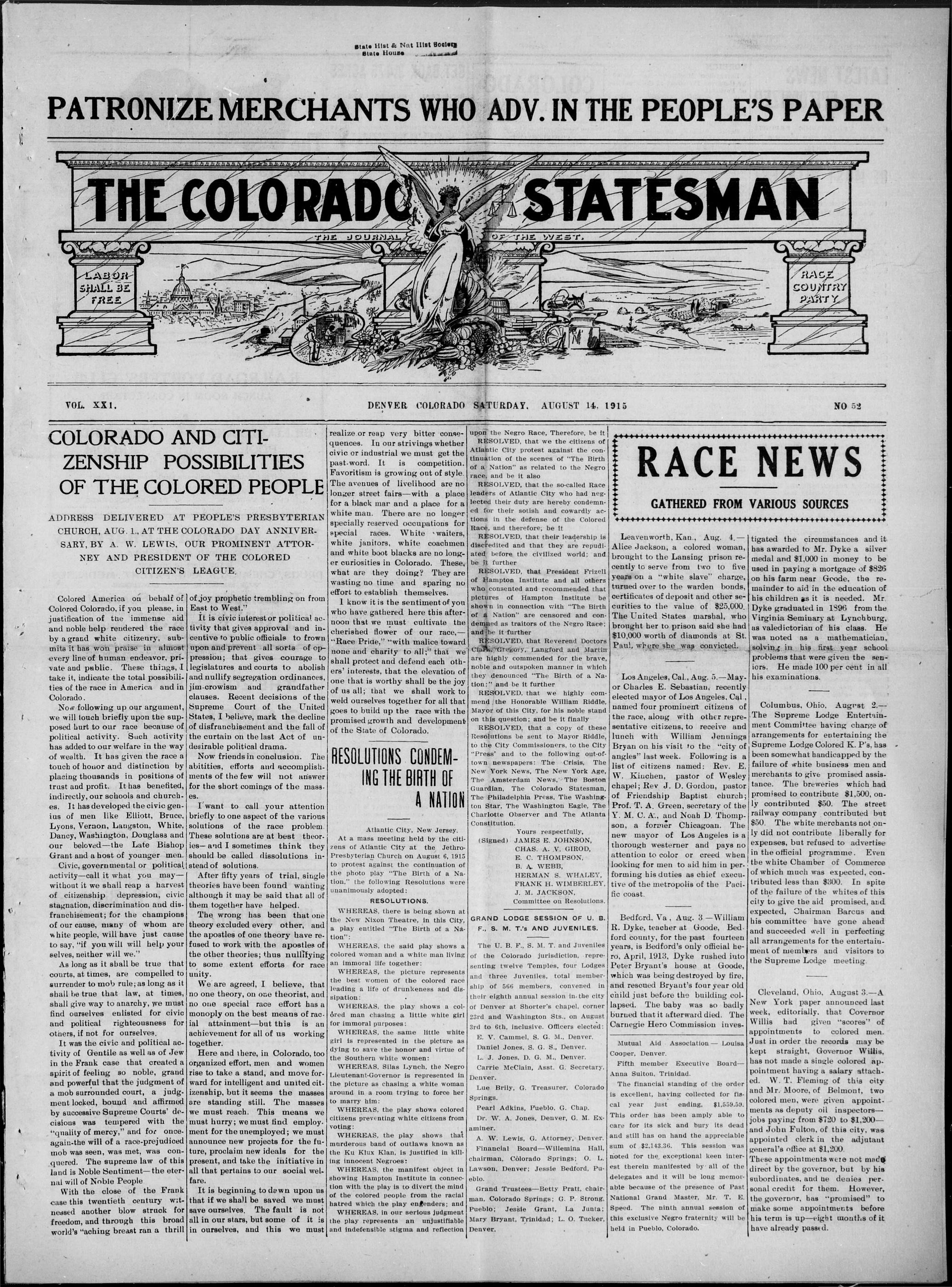
COLORADO AND CITIZENSHIP POSSIBILITIES OF THE COLORED PEOPLE
ADDRESS DELIVERED AT PEOPLE'S PRESBYTERIAN CHURCH, AUG. 1., AT THE COLORADO DAY ANNIVERSARY, BY A. W. LEWIS, OUR PROMINENT ATTORNEY AND PRESIDENT OF THE COLORED CITIZEN'S LEAGUE
VOL. XX1.
COLORADO AND
ZENSHIP PO
OF THE COL
ADDRESS DELIVERED AT
CHURCH, AUG. 1., AT THE C
SARY, BY A. W. LEWIS,
NEY AND PRESIDEN
CITIZEN'S
Colored America on behalf of Colored Colorado, if you please, in justification of the immense aid and noble help rendered the race by a grand white citizenry, submits it has won praise in almost every line of human endeavor, private and public. These things, I take it, indicate the total possibilities of the race in America and in Colorado.
Now following up our argument, we will touch briefly upon the supposed hurt to our race because of political activity. Such activity has added to our welfare in the way of wealth. It has given the race a touch of honor and distinction by placing thousands in positions of trust and profit. It has benefited, indirectly, our schools and churches. It has developed the civic genius of men like Elliott, Bruce, Lyons, Vernon, Langston, White, Dancy, Washington, Douglass and our beloved—the Late Bishop Grant and a host of younger men.
Civic, governmental or political activity—call it what you may—without it we shall reap a harvest of citizenship depression, civic stagnation, discrimination and disfranchisement; for the champions of our cause, many of whom are white people, will have just cause to say, "if you will will help your selves, neither will we."
As long as it shall be true that courts, at times, are compelled to surrender to mob rule; as long as it shall be true that law, at times, shall give way to anarchy, we must find ourselves enlisted for civic and political righteousness for others, if not for ourselves.
It was the civic and political activity of Gentile as well as of Jew in the Frank case that created a spirit of feeling so noble, grand and powerful that the judgment of a mob surrounded court, a judgment locked, bound and affirmed by successive Supreme Courts' decisions was tempered with the "quality of mercy," and for once again the will of a race-prejudiced mob was seen, was met, was conquered. The supreme law of this land is Noble Sentiment—the eternal will of Noble People.
With the close of the Frank case this twentieth century witnessed another blow struck for freedom, and through this broad world's "aching breast ran a thrill
of joy prophetic trembling on from East to West."
It is civic interest or political activity that gives approval and incentive to public officials to frown upon and prevent all sorts of oppression; that gives courage to legislatures and courts to abolish and nullify segregation ordinances, jim-crowism and grandfather clauses. Recent decisions of the Supreme Court of the United States, I believe, mark the decline of disfranchisement and the fall of the curtain on the last Act of undesirable political drama.
Now friends in conclusion. The abitities, efforts and accomplishments of the few will not answer for the short comings of the masses.
I want to call your attention briefly to one aspect of the various solutions of the race problem. These solutions are at best theories—and I sometimes think they should be called dissolutions instead of solutions.
After fifty years of trial, single theories have been found wanting although it may be said that all of them together have helped.
The wrong has been that one theory excluded every other, and the apostles of one theory have refused to work with the apostles of the other theories; thus nullifying to some extent efforts for race unity.
We are agreed, I believe, that no one theory, on one theorist, and no one special race effort has a monoply on the best means of racial attainment—but this is an achievement for all of us working together.
Here and there, in Colorado, too organized effort, men and women rise to take a stand, and move forward for intelligent and united citizenship, but it seems the masses are standing still. The masses we must reach. This means we must hurry; we must find employment for the unemployed; we must announce new projects for the future, proclaim new ideals for the present, and take the initiative in all that pertains to our social welfare.
It is beginning to dawn upon us that if we shall be saved we must save ourselves. The fault is not all in our stars, but some of it is in ourselves, and this we must
DENVER COLORADO SATURDAY. AUGUST 14. 1915
State Hist & Nat Hist Society
State House
ANTS WHO
ADO
THE JOURNAL
DENVER COLORADO
realize or reap very bitter consequences. In our strivings whether civic or industrial we must get the past-word. It is competition. Favoritism is growing out of style. The avenues of livelihood are no longer street fairs—with a place for a black mar and a place for a white man. There are no longer specially reserved occupations for special races. White waiters, white janitors, white coachmen and white boot blacks are no longer curiosities in Colorado. These, what are they doing? They are wasting no time and sparing no effort to establish themselves.
I know it is the sentiment of you who have gathered here this afternoon that we must cultivate the cherished flower of our race,—"Race Pride," "with malice toward none and charity to all;" that we shall protect and defend each others' interests, that the elevation of one that is worthy shall be the joy of us all; that we shall work to weld ourselves together for all that goes to build up the race with the promised growth and development of the State of Colorado.
RESOLUTIONS CONDEMING THE BIRTH OF A NATION
RESOLUTIONS CONDEMING THE BIRTH OF A NATION
At a mass meeting held by the citizens of Atlantic City at the Jethro-Presbyterian Church on August 6, 1915 to protest against the continuation of the photo play "The Birth of a Nation," the following Resolutions were unanimously adopted:
RESOLUTIONS.
WHEREAS, there is being shown at the New Nixon Theatre, in this City, a play entitled "The Birth of a Nation":
WHEREAS, the said play shows a colored woman and a white man living an immoral life together:
WHEREAS, the picture represents the best women of the colored race leading a life of drunkenness and dissipation:
WHEREAS, the play shows a colored man chasing a little white girl for immoral purposes:
WHEREAS, the same little white girl is represented in the picture as dying to save the honor and virtue of the Southern white women:
WHEREAS, Silas Lynch, the Negro Lieutenant-Governor is represented in the picture as chasing a white woman around in a room trying to force her to marry him:
WHEREAS, the play shows colored citizens preventing white citizens from voting:
WHEREAS, the play shows that murderous band of outlaws known as the Ku Klux Klan, is justified in killing innocent Negroes:
WHEREAS, the manifest object in showing Hampton Institute in connection with the play is to divert the mind of the colored people from the racial hatred which the play engenders; and
WHEREAS, in our serious judgment the play represents an unjustifiable and indefensible stigma and reflection
upon the Negro Race, Therefore, be it RESOLVED, that we the citizens of Atlantic City protest against the continuation of the scenes of "The Birth of a Nation" as related to the Negro race, and be it also RESOLVED, that the so-called Race leaders of Atlantic City who had neglected their duty are hereby condemned for their sotish and cowardly actions in the defense of the Colored Race, and therefore, be it RESOLVED, that their leadership is discredited and that they are repudiated before the civilized world; and be it further RESOLVED, that President Frizzell of Hampton Institute and all others who consented and recommended that pictures of Hampton Institute be shown in connection with "The Birth of a Nation" are censored and condemned as traitors of the Negro Race; and be it further RESOLVED, that Reverend Doctors Clark, Gregory, Langford and Martin are highly commended for the brave, noble and outspoken manner in which they denounced "The Birth of a Nation;" and be it further
RESOLVED, that we highly commend the Honorable William Riddle, Mayor of this City, for his noble stand on this question; and be it finally
RESOLVED, that a copy of these Resolutions be sent to Mayor Riddle, to the City Commissioners, to the City "Press" and to the following out-of-town newspapers: The Crisis, The New York News, The New York Age, The Amsterdam News, The Boston Guardian, The Colorado Statesman, The Philadelphia Press, The Washington Star, The Washington Eagle, The Charlotte Observer and The Atlanta Constitution.
Yours respectfully,
(Signed) JAMES E. JOHNSON,
CHAS. A. V. GIROD,
E. C. THOMPSON,
B. A. WEBB,
HERMAN S. WHALEY,
FRANK H. WIMBERLEY,
J. M. JACKSON,
Committee on Resolutions.
GRAND LODGE SESSION OF U. B.
F., S. M. T.'s AND JUVENILES.
The U. B. F., S. M. T. and Juveniles of the Colorado jurisdiction, representing twelve Temples, four Lodges and three Juveniles, total membership of 566 members, convened in their eighth annual session in the city of Denver at Shorter's chapel, corner 23rd and Washington Sts., on August 3rd to 6th, inclusive. Officers elected: E. V. Cammel, S. G. M., Denver. Daniel Jones, S. G. S., Denver. L. J. Jones, D. G. M., Denver. Carrie McClain, Asst. G. Secretary, Denver. Lue Brily, G. Treasurer, Colorado Springs. Pearl Adkins, Pueblo, G. Chap. Dr. W. A. Jones, Denver, G. M. Examiner. A. W. Lewis, G. Attorney, Denver. Financial Board—Willemina Hall, chairman, Colorado Springs; O. L. Lawson, Denver; Jessie Bedford, Pueblo.
Grand Trustees—Betty Pratt, chair man, Colorado Springs; G. P. Strong Pueblo; Jessie Grant, La Junta; Mary Bryant, Trinidad; L. O. Tucker Denver.
RACE NEWS
Leavenworth, Kan., Aug. 4. Alice Jackson, a colored woman, brought to the Lansing prison recently to serve from two to five years on a "white slave" charge, turned over to the warden bonds, certificates of deposit and other securities to the value of $25,000. The United States marshal, who brought her to prison said she had $10,000 worth of diamonds at St. Paul, where she was convicted.
Los Angeles, Cal., Aug. 5.—Mayor Charles E. Sebastian, recently elected mayor of Los Angeles, Cal., named four prominent citizens of the race, along with other representative citizens, to receive and lunch with William Jennings Bryan on his visit to the "city of angles" last week. Following is a list of citizens named; Rev. E. W. Kinchen, pastor of Wesley chapel; Rev J. D. Gordon, pastor of Friendship Baptist church; Prof. T. A. Green, secretary of the Y. M. C. A., and Noah D. Thompson, a former Chicagoan. The new mayor of Los Angeles is a thorough westerner and pays no attention to color or creed when looking for men to aid him in performing his duties as chief executive of the metropolis of the Pacific coast.
Bedford, Va, Aug. 3 — William R. Dyke, teacher at Goode, Bedford county, for the past fourteen years, is Bedford's only official hero, April, 1913. Dyke rushed into Peter Bryant's house at Goode, which was being destroyed by fire, and rescued Bryant's four year old child just before the building collapsed. The baby was so badly burned that it afterward died. The Carnegie Hero Commission inves-
Mutual Aid Association — Louisa Cooper, Denver.
Fifth member Executive Board—Anna Sulton, Trinidad.
The financial standing of the order is excellent, having collected for fiscal year just ending, $1,559.59. This order has been amply able to care for its sick and bury its dead and still has on hand the appreciable sum of $2,143.36. This session was noted for the exceptional keen interest therein manifested by all of the delegates and it will be long memorable because of the presence of Past National Grand Master, Mr. T. E. Speed. The ninth annual session of this exclusive Negro fraternity will be held in Pueblo, Colorado.
NO 52
tigated the circumstances and it has awarded to Mr. Dyke a silver medal and $1,000 in money to be used in paying a mortgage of $826 on his farm near Gcode, the remainder to aid in the education of his children as it is needed. Mr. Dyke graduated in 1896 from the Virginia Seminary at Lynchburg, as valedictorian of his class. He was noted as a mathematician, solving in his first year school problems that were given the seniors. He made 100 per cent in all his examinations.
Columbus, Ohio, August 2. The Supreme Lodge Entertainment Committee having charge of arrangements for entertaining the Supreme Lodge Colored K. P's, has been somewhat handicapped by the failure of white business men and merchants to give promised assistance. The breweries which had promised to contribute $1,500, only contributed $50. The street railway company contributed but $50. The white merchants not only did not contribute liberally for expenses, but refused to advertise in the official programme. Even the white Chamber of Commerce of which much was expected, contributed less than $300. In spite of the failure of the whites of this city to give the aid promised, and expected, Chairman Barcus and his committee have gone ahead and succeeded well in perfecting all arrangements for the entertainment of members and visitors to the Supreme Lodge meeting.
Cleveland, Ohio, August 3.—A New York paper announced last week, editorially, that Governor Willis had given "scores" of appointments to colored men. Just in order the records may be kept straight, Governor Willis, has not made a single colored appointment having a salary attached. W. T. Fleming of this city and Mr. Moore, of Belmont, two colored men, were given appointments as deputy oil inspectors—jobs paying from $720 to $1,200—and John Fulton, of this city, was appointed clerk in the adjutant general's office at $1,200. These appointments were not made direct by the governor, but by his subordinates, and he denies personal credit for them. However, the governor, has "promised" to make some appointments before his term is up—eight months of it have already passed.
LATEST NEWS EPITOMIZED
FROM TELEGRAPHIC REPORTS THAT COVER THE WEEK'S EVENTS.
OF MOST INTEREST
OF MOST INTEREST
KEEPING THE READER POSTED
ON MOST IMPORTANT
CURREN T TOPICS.
ABOUT THE WAR
The Swedish steamer Mai has been sunk by a German submarine.
The Austro-German statement says that forts near Novogeorglevsk have been captured.
German troops have crossed the Vistula and occupied Praga, eastern suburb of Warsaw.
French air squadrons bombarded the Rhenish Prussian city of Saarbrücken, injuring a few civilians.
The British steamship Midland Queen, which sailed from Sydney, C.B., July 21 for Glasgow, was sunk.
Lomza, Russian stronghold on the Narew, was captured by Germans; fortress of Kovno threatened and Vilna is being evacuated.
Allies begin a new drive against Constantinople, in hope of relieving Russia, and Gen. Hamilton reports capture of important Turkish positions.
Zeppelin raid killed fourteen persons on coast of England, while one of the big dirigibles was destroyed by allies' aviators. Eight killed by allies in air raid on Bavarian towns.
Artillery engagements and infantry attacks by the Austrians and Italians continue on the Austro-Italian boundary. Austria said to have sent 30,000 troops released by fall of Warsaw against Italians.
British auxiliary cruiser India sunk off Norwegian coast by German submarine. British torpedo boat destroyer Lynx sunk by mine in North Sea. Submarine of allies sunk near Bulair by bomb from Turk aeroplane.
The Turkish battleship Kheyr-Ed-Din Barbarossa of 9,900 tons displacement, formerly the German warship Kurfurst Friedrich Wilhelm, was sunk by a submarine or the entente powers, according to an official announcement issued by the Turkish government.
London newspapers lay emphasis on what they assert is Russia's improved situation in the Riga district. "The Russians," says the Morning Post Petrograd correspondent, "are forcing a vigorous aggressive and the Germans have been swept clear from the Riga region."
WESTERN
Attendance at the Panama-Pacific exposition has passed the 10,000,000 mark.
A severe electrical storm caused a loss of more than $250,000 in the oil fields near Tulsa, Okla.
A United States infantryman was killed by Mexican bandits at Palm Gardens, about two miles east of Mercedes, Tex.
Five Mexican bandits and one Mexican woman were killed in the fighting at Norias, sixty-eight miles north of Brownsville, Tex.
Dr. N. Cox of Cairo and Dr. B. A. Smith of Champaign were removed from the State Board of Dental Examiners by Governor Dunne of Illinois for "neglect of duty."
With three men under arrest in Chicago, one of whom is said to have confessed, detectives for the Wells-Fargo Express Company claim to have uncovered a system of thefts through which the company has been robbed of merchandise totaling nearly $200,000 within the last twelve years.
WASHINGTON
A definite policy as to Mexico has been agreed upon by the Pan-American conference, Secretary Lansing announced.
Powers of North and South America already have agreed upon a definite plan for dealing with the Mexican problem.
The American consul at Cork has reported the body of M. W. Harvey, presumably a Lusitania victim, washed ashore on a small island off the Irish coast.
Millions of dollars' worth of by products from coke production are literally thrown away annually in the United States through the continued use of the obsolete beehive oven process, according to a report by the Geological Survey. The loss by that method last year is estimated at fully $40,000,000.
Dr. Bobo, former Haitian revolutionist, has given up his rebellion, ordered his generals to disarm and has announced himself as candidate for president, Charge d'Affaires Davis at Port au Prince reported to the State Department.
The American reply to the last German note, regarding the sinking of the American ship William P. Frye, was cabled to Berlin.
President Wilson decided Tuesday to end his vacation at Cornish, N. H., and return to Washington, presumably because of the Mexican situation.
FOREIGN
Bernardino Machado was elected by Congress President of the republic of Portugal.
Maria Cecelia Natalie Janotha, court pianiste to Emperor William, was arrested in London and deported from Tilbury.
Pavlof volcano, situated on the Alaska peninsula, was in full eruption the night of July 23, last, with flames shooting from the crater.
Several deaths have been caused at various points in Spain by a heat wave of unusual intensity. The temperature rose to 133 degrees Fahrenheit in the sun at Seville and 108 at Madrid.
A poor year for salmon packers with a falling off of from 40 to 50 per cent from a full pack was reported at Seward, Alaska, by Capt. Hansen of the Santa Ana, which has arrived from Bering sea ports.
A protocol signed between Turkey and Bulgaria regarding the Dedesghatch railway leaves Bulgaria unpledged as to her attitude in the European war, according to advices to the London Times from Sofia.
At Hohenheim, Germany, violent earth tremors were recorded at the observatory. The seismograph indicated that a severe earthquake had occurred in southern Europe, probably in Calabria or Albania.
Pope Benedict has addressed a letter to the Catholics of East Prussia, according to the Overseas News Agency, "expressing his fatherly sympathy for the terrible war horrors brought upon them by the Russian invasion."
The British board of trade actual figures for the month of July show an increase in imports of £16,171,663 ($80,858,315). The principal increases were in food and metals. The exports show a decrease of $34,721,511 ($173,607,555), chiefly in coal, yarns, textiles and machinery.
SPORTING NEWS
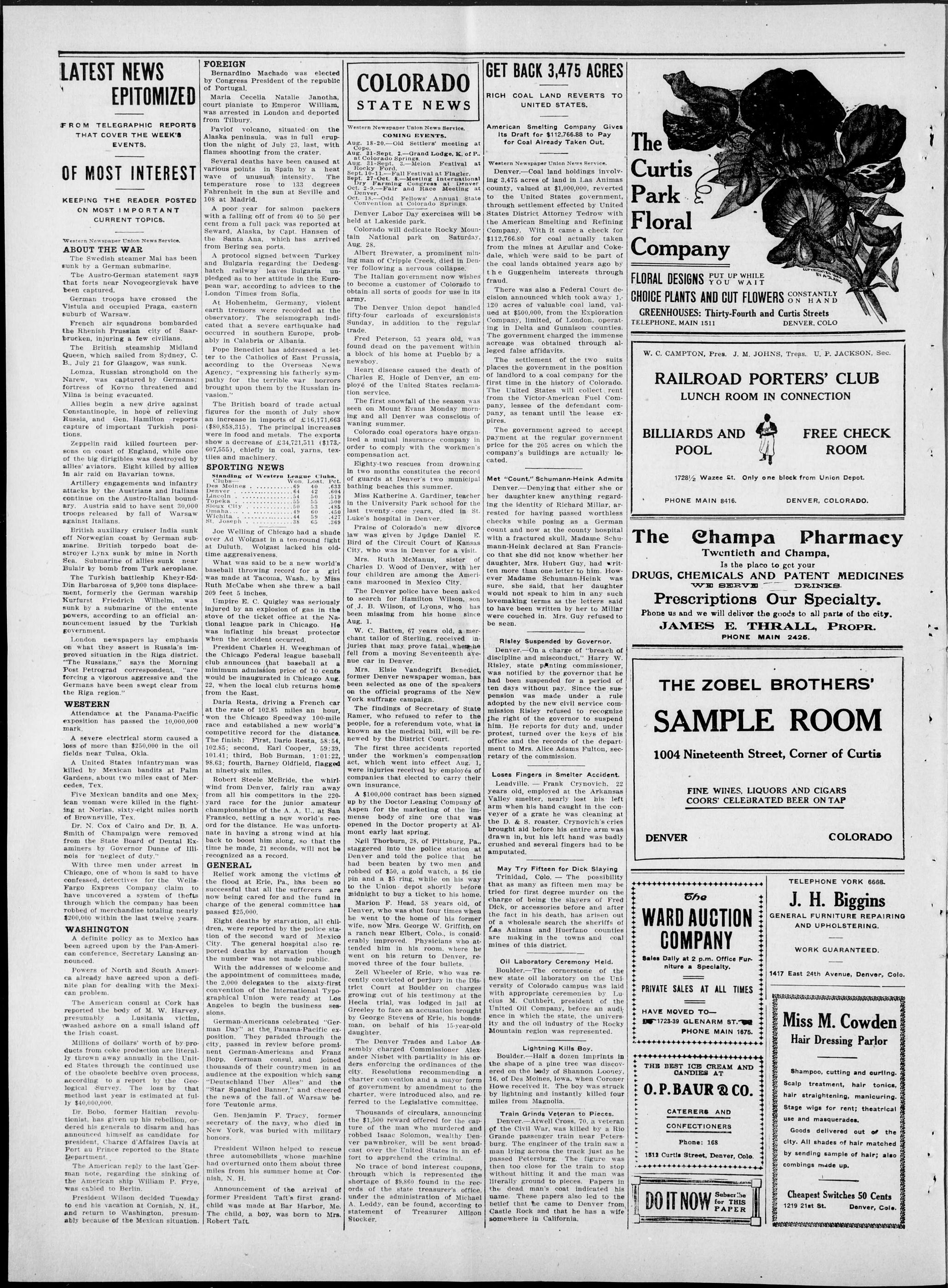
Standing of Western League Clubs.
Clubs— Won. Lost. Pct.
Des Moines 69 42 633
Denver 64 42 604
Lincoln 54 50 519
Topeka 55 55 500
Sloux City 50 53 485
Omaha 49 60 450
Wichita 49 59 427
St. Joseph 38 65 369
Joe Welling of Chicago had a shade over Ad Wolgast in a ten-round fight at Duluth. Wolgast lacked his old-time aggressiveness.
What was said to be a new world's baseball throwing record for a girl was made at Tacoma, Wash., by Miss Ruth McCabe when she threw a ball 209 feet 5 inches.
Umpire E. C. Quigley was seriously injured by an explosion of gas in the stove of the ticket office at the National league park in Chicago. He was inflating his breast protector when the accident occurred.
President Charles H. Weeghman of the Chicago Federal league baseball club announces that baseball at a minimum admission price of 10 cents would be inaugurated in Chicago Aug. 22, when the local club returns home from the East.
Daria Resta, driving a French car at the rate of 102.85 miles an hour, won the Chicago Speedway 100-mile race and established a new world's competitive record for the distance. The finish: First, Dario Resta, 58:54, 102.85; second, Earl Cooper, 59:39, 101.41; third, Bob Burnan, 1:01:22, 98.63; fourth, Barney Oldfield, flagged at ninety-six miles.
Robert Steele McBride, the whirlwind from Denver, fairly ran away from all his competitors in the 220-yard race for the junior amateur championships of the A. A. U., at San Fransico, setting a new world's record for the distance. He was unfortunate in having a strong wind at his back to boost him along, so that the time he made, 21 seconds, will not be recognized as a record.
GENERAL
Relief work among the victims of the flood at Erie, Pa., has been so successful that all the sufferers are now being cared for and the fund in charge of the general committee has passed $25,000.
Eight deaths by starvation, all children, were reported by the police station of the second ward of Mexico City. The general hospital also reported deaths by starvation though the number was not made public.
With the addresses of welcome and the appointment of committees made, the 2,000 delegates to the sixty-first convention of the International Typographical Union were ready at Los Angeles to begin the business sessions.
German-Americans celebrated "German Day" at the Panama-Pacific exposition. They paraded through the city, passed in review before prominent German-Americans and Franz Bopp. German consul, and joined thousands of their countrymen in an audience at the exposition which sang "Deutschland Uber Alles" and the "Star Spangled Banner," and cheered the news of the fall of Warsaw before Teutonic arms.
Gen. Benjamin F. Tracy, former secretary of the navy, who died in New York, was buried with military honors.
President Wilson helped to rescue three automobilists, whose machine had overturned onto them about three miles from his summer home at Cornish, N. H.
Announcement of the arrival of former President Taft's first grandchild was made at Bar Harbor, Me. The child, a boy, was born to Mrs. Robert Taft.
COLORADO STATE NEWS
Western Newpaper Union News Service.
COMING EVENTS.
Aug. 18-20.—Old Settlers' meeting at
Cape.
Aug. 31-Sept. 2.—Grand Lodge, K. of P.
at Colorado Springs.
Aug. 31-Sept. 3.—Meion Festival at
Rocky Ford.
Sept. 10-11.—Fall Festival at Flagler.
Sept. 2-Oct. 8.—Meeting International
Dr. Fanning Congress at Denver.
Oct. 2-9.—Fair and Race Meeting at
Denver.
Oct. 18.—Odd Fellows' Annual State Convention at Colorado Springs.
Denver Labor Day exercises will be held at Lakeside park.
Colorado will dedicate Rocky Mountain National park on Saturday, Aug. 28.
Albert Brewster, a prominent mining man of Cripple Creek, died in Denver following a nervous collapse.
The Italian government now wishes to become a customer of Colorado to obtain all sorts of goods for use in its army.
The Denver Union depot handled fifty-four carloads of excursionists Sunday, in addition to the regular trade.
Fred Peterson, 53 years old, was found dead on the pavement within a block of his home at Pueblo by a newsboy.
Heart disease caused the death of Charles E. Hogle of Denver, an employé of the United States reclamation service.
The first snowfall of the season was seen on Mount Evans Monday morning and all Denver was conscious of waning summer.
Colorado coal operators have organized a mutual insurance company in order to comply with the workmen's compensation act.
Eighty-two rescues from drowning in two months constitutes the record of guards at Denver's two municipal bathing beaches this summer.
Miss Katherine A. Gardiner, teacher in the University Park school for the last twenty-one years, died in St. Luke's hospital in Denver.
Praise of Colorado's new divorce law was given by Judge Daniel E. Bird of the Circuit Court of Kansas City, who was in Denver for a visit. Mrs. Ruth McManus, sister of Charles D. Wood of Denver, with her four children are among the Americans marooned in Mexico City. The Denver police have been asked to search for Hamilton Wilson, son of J. B. Wilson, of Lyons, who has been missing from his home since Aug. 1. W. C. Batten, 67 years old, a merchant tailor of Sterling, received injuries that may prove fatal when he fell from a moving Seventeenth avenue car in Denver. Mrs. Elsie Vandegrift Benedict, former Denver newspaper woman, has been selected as one of the speakers on the official programs of the New York suffrage campaign.
The findings of Secretary of State Ramer, who refused to refer to the people, for a referendum vote, what is known as the medical bill, will be renewed by the District Court. The first three accidents reported under the workmen's compensation act, which went into effect Aug. 1, were injuries received by employés of companies that elected to carry their own insurance. A $100,000 contract has been signed up by the Doctor Leasing Company of Aspen for the marketing of the immense body of zinc ore that was opened in the Doctor property at Almont early last spring.
Neil Thorburn, 28, of Pittsburg, Pa., staggered into the police station at Denver and told the police that he had been beaten by two men and robbed of $50, a gold watch, a $6 tie pin and a $5 ring, while on his way to the Union depot shortly before midnight to buy a ticket to his home. Marion F. Head, 58 years old, of Denver, who was shot four times when he went to the home of his former wife, now Mrs. George W. Griffith on a ranch near Elbert, Colo., is considerably improved. Physicians who attended him in his room, where he went on his return to Denver, removed three of the four bullets.
Zell Wheeler of Erie, who was recently convicted of perjury in the District Court at Boulder on charges growing out of his testimony at the Hecla trial, was lodged in jail at Greeley to face an accusation brought by George Stevens of Erie, his bondsman, on behalf of his 15-year-old daughter. The Denver Trades and Labor Assembly charged Commissioner Alexander Nisbet with partiality in his orders enforcing the ordinances of the city. Resolutions recommending a charter convention and a mayor form of government by amendment to the charter, were introduced also, and referred to the Legislative committee.
Thousands of circulars, announcing the $1,500 reward offered for the capture of the man who murdered and robbed Isaac Solomon, wealthy Denver pawnbroker, will be sent broadcast over the United States in an effort to apprehend the criminal.
No trace of bond interest coupons, through which is represented the shortage of $9,860 found in the records of the state treasurer's office, under the administration of Michael A. Leddy, can be found, according to statement of Treasurer Allison Stocker.
GET BACK 3,475 ACRES
RICH COAL LAND REVERTS TO UNITED STATES.
American Smelting Company Gives Its Draft for $112,766.88 to Pay for Coal Already Taken Out.
Denver.—Coal land holdings involving 3,475 acres of land in Las Animas county, valued at $1,000,000, reverted to the United States government, through settlement effected by United States District Attorney Tedrow with the American Smelting and Refining Company. With it came a check for $112,766.80 for coal actually taken from the mines at Aguilar and Cokedale, which were said to be part of the coal lands obtained years ago by the Guggenheim interests through fraud.
There was also a Federal Court decision announced which took away 1,120 acres of valuable coal land, valued at $500,000, from the Exploration Company, limited, of London, operating in Delta and Gunnison counties. The government charged the immense acreage was obtained through alleged false affidavits. The settlement of the two suits places the government in the position of landlord to a coal company for the first time in the history of Colorado. The United States will collect rent from the Victor-American Fuel Company, lessee of the defendant company, as tenant until the lease expires. The government agreed to accept payment at the regular government price for the 205 acres on which the company's buildings are actually located.
Met "Count," Schumann-Heink Admits Denver.—Denying that either she or her daughter knew anything regarding the identity of Richard Millar, arrested for having passed worthless checks while posing as a German count and now at the county hospital with a fractured skull, Madame Schumann-Heink declared at San Francisco that she did not know whether her daughter, Mrs. Hubert Guy, had written more than one letter to him. However Madame Schumann-Heink was sure, she said, that her daughter would not speak to him in any such lovemaking terms as the letters said to have been written by her to Millar were couched in. Mrs. Guy refused to be seen.
Risley Suspended by Governor. Denver.—On a charge of "breach of discipline and misconduct," Harry W. Risley, state painting commissioner, was notified by the governor that he had been suspended for a period of ten days without pay. Since the suspension was made under a rule adopted by the new civil service commission Risley refused to recognize the right of the governor to suspend him. He reports for duty and, under protest, turned over the keys of his office and the records of the department to Mrs. Alice Adams Fulton, secretary of the commission.
Lose Fingers in Smelter Accident.
Leadville. — Frank Crynovich. 22 years old, employed at the Arkansas Valley smelter, nearly lost his left arm when his hand caught in the conveyor of a grate he was cleaning at the D. & S. roaster. Crynovich's cries brought aid before his entire arm was drawn in, but his left hand was badly crushed and several fingers had to be amputated.
May Try Fifteen for Dick Slaying
Trinidad, Colo. — The possibility that as many as fifteen men may be tried for first degree murder on the charge of being the slayers of Fred Dick, or accessories before and after the fact in his death, has arisen out of a wholesale search the sheriffs of Las Animas and Huerfano counties are making in the towns and coal mines of this district.
Oil Laboratory Ceremony Held. Boulder.—The cornerstone of the new state oil laboratory on the University of Colorado campus was laid with appropriate ceremonies by Lucius M. Cuthbert, president of the United Oil Company, before an audience in which the state, the university and the oil industry of the Rocky Mountain region was represented.
Lightning Kills Boy.
Boulder.—Half a dozen imprints in the shape of a pine tree was discovered on the body of Shannon Looney, 16, of Des Moines, Iowa, when Coroner Howe received it. The boy was struck by lightning and instantly killed four miles from Magnolia.
Train Grinds Veteran to Pieces
Train Grindus Veteran to Pieces.
Denver. Atwell Cross, 70, a veteran of the Civil War, was killed by a Rio Grande passenger train near Petersburg. The engineer of the train saw a man lying across the track just as he passed Petersburg. The figure was then too close for the train to stop without hitting it and the man was literally ground to pieces. Papers in the dead man's coat indicated his name. These papers also led to the belief that he came to Denver from Castle Rock and that he has a wife somewhere in California.
The
Curtis
Park
Floral
Company
FLORAL DESIGNS PUT UP WHILE
YOU WAIT
CHOICE PLANTS AND CUT FLOWERS CONSTANTLY
ON HAND
GREENHOUSES: Thirty-Fourth and Curtis Streets
TELEPHONE, MAIN 1511
DENVER, COLO
W. C. CAMPTON, Pres. J. M. JOHNS, Treas. U. P. JACKSON, Sec. RAILROAD PORTERS' CLUB LUNCH ROOM IN CONNECTION
BILLIARDS AND POOL
17281/2 Wazee St. Only
8½ Wazee St. Only one block from Union D
17281/2 Wazee St. Only one block from Union Depot.
PHONE MAIN 8416. DENVER, COLORADO
The Champ
Twentieth and
Is the place
DRUGS, CHEMICALS AND
WE SERVE
Prescriptions
Phone us and we will deliver the
JAMES E. TH.
PHONE M
THE ZOBEL
SAMPLE
1004 Nineteenth Str
Champa Pharm.
Twentieth and Champa,
Is the place to get your
CHEMICALS AND PATENT M
WE SERVE DRINKS.
Descriptions Our Special
and we will deliver the goods to all parts
JAMES E. THRALL, PR
PHONE MAIN 2425.
E ZOBEL BROTHER
AMPLE ROO
Nineteenth Street, Corner of
Twentieth and Champa,
Is the place to get your
DRUGS, CHEMICALS AND PATENT MEDICINES
WE SERVE DRINKS.
Prescriptions Our Specialty.
Phone us and we will deliver the goods to all parts of the city.
JAMES E. THRALL, PROPR.
PHONE MAIN 2426.
THE ZOBEL BROTHERS'
1004 Nineteenth Street, Corner of Curtis
FINE WINES, LIQUORS AND CIGARS COORS' CELEBRATED BEER ON TAP
The
WARD AUCTION
COMPANY
Sales Daily at 2 p.m. Office Furniture a Specialty.
PRIVATE SALES AT ALL TIMES
HAVE MOVED TO—
1723-39 GLENARM ST.
PHONE MAIN 1675.
THE BEST ICE CREAM AND CANDIES AT
O.P. BAUR & CO.
CATERERS AND
CONFECTIONERS
Phone: 168
1512 Curtis Street, Denver, Colo.
DO IT NOW Subscribe for THIS PAPER
---
---
DENVER
FREE CHECK ROOM
ne block from Union Depot.
DENVER, COLORADO.
Pharmaey
and Champa,
to get your
PATENT MEDICINES
DRINKS.
Our Specialty.
to goods to all parts of the city.
IRALL, PROPR.
MAIN 2426.
BROTHERS'
ROOM
eet, Corner of Curtis
TELEPHONE YORK 6668.
J. H. Biggins
GENERAL FURNITURE REPAIRING
AND UPHOLSTERING.
WORK GUARANTEED.
Miss M. Cowden
Hair Dressing Parlor
Shampoo, cutting and curling.
Scalp treatment, hair tonics,
hair straightening, manicuring.
Stage wigs for rent; theatrical
use and masquerades.
Goods delivered out of the city. All shades of hair matched by sending sample of hair; also combings made up.
Cheapest Switches 50 Cents
1219 21st St. Denver, Cole.
A WORKER
COLORADO
AFRO-AMERICAN CULLINGS
For a long time it has been suspected that the art of working iron began among the Negroes in Africa. Now it is so well confirmed that there seems little doubt about it.
Bronze was the first metal of which man availed himself. Just how that came about is uncertain. Copper and tin were abundant, but were of little value for weapons or cutting implements, when someone conceived the idea that by combining them a serviceable set of tools was easy.
It is believed that the idea may have come from Asia Minor, where the two metals are found in combination. All the weapons of the Homeric age were bronze, and steel swords and knives do not appear to have been common until about 700 or 800 years before the Christian era.
Archeologists have come across specimens of iron in Egypt which have puzzled them. Recently in opening some graves in Nubia, the ancient Ethiopia, an iron spearhead was found in good condition. The grave dates from about 3400 B. C. and in any event was long before iron was known elsewhere.
This spearhead was discovered by an expedition of the University Museum. Philadelphia, which was excavating for ancient relics. It is now in the museum, and the astonishing thing is that it is precisely like the spearheads made by the natives in Africa today.
The native village blacksmith is an important personage. He is usually a wanderer, like the traveling tinker, but there seems to be a rather closely organized guild among them. The bellows are small and are worked generally by two men. They keep the fire very hot. The smith often uses a stone for an anvil, and his hammers are very rude. Seeing these crude implements, one would never suppose it possible to accomplish much, but they turn out some really admirable work.
They work with considerable ceremony and are highly esteemed. Witchcraft enters into their ceremonies and the natives believe that only thus can good work be accomplished.
The appearance of the blacksmith is the sign for ceremonial dances in the village. All join in. Dancing does not seem to enervate the natives and apparently takes the place of sleep.
The African villages are kept so clean that the university explorers on their return were shocked at Philadelphia and New York. In Africa the chief is the head sweeper, and if everything is not as neat as a pin he is deposed and sometimes loses his head—not his official head, but his real one.
The native ironworkers of darkest Africa are fast disappearing, because traders are gradually entering the country and selling cheap wares, which puts the Negro smith out of business. There still remains, however, a number of sections where the smith is a mighty man, even more respected than he of whom Longfellow sang.
The work of the native smiths always begins with dancing, in which the entire village joins. Then there is a feast. Next day, if iron has to be smelted, the ore is first offered to the image of the native god by the hand-somest girl of the tribe. Throughout the work the chief is in attendance, watching the smiths as they sit in a ring.
Every day the bell of Eton college chapel is toled for a quarter of an hour for Etonians killed in the war.
In one of the young ladies' schools in a suburb of Berlin the pupils sent a committee to the principal asking her to discontinue instructions in French and English, as it would be unpatriotic to learn the language of "nations who, in such an infamous manner, had dragged Germany into war." It took the principal considerable time to show the girls why their request could not be complied with.
At a Christmas-tree festival in South Paris, Me., the gifts were taken from the tree by a young lady who had recently been married. During the distribution she found one package with a name she didn't recognize, so she did the gift aside. As the packages disappeared she began to wonder where her own was, and finally realized that the discarded package bore her own new name.
If it is anything her husband told her about his life before he married her, a wife never forgets it.
Potatoes, cabbage, celery, cauliflower, lettuce, carrots and turnips of fine quality are extensively grown in Yukon territory, Canada. Potatoes are the principal crop, retailing at five cents a pound.
If you want to hear a lot of reasons talk to the ball player who has been released.
A government survey has resulted in ranking the Yukon river in fifth place among the great streams of North America.
In a considerably enlarged and greatly improved form the Negro Year Book for 1914-15 makes its appearance. The success of the previous issues has encouraged the publishers to believe that there is "a very real need for a book which will provide, in an inexpensive form, a succinct, comprehensive and impartial review of the events of the year which affect the interests and indicate the progress of the race." It attempts to "provide this, together with a compact but comprehensive statement of historical facts arranged for ready reference. It seeks to be at once a permanent record of current events, an encyclopedia of historical and sociological facts, a directory of persons and a bibliographical guide to the literature of the subjects discussed."
The topical arrangement of the volume is admirably done, placing before the reader full and essential information on a variety of subjects. In a general review of the past year many interesting facts are brought out in this volume that would otherwise have little attention: That a little colored girl in the public schools of Cincinnati won the first prize for an essay on the subject, "What I can and Will Do to make Cincinnati a Better and Bigger City;" that Frances O. Grant graduated at the head of her class at the Girl's Latin school in Boston and won the Griswold scholarship to Radcliffe; that Isaac Fisher, editor of the Negro Farmer, Tuskegee, Ala., won three first prizes in national competition, the first of $100 from the St. Louis Post Dispatch for "The Ten Best Reasons Why Persons Should Come to Missouri," the second from the Wales Visible Adding Machine company, for the best essay on "What Do You See in an Adding Machine?" and the third from a woman's magazine for the best essay on "A Criticism of the Criterion of Fashion." The account of what Negroes have contributed to education, the wealth and accomplishments of individual Negroes make, with a vast amount of other information, a surprising and valuable record.
One of the greatest and most representative gatherings of Afro-Americans ever assembled in the Lone Star state will be present at Austin during the Sunday school and Baptist Young People's union chautauqua, which holds forth August 16-23 inclusive. Negroes of all walks of life will be there, from men of international reputation to boy cadets, who will be on hand in great numbers to lend their assistance to the occasion.
From present indications Houston will be well represented, both by cadets from the various Sunday schools and delegates from the Sunday schools and Baptist Young People's unions. The Houston delegation will go in special cars in charge of C. F. Richardson and R. B. H. Yates.
In Austin Revs. J. B. Pius and D. A. Scott and others are making ample preparations to care for a monster crowd. Interest is intense throughout the state in this great meeting, and the railroads have granted a rate of one and one-third fare for the round trip. It promises to eclipse all former meetings of its kind in the South among Afro-Americans.
Capt. John Sessums' Zouaves will also make the trip and hope to set a pace for all the other companies.
When it is necessary for a town to pass the hat the first move made is to secure an influential citizen to do it.
H. P. Ewing, the former potato king of the Kaw valley, returned to Kansas City from a lecture tour through Oklahoma, where he has been advocating the back-to-the-farm movement for Negroes. Ewing has a farm west of Argentine, where Negro boys are taught how to farm. He lectured at Tulsa, Bartlesville, Muskogee, South McAlester and Wybark, Okla. The Commercial club of Tulsa offered to help in the movement, and two hundred acres of ground were pledged. At Bartlesville a quarter section was offered. A farm of 160 acres is now under cultivation at Wybark.
An institute in Kansas City similar to the Tuskegee institute in Alabama, where Negroes are taught to earn their livelihood, is planned by Ewing.
"O God, we thank Thee for success and victory of our army and navy. Grant unto us, if it please Thee, more decisive victories: We pray Thee protect our sailors, naval men, and civilians from mines and torpedoes, and our shores from the designs of the enemy. Through Jesus Christ, Amen."—Advertisement in Edinburgh Scotsman.
Besides 39 newspapers printed in English, New York city has 10 in Italian, 7 German, 7 Jewish, 3 Greek, 3 Hungarian, 2 French, 2 Bohemian, 2 Croatian, 1 Spanish, Servian, Syrian and Chinese.
For sorting fruit as it is picked from a tree there has been invented a tube that separates the small from the large as they slide down it.
Circumstantial evidence seldom is strong enough to induce the jury to convict an attractive woman.
LEDDY READY TO REPAY
IF ALLEGED SHORTAGE OF $9,860
IS VERIFIED.
Former State Treasurer Says He
Does Not Think Funds Are Missing,
but if So, His Bond Covers.
Western Newspaper Union News Service.
Denver.—Following the discovery,
Aug. 7, of a supposed shortage of
$9,860 in the funds of the state treasurer,
covered by alleged false entries
made last December, announcement
was made that M. A. Leddy, treasurer
at that time, would make good any
loss to the state.
Under the law Mr. Leddy must reimburse the state for any loss, and the state is still further protected by Mr. Leddy's bond for $1,800,000, signed by about fifty of the wealthiest men in the state. Mr. Leddy is himself protected by bonds in a surety company given by employees in the office to protect the state treasury against loss.
M. A. Leddy, at Colorado Springs last night, said he had not been officially advised of any shortage—and that he did not believe any existed.
Auditor Mulnix said the matter had become public prematurely, and before he had time to officially confirm to Mr. Leddy a previous statement he had made to the former state treasurer to the effect that a shortage existed.
"I will have to be shown that there is a shortage," said Mr. Leddy. "In any event, my bond will cover. Before I left, the books of Julius H. Clark, former bookkeeper in my office, were under investigation."
In the opinion of Mr. Leddy's son, H. J. Leddy (who was formerly deputy state treasurer, under his father) the actual shortage may have existed for some years and may have been covered from time to time by false entries in the books.
During the administration of M. A. Leddy, but three persons, according to the former deputy, had access to the cash: H. J. Leddy, Edward Osborne, who acted as cashier, and Julius H. Clark, for twenty years bookkeeper in the treasurer's office, who killed himself April 23 after writing a note declaring he was short in his accounts.
The shortage that is now alleged to exist was not discovered by the experts employed by the legislative committee appointed by the last assembly to make the required biennial examination of the books and records of the office.
Shortly after the suicide of Clark, Auditor Harry Mulnix in his capacity as state examiner began a probe of the books, with the discovery of three false entries, made in the month of December, 1914, which, he says, make up a shortage of $9,860. The discrepancy in the books was called to the attention of Mr. Leddy, according to Auditor Mulnix, who stated that as soon as the shortage was verified he would reimburse the state and look to the bonding company to repay him. State Treasurer Stocker called the attention of his predecessor to the shortage as soon as it was known with the statement that he would inform Mr. Leddy as soon as it was checked and verified.
Board Denies Pardons to Slayers:
Denver. — Genyeko Mitsunaga, the Japanese sentenced to life imprisonment for the murder of Mrs. Katherine Wilson in 1911, was denied a pardon by the State Board of Pardons. Kava Nagashaki also was denied pardon or commutation of sentence on a life sentence for the shooting of Ida Miller in 1909. Harry Pike, the real estate operator, who shot Mayzelle Ritter May 21, 1910, and who is serving a thirteen-year sentence, was denied in a second request for commutation of sentence. The only case in which a favorable action was taken to the convict was that of Carrillo Moscatta, who had his four-year sentenced reduced to three, which will release him at once. Moscatta resented the attack made by another man upon Mrs. Moscatta, and shot him.
Other cases denied included Frank Muriatta, from Weld county, fourteen to twenty years for murder; Victor Pangranzi, San Juan county, seven to eight years for murder; John Dietz, from Las Animas county, life, for murder; Christ Bernardi, San Juan county, twelve to fifteen years for murder; Barney Carrolo, Huerfano county, five to seven years for robbery; John R. Blocker, Fremont county, ten to twelve years for forgery.
Risley Charges to Be Filed.
Denver.—Governor Carlson saud that the charges against State Commissioner of Printing H. W. Risley would be filled with the new civil service commission. Mr. Risley refused to resign upon request of the governor through Private Secretary Milliken.
"Dry" Resolutions Passed at Eaton. Denver.—Governor Carlson received resolutions of protest passed by citizens of Eaton at a union service held by all the churches of the town at which they expressed their disapproval of Denver's action in passing an ordinance to allow the sale of liquor after next January.
Eight Accidents Under New Law.
Denver.-Since Aug. 1, when the workmen's compensation law went into effect, eight accidents have been reported to the Industrial Commission
MEXICANS CROSS TO AID BANDITS
REVOLT URGED AMONG PEONS TO RECAPTURE DISTRICT ALONG RIO GRANDE.
LATINS DEMAND PEACE
CONFERENCE DRAFTS PLANS
FOR ELECTION AND EMBAR
GO ON ARMS BY U.S.
Brownsville, Tex., Aug. 12.—The plan of the Mexican invaders is said to call for the death of every American male over 16 years of age in communities along the Rio Grande and also along the border of New Mexico, Arizona and California. Maj. Gen. Frederick Funston said it had been reported that more than 3,000 Mexicans are pledged to a revolutionary organization already.
Latins Agree to Peace Demand.
New York, Aug. 12.—Secretary Lansing and the diplomatic representatives of six South American governments signed an appeal to Mexican leaders calling upon all factions to unite, elect a stable government and cease strife in the name of national patriotism and humanity.
Secretary Lansing left for Washington to show President Wilson the text of the appeal as finally agreed upon, and a statement will be prepared by Mr. Lansing explanatory of the purposes of the appeal, which in many quarters has come to be interpreted as the forerunner of military intervention.
With the President in direct charge of the Mexican situation, developments are expected within the next few days. He is desirous of following the plan for the settlement of the Mexican question inaugurated when South and Central American republics were invited to confer on Mexican affairs. He is determined, however, to afford protection to foreigners in Vera Cruz.
The appeal signed at the conference is brief and courteously phrased, calls upon the Mexicans to consider the injurious effect throughout the world which the constant turbulence in Mexico has caused, and suggests that a peace conference be held on neutral territory in Mexico. The governments signing it express their willingness to act, if invited, in any practicable way to assist in bringing the factions to gether for the conference.
Many Fear Racial Fight.
Brownsville, Tex.—Practically every American citizen in the three southern most counties of Texas, Cameron, Hidalgo and Starr, was under arms Wednesday night in fear that the overwhelming Mexican population of the section would break out in a racial fight, leading to a massacre of American citizens.
Authorities here guarded the Ric Grande at a point below Brownsville where it was reported several hundred armed Mexicans had gathered intending to cross the river under cover of darkness.
Gen. Funston reported that the best information he could gather indicated that the raids were directed by Texans having headquarters in Brownsville who, having a political fued, sent ban dit gangs to rob and attack each other. Secretary Garrison expressed doubt that Mexicans from over the border were responsible for the disturbances.
Under Maj. Gen. Funston's command on the border are about 14,000 troops. At other posts in continental United States are about 12,000 more mobile troops.
The outstanding feature of the day's developments was the circulation of a rumor in many quarters—even reaching to the State Department at Washington—that the disturbance was an effort on the part of unutored Mexicans to turn back a portion of Texas to Mexican control. This scheme, it was rumored, was backed by ignorant Mexicans living on the American side of the Rio Grande, assisted by escaped convicts and fugitives from justice and also, according to the report, by a considerable number of irresponsible Mexicans, both soldiers and civilians, who were said to have crossed the American border from Mexico. Impetus was given the movement, it is believed in many quarters, by border political conditions.
Airships Bombard Warships
Berlin.—The German airships which raided the east coast of England Monday night and early Tuesday morning bombarded, with good results, warships on the Thames, the London docks, torpedo boats near Harwich, and buildings on the Humber, according to an official communication issued by the admiralty.
Wilson Urged to Curb British.
Wilson Orged to Curb Brittan.
San Francisco.—Demands that England cease the detention of American vessels, cargoes and men and that President Wilson and his Cabinet take immediate action "to stop interference with our citizens and commerce" were telegraphed to the "President and his Cabinet" at Washington by the American Independence Union of California, according to an announcement by officials of the organization. Resignation of the executive was suggested if action was not taken.
Carpenter, Job and Repair Work.
Coal, Wood and Express.
CLEANING, PRESSING, DYEING, REPAIRING, RELINING AND REMODELING.
WORK CALLED FOR AND DELIVERED
2549 Washington Avenue Denver, Colorado
The Market Company
Wholesale and Retail Staple and Fancy Groceries, Fish and Oysters. Hotels and Restaurants Our Specialty.
Eastern Corn Fed Meats
Fruits, Vegetables, Poultry and Game.
C. H. SHIRLEY, Pres. J. C. HAMPSON, Vice Pres PAUL J. SHIRLEY, Sec. and Treas.
Courteous Treatmet. Right Prices Leaders in Prescription
Paints, Oils and Glass.
Coal, Wood
1021 21st Street.
You Have Tried the Rest
Now Try the Best
THE Giant FOR QUALITY
CLEANING, PRESSING
ING, RELINING AN
WORK CALLED FOR
2549 Washington Avenue
PHONE MAIN 3028
JOHN K.
Meats, Fancy and
1864 CURTIS
Corner Nineteenth.
Phones Main
169, 181, 189, 190
The Market
Wholesale and Retail Staple and
Oysters. Hotels and Re-
Fresh and Cured
Eastern Corn
Fruits, Vegetables,
1633-39 Arapahoe Street
C. H. SHIRLEY, Pres.
PAUL J. SHIRLE
THE ATLAS
Courteous Treat
Leaders in L
Store No. 1.
2701 WELTON ST.
Main 895 875
Dr. Westbrook Office 31 Good Block 16th & Larimer sts. Phone Main 1433 Out of Office and af nights Call Residence, 2714 Arapahoe Street Phone Champa 570
$50.00 PER MONTH, MADE DURING
the High Brown NEGRO DOLL COMPANY,
for your SPARE TIME, selling
for sample outfit, instructions and solicitor's
certificate. This is the chance of a life time for any entrant
who purchases the NEGRO DOLL COMPANY
to get this position. Every family wants a Negro
DOLL. Send a copy for copy to inquiry and catalog.
NATIONAL NEGRO DOLL COMPANY,
519 2nd Ave., N. Nashville, Tenn.
Office 3131½ Kittridge Bldg.
Phone Main 7416
Residence 822 32nd St.
Phone Main 8397
T. Ernest McClain, A. B. D. D. S.
Sundays and Nights by Appointment.
Office Hours:—8 a. m. to 12 m
2 p. m. to 6 p. m.
"STETSON HATS OUR SPECIALTY"
Phone Main 3661.
"BROWN, THE HATTER"
HATS CLEANED AND BLOCKED
50 CENTS
8ATISFACTION GUARANTEED
A Trial Will Convince You.
713 1/2 18TH STREET.
and Express. Phone Champa 752.
Our Prices Reasonable
Satisfaction Guaranteed
CLEANERS
AND
TAILORS
McCAIN & RICHARDS, PROPS
Phone Main 7376
ING, DYEING, REPAIR-
AND REMODELING.
OR AND DELIVERED
Denver, Colorado
RES. PHONE GALLUP 942
. RETTIG and Staple Groceries TIS STREET
---
Denver, Cola.
C. E. Smith, Manager
Res. Phone South 1608
et Company
e and Fancy Groceries, Fish and
Restaurants Our Specialty.
rn Fed Meats
es, Poultry and Game.
Denver. Colorado
J. C. HAMPSON, Vice Pres
ALEY, Sec. and Treas.
AS DRUG CO.
Hatmet. Right Prices
in Prescription
Store No. 2
26TH AND WELTON
Main 4955-4956
ORIENTAL RESTAURANT
Chop Suey, Noodles and Short Orders
Phone Main 4896
1848 Arapahoe
乐洋轩
Weatherhead Hat $ ^{C o} $
PIONEER HATTERS OF THE WEST We Make Old Hats New
We Make Old Hats New
PRACTICAL HATTERS
RENOVATORS, BLEACHERS,
DYERS AND FINISHERS
Of Gents' and Ladies' Hats of Every
Description.
1624 CHAMPA ST., DENVER, COLO.
THE COLORADO STATESMAN
308. D. D. RIVERS.....1524 Curtis Street, Room 25.
Phone Main 7417.
One Year.....SUBSCRIPTION RATES:
Six Months ..... $2.00
Three Months ..... $1.00
PAYABLE IN ADVANCE.
Entered as second-class matter at the postoffice in the city of Denver, Colorado.
It occasionally happens that papers sent to subscribers are lost or stolen. In case you do not receive any number when due, inform us by postal card and we will cheerfully forward a duplicate of the missing number.
Communications to receive attention must be newsy, upon important subjects, plainly written only upon one side of the paper; must reach us Tuesdays, if possible, anyway, not later than Wednesdays, and bear the signature of the author. No manuscript returned, unless stamps are sent for postage.
Remittances should be made by Express Money Order, Postoffice Money Order, Registered Letter or Bank Draft. Postage stamps will be received the same as cash for the fractional part of a dollar. Only 1-cent and 2-cent stamps taken.
No discounts allowed on less than three months' contract. Cash must accompany all orders from parties unknown to us. Further particulars on application.
Reading notices, ten lines or less, 10 cents per line. Each additional line over ten lines, 5 cents per line.
All communications of a personating nature that are not complimentary will be withheld from the columns of this paper.
If ever a puzzle presented itself or a problem confronted any body of officials of any city or town it is the one that our Commissioners face in their administration of the Commission form of Government in the city and county of Denver. If we remember correctly, this change or reform was adopted for the special purpose of improving our municipal conditions, as the people growing weary of the former state of affairs clamored for commission form of government, which, as they argued at that time would remove the power and authority from an individual who had the power to veto or entertain any measure or ordinance as he was minded to do. Everyone fell to the new idea and started to give a fair trial after it was adopted, but almost like a flash of lightning someone conceived an idea of blunder, thought it would be a good opportunity to prove to the people that the whole matter was an experiment and that it miserably failed. In the spirit of fairplay we put it broadly, fairly and squarely, have the commissioners been given the support and cooperation of the people necessary to make a successful administration? There is no reason why the commission form of government should fail in Denver as the present commissioners are men of unquestionable standing and repute, and from their contribution to the upbuilding and progress of Denver and Colorado in their former capacity as private citizens, there is every reason to conclude that if they were not the victims of an unsympathetic and antagonistic public, who try to (in the venting of their spleen on an individual) disrupt the wholesomeness and efficacy of good government, this present administration would be a blessing to our city says the Rocky Mountain News, one of our leading and most conservative dailies of the west, "If every day there is unjust, uncalled for, partisan, personal criticism, the very best administration, the bravest individual cannot continually cast off the weight of popular antagonism or even popular neglect. If the administration is to be successful it must not be assailed for partisan reasons day in and day out and be expected to live up to a high standard of efficiency. It must not be prejudged. Instead of finding fault all the time, the public ought to give praise where it is due." The foregoing opinion of the News is endorsed by us and should be by every individual and organization of our city, as it is an indisputable fact that success cannot result unless all the agencies and contributors of and to a cause work in unison for the accomplishment and achievement of one common good. The commissioners have resolved to work harmoniously for the betterment and progress of all the departments that come under their control and if we are determined to support them, placing implicit confidence in their ability to serve the best interests of the community by weeding out everything detrimental to success and retaining and introducing that which is conducive to an improved condition of things, then will the spirit of fairplay offer a good test to the present system which will prove the Commission form of Government a huge success for Denver or a gigantic failure. Our advice is, therefore, let us in our respective spheres do the best we can to assist our civic authorities to insure Prosperity for Denver.
SHORTER CHAPEL'S NOTES.
Rev. Robert L. Pope, B. D., Pastor.
E. 23rd Ave. and Washington St.
Pastor, J. A. Thos-Hazell, S. T. B.
Our pastor's sermon topics for tomorrow will be: 11:00 a. m., "Rehoam and His Message for the Young Men of Today." 8:00 p. m., "Religion in the Home."
Sermon topics, Sunday, Aug. 15:
11 a. m., "The Fate of a Chosen
People."
5:30 p. m., "The Return to Father-
land."
The Stewardess Board will give a grand moonlight picnic Thursday evening, Aug. 19th, on the church lawn. The grounds will be beautifully illuminated and an interesting program will be rendered. Three popular ladies (Mesdames Anna Whims, Reba l. Brown and Carrie L. McClain) have assumed the responsibility for the sale of tickets. General admission ten cents.
As is customary, the "Round-up" is always the finishing touch for every great undertaking. Pursuant to this usage, the People's church has secured California's greatest lyric soprano to wind up the Fair to a successful finish. Miss Minnie M. Albritton, recognized by the states west of us as the "Mocking Bird of the Pacific Coast" and the "Nightingale of the West," received her tuition from one of the most eminent music teachers of Los Angeles, Cal. The Los Angeles Express, New Age, The Eagle and other journals of the West have exalted this distinguished soloist to the skies. Her farewell recital July 14th at Blanchard's hall, Los Angeles, intoxicated the record-breaking crowd with appreciation. Not contented with her past achievements in the role of a songstress, this "fair daughter" of the race, to become more proficient as a lyric soprano, is now on her way to enter the Conservatory of Music at Boston, Mass. We regard it a rare treat to have this ambitious young lady to grace the city of Denver with her presence and contribute her musical endowments to a people who are always willing to welcome the worthy of the race. Let every colored person turn out Monday night at the church to hear her sing.
The Deaconess Board and the Thrower committee will serve a barbecued dinner at the church on Labor day. A full dinner for 25 cents. A musical entertainment will be had in the evening.
Despite the ugly weather, Bishop Evans Tyree's coming drew out a large audience last Sunday morning and his timely message struck a responsive chord in the life of his hearers.
Mrs. David T. Howard of Atlanta, Ga., and her daughter, Mrs. J. S. Hunnicutt of Centralia, Ill., were guests at the parsonage this week. Mr. Howard is wisely known as one of the oldest and most successful undertakers of the race and Mrs. Howard has signalized herself in missionary and social settlement work.
Mr. and Mrs. Joe Browne and Mrs. E. S. Chadwell, practical florists, and Prof. S. L. Cameron, all of Nashville, Tenn., and members of Bishop Tyree's party, spent last Sunday in the city the guest of Rev. and Mrs. R. L. Pope.
House Cleaning, Window Cleaning and all kinds of job-work done cheap. Joe Tinsley, Call 3325 Williams or Phone Champa 3286.
It may be true, as has been averred, that the old-fashioned girl has passed, but so have ox teams and spinning wheels. They served their purpose, but we would have little use for
them in the streets and factories of a modern city.
The girl with the old-fashioned virtues, however, is still among us, if we look for her in the right place—not in the cafe in the late evening, not in the public dance hall or in society, dancing in scant clothing under the name of charity, but in the home, the office, the school and behind the counter. There you will find high-minded, true-hearted girls, taking care of their mothers and possibly an invalid father or young brothers and sisters, by steady toil; girls who do not wear old-fashioned flowers because they cost too much, who do not wear old-fashioned laces because serge and linen suit their occupations better; girls who do not faint at sight of a spider or caterpillar, but who can bind up an ugly wound without flinching and can check a trunk without calling upon the fire department; girls in an office who bravely smile through cigarette smoke, which makes them ill; who remain calm under profanity, which makes them shudder; who quietly rebuke the rudeness and insults of men who consider a working girl their lawful prey, and who go home at night, wearied in soul and body, but with a cheerful word and ready smile for the little mother who has been shut within the four walls of the home all the day.
Old fashioned? No, they are new fashioned, fashioned of the stuff which made heroes and martyrs in the past, a product of the necessities and demands of the times in which they live, repressing their too fine instincts to meet the blows they have to take, curbing but not stifling their inherent timidity and modesty under a calm, poised manner, curving trembling lips into a brave smile.
The new-fashioned girl is sweet, wholesome, strong-hearted, brave-souled, but not a clinging vine.
A vine must have something to cling to and too many sturdy oaks of today are mere hollow shells. If you would see the modern girl grow into a noble, gracious womanhood, stop criticizing her for awhile and try praising and encouraging her instead.
No plant can grow in an unending storm, but requires the warmth of the sunshine.
Teach her to use her new privileges, her larger opportunities wisely and well and you will do your part toward developing a woman with all the virtues and graces of the past with the added power and strength acquired by doing her part in the world's work.
Many Schoolchildren Are Physically Defective
By Dr. E. R. WYATT, St. Louis, Mo.
The alarming number of physical defects found in schoolchildren through the United States is opening the eyes of the medical profession. The superintendent of public schools in St. Louis has made a very careful study of the matter and has recently issued a report that will be found interesting to doctors all over the world. It was found in St. Louis that out of 6,477 children examined during the last quarter, 3,880 children were found to be physically defective. More than half the number of defective children had bad teeth. The total number of children with bad teeth was 2,378.
The next largest number, 365, had defective eyes, and the third largest, 292, defective teeth and eyes. The other principal defects follow: Enlarged tonsils, 255; affected teeth and tonsils, 225; affected teeth and noses, 55; affected teeth, eyes and throat, 41, and affected teeth, nose and throat, 32.
In ten weeks 223 cases of communicable diseases were found and 110 children were excluded from the schools. Of this number 62 were affected with pediculosis, 28 with mumps, 28 with chickenpox, 24 with ringworm, 8 with diphtheria and 8 with measles. No cases of smallpox were found and only three cases of tuberculosis. Noncommunicable diseases to the number of 1,085 were found, and 36 children were excluded from the schools because of them.
Children receiving dental treatment totaled 138, and 479 received emergency treatment in the schools. Visits of nurses to the homes of 279 children resulted in 53 being fitted with glasses and in 23 children undergoing operations.
Eliminate Machine Methods in Schools By P. J. Dougherty, Columbus, Ohio
At the school superintendents' convention in Philadelphia Professor Judd of the University of Chicago spoke strongly in favor of the elimination of machine methods in the public schools, and Professor Thompson of the University of Colorado declared that the teachers were inclined to become mechanical. He further said that a teacher that adhered too closely to the routine laid down in the textbooks was not really teaching, and that is the fact.
A person cannot be a true teacher who is suppressed by rules, machinery and limitations so as to destroy his originality and independence. Education is aspiration, outlook, personality, liberty. These things characterize the true teacher, and whatever cuts these out weakens the teacher.
The need of the day is a generous form in which teachers are given freedom to exercise their personality in helping the child, without running up against a regulation at every turn.
It is an unquestioned proposition that individuality, originality, the initiative and the true spirit of endeavor cannot be developed in a pupil unless he has the example set before him. This the prevailing school system does not do.
Fear has long been recognized as one of the important and vital motives of life. If we stop and carefully analyze the various incentives for action and attitude we quickly discover
the part it plays in shaping our conduct and molding destiny. The test of achievement in the mental and spiritual realm is the elimination of fear. Clothes, style, religion, and even morals, are all dependent on a certain sort of fear. Fear of results accounts for much morality in the world. There are two distinct types of fear. There is the wholesome, optimistic fear of one failing to live the superlative life. There is the thwarting, blighting, demoralizing and devastating fear of making the venture of the untried and untested. Fear and faith both spring from a common root in language. Their similarity is very apparent. Fear is responsible for the "ghosts" of life. The unreal, harrowing, uncanny materializations which hover like the odor of damp sepulchers around our being. To banish the "ghosts" of your life is necessary for the attainment of happiness.
New-Fashioned Girl Is High Minded By L. C. BARTLETT, Chicago
Many Schoolchildren Are Physically Defective By Dr. E. R. WYATT, St. Louis, Mo.
Eliminate Machine Methods in Schools By P. J. Dougherty, Columbus, Ohio
Fear Is Responsible for "Ghosts" of Life By Dr. Preston Bradley, Evanston, Ill.
Do You Know That—
The COLORADO STATESMAN
IS PREPARED TO DO ALL KINDS OF
JOB PRINTING
Commercial, Fraternal, Church, Book and Stationery Jobs A SPECIALTY
Ball and Concert Programs, Bill and Letter Heads, Calling Cards, Wedding Cards, Envelopes and Everything in the Printing Line Turned Out in the Neatest and Best Style Promptly on Short Notice.
We Have Supplied Our Office with New Job Press & Type of Up-to-Date Style and Our Work Will Be on a Par with the Very Best.
Give Us a Trial and and We Will Give You Satisfaction
Prices as Reasonable as Those of Any Job Office in Denver
The Colorado Statesman
1824 CURTIS STREET
Room 25 Phone Main 7417
---
Rev. A. M. Ward is down with an attack of ptomaine poisoning.
Mrs. Rachel Haskins was in the city from Dearfield on a business trip.
Mrs. E. L. Pollard arrived home Sunday from Atlanta, Ga., where she has been visiting relatives for the past four months.
no little part of interest. The house was very tastefully decorated while the yard was brilliantly lighted with Chinese lanterns. After the serving choice refreshments the guests departed for their respective homes.
Dr. T. E. Speed, Past Nation Grand Master, a wealthy physician and surgeon of Jefferson, Texas, w
Mrs. R. Estes and her daughter,
Mrs. F. Martin, of Butte, Mont., are
visiting friends in the city.
S. H. Hobson had the misfortune of
losing the end of a finger a few days
ago by having it caught in a door.
Mr. and Mrs. O. L. Price of Cleburne, Texas, are the guests of Mr.
and Mrs. W. B. Washington, 747
Grant street.
Go to Keneven & Haley's for your
Dry Goods, Notions and Millinery, 2647
Welton Street.
Mrs. G. B. Richardson and Mrs. Wm. O'Bryant have gone to Topeka, Kans., as delegates to the Grand Lodge of the Eastern Star.
Prof. Arthur Gregg of Western University was guest of honor at a dinner given by Mrs. Bertha Calloway last Sunday.
Drs. Spratlin and Westbrook have moved into Suite 25, Good Block. This is the corner on 16th and Larimer Sts. and makes most admirable offices.
Mason's Picnic and Outing at Tuilleries Park, Englewood, Thursday, August 19, 1915. Admission, 25c.
Charles Burdine, the nester of post office clerks, is enjoying his annual vacation. Mr. Burdine is an able representative of the race and a cultured gentleman.
Mrs. J. G. Morgan of Middleton, Ohio, mother of Miss Clara Lee Morgan, is in the city for the summer and is stopping at 1919 Clarkson Street.
Mrs. W. J. Jamison, wife of Judge Jamison of Topeka, Kans., is visiting Mrs. A. G. Fallings on Colorado Boulevard and many social functions are being given in her honor.
A distinguished visitor of Washington, D. C., Miss Lina G. Jeans, who has been touring the Western coast and seeing the fairs, is the house guest of the Jonathan Richard Contee.
Mrs. Cowan gave her Sunday School Class an outing at Lakeside last Thursday, and the little folks are loud in their praise to her for her generous hospitality.
Mr. and Mrs. J. H. West, two prominent citizens of Peoria, Ill., spent last week in Denver enquire to the Exposition. While here they stopped at 1919 Clarkson Street.
Keneven & Haley have a full line of fall Millinery. 2647 Welton Street.
The grounds of our Y. M. C. A. would be very much more attractive if that alfalfa was treated to a first class mowing. Our people must learn to keep their property looking attractive.
Dr. J. A. Napier, who has the chair of operative dentistry in the Meharry Dental College at Nashville, Tenn., and a nephew of J. C. Napier, ex-Register of the U. S. Treasury, spent several days in the city as the guest of their former school-mates, Dr. and Mrs. Westbrook.
Wm. Saunders, for many years an employee at the Country Club, died Tuesday, Aug. 3rd, of stomach trouble. Deceased had been a resident of Denver for several years and was well liked by all who knew him. Funeral services were held Wednesday afternoon from Cammel Undertaking Chapel.
Mrs. Pearl Rose of 712 28th Street, gave a party last Tuesday night for her son. Atwell. A large number of his associates were present to help make the occasion what it was, one of much merriment. Besides vocal and instrumental music, recitations proved
.
no little part of interest. The house was very tastefully decorated while the yard was brilliantly lighted with Chinese lanterns. After the serving of choice refreshments the guests departed for their respective homes.
Dr. T. E. Speed, Past National Grand Master, a wealthy physician and surgeon of Jefferson, Texas, was the distinguished guest of the local Grand Lodge and the representative of the National Grand Lodge. Dr. Speed was the most honored presiding Grand Master during many of the sessions. He has for many years devoted much time and service to the order which he holds dear to his heart. He is well informed upon the laws of the order and is a profound student of its principles and believes in an impartial execution of its tenets. Dr. Speed is accompanied by his wife and little daughter.
The Five Points Dry Goods and Millinery Co. has a full line of new goods. 2647 Welton St.
A musical program, sandwiched with spicy addresses, was rendered at Zion Baptist church last Thursday night under the auspices of the American Woodmen, one of the best secret and insurance companies in existence. The organization well merited the large audience that greeted the numbers on the program. That the audience was well pleased goes without saying, as the great applause vindicates this statement.
Mason's Picnic and Outing at Tuilleries Park, Englewood, Thursday, August 19, 1915. Admission, 25c.
Dr. A. R. Eagleson, a prominent and successful dentist of Guthrie, Okla., spent the week in Denver shaking hands with his numerous friends. Dr. Eagleson formerly lived in this city and his many friends are glad to learn of his success in the professional world. He is en route to California on a recreation trip.
NOTICE
We take pleasure in announcing that carriage service to Fairmount or Riverside cemetery will be $3.50 instead of $5.00, and hearse $7.00 instead of $10.00, until further notice is given by the Douglass Undertaking Co.
Big Labor Day Ball. Fern Hall,
2711 Welton Street, Sept. 6, Webster's
Orchestra. Admission, 25c.
FUNERAL NOTICE.
Douglass Underkating Co.
Mrs. Anna Davis, age 72 years, beloved mother of Mrs. Carrie Little,
606 Mariposa St., departed this life
Sunday, Aug. 8th, at her residence,
1149 Zuni St. Death was caused by
paralysis. Funeral service was held
Wednesday at 2 p. m. from Central
Baptist church. Rev. Fugett officiated.
Interment, Riverside cemetery.
WILLIAMS JUBILEE SINGERS
CROWD THE AUDITORIUM.
Monday night this world famous concert troupe entertained a capacity audience at the Auditorium. Everywhere the vocal excellence of their program is recognized. This organization is composed of refined and educated entertainers who display carefully trained voices. Each number of the program was a gem and met with rapturous applause. Several encores were heartily responded to. Mesdames Green and Williams have appeared here before and have many admirers in Denver. Mrs. Merrell is a new member of the troupe. She has a charming personality, has a distinguished appearance, and possesses a wonderful soprano voice of great timbre. G. L. Johnson, tenor, has a voice of unusual quality. J. S. Crabbe, basso, has a voice of naturally good timbre. Williams singers can always depend upon having a large audience. Hundreds of white people were present and showed their appreciation by unstinted applause.
FOR RENT—A 5-room brick at 1837 Ogden street, also two furnished rooms for rent at 1837 Park avenue. Apply at Colorado Statesman office, 1824 Curtis street, Room 25, for information.
12-room modern, $1/2 lots, close in, on California St. Good rooming house or club building. Worth $6,500. Owner says sell for $5,000; easy terms. Griffith & Co., 301 Boston Bldg.
WANTED—Two nice young men to room and board. Home-like. Mrs. C. H. Clark, 2228 Downing St. Phone Blue 274.
In Skeeter Time.
"Here," sighed the unhappy householder, as he put out the light and crawled through the canopy into bed, "is where I retire to my second line of defense."—Newark News.
GREAT Western Street FAIR
All Week on Vacant Lots at PEOPLE'S PRESBYTERIAN CHURCH. (East 23rd Avenue and Washington Street) Beginning Monday Night, August 16th
Saturday Night, August 21st.
Music and Program a Feature Every Night. Denver Gas & Electric Company has Agents for the Illuminations on Stringers. Cassell Bros., Proprietors of the Electric Piano; Lodges, Churches and Individuals control the Booths.
Amusements for Everybody; Edibles for All.
The Greatest Feat of the Summer
Space for Booths.....$4.50 for the Week
Space for Ad Signs.....$1.00 for the Week
The Great Recital at this Church by the Great Singer, Miss Minnie M. Albritton, California's Greatest Lyric Soprano, known as "The Mocking Bird" of the Pacific Coast and Recognized as "The Nightingale of the West," Monday Night, August 23rd.
Your Neighbor Buys Here, Why Don't You?
Adults 25 Cents
The Manitou
509
The Best Tabl
Manitou, Colo.
Your Neighb
Victor and Cripple
(by Wm. C. Harris)
Mrs. Wm. Jones and daughter returned last week from a three months visit in Denver.
Mrs. Mattie Hill of Cripple Creek is confined at the hospital, has suffered a mental collapse.
Lawrence Cotwell was a visitor in Little Lunnon last Sunday.
Rev. Washington was a business visitor in Victor, last week.
Messrs Logan, Woodfork, McGee and Ed Conners were visitors in Victor last week.
Mesdames Hopkins, Grace Hardiman were callers in Victor last week.
The young men of the District have organized a quartet, and can be heard most anytime when you least expect. Public sentiment has named it "The Last Chord Quartet."
Rev. Washington held delightful services at Handy Chapel last Sunday.
The Coleridge-Taylor Symphony Orchestra held a rehearsal on last Tuesday night, assisted by Messrs Dave Nelson and Arthur Scott.
Sam Waddy was a visitor in Denver attending the Grand Lodge, and while there Mr. Waddy purchased new fixtures for the Star club in Cripple of which Mr. Waddy is one of the popular owners.
D. Q. Hill was a visitor in Victor on Saturday.
Miss Emma Chambers departed on last Sunday for the coast to visit relatives and friends and to take in the sights at both fairs.
Mr. and Mrs. Wm. C. Harris and Mr. Lawrence Cotwell attended the carnival at Cripple Creek last week.
Wm. C. Harris spent last Wednesday in Cripple, looking after business for the paper.
The G. L. A. L. club an auxiliary of the Modern Pricilia Art and Literary club was organized by the young ladies of the district. Meetings to be held with the mother club.
Anyone owing or wishing to sub-
---
NOW DON'T FORGET
Dearfield Lunch Room
MRS. L. C. BARNES, Proprietor
Strickly home cooking
Dinner and theatre parties s on short notices
Prices moderate
Oysters in season
Try Our 40ct. Chicken Dinners
scribe for this paper, please see on call W. C. Harris $ 1 0 8 \frac {1}{2} $ So. 3rd St. or Tel. Vic. 61.
ESTES PARK NEWS.
Bob Smith, popular chauffeur of Denver, in the employment of Attorney at law Thompson, made a flying trip to the park bringing his employer's family. Mr. Smith expresses his delight with the mountain sceneries and hopes to spend the remainder of the season here.
More than one hundred ladies congregated at the Stanley Hotels, Wednesday last at the Woman's Club meeting. Mrs. Lamborn, wife of the genial and popular manager of the Hotels, assisted by her friends did all in their power to cater to the comfort and enjoyment of the guests who were loud in praise of the exceptional "good time" they had in the heart of the Rockies. Lloyd Hall, the specialist of the Soda Grill, was responsible for the making of the punch which was enjoyed by all and the ever-ready pleasing and willing "Dick" Cowden served the guests in his usual elegant style.
STANLEY HOTEL FLASHES AND SPARKS.
Samuel Proctor one of the helps in the culinary department, left for Denver last Wednesday as he'd rather bake the baker than be baked by him. We miss Sam as he was quite an inoffensive fellow and was very diligent in his work.
The Crushers Club, Whee-ow! Composition—Messrs. Curtis Harris, Lloyd Hall, Sam Smith and Charlie Williams—famous for entertainments ala speciale in the mountain region. In competition with the "mysterious three" they put one over in their banquet given in honor of ye lady faire last week. Covers were laid for eight, and the piece de resistance was the famous Rocky Mountain fried chicken, known only to specialists of the Estes Park—Mesdames Williams and Harrington. A very enjoyable evening was spent by the octette of ladies and gentlemen and now we have as a result a "crepe wearing" by the mysterious three who acknowledge they were completely outwitted as they knew nothing about the game. Look out Crushers, mystery never runs behind too long.
"We don't go home 'til morning"—the motto of the dauntless three is becoming popular among the boys as the use of candlelight is going ahead of
THE KITCHEN CABINET You have not fulfilled every duty unless you have fulfilled that of being pleasant.
Prejudice is opinion without judgment.
The newer methods of canning are much simpler to do, take less time and the results are always satisfactory provided the fruit be fresh and the cans well sterilized. Many people believe they can use old rubbers the second year and trust to luck that the fruit will keep. It never pays to risk a can of
time and money, at the price of a can rubber. Another point too often overlooked in canning is to see that the cans are thoroughly clean. Simply washing them in soap suds, rinsing them and then when they are to be used give them a careless rinsing, is not enough. Cans that have been well washed should be put into a pan of cold water that covers them, tops as well as cans, and brought to the boiling point and boiled for a few minutes, then when used, carefully handled, not to put the fingers inside the cans or top. These may seem fussy directions, but to insure success in keeping fruit the most scrupulous care must be observed. The rubbers themselves should be dipped quickly into the hot water just before they are put on to insure against any foreign matter getting into the fruit.
Any small fruit which can be well crushed and then mixed with nearly equal bulk or sugar, allowed to stand over night until the sugar is thoroughly dissolved, then canned in sterilized cans, put into a cool place, the best is the back-part of the ice chest, will keep indefinitely and may be used for so many delicious desserts. Not the least appreciated is the short cake. For those who do not take ice or have it to use, a cold cellar has been proved equally as good to keep such fruit in. Keep it from the light.
Tags Company,
606
from our Springs at
Don't You?
is the back
keep indefin
so many de
least appre
For those
have it to u
proved equa
fruit in. K
Another M
the fresh f
full, put on
place in a b
Cover the
inches, let
Another Method of Canning—Place the fresh fruit in sterilized jars, fill full, put on rubbers and covers and place in a broiler of boiling hot water. Cover the cans to a depth of four inches, let stand well covered with boiler cover, blankets or carpets twenty-four hours or until the water is cold. Take out cans, see that the tops are perfectly tight and set away in the cellar.
NEW WAYS WITH OLD FRUITS.
The most satisfactory way of serving fruits is fresh, and as simply as possible, but for variety we enjoy something uncommon or new. Pineapple Dainty. Decorate a mold with some jelly. Cut pineapple into dice, enough to fill a cup. Put through a sieve pineapple to make
half a cup
fourth teaspoon
half a cupful. Dissolve two and a fourth teaspoonfuls of powdered gelatin in one cupful of hot water. Strain it into one cupful of warm custard, add the dice and purée of pineapple, one teaspoonful of rose extract and sugar to taste. Mix all together and lastly stir in one cupful of whipped cream. When the mixture is almost setting pour into a mold. When firm, turn out and serve with whipped sweetened cream.
Blackberry Ice Cream.—Dissolve two and one-fourth tablespoonfuls of powdered gelatine in one and one-half cupfuls of hot water. Scald four cupfuls of milk, add one cupful of sugar, the dissolved gelatine, one tablespoonful of lemon juice and two cupfuls of whipped cream. Freeze until mushy. Crush one quart of ripe blackberries through a sleeve and add them to the half-frozen mixture and finish freezing. Remove the dasher, repack and allow to ripen for two hours. Serve in sherbet glasses.
Strawberry Gateau.—Bake a round sponge cake, cut off the top when cold and fill with nice fresh strawberries, and heap with sweetened whipped cream, cover with cut strawberries and serve well chilled.
Pear Fritters.—Cut some ripe pears into thick slices, sprinkle with sugar and prepare the batter as follows: Take one cupful of sifted flour, the yolks of two eggs, one-half cupful of cold water, one tablespoonful of olive oil and two tablespoonfuls of sugar; mix into a smooth paste, add the whites of the three eggs, beaten stiff, and a pinch of salt the last thing. Have the fat smoking hot, dip slices of pear into the batter and fry quickly. When brown dust with sugar and serve with a sauce made from the juice of the pears with a little butter and flour cooked together for thickening.
Neeleie Maxwell
All flowering plants have what is called pollen, which is composed of minute particles generated in the flower, and which has a definite sexuality. The male pollen seeks that union which will make for reproduction, and it has been said poetically that desire in the flowers is as intense as in any other form of life. Only the flowers could tell this, and the flowers don't speak our language, though we poor humans have artificially and empirically coined a "language of the flowers."
ers."
Children 15 Cents
1023 Twenty-first Street,
DENVER. COLO.
Fruit Bowl
---
Open from 6:00 a. m. — 12 p. m.
electricity. The tip-toe business in the wee-sma hours of the morning is making a hit with Sir Walter Sands, who generally is up when the triumvlrate arrives.
Our friend Lee made a little showing off on the boys when his good friend arrived Wednesday noon from Chicago. Lest was just getting despondent when his heart was cheered by the presence of his guest and the glittering reflection of silver and green. You ought to see our friend skip over the Dining Room floor. Advanced in years as he is no ten year old kid had a show beside him.
Look out for the Darktown Minstrels at the Casino within a week or two. A show of shows. Never to be forgotten when you see it. Imitations and representations of the world's best comedians. Prepare to have a new face from laughing all the time.
Daily Thought:
The words we speak and the things we do today may seem to be lost, but in the great final revealing the smallest of them will appear—Lowell.
Not At All
When the wind propels a hat it is chased, but the remarks of the owner are nothing that even sounds like that.
Franklin on War.
Mad wars destroy in one year the works of many years of peace.
Franklin.
Daily Optimistic Thought.
He gains enough who is rid of a
torrow.
Modern Young Man's Slogan.
Edna Ferber, writing a Jock Mc
Chesney advertising story in the Amer-
ican Magazine, represents Jock as
making the following statement:
"These days it isn't so much what
you've got in you that counts as what
you can bring out. I know the young
man's slogan used to be "Work and
Wait," or something nearly like that.
But these days they've boiled it down
to one word.—"Produce."
YOU CAN BUY A PIANO ON PAYMENTS OF $5.00 A MONTH, OR RENT ONE FOR $2.50 A MONTH AT CASSSELL BROS.
16th and Broadway.
CANNING AND PRESERVING.
the results are always satisfactory provided the fruit be fresh and the cans well sterilized. Many people believe they can use old rubbers the second year and trust to luck that the fruit will keep. It never pays to risk a can of fruit which has taken
Pineapple Dainty. Decorate a mold with some jelly. Cut pineapple into dice, enough to fill a cup. Put through a sieve pineapple to make
Sex In Flowers.
NATIONAL CAPITAL AFFAIRS
Songbirds That Spend the Summer in Washington
WASHINGTON. Certain varieties of songbirds come to Washington for the summer months only, and at present numbers of these visitors can be seen in the city parks, in the grounds of the capitol. White House or
The warblers are a busy little group that frequent the Virginia side of the Potomac from Rosslyn to Chain bridge. They are small birds with thin voles that are not especially musical, although one or two varieties have some really fine singers. The thrush family contains some of the sweetest singers, and with many bird lovers they are the favorite songsters. The wood thrush, which is larger than the other varieties, is a bright brown in color, with large dark spots on its creamy breast. It is found in most woods around Washington, and generally sings at sunset, early in the morning or on a cloudy day. Its song is clear and thrilling, while its call-note is a soft "whit, whit." Another interesting group are the vireos, dainty little birds whose coloring harmonizes so well with the leaves around which they live that they are often passed by unnoticed. They have sweet voices and build little basket nests suspended from forked twigs.
The Smithsonian grounds are a favorite place for the orioles, both the Baltimore and orchard.
The tanagers are the most brilliant of all the colony. The scarlet tanager, as its name implies, is a seven-inch bird with bright flaming body and jet black wings. He mostly keeps well outside the city limits, as his bright coloring is a sure mark for his enemies.
District of Columbia 125 Years Old This Year
THE district of Columbia was established as the seat of the government of the United States by congress 125 years ago—July 16, 1790. The requisite area for the District was offered to congress by the states of Maryland and Virginia, and originally was a square.
in May, Maryland urged the choice of Annapolis; in June, New Jersey offered a district below the falls of the Delaware, Virginia, having Georgetown for its object, invited Maryland to join in a cession of equal portions of territory lying together on the Potomac, leaving congress to fix its residence on either side.
During the summer congress appointed a committee to consider what jurisdiction it should exercise in its abiding place. Things drifted on for some time, and finally, partly in deference to Washington's judgment, the Potomac country was selected. By an act of March 30, 1791, Washington was authorized to select the site and mark the boundaries, and this he did early in the year, the corner stone of the Federal territory being laid on April 15.
Maj. Pierre Charles 'L'enfant, a French engineer, who had served in the Continental army, was chosen to lay out the town, and though dismissed in March, 1792, he drew up a plan which was adopted by the commissioners in charge, and in accordance with this Andrew Ellicott laid out the city.
Album of Escaped Federal Convicts Is Prepared
Album of Escaped Federal Convicts Is Prepared
SOMEWHERE beyond the reach of the long fingers of the law a scattered, furtive company of criminals are "hiding out" today. They are men who have escaped from federal prisons during the past six years. Some of them
clals throughout the country are anxious to learn their whereabouts. This is why a small volume containing the photographs of the escaped criminals, their descriptions, details of the crimes for which they are wanted and facts concerning their escapes has just been prepared for publication.
These escaped convict albums will be distributed broadcast throughout the country.
One of the most interesting features of the album, aside from the fact that each page of it will contain the record of crime or tragedy, is the fact that it emphasizes, perhaps, more than anything else has ever done, the comparative infrequency of escapes from federal penitentiaries and jails.
There are approximately only 150 convicts at large today who have won their ways clear of federal prisons without the formality of discharge or pardon.
Cranks From Everywhere Flock to the Capital
Cranks From Everywhere Flock to the Capital
WASHINGTON has been declared the mecca for cranks. Stowed away in corners of their diseased minds are wonderfully fantastic schemes which they hope to carry out with the aid of the president. For the majority of these monomaniacs—that is the
turn of mind, have just invented flying yachts or engineless autos, and wish to have President Wilson put his stamp of approval on them.
There are a few dangerous cranks. Frank Holt, who placed a bomb in the capitol, shot J. P. Morgan, threatened to dynamite several big ocean liners and committed suicide in jail, was of this latter class. These monomaniacs labor under the delusion that they have "received orders from on high" to perform a certain "task for the benefit of mankind." Whatever crimes they commit they believe are wise acts which will aid humanity.
In order to safeguard the high officials of this country, the chief targets for these individuals of strange hallucinations, and the residents of Washington against any acts of violence which they might commit, squads of uniformed police and plain-clothes men are on the alert day and night for the cranks who arrive in the city from time to time with their weird plots matured and ready to put in action.
PAPER
The warblers are a busy little group the Potomac from Rosslyn to Chain biv voices that are not especially musical, some really fine singers. The thrush family contains some of bird lovers they are the favorite so larger than the other varieties, is a b spots on its creamy breast. It is four and generally sings at sunset, early in song is clear and thrilling, while its call Another interesting group are the ing harmonizes so well with the leaves often passed by unnoticed. They have nests suspended from forked twigs. The Smithsonian grounds are a f Baltimore and orchard. The tanagers are the most brilliant ger, as its name implies, is a seven-inch black wings. He mostly keeps well coloring is a sure mark for his enemies.
District of Columbia 12
THE district of Columbia was establish the United States by congress 125 y area for the District was offered to co Virginia, and originally was a square, the sides of which were about ten miles each.
After the war was over it was deemed advisable to look about for a permanent residence of congress. The articles of confederation left congress free to meet where it would. There were shortly many competitors. Of the 13 states which at that time fringed the Atlantic, the central point was in Maryland and Virginia. Early in 1783 New York tendered Kingston:
in May, Maryland urged the choice of a district below the falls of the Delawan its object, invited Maryland to join in lying together on the Potomac, leaving side.
During the summer congress appurtsdiction it should exercise in its some time, and finally, partly in defe Potomac country was selected. By me was authorized to select the site and early in the year, the corner stone of April 15.
Maj. Pierre Charles l'Enfant, a Fr. Continental army, was chosen to lay on March, 1792, he drew up a plan which charge, and in accordance with this Art
Album of Escaped Fede
SOMEWHERE beyond the reach of the furtive company of criminals are "have escaped from federal prisons dur
A man is being taken away by a large hand.
cials throughout the country are anxious why a small volume containing the their descriptions, details of the crime concerning their escapes has just been. These escaped convict albums will the country.
One of the most interesting feature that each page of it will contain the that it emphasizes, perhaps, more the comparative infrequency of escapes from there are approximately only 150 their ways clear of federal prisons pardon.
Cranks From Everywhere
WASHINGTON has been declared in corners of their diseased min which they hope to carry out with the
of these monomaniacs—that is the scientific name for them—have a keen desire to see the chief representative of the United States. There are many different varieties of cranks. Most of them are harmless and imagine themselves people of importance. They assume dignified postures in front of the White House, and haughtily demand that the policeman on guard present their cards and respects to the president. Still others, cranks of the inventive
turn of mind, have just invented flying to have President Wilson put his stance. There are a few dangerous cranes in the capitol, shot J. P. Morgan, three liners and committed suicide in jail, maniacs labor under the delusion the high" to perform a certain "task for crimes they commit they believe are. In order to safeguard the high off for these individuals of strange hallington against any acts of violence uniformed police and plain-clothes mute the cranks who arrive in the city from matured and ready to put in action.
agricultural department. They are recognized by both their tuneful songs and by their vivid coloring. The summer birds have bright reds, yellows, green and blues in their coats, in marked contrast to the sober grays and browns of those which fly about during the drearier months of the year. The warblers, thrushes, vireos, tanagers, swallows and orioles make up this summer colony which settles in the heart of the city and in its many beautiful suburbs beyond.
group that frequent the Virginia side of bridge. They are small birds with thin tail, although one or two varieties have of the sweetest singers, and with many singers. The wood thrush, which is bright brown in color, with large dark and in most woods around Washington, at the morning or on a cloudy day. Its all-note is a soft "whit, whit." virescens, dainty little birds whose colors around which they live that they are are sweet voices and build little basket favorite place for the orioles, both the out of all the colony. The scarlet tana-bird with bright flaming body and jet outside the city limits, as his bright eyes.
5 Years Old This Year
ished as the seat of the government of years ago—July 16, 1790. The requisite congress by the states of Maryland and
THIS WILL MAKE A FINE PLACE FOR TH' CAPITAL
Annapolis; in June, New Jersey offered ware. Virginia, having Georgetown for a cession of equal portions of territory congress to fix its residence on either pointed a committee to consider what abiding place. Things drifted on for reference to Washington's judgment, the act of March 30, 1791, Washington mark the boundaries, and this he did of the Federal territory being laid on French engineer, who had served in the out the town, and though dismissed in was adopted by the commissioners in Andrew Elliott laid out the city.
Federal Convicts Is Prepared
the long fingers of the law a scattered, hiding out" today. They are men who being the past six years. Some of them
may have died in their self-sought obscurity. Others may have made perilous going to some strange port where extradition is an unknown menace.
Yet, whether they are alive or dead, and whether they are in a zone of safety or skulking in some underworld dive from which they could be dragged forth to pay the penalty for their offenses, the superintendent of prisons in the department of justice and countless sheriffs and prison offi-
us to learn their whereabouts. This is photographs of the escaped criminals, as for which they are wanted and facts in prepared for publication. It will be distributed broadcast throughout acres of the album, aside from the fact record of crime or tragedy, is the fact than anything else has ever done, the from federal penitentiaries and jails. convicts at large today who have won without the formality of discharge or Flock to the Capital the mecca for cranks. Stowed away ends are wonderfully fantastic schemes aid of the president. For the majority
I HAVE AN IMPORTANT ENGAGEMENT WITH THE PRESIDENT — HE NEEDS MY ADVICE —
g yachts or engineless autos, and wish
up of approval on them.
kks. Frank Holt, who placed a bomb
cateted to dynamite several big ocean
was of this latter class. These mono-
t they have "received orders from on
or the benefit of mankind." Whatever
wise acts which will aid humanity.
cials of this country, the chief targets
vaccinations, and the residents of Wash-
which they might commit, squads of
men are on the alert day and night for
from time to time with their weird plots
Provision for Proper Circulation is as Much a Necessity as Supply of Cooling Material.
It is astonishing how little the average housekeeper knows about ice. Some women seem to think all there is about ice is to have the man put it in the refrigerator. Others, more careful, think to save the ice bill by putting some kind of covering over the ice.
True, the ice does not melt so quickly with the cover, but then again, since it does not melt, it has no cooling effect. Unless ice melts it is useless. The faster it melts the colder the ice-box becomes.
The most important feature of a good refrigerator is ample facility for a free circulation of air when the box is closed. Cool air, being heavier than warm air, sinks. The warm air rises. For this reason the coldest place in the refrigerator is the bottom and not the ice chamber, as so many people think it is and consequently often put butter or milk directly in with the ice. There must be suitable passages to allow the warm air rising from the things placed in the refrigerator to flow to and over the ice at the top, and for this same air when cooled and purified by the melting ice, to return into the food chamber.
The circulation continues until the temperature is equalized. While this circulation proceeds the ice melts rapidly, but when the temperature is once equalized the ice melts very slowly, that is, if the door fits tight. It will pay in the end to keep the ice compartment well supplied with ice. It should never be less than one-quarter full. The ice melts faster, and with less cooling effect, when the supply is low.
KITCHEN HINTS OF MOMENT
Proper Receptacles for the Preservation of Food—Meat When Roasting Should Be Kept Covered.
Everybody does not know that food in general should not be allowed to cool in tin, copper or iron. It must be placed while hot in agate, china or well glazed eaten ware.
Green vegetables should be dropped into boiling water to which a pinch of bicarbonate of soda has been added. Put in salt when the article is half cooked.
If you have covered a pan in which meat is to be roasted never open it to baste the meat. Keep it covered from start to finish. The idea is that the pans are filled with steam, which penetrates the fibers of the meat. If desired to brown the outside leave the cover off for the first half hour in a quick oven.
The shank bones of mutton, of so little general value, if well soaked add to the richness of gravies and soup stock.
When boiling haricot beans or dried limas do not put in the salt until they are nearly cooked, otherwise they are apt to split and come out of their skins. They should be brought to the boiling point, that water poured off and fresh boiling water poured over them.
Whipping Cream Should Be Cold.
Whipping Cream Should Be Cold. Often the housewife finds that the cream she has will not whip. The department's dairy specialists point out that to obtain satisfactory results in whipping cream it should be cold and of the right thickness, containing about 30 per cent or more of butterfat. Ordinary cream, designated as coffee cream by the trade, is altogether too thin to give good results. The whipping cream, as delivered by the milkman, contains 30 to 40 per cent of butterfat. Thoroughly chill the cream before whipping by placing it in a covered bowl on the ice. The whipping process is also aided and hastened by standing the bowl in a pan of ice water.
Scotch Broth.
Beef Tea Meat.
Remove all gristle and fat from meat intended for beef tea. Place these trimmings in a pan with sufficient water to cover them, and add any vegetable to hand cut up small. Allow to simmer, then add the meat from the beef tea. Simmer for four hours, then strain through a hair sieve and pour the liquid into a mold to set. When cold it will be a nourishing jelly, suitable for invalids. The vegetable used must be quite fresh.
Paint Flower Pots
Instead of buying expensive jardinieres for your plants, paint the ordinary flower pots and saucers with an oil paint to harmonize with the color scheme of the room. Have pots painted a soft leaf green, or Chinese blues are very quaint and decorative.
To Prevent Gas Stove Sweating.
If you are careful to leave the door of your gas range open after using, it will allow the heat to escape and prevent the sweating of the metal, which leads to rust.
HOW A SUBMARINE CABLE IS REPAIRED BY OSCAR ODEE in the POPULAR MECHANICS
T a time when the public expects its war news almost before the smoke of battle has cleared away, the submarine cable and the methods used in keeprepair are of interest.
G
Each submarine telegraph company has in service a fleet of cable ships, the units of which are stationed at different ports for quick access to the different sections of the cable. Let us take, for example, the cable stretching from San Francisco to Manila, a distance of 10,010 miles. This cable is divided into four sections—San Francisco to Honolulu, Honolulu to Midway island, Midway island to Guam, and Guam to Manila. The cable lies on the bed of the Pacific, which in places runs from three to five miles in depth, the latter depth being found off the island of Guam. Sufficient slack must be paid out in laying a submarine cable to allow every part to rest on the bottom of the ocean, however irregular the bottom may be.
A cable varies in thickness and type according to its position and the nature of the ocean bottom in the locality where it is laid. The "shore end" of a cable, meaning a section laid close to land, is always thicker than a section out at sea. Ordinarily the diameter of a shore section runs about $2\frac{1}{4}$ inches, while a section laid in deep water runs about $7\frac{1}{8}$ inch in diameter. About seven strands of copper, comprising a single conductor, form the core of the cable. Over this core are laid coatings of gutta percha, a layer of jute or oakum, and an envelope of composition rubber. Over this some strands of strengthening wires are wound on, and tarry rope and tape are wound about the whole. The average cost of a cable complete is about $1,000 a mile.
A surprisingly small amount of current is required for operating a submarine cable. One of the hardest worked of the Atlantic cables requires only 50 volts' pressure at the sending end, and all that comes out at the receiving end is twenty-millionths ampere. Signals are transmitted simply by alternately charging and discharging the cable, which works much like a Leyden jar. One of the fastest of submarine cables transmits about 80 words a minute.
Interruption in cable communication between two stations may come from one of several causes. There is the "fault" caused by the teredo, a submarine boring animal that penetrates the protective coatings in an effort to get at the core. Then the shore end of a cable, in spite of special protection, does not always withstand the rolling and friction of the tides, and besides this, there is the risk that the cable may be fouled or lifted by a ship's anchor. A cable may part completely, from one cause or another, forming what is known as a "total break."
Let us imagine that the cable from San Francisco to Manila is "down," as it is technically expressed when the cable is unworkable, in that section, 2,098 miles long, between San Francisco and Honolulu. We will assume that a series of tests based on the law of resistances has shown that the fault lies at a point 1,000 miles from San Francisco. Sometimes it is possible by testing to locate the position of the fault within one-tenth mile, but the average is about five miles. Before the cable ship sails for the "ground," as the location of the break, or fault, is called, the ship's electricians will have made their own tests and advised both the San Francisco and Honolulu offices—the latter by an alternate route—to keep watch on their instruments in the office for the ship's call. As soon as the cable ship reaches the "ground," a signal, consisting of two red globes with a white diamond between, for day use, and replaced by similarly colored lamps at night, is hung in a vertical line in front of the foremast head. This signal indicates that the ship is engaged in cable-repair work, and is therefore not under control so far as getting out of the way of other craft is concerned. A marked buoy, moored to a mushroom anchor, is then dropped overboard at the point where the fault in the cable is supposed to be.
The ship then proceeds to grapple for the cable. This is done by means of a grapnel, of which there are many kinds, all studded with prongs calculated to catch anything they encounter. To this grapnel is attached a steel hawser, the inboard end of which is connected to an instrument known as a dynamometer, or vertical scale,
BOWED TO BLOW OF FATE
Small Animosities Forgotten When Enemy's Stroke Made Them Comrades in Misfortune.
There have lived at Hartlepool, Eng., side by side for many years a cranky old bachelor and a spinster of doubtful age. Their houses were adjoining, but the owners were not on speaking terms. The story of how their quarrel arose is safely locked within their own breasts. Suffice it to say that
Bow Cable Sheaves Viewed from Inboard
Machinery for Controlling the Paying Out of the Cable
Removing an Anchor Accidentally Picked Up by Grapnel
How a Cable Message Looks When Received Above and at Right: Cable Message Translated into the Morse Code
One of the Marker Buoys in a Heavy Current
and capable of registering a pull up to 15 tons. The ship then steams ahead at a speed of one or two knots an hour in a kind of a taking maneuver at right angles to the line of the cable. While the ship is engaged in grappling a member of the crew, ordinarily the fourth officer, sits on the grapnel rope near the bow and can usually tell by the strain when the cable has been hooked. The instant the cable is hooked the ship is stopped and the grapnel rope is slowly wound in by the hauling machinery. Sometimes the cable will stand the heavy strain of being lifted until it reaches the surface, only to snap and sink to the bottom again before it can be secured. When this happens the ship steams to a new location and starts grappling anew.
When the cable is brought safely to the surface, it is first secured on either side of the grapnel by what is known as a chain "stopper," this work being done by a man lowered over the bow in a boatswain's chair. The cable is then cut, each end is connected to the instrument in the testing room, and the stations at San Francisco and Honolulu are each called up. It is more than likely, of course, that the ship will not be able to speak to one of the stations, as the fault will probably lie at some point between the ship and the station. In case it is necessary for the ship to steam one way or the other to find the fault, as it usually is, it is necessary to leave one end of the cable behind and to secure it so that it can be raised again without grappling. One of the big seven-ton buoys shown in the illustration is made ready, a flag is put on it, and it is lifted overboard by a derrick. One end of the cable is attached to the buoy by a long mooring chain and rope, and is allowed to sink to the bottom, the buoy itself being held in place by a mushroom anchor. At night time the buoy carries a light.
The ship now starts picking up the cable toward the fault. This is a slow process, requiring careful navigation, as the ship must be kept going slowly ahead at such a speed as to relieve the strain on the picking-up gear. The cable comes on board at the rate of one or two miles an hour and is coiled by the men into one of the large round tanks that take the place of the hold in an ordinary ship. The cable is guided from the bow to the tank by a series of sheaves placed at intervals on the deck. While this operation is going on, the electricians continue testing and the cable may have to be cut several times before the actual fault is on board. With the fault found, the defective portion of the cable is cut out, and a good piece from the ship's
their aversion to each other's sight and habits of life has furnished many an amusing incident to the neighborhood. The attack on her cats and the defense of his rude-mouthed parrot had afforded many a scene of violent outburst of loud temper and abusive language. Then came the early morning raid of the German cruisers. He was just out of his bath, enwrapped in a towel, and she had just disembarked from the deck of her four-poster when, crash! a fearful crash that seemed like the crack of doom, and amid the
tank is spliced in in its place. Then the cable is paid out as the ship returns to the buoy marking the location of the other end. With this recovered, the ship has both the San Francisco and Honolulu ends of the cable on board. Tests are made to ascertain that no other faults have developed and that both sections are in good condition. A message reading "Communication restored—now making final splice" is sent to both of the stations. Following this message two hours are allowed before the stations attempt to communicate with each other. This is a very busy two hours on board the cable ship. The ends of the cable are secured over the sheaves at the bow and are connected by a splice from 36 to 40 feet long. With the splice completed two ropes, one at each side of the bow, are attached to the cable and it is lowered overboard and slacked out slowly until it reaches the surface of the water. A block of wood is placed on the deck under each of the ropes. At a given signal the ropes are cut at the same time with axes, the ends of the ropes fly overboard and the cable sinks to the bottom of the ocean. As the cable disappears from view, the engines are run full speed ahead and cable ship returns to port.
The Iris in History.
The iris was long centuries ago adopted by Louis IX the gallant young crusader, as the emblem of his house. It became thereby "the flower of Louis," which was corrupted into "Fleur-de-lis." The iris, or blue flag, is really meant when one speaks of the illy of France. The iris is a plant that insures its life. In its large rootstocks it lays up endowment insurance in the days of plenty, so that when the earth is chill, cold and inhospitable its savings will provide against need.
Titivating Titles.
King Victor Emmanuel boasts the most comprehensive official title of any European monarch. His dignitaries, most of which come to him from the old kingdom of Sardinia, include a claim to the sovereignty of Sardinia, France, Spain, England, Italy, Jerusalem, Greece, Alexandria and Hamburg, in addition to such grandiloquent generalities as Ruler of the Midway Sea, Master of the Deep and King of the Earth.—Pall Mall Gazette.
Diamonds Absorb Radium Rays. Diamonds exposed to radium become highly radioactive and remain so for several years, according to a British scientist.
blinding dust and falling rubble they were discovered each to other, only a few feet separating them, prostrate on their respective floors from shock, but otherwise unhurt, for the partition wall between them had been blown down. Fate had saved their lives, but had laid them almost in each other's arms.
Uncongenial Associates
Sociability is all right, but never try to introduce a lobster to watermelon and ice cream.-Boston Advertiser.
The HOME BEAUTIFUL Flowers and Shrubbery Their Care and Cultivation
THE FLOWER BOX
Pleasing Results Obtained From Some Spare Minute Gardons.
By LULU G. PARKER.
These spare-minute gardens, designed for busy women, are not formal affairs; they are border beds about two by eight feet in size and should be planted along the walks, driveways and fences.
Get good seed from a reliable seedsman. Phlox will not germinate at all unless it is fresh. Cheap balsam seed will produce poor flowers.
Plant tall sorts in a row at the back, medium sized sorts in clumps of a dozen seedlings or more, and use the low growing sorts for edging.
Any of these little gardens will furnish enough cut flowers for the table, with a few to give away, besides brightening the yard from June until frost.
Five minutes each day or half an hour once a week given up to stirring the top soil and weeding, will be all the attention required after the planting is done.
No. 1. Annuals for a sunny garden with plenty of water. Flowers from June until November.
One packet cosmos, early flowering three to four feet; blooms in July until frost. Start seed indoors and transplant six feet apart in the garden in May.
One packet balsam one to one and one-half feet; blooms June and July. Sow in the garden in May. Thin or transplant ten inches apart.
One packet phlox drummondi six inches to one foot; blooms June and July.
One packet dahlia eighteen inches to two feet; blooms September and October. Start seed in the house, set in garden one foot apart after danger from frost is past.
One packet sweet alyssum six inches; June to November. Sow seed in the garden early. This alyssum will thrive in a damp place as well. No. 2. Garden in a dry, sandy soil. These plants will require no watering during the driest summer, if weeds are kept out and the soil is
NOTES ON BLOOMING THINGS
No matter what the calendar says, do not plant your tuberoses out of doors until the ground is warm and spring settles downright.
Liquid manure is made by sawing a barrel in two or using a tub with a pigot near the bottom. Punch holes in an old lard can through the bottom and fill with fresh manure. Place it on the tub (with boards laid across the tub) and fill the can with water.
Harden plants grown under cover by exposing them to the sun and air and outdoor atmosphere. Expose them but a short time at first and increase the exposure until they are hardy. However, they must not be left in the weather during high or cold winds or when frost, snow or ice are in the air.
Mulch sweet peas by sowing seeds of any of the low growing annuals along the pea trenches and thereby extend their growing season.
SAVE GRASS CLIPPINGS
Save the grass clippings from the lawn to serve as a mulch for the bed of tea roses. These plants like to have the soil about their roots cool and moist. Spread the grass over the bed to a depth of two or three inches. When it withers, work it into the soil to act as a fertilizer as it decays, and apply fresh clippings.
FIRE BLIGHT
Fire blight is caused by disease germs in the tissue of the plant and the leaves and new growth turn black as though having been scorched. Cut out all the infected parts and burn them.
mulched with old manure or lawn clippings, or if the plants are set close enough together to shade the ground after July 1.
One packet climbing nasturtium four to six feet; blooms in July until frost. Set seed one inch deep in May.
One packet nicotiana affinis two to three feet; July until frost. Start in May one foot apart.
One packet candytuft one foot; June and July. Sow seed early in the garden.
One packet poppy one to one and one-half feet; July and August. Mix seed with sifted soil, sow the earlier the better. Firm the soil with a board or the hand but do not cover. Not easily transplanted.
One packet petunia dwarf six inches; July to September. Start in the house for early bloom. Grown anywhere. Portulacca (rose moss) is another annual for a dry soil. Grows in a sand pile, six inches. Now the seed middle of May.
No. 3. A handy garden that will bloom the first year with a light strawy winter protection and improve in appearance from year to year. After the first planting they will require only an occasional mulch of old manure. Pull the weeds and thin the plants when they begin to crowd, which will not be before the third spring.
Start all these seeds in the hot-bed or a box of fine soil in a sunny window.
One packet hollyhock four to six feet; July to August. Get single early blooming
One packet delphinium (hardy larkspur) one to three feet; June to July.
One packet New England asters one to three feet; June to the end of August. Sow seed out of doors early.
One packet pompon chrysanthemum one to three feet; October until snow files.
In October plant bulbs of daffodils, late tulips and crocus in this garden to have flowers from March 15 until November with practically no work.
WIRE NETTING SUPPORT
This arrangement makes an excellent support for any of the climbing plants. Any kind of chicken wire will answer the purpose. The posts should be driven solidly into the ground so that the weight of the plants will not cause them to sag.
Plants supported in this way will grow faster and blossom more freely
Support for Climbing Plants.
than if they are supported. Sweet peas, particularly, should be supported by wire netting, or lath lattice work, and not be allowed to straggle up uncertain strings, only to be blown down by the first heavy storm.
CARE OF THE LAWN
In a dry season don't mow the lawn as often as in the showery one. Regulate the frequency of your mowing by the appearance of the grass. Aim to keep it looking green and velvety. It will not have such a look if you keep it shaved too closely in dry weather. And don't make the mistake of clipping it too short. A sward that has the appearance of having been shaved with a razor cannot be ornamental. There must be enough of the grass blade left to give the dark, rich color and the plushlike effect upon which all lawns depend for their attractiveness.
U. S. HARVESTS WORLD RECORD WHEAT CROP
GREATEST YIELD ONE COUNTRY HAS EVER MADE-MAY REACH BILLION BUSHELS ACCORDING TO AUGUST ESTIMATE MADE BY DEPARTMENT OF AGRICULTURE.
Washington.—American farmers are harvesting the greatest wheat crop ever grown in any one country. It may reach a billion bushels. Department of Agriculture experts estimated the crop at 966,000,000 bushels, basing their calculation on the condition of the Aug. 1 crop. Bumper harvests of other cereals and food crops are indicated.
The size of the country's important farm crops, forecast from their condition Aug. 1 by the crop reporting board, is given below with the production estimates forecast from the July condition and the finanl harvest figures of last year's crops. Comparison of the July and August forecasts shows the change in bushels of the harvest prospects as affected by weather and other conditions during the month:
Western Newspaper Union News Service.
659,000,000
307,000,000
966,000,000
918,000,000
402,000,000
4217,000,000
44,000,000
18,000,000
431,000,000
63,000,000
0,083,000,000
18,000,000
30,000,000
75,000,000
205,000,000
60,000,000
Winter wheat ..... 659
Spring wheat ..... 307
All wheat ..... 960
Corn ..... 2,918
Oats ..... 1,402
Barley ..... 217
Rye ..... 44
Buckwheat ..... 18
White potatoes ..... 431
Sweet potatoes ..... 62
Tobacco (pounds) ..... 1,082
Flax ..... 18
Rice ..... 30
Hay (tons) ..... 75
Apples ..... 205
Peaches ..... 60
Figures for winter wheat and rye are preliminary estimates.
Details of each crop, other than total production, as announced by the department, follows:
Winter Wheat — Preliminary estimates show the acre yield as bushels, compared with 19.0 last year and 15.6 the five year average.
Spring Wheat—Condition 93.4 per cent of a normal, compared with 93.3 last month, 75.5 last year and 78.9 the ten-year average. Indicated acre yield 16.0 bushels, compared with 11.8 last year and 13.3 the 1909-13 average.
All Wheat—Indicated acre yield 16.3 bushels, compared with 16.6 last year and 14.7 the 1909-13 average.
Corn—Condition, 79.5 per cent of a normal, compared with 81.2 last month, 74.8 last year and 80.5 the ten-year average. Indicated acre yield 26.7 bushels, compared with 25.8 last year and 25.9 the 1909-13 average.
Oats—Condition 91.6 per cent of a normal, compared with 93.9 last month, 79.4 last year and 80.2 the ten-year average. Indicated acre yield 34.9 bushels, compared with 29.7 last year and 30.6, the 1909-13 average. Oats remaining on farms Aug. 1 was 55,607,000 bushels, compared with 62,467,000 last year and 59,417,000, the 1909-13 average.
Barley—Condition 93.8 per cent of a normal, compared with 94.1 last month, 85.3 last year and 81.8 the ten-year average. Indicated acre yield, 29.4 bushels, compared with 25.8 last year and 24.3 the 1909-13 average.
Rye—Estimated acreage 2,594,000, compared with 2,533,000 last year. Preliminary estimates show acre yield as 17.0 bushels, compared with 16.8 last year and 16.1 the 1909-13 average.
Buckwheat — Estimated acreage 800,000, compared with 796,000 last year. Condition 92.6 per cent of a normal, compared with 88.8 last year and 88.7 the ten-year average. Indicated acre yield 22.1 bushels, compared with 21.3 last year and 20.5 the 1909-13 average. White Potatoes—Condition, 92.0 per cent of a normal, compared with 91.2 last month, 79.0 last year and 81.6 the ten-year average. Indicated acre yield, 115.4 bushels, compared with 109.5 last year and 97.1 the 1909-13 average. Sweet Potatoes—Condition, 85.5 per cent of a normal, compared with 88.7
PROFITABLE MINING STOCK
Cresson Company of Cripple Pays Dividend Exceeding Its Capitalization.
Colorado Springs.—Dividends paid by the Cresson Gold Mining Company, of Cripple Creek, a close corporation, for the first quarter of the present year aggregate $1,050,000, and according to the best information obtainable the second quarter will aggregate about the same. For the first quarter extra dividends amounting to $1,000,000 were paid in addition to the regular dividend of 5 per cent or $50,000 on the capital stock of one million shares. In other words, the dividends aggregated more in the first quarter of the year than the entire capitalization of the company. According to reliable information earnings for the second quarter held as large as in the first quarter and the stockholders are said to have every recently received another $1,000,000 in dividends.
The high grade ore in the Cresson mine continues to hold out, and reg.
WEALTH OF COLORADO.
Placed at $2,386,923,583 by Census Board or Average of $2,785 for Each Resident.
Washington.—An interesting bulletin on the wealth of Colorado has just been issued by the census bureau.
The wealth of the Centennial state, the bureau estimates, is equal to $2,785 for every man, woman and child in the state as against an average of $1,965 for the country at large.
Colorado's total wealth is estimated t $2,386,923,583, divided as follows:
Do You Know That-
The COLORADO STATESMAN
IS PREPARED TO DO ALL KINDS OF
last month, 75.5 last year and 85.2,
the ten-year average. Indicated acre
yield, 95.1 bushels, compared with
93.8 last year and 92.7, the 1909-13
average.
Tobacco—Condition, 79.7 per cent of
a normal, compared with 85.5 last
month, 66.5 last year and 79.7, the
ten-year average. Indicated acre
yield, 822.1 pounds, compared with
845.7 last year and 815.1, the 1909-13
average.
Flax—Condition, 91.2 per cent of a
normal, compared with 88.5 last
month, 92.1 last year and 82.9 the
ten-year average. Indicated acre yield,
9.5 bushels, compared with 8.3 last
year and 7.8, the 1909-13 average.
Rice—Condition, 90.0 per cent of a
normal, compared with 90.5 last
month, 87.6 last year and 88.2, the
ten-year average. Indicated acre yield,
35.2 bushels, compared with 34.1 last
year and 33.3, the 1909-13 average.
Ball and Concert Programs, Bill and Letter Heads, Calling Cards, Wedding Cards, Envelopes and Everything in the Printing Line Turned Out in the Neatest and Best Style Promptly on Short Notice.
Hay (all tame)—Estimated acreage, 50,907,000, compared with 48,400,000 last year. Condition, 89.0 per cent of a normal, compared with 85.2 last month, 86.7 last year and 84.3, the seven-year average. Indicated acre yield, 1.47 tons, compared with 1.43 last year and 1.34, the 1909-13 average.
Apples—Condition, 61.5 per cent of a normal, compared with 63.3 last month, 61.3 last year and 54.0, the ten-year average.
Peaches—Condition, 72.3 per cent of a normal, compared with 73.1 last month, 55.9 last year and 54.0, the ten-year average.
Thousands Lost in Sugar Beets. Washington. - Variations in the yield of sugar beets under apparently similar conditions are so striking that the United States Department of Agriculture has recently conducted an investigation into the causes for these differences. The yield of sugar beets per acre in the United States is lower, with the exception of Russia, than that of any of the other beet-producing countries. In Germany, the average is 14.84 tons; in Russia, 8.93, and in the United States, 10.17.
We Have Supplied Our Office with New Job Press & Type of Up-to-Date Style and Our Work Will Be on a Par with the Very Best.
J. Hinton, 105, Smokes and Drinks.
• Elizabeth City, N. C.-Josiah Hinton is a North Carolina celebrity. He is 105 years old, is in full possession of all his faculties, drinks whisky, smokes and chews tobacco and takes a keen interest in current events.
Give Us a Trial and We Will Give You Satisfaction
ular shipments valued at from one to two thousand dollars per ton, are being made. Recently the company opened up a large extension of the famous "Treasurer Chamber" found last December, with much the same formation, and almost equally as rich. News of this strike leaked out a few days ago, but was denied by the management on the theory that it was an extension and did not warrant them in saying that it was a new strike.
Prices as Reasonable as Those of Any Job Office in Denver
Says Old Men Make Best Fathers.
San Francisco.—"Men should become fathers at 60 to 70 years of age instead of 20 to 30." With this statement C. L. Redfield of Chicago urged upon the International Purity Congress his theory that early marriages are not particularly conducive to good morality. "If a man becomes a father at 60 or 70 the child has a better chance to become great in the world's affairs," said Redfield. "Our penitentiaries are filled with the offspring of parents under their majorities. Child marriages breed crime in future generations."
Real property and improvements, $1,223,511,598; live stock, $88,059,546; farm implements and machinery, $14,400,570; manufacturing machinery, tools and manufactures, $91,353,941; gold and silver coin and bullion, $23,696,056; railroads and their equipment, $359,228,739; street railways, shipping, waterworks, etc., $197,641,592; all other property, $379,021,541. In Colorado, the bureau states, real property and improvements are assessed at about 25 per cent of their true value, as against 40.4 per cent in 1904 and 30.8 per cent in 1900.
5 Points Cafe
UNDER NEW MANAGEMENT.
Chop Suey, Noodles and Japanese and
SHORT ORDERS
2712 WELTON STREET
M. W. Buck & Co.
Dealer
New and Second
The Store
Telephone
2246 WELTON ST.
The Central Bottling
Agents for
CAPITOL BEER
Try a case, 2 doz, pints for $1.20
Family Liquors, W
Genuine Goods
A glass of good wine will improve you
2727 Welton Street
WRY SHOE REPAIR
JAMBERS, 1023 Eighteenth St.
SOLES ..... SOLES ..... NAILED SOLES, 50c and 60c
MALL UNDER
MANAGEMENT
For Repairs. Will Be 0
26th, With A Shirt Waist.
Chop Suey, Noodles and All Kinds of Chinese Japanese and American Dishes
M. W. Buck & J. J. Moylan Co.
Dealers In
New and Second Hand Furniture
The Store for Bargains
Telephone' Main 4473
2246 WELTON ST. DENVER, COL0.
The Central Bottling & Distributing Co.
Agents for the famous
CAPITOL BEER--IT'S CAPITAL
Try a case, 2 doz, pints for $1.20, delivered promptly; empties called for,
Family Liquors, Wines, and Cordials Genuine Goods at Popular Prices A glass of good wine will improve your Sunday dinner, and aid digestion. 2727 Welton Street. Phone Main 6363.
THE SEWING MACHINE
FACTORY SHOP
W. CAMBERS, 102
MEN'S SEWED SOLES .....
LADIES' SEWED SOLES .....
NAILED SOLI
FERN HALL
MANAG
Fern Hall Closed For Repairs
August 26th, With
MEN'S SEWED SOLES .....75c
LADIES' SEWED SOLES .....60c
NAILED SOLES, 50c and 60c.
FERN HALL UNDER NEW MANAGEMENT
Fern Hall Closed For Repairs, Will Be Opened Thursday August 26th, With A Shirt Waist Social (The Last of the Season)
Webster's Orchestra
MOUNTAIN LODGE OF ELKS
NO. 39 WILL RENT THEIR
MODERNLY EQUIPPED ELKS'
HALL FOR SOCIAL GATHERINGS, LODGE PURPOSES, PRIVATE AND PUBLIC DANCES
TO ALL PERSONS DESIIRING THE SAME, PHONE DR. J. H.
P. WESTBROOK, MAIN 1433
OR E. R. PAGE, MAIN 2759.
NEGRO YEAR BOOK.
Should be in the home of every Negro. It contains the achievements, the industries and activities of the race. Every phase of the economic life of the Negro is discussed. It is a compendium of useful knowledge, a ready reference book of 450 pages. Order one today. Copies for sale at the Statesman office, 1824 Curtis street, Room 25.
Hair Cut, 15c. 2208 Larimer St. Brickler Barber Shop.
---
While You Wait.
1721 Marion St.
All Kinds of Chinese American Dishes AT ALL HOURS
J. J. Moylan Co.
Makers In
Hand Furniture
For Bargains
Main 4473
DENVER, COLO.
& Distributing Co.
the famous
IT'S CAPITAL
delivered promptly; empties called for,
Vines, and Cordials
at Popular Prices
our Sunday dinner, and aid digestion.
Phone Main 6363.
We Use Best Leather.
DE REPAIRING
3 Eighteenth Street.
75c
60c
ES, 50c and 60c.
UNDER NEW
EMENT
Will Be Opened Thursday
A Shirt Waist Social
160-acre homestead, close to Wiggins; part fenced; small farm house, 12x14, at $1.00 per acre.
80-acre homestead near Bush ranch, fenced three sides, good wheat land, new well, at $80 this week only.
160 acres, $3½ miles from Wiggins, small farm house, 14x14, 100 acres bottom land; sure crops, $1.00 per acre.
80-acre homestead adjoining Wiggins, Colo.; all fenced; well; good place; $2.00 per acre.
Several whole sections all go in one body or quarters.
See me this week. Office hours, 7 to 8 a. m., 3 to 10 p. m.
All government land.
J. L. JONES,
104 Josephine, Denver, Colo.
Don't fail to read the advertisements in the Colorado Statesman, if you are looking for bargains, as we carry ads for all the reliable and leading merchants of the city.
PHONE MAIN 4730
Admission 250
BARGAINS.
照
Some Fads of the Late Summer
```markdown
```
An afternoon gown of messaline silk, pictured here, is one of many that the amateur seamstress may undertake with assurance that success is easy. The summer afternoon dress is about the most satisfying of all the clothes wherewithal we are clothed and any number of them have been designed (of the lovely fabrics made for wear in the good old summer time) that are easy to make. In the dress pictured the skirt is straight and short and full. It has a high waist line with a smocked or shirred panel at the front and single box plaits disposing of the fullness at the sides and back. Two knife-plaited ruffles extend about the skirt near the bottom and at the hip line, but they terminate at the front panel on each side.
A loose, plain blouse of chiffon in the same color as the dress with Dutch neck has a narrow knife plaiting of the messaline festooned across the front. A short jacket of the messaline is decorated with small buttons and these and the odd sleeves with turnback cuffs, are forceful little items in the very good style of this gown.
Some Fads of t
In line with the fad for black and white a wide girdle is made of ribbon showing alternate stripes of white satin and black velvet. It is fastened at the front under a shallow loop of the ribbon, ornamented by a row of covered velvet buttons. Such a belt loops well with black and white striped skirts or all white. Or it may be worn with trocks in gay colors where it serves to tone down the brilliant but fashionable shades.
A short neck ruff is made of black satin ribbon having a narrow white border striped with black. It is sewed to a band of narrower black satin ribbon in full triple box plaits. The edges of the plaits are caught together to form the ruche. A bow and ends of plain black satin ribbon finish the neckpiece which fastens with snap fasteners at the front.
A bag of black and gold brocaded ribbon is sewed to a gilt frame that opens out, at the top. It is finished with a black silk tassel pendent from the bottom and suspended by short loops of narrow satin ribbon. This is one of the prettiest of many new bags. Hosiery, shoes, handbags and purses have all swung into the black and white vogue. Stockings are shown in white having a crossbar in black, in small checkerboard design, in stripes and polka dots. Shoes employ black and white leathers combined in about equal proportions or are in all black.
The sleeves are full and confined near the shoulder with a band of narrow knife plaiting. A frill of lace about the neck and a long tie of narrow ribbon with border of white complete the dress. Summer afternoon gowns of volle, or crepe, and fine lingerie gowns are very smart, worn with bright colored coatees of taffeta or crepe or a messaline silk lined with thin satin. The surplice waist appears in many variations in afternoon gowns. A combination of the eton jacket and surplice waist effect is novel; the surplice ending in sash ends at the back. A blouse and girdle cut in one is one of the happiest suggestions for the afternoon gown. To pick out the unusual and at the same time the simple effects for afternoon dresses is to be sure of success in style.
The three-tiered skirt in which the flouces are set together is another good idea for the afternoon dress. It is worn with a soft chiffon blouse and made high waisted or given that effect by a very wide girdle. Made of one of the thin materials and worn with a coatte of taffetta this is a costume both economical and smart.
he Late Summer
outlined with white, or white outlined with black. Belts have also entered the running, and in combinations of white kid and black patent leather they have captured the honors. JULIA BOTTOMLEY.
New Petticoats
The phases of the new petticoats are many. We have princess slips of silk, batiste, crepe de chine, held over the shoulders with straps of ribbon and elaborately trimmed about the hem with wide flounces of lace, plaited organies, chiffon or net, caught here and there with bouquets of delicately tinted French flowers. They measure from four to six yards about the hem, and sometimes little 1845 pantalettes, made of materials to match the petticoat, are worn beneath.
Jumpers Again.
And hence middle age will wear it
Navy blue serge and taffeta build
them mostly.
They are nearer suspenders than
they were before.
Sometimes there are two straps
over the shoulders instead of one
thereby lending dignity
RESIDENCE PHONE YORK 7992.
FRANK S. REED,
License Embalmer & Director.
Lady Assistant
Polite Service
to All
Parlors, 1830 Arapahoe Street
W. C. CAMPTON, Pres. J. M. JOHN
RAILROAD POP
LUNCH ROOM IN
TON, Pres. J. M. JOHNS, Treas. U. P. J.
ROAD PORTERS' C
UNCH ROOM IN CONNECTION
J. M. JOHNS, Treas. U. P. JACKSON, Sec. D PORTERS' CLUB BOOM IN CONNECTION
RAILROAD PORTERS' CLUB LUNCH ROOM IN CONNECTION
BILLIARDS AND POOL
1728½ Wazee St. Only one
J. B. MINTER
PHONE MAIN 8416.
Reliable Cycle a
Expert Repairing, Ena-
and Brazing. New Ti-
Wheels Built to Order by
Work Called For and
½ Wazee St. Only one block from Union
J. B. MINTER. Barber.
MAIN 8416. DENVER, COL
The Cycle and Motor
Art Repairing, Enameling, Vulcan
Brazing. New Tires $1.75 and
Machines Built to Order by Skilled Mecha-
k Called For and Delivered.
t. Only one block from Union Depot.
B. MINTER. Barber.
6. DENVER, COLORADO.
Cycle and Motor Co.
iring, Enameling, Vulcanizing
New Tires $1.75 and Up.
To Order by Skilled Mechanics.
For and Delivered.
Reliable Cycle and Motor Co.
Expert Repairing, Enameling, Vulcanizing and Brazing. New Tires $1.75 and Up. Wheels Built to Order by Skilled Mechanics. Work Called For and Delivered.
H. E. SEAMAN
TOM LEWIS, Prop.
S, Prop. DENVER, C
DENVER, COLORADO.
The Marian Hotel
The Only Colored Hotel in Denver
1835-37-39 ARAPAHOE STREET.
PRIVATE DINING ROOMS
---
UNIVERSITY
THE CLASSROOM
Rocky Mountain Athletic Club
A high class Pool and Billiard room. A supberb Gymnasium and infact everytning that goes To make up a FISRT CLASS RESORT. RICHARD FRAZIER, Manager 2014 Champa Street. Denver, Colorado PHONES: MAIN 2274 & 2275
EAGLE BOTTLING WORKS
Manufacturing Soda, Seltzer, Ginger Ale, Mineral Water, Root and Birch Beers A. D. SIMMONS, Prop. 2836 Welton Street, Denver, Colo.
J. R. CONTEE
Pres. and Mgr.
1021 21st St.
JOHN H. HARRIS
INCORPORATED AND BONDED
K 7992.
rector.
FREE CHECK ROOM
Phone Champa 752
Annex Cafe Short Orders at All Hours Chinese Dishes of All Kinds
PHONE MAIN 7413
```markdown
```
Denver, Colorado