Colorado Statesman
Saturday, August 21, 1915
Denver, Colorado
Page text (machine-generated)
PATRONIZE MERCHANTS WHO ADV. IN THE PEOPLE'S PAPER
THE COLORADO STATESMAN
THE JOURNAL OF THE WEST.
LABOR SHALL BE FREE
RACE COUNTRY PARTY
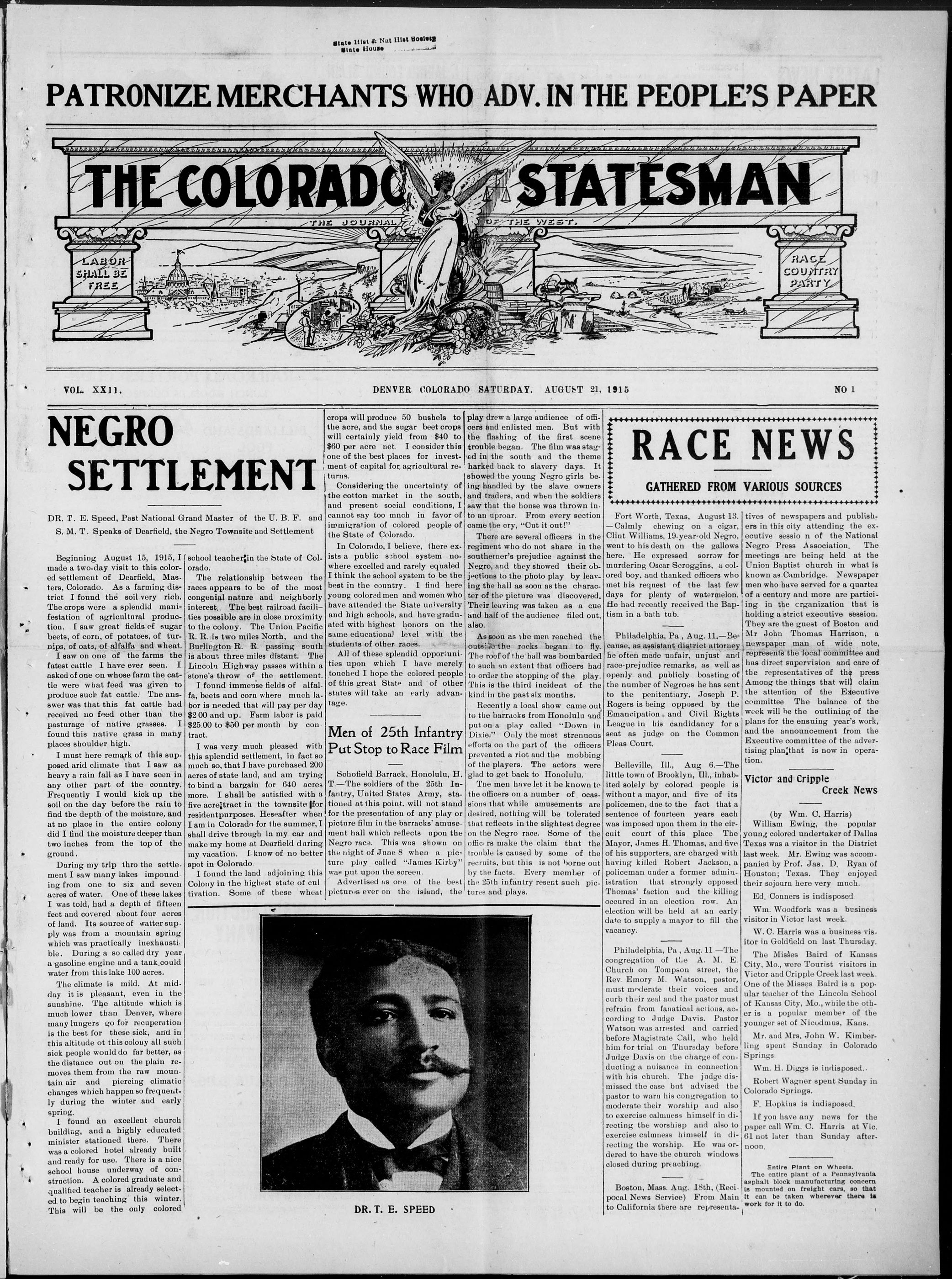
NEGRO SETTLEMENT
DR. T. E. Speed, Past National Grand Master of the U. B. F. and S. M. T. Speaks of Dearfield, the Negro Townsite and Settlement
VOL. XX11.
NEGRO SETTL
DR. T. E. Speed, Past National G.
S. M. T. Speaks of Dearfield, th
Beginning August 15, 1915, I made a two-day visit to this colored settlement of Dearfield, Masters, Colorado. As a farming district I found the soil very rich. The crops were a splendid manifestation of agricultural production. I saw great fields of sugar beets, of corn, of potatoes, of turnips, of oats, of alfalfa and wheat.
I saw on one of the farms the fastest cattle I have ever seen. I asked of one on whose farm the cattle were what feed was given to produce such fat cattle. The answer was that this fat cattle had received no feed other than the pasturage of native grasses. I found this native grass in many places shoulder high.
I must here remark of this supposed arid climate that I saw as heavy a rain fall as I have seen in any other part of the country. Frequently I would kick up the soil on the day before the rain to find the depth of the moisture, and at no place in the entire colony did I find the moisture deeper than two inches from the top of the ground.
During my trip thro the settlement I saw many lakes impounding from one to six and seven acres of water. One of these lakes I was told, had a depth ef fifteen feet and covered about four acres of land. Its source of watter supply was from a mountain spring which was practically inexhaustible. During a so called dry year a gasoline engine and a tank could water from this lake 100 acres.
The climate is mild. At midday it is pleasant, even in the sunshine. The altitude which is much lower than Denver, where many lungers go for recuperation is the best for these sick, and in this altitude of this colony all such sick people would do far better, as the distance out on the plain removes them from the raw mountain air and piercing climatic changes which happen so frequently during the winter and early spring.
I found an excellent church building, and a highly educated minister stationed there. There was a colored hotel already built and ready for use. There is a nice school house underway of construction. A colored graduate and qualified teacher is already selected to begin teaching this winter. This will be the only colored
school teacher in the State of Colorado.
The relationship between the races appears to be of the most congenial nature and neighborly interest. The best railroad facilities possible are in close proximity to the colony. The Union Pacific R. R. is two miles North, and the Burlington R. R. passing south is about three miles distant. The Lincoln Highway passes within a stone's throw of the settlement.
I found immense fields of alfalfa, beets and corn where much labor is needed that will pay per day $2.00 and up. Farm labor is paid $25.00 to $50 per month by contract.
I was very much pleased with this splendid settlement, in fact so much so, that I have purchased 200 acres of state land, and am trying to bind a bargain for 640 acres more. I shall be satisfied with a five acre tract in the townsite for resident purposes. Hesafter when I am in Colorado for the summer, I shall drive through in my car and make my home at Dearfield during my vacation. I know of no better spot in Colorado
I found the land adjoining this Colony in the highest state of cultivation. Some of these wheat
DENVER COLORADO SATURDAY. AUGUST 21, 1915
State Hist & Nut Hist Boosts
State House
GIANTS WHO
ADC
DE JOURNAL
DENVER COLORAD
crops will produce 50 bushels to the acre, and the sugar beet crops will certainly yield from $40 to $60 per acre net. I consider this one of the best places for investment of capital for agricultural returns.
Considering the uncertainty of the cotton market in the south, and present social conditions, I cannot say too much in favor of immigration of colored people of the State of Colorado.
In Colorado, I believe, there exists a public school system nowhere excelled and rarely equaled I think the school system to be the best in the country. I find here young colored men and women who have attended the State university and high schools, and have graduated with highest honors on the same educational level with the students of other races.
All of these splendid opportunities upon which I have merely touched I hope the colored people of this great State and of other states will take an early advantage.
Men of 25th Infantry Put Stop to Race Film
Schofield Barrack, Honolulu, H. T.-The soldiers of the 25th Infantry, United States Army, stationed at this point, will not stand for the presentation of any play or picture film in the barracks' amusement hall which reflects upon the Negro race. This was shown on the night of June 8 when a picture play called "James Kirby" was put upon the screen. Advertised as one of the best pictures ever on the island, the
1910
DR. T. E. SPEED
play drew a large audience of officers and enlisted men. But with the flashing of the first scene trouble began. The film was staged in the south and the theme harked back to slavery days. It showed the young Negro girls being handled by the slave owners and traders, and when the soldiers saw that the house was thrown into an uproar. From every section came the cry, "Cut it out!"
There are several officers in the regiment who do not share in the southerner's prejudice against the Negro, and they showed their objections to the photo play by leaving the hall as soon as the character of the picture was discovered. Their leaving was taken as a cue and half of the audience filed out, also.
As soon as the men reached the outside the rocks began to fly. The roof of the hall was bombarded to such an extent that officers had to order the stopping of the play. This is the third incident of the kind in the past six months.
Recently a local show came out to the barracks from Honolulu and put on a play called "Down in Dixie." Only the most strenuous efforts on the part of the officers prevented a riot and the mobbing of the players. The actors were glad to get back to Honolulu.
The men have let it be known to the officers on a number of ocassions that while amusements are desired, nothing will be tolerated that reflects in the slightest degree on the Negro race. Some of the officers make the claim that the trouble is caused by some of the recruits, but this is not borne out by the facts. Every member of the 25th infantry resent such pictures and plays.
RACE NEWS
Fort Worth, Texas, August 13.—Calmly chewing on a cigar, Clint Williams, 19.year-old Negro, went to his death on the gallows here. He expressed sorrow for murdering Oscar Scroggins, a colored boy, and thanked officers who met his request of the last few days for plenty of watermelon. He had recently received the Baptism in a bath tub.
Philadelphia, Pa., Aug. 11.—Because, as assistant district attorney he often made unfair, unjust and race-prejudice remarks, as well as openly and publicly boasting of the number of Negroes he has sent to the penitentiary, Joseph P. Rogers is being opposed by the Emancipation and Civil Rights League in his candidacy for a seat as judge on the Common Pleas Court.
tives of newspapers and publishers in this city attending the executive session of the National Negro Press Association. The meetings are being held at the Union Baptist church in what is known as Cambridge. Newspaper men who have served for a quarter of a century and more are participating in the organization that is holding a strict executive session. They are the guest of Boston and Mr John Thomas Harrison, a newspaper man of wide note, represents the local committee and has direct supervision and care of the representatives of the press. Among the things that will claim the attention of the Executive committee. The balance of the week will be the outlining of the plans for the ensuing year's work, and the announcement from the Executive committee of the adver-
Belleville, Ill., Aug 6.—The little town of Brooklyn, Ill., inhabited solely by colored people is without a mayor, and five of its policemen, due to the fact that a sentence of fourteen years each was imposed upon them in the circuit court of this place The Mayor, James H. Thomas, and five of his supporters, are charged with having killed Robert Jackson, a policeman under a former administration that strongly opposed Thomas' faction and the killing occurred in an election row. An election will be held at an early date to supply a mayor to fill the vacancy.
Philadelphia, Pa., Aug. 11.—The congregation of the A. M. E. Church on Tompson street, the Rev. Emory M. Watson, pastor, must moderate their voices and curb their zeal and the pastor must refrain from fanatical actions, according to Judge Davis. Pastor Watson was arrested and carried before Magistrate Call, who held him for trial on Thursday before Judge Davis on the charge of conducting a nuisance in connection with his church. The judge dismissed the case but advised the pastor to warn his congregation to moderate their worship and also to exercise calmness himself in directing the worship and also to exercise calmness himself in directing the worship. He was ordered to have the church windows closed during preaching.
Boston, Mass. Aug. 18th, (Recipocal News Service) From Main to California there are representa-
NO 1
tives of newspapers and publishers in this city attending the executive session of the National Negro Press Association. The meetings are being held at the Union Baptist church in what is known as Cambridge. Newspaper men who have served for a quarter of a century and more are participating in the organization that is holding a strict executive session. They are the guest of Boston and Mr John Thomas Harrison, a newspaper man of wide note represents the local committee and has direct supervision and care of the representatives of the press Among the things that will claim the attention of the Executive committee The balance of the week will be the outlining of the plans for the ensuing year's work, and the announcement from the Executive committee of the advertising plan that is now in operation.
Victor and Cripple Creek News
(by Wm. C. Harris)
William Ewing, the popular young colored undertaker of Dallas Texas was a visitor in the District last week. Mr. Ewing was accompanied by Prof. Jas. D. Ryan of Houston; Texas. They enjoyed their sojourn here very much.
Ed. Conners is indisposed
Wm. Woodfork was a business visitor in Victor last week.
W. C. Harris was a business visitor in Goldfield on last Thursday.
The Misses Baird of Kansas City, Mo., were Tourist visitors in Victor and Cripple Creek last week. One of the Misses Baird is a popular teacher of the Lincoln School of Kansas City, Mo., while the other is a popular member of the younger set of Nicodmus, Kans.
Mr. and Mrs. John W. Kimberling spent Sunday in Colorado Springs.
Wm. H. Diggs is indisposed.
Robert Wagner spent Sunday in Colorado Springs.
F. Hopkins is indisposed.
If you have any news for the paper call Wm. C. Harris at Vic. 61 not later than Sunday afternoon.
Entire Plant on Wheels. The entire plant of a Pennsylvania asphalt block manufacturing concern is mounted on freight cars, so that it can be taken wherever there is work for it to do.
LATEST NEWS EPITOMIZED
FROM TELEGRAPHIC REPORTS THAT COVER THE WEEK'S EVENTS.
OF MOST INTEREST
KEEPING THE READER POSTED
ON MOST IMPORTANT
CURREN T TOPICS.
ABOUT THE WAR
Russians are driven toward Petrograd in Poland battle and Von Buelow takes 2,354 prisoners.
The English east coast was again raided by German aircraft. Six persons were killed and twenty-three infured.
The Norwegian steamer Albis, 1,381 tons gross, and owned in Christiania, has been sunk by a submarine. Her crew was saved.
The Russian war office in an official communication admits the evacuation of the towns of Sokolow, Siedlce and Lukow, to the east of Warsaw.
General Villa notifies United States government he will agree to a truce with his opponents during peace conference.
The British transport Royal Edward was torpedoed and sunk. Six hundred men were saved out of 1,350 troops and 220 other persons on board.
Reports received in London from Rumania, Bulgaria and Greece show that military preparations in those countries are being carried on with intense activity.
The Russians are beginning to evacuate the fortified railway center of Bielostok, one of the vital points on the Kovno-Brest-Litovsk line, before the onward rush of Von Hindenburg's armies.
Governor Ferguson of Texas appealed to President Wilson for more troops in Rio Grande valley, declaring situation perilous and grave, and is doubtful if state forces can control it. "Peign of terror exists on border," he says.
The Russian fortress of Kovno is believed about to fall before Von Hindenburg's attack. German troops under Gen. Von Eichhorn have stormed and captured the fortifications defending Kovno, between the Niemen and Jesia rivers, taking 4,000 prisoners and 240 cannon.
The most significant news concerning the near Eastern situation was contained in a brief dispatch from Athens stating that former Premier Venizelos had won a decisive victory over the government in the organization of the Greek Chamber of Deputies. Zavitatzos was elected president, and the Grunaris government resigned.
WESTERN
Jay H. Neff, former mayor of Kansas City, died of heart disease at Cody, Wyo. He was in Wyoming looking after his stock interests. Pawn tickets found in his possession led to the arrest of Manuel Pedis, a Mexican and escaped convict from the New Mexico state penitentiary, in Denver. Twelve business houses, constituting about half of the mercantile section of Upper Rochester, Nev., was wiped out by fire. The loss is said to be over $200,000. Forty Texas beeves, the fattest that could be found, were killed, quartered and dressed for the big barbecue when Houston becomes the newest of the world's seaports.
The Ogden gateway, closed by the Union Pacific in furtherance of a purpose to develop its own territory, has been declared legal in a decision rendered by the Interstate Commerce Commission.
Former President Taft, in an address at St. Louis before the Business Men's League, criticized the chairman of the Industrial Relations Commission for his statement that he did not have judicial poise.
Galveston, Tex., is safe and the water in the streets is receding, according to a wireless message direct from Galveston. The message estimated the loss due to the flood at more than $5,000,000. Three persons perished.
WASHINGTON
The State Department made public the reply of the United States rejecting views set forth by the Austro-Hungarian government in a recent note contending that exportation of war munitions from America to Austria's enemies was conducted on such a scale as to be "not in consonance with the definition of neutrality." Though friendly in tone the note flattly denies the Austro-Hungarian contentions.
Destitution and starvation face the women and children of Haiti, Admiral Caperton advised the Navy Department.
The United States, in a note to Austria-Hungary, published, firmly but politely declines to accede to the request of the Vienna government that the export of arms to the allies be stopped.
In round numbers there were 22,000,000 persons enrolled in educational institutions in the United States in 1914, according to the annual report of the commissioner of education.
FOREIGN
Asiatic cholera has appeared at Cannstatt, Wurttemberg.
Sylvia Pankhurst, famed as a militant suffragist, will not comply with the national registry regulations, she asserts.
Official figures show that on June 1 about 5,000 young women were employed at the Krupp works at Essen, as compared with 1,329 on Jan. 1.
Koloman von Szell, former premier of Hungary, died at Budapest. He resigned the premiership in 1903 and served subsequently as a member of the diet.
There are no fewer than 2,000 Americans in the ranks of the Canadian military contingent, said Maj. Gen. Sam Hughes, Canadian minister of militia at a meeting of Americans held in London.
The civil tribunal of the Seine has sequestrated the property of the German millionaire Herr Jellinek. This property, consisting for the most part of real estate in Paris and the Riviera, is worth about $40,000,000.
France has expended $384,000,000 during the first year of the war in feeding the wives and families of mobilized soldiers and workers thrown out of employment. There are at present 3,000,000 persons receiving allowances from the state.
A dispatch to Fournirs from Rome says that the German Emperor in answer to the peace letter of Pope Benedict XV., declared his willingness to accept; peace negotiations, provided the nations with which Germany was at war made the first overtures.
The project of proclaiming himself Emperor is being discussed by Yuan Shi Kai, President of the Chinese republic, with his immediate supporters and Prof. Frank Johnson Goodnow of Johns Hopkins University, legal adviser to the Chinese government, who is spending the summer in Peking.
SPORTING NEWS
Staffing of Western League Clubs.
Olea ..... Won, Lost, Pot.
Des Munes ..... 77 48 586
Denver ..... 67 48 583
Topeka ..... 60 57 512
Lincoln ..... 57 55 509
Storm City ..... 57 56 469
Omaha ..... 54 63 462
Wichita ..... 48 65 425
St. Joseph ..... 41 70 370
Matty Smith of Racine, Wis., and Harry Bramer of Denver have signed to meet before the Trimidad, Colo., Boxing Club Labor Day.
Joe Rivers of Los Angeles won the decision over Stanley Yoakum of Denver after fifteen rounds of fighting at the National Athletic Club in Denver.
Jimmy Clabby, middleweight, has a "head of his own," and the result is that Larney Lichtenstein, his manager, is shy one fighter. Clabby says he is tired of paying out one-third of his earnings.
Keen rivalry and remarkable shooting were shown at Chicago in the singles target match for the national championship. Shooters banged away and the birds fell so fast scorers almost lost count. W. S. Hoon, newspaper man, Jewell, Iowa, captured amateur honors, breaking 196 out of 200 targets.
Peter Volo broke the world's record for 4-year-old trotters and tied the world's stallion trotting record established by The Harvester when he won the first heat of his match race with Lee Aworthy at North Randall track at Cleveland, Ohio. Time, 2:02. The 5-year-old stallion William won the first heat of his match with Directum I, world's champion racing pacer, Time, 1:58½.
GENERAL
Gen. John C. Black, 75, ex-United States commissioner of pensions, Civil War veteran and ex-congressman, died at Chicago. Gen. Black was commander-in-chief of the G. A. R. in 1903. The value of the English pound sterling went steadily and rapidly downward Monday until it touched $4.64 in American money, the lowest value ever placed upon it since New York became a financial center. The steamship Eastland, which capsized in the Chicago river with the loss of almost 1,000 lives, and which was righted a few days ago, was towed away from its mooring and placed in a shipyard to the order of its owners.
Armed Mexicans in force crossed the Rio Grande at a ford near Mercedes, attacking an outpost of half a dozen cavalrymen at Saenz. Ranger Lieut. Reynau at Mercedes telephoned state Adj. Gen. Hutchings at Brownsville, Tex., that Corporal William of Troop O, Twelfth cavalry, was killed in this fight and Lieut. Roy O. Henry of the same troop was wounded.
Former Gov. John M. Slaton of Georgia declared at San Francisco that it was better than Leo Frank was lynched by a mob than if his legal execution had taken place, in an address before the San Francisco center of the California Civil League. Mr. Slaton's address, devoted almost entirely to discussion of the Frank case and the lynching of Frank, was delivered in the presence of most of the members of the California Supreme Court and other persons of prominence.
Four Denver men, all employés of the Union Pacific railway, were injured when a railroad speeder, on which they were hastening over a long section of the right-of-way, jumped the track on a curve at a point a few miles from Saratoga, Wyo.
A mob overpowered the warden, superintendent and guards of the Georgia state prison farm near Milledgeville Monday night and quickly got Leo M. Frank and rushed him away in an automobile and lynched him at Marietta, Ga., the home of Mary Phagan
OF INTEREST TO ALL
COLORADO
PEOPLE
Western Newspaper Union News Service.
COMING EVENTS.
Aug. 31.Sept. 2.—Grand Lodge, K. of P.
at Colorado Springs.
Aug. 31.Sept. 3.—Melon Festival at
Rocky Ford.
Sept. 10-11—Fall Festival at Flagler.
Sept. 14-17—Morgan County Frontier
Days and Harvest Festival at Fort
Morgan.
Sept. 27-Oct. 8—Meeting International Dry Farming Congress at Denver Oct. 2-3 Fair and Race Meeting at Denver. Oct. 18—Odd Fellows' Annual State Convention at Colorado Springs.
Denver Boy Scouts will start on their summer outing at Platte canon on Aug. 21.
An examination to fill vacancies in the forest service will be held in Denver Sept. 11.
Harry K. Thaw reached Denver Tuesday on his auto trip to the California expositions.
The National Retail Monument Association of America held its annual meeting in Denver.
Mrs. Mary Stewart, 45, a widow, was arrested at Colorado Springs, charged with shoplifting.
Clay Monson will tender to the President his resignation as postmaster at Steamboat Springs.
Colorado hunters are making the most of the fifteen-day open season on doves allowed them by law.
Pedro Perez, a Mexican bean picker, is at the Longmont hospital with a self-inflicted bullet wound in his left lung.
Denver's 3,000 little home gardeners, from the forty-four school districts of the city, celebrated their Harvest festival at City Park.
Ex-President William H. Taft spent a short time in Denver Tuesday. He was on his way to Salt Lake, and from there goes to the California expositions.
Juan Romero, 20 years old, accused of slaying his step-father, Don Jose Romero, a beet rancher, near Longmont, last month, was taken into custody at Boulder.
Miss Theodosia Slothower of Denver, student at the University of Wisconsin, was chosen as one of six young women to typify the American college girl at the Panama-Pacific exposition.
The drill team of Denver camp No. 1, Woodmen of the World, won the first prize of $1,000 in the drill contest held in San Francisco at the silver anniversary celebration of the Pacific Woodmen.
Alfred Douglas, Boston millionaire, is now a Colorado property owner, the resident of fashionable Brookline having purchased 160 acres of improved apple and peach land in Delta county for $80,000.
After a six months' search of warstricken Belgium for his niece, Miss Mary Lorang, a school teacher, John Lorang of Boulder located her and they reached New York on the way back to Colorado.
Homer Hagan, 33, a rancher living five miles south of Glenwood Springs, was killed and the top of his head cut off in an automobile accident at the Three-Mile bridge, three miles south of Glenwood Springs.
George Daniel, who has just assumed charge of his new office as postoffice inspector in charge of the Denver district, is a Denver man, although for years he has been located in New York, St. Louis and Cheyenne.
Mrs. Mary A. J. Crees, 77, who was a daughter of James Patrick Caldwell, one of the three survivors of the American ship Chesapeake, sunk by the British frigate Shannon in the war of 1812, died at her home in Boulder. She came to Colorado in 1861, living first at Central City.
Praying for death, after once having "died" and been restored to life, Robert Burns, 30 years old, whose real name is Robert Goodman, Jr., of Rochester, N. Y., passed away in the county hospital in Denver. Death resulted from the effects of a double dose of carbolic acid which he drank during a fit of despondency. Sweethearts in youth, friends when each had married another after they came of age, sweethearts again after each had been bereft of spouses, Ralph Eugene Wood and Mrs. Flora E. Barnes sent John G. Wood, a brother of the bridegroom-to-be to the court house in Denver to secure a marriage license in order that the couple might marry.
Beneath a lonely tree two miles west of Manhattan beach the police of Denver found a cache of $150 in coin and bills and several valuable pieces of jewelry. It was the "plant" of Meriel McGrady, 19, alias Frank Crume, confessed burglar. The youth disclosed to the police plans for a series of robberies of Denver homes and confessed to breaking into two houses. The money and jewelry discovered were stolen from the home of Herman Rothman in Englewood.
Frederick Emerson, hermit of the Colorado & Southern railroad yards and man of mystery for more than twenty years, died at St. Joseph's hospital in Denver with his lips sealed as to his identity and the whereabouts of his relatives.
After a search lasting five months, during which he offered a reward of $1,000 for any information concerning his 4-year-old daughter, Thomas McIntire of Denver by accident located the child in the Juvenile Court just as papers for the little one's adoption were being prepared.
J. JAKINO FOUND SLAIN
COAL CAMP MERCHANT MURDERED FOR HIS MONEY.
La Plata County Business Man Was Shot Through the Head at Parin's Peak.
Western Newspaper Union News Service
Durango, Colo.—Shot through the heart from behind and with two holes in his head made with an ice pick, John Jakino, 50, a saloon man and merchant of Parin's Peak, a coal mining camp four miles from here. Was found dead in his place of business by his wife. He had been murdered as he was about to close the saloon. His body was found near the rear door with the door key, covered with blood, clutched in his hand.
The murderers were frightened away by a porter, who heard the shot, before they obtained any money. The lock of a small drawer containing several hundred dollars was partly broken off and $70 in a cash register was lost to the burglaries by the sticking of a key, when they tried to open it.
The authorities are offering $100 reward for information leading to the arrest of a Tyrolean and an Italian, who had been hanging around the camp for several days. One is named Joe Spot, an Italian, about 20 years old, and rather heavy and of medium height. The other is Felix Cavernao, a Tyrolean, 35 years old, who wore khaki trousers, corduroy or black coat, and weighed 175 pounds. He has a small reddish mustache. Jakino was known to carry several thousand dollars on the fifteenth of every month to cash pay checks for the miners. This was the money the murderers sought.
Ship $72,315 in Gold.
Breckenridge, Colo. — Placer gold amounting in value to $72,315 was shipped during the first two weeks of August from the Breckenridge district to Denver. All but $615 was the result of dredging the stream beds by four gold dredging boats which are operated by electric power. The $615 was from a couple of high-bar placer, which are operating with only a partial supply of water.
The placer gold deposits in the Blue river and its tributaries extend from the head of Hoosier gulch to the Grand river, a distance of approximately over sixty miles. There are numerous "local sources" of gold in the hills of the numerous small creeks and gulches which have contributed liberally to the gold enrichment of the main stream. There is certainly plenty of room for the profitable operation of an additional number of modern gold dredges in Summit county, besides the four dredge boats now operated in the Breckenridge district.
Pythian Knights Meet Aug. 30.
Colorado Springs.—Fully 2,000 delegates are expected to be here for the Colorado grand lodge of the Knights of Pythias and the grand temple of Pythian Sisters, which meet in this city Aug. 31 and Sept. 1 and 2. Complete plans for the care of the visitors have been worked out by Edgar Payton, undersheriff of El Paso county, who is chairman of the executive committee, and Frank F. Schreiber, grand chancellor of the Colorado domain, Knights of Pythias. The official program starts Monday, Aug. 30, with a reception to delegates and addresses by Mayor McKesson of Colorado Springs and Chancellor Schreiber. Resplendent escorts of grand lodge officers, a night street parade and an exhibition drill by the color guards of Denver Lodge No. 41 will be features Tuesday. Wednesday, from 1 to 11 p. m., the famous photoplay, "Damon and Pythias," will be exhibited by Colorado Springs Lodge No. 34.
Terrific Hail Storm Near Boulder.
Boulder.—The most terrific and damaging hall storm which has visited this section of the state in years fell at Gold Hill, Magnolia and Salina Window panes were broken in many houses, while flower and vegetable gardens were obliterated. Hall stones almost as large as hens' eggs fell, and after the storm the ground was covered with six inches of ice and water
Missing Girl, 22, Weds Farmer, 60.
Missing Girl, 22, Weds Farmer, 60. Fort Collins.—The sudden disappearance several days ago of Miss Etta Thomas, 22-year-old daughter of Charles Thomas, residing west of this city, was solved with the return of the young woman as the bride of C. F. Luther, 60, a wealthy farmer near here, who was divorced from his first wife six weeks ago.
May Call Extra Senate Session.
Denver.—An extra session of the Sate Senate may be called to confirm appointments made by Governor Carlson since adjournment of the regular session of the Twentieth General Assembly April 10 last.
Memory of Well-Dressed Youth Gone. Pueblo.—Suffering from amnesia or aphasia, a well-dressed young man of about 21, with money in his pocket, was found mumbling to himself on the lawn of St. Mary's hospital. The only intelligible words he has uttered since are "Novia Scotia" and the police will seek identification from Canadian authorities.
Dr. Schultz Killed in Auto Wreck. Denver.—Dr. Louis H. Shultz, prominent Denver physician, was instantly killed when his automobile skidded over an embankment.
The
Curtis
Park
Floral
Company
FLORAL DESIGNS PUT UP WHILE
YOU WAIT
CHOICE PLANTS AND CUT FLOWERS CONSTANTLY
ON HAND
GREENHOUSES: Thirty-Fourth and Curtis Streets
TELEPHONE, MAIN 1511
DENVER, COLO
W. C. CAMPTON, Pres. J. M. JOHNS, Treas. U. P. JACKSON, Sec. RAILROAD PORTERS' CLUB LUNCH ROOM IN CONNECTION
BILLIARDS AND POOL
1728½ Wazee St. Only
281/2 Wazee St. Only one block from Union D
17281/2 Wazee St. Only one block from Union Depot.
PHONE MAIN 8416. DENVER, COLORADO
The Champion
Twentieth and
Is the place
DRUGS, CHEMICALS AND
WE SERVE
Prescriptions
Phone us and we will deliver the
JAMES E. TH
PHONE M
THE ZOBEL
SAMPLE
1004 Nineteenth St
Champa Pharma
Twentieth and Champa,
Is the place to get your
CHEMICALS AND PATENT M
WE SERVE DRINKS.
Descriptions Our Special
and we will deliver the goods to all parts
JAMES E. THRALL, PR
PHONE MAIN 2425.
E ZOBEL BROTHE
AMPLE ROO
Nineteenth Street, Corner of
Twentieth and Champa,
Is the place to get your
DRUGS, CHEMICALS AND PATENT MEDICINES
WE SERVE DRINKS.
Prescriptions Our Specialty.
Phone us and we will deliver the goods to all parts of the city.
JAMES E. THRALL, PROPR.
PHONE MAIN 2426.
1004 Nineteenth Street, Corner of Curtis
FINE WINES, LIQUORS AND CIGARS
COORS' CELEBRATED BEER ON TAP
---
The
WARD AUCTION
COMPANY
Sales Daily at 2 p.m. Office Furniture a Specialty.
PRIVATE SALES AT ALL TIMES
HAVE MOVED TO—
1723-39 GLENARM ST.
PHONE MAIN 1675.
THE BEST ICE CREAM AND
CANDIES AT
O.P. BAUR & CO.
CATERERS AND
CONFECTIONERS
Phone: 168
1512 Curtis Street, Denver, Colo.
DO IT NOW Subscribe
for THIS
PAPER
---
---
DENVER
FREE CHECK ROOM
ne block from Union Depot.
DENVER, COLORADO.
a Pharmacy
and Champa,
to get your
D PATENT MEDICINES
DRINKS.
Our Specialty.
the goods to all parts of the city.
IRALL, PROPR.
AIN 2426.
BROTHERS'
E ROOM
eet, Corner of Curtis
TELEPHONE YORK 6668.
GENERAL FURNITURE REPAIRING AND UPHOLSTERING.
WORK GUARANTEED.
1417 East 24th Avenue, Denver, Colo.
Miss M. Cowden
Hair Dressing Parlor
Shampoo, cutting and curling.
Scalp treatment, hair tonics,
hair straightening, manicuring.
Stage wigs for rent; theatrical
use and masquerades.
Goods delivered out of the city. All shades of hair matched by sending sample of hair; also combings made up.
Cheapest Switches 50 Cents
1219 21st St. Denver, Colo.
MILK MILK
COLORADO
AFRO-AMERICAN CULLINGS
In his "The Education of the Negro Prior to 1861" (Putnam's), C. G. Woodson says of the abolitionist agitation that it excited the more active minded of the Negroes. The story of Toussaint l'Ouverture and the talk of the rights of man that followed after the French revolution were disturbing influences. About Baltimore, Norfolk, Charleston and New Orleans insurrectionary ideas were spread by Negroes coming from unhappy Santo Domingo in 1793. In 1800 "General" Gabriel, a slave, led an uprising in Virginia, and there was one in South Carolina. In 1816 Camden and in 1822 Charleston were threatend by Negro plots. Denmark Vesey, a slave who had bought his freedom, was an arch-conspirator. There were uprisings, more or less extensive, in North Carolina, and in 1831 Nat Turner's mad raid spread terror among the white folks of Southampton county, Virginia.
While these disorders were going on, however, the elementary education of the mass of the colored population was proceeding quietly. That it should do so was simply inevitable. Inumerable cases are cited of slaves, intelligent and ambitious and not at all inclined to political rebellion or anarchy, who learned to read and write and make good use of those fundamental acquisitions in advancing themselves along the road to "higher" learning. In their own upward progression they lifted others, the natural and efficient form of "uplift."
When in its later phases the colonization movement centered upon Liberia its more liberal advocates favored higher education for Negroes in the hope that enlightenment would make them so discontented with the lot of their race in this land that they would voluntarily emigrate. In the South the general feeling among colonizationists was that the education should be conditional on expression of intention to carry it away from the American Negro. The promoters of the scheme planned to educate young Negroes in "mechanic arts, agriculture, science and Biblical literature," while the exceptionally bright ones were to be fitted for professional life and for public office. A curious museum of antiquities is the result of this investigation; from a school opened at Parsippany, N. J., in 1817 to give a four-year course to "African youth" of "talent, discretion and piety" and similar efforts at Newark, N. J., and Hartford, Conn., to the African Education society and the scramble for the "Kosciuszko fund" that seems never to have existed but in the imagination of the colonizationists.
Unyielding opposition of free Negroes and abolitionists, who "could see no philanthropy in educating persons to prepare for doom in a deadly climate," kept the institutions planned by the colonizationists from materializing. At Philadelphia in 1830 a "convention of the free people of color" centralized the opposition. Thereafter the colonizing propaganda in this country was concentrated upon individual cases, and the policy of push was changed to one of pull; that is to say, the plan was to make Liberia attractive instead of making the United States repulsive.
It was in 1816 that the National Colonization society of America was organized, that strange compound of sentiment and business. Lieutenant Stockton made a treaty with native princes in 1821. The native headmen themselves were slow to give up their
When it is realized how far the Negro has come in the last fifty years it is not hard to account for the extent and degree of confidence in his future. The census of 1910 shows that two out of every five persons engaged in gainful occupations in the 16 southern states are Negroes. Of the entire Negro population in these states 63 per cent are in some form of industrial occupation. Of all the Negroes engaged in industrial activities 60 per cent are agricultural workers. Something like a million Negroes have developed from agricultural laborers to farmers in 50 years.
the efforts of the colored man to help himself have been strongly in his favor, for they have inspired the confidence of the white people and made a plan of co-operation between the two much easier than it would otherwise have been. Because of this new valuation of the agricultural or industrial Negro there has come a truer appreciation of the human qualities involved.
There has been the feeling that the fine qualities in the character of the faithful slave were the fruitage of
Signor Marconi has been inspecting the wireless stations of Italy, and has found them ready for any war emergency.
The erection of two universities, one at Cape Town and the other at Pretoria, is being urged by a government commission.
It is all right for a woman to pretend her dinner was a failure, but it is a wise husband who disagrees with her.
end of the slave trade, but by 1822 their objections were overcome and settlement was begun. It was in 1847 that the colony was made independent, marking the end of an extraordinary episode of mixed philanthropy and politics.
A suit was filed in the Supreme court to gain compensation for work performed by slaves during the years from 1859 to 1868, in the production of cotton in the southern states and preparation of this cotton for the market. William G. McAdoo is made the defendant in his official capacity as secretary of the treasury. The plaintiffs are H. N. Johnson of Louisiana; R. Bowers of Texas; C. B. Williams of Mississippi, and Mamie Thompson of Tennessee, who say in the bill of complaint that they sue for themselves and others similarly interested.
The bill sets forth that the secretary of the treasury of the United States obtained possession, and the defendant herein now holds the custody, of certain money which was a part of the fruit of the labor of the plaintiffs amounting to $68,072,388 under "internal revenue tax on raw cotton," and that this sum is not the legitimate property of the United States, and should be paid to those by whose labor the cotton yielding this revenue was produced.
Another paragraph of the bill reads: "Plaintiffs and such of them as claim here as heirs were subject to a system of involuntary servitude in the above named states, and other states commonly known as the Southern States."
Referring further to the conditions under which the services were rendered, the petition says:
"That the system of involuntary servitude by which plaintiffs were dominated, to wit: under and by force plaintiffs and their ancestors, against their free will of action and by coercion and justifiable fear of bodily injury or destruction, to render said labor."
The petition was filed by Attorney E. M. Hewlett, as the local attorney representing Attorneys Cornellus J. Jones of Muskogee, Oklahoma, and H. A. Guess. Jones, who is said to have prepared the bill of complaint, is a colored lawyer. The petition asks that the case be referred to a master in chancery, to take proof of the claims of the parties interested, and that a bill of discovery be issued to ascertain among whom the money shall be distributed and the amounts that each shall receive, and to have the secretary of the treasury disclose the source from which the sum held by him was derived.
When a man gets married the other fellows tell him he's a lucky dog. But there is no certainty about it either way until he has been married four or five years.
A "live wire" who visited our town last week moved on as soon as he learned that the custom here is to exact cash in advance from those who follow his profession.
If an attempt were made to pick out the meanest man in town you would get some votes and so should we.
Most of the values are fixed by fools in the possession of money.
hardships and careful training, and there was a doubt about these qualities springing from a different, freer soil. But southern whites are now coming to believe that these qualities depended not upon accidental conditions of slavery, but resided in the possibility of their human nature. The basis of this conviction is distinctly religious. White people have greater confidence in the Negro because they have greater confidence in all humanity.—Marc N. Goodnow, in the Chicago Daily News.
The North sea is the greatest fishing ground in the world, and, despite the great activity of the fishermen, there seems to be no diminution of the catch.
There is no fixed standard. Many regard the bestowal upon a candidate for initiation of the side degrees of a lodge as a highly humorous proceeding.
An extensive deposit of asphalt of high quality has been discovered in the Philippines.
If you have children of your own you will be worried by them. If you have no children you will be worried by well-meaning persons who want you to adopt children.
It is hard to improve on Eph Wiley's system. Eph gets everything he wants at home and is permitted to do as he pleases by telling his wife he loves her.
A dollar in a man's pocket is worth two that he owes.
NOTE TO GERMANY
UNITED STATES ACCEPTS KAISER'S INDEMNITY PROPOSAL.
Germany Asked to Explain Interpretation of Existing Treaty on Naval Warfare.
Washington, Aug. 18.—The American reply to Germany's last note on the sinking of the American sailing ship Wm. P. Frye, made public here by the State Department, accepts the proposal that damages be fixed by a mixed commission and that the disputed treaty provisions be submitted to arbitration at the Hague, but calls on Germany for a statement meanwhile as to whether she intends to conduct her future naval operations in accordance with her interpretation of the Prussian-American treaty, or that of the United States. The note is regarded as putting the noted case well on the way to settlement. It is addressed by Secretary Lansing to Ambassador Gerard at Berlin. The note, in part, follows:
"You are instructed to present the following note to the German minister of foreign affairs:
"Under instructions from my government I have the honor to inform your excellency in reply to your note of July 30 in regard to the claim for reparation for the sinking of the WmP. Frye that the government of the United States learns with regret that the objections urged by it against the submission of this case to the prize court for decision have not commended themselves to the imperial German government and it equally regrets that the reasons presented by the imperial German government for submitting this case to the prize court have failed to remove the objections of the government of the United States to the adoption of that course.
"As this disagreement has been reached after the full presentation of the views of both governments in our previous correspondence a further exchange of views on the questions in dispute would doubtless be unprofitable and the government of the United States therefore welcomes your excellency's suggestion that some other way should be found for settling this case.
"The two methods of settlement proposed as alternative suggestions in your excellency's note have been given careful consideration and it is believed that if they can be combined so that they may both be adopted they will furnish a satisfactory basis for the solution of the question at issue.
"The government of the United States has already expressed its desire that the question of the amount of indemnity to be paid by the imperial German government under its admitted liability for the losses of the owners and captain on account of the destruction of the Frye should be settled by diplomatic negotiation and it entirely concurs with the suggestion of the imperial German government that the simplest way would be to agree, as proposed in your note, that each of the two governments designate an expert and the two experts jointly fix the amount of indemnity for the vessel and any American property which may have been sunk with her, to be paid by the imperial German government when ascertained as stated in your note. It is assumed that the arrangement will include some provision for calling in an umpire in case the experts fail to agree."
Wilson Names Hawaiian Judge.
Washington.—President Wilson appointed William L. Whitney of Hawaii a judge in the First Circuit Court of Hawaii. William W. Russell was appointed American minister to the Dominican republic.
Davidson Holds Officials Blameless.
Milledgeville, Ga.—Prison officials here are held to be blameless in connection with the kidnapping of Leo M. Frank from the state prison farm, in a statement given out by R. E. Davidson, chairman of the State Prison Commission, Mr. Davidson, with Commissioners Railey and Patterson, were here to inspect the penitentiary when Frank was seized. Mr. Davidson's statement said that as the band worked so quickly and was so well organized, and immediately upon its arrival at the prison so completely controlled the situation that "no responsibility rested upon either the commission or anybody at the farm."
Governor Will Investigate Lynching.
Fitzgerald, Ga.,—Governor N. E. Harris, who came here early Monday to attend the annual reunion of Confederate veterans, announced that he would return to Atlanta for the purpose of aiding the prison commission in an investigation of the lynching of Leo M. Frank. "The people are entitled to all the facts in the case," said the governor, "and I propose to see they shall have them."
Bar Hillyer as Strike Case Judge.
Denver.—The Supreme Court granted a writ of prohibition barring Judge Granby Hillyer of the Third judicial district at Walsenburg from presiding in the trials of John Burke and Charles Haines and of K. Uyada, former coal mine strikers. At the same time the court issued a writ of superseeds staying the judgment of the District Court at Trinidad which found John R. Lawson, international board member of the United Mine Workers, guilty of murder in the first degree with a penalty of life imprisonment
GRAIN CROPS INCREASE
LARGER YIELD OF WHEAT, OATS,
POTATOES AND BARLEY.
Value of Corn to Be Harvested This
Year Will Reach $2,500,000,000
Is Federal Forecast.
Denver: Wheat, oats, barley and potatoes in Colorado will exceed the 1914 production for the period ending the last of August, according to figures compiled by the Bureau of Crop Estimates working in co-operation with the United States Weather Bureau.
The August crop report shows that the preliminary estimate for the winter wheat production is 6,970,000 bushels, while the final figure for 1914 was 6,250,000. Spring wheat, in 1914, was 5,062,000 bushels, compared with 6,140,000 for this year.
The forecast Aug. 1 for oats is 13,000,000 bushels, compared with the same figure for 1914. Barley has increased from 3,966,000 bushels to 3,990,000. Potatoes have increased from 8,760,000 bushels to 8,940,000.
Hasty Gets Part of Lewis' Salary.
Denver.—In unraveling the tangled web concerning the salary of Gov. Carlson while out of the state, resulting in Lieut. Gov. Moses E. Lewis drawing the governor's salary for half the month of July, it has been discovered that the former is to be docked for half his monthly salary in favor of Dr. John S. Hasty of Lamar, president pro tem of the Senate. Under the new law as interpreted by State Auditor Mulnix the lieutenant governor automatically becomes governor when the latter is out of the state, and the president pro tem of the Senate becomes Lieutenant governor. Out of his salary of $1,000 a year Lieut. Gov. Lewis forfeits to Senator Hasty $41.66 or half of his salary for the month of July.
Auditor to Probe Risley Books.
Denver—The appointment of R. W. Bradford to make an examination of the books of State Printing Commissioner Henry W. Risley was revoked and Gov. Carlson requested Harry Mulnix, state auditor and public examiner, to make the examination. This examination is preliminary to the filing by Governor Carlson of formal charges against Risley, accusing him of misconduct in office, which will be lodged with the Civil Service Commission. An order was made several days ago suspending Risley from office.
Pennsylvanians to Visit Denver.
Denver.—M mayor Sharpley received notice that members of the Panama Pacific Exposition Commission of Pennsylvania and their wives, a party of about 100 persons, will arrive in Denver Aug. 25 on their way to the exposition. The party will be headed by Governor Martin G. Brumbaugh of Pennsylvania. It will remain in the city two days and will be entertained in Denver by city and state officials and various civil organizations.
Schools Placed Under
Schools Placed Under Compensation
Denver.—The Denver school district and all other taxing units in the state are under the workmen's compensation law and must comply with its provisions regarding the protection on their employés through workmen's compensation. Attorney General Farar held that the law is clear on this point when he rendered a decision at the request of the State Industria Commission.
McGaffey Named on Auditing Board
Denver.—J. E. Davidson, for two and one-half years secretary of the State Auditing Board and clerk of the State Board of Equalization, resigned and A. B. McGaffey, former secretary of state, was named as his successor
Auditing Cañon City Prison Accounts
Denver.—State Auditor Harry Mulnix has begun an audit of the accounts of the state penitentiary at Cafon City. The examination is based on a contention of various state officials to the effect that upwards of $33,000 had been expended by Warden Tom Tynan in excess of the appropriation allowed by the Legislature. Mr. Tynan contends he has special authorization from Governor Ammons. Present state officials contend that the expenditure was illegal.
Carpenter, Job and Repair Work.
Paints, Oils and Glass.
Coal, Wood
1021 21st Street.
Coal, Wood and Express.
Coal, Wood and Express.
THE Giant FOR QUALITY.
CLEANING, PRESSING
ING, RELINING A
WORK CALLED FOR
2549 Washington Avenue
ING, PRESSING, DYEING, REPAIR- RELINING AND REMODELING. WORK CALLED FOR AND DELIVERED Boston Avenue Denver, Colorado
CLEANING, PRESSING, DYEING, REPAIRING, RELINING AND REMODELING.
WORK CALLED FOR AND DELIVERED
2549 Washington Avenue Denver, Colorado
JOHN K.
Meats, Fancy and
1864 CURTI
JOHN K. RETTIG Fancy and Staple Groceries 1864 CUETIS STREET eighteenth. Denver, Colo.
The Market
Wholesale and Retail Staple and
Oysters. Hotels and Re
Fresh and Cured
Eastern Corr
Market Company and Retail Staple and Fancy Groceries, Fish anders. Hotels and Restaurants Our Specialty. Cured Eastern Corn Fed Meats
The Market Company
Wholesale and Retail Staple and Fancy Groceries, Fish and Oysters. Hotels and Restaurants Our Specialty.
Eastern Corn Fed Meats
Fruits, Vegetables, Poultry and Game.
1683-89 Arapahoe Street Denver
C. H. SHIRLEY, Pres. J. C. HAMPSON
PAUL J. SHIRLEY, Sec. and Treas.
THE ATLAS DRUG C
Courteous Treatmet. Right I
Leaders in Prescription
RLEY, Pres. J. C. HAMPSON, Vice Pres. PAUL J. SHIRLEY, Sec. and Treas. THE ATLAS DRUG CO. eous Treatmet. Right Prices Leaders in Prescription
C. H. SHIRLEY, Pres. J. C. HAMPSON, Vice Pres PAUL J. SHIRLEY, Sec. and Treas.
THE ATLAS DRUG CO.
Courteous Treatmet. Right Prices Leaders in Prescription
Dr. Westbrook
Office 31 Good Block
16th & Larimer sts.
Phone Main 1433
Out of Office and af
nights Call Residence,
2714 Arapahoe Street
Phone Champa 570
$50.00 PER MONTH, MADE DURING
YOUR SPARE TIME. Selling
the High Quality, high
society outfit, instructions and solicitor's certificate.
This is the chance of a life time for any enterprising
pursuer. Be the first one in your community
to purchase this beautiful, eco-friendly
Doll, the beauty of modern invention,
and the joy of innovation and catalog.
NATIONAL NECRO DOLL COMPANY,
613 Second Ave., N.
Nashville, Tenn.
Office 3131 $ \frac{1}{2} $ Kittridge Bldg.
Phone Main 7416
Residence 822 32nd St.
Phone Main 8397
T. Ernest McClain, A.B.D. D. S.
Sundays and Nights by Appointment.
Office Hours: -8 a. m. to 12 m
2 p. m. to 6 p. m.
"STETSON HATS OUR SPECIALTY"
Phone Main 3661.
"BROWN, THE HATTER"
HATS CLEANED AND BLOCKED
50 CENTS
SATISFACTION GUARANTEED
A Trial Will Convince You.
718 1/2 18TH STREET.
---
You Have Tried the Rest Now Try the Best
PHONE MAIN 3028
Corner Nineteenth.
Phones Main
169, 181, 189, 190
Store No. 1.
2701 WELTON ST.
Main 895 875
Glazing Done
Phone Champa 752
Our Prices Reasonable
Satisfaction Guaranteed
CLEANERS
AND
TAILORS
McCAIN & RICHARDS, PROPS
Phone Main 7376
RES. PHONE GALLUP 942
```markdown
```
Denver, Colo.
C. E. Smith, Manager
Res. Phone South 1308
Denver, Colorado
Store No. 2.
26TH AND WELTOM
Main 4955-4956
Weatherhead Hat Co
```markdown
```
We Make Old Hats New
PRACTICAL HATTERS
RENOVATORS, BLEACHERS,
DYERS AND FINISHERS
Of Gents' and Ladies' Hats of Every
Description.
THE COLORADO STATESMAN
A LABOR
SMALL BE
FREE
A NATION
COURTIN
PARTY
JOS. D. D RIVERS.....Proprietor
1824 Curtis Street, Room 25.
SUBSCRIPTION RATES:
One Year SUBSCRIPTION RATES: $2.00
Six Months $1.00
Three Months $0.60
PAYABLE IN ADVANCE.
Entered as second-class matter at the postoffice in the city of Denver, Colorado.
It occasionally happens that papers sent to subscribers are lost or stolen. In case you do not receive any number when due, inform us by postal card and we will cheerfully forward a duplicate of the missing number.
Communications to receive attention must be newsy, upon important subjects, plainly written only upon one side of the paper; must reach us Tuesdays, if possible, anyway, not later than Wednesdays, and bear the signature of the author. No manuscript returned, unless stamps are sent for postage.
Remittances should be made by Express Money Order, Postoffice Money Order, Registered Letter or Bank Draft. Postage stamps will be received the same as cash for the fractional part of a dollar. Only 1-cent and 2-cent stamps taken.
No discounts allowed on less than three months' contract. Cash must accompany all orders from parties unknown to us. Further particulars on application.
Reading notices, ten lines or less, 10 cents per line. Each additional line over ten lines, 5 cents per line.
All communications of a personaging nature that are not complimentary will be withheld from the columns of this paper.
AN INVITATION.
From the returns of mining and agricultural industries in Colorado it is apparent that a restoration of the financial greatness of the state is at hand, and the prospect as we are impressed is very encouraging. But there's a quality attached to this invitation to farmers and miners, and that is: the pioneer days and the days of adventure are past, and so prospectors must come financially garrisoned so that they can be in the position to fraternise with those who have preceded them, thereby creating harmonious workings among them. This is not applicable to the big financier, but also the man of pretty fair or moderate means, as there are claims that are being offered by the government in sections and quarter sections, and the conditions attached for ownership are so easy to be filled that hardly has a claim been forfeited after taken up.
The climatic conditions which are enjoyed by everyone who enters the Rocky Mountain region prove a source of health to the seeker, and that element is in itself an inducement to the right man for the right place. Already there are farmers from the Southland located in different parts of the state, and they are confirmed in their opinion that everything bids fair to successful results from investments. What with the rebuilding of the European nations after the war; what with the great and rapid increase of our American export trade and the demand upon our country for substantial support, there is every reason of superabundant success as well as financial progress for every investor. Get in now and insure against overwhelming odds that may arise.
DO YOUR DUTY.
Knowledge dwells in heads replete With thoughts of other men, Wisdom in minds attentive to their own.
-Shakespeare.
We have been asked again and again by many of our faithful subscribers as well as others of the public why we do not publish a daily paper, a triweekly or something more than a weekly issue, and after giving their inquiry the most careful consideration, we have come to the conclusion that the answer can be summed up in these few words—the lack of knowledge of the public's duty and obligation to the press, which is not only an invaluable medium of information among the peoples of this vast universe, but also an essential desideratum to their very existence. If one would respond or accept an invitation to go with the newspaper man through the various ramifications of the press and its publications, it would be readily discovered that the work attached or the duty devolved on him to procure and insure good, healthy, readable, intelligent and sound matter for the public is not quite as easy as the mere reading of the published accounts of what is transpiring the country over, yea, the very world at large; but it is the result of arduous toil, sleepless nights, continuous travels in mental and physical realms, which at times would almost tempt one to give up, were not the bull-dog tenacity present at every stage of action forbidding this wonderful agent—this master worker, this influence which materially shapes the destinies of nations by its resolution to interchange ideas with thoughts of others—never to falter, never to give up, but continue in its good work until the intellectual mind is aroused and the dormant faculties awakened to their duty, their responsibility and obligation to an institution which is unlimited in its resources and all-powerful in its magnitude.
For these many reasons this paper that is being read in all parts of the world, from the icy esklimo region to the antipodes, is placing emphasis on the necessity of the people of our race taking a greater part in the press and meeting their obligations financially and otherwise, giving their unstinted support to a cause, the harvest of which will be superabundant and enjoyed by all. The old school days' topic—"Which is mightier, the pen or the sword?"—has always echoed and re-echoed in our growth, and if we can remember the grand array of scholarly arguments that used to be brought out, then giving the PEN the pre-eminence can be still entertained, and therefore no excuse should be offered for the non-fulfilment of an obligation or a dereliction of duty.
On behalf of the press, therefore, The Colorado Statesman in its message strongly reminds the members of the race that upon themselves depends their destiny, and the stronger the foundations of the press in this or any other country we inhabit the more gigantic will be the literary and educational superstructures which will form the great bulwark that will withstand any assault against our present and future progress. Rouse, then, from your lethargy and DO YOUR WHOLE DUTY TODAY.
Great Menace of Content to Man By Phillip Brooks, Kansas City, Mo.
It is in this truth that I find the real secret, the deepest meaning, of the everlasting dissatisfaction of man that is always ready to be stirred. We moralize, we philosophize about the
discontent of man. We give little reasons for it; but the real reason for it all is this, that which everything lying behind really signifies, that man is greater than his circumstances, and that God is always calling to him to come up to the fullness of his life.
Dreadful will be the day when the world becomes contented, when one great universal satisfaction spreads itself over the world. Sad will be the day for every man when he becomes absolutely contented with the life that he is living, with the thoughts that he is thinking, with the deeds that he is doing, when there is not forever beating at the doors of his soul some great desire to do something larger, which he knows that he was meant and made to do because he is the child of God. And there is the real secret of the man's struggle with his sins.
It is not simply the hatefulness of the sin, as we have said again and again, but it is the dim perception, the deep suspicion, the real knowledge at the heart of the man, that there is a richer and a sinless region in which it is really meant for him to dwell. Man stands separated from that life of God, as it were, by a great, thick wall, and every effort to put away his sin, to make himself nobler and a purer man, is simply his beating at the inside of that door which stands between him and the life of God, which he knows that he ought to be living.
It is like the prisoner hidden in his cave, who feels through all the thick wall that shuts him out from the sunlight and the joyous life that is outside, who knows that his imprisonment is not his true condition, and so with every tool that his hands can grasp and with his bleeding hands themselves, beats on the stone, that he may find his way out.
Are the richest kiddies the happiest in the land or are the happiest babies the richest in the land?
The millionaire mother who raises her little son like a crown prince and has
Question of Interest to All Motherhood
By M. L. Danforth, Denver, Colo.
Are the richest kiddies the happiest in the land or are the happiest babies the richest in the land?
The millionaire mother who raises her little son like a crown prince and has him guarded as if he were going to some day inherit a throne, thinks her baby is the happiest in the land, but other fond mothers think she is mistaken.
They believe that only a "poor" baby can be really happy.
When the "poor" child is a babe in arms the mother hangs over it, puts the tiniest stitches in the precious baby dresses and kisses it at every cry.
When it begins to walk and falls over the threshold, it is the mother and not a stern governess who runs and picks him up.
The "poor" baby is left to play alone sometimes and given a chance to spill a bottle of ink or pour mamma's best perfume out of the window "to see it wain."
This baby can play in a sand pile on pleasant days and have countless pans and dishes to pass the time away and make mud pies and play with rag dolls and have just oodles of fun!
As the last hours of the day draw near baby tries to make the best of the time that is left him.
The rattles rattle louder than ever, the toy horses rock harder and the small voices get stronger and shriller.
Baby doesn't need a mind to put him to bed and stay with him because he knows the bogey-man can't get him while mamma is near.
Rag dolls, mud pies and—oftentimes even mamma is denied the richest babies.
That's what makes us think these rich babies are not the happiest babies. Do you?
Substantial Tax for the Jitney Bus By R. L. Coxey, San Francisco, Cal.
The California supreme court has decided that the drivers of jitney automobiles may rightfully be asked to pay a substantial license tax and also to furnish bonds for good behavior.
ior and for accident liability. The restrictions imposed were so obviously in the public interest that the result was a foregone conclusion. There will be very few to cavil at it.
Perhaps it is too soon to predict that the advent of the jitney was a mere temporary spasm and that it will presently occupy a very small space on a back page of municipal history. But the jitney will certainly become inconspicuous and innocuous, and this would inevitably happen even without the aid of the new restrictions. In its inception it was but a phase of the unemployment problem. Owners of cheap cars found that they could pick up a few dollars in nickels and dimes and that the weekly receipts represented a fair wage. But they made no allowance for depreciation. Very few among them could replace their cars, or even keep them in good condition under the wear and tear of the road and of continuous service. The life of the jitney as a serious institution might be measured by the life of the cars actually in use. Possibly the jitney in one form or another may never wholly disappear, but it will lose most of its present features, and they will be unlamented.
In the meantime it is eminently proper that the jitney should be regulated. It must give guaranties that it can meet its responsibilities. It should have a fixed route and adhere to it. And it should pay its proper share toward the maintenance of the streets.
Beautiful Vision of True Patriot
By James G. Scott, Salt Lake, Utah.
True patriotism looks beyond the individual, looks beyond the party, looks beyond section, and looks beyond race and creed, to center its gaze on the inter-
Beautiful Vision of True Patriot
By James G. Scott, Salt Lake, Utah.
True patriotism looks beyond the individual, looks beyond the party, looks beyond section, and looks beyond race and creed, to center its gaze on the interests that are essential to the upkeep and development of a pure and wholesome national life. Selfishness is the undoing of corporate, as it is the ruin of individual character.
The immense amount of worldliness that is apparent in the United States today is due to this egocentric way of regarding life—and it is by no means the politicians only who are sinners in this ignoble respect, for the political leaders, who come from the people, are mainly what the people make them.
We may go a step further and affirm that true patriotism looks beyond any one country, to regard the world as its field for prayer, missionary interest and social effort.
The vision of the genuine patriot will not stop with the United States, or even with the Americans, but will sweep abroad over the whole globe, in obedience to that ancient pagan saying (which Christianity alone puts into practice), "Nothing human is foreign to me."
Do You Know That—
The COLORADO STATESMAN
IS PREPARED TO DO ALL KINDS OF JOB PRINTING
Commercial, Fraternal, Church, Book and Stationery Jobs A SPECIALTY
Ball and Concert Programs, Bill and Letter Heads, Calling Cards, Wedding Cards, Envelopes and Everything in the Printing Line Turned Out in the Neatest and Best Style Promptly on Short Notice.
We Have Supplied Our Office with New Job Press & Type of Up-to-Date Style and Our Work Will Be on a Par with the Very Best.
Give Us a Trial and and We Will Give You Satisfaction
Prices as Reasonable as Those of Any Job Office in Denver The Colorado Statesman
1824 CURTIS STREET
Room 25 Phone Main 7417
J. B. Valentine of New York city is a recent arrival in the city and expects to make this his future home.
Wait for the grand ball at Colony hall, Twenty-eighth and Downing, Labor Day, September 6.
Mrs. Eunice Coleman of St. Louis, Mo., was the guest of Mr. and Mrs. Don Reeves, en route from the Frisco fair.
THE ZION BAPTIST CHURCH.
Twenty-fourth avenue and Ogden street. David E. Over, D.D., minister. It is needless to inform the public that the Williams' concert given last week at the Auditorium under the auspices of Zion church was, from every point of view, the most successful of any similar undertaking Denver has ever known. There were nearly twenty-five hundred persons present among whom there were many of the most wealthy and influential people in the state. To say that this was a
Mrs. O. W. Glenn and little daughter, Myra, of Welton street left Wednesday night for her home in Pittsburg, Pa.
The enjoyable event of the season—grand ball at Colony hall, Twenty-eighth and Downing, Labor Day, September 6. Given by D. C. B. Club. Morrison's full orchestra.
Albert Hayden of Wichita, Kan., arrived in the city Thursday on his recreation trip. He is the guest of his niece, Mrs. S. H. Hohson, of 2352 Glenarm place.
L. W. Walker, who had his shoulder broken in a wreck on the Denver & Rio Grande the 2nd inst., is able to be about, although it will be some time before he will be able to work.
Mr. and Mrs. J. B. Wilson of 1721 Pennsylvania street entertained Mrs. Eunice Coleman at dinner Monday evening. Mrs. Coleman was en route home from the coast, where she attended both of the fairs.
Mrs. S. Summerville left last Thursday for Abberville, S. C., on a visit to relatives and friends. Before returning she will visit Atlanta, Birmingham and many other important cities of the South.
Miss Clayda J. Williams, instructor of physical training, Sumner high school, St. Louis, Mo., en route from the Frisco fair, was the guest of Captain and Mrs. Thomas Campbell during the week.
Mesdames M. M. Porter, Lucy Mo. Carty and Belle Edwards of Kansas City, Mo., passed through the city Thursday, en route to California. They will visit Los Angeles, San Diego, Oakland and San Francisco before returning.
Miss Bertha Wilson of Kansas City, Mo., is in the city, the guest of Mrs. Lulu Bates of 3063 Welton street.
During a thunderstorm last Friday afternoon lightning struck the People's Presbyterian church, damaging the same to the amount of $200.
All members of the Colored Citizens' League are urgently requested to be present at the next regular meeting to be held at 1025 Twenty-first street, next Tuesday evening at 8 o'clock. Business of importance. Bring your friends with you. By order of the president, A. W. Lewis.
Thursday at Tuilleries park witnessed the annual outing of the Masonic fraternity, and as usual the great throng of people that was present never had a more enjoyable time. It cannot be better said when it is generally put that the Masons' annual outing is a mecca for the greatest outing of the season, and it is gratifying to the arduous committee and those who helped to make such gatherings a success.
The Bon Vivant Club had its fifteenth annual outing last Tuesday evening at Wayside Inn, Peterbsurg, where about sixty-two people were present to help celebrate the event. About a dozen automobiles were used to convey the jolly crowd to and from this pleasure resort. The occasion only makes another of the very enjoyable functions for which the Bons are noted.
Dr. T. E. Speed, past national grand master of the U. B. F. and S. M. T. Lodge of the World, and a physician and surgeon of state-wide reputation, who was in attendance at the annual session of the Grand Lodge of U. B. F. and S. M. T. of the Colorado jurisdiction as the guest of State Grand Master E. V. Cammel, left the city Thursday for Colorado Springs in company with his devoted wife and daughter, where they will spend a few days on their return to their beautiful home in Jefferson, Texas.
Keneven & Haley have a full line of fall Millinery. 2647 Welton Street.
---
THE ZION BAPTIST CHURCH.
Twenty-fourth avenue and Ogden street. David E. Over, D.D., minister. It is needless to inform the public that the Williams' concert given last week at the Auditorium under the auspices of Zion church was, from every point of view, the most successful of any similar undertaking Denver has ever known. There were nearly twenty-five hundred persons present, among whom there were many of the most wealthy and influential people in the state. To say that this was "sentiment maker" for the race is to express it mildly. The applause was so hearty and persistent that the stage manager was forced to plead for permission to continue the program as published.
Next Wednesday and Thursday nights the church will conclude its summer entertainment activities by holding a season-end fair. Special attention is called to Wednesday's program, in which will be presented Prof. Fuller, the most remarkable and versatile musician in the race. Mr. Fuller is an eaolian harpist of unusual ability, using also a number of other instruments, performing on three at the same time. He will be supported by the best talent in the city. This program will be greatly enjoyed. Sunday evening the pastor will give a stereooption lecture from the "Life of St. Paul." These beautiful views with interesting narrative will prove an inspiration and delight to all. The public is welcome.
THE PEOPLE'S PRESBYTERIAN.
East Twenty-third avenue and Washington street, Paster, J. A. Thos-Hazell, S. T. B. Sermon topics, Sunday, August 22: 11 a. m.—"A Trust in Common." 5:30 p. m.—"An Inert Trustee." The great western fair closes its gates tonight (Saturday). The whole city is invited to turn out en masse to observe the closing exercises. Quite a number of friends and visitors have been attending, among them being the Rev. L. B. West of the Union church at Deerfield. Mr. West reports having a splendidid time.
Monday night coming, that is, the 23rd, inst., the summer activities in connection with this fair will be ended with the greatest musical recital of the season. Miss Minnie M. Albritton, the greatest lyric soprano of the Pacific coast, will be the star performer for the occasion. Miss Albritton, though personally unknown to the Denver public, bears the reputation of a great singer by distinguished Denverites who heard her in Los Angeles and other centers. She completes her course this fall at the Conservatory of Music at Boston, to which place she is now repairing. The choir of the church and other experts will efficiently sustain Miss Albritton in the rendering of her program. That our desire is to present artists of the highest repute cannot be denied. We therefore appeal to the public for their patronage on this occasion. The program begins promptly at 8:30 o'clock.
In loving memory of our dear mother, who passed away one year ago August 16:
We watched her breathing through the night,
Her breathing soft and low,
As in her breast the wave of life
Kept heaving to and fro.
Our very hopes belied our fears,
Our fears our hopes belied;
We thought her dying when she slept,
And sleeping when she died.
CARD OF THANKS.
Denver, Colo., August 18, 1915.
To the Officers and Members of U. B.
F, and S. M. T., of Denver:
We, the members of Queen Elizabeth Temple No. 8, wish to thank all members and friends for the floral offerings; also in attending the funeral of our sister, Mittie Cook, who was laid to rest on June 20, 1915. Trusting your will excuse delay, we beg to remain yours in J. M. and T.
QUEEN ELIZABETH TEMPLE.
MATTIE SCOTT, Vice President.
HAZEL SCOTT, W. Secretary.
ESTES PARK NEWS.
Ernest Adams of St. Louis spent two days of pleasantness in the park region. He expresses himself in admiration of the scenery and hopes to return ere the season closes.
Mrs. Williams and Miss Harrington will soon be leaving for their respective homes after an enjoyable summer visit.
Quite a number of chauffeurs are arriving with families from Southern states. The boys make a hit with their careful driving in place of daredevil and experimental drivers, and are accorded praise from the villagers, among whom are noted persons from over the country.
NOTICE.
We take pleasure in announcing that carriage service to Fairmount or Riverside cemetery will be $3.50 instead of $5.00, and hearse $7.00 instead of $10.00, until further notice is given by the Douglass Undertaking Co.
Big Labor Day Ball. Fern Hall,
2711 Welton Street, Sept. 6, Webster's
Orchestra. Admission, 25c.
The Five Points Dry Goods and Millinery Co. has a full line of new goods.
2647 Welton St.
DRIED FRUITS IN DESSERTS
Properly Used, it May Be Made to Serve to as Good Purpose as the Fresh.
Dried fruit is quite as nice as fresh, but it has been overworked in the alleged interest of economy. It will make a dessert second to none, if properly used.
The covered enameled ware casserole is the proper cooking utensil for dried fruit. Let it soak over night. and cook very slowly, and it will regain its shape and also its finest flavor. In addition it should have some sort of accompanying flavor. Prunes soaked in just enough wine to cover them and then cooked in this way taste like something costly. Apricots cooked with raisins are good. So are dried apples cooked in the good, old-fashioned way, in cider. A mixture of two or three kinds of dried fruit, all cooked together, is good. Dried peaches—add a little vanilla to the sirup when they are done. Dried cherries are not used here to any extent, but in England, where the cherry is an old and famous fruit, they are used with currants in plum cake, and very nice they are. It is perfectly practicable to use any sort of dried fruit, cooked slowly in this way, to add flavor to bread puddings or steamed puddings. The fruit can be either mixed with the bread pudding or put in the dish with the bread on top, or in layers; but when it is used the bread should not be soaked in milk; the fruit juice will make enough moisture, and the bread should merely be soaked enough in water to make it soft, and cooked with the fruit, covered.
FOR THE MORNING REPAST
Some Dishea That Are More Than Usually Acceptable in the Hot Weather.
In the summer this meal should be simple and of wholesome, easily digested food. Of course things must be tasty, and quite as much thought and pains should be expended on a light breakfast as on a heavy one. Foods should be selected in reference to their suitability to one another and the season. The Sunday morning breakfast should be different. Banish from the Sunday morning breakfast table anything that is served on week day mornings except coffee.
Here are a few simple menus which may serve as a guide:
Peaches or stewed pears, hominy, poached eggs on toast, cocoa or coffee.
Raspberries or blackberries, fried egg plant, toast coffee.
Blackberries, cream of wheat, molded eggs, toast, coffee.
Fruit, cereal, small broiled lamb chops, with cold asparagus; rolls, coffee.
Fruit, cereal, an omelet with peas, asparagus or tomatoes, biscuits, coffee.
Fruit, cereal, a well-soaked salt mackerel, boiled or broiled, with a cream parsley sauce; rolls, cocoa or coffee.
Fruit, cereal, creamed dried beef, muffins, coffee. Chop fine a cupful of dried beef. Put over the fire with one gill of cream or milk. Season with pepper and stir in four beaten eggs. When thick turn over squares of hot buttered toast.
Orange juice, cereal, broiled mackerel, baked potatoes, toast, coffee.
Carafe Frappe.
Frappe, as most persons know, is to freeze, and carafe is the glass decanter smart folk use at their functions for holding drinking water. Fill the bottles with distilled water to within an inch of the top and then sink them to two-thirds depth in a tub of ice, as for making ice cream; use less salt than for cream, and do not have the ice cover the decanters any higher than stated, as the glass may break. Stopper them with bits of absorbent cotton during the freezing. The ice forms at the bottom of the bottles and the displaced water rises, and as long as the ice remains the decanters can be refilled and used after a few minutes.
Bake Vegetables.
Do not boil vegetables in the old-fashioned way and throw away most of the substance in the water. Cook them in the oven and preserve the flavor and prevent odors in the house. This last is especially true of sauerkraut, cabbage and onions. If you have no casserole cook them in a granite pan, placed in a pan of water in the oven. If to be served with a cream sauce, pour a thin sauce over the raw vegetables and cook till tender, or cook with butter or meat fryings or bacon.
Baked Sausages.
Place them in a dripping pan in single layer and bake in a moderate oven; turn them when half done, that they may be brown on both sides; serve with pieces of toast between them, having cut the toast about the size of the sausages and moistened with a little of the sausage fat.
Potato and Pea Salad.
Cook the peas in salteed water; when done, put aside to cool; add to them cold boiled potatoes cut in small dice; also a hard boiled egg and a white, boiled onion, chopped fine; pour over them a dressing made of oil, lemon juice, salt and pepper to taste.
To Save the Fruit Jar.
Before pouring hot fruit into a glass fish or jar, place the receptacle on a cloth wet in cold water. This prevents the glass from breaking.--Good House keeping Magazine.
E. V. Cammel, PRES. @ MGR. PREMI
You Will Be Delighted With Our
Little Things That Count. LADY A
CURTIS M. HARRIS
Assistant Manager and Funeral Director
OFFICE AND PARLORS 2807
The
You Will Be Delighted With Our Service As We Look After The Little Things That Count. LADY ATTENDANT.
CURTIS M. HARRIS ROBERT OLLIVER
Assistant Manager and Funeral Director Assistant Funeral Director
OFFICE AND PARLORS 2807 WELTON ST. DENVER
Dearfield Lunch Room
MRS. L. C. BARNES, Proprietor
Strickly home cooking
Dinner and theatre parties s
on short notices
Prices moderate
Oysters in season
Try Our 40ct. Chicken Dinners
Colored Odd Fellows
Endorse Woman
Suffrage
At the sixth Biennial meeting of the District Grand Lodge No. 2, of the United Order of Odd Fellows of New York, held August 3rd, 4th and 5th at Ebenezer Baptist Church, in Poughkeepsie, a resolution was adopted endorsing woman suffrage. Grand Master, W. David Brown, in his address said in part:—
"Again we approach the threshold of another Grand Lodge session; we have assembled in this magnificent city along the Nile of America, where we have an opportunity to see and to feel the influence of one of the greatest institutions of learning for women in this country, Vassar College. This city has produced some remarkable women, who have contributed their share in making our race and order the better for their having lived. I can conscientiously say from long experience that this city has produced one woman, who has walked side by side with the speaker for lo, these many years, (and has grown accordingly) who, by her mildness of spirit and her well-balanced disposition, has greatly aided in bringing about the prosperity now enjoyed."
---
PHONE CHAMPA 2077
Try Our 40ct. Chicken Dinners
"As your Grand Master I have been interviewed on several occasions by representatives from the Woman Suffrage League, requesting me to give an expression upon the right of women to vote. I believe the women should have the right to vote and have a voice in the selection of the ones to conduct the affairs of our government. We do not believe that any one should be taxed without representation. This is the foundation of a free and independent government; therefore it is our candid belief if the right to vote is beneficial to our Caucasian sister, it will be of greater help to our women and we should cast our ballot in the November election in favor of giving our women the right to vote." Among the formal recommendations passed by the Lodge was the following:
"We recommend that it will be the sense and duty of every Odd Fellow who has the right of suffrage, to cast his ballot at the election to be held in November, 1915, for women to have the right to vote in this Commonwealth. In politics, as in Odd fellowship, woman's worth will be felt."
The woman's auxiliary, the Household of Ruth, which was also in executive session at the same time as Lodge No. 2, passed a similar resolution, endorsing woman suffrage.
CAMMEL AND CO.
The Progressive
Funeral Directors
WE TAKE GREAT PRIDE IN THE
FACT THAT WE ARE "THE LEAD
ING FUNERAL DIRECTORS."
WE CAN FURNISH ELEGANT
ROLLING STOCK. AUTOS IF
PREFERRED.
In Our Service As
ADY ATTENDA
ROBY
Director As
2807 WELTO
1022
Our Service As We Look After The
LADY ATTENDANT.
ROBERT OLLIVER
Director Assistant Funeral Director
2807 WELTON ST. DENVER
1023 Twenty-first Street,
DENVER, COLO.
parties served
Open from 6:00 a.m. — 12 p. m.
STANLEY HOTEL FLASHES AND SPARKS.
Messrs. Curtis Harris and Marshall Coates were guests at a rare and special dinner party on Thursday last, given by Miss Stella Sackerford, who proved herself a charming hostess of the Mountain Park region. During the enjoyment of this dainty five-course dinner the Victrula discourse popular airs, which lent an appetizing effect to the partakers. Lloyd is coming in for more honors, having attracted the attention of the guests of the Elkhorn hotel to his famous drinks. He has magnetized their tastes, and hence their presence at the soda grill at all hours. Keep it up, Lloyd, and set a high standard for next time.
The "mysterious three" appear to be fading slowly—fading into insignificance—having lost heart over the boulder that fell on them from the Crushers. Little Willie is introducing "Fatimas" to cheer them and heal the wounds created.
Oh, you Crushers! Once more on the scene. Sunday evening last was another event which proved—although chickens roost very high in prices in this region—Lloyd and Curtis can always lure them to Crushers' headquarters. The dish was a delicacy that made Doc Peyton's mouth water.
The Darktown Minstrels intend to put on a show next Wednesday or Thursday that will long be remembered by hotel patrons and villagers of the park. See Reedy, the wonderful Kentucky buck and wing dancer in original roles; Lest, the tip-toe tenderfoot in soft-shoe dancing, while Chilly-Will, Coats and Sam, the blunderer, will furnish nature's own harmony. Curtis in his particular feature will make all kinds of imitations and representations of Park characters. See "Dick" and Johnny Mart in the sketch, "Loss of the Sixteen-Dollar Pocketbook." Bumper house expected.
Notice of Stockholders' Meeting.
Denver, Colo., Aug. 18, 1915
To The Stockholders of The Golden Chest Mining, Milling and Tunnel Co.
Notice is hereby given that the Annual meeting of The Golden Chest Mining, Milling and Tunnel Co., will be held in Denver, Colo., Sept. 22, 1915 at 1557 Larimer St., 2 p. m., at which time will be heard the reports of officers, the election of directors and such other business as may be presuted.
J. R. LEWIS, President.
P. E. SPRATLIN, Sec'y.
YOU CAN BUY A PIANO ON PAYMENTS OF $5.00 A MONTH, OR RENT ONE FOR $2.50 A MONTH AT
WANTED—Two nice young men to room and board. Home-like. Mrs. C. H. Clark, 2228 Downing St. Phone Blue 274.
Go to Keneven & Haley's for your Dry Goods, Notions and Millinery. 2647 Welton Street.
The Genuine Eop.
We have had attempts at foppery in America, but no real fops. A genuine fop, whether in art, in literature, or in customs, must have brains; ours have been merely effigies, foppery taking the dull commercial form of a great variety of railment.
Reason for Order's Name.
The Order of the Bath in Great Britain is so called because bathing used to be one of the ceremonies performed at the admission to knightly dignity.
---
DAY OR NIGHT
Fruit Bowl
16th and Broadway.
THE KITCHEN CABINET
For my own part, I have ever gained the most profit, and the most pleasure also, from the books which have made me think the most; and, when the difficulty of writing the book overcomes these are the books which have struck deepest root, not only in my memory and understanding, but likewise in my affections.
GOOD DISHES WORTH TRYING.
When it is hard to think of anything to have for luncheon or supper, try Salmon Cakes.—Take a can of salmon and mix with one beaten egg, add a cupful of bread crumbs and a table-spoonful of softened butter. Season with salt and cream form
Salmon Cakes.—Take a can of salmon and mix with one beaten egg, add a cupful of bread crumbs and a table-spoonful of softened butter. Season with salt and pepper, form cakes and fry in hot fat.ished with slivers of sour
into small cakes and fry in hot fat.
Serve garnished with slivers of sour pickle.
**Tipperary Salad.**—Mix two tablespoonfuls of finely chopped parsley with one and a half cupful of well-seasoned mashed potato that has been left from dinner, add a teaspoonful of onion juice and a half tablespoonful of vinegar. Chill thoroughly, shape in small balls and serve on lettuce leaves with French dressing.
**Peach Pudding.**—Line a deep bowl with thin strips of sponge cake or with ladyfingers. Pour into the bowl a thin cornstarch pudding, flavored with almond. When the cornstarch has settled lay on top halves of canned peaches. Fill the bowl with more cornstarch pudding, garnish the top with sliced peaches and sprinkle with cocoanut.
Salad Dressing for Fruit—Beat well the yolks of two eggs, add one-half cupful of maple sirup and the juice of a lemon, with a dash of salt. Cook over hot water until smooth and thick, beating with an egg whisk or Dover beater constantly.
Hamburger Steak—When getting this meat at the market ask for half hamburger and half pork, mix well, season with salt, pepper, onion juice, ground cloves and nutmeg. Make into balls and cook in a well-greased frying pan until well browned. In another pan put a piece of suet, a tablespoonful or two, and add sliced onions; when well yellowed, add green apples, cut in slices, leaving on the peeling; add a little water and when nearly soft a small amount of sugar. Simmer until smooth and well cooked. Serve around the platter of meat cakes. When one has a limited amount of meat, a good serving of onions and apples helps to piece it out satisfactorily.
"It is a good thing to be rich," said Euripides, "and a good thing to be strong, but it is a better thing to be beloved of many friends."
Tell me how you spend your spare
time. What do you do when you are,
says another, wise man.
SEASONABLE RECIPES.
Those who are fond of green peppers enjoy them shredded in potato salad, with cabbage salad and in fact almost any combination of vegetable is improved by the addition of a portion of green pepper.
#
Stuffed Green Peppers.
—Cut a slice from the stem or pointed end of the peppers, whichever will furnish thereby the best receptacle for filling. Pour boiling water, well salted, over the peppers and let stand to cook three minutes. Remove and set in a serving dish suitable for the oven. Have ready for six peppers, a cupful and a half of white sauce, half a cupful of rice well cooked, three mild onions, boiled tender. Cut the onions in bits and mix with a third of the white sauce. Fill the peppers with alternate layers of creamed onions and the rice. Cover with buttered crumbs and bake until the crumbs are well browned. Turn the rest of the white sauce around the peppers and serve at once.
Ginger Ale Salad.—Soften a fourth of a package of gelatin in a fourth of a cupful of cold water, and set to dissolve over hot water, add a grating of lemon rind, and a cupful and three-fourths of ginger ale. Turn into small molds and chill. Serve very cold on heart leaves of lettuce with either French or mayonnaise dressing, to a cupful of which three tablespoonfuls or more of cocktail sauce is added.
Fruit Pudding.—Sift a cup of flour with a teaspoonful of baking powder and half a teaspoonful of salt; add a half cupful of milk and put a tablespoonful of this mixture into a buttered cup, then add a few fresh strawberries, raspberries or any fruit at hand; put another tablespoonful of the dough on top and place in boiling water to cook, well covered, for 20 minutes
Nellie Maxwell
Bathless Middle Ages.
Greece had baths for every citizen; so had Rome, but the Goths broke her aqueducts and the fanatics closed the public baths (being dirty themselves) and Rome fell and the Dark Ages set in. "A thousand years without a bath." as Michelet epitomized them.
Worth While Quotation.
To work, to help, and to be helped,
to learn sympathy through suffering,
to learn faith by perplexity, to reach
truth through wonder—behold!—this
is what it is to live.—Phillips Brooks.
An Unfinished Story BY HAROLD CARTER
(Copyright, 1915, by W. G. Chapman.)
"If John Ayre were to leave me," said Fitton & Co., "I don't know what I should do."
Fitton & Co. was Henry Fitton, the famous publisher. He had started in the business five years before, with a capital of a thousand dollars, and his record since then had been one of continuous success.
Many publishers stated that they desired only literary merit in their productions, and not big names; but Henry Fitton meant it. He had brought half a dozen new authors to the front. He was always represented on the list of best sellers. But John Ayre was the cause of his success.
Ayre was his head reader, and appeared omniscient. Ayre had never let a masterpiece slip through his fingers. He had an intuitive instinct which told him whenever a novel, submitted to the firm, was going to succeed. Ayre seemed able to plumb the depths of the human heart—in manuscripts.
But not in life.
"Ayre," said Fitton & Co. one day, "I wish you were a mixer. I'd take you into the firm. But you aren't. You are only a mixer in theory. I wish you were the sort of fellow who could put a little personality into your work, make good impressions, and build up the business."
"I guess I'm only cut out to be a reader," answered John Ayre.
"You're a darned good one, anyhow," said Fitton & Co., and that was true. Ayre had picked that little schoolgirl manuscript from Arkansas, which every publisher but Fitton had rejected. He had spotted its human qualities, he had punctuated and revised it, and it had sold into three hundred thousand copies.
He had taken that illiterate cowboy tale, with its marvelous realism, and changed the title, rewriting most of
A
"What's This, Ayre?"
the book, except the descriptions. He had changed the hero into a heroine and given her blonde hair and a fancy name. That book had sold to the extent of two hundred and fifty thousand.
Ayre was a mystery. He was a man of thirty-five. Fitton had given him a job out of pity four years before. The man looked half insane. He seemed to have been through some mental stress which had changed his nature. Fitton had suspected him of drinking. But Ayre never touched liquor, and inside of a year he was head reader.
About a week after Fitton's remarks Ayre brought him a manuscript. It was written with the pen—a thing which would have condemned it in nine offices out of ten. It was in a woman's hand, and it was tied with pink ribbon, a thing which would have killed its chances in nineteen offices out of twenty. For usually one can tell the type of mind that produces fiction from the appearance of the story.
"What's this, Ayre?" inquired the publisher.
"A good story, Mr. Fitton," answered the reader. "From a young woman in Washington. I am compelled to tell you that it is likely to be the success of the season."
"Why, 'compelled,' Ayre?"
"Because I want to ask you not to accept it, slr," answered Ayre, and Fitton saw that he was trembling.
Ayre left the manuscript on Fitton's desk and walked unsteadily away. Fitton looked after him in some astonishment. Then, being himself no mean judge of the value of a book, he turned to the book's perusal.
He was fascinated by it. It was, indeed, a story in a million. But when he reached the end he saw, as he supposed, why Ayre had objected to its acceptance. It was indefinite. He took the manuscript to his reader.
"I see what you mean, Ayre," he said. "It's a splendid story, but it doesn't come to an end. The couple quarrel, and the girl turns him down. Years afterward she realizes that she was always loved the man. She is too
proud to go to him, but she writes a letter which remains unanswered. So she puts her love into a book. But the story ends with the publication of the book. It isn't a story."
"But it's life," answered Ayre.
"I'll send it back," said Fitton, wondering at Ayre's strange manner.
"I'll write the girl that it's a good book, but we can't accept it in view of the conclusion."
However, before the letter and manuscript had been mailed Fitton received a visit from the author in person. A very pretty young woman of about twenty-five came into his office. She attracted his interest immediately, less on account of her beauty than from the character in her face.
"I called about my manuscript," she said, a little timidly.
"Ah, yes! Sit down, Miss—Miss Raymond," answered the publisher. "The fact is, I have a letter in the stenographer's hands at present, addressed to you. Your book is wonderful. But it is inconclusive." "Life is inconclusive," answered the girl, and for a moment it seemed odd to Fitton that Ayre had used almost the same expression.
"You bring your couple upon the scene excellently," said Fitton. "We were greatly impressed. The setting is superb. In fact, Miss Raymond, your novel has the staging of a great success. But it doesn't end. What end there is tragical. We don't refuse to consider tragedy, but at least the ending must be made clear. Now in your book the heroine simply confides her sorrows to a book, trusting that the lover will see it and realize her feelings, which shyness prevented her from expressing. If you could change the end—"
The girl smiled wearly. "I will think it over, Mr. Fitton," she answered.
"I hope you will," replied the publisher, "because our reader, Mr. John Ayre, thinks highly of it. But here he is coming into my office. Now, Miss Raymond, I want you and Mr. Ayre to have a good talk—"
He ceased, for the girl had suddenly straightened herself and was looking at Ayre with the strangest expression upon her face. The publisher had only once seen such a look, and that was at the same time, for its answer was on the face of his head reader.
He looked at them in astonishment, and then he understood. And, because he was human as well as a publisher, he went discreetly out and left them in his office together.
When, ten minutes later, he ventured back, he knocked cautiously before entering. He heard a hasty movement within. John Ayre and Miss Raymond were standing opposite each other beside the desk. And the look on the face of each one made the publisher's heart very happy. For he loved John, in spite of his odd ways.
"Mr. Fitton, I have persuaded Miss Raymond to change her ending," said John.
"Yes," answered the girl slowly. "For, you see, I know the sequel now." Fitton's hand descended hard on John's shoulder. "John," he said, "if the sequel proves a success I'm going to take you into partnership. I believe you will develop the qualities of a mixer after all."
THEY'RE THE SWIFTEST DOGS
Greyhounds, It Has Been Proved, Can Run as Fast as Carrier Pigeons Fly.
Comparatively few people realize of what remarkable speed dogs are capable. The wolf can run between fifty and sixty miles in one night, and the Arctic fox can do quite as well, if not better. Nansen met one of these foxes on the ice at a point more than seventy miles northwest of the Sanki-kow territory, which is 480 miles from the Asiatic coast. Eskimo and Siberian dogs travel 45 miles on the ice in five hours, and there is one case on record in which a team of Eskimo dogs traveled six and one-half miles in 28 minutes.
English setters and pointers hunt at the rate of eighteen to nineteen miles an hour, and they can maintain this speed for at least two hours. Foxhounds are extraordinarily swift, as is proved by the fact that a dog of this breed once beat a thoroughbred horse, covering four miles in six and one-half minutes. Greyhounds are the swiftest of all four-footed creatures, and their speed may be regarded as equal to that of carrier pigeons. English greyhounds which are carefully selected and which are used for coursing are able to cover at full gallop a space between eighteen and twenty-three yards every second. It is said that a hare at its greatest speed never goes faster than at the rate of eighteen yards a second. These interesting statistics fully prove the right of the greyhound to rank as the swiftest of the quadrups.
Liszt indulged in a strange form of cold smoking. Massenet, who knew him well in his later years, relates that Liszt could not play unless he held in his mouth a cigar, which he never troubled to light. He would sit down to the piano with a cigar between his teeth and keep munching it all the time he played. When the cigar was quite eaten up the Abbe would rise from the instrument exhausted.
Left at the Post.
"Was there much parental opposition to Miss Peacher's marriage to young Scadcoun?" "Oh, yes. A great deal. About a dozen scheming mamas were disappointed."
THE PAWNED BABY
By VANE MERRIMAN.
Rosa Hornitz moved heavily down the narrow aisle between the dusty glass cases of the pawnshop and peered up into the storm-swept streets.
"We got to light the lamps about now, papa," she said over her shoulder.
The little man huddled over a greasy ledger at a desk near the window looked up with hawk eyes.
"You shouldn't be cutting off all what light there is, Rosa," he reproved his wife. "When I make a footing of this here yesterday's page, then, maybe, we shall light lamps."
Rosa moved her bulky form so that it no longer obscured the window. From the basement doorway she could look up and see many feet passing along the sidewalk, the feet of men, women and little children, and if it had been light enough in the basement Papa Hornitz might have seen his wife's face wet with tears.
Suddenly a pair of large, masculine feet, shot in well-worn galoshes, hesitated at the top of the flight of stone steps and then passed on.
Rosa turned toward her husband. "Cousin Lensky just went by; I could to tell his galoshes."
"The feet of a meddler," snarled Jacob Hornitz. "He dare not show his face to me."
"Papa, papa," soothed Rosa, laying her hand on her husband's trembling arm.
"Did he not steal my boy—my Joey?"
"Ah, papa!" wailed Rosa, "it was not Lensky who stole our son. It was his niece, that good for nothing Ray Nemuss, with her fancy ways."
"It was Lensky who told Joey if he broke his engagement to Ray her heart would break. And even though our hearts break from his disobedience our son marries her, and we never see him." Jacob's voice cracked drearily.
"You told him never to show face here again. And her; we hated her for her silly ways and because we were jealous. Now they have moved to Chicago—so far away," reminded Rosa.
The door opened suddenly to admit a customer. Jacob retired to light a lamp over a distant counter and prepared to haggle over a gold watch.
Mrs. Hornitz stood before the door watching the feet on the sidewalk. Suddenly a bulky object blotted out the view; there was a commotion on the stone steps and something bumped against the door.
Out of the storm and wet there was propelled into the shop a baby carriage pushed by a shawl-shrouded woman.
"For what—" Rosa was angrily beginning when the woman interrupted.
"Please—please to let me have a dollar on it. It's a fine carriage, almost new and—"
"Wait," Rosa interrupted in her turn and lighted a bracket lamp. She examined the carriage closely, poked its empty depths and then nodded assent. While she fumbled in the cash drawer the woman pushed the carriage into a dusky corner out of the way of a passing customer.
The transaction concluded, the woman clutched the dollar bill and the pawn ticket and vanished into the night.
Jacob was lighting the remaining lamps that shone like dim yellow oases in the desert gloom of the shop.
"Times is hard, papa," observed Rosa.
"Times is always hard for some folks," retorted Jacob as he returned to his desk.
"Times is very bad when a lady pawns her baby carriage. Look, papa a fine, handsome carriage, and only a dollar asked."
Jacob glanced toward the corner and nodded. Rosa usually made a good bargain. He sighed sharply.
Rosa Hornitz knew that he was thinking of their son Joey, gone almost a year. They had not seen Joey since his marriage. Now he was in Chicago, where Cousin Lensky had relatives, but he had never written. Perhaps Jacob's denunciations still rang in his ears.
At eleven o'clock Rosa, nodding over her knitting, lifted her head sharply. Jacob locking up his books, stared at her curiously.
"What is it?" he asked.
"I thought you made a cry, papa," she said meekly.
"You would always hear things, Rosa," he reproved.
A queer little sound came from the darkest corner of the shop, a feeble, half strangled cry.
Rosa and Jacob rushed from their place and met in the middle of the shop.
Their eyes questioned each other.
Jacob spoke first. Perspiration beaded his forehead; he essayed a careless laugh. "I am like a child—a crazy one," he confessed. "I thought 'twas little Joey crying! And him—God knows where!"
"Ah, papa!" wailed Rosa. "I heard it too. It is a bad sign and—" She stopped and listened with a tense look on her round face.
The cry again—louder—a distinct wall.
"A—a—baby!" Jacob stamped his foot angrily. "Rosa, fool that you are! There is a baby in that carriage."
"Ah, no! The lady had no baby. The carriage was empty—I felt in it," protested Rosa, waddling toward the
corner, Jacob carried a lamp and flashed it toward the carriage.
"The carriage was empty," repeated Rosa, bending over it. "Jacob, it is a baby—poor, forgotten one!" Her arms plunged into the carriage and brought from under the hood a bundle wrapped in an old shawl. The bundle wriggled and wailed lustily.
"You will take it to the police," commanded Jacob sourly. "What for should anyone wish us bad luck like this?"
The baby suddenly stopped crying and, cradled in Rosa's hungry, motherly arms, stared up at her with round, black eyes.
"He should maybe two months old," remarked Rosa. "Such a beautiful boy—see, Jacob he smiles at you!"
"I see nothing but bad luck," shrugged Jacob peevishly. "Where is my umbrella and my galoshes, Rosa?"
"What for panda?"
"I go to the police."
"In the morning, Jacob—husband! Let me keep him tonight—I will take him tomorrow myself—poor little one—that a mother should pawn her babe for a dollar," she crooned softly.
Jacob stamped back to his desk and looked up his records.
"Ticket 13482," he mumbled. "Did you know the woman, Rosa?"
"No. She looked like that Vetta Vogel what keeps boarders down by Hester street." Rosa threw this information over her fat shoulder. "I go to give baby some milk, papa." The door into the living room slammed.
Jacob sat and stared at the closed door. He could hear Rosa's tender voice as she moved to and fro and again the baby's cry ending in a gurgle of satisfaction.
"But for the heavy years—it could be little Joey again," he sighed. "He was a good son—it was his only disobedience." He bowed his head upon his greasy ledger.
He did not hear Rosa when she came into the shop and dragged Joey's cradle from a dusty corner, nor the heavy vibration of her tireless feet as she waited upon the wail. He was thinking of Joey in all his delightful phases from infancy to upright young manhood.
* * * * * * * * *
A week later Jacob Hornitz faced a shawl-wrapped woman. She pushed some money and a pawn ticket across the counter.
"I came for it," she said briefly.
Jacob studied the ticket and nodded. He went to the corner and pulled out the baby carriage. "Here it is," he said.
The woman hesitated. She was old and wrinkled and her hair was grizzled. "I want the baby, too," she said sharply.
"The ticket calls for baby carriage —no more," said Jacob sternly.
"I want the baby. I hear him crying now." She started toward the back of the shop, but Jacob and the carriage blocked her path.
"No lady would pawn her baby. You are crazy." he said.
"I tell you I hear it." "What you hear it our own baby—one I shall adopt. Will you go or must I call police?" he asked politely. "I will go and bring police myself, old man!" she cried shrilly, and clattered up the steps. Rosa came into the shop, carrying the baby in her arms. Jacob poked a crooked finger under the baby's dimpled chin. "Such a little rascal babee!" he chuckled. The shop door flew open and two people flung inside—a girl whose face was sharpened by illness and privation a young man gaunt and holloweyed, a ghost of dashing Joey Hornitz. "I want my baby," said the girl tensely, holding out eager arms.
Silently Rosa dropped the baby in Ray's arms. She and Jacob stared at Joey with unbelieving eye. They scarcely listened to his tale of poverty and illness and how an avaricious and merciless landlady had caused baby and carriage to vanish one stormy night. They had just gained her confession that she had pawned the carriage and relieved her house of the nuisance of a baby guest.
"I am sorry for the trouble, papa," said Joey, "but we will go now. Come, Ray. Good-by, mamma."
Jacob scurried down to the door and locked it. "You couldn't take away our baby," he defied them. "It's got to stay here—and you, Joey—and Ray, your wife—we want you all. Eh mamma?"
Rosa's eyes were full of tears. Joey's arm was around her and Jacob was awkwardly hugging Ray and the baby.
"Of course all our children must stay here by us," she said decidedly. "Joey, you help papa. Ray, baby's milk is warm—we must feed him now." (Copyright, 1915, by the McClure Newspaper Syndicate.)
A Poor Present
A wounded soldier explained his grievance to his nurse.
"You see, old Smith was next me in the trenches. Now, the bullet that took me in the shoulder and laid me out went into 'im and made a bit of a flesh wound in his arm. Of course I'm glad he wasn't 'urt bad. But he's stuck to my bullet and given it his girl. Now, I don't think that's fair. I'd a right to it. I'd never give a girl o' mine a second 'and bullet."
Work of Imagination.
"They tell me that it's imagination that keeps the doctors busy," said the slow-pay patient.
"It is," replied the physician. "A lot of us are kept busy making out bills which we foolishly imagine are going to be paid."
WASHINGTON GOSSIP
National Museum Gets Copy of Old Mosaic Map
WASHINGTON.One of the oldest maps in the form of mosaic has recently been installed on the second floor of the new building of the National museum. It is a reduced reproduction in colors of a mosaic map of
much damaged by ignorant workmen before it was saved by the scientists. The part of the map saved from destruction extends from Nablus, the Biblical Shechem, in the north, to the Nile delta of Egypt in the south.
Unlike modern maps, the Medeba map is orientated not toward the north, but toward the east.
Cities and towns are represented by buildings, sometimes surrounded by palm trees. The Jordan is shown as a comparatively broad stream, which falls into the Dead sea, and the latter is agitated by currents represented by thick black streaks. The banks of the Jordan are connected by two bridges, while on the surface of the Dead sea two vessels are depicted.
The mountains are designated in various tints to indicate their several strata. In the desert east of the Jordan a gazelle is represented as being pursued by some animal, possibly a lion or a panther.
This interesting reproduction was acquired by Mr. Woodward in Jerusalem while he was on a tour around the world in the interest of the Christian missions in 1899.
Uncle Sam Is Trying to Make News Print Paper
UNCLE SAM is trying to make newspapers. That statement is literally true, for he really is trying—not to print them, mind you—but to make them. To be more explicit, he is trying to devise a way to make the paper
far is that it not white but gray. Now, this gray paper, made from the western hemlocks, lodgepole pine, red fir, and other substitutes for the spruce ground wood as now used, is durable and excellent paper in every way. The trouble is with its color. And there Uncle Sam confronted the first problem of the newspaper publisher—circulation. He ran amuck of the much-discussed "psychology of the newspaper reader."
For newspaper editors told him that gray paper never would do for printing newspapers because newspaper readers will not buy papers printed on anything else but pristine and simon-pure white paper. The more snowlike the paper the greater the rejoicing of the circulation manager.
The government experts did not go about their work in an academic sort of way. When they evolved paper which they believed would stand the test of the great presses of the modern newspapers they "tried it on the dog;" meaning they had New York and St. Louis publishers print regular editions of their papers on the government production. In every respect the substitutes met the test, until they reached the eye of the circulation manager. These came the objection to the color.
The experiments, if successful, will be of greatest benefit, it is stated, in the middle West, in Chicago, St. Louis, St. Paul, Minneapolis and Milwaukee. Those cities, it is expected, soon will feel the pinch of greatly increased cost of print paper. Timber men state that already the end of the spruce forests in those great states is in sight. Therefore, the need of a substitute for the spruce ground wood.
Many Secret Service Men Needed in Washington
CONGRESS is likely to be called on to increase the force of secret agents at the disposal of the government. This means not alone to increase the secret service of the treasury department, but also the department of Justice.
At the state, war and navy department building the force of uniformed watchmen has been increased. No one without a pass is allowed to enter the building after office hours. The object of this is to guard against the theft of valuable papers.
Naval secrets have disappeared from time to time and it is hinted that the papers were abstracted through the efforts of agents of foreign powers.
The additional safeguarding of the public buildings does not, of course, meet the needs as to more secret agents. But it shows the situation is worrying high officials.
In some quarters it is suspected that Germany has a number of underground workers in this country. It is likely some of the other European countries also have spies here.
The passport frauds and the supposed efforts to transmit military information by wireless have required the services of a large number of government agents. However, it is also true that the efforts of the British to enlist recruits here, and some of the other activities of the allies have also required close watching.
National Capital Proves an Ideal Summer Resort
NEW YORK having uttered loud boasts that she is the ideal summer resort among cities of the East, it becomes necessary for Washington to produce the official records proving the national capital enjoys that distinction, and has New York and other big
certainly notwithstanding. Day in and day out a fellow can keep as cool in this city as in any big town this side of the Mississippi. The capital's sunshine record is near par, and gloom and cloudiness are infrequent visitors. So say the records.
Nothing is lacking within the boundaries of the District, except salt water, to make this an ideal summer resort. And at its very door Washington has Chesapeake Beach, Colonial Beach, and other resorts admirably equipped to provide this want.
All this is not a mere press agent's dream. The assertions are based actual facts and figures furnished by the United States weather bureau.
SOME MAP!
much damaged by ignorant workmen.
The part of the map saved from des-
lical Shechem, in the north, to the N
Unlike modern maps, the Medeba
but toward the east.
Cities and towns are represented
palm trees. The Jordan is shown as
falls into the Dead sea, and the latter
thick black streaks. The banks of the
while on the surface of the Dead sea.
The mountains are designated in
strata. In the desert east of the Jor
pursued by some animal, possibly a
This interesting reproduction was
lem while he was on a tour around the
missions in 1899.
Uncle Sam Is Trying to
UNCLE SAM is trying to make ne-
true, for he really is trying—not
them. To be more explicit, he is try-
for them. A new bulletin is to be issued within a few months stating the results of extensive tests, extending over three years, and including forty different kinds of wood, looking to the manufacture from a new source of paper that will do on which to print newspapers.
Uncle Sam's chief ambition is to issue—not a "red paper," a "blue paper," or any other colored "scrap of paper"—but bona fide white paper. The rub with all the paper made so
far is that it is not white but gray. western hemlocks, lodgepole pine, red ground wood as now used, is durable a trouble is with its color. And there U of the newspaper publisher—circulated cussed "psychology of the newspaper r. For newspaper editors told him the ing newspapers because newspaper re anything else but pristine and simon- the paper the greater the rejoicing of the Government experts did not sort of way. When they evolved paper test of the great presses of the mod dog;" meaning they had New York editions of their papers on the govem the substitutes met the test, until the manager. These came the objection to The experiments, if successful, with the middle West, in Chicago, St. Louis. Those cities, it is expected, soon will be of print paper. Timber men state that in those great states is in sight. Their spruce ground wood.
Many Secret Service Me
CONGKESS is likely to be called on at the disposal of the government. secret service of the treasury department.
I'M SAFE -TH'
U.S. HAS NOT
MUCH SECRET
SERVICE
ment building the force of uniformed w
without a pass is allowed to enter the
of this is to guard against the theft or
Naval secrets have disappeared from
the papers were abstracted through the
The additional safeguarding of the
meet the needs as to more secret agen-
rying high officials.
In some quarters it is suspected the
ground workers in this country. It is
countries also have spies here.
The passport frauds and the suppe-
mation by wireless have required the
ment agents. However, it is also true
recruits here, and some of the other ac
close watching.
National Capital Proves a
NEW YORK having uttered loud boasts
among cities of the East, it become
duce the official records proving the n
and has New York and other big towns backed up into a corner and yelling for ice water.
Washington has more hours of sunshine, more cooling breezes, and less cloudiness that any city hereabouts.
The records demonstrate that its weather is more nearly ideal than that of any large city in the New England, southern or Atlantic coast states.
The temperature here is moderate. New York press agents to the
contrary notwithstanding. Day in and this city as in any big town this side a shine record is near par, and gloom a So say the records.
Nothing is lacking within the box water, to make this an ideal summer reton has Chesapeake Beach, Colonial equipped to provide this want.
All this is not a mere press agent actual facts and figures furnished to
Palestine and part of Egypt, which has been presented to the museum by S. W. Woodward of Washington.
The original mosaic formed the floor of an old church in Medeba, a town in the former territory of Moab, situated almost directly east of Bethlehem. The mosaic itself, dating from the sixth century A. D., was discovered in 1882, when the site of the old church was being cleared for the erection of a new church building.
Unfortunately the mosaic floor was
before it was saved by the scientists.
instruction extends from Nablus, the Bible
delta of Egypt in the south.
map is orientated not toward the north,
by buildings, sometimes surrounded by
is a comparatively broad stream, which
is agitated by currents represented by
the Jordan are connected by two bridges,
two vessels are depicted.
various tints to indicate their several
ordan a gazelle is represented as being
ion or a panther..
acquired by Mr. Woodward in Jerusa-
e world in the interest of the Christian
Make News Print Paper
newspapers. That statement is literally
to print them, mind you—but to make
ing to devise a way to make the paper
THIS LOOKS LIKE GOOD PAPER
Now, this gray paper, made from the fir, and other substitutes for the spruce and excellent paper in every way. The Uncle Sam confronted the first problem. He ran amuck of the much-discader." That gray paper never would do for print-leaders will not buy papers printed on pure white paper. The more snowlike the circulation manager. Go about their work in an academic or which they believed would stand thedern newspapers they "tried it on the and St. Louis publishers print regular armment production. In every respect they reached the eye of the circulation to the color. It be of greatest benefit, it is stated, in St. Paul, Minneapolis and Milwaukee. feel the pinch of greatly increased cost at already the end of the spruce forests before, the need of a substitute for the
en Needed in Washington
to increase the force of secret agents. This means not alone to increase the tent, but also the department of Justice
force. Since the European war began this government has found itself much hampered because of the need of more competent secret agents. Cranks, spies and others whose activities are questionable, have caused no end of trouble, and the small secret agent force has been unable to cover all the ground.
Since Frank Holt's attempt to blow up the capitol, the guards have been increased at all office buildings.
At the state, war and navy depart
watchmen has been increased. No one building after office hours. The object of valuable papers.
from time to time and it is hinted that the efforts of agents of foreign powers, the public buildings does not, of course,仕. But it shows the situation is wor-
that Germany has a number of under-
s likely some of the other European
posed efforts to transmit military infor-
services of a large number of govern-
that the efforts of the British to enlist
activities of the allies have also required
an Ideal Summer Resort
acts that she is the ideal summer resort
uses necessary for Washington to pro-
tational capital enjoys that distinction,
WASHINGTON
THE IDEAL
SUMMER
RESORT
SUNSHINE
COOL BREEZE
day out a fellow can keep as cool in of the Mississippi. The capital's sun- and cloudiness are infrequent visitors.
undaries of the District, except salt resort. And at its very door Washing-Beach, and other resorts admirably
it's dream. The assertions are based by the United States weather bureau.
A
Specimen Polypodium Mandaianum.
THE WINDOW GARDEN
By EBEN E. REXFORD.
It may not seem reasonable to the reader to treat of winter window gardens in midsummer, but a careful consideration of the subject from my point of view will convince the flower-loving person, I feel quite sure, that this article is "timely."
Look over the window gardens of your neighbors, in winter, when they ought to be at their best to give the fullest degree of satisfaction, and I think you will find the majority of them far from satisfactory.
The plants will be small, much too small to be ornamental; and if you keep an eye on them throughout the season you will find that few of them reach the flowering stage before March, which is to say that most specimens in the ordinary house collection of plants give few or no flowers at the period when a window garden should afford us the greatest amount of pleasure.
What we aim at is flowers in winter—not in the spring, when the blossoms of the outdoor garden are at hand.
Said a woman to me, not long since: "I don't see why it is that I can't have flowers in the winter. Some of my friends have, and they don't take half as good care of their plants as I do. Why, some of them don't repot their plants at all, still I notice they have flowers from them; and I go over all my plants just before winter sets in, and repot them and cut them back or start new ones and take pains to give them the best soil and am so careful about watering, and fertilizing, and airing, but most of them will not blossom for me. They look healthy and they grow well, but one doesn't care for just leaves.
Now, this woman's failure to obtain flowers from her plants was explained by three words she made use of—"just before winter." The attention she gave the plants at that period came several months too late.
The fact is, as anyone will readily see when they come to think the matter over, a plant cannot be satisfactorily developed in two or three months. Not much can be expected from a plant that is not made ready for winter until that season is about upon us.
In order to secure a good collection of good-sized plants for the winter, one must begin to get ready during the summer. By the term "good-sized," I do not mean large plants in the usual sense of the word, but rather plants of sufficient development to justify one in expecting flowers from them for the holidays.
Age is often a more important factor in plant culture than mere size. Young plants seldom bloom while development is taking place most rapidly. They must "get their growth" so to speak, before we can expect them to bend their energies to the production of flowers. Therefore, I advise the owner of a collection of house plants from which she wishes to secure flowers all
A
```markdown
```
Nephrolepis Tuberosa Plumosa.
---
through the winter season to get the plants under way now. If some of them are large, cut them back and allow them to renew themselves wholly, as to branches, during the months between now and winter.
Report now, if necessary, and shift such as seem to need larger pots. If young plants are to be used, procure them at once and keep them going ahead steadily.
Do not be so anxious to secure rapid development that you fall into the error of overfeeding. Simply aim to bring about a strong, healthy growth, and as long as a plant seems to be making such growth do not make use of the fertilizers.
It is one of the hardest things I know of to make an enthusiastic amateur plant grower satisfied to "let well enough alone." She is constantly wanting to urge her pets on a little faster, and in her efforts to do this she gives them more food than they can digest, and the consequence is a breakdown from overstimulation nine times out of ten.
A plant-that does not get as much food as it can make good use of, will give vastly greater satisfaction in the long run, than the plant that gets so much food that it doesn't know what to do with it.
Some persons are under the impression that all plants for winter use must be young ones. Such is not the case, however. Year-old plants, as a general thing, are much preferable to the young ones.
There are exceptions as in the case of Chinese primroses, Primula obconica and others of a habit similar, in some respects to our annuals; but for the majority of plants adapted to house culture like geraniums, heliotropes, begonias, abutilons, asparagus in variety and carnations, older plants should always be chosen.
This summer I start the geraniums which I intend to depend upon for winter flowers a year from the coming winter. These will bloom some this winter if I let them, but I shall hold them in check to a great extent for future service.
The person who preaches "young plants for winter flowering" to you does not take into consideration the fact that a plant started this season from a cutting will have but few branches by winter, and a plant that has but few branches cannot give many flowers because ample flowering surface means many branches.
Therefore, instead of letting the geraniums you start this summer blossom in the winter, keep pinching them back to produce a sufficient number of branches to give the desired amount of flowering surface.
The more branches there are the more flowers you may expect.
Cut your ferns apart now and use each division of the roots that has a piece of crown attached as the basis of a new plant. Use leaf mold or turf loam for this class of plants, if obtainable.
Hanging baskets should receive attention at once.
M
---
PAN-AMERICAN POWERS SEND A FRIENDLY NOTE TO THE MEXICAN CHIEFS.
Western Newspaper Union News Service.
Washington.—The undersigned, the secretary of state of the United States, the ambassadors extraordinary and plenipotentiary of Brazil, Chile and Argentina, and the envoys extraordinary and ministers plenipotentiary of Bolivia, Uruguay and Guatemala, accredited to the government of the United States of America, acting severally and independently, unanimously send to you the following communication:
Inspired by the most sincere spirit of American fraternity and convinced that they rightly interpret the earnest wish of the entire continent, they have met informally at the suggestion of the secretary of state of the United States to consider the Mexican situation so as to ascertain whether their friendly and disinterested help could be successfully employed to re-establish peace and constitutional order in our sister republic.
In the heat of the frightful struggle which for so long has steeped in blood the Mexican soil, doubtless all may well have lost sight of the dissolving effects of the strife upon the most vital conditions of the national existence, not only upon the life and liberty of the inhabitants, but on the prestige and security of the country.
We cannot doubt, however—no one can doubt—that in the presence of a sympathetic appeal from their brothers of America, recalling to them these disastrous effects, asking them to save their mother land from an abyss—no one can doubt, we repeat—that the patriotism of the men who lead or aid in any way the bloody strife will not remain unmoved; no one can doubt that each and every one of them, measuring in his own conscience his share in the responsibilities of past misfortune, and looking forward to his share in the glory of the pacification and reconstruction of the country, will respond, nobly and resolutely, to this friendly appeal and give their best efforts to opening the way to some saving action.
Peace Meeting Suggested. We, the undersigned, believe that if the men directing the armed movements in Mexico—whether political or military chiefs—should agree to meet, either in person or by delegates, far from the sound of cannon, and with no other inspiration save the thought of their afflicted land, there to exchange ideas and to determine the fate of the country—from such action would undoubtedly result the strong and undying agreement requisite to the creation of a provisional government which should adopt the first steps necessary to the constitutional reconstruction of the country—a nd to issue the first and most essential of them all—the immediate call to general elections.
An adequate place within the Mexican frontiers which for the purpose might be neutralized, should serve as the seat of the conference, and, in order to bring about a conference of this nature, the undersigned, or any of them, will willingly, upon invitation, act as intermediaries to arrange the time, place and other details of such conference, if this action can in any way aid the Mexican people.
Reply in Ten Days Asked.
The undersigned expect a reply to this communication within a reasonable time, and consider that such a time would be ten days after the communication is delivered, subject to delay or cause. (Signed):
ROBERT LANSING,
Secretary of State of the United States.
D. DA GAMA,
Ambassador Extraordinary and Plenipotentiary of Brazil.
EDU. ZUAREZ-MUJICA,
Ambassador Extraordinary and Plenipotentiary of Chile.
R. S. NAON,
Ambassador Extraordinary and Plenipotentiary of Argentina.
L. CALDERON,
Envoy Extraordinary and Minister Plenipotentiary of Bolivia.
CARLOS MARIA DE PENA,
Envoy Extraordinary and Minister Plenipotentiary of Uruguay.
JOAQUIN MENDEZ,
Envoy Extraordinary and Minister Plenipotentiary of Guatemala.
Washington. — Simultaneously with the forwarding of the pan-American appeal, word was received from El Paso that six states and one territory of Mexico have declared through their military governors that the revolution is at an end in as far as they are concerned. Carranza and Villa or other forces in arms would be met by resistance should they attempt to enter these precincts of Mexico. Troops in these precincts will be returned to peaceful pursuits. According to the report, the declaration of the military governors was made with a view to preserving the integrity of the autonomy of their communal organizations to enable them to enter peace negotiations without factional allegiance as between Carranza, Villa or Zapata. The governors who thus declared for armed neutrality are of various shades of political affiliation. The territory of Tepic favors Villa; Oaxaca state has maintained independence; Guerrero's present status is unknown;
200 KNOWN DEAD IN TEXAS STORM
Do You Know That—
BREAK OF 1,000 FEET IN SEA
WALL AND 500 GALVESTON
HOUSES WRECKED.
FIRE ADDS TO HORROR
The COLORADO STATESMAN
PROPERTY LOSS $30,000,000—HUR
RICANE DAMAGES ALL THE
HOUSES IN HOUSTON.
Western Newspaper Union News Service.
GALVESTON—Fourteen known dead; unconfirmed reports give several hundred deaths in bay and villa; piered at one corner of a causeway; piered at one thousand feet of an wall gone; property loss $15,000,000; martial law declared; fire adds to horror as water mains are destroyed and relief trains halted by rising water.
IS PREPARED TO DO ALL KINDS OF
JOB PRINTING
MORGAN'S POINT—Eleven lives
houses washed away, property
1885
HITCHCOCK—Seven lives lost;
many homes destroyed; property
loss considerable.
HITCHCOCK—Seven lives lost;
property loss not yet estimated.
'ORT ARTHUR—Four lives lost;
town flooded; property loss $200.00.
LYNCHBURG—Three lives lost;
property loss 0.000.
YANEA FLA—Three lives
Commercial, Fraternal, Church, Book and Stationery Jobs A SPECIALTY
SEABROOK—Three 11 lives lost;
would simply gone; $100,000 property
wildness.
HOUSTON—Three lives lost; eve-
rious damage; property loss
$2,000.000
SHIPPING—Three hundred small craft unreported; crews of two dredges, amounting to nine eleven mesh, reported lost death list from smaller craft may swell total of known dead several hundred.
Houston, Tex., Aug. 19. — Direct word from the stormswept communities of the southeast Texas coast brought details of the tropical hurricane which put Galveston, Houston, Texas City and a score of other cities and towns in dire peril. With large sections of the district yet unheard from, the death list was more than 200, the heaviest reported loss being from Virginia Point, opposite Galveston. The property damage may exceed $30,000,000 with Galveston sustaining a loss of half that amount.
Ball and Concert Programs, Bill and Letter Heads, Calling Cards, Wedding Cards, Envelopes and Everything in the Printing Line Turned Out in the Neatest and Best Style Promptly on Short Notice.
Belated reports from isolated communities are coming in which may swell the death list appreciably.
Thus far it has been impossible to estimate the toll of death and property loss by shipwreck, although it is known a number of vessels have failed to reach the shore and their wreckage already is strewn along the beach.
There was an enormous loss to cotton growers in the storm belt, some estimates stating that 25 per cent of the crop of central Texas was destroyed and placing the loss at "millions of dollars."
We Have Supplied Our Office with New Job Press & Type of Up-to-Date Style and Our Work Will Be on a Par with the Very Best.
The oil fields also suffered severely, and it is probable that it will take $500,000 to replace destroyed derricks, recap unroofed tanks and repair damaged machinery.
Martial law was proclaimed in Galveston and Texas City and in the latter place a large sanitary corps was organized by the military authorities.
That the death list did not approach that of the storm of 1900 was due to two causes—the strength of the Galveston sea wall and the haste with which residents of the coastal plains sought places of refuge, in conformity with the warnings of the government's weather bureau.
Give Us a Trial and We Will Give You Satisfaction
Galveston, as in 1900, bore the brunt of the storm, but this year was bulwarked against the elements.
GERMANS TAKE KOVNO
Fall of Fortress Opens Road to Troops of Emperor William to Vilna, Warsaw and Petrograd.
London, Aug. 19.—Kovno, one of the crucial points in the Russian defensive in the north, was captured by the Germans and the road to the Vilna, Warsaw and Petrograd railway is now open to the troops of Emperor William. With the fortress of Kovno the Germans have taken over 400 guns, and, according to their account, an enormous quantity of war material.
Prices as Reasonable as Those of Any Job Office in Denver
This, however, is not the most serious part of the matter to the Russians. Besides opening the way to Vilna, which is an open town and from which most of the inhabitants and everything that might be of use to the invaders have been removed, the fall of the fortress takes away the last protection, with the exception of the Russian field army, to the main line railway to the capital and also places the Germans in a position to threaten the flanks of the Russian armies retiring to the Brest-Litovsk line and those operating in southern Courland.
Atlanta Mayor Warns Slaton.
San Francisco, Aug. 19.—J. G. Woodward, mayor of Atlanta, Ga., who is visiting this city, is on record as declaring that Leo M. Frank, who was lynched Monday night, suffered the just penalty for an unspeakable crime. The Atlanta mayor, at the same time, warned former Governor John M. Slaton not to return to Georgia. Mayor Woodward made his declaration at a banquet of the California State Assessors' Association and their families.
5 Points Cafe
UNDER NEW MANAGEMENT
Chop Suey, Noodles and
Japanese and A
SHORT ORDERS
2712 WELTON STREET
M. W. Buck & Co.
Dealer
New and Second
The Store f
Telephone
2246 WELTON ST.
The Central Bottling
Agents for
CAPITOL BEER
Try a case, 2 doz. pints for $1.20
Family Liquors, W
Genuine Goods
A glass of good wine will improve y
2727 Welton Street
Wy, Noodles and All Kinds
Japanese and American Dine
ORDERS AT ALL
STREET PH
Buck & J. J. M.
Dealers In
Second Hand
The Store for Bargains
Telephone Main 4473
EST.
Real Bottling & Distrib
Agents for the famous
COL BEER--IT'S CA
oz. pints for $1.20, delivered promptly
By Liquors, Wines, and O
Quine Goods at Popular H
me will improve your Sunday dinn
Belton Street. Phone M
RY SHOE RE
CAMBERS, 1023 Eighteenth St
SOLES .....
SOLES .....
NAILED SOLES, 50c and 60c
MALL UNDER
MANAGEMENT
For Repairs, Will Be O
26th, With A Shirt Waist
(The Last of the Season)
Chop Suey, Noodles and All Kinds of Chinese
Japanese and American Dishes
SHORT ORDERS AT ALL HOURS
2712 WELTON STREET PHONE MAIN 4730
M. W. Buck & J. J. Moylan Co.
Dealers In
New and Second Hand Furniture
The Store for Bargains
Telephone Main 4473
2246 WELTON ST. DENVER, COLO.
The Central Bottling & Distributing Co.
Agents for the famous
CAPITOL BEER---IT'S CAPITAL
Try a case, 2 doz. pints for $1.20, delivered promptly; empties called for
Family Liquors, Wines, and Cordials
Genuine Goods at Popular Prices
A glass of good wine will improve your Sunday dinner, and aid digestion.
2727 Welton Street. Phone Main 6363.
A man sewing a garment on a large machine.
FACTORY SHOP
W. CAMBERS, 102
MEN'S SEWED SOLES .....
LADIES' SEWED SOLES .....
NAILED SOLL
FERN HALL
MANAG
Fern Hall Closed For Repairs
August 26th, With
(The Last of
FACTORY SHOE REPAIRING
W. CAMBERS, 1023 Eighteenth Street.
MEN'S SEWED SOLES .....75c
LADIES' SEWED SOLES .....60c
NAILED SOLES, 50c and 60c.
FERN HALL UNDER NEW MANAGEMENT
Fern Hall Closed For Repairs, Will Be Opened Thursday August 26th, With A Shirt Waist Social (The Last of the Season) Webster's Orchestra Admission 25c
MOUNTAIN LODGE OF ELKS
NO. 39 WILL RENT THEIR
MODERNLY EQUIPPED ELKS'
HALL FOR SOCIAL GATHERINGS, LODGE PURPOSES, PRIVATE AND PUBLIC DANCES
TO ALL PERSONS DESIRING THE SAME, PHONE DR. J. H.
P. WESTBROOK, MAIN 1433,
OR E. R. PAGE, MAIN 2759.
NEGRO YEAR BOOK
Should be in the home of every Negro. It contains the achievements, the industries and activities of the race. Every phase of the economic life of the Negro is discussed. It is a compendium of useful knowledge, a ready reference book of 450 pages. Order one today. Copies for sale at the Statesman office, 1824 Curtis street. Room 25.
J. H. DONIPHAN,
General Agent.
1721 Marion St.
Hair Cut, 15c. 2208 Larimer St.
Brickler Barber Shop.
---
While You Wait.
1721 Marion St.
AT ALL HOURS
PHONE MAIN 4730
J. J. Moylan Co.
Sellers In
Hand Furniture
for Bargains
Main 4473
DENVER, COLO.
& Distributing Co.
the famous
IT'S CAPITAL
delivered promptly; empties called for,
Vines, and Cordials
at Popular Prices
our Sunday dinner, and aid digestion.
Phone Main 6363.
We Use Best Leather.
DE REPAIRING
3 Eighteenth Street.
75c
60c
SS, 50c and 60c.
UNDER NEW
EMENT
Will Be Opened Thursday
A Shirt Waist Social
the Season)
160-acre homestead, close to Wiggins; part fenced; small farm house, 12x14, at $1.00 per acre.
80-acre homestead near Bush ranch, fenced three slides, good wheat land, new well, at $80 this week only.
160 acres, 3½ miles from Wiggins, small farm house, 14x14, 100 acres bottom land; sure crops; $1.00 per acre.
80-acre- homestead adjoining Wiggins, Colo.; all fenced; well; good place; $2.00 per acre.
Several whole sections all go in one body or quarters.
See me this week. Office hours, 7 to 8 a. m., 3 to 10 p. m.
All government land.
J. L. JONES,
104 Josephine, Denver, Colo.
Don't fail to read the advertisements in the Colorado Statesman, if you are looking for bargains, as we carry ads for all the reliable and leading merchants of the city.
Admission 25c
Attractive and Useful
If we leave out the consideration of cotton fabrics, eliminating especially those in novelty weaves, we shall have to concede the honors of the season to taffeta as the favorite fabric of fashion. The taffeta one-piece dress, the taffeta suit and the taffeta coattee (worn with lingerie gowns), appear and reappear everywhere, and no one grows tired of seeing them. Now the earliest models for fall have been launched, made of cloth and taffeta combined, so that we may depend upon a continuance of favor for this attractive fabric. The new suits and frocks are in one color, the silk and wool exactly matched in shade.
The suit shown in the picture lays no claim to novelty in design but is distinguished by being strictly in the mode, by its attractiveness and usefulness. For the three tiered skirt may part company with the coatee for afternoon wear and join fortunes with a blouse of chiffon or lace or fine lingerie. It is made with a high waist line, and skirts like it are among the most popular of the ready-to-wear skirts shown by dry goods stores. This skirt is made of knife-plaited cuffa flouces over a short underskirt of light weight percaline. To make them flare a little the edges of the flouces are finished with a corded hem. That is, a small cable cord is run in a hem a quarter of an inch wide. Or they may be bound with a
Really Marvelou
Really Marvelous Shopping Bags
Purses
That inseparable companion of womankind, the shopping bag, is designed to make itself more indispensable than ever before. In greater variety of shapes and styles and in higher grade of workmanship, it has appeared all during the summer season, more completely fitted with feminine requirements than heretofore. The bag of today is medium in size, varied as to shape, daintily lined and well made. It has been facetiously called a little "furnished flat" and deserves this enlightening and playful compliment.
Seal, pin-seal and morocco lead in point of popularity and also in adaptability to the requirements in an up-date bag, although other leathers find numbers of admirers. Among novelties for midsummer that have been promoted by the universal black-and-white vogue are bags of black patent leather and white kid in which the colors appear in about equal parts and others in which white predominates with trimmings of the brilliant black. All bags are more or less "fitted." That is, the small coin purse and card case, made to match, and the little but excellent mirror are ever present. They "go without saying" as the phrase is, but they are rarely all the
```markdown
```
narrow bias fold of velvet or finished with a small piping.
The lowest flounce is set on to the bottom of the short petticoat, the one above it to the skirt, and the top flounce is sewed to the top of the belt so that the skirt may be worn without a girdle.
The straight-hanging coatee, as revealed by a glance at the picture, is practical for wear with other frocks. The sleeves are rather full and long, so that they may slip over other sleeves easily. There are many tasteful ways of decorating these little coatees and they are much improved by trimming. Worn with the skirt they make a suit as smart and attractive as anyone could wish.
Fads and Fancies.
You will find that your silk stockings will not begin to show holes nearly so quickly if you wash them before wearing them at all. Before putting them on your feet rinse them out in soap and water and you will find that they will last twice as long. Always be sure in washing silk stockings that no soap is left in the silk.
A jacket of cherry red taffeta and parasol to match is chic when worn with a white costume.
s Shopping Bags
extras wherewithal the bag is provided. Little pockets in linings provide for a diminutive powder box with a tiny powder puff in it, a small comb, a little flat but efficient clothes brush, and a flat bottle for perfume, toilet water, or a liquid face cream. These exactly fit. The little mirror is usually attached by a bit of ribbon to the frame of the bag, and sometimes the coin purse is anchored by a slender chain. Besides all the built-in fixtures these bags accommodate a fountain pen, a small pencil and a little pair of scissors. On the outside is a flat pocket for the handkerchief and a small flat compartment between the cover and the inner pocket makes a place for letters, memos or cards. In spite of all these convenient fittings they are so artfully disposed that the bag accommodates them easily and there is plenty of room left for carrying little purchases.
In the picture three popular bags are shown, also small sketches of novelty bags and purses made of silk or knitted of silk thread and decorated with beads The latter are quite a different order of bags from those made of leather, and require a separate description JULIA BOTTOMLEY.
A. B.
THE DOUGLASS UNDER COMPANY
THE DOUGLASS UNDERTAKING COMPANY
RESIDENCE PHONE YORK 7992.
FRANK S. REED,
License Embalmer & Director.
Lady Assistant
Polite Service
to All
Parlors, 1830 Arapahoe Street
W. C. CAMPTON, Pres. J. M. JOHN
RAILROAD PO
LUNCH ROOM IN
TON, Pres. J. M. JOHNS, Treas. U. P. JA
ROAD PORTERS' C
UNCH ROOM IN CONNECTIC
J. M. JOHNS, Treas. U. P. JACKSON, Sec. D PORTERS' CLUB ROOM IN CONNECTION
W. C. CAMPTON, Pres. J. M. JOHNS, Treas. U. P. JACKSON, Sec. RAILROAD PORTERS' CLUB LUNCH ROOM IN CONNECTION
BILLIARDS AND
POOL
1728½ Wazee St. Only one
J. B. MINTEK
1/2 Wazee St. Only one block from Union
J. B. MINTER. Barber.
MAIN 8416. DENVER, COL
The Cycle and Mov
art Repairing, Enameling, Vulcan
Brazing. New Tires $1.75 and
belts Built to Order by Skilled Mecha-
k Called For and Delivered.
t. Only one block from Union Depot.
B. MINTER. Barber.
6. DENVER, COLORADO.
Cycle and Motor Co.
Ring, Enameling, Vulcanizing
New Tires $1.75 and Up.
To Order by Skilled Mechanics.
For and Delivered.
1728½ Wazee St. Only one block from Union Depot.
J. B. MINTER. Barber.
PHONE MAIN 8416. DENVER, COLORADO
Reliable Cycle and Motor
Expert Repairing, Enameling, Vulcanizing and Brazing. New Tires $1.75 and Up. Wheels Built to Order by Skilled Mechanics. Work Called For and Delivered.
Reliable Cycle and Motor Co.
Expert Repairing, Enameling, Vulcanizing and Brazing. New Tires $1.75 and Up. Wheels Built to Order by Skilled Mechanics. Work Called For and Delivered.
H. E. SEAMAN
TOM LEWIS, Prop.
The Marian Hotel
The Only Colored Hotel in Denver
1835-37-39 ARAPAHOE STREET.
PRIVATE DINING ROOMS
Rocky Mountain
A high class Pool and Billiard
sium and in fact everything that
CLASS RESORT.
RIC
2014 Champa Street.
PHONES: MAIN
---
Mountain Athletic Club
and Billiard room. A supberb Gymnastics that goes To make up a FISRT
RICHARD FRAZIER, Manager
Denver, Colorado
S: MAIN 2274 & 2275
THE CLASSROOM
Rocky Mountain Athletic Club A high class Pool and Billiard room. A supberb Gymnasium and infact everytning that goes To make up a FISRT CLASS RESORT. RICHARD FRAZIER, Manager 2014 Champa Street Denver, Colorado PHONES: MAIN 2274 & 2275
EAGLE BOTTL
Manufacturing Soda, Selts
Mineral Water
A. D. SIMM
2836 Welton Street,
OTTLING WORKS
da, Seltzer, Ginger Ale,
Water, Root and Birch Beers
SIMMONS, Prop.
Denver, Colo.
Manufacturing Soda, Seltzer, Ginger Ale, Mineral Water, Root and Birch Beers A. D. SIMMONS, Prop. 2836 Welton Street, Denver. Colo.
J. R. CONTEE Pres. and Mgr.
1021 21st St.
A. H.
Established in 1890
PHONE MAIN 6123—Day or Night
INCORPORATED AND BONDED
TOMB OF THE MAYOR
FREE CHECK ROOM
Phone Champa 752
DENVER, COLORADO.
Annex Cafe Short Orders at All Hours Chinese Dishes of All Kinds
PHONE MAIN 7413
A woman in a white dress.
Denver, Colorado
Telephone 3673