Colorado Statesman
Saturday, August 28, 1915
Denver, Colorado
Page text (machine-generated)
PATRONIZE MERCHANTS WHO ADV. IN THE PEOPLE'S PAPER
THE COLORADO STATESMAN
THE JOURNAL OF THE WEST.
LABOR SHALL BE FREE
RACE COUNTRY PARTY
Race Problem Solvers.
Keep Up a Perpetual Confusion Within Their Ranks. A Bresk is Caused and a New Movement is Launched.
VOL XX11.
Race Pro
Keep Up a Perpetual Confusion
Caused and a New M
(From Boston Reliance)
This country is overcrowded today with men who are forcing themselves into the public eye, preying upon its impulses and fleeing its pocketbooks under the guise of race problem solvers. They travel in cliques, establish headquarters in the large cities; but the perfidy which they practice upon the public reverberates with such rapidity as to keep up a perpetual confusion within their ranks. Every now and again there is a rumpus, an exchanging of epithets in the press, a breaking up and a division, after which the prime movers call together another another clique, change the name and with new pathos start out again on their avowed determination to keep up a confusion.
The methods employed are indignation meetings, holding celebrations in honor of dead heroes, resolving, protesting and urging the people to petition for the reform of conditions for which they are in many ways responsible. As a finis of these meetings they pass the hat around for the coin and tell the people that their is something beside money that they should live for.
If you have carefully studied the political situation from the time that the children of Israel left Egypt down to present segregation policies introduced by the Democratic party now in power at Washington, you will admit that politics, generally speaking, are of such a vacilating nature that they never were, are not now, and never will be, controlled by man; and that any changes which have brought beneficial results to any depressed race from this source have not resulted from any vicious tactics, or vituperative agitation, but from time and patience, coupled with a manly presentation of the cause of complaint by reliable rather than spurious, representatives and a rare occasion, operated and culminated by the hand of destiny.
Men who engage in the race problem business on the political basis are usually men who have been educated beyond their means. They believe that the Negro should be accorded every consideration except the one which has been the foundation upon which every other race has made its place in the world and that is by controlling its own industries. Yet they must live and, too, upon these industries. They imag-
ine themselves clothed in a dignity and elegance superior to other men that to work at honest employment is a reflection upon their station in life, so they scheme to get by on their wits. The political phase of the race, problem question with its precarious vicissitudes presents an issues for every minute in the day upon which the race problem solvers may direct the attention of the public while they pull the coin into the hat. This field of operation presents so many points for plausible argument that a professional race problem solver will be employed all his life, become famous or infamous according as he impresses the public, and end his work without having accomplished anything for the race or himself. In summing up their arguments, we can but conclude that they are a class of men who are living in advance of their age. They are in too much of a hurry for the things which are to come. They should go off the earth now and come back again a few hundred years hence when they will find things arranged to their liking.
There is another class of race problem solvers who do not imagine the world as it used to be, or as it ought to be, but who take it just as it is and make the most they can of it. They realize that, in order to live for something, there must be something to live with, and put forth every effort to possess themselves of something to live with, in order to have something to live for. They believe 1st in honest employment, second in honest co-operation, third in honest accumulations, fourth in the control of a part of the world's industries as the stepping stones to political recognition. These are elements of the environments of life which are absolutely under man's control.
They furnish the money for the campaign funds and the money which pays the politician for the performance of his official duties. The fame of the man who reaches the top of the political ladder is short lived. The next climber throws him back from whence he came and he seldom climbs again. The man who climbs the ladder of wealth always finds plenty of room at the top with no one to dispute his claim. The former race problem solver imagines himself one of the chosen few spoken of in the fifth book of Moses, with reference as follows:
DENVER COLORADO SATURDAY. AUGUST 28, 1915
State Hist & Nat Hist Biology
State House
ANTS WHO
ADO
E JOURNAL
DENVER COLORADO
"When the Lord thy God shall have brought thee into the land which he sware unto thy fathers, to give thee great and goodly cities, which thou buildeth not; and houses full of good things, which though filledst not, and wells digged, which thou diggedst not; vineyards and olive trees, which thou plantedst not; when thou shall have eaten and be full;" and now that he is brought into the land, and finds that the curse in the first book of Moses, "Thou shalt earn thy living by the sweat of the brow" must be fulfilled before he can enjoy these things which other hands have provided, he keeps up such a whining that the latter race problem solver, who has resolved to work out the problem rather than talk it out, finds many obstacles in his path. Nevertheless the race problem solver who believed in working out the problem, has in fifty years inhabitation of the land of his fathers worked out $700,000,000 worth of milk and honey. What can the other race problem solver show for occupying space on the land since the war?
Colored Messenger Confesses to Graft.
Washington, Aug. 12.—Graft in in the Navy Department on a scale that astonished the official of that brauch of the Federal government, has been unearthed by secret service officers, it became known recently. While the grafters took only small sums from the petty officers and enlisted men of the navy for purposed services in procuring service transfers and promotions, the aggregate is said to be large and to turn into thousands.
As a result of the inquiry a Negro messenger in Assistant Secretary Roosevelt's office has been discharged and is being kept under surveillance. He is said to have made a confession to the secret service men which now is in position of the department of Justice.
The messenger, a trusted employee in the office of the assistant secretary of the navy for many years, is declared to have driven a thriving trade for an organized "ring" in procuring transfers for men who desired berths in ships other than the ones they were on. The charges are said to have ranged from $15 to $50 for the supposed influence exerted. The "graft" was delightfully simple. There is no red tape in bringing about the transfer of men desirous of transfers. The messenger in question merely transferred the application of each man in the ordinary course of business and the application was passed on by Assistant Secretary Roosevelt and approved. The messenger naturally, received credit
for personal influence and his association with the leading officials of the navy was accepted as the reason of the quick action of each application.
The system is said to have spread throughout the entire navy department. It is said to have been passed by word of mouth from spip to ship and from station to short station. As a result hundreds of sailors discontented with their assignments are said to have applied for transfers through the agency of the messenger.
The secret service is convinced that the messenger was merely the medium by which the graft was worked. It has been quietly working to find the "ring" behind the humble agent. None would discuss the matter to day but it is known that the messengers has confessed. It is not known yet how much the grafters gleaned from their system.
VICTOR AND CRIPPLE CREEK,
COLO, NEWS.
By W. C. Harris.
Mrs. M. Bergson of Cañon City is a visitor in Cripple looking for a location.
Mr. Ed Conners of Cripple, who has been ill for the last six weeks, is able to be up.
Mr. Robert Wagner is indisposed.
Mrs. Walter Matthews returned from Pueblo, where she spent three weeks visiting her mother.
Mrs. John Harkless and son Edward Matthews of Pueblo, are at home again in Cripple.
The Columbine Club gave a barbecue and picnic at Stratton's Park on Sunday which was a grand affair. A large number attended. Even Mr. Cotwell lost a few hours' sleep to attend. Those present voted Mrs. Pattie Morris many thanks for getting up the affair.
If there is anything that our people handle you can sure get it by calling W. C. Harris, V 61.
Mrs. Allen Harrell left Sunday morning to visit relatives and friends in Colorado Springs and Pueblo.
Mr. Dave Nelson and James Logan popular young men of Cripple Creek, departed last week for the East for an indefinite stay, visiting relatives and friends.
Mrs. Pattie Morris was a business visitor in Victor on last Tuesday.
Baltimore, Aug. 19 —One of the most spectacular and threatening fires that has visited Baltimore for years broke out in the heart of the city early last Saturday morning, destroyed the furniture factory of Goldstrom Bros., and damaged St. Elizabeth's home. Three hundred Colored orphans in the home were resued by the firemen and policemen. The flames then spread towards Mercy hospital, giving the firemen a hard fight before they were subdued. Two firemen were injured by the collapse of the Goldstrom building. The damage was $150,000.
THE PEOPLE'S PRESBYTERIAN.
East Twenty-Third Avenue and Washington Street.
J. A. THOS.-HAZELL, S.T.D., Pastor:
Sermon topics Sunday, August 29: 11 a. m., "The Man of Cyrene." 5:30 p. m., Y. P. S. C. E. program.
The Great Western Fair after a most splendid week spent, came to its close last Saturday night. We beg to thank all the patrons, including the booth holders, for their patronage. That all were satisfied is the desire of the pastor and officers of the church.
The south tower of the church, that was struck by a lightning bolt Friday the 13th inst., will be renovated in the near future, the loss being completely covered by insurance.
Apropos to an act of the session appropriate exercises will be observed in connection with the anniversary of the church.
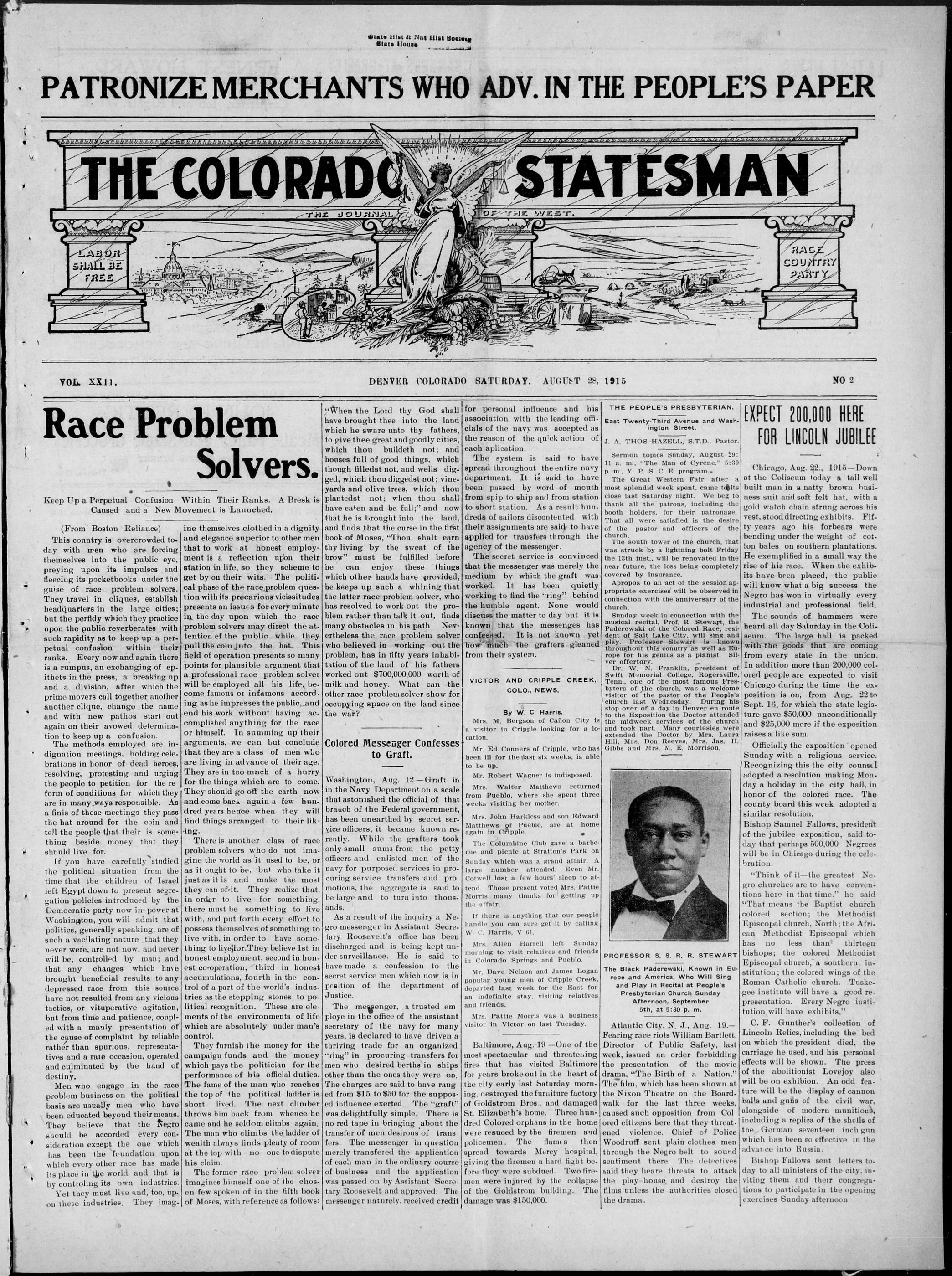
Sunday week in connection with the musical recital, Prof. R. Stewart, the Paderewski of the Colored Race, resident of Salt Lake City, will sing and play. Professor Stewart is known throughout this country as well as Europe for his genius as a pianist. Silver offertory.
Dr. W. N. Franklin, president of Swift Memorial College, Rogersville, Tenn., one of the most famous Pressbyters of the church, was a welcome visitor of the pastor of the People's church last Wednesday. During his stop over of a day in Denver en route to the Exposition the Doctor attended the midweek services of the church and took part. Many courtesies were extended the Doctor by Mrs. Laura Hill, Mrs. Don Reeves, Mrs. Jas, H. Gibbs and Mrs. M. E. Morrison.
THE MEMORIAL
The Black Paderewski, Known in Europe and America, Who Will Sing and Play in Recital at People's
Atlantic City, N. J., Aug. 19. Fearing race riots William Bartlett, Director of Public Safety, last week, issued an order forbidding the presentation of the movie drama, "The Birth of a Nation." The film, which has been shown at the Nixon Theatre on the Boardwalk for the last three weeks, caused such opposition from Colored citizens here that they threatened violence. Chief of Police Woodruff sent plain clothes men through the Negro belt to sound sentiment there. The detectives said they heare threats to attack the play-house and destroy the films unless the authorities closed the drama.
NO 2
EXPECT 200,000 HERE FOR LINCOLN JUBILEE
EXPECT 200,000 HERE FOR LINCOLN JUBILEE
Chicago, Aug. 22., 1915—Down at the Coliseum today a tall well built man in a natty brown business suit and soft felt hat, with a gold watch chain strung across his vest, stood directing exhibits. Fifty years ago his forbears were bending under the weight of cotton bales on southern plantations. He exemplified in a small way the rise of his race. When the exhibits have been placed, the public will know what a big success the Negro has won in virtually every industrial and professional field.
The sounds of hammers were heard all day Saturday in the Coliseum. The large hall is packed with the goods that are coming from every state in the union. In addition more than 200,000 colored people are expected to visit Chicago during the time the exposition is on, from Aug. 22 to Sept. 16, for which the state legislature gave $50,000 unconditionally and $25,000 more if the exposition raises a like sum.
Officially the exposition opened Sunday with a religious service. Recognizing this the city counsel adopted a resolution making Monday a holiday in the city hall, in honor of the colored race. The county board this week adopted a similar resolution.
Bishop Samuel Fallows, president of the jubilee exposition, said today that perhaps 500,000 Negroes will be in Chicago during the celebration.
"Think of it—the greatest Negro churches are to have conventions here in that time," he said "That means the Baptist church colored section; the Methodist Episcopal church, North; the African Methodist Episcopal which has no less than thirteen bishops; the colored Methodist Episcopal church, a southern institution; the colored wings of the Roman Catholic church. Tuskegee institute will have a good representation. Every Negro institution will have exhibits."
C. F. Gunther's collection of Lincoln Relics, including the bed on which the president died, the carriage he used, and his personal effects will be shown. The press of the abolitionist Lovejoy also will be on exhibition. An odd feature will be the display of cannon balls and guns of the civil war, alongside of modern munitions, including a replica of the shells of the German seventeen inch gun which has been so effective in the advance into Russia.
Bishop Fallows sent letters today to all ministers of the city, inviting them and their congregations to participate in the opening exercises Sunday afternoon.
LATEST NEWS EPITOMIZED
FROM TELEGRAPHIC REPORTS THAT COVER THE WEEK'S EVENTS.
OF MOST INTEREST
OF MOST INTEREST
KEEPING THE READER POSTED
ON MOST IMPORTANT
CURRENT TOPICS.
Western Newspaper Union News Service.
ABOUT THE WAR
Vilna and Bielostok are expected to
fall into the hands of the Germans.
President Wilson is the man chosen
by the neutral nations to make peace
in the European war.
Russian claims of great German
losses in the naval battle in the gulf
of Riga are repudiated in a semi-official telegram received from Berlin,
which says that no dreadnought or cruisers were sunk or damaged.
A dispatch to the Central News from Petrograd says: "The President of the Duma has announced that the Germans lost the battleship Moltke, three cruisers and seven torpedo boats in the Riga battle."
Marquis di Garonni, Italian ambassador to Turkey, Saturday handed to the Porte a note declaring Italy considered herself in a state of war with Turkey and demanded his passports, according to an official telegram from Constantinople.
The White Star liner Arabic, carrying 181 passengers and crew of 242 and bound for New York, was torpedoed and sunk by a German submarine, off the southwest coast of Ireland, near Fastnet. Thirty-two persons are reported missing.
Count von Bernstorff, the German ambassador at Washington, communicated to the State Department instructions from his government expressing regret and sympathy if Americans lost their lives in the sinking of the liner Arabic and asking that the United States delay taking a definite stand in regard to the affair until Germany could be heard from.
Germany is indulging in the first thought of possible defeat which she has countenanced since the war began. While the German fleet at Riga was meeting with decisive defeat, Gen. von Molkte, former chief of staff, was telling a secret conference of German cabinet ministers that the possibility of complete Russian defeat could not be hoped for by those well informed on the situation. At the same meeting Chancellor von Bethmann-Hollweg and Karl Hefferich, secretary of the treasury, announced that the empire's financial resources are in danger of exhaustion and advised the preparations of acceptable peace proposals. The chancellor threatened to resign when the conference refused to adopt a moderate attitude in the Reichstag.
WESTERN
Eight are reported dead and 5,000 marooned in floods at Newport, Ark. The total number of visitors to the Panama-Pacific exposition has reached 11,000,000. Two troopers were arrested at Douglas, Ariz., for attempting to kill John Peters. At Marietta, Ga., the coroner's jury returned a verdict that Leo M. Frank was hanged by parties unknown. Just before his departure from Portland, former President William H. Taft, who was en route to San Francisco, declined to receive a party of Congressional Union suffragists at his hotel on the plea of lack of time.
The Salt Lake City Commercial Club has addressed letters to all commercial organizations and the leading newspapers of the Middle West, asking them to interest themselves in a project to keep open the San Francisco and San Diego expositions next year.
A total of 256 known dead residents of southeast Texas coast points and crews of wrecked craft of all wrecked craft of all kinds; sixty-five persons missing, many of whom are believed to have perished, and property damage close to $50,000,000 was the toll taken by the hurricane which swept Galveston, Tex., and the Gulf coast section.
WASHINGTON
The Arabic case will not be decided on "fragmentary evidence," it was stated on high Department of State authority.
Six pontoons are engaged in efforts to drag submarine F-4, sunk in Honolulu harbor ten weeks ago, as close in shore as possible.
Rapid progress in stamping out the latest outbreaks of livestock foot and mouth disease was announced by the Department of Agriculture.
Acting Secretary Sweet of the Department of Commerce, authorized the issuance of American registry to the Dutch steamer Laura now at Rotterdam.
Exemption from deportation has been granted by Turkey to all Protestants or Catholic Armenians and Armenians employed in American consulates.
Gold production for the last year shows an increase in Colorado of $1,792,700. This is officially shown in a statement issued in Washington by Director of the Mint Wooley.
FOREIGN
Thirty homes were burned as forest fires sweep Canada.
Cardinal Serafino Vannutelli, dean of the Sacred College, is dead at Rome at the age of 81.
Naby Bey, Turkish ambassador to Italy, with the embassy staff and the consul in Rome, departed for Turkey by way of Switzerland.
Deaths from starvation continue at Mexico City. In July the deaths totalled 1,856. Eighty per cent were due to starvation, according to Charles J. O'Connor of the American Red Cross.
Appreciation is expressed in Rome in government circles and by the people of the weighty burden undertaken by the American embassy at Constantinople in the protection of Italian interests in Turkey.
To celebrate their silver wedding anniversary, the Prince and Princess of Thurn and Taxis, in Regensburg, have created a charity fund of 500,000 marks for the benefit of the inhabitants of Regensburg.
The United States coast guard cutter Bear, which carried the mails to Point Barrow, the most northern point of Alaska, returned to Nome and reported that no word of Vilhjalmur Stefansson, the explorer, and his two companions, had been received. Belief is growing that all three have perished.
The Tokio Kokumin Shimbun says: "Premier Okuma states that Japan has decided to give greater assistance to Russia to prosecute the war. He could not discuss details, but allowed it to be understood that this assistance would take the form of forwarding of greater supplies of munitions."
For the first time in the history of the Japanese empire, extending over 2,500 years, an emperor is to accede to the throne in the presence of the representatives of his people. That is one great reason why the coronation of Emperor Yoshihito, which takes place on Nov. 10, is regarded as one of the supreme events in Japan.
The Overseas news agency at Berlin gave out the following: "Official reports from Sofia and Constantinople state that Turkey and Bulgaria have signed a new treaty, Turkey granting Bulgaria her desired direct railroad connection with the sea, and Bulgaria agreeing to observe a benevolent neutrality."
SPORTING NEWS
Standing of Western League Clubs.
Clubs— Won. Lost. Pct.
Des Moines 79 47 627
Denver 71 50 587
Sloux City 61 58 513
Lincoln 62 59 512
Toronto 63 61 502
Omaha 61 64 488
Wichita 50 72 410
St. Joseph 43 79 353
According to advises received in Denver, the crack racing cutter crew of the armored cruiser Colorado won the championship of the Pacific fleet and a purse of $15,000 at San Francisco.
Impressed with the gravity of the German-American situation, as reported by the English press, insurance underwriters in London were offering odds averaging only 7 to 4 that the two countries will not go to war.
Miss Elaine Rosenthal of the Ravisloe Country Club turned in one of the best cards in the qualifying round of the women's western championships at Chicago. Miss Rosenthal shot the eighteen holes in 91. Miss Caroline Painter of the Home Club was next with 100. Pancho Villa may accomplish what all of the preachers of El Paso have failed to do. Because of his insistence that he receive a big rakeoff from the Juarez races this year, the Juarez Jockey Club is seriously considering closing the track for another year and holding no races this winter.
GENERAL
A million dollars in gold reached New York on the steamer Philadelphia.
It is stated at Atlanta, Ga., that a member of the mob who hanged Leo M. Frank is known, and the arrests are likely to be made.
Carrie Simms, America's leading tragedienne in real life, was rescued at New Orleans from her seventeenth attempt to kill herself.
Three masked men robbed the First State Bank of Bernice, Okla., of $1,500 and escaped toward the Spainaw hills, pursued by several pososes.
Twelve German submarines were captured by Great Britain during July, according to W. D. Gregory of Toronto, who arrived in New York on the Anchor liner Tuscania.
Summaries of the reports, three in number, of the divided United States Commission on Industrial Relations as to findings and recommendations for the information of Congress, were made public at Chicago.
Abraham Ruef, once a power in San Francisco politics, serving a fourteen-year sentence for offering a bribe to a San Francisco supervisor, was paroled from San Quentin penitentiary by the State Board of Prison Directors. Ruef's parole provided that he shall go to Mendocino county, where he has a ranch, and remain there ninety days.
Dr. Deborah Smith Drury, one of the first women in the United States admitted to the practice of medicine and an associate of Lucy Stone Blackwell in the equal suffrage movement, died at Haverhill, Mass. She was in her ninety-second year.
"I shall recommend to Congress the appropriation of a million dollars for submarines and aeroplanes, which I realize are the most powerful weapons of warfare," said Secretary of the Navy Daniels upon his arrival in Boston to attend the meeting of governors
COLORADO STATE NEWS
Sept. 5-6—Auto Race Meet at Denver
Sept. 10-11—Fall Festival at Flagler.
Sept. 11-17—Morgan County Frontier
Days and Harvest Festival at Fort
Morgan.
Sept. 15-17.—Elks' Annual Reunion at Pueblo.
Oct. 18.—Odd Fellows' Annual State Convention at Colorado Springs.
Colorado Fair Dates.
Sept. 7-10.—Crewley County Fair Association, Sugar City.
Sept. 7-10.—St. Vrain Valley Fair Association, Longmont.
Sept. 7-10.—Logan County Fair at Sterling.
Sept. 8-11.—Cheyenne County Fair at Cheyenne Wells.
Sept. 15-17.—Routt County Fair at Hayward.
Sept. 13-18.—Colorado State Fair Association, Pueblo.
Sept. 15-18.—Lineville County Fair at Jug.
Sept. 21-23.—Conejos County Fair at Manassa.
Sept. 21-24 - Western Slope Fair at Montrose.
Sept. 21-24 - Baca County Fair at Springfield.
Sept. 21-24 - Trinidad-Las Animas Co. Fair Association, Trinidad.
Sept. 21-24 - Montezuma County Fair at Cortez
Sept. 23-25—Saginache County Fair at
Sept. 22-25—Farmers' and Stockgrowers' Fair at Burlington.
Sept. 23-30—Prowers County Fair at Lamar
Oct. 2-9- Colorado Agricultural Fair and Racing Association, Denver.
Railroads have attacked the coal rates fixed by the utilities commission.
Cracker company employés in Denver will form a union as part of the A. F. of L.
Governor Carlson has filed his charges against H. W. Risley, and the latter has made reply.
Thirteen carloads of Masons passed through Denver on their way to the convocation at San Francisco.
After forty years' residence in Denver, John Petre, a veteran of the Civil war, died, aged 80 years.
Dr. V. W. Porter, mayor of Lafayette, handed in his resignation, following a quarrel with the councilmen.
A masked highwayman fired six times at Julius Fischer, a Denver saloonkeeper, because he refused to hand over $40.
Congressman E. T. Taylor wants a bigger navy, predicts returns of U. S. ships to ocean trade and favors 640-acre homesteads.
Plans are being made to build a $100,000 addition to the Union Printers' home at Colorado Springs, where it is expected the 1917 meeting will be held.
In common with other civic organizations throughout the West the Denver Chamber of Commerce will urge that the California expositions be continued another year.
Damage aggregating thousands of dollars is reported from districts in southern Larimer county and eastern Weld from the hail and rain storm which visited that section.
While waiting for a street car at Sixteenth and Curtis streets in Denver, Rosa Kleiner lost six inches of her tresses, which were snipped off by some unidentified man.
Carl Erickson, alias Brown, convicted of the slaying of his wife by a jury in the West Side Court in Denver, was sentenced to life imprisonment at hard labor for the crime.
It costs more than $1,000 to hang a man, according to the figures shown in the execution and fee bill issued on Harry Hillen who recently suffered the death penalty at Cañon City.
Miss Ruth M. Stuchfield of Denver has been chosen from a long list of applicants to fill the position of physical director of women at the DePauw University at Greencastle, Ind.
By an order of the State Public Utilities Commission the rate charged by the Florence & Cripple Creek railroad for hauling ore from the Ajax mine to Victor has been reduced 25 cents a ton.
While attempting to steal a ride on a Union Pacific train near Sand Creek, John Zondek, 38 years old, an Austrian, fell and the toes on his left foot were severed when the wheels of the train passed over them.
Although his rights were explained to him in two languages, Juan Romero, accused of slaying his stepfather, Don Jose Romero, at Longmont several weeks ago, pleaded guilty to the charge of murder, at Boulder.
John H. Elspass of Denver heads a group of Ault, Greeley and Denver capitalists interested in the formation of a company to erect tabloid potato factories in northern Colorado. The method is the de-hydrating of potatoes, beets and other vegetables.
While sleeping in her gocart, the 1-year-old daughter of Mr. and Mrs. G. B. Hughes of Cokedale, eight miles west of Trinidad, got her head caught in some manner and before any one noticed the trouble was choked to death.
Taking advantage of the absence of Superintendent Paddleford, a number of boys belonging to the larger class at the State Industrial School in Golden, mutinied, and two breaks were made, nine escaping from the building. Eight made their getaway and headed for Denver.
---
BANKERS AT GREELEY
CONVENTION ELECTS THEO.
SMITH PRESIDENT.
State Tax Commission Assailed at Closing Session for Inequalities in Their Assessment.
Western Newspaper Union News Service.
Greeley, Colo.—The closing session of the Colorado Bankers' Association was followed by a banquet.
The program consisted of an address by W. L. Gammon of the American Bankers' Protective Association, speaking in place of William J. Burns, who was unable to be present. Jerome Thralls, cashier of the Federal Reserve bank of Kansas City, explained the workings of the federal reserve act. Walter E. Wilson, president of the Kansas City Bankers' Association, in his address on "Opportunities of the Banker," urged Colorado bankers to use their influence to keep Colorado dry. J. M. B. Petrikin of Greeley, in his talk on "Bank Taxation," scored the State Tax Commission for inequalities in their assessment. Other addresses were made by Alva Adams, Charles S. Thomas and M. M. Scheyner of Denver.
The Colorado branch of the American Institution of Banking elected the following officers: D. T. Stone, Grand Junction, president; A. M. Rex, Kiowa, vice president; E. W. Thayer, Timnath, secretary.
The Colorado Bankers' Association elected the following officers: Theodore D. Smith of Denver, president; J. M. B. Petrikin, Greeley, vice president; Paul Hardy of Denver, secretary; A. M. Rex of Kiowa, treasurer.
The Colorado branch of the National Bankers' Association elected J. C. Berger of Denver vice president.
Theodore G. Smith was elected a member of the nominating committee of the national association.
Engine Hits Auto; Kills Child.
Pueblo.—An automobile full of Texas tourists was struck by Denver & Rio Grande train No. 1 from Pueblo to Denver, north of Fountain, resulting in the death of one child, serious injuries to the mother, and another child, and lesser injuries to three other persons. Mark Whaley, 2 years old, son of Mrs. L. E. Whaley of Bowie, Tex., was killed; Mrs. Whaley and another son, Elmo, 11 years old, were badly hurt. The others injured were Ruth Whaley, 14; May and Mark Anthony, sister and brother of Mrs. Whaley, whose home is in Memphis, Tex.
Storm-wrecked Building Crushes Boy,
Denver.—Caught in a wind storm
that struck Buena Vista, Robert
Knight, 20 years old, of Denver, was
crushed beneath tons of debris when
the walls of a large cement block
barn on the grounds of the state re-
formatory crumpled under the gale's
fury, and probably will die. His skull
was fractured, according to reports
from Salida', where he was rushed to
a hospital. The roof of the barn, a
structure 100x150 feet, was lifted and
carried to one side. The inside of the
barn was a mass of broken concrete
and tangled rafters.
Sept. 1 Set for Hearing Strike Cases.
Boulder,—Judge Neil F. Graham, in the District Court here, designated Sept. 1 as the date for arguments on a motion to separate the murder cases against E. L. Doyle, W. T. Hickey, John O'Connor, Jack Cassidy and Joe Potestio. A new date for trial will be set after the court rules on the motion. The cases originally were set for trial Monday, and the five defendants were to be tried together. The severance motion was filed by counsel for the United Mine Workers of America.
Girl Attempts Twice to End Life.
Littleton.—Choosing the hazard of returning to jail in preference to giving up a soldier-sweetheart. Mattie Lee, a twenty-year-old Denver girl, released from the Littleton jail Friday, fell again into the hands of the local police Sunday, and, facing the prospect of another separation, sought twice to end her life.
Former Congressman Arrested.
Pueblo.—Former Congressman John A. Martin returned from an automobile trip to California and complained that he was arrested at the Grand canyon and held two days at Flagstaff, Ariz., for hearing. He was detained for driving his motor car on the rim of the canyon and was discharged by a United States commissioner.
Vote Million for Drainage
Grand Junction.—Surprising the most ardent advocates of drainage land owners of the Grand valley voted to accept the federal government's proposal to build a $1,000,000 drainage system in Grand valley to protect 50,000 acres from seepage dangers. The vote was 808 for, and 153 against.
Girl Hurled Through Windshield.
Longmont.—Miss Margaret Matzen narrowly escaped death when an automobile in which she was riding with six others overturned at what is known as the "Ten-mile Corner," south of here. All the occupants of the car were thrown out, but Miss Matzen was hurled through the front windshield, breaking her collar bone, one of her ears being severed and received internal injuries which at first were regarded as fatal. The other members of the party escaped with minor cuts and bruises.
Carpenter, Job and Repair Work.
Coal, Wood and Express.
CLEANING, PRESSING, DYEING, REPAIRING, RELINING AND REMODELING.
WORK CALLED FOR AND DELIVERED
2549 Washington Avenue Denver, Colorado
The Market Company
Wholesale and Retail Staple and Fancy Groceries, Fish and Oysters. Hotels and Restaurants Our Specialty. Fresh and Cured
Eastern Corn Fed Meats
Fruits, Vegetables, Poultry and Game.
C. H. SHIRLEY, Pres. J. C. HAMPSON, Vice Pres PAUL J. SHIRLEY, Sec. and Treas.
Courteous Treatmet. Right Prices Leaders in Prescription
Paints, Oils and Glass.
Coal, Wood
1021 21st Street.
You Have Tried the Rest
Now Try the Best
THE Giant
FOR QUALITY
CLEANING, PRESSING
ING, RELINING AN
WORK CALLED FOR
2549 Washington Avenue
PHONE MAIN 3028
JOHN K.
Meats, Fancy and
1864 CURTIS
Corner Nineteenth.
Phones Main
169, 181, 189, 190
The Market
Wholesale and Retail Staple and
Oysters. Hotels and Re
Fresh and Cured
Eastern Corn
Fruits, Vegetables,
1633-39 Arapahoe Street
C. H. SHIRLEY, Pres.
PAUL J. SHIRLE
THE ATLA
Courteous Treaty
Leaders in I
Store No. 1.
2701 WELTON ST.
Main 895 875
Dr. Westbrook
Office 31 Good Block
16th & Larimer sts,
Phone Main 1433
Out of Office and at
nights Call Residence,
2714 Arapahoe Street
Phone Champa 570
$50.00 PER MONTH, MADE DURING
the High Brown New York TIME. Selling
the High Brown New York SPACE TIME, selling
for sample outfit, instructions and solicitor's
certificate. This is the chance of a life time for any enter-
turer. The NERO Doll is a family want's a NERO
Doll the beauty of modern invention.
NATIONAL NERO DOLL COOPER and catalog.
NATIONAL NERO DOLL COMPANY.
519 Second Ave., N., Nashville, Tenn.
Office 313½ Kittridge Bldg.
Phone Main 7416
Residence 822 32nd St.
Phone Main 8397
T. Ernest McClain, A. B. D. D. S.
Sundays and Nights by Appointment.
Office Hours:—8 a. m. to 12 m
2 p. m. to 6 p. m.
"STETSON HATS OUR SPECIALTY"
Phone Main 3661.
"BROWN, THE HATTER"
HATS CLEANED AND BLOCKED
50 CENTS
SATISFACTION GUARANTEED
A Trial Will Convince You.
718 1/2 18TH STREET.
Glazing Done and Express. Phone Champa 752.
Our Prices Reasonable
Satisfaction Guaranteed
CLEANERS
AND
TAILORS
McCAIN & RICHARDS, PROPS
Phone Main 7376
ING, DYEING, REPAIR-
AND REMODELING.
OR AND DELIVERED
Denver, Colorado
RES. PHONE GALLUP 942
. RETTIG
d Staple Groceries
TIS STREET
---
Denver, Cola.
C. E. Smith, Manager
Res. Phone South 1606
et Company
e and Fancy Groceries, Fish and
Restaurants Our Specialty.
rn Fed Meats
es, Poultry and Game.
Denver, Colorado
J. C. HAMPSON, Vice Pres
LEY, Sec. and Treas.
AS DRUG CO.
Hatmet. Right Prices
in Prescription
Store No. 2.
26TH AND WELTON
Main 4955-4956
ORIENTAL RESTAURANT
Chop Suey, Noodles and Short Orders
Phone Main 4896
1848 Arapahoe
乐洋轩
Weatherhead Hat Co
TELEPHONE MAIN 3203
PIONEER HATTERS OF THE WEST
---
We Make
Old Hats
New
RENOVATORS, BLEACHERS,
DYERS AND FINISHERS
Of Gents' and Ladies' Hats of Every
Description.
1624 CHAMPA ST., DENVER, COLO
THE COLORADO STATESMAN
CARGO
SHOULD BE
FREE
CALIFORNIA
COUNTRY
PARTY
SUBSCRIPTION RATES:
One Year ..... $2.00
Six Months ..... 1.00
Three Months ..... .60
PAYABLE IN ADVANCE.
Entered as second-class matter at the postoffice in the city of Denver, Colorado.
It occasionally happens that papers sent to subscribers are lost or stolen. In case you do not receive any number when due, inform us by postal card and we will cheerfully forward a duplicate of the missing number.
Communications to receive attention must be newsy, upon important subjects, plainly written only upon one side of the paper; must reach us Tuesdays, if possible, anyway, not later than Wednesdays, and bear the signature of the author. No manuscript returned, unless stamps are sent for postage.
Remittances should be made by Express Money Order, Postoffice Money Order, Registered Letter or Bank Draft. Postage stamps will be received the same as cash for the fractional part of a dollar. Only 1-cent and 2-cent stamps taken.
No discounts allowed on less than three months' contract. Cash must accompany all orders from parties unknown to us. Further particulars on application.
Reading notices, ten lines or less, 10 cents per line. Each additional line over ten lines, 5 cents per line.
All communications of a personating nature that are not complimentary will be withheld from the columns of this paper.
THE PROOF OF THE PUDDING.
This good old saying, "the proof of the pudding is in the eating," forces on us a reminder that we cannot easily efface from our memory in thinking seriously of the recent speech of Congressman J. Hampton Moore of Pennsylvania, at Worcester, Massachusetts, August 14th. His topic, "Lest We Forget," in which cogent argument, logical reasoning and sound judgment are displayed, serves especially at this time to prove to the people of the United States of America that the Republican form of government is the only agency that savors of and caters to the progress and prosperity of this country which George Washington and his successors endeavored to place on a basis of perpetuity.
In his speech the congressman clearly showed the utter inability of the present Democratic administration to cope with the questions of paramount importance arising from time to time, and backs up his statement by declaring with emphasis that a number of laws enacted and changes brought about for improvement of general conditions prevailing in the country were detrimental to success, and therefore could only spell ruin. "What was the effect of the President's tariff declaration?" a question asked by Hon. Moore, was appropriately answered in the following: "A staggering blow to all business in the United States because of fear of what was to come." He also intimated that the passage of the Underwood low-tariff law produced the most unsatisfactory industrial conditions. The loss of trade and employment at home, thereby developing foreign industries; an income tax and war tax imposed upon a people who were and are at peace with the world; a depleted treasury with more taxes in sight—all these go to prove beyond the shadow of a doubt that Democratic rule engenders and encourages everything but prosperity to a people, country and nation.
We cannot help from endorsing the worthy congressman, as from our experience of over half a century under both political parties, we have hardly had an opportunity to benefit from administrations like the present. As members of a race that plays an important part in a nation's history it is almost horrifying to relate the sufferings, oppositions and failures we have undergone, the proof of which we have even today, when we are made to feel that however much we improve, develop or aspire, we must ever be linked by an element of this country with the barbarism and hideousness of the dark pages of the nation's life. While the bills, measures, laws, etc., have interfered with the industries and the financial phase of things during our present government, yet something of greater importance predominates, and that is the unfair, un-American spirit exhibited in actually depriving the citizens of dark appearance from being the recipients of ennobling and superior positions of honor and trust which they have merited in and by their constancy, loyalty and patriotism to the nation at all times and under all circumstances.
Give us more men of the type and standard of Congressman Moore, and sooner or later the recognition of all Americans, irrespective of race or creed, will be an acknowledgment of which this great republic will be more than proud.
The Right Kind of Reading Matter
---
The home news; the doings of the people in this town; the gossip of our own community, that's the first kind of reading matter you want. It is more important, more interesting to you than that given by the paper or magazine from the outside world. It is the first reading matter you should buy. Each issue of this paper gives to you just what you will consider
The Right Kind of Reading Matter
Indication of Economic Intelligence at Least
By Isaac Goldberg, Botten, Mass.
Indication of Economic Intelligence at Least
By Isaac Goldberg, Boston, Mass.
is also, in this case, the spice of profits. The designers, without having ever read Carlyle's "Sartor Resartus," have nevertheless their own philosophy of clothes, and were you to catch them in an amiable mood they would talk somewhat in the following fashion:
"If there were no styles people could always wear the same material, until the goods wore out. That would mean less work for dressmakers and tailors in general. Prices could not then be boosted because of popular demand for any reigning mode. Besides, people want something new all the time and would make it themselves were we not to do it for them."
So that fashions, considered in this light, show economic intelligence on the part of the originators.
From the point of view of those who merely ape what is in style, regardless of how it becomes their particular person, fashions do not show intelligence. And it must be confessed that this category contains by far the largest number. They say that clothes make the man. That may well be, but how often do clothes unmake the woman! If long lines come into style the first one to make a dash after the vogue will be your woman with an 18-inch waist and a figure that looks like a letter T with the top left off. As if her own self were not long line enough! Or let us imagine the opposite case, the coming into fashion of round lines. Enter the corpulent woman, and with a nonchalance that is at times pitiable she becomes stylish by adding to her natural obesity the optical illusion of lines that seem to add pounds to her weight.
But the women are by no means alone as regards the fashion mania. Of late years there has been a decided tendency to introduce a variety in men's clothes almost as great as in women's. Every season brings its new coats, new hats, new ties; now the coat is loose, now tight. And when the designers exhaust their prolific store, back turn the fashions to those of years ago, and what we would laugh at in a picture book of 1870 we wear proudly to dinner. And consider the days of knee breeches and silk stockings for men, with George Washington as a good example. Go further back still and some of you will make the startling discovery that before modern business developed men were quite as vain with their clothes as are women. And while we are in a scientific mood, it might be well to point out that with the entrance of more and more women into the business and professional world voices of revolt against parrot fashion are being heard on all sides.
It is not hard to imagine a time when clothes will be raised to the dignity of a fine art. For it is nothing less than art when a competent dressmaker originates and fashions a gown for a particular individual.
There may be savages or peasants who have ideally perfect teeth, but they have never yet been discovered, and the myth of their perfection has never survived the establishment of a den-
City People Have Most Perfect Teeth
By Dr. Woods Hutchinson, New York
There may be savages or peasants who have ideally perfect teeth, but they have never yet been discovered, and the myth of their perfection has never survived the establishment of a dental clinic among them. To take the situation as we actually find it, the whitest, evenest, most beautiful and enduring sets of teeth to be seen anywhere in the world today are right here in these United States, among people who have had toothbrushes and good dental care from their childhood years.
The poorest, blackest, most broken and earliest decaying teeth are to be found in fishing villages and sand barrens and mountain valleys and remote, poverty-stricken country districts.
Modern city teeth may require some scrubbing and filling, but they look better and chew better and harbor fewer "bugs" and last longer than any others yet invented or discovered and examined in thousands during life by competent experts.
Some negroes and Indians, for instance, have wonderful teeth, but the majority of them suffer fearfully from toothache, caries, gum abscess and all the faults of civilized teeth.
Brush without ceasing, thoroughly, gums as well as teeth, after every meal and at bedtime, and you can pretty certainly bank upon it that your teeth will stay by you until sixty, sixty-five or seventy. You will probably lose a few, even with the best of care, for some teeth are born soft and pitted, and need filling almost as soon as they cut the gum; but you'll have plenty left to anchor to, and your dental arches will be "disfigured but still in the ring" until you yourself "throw up the sponge."
Essential Element in Vacation Is Change
By Dr. I. J. Murphy, St. Paul, Minn.
Vacations taken in the summer are the most profitable. The summer is the best time for recreation. It allows more access to the open air and to outdoor activities. However, a par-
Essential Element in Vacation Is Change
By Dr. I. J. Murphy, St. Paul, Minn.
Vacations taken in the summer are the most profitable. The summer is the best time for recreation. It allows more access to the open air and to outdoor activities. However, a particular season or an exact place are not the important items in one's vacation. The essential element is a change.
The more complete the change, environmental and occupational, the better. Rest and moderation should be the rule. Many people do not know how to take a vacation, but return more nearly nerve-wrecked than when they set out. They overtravel, overwork, overdo. Rest and relaxation, a "breathing spell" for an overtaxed mind and body to catch up with themselves, should be the aim.
Upon your return, in order to retain some of the benefits derived from the vacation, endeavor to avoid that almost universal American condition—high tension. It is possible and feasible to carry some of the calm and poise of the vacation season into your everyday work.
The continuous high pressure and speed that the average American works under are unnatural and unnecessary.
Go easy and you will last longer and come out ahead in the end. Just calm yourself.
Success Found in Apparent Failure
By Rev. Dr. Floyd I. Beckwith, Chicago
It is normal that men desire success and abhor failure. Yet so warped are many men's ideas of success that it is difficult for them to understand that
Success Found in Apparent Failure
By Rev. Dr. Floyd I. Beckwith, Chicago
It is normal that men desire success and abhor failure. Yet so warped are many men's ideas of success that it is difficult for them to understand that there are successful failures in life and failureful successes. It is not possible that success, as the world counts success, should come to everybody.
There are men who never had a chance. But true success, the only kind worth striving for, may be the lot of any man who is willing to pay the price.
The principal requirements are good health, high ideals, plenty of grit, inextinguishable enthusiasm and unimpeachable character.
Do You Know That—
The COLORADO STATESMAN
IS PREPARED TO DO ALL KINDS OF
JOB PRINTING
Commercial, Fraternal, Church, Book and Stationery Jobs A SPECIALTY
Ball and Concert Programs, Bill and Letter Heads, Calling Cards, Wedding Cards, Envelopes and Everything in the Printing Line Turned Out in the Neatest and Best Style Promptly on Short Notice.
We Have Supplied Our Office with New Job Press & Type of Up-to-Date Style and Our Work Will Be on a Par with the Very Best.
Give Us a Trial and and We Will Give You Satisfaction
Prices as Reasonable as Those of Any Job Office in Denver
The Colorado Statesman
Room 25 Phone Main 7417
THE COLORADO STATESMAN
Mrs. L. Boone arrived in the city Sunday from Casper, Wyo.
D. W. Stanley of Salt Lake City, Utah, was in the city last week on a short visit.
Messrs. H. J. Turner and Joseph Thomas, railroad men of Chicago, were in the city last week.
Mrs. William Sprague. They have been away from home for three months on the Pacific coast and report an enjoyable trip. Mr. Mahammit is a prominent officer of the Masonic fraternity of the Missouri Valley states.
Professor and Mrs. Clarence Russel of Louisville, Ky., passed through the
Mrs. M. Past of Rock Island, Ill., has come to the city to make her home with her daughter, Mrs. B. Lindsey of 1663 Williams street.
Wesley C. Jackson of Cleveland, O., nephew of O. T. Jackson, passed through the city this week en route to California.
Miss Melba Hobson left last Tuesday for her home in Chicago after an enjoyable visit with her cousin, Miss Cleo Hobson.
L. C. Connell is among those on the sick list. His many friends hope for him a speedy recovery.
Miss Gertrude Striplin, who has been very sick for some weeks, is convalescing. Her many friends are glad to see her out again.
If you want the 25c worth, you will do well to try dinner at Railroad Porters' Club, 1728½ Wazee street, between 12 m. and 8 p. m.
Harry Cowell, one of Denver's extensive property owners, has purchased a beautiful flat at Twenty-third and Ogden streets.
J. S. Fields of Kansas City arrived in the city this week for an indefinite stay in the interest of his health. Mr. Fields formerly lived in Denver and has many friends here.
H. J. Foster and G. B. Burrell of New York, two former citizens of Denver, passed through the city this week en route to Colorado Springs, from Yellowstone National Park, where they spent a week. Their many friends here were glad to greet them.
Big Labor Day Ball. Fern Hall, 2711 Welton Street, Sept. 6, Webster's Orchestra. Admission, 25c.
Jesse Thrower, the popular steward of the Denver Motor Club, is off on his vacation with full pay; in fact he stands so well with his employers his expenses will be defrayed to the Exposition. This is another case where competency wins.
W. L. Kinchelaw, who owns a section of fine land in Nebraska, was in the city this week. Mr. Kinchelaw reports his crops in excellent condition and a sample of some of his product can't be beat. This young man deserves much credit for his ambition, and the race should feel proud of his success.
Mrs. Mary Dove, who has been an inmate of the National Preachers' Home at Colorado Springs, is in the city for an indefinite stay. Mrs. Dove is a former resident of Keokuk, la., is the relict of Rev. Wm. A. Dove, who in his day was one of the most prominent ministers in the A. M. E. connection
Mrs. J. F. C. Taylor and two children, of Atchison, Kans., wife of Rev. Taylor, is in the city, visiting her brother, Gus Travers, and his wife. Mrs. Travers has many friends in the city who knew her in her girlhood days, who extend her a cordial welcome.
Mrs. C. C. Jackson and daughter Frankie, of Cleveland, O., sister-in-law of O. T. Jackson, are recent arrivals in the city, and are stopping with Mr. and Mrs. F. T. Bruce, 2231 Glenarm Place. They will spend a month at Dearfield, the guest of Mr. and Mrs. O. T. Jackson.
Mr. and Mrs. J. W. Ward of Dallas, Tex., house guests of Mr. and Mrs. J. B. Mason of 2352 Humboldt, accompanied by Mrs. Mason and Mr. and Mrs. Walter B. Escue, had a very enjoyable auto ride Sunday afternoon, taking in the most important parts of the city.
Mr. and Mrs. T. P. Mahammit, prominent social and business citizens of Omaha, are guests of Mr. and
Mrs. William Sprague. They have been away from home for three months on the Pacific coast and report an enjoyable trip. Mr. Mahammit is a prominent officer of the Masonic fraternity of the Missouri Valley states.
Professor and Mrs. Clarence Russell of Louisville, Ky., passed through the city this week en route home from the Exposition. They visited several points of interest in Colorado and left Thursday night for Chicago to attend the Lincoln Jubilee Exposition. While here they were the guests of Mrs. Mary Russell of 423 West Eighth avenue.
Professor and Mrs. A. E. McMillan and daughter and Miss Marie Travis of Nevasota, Tex.; Mr. and Mrs. Reuben Williams of Dallas, Tex.; are in the city, the guests of Mr. and Mrs. J. B. Moore of 1409 Twenty-fourth avenue. They are en route home from California, where they visited the principal cities of the coast. Wednesday morning Mr. and Mrs. Moore showed them over the city via auto, and they speak most flatteringly of Denver and her hospitable citizens and very much regret that their stay cannot be prolonged. They, together with Mrs. Louie Stone of Trinidad, were entertained Monday night by Mr. and Mrs. John Carrie of 709 Twenty-eighth street.
The dove season is open and many of Denvers colored sports who delight in hunting are taking advantage of the open season by trying their marksmanship. There is little chance for game to escape when such are in the field as Charlie Porter, Frank Burnley, Wade Robinson, William Price Gus Dyer and James Cooper, as they are all good shots.
Friday night of last week at Nippon hall, one of the most enjoyable and exquisite social functions that has been registered on the calendar this year was witnessed when Mr. and Mrs. E. R. Page gave a dancing and card party and from 8:30 until 12:30 mirth reigned supreme. The hall decorations represented botany in many varieties and the sweet essence of the same which seemed to float with the soft strains of music throughout the hall. The ladies, who were attired in their handsome and costly gowns, and the gentlemen in full dress, made a picturesque and admirable vista as they glided over the polished floor. The host and hostess, Mr. and Mrs. Page, were warmly congratulated and highly complimented for the unique manner of entertaining. Refreshments were served in abundance.
Perhaps the most appreciated musical recital that has been held in Denver this season was that held at the People's Presbyterian church last Monday night, when Mrs. Minnie M. Albritton of Los Angeles, California, charmed a large audience with her musical talent, and that she fully sustained her title as "The Mocking Bird of the Pacific Coast" and "The Nightingale of the West," was evidenced by the many encores to which she had to respond. The high scales to which her voice soared without any effort was another feature of the skill of this great singer, which came in for a share of the flattering comments which Miss Albritton justly deserves. Besides the choir, those who assisted the singer were Miss Cleo Hobson, Mrs. M. E. Morrison, Master Atwell Rose, Miss Samina Harris, Thomas Berry, Mesdames Pearl Rose and Lillian Pinn. Organist, Valaurez Spratlin. Director, Rev. J. A. Thos. Hazell. Miss Albritton left Tuesday en route to Boston, where she will enter a conservatory of music. She carries with her the best wishes of the citizens of Denver for a brilliant success.
CARPETS CLEANED FREE
on your floor, with "Knocks Them All
Spray." This preparation cleans carpets,
kills moths, bedbugs and all
germs. Household necessity. Send
postal for demonstration. Lady demonstrator wanted.
CLARENCE E. LANGSTON,
Demonstrator.
2408 Humboldt St., Denver.
Deodorizing a Cavity
A large cavity in a tooth can be deodorized by dipping a pellet of cotton, held by pliers, into water, then taking up with it a small quantity of sodium perborate from a saucer or glass slab and quickly introducing this dressing into the cavity. The perborate liberates oxygen, which renders the cavity odorless and relatively aseptic.
Go to Keneven & Haley's for your Dry Goods, Notions and Millinery. 2647 Welton Street.
CRETONNES IN THE SUMMER
By Careful Selection, the Housewife May Make Her Rooms Things of Beauty.
It seems ages since the serviceable and smart cretonnes were introduced for hangings, coverings for furniture and cushions, etc., yet it still holds its place among the newest of goods shown for these purposes. Porch furniture, comfortable cushions and cane chairs for use on the summer pizzas are covered and, going further, large armchairs and low rockers for the living room are to be upholstered in this same good-wearing fabric.
But, of course, designs have changed somewhat; colors are brilliant, as usual, but among the newest are those with birds of gorgeous plumage on a background of black. Indeed, brilliant applies to most of the new cretonnes; they are vivid and still launder perfectly, making them an excellent choice for the hot suns of summer days.
The frill or flounce across the top of windows is still liked, only now it should be cut narrow and lifted a little directly in the center, with side draperies of the goods. The sides of these frills are a little longer than last year, and a variation liked is to catch the fullness in cluster of three or four tiny tucks or folds about three or four inches apart, not pressing them flat. but allowing them to stand out. Also the bottom of the frill, where caught up in the center, must be finished with a braid; as it should be cut in a curve, not in a straight line to be puckered shorter in the center, but cut curved. Still another variation shows the bottom of this frill cut in deep scallops and bound with braid.
Small tables covered with cretonne, over which the useful glass is placed, will be sought for porch and living room for various uses. One that should appeal to the housewife who just "loves a pretty bedroom" is to change ordinary furnishings into things of beauty by covering chests, tables and so on with cretonne; the table with the glass top bringing an almost elegant air into the atmosphere. If woodwork and furniture are hopelessly faded and worn a coat of light enamel with a slight tracery of blue or pink or delicate green and cretonne hangings, etc., to match will make a charming room of one that might be termed dismal and depressing, as some rooms have a habit of being.
A caution is to use plain paper or paper with small figures where a room is to be fitted out in gay cretonne; huge or startling designs will only cause discord.
FITTING UP THE BATHROOM
Some of the Requisites That Must Find a Place in the Modern Establishment.
In the days of the old tin tub almost anything in the way of a towel was good enough, so long as it was free from holes. The advent of sanitary plumbing, the white enamel tub and basin, the tile or tile-effect walls and the nickel and glass fixtures have made the up-to-date bathroom a different proposition. For instance, utility is no longer the sole standard by which the bathroom linens are judged. They must also harmonize with the enamel and glass fittings. As a result housewives now buy their towels in sets in white, with an initial or monogram in color. Many towel sets are bought in plain or fancy material without a monogram, which is worked by the housewife herself.
Bathroom sets of terry-cloth are composed of two bath towels, a bath mat, and two face cloths, all with a plain or fancy border and an initial or monogram.
Jacquard figured bath towels are new and attractive. They have a deep pink or blue border and the hem is daintily embroidered in color. The edge is finished with a deep border or crochet of white and color. Turkish and huck towels are almost always embroidered in color and finished with a scalloped or crocheted edge.
Making Cocoa.
When making cocoa, you can greatly improve the flavor, obviating the "flat" taste, by adding a pinch of salt and a few drops of extract of vanilla. Boiling several minutes makes cocoa richer in taste and more digestible, while it stands to reason that milk and not water makes much the richer beverage, although milk and water may be mixed. Condensed or evaporated milk makes delicious cocoa. Beat the cocoa for a few minutes before serving it.
Berry Roll.
To one quart of flour use one table spoonful of butter, mix this together with a silver knife, add three table spoonfuls of baking powder and enough milk to make a dough that will roll. Flour one quart of berries sugar them to taste, put them in a layer on top of dough. Roll from one end. Cream for one hour. This should be served with hard sauce.
Milk Sherbet.
Add two tablespoonfuls of lemon juice to one tablespoonful of sugar, and pour on gradually one-half cupful of milk (or one-half milk and one-half cream) then freeze.—Woman's Home Companion.
To Soften Lemons
If lemons have become dry, put them into a pan of hot water and place it where it will remain at almost the same temperature without boiling for two hours. After that the lemons will be soft and juicy.
Wait for the Great LABOR I PICNIC And Outing, Monday Septe
R DAY
CNIC
nday September 6th
LABOR DAY PICNIC
And Outing, Monday September 6th AT BEAUTIFUL
Tuleries P
Auspices of the Base Ball
Amusement of all kinds. Double Header B
Skating, Water Melon Eating Contest Que
Concert in the afternoon. Dancing in the eve
son's Orchestra will furnish the Dance Music.
of all kinds for the children. Come one and
the day's outing. Take Englewood Cars and g
ies Park. Remember the Park is open all day.
R. B. BOL
es Park,
the Base Ball Boys
Double Header Base Ball Game.
Rating Contest Queen City Band
Dancing in the evening. Morrish the Dance Music. Amusements
en. Come one and all and enjoy
singlewood Cars and get off at Tuler.
Park is open all day.
Tuleries Park,
Auspices of the Base Ball Boys
Amusement of all kinds. Double Header Base Ball Game. Skating, Water Melon Eating Contest Queen City Band Concert in the afternoon. Dancing in the evening. Morrison's Orchestra will furnish the Dance Music. Amusements of all kinds for the children. Come one and all and enjoy the day's orting. Take Englewood Cars and get off at Tuleries Park. Remember the Park is open all day.
R. B. BOLDEN. MANAGER.
Admission 25c.
Refreshment Privileges For Sale—See R. 19th Street, Phone Main 4052.
PHONE CHAMPA 2077
For Sale—See R. B. Bolden, 926 4052.
Refreshment Privileges For Sale—See R. B. Bolden, 926 19th Street, Phone Main 4052.
CAMMEL AND CO.
The Progressive
Funeral Directors
WE TAKE GREAT PRIDE IN THE
FACT THAT WE ARE "THE LEAD
ING FUNERAL DIRECTORS."
WE CAN FURNISH ELEGANT
ROLLING STOCK. AUTOS IF
PREFERRED.
You Will Be Delighted With Our Service As We
Little Things That Count. LADY ATTENDANT
CURTIS M. HARRIS ROBER
Assistant Manager and Funeral Director Assist
OFFICE AND PARLORS 2807 WELTON S
The 1023 T
Our Service As We Look After The
LADY ATTENDANT.
ROBERT OLLIVER
Director Assistant Funeral Director
2807 WELTON ST. DENVER
You Will Be Delighted With Our Service As We Look After The Little Things That Count. LADY ATTENDANT.
CURTIS M. HARRIS ROBERT OLLIVER
Assistant Manager and Funeral Director Assistant Funeral Director
OFFICE AND PARLORS 2807 WELTON ST. DENVER
Strickly home cooking
Dinner and theatre parties served on short notices
Open from 6:00 a. m. — 12 p. m.
Notice of Stockholders' Meeting.
Denver, Colo., Aug. 18, 1915
To The Stockholders of The Golden Chest Mining, Milling and Tunnel Co.
Notice is hereby given that the Annual meeting of The Golden Chest Mining, Milling and Tunnel Co., will be held in Denver, Colo., Sept. 22, 1915 at 1557 Larimer St., 2 p. m., at which time will be heard the reports of officers, the election of directors and such other business as may be presented.
We take pleasure in announcing that carriage service to Fairmount on Riverside cemetery will be $3.50 instead of $5.00, and hearse $7.00 instead of $10.00, until further notice is given by the Douglass Undertaking Co.
Keneven & Haley have a full line of fall Millinery. 2647 Welton Street.
YOU CAN BUY A PIANO ON PAYMENTS OF $5.00 A MONTH, OR RENT ONE FOR $2.50 A MONTH AT CASSSELL BROS.
WANTED—Two nice young men to room and board. Home-like. Mrs. C. H. Clark, 2228 Downing St. Phone Blue 274.
---
Children Under 10 Years of Age Admitted Free
JOHN H. HARRIS
Dearfield Lunch Room
MRS. L. C. BARNES, Proprietor
Prices moderate Oysters in season
Try Our 40ct. Chicken Dinners
One Thing Pretty Sure.
"What is your opinion of this new cure? Do you think walking through the grass will make a person healthy?" asked the boarding-house lady at the dinner table. "Well, it seems to have made this beef pretty tough." replied the boarder, trying hard to cut his steak.
Our Daughters.
"I say, dad, I've just accepted Charlie Brown—he's in the drawing-room—and if you've a minute you might pop in and see him and talk it over; but please be quick, we've got to rush out and see about the banns."—London Opinion
Must Return Fallen Fruit.
If the fruit from a person's tree falls on to his neighbor's land the neighbor is not entitled to keep it, according to English law. He must give it up on the owner demanding it.
Cause and Effect.
The merchant who doesn't advertise is the same fellow who never has what you want in stock because he never had any demand for it.—Cincinnati Enquirer.
Here's to the mouth! It is the grocer's friend, the orater's pride and the dentist's hope.
Ideal Resort.
Nodd—"How is the Bingbang restaurant?" Tom—"Wonderful! I was in there, with my wife for an hour the other evening and couldn't hear a word she said."—Life.
DAY OR NIGHT
1023 Twenty-first Street.
DENVER, COLO.
J. R. LEWIS, President.
P. E. SPRATLIN, Sec'y.
NOTICE.
16th and Broadway.
KEEP THE LITTLE ONE OUT IN
THE SUNSHINE.
Abundant Supply of That Usually Easily Acquired Essential Is Imperative If He is to Grow Well and Strong.
(Prepared by the Children's Bureau, United States Department of Labor.)
This injunction needs to be repeated very often even in the country, where people are out of doors a great deal in the natural course of life.
It is often true that small homes in the country are both overcrowded and ill-ventilated, particularly at night, and in some cases the country baby suffers from a lack of fresh air almost as much as does the city baby. But it would seem that it should be very easy to give a country baby an abundant supply of open air and sunshine.
The chief drawback to his having a comfortable out-of-door life in summer are the flies, the dust and the heat. There are few improvements that pay greater return upon the investment to mother and baby, as well as the whole family, than a porch covered with wire screen on the shady side of the house, say, the east or south, provided the side is not so close to the road as to get the dust. If the mother has a porch of this kind, the baby may practically live there, except while he is being bathed. During the hottest hours of the day, in midsummer, it is usually cooler indoors than out, but with these few exceptions the baby may spend the greater part of the time out of doors.
A play pen on the porch will serve to keep an older baby within safe bounds, and at the same time permit him to be out of doors. Such a pen is described in a bulletin published by the children's bureau called "Infant Care." This publication will be sent free to all who write for it, addressing the Chief, Children's Bureau, U. S. Department of Labor, Washington, D. C.
Experience has shown that sick babies stand a much better chance of life, and recover much more rapidly if kept out of doors. Common sense should guide the mother in this, as in all matters where the baby is concerned, and she will realize that if a high wind is blowing dust about, or a sudden storm comes up and the temperature drops many degrees in a few moments, the baby should be taken in, or protected from a chill by suitable clothing and wraps.
The young baby may be taken out when he is two weeks old for half an hour if the weather is warm and pleasant, gradually lengthening the time he stays out. Remember that the baby's eyes are very sensitive and must always be carefully shielded, not only from the sun, but also from direct light. Babies are often wheeled about in their carriages staring directly up into the sky. Try it yourself for a few moments and you will realize the cruelty to the baby who may not even be able to relieve this strain on the eyes by turning his head to one side. When the baby is sent out with a nurse she should be instructed on this point and also how long she is to keep the baby out, and be warned of the danger of allowing strangers to play with him or kiss him.
The carriage outing should not be regarded as giving the baby enough fresh air for the day. In addition to this he should live on the porch in suitable weather. If it is necessary to bring him in, the windows and doors should be opened, screening them carefully from insect intrusion. The baby should sleep at night in a well-ventilated bedroom, in a bed by himself, and, if possible, in a room by himself. Keep the doors and windows open. Do not be afraid of the old superstition of the "night air." The fear of the night air likely arose from the fact that it used to be thought that malarial poisons arose in the night, before it was known that this disease is only carried about by mosquitoes, which fly chiefly after nightfall.
In malarial regions, screens are indispensable. If the house is provided with a screened sleeping porch, there is no reason why the baby should not sleep out at night after he is three months old, provided, of course, he is carefully protected. Babies thus taught from the beginning of life to enjoy the open air will be far less sensitive than otherwise, and much less likely to suffer from colds and similar troubles as they grow older.
Creamed Baked Potatoes
Twelve medium-sized potatoes, a half cupful of cream, one cupful milk, three-quarter teaspoonful of salt. Pare the potatoes and place in the bottom of a pan, cover with milk and cream, add the salt, cover the pan and place in the oven; keep covered until the potatoes are almost done; then remove the cover and allow the milk and cream to cook down until they are somewhat thick.
Mildew Spots.
Mildew spots on linen should be rubbed with scraped chalk. The mixture is rubbed in and the linen spread on the grass. It should be wet a little from time to time as it dries. The spots ought to come out in two applications.
To Avoid Scalding Steam.
When turning boiling water from a kettle into the sink, run cold water at the same time, then there is no danger of the hands being scalded from the steam.
An Old Man's
Stratagem
aN
Pe ea oer ee nan SS ors an een
Phillips’ theory was that it was
better to be king of a village than the
second ruler of New York. No less
an authority than Julius Caesar had
sajd that before him, in a slightly dif.
ferent shape; but Caesar didn’t have
to, prove it, and Phillips did.
He spent his vacation in a little vil.
lage in the Catskills, where the girls
from the department stores went. It
was @ quiet sort of place, and the
quieter sort of girls went there. Phil
Ups’s vacation unfortunately lasted a
month.
With a succession of young wom:
en coming and going, Phillips, being a
gentleman in appearance and having
plenty of money, was in his element.
He flirted with all and each, indiserim:
inately. Naturally, he created a good
deal of enmity at the little hotel. Any-
one can do that, but Phillips thought
he was a lady-killer. >
Tused to watch him from the porch
and I wished I were thirty years
younger. I sbould have enjoyed noth-
ing better than to take the young
blackguard by the collar and trounce
him soundly. Of course people set out
to enjoy themselves, but Phillips had
planned it all out before. Besides, the
man was outrageous with his dude
clothes and his generally offensive air.
But it was none of my business, and
I watched the affairs with three o1
foyr of the girls to whom Phillips
swore eternal devotion until it came
to Dorothy Raines. That set my back
up badly.
Dorothy was the niece of the hotel.
keeper, and in the summer she helped
in the hotel. In the winter, I believe
she taught in the local school. I had
wone there several successive sum
mers, and I knew she was engaged to
the finest of the young fellows of
*%
et ea a
fase
4 ace age
pages, =
CSET ei |
A, ae
“er
Pads, [:
iin
“he es
xe
ates, d
a
A
Phillips Thought He Was a Lady.
Killer.
the town—Ned Walker. In fact, she
‘had confided to me that they meant to
get married that fall.
When Phillips spotted her I had to
admit that his taste was good. Dor.
othy would have been a belle if she
had been togged up instead of wear
ing her simple waist and skirt of vil
lage make. But Dorothy was a sweet
girl, and the thought of Phillips win
ning her heart from Ned and then go
ing complacently away was too much
for me.
Of course the girl couldn't resist the
‘open admiration of the city man. Dor-
othy wasn’t experienced enough to be
able to distinguish the gold from the
glitter, and Ned hadn't the airs and
graces of that man Phillips. Day by
day [ watched the progress of the
flirtation. Ned noticed it too, One
evening there was a quarrel, and pres:
ently Dorothy came round In°front of
the porch, and her eyes were red, as
if she had been crying. I saw Ned
slouch moodily away, and a few min-
utes later the girl and Phillips were
talking together at the other end of
the porch,
Ned was an old friend of mine, and
the next day I had a few words with
him.
‘Ned,” I said, “if you had been cut
‘out fairly T wouldn't waste much sym-
pathy on you. But that blackguard is
only amusing himself. That's his fun,
He wants to break her heart and then
x0 back to the city. I've watched him
try it on some of the other girls here.
Ned, be a man!”
“I'd like to thrash the fellow!” said
Ned, doubling his fists.
“Why don't you?” I asked, looking
at his husky build. “It would do him
good. And it would show Miss Dor.
othy who's the better man.”
“E can't thrash a fellow for taking
my girl away,” said Ned, “It's up to
me to keep her.”
“That's true,” [ answered, “but
thrash him for being a blackguard.
Thrash him on general principles,
Ned.”
“What's that?” asked Ned; and I
dried to explain. I painted Phillips’
character as it appeared to me. “Are
you going to let Mise Dorothy’s heart
get broken?” I inquired. “Of course
you'll win her back afterward. But
is the game worth the candle, looking
= it from the woman's viewpoint?”
“No, sir,” said Ned, and I knew that
he had made up his mind.
I saw the two together most of the
day, and I wondered when Ned would
bring off his coup. He chose the best
time—after dinner. They were walk-
ing in the grounds, and I suppose I
had no business to follow Ned when
I saw him go after them; but I want-
ed to see Derothy's eyes opened, and
that 1s my only excuse for what I
aid.
I saw Ned go up to the couple and
speak to Phillips. I don't know what
ho said, but I heard Phillips’ snort
of contempt.
“Can you fight?” Ned demanded
next.
“Lean whip a dozen like you,” Phil-
lips retorted,
“Then I'm going to thrash you on
general principles," said Ned, and I
could hardly keep from clapping my
hands and crying “bravo!”
Miss Dorothy had hardly recovered
from her surprise when the two were
at it, hammer and tongs.
I had not expected Phillips to put
up much of a fight, but it was a case
ot Ned doing his best to stop Phil-
lipps’ rushes. After the first minute
Phillips knocked Ned down, and, when
he got up Phillips let him have it
again, Ned didn't get home more
than once, and in the end Ned was
stretched out upon the ground, halt
unconscious, It had been Phillips
from beginning to end, and he han-
dled his fists ina very creditable way.
I suppose it was fear of the public-
ity, but all the while the girl stood
there like a statue, and never moved
or spoke. Nobody saw me, and I felt
pretty badly to see how my plot had
miscarried. Because my idea had
been to show the girl what a coward
Phillips was, and, instead, it was Ned
who got the thrashing.
“Had enough?” sneered Phillips,
standing over Ned. Ned groaned; he
couldn't raise himself from the ground.
“It this brute has had his lesson,
let us continue our walk, Miss
Raines,” suggested Phillips.
And suddenly the girl turned on
him with flashing eyes.
“You brute!" she cried. “How dare
you! How dare you fight a man weak-
er than yourself! Go away at once!
Do you hear me?” She stamped her
foot like a fury.
‘The next moment she was kneeling
at Ned's side, calling him all the en-
dearing terms in her vocabulary. Her
arms Were round him, and with her
skirt she began sponging away the
blood that covered his face. “Forgive
me, Ned,” she was sobbing.
I went away then, because I real-
{zed that I had no business there.
But it seems strange to me; 1 had
thought a woman loved strength in a
man, but if Ned had beaten Phillips
he would have lost her forever. It
sort of upset my ideas—and at my
age one doesn't like that. |
Phillips departed the next morning
by early train, end I imagine he won't
show his face up this way in a hurry
again. Dorothy and Ned are to be
married in October—and I've been
asked to stay on and be best man.
It’s curious; should think Ned would
never want to seo me again after
that beating. But I suppose he con-
siders all roads good ones that lead to
Dorothy. |
Making a Life Mask.
A well-known New Yorker entertain.
ing some friends at dinner showed
them his life mask, then told them
with feeling how the mask had been
made. “They put me in a Chair,” he
said, “tied a towel around my head,
plugged my ears with greased wool
and stuck a quill In each nostril. ‘Shut
your eyes,’ said the workman, drawing
near with a ladle and a large steaming
tureen of pink plaster of paris of the
consistency of "thick soup; and he
slapped the stuff on my face in great
ladiefuls. I could feel it running down
my collar and over my chest just as
soup would have done. 1 motioned
with my hands wildly. The man
laughed. ‘That's all right, boss,’ he
sald, and kept slapping the hot, horri-
ble, slimy stuff upon me. He stopped
when my face was incased in a halt-
inch coat of plaster. He told me tt
would harden in a few minutes. It
did, but the minutes were awful. As
the plaster dried It seemed to shrink,
shrinking my skin with it. And the
heat of the thing! And the difficulty
in breathing through the quills stuck
in my nostrils! Then very carefully,
very slowly he drew the hardened cast
from my face. I gripped the chair
arms and shrieked.”
Thritt,
Generally speaking, thrift is not
born with us, nor it is thrust upon us;
it is, In the great majority of cases,
a matter of delicate and intentional
acquirement by means of a self-im-
posed obligation with a definite pur-
pose in view. And withal, to reach
the maximum of effective accomplish:
ment there must be a penalty which
gently, but firmly and constantly, in-
sists upon the regular observance of
all those factors which contribute to
the ultimate success, That is, in get-
ting into debt one realizes the sense of
obligation, pride is at stake, and cer-
tain self-denials are made to effect a
saving and meet the payments as ar-
ranged. ‘The result is a distinct gain,
it the debt was properly incurred,
Circumstances Alter Cases.
Doctor (somewhat deaf)—Did your
wife take all the medicine I left her?
Browning—Yes; and she’s dead.
Doctor—She's in bed, eh? Then I'l
make a change in the treatment.
Browning (louder)—I said she was
dead.
Doctor—Oh, she’s dead, eh? Then
I'll make out my bill.
on Aon
Are
ek FEA
UU, Xe INSP
s 5 EE
iat iQ NT
i
CVADLAND IE
Bhat masta. le wad See sel tes
eae
. See
Our character is our will, for what
we Wil we ace A Shona teeamne
rite lente wonsehioe elgg th
world forward happily. does not walt
Tue Sera cave ceed
f IcY DELICACIES.
During the hot weather there is no
dessert that touches the spot like the
frozen one,
aS Nut and Raisin Ice
ae Cream.—Bring to the
be, sealding point in a dou-
FRA vie boiler a quart of
= ». cream and a half pint of
SPSAS milk. Stir a cupful of
{granulated sugar into the
AEA cream, thes cool!” the
- mixture. Add a cupful
ese ue euke: a OG ea penpeul
half cupful of finely chopped walnut
meats, flavor with vanilla or lemon
and freeze, stirring up the fruit and
huts when the cream is half frozen.
Garnish with a half of a walnut meat
and a raisin that has been plumped
by steaming in a sieve over the tea-
kettle.
Peach Foam—Pare, stone and cut
up suilicient ripe peaches to make a
quart, then crush with two cupfuls of
sugar and one of ice water, add a tea-
spoonful of lemon juice and the un-
beaten whites of four eggs. Stir well,
then freeze, beating the mixture well
after it is half frozen. Serve in
sherbet cups with a cherry on top
Berry Surprise.—Make any rich ice
cream and when the beater is removed
All the hollow with fresh raspberries,
cover the top of the opening with the
cream, put on the cover and pack to
ripen. Serve turned on a platter and
slice so that there will be a center of
berries within the wide rim of cream.
Frozen Fig Custard.—Beat the yolks
of six eggs with a quart of milk and a
cupful of granulated sugar, cook in a
double boiler until smooth and coats
the spoon. When cold stir in a cupful
of finely chopped figs, flavor to taste
with lemon extract and add a pint of
whipped cream and the whites of the
eggs, beaten stiff. Turn into a freezer
and freeze, opening the freezer when
halt frozen and stirring up the fruit
from the bottom.
Coffee Ice.—Make a quart of strong,
clear* coffee, sweeten with six table-
spoonfuls of sugar, cool And partly
freeze, then add two whites of eggs,
beaten stiff, and finish freezing. Serve
in sherbet cups with chilled whipped
cream or with vanilla ice cream, com-
bining the two in the same dish when
serving.
FRUIT DESSERTS.
Almost any fruit juice, such as cher-
ry. raspberry, currant or strawberry,
makes delicious
eee. Sherbets or
apes creams. Take a
Me CS Sie cupful of the juice,
VEZ Say MES tablespoonful of
Lo Soa lemon juice, sugar
HX at and a pint of thin
cream and freeze.
a Cee eee
Ae
ane
gar used will depend upon the acidf-
ty of the fruit Juice used,
A half cupful of canned cherries
added to a lemon jelly. with a few
sliced bananas, is a good combination
for dessert. Serve with cream and
sugar.
Manhattan Pudding.—Mix together
the juice of three oranges, a lemon
and a halt cupful of sugar; let stand
several hours. Whip a cupful of
heavy cream, add a halt cupful of
powdered sugar and a cupful of
chopped nuts or candied fruit. Rub
a mold sparingly with olive oil, pour
in the fruit juices, spread with the
whipped cream mixture and cover
with paraffin paper, put on the lid
and bury in fce and salt for three
hours. Serve garnished with sections
of orange which have stood overnight
in a thick sirup of sugar and water,
Rhubarb Gelatin.—Take four cup-
fuls of diced rhubarb, two cupfuls of
sugar, the grated rind of half an or-
ange; bake in a slow even until the
rhubarb {s tender, but not broken,
Skim out the rhubarb, keeping the
pieces whole to serve as a garnish
for the gelatin. Soak two tablespoon-
fuls of gelatin in cold water to cover,
«dd it with the Juice of one lemon to
the boiling rhubarb juice; pou. into a
mold. When firm serve with rhubarb
as a sauce
Jellied Prunes.—Soak a third of a
pound of prunes over night and cook
in the same water until soft. Remove
stones and to the prune liquor add
enough boiling water to make a pint
Soak two and a half tablespoonfuls of
gelatin in cold water, addito the prune
liquid with sugar and lemon juice to
taste. Stir in prunes and mold.
Birds and Cannon,
A nightingale doing its ambitious
best to lift its song above the roar of
a battery of heavy guns so astonished
a British soldier at the front in north-
ern France that he wrote home about
it “I will roar you, an’ t'were any
nightingale” may not be so far-fetched
after all. It will be a disappointment
to the poets who from time immemo-
rial have consigned the “sweet bird,
that shunn’st the noise of folly” to
quiet forest sanctuaries. Moreover, all
the birds seem to like the nolse, our
letter writer adds.
ee . yf Nes
a a gli & : pe
i f t ee Ne
(ee O fa AE Ne i VN al 3 i)
Cg . a | P am es if i Pog £ i es he
(ae pm i ores fs :
Ses ee aN i. Sas es & ,,
Re eer eR Aes :
Bee ates oe ee Ce :
FO eS 2 Lr F S i
er nr WV, ae :
his ge
1 5) oreo
A y EW YORK is the healtht- Ex} # * peek. ee
est big city in the world. wd y : mere ee
Sine pest, however, Fa: = Sh € he Es) ne
ther Knickerbocker bat- es C oan a
- tles against in vain—the ss ye er 3
2) bomb planter. While com. Ges ae gae oe ee Rd
XY parative statistics are res) 5 PS eee a
rN lacking, it is eafe to say Ss rete 3 RS
that no great metropolis Ces OR a i og
approaches this one in oh y Bs *
its black record of cease- AoE Wie, Ve
ess dynamitings, with attendant dam- Li AN ED EE , we
266 to property and human life y FO Ce pron 6 ss
The recent explosion in the base- | MPO of L0 3
ment of Manhattan's palatial police (2 WPF plCK 5
headquarters was a great piece of im- tl! va p <r)
pudence, but in this respect tt scarcely | (@——\_ J. ow ent
exceeded some other points in bomb Ue eP CBS: 6
istory here. Many men have been| E Ot
he victims of several successive
bombs, with the police striving to
sive them protection all the time.
less dynamitings, with attendant dam-
2ge to property and human life.
The recent explosion in the base-
ment of Manhattan's palatial Police
headquarters was a great piece of im-
Pudence, but in this respect it scarcely
exceeded some other points in bomb
history here. Many men have been
the victims of several successive
bombs, with the police striving to
give them protection all the time.
‘There are notorious “bomb blocks” in
the city, where the inhabitants time
and again have been thrown from their
beds in the middle of the night and
descended the fire-escapes in barefoot,
nightie-clad, squeaking multitudes.
Bomb explosions fall naturally into
three major groups:
Hirst, blackmatlers’ crimes, intend-
ed to intimidate obstinate intended
victims of extortion.
Second, anarchists’ crimes, meant to
protest against society.
Third, deeds of private vengeance.
Records of bomb explosions here
&re not carefully kept and it is prob-
able that many frightened victims of
minor explosions never bring the mat-
ter to the attention of the police. But
it is known that in 1914 there were
at least fifty bombs set off, or about
one a week.
The year preceding, 1913, saw more
than four times as many, or about 250
crimes of this character, brought to
the attention of the authorities and the
newspapers. The drop in bombs fol-
lowing this high tide was largely due
to the rounding up of the notorious
bomb gang which included Antonio
Levantino, “Zump” Piccarelle, and
“Burkey.” ss
“Zump"” confessed touching off 34
bombs in different parts of New York
city. He said the band had received
from $25 to $75 when it set off bombs.
for other persons. They had also
murdered a Chinese for §2, and stoien
@ young girl for $50.
With the rounding up of this gang
and the ending of the activities of its
“bomb factory,” the police thought
bomb planting would cease. But it
did not, proving that many single
criminals or independent bands were
operating with explosives,
Undoubtedly the ease with which
dynamite and other high explosives
can be procured and the widespread
knowledge of their use in this city
is to a large extent to blame for con-
ditions. Enormous rapid transit
projects, employing tens of thousands
of workmen, are under way, besides
the countless other construction Jobs,
most of which involve blasting into
the solid rock base of Manhattan Is-
land,
Italian laborers can easily steal a
few sticks of dynamite from a con-
tractor for whom they are working. |
Probably 90 per cent of bomb crimes
are committed by Italians, the vic-
tims usually being other Italians.
The police have never been able
to persuade Italians upon whom the
blackmailers of their own race have
set their mark to co-operate in thwart-
ing the gangs.
When an Italian shopkeeper has
prospered he {s apt to be preyed
upon by men coming from his own
town or province tn Italy. The “Black
Handers" who attacked him probably
leave immigrants from other sections
of Italy, and, indeed, all other persons
fn peace.
Until the last two years Italian
blackmailing bombs were confined to
the foreign sections of the city, but
recently prosperous Italians have
found that moving their residence to
a better district has not saved them.
There have been several crimes of
START GUN CLUB AT SEA
Stewards on Great Liner Given Some
Target Practice at Kite and
Periscope.
‘The first transatlantic gun club that
ever bored evanescent holes in the
western ocean has arrived by the
White Star liner Arabic. Captain
Finch said that the club was really
not a serious proposition; that {t had
been organized c\fefly to occupy the
minds of the stawards and able sea-
this character in the Washington
Heights residence section,
Anarchist bombs are usually more
Spectacular than those of blackmail.
ers. Churches, courthouses, the resi-
dences of men of wealth and position
are their targets. A bomb was found
at the door of Andrew Carnegie’s fine
mansion upon Fifth avenue a few
weeks ago. All well-to-do citizens are
being forced to employ bodyguards.
In the fine districts east of Fifth ave-
nue the dwellers on a block often club-
together to hire an armed night pa-
trol. This is a protection against bur-
glars, but the growing danger of the
bomb crank has caused the guards to
increase in number,
Only an insignificant percentage of
bomb crimes result in arrests and
convictions of the perpetrators. Plant-
ing a bomb seems about the safest of
outrages. The bomb itself is almost
always so shattered that the fragments
are useless as clues.
Even where the bomb does not ex.
plode it is seldom useful as evidence.
On the morning of November 14, 1914,
‘the fuse of a bomb sputtering under
a bench in the Tombs police court
caught the eye of Policeman George
L. O'Connor. He started forward
and grabbed the bomb, which had
only three inches of fuse visible, and
started for the doorway. He tried to
rub the fuse out, and failing in that,
he jerked the insulated fuse from its
fastening in the heart of the explo-
sive. The bomb consisted of two
pounds of mixed black and smokeless
powder and about thirty loaded car-
tridges,
O'Connor's quickness and _ pluck
probably saved the lives of Magis-
trate John Campbell, his wife, and
many spectators in the courtroom.
The placer of the bomb was never de-
tected.
This bomb was ctnnected in the
minds of the police with four others
of the same year. On February 6 an
unexploded bomb had been found in
the church of St. Mark’s-in-the-Bouwe-
rie after the anarchist Frank Tannen-
baum and his followers had spent the
night there, having been fed and re-
ceived a comfortable place to sleep.
On October 14 a bomb exploded in
beautiful St, Patrick’s cathedral,
wrecking several pews and breaking
a memorial window. On October 14
the rectory of the Catholic church of
St. Alphonsus was damaged by a bomb
placed outside. In the church the
Preceding winter more than 190 of
Tannenbaum's followers had been ar-
rested and later they were sentenced
to the workhouse in Magistrate Camp-
bell’s court. On November 11 the
fine new Bronx county courthouse was
injured by a bomb, apparently meant
for County Judge Gibbs.
In this connection also should be
mentioned the premature explosion of
a bomb July 5, 1914, in the nest of an-
archists in upper Lexington avenue,
which wrecked a tenement, killed two
men and a woman high in anarchist
councils, and injured several other
persons,
The anarchists attempted to give a
magnificent funeral for these “mar-
tyrs,” but were squelched by the po-
lice.
With this revelation of anarchist
men, who needed diversion when
there were so few passengers aboard.
Nevertheless, things happened as
the Arabic was going down the Mer-
sey and into the German war zone
around the British Isles that inspired
the ordinary neutral passenger to in-
fer that the Arabic was preparing to
protect herself against the attacks of
German submarines.
Passengers noted that sand bags
had been piled high eround the steer-
ing gear to protect it from possible
shell injury. Passengers also re-
activities the police made elaborate
preparations to trap the malcontents.
On March 2 of this year they seized
two young anarchists, Frank Ablano
and Charles Carbone, in the act of
setting off a second bomb in St. Pat-
rick’s cathedral, The capture was
most dramatic, being made in the
midst of a church service. The po-
lice had been stationed all over the
interior of the edifice, some dis-
guised as scrubwomen and others as
ushers. A young detective who bad
wormed his way into the anarchists’
contidence was there obviously as
their confederate, and the bomb plant-
ers were allowed actually to wght their
fuse before they were arrested and the
fuse stamped upon.
Among the numerous unexplained
mysteries is the bomb received
through the mails by Judge Otto Ro-
salsky in his home on Riverside
drive March 16, 1912, It was meant
to explode on opening, but something
went wrong in the mechanism and the
Judge was not injured,
The famous bomb expert of the po-
lice department, Owen Egan, was
summoned to take charge of the bomb,
and while he was examining it in the
Judge's Mbrary it went off, badly in-
Jured Egan's hands and shattering
much of the furniture in the room.
Another sad and mysterious case
was the death of Ida Anusewitz, a
stenographer who was killed Decem-
‘ber 12, 1913, by the explosion of an in-
fernal machine she received in the
mail of her employer, the president of
a bottling company.
On February 2, 1913, Mrs, Madeline
Herrera was killed in her home in the
Bronx by the explosion of a bomb
which her husband had picked up in
the vestibule. On February 3, 1912,
Mrs. Helen Taylor was almost instant-
ly Rilled by. a bomb contained in a
large ctgarette box whieh she received
from a uniformed messenger in her
home at No. 103 West Seventy-sev-
enth street.
An attempt was made to explain the
Rosalsky bomb and the Herrera and
Taylor murders by the activities of
Henry 3. Klotz, a city draftsman.
Attention was directed to him when
he was fatally injured while expert-
menting with explosives in his home,
but these three mysteries remain un-
solved,
Gamblers’ wars were a fruitful
souree of bombs before the murder of
Herman Rosenthal by Charles Becker
and his accomplices, but of late the
gentlemen of chance have been less
active.
So Departed the Colossus.
The remains of the Colossus of
Rhodes have been dispersed beyond
possibility of recovery, or even of trac.
ing. It stood for little more than halt
a century, and then, in 224 B. C., was
overthrown by an earthquake. ‘The
Rhodians raised from benevolent out-
siders large sums of money for its res-
toration, but divided the fund among
themselves, asserting that the oracle of
Delphi had forbidden them to set it
up again. So there the ruin lay until
872 A. D., when the Saracens sold it ta
a Jewish merchant, who loaded 900
‘camels and went away—literally—with
the brass.
A
marked that as the Arabic steamed
down the Mersey she towed a raft on
which thers was an upright, resem.
bling a periscope, and that the gun
club, made up of about twenty men,
took turns at blazing away with Lee.
Metford rifles, good but long out of
date, at tho upright. -@rhe lounge
steward made a record shooting at
the upright.
After the liner got into the open she
flew a kite from the stern, and the
rifle club had some aerial practice ~
New York Sun.
The HOME BEAUTIFUL Flowers and Shrubbery Their Care and Cultivation
THE FLOWER MARKET
Asters Suffer From Black Beetle.
SEASONABLE SUGGESTIONS
Keep watch of your asters, for "in such an hour as you know not" the maggot may attack them. It is better, however, to act on the belief that this enemy is sure to come, and take measures to head him off.
Work wood ashes into the soil about the plants, and remove a little soil immediately about the base of each plant and scatter tobacco dust there liberally. This will not injure the plant, but it may discourage the pest in its effort to get at the stalk of it. Of late, many collections of asters have been ruined by this grub.
The plant will look perfectly healthy today; tomorrow it will have a withered appearance and the next day it will be yellow, and if you take hold of its top and give a slight pull, off it will come close to the ground.
Examination will show that it has been eaten into at that point. Wood ashes are the best preventive of its attacks of anything I have used, and I
NEW HYBRID CARNATIONS | FLOWER LIST FOR AMATEUR
By L. M. BENNINGTON
Thanks to the skill of the hybridist, we now have races of lovely, fragrant, ever-blooming carnations, dwarf and bushy in growth, that show buds and flowers in four or five months after the seeds are sown.
The flowers, too, are not only borne in abundance, but are of all the leading shades of color, from white through shades of pink to dark crimson, and from cream to bright yellow, as well as striped and blotched.
These new carnations are as easily grown as Japan pinks. The seeds may be sown in a box in the window during March or April, and the plants set out where they are to bloom when the weather becomes warm and settled.
Give them a sunny bed, and if you wish a fine show of flowers from each plant, pinch off the first stem that pushes up to bloom. This will cause the plant to stool out, and develop several stalks, each of which will bear a cluster of buds and flowers.
A rich, rather tenacious soil suits the plants, and they should stand eight inches apart in the row or bed.
For winter blooming sow the seeds in May or June and grow in pots, shift-
Carnation
A Fine Example of New Striped Carrion.
ing into larger pots as the plants develop.
The seedlings are rarely troubled with rust, which is the bane of the florist's plants, grown from cuttings. The seeds mostly germinate in from five to seven days.
MULCH YOUR PLANTS
If the season is warm, and the soil seems likely to dry out rapidly, water your plants well, and mulch about them with road dust. This will prevent the rapid evaporation of moisture from about the roots of the plants. Larger plants can be mulched with grass clippings from the lawn.
would change the location of the bed yearly.
Another aster trouble to guard against the black beetle. This pest comes suddenly, does its ruinous work rapidly, and often injures your plants beyond the prospect of recovery before you are aware of its arrival. Here is where the necessity of keeping watch of them comes in.
When the first beetle is discovered; prepare an emulsion after the following formula: One-half pound of any good, white soap, reduced to a liquid by melting.
One teacupful of kerosene.
Let the soap, to which a little water may be added while it is melting, come to a boll, then add the kerosene; remove from the stove and stir vigorously while the mixture is cooling. A sort of jelly will result. Use a part of this to ten parts of water. Stir well to make sure that the emulsion unites with the water and apply as a spray. Use it liberally all over the plant, and repeat the application frequently. Prompt and persistent efforts are needed to rout this voracious enemy
By L. R. O'BRIEN.
Among the most desirable plants for the amateur I would place the sweet pea first.
This flower has great value both for garden decoration and also for
```markdown
```
Snapdragon One of the Old-Fashioned Favorites.
cutting. If care is taken not to allow it to develop seed, it will blossom during the entire season.
Plant at least three inches deep and as early as possible. Be sure and give a support of brush or of wire netting. The brush is preferable.
Among the old standbys is the petunia, which begins to bloom in June and keeps on blooming until frost. The flowers are showy and easily grown.
Phlox drummondi and the verbena are both profuse bloomers with a wide range of color and no garden should be without them.
Nasturtium, calliopsis, the poppy and marigold are old tried and true favorites and should not be overlooked.
The most fragrant of flowers, the mignonette, the pansy, the ten week stock, the aster and the snapdragon should all find a place in the garden, however small it may be. A corner of bachelor's button, the ragged robin requires little care and makes a glorious splotch of color. These are all old favorites, all are good, easily grown, and all are kinds that the beginner in gardening will soon get on friendly terms with.
When the lilacs have finished blooming, all the seed clusters should be cut away.
NATIONAL CAPITAL AFFAIRS
Capital Is Threatened With a Deluge of "Nuts"
WASHINGTON.—There is danger of an invasion of the national capital by "nuts"—would-be inventors who have impossible schemes for getting rich and famous. Secretary Daniels' naval advisory board, composed of real
seeks inventions which might aid the United States in time of warfare is regarded as certain. The prospects are, however, that the visionaries, the "nuts," will outnumber by far the genuine inventors who come here for fame, money or the consciousness of rendering a public service.
Joseph A. Steinmetz, president of the Pennsylvania Aero club, first voiced apprehension that the naval board would encourage the pilgrimage to Washington of men with hopeless schemes.
J. H. Brickenstein of this city, president of the Patent Law association, says Mr. Steinmetz is right about it and Washington probably will be overrun with impractical ones whose discoveries and inventions will not stand scrutiny.
"Many men with impractical schemes come to Washington as it is," said Mr. Brickenstein. "Every patent attorney encounters well-meaning but misguided fellows who believe they have solved some problem like perpetual motion. Probably 50 per cent of the supposed inventions brought to patent attorneys here are either impractical, or the patent would be comparatively worthless if granted. These men are discouraged by reputable attorneys from wasting their time and money."
Drug Store Glide Is the Latest in Washington
THE drug-store glide is here! During these torrid evenings, with the Fahrenheit thermometers vying with Bethlenem stocks in the battle for ascendancy, the popularization of the modern dances goes upward and onward with the speed of a Teutonic advance In the eastern theater of war
now practically every residential section has one of these retreats where youthful couples may dance while awaiting the preparation of their perspiration-producing prescription. It has even traveled downtown.
All of these places have either highly polished wooden or tile floors, which make excellent gliding surfaces. The music comes from a victoria or, if adjoining a cafe or a hotel or exclusive apartment house, the music is furnished by the regular orchestra.
The formula is simply to order the drink and, while the dispenser is drawing, shaking or shoveling, according to what the order might be, the couple glides off in a two-step, hesitation, fox trot or some other gyration. The drink served, one-half is drunk, and then comes an informal intermission. During this hiatus another dance is engaged and when the glass is drained a parting whirl is enjoyed.
The girl politely declines a second drink. But after a short walk the couple either returns to the original place or seeks out some similar establishment where the same courtesies are understood and extended.
Some particularly shy and demure maidens were rather loath to accept the invitations of the management offered through signs which simply read "Dancing." But now it has become rather conventional and there is little hesitancy in joining the others on the floors.
President Belongs to the Cane-Carrying Brigade
ALTHOUGH President Wilson does not call his fondness for walking sticks a fad, a hobby, or even a habit, the fact remains that he has a large and handsome collection, in which he takes a lively interest and constant pleas-
intrinsic value and more intimate association. Joseph P. Tumulty, secretary to the president, is never seen without his neat blackthorn, any more than Franklin Lane, secretary of the interior, can be found upon the street without his malacca.
The secretary of state doubtless has walking sticks, but no one remembers seeing him "wear" one on any occasion whatever.
Both the assistant secretary of state, Mr. Osborne, and the third assistant secretary of state, Mr. Phillips, have sticks, but not "the habit," while the second assistant secretary, Mr. Adee, is identified with no other concomitant than his bicycle, with which he has toured the highways and byways of Europe every summer for many years, until the war made it impossible.
The secretary of the treasury wears a slim, snakewood stick, a gift from one of his sons at Christmas, and it is not unusual to meet Secretary McAdoo on the street with Comptroller of the Currency Williams, both of them swinging their sticks as vigorously as they walk only—with a difference.
Secretary McAdoo holds his exactly at the top, in the hollow of his hand, and brings it down to the pavement, tapping each step; Mr. Williams takes his stick half way between the crook and the end, and swings it horizontally.
John R. McLean Buys Front Steps of the Capitol
JOHN R. MLEAN has bought the front steps of the United States capitol, which are being removed to make way for new ones of granite. It is understood that the historic steps on which presidents have been inaugurated
historical value of the old steps and advertised them for sale as such. Upon the old steps President Lincoln made a famous inaugural speech; Presidents Garfield and McKinley, who were shot by assassins, took the oath of office there. Great demonstrations, such as the recent suffrage and temperance crusades, have culminated on the east steps, and the finish of "General" Coxey's army occurred there. Although millions of feet have passed up and down their historic surfaces, the contractor states that for material purposes they are good for a century more.
CAPITAL IS
THREATENED
WITH DELUGE
OF NUTS
WOULD - BE INVENTORS
TO LAY SIEGE TO MAY DOWN
seeks inventions which might aid the regarded as certain. The prospects of "nuts," will outnumber by far the genuine money or the consciousness of renderers.
Joseph A. Steinmetz, president voiced apprehension that the naval to Washington of men with hopelessness.
J. H. Brickenstein of this city, prays Mr. Steinmetz is right about it and with impractical ones whose discovery scrutiny.
"Many men with impractical scheer Mr. Brickenstein. "Every patent attorned fellows who believe they have motion. Probably 50 per cent of the attorneys here are either impractical, worthless if granted. These men are from wasting their time and money."
Drug Store Glide Is the
THE drug-store glide is here! During renheit thermometers vying with cendancy, the popularization of the m with the speed of a Teutonic advance in the eastern theater of war.
With the time of the evening ball and the dansant, either past or future, young Washington has adopted the soda-fountain cotillion, which is nothing more or less than a dance in the emporiums devoted to the disposition of confectioneries and sweet beverages.
Mount Pleasant and Columbia Heights led off, but other sections have been enveloped in the fad and
now practically every residential see- youthful couples may dance while awa- tion-producing prescription. It has even All of these places have either a which make excellent gliding surfaces if adjoining a cafe or a hotel or exclu nished by the regular orchestra. The formula is simply to order drawing, shaking or shoveling, acco- couple glides off in a two-step, hesita The drink served, one-half is drunk, slon. During this hiatus another da drained a parting whirl is enjoyed. The girl politely declines a seco couple either returns to the original lishment where the same courtesies are Some particularly shy and demur the invitations of the management of "Dancing." But now it has become hesitancy in joining the others on the
President Belongs to th
ALTHOUGH President Wilson does a fad, a hobby, or even a habit, the handsome collection, in which he tak
33
intrinsic value and more intimate asses-
to the president, is never seen without
Franklin Lane, secretary of the interior,
his malacca.
The secretary of state doubtless b
bers seeing him "wear" one on any oo
Both the assistant secretary of a
sistant secretary of state, Mr. Phillips,
the second assistant secretary, Mr.
comitant than his bicycle, with which
ways of Europe every summer for m
possible.
The secretary of the treasury weas
one of his sons at Christmas, and it is
on the street with Controllor of the
swinging their sticks as vigorously as
Secretary McAdoo holds his exa-
hand, and brings it down to the pave
takes his stick half way between the
zontally.
John R. McLean Buys Fr
JOHN R. M'LEAN has bought the fr
which are being removed to make
derstood that the historic steps on w
for a century past and which have been the site of gatherings of notable character in the history of the country will become part of a sunken garden for Mr. McLean's country estate. The old steps are being removed by Arthur Cowsill of this city, who will replace them with granite. The steps to be removed are 35 in number, each 16 inches wide and 60 feet long, with several landings and platforms. As a part of the cost of the work the contractor figured on the
historical value of the old steps and Upon the old steps President Lin Presidents Garfield and McKinley, who of office there. Great demonstrations, perance crusades, have culminated on eral" Coxey's army occurred there. up and down their historic surfaces, purposes they are good for a century
Do You Know That-
The COLORADO STATESMAN
scientists and inventors, promises to be the cause of the invasion. Washington patent attorneys admit it is entirely possible that the city will be overrun with "nuts" with alleged wonderful inventions to offer the board.
A man who invents something that turns out well is a genius; the fellow who dreams and invents the things that never get by is a "nut." That's the difference.
That the naval advisory board will encounter both species while it
IS PREPARED TO DO ALL KINDS OF
The United States in time of warfare is rare, however, that the visionaries, the nine inventors who come here for fame, bring a public service. Of the Pennsylvania Aero club, first board would encourage the pilgrimage schemes. President of the Patent Law association, and Washington probably will be overrun series and inventions will not stand. Times come to Washington as it is," saidorney encounters well-meaning but mis-solved some problem like perpetual supposed inventions brought to patent or the patent would be comparatively discouraged by reputable attorneys
The Latest in Washington
Ging these torrid evenings, with the Fah-Bethlenom stocks in the battle for asodern dances goes upward and onward
JOB PRINTING
Commercial, Fraternal, Church, Book and Stationery Jobs A SPECIALTY
TAPING
Ball and Concert Programs, Bill and Letter Heads, Calling Cards, Wedding Cards, Envelopes and Everything in the Printing Line Turned Out in the Neatest and Best Style Promptly on Short Notice.
ation has one of these retreats where itting the preparation of their perspiration traveled downtown. Highly polished wooden or tile floors. The music comes from a victrola or ivest apartment house, the music is furthest the drink and, while the dispenser is leading to what the order might be, the station, fox trot or some other gyration, and then comes an informal intermise is engaged and when the glass is and drink. But after a short walk the place or seeks out some similar establ e understood and extended. The maidens were rather loath to accept offered through signs which simply read rather conventional and there is little floors.
The Cane-Carrying Brigade
not call his fondness for walking sticks the fact remains that he has a large and as a lively interest and constant pleas-
We Have Supplied Our Office with New Job Press & Type of Up-to-Date Style and Our Work Will Be on a Par with the Very Best.
ure. Whenever he walks he selects a plain, stout stick from among the number and carries it after the manner of men who punctuate their steps as they tramp; but inasmuch as the president's chief exercise is golfing, and he always drives to and from the links, he cannot be identified as one who "wears" a stick from choice or habit. He does not even carry one of his ebony sticks to church, but takes the greater pleasure in what his collection of canes means—the variety,
Give Us a Trial and We Will Give You Satisfaction
ociation. Joseph P. Tumulty, secretary but his neat blackthorn, any more than, can be found upon the street without has walking sticks, but no one rememcasion whatever. state, Mr. Osborne, and the third ash have sticks, but not "the habit." while Adee, is identified with no other con- he has toured the highways and by any years, until the war made it im- ers a slim, snakewood stick, a gift from not unusual to meet Secretary McAdoo the Currency Williams, both of them they walk only—with a difference. neat at the top, in the hollow of his ment, tapping each step; Mr. Williams crook and the end, and swings it hori- front Steps of the Capitol front steps of the United States capitol, away for new ones of granite. It is un- which presidents have been inaugurated
Prices as Reasonable as Those of Any Job Office in Denver
Pizza Boxes
I ad advertised them for sale as such. Coln made a famous inaugural speech; were shot by assassins, took the oath such as the recent suffrage and tem- the east steps, and the finish of "Gen- Although millions of feet have passed the contractor states that for material more.
5 Points Cafe
UNDER NEW MANAGEMENT
SHORT ORDERS
2712 WELTON STREET
M. W. Buck & Co.
Dealer
New and Second
The Store f
Telephone
2246 WELTON ST.
The Central Bottling
Agents for
CAPITOL BEER
Try a case, 2 doz, pints for $1.20
Family Liquors, W
Genuine Goods a
A glass of good wine will improve you
2727 Welton Street.
ORDERS AT ALL STREET PHONE
Buck & J. J. McGee
Dealers In
and Second Hand
The Store for Bargains
Telephone Main 4473
ST.
Real Bottling & Distrib
Agents for the famous
COL BEER---IT'S CAL
oz. pints for $1.20, delivered promptly
By Liquors, Wines, and Co.
Quine Goods at Popular Pr
ne will improve your Sunday dinner
Velton Street. Phone Ma
RY SHOE REP
CAMBERS, 1023 Eighteenth St
SOLES
SOLES
Chop Suey, Noodles and All Kinds of Chinese
Japanese and American Dishes
SHORT ORDERS AT ALL HOURS
2712 WELTON STREET PHONE MAIN 4730
M. W. Buck & J. J. Moylan Co.
Dealers In
New and Second Hand Furniture
The Store for Bargains
Telephone Main 4473
2246 WELTON ST. DENVER, COLO.
The Central Bottling & Distributing Co.
Agents for the famous
CAPITOL BEER---IT'S CAPITAL
Try a case, 2 doz. pints for $1.20, delivered promptly; empties called for,
Family Liquors, Wines, and Cordials
Genuine Goods at Popular Prices
A glass of good wine will improve your Sunday dinner, and aid digestion.
2727 Welton Street. Phone Main 6363.
THE SEWING MACHINE
FACTORY SHOP W. CAMBERS, 102 MEN'S SEWED SOLES LADIES' SEWED SOLES
NAILED SOLES. 50c and 60c
Labor I
FERN
2711 We
or Day
RN HAL
711 Welton Str
Labor Day Ball
FERN HALL, 2711 Welton Street
Webster's Orchestra
MOUNTAIN LODGE OF ELKS
NO. 39 WILL RENT THEIR
MODERNLY EQUIPPED ELKS'
HALL FOR SOCIAL GATHERINGS, LODGE PURPOSES, PRIVATE AND PUBLIC DANCES
TO ALL PERSONS DESIRING
THE SAME, PHONE DR. J. H.
P. WESTBROOK, MAIN 1433,
OR E. R. PAGE, MAIN 2759.
NEGRO YEAR BOOK.
Should be in the home of every Negro. It contains the achievements, the industries and activities of the race. Every phase of the economic life of the Negro is discussed. It is a compendium of useful knowledge, a ready reference book of 450 pages. Order one today. Copies for sale at the Statesman office, 1824 Curtis street, Room 25.
Hair Cut, 15c. 2208 Larimer St.
Brickler Barber Shop.
---
While You Wait.
And All Kinds of Chinese American Dishes
AT ALL HOURS
PHONE MAIN 4730
J. J. Moylan Co.
In
Hand Furniture
for Bargains
Main 4473
DENVER, COL0.
& Distributing Co.
the famous
IT'S CAPITAL
delivered promptly; empties called for,
Wines, and Cordials
at Popular Prices
our Sunday dinner, and aid digestion.
Phone Main 6363.
DE REPAIRING
3 Eighteenth Street.
75c
60c
Day Ball HALL, ton Street
SEE THIS AND ACT.
160-acre homestead, close to Wiggins; part fenced; small farm house, 12x14, at $1.00 per acre.
80-acre homestead near Bush ranch, fenced three sides, good wheat land, new well, at $80 this week only.
160 acres, $3½ miles from Wiggins, small farm house, 14x14, 100 acres bottom land; sure crops; $1.00 per acre.
80-acre homestead adjoining Wiggins, Colo.; all fenced; well; good place; $2.00 per acre.
Several whole sections all go in one body or quarters.
See me this week. Office hours, 7 to 8 a.m., 3 to 10 p.m. Am. App.
Don't fail to read the advertisements in the Colorado Statesman, If you are looking for bargains, as we carry ads for all the reliable and leading merchants of the city.
We Use Best Leather.
Admission 250
BARGAINS.
A
Reluctantly we turn our backs upon the adorably pretty afternoon gowns of organdie, net, embroidered volle and like fabrics, to consider those made of heavier materials. Not that the sheer things have outlived their usefulness (for they are worn all the year round), but the designers of new models in dressy gowns are thinking in terms of other fabrics just now. And if a new gown is needed at the fag end of the season it may as well be made according to the latest ideas.
Crepe de chine, taffeta, satin, messa- line, all present themselves as avail- able for the afternoon frock. The continued vogue of taffeta is assured and an attractive frock made of it is shown here. Like a good many others it is easily within the scope of the am- ature dressmaker; there is nothing dif- ficult about its making. The main thing to remember in attempting to make an afternoon frock at home is that the design, however simple, should have some little touch of origi- nality and cleverness. To meet this need there is a great variety of good paper patterns, and one may add to the simplest of patterns little individual touches that captivate the attention and "make the gown," as the saying is.
Combinations of taffeta and crepe
Cotton Crepes for Nightdresses
```markdown
```
```markdown
```
Cotton crepe, in any degree of fineness, and therefore suited to many sorts of garments, is perfectly adapted to nightdresses. It may be used for them in either the sheer or heavier weaves, according to the ideas of the wearer. Most of it is made in plain white, but it comes also in the light colors and in figured patterns showing small flowers on a plain ground, so that a selection can be made to suit the style of the nightdress. For there are many styles to choose from, some of them plain to the length of staidness, and others elaborate to the verge of frivolity.
is decorated with featherstitching on each side. Three side plaits, extending from the shoulder seams to the bust line, provide the required fulness. They are also featherstitched. There is a fad for this pretty old fashioned needlework just now. It has come in with smocking, shirrings, and other needlecraft of bygone days of leisure.
Along with needlework simple hand crocheted or knitted laces are much evidence on feminine apparel, much to the advantage of its lasting qualities. These laces are so durable that they will outwear most fabrics o
Even the plainest styles, when made up in the light tints of pink, blue, maize, or the flowered patterns, have the charm of pretty color to commend them. The empire design is liked because it insures a graceful garment, and no one could ask for greater simplicity. But among models that bid for the favor of those whose tastes are severe are the straight, plain pajama nightgowns made with high neck and 'ong sleeves. They have narrow turned cuffs and collar finished with featherstitching in silk floss. A box plait covers the opening at the front, whi$b extends to the waist lina. It
---
and taffeta and voile make exceedingly effective frocks of this kind. Rich ribbons, introduced in girdles or otherwise, are just in the right place on them. Where one anticipates much service out of a single frock, a guippe which may be freshened up easily, helps out immensely, and there are many patterns made for wear with a guimpe of lace or net or sheer organ die. In the frock shown in the picture a hand-embroidered collar of hand kerchief linen and a flat bow of velvet ribbon finish the neck. Soutache braid covers the rather wide belt and the revers at the front of the bodice. It takes the place of cuffs at the end of the long and close-fitting sleeves.
Cords and assels.
Cords and tassels are a trimming feature worth noting. Satin cords with silk tassels attached are used on some of the new hats. Metallic cords and tassels are also used on hats. Cords and tassels are used at the girdle, sometimes, and often about the neck. When used at the neck, the cord is usually substituted by a ribbon, and the tassel is in the form of a beaded or jeweled pendant.
I
is decorated with featherstitching at each side. Three side plaits, extending from the shoulder neams to the bust line, provide the required fullness. They are also featherstitched. There is a fad for this pretty old fashioned needlework just now. It has come in with smocking, shirring, and other needlecraft of bygone days of leisure. Along with needlework simple hand-crocheted or knitted laces are much in evidence on feminine apparel, much to the advantage of its lasting qualities. These laces are so durable that they will outwear most fabrics on which they are used.
A nightdress of crepe is shown in the drawing, having the sleeves and neck finished with a hand-crocheted beading which carries the narrow, lingerie ribbon used for adjusting the gown to the figure. It is made of light pink cotton crepe in a moderately heavy weave. It is graceful and simple and pretty. This is enough its favor to interest every woman but not all that may be said. It costs next to nothing and the fabric does not need to be ironed after it is washed.
JULIA BOTTOMLEY.
THE DOUGLASS UNDER COMPANY
THE
OUGLASS UNDERTAKING
COMPANY
J. R. CONTEE
Pres. and Mgr.
RESIDENCE PHONE YORK 7992.
FRANK S. REED,
License Embalmer & Director.
Lady Assistant
Polite Service
to All
Parlors, 1830 Arapahoe Street
W. C. CAMPTON, Pres. J. M. JOHN
RAILROAD POP
LUNCH ROOM IN
ON, Pres. J. M. JOHNS, Treas. U. P. JA
ROAD PORTERS' C
UNCH ROOM IN CONNECTIC
M. JOHNS, Treas. U. P. JACKSON, Sec. PORTERS' CLUB OM IN CONNECTION
W. C. CAMPTON, Pres. J. M. JOHNS, Treas. U. P. JACKSON, Sec. RAILROAD PORTERS' CLUB LUNCH ROOM IN CONNECTION
BILLIARDS AND POOL
1728½ Wazee St. Only one
J. B. MINTER
PHONE MAIN 8416.
Reliable Cycle and
Expert Repairing, Enam
and Brazing. New Ti
Wheels Built to Order b
Work Called For and
1/2 Wazee St. Only one block from Union
J. B. MINTER. Barber.
MAIN 8416. DENVER, COL
The Cycle and Moto
art Repairing, Enameling, Vulcan
Brazing. New Tires $1.75 and
belts Built to Order by Skilled Mecha-
k Called For and Delivered.
Only one block from Union Depot.
MINTER. Barber.
DENVER, COLORADO.
Cycle and Motor Co.
ing, Enameling, Vulcanizing
New Tires $1.75 and Up.
Order by Skilled Mechanics.
For and Delivered.
$ 1 7 2 8 \frac {1}{2} $ Wazee St. Only one block from Union Depot.
J. B. MINTER. Barber.
Reliable Cycle and Motor Co.
Expert Repairing, Enameling, Vulcanizing and Brazing. New Tires $1.75 and Up. Wheels Built to Order by Skilled Mechanics. Work Called For and Delivered.
H. E. SEAMAN
TOM LEWIS, Prop.
The Marian
The Marian Hotel
JOHN H. HARRIS
The Only Colored Hotel in Denver
1835-37-39 ARAPAHOE STREET.
PRIVATE DINING ROOMS
Rocky Mountain
A high class Pool and Billiard
sium and in fact everytning tha
CLASS RESORT.
RIC
2014 Champa Street.
PHONES: MAIN
THE WESTERN STUDIOS
THE CAFE
CAMPUS
A high class Pool and Billiard room. A supberb Gymnasium and infact everytning that goes To make up a FISRT CLASS RESORT.
RICHARD FRAZIER, Manager
2014 Champa Street.
Denver, Colorado
PHONES: MAIN 2274 & 2275
EAGLE BOTTL
Manufacturing Soda, Selt
Mineral Water
A. D. SIMM
2836 Welton Street,
Manufacturing Soda, Seltzer, Ginger Ale, Mineral Water, Root and Birch Beers A. D. SIMMONS, Prop. 2836 Welton Street, Denver, Colo.
A. B.
1021 21st St.
Established in 1890
PHONE MAIN 6123—Day or Night
INCORPORATED AND BONDED
FREEDOM
FREE CHECK ROOM
Phone Champa 752
DENVER, COLORADO.
Annex Cafe Short Orders at All Hours Chinese Dishes of All Kinds
PHONE MAIN 7413
```markdown
```
Denver, Colorado