Colorado Statesman
Saturday, September 11, 1915
Denver, Colorado
Page text (machine-generated)
PATRONIZE MERCHANTS WHO ADV. IN THE PEOPLE'S PAPER
THE COLORADO STATESMAN
THE JOURNAL OF THE WEST.
LABOR SHALL BE FREE
RAGE COUNTRY PARTY
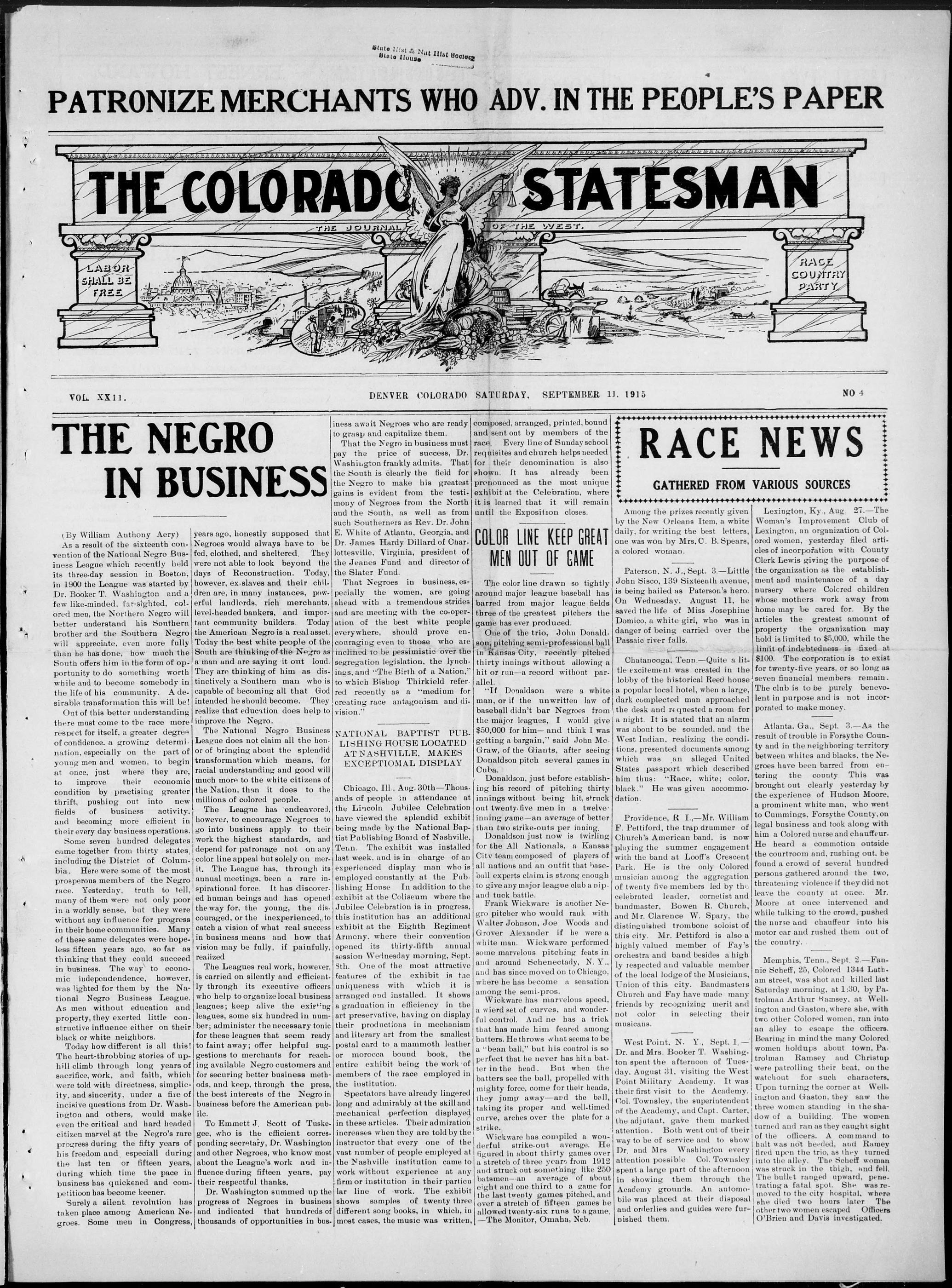
THE NEGRO IN BUSINESS
VOL. XX11.
THE NE
IN BU
(By William Anthony Aery) As a result of the sixteenth convention of the National Negro Business League which recently held its three-day session in Boston, in 1900 the League was started by Dr. Booker T. Washington and a few like-minded, far-sighted, colored men, the Northern Negro will better understand his Southern brother and the Southern Negro will appreciate, even more fully than he has done, how much the South offers him in the form of opportunity to do something worth while and to become somebody in the life of his community. A desirable transformation this will be!
Out of this better understanding there must come to the race more respect for itself, a greater degree of confidence. a growing determination, especially on the part of young men and women, to begin at once, just where they are, to improve their economic condition by practising greater thrift, pushing out into new fields of business activity, and becoming more efficient in their every day business operations.
Some seven hundred delegates came together from thirty states, including the District of Columbia. Here were some of the most prosperous members of the Negro race. Yesterday, truth to tell, many of them were not only poor in a worldly sense, but they were without any influence for progress in their home communities. Many of these same delegates were hopeless fifteen years ago, so far as thinking that they could succeed in business. The way to economic independendence, however, was lighted for them by the National Negro Business League. As men without education and property, they exerted little constructive influence either on their black or white neighbors.
Today how different is all this! The heart-throbbing stories of uphill climb through long years of sacrifice, work, and faith, which were told with directness, simplicity, and sincerity, under a fire of incisive questions from Dr. Washington and others, would make even the critical and hard headed citizen marvel at the Negro's rare progress during the fifty years of his freedom and especial during the last ten or fifteen years, during which time the pace in business has quickened and competition has become keener.
```markdown
```
Surely a silent revolution has taken place among American Negroes. Some men in Congress,
years ago, honestly supposed that Negroes would always have to be fed, clothed, and sheltered. They were not able to look beyond the days of Reconstruction. Today, however, ex-slaves and their children are, in many instances, powerful landlords, rich merchants, level-headed bankers, and important community builders. Today the American Negro is a real asset. Today the best white people of the South are thinking of the Negro as a man and are saying it out loud. They are thinking of him as distinctively a Southern man who is capable of becoming all that God intended he should become. They realize that education does help to improve the Negro. The National Negro Business League does not claim all the honor of bringing about the splendid transformation which means, for racial understanding and good will much more to the white citizens of the Nation, than it does to the millions of colored people.
The League has endeavored, however, to encourage Negroes to go into business apply to their work the highest standards, and depend for patronage not on any color line appeal but solely on merit. The League has, through its annual meetings, been a rare inspirational force. It has discovered human beings and has opened the way for, the young, the discouraged, or the inexperienced, to catch a vision of what real success in business means and how that vision may be fully, if painfully, realized
The Leagues real work, however, is carried on silently and efficiently through its executive officers who help to organize local business leagues; keep alive the existing leagues, some six hundred in number; administer the necessary tonic for these leagues that seem ready to faint away; offer helpful suggestions to merchants for reaching available Negro customers and for securing better business methods, and keep, through the press, the best interests of the Negro in business before the American public.
To Emmett J. Scott of Tuskegee, who is the efficient corresponding secretary, Dr. Washington and other Negroes, who know most about the League's work and influence during fifteen years, pay their respectful thanks.
Dr. Washington summed up the progress of Negroes in business and indicated that hundreds of thousands of opportunities in bus-
DENVER COLORADO SATURDAY. SEPTEMBER 11. 1915
State Hist & Nat Hist Society
State House
ANTS WHO
ADO
E JOURNAL
DENVER COLORADO
iness await Negroes who are ready to grasp and capitalize them. That the Negro in business must pay the price of success, Dr. Washington frankly admits. That the South is clearly the field for the Negro to make his greatest gains is evident from the testimony of Negroes from the North and the South, as well as from such Southerners as Rev. Dr. John E. White of Atlanta, Georgia, and Dr. James Hardy Dillard of Charlottesville, Virginia, president of the Jeanes Fund and director of the Slater Fund.
That Negroes in business, especially the women, are going ahead with a tremendous strides and are meeting with the co-operation of the best white people everywhere, should prove encouraging even to those who are inclined to be pessimistic over the segregation legislation, the lynchings, and "The Birth of a Nation," to which Bishop Thirkield referred recently as a "medium for creating race antagonism and division."
NATIONAL BAPTIST PUB LISHING HOUSE LOCATED AT NASHVILLE, MAKES EXCEPTIONAL DISPLAY
Chicago, Ill., Aug. 30th—Thousands of people in attendance at the Lincoln Jubilee Celebration have viewed the splendid exhibit being made by the National Baptist Publishing Board of Nashville, Tenn. The exhibit was installed last week, and is in charge of an experienced display man who is employed constantly at the Publishing House. In addition to the exhibit at the Coliseum where the Jubilee Celebration is in progress, this institution has an additional exhibit at the Eighth Regiment Armony, where their convention opened its thirty-fifth annual session Wednesday morning, Sept. 5th. One of the most attractive features of the exhibit is the uniqueness with which it is arranged and installed. It shows a graduation in efficiency in the art preservative, having on display their productions in mechanism and literary art from the smallest postal card to a mammoth leather or morocca bound book, the entire exhibit being the work of members of the race employed in the institution.
Spectators have already lingered long and admirably at the skill and mechanical perfection displayed in these articles. Their admiration increases when they are told by the instructor that every one of the vast number of people employed at the Nashville institution came to work without experience at any firm or institution in their particular line of work. The exhibit shows samples of twenty three different song books, in which, in most cases, the music was written,
composed, arranged, printed, bound and sent out by members of the race. Every line of Sunday school requisites and church helps needed for their denomination is also shown. It has already been pronounced as the most unique exhibit at the Celebration, where it is learned that it will remain until the Exposition closes.
COLOR LINE KEEP GREAT MEN OUT OF GAME
COLOR LINE KEEP GREAT MEN OUT OF GAME
The color line drawn so tightly around major league baseball has barred from major league fields three of the greatest pitchers the game has ever produced.
One of the trio, John Donaldson, pitching semi-professional ball in Kansas City, recently pitched thirty innings without allowing a hit or run—a record without parallel.
"If Donaldson were a white man, or if the unwritten law of baseball didn't bar Negroes from the major leagues, I would give $50,000 for him—and think I was getting a bargain," said John McGraw, of the Giants, after seeing Donaldson pitch several games in Cuba.
Donaldson, just before establishing his record of pitching thirty innings without being hit, struck out twenty-five men in a twelve-inning game—an average of better than two strike-outs per inning.
Donaldson just now is twirling for the All Nationals, a Kansas City team composed of players of all nations and an outfit that baseball experts claim is strong enough to give any major league club a nip and tuck battle. Frank Wickware is another Negro pitcher who would rank with Walter Johnson, Joe Woods and Grover Alexander if he were a white man. Wickware performed some marvelous pitching feats in and around Schenectady, N. Y., and has since moved on to Chicago, where he has become a sensation among the semi-pros.
Wickware has marvelous speed, a wierd set of curves, and wonderful control. And he has a trick that has made him feared among batters. He throws what seems to be a "bean ball," but his control is so perfect that he never has hit a batter in the head. But when the batters see the ball, propelled with mighty force, come for their heads, they jump away—and the ball, taking its proper and well-timed curve, arches over the plate for a strike.
Wickware has compiled a wonderful strike-out average. He figured in about thirty games over a stretch of three years from 1912 and struck out something like 250 batsmen—an average of about eight and one third to a game for the last twenty games pitched, and over a stretch of fifteen games he allowed twenty-six runs to a game.
—The Monitor, Omaha, Neb.
RACE NEWS
GATHERED FROM VARIOUS SOURCES
Among the prizes recently given by the New Orleans Item, a white daily, for writing the best letters, one was won by Mrs. C. B. Spears, a colored woman.
Paterson, N. J., Sept. 3.—Little John Sisco, 139 Sixteenth avenue, is being hailed as Paterson's hero. On Wednesday, August 11, he saved the life of Miss Josephine Domico, a white girl, who was in danger of being carried over the Passaic river falls.
Chatanooga, Tenn.—Quite a little excitement was created in the lobby of the historical Reed house a popular local hotel, when a large, dark complected man approached the desk and requested a room for a night. It is stated that an alarm was about to be sounded, and the West Indian, realizing the conditions, presented documents among which was an alleged United States passport which described him thus: "Race, white; color, black." He was given accommodation.
Providence, R L.,—Mr. William F. Pettiford, the trap drummer of Church's American band, is now playing the summer engagement with the band at Looff's Crescent Park. He is the only Colored musician among the aggregation of twenty five members led by the celebrated leader, cornetist and bandmaster, Bowen R. Church, and Mr. Clarence W. Spary, the distinguished trombone soloist of this city. Mr. Pettiford is also a highly valued member of Fay's orchestra and band besides a highly respected and valuable member of the local lodge of the Musicians, Union of this city. Bandmasters Church and Fay have made many friends by recognizing merit and not color in selecting their musicians.
West Point, N. Y., Sept. 1. Dr. and Mrs. Booker T. Washington spent the afternoon of Tuesday, August 31, visiting the West Point Military Academy. It was their first visit to the Academy. Col. Townsley, the superintendent of the Academy, and Capt. Carter, the adjutant, gave them marked attention. Both went out of their way to be of service and to show Dr. and Mrs. Washington every attention possible. Col. Townsley spent a large part of the afternoon in showing them through the Academy grounds. An automobile was placed at their disposal and orderlies and guides were furnished them.
NO 4
Lexington, Ky., Aug 27.—The Woman's Improvement Club of Lexington, an organization of Colored women, yesterday filed articles of incorporation with County Clerk Lewis giving the purpose of the organization as the establishment and maintenance of a day nursery where Colored children whose mothers work away from home may be cared for. By the articles the greatest amount of property the organization may hold is limited to $5,000, while the limit of indebtedness is fixed at $100. The corporation is to exist for twenty-five years, or so long as seven financial members remain. The club is to be purely benevolent in purpose and is not incorporated to make money.
Atlanta. Ga., Sept. 3.—As the result of trouble in Forsythe County and in the neighboring territory between whites and blacks, the Negroes have been barred from entering the county This was brought out clearly yesterday by the experience of Hudson Moore, a prominent white man, who went to Cummings, Forsythe County, on legal business and took along with him a Colored nurse and chauffeur. He heard a commotion outside the courtroom and, rushing out, he found a crowd of several hundred persons gathered around the two, threatening violence if they did not leave the county at once. Mr. Moore at once intervened and while talking to the crowd, pushed the nurse and chauffeur into his motor car and rushed them out of the country.
Memphis, Tenn., Sept. 2.—Fannie Scheff, 25, Colored 1344 Latham street, was shot and killed last Saturday morning, at 1:30, by Patrolman Arthur Ramsey, at Wellington and Gaston, where she, with two other Colored women, ran into an alley to escape the officers. Bearing in mind the many Colored women holdups about town, Patrolman Ramsey and Christup were patrolling their beat, on the watchout for such characters. Upon turning the corner at Wellington and Gaston, they saw the three women standing in the shadow of a building. The women turned and ran as they caught sight of the officers. A command to halt was not heeded, and Ramey fired upon the trio, as they turned into the alley. The Scheff woman was struck in the thigh, and fell. The bullet ranged upward, penetrating a fatal spot. She was removed to the city hospital, where she died two hours later. The other two women escaped Officers O'Brien and Davis investigated.
LATEST NEWS EPITOMIZED
FROM TELEGRAPHIC REPORTS
THAT COVER THE WEEK'S
EVENTS.
OF MOST INTEREST
KEEPING THE READER POSTED
ON MOST IMPORTANT
CURRENT TOPICS.
ABOUT THE WAR
A British squadron bombarded all the positions along the Belgian coast as far as Ostend Tuesday morning. The early evacuation of Riva, at the head of Lake di Garda, by the Austrians, is expected to follow the fall of Rovereto. The army of Field Marshal von Hindenburg has captured Grodno, the last of the strong Russian fortresses to hold out, making twelve within a month, beginning with Warsaw on August 5. The French steamship Bordeaux has been torpeded and sunk, twelve miles outside the mouth of the Gironde, off the western coast of France. Its crew was taken aboard a pilot boat.
The German submarine U-27 torpedoed and sank a small British cruiser west of Hebrides islands on Aug. 10 and is believed to have herself been sunk several days later, the admiralty announced in Berlin.
An Athens dispatch to the Exchange Telegraph Company says that a British submarine operating in the sea of Marmora has sunk a Turkish transport which was carrying 28-centimetre guns from Constantinople to Gallipoli.
It was announced at Brownsville, Tex., that Maj. Gen. Frederick Funston of the southern department is to issue orders placing practically the entire Rio Grande country in the Brownsville section in the hands of the U. S. army.
The immediate objective of the Austro-German campaign in Russia becomes clearer with the growing indications that the invaders need the Baltic port of Riga, not only as a base for present operations in the direction of Petrograd, but as winter quarters in case the attempt to reach the Russian capital should be postponed until next spring.
Six second cabin passengers, six third passengers and thirteen of the crew of the steamer Hesperian torpeded 150 miles off Queenstown were unaccounted for Monday night, according to the revised official figures issued by the Allan line. This brings the probable death list, including Miss Carberry of St. Johns, N. F., whose body is at Queenstown, up to twenty-six.
WESTERN
Fire destroyed the St. Francis Girls directory, a Catholic orphanage, at San Francisco, with the loss of at least five lives.
A. N. Barnett of Douglas, Ariz., and Clarence Sullivan of Denver, arrested as spies while looking over the Carranza defences at Agua Prieta were released. It was announced that hereafter foreigners must have passports if they cross the border.
In a speech at a "home coming" celebration at Rochester, Ill., United States Senator Lawrence Y. Sherman praised the policy of President Wilson in dealing with international questions and denounced the utterances of former President Theodore Roosevelt to the administration.
The Rev. Father A. J. Schuler, bishop-elect of El Paso, will be consecrated bishop at the Cathedral of Immaculate Conception Sept. 21 in Denver. Fifteen bishops and archbishops will officiate in the services, and Archbishop Pitival of New Mexico and Bishop Matz will bestow the papal commission.
WASHINGTON
Secretary McAdoo has appointed a committee of treasury officials to investigate and make recommendations to place the department on a "more efficient, economical and business basis."
The Interior Department announced that homestead entry may be made, under the reclamation law, on 157 farms of eighty irrigible acres on the Uncompahgre valley irrigation project in Colorado.
The resignation of John A. Marshall as United States District judge for Utah was received at the Department of Justice. Judge Marshall gave no reason for resigning. He was appointed by President Cleveland in 1896.
Twenty-four carloads of troops, including infantry, cavalry and artillerymen, and twenty carloads carrying tools of war passed through New Orleans on the way to the Mexican border from the East, the majority of the troops being from Alabama, Georgia, Florida, Arkansas, North and South Carolina and eastern posts and forts.
Chairman Flood of the house foreign affairs committee declares that the State Department must have largely increased appropriations on account of the war.
FOREIGN
Saltillo, capital of the state of Coahuila, has been occupied by Gen. Obregon.
Princess Adelaide, wife of the third son of the German emperor, gave birth to a daughter in London. The child died soon after its birth.
A resolution against conscription was adopted unanimously with great cheering at the session of the trades nion congress at Bristol, England.
The American consul at Queenstown, according to the London Daily Mail has received information that a man named Wolff, aged 21, and born in New Jersey, was lost in the sinking of the Hesperian.
The anniversary of the German entry into Senlis, France, and the execution of Mayor Eugene Odey and seventeen citizens was commemorated with a simple ceremony.
The first Swedish minister accredited to Switzerland, Count Albert Ehrensvard, has presented his credentials to President Motta. The count formerly was Swedish minister to the United States.
At London, Caroline Beatrice Love, first wife of George Smith, the bath-tub murderer, was married on the day following Smith's execution to Sapper Thomas Davies of New Westminster, British Columbia, now of the Royal Engineers.
Ten more bodies were found at Honolulu in the hull of the United States submarine F-4, crowded in the engine room, when a hole was cut through the steel plates to effect an entrance. One body was identified as that of Ivan L. Mahan, machinist's mate, of Lima, Ohio.
To obviate the necessity of again obtaining the recognition of foreign nations, the government has decided tentatively to maintain the form of a republic instead of restoring a monarchy, but to make the presidency permanent and hereditary, according to information obtained at Peking in high official quarters.
SPORTING NEWS
Standing of Western League Clubs.
Club— Won. Lost. Pet.
Des Moines 87 53 .621
Duplin 85 53 .543
Topeka 75 63 .543
Omaha 71 69 .507
Lincoln 70 69 .504
Slough City 66 68 .493
Wichita 56 81 .498
St. Johns 43 83 .316
Robert Gardner of the Hinsdale
Country Club of Chicago is amateur
golf champion of the United States
for the second time.
Miss India Rutledge, aged 14 years,
proved champion of the amateur swimmers who raced at Washington park in Denver, on Labor Day.
Jim Flynn, the Pueblo fireman, was
given the decision over Morgan Williams at Victor, Colo., in the fourteenth round of a scheduled fifteen-round bout.
Matty Smith of Racine and Denver was no match for Wright Morgan of Pittsburg at Trinidad, Colo. Smith managed to stay twenty rounds, but was in distress several times.
Thunderer, owned by L. S. Thompson, won the rich Futurity stakes for 2-year-olds at Belmont park, New York. Bromo, a stable mate, was second, and R. F. Carmen's Achievement, third. The distance was six furlongs, and the time 1:11 4-5.
Dario Resta, Ralph DePalma, "Bob" Burman and Eddie O'Donnell will race 100 miles on the new Fort Snelling speedway at St. Paul, Minn., for a purse of $10,000; $5,000 of which will go to the winner, $2,500 to second place driver, $1,500 to third place and $1,000 to fourth place.
Speeding over the course at a terrific clip, Rex Barber, Western slope champion, who came all the way from Green River, Utah, to participate in the Apache handicap bicycle road race in Denver, completed the distance of 19 2-5 miles in 51 minutes 15 seconds. His time lowered the state records by 45 seconds.
GENERAL
The Standard Oil Company granted an eight hour day in New Jersey to their employés.
A throng of many thousands at El Paso, Tex., witnessed the burial of the bodies of Gen. Pascual Orozo, Cristoforo Caballero, Jesus Miguel Terrazas, Andreas Sandoval and Jose F. Delgado, killed by a posse in Green Bay cafon, Culberson county, Tex., as the result of an attempt to steal horses.
Mrs. J. Ogden Armour, wife of the Chicago packer, fought a hand-to-hand conflict with two masked and armed robbers in attempting to protect her jewels in her home, 3734 Michigan avenue. The bandits drove Mrs. Armour and three maids into a room, secured jewelry valued at $7,500 and escaped.
With at least ten known Mexicans dead and probably as many more bodies lying in the dense brush, the battle between eighty United States cavalrymen, aided by a force of Texas rangers and armed citizens, ended Saturday. One American trooper was wounded. All United States soldiers were ordered to arms at Fort Brown. Earthquakes were felt in Denver, Cleveland, New Haven, New York and London Monday.
An attempt to break down the alibi of two of the three negroes charged with the murder of Dr. C. Franklin Mohr, was made at Providence, R. I.
Hundreds of persons at Iola, Kan., were driven from their homes at midnight when a seven-inch cloudburst sent Elm creek out of its banks, flooding the east and southeast sections of Iola. Many persons are missing. Property loss is estimated at $100,000.
COLORADO STATE NEWS
Western Newspaper Union News Service.
COMING EVENTS.
Sept. 14-17—Morgan County Frontier
Jays and Harvest Festival at Fort
Morgan.
Sept. 15-17—Elks' Annual Reunion at
Pueblo.
Pueblo.
Sept. 17-18.-Midsummer Meeting of Colorado State Editorial Association at Glenwood Springs.
Sept. 27-Oct. 8.—International Dry Farming Congress, Denver.
Oct. 2-9—Fair and Race Meeting at Denver.
Oct. 18—Odd Fellows' Annual State Convention at Colorado Springs.
Ninety-seven babies were born in Denver hospitals in August.
Former lowans will picnic at Washington park in Denver, Sept. 11.
Four persons were hurt in three cycle accidents in Denver Sunday.
There are 17,236,114 acres of public land available for settlement in Colorado.
An exceptionally heavy yield of beans is reported in the Loveland district.
Ten men were taken in a raid on an alleged gambling den in Englewood.
Seized with an attack of heart disease, Mrs. L. B. Well, 64, pioneer resident of Denver, died while at work in her kitchen.
Mrs. Clara Bledden of Denver, who was robbed and attacked by a negro, is aiding the police in searching for her assailant.
The boom in tungsten property is gaining force and volume every day and Nederland is now the center of observation among mining men of the state.
H. W. Risley has filed a demand for $208.33 for the printing commissioner's salary for August. He was suspended Aug. 9 by the governor.
Governor Carlson has ordered all offices in the state house to remain open until 5 o'clock on Saturdays, thus ending the summer half holiday.
Work of improvement on the buildings at Elks park for the Trinidad-Las Animas county fair, which will be held there Sept. 21-24, is going on constantly.
That the Fort Morgan sugar campaign will begin the latter part of the month and continue 120 days, is the way the management is figuring at this time.
Approximately $4,000 will go to the German and Austrian consuls for the widows and orphans of soldiers killed at the front from the volksfest held in Denver.
James C. Bulgar announced that he is a candidate for president of the Colorado State Federation of Labor. The convention is to be held in Denver, Sept. 18.
With a score of 98.1 points, the Chandler first aid team of Fremont county won the annual first aid contest at Walsenburg, given by the Victor-American Fuel Company.
Charged with an attempt to smuggle three large hack saws into the county jail to be used in a general delivery, Jesse Hiram, 20, was arrested by Sheriff Frank Kane at Trinidad.
Mary Crosivich, 9-year-old daughter of John Crosivich, a wealthy Austrian groceryman, was perhaps fatally injured when she was pinned beneath her father's automobile on the Santa Fé trail, east of Pueblo.
The big Boulder county fair opened at Longmont, with 7,000 present. The bumper crops this year have produced numerous spectacular exhibits—the most wonderful patrons of the fair have ever witnessed.
Durward Banton, 18-year-old Denver boy, committed suicide in a San Francisco hotel because of love for a 15-year-old schoolgirl, Miss Dorothy Hatch, to whom he had been forbidden to write affectionate letters.
Colorado's state flower—the columbine—should become the national flower, according to S. L. Mulford, landscape gardener in the office of the bureau of horticulture, a branch of the Department of Agriculture.
The following trustees to the Iiff School of Theology were named: R. F. Watkins, H. L. Shattuck, Edward Wilcox, D. C. Dodge, the Rev. W. S. Iliff, W. T. Scott, the Rev. D. D. Forsyth, C. K. Durbin and Mrs. Elizabeth Warren.
Commissioner of Finance Pitcher, acting as ex-officio assessor of Denver, presented to the city commissioners his assessment for 1915—$310,854,000. The commissioners accepted the assessment without a dissenting vote.
The actual launching of the big International Soil Products Exposition and Farm Congress, which will open its gates Sept. 26, took place when a bottle of Manitou champagne was broken over the foundation of the first building aracted in the grounds in Denver and a nail made from gold taken out of the Gregory Boobtall mine was pounded into the wooden structure.
For Aug. 15, on a basis of 100 per cent as normal, Colorado truck crop growers show a season standing as follows, according to the report of the bureau of crop estimates of the United States government: Condition of cabbages, 99; production, 92; condition of cantaloupes, 71; condition of onions, 92; production, 93.
Plans to establish a National park in the mountain wonderland known as the San Juan triangle were put under way at a joint meeting at Ouray of the commercial bodies of Colona, Ridgway, Silverton and Ouray.
GETS RICH IN SIX YEARS
STEVE KENDALL TELLS OF
YOUNG FARMERS' SUCCESS.
Home Destroyed by Fire Six Years
Ago, Worked for Others, and
Now Buys $6,000 Ranch.
Western Newspaper Union News Service
Grand Junction, Colo.—Steve Kendall of Plateau valley tells of the remarkable opportunity in the Collbran section of Mesa county, where a young neighbor has just bought a $6,000 ranch, paying $3,000 down and has a young herd of eighty range cattle developing a herd, and considerable other personal property. Six years ago this young man's home was burned, taking everything he had. He started to work for a nearby ranch owner, taking calves in payment for his work, boarding and living on the ranch. With a herd of half a dozen calves and young heifers, he started out for himself, with the result stated above. Collbran section is considered one of the wealthiest in the western Colorado cattle sections.
Kansas Farmer Killed as Auto Upsets
Colorado Springs.—F. C. Miles, 44, a wealthy retired farmer of Green, Clay county, Kan., was killed, and Mrs. A. S. King and her niece, Miss Edna Hunter, were seriously injured when the automobile in which they were riding skidded in the sand, one mile south of Monument, and turned over. Miles was killed instantly. Mrs. King and Miss Hunter are said to be in a serious condition. A. S. King and J. W. King, brothers-in-law of Miles, who were also in the car, were only slightly bruised.
F. L. Dodge Named New Undersheriff.
Denver.—Frank L. Dodge, state senator, former alderman of the Thirteenth ward, and a well-known Republican, was appointed undersheriff to succeed Glen Duffield, recently named as chief of police of Denver. The appointment was made by Alexander Nisbet, commissioner of safety. Commissioner Nisbet also announced the appointment of Henry Brady as deputy sheriff and S. H. Loeb as dog license clerk.
Man Complains Woman Beat Him.
Arvada.—Warrants for the arrest of John E. Matthews, wealthy owner of a large chicken ranch near Arvada, and Miss Mabel Van Dyke, his housekeeper, were issued on complaint of Edwin Purdy, who charged before Police Magistrate H. H. Gregg that he had been severely booten by the young woman, with the protection of Matthews.
Ni Wot Farmer Killed in Storm.
Boulder.—C. K. Blanton, one of the pioneer farmers in the Ni Wot section of Boulder county and rural mail carrier in the same vicinity for the last twelve years, died at the University hospital from a crushed skull and internal injuries received when he was trampled on by his horse, which became unmanageable during a terrific hail storm.
Barbers Seek Home Site.
Colorado Springs.-The Journeymen Barbers' International Union may build its national home in Colorado Springs, according to Jacob Fisher, general secretary of the organization, who is here looking over sites. The barbers at their last convention decided to locate their home somewhere in Colorado.
Speeding Cyclists Crash Head-on.
Gilcrest.—Riding 40 miles an hour without a light on either machine, two motorcycles, one ridden by Fred Lawrence and his sister, and the other by by Ellis Walters, came together between here and Platteville, head-on causing serious injury to Walters and badly damaging both machines.
Miners Victims of Premature Blast.
Victor.—Investigation developed the fact that Charles Ellison, 28, and James Constantine, 40, miners blown to pieces by a dynamite explosion in the bottom of the Last Dollar mine shaft on Bull Hill, were killed by a premature blast, as several of the fuses were unlighted.
Woman Charged With Disturbance. Pueblo.—A warrant charging a 92-year-old woman with disturbance was sworn to by Mike Probocak, a steel worker, in Municipal Court. The defendant is Mrs. Mary Yoncovich. She is five feet three inches tall and the police blotter gives her age as 92.
Governor Orders "Dry" Suit
Governor Orders Dry suit
Denver. Governor Carlson instructed
Attorney General Farrar to pre-
pare an injunction suit, to be filed in
the Supreme Court, restraining the
city and county of Denver from issu-
ing licenses extending beyond Jan.
1, 1916. The court will be asked to
often originate jurisdiction
Labor Day Celebrations.
Labor Day Celebrations.
Denver.—The toilers, the men who work in mill and shop, in the stores and on the street, the men whose handicraft appears on every counter and in every store window, while they themselves remain unseen, were feted on Labor Day in Denver and Colorado. The one day given over too the "men behind the scenes" was the incentive for a series of celebrations and festivities eclipsing any other occasion in Denver. Nearly 10,000 paraded in Denver, and 12,000 picnicked at Lakeside.
Carpenter, Job and Repair Work.
Paints, Oils and Glass.
Coal, Wood a
1021 21st Street.
Coal, Wood and Express
Street. Phone
Used the Rest Our Price
the Best Satisfaction
Coal, Wood and Express.
You Have Tried the Rest
Now Try the Best
THE
Giant
FOR QUALITY.
CLEANING, PRESSIN
ING, RELINING AN
WORK CALLED FOR
2549 Washington Avenue
ING, PRESSING, DYEING, F
RELINING AND REMODEL
WORK CALLED FOR AND DELIVERY
Boston Avenue Dem
CLEANING, PRESSING, DYEING, REPAIRING, RELINING AND REMODELING.
WORK CALLED FOR AND DELIVERED
2549 Washington Avenue Denver, Colorado
JOHN K. Meats, Fancy and 1864 CURTIS
JOHN K. RETTIG
Fancy and Staple Gro
1864 CURTIS STREET
eighteenth.
C. E. Smith
9, 190
Res. Phone
Market Comp
and Retail Staple and Fancy Grocceries
ers. Hotels and Restaurants Our Spec
Cured
eastern Corn Fed Meat
The Market
Wholesale and Retail Staple and
Oysters. Hotels and Res
Fresh and Cured
Eastern Corn
The Market Company
Wholesale and Retail Staple and Fancy Groceries, Fish and Oysters. Hotels and Restaurants Our Specialty.
Eastern Corn Fed Meats
Fruits, Vegetables, Poultry and Game.
1688-89 Arapahoe Street Denver
C. H. SHIRLEY, Pres. J. C. HAMPSON
PAUL J. SHIRLEY, Sec. and Treas.
THE ATLAS DRUG C
Courteous Treatmet. Right I
Leaders in Prescription
BIRLEY, Pres. J. C. HAMPSON
PAUL J. SHIRLEY, Sec. and Treas.
THE ATLAS DRUG CO.
Serious Treatmet. Right H
Leaders in Prescription
No. 1. Store
BUTTON ST.
26TH AND
5 875 Main 4
C. H. SHIRLEY, Pres. J. C. HAMPSON, Vice Pres PAUL J. SHIRLEY, Sec. and Treas.
Courteous Treatmet. Right Prices
Leaders in Prescription
Store No. 1.
2701 WELTON ST.
Main 895 875
Store No. 2.
26TH AND WELTON
Main 4955 4956
Dr. Westbrook
Office 31 Good Block
16th & Larimer sts.
Phone. Main 1433
Out of Office and at
nights Call Residence,
2714 Arapahoe Street
Phone Champa 570
TAURANT
Short Orders
1848 Arapahoe
$50.00 PER MONTH, MADE DURING YOUR SPARE TIME. Selling the High Brown Needs, instructions and solicitor certificate. This is the chance of a life time for any enteree. It is the first one in your community to get this position. NEGRO Doll, the beauty of modern invention, must be in line with innovation and catalog. NATIONAL NEIGHBOR DOLL COMPANY. 519 Second Ave, N.
Office 313½ Kittridge Bldg.
Phone Main 7416
Residence 822 32nd St.
Phone Main 8397
T. Ernest McClain, A. B. D. D. S.
Sundays and Nights by Appointment.
Office Hours:—8 a. m. to 12 m
2 p. m. to 6 p. m.
"STETSON HATS OUR SPECIALTY"
Phone Main 3661.
"BROWN, THE HATTER"
HATS CLEANED AND BLOCKED
50 CENTS
SATISFACTION GUARANTEED
A Trial Will Convince You.
71816 18TH STREET.
---
PHONE MAIN 3028
Corner Nineteenth.
Phones Main
169, 181, 189, 190
and Express.
Our Prices Reasonable
Satisfaction Guaranteed
CLEANERS
AND
TAILORS
McCAIN & RICHARDS, PROPS
Phone Main 7376
ING, DYEING, REPAIR-
AND REMODELING.
OR AND DELIVERED
Denver, Colorado
RES. PHONE GALLUP 942
. RETTIG
d Staple Groceries
TIS STREET
Denver, Colo.
C. E. Smith, Manager
Res. Phone South 1606
et Company and Fancy Groceries, Fish and Restaurants Our Specialty.
J. C. HAMPSON, Vice Pres
LEY, Sec. and Treas.
AS DRUG CO.
atmet. Right Prices
Prescription
Store No. 2
26TH AND WELTON
Main 4955 4956
ORIENTAL RESTAURANT
Chop Suey, Noodles and Short Orders
Phone Main 4896
1848 Arapahoe
乐泽轩
Weatherhead Hat Co
TELEPHONE MAIN 3203
PIONEER HATTERS OF THE WEST
```markdown
```
RENOVATORS. BLEACHERS.
DYERS AND FINISHERS
Of Gents' and Ladies' Hats of Every
Description.
1624 CHAMPA ST., DENVER, COLO.
Phone Champa 752.
Denver. Colorado
We Make
Old Hats
New
AFRO-AMERICAN CULLINGS
Exhibits of the handiwork of 2,000,000 colored school children in all parts of America form part of the Lincoln jubilee exhibit in the Coliseum, Chicago.
One of the leading exhibits is that of Wilberforce university, the oldest colored institution in America, and a school where students are taught everything from Latin to making plowshares. Another school which has a well-arranged exhibit is Howard university of Washington, D. C., while the instruction given to Negro students in medicine, pharmacy, dentistry and nursing is well displayed in the exhibit of Meharry Medical college of Nashville, Tenn.
Chicago is not neglected, for there are 15 boys and a like number of girls, about sixteen years old, who are demonstrating the training in the manual arts and domestic science courses which is given in the local public schools.
The Chicago display is under the direction of A. J. Brinkman of the Hendricks school and Miss Elleen Gerty of the Mitchell school.
Wilberforce university is near Xenia, O., and is in the direct line taken in the middle of the last century by slaves escaping from their southern bondage. The archives of the school are filled with thrilling incidents of the escape of slaves, some of whom had the temerity to stop and attempt to secure an education at Wilberforce.
The university was founded by the Methodist Episcopal church, and Dr. Rust of the Freedmen's Aid was its first president. When the war broke out, communication with the South was cut off and the Methodist church wished to sell the property. A brewery offered to buy it, but the offer was turned down and finally it was bought by Dr. Daniel A. Paine, a prominent colored man, and control of the institution passed to the African M. E. church. Now the school is well established financially and annual sums are appropriated by the Ohio legislature for its support. Last year the appropriation was $55,000. There are now 500 students, ranging in age from fourteen years upward. The exhibit includes a plow which was made by a student, examples of cabinet work in the line of bookcases, chairs and other furniture.
Howard university at Washington, D. C., is represented through a number of photographs showing the students in various phases of their collegiate work. Howard university was founded by Gen. O. O. Howard, who was supported by Harriett Beecher Stowe, Henry Ward Beecher, Stephen A. Douglas and other noted Americans of the Civil war days.
The work of the Catholic church is shown through the exhibit of five orders of nuns, the Oblate Sisters of Providence, the Sisters of the Holy Family, the Sisters of the Blessed Sacrament, the Techney Sisters and the Sisters of the Good Shepherd. The first two sisterhoods named are exclusively for colored women.
Much has been said of what Booker T. Washington is doing for the Negro. So much has been said that was good of his influence, and so much that was bad, that we have hesitated between the right and the wrong of it, writes Mrs. J. B. Reid in the Birmingham (Ala.) Age-Herald. We have sometimes come in contact through our domestic service with an element of arrogance, impudence and
Of the total number of 7,317,922 Negroes ten years of age and over, enumerated in 1910, 5,192,535, or 71 per cent, were reported as gainfully employed, the percentages for males and females being 87.4 and 54.7 respectively. The corresponding percentages for native whites were 77.9 and 19.2. Of the gainfully employed Negro males, 30.9 per cent—almost one-third—were farm laborers, and 25 per cent were farmers. The other leading occupation groups for Negro males, with the percentage of the total represented by each, were as follows: Laborers, building and hand trades, 5.2; laborers, saw and planing mills, 2.9; laborers, steam railroad, 2.7; porters, except in stores, 1.6; draymen, teamsters and expressmen, 1.6; coal mine operatives, 1.2; laborers, porters and helpers in stores, 1.2; waiters, 1.1; laborers, road and street building and repairing, 1.1; cooks, 1.0; deliverymen, stores, 1.0; carpenters, 1.0.
For females, the leading capacities in which employed, with the percentage represented by each, were as follows: Farm laborers, 48.1; laundresses (not in laundry), 17.9; cooks, 10.2;
In response to the advertisement of the United States navy department for 1,500,000 teak decking logs, a Manilla lumber firm has submitted an offer of 500,000 feet of yacal, a Philippine wood resembling teak, which is regarded as the equal of teak for construction purposes. This is the first time that such offers of Philippine woods have been made to the navy.
It all depends. If you are not interested in golf it is a bore. If you are it is a disease.
ignorance who claim tutorage, even to have graduated at "Booker Washington's school." These have prejudiced us against an attempt to educate the Negro.
Again, we have members of the race living among us giving good, intelligent, unpretentious service, striving quietly for right, and working capably in their line of industry.
This is because we do not know, have not actually seen what is being done for the Negro, with Alabama as the working center.
A week ago I left Birmingham for Tuskegee, reaching there the afternoon of the same day. Arriving at the depot at about two o'clock, I was driven through the quaint little town, with its huge shade trees and colonial homes, to the Tuskegee Normal institute.
From the moment I entered the grounds I saw the result of a wonderful industry—a small city laid off in streets, with parks, blooming plants and graveled driveways. The center, the school plant and its workshops, with a circular border of well-kept homes, the homes of the teachers. At a distance a beautiful view of growing fields and meadows with stock grazing leisurely along. Amazed does not express my impression at first, and astonishment never ceased in my rounds. All of the route from Montgomery along the way I had noticed the same old plantation shanty, the wash pot and the half red dog, I could never have imagined such a transformation from existence to comfort, from idleness to work, could have taken place within so few miles of one to the other.
The story reads like a fable. In 1881, 34 years ago, there was a political campaign on in Macon county. The Negro had a voice in the elections. As a reward for political service a promise was fulfilled to the leader of the Negro voters—"that a good teacher would be furnished to the Negroes of Tuskegee." Booker T. Washington was the fulfillment of that promise—a political product that has worked well. He had been educated at Hampton, Va., and came in response to the demand for a teacher—thus the Negro race came to be in possession of a leader whose influence has been felt over the world, and whose executive ability has built a city of his own out of the barren fields in Macon county. Land was purchased at $1 an acre; then that has价钱 today. Gradually the school property has increased in acreage until it numbers 2,300 acres now, with 1,500 under cultivation. Already there are 38 handsome buildings of brick, dormitories, study halls, dining hall, a Carnegie library with a circulation of 4,000 books, a hospital recently built and equipped at the cost of $55,000; an electric plant at a cost of $300,000 has just been finished. These bear the names of the philanthropists who have made them possible. All of the labor has been done by the student body of the school—even the brick are made on the premises. This is a wonderful workshop from gateway to field. It would take one a week to see the industry that is under process of creation along all lines; and a book to enumerate all I thought and half that I saw.
The entire work of shop and field is done by the student body, thus the expense of procuring the advantages offered by the school is very much reduced to the pupil.
farmers, 3.9; dressmakers and seamstresses (not in factory), 1.9; school teachers, 1.1.
Statistics compiled by the National Negro Business league show that in the fifteen years of the organization's existence the value of farm property in this country owned by Negroes has increased from $177,404,688 to $492,892,218. That is a truly remarkable record of race progress in thrift and in the agricultural pursuits which it has latterly been the fashion to encourage. The Negro at least is setting an excellent example in "getting back to the land."—New York World.
A Springfield (Mo.) man took out homestead papers the other day on an 80-acre tract of land 100 miles from that city. Before applying at the land office for the papers he walked the entire distance and back in order to visit the property. When he got back he had just enough money to pay for the land and cover the necessary fees.
You can never tell what a woman thinks by what she says.
People generally speak well of Hobe Fisher, who is a hopeless inefficient and who has been a burden on his wife's people ever since he was married. But they bitterly attack Samuel Plympton, who is rich and influential and one of the fairest men in town.
Medical men say that persons who attain their thirtieth year without suffering from any serious disease are likely—all things being equal—to live till they are at least seventy-eight years of age.
ONE DEAD,49 HURT IN D. & R.G.WRECK
ONE DEAD,49 HURT IN D. & R.G.WRECK
FIREMAN PINNED UNDER CAB;
COOKED BY STEAM FROM
LOCOMOTIVE.
FREIGHT HITS EXPRESS
ENGINEER SERIOUSLY BURNED,
AND PASSENGERS BRUISED,
AT TENNESSEE PASS.
Western Newspaper Union News Service.
Leadville, Colo.—Elmer John, fireman, was killed, and William King, engineer, was seriously burned, forty-three passengers and six other trainmen hurt, when a D. & R. G. helper engine crashed head-on into a double-header express train near Pando Wednesday morning. One engine was thrown upon its side; the ends of two steel cars were crushed and about sixty feet of track was torn.
The place where the accident happened was upon a piece of track laid on a high bank 200 feet above the stream, and, had the cars been thrown from the track, the resulting casualties would have been frightful.
John was caught under the engine that left the track and was cooked by the steam from the boiler. Aid was speedily given him and he was extircated, but he died while on the way to the hospital at Salida.
Information given here is that the crew of the engine, which was a freight train helper, is to blame. The helper engine is one which aids the engines of regular trains to pull their loads over the heavy grades in this mountain division.
Passenger Train No. 20, which is one of the crack trains operated from Salt Lake City by the Rio Grande, connecting with the Western Pacific line from the coast, was filled with tourists home bound from the Panama Pacific Exposition.
Among the Coloradoans injured were James R. Donaldson, Irene B. Donaldson, L. E. Armstrong, J. Raysville and O. A. Evers of Denver, and B. F. Benson, Bertha C. Norris and Mary R. Norris of Colorado Springs.
BERLIN NOTE GIVEN U.S.
Germany Says Arabic Tried to Ram Submarine, and Offers to Arbitrate—No More Attacks.
Berlin. — Germany's note to the United States concerning the sinking of the White Star liner Arabic by a German submarine was communicated to James W. Gerard, the American ambassador, Wednesday evening.
The note ascribes the destruction of the liner to an act of self-defense on the part of the submarine, expresses the German government's deep regret that American lives were lost thereby and offers to refer the questions of reparation and compensation to The Hague for adjustment. The note reveals in detail the instructions to submarine commanders concerning their treatment of liners.
They are ordered not to attack a passenger steamer except in case of an attempt to escape after it is ordered to halt or unless its actions indicate an intention to attack the submarine.
The submarine commander, according to his report, concerning the sending of the Arabic to the bottom, said he believed the Arabic was about to attack the submarine and therefore he acted within his instructions.
DUMBA ASKS FEDEPAL AID.
Austrian Envoy to Continue Strikes in U. S. With or Without Consent.
Washington.—Dr. Constantin Dumba, the Austro-Hungarian ambassador, left Wednesday for the summer embassy at Lenox, Mass., to await word from Secretary Lansing as to whether the United States government is satisfied with his explanation of his intercepted letter to the Vienna foreign office outlining plans for withdrawing Austro-Hungarian labor and handicapping American plants manufacturing war supplies.
It is no secret in official circles that the administration would not countenance any sort of participation in such a movement.
The ambassador's statement to Mr. Lansing that he was acting under instructions from his government in all that he planned to do apparently has made a diplomatic issue of the affair far more serious than a mere question of ethics or propriety involving only Dr. Dumba himself. It is understood that the ambassador proposes to go ahead with his plans without regard to the attitude of the American government.
Grand Duke to Minor Army Post. Petrograd.—Grand Duke Nicholas has been transferred to the Caucasus by Emperor Nicholas. The Emperor took this action on assuming command of the military and naval forces of Russia. In transferring the Grand Duke he appointed him Viceroy of the Caucasus and commander-in-chief of the army on the southern front. The Grand Duke thanked the men for their heroism in the past and predicted that, with the Emperor leading them, they would perform fresh exploits.
LEGAL FIGHT PREDICTED
ATTORNEY GENERAL ADVISES
WITNESSES MUST APPEAL.
Officers' Committee and Union May
Take Part in Case to Determine
Powers of Investigating Body.
Western Newspaper Union News Service.
Denver.—A legal clash between the
State Military Board of Inquiry and
representatives of the United Mine
Workers and possibly the members of
the officers' committee which filed
charges against National Guard heads
was predicted following the rendering
of an opinion by Attorney General
Farrar defining the powers of the
Military Court.
The attorney general held that the military board has the right to summon witnesses, and to fine or send them to jail for contempt if they refuse to be sworn to testify. Apprised of the ruling, counsel for the United Mine Workers' representatives, who have been making investigations in Colorado, announced that applications for writs of habeas corpus have been prepared, and that if the board attempts to fine or to send to jail witnesses who refuse to testify, the entire question of the military board's authority will be made the subject of a test case in the civil courts.
The writ of attachment for Major Elliott was issued by Colonel Boughon. It consists of a certified copy of the executive order naming the board of inquiry, the subpoena issued for Major Elliott and an affidavit of personal service of the subpoena upon Major Elliott.
Award to Widow Under New Act.
Award to Widow Under New Act.
Denver.—The first month's operation of the workmen's compensation act was brought to a dramatic close with the settlement of the first death award under circumstances which the members of the Industrial Commission declare bring out vividly the benefits of the system. Luigi Cardinale, an employé of the Colorado Fuel and Iron Company, was killed Aug. 9 by a fall of coal. The accident was due to a "slip" or natural fault in the vein formation and was of those classed as "unavoidable." No blame could fasten on the company, the employé or his fellow workers and under the old system, according to Charles W. O'Donnell, chief of the claim department, no damages could have been collected through the courts. Yet Mrs. Angela Cardinale was awarded $34.72 per month, half her husband's pay, for a period of seventy-two months, $17.36 of it going to her children until they become of age and the remainder to herself, unless she marries again. Mrs. Cardinale will be required to give an accounting to the industrial commission of the manner in which this money is spent. The books for August show the operation of the compensation law through the following figures: Total number of accidents reported, 564; disposed of, 298; disabilities of one week or less, 117; disabilities of two or three weeks, 79; entitled to compensation, 58; deaths, 12. This shows 12 per cent of accidents entitled to compensation, 32 per cent resulting in disabilities under the three-week limit, and 2 per cent fatal. Thirty per cent of the accidents reported during the month were insured under the state fund.
Colorado Peace Delegates Named.
Denver. Colorado delegates to the International Peace Congress, to be held at San Francisco from Oct. 10 to 12, have been appointed. The Denver members are Verner Z. Reed, L. C Phipps, Armour C. Anderson, Dr. Jas H. Baker, L. M. Cuthbert, A. C. Carson, Rev. Wm. S. Friedman, E. B Hendrie, Rev. J. H. Houghton, A. R King, Frank McLaughlin, E. A. Peters, Platt Rogers, F. W. Sanborn, Dr William T. Slocum, T. G. Smith, Judge S. Harrison White and Edward J Yetter. Denver members of the delegation appointed to the Pan-American Road Congress at Oakland, Calif., from Sept. 13 to 17, are Dr. F. L. Bartlett E. E. Sommers, C. P. Schwalb, J. M Kuykendall and T. J. Ehrhart. To the American Mining Congress, to be held at San Francisco from Sept. 20 to 22 the Denver delegates are D. W. Brunton, Fred Carroll, O. E. Cary and Carl Johnson.
Burnett Replies to Governor.
Denver.—James A. Burnett, president of the State Racing Commission, sent to Governor Carlson a reply to the latter's communication asking for the resignation of Commissioners Burnett and Dunleavy. The letter from Mr. Burnett says that both he and Dr. M. J. Dunleavy are busy aiding in the conduct of county fairs in the northern part of the state, and as soon as the State fair at Pueblo is concluded on Sept. 18 they will be glad to take up with the governor "any differences that seem to exist between you and the commission, or between you and any member or members of the commission."
Board Claims Power Over Utilities
Denver.—That it alone has the authority to make rates and define the service of public utilities in Colorado, whether such utilities are owned by municipalities or private interests was the announcement made by the State Public Utilities Commission in passing on issues before it involving the Denver Tramway Company. In making its ruling the utilities board for the first time took a definite stand on a question which was raised when the public utilities act was before the Legislature in 1913.
The
Curtis
Park
Floral
Company
FLORAL DESIGNS PUT UP WHILE
YOU WAIT
CHOICE PLANTS AND CUT FLOWERS CONSTANTLY
ON HAND
GREENHOUSES: Thirty-Fourth and Curtis Streets
TELEPHONE, MAIN 1511
DENVER, COLO
W. C. CAMPTON, Pres. J. M. JOHNS, Treas. U. P. JACKSON, Sec. RAILROAD PORTERS' CLUB LUNCH ROOM IN CONNECTION
BILLIARDS AND POOL
1728½ Wazee St. Only
8½ Wazee St. Only one block from Union D
1728½ Wazee St. Only one block from Union Depot.
PHONE MAIN 8416. DENVER, COLORADO
The Champion
Twentieth a
Is the place
DRUGS, CHEMICALS AND
WE SERVE
Prescriptions
Phone us and we will deliver the
JAMES E. TH
PHONE M
THE ZOBEL
SAMPLE
1004 Nineteenth Str
Champa Pharm
Twentieth and Champa,
Is the place to get your
CHEMICALS AND PATENT M
WE SERVE DRINKS.
Descriptions Our Special
and we will deliver the goods to all parts
JAMES E. THRALL, PR
PHONE MAIN 2426.
E ZOBEL BROTHER
AMPLE ROO
Nineteenth Street, Corner of
Twentieth and Champa,
Is the place to get your
DRUGS, CHEMICALS AND PATENT MEDICINES
WE SERVE DRINKS.
Prescriptions Our Specialty.
Phone us and we will deliver the goods to all parts of the city.
JAMES E. THRALL, PROPR.
PHONE MAIN 2425.
1004 Nineteenth Street, Corner of Curtis
FINE WINES, LIQUORS AND CIGARS
COORS' CELEBRATED BEER ON TAP
The
WARD AUCTION
COMPANY
Sales Daily at 2 p.m. Office Furniture a Specialty.
PRIVATE SALES AT ALL TIMES
HAVE MOVED TO—
1723-39 GLENARM ST.
PHONE MAIN 1675.
THE BEST ICE CREAM AND
CANDIES AT
O. P. BAUR & CO.
CATERERS AND
CONFECTIONERS
Phone: 168
1512 Curtis Street, Denver, Colo.
DO IT NOW Subscribe
for THIS
PAPER
---
---
DENVER
FREE CHECK ROOM one block from Union Depot. DENVER, COLORADO.
A Pharmacy
and Champa,
to get your
PATENT MEDICINES
DRINKS.
Our Specialty.
the goods to all parts of the city.
MIRALL, PROPR.
MAIN 2426.
BROTHERS'
E ROOM
Street, Corner of Curtis
TELEPHONE YORK 6668.
J. H. Biggins
WORK GUARANTEED.
1417 East 24th Avenue, Denver, Colo.
Miss M. Cowden Hair Dressing Parlor
Shampoo, cutting and curling. Scalp treatment, hair tonics, hair straightening, manicuring. Stage wigs for rent; theatrical use and masquerades. Goods delivered out of the city. All shades of hair matched by sending sample of hair; also combings made up.
Cheapest Switches 50 Cents
1219 21st St. Denver, Colo.
A man in a traditional dress.
COLORADO
THE COLORADO STATESMAN
JOS. D. D. RIVERS.....Proprietor
1824 Curtis Street, Room 25.
Phone Main 7417.
JOS. D. D RIVERS.....Proprietor
1824 Curtis Street, Room 25.
Phone Main 7417.
SUBSCRIPTION RATES:
One Year ..... $2.00
Six Months ..... 1.00
Three Months ..... .60
PAYABLE IN ADVANCE.
Entered as second-class matter at the postoffice in the city of Denver, Colorado.
It occasionally happens that papers sent to subscribers are lost or stolen. In case you do not receive any number when due, inform us by postal card and we will cheerfully forward a duplicate of the missing number.
Communications to receive attention must be newsy, upon important subjects, plainly written only upon one side of the paper; must reach us Tuesdays, if possible, anyway, not later than Wednesdays, and bear the signature of the author. No manuscript returned, unless stamps are sent for postage.
Remittances should be made by Express Money Order, Postoffice Money Order, Registered Letter or Bank Draft. Postage stamps will be received the same as cash for the fractional part of a dollar. Only 1-cent and 2-cent stamps taken.
Display advertising, 50 cents per inch. An inch contains twelve agate lines.
No discounts allowed on less than three months' contract. Cash must accompany all orders from parties unknown to us. Further particulars on application.
Reading notices, ten lines or less, 10 cents per line. Each additional line over ten lines, 5 cents per line.
All communications of a personating nature that are not complimentary will be withheld from the columns of this paper.
COLORED CITIZENS' LEAGUE.
Apart from our immediate domestic entanglements; away from the trivialities of that which generally surround us; separated as a whole by that law which is enquiring into the origin and genuineness of races, we find ourselves confronted with something which not only makes us stop and think, but which asks the questions: "What is our aim, where are we going, when shall we reach the goal?" The Colored Citizens' League in its endeavor to combat with present conditions, says: "We are on the road to the solution of this problem, and if supported by the classes of our people that stand for right, justness and impartiality, we will by our persistent efforts prove that we are not living in the realms of imagination, but laboring for a specific and distinctive action which must result in the suppression of ills towards us and the amelioration of the existing circumstances which seem to overwhelm us." The League is extending its influence by inaugurating auxiliaries in Colorado Springs, Pueblo, Cañon City, Walsenburg, Glenwood Springs and other places, and not only is it engaging itself in the political status of our people, but also in the educational, financial and social.
Political Positions
There are people of our race occupying positions in the City and County of Denver today through the help and influence of the League that may not be quite satisfied with their spheres of employment, but if they can remember the old and wise adage of "accepting the lesser for the acquisition of the greater," "the smaller for the larger," they would more than profit by the law of ENDURANCE in their efforts to accomplish what may appear to be impossible in the face of conditions in this western country.
Women Supervisors.
Positions of truant officers would be welcomed by the colored citizens, as from the negligence of the officers of the other side many of our boys and girls are falling into the MIRE from which there is no escape, and in place of representative citizens in the near or far future, we have that element which must cater to the cancerous growth of some malady.
Affiliation With White Organizations.
Communications have been received from white organizations requesting the League to confer with them in matters affecting the city and state While the League has every desire to assist any noble cause, yet its position must be clearly understood, that it feels as an organization representing a number of taxpayers and electors, it must be taken in confidence from the start, and if it comprises citizens of integrity, moral stamina and financial prestige in the community, then of necessity it must be interested in the same uplift, welfare, progress and development of the state and country which gave it birth.
Education of Our People.
The League is making every effort to impress the parents of our children to exercise more thought and care in having them remain in school for the full terms, as the same will be more advantageous to us as a people and race, and in our contribution to the nation's success it will be acknowledged fact sooner or later that among the prime qualities that go to make a nation, EDUCATION and MONEY must be invaluable attributes.
The Reminder.
Last Tuesday night will be remembered for the enthusiasm displayed and the pledge made to steer the organization on to success. Petty difference, selfishness and everything antagonistic to progress, had no place, and everyone present after expressing freely, concluded that the Colored Citizens' League was born of Realty, stood for Reality and meant Reality. Every Tuesday evening the members are in their places at 1025 Twenty-first street, where the public is cordially invited.
The Right Kind of Reading Matter
The home news; the doings of the people in this town; the gossip of our own community, that's the first kind of reading matter you want. It is more important, more interesting to you than that given by the paper or magazine from the outside world. It is the first reading matter you should buy. Each issue of this paper gives to you just what you will consider
The Right Kind of Reading Matter
---
Universal Demand Is for Experience
By ED T. GILTZOW. Columbus, Ohio
Universal Demand Is for Experience
By ED T. GILTZOW. Columbus, Ohio
and profoundly desiring to avert this calamity, I have sought in vain for an opportunity to enter, specialize and develop in the automobile industry. With this end in view I have planned with sincerity of purpose, enthusiastically and systematically to devote my leisure moments to the acquisition of knowledge and skill with the object of enhancing the value of my services both to my employer and myself, and with the ultimate aim of becoming a sales representative.
One of the mountainous obstacles impeding the realization of this aspiration is the universal demand for experience and the seeming equally universal lack among employers of volunteers to contribute to the novice the first opportunity for its acquisition. Wending his way from door to door in a futile and discouraging search, the prospective specialist must soon accept employment of whatever nature to sustain himself and possibly some dependents. With this acceptance of uncongenial employment his opportunity for further search is curtailed. His enthusiasm dampened, indifference finally results.
Vocational training is an obligation which society owes its younger members because of the highly technical and complex nature of modern industry. Well organized federal employment bureaus co-operating with such schools would solve this problem at least partially.
One cannot blame the young man, whether, as one contributor expresses it, he is "cognizant or not" of the danger of just floating through life, and the gainfulness of planning with his own God-given bent in mind a lifework. At least not until we offer a "fair field and no favor." Opportunities when made available will find no want of eligible applicants.
I have often heard it remarked that people of the new South were not so courteous as was the case in antebellum days, and perhaps this is true.
Help Rather Than Hinder One Another By J. F. KNOX, Birmingham, Ala.
But, nevertheless, the
people of Birmingham and other communities are well disposed and usually wish to help rather than hinder one another. For example, I was recently employed in taking a time view of one of the downtown show windows. It was a rush order and the work had to be performed in the busy part of the day.
In taking a picture of this kind it is necessary to have an exposure of ten minutes without interruption. The camera was stationed at the edge of the sidewalk so as to have the correct distance, and a friend politely requested pedestrians not to pass before the camera. One would be surprised at the number of people who will pass a given point when business is brisk. I suppose there were several hundred. But with the exception of two instances there was ready acquiescence to my friend's request.
This incident, I think, will go to show that by far the greater portion of the people of Birmingham, at least, are to all practical purposes considerate and kindly disposed and prefer to help rather than hinder the worker.
Superficiality Is Greatest of Sins
By C. C. Reynolds, Dayton, Ohio
Superficiality Is Greatest of Sins
By C. C. Reynolds, Dayton, Ohio
One of the great sins of the age is superficiality—an indifference to the deeper meaning of things; an indisposition to think. It is the dusty outside, the frivolous glimpse of events and things, the joke of it, that engage the universal attention. This situation is destructive of character and sacrifices understanding, which is the basis of wisdom.
Many think this is no offense; that one is innocent if he is only superficial. We take to the frivolous and laughing side of things, just as we take to narcotics and intoxicants, because it is pleasant and tends to relieve one from the anxieties and duties of the hour. A person thus slips away on a falderal from the realities of life.
The Bible enjoins upon us to be sober-minded. This admonition is as wholesome and exacting as any part of the Decalogue. It is based upon the idea that superficiality is destructive of mind and soul.
The frivolous person has no character, no purpose in life, no respect for wisdom and understanding.
The evil effects are everywhere shown—in church, in school, in court, in legislative hall, in shops; there is no insistence upon truth.
Siberian Pea Tree of Early Origin
By J. P. PEDERSEN, Chicago
In a recent article on "City Gardening" the Siberian pea tree is mentioned as a late introduction by the United States government. This is a mistake. The tree—or, rather, large
In a recent article on "City Gardening" the Siberian pea tree is mentioned as a late introduction by the United States government. This is a mistake. The tree—or, rather, large shrub—is an old acquaintance. The date of its discovery is given in Nicholson's "Dictionary of Gardening" as the year 1752. No doubt it has been cultivated in Europe since about that time, being introduced to this country not much later.
In 1910 we planted seeds of it in the city nursery at the Gage farm and have them at present, about five thousand plants, besides a few sent us a couple of years ago from the government.
It is a rather useful plant, one of its good qualities being its hardiness. But, though I have handled it for the last twenty years in the Chicago parks, I don't believe I have ever seen a flower on it here, although in Europe it flowers very freely.
Its botanical name is Caragana arborescens.
What strange ideas many persons have of liberty! What an amount of mischief has been done to society by such "rabble charming words," as South calls them—words "which have
Many Have Strange Ideas of Liberty
By C. R. REICHOW, Brooklyn, N. Y.
What strange ideas many persons have of liberty! What an amount of mischief has been done to society by such "rabble charming words," as South calls them—words "which have so much wildfire wrapped up in them"—as liberty, equality and fraternity!
How many who "bawl for freedom" confound it with license!
A republic presupposes a high state of morals, but how can this be possible without the habit of subordination and respect, and how can these exist without humility?
The true freeman is not only jealous of his own rights, but respects and cares for the rights of others, and is indignant when any man, even the meanest, is wronged or trampled under foot.
The man who is always boasting of his freedom is probably a slave to the meanest and most tyrannical vices, passions or prejudices.
Do You Know That—
The COLORADO STATESMAN
IS PREPARED TO DO ALL KINDS OF
JOB PRINTING
Commercial, Fraternal, Church, Book and Stationery Jobs A SPECIALTY
Ball and Concert Programs, Bill and Letter Heads, Calling Cards, Wedding Cards, Envelopes and Everything in the Printing Line Turned Out in the Neatest and Best Style Promptly on Short Notice.
We Have Supplied Our Office with New Job Press & Type of Up-to-Date Style and Our Work Will Be on a Par with the Very Best.
Give Us a Trial and and We Will Give You Satisfaction
Prices as Reasonable as Those of Any Job Office in Denver
The Colorado Statesman
1824 CURTIS STREET
Room 25 Phone Main 7417
---
Bert Patrick is confined to his room with inflammatory rheumatism.
Mrs. Susie J. Rollins of Olathe, Kansas, is in the city, the guest of Mrs. Frank Pratt of 1736 Downing street.
Chickens had better roost high next week—the annual A. M. E. conference will hold its session here. Nuff said.
for Boston and other eastern points on a three weeks' vacation. The Rotor, after nearly four years of service in the diocese, has material helped the spiritual welfare of the community as well as increased church membership. The Colorado Statesman wishes him an enjoyable time and a safe return.
Miss Thelma Thomas, who was operated on for appendicitis at St. Joseph's hospital this week, is getting along nicely.
Miss Amelia Gray, after spending two weeks in Colorado Springs, has returned to the city.
Mesdames Mollie, Turner and Georgia Turner left the city Thursday for Kansas City, Kans., for an indefinite stay.
Mrs. John A. Reed arrived in the city Thursday from Chicago. As usual John is all smiles.
Mrs. R. S. Brown of Seattle, Wash., is stopping with Mrs. P. A. Hubbard of Manitou. Mrs. Brown is a sister of Joseph Montier.
Harrison Miller continues quite ill with a complication of complaints. His devoted wife and other relatives are assiduous in their misintrations to his comfort.
Robert Murray, a former prominent chauffeur of Denver, spent a few days in the city last week en route for the California expositions.
Miss Georgia Robinson and her sisters, after visiting Miss Eliza Miller of 2412 Marion street, have returned to Nebraska City, after touring California points.
Harvey Page, our popular letter carrier, is taking his vacation by spending it with his family at Dearfield colony.
Julius Ragsville and O. A. Evers were among those injured in a wreck last Wednesday on the Denver & Rio Grand, near Tennessee Pass.
The Progressive Westerner of Seattle, after a brilliant but brief existence, has suspended publication on account of the publisher, Miss Ruth Freeman, joining the ranks of the newlyweds.
Mrs. Sarah Lucas of Emporia, Kansas, and Mrs. Martha Lyle of Colorado Springs were visitors in the city this week, the guests of Rufus Duncan. They were pleasant callers at our office Monday.
Mrs. Bruce P. Johnson and son. Clarence, arrived in the city Tuesday from Grand Junction, Colo., where she has been residing for the past four years. Mrs. Johnson will be the guest of Thomas Willis, her uncle, for several weeks.
There was a large crowd at Fern hall last Monday night at the Labor Day ball, which was given by R. L. Phynix. Everybody expressed themselves as having spent a very enjoyable evening.
Mrs. Grant Morris of 3018 Delaware street, Englewood, is among the crack shots of Denver, especially among those of her sex. As she can hit the bulls eye at a pace of 50 yards. The porcupine which she shot in her back yard on the 31st ult., had no chance to escape with her behind the gun.
Rev. J. E. Ford, ex-pastor of Zion Baptist church, but now of Jacksonville, Fla., passed through the city this week from California, where he spent several weeks on a lecture tour. He left early in the week for Chicago to attend the National Baptist Convention, which held its session there this week.
Tuilleries park was the scene of a large crowd on Labor Day, the occasion being a picnic given by the base ball boys under the management of R. B. Bolden. Besides a baseball game and band concert in the afternoon, dancing and roller-skating furnished amusement in the evening.
Rev. Henry B. Brown, rector of the Church of the Holy Redeemer, left
for Boston and other eastern points on a three weeks' vacation. The Rector, after nearly four years of service in the diocese, has materially helped the spiritual welfare of the community as well as increased his church membership. The Colorado Statesman wishes him an enjoyable time and a safe return.
---
From a private letter we learn that Capt. Silas H. Johnson is meeting with a hearty welcome from the denizens of the Western slope. At Salt Lake we learn that he was met by a band and escorted to a colored hall, where he was prevailed upon to make a speech, which was much appreciated. Capt. Johnson is a good mixer and it goes without saying that he will have an enjoyable trip in Sunny California.
Mrs. Nellie Porter left the city Saturday for her Chicago home after a short visit with her sister, Mrs. Jamie Burns. Miss Gonzales Porter, her popular and talented daughter, will teach her initial school in Oklahoma this fall. Gonza has many friends in Denver who wish her success in her new field of endeavor.
The Grand Lodge of Masons met in Salt Lake City this week and among the Knights of the square and compass of Denver, who attended, were F. T. Bruce, T. S. Rector, J. L. Little, Spencer J. Smithhea, Wm. Sprague and Carl Wilson. They are all well known throughout the district, not only for their worth and influence in the Masonic circle, but are staunch race men who have to their credit numerous acts in behalf of the Negro.
Mrs. Jonathan Richard Contee, Mrs. Elizah Jackson and Mrs. Thomas Brummell, three of our most charming matrons and society ladies, returned home Sunday after spending two weeks in Colorado Springs in Manitou enjoying the scenic attractions of those popular summer resorts. The ladies report having had an enjoyable outing.
Miss Vivian Austin, a very charming and attractive young society lady of Seattle, Wash., after spending a portion of her summer outing in Colorado Springs and Denver, departed for home Tuesday to the regret of the many friends she made in Colorado. While in our city, Miss Austin was the house guest of Mrs. W. B. Townsend, who made her stay one continual round of pleasure.
The Citizen Magazine, published in Boston, announces the following interesting features in verses, articles and fiction, for the September number: The second installment of T. Montgomery Gregory's essay on "The Race and the Fine Arts," the first act of an impressive and distinctive drama called "The Gift," by Dereth Byrd, a clever and thrilling short story, "What Was It," by Stoughton; another short story of high literary merit, "The Price," by Olive Jones; a comprehensive critical study of our famous poet called "The Mission of Dunbar," by George W. Ellis, and poems by such prominent and appealing poets as James W. Johnson, Benjamin G. Brawley and Fenton W. Johnson.
NOTICE TO THE PUBLIC
The Midland Café, formerly known as the Byron Café, at 924 19th street, will be under new management Sept 12. We are ready to serve you first class meals and short orders. Open early and late.
MRS. NELLIE STEELE,
MRS. PEARL GRATTON,
Proprietors.
VISITING SHRINERS.
Oasis of Denver, Desert of Colorado, Shawall 23, 1333, Syrian Temple No. 49, Ancient Egyptian Arabic Order of Nobles of the Mystic Shrine, sheltered beneath its dome five distinguished visiting Nobles from Eastern and Southern Deserts.
These nobles had tented their camels and had taken to automobiles. In the Great Desert of Colorado These travelling Nobles beheld the minarets of Syrian Temple and forthwith came to participate in the ceremonies. Syrian Temple thrice welcomed with all all her possible hospitality these visiting Shriners: Noble Joseph P. Evans $ 33^{\circ} $ , potentate of Jerusalem Temple, No. 4, Baltimore, Md.; Noble Geo. E. Frey, $ 33^{\circ} $ , of Jerusalem Temple No. 4, Baltimore, Md.; Noble J. O. Bamfield, $ 33^{\circ} $ , past potentate of Mecca Temple No. 10, Washington, D.C.; Noble W. W. Lawrence, $ 33^{\circ} $ , potentate of Arabian Temple No. 42,
New Bern, N. C.; Noble R. L. Pendleton, $33^{\circ}$, of Mecca Temple No. 10, Washington, D. C., and most Puisant Sovereign Grand Commander of Scottish Rite Masonry for the Southern jurisdiction, whose grand East is at Washington, D. C.
These wise men from the East brought wonderful tidings and interesting mystic greetings. These were Nobles—peers differing in individuality—but in their nobility formed a complete cycle of Shriner Tenets Syrian Temple says to them Aliekum Es Salaam, may their tribe increase—may God spare them to return.
PEOPLE'S PRESBYTERIAN.
E. 23rd Avenue and Washington Street, Pastor J. A. Thos-Hazell, S. T. B.
Sermon topics Sunday, September 12th:
11 a. m.—"The Kingdom Photographed."
5:30 p. m.—"Small Beginning With Large Ending."
Owing to a breakdown of the engine, the train conveying Mr. Stewart to Denver for the monthly concert at this church last Sabbath, was four hours late. We hope at some future date to have the benefit of this distinguished man's services. In lieu of his absence the choir produced an improvised program to a large and appreciative audience.
Dr. John Ford of Bethel Institutional church, Fla., graced the pulpit of the People's church last Sabbath afternoon and deliveried a most interesting and comprehensive address to the people. The key-note of his address was a comparison of church life among our people of the North and South, the latter having the better. Mrs. M. E. Morrison, a former parishioner of the Doctors, entertained her present pastor and Brother Ford at dinner on that day.
One thing craving the attention of the parishioners of the People's church right now is the program of activities in connection with the anniversary exercises of the church, beginning Tuesday night with prayer and song services. Wednesday night, the 22nd, will be a debate, "Resolved that Country Life Is More Conducive to Good Citizenship Than City Life." Mr. J. Manuel, (affirmative) Mrs. Alice Webb, (negative) will open the discussion with a fifteen minutes paper each. Weighty arguments on both sides will be advanced by competent persons, among them being Rev. A. C. Jackson, pastor Second Baptists church, Boulder; Mr. Geo. W. Gross, secretary of state office, etc.
The board of judges will be announced in our next issue. Thursday night, 23rd, complimentary entertainment on behalf of the young people will be given. Friday night everybody is invited to hear Miss Mabel Acom of Nebraska and Mr. Dick Jerome of New York in a comedy and drama. Sunday morning Rev. L. E. West of Dearfield will preach the anniversary sermon. The afternoon platform exercises will wind up the series.
Elder W. S. Evans, with Rev. J. A. Thos. Hazell, will represent People's church in fall meeting of Presbytery at Central Presbyterian church, Tuesday, Sept. 21. Rev. West and an Elder will represent the Union church of Dearfield.
SHORTER CHAPEL'S NOTES
Rev. Robert L. Pope, B. D., Pastor.
The pastor will fill the pulpit both morning and evening tomorrow. His subject for the morning discourse will be, "Help for the Discouraged." This being the final Sabbath for the conference year, every member who has not already paid his conference claims is urged to pay Sunday so as not to delay the pastor in making his conference report. We are glad to announce that the conference report is rounding out nicely and our church will go into the conference with colors flying, but we desire that every member will pay his Dollar Money Sunday so that our pastor may be prepared to report Wednesday when our report will be called for. It is not like Shorter to ask the Bishop for more time.
Our stewards are making special efforts to pay off our pastor in full and our congregation is asked to bring an extra offering Sunday to help them.
Bishop H. B. Parks is expected to reach the city today and worship at Shorter tomorrow. He will open the twenty-ninth session of the Colorado Annual Conference at 9:30 Wednesday morning at Shorter Chapel. Our members and friends are invited to attend the sessions of the conference regularly. A number of distinguished visitors are expected, and we are desirous of the citizens of Denver being out to enjoy the many good things which the conference will bring to us. The opening sermon will be preached Wednesday morning and the Holy Communion will be administered. On
Wednesday evening the following program will be rendered: :
Program.
1. Charus—Campbell's Choir.
4. Piano Duet, Misses Lillian Richardson and Mary Colston.
5. Recitation, "The Bravest Battles," Lille Winifred Steele.
6. Paper, "Modern Amusements, Their Place and Limitations," Mrs. E. M. Reeves.
7. Violin Solo, Selected, Mr. George Morrison.
8. Paper, "The Seriousness of the Divorce Evil," Mrs. Mary Baker, Cheyenne, Wyo.
9. Soprano Solo—Selected, Mrs. Edna Buford.
10. Address—"The Ideal Citizen," Lawyer W. B. Townsend.
11. Chorus—Campbell's Choir.
In formal summers class.
On Friday evening a temperance meeting will be held with the following:
Program.
1. Chorus — "Awake Thou That Sleepephe." Lorenz, Shorter's Choir
3. Piano Duet—Selected, Misses Rubie and Hazel Ames.
4. Paper—"Narcotics and Youth," Mrs. L. M. Froman.
5. Chorus—"Unfold Ye Portals," Gounod, Shorter's Choir.
6. Paper—"Mother's Part in the Temperance Fight," Mrs. Hattie E. Adams, Pueblo, Colo.
7. Paper—"The Contribution Our Young People's Society May Make to the Temperance Cause," Mrs. A. E. Vest, Pueblo, Colo.
8. Solo—"A Song of Thanksgiving," Allitson, (by request) Miss Jennie Mae Hicks.
9. Address—"Prohibition and Its Enforcement," Gov. Carlson.
10. "Awakening Chorus," Gabriel, Shorter's Choir.
CHURCH OF THE HOLY RE-
DEEMER.
(EPISCOPAL.)
Corner 22nd Avenue and Humboldt
Street, Rev. Henry B. Brown,
B. D. Vicar.
11:15 a. m.—Choral Matins with sermon.
YOU CAN BUY A PIANO ON PAYMENTS OF $5.00 A MONTH, OR RENT ONE FOR $2.50 A MONTH AT CASSELL BROS.
Segregate Art Treasures
Why not set apart one country where art treasures of the world can be segregated? Maybe Providence has been using American millionaires as blind instruments, in so far as they have been active in removing European art treasures to this country.
Still Human.
Bureaus of municipal research are supposed to know just how to make things run smoothly, but it seems that they are not all endowed with facilities for producing perfect peace and efficiency among themselves.
Remedy for Group
Beat the white of an egg to a stiff froth, then sweeten a little and add a little pulverized alum. Give a teaspoonful every ten or fifteen minutes until relief comes.
Easy Victims
There are nearly always enough people who do not read the newspapers on board a big ocean liner to make the voyage interesting for a few card sharps.
Causes of Unhappiness
The worst kinds of unhappiness, as well as the greatest amount of it, come from our conduct to each other. If our conduct, therefore, were under the control of kindness, it would be nearly the opposite of what it is, and so the state of the world would be almost reversed. We are for the most part unhappy, because the world is an unkind world. But the world is only unkind for the lack of kindness in us units who compose it—Frederick William Faber.
Truth About Diseases
Dr. Weir Mitchell, one of the most eminent physicians in the world, once said: "What we call diseases are only symptoms of conditions. Allow the man's vitality to be reduced to a certain point and he is ripe for any of these weaknesses which we call disease."
What Heaven Means to Me.
When we have traversed the dim leagues, and have seen things wonderful at every turn, and have passed through the bitter flood, we shall find—at least this is my hope—no guarded city of God from which we shall go no more out, but another road passing into wider fields and dimmer uplands, and to things more and more wonderful and strange and unknown.—Arthur C. Benson in Century Magazine.
THE Joslin DRY GOODS CO.
Now Comes a Sale of 1,000 WOMEN'S WAISTS
1,000 WOMEN'S WAISTS
Values $1.50 to $2.50
89c Each
Waists are made up in plain tailored and fancy
als over nets, plain and figured Jap silks, organdies,
prooidered and striped voiles. Lawns, silk crepe and
inations.
These Waists are made up in plain tailored and fancy styles.
Materials over nets, plain and figured Jap silks, organdies, plain, embroidered and striped voiles. Lawns, silk crepe and lace combinations.
This Is the Waist Bargain of the Season.
STORE CLOSED ENTIRE DAY LABOR DAY.
STORE CLOSED ENTIRE DAY LABOR DAY
CAMMEL AND CO.
The Progressive
Funeral Directors
WE TAKE GREAT PRIDE IN THE
FACT THAT WE ARE "THE LEAD
ING FUNERAL DIRECTORS."
WE CAN FURNISH ELEGANT
ROLLING STOCK. AUTOS IF
PREFERRED.
With Our Service As We Look After The
LADY ATTENDANT.
S Auto for Hire
Director
2807 WELTON ST. DENVER
E. V. Cammel, PRES. 2 MGR.
You Will Be Delighted With Our Service As We Look After The Little Things That Count. LADY ATTENDANT.
CURTIS M. HARRIS Auto for Hire
Assistant Manager and Funeral Director
OFFICE AND PARLORS 2807 WELTON ST. DENVER
1023 Twenty-first Street,
DENVER, COLO.
Strickly home cooking
Dinner and theatre parties served on short notices
Prices moderate
Oysters in season
Open from 6:00 a. m. — 12 p. m.
Let Me Grow Your Hair!
HAVE A PLENTIFUL SUPPLY OF
BEAUTIFUL HAIR
Use Real Hair Grower, Real Hair Grower Tonic and Shampoo. It is positively known that this treatment will grow the shortest hair, stop falling and splitting hair, eradicate dandruff and prevent grayness. Once thoroughly tried no further inducement is needed. Scalp scientifically treated, electric massage and hair dressing. I guarantee to cure the worst case of scalp disease. Six week treatment $1.50. Home treatment given.
E. WILLIAMS, 1910 Pennsylvania, Denver.
of Stockholders' Meeting.
Denver, Colo., Aug. 18, 1915
If you want the 25c worth, you will do well to try dinner at Railroad Porters' Club, 1728½ Wazee street, between 12 m. and 8 p. m.
on your floor, with "Knocks Them All Spray." This preparation cleans carpets, kills moths, bedbugs and all germs. Household necessity. Send postal for demonstration. Lady demonstrator wanted. CLARENCE E. LANGSTON, Demonstrator. 2408 Humboldt St., Denver.
DR. WESTBROOK
SUITE 25 GOOD BLOCK,
16th and Larimer Streets
Phone Day and Night Main 5595
PHONE CHAMPA 2077
Dearfield Lunch Room
MRS. L. C. BARNES, Proprietor
Try Our 40ct. Chicken Dinners
Notice of Stockholders' Meeting.
Denver, Colo., Aug. 18, 1915 To The Stockholders of The Golden Chest Mining, Milling and
den Chest Mining, Milling and Tunnel Co.
Notice is hereby given that the Annual meeting of The Golden Chest Mining, Milling and Tunnel Co., will be held in Denver, Colo. Sept. 22, 1915 at 1557 Larimer St. 2 p. m., at which time will be heard the reports of officers, the election of directors and such other business as may be presnted. J. R. LEWIS, President. P. E. SPRATLIN, Sec'y.
WANTED—Two nice young men to room and board. Home-like. Mrs. C. H. Clark, 2228 Downing St. Phone Blue 274.
DAY OR NIGHT
M
Tolliver Gulch's
New Mayor
By
VICTOR RADCLIFFE
(Copyright, 1915, by W. G. Chapman.)
The mayor of Tolliver Gulch drew up his horse as a piercing scream rang out beyond the belt of timber lining the lonely mountain road he was traversing. Then noting a cloud of smoke through the trees he diverged from the trail, got beyond the barrier and made out the little town of Golconda in the distance, and nearer at hand on its outskirts a lonely hut, ablaze below and a woman outside, wringing her hands and shrieking helplessly.
New mayoralty honors clustered thick and newly about John Griffiths at Tolliver Gulch, but here at a distance from his home town, and ever chivalrous and helpful, he forgot dignity. He dashed up to the side of the distracted woman within three minutes, brought his steed to its haunches, summarily leaped to the ground and shouted forth:
"Anyone in the building?"
"No! No!" cried the woman, "but all my papers are. They will be lost; we will be ruined—oh, save them! Save them!"
She was a tiny bit of humanity, peppery and active, Griffith saw that, but she had evidently not been able to lift a heavy ladder that she had dragged to the spot.
"Where are the papers?" inquired Griffiths.
"Up in the little low attic. Beyond that window," and she pointed upwards. "They're in a box on top of a big chest. "No! No!" she added, frantically, as Griffiths made a movement as if to rush in through the open lower door. "It's all blaze in there. The ladder; oh, quick! quick! Never mind anything but the papers." John Griffiths had the ladder speedily in place. He was not even
SALOOR
Caimly Griffiths Regarded the Mouthy Demagogue.
smudged, so promptly and deftly did he reach the attic, secure the wooden box described and place it in the possession of its anxious, trembling and grateful woman.
"The old hut is gone, and I'm glad of it!" she exclaimed. "It was not fit to live in and hasn't been for a long time. That lazy, roving husband of mine will have a startler when he comes back, and I'm glad of that, too! The papers—they're saved, thank goodness! They mean a good deal to me, for they are deeds, and mine claims and all that. Mister, if a ten-dollar bill—"
"Thank you, but I've done a simple duty, and glad to be a help to you," interrupted Griffiths. "Can I be of any further assistance?"
"No, mister, but I'll never forget your kindness. I've a sister in town who will take me in till my husband shows up—the worthless, wandering critter!"
The mayor of Tolliver Gulch smiled to himself as he recognized the diminutive little lady as being with a spirit of her own. Then he rode on his way, thinking of another certain little lady who filled his thoughts continually. It was a rough community among whom he had cast his lot at the Gulch, but he had found a jewel rare amid the incongruous environment. It was Velma Dalton, the daughter of the district judge. Griffiths, as a rising young lawyer, had won the good opinion of the judge. The latter represented the reform element of the struggling border settlement. It was through his influence and support that Griffiths had been elected mayor.
That position was proving anything but a bed of roses. The rough element of the Gulch was opposed to innovations. Defeated at the polls, they went about cross-grained and vengeful. There were mutterings of discontent and veiled threats. The outcast element, however, feared the iaw, and the dignity and determination of the judge had so far prevented any serious outbreak. Griffiths reached the Gulch just after dark. As he passed the Red Beav
er tavern he caught the echoes of some wild jubilation. He learned its cause when he reached home. His landlady looked frightened and agitated.
"Oh, I am so glad you have got home safe!" she exclaimed. "They have been here."
"Who has been here?" questioned Griffiths.
"The committee from the rustlers. It's about renewing the license of the dance hall, sir."
"I answered them once," spoke Griffiths, his lips setting firmly. "They have had my ultimatum."
"Yes, sir; but they threaten a big row. They had Giant Gabe with them, and his gang. It seems they've hired him to come here and upset the town, if you don't give way."
"Not an inch!" pronounced Griffiths, determinedly.
"Then, sir, don't show yourself on the streets. The mob is drunk and ugly, and bound to do you up if you don't grant that license."
Griffiths paid no attention to this warning. He felt it beneath his dignity. He called upon Velma that same evening. Her father was serious and she anxious over the situation. Neither, however, attempted to influence him to recede one step from his fixed position regarding the carrying out of the law.
The next morning Griffiths proceeded quietly to his office. He had heard of a wild debauch at the tavern and of this imported bravo, Giant Gabe, and his gang. It seems they had appeared in similar circumstances as hirelings to help the half-subdued rowdy element of the towns voting for reform, hoping to intimidate the champions of the new movement.
The convivialists of the evening previous were, it seemed, sleeping off the effects of their debauch during the morning. Just after noon, however, as Griffiths was crossing the public square he saw a hooting, straggling mob pouring out through the doors of the tavern.
At their head was a red-shirted, brawny-fisted fellow over six feet in height and viciously intoxicated. Griffiths doubted not that this was Giant Gabe. Urged by the crowd he hustled along to the spot where Griffiths had halted. He squared off in front of him, egged on by his turbulent cohorts.
"You're the mayor, they tell me!" he bellowed. "Well, I'm nominated by the people to protect their liberties. Rattlesnakes—I eat 'em!"
Giant Gabe glared horribly, leaped up two feet in the air and cracked his heels together.
"Dnawite!" he roared—"I sleep over a box of it!"
Calmly Griffiths regarded the mouthy demagogue, but planted firmly, his glance noting every movement of the raging bully.
"Powder and shot—my chewing gun! You goody-doody specimen of a tenderfoot, I'm going to wipe you out with one whack!"
"Wish! Giant Gabe struck out, but Griffiths dodged. Then up came his fist. The burly bully lay in a heap at his feet.
"None of that, you big coward!"
A woman's rasping tones uttered the words. She shot through the crowd, and as Giant Gabe tugged at his belt for a revolver, grabbed him by one ear.
"You great hulking bluffer!" she cried. "You'd shoot at the unarmed man, eh? There! and there! and there!" and she cuffed him soundly. "Know who this man is?" she demanded, pointing to the mayor. "He's the man who saved all our valuable papers when our old shanty burned down. March!"
Giant Gabe struggled to his feet and slouched away from the spot. Most of the crowd roared with laughter. The tiny woman dominated the great rugged giant as though he were a pigmy.
An hour later word went out from Giant Gabe to his adherents to return to their homes. To the rebellious home-town mob Gabe sent other word, that if any further move was made against the new mayor "he would wade in and clean out the crowd, tavern and all!"
So Nancy, wife of Giant Gabe, saved the day, and Tolliver Gulch settled down into respectability, and its may or married Velma Dalton.
Joint Owners Held Responsible.
During the last two years traveling salesmen in the middle western and western states have discovered a pleasant and cheap mode of traveling from town to town along their routes, by pooling their funds and investing in an automobile. In most cases the car actually was bought by one of four or five drummers who usually traveled together, the others contributing the running expenses, lunches, etc., to the upkeep. As a result, rather reckless driving at night, and frequent smash-ups on the roads, occurred when the "part-owners" took the steering wheel. The Nebraska supreme court decided recently that each and every "contributor" to the upkeep of the car was an "owner" in the eyes of the law, and strictly responsible for all damage done by its operation. Speeding at night has since shown a material decrease in the ranks of the knights of the suitcase."—Scientific American.
Two of a Kind
"I met some interesting people last night at Mrs. Gadder's house."
"Yes?"
"There was an explorer, a novelist, a playwright and a musician."
"A distinguished company. Did you feel at home?"
"Well, no. But I dare say I felt as much at home as Mr. Gadder did."
The wisest pilgrim is that one who goes
Along the highway, hour by hour content
To take the rain or shine the skies have sent;
Who counts his riches in each budded rose;
Each song the thrush through vernal branches throws;
Each marvel of the sunrise; each dusk, blent
Of mystery and fragrant sacrament.
Each staircase in the heaven burns
glows.
REFRESHING PINEAPPLE.
Pineapple juice is especially refreshing. is also medicinal in value and an all round good drink any way it is prepared. Pineapple juice is an aid to digestion, so it is especially adapted to cocktails and fruit cups to serve as the be-
all round good drink any way it is prepared. Pineapple juice is an aid to digestion, so it is especially adapted to cocktails and fruit cups to serve as the beginning of the meal.
Pineapple Sirup.—Put three pounds of loaf sugar into a kettle, add two cupfuls of water and the whites of two eggs, well beaten. Boil together until clear. Remove and cool. Pare and grate enough pineapple to make a quart of juice, then strain into the sirup. Boll ten minutes, remove and bottle. Cover the corks with melted parafin.
Stanford Salad.—Put on individual glass plates a slice of pineapple with the core removed. On this put a center slice of a juicy orange. Spread a layer of mayonnaise on top, crown with a maraschino cherry and sprinkle with chopped almonds. Heart leaves of lettuce may be used as a foundation for this salad.
Pineapple Marmalade.—Peel, grate or chop as many pineapples as are desired. Weigh and allow a pound of sugar for each pound of fruit. Mix well and let stand overnight in a cool place. In the morning cook until soft enough to put through a sieve. Strain, return to the preserving kettle and continue the cooking, stirring constantly until a clear amber jelly is formed. This will be thick when cool. Put into small jars, cover and seal. This is fine for cake fillings, desserts and many other tasty dishes.
Pomona Punch.—Add two lemons, two oranges, sliced thin, two quarts of pineapple juice, one quart of strawberries, or raspberries, a quart of sparkling water and a pound of sugar. Serve in a bowl with plenty of ice.
Tomorrow, and tomorrow and tomorrow,
Creeps in this petty pace from day to
When a dessert is to be had in a hurry a most attractive one may be prepared as follows, providing you have the ingredients: Cut sponge cake in squares, place it on individual plates, put a spoonful of whipped, sweetened and flavored cream on top of each piece, and place o
prepared as follows, providing you have the ingredients: Cut sponge cake in squares, place it on individual plates, put a spoonful of whipped, sweetened and flavored cream on top of each piece and place a canned apricot round side up on each piece.
Lemon Jelly With Peaches.—There are so many dainty dishes one may make with canned fruit when the fresh is not obtainable. Use fresh peaches at this season for this dish. Make a mold of lemon jelly and when ready to serve unmold in the center of a chop plate, heap round it whipped, sweetened and flavored cream and decorate with peeled halves of peaches. Serve some of the jelly, cream and a peach for each helping.
Peach Conde.—Cook rice in milk until soft and creamy. Serve a spoonful of the rice with a half of a cooked peach, which has been cooked in a sirup until a light brown. Pour over a spoonful of the sirup and serve warm, not hot, with cold poultry or game at supper or luncheon.
Apples With Onions.—Slice green apples, using a pint of apples and cupful of sliced onions, doubling the amount if the family has a cultivated taste for such wholesome dishes. Brown the onions in a little hot salt pork fat, add the apples and a very little water, enough to keep them from burning while cooking. Stir occasionally and season with salt, sugar and a dash of cayenne if liked. Serve with pork chops or roast pork.
Fried Apples.—These are also delicious to serve as an accompaniment to pork in any form. Wash, but do not peel, the apples, core and slice in thin rings, brown in hot butter, sprinkle with sugar while looking to give a good color, add a grating of nutmeg, a dash of salt and serve hot as a garnish around the platter of sausages, pork chops or steak.
Nellie Maxwell
What Puzzled Him.
The muskety instructor had just been giving a lesson on the rifle to one particularly "green" set of recruits. At the end he asked:
"Now, is there any question you want to ask?"
One dull-looking "Johnny Raw" stepped forward, blushing awkwardly. "Yes, my man?" said the instructor, encouragingly. "Please, sir," stammered the searcher after knowledge, "be it roight, that the 'arder I pulls the trigger thing the farther the bullet goes?"
GERMANY DENIES ARABIC LIABILITY
REFUSES TO PAY FOR DEAD
"EVEN IF SUBMARINE MADE
A MISTAKE."
Berlin Asserts Commander of Under water Boat Thought Liner Was About to Ram Him—Offers to Arbitrate, But Not Sea Policy.
Western Newspaper Union News Service.
Berlin.—In its note to the United States on the sinking of the White Star liner Arabic Aug. 19, the German government says that it "most deeply regrets that lives were lost through the action of the commander; it particularly expressed this regret to the government of the United States on account of the death of American citizens," and adds:
"The German government is unable, however, to acknowledge any obligation to grant indemnity in the matter, even if the commander should have been mistaken as to the aggressive intentions of the Arabic."
The text of the note given Ambassador Gerard, Sept. 7, follows:
"On Aug. 19, a German submarine stopped the English steamer Dunley about sixteen nautical miles south of Kinsale and was on the point of sinking the prize by gun fire after the crew had left the vessel.
"At this moment the commander saw a large steamer making directly toward him. This steamer, as developed later, was the Arabic. She was recognized as an enemy vessel, as she did not fly any flag and bore no neutral markings.
"When she approached, she altered her original course, but then again pointed directly toward the submarine.
"From this the commander became convinced that the steamer had the intention of attacking and ramming him.
"In order to anticipate this attack, he gave orders for the submarine to dive and fired a torpedo at the steamer. After firing he convinced himself that the people on board were being rescued in fifteen boats.
"According to his instructions, the commander was not allowed to attack the Arabic without warning and without saving the lives of those on board unless the ship attempted to escape or offered resistance.
"He was forced, however, to conclude from the attendant circumstances that the Arabic planned a violent attack on the submarine.
"This conclusion is all the more obvious, as he had been fired upon at a great distance in the Irish sea on Aug. 14—that is a few days before—by a large passenger steamer apparently belonging to the British royal mail steam packet company which he had neither attacked nor stopped.
"The German government most deeply regrets that lives were lost through the action of the commander. It particularly expresses this regret to the government of the United States, on account of the death of American citizens.
"The German government is unable, however, to acknowledge any obligation to great indemnity in the matter, even if the commander should have been mistaken as to the aggressive intentions of the Arabic.
"If it should prove to be the case that it is impossible for the German and American governments to reach a harmonious opinion on this point the German government would be prepared to submit the difference of opinion, as being a question of international law, to The Hague Tribunal for arbitration, pursuant to Article 38 of The Hague Convention, for the pacific settlement of international disputes.
"In so doing it assumes that as a matter of course the arbitral decision shall not be admitted to have the importance of a general decision on the permissibility or the converse under international law of German submarine warfare."
WHEAT NEAR BILLION MARK.
Agricultural Department Figures Show 981.000-Bushel Prospect
Washington—Prospects of a billion-bushel wheat crop this year were increased by the government report which forecasts 981,000,000 bushels, based on its Sept. 1 canvass. Spring wheat indicates a crop of 322,000,000 bushels, an increase of 15,000,000 since the August prediction was made.
These forecasts are given below with the forecasts based on Aug. 1 conditions, the final production in 1914 and the average production for the five years from 1909 to 1913 (in millions of bushels, i.e. 000,000s omitted)
CROPS
Sept. Aug.
Fore- Fore- 1914 1913
cast. cast. Crop. Av.
Winter Wheat 659 659 655 441
Spring Wheat 322 322 696 656
All Wheat 981 966 891 686
Corn 2985 2918 2673 2708
Bales 1408 1402 1141 1131
Batley 223 217 171 121
Rye *44 *44 13 *35
Buckwheat 18 18 17 17
Sweet Potatoes 65 65 67 58
Sweet Potatoes 65 65 67 58
Tobacco (lbs.) 1120 1083 1035 996
Flax 18 18 16 16
Vine 20 20 16 16
Hay (tons) 11 11 75 66
Apples 214 205 253 176
Peaches 64 60 54 42
*Preliminary Estimate.
Britain Buys 15,000 Mules.
Kansas City, Mo.—British agents it the last two months have bought more than 15,000 pack mules here, acording to statements by local dealers
WASHINGTON CITY
SIDELIGHTS
Washington May Be World's Capital of Fashion
WASHINGTON.—Plans for the transferring of the dictatorship of the world's fashions from Paris to Washington are under way. The initial movement toward making this city the style center of the universe has been
of the earth's inhabitants found the Paris firms overstocked. As a precaution for self-protection, these same merchants now are focusing their attention upon the seats of governments in the nations that are not involved in the conflict. In their search they look to Washington, the capital of the foremost neutral country, as the logical place from which to dispense the code that is to govern the fashions during the years to come.
Restrictions in the matter of passports have served to turn back buyers from America who have annually made pilgrimages to Paris. The result is that there is a more restricted supply of foreign fashionable goods here at present than at any other time, when the fall fashions are supposed to be attracting the attention of houses that cater to the elite.
While there is no formal action by which the Capital of Fashion is transferred from city to city or nation to nation, a favorable answer from the bitherto dictators is all that is considered necessary for Washington to assume the position in the van.
Society Woman in Washington Has a Pet Jaguar
SOCIETY has explored some of the remotest corners of the world in quest of unique decorations for milady, but Mrs. Hazel Wilson of this city enjoys the happy distinction of being the first member of the national capital's
has already made up his mind that Washington society is not such an unpleasant habitat. Beauty is nourished from "the bottle," just as any other baby would be, and if he does not grow up to be a decent, respectable American citizen he can blame his own jungle forbears—and what's more, he has been made to understand that if he displays any of his vicious traits in the presence of "company" his education will cease, his fair companion will desert him, and he will be hurried off to the zoo where less consideration will be shown him.
At his owner's home in the Thomas, Beauty is given the utmost freedom, even to reclining in his mistress' arms to receive the daily manicure and bath, and when he is real nice he is allowed to accompany his benefactress on her morning walks and drives. He showed the greatest delight one day when the "movie man" arrived to chronicle his funny little antics.
At first, in true savage fashion, he tried to intimidate his audience, but when he was told it was quite the proper thing for well-bred Americans to be exploited in the "movies" he growled his approbation and blinked and purred and somersaulted until the camera film was exhausted.
Beauty was captured in the wilds of Brazil before his eyer were open and was sent to Mrs. Wilson by a friend.
Money Destroyed at Rate of $5,000,000 a Day
Money Destroyed at Rate of $5,000,000 a Day
REDEEMED paper money with a nominal value of $1,541,131,111 in 377,364, 188 pieces was destroyed by the treasury department during the fiscal year ended June 30. Officials estimate the notes weighed 590 tons and that
of congress of March 17, 1862, authorizing the secretary to prescribe the method of destroying notes unfit for circulation. Although changes in the treasury department's business have resulted in modification of practically every procedure established by the original regulations, Secretary Chase's order had never been abrogated or formally revised. There have been many changes in practice, however, during the intervening years, and many of them are not matters of record.
By Secretary McAdoo's orders these changes are now compiled and brought up to date, with additional modifications as safeguards to meet the conditions of the present day.
In Secretary Chase's time paper money and securities were destroyed by burning. Experience showed that this was not the safest plan in connection with the destruction of distinctive paper, because it is difficult to burn bundles of money, and undestroyed pieces may escape through the chimney. For this reason the act of June 23, 1874, authorized the destruction by maceration.
The destruction of these once valuable bits of paper has always been witnessed by joint committees. This policy is continued in Secretary McAdoo's order.
Eleven-Cent Stamp Is Now Sold by Uncle Sam
THE issuance of an 11-cent stamp has been authorized by the postmaster general and the post office department is now prepared to supply stamps of this denomination to postmasters. The new stamp will be used chiefly in prepaying postage on parcels and
found that an 11-cent stamp would meet a widespread need and demand. Postmasters desiring a supply of the new stamp may now make requisition for it.
Ordinary stamp issues now embrace denominations from 1 cent to 12 cents, inclusive, and five additional—15 cents, 20 cents, 30 cents, 50 cents and $1. The 11-cent stamp bears the head of Franklin in profile, from Houdon's bust, and is printed in dark green ink. It is of the same shape and size as the other ordinary stamps.
WASHINGTON PARIS
DAME FASHIOM
of the earth's inhabitants found the Prairie for self-protection, these same merchant upon the seats of governments in the conflict. In their search they look to a neutral country, as the logical place for govern the fashions during the year.
Restrictions in the matter of pass from America who have annually made that there is a more restricted supply present than at any other time, when attracting the attention of houses that.
While there is no formal action byferred from city to city or nation to bitherto dictators is all that is con- assume the position in the van.
Society Woman in Wash-
SOCIETY has explored some of the art of unique decorations for milady, by the happy distinction of being the
"smart set" to possess a real, live, undomesticated baby jaguar for a chum and companion. To be sure, it is only two months old, and no larger than a big house cat, but it has a formidable array of long, white, sharp teeth encircling its jaws, small, piercing, yellow eyes and a very short temper.
Although Mrs. Wilson and Beauty have been friends only a few weeks the little wild pet seems to take his captivity as a matter of course, and
has already made up his mind that W pleasant habitat. Beauty is nourished baby would be, and if he does not grow can citizen he can blame his own jung been made to understand that if he d presence of "company" his education desert him, and he will be hurried o will be shown him.
At his owner's home in the Thomas even to reclining in his mistress' ar bath, and when he is real nice he is on her morning walks and drives. He when the "movie man" arrived to chro At first, in true savage fashion, he when he was told it was quite the prop exploited in the "movies" he growp purred and somersaulted until the cam Beauty was captured in the wild and was sent to Mrs. Wilson by a friend
Money Destroyed at Rat
REDEEMED paper money with a non 188 pieces was destroyed by the year ended June 30. Officials estimate
MACERATOR
U.S.
of congress on March 17, 1862, author method of destroying notes unfit for the treasury department's business have every procedure established by the order had never been abrogated or for changes in practice, however, during them are not matters of record.
By Secretary McAdoo's orders they brought up to date, with additional conditions of the present day.
In Secretary Chase's time paper by burning. Experience showed that tion with the destruction of distinctive bundles of money, and undestroyed pi For this reason the act of June 23, maceration.
The destruction of these once vais witnessed by joint committees. This Adoo's order.
Eleven-Cent Stamp Is N
THE issuance of an 11-cent stamp h general and the post office department of this denomination to postmasters.
prepaying postage on parcels and postage and insurance fee on insured parcels amounting to 11 cents.
The local postage rate upon parcel post is 11 cents upon parcels weighing 12 and 13 pounds. In the first and second zones packages weighing seven pounds take 11 cents.
In the fourth zone, 11 cents is required for two-pound parcels, and in the seventh zone for one-pound parcels. The rate in the seventh zone for 11 pounds is $1.11. Hence it was
found that an 11-cent stamp would not Postmasters desiring a supply of the m for it.
Ordinary stamp issues now embrac cents, inclusive, and five additional—15 $1. The 11-cent stamp bears the head bust, and is printed in dark green ink the other ordinary stamps.
made by the chamber of commerce through negotiations with the American chamber of commerce at the French capital; the proposition is now to enlist the united efforts of merchants in the scheme which might result in magnificent benefits to Washington. The world war has dealt stunning blows to modistes of France. Coming with a suddenness that was startling, the confagration that was destined to envelop the greater part
paris firms overstocked. As a precaution
ants now are focusing their attention
the nations that are not involved in the
Washington, the capital of the foremost
from which to dispense the code that is
to come.
sports have served to turn back buyers
de pilgrimages to Paris. The result is
y of foreign fashionable goods here at
in the fall fashions are supposed to be
t cater to the elite.
y which the Capital of Fashion is trans-
nation, a favorable answer from the
considered necessary for Washington to
Washington Has a Pet Jaguar
remotest corners of the world in quest
but Mrs. Hazel Wilson of this city enjoys
first member of the national capital's
I DON'T FANCY THIS SOCIETY LIFE
Washington society is not such an un- und from "the bottle," just as any other new up to a decent, respectable Ameri- gle forbears—and what's more, he has displays any of his vicious traits in the will cease, his fair companion will off to the zoo where less consideration is, Beauty is given the utmost freedom, ams to receive the daily manicure and allowed to accompany his benefactress she showed the greatest delight one day onicle his funny little antics. he tried to intimidate his audience, but super thing for well-bred Americans to be held his approbation and blinked andamera film was exhausted. ams of Brazil before his eyer were open end.
rate of $5,000,000 a Day
minimal value of $1,541,131,111 in 377,364, treasury department during the fiscal the notes weighed 590 tons and that
about $5,000,000 worth was destroyed each day.
In 1865 only 70,000,000 pieces of paper money with a nominal value of $144,219,920 were destroyed. Regulations for the destruction of paper money have recently been codified and revised by the treasury department.
The government first issued paper money in connection with the Civil war finances, and Secretary Chase's regulations were based upon the act
orizing the secretary to prescribe the circulation. Although changes in the resulted in modification of practically original regulations, Secretary Chase's usually revised. There have been many of the intervening years, and many of these changes are now compiled and modifications as safeguards to meet the money and securities were destroyed this was not the safest plan in connecte paper, because it is difficult to burn excess may escape through the chimney. 1874, authorized the destruction by valuable bits of paper has always been policy is continued in Secretary Mc-
Now Sold by Uncle Sam
has been authorized by the postmaster agent is now prepared to supply stamps The new stamp will be used chiefly in
ELEVEN-CENT STAMPS NOW
ON SALE
meet a widespread need and demand. new stamp may now make requisition face denominations from 1 cent to 12 cents, 20 cents, 30 cents, 50 cents and of Franklin in profile, from Houdon's. It is of the same shape and size
THE OAK TREE
A Beautiful Lawn Not to Be Forgotten in Present Plans for Future Beauty.
THE ROSE
Beautiful Example of Double White Killarney Roses.
PRESENT PLANS FOR FUTURE BEAUTY
BY EVA RYMAN-GAILLARD.
We who grow plants in our rooms do so for the beauty of their foliage, flowers, or both, and get pleasure from them to just the degree that we can bring them to their utmost perfection.
To attain this (with plants of any kind) one must know their characteristics and requirements and consider whether available conditions in the home are adapted to the plants desired.
If a plant standing in the open beds, or in sunny, southern windows, is making a grand showing of flowers, or brilliantly-colored foliage, do not get one like it expecting the same results unless it can have similar conditions. The same results cannot be secured if the plant is put into a shaded or northern window.
On the other hand, primulas and other plants that produce perfect flowers in cool, semishaded rooms, will not prove satisfactory in a place adapted to those needing more tropical conditions. The plant-lover who expects to have all sorts of plants grow and bloom in the same window will certainly be found wondering why some of them do not come up to expectation.
Even the texture of the foliage needs to be taken into consideration, for rough-leaved plants that are injured by frequent washings have no chance to develop beautiful foliage in a room where furniture needs dusting every day.
Space is another factor that makes for satisfactory window gardening, for certainly half a dozen plants developed to perfect form and good size are vastly more beautiful than twice that number of deformed specimens crowded into the space.
The question as to whether plants should be turned or not is frequently asked, and some people say: "Oh, don't turn them, they will not bloom," and so on. After years of working among plants I hold this opinion on the subject: Plants grown solely for beauty as seen from the outside will serve the purpose better if never turned, leaving foliage and flowers drawn toward the glass, but ordinarily they are grown for the adornment of the room and the enjoyment of those inside, and should be turned often enough to keep them symmetrical in shape, for a lop-sided plant showing all its stalks (to those in the room), is not very ornamental.
Very often plants are bedded out for the summer and then potted for the winter garden window, and almost as often the potting is delayed until the plants must be taken in or frozen; and the result is a lot of plants that need a good share of the winter in which to recuperate.
August is none too early to decide which plants shall be taken into the window garden, and their treatment from the time of the decision should
be much as will fit them to make a fine display during the winter, rather than get the finest present showing. If they are growing where crowded, sacrifice a few branches from the surrounding plants in order to give them space for shapely development, then pinch out the ends of the branches on the selected plants to force the formation of lateral branches. These lateral branches furnish the blooming points on geraniums and most flowering plants, and the more of them that can be forced to start, the more flowers one has during the winter.
Do not select plants that have bloomed profusely during the summer, for it is against nature to expect them to keep it up during the winter. Above all, after deciding which plants shall be potted for the winter display, keep all the buds pinched out. Do not let a single blossom develop until the plants are established in their winter quarters. Do not leave plants in their beds until forced by cold weather to take them in. Plan to pot them while the weather will permit having the house open, making the change a gradual one, for plants lifted and taken at once into closed, fire-heated rooms must show the effects of the treatment and will need weeks and weeks in which to regain their beauty.
Another thing to be considered is this: Plants grpwing in the open ground make a root-growth that very often goes far beyond the limits of an ordinary pot or tub. To crowd these roots into a pot too small for them is to bruise them and cause decay. The better way, by far, is to cut down all around the plants with a sharp knife or spade, ten days or two weeks before the plants are to be potted. The sharp, clean cut heals quickly, and if the soil is well watered (soaked) before attempting to lift the plant, one gets a complete ball of sound roots, well-covered with soil that goes into winter quarters with very little evidence of having been disturbed. Each of these plants taken separately will seem like a little thing, but each has a decided bearing on the beauty of the midwinter floral display, and for that reason each is, in reality, an important point.
SOME TIMELY HINTS
Water the sweet peas lavishly about the roots and be generous with the blooms. Allow no seed pods if you want flowers.
Cut everlasting and grasses as soon as the flowers are fully opened, tie in bunches, hang head down, and dry in the shade, for winter bouquets.
Fasten aahlias, and other brittle-stalked tall growers to some support, to protect from storms of wind.
Fine, well-rotted manure is a good mulch for tea roses. Prune by cutting the blossoms lavishly with long stems, in order to induce vigorous blooming branches.
M.E.PASTORS' CHARGES
COLORADO CONFERENCE GIVES
OUT ANNUAL ASSIGNMENTS.
Forsyth, Scott, Mayo, Hollenbeck and Lace Designated as District Superintendents.
Western Newspaper Union News Service
Denver.—With the appointment of superintendents and ministers for the five Methodist ministerial districts of the state of Colorado and the determination of plans for raising the $130,000 endowment fund for the Denver university, the fifty-third annual Colorado conference of the Methodist Episcopal church adjourned.
Definite plans for raising $130,000 necessary to complete the $500,000 endowment fund for the Denver university, which must be completed within the next sixty days, were agreed upon by the conference committee.
The sum is to be divided between the five state districts, each district being responsible for a fifth of the amount or $26,000.
Each minister is to make a daily report to his superintendent and the superintendent is to report daily to the Rev. David Forsyth the results of the campaign. The money is to be raised by subscription.
The conference decided to increase the fund for the veteran and retired preachers to $11,000.
The treasurer's report of the cash collected from the church for the different benevolences was read as follows: Missions, $16,084; Freedman's aid, $1,845; education, $18,594; Sunday schools, $1,565; conference claimants, $1,407; Woman's Foreign Missionary society, $7,248; Woman's Home Missionary society, $10,470; American Bible society, $613; total for benevolent purposes, $80,963.
Laymen admitted on trial are Stanley Curtis, J. L. Morgan, Claud B. Martin and Carl D. Basham.
The Rev. Dr. Frank R. Hollenbeck, pastor of Grace M. E. church, was appointed district superintendent of the Greeley district to succeed A. L. Chase, appointed pastor of the Canon City Methodist church. The Rev. S. G. Dorey, formerly of Fifth Avenue Methodist church, Denver, was appointed by Bishop Francis McConnell, as conference evangelist, with residence in Denver. The Rev. Mr. Dorey will spend much of his time in traveling about the state promoting the evangelistic work of the church. The conference appointments were announced as follows.
D. D. Forsyth, district superintendent; Argo and Greebwood, Wm. Pepper; Asbury, C. B. Wilcox; Barnum L. M. Kelley; Berkeley, J. G. Brawn; Cameron, J. R. Edwards; Christ's Guy E. Konkle; Clough and Wright J. A. McClelland; Englewood and Petersburg, H. M. Bettelausen; Epworth, A. N. Chapman; Fifth Avenue, C. E. Carroll; Grace and Evans Memorial, C. O. Tibhadeau; Grant Avenue, O. W. Auman; Harkness Heights, O. A. H. Dela Gardie; Hess, F. H. Zimmerman; Highlands, L. J. Hole; Italian Mission, F. P. Sulmonetti; John Collins, L. A. Moore; Merritt and Edgewater, H. S. French; Park Hill, F. E. McGuire; People's Mission, W. J. Keeser; St. James and Milleson, to be supplied; Simpson, J. H Ketchum; Sloat, M. L. Bullock; Trinity, Charles L. Mead; University Park, Frost Craft; Warren Memorial, O. W. Fifer; Washington Park, R. L. Smith.
W. T. Scott, district superintendent; Arvada, C. M. Cooper; Black Hawk, M. Meyer; Breckenridge, W. W, Giberson; Broomfield, J. O Tweedy; Burlington, J. H. Boner; Calthan, J. J. Fleming; Canon City, A. L Chase; Castle Rock, D. M. Scott; Central City, L. W. Coffman; Cheyenne Wells, Frank Whiting; Colorado City, G. H. Stuntz; Colorado Springs:
NATIONAL PARK DEDICATED.
All Nation Takes Part in Exercises at Consecration of Mountains for Benefit of All Mankind.
Estes Park, Colo. — The Rocky Mountain National park was dedicated to the people of all the world for all time Sept. 4. Leaders in the life of the nation, the state of Colorado and the city of Denver stood with bared heads in the fine drizzle of a picturesque mountain shower as the opening exercises were observed which proclaimed this vast natural scenic wonderland open to all.
And as Enos A. Mills, pathfinder, naturalist and father of the movement to keep the land of Colorado magic inviolate for generations to come had told his part in the great work in modest manner, the clouds gathered over the distant peaks. A roll of thunder was heard and the rain came upon the gathering.
S. T. Mather, assistant to Secretary of the Interior Franklin K. Lane, then told his plans for the future of the park in clear-cut manner that befitted the business man. As he spoke
PRESIDENT'S MESSAGE.
I wish sincerely that my duties left me free to attend the formal opening of the Rocky Mountain National Park on September 4th, but as it is I can only send you this message to express my deep interest and to convey my warmest congratulations on the completion of a project in which the country has been so much interested. Cordially and sincerely yours. WOODROW WILSON.
Farvesting Second Strawberry Crop. Grand Junction—Grand valley is liable to have strawberries for eight
Asbury church, O. E. Barker; First church, M. N. Smith; St. Paul's, R. S. Fairchild; Cripple Creek, J. C. Phillips; Erie, C. O. Marsh; Florence, W. J. Kidd; Golden, W. D. Waller; Goldfield, W. M. Garner; Hugo, A. M. Verden; Idaho Springs, W. B. Read; Jefferson Avenue, I. S. Corn; Kit Carson, to be supplied; Louisville and Lafayette, J. A. Large; Leadville, Josiah Martin; Limon, H. J. Cattarall; Littleton, G. W. Cook; Morrison, Carol Stewart; Oak Creek, J. L. Spargo; Parker, C. M. Kennaugh; Peyton to be supplied; Salida, W. F. Clark; Silver Plume, R. C. Baker; Steamboat Springs, G. R. McDowell; Seibert circuit, F. C. Johnston; Victor, F. F. Gibbs; Ute Pass, B. Silkwood; Welby, Leslie Tuck; West Mountain Valley, S. H. Spargo; Wheatridge, Robert Titmarsh; East Colorado Mission, R. S. Rutledge
Do You Know That-
The COLORADO STATESMAN
Pueblo District.
H. M. Mayo, district superintendent; Aguilar, F. J. Johnson; Alamosa, J. S. Ferris; Blanca, W. S. Campbell; Bowen, Paul Wm. Resor; Briston, C. F. Lucas; Center, A. C. Thurlow; Chiraw, J. E. Mumford; Del Norte, R. R. Adams; Eads, W. M. Johnson; Fountain, G. L. Sledge; Fowler, W. T. Gatley; Goodpasture, W. E. Morris; Granada, J. A. Shepherd; Hastey and McClay, W. E. Holley; G. H. Spence; La Jarra, Paul M. Resor; La Junta, C. L. Orton; Lamar, C. H. Inman; Las Animas, R. E. Bird; Manzanaola, J. R. Thomas; Model, to be supplied; Monte Vista, A. M. McClean; Mosea, W. A. Campbell; Ordway, F. W. Pimlott; Pueblo; Bethel, W. F. Imboden; First church, A. J. Waller; City Mission, A. W. Hall; Northern Avenue, J. J. Giblin; St. Paul, O. K. Maynard; Rocky Ford, N. H. Lee; San Luis Valley Circuit, Adolph Roedel; Sheridan Lake, Frank Coats; Springfield, W. C. Rhea; Stonington, C. T. Hudnall; Sugar City, John Brand; Swink, Preston Lane; Trinidad, G. M. Henderson; Vineland and Avondale, H. A. Wood; Wiley, James McDonald.
IS PREPARED TO DO ALL KINDS OF
JOB PRINTING
Commercial, Fraternal, Church, Book and Stationery Jobs A SPECIALTY
Greeley District.
Frank R. Hollenbeck, district superintendent; Akron, J. F. Johnson; Atwood and Williar, J. F. Griffin; Bennett, R. H. Dickson; Bertheud, A. W. Snesby; Boulder, R. H. Forrester; Box Elder, C. E. Harris; Brighton, G. E. Kitchen; Brush, C. A. Davis; Buttes, T. J. Hooper; Eaton, J. W. Mahood; Evans, O. G. Konkle; Fleming Circuit, E. G. Ingraham; Fort Collins, C. A. Rowan; Fort Lupton, G. G. Savwell; Fort Morgan, E. N. Edgerton; Greeley, C. W. Huet; Grover, G. H. Maning; Haxtum, T. B. Tyre; Hillrose and Snyder, C. L. Harrington; Holyoie, J. T. Bainbridge; Hudson, R. D. Lowden; Hygiene, C. B. Martin; Jamestown, to be supplied; Johnstown, D. D. Woodworth; Julesburg. F. Wretnall; Keota, J. R. Jones; Kersey, A. Morrison; Longmont, First Church, F. T. Krueger; Circuit, A. W. Coffman; Grace, G. E. Pennell; Loveland, G. W. Hancher; Lyons, G. E. Pennell; Messex and Merino, E. E. Estlow; Peets, C. D. Metcalf; Peckham, C. E. Wright; Pierce, J. F. Coffmon; Platner, E. Nolte; Platteville, J. M. Erdridge; Sedgwick, G. A. Cage; Sterling, R. H. Ayres; Vernon Circuit, E. White; Weldon, Fred Varcoe; Wellington, no appointment; Wiggins, R. Dickson; Windsor, R. N. Smith; Wray A. W. Rice; Yuma and Otis; P. H Worley.
Ball and Concert Programs, Bill and Letter Heads, Calling Cards, Wedding Cards, Envelopes and Everything in the Printing Line Turned Out in the Neatest and Best Style Promptly on Short Notice.
Grand Junction District.
John J. Lace, district superintendent; Aspen, Benjamin Eltelgeorge; Austin, Lester P, Fagen; Basalt, F H. Rose; Bethel and De Beque, W H. Rose; Carbondale, O. M. Bowman; Cedarede, A. B. Horton; Chama, J. E. Norvell; Clifton, Thomas W. Stamp; Cortez, Haudel Collier; Crawford, C. D. Basham; Delta, C. B. Steele; Dolores, Stanley A. Curtis; Durango, J. Albert Dean; Eagle, Benjamin F. Ross; Gypsum, Benjamin F. Fruita; G. F. Klinen; Glenwood Springs, Ernest E. Tuck; Grand Valley, F. H. Rose; Grand Junction, W. F. Pitner; Gunnison, C. R. Garver; Hotchkiss, H. R. Morris; Ignacio and Bayfield, Howard L. Elston; Lazear, H. R. Morris; Loma and Mack, E. H. Fleisher; Meeker, McKendree DeMott; Mesa and Plateau City, H. E. Pohl; Montrose, T. Coulter; Norwood, to be supplied; Olathe, J. T. Carson; Pagosa Springs, Mark J. Fields; Paonia, T. Collister; Pallades, R. L. Nuckels; Ridgeway and Colona, J. M. Flynn; Rifle, J. A. Hutchins; White River, J. M. Taylor.
We Have Supplied Our Office with New Job Press & Type of Up-to-Date Style and Our Work Will Be on a Par with the Very Best.
Give Us a Trial and We Will Give You Satisfaction
his raincoat was heavy with the spray.
Then Gov. George A. Carlson ascended the impromptu rostrum beneath a swaying pine tree and as he spoke to the gathering the clouds became denser and the shower increased in violence as the mountain tops that hedged Horseshoe park, where the ceremony was held, disappeared from view.
But in a moment, and just as Governor Carlson concluded and before the applause had died away, the clouds parted as if by the action of some mighty, unseen hand, and the sun of Colorado broke forth in raintinged splendor from across the newly laid snow on Longs peak and made a new fairyland of the dazzling land of bewilderment.
Prices as Reasonable as Those of Any Job Office in Denver
Saturday was a day that will mark a milestone in the history of Colorado. The work of years came to its fulfillment and beneath the Horseshoe park pine tree stood men who had given all their efforts and energy to prevail upon the United States to set aside this great territory adjacent to Estes Park that its beauty might be conserved for the people.
months out of the twelve, according to J. W. Rogers of the Appleton section, west of the city, who has been propagating some of the everbearing strawberry plants which he imported for his ranch some time ago. He now has ripe berries, berries half ripe and plenty of blossoms, which bid fair to bring forth abundant berries in October. In several parts of the valley the second crop of berries for the year is being harvested and a fair yield is being experienced, the berries being really of a better quality than earlier in the summer.
5 Points Cafe
UNDER NEW MANAGEMENT.
Chop Suey, Noodles and Japanese and A
SHORT ORDERS
2712 WELTON STREET
M. W. Buck & J.
Dealer
New and Second
The Store f
Telephone
2246 WELTON ST.
The Central Bottling
Agents for
CAPITOL BEER
Try a case, 2 doz. pints for $1.20
Family Liquors, W
Genuine Goods
A glass of good wine will improve y
2727 Welton Street.
ORDERS AT ALL STREET PHONE
Buck & J. J. McGee
Dealers In
Second Hand Hand
The Store for Bargains
Telephone Main 4473
ST.
Rural Bottling & Distrib
Agents for the famous
TOL BEER---IT'S CAL
doz. pints for $1.20, delivered promptly
Dry Liquors, Wines, and Co
guine Goods at Popular Pr
ine will improve your Sunday dinner
Velton Street. Phone Ma
RY SHOE REP
CAMBERS, 1023 Eighteenth St
SOLES ..... SOLES .....
Chop Suey, Noodles and All Kinds of Chinese Japanese and American Dishes
The Central Bottling & Distributing Co.
Agents for the famous
CAPITOL BEER---IT'S CAPITAL
Try a case, 2 doz. pints for $1.20, delivered promptly; empties called for
Family Liquors, Wines, and Cordials
Genuine Goods at Popular Prices
A glass of good wine will improve your Sunday dinner. and aid digestion.
2727 Welton Street. Phone Main 6363.
A man sewing a garment on a large machine.
FACTORY SHOE REP
W. CAMBERS, 1023 Eighteenth St
MEN'S SEWED SOLES .....
LADIES' SEWED SOLES .....
NAILED SOLES, 50c and 60c.
Social Dances Eve FERN 2711 Weh
nces Every Thurs RN HAL 711 Welton Str
Social Dances Every Thursday Night
FERN HALL 2711 Welton Street
R, L. PHYNIX, Manager
Webster's Orchestra
MOUNTAIN LODGE OF ELKS
NO. 39 WILL RENT THEIR
MODERNLY EQUIPPED ELKS'
HALL FOR SOCIAL GATHERINGS, LODGE PURPOSES, PRIVATE AND PUBLIC DANCES
TO ALL PERSONS DESIRING THE SAME. PHONE DR. J. H.
P. WESTBROOK, MAIN 1433,
OR E. R. PAGE, MAIN 2759.
NEGRO YEAR BOOK.
Should be in the home of every Negro. It contains the achievements, the industries and activities of the race. Every phase of the economic life of the Negro is discussed. It is a compendium of useful knowledge, a ready reference book of 450 pages. Order one today. Copies for sale at the Statesman office, 1824 Curtis street, Room 25.
Hair Cut, 15c. 2208 Larimer St.
Brickler Barber Shop.
---
While You Wait.
All Kinds of Chinese
American Dishes
AT ALL HOURS
PHONE MAIN 4730
J. J. Moylan Co.
In
Hand Furniture
for Bargains
Main 4473
ry Thursday Night HALL, ton Street
SEE THIS AND ACT.
160-acre homestead, close to Wiggins; part fenced; small farm house, 12x14, at $1.00 per acre.
80-acre homestead near Bush ranch, fenced three sides, good wheat land, new well, at $80 this week only.
160 acres, 3½ miles from Wiggins, small farm house, 14x14, 100 acres bottom land; sure crops; $1.00 per acre.
80-acre- homestead adjoining Wiggins, Colo.; all fenced; well; good place; $2.00 per acre.
Several whole sections all go in one body or quarters.
See me this week. Office hours, 7 to 8 a.m., 3 to 10 p.m.
All government land.
J. L. JONES,
104 Josephine, Denver, Colo.
Don't fail to read the advertisements in the Colorado Statesman, if you are looking for bargains, as we carry ads for all the reliable and leading merchants of the city.
PHONE MAIN 4730
DENVER, COLO.
Admission 25c
BARGAINS.
A Lovely Negligee of Yellow Crepe
THE FASHION OF THE TIME
The night clothes of little lads and maids, when made for other seasons than winter, do not differ much from those worn by their elders. For little girls, nainsook and batiste and the light muslins are used for the gowns and narrow lingerie laces for trimming. The trimming is simpler, that is, not so much lace is used, and the methods of applying it are less intricate.
With the return of fancy needlework to fashion in the belongings of grown people, it is sure to appear on children's clothes, where it seems more appropriate than any other sort of trimming. The small and dainty patterns in laces are chosen when laces are used.
The little empire gown shown in the picture has a body of narrow lace and fine embroidery. It is sleeveless, with a ruffle of wider val lace finishing the arm eyes. This is a pattern for summer wear and few sleeveless gowns are made for little girls. For between seasons, little models are made with high neck and long sleeves, finished with fancy needlework and
A Lovely Negligee
Some of the most beautiful tones of yellow are even more delicious in crepe, it seems, than in any other material. The adorable negligible pictured here, has been made up in all the flowerlike colors: rose, blue, lavender, pink and in pale green, and it is exquisite in all of them, but in light and glowing yellow it is simply a glorious garment.
It is combined with a net-top lace in deep cream color and is very simply cut. Anyone with any knowledge of sewing can undertake to make so simple a pattern. The bodice portion is cut in kimono fashion with sleeves and body in one piece. It is gathered to a narrow soft belting at the waist line. The long plain skirt portion, with hemmed opening down the front, is straight and is also gathered to the belt. The bottom is finished with a three-inch hem.
When the body and skirt have been made and joined at the belt the lace is to be set on. Choose an open mesh pattern and one having a pretty finish at its top edge. The lace should be ten to twelve inches wide, or it may be wider. Gather a ruffle of the lace to be set about the waist line. Turn the
small tucks. These are to be replace $d$ as the cold weather comes on, by gowns of canton flannel, made long. The small boy's pajamas hardly need description. They are made of light cotton materials. The pants are fastened at the waist with a tape which is run through a hem in the top. They are as plain as can be and so is the coat. This is usually bound with braid and provided with a pocket at one side. The same pattern is used for the canton flannel pajamas used in cold weather. For the comfort of little ones who sleep in cold rooms and are liable to kick their feet from under cover, bed shoes of canton flannel or of eiderdown are recommended. They are easily made and easily laundered and they are most comforting.
There are numbers of patterns for little nightdresses—the simplest ones are the best. For the little boy, pajamas, like those shown in the picture, cannot be improved upon.
There is no reason to doubt the sincerity of a woman who voluntarily wears a Salvation army bonnet.
of Yellow Crepe
top edge of the lace down about an inch and a half, to form a standing ruffle. When this flounce has been set about the waist, small chiffon roses in light pink, blue and yellow with pale green chiffon leaves, are to be set over it in a row, with one color following another. These roses are important and the negligee would lose character without them.
A width of three or four inches is cut from the top of a length of lace to form the ruffle for the neck and front of the body. The remainder of this length will make the ruffles that are set on to the ends of the sleeves. The narrow, standing ruffle makes a heading and a single chiffon rose in pink, with its little, pale green leaves, is set at the top of each ruffle against the net.
The negligee is worn with a cap to match. It has a small lace plaque at the center of the crown. A puff of crepe is gathered to this and edged with lace. It is drawn up about the face on an elastic band. A few very small chiffon roses are set with bows of narrow satin ribbon in the flounce of lace that falls about the face.
JULIA BOTTOMLEY.
RESIDENCE PHONE YORK 7992.
FRANK S. REED,
License Embalmer & Director.
Lady Assistant
Polite Service
to All
Parlors, 1830 Arapahoe Street
W. C. CAMPTON, Pres. J. M. JOHN
RAILROAD PO
LUNCH ROOM IN
ON, Pres. J. M. JOHNS, Treas. U. P. JA
ROAD PORTERS' C
UNCH ROOM IN CONNECTION
M. JOHNS, Treas. U. P. JACKSON, Sec. PORTERS' CLUB OM IN CONNECTION
W. C. CAMPTON, Pres. J. M. JOHNS, Treas. U. P. JACKSON, Sec. RAILROAD PORTERS' CLUB LUNCH ROOM IN CONNECTION
BILLIARDS AND POOL
1728½ Wazee St. Only one
J. B. MINTER
PHONE MAIN 8416.
Reliable Cycle a
Expert Repairing, Ena-
and Brazing. New Ti-
Wheels Built to Order b
Work Called For and
2 Wazee St. Only one block from Union
J. B. MINTER. Barber.
MAIN 8416. DENVER, COL
The Cycle and Mover
Art Repairing, Enameling, Vulcan
Brazing. New Tires $1.75 and
Belts Built to Order by Skilled Mecha-
k Called For and Delivered.
Only one block from Union Depot.
MINTER. Barber.
DENVER, COLORADO.
Cycle and Motor Co.
ing, Enameling, Vulcanizing
New Tires $1.75 and Up.
Order by Skilled Mechanics.
For and Delivered.
Reliable Cycle and Motor Co.
Expert Repairing, Enameling, Vulcanizing and Brazing. New Tires $1.75 and Up. Wheels Built to Order by Skilled Mechanics. Work Called For and Delivered.
H. E. SEAMAN
S, Prop. DENVER, C The Marian
DENVER, COLORADO. The Marian Hotel The Only Colored Hotel in Denver
1835-37-39 ARAPAHOE STREET.
PRIVATE DINING ROOMS
Rocky Mountain
A high class Pool and Billia
sium and in fact everytning tha
CLASS RESORT.
RIO
2014 Champa Street.
PHONES: MAIN
```markdown
```
Mountain Athletic Club
A Billiard room. A supberb Gymnastics that goes To make up a FISRT
RICHARD FRAZIER, Manager
Denver, Colorado
MAIN 2274 & 2275
1923-1924
A high class Pool and Billiard room. A supberb Gymnasium and in fact everytning that goes To make up a FISRT CLASS RESORT. RICHARD FRAZIER, Manager 2014 Champa Street. Denver, Colorado PHONES: MAIN 2274 & 2275
EAGLE BOTTL Manufacturing Soda, Selt Mineral Water A. D. SIMM
TTLING WORKS a, Seltzer, Ginger Ale, Water, Root and Birch Beers IMMONS, Prop. Denver, Colo.
EAGLE BOTTLING WORKS
Manufacturing Soda, Seltzer, Ginger Ale, Mineral Water, Root and Birch Beers
2836 Welton Street,
J. R. CONTEE
Pres. and Mgr.
1021 21st St.
TOM LEWIS, Prop
Established in 1890
INCORPORATED AND BONDED
TOMB RIDE
FREE CHECK ROOM
Phone Champa 752
Annex Cafe Short Orders at All Hours Chinese Dishes of All Kinds
PHONE MAIN 7413
```markdown
```
Denver, Colorado
Telephone 3673