Colorado Statesman
Saturday, September 25, 1915
Denver, Colorado
Page text (machine-generated)
PATRONIZE MERCHANTS WHO ADV. IN THE PEOPLE'S PAPER
THE COLORADO STATESMAN
THE JOURNAL OF THE WEST.
LABOR SHALL BE FREE
RAGE COUNTRY PARTY
Colorado Annual Coference
VOL. XX11.
The session of the Colorado Annual Conference of the African Methodist Episcopal Church, which was brought to a close Sunday evening last at Shorter Chapel, was declared one of the most brilliant and successful in its history. Large increases in membership and conference claims were reported and a well arranged and varied program covering five days were rendered and a fine spirit of fellowship pervaded the entire session. The young people and laity of the conference were given a larger place on the conference program which so fired the hearts of the public that Shorter's large auditorium was crowded at almost every session and overflowed at all the Sunday services. Our local churches made flattering reports, Campbell chapel surpassing all previous records and Shorter chapel rolling up $475 dollar money and reporting 203 accessions to its membership, which is the largest number ever reported from this charge.
Shorter did herself credit in the very splendid way in which she entertained the delegation. A beautiful rest room for the ladies was an innovation which met with popular approval. The entertainment of the conference was under the auspices of the several auxiliaries of the church, deaconess, stewardess, Missionary Society, Sewing Circle, Ladies' Aid Society, A. C. E. League, Ushers' Club and Sunday school. Each vied with the other in their efforts to make their day the best.
This being the final year of the quadrennium, unusual interest was manifested in the election of delegates to the Centennial General Conference, to be held in Philadelphia, Pa., in May, 1916. The result of the election was as follows: Revs. Robert L. Pope, B.D., and A. M. Ward, delegates, and Revs. Jas. Washington and J. M. Endicott, alternates. Bishop Parks never appeared to better advantage than in presiding over this conference. His men were charmed with the way in which the affairs of the conference were managed and the fine spirit of fairness which was evidenced on all occasions. The desire for return of Bishop H. B. Parks to the Fifth Episcopal district for another four years was freely expressed by both ministry and layman. In token of the very high regard in which Bishop and Mrs. Parks are held by the members of the Colorado Conference a handsome Thermal bottle and Brief case were presented the Bishop and a beautiful hand-painted dressing table set was given Mrs. Parks by the men and women, respectively. The conference closed Sunday evening,
when the assignments for another
year were made as follows;
COLORADO ANNUAL CONFER-
ENCE APPOINTMENTS.
Rocky Mountain District—Rev. A. M.
Ward, Presiding Elder.
Shorter Chapel, Denver, Rev. Robert
L. Pope, B. D.
Payne Chapel, Colorado Springs.
Rev. J. L. Williams.
Campbell Chapel, Denver, Rev
Jas. Washington.
St. John, Pueblo, Rev. W. T. Biggers, LL B.
St. Paul; Pueblo; Rev. John Adams D. D.
Salt Lake City, Utah, Rev. D. R Jones.
Grace Chapel, Cheyenne, Wyo., Rev
F. L. Donohoo.
Boulder, Rev. A. Wayman Ward,
B. D.
Grand Junction and Glenwood, Rev.
W. E. Washington.
Sheridan, Wyo., Rev. S. R. Maginez Ogden, Utah, Rev. B. H. Moore. Cripple Creek, Rev. T. H. Pool. Alliance and Crawford, Neb., Rev Grant Kirby. Rock Springs and Laramie, to be supplied.
' Leadville and Salida, to be supplied, Dearfield Mission, under supervision of Shorter Chapel.
Albuquerque District—Rev. J. P. Howe
ard, D, D., Presiding Elder.
Albuquerque, N. M., Rev, J. M. Endi-
cott.
Phoenix, Ariz., Rev, R. H. Herring.
Trinidad, Rev. William Hawkins.
Tucson, Ariz., Rev. W. H. Mance.
La Junta, Rev, J. W. Rodgers.
Clifton, Ariz., Rev, T. S. Johnson.
Raton and Rouse, Rev, W. T. Thorn-
ton.
Las Vegas, N. M., Rev, B. F. Mc-
Cully.
Santa Fe, N. M., Rev. J. E. Williams.
Globe and Miami, Ariz., Rev. F. O. Graves.
Walsenburg, Rev. T. L. Cate.
Prescott, Gallup and Flaggstaff,
Rev. W. L. N. Baker.
Douglas and Bisbee, Rev. T. M Reeves.
Durango and Silverton, to be sup plied.
Colored Citizens Gain School Facilities
Colored Citizens Gain School Facilities
Jacksonville, Fla., Sept. 17. The Negro school children of Jacksonville will be provided with additional facilities to the extent of three new high school buildings, which is to be the equal in every way of the high school building for white children. This is the outcome of the fight made by Negro taxpayers to secure a large proportion of the funds accruing from the $1,000,000 bond issue recently voted by Duval county for educational purposes. The Board of Education appropriated for the Negro schools only $115,000 of the million dollars voted, and this was to be used in improving the graded schools only, renovating some of the old buildings. No provision was made for a high school. Led by Capt. J. W. Floyd, one of the largest taxpayers.
State Hist. & Nat Hist Booths
State House
GIANTS WHO
ADO
E JOURNAL
DENVER COLORADO
S WHO ADV.
ER COLOKADO SATURDAY.
DENVER COLORADO SATURDAY. SEPTEMBER 25. 1915
PRIEST
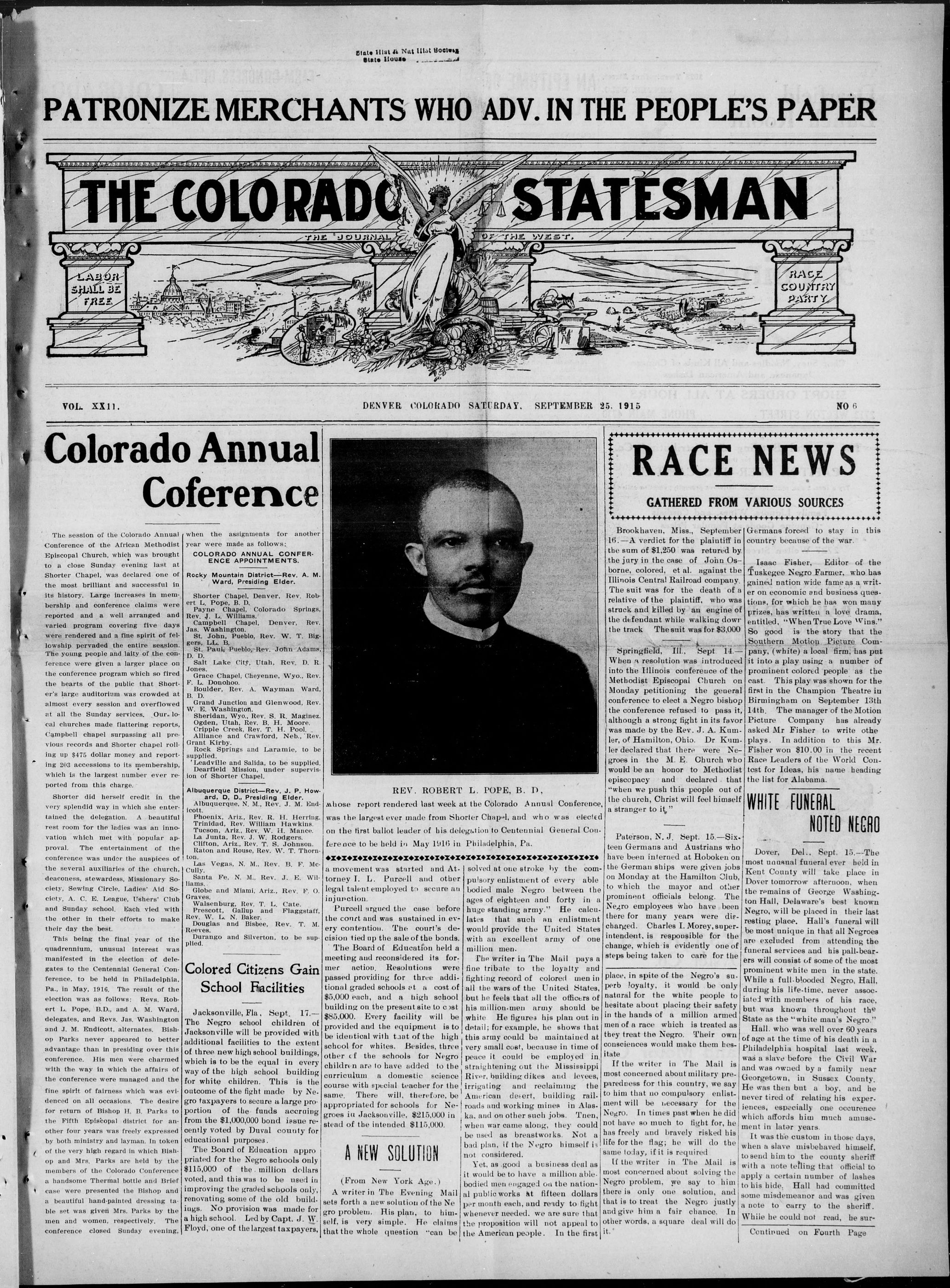
REV. ROBERT L. POPE, B. D. whose report rendered last week at the Colorado Annu was the largest ever made from Shorter Chapel, and who on the first ballot leader of his delegation to Centeunial ference to be held in May 1916 in Philadelphia, Pa.
endered last week at the Colorado Annu-
ver made from Shorter Chapel, and wh
not leader of his delegation to Centennial
old in May 1916 in Philadelphia, Pa.
whose report rendered last week at the Colorado Annual Conference was the largest ever made from Shorter Chapel, and who was elected on the first ballot leader of his delegation to Centennial General Conference to be held in May 1916 in Philadelphia, Pa.
```markdown
```
a movement was started and Attorney I. L. Purcell and other legal talent employed to secure an injunction. Purcell argued the case before the court and was sustained in every contention. The court's decision tied up the sale of the bonds. The Board of Education held a meeting and reconsidered its former action. Resolutions were passed providing for three additional graded schools at a cost of $5,000 each, and a high school building on the present site to cost $85,000. Every facility will be provided and the equipment is to be identical with that of the high school for whites. Besides, three other of the schools for Negro children are to have added to the curriculum a domestic science course with special teacher for the same. There will, therefore, be appropriated for schools for Negroes in Jacksonville, $215,000 in stead of the intended $115,000.
A NEW SOLUTION
(From New York Age.)
A writer in The Evening Mail sets forth a new solution of the Negro problem. His plan, to himself, is very simple. He claims that the whole question "can be
---
at the Colorado Annual Conference
orter Chapel, and who was elected
election to Centennial General Cou-
Philadelphia, Pa.
solved at one stroke by the compulsory enlistment of every able bodied male Negro between the ages of eighteen and forty in a huge standing army." He calculates that such an enlistment would provide the United States with an excellent army of one million men.
The writer in The Mail pays a fine tribute to the loyalty and fighting record of colored men in all the wars of the United States, but he feels that all the officers of his million-men army should be white. He figures his plan out in detail; for example, he shows that this army could be maintained at very small cost, because in time of peace it could be employed in straightening out the Mississippi River, building dikes and levees, irrigating and reclaiming the American desert, building railroads and working mines in Alaska, and on other such jobs. Tnen, when war came along, they could be used as breastworks. Not a bad plan, if the Negro himself is not considered.
Yet, as good a business deal as it would be to have a million able-bodied men engaged on the national public works at fifteen dollars per month each, and ready to fight whenever needed. we are sure that the proposition will not appeal to the American people. In the first
RACE NEWS
Brookhaven, Miss., September 16. —A verdict for the plaintiff in the sum of $1,250 was returned by the jury in the case of John Osborne, colored, et al. against the Illinois Central Railroad company. The suit was for the death of a relative of the plaintiff, who was struck and killed by an engine of the defendant while walking down the track. The suit was for $3,000
Springfield, Ill., Sept. 14. When a resolution was introduced into the Illinois conference of the Methodist Episcopal Church on Monday petitioning the general conference to elect a Negro bishop the conference refused to pass it, although a strong fight in its favor was made by the Rev. J. A. Kumler, of Hamilton, Ohio. Dr Kumler declared that there were Negroes in the M. E. Church who would be an honor to Methodist episcopacy and declared that "when we push this people out of the church, Christ will feel himself a stranger to it."
Paterson, N. J. Sept. 15.—Sixteen Germans and Austrians who have been interned at Hoboken on the German ships were given jobs on Monday at the Hamilton Club, to which the mayor and other prominent officials belong. The Negro employees who have been there for many years were discharged. Charles I. Morey, superintendent, is responsible for the change, which is evidently one of steps being taken to care for the place, in spite of the Negro's superb loyalty, it would be only natural for the white people to hesitate about placing their safety in the hands of a million armed men of a race which is treated as they treat the Negro. Their own consciences would make them hesitate
If the writer in The Mail is most concerned about military preparedness for this country, we say to him that no compulsory enlistment will be necessary for the Negro. In times past when he did not have so much to fight for, he has freely and bravely risked his life for the flag; he will do the same today, if it is required.
If the writer in The Mail is most concerned about solving the Negro problem, we say to him there is only one solution, and that is to treat the Negro justly and give him a fair chance. In other words, a square deal will do it."
NO 6
Germans forced to stay in this country because of the war.
Isaac Fisher, Editor of the Tuskegee Negro Farmer, who has gained nation wide fame as a writer on economic and business questions, for which he has won many prizes, has written a love drama, entitled, "When True Love Wins." So good is the story that the Southern Motion Picture Company, (white) a local firm, has put it into a play using a number of prominent colored people as the cast. This play was shown for the first in the Champion Theatre in Birmingham on September 13th 14th. The manager of the Motion Picture Company has already asked Mr Fisher to write other plays. In addition to this Mr. Fisher won $10.00 in the recent Race Leaders of the World Contest for Ideas, his name heading the list for Alabama.
WHITE FUNERAL
Dover, Del., Sept. 15.—The most unusual funeral ever held in Kent County will take place in Dover tomorrow afternoon, when the remains of George Washington Hall, Delaware's best known Negro, will be placed in their last resting place. Hall's funeral will be most unique in that all Negroes are excluded from attending the funeral services and his pall-bearers will consist of some of the most prominent white men in the state. While a full-blooded Negro, Hall, during his life-time, never associated with members of his race, but was known throughout the State as the "white man's Negro."
Hall. who was well over 60 years of age at the time of his death in a Philadelphia hospital last week, was a slave before the Civil War and was owned by a family near Georgetown, in Sussex County. He was then but a boy, and he never tired of relating his experiences, especially one occurrence which affords him much amusement in later years.
It was the custom in those days, when a slave misbehaved himself, to send him to the county sheriff with a note telling that official to apply a certain number of lashes to his hide. Hall had committed some misdemeanor and was given a note to carry to the sheriff. While he could not read, he sur-
Continued on Fourth Page
1023 Twenty-first Street,
DENVER, COLO.
Strickly home cooking
Dinner and theatre parties served on short notices
Prices moderate
Oysters in season
Try Our 40ct. Chicken Dinners Open from 6:00 a. m. - 12 p. m. 5 Points Cafe
nts Cafe
5 Points Cafe
UNDER NEW MANAGEMENT.
Chop Suey, Noodles and All Kinds of Ch
Japanese and American Dishes
SHORT ORDERS AT ALL HO
2712 WELTON STREET PHONE
The Central Bottling & Distribut
Agents for the famous
CAPITOL BEER---IT'S CAPIT
Try a case, 2 doz. pints for $1.20, delivered promptly; en
Family Liquors, Wines, and Cordia
Genuine Goods at Popular Prices
A glass of good wine will improve your Sunday dinner, and
2727 Welton Street. Phone Main 6
W. C. CAMPTON, Pres. J. M. JOHNS, Treas. U. P. JAC
RAILROAD PORTERS' C
LUNCH ROOM IN CONNECTION
and All Kinds of Chinese
and American Dishes
RS AT ALL HOURS
Chop Suey, Noodles and All Kinds of Chinese Japanese and American Dishes
Belling & Distributing Co.
for the famous
BER--IT'S CAPITAL
at $1.20, delivered promptly; empties called for,
s, Wines, and Cordials
foods at Popular Prices
love your Sunday dinner, and aid digestlon.
Street. Phone Main 6363.
J. JOHNS, Treas. U. P. JACKSON, Sec.
PORTERS' CLUB
DOM IN CONNECTION
The Central Bottling & Distributing Co.
Agents for the famous
CAPITOL BEER---IT'S CAPITAL
Try a case, 2 doz. pints for $1.20, delivered promptly; empties called for.
Family Liquors, Wines, and Cordials Genuine Goods at Popular Prices A glass of good wine will improve your Sunday dinner, and aid digestion. 2727 Welton Street. Phone Main 6363.
W. C. CAMPTON, Pres. J. M. JOHNS, Treas. U. P. JACKSON, Sec.
FREE CHECK ROOM
1728½ Wazee St. Only one block from Union D
J. B. MINTER. Barber.
PHONE MAIN 8416. DENVER, COLO
only one block from Union Depot.
MINTER. Barber.
DENVER, COLORADO.
Let Me Grow Your Hair! HAVE A PLENTIFUL SUPPLY OF BEAUTIFUL HAIR
Use Real Hair Grower, Real Hair Grower Tonic and Shampoo. It is positively known that this treatment will grow the shortest hair, stop falling and splitting hair, eradicate dandruff and prevent grayness. Once thoroughly tried no further inducement is needed. Scalp scientifically treated, electric massage and hair dressing. I guarantee to cure the worst case of scalp disease. Six week treatment $1.50. Home treatment given.
E. WILLIAMS, 1910 Pennsylvania, D
Phone Champa 2211
The Chesapeake
Fish & Oyster Co
Denver's Only Exclusive Fish and Oyster Co
Fresh Fish, Oysters, Salt, Smoked, Dried and Cake
Poultry and Game of All Kinds
10 Pennsylvania, Denver. Champa 2211 Chesapeake Oyster Co. Elusive Fish and Oyster House Salt, Smoked, Dried and Canned Fish and Game of All Kinds
E. WILLIAMS, 1910 Pennsylvania, Denver.
The Chesapeake Fish & Oyster Co.
1506 Arapahoe Street
Reliable Cycle and Motor
Expert Repairing, Enameling, Vulcanizing and Brazing. New Tires $1.75 and Wheels Built to Order by Skilled Mechanical Work Called For and Delivered.
le and Motor Co.
g, Enameling, Vulcanizing
new Tires $1.75 and Up.
Order by Skilled Mechanics.
r and Delivered.
Reliable Cycle and Motor Co.
Expert Repairing, Enameling, Vulcanizing and Brazing. New Tires $1.75 and Up. Wheels Built to Order by Skilled Mechanics. Work Called For and Delivered.
H. E. SEAMAN
Phone Champa 752
spent at home reacts in its benefits with unceasing general profit. Sent out of town it's life is ended.
Kept with the home merchants it is a messenger of continuous benefit. Business men should awake to the importance of keeping this dollar at home and make a bid for it by judicious advertising.
Kept with the home merchants it is a messenger benefit. Business men should awake to the import this dollar at home and make a bid for it by judicie
archants it is a messenger of continuous should awake to the importance of keeping make a bid for it by judicious advertising.
Dearfield Lunch Room
MRS. L. C. BARNES, Proprietor
```markdown
```
BILLIARDS AND POOL
B
1021 21st St.
A Dollar
VINEGAR
PHONE MAIN 4730
AN EPITOME OF LATE LIVE NEWS
CONDENSED RECORD OF THE PROGRESS OF EVENTS AT HOME AND ABROAD.
FROM ALL SOURCES
FROM ALL SOURCES
SAYINGS, DOING S, ACHIEVE
MENTS, SUFFERINGS, HOPES
AND FEARS OF MANKIND.
Russia will call an additional army of 8,000,000 reserves to colors.
An Austrian submarine torpedoed and sank a large British transport in the southern Adriatic.
Russian ships have sunk a German submarine which has been operating recently in the Black sea.
It is reported by the Overseas News agency that the Serbian government has declared the Serbo-Bulgarian frontier district a war zone.
The Berlin Frankfurter Zeitung reports that a large British transport from Egypt for the Dardanelles has been sunk by a German submarine.
Official reports from Austrian and German headquarters and dispatches from the Balkan capitals show that the long-expected Teutonic campaign against Serbia has now begun.
Gen. von Hindenburg has cut the Vilna-Baranovitshi railroad, over which the Russians hoped to retreat from Vilna, according to an official announcement from the Berlin war office.
The Lausanne Gazette at Geneva says it has learned that the German government has decided to issue a declaration annexing to the German empire the occupied territories in France and Belgium.
A new vote of credit for $1,250,000,000 was asked in the House of Commons by Premier Asquith. This brings the total up to $6,310,000,000. The premier announced that nearly 3,000,000 men had enlisted.
The Germans have lost twenty submarines since the beginning of the war, according to an editorial note in the London Motorship and Motorboat, while the British losses have been only seven, including the E-7.
According to the most recent financial report, M. Ribot said, the average monthly war expenses of Russia were 1,800,000,000 francs ($360,000,000); Germany's monthly war expenses approach 2,500,000,000 francs ($500,000,000), while Great Britain's exceed this amount.
Western
Attendance at the Panama-Pacific Exposition has reached the 13,000,000 mark.
Bankers in session at Denver endorsed the U. S. war loan to France and England.
Arkansas City, Kan., is the proud parent of the youngest oil territory in the mid-continent field, and oil men from all parts of the country are swarming in.
The United States gunboat Princeton, which lay at the bottom of Pago Pago harbor for seventy days last year, has arrived at San Francisco from the Samoan port.
The steamship Eastland, which capsized in the Chicago river July 24, drowning 812 persons, has been ordered sold by Federal Judge Landis to satisfy a claim of $34,500 for the work of raising the boat from the river bottom.
The eight flag-draped caskets containing the dead of the F-4, which arrived at San Francisco aboard the United States steamer Supply, were sent away, the four identified bodies to their homes, the seventeen fragmentary bodies in four caskets, to the National cemetery at Arlington, Va.
Washington
President Wilson and former Secretary of State Bryan had a conference over peace matters on Wednesday. General mobilization of all military forces in Bulgaria for the purpose of armed neutrality, has been ordered by the Bulgarian government. Recognition of the Carranza government is urged by the executive council of the American Federation of Labor. President Gompers has been authorized to draft a resolution urging "recognition of the Carranza government as the expression of the best ideals of the Mexican people for self-government," for presentation to President Wilson. An appeal from American citizens in Mexico City, urging the American Red Cross not to discontinue its relief work there, was made public by Miss Mabel T. Boardman, chairman of the Red Cross National Relief Board.
A four-line "ad" in a Washington paper discloses that William J. Bryan, former secretary of state, is done with Washington as a place of residence. The "ad" is as follows: "For rent—furnished, Calumet place, Thirteenth and Clifton streets, N. W. Apply at premises, W. J. Bryan." Big cereal crops this year in nearly all of the world's chief agricultural countries are forecasted in cable reports received at the Department of Agriculture from the International Institute of Agriculture at Rome.
Foreign
Switzerland's expenses for mobilization up to Sept. 1 amounted to $28,000,000.
An explosion in a colliery near Nuneaton, Eng., trapped 269 miners in the lower levels.
Kaiser Wilhelm and Prince Joachim were slightly injured in an automobile accident, according to Berlin dispatches.
Three more nations, Bulgaria, Rumania and Greece, may plunge into the world war before the first snow falls in the Balkans.
Ankerwycke, the historic mansion in Wraysbury, England, in whose grounds King Henry VIII, wooed Anne Boleyn., was destroyed by fire.
Count von Bernstorff has been given power to settle with the United States, and agreements may soon be signed in Washington ending disputes with Germany over marinaries.
A bulletin issued by the international institute of agriculture at Rome, says the crop of cereals this year in the northern hemisphere exceeds 334,000,000 quintals, the average crop of the last five years.
Food prices have increased about 35 per cent in England since the declaration of war.
The Rome Tribuna announces that the monument erected in Trent to the memory of Dante, and considered to be a masterpiece of sculpture, has been demolished by the Austrians in order that the bronze may be used for making cannon.
The greatest war budget in the world's history was introduced in the House of Commons by Reginald McKenna, chancellor of the exchequer, as another step toward financing the war, which is now costing Great Britain nearly $25,000,000 daily.
Multiple eruptions of the Italian volcanoes are now occurring, says a dispatch from Rome. Vesuvius, Aetna and Stromboli are all active, a singular phenomenon never before recorded. None of the eruptions, however, is of a character to cause alarm.
The Greek steamer Athinai was destroyed by fire at sea with the loss of only one life, according to a message received by the Marine Department at Halifax, N. S. The steamer Tuscania rescued 408 passengers and the crew, and the steamer Roumanian Prince sixty-one others.
Sporting News
By defeating Del Norte 6 to 3, Monte Vista won the championship of the San Luis valley.
August Herrmann, chairman of the National Baseball Commission, said the world series probably would start on Saturday, Oct. 9.
Dario Resta, winner of this year's Vanderbilt cup and grand prize auto race, drove his car over the new two-mile track at Sheepshead Bay, N. Y., for 10 miles, in 5:32 4-5, an estimated speed of 108.03 miles an hour.
Juanita M. Edgar, who won the handsome silver cup for the one-and-a-half-mile relay race for women at the Fort Morgan fair, has established a record for riding that, so far as known, has never been equaled by one of her sex.
New Orleans fight promoters stated that they have contracts signed by Charlie White of Chicago and Joe Mandot of that city, lightweights, for a ten-round bout Nov. 1, and that Willie Ritchie has signed to meet the winner of the White-Mandot match on Nov. 25.
Miss Molla Bjurstedt of Norway and Miss Carey E. Neeley of Chicago captured the finals in the ladies' doubles of the tri-state tennis tourney at Cincinnati, Ohio. They defeated Mrs. Malcolm McNeill, Jr., of Chicago and Miss Ruth Sanders of Cincinnati in straight sets, 6-1, 6-0.
General
William H. Baker, chocolate manufacturer and banker, died at his home at Winchester, Va.
Five defendants were convicted, thirty-five acquitted and one mis-trial, was the verdict of the jury in the so-called election fraud trial at Corpus Christi, Tex.
Elmer Hughes, 22, was married at Prescott, Mich., to Mrs. Emma Marvin, 54 years old. The bride is mother of five children and grandmother of four.
Dr. Susan La Flesch Picotte, 49, for many years prominent as a physician and missionary worker among the Indians of Nebraska and adjoining states, died at her home at Waithill, Neb.
The congregation of the Plymouth church, Brooklyn, is to stand by the Rev. Newell Dwight Hillis in his efforts to straighten out his tangled financial affairs.
The proposed mammoth credit loan to Great Britain and France, according to reports, is to be underwritten by a large syndicate of American financiers and bankers.
A large colony of horsemen, with more than 400 trotters and pacers, from all parts of the country, assembled at Columbus, Ohio, for the opening of the annual Grand Circuit race meeting at the Driving park.
A new faction in Mexico is in process of formation, and will ask to be represented before the Pan-American peace conferees, according to an official high in Mexican military circles.
At Detroit, Mich., Martin Graves of Denver won a 100-mile motorcycle race at the state fair grounds.
Mrs. Thomas Slifer, who with her husband celebrated the seventy-sixth anniversary of their marriage March 24 last, died today at Lanark, Ill. Slifer, who is 97, survives. They are said to have held the record of the state for length of married life.
FARM CONGRESS, OCT. 4
ARRANGEMENT OF PROGRAM FOR FOUR-DAY MEETING.
International Soil Products Exposition Starts Sept. 26 and Continues During Period of Farm Congress.
Denver.—The official call for the Tenth International Farm Congress in Denver Oct. 4 to 7 has been issued. The following arrangement of program is announced:
Monday, Oct. 4—The morning will be devoted to the opening ceremony and the address of the president of the congress. The afternoon will include the rollcall of states, wherein the progress of agriculture in the several states and under the different conditions will be discussed. The evening will be devoted to welcoming the several governors of western states who have signified their acceptance of invitations to be present.
Tuesday, Oct. 5—This day will be devoted to the subjects of crops and soils, irrigation and forestry, and the evening to the very timely subject of marketing and rural credit.
Wednesday, Oct. 6—This day will be given over to live stock and dairying, with the famous international session of the congress at night.
Thursday, Oct. 7-There will be a general session in the morning for the discussion of such timely subjects of a general nature as may come up. In the afternoon there will be the customary business session of the congress, when reports, elections, etc., will take place. Following that will be the adjournment sine die.
The International Soil Products Exposition will start Sept. 26, and will continue through the period for the farm congress.
The exposition group of buildings for the International Farm Congress and the Soil Products Exposition was formally christened when a bottle of Manitou champagne was broken over the foundation of the first building erected by Miss Ann Hill, grand-daughter of a Colorado pioneer.
In connection with the ceremony, B. K. Hanafourde, director general of the exposition, drove into the wooden structure which is to house part of the $20,000 display to be made by the federal government, a nail made of pure gold taken from the Gregory Bobtail mine, one of the most famous mines in the state and the one which opened up the possibilities of gold mining in Colorado. The nail will ultimately become the property of the president of the exposition, Congressman Frank W. Mondell of Wyoming.
BANKERS ELECT OFFICERS.
Estes Park Setting, for Last Word to Investment Men.
Estes Park, Colo.—The fourth annual convention of the Investment Bankers of America came to a close here, so far as business is concerned.
More than 200 investment bankers gathered in the casino for final business session and election of officers.
Allen G. Hoyt of New York, vice president, read a report in which it was maintained the vicious form of blue sky law had been curbed in many states.
The officers elected for the coming year were: Lewis B. Franklin, New York, president; Allen G. Hoyt, New York, vice president; John E. Blunt, Jr., Chicago, vice president; Stedman Buttrick, Boston, vice president; A.C. Foster, Denver, vice president; J. Edgar Elliott, Indianapolis, vice president; Frederick R. Fenton, Chicago, secretary; Herndon Smith, St. Louis, treasurer.
A resolution praising the scenic beauties of Colorado made available by Denver hosts was adopted.
Wrecked Bank Pays Dividend.
Pueblo, Colo. — Another dividend, amounting to between twenty and twenty-five per cent, will be paid depositors of the defunct Mercantile Savings Bank, according to announcement by Receiver H. H. Seldomridge. Since he took office two months ago, Mr. Seldomridge has succeeded in realizing about $175,000 on the bank's assets.
Denver Millionaires Buy Moffat Road. Denver.—The control of the Moffat Road has passed to a syndicate of Denver men, headed by Lawrence C. Phipps, and will be completed by them to Salt Lake City. Newman Erb, who was the principal figure in the reorganization of the road, two years ago, has been forced to relinquish his stock at a profit. Members of the local syndicate are, besides Mr. Phipps, Henry M. Porter, Gerald Hughes and Charles Boettcher.
Austrian Kills Himself.
Pueblo—John Kachaver, an Austrian steel worker, shot himself twice in the left side, dying within a few minutes.
Married Fifty Years; Divorced.
Boulder—May 21 next Mrs. Mary Green of this city would have completed her fiftieth year as the wife of John Green. Recently she procured a divorce in the County Court on the ground of desertion.
Johnston School Crowded.
Johnston—A driver and wagon is now bringing the children south of town to school. As a result of this convenience the largest number of pupils in the history of the school are tow enrolled.
Western Newspaper Union News Service.
COMING EVENTS.
Sept. 27-Oct. 8.—International Dry Farming Congress, Denver.
Oct. 2-9.—Fair and Race Meeting at Denver.
Oct. 18.—Odd Fellows' Annual State Convention at Colorado Springs.
Denver's new post-office will be officially dedicated Nov. 15.
Indications of mineral have been found near Genoa.
Mrs. Agnes Roberts, widow of Presion Roberts, died in Denver, aged 83.
The Rocky Mountain Baptist Association held a three-day session in Denver.
Mrs. Wm. Bevar of Fort Collins was kicked by a wild horse and seriously injured.
Thirteen Denver boys, aged 17 to 22, were arrested on a charge of robbing drug stores.
A get-together meeting of the officers of the P. M. C. A. in Colorado was held at Manitou.
H. Lovsee, 70, was critically hurt at Fort Collins on his way from Love-land for jury duty.
The Arvada tire-making plant has been completed and has commenced the manufacture of tires.
District Attorney Rush of Denver has asked the grand jury to investigate the Prof. Garvin "sacking" case.
William I. Swint of Denver was held up by three masked highwaymen within a block of his home and robbed of $185.
The State Land Board held a special sale of public land at the State Capitol. More than 3,000 acres were sold.
John Wolf, one of the oldest of Mesa county pioneers, aged 38 years and 1 month, died at his home near Molina.
NiWot's ghost mystery has been solved. Scientists find marsh gas is cause of lights that have scared the villagers.
The state of Colorado, by the end of this month, will have paid off all indebtedness on the state capitol building and the state museum.
Mrs. Isabella Wagner of Denver, who sued Fred Schumacher, demanding $10,000 for alleged slander, contented herself with $1 damages.
The case of 12-year-old Nell Wright, self-confessed slayer of his father, John A. Wright, was continued until Oct. 14 by Judge Lindsey at Denver.
The assessor of Weld county declares he will refuse to add the $7,804,000 to tax valuations in that county, ordered by the State Tax Commission until directed by court to do so.
Three directors of the Denver Union Labor Association, charged with keeping gambling devices, pleaded guilty and the association was fined $50 and costs, amounting to $74.72. Farmers of Delta and Montrose counties who are working land under the Uncompahgre irrigation project will receive assistance in the future from the federal government and the state. Without a dissenting vote the city commissioners of Denver refused to comply with the recommendation of the Colorado Tax Commission and raise the 1915 assessment of certain classes of property in Denver by $55, 408,990.
A coroner's jury absolved the Colorado & Southern Railway Company of blame for the death of Mrs. Ella A. Porter, an aged woman who died of injuries suffered when she was run down by one of the company's engines in Denver.
After twenty-three years in Denver as the pastor of the Boynton Congregational church, the Rev. Charles H. Pettibone has resigned and will leave Oct. 1 for Florida for the sake of his wife's health.
According to President Charles H. Roper of the Omaha-Lincoln-Denver Good Roads Association, over 1,200 cars loaded with tourists from other states pass over the road every day during the tourist season.
A clue which it is said may lead to the capture of the slayer of Isaac Solomon, Denver pawnbroker, beaten to death in his Larimer street street shop a few weeks ago, was sent to M. Solomon, son of the dead man, by Gus Appelman, a prisoner in the Brighton jail. Appelman claims to have seen a number of gypsies in the store a few days before the murder. The new compensation law, the arrest of Horace N. Hawkins of Denver and Fred M. Clark of Trinidad, or charges of subornation of perjury, the industrial relations committee, the militia and state constabulary, and the case of John R. Lawson, were the principal subjects discussed in the annual report of John McLennan, president of the Colorado State Federation of labor, read before its twentieth annual convention in Denver.
Divorced from Fred C. Robley at Eugene, Ore., in 1913, married to another man within a short time, and then divorced from him, Mrs. Mabel Crandall Robley, 18 years old, arrived in Denver from Oregon and was married again to Mr. Robley.
Over 2,000 attended the meeting of the Grand Chapter of the Eastern Star in Denver, which opened with a reception and ball in honor of Grand Matron Nina M. Weiss of Del Norte and Grand Patron Martin H. Fynn of Grand Junction, given by the eight Denver chapters.
OUT OF HIS CLASS
By JANE OSBORN.
Katherine Morley, old Doctor Morley's beautiful daughter, was the undisputed widow of Clayton college. And after she had ushered seven classes into Clayton she was smilingly spoken of by the other girls of the town as "The Youth's Companion." Whether it was because she resented this or because of a deeper reason it is hard to tell, but just as the eighth freshman class since her eighteenth birthday was about to enter Clayton, Katherine Morley assumed another pose.
College men failed to interest her any longer, she told people. "They had no true feeling. Her ideal man was more of a primitive."
This was all right as a drawing-room pose, but when Katherine put it into practice and began to be seen walking on Sunday afternoons in the country and attending local attractions with a certain handsome young factory foreman whose cheap green suit and creaky shoes, wide spreading hat and gaudy neckties were suggestive of Hungarian peasant origin, the college community was filled with consternation. And when this flirtation lasted through the winter, and Katherine quite frankly mentioned this young peasant — Alec Brajaska — to her friends and received him at her home when her father was away, things began to look serious.
Most to be pitied was Doctor Morley, her father. One day his assistant in the sociology department, Beardsley Drew, suggested that he might be of some assistance.
"Something surely will have to be done," replied the father. "It is getting to be outrageous. I have spoken to Katherine myself about it. I dread taking the step, but I see no other way out of it. I am afraid Katherine is serious. I can have at least the satisfaction of knowing something of the man's origin. I must know whether there is any reason why Katherine ought not to marry him. I know of no one who can undertake the investigation so well as you, Mr."Drew."
The result of this conference was that Prof. Beardsley Drew undertook the task of looking into the record and standing of Alec Brajaska. As a professor of sociology, he had studied, perhaps more interestedly than Dr. Morley knew, the life and the customs of the factory elements of the men and women in town, who were so far removed from the college circle and college interests. He knew their various dialects, and the task was not difficult.
Drew began his task in a sensible way by discarding his regular clothes, which would have branded him as an outsider, and with a shabby suit and a pair of brilliant tan shoes and a cheap broad brimmed felt hat he saliled forth.
He went to the house where Brajaska was known to live. It was at the hour when the young man would naturally be at work. A young foreign woman answered his knocking and proved to be the daughter of the woman who kept the boarding house at which Brajaska and several of his associates took their meals. Professor Drew arranged to take board at the same place. It was the easiest way to evade suspicion, and as he was having a week's vacation he could carry out his plan without fear of being suspected.
He occasionally talked with Brajaska, but more frequently with the associates. He lingered after the other boarders one morning at breakfast and started to speak of Brajaska to Magda, the young daughter.
"You seem to know Brajaska," he said. "How is it? Did you know him in the old country?"
Magda told him a few things about his bringing up, his boyhood ambitions. He was thirty and she was twenty. They had lived on adjoining farms in the old country and for years her father had been saving to come to this country and had influenced Alqc to come. They had all come together and then her father had died. Suddenly the girl stopped talking and then Morley looked up in surprise to see that she was crying. He put his hand impulsively on her shoulder and she did not resent it. She was apparently too much preoccupied with her own grief.
"Do you not know," she asked, "about me and Brajaska? I was promised to him, and we were going to be married in the spring, and then a beautiful, very beautiful lady with a great deal of money took him away. She will marry him. Brajaska has said so."
Drew's first feeling was for the unfortunate Magda. This feeling was followed by one of anger at Brajaska, who had the insolence to desert a woman of his own class and because of his good looks win the affection of another woman of his class.
Drew remained at the boarding house a week, each day growing more and more acquainted with the sorrowful little Magda. The last day of his vacation was to be the day of the excursion and Drew had seen that Magda had refused the invitation of several of the younger men to go with them. Then he asked her to go with him. She looked away from him shyly.
"No," she said. "It would not be right. I am promised to Alec—"
"But don't you see, Magda," said Drew with more feeling than he usually showed. "perhaps if you go with me and are very happy and I
seem to be very fond of you—perhaps Brajaska will be jealous. We are all made that way, we men."
"But the rich lady will be with him," said Magda. "He will have no eyes for anyone else. I could never stand it."
However, Drew was able to persuade her that a little skillful acting might bring back Brajaska's affections. She was very pretty, Drew told her, even if the other lady was beautiful.
It was a gay assemblage that met in the woods, and although Magda's heart was heavy the sound of the music and the festivity brought the light into her eyes and the color to her cheeks. She laughed and needed little artifice to disguise the true feelings of her heart. Brajaska and Katherine had been watched by their associates more closely than Katherine enjoyed. She was very beautiful, Drew thought, in comparison with their simple, stolid peasant women. He had never before realized how beautiful she was.
He was alone for a minute. Magda had gone off to take part in some contest. He was surprised to see Katherine standing alone at his side, her eyes flashing and the color high in her face.
"Professor Drew," she said distantly. "I am surprised. I never thought it of you."
"Never thought what, Katherine?" he asked, feeling somehow that what he had come to the excursion for had begun to happen.
"I never thought that you would come to one of these affairs with a Hungarian woman. Don't you suppose that it will get back to father and the college?"
"What about yourself?" asked Drew. "That's quite different. Every one knows about Brajaska and me. And you are just trifling with these people. It is quite different."
"How do you know I am trifling?" asked Drew, feeling the charm of her beauty now that she was angry. "Perhaps I am as serious as you are."
"You, you don't mean—it isn't that little Magda creature?"
"I wonder how serious you are, Katherine," he said. "Do you really mean that you are going to marry Brajaska?"
"Oh. no, I couldn't do that quite. But Brajaska is wonderful. He has so much more spirit than any other man I ever knew."
"But suppose you were to find that the men of your own class had more spirit than you thought? Suppose that I were to tell you and prove to you, Katherine, that I had more spirit than to let you throw yourself away on a person like Brajaska, that I had feeling enough to fight for you. Suppose I were to tell you that I have been following you and watching you for the whole winter and that for a week I have been living with Brajaska just to find out for myself whether you and he were really capable of being happy together?"
"But what about Magda?" Katherine's feaulousity was still uppermost.
"That little Magda," said Drew, "is going to marry Brajaska if you have the good sense to let him alone. You have been behaving like a child, but I love you."
Katherine looked him in surprise, her breath coming fast.
* * * * * * * * *
At sundown Brajaska took Magda home to the little boarding house, and Magda had forgotten all about the long months of her unhappiness, so happy was she to rest her head on his broad shoulders and feel that after all they were promised to each other and would soon be married.
"But Brajaska," said Magda, suddenly remembering that the kind-hearted boarder who had gone to the excursion with her had not returned, "where is the new boarder? He was a good friend of mine."
"The new boarder. I will tell you about him some time," replied Brajaska. "We had a long talk last night. He and I are always going to be friends. He is a man, like ourselves with great feelings, but he knows, as I do, that to be happy, one must love a woman of his own class." (Copyright, 1915, by the McClure Newspaper Syndicate.)
GARLIC GIVEN HIGH PRAISE
Invaluable as a Remedy for Many Diseases, According to Man Who Professes to Know.
Garlic is one of the most wholesome herbs that can be eaten.
It stimulates all secretions and its effect is strong upon the liver and kidneys.
A teaspoonful of garlic juice and sugar will generally ward off an oncoming cold.
Garlic eaters have good skins, for garlic is excellent in treating eruptions of all sorts.
Those races that use much garlic in their food are those that are least susceptible to tuberculosis. Many doctors in Europe treat tuberculosis with garlic, giving it internally in the form of a sirup, externally in the form of poultices, or making their patients inhale an infusion.
The essential principle of garlic, that which acts upon the system, is allyl sulphide. This also causes the characteristic—and to many persons disagreeable—smell.—Exchange.
Placed.
"So you're looking for a job in the chorus, eh?"
BOARD RAISES VALUES
INCREASE OF $55,000,000 ORDERED
ON DENVER PROPERTY.
Colorado Tax Commission Recommends Changes in Forty-Five Counties Under New
Denver.—The valuation of taxable property in Colorado this year will be within a few million dollars of last year, according to the State Tax Commission. In view of the fact that the valuation of Denver shows a decrease of approximately $37,000,000, this will mean an improved showing by the other counties of the state. The total valuation last year was $1,306,000,000. The only two large increases ordered by the state commission are for Denver, $55,408,990, and Weld county, $7,804,000.
Increases in about forty-five counties were recommended to the various county boards by the tax commission. In most counties the raises suggested are comparatively slight ones. Those in Denver and Weld counties are the largest.
The recommendations were made under the amendment to the state constitution adopted by the people at the last state election, which is now in effect for the first time. It allows the county boards of equalization to equalize the assessments as made by the local assessor without regard to the effect on the aggregate valuation.
Inheritance Tax Collections $9,187.
Denver.—During the month of September $9,187 in inheritance taxes were collected by Leslie E. Hubbard, state inheritance tax appraiser. The largest individual sum turned into the state treasury was $3,714 tax on the estate of Philip A. Potter of Denver. Other sums were as follows
Ida F. French, Denver $ 5,782.12 $ 40.75
Miles Jain, Denver $ 18,690.00 $ 146.22
Leonard L. Redfield, Denver $ 9,544.00 $ 50.44
Catherine V. Pardee, Denver $ 17,009.00 $ 22.32
Gregory B. E. Silvy, Denver $ 19,720.16 $ 465.08
Mary E. Wasson, New York $ 3,768.37 $ 76.32
Ida M. Park, (Jones) Denver $ 20,840.37 $ 228.96
Joseph C. Heim, Denver $ 77,579.50 $ 1,126.94
Philip A. Potter, Denver $ 99,615.62 $ 3,714.60
David W. Dryden, Denver $ 73,855.48 $ 653.23
Andrew J. Mackey, Boulder $ 249,985.00 $ 1,706.32
Daniel W. Wilpert, Adams $ 25,885.00 $ 371.70
William Douglas, Denver $ 32,290.65 $ 84.00
Hannah S. Queen, Denver $ 25,618.00 $ 61.64
Bertha W. Mather, Denver $ 3,200.00 $ 28.50
Tax $ 8,777.03
Examination and waiver fees $ 410.00
Total collections $ 9,187.03
Governor Cancels Trip to Seattle.
Denver.—Governor Carlson canceled his trip to the adjourned conference of western governors at Seattle. Pressure of important state affairs was given as the reason. He had previously abandoned his trip to the irrigation congress at Sacramento. This conference, which met three months ago to outline western legislation for submission to Congress, planned to draw up a unanimous program. Governor Carlson has specially interested himself in proposed revision of the power site laws. The military board entanglements, the Risley hearing, the important decisions pending before the Supreme Court in regard to civil service and the Lawson case, were among the chief circumstances that decided him to cancel his Seattle appointment.
$1,000 Fine Against Corporations.
Denver.—For the first time in the history of the office of the district attorney informations against corporations behind in the payment of the corporation tax and in returning their yearly report to the secretary of state will be drawn up. The informations will lay the negligent corporations liable to a fine of $1,000 each, unless the yearly statements and taxes are paid at once, according to District Attorney Rush. Only $20,000 at the utmost could be collected, according to calculations made by Mr. Rush, inasmuch as only 200 out of the 1,000 listed corporations are operating at the present time.
Declares 800 Concerns Defunct.
Denver.—More than 800 corporations doing business in the state of Colorado have been declared defunct and inoperative by Secretary of State Ramer, owing to their failure to file annual reports and pay the flat tax prescribed by the law passed in 1913.
Rockefeller's Agent Returns.
Denver.—MecKenzie King, labor investigator for the Rockefeller foundation, returned to Denver. Mr. King, who first came to Denver last spring, has been away from the city over two months.
Denver.—Attorney General Farrar will begin suit against the county of Arapahoe for the recovery of $16,816.50 which the state claims as its share of the taxes on the estate of the late Thomas F. Walsh for the years 1907, 1908 and 1909. A judgment for $78,333 was obtained by the county against the estate, but, the state charges, the county commissioners settled for $24,500. It did not turn over to the state any part of the tax. The state refuses to recognize the settlement.
PEACH DAINTIES OF MERIT
Many Ways of Preparing Fruit Which All Appreciate for Its Perfect Flavor.
For peach cobbler, prepare plain pastry from three pints of flour and three-fourths of a pound of mixed lard and butter. Line the baking dish with this and pour in two quarts of freshly stewed peaches, covering the dish with a pastry lid, pierced here and there to let out steam. Bake until brown and then cover thickly with powdered sugar and serve steaming hot with rich cream.
Here is another peach pie recipe: Bake a rich pastry crust until brown and crisp and then cool. Just at serving time heap it high with sliced peaches, sprinkle with sugar and pile whipped cream on top. A variation of this recipe is this: Cut short pastry into squares and fold the four corners to the center. Moisten them with milk, press them down so that they will remain in place, prick the pastry with a fork and bake one square for each person. Brown in the oven, chill and serve piled high with peaches cut into large pieces, stewed just until tender and sweetened to taste. Top with a big spoonful of whipped cream
Still another peach pie, the favorite of a very good cook, is this: Sift together a cupful and a half of flour, a quarter of a cupful of sugar, two teaspoonfuls of baking powder and a pinch of salt. Into this cut half a cupful of butter and add enough milk to make a stiff batter. Use as little milk as possible. Roll into a thick sheet, line a deep pie pan with it and slice peaches into it. Sweeten them well and cover them with sour or sweet milk, then bake until done in a moderate oven.
A tempting dessert is peach whip. To make it press ripe peaches through a vegetable press, sweeten to taste and mix immediately with whipped cream or whipped egg whites. Pile in tall glasses and serve very cold.
Another tempting dessert is a peach sandwich, one for each person Slice a stale sponge cake and dip the slices quickly in milk. Then brown in butter. Between each two slices pile freshly sliced, sweetened peaches and pile on whipped cream.
METHOD OF PICKLING ONIONS
Writer Makes Some Suggestions Which Seem To Be Worthy of Consideration.
Peeling the onions is a decidedly painful task, but it is made less so if they are done in cold water. Some people even put them in boiling water and allow them to come to the boil before peeling them. I prefer the former plan. With small silver pickling onions to each quart of vinegar allow two tablespoonfuls of black peppercorns, two teaspoonfuls of allspice, two level teaspoonfuls of salt, two bay leaves. Remove the outer skin with a silver knife; if a steel one is used the onions will turn black. If liked, peel them in a basin of cold water, for, besides making the operation less painful, it helps to whiten them by removing some of the essential oil. Dry them lightly in a cloth. Put the vinegar, spices and bay leaves in a saucepan, boil them until the vinegar is well flavored, and let it get cold. Put the onions in jars or wide-necked bottle, fill them up with the vinegar, adding a little spice to each bottle. Cork down tightly. They will be ready for use in about a month.—Boston Globe.
Barley Water With Jelly
Place two ounces of pearl barley with very little water in a saucepan, and when warm pour this off and add a quart of fresh water and simmer gently for three-quarters of an hour. Strain through a muslin and add three tablespoonfuls of red currant jelly; allow to cool and serve. Other flavorings in the form of raspberry vinegar, crabapple jelly, or black currant jelly may be added. Orange rind and juice may also be added as a change.
Apple and Suet Pudding.
Two cupfuls of chopped apples, two cupfuls of chopped raisins, one cupful of sour milk, one cupful of molasses, one cupful of suet and flour enough to make a stiff batter.
Begin by putting one teaspoonful of soda in the milk, then add a little grated nutmeg and cinnamon and a pinch of salt. Stir the suet into this mixture and then put in the flour a small quantity at a time. Boil tied up in muslin.
Chocolate Pie.
Put one and a half cupfuls milk on stove to heat. When hot thicken with following mixture: Well-beaten yolks of two eggs, half cupful sugar, two level tablespoonfuls corn starch, one tablespoonful cocoa, a pinch of salt, half cupful milk. When cool flavor with vanilla, put in pie shell, cover with a frosting made of the whites of the eggs and one tablespoonful of sugar. Brown in oven.
Imitation Egcnog.
Thoroughly beat up an egg with a slack teaspoonful of sugar—doing this in the glass in which the "nog" is to be served. Then fill the glass with hot milk and grate nutmeg on top. This is very nourishing and almost always inviting to the children, who at times take a distaste for solid foode.
Basket Salad.
Remove seeds and membranes from green peppers, cut in form of baskets. Fill with chopped wax beans, cubes of red beets and stuffed olives. Use your favorite salad dressing.
ERNEST HOWARD.
ERNEST HOWARD.
Carpenter, Job and Repair Work.
Coal, Wood and Express.
CLEANING, PRESSING, DYEING, REPAIRING, RELINING AND REMODELING.
WORK CALLED FOR AND DELIVERED
2549 Washington Avenue Denver, Colorado
The Market Company
Wholesale and Retail Staple and Fancy Groceries, Fish and Oysters. Hotels and Restaurants Our Specialty. Fresh and Cured
Eastern Corn Fed Meats
Fruits, Vegetables, Poultry and Game.
1688-89 Arapahoe Street Denver. Colorado
C. H. SHIRLEY, Pres. J. C. HAMPSON, Vice Pres
PAUL J. SHIRLEY, Sec. and Treas.
THE ATLAS DRUG CO.
Courteous Treatmet. Right Prices Leaders in Prescription
Paints, Oils and Glass.
Coal, Wood a
1021 21st Street.
You Have Tried the Rest
Now Try the Best
THE Giant
FOR QUALITY
CLEANING, PRESSIN
ING, RELINING AN
WORK CALLED FOR
2549 Washington Avenue
PHONE MAIN 3028
JOHN K.
Meats, Fancy and
1864 CURTIS
Corner Nineteenth
Phones Main
169, 181, 189, 190
The Market
Wholesale and Retail Staple and
Oysters. Hotels and Re-
fresh and Cured
Eastern Corr
Fruits, Vegetables,
1688-89 Arapahoe Street
C. H. SHIRLEY, Pres.
PAUL J. SHIRLE
THE ATLAS
Courteous Treatm
Leaders in
Store No. 1.
2701 WELTON ST.
Main 895 875
"STETSON HATS OUR SPECIALTY"
Phone Main 3661.
"BROWN, THE HATTER"
HATS CLEANED AND BLOCKED
50 CENTS
SATISFACTION GUARANTEED
A Trial Will Convince You.
718½ 18TH STREET.
DR. WESTBROOK
SUITE 25 GOOD BLOCK.
Phone Day and Night Main 5595
---
The Sum and Substance
of being a subscriber to this
paper is that you and your
family become attached to
it. The paper becomes a
member of the family and
its coming each week will
be as welcome as the ar-
rival of anyone that's dear.
It will keep you informed on
the doings of the community and
the bargains of the merchants
regularly advertised will enable
you to save many times the cost
of the subscription.
---
Glazing Done and Express. Phone Champa 752.
Our Prices Reasonable
Satisfaction Guaranteed
CLEANERS
AND
TAILORS
McCAIN & RICHARDS, Prors
Phone Main 7376
ING, DYEING, REPAIR-
AND REMODELING.
OR AND DELIVERED
Denver, Colorado
RES. PHONE GALLUP 943
RETTIG and Staple Groceries TIS STREET' Denver, Cola
C. E. Smith, Manager Res. Phone South 1608
Met Company
me and Fancy Groceries, Fish and
Restaurants Our Specialty.
Barn Fed Meats
mes, Poultry and Game.
Denver. Colorado
J. C. HAMPSON, Vice Pres
LEY, Sec. and Treas.
AS DRUG CO.
Hmet. Right Prices
in Prescription
Store No. 2
26TH AND WELTOM
Main 4955 4956
Phone Main 4896 1848 Arapahoe
东洋轩
Weatherhead Hat Co
TELEPHONE MAIN 3203
PIONEER HATTERS OF THE WEST
We Make
Old Hats
New
We Make Old Hats New
PRACTICAL HATTERS
RENOVATORS, BLEACHERS,
DYERS AND FINISHERS
Of Gents' and Ladies' Hats of Every
Description.
1624 CHAMPA ST., DENVER, COLO.
THE COLORADO STATESMAN
FOR JUVENILES OF THE YEAR
LABOR
WILL BE
FREE
BACK
COUNTRY
PARTY
JOS. D. D. RIVERS.....Proprietor
1824 Curtis Street, Room 25.
Phone Main 7417.
SUBSCRIPTION RATES:
One Year ..... $2.00
Six Months ..... 1.00
Tree Months ..... 60
PAYABLE IN ADVANCE.
Entered as second-class matter at the postoffice in the city of Denver, Colorado.
It occasionally happens that papers sent to subscribers are lost or stolen, in case you do not receive any number when due, inform us by postal card and we will cheerfully forward a duplicate of the missing number.
Communications to receive attention must be newsy, upon important subjects, plainly written only upon one side of the paper; must reach us Tuesdays, if possible, anyway, not later than Wednesdays, and bear the signature of the author. No manuscript returned, unless stamps are sent for postage.
Remittances should be made by Express Money Order, Postoffice Money Order, Registered Letter or Bank Draft. Postage stamps will be received the same as cash for the fractional part of a dollar. Only 1-cent and 2-cent stamps taken.
Display advertising, 50 cents per inch. An inch contains twelve agate lines.
Reading notices, ten lines or less, 10 cents per line. Each additional line over ten lines, 5 cents per line.
All communications of a personacing nature that are not complimentary will be withheld from the columns of this paper.
Shiftlessness is a common charge hanging over the heads of a certain portion of the colored population, and that charge is true altogether too often. Thoughtlessness shares largely in this condition. Providing for the needs of a coming season is a principle too little appreciated by us. There is always a coal famine in certain households when the dead of winter makes suffering sure. With a little forethought, a little energy and a little sacrifice of foolish, frivolous pleasures when the weather is warm, a fairly adequate supply of coal might be laid in when prices are low. Even one ton ahead would be an advantage, and three or four tons would put the shivers out of sight. Make a weekly deposit with some reliable coal company, if you can't save otherwise, and see what a comfortable investment it will be. There is talk of coal shortage the coming winter. Such a thing is possible at any time, but not with those who prepare beforehand. Stock up!
MUTUAL AID.
The Colorado Statesman wants the advertisement of every Negro business enterprise, professional or commercial establishment, rooming and boarding house, and every hall, lodge and organization in Denver. We want these not alone for our own financial benefit, but because their appearance in this newspaper will pay the advertisers and at the same time be a source of help to Denver. This newspaper goes to many far-away sections and is read by many people contemplating the West as a place of residence and who seek a reflection of the business character of Denver in our columns. Denver is the Mecca of all travelers to the West, and many of them acquaint themselves with our business people through us. The value of letting the home community know you is thus greatly enhanced to your credit. Talk it over with the manager.
THE NEGROES IN THE CITIES.
This paper has spoken before of the congestion of colored youth in the cities. It makes the city a problem and the race uplift a deeper problem; the intellectual, industrial, moral, physicial and spiritual advancement a bigger problem still. Cities have always been both the despair and hope of every great prophet and reformer. Little, perhaps, as we think, it was Cain, a murderer, a fugitive and a vagabond for whom the earth (land or country) refused to yield her strength that built the first city, and it seems that this class of persons has inhabited the cities ever since. Cities are often built for and named after men and usually take on the characteristic of their founders. The first city ever built (Enoch) was the beginning of barter and polygamy and so it has ever been. Babel was an attempt to take the kingdom of heaven by force. Sodom and Gomorrah did not possess ten righteous persons to save them. Babylon has become the synonym for iniquity. Nineveh merited the invective of an entire prophetic book of the Bible. Of imperial Rome, the historian Horace said: "O! venal city, destined soon to perish." Of London Carlyle said, "What a fermenting vat lies hidden in a great city." But we will not continue to multiply instances of the dangers, crime and sufferings of the city. Few have studied the city problems. If members of the race would make the city, its conditions and pitfalls a study, we might be able to do something worth while for our young men. The Colorado Statesman is but a voice, a single voice; it cannot do all. We can only point the way. Good men and women, literary societies, lodges and the Church must co-operate if we are going to save the race in the city. We are not alarmists or calamity howlers, but we simply proclaim that our city youths are doomed unless a change is effected some way. What do you suggest?
WHITE FUNERAL NOTED NEGRO
Fraternity House, at the Delaware College, in Newark, the membership of which consists of well known Delewareans. After his death last week it was found he had left his money to E. E. Shallcross, a member of the fraternity, and he also left a provision that he be buried above the ground.
Continued from First Page mised what the note contained, so he gave another boy about his age a jackknife to deliver it. The other boy entered into the bargain and was painfully surprised when he received the lashes which were intended for Hall.
An attempt was made to secure a lot in a white cemetery to bury Hall, but this was found to be impossible, so, an entire lot was secured in Cooper's Cemetery, a colored burial ground, and his grave was dug in the center of it. An immense slate vault was erected, extending two feet in the ground, and the remainder above the surface, and into the vault Hall's casket will be placed tomorrow afternoon, and it will be sealed up with cement The pall-bearers will consist of members of the Kappa Alpha Fraternity and the services will be conducted by Rev. Benjamin F. Thompson, rector of Christ P. E. Church, of Dover, one of the most exclusive churches in the county.
Later Hall was taken into the family of the late A. B. Richardson father of formen United States Senator H. A. Richardson, of Dover, who at that time owned the Richardson House, the leading hotel of Kent County. Hall soon made himself a very valuable asset about the hotel, and some years later made manager, taking sole charge of the hostelry for months at a time during the absence of Mr. Richardson.
Hall was left a considerable sum of money when Mr. Richardson died, and some time ago be became manager of the Kappa Alpha
The relation of law and mercy is not only co-operative but complemental. Indeed, mercy is the mother of all law, the foundation of the principle of jurisprudence, the pillar of all leg-
islation. It is commonly assumed that mercy is the antithesis of justice. The notion prevails that justice and mercy are self-excluding terms. It is held that justice is deaf against the pleadings of mercy and that she has no place at the bar of justice. Nothing is further from fact. On the contrary, mercy and justice are closely related, inseparably intertwined with one another. Justice and Mercy are twin sisters, raised by the same mother, Truth. There can be no justice unless dealt out by the hand of mercy. And mercy is but a sickening sentimentality unless she be conceived in justice.
The law of today is executed not in a spirit of vengeance, but of justice; not as a punitive measure, but for the sake of correction; not for revenge, but to reform; not as a retaliation, but as one would treat a sick person. For modern law of justice is based upon mercy. We have come to recognize that the average criminal is suffering from some physical or mental defect, and as such should be an object of pity rather than cruel punishment. The modern prison should be a hospital, where such "patients" should be treated and possibly cured and restored to a normal condition.
The court of justice is a laboratory, the judge the kindly physician who administers the bitter "medicine" which may cure the patient. Nay, justice and mercy are not antithetic, self-excluding terms. They are, on the contrary, inseparable. It is mercy that administers justice. It is justice which embraces mercy.
Outdoor Hobbies Give Health and Strength
By E. W. HARRIS, Evanston, Ill.
Nearly everyone has a hobby, and those who haven't miss lots of fun. This season of the year is a good time to form some outdoor hobby, something that will take one into the open. Aside from such sports as baseball, tennis and golf, there are any number of hobbies which will take those who ride them into the world of sunlight and fresh air.
There are the botanizing hobby, the geologizing hobby, the entomological hobby, the swimming hobby, the yachting hobby and many more, and for the man who cannot afford any of these, although some of them are quite inexpensive, there is the plain walking hobby, as good as any and requiring only a pair of legs for its indulgence.
Many men have hobbies that demand an indoor, even a sedentary life. These are all right in their time and place, but their time and place are in the seasons of inclement weather. For those who have such indoor hobbies it can only be recommended that they abate them for a time and add another hobby to their list, one which will take them among the trees and plants. They will draw rich dividends in health and strength from this added hobby.
War Makes Many Changes in Language
By C. Parnell Stewart, London, Eng.
Language, like almost everything else, is unable to escape from being conditioned and modified by war. Half our best metaphors are taken from war as it used to be, and we still talk of nations "faking the sword," though that is just what they never do, when "moving the howitzer" would be vastly more appropriate.
Modern artillery has forced us to make a verb out of a noun and to permit our gunners to "shell" a place in defiance of all conceivable rules of grammar. We have forced "offensive" and "objective" to do duty as nouns in spite of the fact that they are plain and indubitable adjectives, and we freely "bombard," though it would be quite as reasonable for a pillow fighter to say he "pillowed."
Perhaps the most curious thing in this connection is the way in which we have been driven back upon the old verb "flee." Before the era of the Zeppelin and the aeroplane we should correctly have said "The German fleet 'flies' before the British;" now we say it "flees," because "flying" seems to connote motion above the surface of the earth. There are a hundred subtle differences of this sort to which war has impelled us, and from which the most pedantic purist is totally unable to escape.
More Eating of Mutton Is Urged By H. A. ZEIGLER, Sydney, Australia If the American people will eat more mutton they will find that the price of beef will go lower. The raising of sheep for mutton has not been practiced to a great extent in the United States, for the good reason that Americans have not been mutton eaters. I learn that only 4 per cent of the meat used in American homes is mutton or lamb, while in the United Kingdom the average is 22 per cent, and in France 11 per cent.
The production of sheep in the United States, as in other countries, has decreased in the last few years. We have in America more than 10,000,000 fewer sheep today than we had five years ago, the number at this time, I understand, being not more than 53,000,000. Australia has less than 85,000,000 sheep, as compared with 93,000,000 four years ago. If our farmers will give more attention to the raising of sheep for mutton, they will find that they are quite as profitable as cattle, and, of course, serve a double purpose.
Women Doctors May Make Good Living
By Helene Wood Storey, Nassau, N.Y.
The medical profession is not exactly a bed of roses. We have all seen graduates of the medical schools striving in vain to obtain a foot-hold as doctors or forced to eke out a scanty living by
any medical or semimedical job they could get. Those who do succeed have a life of irregular hours and hard work—a life which requires the greatest tact and patience as well as medical science. If women have succeeded in entering the profession and do make a good living and honorable careers out of the legitimate practice of medicine, their ability is certainly well proved. Biologically they may be unfit, but practically they meet the situation.
After all, is it not time to stop theorizing about the fitness of the sexes for this or that? If the test can be applied successfully to either women or men prejudice should be forgotten. We need the genius to blaze the trail in medicine, but we also need the steady, capable practitioner and public hygiene adviser.
Mercy and Justice Closely Related By Dr. Julius Rappaport, Chicago, Ill.
Outdoor Hobbies Give Health and Strength By E. W. HARRIS, Evanston, Ill.
War Makes Many Changes in Language By C. Parnell Stewart, London, Eng.
More Eating of Mutton Is Urged By H. A. ZEIGLER, Sydney, Australia
Women Doctors May Make Good Living By Helene Wood Storey, Nassau, N.Y.
Do You Know That—
The COLORADO STATESMAN
IS PREPARED TO DO ALL KINDS OF
JOB PRINTING
Commercial, Fraternal, Church, Book and Stationery Jobs A SPECIALTY
Ball and Concert Programs, Bill and Letter Heads, Calling Cards, Wedding Cards, Envelopes and Everything in the Printing Line Turned Out in the Neatest and Best Style Promptly on Short Notice.
We Have Supplied Our Office with New Job Press & Type of Up-to-Date Style and Our Work Will Be on a Par with the Very Best.
Give Us a Trial and and We Will Give You Satisfaction
Prices as Reasonable as Those of Any Job Office in Denver The Colorado Statesman
1824 CURTIS STREET
Room 25 Phone Main 7417
rs aan TRE
THE COLORAD ONS AXSTATESMA Ne
EAULURBULY 7 STATESMAN
rst rte Mh Preteen ep
Seen? Oh peel Cael?
dees ed ee
pe a is ee TONES, NS eae
eat ie ag a
= TS ig tere eo
Louis George is numbered among | from Colorado Springs for a cot
the sick, of days, Miss Crutchfield will ren
——_—— in the city several months.
Mrs. Robert Russ, of 2612 South Sa
Logan, is very ill with dropsy. Miss Alice Peck, of Augusta, A
ee fs spending the summer in Denve
Mrs, Laura Warren, Mrs, Wm, (
io ences November 23)) soit, Mrs, Julia Embry, Mrs. Nai
+ : Reynolds, Mrs, Carter and daugl
Si: is Velma, Miss Margaret Lamb, now
Mrs. R. M, Stokes, of Kirksville,| Nashville, were among the Color
Mo., spent several days in the city|Springs people who attended the
the past week. M. B, Conference.
Miss Mamie Boyer will again teach; Lankford—MeVey, special at
in Boley, Okla., this winter. She met} cCiub, 2710 Welton street, for St
with much success last winter yard Stadium Thursday night, S
sie (eS es SR 30, 8:15. Round trip 50c, Der
Julius Ragsville, one of the dining} S'9ht seeing cars.
car boys who was injured in a wreck ———
on the D. & R. G., was able to go out| Mrs, N, Skillern of 1904 East TV
on his run last Monday \ty-ninth avenue had the pleasure
Mrs. R. J. Von Dickersohn and
grand-daughter, Lillian Ector, left last
week for southern California to spend
the winter.
Wm. H. Kerr, of Santa Fe, New
Mexico, was in the city Wednesday
on a business trip. While in the city
he visited several of his old friends.
Miss Ophelia Rideout, the charming
young vocalist of Shorters’ Choir, has
returned to the city after spending
the summer in Colorado Springs and
Manitou.
Watch for particulars of Masons big
entertainment at East Turner hall,
Thursday, October 4, 1915. A great
treat awaits the general public.
Miss Emma Violet, who has been
the guest of her mother, Mrs, Schat-
fer, and brother, for a month, left last
week for her home in Fort Worth,
Texas.
Mrs. Ed Wright, of Topeka, Kans:
was in the city last Saturday en route
home. She was much pleased with
Denver and the hospitality extended
to her while in the city.
Mrs. Lizzie Richardson returned
home last week from a lengthy visit
to Columbia, Mo., her old home,
where she visited with relatives and
friends. She had an enjoyable time.
Mr. and Mrs. Jesse T. Thrower re-
turned home this week from a exten:
sive visit in the East. They returned
home before their visit was completed
on account of the illness of Mr.
‘Thrower.
Mr. and Mrs. Walter B. Fiscue left
Thursday morning for Colorado
Springs to be the week-end guests
of their cousin, Mrs. James Patterson,
637 East Monument street.
Mrs. Frank S. Reed and Master
Reed left the city Tuesday to visit
relatives and friends in Mobile, Ala.,
during the winter. En route they will
stop over in Kansas City and St.
Louis,
Mrs. Mary Gater Spivie was called
to Omaha this week, receiving the
sad news of the death of her niece,
Mrs. Geraldine —_Rickett-Williams,
daughter of Mrs, Minnie Ricketts of
Omaha.
Rey. J. Frank McDonald, publisher
of The Western Christian Recorder,
Kansas City, Mo., attended the annual
conference of the A. M. E. Church, in
the interests of his paper, which
wields a powerful influence in chureh
councils.
Mrs. Cora Price and Mrs. T. H.
Lewis of Chicago stopped in Denver
for a few days last week on their re-
turn home, after a tour of the West,
which included Salt Lake, Omaha, St.
Joseph and Kansas City and other
Western points of interest.
Complimentary to Mrs. S. DeWalt
and Mrs. W. Graves, of Corsicana,
‘Texas, Mrs, J. Davis. of 2360 Glenarm
place, entertained ‘Thursday after-
noon at 2 delightful luncheon. Garden
flowers in the fall colors were used
as decorations. Other guests were
Mrs, G. Price and Mrs. C. Nichols of
Denver.
Mrs. Lula Boskin, matron of the
y. W. ©. A; Mrs, Della Crutchfield
and Mr, Aaron Thrift, a prominent
tonsorial artist, all of Birmingham,
‘Ala,, were in the city the past week
on a sight-seeing tour. They came up
hee Colorado Springs for a couple
of days. Miss Crutchfield will remain
in the city several months.
Miss Alice Peck, of Augusta, Ark.,
fs spending the summer in Denver.
Mrs, Laura Warren, Mrs, Wm. Gud-
gell, Mrs, Julia Embry, Mrs. Nannie
Reynolds, Mrs, Carter and daughter
Velma, Miss Margaret Lamb, now of
Nashville, were among the Colorado
Springs people who attended the A.
M. E, Conference.
Lankford—McVey, special at Reo
Club, 2710 Welton street, for Stock-
yard Stadium Thursday night, Sept.
30, 8:15. Round trip 50c. Denver
sight seeing cars.
Mrs, N, Skillern of 1904 East Twen-
'ty-ninth avenue had the pleasure of
having her sister, Mrs, Elizabeth Car-
ter, and ler niece, Miss Mignonne, of
Oakley, Kan., to spend three weeks
with her. They left on Monday after
‘a delightful stay. .
Messrs. Frank Hall and T. A. Ed:
wards will, on Oct. 1st, open a coal
and wood yard at 521 Twenty-eighth
street, between Glenarm and Welton,
‘They will handle all grades of coal at
regular market prices and deliver to
any part of the city. Pull weight
guaranteed. Kindling, 10 cents a
sack, of six sacks for 50 cents. They
will also make a specialty in moving
and express. Trunks hauled from 25
cents up. Give them a trial and they
will treat you right.
Miss Mary G. Evans, the evangelist,
who completely won the heart of
Denver, will return to us from Cali-
fornia, Saturday, Oct. 9th, and will
preach for Dr. Pope, Sunday, the 10th,
and will deliver her famous lecture,
“A Trip To the Holy Land,” at Short.
er Monday evening, the 11th. This
lecture is said to be undoubtedly one
of the finest ever listened to. Let us
give her a great audience. The ad:
mission is 25 cents. Tickets are now
on sale.
Lankford—McVey, special at Reo
Club, 2710 Welton street, for Stock:
yard Stadium Thursday night, Sept.
30, 8:15, Round. trip 50c, . Denver
sight seeing cars.
Theater Censorship Planned by
Sharpley.
Regulation of theaters, whether
vaudeville, dramatic or movie, is pro:
posed in an ordinance introduced in
the city council Monday by Mayor
W. H. Sharpley. The ordinance pro-
vides for a strict censorship of any
and all shows and makes the adver
tising, publication, production or ex-
hibition of any play, act, picture or
any Rind which is contrary. to good
order and morals, or which tends to
reflect reproach upon any race or in
cite race feeling a misdemeanor,
Specific prohibition of scenes of
hanging, lynching or burning human
beings is made. The penalty is not
less than $200 nor more than $300 for
the first offense, and not less than
$300 and imprisonment for not less
‘than thirty nor more wan ninety
‘days for each subsequent offense.
G. U. 0. OF O. F. DISTRICT GRAND
LODGE SESSION.
‘The District Grand Lodge, No. 33, G.
U. O. of O. F., held its annual session
in Spokane, Wash., September 13, 14
and 15. ‘The financial report trom
the different departments proved sat-
istactory and atter all claims were
paid a good balance left in the treas-
ury. ‘The officers for the ensuing
year are as follows: D, G, M., Dr. P.
BE. Spratlin, Denver; D. D. G. M., Hew
ry Nelson, Pueblo; D. G, S., Geo. S.
Contee, Denver; D, G. 1, W. E. Proc-
tor, Colorado Springs; D. G. A. G.
B, Anderson, Spokune; D. G. A, J. T.
Davis, Butte, Mont; D, G. A. A. W.
Stradwick, Denver.
Gocd Record Made by Secretary of
State.
All good citizens vitally interested
in the material and substantial up-
building of our state wili note with
becoming approval the energetic
efforts of Secretary of State Jno, 1.
Ramer in adding thousands of dollars
to the state highway fund through col-
lection of auto licenses, Being con-
vinced that many automobile owners
were evading the law in devious ways
Mr. Ramer sent inspectors out
through the state with remarkably
flattering results. So far this year
Mr. Ramer has collected $120,000, as
against $80,000 for the entire year of
1914. This is certainly a’ splendid
record and a most commendable work
for our high system in particular and
for the state in general
esr OF ANDREW P. SMITHERS.
Andrew P, Smithers, prominent Re:
publican politician, who was injured
September 14 in an automobile acci-
dent on the Morrison road, died short:
ly after 7 o'clock Wednesday morn
ing at St. Luke's hospital. Mr. Smith
ers had a host of friends, and it was
his chosen part to do for others rather
than for himself, Friends and ene
mies alike knew his strength and re
spected it, and knew also that his
word once given never was withdrawn
and never broken.
For many years past he has beer
a public accountant in partnershiy
with Joseph Woods.
He is survived by a widow, a daugh
ter and son.
The funeral services will be held
today at Martin’s chapel, at2 p.m.
DEATH NOTICES.
Johnson—Miss Mildred Johnson, late
of 1117 Twenty-second street; died
Sept, 2st. Funeral notice later.
Douglass Undertaking Co. in charge.
Watson—Dorthy J. Watson, beloved
baby of Mr. and Mrs. Frank R.
Watson, departed this life Sept. 22,
at residence, 2632 Arapahoe street.
Funeral notice later, Douglass Under-
taking Co. in charge.
ATLAS DRUG CO., 26TH AND WEL-
TON AND 2701 WELTON ST.
The Atlas Drug Co. now handles a
full line of Madame C. J, Walker's
toilet requisites.
THE PEOPLE’S PRESBYTERIAN.
East Twenty-third avenue and
Washington street. Pastor, J. A.
Thos-Hazell, 8. T. B. -
Sermon topics, Sunday, September
26: 11 a. m,, “Retrospection—Pros:
pection”; 5:30 p. m., “Platform Ad-
dresses.”
The Rev. L. B. West of the Union
church at Dearfield, an attendant of
the fall meeting of the Presbytery of
Denver, will deliver the annual mes-
sage to the congregation tomorrow
morning, At eventide among the
items of a congested program, Elder
Evans will report from the Presby
tery.
The week has been one of unusual
interest with the chureh. Special men-
tion must be made of the debate of
last Wednesday night, “Resolved,
That County Life Is More Conducive
to Good Citizenship Than City Life.
Mr. George Gross and Mr, T. C. Mason,
respectively, opened the subject for
discussion in a fifteen-minute address,
Weighty arguments pro and con were
advanced by the Rey. Lionel B. West,
Messrs, Wilfred Brickler, Willis Ey:
vans. A well-spent hour to the profit
of the appreciative audience may well
be regarded. Mayor Sharpley, one of
the members of the board of judges,
the others being Mrs. Laura Hill and
Mr, Cammel of the undertaking es-
tablishment, favored the audience
with healthy remarks on the subject
discussed. The board of judges ren:
dered their verdict in favor of the
“country life.”
It is hoped that a gathering of men
and women foremost in thought like
that gathered last Wednesday night
at the debate will form a neucles for
similar sessions at this place during
the winter months, We believe the
information and inspiration gained
from such will be worth while,
Last Monday night a surprise party,
given at the residence of Mr. and Mrs.
Lou Hughes, 2356 Glenarm ‘place, by
Mrs, Lily Hughes, Miss Hazel Dyer,
Miss Bessie White, ete., in honor of
Miss Samira Harris, who leaves the
city for Spilman within the next few
days, took place. A large number of
the ‘younger people of the church
with their friends were on hand.
Everybody enjoyed himself to the full-
est. These young ladies are to be
commended for their consideration to-
ward Miss Harris, who has proved
herself most worthy since in our
midst. ‘The pastor and congregation
wish her every success as she returns
to school at Atlanta for the purpose
of qualifying herself for her life's
work.
Lankford—McVey, special at Reo
Club, 2710 Welton street, for Stock:
yard Stadium Thursday night, Sept.
30, 8:15. Round trip 50¢. Denver
sight seeing cars.
YOU CAN BUY A PIANO ON PAY-
MENTS OF $5.00 A MONTH, OR
RENT ONE FOR $2.50 A MONTH AT
CASSSELL BROS.
16th and Broadway.
STA'TEMENT OF THE OWNERSHIP
MANAGEMENT, CIRCULA
‘TION, BTC,
Of Colorado Statesman, published
Weekly. at Denver, Colo.) required. by
the Age Of August 24, 49r2,
Realtor” Joseph D." D. Hivers, Den-
Managing Iaitor, Joseph D. D. Riv-
org, Denver, Colorado
Business Manager, Joseph D. D. Riv-
erg, Denver, Colorado.
Publisher, Joseph D, D. Rivers, Den-
ver, Colorado,
Gwnern: Cit, a corporation, give
names and addresses of stockholders
holding. 1 per ‘cent or’ more. of total
AmpUNE of Boeleig.“D. DB. itivers:
Known bondholders, mortgagoem, and
other security. holders, holding: 1 ‘per
cent or more of total amount of bors,
mortgages, other securities: None,
Sworn to ‘and subscribed before me,
this 25th ‘day of September, ees
Lun 0. TROUT,
Notary Public.
(My Commission expires July £2.1890,)
Hair Cut, 15¢. 2208 Larimer st.
3 4
4 Visitors to the 3
g Z
¢ International Soil Products 3
% ele . 4
g. Exposition and Farming
% 4
3 Congress g
% Z
Z g
j Denver, Colo., September 26th Z
p to October 10th, 1915 g
% Ter 4
3 Are most cordially invited to call and see our up-to-date 4
% 4
Z DEPARTMENT STORE 3
3 A store that can and will save you money on your needs. Z
: e
THE ; DRY
GOODS
co.
FERN HALL,
2711 Welton Street
Can be rented for Private or Public Parties, Dances or
gatherings of aay nature, with first-class Accommo-
dations. Phone M, 2860
Social Dances Every Thursday and Satur-
day Evenings.
R. L. PHYNIX, Manager
|Webster’s Orchestra Admission 25c
se ve eg hi RB NAN oy PS
aot ieee a
Eee gle i eed hes
Pages i BS 2 as
0 Ol aoe
NES Be sh Sica
Wome A : ae
co eae
oP oS ©
Ait ae AL s ae
Le ae yi
Pen G Sh @ oe
} a ae
i gy? a 7
ls ¥ \ ‘ gue
fe Mince a ae
While You Wait. We Use Best Leather.
‘W. CAMBERS, 1023 Eighteenth Street.
DENSE SE WI AS OLMIS (ces siccaperetsncwindraeneaieere cscs sete sT OO)
UADIES’ SEWED SOLES .../.....0.. 6.006. cec cee neee enor + 606
NAILED SOLES, 50c and 60c.
| MOUNTAIN LODGE OF BLES | BARGAINS.
NO. 39 WILL RENT THEIR | =
MODERNLY EQUIPPED ELKS’| pon't fail to read the advertise-
HALL FOR SOCIAL GATHER-| ments in the Colorado Statesman, if
INGS, LODGE PURPOSES, PRI-|you are looking for bargains, as we
VATE AND PUBLIC DANCES | carry ads for all the reliable and lead-
TO ALA, PERSONS DESIRING |ing merchants of the city.
THE SAME. PHONE DR. J. H. ft
P. WESTBROOK, MAIN 1433, Naturecsupeame
OR E. R: PAGE, MAIN 2759. Not all the product of artiticlal
— +: greeneries are so lovely as that of |
NEGRO YEAR BOOK. the fields. the country. gurden. the
Should be in the home of évery Ne-
gro. It contains the achievements,
the industries and activities of the
race. Every phase of the economic
life of the Negro is discussed. It is a
compendium of useful knowledge, a
ready reference book of 450 pages.
Order one today. Copies for sale at
the Statesman office, 1824 Curtis
street, Room 25,
J. H. DUNIPHAN,
General Agent.
1721 Marion St
CARPETS CLEANED FREE
on your floor, with “Knocks Them All
Spray.” This preparation cleans car-
pets, kills moths, bedbugs and all
germs. Household necessity. Send
postal for demonstration. Lady dem-
onstrator wanted.
CLARENCE E. LANGSTON,
Demonstrator.
2408 Humboldt St., Denver.
BARGAINS.
Don't fail to read the advertise-
ments in the Colorado Statesman, if
you are looking for bargains, as we
carry ads for all the reliable and lead-
ing merchants of the city.
Nature Supreme.
Not all the product of artificial
greeneries are so lovely as that of
the fields, the country garden, the
fence rows, the first roses, the daffo-
dils, the arbutus which hides under
the hillside leaves, the first buds of
the rhododendrons and the other forms
telling of the life blood drawn di-
rect from the earth, while poor man-
kind has to take all second hand.
Left Over.
“Robert,” said his mother, “what mis-
chief have you been up to now? 1
can tell by the look in your eyes ‘that
you have been naughty.” “Oh,” re
plied Robert, that’s part of the look
left over from the last time 1 was
naughty.”
iis an din ‘ERE ten
As soon as some young fellows get
what they think is going to be a
steady job they begin to estimate the
possible number of vacations they will
get in a year—Toledo Blade,
AZO
en A 4
Hy axed Ne He
m ERT
CEA BIANRES
NADEAU
dy inreaag nil ae
He Sani dponsok
SOME SAVORY TOASTS.
‘There are always ploces of bres
iat tee ibe uelivadlen Cage catia
y appetizing dishes
i meet (piety sand
Peete wich doe eager ia
-_ this—cut bread in
thin slices, spread
aiiuaitecs and
on a thin slice of
7 SS NY cheese, cover with
another slice of
hee eens
: }
DeCe SOU ey WB Use Dot Butter Une
til the bread is brown.
Cheese Toast—This is another way
of serving toast with cheese. Mix a
cupful of grated cheese, with a dash
of mustard, a half teaspoonful of salt,
a tablespoonful of butter and a pinch
of cayenne, Heat carefully to a
smooth paste and spread on toast.
Place the toast in the oven to get
thoroughly hot. Serve hot.
Cinnamon toast ts liked by the chil-
dren. Toast bread, butter it, and sprin«
kle with a mixture of sugar and cinna-
mon.
Cream Toast.—This old fashioned
dish is so well known that it hardly
needs mention. Melt in a double boil-
er two tablespoonfuls of butter, add
the same amount of flour, and when
bubbling hot stir in slowly a cupful
of milk Season with sait and stir
until well cooked. Thin cream will
make . more delicious sauce. Toast
the bread, dip the edges in hot water
to soften, spread with butter and pour
over the white sauce. Serve in a deep
dish and have the sauce well cover the
heaped up toast
Salmon Toast.—Cut some smoked
salmon or halibut or any rich smoked
fish in thin slices, arrange on squares
of toast and sprinkle with pepper. Put
ifMo the oven to get hot, cover with
greased paper to keep from burning.
Serve very hot.
Buttered bread toasted in the oven
and cut in small squares is a good ac-
companiment to soup or cut in points
and used as a garnish for many dishes.
It adds to the appearance of the dish.
Narrow strips of toast an inch wide
and three inches long served with the
salad course, is another way of serv-
Ing it,
For breakfast there is nothing more
appetizing than a crisp well buttered
piece of toast which may be served
with a poacted egg on top or simply
buttered.
If we never saw .the contrast that
there te “tween sun and rain;
It we never knew the difference that
there is “tween Joy and pain:
How could we prize the beauty of a
sunlit summer ‘lay,
Or know half the glowing pleasure of
an hour that’s free and gay?
A COLLECTION OF MUFFINS.
Delicious hot cakes are universally
liked ‘The following are a few that
one will enjoy trying.
Al, Prune Muffins.—Cream
AOE a half cupful of better
GMa «with a fourth of « cup
ful of sugar; add a beat
en egg. Sift together
HES two cuptuls of four,
three teaspoonfuls of
habine? tabder one hail
AlN,
EAN
catenuna
:
Mk
texsponcul of salt, and add to the frst
mixture alternately with three-fourths
of a cupiul of milk Stir in a cupful
of stewed, stoned prunes which have
been cut in pieces. Rake in warm,
buttered muffin pans.
Virginia Muffins.—Sift two cupfuls
of flour with two teaspoonfuls
of baking powder, one teaspoonful of
salt and a fourth of a cupful of sugar.
Add a fourth of a cupful of melted but-
ter, one egg, well beaten and a cup:
ful of seeded raisins. Stir to a smooth
batter with a cupful of milk and bake
in hot muffin pans, well buttered.
Rice Muffins.—Sift three cupfuls ot
flour with four teaspoonfuls of bak-
ing powder, one teaspoonful of salt, and
two-thirds of a cupful of sugar, Add
two eggs well beaten, two-thirds ot
4 cupful of cooked rice,one-half a cupful
of melted shortening, three-fourths ot
a cupful of currants, and one and a
third cupfuls of water. Mix well and
bake in hot, buttered muffin pans.
Cheese Muffins.—These are good to
serve with a salad. Sift two cupfuls
of flour with two teaspoonfuls of bak-
ing powder, one teaspoonful of salt,
and a fourth of a cupful of sugar. Add
one-fourth of a cupful of melted butter,
one beaten egg, one-fourth of a cupful
of grated cheese, and a cupful of milk.
Stir and bake in well-buttered pans.
Bacon cooked and broken in bite
may be added to the above recipe,
(using less shortening) in the place
of the chease,
New Cause for Worry.
An Indiana man claims to have in
vented a photographic machine that
will take an object at a distance of
two miles. on a dafk night. There will
be no escaping the snapshot fiend
armed with that frightful camera.—
Providence Journal.
Effect of Powerful Shell.
When a 12-inch shell strikes the wa
ter it throws up a “splash” higher than
@ battleship’s mast. This “splash”
weighs about 2,009 tons. enengh te
drown a small ship.
Do You Know That-
The COLORADO STATESMAN
IS PREPARED TO DO ALL KINDS OF
JOB PRINTING
Commercial, Fraternal, Church, Book and Stationery Jobs A SPECIALTY
Ball and Concert Programs, Bill and Letter Heads, Calling Cards, Wedding Cards, Envelopes and Everything in the Printing Line Turned Out in the Neatest and Best Style Promptly on Short Notice.
We Have Supplied Our Office with New Job Press & Type of Up-to-Date Style and Our Work Will Be on a Par with the Very Best.
ve Us a Trial and We Will Give You Satisfaction
Give Us a Trial and We Will Give You Satisfaction
Prices as Reasonable as Those of Any Job Office in Denver
AFRO-AMERICAN CULLINGS
---
The term "Negro," or "colored people," has no definite meaning. Neither discloses nationality. These terms have no place in the science of anthropology. But their persistent use with reference to persons of African descent invites attention. The white man tried to make a brute out of the black man. To this end the slave power put the cause of slavery in the slave himself. "The cause, dear Brutus, that we are underlings, is not in our stars but in ourselves." Everything was done to destroy the nationality and hinder the growth of individuality in the captive African. He was called "Negro" to characterize his kind and condition. The word "Negro" then became the trade mark of slavery. It is now a term of contempt. It is so written and spoken. This opprobrious epithet should have been taken away with the bondage and not allowed to remain the deadly weapon of the sycophant and the exploiter. It is the strongest barrier to the investiture with citizenship of the African dwelling in America, whose long domicile, fidelity and toll have given him an incontestable title to the most honorable distinction of American citizenship, writes Charles Hatfield Dickerson in the Chicago News.
Also "colored people" in the public mind are nondescripts. None of these names is respectable. Let them be abhorred. Let us all have the good and proper name and patronymic "African," "of African descent" and "black," if you please. For I behold the time when black skin will be as fashionable as black cloth and as valuable as sable. There are those whose ignorance of the glory and grandeur of Africa makes them ashamed of their mother country. But I have sought and found her the workshop of nature, the cradle of man, the undoubted source of the civilization of the whole world. Of this I am confident.
Plato thanked God that he was a man; that he was a citizen of Athens; lived in the age of Pericles; had the friendship of Socrates. So do I thank God that I am a man, conscious of the high destiny of man, clambering with my fellows up the cloudy summits of our times; am a citizen of this great republic; live in the world of Chicago; in the reign of Woodrow Wilson, a man of philosophic mind, who has lingered with the muses, learned and written the grand march of the American people and presides over their destiny with dignity and grace. And I am proud to live in the era of Theodore Roosevelt, a man of great amplitude of mind and vigor of body, who has traversed the globe, enlarged our intellectual empire and has now become the ubiquitous political genius of the republic.
There is a well authenticated case of a Negro who was once as black as the ace of spades but whose skin all over his body is now a pinkish white with the exception of a few pinpoint specks on his face, and these are disappearing also. It is one of the rare cases known to medical science and dermatology where the affection known to physicians as "leukoderma" is universal. The man is Adolphus Setzer, an ex-slave of Newton, N. C., where he was born and reared. He belonged to the large estate of the late Reuben Setzer, who owned much land and many Negroes before the war between the states. Up to the time Setzer was forty years old his skin was
Midway between the sandy beach at Ocean View, on the southern side of Hampton Roads, and Norfolk, a rapidly growing southern metropolis, there has been developed, in the heart of a rich farm-trucking region, an attractive Negro community, called Titustown, in which all of the people own their own homes and not a single renter is found. In Titustown Negroes have had the opportunity of buying high-class property at a low price, building comfortable and attractive individual houses on easy terms, and living happy lives in a refined and attractive community.
It was in 1901 that a commission of ten or a dozen colored men came to Augustus T. Stroud, a white lawyer of Norfolk, who had recently graduated from college. They asked that some land should be bought and resold to Negroes for home sites. The Negroes had heard the summons "Move on" and sought the good offices of a southern white man whose family had long had a deep interest in the welfare of Negroes.
The most remarkable relief map in the world is in a public park in Guatemala City. It is of immense proportions and represents with minute details all the physical characteristics of the republic. Tiny steel bands represent the railroad systems, and water can be turned into all the river beds. The maker died of brain fever not long ago, after completing his work.
When a man is caught with stolen fruit the other men stand around and criticize its quality.
coal black. He is of pure African descent and nowhere in his family is there a trace of white blood. When he was about forty years of age, he contracted a most malignant case of malarial fever in Cabarrus county, North Carolina, and was brought home on a wagon, quite a distance, so that he might die with his family. Local physicians attended him and eventually he got well of the fever, but leukoderma made its appearance and during the last 40 years—he is now an octogenarian—the affection has gradually spread until today, with the exception noted, the entire surface of his skin is white with a pinkish tinge. Leukoderma is described in the books as a condition in which the pigment-forming tissues have lost their function of making and furnishing pigment to the skin. This is brought about by trophoneurosis and is often associated with neurotic disturbances. In short, it is due to the nerves, and in this case the nerves of the man became affected by the toxic poisons of the malarial attack. Leukoderma is not at all uncommon among the dark races and is particularly a disease of the tropics. Dermatologists have found many cases where the affection has attacked a portion of the skin surface, making what is known as "piebald" Negroes. But the cases in which this affection has become universal over a man's body are very rare, and this case is very interesting to specialists and the medical fraternity generally because of its rarity. "Uncle" Dolph, as he is called by white and black, has always been a respectful, respectable and respected Negro; has been industrious and raised a large family. He has good eyes and a good memory and can recall many incidents of slavery days and of the war. He helped build all the older buildings in the place and is the oldest citizen, white or black, who was here when the town began to take shape three-quarters of a century ago.
I beg leave to suggest herewith that colored men be utilized to help man the navy. The Negro has proved himself loyal to "Old Glory" if anyone has, and he should be represented in the navy as well as in the army. If white sailors and marines should object to their company on board ship, why not allot certain ships to them as certain barracks are allotted to them in the army? The plan of nomenclature in the navy is to name battleships after states, cruisers after cities and gunboats after famous battle fields, but with the colored units a new system could be used. For instance, the government might turn over to the colored sailors such battleships as the Alabama and Mississippi or such cruisers as the Suwanee and the Dixie.
Among the Negroes may be found plenty of good loyal material and I will wager that if they are called upon no one need ever blush for the record their ships may make.—H. T. Hughes, in the Chicago News.
There are 24 Methodist Episcopal churches in the United States reporting a membership of more than 1,500 each. Calvary church, New York, leads with 2,600 members, and First church, Los Angeles, is second with a total membership of 2,400.
A commercial wireless service has been established between stations in Peru and Brazil.
crude ideas of what a home should be, have gradually been led out into a finer conception of what a home can be made through persistent thrift and constant effort to improve the physical condition of the house, the yard and the fences.
What the Negroes of Titustown have done so quietly and so effectively, with the sympathetic co-operation of Mr. Stroud through a long period, can and should be repeated, with necessary modifications, of course, wherever there are large numbers of Negroes who should have better housing.—Southern Workman.
Because of the scarcity of clocks in West Africa, events are timed by the regular daily occurrences. For example, a native wrote that she had received news of her sister's illness "a little while before the guinea fowl talk," that is, about five o'clock in the morning.
A good many men work hard and unremittingly and achieve no distinction other than that of living to be more than seventy years old.
The balance wheel of $e$ watch vibrates 300 times a minute, 432,000 times a day, or 157,680,000 times a years. As each vibration covers about one and one-half revolutions, the shaft on which the balance wheel is mounted makes 236,520,000 revolutions in its bearings each year.
Names elude us so easily. Who was the clever fellow who described a male quartet as a musical organation composed of three men and tenor?
WASHINGTON GOSSIP
WASHINGTON.—Most persons are satisfied if they can locate a place where the ghost can be relied upon to walk once a week, but in New York a society that is devoted to psychical research is much more exorbitant in its
of oldest inhabitants of the District of Columbia to please tell it of the existence of such a house, and in the letter the society mentions that it has heard that such a ghost rendezvous exists in a house "in Georgetown" and of another "near the navy yard."
The country negroes of Georgetown and those who live near the navy yard have not been especially glad to hear this. They are digging up rabbit feet and rubbing them, they are burying newly pulled teeth with incantations, and, in short, using every ghost layer they know anything about. If this psychical research society wants ghosts, emphatically the Ethiopian Society of Pork Chop Destroyers doesn't want 'em.
Washington Women Are Very Fond of Cigarettes
Washington Women Are Very Fond of Cigarettes
MAYBE you didn't know that many a young girl who walks F street in the afternoon promenade carries her silver case just the same as the young dude who flits along at her side with his cane hung upon his arm?
rettes and have been on the verge of lighting up when a waiter has spied them and passed them the tip that the rules prohibit women doing such things.
"You know," said the proprietor, "it wouldn't just look right to see women sitting here at our tables in this fashionable cafe smoking cigarettes. With men it is different. But if the women started it, our place would be tabooed by the majority of our present class of patrons."
"Do the women smoke much?" a maid who serves as an attendant in the ladies' lounging room of one of the popular cafes was asked.
"There are plenty of them who smoke," she replied. "And they carry their smokes around with them all the time. But no one would know it. Their cigarette cases look just like vanity cases. You can't tell them apart on the outside. Why, just a few days ago a pretty young girl who had been dining in the cafe stopped in here to adjust her hair and powder her nose. She had on her wrist what I thought was a silver vanity case supported by a silver chain. But when she opened it, instead of taking out a powder puff, she extracted a gold-tipped cigarette and thrust it in her mouth. She offered the case to her young girl friend, and she took one, too. Then they both lighted up. Rather queer, wasn't it? But say, after all, can you tell me what is the difference between a woman smoking and a man smoking?"
Weather Forecasts by the "Movie" and Wireless
Weather Forecasts by the "Movie" and Wireless
WEATHER forecasts which have been disseminated over the inland states of the country for years by means of the telegraph and the printing press are beginning to reach the people of this territory through brand-new
who had them projected as an informative interlude between shows of comedy and tragedy.
Since then the display of weather information on screens has spread to 15 cities and 27 theaters. Though the theaters do not open until six or seven o'clock in the evening, after the afternoon papers containing weather forecasts have been issued, it is believed that the information reaches many persons who would not otherwise receive it.
Entirely independent of the "movie" weather reports, wireless is coming into use for spreading weather news on land after having already proved itself to be invaluable on water. Arrangements have been made to have forecasts for Illinois distributed by wireless from Illiopolis, in that state, to points within a radius of 125 miles that are equipped with the necessary receiving apparatus. It is proposed to send the messages at a slow rate in order that amateurs may take them, as most of the operators in reach of the sending station will be of this class.
Great Falls to Be Harnessed for the District
IN less than five years it is not improbable that the District will be using in its street-lighting system and in other ways electric energy from Great Falls, while the federal government will at the same time be using thousands of kilowatts of current in its various activities and a large surplus will be available for sale to the public.
rights so that if this phase of the work were expedited the actual construction work could be completed probably in three or four years.
The army engineers, who undoubtedly will be intrusted with the job, will be able to draw upon much valuable experience in their corps, for the design of the dam which is to impound the waters of the Potomac is practically the same as that of the Gatum spillway dam in the Canal zone.
Like the isthmian prototype the Potomac dam will sweep across the space to be filled in an arc of a circle and will be surmounted by 18 gates which can be opened in time of flood. These gates will be designed so as to allow the passage of all surplus water even in such volumes as in 1889, when the highest known point was reached. Provision will also be made for the passage of ice through the gates, a problem which was not encountered in the Panama canal work.
In addition to the main dam which will keep the lake at the 115-foot level, there will be an intake dam 119 feet high protecting the power house, which will lie within the District on the north side of the river.
HURRAH!
I HAVE
SOME
FRIENDS
of oldest inhabitants of the District of ence of such a house, and in the letter that such a ghost rendezvous exists another "near the navy yard."
The country negroes of Georgetow yard have not been especially glad to feet and rubbing them, they are bur tions, and, in short, using every ghost this psychical research society want Society of Pork Chop Destroyers does
Washington Women Are
MAYBE you didn't know that many the afternoon promenade carries young dude who fits along at her side
Surprised? Well, it is not astonishing. For, you know, they don't smoke on F street and they don't open their cigarette cases in the full glare of the sunlight while the throngs are looking on. But they smoke just the same.
Proprietors of cafes will tell you they have a hard task preventing women from smoking in public. A proprietor said recently that more than once respectable-looking woman patrons have taken out their ciga-
rettes and have been on the verge of them and passed them the tip that things.
"You know," said the proprietor, "I sitting here at our tables in this fashion men it is different. But if the women by the majority of our present class o
"Do the women smoke much?" and the ladies' lounging room of one of the
"There are plenty of them who s their smokes around with them all t Their cigarette cases look just like v on the outside. Why, just a few days dining in the cafe stopped in here to She had on her wrist what I thought a silver chain. But when she opened she extracted a gold-tipped cigarette and the case to her young girl friend, and lighted up. Rather queer, wasn't it? what is the difference between a woman
Weather Forecasts by the
WEATHER forecasts which have been of the country for years by mea press are beginning to reach the people
RAIN AND
HAIL, ALSO
SNOW AND
WINDS FOR
THE NEXT
2+ HOURS
who had them projected as an inform- edy and tragedy.
Since then the display of weather to 15 cities and 27 theaters. Though or seven o'clock in the evening, af weather forecasts have been issued, reaches many persons who would not.
Entirely independent of the "movi- into use for spreading weather news itself to be invaluable on water. An forecasts for Illinois distributed by w points within a radius of 125 miles receiving apparatus. It is proposed in order that amateurs may take the of the sending station will be of this.
Great Falls to Be Han
In less than five years it is not imp in its street-lighting system and in Falls, while the federal government wi of kilowatts of current in its various activities and a large surplus will be available for sale to the public.
This five-year estimate was given as conservative by Colonel Langfitt, who made the most recent survey of the power possibilities, and it is thought that under present conditions the work could be completed in a less period of time.
This estimate also took into account necessary delays in obtaining title to overflow lands and other
rights so that if this phase of the work work could be completed probably
The army engineers, who undoub will be able to draw upon much value design of the dam which is to impot tically the same as that of the Gatun
Like the isthmian prototype the space to be filled in an arc of a circl which can be opened in time of flood to allow the passage of all surplus w when the highest known point was for the passage of ice through the gatered in the Panama canal work.
In addition to the main dam wh level, there will be an intake dam 119 which will lie within the District on t
demands. It is seeking in Washington a house where the ghost is guaranteed to walk five times a week.
For such a haunted house the society will pay five times its assessed value, especially if it is inhabited by a first-class ghost—one of excruciating roans and whose chains clank most dolefully; preferably a ghost with a gory history—the ghastlier the ghost the merrier.
The New York spook-hunting society has appealed to the Association Columbia to please tell it of the exist-the society mentions that it has heard in a house "in Georgetown" and of
wn and those who live near the navy
hear this. They are digging up rabbit
biting newly pulled teeth with incanta-
t layer they know anything about. If
is ghosts, emphatically the Ethiopian
don't want 'em.
Very Fond of Cigarettes
v a young girl who walks F street in
her silver case just the same as the
with his cane hung upon his arm?
A woman in a hat is talking to another woman in a hat.
lighting up when a waiter has spied
the rules prohibit women doing such
it wouldn't just look right to see women
able cafe smoking cigarettes. With
started it, our place would be tabooed
of patrons."
I maid who serves as an attendant in
the popular cafes was asked.
smoke," she replied. "And they carry
the time. But no one would know it.
unity cases. You can't tell them apart
a ago a pretty young girl who had been
adjust her hair and powder her nose.
was a silver vanity case supported by
it, instead of taking out a powder puff,
and thrust it in her mouth. She offered
she took one, too. Then they both
But say, after all, can you tell me
man smoking and a man smoking?"
the "Movie" and Wireless
when disseminated over the inland states
ans of the telegraph and the printing
role of this territory through brand-new
channels—by way of the "movie" and the wireless.
An enterprising proprietor of a motion picture theater in Birmingham, Ala., was the first to see the possibilities of "weather by movie," and he found Uncle Sam's weather bureau ready to co-operate with him. The forecasts were printed by the local official in charge of weather matters on celluloid films from which the emulsion had been removed, and were turned over to the theater authorities.
rative interlude between shows of com-
fer information on screens has spread
with the theaters do not open until six
after the afternoon papers containing
it is believed that the information
otherwise receive it.
"e" weather reports, wireless is coming
on land after having already proved
arrangements have been made to have
wireless from Illiopolis, in that state, to
that are equipped with the necessary
to send the messages at a slow rate
m, as most of the operators in reach
class.
nessed for the District
probable that the District will be using
other ways electric energy from Great
ill at the same time be using thousands
A man in a hat looks at a water wheel.
ork were expedited the actual construc-
ry in three or four years.
Obviously will be intrusted with the job,
table experience in their corps, for the
and the waters of the Potomac is prac-
spillway dam in the Canal zone.
Potomac dam will sweep across the
ease and will be surmounted by 18 gates.
1. These gates will be designed so as
water even in such volumes as in 1889,
reached. Provision will also be made
gates, a problem which was not encoun-
which will keep the lake at the 115-foot
9 feet high protecting the power house,
the north side of the river.
FINDING HIS MATE
By LAWRENCE ALFRED CLAY.
1
Caleb Andrews was a man of fifty. He was also a widower, and had decided to marry again, although his fourteen-year-old daughter was running the house very well.
Caleb wasn't a rich man, but in deciding to marry again the question of property had no influence. He was one widower in a hundred about that.
The widower had an appetite. He was born with it. It was an appetite that would have done credit to one of his work horses. He shoveled down the boiled dinners—the pork and beans—the fried pork and potatoes—the bread puddings, and two hours later he could eat just as much as if he had been all day without a meal.
When Caleb got ready to look up a wife it was almost a question of: "Can she cook?" There might not be much love to start on, but as she cooked and cooked the love would grow and bloom and blossom until he would finally have to squint twice to make out whether she had wings or arms.
Caleb didn't put up any surprise party on his three children when he had come to the conclusion to marry again. He sat down with his pipe after a hard day's work and a supper that would have made an ox groan with contentment and said:
"Mary, I'm a hearty eater."
"Yes, father."
"Keeps you cooking most of the time."
"Yes."
"You orter have more schooling."
"I think so."
"But my appetite keeps you home and keeps you over the hot stove."
"Yes, father."
"Therefore, Mary—therefore—"
"But you must have all you want to eat," said the girl as he hesitated.
"Seems that way, but I've been thinking of late that if I could change fodder I wouldn't eat so much. You cook first rate, but it's allus the same things over and over. Now if a new hand was to come in there'd be a change in the dishes, eh?"
"I guess they would, but whom can you hire?"
"Nobody. Don't want to hire nobody 'tall.'
"Then how—"
"Get married ag'in. Get a wife to do the cooking. Get a wife who's got a twist of the wrist about billin' and bakin' and gettin' up new dishes. What ye think of it?"
"It's for you to decide, father."
"That's mighty nice of you, and you can count on getting some Santa Claus in your Christmas stockings."
"Have you picked her out?" was timidly asked.
"Only just kinder picked her out. I thought I'd tackle the widder Bliss first."
"She's nice."
"Yes, but can she cook? She's got to be nice and a mighty good cook besides. After I've eaten one meal in her house I can tell whether she'll fill the bill or not."
"The Widow Bliss lived in the village three miles away. She was forty-five years old, and was weary of facing the troubles of life alone—some real good man—some man that would appreciate her many good qualities—why, why—
No one must blame her or sneer at her. As we are told in Holy Writ, husbands' shall not know their wives in heaven, and wives shall not know their husbands. Therefore, it is better to get plenty of husbands and wives on earth.
Caleb, the widower, loaded up five husbands of potatoes and hied him down to the Widow Bliss with them. They were a gift to her, and she made it plain that his generosity was duly appreciated. They became so interested in each other, and he had timed the hour so accurately, that she invited him to stay to supper.
"That's it! Now I'll get a line on her cooking!" he said to himself after accepting the invitation. "Mighty nice little woman, but can she cook? Can she serve up 'taters in a new way? Are her pie-crusts short and flaky, or heavy and soggy? Can she make a cup of tea to curl the hair, or is there a taste of dishwater about it?" The widow won the gold medal with a bread pudding. It was baked in a dish half the size of a milk pan. Caleb's wife used to make what she called bread puddings, but they didn't hold a candle to this one. A still, small voice whispered to the widow that her visitor would eat that pudding to a standstill if given a chance, and she made the chance. It touched the spot. For the first time in years he shoved back from the table with his appetite perfectly satisfied. When ready to go he said:
"Widder, you are a nice little woman!"
"I'm glad you think so," she replied with a laugh.
"I shall probably come around this way again."
"And I shall always be glad to see you."
The father went home and told his daughter what took place, and added, "Mighty nice widder and mighty nice bread pudding, but of course that don't settle it."
"No?"
"There's the Widder Cable. I've been told that she took a prize at the county fair for her preserves."
"It was for her pickled peaches, fa-
ther. We have no peaches, and so I never tried my hand at it."
"Seems to be now that it's pickled peaches I sigh for. Seems as if I had a couple of dozen all at once I would take the edge off my appetite. Guess I'll load up with some green stuff in a day or two and drive down and see her."
The Widow Cable must not be sneered at, either. She was nearly fifty years old, and had split her own wood, milked her own cows and built her own fires on hundreds of winter mornings since her good husband departed this life. She knew Mr. Andrews very well, and if she had wondered why he didn't take a second wife that was no crime on her part. She simply blushed and picked up things and straightened the chairs back when she caught sight of him driving up, and had time to say to herself before he came in:
"My stars, it's the Widower Andrews, and lands only knows why he has come!"
"I've brung you some beets and squashes and onions, widder," said Caleb as he came in.
"Then you are a dear, good man. You know I've no garden."
"Can't no lone woman do much with a garden."
"You are right they can't."
Caleb was not invited to stay to supper, but, what was just as good, he was asked to sit down to bread and butter and pickled peaches. A still, small voice whispered to the Widow Cable as she was down cellar getting the peaches that she had better get an abundance of them while about it, and she lifted 23 big, rareipes out of their bath before she halted.
"Same as you took the prize with?" asked the widower as his mouth watered at sight of the peaches.
"Pickled after the same recipe. I hope you will like them."
He did. When he was through there were 23 peach pies lying on his plate as living proofs that he liked pickled peaches. The edge had been quite taken off his appetite.
"Widder Cable, I think of getttn married agin," he said, as he shoved back.
"Dear me, but I don't blame you one single bit," she replied, as she twisted her apron in delightful embarrassment.
"I may call again."
"I'd be happy to have you."
Before Caleb got home the "influence" of those pickled peaches had quite worn off, and he said to his daughter:
"Mary, the Widder Cable is a nice woman, and them pickled peaches would make a man kiss his grandmother for awhile. I'm a heap hungrier now than before I ate 'em. I've got to try another widder."
"Wall, there's the Widder Ransom. They say she makes a cup of tea that's about as good as a drink of whisky for a man. Mebbe that's what I need to take the edge off my appetite. I reckon I'll drop in on her!"
He dropped. He didn't get supper, but he got a cup of that celebrated tea, not one cup, but four! Then he was ready to say:
"Widder, I can't see how you have remained a widder, makin' such tea as you do."
"They do say I know how to make tea better than I know how to make soft soap," she replied.
"Yum! Yum! Widder, I may call again."
But he never called again on any one of the three widows. He had the misfortune to break his leg, and to help his daughter nurse him they secured the services of an old maid. On the first morning she came he complained of a goneness, and she made him a platter of hash. An hour after he had downed it he said:
"That hash was what I had been looking for for ten long years. It has made a new man of me. I want you for my wife!"
"Just on account of the hash?" she asked.
"Nay. The hash has just happened to be first, but later will follow."
(Copyright.)
NO MYSTERY ABOUT THAT
Comedian Found It Easy to recognize the "Handwriting" of His Manager.
Mr. S——, the theatrical manager, though in other respects a thorough business man, could neither read nor write, but kept a private secretary, who had strict injunctions not to betray the secret.
One day the manager was dining at his hotel, when a gold watch was raffled for. Each of the guests staked two shillings, wrote his name on a scrap of paper and threw it into a hat. Our manager was dreadfully perplexed when his turn came to sign his name. However, in order not to expose himself, he pretended to write, rolled up the blank piece of paper and threw it into the hat along with the rest.
As chance would have it, this very paper was drawn. Great was the astonishment when it was found to be blank. But B—, the low comedian, who was present, asked to have it shown to him, and whe he had examined it carefully, he gravely exclaimed: "That is our manager's handwriting. I should know it among a thousand!" —London Mail.
"Yes; what do they put in an ice box to make it strong?"
"Onions. I believe."
German Iron Crosses Being Made in Syracuse
SYRACUSE, N. Y.—Who ever dreamed that the iron cross, the Prussian military decoration instituted by Frederick William III, the fond dream of each Prussian soldier who rushed toward death in 1870, and the reward which
The manufacturer of iron crosses sat in his office when the newspaper man was ushered in.
"Is it true, Mr. Stearns, that you are manufacturing iron crosses for the kaiser?" was the first question.
"No, it is not true," he replied, with an almost imperceptible suggestion of reservation in his tone.
"It's simply a joke, then, this story about your having given them to your friends?"
"Well," Mr. Stearns replied, "it's not a joke. I said I was not making them for the kaiser."
"Where are they being shipped, do you mind telling?" was the next question.
"Why, we're shipping them to Milwaukee, Chicago, St. Louis, Cincinnati and other cities where there are large German colonies," Mr. Stearns replied. Then he killed the "story" with a minimum of pain.
"From the correspondence we've had," he added, "I believe they go to German societies, and they distribute them among their members for paperweights and the like."
The Stearns iron cross is just twice as large as the kaiser's iron cross, but otherwise it is an exact duplicate, even to the cryptic markings on the reverse side.
Boy Prodigy Amazes Teachers of San Francisco
SAN FRANCISCO.—With no schooling except nature and books, supplented by the help of his parents, eight-year-old Richard Carey has left his father's isolated farm in the rugged slopes back of Santa Rosa and come to San Francisco, an astronomer, chem-
is the result of application on subjects which he fancied and the assistance of his parents—teaching him how to study from nature and books.
At the age of five he collected 200 railroad time tables and studied them until he knew every route and every time schedule. At six he classified all the kings in the world's history, including those of the ancient empires and the Manchu dynasty. Has studied astronomy until he can name the planets of the first magnitude, the principal constellations, locate with a telescope all stars of importance and calculate when comets will return. Studied chemistry, knows chemical symbols and understands many important chemical actions. Learned the names of all trees, shrubs and flowers and calls them by their Latin appellations. Studied geology and can describe and distinguish rock formations.
Has studied botany and now is trying to cross hollyhocks to produce better flowers.
Pet Monkey Puts a Chicago Burglar to Flight
Pet Monkey Puts a Chicago Burglar to Flight
CHICAGO.—A burglar who attempted to enter the residence of George Wessling, 3912 North Hoyne avenue, was given a warm reception by a pet monkey belonging to Con Fredericks, a brother-in-law of Mr. Wessling. The
street the burglar escaped. Like all other simians, this one is named Jocko. It is a native of Brazil. Fredericks bought it a year ago at Sao Paulo. He brought it to England, landing at Liverpool after a voyage of three weeks. While in England the monkey visited several of the British training camps. Soldiers at Aldershot and Southampton tried to purchase Jocko, but Fredericks would not part with the pet.
"I was awakened by Jacko running around the bedroom and firing things at the window," said Fredericks. "He first hurled one shoe which went through the window, the screen being raised. The burglar dropped from the window sill to the roof of the porch and made his getaway.
"But Jocko kept right on firing things until I sprang from bed. His chattering was enough to frighten a burglar to death. If I had not got up as quick as I did my trousers and other articles of wearing apparel would have gone through the window."
Watermelons Tie Up Philadelphia Street Cars
PHILADELPHIA.—Thirty watermelons tied up 30 trolley cars on Chestnut street for 30 minutes at noon. The traffic congestion strung out in a line from in front of the Rittenhouse hotel, at Twenty-second street, to the western end of the Chestnut Street bridge.
of the way," wisely argued the "arm of the law."
His advice was heeded by everyone but the two youths, who belonged to the wagon. They preferred to smoke long cigars with the carefree and self-satisfied air of grocery clerks, and one of them got into an argument with a passerby as to who would be the next mayor of Philadelphia. Four motormen and one conductor joined the policeman in toting the melons. This program was interrupted for a time when a darky volunteer forgot to drop his at the proper spot, and made a beeline for the Baltimore and Ohio railroad yards. The cry of "Stop thief!" went up, and the crowd gave chase
It was fully half an hour before all the melons had been stacked on the sidwalk, the wagon was hauled into an alley and traffic was resumed.
FINE IT ISS
SO SCHÖN
LIKE ANYTHING
them the decorations—fresh from his four
The manufacturer of iron crosses sat
man was ushered in.
"Is it true, Mr. Stearns, that you are a
kaiser?" was the first question.
"No, it is not true," he replied, with a
of reservation in his tone.
"It's simply a joke, then, this story abo
friends?"
"Well," Mr. Stearns replied, "it's not
them for the kaiser."
"Then you are making them?"
"Thousands and thousands of them."
"Where are they being shipped, do you tion.
"Why, we're shipping them to Milwaukee and other cities where there are large Geru Then he killed the "story" with a minimum.
"From the correspondence we've had, German societies, and they distribute their weights and the like."
The Stearns iron cross is just twice as but otherwise it is an exact duplicate, even reverse side.
Boy Prodigy Amazes Teach
SAN FRANCISCO.—With no schooling mented by the help of his parents, eis his father's isolated farm in the rugged slio to San Francisco, an astronomer, chemist, historian, geologist and botanist.
The lad's extraordinary versatility, clearness of understanding, retentive memory and conception of serious subjects is amazing Dr. Frederick Burk, principal of the San Francisco Normal school, where he is receiving special instruction during the summer months.
Until little Richard enrolled at the normal school he had never attended school. His extraordinary education
is the result of application on subjects w
of his parents—teaching him how to stud
At the age of five he collected 200 rai
until he knew every route and every time
At six he classified all the kings in
of the ancient empires and the Manchu d
Has studied astronomy until he can d
nitude, the principal constellations, locate
tance and calculate when comets will retu
Studied chemistry, knows chemical s
portant chemical actions.
Learned the names of all trees, shru
their Latin appellations.
Studied geology and can describe and
Has studied botany and now is tryin
better flowers.
Pet Monkey Puts a Chica
CHICAGO.—A burglar who attempted to e
ling, 3912 North Hoyne avenue, was
monkey belonging to Con Fredericks, a br
00:00
street the burglar escaped. Like all other it is a native of Brazil. Fredericks bought it to England, landing at Liverpool While in England the monkey visits camps. Soldiers at Aldershot and Southern Fredericks would not part with the pet. "I was awakened by Jacko running are at the window," said Fredericks. He f through the window, the screen being ra the window sill to the roof of the porch ar "But Jocko kept right on firing thing chattering was enough to frighten a burge as quick as I did my trousers and other have gone through the window."
Watermelons Tie Up Phil
PHILADELPHIA.—Thirty watermelons tie street for 30 minutes at noon. The tra
from in front of the Rittenhouse hotel ern end of the Chestnut Street bridge. The two youths who manned the watermelon cart and the motormen and conductors of several cars engaged in argument.
The emergency wagon was called out to haul the wrecked wagon out of the way, but in doing this the melons were scattered over the street. Finally a policeman organized a volunteer melon-carrying brigade.
"If we carry the melons to the sidewalk we can then lift the wagon out
of the way," wisely argued the "arm of the
His advice was heeded by everyone be-
to the wagon. They preferred to smoke
self-satisfied air of grocery clerks, and on
with a passerby as to who would be the re-
motormen and one conductor joined the
This program was interrupted for a time
drop his at the proper spot, and made a b
railroad yards. The cry of "Stop thief!" w
It was fully half an hour before all the
sidowalk, the wagon was hauled into an a
Kaiser Wilhelm holds out to the bravest of his soldiers in the present conflict, would be manufactured in Syracuse?
The story got out when several professional and business men in Syracuse, known to be warm friends of E. C. Stearns, boasted that they had on their desks the famous iron cross. Reluctantly, after demanding pledges of absolute secrecy, the possessors of the famous decorations whispered that Mr. Stearns had given foundry.
sat in his office when the newspaper are manufacturing iron crosses for the with an almost imperceptible suggestion about your having given them to your not a joke. I said I was not making him."
"Do you mind telling?" was the next ques- waukee, Chicago, St. Louis, Cincinnati German colonies," Mr. Stearns replied, minimum of pain. had," he added, "I believe they go to them among their members for paper-ice as large as the kaiser's iron cross, even to the cryptic markings on the teachers of San Francisco
being except nature and books, supple, eight-year-old Richard Carey has left slopes back of Santa Rosa and come
OH YES, I HAVE
STUDIED
CHEMISTRY,
BOTANY,
GEOLOGY,
ASTRONOMY,
TIME-TABLES
as which he fancied and the assistance study from nature and books.
railroad time tables and studied them time schedule.
in the world's history, including those dynasty.
can name the planets of the first magate with a telescope all stars of import.
al symbols and understands many im
shrubs and flowers and calls them by
and distinguish rock formations.
trying to cross hollyhocks to produce
Chicago Burglar to Flight
to enter the residence of George Wess.
was given a warm reception by a pet
a brother-in-law of Mr. Wessling. The
monkey bombarded the intruder with a pair of shoes, straw hat, hairbrush, water pitcher, and several other articles in the bedroom occupied by its master.
Fredericks was awakened by the chatter of the beast and the striking of missiles against the window screen. He looked out the window and saw a man clambering down the rear porch. Other members of the household were awakened by the unusual noises, but before they reached the
other simians, this one is named Jocko. bought it a year ago at Sao Paulo. He perped after a voyage of three weeks. visited several of the British training hampton tried to purchase Jocko, but met, around the bedroom and firing things. He first hurled one shoe which went raised. The burglar dropped from hatch and made his getaway. Things until I sprang from bed. His burglar to death. If I had not got up her articles of wearing apparel would
Philadelphia Street Cars
has tied up 30 trolley cars on Chestnut
e traffic congestion strung out in a line
at Twenty-second street, to the west-
23
of the law."
me but the two youths, who belonged
like long cigars with the carefree and
one of them got into an argument
the next mayor of Philadelphia. Four
the policeman in toting the melons.
me when a darky volunteer forgot to
a beeline for the Baltimore and Ohio
"went up, and the crowd gave chase
the melons had been stacked on the
an alley and traffic was resumed.
Curtis Park Floral Company
FLORAL DESIGNS PUT UP WHILE YOU WAIT
CHOICE PLANTS AND CUT FLOWERS
GREENHOUSES: Thirty-Fourth and C
TELEPHONE, MAIN 1511
The Champa
Twentieth and
Is the place to
DRUGS, CHEMICALS AND
WE SERVE
Prescriptions O
Phone us and we will deliver the go
JAMES E. THR
PHONE MAIN
THE ZOBEL E
SAMPLE
1004 Nineteenth Street
The Champa Pharmacy
Twentieth and Champa,
Is the place to get your
DRUGS, CHEMICALS AND PATENT MEDICINES
WE SERVE DRINKS.
Prescriptions Our Specialty.
Phone us and we will deliver the goods to all parts of the city.
JAMES E. THRALL, PROPR.
PHONE MAIN 2425.
1004 Nineteenth Street, Corner of Curtis
FINE WINES, LIQUORS AND CIGARS COORS' CELEBRATED BEER ON TAP
en You Want
The Heads, Feet, Tails,
Neckbones or Chiterlings
other part of the hog ex
queal, go to
When You The Heads, F Neckbones or other part of squeal, go to
When You Want
The Heads, Feet, Tails, Snouts, Neckbones or Chiterlings, or any other part of the hog except the squeal, go to
East's Market
The
WARD AUCTION
COMPANY
Sales Daily at 2 p.m. Office Furniture a Specialty.
PRIVATE SALES AT ALL TIMES
HAVE MOVED TO—
1723-39 GLENARM ST.
PHONE MAIN 1675.
THE BEST ICE CREAM AND
CANDIES AT
O.P.BAUR @ CO.
CATERERS AND
CONFECTIONERS
Phone: 168
1512 Curtis Street, Denver, Colo.
DO IT NOW Subscribe
for THIS
PAPER
---
DENVER
Phone: 168
u Want Feet, Tails, Snouts, Chiterlings, or any of the hog except the
2300-6 Larimer Street Phone Main 1461
TELEPHONE YORK 6668.
J. H. Biggins
GENERAL FURNITURE REPAIRING AND UPHOLSTERING.
WORK GUARANTEED
1417 East 24th Avenue, Denver, Colo.
Miss M. Cowden Hair Dressing Parlor
Shampoo, cutting and curling. Scalp treatment, hair tonics, hair straightening, manicuring. Stage wigs for rent; theatrical use and masquerades. Goods delivered out of the city. All shades of hair matched by sending sample of hair; also combings made up.
Cheapest Switches 50 Cents
1219 21st St. Denver, Colo.
COLORADO
A Chance Investment
By
Walter Joseph Delancy
(Copyright, 1915, by W. G. Chapman.)
"I do not wish you to become alarmed or change your plans," wrote the father of Eleanor Gwynne to his only daughter, two thousand miles away from home. "I tell you of the possible trouble in my business only because you might hear of it through other sources. I may be able to weather through. If not, it means our living on a more moderate scale, that is all. You still have the income from your mother's estate, so we cannot exactly starve."
"Poor, dear papa! and always thinking of my comfort and happiness!" mused Eleanor with some agitation.
"Of course I shall not remain here—with him alone with his trouble. No, there is a stage Monday and it will see me homeward bound."
How different this, her second visit from the first she had made to the pine-laden breezes and exquisite solitude of an Arizona health resort! The year previous at exactly this same season of the year she and her father had spent three weeks together at this romantic spot. Only, then everything was prospering, there were no cares of business to annoy. Eleanor folded the letter, when she noticed some additional lines, comprising a postscript, on the reverse side of the sheet.
"By the way," it ran, "it is a forlorn hope, but I mention it—that scamp, Warren Brill! I don't know if you remember him, but he is that likely looking young fellow who acted as our guide for a time. I never told you, but I was so taken with his manliness and energy that I was induced by him to trust him with five thousand dollars to buy a mine. He asked a year in which to develop it and make us both rich. I have never heard from him since, but a few months ago I wrote to some people at Croftutt Pass about him. They could tell me nothing about Brill, but said that the mine he purchased, or pretended to purchase, was abandoned because it was flooded and absolutely worthless. It is a vain quest. I imagine, but you might make some inquiries and let me know the result.
A
The Squaw Produced a Keen-Bladed Knife.
"That five thousand dollars would pretty nearly mean my business salvation just now."
There was a certain animation in the eyes of the pretty girl as she read these lines. These were not needed to at once invoke a remembrance of the person they named. Eleanor retained a vivid memory of the bright, gentlemanly young fellow who had been their companion for nearly a week. He was musical, educated, in harmony with their ideas of courtesy and refinement and had left a distinctly pleasing impression on the mind of Eleanor.
She was astounded at the implication of dishonesty made by her father. She had regarded Brill as the soul of honor. More than once in gay frivolous social circles she had compared her flippant admirers with this model young westerner, and not to his disadvantage.
That evening Eleanor made inquiries at a tourist hotel as to Brill. He was remembered, but had dropped out of sight months since, she was informed.
"There was a great friend of his named Savage," advised the landlady. "I think he is a clerk or something at the mail station."
There Eleanor went the next morning. It was to locate this Savage, a young man, a cripple, whose eyes brightened and whose face glowed at the mention of a name evidently cherished.
"Mr. Brill is across the range somewhere near inca," he said, and then he burst forth into extravagant eologies concerning the man he designated as his best friend. It appeared that Brill had saved his life in a great freshet disaster and had secured him his present position. The landady, when Eleanor began
to make inquiries regarding the route over the range, seriously advised her not to make the journey alone.
"You should not attempt it, unprotected," she warned Eleanor. "The country is wild and infested with vicious half-breeds and even outaws," but Eleanor was fearless and willful. She equipped herself in stanch walking trim, and noontide saw her passing down a lonely mountain gully and recognizing marks in the landscape described to her which indicated that she was nearing Croffutt pass. Suddenly, turning past a dense thicket she recoiled with a start as a tawny-skinned woman darted directly in front of her.
The stranger, a half-breed squaw, was slovenly, half-intoxicated and vicious looking. Her eyes glowed as she made out the small netted hand, bag suspended from the belt that Eleanor wore. She thrust out her hand, seized it and tore it loose. Eleanor put out a detaining hand, for the bag contained some money and valuable jewelry. The squaw produced a keen bladed knife and showed her teeth. Then she quickly uncoiled a stort lariat from her waist. Eleanor read her purpose, to bind her hand and foot and leave her helpless while she fled safely with her spoils.
Eleanor sought to defend herself. She stooped suddenly, in the path, swung it around and swept her despoiler off her feet. With an angry snarl the squaw regained her feet, but Eleanor fled precipitately. She fancied she heard a masculine voice shouting out after her, but she feared an accomplice of the squaw and terror lent fleetness to her actions.
Eleanor deviated from the gully, seeking shelter in rushing up a side path. At the top she paused breathless. A view of the spot where she had been robbed was now shut out from her view. Eleanor made out a cabin, its door open. She rushed through the aperture and sank to a chair in a rudely furnished room, nearly at the point of fainting.
Her eyes opened wide as, wandering about the room, they fell upon a picture on a stand. It was her own. Near to it was a tiny vase and in this, as if replaced fresh every morning was a mountain daisy, her favorite flower.
She recalled having her picture taken the year before in this very district by a traveling photographer. Was this one printed from the same negative? Lost in anger, half-guessing the truth, she started up as a stalwart form crossed the threshold. It was "that scamp," Warren Brill!
He greeted her with manifest repression and respect. She wondered if Fate was in all this, as he told of witnessing the robbery, of recovering the booty from the squaw.
"I found this on the ground," he explained, and he handed Eleanor with the handbag the letter she had received from her father the day previous. There was a queer twinkle in his eye. She flushed deeply.
"It is just a year lacking three days since your father loaned me the money to purchase the old mine, Miss Wynne," he said. "It turned out a heartless swindle, but my defeat urged me up to new efforts to make amends to my generous backer. I struck a new rich prospect. See," and he exhibited receipts from the branch mint for over fifty thousand dollars.
Brill saw her safely back to town. He saw her, too, every day after that during her stay. Then, the last evening but one, he told his love.
"Dear papa," spoke Eleanor, home- returned a week later, after their greetings were over, "you asked me to find 'that scamp,' Warren Brill, for you."
"Yes, Eleanor."
"Well, I have brought him with me to explain all about his terrible duplicity!"
And Eleanor went into the hallway and beckoned to Warren Brill, and led into the presence of her amazed sire her future husband.
All the the Day's Work
In a town of Maryland one Bill Morrton appeared before the postmaster one morning and the following colloquy occurred:
"Morning, Mr. Postmaster"
"Morning, Bill"
"Has Tom Moore been in for his mail yet?"
"No."
Will you be here when he comes?"
"I guess so."
"Well, when he comes in will you tell him that on his way from the cheese factory I wish he'd stop and get that pig of Herman Stutzs and take it down to Henry Parker's, and tell Henry I said he could have it for the single harness even up, if he'll fix that bridle and throw in them russet lines instead of the old black ones; and if he won't trade, tell Tom to bring the pig down to my place and put it in the extra pen, and be sure and shut that door to the hen house, or all the chickens will get out. Sure there ain't no mail? Morning, Mr. Postmaster."
"Morning, Bill."
He Didn't Know.
"Well, how are you today?" asked the doctor.
"Did you take the medicine as i di
rected?"
"You mean that piece of paper you gave me when I went out?"
"Yes. That was a prescription."
"Oh I thought it was a receipt for the two dollars."
WITH CROCHET NEEDLE
WITH CROCHET NEEDLE
FOREIGN IDEA EXTREMELY EASY
TO COPY.
Directions Given Should Be Followed Absolutely, as Any Deviation From the Plan Laid Down Will Result in Disaster.
This puss is looking up in the air at something we do not see. It is a foreign design. Chain 86 makes two rows of 27 spaces each.
Each row adds 27.
Third row—17 sp, 4 bk, 6 sp.
Fourth row—4 sp, 2 bk, 3 sp, 2 bk,
16 sp.
Fifth row—15 sp, 2 bk, 5 sp, 2 bk,
3 sp.
Sixth row—2 sp, 2 bk, 7 sp, 2 bk,
14 sp.
Seventh row—14 sp, 1 bk, 9 sp, 1 bk,
2 sp.
Eighth row—2 sp, 1 bk, 6 sp, 1 bk,
1 sp, 2 bk, 14 sp.
Ninth row—15 sp, 2 bk, 7 sp, 2 bk,
1 sp.
Tenth row—1 sp, 2 bk, 24 sp.
Eleventh row—19 sp, 4 bk, 1 sp, 2
bk, 1 sp.
Twelfth row—1 sp, 9 bk, 17 sp.
Sixteenth row—1 sp, 1 bk, 1 sp, 14
bk, 10 sp.
Seventeenth row—9 sp, 14 bk, 2 sp,
1 bk, 1 sp.
Eighteenth row—1 sp, 1 bk, 3 sp, 21
bk, 1 sp.
Nineteenth row—2 sp, 15 bk, 1 sp,
2 bk, 5 sp, 1 bk, 1 sp.
Twentieth row—1 sp, 1 bk, 11 sp, 10
bk, 1 sp, 2 bk, 1 sp.
Twenty-first row—1 sp, 20 bk, 6 sp.
```markdown
```
Twenty-second row—1 sp, 25 bk,
1 sp.
Twenty-third row—1 sp, 3 bk, 4 sp,
6 bk, 11 sp, 1 bk, 1 sp.
Twenty-fourth and twenty-fifth rows
—27 sp each.
TO MAKE SCENT AT HOME
Woman Who Has Successfully Accomplished It Has Made Her Method Public—Really Simple.
A woman who has been trying a very simple way of capturing the natural fragrance of blossoms recently gives this advice to readers: About the only thing which it is necessary to purchase is a glass funnel with the narrow end drawn to a fine point instead of the usual opening. This can be obtained from any druggist supplying apparatus for experiments.
Some kind of support will be necessary for the funnel, and this might be made out of twisted wire, or a retort stand can be purchased at the same time as the funnel.
You then need a small quantity of ice, and this is broken up into fragments and then placed in the funnel. On the surface a quantity of salt is sprinkled. The fragrant flowers—
Crinkled Crepe Makes the Ideal Material That Can Be Employed in This Respect.
The best dish towels for polishing glasses are not of checked linen toweling, as most people take for granted. but of ordinary thin seersucker, or crinkled crepe, as it is called in the shops. This material makes ideal glass towels, for it will not shed lint and absorbs moisture rapidly. New and perfectly clean cross-barred linen toweling is fairly satisfactory, but the moment such a towel is past its first youth, or if it has been used more than once before laudering, glasses begin to show the annoying specks of lint that are fatal to a brilliant polish. Dish towels should be rinsed after each use, and once a week they should be boiled ten minutes in water softened with sal soda or some good washing powder. It is not necessary to rub them—after the boiling, rinse in several waters and hang up to dry in the sun. Just before they are quite dry fold them, pressing smoothly with the hands, and hang up the folded towels again to dry thoroughly before putting away. They will not require froning if thus treated.
The woman who hesitates at using washing powder or sal soda to wash her dish towels should consider whether it is easier to scrub out grease by main strength in order to make dish towels last a little longer or to relieve herself of unpleasant labor, and, if need be, hem half a dozen new towels a little oftener. There are articles which pay for dainty and careful laundering in order to preserve fine
UNDERWOOD &
UNDERWOOD
A new afternoon gown of black chiffon with yellow satin and silver cloth trimmings. This is one of the latest Parisian models.
roses, carnations or whatever kind may be selected—are placed near to the funnel. A sma" bottle is put under the pointed end, which, it is remembered, is closed right up.
After an interval it will be seen that moisture from the atmosphere is condensing on the outside of the funnel. The fragrance given out by the flowers combines with this moisture, which finally trickles down into the bottle.
This liquid will be found good quality perfume. To keep it in good condition it is needful to mix with about an equal quantity of spirits of wine.
When your powder pads become soiled and impossible to use any more in their present condition, do not throw them away, for you can easily wash them. Soak them in very hot water with plenty of good soft soap dissolved in it. Then wash in fresh hot water, using plenty of soap and rubbing the pads well. If you have more than one to wash at once, rub them together, one against the other, as this helps to loosen the dirt. If you are accustomed to using cold cream before you put on the powder, you may have to put a few drops of household ammonia in the water in which the pads are soaked.
White Voile Athletic Costume. One dress which has been especially designed for an athletic maiden is of white voile. The top of the skirt is laid in plaits. The bottqm is finished with a wide band of blue linen. The bodice fits snugly, and yet is made so that the arms can move freely, as it is fastened by means of a blue lacer which is run through embroidered eyelets. A small blue sailor collar, bearing emblems of white braid, is the only thing which stamps the frock as a sports garment.
fabric and costly handiwork—but dish towels cannot be included under this head.
New Yellow Frocks
One of the most charming of the new frocks in cotton voile is a soft yellow tone dotted in black and white and decorated with a black and white checked silk sash. This was worn the other day by a fair haired young girl, and a hat of white chip, wreathed with white and yellow daisies, completed the costume. Another yellow frock in the wardrobe of the same girl is a maize tinted crepe de chine, the Leghorn hat that is generally worn with it being covered with silk roses toning from maize to scarlet.
Fruit-Trimmed Ruffs
Neck ruffs of tulle and ribbon are much worn and they are especially becoming with the frocks of the season. They are made in brown, dark blue, black and sometimes white. And some of the smartest and newest have a line of tiny flowers, in different gay colors, or small fruits, cherries or apples, placed at regular intervals all around the neck. Some of these ruffs are made to flare out and up and down only at the back. A band of velvet ribbon clasps the throat in front and holds them in position.
Worth Knowing.
A handy laundry bag is made by leaving the bottom open and sewing on a narrow strip on the under side. Bring this strip over and have it button to the top side. To leave the laundry out just unbutton it and the laundry will come out through the opening.
RESIDENCE PHONE YORK 7992.
FRANK S. REED,
License Embalmer & Director.
Lady Assistant
Polite Service
to All
Parlors, 1830 Arapahoe Street
TOM LEWIS, Prop.
The Marian Hotel
The Only Colored Hotel in Denver
1835-37-39 ARAPAHOE STREET.
CAMMEL AND CO. The Progressive Funeral Directors
E. V. Cammel. PRES. @ MGR. PRE
You Will Be Delighted With Our
Little Things That Count LADY A
CURTIS M. HARRIS
Assistant Manager and Funeral Director
OFFICE AND PARLORS 2807
MRG. PREFERRED.
With Our Service As We Look After The
LADY ATTENDANT.
ARIS Auto for Hire
General Director
S 2807 WELTON ST. DENVER.
E. V. Cammel, PRES. @ MGR. PREFERRED.
You Will Be Delighted With Our Service As We Look After The Little Things That Count LADY ATTENDANT.
THE CLASSROOM
A high class Pool and Billiard room. A supberb Gymnasium and infact everytning that goes To make up a FISRT CLASS RESORT.
THE
Midland Cafe
MRS. NELLIE STEELE AND MRS. PEARL GRATTON, PROPS.
First-Class Regular Meals
Short Orders at All Hours
Our Sunday Dinners Cannot be Excelled
Give Us a Trial
924 19th Street. Denver, Colo
J. R. CONTEE
Pres. and Mgr.
A. H.
PRIVATE DINING ROOMS
PHONE CHAMPA 2077
INCORPORATED AND BONDED
K 7992.
rector.
Street Denver, Colorado
DENVER, COLORADO.
Short Orders at All Hours Chinese Dishes of All Kinds
PHONE MAIN 7413
DAY OR NIGHT
WE TAKE GREAT PRIDE IN THE FACT THAT WE ARE "THE LEAD IN FUNERAL DIRECTORS." WE CAN FURNISH ELEGANT ROLLING STOCK. AUTOS IF