Colorado Statesman
Saturday, January 22, 1916
Denver, Colorado
Page text (machine-generated)
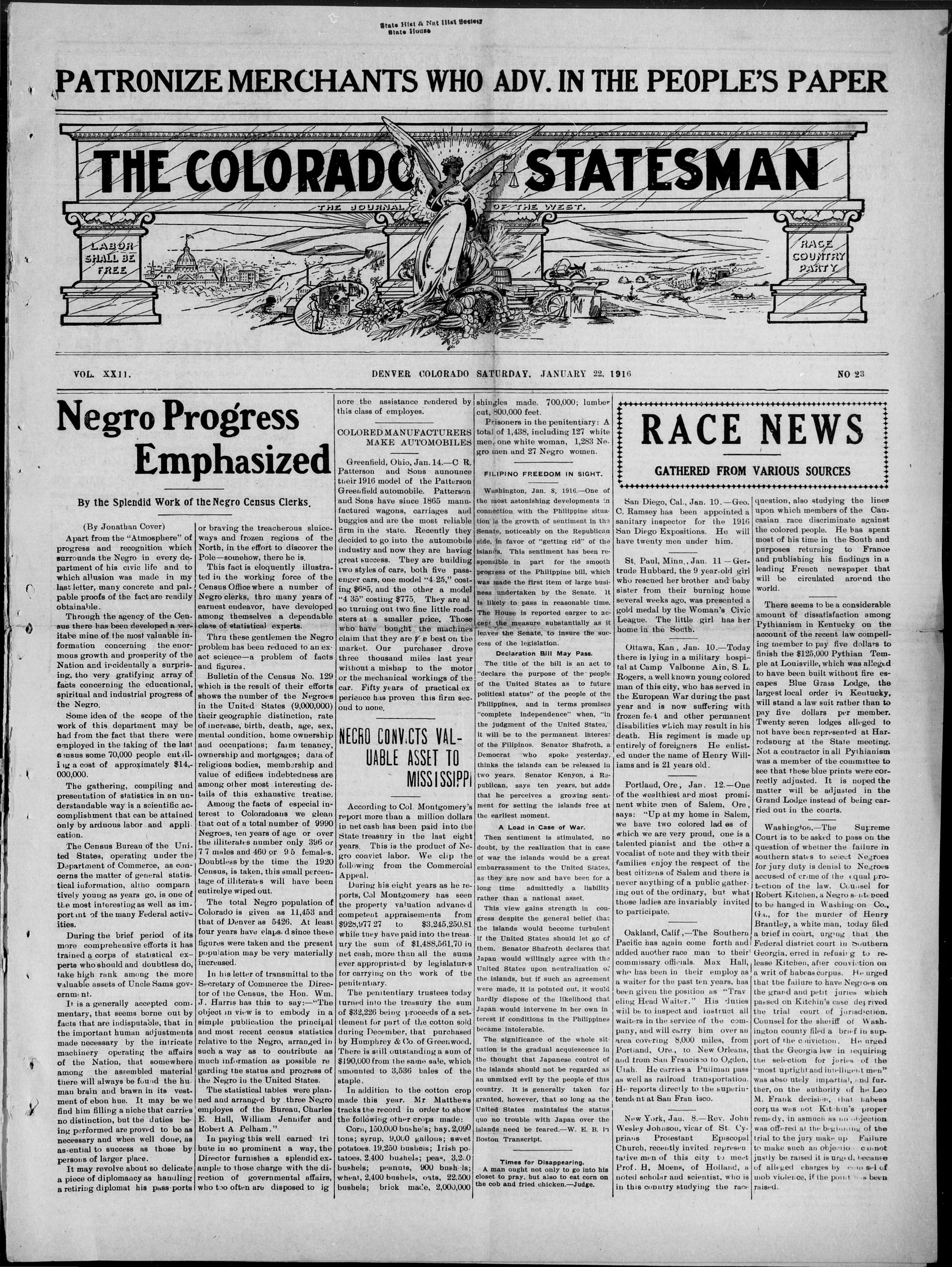
PATRONIZE MERCHANTS WHO ADV. IN THE PEOPLE'S PAPER
THE COLORADO STATESMAN
THE JOURNAL OF THE WEST.
LABOR SHALL BE FREE
RACE COUNTRY PARTY
Negro Progress Emphasized
By the Splendid Work of the Negro Census Clerks.
VOL. XX11.
Negro Pr
Em
By the Splendid Work of
(By Jonathan Cover)
Apart from the "Atmosphere" of progress and recognition which surrounds the Negro in every department of his civic life and to which allusion was made in my last letter, many concrete and palpable proofs of the fact are readily obtainable.
Through the agency of the Census there has been developed a veritable mine of the most valuable information concerning the enormous growth and prosperity of the Nation and incidentally a surprising, the very gratifying array of facts concerning the educational, spiritual and industrial progress of the Negro.
Some idea of the scope of the work of this department may be had from the fact that there were employed in the taking of the last census some 70,000 people entailing a cost of approximately $14,000,000.
The gathering, compiling and presentation of statistics in an understandable way is a scientific accomplishment that can be attained only by arduous labor and application.
The Census Bureau of the United States, operating under the Department of Commerce, as concerns the matter of general statistical information, also comparatively young as years go, is one of the most interesting as well as important of the many Federal activities. During the brief period of its more comprehensive efforts it has trained a corps of statistical experts who should and doubtless do, take high rank among the more valuable assets of Uncle Sams government.
It is a generally accepted commentary, that seems borne out by facts that are indisputable, that in the important human adjustments made necessary by the intricate machinery operating the affairs of the Nation, that somewhere among the assembled material there will always be found the human brain and brawn in its vestment of ebon hue. It may be we find him filling a niche that carries no distinction, but the duties being performed are proved to be as necessary and when well done, as as-ential to success as those by persons of larger place.
It may revolve about so delicate a piece of diplomacy as handling a retiring diplomat his passports
or braving the treacherous sluiceways and frozen regions of the North, in the effort to discover the Pole—somehow, there he is.
This fact is eloquently illustrated in the working force of the Census Office where a number of Negro clerks, thro many years of earnest endeavor, have developed among themselves a dependable class of statistical experts.
Thru these gentlemen the Negro problem has been reduced to an exact science—a problem of facts and figures.
Bulletin of the Census No. 129 which is the result of their efforts shows the number of the Negroes in the United States (9,000,000) their geographic distinction, rate of increase, birth, death, age, sex, mental condition, home ownership and occupations; farm tenancy, ownership and mortgages; data of religious bodies, membership and value of edifices indebtedness are among other most interesting details of this exhaustive treatise. Among the facts of especial interest to Coloradoans we glean that out of a total number of 9990 Negroes, ten years of age or over the illiterates number only 396 or 77 males and 460 or 95 females. Doubtless by the time the 1920 Census, is taken, this small percentage of illiterates will have been entirely wiped out.
The total Negro population of Colorado is given as 11,453 and that of Denver as 5426. At least four years have elapsed since these figures were taken and the present population may be very materially increased.
In his letter of transmittal to the Secretary of Commerce the Director of the Census, the Hon. Wm. J. Harris has this to say:—"The object in view is to embody in a simple publication the principal and most recent census statistics relative to the Negro, arranged in such a way as to contribute as much information as possible regarding the status and progress of the Negro in the United States.
The statistical tables were planned and arranged by three Negro employes of the Bureau, Charles E. Hall, William Jennifer and Robert A. Pelham."
In paying this well earned tribute in so prominent a way, the Director furnishes a splendid example to those charge with the direction of governmental affairs, who too often are disposed to ig
DENVER COLORADO SATURDAY, JANUARY 22, 1916
State Hist & Nat Hist Hoges
State House
GIANTS WHO
ADC
E JOURNAL
DENVER COLORADO S
nore the assistance rendered by this class of employes.
COLORED MANUFACTURERS
MAKE AUTOMOBILES
Greenfield, Ohio, Jan. 14.—C R. Patterson and Sons announce their 1916 model of the Patterson Greenfield automobile. Patterson and Sons have since 1865 manufactured wagons, carriages and buggies and are the most reliable firm in the state. Recently they decided to go into the automobile industry and now they are having great success. They are building two styles of cars, both five passenger cars, one model "4.25," costing $685, and the other a model "4.35" costing $775. They are all so turning out two fine little roadsters at a smaller price. Those who have bought the machines claim that they are the best on the market. Our purchaser drove three thousand miles last year without a mishap to the motor or the mechanical workings of the car. Fifty years of practical experience has proven this firm second to none.
NECRO CONV.CTS VALUABLE ASSET TO MISSISSIPP
According to Col. Montgomery's report more than a million dollars in net cash has been paid into the State treasury in the last eight years. This is the product of Negro convict labor. We clip the following from the Commercial Appeal.
During his eight years as he reports, Col Montgomery has seen the property valuation advanced competent appraisements from $928,97727 to $3,245,250.81 while they have paid into the treasury the sum of $1,488,561.70 in net cash, more than all the sums ever appropriated by legislatures for carrying on the work of the penitentiary.
The penitentiary trustees today turned into the treasury the sum of $32,226 being proceeds of a settlement for part of the cotton sold during December, that purchased by Humphrey & Co. of Greenwood. There is still outstanding a sum of $190,000 from the same sale, which amounted to 3,536 bales of the staple.
In addition to the cotton crop made this year. Mr Matthews tracks the record in order to show the following other crops made:
Corn, 150,000 bushels; hay, 2,090 tons; syrup, 9,000 gallons; sweet potatoes. 19,250 bushels; Irish potatoes, 2,400 bushels; peas, 3,2,0 bushels; peanuts, 900 bushels; wheat, 2,400 bushels, oats, 22,500 bushels; brick made, 2,000,000
shingles made. 700,000; lumber cut, 800,000 feet. Prisoners in the penitentiary: A total of 1,438, including 127 white men, one white woman, 1,283 Negro men and 27 Negro women.
FILIPINO FREEDOM IN SIGHT.
Washington, Jan. 8, 1916.—One of the most astonishing developments in connection with the Philippine situation is the growth of sentiment in the Senate, noticeably on the Republican side, in favor of "getting rid" of the islands. This sentiment has been responsible in part for the smooth progress of the Philippine bill, which was made the first item of large business undertaken by the Senate. It is likely to pass in reasonable time. The House is reported earger to accept the measure substantially as it leaves the Senate, to insure the success of the legislation.
Declaration Bill May Pass.
The title of the bill is an act to "declare the purpose of the people of the United States as to future political status" of the people of the Philippines, and in terms promises "complete independence" when, "in the judgment of the United States, it will be to the permanent interest of the Filipinos. Senator Shafroth, a Democrat who spoke yesterday, thinks the islands can be released in two years. Senator Kenyon, a Republican, says ten years, but adds that he perceives a growing sentiment for setting the islands free at the earliest moment.
A Load in Case of War.
Then sentiment is stimulated, no doubt, by the realization that in case of war the islands would be a great embarrassment to the United States, as they are now and have been for a long time admittedly a liability rather than a national asset.
This view gains strength in congress despite the general belief that the islands would become turbulent if the United States should let go of them. Senator Shafroth declares that Japan would willingly agree with the United States upon neutralization of the islands, but if such an agreement were made, it is pointed out, it would hardly dispose of the likelihood that Japan would intervene in her own interest if conditions in the Philippines became intolerable.
The significance of the whole situation is the gradual acquiescence in the thought that Japanese control of the islands should not be regarded as an unmixed evil by the people of this country. It is generally taken for granted, however, that so long as the United States maintains the status quo no trouble with Japan over the islands need be feared.—W. E. B. in Boston Transcript.
Times for Disappearing.
A man ought not only to go into his closet to pray, but also to eat corn on the cob and fried chicken.—Judge.
RACE NEWS
San Diego, Cal., Jan. 10. — Geo. C. Ramsey has been appointed a sanitary inspector for the 1916 San Diego Expositions. He will have twenty men under him.
St. Paul, Minn., Jan. 11 — Gertrude Hubbard, the 9 year-old girl who rescued her brother and baby sister from their burning home several weeks ago, was presented a gold medal by the Woman's Civic League. The little girl has her home in the South.
question, also studying the lines upon which members of the Caucasian race discriminate against the colored people. He has spent most of his time in the South and purposes returning to France and publishing his findings in a leading French newspaper that will be circulated around the world.
There seems to be a considerable amount of dissatisfaction among Pythianism in Kentucky on the account of the recent law compell
Ottawa, Kan, Jan. 10.—Today there is lying in a military hospital at Camp Valbonne Ain, S. L. Rogers, a well known young colored man of this city, who has served in the European War during the past year and is now suffering with frozen feet and other permanent disabilities which may result in his death. His regiment is made up entirely of foreigners He enlisted under the name of Henry Williams and is 21 years old.
Portland, Ore, Jan. 12.—One of the wealthiest and most prominent white men of Salem, Ore, says: "Up at my home in Salem, we have two colored lad es of which we are very proud, one is a talented pianist and the other a vocalist of note and they with their families enjoy the respect of the best citizens of Salem and there is never anything of a public gathering out of the ordinary, but what those ladies are invariably invited to participate.
Oakland, Calif.,—The Southern Pacific has again come forth and added another race man to their commissary officials. Max Hall, who has been in their employ as a waiter for the past ten years, has been given the position as "Traveling Head Waiter." His duties will be to inspect and instruct all waiters in the service of the company, and will carry him over an area covering 8,000 miles, from Portland, Ore., to New Orleans, and from San Francisco to Ogden, Utah. He carries a Pullman pass as well as railroad transportation. He reports directly to the superintendent at San Fran isco.
New York, Jan. 8.—Rev. John Wesley Johnson, vicar of St. Cyprians Protestant Episcopal Church, recently invited representative men of this city to meet Prof. H. Moens, of Holland, a noted scholar and scientist, who is in this country studying the race
NO 23
question, also studying the lines upon which members of the Caucasian race discriminate against the colored people. He has spent most of his time in the South and purposes returning to France and publishing his findings in a leading French newspaper that will be circulated around the world.
There seems to be a considerable amount of dissatisfaction among Pythianism in Kentucky on the account of the recent law compelling member to pay five dollars to finish the $125,000 Pythian Temple at Louisville, which was alleged to have been built without fire escapes Blue Grass Lodge, the largest local order in Kentucky, will stand a law suit rather than to pay five dollars per member. Twenty seven lodges alleged to not have been represented at Harrodsburg at the State meeting. Not a contractor in all Pythianism was a member of the committee to see that these blue prints were correctly adjusted. It is noped the matter will be adjusted in the Grand Lodge instead of being carried out in the courts.
Washington.—The Supreme Court is to be asked to pass on the question of whether the failure in southern states to select Negroes for jury duty is denial to Negroes accused of crime of the equal protection of the law. Counsel for Robert Kitchen, a Negro sentenced to be hanged in Washington Co., Ga., for the murder of Henry Brantley, a white man, today filed a brief in court, urging that the Federal district court in Southern Georgia, erred in refusing to release Kitchen, after conviction on a writ of habeas corpus. He urged that the failure to have Negroes on the grand and petit juries which passed on Kitchin's case deprived the trial court of jurisdiction. Counsel for the sheriff of Washington county filed a brief in support of the conviction. He urged that the Georgia law in requiring the selection for juries of the "most upright and intelligent men" was absolutely impartial, and further, on the authority of he Leo M. Frank decision, that habeas corpus was not Kitchen's proper remedy, in as much as no objection was offered at the beginning of the trial to the jury make up. Failure to make such an objection cannot justly be raised it is urged, because of alleged charges by counsel of mob violence, if the point has been raised.
CONDENSATION OF FRESH NEWS
THE LATEST IMPORTANT DIS PATCHES PUT INTO SHORT,
CRISP PARAGRAPH8.
STORY OF THE WEEK
SHOWING THE PROGRESS OF EVENTS IN OUR OWN AND FOREIGN LANDS.
Western Newspaper Union News Service.
ABOUT THE WAR
Reports from Keiv indicate the evacuation of Lutsk by the Germans.
Leyland liner Huronian torpedoed by submarine near spot where Lusitania sank.
Germany officially announces Kaiser has recovered from illness and returned to war front.
The Greek army is believed unfriendly to the King and the populace have rioted against royalty.
The French marked the surrender of Montenegro by an air raid on Bulgar positions northeast of Saloniki. They killed or wounded hundreds of Bulgarians.
Germany notifies Great Britain reprisal measures will be adopted for alleged shooting of crew of German submarine which was sunk by the patrol boat Baralong.
Russians lose heavily in new attacks on Austrians and, according to reports from Vienna, fail to gain inch of ground. Czar's men advance in columns twelve to fourteen deep and bayonet fighting is frequent.
Reports from Berlin, Athens and London indicate the allies have determined to force the Greek ruler to aid them or quit his throne. Allied forces control Corfu, Saloniki and Corinth, giving them bases that practically surround Greece.
On the heels of an Austrian report to the effect that Montenegro has unconditionally sued for peace, comes a statement from Zurich, Switzerland, that King Nicolas has refused to consider peace terms from the Teutonic powers.
WESTERN
At Newton, N. J., Charles Ashford Schaefer, 103 years old, died from paralysis.
Billy Sunday closed a successful campaign at Syracuse, N. Y. Net returns, $23,112.27.
An Illinois Central passenger train jumped the track near Pisgah, Iowa. Four persons were seriously hurt and a score injured.
The Bessemer and Lake Erie railroad has placed an order with a Pittsburg company for 2,000 steel cars to cost about $2,000,000.
A verdict of not guilty was returned at Joplin, Mo., by the jury in the case of Menace Publishing Company of Aurora, Mo., and four of its officials.
Three persons were drowned when the buggy in which they were driving furiously to escape the floods between Anaheim and Fullerton, Cal., was swept from the state highway.
The Alainza Hispano Americana, which is said to have a membership of 3,000, extending over New Mexico Texas, Arizona and California, held a national convention in Albuquerque, N. M.
Two men were reported drowned and hundreds of persons were homeless Monday night as a result of the heavy rainstorm which has caused almost every river and stream in southern California to overflow its banks and inundate the lowlands.
WASHINGTON
Secretary McAdoo asked a deficiency appropriation of $594,000 to complete the approaches to the Lincoln memorial.
The House military affairs committee will give a hearing on the Keating bill to establish an $8,000,000 munitions plant at Pueblo.
Mrs. Emmeline Pankhurst, the British suffragist leader detained by New York immigration authorities, was ordered admitted to the United States unconditionally.
The second of the administration conservation measures, a bill under which more than 700,000,000 acres of public lands would be thrown open for lease by private interests, passed the House without roll call. Immediately afterward the 640-acre homestead bill was taken up with a prospect that it would be passed. Opposition to the land lease bill was confined principally to far western representatives, as in the case of the water power leasing bill, passed a few days ago.
Secretary Lansing announced that the Berlin foreign office had informed Ambassador Gerard that all German submarines in the Mediterranean have reported, and that none was concerned in the destruction of the British liner Persia.
Establishment of a neutral zone in northern Mexico to be jointly policed by the forces of Mexico and the United States unless disorders are speedily controlled, is proposed in a resolution introduced by Senator Gore, Democrat, of Oklahoma.
FOREIGN
The Prussian Parliament met on Jan. 13.
Russia's offensive in East Galicia has been checked.
Direct passenger service between Berlin and Constantinople has been inaugurated.
The conscription bill passed the British House of Commons committee without change. Several amendments were suggested but none accepted.
All street traffic at Hamburg was tied up by the unprecedented floods, caused by a storm blowing water from the sea back up the Elbe river.
At Guatemala City, Manael Estrada was declared re-elected president of the republic for the term beginning March, 1917, and running for six years.
Sixty thousand revolutionary troops have defeated the forces of Yuan Sui Kai, head of the Chinese government, in an action fought in the province of Sze Chuen.
The cathedral at Sora was destroyed by fire while services were in progress throughout Italy commemorating the earthquake at Avezzano and Sora a year ago.
In the face of Villa's threat to exterminate Americans and foreigners, four Americans, heavily armed, left for the mountains north of La Junta, Mexico, to rescue Dr. R. P. Kramer.
Late dispatches indicate that King Constantine is tootting on his throne. There is a disposition among the entente powers to replace the monarchy with a republic headed by Venizelos.
The American members of the Ford peace mission, except those associated with the permanent peace board, sailed from Rotterdam aboard the steamer Rotterdam for New York.
The corpse of Gen. Jose Rodriguez, Villa's cavalry leader, was placed on public exhibition Monday in the yard of the Juarez custom house. The gruesome show was meant to prove that the Carranza government was determined to punish the murderers of Americans and other foreigners.
A committee to regulate the cost of living at Juarez, Mex., by the fixing of prices and profits was appointed by Gen. Gabriel Gavira, Carranza commandant, who also announced that the bodies of Rodriguez and Rivas, Villa chiefs, shot after the force of Rodriguez had been defeated at Pearson, would reach the border so Americans might verify the report of their execution.
SPORTING NEWS
Mike Gibbons of St. Paul knocked out Young Ahern in the first round of their scheduled ten-round bout at St. Paul, Minn.
W. H. Williams, star halfback of last year's School of Mines football team at Golden, Colo., was elected captain of the 1916 gridiron squad.
Dick Gilbert, the Denver heavyweight, was matched to meet vic Hanson, the coast heavy, in a ten-round battle at Kansas City on the night of January 24.
Fred Lewis of England was ready to take on Packey McFarland for the wetterweight championship. as a result of his easy win at Milwaukee over Kid Graves of Cleveland.
Black men and white may hereafter stage boxing bouts in New York state. The athletic commission will rescind the old rule against mixed bouts because the attorney general says it is unconstitutional.
James C. McGill, Denver and Indianapolis baseball magnate, defendant in suits filed in the District Court by John F. Coffey, formerly manager of the Denver team, and his wife, Loreen V. Coffey, who charge assault, must defend the actions in the identical courtroom in which he appeared ten years ago when Estelle F. Del Poso, a beautiful Spanish girl, sued him for $50,000 for breach of promise.
GENERAL
An earth temblor was felt at El Centro, Cal., and at other points in the Imperial valley. No damage resulted.
Blackmailing operations carried on at the seaside summer resorts, netting more than $250,000 were revealed by two arrests in New York.
The Rainer club, the principal social club in Seattle, Wash., was raided by deputy sheriffs, who confiscated 400 quarts of whiskey, champagne, gin and other intoxicants.
A Fremont, Ohio, dispatch says F. I. Gahn of Rich township is perhaps the biggest country schoolboy in Ohio if not in the United States. He is 16 years of age and weighs 260 pounds.
According to advices received at Douglas, Ariz., regarding the reported capture of Baca-Valles and Clisneros, eight armed followers with the Villa bandit leaders also were taken into custody.
The police, working without a semblance of a clew, were unable to establish a motive for the murder of Edward B. Dodge of Boston, who was shot to death in front of St. George's Episcopal chapel in St. Louis.
Madame E. Lanel, wife of the French minister to Brazil', who died in Rio Janeiro, was Miss Amy McKee, the daughter of Mrs. Sam Bell McKee of Oakland, Cal. She is survived by her husband, mother, a brother and two sisters.
Miss Lillian Conklin, pretty New York governess, 20, was awarded $2,000 damages by a jury that heard her tell how George R. Kaufman, wealthy mining engineer, gave her a "short kiss and a lingering kiss" when she called at his home seeking employment.
Western Newspaper Union News Service.
DATES FOR COMING EVENTS.
Feb. 13—Annual convention Colorado Metal Mining Association, at Denver
March 20-April 2. Colorado Retail Merchants' Association's Food and Industrial Exposition at Denver.
Clarence Darrow delivered a lecture in Denver on the single-tax question.
Citizens of Durango voted $175,000 bonds to build a new high school building.
Much interest is being manifested in the good roads meeting at Denver, Jan. 19-20.
The funeral of Mrs. Mary L. Corlew, 92 years old, who died suddenly, was held in Denver.
Delegates from all parts of the state attended the Good Roads Association meeting in Denver.
John Greenawalt spoke on "The Telephone Business" at the Denver Advertising Club's weekly luncheon.
The Colorado State Editorial Association held its winter meeting in Denver on Monday and Tuesday.
The Colorado Osteopathic Association will hold its nineteenth annual meeting in Denver, Jan. 28 and 29. David Stewart, 67, at one time one of the best known mining men in the state, died at his home near Empire. Louis Boyvin, pioneer logger of Colorado, died at his residence in Denver of pneumonia. He was 73 years old. Twelve of Colorado's pony express messengers of the early '60s occupy a place in the new Federal building in Denver. The grand champion carload of Hereford bulls (twenty head) at the Western Live Stock Show at Denver were sold for $450 per head.
Mrs. Mary Brennan, 75 years old, a widow living at West Thirty-second avenue and Tejon street, Denver, was painfully burned in a fire at her home. The fire was caused by an overheated stove. Denver is destined to become the center of metal mining research work for the United States and the chief headquarters of the United States Bureau of Mines, in the opinion of members of the office in Denver. The plant of the Western Sugar & Land Company at Grand Junction will be purchased and operated by a new concern, headed by A. E. Carlton, Cripple Creek banker and mining man, which intends to build a factory at Delta.
A honeymoon trip on foot to New York city, with pedometers to record the number of miles covered, is the novel scheme planned by Mr. and Mrs. Frederick J. Anderson, who were married in Golden Christmas day.
William H. Lawrence, Denver pioneer and one of the founders of the Saturday and Sunday Hospital Association, died at his home, 247 Bannock street. Mr. Lawrence was 67 years old and had been in excellent health until the day before he died, when he suffered a stroke of apoplexy.
Freeman L. Loomis of Redcliffe who "jumped" his bond three months ago on statutory charges and led the police and private detectives a chase of nearly 2,000 miles before his capture in Ruskin, Neb., was turned over to Eagle county officials on his arrival in Denver in custody of Sheriff J. A. Jones.
Mrs. Effie Adams, wife of Harry L. Adams, pal of Claude Maddox, who was dangerously wounded—the police say while he was trying to rob the Hotel Du' Nan—was arrested in Denver in the West Side Court on a warrant charging her with receiving $370 worth of stolen furs. Her ball was fixed at $2,000.
James Barton Adams, pioneer Denver poet, is in a critical condition at his home in Vancouver, Wash., as the result of an automobile accident which befell him a few days ago. While in Portland, Ore., on a visit Mr. Adams was run down by a machine, and because of the serious nature of the accident and his advanced age his friends are alarmed over the outcome. Abandoning the last ray of hope of escape from the leash of evidence collected by the Denver police with his detection in the act of preparing a saw which he admitted was to be used in a plot to break from the Denver city jail, Harry L. Adams, alleged accomplice of Claude Maddox, broke down and confessed that he and Maddox committed the recent series of daring burglaries in Denver which the police have charged to the pair. Some of the loot has been recovered and identified.
The Denver police have been asked to aid in a countrywide search recently started by Miss Myrtle Fairchild, a 17-year-old San Diego girl, for her father, A. Murton Fairchild, a railroad man, whom she has not seen since she was a baby.
According to the annual report of the Denver Union Stockyards Company, there has been handled since the yards opened thirty years ago an aggregate of 11,828,786 sheep, 7,633,913 cattle, 247,790 calves and 4,264,864 hogs. There were 407,138 horses and mules received.
SHIP $250,000 IN GOLD
CRIPPLE CREEK SENDS OUT 175
TONS OF RICH ORE.
Largest Consignment Made Since Last
February Went Out Under
Armed Guard.
Western Newspaper Union News Service.
Cripple Creek, Colo.—The world wants gold. At the end of the Napoleonic wars in 1816 the Bank of England made gold the sole standard of value at $20.67 per ounce fine. Germany followed suit in 1871 by reason of victory over France, and the United States, being ambitious to establish an over-seas commerce, joined the movement at the end of the century.
Responding to this universal demand for the yellow metal the small Cripple Creek district—some twelve miles in width and eighteen miles from north to south—shipped out under the care of armed men, a consignment of high-grade ore worth $250,000 at the sampler.
Of the seven box-car loads (175 tons) the Cresson mine furnished fifty tons, the Portland mine twenty-five tons and the Vindicator Consolidated Gold Mining Company 100 tons or four-sevenths of the total.
Since the Cresson "vug" shipment in February, 1915, which was valued at $243,240, this is the most valuable single consignment that has left the camp.
This ore will be gradually treated at the mill of the Golden Cycle Mining and Reduction Company at Colorado City.
At the low-grade end of the camp's future it is reported that $200,000 has been set aside by the directors of the Vindicator Company for the construction of a 1,000-ton flotation plant near the mines for the benefit primarily of the larger dumps accumulated and the tailings from the Vindicator and Golden Cycle coarse concentration plants, each handling 150 tons daily.
Boulder Man Victim of Bandits.
Boulder.—W. J. Wallace of El Paso, Tex., reported to have been slain by Villa troops in Chihuahua, Mex., was a resident of Boulder for three years until last fall, when he went to El Paso, where his son, W. W. Wallace, opened a law office. The latter was graduated from the university law school last June. Mr. Wallace was a retired merchant of Fairplay.
Germans Form Colony in Colorado
Durango—Plans are being made to bring 1,000 German farmers from Alberta and Manitoba provinces,ada, to Southwestern Colorado and Northern New Mexico, according to an announcement here by W. Goff Black and George F. Bruington of Aztec, N. M. The announcement states that the exodus is caused by anti-Teutonic feeling in Canada resulting from the war.
Mrs. Mae Oles Again on Trial.
Boulder.—The trial of Mrs. Mae Oles, who is charged with the forgery of a contract between her father, J. N. Bradford, and the late A. J. Macky, Boulder pioneer and philanthropist, by which she hoped to gain one third of the $400,000 Macky estate, began in the District Court here before Judge J. W. Sheafer of Colorado Springs.
Ray Heads Editorial Association.
Denver.—Roy Ray, editor of the Windsor Poudre Valley, was elected president of the Colorado Editorial Association at the first day of the annual meeting of the organization. David Elliot of the Colorado Springs Telegraph was chosen vice president, and Alva A. Swain of the Pueblo Chleftain succeeded himself as secretary.
Second Davidson Trial Feb. 9
Colorado Springs. The case of 1. Lofton Davidson, the Denver undertaker, charged with conspiracy to defraud insurance companies, was set for Feb. 9 in the District Court. The jury at a former trial recently was discharged because the members were unable to agree on a verdict.
Pueblo Church Burns; Loss. $20,000.
Pueblo.—Fire swept the Broadway Christian church, resulted in serious injuries to Charles B. Willis, captain of motor engine No. 3 of the fire department, minor, injuries, including frozen hands and feet to a half a dozen other firemen and caused a financial loss of probably $20,000.
Prize Stock of Nation at Denver Show
Prize Stock of Nation at Denver Show.
Denver.—With the finest domestic menagerie ever assembled in one place, the National Western Stock and Horse Show opened Monday at the Denver stockyards and thousands of people poured through the gates
Ranchman's Body Found Frozen.
Trinidad.—Walton Dilks, 42 years old, a ranchman, is dead. His frozen body was found in his cabin near here by M. L. Barnes, a neighbor. A shot had shattered the dead man's head. Beside him was found a high power rifle. Despondency over financial losses is believed to have been the motive for the suicide. Dilks lived alone. The ranch, as a poultry farm, had been a failure, and for months he had been unable to get other employment.
Phone Champa 2211
The Chesapeake
Fish & Oyster Co.
Denver's Only Exclusive Fish and Oyster House
Fresh Fish, Oysters, Salt, Smoked, Dried and Canned Fish
Poultry and Game of All Kinds
1506 Arapahoe Street
C. H. SHIRLEY, Pres. J. C. HAMPSON, Vice Pres PAUL J. SHIRLEY, Sec. and Treas.
Courteous Treatmet. Right Prices Leaders in Prescription
5 Points Cafe
UNDER NEW MANAGEMENT.
Chop Suey, Noodle
Japanese a
SHORT ORDE
2712 WELTON STREET
W. C. CAMPTON, Pres. J. M
RAILROAD
LUNCH ROO
ey, Noodles and All Kinds of
Japanese and American Dishes
T ORDERS AT ALL H
N STREET PHON
ON, Pres. J. M. JOHNS, Treas. U. P.
ROAD PORTERS'
NCH ROOM IN CONNECTI
Chop Suey, Noodles and All Kinds of Chinese Japanese and American Dishes SHORT ORDERS AT ALL HOURS
RAILROAD PORTERS' CLUB LUNCH ROOM IN CONNECTION
BILLIARDS AND
POOL
1728½ Wazee St. C
J. B.
PHONE MAIN 8416.
Wazee St. Only one block from Union
J. B. MINTER. Barber.
MAIN 8416. DENVER, CO
1728 $ _{1/2} $ Wazee St. Only one block from Union Depot.
J. B. MINTER. Barber.
PHONE MAIN 8416. DENVER, COLORADO.
JOHN I Meats, Fancy a 1864 CU Corner Nineteenth.
JOHN K. RETTLE
Fancy and Staple Co.
1864 CURTIS STREET
th.
O. E.
Res. H
Market Con
Retail Staple and Fancy Grocery
Hotels and Restaurants Our S
ed
Eastern Corn Fed Me
Fits, Vegetables, Poultry and G
e Street
CLOTHES CLEANED, PRESSED
ALTERED AND DYED AT THE
Mutual Tailor
nd Cleane
The Mark
Wholesale and Retail Sta-
Oysters. Hotels and
Fresh and Cured
Eastern C
Fruits, Vegeta
1638-89 Arapahoe Street
HAVE YOUR CLOTHES
ALTERED
Mutua
and C
The Market Company
Wholesale and Retail Staple and Fancy Groceries, Fish and Oysters. Hotels and Restaurants Our Specialty.
Eastern Corn Fed Meats
HAVE YOUR CLOTHES CLEANED, PRESSED, REPAIRED, ALTERED AND DYED AT THE
Mutual Tailors and Cleaners
LADIES' AND GENTLEMEN'S SUITS MADE TO ORDER.
Our Work Will Please
Gentlemen's Suits C
Overcoats.....
Gloves.....
Neckties....
Will Please You—Our Prices are
men's Suits Cleaned and Pressed....
ats....
es.
Gentlemen's Suits Cleaned and Pressed.....75 Overcoats.....75 Gloves.....05 Neckties.....05
---
PHONE MAIN 3028
Phones Main
169, 181, 189, 190
2204 WELTON ST.
Cafe
All Kinds of Chinese
American Dishes
AT ALL HOURS
PHONE MAIN 4730
Treas. U. P. JACKSON, Sec.
TERS' CLUB
CONNECTION
FREE CHECK ROOM
ock from Union Depot.
Barber.
DENVER, COLORADO.
RES. PHONE GALLUP 942
ETTIG
table Groceries
TREET
Company
Fancy Groceries, Fish and
brants Our Specialty.
Fed Meats
Ltry and Game.
D, PRESSED, REPAIRED,
ED AT THE
Tailors
aners
Prices are Reasonable.
Pressed.....75
.....75
.....05
.....05
CALL MAIN 8519
```markdown
```
Store No. 2
26TH AND WELTON
Main 4955 4956
Denver, Cola
C. E. Smith, Manager Res. Phone South 1608
Denver, Colorado
CALL MAIN 8519
AFRO-AMERICAN CULLINGS
Major Robert Russia Moton of Hampton, whom a subcommittee of the board of trustees of Tuskegee Normal and Industrial Institute unanimously selected as successor to the late Booker T. Washington, said in an interview that he intended to carry on the work of Tuskegee along the same rational lines which Doctor Washington had followed. "I accept this new responsibility," said Major Moton, "with anxious humility. Doctor Washington was truly a great man, viewed from every angle. I cannot fill his place, but with the guidance and support of Tuskegee's wise and sympathetic board of trustees, and with the earnest co-operation and loyal help of the faithful and efficient corps of workers whom Doctor Washington gathered about him at Tuskegee. I shall endeavor to the best of my ability to carry on the work to which he gave his life with the same spirit and with the same rational methods which he so wisely and so successfully used." Major Moton, it is known, was Doctor Washington's choice as his successor as leader of Tuskegee's work. The two men were intimate friends, held the same views as to the best methods for helping their race to a fuller citizenship, and often spoke from the same platform in the North and on the "educational tours" of the Southern states. The subcommittee which chose Major Moton was composed of Seth Low, Frank Trumbull, W. W. Campbell, Victor H. Tulane, and Edgar A. Bancroft. Mr Low gave out the following statement: "The trustees of Tuskegee institute at their meeting in Tuskegee, December 13, appointed the under-signed committee with power to select the principal, provided it could act unanimously. The committee today has, by unanimous action, appointed Major R. R. Moton to be principal. His installation will take place at the commencement next May. In taking this action, the committee has not been unmindful of the long devotion and many qualifications of Emmet J. Scott for the position. The problem to be dealt with is a many-sided one, and it has seemed wise to seek a solution of it that will bring to the work of Tuskegee another forceful personality." The late Booker T. Washington, in his book entitled "My Larger Education," had this to say of the man who is to succeed him as principal of the institution which Doctor Washington built up from a log cabin, and to which he devoted his life: "It has been my privilege to come into contact with many different types of people, but I know few men who are so lovable, and, at the same time, so sensible in their nature as Major Moton. He is chock-full of common sense. Further than that he is a man who, without obtruding himself and without understanding how he does it, makes you believe in him from the very first time you see him and from your first contact with him, and, at the same time, makes you love him. He is the kind of man in whose company I always feel like being, never tire of, always want to be around him or always want to be near him.
"One of the continual sources of surprise to people who come for the first time into the southern states is to hear of the affection with which white men and women speak of the older generation of colored people with whom they grew up, particularly the old colored nurses. The lifelong friendships that exist between these old 'aunties' and 'uncles' and the white children with whom they were raised
No financial achievement which St. Louis has put to its credit in the past half century is more significant than the success of the colored citizens of St. Louis in raising $50,000 for a colored Y. M. C. A. building. But a scant half century ago the colored citizens of St. Louis had just emerged from slavery; and, as Booker Washington put it, their sole assets consisted of a few bed quilts, pumpkins and fowls "miscellaneously gathered." Today the race numbers many men of substantial means and big civic spirit. A large proportion of the people of St. Louis, including the writer of these words, come of Southern stock. Our ancestors were tended in their infancy, served in their mature years and tendered care for in their old age by the strong hands and warm hearts of American Negroes. This obligation thus accumulated through the generations is one which we can never fully discharge. The opportunity to help in the work so nobly started in the interest of an institution whose function is to make colored boys into good citizens, who might otherwise develop into bad ones, is one that we cannot af-
Nice shiny bugles may be bought very cheaply up in Manitoba, where a large consignment intended for the troops has been cast aside because in a wee sma' nook on the inside was found these words: "Made in Germany."
King Alfonso has reigned longer than any other European sovereign, with the exception of the king of Montenegro and the emperor of Austria. He was born a king, and so has reigned just over 29 years.
is something that is hard for strangers to understand. It is just these qualities of human sympathy and affection that endeared so many of the older generation of Negroes to their masters and mistresses, and which seems to have found expression, in a higher form, in Major Moton. Although he has little schooling outside of what he was able to get at Hampton institute, Major Moton is one of the best read men and one of the most interesting men to talk with I have ever met. Education has not 'spoiled' him, as it seems to have done in the case of some other educated Negroes. It has not embittered or narrowed him in his affections. He has not learned to hate or distrust any class of people, and he is just as ready to assist and show a kindness to a white man as to a black man, to a Southerner as to a Northerner.
How flies and mosquitoes carry disease was one of the phases treated in the exhibit on hygiene and sanitation made recently by the colored pupils of the Washington (D. C. schools. The models in this were made by junior students of the schools, and will be used in instructing grade children as to the methods of keeping well. Right and wrong kind of dairies, right and wrong methods of supplying houses with drinking water, as well as a model of the District's water supply plant; right and wrong methods of ventilating houses; proper methods of disposing of garbage and trash, and how children may aid in keeping communities in which they live clean and healthful were included among the models displayed. One of the points of interest about this part of the quadruplex exhibit was that the cost of the material used was but slight. Old boxes, pasteboard, clay and illustrations cut from magazines were all used to good purpose. Miss Jessie Wormley of the normal faculty directed the students. Students taking the domestic science course under Miss Helen Irving compiled to exhibit the various uses to which cotton is put, as well as its by-products. From the raw material to various finished products was shown through actual material and pictures, not only of cotton, but also of linen, wool, hemp, ramie, jute and silk. So far as is possible material and information furnished was used. The students made crayon pictures, showing various nutritive materials and units contained in the ordinary foods. Some of the most modern pieces of apparatus were on display in the laboratories under Charles M. Thomas, who has charge of the sciences in the school. The equipment for psychology tests is "up to the minute" and serves a double purpose—for instructing the embryo teachers in psychology and how they can best teach those who come under them, and for carrying on psychological experiments, particularly with defective children. Although the material used in the science department is always out, being in constant use, it is attracting wider attention now than ordinarily, in connection with the other exhibits. Teachers attending various institutes recently have inspected it, and had its used explained to them by Mr. Thomas.
The 90,000 waiters and kitchen attendants of the New York hotels and restaurants are being licensed. To do so they must pass a physical examination.
ford, in view of past history and present needs, to pass by.—St. Louis Ke public.
From 1790 to 1870 the actual work of gathering census statistics was performed by the United States marshals, and the enumerations varied in length from ten to eighteen months. In 1880 there was adopted the plan, followed at all subsequent censuses, of having this work done by a large body of enumerators under the direction of supervisors.
A recent investigation by Professor Haberlandt of Germany shows that living wood is of much food value, sapwood, twigs and branches containing large quantities of sugar, starch and oil, with some albumen. Soft woods contain much oil, hard woods much starch.
An electrical smoke abatement device has been invented whereby the particles of soot are charged by current led through fine wires in a smoke stack until they unite and become heavy enough to fall into a receptacle.
A London railroad station has been equipped with penny-in-the-slot machines to sell tickets to persons who wish to accompany friends to trains.
A California inventor's wave power motor utilizes the horizontal motion of the water instead of the vertical usually the case in such devices.
On a farm conducted by the muniel pality of Berlin cows are being milked in the fields by electrical machines deriving their power through cabies.
BOARD ON CASH BASIS AND HAS SURPLUS.
Nearly 6,000 Accident Cases Reported and Fifty-Six Death Claims Adjusted During Five Months.
Western Newspaper Union News Service.
Denver.—The first annual report of the Colorado State Industrial Commission, covering the five months of its existence, was made to Governor Carlson and shows marked progress in the development of the compensation, insurance and industrial branches of the commission's activities. During the five months between 5,000 and 6,000 accidents were reported from all parts of the state. Fifty-six death claims, each calling for monthly payments aggregating $2,500, were settled. A total of 450 injury claims were adjusted, with compensation averaging $100.
Twelve industrial disputes were settled without disorder or loss of time to employer or employe. One disagreement, that of the journeymen tailors, is now being investigated. The commission got work for more than 100 former strikers by interceding with employers. Prosperity shown by the figures of the State Compensation Insurance fund is considered by the commission to be perhaps the most important feature of the report. The fund has a surplus of $16,664.57, this being over and above reserves abundantly sufficient, in the opinion of the manager, to liquidate every obligation. Business written and paid for indicates an annual premium income to the state fund of $109,335.92, of which $94,003.92 is collected from private employers.
Approximately 7,500 employees, earning $7,573,000 annually, are covered by the policies.
"The state fund's business," says the report, "has been uniformly conducted on a strictly cash basis, a fact auguring well for the character of the risks underwritten, since willingness to pay cash in advance generally is accepted as evidence of a good 'moral hazard.'"
The report declares that the fund's premium income is growing steadily, drawn from virtually every industry in the state, except coal mining and the manufacture of explosives.
The first dividend will be paid to policy holders next July.
"It may be stated with propriety," the report declares, "that, for private employers, the expectation of a dividend averaging 20 per cent of the premiums is a justifiable one."
Value of Terminals in Denver.
The Colorado & Southern railroad claims a valuation of $7,223,089.17 for its Denver terminals, including switch engines, according to an exhibit it has filed with the State Public Utilities Commission in the "switching charge" case brought before the commission last July for a number of industrial concerns. The Burlington values its Denver terminals at $8,011,309.44. These were the only two companies which filed detailed statements. The complainants seek to have the rates reduced from 20 and 25 cents per ton to 8 and 10 cents per ton for interchange and industrial switching with a minimum of $2 and $2.50 per car.
Colorado Sends 752 Men to Army.
The United States army, navy and marine corps enlisted 752 men from Colorado in 1915. There were 3,598 applicants, but owing to rigid examinations only about 21 per cent passed. The army recruiting stations mustered in 354. There were 2,917 applications. The naval station accepted 245 of 951 applicants. The marine corps accepted only 153 of 720 men.
May Change Appointive Officers
According to reports at the state house, a number of changes affecting incumbents in appointive offices may be looked for within the next few weeks. The reports include the offices of the adjutant general, warden of the penitentiary and the boiler and factory inspectors.
Governor and Food Chief Confer.
Governor Carlson conferred with John Lynch, state pure food and drug commissioner, and the inspectors working under Mr. Lynch, to outline the work he desires the inspectors to do in aiding the enforcement of the prohibition penalty law.
Delegates to Security Convention.
Governor Carlson appointed Frank M. Taylor, Charles MacA. Willcox, Forrest S. Rutherford, E. C. Stimson, Harold Kountze and Frank C. Goudy delegates to the National Security League Congress, that will meet in Washington, D. C.
Uniform Accounting for Utilities
A uniform system of accounting will be adopted by all electric utilities in the state of Colorado, according to an order sent out by the State Public Utilities Commission The order becomes effective at once Several weeks ago the commission held a conference with representatives of electric utilities from all parts of the state to determine upon the best uniform method of accounting.
BIG SNOWSLIDE AT LEADVILLE
MINE BUILDINGS WRECKED AND TREES SNAPPED LIKE STRAWS IN DISASTER.
TWO DIE, BUT 20 ESCAPE
TOTTERING DAM IMPERILS MANY
LIVES AND MILLIONS IN PROP-
ERTY IN CALIFORNIA.
Western Newspaper Union News Service.
Leadville, Colo.—Leaving death and ruin in its white course, a 'tremendous snowslide swept with terrific impact down the steep passes of Mount Elbert, in lake county one mile above Twin Lakes, Wednesday afternoon shortly after 1 o'clock, buried alive two mining men, one a former resident of Denver. Twenty other mine employés narrowly escaped death as the frozen snow and earth thundered down the mountain side. The dead are J. W. Remine, 33 years old, brother of Mrs. John Winkler, 1114 Acoma street, Denver, and Paul Stiffler, 40 years old, of Twin lakes. Remine was the son of W. P. Remine, the mention of whose name recalls to the pioneer prospectors one of the most successful of the early-day gold diggers.
Both men were in the employ of the Gordon group of gold mines. With a score of other men they were endeavoring to reach a shaft opening by cutting their way through deep snow.
Then came the moving, crashing, thundering slide, snapping trees at the roots as if they were straws, sweeping them down, down the bottomless depths of the sheer mountain side.
In the path of the slide were the mine buildings, which were wrecked by the oncoming run and carried along in its maddening speed.
With a great roar, the slide finally was broken up when it struck a high barrier of cliffs near where the town of Twin Lakes is situated.
Twelve Hundred Marooned.
Los Angeles, Jan. 20.—Whether the great levees which hold the Colorado river back from the Imperial valley will hold was a question on which hinged the possible fate of human lives and millions of dollars' worth of property. Heavy rains moving eastward left most of southern California recovering from floods, troublesome but receding, which claimed four lives and caused damage estimated at $2,000,000. A wall of water eleven feet high was sweeping over the spillways of the Roosevelt dam on the Salt river. The rise, however, had ceased, though another one was predicted by reclamation officials.
Flood conditions assumed alarming proportions at Yuma, Ariz., last night. Reports from all points along the Gila river above here as far as Phoenix were to the effect that the river was rising rapidly. The Colorado river rose one and one-half feet in twenty-four hours and began to rise more rapidly late Wednesday night.
In addition to the flood of water rushing toward Phoenix down these two rivers, between 12,000 and 15,000 feet of water a second was pouring over the Laguna dam.
British Ship Sunk by U-Boat.
London.—The British steamer Marere was sunk by a submarine. Her crew was rescued.
CZAR'S MEN ROUT TURKS.
Russians Capture Sixty-Six Miles of Trenches in Hand-to-Hand Fight in Lake Tortem Region.
London, Jan. 20.—Tearing through the Turkish lines in the Caucasus, the Russians captured sixty-six miles of trenches, routed the Moslems from strong positions in the region of Lake Tortem, and occupied a line extending to the Charlains river north of Melazghert. The Ottoman forces fled after a desperate hand-to-hand battle in which soldiers fought with fists, stones, clubbed rifles and broken bayonets. The Sultan's troops finally established themselves on the strongly fortified plain of Ezerum, but in order to cover their retreat sacrificed a large portion of their army. Entente allied airmen have dropped bombs on Metz and Arnaville, doing some material damage.
With the announcement that Monte-negro had broken off negotiations for peace with Austro-Hungary comes the official statement in a Paris newspaper that King Nicholas and his family and suite are already on their way to Italy.
Gen. Villa's Life Forfeit on Sight.
El Paso.—General Carranza telegraphed the Mexican embassy at Washington that he had formally proclaimed Francisco Villa an outlaw and authorized his execution by any citizen of the republic who might encounter him.
1 Killed in Powder Plant Explosion.
Hopeville, Va.—One man was killed and a dozen severely injured by an explosion in the nitrate house of the Du Pont powder plant here.
The
Curtis
Park
Floral
Company
FLORAL DESIGNS PUT UP WHILE
YOU WAIT
CHOICE PLANTS AND CUT FLOWERS CONSTANTLY
ON HAND
GREENHOUSES: Thirty-Fourth and Curtis Streets
TELEPHONE, MAIN 1511
DENVER, COLO
The Champa Pharmacy
The Champa Pharmacy
Twentieth and Champa,
Is the place to get your
DRUGS, CHEMICALS AND PATENT MEDICINES
WE SERVE DRINKS.
Prescriptions Our Specialty.
Phone us and we will deliver the goods to all parts of the city.
JAMES E. THRALL, PROPR.
PHONE MAIN 2425.
When You Want
The Heads, Feet, Tails, Snouts, Neckbones or Chiterlings, or any other part of the hog except the squeal, go to
East's Market
The
WARD AUCTION
COMPANY
Sales Daily at 2 p.m. Office Furniture a Specialty.
PRIVATE SALES AT ALL TIMES
HAVE MOVED TO—
1723-39 GLENARM ST.
PHONE MAIN 1675.
THE BEST ICE CREAM AND
CANDIES AT
O.P. BAUR & CO.
CATERERS AND
CONFECTIONERS
Phone: 168
1512 Curtis Street, Denver, Colo.
JOSEPH CARTER
Express, Moving,
and Storage
COAL AND WOOD
PROMPT DELIVERY.
Phone Main 6544.
2415 WASHINGTON STREET.
TELEPHONE YORK 6668.
J. H. Biggins
GENERAL FURNITURE REPAIRING
AND UPHOLSTERING.
WORK GUARANTEED.
1417 East 24th Avenue, Denver, Colo.
2300-6 Larimer Street
Phone Main 1461
1848 Arapahoe
Phone Main 4896
Miss M. Cowden Hair Dressing Parlor
Shampoo, cutting and curling. Scalp treatment, hair tonics, hair straightening, manicuring. Stage wigs for rent; theatrical use and masquerades. Goods delivered out of the city. All shades of hair matched by sending sample of hair; also combings made up.
Cheapest Switches 50 Cents
1219 21st St. Denver, Colo.
DO IT NOW Subscribe
for THIS
PAPER
THE COLORADO STATESMAN
JOS. D. D. RIVERS.....Proprietor
1824 Curtis Street, Room 25.
Phone Main 7417.
SUBSCRIPTION RATES:
One Year .....$2.00
Six Months .....1.00
Three Months .....6.00
PAYABLE IN ADVANCE.
Entered as second-class matter at the postoffice in the city of Denver, Colorado.
It occasionally happens that papers sent to subscribers are lost or stolen. In case you do not receive any number when due, inform us by postal card and we will cheerfully forward a duplicate of the missing number.
Communications to receive attention must be newsy, upon important subjects, plainly written only upon one side of the paper; must reach us Tuesdays, if possible, anyway, not later than Wednesdays, and bear the signature of the author. No manuscript returned, unless stamps are sent for postage.
Reading notices, ten lines or less, 10 cents per line. Each additional line over ten lines, 5 cents per line.
Remittances should be made by Express Money Order, Postoffice Money Order, Registered Letter or Bank Draft. Postage stamps will be received the same as cash for the fractional part of a dollar. Only 1-cent and 2-cent stamps taken.
No discounts allowed on less than three months' contract. Cash must accompany all orders from parties unknown to us. Further particulars on application.
All communications of a personating nature that are not complimentary will be withheld from the columns of this paper.
ARE WE GROWING?
We cannot be classed among the pessimists who never see any good in the conditions that we are passing through, but we are inclined to believe that many things which seem monstrously unjust and hard, as their crushing weight falls upon us, are, after all, necessary to our development, and therefore blessings in disguise. There are some facts, however, connected with the race problem in the United States, which, we believe, are not the rightful source of so much complacent assurance as a hopeful but tolerant people are inclined to give them. We are making indisputable progress in the channels of material success as the years go by, but the actual result of that progress is not altogether what we are prone to consider it. At the beginning of the present year the colored people of the United States own more land and more personal property than they ever owned before. They can boast of a higher educational standing, a material advance along the lines of intellectual and moral development and a greater adaptation to those industrial forces by which the strength and worth of a people are measured. We are growing along all lines which tend to make a people worthy of consideration and respect, and every sensible Negro can feel a high sense of satisfaction over the realization of this evidence of our advancement. But when we attempt to fix the comparative position which we should occupy as citizens among the country's associated elements, the expected ratio does not hold good. Up to a certain point our rights seem to be definitely recognized. That point is fixed more by a universal legal necessity than by any equitable or moral obligation. We are permitted to own property and generally to enjoy the fruits of it and of our labors upon it. We are permitted to share, to a certain extent, in the educational facilities of the country and to apply our education to our own further class development. Among ourselves we may instigate and carry out such moral or material movements or labors as may suggest themselves to our sense of self-improvement.
But in the realm of civil and POLITICAL LIBERTY—that great source of associated governmental and business intercourse—we are worse off today than we were thirty years ago. In the South the pretended fear of Negro domination is made a pretext to deprive us of almost all POLITICAL privilege. In Colorado a general and carefully nursed but no less efficient bias makes our participation in POLITICAL affairs almost as fruitless, and all indications point to a still greater diminution of POLITICAL benefits which other elements are able to safeguard by a change of political allegiance. Our business relations with other elements, like those POLITICAL, are hampered and hedged in by unwavering rules of prejudice. In these two great branches of progress we are at a standstill, and neither individual or race can see over the wall of racial separation. It does not argue well for our future TRANQUILITY, though, as we stated in the beginning, it may be for the best. At any rate, we will go ahead along the lines on which we are not hampered. We will increase our wealth, our knowledge and our worth; we will rely more upon ourselves and develop more within ourselves.
We are a patient, tolerant people and time is proving that we are not without inherent capabilities which must some day, somewhere, lead us to the full enjoyment of a freeman's rights.
EDUCATIONAL CHANGES AMONG THE NEGROES OF THE SOUTHLAND.
The Negro of the present period is not by any means the Negro of sixty years ago; nor the Negro of thirty years ago, for that matter. That he is changing is just as evident as looking at the changing figures in a kaleidoscope.
A little more than a quarter of a century ago it was difficult to tell who was the greater slave; the master or the toiler in the field. He who slept with a revolver under his downy pillow, or he who laid his weary body down at night on the cabin floor. He who sipped his coffee at a comfortable hour in the morning or he who arose with the first peep of the sun to go forth under the dictum and whip of the overseer.
Apprehensiveness was mirrored in the face and stirred the soul of the slave owner. Comprehensiveness and desire to learn was evidenced upon the countenance and in the mind of the slave. These two forces working in opposite directions yet have been productive of remarkable results. The Ghost of desire to learn would not down and teachable blacks were found everywhere with spelling book in hand and the consequences are that today everywhere in the Southland are found day schools, boarding schools, primary, secondary and normal schools, industrial schools, theological and manual trainink schools, supported by public or private charity and sometimes no support at all, but still existing and turning out students imbued with the spirit of self-help and aggressiveness. Every burg, hamlet, county and city has one or more of these schools. In fact, the schools seem overdone rather than neglected and the new problem will be to correlate and systematize this work so as to bring it into proper gradation. The spread of these educational institutions means better homes, better churches, better business methods, better lives and better services in every way. The school uplift means the uplift of the race and this is being successfully done everywhere throughout the South. This educational uplift is being greatly aided by the moral and religious work of the churches who are doing a tremendous work and whose power is being felt in every avenue of life. With these forces operative and multiplying there is no question but a brighter outlook is ahead and the race has everything to hope.
Interesting Facts About Lip Reading
By S. C. IVERSEN, Terre Haute, Ind.
The fact that lip reading for the hard of hearing is so little known about was brought forcibly to my mind when I spoke to a physician a few weeks ago. On telling him that I was hard of hearing and a lip reader, he gave no sign of having any prior knowledge of it. This seems remarkable to me. In looking for relief from my deafness, I have been treated or examined by about a half-dozen physicians. Only one of them recommended lip reading. He was the last one, and I have followed his advice with the most gratifying results. I am positive the others knew very little, if anything, about the art of lip reading. If they knew of its value to the deaf, they would have suggested it without hesitation.
The Volta bureau of Washington, D. C., an association devoted to the interests of the deaf, will gladly furnish information when requested and where teachers may be found. Private instruction is better than class instruction, as there are various mental habits to be overcome before the pupil can become expert in lip reading. Class instruction, as given in the Chicago public schools is desirable where the person cannot afford the other method.
I took seventy-four lessons, three a week, privately. When I had taken about half of them I could understand my folks at home with very little difficulty, without hearing their voices. Now I read their lips with ease and understand them very well, as I do many of my friends and people I come in contact with every day. I am acquainted with a score or more of lip readers. A few are more proficient than I am, most of them are as good, and others are beginners and getting along nicely. All of us are gradually learning to forget our defect and human intercourse is becoming more a pleasure than torture.
Do you know which is the weakest link in your chain of life? Is it heart, lungs, digestion or nerves? Which of the various organs and functions of the body seems to threaten trouble?
Weakest Link in Chain of Life
By SAMUEL G. DIXON, Commissioner of Health for Pennsylvania
Do you know which is the weakest link in your chain of life? Is it heart, lungs, digestion or nerves? Which of the various organs and functions of the body seems to threaten trouble?
The chances are that unless you have a thorough physical examination you could not tell, for symptoms are misleading and often their manifestation is general or sympathetically indicates the trouble is located in some other organ than the one which is the actual seat of the trouble.
If there is a knock in the engine of your automobile you are the first to desire an overhauling to rectify the trouble. You know if a mechanical defect of this sort continues it is going to multiply the trouble before long, and that is just what happens with the human mechanism.
It is well known by the medical profession that those suffering from organic complaints may often, through vigorous adherence to certain rational methods of living, recover sufficiently to live long and useful lives, while those suffering from functional disorders may, by following out the instructions of able medical men, entirely recover their health.
Everyone suffering with a persistent cold, headache or pains should consult a good physician and submit himself to a thorough physical examination. It would be well for everyone to be examined once a year. This should include an examination of the blood vessels, blood, heart, lungs, kidneys, a consideration of weight in regard to height, and the general activities of the various organs.
Such an examination superficially made is of no value. It should be thorough and the daily routine and habits of the individual carefully considered in relation to his physical condition.
Men ordinarily are obliged to submit to a medical examination now and then when they take out life insurance. Women are not so often insured, and hence under ordinary circumstances are more apt to neglect physical examination. It is equally essential to both.
The people of country places, much more than city folks, are dependent upon one another. The city man may, and very often does, find business and social associates in a part of the
People Dependent Upon One Another
By HERBERT C. LONG, Colorado Agricultural College, Fort Collins, Colo.
The people of country places, much more than city folks, are dependent upon one another. The city man may, and very often does, find business and social associates in a part of the city remote from his place of residence; but the man who lives in the rural locality is almost wholly dependent in both business and social matters upon those who might properly be called his neighbors. It would seem, therefore, that such people ought to be on the best of terms. As a matter of fact, they are not always. They know each other too well. In a small community everybody knows everybody else, and a large topic of conversation is the faults and failings of the absent neighbors. In reality they do not know each other as well as they think they do; their acquaintance is superficial because it is the result of association and not friendliness. Some people make themselves and others miserable because they insist on putting the worst possible interpretation upon the words and acts of their neighbors, when, as a matter of fact, the chief fault lies in themselves. People should try to interpret the conduct of those about them sympathetically, and when possible attribute good motives to them. People in rural communities would find life much more enjoyable if they cultivated a spirit of friendly helpfulness. There are such communities, and it is a pleasure to live in them. What are you doing to cultivate such a spirit in your neighborhood? Folks can't be hateful and happy too.
While residing, in the country, some years ago, and walking out one evening, I found a nest of young blackbirds. The young birds were almost fledged. Taking them home
While residing, in the country, some years ago, and walking out one evening, I found a nest of young blackbirds. The young birds were almost fledged. Taking them home with me, I put them in a cage, and the next morning hung them out under a tree, and in about an hour I saw the old birds at the cage, evidently delighted to find their young.
The old birds came regularly every two hours and fed them with worms and grubs. This continued for two days, the old birds trying all in their power to get the young ones out. On the third day I noticed the old birds bring a berry, which they gave the young ones, two of whom died that evening and the rest next day. The old birds then left off coming.
The berries, on examination, proved to be the seeds of the Atropa belladonna, or deadly nightshade. This convinced me of what I had heard about these birds destroying their young if allowed to feed them in imprisious manner.
I am told that other birds have the same instinct.
Do You Know That—
The COLORADO STATESMAN IS PREPARED TO DO ALL KINDS OF
JOB PRINTING
Commercial, Fraternal,
Church, Book and
Stationery Jobs
A SPECIALTY
Ball and Concert Programs, Bill and Letter Heads, Calling Cards, Wedding Cards, Envelopes and Everything in the Printing Line Turned Out in the Neatest and Best Style Promptly on Short Notice.
We Have Supplied Our Office with New Job Press & Type of Up-to-Date Style and Our Work Will Be on a Par with the Very Best.
Give Us a Trial and and We Will Give You Satisfaction
Give Us a Trial and and We Will Give You Satisfaction
Prices as Reasonable as Those of Any Job Office in Denver
The Colorado Statesman
1824 CURTIS STREET
Room 25 Phone Main 7417
---
THE COLORADO STATESMAN
Mrs. Nora Fairbanks arrived home Friday from an extensive visit in California.
Mrs. John Short, who has been very ill with lagrippe several days is reported improving.
its welfare. His funeral will be at the Church of the Redeemer Sunday afternoon at 2 o'clock.
The larger boys have establish wireless station in the building, will soon be ready for business. They are ten of them in the club, and
Mrs. J. C. Gentry of 3714 Franklin street, is numbered among the sick this week.
John Bell left Tuesday for Las Vegas, New Mexico, on a business trip. Mr. Bell expects to be absent from the city several days.
F. W. and J. E. Yeiser of Canon City, passed through the city Thursday en route to Keokuk, la., to attend the funeral of their father.
Attorney A. W. Lewis, president of the Colored Citizens' League, who has been absent from the city for a month will return next week.
John W. Brooks, ex-soldier, 4778 Baldwin court, died January 20, aged 76. Father of Mrs. Elphia Murphy. Funeral, Sunday, 2 p. m from Antioch Baptist Church. Interment Riverside.
William Price employe of the Colorado Fuel and Iron Company, returned home very ill from a trip with the officials. He is confined to bed.
The Colored Citizens' League will meet at 1025 21st Street, Tuesday evening, January 25th, at 8 o'clock. All members are requested to be present.
Mrs. W. H. Brown left Tuesday, Jan. 11th, to be at the bedside of her father, Mr. Jeff Both, who was very ill. He died January 15. Mrs. Brown has the sympathy of her many friends.
Miss Bonzetta Stafford, who has been off on a month's vacation, returned home last Monday, after visiting relatives in Emporia and Great Bend, Kansas. She reports a delightful visit.
Robert Lamell and Gus Travers, two of Denver's popular young men, and who have charge of the private car of the general manager of the Colorado & Southern Ry., left last Sunday night for Galveston, Texas, where the general manager and his family will spend a fortnight.
NEGROES WITNESSED RIVERS
WILL DISPOSE OF $175,000.
When the application to probate the will of Dr. Edmund C. Rivers drowned in Barr Lake last autumn when duck hunting, was called in the County Court yesterday, it developed two Negroes had witnessed the document. The incident caused court officials to remark of the the peculiar confidence which Dr. Rivers placed in that race. But when it was recalled he had come from the South it was further remarked the average Southerner knows the Negro better and has more confidence in him than most other people. In addition, it was recalled, not only was a faithful Negro with the physician when he met his tragic death, but that the Negro went to death with Dr. Rivers.
The will had been witnessed by Dr. A. Johnson, porter at the Denver Club, where Dr. Rivers spent his last years. The other was S. J. Keyes. Pullman porter, who died several years ago. It was necessary to get witnesses to prove the handwriting of the dead witness and the case was continued until some one shall be found who is acquainted with the porter's handwriting. The property, valued at $175,000, will go to the mother and sister of the physician. They live in Baltimore. Md.—News.
Y. M. C. A. NOTES.
The Association is deeply grieved at the death of Mr. Clarence E. Langston, who passed away at the St. Luke's Hospital last Tuesday morning, where he had been taken for treatment during the last days of his illness. Mr. Langston had been with the Association for about five years, and was recording secretary of the Committee of Management: Like his associates on the committee and others connected with the organization, he labored diligently for
its welfare. His funeral will be held at the Church of the Redeemer next Sunday afternoon at 2 o'clock. The larger boys have established a wireless station in the building, and will soon be ready for business. There are ten of them in the club, and they are very enthusiastic over it. Robert Jefferson is chairman of the club, and is doing his best to develop it along progressive lines.
In spite of the severe weather, twenty-seven boys were present at the boys' meeting last Sunday afternoon at 2:30 o'clock. Mr. George Wattles of the Central Association was the speaker, and told the boys about "The Four-Square Boy," who, he said, was the boy who wanted to help some one else. At the meeting next Sunday afternoon at 2:30 o'clock, Frank Jones will recite and Atwell Rose will sing.
At the men's meeting at 4 o'clock, an impromptu program was rendered, several present taking part. This was necessary on account of the fact that the speaker scheduled did not appear on account of illness. Rev. Dr. F. T. Bayley, pastor of the Plymouth Congregational Church, will speak next Sunday afternoon on the subject, "A Man's Chance." It is well known to all that Dr. Bayley is one of the best friends the race has in Denver, and there will no doubt be a large number present to hear him on this subject.
The "Get-Together Social" of the senior members and larger boys which was to have been held on Tuesday evening, was postponed until next Tuesday evening, the 25th owing to the death of Mr. Langston. Refreshments, including the musical program, will be free, and all members are requested to be there.
DEATH OF CLARENCE LANGSTON.
Mr. Clarence Langston, the beloved husband of Mrs. Senora Langston and son of D. W. Langston, a pioneer of Topeka, Kansas, died Tuesday morning at his residence, 2408 Humboldt street, after suffering years with stomach trouble. Mr. Langston was 32 years old. He was an active worker in the Colored branch of the Y. M. C. A., and at the time of his death, was Recording Secretary of the Committee of Management. He was a member of the Church of the Redeemer and of Rocky Mountain Lodge No. 1, F. and A. M.
He leaves to mourn his loss a faithful wife, little daughter, father and a host of sorrowing friends.
The funeral will be held Sunday at 2 o'clock from the Church of the Redeemer, Rev. Brown officiating Douglass Undertaking Company in charge.
SHILOH BAPTIST MISSION.
Corner 29th and Larimer streets. Rev. T. E. Henderson, pastor. Sunday school at 2:30 p. m. Preaching Sunday at 8 p. m. Regular prayer meeting Thursday at 7:30 p. m. Sinners and Christians are cordially invited to attend these meetings.
CHURCH OF THE HOLY REDEEMER.
Twenty-second avenue and Humboldt street.
The Rev. Henry B. Brown, B. D. Vicar.
7:30 a. m., celebration of the Holy Eucharist.
9:45 a. m., Sunday School.
11:15 a. m., Choral Solemn—Motions Sermon. Subject, "Overcoming Evil."
7:45 p. m., Choral Solemn. Evening song with sermon. Subject, "The Centurious Faith."
Thursday, 3 p. m., the Parish Guild will meet.
Friday, 3 p. m., meeting of the Sunday school teachers. The Woman's Bible Study Class will be held at 4 p. m. Junior Choir rehearsal, 8. p. m. Litany service and general choir rehearsal.
The funeral service of Clarence Langston will be held at the church on Sunday afternoon at 2 o'clock. Interment at Riverside Cemetery.
SHORTER CHAPEL'S NOTES.
Rev. Robert L. Pope, B. P., Pastor
The pastor will occupy the pulpit at both the morning and evening hour tomorrow, using as his subjects, "A New Conscience and an Ancient Evil," and "The Law of Non-resistance," respectively.
Dr. R. A. Randolph preached a splendid sermon before our congregation last Sabbath morning and as usual, he was heard gladly.
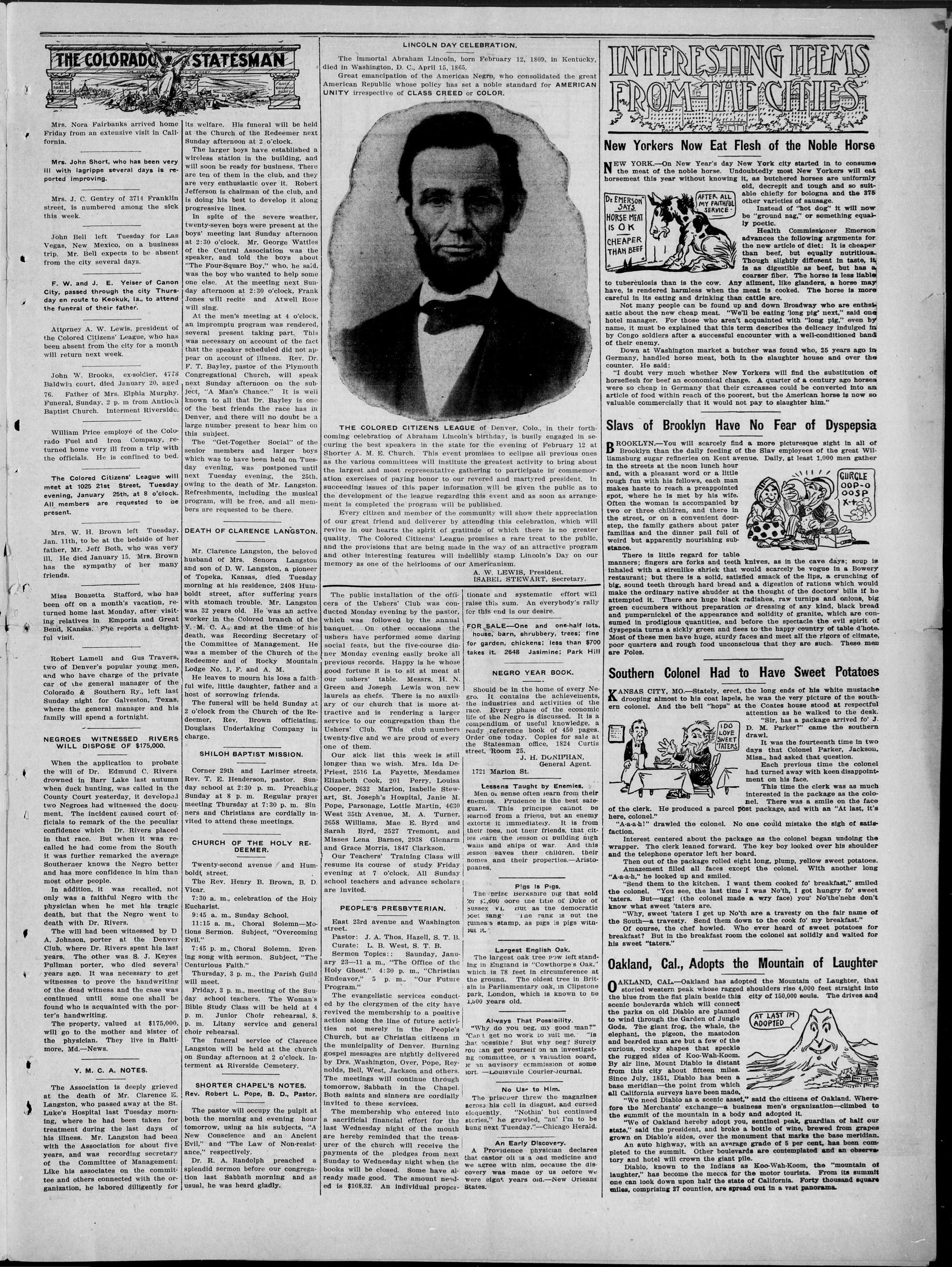
The immortal Abraham Lincoln, born February 12, 1809, in Kentucky, died in Washington, D. C., April 15, 1865.
Great emancipation of the American Negro, who consolidated the great American Republic whose policy has set a noble standard for AMERICAN UNITY irrespective of CLASS CREED or COLOR.
A. B.
THE COLORED CITIZENS LEAGUE of Denver, Colo., in their forthcoming celebration of Abraham Lincoln's birthday, is busily engaged in securing the best speakers in the state for the evening of February 12 at Shorter A. M. E. Church. This event promises to eclipse all previous ones as the various committees will institute the greatest activity to bring about the largest and most representative gathering to participate in commemoration exercises of paying honor to our revered and martyred president. In succeeding issues of this paper information will be given the public as to the development of the league regarding this event and as soon as arrangement is completed the program will be published.
Every citizen and member of the community will show their appreciation of our great friend and deliverer by attending this celebration, which will revive in our hearts the spirit of gratitude of which there is no greater quality. The Colored Citizens' League promises a rare treat to the public, and the provisions that are being made in the way of an attractive program and other interesting features will indelibly stamp Lincoln's Day on our memory as one of the heirlooms of our Americanism.
The public installation of the officers of the Ushers' Club was conducted Monday evening by the pastor, which was followed by the annual banquet. On other occasions the ushers have performed some daring social feats, but the five-course dinner Monday evening easily broke all previous records. Happy is he whose good fortune it is to sit at meat at our ushers' table. Messrs, H. N Green and Joseph Lewis won new laurels as chefs. There is no auxiliary of our church that is more attractive and is rendering a larger service to our congregation than the Ushers' Club. This club numbers twenty-five and we are proud of every one of them.
Our sick list this week is still longer than we wish. Mrs. Ida DePriest, 2516 La Fayette, Mesdames Elizabeth Cook, 201 Perry, Louisa Cooper, 2632 Marion, Isabelle Stewart, St. Joseph's Hospital, Janie M. Pope, Parsonage, Lottie Martin, 4630 West 35th Avenue, M. A. Turner, 2658 Williams, Mae E. Byrd and Sarah Byrd, 2527 Tremont, and Misses Lena Barnes, 2938 Glenarm and Grace Morris, 1847 Clarkson.
Our Teachers' Training Class will resume its course of study Friday evening at 7 o'clock. All Sunday school teachers and advance scholars are invited.
PEOPLE'S PRESBYTERIAN.
East 23rd avenue and Washington street.
Pastor: J. A. Thos, Hazell, S. T. B.
Curate: L. B. West, S. T. B.
Sermon Topics:: Saunday, January 23—11 a m., "The Office of the Holy Ghost." 4:30 p. m., "Christian Endeavor," 5 p. m., "Our Future Program."
The evangelistic services conducted by the clergymen of the city have revived the membership to a positive action along the line of future activities not merely in the People's Church, but as Christian citizens in the municipality of Denver. Burning gospel messages are nightly delivered by Drs. Washington, Over, Pope, Reynolds, Bell, West, Jackson and others. The meetings will continue through tomorrow, Sabbath in the Chapel. Both saints and sinners are cordially invited to these services.
The membership who entered into a sacrificial financial effort for the last Wednesday night of the month are hereby reminded that the treasurer of the church will receive the payments of the pledges from next Sunday to Wednesday night when the books will be closed. Some have already made good. The amount needed is $108.32. An individual propor-
A. W. LEWIS, President.
ISABEL STEWART, Secretary.
tionate and systematic effort will raise this sum. An everybody's rally for this end is our desire.
FOR SALE—One and one-half lots,
house, barn, shrubbery, trees; fine
for garden, chickens; less than $700
takes it. 2648 Jasimine; Park Hill
NEGRO YEAR BOOK.
Should be in the home of every Negro. It contains the achievements, the industries and activities of the race. Every phase of the economic life of the Negro is discussed. It is a compendium of useful knowledge, a ready reference book of 450 pages. Order one today. Copies for sale at the Statesman office, 1824 Curtis street, Room 25. J. H. DONIPHAN,
Lessens Taught by Enemies.
Men or sense often learn from their enemies. Prudence is the best sate-guard. This principle cannot be learned from a friend, but an enemy extorts it immediately. It is from their toes, not their friends, that cities learn the lesson of building high walls and ships of war. And this lesson saves their children, their nomes and their properties.—Aristopanes.
Pigs Is Pigs
The prize Berkshire pig that sold for $2,600 oore the title of Duke of Sussex vi. but as the democratic poet sang: 'The rank is out the gurnea's stamp, as pigs is pigs without it.'
Largest English Oak
The largest oak tree now left standing in England is "Cowthorpe Oak," which is 78 feet in circumference at the ground. The oldest tree in Britain is Parliamentary oak, in Clipstone park, London, which is known to be 1,000 years old.
Always That Possibility.
"Why do you beg, my good man?"
"Can't get no work to suit me."
"Is that possible? But why beeg? Surely you can get yourself on an investigating committee, or a valuation board, or an advisory commission of some sort.—Louisville Courier-journal.
No Use to Him.
The prisoner threw the magazines across his cell in disgust, and cursed eloquently. "Nothin' but continued stories," he growled, "an' I'm to be hung next Tuesday."—Chicago Herald.
An Early Discovery.
A Providence physician declares that castor oil is a oad medicine and we agree with him, because the discovery was made oy us before we were eight years old.—New Orleans States.
INTERESTING ITEMS FROM THE CITIES
New Yorkers Now Eat Flesh of the Noble Horse
NEW YORK.—On New Year's day New York city started in to consume the meat of the noble horse. Undoubtedly most New Yorkers will eat horsemeat this year without knowing it, as butchered horses are uniformly
to tuberculosis than is the cow. Any aliment, like glanders, a horse may have, is rendered harmless when the meat is cooked. The horse is more careful in its eating and drinking than cattle are.
Not many people can be found up and down Broadway who are enthastic about the new cheap meat. "We'll be eating 'long pig' next," said one hotel manager. For those who aren't acquainted with "long pig," even by name, it must be explained that this term describes the delicacy indulged in by Congo soldiers after a successful encounter with a well-conditioned band of their enemy.
Down at Washington market a butcher was found who, 25 years ago in Germany, handled horse meat, both in the slaughter house and over the counter. He said:
"I doubt very much whether New Yorkers will find the substitution of horseflesh for beef an economical change. A quarter of a century ago horses were so cheap in Germany that their carcasses could be converted into an article of food within reach of the poorest, but the American horse is now so valuable commercially that it would not pay to slaughter him."
Slavs of Brooklyn Have No Fear of Dyspepsia
BROOKLYN.—You will scarcely find a more picturesque sight in all of Brooklyn than the daily feeding of the Slav employees of the great Williamsburg sugar refineries on Kent avenue. Dally, at least 1,000 men gather
There is little regard for table manners; fingers are forks and teeth knives, as in the cave days; soup is inhaled with a sirenlike shriek that would scarcely be vogue in a Bowery restaurant; but there is a solid, satisfied smack of the lips, a crunching of big, sound teeth through hard bread and a digestion of rations which would make the ordinary native shudder at the thought of the doctors' bills if he attempted it. There are huge black radishes, raw turnips and onions, big green cucumbers without preparation or dressing of any kind, black bread and pumpernickel of the appearance and solidity of granite, which are consumed in prodigious quantities, and before the spectacle the evil spirit of dyspepsia turns a sickly green and flees to the happy country of table d'hote. Most of these men have huge, sturdy faces and meet all the rigors of climate, poor quarters and rough food unconscious that they are such. These men are Poles.
Southern Colonel Had to Have Sweet Potatoes
KANSAS CITY, MO.—Stately, erect, the long ends of his white mustache drooping almost to his coat lapels, he was the very picture of the southern colonel. And the bell "hops" at the Coates house stood at respectful
of the clerk. He produced a parcel post package, and with an "At last, it's here, colonel."
"A-a-a-h!" drawled the colonel. No one could mistake the sigh of satisfaction.
Interest centered about the package as the colonel began undoing the wrapper. The clerk leaned forward. The key boy looked over his shoulder and the telephone operator left her board.
Then out of the package rolled eight long, plump, yellow sweet potatoes. Amazement filled all faces except the colonel. With another long "A-a-a-h," he looked up and smiled.
"Send them to the kitchen. I want them cooked fo' breakfast," smiled the colonel. "You see, the last time I was No'th, I got hungry fo' sweet 'taters. But—ugg! (the colonel made a wry face) you' No'the'nehs don't know what sweet 'taters are.
"Why, sweet 'taters I get up No'th are a travesty on the fair name of the South—a travesty. Send them down to the cook fo' my breakfast."
Of course, the chef howled. Who ever heard of sweet potatoes for breakfast? But in the breakfast room the colonel sat solidly and waited for his sweet "taters."
Oakland, Cal., Adopts the Mountain of Laughter
OAKLAND, CAL—Oakland has adopted the Mountain of Laughter, that storied western peak whose ragged shoulders rise 4,000 feet straight into the blue from the flat plain beside this city of 150,000 souls. The drives and
"We need Diablo as a scenic asset," said the citizens of Oakland. Wherefore the Merchants' exchange—a business men's organization—climbed to the summit of the mountain in a body and adopted it.
"We of Oakland hereby adopt you, sentinel peak, guardian of half our state," said the president, and broke a bottle of wine, brewed from grapes grown on Diablo's sides, over the monument that marks the base meridian.
An auto highway, with an average grade of 5 per cent, has been completed to the summit. Other boulevards are contemplated and an observatory and hotel will crown the giant pile.
Diablo, known to the Indians as Koo-Wah-Koom, the "mountain of laughter," has become the mecca for the motor tourists. From its summit one can look down upon half the state of California. Forty thousand square miles, comprising 27 counties, are spread out in a vast panorama.
Dr. EMERSON SAYS
HORSE MEAT
IS OK
CHEAPER
THAN BEEF
AFTER ALL
MY FAITHFUL
SERVICE
to tuberculosis than is the cow. Any have, is rendered harmless when the careful in its eating and drinking than Not many people can be found up astic about the new cheap meat. "We hotel manager. For those who aren't name, it must be explained that this to by Congo soldiers after a successful ex of their enemy. Down at Washington market a bu Germany, handled horse meat, both counter. He said: "I doubt very much whether New horseflesh for beef an economical chan were so cheap in Germany that their article of food within reach of the poor valuable commercially that it would no
Slavs of Brooklyn Have
BROOKLYN.—You will scarcely find Brooklyn than the daily feeding of liamsburg sugar refineries on Kent ave
in the streets at the noon lunch hour and, with a pleasant word or a little rough fun with his fellows, each man makes haste to reach a preappointed spot, where he is met by his wife. Often the woman is accompanied by two or three children, and there in the street, or on a convenient doorstep, the family gathers about pater familias and the dinner pail full of weird but apparently nourishing substance. There is little regard for table
manners; fingers are forks and teeth inhaled with a sirenlike shriek that restaurant; but there is a solid, satis big, sound teeth through hard bread a make the ordinary native shudder at attempted it. There are huge black green cucumbers without preparation and pumpernickel of the appearance sumed in prodigious quantities, and dyspepsia turns a sickly green and fle. Most of these men have huge, sturdy f poor quarters and rough food uncons are Poles.
Southern Colonel Had t
KANSAS CITY, MO.—Stately, erect, drooping almost to his coat lapels, ern colonel. And the bell "hops" at
I DO
LOVE
SWEET
TATERS
of the clerk. He produced a parcel p here, colonel."
"A-a-a-h!" drawled the colonel. No faction.
Interest centered about the packa wrapper. The clerk leaned forward. and the telephone operator left her bo Then out of the package rolled eig Amazement filled all faces exce "A-a-a-h," he looked up and smiled.
"Send them to the kitchen. I was the colonel. "You see, the last time 'taters. But—ugg! (the colonel made know what sweet 'taters are.
"Why, sweet 'taters I get up No' the South—a travesty. Send them do Of course, the chef howled. W breakfast? But in the breakfast room his sweet "taters."
Oakland, Cal., Adopts th
OAKLAND, CAL—Oakland has ado
storied western peak whose ragged the blue from the flat plain beside this scenic boulevards which will connect the parks on old Diablo are planned to wind through the Garden of Jungle Gods. The giant frog, the whale, the elephant, the pigeon, the mastodon and bearded man are but a few of the curious, rocky shapes that speckle the rugged sides of Koo-Wah-Koom. By air line, Mount Diablo is distant from this city about fifteen miles. Since July, 1851, Diablo has been a base meridian—the point from which all California surveys have been made.
"We need Diablo as a scenic asset fore the Merchants' exchange—a bus the summit of the mountain in a body "We of Oakland hereby adopt you state," said the president, and broke grown on Diablo's sides, over the moor. An auto highway, with an average pleted to the summit. Other boulevard and hotel will crown the giant p Diablo, known to the Indians a laughter," has become the mecca for one can look down upon half the state miles, comprising 27 counties, are spree
Instead of "hot dog" it will now be "ground nag," or something equally poetic.
Health Commissioner Emerson advances the following arguments for the new article of diet: It is cheaper than beef, but equally nutritious. Though slightly different in taste, it is as digestible as beef, but has a coarser fiber. The horse is less liable
y aliment, like glanders, a horse may meat is cooked. The horse is more in cattle are.
o and down Broadway who are enthils 'll be eating "long pig" next," said one acquainted with "long pig," even by term describes the delicacy indulged in encounter with a well-conditioned band catcher was found who, 25 years ago in the slaughter house and over the Yorkers will find the substitution of age. A quarter of a century ago horses carcasses could be converted into an rest, but the American horse is now so not pay to slaughter him."
No Fear of Dyspepsia
and a more picturesque sight in all of the Slav employees of the great Wilenue. Daily, at least 1,000 men gather
GURGLE
00P-0
00SP
X-+
knives, as in the cave days; soup is
would scarcely be vogue in a Bowery
fried smack of the lips, a crunching of
and a digestion of rations which would
the thought of the doctors' bills if he
radishes, raw turnips and onions, big
or dressing of any kind, black bread
and solidity of granite, which are con-
before the spectacle the evil spirit of
oes to the happy country of table d'hote
faces and meet all the rigors of climate
scious that they are such. These men
To Have Sweet Potatoes
the long ends of his white mustache,
he was the very picture of the south,
the Coates house stood at respectful
attention as he walked to the desk.
"Sir, has a package arrived fo' J. D. M. Parker?" came the southern drawl.
It was the fourteenth time in two days that Colonel Parker, Jackson, Miss., had asked that question.
Each previous time the colonel had turned away with keen disappointment on his face.
This time the clerk was as much interested in the package as the colonel. There was a smile on the face
most package, and with an "At last, it's too one could mistake the sigh of satis-
sage as the colonel began undoing the The key boy looked over his shoulder board. Right long, plump, yellow sweet potatoes. Sept the colonel. With another long ant them cooked fo' breakfast," smiled he I was No'th, I got hungry fo' sweet like a wry face) you' No'the'nehs don't both are a travesty on the fair name of down to the cook fo' my breakfast." Who ever heard of sweet potatoes for in the colonel sat solidly and waited for
The Mountain of Laughter
opted the Mountain of Laughter, that shoulders rise 4,000 feet straight into city of 150,000 souls. The drives and
AT LAST I'M ADOPTED
it," said the citizens of Oakland. Where-business men's organization—climbed to city and adopted it.
You, sentinel peak, guardian of half our a bottle of wine, brewed from grapes monument that marks the base meridian. large grade of 5 per cent, has been com-ards are contemplated and an observa-ville.
as Koo-Wah-Koom, the "mountain of the motor tourists. From its summit of California. Forty thousand square head out in a vast panorama.
THE FLOWER
Carnations Are Attractive Flowers in the Garden—Easy to Grow and Beautiful.
A WORD ABOUT PEONIES
Peonies should be planted in the autumn early if they are to do well the first year, October being the best time for the work. They are not too particular as to soil; but in every case this should be well dug to the depth of 18 inches, enriching it with manure, which should not, however, be allowed to come in contact with the root in planting, but rather be mixed with the top soil, at the distance of a few inches from the plant. Peonies are propagated both by seed and by division; the former plan, however, is lengthy and troublesome, as the majority of a batch of hybrids will be found worthless, and a large plot of ground is necessary as a place of trial.
They can only be obtained true to name by division of the roots; but this should not be attempted until the plant has been in one place for two or three years, as they do much better when undisturbed, when it will mature fine shoots, which year by year increase in size until the peonies become one of the grandest sights in the garden.
During a drought in summer (particularly when the plant is young) an occasional soaking with water will benefit the peony, and every spring
Some Ho
THE PALM TREE
Some House Plants.
DESIRABLE HOUSE PLANTS
DESIRABLE HOUSE PLANTS
By ELIZABETH VAN BENTHUYSEN.
Asparagus plumosus is one of the most beautiful pot plants. The dark green leaves are lacelike and fine for cutting.
Asparagus sprengeri is for vases, hanging baskets and brackets. The branches droop gracefully in long, delicate lacelike sprays and are occasionally covered with delicate sweet-scented white blossoms which are succeeded by earlobes berries.
If you have not provided yourself with a hanging basket they can be had already arranged from the florist. There is nothing lovelier. Oxalis bulbs make pretty plants and for best efforts should have been bedded sometime ago.
One of the best palms and the quickest growing is the Washington filifera. The seeds will germinate as readily as corn, and the plant will stand dust, dry air, lack of sunshine and general neglect, growing right along in any situation and with any treatment that will keep a geranium alive.
It is a compact grower, well adapted to the living room and always ornamental everywhere.
Another choice palm is the Areca catecens. Another still as desirable is the Kentia fosteriana. Palms are like one of the family when well cared for. They are always beautiful, always useful.
---
(in March) a mulch of rich soil or hotbed material should be laid over its roots.
When peonies are grown in a separate bed an edging of daffodils will be effective with the crimson shoots of the peonies in April. The foliage of many of these plants turns in autumn to various shades of purple, bronze and crimson, when the plants again become decorative; and it is a mistake to cut off the foliage of the peony directly after flowering, as it is necessary to the plant while maturing its growth for next season and makes a mass of not undecorative green.
Tall lilies can be grown between the peonies in a border, choosing the hardiest varieties for a cold situation. These will make their way between the foliage of the peonies and look very handsome after the peonies cease to bloom.
Other suitable plants for massing with peonies are the tall blue and white delphiniums, Campanula persicifolia (in blue or white), pyrethrums, aquilegias, etc., all of which are perennials. Carnations are attractive massed with peonies, and will do well with the same cultivation as the peonies. For a bouquet for the home, these splendid flowers are unique when cut with long stems and arrange in a bowl with plenty of their own foliage to set them off.
use Plants.
Aspidistra lurida variegata is one of the best house plants. Give it a compost of two parts fibrous loam, one part old manure and one part fine sand. It grows slowly, cannot be hurried and will endure neglect and ill treatment with the greatest patience, and will increase in beauty every year. Pot early in the spring.
The amaranthus is a much-neglected plant. It can be made more effective than the canna or the caladium. With it color schemes in red and red and yellow, and red and yellow and green can very easily be worked out. It is worth a trial.
By far the greatest number of flowers have no smell at all. For instance of the 4,200 species of flowers in Europe, only about 10 per cent give forth any odor. The commonest flowers are white ones, and of those only one sixth are fragrant.
Roses and other similar plants that can be bent to the ground can be protected by laying the branches in a trench made by removing a spadeful of earth at one side of the plant and covering them with six inches of earth.
TRY AMARANTHUS
ODORLESS FLOWERS
CARE OF ROSES
GETTING A START
(Copyright, 1915, by the McClure Newsoaper Syndicate.)
SAM WAS DISCOURAGED
"What's the matter, Sam?" asked his friend Will.
"I'm discouraged," replied Sam. "I haven't been late for a year, and I've worked hard; but the boss doesn't seem to appreciate me. Only yesterday he raised the pay of a fellow who hasn't been there half as long as I have."
"Kind of tough. I admit," replied Will, consolingly. "How did it happen? You say the other fellow got his pay raised. There must be a reason for it."
"The only reason I can think of is partiality. The boss always liked him and just pushed him ahead."
"Let's talk it over," said Will. "Perhaps the boss was partial, but was this partiality due to what the fellow did? Think hard."
"Not much," snapped Sam. "Walter has always been fresh, putting himself in the boss' way, and getting him to notice him, while I've minded my business."
"Let's be fair, Sam," said his friend. "You say that Walter has made his boss notice him. What has he done?" "Well," replied Sam. "he's all the time doing a lot of things that he hasn't any business to do, things which he isn't paid for doing."
"Such as what?"
"Well, he fixes up the boss' desk, sees that the inkstand is filled, puts on a new piece of blotting paper once in a while, arranges the letters, and a lot of other things which nobody asks him to do."
"Sam," said Will quietly, "you've hit it. You've minded your own business, while Walter has done the same thing and more. You're getting all you are worth for what you're doing. Walter hasn't neglected his regular duties, has he?"
"No," snapped Sam.
"Now, you see, old boy, that Walter has mined his own business as well as you have. He hasn't neglected anything which he should do, but he has gone beyond that and done a lot of little things which the boss particularly appreciates."
"How is a fellow going to do more than his regular work when he is busy all the time?"
"Isn't Walter busy all the time, too? But he found a way, and so can you, Sam, if you want to. Walter has been interested. He has felt his responsibility. You've not been particularly interested, and you've not realized your responsibility. You've let well enough alone. Walter has gone farther. My boss lectured us the other day, and told us how he became a member of the house because he felt just as though he were the firm himself, when he was getting five dollars a week; and he looked out for the firm's interest as well as he would have done if he had owned it. I tell you, Sam, the fellow who gets anywhere nowadays has got to get out of the rut. Sticking to your duties isn't enough. The boss expects you to do that, but he raises the pay of the man who does what he doesn't have to do, provided, of course, that he performs his regular duties satisfactorily."
Was Sam convinced? I think not, for at the end of the year he was out of a job, and his friend—well, he isn't a partner yet, and perhaps he never will be, he is the head of a large department. He did what he didn't have to dc and "got there."
Slightly Different
Some little time ago a benevolent lady read in the papers a paragraph to the effect that, in an effort to save his cat from being crushed by the wheels of a passing omnibus, a small boy had been knocked down and seriously injured by the vehicle, and had been obliged to be taken to a London hospital.
The lady, who kept cats herself, greatly admired the boy's devotion to the "poor dumb animal," and wrote to the hospital, inclosing a handsome sum "for the brave and humane sufferer."
By return of post came a letter from the matron acknowledging the receipt of the money, but alas! explaining that the cat which had been the cause of all the woe was an even dumber thing that the lady had imagined it was, in fact that somewhat dangerous toy, a tipcat.
True Sport.
"The manager of my store," declared the merchant to a little coterie of friends, "is a peculiar genius. Why, would you believe it, when he draws his weekly salary he keeps out only one dollar for spending money and sends the rest to his wife in Indianapolis!"
His listeners—with one exception, who sat silent and reflective—gave vent to loud murmurs of wonder and admiration.
"Now, it may sound thin," added the speaker, but it is true, nevertheless."
"Ob, I don't doubt it at all!" quickly rejoined the quiet one; "I was only wondering what he does with the dollar!"
WHAT YOU PAY FOR.
"I'll never trade at Blank's any more," exclaimed a friend.
"Why?"
"Look at this suit," he replied. "It's all out of shape; it's shabby, and it doesn't fit me."
"How long have you had it?"
"Six months."
"Ever had it sponged and pressed?"
"No!"
"What did you pay for it?"
"Sixteen dollars. I think."
"John," I said soberly. "When you buy a $16 suit at Blank's or anywhere else, you may get $16 worth of cloth, wear, style, and fit, and you don't get any more. You've had the suit six months, and no suit at any price looks well if it isn't pressed as often as once a month. I know Blank, and he is about honest as anybody else in the business. He makes a specialty of low-priced clothes, and he gives you your money's worth."
But John went away disgruntled. He had purchased a cheap suit, and expected it to wear as well, and to look as well, as one for double or more the price.
You can't get more than you pay for except by accident, and accidents are not to be depended upon.
There is a restaurant not far from my office, where they serve wholesome food at reasonable prices. The food is good, but the savil is or; there are no finger bowls, and the napkins are small; but everything is scrupulously clean. The restaurant gives you what you pay for, yet many of the boarders are continually kicking. They expect the same quality of food, and the same service, for 40 cents that they would receive if they paid $1 or $1.50. The restaurant serves a good 40-cent dinner. It is worth all you pay for it, and no more. On the train the other day I overheard a stranger condemning the man who sold him a watch. In the course of the conversation it leaked out that he had paid $10 for the timepiece and didn't like it because it didn't run as well as his brother's $50 watch.
The 10-cent moving picture house, with vaudeville between the films, isn't likely to give you as good an acting show as you will receive where the prices run from 50 cents to $1, yet half of the audiences compare the acts with those of higher priced houses.
If you don't get what you pay for, kick and kick hard. If you get what you pay for, no matter what it is, keep your mouth shut.
The kicker is one of the pushers of progress, provided he kicks at things which should be kicked at.
Criticism is all right when you have something to criticize, but this everlasting kicking and criticism, when you are receiving all that you have paid for, injures you and everybody with whom you come in contact.
Take the weather, for example. It doesn't seem to suit more than a small portion of the people, and the majority are finding fault with it. I have a suspicion that kicking against the weather doesn't change it. If it did, I'd raise a fund for the establishment of a weather-kicking bureau.
When it rains, let it rain. Don't try to stop it. Buy an umbrella, a raincoat, and a pair of rubbers.
THE FARMER AS CONSUMER
Agriculturist Noted as a Good All- Around Customer of the Hard- ware Dealer.
The farmer is the greatest and most universal consumer of goods in the hardware line of any class in this country. Not only does he use every form of farming implement, but he has likewise usually a complete assortment of carpenter's and mechanic's tools.
He is by far the best customer of the hardware dealer in household and kitchen utensils, and in these days of sanitation has become a large user of bathroom fixtures and plumbing sundries. He is the great cobbler of the day, being a steady absorber of shoe soles, shoe nails, shoe hammers, shoe lasts, and rubber heels. He is about the principal consumer now left in the harness and saddlery line, and likewise buys heavily of automobile and bicycle sundries. Of late he has become a large user of electric light fixtures and of telephone appliances. Besides that he is a liberal spender in the way of pocket knives and cutlery in general. Also he is the best buyer of stoves and stove fixings known to the trade. He is of more value to the hardware dealer as an all-around customer than a dozen city men living in steamheated flats and apartments
Good Taste.
Patience—It is said that rats are not only very cunning, but display good taste. Patrice—I guess that's so. All the pictures I have seen of girls being frightened by mice were good-looking girls.
THE EUROPEAN WAR A YEAR AGO THIS WEEK
Jan. 17, 1915.
Allies took German trenches in Belgium and closed in on Lille.
Russians took Kirlibaba pass in Bukowina and pushed along right bank of Vistula.
Germans were pushed back on Plotsk.
Turkish co-ps was cut to pieces in the Caucasus.
Antiwar demonstration in Vienna; Czech editor executed for treason.
Jan 18. 1915.
Fierce fighting took place at La Boisselle.
Germans occupied Kielce and Russians fell back to Radom.
Plotsk evacuated by the Germans.
Paris darkened at night by police order.
Jan. 19. 1915.
French advanced in attempt to cut off St. Mihiel.
German airships dropped bombs on Yammouth, King's Lynn, and other English towns, killing four persons.
French in forest of Le Pretre within ten miles of Metz.
Austrian army flanked by Russians in Bukowina.
Jan. 20, 1915.
British troops captured Freylinghuysen.
Russians drove back Austrians in Hungary and marched on Jacobeni.
Dutch naval patrol boat sunk by mine, five men drowned.
Governor of Cracow ordered partial evacuation of the city.
Jan. 21. 1915.
Germans repulsed in the Ardennes woods by French and Belgians.
French retook trenches at Notre Dame de Lorette.
Germans retook the forest of Le Pretre.
Russians renewed their offensive against Milawa.
Austrians routed Russians from intrenchments along the Donajec.
German cruiser Karisruhe reported off Porto Rico.
Allied airmen dropped bombs on Essen.
Jan. 22, 1915.
Fierce fighting in Hartmanns weilerkopf region.
New Russian army neared Prussian border.
Russian invasion of Hungary was halted.
German submarine sank British Steamer Durward.
Maj. Gen. Sam Hughes began enlisting third Canadian contingent.
Russia ordered expulsion of Austrian and German subjects.
Jan. 23. 1915.
German troops were massed in Hungary.
Russians made further advance in the north.
German airmen dropped bombs on Dunkirk.
Mme. Groulitch came to America seeking seeds for Serbians.
Germans renewed their activity near Ypres and bombarded left wing of allies.
Severe battle in the Argonne region.
German supply ship was sunk by Australian cruiser.
Italian vice-consul at Liege dismissed by Germans for aiding Belgians.
TAKEN FROM EXCHANGES
In Sweden a mile is 11,690 yards. Scotland has the longest bridge in the world—the Lay, two miles and 70 yards in length. It is said that a humming bird when stripped of its feathers is no larger than a bumble bee. A duster made of cheesecloth, soaked in turpentine and then dried, will accumulate dust instead of scattering it. The Cape Cod canal is now restricted to boats of less than 18 feet draft, but it will soon be deepened to a 35-foot waterway. A Russian inventor claims to have perfected a motor that can safely utilize electricity drawn from storm clouds. A partitioned gravy dish has been invented that permits fat gravy to be poured from one side and lean from the other.
The governments of both Denmark and Sweden are investigating a recent discovery of coal on the island of Bornholm, a Danish possession close to the Swedish coast.
So that bicyclists will not have to wear trouser guards a North Carolina has invented a large disk to be attached to the outside of the forward sprocket of a wheel.
The needless infantile death rate owing to neglect and ignorance costs this country $3,000,000 a day.
One of the famous carillons of Flanders, a magnificent chime of bells, has been transferred to the English village of Cattistock, where great interest is taken in the frequent concerns for which use is made of them
The fossil of an elephant that is being excavated from a gravel bed near Chatham, England, is declared to have supported the carcass of an "elephas antiquus of the early pleistocene period," a piny little runt of a beast but a trifle larger than a mammoth.
THE KITCHEN CABINET
"It costs more to live than it did years ago," said the man who complains. "Yes," answered the man who enjoys modern conveniences, "but it's worth more."
THOUGHT FOR THE INVALID.
Invalid cooking is a most important and interesting subject, and one which demands a knowledge of dietetics as well as taste, tact and patience.
0.1
First and foremost in dealing with an invalid we must remember that he is out of balance mentally as well as physically. In the days of convalescence, when life is beginning to be worth while, the small things of every day will interest and little things will irritate, which would never be noticed in health.
It is not necessary to mention that the tray should be as immaculate in its appointments, no matter how simple, as are all other things about an invalid. Where laundry needs to be considered, there are any number of pretty paper napkins which can be bought in different designs and colors. For a child the bright colors will be interesting and a variety will be a source of entertainment. In case of infectious diseases paper napkins are quite a necessity. The small paper cases, too, may be used for a tiny custard or bit of dessert. A flower or two on the tray will be most welcome. The tiny vases which hold a small bunch of violets or a single rose are well adapted for use on a tray.
Set the tray as carefully as a place is laid at the table, and in the same order. A small pot of steaming tea which may be poured by the invalid is an item to be remembered.
Never ask a patient what he would like to eat or drink. Let his food be a surprise, as it will taste better.
Do not watch every mouthful he eats, for some people do not enjoy the sensation. Do not serve fried foods to a sick person, nor food in any large quantity. It is much better for them to want more than be surfeited at the sight of too much, Twice baked bread should be served with the broths and beef juices.
Sponge cake is the only desirable kind to serve.
Cocoa is better than chocolate, unless the patient needs the fat, and is able to take care of it.
GOOD THINGS FOR THE TABLE.
For a company cake the following recipe is especially fine: Take the whites of six eggs, the yolks of five, one cupful each of sugar and flour, three-fourths of a teaspoonful of cream of tartar, the juice and rind of a large orange. Beat the whites very stiff and add half of the sugar, beat the yolks and add the other half heat five
whites of six eggs, the yolks of five, one cupful each of sugar and flour, three-fourths of a teaspoonful of cream of tartar, the juice and rind of a large orange. Beat the whites very stiff and add half of the sugar, beat the yolks and add the other half, beat five minutes, add the orange to the yolks and when well mixed add to the whites, then fold in the flour that has been sifted with the cream of tartar. Bake slowly 40 minutes. If using a gas oven, light the oven just as the cake is put in.
Chocolate Caramel Cake.—Take two ounces of chocolate, one cupful of sugar, one-half cupful of milk, a quarter of a cupful of butter, two cupfuls of flour, two eggs, two teaspoonfuls of baking powder and one teaspoonful of vanilla. Mix as usual and bake in layers. For the filling cook together a cupful and a half of sugar, half a cupful of sweet milk, a tablespoonful of butter; cook until it hairs. Cool, add vanilla.
Date Torte.—A cupful each of chopped dates, nuts and sugar, a tablespoonful of flour, and a teaspoonful of baking powder with two well-beaten eggs. Bake and serve with whipped cream.
Almond Tartlets.—Line patty tins with rich paste. Blanch and chop a third of a pound of almonds, add two tablespoonfuls of rolled cracker crumbs, sifted, three eggs, beaten, a third of a cupful of sugar, two cupfuls of milk, salt and vanilla to taste. Fill the shells and bake.
Date Bars.—Take a cupful of dates chopped fine, beat two eggs, separating the yolks from the whites, add three-fourths of a cupful of sugar to the yolks, then add six level tablespoonfuls of flour, a teaspoonful of baking powder with a fourth of a teaspoonful of salt, add the chopped dates and a cupful of walnut meats chopped, then fold in the whites and bake in a slow oven in a sheet. Cut when cold in pieces the size of a wafer.
Nerzie Maxwell
Silk In History.
The credit of making the first silk is given to Si-Ling, wife of Hoang-Ti, emperor of China, 2600 B. C. Among the Greeks Aristotle—384-322 B. C.—is the first who mentions it. It was not until A. D. 530, however, that it began to be cultivated in Europe, the first eggs being then brought from India by some monks.
t
Doesn't Follow.
A common error is in regarding a man who has made a success in one thing as an authority on everything.
Blind Man's
Luck
By P. G. ECCLES
"Please help the blind," was the inscription on Harry Larkin's placard, which he wore round his neck as he sat day after day at the foot of the elevated stairs. Sometimes a charitable woman, or a man who was feeling friendly toward the world, stopped and deposited a coin, looking sympathetically at the old man seated with crossed legs and bowed body, his sightless eyes peering into vacancy.
To Harry Larkin every footstep conveyed its significance. He could tell the woman shopper from the shopgirl, the man of business from the "rounder." He knew a good part of his patrons, for generally the same people remembered the blind man. Especially in the theater hour did he come to recognize the footsteps and the voices of those who went by his post.
There was the girl's voice, for instance. It was a merry, laughing voice, and her steps were like a fairy's. The first time she hesitated in front of him Larkin heard a masculine voice exclaim impatiently:
"Don't waste your money on those kers, Elaine!"
But Larkin only thanked the young girl, for a beggar is schooled to insults. He heard the footsteps of the girl and the man recede up the stairs. Then, perhaps a year afterward, he suddenly fished Elaine and her father out of the caverns of his memory. For
PLEASE
HELP THE
BLIND
"You Brought Me Luck."
footsteps halted near him, and the same merry voice exclaimed:
"Wait a minute, Jack! Look at this poor blind man!"
"Hurry, then, or we'll be late for the show," answered another voice, a young man's voice.
The next morning, during the shopping hour, the young girl halted in front of Larkin, and the laughing voice said, with just a catch of tears in it:
"You brought me luck last night, blind man. I can't tell you how happy I am, but I am going to give you this. It is a one-dollar bill."
"Thank you, Miss. I know the value," answered Larkin.
"How do you know it isn't a five?" asked the young girl.
"Nobody ever gives a five to a blind man, Miss." said Larkin.
The young girl went off, laughing merrily, and after that Larkin would hear, once in a while, the same merry voice, and a coin would be dropped into his hat. He came to listen for it, and when he did not hear it for weeks together the blind man would feel disappointed.
Once in a while the blind man heard the footsteps of the young man who had been with the girl. He knew them, as the blind man knows steps, by their individuality. There was the least longer interval than the normal between the stroke of the heel and the click of the sole. Larkin was sure he would always know those footsteps.
Now and again oftener as the year went by, he heard the steps of the young girl and the man as they went up the stairs to the train which was to carry them to the theater. And then one night they came down the stairs, right at the time when they should have been enjoying the play, and the merry voice was a sobbing voice
"I'll never, never speak to you as long—" he heard the girl say, and he went home a very dejected blind man. He did not expect to near the girl's voice again, but on the very next morning she stood in front of him.
"If I had given you a present last night you might have brought me luck, blind man," she whispered, chokingly.
"Here, take this! And wish me well, blind man!"
She put a fifty-cent piece into the blind man's nat and went away.
Several times she passed him after that, but she never left any money in his hat. The blind man fancied that she had taken a dislike to him. Once or twice she went by up the stairs, in the theater hour, with some young man, but it was never Jack. The blind man recognized her voice, and it was never merry any more, even though she was laughing.
Once or twice Jack passed, but he never paid any attention to the blind man. Once he went to the theater with another girl, and once he was with a woman whose laughter made the blind man shiver, it was so hard. The blind man often wished that the man and Elaine might meet when they were alone.
But weeks rolled by and passed into months, and he never attained his wish. And gradually new interests came into his mind. He had almost forgotten Jack and Elaine until one afternoon—late one wet, foggy afternoon.
The blind man's post was in the little sheltered way between the stairs and the street. People who passed almost brushed the blind man. This afternoon the streets were almost deserted, and hardly a soul went up or came down the stairs.
Suddenly the blind man's keen ears heard the click of Jack's footsteps in the street. He knew that Jack was coming into the little place where he sat, with the purpose of ascending the stairs. But then he heard the man stop, and knew what was happening: he was buying a paper to take in the train.
And just at that instant he heard the footsteps of Elaine coming down the stairs.
The blind man snifted his position a little, so that he sat right in the path of the girl. She stopped. A girl's mind is not a weighty thing always, and Elaine had evidently almost forgotten the past.
"You are in the way, blind man," she said impatiently. "Will you kindly let me pass?"
The blind man mumbled and began to move slowly back. Everything in the world now depended upon the factor of time. The blind man was very slow in moving.
Suddenly he heard the girl start, and a shrill petition was in her voice.
"Let me pass! Let me pass at once, blind man!"
At that instant the blind man could hear the clickety-clack of Jack's foot-steps upon the sidewalk.
"O let me pass, blind man!" sobbed the girl; and then the blind man heard the start that the man gave.
For just an instant the blind man's heart was in his mouth. The next, he knew that Jack had taken Elaine in his arms in the street, yes, right in the very presence of the blind man.
"Darling, forgive me!" he heard the man whisper.
"O Jack, I have been so unhappy all this long time"
"But you love me?"
"Always, Jack!"
"And we will never be parted again? There!—there!"
"O hush, Jack! The blind man will hear us!"
"—— the blind man!" said Jack.
But the blind man felt something papery dropped into his hand, which closed on it. "Do you know what that is, blind man?" inquired the girl.
"A one-dollar bill," mumbled the blind man.
"A five," said Elaine. "For you have brought me luck after all, and I almost love you, you dear blind man!"
STONE EAGLE A WORK OF ART
Remarkable Stone Figure of Bird a Legacy Left to State of Georgia
On the broad top of a stony, rain-gulled hill in middle Georgia there lies a very large eagle, concerning which conflicting stories are told. The one point that seems to be certain is that the Indians left the eagle as a legacy to the state. A hundred years from now it will probably be found lying on its back, with outspread wings and tail, even as it lies today. For it is made of quartz rocks so cunningly placed that it would require a pick in a strong man's hands to displace any one of them. The rocks lap and overlap in such a manner as to represent feathers. No cement holds them in position, and the stones vary in size, weighing from a half pound to three or four pounds. The image rests on a very firm foundation, for the stonework extends several feet into the ground.
Once, perhaps twice, treasure-seeking vandals dug into the breast of the eagle; but the work must have proved too laborious, for the diggers gave up before they had reached the bottom layer of overlapping stones.
Rough but fairly accurate measurements of the bird show the length of the eagle from the middle of the tail to the head to be one hundred and two feet, and from tip to tip of outspread wings, one hundred and twenty feet. The length of the beak is ten feet, and the height of the body at the center of the breast is ten feet. The eagle lies with its head to the west.
Tradition does not give any satisfactory explanation of the age or the meaning of the great stone mound. It may have had religious significance to the red men who built it, and it may be the burial place of some great chief. it is one of the most mysterious and most interesting of prehistoric monuments in the United States.—Youth's Companion.
Dangerous Employment.
Forty per cent of the high explosive makers and shell packers in Germany are women, while 50 per cent of the makers of tents, haversacks and similar equipments also belong to the same sex, and in the manufacture of tinned meats and preserves 75 per cent of those employed are females.
"I know it. That's from going with you so much."
WASHINGTON GOSSIP
Internal Revenue Secret Service Is Doing Well
WASHINGTON.—The new "secret service" of the United States bureau of internal revenue has been in full operation for several months. Placed upon a permanent basis by an executive order of the secretary of the treas
the government which might otherwise have gone undetected. The statement continued:
"These officers will be the personal representatives of the commissioner and, in fact, will be his eyes and ears throughout the country. Violators of the law, or unfaithful employees of the government, if there be any, will not know when the eyes of the commissioner are upon them.
"These agents will be sent into any part of the country where the commissioner has reason to believe that fraud is being committed which it is impossible for the regular revenue officers to uncover. Revenue officers are largely known in their districts, and a strange, unidentified person may be able to detect irregularities where regular officers may fail.
"This action reduces to permanent form the temporary policy which has been followed and which has unearthed numerous frauds on the revenues. It was through the work of a number of similar agents temporarily appointed, that the vast oleomargarine frauds were brought to light. The organization of this force is no reflection on the regular internal revenue force, but is intended to promote the general welfare and efficiency of the service."
Introduction Broker Busy in National Capitol
SENATORS and members of the house have been discussing with surprise, not to mention indignation, a report that an "introduction broker" has been doing a thriving business in the capitol since the beginning of the present session. As in cases of the
ing the introduction. It is understood that a cabinet officer may be met in this formal way for $100, although contracts of this character are taken, it is said, on a contingent fee of smaller proportions, because cabinet officers are not so available as members of congress.
This operator was doing very well until he tried to "take in too much territory." He agreed to introduce a client to a certain public man. They reached the man and when the introduction was accomplished, the public man turned to the introducer and asked him his name and whom he represented. This made the client suspicious and he subsequently told all about the "broker."
Washington has a number of characters of this type, some of whom work among the politicians and others among society folk. As in every other city where society plays a big part, there are innumerable society brokers in Washington. They work a bit more cleverly than the "introduction broker" of the capitol, but they work more slowly.
Old Glory Now Being "Made in America" of Cotton
Old Glory Now Being "Made in America" of Cotton
OLD GLORY, to which the patriotic American dofs his hat as typifying the spirit of America, is in about nine cases out of ten not a domestic article. For ever since Betsy Ross made her first American flag, the official emblem
government in listing specifications for cotton flags side by side with those for woolen bunting which has heretofore appeared alone; and by the announcement of the treasury department, one of the heaviest users of flags among Uncle_Sam's family of departments, that it will in the future use cotton flags almost exclusively.
The action of the supply committee is not one of patriotism alone. When the European war put a stop to the exportation of cotton and there was agitation for putting the South's staple crop to new uses at home the committee became interested in the possibilities of cotton flags, but determined on rigid tests before any action should be taken. Cotton flags were therefore made up and placed on several of the revenue cutters, and samples of cotton-flag goods were sent to the United States bureau of standards for tests. Both kinds of tests were highly favorable for cotton. The flags stood the strain of constant use in all kinds of weather as well as flags of wool, the report from the revenue cutter service said.
White House Mannequins in the National Museum
White House Mannequins in the National Museum
RECENTLY there has been placed on view in the National museum a series of lay figures representing the mistresses of the White House under successive administrations running back to Martha Washington, who appears in a gown she used to wear, seated in one of her own chairs, by the side of a Mount Vernon table.
Recent visitors to the museum, as might be expected, find this exhibit remarkably interesting. But sometimes they are critical of the likenesses of the White House ladies. While admit ting that many of them are good, they think that others are not first rate.
Back of all this there is a real joke, for, be it understood, the faces of the White House mistresses are not meant to be likenesses at all. In fact, their faces are all the same face, the original of which is the face of a classical statue.
So far as the features are concerned, Martha Washington, Mrs. Cleveland, Mrs. Taft and all the rest are one woman. The important difference is in the arrangement of the hair.
The idea of the exhibit is not to offer a series of portraits of the women concerned, but to show the costumes they wore—these, as a collection, affording a most useful study of phases of fashion in feminine attire as they have succeeded one another since the days of the revolution.
All of the gowns that adorn the lay figures were actually worn by the White House mistresses represented; and even the minor accessories, such as tens, handkerchiefs, tables and chinaware, were personal belongings of the ladies themselves.
I FEEL JIST
LIKE ONE O'
THEM SECRET
SERVICE
GUYS WUZ
WATCHIN'
ME —
the government which might otherwid ment continued:
"These officers will be the personal and, in fact, will be his eyes and ears the law, or unfaithful employees of the know when the eyes of the commission
"These agents will be sent into an missioner has reason to believe that impossible for the regular revenue off-largely known in their districts, and able to detect irregularities where reg
"This action reduces to permanen- been followed and which has unearth- it was through the work of a number of that the vast deomargarine frauds we of this force is no reflection on the intended to promote the general welfare
Introduction Broker Bu
SENATORS and members of the hou- not to mention indignation, a rep been doing a thriving business in the
present session. As in cases of the numerous petty grafters who infest the capitol, it has been found extremely difficult to catch this man "with the goods."
Quotations on introductions, according to the gossip, were $25 for a senator and $5 for a member of the house. The rates are varied in accordance with the influence of the senator or representative to whom the introduction was sought and the poignancy of the desire of the person seek-
ing the introduction. It is understood this formal way for $100, although co is said, on a contingent fee of smaller are not so available as members of co This operator was doing very well territory." He agreed to introduce as reached the man and when the intrie man turned to the introducer and as resented. This made the client sus about the "broker."
Washington has a number of o work among the politicians and other city where society plays a big brokers in Washington. They work a tion broker" of the capitol, but they w
Old Glory Now Being "Ma
OLD GLORY, to which the patriotic spirit of America, is in about nine. For ever since Betsy Ross made her
UNION
government in listing specifications for for woolen bunting which has hereto nouncement of the treasury department among Uncle Sam's family of department flags almost exclusively.
The action of the supply committee the European war put a stop to the agitation for putting the South's staple mitte became interested in the possi on rigid tests before any action should made up and placed on several of the ton-flag goods were sent to the United Both kinds of tests were highly favo strain of constant use in all kinds of report from the revenue cutter service
White House Mannequins
RECENTLY there has been placed series of lay figures representing under successive administrations runn appears in a gown she used to wear, seated in one of her own chairs, by the side of a Mount Vernon table.
For a modern contrast, Mrs. Grover Cleveland is attired in a wonderful frock of white silk sprinkled over with full-blown roses, the arm loops and upper edge of the corsage decorated with big butterflies of gold and glittering sequins—about a dozen of the gorgeous insects in all, one of them adorning the bosom. Recent visitors to the museum, as
might be expected, find this exhibit re-
they are critical of the likenesses of ting that many of them are good, they
Back of all this there is a real joke,
the White House mistresses are not m
their faces are all the same face, the
classical statue.
So far as the features are concerned
Mrs. Taft and all the rest are one woe
the arrangement of the hair.
The idea of the exhibit is not to oi
concerned, but to show the costumer
affording a most useful study of phases
have succeeded one another since the 4
All of the gowns that adorn the B
White House mistresses represented;
as tens, handkerchiefs, tables and chi
the ladies themselves.
Do You Know That—
ury, the "flying squad" of special agents is becoming one of the most picturesque of the many government organizations charged with secret duties.
The COLORADO STATESMAN
The official statement announcing the permanent organization of this body stated that the success of a temporary body of secret service agents had demonstrated the value of such a force. Through the activities of the organization the bureau has uncertaintly many frauds against
IS PREPARED TO DO ALL KINDS OF
ose have gone undetected. The state-
ial representatives of the commissioner
throughout the country. Violators of
the government, if there be any, will not
neer are upon them.
My part of the country where the com-
fraud is being committed which it is
encers to uncover. Revenue officers are
a strange, unidentified person may be
regular officers may fail.
It form the temporary policy which has
used numerous frauds on the revenues.
Of similar agents temporarily appointed,
were brought to light. The organization
regular internal revenue force, but is
free and efficiency of the service."
Easy in National Capitol!
These have been discussing with surprise,
short that an "introduction broker" has
the capitol since the beginning of the
JOB PRINTING
Commercial, Fraternal, Church, Book and Stationery Jobs A SPECIALTY
?
Ball and Concert Programs, Bill and Letter Heads, Calling Cards, Wedding Cards, Envelopes and Everything in the Printing Line Turned Out in the Neatest and Best Style Promptly on Short Notice.
If that a cabinet officer may be met in contracts of this character are taken, it is proportions, because cabinet officersgress.
I will until he tried to "take in too much client to a certain public man. They production was accomplished, the public asked him his name and whom he repudious and he subsequently told all characters of this type, some of whom users among society folk. As in every part, there are innumerable society a bit more cleverly than the "introduce-work more slowly.
made in America" of Cotton
American dofs his hat as typifying the cases out of ten not a domestic article. first American flag, the official emblem
We Have Supplied Our Office with New Job Press & Type of Up-to-Date Style and Our Work Will Be on a Par with the Very Best.
of the country and all its auxiliary banners that fly from thousands of public buildings, army posts and ships' masts have been made of woolen bunting—practically all of it imported.
In the future, however, a large proportion of the government's flags will be "made in America," from the planting of the fiber to the sewing of the last stitch in the completed banner. This is assured by the action of the general supply committee of the
Give Us a Trial and We Will Give You Satisfaction
or cotton flags side by side with those before appeared alone; and by the anent, one of the heaviest users of flags events, that it will in the future use cot he is not one of patriotism alone. When the exportation of cotton and there was the crop to new uses at home the compilations of cotton flags, but determined to be taken. Cotton flags were therefore the revenue cutters, and samples of cotton States bureau of standards for tests, rabble for cotton. The flags stood the weather as well as flags of wool, the said.
in the National Museum
on view in the National museum a the mistresses of the White House being back to Martha Washington, who
Prices as Reasonable as Those of Any Job Office in Denver
DRESS WORN BY WIFE OF PRESIDENT
C. J. JOHNSON
1907
markably interesting. But sometimes the White House ladies. While admit think that others are not first rate. For, be it understood, the faces of meant to be likenesses at all. In fact, the original of which is the face of a, Martha Washington, Mrs. Cleveland, man. The important difference is in offer a series of portraits of the women they wore—these, as a collection, of fashion in feminine attire as they days of the revolution. May figures were actually worn by the and even the minor accessories, such傻ware, were personal belongings of
GOLF
THE FASHION WEEKLY
The middy blouse is one of those modern conveniences which matches up so well with the athletic girl that it has come to stay. Whole establishments are given over to its manufacture, and there are middies—and midies. The enthusiast in golf or tennis and the all-round sportswoman is a keen judge when it comes to choosing sports clothes fitted to her needs and style. They seem to have had the lion's share of attention lately if we include those designed for skating and for the benefit of southern tourists. Among the costumes, short, flaring skirts in wide stripes worn with plain coats in the color of the dark stripes are very chic. The circular cut of these skirts gives a snappy variety in the direction of the stripes, which manage never to run straight up and down.
Checks, in strong contrast, are of much the same character and are worn, like the striped skirts, with plain coats. Velveteen and jersey cloth, serge and gaberdine are the favored fabrics for sports clothes. The winter resorts will show how strong an influence these styles will have on those of the coming season.
To return to the middy, of which an example is pictured here, it is a fixture like the sweater in the wardrobe
Mourning Hats F
Millinery that is grave and dignified and beautiful must be produced by the artists who are to give significance to the headwear of those in mourning. Their medium of expression is found in English crape—the one fabric which means everywhere that the wearer is observing a period of formal mourning. With this one fabric, in only black and white, we are furnished with such exquisite examples of millinery art, are pictured here.
tourning hats are made of crape, either all black or all white or of the two combined. The problem the designer faces now is that of avoiding too somber millinery without getting away from that which is grave. The all-white hats of crape are lovely, but not practical for those who cannot afford many crape hats, inasmuch as any white soils quickly. Just now the combination of black and white is in favor but even the all-black hats of crape are saved from being gloomy by the beauty of the crape-made flowers and ornaments that adorn them.
Two elegant hats which illustrate the present vogue perfectly are pictured here. One of them has a moderately wide brim and round crown
---
of the well-equipped, whether at home or afield. It is made of strong washable linen or cotton fabrics, usually in white. The model shown is of heavy butcher's linen and is banded with blue. The front is fastened with blue lacers at the neck opening. The pockets are laid in shallow box plaits with the blue banding stitched to the center plait, and they are roomy enough to be practical. They are set on before the blouse is hemmed up, and are made stronger by this arrangement. The sleeves are finished with a deep hem. This design is simple, but very smart. It would be hard to improve upon it in any way.
Sleeves Modish.
Evening dresses are sleeved! Sometimes the sleeves are mere wisps, 'tis true, but yet they cover to an extent milady's pretty shoulders and make them even prettier for the veiling. A few evening dresses will be sleeveless, but they will be the exception. The 1860 drop shoulder is also forcing itself upon fashionable notice and a few extreme evening gowns show its charming lines.
Driven by electricity, a machine has been perfected for opening letters at a rate of 300 a minute.
rom Fifth Avenue
covered with crape put on plain. A large, full-blown rose, grapes, leaves with stems and tendrils, are all made of white crape with exceptional cleverness and neatness and are used for trimming.
The all-black turban is made entirely of crape also. It has a round crown with the crape put on smooth and a band at the sides laid in folds at each edge. Clusters of grapes, with leaves, form the trimming and they are made with the exquisite care which makes at least half the beauty of mourning millinery.
Julia Bottomley
To clean a white belt, make rather a thick paste of cream of tartar and cold water. Ruh the belt with it. Leave for an hour, and then rub with a mixture of alum and fuller's earth in equal parts. Next day brush the belt with a clean, soft brush till all the powder is removed. Rub again with some coarse oatmeal, to which a little powdered whiting has been added.
RESIDENCE PHONE YORK 7992
FRANK S. REED,
License Embalmer & Director
Lady Assistant
Polite Service
to All
Parlors, 2745 Welton Street
C. F.
THE COAL
(FORMERLY HALL)
Coal, Wood
COAL, 20c PER SACK, OR
KINDLING, 10
COAL $4.25 p
PROMPT DELIVERY TO A
Phone Ma
521 TWENTY-EIGHTH STREET, Betw
F. HALL
THE COAL MAN
(ERLY HALL AND EDWARDS)
Wood and Express
PER SACK, OR 6 SACKS FOR.....$1.00
KINDLING, 10c PER SACK,
$4.25 per ton and up
DELIVERY TO ANY PART OF THE CITY
none Main 8559
STREET, Between Glenarm and Welton, DENVER.
C. F. HALL
THE COAL MAN
(FORMERLY HALL AND EDWARDS)
Coal, Wood and Express
COAL, 20c PER SACK, OR 6 SACKS FOR.....$1.00
KINDLING, 10c PER SACK,
COAL $4.25 per ton and up
PROMPT DELIVERY TO ANY PART OF THE CITY
Phone Main 8559
21 TWENTY-EIGHTH STREET, Between Glenarm and Welton, DENVER
The Marian Hotel
The Only Colored Hotel in Denver
1835-37-39 ARAPAHOE STREET.
PRIVATE DINING ROOMS
TOM JOHNSON, Pres
GASAWAY WA
Eureka S
Billiards
CAFE IN CO
Visitors Cord
---
KA Social Club
Biards and Pool
LIVE IN CONNECTION
Visitors Cordially Invited
Eureka Social Club Billiards and Pool CAFE IN CONNECTION Visitors Cordially Invited
PHONE MAIN 3976
PHONE CHAMPA 2077
2077 DAY OR NIGHT CAMMEL AND CO. The Progressive Funeral Directors
E. V. Cammel, PRES. @ MGR. PH
You Will Be Delighted With Ou
Little Things That Count LADY
CURTIS M. HARRIS
Assistant Manager and Funeral Direct
OFFICE AND PARLORS 28
E. V. Cammel, PRES. @ MGR. PREFERRED.
You Will Be Delighted With Our Service As We Look After The
Little Things That Count LADY ATTENDANT.
CURTIS M. HARRIS Auto for Hire
Assistant Manager and Funeral Director
OFFICE AND PARLORS 2807 WELTON ST. DENVER
ATLAS DRUG CO., 26TH AND WELTON AND 2701 WELTON ST.
The Atlas Drug Co. now handles a full line of Madame C. J. Walker's toilet requisites.
---
J. R. CONTEE
Pres. and Mgr.
TOM LEWIS, Prop.
JOHN H. HARRIS
2235 Arapahoe St.
JOHN H. HARRIS
INCORPORATED AND BONDED
X 7992.
rector.
street Denver, Colorado
DENVER, COLORADO.
Annex Cafe Short Orders at All Hours Chinese Dishes of All Kinds
PHONE MAIN 7413
HENRY EARLEY, Sec.
DENVER, COLO.
DAY OR NIGHT
WE TAKE GREAT PRIDE IN THE FACT THAT WE ARE "THE LEADING FUNERAL DIRECTORS." WE CAN FURNISH ELEGANT ROLLING STOCK. AUTOS IF
Auto for Hire
DENVER
Our relations are far too artificial and complicated, our nutriment and mode of life without their proper nurture and our social intercourse is without proper love and good will Every one is polished and courteous. but no one has the courage to be hearty and true.—Goethe.
BHOE WORKBOX WITHIN THE
REACH OF ALL.
Worthy Tribute of Affection From Small Daughter to the Mother She Adores—Calls for Careful and Conscientious Work.
The small girl who would like to make mother or 'elder sister a gift, but whose pocket money is limited, should try her hand at this little Chinese
V
Plan for Box.
shoe workbox. She will surely succeed if she can sew at all, and if she will be very careful about the cutting and sewing.
One must cut two pieces of cardboard, each seven inches long.
```markdown
```
The Box Complete.
shape it into a sole and take off one-quarter inch from the toe of one piece.
The larger piece is covered on one side with white muslin and the smaller
ARRANGEMENT OF THE HAIR
Various Ideas Which Will Commend
Themselves to the Woman Who
Dresses With Taste.
Every woman should study her face,
forehead, ears, the set of her head on
her shoulders. Then she should dress
her hair to hide any unattractive
angles or features and to accentuate the
well-formed and attractive features
To some the hair is more becoming
if the greater part of the forehead
shows. To others the hair drawn down
so as to "cut" the forehead proves
more becoming.
If the ears are not beautifully
shaped the hair should be brought
over them by all means. If covering
the entire ear forms an angle that
is not becoming to the face, the lobe of
the ear should be allowed to show.
The eyes are particularly affected by the manner of combing the hair. Some eyes, especially the almond-shaped, are most beautiful when the hair comes over the forehead, almost touching the eyebrows. Other eyes appear larger and give forth more brilliancy if the hair is drawn well away. Parting the hair in the center or on the side also has great influence on the eyes.
And the nose! That is placed in such a variety of positions and is itself of so many shapes and sizes that there seems no set rule to go by. The principal thing to avoid is accentuating the length of a large nose and the smallness of a small nose. Also to remember that the profile should be one of woman's greatest attractions. If the hair on the back of the head is dressed out from the head too far and
UNDERWOOD K
UNDERWOOD
This charming sweater set primarily intended for the outdoor girl, has become so popular that all those desiring a chic combination have taken to it. The model is a silk set in banana color with white coat and deep girdle sash and the smartest of caps.
with a bit of bright silk or satin. Next, a strip of muslin is sewed all around the white covered sole and then to the smaller sole, silk upward. When this is sewed together you have a sole half an inch in thickness, turning up at the toe as the Chinaman's shoe does. Fill this with cotton.
The "upper" of the shoe is made from scraps of left-over black satin embroidered in bright, crude Chinese colorings, simple or elaborate as one is skilled at such work. The satin should be about eight inches square, but the better plan is to measure carefully after the sole is ready. This may measure a little more or less than the dimensions given, depending upon the depth of the seam taken or similar trifles. The decorated "upper" is lined with the bright silk, the edges button-holed together and then joined at the heel, A to B. Lastly it is sewed to the sole. To furnish make a little pincushion and push into the toe; put a strap across the heel to take a pocket of needles; place a spool each of black and white thread in the basket, together with a tiny pair of scissors, which can be bought for ten cents.
The one thing to remember is to take time in making this pretty box. It costs next to nothing, but it will not be a success if carelessly done.
I saw an exquisite model of this work case that is to be given to a bride. It is carried out in white satin embroidered in silk and silver thread in a wistaria design, the lining being of wistaria colored silk to match.
Asbestos Silence Cloth
Far better than either the felt or quilted silence cloth is the one of asbestos. This cloth protects the table top not only from the spots made by hot dishes, but also from stains and damage done by hot liquids being spilled. The cloth is waterproof as well as heatproof; it is, of course, lintless, and is finished with a neat binding. It is made in halves, each consisting of three strongly bound and hinged sections. It does not warp, and may be folded and put in the sideboard drawer when not in use.
too low the profile of a large nosed person is entirely spoiled; and the head looks disfigured.
A well-shaped head makes the art of hair dressing much less difficult than it is for the person with a poorly shaped head. But the right puffs, braids, knots and swirls of hair will make any woman's head appear to be of classic shape.
Effective Schemes.
Fur is frequently introduced as a trimming detail, and several effective schemes are being carried out with a combination of crape and skunk. A charming example is a blouse of the palest of pale pink chiffon with veiled fine ivory shadow lace arranged to fall in a little basque movement over a deep belt of black panne, tiny black dots trimming the V-shaped neck opening and sleeves, which are furthermore adorned by ruffles of fine net. The distinctive feature is a little bolero of old gold mousseline de sole, the edges bordered by a finger depth of skunk fur, the fronts just caught together by a cameo brooch.
New Leghorn Models
When summer days approach leghorn hats, with masses of pink roses and beautiful laces will be the choice of the charmingly attired woman. Many of these models are turned up in the rear, and their picturesque lines accentuated by the streamers of soft silk. Attractive creations are also developed with broad brims of French crepe, on which are embroidered dainty flowers in delicately colored silks. Even the quaint poke and other modes favored by the Empress Eugenie will find expression in the new leghorn models.