Colorado Statesman
Saturday, January 29, 1916
Denver, Colorado
Page text (machine-generated)
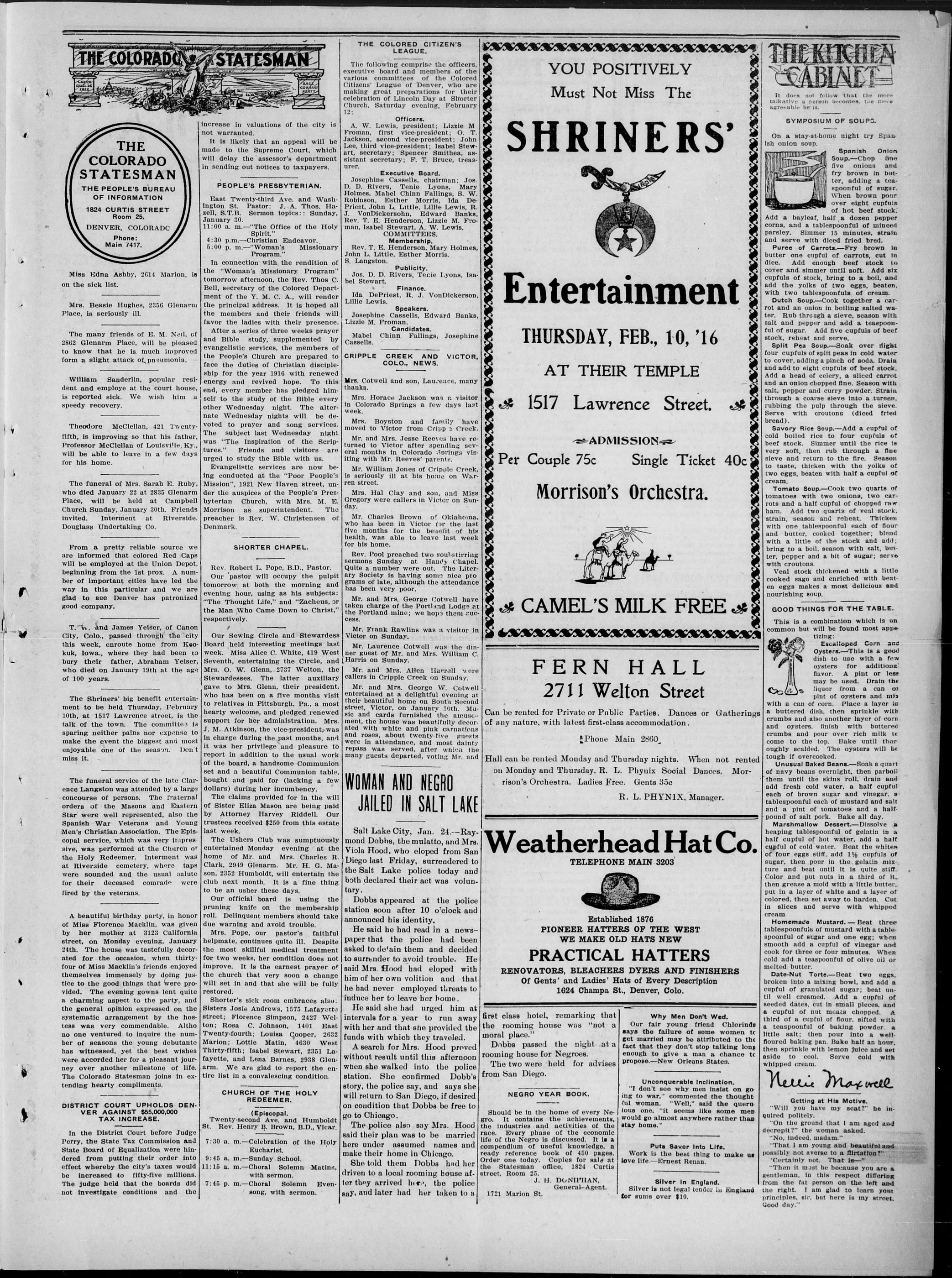
THE COLORADO STATESMAN
THE JOURNAL OF THE WEST.
LABOR SHALL BE FREE
RACE COUNTRY PARTY
COLORADO, WYOMING, MONTANA, IDAHO AND NEW MEXICO
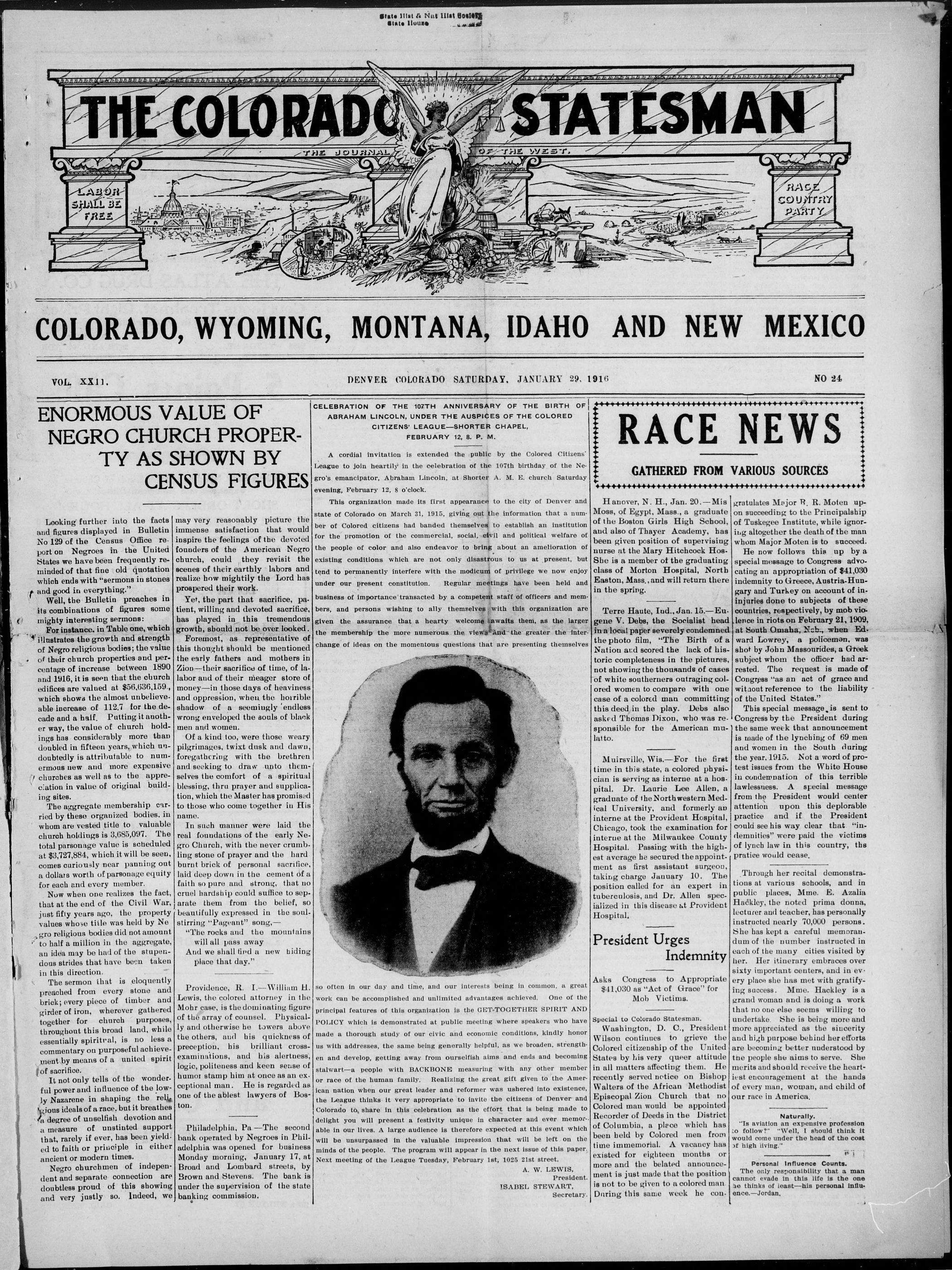
ENORMOUS VALUE OF NEGRO CHURCH PROPER TY AS SHOWN BY CENSUS FIGURES
VOL. XX11.
ENORMOUS V
NEGRO CHUR
TY AS S
CEN
Looking further into the facts and figures displayed in Bulletin No 129 of the Census Office report on Negroes in the United States we have been frequently reminded of that fine old quotation which ends with "sermons in stones and good in everything."
Well, the Bulletin preaches in its combinations of figures some mighty interesting sermons:
For instance, in Table one, which illustrates the growth and strength of Negro religious bodies; the value of their church properties and percentage of increase between 1890 and 1916, it is seen that the church edifices are valued at $56,636,159. which shows the almost unbelievable increase of 112.7 for the decade and a half. Putting it another way, the value of church holdings has considerably more than doubled in fifteen years, which undoubtedly is attributable to numerous new and more expensive churches as well as to the appreciation in value of original building sites. The aggregate membership carried by these organized bodies, in whom are vested title to valuable church holdings is 3,685,097. The total parsonage value is scheduled at $3,727,884, which it will be seen, comes curiously near panning out a dollars worth of parsonage equity for each and every member.
Now when one realizes the fact, that at the end of the Civil War, just fifty years ago, the property values whose title was held by Negro religious bodies did not amount to half a million in the aggregate, an idea may be had of the stupendous strides that have been taken in this direction.
The sermon that is eloquently preached from every stone and brick; every piece of timber and girder of iron, wherever gathered together for church purposes, throughout this broad land, while essentially spiritual, is no less a commentary on purposeful achievement by means of a united spirit of sacrifice.
It not only tells of the wonderful power and influence of the lowly Nazarene in shaping the religious ideals of a race, but it breathes a degree of unselfish devotion and a measure of unstinted support that, rarely if ever, has been yielded to faith or principle in either ancient or modern times.
Negro churchmen of independent and separate connection are doubtless proud of this showing and very justly so. Indeed, we
may very reasonably picture the immense satisfaction that would inspire the feelings of the devoted founders of the American Negro church, could they revisit the scenes of their earthly labors and realize how mightily the Lord has prospered their work. Yet, the part that sacrifice, patient, willing and devoted sacrifice, has played in this tremendous growth, should not be over looked. Foremost, as representative of this thought should be mentioned the early fathers and mothers in Zion—their sacrifice of time, of labor and of their meager store of money—in those days of heaviness and oppression, when the horrible shadow of a seemingly 'endless wrong enveloped the souls of black men and women.
Of a kind too, were those weary pilgrimages, twixt dusk and dawn, foregathering with the brethren and seeking to draw unto themselves the comfort of a spiritual blessing, thru prayer and supplication, which the Master has promised to those who come together in His name.
In such manner were laid the real foundations of the early Negro Church, with the never crumbling stone of prayer and the hard burnt brick of personal sacrifice, laid deep down in the cement of a faith so pure and strong, that no cruel hardship could suffice to separate them from the belief, so beautifully expressed in the soul-stirring "Pageant" song,—
"The rocks and the mountains will all pass away And we shall find a new hiding place that day."
Providence, R. I.—William H. Lewis, the colored attorney in the Mohr case, is the dominating figure of the array of counsel. Physically and otherwise he towers above the others, and his quickness of preception, his brilliant cross-examinations, and his alertness, logic, politeness and keen sense of humor stamp him at once as an exceptional man. He is regarded as one of the ablest lawyers of Boston.
Philadelphia, Pa—The second bank operated by Negroes in Philadelphia was opened for business Monday morning, January 17, at Broad and Lombard streets, by Brown and Stevens. The bank is under the supervision of the state banking commission.
DENVER COLORADO SATURDAY, JANUARY 29, 1916
CELEBRATION OF THE 107TH ANNIVERSARY OF THE BIRTH OF ABRAHAM LINCOLN, UNDER THE AUSPICES OF THE COLORED CITIZENS' LEAGUE—SHORTER CHAPEL.
A cordial invitation is extended the public by the Colored Citizens' League to join heartily in the celebration of the 107th birthday of the Negro's emancipator, Abraham Lincoln, at Shorter A. M. E. church Saturday evening, February 12, 8 o'clock.
This organization made its first appearance to the city of Denver and state of Colorado on March 31, 1915, giving out the information that a number of Colored citizens had banded themselves to establish an institution for the promotion of the commercial, social, civil and political welfare of the people of color and also endeavor to bring about an amelioration of existing conditions which are not only disastrous to us at present, but tend to permanently interfere with the modicum of privilege we now enjoy under our present constitution. Regular meetings have been held and business of importance transacted by a competent staff of officers and members, and persons wishing to ally themselves with this organization are given the assurance that a hearty welcome awaits them, as the larger the membership the more numerous the views and the greater the interchange of ideas on the momentous questions that are presenting themselves
A. B.
so often in our day and time, and our interests being in common, a great work can be accomplished and unlimited advantages achieved. One of the principal features of this organization is the GET-TOGETHER SPIRIT AND POLICY which is demonstrated at public meeting where speakers who have made a thorough study of our civic and economic conditions, kindly honor us with addresses, the same being generally helpful, as we broaden, strengthen and develop, getting away from ourself aims and ends and becoming stalwart—a people with BACKBONE measuring with any other member or race of the human family. Realizing the great gift given to the American nation when our great leader and reformer was ushered into existence, the League thinks it very appropriate to invite the citizens of Denver and Colorado to share in this celebration as the effort that is being made to delight you will present a festivity unique in character and ever memorable in our lives. A large audience is therefore expected at this event which will be unsurpassed in the valuable impression that will be left on the minds of the people. The program will appear in the next issue of this paper. Next meeting of the League Tuesday, February 1st, 1025 21st street.
FEBRUARY 12, 8. P. M.
A. W. LEWIS,
President.
ISABEL STEWART,
Secretary.
RACE NEWS
GATHERED FROM VARIOUS SOURCES
Hanover, N. H., Jan. 20.—Mis Moss, of Egypt, Mass., a graduate of the Boston Girls High School, and also of Thayer Academy, has been given position of supervising nurse at the Mary Hitchcock HosShe is a member of the graduating class of Morton Hospital, North Easton, Mass., and will return there in the spring.
gratulates Major R. R. Moten upon succeeding to the Principalship of Tuskegee Institute, while ignoring altogether the death of the man whom Major Moten is to succeed.
He now follows this up by a special message to Congress advocating an appropriation of $41,030 indemnity to Greece, Austria-Hungary and Turkey on account of in
Terre Haute, Iud., Jan. 15.—Eugene V. Debs, the Socialist head in a local paper severely condemned the photo film, "The Birth of a Nation and scored the lack of historic completeness in the pictures, not showing the thousands of cases of white southerners outraging colored women to compare with one case of a colored man committing this deed in the play. Debs also asked Thomas Dixon, who was responsible for the American mulatto.
Muirsville, Wis.—For the first time in this state, a colored physician is serving as interne at a hospital. Dr. Laurie Lee Allen, a graduate of the Northwestern Medical University, and formerly an interne at the Provident Hospital, Chicago, took the examination for interne at the Milwaukee County Hospital. Passing with the highest average he secured the appointment as first assistant surgeon, taking charge January 10. The position called for an expert in tuberculosis, and Dr. Allen specialized in this disease at Provident Hospital.
President Urges
Indemnity
Asks Congress to Appropriate $41,030 as "Act of Grace" for Mob Victims.
Special to Colorado Statesman.
Washington, D. C., President Wilson continues to grieve the Colored citizenship of the United States by his very queer attitude in all matters affecting them. He recently served notice on Bishop Walters of the African Methodist Episcopal Zion Church that no Colored man would be appointed Recorder of Deeds in the District of Columbia, a place which has been held by Colored men from time immemorial. A vacancy has existed for eighteen months or more and the belated announcement is just made that the position is not to be given to a colored man. During this same week he con-
NO 24
gratulates Major R. R. Moten upon succeeding to the Principalship of Tuskegee Institute, while ignoring altogether the death of the man whom Major Moten is to succeed. He now follows this up by a special message to Congress advocating an appropriation of $41,030 indemnity to Greece, Austria-Hungary and Turkey on account of injuries done to subjects of these countries, respectively, by mob violence in riots on February 21, 1909, at South Omaha, Neb., when Edward Lowrey, a policemen, was shot by John Massourides, a Greek subject whom the officer had arrested. The request is made of Congress "as an act of grace and without reference to the liability of the United States."
This special message is sent to Congress by the President during the same week that announcement is made of the lynching of 69 men and women in the South during the year, 1915. Not a word of protest issues from the White House in condemnation of this terrible lawlessness. A special message from the President would center attention upon this deplorable practice and if the President could see his way clear that "indemnities" were paid the victims of lynch law in this country, this practice would cease.
Through her recital demonstrations at various schools, and in public places, Mme. E. Azalia Hackley, the noted prima donna, lecturer and teacher, has personally instructed nearly 70,000 persons. She has kept a careful memorandum of the number instructed in each of the many cities visited by her. Her itinerary embraces over sixty important centers, and in every place she has met with gratifying success. Mme. Hackley is a grand woman and is doing a work that no one else seems willing to undertake. She is being more and more appreciated as the sincerity and high purpose behind her efforts are becoming better understood by the people she aims to serve. She merits and should receive the heartiest encouragement at the hands of every man, woman, and child of our race in America.
Naturally.
"Is aviation an expensive profession to follow?" "Well, I should think it would come under the head of the cost of high living."
Personal Influence Counts.
The only responsibility that a man cannot evade in this life is the one he thinks of least—his personal influence.—Jordan.
FOREIGN
The British steamer Trematon, 2,
665 tons, has been sunk, The crew
was landed,
Rebels in the province of Yunnan,
China, have defeated a body of gov-
ernment troop and are moving north-
ward,
The Neue Zuricher Zeitung Luxem-
burg correspondent announces that
the marriage of Grand Duchess Marie
of Luxemburg probably will take place
shortly.
Gov. L. B. Hanna of North Dakota,
who went to Copenhagen with the
Ford peace party, departed for Eng-
land and later plans to go to the south
of France.
Restoration of the Manchu dynasty,
which ruled China before the estab-
Ushment of the republic, has been pro-
claimed by the leaders of an uprising
in eastern Mongolia.
German newspapers which have
Just reached London lay great em-
phasis on the importance of the mis-
|Sion of Col. Edward M. House, Presi-
|dent Wilson's personal representative
| to Burope.
Press dispatches from Rome say
that considerable anxiety is felt in
Vienna in consequence of the illness
of Emperor Francis Joseph, whese
lenraite bronchitis has assumed an
| acute form,
| Gen. Valeriano Weyler, now 77 years
old, has been appointed president of
|a central general staff of the Spanish
|army, which has just been created py
a royal decree, according to a dis-
patch from Madrid.
Germany has submitted to the Unit
ed States through Ambassador von
Bernstorff, another written proposal
designated to bring about a settlement
of the controversy over the sinking
of the steamship Lusitania, with a loss
of more than 100 American lives,
The British government has spent
$60,000,000 in America since the be-
ginning of the war in the purchase cf
horses for military purposes. This
| fact is revealed in a report issued by
a special committee appointed to con-
sider steps to be taken in England
and Wales with the object of securing
an adequate supply of horses suitable
for cavalry and artillery work at the
front,
SPORTING NEWS
Vic Hanson of California won a de
cision in ten rounds over Dick Gilver.
of Denver at Kansas City,
James S. Milne of Barre, Vt, a sec:
ond year student at Boston Univer-
sity, died of injuries received in a
basket ball game.
©. Perry Beadelston, famous pony
polo player, was hovering near deat
at San Diego, Cal., as the result of a
bad fall in a practice game in Coro:
nado,
A furious stand on a game leg in
the last round won Joe Rivers of Los
Angeles, Cal, the popular verdict
over Ritchie Mitchell of Milwaukee in
their ten-round no-decision bout at
Cineinnati,
“Fred Toney will pitch for the Reds
this year for a $4,000 salary, or no!
pitch at all” This was the statement
| of President August Herrmann of the
| Reds at Cincinnati, answering Toney’:
demand for a $6,000 salary or his un
conditional release,
‘The National Western Horse an¢
Stock Show. closed in Denver before
the largest matinee crowd ever as
sembled in the big stadium, Mis
Loula Long, with a stable of eighteer
horses, took eleven blue ribbons, sever
second ribbons, four third pennants
and was fourth only twice. Mr
Thompson's horses won six firsts
seven second ribbons, three thirds
and was fourth only once.
GENERAL
‘The United States Steel corporation
declared a quarterly dividend of 1%
per cent on its common stock.
Brig. Gen. Isaac Swarthwood Catlin
U. 8. A., retired, eighty-one years old
died after a stroke of apoplexy, at hts
home in Brooklyn,
General Felix Diaz issued a state
ment in New York denying that he
had planned or is planning another
revolution in Mexico,
Travel by land and sea and com
munication of all sorts were out o}
joint Monday in the western one-third
of the United States, because of rain
snow and wind,
Another unsuccessful effort was
made by the prosecution at Provi
dence, R. L,, in the trial of Mrs, Eliz
abeth Mohr and two negroes for the
murder of her husband, Dr, C, Frank
lin Mohr, to have the alleged confes
sions of the accused negroes admitted
as evidence against her,
THE LATEST IMPORTANT DIS:
PATCHES PUT INTO SHORT,
CRISP PARAGRAPHS.
STORY OF THE WEEK
SHOWING THE PROGRESS OF
EVENTS IN OUR OWN AND
FOREIGN LANDS.
‘western Newspaper Union News Service
ABOUT THE WAR
Austrians take Antivari and Dul-
cigno, Montenegrin seaports,
British submarine sinks Austrian
torpedo boat in upper Adriatic.
Monastir and Gievgeli have been
again raided by allied airmen.
The Russians have captured Hassan
Kalah in Caucasus and driven Turks
twenty miles to forts of Erzerum.
Germany is continuing her efforts
to conclude a separate peace witn
Serbia, according to the Athens cor-
respondent of the London Daily Mail.
Germany's resumption of air raids
has terrorized England. In three days
three successive raids were made on
Dover, England's principal channel
port.
British forces attempting to relieve
the town of Kutel-Amara were re-
pulsed by the Turks in a six-hour bat-
le. They lost 3,000 killed and
wounded,
Turkey, it is reported, will admit of-
ficially that one of her submarines
sank the steamer Persia, on which
American Consul Robert N. McNeely
lost his life.
The Russians are driving away at
the Moslems near Erzertin, Recently
after routing the sultan’s troops they
captured 4,000 prisoners and a large
quantity of stores,
Despite the Austrian claira that the
Montenegrins have surrendered, it is
known that the remnant of the Monte-
negrin army is retreating and haraas-
ing the Austrians by bush warfare.
WESTERN
The Arizona strike of 5,000 Clifton:
Morenci-Metcalf copper miners is
ended.
Rescue parties at Yuma, Ariz., Mon
day extended relief to ranchers made
homeless by floods in the Colorado
river.
Mrs. Caroline L. Johnson, a real
@aughter of the revolution, is dead at
her home at Hastings, Neb., aged 90
years.
At New Madrid, Mo., thirty-three
defendants in the night-rider trials
pleaded guilty, thus bringing the trials
to a sudden end.
The federal land office of Alliance,
Neb., will receive entries for 14,000
acres of land for which water is now
available from the North Platte irri
gation project on March 24,
Another murder mystery developed
at Gary, Ind., at a point near the home
of the Rey, Edmund Kayser, who was
Killed last fall in what was then be
leved to be a war plot.
Big Pete McCullough, seventy-six
years old, “the hanging judge” of An
dersonville prison during the Civil
War, died at his home in Mexico, Mo,
after a short illness of pneumonia,
Raymond Dodds, the mulatto, and
Mrs. Viola Hood, who eloped from San
Diego, surrendered themselves to the
Salt Lake City police and both de
clared that their act was voluntary,
Colorado, Utah, Montana and West.
ern Texas produced 2,526,000 barrels
of cement during 1915, and shipped
2,475,000 barrels, according to esti-
mates made by the United States Geo-
Jogical Survey.
WASHINGTON
President Wilson soon will recom
mend the enactment of legislation: pro:
viding for a permanent tariff commis
sion,
Senator Norris of Nebraska, Repub:
lican, introduced a constitutional
amendment to abolish the electoral
college.
American exports increased 70 per
ceat in 1915, and reached a total of
7,,555,000,000, breaking all previous
records.
Senator Johnson of South Dakota is
confined to his home by injuries from
falling down stairs. Several ribs arc
believed broken,
Senator Shafroth introduced a bill
forbidding railroads charging as much
or more for a short haul than for a
longer one on the same route.
Chile’s ratification of the peace
commission treaty negotiated by for
mer Secretary Bryan, was presented
to the State Department by the Chile:
an ambassador, Eduardo Suarez Mu
Hica.
‘The income tax was declared con.
stitutional by the United States Su
preme Court in an unanimous dect
soin which swept aside every conten-
tion raised against it.
A resolution was passed by the
Senate to make immediately ayail-
able $50,000 for repair of the goyern-
ment levee in the Gila river at Yuma,
Ariz., destroyed by flood,
George von L. Meyer, former secre-
‘ary of the navy, and Truxton Beale,
former United States minister to
Persia, had a fistic encounter in front
Mf the fashionable Metropolitan Club,
COLORADO
STATE NEWS
Western Newspaper Unton News Service,
boat Springs. ey
March 20-April 2—Cotorado Retall
Merchants’ Association's Food and
Industrial Bxposition at. Denver.
April 18—Demoeratic State Convention
‘at Pueblo, :
Trinidad has scored forty-five booze
raids since Jan, 1.
Mrs, Elizabeth W. Cole, eighty-one
years old, died at St. Luke’s hospital
in Denver.
Fourteen departments of the federal
government in Denver have removed
their offices to the new federal build-
ing.
The nineteenth annual convention
of the Colorado Osteopathic Associa-
tion will be held in Denver Tan, 28
and 29.
The eighteenth anniversary of the
Colorado Prison Association was celc-
brated with a luncheon and dinner in
Denver.
The first case to be prosecuted in
Denver under thenew prohibition law
resulted in a plea of guilty and a fing
of $100 and costs,
John L. Stewart, county commis.
sioner, died at his home in George:
town of pneumonia, Mr, Stewart was
sixty-four years old,
Mrs. Elizabeth McGerr, seventy, a
resident of Georgetown since 1879, 1s
dead at the family home, following an
illness of two weeks,
It is stated that Gen. John Chase
will resign as head of the state
guard, and that Harry P. Gamble of
Boulder will succeed him.
Richard H. Love, five years Unitea
States revenue agent at Denver, has
been transferred by the Treasury De-
partment to St. Paul, Minn.
Jacob Ebell, a Loveland youth, was
arraigned before Justice Payne and
fined $25 and costs for passing worth-
less checks on local merchants
The twenty-eighth state convention
of the Colorado Young Men’s Associa:
tions will be held at Greeley, Feb. 4 to
6, Strong speakers have been obtained.
Governor Carlson was the principat
speaker at the ninth annual legislative
breakfast of the Central Women’s
Christian Temperance Union, held in
Denver.
At a recent meeting of the board ot
control of the State Industrial School
for Boys, Charles Huscher. was ap-
pointed acting superintendent, suc-
ceeding F. L. Paddleford, resigned,
Governor Carlson appointed Fred
erick Goble of Silverton a member of
the advisory board to the State High-
way Commission to succeed Charles E.
Herr of Durango. The appointment is
for a term of four years ending April
1, 1920,
Lena Carlo, fourteen-year-old daugh-
ter of Mr. and Mrs. H, R. Carlo, weal
thy ranch people living at Baxter, five
miles east of Pueblo, is in St. Mary’s
hospital hovering between life and
death from a quantity of paris green
she took,
W. B, Slaughter, father of Conie
C, Slaughter, formerly with the Mer-
cantile National bank at Pueblo,
which was alleged to have been
wrecked by him, is in the Ardmore
Jail with a charge of kidnaping
against him, and Dorothy, the 10-yea>
old daughter of Mr. and Mrs. C. C.
Slaughter, is with relatives in Ard-
more, Okla,
A policy of “preparedness” in antic-
ipation of the convening of the next
General Assembly was adopted at tho
session of the Colorado Association of
County Commissioners in Denver. The
commissioners decided to pass reso-
lutions on proposed legislation now so
they could work while the General
Assembly was not in session in put-
ting their views before the senators
and representatives.
Three persons, who fifty vears ago
were principals in a wedding cere-
mony in a little church in Central
City, met Sunday at the home of Mr.
and Mrs, Edward C, Hughes in Den-
ver and celebrated the golden anni
versary of the occasion. They were
Mr, and Mrs. Hughes and the Rev. B.
T. Vincent, a Methodist Episcopal
minister, who joined them in matri-
mony half a century ago,
While Claude Maddox, wounded
youth in the Denver county hospital,
and Harry L. Adams, his confessed
accomplice in the chain of burglaries
committed in Denver, are facing trial
on charges which involve sentences
of eight to fifteen years, the police au:
thorities of two Texas cities are en-
gaging in a spirited battle to obtain
priority claims on the pair when the
Denver police have disposed of tho
tase against them,
Articles of incorporation of the Na-
tional Radium Products Company
were filed with the secretary of state.
The company is capitalized at $100,
RR ae eT ew ae ee
$3,000,000 FOR CATTLE
WYOMING HEREFORD BULL
SELLS FOR $5,000 AT BIG
SHOW.
Seven Head of Short Horn Bulls
Yield Colorado Stockman a
Total of $10,000.
Phone Champa 2211
)
The Chesapeake
Fish & Oyster Co.
Denver’s Only Exclusive Fish and Oyster House
Fresh Fish, Oysters, Salt, Smoked, Dried and Canned Fish
Poultry and Game of All Kinds
828 Fifteenth Street | Denver, Colo.
Western Newspaper Union News Service.
Denver — Mountain pastures and
high altitude, coupled with the al
most general inclination of Coloradc
stock raisers to breed with pure
blooded animals only, resulted in
Denver's National Western Stock
Show attracting stock buyers from
Argentine, from Canada and from all
parts of the United States. In conse
quence the highest prices known to
the normal market were paid for
Colorado feeders and breeders.
Officials of the Denver Union
Stock Yards Company state that the
total sales made during the week of
the Stock Show totaled $3,000,000.
More than $1,000,000 worth of cattle
changed hands Friday, according to
unofficial statements.
Several lots of stock were sold for
shipment to the Argentine Republic.
Howell-Rees & Sons of Wisner, Neb.
sold a cow and a bull calf to repre-
sentatives of Argentine breeders ‘or
$2,500. Both animals were of the
Shorthorn breed.
At Friday's sale of feeding stock
Whole herds of Colorado cattle were
sold to buyers of, other states, and
the minimum pricé paid was $7.50 a
hundred, while the top price reached
$10.30. Colorado hogs brought $10 a
hundred Wednesday, the opening day
of the official selling, and Colorado
lambs brought $13 a hundred,
Wyoming, a 28-month-old Hereford
bull, brought L. G. Davis of Sarato-
Ba, Wyo., the record price of $5,000
from W. N. W. Blayney of Denver.
Mr. Blayney intends to piace the ani-
mal on his ranch. Mr. Davis also sold
a grand champion senior yearling
bull at a top price. J. Wagner of
Dickinson, Neb., was the buyer at
$1,450.
Another record sale was made by
Jesse Engle of Sheridan, Mo., to
Christian Bros. of Eagle, Colo—
$2,600 for a second prize senior bull.
George Chandler of Baker City, Ore.,
sold a grand champion to Lester Bev-
eridge of Laramie for $1,400.
A carload of shorthorn _buils
brought an average price of $1,200
each, while another lot of young
Hereford bulls brought an average of
$700 each. One Colorado stockman
came to town with ten head of cattle.
He sold seven of them for $10,000.
©. H. SHIRLEY, Pros. J. 0. HAMPSON, Vice Pree
PAUL J. SHIRLEY, Seo, and Treas,
THE ATLAS DRUG CO. *
Courteous Treatmet. Right Prices
Leaders in Prescription
Btore No. 1. Btore No. %
701 WELTON 8T. 26TH AND WELTON
Main 895 875 Main 4955 4956
5 Points Cafe
UNDER NEW MANAGEMENT.
Chop Suey, Noodles and All Kinds of Chinese
Japanese and American Dishes
SHORT ORDERS AT ALL HOURS
2712 WELTON STREET PHONE MAIN 4/30
W. C. CAMPTON, Pres. J. M. JOHNS, Treas. U. P. JACKSON, Sec.
RAILROAD PORTERS’ CLUB
LUNCH ROOM IN CONNECTION
BILLIARDS AND € FREE CHECK
POOL u ROOM
1728!/2 Wazee St. Only one block from Union Depox.
J. B. MINTER. Barber.
PHONE MAIN 8416, DENVER, COLORADO.
Colorado Springs Girl Is Recovering.
Colorado Springs.—Charlotte Rhea
James, the Colorado Springs artist
who was found dressed in evening
clothes at a railway station in Ports-
mouth, N. H., recently and who at the
time was unable to tell who she was,
is reported to be rapidly improving in
a New York hospital, where she has
been since her nervous breakdown.
According to a telegram received here
from her sister, Miss James, though
still suffering considerably from
shock, is out of danger and rapidly im-
‘proving.
PHONE MAIN 30228 == ‘RES, PHONE GALLUP 942
JOHN K. RETTIG ‘a _
Meats, Fancy and Staple Groceries
1864 CURTIS STREET Ss
Borner Nineteenth. ry ~ Denver, Cola
Bulger Appeal Cites 44 Reasons.
Denver—An appeal was filed with
the State Supreme Court by attorneys
for James C, Bulger asking that the
tribunal grant him a new trial in the
West Side Court to determine whether
or not he is insane. Forty-four alleged
errors in the trial in the West Side
Court in which Bulger was declared
sane are given as the grounds for ask
ing that the verdict be set aside and
a retrial ordered.
C. E. SMITH, Manager, Res. Phone South 1608
Wholesale and Retail Staple and Fancy Groceries, Fish and Oysters,
Hotels and Restaurants Our Specialty.
Fresh and Cured
Eastern Corn Fed Meats :
Fruits, Vegetables, Poultry and Game.
Telephones Main 4302, 4303, 4304, 4305 :
622-636 15th Street Denver, Colorado
Upholds Refusal to Raise Assessment
Denver.—Holding that’ the State
Tax Commission acted arbitrarily, ir
regularly and without proper knowl
edge or information when it ordered
Commissioner of Finance Pitcher, act
ing in his capacity as assessor, to in
crease his assessment on Denver prop:
erty for 1915 by $55,408,952, the Dis
trict Court, through Judge Perry, up:
held Mr. Pitcher’s refusal to comply
with the order,
$80 Ore Struck In Acacia Group.
Cripple Creek.—Rich ore has been
encountered on the Langdon and Ret.
ton lease on the 1,000-foot level of the
South Burns mine, a part of the Aca:
cia group of claims, The ore was
found between two well-defined walls
and assays taken with the rich syl-
vanite seams eliminated showed val.
ues of $50 to $80 a ton.
Pueblo Boy Killed While Coasting.
HAVE YOUR CLOTHES CLEANED, PRESSED, REPAIRED,
ALTERED AND DYED AT THE
2 e
Mutual Tailors :
Soe ee ee a eee mae 4
LADIES’ AND GENTLEMEN'S
SUITS MADE TO ORDER.
Our Work Will Please You—Our Prices are Reasonable.
Gentlemen's Suits Cleaned and Pressed... .. . 15
WDECRNIOAOI NS 6:5, 5 c'0 pssa)'ovel alerain wih tie ee bee e 6 ote,
GONOR chase 0's tees ete e eee reset eeesscsee OS
DOORMAN BIEN Eins a APES Oooo eee e(giace 6'8,0re
2204 WELTON ST. CALL MAIN 8519
Pueblo.—Howard Taylor, aged thir.
teen, while coasting down a hill here
was unable to steer his coaster at the
foot of the hill and plunged over a
fifty-foot embankment into the rail-
road yards opposite the union station.
He suffered concussion of the brain
and died in a hospital here yesterday.
‘One Dead, One Dying, Six Injured. |
Denver.—One killed, another dying
and six persons injured, two of them
women, was the toll of automobile ac-
cidents Sunday. The first and more
severe accident occurred near Ber-
thoud, when Roy Holloway, a young
Johnstown farmer, was instantly
killed; Miss Violet Bein, Berthoud, in-
jured probably fatally, and three oth-
ers slightly injured. ‘The afternoon
accident near the Littleton courthouse
claimed as its victims Charles Housley
ot Denver and Fred Foote and Will:
‘jam Grebb, farmers.
AFRO-AMERICAN CULLINGS
Maj. Robert R. Moton of Hampton institute, Hampton, Va., was selected to succeed Booker T. Washington as president of Tuskegee institute, Tuskegee, Ala., at a meeting of the special committee of the trustees of the institute. The choice was unanimous. The committee making the selection was composed of Seth Low, chairman of the Tuskegee trustees; Frank Trumbull of the Chesapeake & Ohio railroad, Edgar A. Bancroft, W. W. Campbell and Victor H. Tulane. Major Moton will not be installed as head of the famous Negro institute until the commencement exercises in May, 1916. Until that time he will give his services to the campaign for the Booker T. Washington memorial fund.
The new head of Tuskegee has been commandant of cadets at Hampton since 1890. He was born in Virginia and is of pure Negro parentage. In a statement issued by the committee it is declared that by the elec-
INTERNATIONAL
MILITARY SERVICE
Robert Russa Moton. tion of Major Moton, "the policies, aim and attitude of the institute will continue unchanged." The committee paid tribute to the ability of Emmett J. Scott, temporary head of the institute since the death of Doctor Washington, as follows: "In taking this action the committee has not been unmindful of the long devotion and of the many qualifications of Mr. Emmett J. Scott for the position. The problem to be dealt with is a many-sided one, and it has seemed wise to seek a solution of it that will bring to the work of Tuskegee another forceful personality."
In the death of the great Negro industrial leader, educator, and organizer, Dr. Booker T. Washington, the American nation has lost a great instrument for good; the Negro race in our nation a leader-mediator; the civilized world one of its champions of a great cause, writes F. Wilcon Ellegor of Liberia, in a communication to the New York Times. There are times when even profound minds find it difficult to give out the fullest expressions of sentiment upon peculiar occasions and subjects—when words do not seem to give the significance they are employed to convey.
"A great Negro leader has fallen," "a mediator and friend of his race," or an active and indefatigable educator and industrialist, all convey
"Major Moton knows by intuition northern white people and southern white people. I have often heard the remark made that the southern white man knows more about the Negro in the South than anybody else. I will not stop here to debate that question, but I will add that colored men like Major Moton know more about the southern white man than anybody else on earth," was a remark made by Booker Washington.
"This thorough understanding of both races which Major Moton possesses has enabled him to give his students just the sort of practical and helpful advice and counsel that no white man who has not himself faced the peculiar conditions of the Negro could be able to give.
"I have seen Major Moton in a good many trying situations in which an ordinary man would have lost his head, but I have never seen him when he seemed to feel the least degraded or humiliated. I have learned from Mojor Moton that one need not belong to a superior race to be a gentleman.
"It has been through contact with
Of children born of parents at the age of forty-one years one-third die during the first year, while the rate of mortality among those born of parents between the ages of twenty-one and thirty is less than eight per cent.
The emerald is worth more per carat than any other stone.
You could put all the United States except Alaska in Brazil and have 200, 000 square miles left.
much, but fail to bring out the fullest measure of those elemental qualities that combined to make Mr. Washington the truly great man that he was.
Booker T. Washington was able in a very positive manner to give the demonstration of the fact that with opportunities and proper equipments millions of colored people would become capable of the highest mechanical and industrial training; he was able to prove the possibility of a good understanding and, what is more, of good feeling between the white and colored elements; he was able to prove that the individual sacrifice, perseverance, determination, thrift, energy, and steadfastness are unit builders of the useful community that must eventually turn out of its mold a prosperous, well-equipped people, rightly for a good place in the world. This is how we view the work of Booker Washington in Liberia, West Africa, where his name has become a household word and the Tuskegee model plant regarded as a valuable asset, an object lesson for any industrial effort.
I feel it my duty as one connected with Negro advancement work in Liberia, and deeply interested, too, in the industrial outlook of that country, to express in behalf of my colleagues there an appreciation for the life and work of that great opportune man, whose career may be briefly summed up in the words: Veni, vidi, vici. He really came "as one born in due time," saw and grasped a necessity, and put into effect propaganda that must of necessity continue to be a workable and progressive monument erected for the wellbeing of the race in America.
Mr. Washington's death, then, should prove to be a signal for united thought and effort among the colored race in America, in all those ways that tend toward the uplift of thousands of the people. And to my mind the very best way to show appreciation for and loyally to that devoted son of the race would be by uniting in encouraging and supporting in any and every possible way that wonderful working "Washington monument" at Tuskegee.
That the Negro must look to the schools for preparation for his work in life, and that he must erect schools and maintain them himself, was the declaration of Dr. A. P. Camphor, president of Central Alabama college, before the Central Alabama conference of the Methodist Episcopal church, in delivering the principal address at the educational anniversary. An audience that filled every available bit of space in St. Paul's Methodist church at Birmingham heard his address, which was the feature of the day's work. He pleaded for greater interest in Negro education, paid a high tribute to the work of the Methodist Episcopal church in providing educational institutions for all people, and showed the unmistakable duty of the Negro of today to help more largely in the education of the Negro youth.
Just what was being done at Central Alabama college, the local institution maintained by the church for Negroes at Mason City, was told by the speaker. The choir from the school rendered music for the occasion.
An electric motor no bigger than a watch is said to produce one horse power.
men like Major Moton—clean, wholesome, high-souled gentlemen under black skins—that I have received a kind of education no books could impart. Whatever disadvantages one may suffer from being a part of what is called an 'inferior race,' a member of such a race has the advantage of not feeling compelled to go through the world, as some members of other races do, proclaiming their superiority from the housetops. There are some people in this world who would feel lonesome, and they are not all of them white people either, if they did not have someone to whom they could claim superiority."
When a Sunbury (Pa.) man pulled his horse out of the well into which the thoughtless equine had fallen he found attached to one of its shoes a rusty bucket containing more than $3,000 in Spanish gold. The money is supposed to have belonged to a hermit whom legend assigns residence in the vicinity 50 or more years ago.
Small practice can lead to great perfection in the art of laziness.
Four hundred years ago the average length of human li.e was between eighteen and twenty years. One hundred years ago the average human life was less than thirty. The average human life today reaches nearly forty years.
Switzerland now owns the St. Gothard tunnel and railway.
The Brazilian government estimates next year's revenue at $169,660,000,
and expenditures at $174,254,000.
BOARD SAVES MILLION
ACCORDING TO PUBLIC UTILITIES REPORT TO GOVERNOR
Rail Rate Reductions Bring Bensits to Coloradoans—Expenses, $31,465
—Only Two Cases on Docket.
Western Newspaper Union News Service.
Denver.—More than $1,000,000 was saved to the people of Colorado through investigations and reductions of railroad passenger and freight rates and those of public utilities, according to the annual report of the Public Utilities Commission, submitted to Governor Carlson.
This saving, according to the report, was effected on an expenditure of $31,465.35, the salaries of the three commissioners, their secretary and employés and traveling and miscellaneous expense.
By its decision on passenger rates, the commission saved about $700,000, based on estimates made by officials of railroads affected.
The most notable decision was the one compelling the Colorado Springs Light, Heat & Power Company to reduce its rates.
Expenses for the maintenance of the commission, according to figures set forth in the report, are:
Salaries of commissioners, $13,590.
Salaries of employés, $13,709.35.
Traveling expenses, $2,224.
Miscellaneous expense, $2,032.
Out of the $15,000 appropriated for employés' salaries by the Twentieth Assembly, the commission has a balance of $1,290.65. It has $2,468 remaining of $4,500 set aside for miscellaneous expenditures and $276 left ci $2,500 for railroad expenses.
At the close of last year there remained on the commission's docket for hearing but two cases out of forty-seven.
The report is signed by S. S. Kendall, George T. Bradley and M. H. Aylesworth. It gives a recapitulation of the miles of track owned and operated by railroads, the figures having been obtained from reports submitted by the companies.
Steam roads own 5,521.76 miles of main track, 153.43 miles of second main track, 1,878.99 miles of yard track and sidings—a total of 7,554.23 They operated 5,986.20 miles of main track and 2,150.96 miles of other track, or a total in all of 8,137.16. Electric roads operate 8,597.26 miles of track and own 7,952.60.
Road Men Propose Elaborate Work. Construction of permanent roads in the state, establishment of a department of maintenance under direction of the State Highway Commission, obtaining federal aid for road building, a general extension of good roads, the advertisement of scenic attractions, and enlargement of plans to bring automobile tourists to the state, are among strong features of the platform of the Colorado Good Roads Association, as outlined in the reports of the committee on resolutions and in discussions at the convention. If the purpose of one of the resolutions adopted is carried out, Colorado will be one of the best advertised states in the union. It provides that the commission lay aside a sum of money to insure the printing of attractive booklets, containing logs, up-to-date road maps, concise descriptions of scenic attractions and hotel and other facilities. E. E. Sommers of Denver was re-elected president; John Y. Munson of Berthou, vice president, and W. H. Emmons of Denver, secretary.
Would Stop Pay of Absent Judge.
Pointing out that Juvenille Judge Lindsey, who is now in Europe actually "engaged in bearing upon his delicate shoulders the world burden of a settlement of the war in Europe," at the instance of and in the pay of Henry Ford, but that, nevertheless, solemn oath has been made before the city auditor, who passes upon his salary voucher, that he is, and has been since Jan. 1, in Denver, performing his duties as judge of the children's court, W. P. Daniels, a Denver taxpayer, has filed a protest with the city commissioners against the payment of his salary while he is absent.
Until the United States Supreme Court announces its decision in the test case involving the validity of the federal migratory bird law, the United States game wardens will obtain evidence for prosecutions for violation of the law.
Aylesworth Named Utilities Chairman.
M. H. Aylesworth was appointed chairman of the State Public Utilities Commission by the governor. He succeeds Sheridan S. Kendall, whose term of appointment for one year had expired.
Pardon Board Hear Shercliffe Again.
The State Board of Pardons, for the second time this year, granted an absolute pardon to a Cahoon City penitentiary convict, when it voted to liberate Hans Arnoldson, convicted of a statutory crime, and, as in the case of Russell Boles, to give him his unconditional liberty. It also peopened hearing on the application of Frank Shercliffe, alias Sherman W. Morris, sentenced to a term of twenty-five years on a charge of killing John W. Walsh, Leadville saloon keeper, in 1893.
TROOPS DROWN IN MEXICO RAID
SOLDIERS CROSS RIO GRANDE TO
RESCUE COMRADES DESPIE
HEAVY CROSS-FIRE.
OFFICERS ARE ARRESTED
THREE LIEUTENANTS TO FACE CHARGES BY DIRECTION OF MAJ.-GEN. FUNSTON.
Western Newspaper Union News Service.
Brownsville, Tex.—Three American artillerymen and one cavalryman were drowned Wednesday afternoon when three United States army lieutenants and fourteen privates invaded Mexico, opposite Progreso, Tex., in an unsuccessful attempt to rescue Privates William C. Wheeler and Biggs Pederson of Battery D, Fourth field artillery, who swam across the Rio Grande when bathing and were captured by two armed Mexican civilians.
The Americans crossed under a cross-fire from the American and Mexican sides, but no one was killed or wounded by the gunfire.
Lieut. J. E. Mort, commanding Battery D, Fourth field artillery, and Lieutenants Payton and Waldon of the same battery were ordered arrested by Maj.Gen. Frederick Funston. No confirmation could be obtained of a report from western Chihuahua that the bodies of Benjamin Snell and Frank Woods, American cowboys, have been found west of Cusihuiria-chic.
Gen. F. Maycott, commanding a part of the Carranza army of Gen. Jacinto Trevino, routed the bandit leader, Benjamin Arumedo, in a battle at Mazas, Coahuila, according to a telegram received at Juarez. Maycott had 1,000 men.
BLAZE IMPERILS 315
Patients at St. Joseph's Hospital Carried From Beds Through Corridors Filled With Smoke.
Denver.—Fire at St. Joseph's hospital on Humboldt street between Eighteenth and Nineteenth avenues Wednesday night imperiled the lives of more than 300 persons in the institution. After an hour's battle the firemen brought the blaze under control, but not until after a wild panic swept through the hospital. Sisters who first saw the flames were overcome by smoke; firemen dropped as they entered the basement; nurses ran wildly around; patients dressed and hurried out of the building—some who came from under the knife only yesterday tried to rise from their beds; fourteen mothers with newborn babies were hurried to safety from smoke-filled rooms and after the fire was out and the excitement had subsided Mrs. Leo Stack became a mother. Volunteers rushed into the building and aided the nurses, attendants, sisters and firemen in carrying the stricken ones from the smoke-area into the parts of the big hospital where the smoke did not penetrate.
A fireman fell through a skylight and had his back injured and two nurses and three firemen were overcome by smoke.
Baca Acquitted of Otero Murder.
El Paso, Tex.—Elfego Baca, former district attorney of Socorro county, N. M., was acquitted by a jury on her a charge of having murdered Celestino Otero, in El Paso, Jan. 31, 1915. Baca claimed self-defense.
JAPS RENEW DEMANDS ON CHINA
Manchester Newspaper Learns That Nippon Is Again Trying to Force China to Yield.
London.—The Japanese government has delivered to the Chinese minister in Tokio for transmission to his government a note embodying seven demands which were included in the Japanese program of last spring, the Manchester Guardian learns from Far Eastern sources.
The Guardian expresses the hope that this news will be "authoritatively contradicted," as the demands when previously presented were full of danger to China's independence and their general effect would have been to place China under the tutelage of Japan. "It is the aim and hope of British policy," the newspaper continues, "to see China strong and independent, developing peacefully without interference from any foreign power." "It is a duty we owe both to ourselves and to China," says the Guardian, "fingly, to help her in that direction and we have enormous material interests, too, which reinforce what is for us the only right and just policy."
Davenport, Iowa.—Scores are homeless, much property has been damaged and heavier damages expected from ice-gorges and high water, the result of the worst flood the upper Mississippi valley has suffered for years.
Mexican War Veteran Dead.
Stockton, Cal.—Gen. Thomas E Ketcham, a veteran of the Civil and Mexican wars, is dead at his home here at the age of 95.
The
Curtis
Park
Floral
Company
FLORAL DESIGNS PUT UP WHILE
YOU WAIT
CHOICE PLANTS AND CUT FLOWERS CONSTANTLY
ON HAND
GREENHOUSES: Thirty-Fourth and Curtis Streets
TELEPHONE, MAIN 1511
DENVER, COLO
The Champa Pharmacy
When You Want
The Heads, Feet, Tails, Snouts, Neckbones or Chiterlings, or any other part of the hog except the squeal, go to
JOSEPH CARTER
Express, Moving,
and Storage
COAL AND WOOD
PROMPT DELIVERY.
Phone Main 6544.
2415 WASHINGTON STREET.
TELEPHONE YORK 6668.
J. H. Biggins
GENERAL FURNITURE REPAIRING
AND UPHOLSTERING.
WORK GUARANTEED.
1417 East 24th Avenue, Denver, Colo.
2300-6 Larimer Street Phone Main 1461
Phone Main 4896 1848 Arapahoe
乐泽轩
Miss M. Cowden Hair Dressing Parlor
Shampoo, cutting and curling. Scalp treatment, hair tonics, hair straightening, manicuring. Stage wigs for rent; theatrical use and masquerades. Goods delivered out of the city. All shades of hair matched by sending sample of hair; also combings made up.
Cheapest Switches 50 Cents
1219 21st St. Denver, Colo.
DO IT NOW Subscribe
for THIS
PAPER
THE COLORADO STATESMAN
THE FEDERAL STATE
LAND OF SHALL BE FREE
HAZAR OF COUNTRY PARTY
No discounts allowed on less than three months' contract. Cash must accompany all orders from parties unknown to us. Further particulars on application.
Display advertising, 50 cents per inch. An inch contains twelve agate lines.
All communications of a personating nature that are not complimentary will be withheld from the columns of this paper.
THE INTERNAL ENEMY.
Hear ye! Hear ye!
Quite a lot of expressions of opinion have been offered by Senators, Congressmen, the press, etc., on THE ENEMY WITHOUT, and some of them are sharp, critical and denunciatory in regards to the present administration. In fact one of our dailies speaking of President Wilson and the Mexican question said, "As long as Woodrow Wilson is President, the armed forces of the United States had better keep out of Mexico. They cannot by all the heroism in the world make Americans respected when it is disowned at Washington behind their backs. They cannot change the conditions of Americans in Mexico until we, the citizens of the United States, change the administration at Washington." Colored citizens of Colorado and the other United States, can we profit by the foregoing expression, and make this one of the planks in the forthcoming national political campaign on MOB RULE AND LYNCHING? Hardly had the statistics of 1915 showing an increase been given publication, than FIVE NEGROES were hanged on one limb of a tree and their bodies riddled with bullets in Georgia. Also ONE WHITE MAN in Texas. Let our political plank this year and in the future be the abolition of this crime which is a blot on our civilization and which can result in nothing less than the permanent defeat of American patriotism, loyalty, and chief of all, destruction of AMERICAN DEMOCRACY.
POLITICAL SCHEMERS BEGIN THEIR WORK
In a recent issue of the Rocky Mountain News a quotation from Euripides appeared, as follows: "Slight not what's near thru aiming at what's far," and thinking it very appropriate at this time in our effort to rouse the colored electors to their sense of duty and responsibility. We use the same expression for the purpose of paying more attention to the things that immediately surround us, which call for firm and decisive action in suppressing political traders who have started in with the periodical lucrative commercial side of politics.
During the years that we have served the public in Colorado, we have been consulted numerous times by recognized politicians of the different parties as to the qualifications of our people to influence the masses as well as the kind of spirit entertained by them in the cause of liberty and justice, and we generally respond by submitting residents of the city and State who, apart from helping the numerical strength of the population, are bona fide property owners, taxpayers, and of a general status that any community would be proud to have as representatives. These persons were always accepted, as the earnestness and zeal displayed by them in carrying out their work satisfactorily and generally to a successful issue won the admiration of the political heads and legal organizations.
The Change.
Within the last two years a remarkable change has taken place for which we could not account until we made the discovery, and on information coming from authentic sources we started our investigations, which resulted in our getting at the root of the evil. We discovered that irresponsible characters without any investment in the State, and proud of their migratory habits (having scored temporary success in some of the places they located) were representing themselves as leaders of the people; that their influence dominated large numbers of the voters in the end they could get unanimous action from them; that they were officials of organizations which controlled the very minds of the members, who had to obey like the old centurion's servants. Such misrepresentations surely could not last very long, as after these characters secured positions, they were powerless to help the people when called upon, feigning prevention under the Civil Service rules. Having been discovered by both sides—politicians and people, these schemers endeavored to untangle the web they weave but were fast bound in its meshes and eventually captured. Realizing their predicament as they can no longer hoodwink any one, they begin to plan for the national convention and election to take place in June and November of the current year, and information having reached us as to some of their schemes, we address ourselves specially to followers, supporters and sympathizers of
The Republican Party.
Beware of those electors and would-be politicians who are trying to be leaders and who profess greatness and ability to do wonders for us, when we are aware of the fact that they are bound hand and foot in their capacities as minor employes. They have sold their birthright by the underhand methods they have adopted and their blessing is lost in the schemes they devise to perpetually hamper us in our struggle for American recognition by our government. Let them find avenues to accomplish their greed of gain and other selfish motives in channels that do not spell destruction to us—a people relentless in their struggle for civic and political freedom and untiring in their denouncement of those who will sell us for a mess of pottage.
Our Duty.
What's in a paper? What influence has it? These are among some of the questions asked by those we have detected in their mission of misleading the people, to which we reply—while the Colorado Statesman exists as a public organ in this country and especially the West, we will ever keep before the minds of the citizens everything for their advancement, their betterment and development, and if in doing so, it means the exposing of those who resolve to reap a harvest from the misfortunes of others on the unfortunate political disadvantages under which they are living, we will find it a pleasant duty to indulge in bringing them conspicuously before the public. Think of the world's progress, then note the use of a paper—the power and influence of the press. Electors, be on your guard and make futile the attempts of our Negro political mountebanks.
Public Health Service Exhibit Pictures By G. W. Warmington, Washington, D. C.
In the business of bringing forcibly home to the citizens of the country the advantages of sanitation and hygiene one of the government's few circulating libraries of lantern slides, maintained by the public health service, is accomplishing notable results. The use of the loan library was first offered to the public two years ago, when comparatively few subjects were fully covered by the slides. Now the collection consists of nearly three thousand views of all manner of subjects connected with public health, many of the sets being in duplicate. Though the slides are being multiplied as rapidly as funds will permit, the supply is still inadequate to meet the increasing demands from physicians, social workers, schools, clubs and associations engaged in spreading a knowledge of the causes of diseases and methods of prevention.
The views, taken of cases and conditions carefully chosen by experts to tell their story clearly and forcibly, bring to many persons their first adequate conception of health problems and the important part the individual may play in aiding in their solution. Under the head of typhoid, for instance, the spectators at lectures where the public health service views are exhibited are shown pictures of unclean living conditions, how milk is infected and what the results of infection are, how water is polluted, the improper disposal of sewage, and above all the role of the archenemy, the fly, in the spread of the disease. Following this presentation the spectators are shown the opposite side of the shield—pictures of methods of prevention that have worked wherever tried, including proper care of the milk supply, the avoidance of water pollution and the prevention of the breeding of flies.
Similar stories are told by the views on malaria, hookworm, plague, yellow fever and tuberculosis. In addition to the slides filed under these and other specific diseases, the service has numerous other sets depicting various general and miscellaneous activities in its fight against disease and in behalf of health. One collection of nearly a hundred photographic slides shows the exhibit of the service at the Panama-Pacific exposition—one of the most complete health exhibits ever prepared. Health conditions in Alaska is a subject to which over eighty views are devoted, while American Indians and diseases of children each have about half a hundred slides. Leprosy, milk, mouth hygiene, parasites, rural schools and tropical diseases are some of the other titles that give an idea of the scope of the collection.
The public health service sends the slides out from its headquarters in Washington, and is filling requests from practically every part of the country,
People to Wear More White Clothes By A. D. ANDERSON, Providence, R.I.
Just as the scarcity of leather compelled the shoe manufacturers to conserve their supply by introducing cloth tops, the rapidly decreasing supply of dyes probably will force our people to wear more white clothes. The introduction of cloth-top shoes helped to solve the problem of the shoe manufacturers, and there is no reason why our people should not wear fewer colored clothes and more white suits. The supply of fast dyes is almost reaching the vanishing point because of the European war, and this has caused American style-makers to study how to bring about a change in the demand of their customers.
American chemists have been trying to produce substitutes for the imported dyes, and while they have discovered some fast colors, blues and blacks, for instance, they have failed so far to produce dyes of all shades that will hold their color. It is in the cheaper grades of goods particularly that the new dyes have failed.
Some manufacturers are refusing to make goods without the proper dyes, and are cutting down their working hours to keep their operatives employed. This condition probably will cause the wearing of a greater quantity of white clothes next summer. If the war isn't over by next spring it will be impossible to turn out much else than white goods, and we shall have to wear them whether we like it or not.
Poor Cooking Leads to Much Distress
By SAMUEL G. DIXON, M.D., Commissioner of Health for Pennsylvania.
Since our primitive ancestors squatted around the cookery pots an inconceivable amount of effort has been expended in the practice of the art of preparing food. Considering the energy spent in experimentation, the accumulative knowledge has not been extensive.
Every member of the human race from early childhood to the grave now depends principally upon cooked food to maintain life.
It is not without reason that cookery is called an art. There is nothing which does more to build up and maintain good health than the proper preparation of food. It may be considered the first essential. It is commonly considered a menial task, yet next to motherhood it is one of the most important.
Improperly cooked foods lead quicker to distress of body and mind than almost any other factor. Poverty, unhappiness and dissipation can in many instances be traced to poor cooking.
Among the least expensive foods we may find, if well prepared, those which form a nourishing and tasteful diet. With the necessity for economy becoming more pressing as the population of the world increases, there is no one line of effort better worthy of study and attention than the science of economical and wholesome cookery.
Best Men of Country Are Married
By J. P. DAVIS, Evanston, Ill.
A man who is selfish and lives for nothing else but his own interests deserves to run around alone all his life. This is a cold, bleak world when one has no home or loved ones to go to.
The best men of this country are married. That has been the case from George Washington down to the present time.
The man who talks disparagingly about his wife in her absence is not worth the snap of the finger. There are no angels on this earth, and we all have faults, but we can be congenial if we want to.
All men should take good care of their wives and babies.
A woman likes a man she can look up to, not one who is a burden to her. Children like a father they can honor, and not one of whom they are ashamed.
Men should get out and earn as big a wage as they possibly can and bring it home to their families, not spend it on themselves. Let us take for an example some good, noble character, and not some old scamp who never gets through roaming.
Public Health Service Exhibit Pictures By G. W. Warmington, Washington, D. C.
People to Wear More White Clothes By A. D. ANDERSON, Providence, R.I.
Poor Cooking Leads to Much Distress By SAMUEL G. DIXON, M.D., Commissioner of Health for Pennsylvania.
Best Men of Country Are Married By J. P. DAVIS, Evanston, Ill.
```markdown
```
THE COLORADO STATESMAN
---
The Mouth-Piece of the People of Colorado and the Entire West
---
A RELIABLE chronicle of their doings and progress; a faithful mirror of their wants, their hopes, their best aspirations.
THE COLORADO STATESMAN
THE COLORADO STATESMAN
Unequaled as an advertising medium for the business of professional men and women.
An excellent family journal speaking to and for many thousand colored citizens. TWO DOLLARS A YEAR
THE GREAT ORGAN OF THE LABORING MASSES
oe = ET
at ECOLORAD \eAi STATES MAN
a EE Pictig rely ae 2
Ge a Teel
oe eee eu a Be Aa nego USC
De) - A A ON pe
za, See te Pe
increase in valuations of the city
Z not warranted,
T It is likely that an appeal will
HE made to the Supreme Court, whi
COLORADO will delay the assessor's departme
STATESMAN in sending out notices to taxpayers
THE PEOPLE'S BUREAU PEOPLE'S PRESBYTERIAN.
OF INFORMATION East Twenty-third Ave. and Wa:
ington St. Pastor: J. A. Thos. I
1824 CURTIS STREET. zell, S.T.B. Sermon topics:: Sund
Room 25, January 30.
DENVER, COLORADO 11:00 a. m—“The Office of the H
Spirit.”
Phone: 4:30 p.m.—Christian Endeavor.
Main 7417. 5:00 p. m.—Woman's Mission:
Program.”
In connection with the rendition
Miss dna Ashby, 2614 Marion, is {th “Woman's Missionary Progra
* eS i " “| tomorrow afternoon, the Rey. Thos
on the sick list. Bell. secretary of the Colored Den:
Mrs. Bessie Hughes, 2356 Glenarm
Place, is seriously ill.
The many friends of E. M. Neil, of
2862 Glenarm Place, will be pleased
to know that he is much improved
form a slight attack of pn2umonta,
William Sanderlin, popular resi-
dent and employe at the court house,
is reported sick. We wish him a
speedy recovery.
Theodvre McClellan, 421 Twenty-
fifth, is improving so that his father,
Professor McClellan of Louisville, Ky.,
will be able to leave in a few days
for his home.
‘The funeral of Mrs. Sarah E. Ruby,
who died January 22 at 2835 Glenarm
Place, will be held at Campbell
Church Sunday, January 30th, Friends
invited. Interment at Riverside.
Douglass Undertaking Co.
From a pretty reliable source we
are informed that colored Red Caps
will be employed at the Union Depot,
beginning from the 1st prox. A num-
ber of important cities have led the
way in this particular and we are
glad to see Denver has patronized
good company.
T.-W. and James Yelser, of Canon
City, Colo,, passed through the ‘city
this week, enroute home from Keo-
kuk, Iowa., where they had been to
bury their father, Abraham Yeiser,
who died on January 19th at the age
of 100 years.
The Shriners’ big benefit enteriain-
ment to be held Thursday, Mebruary
10th, at 1517 Lawrence street, is the
talk of the town. The committe> is
sparing neither pains nor expense to
make the event the biggest and most
enjoyable one of the season. Dent
miss it.
The funeral service of the late Clar-
ence Langston was attended by a large
concourse of persons. The fraternal
orders of the Masons and astern
Star were well represented, also the
Spanish War Veterans and Young
Men's Christian Association. The Epis-
copal service, which was very inipres
sive, was performed at the Cturcn of
the Holy Redeemer. Interment was
at Riverside cemetery, where taps
were sounded and the usual salute
for their deceased comrade were
fired by the veterans,
A beautiful birthday party, in honor
of Miss Florence Macklin, was given
by her mother at 3123 California
street, on Monday evening, January
24th, ‘The house was tastefully decor-
ated for the occasion, when thirty-
four of Miss Macklin’s friends enjoyed
themselves immensely by doing jus-
tice to the good things that ‘vere pro-
vided. The evening gowns lent quite
a charming aspect to the party, and
the general opinion expressed on the
systematic arrangement by the hos-
tess was very commendable. Altho
no one ventured to inquire the num-
ber of seasons the young debutante
has witnessed, yet the best wishes
were accorded her for a pleasant jour-
ney over another milestone of life.
The Colorado Statesman joins in ex-
tending hearty compliments,
DISTRICT COURT UPHOLDS DEN-
VER AGAINST $55,000,000
TAX INCREASE.
In the District Court before Judge
Perry, the State Tax Commission and
State Board of Equalization were hin-
dered from putting their order into
effect whereby the city’s taxes would
be increased to fifty-five millions.
The judge held that the boards did
not investigate conditions and the
increase in valuations of the city is
not warranted,
It is likely that an appeal will be
made to the Supreme Court, which
will delay the assessor's department
in sending out notices to taxpayers.
PEOPLE'S PRESBYTERIAN.
East Twenty-third Aye. and Wash-
ington St. Pastor: J,.A. Thos. Ha-
zell, S.T.B. Sermon topics:: Sunday,
January 30.
11:00 a, m.—“The Office of the Holy
Spirit.”
4:30 p.m.—Christian Endeavor.
5:00 p. m.—“Woman's Missionary
Program.”
In connection with the rendition of
the “Woman's Missionary Program”
tomorrow afternoon, the Rey. Thos ©.
Bell, secretary of the Colored Depart-
ment of the Y. M. C. A., will render
the principal address. It is hoped all
the members and their friends will
favor the ladies with their presence.
_ After a series of three weeks prayer
and Bible study, supplemented by
evangelistic services, the members of
the People’s Church are prepared to
face the duties of Christian disciple-
ship for the year 1916 with renewed
energy and revived hope. To this
end, every member has pledged him-
self to the study of the Bible every
other Wednesday night. The alter-
nate Wednesday nights will be de-
voted to prayer and song services.
The subject last Wednesday night
was “The Inspiration of the Scrip-
tures.” Friends and visitors are
urged to study the Bible with us.
Evangelistic services are now be-
ing conducted at the “Poor People’s
Mission”, 1921 New Haven street, un-
der the auspices of the People’s Pres-
byterian Church, with Mrs. M. EB.
Morrison as superintendent. The
preacher is Rey. W. Christensen of
Denmark.
SHORTER CHAPEL.
Rey, Robert L. Pope, B.D., Pastor.
Our ‘pastor will occupy the pulpit
tomorrow at both the morning and
evening hour, using as his subjects:
“The Thought Life,” and “Zacheus, or
the Man Who Came Down to Christ,”
Le beoaiival ty:
Our Sewing Circle and Stewardess
Board held interesting meetings last
week. Miss Alice C, White, 419 West
Seventh, entertaining the Circle, and
Mrs. O. W. Glenn, 2737 Welton, the
Stewardesses. The latter auxiliary
gave to Mrs. Glenn, their president,
who has been on a five months visit
to relatives in Pittsburgh, Pa., a most
hearty welcome, and pledged renewed
support for her administration. Mrs.
J. M. Atkinson, the vice-president, was
in charge during the past months, and
it was her privilege and pleasure to
report in addition to the usual work
of the board, a handsome Communion
set and a beautiful Communion table,
bought and paid for (lacking a few
dollars) during her incumbency.
The claims provided for in the will
of Sister Eliza Mason are being paid
by Attorney Harvey Riddell. Our
trustees received $250 from this estate
last week.
The Ushers Club was sumptuously
entertained Monday evening at the
home of Mr. and Mrs. Charles R.
Clark, 2919 Glenarm. Mr. H. G. Ma-
son, 2352 Humboldt, will entertain the
club next month. It is a fine thing
to be an usher these days.
Our official board is using the
pruning knife on the membership
roll, Delinquent members should take
due warning and avoid trouble.
Mrs. Pope, our pastor's faithful
helpmate, continues quite ill, Despite
the most skillful medical treatment
for two weeks, her condition does not
improve. It is the earnest prayer of
the church that very soon a change
will set in and that she will be fully
restored.
Shorter’s sick room embraces alsu:
Sisters Josie Andrews, 1575 Lafayette
street; Florence Simpson, 2427 Wel-
ton; Rosa C, Johnson, 1401 Hast
Twenty-fourth; Louisa Gooper, 2632
Marion; Lottie Matin, 4630 West
Thirty-fifth; Isabel Stewart, 2351 La-
fayette, and Lena Barnes, 2938 Glen-
arm. We are glad to report the en-
tire list in a convalescing condition.
CHURCH OF THE HOLY
REDEEMER.
(Episcopal.
Twenty-second Ave, and Humboldt
St. Rey. Henry B. Brown, B.D., Vicar.
7:30 a, m.—Celebration of the Holy
Eucharist,
9:45 a. m.—Sunday school.
11:15 a, m.—Choral Solemn Matins,
with sermon,
7:45 p. m.—Choral Solemn Even:
song, with sermon,
THE COLORED CITIZEN'S
LEAGUE.
The following comprise the officers,
executive board and members of the
various committees of the Colored
Citizens’ League of Denver, who are
making great preparations for their
celebration of Lincoln Day at Slrorter
Church, Saturday evening, February
12:
Officers.
A, W. Lewis, president; Lizzie M
Froman, first | vice-president; 0. T.
Jackson, second vice-president; John
Lee, third vice-president; Isabel Stew-
art, secretary; Spencer Smithea, as-
sistant secretary; F. T. Bruce, treas:
urer,
Executive Board.
Josephine Cassels, chairman; Jos.
D. D. Rivers, Tenie Lyons, ‘Mary
Holmes, Mabel Chinn Fallings, S. W.
Robinson, Esther Morris, Ida De.
Priest, John L, Little, Lillie Lewis, R.
J, VonDickersohn, Edward Banks,
Rev. T. E, Henderson, Lizzie M. Fro:
man, Isabel Stewart, A. W. Lewis.
COMMITTEES,
Membership.
Rey. T. E, Henderson, Mary Holmes
John L, Little, Esther Morris.
8, Langston.
Publicity.
Jos, D. D. Rivers, Terie Lyons, Isa
bel Stewart.
: Finance,
Ida DePriest, R. J. VonDickerson
Lillie Lewis.
Speakers.
Josephine Cassells, Edward Banks
Lizaie M, Froman.
Candidates.
Mabel Chinn Fallings, Josephine
Cassels,
CRIPPLE CREEK AND VICTOR
COLO., NEWS.
Mrs, Cotwell and son, Lausence, many
thanks.
Mrs, Horace Jackson was n. visitor
in Colorado Springs a few days last
‘week,
Mrs. Boyston and family have
moved to Victor from Criyp 2 Creek.
| Mr, and Mrs, Jesse Reeves have re-
turned to Victor after spending sev-
eral months in Colorado Springs vis-
iting with Mr. Reeves’ parenty.
: Mr. William Jones of Cripple Creek,
is seriously ill at his home on War-
ren street.
Mrs, Hal Clay and son, and Miss
Gregory were callers in Victor on Sun-
day.
Mr, Charles Brown of Oklahcima,
who has been in Victor for the last
five months for the benofit of his
health, was able to leave last week
for his home.
Rey, Pool preached two soulstirring
sermons Sunday at Handy Chapel.
Quite a number were out. ‘the Liter.
ary Society is having som nice pro
grams of late, although the attendance
has been very poor,
Mr. and Mrs. George Cotwell have
taken charge of the Portland Lody> 21
the Portland mine; we hop? them suc:
cess,
Mr. Frank Rawlins was « visitor in
Victor on Sunday.
Mr, Laurence Cotwell was the din
ner guest of Mr. and Mrs. William C
‘Harris on Sunday.
Mr. and Mrs. Alten Uarrell were
callers in Cripple Creek on Sunday.
Mr. and Mrs, George W. Cotwel
entertained at a delightful evening at
their beautiful home on South Second
street, Victor, on January 10th. Mu-
sic and cards furnished ‘the ainuse~
ment, the house was beautifully decor-
ated with white and pink carnations
and roses, about twenty-five guests
Were in attendance, and most dainty
repass was served, after whien the
many guests departed, voting Mr. and
WOMAN AND NEGRO
JAILED IN SALT LAKE
Salt Lake City, Jan. 24.-—Ray.
mond Dobbs, the mulatto, and Mra
Viola Hood, who eloped from Sar
Diego last. Friday, surrendered tc
the Salt Lake police today anc
both declared their act was volun.
tary.
Dobbs appeared at the police
station soon after 10 o’clock and
announced his identity,
He said he had read in a _news-
paper that the police had been
asked to de'ain them and decided
to surrender to ayoid trouble. He
said Mrs, flood had eloped with
him of her own volition and that
he had never employed threats to
induce her to leave her home.
He said she had urged him at
intervals fora year to run away
with her and that she provided the
funds with which they traveled.
Asearch for Mrs. Hood proved
without result until this afternoon
when she walked into the police
station, She confirmed Dobb's
story, the police say, and says she
will return to San Diego, if desired
on condition that Dobbs be free to
go to Chicago.
‘The police also say Mrs. Hood
said their plan was to be married
here onder assumed names and
make their home in Chicago.
She told them Dobbs had her
driven to a local rooming house af-
ter thay arrived hee», the police
say, and later had her taken toa
YOU POSITIVELY
Must Not Miss The
q
, P
; ae
SHRINERS’ |
}
: er
. i” t Ne ‘
Z ‘
: ;
; Entertainment :
‘
2
} THURSDAY, FEB, 10, ’16
AT THEIR TEMPLE
: ‘
e 1517 Lawrence Street. oes
ADMISSION
Per Couple 75c Single Ticket 406
Morrison’s Orchestra, |
i
a :
GE.
a Vie 2
ity s |
wt CAMEL’S MILK FREE ot
2711 Welton Street
Can be rented for Private or Public Parties. Dances or Gatherings
of any nature, with latest first-class accommodation.
£Phone Main 2860_
Hall can be rented Monday and Thursday nights. When not rented
on Monday and Thursday. R. L. Phynix Social Dances. Mor-
rison’s Orchestra. Ladies Free. Gents 35c
. R. L. PHYNIX, Manager.
I
Weatherhead Hat Co.
TELEPHONE MAIN 3203
(are
Ect a
Established 1876
PIONEER HATTERS OF THE WEST
‘WE MAKE OLD HATS NEW
RENOVATORS, BLEACHERS DYERS AND FINISHERS
Of Gents’ and Ladies’ Hats of Every Description
1624 Champa St., Denver, Colo.
ee ed
first class hotel, remarking that Why Men Don't Wed.
the rooming house was “not a] Our fair young friend Chlorinds
maral place says the failure of some women tc
! = - get married may be attributed to the
Dobbs passed the night ata} fact that they don't stop talking long
rooming house for Negroes, enough to give a man a chance tc
The two were held for advises | PFPe8e.—New Orleans States.
from San Diego. ———.
NEGRO YEAR BOOK.
Should be in the home of every Ne-
gro, It contains the achievements,
the industries and activities of the
race. Every phase of the economic
life of the Negro is discussed. It is a
compendium of useful knowledge, a
ready reference book of 450 pages.
Order one today. Copies for sale at
the Statesman office, 1824 Curtis
street, Room 25.
J. H. DONIPHAN,
General-Agent.
1721 Marion St.
£ EA
SS aa
ev, INEE
ve j—
Tt dora not follow that the more
oe ioeatte iene
On a stay-athome night try Span
ish onion souD.
i || spoonful of sugar.
When brown pour
over eight cupfuis
of hot beef stock.
Add a bayleaf, half a dozen pepper
corns, and a tablespoonful of minced
parsley. Simmer 15 minutes, strain
and serve with diced fried bred.
Puree of Carrots.—Fry brown in
butter one cupful of carrots, cut in
dice. Add enough beef stock to
cover and simmer until soft. Add six
cupfuls of stock, bring to a boil, and
add the yolks of two eggs, beaten,
with two tablespoonfuls of cream.
Dutch Soup—Cook together a car-
rot and an onion in boiling salted wa-
ter, Rub through a sieve, season with
salt and pepper and add a teaspoon-
ful of sugar. Add five cupfuls of beef
stock, reheat and serve.
Split Pea Soup—Soak over tight
four cupfuls of split peas in cold water
to cover, adding a pinch of soda, Drain
and add to eight cupfuls of beet stock.
Add a head of celery, a sliced carrot
and an onion chopped fine. Season with
salt, pepper and curry powder. Strain
through a coarse sieve into a tureen,
rubbing the pulp through the sieve.
Serve with croutons (diced fried
bread).
Savory Rice Soup.—Add a cupful of
cold boiled rice to four cupfuls of
beef stock. Simmer until the rice is
very soft, then rub through a fine
sieve and return to the fire. Season
to taste, thicken with the yolks of
two eggs, beaten with half a cupful of
cream.
Tomato Soup.—Cook two quarts of
tomatoes with two onions, two car-
rots and a half cupful of chopped raw
ham. Add two quarts of veal stock,
strain, season and reheat. Thicken
with one tablespoonful each of flour
and butter, cooked together; blend
with a little of the stock and add;
bring to a boil, season with salt, but-
ter, pepper and a bit of sugar; serve
with croutons.
Veal stock thickened with a little
cooked sago and enriched with beat-
en eggs makes a most delicious and
nourishing soup.
GOOD THINGS FOR THE TABLE.
This is a combination which ts on
common but will be found most appe
o> tizing:
8 @ Escalioped Corn ans
Ne Oysters.—This is a good
g@y% dish to use with a few
oysters for additiona’
flavor. A pint or less
may be used. Drain the
GG \e liquor trom a can on
with a can of corn, Place a layer in
a buttered dish, then sprinkle with
crumbs and also another layer of corn
and oysters, finish with buttered
crumbs and pour over rich milk te
come to the top. Bake until thor
oughly scalded. The oysters will be
‘tough if overcooked.
Unusual Baked Seans.—Soak a quart
of navy beans overnight, then parboii
‘them until the skins roll, drain and
add fresh cold water, a half cupful
each of brown sugar and vinegar. @
tablespoonful each of mustard and salt
and a pint of tomatoes and a half-
pound of salt pork. Bake all day.
Marshmallow Dessert.—Dissolve a
heaping tablespoonful of gelatin in a
half cupful of hot water, add a halt
cupful of cold water. Beat the whites
of four eggs stiff, add 1% cupfuls of
sugar, then pour in the. gelatin mix-
ture and beat until it is quite stiff.
Color and put nuts in a third of it,.
then grease a mold with a little butter.
put in a layer of white and a layer of
colored, then set away to harden. Cut
in slices and serve with whipped
cream
Homemade Mustard.— Beat three
tablespoonfuls of mustard with a table-
spoonful of sugar and one egg; when
smooth add a cupful of vinegar and
cook for three or four minutes. When
cold add a teaspoonful of olive oi) or
melted butter.
Date-Nut Torte—Beat two eggs,
broken into a mixing bowl, and add a
cupful of granulated sugar; beat un-
til well creamed, Add a cupful of
seeded dates, cut in small pleces, and
a cupful of nut meats chopped. A
third of a cupful of flour, sifted with
a teaspoonful of baking powder. a
little salt; then pour into a well-
floured baking pan, Bake half an hour,
then sprinkle with lemon juice and set
aside to cool. Serve cold with
whinped cream.
Nerece Mar wet
“Wil you have my seat?” be in-
quired politely.
“On the ground that 1 am aged and
decrepit?” the woman asked.
“No, indeed, madam.” s
That 1am young and beautifyl and
possibly not averse to a firtation?® —
‘Certainly not. That is—" :
“Then it mast be because you are a
gentleman, {o this respect differing
from the fat person on the left and
the right, I am glad to tearn your
principles. sir, but here is my street,
Good day.”
Why Men Don't Wed.
Our fair young friend Chlorinde
says the failure of some women tc
get married may be attributed to the
fact that they don't stop talking long
enough to give a man a chance tc
propose.—New Orleans States.
Unconquerable Inclination,
“I don't see why men insist on go
ing to war,” commented the thought
ful woman. “Well,” said the queru
fous one, “it seems like some men
would go almost anywhere rather thap
stay home.”
Puts Savor Into Life.
Work is the best thing to make us
love life—Ernest Renan,
Stides le iataaa
Silver is not legal tender in England
for sums over $10.
SYMPOSIUM OF sOUPS.
ae
Escaltoped Corn anc
Oysters.—This is a good
dish to use with a few
oysters for additiona’
flavor. A pint or less
may be used. Drain the
liquor from a can or
pint of oysters and mis
Getting at His Motive.
THE TROPICAL WOODS
Cactus Has Been Wonderfully Developed Until Today One Sees It in Many Varied Forms.
HOW FLORAL NOVELTIES ARE DEVELOPED
By E. VAN BENTHUYSEN.
Anyone can cultivate flowers who has the necessary earth and seed. At least, anyone can cultivate flowers of existing species, but the fad of the hour, the work of creating types, is very fascinating, and opens a new world to one who has been taught how nature works to make all things different. We who work with her find much delight in the new thoughts as well as the new creation.
The value of a novelty depends upon its popularity or use. It is a great delight to the grower to discover a blossom which shows a decided tendency to break away from established rules; to show the characteristics of new type. At once we feel a desire to help this development by selection or crossing. This consumes time. By selection the new flower must be allowed to develop and seed, and the other plants destroyed. The seeds, when planted, must be again selected and the rogues destroyed.
The rogues in the flower world are the plants that do not come true, and they must be destroyed. After the selection has been made sufficiently, the type is fixed and the flower established.
When crossing is done to develop novelties, two plants are selected for the parents of the new flower; two plants possessing qualities which, when blended, may produce desired results. These flowers are crossed and the seeds planted. The plant children are carefully watched until they develop and bloom; then selection is made of the best for further development. It may be something very beautiful will develop from the first cross; perhaps they are commonplace results only. The secret in developing novelties lies in being quick to see possibilities and then to develop the tendencies displayed by the flower.
GARDEN NOTES
Sun and wind are apt to damage some evergreen trees during winter. These can be protected by building a triangular frame over them, made of light wood, boarded up on two sides. Fill vacant window boxes with bulbs.
Fill vacant window boxes with bulbs, ferns or small evergreens.
A few roots of mint taken up from
THE FLOWER GARDEN
THE FLOWER GARDEN
Dust Is Bad for Growing Plants.
---
the garden and planted in a shallow box, placed in the greenhouse, will give a supply of green mint all winter. Mulching consists of spreading manure or litter on the ground under plants and over roots. Mulching does not mean to spade the manure or litter in, nor to put it under the ground.
Manure should be supplied occasionally as a surface dressing under evergreen and deciduous trees and shrubs. Apply several inches in the autumn and work it into the soil in the spring.
When the soil becomes hard in the pots in the greenhouse remove it and replace with fresh earth.
Give chrysanthemums under glass as much fresh air as possible.
WITH YOUR HOUSE PLANTS
If possible arrange some kind of curtain, to cut off the window garden from the rest of the room, when sweeping or dusting, or when airing the room during severe weather. Dust is very bad for the growing plants, and the cold air chills them, often being fatal to the life of a plant. Keep water on the heating stove at all times, to supply the moisture. Once a week or oftener, when the weather is very cold, and the air of a room is, of necessity, dry and hot, put a horseshoe, or other piece of iron in the fire, and get it red hot. Then drop it in a pail of water, set underneath the window garden. Do not be discouraged if your young plants seem to be stunted, and are slow of growth, and neglect them. All at once they will change their ways, and surprise you with their growth and beauty.
Until one has seen a really well grown, so-called papyrus, or umbrella plant, one cannot realize its decorating possibilities. Like the calla, it likes plenty of water to stand in. The mealy bug, which resembles flour lodged in the axils of the leaves, can be dislodged with a strong spray of water. Tobacco tea, a weak solution of coal oil emulsion, whale oil, soapsuds, and equal parts of snuff and sulphur, applied with a powder gun, will clean the plants of this pest. There are two methods by which you may decide if a plant needs water by sound and by touch. When you tap the pot, and hear a hollow sound, and when you touch the surface of the soil, and find it dusty, you may know your plants need watering.
100
---
GETTING A START
By
NATHANIEL C. FOWLER, Jr.
(Copyright, 1915, by the McClure Newspaper Syndicate.)
DOLLARS AND SENSE.
Dollars count. Without them we cannot procure food to eat, clothes to wear or a roof to shelter us.
EDUCATION FOR DEVELOPMENT.
Education may be divided into three grand divisions: First, a school training in the so-called three R's. This
Dollars by themselves, however, are worth mighty little, even in the mart of trade; for mere money, unaccompanied by a distributing agent, is as valueless as would be a work of art covered with burlap and stored in a cellar.
Men of mark, taking them as they run, and barring the few who are only financially successful, have something besides money, have done something which money cannot do. They owe their reputations in business, and out of it, not wholly to the fact that they are financially rich or commercially influential.
Dollars without sense are as badly off as would be sense without dollars to provide for its wants.
The power of money, great as it is, is not vested wholly in money itself. Its value is dependent upon what accompanies it.
The miser, even though his storehouse is filled with ready cash, has no standing in the community and is not on good terms even with himself. He has accumulated, but he has not distributed. He has made money and done nothing else.
Good sense, common sense, is worth more than money, even assuming that money can be obtained without it.
The man of sense stands higher everywhere than does the man of dollars.
Common sense is to be prized above all financial riches. With it all things are possible, without it nothing worth while can be accomplished.
Men today are reckoned by their sense, not by their dollars. Their positions in business, in the professions, in the community, are dependent upon the amount of common sense they possess, with or without accompanying money.
Don't imagine, young man, that the mere accumulation of money is going to give you any position of which you may be proud, even among men of money.
When men die they leave only one heritage which is remembered, and that is what they have done for the benefit of humanity, whether or not this good has been accomplished by willing money to schools, libraries, and charities, or is obtained because they left behind them an example worthy to be followed.
Remember that a draft drawn on the Bank of Earth is not payable at the Bank of Heaven.
If you would have your money do you and others any good, mix sense with it.
If you would have your business of benefit to you and to your community, or to those who labor under you, use sense in conducting it.
Sense has a value in every market. Dollars are not good everywhere.
Sense and gumption are marketable commodities. Without them the richest money man is poor indeed.
Money is worth having. Without it we cannot eat or live; but lonesome money is barren as a desert plain. By itself alone it cannot sow or harvest. It is a drag which prevents the rudder of the Ship of Life from making a straight course.
A diet of dollars results in mental starvation. Sense is the food which nourishes both the mind and the body.
Get sense first, and money after ward.
Animals at Play.
"That the lower animals do not laugh, that they have no sense of humor, is hard to understand when we think how thoroughly they love to play. From the highest to the humblest, they show the keenest joy in sport, but they cannot laugh! If they could, perhaps the power would bring with it other mental gifts, such as to upset the whole order of things, be that as it may, the watcher of wild life never gets used to the sight of their mirthless sport, for in all other respects their play is entirely human.
"A great deal of human play is serious—desperately serious on the football field and at the card table, especially when a lonely player at solitaire, for instance, is trying to 'kill time.'
"I have watched a great, ungainly hippopotamus trying by the hour to do the same solemn thing: cuffing a croquet ball back and forth from one end of his cage to the other. His keepers said that without the plaything the poor caged giant would fret and worry himself to death. It was his game of solitaire."—Dallas Lore Sharp in St. Nicholas.
Farmers Use Phone.
A farm report shows that one outth of the telephones operated by a leading company are located in farm houses. The spread of the telephone in the last five years has been surprisingly swift, but hardly outstrips the use of electrical appliances in the home, in the factory, on the farm—in fact, in nearly every phase of life.
EDUCATION FOR DEVELOPMENT.
Education may be divided into three grand divisions: First, a school training in the so-called three R's. This is fundamental, and, without it, further education is impossible. Secondly, broad or liberal education, such as is given in our high schools, colleges, and other institutions of learning, which do not specifically prepare one for his vocation. Thirdly, education directly bearing upon one's selected calling, like that given by the medical, law, and technical schools.
In this article I shall confine myself to the second class, that of education which stands between fundamental and vocational training.
Authorities are divided. Some overpractical men claim that this cultural education is not necessary, and that the boy should jump immediately from the fundamentals into a training which would directly assist him in the work of his life; other educational experts strongly advocate a liberal education, like that given in our colleges, asserting that it will broaden the mind and fit it better to grasp the requirements of the future. These latter authorities do not object to the technical training, but they would have the young man ground himself in general culture, if I may put it that way, before he obtains a vocational training, or during the time in which he is obtaining it.
Many of the colleges are following out this idea, and adapting their curricula to it, allowing the student to study general subjects while he is taking up one or more directly in the line of his future work.
It has been said that one cannot be too broadly educated. This is true, provided this education can be obtained without too great a sacrifice.
If a boy is going to enter a business where he cannot directly use the classics or other cultural subjects, and cannot obtain a knowledge of them except at enormous sacrifice, I advise him to forego a college education; but, if he is in a position to become liberally educated, irrespective of his coming calling, I suggest for him a university course, or any other form of broad education, which will undoubtedly better fit his mind to absorb the technique of his trade.
If, however, one is to enter a profession, this general broad education will be found of direct value to him, although he may not use all of it. His mind then becomes his working tools, and it should be trained along the broadest and most liberal lines, a training which is not as necessary if one is to enter business.
It is the man, more than the education. The education at best can only assist him in his development.
In summing up, I would say: Get all the education you can, cultural and otherwise, provided you can do so without injury to your health or to your prospects. If you are so situated that you cannot well afford the time, because it is necessary for you to be self-supporting at an early age, I would suggest that you forego much of this education, which otherwise I would advise you to obtain.
When in doubt, get more education than you think you need, rather than less. It is simply a question of whether you can afford to pay the price.
MAKING HOUSEWORK EASIER
Modern Devices That Have Found a Place in Most of the Homes of the Country.
The sale of household and kitchen utensils is subject to all sorts of chances and changes from the fluctuations in public taste and the march of improvement. Wood bowls and mincing knives were once staples, but the invention of food choppers has seriously diminished their usefulness. The growing popularity of aluminum utensils has had some setback because housekeepers find the metal harder to keep clean and bright than enamel ware.
The old-fashioned castiron pots, skillets and frying pans are out of date save in remote country districts, and have given place to wrought-steel utensils, much lighter and more lasting. Every modern kitchen has likewise up-to-date small conveniences, such as mechanical lighters in place of matches, asbestos mats to keep things hot, soap containers for dish washing, cool hardled stove lifters, and the like. One of the great changes that has come in the household is the vacuum cleaner, taking the place of the broom, the carpet sweeper and the carpet beater, and saving all this hard hand labor, since the best and most efficient cleaner is electrically run and needs only to be attached to the electric lighting plug.
"The new pitcher has them all puzzled."
"What's he got?"
"He's got a self-starter, doesn't have to crank up, and gets the ball across the plate before the batter knows it has started."
IN THE CITIES
Chicagoan Cures All Ills by Sleeping in Chair
CHICAGO.—Why pay doctors' bill when you can sleep in a chair? Here with Matt Roeder, an employee of the Caxton School Supply company advances a theory which he says he developed byaping an ape.
and began sleeping in a hard, straight-backed chair. Every muscle in my body ached when I began, but I was determined to give it a fair trial. At the end of a month I tried the bed and got up in the morning feeling more wretched than ever. Then I went at it in earnest and in six months the only thing that affected my stomach or nerves was the sight of a bed. I was practically cured.
"At first I slept in a chair at the store. Then I discovered all-night shows, and I decided to introduce the cabaret feature into my sleeping. Three hours of sleep under such conditions is equivalent to ten hours of rest in a bed, and there is little possibility of developing diseases of the stomach, heart, or muscles.
"I go in order to three all night theaters, and am known to the manager of each. The show is hardly through before I fall to sleep. I sleep ordinarily from 1 o'clock to 6:30 o'clock, then walk to the store and take a bath. At 7:30 I eat a hearty breakfast and am fit for a hard day's labor. The early part of the night I employ in long walks.
"Society may cling to that evil institution, the bed, as long as it wishes, but I am forever done with it."
Policeman in Brooklyn Runs Down Strong Clue
Policeman in Brooklyn Runs Down Strong Clue
BROOKLYN.—Persons chancing to drop in at the Amity street police station the other day were almost overpowered by the identical clue that led to the arrest of Raymond Barone of Brooklyn on a charge of burglary.
cause of his having thrice arrested cheese thieves in the last three months—as he passed Petriliano & Griljo's Italian cheese store, at 154 Columbia street. The three arrests that gave him his sobriquet all were made there and Russell sniffed suspiciously. There was no possibility of mistaking the smell for anything else on earth save Roman cheese.
Because of the frequency of burglaries in the cheese store, which have necessitated his going inside in the dark, Policeman Russell had provided himself with a helmet such as is worn by the French soldiers when attacked by asphyxiating gas. Now he donned the mask and commenced investigating.
A low moan from a big bread box outside the store caused him to lift the cover. There, curled up inside, together with 12 cakes of Roman cheese, he found Barone almost overcome. He was limp when he arrived at the Amity street station. Lieutenant Sionstadt, an authority on cheese, debated whether to use a pulmotor, but Barone revived and called hoarsely for water.
The reserves were sent for the 12 Roman cheeses and all were giver stimulants to revive them upon their arrival.
St. Paul Cat Adopted Building Site for His Own
St. Paul Cat Adopted Building Site for His Own
ST. PAUL—When workmen began razing the old German-American National Bank building at Fourth and Robinson streets to make room for the Merchants' National Bank building they found a black cat in possession. He
was a hiatus in his existence after all. The house wreckers departed and soon the house builders appeared. One story after the other of the new building began to go up.
One day a black cat nobody recognized stalked unafraid through the corridor of the first story. He opened his large, frank eyes as if perfectly at home, but a little surprised at the changes that had been made in his absence.
No one challenged his right to be there, and Tom became as good a friend of the house builders as he was of the house wreckers. He has been in the building ever since.
Bird Sanctuary of 1,500 Acres at Greenwich, Conn.
Bird Sanctuary of 1,500 Acres at Greenwich, Conn.
GREENWICH, CONN.—E. C. Converse, multimillionaire, will make his 1,500 acres here into a bird sanctuary to aid the national movement for the conservation of bird life. Mr. Converse and George A. Drew, manager of the
A bird census will be taken at the start and comparisons made as the work progresses. Special attention will be given to the increase of insect-eating birds. Now 34,000 fruit trees are protected from their insect enemies by spraying. This work of spraying will be lessened materially when the birds fill the orchards.
Quail and grouse will be protected from human hunters and other enemies. Systematic feeding will prevent deaths by starvation in a severe winter. Wild ducks will be raised upon an extensive scale and measures taken to make the lake of 10 acres especially attractive to wild breeding pairs. The red squirrels which now infest the great stretches of woods will be kept in check.
and began sleeping in a hard, straight body ached when I began, but I was end of a month I tried the bed and wretched than ever. Then I went at it thing that affected my stomach or not practically cured.
"At first I slept in a chair at the shows, and I decided to introduce to Three hours of sleep under such conditions in a bed, and there is little possibility of heart, or muscles.
"I go in order to three all night the of each. The show is hardly through I from 1 o'clock to 6:30 o'clock, then w 7:30 I eat a hearty breakfast and am part of the night I employ in long war.
"Society may cling to that evil in but I am forever done with it."
Policeman in Brooklyn
BROOKLYN.—Persons chancing to c tion the other day were almost c led to the arrest of Raymond Barone
although no one recognized it as a clue. They called it something else. The station fairly reeked with the odor of Roman cheese, to which the smell of limburger is as attar of roses or the breath of clover-fed kine. The odor escaped into the open air, and strong men, passing on the sidewalk, staggered. The odor first assailed the nostrils of Policeman Russell of the Amity street station—"Cheesey" Russell his fellow bluecoats call him, be-
cause of his having thrice arrested chas he passed Petriliano & Grillo's I street. The three arrests that gave I and Russell sniffed suspiciously. The smell for anything else on earth save. Because of the frequency of burgs necessitated his going inside in the himself with a helmet such as is worm by asphyxiating gas. Now he donne gating.
A low moan from a big bread box the cover. There, curled up inside, to he found Barone almost overcome. Amity street station. Lieutenant Sion whether to use a pulmotor, but Barone. The reserves were sent for the I stimulants to revive them upon their
St. Paul Cat Adopted B
ST. PAUL.—When workmen began national Bank building at Fourth and Merchants' National Bank building the
A man is about to give a coin to a black cat.
was a hiatus in his existence after a soon the house builders appeared. C building began to go up.
One day a black cat nobody rec corridor of the first story. He opened at home, but a little surprised at the absence.
No one challenged his right to friend of the house builders as he was in the building ever since.
Bird Sanctuary of 1,500 A
GREENWICH, CONN.—E. C. Convers acres here into a bird sanctuary conservation of bird life. Mr. Convers big estate, Conyers Manor, are enthusiastic over the plan. An ornithologist of high ability will be selected from the Massachusetts Agricultural college and will be ordered to make Conyers Manor an ideal bird refuge.
His work will include the raising of wild ducks and the winter feeding and protection of insectivorous birds, this including the setting out of nesting boxes and lessening the enemies of birds life. A bird census will be taken at the
start and comparisons made as the wi be given to the increase of insect-eat protected from their insect enemies will be lessened materially when the Quail and grouse will be prote enemies. Systematic feeding will pre winter. Wild ducks will be raised ut taken to make the lake of 10 acres pairs. The red squirrels which now in be kept in check.
"One year ago," he explained, "I was a physical wreck—rheumatism and stomach trouble. Unable to sleep, I rode electric cars and took long walks at all times of the night. This soothed me for the time, and early one morning, while on a journey to Lincoln park, the idea occurred to me to imitate the ape in his manner of rest. His body stiffly erect, he sup ports his head between clenched fists when sleeping. All of the vital organs are left free. So I abandoned my bed
st-backed chair. Every muscle in my determined to give it a fair trial. At the got up in the morning feeling more in earnest and in six months the onlyerves was the sight of a bed. I was the store. Then I discovered all-night the cabaret feature into my sleeping, tions is equivalent to ten hours of rest of developing diseases of the stomach, heaters, and am known to the manager before I fall to sleep. I sleep ordinarily talk to the store and take a bath. At fit for a hard day's labor. The early ks. institution, the bed, as long as it wishes,
Runs Down Strong Clue
drop in at the Amity street police sta-powered by the identical clue that of Brooklyn on a charge of burglary,
SNIFF
SNIFF
cheese thiefs in the last three months—Italian cheese store, at 154 Columbia him his sobriquet all were made there there was no possibility of mistaking the Roman cheese. Carries in the cheese store, which have dark, Policeman Russell had provided by the French soldiers when attacked the mask and commenced investi- fex outside the store caused him to lift together with 12 cakes of Roman cheese, he was limp when he arrived at the distadt, an authority on cheese, debated revived and called hoarsely for water. 12 Roman cheeses and all were giver arrival.
Building Site for His Own
razing the old German-American Na- Robinson streets to make room for the y found a black cat in possession. He
blinked his green eyes, arched his back and purred in such a friendly manner that the workmen immediately became attached to him and shared the contents of their dinner pails with him.
Tom was no ordinary cat. Falling plaster, the thunder of brick and timbers being hurled to the street caused him no fright.
When the last brick and the last piece of timber had been removed Tom was left without a home. There
The house wreckers departed and one story after the other of the new recognized stalked unafraid through the and his large, frank eyes as if perfectly the changes that had been made in his be there, and Tom became as good a of the house wreckers. He has been Acres at Greenwich, Conn. e, multimillionaire, will make his 1,500 to aid the national movement for the and George A. Drew, manager of the
A bird in a nesting box.
ork progresses. Special attention will ing birds. Now 34,000 fruit trees are by spraying. This work of spraying birds fill the orchards. ted from human hunters and other event deaths by starvation in a severe upon an extensive scale and measures especially attractive to wild breeding nfest the great stretches of woods will
A HOME-MADE BOBSLED.
To make a strong, substantial sled it is best to use heavy material. Two-by-fours for the runners and for blocks for connecting the sleds to the seat, two-by-tens for the sled tops and seat, and one-by-two material for cross-
$\textcircled{1}$
$\textcircled{2}$
pieces, is the right sort of stuff. For hardware you will need some two-inch and three-inch nails, a five-eighths inch carriage bolt eight inches long, and three iron washers for the bolt, a pair of four-by-four-inch wrought steel hinges, four two-inch stove bolts and eight screws one inch and three-quarters long, and a piece of iron jack-chain three feet long.
The four runners of the two sleds should be prepared first. Figure 3 shows a pattern. Draw this out upon a piece of two-by-four, sloping the bow from a distance of about ten inches back of the end, and rounding and
30°
$\textcircled{3}$
$\textcircled{4}$
$\textcircled{5}$
slanting the stern in the manner shown. Notches A are for crosspieces A, which should be one inch thick and two inches wide. Locate the first notch eight inches from the bow, the third notch near the stern, and the second notch halfway between the first and third. After marking out the runner, cut it out carefully; then use it for a pattern for marking out the other three.
Make crosspieces A fourteen inches long, and nail them fast in the notches cut for them (Fig. 4); then cut the sled tops twenty inches long out of 2x10-inch stuff and fasten them to cross pieces A, nailing through the underside of the cross pieces into them (Fig. 5). Cross piece B (Fig. 5) is the footbar on the bow sled; on the stern sled a similar cross piece, fourteen inches long, forms a brace.
Figures 6 and 7 are cross-sections showing how the bow and stern sleds are connected to the plank seat. Cut
$\textcircled{8}$ BOLT
C F WASHER
B D A NUT WASHER
$\textcircled{9}$ E
$\textcircled{6}$ F BOLTS E F
CHAIN
A A A
$\textcircled{7}$
blocks C and D (Figs. 6 and 8) two inches square, and nail C to the under side of the plank seat, and D to the top of the bow sled; then bore a five-eighths-inch hole through the center of C and the plank seat, and through D and the sled top. In connecting, place a washer between the bolt head and the seat plank, another between blocks C and D, and a third between the sled top and the bolt nut.
Cut block E (Fig. 9) out of a piece of two-by-four, bevel its top edge as shown in Fig. 7, and fasten the pair of hinges to the wider edge. Bore holes through the block for bolting the hinges through their center hole. Drive screws through the other holes. Then fasten the other half of the hinges to the plank seat, using bolts for the center holes, and screws for the outer holes, and spike the block to the sled top. The hinge arrangement is necessary so the stern sled will rise and fall as it runs over uneven ground, independent of the bow sled. Connect the bow of the stern sled with the seat plank by 18-inch pieces of chain attached to screweyes (Figs. 2 and 7).
Cross pieces F (Figs. 6 and 7) support the handle-bars. Fasten them to the under side of the seat plank. Use broom-handlec for handle-bars.
FOR YOUR SCHOOL DESK.
Every girl should have a holder for pencils and pen-holder, to keep them from scattering about in her school desk.
Cretonne of a dark color, with a small pattern, is the best material to use. For the holder shown in Fig. 1, first cut a piece of cloth 7 inches wide and $8 \frac{1}{4}$ inches long (Fig. 3). Then turn down 2 inches of its length (A, Figs. 3 and 4) and stitch the turned-over edge as indicated by the
$ \textcircled{3} $ $ \textcircled{4} $
$\textcircled{1}$ $ \textcircled{2} $
row of small dots in Fig. 4. The heavy dotted line in Fig. 4 indicates where to make the second fold, to bring side B over to the opposite side. The pockets are partitioned off with up-and-down rows of fine stitching. Sew a short piece of tape to the center of one side of the holder, to provide for tying the holder in a roll (Fig. 1 and 2). Some of you girls will prefer the holder shown in Fig. 5, because of its pocket for erasers, pencil-sharpener pen-knife, pens, pencil stubs, etc. Figure 6 shows the pattern by which to cut the cloth; also, how the edges should be turned over slightly, or else be bound with a narrow braid, to
A B C
$10^{12}$
$\textcircled{6}$
A B C
$\textcircled{5}$
conceal the raw edge. The dotted lines indicate the folding. The outer third A folds over on to the center third B, to form the pocket, and it is stitched to B along the top and bottom edges; and the outer third C is provided with small pockets for pencils.
The pen-wiper shown in Fig. 7 is composed of four layers of lightweight flannel. $4\frac{1}{2}, 3\frac{3}{4}, 3$ and $2\frac{1}{4}$ inches in diameter, sewed together through their centers, with a fancy button sewed to the top.
Figure 8 shows the four circular pieces placed one on top of the other. This diagram also shows by dotted lines how to prepare the pieces by first folding over a square of cloth
$\textcircled{8}$
$\textcircled{9}$
$\textcircled{10}$
$\textcircled{7}$
$\textcircled{11}$
$\textcircled{12}$
from top to bottom, then from side to side, and then from corner to corner, into the form of Fig. 9. Cut off the upper corner on an arc of a circle, as indicated by dotted line in Fig. 9, and notch the folded edges (Fig. 10). Use two colors of flannel, alternating them, and you will have a most attractive pen-wiper. Never carry a pointed instrument in your pocket, or lay it away in your desk, without protecting the points. A cork pushed far enough on to the points to nold fast makes a good protection (Figs. 11 and 12).
WASHINGTON CITY
SIDELIGHTS
Home Part of White House Barred to the Curious
WASHINGTON.—While the main floor of the White House is open to visitors at certain hours every weekday, the second, or residential story, is carefully guarded against intrusion by the public, which, all the more for
bedrooms, the removal of the presidential business offices from the mansion to an annex having made space available for five additional guest chambers. The government furnishes everything required for housekeeping purposes, and it is not desired that presidential property shall get mixed up with that of Uncle Sam. Even soap and towels are supplied, and, oh, the linen—such quantities of it, hemstitched and embroidered! The linen press of the White House is really quite a big room, its shelves weighted down under a wealth of whiteness.
The mistress of the executive mansion has no "wash list." Uncle Sam attends to that, as well as to the housecleaning.
Wonderful Machine That Computes Tide Tables
A GOVERNMENT book, "written" in as peculiar a way, perhaps, as any other modern publication, is the constant object of reference of hundreds of navigators, engineers, hydrographers and other scientists, not only in the United States, but in all parts of the
ports that are bathed by the seven seas. The creation of these wonderfully accurate tables is not in the hands of a corps of seasoned computers, for the good reason that even the best of them would have to devote six months or more to the labor of computing tide tables for a year for a single port. Instead, the work is done by a great 2,500-pound machine of iron and brass which stands, like the vitals of a giant clock, in one of the rooms of the coast and geodetic survey in Washington. The mechanical tide computer is 11 feet long, but only 2 feet wide, and stands as high as a man. It is a seeming jumble of shafts, cams, sliding plates, pulleys and chains, but each of the elements stands carefully in place as a very tangible representative of a faraway force of the sun or moon, and registers figures that indicate the pull which, months in the future, will result in the raise of millions of tons of water perhaps thousands of miles away.
When the tide tables for any locality are desired the numerous cranks on the side of the machine are set in accordance with "harmonic constants" for the place, already known from observation, and the figures for the tables are then secured by turning the principal crank of the apparatus. Whenever the indicator reaches a maximum or a minimum the machine is automatically stopped by an electro-magnet, and the operator merely jots down the hour indicated by one dial and the feet and inches by another. At the same time a moving fountain pen draws on a turning roll of paper a curve of the tide. In these ways the machine turns out in from ten to fifteen hours the work that would keep a mere human calculator busy for six months.
Ontonagon Bowlder Now in the National Museum
EMPLOYEES of the Smithsonian institution have finished a heavy job in moving the Ontonagon bowler from the institution to the new National museum. This large mass of copper has been in the possession of the Smith-
this remarkable specimen. During the next 75 years many explorers and scientists followed Henry's footsteps until the bowler came to be well known as a mineralogical curiosity. It was undoubtedly worth several thousand dollars, but its weight prevented anyone from taking it away.
In 1841 Julius Eldred, a hardware merchant of Detroit, bought this copper rock from the Chippewa Indians, on whose lands it was located, and, two years later, after many difficulties, succeeded in transporting it down the Ontonagon river through Lake Superior to Sault Ste. Marie, and thence to Detroit, where it was placed on exhibition for a short time. Soon after its arrival the government claimed it, and in 1843 it was shipped to Washington and deposited in the yard of the quartermaster's bureau of the war department, where it remained till 1860, when it was transferred to the Smithsonian institution. Some years later the government repaid Mr. Eldred for his time and work in securing this bowler, congress having appropriated $5,646.90 for this purpose.
Uncle Sam Has the Biggest of Printing Plants
"OF all the governments in the world, the government of the United States tries the hardest to keep its people informed of what is doing. That is why this government printing office here in Washington is the biggest print-
later," he went on, "and the number of those activities is almost past counting. Every one of them has a direct bearing on the lives and the interests of some considerable portion of the public. That is why Uncle Sam puts the record in print, so all may read.
"Of course, there is some waste. Sometimes an expensive publication will be put out for which there is only slight call, and thousands of copies will remain in storage for years, ultimately to be destroyed, but these instances are becoming rarer and rarer. More discrimination in ordering printing is being manifested by the legislative and executive departments, and the vigorous steps we are taking, through the office of the superintendent of documents, to inform the public of what we have on hand are resulting in a reduction of 'dead' stock."
THE WHITE HOUSE
bedrooms, the removal of the president to an annex having made space availa
The government furnishes every poses, and it is not desired that presid
that of Uncle Sam. Even soap and to such quantities of it, hemstitched and White House is really quite a big roo
wealth of whiteness.
The mistress of the executive ma
attends to that, as well as to the hous
Wonderful Machine That
A GOVERNMENT book, "written" in
other modern publication, is the co
of navigators, engineers, hydrographer
United States, but in all parts of the
world. It is the annual volume of tide
tables issued by the coast and geo-
detic survey, that is literally ground
out of a machine.
The book consists of tables of closely printed figures, more or less unintelligible to the layman, but showing, to those who understand them, for the entire calendar year, the exact hour and minute of each day when the tide will rise to its crest and sink to its lowest depth in all the important
ports that are bathed by the seven se
accurate tables is not in the hands of
good reason that even the best of the
more to the labor of computing tide t
stead, the work is done by a great 2
which stands, like the vitals of a gis
coast and geodetic survey in Washing
11 feet long, but only 2 feet wide, and
ing jumble of shafts, cams, sliding pla
elements stands carefully in place as
away force of the sun or moon, and
which, months in the future, will res
water perhaps thousands of miles av
When the tide tables for any loc
on the side of the machine are set in
for the place, already known from obs
are then secured by turning the princh
the indicator reaches a maximum or a
stopped by an electro-magnet, and the
indicated by one dial and the feet and
a moving fountain pen draws on a tur
In these ways the machine turns out
that would keep a mere human calcul
Ontonagon Bowlder Now
EMPLOYEES of the Smithsonian in
moving the Ontonagon bowlder from
museum. This large mass of copper h
HOW MUCH?
this remarkable specimen. During the scientists followed Henry's footsteps known as a mineralogical curiosity. It sand dollars, but its weight prevented In 1841 Julius Eldred, a hardware per rock from the Chippewa Indians, two years later, after many difficulties, Ontonagon river through Lake Superi Detroit, where it was placed on exhibit arrival the government claimed it, and deposited in the yard of the quarry, where it remained till 1860, sonian institution. Some years later it his time and work in securing this b $5,646.90 for this purpose.
Uncle Sam Has the Bid
"Of all the governments in the world tries the hardest to keep its people why this government printing office he
ling office in existence The fact that the office uses more than 32,000,000 pounds of paper and more than 65,000 pounds of ink in a year in printing matter for distribution among the people is merely an index to the quantity of work turned out." Cornelius Ford, public printer, head of the army of 4,000 employees in the great plant, was discussing his job and what it means. "Every activity of this government gets into the printing office sooner or
later," he went on, "and the number of ing. Every one of them has a direct b of some considerable portion of the pub record in print, so all may read.
"Of course, there is some waste, will be put out for which there is only will remain in storage for years, all instances are becoming rarer and rarer printing is being manifested by the le and the vigorous steps we are taking, the of documents, to inform the public of a reduction of 'dead' stock."
Do You Know That—
The COLORADO STATESMAN
this reason, is intensely curious to know what goes on upstairs—how the rooms are arranged, what the furniture is like, and how the presidential folks spend their time when at home. Fifteen years or more ago the White House was half office building. Today, however, the White House thanks to its reconstruction by Mr. Roosevelt, at a cost of $500,000—is the most admirably equipped and most comfortable palace in the world.
IS PREPARED TO DO ALL KINDS OF
The White House now has ten
entital business offices from the mansion
table for five additional guest chambers.
thing required for housekeeping pur-
ential property shall get mixed up with
sweels are supplied, and, oh, the linen—
embroidered! The linen press of the
om, its shelves weighted down under a
mansion has no "wash list." Uncle Sam
decleaning.
T Computes Tide Tables
in as peculiar a way, perhaps, as any
constant object of reference of hundreds
ers and other scientists, not only in the
JOB PRINTING
Commercial, Fraternal, Church, Book and Stationery Jobs A SPECIALTY
UNITED STATES OF AMERICA
less. The creation of these wonderfully a corps of seasoned computers, for the tem would have to devote six months or tables for a year for a single port. In 2,500-pound machine of iron and brass ant clock, in one of the rooms of theington. The mechanical tide computer is stands as high as a man. It is a seumates, pulleys and chains, but each of the a very tangible representative of a far-registers figures that indicate the pull in the raise of millions of tons of way. Reality are desired the numerous cranks accordance with "harmonic constants" observation, and the figures for the tablesipal crank of the apparatus. Whenever minimum the machine is automatically the operator merely jots down the hour inches by another. At the same time turning roll of paper a curve of the tide. in from ten to fifteen hours the workulator busy for six months...
in the National Museum
institution have finished a heavy job in from the institution to the new National has been in the possession of the Smith-
Ball and Concert Programs, Bill and Letter Heads, Calling Cards, Wedding Cards, Envelopes and Everything in the Printing Line Turned Out in the Neatest and Best Style Promptly on Short Notice.
We Have Supplied Our Office with New Job Press & Type of Up-to-Date Style and Our Work Will Be on a Par with the Very Best.
sonian institution since 1860. The bowlder is $3\frac{1}{2}$ feet long, 3 feet wide and $1\frac{1}{2}$ feet in its thickest part, and, owing to the great density of copper, weighs nearly three tons.
For ages this mass of copper lay on the bank of Ontonagon river in the upper peninsula of Michigan, where it was known for many years by the Chippewa Indians of that region. It was not until 1776 that the first white man, Alexander Henry, an English adventurer and trader, visited
Give Us a Trial and We Will Give You Satisfaction
the next 75 years many explorers and
until the bowler came to be well
it was undoubtedly worth several thou-
anyone from taking it away.
merchant of Detroit, bought this cop-
on whose lands it was located, and,
succeeded in transporting it down the
door to Sault Ste. Marie, and thence to
ition for a short time. Soon after its
in 1843 it was shipped to Washington
termaster's bureau of the war depart-
then it was transferred to the Smith-
the government repaid Mr. Eldred for
bowler, congress having appropriated
biggest of Printing Plants
d, the government of the United States
role informed of what is doing. That is
are in Washington is the biggest print-
Prices as Reasonable as Those of Any Job Office in Denver
YES, IKEEP
PRETTY
BUSY
If those activities is almost past count-bearing on the lives and the interests solic. That is why Uncle Sam puts the
Sometimes an expensive publication by slight call, and thousands of copies ultimately to be destroyed, but these ever. More discrimination in ordering legislative and executive departments, through the office of the superintendent what we have on hand are resulting
Naive and Pretty Crepe Frock
O
A naive and pretty frock of gray crepe de chine, such as that pictured above, will lend demureness and a touch of youth to its wearer, be she lacking in both. It has the charm of simplicity and of clever originality to commend it to those who know the value of these things that spell "class."
There are plenty of the widely flaring and quaint-looking skirts and the plain, drawn-in waists for those who would run after new gods (or a revival of old ones) in pursuit of fashion. But for those who remain loyal to the waist that blouses and the straight-hanging full skirt that has youthfulness of line always to commend it, the frock shown here will make a strong appeal.
The skirt denies the demand of the mode for extreme shortness and takes to itself a little extra length, required by the impression the finished frock must make. There is a straight peplum at each side hanging from a moderately wide, plain girdle. This is edged at the top with a band of crossbarred satin in white with dark gray bars, and above this a soft frill of the crepe meets the blouse.
The buttons are covered with crepe like the dress, and there is an odd and very youthful-looking collar of white crepe about the round neck. It fastens in the back.
Dressing the
There are several pretty ways of trimming the hair of little boys and girls, and of managing that of larger girls in a way to take the best possible care of it. But none of them is quite so popular as the bobbed hair, which is equally pleasing on boys or girls that are little, or the braided hair for larger girls, as shown here. Those who trim the locks of the little ones make some variations in the bobbed haircut, to suit the individual. Sometimes the bang is longer and sometimes the hair at the sides, naturally wavy or curly, is cut a little longer so that it curves about the ears. Occasionally a side part suits the style of the youngster's face particularly well, in which case the hair is trimmed and trained to this style for either boy or girl.
On little girls from three to eight, curls that hang almost to the shoulders and a fringe o ringlets about the face make out so good a case for themselves, on the score of becomingness, that they are always fashionable. Then the hair bow of ribbon begins to fill the horizon of the little miss.
The long, straight sleeves are gathered into a wide band at the wrist, and a flaring turnback cuff, of the cross-barred material, is set on to the band. In the management of the collar and cuffs and girdle the originality of the designer is most apparent, and the whole frock speaks for her sense of fitness and beauty.
Effective Schemes.
Fur is frequently introduced as a trimming detail, and several effective schemes are being carried out with a combination of crepe and skunk. A charming example is a blouse of the palest pale-pink chiffon with veiled fine ivory shadow lace arranged to fall in a little basque movement over deep bell of black panne, tiny black dots trimming the V-shaped neck opening and sleeves, which are furthermore adorned by ruffles of fine net. The distinctive feature is a little bolera of old gold mousseline de soie, the edges bordered by a finger depth of skunk fur, the fronts just caught together by a cameo brooch.
New Neckband.
The newest thing in neckbands is the small black silk cord from which hangs a jeweled pendant. These may also be used as veil fasteners, placing the cord and pendant over the veil.
Child's Hair
and the matter of fostering the growth of her hair claims the attention of her mother. The hair loosely braided and wrapped about the head is as practical and pretty as any arrangement for the girl of eight and upward, as can be found. Unless the little miss has hair or more than average length it will be necessary to braid her ribbons in with it, toward the ends of the braids. This hairdress keeps the hair from being broken and roughened and allows it to be easily combed.
To the end of her school days hair
ribbons are among the affairs of impor-
tance which engross the time of
the young girl. Just how versatile
she becomes anyone who observes will
learn. All sorts of bows worn an
all sorts of ways have their seaso-
of popularity, and it is interesting to
note the amount of style which some
gifted misses manage to achieve in
making and wearing them.
Julia Bottomley
RESIDENCE PHONE YORK 7992
FRANK S. REED,
License Embalmer & Director
Lady Assistant
Polite Service
to All
Parlors, 2745 Welton Street
C. F.
F. HALL
C. F. HALL
THE COAL MAN
(FORMERLY HALL AND EDWAR
Coal, Wood and Ex
COAL, 20c PER SACK, OR 6 SACKS FOR.
KINDLING, 10c PER SACK,
COAL $4.25 per ton a
PROMPT DELIVERY TO ANY PART OF T
Phone Main 8559
521 TWENTY-EIGHTH STREET, Between Glenarm and
RMERLY HALL AND EDWARDS)
Wood and Express
10c PER SACK, OR 6 SACKS FOR.....$1.00
KINDLING, 10c PER SACK,
$4.25 per ton and up
DELIVERY TO ANY PART OF THE CITY
Phone Main 8559
WITH STREET, Between Glenarm and Welton, DENVER.
The Marian Hotel
The Only Colored Hotel in Denver
1835-37-39 ARAPAHOE STREET.
PRIVATE DINING ROOMS
TOM JOHNSON, Pres
GASAWAY WA
Eureka Sco
Billiards a
CAFE IN CO
Visitors Cord
Pres HENRY EARLEY, Sec.
GASAWAY WALTON, Treas.
Eka Social Club
Williards and Pool
SAFE IN CONNECTION
Visitors Cordially Invited
Eureka Social Club Billiards and Pool CAFE IN CONNECTION Visitors Cordially Invited
PHONE MAIN 3976
2235 Arapahoe St.
PA 2077 DAY OR NIGHT CAMMEL AND CO. The Progressive Funeral Directors
JOHN H. HARRIS
E. V. Cammel, PRES. @ MGR. PR
You Will Be Delighted With Our
Little Things That Count LADY
CURTIS M. HARRIS
Assistant Manager and Funeral Direct
OFFICE AND PARLORS 280
RES. 2 MGR. PREFERRED.
Delighted With Our Service As We Look After The
Pat Count. LADY ATTENDANT.
A HARRIS Auto for Hire
and Funeral Director
HARLORS 2807 WELTON ST. DENVER
E. V. Cammel, PRES. 2 MGR. PREFERRED.
You Will Be Delighted With Our Service As We Look After The
Little Things That Count LADY ATTENDANT.
ATLAS DRUG CO., 26TH AND WELTON AND 2701 WELTON ST.
The Atlas Drug Co. now handles a full line of Madame C. J. Walker's toilet requisites.
```markdown
```
P. R. S.
TOM LEWIS, Prop.
JOHN H. HARRIS
PHONE CHAMPA 2077
INCORPORATED AND BONDED
X 7992.
director.
street Denver, Colorado
DENVER, COLORADO.
Annex Cafe Short Orders at All Hours Chinese Dishes of All Kinds
PHONE MAIN 7413
DENVER, COLO.
DAY OR NIGHT
WE TAKE GREAT PRIDE IN THE FACT THAT WE ARE "THE LEADING FUNERAL DIRECTORS." WE CAN FURNISH ELEGANT ROLLING STOCK. AUTOS IF
The steam siren, under 72-pound pressure, has been heard for 40 miles, in tests in the navy. The next most powerful noisemaker is the steam whistle, audible 20 miles, while the ordinary buoy has made itself heard 15 miles.
PRETTY LINEN CASES
SIMPLE OF CONSTRUCTION AND BY NO MEANS EXPENSIVE.
One of Their Chief Recommendations Is That the Decoration May Be Made a Matter of Individual Choice.
The new skirt hangers are as pretty as they are attractive, and bought made up ready for decorating, cost 25 cents a pair. This is a small price, it is true, but when one needs half a dozen pairs the cost mounts. So the hangers are very simple in construction; any girl may make them and save money by doing so.
For each pair two medium-sized safety pins, two small ivory rings and nine inches of ribbon a little wider than the length of the safety pins are required. The ribbon is cut into two equal lengths. One end is stitched around the bar of the pin, the other to the ring. The ribbon can be decorated to suit one's fancy. Those that come made up are stamped for embroidery. But one could work an initial, decorate with stencil work or apply a floral motif, as she pleased.
One and one-half yards of ribbon at 20 cents a yard will make six pairs of hangers—30 cents. One dozen safety pins, five cents, and one dozen rings the same price. Materials for decoration will probably be another ten cents, making the total cost 50 cents.
As fairly firm linen or crash lends itself well for the purpose, stencilling is a fitting decoration. To make a napkin case, take two pieces of linen 26 inches long, and about eight wide. Blind all edges with white linen tape. Then arrange the strips to form a cross and lay in a square of cardboard where the strips cross. Stitch this in, to form a base. Fold into a bag, but do not sew. Cut one end in flap shape and decorate it as fancy dictates.
To make a doily case take four pieces of linen about twelve inches in diameter and two pieces of cardboard a little smaller. Stencil one piece of
NEW SCARF, CAP AND BAG
A
A fur-trimmed Russian blouse suit is pictured in green broadcloth trimmed with fur. A knitted silk cap, plush scarf and novel hand bag of German silver mesh portrait the newest fads in these accessories and manner of wearing them.
MUFFS OF SILK AND VELVET
Charmingly Becoming With Almost Any Afternoon Costume That May Be Worn.
Fascinating muff and collar sets are now being shown in velvet, heavy silk, plush and brocade, with trimmings of fur bands, tiny flowers and gold braid and laces. These sets are charmingly becoming, and as they are made in a great variety of styles they may be adapted to any afternoon costume. The woman who wishes to supplement her more important fur sets with several accessories of this sort will not find that they are difficult to make at home, and a seamstress of moderate cleverness can readily turn out a set in a day.
A set of heavy moire silk had a draped muff trimmed with bands of skunk and a collar high at the back and sloping down toward the front. The collar was made of a band of skunk with a high shaped collar of the silk fastened inside the band of fur and flaring away from the face. Inside the silk a delicate ruching of tulle softened the effect against the face. The muff was small, as are almost all of these fancy draped ones. The silk was laid in soft, irregular folds around the central part and ruched at the ends with fur bands marking off these full ends from the central part.
A tiny blue velvet muff was trimmed with very narrow bands of beaver. This muff was draped in such a way that the velvet seemed to be tied around it in a flat bow. The collar of velvet was made of a standing ruff on a straight band. The beaver bordered both ruff and band.
the linen or decorate as preferred and cover the cardboards, turning in the edges of the linen and overhanding. Make hinges of ribbon at the back and tie with white ribbons opposite. One third of a yard of linen 48 inches wide or one-half 24 inches, will be required. Talcum powder boxes are more sightly if covered, and a scrap of left-over linen made into a bag and lightly decorated will make a very attractive cover. The bottom of the bag is double and fitted, with a strip of cardboard to form a base. The neck of the bag is drawn up with a ribbon run in and out of eyelet holes near the top.
MISSES' SCHOOL COAT
1910
Misses' coat for school wear, made of a heavy, dark wool fabric striped with gray. The model is double-breasted with the broad belt and patch pockets stitched to the coat. Convertible collar that may be fastened high about the neck.
Washable Satins.
Diva is a new washable satin in white, flesh, pink, blue, maize and lavender, which is intended for lingerie waists and gowns. It is in a soft weave, with an attractive satin finish which brings out the different shades. When properly washed, this fabric does not fade or pull, which makes it practical for undergarments as well as outer attire. Another washable silk for the same purpose is honeycomb crepe, intended for waists, lingerie and children's frocks. It has a tiny stripe effect made by an openwork or hemstitched stripe which is not transparent, though thin and ornamental.
Cheap Lotion for the Hands.
Ask your druggist to mix equal parts of rose water, witch hazel and glycerin with a few drops of carbolic acid added—not enough of the acid to smell. Use once a day unless your hands are in very bad condition, then use as required. The best time to use it is right after washing the hands.
Brightening Brass Hooks
Place them in a bowl and cover with cloudy ammonia. Leave for half an hour, and then just stir them around with a stick. The hooks will look like new. If the points are difficult to put through the fabric put them into a bar of soap, and they will slip in quite easily.
Cute Little Cape Coming Back.
To be sure the little cape is coming back. It isn't so very long ago that one of the big city stores displayed a tiny little shoulder cape, just rounding off the shoulders in front and reaching half way to the waist line in the back, with a jaunty little evening hat to match.
Both cape and hat were fashioned of pale corn-colored vevet effectively trimmed with narrow bands of dark fur. The set was extremely pictureque and strongly reminiscent of the year 1890.
Skating Costumes.
Skating rivals dancing this winter, and skating costumes are occupying feminine minds. One of the prettiest is a burnt orange duvetyn with a tight band of skunk just below knee length. This can be unsnapped from the front panel; and as the remainder of the skirt is shirred on elastic, there is enough "give" for the most enthusiastic skater. The angora skating cap now shows a scarf extension which can be wound about the neck above an angora sweater coat to match. -Chicago Daily News.
Flowers of Jet.
Jet is used a great deal, whether for mourning or not. Jet flowers have a place in millinery and also on evening gowns, and one sees handsome jet flowers fastened to scintillating cloaks. Strings of jet or net constitute many of the fashionable evening gowns and spangles have in no sense been burnished. One sees them in white, black and colors.