Colorado Statesman
Saturday, February 12, 1916
Denver, Colorado
Page text (machine-generated)
THE COLORADO STATESMAN
THE JOURNAL OF THE WEST.
LABOR SHALL BE FREE
RAGE COUNTRY PARTY
COLORADO, WYOMING, MONTANA, IDAHO AND NEW MEXICO
Speaks Eighteen Languages Fluently
VOL. XX11.
Speaks B
teen La
"So far as I have seen America, it is the supreme country of the world except in one thing:
"It does not know that the measure of a man is his character and his learning. America is the only country in the world where race and color are counted against a man, no matter what he is otherwise.
"When your country learns that the color of a man's skin does not matter—that all hearts are the same color—then your country will be the greatest country of the earth."—Qualo Glorghis.
New York, Jan. 28.—"Redcap 20" is George Gabriel. For some time he has been working as porter in the Grand Central station and attending school at night. George's real name is nothing other than Qualo Glorghis of Adis Ababa, Abyssinia. The most remarkable thing about Gabriel is that he speaks eighteen different languages. He is hired as a porter, but often the stationmaster has to call him and ask what many of the immigrants are trying to say. A distracted woman approached the stationmaster a few days ago and said something to him. An interpreter was summoned and tried eleven different languages and failed. The poor woman pointed to trains and wept, pulling her hair.
Then the stationmaster sent for Gabriel. Although his color seems to bar him from the position of interpreter, nevertheless when the white man fails he is sent for, although he is a "porter" and drawing a starvation wage. He listened to the woman and then jabbered something and she went away smiling. Grbriel knows German, English, French, Russian, Greek, Potish, Slavisn, Turkish, Armenian, Bohemian, Bulgarian, Syrian, Indian and five African dialects. That is enough to land him the position as interpreter. He will talk to you only after persuasion. He holds that all men are free and equal, and one's skin has nothing to do with his soul.
"He hasn't any desire to remain on these shores. He will return to Austria after the war and take his wife and two sons, John and George, back to Abyssinia, and write a book in his native tongue about what he has seen and learned in his travels. "Speaking of his life he said: "I drifted away from my mother when I was 10 years old and have never seen her since.
My father was killed in the Abyssinian-Italian war. I felt that their was a great world outside of Africa which I should see. Lord Kitchener of Khartoon took me in his entourage. I learned English and was with him in India and Egypt, acting for two years as Abyssinian interpreter at the British embassy. From Egypt I went to Mecca, then through Damascus in Syria to Jerusalem. There I stayed for six months.
"I went to Constantinople and was in the service of Sir Nicolakoma, learning every language in Constantinople. It is a fine, beautiful city, but there were thousands of dogs running loose in the streets, which was bad. The religion says they cannot slay dogs, but recently they have found a place where they send them and they starve to death. I was there three years, and then I went to Paris. Of all the cities I have seen I like Paris and Berlin the best. The people are very kind to the dark race. They pay no attention to color or skin—only hearts and brains. From there I went to London, where I found it not so beautiful as Paris, I left in a year and went to Berlin and then to Vienna, where I was married.
"I have been back to Africa, serving as guide to Colonel Roosevelt who is a good hunter. I have also been guide and interpreter to W. B. Hurd in New Zealand, Japan, Bulgaria and South America.
A SOUTHERNER'S VIEW OF THE NEGRO
The Negro properly instructed and trained possesses qualities that are attractive, and useful to the white man. A realization of his position is absolutely necessary for the development of the new spirit. Heretofore we have taken the view that the Negro is antagonistic; that he is pushing, and that we have to keep him down instead of helping him up. This is untrue. It is the Negro with an education, the Negro who has gained culture and wants more, who will help us to solve that great problem which so many of us look to with fear. It is cooperation that we need, and this cooperation can only be derived from the educated black man, who is able to understand our point of view, and who can make his brother understand it. It is
DENVER COLORADO SATURDAY, FEBRUARY 12, 1916
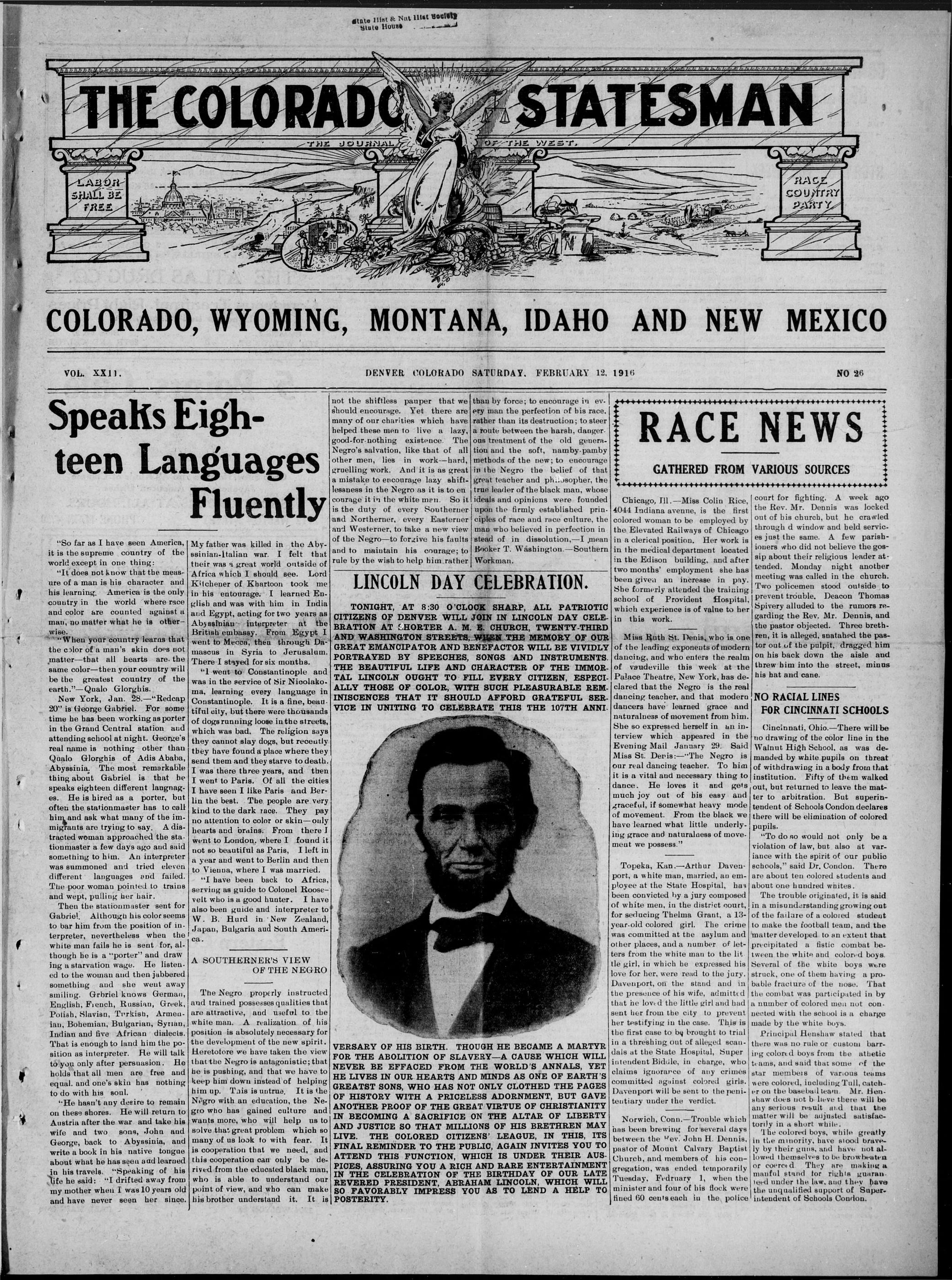
LINCOLN DAY CELEBRATION.
TONIGHT, AT 8:30 O'CLOCK SHARP, ALL PATRIOTIC CITIZENS OF DENVER WILL JOIN IN LINGOLN DAY CELEBRATION AT CHORTER A. M. E. CHURCH, TWENTY-THIRD AND WASHINGTON STREETS, WHEN THE MEMORY OF OUR GREAT EMANCIPATOR AND BENEFACTOR WILL BE VIVIDLY PORTRAYED BY SPEECHES, SONGS AND INSTRUMENTS. THE BEAUTIFUL LIFE AND CHARACTER OF THE IMMORTAL LINGOLN OUGHT TO FILL EVERY CITIZEN, ESPECIALLY THOSE OF COLOR, WITH SUCH PLEASURABLE REMINISCENCES THAT IT SHOULD AFFORD GRATEFUL SERVICE IN UNITING TO CELEBRATE THIS THE 107TH ANNI
A. B.
VERSARY OF HIS BIRTH. THOUGH HE BECAME A MARTYR FOR THE ABOLITION OF SLAVERY—A CAUSE WHICH WILL NEVER BE EFFACED FROM THE WORLD'S ANNALS, YET HE LIVES IN OUR HEARTS AND MINDS AS ONE OF EARTH'S GREATST SONS, WHO HAS NOT ONLY CLOTHED THE PAGES OF HISTORY WITH A PRICELESS ADORNMENT, BUT GAVE ANOTHER PROOF OF THE GREAT VIRTUE OF CHRISTIANITY IN BECOMING A SACRIFICE ON THE ALTAR OF LIBERTY AND JUSTICE SO THAT MILLIONS OF HIS BRETHREN MAY LIVE. THE COLORED CITIZENS' LEAGUE, IN THIS, ITS FINAL REMINDER TO THE PUBLIC, AGAIN INVITES YOU TO ATTEND THIS FUNCTION, WHICH IS UNDER THEIR AUSPICES, ASSURING YOU A RICH AND RARE ENTERTAINMENT IN THE CELEBRATION OF THE BIRTHDAY OF OUR LATE REVERED PRESIDENT, ABRAHAM LINCOLN, WHICH WILL SO FAVORABLY IMPRESS YOU AS TO LEND A HELP TO POSTERITY.
not the shiftless pauper that we should encourage. Yet there are many of our charities which have helped these men to live a lazy, good-for nothing existence. The Negro's salvation, like that of all other men, lies in work—hard, gruelling work. And it is as great a mistake to encourage lazy shiftlessness in the Negro as it is to encourage it in the white men. So it is the duty of every Southerner and Northerner, every Easterner and Westerner, to take a new view of the Negro—to forgive his faults and to maintain his courage; to rule by the wish to help him rather
than by force; to encourage in every man the perfection of his race, rather than its destruction; to steer a route between the harsh, dangerous treatment of the old generation and the soft, namby-pamby methods of the new; to encourage in the Negro the belief of that great teacher and philosopher, the true leader of the black man, whose ideals and opinions were founded upon the firmly established principles of race and race culture, the man who believed in perfection in stead of in dissolution,—I mean Booker T. Washington.—Southern Workman.
RACE NEWS
GATHERED FROM VARIOUS SOURCES
Chicago, Ill.—Miss Colin Rice, 4044 Indiana avenue, is the first colored woman to be employed by the Elevated Railways of Chicago in a clerical position. Her work is in the medical department located in the Edison building, and after two months' employment she has been given an increase in pay. She formerly attended the training school of Provident Hospital, which experience is of value to her in this work.
Miss Ruth St. Denis, who is one of the leading exponents of modern dancing, and who enters the realm of vaudeville this week at the Palace Theatre, New York, has declared that the Negro is the real dancing teacher, and that modern dancers have learned grace and naturalness of movement from him. She so expressed herself in an interview which appeared in the Evening Mail January 29. Said Miss St. Denis:—"The Negro is our real dancing teacher. To him it is a vital and necessary thing to dance. He loves it and gets much joy out of his easy and graceful, if somewhat heavy mode of movement. From the black we have learned what little underlying grace and naturalness of movement we possess."
Topeka, Kan.—Arthur Davenport, a white man, married, an employee at the State Hospital, has been convicted by a jury composed of white men, in the district court, for seducing Thelma Grant, a 13-year-old colored girl. The crime was committed at the asylum and other places, and a number of letters from the white man to the little girl, in which he expressed his love for her, were read to the jury. Davenport, on the stand and in the presence of his wife, admitted that he loved the little girl and had sent her from the city to prevent her testifying in the case. This is the first case to be brought to trial in a threshing out of alleged scandals at the State Hospital, Super intendent Biddle, in charge, who claims ignorance of any crimes committed against colored girls. Davenport will be sent to the penitentiary under the verdict.
Norwich, Conn.—Trouble which has been brewing for several days between the 1ev. John H. Dennis, pastor of Mount Calvary Baptist Church, and members of his congregation, was ended temporarily Tuesday, February 1, when the minister and four of his flock were fined 60 cents each in the police
NO 26
court for fighting. A week ago the Rev. Mr. Dennis was locked out of his church, but he crawled through d window and held services just the same. A few parishioners who did not believe the gossip about their religious leader attended. Monday night another meeting was called in the church. Two policemen stood outside to prevent trouble. Deacon Thomas Spivery alluded to the rumors regarding the Rev. Mr. Dennis, and the pastor objected. Three brethren, it is alleged, snatahed the pastor out of the pulpit, dragged him on his back down the aisle and threw him into the street, minus his hat and cane.
NO RACIAL LINES
FOR CINCINNATI SCHOOLS
Cincinnati, Ohio.—There will be no drawing of the color line in the Walnut High School, as was demanded by white pupils on threat of withdrawing in a body from that institution. Fifty of them walked out, but returned to leave the matter to arbitration. But superintendent of Schools Condon declares there will be elimination of colored pupils. "To do so would not only be a violation of law, but also at variance with the spirit of our public schools," said Dr. Condon. There are about ten colored students and about one hundred whites.
The trouble originated, it is said in a misunderstanding growing out of the failure of a colored student to make the football team, and the matter developed to an extent that precipitated a fistic combat between the white and colored boys. Several of the white boys were struck, one of them having a probable fracture of the nose. That the combat was participated in by a number of colored men not connected with the school is a charge made by the white boys.
Principal Henshaw stated that there was no rule or custom barring colored boys from the athletic teams, and said that some of the star members of various teams were colored, including Tull, catcher on the baseball team. Mr. Henshaw does not believe there will be any serious result and that the matter will be adjusted satisfactorily in a short while.
The colored boys, while greatly in the minority, have stood bravely by their guns, and have not allowed themselves to be browbeaten or coerced. They are making a manful stand for rights guaranteed under the law, and they have the unqualified support of Superintendent of Schools Condon.
CONDENSATION OF FRESH NEWS
THE LATEST IMPORTANT DIS
PATCHES PUT INTO SHORT,
CRISP PARAGRAPHS.
STORY OF THE WEEK
SHOWING THE PROGRESS OF EVENTS IN OUR OWN AND FOREIGN LANDS.
Western Newspaper Union News Service.
ABOUT THE WAR
The British steamer Argo has been sunk. One member of the crew was lost.
London reports indicate that Earl Kitchener will take command of the British army in Egypt.
Four hundred and seventy Bulgars killed and 500 wounded by French aeroplanes in recent attacks on camp.
French and British artillery demolish portions of German trenches on west front. British advance repulsed near Neuville.
Furious artillery duels are in progress along the Franco-Belgian front. The Italians and Austrians are having similar engagements
About 14,900 German troops from West African colony crossed the border into Spanish territory and were disarmed and interned.
Apparently authoritative reports in Washington are that the United State will accept Germany's latest suggestion for settlement of the Lusitania case.
Austrian troops are sweeping through Albania, while the Montenegrin troops and the Serbs have effected a junction at Durazzo, the chief Albanian seaport.
Earl Kitchener probably will quit the British Cabinet to take active command in the field. A civilian will succeed him as secretary of state, but the war part of his office will be filled by an officer. Germany's plan of shifting troops from one point to another was frustrated by a united attack by the allies on all fronts. Some ground was gained by the allies, but according to Berlin the Germans recaptured most of it.
WESTERN
Nineteen die and twenty towns swept by Arkansas floods.
Mrs. Pauline Randle was divorced at San Francisco from her husband, Jules, who she swore, has been drunk for thirteen years.
Two persons were killed and a third injured in a snow and mud slide which wrecked two cottages at Magnolia Bluff in the extreme northwestern part of Seattle, Wash.
Despite a contrary ruling by Attorney General Lucey, the Cook county, IL, election board accepted the decision of their counsel that women may be allowed to vote for delegates and alternates to the national conventions.
The Metropolitan Street Railway Company, under a settlement reached in the Circuit Court at Kansas City, agreed to pay Miss Evelyn Whittington, 16 years old, $500 for a kiss administered by one of the company's conductors.
The federation of state medical boards elected the following officers at Chicago: President. Dr. David A. Stickler, Denver; vice president, Dr. Walter P. Bowers, Boston; secretary and treasurer, Dr. Walter L. Bierring, Des Moines, Iowa.
C. W. Keggale, aged 40, a prominent Baptist minister of Sherman, Tex., was shot and probably fatally wounded by Mrs. Finest Faust, who lives near Denison. The woman fired five shots. When arrested a few minutes later she said the minister had insulted her.
WASHINGTON
Public lands committee heard western men on 640-acre grazing homestead bill.
The House passed the bill to provide for coinage of 100,000 McKinley souvenir dollars.
Big gunsites wanted by the United States at the approaches of the Panama canal probably will be ceded to this country by Panama.
The House adopted resolution making immediately available $500,000 for the Mare Island navy yard and $100,000 for the New York navy yard for battleship construction equipment.
The annual Indian appropriation bill, including provision for paying Choctaw and Chickasaw tribesmen $7,500,000 in accrued profits on their lands, was passed in the House. It carries appropriations aggregating about $10,705,000.
Speaker Clark and Republican Leader Mann fought side by side in the House for adequate national defense. With party lines obliterated, most of the members followed their leaders and two navy measures passed without a dissenting vote.
Great Britain promised the United States to permit the prompt transportation from Rotterdam of a large quantity of sugar beet seed bought in Austria for sugar beet farms in Utah, which are expected to make the United States independent of the European supply.
FOREIGN
At Panama three sharp earthquake shocks occurred. The whole city and the canal zone were shaken.
Fears that Chihuahua city will be attacked by forces led by Francisco Villa are general in that city.
A Bucharest dispatch to the Milan Secola says that in the explosion at the Skoda armament factory in Bohemia, 195 workmen perished.
King George's coronation gift to Emperor Yoshihito is a beautiful bay horse which arrived a few days ago at the imperial stables from India.
According to advices received at Panama, from La Paz, capital of Bolivia, a section of the city about 1,600 yards long is sliding into the Choqueyah river.
President Forras formally opened the Panama national exposition, which had been postponed several times owing to delay in the completion of the buildings and in obtaining exhibits.
Col. Hipolito Villa, brother of Gen. Francisco Villa, was arrested at Havana at the request of William E. Gonzales, the American minister to Cuba. Villa is charged with damaging the railroad near El Paso.
Sensational reports of the discovery of new German plots were in circulation as parliament prepared to assemble at Ottawa, Ont., to discuss the origin of the fire that destroyed the Canadian parliament buildings.
Viscount Bryce, former ambassador to the United States, speaking at Bedford College, London, condemned the policy of reprisals against Germany, which, since the last Zeppelin raid, has gained many advocates.
The government at Peking announced that its troops had recaptured Pingshan, northeast of Siu-Fu, in the southern part of Sze-Chuen province, and that a general attack upon the rebels at Siu-Fu is imminent.
Gaston Plaintiff, financial manager of the Ford peace expedition; Judge Ben B. Lindsey of Denver; the Rev, Jenkin Lloyd Jones of Chicago, and Gov. L. B. Hanna sailed from Rotterdam for New York on the Nieuw Amsterdam.
SPORTING NEWS
Johnny Ertle, bantam champion, signed to box Roy Moore at Minneapolis March 17.
Adolph Wolgast and Frankie Burns stepped off ten vicious rounds at Kansas City in a no-decision battle.
Jack Dillon of Indianapolis outfought Battling Levinsky of New York in a ten-round bout in Brooklyn.
The Western Association of baseball clubs will play 140 games during the coming season, opening April 20 and closing Labor day, Sept. 4.
The management of the Philadelphia National league baseball club announced that the club has secured Wilbur Good, outfielder, from the Chicago Nationals.
O. S. Goff, business agent of the Arkansas Valley Baseball league, is making a wholesale raid on the semi-proball teams in Denver. He sent offers to twelve players who have been performing on the corner lots of Denver the last few seasons.
It is announced at Grand Junction, Colo., that Raymond Fagan, son of Master Mechanic J. L. Fagan, has been given a berth with the Detroit Tigers for the 1916 season. Last season Fagan pitched for Oklahoma City and won all thirteen of the games he pitched.
GENERAL
Henry Ford, the Detroit manufacturer who sent a peace ship to Europe, has a new peace plan. Formal announcement was made in St. Louis of the engagement of Miss Clara Busch, granddaughter of the late Adolphus Busch, and Percy Orthwein, an artist. At Sherman, Tex., the Rev. H. M. Cagle died of wounds inflicted when he was shot on the street by Mrs. Annie Faust. Mr. Cagle died without making any statement in regard to the affair. A thousand men battled with an oil fire on the Stevenson tract at Humble, Tex. The loss soon after the blaze started was estimated at $30,000. A driller named Hancock and a helper named Watt were severely burned.
Col. William P. Hepburn, former member of Congress, from the Eighth Iowa district, died at Clarinda after a long illness. Death resulted from kidney and heart trouble. Besides the widow, a son and daughter survive him.
Labor leaders in New York say that a movement is under way to bring about concerted action of members of the four great unions of railway employés and of the United Mine Workers in their demands for increased wages or shorter working days. It is stated that if this plan were put into effect it would bring about combined action by 750,000 men and affect the mining fields of Pennsylvania, Colorado and the South.
That President Wilson would be renominated without opposition, was the consensus of opinion of members of the subcommittee of the Democratic national committee, who met in St. Louis to arrange details for the Democratic national convention.
Michael Killilea, a dairyman who was employed by J. P. Morgan on his estate at East Island, Glencove, has won a verdict for $20,000 damages against Mr. Morgan for injuries suffered on the night of July 13 last, when Mr. Morgan was shot by Frank Holt, also known as Eric Muenter.
Western Newspaper Union News Service.
DATES FOR COMING EVENTS.
Feb. 16-18—Sports Carnival at Steam-
boat Springs.
Mrs. Meeting Western Colorado Teachers' Association at Grand Junction.
March 20-April 2—Colorado Retail Merchants' Association's Food and Industrial Exposition at Denver. April 13—Democratic State Convention at Pueblo.
The grip epidemic has taken a heavy toll among the aged residents of Denver.
Many farmers about Fort Morgan are arranging to raise a large acreage of beans the coming season.
What is expected to be the biggest pure food show ever given in the West will take place in the Denver Auditorium from March 20 to April 1.
Joe Cippollone, an Italian, was electrocuted in the Victor American Fuel Company's coal mine at Chandler by accidental contact with a transmission wire.
At the meeting of the Fort Morgan City Council the $40,000 bond issue of 1903 of the original water works construction fund was voted to be retired. This consisted of $3,000.
Led by Dr. Henry A. Buchtel, chancellor of Denver University, a Colorado branch of the League to Enforce Peace, of which former President Taft is the head, is being organized in Denver.
Fred L. Patrick, Denver mining man, was acquitted of the charge of involuntary manslaughter arising out of an accident last fall in which his automobile struck and killed A. B. Reynolds.
Tristan B. Peck, 82, a veteran of the civil war, is the oldest person who ever received a divorce in a Denver court. District Judge Butler gave him a divorce from Emma L. Peck, who deserted him forty years ago.
The superintendents of public instruction of the western land-holding states will meet in Denver Feb. 17 and 18 to form an organization of their own, separate from the national organization of superintendents.
David B. Moore, former evangelist, convicted of having fired a shot at his wife in a lawyer's office in Denver, was sentenced from the West Side Court to a term of one year the county jail and to pay a fine of $500.
With a net income for the twelve months of $2,316,175, and plans under consideration for growth and extension, the Mountain States Telephone and Telegraph Company closed Dec. 31, 1915, one of the most successful years of its history.
Arthur Montague, itinerant merchant who jumped his bond of $1,500 ten days ago, while awaiting trial on a charge of attacking a 17-year-old orphan girl, was returned to jail in Denver from Kansas City, where he was caught.
Dr. Bennett, Graff, held responsible by a Denver coroner's jury for the death of Mrs. Ruth Kamp, who died at Mercy hospital, and against whom a charge of murder has been lodged in the Criminal Court, must furnish $25,000 bail.
Barely forty-eight hours after his son, Douglas A. Roller, and his nurse, Mrs. Mary E. Robinson, were shot during a struggle with a burglar in a room next to where he lay sleeping, William W. Roller, 74, died at the home of his daughter, Mrs. J. Meyer, Jr., in Denver. Death was due to uremic poisoning.
A twelve-day blockade of railroad traffic in southwestern Colorado was lifted Monday. Delayed and regular traffic over the Denver & Rio Grande moved out of Durango and Alamosa. The line over Cumbres pass was cleared of drifts from six to thirty feet deep, ending the longest stoppage of traffic over this road for several years.
Mrs. Emerson J. Short of Denver, former president of the South Side Woman's Club, has been appointed Denver chairman of the enrollment committee of the woman's section of the Navy League of the United States by Elizabeth Ellicott Poe, general secretary of the organization. The aim of the organization is to enroll 1,000,000 members by March 1, who will stand for national preparedness
Reports that Lena Schwartz, chief witness for the state in the trial of George Reichert, Fort Collins rancer, and Eddie Lewis, a chauffeur, charged with responsibility for the death of Louise Mansfield, beaten and kicked at a Petersburg road house several weeks ago, has been offered a bribe to leave Denver and fail to appear at the trial, are being investigated by Samuel W. Johnson, district attorney for the First Judicial district.
A jury in Judge Burke's division of the District Court in Denver brought in a verdict in the suit of Knight Holloway, 14. against the Rev. Hugh L. McMenamin and Mrs. Euphemia Kelley, awarding Holloway $1,875.50 damages from each of the defendants.
Sheriff J. W. McBroom and Under-sheriff F. J. Curkeet of Arapahoe county raided the College Inn at Petersburg and arrested the proprietors, Mr. and Mrs. Frank F. Kehoe, a waitress named Iris Gearing and a piano player, Eddy Joyce, charging 'hem with the illegal sale of liquor.
EX-CONGRESSMAN DEAD
HON. F. E. BROOKS PASSES AWAY
AT ST. AUGUSTINE, FLA.
Coloradoan Taken III While on Trip to Washington in Interest of Fort Logan Bill.
Western Newspaper Union News Service.
Denver.-Franklin E. Brooks, former congressman from Colorado, who went to Washington recently as the representative of Denver commercial organizations to work for a greater Fort Logan, died at St. Augustine, Fla., where he had gone in an effort to recuperate from an apparently insignificant sickness which overtook him while in Washington.
Mr. Brooks's sudden death was wholly unexpected, although his health had not been good for several years. He was seized with an attack resembling grip and had decided to spend the rest of the winter in Florida. The body will be taken to Colorado Springs, his home city.
The former congressman was born in Sturbridge, Worcester county, Massachusetts, Nov. 19, 1860. He was educated in the public schools and at Brown University, from which latter institution he was graduated in 1883 with the degree of A.B. He afterward received the degree of A.M. from the same university.
Nominated by the Republicans for congressman-at-large in 1902, Mr. Brooks ran against Alva Adams and won, serving in the Fifty-eighth and Fifty-ninth congresses.
Silverton Gets Food
Denver, Feb. 9.—With the exception of the branch between Durango and Silverton, the snow blockade on the lines of the Denver & Rio Grande in southwestern Colorado has been lifted according to advices received at the general offices of the company Monday night.
There is but slight promise of relief before five days for the mining town of Silverton, which was reported suffering from a shortage of food supplies. The big rotary snowplow passed Rockwood on its way from Durango to Silverton. The distance between Rockwood and Silverton is twenty-seven miles, and at the present rate of progress it is doubtful if Silverton can be reached before Saturday.
A small quantity of provisions reached Silverton transported by men or snowmen.
Sheriff "Sol" Jones Is Dead.
Hot Sulphur Springs. — Solomon Jones, known all over Colorado as "Sol" Jones, sheriff of Grand county for the last twenty years, died at his hbme here from hardening of the arteries. Mr. Jones was 60 years old and was one of the pioneers of Grand county. Before the completion of the Moffat road he operated a stage line between Georgetown and Hot Sulphur Springs. He is survived by a widow and two daughters, Mrs. L. W. Kennedy and Mrs. Charles F. Fee. L. W. Kennedy is treasurer of Grand county.
Telephone Company to Spend Millions
Denver.—The annual meeting of the stockholders of the Mountain States Telephone and Telegraph Company was held Tuesday afternoon, at which the old officers and directors were re-elected. It was announced that the company would spend $3,950,000 in new plants and additions in 1916, of which amount $1,145,000 will be spent in the eastern division, comprising Colorado. The annual report showed the company had had a prosperous year.
Denver.—Mrs. Agnes Bell Nesbit, an aunt by marriage of Mrs. Evelyn Nesbit Thaw, died at the home of her daughter, Mrs. Jesse May Harris, of pneumonia. She was 59 years old. Mrs. Nesbit's husband, who died several years ago, was a brother of Mrs. Thaw's father.
W. C. T. U. Want Anti-Cigarette Law
Denver.—The Women's Christian Temperance Union plans the submission of a constitutional amendment placing a ban upon the manufacture or sale of cigarettes in Colorado, according to an announcement made by Mrs. Adrianna Hungerford, state president.
January, 1916, Coldest Since 1899.
Boulder.—January, 1916, was the coldest since 1899, according to records compiled at the University of Colorado. According to these figures he average mean temperature for the month this year was 25.36, or 9 degrees below normal.
Jane Addams Resting at Springs.
Colorado Springs.—Jane Addams of Chicago arrived here. She declines to see anyone and the information is given out that she is here to rest.
Endsley Freed in Dickens Case.
Denver. — John Elmore Endsley, whose meteoric flight into the Dickens murder mystery stirred Longmont, Boulder and Denver, passed out of the case again Saturday night, when he was released by Sheriff Buster of Boulder county, after every clew against him had proved groundless and no one came forth to file any formal charge against him. The last link in the alleged chain of evidence connecting him with the killing of W. H. Dickens, disappeared.
The Chesapeake
Fish & Oyster Co.
iver's Only Exclusive Fish and Oyster
sh, Oysters, Salt, Smoked, Dried and C
Poultry and Game of All Kinds
fifteenth Street Denver
KEY, Pres. J. C. RAMPS
PAUL J. SHIRLEY, Sec. and Treas.
E ATLAS DRUG
ous Treatmet. Right
Leaders in Prescription
N ST.
26TH A
5
Points Ca
The Chesapeake Fish & Oyster Co.
Denver's Only Exclusive Fish and Oyster House Fresh Fish, Oysters, Salt, Smoked, Dried and Canned Fish Poultry and Game of All Kinds 828 Fifteenth Street Denver, Colo.
C. H. SHIRLEY, Pres. J. C. HAMPSON, Vice Pres PAUL J. SHIRLEY, Sec. and Treas.
THE ATLAS DRUG CO.
Courteous Treatmet. Right Prices
Leaders in Prescription
Store No. 1.
2701 WELTON ST.
Main 895 875
Store No. 2.
26TH AND WELTON
Main 4955 4956
5 Points Cafe
UNDER NEW MANAGEMENT.
Chop Suey, Noodle
Japanese and
SHORT ORDER
2712 WELTON STREET
W. C. CAMPTON, Pres. J. M.
RAILROAD
LUNCH ROO
金
Suey, Noodles and All Kinds of C
Japanese and American Dishes
ORT ORDERS AT ALL HOT
TON STREET PHONE
TON, Pres. J. M. JOHNS, Treas. U. P. JA
ROAD PORTERS' C
UNCH ROOM IN CONNECTION
Chop Suey, Noodles and All Kinds of Chinese Japanese and American Dishes
SHORT ORDERS AT ALL HOURS
WELTON STREET PHONE MAIN 4/30
W. C. CAMPTON, Pres. J. M. JOHNS, Treas. U. P. JACKSON, Sec. RAILROAD PORTERS' CLUB LUNCH ROOM IN CONNECTION
BILLIARDS AND
POOL
1728½ Wazee St. C
J. B. I
PHONE MAIN 8416.
1/2 Wazee St. Only one block from Union
J. B. MINTER. Barber.
E MAIN 8416. DENVER, COLO
1728 $ \frac{1}{2} $ Wazee St. Only one block from Union Depot.
J. B. MINTER. Barber.
PHONE MAIN 8416. DENVER, COLORADO.
JOHN K. RETTIG
Fancy and Staple Gro
1864 CURTIS STREET
enth.
MARKET COM
E. SMITH, Manager, Res. Phone South
Retail Staple and Fancy Groceries, Fi
Hotels and Restaurants Our Specialty
Fresh and Cured
Eastern Corn Fed M
JOHN H
Meats, Fancy a
1864 CU
Corner Nineteenth.
The MARK
C. E. SMITH, M
Wholesale and Retail Staple
Hotels and Re
Frees
Eastern C
The MARKET COMPANY
C. E. SMITH, Manager, Res. Phone South 1608
Wholesale and Retail Staple and Fancy Groceries, Fish and Oysters. Hotels and Restaurants Our Specialty. Fresh and Cured
Eastern Corn Fed Meats
Fruits, Vegetables, Poultry and Game.
Telephones Ma
622-636 15th Street
HAVE YOUR CLOTHES
ALTERED
Mutua
and C
Telephones Main 4302, 4303, 4304, 4305th Street Denver
CLOTHES CLEANED, PRESSED
ALTERED AND DYED AT THE
Mutual Tailor
nd Cleaner
HAVE YOUR CLOTHES CLEANED, PRESSED, REPAIRED, ALTERED AND DYED AT THE
Mutual Tailors and Cleaners
LADIES' AND GENTLEMEN'S SUITS MADE TO ORDER.
Our Work Will Please
Gentlemen's Suits Cl
Overcoats.....
Gloves.....
Neckties....
Kill Will Please You—Our Prices are Reduced Men's Suits Cleaned and Pressed.....
coats.....
les.....
tles.....
ST. CAT.
Gentlemen's Suits Cleaned and Pressed.....75 Overcoats.....75 Gloves.....05 Neckties.....05
---
PHONE MAIN 3028
2204 WELTON ST.
All Kinds of Chinese
American Dishes
AT ALL HOURS
PHONE MAIN 4/30
Treas. U. P. JACKSON, Sec.
TERS' CLUB
CONNECTION
FREE CHECK
ROOM
ock from Union Depot.
Barber.
DENVER, COLORADO.
RES. PHONE GALLUP 942
ETTIG
taple Groceries
STREET
Denver, Colo.
COMPANY
Phone South 1608
Groceries, Fish and Oysters
Our Specialty.
Fed Meats
303, 4304, 4305
Denver, Colorado
D, PRESSED, REPAIRED,
ED AT THE
Tailors
aners
Prices are Reasonable.
Pressed..... .75
..... .75
..... .05
..... .05
CALL MAIN 8519
Phone Champa 2211
CALL MAIN 8519
AFRO-AMERICAN CULLINGS
Nearly everybody has heard of Mound Bayou, Miss., the only exclusive "Negro city" in the United States. It has attracted public attention to an extent only second to Tuskegee as an effort to help lead the Negro to the solution of the problem of the industrial life. All the town officials, the postmaster, railroad agent, and everybody else is a Negro. And all the property is owned by Negroes.
Now comes word that this community is threatened with grave embarrassment due to financial difficulties. Well-known men, North and South, are named as patrons of a plan to aid the founder of the city, whose services to both the black and white race are freely admitted by the leading newspapers of that section. Among the patrons of the plan, which is, briefly, a bond issue on the founder's entire holdings, are Stuyvesant Fish, ex-Senator Leroy Percy, Bishop Theodore Bratton of the Episcopal church, Charles Scott, formerly president of the Mississippi River Levee association; C. P. J. Mooney, editor of the Commercial Appeal, Memphis; J. A. Hayes of Colorado, son-in-law of Jefferson Davis, and others almost as well known.
Isaiah T. Montgomery's remarkable character and services are at the back of these spontaneous tributes to the leading spirit of the Mound Bayou community. He was a slave of the Davis family and was the lifelong friend of Jefferson Davis, president of the confederacy. Immediately after the war he came to be the master of the estate on which he was once a slave, but only for a brief period, for the property was soon restored to the Davis family.
Not as a slave, but as leader of his race he gained his recognition. He has stood during his entire life for the principle of good relations between the white and black races. He has constantly urged his people to be honest, thrifty, and, above all, law-abiding. He has especially emphasized the great advance which the race could achieve through earnest industry and economy.
He has the distinction of having been the only Negro member of the Mississippi constitutional convention of 1890—the body which adopted the literacy test for voting. He was a member of the committee on the franchise. And when the plan had been adopted he accepted it as not taking away the franchise from his race but putting that great birthright of American citizens on the highest plane. His speech in the convention showed him to be an orator of no mean rank and electrified not only the members but attracted national attention. The present financial difficulties are due in the main to the stress of last year, with its short crop in his section, and extremely low prices for products.—Exchange.
The memory of Booker T. Washington, educator, will be perpetuated in Chicago by a practical memorial building to be named in his honor March 1, when the building of the Kehilath Anshe Mayriv Reformed Jewish congregation, East Thirty-third street and Indiana avenue, is purchased at a cost of $85,000. The building will be renamed the Booker T. Washington memorial and when refitted will be used as a social center and industrial training school for Negro children of Chicago. It will care for 1,000 to 1,500 children and will solve for hundreds of parents the problem of how to keep
That the Negro race in America will serve the United States faithfully and patriotically, was asserted by Prof. Kelly Miller of Howard university, in an address at a meeting of the Bethel Literary and Historical association at Metropolitan A. M. E. church, Washington. Having for his subject "Howard University Facing the Future," Professor Miller said, in part: "The Afro-American is sometimes used as a hyphenated designation of the Negro race. But there is no hyphen that separates his patriotism from that of the American people. He is as good a citizen as the American people will allow him to be. Howard University absolutely repudiates the hyphen, and, with Mr. Roosevelt, would relegate it to the region where it belongs. In the midst of feverish haste for national preparedness, no one is wise enough to predict what patriotic demand may be made upon this nation in the near, or even in the immediate, future. But when that day comes, if come it must, the Negro will, for the time, swallow his just grievances, and respond to his country's call as enthusiastically as he did when the na-
Unless you can play it pretty well, to own a fiddle is a sign of shiftlessness. But the most marked indication of shiftlessness is to own a fox-hound.
You will be glad to learn that two young Americans finally have responded to the insistent demand that somebody walk around the world on stilts.
Occasionally a man knows a good thing when he sees it, but most men are too dignified.
their children off the streets and out of bad company while they themselves are at work. A popular subscription to raise the sum necessary to purchase the building and grounds has been started by colored and white friends of the late Doctor Washington and a committee of directors of the subscription fund has been appointed. The Chicago Title and Trust company has been named as treasurer and depository for all subscription funds for the memorial. The movement was started by the officers of the Lincoln-Lee institute of North Chicago, which will have charge of the memorial after it is purchased and turned into a social center and school.
"The white and colored friends of Booker T. Washington wished to perpetuate his memory in Chicago and decided upon the purchase of a suitable building for training the mind of the young colored man," said Dr. William A. Venerable, colored, principal of the Lincoln-Lee institute. "The members of the Jewish congregation interested in this movement offered the ground and building, which cost $136,000, for $85,000. We hope to raise the money by March 1."
The directors of the subscription fund are:
John D. Shoop, superintendent of schools.
John J. Arnold, vice-president of the First National bank.
Jesse Binga, banker.
Edward O. Brown.
Henry Stuckart, county treasurer.
David C. Dunbar.
Edward P. Smith. Dr. Max Herschleder, president of the board of trustees of the Lincoln-Lee institute.
Graduates of the colored high schools of Washington received their diplomas at the joint commencement exercises of the five leading colored high schools of the district on Convention hall, reports the Washington Star. There were addresses by E. L. Thurston, superintendent of schools; Charles F. Nesbit, commissioner of insurance, besides several leaders of the colored race in Washington, including Archibald H. Grimke, formerly the United States representative at Santo Domingo. There were 219 graduates altogether. The Cardoza Vocational School graduated 22, while 30 came from the O Street Vocational School. There were 54 graduates of the Armstrong Manual Training school and 100 from the M Street High school. In the department of business practice of the M Street High school there were thirteen graduates. Ernest L. Thurston, superintendent of education, awarded the scholarships and prizes. The award of diplomas was made by Dr. Charles H. Marshall for the M Street High school; Armstrong school, by Dr. Creed W. Childs, and for the Cardoza and O Street Vocational schools, Mrs. Coralie F. Cook. Archibald H. Grimke, president of the Washington Branch of the National Association for the Advancement of the Colored People, delivered the address to the graduates. Commissioner Nesbit, in awarding the prizes for the essays on fire protection, gave some interesting figures on the damage done through ignorance of the proper precautions against fire. Superintendent Thurston, speaking to the graduates to whom he was about to award the scholarships and prizes, declared that they were the coming men of their race.
tion's life was imperilled a generation ago. Howard university, as the national university of this race, is proud to contribute its share in inspiring and perpetuating this patriotic spirit in the American youth committed to its care. Howard university faces the future with assurance that it can rely upon the philanthropy and patriotism of the American people, to whom it contributes more than it derives." Earlier in his talk he referred to the objects of the institution, saying: "The chief aim of Howard university is to produce an educated and efficient leadership. The function of the Negro college is to prepare choice youth of this race to stand in the high places of intellectual, moral and spiritual authority among their less fortunate fellows. The blind cannot lead the blind, lest they both fall in the ditch. For want of vision the people perish, as well as for want of provision."
Prospectors for gold, who have been locating claims in the Rice Lake district, 100 miles north of Winnipeg, report that the territory is rich in minerals.
A complete steam fire engine, mounted on two wheels and light enough to be handled by two men, has been invented in England for suburban and private use.
Advice to women: If you love a man, do not scrutinize him too closely when he is eating. Watching a man eat is the heaviest cross love has to bear.
Some men talk like $1.98 phonographs.
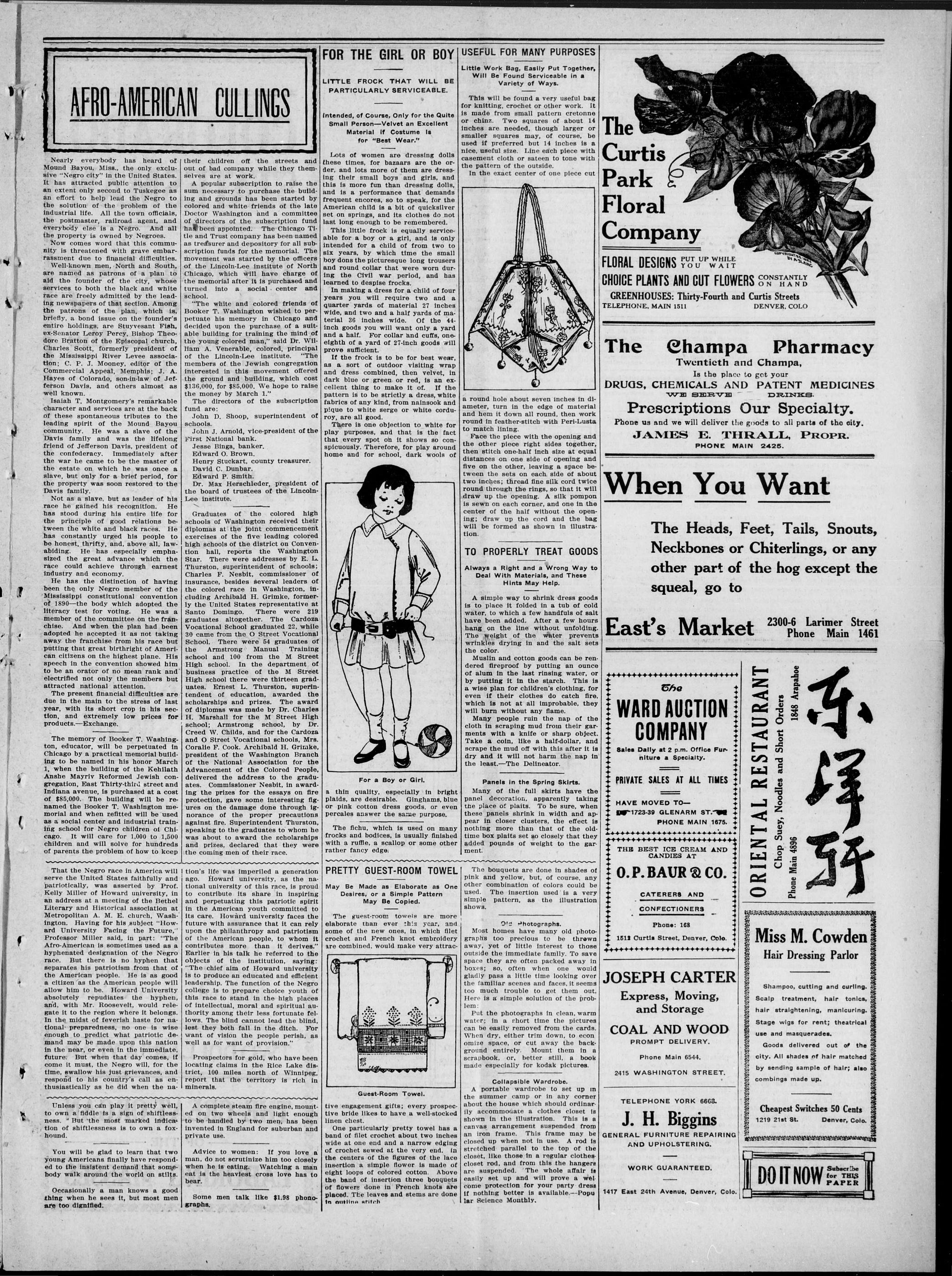
FOR THE GIRL OR BOY
LITTLE FROCK THAT WILL BE
PARTICULARLY SERVICEABLE.
Intended, of Course, Only for the Quite Small Person—Velvet an Excellent Material if Costume is for "Best Wear."
Lots of women are dressing dolls these times, for bazaars are the order, and lots more of them are dressing their small boys and girls, and this is more fun than dressing dolls, and is a performance that demands frequent encores, so to speak, for the American child is a bit of quicksilver set on springs, and its clothes do not last long enough to be remembered.
This little frock is equally serviceable for a boy or a girl, and is only intended for a child of from two to six years, by which time the small boy dons the picturesque long trousers and round collar that were worn during the Civil war period, and has learned to despise frocks.
In making a dress for a child of four years you will require two and a quarter yards of material 27 inches wide, and two and a half yards of material 36 inches wide. Of the 44-inch goods you will want only a yard and a half. For collar and cuffs, one-eighth of a yard of 27-inch goods will prove sufficient.
If the frock is to be for best wear, as a sort of outdoor visiting wrap and dress combined, then velvet, in dark blue or green or red, is an excellent thing to make it of. If the pattern is to be stricty a dress, white fabrics of any kind, from nainsook and pique to white serge or white corduroy, are all good.
There is one objection to white for play purposes, and that is the fact that every spot on it shows conspicuously. Therefore, for play around home and for school, dark wools of
A girl in a dress
For a Boy or Girl.
a thin quality, especially in bright plaids, are desirable. Ginghams, blue or pink cotton dress goods, or even percales answer the same purpose.
The fichu, which is used on many frocks and bodices, is usually finished with a ruffle, a scallop or some other rather fancy edge.
PRETTY GUEST-ROOM TOWEL
May Be Made as Elaborate as One Desires, or a Simple Pattern May Be Copied.
The guest-room towels are more elaborate than ever this year, and some of the new ones, in which fillet crochet and French knot embroidery are combined, would make very attrac-
Guest-Room Towel. tive engagement gifts; every prospective bride likes to have a well-stocked linen chest.
One particularly pretty towel has a band of filet crochet about two inches wide at one end and a narrow edging of crochet sewed at the very end. In the centers of the figures of the lace insertion a simple flower is made of eight loops of colored cotton. Above the band of insertion three bouquets of flowers done in French knots are placed. The leaves and stems are done in outline stitch
USEFUL FOR MANY PURPOSES
Little Work Bag, Easily Put Together, Will Be Found Serviceable in a Variety of Ways.
This will be found a very useful bag for knitting, crochet or other work. It is made from small pattern cretonne or chinz. Two squares of about 14 inches are needed, though larger or smaller squares may, of course, be used if preferred but 14 inches is a nice, useful size. Line each piece with casement cloth or sateen to tone with the pattern of the outside.
In the exact center of one piece cut
```markdown
```
a round hole about seven inches in diameter, turn in the edge of material and hem it down all round, then work round in feather-stitch with Peri-Lusta to match lining.
Face the piece with the opening and the other piece right sides together, then stitch one-half inch size at equal distances on one side of opening and five on the other, leaving a space between the sets on each side of about two inches; thread fine silk cord twice round through the rings, so that it will draw up the opening. A silk pompon is sewn on each corner, and one in the center of the half without the opening; draw up the cord and the bag will be formed as shown in illustration.
TO PROPERLY TREAT GOODS
Always a Right and a Wrong Way to Deal With Materials, and These Hints May Help.
A simple way to shrink dress goods is to place it folded in a tub of cold water, to which a few handfuls of salt have been added. After a few hours hang on the line without unfolding. The weight of the water prevents wrinkles drying in and the salt sets the color.
Muslin and cotton goods can be rendered fireproof by putting an ounce of alum in the last rinsing water, or by putting it in the starch. This is a wise plan for children's clothing, for even if their clothes do catch fire, which is not at all improbable, they will burn without any flame.
Many people ruin the nap of the cloth in scraping mud from their garments with a knife or sharp object. Take a coin, like a half-dollar, and scrape the mud off with this after it is dry and it will not harm the nap in the least.—The Delielineator.
Panels in the Spring Skirts.
Many of the full skirts have the panel decoration, apparently taking the place of plaits. To be sure, when these panels shrink in width and appear in closer clusters, the effect is nothing more than that of the old-time box plaits set so closely that they added pounds of weight to the garment.
The bouquets are done in shades of pink and yellow, but, of course, any other combination of colors could be used. The insertion used is a very simple pattern, as the illustration shows.
Old Photographs.
Most homes have many old photographs too precious to be thrown away, yet of little interest to those outside the immediate family. To save space they are often packed away in boxes; so, often when one would gladly pass a little time looking over the familiar scenes and faces, it seems too much trouble to get them out. Here is a simple solution of the problem:
Put the photographs in clean, warm water; in a short time the pictures can be easily removed from the cards. When dry, either trim down, to ecomize space, or cut away the background entirely. Mount them in a scrapbook, or better still, a book made especially for kodak pictures.
Collapsible Wardrobe.
A portable wardrobe to set up in the summer camp or in any corner about the house which should ordinarily accommodate a clothes closet is shown in the illustration. This is a canvas arrangement suspended from an iron frame. This frame may be closed up when not in use. A rod is stretched parallel to the top of the closet, like those in a regular clothes-closet rod, and from this the hangers are suspended. The whole affair is easily set up and will prove a welcome protection for your party dress if nothing better is available.—Popular Science Monthly.
FLORAL DESIGNS PUT UP WHILE YOU WAIT
CHOICE PLANTS AND CUT FLOWERS CONSTANTLY ON HAND
GREENHOUSES: Thirty-Fourth and Curtis Streets
TELEPHONE, MAIN 1511 DENVER, COLO
The Champa Pharmacy
The Champa Pharmacy
Twentieth and Champa,
Is the place to get your
DRUGS, CHEMICALS AND PATENT MEDICINES
WE SERVE DRINKS.
Prescriptions Our Specialty.
Phone us and we will deliver the goods to all parts of the city.
JAMES E. THRALL, PROPR.
PHONE MAIN 2425.
When You Want
When You Want
The Heads, Feet, Tails, Snouts, Neckbones or Chiterlings, or any other part of the hog except the squeal, go to
Sales Daily at 2 p.m. Office Furniture a Specialty.
PRIVATE SALES AT ALL TIMES
HAVE MOVED TO
1723-39 GLENARM ST.
PHONE MAIN 1675.
THE BEST ICE CREAM AND
CANDIES AT
O.P. BAUR & CO.
CATERERS AND
CONFECTIONERS
Phone: 168
1512 Curtis Street, Denver, Colo.
JOSEPH CARTER
Express, Moving,
and Storage
COAL AND WOOD
PROMPT DELIVERY.
Phone Main 6544.
2415 WASHINGTON STREET.
TELEPHONE YORK 6668.
J. H. Biggins
GENERAL FURNITURE REPAIRING
AND UPHOLSTERING.
WORK GUARANTEED.
1417 East 24th Avenue, Denver, Colo.
2300-6 Larimer Street
Phone Main 1461
ORIENTAL RESTAURANT
Chop Suey, Noodles and Short Orders
Phone Main 4896
1848 Arapahoe
Miss M. Cowden
Hair Dressing Parlor
Shampoo, cutting and curling. Scalp treatment, hair tonics, hair straightening, manicuring. Stage wigs for rent; theatrical use and masquerades. Goods delivered out of the city. All shades of hair matched by sending sample of hair; also combings made up.
Cheapest Switches 50 Cents
1219 21st St. Denver, Colo.
DO IT NOW Subscribe for THIS PAPER
health of woman workers is one of the utmost importance, not alone on
account of the efficiency of the individual, but because the future welfare
of the race may be materially affected by the health of these potential
mothers.
A woman’s nervous organization is more sensitive than that of a man.
In many trades, occupations and employments this very fact has been
responsible for women’s success. Good taste, tact and deftness are quali-
ties which should be cultivated to secure the greatest value from the
services of female employees.
The maximum number of hours of labor may not always bring the
maximum of production, Scientific efficiency experts have proved that
shorter hours and reasonable rest periods often result in increased produc-
tion. Nearly all corporations and large employers of woman workers have
learned that by making adequate provision for the care of their employees
their efficiency is increased.
‘The woman in business should remember that within certain limita-
tions her well-being rests largely in her own hands.
There are four essentials for health:
* Eight hours’ sleep in the fresh air.
Regular exercise.
Sensible clothing.
Wholesome food.
Without these neither men nor women can maintain their physical well-
seing for any lengthy period. .
No woman should try working on her nerves. This may be kept up
tor quite a while when pleasure or the demands of business tempt one
io rob oneself of the necessary amount of rest. Invariably one must foot
the bills, so in the end the reaction is apt to prove dangerous,
constantly being told that we should not live beyond our means. But
the truth is that the standard of living in this country is not too high,
and it never has been, and it never will be.
One can waste his means upon useless luxuries, of course. He can
go into debt for things which he could easily get along without. Most
of us are prone to try to imitate somebody else who is better able to have
everything the heart desires. But the high standard of living in this
country is all right, and everyone ought to be entitled to means enough
to live up to it.
I take no stock in talk about the thrift of the foreigners—how they
manage to get along on bare crusts, and how they live upon what the
average American wastes.
A human being, endowed with consciousness and applying his energy
to the tasks at hand, is entitled to something more than the so-called bare
necessities of life.
If one is compelled to live-upon a loaf of bread and a cup of water,
one can so live. But the point is that no one in the world ought to be
compelled to live miserably.
‘The trouble with a good many people is that they cannot adjust
themselves to a standard of living that is compatible with their earning
capacity or with their incomes. That is, they seek to fix a standard
which calls for a greater outlay than they can afford.
‘The standard may be no higher than it should be, but the income
may be much less. So it may be assumed that a great many people in
this country do not have as large incomes as they should have.
ous phases of the educational aspect of this matter is that since this type
is sensitively and nervously organized, with distinct nervous instability,
mental training in the school must necessarily increase this instability
unless body training is insisted upon all through the school term.
This should not be taken to Mean that a child of one type can be
changed into the other by physical culture. Not at all, but if such train.
ing is not administered we soon find acquired deformities added to th
delicate frame with which nature endowed it.
So the mother of the thick, round-faced child need not worry, bu
the mother of the slender, tall, delicate, thin-skinned, nervous child must
see to it that the mental is not cultivated at the expense of the physical
The best kind of insurance for that child’s future is osteopathic
supervision over its development and systematic gymnasium work ot
specially prescribed exercises which the osteopath finds are needed in th
particular case.
The regulation United States army setting-up exercises are abou!
the best which can possibly be incorporated into a few minutes’ work
for general results, but there should always be specifically prescribed exer.
cises for individual cases,
hinks. Besides, when a person premises with an “I think,” it weakens
vis assertion, because thinking is by no means an assurance of truth.
If one shoul: say “1 think it will rain tomorrow,” the very expres-
ion carries a doubt, because mere opinion is a lame matter, and the
vorld is chock-full of opinions. If, however, he should say, “It will rain
omorrow,” it carries come assurance, eyen if it is, after all, an opinion.
So the-man referred to in the first place doesn’t say “I think,” for
t is entirely superfluous, and he adds force and dignity to what he says
in omitting it entirely,
And then when one looks at the situation calmly he will conclude
that think is much under a cloud, since very few people think exactly
ike.
ELLE, OPE I ALA LOE EE
THE COLORADC\ 27K STATESMAN |
EVERY 7 STAAL OMAN
Gao Sty eve Gee
rea ae] Ree _———>=———_
eel Ae Cea De garage |S
ey IE Fg Ne es Cee
A Re ea
eA EA TESA 5S ead
o a =
SOG IN DO" RIVRBR, 06a. cose eesti swcectethesassssdssecskcsas pas FTODRMOE,
1824 Curtis Street, Room 26.
Phone Main 7417.
B ____ SUBSCRIPTION RATES:
ips eae oo Sagas tote es ce raster eee Reeth oa ove kecnaZen tte ESM
Wier Mowtaa aE itsss Sie ieteceees Se Tio eee ee
Whine SMR sons so tecepetsatsebtssccbtedsdacssscucdesecsccyecses oO
PAYABLE IN ADVANCE.
Entered as second-class matter at the postoftice in the city of Denver,
Solorado. |
It occasionally happens that papers sent to subscribers are lost or stolen,
tm cate vou! do not receive any number wien due inform us by powtal cara #20
we will cheerfully forward a dupiicate of the missing number.
“Communications to recalve attention must be newsy, upon Umportant sub-
Jecta, plainly written only upon one side of the paper; must reach us Tuesdays,
if pémsibie, anyway, not later than Wednesdays, and bear the signature of the
author. No manuscript returned, unless stamps are sent for postage.
eee
Reading notices, ten nes or less, 10 cents per line, Each additional Hine
ever ten lines, 6 cents per line, |
Remittances should be made by Express Money Order, Postoffice Money
Order, Registered Letter or Bank Draft. Postage stamps will be received the
xame ax cash for the fractional nart of a dolar. Only 1-cent and 2-cent stamps
taken.
No aiccounts allowed on Jess than three months contract Cash must accom.
Dany ail orders trom parties unknown to us. ‘Further particulars om application
Display advertising, 60 cents per inch. An inch contains twelve agate lines
‘Ail communications of @ personating nature that are not complimentary
wi be withheld from the columns of this paper.
LOUIS D. BRANDEIS NOMINATED FOR U. S. SUPREME COURT.
President Wilson in his nomination of Mr. Louis D, Brandeis to be an
associate justice of the United States Supreme Court has come in for a little
more of “range firing,” as such a sensation is caused among the ranks of
‘opponents to the nomination. A telegram received at the office of the Judi-
ciary Committee showed that there existed prejudice, as it was worded thus:
“We protest to the end and resent vigorously the appointment of the Jew
to the United States Supreme Court bench. We American gentiles feel bit-
ter and will no longer support the President. Where he gained one Jew he
will lose 10,000 gentiles. It is a disgrace and a shame.
“SOUTHERN GENTILE DEMOCRATS.”
This telegram wears the same threat as some of the sentiments that
weighed with the President in his refusal to appoint a Negro to the position
of recorder of deeds. Now comes the test of the great democracy of Amer-
fea, Jew and Negro component parts of the nation subscribing their all to
its support, and yet discriminated against. While politics is playing a part
as is apparent, we can only repeat what we have said so often, that if the
American nation continues to play fast and loose with its citizens and holds
them up to the ridicule of other nations, she'll ultimately be consigned to
shame and degradation from which she will never recover unti] she ceases
to be such a delusion. Our constittition says we are all equal under the
law; we are all eligible to any positions that cam be attained, if-we have the
necessary qualifications, but some citizens will force their petty prejudices
and spites against actions of the government, and hence we can only expect
the worst some day. The Creator of mankind of one flesh made all men to
dwell on this earth, and we can see the handwriting on the wall if this sort
of thing is further indulged. —_,
Jew or Gentile, if he merits the position let him have it.
PREPAREDNESS LOCALLY APPLIED.
‘The President's plan of preparedness is causing the citizens of the coun-
try to think deeply and soberly, and while the war-thought is pre-eminent
in the minds of some with reference to the nation, others are engaging them:
selves in preparing for the necessary improvements for their respective
cities and states, whether in governmental betterment, civic beauty, finan-
cial progress or otherwise. When it comes upon the proud and lofty Amer-
ican nation in the safeguarding of its honor, dignity and prestige, it is as.
sumed that its navy and volunteer action would present the most aston.
ishing features to the world, but the deep-thinking man at the head of affairs
realizing the advantages to be gained by his keen observations of the present
European struggle, in the nation that prepares, is not resting on ASSUMP.
TION, as when the day of reckoning comes he wants to meet the enemy on
common, ground and on the level.
Preparedness at Home.
In Colorado we have had the experience—and that pretty often—of our
failures, disappointments, retrograde steps, etc., by not putting on the armor
of “preparedness.” Our political, social, educational and financial move |
ments at times seem to be clothed with a laxity that is generally very costly
in the end, and as we have discovered, not only for lack of “preparedness,’
but endeavoring to prepare at the last moment—when the enemy has made
an invasion of our territory and victimized us by cutting off all our re-
sources. We say, then, follow the wisdom of the ant, and so prepare that
even though the odds may be against us, yet laying up our stores in time
there is every hope of facing the means and extremes successfully, when
they present themselves,
Political Aspirations.
Already announcement is made of the different candidates that are as-
piring for state positions in Colorado, and while the state election is not until
the fall, yet we find the various parties beginning to convene for the selec-
tion of candidates, arranging platform planks, consulting their constituency
and strengthening their ranks for the prosecution of what they term the
righteousness of their cause and their civie liberty, Are these aspirants
acting wisely? Are they doing justice to themselves by making an early
start? Will their action (starting now) have any influence upon a people
who understand and value the use of the franchise? Everything points to
an affirmative reply, and this serves the purpose that results in success for
all well-balanced minds.
To Whom Profitable.
To those who follow in the steps of wise heads who are constantly
setting the standards as time rolls on, by which our achievements become
greater, in clinging to the quality of “preparedness’'—the code of which is
very simple after it becomes habitual. Men in their self-denying and sacri-
ficial efforts to warn their fellow-men of the dangers ahead, of the possi-
bility of destruction to a country and nation, are often thrust aside and
relegated to the order of “back numbers" until like the Saxon and the Gael—
“Too late, too late the advantage came to share the odds of deadly game.”
Again has the warning been given to those in authority, that unfair and un-
just dealing to a portion of the citizens of this country must meet its just
retribution, and when the sufferer, tiring of his tremendous sufferings, re-
fuses to entertain any more and boldly asserts his action of PREPARED-
NESS, then will the difference between the profitable and unprofitable actor
be demonstrated.
Prepare Therefore.
For whatever affects us along all lines and do not necessarily await
the advent of an individual to start or lead, but with a resolution begin (if
you haven't) today and be ready for any emergency, be it WEAL OR WOE.
q
Good Health of the
Business Woman
By SAMUEL, G. DIXON, M. D...Comminionar
q
Standard of Living
Is Not Too High
By W. B. MORELAND, Evanston, II
¢
Exercise Is Insurance
for Child’s Health
ByDR.R. KENDRICK SMITH, New York
ses of the educational aspect of th
tively and nervously organized, w
training in the school inust nec
ody training is insisted upon all
is should not be taken to mean t
| into the other by physical culture
not administered we soon find acc
frame with which nature endowe
the mother of the thick, round-1
ther of the slender, tall, delicate, t
t that the mental is not cultivated
e best kind of insurance for th:
sion over its development and s
y prescribed exercises which the o
lar case.
e regulation United States army
t which can possibly be incorpor
eral resulta, but there should alwa}
r individual cases,
—
¢
Clear-Headed Man
Says What He Thinks
By R. J. DONOHUE, Springfield, Ohio
——————————
Besides, when a person premises
wrtion, because thinking is by no
one shoule: say “I think it will r
rries a doubt, because mere opin
s chock-full of opinions. If, howe
w,” it carries some assurance, eye
the man referred to in the first
tirely superfluous, and he adds fo
ting it entirely,
d then when one looks at the sit
ink is much under a eloud, since
‘There are more than
eight million woman wage
earners in the United
States. They are repre-
sehted in almost every
branch of commercial ac-
tivity. This cueekion of the
| THE
‘COLORADO
STATESMAN
J LALDOWLAIN |
——CCCCCCCC——————————— :
The Mouth-Piece |
of the People of |
Colorado and the
_ Entire West
A RELIABLE chronicle |
: of their doings and |
- progress; a faithful mirror |
. of their wants, their hopes, |
| their best aspirations. |
: THE |
:
: Unequaled as an advertising |
/ medium for the business |
of professional men and |
- women. |
sible |
!
An excellent family journal
speaking to and for many |
thousand colored citizens. |
—— eee
|
TWO DOLLARS A YEAR |
———ooooaoaoaaeaeoeoTS=== ‘
‘
THE GREAT ORGAN |
One hears a great deal
these days about standards
of living. Some persons at-
tribute the financial and in-
dustrial depression through
which we passed last winter
to extravagance. We are
If proper exercises are
started early in life in the
case of the delicate type of
child, it can be brought up
to adult life with very dif-
ferent physique from that
seen-today. One of the seri-
natter is that since this type
distinct nervous instability,
rily increase this instability
ugh the school term.
a child of one type can be
Not at all, but if such train-
ed deformities added to the
1 child need not worry, but
skinned, nervous child must
the expense of the physical.
hild’s future is osteopathic
matic gymnasium work on
path finds are needed in the
ting-up exercises are about
into a few minutes’ work
> specifically prescribed exer-
A man was referred to as
one who in his conversation |
never says “I think” so and.
so. The “think” is a mere
expletive. A positive, clear-
headed man says what he
thinks, without saying he
th an “I think,” it weakens
"ans an assurance of truth.
tomorrow,” the very expres-
is a lame matter, and the
he should say, “It will rain,
' it is, after all, an opinion.
e doesn’t say “I think,” for
and dignity to what he says
ion calmly he will viele
ry few people think exactly)
THE COLORADO STATESMAN
THE ADVERTISING MAGAZINE OF THE STATE
CAN UNSHALL BE FREE
LAST COUNTRY PAITY
THE
COLORADO
STATESMAN
THE PEOPLE'S BUREAU
OF INFORMATION
1824 CURTIS STREET
Room 25.
DENVER, COLORADC
Phone:
Main 7417.
Miss Maude Carrie is reported quite
ill this week. We hope her a speedy
recovery.
George Anderson left Tuesday on a trip to Phoenix, Arizona, and California.
Mrs. Laura Gunnell is reported sick this week. We wish her a speedy recovery.
J. W. Wilson of 2246 Lincoln, who met with a misfortune by breaking his arm, is doing nicely and able to be at his work.
Mrs. Julia Hubbard was called to St. Louis last Tuesday to be at the bedside of her daughter, Mrs. Martha Mosley, who is very ill.
The thanks and appreciation of the Colored Citizens' League are offered the Joslin Dry Goods Company thru Mr. Carpenter, their assistant manager, for donation of flags in the decoration of Shorter Church, Twenty-third and Washington streets, for Lincoln Day celebration this evening at 8:30 o'clock.
We have just learned that on January 27th a swell luncheon was given in honor of the Board of Trustees of Rocky Mountain Lodge No. 1, F. & A. M., of which the G. M., T. S. Rector, and W. M., Spencer J. Smithea, were guests of J. R. Contee. The annual banquet was launched for Colorado Day, August 1st.
A CONTRADICTION.
To the United Brothers of Friendship and Sisters of Mysterious Ten, Jurisdiction of Colorado:
Because of the widely-circulated false report about me, I deny that I paid into Court or caused to be paid into Court any money on the account of the recent settlement of the Walton-Cammel judgment, and I further deny that I was in any way connected with the adjusting of said matter.
MRS. LAVINIA KNIGHT-OLIVER,
SHORTER CHAPEL NOTES.
Rev. Robert L. Pope, B.D., Pastor.
The Rev. John Adams, D.D., of Pueblo, Colo., will occupy the pulpit to tomorrow morning and the public will do well to avail itself of this opportunity to hear the eloquent message which he will bring to us. The pastor will fill the pulpit at the evening hour.
Our quarterly meeting last Sabbath was largely attended, especially at the morning service when Presiding Elder Ward delivered a remarkable serman. Four persons were admitted to membership: L. W. George, 2819 Glenarm; Lawrence George, 2828 Stout; Leon Rhone, 2238 Washington and Mrs. L. W. George, 2819 Glenarm. The first two names were recent converts to the Christian faith Rev. Jas. Washington rode one of his fiery steeds in the afternoon and the audience realized that it was good to be there.
At the quarterly conference on Monday evening, the reports showed that twenty-one persons had been received into the church during the past three months and $1,419.51 had been collected by the several departments of the church. The presiding elder expressed himself as being highly pleased with the condition of affairs.
A rally to pay off every dollar of indebtedness has been launched by our membership for the fourth Sunday in March and the twelve clubs, into which the membership has been divided, pledge to report $100 each.
The next big event at Shorter will be the Grand Musical contest between the pupils of the several musical instructors of the city. The date is Thursday eveninig, February 24th.
We are glad to report the improved
condition of Mesdames R. L. Pope, F. A. Early, 2368 Jasmine Rosa C. Johnson, 1410 East 24th; Brother J. W. Wilson, 2246 Glenarm and Mr. J. M. Atkinson. The latter underwent a major operation at the County hospital recently. Bishop J. Albert Johnson, resident Bishop of South Africa, is expected to visit Denver during the month of March. He is regarded as one of the greatest preachers the race has produced.
PEOPLE'S PRESBYTERIAN
East 23rd Avenue and Washington St. Pastor, J. A. Thos.-Hazell, S. T. B. Sermon Topic, Sunday, Feb. 13th—11 a. m., "The Christ-Heart of Lincoln." 5 p. m., "Program on Behalf of Lincoln."
The pastor hopes to occupy the pulpit tomorrow. During the weeks of his inability Revs. West and Christenson did the Sunday preaching with great profit to the audience.
The program tomorrow afternoon will engage the activity of Mesdames Laura Hill, Mattie Wilson, Lilly Hughes, Miss Mabel Cole and Mr. Americus Hughes. Appropriate music will be a feature.
There are about six weeks more and the Presbyterial year 1915-16 will be closed with March 31st. This is to remind the heroic membership to bestir itself along financial lines and thus maintain the reputation of the People's church in the Presbytery of Denver. Too much by the way of commendation can not be said of the sacrifice made and fidelity displayed by you faithful parishioners.
CHURCH OF THE HOLY RE
DEEMER.
22nd Ave. and Humboldt St.
The Rev. Henry B. Brown, B.D., Vicara.
7:30 a. m.—Celebration of the Holy
Eucharist.
9:45 a. m.—Sunday school.
11:15 a. m.—Choral Solemn Matins,
with sermon subject: "The World."
Offertory Solo—"The Lord Is My
Light. (Miss Hellen Munis of West-
ern University.)
7:45 p. m.—Choral Solemn Evensong,
with sermon subject, "Teachings
of the Cross."
Wednesday, 2:30 p. m.—Meeting of
the Guild of St. Perpetua.
Friday, 4 p. m.—Junior Choir Rehearsal,
8 p. m. Literary and General
Choir Rehearsal.
Saturday, 4:30 p. m.—The Guild of
St. Mary, the Virgln (Altar Guild) will
meet.
CONDOLENCE OF SYMPATHY.
Denver, Colo., Feb. 6, 1196.
Whereas, It has pleased the Almighty God to call from labor to rest our beloved grandmother of Sister Evangeline Hall.
We, the Members of Howard Juveniles No. 3, extend our heartfelt sympathy to the bereaved family, and commend you to our Heavenly Father that doeth all things well.
The toil is long and I am tired;
Oh, Father, I am weary of the way!
Give me that rest I have so long desired;
Bring me that Sabbath's cool, refreshing day.
freshing day,
And let the fever of my world-worn
feet
Press the cool smoothness of the
Golden Street.
Tired—very tired! And I at times
have seen
When the far pearly gates were
open thrown
open thrown
For those who walked no more with
me, the green
Sweet foliage of the trees that there
alone
At last wave over those whose world-
worn feet
Press the cool smoothness of the
Golden Street.
We recommend that a copy of
these resolutions of condolence be
sent to the family and to be recorded
in our record book, and one to be
published.
Committee:
HAZLE THREET,
THUA MORRISON,
DROUSELLA MARTIN.
JOHN SMITH,
Most Useful Master.
M. HOWARD,
S. THREET,
E. CAMMEL,
Mother Matrons.
E. V. CAMMEL,
Father Guardian.
Strange Power of Musk.
Musk in its pure state is so radioactive that, if held close to the body for a time, it will produce sores similar to those caused by radium.
Means Hard Work.
"Tryin' to help a man dat can't help hissef,' said Uncle Eben, "is very often like tryin' to play mule foh a mighty poor driver."
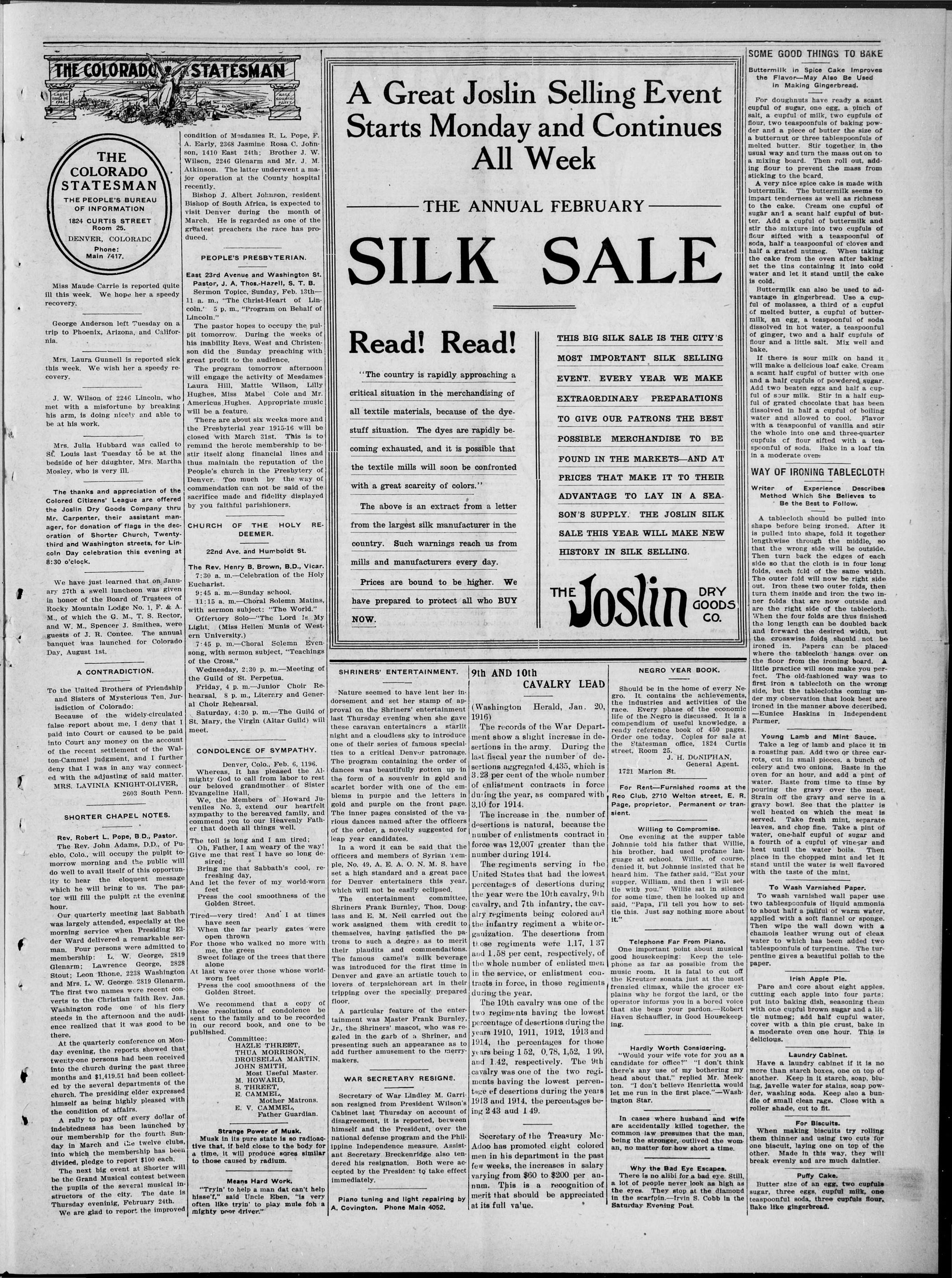
A Great Joslin Selling Event Starts Monday and Continues All Week
SILK SALE
Read! Read!
"The country is rapidly approaching a critical situation in the merchandising of all textile materials, because of the dye-stuff situation. The dyes are rapidly becoming exhausted, and it is possible that the textile mills will soon be confronted
S.'S.
from a letter
turer in the
each us from
ADVANTAGE
SON'S SUP
SALE THIS
The above is an extract from a letter from the largest silk manufacturer in the country. Such warnings reach us from
ery day. higher. We
mills and manufacturers every day.
have prepared to protect all who BUY
NOW.
---
9th AND 10th
(Washington Herald, Jan. 20, 1916)
The records of the War Department show a slight incresae in desertions in the army. During the last fiscal year the number of desertions aggregated 4,435, which is 3.23 per cent of the whole number of enlistment contracts in force during the year, as compared with 3,10 for 1914.
The increase in the number of desertions is natural, because the number of enlistments contract in force was 12,007 greater than the number during 1914.
The regiments serving in the United States that had the lowest percentages of desertions during the year were the 10th cavalry, 9th cavalry, and 7th infantry, the cavalry regiments being colored and the infantry regiment a white organization. The desertions from those regiments were 1.17, 1.37 and 1.58 per cent, respectively, of the whole number of enlisted men in the service, or enlistment contracts in force, in those regiments during the year.
The 10th cavalry was one of the two regiments having the lowest percentage of desertions during the years 1910, 1911, 1912, 1913 and 1914, the percentages for those years being 1.52, 0,78,1,52,199, and 1.42, respectively. The 9th cavalry was one of the two regiments having the lowest percentage of desertions during the years 1913 and 1914, the percentages being 243 and 149.
Secretary of the Treasury McAdoo has promoted eight colored men in his department in the past few weeks, the increases in salary varying from $60 to $200 per annum. This is a recognition of merit that should be appreciated at its full value.
---
with a great scarcity of colors.
SHRINERS' ENTERTAINMENT.
Nature seemed to have lent her indorsement and set her stamp of approval on the Shriners' entertainment last Thursday evening when she gave these caravan entertainers a starlit night and a cloudless sky to introduce one of their series of famous specialties to a critical Denver patronage. The program containing the order of dances was beautifully gotten up in the form of a souvenir in gold and scarlet border with one of the emblems in purple and the letters in gold and purple on the front page. The inner pages consisted of the various dances named after the officers of the order, a novelty suggested for lean year candidates.
In a word it can be said that the officers and members of Syrian temple, No. 49, A. E. A. O. N. M. S. have set a high standard and a great pace for Denver entertainers this year, which will not be easily eclipsed. The entertainment committee, Shriners Frank Burnley, Thos. Douglass and E. M. Neil carried out the work assigned them with credit to themselves, having satisfied the patrons to such a degree as to merit their plaudits and commendations. The famous camel's milk beverage was introduced for the first time in Denver and gave an artistic touch to lovers of terpsichorean art in their tripping over the specially prepared floor.
A particular feature of the entertainment was Master Frank Burnley, Jr., the Shriners' mascot, who was regaled in the garb of a Shriner, and presenting such an appearance as to add further amusement to the merry-makers.
WAR SECRETARY RESIGNS
Secretary of War Lindley M. Garrison resigned from President Wilson's Cabinet last Thursday on account of disagreement, it is reported, between himself and the President, over the national defense program and the Philippine Independence measure. Assistant Secretary Breckenridge also tendered his resignation. Both were accepted by the President to take effect immediately.
Piano tuning and light repairing by A. Covington. Phone Main 4052.
THIS BIG SILK SALE IS THE CITY'S
EVENT. EVERY YEAR WE MAKE
EXTRAORDINARY PREPARATIONS
TO GIVE OUR PATRONS THE BEST
POSSIBLE MERCHANDISE TO BE
FOUND IN THE MARKETS—AND AT
PRICES THAT MAKE IT TO THEIR
ADVANTAGE TO LAY IN A SEA-
SON'S SUPPLY. THE JOSLIN SILK
SALE THIS YEAR WILL MAKE NEW
HISTORY IN SILK SELLING.
Joslin DRY GOODS CO.
THE Joslin DRY GOODS CO.
CAVALRY LEAD
---
NEGRO YEAR BOOK.
Should be in the home of every Negro. It contains the achievements, the industries and activities of the race. Every phase of the economic life of the Negro is discussed. It is a compendium of useful knowledge, a ready reference book of 450 pages. Order one today. Copies for sale at the Statesman office, 1824 Curtis street. Room 25.
For Rent—Furnished rooms at the Reo Club, 2710 Welton street, E. R. Page, proprietor. Permanent or transient.
Willing to Compromise
One evening at the supper table Johnnie told his father that Willie, his brother, had used profane language at school. Willie, of course, denied it, but Johnnie insisted that he heard him. The father said, "Eat your supper, William, and then I will settle with you." Willie sat in silence for some time, then he looked up and said, "Papa, I'll tell you how to settle this. Just say nothing more about it."
Telephone Ear From Piano.
One important point about musical good housekeeping: Keep the telephone as far as possible from the music room. It is fatal to cut off the Kreutzer sonata just at the most frenzied climax, while the grocer explains why he forgot the lard, or the operator informs you in a bored voice that she begs your pardon.—Robert Haven Schauffler, in Good Housekeeping.
Hardly Worth Considering.
"Would your wife vote for you as a candidate for office?" "I don't think there's any use of my bothering my head about that," replied Mr. Meekton. "I don't believe Henrietta would let me run in the first place."—Washington Star.
In cases where husband and wife are accidentally killed together, the common law presumes that the man, being the stronger, outlived the woman, no matter for how short a time.
Why the Bad Eye Escapes.
There is no alibi for a bad eye. Still, a lot of people never look as high as the eyes. They stop at the diamond in the scarppin—Irvin S. Cobb in the Saturday Evening Post.
Buttermilk in Spice Cake Improves the Flavor—May Also Be Used in Making Gingerbread.
For doughnuts have ready a scant cupful of sugar, one egg, a pinch of salt, a cupful of milk, two cupfuls of flour, two teaspoonfuls of baking powder and a piece of butter the size of a butternut or three tablespoonfuls of melted butter. Stir together in the usual way and turn the mass out on to a mixing board. Then roll out, adding flour to prevent the mass from sticking to the board.
A very nice spice cake is made with buttermilk. The buttermilk seems to impart tenderness as well as richness to the cake. Cream one cupful of sugar and a scant half cupful of butter. Add a cupful of buttermilk and stir the mixture into two cupfuls of flour sifted with a teaspoonful of soda, half a teaspoonful of cloves and half a grated nutmeg. When taking the cake from the oven after baking set the tins containing it into cold water and let it stand until the cake is cold.
Buttermilk can also be used to advantage in gingerbread. Use a cupful of molasses, a third of a cupful of melted butter, a cupful of buttermilk, an egg, a teaspoonful of soda dissolved in hot water, a teaspoonful of ginger, two and a half cupfuls of flour and a little salt. Mix well and bake.
If there is sour milk on hand it will make a delicious loaf cake. Cream a scant half cupful of butter with one and a half cupfuls of powdered sugar. Add two beaten eggs and half a cupful of sour milk. Stir in a half cupful of grated chocolate that has been dissolved in half a cupful of boiling water and allowed to cool. Flavor with a teaspoonful of vanilla and stir the whole into one and three-quarter cupfuls of flour sifted with a teaspoonful of soda. Bake in a loaf tin in a moderate oven
WAY OF IRONING TABLECLOTH
Writer of Experience Describes Method Which She Believes to Be the Best to Follow.
A tablecloth should be pulled into shape before being ironed. After it is pulled into shape, fold it together lengthwise through the middle, so that the wrong side will be outside. Then turn back the edges of each side so that the cloth is in four long folds, each fold of the same width. The outer fold will now be right side out. Iron these two outer folds, then turn them inside and iron the two inner folds that are now outside and are the right side of the tablecloth. When the four folds are thus finished the long length can be doubled back and forward the desired width, but the crosswise folds should not be ironed in. Papers can be placed where the tablecloth hangs over on the floor from the ironing board. A little practice will soon make you perfect. The old-fashioned way was to first iron a tablecloth on the wrong side, but the tablecloths coming under my observation that look best are ironed in the manner above described.—Eunice Haskins in Independent Press
Young Lamb and Mint Sauce.
Take a leg of lamb and place it in a roasting pan. Add two or three carrots, cut in small pieces, a bunch of celery and two onions. Baste in the oven for an hour, and add a pint of water. Baste from time to time by pouring the gravity over the meat. Strain off the gravity and serve in a gravy bowl. See that the platter is well heated on which the meat is served. Take fresh mint, separate leaves, and chop fine. Take a pint of water, one-half cupful of sugar and a fourth of a cupful of vinegar and heat until the water boils. Then place in the chopped mint and let it stand until the water is well flavored with the taste of the mint.
To Wash Varnished Paper.
To wash varnished wall paper use two tablespoonfuls of liquid ammonia to about half a palful of warm water, applied with a soft flannel or sponge. Then wipe the wall down with a chamois leather wrung out of clean water to which has been added two tablespoonfuls of turpentine. The turpentine gives a beautiful polish to the paper.
Irish Apple Ple.
Pare and core about eight apples, cutting each apple into four parts; put into baking dish, seasoning them with one cupful brown sugar and a little nutmeg; add half cupful water, cover with a thin pie crust, bake in a moderate oven one hour. This is delicious.
Laundry Cabinet.
Have a laundry cabinet if it is no more than starch boxes, one on top of another. Keep in it starch, soap, bluing, javelle water for stains, soap powder, washing soda. Keep also a bundle of small clean rags. Close with a roller shade, cut to fit.
For Biscuits.
When making biscuits try rolling them thinner and using two cuts for one biscuit, laying one on top of the other. Made in this way, they will break evenly and are much daintier.
Puffy Cake.
Butter size of an egg, two cupfuls sugar, three eggs, cupful milk, one teaspoonful soda, three cupfuls flour, Bake like gingerbread.
LINCOLN'S TILTS WITH CUPID
One of the President's Few Smiling Moods
Mrs. Lincoln
Dressed for the First Inaugural
A
BRAHAM LINCOLN was a lover, but he was an unusual lover just as he was unusual in every other way. His first recorded affair of the heart, an emotion deeper than the calf love of half-grown youth, came when he was twenty-two years old and clerking in a store at New Salem, Ill. Ann Rutledge, tavernkeeper's daughter, was the girl.
The second affair came when he was about twenty-six. It began as a joke, after Lincoln had become a lawyer and was practicing at Springfield, but it caused him untold worry—because the girl, Mary Owens, was fat and he didn't want to marry her. The third affair "took." That is, Mary Todd became Abraham Lincoln's wife, when he was thirty-three years old.
When he was a youth in the wilds of southern Indiana, Lincoln had his sentimental vaporings, one of which appealed so strongly to his sense of romance that he wanted to write a story about it. This vaporing was the kind most of us have along about the time the down on our upper lip begins to toughen.
It is doubtful if Ann Rutledge ever loved Lincoln. She simply appreciated his sympathy and affection—she had been jilted by James McNeill, who tired of her and went East to escape his obligation. Her father, James Rutledge, one of the founders of New Salem, kept a tavern, and there Lincoln went to board when in 1831 he left his home and became clerk in a store there.
At breakfast, dinner and supper he sat by the side of the tavernkeeper's daughter. He was twenty-two; she was less than twenty. She was sad of heart and he tried to cheer her. Lincoln's sympathy ripened into deep affection, but the girl was faithful for more than a year to the memory of McNeill.
Even if the girl had been willing, Lincoln was in no position to marry. He was very poor. He was one of the first to volunteer in the Black Hawk war. When the war was ended he returned to New Salem, ran for the legislature and was defeated. His financial condition was so muddled at this time that he seriously contemplated becoming a blacksmith in order to make a living. An opportunity came to him to get an interest in a store without putting up any real money. He was a wretched storekeeper and his partner was no better. The business did not flourish, but his courtship did. He and Ann Rutledge sat at night on the tavern steps or walked along the roads around the little settlement. They were young and youth is the age of glamour. Lincoln was beginning to think of a career as a lawyer. He believed he would be able in a year or two to support a wife. Ann could not forget McNeill, but the devotion of Lincoln prevailed and she consented to marry him.
The summer of their engagement was the happiest, perhaps, in all of Lincoln's life. Ann Rutledge was beautiful in face and figure and charming in every way. She was not tall and was rather delicate. At times when she would become a little weary, Lincoln, whose strength was unusual, delighted in taking her up in his arms and carrying her as if she were a child.
With their engagement everything seemed to brighten for Lincoln. He was appointed postmaster, he began to make a little money doing survey work, and in the fall he was elected to the legislature.
The young couple decided to get married in the spring. Ann, anxious to complete her education, decided to go to Jacksonville to attend an academy there during the winter. Meanwhile, Lincoln went to Springfield to attend the session of the legislature, continue his law studies and prepare for his admission to the bar in the spring.
He was in Springfield when he got a message that nearly broke his heart. Ann Rutledge was dead. At the academy she contracted a fever and died in a few days. Lincoln was predisposed to melancholia. The death of the woman he loved so much almost upset his reason. He never fully recovered from his grief.
Ann Rutledge had been dead two or three years when Lincoln became engaged again. In Springfield there lived a Mrs. Able, with whom he was well acquainted. She had a sister, Mary Owens of Kentucky, who visited Springfield for a short time and to whom Lincoln had been introduced. Mary Owens was bright, clever and buxom. She returned to Kentucky and Lincoln probably forgot her. But one day Mrs. Able informed him that she was going to Kentucky and then, in a spirit of banter, she said to Lincoln:
"I'll bring Mary back if you'll agree to marry her."
"Marry her? I'd be delighted," said Lincoln.
Mrs. Able went away and a month or so later she was in Springfield again and she had her sister with her.
Lincoln went to call. When he saw Mary Owens he gasped. The girl had grown enormously. She had become outrageously fat.
"Well, I've brought her back for you to marry according to promise," said Mrs. Able.
She was joking, but Lincoln wasn't sure whether it was a jest or whether she was serious and was cloaking her feelings in the light manner in which she spoke. He called regularly upon Miss Owens and paid to her all the attention he thought an engaged man should. It was not pleasant, however, for she was enormous in size. To make the situation still more absurd, he was very tall and very thin. The contrast between the two was enough to make any person smiles, no matter how gloomy he might be.
Lincoln worried greatly over the situation. He felt that he was in honor bound to marry the lady, but he dreaded the taking of such a step.
But while Lincoln had due regard for the sanctity of his promise, implied or otherwise, he tried hard to make Miss Owens understand that he was not a desirable partner for life. He wrote to her some of the queerest love letters that perhaps any man ever penned. He told her over and over again what a miserable life she would have with him. In one of them he said:
"I am afraid you would not be satisfied. There is a great deal of flourishing about in carriages here in Springfield, which it would be your doom to see without sharing. You would have to be poor without the means of hiding your poverty. Do you believe you could bear that patiently?"
Another time he wrote to her:
"I know I should be much happier with you than the way I am, provided I saw no signs of discontent in you. What you have said to me may have been in the way of jest, or I may have misunderstood it. If so, then let it be forgotten; if otherwise, I wish you would think seriously before you decide. What I have said I would most positively abide by, provided you wish it. My opinion is that you had better not do it. You have not been accustomed to hardship and it may be more serious than you now imagine. I know you are capable of thinking concretely on any subject and if you deliberate maturely upon this before you decide, then I am willing to abide your decision."
Lovers' Tears and Quarrels.
Evidently Miss Owens had some spirit. She sent a reply to one of his letters that stunned him. She rejected him incontinently, and she piqued his pride in doing it, for she told him that he was "deficient in those links which make up the chain of a woman's happiness."
You would not think of Lincoln as a dancing man, yet he did at times indulge in that pastime. There are some records extant in proof of this. They take the form of cotillion notices printed at the time he was thirty years old and a little before his meeting with Mary Todd.
Like Mary Owens, Mary Todd was a Kentuckian, and, like Mary Owens, she had a sister
Mrs. Amanda Kuhn died some months ago in Philadelphia at the age of eighty-four. During the Civil war her husband was wounded and she went to the hospital at Washington with her only baby to nurse him. He recovered, but she stayed to nurse others. There Lincoln saw her and was deeply impressed with the woman's devotion to the needs of the injured. Her baby attracted him, and, realizing that the child was a burden and anxiety to the loyal nurse, he arranged for its care in the White House while the mother was busy in the hospital. That was like him. It is merely another story of the many that mark Lincoln as the biggest man the modern world has known.
in Springfield. Her sister was the wife of Ninian W. Edwards, one of the most prominent men of Springfield. Miss Todd was bright, witty, highly educated, ambitious, and at once became the belle of Springfield. Few young women have had more great men suitors for their hand than had Miss Todd within one month of her arrival. Among those who paid ardent attention to her were Stephen A. Douglas, James Shields, who later was senator from three states and who made a glorious record in three wars; Abraham Lincoln, and a dozen others.
The Edwards family protested against Miss Todd's partiality for Lincoln. They thought his family was plobelan; they thought, too, he was too grave a man. But Miss Todd loved Lincoln and they became engaged.
They were not altogether happy in their engagement. Miss Todd was jealous and exacting. She loved balls and parties, frivolities of all sorts that are so dear to women. Lincoln did not care much for those things and was shockingly thoughtless and inattentive for an engaged man. When there was some merrymaking, if he didn't want to go, he didn't think she'd care. She, however, thought it a slight. She complained that he neglected her. Then, to make him feel bad about it, she would go with Shields or with Douglas. There were tears, reproaches, quarrels. They would make up and fall out again.
All this had a very bad effect upon Lincoln. He became extremely morbid. He began to search his soul to answer the question as to whether or not he would make the woman's life unhappy. They were to have been married on January 1, 1842. Something happened and the wedding did not take place. There was a story, which was credited to W. H. Herndon, that Lincoln failed to appear, but this has been pronounced untrue by those who ought to know. It is more likely that one of their many quarrels led to the break between them.
Some of Lincoln's letters written about this time disclose his sufferings. In one of them he says:
"I am now the most miserable man living. If what I feel were equally distributed to the whole human family there would not be one cheerful face on earth. Whether I shall ever be better I cannot tell. I fear I shall not. To remain as I am is impossible."
Reconciliation and Marriage.
One of his friends in Kentucky invited him there in the hope of cheering him up. He had a hard time arousing Lincoln from his melancholia, but he finally succeeded in a manner he never expected. The friend fell in love himself and began to feel qualmish as to whether he would make his beloved happy. He became so miserable over his doubt in this regard that Lincoln tried to cheer him up, and in trying to cheer his friend, Lincoln cheered up himself.
When Lincoln returned to Illinois he was much better. He and Miss Todd met and there was a reconciliation.
On November 4, following, Lincoln and Mary Todd were married. While the marriage ceremony was being performed one of the greatest storms in the history of Springfield was raging.
"Did you ever write out a story in your mind?" Lincoln once asked a friend. "I did when I was a young fellow. One day a wagon with a lady and two girls and a man broke down near us, and while they were fixing up they cooked in our kitchen. The woman had books and read us stories, and they were the first of the kind I ever had heard. I took a great fancy to one of the girls, and when they were gone I thought of her a great deal, and one day when I was sitting out in the sun by the house I wrote out a story in my mind.
"I thought I took my father's horse and followed the wagon, and finally I found it, and they were surprised to see me. I talked with the girl and persuaded hier to elope with me; and that night I put her on the horse and we started off across the prairie. After several hours we came to a camp, and when we rode up we found it was the one we had left a few hours before, and we went in."
"The next night we tried again, and the same thing happened—the horse came back to the same place; and then we concluded that we ought not to elope. I stayed until I had persuaded her father to give her to me. I always meant to write that story out and publish it, and I began once, but I concluded it was not much of a story. But I think that was the beginning of love with me."
WAS WITH LINCOLNRELICS OF LINCOLN
John Hay Tells of Trip to Gettysburg, Where Immortal Address Was Made.
A MONG the interesting passages in John Hay's war time diary, printed in Harper's Magazine, is Hay's vivid account of the president's visit to Gettysburg and the delivery of the famous Gettysburg address.
"On our train were the president, Seward, Usher and Blair; Nicolay and myself; Mercier and Admiral Raynaud; Bertinatti and Captain Isola, and Lieutenant Martinez; Cora and Mrs. Wise; Wayne MacVeagh; McDougal of Canada, and one or two others. We had a pleasant sort of a trip. At Baltimore Schenck's staff joined us.
"At Gettysburg the president went to Mr. Wills', who expected him, and our party broke like a drop of quicksilver spilled. MacVeagh, young Stanton and I foraged around for a while—walked out to the college, got a chafing dish of oysters, then some supper, and, finally, loafing around to the court house, where Lamon was holding a meeting of marshals, we found Forney, and went around to his place, Mr. Fahnestock's, and drank a little whisky with him. He had been drinking a good deal during the day and was getting to feel a little ugly and dangerous.
"We went out after a while, following the music to hear the serenades. The president appeared at the door, said half a dozen words meaning nothing, and went in. Seward, who was staying around the corner at Harper's, was called out, and spoke so indistinctly that I did not hear a word of what he was saying. Forney and MacVeagh were still growling about Blair. We went back to Forney's room, having picked up Nicolay, and drank more whisky. Nicolay sang his little song of the "Three Thieves," and we then sang "John Brown." At last we proposed that Forney should make a speech, and two or three started out. . . . to get a band to serenade him. I stayed with him; so did Stanton and MacVeagh. He still growled, quietly, and I thought he was going to do something imprudent."
"Then follows an account of the serenade and of the bibulous Forney's speech, in which in tipsy fashion he mingled drollery and gravity. Quite Shakespearean in this low-comedy interlude, coming just before the stately scene of consecration.
"In the morning (of the 19th, Hay continues) I got a beast and rode out with the president and suite to the cemetery in the procession. The procession formed itself in an orphanly sort of way and moved out with very little help from anybody; and after a little delay Mr. Everett took his place on the stand, and Mr. Stockton made a prayer which thought it was an oration; and Mr. Everett spoke as he always does, perfectly; and the president, in a firm, free way, with more grace than is his wont, said his half-lozen lines of consecration;
"Four score and seven years ago our fathers brought forth on this continent a new nation, conceived in liberty and dedicated to the proposition that all men are created equal.
"Now we are engaged in a great civil war, testing whether that nation
Abraham Lincoln.
or any nation so conceived and so dedicated, can long endure.
"We are met on a great battlefield of that war. We have come to dedicate a portion of that field as a final resting place for those who here gave their lives that that nation might live. It is altogether fitting and proper that we should do this. But, in a larger sense, we cannot dedicate—we cannot consecrate—we cannot hallow this ground.
"The brave men, living and dead, who struggled here have consecrated it far above our poor power to add or detract.
"The world will little note, nor long remember, what we say here; but it can never forget what they did here. It is for us, the living, rather to be dedicated here to the unfinished work which they who fought here have thus so far nobly advanced.
"It is rather for us to be here dedicated to the great task remaining before us, that from these honored dead we take increased devotion to that cause for which they gave the last full measure of devotion; that we here highly resolve that these dead shall not have died in vain; that this nation, under God, shall have a new birth of freedom, and that government of the people, by the people, for the people, shall not perish from the earth."
Wonderful Collection Gathered and Placed in the House Where He Died.
THE building in which Lincoln died on Tenth street, Washington, is now owned by the government. It houses the wonderful collection of Lincoln relics which has been the life work of Mr. O. H. Oldroyd. This work was begun in 1860, and has continued ever
Lincoln's Office Chair.
since, until now there are in this mass of material thousands of newspaper clippings, hundreds of pictures, books, drawings, badges, sermons, speeches and every imaginable thing connected with Lincoln's career.
Here are to be found the chair he used in his office, his death mask, the chair in which he sat when killed, a rail split by his hand, a theater bill of Ford's of the night of the assassination, Booth's spur, a cooking stove used by the Lincoln family, dozens of Lincoln's articles of furniture, statuettes, autographs, the cradle in which the Lincoln children were rocked, the
05 30
Spur That Was Fatal to Booth.
Lincoln family Bible—in a word, thousands of articles of every kind relating to him.
There is nothing which could be traced as having once belonged to Lincoln that Mr. Oldroyd did not secure, if purchasable. And it is safe to say that his collection is the most remarkable of its kind in the world, for it is the work of more than fifty years of a man's life, devoted almost solely to this one object.
While the building belongs to the government the collection is still owned by Mr. Oldroyd, to whom the writer is indebted for the illustrations in this article—Washington Star.
TRIBUTE THAT WILL ENDURE
President Lincoln's Immortal Letter to Mother Who Had Lost Her Four Sons in Battle.
Among the stories of the war in Europe there are several which tell of mothers who have lost all their sons in battle. One story is that of a woman of France whose three sons went to the front, two of them to meet death almost instantly and the third to die almost before the sound of taps had died away from over the graves of his brothers. Always in war from all countries engaged there are these stories of the mothers' sacrifices.
It is not an unusual thing to find all the sons of a family at the front at the time of their country's need. It is unusual that all should meet death, and when this occurs the pathos and the human interest of the happening bring instant attention. It is certain that in the present war, with its appalling casualty list, there will be mothers of every country engaged who will find themselves left alone. Not one-half of the pain of war is on the battle line.
It was a Massachusetts mother whose four sons were killed in one battle of the Civil war. A letter which Abraham Lincoln wrote to this mother who gave her four sons to death is a monument which will be as lasting as any which a nation could provide. It is said that a copy of Lincoln's letter hangs on the wall of an English university, and that underneath it is written the word of a great Englishman that it is perhaps the finest example of letter writing in existence. A mother gives up her children to her country. No tribute even from the pen of a Lincoln can make full payment for the gift.
Lincoln's Lament
Oh, how hard it is to die and not be able to leave the world any better for one's little life in it.—Abraham Lincoln.
TRAGEDY THAT SHOCKED WORLD
Details of the Assassination of Abraham Lincoln by Wilkes Booth.
April 14, 1865, Will Long Be Remembered as One of the Saddest Days in American History—How Murderer of Great President Met His Death.
ON April 14, 1861, the Union flag was hauled down at Fort Sumter, and the war became a fact. On April 14, 1865, the man who had been the head of the Union during the struggle was shot by an assassin. The world today realizes the tragedy of his assassination, but not so well the shock it caused at the time. The shock was the greater because it came without warning.
On the afternoon of April 14, 1865, President Lincoln, accompanied by his wife, went for a long drive. As a recreation he had planned that night to see the famous actress, Laura Keene, in "Our American Cousin," which was being played in what was then Ford's theater on Tenth street northwest, between E and F streets.
General Grant's Narrow Escape.
General Grant was to have been one of the theater party, and the fact that he was unexpectedly called away probably saved his life, as there is no doubt that his murder was also contemplated.
The president's box had been draped with two flags, a silk one borrowed from the treasury department being placed in the center. It was in this that Booth's spur caught when he leaped from the box after shooting Lincoln. Within the box was placed a rocking chair for the use of the president. At 8:30 Mr. Lincoln, Major Rathbone and Miss Harris entered the box to witness a play of which they were destined never to see the end. As the president sat quietly in his box for an hour and a half, John Wilkes Booth, the assassin, was hovering near, waiting for a favorable opportunity to fire the fatal shot. Booth was a handsome, gay, romantic young actor of the famous family of actors. Edwin Booth was his brother and Junius Brutus Booth his father.
Ardent Southern Sympathizer.
Young Wilkes Booth—he was commonly called by his middle name—was an ardent Southern sympathizer, and his frequent visits to Washington brought him in contact with people of similar sentiments, and gave him the opportunity to put into effect the plan which he imagined would be that of a patriot.
For some months he had been living in Washington, where he had discussed plans with a band of conspirators. These plans at first looked to the capture of the president by taking him bodily, concealing him in one of the cellars of the old Van Ness mansion till a chance offered to get
THE STAGE
Ford's Theater.
him out of Washington, and then spiring him away to Richmond, and compelling the exchange of Southern prisoners for his freedom.
But these plans having gone astray, Booth decided on the morning of April 14 to kill the president in the theater that evening, and escape at once by the rear alley, making his way across what is known as the navy yard bridge, at Anacostia, into Maryland, and thence to Virginia. He never seemed to doubt but that his crime would meet with approbation.
"Peanuts" Held His Horse.
Shortly after 9 p. m. Booth got his horse, and led it to the back door of the theater, leaving it in charge of a boy named Joseph Burroughs, but nicknamed "Peanuts."
About 10:15 he entered the theater, and, walking unnoticed down the aisle, entered the rear of the president's box.
The guard who should have been on duty at the door was down in the parquet, in order to see better. Had he been at his post, it is believed Lincoln's life might have been saved. But as it was Booth gained access to the
LINCOLN
BY
JAMES WHITCOMB RILEY
PEACEFUL life:--toil, duty, rest--
All his desire:--
To read the books he liked the best
Beside the cabin fire--
God's word and man's:--to peer sometimes
Above the page, in smouldering gleams,
And catch, like far heroic rhymes,
The onmarch of his dreams.
peaceful life:--to hear the low
Of pastured herds,
Or woodman's ax, that, blow on blow.
Fell sweet as rhythmic words.
And yet there stirred within his breast
A fateful pulse that, like a roll
Of drums, made high above his rest
A tumult in his soul.
peaceful life!----They haled him even
As One was haled
Whose open palms were nailed toward Heaven
When prayers nor aught availed.
And, lo, he paid the selfsame price
To lull a nation's awful strife
And will us, through the sacrifice
Of self, his peaceful life.
box, and placed in the doorway a bar, which had evidently been prepared for the occasion by someone in the conspiracy.
One of the actors, Harry Hawke, was speaking, when, at 20 minutes past 10, Booth fired a shot into Lincoln's brain. At the sound of the pistol, Rathbone leaped to his feet and grasped Booth, but the latter thrust him aside, after stabbing him several times in the arm.
Flees With Fractured Leg.
Booth then laid his right hand on the box railing and made a leap downward to the stage, but as he did so, his spur caught in the fold of the treasury flag, and he fell in a crouching attitude, which resulted in a broken leg.
Though suffering untold agony, the assassin sprang to his feet, ran out of the rear door of the theater into the alley, jerked the reins from the hands of "Peanuts," leaped into the saddle, and in another second was clattering out of the alley into F street, then away toward Anacostia like a madman—as he probably was.
With Dr. Charles Taft holding the head and several other men the body, Mr. Lincoln was borne out of the door of the theater and into the house of William Petersen at 516 Tenth street, just opposite Ford's.
Death of the President.
The fatal shot had entered the left side of the head behind the left eye, traversing the brain and lodging behind the right eye. At 22 minutes past 7 on the morning of April 18, 1865, he ceased to breathe.
At 11 o'clock that same day Chief Justice Chase administered the oath of office to the new president, Andrew Johnson, in the old Kirkwood house, which stood at Pennsylvania avenue and Twelfth street.
The funeral service of the martyred president was held in the east room of the White House, Wednesday, April 18, at noon, the coffin being then taken to the capitol, where it lay in state in the rotunda till April 21, when the funeral train started for Springfield, [11]
Booth Escapes to Virginia.
To return to Booth and the rest of the conspirators. The assassin had fled from Washington, and safely passing the guard on the bridge at Anacostia, galloped down into Maryland. Pursuit was at once begun by the government, Col. L. C. Baker having charge of the force sent to capture the murderer.
After some work in tracing the assassin, Baker at last stopped at the home of a farmer, Richard H. Garrett, near Port Royal, Va., at 2 a. m., April 26. A young son informed Baker that those he sought were at that moment sleeping in a wagon house or barn.
Throwing a guard about the building, Baker sent young Garrett into the place to demand that the inmates surrender. Both men at first refused, but Herold at last weakened and came out to be manacled. Booth declared that he would never be taken alive, and stood his ground far back in the shed, leaning on a crutch, with a carbine leveled at the door.
Baker Sets Bark on Fire.
Colonel Baker, wishing to expedite matters, lighted a wisp of straw and stuck it through a crack into a pile of hay in a corner inside. In a moment the interior was ablaze and everything within in a full light. The flames showed Booth standing with his gun in his hand, but retreating before the leaping fire. A shot rang out and John Wilkes Booth, the murderer of Abraham Lincoln, sank to the barn floor dying, with a bullet in the back of his neck. The shot had been fired by a Union soldier named Boston Corbett.
Booth's body was dragged out of the burning shed and placed on Garrett's porch. His last words, uttered with great effort, were, "Ugeless."
less," referring to his inability to lift his hands. But before this he had told a soldier, "Tell my mother I died for my country; that I did what I thought was best." Booth received his fatal wound a little after three o'clock in the morning, but lingered in agony till sunrise, when he ceased to breathe.
Body Buried in Baltimore.
His body was sewed up in an army blanket, carried in an old wagon to Belle Plain, and put on board a boat to Washington. Reaching the capital, it was taken down the Eastern Branch to the old penitentiary. There, in one of the large cells, the stones were taken up, a grave dug, and the re-
Facsimile of autograph signature of the assassin, John Wilkes Booth, on the register of the National hotel, Washington, under date of Saturday, April 8, 1865. Booth was assigned to room No. 228 by the room clerk, G. W. Bunker, who testified to these facts at the trial of the conspirators on June 2, 1865. This is with out doubt Booth's last signature, excepting the one on the card sent to Vice President Johnson's room on the day of the assassination.
mains, which were inclosed in a pine coffin, interred. They rested there till 1869, when Booth's brother, Edwin, had them removed to Baltimore and buried in the family lot in Greenmount cemetery in that city.
It is impossible to find any marking of Wilkes Booth's grave. There is none. The ivy growing on the base of the tall shaft to Junius Brutus Booth—Wilkes' father—was lifted up, a grave dug close in at the back of the stone, and the bones of the ill-fated man repose there to this day.
Others Also Put to Death.
Booth was not the only one to suffer death for this murder. There were many other conspirators, prominent among them being Mrs. Surratt, who made her home at 604 H street northwest; George A. Atzerodt, David E Herold and Lewis Payne or Powell for he was known by both names. All four of these persons suffered death by hanging as punishment for their complicity in the crime.
This bronze doth keep the very form and mold
Like some harsh landscape all the summer's gold:
That bird rirr for sorrow, as the sea
for storms to beat on; the long agony
Those silent, patient lips too well fore-
told.
Yes, this is he who ruled a world of men
As might some prophet of the elder day—
Brooding above the tempest and the fray
With deep-eyed thought and more than
mortal ken.
A power was his beyond the touch of art
Or armed strength—his pure and mighty
heart.
-Richard Watson Glider.
Do You Know That一
WAR SECRETARY DIFFERS WITH PRESIDENT ON "CONTINENTAL ARMY" PLAN; QUITS.
Opposition to Philippine Independence Measure Also Ground for Action of Retiring Officer.—Assistant Secretary Breckenridge Also Quits.
The COLORADO STATESMAN
Western Newspaper Union News Service.
Washington.—Secretary Lindley M. Garrison resigned Thursday because President Wilson would not "irrevocably" support the Continental army plan and because he opposes the administration's program of setting a definite time for Philippine independence.
President Wilson accepted the resignation and has not selected a successor. The President himself probably will take personal charge of the administration's national defense plans in Congress.
IS PREPARED TO DO ALL KINDS OF
Assistant Secretary Breckenridge also resigned as a mark of loyalty to his chief whose views he shared. The President accepted his resignation. Both take effect immediately. Major General Hugh L. Scott, chief of staff of the army, automatically becomes secretary of war ad interim.
JOB PRINTING
The resignation came as a distinct surprise not only to Washington generally, but to members of the Cabinet. One Cabinet officer said that while he knew there was a difference of opinion between the President and Mr. Garrison over handling the army plans, he had not the slightest suspicion that an actual break was impending. Although Mr. Garrison first suggested that he leave the Cabinet last month. Mr. Wilson did not formally accept his resignation until late Thursday afternoon, when informed that Mr. Garrison had left for New York and that a rumor of his resignation were current. The President then dictated the letter of acceptance and dispatched it immediately.
Commercial, Fraternal, Church, Book and Stationery Jobs A SPECIALTY
It was not until 8 o'clock Thursday night that formal announcement of the Garrison and Breckenridge resignations was at the White House.
Ball and Concert Programs, Bill and Letter Heads, Calling Cards, Wedding Cards, Envelopes and Everything in the Printing Line Turned Out in the Neatest and Best Style Promptly on Short Notice.
It is known that one of Secretary Garrison's principal reasons for his conviction that only a federal continental army, instead of a reorganized national guard, could be the main military dependence of the nation, war his belief that some day the United States may be called upon to defend the Monroe doctrine, and in that event he foresaw the national guard might not be available for use outside of the United States before a declaration of war.
Upon the contention on the one hand that the continental army or ultimately universal service was the nation's only reliance, the position, or the other, that no one plan could be enforced upon Congress, President Wilson and his secretary of war parted official company.
We Have Supplied Our Office with New Job Press & Type of Up-to-Date Style and Our Work Will Be on a Par with the Very Best.
Mr. Garrison's resignation was a complete surprise to official Washing ton generally. He made no personal explanation.
Several hours before the official anouncement he had boarded a train with his wife for New York, and word had been passed at the department that he had gone for an indefinite stay.
The acute differences of opinion which led to the break began early in the year when opposition to the continental army plan began developing in Congress.
Give Us a Trial and We Will Give You Satisfaction
The circumstances which led up to the resignation are detailed in the sec retary's correspondence with the President, which was made public tonight by the White House.
TEUTONS TO SINK ARMED SHIPS
Notice Given That Merchantmen Carrying Guns Will Be Treated as Warships.
Germany and Austria-Hungary have notified the United States and other neutral nations that beginning March 1 they will regard all merchant vessels carrying guns in the same class as warships and that they will be at tacked in the same way, without any obligation to give warning to crew or passengers. The United States, or the strength of this statement soon will issue a warning to American citizens that they will not be protected by their government if they take passage on such armed vessels, which, in the eyes of the United States government, would be equivalent to taking passage on an armed cruiser of one of the belligerents.
Prices as Reasonable as Those of Any Job Office in Denver
The action of the Teutonic powers is believed to have grown out of the recent general note by Secretary of State Lansing to all the belligerents, proposing a new set of rules to govern warfare on the sea.
Defense Measures to Be Passed.
Washington. — Republicans of the House military committee assured President Wilson Thursday that a strong army increase bill drafted in a non-partisan spirit and accomplishing all the main objects sought by the war department plan would be on the House calendar within three weeks at most. They told him, however, that the committee practically was unanimously opposed to the department's continental army scheme
[Image of a man with a mustache and a bow tie].
THE DOUGLASS UNDERTAKING COMPANY
RESIDENCE PHONE YORK 7992.
FRANK S. REED,
License Embalmer & Director
Lady Assistant
Polite Service
to All
Parlors, 2745 Welton Street
BOLDEN B and LUNC
924 19th Street,
DEN BROS. CAFE LUNCH ROOM 19th Street, Denver, Colorado
BOLDEN BROS. CAFE and LUNCH ROOM
924 19th Street, Denver, Colorado
DINNER
11:30 to 2 p.m.
Short Orders
at All Hours
DINNER
11:30 to 2 p.m.
All Kinds of
Bolden Bros.
Baths, Elect
FIRST CLASS
R. A. BOLDEN, Mg
FERN
2711 Wel
Can be rented for Private or Public
of any nature, with latest first-class
en Bros. Barber Shop
Baths, Electric Massage
FIRST CLASS SERVICE
OLDEN, Mgr. 926 19th St. Denver
ERN HALL
711 Welton Street
Private or Public Parties. Dances or Gatherings
with latest first-class accommodation.
All Kinds of Sandwiches
Bolden Bros. Barber Shop
Baths, Electric Massage
FIRST CLASS SERVICE
R. A. BOLDEN, Mgr. 926 19th St. Denver
FERN HALL 2711 Welton Street
Can be rented for Private or Public Parties. Dances or Gatherings of any nature, with latest first-class accommodation.
Phone Main 2860.
Hall can be rented Monday and Thurs
on Monday and Thursday. R. L.
rison's Orchestra. Ladies Free
C. F.
THE COA
(FORMERLY HALL)
Coal, Wood
COAL, 20c PER SACK, OR
KINDLING, 100
COAL $4.25 p
PROMPT DELIVERY TO A
Monday and Thursday nights. When not rented Thursday. R. L. Phynix Social Dances. Morstra. Ladies Free. Gents 35c
Hall can be rented Monday and Thursday nights. When not rented on Monday and Thursday. R. L. Phynix Social Dances. Morrison's Orchestra. Ladies Free. Gents 35c
F. F. HALL
THE COAL MAN
FORMERLY HALL AND EDWARDS)
Wood and Express
0c PER SACK, OR 6 SACKS FOR.....$1.00
KINDLING, 10c PER SACK,
$4.25 per ton and up
T DELIVERY TO ANY PART OF THE CITY
C. F. HALL
Coal, Wood and Express
COAL, 20c PER SACK, OR 6 SACKS FOR.....$1.00
KINDLING, 10c PER SACK,
COAL $4.25 per ton and up
PROMPT DELIVERY TO ANY PART OF THE CITY
Phone Main 8559
521 TWENTY-EIGHTH STREET, Between Glenarm and Welton, DENVER.
TOM LEWIS, Prop.
The Marian Hotel
The Only Colored Hotel in Denver
1835-37-39 ARAPAHOE STREET.
PRIVATE DINING ROOMS
Popular Japanese Game.
One of the most popular games among Japanese children is otedama, played with small cloth bags filled with red beans. The number of bags used is seven or ten. The game consists in throwing the bags into the air, one after another in quick succession, trying to catch them before they reach the ground. The idea is to keep all the bags in motion.
---
J. R. CONTEE Pres. and Mgr.
A. H.
PHONE MAIN 6123—Day or Night
INCORPORATED AND BONDED
NOTARY PUBLIC
K 7992.
director.
Short Orders at All Hours
R. L. PHYN1X, Manager.
DENVER, COLORADO.
Annex Cafe Short Orders at All Hours Chinese Dishes of All Kinds
PHONE MAIN 7413
Lengthens Life of Rubber Gloves. A new process for vulcanizing seamless rubber gloves has been brought out, by which the life of the gloves is said to be considerably lengthened. Instead of vulcanizing the glove on the dipping frame after the several coatings have been applied, each consecutive layer is vulcanized as the glove structure progresses.—Popular Science Monthly.
Choice of the House
THOUSANDS OF GARMENTS IN EVERY AUTHENTIC STYLE, AND COLORING. AN ACCURATE FIT IS GUARANTEED AND NO CHARGE FOR ALTERATIONS.
THE MAY CO.
16TH & CHAMPA STS.
Their Day of Pleasure.
Not long ago a North country vicar married an elderly couple at 11 o'clock in the morning. At three in the afternoon his duties took him to the neighboring cemetery, where he met the same couple seated lovingly on one of the benches. "You see, sir," the husband explained, "my wife is a rale 'un for pleasure. I wanted to goo back to me work this afternoon, but th' missus sed wed' better enjoy ourselves to t' full and mak' a day on t.'"—London Answers.
Avoid Anger.
Anger is an emotion, and all emotions should be subservient to the will. Keep the rising anger down by the power of your will. Admitted there are many things that cause anger—justifiable anger. Yet, now that you know the scientific truth that anger is a killer of men, and that every time you get into a blazing rage you are pegging back the tale of your years, is it worth while to get angry?
Lengthens Life of Rubber Gloves.
A new process for vulcanizing seamless rubber gloves has been brought out, by which the life of the gloves is said to be considerably lengthened. Instead of vulcanizing the glove on the dipping frame after the several coatings have been applied, each consecutive layer is vulcanized as the glove structure progresses.—Popular Science Monthly.
Worst Kind of Dust
Dust is everywhere, but the worst kind of dust is that which is confined within the four walls of a room. The dust is always germ-laden, because it is infested with effete matter thrown off by human bodies.
Weatherhe
TELEPHONE
Weatherhead Hat Co. TELEPHONE MAIN 3203
Established 1876
PIONEER HATTERS OF THE WEST
WE MAKE OLD HATS NEW
PRACTICAL HATTER
RENOVATORS, BLEACHERS DYERS AND FIL
Of Gents' and Ladies' Hats of Every Descrip
1624 Champa St., Denver, Colo.
RENOVATORS, BLEACHERS DYERS AND FINISHERS
Of Gents' and Ladies' Hats of Every Description
1624 Champa St., Denver, Colo.
$15
Complaints of India's appetite for gold began in the time of the Carthaginians, who in the fourth century B. C. disposed of gold they procured from Spain to that country. Pliny tells of unavailing protests made in the first year of the Christian era of exportations of the precious metal from the Roman empire, nearly $15,000,000 of it being sent annually to India. Queen Elizabeth, in 1600, tried in vain to counteract the flow of gold from her country to India.
The Way He Got Her
Mr. Krusty—"What makes you so anxious to marry my daughter?" Mr. Bright—"To settle a bet. A friend of mine bet me five to one that you wouldn't make a good father-in-law."
Waste Labor.
Lady of the House—"Say, Dinah,
did you clean the fish?" Dinah—"Law,
no, missus! Why should Ah clean in
fish? He done lib all his life in de
wattah."—Puppet.
Wise Widow.
"Blank married a rich widow, but they don't get along very well." "What's the trouble, her disposition?" "Yes, her disposition to handle all her money herself." -- Boston Evening Transcript.
Cow Chorister.
According to this advertisement in an English country paper someone has a cow which is possessed of rare accomplishments: "Wanted—A steady, respectable young man to look after a garden and care for a cow who has a good voice and is accustomed to sing in the choir."
Head Hat Co.
E MAIN 3203
HATTERS
DYERS AND FINISHERS
tats of Every Description
., Denver, Colo.
PHONE MAIN 3976
2235 Arapahoe St.
2077 CAMMEL
The P
Funeral
JOHN H. HARRIS
E. V. Cammel, PRES. @ MGR. P
You Will Be Delighted With O
Little Things That Count LADY
CURTIS M. HARRIS
Assistant Manager and Funeral Direct
OFFICE AND PARLORS 27
S. @ MGR. PREFERRED
LIGHTED With Our Service Asso
count LADY ATTENDA
HARRIS A
Funeral Director
LORS 2807 WELTON
You Will Be Delighted With Our Service As We Look After The Little Things That Count LADY ATTENDANT.
ATLAS DRUG CO., 26TH AND WELTON AND 2701 WELTON ST.
The Atlas Drug Co. now handles a full line of Madame C. J. Walker's toilet requisites.
```markdown
```
PHONE CHAMPA 2077
DENVER, COLO.
DAY OR NIGHT
CAMMEL AND CO.
The Progressive
Funeral Directors
WE TAKE GREAT PRIDE IN THE
FACT THAT WE ARE "THE LEAD
ING FUNERAL DIRECTORS."
WE CAN FURNISH ELEGANT
ROLLING STOCK. AUTOS IF
PREFERRED.
th Our Service As We Look After The
LADY ATTENDANT.
Auto for Hire
Director
2807 WELTON ST. DENVER
BOOKER T. WASHINGTON
before death wrote his own story of his complete life from the cradle to the grave. People want the authentic book. Price, $1.25. We pay the express. Outfit and large picture free. for fifteen cents postage. ACT QUICKLY.
MULLIKIN-JENKINS, Publishers.
WASHINGTON, D. C.
DAY OR NIGHT