Colorado Statesman
Saturday, May 27, 1916
Denver, Colorado
Page text (machine-generated)
THE COLORADO STATESMAN
THE JOURNAL OF THE WEST.
LABOR SHALL BE FREE
RACE COUNTRY PARTY
COLORADO, WYOMING, MONTANA, IDAHO AND NEW MEXICO
Disgraceful Scenes At A.M.E. Conferene
VOL. XX11.
Disgrace
Scenes A
The quadrennial conference of the African Methodist Episcopal Church, in session at Bethel Church, 6th and Pine streets, was disturbed Wednesday, by a recommendation of the committee on episcopacy that two additional bishops be elected tomorrow.
The debate following the committee's report was so heated that Bishop B. F. Lee, presiding today, had the doxology sung, and then ordered that a recess be taken.
The committee consists of seventy-two members. There are a majority and a minority faction. The report recommended the passage of character of all bishops but Joshua H. Jones, Alabama and Tennessee, who was elected two years ago. It was stated that his character was being investigated in connection with the manner in which he regulated certain affairs.
The report also recommended the recall to this country of Bishop William H. Heard, West Africa, and Bishop J. Albert Johnson, South Africa. They have served twelve years in those fields, and desire places in this country. The report then touched upon the recommendation for two new bishops.
The Rev. E. H. Hunter, Richmond, Va., who represents sixteen members of the committee, who are in the minority, read the minority report, which agreed with the other on all recommendations except the election of new bishops.
The Rev. J. G. Robinson offered a motion to table the minority report. He was accused of trying to get "easy chairs" for two men. One delegate said he was trying to rob widows and orphans by paying so much money for new bishops. A bishop receives $2,500 a year and traveling expenses.
Bishop W. D. Chappelle was appointed chairman of a committee to go to Washington and try to induce Congress to pass a law making lynching a crime against the Federal government.
On Wednesday night the scene at the conference was so disgraceful and noisy that one delegate moved that twenty Sergeant of Arms be appointed to preserve order. This motion brought applause from the galleries, of people who were really ashamed of those who claim to be the leaders of our people.
One man muttered, "If those fellows are our leaders, may the good Lord soon deliver the race from their grasp." Indeed one gets the impres-
sion at the A. M. E. Conference that .ts delegates may be anything else but Christians. Why, at one of the sessions, a brother was howled down and hissed, because he suggested that a prayer be offered.
Quite a number of the delegates show they have little or no respect for their bishops, and are frequently very imprudent toward them. A careful looker on observes that the new crop of preachers are in no ways an improvement on the army of godly men who used to make up the A. M. E. Conference years ago. Men and women are now asking as they study the make-up of the present conference whither goeth the once great A. M. E. Church. Brethren! Signs of retrogration are evident except a change for the better is made.
Two new bishops were elected at the General Conference, Thursday afternoon out of the thirty aspirants for the elevation to the espicopacy. The leading candidates were Beckett, Ross, Fountain and Johnson. Three ballots were necessary before an election resulted. On the first ballot Rev. William A. Fountain, of Atlanta, Ga., led, followed closely by Dr. Ross, of Baltimore. On the second ballot, Fountain dropped due to the opposing efforts of Bishop Chappelle; Ross and Beckett rose, but neither gained the necessary 287 for choice. On the third ballot Beckett and Ross made a landslide. Rev. Beckett, president of Allan University, Charleston, S. C., secured 377 votes; Rev. I. N. Ross, of Baltimore, 312; Rev. W. A. Fountain, 173, and Dr. W. D. Johnson, 260, necessary for choice 306.—Philadelphia Tribune.
PHILADELPHIA PASTOR SCORES
HIS PREACHERS.
Philadelphia, Pa.—In a sensational sermon at Allen A. M. E. Church, Sunday night, the Rev. Dr. W. Spencer Carpenter attacked some of the ministers attending the A. M. E. general conference for drinking in saloons, criticised Dr. DuBois "Star of Ethiopia" for having dancing therein, and scored the many candidates for various offices because they were advertising their candidates like ward politicians.
When it became known that Dr. Carpenter was to preach the sermon, many of the delegates attending the conference helped to pack the church. Many of them winced as he made his onslaught against unrighteousness in
DENVER COLORADO SATURDAY, MAY 27, 1916
high places. Some of the delegates became incensed at his plain talk, as a result of which a resolution was introduced in the general conference Monday censuring him for his utterances. The resolution passed.
There are some Christians who say, "Lord, I will follow Thee, but I don't see any harm in dancing." Now there is a law in our rituals that says don't encourage dancing, but I very seldom higher authority to help me fight it, mention it, and if I did, and sought I would be told to let that alone. How on earth is the church going to square itself when it is co-operating in the giving of the great play of Negro life in which there is dancing? Some of my members come to me and tell me their wives come home from the rehersals of this play, they are so stiff they can hardly walk. They have been dancing. And then there are some Christians who say: "Lord, I will follow Thee, but I don't see any harm in taking a little drink now and then." Why, some of the members of this church have been complaining about some of the delegates to the General Conference who are living with them, taking out the water pitchers and bringing beer into their homes. What has African Methodism come to? There is a club on South Street made up of a fairly good set of men, most of whom are not Christians. These men can look across the street into a saloon and see the gold badges of some of our delegates as they line up at the bar.
Then there are some Christians who say, "O, Lord, I will follow Thee, but I see no harm in having affinities." How can you lead your members if you are guilty of these things yourself? I don't say that you are
THE NEW CITY COUNCIL.
Four councilmen named by Mayor Speer and five already selected by the commercial and labor organizations constitute the city council for the ensuing year as changed by the charter amendment adopted May 9. The following are the members appointed by the mayor: Dr. D. G. Monaghan, oculist; William C. Danks, attorney; John Conlon, former councilman, and Joseph B. Rycraft, fuel and feed business. The other members named by the commercial and labor bodies are as follows: Louis F. Bartels, J. A. Burnett, T. O. Spacy, Jesse M. Wheelock and Harry Zimmerhackel. This selection being in conformity with the promise of Mayor Speer that his appointments would be made on a non-partisan basis, should be satisfactory to the citizens of Denver, and ought to give encouragement to every lover of good government to help the new council to put into effect a system which we hope never to regret. The majority of these councilmen are well known to us as men who have the city's welfare at heart. Being strictly businesslike in their respective spheres, and residents of long standing in Denver they are familiar with the things that are necessary towards the development of the city, and their thorough acquaintance with the districts they represent particularly fits them for the responsible positions give them. Regarding their political faith we will have the highest respect for the platform that Mayor Speer stands on, which he has declared with emphasis during the recent campaign, and which we believe is made absolutely clear to the members of his cabinet and council—a non-partisan, non-political city government. Realizing this and believing these representatives will be honorable and faithful in discharging the trust committed to them, we will do all in our power to work with them for a successful administration and the salvation of the city and county of Denver, so that a guarantee of sound, economic and efficient government will be offered the people, who will show their appreciation by indorsing this local legislature for future service.
The council will meet for the first time on Monday, 29th inst. when it will organize and elect a presiding officer. It now devolves on our new city councillors to do their part; the mayor and his cabinet to demonstrate their new system, and the public—the ever ready contributors and arch-supporters of good govern ment will in turn maintain and sustain a cause worthy of the coming WONDER OF THE WEST.
guilty of these things. But the trouble is that if one colored man does wrong, the whole race is condemned.
SNOWBALL LEADS IMMIGRANT TO DEATH.
Negro Boy, Ignorant of it All, in Jail.
Philadelphia, May 24.—Last winter John Mysleski, 21 years old, arrived in America, an immigrant. Today he lies dead in the morgue, because he was hit by a snowball shortly after his arrival in this city. The only apparent result of the blow from the snowball was to cause him to store up anger against Wiley Lewis, 15 years old, a Negro boy, who cast the Christmas missle in play.
Sunday the immigrant, who had kept in his mind, his friends say, the image of the young Negro's face, came across Lewis, with a crowd of boys of his own age, pitching dimes.
The foreigner plunged into the party, seized Willy by the shoulders and forced him aside, while the others looked on amazed. Mysleski incoherently poured out his wrath on head of the boy.
Willy, despite his years, is a young giant in stature and strength. He did not understand who the stranger was. He had forgotten the tragedy of the snowball.
One does not throw snowballs at a stranger in Russia. Willy had never been to Russia.
But when Mysleski drew back his fist, Willy understood the immediate intention of his new-found foe.
Willy struck first. It was a solar plexus. Mysleski crumpled in a heap. He died in a hospital. Willy was locked up, still ignorant of the original cause of his quarrel.
RACE NEWS
GATHERED FROM VARIOUS SOURCES
Hampton, Va., May 15.—At the big conference of experts interested in both education and labor held in Boston, Saturday, it was officially announced that one of the speakers, Prof. Paul H. Hanus, of the Harvard Department of Education would soon revise the educational system at Hampton Institute.
Washington, D. C., May 17.—At the recent Sociological Congress held here, Dr. H. T. Landis, representing Phipps Institute, Philadelphia, a research institute for tuberculosis, paid a high tribute and compliment to the Colored nurses and doctors assisting in the work at that hospital. Their especial work was one of the main topics of discussion. The only colored delegate present at the congress was Dr. C. A. Lewis of Philadelphia.
Hampton, Va., May 15.—Allen Washington of Hampton Institute has been chosen successor to Major R. R. Moton as commandant of cadets. He is a Hampton graduate and has been an officer since final graduation, is treasurer of the Negro Organization Society of Virginia, and financial secretary of the Hampton Institute Alumni Association. He is a thorough drillmaster and tacticism.
New York, May 10.—The will of Mrs. Ellen S. James, who died on April 28, the widow of D. Willis James, disposes of an estate of more $3,000,000 goes to religious, charitable and educational institutions.
The dead woman's colored coachman and groom were not left out of her charity. She bequeathed to each of them the sum of $3,000, to her butler she left $1,000. The latter, however, died before Mrs. James and it has not yet been decided just what disposition will be made of this bequest, finally.
St. Louis, Mo.—Because she refused to allow him to administer gas or to pay for services which he had not rendered, Mrs. Earl Johnson, 3136 Pine street, had to be rescued from the office of a white dentist, one Dr. Hutchinson, at the corner of Market and Jefferson streets. The dentist locked his operating room door, but Mrs. Johnson called for help. Miss Arbella Payne, 3020 Laclede avenue, had accompanied and was waiting in the reception room. Hearing her friend's cries, and finding the door locked, Miss Payne ran outside and telephoned for a police officer. The officer forced Dr. Hutchinson to open his door and release Mrs. Johnson Mrs. Johnson declined to have the
NO
dentist arrested, not wishing to incur the notoriety which would ensue. Eleven Negro graduates of reputable dental colleges have been licensed by the state of Missouri and are practicing their profession in St. Louis. Colored women are never subjected to such humiliating experiences by professional men of the race.
Atlanta, Ga.—There is admittedly a too high rate of illiteracy among the whites and the Negroes in Georgia. It has been discovered in a recent inquiry that there are thousands of adults of both races in the state who have never known how to read or write. Georgia is ashamed of this, but, wisely, is rather exposing than concealing the deplorable fact. Recently there have been conferences of state and local educationalists in which plans have been formulated with the view of wiping out the disgrace at the earliest possible moment. Wherever the local authorities show a disposition to support the movement against illiteracy, the State Board of Education will co-operate. Certain other of the southern states in recent years have been called upon to meet and solve a similar problem. In the mountain and remoter agricultural districts in the South illiteracy among whites has always been prevalent. Only in recent years have the southern states possessed the means of dealing adequately with the question. White illiteracy does not seem to decrease and the present effort is to bring this within bounds.
LANKFORD RUNS FOUL OF HURST
AND HAWKINS.
Philadelphia, Pa.—A sensational incident occurred Monday at the A. M. E. general conference when John A. Lankford is alleged to have called Bishop John Hurst "a dirty scoundrel," and John R. Hawkins, financial secretary of the denomination, "a dirty cur," with the added announcement that he could "knock daylight" out of the latter. Hawkins retorted that he would stop Lankford for all time if he assaulted him, and friends stepped between the men. It is said that Lankford, who is an architect with offices in Jacksonville, Fla., wanted to be elected official architect for the demonination. Mr. Hawkins opposed this on the ground that it may involve the denomination in lawsuits about salary, even if Lankford did now claim one. Bishop Hurst is also said to have been opposed to making him official architect. Lankford then became angry and used the above quoted remarks.
CONDENSATION OF FRESH NEWS
THE LATEST IMPORTANT DIS PATCHES PUT INTO SHORT, CRISP PARAGRAPHS.
STORY OF THE WEEK
SHOWING THE PROGRESS OP EVENTS IN OUR OWN AND FOREIGN LANDS.
Western Newspaper Union News Service.
ABOUT THE WAR
Russians repulse Turkish attacks and dislodge from positions in the Taurus mountains.
German successes in repelling the French attacks on Dead Man's hill are reported by Berlin.
Six persons were killed and sixteen wounded by bombs dropped in German air raid on Dunkirk.
A force of Russian cavalry broke through Turkish lines and joined the British on Tigris river in Mesopotamia.
Thirteen troopers of the Seventh cavalry were fired upon Saturday near the town of Temosachic and one was wounded.
Rome admits retirement of Italian troops in good order, but not pressed by the Austrians. Scattered advantages over the Austrians are claimed.
The Italian troops were forced across their own border for the first time by Austrian offensive in retreat from Borgo, according to the Austrian war office report. Vienna says the drive is successful at all points.
The battle of Verdun raged Tuesday with a fiercer intensity than has characterized the struggle at any stage of its three months' duration. Occupation by the French of the major portion of Fort Douaumont is regarded as an advantage of great moral and strategic value. The Germans are launching desperate infantry attacks, preceded by heavy bombardments, in the effort to dislodge the enemy.
Fighting of a desperate nature was reported from the three principal theaters of war Monday—Verdun, the Italian front, and the British line in France. In Italy the Austrians are hammering at southern Tyrol with artillery of immense caliber and a powerful army. Vienna reports gains though the Italians are resisting heroically. Paris recorded the capture of German trenches along a front of more than one mile on the Meuse with the capture of many prisoners and the occupation of a portion of Fort Douaumont. The British were forced to evacuate trenches on a front of two kilometers near Gevenchy-en-Gohelle.
WESTERN
Reports from Newton, Mo., said one man was killed and six injured in a cyclonic wind that destroyed three homes.
If he will consent to make the race, Wm. J. Bryan may be selected as the candidate for president of the Prohibition party according to a Chicago report.
Rienzi C. Dickens was found guilty of the second degree murder of his father, William H. Dickens, wealthy Longmont banker and pioneer builder at Boulder, Colo.
More than 22,000 applications have been received from the 10,000 or 11,000 seats available in St. Louis convention hall for the Democratic national convention.
A prospective yield of 108,000,000 business of winter wheat in Kansas this year was forecast in a report covering conditions up to May 17, issued by J. C. Mohler, secretary of the State Board of Agriculture.
WASHINGTON
President Wilson nominated Joan P. Golden of O'Neill, Neb., as register of the land office at O'Neill.
Congressman Benjamin Hilliard of Colorado, is now a member of the Bar of the United States Supreme Court.
Secretary Baker has not decided what action shall be taken regarding the 116 Texas guardsmen who declined to enroll in the federal service.
The Carranza government has ordered 30,000 troops into the region south of the border to exterminate bandits, according to information received at the State Department.
Secretary Baker sent to Congress a supplemental estimate of $533,000 for construction in connection with the proposed ordinance depot in the Panama canal zone, and $260,000 deficiency estimate, including $250,000 for the signal service, made necessary by operations on the border in Mexico.
The Munich Neueste Nachrichten publishes a wireless dispatch from Madrid which says that negotiations are in progress there, "among King Alfonso, the Pope and President Wilson for the purpose of arranging an armistice among the belligerent nations with the object of discussing peace terms."
The federal reserve board voted unanimously to defer till July 15 the inauguration of the new country-wide clearing and collection system which it had planned to put into effect June 15.
FOREIGN
At Athens, Greece, a severe earthquake shock was felt Monday.
Lloyd's announces that the Italian steamer Birmania, a vessel of 2,215 tons, has been sunk.
Lloyd's shipping agency Tuesday reported the sinking of three ships, a Greek and a British steamer and an Italian sailing vessel.
The peace stories emanating from the United States have vied with the news from Tyrol for the most favorable position in the Austrian newspapers.
Lieutenant Monroe, son of Gen. Paolo Morrone, Italian minister of war has been wounded dangerously in the head and leg during the Austrian offensive.
The Department of the Interior announced at Mexico City that Gen. Carranza within a few days would issue a decree calling for municipal elections throughout the republic.
M. Blondell, French minister to Rumania, will be succeeded by Colonel de Saint Aulaire, now adjutant to the resident general of Morocco, the ministry of foreign affairs announced at Paris.
The Most Rev. Arthur A. Sinnot, archbishop-elect of the newly-created archdiocese of Winnipeg, Canada, is the youngest archbishop on the American continent. He is not yet 39 years old.
The death in Christiania of Dr. Henrik Greve Blessing, who was physician and botanist with the Nansen polar expedition, 1893-96, is announced in a Central News dispatch from Copenhagen.
The death at Budapest of Gen. Arthur Goergei is reported in a Central news dispatch from Amsterdam, Gen. Goergei was commander-in-chief of the Hungarian army during the War of Liberation. He was also prominent as a chemist.
The Sinn Fein organization was used as a pawn in the game played by Berlin and certain Germans and revolutionists in America, according to the history of the Irish uprising as told by the authorities in London. The failure of the revolt, it is pointed out, was made doubly sure by the inability or disinclination on the part of Germany to carry out important features at almost the last moment.
SPORTING NEWS
Standing of Western League Clubs.
Clubs— Won. Lost. Pct.
Lincoln 16 9 .649
Duncan Molles 15 12 .553
Wichita 15 12 .553
Topeka 15 12 .556
Omaha 13 12 .520
Sloux City 11 15 .423
St. Joseph 9 15 .375
Denver 8 17 .329
Detroit's first baseball fatality of
the year was recorded with George
white, 22-year-old factory employé, as
the victim.
G. M. Church and Dean Mathey,
former Princeton and Western champions,
won the Tuxedo doubles cups
at Tuxedo, N. Y.
Benny Chavez, the Trinidad light-
weight, outboxed Chick Hayes of
Indianapolis in a twenty-round go at the
National Athletic Club in Denver.
The far West again demonstrated its prowess at tennis at Chicago, when Leland Stanford University defeated the University of Chicago in singles and doubles.
Bobby Hammond, driving from San Francisco to New York, established a new transcontinental record of 6 days, 10 hours and 58 minutes when he checked in at New York.
Miss Vera Ramsey, champion woman golfer of England, started in the opening round of the Woman's Golf Association tournament at the Country Club, Brookline, Mass.
A motorcycle speed meet in which the best riders of the West will be entered and which is expected to eclipse any races of a similar kind ever held in Colorado will be a feature of the Decoration day entertainment, May 30, at Loveland.
GENERAL
Seven Irish and German societies all the marchers uniformed and armed, joined in a parade at San Francisco to advertise a German bazar.
Nine persons were killed and thirty-eight injured and at Kemp City, Okla., eight miles east of Denison, was wiped out by a tornado which swept a path three-quarters of a mile wide and five miles long.
Dr. C. A. Barbour, president of the Rochester Theological seminary, Rochester, N. Y., was elected president of the Northern Baptist convention without opposition at the annual meeting in Minneapolis.
A resolution recognizing the right of labor to organize and deal with financial interests with a view to a greater share in the profits of their labor, was adopted at the closing business session of the Northern Baptist convention at Minneapolis, Minn. The convention adopted a resolution announcing divorce as "one of the dearest enemies of the American home." John C. Bowen pleaded guilty to a charge of person, was sentenced to prison for twenty years and disfranchised for three years at Logansport, Ind. His wife was acquitted. He wanted insurance to pay for a trip to Colorido to aid his wife's health.
C. Louis Morin, charged with planning a Mexican uprising in Texas, and Victoriano Ponce, charged with participating in the wrecking of a train near Brownsville, Tex., last October, were shot to death when they attempted to escape from Texas rangers.
COLORADO
STATE NEWS
Western Newspaper Union News Service.
DATES FOR COMING EVENTS.
June — National Convention of Brotherhood of Locomotive Firemen and Enginemen, at Denver.
June 14-18—Semi - Annual Epworth League Convention at Colo. Springs.
June 17—Nineteenth annual Strawberry Festival and Carnival at Glenwood Springs.
June 22-25 -Colo. Christian Endeavor Convention, at Greeley.
Aug. 1. Celebration Colorado's Forti-
tale Anniversary of Statehood, at
Denver
Aug. 2—National Convention of Representatives of Negro Race at Denver
Aug. 8—Democratic State Assembly at Denver.
Aug. 18-19—Pickle Day and Fair at Lake Elmo.
Aug. 23-25 Annual Convention, Grand
Aug. 22-25—Annual Convention, Grand
Lodge K. of P., at Greeley.
Sept. 5-8—Frontier Days' celebration
at Fort Morgan.
Mrs. Ansel Watrous, 83, died at
Fort Collins.
An $80,000 milk condensery is being
planned at Greeley.
The Mesa Verde National park is
now open for the summer season.
A number of real estate deals, involving large sums, are being made at Greeley.
The Holy Name Society of Denver will hold an outing at Dome Rock on Decoration day.
Fred Watson, 17, fell 260 feet down
No. 6 shaft of the Madonna mine at
Monarch and was killed.
Some rich ore has been taken from the old Imes mining property near Sawfit, in the Ouray district.
A meeting of the stockmen was held at Rifle, and a vigorous protest made against the proposed herd law.
The Woman's Relief Corps of the G. A. R., at Pueblo presented a twenty-four-foot flag to the county.
The body of Fred H. McLeod, 28 years old, a tungsten miner, was found in the bottom of a shaft on Afton hill at Nederland.
It is stated that a rich tungsten vein containing pieces of ore as large as a teapot has been discovered twelve miles south of Victor.
One hundred and fifty fathers and sons attended the banquet at the Y. M. C. A., given under the auspices of the Boys' Club of that institution at Pueblo.
W. R. Howland, chief deputy in the Denver treasurer's office, reports that $741,018 in taxes have been received by the office during the first sixteen days of collection.
Charles A. Lammers will be deputy city clerk and recorder under the administration of Mayor Speer of Denver. The appointment was made to become effective June 1.
J. D. McCurdy, 60, of Windsor, was taken to Greeley and placed in the county jail, charged with non-support and desertion. This is Beamer's second offense of that kind within less than a year.
The government, which controls the Rittman process of extracting gasoline, has given the Midwest Refining Company permission to experiment with the process upon its production of oil.
A report by James Dalrymple, state coal mining inspector, gives the coal production of Colorado this year to May 1 at 2,514,131 tons, an increase of 709,960 tons over the production of the same period in 1916.
June 17 has been set as the date on which Denver, assisted by the other cities and towns of the state, is planning to hold big preparedness parades following the lines and purpose of the one recently held in New York.
The hearing on charges preferred by the governor against M. P. Capp, warden of the State Reformatory at Buena Vista, which was postponed until Monday, June 3, at 10 a. m., because of the illness of the governor.
Work is now under way on the construction of the $50,000 tungsten mill of the Tungsten Metals Corporation at the Red Sign property in Boulder Cañon. Work was begun on the foundation and the plant will probably be finished by July 1.
C. M. Pulliam of Loveland, who is operating a lease on the Spadley estate one mile west of Camp Loveland, in the Boulder tungsten fields, has uncovered a vein of tungsten ore that is six inches wide and tests show values of 50 per cent and better.
Word was given out at Denver seemingly from an authentic source, that the $4,456,000 of common stock of the Great Western Sugar Company, now having a market value of $11,140,000, would be distributed among the present holders of common stock at the July meeting of the board of directors.
David Franklin Tyler, the 17-year-old bandit who terrorized the drug-gists of Denver for a month, holding up many of them night after night and who became known as the "Candy Kid" through his exploits and love of sweetmeats, with a sentence of from five years to life imprisonment starling him in the face, has asked Judge Wright of the West Side Court in Denver for a new trial. John Baker, a fireman, was arrested on a statutory charge at Carduff, and at a hearing at Leadville was held under $1.500 bonds.
```markdown
```
MRS. SOPHIA GERTRUDE CHELLEW LOSES SPRING SUIT.
THE COLORADO STATESMAN
Judge Kinney, After Hearing Evidence Decides that Claimant Was Not Widow of Stratton.
Western Newspaper Union News Service
Colorado Springs.—The case of Mrs. Sophia Gertrude Chellew, who several years ago started suit for half of the estate of Winfield Scott Stratton, late multimillionaire mining king, was thrown out of court by County Judge W. P. Kinney at the conclusion of several days of evidence. He declared his decision that the claimant was not the widow of Stratton, according to the testimony given by witnesses.
His specific findings were:
That from Dec. 21, 1873, to Jan. 2, 1874, Stratton was in or near Colorado Springs, and not in Texas, where Mrs. Chellew claims he was.
The Mouth-Piece of the People of Colorado and the Entire West
That A. N. Poor, first husband of Mrs. Chellew, died in 1875, and that therefore the claimant was Mrs. Poor at the time she claims to have married Stratton:
That the claimant was not married to Stratton Jan. 1, 1874, in Texas, as set forth in her complaint.
Judge Kinney's decision ends the suit as far as his court is concerned unless an appeal is taken, which is not expected.
Ruby Tungsten Mines Sold.
Silverton, Colo.—What is claimed to be the greatest tungsten strike ever made in the west was revealed here with word of the sudden transfer of the Holman and Grimes lease in the Ruby mine in Maggie gulch to New York city bankers for $100,000. The first payment of $20,000 was made. Several new strikes are reported from various sections of the San Juan, and prospectors are rushing into all localities with the melting of the snow.
ARELIABLE chronicle of their doings and progress; a faithful mirror of their wants, their hopes, their best aspirations.
The Kitty Mack mine has been reopened for tungsten after several years' idleness. Railroad shipping will be made from Blackstone. The Gold King mine is to resume immediately. Other properties are being reopened fast.
Jurors Declare Boy Not Slayer.
Jurors Declare Boy Not Slayer.
Trinidad.—On the testimony of Sam Provenza, 10-year-old son of Mrs. Concetta Provenza, a coroner's jury returned a verdict accusing Joe Velo and John Velo, brothers, who some are inclined to believe nonexistent. The boy's testimony has completely baffled the authorities, who venture the opinion that the child has given false names to shield the real slayers. The boy told the jurors that Joe and John called at his home at Hastings and that Joe killed his mother.
THE COLORADO STATESMAN
Silver Adds $2,000,000 in Profits
Denver.—Colorado will profit $2,000,000 this year through her silver mining industry—$2,000,000 more than was added to the wealth of the state by the 1915 silver production. This is a conservative estimate, based on the statements of men in close touch daily with market and mining conditions and on the figures that stand in the bullion books of the two big silver buying companies operating in Colorado.
Slight Turn of Head Saves Woman.
Pueblo—A slight movement of her head as a bullet from a .38 caliber revolver struck her above the left eye, glanced and passed in'o the ceiling, was all that saved Mrs. B. Urban from instant death. It was an accidental shot from a revolver in the hands of Mrs. Urban's 12-year-old daughter, Johanna.
Unequaled as an advertising medium for the business of professional men and women.
Dr. N. O. Hamilton Found Guilty. Denver.—Dr. Noble O. Hamilton was found guilty of murder in the second degree by a jury in the West Side court. He was convicted in connection with the death of Mrs. Ada Williams, wife of Thomas F. Williams, whom he had treated.
Samuel Bryan Dies
Colorado Springs.—Samuel J. Bryan, formerly prominent in El Paso county politics, died at Springdale, Ark., where he went about two months ago. He is survived by his widow and three children.
An excellent family journal speaking to and for many thousand colored citizens.
Mancos—A rock slide on the Rio Grande Southern has completely tied up traffic at Ames. More than 300 feet of track was destroyed, and through train service was suspended indefinitely.
TWODOLLARSAYEAR
Mining Man's Wife Commits Suicide. Silverton.—Mrs. E. G. Condit, wife of a prominent mining man, committed suicide here while temporarily deranged through suffering caused by an abscess on the brain.
THE GREAT ORGAN OF THE
Weld's Per Capita Deposit Is $125
Greeley.—That Weld county is above the average in wealth is demonstrated by the bank statements which show the per capita deposit to be $125 as against $40 per capita for the entire United States.
Mother Sees Lightning Kill Son:
LABORING MASSES
Evans.—Ben Taylor, 12 years old son of Mr. and Mrs. A. Taylor, was instantly killed by lightning while playing in the yard of his home just north of here.
AFRO-AMERICAN CULLINGS
In a communication to the Baltimore News, W. H. Holtzclaw, principal of the Utica Normal and Industrial Institute, Utica, Miss., writes: I have read your editorial of November 15, entitled, "Booker T. Washington's Field." I have found it very interesting, but there are some points in it which I feel ought to be amplified, to say the least. It is for this reason that I venture to write you this letter.
For instance, you make a comparison between the Northern Negro and the Southern Negro, and you state that the southern's Negro's progress in 50 years has not been relatively commensurate with that of the Northern Negro during the half century of his freedom. You were kind enough however, to give some very valuable reasons for this. The facts which I have at my command, however, and which can be had from the United States census, convince me that taking everything under consideration, the Southern Negro's progress during the past 50 years has far surpassed that of even the Connecticut Negro of whom you speak. We ought not overlook the fact that the Southern Negro is making progress under tremendous difficulties—among them is the matter of education. The Connecticut Negro has paid, on the education of each of his children, out of public funds, for any given year, more than 15 times as much as we Negroes of the far South receive per capita.
Besides, he has educational facilities. For 50 years the Negroes have had here in the South the poorest kind of opportunities to educate themselves—school terms being from three to five months in length, and the cotton fields taking up the remainder of the time of our children. Besides, when they do attend school, the facilities are often so poor that it is almost equal to no school at all. It requires a boy 26 years to complete a common school course under the circumstances. There is often no more than the wreck of a log cabin with no heating apparatus, and but the poorest improvised blackboards, and little or no protection from the elements. The teacher presiding over such a school is often paid as low as $10 a month (that is the case in my own county) for five months, and out of which she has to pay not less than $7 a month for board. If this sounds extravagant, I have only to invite your attention to the latest annual report of the superintendent of education of this state and Louisiana. It cannot be expected under such conditions that the Negroes will make satisfactory progress.
But this is not the worst. There are, according to the United States census, about 2,000,000 Negro children in the South who cannot get into even the poor schools that I have just mentioned. That is to say 52 per cent of the Negro children of the South, according to the United States census, attend no school at all.
Methodists who sought to have colored bishops provided for work among the colored people failed to receive the sanction of the annual conferences of the Methodist Episcopal church, the affirmative vote failing to reach the necessary two-thirds. Announcement of the total conference vote was made by Dr. Joseph H. Hingeley, secretary of the general conference of the Methodist Episcopal church. The plan was known as the Mississippi proposition
Representative L. C. Dyer of Missouri, gave the record of the colored soldiers in the wars of this country at a public meeting at the John Wesley A. M. E. Zion church, Fourteenth and Corcoran streets northwest, under the auspices of the National Memorial association, in commemoration of the fifty-fourth anniversary of the emancipation of slaves in the District of Columbia.
The association, which is a national one, is organized for the purpose of procuring a site for the erection of a monument in Washington in honor of the colored soldiers and sailors who fought in the wars of this country. Mr. Dyer said he would do all he could to further this movement by an appropriation by congress, and pledged the support of the Spanish war veterans, of which he is commanding chief.
Representative H. Martin Williams, who was master of the ceremonies, made a short address, in which he stated that he was for peace, and that he hoped this country would never be in another war.
As a table delicacy the tile fish has established itself firmly under the exploitation of the bureau of fisheries, which undertook to bring its merits to public attention a short time ago. These fish are now marketed in great quantities and are to be found on sale in all the leading markets of the eastern part of the country, so that the government's efforts in introducing it have been eminently successful.
Sudan grass yields from one to eight tons of cured hay an acre.
to provide bishops for race and languages and was sent to all the annual conferences.
The vote, as compiled by Doctor Hingeley, was:
Total vote of the conferences, 8,402.
Necessary two-thirds for adoption, 5,601.
Total affirmative vote, 4,921.
Total negative vote, 3,481.
The proposition failed of adoption by 680 votes.
The vote of the laymen on the proposition was: Yeas, 3,300; nays, 2,425.
Necessary for adoption of the proposition, 3,816 votes.
The Wilmington proposition, giving bishops of the Methodist Episcopal church in constitutional matters the right of veto, which was submitted to the annual conferences by the general conference of 1912, was lost by a majority of 1,571 ministers and 960 laymen.
The Colorado proposition, granting honorary privileges to retired ministers and absentee voting on constitutional matters, had a majority of 2,012 ministers and 818 laymen. These privileges will be granted and will become law by favorable action by the general conference at Saratoga Springs May 1.
The three questions now decided have been voted upon by the Methodists since 1912 and were considered the most important propositions before the various conferences.
Mr. Washington's creed is emphasized on every occasion—that is, to "do the common things uncommonly well."
Courses are being offered in domestic science, basketry, drawing, music, sewing, manual arts, physical training and the teachers' professional course.
For recreation we have tennis, volley ball and swimming. We have a band concert every Sunday afternoon from 6:30 to 7:30. There are always between 2,000 and 3,000 people on the lawns, and there is perfect order, not a semblance of authority. Everyone seems thoroughly imbued with the Tuskegee spirit.
We motored down to the Alabama Reform School for Juvenile Negro Lawbreakers, located at Mount Meigs. There we found 165 Negro boys, 50 of whom came from Birmingham. We were very much impressed with everything we saw. You remember how earnestly the Negro club women of Birmingham have worked to establish and maintain this school. Recently the state has taken charge. Still, we found much that we can and must do for these boys, who must some day come back to the cities and add to the useful or criminal class their share of good or evil. The superintendent is a Tuskegee graduate, and we could see long before we drove up to the building that the Tuskegee spirit reached even to the reformatory, a distance of 27 miles from the institute. Beautiful flowerbeds and shrubbery added to the beauty of the grounds.
I feel safe in saying that with the enthusiasm and earnestness which the summer school teachers manifest in the work here that Alabama will not long remain at the bottom of the ladder in illiteracy.—Birmingham (Ala.) Age-Herald.
Electrical machinery is used almost exclusively in a Philadelphia ice cream factory that turns out 10,000 quarts a day.
The Rev. W. H. Jernagin urged the organization of the forces of the churches throughout the country in support of the monument movement. Thomas L. Jones told of the achievements of the colored race. Among the guests were the commander and staff, Department of the Potomac, G. A. R.; the president and staff, Department of the Potomac, W. R. C.; the Guy V. Henry Army and Navy Union. No. 9; the Spanish-American war veterans and officers of the National Guard of the district.
The anniversary was observed Monday also at Mount Calvary Colored Baptist mission, Twentieth and E streets northwest, under the auspices of the Butler Zouaves Veteran Relief association. Prof. Jesse Lawson was the principal speaker. He voiced the feeling of his race in the sentiment that "the United States of America is the only country we know and her cause is our cause and her flag is our flag, and here together we shall live and never once say die. This is our country, our home, our own, our native land!"—Washington Star.
The Japanese have many curious superstitions about animals, the chief among which is their belief in the supernatural power of foxes. There are numberless shrines dedicated to foxes in Japan. The badger is another animal feared by the superstitions Japanese mind. It is believed to have power to annoy people and to be able to turn into a priest at will.
The mockingbird of the South is sometimes encountered as far north as the Potomac.
GRADE CROSSING RULE
OBJECTED TO BY ENGINEERS FOR RAILWAYS.
Utilities Commission to Issue Order,
But Board Will Not Require
Railroads to Build Fences.
Western Newspaper Union News Service.
Denver.—Objections to the issuance of an order by the State Utilities Commission providing for the construction of uniform standard grade crossings at all public highways in the state and preparation of sketches of the crossings for filing were made by the engineers representing the railroads affected by the proposed order at the conference of the engineers with D. S. Hooker, engineer of the commission. The engineer declared that the expense of such work would be too great for the railroads.
The commission, however, is preparing to issue an order for uniform grade crossings. The total cost, it is estimated by Engineer Hooker, will be less than $1,250,000. The commission intends that this expense be spread over a number of years.
In an estimate of the cost of the preparation of sketches of the crossings the railroad engineers gave the cost at $12 per crossing, while Mr. Hooker showed that the maximum cost would be $2 per crossing.
The commission will consider and pass upon specific complaints made by stockmen for the fencing of particular parts of rights of way of railroads as a means of protection of cattle and of the lives of passengers of trains, but will not issue a blanket order compelling all the railroads to fence all their rights of way. This was the substance of a decision announced by the utilities body in the case brought by the livestock associations of the state asking that the commission compel the railroads to fence all their rights of way.
The decision of the commission was announced after the receipt of an opinion from the attorney general upon interpretation of the laws involved.
Opposition to Proposed Herd Law.
Reports from practically every part of the state, made at a meeting of the livestock and agricultural bureau of the Civic Association in Denver, show a determined and spirited opposition to the so-called herd law for which initiative petitions are being circulated. The report cites that all stockmen have always used the public commons and that farmer have fenced their growing crops to keep the stock out, which was legalized in the present fence law. The first section of the proposed law, which declares that "the owner, person in possession or caretaker of any domestic animals, shall hereafter be liable for all injury done by such domestic animal or animals," is declared to be the meat of the whole bill.
Liquor Shipments Show Increase.
The liquor shipments received in Colorado during the month of April exceeded those of March to the extent of over a thousand, according to the records of the secretary of state. The April shipments number 6,196 while there were 5,186 shipments during the preceding month. The fees collected by the office of the secretary of state in April amounted to $774.50, and in March to $648.25.
Blickensderfer Estate Pays Tax.
Heirs to the estate of the late Dr. James C. Blickensderfer paid the state an inheritance tax of $8,023.53. The estate was appraised at $360, 938.96. Dr. Blickensderfer died March 4, 1916, and left his estate to his widow, Mrs. Eva Blickensderfer, and his son, Clark.
Parks Bill Favorably Reported.
A dispatch from Washington states that the House public lands committee has reported favorably the bill introduced by Congressman Timberlake adding to the National and Pikes Peak forest reserves 500,000 acres of land in Larfiner, Boulder and Douglas counties.
Rehearing Denied by Board.
A rehearing in the case of the town of Arvada against the Arvada Electric Company, in which the utilities commission refused to reduce the light and power rates in Arvada, was denied the town by the State Utilities Board.
Drake Issues Charter for New Bank.
A charter for a new state bank, which will be located at Pueblo, was issued by E. E. Drake, state banking commissioner. The institution will be the Wigton State bank.
An inheritance tax of $3,459,04 was paid the state by the estate of the late John H. P. Voorhies. In his will Mr. Voorhies left a provision for the erection of a memorial gateway to the city of Denver to cost $116,606, and this provision the heirs are contesting. Despite the contest, they paid a tax on the entire estate, so that no interest can be charged on the gateway fund if the Supreme Court decides in favor of the heirs. The total value of the estate was 58,290.
TEUTONS RETAKE
FORT DOUAUMONT
EARFUL CARNAGE MARKS THE DRIVE OF BAVARIANS IN DEATH GRAPPLE.
KEYTOVERDUN DEFENSE
IMPORTANT STRONGHOLD LOST BY FRENCH AFTER SERIES OF FURIOUS ATTACKS.
Western Newspaper Union News Service
Paris, May 25.—The Germans have re-occupied Fort Douaumont, while the French hold the immediate approach to that position.
This announcement is made in the official communication issued by the French war office which says two new divisions of Bavarians effected the recapture after a series of furious attacks. The battle around Verdun continues to rage with a violence unexampled even in this region. The text of the statement reads:
"On the left bank of the Meuse the infantry action continued east of Le Mort Homme. Several times our artillery fire stopped the enemy, who had attempted to debouch from the village of Cumieres. During the afternoon a spirited counter attack enabled us to retake trenches situated on the southern outskirt of the village. On the right bank the bombardment was redoubled in the region of Fort Douaumont, on which the enemy had particularly set himself. Furious attacks with two Bavarian divisions, newly arrived on this front, succeeded each other all day. After several fruitless attempts and enormous losses, the enemy succeeded in recupying the ruins of the fort. Our troops hold the immediate approach. About the same time an attempt to flank our positions in the Callette wood completely failed under our fire."
Without full possession of the line from Pepper hill to Vaux fort the Germans cannot hope to get any nearer to the capture of Verdun. Even if they succeeded in taking this line they could not hold it unless they were also in possession of hill No. 304, and Dead Man hill, which outflank the line.
Driven to desperation by seeing so much of its work undone, the German commander hurled attack after attack against Fort Douaumont. At the same time it has kept up its onslaught on the left bank of the river to prevent the French transferring any forces to the main scene of attack.
All day Tuesday the tide of war ebbed and flowed, inches of ground being won and lost at appalling cost
Kaiser Sends Von Buelow to U. S. London. The Exchange Telegraph Company says it learns from diplomatic circles that Prince Von Buelow former German chancellor, is proceeding to Washington, charged by Emperor William with a special mission. The Exchange Telegraph Company also says it understands that Prince Von Buelow will become ambassador to the United States. This information has been obtained from diplomatic circles in London.
Rich Ranchman Shot in Quarrel.
Rich Ranchman Shot in Quarrel.
Deer Trail—William Kingsbury, a wealthy ranchman, was shot and seriously injured at his ranch, four miles from here, by Smith Thompson, one of his employés, after a quarrel.
Thompson turned the pistol upon himself and fired, but the bullet struck a rib and caused only a slight wound.
New Mexico Elects Delegates.
Albuquerque, New Mex.—The Democratic state convention elected twelve delegates to the Democratic National Convention, giving each a half-vote. The delegation was instructed to cast its vote for President, Wilson and also Vice President Marshall. The statement of A. A. Jones of Las Vegas, first assistant secretary of the Interior Department, that if ht could serve the people of New Mexico further they had but to call upon him, was taken as an announcement of his candidacy for nomination for United States Senator. A tumult of cheering broke loose and Jones was carried around the hall.
Stricken While Marrying Couple.
Boulder—Justice of the Peace Thomas E. Irvine, known as Boulder's "marrying justice," was performing his 167th marriage ceremony when he fell to the floor with his left side paralyzed. His condition is critical. He was marrying Stokes Oliver Kennedy, 21 years old, and Nancy J. Moreland, 19 years old, of Denver, when he was stricken.
De Facto Army Chases Bandits
Henning's Shoes
Have the pleasant effect of throwing the spotlight on your feet, and there are reasons:
Customers appreciate beauty—Henning's styles, lasts and colorings are what girls call "adorable." Women, most of them at least, have to count dollars, and Henning's shoes, with their moderate prices, comes within the purse reach of them all.
But, at the same time, we want point, that has always been true of for quality to the very smallest de parent to every one who wears Henning's $
Look in our windows and see
the same time, we want to impress upon you has always been true of Henning's shoes, we go to the very smallest detail, and this is imminent every one who wears
ning's $2.50 S
our windows and see the newest creations
But, at the same time, we want to impress upon you another point, that has always been true of Henning's shoes, we are sticklers for quality to the very smallest detail, and this is immediately apparent to every one who wears
Look in our windows and see the newest creations for spring.
Henning's $2.50
Shoe Store
820-822 FIFTEENTH STREET.
You Save A Dollar.
C. H. SHIRLEY, Pres.
PAUL J. SHIRLEY
THE ATLAS
Courteous Treaty
Leaders in P
BLEY, Pres. J. C. HAMPSON
PAUL J. SHIRLEY, Sec. and Treas.
THE ATLAS DRUG CO.
Ous Treatmet. Right
Leaders in Prescription
1.
STORE
ON ET.
26TH AN
75
Main 4
PTON, Pres. J. M. JOHNS, Treas. J. B. M
LROAD PORTERS' C
LUNCHOOM IN CONNECTION
C. H. SHIRLEY, Pres. J. C. HAMPSON, Vice Pres PAUL J. SHIRLEY, Sec. and Treas.
Courteous Treatmet. Right Prices Leaders in Prescription
W. C. CAMPTON, Pres. J. M. JOHN
RAILROAD PO
LUNCHOOM IN
W. C. CAMPTON, Pres. J. M. JOHNS, Treas. J. B. MINTER, Sec. RAILROAD PORTERS' CLUB LUNCHOOM IN CONNECTION
BILLIARDS AND
POOL
1728½ Wazee St. Only o
J. B. MINT
PHONE MAIN 8416.
28½ Wazee St. Only one block from Union D
J. B. MINTER. Barber.
NE MAIN 8416. DENVER, COLO
17281/2 Wazee St. Only one block from Union Depot.
J. B. MINTER. Barber.
PHONE MAIN 8416. DENVER, COLORADO.
JOHN K. RETTIGER
Fancy and Staple Grocery
1864 CURTIS STREET
seventh.
MARKET COMMERCE
E. SMITH, Manager, Res. Phone South 1
d Retail Staple and Fancy Groceries, Fish
Hotels and Restaurants Our Specialty.
Fresh and Cured
Eastern Corn Fed Me
JOHN K. Meats, Fancy and 1864 CURT
The MARKET
C. E. SMITH, Manager,
Wholesale and Retail Staple and
Hotels and Restaurants
Fresh and
Eastern Corn
The MARKET COMPANY
G. E. SMITH, Manager, Res. Phone South 1608
Wholesale and Retail Staple and Fancy Groceries, Fish and Oysters. Hotels and Restaurants Our Specialty. Fresh and Cured
Eastern Corn Fed Meats
Fruits, Vegetables, Poultry and Game.
Telephones Main 4302, 4303, 4304, 430
622-636 15th Street Denver
Weatherhead Ha
TELEPHONE MAIN 3203
Telephones Main 4302, 4303, 4304, 430t
15th Street Denver,
atherhead Ha
TELEPHONE MAIN 3203
Telephones Main 4302, 4303, 4304, 430t 622-636 15th Street Denver, Colorado
Weatherhead Hat Co. TELEPHONE MAIN 3203
Established 1876 PIONEER HATTERS OF THE WEST WE MAKE OLD HATS NEW
PRACTICAL
RENOVATORS, BLEACHERS
Of Gents' and Ladies' H
1624 Champa St
PRACTICAL HATTER
ATORS, BLEACHERS DYERS AND FI
Gents' and Ladies' Hats of Every Descrip
1624 Champa St., Denver, Colo.
RENOVATORS, BLEACHERS DYERS AND FINISHERS Of Gents' and Ladies' Hats of Every Description 1624 Champa St., Denver, Colo.
Store No. 1.
2701 WELTON ST.
Main 895 875
PHONE MAIN 3028
Corner Nineteenth.
to impress upon you another
7 Henning's shoes, we are sticklers
detail, and this is immediately ap-
$2.50 Shoes
the newest creations for spring.
Henning's $2.50
Shoe Store
820-822 FIFTEENTH STREET.
You Save A Dollar.
J. O. HAMPSON, Vice Pres
Y, Sec. and Treas.
S DRUG CO.
met. Right Prices
Prescription
Store No. 2.
25TH AND WELTON
Main 4955 4956
INS, Treas. J. B. MINTER, Sec.
ORTERS' CLUB
CONNECTION
FREE CHECK
ROOM
one block from Union Depot.
ER. Barber.
DENVER, COLORADO.
RES. PHONE GALLUP 942
RETTIG
1 Staple Groceries
IS STREET
IT COMPANY
Res. Phone South 1608
Fancy Groceries, Fish and Oysters
Plants Our Specialty.
Cured
In Fed Meats
02, 4303, 4304, 4305
Denver, Colorado
ead Hat Co.
MAIN 3203
HATTERS
DYERS AND FINISHERS
Cats of Every Description
, Denver, Colo.
```markdown
```
Denver, Colo.
THE COLORADO STATESMAN
CABON MALLS AND FREE
RACE COUNTRY PARTY
JOS. D. D RIVERS....Proprietor
1824 Curtis Street, Room 25.
One Year ..... $2.00
Six Months ..... 1.00
Three Months ..... .60
PAYABLE IN ADVANCE.
Entered as second-class matter at the postoffice in the city of Denver, Colorado.
No discounts allowed on less than three months' contract. Cash must accompany all orders from parties unknown to us. Further particulars on application
Display advertising, 50 cents per inch. An inch contains twelve agate lines.
All communications of a personating nature that are not complimentary will be withheld from the columns of this paper.
It occasionally happens that papers sent to subscribers are lost or stolen. In case you do not receive any number when due, inform us by postal card and we will cheerfully forward a duplicate of the missing number.
Remittances should be made by Express Money Order, Postoffice Money Order, Registered Letter or Bank Draft. Postage stamps will be received the same as cash for the fractional part of a dollar. Only 1-cent and 2-cent stamps taken.
Recognized by the Retail Association of the Denver Chamber of Commerce as an advertising medium of the first class.
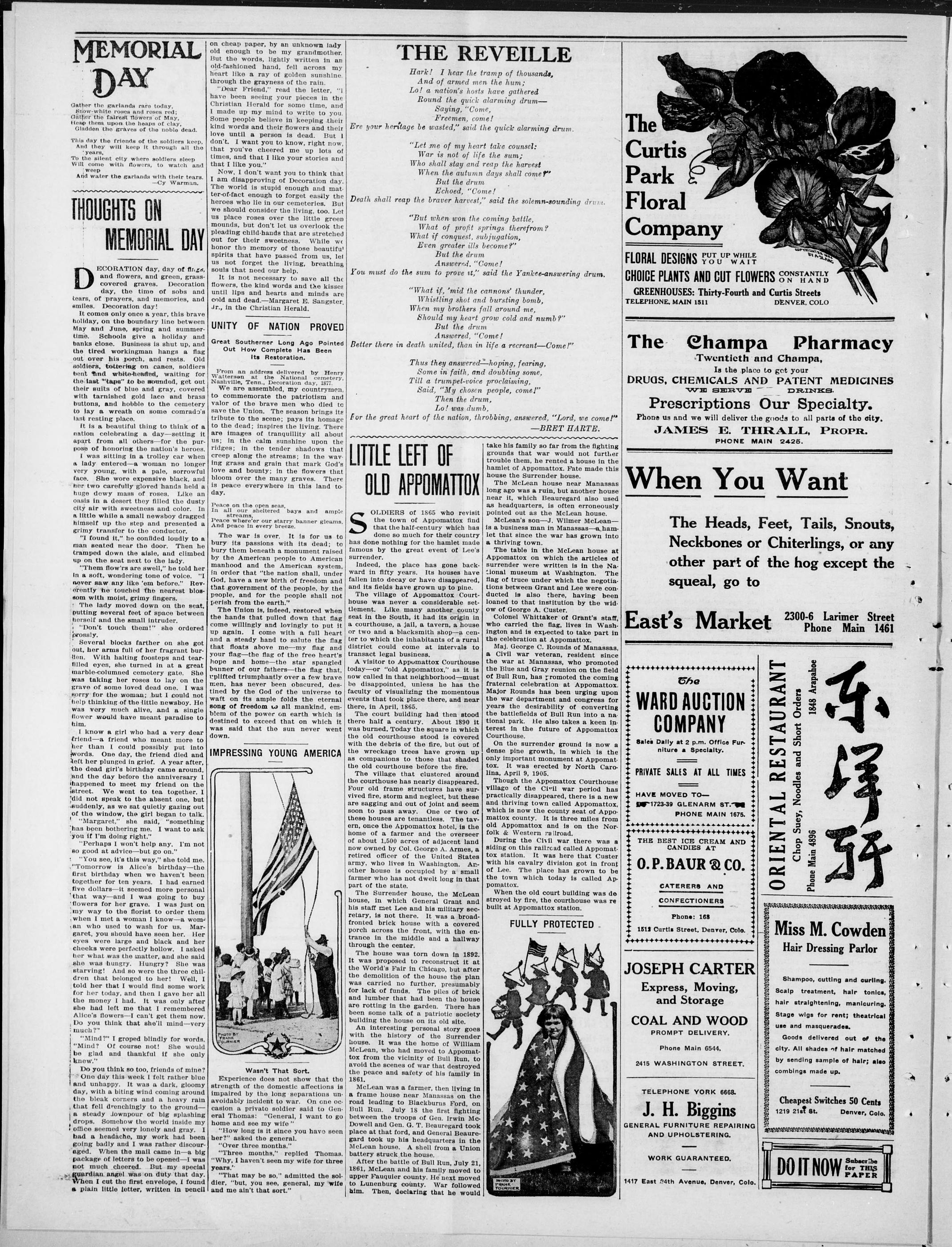
MEMORIAL DAY.
Next Tuesday brings forcibly to us a reminder which is dual in form—the paying of respects to our dead heroes, which is fraught with the natural features of sadness and the impressiveness of our gain from the loss of their lives. The story is too well known for repetition herein, but we are glad to state that the celebration of the day has gone beyond the confines of war, and has filled the role of remining families and relatives of their departed loved ones whose existence here has left them many examples which have helped to mould and shape their present career. It is not giving the flowers to the dead, but it seems so timely and charitable that we should decorate the graves and tombs of those who have predeceased us, thereby showing our token of affection, and at the same time, affording us an opportunity for self-examination.
WHO WILL TAKE THE INITIATIVE?
On Monday, May 15, Waco, Texas, subscribed her name to the list of cities that show their form of appreciation of American liberty by their peculiar fondness for mob rule and lawlessness, inscribing their deeds in the hall of fame of barbarism and heathenism. A 16-year old Negro lad, after being convicted by the jury and sentenced to be hanged, was taken from the Fifth District court room last Monday week and burned on the public square in the presence of 15,000 persons, who cheered and jeered during the ghastly exhibition. We are further informed that even the young white children, on their way from school, joined the spectators in witnessing what they termed the "sportive event." It is clearly reasonable and specially to our mind, that mob rule has become an American institution, the pupils of which, after graduation, must at the earliest possible moment make a report of their success to their Alma Mater, and after getting the "well done good and faithful graduate," endeavor in competition to excel the inhuman deeds of the Colisium at home, of the past age on the barbaric acts of heathen lands. The city authorities have acknowledged their inability to suppress this beauty of their municipality;" the state sitting supinely by, loses its control conveniently over its subordinate, and from its lofty position cannot behold the reflection of savagery and inhumanity; the federal government, in spite of appeals year in and out from various sources, is entirely unmindful of the rise and fall of nations, of the result of internal unrest and the inevitable disintegration and disunion. City's inability, state's inconvenience, federal deafness will, shall and must find fertility in the human conscience, and when conscience, in consultation with nature, resolves to unshackle itself from such revolting actions, then will the bulwarks of freedom, founded upon the enactment and enforcement of just laws be extended to rich and poor, strong and weak, black and white alike. Who or what will take the initiative? Our reply is—the cries and appeals of the weak and distressed often become the INITIATIVE, which force the readjustment of evil conditions for the sake of the honor of those to whom they have delegated the power to make laws and see they are dispensed, and the continuous oppression from the greatest Republican country on earth, out of her charity (?) relieving the distressed abroad, rushing to the rescue of her neighbors, but calmly and contentedly awaiting a convenient season to attend to the vile and terrible wrongs that some of her citizens are undergoing, will find a ready response when the time is ripe from the hearts of 12,000,000 citizens. that will not be in the form of an appeal, but a demand that will eclipse that of 1776, and expose to the world the unreality and falsity of American democracy, which demand will help to humanize humanity, civilize civilization and Christianize Christianity in the land of the brave and the home of the free (?) America.
IS IT ROOSEVELT OR HUGHES?
Viewing the action of Republicans, Progressives and standpatters of the G. O. P. at a joint meeting held at the Brown Palace hotel Wednesday evening last, when an agreement to act together in the nomination of Theodore Roosevelt as the Republican candidate for the presidency at the national convention in Chicago next month, was entered into, and following closely the Rooseveltian idea that is being strengthened in so many states besides Colorado, we are compelled to say "it looks like Roosevelt." While Justice Hughes is being named by a few supporters, yet he realizes that the people's choice in Roosevelt, and to show his true position, he is reported as saying—"In my opinion Roosevelt is going to be nominated, so it makes it unnecessary to discuss anyone else." However, it is held by prominent Republican leaders that Colonel Roosevelt considers the platform to be adopted at Chicago of more importance to the party than the candidate to be named, and therefore, whoever he may be he must be strongly American or the Colonel will fight the ticket. Our position is our undivided and loyal support now as in the years gone by, to the candidate chosen, and the return of the Republican party to the management of the nation's affairs.
Perhaps you don't want to play, or you think you're too old, or you say you've forgotten how! No one is too old, nor too stiff, no one "doesn't want to play," although there may be a few
though there may be a few who think they've forgotten how. All the sorrows in life may be helped to be eliminated by some active form of play or pleasure. It is good for man to play and for the farmer most of all!
You say that you do not need exercise, but that is a wrong impression, for your daily work tends to make you stiff and does not develop the fine, delicate muscles that bring ease, grace and bodily control. All active out-of-door games tend to this development. Why not play with your wife, with your children, with your neighbor and make the most of what there is in life for you? For an hour after supper take time to play tennis, baseball, volley ball or some form of amusement in which you are particularly interested. Your work will hold a keener joy for you, for you will have unconsciously acquired the attitude of play toward it.
You can never take wealth nor material possessions with you when you leave this world, but you can give to it and gain from it much of pleasure in the pure enjoyment of the good and happy things of life. We were made to be happy, and the greatest material happiness comes through the enjoyment of some form of recreative sport, after a day of good work well done.
Don't sit on the side lines and watch! Come into the open and play! Drop your work for a few moments every day and play with your children, for verily a little child shall lead you back into that long-forgotten kingdom of early joys and greatest of opportunities, your youth and all it held for you.
All Manly Sports Should Be Encouraged BY DR. JESSE F. WILLIAMS, Columbia University Football and other manly sports involving the element of combat and emotional excitement should be encouraged as preparation for war. From the standpoint of biology and ethnology, man, as Doctor Crile has said, has a "kinetic" equipment for war, developed by the innumerable centuries during which he had to fight for his own life and the life of his mate and children. Now as civilization has more and more deprived man of the need to fight he has devoted more time and attention to the games which are substitutes for war in that they involve a vigorous struggle and in their sublimation offer an opportunity for the formation of habits and ideals of a kind which may effectively fight for personal and social ideals.
It is important, also, to remember that these games approaching war, involving a large element of personal danger, appeal most strongly to normal human instincts. There are those who see in football, even as those who see in war, only horrors and debasements. Such individuals are unable to see any values in the sacrifice of material interests for the sake of high ideals, of personal and individual elements for the good of the group.
Now games and athletic contests will give the essential virtues which may be achieved by war. Doctor Cannon of the department of physiology of Harvard university has shown from the standpoint of internal secretions and the emotions why games and athletics serve the body in the preservation of the warlike virtues. This scientific work on the physiological side shows how insignificant gymnastic drill is, because of its lack of the necessary emotional re-enforcement.
New Yorkers Make Milk Supply Safe
By JULIUS HORTVET, Member of United States Joint Committee on Food Standards
All milk should be graded and sold under its proper label. All grades which contain over 100,000 bacteria a cubic centimeter should be permitted to be sold only as "raw milk." Pasteurization is defined as subjecting milk to not less than 145 degrees Fahrenheit for not less than thirty minutes. This process should be carried on under the supervision of local and state health officials. Pasteurized milk should be divided into three grades:
First, that which contains not more than 200,000 bacteria to the cubic centimeter before pasteurization and not more than 10,000 bacteria to the cubic centimeter when delivered to the consumer.
Second, that which contains not more than 1,000,000 bacteria a cubic centimeter before pasteurization nor more than 50,000 bacteria per cubic centimeter when delivered to the consumer.
Third, that which should be restricted in its use to cooking and manufacturing purposes only. Such milk should not contain more than 1,500,000 bacteria a cubic centimeter before pasteurization and not more than 300,000 after pasteurization.
These are the New York rules. Under them New Yorkers know when their milk is safe.
Desire to Live Has Lesson for Mankind
By REV. SCOTT R. HYDE, Pastor of First Methodist Church, Winona, Wash.
To live is the common desire of men. Much of our modern life is lived on the low plane of mere physical existence. Christ came to set over against this low view of life the possibilities
view of life the possibilities which inhere in the higher spiritual life of the soul. The spiritual must ever be the master of the physical. It is just here that we discover life's secret.
Our failure to put the emphasis where it belongs accounts for our extreme materialistic tendencies, which threaten the overflow of faith and the loss of the higher virtues of life. Much of our modern life is a mere surface existence. It is time we paused in our mad rush for material gain and seriously ask ourselves, "For what are we living; what is it that makes life worth while, if it is not a spiritual aim?"
Where many employees report daily for work and ever so many continually arrive late, what are the results? The latter may vary, but to my knowledge gen-
To be reliable here, there and everywhere will, as a general rule, distinguish one as a person of one's word.
It is never too late to start. May all who read this endeavor to see how proxn't they can be, instead of tardy, at all affairs.
Indulge in Some Kind of Amusement
By EDWINA MARY LAYMAN, Colorado
Agricultural College, Fort Collins, Colo.
All Manly Sports Should Be Encouraged
By DR. JESSE F WILLIAMS, Columbia University
New Yorkers Make Milk Supply Safe By JULIUS HORTVET, Member of United States Joint Committee on Food Standards
Desire to Live Has Lesson for Mankind
By REV. SCOTT R. HYDE, Pastor of First Methodist Church, Winona, Wash.
Be Punctual At All Specified Times BY HERBERT SCHRECKE, Chicago
Do You Know That一
The COLORADO STATESMAN
IS PREPARED TO DO ALL KINDS OF JOB PRINTING
Commercial, Fraternal, Church, Book and Stationery Jobs A SPECIALTY
Ball and Concert Programs, Bill and Letter Heads, Calling Cards, Wedding Cards, Envelopes and Everything in the Printing Line Turned Out in the Neatest and Best Style Promptly on Short Notice.
We Have Supplied Our Office with New Job Press & Type of Up-to-Date Style and Our Work Will Be on a Par with the Very Best.
Give Us a Trial and and We Will Give You Satisfaction
Prices as Reasonable as Those of Any Job Office in Denver
The Colorado Statesman
1824 CURTIS STREET
Room 25 Phone Main 7417
---
THE COLORADO STATESMAN
THE LAND OF THE VOLK
CARPIN SHOULD BE FREE
BACK COUNTRY PARTY
THE
COLORADO
STATESMAN
THE PEOPLE'S BUREAU
OF INFORMATION
1824 CURTIS STREET
Room 25.
DENVER, COLORADO
Phone:
Main 7417.
S. F. Shorts is very sick with pneumonia.
Col. A. L. Rice of Pueblo was in the city last Saturday for a few hours.
Mrs. J. S. Stewart, mother of Mrs. Fate McClain, is seriously ill with pleuro-pneumonia. She is under the care of Dr. Westbrook.
George Knight, stepson of Jesse Smith, ex-police officer, committed suicide Wednesday last by cutting his throat with a razor.
Mr. and Mrs. Cam Reed, former residents of Denver, arrived this week from Manitou to remain until after Decoration Day visiting relatives and friends.
Miss Eliza Thomas, a former resident of Denver, is visiting friends in the city. Miss Thomas makes her home in Gunnison, Colo., where she is much respected.
Frank Payne, who was taken suddenly ill last Saturday at his place of employment, was removed to the County hospital Monday.
Frank Junior, Sr., and David Kuni made a great hit at Boulder with their Hawaiian act. These musicians are in great demand as they are artists of a high order.
Mrs. Eva Harris, Grand Junction, is visiting her sister, Mrs. Tobe Johnson and brother-in-law, Robert Tolbert, who reared these two exemplary young ladies.
King Hayes of 2430 Humboldt street, is lying seriously ill after contracting a cold at a game of lawn tennis recently. We wish him a speedy recovery.
J. Henry Turner, popular chef of the Burlington system, and John R. Ellett, waiter on the Burlington, spent several days in the city this week with Burlington officials.
Messrs. George Ducker and Tug Wilson, in the employ of the Burlington, were in the city this week with head officials from Chicago, as was also "Band M." Brown from Omaha
Henry P. Hicks, waiter on Burlington diner, cut his hand severely last week, which caused him to lay off for a few days until it heals. Mr. Hicks is very popular with the traveling public and his employers.
Mr. and Mrs. Charles Revels, who have resided in Denver during the past six months, have returned to their Chicago home. While here they made many friends, and their absence will be keenly felt.
The funeral of James M. Martin who died at his home, 2419 Lafayette street, May 24, will be held Sunday, May 28, at Shorter's A. M. E. church at 2:30 p. m. Friends invited. Arrangements by the Douglass Undertaking Company.
Robert Sloan, Jr., son of Mr. and Mrs. Robert Sloan, popular residents of the city is recovering from the effects of a broken arm, the result of falling from a high fence. Willard Childress broke his right forearm last Friday in the automobile shop where he is employed, while he was in the act of cranking a machine. Both patients are under the medical care of Dr. C. DeFrantz and are much improved at this time.
In the subscription contest of the News-Times, which offered prizes for the individual bringing in the largest number of subscribers, we are glad to note that Jason Perkins, a colored
youth, who lives at 2447 Tremont, captured the first prize—a Culver automobile—leading his nearest competitor by 22,000 votes. The Colorado Statesman joins with the multitude of friends of Mr. Perkins in congratulating him on his superb hustling proclivities. The News-Times is constantly offering prizes as an inducement to increase their subscription list and have never shown any partiality to contestants.
YOUNG WOMEN'S CHRISTIAN AS
'SOCIATION NOTES.
Miss Weston delivered an inspiring address at last week's Vesper service. There was much in it to remember and to remind us to grow closer to our Father.
Mrs. S. A. Bondurant will have charge of the Vesper services this Sunday. The members will give short talks.
Come on out to Rocky Mountain Lake Decoration Day to our joint track meet. If you can run or jump or throw a ball enter the events and try to win a prize. See Mrs. Johnson or Mr. E. Smith about entering.
Mrs. Bondurant has planned a wonderful musicale for Monday evening. Mrs. Claire Smith, piano solo; Miss Galene Andrews, vocal solo; recitation, Mrs. Caldwell; Miss Beatrice Thrashley, piano solo; Miss Hicks vocal solo.
Come to our joint track meet on Decoration Day. Don't bother about a lunch. Our Y. W. C. A. ladies will attend to the "feed" and it will be worth while to come for that if nothing more.
CARD OF THANKS
I desire to thank all of my friends and especially Mrs. Marshall of Pueblo and Mr. and Mrs. Dade for the sympathy and kindness shown me and the floral offerings sent during my recent bereavement in the loss of my husband, David Officer.
MRS. LAURA OFFICER.
IN MEMORIAM.
In memory of Mrs. Lina Hayden.
who departed this life May 23, 1915.
Just one year ago today Mother dear passed away;
She has gone, but we remember her still,
And must be contented, as it was God's will.
MRS. ANNIE E. LINDSEY, Daughter.
HARRY L. HAYDEN, Son.
DR. J. H. P. WESTBROOK.
Dr. Westbrook was pleasingly surprised to note the large number of friends and sympathizers who rallied to his support during his operation and illness. He deems it a privilege to take this opportunity of expressing his gratitude. The doctor has resumed his practice and is again in his office, 25 Good block, where he will be pleased to see his patients and friends.
NOTICE
Anyone knowing the whereabouts of George Broyles, or his mother, Nancy King, please send address to his father, Daniel Broyles, 1817 Marion street, Denver, Colo.
NOTICE.
Harry Jones will open Barber Shop at 1021 Nineteenth street, Monday, May 15th and cordially invites his old customers as well as new to come. First class work guaranteed.
NEGRO YEAR BOOK.
Should be in the home of every Negro. It contains the achievements, the industries and activities of the life of the Negro is discussed. It is a race. Every phase of the economic compendium of useful knowledge, a ready reference book of 450 pages Order one today. Copies for sale at the Statesman office. 1824 Curtis street, Room 25. J DONIPHAN, General Agent. 1721 Marion St.
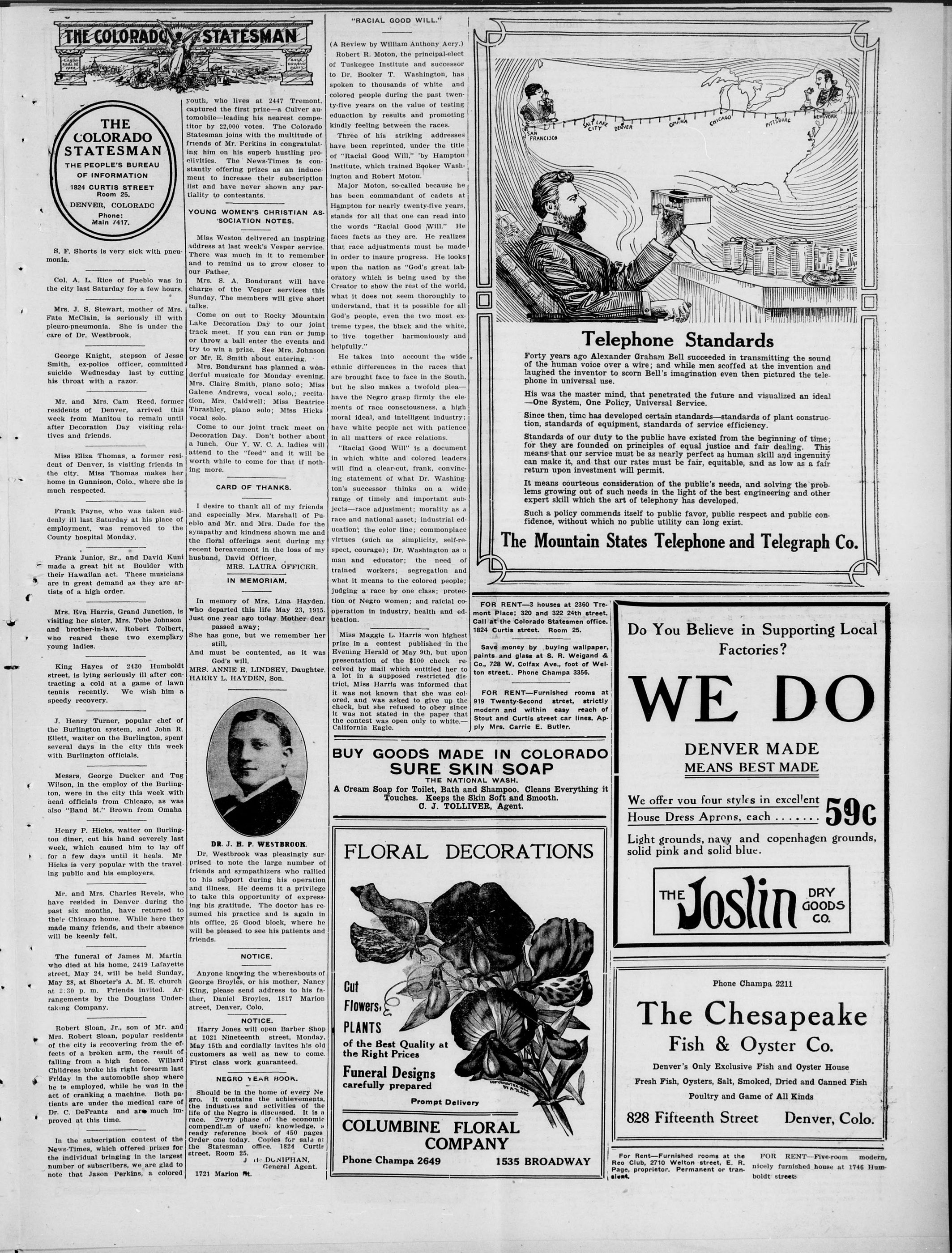
SAN FRANCISCO
SALT LAKE CITY
DENVER
OMAHA
CHICAGO
PITTSBURG
NEW YORK
FOR RENT—3 houses at 2360 Tremont Place; 320 and 322 24th street. Call at the Colorado Statesmen office. 1824 Curtis street. Room 25.
Save money by buying wallpaper, paints and glass at S. R. Weigand & Co., 728 W. Colfax Ave., foot of Welton street.. Phone Champa 3356.
FOR RENT—Furnished rooms at 919 Twenty-Second street, strictly modern and within easy reach of Stout and Curtis street car lines. Apply Mrs. Carrie E. Butler.
DE IN COLORADO
SKIN SOAP
NATIONAL WASH.
and Shampoo. Cleans Everything it
skin Soft and Smooth.
VER, Agent.
DECORATIONS
COPYRIGHTED BY A. J. LAING
BUY GOODS MADE IN THE SURE SKIN SOAP
THE NATIONAL WASH.
A Cream Soap for Toilet, Bath and Shampoo.
Touches. Keeps the Skin Soft and
C. J. TOLLIVER, Agent
FLORAL DECORA
Cut Flowers,
PLANTS
of the Best Quality at
the Right Prices
Funeral Designs
carefully prepared
Prompt Delivery
A Cream Soap for Toilet, Bath and Shampoo. Cleans Everything it Touches. Keeps the Skin Soft and Smooth. C. J. TOLLIVER, Agent.
FLORAL DECORATIONS
Cut
Flowers,
PLANTS
of the Best Quality at
the Right Prices
Funeral Designs
carefully prepared
Prompt Delivery
COPYRIGHTED BY
A. Z. PARC
COLUMBINE FLORAL
COLUMBINE FLORAL
COMPANY
Phone Champa 2649 1535
1535 BROADWAY
Phone Champa 2649 1535 BROADWAY
"RACIAL GOOD WILL."
(A Review by William Anthony Aery.) Robert R. Moton, the principal-elect of Tuskegee Institute and successor to Dr. Booker T. Washington, has spoken to thousands of white and colored people during the past twenty-five years on the value of testing eduction by results and promoting kindly feeling between the races. Three of his striking addresses have been reprinted, under the title of "Racial Good Will," 'by Hampton Institute, which trained Booker Washington and Robert Moton.
Major Moton, so-called because he has been commandant of cadets at Hampton for nearly twenty-five years, stands for all that one can read into the words "Racial Good Will." He faces facts as they are. He realizes that race adjustments must be made in order to insure progress. He looks upon the nation as "God's great laboratory which is being used by the Creator to show the rest of the world, what it does not seem thoroughly to understand, that it is possible for all God's people, even the two most extreme types, the black and the white, to live together harmoniously and helpfully."
He takes into account the wide ethnic differences in the races that are brought face to face in the South, but he also makes a twofold plea—have the Negro grasp firmly the elements of race consciousness, a high moral ideal, and intelligent industry; have white people act with patience in all matters of race relations.
"Racial Good Will" is a document in which white and colored leaders will find a clear-cut, frank, convincing statement of what Dr. Washington's successor thinks on a wide range of timely and important subjects—race adjustment; morality as a race and national asset; industrial education; the color line; commonplace virtues (such as simplicity, self-respect, courage); Dr. Washington as a man and educator; the need of trained workers; segregation and what it means to the colored people; judging a race by one class; protection of Negro women; and racial cooperation in industry, health and education.
Miss Maggie L. Harris won highest prize in a contest published in the Evening Herald of May 9th, but upon presentation of the $100 check received by mail which entitled her to a lot in a supposed restricted district, Miss Harris was informed that it was not known that she was colored, and was asked to give up the check, but she refused to obey since it was not stated in the paper that the contest was open only to white. California Eagle.
Telephone Standards
Telephone Standards
Forty years ago Alexander Graham Bell succeeded in transmitting the sound of the human voice over a wire; and while men scoffed at the invention and laughed the inventor to scorn Bell's imagination even then pictured the telephone in universal use.
His was the master mind, that penetrated the future and visualized an ideal—One System, One Policy, Universal Service.
Since then, time has developed certain standards—standards of plant construction, standards of equipment, standards of service efficiency.
Standards of our duty to the public have existed from the beginning of time; for they are founded on principles of equal justice and fair dealing. This means that our service must be as nearly perfect as human skill and ingenuity can make it, and that our rates must be fair, equitable, and as low as a fair return upon investment will permit.
It means courteous consideration of the public's needs, and solving the problems growing out of such needs in the light of the best engineering and other expert skill which the art of telephony has developed.
Such a policy commends itself to public favor, public respect and public confidence, without which no public utility can long exist.
The Mountain States Telephone and Telegraph Co.
WE DO
DENVER MADE MEANS BEST MADE
We offer vou four styles
House Dress Aprons, ea
Light grounds, navy and
solid pink and solid blue
THE Josl
you four styles in excellent
ess Aprons, each .....
ands, navy and copenhagen
and solid blue.
Joslin DR
GO
C
We offer you four styles in excellent House Dress Aprons, each . . . 59c Light grounds, navy and copenhagen grounds, solid pink and solid blue. THE Joslin DRY GOODS CO.
Phone Champa 2211
The Che
Fish & O
Denver's Only Exclusive H
Fresh Fish, Oysters, Salt, Smok
Poultry and Game
the Chesapeake Fish & Oyster Co.'s Only Exclusive Fish and Oysters Oysters, Salt, Smoked, Dried and Poultry and Game of All Kinds
Denver's Only Exclusive Fish and Oyster House Fresh Fish, Oysters, Salt, Smoked, Dried and Canned Fish Poultry and Game of All Kinds 828 Fifteenth Street Denver, Colo
For Rent-Furnished rooms at the Reo Club, 2710 Welton street, E. R. Page, proprietor. Permanent or transient.
---
in excellent
ach..... 59c
and copenhagen grounds,
e.
in DRY
GOODS
CO.
esapeake Oyster Co. Fish and Oyster House ooked, Dried and Canned Fish me of All Kinds Denver, Colo.
FOR RENT-Five-room modern, nicely furnished house at 1746 Humboldt streets
MEMORIAL DAY
Gather the garlands rare today,
Snow-white roses and roses red;
Gather the fairest flowers of May,
Heap them upon the heaps of clay,
Gladden the graves of the noble dead.
This day the friends of the soldiers keep,
And they will keep it through all the
years,
To the silent city where soldiers sleep
Will come with flowers, to watch and
weep
And water the garlands with their tears,
—Cy Warman.
DECORATION day, day of flags, and flowers, and green, grass-covered graves. Decoration day, the time of sobs and tears, of prayers, and memories, and smiles. Decoration day!
It comes only once a year, this brave holiday, on the boundary line between May and June, spring and summertime. Schools give a holiday and banks close. Business is shut up, and the tired workingman hangs a flag out over his porch, and rests. Old soldiers, tottering on canes, soldiers bent and white-headed, waiting for the last "tape" to be sounded, get out their suits of blue and gray, covered with tarnished gold lace and brass buttons, and hobble to the cemetery to lay a wreath on some comrade's last resting place.
It is a beautiful thing to think of a nation celebrating a day—setting it apart from all others—for the purpose of honoring the nation's heroes. I was sitting in a trolley car when a lady entered a woman no longer very young, with a pale, sorrowful face. She wore expensive black, and her two carefully gloved hands held a huge dowy mass of roses. Like an oasis in a desert they filled the dusty city air with sweetness and color. In a little while a small newsboy dragged himself up the step and presented a grimy transfer to the conductor.
"I found it," he confided loudly to a man seated near the door. Then he tramped down the aisle, and climbed up on the seat next to the lady.
"Them flow's are swell," he told her in a soft, wondering tone of voice. "I never saw any like 'em before." Reverently he touched the nearest blossom with moist, grimy fingers. The lady moved down on the seat, putting several feet of space between herself and the small intruder. "Don't touch them!" she ordered grossly. Several blocks farther on she got out, her arms full of her fragrant burden. With halting foosteps and tear-filled eyes, she turned in at a great marble-columned cemetery gate. She was taking her roses to lay on the grave of some loved dead one. I was sorry for the woman; but I could not help thinking of the little newsboy. He was very much alive, and a single flower would have meant paradise to him.
I know a girl who had a very dear friend—a friend who meant more to her than I could possibly put into words. One day, the friend died and left her plunged in grief. A year after, the dead girl's birthday came around, and the day before the anniversary I happened to meet my friend on the street. We went to tea together. I did not speak to the absent one, but suddenly, as we sat quietly gazing out of the window, the girl began to talk. "Margaret," she said, "something has been bothering me. I want to ask you if I'm doing right." "Perhaps I won't help any. I'm not so good at advice—but go on."
"You see, it's this way," she told me. "Tomorrow is Alice's birthday—the first birthday when we haven't been together for ten years. I had earned five dollars—it seemed more personal that way—and I was going to buy flowers for her grave. I was just on my way to the florist to order them when I met a woman I know—a woman who used to wash for us. Margaret, you should have seen her. Her eyes were large and black and her cheeks were perfectly hollow. I asked her what was the matter, and she said she was hungry. Hungry? She was starving! And so were the three children that belonged to her! Well, I told her that I would find some work for her today, and then I gave her all the money I had. It was only after she had left me that I remembered Alice's flowers—I can't get them now. Do you think that she'll mind—very much?"
"Mind?" I groped blindly for words, "Mind? Of course not! She would be glad and thankful if she only knew."
Do you think so too, friends of mine?
One day this week I felt rather blue and unhappy. It was a dark, gloomy day, with a biting wind coming around the bleak corners and a heavy rain that fell drenchingly to the ground—a steady downpour of big splashing drops. Somehow the world inside my office seemed very lonely and gray. I had a headache, my work had been going badly and I was rather discouraged. When the mail came in—a big package of letters to be opened—I was not much cheered. But my special guardian angel was on duty that day. When I cut the first envelope, I found a plain little letter, written in pencil
on cheap paper, by an unknown lady
old enough to be my grandmother.
But the words, lightly written in an
old-fashioned hand, fell across my
heart like a ray of golden sunshine,
through the grayness of the rain.
"Dear Friend," read the letter, "I
have been seeing your pieces in the
Christian Herald for some time, and
I made up my mind to write to you.
Some people believe in keeping their
kind words and their flowers and their
love until a person is dead. But I
don't. I want you to know, right now,
that you've cheered me up lots of
times, and that I like your stories and
that I like you."
Now, I don't want you to think that I am disapproving of Decoration day. The world is stupid enough and matter-of-fact enough to forget easily the heroes who lie in our cemeteries. But we should consider the living, too. Let us place roses over the little green mounds, but don't let us overlook the pleading child-hands that are stretched out for their sweetness. While we honor the memory of those beautiful spirits that have passed from us, let us not forget the living, breathing souls that need our help.
It is not necessary to save all the flowers, the kind words and the kisses until lips and hearts and minds are cold and dead.—Margaret E. Sangster, Jr., in the Christian Herald.
UNITY OF NATION PROVED
Great Southerner Long Ago Pointed Out How Complete Has Been Its Restoration.
From an address delivered by Henry
wrote a memorial cemetery,
Nashville, Tenn., Decorated by
the family.
We are assembled, my countrymen, to commemorate the patriotism and valor of the brave men who died to save the Union. The season brings its tribute to the scene; pays its homage to the dead; inspires the living. There are images of tranquillity all about us; in the calm sunshine upon the ridges; in the tender shadows that creep along the streams; in the waving grass and grain that mark God's love and bounty; in the flowers that bloom over the many graves. There is peace everywhere in this land today.
streams,
Peace where'er our starry banner gleams,
And peace in every breeze.
The war is over. It is for us to bury its passions with its dead; to bury them beneath a monument raised by the American people to American manhood and the American system, in order that "the nation shall, under God, have a new birth of freedom and that government of the people, by the people, and for the people shall not perish from the earth."
The Union is, indeed, restored when the hands that pulled down that flag come willingly and lovingly to put it up again. I come with a full heart and a steady hand to salute the flag that floats above me—my flag and your flag—the flag of the free heart's hope and home—the star spangled banner of our fathers—the flag that, uplifted triumphantly over a few brave men, has never been obscured, destined by the God of the universe to waft on its ample folds the eternal song of freedom to all mankind, emblem of the power on earth which is destined to exceed that on which it was said that the sun never went down.
IMPRESSING YOUNG AMERICA
PHOTO BY
FRANK
TOURNIER
Experience does not show that the strength of the domestic affections is impaired by the long separations unavoidably incident to war. On one occasion a private soldier said to General Thomas: "General, I want to go home and see my wife."
"How long is it since you have seen her?" asked the general.
"Over three months."
"Three months," replied Thomas.
"Why, I haven't seen my wife for three years."
"That may be so," admitted the soldier, "but, you see, general, my wife and me ain't that sort."
THE REVEILLE
Hark! I hear the tramp of thousands,
And of armed men the hum;
Lo! a nation's hosts have gathered
Round the quick alarming drum—
Saying, "Come,
Freemen, come!
Ere your heritage be wasted," said the quick alarming drum.
"Let me of my heart take counsel:
War is not of life the sum;
Who shall stay and reap the harvest
When the autumn days shall come?
But the drum
Death shall reap the braver harvest,
"But when won the
What of profit she
What if conquest, she
Even greater ills
But the drum
Answered, "C
You must do the sum to prove it,"
"What if, 'mid the
Whistling shot and
When my brothers f
Should my heart
But the drum
Answered, "C
Better there in death united, than in
Death shall reap the braver harvest," said the solemn-sounding drum
Better there in death united, than in life a recreant—Come!"
Thus they answered—hoping, fearing,
Some in faith, and doubting some,
Till a trumpet-voice proclaiming,
Said, "My chosen people, come!"
Then the drum,
Lo! was dumb,
For the great heart of the nation, throbbing, answered, "Lord, we come!"
—BRET HARTE.
LITTLE LEFT OF OLD APPOMATTOX
SOLDIERS of 1865 who revisit the town of Appomattox find that the half-century which has done so much for their country has done nothing for the hamlet made famous by the great event of Lee's surrender. Indeed, the place has gone backward in fifty years. Its houses have fallen into decay or have disappeared, and its fields have grown up to pine. The village of Appomattox Courthouse was never a considerable settlement. Like many another county seat in the South, it had its origin in a courthouse, a jail, a tavern, a house or two and a blacksmith shop—a center to which the inhabitants of a rural district could come at intervals to transact legal business.
A visitor to Appomattox Courthouse today—or "old Appomattox," as it is now called in that neighborhood—must be disappointed, unless he has the faculty of visualizing the momentous events that took place there, and near there, in April, 1865.
The court building had then stood there half a century. About 1890 it was burned. Today the square in which the old courthouse stood is covered with the debris of the fire, but out of the wreckage trees have grown up as companions to those that shaded the old courthouse before the fire.
The village that clustered around the courthouse has nearly disappeared. Four old frame structures have survived fire, storm and neglect, but these are sagging and out of joint and seem soon to pass away. One or two of these houses are tenantless. The tavern, once the Appomattox hotel, is the home of a farmer and the overseer of about 1,500 acres of adjacent land now owned by Col. George A. Armes, a retired officer of the United States army, who lives in Washington. Another house is occupied by a small farmer who has not dwelt long in that part of the state.
The Surrender house, the McLean house, in which General Grant and his staff met Lee and his military secretary, is not there. It was a broad-fronted brick house with a covered porch across the front, with the entrance in the middle and a hallway through the center.
The house was torn down in 1892. It was proposed to reconstruct it at the World's Fair in Chicago, but after the demolition of the house the plan was carried no further, presumably for lack of funds. The piles of brick and lumber that had been the house are rotting in the garden. There has been some talk of a patriotic society building the house on its old site.
An interesting personal story goes with the history of the Surrender house. It was the home of William McLean, who had moved to Appomattox from the vicinity of Bull Run, to avoid the scenes of war that destroyed the peace and safety of his family in 1861.
McLean was a farmer, then living in a frame house near Manassas on the road leading to Blackburns Ford, on Bull Run. July 18 the first fighting between the troops of Gen. Irwin McDowell and Gen. G. T. Beauregard took place at that ford, and General Beauregard took up his headquarters in the McLean house. A shell from a Union battery struck the house.
After the battle of Bull Run, July 21, 1861, McLean and his family moved to upper Fauquier county. He next moved to Lunenburg county. War followed him. Then, declaring that he would
S
me!
' said the solemn-sounding drum.
coming battle,
springs therefrom?
objugation,
become?"
some!
said the Yankee-answering drum.
cannons' thunder,
d bursting bomb,
all around me,
grow cold and numb?"
some!
life a recreant—Come!"
take his family so far from the fighting grounds that war would not further trouble them, he rented a house in the hamlet of Appomattox. Fate made this house the Surrender house.
The McLean house near Manassas long ago was a ruin, but another house near it, which Beauregard also used as headquarters, is often erroneously pointed out as the McLean house.
McLean's son—J. Wilmer McLean—is a business man in Manassas—a hamlet that since the war has grown into a thriving town.
The table in the McLean house at Appomattox on which the articles of surrender were written is in the National museum at Washington. The flag of truce under which the negotiations between Grant and Lee were conducted is also there, having been loaned to that institution by the widow of George A. Custer.
Colonel Whittaker of Grant's staff, who carried the flag, lives in Washington and is expected to take part in the celebration at Appomattox. Maj. George C. Rounds of Manassas, a Civil war veteran, resident since the war at Manassas, who promoted the Blue and Gray reunion on the field of Bull Run, has promoted the coming fraternal celebration at Appomattox. Major Rounds has been urging upon the war department and congress for years the desirability of converting the battlefields of Bull Run into a national park. He also takes a keen interest in the future of Appomattox Courthouse. On the surrender ground is now a dense pine growth, in which is the only important monument at Appomattox. It was erected by North Carolina, April 9, 1905.
Though the Appomattox Courthouse village of the Civil war period has practically disappeared, there is a new and thriving town called Appomattox, which is now the county seat of Appomattox county. It is three miles from old Appomattox and is on the Norfolk & Western railroad. During the Civil war there was a siding on this railroad called Appomattox station. It was here that Custer with his cavalry division got in front of Lee. The place has grown to be the town which today is called Appomattox. When the old court building was destroyed by fire, the courthouse was re built at Appomattox station.
PHOTO BY
PIMMK
TOURNER
---
The Curtis Park Floral Company
FLORAL DESIGNS PUT UP WHILE YOU WAIT
CHOICE PLANTS AND CUT FLOWERS CONSTANTLY ON HAND
GREENHOUSES: Thirty-Fourth and Curtis Streets
TELEPHONE, MAIN 1511 DENVER, COLO
The Champa Pharmacy
Twentieth and Champa,
Is the place to get your
DRUGS, CHEMICALS AND PATENT MEDICINES
WE SERVE DRINKS.
Prescriptions Our Specialty.
Phone us and we will deliver the goods to all parts of the city.
JAMES E. THRALL, PROPR.
PHONE MAIN 2425.
When You Want
The Heads, Feet, Tails, Snouts, Neckbones or Chiterlings, or any other part of the hog except the squeal, go to
Sales Daily at 2 p.m. Office Furniture a Specialty.
PRIVATE SALES AT ALL TIMES
HAVE MOVED TO—
1723-39 GLENARM ST.
PHONE MAIN 1675.
THE BEST ICE CREAM AND
CANDIES AT
O.P. BAUR & CO.
CATERERS AND
CONFECTIONERS
Phone: 168
1512 Curtis Street, Denver, Colo.
JOSEPH CARTER
Express, Moving,
and Storage
COAL AND WOOD
PROMPT DELIVERY.
Phone Main 6544.
2415 WASHINGTON STREET.
2300-6 Larimer Street Phone Main 1461
ORIENTAL RESTAURANT
Chop Suey, Noodles and Short Orders
Phone Main 4896
1848 Arapahoe
乐坪轩
Miss M. Cowden Hair Dressing Parlor
Shampoo, cutting and curling. Scalp treatment, hair tonics, hair straightening, manicuring. Stage wigs for rent; theatrical use and masquerades. Goods delivered out of the city. All shades of hair matched by sending sample of hair; also combings made up.
Cheapest Switches 50 Cents
1219 21st St. Denver, Colo.
DO IT NOW Subscribe for THIS PAPER
The HOME BEAUTIFUL
Flowers and Shrubbery
Their Care and Cultivation
- White House Conservatory Where Violets of Unusual Size, Color and Beauty Are Raised.
```markdown
```
A Fine Example of Cineraria Hybrida, Showing the Wide Range of Color and Shape of Petal.
A LIVING IN VIOLETS
Two thousand dollars was the amount netted two young women last year who raised violets for the New York market. The girls started in four years ago with a capital of less than $50 and about as little experience as girls who have lived in the country all their lives could have about anything growing.
Their first investment was 12 unglazed hotbed sashes, 3 by 6 feet, at 70 cents a sash. They glazed them themselves at a cost of $19.
They started their experiment in the fall and devoted their evenings to studying up varieties. They determined to choose the Marie Louise, as it was of the double varieties most popular in the New York market, and beside the Lady Hume Campbell, the only double variety suited for commercial growing.
Early in March they invested $10 in cuttings of the Marie Louise and began work in earnest.
Following the advice of a successful grower of violets they potted these cuttings in 2-inch pots in a mixture of one well-rotted manure to three parts garden soil. Besides mixing thoroughly, the soil was sifted to free it from lumps. The pots were then set in a frame in the garden and covered with four of the sashes. There were about a thousand pots in all, but unfortunately the cuttings were very poor.
While waiting for the cuttings to root they built the frame into which they were to be permanently set. This frame was only a rough box, 6 feet wide by 36 long, 12 inches deep in the back and half as much in front.
The frame was placed in a fertile spot in the garden. Over the surface of the soil they spread well-rotted stable manure to the depth of 3 or 4 inches. It required all of their spare time for a month to get the soil to their satisfaction. About the middle of April they selected the largest cuttings for planting first, leaving the small plants for the last. Knocking them carefully out of the pots, they set them in the frame 8 inches apart in 6-inch rows. They soon discovered that they had only room for about one-half the cuttings.
The young women built another frame and set the last of their young plants.
The first summer there was the red spider to fight against. July and August found them very busy syringing the plants. It was a difficult task, as the stream must be kept down low enough to strike the leaves underneath and turn them completely over. About the middle of September the plants began to bloom, and although they kept the blossoms closely picked they did not attempt to sell them until the first week in October. They allowed the florist in their home town to have all their blossoms at the rate of 40 cents a hundred in October
and 55 cents a hundred in November. In October they built their first greenhouse. It was 60 by 20 feet, and helping with the work they managed to reduce the cost of the first estimate of $80 to $65. Early in November the plants were lifted from the frame and set in beds in this greenhouse, and so well was the work done that none of the plants stopped blooming. At Christmas nearly 4,000 blossoms were picked and were sold for ninety cents a hundred.
During May the young women began preparations for their second season by putting in a second thousand young plants. To save the trouble and expense of moving them in the autumn they marked out beds as they would be when the new greenhouse was complete, and after setting up the posts of the house, put out the violets. The shades were stretched over these posts, and aside from this and giving them water when rain failed to come often enough they received almost no attention until September, when the new house was completed.
The violets bloomed so profusely that the young women were advised to have their violet beds photographed and samples of their flowers sent with the pictures to some of the big florists in New York. They did so, with the result that one of the largest concerns in New York sent one of its representatives to see the young women and arrangements were made to take all the blooms at the rate of $1 a hundred for all sent during November, $2 for December, and $1 for January and February, and 75 cents for the rest of the season. The offer was accepted and the young women have continued to ship their blooms to this firm.
THE CULTURE OF CINERARIAS By G. GEOFRY.
In the culture of the cineraria the one mistake so often made is that of sowing the seed too soon. The plants thus raised, more often than not, make a rank growth; this is not in any sense desirable. By sowing in May or June, plants large enough for all decorative purposes can be had. In after treatment the aim should be to secure as hardy growth as possible. Cineraria is one of the most useful and ornamental of plants, with flowers of the richest and most brilliant colors and shades and of the finest textures.
For succession, it is well to make sowings of the seed from May to September, but the main sowing in July. The cineraria is a very fine plant for the conservatory and for house decoration. The coloring of this plant endears it to growers; there are the lovely and rare cornflower-blue tints in profusion, rich crimson and blood red in many varieties, deep rose and shell pink, and a wonderful combination of pink and light blue shades. There is also a lovely single pure white variety that is worth considering for your all-white bed.
SIX INJURED IN STORM AT YUMA
ONLY ONE SERIOUSLY HURT IN
TWISTER THAT DAMAGED
TOWN $100,000.
MANY HOMES WRECKED
EIGHTEEN KILLED IN TERRIFIC
STORM THAT WIPED OUT
OKLAHOMA TOWN.
Western Newspaper Union News Service.
Yuma, Colo.—Six persons were injured, one of whom may die, nearly a score of buildings in the business section were wrecked or badly damaged, many homes partly destroyed and more than $100,000 damage was done by a cyclone that swept Yuma Saturday afternoon. The storm arose from the southwest. It raced onto Yuma without an instant's warning. It caught its victims in business houses, at their homes, in the fields, driving in motor cars, buggies or wagons and walking the streets of the little town, which never before had experienced a storm so violent. The tornado also visited Brush.
There is a probability, however, of only one death, Benjamin Meckelburg, a wealthy farmer, is the only person injured whose condition is considered critical.
Meckelburg has a broken back and is in an extremely serious condition. He was caught beneath a garage wall that the storm demolished. H. E. Greer, who was buried under three feet of brick, is not seriously hurt, in the opinion of physicians at Yuma. The progress of the four other injured was reported Monday as satisfactory.
Denison, Tex.-At least eighteen persons were killed in a terrific wind and rain storm which passed over the section just north of Denison. The town of Kemp, Okla., two miles north of the Red river, is reported wiped out. Most of the deaths are said to have occurred at Kemp. One child was killed a mile north of Denison.
At Woodward, Okla., more than a score of persons were injured when a Chautauqua tent was blown down. Mrs. H. B. Peebles probably will die from injuries to her head.
PROGRESSIVES NAME DELEGATES
C. P. Dodge Indorsed as Choice of Party for Governor. Denver.—The Progressives of Colorado held their state convention May 20 and elected a delegation of twenty, with one-half vote each, instructed to vote for Theodore Roosevelt as the nominee of the party at the Chicago convention. The Progressives further indorsed Clarence P. Dodge of Colorado Springs, who is state chairman of the party, as their choice for the office of governor of the state.
The convention elected the following delegates: Clarence P. Dodge, Colorado Springs; E. P. Costigan, Denver; Ben Griffith, Grand Junction; C. E. Fisher, Sterling; A. A. Lee, Denver; James H. Causey, Denver; Mrs. Marie Dieker, Denver; John B. Stephen, Denver; Charles N. Knowles, Denver; Hattie K. Howard, Denver; George W. Jackson, Loveland; Thomas E. Thomas, Colorado Springs; R. R Drennan, Fort Morgan; Ira De Long, Boulder; Joseph W. Ewing, Greeley; A. E. Patton, Golden; Patrick Burns, Pueblo; P. H. Troutman, Cañon City; Merle D. Vincent Paonia; Mert Nicholson, Leadville.
The following were elected alternates: Mrs. Mabel Costigan, Denver; Mrs. Lillian Kerr, Colorado Springs; Edward A. Miller, Fort Collins; L. G. Kertz, Las Animas; J. I. Carper, Denver; Josephine Roach, Denver; Mrs. Margaret Kessler, Denver; C. J. Downey, Denver; A. B. Frost; Denver; H. R. Ramsey, Denver; W. G. Bowersox, Longmont; W.ver; W. G. Bowersox, Longmont; W. G. Alexander, Fort Collins; A. W. Winegar, Burlington; C. D. Walrod, Holyoke; E. E. Boyle, Chivington; E. C Smith, Greeley; the G. P. Gibbs, Creede; Dr. Folkerson, Cahon City; J. L. Oliver, Palisade; Barney Haughey, Durango.
The convention went on record urging Congress to pass the Susan B. Anthony amendment enfranchising the women of the nation, and protested against the obstruction of the amendment in the judiciary committee of the House of Representatives.
Widely Known Politician Dead.
Cincinnati, Ohio.—George B. Cox, politician and theatrical magnate, died at his home here.
"Favorite Sons" Open Headquarters. Chicago. — Campaign headquarters will be opened in Chicago by a number of "Favorite Son" candidates for the Republican nomination for President, among them being Elihu Root of New York, Charles W. Fairbanks of indiana, Theodore E. Burton of Ohio, Senator John W. Weeks of Massachusetts, Senator Albert B. Cummins of Iowa, Senator Lawrence Y. Sherman of Illinois, Senator Robert M. LaFollette of Wisconsin. T. Coleman D. Font of Delaware and Major General Leonard Wood.
DICKENS FOUND GUILTY
Do You Know That-
BANKER'S SON FACES PEN TERM
AS FATHER'S SLAYER.
Attorneys Given 45 Days to Make Application for New Trial—Case May Go to Supreme Court.
Western Newspaper Union News Service.
Boulder, Colo., May 24.—Rienzi C. Dickens was found guilty of the second degree murder of his father, William H. Dickens, wealthy Longmont banker and pioneer builder. The verdict carries with it a sentence of from ten years to life imprisonment in the penitentiary. The jury retired late Monday night and began balloting on Rienzi's fate. Attorneys for Rienzi Dickens were granted 45 days in which to file a motion for a new trial, and if this is denied are expected to appeal to the Supreme Court in the bitter fight to free Rienzi.
When the verdict was read, the defendant's wife, who had been at his side constantly during the trial, shrieked and went into hysterics. Within fifteen minutes after the verdict, Mrs. Dickens collapsed completely and was carried to her hotel.
IS PREPARED TO DO ALL KINDS OF
Foremost in the efforts to stop the cries of the little woman was Rienzi Dickens himself. He received the verdict with utter calm—almost apparent indifference. Then, without flinching, he arose and began to comfort his wife. Mrs. William H. Dickens, wife of the murdered man and active in her son's defense, was not in the room when the verdict was read. Mrs. Walter C. Coulehan, sister of the defendant, and Mrs. Jack Dickens, sister-in-law, broke down as did his wife.
Commercial, Fraternal, Church, Book and Stationery Jobs A SPECIALTY
The defendant will retain his liberty on a new $40,000 bond until the motion for a new trial is decided.
The murder of William H. Dickens occurred the night of Nov. 30, last. He sat resting, alternately dozing and reading, in the library of his luxurious home in Longmont. It was about 8 o'clock. His wife, who came west with him thirty years ago and fought the fight with him from poverty to wealth, had just entered the room and taken a seat across from him at the reading table when a bullet came crashing through the window. It plowed its way through the aged banker's body, and buried itself in the wall. A fragment strayed from the copper jacket and cut open the cheek of Mrs. Dickens. Mr. Dickens fell to the floor unconscious and died in his wife's arms four minutes later.
Ball and Concert Programs, Bill and Letter Heads, Calling Cards, Wedding Cards, Envelopes and Everything in the Printing Line Turned Out in the Neatest and Best Style Promptly on Short Notice.
There were many theories advanced and many clews, followed in the succeeding days. Officers racing to Longmont in an automobile from Colorado Springs with bloodhounds eight hours after the murder passed a man driving an exhausted horse toward Denver and he was traced by the officers until they became convinced that he could not have been the assassin.
We Have Supplied Our Office with New Job Press & Type of Up-to-Date Style and Our Work Will Be on a Par with the Very Best.
Gang Theory Advanced.
A number of the men who, through business association with the banker, had become his enemies, were investigated. A theory was offered that one of a gang known as the Bill DuBois gang in the early days of Longmont, practically wiped out by a vigilance committee commanded by William H. Dickens, had killed the banker in keeping with an oath of vengeance made at that time.
All northern Colorado was aroused. Rewards were offered by the Dickens family. William H. Dickens, scornful of formalities, rough in speech and dress, was one of the most prominent citizens of the section, and the business and social ramifications of the Dickens family extended to every part of Boulder county.
Give Us a Trial and We Will Give You Satisfaction
Learn of Rienzi's Purchase.
The day of Dec. 2, two days after the murder, Patrolman McKinnon in Denver learned by accident that Rienzi Dickens had purchased a high power rifle and a box of shells from the Tritch Hardware Company Nov. 3. He ordered a Maxim silencer, which the store did not have in stock. It came to him in Longmont Nov. 15. The next day he was out at Empson's hill, five miles from his home, shooting at a target.
Prices as Reasonable as Those of Any Job Office in Denver
The officers called Rienzi to the home of B. O. Smith, deputy sheriff the night of Dec. 2 and questioned him. Denials of the purchase of the rifle and of his automobile having been taken from his garage the night of the murder led to the investigation that uncovered the chain of circumstances on which a charge of murder was based. He was arrested the following morning and after being allowed to attend his father's funeral was taken to jail at Boulder. He was a prisoner thirty days and then was released on bonds of $27,500 furnished by his mother.
His arrest split Boulder county in two factions—those who arrayed themselves with the Dickens family in declaring Rienzi Dickens incapable of the crime of parricide and those who refused to declare a faith in his innocence. The Dickens clan pledged its fortune of more than $500,000 to his cause. Detectives were hired to search out evidence that would clear him and point to some other as the guilty person. The detectives caused the arrest of Jack Endsley, range rider and roamer, and he was held in jail a week by Sheriff Buster
THE STAR HAIR GROWER
A
FOR SHOW CARDS, ALL KID PAID
CARDS, ALL KINDS OF LETTERING AND PAINTING, SEE
FOR SHOW CARDS, ALL KINDS OF LETTERING AND SCENERY PAINTING, SEE
ROY BROWN
Colored Sign and Scenic Artist in the State of Lettering and Wall Jobs a Specialty.
Street Denver
PRESSOR
923.
WALLAC
South
A. B. CLOW
South 3583.
The Colorado Wall Paper and Paint Co.
Wall Paper, Paints, Oils and Co.
Interior and Exterior Decorators
COACH COLORS, PAINTS AND VARNISH
MENT FOR JOHN W. MASURY & SONS
ELTON STREET
DENVER, CO
Telephone Main 871.
The Only Colored Sign and Scenic Artist in the State. Gold Leaf Lettering and Wall Jobs a Specialty.
The Color
and
Wall Paper, P
Interior and
COACH COLORS,
AGENT FOR JO
1454 WELTON STREET
Telep
Wall Paper, Paints, Oils and Glass Interior and Exterior Decorators
COACH COLORS, PAINTS AND VARNISHES AGENT FOR JOHN W. MASURY & SONS'
1454 WELTON STREET DENVER, COLORADO Telephone Main 871.
PHGNE CHAMPA 2077
E V. Cammel, PRES. @ MG
You Will Be Delighted With
Lit 1: Things That Count
CURTIS M. HARRIS
Assistant Manager and Funeral
OFFICE AND PARLORS
FERN
2711 W
Can be rented for Private or
of any nature, with latest first
Pho
C. F
AMEL, PRES. @ MGR PREFERRED.
Be Delighted With Our Service As We Loc
ings That Count LADY ATTENDANT.
IS M. HARRIS Auto for
Manager and Funeral Director
ND PARLORS 2807 WELTON ST.
FERN HALL
2711 Welton Street
ed for Private or Public Parties. Dances o
with latest first-class accommodation.
E V. Cammel, PRES. & MGR PREFERRED.
You Will Be Delighted With Our Service As We Look After The
Lit I: Things That Count LADY ATTENDANT.
Can be rented for Private or Public Parties. Dances or Gatherings of any nature, with latest first-class accommodation.
C. F. HAL THE COAL MAN
Coal, Woo
COAL $4.2
PROMPT DELIVERY
Phone
521 TWENTY-EIGHTH STREET
al, Wood and Exp
AL $4.25 per ton and
PROMPT DELIVERY TO ANY PART OF THE
Phone Main 8559
Y-EIGHTH STREET, Between Glenarm and W
521 TWENTY-EIGHTH STREET, Between Glenarm and Welton, DENVER
2362 Walnut Street
J. R. DRESSOR
York 7923.
A Wonderful Hair Dressing and Grower.
One Thousand Agents Wanted. Good Money Made. We want Agents in every city and village to sell THE STAR HAIR GROWER a set of hair extensions that be used with or without straightening irons, sells for 25 cents per box. One-25 cent box will prove its value. Any person that will use a 25-cent box will be convinced. No matter what has failed to grow your hair, just give THE STAR HAIR GROWER a trial and je convinced. Send 25 cents for a full size set of hair extensions and we will send you a full apply that you can begin work at once; also agent's terms.
Send all money by Money Order to
THE STAR HAIR. GROWER, Mfr.
Northern Branch: Southern Branch:
1113 Clark St., P. O. Box 812,
EVANSTON, ILL. GREENSBORO, N.C.
NOTE.—Persons living in the South can
get their goods three days earlier if they
will order from THE STAR HAIR GROWER
MFR., P. O. BOX 812, GREENSBORO, N.C.
KINDS OF LETTERING AND SCENERY
PAINTING, SEE
WALLACE CLOW South 4750.
A. B. CLOW
South 3583.
Colorado Wall Paper
and Paint Co.
Paints, Oils and Glass
and Exterior Decorators
S, PAINTS AND VARNISHES
JOHN W. MASURY & SONS'
ET DENVER, COLORADO
telephone Main 871.
CAMMEL AND CO.
The Progressive
Funeral Directors
WE TAKE GREAT PRIDE IN THE
FACT THAT WE ARE "THE LEAD
ING FUNERAL DIRECTORS."
WE CAN FURNISH ELEGANT
ROLLING STOCK. AUTOS IF
MGR PREFERRED.
With Our Service As We Look After The
LADY ATTENDANT.
RIS Auto for Hire
General Director
S 2807 WELTON ST. DENVER
N HALL
Welton Street
or Public Parties. Dances or Gatherings
first-class accommodation.
Phone Main 2860
R. L. PHYN1X, Manager.
F. HALL
food and Express
.25 per ton and up
EVERY TO ANY PART OF THE CITY
ne Main 8559
STREET, Between Glenarm and Welton, DENVER
Denver, Colorado.
DAY OR NIGHT
In Woman's Realm
Extremely Pretty Dress for Summer May Be Made of Plain and Dotted Organdie, Though Other Materials May Be Chosen- Selection of the Veil Is Most Important-Innumerable Patterns From Which to Choose.
SUMMER DRESS.
Copyright
Underwood & Underwood
A very pretty and summery dress of plain and dotted organdie achieves fine style by combining these familiar materials. Organdie in cottons, as taffeta in silks, has proved peculiarly well adapted to the styles of today. The originality of the model lies in combining the plain and dotted surfaces so that they play parts of equal importance, and it suggests the use of other goods in the same way.
In the model shown the body and skirt are of the plain organdie. Five
SUMMER
graduated ruffles of the dotted organdie encircle it, the first and widest about the hem and the narrow fifth ruffle at the waist line. The underskirt is gored and gathered to flare. Its crispness and that of the ruffles is almost equivalent to the effect of crinoline.
The three-quarter length sleeves and square cape of the dotted organdie are edged with narrow ruffles made of it. The throat opens with a shallow V. A belt of ribbon in any color desired may be worn with this dress. White moire, cored near the edges, makes that shown in the picture. Silk stockings and white buckskin or canvas slippers will finish the pretty toilette suitably.
Among the new summer goods there are plain volles and lawns in beautiful
MOST POP
colors with which dainty interpretations of Scotch plaids may be found in light tints and varied colors. Something very distinctive and original might be made by combining these in the manner shown in this organdie dress. Then there are the crossbar and striped organdies, which might be used instead of the more familiar dotted varieties. They are sheerer than chiffon, the daintiest of all cotton, weaves, and retain the crispness which distinguishes the plain material. Nothing could be better for a graduating gown.
A circular veil with hexagonal mesh and border of small cheeklile balls is one of many that have aided designers in the conception of new effects in
millinery. Those to be worn over the face are of unbroken mesh with all sorts of fancy borders, and are woven of fine hairlike threads, so that they will not interfere with the vision. Others, to be thrown back, are purely an adjunct of the hat and show surfaces broken by big polka dots of flat sequins, or lace patterns in conventional and floral designs. These small veil-trimmed hats are very chic, but this management of the veil is quite outside the real realm of
DRESS.
its usefulness. Veils are worn for two reasons, to keep the hair neatly in place and because they are becoming. There are so many patterns to choose from that a selection is a matter of trying them on as in choosing a hat or a color for a gown. One may buy a mesh in almost any shape, as square, round, diamond shape or hexagonal. Borders vary also and there are several colors to choose from Taupe, brown, gray and purple tones, with several shades of dark blue, make it worth while to experiment as they are adapted to varied complexions. Black remains most popular, but is not always the happiest choice. The threads of which veils, and especially black veils, of today are woven are incredibly fine, and the heavy veil has no following.
Copyright.
Underweld & Underweld
ULAR VEIL.
Vellings and separate veils are made in narrow widths with narrow borders. The border reaches to the chin so that the veil covers just the face. No eccentric methods of draping have appeared so far in the season's history, unless we class the harem veil, which has been introduced for the motorist, under that head. Many of the new motor veils are of very thin chiffon and some of them are circular, suspended from an elastic cord that holds them in place about the hat in the manner shown for the face veil pictured here.
Julia Bottomley
PHONE MAIN 6123-Day or Night
THE
DOUGLASS UNDERTAKING
COMPANY
RESIDENCE PHONE YORK 7992
FRANK S. REED,
License Embalmer & Director
Lady Assistant
Polite Service
to All
Parlors, 2745 Welton Street
Phone Main 6319
Elegant Auto Service at the B
THE DENVER
MRS. J. H. STEELE, Mgr.
Special Auto Service Accommodation
some Cas
For Horse Carriage
Bonded to
BOLDEN B
and LUNC
924 19th Street,
Day or Night
Service at the Popular Price for Carriages.
DENVER MORTUARY
Mgr. 2445 Larimer Street, Denver, Colo.
Price Accommodating 10 People Including Hand-
some Casket $50.
Horse Carriages We Charge $3.50.
Bonded to the City.
EN BROS. CAFE
LUNCH ROOM
10th Street, Denver, Colorado
Phone Main 6319 Day or Night
Elegant Auto Service at the Popular Price for Carriages.
THE DENVER MORTUARY
MRS. J. H. STEELE, Mgr. 2445 Larimer Street, Denver, Colo.
Special Auto Service Accommodating 10 People Including Handsome Casket $50.
For Horse Carriages We Charge $3.50.
Bonded to the City.
924 19th Street, Denver, Colorado
NNER
30 to 2 p.m.
Short Or
at All He
DINNER
11:30 to 2 p.m.
All Kinds of
Kinds of Sandwiches Bros. Barber Shop
All Kinds of Sandwiches
Baths, Electric Massage
FIRST CLASS SERVICE
R. A. BOLDEN, Mgr. 926 19
Buy Glassware
AT
DEN, Mgr. 926 19th St. Denver Glassware Now
R. A. BOLDEN, Mgr. 926 19th St. Denver
BuyGlasswareNow
BuyGlasswareNow
Carson's
SPRING
GLASSWARE SALE
Among the Hundreds of Good
Glass Butter Boxes, to hold 1 pot
Crystal Glass Baskets, 9½ inches high
Sweet Pea Vases, 6½ inches high
High-grade Plain Water Glasses
15-inch Punch Bowl and 12 Sheets
7-piece Water Set, like cut; spec
A large assortment of Manufacturers two alike; at the very
CARS
732-36 FIFTEENTH S
hundreds of Good Values that we Offer are:
s, to hold 1 pound; special, each.....15c
kets, 9½ inches high; special, each.....25c
6½ inches high; special, each.....25c
Water Glasses, thin kind; special, each.. 4c
owl and 12 Sherbets; special, set.....$2.90
like cut; special, set.....89c
ment of Manufacturer's Glass Samples; no
; at the very low price of 15c each.
CARSONS
FIFTEENTH STREET (AT STOUT)
Among the Hundreds of Good Values that we Offer are:
Glass Butter Boxes, to hold 1 pound; special, each.....15c
Crystal Glass Baskets, 9½ inches high; special, each.....25c
Sweet Pea Vases, 6½ inches high; special, each.....25c
High-grade Plain Water Glasses, thin kind; special, each.. 4c
15-inch Punch Bowl and 12 Sherbets; special, set.....$2.90
7-piece Water Set, like cut; special, set.....89c
A large assortment of Manufacturer's Glass Samples; no
two alike; at the very low price of 15c each.
CARSONS
732-36 FIFTEENTH STREET (AT STOUT)
TOM LEWIS, Prop.
The Marian Hotel The Only Colored Hotel in Denver
1835-37-39 ARAPAHOE STREET.
PRIVATE DINING ROOMS
J. R. CONTEE
Pres. and Mgr.
Bolden
A. H.
INCORPORATED AND BONDED
NOTARY PUBLIC
7992.
ector.
street Denver, Colorado
Short Orders at All Hours
M
DENVER, COLORADO.
Annex Cafe Short Orders at All Hours Chinese Dishes of All Kinds
PHONE MAIN 7413