Colorado Statesman
Saturday, September 2, 1916
Denver, Colorado
Page text (machine-generated)
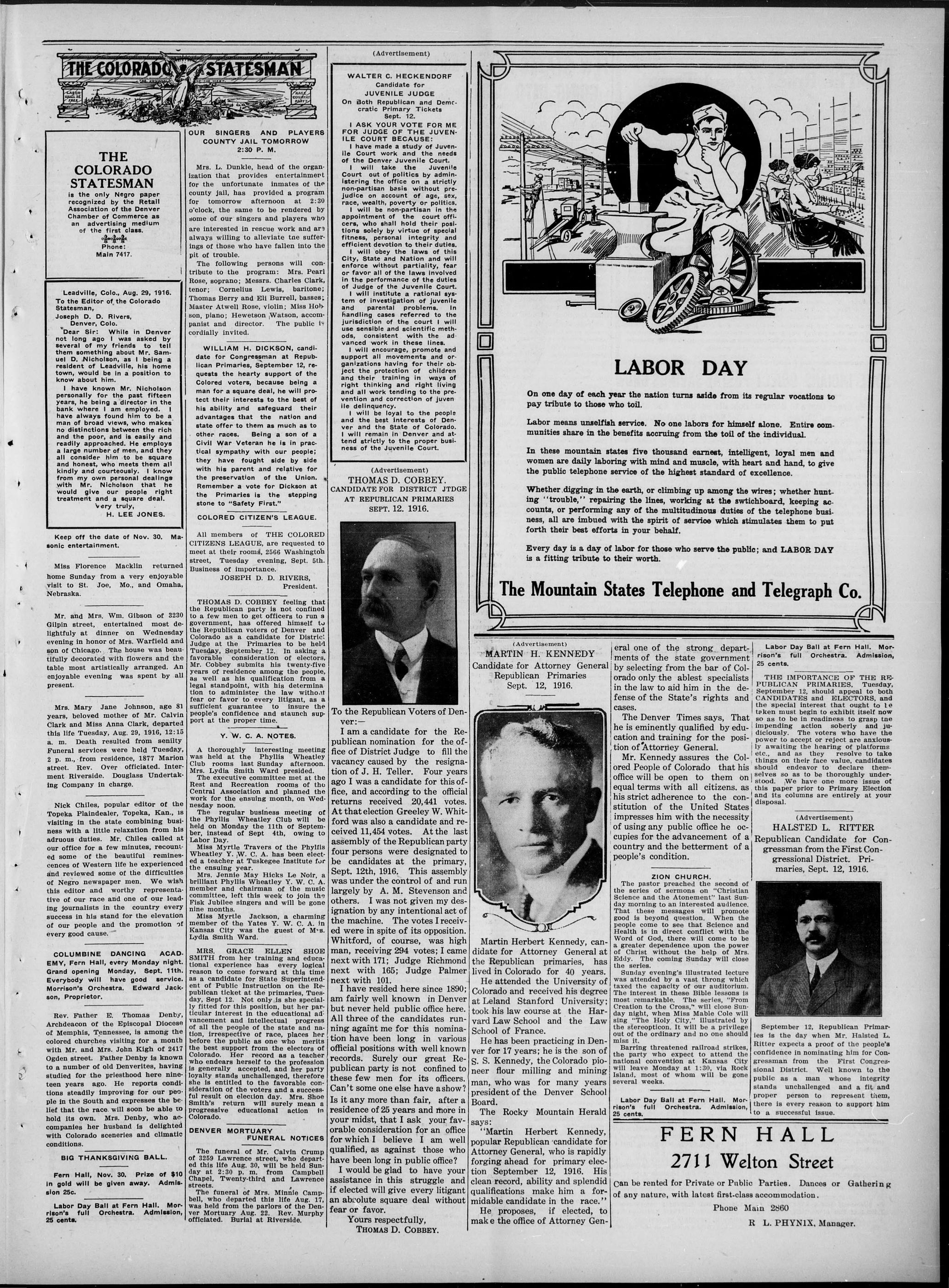
THE COLORADO STATESMAN
THE JOURNAL OF THE WEST.
LABOR SHALL BE FREE
RAGE COUNTRY PARTY
GO TO THE COURT HOUSE AND REGISTER
```markdown
```
VOL. XX111.
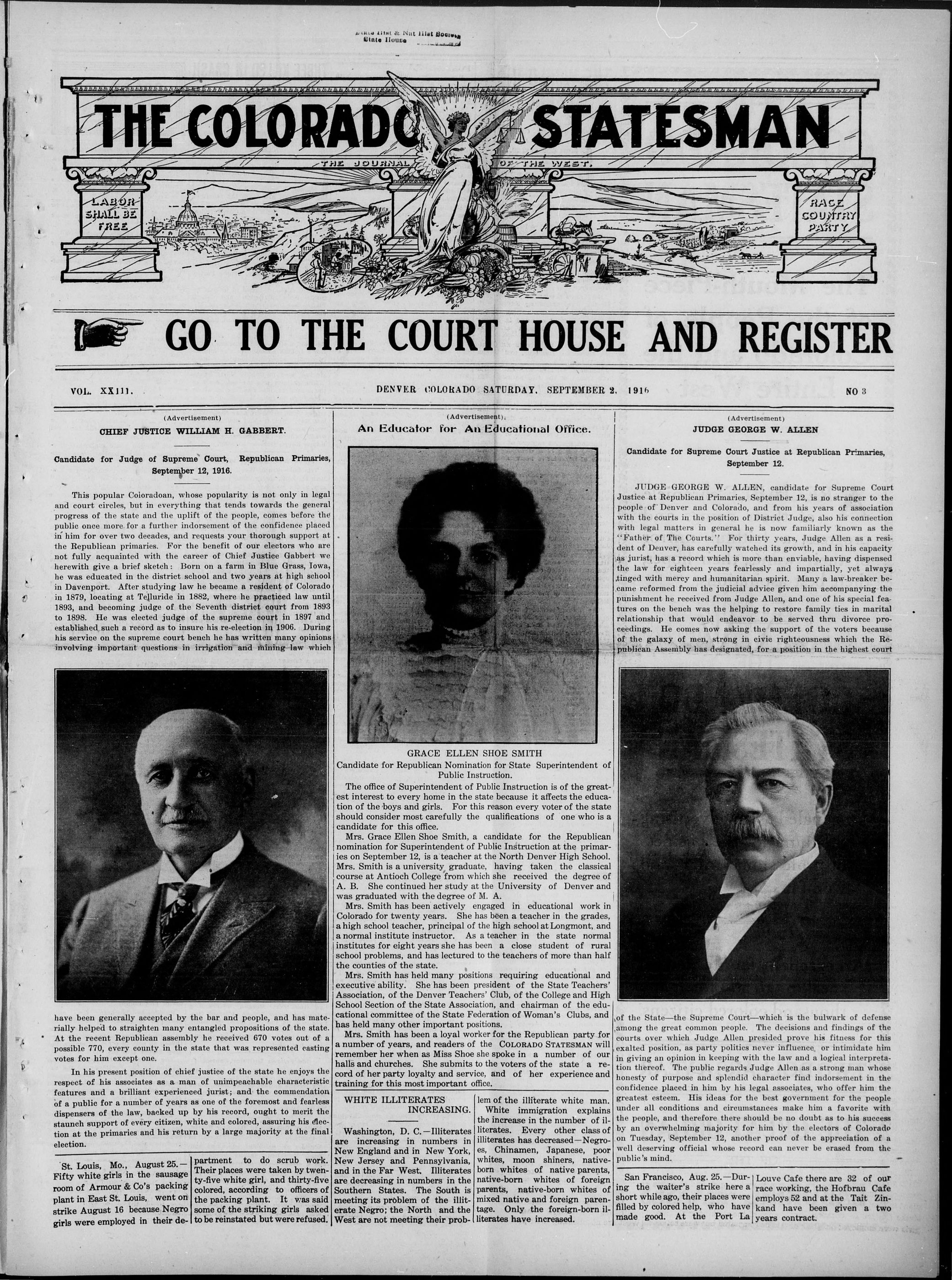
Candidate for Judge of Supreme Court, Republican Primaries, September 12, 1916.
This popular Coloradoan, whose popularity is not only in legal and court circles, but in everything that tends towards the general progress of the state and the uplift of the people, comes before the public once more for a further indorsement of the confidence placed in him for over two decades, and requests your thorough support at the Republican primaries. For the benefit of our electors who are not fully acquainted with the career of Chief Justice Gabbert we herewith give a brief sketch: Born on a farm in Blue Grass, Iowa, he was educated in the district school and two years at high school in Davenport. After studying law he became a resident of Colorado in 1879, locating at Telluride in 1882, where he practiced law until 1893, and becoming judge of the Seventh district court from 1893 to 1898. He was elected judge of the supreme court in 1897 and established such a record as to insure his re-election in 1906. During his service on the supreme court bench he has written many opinions involving important questions in irrigation and mining law which
have been generally accepted by the bar and people, and has materially helped to straighten many entangled propositions of the state. At the recent Republican assembly he received 670 votes out of a possible 770, every county in the state that was represented casting votes for him except one.
In his present position of chief justice of the state he enjoys the respect of his associates as a man of unimpeachable characteristic features and a brilliant experienced jurist; and the commendation of a public for a number of years as one of the foremost and fearless dispensers of the law, backed up by his record, ought to merit the staunch support of every citizen, white and colored, assuring his election at the primaries and his return by a large majority at the final election.
St. Louis, Mo., August 25.—Fifty white girls in the sausage room of Armour & Co's packing plant in East St. Louis, went on strike August 16 because Negro girls were employed in their department to do scrub work. Their places were taken by twenty-five white girl, and thirty-five colored, according to officers of the packing plant. It was said some of the striking girls asked to be reinstated but were refused.
St. Louis, Mo., August 25. Fifty white girls in the sausage room of Armour & Co's packing plant in East St. Louis, went on strike August 16 because Negro girls were employed in their de-
State Htt & Nat Htt Booze
State Htt
ADC STAT
THE JOURNAL
OF THE WEST.
HE COURT HOUSE
(Dvertisement)
An Educator for An Educational Office.
Mary C.
GRACE ELLEN SHOE SMITH Candidate for Republican Nomination for State Superintendent of Public Instruction.
The office of Superintendent of Public Instruction is of the greatest interest to every home in the state because it affects the education of the boys and girls. For this reason every voter of the state should consider most carefully the qualifications of one who is a candidate for this office.
Mrs. Grace Ellen Shoe Smith, a candidate for the Republican nomination for Superintendent of Public Instruction at the primaries on September 12, is a teacher at the North Denver High School. Mrs. Smith is a university graduate, having taken the classical course at Antioch College from which she received the degree of A. B. She continued her study at the University of Denver and was graduated with the degree of M. A.
Mrs. Smith has been actively engaged in educational work in Colorado for twenty years. She has been a teacher in the grades, a high school teacher, principal of the high school at Longmont, and a normal institute instructor. As a teacher in the state normal institutes for eight years she has been a close student of rural school problems, and has lectured to the teachers of more than half the counties of the state.
Mrs. Smith has held many positions requiring educational and executive ability. She has been president of the State Teachers' Association, of the Denver Teachers' Club, of the College and High School Section of the State Association, and chairman of the educational committee of the State Federation of Woman's Clubs, and has held many other important positions.
Mrs. Smith has been a loyal worker for the Republican party for a number of years, and readers of the COLORADO STATESMAN will remember her when as Miss Shoe she spoke in a number of our halls and churches. She submits to the voters of the state a record of her party loyalty and service, and of her experience and training for this most important office.
WHITE ILLITERATES INCREASING
lem of the illiterate white man. White immigration explains the increase in the number of illiterates. Every other class of illiterates has decreased—Negroes, Chinamen, Japanese, poor whites, moon shiners, native-born whites of native parents, native-born whites of foreign parents, native-born whites of mixed native and foreign parentage. Only the foreign-born illiterates have increased.
Washington, D. C.—Illiterates are increasing in numbers in New England and in New York, New Jersey and Pennsylvania, and in the Far West. Illiterates are decreasing in numbers in the Southern States. The South is meeting its problem of the illiterate Negro; the North and the West are not meeting their prob- literates. Every other class of illiterates has decreased—Negroes, Chinamen, Japanese, poor whites, moon shiners, native-born whites of native parents, native-born whites of foreign parents, native-born whites of mixed native and foreign parentage. Only the foreign-born illiterates have increased.
NO 3
(Advertisement) JUDGE GEORGE W. ALLEN
Candidate for Supreme Court Justice at Republican Primaries, September 12.
JUDGE GEORGE W. ALLEN, candidate for Supreme Court Justice at Republican Primaries, September 12, is no stranger to the people of Denver and Colorado, and from his years of association with the courts in the position of District Judge, also his connection with legal matters in general he is now familiarly known as the "Father of The Courts." For thirty years, Judge Allen as a resident of Denver, has carefully watched its growth, and in his capacity as jurist, has a record which is more than enviable, having dispensed the law for eighteen years fearlessly and impartially, yet always tinged with mercy and humanitarian spirit. Many a law-breaker became reformed from the judicial advice given him accompanying the punishment he received from Judge Allen, and one of his special features on the bench was the helping to restore family ties in marital relationship that would endeavor to be served thru divorce proceedings. He comes now asking the support of the voters because of the galaxy of men, strong in civic righteousness which the Republican Assembly has designated, for a position in the highest court
of the State—the Supreme Court—which is the bulwark of defense among the great common people. The decisions and findings of the courts over which Judge Allen presided prove his fitness for this exalted position, as party politics never influence, or intimidate him in giving an opinion in keeping with the law and a logical interpretation thereof. The public regards Judge Allen as a strong man whose honesty of purpose and splendid character find endorsement in the confidence placed in him by his legal associates, who offer him the greatest esteem. His ideas for the best government for the people under all conditions and circumstances make him a favorite with the people, and therefore there should be no doubt as to his success by an overwhelming majority for him by the electors of Colorado on Tuesday, September 12, another proof of the appreciation of a well deserving official whose record can never be erased from the public's mind.
San Francisco, Aug. 25.—During the waiter's strike here a short while ago, their places were filled by colored help, who have made good. At the Port La Louve Cafe there are 32 of our race working, the Hofbrau Cafe employs 52 and at the Tait Zinkand have been given a two years contract.
Louve Cafe there are 32 of our race working, the Hofbrau Cafe employs 52 and at the Tait Zinkand have been given a two years contract.
THE WORLD IN PARAGRAPHS
---
THE COLORADO STATESMAN
A BRIEF RECORD OF PASSING EVENTS IN THIS AND FOR- EIGN COUNTRIES.
IN LATE DISPATCHES
DOINGS AND HAPPENINGS THAT
MARK THE PROGRESS
OF THE AGE.
Western Newspaper Union News Service.
ABOUT THE WAR
Greeks demand entrance into war.
Rumanian King, at head of army,
is leading drive to obtain foothold in
Hungary.
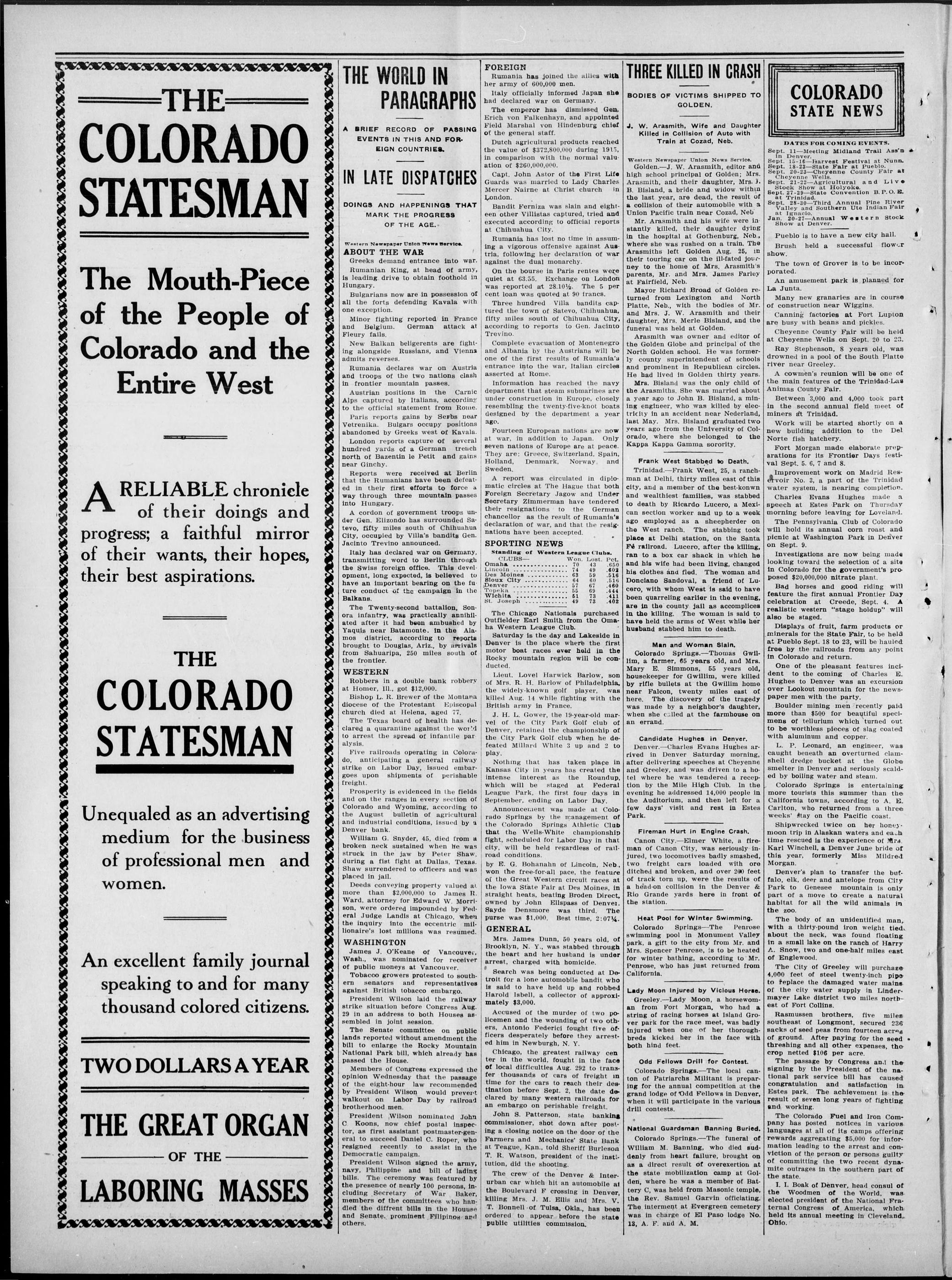
The Mouth-Piece of the People of Colorado and the Entire West
Bulgarians now are in possession of all the forts defending Kavala with one exception.
Minor fighting reported in France and Belgium. German attack at Fleury fails.
New Balkan belligerents are fighting alongside Russians, and Vienna admits reverses.
Rumania declares war on Austria and troops of the two nations clash in frontier mountain passes.
Austrian positions in the Carnic Alps captured by Italians, according to the official statement from Roue.
Paris reports gains by Serbs near Vetrenika. Bulgars occupy positions abandoned by Greeks west of Kavala.
London reports capture of several hundred yards of a German trench north of Bazentin le Petit and gains near Ginchy.
Reports were received at Berlin that the Rumanians have been defeated in their first efforts to force a way through three mountain passes into Hungary.
A RELIABLE chronicle of their doings and progress; a faithful mirror of their wants, their hopes, their best aspirations.
A cordon of government troops under Gen. Elizondo has surrounded Satevo, fifty miles south of Chihuahua City, occupied by Villa's bandits Gen. Jacinto Trevino announced. Italy has declared war on Germany, transmitting word to Berlin through the Swiss foreign office. This development, long expected, is believed to have an important bearing on the future conduct of the campaign in the Balkans. The Twenty-second battalion, Sonora infantry, was practically annihilated after it had been ambushed by Yaquis near Batamonte. in the Alamos district, according to reports brought to Douglas, Ariz., by arrivals from Sahuaripa, 250 miles south of the frontier.
THE COLORADO STATESMAN
WESTERN
Robbers in a double bank robbery at Homer, Ill., got $12,000.
Bishop L. R. Brewer of the Montana diocese of the Protestant Episcopal church died at Helena, aged 77.
The Texas board of health has declared a quarantine against the world to arrest the spread of infantile paralysis.
Five railroads operating in Colorado, anticipating a general railway strike on Labor Day, issued embargoes upon shipments of perishable freight.
Prosperity is evidenced in the fields and on the ranges in every section of Colorado and Wyoming, according to the August bulletin of agricultural and industrial conditions, issued by a Denver bank.
Unequaled as an advertising medium for the business of professional men and women.
William G. Snyder, 45, died from a broken neck sustained when he was struck in the jaw by Peter Shaw, during a fist fight at Dallas, Texas. Shaw surrendered to officers and was placed in jail.
Deeds conveying property valued at more than $2,000,000 to James R. Ward, attorney for Edward W. Morrison, were ordered impounded by Federal Judge Landis at Chicago, when the inquiry into the eccentric millionaire's lost millions was resumed.
WASHINGTON
James J. O'Keane of Vancouver, Wash., was nominated for receiver of public moneys at Vancouver.
An excellent family journal speaking to and for many thousand colored citizens.
Tobacco growers protested to southern senators and representatives against British tobacco embargo. President Wilson laid the railway strike situation before Congress Aug. 29 in an address to both Houses assembled in joint session. The Senate committee on public lands reported without amendment the bill to enlarge the Rocky Mountain National Park bill, which already has passed the House.
TWODOLLARSAYEAR
Members of Congress expressed the opinion Wednesday that the passage of the eight-hour law recommended by President Wilson would prevent walkout on Labor Day by railroad brotherhood men.
THE GREAT ORGAN OF THE
President Wilson nominated John C Koons, now chief postal inspector, as first assistant postmaster-general to succeed Daniel C. Roper, who resigned recently to assist in the Democratic campaign.
President Wilson signed the army, navy, Philippine and bill of lading bills. The ceremony was featured by the presence of nearly 100 persons, including Secretary of War Baker, members of the committees who handled the different bills in the House and Senate, prominent Filipinos and others.
FOREIGN
Rumania has joined the allies with her army of 600,000 men.
Italy officially informed Japan she had declared war on Germany.
The emperor has dismissed Gen. Erich von Falkenhayn, and appointed Field Marshal von Hindenburg chief of the general staff.
Dutch agricultural products reached the value of $372,800,000 during 1915, in comparison with the normal valuation of $260,000,000.
Capt. John Astor of the First Life Guards was married to Lady Charles Mercer Nairne at Christ church in London.
Bandit Ferniza was slain and eighteen other Villistas captured, tried and executed according to official reports at Chihuahua City.
Rumania has lost no time in assuming a vigorous offensive against Austria, following her declaration of war against the dual monarchy.
On the bourse in Paris rentes were quiet at 63.55. Exchange on London was reported at $28.10\%$. The 5 per cent loan was quoted at 90 francs.
Three hundred Villa bandits captured the town of Satevo, Chihuahua, fifty miles south of Chihuahua City, according to reports to Gen. Jacinto Trevino.
Complete evacuation of Montenegro and Albania by the Austrians will be one of the first results of Rumania's entrance into the war, Italian circles asserted at Rome.
Information has reached the navy department that steam submarines are under construction in Europe, closely resembling the twenty-five-knot boats designed by the department a year ago.
Fourteen European nations are now at war, in addition to Japan. Only seven nations of Europe are at peace. They are: Greece, Switzerland, Spain, Holland, Denmark, Norway, and Sweden.
A report was circulated in diplomatic circles at The Hague that both Foreign Secretary Jagow and Under Secretary Zimmerman have tendered their resignations to the German chancellor as the result of Rumania's declaration of war, and that the resignations have been accepted.
SPORTING NEWS
Standing of Western League Clubs.
CLUBS— Won. Lost. Pct.
Omaha 70 43 650
Lincoln 74 49 602
Joe Molines 63 50 516
Sloux City 64 60 516
Denver 57 67 460
Topeka 55 69 444
Wichita 51 73 411
St. Joseph 49 73 402
The Chicago Nationals purchased
Outfielder Earl Smith from the Omaha
Western League Club.
Saturday is the day and Lakeside in Denver is the place where the first motor boat races ever hold in the Rocky mountain region will be conducted.
Lieut. Lovel Harwick Barlow, son of Mrs. R. H. Barlow of Philadelphia, the widely-known golf player, was killed Aug. 14 while fighting with the British army in France.
J. H. L. Gower, the 19-year-old marvel of the City Park Golf club of Denver, retained the championship of the City Park Golf club when he defeated Millard White 3 up and 2 to play.
Nothing that has taken place in Kansas City in years has created the intense interest as the Roundup, which will be staged at Federal League Park, the first four days in September, ending on Labor Day.
Announcement was made at Colorado Springs by the management of the Colorado Springs Athletic Club that the Wells-White championship fight, scheduled for Labor Day in that city, will be held regardless of railroad conditions.
GENERAL
Mrs. James Dunn, 50 years old, of Brooklyn, N. Y., was stabbed through the heart and her husband is under arrest, charged with homicide.
Search was being conducted at Detroit for a lone automobile bandit who is said to have held up and robbed Harold Isbell, a collector of approximately $3,000.
Accused of the murder of two policemen and the wounding of two others, Antonio Federici fought five officers desperately before they arrested him in Newburgh, N. Y.
Chicago, the greatest railway center in the world, fought in the face of local difficulties Aug. 292 to transfer thousands of cars of freight in time for the cars to reach their destination before Sept. 2, the date declared by many western railroads for an embargo on perishable freight.
John S. Patterson, state banking commissioner, shot down after posting a closing notice on the door of the Farmers and Mechanics' State Bank at Teague, Kan., told Sheriff Burleson T. R. Watson, president of the institution, did the shooting.
The crew of the Denver & Interurban car which hit an automobile at the Boulevard F crossing in Denver, killing Mrs. J. M. Ellis and Mrs. V. T. Bonnell of Tulsa, Okla., has been ordered to appear before the state public utilities commission.
THREE KILLED IN CRASH
BODIES OF VICTIMS SHIPPED TO GOLDEN.
J. W. Arasmith, Wife and Daughter Killed in Collision of Auto with Train at Cozad, Neb.
Western Newspaper Union News Service.
Golden.—J. W. Arasmith, editor and high school principal of Golden; Mrs. Arasmith, and their daughter, Mrs. J. B. Bisland, a bride and widow within the last year, are dead, the result of a collision of their automobile with a Union Pacific train near Cozad, Neb.
Mr. Arasmith and his wife were instantly killed, their daughter dying in the hospital at Gothenburg, Neb., where she was rushed on a train. The Arasmiths left Golden Aug. 25, in their touring car on the ill-fated journey to the home of Mrs. Arasmith's parents, Mr. and Mrs. James Farley at Fairfield, Neb.
Mayor Richard Broad of Golden returned from Lexington and North Platte, Neb., with the bodies of Mr. and Mrs. J. W. Arasmith and their daughter, Mrs. Merle Bisland, and the funeral was held at Golden.
Arasmith was owner and editor of the Golden Globe and principal of the North Golden school. He was formerly county superintendent of schools and prominent in Republican circles. He had lived in Golden thirty years. Mrs. Bisland was the only child of the Arasmiths. She was married about a year ago to John B. Bisland, a mining engineer, who was killed by electricity in an accident near Nederland, last May. Mrs. Bisland graduated two years ago from the University of Colorado, where she belonged to the Kappa Kappa Gamma sorority.
Frank West Stabbed to Death.
Trinidad.—Frank West, 25, a ranchman at Delhi, thirty miles east of this city, and a member of the best-known and wealthiest families, was stabbed to death by Ricardo Lucero, a Mexican section worker and up to a week ago employed as a sheepherder on the West ranch. The stabbing took place at Delhi station, on the Santa Fé railroad. Lucero, after the killing, ran to a box car shack in which he and his wife had been living, changed his clothes and fled. The woman and Donciano Sandoval, a friend of Lucero, with whom West is said to have been quarreling earlier in the evening, are in the county jail as accomplices in the killing. The woman is said to have held the arms of West while her husband stabbed him to death.
Man and Woman Slain.
Colorado Springs.—Thomas Gwillim, a farmer, 65 years old, and Mrs. Mary E. Simmons, 55 years old, housekeeper for Gwillim, were killed by rifle bullets at the Gwillim home near Falcon, twenty miles east of here. The discovery of the tragedy was made by a neighbor's daughter, when she called at the farmhouse on an errand.
Candidate Hughes in Denver
Denver.—Charles Evans Hughes arrived in Denver Saturday morning, after delivering speeches at Cheyenne and Greeley, and was driven to a hotel where he was tendered a reception by the Mile High Club. In the evening he addressed 14,000 people in the Auditorium, and then left for a few days' visit and rest in Estes Park.
Fireman Hurt in Engine Crash.
Canon City.—Elmer White, a fireman of Canon City, was seriously injured, two locomotives badly smashed, two freight cars loaded with ore ditched and broken, and over 200 feet of track torn up, were the results of a head-on collision in the Denver & Rio Grande yards here in front of the station.
Heat Pool for Winter Swimming.
Colorado Springs—The Penrose swimming pool in Monument Valley park, a gift to the city from Mr. and Mrs. Spencer Penrose, is to be heated for winter bathing, according to Mr. Penrose, who has just returned from California.
Lady Moon Injured by Vicious Horses.
Greeley.—Lady Moon, a horsewoman from Fort Morgan, who had a string of racing horses at Island Grover park for the race meet, was badly injured when one of her thoroughbreds kicked her in the face with both hind feet.
Colorado Springs.—The local canton of Patriarchs Militant is preparing for the annual competition at the grand lodge of Odd Fellows in Denver, when it will participate in the various drill contests.
National Guardsman Banning Buried.
Colorado Springs.—The funeral of William M. Banning, who died suddenly from heart failure, brought on as a direct result of overexertion at the state mobilization camp at Golden, where he was a member of Battery C, was held from Masonic temple, the Rev. Samuel Garvin officiating. The interment at Evergreen cemetery was in charge of El Paso lodge No. 13, A. F. and A. M.
Sept. 11—Meeting Midland Trail Ass'n in Denver.
Sept. 15-16 - Harvest Festival at Nunn.
Sept. 18-23 - State Fair at Pueblo.
Sept. 20-23 - Cheyenne County Fair at Cheyenne Wells.
Sept. 21-22-Agricultural and Live Stock Show at Holyoke.
Sept. 27-29-State Convention B.P.O.E. at Trinidad.
Sept. 27-29—State Convention B.P.O. E.
at Trinidad
Sept. 28-30—Third Annual Pine River
Valley and Southern Ute Indian Fair
at Ignacio.
Jan. 20-27—Annual Western Stock
Show at Denver.
Pueblo is to have a new city hall.
Brush held a successful flower
show.
The town of Grover is to be incorporated.
An amusement park is planned for
La Junta.
Many new granaries are in course
of construction near Wiggins.
Canning factories at Fort Lupton
are busy with beans and pickles.
Cheyenne County Fair will be held
at Cheyenne Wells on Sept. 20 to 23.
Ray Stephenson, 8 years old, was
drowned in a pool of the South Platte
river near Greeley.
A cowmen's reunion will be one of the main features of the Trinidad-Las Animas County Fair.
Between 3,000 and 4,000 took part in the second annual field meet of miners at Trinidad.
Work will be started shortly on a new building addition to the Del Norte fish hatchery.
Fort Morgan made elaborate preparations for its Frontier Days festival Sept. 5. 6, 7 and 8.
Improvement work on Madrid Reservoir No. 3, a part of the Trinidad water system, is nearing completion.
Charles Evans Hughes made a speech at Estes Park on Thursday morning before leaving for Loveland.
The Pennsylvania Club of Colorado will hold its annual corn roast and picnic at Washington Park in Denver on Sept. 9.
Investigations are now being made looking toward the selection of a site in Colorado for the government's proposed $20,000,000 nitrate plant. Bad horses and good riding will feature the first annual Frontier Day celebration at Creede, Sept. 4. A realistic western "stage holdup" will also be staged. Displays of fruit, farm products or minerals for the State Fair, to be held at Pueblo Sept. 18 to 23, will be hauled free by the railroads from any point in Colorado and return. One of the pleasant features incident to the coming of Charles E. Hughes to Denver was an excursion over Lookout mountain for the newspaper men with the party.
Boulder mining men recently paid more than $500 for beautiful specimens of tellurium which turned out to be worthless pieces of slag coated with aluminum and copper.
L. P. Leonard, an engineer, was caught beneath an overturned clamshell dredge bucket at the Globe smelter in Denver and seriously scalded by boiling water and steam.
Colorado Springs is entertaining more tourists this summer than the California towns, according to A. E. Carlton, who returned from a three weeks' stay on the Pacific coast.
Shipwrecked twice on her honeymoon trip in Alaskan waters and each time rescued is the experience of Mrs. Karl Winchell, a Denver June bride of this year, formerly Miss Mildred Morgan.
Denver's plan to transfer the buffalo, elk, deer and antelope from City Park to Genesee mountain is only part of a move to create a natural habitat for all the wild animals in the zoo.
The body of an unidentified man, with a thirty-pound iron weight tied about the neck, was found floating in a small lake on the ranch of Harry A. Snow, two and one-half miles east of Englewood.
The City of Greeley will purchase 4,000 feet of steel twenty-inch pipe to replace the damaged water mains of the city water supply in Lindermayer Lake district two miles northeast of Fort Collins.
Rasmussen brothers, five miles southeast of Longmont, secured 236 sacks of seed peas from fourteen acres of ground. After paying for the seed threshing and all other expenses, the crop netted $106 per acre.
The passage by Congress and the signing by the President of the national park service bill has caused congratulation and satisfaction in Estes park. The achievement is the result of seven long years of fighting and working.
The Colorado Fuel and Iron Company has posted notices in various languages at all of its camps offering rewards aggregating $5,000 for information leading to the arrest and conviction of the person or persons guilty of committing the two recent dynamite outrages in the southern part of the state.
I. I. Boak of Denver, head consul of the Woodmen of the World, was elected president of the National Fraternal Congress of America, which held its annual meeting in Cleveland, Ohio.
AFRO-AMERICAN CULLINGS
Nashville, Tenn., affords an instance of race co-operation that is most encouraging. A section of the city inhabited by poor people of both the white and colored races was swept by fire last spring. Over 2,000 people were left homeless. The negro board of trade was first to take vigorous measures for relief. It gave its support to Dr. George E. Haynes, who established headquarters in the stricken neighborhood, and with a band of volunteer workers from the colored population of the city began at once to organize temporary and permanent aid for the sufferers. White citizens opened similar headquarters across the street. The two agencies met daily in their ministrations and the white citizens were so impressed by the efficiency of the negro organization that they invited it to join forces with them and centralize the work. The invitation was accepted.
The immediate task being more effectively accomplished by this co-operation, the workers were encouraged to plan for larger things. A call was issued for the organization of a permanent league to deal with social problems. The response was most gratifying and the Public Welfare league came into existence on a basis that obliterates the color line.
As a matter of fact, there is more democracy among the colored people than among the whites. People of good character and intelligence who may be serving in some ordinary capacity are more generally received by their well-to-do colored brothers and sisters than among the whites. The highly educated colored person is not nearly so unhappy as you picture him, and he does not lack for desirable associates. In the best circles may be found people who are the intellectual equals of any other race. In these circles may be found retired capitalists, ministers, lawyers, doctors, business men, professors, editors, teachers, etc.—men and women who have had the best training America and Europe could give. There are so many of them that there are several "sets."
A number of new commercial enterprises have recently been undertaken in northeast Siberia. Many iodine works have been established in the neighborhood of Vladivostok, on the shore of the Japanese sea, the iodine being made from seaweed found there in abundance. An interesting distillery for ether has been opened, the bulk of the ingredient being violets and iris blossoms from the Ussuri countryside. A good deal of amber is being collected from the beach along the coast of the Premorsk and many new salt workings have been opened in the government of Irkutsk and in the Lena hinterland in the vicinity of Viluisk.
The chestnut blight has already done damage estimated as close to $50,000,000. The disease attacks both American and European species, but does little damage to those from Japan and China. Plant breeders by crossing Japanese chestnut and native chinquapin have produced resistant trees. Some of the Chinese chestnuts are said to grow 100 feet high in their home forests.
```markdown
```
It is a mighty effective dun that collects the average man's thoughts.
To the gossip the breath of scandal is as the breath of life.
In his presidential address at the last meeting of the South African Association for the Advancement of Science, R. T. A. Innes called attention to the large number of astronomical observatories, some of them admirably equipped, which are doing little or no work, beyond, perhaps, maintaining a time service or meteorological service of local importance. He stated that "at least two of the observatories possessing exceptionally large refracting telescopes have not contributed one month's work from them in the last 20 years." At least 33 per cent of the observatories listed in the British nautical almanac publish nothing.
Take dissolved gum arabic and stir in enough plaster of paris to make a soft paste. This is almost colorless and acts excellently as cement for china. In repairing very delicate china or porcelain, tie the pieces carefully in place with tape. It is then put into a saucepan of milk and the latter is very gradually brought to boiling point. Remove the saucepan from the fire, but leave the china in it for about six minutes. Lift out carefully and place on a shelf to dry.
In a world where nations grow and decay, where forces change and populations become cramped, it is not possible or desirable to maintain the status quo forever. If peace is to be preserved, nations must learn to accept unfavorable alterations of the map without feeling that they must first be defeated in war, or that in yielding they incur a humiliation.—Bertrand Russell in Atlantic Monthly.
The country church is the only power that co-ordinates forces into a working whole
The importation of natives from South Africa, in order to relieve the shortage of agricultural labor in England, is proposed by A. J. Fuller of the South African senate, who is now in London.
His scheme is to choose carefully selected individuals, who would be accompanied by trusted leaders of their own, and he is confident that if men belonging to widely known families and holding responsible positions were chosen, the experiment would be successful. He also proposes that colonists who know the natives and can superintend them shall accompany them from South Africa.
Mr. Fuller speaks with knowledge of the South African natives, having represented a constituency with one of the largest black populations in the country.—London Globe.
If you are a farmer, do you happen to know how many kinds of grasses there are? Five thousand! But out of this great number man uses only 19 varieties, as a rule, and only five of those are extensively cultivated. It is a curious fact that while practically every other farm crop has undergone great changes under cultivation, grasses are almost the same now as when man first began to use them as a wild plant.
Passions and excitement move the dusky soldier easily, it is true. To devotion to his officers, nevertheless, he adds pride in the service, ready excellence in the drill and a perfect willingness to follow where he is led. To ridicule, as a reproof, he is most sensitive. To the power of example he is keenly susceptible. To none of his white comrades is the appeal so effective as to him to perform for the honor of his race.
The same childish simplicity which impels to the bursting into song leads to an overwhelming respect for the men in command. Discipline once instituted comes to stay in a negro regiment. Moreover, the rank and file carries so far its trust in its officers that the captain of a company is quite apt to be the banker for his men, saving them from losses in camp gambling games.
According to the Akademische Rundschau, no less than 84 per cent of the students of the University of Kongsberg have gone to the front. The percentages from certain other universities are: Heidelberg, 60; Munich, 56; Berlin, 54; Frankfurt, 11. The Technische Hochschule of Danzig has sent 90 per cent of its students to war. German professors and students killed up to the end of May numbered 1,911, of whom 266 were from the University of Leipzig.
Diplomacy would be more successful if it were more truthful and frank. The way some diplomats treat one another they don't get any nearer to real, helpful intercourse than the two celebrities did. Two celebrities, one a stutterer and the other deaf, were introduced at a tea. After the tea the stuttering celebrity was asked how he and the deaf one had got on. "Oh, we got on fine," he answered. "I couldn't talk and he couldn't hear me."
Those who have had experience with him under arms testify that the American negro takes most readily and efficiently to soldiering.
The limit of the carrying power of thunder is about fifteen miles, while twice that number of miles is not considered any great distance for the sounds of battle to travel.
Happiness and the light heart are among the general characteristics of the black soldier. He goes about his business singing. It is related that during the Spanish war the colored cavalrymen had hardly dug their trenches at Santiago before their smuggled musical instruments were out and the camp was a medley place of tunefulness. And there was a white colonel of the Twenty-fifth who was wont to boast of the chorus singing which he had made almost a part of the regimental drill.
It is not true that the highly educated colored man has a contempt for the ordinary activities of his race any more than it is true of the white race.
There is no grosser form of materialism than when a country community prospers and then forgets Christ.
Seventy-six out of eighty-seven cases of typhoid fever which occurred in a recent outbreak have been traced by the United States public health service to infected milk. Had the first cases been reported to a trained health officer the outbreak could have been stamped out promptly. When will we learn that disease prevention is sure and cheap?—United States Public Health Bulletin.
When the world would bewilder thy mind, look up to the eternal heavens where the stars never stray.—Ruckert.
WILSON URGES EIGHT-HOUR LAW
APPEALS DIRECTLY TO CONGRESS TO AVERT CALAMITY THREATENING UNITED STATES.
AMEND MEDIATION ACT
INTERSTATE COMMISSION TO CONSIDER INCREASED COST IN MAKING RATES.
Western Newspaper Union News Service.
Western Newspaper Union News Service.
Washington—President Wilson laid the railway strike situation before Congress Aug. 29 in an address to both houses assembled in joint session. The President told of his efforts to bring the railroad managers and the men into some sort of agreement and saying he was powerless to do more, asked Congress to enact legislation to deal with the situation.
Pointing out the distress and hardships which a nation-wide strike would bring upon the country, the President asked Congress to empower him to draft into the service of the United States the very managers and men who have been unable to adjust their differences so that the government may operate the railroads in case of military necessity.
He proposed that Congress first enlarge the membership of the Interstate Commerce Commission to equip it to deal with larger situations. Second, that an eight-hour day be established for all trainmen in interstate commerce. Third, that a commission investigate the effect of the eight-hour day. Fourth, that the Interstate Commerce Commission consider the increased cost of the eight-hour day in making rates. Fifth, amend the mediation law to prevent strikes or lockouts while industrial disputes are being investigated. Sixth, that the President be empowered to operate the railways in case of military necessity. How these recommendations are to be carried out, President Wilson left entirely in the hands of Congress.
Just before the President went to address Congress it became known that the strike leaders had positively called the strike for Labor day unless a favorable settlement was reached before. The committee of railway presidents made a public statement of their position, declining to accept President Wilson's plan and giving their reason.
"They have thought it best," said the President, referring to the railway managers, in his address to Congress, "that they should be forced to yield, if they must yield, not by counsel but by the suffering of the country.
"While my conferences with them were in progress," the President continued, "when to all outward appearance those conferences had come to a standstill, the representatives of the brotherhoods suddenly acted and set the strike for the fourth of September."
Thus the President summarized his efforts, and added:
"But I could only propose. I could not govern the will of others, who took an entirely different view of the circumstances of the case, who even refused to admit the circumstances to be what they have turned out to be."
The four brotherhood heads were guests of Speaker Clark in his gallery; other leaders of the men were in other galleries and the railway managers were scattered about.
Mrs. Wilson, accompanied by the ambassador to Great Britain, Walter Hines Page, and the ambassador to France, William G. Sharp, was in the President's reserved space. Several members of the cabinet and some justices of the Supreme Court also were present. The President was greeted with unroarious cheers as he entered. He began speaking at 2:33 o'clock. Speaking slowly and distinctly he outlined the situation confronting the country from the failure of the negotiations. There was tense silence in the chamber as he began.
Applause greeted the President's declaration that he regarded it as a "practical certainty" that the railroads would be "ultimately obliged to accept the eight-hour day by the concerted action of organized labor, backed by the favorable judgment of society."
Threatened Strike Halte Fruit Picking Sacramento, Cal.-Picking of California deciduous fruits for Eastern shipment was practically discontinued Aug. 29 because of the threatened road strike.
Russia Buys $10,000,000 War Munition
New York—An analysis of foreign
trade at this port disclosed that $12,
596,659 of the $78,106,341 worth of
American goods exported were sold to
Russia alone. Of this amount about
$10,000,000 represented purchases of
war material and the remaining $2,
500,000 included harness, motor cars,
miscellaneous machinery and general
merchandise. Exports to France were
$2,000,000 greater than those to Russia,
but the Russian item is the more
striking one.
BOMBARDMENTS ON THE DANUBE
RUMANIA'S INVASION OF AUS
TRIA-HUNGARIAN TERRITORY
CONTINUES.
TURKEY DECLARES WAR
ZEPPELIN AND HOSTILE AERO
PLANE DROP BOMBS ON RU-
MANIAN CAPITAL.
Western Newspaper Union News Service.
London, Aug. 31.—Rumania's invasion of Austria-Hungarian territory continues in the mountainous region from Petrozseny, eighty miles north of Kronstadt.
On the Danube, from the Iron Gate to Giurgevo, opposite Rustchuk, Bulgaria, there have been reciprocal bombardments at several points by Austro-Hungarian warcraft and Rumanian shore batteries. A Zeppelin and a hostile aeroplane have dropped bombs on the Rumanian capital.
Vienna admits that the Rumanians are engaged with the Austrians in the Gyergyo mountains, which shows that off the northwestern front of Rumania hostile forces have invaded Transylvania some twenty-five miles. The Rumanians also are near Koedzi-Vasarhely, about forty miles northeast of Kronstadt.
While Bulgaria has not entered into hostilities against Rumania, a news agency dispatch says Rumania has decided to send an ultimatum to Bulgaria demanding the evacuation of Serbia. A dispatch from Constantinople indicates that Turkey has declared war on Rumania.
In the Macedonian theater violent fighting continues between the entente allies and the Austro-Germans and Bulgarians. On the Struma front, near Lake Doiran, batteries of the entente allies have violently shelled Bulgarian positions.
Orama, in the northeast of Greece, has been seized by the Bulgarians after a fight with Greek troops, according to unofficial advices.
An Albanian detachment under Essad Pasha, has arrived at Saloniki to aid the entente forces.
Berlin.—Turkish troops are advancing step by step in the Caucasus, and have broken the resistance of the Russians, who occupied dominating heights, it was announced by the Turkish war department. One Turkish detachment, it is said, found 1,000 Russian dead on the battlefield.
Vienna.—The Austrian official communication admits that except north east of Orsovo, on the Danube, near the Iron Gates, where repeated Rumanian attacks were repulsed, the Austro-Hungarian forces have been withdrawn step by step from the frontier in accordance with prearranged plans.
More National Guards Go to Border.
Washington.—Twenty-eight companies of coast artillery troops, approximately 6,000 men, now on border duty as provisional infantry units attached to the mobile army,, were ordered back to their posts in the Eastern and Western Departments. More than 10,000 additional National Guardsmen ordered to the border recently will take the place of the artillery troops.
Hiram Johnson Wins California Race.
San Francisco.—On the face of returns from about half the precincts in the state, Gov. Hiram W. Johnson won Republican nomination for senator.
Eight-Hour Bill Will Prevent Strike.
Washington, Aug. 31. — Railroad brotherhood heads were obviously pleased after a careful study of the proposed bill to fix an eight-hour workday for trainmen in interstate commerce at present wages and for an investigation of results by a commission. W. G. Lee, head of the trainmen's brotherhood, made the unequivocal statement that enactment of such a law by midnight Saturday would avert the strike.
Conductors Enjoined from Striking.
Omaha, Neb., Aug. 31.—Edwin A. Hamilton, a union Pacific conductor for eighteen years, and a member of the Order of Railway Conductors, obtained from District Court Judge W. G. Sears a temporary order restraining officials of the Order of Railway Conductors from issuing a strike order on the Union Pacific lines, circulating any strike order or spending any money for strike purposes. Hearing on the petition for permanent injunction was set for Sept. 2.
President Ripley Issues Warning.
Chicago, Aug. 31.-President E. P. Ripley of the Atchison, Topeka and Santa Fé, issued a statement to employees of the road, notifying them that the positions of those who fall to report for work next Monday will be declared vacant, and that employment of new men will be permanent, barring ill-behavior. The Erie road appealed directly to its 41,000 employees not to strike. The Santa Fé made a similar appeal weeks ago when the strike vote was being taken.
924 19th Street, Denver, Colorado
DINNER
11:30 to 2 p.m.
All Kinds
Bolden Bro
Baths,
FIRST
R. B. BOLDEN,
O. H. SHIRLEY, Pres.
PAUL J. SHI
THE ATL
Courteous Tre
Leaders
All Kinds of Sandwich
Helen Bros. Barber S
Baths, Electric Massage
FIRST CLASS SERVICE
BOLDEN, Mgr. 926 19th St
KEY, Pres. J. O. BAMPS
PAUL J. SHIRLEY, Sec. and Treas.
E ATLAS DRUG
ous Treatmet. Right
Leaders in Prescription
N ST.
26TH AVE.
5
Main
TON, Pres. J. M. JOHNS; Treas. J. B. M
ROAD PORTERS' C
CLUNCHOOM IN CONNECTION
All Kinds of Sandwiches
Bolden Bros. Barber Shop
Baths, Electric Massage
FIRST CLASS SERVICE
R. B. BOLDEN, Mgr. 926 19th St. Denver
C. H. SHIRLEY, Pres. J. C. HAMPSON, Vice Pres. PAUL J. SHIRLEY, Sec. and Treas. THE ATLAS DRUG CO. Courteous Treatmet. Right Prices Leaders in Prescription
W. C. CAMPTON, Pres. J. M
RAILROAD
LUNCHOOM
W. C. CAMPTON, Pres. J. M. JOHNS, Treas. J. B. MINTER, See. RAILROAD PORTERS' CLUB LUNCHOOM IN CONNECTION
BILLIARDS AND POOL
1728½ Wazee St. C
J. B.
PHONE MAIN 8416.
PHONE MAIN 3028
JOHN I
Meats, Fancy a
1864 C
Corner Nineteenth.
The MARK
C. E. SMITH, Man
Wholesale and Retail Staple
Hotels and Re
Frees
Eastern C
1½ Wazee St. Only one block from Union
J. B. MINTER, Barber.
E MAIN 8416. DENVER, COLO
3028 RES. PHONE
JOHN K. RETTIG
Fancy and Staple Gr
1864 CURTIS STREET
enth.
MARKET COM
E. SMITH, Manager, Res. Phone South
Retail Staple and Fancy Groceries, Fi
Hotels and Restaurants Our Specialty
Fresh and Cured
Eastern Corn Fed M
17281/2 Wazee St. Only one block from Union Depot.
J. B. MINTER, Barber.
PHONE MAIN 8416. DENVER, COLORADO.
PHONE MAIN 3028 RES. PHONE GALLUP 943 JOHN K. RETTIG Meats, Fancy and Staple Groceries 1864 CURTIS STREET Corner Nineteenth. Denver, Colo.
The MARKET COMPANY
C. E. SMITH, Manager, Res. Phone South 1608
Wholesale and Retail Staple and Fancy Groceries, Fish and Oysters. Hotels and Restaurants Our Specialty. Fresh and Cured
Eastern Corn Fed Meats
Fruits, Vegetables, Poultry and Game.
Telephones Ma
622-636 15th Street
Weather
TELEPH
Telephones Main 4302, 4303, 4304, 4305th Street Denver
atherhead HA
TELEPHONE MAIN 3203
Telephones Main 4302, 4303, 4304, 4306
622-636 15th Street Denver, Colorado
Weatherhead Hat Co. TELEPHONE MAIN 3208
Established 1876
PIONEER HATTERS OF THE WEST
WE MAKE OLD HATS NEW
PRACTICAL HATTER
TORS, BLEACHERS DYERS AND F
ents' and Ladies' Hats of Every Desor
1624 Champa St., Denver, Colo.
RENOVATORS, BLEACHERS DYERS AND FINISHERS Of Gents' and Ladies' Hats of Every Description 1624 Champa St., Denver, Colo.
Stage No. 1.
2901 WELTON ST.
Main 895 875
Short Orders at All Hours
dwiches
ber Shop
message
VICE
26 19th St. Denver
D. HAMPSON, Vice Poet
and Treas.
RUG CO.
Right Prices
Description
Store No. 2
26TH AND WELTON
Main 4955-4956
s. J. B. MINTER, See.
ERS' CLUB
INECTION
FREE CHECK
ROOM
From Union Depot.
VER, COLORADO.
S. PHONE GALLUP 942
TTTIG
Apple Groceries
SET
Denver, Colo
COMPANY
One South 1608
oceries, Fish and Oysters
Specialty.
ed Meats
4304, 4304
Denver, Colorado
Hat Co
3203
VINE
MILITARY
---
THE COLORADO STATESMAN
LABOR
SHELL DE
FREE
RACE
COUNTRY
PARTY
1824 Curtis Street, Room 25.
Phone Main 7417.
SUBSCRIPTION RATES.
One Year ..... $ 2.00
Six Months ..... 1.00
Three Months ..... .60
PAYABLE IN ADVANCE.
Entered as second-class matter at the postoffice in the City of Denver, Colo.
Reading notices, ten lines or less, 10 cents per line. Each additional line over ten lines, 5 cents per line. Display advertising 50 cents per inch.
Remittances should be made by Express Money Order, Postoffice Money Order, Registered Letter or Bank Draft. Postage stamps will be received the same as cash for the fractional part of a dollar. Only 1c and 2c stamps taken.
No discounts allowed on less than three months' contract. Cash must accompany all orders from parties unknown to us. Further particulars on application.
Objects, plainly written only upon one side of the paper, must reach us Tuesdays, if possible, anyway not later than Wednesday, and bear the signature of the author. No manuscript returned, unless stamps are sent for postage.
Communications to receive attention must be newsy, upon important subAll communications of a personating nature that are not complimentary will be withheld from the columns of this paper.
RECOGNIZED BY THE RETAIL ASSOCIATION OF THE DENVER CHAMBER OF COMMERCE AS AN ADVERTISING MEDIUM OF THE FIRST CLASS.
Many seem to think it is a sin to use money in political campaigns. When a campaign of education is necessary on public questions, when voters have to be visited and coaxed to come out and vote, and perhaps automobiles to haul them to the polls, money must be raised to do it. This may be wrong in principle, but the voters, not the political parties, are to blame.
OUR IMPENDING POLITICAL CRISIS.
Each day as it passes brings us nearer to the time when individual rivalry for the various political positions will have passed and the citizens of Colorado begin to wage a great fight for the success of the party of their choice—Republican or Democratic. In listening to remarks and opinions of enthusiasts over the primary election, we are inclined to think that there's a bit of indiscretion on the part of some of the supporters of the different candidates, as they forget that they are all of the Republican party; and so we offer the gentle advice of being careful in challenging candidates, as expressions made now against them may be detrimental in the final election with the candidates of the other party. In the case of the position for Governor, we have two competitors, Governor George A. Carlson and Hon. Samuel D. Nicholson, both honorable and distinguished men of the most reputable standing in the community. Each has his backers and supporters, who are doing their best to secure the nomination, with the thorough understanding of the public on the side of the Republican party, to support unanimously the successful candidate in the November election. Now, why should there be the necessity for anything else than friendly rivalry? We suggest, especially to our colored citizens, to be careful and guarded in their expressions—go and vote according to the dictates of their conscience, and the result will prove the man most acceptable to the people. Remember, we are generally accredited with disagreeing on issues we ought to agree, and this time we should show that we are in a position to intelligently use the franchise and support the candidates whom we believe will best serve our interests.
THE COLORADO STATESMAN, true to its party faith and doctrine, pledges its support to the successful candidates, whether they are our choice or not, as we believe that "the whole is greater than its parts," and as factional strife never resulted in any betterment, we elect to continue our policy. "Be wise as serpents and harmless as doves," may be a good suggestion for some to follow, especially at this time, as it may save an ill action in the future.
THE GROWTH OF OPPORTUNITY.
No race is entirely hopeless in any part of the world. Wherever men find themselves located and whatever their environment, if they are free men, there is always a chance to improve their conditions. But the opportunity for improvement is not the same with all men. Neither may one class of men expect to follow exactly in the footsteps of another class who have preceded them, for opportunities differ widely according to classes and the character of the times through which the world or the nation is now passing. The average white American of intelligence and energy is possessed of vast opportunities to make life a success and a pleasure. In this respect he is better off at present than his forefathers were, when from newer conditions they were hewing out a course for themselves and the nation. With all portions of a vast country, open to settlement and all communities, old or new, presenting almost unrestricted commercial and industrial openings, it seems that the opportunities of the average American for the promotion of successful enterprises are almost limitless. Within these same boundaries and in contact with these same environments the colored American has to contemplate and apply himself to particular channels which require more than natural preference or personal desire to insure that success which brings the rightful measure of gratification and profit, for the restrictions and limits of racial prejudice require them to exercise superior judgment and wit in the selection and pursuing of avocations in which their financial welfare will not necessarily be sacrificed or thwarted. But although their opportunities are thus limited, the necessity for careful study and selection of avocations and for the application of superior judgment and ability to those chosen, is the one great natural characteristic which will cause the Negro's opportunities to grow and increase, slowly, gradually but surely, until finally the restrictions of the present day shall be entirely overcome. All history helps to prove that racial oppression redounds to the final benefit of the race oppressed, if the race oppressed possesses the quality of endurance and survival. Endurance is one of the Negro's remarkable qualities, and while his changing conditions in America appear to take from him some opportunities which he formerly enjoyed, he readily applies himself to others, which, if carefully selected and industriously and ingeniously followed, bring him greater satisfaction and profit than he before enjoyed. The Negro is learning that he must choose wisely and perform well. With this knowledge thoroughly applied, he is succeeding in new lines. He has found an opening in literature, the very highest branch of civilized attainment, which has surprised himself. Close behind this is following his success in music. As he improves in the classic and in the arts, he appears to find greater industrial tolerance. Branches of business requiring particular ingenuity or efficiency are being undertaken with invariable success. It is therefore being learned that the mainsprings of the Colored American's future progress are superior ability, discriminating judgment and tireless energy, and that with these attributes the growth of his opportunities will not halt before the prejudices of the present day.
---
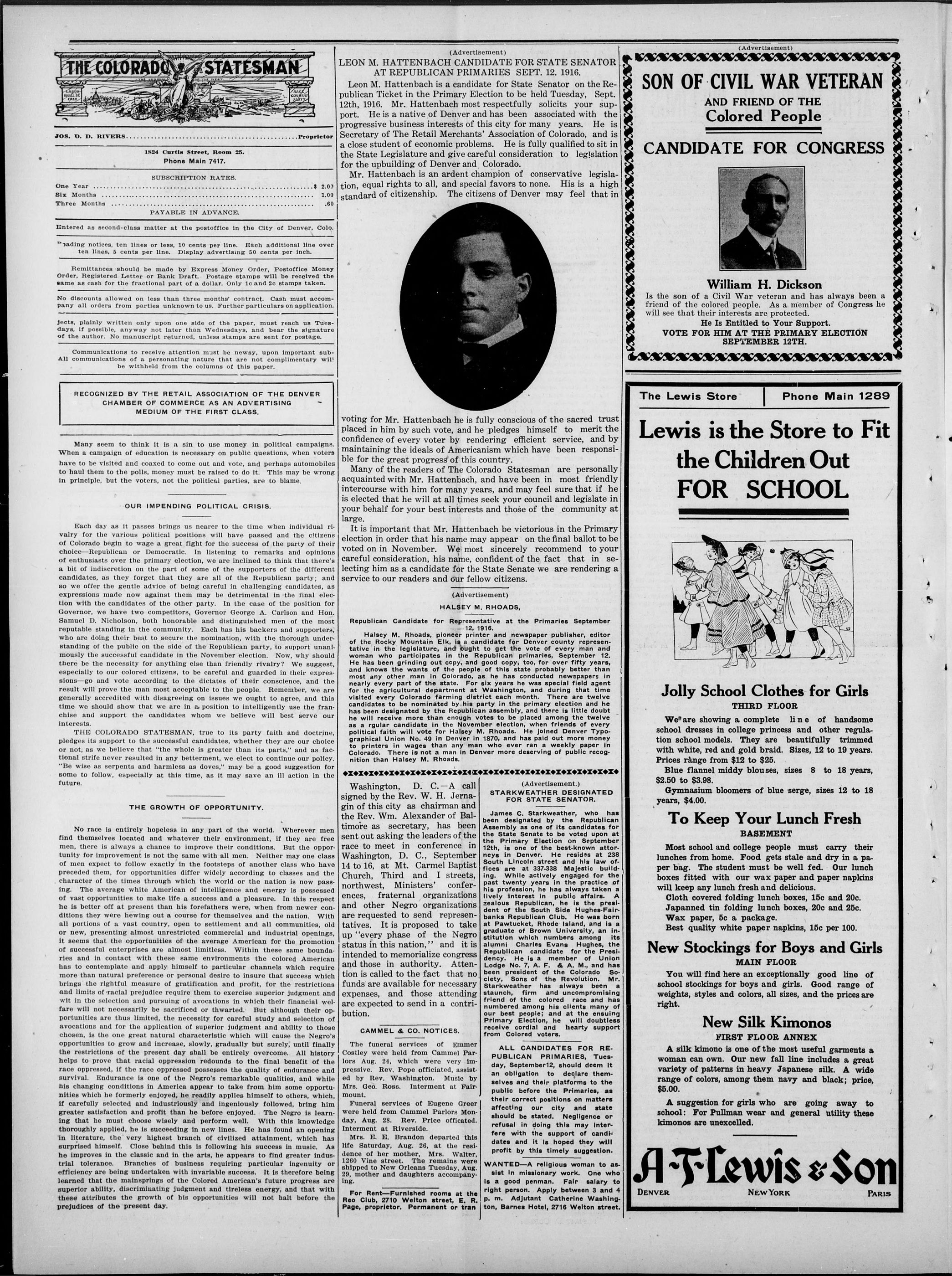
LEON M. HATTENBACH CANDIDATE FOR STATE SENATOR AT REPUBLICAN PRIMARIES SEPT. 12. 1916.
Leon M. Hattenbach is a candidate for State Senator on the Republican Ticket in the Primary Election to be held Tuesday, Sept. 12th, 1916. Mr. Hattenbach most respectfully solicits your support. He is a native of Denver and has been associated with the progressive business interests of this city for many years. He is Secretary of The Retail Merchants' Association of Colorado, and is a close student of economic problems. He is fully qualified to sit in the State Legislature and give careful consideration to legislation for the upbuilding of Denver and Colorado.
Mr. Hattenbach is an ardent champion of conservative legislation, equal rights to all, and special favors to none. His is a high standard of citizenship. The citizens of Denver may feel that in
[Picture of a man in a suit with a bow tie].
voting for Mr. Hattenbach he is fully conscious of the sacred trust placed in him by such vote, and he pledges himself to merit the confidence of every voter by rendering efficient service, and by maintaining the ideals of Americanism which have been responsible for the great progress of this country.
Many of the readers of The Colorado Statesman are personally acquainted with Mr. Hattenbach, and have been in most friendly intercourse with him for many years, and may feel sure that if he is elected that he will at all times seek your council and legislate in your behalf for your best interests and those of the community at large.
It is important that Mr. Hattenbach be victorious in the Primary election in order that his name may appear on the final ballot to be voted on in November. We most sincerely recommend to your careful consideration, his name, confident of the fact that in selecting him as a candidate for the State Senate we are rendering a service to our readers and our fellow citizens.
(Advertisement)
HALSEY M. RHOADS.
Republican Candidate for Representative at the Primaries September 12, 1916.
Halsey M. Rhoads, pioneer printer and newspaper publisher, editor of the Rocky Mountain Elk, is a candidate for Denver county representative in the legislature, and ought to get the vote of every man and woman who participates in the Republican primaries, September 12. He has been grinding out copy, and good copy, too, for over fifty years, and knows the wants of the people of this state probably better than most any other man in Colorado, as he has conducted newspapers in nearly every part of the state. For six years he was special field agent for the agricultural department at Washington, and during that time visited every Colorado farming district each month. There are twelve candidates to be nominated by his party in the primary election and he has been designated by the Republican assembly, and there is little doubt he will receive more than enough votes to be placed among the twelve as a regular candidate in the November election, when friends of every political faith will vote for Halsey M. Rhoads. He joined Denver Typographical Union No. 49 in Denver in 1870, and has paid out more money to printers in wages than any man who ever ran a weekly paper in Colorado. There is not a man in Denver more deserving of public recognition than Halsey M. Rhoads.
```markdown
```
Washington, D. C.-A call signed by the Rev. W. H. Jernagin of this city as chairman and the Rev. Wm. Alexander of Baltimore as secretary, has been sent out asking the leaders of the race to meet in conference in Washington, D. C., September 14 to 16, at Mt. Carmel Baptist Church, Third and I streets, northwest, Ministers' conferences, fraternal organizations and other Negro organizations are requested to send representatives. It is proposed to take up "every phase of the Negro status in this nation," and it is intended to memorialize congress and those in authority. Attention is called to the fact that no funds are available for necessary expenses, and those attending are expected to send in a contribution.
CAMMEL & CO. NOTICES.
The funeral services of Emmer Costley were held from Cammel Parlors Aug. 24, which were very impressive. Rev. Pope officiated, assisted by Rev. Washington. Music by Mrs. Geo. Ross. Interment at Fairmount.
Funeral services of Eugene Greer were held from Cammel Parlors Monday, Aug. 28. Rev. Price officiated. Interment at Riverside.
Mrs. E. E. Brandon departed this life Saturday, Aug. 26, at the residence of her mother, Mrs. Walter, 1260 Vine street. The remains were shipped to New Orleans Tuesday, Aug. 29, mother and daughters accompanying.
For Rent—Furnished rooms at the Reo Club, 2710 Welton street, E. R, Page, proprietor. Permanent or tran
STARKWEATHER DESIGNATED
FOR STATE SENATOR.
James C. Starkweather, who has been designated by the Republican Assembly as one of its candidates for the State Senate to be voted upon at the Primary Election on September 12th, is one of the best-known attorneys in Denver. He resides at 238 South Lincoln street and his law offices are at 337-338 Majestic building. While actively engaged for the past twenty years in the practice of his profession, he has always taken a lively interest in public affairs. A zealous Republican, he is the president of the South Side Hughes-Fairbanks Republican Club. He was born at Pawtucket, Rhode Island, and is a graduate of Brown University, an institution which numbers among its alumni Charles Evans Hughes, the Republican candidate for the Presidency. He is a member of Union Lodge No. 7, A. F. & A. M., and has been president of the Colorado Society, Sons of the Revolution. Mr. Starkweather has always been a staunch, firm and uncompromising friend of the colored race and has numbered among his clients many of our best people; and at the ensuing Primary Election, he will doubtless receive cordial and hearty support from Colored voters.
ALL CANDIDATES FOR REPUBLICAN PRIMARIES, Tuesday, September12, should deem it an obligation to declare themselves and their platforms to the public before the Primaries, as their correct positions on matters affecting our city and state should be stated. Negligence or refusal in doing this may interfere with the support of candidates and it is hoped they will profit by this timely suggestion.
WANTED—A religious woman to assist in missionary work. One who is a good penman. Fair salary to right person. Apply between 3 and 4 p. m. Adjutant Catherine Washington, Barnes Hotel, 2716 Welton street.
CANDIDATE FOR CONGRESS
Willia
PETER H.
Is the son of a Civil War veteran and has always been a friend of the colored people. As a member of Congress he will see that their interests are protected.
He Is Entitled to Your Support.
VOTE FOR HIM AT THE PRIMARY ELECTION
SEPTEMBER 12TH.
The Lewis Store
Lewis is the Store to Fit the Children Out FOR SCHOOL
THE FASHION OF THE TWENTIES
Jolly School Clothes for Girls THIRD FLOOR
We are showing a complete line of handsome school dresses in college princess and other regulation school models. They are beautifully trimmed with white, red and gold braid. Sizes, 12 to 19 years. Prices range from $12 to $25.
Blue flannel middy blouses, sizes 8 to 18 years, $2.50 to $3.98.
Gymnasium bloomers of blue serge, sizes 12 to 18 years, $4.00.
To Keep Your Lunch Fresh BASEMENT
Most school and college people must carry their lunches from home. Food gets stale and dry in a paper bag. The student must be well fed. Our lunch boxes fitted with our wax paper and paper napkins will keep any lunch fresh and delicious. Cloth covered folding lunch boxes, 15c and 20c. Japanned tin folding lunch boxes, 20c and 25c. Wax paper, 5c a package. Best quality white paper napkins, 15c per 100.
New Stockings for Boys and Girls MAIN FLOOR
You will find here an exceptionally good line of school stockings for boys and girls. Good range of weights, styles and colors, all sizes, and the prices are right.
New Silk Kimonos FIRST FLOOR ANNEX
A silk kimono is one of the most useful garments a woman can own. Our new fall line includes a great variety of patterns in heavy Japanese silk. A wide range of colors, among them navy and black; price, $5.00.
A suggestion for girls who are going away to school: For Pullman wear and general utility these kimonos are unexcelled.
A.T. Lewis & Son
DENVER NEW YORK PARIS
DENVER NEW YORK PARIS
Dickson
Phone Main 1289
PARIS
THE COLORADO STATESMAN
THE ARMED FORCES OF THE UNION
CANON SHOULD BE FREE
COLORADO COUNTRY PARTY
THE
COLORADO
STATESMAN
is the only Negro paper
recognized by the Retail
Association of the Denver
Chamber of Commerce as
an advertising medium
of the first class.
Phone:
Main 7417.
Leadville, Colo., Aug. 29, 1916. To the Editor of the Colorado Statesman,
Joseph D. D. Rivers,
Denver, Colo.
Dear Sir: While in Denver not long ago I was asked by several of my friends to tell them something about Mr. Samuel D. Nicholson, as I being a resident of Leadville, his home town, would be in a position to know about him.
I have known Mr. Nicholson personally for the past fifteen years, he being a director in the bank where I am employed. I have always found him to be a man of broad views, who makes no distinctions between the rich and the poor, and is easily and readily approached. He employs a large number of men, and they all consider him to be square and honest, who meets them all kindly and courteously. I know from my own personal dealings with Mr. Nicholson that he would give our people right treatment and a square deal. very truly, H. LEE JONES.
Keep off the date of Nov. 30. Masonic entertainment.
Miss Florence Macklin returned home Sunday from a very enjoyable visit to St. Joe, Mo., and Omaha, Nebraska.
Mr. and Mrs. Wm. Gibson of 3230 Gilpin street, entertained most delightfully at dinner on Wednesday evening in honor of Mrs. Warfield and son of Chicago. The house was beautifully decorated with flowers and the table most artistically arranged. An enjoyable evening was spent by all present.
Mrs. Mary Jane Johnson, age 81 years, beloved mother of Mr. Calvin Clark and Miss Anna Clark, departed this life Tuesday, Aug. 29, 1916, 12:15 a. m. Death resulted from senility Funeral services were held Tuesday, 2 p. m., from residence, 1877 Marion street. Rev. Over officiated. Interment Riverside. Douglass Undertaking Company in charge.
Nick Chiles, popular editor of the Topeka Plaindealer, Topeka, Kan., is visiting in the state combining business with a little relaxation from his adruous duties. Mr. Chiles called at our office for a few minutes, recounted some of the beautiful reminences of Western life he experienced and reviewed some of the difficulties of Negro newspaper men. We wish this editor and worthy representative of our race and one of our leading journalists in the country every success in his stand for the elevation of our people and the promotion of every good cause.
COLUMBINE DANCING ACADEMY, Fern Hall, every Monday night. Grand opening Monday, Sept. 11th. Everybody will have good service. Morrison's Orchestra. Edward Jackson, Proprietor.
Rev. Father E. Thomas Denby, Archdeacon of the Episcopal Diocese of Memphis, Tennessee, is among the colored churches visiting for a month with Mr. and Mrs. John Kigh of 2417 Ogden street. Father Denby is known to a number of old Denverites, having studied for the priesthood here nineteen years ago. He reports conditions steadily improving for our people in the South and expresses the belief that the race will soon be able to hold its own. Mrs. Denby, who accompanies her husband is delighted with Colorado sceneries and climatic conditions.
BIG THANKSGIVING BALL.
Fern Hall, Nov. 30. Prize of $10 in gold will be given away. Admission 25c.
Labor Day Ball at Fern Hall. Morrison's full Orchestra. Admission, 25 cents.
OUR SINGERS AND PLAYERS COUNTY JAIL TOMORROW 2:30 P. M.
Mrs. L. Dunkle, head of the organization that provides entertainment for the unfortunate inmates of the county jail, has provided a program for tomorrow afternoon at 2:30 o'clock, the same to be rendered by some of our singers and players who are interested in rescue work and are always willing to alleviate the sufferings of those who have fallen into the pit of trouble.
The following persons will contribute to the program: Mrs. Pearl Rose, soprano; Messrs. Charles Clark, tenor; Cornelius Lewis, baritone; Thomas Berry and Eli Burrell, basses; Master Atwell Rose, violin; Miss Hobson, piano; Hewetson Watson, accompanist and director. The public is cordially invited.
WILLIAM H. DICKSON, candidate for Congressman at Republican Primaries, September 12, requests the hearty support of the Colored voters, because being a man for a square deal, he will protect their interests to the best of his ability and safeguard their advantages that the nation and state offer to them as much as to other races. Being a son of a Civil War Veteran he is in practical sympathy with our people; they have fought side by side with his parent and relative for the preservation of the Union. Remember a vote for Dickson at the Primaries is the stepping stone to "Safety First."
COLORED CITIZEN'S LEAGUE
All members of THE COLORED CITIZENS LEAGUE, are requested to meet at their rooms, 2566 Washington street, Tuesday evening, Sept. 5th. Business of importance.
JOSEPH D. D. RIVERS,
President.
THOMAS D. COBBEY feeling that the Republican party is not confined to a few men to get officers to run a government, has offered himself to the Republican voters of Denver and Colorado as a candidate for District: Judge at the Primaries to be held Tuesday, September 12. In asking a favorable consideration of electors, Mr. Cobbey submits his twenty-five years of residence among the people, as well as his qualification from a legal standpoint, with his determination to administer the law without fear or favor to every litigant, as a sufficient guarantee to insure the people's confidence and staunch support at the proper time.
Y. W. C. A. NOTES.
A thoroughly interesting meeting was held at the Phyllis Wheatley Club rooms last Sunday afternoon. Mrs. Lydia Smith Ward presided. The executive committee met at the Rest and Recreation rooms of the Central Association and planned the work for the ensuing month, on Wednesday noon. The regular business meeting of the Phyllis Wheatley Club will be held on Monday the 11th of September, instead of Sept 4th, owing to Labor Day. Miss Myrtle Travers of the Phyllis Wheatley Y. W. C. A. has been elected a teacher at Tuskegee Institute for the ensuing year. Mrs. Jennie May Hicks Le Noir, a brilliant Phyllis Wheatley Y. W. C. A. member and chairman of the music committee, left this week to join the Fisk Jubilee singers and will be gone nine months.
Miss Myrtle Jackson, a charming member of the Yates Y. W. C. A. in Kansas City was the guest of M·s. Lydia Smith Ward.
MRS. GRACE ELLEN SHOE SMITH from her training and educational experience has every logical reason to come forward at this time as a candidate for State Superintendent of Public Instruction on the Republican ticket at the primaries, Tuesday, Sept 12. Not only is she specially fitted for this position, but her particular interest in the educational advancement and intellectual progress of all the people of the state and nation, irrespective of race, places her before the public as one who merits the best support from the electors of Colorado. Her record as a teacher who endears herself to the profession is generally accepted, and her party loyalty stands unchallenged, therefore she is entitled to the favorable consideration of the voters and a successful result on election day. Mrs. Shoe Smith's return will surely mean a progressive educational action in Colorado.
DENVER MORTUARY
FUNERAL NOTICES
The funeral of Mr. Calvin Crump of 3259 Lawrence street, who departed this life Aug. 30, will be held Sunday at 2:30 p. m. from Campbell Chapel, Twenty-third and Lawrence streets.
The funeral of Mrs. Minnie Campbell, who departed this life Aug. 17, was held from the parlors of the Denver Mortuary Aug. 22. Rev. Murphy officiated. Burial at Riverside.
(Advertisement)
WALTER C. HECKENDORF
Candidate for
JUVENILE JUDGE
On Both Republican and Democratic Primary Tickets
Sept. 12.
I ASK YOUR VOTE FOR ME
FOR JUDGE OF THE JUVENILE COURT BECAUSE:
I have made a study of Juvenile Court work and the needs of the Denver Juvenile Court.
I will take the Juvenile Court out of politics by administering the office on a strictly non-partisan basis without prejudice on account of age, sex, race, wealth, poverty or politics.
I will be non-partisan in the appointment of the court officers, who shall hold their positions solely by virtue of special fitness, personal integrity and efficient devotion to their duties.
I will obey the laws of this City, State and Nation and will enforce without partiality, fear or favor all of the laws involved in the performance of the duties of Judge of the Juvenile Court. I will institute a rational system of investigation of juvenile and parental problems. In handling cases referred to the jurisdiction of the court I will use sensible and scientific methods, consistent with the advanced work in these lines. I will encourage, promote and support all movements and organizations having for their object the protection of children and their training in ways of right thinking and right living and all work tending to the prevention and correction of juvenile delinquency.
I will be loyal to the people and the best interests of Denver and the State of Colorado. I will remain in Denver and attend strictly to the proper business of the Juvenile Court.
(Advertisement)
THOMAS D. COBBEY.
CANDIDATE FOR DISTRICT JTDGE
AT REPUBLICAN PRIMARIES
SEPT. 12. 1916.
M. B.
To the Republican Voters of Denver:—
I am a candidate for the Republican nomination for the office of District Judge to fill the vacancy caused by the resignation of J. H. Teller. Four years ago I was a candidate for this office, and according to the official returns received 20,441 votes. At that election Greeley W. Whitford was also a candidate and received 11,454 votes. At the last assembly of the Republican party four persons were designated to be candidates at the primary, Sept. 12th, 1916. This assembly was under the control of and run largely by A. M. Stevenson and others. I was not given my designation by any intentional act of the machine. The votes I received were in spite of its opposition. Whitford, of course, was high man, receiving 294 votes; I came next with 171; Judge Richmond next with 165; Judge Palmer next with 101.
I have resided here since 1890; am fairly well known in Denver but never held public office here. All three of the candidates running against me for this nomination have been long in various official positions with well known records. Surely our great Republican party is not confined to these few men for its officers. Can't some one else have a show? Is it any more than fair, after a residence of 25 years and more in your midst, that I ask your favorable consideration for an office for which I believe I am well qualified, as against those who have been long in public office?
I would be glad to have your assistance in this struggle and if elected will give every litigant an absolute square deal without fear or favor.
Yours respectfully,
THOMAS D. COBBEY.
THE WORKING WOMAN
On one day of each year the nation turns aside from its regular vocations to pay tribute to those who toil.
Labor means unselfish service. No one labors for himself alone. Entire communities share in the benefits accruing from the toil of the individual.
In these mountain states five thousand earnest, intelligent, loyal men and women are daily laboring with mind and muscle, with heart and hand, to give the public telephone service of the highest standard of excellence.
Whether digging in the earth, or climbing up among the wires; whether hunting "trouble," repairing the lines, working at the switchboard, keeping accounts, or performing any of the multitudinous duties of the telephone business, all are imbued with the spirit of service which stimulates them to put forth their best efforts in your behalf.
Every day is a day of labor for those who serve the public; and LABOR DAY is a fitting tribute to their worth.
The Mountain States Telephone and Telegraph Co.
MARTIN H. KENNEDY
Candidate for Attorney Genera
Republican Primaries
Sept. 12, 1916.
PETER H.
Martin Herbert Kennedy, candidate for Attorney General at the Republican primaries, has lived in Colorado for 40 years. He attended the University of Colorado and received his degree at Leland Stanford University; took his law course at the Harvard Law School and the Law School of France. He has been practicing in Denver for 17 years; he is the son of S. S. Kennedy, the Colorado pioneer flour milling and mining man, who was for many years president of the Denver School Board.
The Rocky Mountain Herald says: "Martin Herbert Kennedy, popular Republican candidate for Attorney General, who is rapidly forging ahead for primary election September 12, 1916. His clean record, ability and splendid qualifications make him a formidable candidate in the race." He proposes, if elected, to make the office of Attorney Gen-
LABOR DAY
year the nation turns aside from its who toil.
with service. No one labors for himself benefits accruing from the toil of the states five thousand earnest, intelligent with mind and muscle, with the service of the highest standard of the earth, or climbing up among the bring the lines, working at the swtig any of the multitudinous duties of with the spirit of service which stems in your behalf.
I labor for those who serve the public in their worth.
States Telephone and
eral one of the strong departments of the state government by selecting from the bar of Colorado only the ablest specialists in the law to aid him in the defense of the State's rights and cases. The Denver Times says, That he is eminently qualified by education and training for the position of Attorney General.
Mr. Kennedy assures the Colored People of Colorado that his office will be open to them on equal terms with all citizens, as his strict adherence to the constitution of the United States impresses him with the necessity of using any public office he occupies for the advancement of a country and the betterment of a people's condition.
ZION CHURCH
The pastor preached the second of the series of sermons on "Christian Science and the Atonement" last Sunday morning to an interested audience. That these messages will promote good is beyond question. When the people come to see that Science and Health is in direct conflict with the Word of God, there will come to be a greater dependence upon the power of Christ without the help of Mrs. Eddy. The coming Sunday will close the series.
Sunday evening's illustrated lecture was attended by a vast throng which taxed the capacity of our auditorium. The interest in these Bible lessons is most remarkable. The series, "From Creation to the Cross," will close Sunday night, when Miss Mable Cole will sing "The Holy City," illustrated by the stereopticon. It will be a privilege out of the ordinary and no one should miss it.
Barring threatened railroad strikes, the party who expect to attend the national convention at Kansas City will leave Monday at 1:30, via Rock Island, most of whom will be gone several weeks.
Labor Day Ball at Fern Hall. Morrison's full Orchestra. Admission, 25 cents.
FERN HALL 2711 Welton Street
Can be rented for Private or Public of any nature, with latest first-class Phone M
Can be rented for Private or Public Parties. Dances or Gathering of any nature, with latest first-class accommodation. Phone Main 2860
Labor Day Ball at Fern Hall. Morrison's full Orchestra. Admission, 25 cents.
THE IMPORTANCE OF THE RE-PUBLICAN PRIMARIES, Tuesday, September 12, should appeal to both CANDIDATES and ELECTORS, and the special interest that ought to be taken must begin to exhibit itself now so as to be in readiness to grasp the impending action soberly and judiciously. The voters who have the power to accept or reject are anxiously awaiting the hearing of platforms etc., and as they resolve to take things on their face value, candidates should endeavor to declare themselves so as to be thoroughly understood. We have one more issue of this paper prior to Primary Election and its columns are entirely at your disposal.
(Advertisement)
HALSTED L. RITTER Republican Candidate for Congressman from the First Congressional District. Primaries, Sept. 12, 1916.
M. B. H.
September 12, Republican Primaries is the day when Mr. Halsted L. Ritter expects a proof of the people's confidence in nominating him for Congressman from the First Congressional District. Well known to the public as a man whose integrity stands unchallenged and a fit and proper person to represent them, there is every reason to support him to a successful issue.
R L. PHYN1X, Manager.
The Rural School Term
By J. L. McBrien, School Extension Agent, United State Bureau of Education.
One thing to be remembered in connection with the rural school term, as concerns the country at large, is that farm boys and farm girls have a school term 46.6 days shorter than that of their city cousins. In every section of the United States there is a discrimination in our public school policy against farm boys and farm girls. For example, this discrimination costs the country pupils of the South Atlantic states 59.2 days, of the South Central states 56.4, of the North Central states 31.4 of the Western states 35.7, and of the North Atlantic division 28.8 days. In the language of O. W. Neale, professor of rural education, State Normal school, Stevens Point, Wls., "The further we go into the study of the rural school term the more evident it becomes that the country pupils are not given a square deal in free school privileges."
In effect and for the country at large the rural school term may be increased without voting another day of school or levying another mill of school tax. How can this be done? Improve the average daily attendance of the pupils actually enrolled in school. The enrollment of pupils in the rural schools, according to the latest available data (1910) on rural school enrollment, was 11,100,553, with an average daily attendance therein of 7,509,558, making the average daily absences in the rural schools alone 3,590,995. These figures are appalling. The average daily attendance in rural schools for the country at large is only 67.6 per cent—an average daily attendance of 11.7 per cent lower than that in urban schools. It is evident that rural pupils are penalized in this matter of free school privileges not only by the general policy of the various states but also by parents who fail to do their duty by their own children in allowing them to remain out of school while school is in session.
SOME INDIANS OBJECT POSTAL SAVINGS GROW
```markdown
```
Have No Great Desire to Become American Citizens.
Reason Is to Be Found in Fact That Wealthy Red Men Do Not Like the idea of Paying Taxes.
Uncle Sam is encountering some difficulties in carrying out his plans for conferring full citizenship upon those Indians who, after an investigation, are deemed to be competent to manage their own affairs.
Secretary Lane of the interior department believes that an important factor in the solution of the Indian problem is the placing upon the individual Indian of the responsibilities of American citizenship as soon as he shall have demonstrated his competency and he is working to this end. Some of the Indians, however, including some of the most progressive and competent men of their race, do not want to become American citizens—and there's a reason.
In the working out of the problem with which he is confronted, Secretary Lane has named two competency boards, the members of which are examining personally each Indian on every reservation who may be regarded as competent to meet the requirements of citizenship. Of the several thousands examined by the boards, approximately 500 have been recommended to Secretary Lane for citizenship. Protests from a few of those recommended by the boards as competent have been received by the secretary. They do not want citizenship to be thrust upon them. From Leo Sampon and Allen Patawa, two full-blooded Umatilla Indians of Oregon, Secretary Lane is in receipt of a joint letter saying that they had declined to make application for patents in fee for their allotments and stating the reasons why they do not want patents in fee to be issued to them at this time.
Patawa and his wife hold an allotment conservatively worth $10,000. It is well stocked with horses and cattle and admirably equipped with farm machinery. Patawa is industrious and well educated and is making money. Sampson is an interpreter at the Umatilla agency on a salary of $500 a year and leases his allotment for about $800 a year. In addition, he has an undivided interest in other property. He is highly intelligent and was given an excellent education by the government. Both Patawa and Sampson urge that a change in their condition would affect their standing with their own people, thus diminishing their influence for good; that they cannot adapt themselves beneficially to the methods of white men; that if they are required to manage, without restriction, their own affairs, they may lose their lands and money; and that, in any event, they will have to pay taxes.
The last reason presents the crux of the situation. Many of the competent Indians are comparatively wealthy. Their lands are the most valuable in the Indian country. They are accorded all the privileges of white citizens, yet contribute not a cent to the maintenance of roads, bridges and schools, or to the cost of other facilities and conveniences for which citizens pay taxes.
It is the purpose of Secretary Lane to be assured that only competent and trustworthy Indians be made citizens, and to that end he is having thorough investigation made of each case; but he is determined that the mere expedient of tax-dodging shall not avail to prevent an Indian, simply because he is an Indian, from assuming the duties and responsibilities of American citizenship.
Japan Has Big Cities.
Census returns for the six big cities of Japan at the end of last year, as announced by the Yokohama municipality and reported to Uncle Sam are, as follows: Tokio, 2,244,796; Osaka, 1,460,218; Kyoto, 539,153; Kobe, 498,317; Yokohama, 428,663; Nagoya, 389,272.
Deposits in Uncle Sam's Banks Nearly $100,000,000.
Eight Offices in United States Now Hold More Than $1,000,000 Each—More Than 600,000 Depositors.
Uncle Sam's bank is becoming quite an institution. It now has nearly $100,000,000 in deposits, representing the savings of more than 600,000 depositors.
Following the enactment by congress of a law removing the limit of $100 a month on deposits in postal savings banks and increasing the amount that may be accepted from a single depositor from $500 to $1,000, deposits in the postal savings banks have taken a decided jump. At the close of the last fiscal year the deposits had reached a total of $86,000,000 and the number of depositors had grown to 603,000. Increased business was reported from practically all of the 7,701 postal savings stations in the United States, Alaska, Porto Rico and Hawaii.
The largest gain for the last month of the fiscal year was registered by the New York post office, with an increase of $528,912 in deposits. The Brooklyn office stands second with a gain of $262,205. The other large increases are reported in the following order:
Detroit, $167,252; Chicago, $123,-042; Boston, $91,069; Pittsburgh, $88,-304; Butte, $76,171; Cleveland, $74,-754; Buffalo, $52,946; Milwaukee, $48,-497; Philadelphia, $47,088; Portland, Ore., $46,448; Newark, $40,337; St. Louis, $39,139; Bisbee, Ariz., $32,229; Kansas City, $32,012; San Antonio, $28,551; Los Angeles, $28,406; Leadville, Colo., $27,876; San Francisco, $27,724; Bridgeport, Conn., $26,900; Pueblo, Colo., $24,014; Jersey City, $23,550; Akron, $23,082; Columbus, $22,766; Tacoma, $22,430; Toledo, $20,772; Erie, Pa., $19,552; Gary, Ind., $19,509; San Diego, $18,631; McKeesport, Pa., $17,439; Uniontown, Pa., $17,437; Waterbury, Conn., $17,213
Eight post offices have passed the million-dollar mark in the banking end of their business. They are New York, Brooklyn, Chicago, Boston, Detroit, Pittsburgh, San Francisco and Portland, Ore. These eight offices hold approximately 42 per cent of all the deposits. At Uniontown, Pa., the deposits increased from $26,312 on June 30, 1915, to $114,886 on June 30, 1916, a gain of $88,574, or 337 per cent.
ICTHYOL SUPPLY ASSURED
Source of Material in Austrian Tyrol Cut Off by War, but American Genius Finds a Substitute.
Breathe once again. You won't have to go without your ichthyol, even though the European war has cut off the usual source of supply. But, possibly, you haven't noticed the shortage in ichthyol, or maybe, again, you don't know whether ichthyol is something to eat or something to wear.
Ichthyol is an asphaltic material which is employed as an antiseptic medicament. Before the war it was imported from Europe. It is derived from a bituminous rock, filled with fossil fish, that is found in the Austrian Tyrol. American imports had increased from 24,000 pounds in 1910 to 60,000 pounds in 1914, but dropped off in 1915 to less than 25,000 pounds.
It looked as if the war would deprive the United States of this material, but, prompted by necessity, American genius has, in this case, as in many others, found something "just as good."
So far as known, there are in the United States no deposits of asphalt material of the peculiar type from which ichthyol is derived, but American chemists have solved the problem of supplying the domestic needs in this regard, and favorably recommended substitutes for ichthyol, prepared from domestic materials by synthetic methods, are now available in the markets.
Only Nineteen of the Forty-Eight Are Living Entirely Within Income.
OTHERS FACE A SHORTAGE
In Most Cases, However, Where Expenses Exceed Revenues, Money Is Spent in Securing Permanent Improvements.
Nineteen of the 48 states comprising the United States are living entirely within their incomes. That is, they are paying for all their permanent improvements and taking care of all their interest charges, as well as paying all their current government expenses, out of their current revenues. This was the case, at least in the fiscal year 1915, according to Uncle Sam's figures.
A report prepared by the bureau of census shows that the 19 states which accomplished this feat were New Hampshire, Ohio, Indiana, Illinois, Minnesota, Iowa, North Dakota, South Dakota, Nebraska, Delaware, Virginia, Georgia, Florida, Texas, Montana, Idaho, Wyoming, New Mexico and Washington.
The greatest excess of revenues over total expenditures, $7,303,667, was shown by Illinois. Other states in which the excess was more than $1,000,000 were Minnesota, with $2,912,366; Texas, $2,359,076; Ohio, $2,205,229, and Washington, $1,076,107. The greatest per capita excess of revenues over expenditures, however, appears for New Mexico, $1.47; Minnesota, with $1.32 is next in order, and Illinois, with $1.22, stands third.
New York Deepest in Debt.
New York went deeper in debt than any other state in the Union. That state spent $27,721,264 more than it received in current revenues. California is second in this list with an excess of $9,480,116 of expenditures over receipts. Maryland is third with an excess of $4,057,316. The greatest per capita excess of expenditures over revenues, $3.38, appears for California; the next highest, $3.03, for Maryland, and the third highest, $2.81, for New York.
In 29 of the 48 states the excess of expenditures for governmental costs, including interest and outlays for permanent improvements, over revenues, during the fiscal year 1915, was $55,283,404, or 86 cents per capita.
For the 48 states taken together, the payments for governmental costs, including interest and outlays for permanent improvements, exceeded the revenues by $36,674,487 but the revenues exceeded the current expenses and interest by $58,518,312, an amount more than three-fifths as great as that of the total outlays, which aggregated $95,192,799. In other words, the states, taken as a group, are paying, from their revenues, all their current expenses and interest and more than three-fifths of their outlays.
Aggregate Revenues $458,232,597.
The aggregate revenues of all the states during the year were $458,232,-597; the aggregate expenditures for current governmental costs, including interest, $399,714,285; and the aggregate outlays for permanent improvements, $95,192,799.
Of the total revenues, $365,543,797, or about four-fifths, represented receipts from the various kinds of taxes. About half of this amount, $185,876,-319, was derived from the general property tax, made up of taxes on real estate and personal property. Of the remainder, the largest item, $82,870,-882, was contributed by special property and other special taxes; $57,931,-116 was raised from business taxes other than on the liquor traffic; $20,799,071 came from the liquor traffic; $14,868,254 was derived from license taxes other than on business; and $3,198,155, from poll taxes.
Much Spent on Roads.
The total outlays for permanent improvements aggregated $95,192,799. Of this amount $30,247,593, or nearly one-third, was spent for the construction of new roads and the permanent improvement—such as macadamizing or paving—of existing ones. In addition, $12,476,122 was apportioned by the states to their counties, municipalities, and other minor civil divisions for use in the construction, improvement, and maintenance of roads; and a considerable portion of this sum was employed in construction and permanent improvement. The greatest outlays for roads by individual states were reported for New York, $9,393,756; California, $6,575,260, and Maryland, $3,773,223. The greatest per capita expenditure for construction and permanent improvement of roads, however, $2.82, was made by Maryland. Only 23 states—the six New England states, New York, New Jersey, Pennsylvania, Illinois, Michigan, Wisconsin, Minnesota, Maryland, Arkansas, Louisiana, Idaho, New Mexico, Arizona, Utah, and the three Pacific coast states—expended money directly on the construction and improvement of roads during the fiscal year, but a number of the other states apportioned sums to counties, municipalities, etc., which were spent in the construction and improvement of roads. Fourteen states, however, reported neither outlays nor apportionments for this purpose.
PROFIT IS UNCERTAIN
Little Encouragement Giver Would-Be Drug Growers.
Uncle Sam's Experts Say High Prices Will Not Justify Extensive Production of New Crops.
The high prices that have prevailed for many drugs since the European war started have led many people to consider the possibility of making large profits by growing the plants from which these drugs are obtained. Uncle Sam's drug specialists, however, have been inclined to discourage most of these plans and have replied to inquiries that it is doubtful whether the inexperienced grower can grow these plants successfully, or, if he succeeds, will find a satisfactory market for his crop.
The raising of such plants, they point out, is a distinct specialty and calls for exact knowledge and skill comparable to that needed by the florist who, to satisfy his market, not only must raise flowers but must produce blooms at certain seasons and with unusual characteristics. Of even greater importance, however, is the fact that the total amount of drug plants that can be consumed in this country in any year is very small compared with our consumption of any of the staple crops. Overproduction in the case of drugs is more serious than in the case of staple crops because staple crops such as corn and grain if not sold can be used at home for food or for feeding stock or chickens. The drug plant, however, is profitless to the grower unless a drug manufacturer will buy it for use in medicine.
It is entirely possible, for example, to grow belladonna from which is derived atropine and other alkaloids very valuable in medicine. The total amount of belladonna plants the entire country uses, however, could all be grown on a few hundred acres. Because of the present interruption in the supply of belladonna, a few domestic growers have made a profit recently from this crop. A slight expansion of the industry would quickly increase the supply beyond the demand and this, together with importation, when resumed, might soon glut the local market and leave little or no profit to the raiser, unless an expert market were developed.
There are hundreds of other drugs, oils, and spices which are imported and which it is possible for this country to produce for itself. In the aggregate, the value of these imported articles is rather imposing, as the figures indicate that this country has been bringing in and using about $25,000,000 annually of the various drugs, oils, and condiments. Much of this money undoubtedly can be kept at home. The mistake made by most people who consider raising these crops is that they are inclined to consider them as staple crops, whereas the domestic demand for them is relatively small, and no foreign market has been developed for them by Americans.
At the same time those in charge of the work realize that here and there, where soil and climatic and other conditions are right, there is room for certain small industries. For many years there has been a distinct tendency for agriculturists to direct their energies along limited lines. This is indicated most clearly by certain types of agriculture prevailing in the South, where the farmers have confined their efforts very largely to the cultivation of a single crop. These small crops may therefore offer to a few farmers opportunities in highly specialized lines of production which will divert to a certain degree the activities of capital and labor from some of the crowded industries and also supply peculiar products for which the country has been spending money abroad. The drug specialists point out, however, that prices of these articles prevailing under the present disturbed conditions are abnormal and therefore should not be regarded as a safe basis on which to estimate regular returns from such activities.
BUSINESS MEN TO BE BUSY
Germany, Preparing for Expected Activity After War, Proposes to Fit Up Offices in Trains.
Great business activity is expected in Germany after the war, according to Talbot J. Albert, Uncle Sam's consul at Brunswick, Germany, and the question is being discussed in the Brunswick press as to the advantages of having special compartments in the cars of express trains for business men. It is suggested that these compartments be fitted up with a table covered with green cloth, suitable chairs, writing materials and other appropriate articles, this special service being analogous to sleeping and dining car service. It is believed that there will be a demand for such cars, and that business men will gladly pay an extra fare for the conveniences furnished.
The chambers of commerce of two cities have already sent the minister of public works petitions for the introduction of this improvement, the railroads being under national control.
Alum Output Grows
The report of the United States bureau of the census on the production of alum in the United States shows that the total output for 1914 was 313, 712,000 pounds, valued at $3,467,569 compared with 276,294,000 pounds, valued at $3,022,355, in 1909.
EIGHT CASES SETTLED
FOR PERMANENT DISABILITY BY INDUSTRIAL BOARD.
Report Shows Numerous Claims Allowed and Disputes Settled Since Body Began Work.
Western Newspaper Union News Service.
Denver—The Colorado State Industrial Commission report for the work of the commission up to Aug. 18 shows the commission has allowed and settled eight cases for permanent disability of employés by accident. The highest amount allowed the claimant by the commission was for $15,000. The second amount allowed for permanent disability was for $13,000, the next $11,500, followed by $10,000 and $8,000 for five of the specific cases and smaller amounts in the other three.
In the first year of the commission 170 deaths came to its attention and all but forty-five claims for compensation were approved.
In these forty-five cases the commission refused to approve the claims on the showing made that the employers were not entitled to adjustment.
In its existence the commission has settled amicably sixty disputes. Some of these were small but others involved 600 and more employés.
In the compensation department 13,220 cases of accident have been reported. About 20 per cent of these exceeded the three weeks' waiting period and became the subject of claims.
The total number of claims in the process of adjustment at the present time are 2,090 with an estimated number of accident cases which would probably result in claims fixed at 550 a total of 2,640. During the first year 170 deaths and the eight cases of permanent disability were handled by the commission. The insurance fund has earned a surplus and carries about 20 per cent of the total compensation insurance in the state, exclusive of coal mining risks. The surplus will be refunded to the insuring companies in credits upon the next premiums.
State Gives Money for Schools.
For the benefit of the homsteaders children living in Bent county where the district schools are poor, financially, an appropriation of $2,100 from the "weak district" fund has been made by Mrs. Mary C. C. Bradford, state superintendent of public instruction. The sum of $300 will go to each district in the county. The special fund was created in order that the state might help small districts where there are only a few taxpayers. Mrs. Bradford received application from Mrs. Lillie O. Baker, superintendent of schools in Pueblo county, a request for a "superior school" tablet for the Nepeska school. The school, under the standardization system, has received a rating of 95 per cent. It has a teacherage, steam heat, baths, two large well-lighted and well-ventilated rooms, play-rooms, kitchenette and playground apparatus. This is the twelfth school which has been declared a "superior" school in the state, the highest grade attainable.
Communities Want Federal Roads.
Henry S. Graves, chief of the United States Forest Service, announced that he already had received thirty-five applications for roads under the provisions of the federal aid road act, which will give $1,000,000 within ten years to Colorado for road building. The applications embrace all sections of the state where there are national forests. The original two days' stay planned for Denver by Mr. Graves was continued several days for the purpose of further investigation of these applications, all of which must be in the hands of the department by Oct. 1.
Land Office Earnings Increase
A statement just compiled in the State Land Office shows an increase in the business for the first seven months of 1916. The increase in business in the first seven months of this year, according to the records, is $143,534, over the same period in 1914. The increased earnings over 1915 total $98,808.29. The total earnings in 1914 were $435,040.24; for 1915, $479,765.95, and for the seven months this year, $578,574.24.
McAdoo to Hold Hearing Sept. 16.
Formal announcement was made by the government that William G. McAdoo, secretary of the treasury, and the members of the Federal Land Board will be in Denver Sept. 16, when the claims of Denver for the location of one of the twelve land banks to be created under the Federal Farm Loan Act will be heard. The hearing will be held at the Federal Building.
Colorado Mines Produce $80,096,573.
The wealth produced by Colorado mines has been one of the wonders of this country for many years, but it has remained for a recent compilation of dividends paid to stockholders issued by the American Reporting Agency to give a more complete idea of the immense fortunes which mining has produced for the individual investor. This compilation shows that sixty-four mining companies, operating in Colorado paid out the enormous total of $80,096,573 since they began operation.
It is not enough to believe what you maintain, you must maintain what you believe; and maintain it because you believe it—Whately.
I don't care how much a man talks if he only says it in a few words.—Bert Moses.
PEACH WAYS FOR PEACH DAYS.
As the peach is abroad in the land a few of the various ways of serving them is a knowledge worthy of possession by the housewife who delights in variety in her dietary. We will all agree that the nicest way of serving any fruit is usually fresh,
knowledge worthy of possession by the housewife who delights in variety in her dietary. We will all agree that the nicest way of serving any fruit is usually fresh, but for the sake of change we like different methods. Toward the end of the season after the first enjoyment has passed and the fruit loses some of its fresh flavor is the time to use it in combination with other fruits or foods.
A most delightful dessert is a peach canape. Cut a round of sponge cake, soak in a rich sirup of peach juice and sugar and on top of the cake place a very ripe, peeled, half of a peach. Top with whipped cream and garnish with chopped pistachio nuts.
Baked Peaches.—Peel, cut in halves and remove the stones from the desired number of peaches; fill the cavity with sugar, a bit of butter and place them in a baking dish; add a little lemon juice and water and bake until soft and serve on buttered toast.
Peach Salad.—Peel and halve the peaches, arrange on lettuce and fill the cavities with minced nuts. Serve with French dressing in which a little chopped celery is used. Take three tablespoonfuls of oil, one of vinegar, a dash of cayenne and a teaspoonful of powdered sugar, mix well with an egg beater, adding salt to taste, then stir in a tablespoonful of finely chopped celery and cream.
Peach Pie.—This is delicious; bake a crust and fill it with well sugared sliced peaches that have been standing an hour or more; cover with whipped sweetened cream which has been flavored with almond very lightly; serve well chilled.
Peach Trifle.—Arrange slices of sponge cake in alternate layers with sliced peaches in a glass dish. Pour over a custard, using two eggs, a pint of milk, sugar and flavoring to taste. Cover with a meringue and serve well chilled.
Independent of all principle, evil speaking always spoils the manners of a woman.
Every woman has some witching charm
If she be not proud or captious.
WHOLESOME RHUBARB.
If Solomon had lived in this century he would no doubt have written that of the making of recipes there is no end," and yet there is really nothing new under the sun. Food combinations which are passed on from one to another as original may be found verbatim in some popular cook book, so that a truly new recipe is as rare as a perfectly sat-
recipes there is no end," and yet there is really nothing new under the sun. Food combinations which are passed on from one to another as original may be found verbatim in some popular cook book, so that a truly new recipe is as rare as a perfectly sat- isfied person.
As rhubarb is cheap, is easily grown, and when one has a small garden spot a few plants will yield all one needs for the table it is evident that too much has not been said in its favor.
One method of canning it for winter use to be made into ples, is very simple—prepare it by removing the peeling and cut in bits, then fill fruit jars as full as it can be packed in, and turn in the cold water from the tap or pump until it overflows and all the bubbles of air are expelled. Put on the rubber and cover and seal as usual. Of course it is hardly necessary to state that the jars should have been well sterilized, the rubbers dipped in hot water and the tops well scalded to make the sterilization complete.
Rhubarb Jam.—Cut the rhubarb in lengths and choose the stalks that have a good red color. If cut very early in the spring it need not be peeled, but later the skin becomes tough. Cover the cut rhubarb with an equal weight of sugar and let stand over night. For each three pounds of fruit add a thinly sliced lemon, discarding the seeds. Cook a half hour after beginning to boil, then simmer for another half hour. At the last add a small quantity of shredded, blanched almonds and put in jars for winter use.
A most delightful combination for those who are fond of ginger is four pounds of sugar to five pounds of rhubarb, the juice and rind of three lemons and a small jar of preserved ginger with the sirup. Add a cupful of water, cut the ginger very fine and cook slowly an hour. Put into jelly glasses and seal as usual.
Eggs cooked in the shell until hard by putting them on in boiling water, a pint to an egg, cover tightly and stand in a warm place thirty minutes, then shell, roll in crumbs and fry. The eggs are well cooked but tender and digestible in this way. Nellie Maxwell
TO LABOR
Shall you complain who feed the world?
Who clothe the world?
Who house the world?
Shall you complain who are the world.
Of what the world may do?
As from this hour
You use your power.
The world must follow you.
The world's life hangs on your right hand.
Your strong right hand,
Your skilled right hand;
You hold the whole thing in your hand,
See to it what you do!
Or dark or light,
Or wrong or right.
The world is made by you
Then rise as you ne'er rose before
Nor hoped before.
Nor dared before.
And show as ne'er was shown before
The power that lies in you!
Stand all as one
Till right is done!
Believe and dare and do!
PURPOSE OF THE LABOR MOVEMENT
With Some of the More Important Things That Have Been Accomplished.
By SAMUEL GOMPERS.
As the years have gone past, a tremendous change has been brought about in conditions of work and in the workers themselves—a change that has been due to their organized, economic power.
WALBON
PAWCETT
The labor movement has three main purposes—to establish a short workday, increase wages and better conditions of life and work.
The primary step in human betterment has always been to secure a shorter workday. Those workers who toiled ten or twelve or fourteen hours became drudges, too tired to think, too worn out to hope or dream dreams—with time only for the sleep necessary for any animal. Each day they returned to work unrested from the toil of the previous day, the poison of fatigue accumulating in the body until the vigor of youth and manhood was ruinously undermined.
To decrease the hours of work to a reasonable standard assures to the worker time for rest and recuperation and additional time for development, for study for social pleasures, for the things that make life worth while and fill it with hope and opportunity. Since this change has been brought about in reducing the hours of work, the short-hour workman becomes a better workman, consequently, reductions in the hours of work are invariably accompanied by increases in wages.
Reduced Hours, Increased Efficiency. It has been the experience of employers that reducing the hours of work to a reasonable standard results in increased efficiency of workers. The data furnished by some who have kept statistics showing the increased output resulting from reducing from a ten to an eight-hour day is startling. Some have found that efficiency increased in percentages varying from 80 to 60
Workers have called attention to harmful insinatory conditions prevailing in places of employment. By their demands, backed up by their economic power, they have succeeded in bringing about a great transformation. In this they have had the co-operation and assistance of the many great scientists, who have used their knowledge and their ability to promote the interests of humanity. But, whatever has been accomplished to establish principles of human welfare in industry and commerce has been due either directly or indirectly to economic organizations of workers.
Each year that has gone by has made more evident the soundness of the principles which the trade unionists have followed. As the dynamic forces in the lives of the people stand out sharply in some test that cuts through to bed-rock fundamentals, the strength and the nature of economic power is revealed. Those who had the understanding to interpret such flaslight glimpses into the heart of things and who can sense the hidden currents that are propelling the forward surge of life, know that those who handle the tools and materials of production, nave in their hands the great powers of the common life. Creative ability is that which gives men and women who can do things influence and value. Men and women have an importance and a power because of that ability.
Only from a superficial viewpoint does this emphasis upon creative power appear materialistic—because attention is focused upon the products created rather than upon that greater, more beautiful thing, the wonderful, mysterious, spiritual force that gives direction and purpose to physical forces in production.
The problems of those who handle the tools and who do the actual work of production have been to secure recognition of the value of their creative services and to maintain the right of free men to control their bodies and their individual powers while all the time endeavoring to obtain greater opportunities and facilities for personal development and activity. These problems are problems of economic relations between themselves and those who produce and those who happen to enjoy strategic advantages in the determining distribution of the returns from production. Only a powerful industrial force can maintain industrial justice and secure for those who produce adequate return for their services.
As individuals the workers cannot exercise sufficient influence to maintain their rights or industrial justice, but united they have power in proportion to their joint intelligence, needs and aspirations.
The problems to be solved and the forces that will be effective are economic—hence the wisdom of the policy that the American Federation of Labor has steadfastly pursued. There have been many other advisers, some sincere, others actuated by ulterior purposes, who have counseled the wage earners to put their faith in the ballot and to "go to congress."
But politics is concerned with providing opportunities, maintaining the right to activities, establishing ways and means by which things can be done—politics does not enter directly and intimately into industrial relations. Politics is a secondary force in industrial affairs. Every day is demonstrating that the center of power has shifted from politics and government to industry and commerce. Political power is only reflected power—reflected from the economic. This transition makes organization of industrial relations for the establishment of ideals of justice of transcendent importance. It makes the meeting and the deliberations of representatives of millions of wage earners of potential significance to the nation and the whole world.
Of course labor has gone to congress for the purpose of securing the largest degree of freedom to exercise the necessary normal activities of the workers for economic betterment, for the constructive work which the government alone can enact; and to voice the new demand for labor's complete disenthrallment from every form and fact of unfreedom and inequality before the law.
Great Humanitarian Laws.
Much beneficent, remedial legislation has already been secured from congress, conserving the lives and health of workers and protecting their rights—doing for them that which cannot be done through economic organization alone.
Among the great humanitarian laws are two that stand out conspicuously: The seaman's act, enacted by congress and signed by President Wilson, March 4, 1915, which made sailors free men, giving them the right to stop work at will when their vessels are in safe harbors, and the labor provisions of the Clayton antitrust act, section 6 of which contains a legislative declaration of more far-reaching significance than has been enacted by any other authorized body—that the labor power of a human being is not a commodity or article of commerce.
This new charter of freedom for workers was passed by congress and signed by President Wilson, October 15, 1914. It brings relief from old methods of legal oppression and opportunity for freedom and progress. It means the beginning of a new period—the dawning of a new and better day.
VOLCANO IN NEW PARK
California's Fourth National Playground Unique.
Ice Caves, Hot Springs, Mud Geysers and Great Canyons Other Features Are of Interest.
Uncle Sam has just given California her fourth national park. The Lassen Volcanic National park, the new public playground, is unique among the national parks of the country in that it is the only one which includes a volcano that has been active in recent years.
Lassen peak, which showed volcanic activity only a few years ago, was set apart as a national monument in 1906. Cinder Cone, in its immediate neighborhood, was also thus distinguished at the same time. The new national park includes both of these remarkable volcanic monuments within its area of 82,880 acres.
The region is one of extraordinary interest. Among its features are Lassen peak, 10,437 feet elevation and still exhibiting some volcanic activity; North peak, 8,600 feet elevation; Southwest peak, over 9,200 feet elevation; Prospect peak, over 9,200 feet elevation; Cinder Cone, 6,907 feet elevation; the Devil's Half Acre, showing hot springs and geysers; Bumpass, Morgan and other hot springs; seven lakes, many interesting ice caves and lakes of volcanic glass; numerous trout streams and beautiful and majestic canyons. There are forests of yellow pine, fir, white pine and lodgepole.
Prof. Douglas W. Johnson of Columbia university thus describes a recent visit to this great Pacific coast volcano;
"From the summit we had magnificent views of the northern Sierras, the Cascades, the distant coast ranges and the mountains of the Great Basin, a panarama which for grandeur can be equaled at but few places in the country.
"The products of recent volcanic activity, the escaping steam and gases, the ruined forests for miles to the eastward, marking the path of the great blast which swept destruction before it, reminding one of the similar blast which destroyed San Pierre, Martinique; all bore witness to the activities of that great force of nature which has always inspired man with the greatest awe and wonder. To be able to view such phenomena in our own country with ease and safety is one of the striking merits of the Lassen peak locality.
"Within easy reach of the mountain base are boiling lakes and springs, mud volcanoes and other evidences of volcanic heat which appeal most strongly to the imagination of every visitor. By means of saddle horses the entire party also visited the remarkable Cinder Cone, erupted a few hundred years ago, and which is a short distance to the east of the main peak. From the base of this cone there spread out lava flows whose fresh, rugged surfaces give every appearance of having been erupted yesterday, and which are in reality less than a hundred years old. The opening in the vase of the Cinder Cone, from which the lava poured forth, is still preserved and easily accessible to the visitor. The sides of the cone are easily climbed, and from the summit one may look down into a double crater as perfectly preserved and as symmetrical as though the eruption had just ceased."
"On the whole, it is difficult to imagine a region where the more striking phenomena of nature are developed on a grander scale or in a manner calculated to appeal more strongly to the average individual. The Lassen peak country is so exceptional that it has always justified special protection because of the natural wonders included in the area and the excellent camping sites which favor the summer visitor. The recent activity of the volcano has simply added to the wonders already existing in the district."
ENLISTED MEN HAVE CHANCE
Many Vacancies in Rank of Lieutenant in Army Give Privates Opportunity to Rise From Ranks.
Uncle Sam has had a lot of vacant jobs to fill since the recent reorganization of the United States army. After the appointment of the 100 members of the last graduating class of the military academy at West Point he still had 1,500 vacancies in the grade of lieutenant in the army. These places must all be filled eventually by qualified enlisted men, members of the officers' reserve corps, commissioned officers of the militia, honor graduates of military colleges and civilian candidates who qualify.
The increased demand for officers is expected to make the regular army more attractive to young men as it opens up for the first time a real opportunity for enlisted men to obtain advancement to officers' posts.
For the first time appointments of all those that qualify will be provisional for a period of two years, at the close of which period the appointments will be made permanent after a demonstration of individual qualification. The requirement for provisional appointments applies under the law to all classes of appointees except the graduates of the military academy at West Point.
FACTORYPRODUCTS SHOW LARGE GAIN
FACTORYPRODUCTS SHOW LARGE GAIN
Industries of United States Experience Substantial Growth.
OUTPUT WORTH 24 BILLIONS
Tendency Toward Concentration Is Shown by Decrease in the Number of Proprietors and Firm Members.
Substantial increases in the value of manufactured products in the United States in 1914, as compared with the year 1909, are shown by figures just compiled by Uncle Sam.
A report of the census of 1914 prepared by the bureau of the census, shows that the total value of products in the United States in that year was $24,246,323,000, as compared with $20,-672,052,000 in 1909, a gain of 17.3 per cent.
That there has been a tendency toward concentration of industry is shown by the fact that while there were marked gains in the quantity and value of products and a smaller increase in the number of establishments engaged in manufactures, there was a decrease of 3.1 per cent in the number of proprietors and firm members. In the same report the population of the United States in 1914 is estimated at 98,781,000, as compared with 91,972,266 in 1910.
Salaries and Wages Increase. A general upward trend of salaries and wages is shown by the fact that while the number of wage earners employed during the year showed an increase of only 6.4 per cent, the amount paid out in wages increased 19 per cent, and while the number of salaried employees increased 23 per cent, the amount paid out in salaries increased 37.2 per cent. The amount paid out in salaries and wages in 1914 was $5,367,249,000, as compared with $4,365,613,000, a gain of more than a billion dollars.
The census of 1914, like that of 1900 with reference to manufactures, excluded the hand trades, the building trades, and the neighborhood industries, and took account only of establishments conducted under the factory system. In the last census also, as in that for 1900, statistics were not collected for establishments having products for the census year valued at less than $500, except that reports were taken for establishments idle during a portion of the census year, or which began operation during that year, and whose products for such reason were valued at less than $500.
In the order of their importance, from a percentage standpoint, the increases for the several items rank as follows: Salaries, 37.2 per cent; capital, 23.7 per cent; salaried employees, 22 per cent; primary horsepower, 20.7 per cent; wages, 19 per cent; materials, 18.3 per cent; value of products, 17.3 per cent; value added by manufacture, 15.8 per cent; wage earners, 6.4 per cent, and number of establishments, 2.7 per cent.
$22,790,880,000 Invested
The capital invested, as reported in 1914, was $22,790,880,000, a gain of $4,362,610,000, or 23.7 per cent, over $18,428,270,000 in 1909. The average capital per establishment was approximately $83,000 in 1914 and $69,000 in 1909. The cost of materials used was $14,368,089,000 in 1914, as against $12,142,791,000 in 1909, an increase of $2,225,298,000, or 18.3 per cent. The average cost of materials per establishment was approximately $52,000 in 1914 and $45,000 in 1909. In addition to the component materials which enter into the products of the establishment for the census year there are included the cost of fuel, mill supplies and rent of power and heat. The cost of materials, however, does not include unused materials and supplies bought either for speculation or for use during a subsequent period.
The value added by manufacture represents the difference between the cost of materials used and the value of the products manufactured from them. The value added by manufacture was $9,878,234,000 in 1914 and $8,529,261,000 in 1909, the increase being $1,348,973,000, or 15.8 per cent. The value added by manufacture formed 40.7 per cent of the total value of products in 1914, and 41.3 per cent in 1909. The number of salaried employees was 964,217 in 1914, as compared with 790,267 in 1909, making an increase of 173,950, or 22 per cent. The average number of wage earners was 7,036,337 in 1914 and 6,615,046 in 1909, the increase being 421,291, or 6.4 per cent.
American Petroleum Breaks Records.
The petroleum marketed in the United States in 1915 amounted to 281, 104,104 barrels, valued at $179,462,890. The United States geological survey reports that more crude petroleum was marketed in the United States in 1915 than in any previous year in the history of the industry—nearly a 6 per cent increase over that credited to 1914, and about 5 per cent in excess of the estimated total made public by the geological survey on January 1. The average price received at the well for this output was 64 cents a barrel.
This year's strawberry crop of the United States was worth $20,000,000.
The Curtis Park Floral Company
FLORAL DESIGNS PUT UP WHILE YOU WAIT
CHOICE PLANTS AND CUT FLOWERS CONSTANTLY ON HAND
GREENHOUSES: Thirty-Fourth and Curtis Streets
TELEPHONE, MAIN 1511 DENVER, COLO
The Champa Pharmacy
When You Want
When You Want
The Heads, Feet, Tails, Snouts, Neckbones or Chiterlings, or any other part of the hog except the squeal, go to
East's Market
The
WARD AUCTION
COMPANY
Sales Daily at 2 p.m. Office Furniture a Specialty.
PRIVATE SALES AT ALL TIMES
HAVE MOVED TO—
1723-39 GLENARM ST.
PHONE/MAIN 1675.
THE BEST ICE CREAM AND CANDIES AT
O.P. BAUR & CO.
CATERERS AND
CONFECTIONERS
Phone: 168
1612 Curtis Street, Denver, Colo.
JOSEPH CARTER
2300-6 Larimer Street Phone Main 1461
Phone Main 4896 1848 Arapahoe
乐绎轩
Miss M. Cowden Hair Dressing Parlor
Shampoo, cutting and curling. Scalp treatment, hair tonics, hair straightening, manicuring. Stage wigs for rent; theatrical use and masquerades. Goods delivered out of the city. All shades of hair matched by sending sample of hair; also combings made up.
Cheapest Switches 50 Cents
1219 21st St. Denver, Colo.
DO IT NOW Subscribe for THIS PAPER
(Advertisement)
Carroll M. Bills
Candidate
For Representative
Primaries Sept. 12, 1910
Believes in equal justice for every
Colorado.
Believes that a few good laws shou
many should be eliminated.
Believes that local taxes are too high
not be assessed for more than its o
Believes that laws should be enacted
capital, that would settle all labor d
both, without resorting to strikes an
Believes that honor in politics shou
as in private business pursuits and
gard to race or color, are equal before
Believes that every citizen should o
patriotic, love his fellowman and
brighter for all.
for every man, woman and child in
laws should be enacted and that
used.
are too high and that property should
be than its cash value.
will be enacted, approved by labor and
all labor difficulties, satisfactory to
strikes and lockouts.
politics should be valued as sacredly
persuits and that all men, without re-
equal before the law.
men should delight to obey the law, be
woman and endeavor to make life
(Advertisement)
Believes in equal justice for every man, woman and child in Colorado.
Believes that a few good laws should be enacted and that many should be eliminated.
Believes that local taxes are too high and that property should not be assessed for more than its cash value.
Believes that laws should be enacted, approved by labor and capital, that would settle all labor difficulties, satisfactory to both, without resorting to strikes and lockouts.
Believes that honor in politics should be valued as sacredly as in private business pursuits and that all men, without regard to race or color, are equal before the law.
Believes that every citizen should delight to obey the law, be patriotic, love his fellowman and endeavor to make life brighter for all.
CAMMEL AND CO. The Progressive Funeral Directors
WE TAKE GREAT PRIDE IN THE FACT THAT WE ARE "THE LEADING FUNERAL DIRECTORS." WE CAN FURNISH ELEGANT ROLLING STOCK. AUTOS IF
E. V. Cammel, PRES. @ MGR PREFIT
You Will Be Delighted With Our Ser
Little Things That Count. LADY AT
CURTIS M. HARRIS
Assistant Manager and Funeral Director
OFFICE AND PARLORS 2418 W
PREFERRED.
With Our Service As We Look After The
LADY ATTENDANT.
Auto for Hire
Director
2418 WELTON ST. DENVER
You Will Be Delighted With Our Service As We Look After The Little Things That Count. LADY ATTENDANT.
PEOPLE'S PRESBYTERIAN.
East Twenty-third Avenue and Washington Street.
Sermon topics Sunday, Sept. 23:
11 a. m.—"Pauline Prayer for the Church at Ephesus."
5:30 p. m.—Monthly musical concert.
Through the kindness of Mrs. Alice Kimbrough, the flowers of last Sabbath for the church decoration were provided. Mrs. Kimbrough is daughter of Mr. and Mrs. Don Reeves, who are members of the church. Both pastor and congregation are under obligation to the donor for the gift.
The public is hereby reminded of our regular monthly musical at the usual hour in lieu of our evening services. The program will commend itself to music lovers. Spend the hour from 5:30 to 6:30 p. m. with us.
Mr. Americus Hughes as chairman of the Trustee Board is manifesting an unusual amount of interest in the conduct of his office. Not long since he fathered the organization of a number of the members into a cooperative league, the design of which is to foster the cause of the People's church.
SHORTER CHAPEL NOTES
Rev. Robert L. Pope, B. D., Pastor.
The Rev. John A. Greggs, D. D., president of Edward Waters College, Jacksonville, Fla., brought our congregation eloquent and helpful messages last Sunday, both morning and evening, and splendid crowds flocked to hear him. Our loss was that his stay in Denver was too limited to deliver his illustrated lecture on "The New South," Monday evening.
Mr. Wm. G. Campbell, Miss Allene Campbell, Mesdames Brookins and Fluellen were received into the fellowship of the church.
The ushers furnished us a long list of visitors who worshipped with us last Sunday, but the list is misplaced at the time of this writing.
One among the most praiseworthy traits in the character of Shorter Chapel is the disposition on the part of its members to weep with those who weep and to rejoice with those who do rejoice.
During the last few days our church has given three surprise parties and one reception. The surprises were to Mrs. Unity Hall, who after having given the community twenty-five years of genuine service, left Saturday evening for Chicago, her future home; Mrs. Rena Colston, 2327 Downing, who lost much of her household goods through a recent fire, and to Brother and Sister Garrett Harris, 2516 Washington, who have been in poor health for several months. The beautiful reception was tendered Mrs. Jennie (Hicks) LeNoir, our christian, who left the city Wednesday evening for Nashville, Tenn., where she will begin work as a member of "The Fisk Jubilee Singers."
Mrs. R. L. Pope and her mother, Mrs. Elizabeth Crane, left Tuesday over the Burlington for Pensacola, Fla. Mrs. Crane grew constantly weaker and her physician advised a change of location. We shall follow her with our prayers.
PHONE CHAMPA 2077
A. H.
PETER H. BURKE
OLIE THORSON.
Candidate for the Nomination of
State Auditor on the Republican
J. B. H.
Olie Therson was born in Denver, Colo., July 2, 1872, and is 44 years old. He has lived in Glenwood Springs since he was 12 years old, and as boys do, his first work was in a newspaper office as "Devil." His next job was in the First National bank as bookkeeper for six years; then he bought a book and stationery business and conducted that until he was appointed postmaster. He gave the office his entire time and from a third class office he made it go into the second class office. He held the position of town treasurer for ten years and also city clerk for one term, and at the present time is serving as mayor of Glenwood, being elected by both the Democratic and Republican tickets, having no opposition. He has at all times been a consistent Republican, having served as a member of the state central committee from Garfield county for fourteen years, and this has given him wide acquaintance all over the state.
In 1907 he was married to Miss Winona Cox of Galltin, Mo. He has made a special study of accounting and bookkeeping, is well fitted for the position that he is seeking, and asks your favorable consideration and support at the Republican primaries, September 12, 1916.
DAY OR NIGHT
JUDGE PETER L. PALMER. Candidate on Republican Ticket for District Judge. Primaries September 12, 1916.
1
Mr. Palmer was judge of the District Court for twelve years, a position which he filled with honor to the bench and credit to himself and the people of Colorado. He has been a resident of Denver nearly thirty five years and is personally known to us for that period as a friend of the colored people—a fact which can be attested by many. Fearless in his dispensation of justice and being filled with the spirit of true Americanism he is therefore the better qualified to fill the position of District Judge to the satisfaction of the public.
He requests your loyal support on Tuesday, Sept. 12, at the Republican Primaries.
(Advertisement)
WILL C. FERRIL.
(DESIGNATED ON THE BALLOT WILLIAM C. FERRIL.)
Republican Candidate for State Senator at the Primary Election September 12, 1916.
J. B.
Will C. Ferril, editor of the Rocky Mountain Herald, who has been designated for the State Senate by the Republican assembly, was for several years curator—a non-political position—of the State Historical and Natural History Society of Colorado in charge of its collections at the State House. He was also secretary of the Colorado Academy of Science. During his curatorship Mr. Ferril voluntarily gave his services, free of charge, for educational purposes to hundreds of teachers and 12,000 Denver school children, who visited the rooms of the society for his lecture-talks on Colorado history, the cliff dwellers, birds, mammals, flowers and other subjects. The half million dollar museum building—that handsome marble structure across the street from the State House—is the result of his plans and work. It shows that Mr. Ferril has and can accomplish big things for Denver. The State Museum building tells its own story without further comment. He was formerly city editor of four of the Denver dailies—the Rocky Mountain News, the Denver Times, Denver Republican and the Colorado Sun.
His father, the Rev. Thomas J. Ferril, was a free state Methodist preacher in Lawrence, Kan., in 1854, and braved the dangers of the border ruffian days to make Kansas free soil. He faced mobs and his life was often in danger, because of his bitter and relentless opposition to slavery, both in Missouri and Kansas. The Rev. William Ferril (for whom Will C. Ferril is named) was also a minister in the M. E. church, and courageously faced mob violence in Missouri by his fearless preaching against slavery in that, a slave state. In those terrible days, at a time that tried men's souls and their courage, these valiant ministers of the M. E. church, the father and the grandfather of Will C. Ferril, were both in the front of that terrible struggle that broke the shackles of slavery from te colored race. His father was later chaplain of the Sixteenth Kansas cavalry. On the tombstone of his grandfather, the Rev. William Ferril, in a country churchyard in Cass county, Missouri, there is written an inscription typical of his life, courage and devotion. It reads:
"He was loyal to his country and his God."
A. B.
PHONE MAIN 6123—Day or Night
THE
DOUGLASS UNDERTAKING
COMPANY
INCORPORATED AND BONDED
NOTARY PUBLIC
J. R. CONTEE Pres. and Mgr.
O
FRANK S. REED,
License Embalmer & Director
Lady Assistant
Polite Service
to All
Denver, Colorado
Parlors, 2745 Welton Street
Phone Main 6319
Elegant Auto Service at the Popular P
THE DENVER MO
MRS. J. H. STEELE, Mgr. 2445
Special Auto Service Accommodating 10 H
some Casket $50.
For Horse Carriages We Cha
Bonded to the City.
Van Dyk
Photo S
IN THE NASSAU BUIL
1229 SIXTEENTH
The finest, largest and best photo st
reception room is 40 feet by 50 feet al
exclusive. Picturesque posings and exq
Will H. Nast, Operat
Day or Night
Vant Auto Service at the Popular Price for Carriages.
THE DENVER MORTUARY
STEELE, Mgr.
2445 Larimer Street, Denver, Colo.
Auto Service Accommodating 10 People Including Hand-
some Casket $50.
For Horse Carriages We Charge $3.50.
Bonded to the City.
Van Dyke
Photo Studio
IN THE NASSAU BUILDING.
29 SIXTEENTH STREET
The finest, largest and best photo studio in Denver. Our
room is 40 feet by 50 feet alone. Our styles are
love. Picturesque posings and exquisite lightings.
Will H. Nast, Operator.
Phone Main 6319 Day or Night
Elegant Auto Service at the Popular Price for Carriages.
THE DENVER MORTUARY
MRS. J. H. STEELE, Mgr. 2445 Larimer Street, Denver, Colo.
Special Auto Service Accommodating 10 People Including Handsome Casket $50.
For Horse Carriages We Charge $3.50.
Bonded to the City.
Van Dyke Photo Studio
The finest, largest and best photo studio in Denver. Our reception room is 40 feet by 50 feet alone. Our styles are exclusive. Picturesque posings and exquisite lightings.
W. F. PLAMBECK
EXPERT WATCH MAKER
1715 CHAMPA STREET
A full line of Watches, Clocks, Diamonds and Jewelry
at lowest prices. Courteous treatment to all
HONEST GOODS
HONEST WORK
AT HONEST
PRICES.
Expert Repairing
THE PEARL BARBER
1021 19th Street
First-Class Tonsorial Artists in attendance.
Tobacco. We solicit your patronage. First-Cl
HARRY JONES, Prop.
THE PEARL BARBER SHOP
1021 19th Street
Class Tonsorial Artists in attendance. Best line of Cigars and
We solicit your patronage. First-Class work guaranteed.
DONES, Prop. DENVER, COLO.
THE BARBER'S CAFE
THE PEARL BARBER SHOP
1021 19th Street
First-Class Tonsorial Artists in attendance. Best line of Cigars and Tobacco. We solicit your patronage. First-Class work guaranteed.
HARRY JONES, Prop. DENVER, COLO.
Established in 1890
Telephone 3673
EAGLE BOTTLING Manufacturing Soda, Seltzer, C Mineral Water, Root
GLE BOTTLING WORKS
cturing Soda, Seltzer, Ginger Ale,
Mineral Water, Root and Birch Beers
Manufacturing Soda, Seltzer, Ginger Ale, Mineral Water, Root and Birch Beers
A. D. SIMMONS, Prop. 2836 Welton Street, Denver
Denver, Colorado
---
---