Colorado Statesman
Saturday, September 16, 1916
Denver, Colorado
Page text (machine-generated)
THE COLORADO STATESMAN
THE JOURNAL OF THE WEST.
LABOR SHALL BE FREE
RACE COUNTRY PARTY
COLORADO, WYOMING, MONTANA, IDAHO AND NEW MEXICO
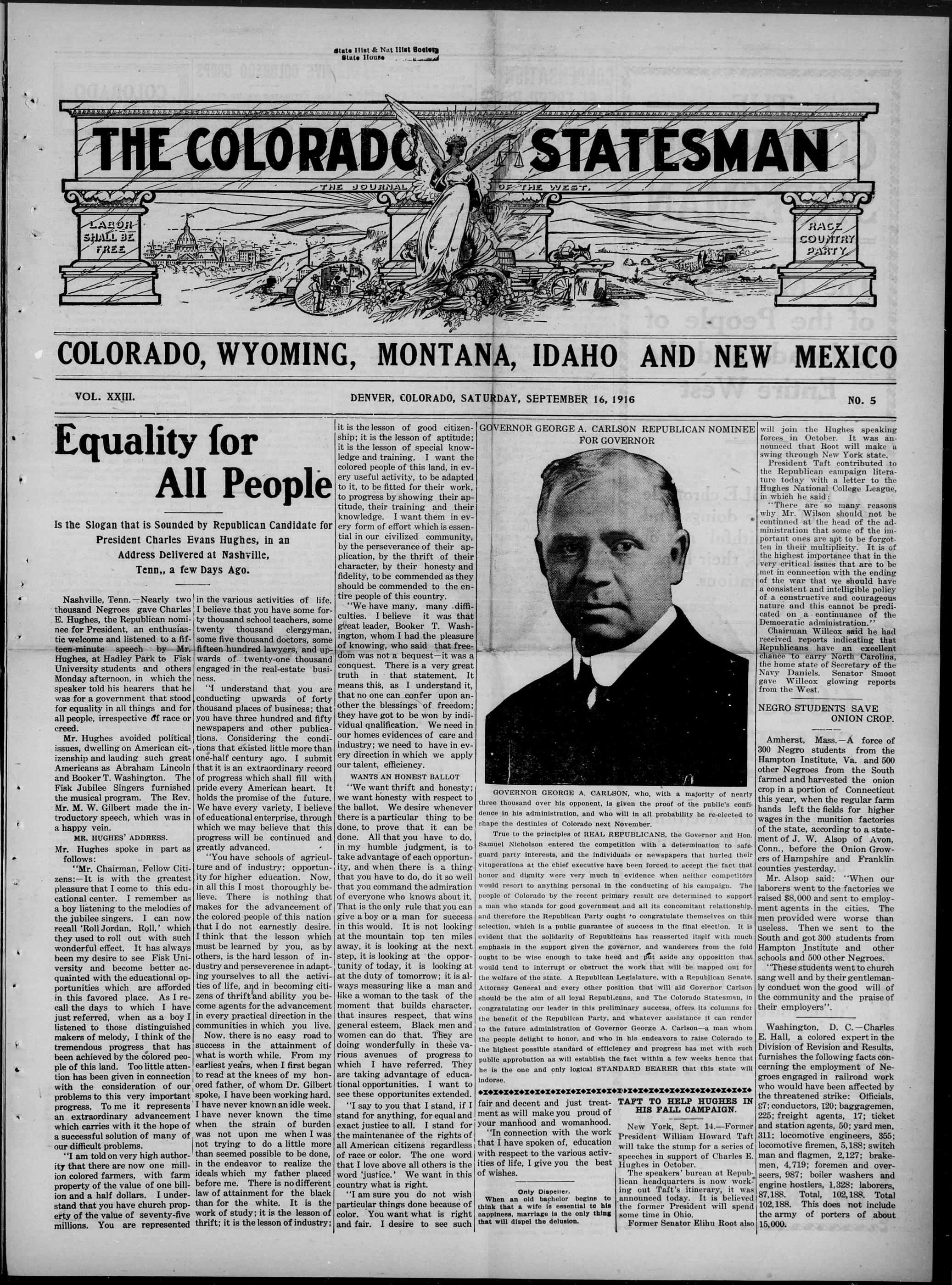
Equality for All People
Is the Slogan that is Sounded by Republican Candidate for President Charles Evans Hughes, in an Address Delivered at Nashville, Tenn., a few Days Ago.
VOL. XXIII.
Equality
Is the Slogan that is Sounded
President Charles E
Address Deliver
Tenn., a few
Nashville, Tenn.—Nearly two thousand Negroes gave Charles E. Hughes, the Republican nominee for President, an enthusiastic welcome and listened to a fifteen-minute speech by Mr. Hughes, at Hadley Park to Fisk University students and others Monday afternoon, in which the speaker told his hearers that he was for a government that stood for equality in all things and for all people, irrespective of race or creed.
Mr. Hughes avoided political issues, dwelling on American citizenship and lauding such great Americans as Abraham Lincoln and Booker T. Washington. The Fisk Jubilee Singers furnished the musical program. The Rev. Mr. M. W. Gilbert made the introductory speech, which was in a happy vein.
MR. HUGHES' ADDRESS.
Mr. Hughes spoke in part as follows:
"Mr. Chairman, Fellow Citizens:—It is with the greatest pleasure that I come to this educational center. I remember as a boy listening to the melodies of the jubilee singers. I can now recall 'Roll Jordan, Roll,' which they used to roll out with such wonderful effect. It has always been my desire to see Fisk University and become better acquainted with the educational opportunities which are afforded in this favored place. As I recall the days to which I have just referred, when as a boy I listened to those distinguished makers of melody, I think of the tremendous progress that has been achieved by the colored people of this land. Too little attention has been given in connection with the consideration of our problems to this very important progress. To me it represents an extraordinary advancement which carries with it the hope of a successful solution of many of our difficult problems.
"I am told on very high authority that there are now one million colored farmers, with farm property of the value of one billion and a half dollars. I understand that you have church property of the value of seventy-five millions. You are represented
in the various activities of life. I believe that you have some forty thousand school teachers, some twenty thousand clergyman, some five thousand doctors, some fifteen hundred lawyers, and upwards of twenty-one thousand engaged in the real-estate business. 'I understand that you are conducting upwards of forty thousand places of business; that you have three hundred and fifty newspapers and other publications. Considering the conditions that existed little more than one-half century ago. I submit that it is an extraordinary record of progress which shall fill with pride every American heart. It holds the promise of the future. We have every variety, I believe of educational enterprise, through which we may believe that this progress will be continued and greatly advanced.
"You have schools of agriculture and of industry; opportunity for higher education. Now, in all this I most thoroughly believe. There is nothing that makes for the advancement of the colored people of this nation that I do not earnestly desire. I think that the lesson which must be learned by you, as by others, is the hard lesson of industry and perseverence in adapting yourselves to all the activities of life, and in becoming citizens of thrift and ability you become agents for the advancement in every practical direction in the communities in which you live.
Now, there is no easy road to success in the attainment of what is worth while. From my earliest years, when I first began to read at the knees of my honored father, of whom Dr. Gilbert spoke, I have been working hard. I have never known an idle week. I have never known the time when the strain of burden was not upon me when I was not trying to do a little more than seemed possible to be done, in the endeavor to realize the ideals which my father placed before me. There is no different law of attainment for the black than for the white. It is the work of study; it is the lesson of thrift; it is the lesson of industry;
DENVER, COLORADO, SATURDAY, SEPTEMBER 16, 1916
it is the lesson of good citizenship; it is the lesson of aptitude; it is the lesson of special knowledge and training. I want the colored people of this land, in every useful activity, to be adapted to it, to be fitted for their work, to progress by showing their aptitude, their training and their knowledge. I want them in every form of effort which is essential in our civilized community, by the perseverance of their application, by the thrift of their character, by their honesty and fidelity, to be commended as they should be commended to the entire people of this country.
"We have many, many difficulties. I believe it was that great leader, Booker T. Washington, whom I had the pleasure of knowing, who said that freedom was not a bequest—it was a conquest. There is a very great truth in that statement. It means this, as I understand it, that no one can confer upon another the blessings of freedom; they have got to be won by individual qualification. We need in our homes evidences of care and industry; we need to have in every direction in which we apply our talent, efficiency.
WANTS AN HONEST BALLOT
"We want thrift and honesty; we want honesty with respect to the ballot. We desire whenever there is a particular thing to be done, to prove that it can be done. All that you have to do, in my humble judgment, is to take advantage of each opportunity, and when there is a thing that you have to do, do it so well that you command the admiration of everyone who knows about it. That is the only rule that you can give a boy or a man for success in this would. It is not looking at the mountain top ten miles away, it is looking at the next step, it is looking at the opportunity of today, it is looking at at the duty of tomorrow; it is always measuring like a man and like a woman to the task of the moment that builds character, that insures respect, that wins general esteem. Black men and women can do that. They are doing wonderfully in these various avenues of progress to which I have referred. They are taking advantage of educational opportunities. I want to see these opportunities extended.
"I say to you that I stand, if I stand for anything, for equal and exact justice to all. I stand for the maintenance of the rights of all American citizens regardless of race or color. The one word that I love above all others is the word 'justice.' We want in this country what is right.
"I am sure you do not wish particular things done because of color. You want what is right and fair. I desire to see such
GOVERNOR GEORGE A. CARLSON REPUBLICAN NOMINEE
FOR GOVERNOR
GOVERNOR GEORGE A. CARLSON, who, with a majority of nearly three thousand over his opponent, is given the proof of the public's confidence in his administration, and who will in all probability be re-elected to shape the destinies of Colorado next November.
True to the principles of REAL REPUBLICANS, the Governor and Hon. Samuel Nicholson entered the competition with a determination to safeguard party interests, and the individuals or newspapers that hurled their vituperations at the chief executive have been forced to accept the fact that honor and dignity were very much in evidence when neither competitors would resort to anything personal in the conducting of his campaign. The people of Colorado by the recent primary result are determined to support a man who stands for good government and all its concomitant relationships, and therefore the Republican Party ought to congratulate themselves on this selection, which is a public guarantee of success in the final election. It is evident that the solidarity of Republicans has reasserted itself with much emphasis in the support given the governor, and wanderers from the fold ought to be wise enough to take heed and put aside any opposition that would tend to interrupt or obstruct the work that will be mapped out for the welfare of the state. A Republican Legislature, with a Republican Senate, Attorney General and every other position that will aid Governor Carlson should be the aim of all loyal Republicans, and The Colorado Statesman, in congratulating our leader in this preliminary success, offers its columns for the benefit of the Republican Party, and whatever assistance it can render to the future administration of Governor George A. Carlson—a man whom the people delight to honor, and who in his endeavors to raise Colorado to the highest possible standard of efficiency and progress has met with such public approbation as will establish the fact within a few weeks hence that he is the one and only logical STANDARD BEARER that this state will indorse.
fair and decent and just treatment as will make you proud of your manhood and womanhood. "In connection with the work that I have spoken of, education with respect to the various activities of life, I give you the best of wishes.
Only Dispeller.
When an old bachelor begins to think that a wife is essential to his happiness, marriage is the only thing that will dispel the delusion.
New York, Sept. 14.—Former President William Howard Taft will take the stump for a series of speeches in support of Charles E. Hughes in October. The speakers' bureau at Republican headquarters is now working out Taft's itinerary, it was announced today. It is believed the former President will spend some time in Ohio.
Former Senator Elihu Root also
NO. 5
will join the Hughes speaking forces in October. It was announced that Root will make a swing through New York state. President Taft contributed to the Republican campaign literature today with a letter to the Hughes National College League, in which he said: "There are so many reasons why Mr. Wilson should not be continued at the head of the administration that some of the important ones are apt to be forgotten in their multiplicity. It is of the highest importance that in the very critical issues that are to be met in connection with the ending of the war that we should have a consistent and intelligible policy of a constructive and courageous nature and this cannot be predicated on a continuance of the Democratic administration." Chairman Willcox said he had received reports indicating that Republicans have an excellent chance to carry North Carolina, the home state of Secretary of the Navy Daniels. Senator Smoot gave Willcox glowing reports from the West.
NEGRO STUDENTS SAVE ONION CROP.
Amherst, Mass. - A force of 300 Negro students from the Hampton Institute, Va. and 500 other Negroes from the South farmed and harvested the onion crop in a portion of Connecticut this year, when the regular farm hands left the fields for higher wages in the munition factories of the state, according to a statement of J. W. Alsop of Avon, Conn., before the Onion Growers of Hampshire and Franklin counties yesterday.
Mr. Alsop said: "When our laborers went to the factories we raised $8,000 and sent to employment agents in the cities. The men provided were worse than useless. Then we sent to the South and got 300 students from Hampton Institute and other schools and 500 other Negroes.
"These students went to church sang well and by their gentlemanly conduct won the good will of the community and the praise of their employers".
Washington, D. C. - Charles E. Hall, a colored expert in the Division of Revision and Results, furnishes the following facts concerning the employment of Negroes engaged in railroad work who would have been affected by the threatened strike: Officials, 37; conductors, 120; baggagemen, 225; freight agents, 17; ticket and station agents, 50; yard men, 311; locomotive engineers, 355; locomotive firemen, 5,188; switch man and flagmen, 2,127; brakemen, 4,719; foremen and overseers, 987; boiler washers and engine hostlers, 1,328; laborers, 87,188. Total, 102,188. Total 102,188. This does not include the army of porters of about 15,000.
CONDENSATION OF FRESH NEWS
---
COLORADO STATESMAN
THE LATEST IMPORTANT DIS
PATCHES PUT INTO SHORT,
CRISP PARAGRAPHS.
STORY OF THE WEEK
SHOWING THE PROGRESS OF
EVENTS IN OUR OWN AND
FOREIGN LANDS.
Western Newspaper Union News Service.
About the War
On the Caucasus front in the region of Sakkiz the Russians have occupied the town of Bana.
The Mouth-Piece of the People of Colorado and the Entire West
Bulgarian troops occupied in consolidating trench lines west of Vardar river near Majadgh.
Bulgarians reported unofficially to have evacuated forts at Kavala, on the Aegean sea, which they occupied in August.
French assaults repulsed with sanquinary losses in Berleux-Belly sector, Berlin claims. Nine allied aeroplanes brought down.
German and Bulgarian forces operating in Rumania capture strongly fortified town of Silistria, sixty miles from Bucharest.
Paris reports repulse of repeated German attacks on the Somme, in which the assailants used liquid fire in large quantities.
German casualties in the war during the month of August, according to a compilation at London from the German casualty lists, totalled 240, 900. Reports from Balkan front indicate allied offensive from Saloniki has started in earnest. Allied effectiveness ready for duty on that sector now said to number 600,000.
A RELIABLE chronicle of their doings and progress; a faithful mirror of their wants, their hopes, their best aspirations.
French forces, resuming their offensive on the Somme, smashed German line in attack lasting half an hour, capturing first trench system and taking 1,500 prisoners.
Teutonic allies have made further progress in Dobruja in their advance through Rumania, according to official statements from Berlin. Russian offensive movements in Carpathians and in the Kovel sector defeated, the statements say.
German and Bulgarian troops have captured the Rumianian stronghold of Turtakai, with 20,000 prisoners and 100 guns. Both armies lost heavily in the battle for possession of the fortress. Vienna admits retirement on both the Russian and Rumanian fronts under pressure.
THE COLORADO STATESMAN
Western
The Sioux City unit of the American Red Cross will see service on the border. Ten women have been ordered to report at Llano Grande, Tex. The press mill of the Dupont Powder Company's plant at Oliphant, near Fairchance, Pa., blew up. Only a human foot was found of three men who were at work in the mill.
A date for the execution of Oscar W. White, sentenced to be hanged for the murder of Anderson Coffee near Casper, Aug. 12, 1913, is to be set by the Wyoming Supreme Court.
The heaviest twenty-four-hour rain in fifteen years, following Friday's steady downpour, sent desert streams coursing across the Salt River Valley in Arizona.
Unequaled as an advertising medium for the business of professional men and women.
E. P. Ripley, president of the Atchison, Topeka and Santa Fe railroad, announced in New York that he would bring suit to test the constitutionality of the recently enacted eight-hour law. Artillery target practice, directed by modern field telephones, was begun at El Paso, Tex., by Pennsylvania National Guard batteries, using regulation ammunition. The range of firing was nearly three miles. A preliminary inventory of the estate of the late James J. Hill, the railroad financier, obtained by the Probate Court at St. Paul, Minn., shows Minnesota holdings approximating $40,000,000, involving an inheritance tax of $1,250,000.
An excellent family journal speaking to and for many thousand colored citizens.
Washington
Maj. Gen. James B. Aleshire, quarter master general of the army since July, 1907, was placed on the retired list on account of physical disability. Representative Keating of Colorado asked the United States Geological Survey to make a survey around Pueblo, Colo., with a view to developing oil and gas. Proclamations requested by Congress were issued by President Wilson designating Oct. 21 and 22 as special joint days on which funds will be solicited from the American people for relief of starving Syrians and Armenians in the war zone, and Nov. 1 as a similar day for contributions for the Lithuanians.
TWODOLLARSAYEAR
President Wilson lent his personal touch to aid the efforts of the American-Mexican joint commission in seeking a permanent foundation of sympathy and understanding upon which may rest the future relations of the United States and Mexico. Putting aside for one hour his own cares and his vigil at the bedside of his sister, who is dying, Mr. Wilson exchanged calls with General Carranza's representatives.
All persons entering or leaving Germany must obtain special permission from the German government.
Foreign
Queen Victoria of Sweden is ill and confined to her bed.
Pope Benedict has appointed the Very Rev. Daniel Coghlan, vicar of Cork, to be bishop of that diocese.
It is reported at Rome that Cardinal Gasparri, papal secretary of state, is about to resign an account of illness.
Thomas Nelson Page, American ambassador to Italy, left for the Italian war front and will be the guest there of the king, according to the Rome correspondent of the Paris Matin.
The destruction of the American consulate at Alexandretta, Asiatic Turkey, during a bombardment by entente allied warships is announced in a delayed Turkish official report dated Sept. 4.
The sale of the Manila railroad to the Philippine government was ratified when a contract was signed by Gov. Gen. Francis Burton Harrison of the Philippines and President Higgins of the railroad.
With the loss of eleven lives, the second attempt to bridge the St. Lawrence river at Quebec resulted in a failure when the massive center span, weighing 5,100 tons, suddenly collapsed and fell into the river.
A holy war decreed by the Sunni Mohammedans and a war of pillage and robbery by the various tribes of Turkestan have proved of material aid to Turks in their advance into Persia, according to dispatches reaching Washington.
John Borden, the millionaire sportsman of Chicago, whose polar schooner Great Bear was wrecked on a pinnacle rock in Bering sea, Aug. 10, left Nome for Seattle on the steamship Umatilla, accompanied by his guest, Norris Bokum, a business man of Chicago. Borden says he will build another boat next winter, engage Capt. Louis L. Lane, his partner of this year, as commander and set out on another Bearing sea and Arctic ocean cruise.
Sporting News
**PUCUBS—** Won. Lost. Pct.
Omaha 90 64 582
Lincoln 78 58 582
Sloux City 71 66 518
Des Molines 68 69 496
Duke 67 72 482
Topeka 64 72 482
St. Joseph 59 80 424
Colorado Springs 55 84 396
Johnny Dundee was awarded a decision over Ever Hammer at Kansas City at the end of their fifteen-round match.
The University of Colorado at Boulder, has a new football coach this year, for the first time in fifteen years. He is M. C. Evans, a graduate of Milliken University.
The Wichita baseball team will be known as the Millionaires. The Kansas Club was formally transferred to Colorado Springs and the remainder of the games of the season will be played at Colorado Springs.
Eight Colorado baseball teams have signed to play the Grizzlies on their barnstorming tour through the state when the Western League closes its season, Sept. 24. The amateur clubs are Pueblo, Bayfield, Delta, Grand Junction, Firestone, Berthoud, Brush and Greeley.
General
Vice President Marshall is to be notified of his nomination Sept. 16.
President Wilson began his first vacation of the year by laying plans for the "porch campaign" he will conduct from Shadow Lawn.
The National American Woman Suffrage Association convention in its final business session adopted a declaration of principles, in which it reiterated its adherence to the policy of nonpartisanship.
At Millville, N. J., Mrs. Jane Facemeyer, within a year of the century mark, gave her "girl," Mrs. Mary E. Peters, 66, in marriage. The happy bridegroom was James McNeal, a well-to-do contractor, only 68.
Vivid descriptions of the marine phenomenon which caused the destruction of the United States armored cruiser Memphis, with the loss of about forty of her crew, in the harbor of Santo Domingo Aug. 29, were given in New York by witnesses of the disaster, who had arrived on the steamer Iroquois. The conjecture that the disaster was the result of an undersea eruption was strengthened by assertions that nothing resembling a gale accompanied the sudden disturbance.
With the border situation set aside temporarily, the American-Mexican joint commission devoted itself to determining the extent of the control exercised in Mexico by the de facto government, the information being supplied by the Mexican commissioners at the request of the American conferees. It was stated informally that upon the showing made by the Carranza government rested the possibility that the Washington government would revoke its warning to Americans to stay out of Mexico and would encourage their return to their properties there.
President Shonts of the Interborough Rapid Transit Company announced in New York that he will not accept the recommendation of Mayor Mitchel and the Public Service Commission to call off the strike and arbitrate the differences between the railway companies and the labor unions.
Because he sewed his hogs' eyes shut to keep them from catching chickens, Joseph K. Leigh, a Pleasant Valley farmer, was arrested and fined $20 and costs, making a total of $22.50, by Justice of the Peace J. J. John of Lambertville, N. J.
FIVE COLORADO CROPS
HAD ESTIMATED VALUE SEPT. 1
OF $50,605,200.
Increased Prices Practically Offset
Differences in Yield as Compared
With Last Year.
Western Newspaper Union News Service.
Denver—Five Colorado crops had a value on Sept. 1 of $50,605,200, less than 2 per cent under the value of the same crops in this state when the final estimates were made last year, according to the government report issued at Washington.
The report shows that while the yield in the state has suffered to some extent along with other sections of the country, the increased prices for farm products have practically offset the difference in full.
Apples—Sept. 1 forecast, 689,000 barrels; production last year (final estimate), 693,000 barrels.
Peaches — Estimated production 1915, 405,000 bushels; estimated production 1915, 650,000 bushels.
Sugar Beets—Sept. 1 condition, 93; compared with the ten-year average of 92.
Prices—The first price given below is the average on Sept. 1 this year, and the second the average on Sept. 1 last year: Wheat, $1.27 and 82c per bushel. Corn, 77c and 68c. Oats, 49c and 45c. Potatoes, $1.20 and 66c. Hay, $9.00 and $7.70 per ton. Eggs, 25c and 24 c per dozen.
Report Murder Suspect Cornered. Trinidad.—Sheriff Kane received word that Ricardo Lucero, Mexican sheepherder and section hand, wanted here for the murder of Frank West at Delhi, in the eastern half of this county two weeks ago, has been cornered in the mountains near Folsom, N. M., thirty miles south of Trinidad. Lucero was seen and recognized by the wife of a rancher. A request for bloodhounds reached here, but the only dogs in possession of the local authorities were poisoned last week. It is not believed that Lucero will give up without a fight. West was one of the heirs of Ed West, pioneer cattle and sheepman of this county, whose estate is valued at $1,500,000.
Three Killed in Auto Wreck.
Loveland. — Three persons were killed and a fourth fatally injured when a Colorado & Southern strain hit an automobile at First street, on the edge of the city, and turned the machine over several times. The bodies of the dead were wedged under the engine pilot and extracted after an hour's work in taking the pilot from its place. The dead: James L. Hedelson, 32 years old, of 129 West Fifth street, Loveland; Mrs. Georgia Hedelson, his wife, 30 years old; Mrs. Clara Jones, 83 years old. Fatally injured: Mrs. Julia A. Lent, mother of Mrs. Hedelson, 50 years old, of Eureka, Kan.
Girl Rider Beats Boy Jockeys.
Rocky Ford.—Miss Jranita Edgar rode Hi Ormando a mile in the Watermelon Day derby in 1:48, winning against a field of male jockeys. Miss Edgar also rode Hi Ormando to victory in the four and one-half furlong race in fifty-nine seconds. The time made in the derby is said to break all previous records for a like distance under similar conditions. Watermelon Day proved a huge success, 25,000 visitors being present, who did their utmost to consume 25,000 genuine Rocky Ford watermelons, which were sliced and iced and given away.
Boys at Play Shoot Baby Girl.
Sterling—Helen, the 18-months-old daughter of John Kobler, who lives near Graylin, was shot and dangerously wounded when her two brothers knocked down a rifle while playing. The child was wounded in the head. The brothers are 4 and 5 years old.
Flames Destroy Fountain Block.
Fountain.—The Rhinehart business block on Main street, a stone structure, was destroyed by fire, causing a loss to the building and the various business firms occupying it of $20,000 above the insurance.
Auto Crash Near Sterling.
Sterling.—C. H. Swanson is believed to be dying as the result of an accident that took place Monday afternoon, when his automobile was struck by passenger train No. 10 at the Main street crossing. Swanson was pinned under the car and both his legs were cut off. He was removed to a local hospital, where little hope was held out for his recovery. His daughter, who was with him in the machine, escaped uninjured
COLORADO STATE NEWS
Sept. 20-23 - Cheyenne County Fair at Cheyenne Wells.
Cheyenne Wells.
Sept. 21-22-Agricultural and Live
at Holyoke.
Sept. 27-29-State Convention B.P.O.E.
at Trinidad.
Sept. 28-30-Third Annual Pine River
and Southern Ute Indian Fair
at Iguaçu.
Ironado.
Sept. 30—Harvest Festival at Briggs-
dale.
Oct. 12—Annual Poudre Cafon Picnic
at Fort Collins.
Jan. 20-27—Annual Western Stock
Show at Denver.
Marble has a new fire department.
Briggsdale will hold a harvest festi-
tival Sept. 30.
The Nunn harvest festival was
largely attended.
About 32,000 attended the Frontier
fair at Fort Morgan.
A Cripple Creek report says the
Ajax lease is proving rich.
A streak of ore has been opened up
in the Brazil mine at Freeland.
Boulder reports the tungsten situ-
tion brighter than for some time.
The entire estate of Judge David
C. Beaman of Denver, was left to his
widow.
Over 750 carloads of cantaloupes have been shipped from Rocky Ford and Ordway.
Many mining properties in the San Juan district are reopening because of better ore prices.
James Baker, a Holbrook resident, committed suicide by shooting himself with a shotgun.
The land office receipts at Pueblo for August were $8,400. There were 322 filings during the month.
The Eureka mine in Gilpin county is to be taken over and worked by Ohio and Kentucky capitalists.
The Yukon mill at Durango has been kept busy on the treatment of tungsten ore from the Galty group.
Workers in eight of the coal mines in Huerfano county have joined the United Mine Workers of America.
The humble bean, the money-making crop of the western plains, was honored with a bean celebration at Peyton.
Work upon the Camp Bird tunnel at Ouray which is to be nearly 11,000 feet when completed, is progressing satisfactorily.
Denver bank clearings for the week ending Sept. 7 were $12,101,000, a gain of 55.5 per cent over the same week in 1915.
Nearly 48,000 pounds of zinc-gold ore was shipped from the Eureka mine in Gilpin county last week to Black Hawk.
Members of the Pike's Peak Cattle and Horse Growers' Association met at Florissant and condemned the proposed herd law.
Frank Welch and Frank Cooper, old offenders in Greeley, were arrested in Fort Morgan charged with selling and having liquor in their possession.
Robert Larson, 55 years old, a car repairer for the Denver & Rio Grande railroad, was crushed to death while working on a car at Denver.
Both first and second prizes in the open show for Boston terriers at the dog show held in Kansas City were won by Denver-owned dogs.
The buffalo herd at City park in Denver attained its "majority" with the birth of a fine girl baby that raised the number to twenty-one.
The St. Johns mine people, who are operating the Revenue mine at Ouray, are making fine progress and the number of employés is to be increased.
Negotiations between officials of the Colorado & Southern and the Denver & Rio Grande railroads and their shopmen are expected to be resumed in Denver.
H. S. Graves, chief of the United States Forest Service, has received applications for the construction of forty-two roads in Colorado, under provisions of the federal aid act.
The enrollment at the Colorado School for the Deaf and Blind at Colorado Springs broke all records when it reached 190. This is larger than at any previous time in the institution's history.
The sixth hearing in the case of Col. James C. Bulger, sentenced to death for the killing of Lloyd Nicodemus, one of the proprietors of the Savoy hotel, in the spring of 1914, was held by the State Board of Pardons.
The Red Mountain district shippers, including the Davey Leasing Company on the National Bell, the Barstow, St. Paul, Congress, Joker Tunnel, Gennessee, Reno Leasing Company, Atlantic, and others, supplied about fifty car loads of ore to the Silver Lake mill and the Durango smelter during the first half of August.
Jack T. Mason is confined to his home suffering from severe burns and Dwight Ryland is in St. Luke's Hospital in Denver in a serious condition as the result of an automobile accident at Laramie, caused by the breaking of one of the wheels of a car they were driving.
W. Horace Kerr, representing the Bureau of Markets and Credits of the United States Department of Agriculture, arrived in Denver from Washington to establish a representative of the office in Colorado, with headquarters in the Customs building
AFRO-AMERICAN CULLINGS
A wave of industrial prosperity and we have to revise our notions.
The South wants the Negro, after all, and wants him so badly that it isn't going to let him get away if it can help it. Listen:
"Americus, Ga., police and sheriff's office have thrown out a dragnet for the agents who have been leading Negroes out of the country with promises of work in Connecticut," a special dispatch to the Atlanta Constitution reads.
"Several industries have been paralyzed by the Negroes leaving their work."
Then there is the old bogie of alien immigration. Listen again, this time to the Washington Post:
"There is a growing need for common labor," which may become "so acute as to cripple industry" and which is "due partly to prosperity and partly to the impairment of immigration."
The same paper summarizes the situation as follows:
"Not long ago agents acting in behalf of the Russian government transported from Norfolk, Va., a complete force of shipbuilders, including foremen, draftsmen, mechanics and ordinary laborers. The shipbuilding force was removed in a body to Russia, so that the Russian government might have better facilities for shipbuilding.
"The need for labor, both for agricultural and industrial development, is as great in the South as in the East. Recently two thousand Negro laborers left Savannah, Ga., to work on the Pennsylvania railroad. The laborers were taken from a point four miles out of Savannah because the local council had passed an ordinance requiring a $1,000 license fee for any agent sending laborers out of the state.
"All of the factories in the South are taking precautions against draining of their labor resources. Their situation is not different from that which prevails in the East. Some months ago one of the large motor car companies in the East had a strife and within 24 hours agents of the large munion companies were on the field inducing the strikers to accept employment in the munion plants."
But suppose we follow the Negroes to Connecticut and let the Hartford Courant tell about it:
"One way in which the labor shortage that has been felt in the North during the present period of intense industrial prosperity has been met is by the importation of Negro laborers from the South. The tobacco plantations in the immediate vicinity of Hartford have made particular use of this expedient."
"Marcus L. Floyd, general manager of the Connecticut Tobacco corporation, now has 145 Negroes at work, and expects soon to have 200 working on the 620 acres that are being cultivated under cloth by the corporation.
"On the Griffin-Neuberger plantation at Griffiths, Conn., there are now 83 Negro workers, and here will be 130 before the season is over.
"These Negro workers are paid $2 a day and housed free."
And here is the explanation:
"The cause of the labor shortage in this section, according to Mr. Floyd, is that the high wages offered by munion factories to unskilled laborers drew most of them into the work. This with the fact that immigration has almost ceased."
So the war, which brought the industrial prosperity and also cut off the immigration upon which American employers so long have depended, is to be both praised and blamed. And in the
The South Texas Colored Missionary Baptist association convened in its twenty-third annual session at Houston, Tex. Moderator Rev. A. T. Gordon called the association to order. The opening service of the prayer was conducted by Rev. B. J. Preacher of Galveston. G. W. Smith and D. Young, veteran ministers of the association, offered prayer. F. I. Richardson was elected reporter for the association. The moderator set forth the principles of the association. Rev. A. C. Ray and Rev. C. H. Jones, secretary and assistant secretary, respectively, were at the desk.
Vice President Rev. J. C. Curtis presented Rev. C. H. Jones, who had been selected to preach the introductory sermon and his alternate, Rev. J. L. Lampley.
Rev. C. H. Jones announced his subject as "The Certain Increase of the Kingdom of Jesus." He made a strong appeal to the ministers of the gospel to bestir themselves to active service.
The following committees were announced: Finance, Revs. B. J. LeRoy, J. L. Lampley, I. G. Griffin, A. C. Carter, P. A. Pinkney; enrollment, Revs. W. H. Stewart, B. C. Carter, G. W.
At the closing session of the National Negro Christian congress at the Cosmopolitan Baptist church, Washington, the following officers were elected: Dr. Simon P. W. Drew, Washington, D. C., president; Rev. Dr. W. H. V. B. Taylor, West Virginia, first vice president; Rev. Dr. W. R. Winston, Washington, D. C., secretary; Bishop J. J. Higgs, St. Louis, corresponding secretary; Rev. Dr. George W. Thomas, North Carolina, treasurer, and Rev. Leroy Frazier, Richmond, Va., organizer.
menitime there is only one result in sight, the wages of the common laborer will advance sharply, in the South to keep the Negro at home, and in the North to lure him away from Dixie.
Among the recent promotions in the army was that of Maj. Charles Young, Tenth United States cavalry, to the grade of lieutenant colonel. Special interest attaches to this case for the reason that, although Colonel Young is not the only colored man to have been graduated from the United States Military academy, he is the only man of his race to have reached the rank of lieutenant colonel, the second highest in regimental organization. He was graduate in 1889 and most of his service has been in the Ninth and Tenth cavalry, in which he rose gradually to his present rank. For nearly a year, while holding the rank of first lieutenant, he was attached to the Seventh cavalry, a white regiment. During the Spanish war he served as major of the Ninth Ohio colored infantry, a regiment he helped to organize. For several months past he has been serving with his regiment in the punitive expedition to Mexico under General Pershing.
In addition to Lieutenant Colonel Young, there are eight other colored men holding commissions in the army. These are: Maj. John R. Lynch of the pay corps, formerly a member of congress, who is retired; Capt. John E. Green. Twenty-fifth infantry, who is military attache at Monrovia, Liberia; Capt. Benjamin O. Davis of the cavalry, who is military instructor at Wilberforce university, Ohio, and Chaplains W. W. E. Gludden, Twenty-fourth infantry; George W. Prioleau, Twenty-fifth infantry; O. J. W. Scott, Tenth cavalry; Louis A. Carter, Ninth cavalry, and T. G. Stewart and William T. Anderson, both of whom are on the retired list. Chaplain Anderson has the rank of major, the others being either captains or first lieutenants.
In the period covered by one vigorous manhood, approximately coincident with the half century following emancipation, things changed very much for the American Negro. He more than doubled in numbers and accumulated wealth exceeding $700,000,000. His school property for higher education built and paid for in that time amounted to $20,000,000; his church property to $70,000,000.
In the half century the percentage of literacy was raised from 5 to 70. At its close there were 1,700,000 Negro children in public schools instead of a meager 10,000 in 1863. The number of Negro churches was increased from 550 to 40,000; the number of communicants from 550,000 to 4,300,000. Sunday schools increased from 200 to 41,000 and pupils from 10,000 to 2,200,000.
This is a very creditable record for an uneducated, illiterate race suddenly thrown on its own resources in the midst of a highly organized white civilization, which had no place ready for its former slaves. And the Negroes are by no means standing still. They are entering every branch of business and making good; they are rapidly extending their real estate holdings; they are giving themselves a secular and religious education that ranks high in the Christian world. What their future in this country will be no man dares to prophesy, but undoubtedly they will be ready to meet boldly and capably whatever fate has in store for them. They have learned to stand on their feet.
Mitchell, H. Willis, B. J. Preacher.
Vice Moderator Rev. J. C. Curtis called the afternoon session to order. Rev. T. Wesley, assisted by Rev. I. S. Ambrose, conducted the devotional services. Invocation by Rev. I. C. Capital and Dr. J. E. Edwards of Temple conducted the Bible institute.
The committee on finance and enrollment made its first partial report, which was adopted.
Membership of banks in the National Negro Business league has grown from two, in 1900, to fifty-one at present. This fact was brought out in the discussions before the seventeenth annual session of the league at Kansas City, Mo., emphasizing the service the organization, which was founded by the late Booker T. Washington, is giving to the Negro business interests of the country.
An address on the Negro state guaranteed banks of Mississippi by C. B. King of Indianola, Miss., was on the program.
Health and business prosperity, the raising of cattle and the management of various business enterprises were discussed by the delegates.
When Company A, Cardington, O., of the Fourth regiment, went to Camp Wilson it had eleven pairs of brothers, two pairs of fathers and sons and fourteen men over six feet in height. Company A is the youngest in the state, having only been mustered into service June 8, eleven days before the mobilization call. It has 100 members.
When death, the great reconcilier, has come, it is never our tenderness that we repent of, but our severity.—George Eliot.
GREECE CASTS LOT WITH ALLIES
OCCUPATION BY BULGARS STIRS
GREEK KING INTO
ACTION.
FRENCH STORM SOMME
RUSSIAN DESTROYER REPORTED
SUNK BY TEUTON
AIRMEN.
Athens, Sept. 14.—King Constantine has asked M. Dimitracopulos, former minister of justice, to form a new cabinet. M. Dimitracopulos has accepted in principle and conferred with the King.
The belief is entertained in the entente capitals that the retirement of the Zaimis ministry is preliminary to the entrance of Greece in the war with the allies.
Recent dispatches from Berlin and Vienna show that there, also, it is regarded as probable Greece will soon abandon neutrality and join the entente powers.
The precise causes which led to the resignation of the ministry have not been disclosed because of the exceptionally rigid censorship.
London, Sept. 14.—The French north of Peronne are holding tenaciously to the salient they have driven into the German line east of the Bethune-Peronne road near Bouchavesnes. They hold intact, too, the town of Bouchavesnes and other points along the line captured in the offensive started Tuesday.
Their capture of a powerfully organized German trench system south of the Le Priez farm, near the road running west from Rancourt to Combles, has put Combles in further jeopardy. Repulse of a German attack near Fleury, in the Verdun sector, is reported by Paris.
The fighting in the region of Bouchavesnes has been sanguinary. Finding that the French had cut their line of communication from Peronne northward, the Germans threw violent attacks against L'Abbe wood and Hill No. 76, south of Bouchavesnes, and retook both places.
The French, however, returned viciously to the attack, and after hard fighting finally drove out the Germans and kept the ground they had won.
In the two days' fighting more than 2,300 Germans were taken prisoner, and a large number of guns and machine guns captured.
The Italians have joined in the fray west of the Varder river. Near Lake Butkovo. Rome declares they have driven Bulgarian detachments beyond the Demir-Hissar-Doiran road. The Bulgarians say, however, that the Italians were dispersed in this region with a loss of thirty men captured.
In Transylvania the Germans have joined the Austrians near Hermannstadt and southeast of Hoetzing in fighting the invading Rumanians. In the Carpathians Russian attacks along the entire front have been repulsed, according to Vienna and Berlin. Petrograd says the Russians are holding all the ground they have won in this region. German aeroplanes sank a Russian torpedo boat destroyer in the gulf of Riga and attacked Russian naval forces in the Black sea off Constanza, Rumania. Besides the destroyer sunk several other hits were observed in both attacks, Berlin says.
Pontiac Wills in Washington.
Seattle, Wash.—United States Senator Miles Poindexter, who was elected as a Republican six years ago, and who joined the Progressive party four years ago, was renominated as Republican candidate for senator in the primary election, defeating Will E. Humphrey, now representative in Congress from the First district, by a plurality estimated at 7,000. Henry McBride of Seattle, who was governor of the state from 1901 to 1905, was nominated as the Republican candidate for governor.
Turks Pillage and Massacre.
Paris.—The Greek port of Kavalla was pillaged and civilians masacred by Turkish Bashlbazouks on the withdrawal of the Greek garrison, according to a Saloniki dispatch to the Havas agency.
Norwegian Steamer Sunk.
London.—Lloyds announce that the Norwegian steamer Kong Ring was sunk. Her crew was saved.
Hunt Renominated - in Arizona.
Phoenix, Ariz.—Incomplete returns indicate the renomination of Governor George W. P. Hunt by a majority approximating 3,000. Tom Campbell, Republican, was unopposed for the gubernatorial nomination. Henry Ashurst, Democrat; Joseph H. Kibbey, Republican, are nominated for United States Senate. Congressman Carl Hayden, Democrat, was renominated by a large majority over A. A. Worsley. Sidney Osborn, Democrat, is renominated for secretary of state.
$1,626,439,210 APPROPRIATED
RAIL TROUBLE AND FOREIGN WAR HIGH LIGHTS OF SIXTY- FOURTH CONGRESS.
MAKES 252 NEW LAWS
PRESIDENT PLEDGES RENEWAL OF RAILROAD LABOR LAW CONSIDERATION.
Western Newspaper Union News Service.
Washington.—The first session of the Sixty-fourth Congress, which adjourned September 8, was concerned chiefly with national defense. The crisis in Congress over the international situation followed Germany's naval order to sink armed belligerent merchant ships without warning. Introduction of resolutions warning Americans to keep armed merchantmen caused President Wilson to halt diplomatic negotiations and go to the Capitol to demand a "showdown." The result was tabling of the Gore resolution in the Senate by a vote of 68 to 14 on March 3, and of the McLemore resolution in the House by a vote of 276 to 142 on March 7.
Immediately afterward the President sent to Germany and read to Congress a note threatening to sever diplomatic relations unless the German government "immediately effected a modification of its methods of submarine warfare."
When the gavel fell Congress had directed reorganization and re-equipment of the army and navy, for defense of the country at the unprecedented cost of $655,000,000, with authorizations that will increase the total in three years to nearly $800,000,000. With all other expenditures, appropriations were brought to the grand total of $1,637,583,682, the greatest aggregate in the country's history, and exceeding that for the last fiscal year by more than half a billion dollars.
Expenditures necessitated by preparedness and the calling into action of military forces to meet the Mexican emergency, demanded revenue legislation in the closing days of the session. Congress responded by doubling the normal tax incomes, creating an inheritance tax, munitions tax and miscellaneous excise taxes to raise $205,000,000 and by directing sale of $130,000,000 Panama canal bonds.
Congress established a tariff commission; a government shipping board to rehabilitate the American merchant marine; a workmen's compensation commission to administer a new uniform compensation law; a farm loan banking system; a child labor law, enlarged the system of self-government in the Philippines and enacted many other important laws which had been contemplated by the administration.
were:
Agriculture ..... $ 24,948,852
Army ..... 267,596,530
Democratic and consular ..... 161,966
District of Columbia ..... 12,481,907
Fortifications ..... 25,748,050
Indian affairs ..... 10,967,644
Legislative and executive ..... 17,295,690
Biary academy ..... 12,252,048
Navy ..... 313,300,085
Pensions ..... 158,065,000
Postoffice ..... 158,065,000
Postoffice ..... 192,373,679
Rivers and harbors ..... 40,598,135
Sundry civil ..... 128,299,285
Public appropriations ..... 161,674,747
Shipping bill ..... 50,100,000
Deficiencies ..... 72,500,000
Rural credits ..... 6,100,000
Good roads ..... 6,000,000
Floods ..... 2,000,000
Grand Total ..... $1,637,583,682
Railway Legislation Next Session.
In a formal statement President
Wilson, speaking of the work of
Congress, gave notice that the remainder
of the railroad program would be
pressed at the new session.
The immigration bill, the corrupt practices bill and the bill to permit combinations of American exporters to meet foreign competition abroad went over.
Opportunity for Well-Earned Rest.
The President congratulated the leaders on the opportunity for a "well-earned rest," and officially informed them that he had nothing further to communicate to the Congress.
During the session 17,800 bills and 642 resolutions were introduced in the House. Of these 252 bills became laws and 33 public resolutions were adopted, in addition to 150 private bills and resolutions passed.
Speaker Clark and Republican Leader Mann exchanged the usual felicitations and Vice President Marshall thanked the members of the Senate for their courtesy, and the long, laborious session ended.
COMPETENCY CHANGES MINING LAW
Washington—Senator Shafroth of Colorado secured the following amendment to the revenue bill, which was signed by the President.
"In the case of mines a reasonable allowance for the depletion thereof, not to exceed the market value in the mine of the product thereof which has been mined and sold during the year for which the return and computations are made."
924 19th Street, Denver, Colorado
All Kinds
Bolden Br
Baths,
FIRST
R. B. BOLDEN,
O. H. SHIRLEY, Pres.
PAUL J. SHI
THE ATL
Courteous Tre
Leaders
All Kinds of Sandwiches
Bolden Bros. Barber Shop
Baths, Electric Massage
FIRST CLASS SERVICE
R. B. BOLDEN, Mgr. 926 19th St. Denver
C. H. SHIRLEY, Pres. J. C. BAMPSON, Vice Pres PAUL J. SHIRLEY, Sec. and Treas.
Courteous Treatmet. Right Prices Leaders in Prescription
RAILROAD LUNCHOOM
RAILROAD PORTERS' CLUB LUNCHOOM IN CONNECTION
BILLIARDS AND
POOL
1728½ Wazee St. C
J. B.
PHONE MAIN 8416.
Meats, Fancy and Staple Groceries
1864 CURTIS STREET
Corner Nineteenth. Denver, Colo.
The MARKET COMPANY
C. E. SMITH, Manager, Res. Phone South 1608
Wholesale and Retail Staple and Fancy Groceries, Fish and Oysters. Hotels and Restaurants Our Specialty. Fresh and Cured Eastern Corn Fed Meats Fruits, Vegetables, Poultry and Game.
Telephones Main 4302, 4303, 4304, 4308 622-636 15th Street Denver, Colorado
Weatherhead Hat Co. TELEPHONE MAIN 3203
RENOVATORS, BLEACHERS DYERS AND FINISHERS Of Gents' and Ladies' Hats of Every Description 1624 Champa St., Denver, Colo.
DINNER
11:30 to 2 p.m.
Store No. 1.
2701 WELTON ST.
Main 895 875
W. C. CAMPTON, Pres.
VINE
Bros. Barb
Maths, Electric Mass.
FIRST CLASS SERVI
EN, Mgr. 926
J. C.
SHIRLEY, Sec. and
ATLAS DR
Treatmet. I
rers in Prescrip
AD PORTER
BOOM IN CONN
ND
St. Only one block from
J. B. MINTER, Barber
116. DENV
RES
N K. RET
y and Stap
64 CURTIS STREET
MARKET CO
Manager, Res. Pho
Taple and Fancy Gro
d Restaurants Our
Fresh and Cured
Corn Feed
Vegetables, Poultry and
s Main 4302, 4303,
reet
erhead
TELEPHONE MAIN 3
```markdown
```
Established 1876
R HATTERS OF THE
MAKE OLD HATS IN
TICAL HAT
LEACHERS DYERS
Ladies' Hats of Eve
Champa St., Denver
Short Orders at All Hours
andwiches
ber Shop
message
VICE
26 19th St. Denver
D. HAMPSON, Vice Pres
and Treas.
RUG CO.
Right Prices
diption
Store No. 2
26TH AND WELTON
Main 4955.4956
J. B. MINTER, Sec.
ERS' CLUB
INECTION
FREE CHECK
ROOM
from Union Depot.
er.
VER, COLORADO.
THE COLORADO STATESMAN
CABUN
BENEFIT
FREE
TRACE
COUNTRY
PARTY
1824 Curtis Street, Room 25.
Phone Main 7417.
SUBSCRIPTION RATES
One Year ..... $ 2.00
Six Months ..... 1.00
Three Months ..... .60
PAYABLE IN ADVANCE.
Entered as second-class matter at the postoffice in the City of Denver, Colo.
Reading notices, ten lines or less, 10 cents per line. Each additional line over ten lines, 5 cents per line. Display advertising 50 cents per inch.
Remittances should be made by Express Money Order, Postoffice Money Order, Registered Letter or Bank Draft. Postage stamps will be received the same as cash for the fractional part of a dollar. Only 1c and 2c stamps taken.
No discounts allowed on less than three months' contract. Cash must accompany all orders from parties unknown to us. Further particulars on application.
Jects, plainly written only upon one side of the paper, must reach us Tuesdays, if possible, anyway not later than Wednesdays, and bear the signature of the author. No manuscript returned, unless stamps are sent for postage.
Communications to receive attention must be newsy, upon important sub-All communications of a personating nature that are not complimentary will be withheld from the columns of this paper.
RECOGNIZED BY THE RETAIL ASSOCIATION OF THE DENVER CHAMBER OF COMMERCE AS AN ADVERTISING MEDIUM OF THE FIRST CLASS.
STRENUOUS LIFE
Almost as a total population of Colorado the Negro stands off and feels that he is not in touch with the great strenuous life which is the heart of the present century's human existence. The world's problems are not ours. There are no problems for us except those touching the right and the opportunity to live. If we can be employed in some way and dragged along in the wake of the world's hurrying events, we will be half-way content, at least. Such seems the position of the Negro race in Colorado, but as a matter of truth, is there not a great, ardent life opening before the same Negro? Is there not a great business development awaiting an enlightened direction? Are there not great social, financial and political problems of racial unity world-wide in their application, appealing for recognition before the awakening Negro of today?
Wealth-getting is the first great motive of the Caucasian. Let it be so with the Negro. The money-getting spirit carries enlightenment and civilization with it.
Business is the watchword of today. Even with the field filled up and handicapped as it is here, 11,000,000 of people of our race are sufficient within themselves to create a volume of new business of their own which would be more than respectable.
The wonderful and sagacious information coming occasionally to the Negroes of this country from native sources, combines to present to us a special business phase of life, gigantic in its possibilities and reserved for and applicable to us alone. In our present poverty this must sound like dream-talk. But it is natural and therefore undoubtedly true. Men of faith, courage, patience, men of loyal race desire and strenuous energy are awakening among Negroes to a realization of the auspicious providence and heaven promises that this century will not close leaving the Negro, as now, an uncounted-for factor in the world's development.
THE IMPORTANCE OF PARTY LOYALTY.
The Primary Election in Colorado for 1916 has passed into political history. The Republicans have chosen their nominees for the various state and county offices—the Democrats have done the same. The representatives and followers of either party must be satisfied with the people's choice and the question uppermost in our minds is "What Comes Next?" Our reply is "Party Loyalty." In our opinion this is of more than ordinary importance, as there must be self-sacrifice if the good for the whole or the success of the cause in common must be insured. No better example at this time can be set us than the sweeping Republican victory in the state of Maine, where a Governor, two Senators and the Congressional ticket were elected.
The principal idea, the chief thought that engaged the Republicans of Maine amounted to the resurrection of all party ties and the restoration of all party principles. The Progressives resolved upon consolidation as they returned to the G. O. P., who welcomed their return; others through some cause or causes that got them a little ruffled and helped the Democrats to elect a Governor two years ago, also a President four years ago, saw into their folly and rushed into the ranks again with all possible speed; while those who had individual grievances, realizing the retrogressive steps that the nation is falling into, summon courage and manliness, suppressing self for the sake of something larger and of much benefit to the people at large. These ought to be sufficient examples and guidance for us in Colorado. The Democrats to a man have been given the password—"Wilson" in the nation: "Ben Hilliard" acquiring a popularity through men of the far-seeing ability that Champ Clark possesses, must become a household necessity in our state if Democratic power and prestige must dominate the affairs of the nation for another four years, and so the plan must be followed unfalteringly and unfinchingly if it is to be "Wilson, That's All."
Fellow Republicans, your only opportunity to carry out and that effectively the true teachings of our grand and noble Republican Party is now, and by the all-desiring and powerfully influential channel of PARTY LOYALTY, the goal to which all success points. To be deceived by the wild, vaporous suggestions of irresponsible news journals, agencies or other instructors to vent your spleen or stretch your animosity over an almost unlimited area because of your spleen or stretch you animosity over an almost executive of a state, or some other official connected therewith, is not sufficient for disloyalty to and denunciation of the only political party that can adjust matters successfully in our land. Play the game of 1916 in a manner that will commend itself to the people, and if consistency counts for anything then there can be with us Republicans, no Republican President and Democratic Governor at one and the same time. If the slogan is Hughes and Fairbanks for the Nation, then Carlson and Lewis must be the reflection in our mirror of the State, and the result of success in November will prove beyond the shadow of a doubt that LOYALTY to our Republican Party which will be unparalleled in our political history, both in state and nation.
Montgomery, Ala., Sept. 5.—The careful plans laid by the officer did Houston county jury failed to indict the prisoner escape lynching.
Montgomery, Ala., Sept. 5.—The Houston county jury failed to indict Robert Griffen, a colored man, whose home is at Dothan, Ala., last Monday. He was arraigned on a charge of improper relations with a demented white woman and the testimony of the colored man and other witnesses produced by his friends completely exonorated him of any guilt. Griffen had been confined in the jail at Montgomery, Ala., for two months, having been taken there for safe-keeping after. an infuriated mob of whites had chased the officer having the prisoner in charge for more than one hundred miles and only due to the
The judge in the case commented at length and scored the efforts of certain violators of the law to enforce mob rule. "This is one of the many cases in which innocent men are charged with crime," said the judge, "and fortunate for the accused, he escaped the crowd of hoodlums that were blood thirsty and only seeking for some one to satisfy their desire for blood. This is strong argument in favor of making laws that will mete out quick punishment to those inclined to use mob rule."
JOHN H. HARRIS
One of the grievances urged against the labor organizations is that they deliberately restrict output on the theory that there is only a limited amount of work to be done, and that it is good policy for them to make it go as far and pay as much in wages as possible. It is a mistaken theory, but I think the idea that this country will do better in world trade with Great Britain and Germany out of it is based upon the same error. It assumes that there is only a limited amount of work to be done in the world and only a limited amount of trade to be had, whereas there is no limit to the amount of work to be done or to the amount of trade that may be had or the wealth that may be created from the resources of nature. The greater the production of every country the greater its purchases will be and the greater the trade of the world will be.
Great Britain and Germany have built up most of the trade they have had with South America by advancing capital for the development of those countries. They have literally created out of the dormant resources of those countries the wealth from which they have received their pay. They have invested about $4,000,000,000 in South America in the last twenty-five or thirty years, and sent most of it out in the form of materials and machinery.
No wonder they have had the bulk of the trade, and if we are to rival them there we must do the same work. We must help in the development of those countries.
Standing Army Should Be Employed in Constructive Work in Time of Peace
By DANIEL A. POLING, Boston, Mass.
Our preparedness for peace is indeed poorly begun if it does not place very early in its program the conservation of mines, forests, natural waterways and unclaimed soil—the conservation of all natural resources. In such conservation lies an opportunity to employ our armies in times of peace so as to make them constructive builders of the nation. Two hundred and fifty thousand men could be engaged for well-nigh unnumbered years in the Mississippi and Missouri valleys, reclaiming the flood lands, the richest of the country, in strengthening the banks of these rivers from source to mouth, in building a system of reservoirs at the headwaters of all great rivers to eliminate disastrous inundations and so as to give an equal distribution of water throughout the dry season; in reforesting the hills and lesser mountains; in vast irrigating projects that will make out of the Great American Desert a waving wheat field and a garden; in building a system of national-state highways; in opening up Alaska; in completing an inland waterway from Florida to Maine that would make possible the prompt mobilization in perfect safety of vast forces to be used against a possible invader; and in building networks of railways paralleling both seacoasts to be in times of peace highways of commerce, and in time of conflict, should the necessity ever arise, the carriers of munitions and defenders.
Such armies would be a crown $0^{e}$ glory to the republic and one of the surest guaranties for world peace that America could provide.
The chief menace of the standing army, idle and unoccupied minds, would be removed. Men of the uniform would be no longer trained to think destructively, but constructively; the direct, daily military instruction, while not neglected, would be an incident in their business as soldiers; the supreme task of their lives would be the building of the state, the creation of a greater America.
Such a program would enable us to pay the soldier and the sailor an industrial wage, a wage large enough to guarantee the enlistment of men desirable morally, physically and mentally; and it would also assure the nation that these men on retirement from army service would be equipped for all the tasks that fall to the lot of the private citizen.
Demand for Fair Division of Earnings Must Be Heeded in the Course of Time
By SENATOR PAUL O. HUSTING of Wisconsin
If a government has any purpose to promote happiness and prosperity of its people it ought not to keep all its favors for the favored few, thus enabling them to make or to inherit money in amounts away beyond the needs and demands of avarice and largely because of governmental favors extended. No one begrudges the fortunes enjoyed by some if within the bounds of reason, and when earned or made by efforts or services of those enjoying it or of their descendants. But men do complain, and complain justly when the fortunes have been the result of laws passed for the benefit of a few for the very purpose of enabling them to reap where they have not sowed, and in so doing deprive the sower and the tiller of his just share of the fruits of his own labor. A fair division of profits and earnings is a growing demand that will become louder and louder and more insistent until it will be heeded.
One of the things that this government will have to do in the next half-century, I believe, will be to see to it that the men who toil may receive a fair proportion of the fruits of their own labor, and that in their short travel through and along upon this earthly sphere they may at least be assured that they may have an opportunity to have a family and to live with it; that they may not be compelled to toil so that when they rise in the morning they must rise before their children and their wives at home have arisen, and must toil so that when they reach home at night their children are in bed, as I know to be the case with the employees of many a factory in this country. It would seem to me that in a land like this, flowing with "milk and honey," that every man who works and is willing to work should find time to live, and that conditions should not be such that men—good men—should be compelled, as they are, to divide their days into three parts, namely, to sleep, work and eat, and that they can spare no time in enjoying one constitutionally guaranteed right, viz., the pursuit of happiness. I think that every man ought to have an opportunity to raise his family, to educate them, and that at least he should have a chance and an opportunity to make good men and women of them.
Do You Know That一
The COLORADO STATESMAN IS PREPARED TO DO ALL KINDS OF
JOB PRINTING
Commercial, Fraternal, Church, Book and Stationery Jobs A SPECIALTY
Ball and Concert Programs, Bill and Letter Heads, Calling Cards, Wedding Cards, Envelopes and Everything in the Printing Line Turned Out in the Neatest and Best Style Promptly on Short Notice.
We Have Supplied Our Office with New Job Press & Type of Up-to-Date Style and Our Work Will Be on a Par with the Very Best.
Give Us a Trial and and We Will Give You Satisfaction
Prices as Reasonable as Those of Any Job Office in Denver
The Colorado Statesman
1824 CURTIS STREET
THE COLORADO STATESMAN
THE BURGESS OF THE STATE
LAUGHT ON
SMALL DE
FINE
FAMILY
COUNTRY
PARTY
Harvey Page, letter carrier, is on his annual vacation.
J. H. Doniphan was a visitor in Boulder last Sunday.
Letter Carrier Octave Dishman after spending a very pleasant vacation returned to work Tuesday.
Mrs. Jesse Scott of 1350 Fox street, accompanied by Mrs. Geo. W. Davis and Mrs. Isaac Beason, made a trip to Colorado Springs to see Messrs. Scott and Beason, who were hurt in the accident at the Welsh-White bout. Both men returned homeo last Monday progresing favorably.
Among the men who were pro moted in the Denver postoffice Sept. 1st, we note the name of Charles L. White, one of the most efficient men in the service.
Keep off the date of November 30 Masonic entertainment.
The Rev. J. W. Hudston will officiate at 11 o'clock Sunday at the Church of the Redeemer. He hopes to see both old and new friends.
Mrs. Nellie Hamlett and little daughter, Unetta of Colorado Springs are the guests of Mr. and Mrs. William R. Greenwood, of 225 West Eleventh avenue.
J. F. Owens, Jr., was in the city for a few days visiting his father. Mr. Owens is on his way to Kansas City, Missouri, after spending some months at Colorado Springs in the interest of business.
Mrs. Charlotte Files died in Jacksonville, Ill., last Thursday, aged 91 years. She at one time lived here and in Boulder with her daughter, Mrs. Wm. Barnett. Mrs. Files is survived by her daughter and a son, James Cowan, of Jacksonville, at whose house she died. She had a host of friends.
Mrs. Jennie DeShatio and Mr. and Mrs. Jos. D. D. Rivers were among those who spent Sunday in Colorado Springs. Mr. and Mrs. Rivers were the guests of Mrs. Beckweth and sons and Mr. and Mrs. Dunlap, who made their stay one of much pleasure. They were driven to Manitou and other points of interest.
COLORED CITIZENS' LEAGUE.
Regular meeting of the Colored Citizens' League will be held Tuesday, 19th inst., at 8 o'clock at their rooms, 2566 Washington street. Members are requested to be punctual as business of importance will be trans acted.
JOS. D. D. RIVERS,
President.
SHORTER CHAPEL NOTES.
(Rev. Robert L. Pope, B. D., Pastor.) Our pastor will occupy the pulpit tomorrow at both services, and this being his last Sabbath before leaving for the annual conference, a great service is expected. Let every member and friend who has not paid in his Dollar Money report tomorrow. The condition of Mrs. Crane's health is somewhat improved and Mrs. Pope, our pastor's wife is expected to return to the city Monday, in time to attend the Annual Conference.
The Hawaiian Club under the leadership of Mrs. Nora Fairbanks entertained an audience at Shorter Tuesday evening in grand style and every one went away singing the praise of this newly organized group of young people. The proceeds of the entertainment were applied towards helping the pastor off to conference, for which we publicly express our gratitude.
On Tuesday afternoon of next week, the following delegation from Shorter will leave for Pueblo to attend the Colorado annual conference, Bishop H. B. Parks, D. D., of Chicago, presiding: Rev. and Mrs. R. L. Pope, Mesdames Alice L. Mason, Mary E. Wade, Mattle P. King and Martha Eubanks.
CAMMEL AND CO. NOTICES
Dorthy May Cook died Sept. 5, infant daughter of Mr. and Mrs. Peter Cook. Interment at Riverside.
Infant Rubbles died Sept. 6 at 1031 Twenty-ninth street. Interment at Riverside.
Elick Price died Saturday, Sept. 9, from heart trouble. Funeral services Thursday from parlors.
DOUGLASS UNDERTAKING COMPANY FUNERAL NOTICE
Mr. Howard McWilliam, age 51, beloved husband of Mrs. Ada McWilliams, 3125 Larimer street, who departed this life September 3rd, funeral services was held Sunday, Sept. 10th at 2 p. m. from Antioch church. Rev. Murphy officiated. Interment, Riverside.
Mr. Shadrick Franklin Short, age 68, devoted father of John and Stella Short, departed this life about Sept. 6th, from valvular lesion of the heart; at Sixteenth and Larimer street. Funeral services was held Sunday at 2:30 p. m. from the Douglass chapel. Rev. Jas. Washington officiated. Remains were placed in vault at Riverside until Tuesday, 10 a. m., then entered in family plot.
Mrs. Mattie M. Elliott, age 31, beloved sister of Mr. Saml. Elam, 1746 Humboldt street, departed this life Friday, Sept. S, at 10:15 a. m., at Pueblo, Colo. Remains arrived Sunday morning on D. & R. G. Funeral services were held monday at 12:30 p. m. from the Douglas chapel. Rev. Wallace of Zion Church officiated, Interment, Fairmount cemetery.
Y. W. C. A. NOTES.
Because Miss Bettina Jackson, our faithful press agent went to Omaha, Neb., on a visit last week the Y. W. C. A. notes were conspicuous for their absence in the news column of our paper last week. The Rev. and Mrs. E. Thomas Demby were special and interesting speakers at our vesper services on Sunday, Sept. 3. Rector Demby is archdeacon of the Colored work of the Episcopal church in Tennessee. He and his good wife, who for many years have been doing thing for uplift of our people gave very instructive addresses. Miss Myrtle Travers made her farewell address telling of the joy she had found in working in the Phyllis Wheatly Y. W. C. A., especially with the Gym. Class. Miss Travers who left last week for Tuskegee Institute where she is to teach carried with her the very best wishes of the women and girls of the Y. W. C. A. About forty women and girls were present.
A good meeting was held last Sunday with Mrs. Nancy Sloane, as leader. Thirty in all were in attendance. Refreshments were served at the close of a good praise meeting. Several women and girls who lingered until the rain was over found joy in reading the Association Monthly.
Our regular business meeting of the Wheatly Y. W. C. A. was held in the rooms of the club, 318 Twenty-fifth street on Monday evening. There was a good attendance with Mrs. I. B. Perkins, Miss Venable, Miss Kirk, Miss Corey and Miss Perkins from the Central Association. Miss Lydia Smith Ward filled the chair, Miss Moody was the acting secretary. Miss Beatrice Thrashy presided at the piano. Reports were made by Mrs. S. R. Bondurant, Mrs. Gertie Ross, Miss Thrashy and Mrs. Rosalie Ward. Miss Chapman, treasurer, reported a balance of over $60 in the treasury. It was decided that the weekly meetings be resumed. The report of Mrs. Bondurant for the program committee showed a special program for Monday, Sept. 18, at 8 p. m. A membership rally is to be held on Monday, Sept. 25. Preparations are being made for the observance of our first anniversary on the evening of October 16.
Every member of the Y. W. C. A. is asked to bring the name and membership fee of one dollar or fifty cents for the woman or girl for our membership rally on Sept. 18. There are many women and girls in Denver waiting to be invited to join this world-wide movement. Let us get busy.
Miss Kirk, the religious work director, of the Central Association, is to be the teacher of the Bible class from 7 to 8 o'clock on Thursday evenings, beginning next week in our rooms, 318 Twenty-fifth street. All women and girls are invited to join this class irrespective of membership in the Y. W. C. A.
Books are open for registration for the gymnastium class. Miss Berney will betle leader of Vesper Sunday.
BIG THANKSGIVING BALL.
Fern Hall, Nov. 30. Prize of $10 in gold will be given away. Admission 25c.
A money-maker—Sixteen-room hotel and store, strictly modern, newly decorated, in best location and cheap rent; located at 2130 Arapahoe. Owner, 2809 W. Colfax avenue, or inquire Lutz Grocery, corner 22nd and Arapahoe.
Winter Coke at a Summer Rate
Genuine Gas Coke $4.50 a Ton
Until September 30th.
Take advantage of this remarkably low fill up your bins before the usual fall der 10-day
The Denver Gas and Electric Light
Take advantage of this remarkably low price and fill up your bins before the usual fall snow. Order 10-day
The Denver Gas and Electric Light Co.
How Record of Race Can be Saved.
The Stars in their courses side with a race fighting for its rights.—The Historical Test.
Boston, Mass.—This year, 1916, for Colored Americans is historically critical. It marks the accountability year of the first Southern President since freedom, and the half-century since the passage by Congress of the Civil Rights Bill and of the 14th Amendment creating their Citizenship.
ans of the cross were most inspiring. Everybody felt perfectly at home when those huge baskets prepared by the Boulderites were thrown open one the specially prepared tables in the vine-covered arbor beside the auditorium, and the sight and taste of the eatables from chicken to watermelon took all of them back home. And there was plenty of everything and to spare. There is nothing short about Boulder except the streets. There was one addition in the afternoon, and six at night.
For some years we have been losing on rights of citizenship, in law or practice, South and North, an omnious sign. At the height of such a year what is to be the answer of Colored American, itself, what it's historical record?
It is not enough to vote against the perfidious Wilson. Even so he might be re-elected. Shall the historian of tomorrow—and he will be a white man, perhaps this same Wilson—record that under a race prescription suffered not so much by any other race, fifty years after receiving citizenship, twelve million strong, this Colored race, alone of like race groups, was incapable of itself creating and maintaining organized self-defense of rights on a national basis?
Religious, fraternal, charity, business organizations, local organizations for rights or national by the philanthropic aid of noble friends, are all most excellent, but do not sustain our historical record as a race. This can be easily done, however, by the formation of an Equal Rights Committee by Colored Americans in each Colored community. Have it understood that those committees are for co-operation with other organizations and all difficulty is removed. They are to prevent the charge of no selffight or initiative, are for members of all other organizations to join, and are not to interfere.
The great OPPORTUNITY come NOW. Every Colored community should form an Equal Rights Committee at once, and send a delegate to the National Colored Citizenship Rights Congress called for Washington, D. C., in one month's time by the National Equal Rights League, whose branches hold up this cause but in not enough places. Through the Congress or league these Equal Rights Committees—the very name has power—can be nationally connected. Send either a delegate or a message to the Congress. Thus without any interference with existing agencies our race can save its own historical record and by self-help and spirit retain a valid claim before mankind to Equality of Rights.
Act now, Colored America.
WILLIAM MONROE TROTTER.
BOULDER NOTES.
All Boulder and much of Denver are still talking about the great time of last Sunday in Boulder on the occasion of the Basket Outing and quarterly meeting of Allen chapel The big Chautauqua Auditorium was thrown open by the Park Board for the meeting. Here more than seventy-five Denverers-with the people of Boulder, both white and colored, met for the stirring sermons by Presiding Elder A. M. Ward and Dr. R. L. Pope. The Junior and the Adult Choirs were at their best and gained many compliments. The occasion seemed like the good old times when all were given opportunity to speak in the class services led by Sister Elliot and Brother Clay. The old songs and testimonies of the veter-
---
remarkably low price and the usual fall snow, Or- er Gas and Eric Light Co.
ans of the cross were most inspiring. Everybody felt perfectly at home when those huge baskets prepared by the Boulderites were thrown open one the specially prepared tables in the vine-covered arbor beside the auditorium, and the sight and taste of the eatables from chicken to watermelon took all of them back home. And there was plenty of everything and to spare. There is nothing short about Boulder except the streets. There was one addition in the afternoon, and six at night. Dr. P. E. Spratlin advanced a noble project at the afternoon meeting. He advocated the building of a large rooming house to accommodate students of color who might desire to attend the University since accommodations here for them are rather meager. The idea should be carried out.
The Boulder Ministerial Union in its regular annual meeting has just elected A. Wayman Ward to the prominent position of Secretary-Treasurer, and given him membership on the program committee. Mr. Ward is the only member of color in the Union and stands high with all. Last winter he prepared a special paper on "The Pulpit and the American Negro," for the Union. He was later requested to repeat it in the three leading churches of the city and did so with good results. It was voted one of the ablest papers of the Union's program series.
Rev, and Mrs. A. W. Ward leave Monday for Pueblo to attend the Colorado Annual Conference after a most successful and delightful year at Boulder. More than fifteen members have been added to the church, and several improvements made on the property. The church is now well organized and in good working condition.
NEGRO JUDGES ROIL SOLDIERS
Enlisted Men Protest Against Officers of Color Sitting in Court Martial.
San Antonio, Tex., Sept. 13.—A protest from enlisted men is being filed with the War Department against the trial of white soldiers by the general court-marital organized at Fort Sam Houston, because four Negro officers are members of the court. Two captains and two first lieutenants of the Eighth Illinois National Gaurd are included in the personnel of the twelve officers of the court.
The formal complaint alleges it is the first time white soldiers have been compelled to stand trial before a court including in its membership Negro officers. Further complaint is made because these are National Guard officers, although of course temporally in the federal service. The protest includes not only the enlisted men, docketed for trial, but several hundred of their comrades.
WANTED—A religious woman to assist in missionary work. One who is a good penman. Fair salary to right person. Apply between 3 and 4 p. m. Adjutant Catherine Washington, Barnes Hotel, 2716 Welton street.
Wanted—Bright young man for porter and delivery in millinery shop. Must have wheel. Apply at once Apperson's, 401 Sixteenth street.
```markdown
```
A
CARLSON IS NOMINEE CAKE AT ITS BEST
NAMED BY REPUBLICANS FOR GOVERNOR OVER NICHOLSON.
Governor's Majority in Fifty Counties Including City and County of Denver, 3,920.—Probable Nominees.
Western Newspaper Union News Service.
Denver, Sept. 14.—Gov. Geo. A. Carlson was renominated in the Republican primary Tuesday. His majority over Samuel D. Nicholson of Leadville as shown by incomplete reports from fifty counties including the complete reports from Denver, is 3,920. These returns give Gov. Carlson a total of 35,489 and Mr. Nicholson a total of 31,569 votes.
In Denver Mr. Nicholson received 2,379 more votes than the executive but the governor overcame this lead with majorities outside the city. Mr. Nicholson's Denver vote was 11,691, and Gov. Carlson's was 9,312. Republicans of the state probably will not know for several days the final choices for some nominations, so keen was the competition. One of the results of the primary election, in the opinion of the Republican leaders, is the proof by the vote and the spirited contests that the Colorado Progressives have again joined the Republican fold. Probable selections for places on the two party ballots at the November election as indicated by complete Denver and incomplete state returns:
Republican.
Governor—Geo. A. Carlson.
Supreme Judges—Wm. N. Gabbert,
Geo. W. Allen.
Auditor—Olie Thorson.
Attorney General—Rees D. Rees.
Lleut. Governor—Moses E. Lewis.
Secy. of State—John E. Ramer.
Treasurer—Harry Mulnix.
State Supt.—Helen M. Wixson.
County Judge—Geo. Luxford.
Juvenile Judge—Julian H. Moore.
District Attorney—John Gillespie.
District Judge—Greeley. W. Whitford.
For Congress—1st Dist., William N.
* Valle; 2nd Dist., Charles Timber
lake; 3rd Dist., W. O. Peterson;
4th Dist., Henry Baird.
Democratic.
Governor—Julius C. Gunter.
Supreme Judges—Morton S. Bailey,
Samuel N. Hickok
Samuel N. Wheeler.
Lieut. Gov.-Franklin E. Carringer.
Treasurer—Robert H. Higgins.
Secretary of State—William F. Allen
Attorney General—Leslie E. Hubbard
Auditor—Charles E. Leckenby.
State Supt.—Mary C. Bradford.
District Attorney—Wm. E. Foley.
District Judge—John Mullins.
County Judge—Ira Rothgerber.
Juvenile Judge—Ben/B. Lindsey.
For Congress—1st Dist., Ben C. Hilliard; 2nd Dist., Henry Drummor or R. E. Jones; 3rd Dist., Edw. Keating; 4th Dist., E. T. Taylor
LOWDEN WINS IN ILLINOIS
Edward F. Dunn Renominated for Governor—Lorimer Fails to "Come Back."
Chicago.—Frank O. Lowden is the Republican nominee for governor of Illinois with an estimated 120,000 votes to the good over Morton D. Hull, his nearest competitor. Frank L. Smith is third, not far behind Hull.
Edward F Dunne was renominated for governor in the Democratic primary over William B. Brinton of Dixon, the Roger Sullivan entry, by a vote of avalanche proportions. He has carried Cook county by nearly three to one over Brinton, and he rolled up an even larger percentage of votes out in the state. In Sangamon county, of which Springfield is the county seat, Dunne beat his rival about five to one.
On the face of incomplete returns, William Loimer is defeated by about 1,000 votes by Arthur W. Fulton for nomination for congressman from the Sixth district.
Returns indicate Congressman Mann easily won the renomination over the Rev. Melbourne P. Boynton, candidate of the Anti-Saloon League.
Hughes Visited Twenty-five States.
New York.—Charles E. Hughes ended his first presidential campaign trip here Tuesday. He reached the city at an early hour, went to a hotel and later departed for his summer home at Bridgehampton, Long Island. He visited twenty-five states and the total mileage of his trip was approximately 14,000 miles. The trip was broken by a short rest in Estes Park, Colorado.
Prosecutor of Leo M. Frank Leading,
Atlanta, Ga.—Early returns from the
statewide Democratic primary in
Georgia showed Hugh M. Dorsey, the
prosecutor in the Leo M. Frank case
far ahead of his three opponents in the
race for gubernatorial nomination.
Body of Farmer, 84. Found
Boulder — the body of Jesse Wheeler, 84, retired farmer of Normal, Ill., who disappeared from Boulder Aug. 24 and for whom his son has been conducting a search throughout this section, was discovered on the north slope of Flagstaff Cañon, 1,000 feet above Boulder Cañon. The aged man had evidently been walking along the side of the mountain and had slipped and fallen over a small cliff. It is believed that he fell a distance of not over six feet but that he died of the shock
MIXTURE OF INGREDIENTS AN IMPORTANT MATTER.
Measuring Cup Should Always Be Used, Unless One Is Especially Gifted—Other Things It Is Well to Remember.
The measuring cup is the first aid to the amateur cake baker. Nowadays most professional cooks weigh and measure with great care. To be sure there are still old southern mammies and gifted New England housewives who can put a cake together without the help of any measuring apparatus save a scoop and their own good eye.
A glass measuring cup—better than a tin one because it is easier to get exact fractions of a cup in one that is transparent—better also because it is easier to keep it thoroughly clean and dry—a teaspoon, a tablespoon—not a soup spoon nor a dessert spoon nor one of those huge metal spoons used for mixing batters and basting meats—should be part of the equipment of every cake baker. A pair of scales is also useful, if they are reliable. It is difficult, however, in some places to buy good scales. Although flour varies in weight and quality it is usually safe to allow four even cupfuls of sifted flour to the pound. Two cupfuls of granulated sugar weigh a pound. Butter has the same weight, so that two ounces measure a quarter of a cupful.
With these equations it is easy to translate weights into measures.
Never grease cake pans with butter, as this has a very low burning tempearture. Lard has a higher burning temperature, and hence cake in a larded pan does not burn on the bottom so easily as cake in a buttered pan.
Keep a small panful of water in the oven in which cake is baked. The steam thus generated keeps the temperature of the oven even and helps to make the baking slow and even.
Don't stand the pan of water directly under the cake, as this sometimes causes part of the underside of the cake to be less baked than the rest.
Place a wire rack in the oven under the cake pans, and be sure to keep the oven cool enough at the top to prevent burning. These precautions are especially necessary in a gas oven, which is usually hot.
Breakage of Jars in Canning.
When breakage of jars occurs it is due to such causes as—
Overpacking jars. Corn, pumpkin, peas, lima beans and sweet potatoes swell or expand in processing. Do not fill the jars quite full of these products.
Placing cold jars in hot water, or vice versa. As soon as the jars are filled with hot sirup or hot water, place immediately in the canner.
If top cracks during sterilization the wire ball was too tight.
In steam canner, having too much water in the canner. Water should not come above the platform.
Allowing cold draft to strike the jars when they are removed from the canner.
Having wire ball too tight, thus breaking the jars or glass tops when lever is forced down.
Boiled Fowl With Sauce
One fowl, one slice smoked beef, one lemon, salt, one onion sliced, one bunch of herbs, a few peppercorns, white sauce, a one onion stuck with cloves. Have a fowl trussed for boiling, place a piece of fat smoked beef on the breast, and rub the fowl over with lemon juice. Put it in a stewpan with enough boiling water to cover it, an onion stuck with cloves and a sliced onion, a bunch of herbs, a few peppercorns, and a pinch of salt. Let it simmer gently on the side of the stove for one and a quarter or one and a half hours, place on a hot dish, remove the strings and skewers and pour a good white sauce over it.
Marshmallow Pudding.
Soak two dozen marshmallows four hours in cream flavored with one-half cupful of caramelized sugar. Cut angel cake in halves crossways. Spread the lower half of cake, put on upper half and cover with the rest of the marshmallows. Cover whole of cake or heap on top only, sweetened and flavored whipped cream. Garnish with cherries.
Smooth Sauces.
Gravy, soups and thickenings of any kind will not be lumpy if the salt is mixed with the flour before wetting. Stir with a fork instead of a spoon. Better yet, use a small egg-batter and the sauce will be perfectly smooth within two minutes.
Milk for Cracked Dishes
If cracked dishes are boiled in enough sweet milk to cover them for about 45 minutes, the cracks will glue together and become invisible, and the dishes will stand almost as much usage as when new.
Light and Fluffy Potatoes
After the potatoes have been mashed and the milk added add a pinch of baking powder and beat it with an egg beater. You will find that this will make them light and fluffy.
Hair Mattresses.
The hair mattresses which are filled with black hair are much better than those filled with white hair, because the latter has generally been bleached and is deprived of its springiness.
THE BELL FLOWER
Drops of Water Must Not Be Permitted to Stand on the Leaves of Gloxinia, as Water Will Rot It.
A Pretty Little Home That Has the Added Provision of a Small Conservatory.
PREPARATORY WORK FOR WINTER
PREPARATORY WORK FOR WINTER
What about the winter window garden?
Now is the time for much work that cannot be delayed.
One of the best winter blooming geraniums is Mrs. E. G. Hill. Many odd plants should now be discarded and new ones started. Do not let the geraniums get leggy. Pinch into shape. Pinch out the buds from plants intended for the window garden.
Late started plants are not satisfactory. Begin now.
Get your soil, sand manures and potting materials together.
Clean, scour, sun and put in place the pots for winter. Have every vessel clean.
Use charcoal in your drainage. Dead coals from wood-ashes are good as any.
Repot all plants needing it, cutting back severely. Don't try to keep everything.
Try to have your plants at their best when it is time to take them in doors. Pinch and prune into good shape.
Drops of water must not stand on leaves of the gloxinia, as water will rot it.
Get seedling primroses from the florist now, keep growing and thrifty for winter bloomers.
The peristrophe variegatum is a good bracket plant and a free bloomer.
For winter blooming, get dormant tuberous-rooted begonias; give each tuber a pot by itself.
If one has no plants and cannot afford to buy, the seedlings of many garden plants are easily cared for. Many are satisfactory.
The Zanzibar balsam-impatiens sultana is always in bloom, always beautiful, easily cared for. A fine window plant.
Slips of fuchsias, heliotropes, petunias, coleus and other soft-wooded plants, root readily in moist sand. Slip now.
THE WINDOW GARDEN
By E. VAN BENTHUYSEN.
Give the windows at which plants are to be kept a little attention at this season. Go over the sash, and make sure that the glass in it is well fastened in place by putty. If any panes are loose, reputty them. See that the sash fits the frame well.
These little crevices are the ones through which a great deal of cold may come when the temperature drops below zero and there is a stiff wind blowing.
It is an excellent plan to fit the windows of the dwelling with storm windows—storm sashes. Not only for the benefit of the plants, but the human occupants as well.
At windows protected by storm sash plants can be allowed to stand against the inner glass, on the coldest night, without injury, as the air space between the two sashes is a most efficient non-conductor of cold.
HOW TO ATTRACT BIRDS
Protection is the prime requisite for increasing the number of birds in an area, and the results of protection are in direct proportion to the amount given.
Besides insuring birds against every form of persecution by human kind, we must defend them from various natural foes. The most effectual single step is to provide a place for the birds free from the cats.
Although a considerable number of our native birds build their nests on the ground, the majority place them in trees of shrubs, either in holes or on the limbs or in crotches.
Shrubbery and trees for nesting sites, therefore, are essential for making the place attractive to birds, and a double purpose is served if the kinds
一
An Unsightly Telegraph Pole Made Attractive by the Birdhouse and the Climbing Vines.
planted are chosen from the list of fruit-bearing species. Shrubs should be allowed to form thickets and should be pruned back severely, when young, so as to produce numerous crotches.
Constant removal of old trees and modern tree surgery resulted in a great diminution of a number of tree cavities, the natural home of most of our hole-nesting birds. Fortunately most of these birds will utilize artificial nest cavities, or birdhouses.
An unsightly telegraph pole may be made attractive by the birdhouse and climbing vines.
WEST GETS BIG SHARE LAND NOT ALL TAKEN
Awarded Large Sums for Roads in National Forests.
Allotment of Million Dollars to Be Spent by Uncle Sam This Year Gives California $140,763.
California will get the largest share of the $10,000,000 appropriated by Uncle Sam through the federal aid road act for the construction and maintenance of roads and trails within or partly within national forests. The tentative allotment among the national forest states of the million dollars to be expended this fiscal year gives California $140,763.
The tentative allotments to the principal national forest states are as follows: Alaska, $46,280; Arizona, $59,795; Arkansas, $11,294; California, $140,763; Colorado, $02,335; Idaho, $108,010; Montana, $99,901; Nevada, $19,195; New Mexico, $42,622; Oregon, $127,794; South Dakota, $8,115; Utah, $40,982; Washington, $91,739; Wyoming, $40,566. In addition, a total of $9,552 has been tentatively assigned to Florida, Michigan, Minnesota, Nebraska, North Dakota and Oklahoma, while the eastern states, Maine, New Hampshire, Virginia, West Virginia, North Carolina, South Carolina, Tennessee and Georgia—in which the government is purchasing lands for national forests, have been allotted $21,057.
"In general," said Secretary of Agriculture Houston, "the states and counties will be required to furnish co-operation in an amount at least equal to 50 per cent of the estimated cost of the surveys and construction. However, upon a satisfactory showing by the applicant state or county that such proportion of co-operation is inequitable, it may be altered and the ratio of co-operation fixed upon a basis equitable to both the state or county and the United States."
The method followed in apportioning the money was explained by Secretary Houston as follows: Ten per cent of the amount available each year will be withheld as a contingent fund. One half of the remainder will be allotted to the states in amounts which will be based on the area of national forests in each state. The other half will be apportioned on a basis of estimated value of timber and forage resources which the forests contain. Amounts apportioned but unexpended within three years, and any balance of the contingent fund which remains unapportioned at the end of each year, will be reapportioned on the same basis as the original allotments.
LAUREL MAY DISPLACE BRIAR
Roots Found in American Mountains to Be Used in Making Pipes in Place of French Wood.
The briar pipe so familiar to the smoker may give way to the laurel pipe, as a result of the scarcity and high price of French briar, from which most pipes have been made. A sale of a large quantity of mountain laurel roots from one of the national forests in the southern Appalachians has been reported by officials in charge, who say that the roots will be used to make pipes.
The mountain laurel root is similar in appearance to the French briar, which is the root of the white heath or "Bruyere." These roots are gathered in large quantities, and after being cleaned and sawed into blanks they are placed in hot water and simmered for twelve hours or more. This process gives them the rich hue for which the best pipes are noted. It is said that in 1915 the value of the blanks shipped to this country was almost $300,000, and in addition a large number of finished pipes were imported.
A number of pipe manufacturers in this country have been on the look-out for substitutes, and the Forest Products laboratory has conducted experiments to determine the availability of other woods. It is reported that the mountain laurel root burns out more readily than briar, but forest service experts are trying to find a method of hardening the wood, and have succeeded to an appreciable extent. They have also found that a number of the various kinds of chaparral which are abundant in the west give promise of yielding material which will be the equal of French briar in every way.
TO AID U. S. MANUFACTURERS
Uncle Sam Will Send Special Agent to Other Side of World to Investigate Field for Trade.
To extend the use of American railway equipment and supplies in the far East, Australia and South Africa, Uncle Sam will send a special agent to that part of the world to investigate the field for American products of that character. The investigation will be made by Frank Rhea of the division of valuations of the interstate commerce commission.
Mr. Rhea will make a careful study on the ground of the conditions as they affect railway construction, equipment, traffic, the probable extension or reconstruction of railways, tramways, etc. While all specific opportunities for securing orders will be promptly reported, the real purpose of the investigation is to gather together the fundamental facts and conditions that will enable the American manufacturer to consider intelligently the different fields and to determine whether it is to his advantage to enter any of them.
More Than 250,000 Acres Left in Public Domain.
Territory Still Open to Homestead Scattered Over Twenty-Five States—Nevada Has Most.
Uncle Sam still has considerable land to give to the enterprising citizen, man or woman, who wishes to establish a home. Secretary of the Interior Lane has announced that more than a quarter of a billion acres of land remain in the public domain, according to official figures, just compiled by the general land office. These acres are located in 25 different states, extending from California to Michigan, from Florida to Washington. All but 2,290,000 acres of it is in the far west, with Nevada containing the highest acreage, 55,375,077. An even dozen of the extreme western states alone hold more than 250,000,000 acres. The exact amount of land that is unreserved and unappropriated, according to the official figures, is 254,945,580 acres. Of this amount, approximately 92,000,000 acres are unsurveyed.
Missouri reports the least area of vacant land, having but 952 acres, which are scattered over 16 counties. In 52 counties of Michigan may be found 90,540 acres, while 30 counties in Wisconsin report 5,872 acres. Of the Pacific states, California has 20,025,990 acres of vacant land; Oregon, 15,337,809, and Washington, 1,132,571. The land in the Dakotas is rapidly passing into private ownership, only 2,382,588 acres of vacant land being reported in South Dakota, and 881,199 acres in North Dakota. Of the northwestern states, Idaho contains 15,510,561 acres of vacant land, of which 6,679,071 acres are unsurveyed; Montana, 16,649,725 acres with 7,420,571 unsurveyed, and Wyoming, 28,528,492 acres with 1,960,752 acres unsurveyed.
In Colorado over two and a quarter million acres were appropriated during the last fiscal year, leaving 14,908,-127 acres now vacant. Of this area over 2,000,000 acres are unsurveyed. The total area of unappropriated land, surveyed and unsurveyed, in the 25 public-land states, is reported as follows:
Alabama 42,680
Arizona 23,597,219
Arkansas 402,219
California 20,928,909
Colorado 14,908,127
Florida 135,237
Idaho 15,510,561
Kansas 56,018
Louisiana 44,904
Michigan 90,540
Minnesota 798,804
Mississippi 30,374
Missouri 952
Montana 16,649,725
Nebraska 146,256
Nevada 55,375,077
New Mexico 26,528,799
North Dakota 381,199
Oklahoma 55,250
Oregon 15,337,809
North Dakota 1,327,809
Utah 32,988,837
Washington 1,132,571
Wisconsin 5,872
Wyoming 28,528,492
Total 254,946,589
UNCLE SAM AIDS SPORTSMEN
Prepares Directory Showing From Whom Information Can Be Obtained Concerning Game Laws.
Uncle Sam has made it easy for anyone interested in the subject to obtain information regarding the multitude of game laws that are in force in the United States and Canada.
The seventeenth annual directory of officials and organizations concerned with the protection of birds and game in the United States and Canada, revised to July 15, 1916, has been issued by the bureau of biological survey, United States department of agriculture. It presents in convenient form the addresses of persons from whom information may be obtained concerning the game laws. It shows the date of establishment of each state commission or wardenship, the changes which occur in such offices, and the publications issued by game officials.
It contains also the names and addresses of the president and secretary of each national, state and Canadian club or association organized for the protection of birds and game. The Audubon societies, organized for the study and protection of birds, are also listed, together with the names and addresses of the presidents and secretaries.
Marines Read Recruits' Character in Fingers
Men with long, tapering "piano" fingers are apt to desert after short service, while those having stubby digits, denoting stability of character and utter lack of the artistic temperament, usually stand by their oaths and make the best marines, according to fingerprint experts at headquarters of the United States Marine corps. Although desertions from the corps are light at all times it has been found that actors, sign writers, and, strange to say, waiters, furnish the largest number of deserters.
Records, including finger prints, of all men enlisted in the marine corps are kept at headquarters for purposes of identification, and there are cases on record where bodies with finger tips intact, have been positively identified through the finger-print medium.
The Curtis Park Floral Company
FLORAL DESIGNS PUT UP WHILE YOU WAIT
CHOICE PLANTS AND CUT FLOWERS CONSTANTLY ON HAND
GREENHOUSES: Thirty-Fourth and Curtis Streets
TELEPHONE, MAIN 1511 DENVER, COLO
The Champa Pharmacy
Twentieth and Champa,
Is the place to get your
DRUGS, CHEMICALS AND PATENT MEDICINES
WE SERVE DRINKS.
Prescriptions Our Specialty.
Phone us and we will deliver the goods to all parts of the city.
JAMES E. THRALL, PROPR.
PHONE MAIN 2425.
When You Want
When You Want
The Heads, Feet, Tails, Snouts, Neckbones or Chiterlings, or any other part of the hog except the squeal, go to
Sales Daily at 2 p.m. Office Furniture a Specialty.
2300-6 Larimer Street
Phone Main 1461
ORIENTAL RESTAURANT
Chop Suey, Noodles and Short Orders
Phone Main 4896
1848 Arapahoe
乐泽轩
Miss M. Cowden
Hair Dressing Parlor
Shampoo, cutting and curling. Scalp treatment, hair tonics, hair straightening, manlouring. Stage wigs for rent; theatrical use and masquerades. Goods delivered out of the city. All shades of hair matched by sending sample of hair; also combings made up.
Cheapest Switches 50 Cents
1219 21st St. Denver, Colo.
DO IT NOW Subscribe
for THIS
PAPER
FEDERAL-AID ROAD ACT MEANS CHANGE
Recently Enacted Law Establishes New Principle in American Government.
STATES JOIN WITH UNCLESAM
Measure Makes Co-operation Necessary Where Friction Has Existed Frequently in the Past.
The federal-aid road act and another law—the co-operative agricultural extension act—that the department of agriculture is charged with the duty of enforcing, establish a new principle in American government, the principle of co-operation between federal and state officers. They are the only laws I recall which recognize and insist upon this principle. They are therefore very significant. Heretofore federal and state officers have too frequently looked at one another across the line, sometimes with apprehension as to what the other was going to do or think, sometimes with jealousy, not infrequently with friction.
I need not emphasize the importance of good roads. Most intelligent people who think about good roads know that they are essential to comfortable living, essential to proper community development, especially to the development of rural life, to efficient production and orderly marketing of farm products, to good schools, and to the development of a satisfactory rural life.
Many people, however, do not appreciate this, and I have occasionally met road officers who, when the importance
[Picture of a man in a suit with a mustache].
David F. Houston.
of good roads was emphasized, have said: "Yes, but they cost so much." Apparently they have not thought how much more bad roads cost, not only in dollars and cents, but also in all those indirect ways for which one can make ao definite calculation.
Much Money Now Being Spent.
This law appeals to me as of essential importance, not so much because it carries with it out of the federal treasury an appropriation of $85,000,000, not because it will be met by an appropriation of $75,000,000 or more out of state funds, if all the states accept the act, but because as great as is the aggregate, it is relatively insignificant in comparison with amounts the states are now annually expending and will spend during the period covered by the act.
I remember that, on one occasion, when I was speaking to a public official about the road bill and suggested that we ought to begin with a modest initial appropriation of three, four or five millions of dollars, he expressed surprise and said that such an amount would not get us anywhere; that the expenditure by the nation of a few millions of dollars for roads would be merely trifling with the matter. I asked him if he knew what the people of the nation were contributing annually for road building, that the nation was already expending the equivalent of nearly half of what the Panama canal has cost. Of course he did not. And the majority of people do not realize that the nation is expending approximately $250,000,000 a year for roads.
The main question that I am immediately concerned with, that the people of the nation are immediately concerned with, is whether we shall get a dollar's result for every dollar we expend for roads. I am quite sure that if we do so and we can convince the people that we have done so, they will be willing to put much more money into good roads where they are needed. Therefore, the matter of administering this law, of devising good road systems, of careful selection of roads, of formulating projects, of developing plans and specifications, of having all matters considered on their merit by competent men, seem to me to lie at the root of this business. If, as the result of this act, the people are induced fully to realize the necessity of placing skillful and experienced men in charge of road building and road maintenance, a great advance will have been made
and the efforts of those who labored to secure the legislation will have been rewarded.
Real Experts Will Be Needed. I assume, as a matter of necessity, that this law will require the employment in every state of experts, of real experts. This word is very much misused and abused. The public is somewhat suspicious of experts, because, I think, so many people pose as experts who are not. I repeat that this act will necessitate trained intelligence in the service of the state as well as in the service of the federal government. The act requires the state to accept it. That, as I understand it, implies the assent of the state to every provision of the act. One of these provisions is that projects, plans, specifications and contracts shall be submitted and approved; and I have a suspicion that plans and specifications will not be approved unless they are submitted by people who know about such things. So the assent of the state involves the calling of trained men into the service of every state which is now without them.
The law involves another thing, the pledge of the faith of the state to meet in full the federal appropriation for the entire period covered by the act. but it can pledge the faith of the state to meet the financial provisions of the act for the period covered by it. This is as it should be. It would be unfortunate if it were otherwise. It would be wasteful not to make plans at the outset for the full period covered by the act; it would mean piece-meal road building and much dissipation of effort and misdirection of funds.
PART OF THE NEW ALASKAN RAILROAD IS IN OPERATION
Famous Matanuska Coal Fields Opened Up by Uncle Sam's Engineers Sooner Than Expected.
Uncle Sam's new Alaskan railroad is now in operation. At least it is open for traffic now for a distance of 71 miles and coal is being carried from the famous Matanuska coal fields to tidewater at anchorage.
The first coal carried by the new road was loaded onto a train at the Doherty mine at Moose Creek. The importance of this event was evidently appreciated by the pioneers in the territory, for there was a large crowd of men, women and children on the scene when the loading of the coal from the bunkers to the cars was begun. A special train, that had been chartered by the Anchorage chamber of commerce, carried an enthusiastic party of citizens from that city and vicinity. Chairman William C. Edes and Lieutenant Mears of the Alaskan engineering commission, which is in charge of the construction of the railroad, were also in attendance, as was Bishop Rowe of Alaska.
The honor of dumping the first carload of coal from the bunkers to the train was enjoyed by Miss Babe White of Anchorage, who also has the distinction of having driven the first spike on the railroad. It was pointed out that the government's railroad had entered the coal fields at a much earlier date than had been expected.
The opening of these coal fields is regarded as a most important benefit to both Alaska and the Pacific northwest. It means cheaper fuel for that general country, and it is confidently predicted that it will be followed by new industrial and mining expansion.
PLAN TO EXCHANGE STUDENTS
Business Men of United States Interested in Movement to Fit Young Men for Foreign Trade Work.
Plans for the adoption of a practical scheme for the interchange of students of commerce between the United States and France are being made by a committee representing both countries in Paris, Uncle Sam reports. It is recognized that with the big development of American foreign trade, a new career is opened up to many young men in this country and that to fit men for this work some new system of commercial education must be worked out. It has been suggested that while the two countries now exchange professors probably greater benefits would accrue from an exchange of students who intend to devote their life to foreign trade.
The sole aim of the movement is to provide a practical education for those who will have a part in the promotion of the foreign trade of the United States. Large exporting and importing firms of the United States are interested in the plan, which was suggested by United States Commercial Attache C. W. A. Veditz at Paris.
Japanese Merchant Ships.
A report of the imperial Japanese department of communications gives the number of seaworthy vessels in Japan as 2,146, with a total tonnage of 1,627,103. Of these, 431 are ocean traders of more than 1,000 tons each. The numbers according to tonnage are: Above 10,000 tons, 5; between 9,000 and 10,000, 6; between 7,000 and 9,000, 12; between 6,000 and 7,000, 12; between 5,000 and 6,000, 30; between 4,000 and 5,000, 28; between 3,000 and 4,000, 86; between 2,000 and 3,000, 123; between 1,000 and 2,000, 126; total, 481
New York's Manufactures Grow.
The value of the manufactured products of New York state in 1914 is placed at $3,814,661,000 by Uncle Sam. A report of the census bureau just is sued shows a gain of 13.2 per cent since 1909. The population of the state was estimated at 9,900,006.
HELPING UNCLE SAM GRAB
TRADE OF SOUTH AMERICA
1
Dr. Albert Hale. United States commercial attache at Buenos Aires, who, as one of Uncle Sam's world "drummers," is playing a big part in the campaign that is being made to build up the business of United States exporters in Latin America.
CIRCULATION OF PAPERS IN COUNTRY NEAR 100,000,000
Readers of Weekly Publications Total
More Than 50,000,000—Dailies
Have Almost 30,000,000.
The combined circulation of all the
weekly newspapers in the United
States in 1914 was more than 50,000,
000 and the combined circulation of
the daily newspapers of the country
was nearly 30,000,000, according to
figures compiled by Uncle Sam.
A report of the census bureau
shows that there were 15,166 weekly
newspapers in the country in 1914, an
increase of 69, as compared with 1909,
while the number of daily papers pub-
lished showed a decrease of 20 in the
fire-year period. A total of 2,580 dailies
were reported in 1914.
The aggregate circulation of the dailies in 1914 was 28,436,030, an increase of 17.4 per cent, as compared with the 1900 circulation. The circulation of the weekly papers in 1914 was 50,454,738, an increase of 23.6 a compared with the 1900 figures.
The census figures show 2,820 monthly publications, with an aggregate circulation of 79,190,838 and 500 quarterly publications with a total circulation of 18,852,401.
The number of establishments devoted to the printing and-publishing industry in 1914 aggregated 31,612, and the total value of their products amounted to $810,508,111. These figures represent increases of 6.2 per cent and 22.3 per cent, respectively, as compared with those for 1909.
CAMP IN NATIONAL FORESTS
Cities in West Make It Possible for People to Obtain Summer Outing at Small Expense.
Uncle Sam reports an increasing use of the national forests for municipal camp sites and summer school locations. Permits have already been issued to several cities and educational institutions and other applications are expected. Officials say that far more people use the forests for public playgrounds than for any other purpose, and that this use promises to be one of the most important to which they can be put.
The city of Fresno, Cal., has been granted a permit for the use of a 15-acre camp on the shores of Huntington lake, in the Sierra National forest. It is reported that the city will establish a camp in which outings during the summer months will be provided at low cost for 11,000 school children and their parents.
In the same forest a California state normal school is now occupying a tract of land which is rented from the government under a long-term lease. A number of buildings have been erected, all of which, as well as many cottages and camps, are supplied with water from a water system installed by the forest service. Los Angeles was the first city in California to establish a vacation camp in the national forests. A tract of land in the Angeles forest has been rented, and a large camp built, costing about $8,000. A ten-day trip can be made for a small cost which is within the reach of practically everyone. By this means thousands of residents of the city have been able to spend their vacations in the mountains.
It is also reported that a San Francisco association is considering the establishment of a summer home for girls at Lake Tahoe on the Tahoe National forest. Boy Scout troops regularly camp in several of the forests, and on one forest the Y. M. C. A. of a nearby city has leased a lot and put up a permanent camp.
United States Furnishes Money.
American money is to provide extensive public improvements for the city of Bogoto, Colombia, Uncle Sam reports. A contract for a loan of $5,000,000 to the city has been signed by the American International corporation of New York city. The money will be used for the extension of the municipal street railway system, improvement of the waterworks, and the erection of a new market and slaughterhouse.
WORKING TO AID WOMEN ON FARMS
Uncle Sam Is Doing Much to Make Life Brighter for Country Dwellers.
INGENIOUS DEVICES PLANNED
Home-Made Fireless Cooker and Iceless Refrigerator Among Big Aids to Home Comfort and Sanitation.
Uncle Sam decided not long ago that the 11,000,000 women and girls who pass their lives upon American farms did not have all that they should have to make conditions as liveable as they might be. As soon as this decision was reached, Uncle Sam, through the department of agriculture, set about improving these conditions as rapidly as possible and the work has now reached big proportions.
The department, realizing that any change must come gradually and naturally, began a few years ago with the girls of the households. Through the canning clubs 60,000 girls in rural communities have been trained to efficiency in a line of work which gives them a means of self-respect by teaching them the proper use of the resources at hand.
The department of agriculture inaugurated and now carries on its work for women through its division of extension work in home economics. The department is enthusiastic over the manner in which the mothers' and daughters' co-operation movement has taken hold upon the women whom it has reached, and its benefits are already enriching a large section.
Work Carried On by Clubs. The work is developed gradually and is carried on by clubs which are organized and directed by trained agents of the department. Begin with the industry most familiar to the farm woman, egg and poultry raising and selling associations were formed last year upon strictly scientific and business bases. These worked an immediate and large increase in financial returns. There were 6,781 women in 15 states who were materially benefited last year by this one feature of home extension work.
Buttermaking was next taken up, with a correspondingly high average in increased efficiency in preparing the product for home consumption and for sale, with a financial increase correspondingly improved. Every agriculturist knows that the highest quality of butter, which naturally affects the financial return, cannot be made under unfavorable conditions and without proper equipment.
The field agent of the department was prepared for this emergency, and improved churns, butter workers and molds were shown. As properly cooled and kept cool milk is the first requisite for a maximum of quantity and quality of butter, she was also prepared to set before the farmer's wife remote from ice and manufactured cooling apparatus a home-made iceceless refrigerator, which she demonstrated would keep milk products in summer at a temperature for the proper forming and ripening of cream to produce high-grade butter.
Assist in Making Devices.
The result was that last year more than 600 leeless refrigerators were constructed at home, which proved efficient aids to home comfort, sanitation and profit. The home-made fireless cooker has proved a boon to thousands of women in remote districts.
So successful has been this introduction that 2,181 effective fireless cookers were constructed by the women themselves at their club meetings under the direction of the department's field agent. A simple home-made flytrap suggested by the department attracted the attention of the women, and they have made nearly 2,000 destroyers of this insidiously working little house pest, which has for centuries been one of the banes of summer life in the more remote rural communities.
A simple device of wood and cloth makes jelly straining an easy and a sure operation. A strictly utilitarian article with a grandiose title is a scrubbing chariot, while a dustless mop saves time and strength, and a folding ironing board, which is suspended from the wall, is always conveniently at hand when wanted and out of the way when not in use.
A shower bath which may be constructed at home for less than 50 cents has brought comfort and comfort to many bathless households, and quite frequently leads up to the installation of the $10 home-manufactured waterworks recommended by the department of agriculture.
One of the most active field agents in the promulgation of the ideas of the department of agriculture and in the making of labor-saving devices notably the iceless refrigerator, is Miss Rhea C. Scott, whose territory is in Virginia. At the request of the department, Miss Scott has compiled a book which combines the concrete results of a year's government clut work in home-made labor-saving devices for the use of the housekeeper. This explains in full the construction of the articles as made by the women under the direction of the department of agriculture.
Worry is nothing but a diluted dribbling fear. See that all the hours of the day are so full of interesting and healthful occupations that there is no chance for worry to stick its nose in. —Luther Gulick.
Keep your soap in an ordinary wire basket over the sink as the soap dishes hold water and waste the soap. Pour boiling soft water on small pieces of soap and use as soft soap.
A little water left in tubs and pails of wood will prevent them from falling in pieces. Brown paper folded and placed in a wall pocket or drawer are always handy for wrapping articles. Keep a ball of twine, made from winding bits of string from the various packages.
Heat new irons, baking dishes and frying pans gradually to save them from cracking.
Save all husks from green corn dry, and use as stuffing for porch pillows, or they make fine kindling for the grate fire.
Brooms should be hung or rested on the handle in order to keep the broomcorn straight.
The yolk of egg left when making cake may be covered with a little cold water and used a day or two later.
A dish of preserves left from yesterday's meal may be added to whipped cream and served as a sauce to rice, gelatin or cornstarch pudding.
By giving thought to the daily routine, having a system, with the economy of time duly considered, a great amount of work may be accomplished with less wear and tear of nerves than work-done with no planning.
Water in which vegetables are cooked should be saved to flavor soups.
In preparing any dish get all the materials ready before beginning the preparation; then there will be no flurried looking for some ingredient which is found missing.
Nonbreakable kitchen utensils are the greatest economy in the kitchen, keeping each utensil, if possible, for its special use.
Do not prepare such an amount that there will always be left-overs. Every bit of meat, being our most expensive food, should be utilized.
Goldfish, baked or boiled may be served as croquettes or as a salad with any cooked dressing.
A cupful of cold boiled rice may be added to the breakfast muffins, greatly improving them.
Shun the habit of "putting off" as you would a temptation to crime. The moment you feel the temptation, jump up and go with all your might at the most difficult thing you have to do.—Orison Swett Marden.
A picnic, to be a really enjoyable affair and no burden to anyone, should be prepared without much planning. Now one may buy a picnic box all ready for the eats, paper plates, napkins and small tin spoons. These add greatly to the comfort as a heavy basket to be packed, repacked and
carried is a burden. As these outings are for social pleasure and rest it is wise that they be planned with the minimum of work. Only the easily digested foods should be carried and special thought should be made for the children. Older people may indulge in rich cakes and highly seasoned foods, but the children should be spared.
There is an endless variety of sandwiches which may be prepared: finely chopped meat, fish that has been rubbed to a paste with seasonings and cream or salad dressing. Nut bread with butter is always a favorite, graham, brown, white and whole wheat give a pleasant variety.
Crisp slices of cucumber dipped in dressing and put between buttered bread are most refreshing sandwiches, but they will not bear standing even a half hour.
Fruits are always acceptable, especially the juicy peaches, pears, apples, and melons.
Tomatoes are easily carried and with a small jar of salad dressing a tempting salad may soon be prepared.
Lemonade may be prepared all ready for the addition of cold water and the drink for the children is ready.
Care should be taken as to the amount served if much other fruit is eaten.
Fruits quench thirst and appease hunger without adding burden to the body.
A cheap chafing dish with a can of fuel will save the bother of building a fire if one cares to deny themselves that enjoyment. With this chafing dish all sorts of creamed things may be prepared or a pot of coffee may be made. Put the coffee into small bags, allowing a tablespoonful for each person; then the bags may be dropped into the boiling water and there will be no grounds for complaint.
Lacto.—Beat two eggs, add two cupfuls of sugar, four and a half cupfuls of sour milk, a half cupful of grape juice and a half cupful of lemon juice. Freeze as usual. Other fruit juices may be used as desired. This is a most wholesome and refreshing ice to serve during the summer.
Nellie Maxwell
OPEN GRAZING LANDS
NEW PROSPECT OF WEALTH IN
RELEASE OF BIG ACREAGE.
Homesteaders May File on Whole Sections of Lands in Many Colorado Counties.
Western Newspaper Union News Service. Denver—Regulations governing the taking up of land under the new law which permits homesteaders to file on 640 acres of grazing ground, will be made at once by Secretary Lane, according to M. D. McEniry, chief of the field division of the general land office here. Those sections of the 14.908,127 acres of public domain in Colorado which constitute "grazing land," will be designated and thrown open to settlers.
Bright prospects for new home-steaders, fresh visions of wealth for older ones, are seen in the new law. Those who already have filed on claims may obtain enough more land to make a total of 640 acres. They can obtain title at once, if they wish, by paying $1.25 an acre. The new settlers, after making certain improvements every year for three years, may gain clear possession. The outstanding feature of the law is that the land need only be used for grazing purposes. No agricultural or other improvements are necessary on the land itself, beyond the erection of a home and such other improvements as will make it available for a stock ranch. The land may even be leased, it is understood, for grazing purposes to existing stock growers.
Chief among the counties in Colorado that will be affected by the new law are Moffat, with more than 2,000,000 acres of vacant public land; Rio Blanco and Gunnison, with more than 1,000,000 each; Garfield and Mesa counties, with more than 900,000 acres each; Las Animas county, with 750,000 acres; Fremont, San Miguel and Montrose, with nearly 500,000 each, and Larimer, Eagle, Routt, Park, Delta, Hinsdale, Ouray and Saguache, with an average of more than 250,000 acres each.
That all the counties together will yield many millions of acres of genuine grazing land subject to entry under the new law, and that they soon will be peopled with thousands of settlers who will bring vast wealth to the state, is the belief of Mr. McEniry.
Insurance Fund Earns Large Sum.
With $49,000 in insurance premiums already collected, the state insurance fund is assured of a business of more than $100,000 for the year which began July 1, according to the actuary of the State Industrial Commission. This is an increase of 25 per cent over the business done by the fund last year with private concerns, and does not include the insurance which will be written for state, counties and cities of Colorado. About 550 employers have insured with the state fund, or 14 per cent of the 4,000 employers affected by the act.
Guard at Rifle Range Paid $7,500.
Sept. 8 was state pay day for the Colorado National Guard, Irving Owens of State Auditor Mulnix's office, visited the rifle range with $7,500 to pay the enlisted men and officers. The state is obligated to pay the enlisted men $1 a day for the time of their service under state command. In some cases it was a week, in some cases two weeks, and in some but a few days for which the state was obligated. The state's expense for the mobilization, including the payroll and supplies, has been $18,000.
Not to Vote on Proposed Revision.
The question of calling a state constitutional convention will not go before the voters at the November election unless Secretary of the State Ramer is compelled by a mandamus to put the question on the ballot. And there is little likelihood, lawyers believe, that a mandamus suit could be initiated and carried to the Supreme Court and a decision obtained in time to get the measure on the ballot, as the law requires that a referred bill be certified to the county clerks thirty days before the election.
Tax on Telephone Calls Repealed.
Receipts of the Denver office of the internal revenue department will be reduced between $35,000 and $40,000 a month as the result of an order received from Washington repealing the stamp tax on cosmetics, perfumery, chewing gum, public documents and telephone and telegraph messages.
Miners and Laborers Needed.
Ouray mine owners telegraphed to the State Mining Commission, in the State Museum Building asking that publicity be given the fact that skilled miners and unskilled laborers are needed throughout the San Juan district.
Must Slow Down at Crossings
Trains of the Denver & Interurban railroad must slow down to ten miles an hour on approaching eight main highway crossings between Denver and Boulder, the State Utilities Commission ordered. The order was made at the close of a hearing growing out of an accident at the Federal boulevard crossing Aug. 22, in which two persons were killed. With one exception, the trains have been passing the crossings designated at a speed from forty to fifty miles an hour.
SAVING LITTLE THINGS
dishes hold water and waste the soap. Pour boiling soft water on small pieces of soap and use as softsoap. A little water left in tubs and pails of wood will prevent them from falling in pieces. Brown paper folded and placed in a wall pocket or drawer are always handy
LET'S HAVE A PICNIC.
be prepared without much planning. Now one may buy a picnic box all ready for the eats, paper plates, napkins and small tin spoons. These add greatly to the comfort as a heavy basket to be packed, repacked and
THE STAR HAIR GROWER
A
A Wonderful Hair Dressing and Grower.
One Thousand Agents Wanted. Good Money Made. We want Agents in every city and village to sell THE STAR HAIR GROWER. This is a wonderful preparation. Can you sell it for $25 per box? Sells for 25 cents per box—One 25-cent box will prove its value. Any person that will use a 25-cent box will be convinced. No matter what has failed to grow your hair, just give THE STAR HAIR GROWER a trial and be convinced. Send 25 cents for a full size box and we will send you a full supply that you can begin work at once; also agent's terms.
Send all money by Money Order to
1113 Clark St.
P. O. Box 812,
GREENBORO, N.C.
NOTE.-Persons living in the South can
get their goods three days earlier
than in the HIRR GROWER
MFR., P. O. Box 812, GREENBORO, N.C.
C. F. I
F. HAI
. HALL
C. F. HALL
THE COAL MAN
Coal, Wood and Exp
COAL $4.25 per ton a
PROMPT DELIVERY TO ANY PART OF
Wood and Exp $4.25 per ton a DELIVERY TO ANY PART OF T
food and Express 25 per ton and up EY TO ANY PART OF THE CITY
Coal, Wood and Express
COAL $4.25 per ton and up
PROMPT DELIVERY TO ANY PART OF THE CITY
Phone Main 8559
521 TWENTY-EIGHTH STREET, Between Glenarm and Welton, DENVER
Phone Champa 2211
The Chesapeake
Fish & Oyster
Denver's Only Exclusive Fish and
Fresh Fish, Oysters, Salt, Smoked, Dried
Poultry and Game of All
The Chesapeake Fish & Oyster Co.'s Only Exclusive Fish and Oyster Oysters, Salt, Smoked, Dried and Poultry and Game of All Kinds
Chesapeake & Oyster Co.
Exclusive Fish and Oyster House
Salt, Smoked, Dried and Canned Fish
and Game of All Kinds
Denver's Only Exclusive Fish and Oyster House
Fresh Fish, Oysters, Salt, Smoked, Dried and Canned Fish
Poultry and Game of All Kinds
828 Fifteenth Street Denver, Colo
W. C. Campton, Pres. W. M. Brewster, Treas. J. W. Minter, Sec.
RAILROAD PORTERS' CLUB
LUNCH ROOM IN CONNECTION
n, Pres. W. M. Brewster, Treas. J. V
ROAD PORTERS'
NCH ROOM IN CONNECTI
W. M. Brewster, Treas. J. W. Minter, Sec. D PORTERS' CLUB BOOM IN CONNECTION
W. C. Campton, Pres. W. M. Brewster, Treas. J. W. Minter, Sec RAILROAD PORTERS' CLUB LUNCH ROOM IN CONNECTION
BILLIARDS AND POOL
17281/2 Wazee St. Only one
J. B. MINTER.
Wazee St. Only one block from Uni
J. B. MINTER. Barber.
C. Only one block from Union Depot.
B. MINTER. Barber.
1728½ Wazee St. Only one block from Union Depot.
J. B. MINTER. Barber.
PHONE MAIN 8416. DENVER, COLORADO
E CHAMPA 2077 DAY OR
PHONE CHAMPA 2077
CAMMEL AND CO. The Progressive Funeral Directors
JOHN H. HARRIS
E. V. Cammel, PRES. & MGR PRE
You Will Be Delighted With Our
Little Things That Count LADY A
CURTIS M. HARRIS
Assistant Manager and Funeral Director
OFFICE AND PARLORS 2418
PRES. @ MGR PREFERRED.
Delighted With Our Service As We
at Count LADY ATTENDANT
. HARRIS Auto
and Funeral Director
BARLORS 2418 WELTON ST
You Will Be Delighted With Our Service As We Look After The Little Thing That Count LADY ATTENDANT.
Washing and Automobiling. A speaker before the convention of the National Educational association in New York asserted that if the men had to do the washing for a week there would be more washing machines than automobiles bought. This would also be quite as true if the women who do the washing had anything to say on the subject—Washington Herald.
Chautauqua Circle.
The circle was organized in 1878, with the aim of enlarging the influence of the assembly, which was organized in 1874. Anyone may become a member of the circle by sending an application together with $5 for the "unit books"-membership book and magazine for one year—to Chautauqua institution, Chautauqua, N. Y.
---
---
---
Denver, Colo.
FREE CHECK ROOM
DENVER, COLORADO.
WE TAKE GREAT PRIDE IN THE FACT THAT WE ARE "THE LEADING FUNERAL DIRECTORS." WE CAN FURNISH ELEGANT ROLLING STOCK. AUTOS IF
man who succeeds.
The man who succeeds above his fellows is the one who early in life clearly discerns his object, and toward that object habitually directs his powers. Even genius itself is but fine observation strengthened by fixity of purpose. Every man who observes vigantly and resolves steadfastly grows inconsciously into genius.—Bulwer.
What are known as black opals, among the most costly of jewels, are found in only one place in the world, a small tract of land in New South Wales.
Insure Against Melancholy.
Employment and hardships prevent melancholy.—Johnson.
A woman in a dress.
DAY OR NIGHT
Auto for Hire
DENVER
By Julia Bottomley
EIS
呸
BFT
A very practical coat for general wear is made of Bolivia cloth, which is especially effective in the rich, warm colors that are destined to prevail during the coming winter. In burgundy, rhododendron, prune, taupe and castor this cloth seems suited to the colors, and this is true of duvetyn and broad-loth also.
The coat pictured manages the new style features of the season very cleverly. It sets closer to the figure about the body than the passing style. The skirt has a moderate flare and reaches to within six inches of the bottom of the skirt at the front, lengthening a little toward the back. In some of the new models there is a much greater difference in the length of the front and back of the coat. The sleeves are plain, with deep cuffs, and the wide
L
```markdown
```
I
MADE BY TH
HOME DRESSMAKER
A dress and a coat, both made by a home dressmaker for a little miss of ten or thereabout, are worth notice for their simplicity and good style. The dress is of pink chambray, but may be developed in plain, striped or plaid gingham, in linen, or in the heavier cotton goods, with equal success. It is cut with a circular skirt set to a plain bodice which is large enough to admit of its being gathered in a little about the waistline. The sleeves may be cut elbow length or even longer.
Where the skirt is set on to the waist narrow beading conceals the seam, and velvet ribbon run through it serves to hold the fullness of the body to place. The neck is rounded out, front and back, and set on to a yoke of embroidered organdle. An organdle edging is used to make it, and ruffles
---
---
1
NEW COAT OF BOLIVIA CLOTH
I
turnover collar has a velvet inlay. This is the universal collar, in shape, and it buttons up about the neck in a way to defy the coldest weather. The model hangs straight at the front, fastening a little to one side with large buttons. The cuff is merely a wide band of the material trimmed into a rounded tab at one end. The tab is fastened down under a button made of a mold covered with the cloth. There are points of moderate size at each side that carry out the same idea, having overlapping tabs decorated with a button.
All seams are overlapped and machine-sitched down. The waistline, as indicated by the seams in the back of the body, is low. At the termination of these seams a tab is set on to the coat with a large button by way of finish. This model is excellent for a driving coat, and cannot be improved upon as a general utility garment.
I
of it are set in the sleeves. The dress fastens at the back with small pearl buttons. The plain coat of broadcloth may be made also in other materials of like weight. It has long coat sleeves and a deep cape collar. Silk braid or narrow, fine cluny lace makes a pretty finish for the collar. This is a coat for autumn wear. Those for winter now displayed for little misses are of velvet, plush, Bolivia, and other heavy cloths. They are made with high turn over collars, and often trimmed with narrow bands of fur. Numbers of them are double-breasted, and practically all of them are straight hanging, reaching to the bottom of the dress.
Even in heavy materials for winter wear the little miss's coat is not too difficult for the home dressmaker to make. The present styles are simply cut and all the standard pattern companies have patterns that are easy to follow.
S
PHONE MAIN 6123—Day or Night
THE
DOUGLASS UNDERTAKING
COMPANY
INCORPORATED AND BONDED
NOTARY PUBLIC
ORK 7992.
Director
nt
Day or Night
at the Popular Price for Carriages.
DYKE MORTUARY
2445 Larimer Street, Denver, Colo.
Accommodating 10 People Including Hand-
some Casket $50.
Carriages We Charge $3.50.
Responded to the City.
Dyke
Photo Studio
IN THE NASSAU BUILDING.
TEENTH STREET
and best photo studio in Denver. Our
feet by 50 feet alone. Our styles are
the posings and exquisite lightings.
I H. Nast, Operator.
Phone Main 6319
Elegant Auto Service at the Popular P
THE DENVER MOV
MRS. J. H. STEELE, Mgr. 2445 B
Special Auto Service Accommodating 10 H
some Casket $50.
For Horse Carriages We Ch
Bonded to the City.
Van Dyk
Photo S
IN THE NASSAU BUIL
1229 SIXTEENTH
The finest, largest and best photo st
reception room is 40 feet by 50 feet al
exclusive. Picturesque posings and exg
Will H. Nast, Operat
Phone Main 6319 Day or Night
Elegant Auto Service at the Popular Price for Carriages.
THE DENVER MORTUARY
MRS. J. H. STEELE. Mgr. 2445 Larimer Street, Denver, Colo.
Special Auto Service Accommodating 10 People Including Handsome Casket $50.
For Horse Carriages We Charge $3.50.
Bonded to the City.
Van Dyke
Photo Studio
IN THE NASSAU BUILDING.
1229 SIXTEENTH STREET
The finest, largest and best photo studio in Denver. Our reception room is 40 feet by 50 feet alone. Our styles are exclusive. Picturesque posings and exquisite lightings.
Will H. Nast, Operator.
W. F. PLAMBECK
EXPERT WATCH MAKER
1715 CHAMPA STREET
A full line of Watches, Clocks, Diamonds and Jewelry
at lowest prices. Courteous treatment to all
```markdown
```
THE BARBER'S CAFE
First-Class Tonsorial Artists in attendance. Best line of Cigars and Tobacco. We solicit your patronage. First-Class work guaranteed. HARRY JONES, Prop. DENVER, COLO.
The Right Kind of Reading Matter
The Right Kind of Reading Matter
The home news; the doings of the people in this town; the gossip of our own community, that's the first kind of reading matter you want. It is more important, more interesting to you than that given by the paper or magazine from the outside world. It is the first reading matter you should buy. Each issue of this paper gives to you just what you will consider
The Right Kind of Reading Matter
A. B.
FRANK S. REED,
License Embalmer & Director
Lady Assistant
Polite Service
to All
Parlors, 2745 Welton Street
```markdown
```
Denver, Colorado
HONEST GOODS
HONEST WORK
AT HONEST
PRICES.
Expert Repairing